/






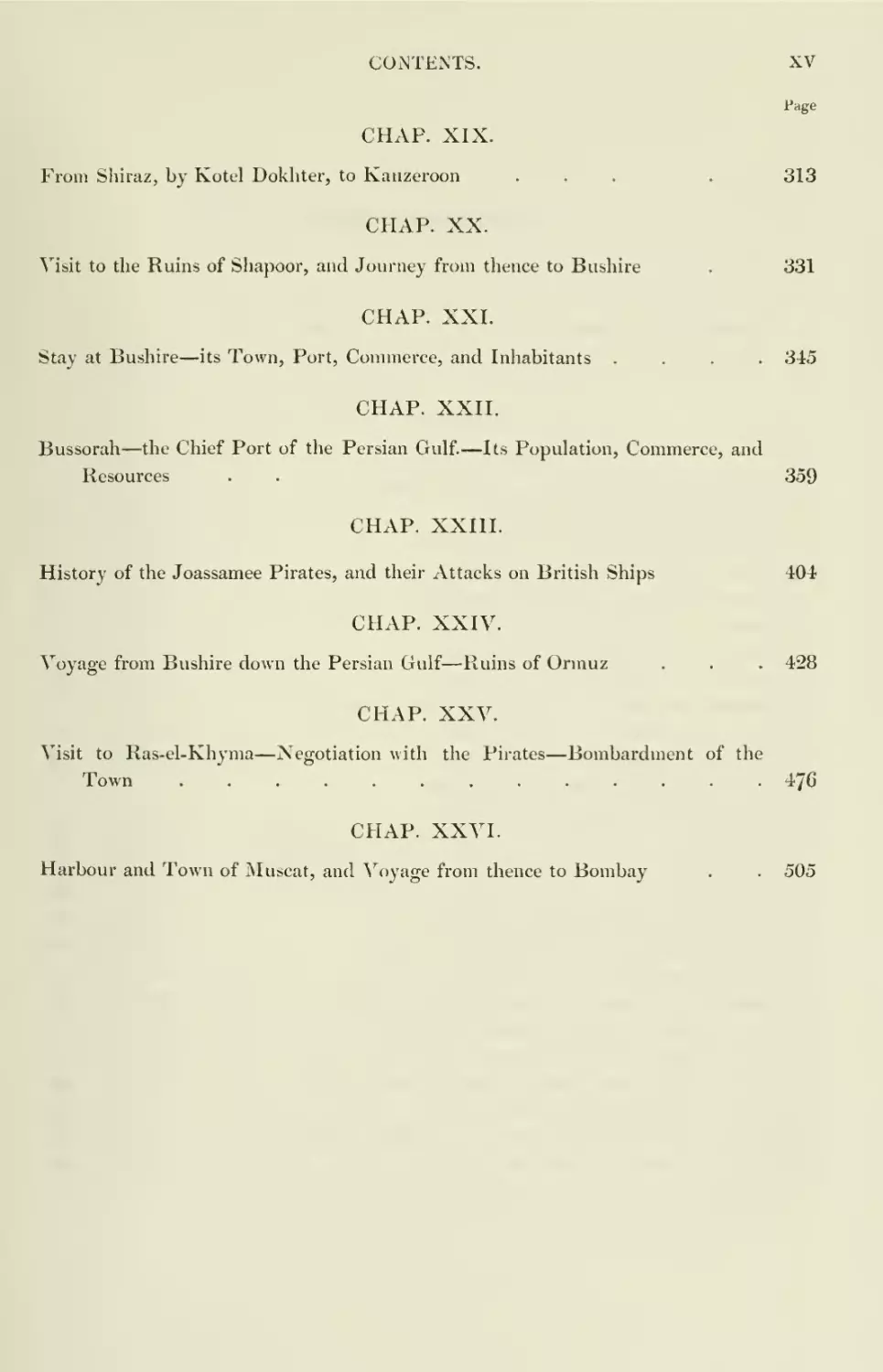







Author: Buckingham J.S.
Tags: history world history ancient world middle-east history history middle-east history of iraq
Year: 1977
Text
il'ipiih:--''
fiilil:
'mm--
'MM''^'.
iiiiipi-
.i.fiia,'ir,tKfti'
'fc4AA%«/^/Kveni'<U\%ipn^7'»^!v&<>i;^'',V.*iV
:
^TRAVELS
IN
AND PERSIA^
ASSYRIA, MEDIA,
INCLUDING
A
JOURNEY FROM BAGDAD BY MOUNT ZAGROS,
TO
HAMADAN, THE ANCIENT ECBATANA,
RESEARCHES IN
ISPAHAN AND THE RUINS OF PERSEPOLIS,
AND JOURNEY FROM THENCE
BY SHIRAZ AND SHAPOOR TO THE SEA-SHORE.
DESCRIPTION OF
BUSSORAH, BUSHIRE, BAHREIN, ORMUZ, AND MUSCAT,
NARRATIVE OF AN
EXPEDITION AGAINST THE PIRATES OF THE PERSIAN GULF,
WITH
ILLUSTRATIONS OF THE VOYAGE OF NEARCHUS, AND PASSAGE BY THE ARABIAN SEA TO BOMBAY.
BY
J.
S.
BUCKINGHAM,
AUTHOR OF TRAVELS IN PALESTINE AND THE COUNTRIES EAST OP THE JORDAN;
TRAVELS AMONG THE ARAB TRIBES; AND TRAVELS IN MESOPOTAMIA; MEMBER OP THE LITERARY SOCIETIES OF
BOMBAY AND MADRAS, AND OF THE ASIATIC SOCIETY OP BENGAL.
LONDON
HENRY COLBURN, NEW BURLINGTON
1829.
f-^
STREET.
All rights reserved.
publication
in
in
a
may be
retrieval
No
part
of this
reproduced, stored
system,
or
transmitted
any form or by any means,
electronic,
mechanical, photocopying, recording, or
otherwise without the prior permission of
Gregg International Publishers Limited
ISBN
576 03165 8
Republished in 1971 by Gregg International Publishers Limited
Westmead, Farnborough, Hants, England
Printed in England
TO
SIR
CHARLES FORBES, BART.
ESPECIALLY DISTINGUISHED AS THE
WARM AND STEAD V
M.
P.
FRIEND OF OUR ASIATIC
FELLOW-SUBJECTS IN INDIA,
AS
WELL AS THE BENEVOLENT ADVOCATE AND PROMOTER OF
THE FREEDOM AND HAPPINESS OF MAN, WITHOUT DISTINCTION OF COLOUR,
CASTE, OR COUNTRY,
THIS VOLUME OF TRAVELS,
COMMENCING AT BAGDAD AND TERMINATING AT BOMBAY,
IS
HUMBLY
INSCRIBED, AS A TRIBUTE OF GRATITUDE, ESTEEM,
REGARD, BY HIS
FAITHFUL AND AFFECTIONATE FRIEND,
THE AUTHOR.
AND
PREFACE.
In presenting
in the
this
Eastern World,
my
portion of
cuted with
I
of Travels
not without the apprehension that
may be thought
to
have been exe-
my
desire, as well as
my
ones.
It
interest,
to
equally worthy of public approbation
all
circumstances
Volume
and attention than preceding
has unquestionably been
make them
am
labours
care
less
Public a Fourth
the
to
;
but the
under which each of the several volumes were
prepared, and over which circumstances I had no power of control,
differed
would be
so
materially
sufficient
their execution than
The Travels
in
to
is
from
each
account for
still
of
more complete
fortune to enjoy.
and Countries
east
greater
prepared in
disadvantages of absence from books
;
that
this
alone
variations
in
even likely to be discovered in them.
Palestine were
to their illustration
other,
India,
under the
and authorities
essential
but, on the other hand, with the advantage
leisure than
The Travels
of the
it
in
my
has ever since been
the
Decapolis,
Jordan and the
Dead
or
good
Hauran,
Sea,
were
PREFACE.
vill
out
written
for
publication
entirely on
from
stormy and disagreeable passage
stances of the
hostile
to
during a
ship-board,
India,
under
most painfully oppressive nature, and
calm and abstracted literary composition
.the
;
the other hand, with the advantage of freedom from
occupation, and ample
The
Mesopotamia were written and arranged
in
most
but,
all
whenever the
of time,
admitted of writing.
of moderate weather
vals
in
command
circum-
on
other
inter-
Travels
London, under
the disadvantage of repeated interruptions from ill-health, and
dependent on the prosecution of
the anxiety and labour
claims for redress of injuries done
India, before a Parliamentary
tage of a
fore
:
plete
my
mind more
at ease
Committee
than
it
;
the Government of
but with the advan-
had been
for seven years be-
perseverance having been just then rewarded by a com-
triumph over the traducers of
literary reputation, the tribunal to
pletely vindicated all
ness of
me by
my
my
accusers.
my
claims,
The
my
which
personal character and
I
and put
appealed having comto
shame the wicked-
Travels in Assyria, Media, and Persia,
which form the present Volume, and complete the Series of
the
continuous Route
followed
India, have been prepared
in
my
overland
Journey
to
under circumstances which are pro-
bably without a parallel in the history of literary undertakings,
and may
at least excuse
and more favourable
The
many
imperfections, which, under other
auspices, could not claim such indulgence.
favourable reception given to the previous Volumes, and
the natural desire to have the Series completed by the publication of the
present,
combined
to
urge
but being, at the period of commencing
its
its
early appearance
preparation for the
PREFACE.
IX
my own
almost incessantly occupied, by having in
press,
the Editorship of a Daily and a
Weekly
hands
Political Journal, the
—and of a Weekly and a Monthly Literary
Athenaeum, and the Oriental Herald, — could only
Argus, and the Sphynx,
Journal, the
hope
I
to accomplish the task of bringing out this
manner
at
pose, to
in a
worthy of acceptance, by devoting a portion of
all
hours which are ordinarily given
those
Volume,
to
and
recreation
the labour which such an undertaking involved.
re-
This
resolution was accordingly made, and has been at length faith-
redeemed
fully
it
has been
;
for I
may
truly say, that not a single page of
written, arranged,
but after
or revised,
corrected,
the hours at which even the most studious generally repair to
their couch, to
recruit
by sleep the exhaustion of the labours
of the day.
That, under the circumstances described, errors of style and
deemed won-
defects of arrangement should appear, will not be
derful
;
and
that,
have been more
But,
when
very
best
it
cannot admit of doubt.
satisfactorily executed,
not possible to do
is
manner we could
execute
to
under other circumstances, the task might
wish,
we
all
it
is
better
our duty in the best manner
and
desire,
that
in the
endeavour
to
we
are
able,
than altogether to abandon the attempt as impracticable.
is
on
this
maxim,
in extenuation
in its train,
at
least,
that I have acted
of imperfections, which
It will
hurried and interrupted composition,
fact,
this
that having left
London on
b
it
is
rather
necessarily brings
than from any other motive, that
at all to allude to the subject.
the
and
;
It
I
liave
ventured
complete the picture of
if I state,
what
is
literally
business of some import-
PREFACE.
X
me
which called
ance,
Channel
to cross the
and
to Guernsey,
being driven back by tempestuous weather, in the Watersprite,
which made an ineifectual attempt
to
accomplish the passage,
and, though one of the finest steam-packets in the service, was
obliged to bear up, and anchor again in
night, I
of the
am now
Crown
Melcombe
who
Having pledged myself
my
and
in
least
same apartment.
Publisher, to finish every part
task before a given day, this cannot be deferred
return,
is
Room
the enquiring and intelli-
are occupants of the
to the
mid-
Regis, with an animated conver-
me among
around
gent fellow-passengers
of
at
writing this Preface, in the Travellers'
Inn, at
sation passing all
Weymouth Roads
therefore thus hurriedly completed
but
:
my
till
it
is
at
Work begun
keeping with the whole picture, that a
and labours of four separate and
amidst the conflicting duties
voluminous Journals, already described, should be terminated by
a hasty
sketch like
and
this,
in
the interval
momentary expectation of seeing the
by
sea,
for
immediate re-embarkation displayed.
I
in the
of a stormy passage
signal
cannot conclude, however, even this imperfect address, with-
out saying a word or two on the subject of the Illustrations,
To
and the typographical execution of the Work.
son, of the
East India Company's Engineers,
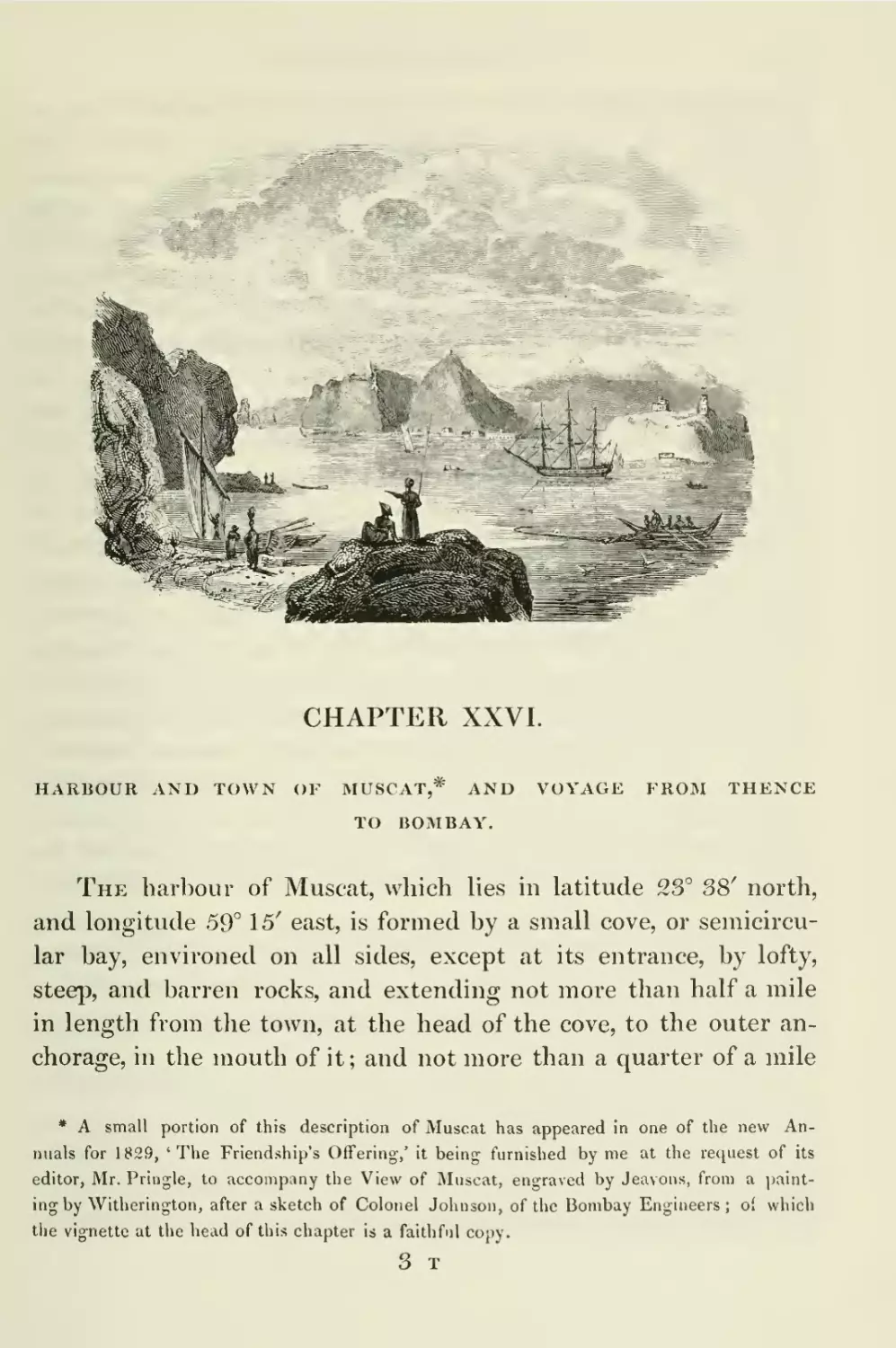
the beautiful View of Muscat, which was
ington, from a sketch
Jeavons, on
a
reduced
for
am
indebted for
painted by Wither-
of Colonel Johnson's,
scale,
I
Colonel John-
and engraved by
Mr. Pringle's Annual,
'
The
Friendship's Offering,' a copy of which Colonel Johnson kindly
permitted
for a
me
to take.
To
the same friend
View of the Entrance
to the
I
am
also indebted
Harbour of Bombay, with
PREFACE.
XI
the several characteristic features of a trankee, a peculiar kind
of boat
fishing-stakes,
;
marking the boundaries of certain banks,
secured from general navigation
rude
ran, a
raft,
and
are accurate delineations of real
at the
my
friend,
rassan, I
all
and natural objects seen
of which
at
Bom-
Persian Gulf
To
the kindness
Mr. James Baillie Frazer, the intelligent author
in the
Himalya Mountains, and
Kho-
a Journey in
owe the two interesting views of the Ruins of Per-
seen under the aspect of an approaching storm, and the
sepolis
Ruins of Ormuz, with
these
;
head of the Chapter descriptive of Bussorah, on the Eu-
Tour
of a
his raft together
by some irremediable oversight, has been placed
phrates, the chief port of the
of
and a fisherman on a catama-
of three logs of wood, encountering and killing a
sword-fish, larger than himself
bay, but which,
;
its
With
sweeping bay of anchorage.
exceptions, the Illustrations of the Volume, to the
num-
ber of twenty-six, are from original sketches of the scenes and
objects described, taken in the course of the journey,
from descriptions noted on
pleted
which these have
all
the
sjiot.
and com-
The manner
been drawn on the wood by Mr.
in
W. H.
Brooke, and in which the greater part of them have been ex-
ecuted by the respective engravers, whose names appear in the
list,
is
such
as,
I
hope, will confirm the established reputation
of the artists themselves, at the same time that they cannot
to gratify as well as to
which
is
instruct
from the press of Messrs.
the
S.
reader.
fail
The typography,
and R. Bentley, may
fairly
challenge a comparison for beauty with the production of any
press in the kingdom.
The
introduction of an engraved Portrait has been done prinb 2
PREFACE.
xii
cipally with a view of
showing the costume
in
which the greater
part of the Journey described in the present
per-
This has been so frequently the subject of enquiry by
formed.
who
those
Volume was
felt
an interest in knowing
the details of
all
my
Tra-
vels,
and the circumstances under which they were performed,
that,
having such a sketch in
to
And
possession, I considered
some, and offend none
interest
sented to
my
its
being appended to the
likely
and therefore readily con-
;
Work
much
now, having said thus
it
in its present form.
in indication of
what
am
I
sure will be admitted as merits, being the production of other
hands
fects,
;
and
in extenuation of
what
cerely wishing
far
;
;
them perpetual exemption from
and inconveniences which they
pages,
ready to admit as de-
my own I commend these hurried
sinspirit of my intelligent countrymen
being the production of
labours to the indulgent
am
I
all
will find detailed in the
and which are inseparable from travelling
removed from our own
as in geographical distance
in habits,
;
the privations
ensuing
in countries so
manners, and usages, as well
and assuring them, that
formance of these journeys occasioned
me more
if
the per-
suffering than I
should again be willing to undergo, the retrospect affords
me
continual and inexhaustible source of agreeable associations
;
that I shall consider myself amply rewarded for
gone,
and
have under-
have the happiness to find that the humble record
if I
of whatever I
countries,
all I
a
may have deemed worthy
may be thought
to deserve the approbation of the en-
quiring and intellectual classes in
my
own.
J.
l\'cym()ulh,
Nov.
JO///,
1828.
of observation in other
S.
BUCKINGHAM.
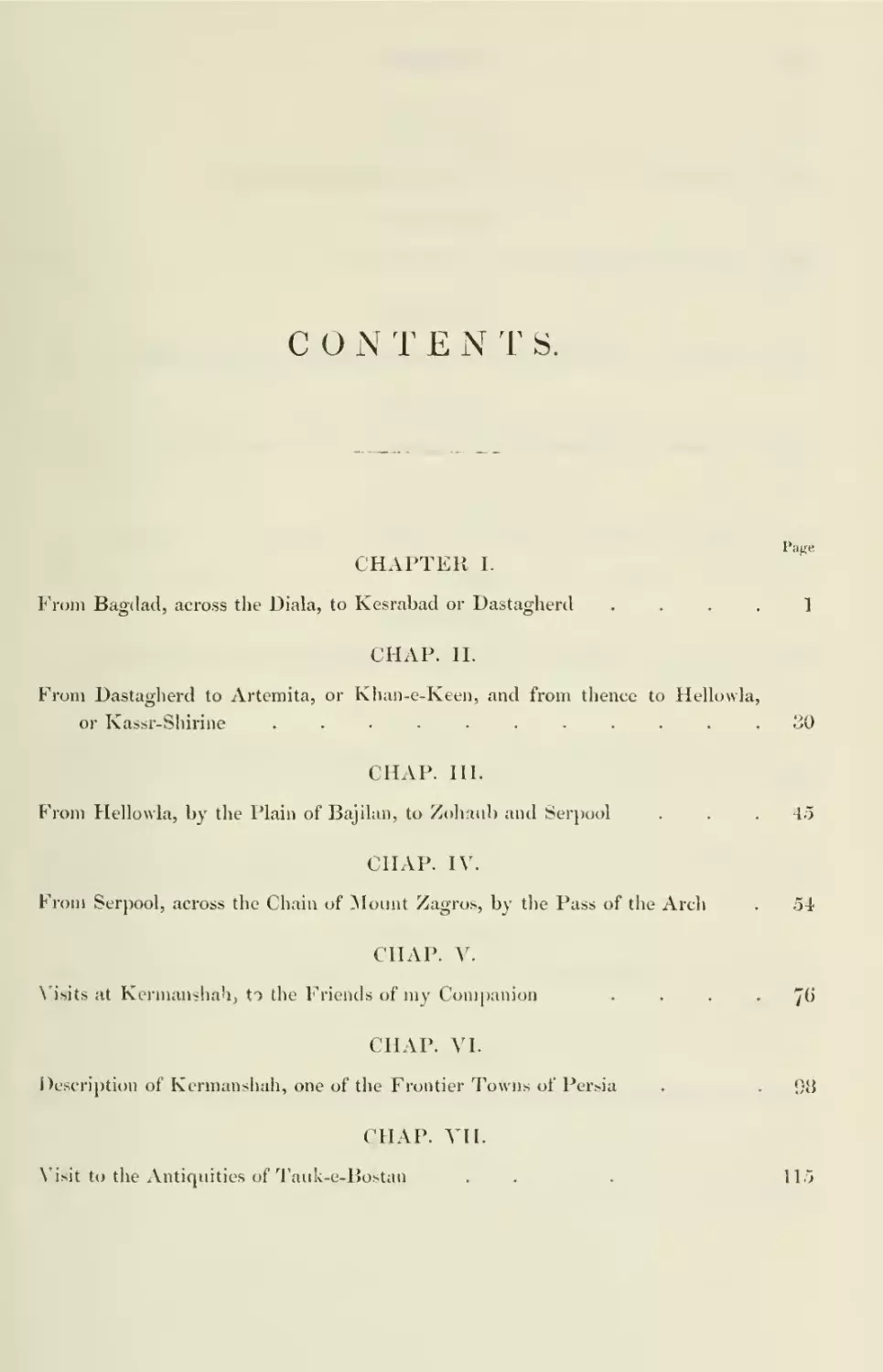
C O
NTENT
S.
Page
CHAPTER
I.
I'rom Bagdad, across the Diala, to Kesrabad or Dastagherd
CHAP.
From Dastagherd
to
II.
...........
CHAP.
F'rom Hellowla, by the Plain of Bajilan, to
Serpool, across the Chain of
Kcrmanshahj
to the
Friends of
CHAP.
the Antiquities of Tauk-e-Bostan
.
4.5
Arch
.
54
V.
.
.
.
'J6
VI.
Towns
Description of Kermanshah, one of the Frontier
\'isit to
the Pass of the
my Companion
CHAP.
.
.
IV.
Mount Zagros, by
CHAP.
30
III.
Zohaub and Serpool
CHAP.
\'isits at
1
Artemita, or Khan-e-Keen, and from thence to Hellowla,
or Kassr-Shirine
From
....
of Persia
.
.
98
VII.
.
.
.
11.5
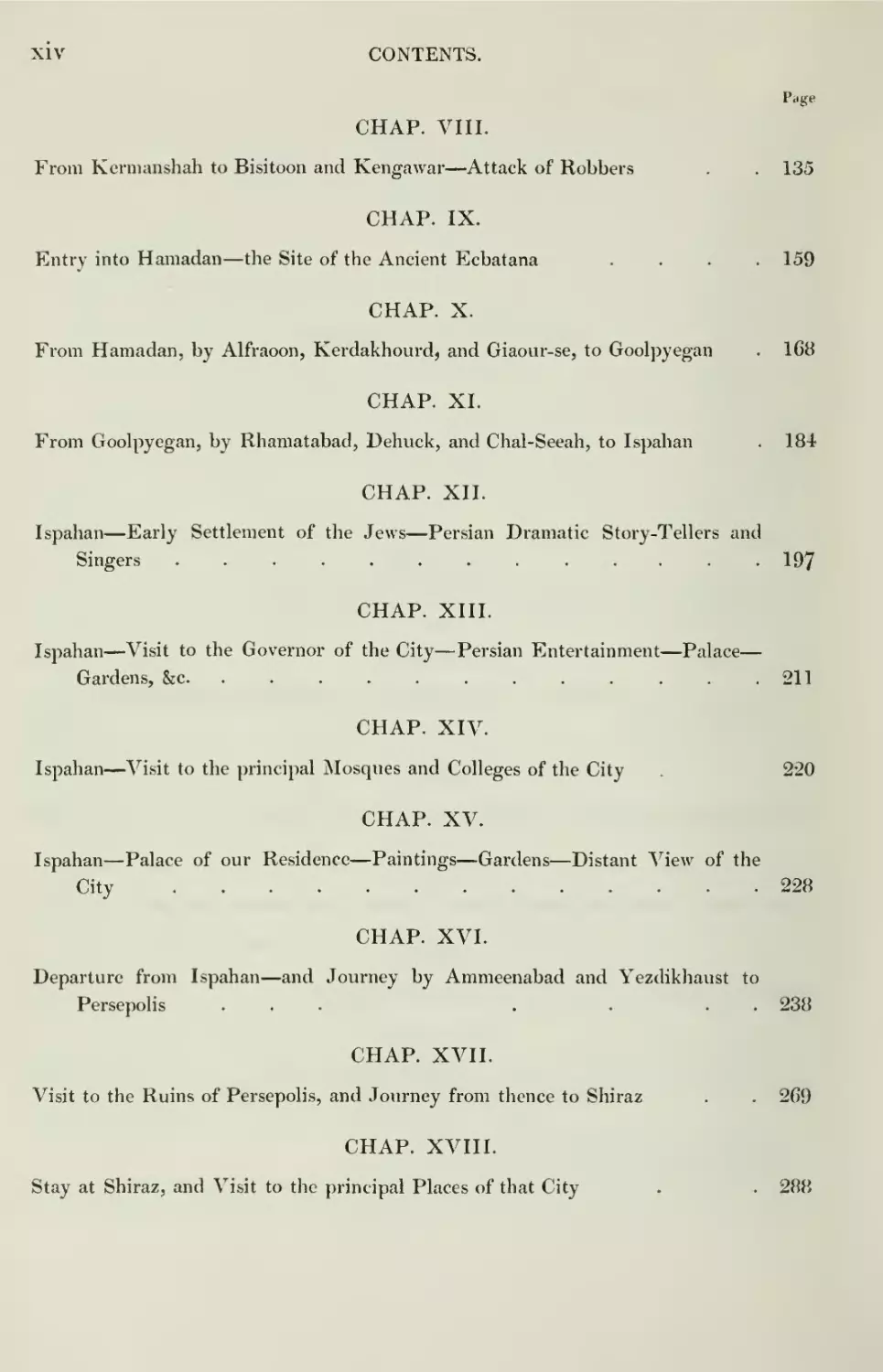
XIV
CONTENTS.
Page
CHAP.
From Kernianshah
to Bisitoon
VIII.
and Kengawar
CHAP.
Entry
into
Hamadan
IX.
— Early
Settlement of the Jews
.
Chal-Seeah, to Ispahan
.
184
XII.
—Persian
Dramatic Story-Tellers and
197
CHAP.
—
168
XI.
Singers
Ispahan
159
X.
From Goolpyegan, by Rhamatabad, Dehuck, and
CHAP.
135
.
Alfraoon, Kerdakhourd, and Giaour-se, to Goolpyegan
CHAP.
Ispahan
.
....
— the Site of the Ancient Ecbatana
CHAP.
From Hamadan, by
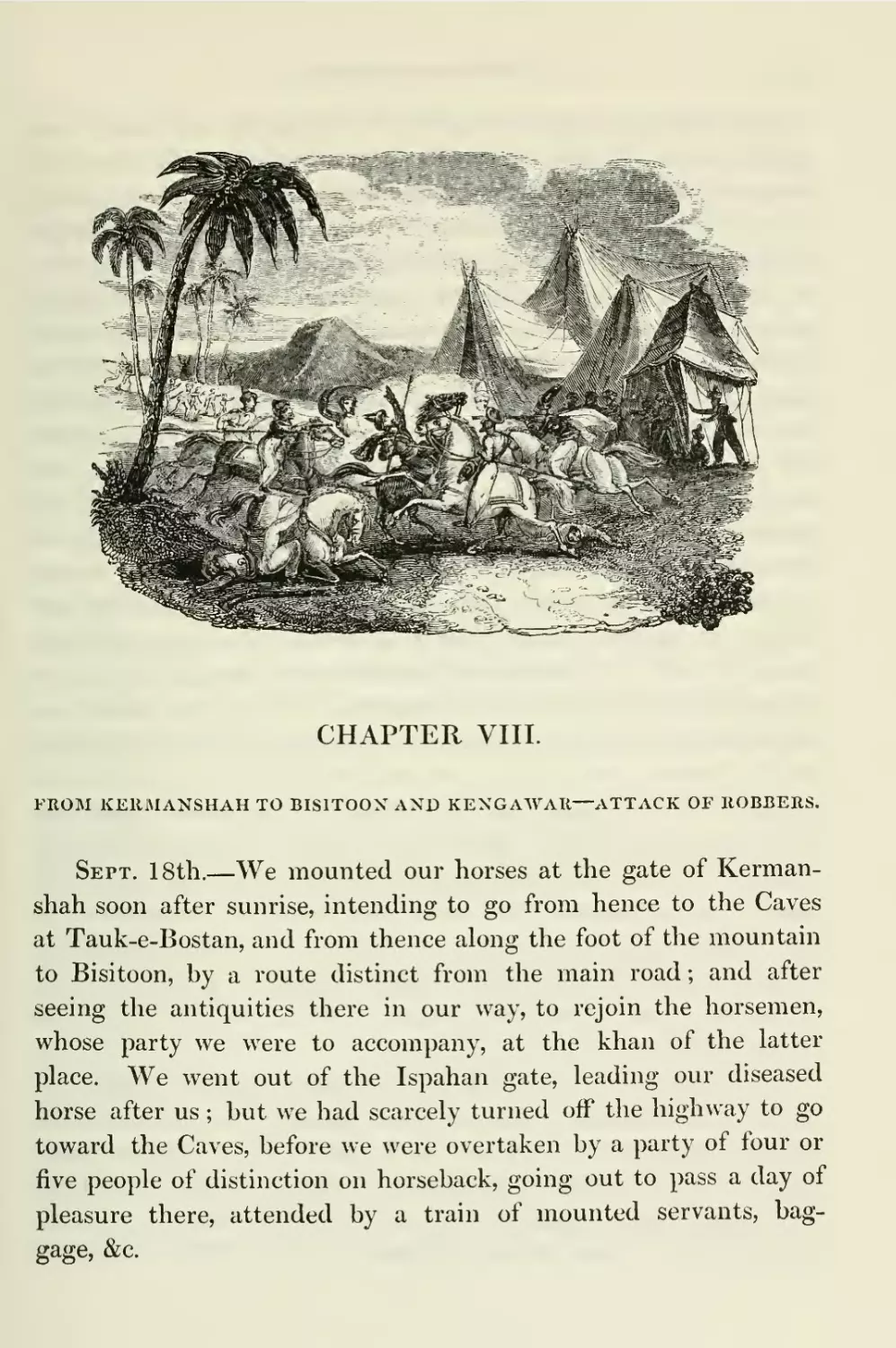
—Attack of Robbers
Visit to the Governor of the City
XIII.
— Persian Entertainment—Palace
Gardens, &c
211
CHAP. XIV.
Ispahan
—Visit
to the principal
Mosques and Colleges of
220
the City
CHAP. XV.
Ispahan
— Palace
of our Residence
—Paintings—Gardens—Distant
View of
the
228
City
CHAP. XVI.
—
...
Departure from Ispahan
Persepolis
and Journey by Ammeenabad and Yezdikhaust
.
.
to
.
.
.
.
238
CHAP. XVII.
Visit to the
Ruins of Persepolis, and Journey from
tlience to Shiraz
269
CHAP. XVIII.
Stay at Shiraz, and Visit to the principal Places of that City
.
.
288
XV
CONTENTS.
Page
CHAP. XIX.
From
Sliiraz,
by Kotel Dokhter,
to
...
Kaiizeroon
.
313
.
331
CHAP. XX.
to tlie
^'^isit
Ruins of Shapoor, and Journey from thence
to
Bushire
CHAP. XXI.
Stay at Bushire
—
its
Town, Port, Commerce, and Inhabitants
....
345
CHAP. XXII.
Bussorah
—the Chief Port of the Persian Gulf. —
Resources
.
Its Population,
Commerce, and
359
.
CHAP. XXIII.
History of the Joassamee Pirates, and their Attacks on British Ships
404<
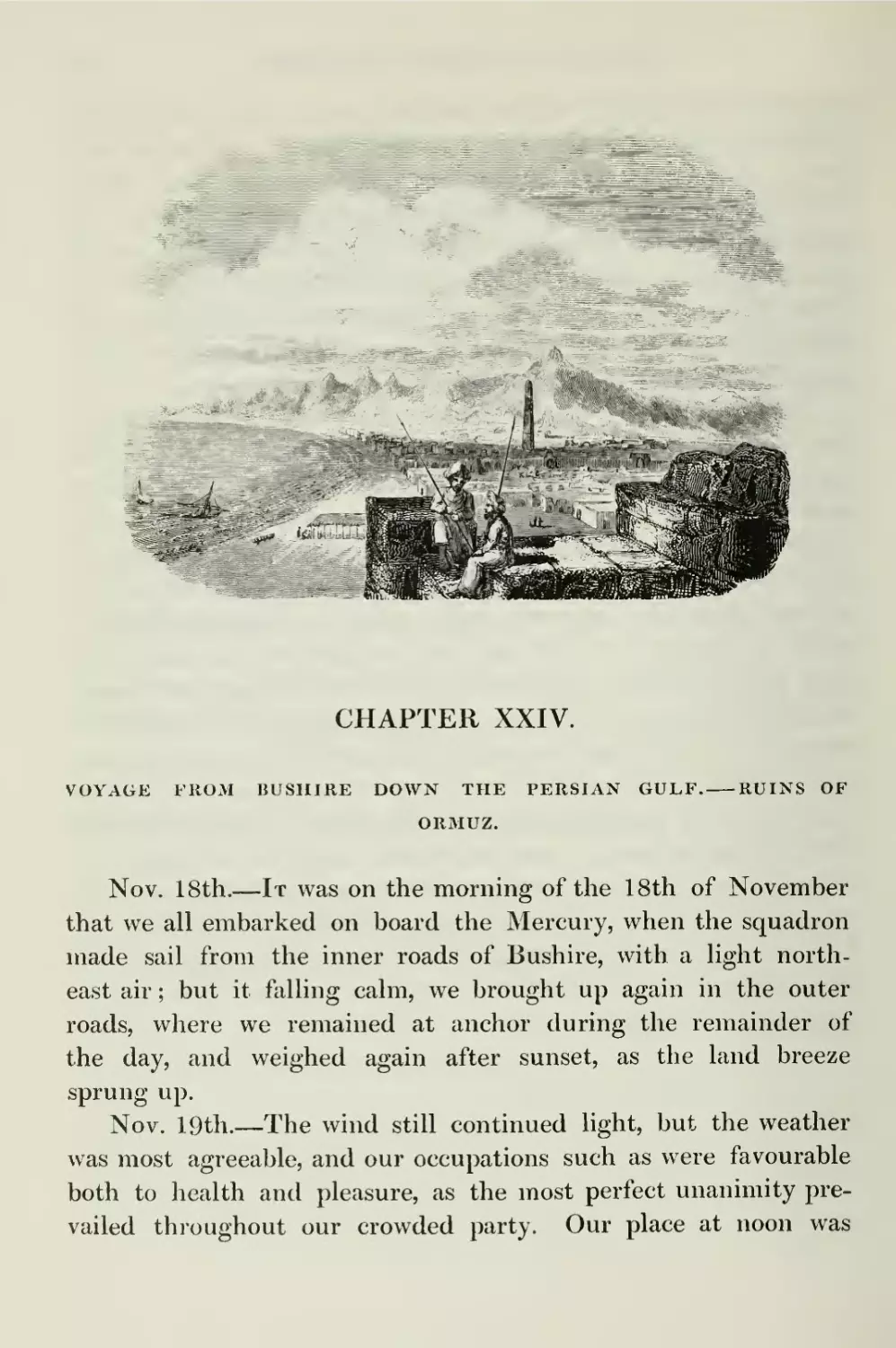
CHAP. XXIV.
Voyage from Bushire down
— Ruins of Ormuz
the Persian Gulf
.
.
.
428
CHAP. XXV.
Visit
to
—
—
.............
Ras-el-Khyma
Town
Negotiation with
tlie
Bombardment
Pirates
of the
476
CHAP. XXVI.
Harbour and Town of Muscat, and ^^oyage from thence
to
Bombay
.
.
505
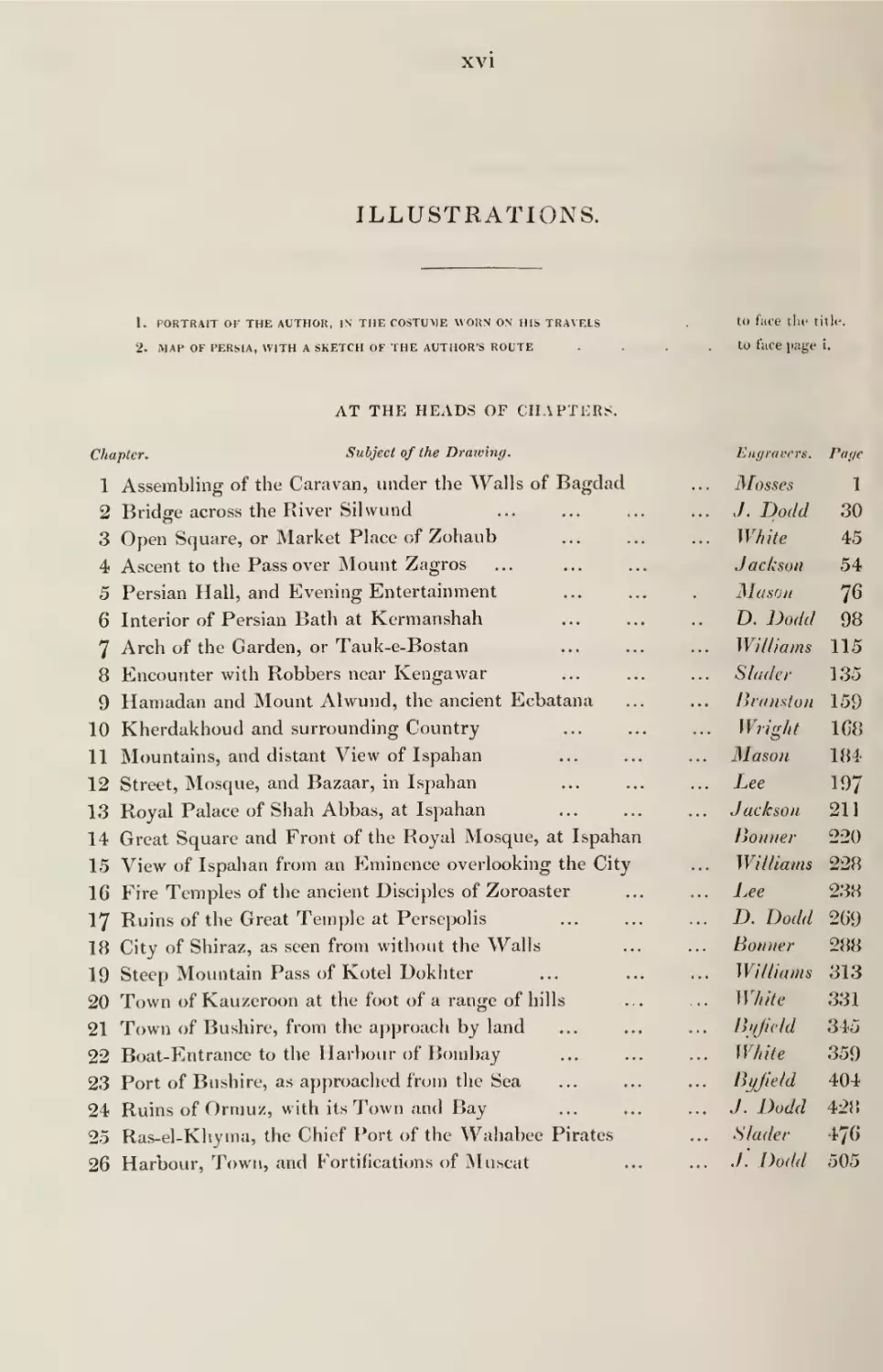
XVI
ILLUSTRATIONS.
1.
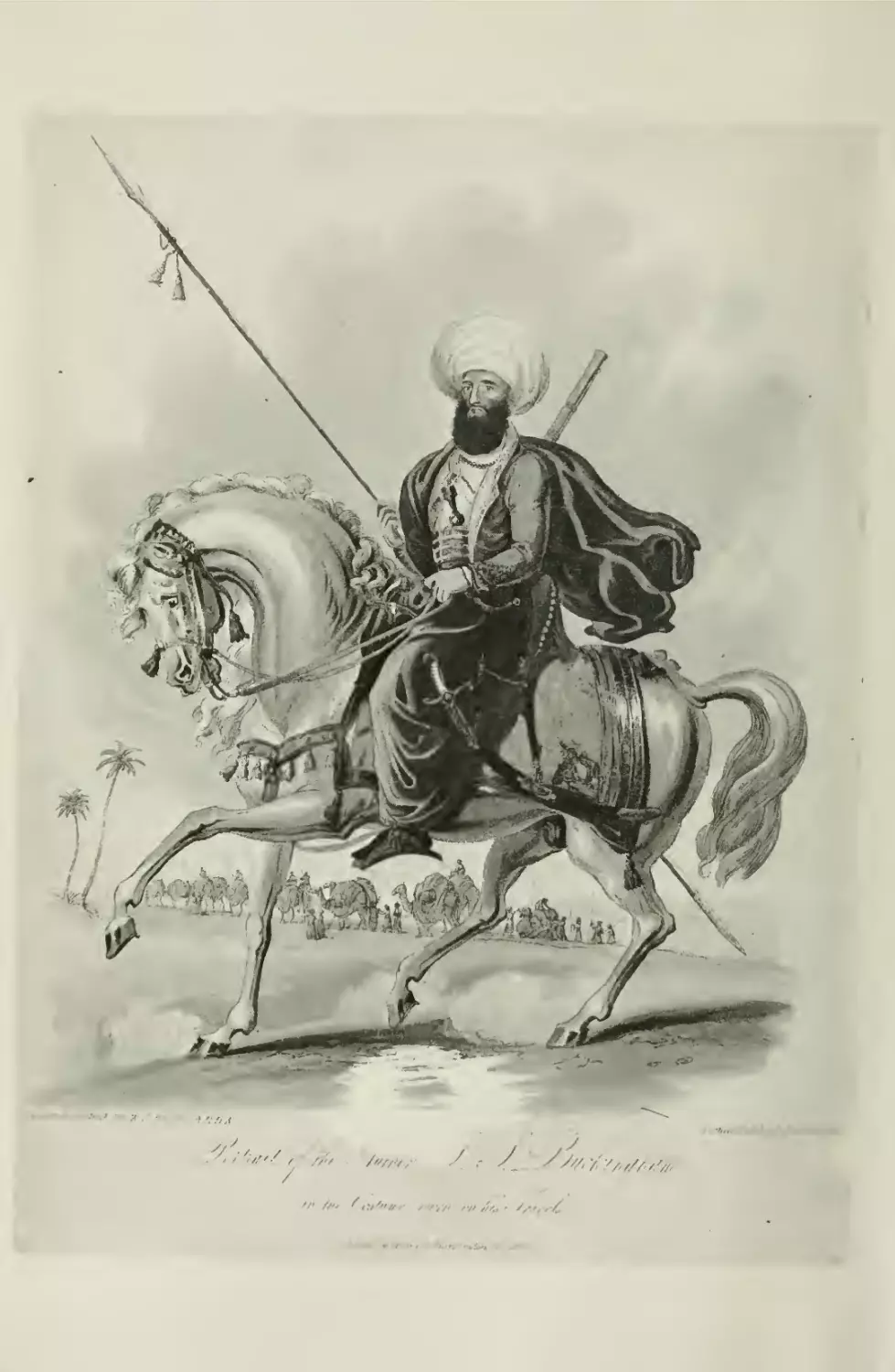
PORTRAIT or THE AUTHOR,
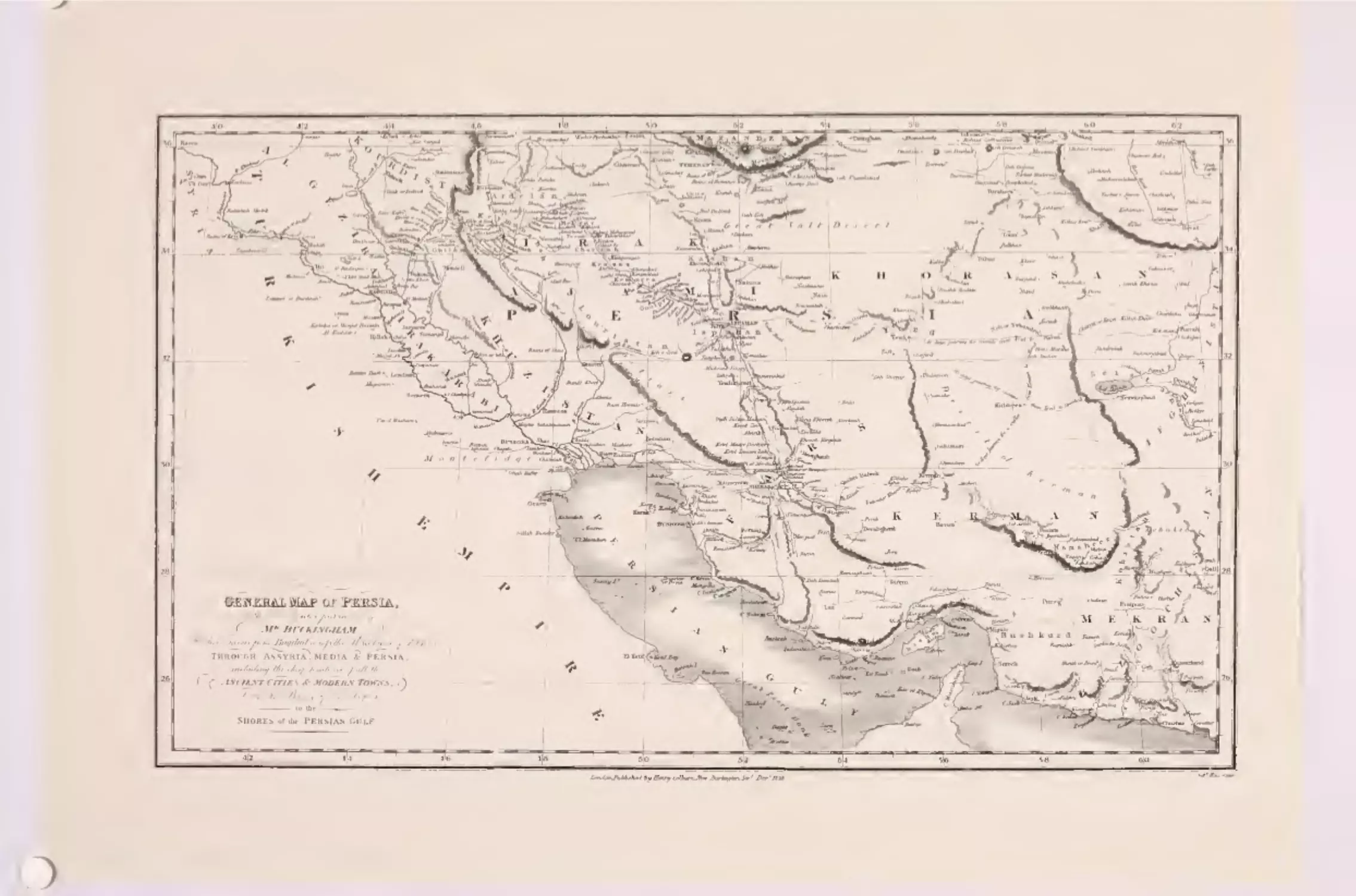
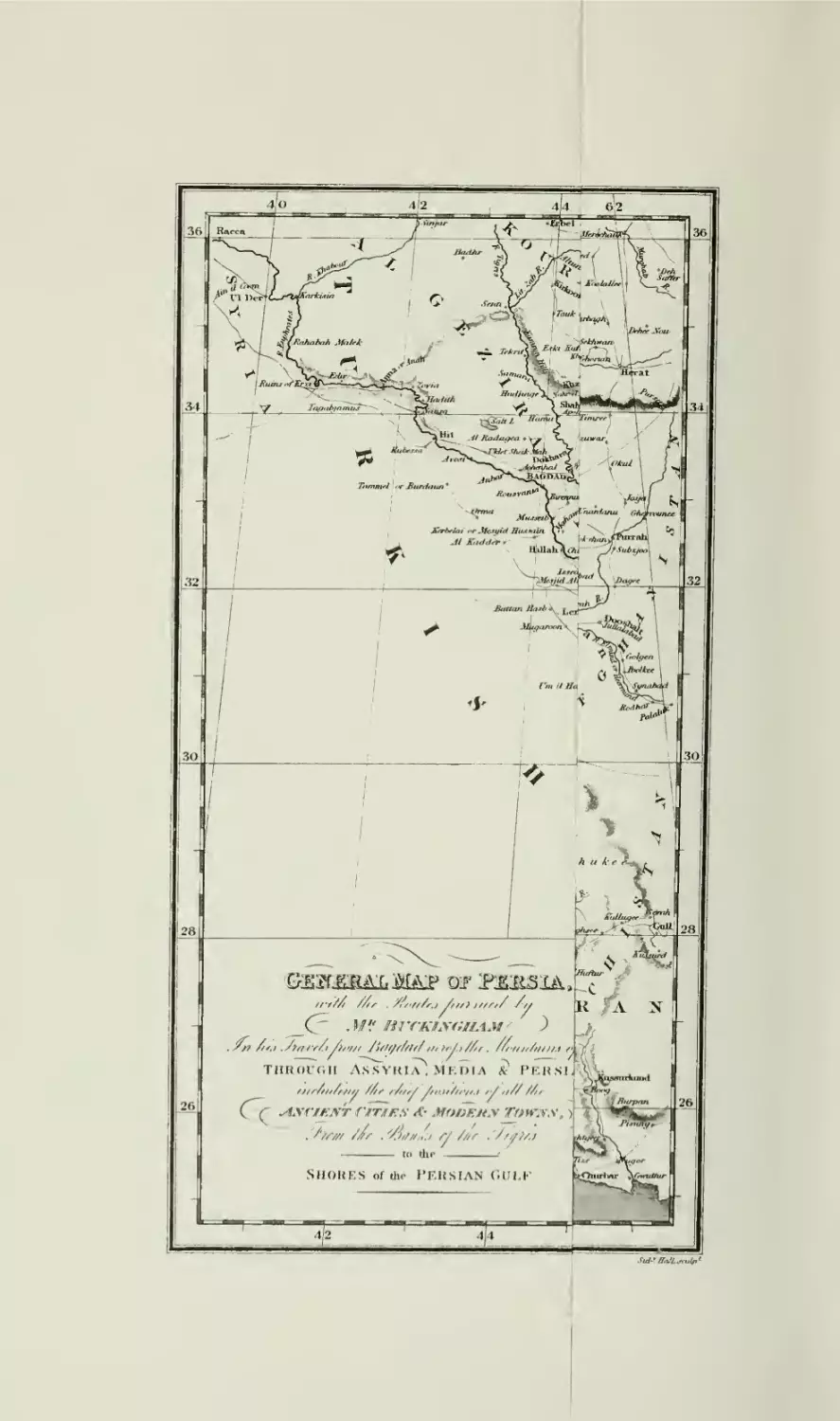
2.
MAP OF
PERSIA,
IN
THE C0STU\1E WORN ON
HIS TRAVELS
WITH A SKETCH OF THE AUTHOR'S ROUTE
to fiice the title
to face l>;ige
i.
AT THE HEADS OF CHAPTERS.
Subject of the Draxving.
Chapter.
Eiiyracers.
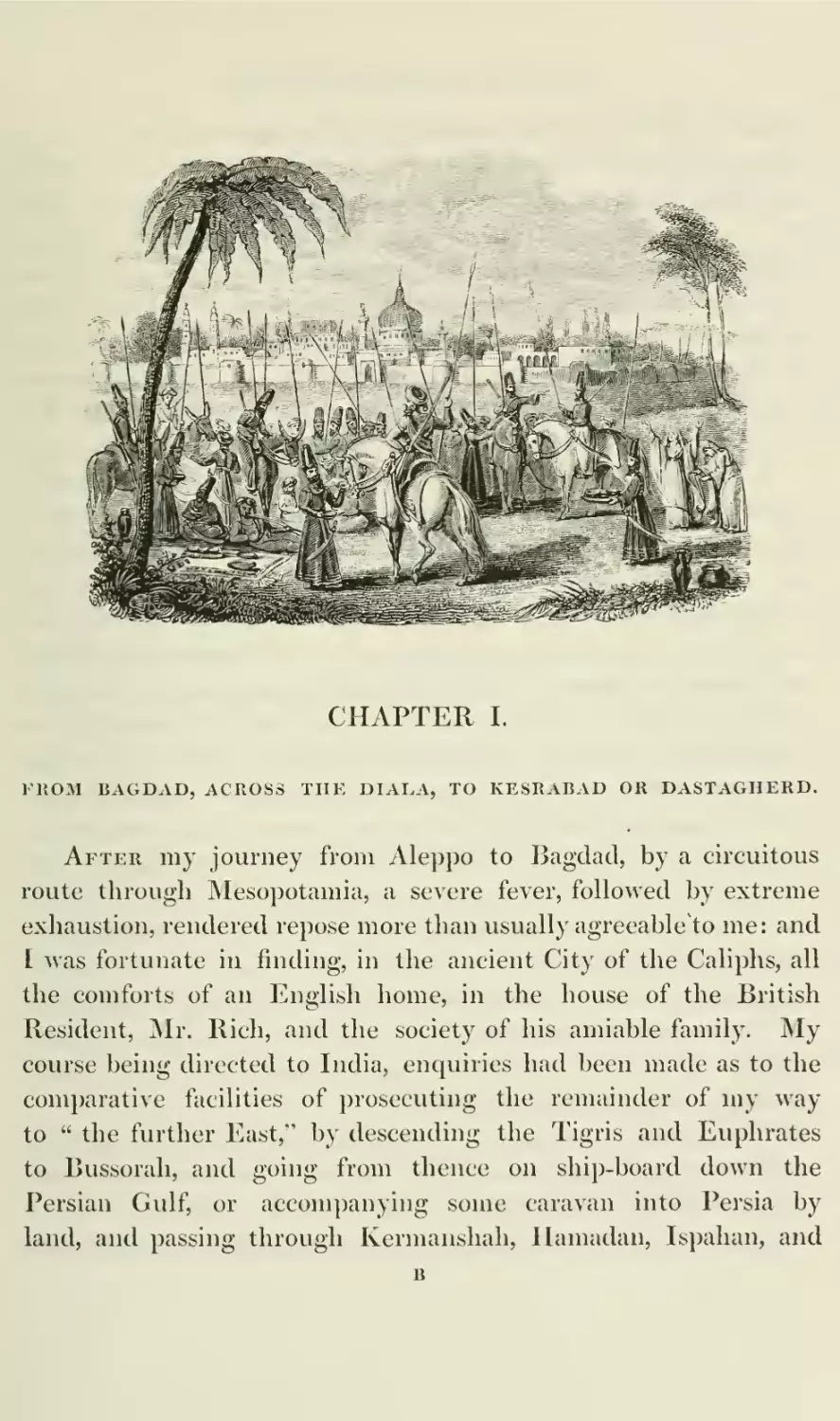
Assembling of the Caravan, under the Walls of
2 Bridge across the River Silwund
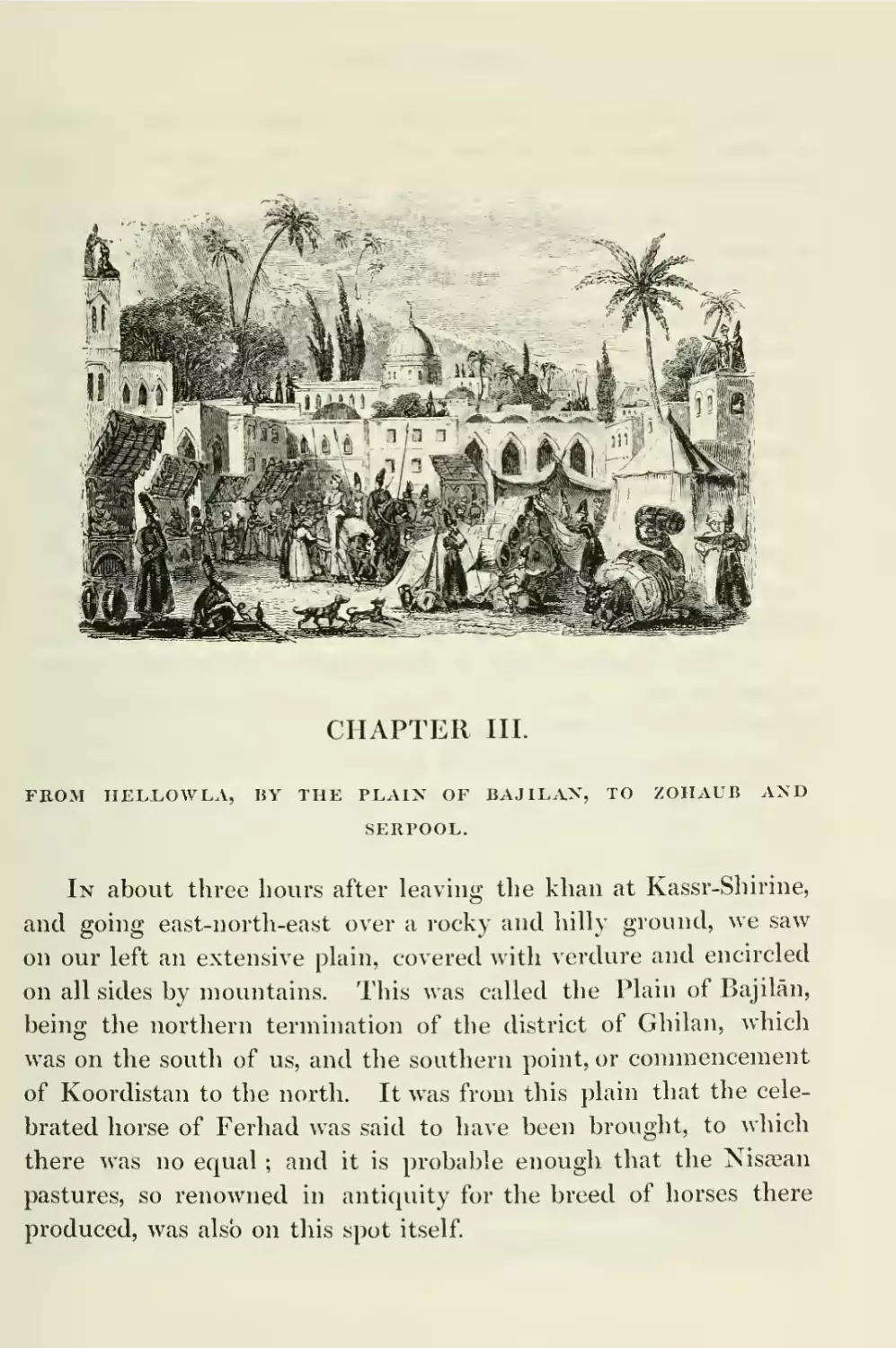
3 Open Square, or Market Place of Zohaub
1
4 Ascent
to the
Bagdad
Mosses
J.
Pass over Mount Zagros
Dodd
Payc
1
30
White
45
Jacksoti
54
5 Persian Hall, and Evening Entertainment
6 Interior of Persian Bath at Kermanshah
7 Arch of the Garden, or Tauk-e-Bostan
Mason
Williams
76
98
115
8 Encounter with Robbers near Kengawar
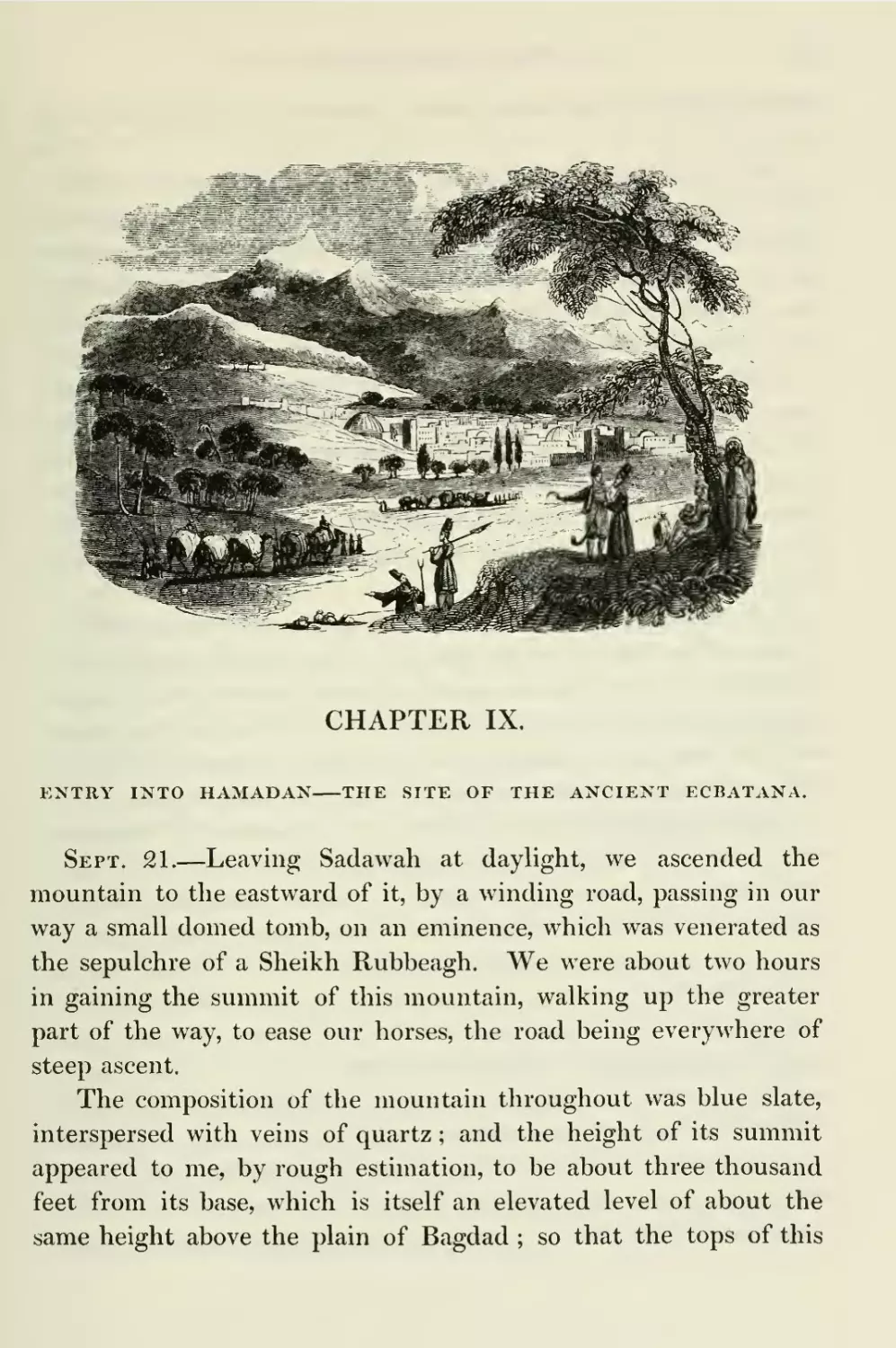
9 Hamadan and Mount Alwund, the ancient Ecbatana
Slader
135
Braiistun
159
10 Kherdakhoud and surrounding Country
11 Mountains, and distant View of Ispahan
12
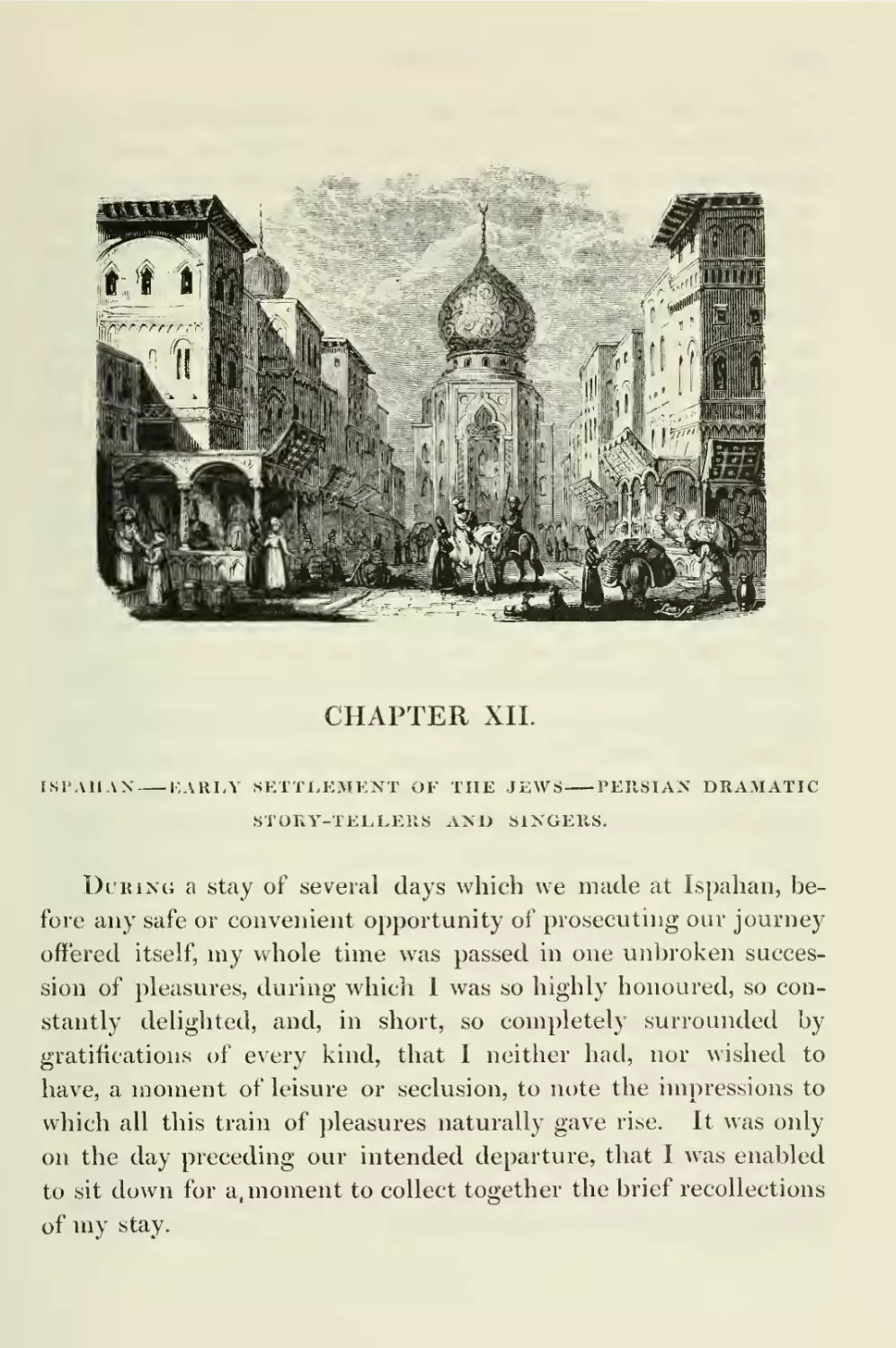
Street,
Mosque, and Bazaar,
in
Wright
Mason
Ispahan
13 Royal Palace of Shah Abbas, at Ispahan
14 Great Square and Front of the Royal Mosque,
Dudd
D.
at
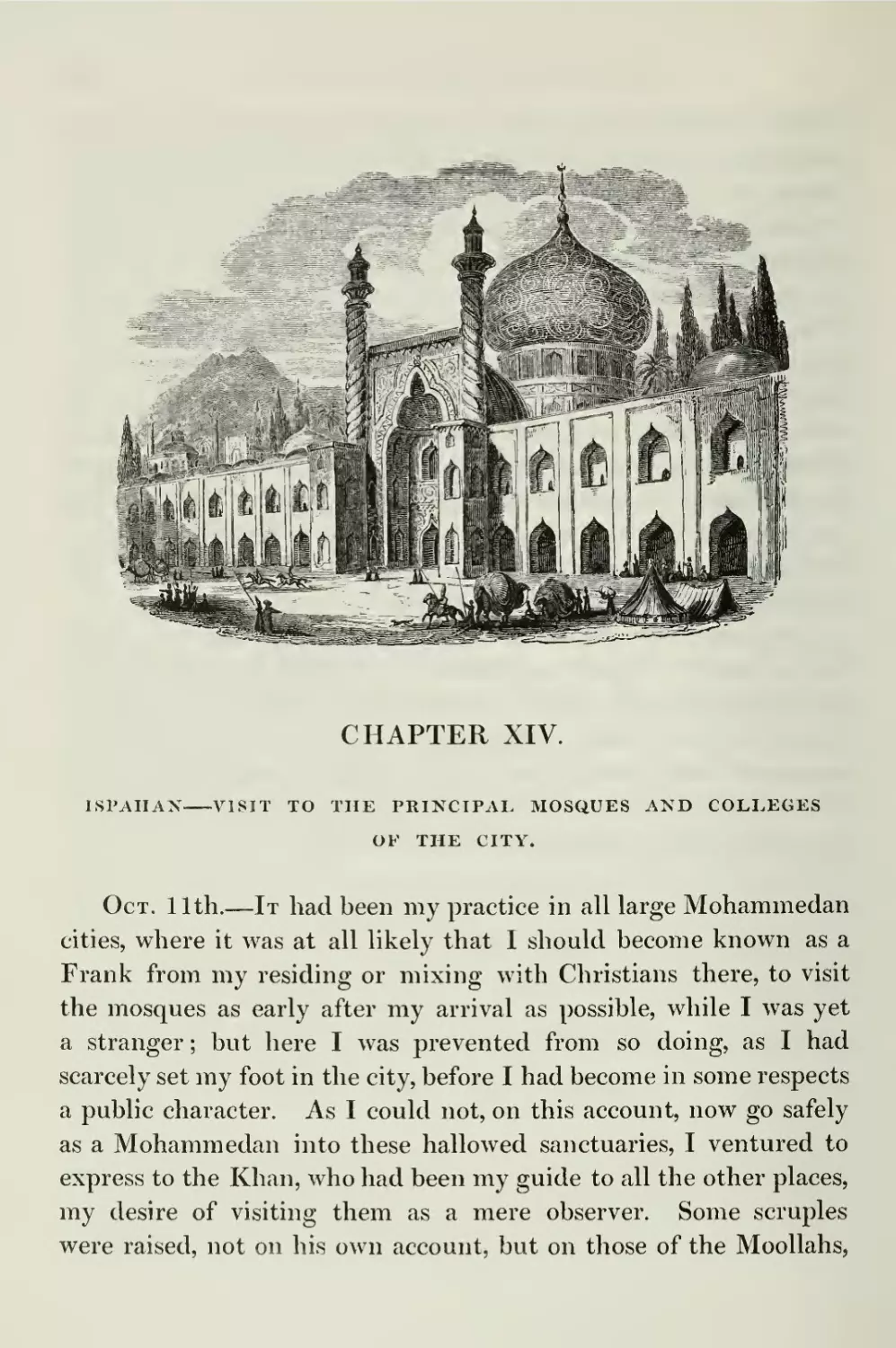
Ispahan
108
184
Lee
197
Jacksoti,
211
Bonner
220
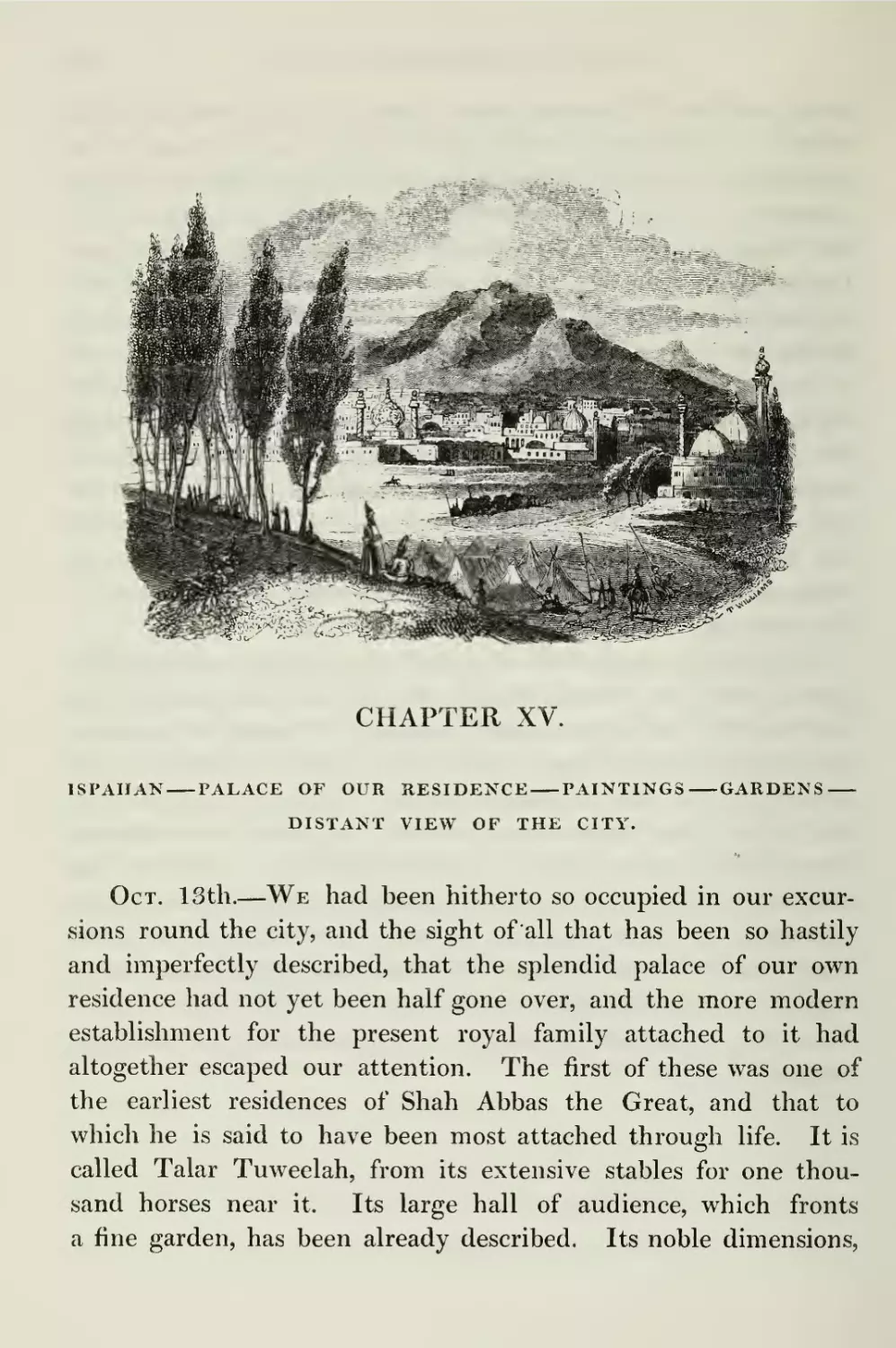
15 View of Ispahan from an Eminence overlooking the City
Williams
228
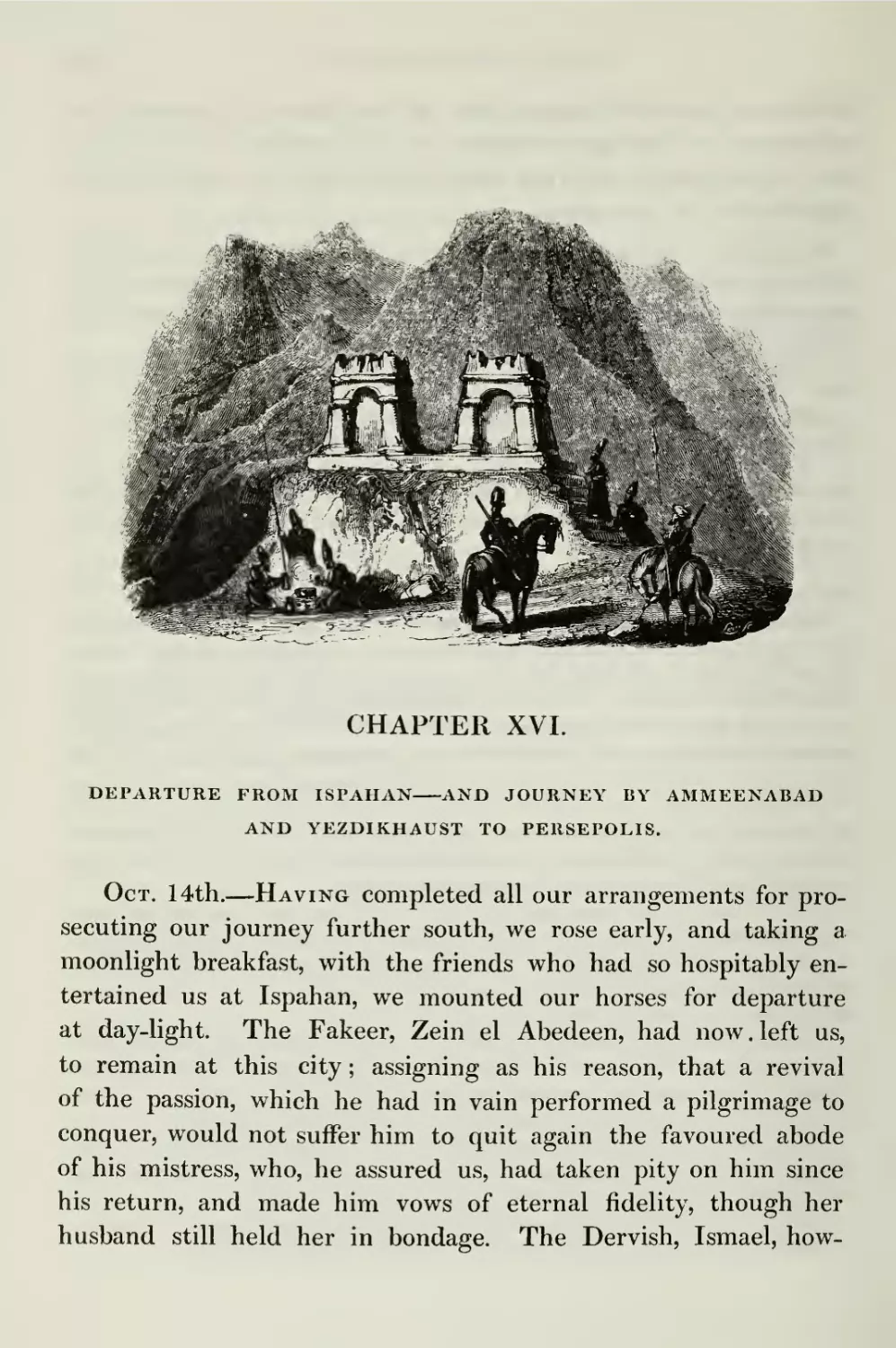
16 Fire Temples of the ancient Disciples of Zoroaster
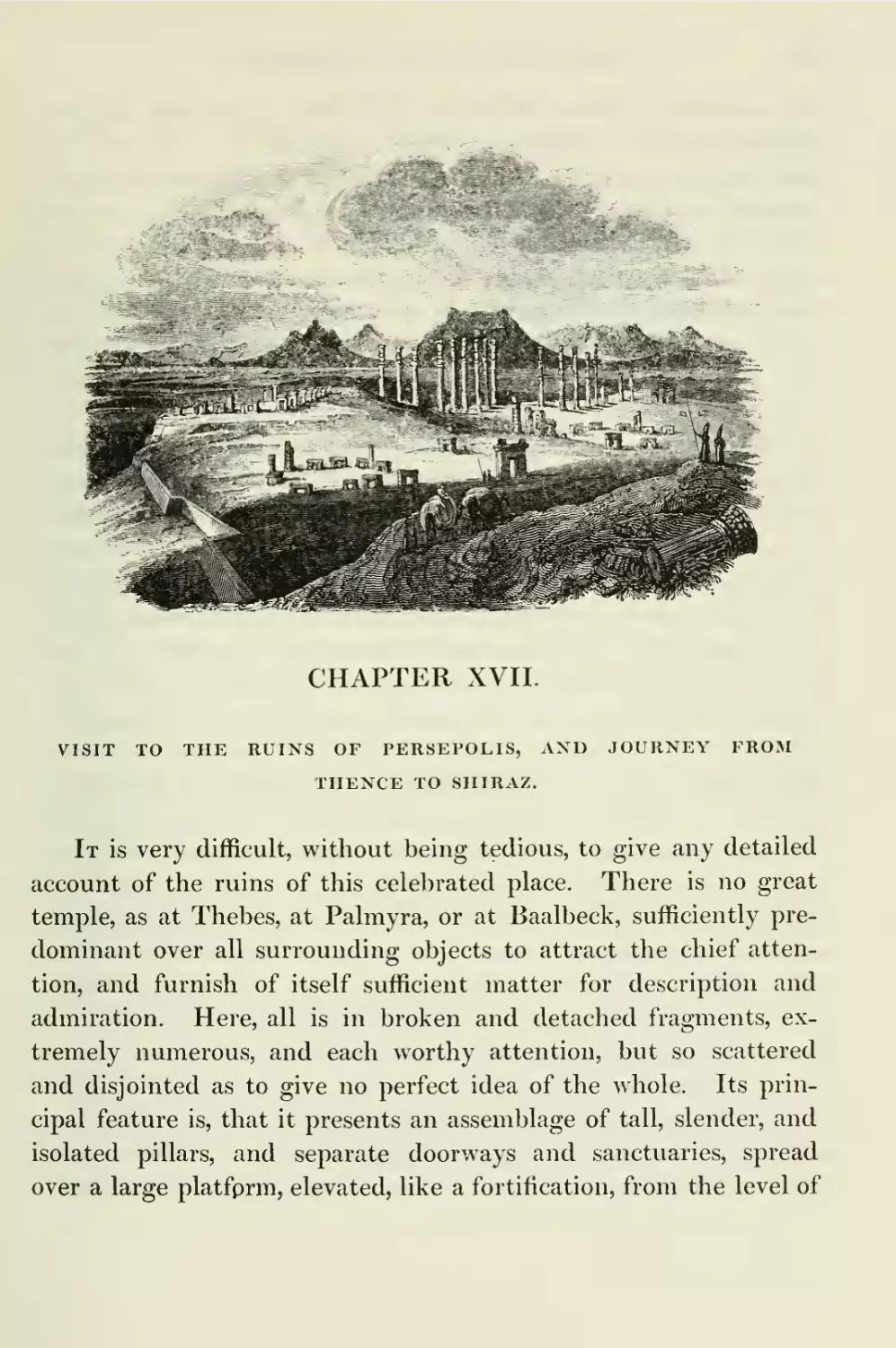
17 Ruins of the Great Temple at Persepolis
Ijee
238
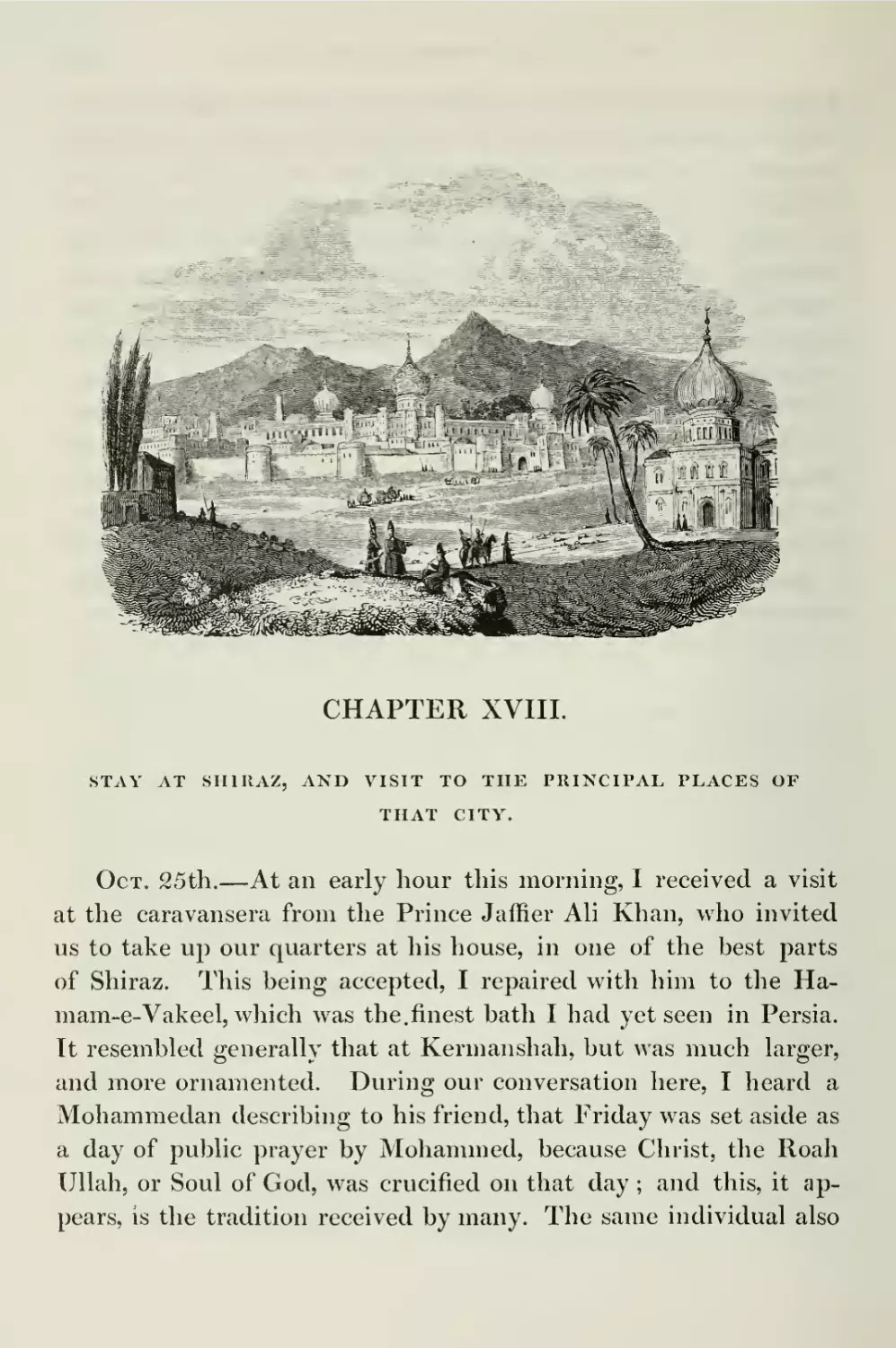
18 City of Shiraz, as seen from without the Walls
19 Steep Mountain Pass of Kotel Dokhter
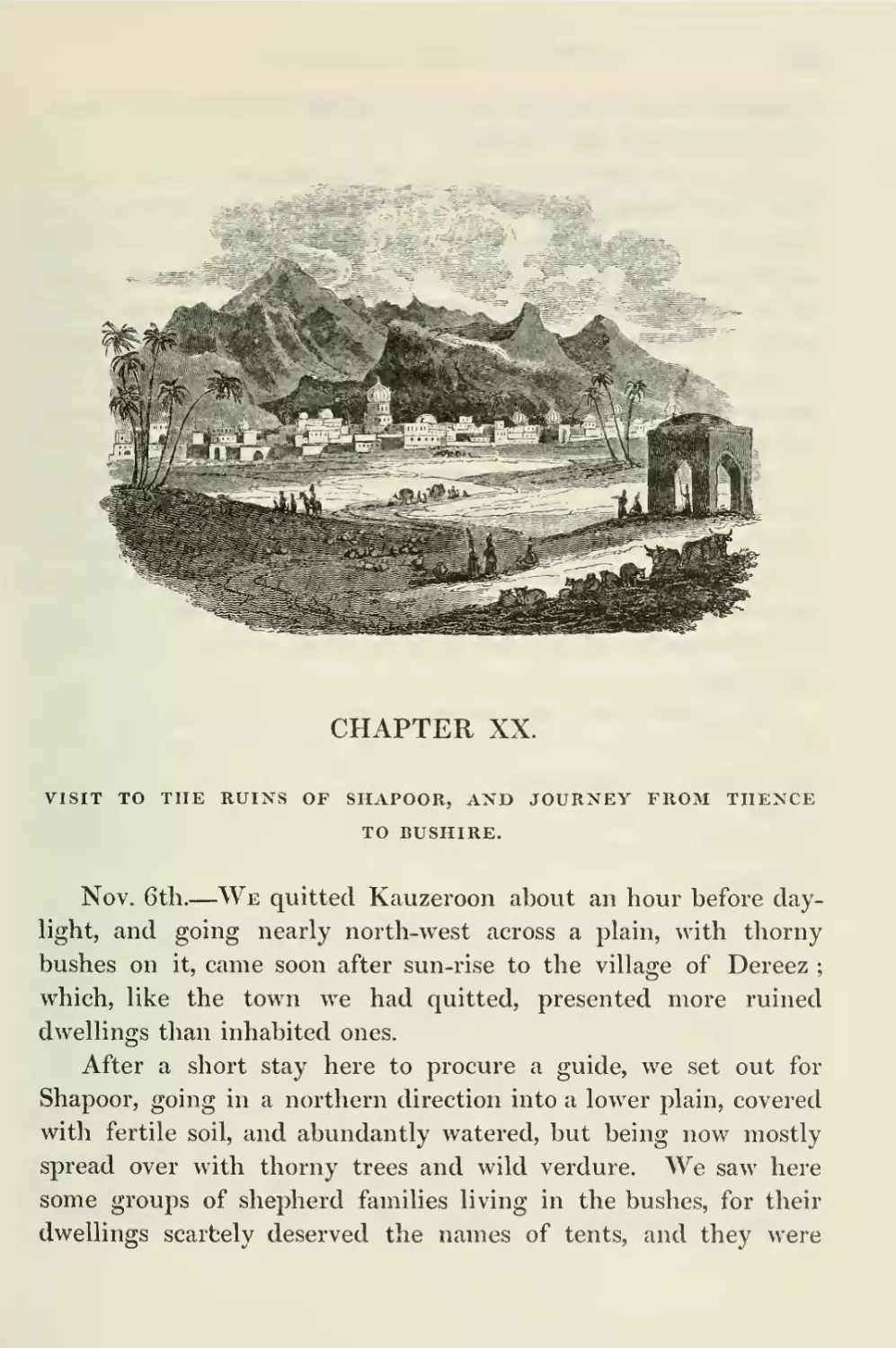
20 Town of Kauzerotm at the foot of a range of hills
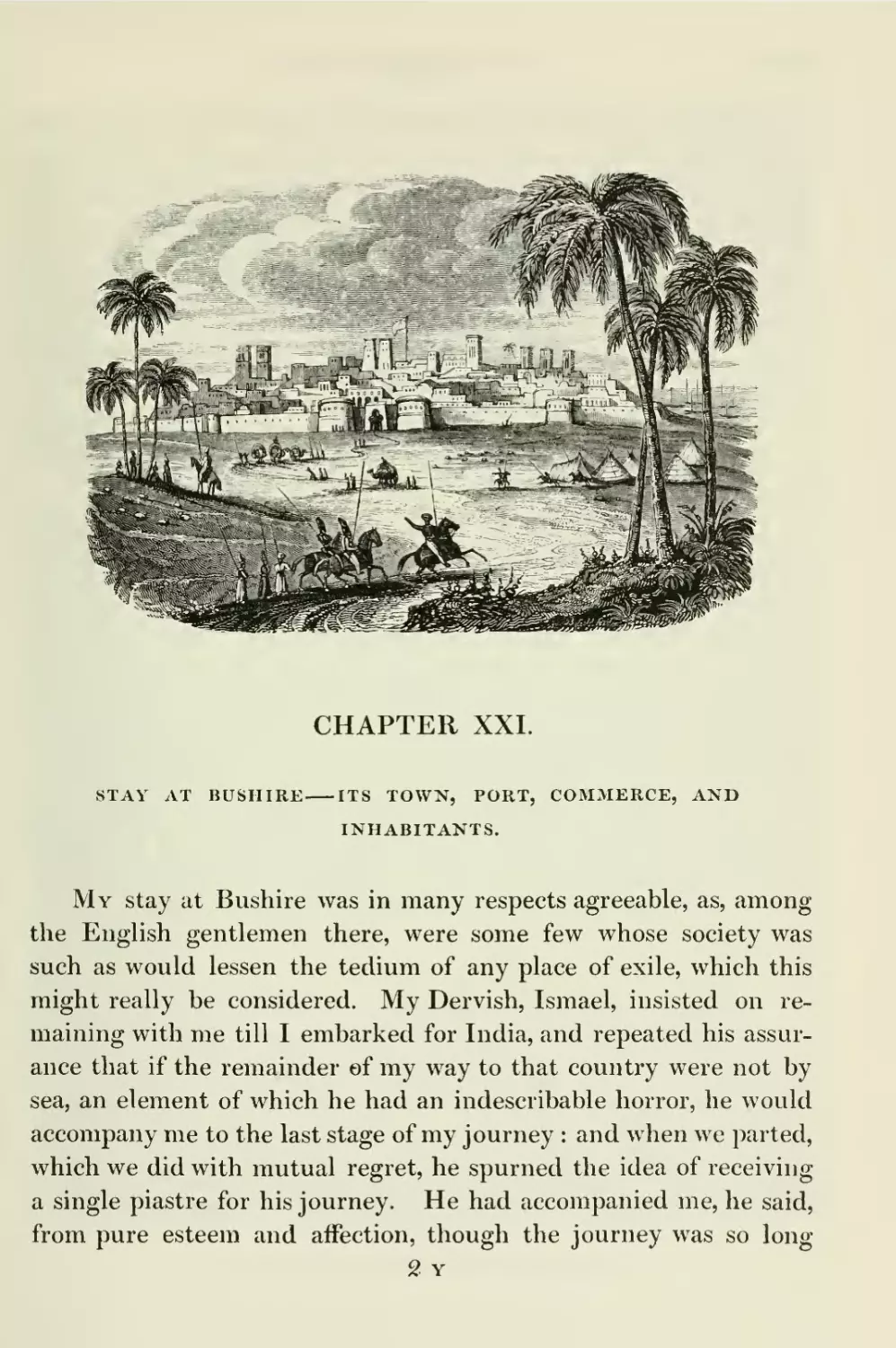
21 Town of Bushire, from the approach by land
22 Boat-Entrance
to the
Harbour of Bombay
23 Port of Bushire, as approached from the Sea
24 Ruins of Ormuz, with
its
Town and Bay
25 Ras-el-Khyma, the Chief Port of the Wahabee Pirates
26 Harbour, Town, and Fortifications of Muscat
D. Dodd 269
Bonner
288
Williams
313
While
331
Bi/Jicld
345
White
359
404
Byjield
J.
Dodd
Slader
J.
Dodd
42}{
476
505
CHAPTER
I.
FROM BAGDAD, ACROSS THE DIALA, TO KESRABAD OR DASTAGHERD.
After my journey from Aleppo
to
Bagdad, by a circuitous
route through Mesopotamia, a severe fever, followed by extreme
exhaustion, rendered repose
I
was fortunate
more than usually agreeable
in finding, in
to
me: and
the ancient City of the Caliphs,
the comforts of an English home, in
the
Resident, Mr. Rich, and the society of his amiable family.
facilities
to " the further East,"
of prosecuting
made
as to the
my way
by descending the Tigris and Euphrates
and going from thence on ship-board down the
or accompanying some caravan into Persia by
and passing through Kermanshah, Ilamadan, Ispahan, and
to Bussorah,
Persian
land,
My
the remainder of
course being directed to India, enquiries had been
comparative
all
house of the British
Gulf,
B
FROM BAGDAD, ACROSS THE
2
Shiraz to Bushire, where vessels
much
After
found.
as being,
Bombay were
always to be
consideration, the latter course was adopted,
on the whole, more favourable to certainty and expe-
as well
dition,
for
DIALA,
as
attended with
the
advantage of
a
better
considering my state of debility from previous
and the intense heat of the season that still prevailed, was a matter of the first importance.
The last days of
my stay at Bagdad were therefore passed in making preparaclimate, which,
suffering,
tions for the further prosecution of
my
Eastern journey by this
route.
Sept. Srd.
—We
had been put
off,
from day to day, with
assurances of a Persian Ambassador's being about to
return to
Teheran, in whose train we might make a safe entry into Per-
He had performed his pilgrimage to the tombs of Ali
and Hossein, as well as to that of Imam Moosa, near Bagdad,
and now only wanted the permission of the Pasha to commence
his journey homeward.
This had been promised him at every
sia.
morning's divan, so that we waited to set out with him.
now
publicly signified, however, that as
moment
Pashas who
Sovereign were at this
It
some of the troops of
in Koordistan,
was
his
supporting in-
among, the
are nominally dependent on
Bagdad, he could not be suffered to depart from hence until
news should reach of these troops having been withdrawn.
trigues
A
who had been waiting, with
many days, to profit by this occasion, for the sake
of protection, now determined therefore to set out without it,
and rely on their own strength for defence. We began accordlarge party of Persian pilgrims,
ourselves, for
ingly to prepare for our journey, as I
no longer, but
had determined
to delay
accompany them.
The future companion of my way was an Afghan Dervish,
named Hadjee Ismael,— one who, besides his own tongue, understood Persian, Turkish, and Arabic, was of a cheerful temper,
well known on the road, and neither so impudent nor so ignorant
to
TO KESRABAD OR DASTAGHERD.
as
most of those who belong
to be one of the
first
to his class.
He
engravers on stone in
3
was acknowledged
all
the
East,
and
had executed some seals and rings for Mr. Rich, which were finer
than any this gentleman had seen even in Constantinople.
With a very ordinary degree of industry and application, this
man might have acquired a moderate share of wealth l)ut, in
becoming a Dervish he had followed /(he strong bent of his
;
natural inclination,
—whch was
renounce the sordid cares of
to
this world, to live a life of indolence
from place
and pleasure, and
to movCy^dM'^
to place for the sake of that variety of incident
and
character which he loved to meet and to observed
companion was in many respects very congenial to my
wishes and what rendered him more so in this particular instance was, that it was his own desire that I should pass with him
as a Mussulman, under the name of Hadjee Abdallah, ibn Suli" The Pilgrim Abdallah, (the Slave of
man, min Massr
i. e.
God,) the Son of Solomon, from Egypt."
He had even engraved
Such
a
;
:
a ring for
me
with this
name on
ing the Koran, and to become
it,
my
voucher on
state
accent of
in read-
all occasions,
vided I would constantly support the character of a
and
me
offered to assist
myself to be an Arab of Egypt, since that was
my
Arabic,
pro-
Mohammedan,
and that the country with which
I
still
the
was most
familiar.
The
I
disadvantages of such a companion were only these
should be obliged on
occasions to be
all
my own
;
—that
groom, cook,
and servant and on some occasions perhaps his also, from our
being so completely on a level but for all this I was well pre;
;
pared by long previous discipline.
The
horses on which
we rode were both my own, with
I set
any
value,
My
else
wished to be as independent as pospapers, money, and all articles on which
that belonged to them, as
sible of assistance.
all
I
were carried in a pair of khordj, or small hair-
cloth bags across
my own
saddle
B 2
;
and the
rest of the baggage,
FROM BAGDAD, ACROSS THE
4
DIALA,
consisting only of a change of linen for myself, a coffee-pot,
and
tobacco bag, carpets, &c., for our joint use, were carried beneath
the Dervish.
My
my
own dress was that of an Arab of the middling class, and
arms a good lance of fifteen feet long, a pair of pistols, and a
Damascus sword. Ismael wore also an Arab dress with which I
had provided him, and was armed with a Persian sword and an
English musket.
During
my
had collected together such notes
for my journey as Mr. Rich's library and my own intervals of
health would allow me to arrange and by that gentleman I was
stay at Bagdad, I
;
furnished with letters for the governors of the great towns, in
the event of my needing them; so that every preparation had been
made to render our journey both secure and agreeable.
At El-Assr, the hour of prayer between noon and sunset, all
was ready for our departure, and the moment came in which I
was required
society I
to take a painful leave of the individuals in
had been of
praise in adequate
member
every
them
:
happy.
As
it is
of that
I ever
to
remember them on any
similar occasion, for there are few people for
affection
me
warm and generous behaviour of
circle towards me during my stay, so it is
description of my own feelings in quitting
they were as poignant as
more of
whose
terms the
to attempt a
in vain
late so
impossible for
mingled with
whom
I
ever felt
respect, after so short a period of
acquaintance, than for Mr. and Mrs. Rich.
We
Bagdad by the gate of Imam Azam, so called
from its leading to the tomb of that saint, who is venerated as the
chief of the Ilanefies, and whose mausoleum is about an hour's
quitted
ride to the north of the city.
entered on
Bagdad,
it
my
is
arrival here
;
This was the gate by which
and being
in the
I
N. E. quarter of
the principal point of arrival and departure for
all
the great roads on the east side of the Tigris.
We
found a small caravan, composed of about fifty persons,
and as many animals, in horses, mules, and asses, but no camels
TO KESRABAD, OR DASTAGHERD.
5
assembled without the gate, and preparing to load. As their
departure would be delayed, however, until muggrib, the hour
we spread our
of prayer at sunset,
sat patiently
down
to await their
carpets amidst the crowd, and
movements.
by Mr. Rich's Armenian dragoman,
and the Persian secretary of the Residency, who were charged to
The chiefs of the caravan were then introduced
see me safely off.
and as I was by far the best-dressed and best-mounted
to me
I
was accompanied thus
far
;
individual of the whole company, excepting only those
my own
of
honoured by
I
was
when
sitting beside the
called,
who were
Persians thought themselves sufficiently
party, the
Hadjee Aga, the
" Sir Pilgrim," as
great respect my pipe and coffee
and enquiring earnestly about Egypt and
receiving with
offered to them,
.
the City of the Prophet.
In
all
my journeys, I never remember to have
old, infirm, ill-dressed, ill-equipped,
fifty or sixty
pilgrims with
whom
I
seen such shabby,
and helpless persons
was going to
set out
as these
on a road
acknowledged to be a dangerous one. They had all been absent
from Persia several months, on a pilgrimage to the tombs of Imam
Ali
and Hossein
and of another
;
visiting also that of
Imam
Imam
Moosa, near Bagdad,
at Samarra, the city so celebrated in the
and whose remains are still considerable
on the banks of the Tigris, two days' journey from hence.
None of them, however, had reached as far as Mecca. In the
journeys which they had already performed, .tney had most of
them been routed and plundered two or three times by the Arabs
of the Desert ;\^nd many of them had lost their companions by
fatigue and sickness.
The numbers carried off in this way are
history of the Caliphs,
indeed considerable
;
for,
of the retinue of an Indian
widow and
her son, who came through Persia to Bussorah, twenty or thirty
had died on their way to Bagdad, by the river and advices had
been received from Mecca, of the rest having been taken off on
;
the road across the Desert, and in the country of the Hedjaz
itself.
must require a degree of superstitious attachment
to a
It
/
*
FROM BAGDAD, ACROSS THE
Q
induce such crowds of all classes to
religion, difficult to conceive, to
run, from year to year, the
DIALA,
imminent
risks,
which the performance
The reason assigned by most of the
caravan whom we questioned, for not going to
of these journeys involves.
Persians of the
Mecca, was the inadequacy of their means, after being plundered
and stripped and this seemed plausible enough but there were
:
;
not wanting
many among them who seemed
to think the Caaba,
the sacred temple at Mecca, an object of less veneration than the
tomb of the Prophet at Medina, or than those of the Caliphs and
Imams
already enumerated
;
—
order of Greeks Saint George
in the
is
same manner
as
by the lower
equally esteemed with the Messiah
and the Virgin Mary ranked quite as high as her unbegotten Son with the same class of Catholics.
The dresses of our Persian companions were of the ordinary
himself,
made
fashion of their country, consisting of a long robe
tight
about the arms and waist, the latter being long and slender, the
lower part of the robe representing a full petticoat, the breast
covered by a thin and coarse
shirt,
and the head-dress consisting
of a conical cap of black sheep-skin.
Their horses were of the
worst kind imaginable, and their arms and caparisons were suitably
mean.
It
was asserted, and
I believe
wuth great truth, that
five
well-mounted Arabs of the Desert had arrested and deliberately
plundered as large a party of Persian pilgrims as this and it was
;
even admitted by the people of the caravan themselves, that ten
good horsemen of the Beni Lam tribe would be more than a match
for all their party
!
were some women, whose veils struck me as pecuthese wore the blue chequered cloth mantle of the Bagdad
Among them
liar
;
but instead of the black horse-hair covering for the face,
they had a large white cotton veil tied round the head like those
of Egypt and instead of the eyes being shown through two large
females
;
;
was a small grating window, of
about three inches in length by two in depth, placed between
holes, as in that country, there
TO KESRABAD, OR DASTAGHERD.
the eyes and in the centre of the
veil,
7
apparently
made
of stout
threads crossing each other with wide intervals between them.
The men looked
altogether like a tribe of Polish Jews, or
mounted and armed for some temporary expediand the women partook of all their
tion of robbery and plunder
making, however, the same show
without
meanness of appearance,
old clothesmen,
;
of arms to conceal their cowardice.
At muggrib,
performed
or sunset, three separate parties of these
their prayers
in
public,
spreading
a
cloak
women
on the
Whether
ground
they performed their previous ablutions above the ankles and
elbows as the men, I did not perceive, as I saw them only after
they had begun. It was the first time of my ever having seen
women pray thus publicly in a crowd, or thus encumbered with
in the usual way,
but
still
remaining covered.
and outer envelope and this last circumstance sufficiently embarrassed them in making the prescribed genuflections.
We were not all in movement until the sun had completely
set, and yielded up his empire to the milder queen of night.*
their veils
The
;
we took was about
north-east by north, for the
first
three hours, which led us over a bare plain of fine earthy
soil,
course
Over this were so many
tracks of animals that we got twice into a wrong path, at this
short distance only from Bagdad.
At the end of about three hours, we reached a small building
near a well, which produces, in the winter only, a scanty supply of
brackish water.
This is called " Orta Bir," a compound of Turk-
wanting only water to render
it fertile.
and Arabic, signifying " the half-way well," from an idea that
it is just midway between Bagdad and the first caravanserai to
the east of it.
There were here many mounds which appeared
to be of fine earth, and formed perhaps the sides of channels
ish
* One must travel in the parched deserts of the East, to feel the full force of the contrast
between the burning day and gentle night, and to understand the Oriental admiration of
the moon and stars.
FROM BAGDAD, ACROSS THE
8
for filling the well with rain-water
;
but
DIALA,
we had
as
seen near this
several small heaps, with a few scattered bricks in the way, there
might possibly have been buildings of some description or other
along
The people
it.
of the country, indeed, have a singular
traditionary notion, that
all
the plain
from the Tigris to the
mountains was once covered by the great city of Cufa, of which
they know perfectly well the name and the celebrity, but seemingly
little else.
The
ruins of the city are thought to be recognised
on the other side of the river to the west, below Bagdad.
From
and
the well, our course went nearly a point more northerly
after going for
two hours on a similar road, we reached the
"
khan, or caravanserai, called also
Orta Khan," from an idea of
being midway between Bagdad and Bakouba.
peared to be small, and built of bricks.
near
it,
A
The khan
to be inhabited
but as we passed through, leaving the dwellings on our
left,
ap-
few huts were seen
and the barking of dogs showed these
and the khan on our
its
without alighting, we
saw^
right,
none of the
people of the place.
We
had hitherto travelled in very straggling order and the
Persians often sang some popular song, which drew forth at
;
intervals loud shouts in chorus
marched
in closer order,
and
;
all
but as the
was more
moon
silent,
declined,
we
evidently from
fear.
We
continued from hence on a line of about north-east, for
monotony of the
road
when, as the Pleiades, Aldebaran, Orion's Belt, and Jupiter,
formed altogether a splendid train in the eastern heavens, and
four hours, without any prospect to break the
;
were shining with unusual
appeared, and
we began
trees before us,
brilliance,
the
first
blush
of
day
some thick groves of palmand soon afterwards came on the banks of the
to discern
Diala.
The
north to
westerly.
was flowing here in a deep but narrow bed, from
south, though below this it turned off* about south-south-
river
The western bank
of the stream was the steepest, and
TO KESRABAD, OR DASTAGHERD.
represented a
cliff
than
fifty
seemed scarcely of greater breadth
river itself
and, excepting some deep water near the western shore,
this,
we forded
The water was sweet and
it easily.
of the stream
when
of stratified earth in horizontal lines, about
The
feet in height.
9
more than
little
clear,
and the
From
a mile per hour.
the day more clearly broke,
we obtained the
rate
hence,
sight of
first
a range of low hills to the eastward of us, distant apparently from
thirty to forty miles, their general direction seeming to be
from
Ascending
north-west to south-east, and their outlines smooth.
the eastern shore, which was thickly covered with palms,
about a quarter of an hour
for
east,
and then turning
we went
to the left,
entered some lanes between garden-walls of mud, which led us
where the caravan dispersed, and we ourselves
into Bakouba,
alighted at a public khan.
Sept. 4th.
—When
completed, and
around the
the necessary duties of the day
we had
place.
It
is
fed and
reposed,
we
had been
strolled
a large straggling village,
together
formed of mud-
built dwellings, gardens, date-grounds, &c. all intermingled, with
The
a poor bazar and two small mosques.
ceed two thousand,
of whom are Arabs, and nearly half of these
all
Sheeahs or of the Persian
who
of Yusef Aga,
produce
is
The
history
;
The
sect.
place
under the command
Bakouba
known
well
city
of
but
this
was much farther eastward.
is
—one
Persia,
its
Mohammedan
De Sacy, in his
in
There are two
Nahrvan, the
from Bagdad,"* which
says
:
"
at the extremity of the province of
other only ten parasangs, or ten leagues,
The
he thinks to be the Aakonbe of Thevenot.f
seems very accurate,
as
we had been
full
and, being all lightly laden, had gone
distance
nine hours in performing
somewhat more than three
miles an hour.
*
;
purely agricultural, and this very scanty.
old
Bakoubas,
it,
is
dependent on Assad Pasha of Bagdad
is
Memoirs on the Antiquities of
last
inhabitants do not ex-
Page 3C3,
4to. Paris.
+ Thevenot, vol.
iii.
p.
215.
FROM BAGDAD, ACROSS THE
10
The language
DIALA,
though Turkish is
understood by many, and Persian and Koordish by a few.
From all the enquiries which I made of the people here reof the village
is
Arabic,
specting the source of the Diala, I could learn nothing definite.
All agreed that
it
arose in the mountains of Koordistan,
and the
most general distance assigned to it was three days' journey to the
north-east.
No one knew of any tributary stream flowing into it
from the west of its main body, though all spoke of several small
ones joining it from the east, which, it was said, we should cross on
our road.
At sunset we prepared to depart, and when the twilight was
Our course lay nearly east for
just closed we were all in march.
the first hour, when the road wound to the north-east, going constantly over a bare plain of hard
by canals
intersected
which,
we
and dry
earth.
It
had once been
over the mounds, and through the beds of
and many parts of the low levels still reof being recently watered, which was said to be only
often passed
tained traces
by the
;
;
rains of winter lodging here.
We had gone
from the winding of the road, about three hours
on a north-east course, when we came to the bank of a canal, now
full, leading from an arm of the Diala, and watering a portion of
the land through which it flowed. We kept along the western
edge of this in a northerly direction
:
the ground here, however,
was covered with a thorny shrub, and uncultivated
east
but on the
were several scattered hamlets, and the barking of dogs an-
nounced the existence of
living beings there
we could indistinctly
momentary relief to the
cultivated land as
moon, offered a
;
;
while such patches of
by the light of the
general monotony of our
see
way.
An
attack,
alarm was now spread, from the rear of our caravan, of an
and
several
muskets were
fired,
though they could scarcely
be heard amidst the general outcry and uproar which prevailed.
When
the explanation came,
it
appeared to have been only four or
H
TO KESRABAD, OR DASTAGHERD.
five peasants
on foot who had occasioned
all this
panic,
—an
acci-
dent which gave us no favourable impression of the coolness or
courage of our numerous party.
In another hour we reached the stream from which this canal
over which
led,
we
The stream
arch.
crossed,
itself
by a steep and high bridge of one
appeared to
me
an
artificial one, as it
slowly between steep banks like mounds, and was not
twenty yards wide.
was called Nahr
It
el
ran
more than
it came
Shahraban
;
from the north, and was said to go into the Diala, south of Bakouba, having small canals leading off from it in the way. From
this bridge was seen on the left of us, distant less than half a mile
to the westward of the road, some palm-trees rising from a village
This was originally the retreat of a dozen
Aghwashek.
called
Fakeers,
who
passengers
;
lived here in indolence on the charities of devout
but their easy way of
life
having attracted others of
the same class about them, the settlement has increased, and
contains about five
hundred
persons,
now
chiefly of the original de-
scription.
From
the bridge, our course went again north-easterly, and in
about an hour from thence we reached the town of Shahraban,
which we entered through mud-walled lanes and dusty roads, just
as the moon was setting and with some difficulty, at this unseasonable hour, found our way to a khan.
Sept. 5th.
The village of Shahraban is composed, like that of
Bakouba, of scattered brick dwellings, some few regular streets, and
;
—
mud-walled gardens and palm-grounds. It has one mosque with
a well-built minaret, and two khans, but nothing else worthy of
notice.
Some
canals from the branch of the Diala, which
crossed over by the
we
one-arched bridge an hour before entering
Shahraban, run through the town
itself,
and supply the inhabitants
with water for their daily use, as well as the peasantry for cultivation.
The
population
may
be estimated at about two thousand five
hundred, of whoi;n two-thirds are Soonnees, and the remainder
c 2
FROM BAGDAD, ACROSS THE
12
DIALA,
The
lan-
understood, and the
Aga
Sheeahs, there being neither Jews nor Christians here.
guage
is
Turkish, though Arabic
of the place
is still
subject to Bagdad.*
is
In the course of the day, information having being brought us
of the road to the next town being unsafe from some predatory
Arabs having taken up a position near it, our intended departure
at night was postponed until the following morning, that we
might the better
might attempt
see such of our enemies as
to
obstruct our way.
In
my
enquiries about the towns of Mendeli and Ghilan, I
could obtain no very precise data for fixing their positions, as
there were no high-roads from hence to either of them.
Mendeli
is
described as a large town
containing about six
thousand inhabitants, Turks, Arabs, and Koords, the language of
the former chiefly prevailing
it is
:
three days' journey from Bag-
dad, to the south-eastward.
Ghilan
the foot
Boksye,
Arabs.
*
to
of a district of some extent, reaching to
:
direction.-f-
This town
name
name
its chief town is called
and contains about two thousand inhabitants, chiefly
This is also three days' journey from Bagdad, in nearly
an eastern
its
the
is
of the mountains of Louristan
is
thought to be the
a particular canton.
site
— See
of the ancient ApoUonia, which communicated
D'Anville's
Geography,
Ancient
vol.
ii.
p.
469,
Eiiglish Edit. B\o. London, 1791.
t In the march of Alexander from Susa to Ecbatana,
the towns called
present.
It
was
Celonse, which was
in this
therefore
is
it
said that
he marched to
then the name of a district as well as at
place, says the historian, that the posterity of the Beotians settled
themselves in the time of Xerxes's expedition, and there remain to this day, having altogether forgot the laws of their country.
the natural inhabitants, and
observe
some of
their
all
manner of
fruit-trees,
he came into
it
the
laws and
turned aside and marched to
mankind, so as
in
For they use a double language, one learnt from
other they preserve
cus-toms.
much
Thence, when
it
of the
Bagistames to view the country.
and whatever
else either
a country that breeds and
pastures
an
for
he
This country abounds in
conduces to the
seems to be a place of delight both
Greek tongue, and
grew towards evening,
profit or pleasure
gods and men.
of
Afterwards
innumerable company of horses:
TO KESRABAD, OR DASTAGHERD.
13
As tliis district had been celebrated in antiquity for its pastures
and its horses, I was inquisitive from those who had been all
over it as to what state the country was now in, and whether its
horses were
thought superior
still
to all others.*
It
appears that
the whole of the plain, from Boksye to the mountains,
is
possessed
Lam, who are thought to
have twenty thousand heads of families, and are all Sheeahs, like
The extensive tract over which they roam is now
the Persians.
by a tribe of Arabs,
called the Beni
mostly desert, no doubt from the neglect of the canals by which
their horses, however, are still esteemed
it was formerly watered
:
and inferior to none but those of the Nedjed Arabs
and the Turcoman^.t
The whole of the tract from Bagdad to Shahraban is now
called Arudth-el-Cusa, from a tradition that it was once all
occupied either by that city or by numerous settlements dependent
as excellent,
on
it.
At
sunset,
pray, to sup,
we
and
all
moved up
to spread our beds in a cooler
they say that there had
at pasture
*
From
to
but at the coming of
;
here for the space of thirty days.
the plains in which these horses
were bred,
(Septimus deinde castris Ecbatana
Ecbatana.
ment
He encamped
Quintus Curlius,
vol.
ii.
p.
attigit
for these
Xerxes was
drawn
last,
his court,
and
Ghilan
The King of Partha
INIasistius
1
1
Fre'mshemius Supple-
" Between Ghilanee and Kermanshah
:
the
is
of Asia previous to the Persians
Nisceus was a district
as horses.
name
and the
of
the district
sacred
Alexander gave a Nisjean horse
horses
in
in
:
Media,
The chariot of
still.
were
procession
the
to Calanus, to
sacrificed one to the Sun,
carry
when ApoUonia
of
him
Tyana
to
the
visited
rode a Nisaean horse at the decisive battle of Plattea.
The Nissean
7.— Sec
Renticl's Illus-
pastures are spoken of in Diodorus,
trations
well
by these animals,
Nisaean (Polymnia 40).
funeral pile.
as
Mediae caput.)
Medes held the sovereignty
produced a hardy race of men as
remarkable
c
was a march of seven days to
This country of Media was the cradle
are the celebrated pastures of the Nisaean horses.
it
it
Alexander there were only
Diudortts Siculus, b. 17,
547.
t In describing this district, Major Kennel says
of the Persian power, for the
air
been here an hundred and sixty thousand horses that ran
up and down the country
sixty thousand.
and purer
The view from hence, where the
than we could breathe below.
for
the terrace of the khan, to
to
lib. 7,
of the Geography of Hcrodulus,
4to.
c.
p.
2,
268.
and
in
Arrian,
lib.
FROM BAGDAD, ACROSS THE
14
country was at
DIALA,
through the palm-trees, was one level
all visible
and desert plain,* in which the sun set at W. by N.f N. by compass, and the moon succeeded without an interval of twilight.
Sept. 6th.
We were in motion before the moon had set
and just as the day broke we quitted the town, when the sun
greeted our departure as he rose from behind the blue ridge of
—
hills
immediately before
Our march was
us.
directed to the east-north-east, over a plain
somewhat less bare than that which we had traversed during the
two preceding days, and having tobacco and dourra growing in several parts of it.
Camels were also feeding in the neighbourhood,
and were the first that we had seen since leaving Bagdad. These
signs of life and activity were entirely owing to the presence of
water, of which we crossed several small canals and one large one,
with rushes on
The whole
banks.
its
of the low country indeed,
on both sides of the Tigris and the Euphrates, wants only the
irrigation
little
render
to
rivers,
China
which could be so
it
as
fertile
but in the absence of
;
rain
falls
even
by canals from these
easily given it
as
Egypt
this, as
or the
river-lands of
the heats are excessive, and
the winter, the whole has
in
by
fallen
neglect into general barrenness.
In an hour after quitting Shahraban, we came to the main
stream from which the smaller ones of the plain were derived,
and crossed
*
it
by a brick bridge of a single
The Nisean horses
are placed
by Ammianus Marcellinus
in
the plains of a
of Assyria, on the western side of a high mountain called Corone.
of a chain called Zagros, Orontes, and Jason, in the same place
haps Clone, the name of the
c. 6. vol.
same
ii.
pp. 269, 270.
district
Ecbatana
;
This
therefore with Orontes. b. xxiii, c. xvi.
p.
273.
It
was
is
called
country
fertile
evidently a part
is
written per-
Anim. Mar. book
Mount
placed at the foot of
is
and Corone
where these horses were bred.
is
This
arch.
in the
Jason, which
xxiii.
is
the
march of Alexander
from Opis on the Tigris, through Celona?, (which place Xerxes had peopled with a colony of
Beotians,
who
tana, that he
still
is
which Herodotus
retained
some of
their native language,)
said to have viewed the field
calls
wherein the
and on
his
way towards Ecba-
King's horses used to
Nisaeum, and the horses Nistean, and where,
in
graze,
former times, 150,000
were wont to feed, though Alexander found not more than 50,000 there, most of the rest having been stolen away.
Arriuns Hist, of Alexander's Expedition,
b. vii. c. 13. vol.
ii.
p. 150.
TO KESRABAD, OR DASTAGHERD.
Nahr-el-Khan-e-Keen, from
its
15
rising near a place of that
name
and it goes from hence into the Diala,
discharging itself to the southward of the branch which we
Like this, however, its stream is not more
crossed yesterday.
than twenty yards wide, its current slow, and its bed lying deep
farther on in our road,
between two steep banks covered with rushes.
From hence, we continued nearly the same course
as before,
and in another hour reached the foot of a ridge of sandstone-hills,
It seemed to be the only practicable
called Jebel-el-Shahraban.
pass through
easy one.
them
The
to
which our road
led,
and even
this
was not an
ascent was very gentle, over a gravelly road
;
but,
from the soft nature of the rock, several narrow passages had been
worn, which barely admitted of a horse going through, and forbade the passage of a laden mule. Masses of the rock, the layers
of which were generally oblique to the horizon, had also fallen,
and obstructed some points of the way
;
so that,
few as our num-
by
bers were, great confusion prevailed.
This was increased,
the general alarm which was
was here that the road was
felt, as
it
considered the most dangerous, from
small party obstructing
its
too,
being favourable to any
it.
Accordingly the bravest and the lightest of the troop ascended
the points of the hills to reconnoitre, and fired their muskets as a
signal
of defiance.
As
all
these were
of the match-lock kind
throughout our company, excepting only the one which my Dervish carried, the matches were all lighted; but though we were
thus fully prepared to repel an attack, it was evident that every
one advanced with fear and trembling.
In half an hour we gained the summit of the hills, from
whence we could see the plain to the eastward of them before us
and, as this appeared to be clear of wanderers, a shout of joy was
set up,
a
thus giving vent to
momentary
The
fear, as
tears are
found to afford
relief to sorrow.
line of these hills stretched generally
from north-north-
west to south-south-east, and their highest point did not appear to
FROM BAGDAD, ACROSS THE
16
DIALA,
reach a thousand feet above the level of the plain below.
which were every where rocky and barren,
their summits,
before us other
more
From
we saw
lofty ones, at the distance of fifty or sixty
miles, half obscured in a blue haze.
The whole
till
passage of these
hills,
from our leaving the western
little more than
our descending on the eastern plain, occupied
and from thence we still went on about east-north-east,
towards the town of Kesrabad, now in sight before us, at the
an hour
;
distance of six or seven miles.
We
found
this portion of the plain
and several parcels of land
cotton plants, both of them now
nels from the Nahr-el-Khan-e-Keen
were laid out in dourra, and in
in verdure,
We
hood
it
watered also by small chan-
;
being the spring of the second harvest.
were met here by three horse Arabs, who had the hardi-
to
make up towards
for attack.
Two
us at full speed, brandishing their lances
of the Persian horsemen, with their match-locks,
and myself, with a long spear of their own kind, rode off at a gallop to meet them, and, firing a pistol in the air as we approached,
ordered them to stand. We neared each other very cautiously, as
the caravan was still half a mile behind, each having his eyes fixed
on his man, in all the suspicion and watchfulness of actual combat,
each with his arms ready-balanced for the stroke, and the warmed
and conscious horses fretting under a tightened curb, and seeming
At
to upbraid our lingering, by their impatience for the fray.
"
Salam Alaikum" was exlength, after some harsh words, the
with
dropped
caution
on each side, and
were
changed, our arms
our opponents withdrawing the covering from their faces (which
they always wear across
it
when rushing on
to the attack, to pre-
vent their being recognized in cases of blood-revenge), they gave
us a signal of submission and peace, and thus the matter ended.
me
an Arab, which every part of
my dress and accoutrements bespoke me to be, they were exceedingly inquisitive as to the object of my journey eastward, and wonIn addressing themselves to
dered at
my prompt
as
appearance at the head of a troop of Ajamees
TO KESRABAD, OR DASTAGHERD.
or Persians, of
tempt.
The
whom
17
they spoke openly Mdth the greatest con-
Persian soldiers,
who understood enough
be offended at it, now began to be insolent
coming up of the whole caravan during this
of this to
in their turn, as the
parley, gave
them an
additional motive to boldness.
For myself,
I
proposed that as we had taken
these
three
and as they scrupled
men
not to avow their motives, we should make them prisoners, and
take them on to the next town, to deliver them up for punishment)' All, however, agreed that this would be a certain way of
involving the next caravan in the most imminent danger, since the
whole tribe of Mujummah, to which they belonged, would not fail
to revenge, upon the next body of Persians that passed, the injuThe soldiers, however,
ries thus done to children of their tents.
growing more insolent, as the crowd thickened behind them, drove
the Arabs off the road, by pushing their horses with the muzzles
of their long muskets, and imprecations and abuse passed with
equal freedom on either side while the dastardly crowd, who had
witnessed all at a very safe distance, now shouted in triumph at
the poor defeat of three individuals, whom they had not the
courage to seize and punish.
Such being the usual result of cases like this, it can hardly be
wondered at that the roads here are not safe. A party of idle Arabs,
having nothing better to do, as their wives and children tend their
flocks, and perform the duties of their camp, mount on horseback,
and cross over the great highways of the country. If they descry
a party who are too few in numbers or too deficient in spirit to
resist their attack, some gain at least is certain.
But should they
be unexpectedly checked in their career, no risk is run by the
attempt, as they are permitted to gallop off, and direct their course
in some other direction for a more successful foray.*
in the very act of an attack
upon
us,
;
*
The power of the
desert horse to endure privation
and must always have been remarkable,
tained on that subject in antiquity.
to
have given
Among
and fatigue
rise to
others, Pliny says
D
is
quite extraordinary
the extravagant opinions enter:
— " The
Sarmatians, when
FROM BAGDAD, ACROSS THE
13
We
crossing
DIALA,
continued our way in closer march than before, and after
many
small streams and pools of water, with some huts of
rushes inhabited by
Mujummah
Arabs,
we approached toward the
town of Kesrabad, entering it about eleven o'clock, two hours and
a half from the eastern foot of the hills we had crossed, and about
five and a half from our leaving Shahraban
so that its distance
may be from eighteen to twenty miles east-north-east of that place.
As we remained here the whole of the day, I had an opportuLike the
nity of seeing more of the place during a sun-set walk.
which
we
had
already
through
passed,
this
abounded
stations
in
palm-trees.
The town was larger than either of the preceding
ones, and contained about a thousand dwellings, and three thousand stationary inhabitants. The houses are all small, and built
they are more closely
of mud, with brick door-ways in front
placed, however, than in the villages before-mentioned, and assume
the form of regular streets, in one of which is a public bazar and
;
;
two khans.
In the southern quarter of the town is a rising ground, on
which the houses are elevated, so as to be seen farther off than
To
those standing entirely on the plain.
the east of the town
is
a
similar hill converted into a burial-ground, and on the north are
extensive gardens enclosed.
The grounds
in the
neighbourhood are
by canals from the Nahr-el-Khan-e-Keen
pomegranates, and gourds are abundant.
The language
of the people
is
;
all artificially
and
dates,
watered
and melons,
altogether Turkish, and they
Two mosques were spoken
of, though I saw but
minaret.
The town
without
and
a
one, and this was meanly
is subject to Bagdad, and the support of its population is drawn
from the culture of the lands, and the supply of caravans halting between Persia and Arabia on this route.
are all Soonneers.
built
they were about to
them no meat
at
were enabled to
make
all,
a great journey, prepared their horses two days before by giving
and allowing them only a
gallop them one hundred and
bridles."— P/in. Nat. Hist.
b. 8, p. 42.
little
fifty
drink
;
and thus
it
was
said, they
miles an end, without drawing in their
TO KESRABAD, OR DASTAGHERD.
19
—The
wind from the eastern hills was cold and
piercing during the night and as I slept on the house-top or terrace, exposed to its full force, and without a covering, I felt myself
severely affected by its influence.
I had arisen and armed myself, however, before the day broke,
and stirred my Dervish from his sleep, under the belief of the
Sept. 7th.
;
But when our
caravan setting out at an early hour, as yesterday.
horses were saddled, and some few others had followed our ex-
ample under the same persuasion as ourselves, we were surprised
to find the major part of our company still snoring at their ease,
and some few others who were awake making no preparations to
be gone. On enquiry, our surprise was heightened to learn that
it was not intended to move to-day, as they had heard news of
troubles on the road.
Daood Effendi, the Dufterdar of the Pasha
of Bagdad, had, it was said, come out of the city, and putting himself at the
had
agent,
head of
thousand troops previously prepared by his
up the standard of rebellion, and intended taking
set
five
the city from his former master, without attempting to offer any
plea .of excuse for such treachery, as in these countries power
acknowledged to constitute
tacitly
trary doctrine
right,
may be preached by
is
however much the con-
those
who
feel
their
own
weakness.
was not easy to see how
It
this could affect the safety of the
roads to the eastward of us, but
and
the timid pilgrims,
among
all
the rest
arising, there
to join
them
individual
it
was
this
who were bound
was thought to do so by
spread a panic
sufficient to
that
way
;
for though,
on our
were several preparing to depart, and we had offered
they would go on, yet there was not at last one
if
who would
start
with
us,
and we were therefore obliged
to yield to the delay.
My
indisposition
made me
sufficiently indolent
;
notwithstand-
ing which, however, being without a book or a companion,
my
Dervish having already given himself up to such pleasures as the
town
afforded, the time
hung
heavily upon me.
D 2
When
I
caught
FROM BAGDAD, ACROSS THE
20
DIALA,
him for half an hour, near noon, I prevailed on him to write me
some Persian words with their Arabic relative ones opposite to
them in a small blank book so that I now began to learn a language of which I yet knew nothing, through the medium of one
;
which, however fluently
new
to
me
From
much
could express myself in
it,
was equally
as a written one.
the time that
of people
been
I
I
had been
my
speaking Arabic,
greater than
it
travelling
among
different races
proficiency might indeed have
moment
really w^as at this
;
but
I
had
never yet enjoyed sufficient repose at any one time or place to
apply myself to the study of
variety of dialects into
it
which
grammatically
this
language
and from the great
;
divided, both as to
is
the words themselves, and the manner of pronouncing them, in
Egypt, Arabia Proper, Palestine, Syria, and Mesopotamia,
found
it
difficult
even to follow up these changes, for
my
purpose of expressing
had
the mere
I
wants in such a way as not to betray
myself to be a stranger.
The Koran which
the Dervish had procured for
and which he had promised
to instruct
leisure intervals of our way,
me
adapted to
;
it
my
had
cost
purpose.
my
me
It
pilgrim-train.
sixty piastres,
was contained
Bagdad,
stolen from
It
smallest size that could be had, yet perfectly legible,
well written
in
in reading during the
had been already
some of the holy personages of our
me
in
me by
was of the
from being
and was admirably
an appropriate case,
and at night placed it
with such other things as were immediately under my own charge
beneath my head. As I had been seen looking into it at different times by several of our party, it had no doubt attracted the
cupidity of one more pious than the rest, who might have consoled
his conscience for the theft, by devoutly regarding the holiness of
the prize as a sufficient excuse for the stealing it.
Illogical and
which
I
wore by
side during the day,
senseless as such reasoning
may
appear to those
through an unprejudiced medium,
is
often found
among
religious
it
is
who view
things
nevertheless that which
Mohammedans, where the cause
TO KE3RABAD, OR DASTAGHERD.
of
God and
oppression
;
21
Prophet has been supported by persecution and
and in the East, as well as in the West, devotion and
his
dishonesty are thus often found to go hand in hand.
On
it,
the discovery of
my
loss,
strict
but without leading to restoration
;
enquiry was made about
for
we were not
sufficiently
strong to insist on searching the baggage of the suspected, nor
sufficiently rich to bribe the
proper
officer for this
duty
;
so that
no hope remained of our recovering the stolen Scripture.
During the day, we heard of a place near this having been
already attacked by Arabs, on the news of the state of things at
Bagdad
affair,
;
and
that
so
many
particulars were given in the details of this
we could not
refuse
it
credit.
A
few hours afterwards,
however, a caravan arriving here from the eastward contradicted
named without
These, however, on now learn-
the report, as they had passed by the very spot
hearing any thing of the matter.
ing the news of the Bagdad road, which had given rise to the
report on which
we questioned them, made
their determination
though the news thus learnt from us
might, for aught we knew, have been as ill-founded as the
rumour which they themselves had so satisfactorily contradicted.
to halt here for a while
As we were now
;
expected that w^e should suffer no more delay
of our party, to
still
way being
positively assured of our
whom
;
safe,
I
but the majority
despatch seemed of no great consequence,
determined to prolong their
halt.
In an evening
stroll,
about an hour before sunset, under the guidance of one of the
and accompanied also by my Dervish, we
and remarkable heap of ruins, about a mile to
It was in form and extent nearly
the north-east of the town.
like that of the Makloube, the supposed castellated Palace at
Babylon, except that it was less in height, and whatever buildings had once occupied this site had been rased nearer to the
natives of the place,
came upon
ground.
a large
It
was
still,
however, sufficiently high to form a con-
spicuous object on the plain, even from a distance,
part being forty or fifty feet above the
common
level.
its
highest
FROM BAGDAD, ACROSS THE
22
By
the people of the country,
or the " Hill of the Infidels
;"
and
it
it
is
DIALA,
called Giaour-Tuppe-se,
was asserted by our guide,
and confirmed by many others of the place, whom we questioned
afterwards, that there had been often dug up from, and found on
the surface of the ruins, small idols of copper, some of them representing men in a sitting posture, without seats to support them
which, from their size and material, as well as from their attitudes, imitated by those who described them to us, must have
^een of the same kind as one of the Babylonian idols in Mr. Rich's
;
collection.
In examining the surface of this mound, we saw in
many
parts
had been excavated, portions of excellent masonry, in large,
square, red, burnt bricks, some layers of thick lime cement, with
others of what seemed to be either a very fine stucco, or else a
peculiar kind of white marble.
There were no appearances of
any outer wall that encircled the whole, though possibly such
might have existed beneath the rubbish. The interior part seemed
to have been composed of many small buildings, like the Palace
at Babylon
and indeed similar edifices are still seen throughthat
;
out the East, where
all
the domestic offices are included within
same area with the principal abode. Having my compass
with me, and pretending to use it to ascertain the precise point
of the Caaba for evening prayers, I obtained from the spot the
bearings of such surrounding objects as were in view.*'
To the north, from eight to ten miles off, were two ridges of
low hills, going along nearly east and west, and the eastern
horizon was intercepted by the chain of mountains leading from
Koordistan to Lauristan, and dividing Irak-Arabi on the west
from Irak- Aj ami on the east.
The stream which we had crossed about an hour before enter-
the
*
Town
of Kesrabad, south-west by south, one mile.
west-south-west,
five miles.
Town
called Nimrood-Tuppo-se, south-west, half a mile.
east half east, quarter of a mile.
Town
of Tewak, with date trees,
of Baradan, with a high mound, west, five miles.
Mound
called
Mound
Shah-Tupp6-se, south-by-
TO KESRABAD, OR DASTAGHERD.
23
ing Kesrabad, and which was there called Nahr-el-Khan-e-Keen,
from a belief that
was the same which flowed by that
it
here called Giaour-Soo, or the
"
Water of the
place,
was
Infidels," evidently
relating to the " Giaour-Tuppe'-se'," the hill on
which we stood.
From hence it was seen flowing from the north-east through
a fine plain, the stream itself being visible from a bearing of
north to west, and its banks plainly to be traced still farther
each way, from their being covered with verdure, and having fine
green plots of cultivated land on each
side.
This river was distant from the ruins in question little more
than a mile, and might be said to have covered the approach to it
from the north-west.
was
It
this consideration chiefly,
though
strengthened considerably by the appearance of the ruins, the
name both
and coins
and the river which covered it, with the figures
found here, which led me to suppose that it might be
of
it
the site of the celebrated Palace of Dastagherd.
M.
D'Anville,
Tigris,"
when
Persia,
and the
says
:
in
treating
" In that
Memoir on the Euphrates and the
"
his
of the
expedition
flight of Chosroes,
of Heraclius against
by which
was terminated,
it
campaign, Heraclius passed successively the Great
and a third river, named Torna." This is
conceived, with some show of probability from the resemblance of
names, to have been the Tornadatum of Pliny.fA river, called Physcus by Xenophon, Gorgus by Ptolemy,
Odoine by Tavernier, and Odorneh by D'Anville, is assumed for
this
among. all which names, no one like Diala certainly appears.
Its position, however, as the third river from Nineveh to Ctesiphon
on the east bank of the Tigris, may form a more certain guiJe
and the
Little Zab,*
;
* In the expedition of Cyrus, the
said to be four plethra in breadth;
first
and
in
of these rivers
is
mentioned as the Zabatus. and
a note on this passage
Zabatus, or Zabus, called also by the Greeks Lycus, preserves
Anc. torn,
iJ7.
ii,
Lanher.
t
When
describes
it
p. 243.
Paris,
Expedition de Ci/rus dans I'Asie Superieiir,
12mo. 1778, tom.
i.
1.
2—19.
p.
its
it
is
original
et la
observed, that the
name Zab.
Rctraile dc
Dix
Gcog.
Millc, par
US.
speaking of an Antiocha, thought to be the Opis of Xenophon and Strabo, Pliny
as seated " inter
duo flumina Tigrim
et
Tornadatum."
FROM BAGDAD, ACROSS THE
24
DIALA,
than names varying with every writer and in every age.
in question
Zab
is
a river
;
is
river
and Little
stream and the
called the third, after counting the Great
and second and between this last
no other that is now known to deserve the
as the first
Diala, there
The
;
of
title
intended, whether
so that this only can be the third
any of the other varied names bestowed on it.
D'Anville continues to examine into the question of the site of
Dastagherd,* the palace which for twenty years enjoyed the
called the Diala, or
distinguished
preference
of
the Persian monarch over that of
Ctesiphon.
All that the power of a great sovereign could effect toward the
gratification of a luxurious Asiatic taste
was here accomplished
and the sober page of history is swelled beyond its proper bounds,
by an enumeration of the objects of state and splendour which
were here collected for the pampered taste of royalty to feed on.f
In describing the local features of this delicious spot,
* In the Pascal Chronicle, this
and Cedrenus, which,
if
name
is
it is
said
read Dastagerchosar, according to Theophanus
a corruption of Dastagherd, Kasar,
would
signify, in the
language
of the country, simply, the castle or palace of Dastagherd.
t Parviz avait dans son serail, douze mille jeunes filles, aussi belles que la lune, aussi
II avait aussi douze cent elephans, et une certaine quantite
suaves que I'odeur de I'ambre.
que Ton pourrait
d'or
tout ce qu'on voulait sans
faire
chevaux mangeoient de
I'orge
dans des ecuries,
et
le
Cinquante mille
secours de feu.
douze mille chameaux
fetoient
employes a
porter le baggage de sa maison. Shebiz, I'un de ses chevaux dont la vitesse surpassait celle
vent, est celebre dans I'histoire.
On
eu son semblable.
nomme
raconte tant de choses de la magnificence de ce Prince qu'un
vante aussi I'incomparable magnificence de sa cour, et I'immensite de ses tresors.
11
foi
a tous qu'on dit.
Memoircs sur
les
Antiquites de la Perse, par
Paris. 4to.
entretenoit habituellement quinze mille musiciens, six mille officiers
cinq cents chevaux et
il
mulcts de belle,
sortoit a cheval,
et,
pour
le
mfeme merveilleux
pour
le
Perse
8vo.
nettoyer
:
il
qu'il possedoit,
etoit sans
palais, vingt cinq mille
baggage, neuf cent soixante elephans.
Paimi
cassolettes,
Ce
fut sous son regne
Notes par Langles sur
les
oii
les objets precieux,
nous ne citerons qu'un essuie-mains qu'on
doute en amianthe.
des jeunes elephans blancs.
1811. tome 10, p. 181.
du
deux cents personnes I'accompagnoit avee de
bruloient de parfums, et mille porteurs d'eau arrosoit le chemin.
et
homme
Sil-
vestre de Sacy.
Quand
du
Barbano, qui n'a jamais
M.
sense ne pent ajouter
On
Parviz avait aussi un musicien
jetoit
au feu
que Ton amena en
Voyages de Chardin.
Paris.
TO KESRABAD, OR DASTAGHERD.
25
and to have had a
approach, which when the
to have been seated in a fine plain or valley,
deep and
clear stream to cover its
army of Heraclius had passed, the precipitate retreat of Chosroes
threw open the palace of Dastagherd to the Greek Emperor
without resistance. To avenge himself for the devastations and
calamities which his own empire had suffered from the inroads of
Chosroes, Heraclius destroyed this palace, and caused to be
consumed by the flames whatever had constituted to form its
ornaments or
its
The Diala
among
rated
march
delights.
has been already said to be the third river enumethose which Heraclius passed from the Tigris, in his
A
to Dastagherd.
clear stream,
fourth
is
then spoken
of,
as a
and conse-
covering the approach to this palace,
quently lying to
the north-west in
deep and
the line of approach from
Nineveh, and the two rivers of the Great and Little Zab.
The same geographer continues " We read in history, that
Heraclius, having made three marches in advance from Dasta:
gherd, found himself within twelve miles of a river called the
Arba, close to which (and probably along
Persian
army were assembled
to
its
southern bank) the
cover the
approach
to
Cte-
siphon." *
We
have thus, therefore, these fixed data to guide us in our
search after the site of Dastagherd.
First, its situation in an
agreeable place, so as to command whatever is thought to contribute to the gratification of an eastern taste, in wood, water,
shade, &c.
Secondly,
its
being necessary to cross three
the Great Zab, the Little Zab,
ward
and the
Diala, in the
rivers,
march
to-
from Ctesiphon. Thirdly, its approach being covered by
and clear stream on the north-west. Fourthly, its being
three days' march from it to within twelve miles of the Arba,
it
a deep
*
From
local
position,
it
is
probable that this Arba was some stream flowing from the
eastward into the Diala before the junction of this last river with the Tigris
Diala and Ctesiphon, there
is
no
river
now
existing, nor the bed of
E
:
for,
between the
any ancient one apparent.
FROM BAGDAD, ACROSS THE
26
DIALA,
which covers the approach to Ctesiphon, or within twenty miles,
at least, of that city itself.
The
situation of the ruins here, at Giaour-Tuppe-se, or the
Hill of the Infidels, corresponds, in an extraordinary degree of
The whole
accuracy, with all these particulars.
valley in which
it
The Great and
the Little
march
placed
is
may be
of the extensive
called a delicious country.
Zab and the Diala must be
crossed
from Nineveh, or from Moosul, where the ruins
of that ancient city are.
The approach to it is covered by the
deep and clear stream of the Giaour-Soo, or Water of the Infidels,
in the
to
it
And
on the north-west.
the distance of three days' march from
hence, to within twelve miles of the river that covers the ap-
proach to Ctesiphon,
is
as near the estimate of that distance as
one can expect, since the precise distance of that
eight or ten miles,
*
and
is
not known,
if it
D'Anville seems to have been perplexed by the multiplicity of names applied to this river,
to
have spoken of
After saying
:
"
sometimes as two distinct streams.
it
On
dans
lit
I'histoire,
Dastagerd, se trouva k douze milles d'une
Peisanne
sommes
etait
qu'Heraclius ayant
riviere
instruits d'une
le
il
que Chosroes n'existant plus par
fin
a cet
nom de
Tigre refoit une grosse riviere, dont le
qu' Heraclius ait passe cette riviere,
mit
marches en avant de
trois
de laquelle I'armee
et pres
*'
Or nous
maniere positive, qu'au-dessous de Bagdad, et au moins de distance
subsiste distinctement en s'ecrivant aujourd'hui Diala."
traite qui
fait
uomm^e Arba,
rassemblee pour couvrir les approches de Ctesiphon ;" he observes,
au-dessus de Modain,
et,
within
river,
be a branch of the Diala.*
— He adds,
"
faut en conclure que ce futla
le
crime de son
le
termede
c'est ce
Siroes,
fils,
armament de I'empire Grec contre
Delas dans I'antiquite
Comme
il
n'est point dit
cette expedition;
que donna
Persan." p. 104,
lieu
a un
et scq. 4 to.
But we have before seen that Heraclius must have passed the Diala, to have destroyed the
M. D'Anville himself, " la riviere qui couvroit
palace of Dastagherd, since, in the words of
ce lieu a I'approche d'Heraclius, et dont le
nom dans
I'antiquite est Delas, le conserve
en-
core, etant appellee Diala."
There
is
an evident confounding of the same river with some other stream, by making
appear in two different positions under the same name
arrive at
Dastagherd,
come upon the lower
no where
it
would have been necessary
part of
specified, that I
it,
remember.
river after the
Great and
spoken of as a fourth.
Upon
to re-cross
it
it
had been crossed to
again before the army could
Besides which, the Diala
is
is
enumerated as the third
Zab, from Nineveh, and the one covering the approach to
Little
the whole, therefore,
for if the Diala
as covering the approach to Ctesiphon, which re-crossing
Dastagherd
is
:
I
cannot think the Arba to be again
this Proteus
river, as
TO KESRABAD, OR DASTAGHERD.
The name
town of
present
of the
27
Kesrabad,
signifying
founded or peopled by Kesra," the Arab name of Chosroes, may
be thought, perhaps, to give some support to the supposition of
"
this
being the
site
of his favourite palace, seated in a beautiful
bounded on three sides by hills, and on the east by lofty
mountains, commanding an extensive prospect, enjoying a delicious climate, and wanting only the hand of taste and labour to
render it one of the most agreeable abodes that could be
plain,
inhabited.
strength of this position would be only such as art could
The
give
since
it,
derived none from nature
it
but, although
;
would
it
seem reasonable that a place, containing such immense treasures
as Dastagherd is described to have had within it at one time,
should have been well fortified yet, from the precipitate flight of
the monarch, who abandoned it without resistance to the Greek
;
Emperor,
it
might
be presumed that
at least
its
means of defence
were not very considerable.*
D'Anville would have
the
name
it,
but conjecture
it
of such a stream from any other source.
Eske, in the road from Bakouba to
the
rather to be
of the Afit-Ab of the Maps, though
same stream, as
it
tion to such discharge
Great confusion,
it
seems
is
to lead
I
some stream leading
into
under
The branch running by the small town of Imaum
Mendeli,
in
Kinnier's
map
of Persia,
may
towards a discharge into the Diala, though
not carried on in the
must be confessed,
it,
have no positive knowledge of the existence
map
possibly be
its
continua-
itself.
exists both in the writings of the Ancients,
and
in
among the moderns, on the subject of such small local
features of distant countries as these
but we may say with Rennel, that " notwithstanding
these inaccuracies, it is curious to trace the geographical ideas of the people who ranked high
those of their ablest illustrators
:
as histoiians, warriors,
and philosophers, on a country whose divisions then formed a subject
of speculation, like the interior of Africa, and the course of
• "
its rivers
at the present day,"
various treasures of gold, silver, gems, silk, and aromatics, were deposited in an
The
hundred subterraneous vaults; and the chamber Badaverd denoted the accidental
the winds, which
rival.
The
had wafted the
voice of flattery,
spoils of Heraclius into
and perhaps of
fiction, is
gift
of
one of the Syrian harbours of his
not ashamed to compute the thirty
thousand rich hangings that adorned the walls, the forty thousand columns of
silver,
or more
probably of marble and plated wood that supported the roof, and the thousand globes of gold
suspended
zodiac."
in
the dome, to imitate the motions of the planets and the constellations of the
Gibbon, vol.
viii. c.
i6. p.
225.— 8vo.
FROM BAGDAD, ACROSS THE
28
It
worthy of remark, that Dastagherd
is
a palace, and no notice
which
DIALA,
is
mentioned only
taken of a metropolitan city near
is
as
it,*
corresponds also with the actual appearance of the place,
there being no other ruins than those of the isolated buildings
enumerated, among the mounds of which the bearings are given
from
this spot.f
We
returned at sun-set by the western quarter of the town,
passing round the gardens, and coming along the banks of a canal
leading from the Giaour-Soo,J and running close by the walls,
* " Chosroes enjoyed with ostentation the fruits of his victory, and frequently retired from
the hardships of war to the luxury of the palace.
But
in the
space of twenty-four years he
was deterred by superstition or resentment from approaching the gates of Ctesiphon, and
Dastagerd was situate beyond the Tigris about sixty
his favourite residence of Artemita or
Six thousand guards successively mounted before the
miles to the north of the capital.
palace gate
and
in the
the service of the interior apartments was performed by twelve thousand slaves,
:
number of three thousand
might console her master
p.
happy concubine
the fairest of Asia, some
Gibbon, vol.
viii. c.
46.
224. 8vo.
t
I
have not been able to find any mention of Dastagherd
Orientale,
though the Life of Chosroes,
bon, however,
of
virgins,
age or the indifference of Sira."
for the
its
who had an opportunity
possessor,
is
Gib-
of consulting the best authorities, constantly speaks
as a palace, or a retired seat, rather than a city
it
D'Herbelot's Bibliotheqiie
in
given at length from Mirkhond.
;
though he couples
without assigning a reason for what had not hitherto been disputed.
it
with Artemita,
This historian, in his
account of the third expedition of Heraclius, A. D. 627, after describing the victorious re" The diligence of Heraclius was not
sults of the battle of Nineveh to the Greeks, says
:
admirable
less
in
the use of victory
;
by a march of forty-eight miles
in
four-and-twenty
hours, his vanguard occupied the bridges of the Greater and the Lesser Zab, and the cities
and palaces of Assyria were open
for the first time to the
Romans.
By
a just gradation of
magnificent scenes, they penetrated to the royal seat of Dastagherd, and though
the treasure had been removed, and
much had been expended,
pears to have exceeded their hopes, and even to have satiated
palace of Dastagerd he pursued his march within a few miles of
he was stopped on the banks of the Arba by the
the season, and perhaps the fame
much
of
the remaining wealth aptheir
From
the
or Ctesiphon,
till
avarice.
Modain
difficulty of the passage, the rigour of
of an impregnable capital."
Gibbon, vol.
viii.
C: 46.
p. 250. 8vo.
X
The term " Giaour,"
sense as a
title
so
commonly
applied to infidels by the Turks, and used in that
of one of Lord Byron's beautiful poems,
is
thought by some to be a corrupt
abbreviation of Guebr, or fire-worshipper, bestowed on the followers of Zoroaster,
the
first infidels
— Makulm's
Mohammedan arms
against which the
Hintory of Persia, vol.
i.
p.
200.
who were
were directed out of their own country.
TO KESRABAD, OR DASTAGHERD.
which
from
canal
town
the
29
and neighbouring
gardens
are
watered.
On
that
we
further enquiry respecting the river here,
w^ere told
Bakouba was seated on the main stream of the Diala
;
that
Shahraban stood on a smaller stream, going afterwards into that
river
but that the Giaour-Soo
;
is
from
a distinct stream
all these,
discharging itself into the Tigris, though the exact point of such
discharge no one here
knew
Neither of these streams,
accurately.
Khan-e-Keen, as had been
Sirwund of som.e, and the Silwund of others while at Kassr-Shirine, and at Sirpool further
east of us, is the Erwend or Elwund, with the same permutation
was
it
said,
were the same
as that of
told us before, this last being the
;
of letters.*
Tavernier says
qui
adoraient
Guebres.''
p.
108;
ii.
le
:
" Je recontrai, d Isfahan, en 1647, un de ces Guares, ou anciens Persans,
And again: " Je passe maintenant a la religion de Gaures, ou
feu."
Voyages des Tavernier, par J. B. J, Breton,
c. 3. p.
Langles, the celebrated French Orientalist, says
pluriel
*
du mot Arabic Kafer,
In the routes given
Infidele."
in the
Appendix
first
The names of
12mo. tome
and next of committing
greater errors than these.
" Gaour est
to Morier's Travels
tlie
la corruption
Paris, 1811. vol.
i.
c.
it
5.
de Kafour,
p. 365. 8vo.
through Persia,
what an enquirer does not see
to record
viii.
all
these
Alvvund, even to Bakouba, Avhich
places there are also often mis-spelt
of obtaining accurate information on
countries,
:
Voyages de Chardin.
streams are confounded in one, and spoken of as
evidently erroneous.
Paris, 1810.
138.
on the spot,
is a.
;
is
but the difficulty
for himself in these
sufficient
excuse for
much
CHAPTER
II.
FROM DASTAGHERD TO ARTEMITA, OR KHAN-E-KEEN, AND FROM
THENCE TO IIELLOWLA, OR KASSR-SHIRINE.
Sept. 8th.
—The
morning came, without any preparation
departure, and I began to fear
to come.
we were
fixed here for
many
for
days
By going
round, however, to all the cells and chambers
and using alternately expressions of encouragement
and reproach, we at length persuaded about half a dozen of the
most courageous of our companions that it was pusillanimous to
of the khan,
be afraid of moving, when no danger was known to exist on our
way
and it was amusing to see how soon the few whom we were
able to win over, turned their backs upon their former comrades,
and called them woman-hearted, and timid creatures, for refusing
:
to follow their
example
;
to
which the others made no
reply.
FROM DASTAGHERD.
As
I
&c.
31
was now looked upon as the caravan-bash i, or head, from
being the chief mover of this party, and as the Dervish Ismael and
myself were indeed by
mounted and most completely
far the best
armed of the whole troop, we performed the duties of leaders, by
filling the pipes and nargeels of all our companions from our own
stock of tobacco, and serving coffee to our select comrades from
our own coffee-pot.
All this was done with great dispatch, so
that soon after sun-rise
we were mounted, and
leaving behind us within
its walls,
quitting the khan,
a caravan destined for Bagdad,
and the Persian pilgrims who had come with us from thence thus
far, but who refused to go on without further protection.
Our course now
lay nearly east, over a plain, which brought
us in half an hour to the two heaps called Nimrod-Tuppe and
Shah-Tuppe, between which we passed, without seeing any thing
remarkable in them, more than common mounds of earth though
they probably might have shown vestiges of former buildings had
;
they been carefully examined, a task which I could not
now
step
aside from the road to execute.
The Nimrod-Tuppe
has a tradition attached to
having been built there by Nimrod
it,
of a palace
and the Shah-Tuppe is said
by some to have been a pleasure-house by others, to be the grave
of an Eastern monarch, coming on a pilgrimage to Mecca from
;
;
India, who, being pleased with the beauty of the situation, halted
here to take up his abode, and ended his days on the spot.
Just beyond these mounds,
we
crossed,
by a
flat
bridge, over
The stream which filled it was narrow,
and came from the river called the Giaour-
a good artificial canal.
but deep and
clear,
Soo, watering several portions of the surrounding country in
way.
tract,
Our next
its
hour's journey was over a gravelly and desert
which brought us to the foot of a ridge of sand-stone and
running north and south across the plain.
gravel-hills,
We
were about an hour in ascending these on the western, and
descending them on the eastern side, at the foot of which we came
FROM DASTAGHERD
32
on a second
The
plain, similar to the first,
both in
its soil
traversing this occupied just another hour,
and extent
when we enjoyed
an extensive view of the plain of Khan-e-Keen, which seemed
to have more verdure and fertility than any grounds we had seen,
since quitting the environs of Bagdad.
Our course across this was about east-north-east, and, when we
had gone an hour and a half, we had, abreast of us on our left, a
small village of mud-built huts, called Butrakus, and near it some
grass and reeded huts, of Arab families.
The tribes occupying
this plain, are those of El-Boozweid, El-Mujummah, and El-Beni
Weis they live together in great harmony, having their separate
;
portions of land well defined.
are cultivators of the
for
this,
soil,
Unlike the Arabs generally, they
as well as
herdsmen and shepherds
:
however, they have to pay a regular tribute to the
Pasha of Bagdad.
In another half hour we entered the town of Khan-e-Keen,
passed through the first portion of it, crossed the bridge which
connects this to the second, and alighted at an excellent caravanserai in perfect safety,
not having had the slightest cause for
alarm throughout the whole of our journey.
From
the circumstance of our having travelled in so small a
and from a supposed Arab being at the head of it, there
were so many persons of the town, and travellers halting here on
their journey, who came to hear the news, and pay their respects
to the Hadjee-Aga, that I was occupied the whole of the afternoon
in receiving and entertaining company.
At El-Assr, I washed for prayer, my Dervish having already
party,
perfected
me
in this ceremony, the prescribed forms of
which are
and taking occasion while I was thus employed, to hint to the visitors that a little repose would be welcome
after devotion, they gradually dispersed, and left me, for a short
period at least, alone.
I profited by this occasion to take some
clean linen, and go down to the river's side for the double purpose
of washing, and of being unobserved, that I might put to paper
minute and
intricate
;
TO ARTEMTTA, OR KHAN-E-KEEN.
my
notes of our route, as
33
was impossible, from the crowded state
write there, without betraying myself as
it
of the khan, to attemj)t to
a stranger.
I
but
enjoyed
as the
my
evening bath with
sun was nearly
set, I
all
the privacy I could desire
caught only a few minutes after-
wards to execute the other portion of the task for which
I
had
thus stolen away.
The town
of Khan-e-Keen consists of two portions, occupying
the respective banks of the river Silwund, which are connected to-
gether by a bridge across the stream.
The
river here flows nearly
from south to north through the town about half a mile to the
southward of the bridge the bend of the river is seen, where the
;
stream comes from the eastward
;
it
then goes north for about a
and afterwards turns westerly, bending gradually to the
southward, so as to form the Giaour-Soo, which runs to the west
mile,
of Kesrabad.
The
Sirwund or Silwund, and
has its source in the eastern mountains, though no one at the place
pretends to know the exact distance of it from hence. The bridge
is newly built of brick-work, and is supported on thirteen pointed
river
is
here, however, called the
arches and buttresses,
all
well paved across, and
is
though the
is
river itself
of good masonry.
It
is
high, broad,
and
hundred and eighty horse-paces long,
not, on an average, more than half that
a
breadth.
Advantage has been taken of a bed of
the centre of the stream, to
make
it
solid rock,
which
lies in
the foundation of the bridge
and the water of the river is led under each of the arches, through
a narrow and deep channel, originally cut no doubt in the rock,
but since worn into deep and apparently natural beds, leaving
each side of the rock dry. In this way, each arch has under it
two broad level spaces of stone, with a deep and rapid current
going between them
water
is
;
so that, at this season of the year,
when
the
low, a person can walk dry-shod across the rock, by the
side of the bridge
;
and the places beneath the arches form
so
FROM DASTAGHERD
34
where parties assemble to enjoy refreshments
by the water, which is peculiarly clear, from running in a gravelly
bed, and is of pure and excellent taste.
The western portion of Khan-e-Keen, which is the largest, approaches close to the edge of a cliff, overlooking the stream, and is
many shady
banked up
retreats,
in
some places by a brick
wall.
The
eastern division
is
smaller, but contains an excellent khan, built in the Persian style,
and capable of receiving a large caravan. Both divisions contain
together about fifteen hundred dwellings, and a population of
There are two prinfrom ten to twelve thousand inhabitants.
cipal mosques in the place, and the people are all of the sect of^
Among the inhabitants are a few Jews, but no
the Soonnees.
Christians. The Governor is subject to Bagdad, and pays a tribute
to the Pasha, which is drawn from agriculture and the profits
made on supplies to casual passengers. The language spoken is
chiefly Turkish.
There are many excellent gardens at Khan-e-Keen, and no
want of trees while the banks of the river, which are low both
above and below the town, though one of them is high at the town
;
itself,
are covered with verdure.
Tradition says, that in this place
and two palaces, the work of Ferhad, the
celebrated architect and sculptor, and lover of Shirine
one of
these palaces, named Berzmahan, being for Shirine herself, and the
other the place from whence Khosrou, or Kesra, her lord, used to
was formerly a
fine park,
;
No
survey his troops.
situation could be
more agreeable
for parks
or palaces, but no remains of any great buildings were now to be
traced.*
In the Memoir on the Expedition of Heraclius, before alluded
*
" Ferhad, que Tamour de Schirine
immense pare, dont on
Kharkin (Khan-e-Keen)
I'un,
voit
et
nomme Berzmahan,
encore
les
avait suivi jusqu'au fond des solitudes, construisit
restes, entre
Bagdad
Ilineraire d'un
un
Kernianschah, proehe de
au milieu duquel s'elevoient en amphitheatre deux palais en regard
:
destine au logement de Schirine; lautre, plus spacieux etcontigu ^
une haute tour a plusieurs ctages, ou Khosrow devait
troupes."
et
Voyage en Perse par
General de France d Halep, 1807.
le vote
Mines del'Orient,
se
placer pour faire la revue de ses
de Bagdad, par
torn. 3, p. 91.
M.
Vienne.
Rousseau, Consul
TO ARTEMITA, OR KHAN-E-KEEN.
mention
to,
is
made
35
of a city called Artemita, of which, from the
correspondence of relative distance and local feature,
conceive this place of Khan-e-Keen to be the
says, that it
was seated on a
Isidore of Charax, at fifteen
Isidore of
city.
river called the Silla.
Ctesiphon and Seleucia
distance from
should
site.
Strabo speaks of Artemita as a celebrated
Charax
I
is
schoenes, in
Its
given respectively by
"
Stathmis Parthicis
;"
500 stadia and by the Theodosian Tables at seventyone Roman miles. According to Isidore it was a Greek city, and
its name is thought to have been derived from the Greek term
and advantageous situau^TZfjt^rig, or u^rsf^ta, signifying a healthy
by Strabo
at
;
had another name- among the people of the
country, which the same author writes Chalasar.
It will be seen that Khan-e-Keen is seated on the river
Silwund, which may well be the Silla of antiquity that its distance
tion
;
though
it
;
corresponds, with sufficient accuracy, to that assigned to Artemita
And
from Seleucia and Ctesiphon.*
justly
name implying
deserve a
a
that no place could
more
healthy and advantageous
situation .f
M. D'Anville
says, "
whose name, which
is
Artemita was a Greek
sometimes written
modern form whereof
called Delas, the
Silla,
is
on a stream
city,
should rather be
We
Diala."J
have
already seen that this river has been as frequently confounded
with other streams in antiquity, as the
latest Itineraries of
Elwund has been
in the
our own times, and in each case the confusion
has given rise to other errors.
*
There
is
no measuring
name is altogether
Webb, attached to
omitted.
off the exact distance of this place
In a route from
the geographical
memoir
for
t
Its
present
ing, repairing,
name
Dastagherd from Ctesiphon,
is
formed of
^J^
to
and
this
making the whole
a Caravanseria, and
jki'
of Ancient Geography.
Khanakee
is
seventy-eight.
Richardson's Arabic
English Edit. 8vo. vol. 2, p. 469.
F 2
its
collecting together, adjust-
composing, mending, forming, framing, adapting, &c.
Compendium
it
measures exactly sixty
Dictionary^ vol.1, p. 745.
X
in
Bagdad^ by Mr.
the illustration of this map,
stated to be eighteen miles from Kuzzelroobaut (or Kesrabad)
miles, the distance of
on Kinnier's Map, as
Sennah by Kermanshah
FROM DASTAGHERD
36
It
thus that Artemita and Dastagherd are considered by
is
D'Anville, to be the same place under a Greek and an Oriental
name, (though that name
is
given by Isidore of Charax as C^halasa)
merely because the same river which passed by Dastagherd is said
by Isidore to have passed by Artemita also not considering that
a river may pass by twenty cities in its course, without its being
:
therefore necessary
unite
to'
them
in one, unless their distances,
from some known point, agree exactly with each other.
But though it does not follow, because the same stream
is
said
have passed by Artemita and Dastagherd, that these are therefore but one place under different names -* still this fact gives
to
no other than the
flowing through Arte-
great strength to the opinion, that the Silla
Silwund of the present day, which,
mita at Khan-e-Keen, goes
after
is
along by Dastagherd at Kesrabad,
sufficiently distant to the north-west of that place to cover the
approach to
Soo, or
it
from that direction
Water of the
;
being there called the Giaour-
most probably in allusion to the
impeded by it on their march against the
Infidels,
Greeks being partially
palace there.
Sept.
9th.
—At
sun-rise
we
left
Khan-e-Keen
with
the
same party with which we entered it on the preceding day, and
went east-north-east, over rugged, gravelly, and barren hills, for
three hours
;
when we reached an
with loop-holes,
being
a
old enclosure of low walls
very poor
and modern
of
fort
the
a solitary situation, and remurders and treacherous deeds. We proceeded here
with lighted matches and primed pistols, and were shown the
Arabs, called Khallet-el-Subzey, in
nowned
for
who had been killed by the Arabs,
and buried by others following them on the same road.
graves of several passengers
*
Though Kinnier has omitted
the
name
of
Khan-e-Keen
in his
Map
of Persia, and argues
strongly against the supposition of Artemita and Dastagherd being the
same place
gular enough
map
that he has given
Dastagherd," and placed them
in
them both the same
position in his
;
it is
sin-
as " Artemita or
a situation with which, as he himself admits in the memoir,
the distance of Artemita did not at
all
agree
!
See Kinnier's Memoir,
p.
306.
TO ARTEMITA, OR KHAN-E-KREN.
37
Going for three hours more on the same course, having all the
way barren and hilly ground, we arrived just before noon at
Kassr-Shirine; and about a (quarter of an hour before entering it,
we touched at a bend of the river coming from that place, without
crossing
We
stream in our way.
its
found
at
the caravanserai a drove of
asses,
laden with
which had been brought from Mendeli, and was transit was of the rock kind, and was said to
porting to Kerrund
salt,
:
be procured in abundance from salt-mines in that neighbourhood.
A
few questions put to the people
who were employed
in the
conveyance of this commodity, though asked with great caution,
were
sufficient to excite suspicion
of
my
motives
so that
;
was
it
found unsafe to follow them up by others.
Thef Sheeah sect of the Moslems, which embraces nearly
the Persians, appeared
the Soonnees,
orthodox
They
;
are,
whom
me
to
to
much more
be
all
than
they regard as heretics, and themselves as
which order
of course reversed by their opponents.
is
Roman
comparatively speaking, the
—revering
fanatic
\
Catholics of the
and saints, and relics, more than the
Soonnees.
They are more punctual, and longer in their prayers
and washings, and they despise the Soonnees heartily for their
want of ceremony besides which, many of them will neither eat
East,
tombs,
;
nor drink knowingly with an
unbeliever
out of the same cup after him, without
defilement.
Among
such
a people
I
;
nor even take water
first
felt
cleansing
it
of
its
myself continually
under apprehension, and was straitened so much in my opportunities of making observations on the route, or of noting them
down, that
as long
as
I
remained with them,
being able to record more than outline
I
despaired of
memorandums
for future
reference and use.
Towards
evening,
under pretence of washing
in
the
river
and performing my evening devotions by the stream, I stole
an hour to ramble over the ruins here.
The pile more particularly called Kassr Shirine, is a square of about one hundred
-^
l^tn
FROM DASTAGHERD
38
and
paces on each side, and appears to be the remains of a
fifty
military fort.
parts,
It
and has
now about
thirty feet high in its
six circular bastions
The
cenic style.
is
on each
interior of the square
rubbish of buildings formerly within
of which are
still
it,
is
most perfect
front, built in the Sara-
nearly filled
many
up by the
parts of the walls
standing.
Like all the old Eastern castles, this seems to have been erected
on a naturally elevated mound, which was subsequently cased
over with masonry on its exterior face,
thus forming the hill
—
of fortification, while the edifices within stood on the high level
of
its
summit, sheltered only by a parapet wall surrounding the
upper edge of the
fort, as
mound
seen at present,
is
itself
of large
The masonry of the outer
unhewn stones, rudely but
strongly imbedded in a mass of lime cement
tremely rough appearance
it
is
coating of brick, or of smaller
rude
Near
interior.
this fort
Kassr-el-Sughyre, or the
probable that
hewn
is
it
but from
ex-
its
once had an outer
stones, as a casing to this
a small
little palace,
;
mound, which
to distinguish
it
is
called
from the
Kassr-el-Kebeer, or the greater one before described.
Both of these
castles, or
palaces, are seated
on an elevated
ground, on the northern bank of the river Alwund, and about a
quarter of a mile distant from
its
stream, which here flows from
east to west, along the valley to the
southward of the ruins
;
and on the north, at the distance of a mile or two, are steep and
rugged hills while all around, the soil is bare, destitute of wood,
and in general void of beauty.
;
Besides the ruin called Kassr-Shirine, which gives
the place
itself,
there are here extensive remains of a large
stretching for a mile
no one
edifice
name
is
or
two
seen entire
many
to
;
the
eastward.
Among
to
city,
these,
but the outer wall of enclosure
and is elsewhere so easily traced, that
These
enceinte might be made upon the spot.
walls are built of large hewn stones, well cemented with thin
layers of lime, and are of strong and finished masonry.
is
perfect in
a plan of the
parts,
TO ARTEMITA, OR KHAN-E-KEEN.
The
native Persians
preserve the tradition of these works
still
being the remains of >Ke
39
city of Hellowla,
which they say be-
longed to the Infidels T)efore the days of the Prophetj, and was
founded by Kesra the king. This opinion is consistent A'v'ith the testimony of history, and each thus confirms the accuracy of the other.
Ben Hormouz,
D'Herbelot, under the article Khosrou
"
Ben Shohnah
dit
que Chosroes
batit
maitresse Shirin, situee entre les villes
This corresponds
ekin."*
precisely
says
du nom de sa
de Huluan et de Khan-
une
ville,
with the situation
of the
midway between Halouan,
the present Zohaub, and Khan-e-Keen, the last station we had
present Kassr-Shirine, whicli
just
is
passed on our way.
The Arabic geographers and
historians place the city of Hel-
which they say was founded by Khosrou Parviz, and used
as one of his favourite abodes, at six or seven fursungs from
Khan-e-Keen which also corresponds with the site of the present
lowla,
;
remains.
Some
of the native Persian authors indeed
that
vsay,
Khosrou, or Kesra, built seven kassrs in seven different places,
accommodation of his beloved Shirine, one of which was
for the
at Hellowla.
It
as
is
evident, therefore, that all advert to the
Hellowla
is
same place
;
and
spoken of as existing at the period of the palace in
might have been also that the name of
Shirine was thenceforth conferred on Hellowla as a farther mark
of honour.
Be this as it may, the situation and relative distances
question being built,
it
cannot be mistaken, and evidently point to the same spot
;
while
the tradition of this city being the Hellowla of the Infidels,
known
to every one here,
readily preserved, from
is
though the name of Shirine is still more
being more intimately associated with
its
the popular tales of the country.
Of
these
I
had already heard
of the passion entertained for
*
several, depicting the
this lovely
Bibliotheque Orientale, vol.
ii.
p.
violence
female by Ferhad the
445. 4to.
(V'
.-f^
^v^^
'40 \^
\^
FROM DASTAGHERD
whom
Georgian,
the jealous Khosrou employed in works of sculp-
ture and architecture to divert his attention, but
who
neverthe-
by the aid of a thousand ingenious stratagems, enjoyed the
embraces of this fair queen in secret. Many portions of these
-iales, as far as I remembered them, corresponded with what I had
iread on the same subject, though others were tinged with still
/higher extravagance of passion, and enterprize and adventure to
less,
\gratify
than the more sober records of the written page *
it,
The modern town
of Kassr-Shirine consists of about
dwellings, enclosed within a wall of
mud
* "
On
dans quelques
lit
livies d'Histoire
en tems chez ce Seigneur,
que Shirin
etoit le
nom
de Shirin en etant
du
'
fille
mon
desobeir a
donnc a Dieu,
moine consentit a
que Parviz
et je
la
monte
fut
lui,
chargeat de
et elle
aller
Shirin
h,
Lorsque Shirin se
sauver la
vie.
*
il
I'intention de
lieu.
'
Je
maitre
vit sur le
Je ne puis,'
s'en alia, Shirin sortit
pen de distance de ce
le
;
ses confidens
vous jeter dans un endroit
vais
I'eau,
me
lui
vous
d'oii
de
bord
dit cet
I'eau, et
suis,' lui dit
m'attacher a votre service.'
demeura long tems avec
I'esclave etoit
lui.
chercher
dans un
tel
monastere
;
Dans
Ce
la suite, apres
roi, lorsqu'ils seroient
Parviz ayant re9U par ce soldat
et
il
fit
Shirin, et
partir des officiers
I'amener dans une
le
la verite
de ce qu'elle
message de Shirin,
de son palais avec des
litiere
rendus
donna son anneau
et elle lui
comnie une marque a laquelle reconnoitrait
de sa part.
donna des grandes recompenses,
claves pour
;
donna
Le
aucun
elle n'eut
ordonna h un de
chargea I'un d'entreeux de dire au
le vit,
que Shirin
lui dire
lui
mais
sur le trone, une troupe des soldats de son armee passant pres de ce
afin qu'il le portat a Parviz
le
a
venu dans
suis
et
dans I'Euphrate.
bienfaiteur, mais je
recevoir,
monastcre, Shirin, qui
plus pres de
la jeter
un moine, qui demeuroit
se retira chez
'
de
et
L'ayant done jete dans
pourriez vous sauver.'
elle,
dans une grande colore
supplia celui qui la conduisoit de
fleuve, elle
homme,
jour, Parviz ayant ote son anneau, le
instruit, entra
qui d'abord
fille,
jeune esclave.
et se plaisoit a badiner et a se divertir avec cette
Un
de prendre cette jeune
d'une
Parviz dans sa jeunesse alloit de tems
de la Perse.
maitre de la maison defendit a Shirin de se preter aux jeux de Parviz
egard a cette defense.
between the
stone,
The khan, however, which
ruins of the old palace and the river.
6toit esclave d'un des premiers Seigneurs
and
fifty
a Madain, avec
filles
lui
es-
un grand
cortege."
To show, however,
that even the histories of his day, notwithstanding that they agreed in
the main facts, were as varied in their details of this romantic story, as the traditions of the
present times are on the same subject, the writer says
qu'on
lit
He
siecle
dans
adds
:
le
"
:
" Ce
recit n'est
pas conforme a ce
Shahnameh."
On
dit
qu'une beaute parfaite doit reunir quarante qualites, et que dans
de Parviz, aucune autre que Shirin ne remplissoit toutes
Mcmoires sur diverses Antiquites de
the Bibliotheque Orientale, Art.
la
Perse, par
M.
les
conditions requises."
Sthcitre de Sacif, p. 40
"Ferhad, Khosrou, and Shirin."
1
le
— See
Paris, 4to. and
TO AUTEMITA, OR KFIAN-E-KEEN.
is
outside this
enclosure,
and commodious
large
is
41
in its con-
;
struction were used a large quantity of square red bricks, similar
seen
those
to
The
above.
Modain, and taken pro1)ably from the ruins
at
Alwund
river
ning from east to west
a mile,
makes
it
;
and
bend
a
flows by the spot, in a valley run-
town about half
after passing the
the south-westward
to
narrow, but rapid and clear, and
its
its
:
stream
is
banks are generally covered
with rushes.
Sir
John Malcolm, and
after
him M'Donald Kinnier, had con-
ceived the ruins here to be those of Dastagherd
but besides that
;
the circumstances described correspond so accurately with the site
of Hellowla and Shirine,
it
deficient in the three leading fea-
is
The approach
tures given to the site of Dastagherd.
the northward or westward
stream being on the south
not be easily
in nature
;
made
and
its
to have
not covered by a deep
is
the situation itself
:
around
distance
is
to
it
from
river,
the
such as could
is
every thing that
more than three
it
days'
is
agreeable
march from
the halt of Heraclius, at the river, twelve miles from Ctesiphon.
Mr. Kinnier, who
at this station
in his
map
both Artemita and Dastagherd
fixes
endeavours in his Memoir to
of Kassr-Shirine,
He
prove that these two were not one and the same place.
jects
more
from
its
Isidore
this
is
particularly to
being the true
its
disagreement in distance with the
of the former,
site
five
hundred
stadia of
and Strabo, or somewhat more than sixty miles, at which
placed from Ctesiphon,
Kassr Shirine being, as he himself
—
observes, ninety miles at the lowest computation.*
distant, then,
called five
more
ob-
from the capital
hundred
stadia, or
so for that of Dastagherd,
Memoir on
it
for the site of Artemita,
seventy-one
which
only sixty miles from thence.f
* Geographical
If
is
The
Roman
miles,
be too
which
is
it is still
expressly said to have been
situation of this
last,
too,
Persia, p. 306, 4to.
t Dastagherd was situate beyond the Tigris, about sixty miles to the north of the capital.
— Gibbon's Decline and Fall of
the
Roman Empire,
de I'Academie des Inscriptions, vol. xxxii. p. 508.
G
vol.
viii.
p.
244
;
and D'AniUle,
in
Manuires
FROM DASTAGHERD
42
seems to have been in a plain, and surrounded by a country of
great beauty and fertility, to judge by the descriptive features
which are preserved of it ;* so that all these considerations united,
confirm me still more in the opinion that Artemita is to be sought
for at Khan-e-Keen, and Dastagherd at Kesrabad.
khan, and many
It was late before I returned to the
wonders and alarms had been expressed
at
my
long absence
but a timely distribution of coffee among the enquirers, and the
prayers of the night being recited in a loud voice, happily quieted
all scruples.
Sept. 10th.
—We were
north-east,
and
which extended
The
day broke
the
Shirine before
led
in
dawn, and
stirring with the
directly
clearly.
through
Our
the
course
ruins
left
Kassr-
lay
east-
of Hellowla,
broken portions for nearly an hour's
ride.
most conspicuous features were the walls before described,
built of large
hewn
stones.
The whole
of the city stood on an
elevated level, and appears to have been of an irregular form, while
the
Alwund
flowed along in a valley about half a mile to the south
ward of it.
As we passed through these ruins, I again tempted the tale of
wonder and of love, and found a readiness, on the part of those by
whom I was now surrounded, to answer all my enquiries. Questions asked of them relative to objects immediately before our
eyes were too natural to excite suspicion of the motives which
led to them, though, at the same time, these very individuals
would have wondered much if I had made a single enquiry
relative to Zohaub, or any other place at all out of our imihediate
route.
Among
* "
the feats recounted of Ferhad the lover of Shirine, and
The adjacent pastures were covered with
was replenished with pheasants, peacocks,
game
flocks
and herds
ostriches, roebucks,
;
the
paradise,
or park,
and wild boars, and the noble
of lions and tigers was sometimes turned loose for the bolder pleasures of the chace."
— Gibbon,
vol. viii. c. 46, p.
225. 8vo.
TO ARTEMITA, OR KHAN-E-KEEN.
43
was acknowledged that nothing but the violence of
his passion could enable him to do, was, that he used to come from
one which
it
Kermanshah and
mountains of the Tauk,
in one night, enjoying the
Bisitoon, across the
passing over river, rock, and valley,
smiles of his beloved, and returning again to his labour there, be-
tween the setting and the rising sun. The horse he rode on, said
they, was one from the plains of Bajelan below us, to which there
and this animal, whom he
since by his aid only could he
he fed with new milk, and corn
were then none equal in the world
enjoy those stolen pleasures,
;
—
—
loved next to Shirine herself,
own hands.
steeped in honey, always from his
In recounting the end of this renowned beauty(jthey said that
she either died of grief, or killed herself in despair, from being
detected in admitting the embraces of her devoted lover Ferliad^—
Khosroe the King having shut her up, after the discovery, in^losei^U^
\(
confinement than before.
This, however, does not correspond with
the testimony of Mirkhond,
who
terminates her romantic history
by
and on the body of her
former lord Kesra, like the unhappy Juliet over the corpse of her
beloved Romeo.*
a death of self-devotion in the tomb,
was not for
me
to decide on the probability of either the
one or the other of these narratives but after having recited that
version of the tale with which I was most familiar from my readIt
;
young lad of
who was of our party, very shrewdly
Ferhad was so warmly returned by
Shirine, was it likely that she would kill herself on the tomb of
Kesra ?" All exclaimed. Certainly not. And though it might pering, a
fifteen,
asked, " If the passion of
* "
On
Shirin,
manda
a
raconte, quaprcs
que comme
et
Schirouieh de
Ayant obtenu ce
dont
il
lui
le
meurtre de Parviz, son
la sollicitoit
vivement de
faire ouvrir la portc
qu'elle dcsiroit, elle
se
du
rendit
mourut au mcme instant."— iV»-^/(07?.c/
elle
Paris, 4to.
G 2
I
lieu
en
:
fils
Schiiouieh devint amoreux de
condescendre
ce
ou
i-toit
lieu,
et
translated by
b.
sa
depose
passion, elle
le
avala un
poison
De
p.
Sacy,
de-
corps de Parviz.
404,
violent,
et
scq.
FROM DASTAGHERD,
44
haps be more to the honour of her
&c.
sex, that
such a tale of her
—
death should obtain current belief, yet all our morning party (for
every one gave an opinion on the subject) thought it much more
likely that her death
thet/
had stated.
Those who have
told
how important
related
was from the cause and
in the
manner which
travelled extensively themselves
the
most
trifling
and canvassed on the spot
to
traditions
which they
need not be
appear
refer
:
when
to those
who have not, however, this explanation is perhaps necessary
and it may be added, that it is just in proportion to the remoteand the rudeness of the people that these local
tales have charms, for him who treads upon the spot itself, which
it would be difficult to convey to one who reads the narrative of
ness of the scene
a journey in his library or his closet.
CHAPTER
III.
FROM HELI.OWLA, BY THE PLAIN OF BAJILAX, TO ZOHAUB AND
SERPOOL.
In about three hours
after leaving the
khan
at Kassr-Shirine,
and going east-north-east over a rocky and hilly ground, we saw
on our left an extensive plain, covered with verdure and encircled
on all sides by mountains. This was called the Plain of Bajilan,
being the northern termination of the district of Ghilan, which
and the southern point, or commencement
of Koordistan to the north.
It was from this plain that the celebrated horse of Ferhad was said to have been brought, to which
there was no equal and it is probable enough that the Nisaean
pastures, so renowned in antiquity for the breed of horses there
produced, was also on this spot itself
was on the south of
us,
;
FROM HELLOWLA,
46
The road from hence
led directly to Serpool, our next stage, in
an easterly direction, and was just three hours more.
The town
of Zohaub, the seat of the Koordish Pasha of Bajilan, was pointed
out to the northward of
a cluster of trees, as
it
us, just discernible
by a white dome amid
stood at the other extremity of the plain,
There were two persons of
this, who intended leaving us here
and as
and we were assured that we could reach
at a distance of at least nine miles.
our party destined for
the day was yet early,
;
Serpool sufficiently in time to continue our
way with the caravan
of asses on the following morning,
we determined
favourable an occasion of going
to
were
up
careful, however, to assign a
Zohaub.
to profit
In doing
by so
this,
we
proper motive, by insisting that
we had business there with a certain Mohammed Aga, of which
name there were no doubt twenty in the place (the name being as
common
as John Smith or William Jones in England), and should
push on to Serpool to arrive there before night.
We accordingly
quitted the direct road, and pursued our
way
across the plain, on a course of north-north-east, passing several
Koord
of
villages of straw huts,
rice, cotton,
and having on each
tobacco, melons, &c. all
now
side of us fields
verdant, and watered
by running streams flowing northerly through the plain, and leading off from the Alwund, which we had left to the southward
of our road.
>A
I
(n
'
The Koords
of the plain
all live in
dwellings of a description
that might be called either huts or tents, for they are composed
of the materials generally used in both, and are not altogether
stationary.
is
Like the tents of the Turcomans, the awning or roof
often of black hair-cloth, and the sides and partitions of straw
matting, crossed by diagonal lines of black thread.
tions of the people as pastors
and
The
occupa-
cultivators, as well as their
whole
domestic economy, resemble those of the half Bedouin Arabs,
on the eastern frontier of Syria.
Their dresses, however, are
different.
cloth,
Short coats or long jackets of a thick white woollen-
with overhanging sleeves like the Albanian soldiers, narrow
TO ZOHAUB AND SERPOOL.
trovvsers, large shoes
and a
made
conical cap of the
47
of plaited woollen-yarns sewn together,
same thick white cloth
as their jackets,
with the bottom part cut into several divisions, which are either
turned up or
more
let
down
at the pleasure of the wearer,
form the
Most of them wear
and hangs in curls upon
stout and well made, though
striking peculiarities of their costume.
their hair long,
which
is
often brown,
Their persons are
their shoulders.
rather shorter and thicker than the ordinary standard.
are decidedly
features
Persians,
nearer
to
different
and are rounder and
the
Tartar face
guage has a nearer
may have been
from
flatter
either
Arabs, Turks, or
than either, approaching
than to those
affinity to
Their
named.
Their lan-
Persian than to any other, whicli
caused by proximity of situation, for in their per-
sons they are evidently a different race of men.
As we approached the town of Zohaub, we were frequently
deceived into a belief of seeing the minarets of mosques in
diffe-
but these proved on nearer approach to be tall
white obelisks in the burying-grounds of this people. Some of
rent
directions,
these were seen for several miles
and must have been at least
twenty or thirty feet high. Such as w^e saw were rudely built of
stone, and coated over with a white plaster.
They were all of
the form used in ancient Egypt, and are here placed only over the
graves of the dead, the size and height being proportioned to the
wealth and consequence of the occupier. This was a kind of monument that I had not noticed before, though we were assured
that it was in use among all the Koords, but was peculiar to them.
We reached the town of Zohaub about noon, entering it by the
southern gate; and passing through the greater part of the interior,
we alighted at a small and crowded khan, near the market-place,
off,
at its northern extremity.
As
this
town
is
out of the
common
route between
Turkey and
Persia, and, properly speaking, belongs to neither, since
often
independent
as
otherwise, our arrival
it
here caused
general enquiry as to what had brought us this way.
A
is
as
very
message
FROM HELLOWLA,
48
even came from the Pasha of the
presence
and
;
it
ordering us into his
district,
was said that since news of the designs of Daood
EfFendi on Bagdad had reached his ears, great vigilance and strict
enquiry was exercised on
who might
all
arrive
from thence, as
few wars happened in these quarters without the Koords taking
part with one or other of the belligerents.*
We
repeated the story of our having business to transact with
a certain
Mohammed Aga
retreat, as
of Zohaub, since from this
than four of that name and
less
we could not
our companions had circulated the same tale
of an hour, but
we
persisted in
title
it
came
;
and no
to us within the space
that neither of these was the
man.
My
right.
who was a proficient in the art of dissimulation,
exclaimed, "God knows I have a suspicion that all is not
It may not be so
God forbid, indeed, that it should.
But
firmly believe this said
at last
I
Dervish,
!
!
—
Mohammed
Aga, to
whom you
the hundred piastres at Bagdad, to be some scoundrel
assumed the name
for his
lent
who merely
wicked purpose, and, abusing your piety
and generosity, cheated you under the semblance of a Zohaubi,
without ever having been near Zohaub in his
life."
The people of the place protested that there was no other
Mohammed Aga among them whom they knew of, except the four
here assembled and when I had acquitted these of all claim, we
;
were suffered to rest awhile, and our
tale
gained general credit,
* Diodorus, as well as all the ancient writers, Ijears testimony to the warlike disposition of
the Carduchians.
The
ten thousand Greeks, in their retreat to their
own country
after the
defeat of the younger Cyrus at Cunaxa, had to pass through their mountains, as they had
determined to avoid the barren deserts by which they had approached from Issus, through
Thapsacus on the Euphrates,
free
to
Babylon.
and warlike people, enemies
experienced
in
These Carducians, or Carduchi, are described as a
King, and very good soldiers, especially skilful and
hurling great stones out of slings, and shooting in bows of a vast bigness and
more than ordinary strength.
killing
to the
These people galled the Grecians from the
and miserably wounding many of them
;
for their arrows,
rising grounds,
being above two cubits long,
pierced both their shields and breast- plates, so that no armour could repel their force
is
said
;
and
it
that these sort of weapons were so extraordinary big, that the Grecians used to cast
these as Saurians, instead of their thong darts.
— See
Diodorus
Siciilus,
B. 14.
c. 5.
TO ZOHAUB AND SERPOOL.
though
it
excited
much more blame
than pity for our supposed
The town
of
dwellings, which
Zohaub
for our misplaced confidence
distress.
thought to contain about a thousand
is
an estimate certainly not much beyond the
is
These are
truth.
49
small
all
;
but as they have each a garden or
court adjoining, they spread over a large space of ground.
did not perceive any dwelling more than one story high
;
We
and the
khans, of which there were two or three, as well as the bazaars,
were
all
comparatively diminutive.
The town
tions, or
the wall
and
is
enclosed by a wall, turreted and flanked by bas-
round towers,
itself,
foot
in the
without
soldiers, the
this,
Turkish style
is
:
it
has no ditch, but
a sufficient defence from cavalry
only forces
known
here, artillery being
seldom or never employed.
The Governor, Futteh
manded the whole of the
subject to his authority,
Persia,
as
to
and
district of Bajelan, the
and he himself was
as often defied all its masters.
liberty, are sure to
represented as of a ferocious and bad character,
to
deal with
and who struggle
tyrants,
be considered in the estimation of those
To
think passive obedience the highest virtue.
and hospitably enough, though
it
The men
for
who
us they behaved
might have been unsafe,
perhaps, for us to have trusted their virtues too
far.
of the lower orders were dressed as the peasants
already described
red,
tributary at this
Bagdad, though the place has been often subject to
The people are
all who have
civilly
most southern
All the Koords in this neighbourhood were
part of Koordistan.
moment
Pasha, was himself a Koord, and com-
;
those of the higher class wore turbans of deep
with fringed edges striped with blue the
;
women went generally
uncovered, and were of better features and complexions than Arabs
usually are.
In the town we saw bullocks used for burden more
frequently than any other animals
;
market was well supplied with food.
H
and we observed that the
The
inhabitants are all
FROM HELLOWLA,
50
Moslems of the Soonnee
sect,
and have one mosque with a large
white dome, but no minaret.
Among the various materials which
had collected
I
to direct
my
enquiries regarding the site of the Palace of Dastagherd, was a note
me by
furnished
Dr. Hine of the British Residency at Bagdad,
About three fursungs to the eastward of Zohaub is
a place well known to the Koords by the name of Khallet-el-
which
said, "
Yezdegherd.
It
is
strongly seated on the mountains
;
presents
it
the appearance of considerable ruins, has extensive caverns, and
about two or three fursungs in circumference.
is
In the plain, at
the bottom of Yezdegherd, are pieces of brick spread thickly over
the country, giving the idea of the remains of an extensive
city.
These are called the ruins of Zarda or Garda, and may probably
be those of Dastagherd but no information is to be obtained from
;
books about them."
was most anxious to make some enquiries about this reported
castle of Yezdegherd in the neighbourhood, and even to go there,
I
if it
lay at all in our
way
;
and therefore
I
requested
to enquire openly in one direction, while I ventured
my
Dervish
on indirect
questions in another.
We
learnt,
from our united labours, that
at the distance of
two
hours and a half's ride to the northward of Zohaub, in the moun-
was a deserted fort or castle called
kurra, and sometimes " Duzkurra-el-Melik
tains,
name
of Yezdegherd
was known
"
;"
Duzgurra," or Duz-
but no place of the
any where in the neigh-
of,
bourhood.
This castle was said to be
much
at Hellowla, to be built of stone
smaller than the Kassr-Shirine
on the peak of a steep
to be exceedingly difficult of access.
It
been deserted rather than destroyed
was
it
still
deriving
its
At the
to be a
;
hill,
and
was represented to have
since such as
it
originally
appeared to be, namely, a mere enclosure of defence,
strength from situation rather than from construction.
foot of the hill
on which the
small modern settlement of
castle stands, there is said
a few dwellings only, but
I
TO ZOHAUB AND SERPOOL.
51
could hear of no extensive ruins of a city as there reported,
though
quite possible that such might exist,
it is
recognised by our informers.
was small and nearly
itself
by the Pasha of Zohaub
and yet not be
however, agreed that the castle
All,
in a perfect state, as
it is
resorted to
and was
as a retreat in time of trouble,
when Abd-el-Rakheem was
used for this purpose very lately,
trying his fortune against the late Abdallah Pasha of Bagdad.*
was particularly insisted on, that there was no river or branch of
a river near it, and that the country there was rocky and generally
barren, the few shepherds on the hills getting their water from
It
springs.
name
In the
of this place
el-Melik of D'Anville.
old Persian, " the
it is
easy to recognise the Dascara-
The name, my Dervish
small castle of the Prince,"
castle, " gurra," small,
and
"
not whether this etymology
antiquity
that
is
first,
that
it is
but
I
it
that no deep river covers
Again, the castle
days'
is
a
know
many
There are
to be the Dastagherd of
indisputable.
more than even five
fore Ctesiphon.
*
;
" Deiz,"
its
approach
march from the
next,
;
a barren wild, and in no sense a delicious spot
is
it
lastly,
—
from
el-Melek," the Prince
reasons, however, for not admitting
;
insisted, signifies in
;
and,
river be-
too small for that described
The ancient
present race.
after the
inhabitants of these parts were very nearly the same kind of people as the
The Cossaeans, against whom Alexander undertook an expedition from Ecbatana,
mourning
for the death of Hephestion, were a warlike nation, bordering upon the
" Their country," says Arrian, " is mountainous, and their towns not fortified
for
Uxians.
;
when they
perceive their land invaded by a strong army, they immediately betake themselves
to the tops of the
mountains (either
in a body or in separate parties, as it happens) where no
and when the invaders of the country are retired, they return to their
habitations, and take up their former trade of plundering and robbing their neighbours, by
which means they support themselves." Arrian, b. 7. c. 15. v. 2. p. 156.
enemy can approach
Strabo
(lib. ii.)
:
describes these
intractable a race that the Persian
same Cossaeans as a people bordering upon Media, and so
monarchs were wont to buy their peace of them to keep
them from infesting their territories with their usual depredations ; " for," says he, " whenever
they attempted to subdue them, the Cossaeans, retiring to their mountains, easily frustrated all
their designs.
to their
Note
So that the Persian kings were forced
summer palace
at,
Ecbatana,
for their safe
to the passage cited.
H
2
to
pay an annual tribute when they went
passage back again to Babylon.— /?oo/!-e'5
FROM HELLOWLA,
52
as containing the extensive establishment kept
and too
totally
perfect for the building
destroyed by flames.
up
which Heraclius
at Dastagherd,
said to have
is
Besides which, from such a place,
make
once invested by hostile troops, the possessor could not
if
a
could only have been done in a plain and
precipitate escape
;
open country
Khan-e-Keen, where Dastagherd was most pro-
like
this
bably seated.
It has
site
been said that the present town of Zohaub occupies the
of the ancient Holwan, which was also one of the fertile
abodes of Khosrou
—
and this from its having behind it a steep
range of mountains, and before it a noble plain of a circular
form, nearly nine miles in diameter, and being hemmed in all
around by lofty hills, might have made an agreeable residence
;
—
most luxurious prince.
saw nothing like ancient ruins here, but our examination
was a very hasty one. If, however, this be the site of Holwan, as
its relative distance from Khan-e-Keen and Kassr-Shirine would
seem to imply, D'Anville has erred in placing it on a branch of
the Diala, for no river, nor even the arm of one, flows through
for the
We
or near the town.
The most contiguous stream
is
the
Alwund
itself,
at the other
extremity of the plain, nearly ten miles off; and from this
all
the
streams for watering the rice grounds lead up northerly towards
Zohaub, the level declining that way.
Kinnier has placed Holwan at a place called Albania, near the
thirty-fifth degree of latitude
with the position assigned in
;
but Zohaub agrees more accurately
its
latitude,
which
is
nearer to thirty-
four degrees than thirty-five degrees, as well as with
from Bagdad, which
five days'
is
fully
good travelling
;
its
distance
one hundred and twenty miles, or
whereas Albania, of which place
not heard, would be at least thirty miles further
—by
its
I
have
position
on the map.
We
o'clock)
remounted at the khan of Zohaub, about El-Assr, (four
and going out of the western gate, came round the outer
TO ZOHAUB AND SERPOOL.
wall,
and went along the high road
to Serpool.
53
Our
course lay
about south-south-east, keeping close to the foot of the western
more than two hours we regained the common
road to Serpool, to the westward of the spot at which we had
branched off from it, and then went for nearly another hour
hills.
In
little
over a succession of rising
At
sun-set
we came
hills.
to the foot of a steeper hill,
on ascending
its summit, we had to go down over a rocky
might be almost called a precipice, and would, in any
other country than this, have been thought impossible for horses
to traverse.
Here we alighted, unloaded our beasts, and both we
and they might be said to have literally slid down one half the
way, and tumbled down the other. Our guide insisted on this
being the common passage, though we afterwards learnt that he
had lost his road, and had brought us by this unfrequented way.
It was quite dark when we reached the khan at Serpool, and
which, and reaching
slope that
we were
track.
all sufficiently
wearied, by our excursion from the beaten
CHAPTER
IV.
FROM SERPOOL, ACROSS THE CHAIN OF MOUNT ZAGROS, BY THE
PASS OF THE ARCH.
Sept. 11.
—We passed a
sleepless night,
tormented by myriads
of mosquitoes, from the rice-grounds that surrounded us
and
had covered myself with a thick woollen cloak, these
insects got under it in sufficient numbers to sting me into agony,
so that I arose in the morning with my hands, feet, and forehead
swoln and burning with pain. Our impatience to get out of this
though
place induced us to quit
no more of
it
itself is small,
these
all
however
;
I
is
it
even before day-light, so that we saw
than the light of the
moon
admitted.
The
village
not having more than thirty or forty dwellings, and
The khan
by the Koords of the Plain.
large and commodious, and was built by the Shah Zade
inhabited
FROM SERPOOL, ACROSS MOUNT ZAGROS,
5^
&c,
of Persia, for the accommodation of the Kerbelai, as they are
called,
Imam
namely, those
Ali
Imam
and
who go on
Hussein, none but those
being dignified with the
title
Tombs
pilgrimage to the
who go
to
of
Mecca
of Hadjee.
Serpool stands near to a remarkable pass between the two
detached masses of bare lime-stone rock, rising
from the Plain,
as if shot
of nature
effort
for the
The
;
and
it
comfort of those
level tract
in
spiral points
up from the earth by the most
has running by
who may
it
violent
a stream of good water,
halt there.
extending from
it
to the eastward
was
irri-
gated by canals from this stream, and covered by rice-grounds in
full verdure.
Our way
across this plain lay south-east for about
half an hour along the foot of the bare and steep masses of
rock described, having these on our
left
while on the opposite
was a boundary of more even and rounder
one of which was called " Mamaky," or " My Mother," and
on our
side,
hills,
;
right,
the other " Looloo," both in the language of the Koords.
As we passed by the
first
opening in the rocks, called the
remarked a mound of old bricks, hewn-stones,
andotheFvestiges of some former building, which had either been
an old khan now entirely destroyed, or the site of some still older
Boghaz, or Pass^
I
guard the pass, immediately opposite to which it stood.
It was about half an hour after passing this, and less than
an hour from the time of our quitting Serpool, that we went
through a second Boghaz, by turning to our left, and going northeast for a few yards, which brought us out into another cultivated
fort to
plain.
These passes, though not more than one hundred feet wide,
have both of them the appearance of being entirely natural. The
hills,
of which they form the separation, are rugged masses of lime-
and about five hundred feet high, rising on
more sloping sides in a succession of spiral points, over-lapping each other, and showing on their more perpendicular sides,
stone, perfectly bare,
their
lines of strata almost, at right angles
with the horizon
;
so that the
FROM SERPOOL, ACROSS MOUNT ZAGROS,
56
whole looked as
if it
had been blown up from the bowels of the
earth by some violent explosion.
My Dervish, who professed to
of nature, and
asked
me
earth like
who was
be a great admirer of the wonders
struck with the wild aspect of these
hills,
whether mountains grew progressively up from the
grass, but at an infinitely slower rate?
He was
when I
made by men
a good deal surprised
told
the earth's surface
the best qualified for the study,
him
that observations
on
tended to prove that mountains, and every other part of the
mineral world in sight,Avere rather in a state of decay than of
growth.
He
confessed that, on reflection,
testimony to such a doctrine
;
all
he had seen bore
though from want of considering
with proper attention even that which he had seen, he entertained an idea that the mountains of Abraham's day were consi-
derably higher
lived,
now than they were when
and that they would continue
the good old Patriarch
to increase in altitude until
their final destruction.
In this mountain-pass was shown to us a small natural cavern,
which a lion had made his den, and to which he had dragged many
an unwary passenger as his prey, inspiring such terror as to put a
stop to all journeying by this route.
Koords were
the Plain,
It
happened that two young
at this period disputing the possession of a Virgin of
whom
they both loved
;
but as
thei/
lived on the one side
of the pass, and the object of their affections on the other, there
was an end put to their evening interviews, by the intrusion of
this destroying lion.
It
was thought too bold an enterprise, even
force this passage alone
;
for a lover, to
but as the object to be attained by such
a step was equally dear to both, they for a
moment threw
aside
the jealousy of rivals, and exchanged reciprocal pledges to stand
Then arming themselves, and
mounting two of the best horses of the country, they vowed in the
presence of their friends, entire and cheerful submission to the
or fall together in the attempt.
will of fate, stated their intention of forcing together this inter-
BY THE PASS OF THE ARCH.
rupted
tent,
pass,
if
and dragging out the
and
one only
if
dying consent to
his
her.
They
sallied forth,
the wish of
all
and amid applauses of
their comrades,
that the bravest should have his reward
them was torn
of
would have
—being con-
the voice of their
their respective claims,
a victim, that the other
marry
from his den,
lion
both should escape destruction, that
beloved should decide on
fell
57
in pieces
by the
triumphant by slaying the animal
as
and
when one
;
and the other came off
he feasted on his companion's
beast,
corpse.*
From
we went up
this pass
easterly, over a gently
ascending
and thickly strewed with clusters of Koord
hamlets in every part while on the hills before us were wood
and water, the former supplying an abundance of fuel, and the
plain, well cultivated,
;
descending in small rivulets to
latter
the land.
fertilize
In about an hour and half we began to ascend the steeper side
Alwund
of the mountain, having the stream of the
close
on our
and about half-way up we came to its source, which issued
out from a narrow cleft in the side of the steep rock, and produced
right
*
;
The determined
valour of the people
and admitted by ancient
sseans,
who
formerly inhabited this country was observed
who
Arrian, describing the
refused to submit to his government, says
and inhabit the
valour,
writers.
hilly
:
and mountainous parts of Media
and the fastnesses of
their country,
march of Alexandgp against the Cos-
— " This people
;
would never be brought
prince to reign over them, and were never subdued during
And
at that time they
are a very warlike nation,
and therefore, confiding
all
to
in their
own
admit of any foreign
the time of the Persian Empire.
were so very high, that they slighted the valour of the Macedonians.
Alexander, however, conquered them in the space of forty days, and, building some towns at
the most difficult passes through their country, he marched away."
Piin.
Nat. Hist.
The
b. xvii. c. 11.
existence of wild beasts, caverns, and rocky passes in this part of the country,
noticed in ancient writers.
— We learn from Arrian, that
followed the death of Alexander,
Eumenes, he took
his
in the struggles for
and
when Antigonus marched from Mesopotamia
as having
been a
and feed upon acorns and the salted
free people, time out
flesh of wild beasts
;
is
also
dominion which
into
Media, after
army through the mountains inhabited by the Cossa^ans.
described by the historian
caves,
See
b. vi. c. 27.
of mind,
who
They
are
inhabit in
— and, contemptible
as they
were held by Antigonus, who declined purchasing his passage through their country, he found
more
if
difficulties to
surmount
in forcing
their passes,
and
lost
more men
he had been opposed by a numerous and well-disciplined army.
I
See
in
so doing, than
b. xix. c. 2.
FROM SERPOOL, ACROSS MOUNT ZAGROS.
58
at
once a
became
full
stream of clear and excellent water.
steeper,
The
horses.
it
was necessary to
scenery was
grand or magnificent
;
fine,
As the mountain
and walk up with our
alight,
without being either romantically
the mountain was of lime-stone, of dif-
and presented many cliffs near its summit, as well
down, the whole of which was well wooded
ferent qualities,
as steep slopes lower
with small trees of dark green leaves
now
and the
valleys were abundantly verdant.*
In some of the views which
presented themselves as we wound up the mountain by a serpen-,
tine path, I observed several that reminded me of similar ones in
Lebanon, particularly near the cedars, and the valley of Hazbeheah,
on the way from Tripoly to Balbeck.
It was about an hour after our commencing the steep ascent,
that
we came
Roman
to a
building at Ctesiphon
This ruin,
if it
may
is
in full foliage,
ruin, called the
Tank
called
Tank, or Arch,
as the
Kesra, or the Arch of Kesra.
so be considered, for
it is still
in nearly a per-
fect state, represents an arched recess, the back of which is formed
by the rock of the mountain planed away for that purpose, and
the sides and roof are built of masonry.
The recess appeared to
be about twenty feet in height, twelve in breadth, and eight in
The form of the arch is Roman it is well conand not a stone has apparently been moved from its
original bearing, thpugh their outer surfaces are corroded by time
and the atmosphere of an elevated region. The sides are formed
depth
inside.
;
structed,
hewn
of large blocks of smoothly
stone, closely united without
cement, and even polished on the outer surface.
sents a
moulding on the
arch,
which
is itself
:
"
The country, on the
ders, as they are called,
and barren of provision
part there are
;
(i.
e.
first
Among
others, Diodorus
entrance into Persia from the west, and as far as the Lad-
the Passes of
but the rest
many shady
front pre-
supported by pilasters
* This corresponds with the ancient descriptions of this district.
says
The
is
valleys, a variety
either side with all sorts of trees,
Mount
Zagros,)
is
higher, of a wholesome
flat
air,
and low, exceedingly hot,
and very
fruitful.
In this
of pleasant gardens, natural walks bounded on
and watered with refreshing springs; so that those who
journey this way, frequently halt here and regale themselves in these pleasant places with
great delight."
Diodorus Sicidus,
b. xix. c. 2.
BY THE PASS OF THE ARCH.
of no determined order,
a sort of chain
shaft,
but
By
all
band or
the rest
is
—having the plain
fillet at
59
lines of the Doric, with
the setting on of the capital on the
entirely devoid of ornament.
the side of this arched recess, a large space of the rock
had been planed away on the
an inscription.
It
face of the mountain, probably for
was of an oblong form, and from twelve to
teen feet in length, by six to eight feet in height.
It
fif-
was just of
the same size and form, and placed in the same relative situation
on the side of the rock, overlooking the highway,
the
Roman
as the tablet
on
road at the Nahr-el-Kelb, or river Lycus, in Syria, con-
taining a Latin inscription in honour of the individual
who
jected and executed the road over the promontory there.
pro-
This
was, no doubt, intended for a similar purpose here, but I could
discover no traces of any inscription
surface of the tablet being itself
still
now
visible
smooth,
I
;
and from the
should conceive
had never been engraved on, rather than that it had been
once written and since obliterated.
To what period these works may be assigned, an examination
that
it
of the early histories of expeditions into these countries will best
determine.
This range of mountains
is
the Zagros of antiquity,
which separated Persia from Assyria; and as the pass here is
now the only one practised in this part of tlie chain, and contains
the vestiges of a once noble road, it is not improbable but that it
might have been the one marched over by Alexander on his way
from Ecbatana to Babylon and from the known fondness of that
;
conqueror for great public works, of which his footsteps have
as
many
traces as those of other great
men do
of devastation,
left
it is
enough that he either made the road himself, or considerit, and that the arch and tablet here were intended
commemorate his munificence.*
likely
ably improved
to
• Alexander, after passing the Tigris, on his
was obstructed by the
difficulty of the passes,
general related to Darius?,
march towards the country of the Uxians,
which were
all
guarded by Madates, a Persian
and commanding a strong and well-disciplined army.
conducted, however, by an inhabitant of the country, through such a
I
2
strait difficult
He was
pathway
FROM SERPOOL, ACROSS MOUNT ZAGROS,
60
There were several passes
Mount
in
Zagros, noted by the
ancients as communicating between Babylon, Susa,
Strabo enumerates three, the
nus,*
and
is
first
and Ecbatana.
of which passed by Messabate-
thought to be the royal road mentioned by DiodoSusa to Ecbatana ;f the second went from
rus Siculus, from
Gabiene to Susa,J and was no doubt that which traversed the
country of the Cosseans § and the third w^ent directly from
;
Media
All of these, however, must have been to the
into Persia.
southward of our place of crossing the chain, and this corre-
sponded more accurately with the situation of the Pyla? Zagriensis,
Median Pylae, properly so called, of which the height was estimated by Polybius to be about a hundred stadia.
The details
or
||
of Alexander's return from Ecbatana to Babylon are not sufficiently
minute
but as this
on the precise route which he followed
;
and most direct way, there
was by this he returned after
last pass lies in the shortest
ground
sufficient
is
to decide
to infer that
it
his expedition against the Cosseans of the mountains,
during the
by Arrian.^
From the Tank we continued still to ascend by a winding
path, with a steep valley beneath us, and an abundance of trees
winter, with Ptolemy, his general, as related at length
and several
fine springs
around us
over these mountains, as that, with a very
little
in different stages of our way,
trouble, they soon found themselves standing
who guarded the passes below.
Macedonians had now surmounted the
over the heads of those
fled
and
;
and were
as
in
the
complete possession of the pass, the
cities
The guards, seeing
this,
soon
chief difficulty of their march,
of the Uxians soon submitted to their
From hence, it is said, the King decamped and marched towards Persia, and the
day came to a place called the Susian Rocks, which was another pass, and guarded also
power.
fifth
by a large Persian
force.
Arrians Expedition of Alexander,
b. xvii. c. 7. p. 550.
Both these passes were, unquestionably, through the range of
the Turkish
The
first
hills
dividing Persia from
Empire and from Khusistan, and known among the ancients as Mount Zagros.
of them
may
ancient road remain
;
very probably be the present one of the Tank, where the arch and
and the
last,
a pass further to the southward, in a line between this
place and Persepolis, and nearly abreast of Susa, as
its
name would
suggest.
* Strabo, lib. xvi. p. 744.
t Diodorus Siculus,
§
H
lib.
xix. c. 19.
Ibid, and Arrian's Expedition, b.
I
vii. c.
Arrian's Expedition of Alexander, b.
15.
vii. c.
||
15.
Ibid.
Polybius Hist.
lib.
v.
BY THE PASS OF THE ARCH.
when, in about
lialf
enjoy repose for a
61
an hour more, we gained the summit, to
moment from
the
toil
of our ascent, to feast on
an extensive prospect, and to breathe a delicious
of the mountain
is
air.
The summit
about three thousand feet above the level of
the Plain of Bagdad, and two thousand above the level of the
Plain of Bagilan, or Ghilan, on which
its
there
base reposes,
being at least one thousand feet in progressive ascent from the
first
of these levels to the
As Bagdad, however,
last.
from the sea by so much only
as
much
to be
added to complete the
Zagros from the level of the ocean
may be
On
considered as very near
that part of the
its
elevated
necessary for the descent of
is
the waters of the Tigris into the Persian Gulf,
quire
is
;
it
would not
re-
of this part of
heiglit
so that three thousand feet
from the
total elevation
summit over which we
passed, the
sea.
snow
lies
months in the winter, so as to render it impassable for
caravans, though single passengers and messengers traverse it at
all seasons.
There are other parts of tlie chain, to the northfor three full
which are considerably higher, particularly those
seen from Altoon Kupry, which were covered with snow in the
west of
month
this,
when I passed in sight of them but such parts
we could see from hence to the south-east, were
but very little higher than this on which we stood.*
Our descent from the summit of Mount Zagros w^as more easy
than our ascent had been, this lying over round woody hills, with
of July,
;
of the range as
and weeds on the soil and in about an hour after leaving
the pass we came to the ruins of an old khan, with a new one
near it, now building, and not yet half finished.
We found,
grass turf
;
however, sufficient shelter for our small party, and consequently
alighted there.
This
* There
is
called the Khan-el-Tauk, having
was a Coele Persis (Koilu
Persis^) as
no town near
it
to
well as Coele-Syria, both expressing a hol-
low country, as a Syria or Persia between the mountains.
Kooestan by the Persians, and Al Jebal by the Arabs
corresponding to the Zagros of the Greeks.
:
The province of Media
is
styled
both express a region of mountains,
FROM SERPOOL, ACROSS MOUNT ZAGROS,
Q2
give
it
another name, and the present new one
Shah Zade, the King of
tlie
existing lord of the
Our whole road from
Kernianshah.
district of
Persia's son,
the work of the
is
Serpool, thus far,
had occupied nearly five hours, and was mostly in an easterly
direction
but from the
;
nature of our road, the distance, in a
more than seven
straight line, could not have been
It
or eight miles.
had been perfectly calm throughout the day, and hot
plains on the west of the pass, even at sun-rise
:
in the
but on the sum-
mit of the mountain we enjoyed an atmosphere that was truly
and invigorating, without being
indeed, as I had not breathed
leaving the delightful spring months on the mountains of
delicious, cool, yet soft, refreshing,
—
at all sharp or biting,
since
such an
air,
Jerusalem.
We had now entered the
territory of Persia: the Pass of Zagros,
or the Tank, being the frontier between
and Turkey.
There
Koords in the plains on each side of this range of mountains
those on the west being subject to the Pasha of Zohaub, who is
tributary to Bagdad
and those on the east to the Shah Zade of
it
are
;
Kermanshah
himself, without the intervention of a
Pasha of their
own.
<1 had
looked about with more than usual care for the vestiges
of some distinct race of people here, the descendants of the old
who were
away by Xerxes, and placed near to
this Pass of Zagros ;* but I had as yet seen none that I should
have taken for people of such an origiiv^The Arabs were too
/
Boeotians,
carried
* Freinshemius, in his Supplement to Quintus, speaks of a city called Celonae, in the district of Ghilan, inhabited by certain Boeotians whom Xerxes had transported into the East,
and who retained strong traces of their origin in their language, which was composed mostly
of Greek words, though they spoke also the language of the country in which they dwelt in
their
commerce with the nations of it.— Vol.
Most other authors
give this
name
ii.
p.
545.
Celonee, as the
name
of a country, or district.
"Tridui deinde itinere emenso Celonas perventura est: oppidum hoc tenent Boeotia profecti,
quos Xerxes sedibus suis excitos
ginis peculiari ex Greecis
in
Orientem
transtulit,
servabantque argumentum
ori-
plerumque vocibus constaute, ceterum ob commercionmi necessita-
tem finitimorum Barbarorum lingua utebantur."
BY THE PASS OF THE ARCH.
familiar to
me
wherever
to be mistaken
crowd of strangers
;
I
53
saw them, even among a
the Koords also are a very marked race, and
appear from their physiognomy to be of a Tartar origin
Persians are,
if possible,
a
But, in the course of
still
my
more
;
while the
distinct family than either.
enquiries, I learned that there
were
formerly in these mountains a people called Nessereah, who, like
those of the same
name
in Syria, paid divine
honours
to the pudenda
and held an annual feast not unlike the ancient mysteThey had however made gradual advances towards
ries of Venus.
Mohammedanism, though they still retained this strange mixture
of pagan rites among themselves
and while they professed, in
the presence of Moslems, to read the Koran, and be followers of
the Prophet, they were scarcely ever seen to pray, were known
openly to make, sell, and drink wine, to commit incest under the
guise of religion, and to have secret laws and opinions which it
would be death to any of them to divulge. They had lived long
in the mountains in this state of independence, until a series of
persecutions and gradual emigration had brought them to settle
nmliebris,
;
in the villages around.
The
greater part of these people are
now
at
Kerrund, where
they form the majority of the population, and are called both
Nessereahs and Ali-UUaheeahs, from some peculiar notions which
they have of an incarnation of
are
however regarded by
to support this opinion.
they
all
by their
meet
in
all as
At
God
in the person of Ali.
their annual feast
a room, where, after
chief, the lights are
They
pagans, and a hundred tales are told
put out,
it
is
said that-t
some ceremonies performed/
and every female takes off^
her drawers and hangs them on a place in the wall.
The men then
and each takes down a pair of these drawers, still in the / ^.
dark, when, the light being renewed, the owner of each garment is 0^
sought out, and she becomes the partner of the man who possesses! M
it for the night, or, as some say, his wife for the whole ensuing \
^ifl/
enter,
year.
The
Jj
opinions and practices of the Nessereah near Aleppo, are
'
FROM SERPOOL, ACROSS MOUNT ZAGROS,
64
kept equally secret
;
<«md the Syrian custom of the hosts
and daughters
their wives
journ among them at
who have
wayJ>M.
passed that
Volney, the
publicly noticed this cusf^om, considers
worship of Venus; and
I
have
as well as too reserved to say
it is
as free
from
all
all
who
remains of the
own
though they
origin,
history to be conscious of
what they
think.
It
is
clear,
no part of Mohammedanism can have led to such
ever, that
since
1 Believe,
first,
as^.-^e
similar
a
themselves are too ignorant of their
it
so-
doubt but that the practices
little
of the people here spring from
it,
giving
enjoyment of strangers who
their town of Martowan, is known to
to the
howrites,
mysteries of that nature as Christianity
itself.*
As the
original religion of this sect has
with later ones as
lost all
now
been thus so mixed
scarcely to be identified, so their race has
marks of primitive
distinction
by their having learned the
whom they were sur-
language and the manners of the people by
rounded
—those
in Syria speaking only
Arabic, and
these only
Persian and Koordish.
The former, however, are said to intermarry only among themselves, which they can well do, from being
a numerous people but here, where they are few, it would be
more difficult intermarriages with Koords and Persians there;
;
which take place the more easily, as from
outward profession there is scarcely any distinguishing these
pagans from the purer disciples of Islam.
fore continually happen,
their
After
all
that has been said,
it
may be judged how
far these
people are likely to be the remains of the Greeks before spoken
of.
Rennel, in his Illustrations of the Geography of Herodotus, says
"
The
Boeotians,
233,) were placed
*
A
in the
The
in the
country of Assyria, at Celonae,
now Ghi-
colony of the sect of Ismael, and followers of Hassn Subah, appear to have settled
mountains between Tortosa and Tripoli,
tribe of
friends,
p.
(Thebans) carried away by Xerxes, (Polymnia,
as
86—412.
in
Syria, as well as here
Kaindu among the Tartars practised the custom of lending
is
done by the Nessereeah and Ismaelies.
De
la
on Mount Zagros.
their wives to their
Croix Hht. of C/iengiz Khun,
BY THE PASS OF THE ARCH.
near the ascent of the Pass of
Ian,
lected from Diodorus Siculus,
them
at Celonas,
after his return
altogether
lib.
Mount
xvii.
65
This
Zagros.
col-
is
Alexander saw
cap. 11.
on his way from Susa and Sittacene to Ecbatana,
from India.
Diodorus says, that they had not
forgot
laws, their customs,
their
or
their language,
although they had learned those of the natives by intermarrying
This was no more than one hundred and fifty years from the time
of their removal from Greece.*
It has
been before remarked that Ghilan
is still
the
name
of a
and not of a town and this district, commencing here at
way down to the ancient Susiana, to the south-
district,
;
Bagilan, goes all the
ward.
Polybius speaks of the district of Chalonites at the ascent
of Zagros, which'
Sept.
el-Tauk,
12th.
though we
this change,
We
no doubt the same with Ghilan and Celonae.f
passed an agreeable night at the Khan-
is
—We
felt
after the
keenly the cold of the open air:
intense heat
mounted our horses again
of Bagdad,
at day-break,
was delightful.
and enjoyed a
The
higher pleasure in the fresh breeze of the morning.
tion of the
khan
in a hollow valley,
steep rocky mountains and smaller
surrounded on
wooded
but
hills,
still
situa-
all sides
offered us a
by
mag-
nificent sun-rise view.
We
went hence,
for nearly two hours, in an east-south-east dithrough fine mountain scenery, and woods hemmed in by
steep rocks on all sides.
The trees were of many kinds, and all
rection,
most numerous were those called in Persian
Springs of water were also abundant, and
on the banks through which they ran, we saw not less than a
hundred of the large and beautiful mountain partridges of the
in full foliage, but the
Belloot and Sameel.
country.
poes were
Many
and some crested hoobut there was neither
morning songs.
syrens, a solitary magpie,
among the number
of the
thrush nor lark to cheer us with their
After clearing the mountains,
we came out on
* Rennel's Illustrations of Herodotus, p. 26S.
K
rest,
f Polybius Hist.
a fine plain
lib. v. c. 5.
FROM SERPOOL, ACROSS MOUNT ZAGROS,
QQ
covered with Koord huts and villages, the land being well cultivated in some parts, and having good pasture in others. This
plain I should conceive to be two thousand feet above the level of
Bagdad, as from the summit of the mountain to this its eastern
base, we had not come down more than one thousand feet in a
The climate here was like that of an English
summer's morning, and we proceeded with such light hearts, that
perpendicular
line.
caught myself singing a song of home, a most unseemly occupation for a bearded pilgrim, and one for which my Dervish gave me
I
a timely check, by exclaiming, "
"
O
pilgrim, pray to the Prophet
actually alight
as
and perform
a preparatory summons
of
Ya Hadjee
!"
it
in earnest,
to
scending from
would seem
it
I
!"
should
but merely
some questions with
In about an hour after our entering on the
many
Nebbe
necessary to interrupt
small village, seated under the hills on our
Zenjey, with
Selah al
not meaning that
my devotions
my attention
which he very judiciously thought
dangerous dream.
!
plain,
left,
my
we passed
a
called Khallet-
poplar trees, and a fine stream of water de-
into the plain, but no castle near
it,
as its
name
to imply.
In another hour, having gone south-east for two hours over
the plain, and been in
all
about four hours and a half from the
Khan-el-Tauk, we entered a fine large caravanserai, a
little
below
the town of Kerrund, and alighted there before noon.
When
which
fell
intend,
the necessary care had been taken of our horses, a duty
always to
we
left
my own
lot to
execute rather than to super-
the khan and walked
up
to the town,
which
is
about a quarter of a mile to the northward of the high-way. Our
road led through narrow stone-hedged lanes, on each side of
which were large vineyards and gardens, with an abundance of
poplar trees planted in rows.
The vines were yet bending beneath the weight of their clusters, and pomegranates studded
other trees in full ripeness. The town itself too, as we drew
BY THE PASS OF THE ARCH.
nearer to
presented a picture of more comfort and industry
it,
combined, than
It
Syria.
many
67
I
had yet seen
in so small a place, since leaving
resembled, both in
and general
situation
its
of the Druse villages in Lebanon, and gave
who peopled
impression of the character of those
The
site sides
me
aspect,
a favourable
it.
town consists of two portions facing each other on oppoof a clear stream running
down between them.
Each of
these portions stands on so steep a slope of ground, that the houses
which consists
only of one side towards the hill, has the terraces of the houses below
on a level with its edge on the other side. Both these portions
above each other
rise in stages
;
and every
street,
taken collectively, are seated also at the foot of a bare lime-stone
range of rock, which rises up almost perpendicularly behind the
to the north, in spiral points, overlapping each other like so
town
many
separate beds of columns tapered
away
at the
upper parts
and uniting in one solid mass below.
Before the town to the south, and extending for several miles
south-east and north-west, is a fine plain, of the highest fertility,
cleft in the
watered by the stream which issues from a
hind the town
itself,
so that its situation
cultural industry as could be desired.
may amount
is
rock be-
as favourable for agri-
The number
of dwellings
to five or six hundred, and of inhabitants to nearly
two thousand, the greater part of them being Nessereah, and the
remainder Mohammedans of the Sheeah sect.
The occupations of both are chiefly agricultural but by the
;
former of these are manufactured muskets and
pistols, of a
very
superior quality, to the value of a thousand piastres, or 50/. sterling,
"
per pair.
)
My
Dervish had halted a week here, on his way from Ker- /
manshah to Bagdad, about a year since, for the sake of a kind and /
pretty damsel of this Aphrodisian race,
who
listened to hts vowsj
way he had praised the beauty and the js^p^
compassionate disposition of this fair one, and promised me a
f
J-
During the wliole of our
FROM SERPOOL, ACROSS MOUNT ZAGROS,
(38
thousand times, on his eye and his head^hat
and drink out of the same cup
myself,
it.
yWhen
we
left
as
should see her for
I
he had done,
if I
desired
the khan, therefore, I had indulged the hope
of such an interview, and even expected, from the reputed frank-
and her
ness of the fair one's heart,
some curious
learn
belonged
;
which she
but we were both sadly disappointed, the Dervish in
his anticipations of pleasure,
when we
sant
hospitality to strangers, to
particulars regarding the race to
learnt that^^^ily two
and I in
months
my
had married her^ and taken her away
now, perhaps, she discreetly kept
hopes of information,
since, a
to
young KQord peahis hamle^ where
the secrets
all
we should have
attempted to draw from her.
else
We
returned to the khan with heavy steps, and met at the
door of
it
a small caravan, conveying a consignment of dead bodies
from Kermanshah.
This caravan was composed wholly of mules,
each laden with two corpses, one on each
side,
and a takhteravan,
or litter, borne also by mules, though it contained only one body,
which was that of a person of some distinction. These were all
packed
in long
narrow cases or
cordage, like bales of cotton.
coffins,
and secured with matting and
They were the bodies
from different parts of Persia
of devout dead,
—two from Ispahaun, and one from
Shiran z, which were being conveyed for interment to the grounds
of
Imaum
which
is
Hussein, at Kerbela.
double that of any other commodity of equal weight,
large sums, from
Mosque
Besides the charge of carriage,
two
to five
thousand
piastres, are
paid to the
ground to receive the body,
and other presents must be made to the tomb of the Imaum himself
so that this is a distinction which the comparatively rich
there, for a sufficient space of
;
only can enjoy.
When
the animals entered the khan, the bodies laden on the
mules were cast
off,
without ceremony, and placed at random in
different parts of the court-yard, the
paid any attention to
;
one in the
so that, as they
litter
alone being
were neither marked nor
BY THE PASS OF THE ARCH.
gQ
numbered, they were probably the bodies of individuals who had
been just able to pay the lowest price of admission into this sacred
ground, and would be laid there without inscriptive stones, or
monument
other funeral
;
for
way in which they were lying
mixed and confounded one with
The
pression
could scarcely happen, from the
it
about, that they should not be
another.
presence of these dead bodies in the khan
on
the
living
who were
there,
stretched themselves along by the side of
as
them
the
made no immule-drivers
at night, with
an
indifference that argued their being long familiarized with such
cargoes.
This was a scene which
I
could imagine to have been
frequent enough in ancient Egypt, where
could afford
it,
were embalmed
of the nation, their
in state,
mummies being
all
and
the population,
who
others, at the charge
transported from place to place,
according to their peculiar temple of worship, or their favourite
place of burial.
On
enquiry of some of the muleteers,
Mendeli
to this place with salt,
we
who had come up from
was
five days'
journey from hence, in nearly a southern direction,
and that
there was a river flowing
down by
—We quitted the
it
learnt that
it
from the northward.
khan of Kerrund
and
going south-east through the plain before it, we came, in half an
hour, to a well, with a deep spring of fine water, called in Koordish, Ain-Chermook, or the White Fountain,
We met here some
female peasants, who drew water for our horses with great readiness and as no males of their tribe were near, they laughed and'^
None of them were veiled, and few, J
jested with great freedom.
indeed, had their bodies completely covered.
Among them were>
some fine forms, but their features were coarse, and their complexions browned by the sun
though their long tresses of black
^
glossy hair, and brilliant eyes of the deepest jet, gave an expression of great vivacity to their whole appearance.
The village /
in which they lived was at the foot of the southern hill, and was
Sept. 13.
at sun-rise,
;
;
\^
FROM SERPOOL, ACROSS MOUNT ZAGROS,
70
called the
we
White
Village, giving its
name
to the fountain at
which
drank.
In an hour from hence we entered a narrow valley, of a winding form, called, in Koordish, Teng-e-Rush, or the Black Pass, from
being reputed to be the scene of dark and treacherous deeds.
its
We
went through it, however, in safety, and without seeing a
being, though a vigilant look-out was extended on all
After ascending through this, we came upon gentle hills
sides.
living
and wavy lawns, spread over with
trees in
full
green
foliage,
which, contrasted with the yellow stubble of the recently reaped
produced a most agreeable
corn,
for the next
as
much
two hours,
like
that
still
The whole
effect.
of the scenery
in a south-east direction,
of a fine Eglish
was indeed
park as could be imagined,
and resembled very strongly the beautiful grounds between Khallet-el-Hhussan and Tartoose, in Syria.
As we drew towards the termination of our day's journey, the
eminences became more abrupt, rocky, and destitute of wood, till
at the end of it we came out on another fine plain, stretching
from north-west to south-east for nine or ten miles, and being
from four to five miles wide, bordered by a ridge of high hills
on each side. In our way through this, on the same course, we
passed two Koord villages and several small settlements of reed
huts and in two hours from our first entering on it we alighted
at the caravansera of Harounabad.
;
The
situation of this town, at the foot of a line of hills, with a
stream of water near
is
it,
and a wide plain extending along
very similar to that of Kerrund.
the same, but
it
its
Its style of building
is
front
also
has not the fine vineyards and gardens of that
place, there being
consume the wine. The
exceeds a thousand, and these
no Nessereah here
population of this village scarcely
to
and Koords of the Sheeah sect. The name of this
place signifies " built or peopled by Haroun," but whether by the
celebrated Haroun-el-Raschid, or any other of that name, is not
are all Persians
BY THE PASS OF THE ARCH.
The
known.
birth-place of this Caliph of
71
Bagdad was the
city of
Rey, the Rhages of the Scriptures, whose ruins are near to the
present Teheran, and this continued' always to be one of the chief
seats of his magnificence, containing in its splendour, according to
As Bagdad
tomb of
town of Harounabad
Oriental Historians, three millions of inhabitants.
became, however, the residence of his latter days, and the
Zobeida
his wife
is
shown
still
there, this
might have been a station in his way from the one place to the
other, retaining his name from some connection with his presence
or patronage,
now perhaps
The stream which
siderable
enough
forgotten.
rises
here
called Serneshoor,
to require a bridge
from hence, and probably
easterly
is
near
falls into
its
and
It goes
source.
the Kara
con-
is
Soo, or river
Kermanshah but the people, satisfied with its watering their
plain, knew nothing further of its course beyond their immediate
of
;
neighbourhood.
Sei't. 14th.
—There being two horsemen going from hence soon
who intended making the two stages to Kermanwe determined to accompany them, and mounting
when the moon had risen, we went together south-east over the
plain, and along the stream of Serneshoor, for half an hour.
From
hence we turned up northerly through rocky hills, by a nearer
bye-path, known to our companions only, and passing over them
came again into the high-road on a course of east north-east.
A little before day-light we ascended a very rugged steep, which
after midnight,
shah in one,
was appropriately called
"
The
the
in
Persian
east north-east,
Kotel-Nal-Shikund,"
Our course
horse-shoe-destroying Hill."
way
"
and we seemed
after this
was
or
all
to be gradually raising
our level by every successive
hill, until the sun-rise opened to
prospect of " Mahee-Dusht," or the " yearly-
us the beautiful
birth-giving-plain."
fifteen
miles in
This presented to us an extent of about
length,
by ten
in
breadth,
of
perfect
stretching from north north-west to south south-east, and
level,
bounded
FROM SERPOOL, ACROSS MOUNT ZAGROS,
72
by
lofty
hills
with ragged summits on the one
more rounded ones on the
gentler and
and by
side,
other.
It was studded with villages in every direction, not
than
less
twenty of which presented themselves successively to our view;
some on
little
eminences in the plain
out from nooks and valleys in the sides
but for a moment on our
and others peeping
of the hills, which opened
itself,
and then closed again as we passed
along.
These villages were formed of well-built houses, many of
them containing apparently two hundred separate dwellings and
besides these was a still greater number of grass and reed huts
scattered in clusters over the face of the plain.
The soil was
watered by a clear stream, at the source of which we drank. It
issued from the foot of the hill, from the brow of which the
view first opened on us, and only a few paces to the left of our
road.
It is called the " Water of Mahee-Dusht," and is said to
lose itself in that plain, extending its fertilizing influence no
sight,
;
further.
The land was
and pasture
;
the corn grown on
the virtues of
opinion
is,
divided into apparently equal portions of arable
its
it is
praised for
its
grass are particularly celebrated.
and
excellence,
The popular
that even barren animals brought from other parts will
there become fruitful
;
and
it is
said that every species of cattle
bred on this plain, and continuing constantly to graze there, will
bring forth
its
pressive name.
interpretation,
young, invariably, every year, from whence
Others, however, give this epithet a
and say that
ing-plain," meaning, that
any given worth to graze upon
every year reap the amount
;
or in other words,
A
different
signifies " the yearly-purchase-giv-
it
whosoever may buy a portion of the
there, or place animals of
them
annum.
ex-
its
it,
soil
will
of his purchase in actual profit
make
on
a profit of cent, per cent, per
long dispute was maintained on this subject, even in
our small party, which was at
general admission that such a
last
amicably terminated by the
name was
chiefly
meant
to indicate
BY THE PASS OF THE ARCH.
73
the great fertility and excellent qualities of the soil
and that
;
in
either case the epithet was sufficiently expressive.
We continued to go east-north-east over the plain, for upwards
of an hour, when we reached the caravanserai, having been about six
hours on our road from Harounabad, on a general course of eastnorth-east.
There were only a few dwellings near the khan,
which had been erected on the banks of the stream that ran by
it, for the shelter and supply of passengers halting on the road
and even from these, though small, we procured what we had not
been able to do from the largest towns since leaving Bagdad. We
found here milk, lebben, cheese, dates, good bread, and fruits of
;
abundance so that we enjoyed our repose, and
noon before we prepared to move.
After prayers, we remounted and continued our way, still going
across the plain in an east-north-east direction, and having the
high and ragged summits of the mountains of Bisitoon in sight
several kinds, in
prolonged
it
;
until
above the range that formed the boundary of the plain before us^
In about two hours we reached the foot of this boundary, when
we began
and through uninteresting
absence of wood. In half an hour we halted,
to ascend over bare hills,
scenery, with a total
and drank at a fountain of excellent water, rising in the hills,
called in Koordish " Ain-el-Koosh," and considered to be exactly
half-way between the khan of Mahee-Dusht and Kermanshah.
From hence, after a short ascent, we went over two or three swelling eminences,
shah, the fresh
contrast to the
till
we came
in sight of the gardens of
and
brown aspect of the barren
hills.
We
now began
many of them
meet crowds of passengers issuing from the town,
apparently coming out on an evening excursion only
sunset we came in sight of the town itself.
to
We
;
and about
watered our horses at a small stream just below, and in the
immediate
had led
Kerman-
verdant bowers of which offered a beautiful
me
town but not at the Kara Soo, as the maps
expect from their placing that river west of Ker-
skirts of the
to
;
L
FROM SERPOOL, ACROSS MOUNT ZAGROS,
74
manshah. The appearance of the place, from this point of view,
was that of a very large provincial town, but not of one which
There were neither lofty minarets nor
was the seat of Royalty.
fine domes to be seen, and excepting the harem of the Shah Zade,
seated on an eminence in the midst of a verdant garden, and the
octagonal and flat-topped kiosque of his
own dwelling
in
the
there were no striking objects to arrest the attention.
castle,
We entered by
mean
gate, through a wall newly built of untowers, turreted, and showing loopround
burnt bricks, flanked by
holes for musketry, and ports for cannon but without a ditch, or
The first streets
any mounted ordnance on the battlements.
entering
after
the
town,
were not superior
through which we passed,
to those of the commonest villages, but we soon came to works of
a
;
a better description.
The whole town seemed
to be in a state of
building, as if just rising from the ashes of some former one, or
just founded by a colony of foreign settlers. We now went through
fine streets in
— from those
just
like the bustle
and
every stage of their progress,
All was
finished to those but newly begun.
activity of a perfectly
new
The shops were decked with
place.
and force themselves into early
an
abundance of every thing to be desired,
custom. There seemed
The half-built streets and new
both necessaries and luxuries.
bazars were thronged with people, all extremely busy, and intent
finery,
as
if
to catch the eye,
on some important errand.
I fancied
myself in what
I
— amidst a crowded
should have expected a Chinese
on
and hearing
at every moment the cries of those who did not depend on the
mere silent exhibition of their wares alone to sell them. Every
thing offered a striking contrast to the towns of Turkey and
town
to be,
and
active population, seeing
every side ingenious devices to attract the attention,
There were no coffee-houses at which grave idlers were
lounging over their pipes no slow and solemn-paced passengers
who moved as if for pleasure only no fine flowing dresses or gay
Arabia.
;
;
BY THE PASS OF THE ARCH.
75
and a freedoni from
no narrow and dark passages to exclude the
rays of the sun and neither mosques nor camels to complete the
But in lieu of these were
characteristics of great Oriental towns.
colours, compatible only with stately attitudes
menial occupations
;
;
^een a hundred better pledges of the ingenuity, comfort, cleanli-
and activity of the people, and the gratifying sight of build[ing and repair instead of gradual neglect and decay.
We made our way through the town, passing by all the large
khans, until, arriving at its further extremity, we found a small
caravanserai, in which were only a few poor workmen having
chambers but as we were likely to find here the privacy we so
much desired, we accordingly alighted and took up our quarters
in this welcome obscurity.
jness,
;
L 2
CHAPTER
VISITS AT
V.
KERMANSHAH, TO THE FRIENDS OF MY COMPANION.
—We
took an early walk through all the printown; in the course of which, my companion,
the Dervish Ismael, met with a hundred of his old acquaintances,
andTorty or fifty of his best friends, he having been at different
Sept. 15th.
cipal parts of the
*^
periods a frequent resident of Kermanshah.
The
salutations be-
tween them were in all cases cordial, but with the chosen few it
was that of the_ closest and fondest affection. They kissed each
^^
^
other on the
look for a
lips,
on the cheeks, and on the shoulders; drew off to
moment
face to face, as if to assure tjiemselves that the
joy of meeting was not a mere illusion
again, with greater
warmth than
several private parties,
;
and re-embraced again and
before.
We
were thus taken into
saw the interior of many of the largest
VISITS AT
houses,
and were entertained
&c.
after the best
unexpected pleasure
;
but
it
was
still
77
manner of the coun-
All these were gratifying advantages, and afforded
try.
I
KERMANSHAH,
me much
inferior to the gratification
derived from witnessing at every succeeding interview, <^
much
of cordial attachment and friendly joy, which unequivocally dis-
played
itself in
those happy meetings
of
men who
evidently
regarded each other sincerely?
Every step of our road from Bagdad thus far, had given me
more favourable impressions of the general character of my companion than I had anticipated. The extent of his information,
and the depth of his metaphysical researches, had often surprised
me while, 4^ough several dark spots tainted his history, there
was nevertheless such a total absence of the meaner qualities
of the soulj^^o high and independent a spirit, so fraijk and undisguised a heart, and so much of charity and benevolence mingled
with every feeling to which it gave birth, that the good seemed to
me to outweigh by far the evil. I could not therefore but feel an
esteem for the man, mixed with a constant and a deep regret that
so much natural talent and overflowing benevolence of disposition
should have been half lost, and half pervert^ to worthless purposes, from the want of a proper bias being given by education
and example in youth.
Ismael, for such was his name, was by birth an Aghwan,
or AfFghan, from the country between Hindoostan and Turkomania. His "father was poor, but avaricious to an extreme degree
and he conceived that it was the constant sight of this
sordid passion displayed before him in its excess, which gave him
a contempt for wealth and worldly honours at an early period
^
;
;
of his
life.
His brothers, he
were of similar dispositions with their
and he therefore left them all, before he had attained his
tenth year, and that too without a sigh of regret, excepting only
those with which he answered a fond mother's tears, as she
wept over her darling boy at parting. He promised, however,
father
;
said,
<r
ijj
VISITS AT
78
KERMANSHAH,
constantly to think of her, and to prove a friend
when
all
world should have neglected her.
After wandering through the whole of the Khorassaun,
the
visit-
ing the great city of Bokhara in the north, and obtaining always
the mere supply of food and raiment which he desired, by the
occupations which fortune threw in his way, he came
^.^-^
/
S
down
through Persia to Bagdad, and there for a period settled.
He had by this time read most of the Poets and Philosophers
of the East, since he already understood the Persian, the Turkish,
and the Arabic languages, sufficiently well to write in each.
He had studied Astronomy, Alchemy, and Physiognomy, as
not on those principles of demonstration which form
sciences,
—
the basis of scientific pursuits in Europe, but after the best\
manner which the learning and learned men of the country
could point out to him. He had come at last, however, to the
who was called the wisest of
men, that all was vanity and vexation of spirit. Like this luxurious monarch, he had tasted of every pleasure which either
conclusion of the Royal Hebrew,
courage or money could procure him.
religious prohibition
;
barrier
of
moral or
and, conceiving himself to be the lord of his
own
soul,
the
abyss of forbidden gratifications
without future tribunal or account, had launched into
deeply immersed, that the satiety
it, wrought out its own
At Bagdad he became more
expressed
still
In his pursuit of sensual,
down every
enjoyments, he had broken
—
which he became so
of their excess, as he himself
in
cure.
correct in his conduct, though
equally regardless of wealth or of worldly honours.
Having
an extraordinary talent as an engraver, he applied himself to the
engraving of rings and seals in which he soon became so celebrated, that there was not his equal throughout the land of Islam.
Applications were made to him from Constantinople and all the
great towns of Turkey, as well as from every part of Persia, from
;
Tabriz to Shiraz.
As
his charges
were always extravagantly high,
TO THE FRIENDS OF MY COMPANION.
from
of being without a
his consciousness
rival,
requiring a very powerful inducement to draw
his studies or his pleasures, ^noney
Had he
him
and from its
either from
flowed fasp into his purse.
possessed half the avarice of his father, he might soon
have been a wealthy
self
79
man
;
but the moment that he found him-
master of a sufficient sum, he quitted Bagdad on an excur-
some parts of Persia, where he
was expended, and then returned to his occu-
sion of pleasure, generally into
remained until
all
Without
best, he
insupportable
at
the
would
be
this variety, he said, life
thought it had too much of monotony, even in its pleasures, for
a viyid_and ardent mind and if this were not relieved by those
occasional flashes'^bf joy, and pangs of torture, which at one
moment intoxicate, and at another harrow up the soul of the man
of feeling, it would be better to terminate than to continue a life
not worth the trouble of preserving.
Ismael had been known to the English residents at Bagdad
for several years, during which period he had executed a number
of seals and rings in a way that could be done by no one else in
the city.
He was well known, therefore, both to Mr. Rich and
Mr. Hine, who equally approved of my making him the guide andv
companion of my future journey.
The circumstances under which our intimacy took place were
pations to recruit and prepare for further relaxations.
;
;
these
use,
:
—Being desirous of having a
seal-ring engraved, for
my own
with the Arabic name of Abdallah-ibn-Suliman, the Dervish
Ismael was sent for by the gentlemen of the house, and was
brought by Mr. Hine to my chamber. Some complimentary
salutations having passed between us, we sat down together
and,
;
Mr. Hine leaving us alone, when the order
fectly explained,
we
many minutes had
fell
passed, however, before
—
for the seal
was per-
Not
started up
into other topics of conversation.
my
visitor
ya Hadjee Abdallah, in can
" WAUah
and exclaimed
Doonya,
ana
u'idjey
maak" By God, O
thaany
al
t'roakh
hastily
:
!
—
VISITS AT
8Q
KERMANSHAH.
if you go even to the other world, ijsdUL,/v Pilgrim Abdallah
"
^ j:
It rests with God.
And
I answered " Al UUah,
follow-^mu^'
!
—
thus our
Ai
/
first
interview ended.
mere
but the Dervish himself was more
flight of a capricious fancy
He went immediately to declare
in earnest than I had conceived.
his wish to Mr. Rich, who treated it as I had done myself; and
Some few days afterwards
thus the matter remained suspended.
then
told me that he had
was
Ismael
the ring
brought, when
made every thing ready for his departure, and would not listen to
as it was a
a refusal.
I was myself^erfectly passive in the case
was,
provided
he
companion
indifference
who
my
matter of
to me
understood Arabic and Persian, of the last of which languages I
knew but little. Mr. Rich still thought, as before, that so appaand that
rently capricious a determination was not likely to last
I might therefore be abandoned on the road, if I went with the
Dervish only. Mr. Hine, however, thought he knew sufficiently
of Ismael's character to vouch for his fidelity, and advised me to
take him with me, as he desired.
In all this, n6t a word was said about the time of service, or
I
had thought no more of
this affair, regarding it as the
;
I
f
\
\
\
/-
;
;
of the compensation expected for
it.
The
affair
was concluded
as
^^a
matter of pure attachment, by his saying, " I shall lose here~"
the" opportunity of gaihingTwo or three thousand piastres for
now on my hands
the execution of orders
;
I shall suffer
more
in
who are very dear to
me, and from one tender object of my affections who is of far more
value to me than my own existence but from the moment that I
tearing my^aelf.away from two or three friends
V
^
;
saw you and heard your
your soul contained what
I had all my life been searching for in vain, and that it was my
destiny to follow_jou wherever you might go."
He added, " I
shall go and bury my sorrows in the bosom of love, an^ await the
moment <. of our separation with all the tranquillity of a soul
resigned to
its fate."
this illusion, for
such
I
it
voice, I felt that
did
all
that was in
my
power
evidently was, but in vain.
to
combat
The Dervish
n/
TO THE FRIENDS OF MY COMPANION.
gj
remained fixed in his purpose, beyond all the power of entreaty
or refusal to shake it.
When the day of our departure from Bagdad came, Ismael
appeared before
shedding them
me in tears, and his eyes were red and swoln
butXhen I asked him why he would make
with
such
he answered only by beating his
hand violently upon his heart, stifling a deep sob, and turning
aside his head to hide the vehemence of his grie?.
We armed
;
painful sacrifices for
sake,
my
room, before we descended into the court to
and when I braced on my pistols, he handled them, and
ourselves in
mount
my
;
His own musket,
which was a small East India military one, of English make,
pleased him extremely
and he tried the elasticity of my lance,
shaking his head at the same time, and regretting that he was not
tried their locks with a sort of frantic pleasure.
;
expert in the use of so appropriate a weapon as this was for a
horseman.
He examined
which
my
every item of
know
pulous attention, demanded to
baggage with sciu-
the exact
sum
of
money
took with me, and what was the nature of the papers
I possessed.
In short, his behaviour appeared to me/«o strange
and unaccountabtb^ that I felt myself now and then relapsing into
I
those suspicions which
my
kind advisers had previously removed.
disposition overcame all doubts, and
was ultimately quite satisfied with the arrangements made.
But my naturally confiding
I
We
set out therefore together,
part thaji_a_£trong_d^esire
without any other feeling on
know more
conduct appeared (so^jjiexpLicable,
compHshed that
—and
of
my
my
companion, whose
every day "partially ac-
]>.
Hf
^
At the gate of Bagdad, Ismael was met
whose name was Elias, and
the parting between these was like that of a father and a son^* '^
by
^
wish.
elderly Christian merchant,
separating never again to meet^> Tears flowed fast from the eyes
of both
and when I learnt that this venerable old man was the
I
V
;
father of Ismael's love, there was something associated with the
idea of a
Moslem DervFsh dying with
of a Christian merchant
;
(and these
M
'
i^
h
I
affection for 'the daughtei<,
—though
one was-poor and
1^
r^
VISITS AT
82
KERMANSHAH,
despised the world, and the other wealthy and attached to
hanging over each other's necks in all the sorrow of the most
there was something in all th^o strange,
closely united souls,)
—
jj
^i
^^
it
'
yet so affecting, that
by the
scene.
On
by
his
I felt
my own
sympathies powerfully touched
*\
our way, the Dervish was always too
own
common
reflections, or in conversation
much
occupied, either
with me, to attend to the
had
was
But for this I
prepared and although they
fallen on me.
occupied more of my time than was favourable to making such
ample observations on our route as I desired, yet they in no way
interrupted the general tranquillity of my mind, and I was therefore content and happy.
The Dervish was as regardless of his own immediate concerns
as of mine
for, after quitting Bakouba, he had lost a purse containing forty-five gold sequins, a small bag, in which were some
fine stones that he had promised to engrave for his friends, during
duties of the road
;
so that all these, as I expected,
;
;
—
—
he should find leisure, as well as a
paper, in which were written certain commissions for him to execute for his friend Elias, from Ispahan, the loss of which last
his absence, at the first place
affected
We
him more deeply than all the rest.
had travelled thus far, however, happily together; and
each appeared satisfied with the other.
On
the road, the Dervish
and slept
always on the bare earth without a covering. His sleep was seldom tranquil for, besides his speaking dreams, I had been often
awakened by him in the night, when I found him sitting in a
corner, smoking his short pipe formed only of the clay-ball without a stem, and either repeating some passages of Persian poetry,
scarcely ate or
drank
sufficiently to support nature,
:
or sighing out occasional lamentations in his native tongue.
We were in
every sense of the word companions
the vigilance of our look-out
;
and though
when alone, or the fear of being
when in a caravan, occasioned us
betrayed to suspicious observers
TO THE FRIENDS OF MY COMPANION.
to talk but little
when on horseback
at the caravanserai,
;
yet,
83
when we had
and the evening shadows came to
the observation of others,
we
often sat
up
veil
alighted
us from
in close conversation
It was in the course of these commu-i
had learned such of the particulars of his history a^
are already detailed, with other still more striking features of hi^
together until midnight.
nions that
I
^
disposition.
man, though bred a Moslem, and
always supposed to have so continued, as any recantation of the
faith in one born a believer is punished with death,
had reasoned
himself out^ of all belief in any revealed religion whatever. His
notions on this subject, and his reasons for the opinion which he
entertained that all the reputed Prophets were either misguided
zealots or shameless impostor^/<\'ere so like those of Deists in most
He professed his admiration, howcountries as to need no detail.
ever, of the precept which enjoined us
to do unto others as we
would they should do unto us but, like many others who publicly
make this the rule of their conduct, he very frequently departed
from it. His passions were by nature too powerful, and through
life had reigned too long without control, to be made subject to
any laws
so that, when doctrines stood in the way of his pleasures, he invariably trampled them under foot.
His companions and bosom friends in Bagdad were two Moslems one a Persian of the Sheeah sect, the chief Mollah of the
Tomb of Imaum Moosa, the author of many existing books on
science and philosophy, and by far the most learned man of that
city
the other an Arab Soonnee, a Mollah also, of the Mosque of
the Vizier, near the banks of the Tigris at Bagdad. Besides these,
were eight or ten wealthy Christian merchants, Armenians and
Catholics, who were known to each other as fellow members of a_
secret society, calling themselves
MutufFuk b'el Filosofeeah,' or
'United by Philosophy.'
These men met occasionally at the
house of one or other of the Christian members, and there
must be premised that
It
this
—
—
'
;'
:
:
;
'
1
M
2
VISITS AT
^4
,
i
KERMANSHAH,
gave loose to every sort of debauchery which could be indulged
Music, wine, lascivious dances, women, and, in
in as pleasure.
so that
was deemed voluptuous, was yielded to
the Bacchanalia of ancient Rome seemed to be revived by these
short, alljthat
;
Eastern libertines.
During the
late
Ramadan, nearly a thousand pounds
was expended, among
this knot of philosophers, for
sterling
women
only
by which, however, they procured those of the firsFHisirnction in
the place, both wives and daughters of those high in office and in
That such things are practicable and practised, is beyond
wealth.
and, indeed, when the very separate state in which the
a doubt
women live from the men, their liberty of going out and coming
in when they please, except in royal harems where they are guarded
by eunuchs, and the impossibility of recognizing one woman from
;
another in their street-dresses, be considered,- one cannot but sub-
Lady Mary Wortley Montague<^hat as far
as the safety of intrigue is implied by liberty, the women of Turkey
have more than those of Europe.' x, The separate purses of the
scribe to the opinion of
and the stated allowances of the latter,
contribute very powerfully to their infidelity. Shut out from that
open intercourse with men which the females of Europe enjoy,
husband and the
wife,
and denied the benefit of education,
tlie
only pleasures they knojv
are those of the passions, a love of novelty in suitors for their
As, however, they
and a fondness for finery in dress.
seldom entertain any decided preference for particular individuals,
and would find it generally difficult to indulge their choice, all
affairs of this nature are conducted by inferior agents, and money
is the only standard by which the claims of the solicitors are measured, xf hen the sum is once fixed, the rest is easily accomplished
and whole nights are passed by supposed faithful wives in the
arms of others, without their being missed by their husban^[|>
favours,
;
since
share
it is
not the fashion of the country for married people to
constantly the
same bed.
Three thousand
piastres, or
TO THE FRIENDS OF MY COMPANION.
about one hundred and
named
pounds
fifty
;
and
sum was said to have
merchant who had a wife
this
been actually paid by an old Christian
and twelve children of his own
Amidst all this, I was at a
much enjoyment,
!
loss to conceive
paisioiT^vv^hich^I
supposed he must then have
Bagdad,
What was
how
the Dervish
while labouring under the strong
hls'alTections at
luctance.
were currently
sterling,
of the daughter of the Dufterdar Effendi,
as the price
one of the Secretaries of State
could find
85
felt for
the object
/
^of
^
whom he had quitted with so much remy surprise, however, on seeking an expla- "f^
.
nation of this seeming inconsistency, to find jt was the son, and .JL
who held
not the daughter, of his friend Elias
hold on his heart
<
!
r shrunk back from
so powerful
the confession as a
M
man
would recoil v|ro m a se rpent oh which he had unexpectedly trodden;
and I was struck silent from further enquiry, as one would be
averse to moving forward while (SO venomous and deadly a reptile
lay in his path.
I was delighted to find, however, at last, that
this was a pure and honourable passion.
His fondness for the
boy was of such a nature as that he could not suffer him ever to
leave the house, or be profaned
by
narem j> and
of the
U?
oi^
'
member
in answers to enquiries naturally suggested
^^-^
.
by
^
the subject, he declared he would rather suffer death than do the
^
harm to so pure, so innocent, so heavenly a creature as
The friendship existing between the father of the child and
slightest
this.
its
avowed
lover,
s^med
to prove at least that the parent
Stisfied as to the nature of the feeling
though
to
I
then thought
me, even after
I
it
was
;
<^id
was undeceived in
and
of boys
among
all
was
that I saw myself,
in
appeared
no way the symp-j
^"
who
^^
sa-
J
that had been said on the subject of thg^^lov^
the Greek|^ by those
•
I
/
particular, tolDe^the/
this
to ms of a deprav^ed -feeling.
remembered
all
for a feinale person, still
result of a genuine effusion of nature,
I
^
his exposure to the sight of r>;
othersj^eeping him always as sacred as the most secluded
,
a
conceived
it
to be a pure
/
I
.
\
Q--
VISITS
QQ
AT KERMANSHAH,
and honourable affection, as well as by those who thought the
M. De Pauw's remarks on the beauty of the Grecian
contrary.
youth were fresh in my recollection, and Archbishop Potter's apo-
j>
r
or defence of the practice, a^ springing from an honourable
source, were still familiar to me. ^his instance seemed so strong
a confirmation of the possibility of such a passion existing, and
logy
C\
j
for,
being yet productive of no corrupt effects, that I had no longer
any doubt but that the~greater number of instances were of this
kind.
I
The remarks
of Archbishop Potter on this subject are so
to the purpose, that
them here
Who
'
He
:
it
into Greece
says
it
may
not be deemed irrelevant to introduce
first
introduced the custom of loving boys
:
was that
is
much
uncertain
;
however
(to
omit the infamous amours
of Jupiter, Orpheus, Laius of Thebes, and others,) we find it(generally practised' by the ancient Grecians, and that not only in
but by the public allowance and encouragement of their
laws for they thought there could be no means more effectual to
excite their youth to noble undertakings, nor any greater security
to their commonwealths, jJian this generous passiojn^ This the
private,
;
invaders of their liberties so often experienced, that it became a
received maxim in the politics of tyrants, to use all their endea-
.
'
some instances
the
on
contrary,
free commonwhereof we have in Athenaeus
wealths and all those states that consulted the advancement of
their own honour, seem to have been unanimous in establishing
laws to encourage and reward it., Let us take a view of some
vours to extirpate
it
out of their dominions
;
:
^
few of them.
'
First,
we
shall find it to
have been so generally practised, so
highly esteemed in Crete, that such of their well-born and beautiful youths as never had any lovers, incurred the public censure^.
some way or other faulty in their morals as if nothing
could hinder but that some one's affections would be placed
as persons
else
;
,
TO THE FRIENDS OF MY COMPANION.
37
upon them but those that were more happy in being admired,
were honoured with the first seats at public exercises, and wore,
:
for a distinguishing
adorned
;
badge of honour, a
garment richly
this they still retained after they arrived to
^^^ memory they had
were called
man's
estate,
once been KXzm), eminent^ which was the name
the Cretans gave to youths
selves
sort of
<I)<x^ro^gj.
who hadTover^^^^^^^ lovers tliem-(
One thing was remarkable in this
place, that the lovers always took their boys
by
force
;
for,
placed their aHections upon any one, they gave notice of
it
]
)
haying
to his
and withal certified them what day they designed to take
him if the lover was unworthy of the boy, they refused to yield
him up but if his quality and virtues were answerable, they
made some'slight opposition to satisfy the law, and pursued him
relations,
:
;
'
to his lodgings, but then gave their consent.
After
this,
the lover
carried the boy whither he pleased, the persons that were present
Cat
the rape bearing
Bnie, two
sions
;
months
He
him company.
at the farthest, with
then they returned him home.
entertained
him some
was
of armour, an
*At his departure,
ordered by law that the boy should receive a suit
it
and a cup, to which the lover usually added out of his own
bounty several other presents of value>> The boy being returned
home, sacrificed the ox to Jupiter, made an entertainment for
those that had accompanied him in his flight, and gave an accounts
for in case he was rudely
cf the usage he had from his lover
J^reated, the law allowed him satisfaction.
It is farther affirmed
by Maximus the Tyrian, that during all the time of their converse
together, nothing unseemly, nothing repugnant to the ancient
laws of virtue passed between them and however some authors
are inclined to have hard thoughts of this custom, yet the testimonies of many others, with the high characters given by the
ancients of the old Cretan constitutions, by which it was approved,
are sufficient to vindicate it from all false imputations.
The same
by
what
is put beyond dispute
Strabo tells us, that it was not so
ox,
;
;
,-
^^
hunting and such diver-
m^
VISITS AT
88
much
KERMANSHAH,
the external beauty of a boy as his virtuous disposition, his
modesty, and courage, which recommended him.
'
From
the Cretans pass
we
to
"^the
Lacedaemonians, several of
whose constitutions were derived from Crete. Their love of boys
was remarkable all over Greece, and for the whole conduct and
excellent consequences of it every where admired.
There was no
such thing as presents passed between the lovers, no foul arts
were used to insinuate themselves into one another's affections
;
was generous, and worthy the Spartan education it
entertained from a mutual esteem of one another's vir-
their love
was
first
;
and the same cause which first inspired the flame, did alone
serve to nourish and continue it it was not taintecrwlth so much
tue
;
;
as a suspicion of
much
immodesty.
Agesilaus
is
said to have refused so
boy he loved, for fear of censure and if a
person attempted any thing upon a youth besides what consisted
with the strictest rules of modesty, the laws (however encouraging
as to kiss the
:
condemned him
whereby he was deprived of almost all the privileges of free denizens. <The same ^ C
practice was allowed the women toward their own se^and was so 'f^^
a virtuous love)
much
to disgrace,
among them, that the most
matrons would publicly own their passion for
in fashion
tiful virgin,
which
a farther confirmation of the innocency of
Maximus
this custom.
their boys
is
and virtuous
a modest and beaustaid
us<me Spartans loved
man may be enamoured with a
the Tyrian assures
no otherwise than a
beautiful statue>>vliich he proves from what Plutarch likewise re-
though several men's fancies met in one person, yet did
cause any strangeness or jealousy among them, but was
ports, that
not
tiiat
rather the beginning of a very intimate friendship, whilst they
jointly conspired to render the beloved
all
world for the end of this love was, that the young men
might be improved in all virtuous and commendable qualities, by
conversing with men of probity and experience whence the lover
and the beloved shared the honour and disgrace of each other
in the
^Z
boy the most accomplished
;
;
;
^
TO THE FRIENDS OF MY COMPANION.
the lover especially was blamed
if
^9
the boy offended, and suffered
Plutarch has a story of a
what punishment was due
Spartan fined by the magistrates, because the lad whom he loved
The same love
cried out effeminately whilst he was fighting.
man's
estate;/^
to
still precontinued when the boy was come
to his fault.
served his former intimacy with his lover, imparted to
and was directed by
designs,
his counsels, as appears
him
all his
from another
of Plutarch's relations concerning Cleomenes, who, before his ad-
vancement to the kingdom, was beloved by one Xenares, with
whom he ever after maintained a most intimate friendship, till he
went about his project of new-modelling the commonwealth, which
Xenares not approving, departed from him, but still remained
faithful to him and concealed his designs.
If we pass from Sparta ^o Athens, we shall find that there
Solon forbade slaves to love boys, making that an honourable
'
action, and, as
it
were, inviting (these are Plutarch's words) theV
worthy to practise what he commanded the unworthy to forbear^
That lawgiver himself is said to have loved Pisistratus, and the
^ost eminent men in that commonwealth submitted to the same
passioiu
Socrates,
idolatry,
alive to
is
who died
pagan
very remarkable for such amours, yet seems not whilst
have incurred the
else could
a martyr for disowning the
for what
Thrasymachus, Aristo-
least suspicion of dishonesty
be the cause that when
Callias,
;
phanes, Anytus, and Melitus, with the rest of his enemies, accused
him of teaching Critias to tyrannize, for sophistry, for contempt
of the gods, and other crimes, they never so much as upbraided
him with impure love, or for writing or discoursing upon that
subject ?
And though some persons, especially in later ages, and
perhaps unacquainted with the practice of the old Grecians, have
called in question that philosopher's virtue in this point, yet both
he and his scholar Plato are sufficiently vindicated from that imputation by
Maximus
The innocency
the Tyrian, to
of this love
may
whom
I
refer the reader.
farther appear from their severe
y
VISITS AT
90
KERMANSHAH,
laws enacted against immodest love, whereby the youths that entertained such lovers were declared infamous and rendered inca-
pable of public employments, and the persons that prostituted
them condemned
Several other penalties were likewise
to die.
all men from so heinous and detestable a crime,
from the laws of Athens, described in one of the
ordered to deter
as appears
foregoing books.
There are many other examples of this nature, wher^f I^hall
only mention one more it shall be taken from the Thebans,
whose lawgivers, Plutarch tells us, encouraged this excellent pas^
nor were they disapsign to temper the manners of their youth
'
:
\
;
pointed of their expectation, a pregnant evidence whereof
(to
omit
we have in the h^u cpccXnyl, or sacred band it was a party
of three hundred chosen men, composed of lovers and their beothers)
;
and therefore called sacred it gained many important vicwas the first that ever overcame the Spartans (whose
courage till then seemed irresistible) upon equal terms, and was
never beaten till the battle at Cheronea after which, king Philip,
taking a view of the slain, and coming to the place where these
three hundred, who had fought his whole phalanx, lay dead together, he was struck with wonder, and understanding that it was
the band of lovers, he said, weeping,
Let them perish who suspect that these men either did or suffered any thing base.' *
I took the greatest pains to ascertain, by a severe and minute
^^investigation, how far IB might be possible to doubt of the purity^
of the passion by which this AfFghan Dervish was possessed, and_
V| whether it deserved to be classed with that described as prevailing
,.^^'^
among the ancient Greeks and the result fully satisfied me that
both were the same. Ismael was, however, surprised beyond mea(sure, when I assured him that such a feeling was not known ^t
all among the people of Europe.
But how ?' said he
Has
loved,
;
tories,
;
'
'
*
;
'
* Archseologia Graeca, vol.
ii.
chap.
ix. p.
:
239, 8vo ed. 1820.
XV
*
i/»
TO THE FRIENDS OF MY COMPANION.
QJ
Nature then constituted you of different materials from other
men ? Can you behold a youth, lovely as the moon, chaste, innocent, playful, generous,
amiable,
kind,
—
in
containing
short,
all
the perfections of innocent boyhood, which like the most delicate
odour of the
and
only in the bud, and becomes of a coarser
kind when blown into maturity can you look on
for Heaven as this is, and not involuntarily love it ?*
rose, exists
—
less lovely
a being, so
fit
-I-agreed with
him
the result, tfgt
I at
that a sort of admiration or affection might be
the same time strove to mark the distinction
between an esteem founded on the admiration of such rare quaand any thing like a regard for the person.\l did not suc-
lities,
ceed, however, in convincing
tinction
for a
seemed to
man
exist
;
hmi
';
mind, no such dis-
for, to his
and he contended, that
to be ^enamoured; of every thing that
were possible
fair, and lovely,
if it
is
and good and beautiful, in a female form^ without a reference to
the enjoymenKof the person, which feeling may most unquestionably exis^o the same sentiment might be excited towards similar
charms..ujnted in a youth of the other sex, without reference to
any impure desires and that, in short, in such a case, the lover
would feel as much repugnance at the intrusion of any unchaste
though^^^s would the admirer of a virtuous girl at the exhibition
of any indelicacy, or the presence of any thing, indeed, which
;
could give offence to the strictest propriety in their mutual intercourse.
The Dervish added
a striking instance of the force of these
attachments, and the sympathy which was
which they
led,
by the following
place of his residence,
and of
felt in
history.
The
was near the bridge
Mosque of the
five or six years since,
the tedium of his wort^^he observed, passing
pung
the sorrows to
own
his
Vizier.
While he
surrounded by several of
who came often to enjoy his conversation and beguile
about
his friends,
from
his usual labour,
of the Tigris, at the gate of the
sat here,
fact
among
and be autiful Turkish boy,. whose eyes met
—
n2
""
—
the crowd, a
his, as if
^-
by
92
VISITS AT
'
KERMANSHAH,
and they remained fixedly gazing on each other for some
time.
The boy, after 'blushing like the first hue of a summer
morning,' passed on, frequently turning back to look on the per'son who had regarded him so ardently.
The Dervish felt his
heart
revolve within him,' for such was his expression, and a
He hung his head upon his
cold sweat came across his brow.
excused
himself to those about
graving-tool in dejection, and
him, by saying he felt suddenly ill. Shortly afterwards, the boy
returned, and after walking to and fro several times, drawing
nearer and nearer, as if under the influence of some attracting
charm, he came up to his observer, and said, Is it really true,
then, that you love me?'
was a dagger in
This,' said Ismael,
friends
who were near
my heart I could make no reply.' The
him, and now saw all explained, asked him if there had been
any previous acquaintance existing between them. He assured
wy them that they had never seen each other before.
Then,' they
replied, such an event must be from God.'
The boy continued to remain for a while with this party, told
with great frankness the name and rank of his parents, as well as
the place of his residence, and promised to repeat his visit on the
following day.
He did this regularly for several months in succession, sitting for hours by the Dervish, and either singing to
destiny,
'
'
'
'
;
'
'
him, or asking him interesting questions, to beguile his labours,
though they were still two
The youth at length fell sick, and
bodies, they became one soul.'
was confined to his bed, during which time his lover, Ismael, discontinued entirely his usual occupations, and abandoned himself
completely to the care of his beloved. He watched the changes
as Ismael expressed himself,
until,
'
more than the anxiety of a parent, and never
Death at length separated
quitted his bed-side, night or day.
them but even when this stroke came, the Dervish could not be
of his disease with
;
prevailed on to quit the corpse.
He
constantly visited the grave
that contained the remains of all he held dear on earth, and?
TO THE FRIENDS OF MY COMPANION.
planting myrtles and flowers there, after the
bedewed them
93
manner
of the East,
daily with his tears.
His friends sympathized powerfully in his distress, which,
he said, 'continued to feed his grief,' until he pined aw^ay to
absolute illness, and was near following the fate of him whom he
deplored.
of
new
On
quitting Bagdad, however, the constant succession
scenes and
new
events that befel him, in an excursion
through Persia to Khorasan, progressively obliterated the deep
It was
impressions which sorrow had made upon his happiness.
on this occasion, of his leaving the
'Ode
city,
that his feelings burst
which he paraphrased from his
native tongue, the Pushtoo, into Arabic and even in that form it
forth in an elegiac
to Love,'
;
appeared exceedingly eloquent, and reminded
me
powerfully of
the praises which Anacreon bestowed on his lovely, and, perhaps,
equally chaste Bathyllus.
From
added to many other examples of a similar kind,
related as happening between persons who had often been pointed^^
out to me in Arabia and Persia, I could no longer doubt the exist
ence in the East of an affection for male youths, of as pure am
honourable a kind as that which is felt in Europe for those of the
o^ier se^. The most eminent scholars have contended for the pu^""
rity of a similar passion, which not only prevailed, but as we have
already seen, was publicly countenanced, and praised, in Greece and
all this,
^
;
if
the passion there could be a chaste one,
be emially^^possible- here.
De Pauw
it
ascribes
may be admitted
it
the superior beauty of the males to the females, which
likely to
have been the sole cause
;
to
in that country to'^i
is
hardly
but, even admitting the admira-
have entered largely into the sources of
this singular direction of feeling, it would be<as unjust to suppose
that this necessarily implied impurity of desire, as to contend that
no one could admire a lovely countenance and a beautiful form
tion of personal beauty to
in the other sex, and still be inspired with sentiments of the most
pure and honourable nature toward the object of his admiration.
y
KERMANSHAH,
VISITS AT
One
while
iO\
it is
women
I
quite
in the former, and the freedom of access to them in the
People of such
latter.
J
;
imaginations and high sensibilities as
in countries, in short, where, besides the debased state of
female society,
^
warm
some among the Asiatics unquestionably are, must pour out their
hearts and discharge the overflowing affections of their nature on
something, and they are likely to fix them on that which they
deem most amiable and lovely among the objects familiar to them.
Had they the unrestrained intercourse which we enjoy with such
superior beings as the virtuous and accomplished females of our
own country, they would find nothing in nature so deserving of
their love as these.
But in countries where scarcely a virtuous
and never an accomplished female exists, where almost every
woman is without education, and where opportunity and high
payment are all that is required to make the most chaste a willing
prey
(
why this passion may exist in the East \
unknown in the West, is probably the seclusion of
powerful reason
men
are so completely shut out even from this,
that the occasional sight of their beauty cannot inflame them,
where can any thing
so love-inspiring else be found, as a young,
an innocent, an amiable, and an intelligent youth
And who
?
but
those of the very basest of their species, would think of degrading,
even in their own eyes, a being, whether male or female,
they devotedly and sincerely loved?
whom
Such debauchees as we have in England, who pride themselves on the number of innocent girls they have seduced and betrayed, might perhaps do so but these are surely not a criterion
by which to judge the great mass of any country. Even where
custom and h^bit may have deadened the feelings of shame at
this crime, 4he voice of natUue must be always heard to plead
;
-^
Y^
against
or
And
it.
public
boys of
and shunned
with
us,
such, indeed,
in
or even
the fact; for while the Jelabs
is
Turkey and Persia
those
more
countries,
so; the
as
youths
vourites or beloved of particular
are as
much despised
women ara
abandoned
who
are the
individuals,
are
avowed
fa-
much
re-
as
,.
TO THE FRIENDS OF MY COMPANION.
95
and thought as honourably of, as any virtuous girl,
whose amiable qualities shduld have procured her an honourable
lover, while her companions were seeking in vain for such a disspected,
tinction.
^ut
it is
time to return from a digression, which
it is
hoped
will
not be thought wholly irrelevant, as tending to elucidate a very
important feature in
the manners of the East, and one on which
much
exists.
misconception
My
^_
Dervish, then, notwithstanding
unknown and almost
this disposition,
';^^.^
inconceivable
among
us,
)
had
which Europeans, as well as Asiatics,
many
know how to appreciate. He was brave and fearless in the highest
degree, a virtue in the estimation of all men, from the savage to
excellent qualities
the sage.
He had
of the poor, and
a heart that felt most
had relieved many from
warmly
his
own
for the distresses
purse,
and plead-
ed the cause of others in appeals to mine, during the short time we
had been together. On our route, we had found a little orphan
boy,
whom
his master
had
left
behind him on the road, from his
As
had swollen from his being shoeless, Ismael set him on his
own horse, and walked from Harounabad all the way to this place,
on his account alone. Not satisfied with this, he had this morning sought out his master in a khan, publicly reproved him for his
incapacity to walk as fast as the daily journeys of the caravan.
his feet
and want of feeling, purchased a pair of shoes for the lad
himself, and gave him two sequins to provide against any similar
abandonment. He had been hitherto faithful in all his transactions with me, whether it regarded his word or the unlimited use
of my purse, and I believe him to have been sincere in his excruelty
pressions of gratitude for
had brought
his
mother
my consenting to
to
both her and her widowed
Bagdad
sister
take
him w4th me.
in her old age,
He
and supported
with a large family of children
for several years, always leaving with
them a
sufficient
sum
of
quitted that place on an excursion of pleasure.
he was apparently beloved by every one who
money whenever he
And
to close
knew him
for
all,
any length of time, which a
man
can hardly be
,
^
,-|^
|
KERMANSHAH,
VISITS AT
9(5
without having
many
In Bagdad, besides
real claims to esteem.
the gentlemen of the English Residency, who thought highly of
his general character, and those of his other friends who all spoke
to me of his intended absence with regret, there was not one
,
among more than fifty that we had met to-day who did not salute ]/
and embrace him warmly, expressing a hope that he was come to
make some stay among them, and evincing great disappointment,
and even sorrow, when he spoke of his being merely the passenger
of an hour.
When
evening approached, after we had passed a day of con-
tinued entertainment, with scarcely any other intermission than
our passage from one house to another in different quarters of the
town,
we supped
together in a party of a dozen of the most select,
To none of his
had Ismael disclosed the fact of my being an Englishman,
so that I still passed as a Soonnee Moslem of Cairo, from the Hadj.
When the reasons of my journeying this way were demanded, it
was answered by Ismael, that my sister was the wife of Ghalib, the
former Shereef of Mecca, whom Mohammed Ali Pasha had displaced, and that some of her money having been lent to Persian
pilgrims of distinction, whose funds had fallen short during their
long journey and stay at Mecca, I was going into Persia to collect
The
this, but wished to pass uninterrupted and without parade.
Dervish then added, that there being none among my own servants who had been in the country before, he had advised me to
leave them at Bagdad, and had himself engaged to be my conductor, interpreter, and slave.
All this was readily believed, but
some scruples were entertained as to the rigour of my practice in
What said the Dervish,
abstaining from forbidden things.
do you think then, while the Cadi of Stamboul, and half
at the
house of a new
settler
here from Ispahan.
friends
'
!'
'
the Mollahs of that City of the Faithful, drink wine, as
it
is
re-
ported, until they cannot distinguish their daylight from their
sunset prayers,
that
a
Hadjee Massri, an Egyptian pilgrim, a
,
\
TO THE FRIENDS OF MY COMPANION.
relation of the Shereef of Mecca,
gave
my
would be shocked
at it?"
I
assent to the general observation that such prohibitions
were intended
man
97
whom
for the ignorant (from
triumphantly
excepts
himself)
;
and,
the pride of every
as
it
was
acknowledged that none of us were of that number,
tacitly
we drank
deeply of the golden wine of Shirauz, which Hafiz and Saadi
have so eloquently praised, and Gibbon so justly
asserted
to
the forbidding
precepts
of
have triumphed in every age over
Mohammed.
CHAPTER
VI.
DESCRIPTION OF KERMANSHAH, ONE OF THE FRONTIER TOWNS OF
PERSIA.
Sept
16.
—On
my
m^
with a letter to
son,
who
sons
resides at
of distinction
leaving Bagdad, Mr. Rich had furnished
tlie Shah Zade, the King of Persia's second
Kermanshah^as well as other letters to perhere; but as we had hitherto found it un-
necessary to claim the protection of the great,
we thought
it
best
not to force ourselves on their notice by the presentation of such
and accordingly avoided it.
As there was yet no caravan moving
letters,
Ispahan,
we devoted
town, and closed
it
either for
Hamadan
or
the day to completing our examination of the
in a party in
oneof
the best baths of the
DESCRIPTION OF KERMANSHAH.
place,
—
99
said our evening prayers in the Great
turned to the khan at an early hour.
Here, as I had hitherto found but
Mosque, and
little leisure,
re-
or privacy,
Kermanshah, I sat up, by the light of a dim
lamp, with the door closed on my small chamber, and employed
myself in noting down the incidents of our stay in this place, and
since our arrival at
the impressions to which they had given
sketch of
Kermanshah
This town
a range,
it
which
is
rise,
itself.
seated on three or four gentle
passed on approaching
is
contains within
its
with the following
some
walls
it
slight
hills, at
from the west
It
is
said to have
so that
ascents,
corresponding
been founded by Baharam the Fourth,
King Shapoor,
the brother and successor of the famous embryo
who was himself called Kermanshah, from having
of Governor of the city of Kerman.
To
;
and other steep
with eminences of different heights, and their
valleys.
the foot of
the north and the east
it
has before
extensive plain, at the entrance of which
it
filled
the station
a beautiful
it
may be
and
said to stand.
The boundaries of this on the north are, the high range of mountains called Kooh Tauk-e-Bostan, including in it the peculiar
masses of Kooh Parow and Kooh Bisitoon. On the south it is
closed by the range of Kooh Seeah, both of these ranges going in
nearly a north-west and south-east direction.
plain extends for
from
Between these the
about fifteen or twenty miles in length, and
five to eight in its greatest breadth.
The form
of
Kermanshah
is
irregular, approaching nearest to
a circular outline, of about three miles in circumference.
wall which surrounds
it
is
flanked with circular bastions, at sta-
ted distances, turreted, and pierced with loop-holes and
for
cannon; but
it
is
without a ditch,
is
built
dried bricks, and has at present no ordnance
part of
The
poHs
chiefly of sun-
mounted on any
it.
There are five gates. The one on the west is called Durwaze
Kubber Aga, from a pretty little tomb of an Aga there, with a
o 2
DESCRIPTION OF KERMANSHAH,
100
flower-garden before
it.
The one on
the
north-west
is
called
Durwaze Nedjef Asheref, meaning the gate at which a Saint dried
up the sea. The story connected with the name is this. In the
Imaum Ali, there was a large lake here, by the side of
poor man was sitting, shaving the hairs from off his legs
time of the
which a
and body, when his razor and stone fell into the water. The
Imaum coming by at the time, and witnessing his distress, enquired into the cause of it, and finding that the Faqueer was a
holy man, ordered the lake to be dried up, which it instantly became at his word, restored the man his razor, and has remained
dry land ever since. This fact is believed here with all proper
respect
and from its being one of comparatively recent date to
that of Moses drying up the Red Sea, it is thought fit by these
;
superstitious
Mohammedans to be
of Truth, and
Imaum was
north,
is
is
in the Chronicles
least.
The
third gate, on the
Durwaze Shereef Abat, from some person of
name, who probably built
called
it
triumphantly cited to prove that their favourite
equal to Moses at
called
placed beside
it.
The
fourth,
Durwaze Tauk-e-Bostan, from
cave in the mountain
;
—and the
last,
its
that
on the north-east,
is
leading to the arched
on the south-east,
is
named
Durwaze Ispahan, from the high road to that city leading from it.
Not half a century ago, Kermanshah was but a large village,
the inhabitants of which subsisted chiefly by their agricultural
own
and by the feeding of their cattle on
the fine pastures of the Mahee-Dusht.
As a frontier town in the
west was wanting, however, to oppose to the Pasha of Bagdad,
in the event of war between Turkey and Persia, as well as for the
more effectual government of the western provinces of Shooster,
Lauristan, and the parts of Koordistan subject to the Persian
power, Kermanshah was fixed on to become the future residence
of one of the King of Persia's sons.
Since that period the town has gradually increased in size, in
population, and in affluence, and goes on still augmenting its
numbers. During the visit of Mr. Rosseau, the French Consul
labours in their
plain,
ONE OF THE FRONTIER TOWNS OF
General of Bagdad to this place, in 1807,
PERSIA.
lie
101
num-
estimated the
At this
and from
all that I observed of the space covered by houses, and the manner in which they were occupied, I thought the number of people
here at least equal to the half of those at Bagdad, which would
ber of
its
inhabitants from sixteen to eighteen thousand.*
moment, however,
certainly contains thirty thousand
it
make the estimate still higher.
Of these inhabitants, the great mass
Sheeah sect, the rest being made up
are
;
Mohammedans
of the
of about twenty Soonnee
from Turkey, a hundred Jews, only one Christian
of any kind, who is Yusef Khan, a Russian, and now Topjee Bashi,
families, settlers
or chief of artillery, of the
and many Georgian
Shah Zade, some few Koord
residents,
The only Arabs here
slaves, chiefly females.
Armenians there are none, either as passenand of Guebres or fire-worshippers, the old fol-
are merely sojourners.
gers or residents
;
lowers of Zoroaster, as far as
resident here.
the population
The
I
could learn, there have never been any
three last were enumerated, however,
of the place, by Mr. Rosseau.
were here at the time he wrote,
it
among
If such persons
could only be in the way that
Mr. Rosseau and ourselves were,
as sojourners or travellers
no one
Kermanshah
in describing the state of
periods would
reckon
among
its
:
yet
at either of those
population either Frenchmen,
Englishmen, or AfFghans.
The government
of the Shah
Zade extends northward
into
Koordistan, southward to Shooster and the sea coast of Khusistan,
westward to the Tank or pass of Mount Zagros, a,nd eastward to
Hamadan. Over these provinces the Prince exercises
the town of
sovereign authority, without reference to his father, and he
thought by
many
to
be the most powerful of
the empire, not excepting the Shah himself.
all
The
is
the governors in
present Prince
is
the eldest son of the reigning Sovereign, by a Georgian mother.
He
is
about eighteen years of age, and
*
is
Vide " Mines de I'Orient," tome
conceived to owe
3, p. 85.
all
the
DESCRIPTION OF KERMANSHAH,
1Q2
greatness of his influence to the firmness of his general conduct,
and
is
duty which
his personal superintendance of public business, a
said to be neglected
by
His sway
his brothers.
is
called a mild
two men were, by his
some trifling offence,
which would not have incurred, even in Turkey, a higher punishment than the bastinado. He is, however, a great speculator and
one, though, but on the evening of yesterday,
order, blown off from the cannon's
and encourages commerce
position in himself will admit of
trader,
mouth
for
in others, as far as
it
such a dis-
without thwarting his own
personal interests.
Being
in a
of opulence
siderable),
this, as it
manner the founder of the town
he takes a pride
adds
town, ensures
much
its
;
to the comfort as well as attractions of the
him the
the centre of the
in
in its present state
improvement was very inconembellishing it by public works and
(for before his reign
praise of all parties.
city, for himself, a
A
large palace near
country house surrounded by
gardens for his harem, and a spacious mosque near his own
own
resi-
dence for the public use, have been built from his
The whole range of
without any extraordinary contributions.
streets, bazars, caravanserais, baths, &c.
funds,
which are now erecting, are,
however, building from advances of their future occupiers, in loans
to the Prince,
on the
faith of his promise, that the
accounted for in their annual rents.
The Prince
is
sums
shall
be
therefore the
and as his will is
no doubt be so regulated, as to return him an
enormous profit, in which case, instead of a munificent adorner of
a city of his own founding, he can be regarded only as a monied
speculator in possession of an unrestrained monopoly.
great owner of the land, and of the buildings
;
law, the rents will
The
force of the city
is
not at
all
equal to
its real
importance,
town of an extensive kingdom. It had not,
cannon mounted on
Several fine long brass pieces, of Persian foundry, and
its walls.
apparently very old, were lying about on the ground before the
Prince's palace, and in another public square
and there was in
as the western frontier
as far as I could perceive, at present, a single
;
ONE OF THE FRONTIER TOWNS OF
his service a
so that
when
Russian Topjee
the
more
The
mated
cannoneers,
improvements of building are
may perhaps be
better attended
whole military establishment of the Shah
to consist of about five
103
Baslii, or chief of the
profitable
terminated, that of fortification
to.
PERSIA.
hundred horse and
Zade
esti-
is
a thousand foot.
Like the soldiers of Turkey, these are required to arm and clothe
themselves out of their pay, are totally without any distinguishing
uniform, and as undisciplined as an
few troops are thought
enemy could
sufficient for the
These
wish.
maintenance of public
order in the neighbourhood of the town, and for the regular guard
All else would be superfluous, in his
of the Prince's person.
estimation, since the governor of every province
Zade must, over and above the yearly
treasury, provide troops for the defence of his
of the contributions which he
the people subject to
his
under the Shah
the
tribute to
own
Prince's
district,
out
authorized to levy at will on
is
immediate control.
To keep up
a
and discipline the small one really embodied in time of peace for more prompt and effectual service in
war, would not enter into the conception of those who look on the
duration of both the one and the other to be dependant on the
will of God alone, and totally exempt from human control.
large army, or to train
The
in
details of the
the great towns
Government
are nearly the
of
kingdom, Turkey
its
sister
favour and bribery are always of
every
office
avail,
and department of the
same here as
:
and corruption
State.
personal
exists in
Notwithstanding
this,
however, the people appear to be happy, and are firmly convinced
that no country can be equal to their own.
Their climate, their
and the productions of their soil, are justly praised though
even from these they do not derive half the enjoyment they are
capable of affording, from want of the necessary knowledge how
But, because the signal
to employ them to the best advantage.
drum is beat three times after sunset, at the last sound of which
the streets must be cleared of every individual on pain of death,
they think their Government the best that possibly can be, and
water,
;
DESCRIPTION OF KERMANSHAH,
104
would certainly
any man
treat
as
an idiot or a
madman who
should suggest even the notion of a reform.
Among
lace
is
by
the public buildings of the town, the Shah Zade's pa-
occupying perhaps a quarter of a mile
The principal front opens to the south-east, into a
far the largest,
in circuit.
large square called the Maidan, a place of exercise
for horses.
is surrounded by shops and stalls in recesses like
those of a large khan
and having passages of communication to
most of the principal bazars in the different quarters of the town,
This square
;
generally crowded with people.
it is
The
front of the palace towards this square
sand feet in length, and the ascent to
its
centre
is
is
about a thou-
by an inclined
plane, sufficiently steep for steps, but having none, in order that
may
the better admit the passage of horses.
Leading
off
it
from
the top of this ascent are two long causeways or galleries, going
all
along the front of the building, at the height of fifteen or
twenty feet from the level of the square below.
The whole
of
is a plain brick wall, excepting only the centre, where
two or three stories rise over the door of entrance. The door is
in the Arabian style of architecture, corrupted by modern taste,
and above it, on two large pannels, are represented the exploits of
the front
Rustan, the Hercules of the. Persians, in figures boldly drawn and
gaudily coloured.
Above
this
is
the public divan, which has an
open balcony looking out on the square, and from which the view
of the town and the country must be commanding and agreeable.
Here the Shah Zade sits for an hour or two early in the day to
transact public business and receive visits but as the sun shines
;
strongly on
it
at that period,
it is
then always covered by a per-
pendicular awning, or curtain, of canvass, painted in gay colours
and
fanciful designs.
The
interior of the palace
is
laid out for domestic convenience,
and streams of water flow through the gardens, from amidst which
rises a polygonal kiosque, of the form of the stools on which the
salver is placed at the meals of the Turks, and totally devoid of
ONE OF THE FRONTIER TOWNS OF
which must be imputed
dignity,
since the
dome, which
is
to the
bad
PERSIA.
1().3
taste of the architect,
appropriate to the order, might have been
so well placed in its stead.
The Harem
or Seraglio of the Prince
some distance from
his palace,
is
seated on a hill at
surrounded by gardens.
It stands,
however, within the walls of the town, and
is
most delicious
His establishment of
wives
air that
complete
is
but besides these he has several Georgian
;
slaves, of the greatest
In these and in his
exist
beauty that could be procured for money.
Turkoman
horses, his chief pleasure
said to
is
but the horses, though praised as finer than any of the king's
;
seldom or never mounts, and his harem he
stud, he
visits,
mortal can breathe.
said to enjoy the
generally sending for the wife or the slave
as rarely
whom
he may
happen most to desire, and leaving the rest to nurse his numerous
progeny, and divert themselves as well as they can within latticed
windows, high walls, and strong bolts and bars, under the continual espionage of..the severe and unfeeling eunuchs, who are
employed as checks upon the undue liberty of royal favourites.
and three
There are only four mosques in the whole town
;
of these are smaller than those seen in the
The
Egypt.
Zade, and
to
it,
filled
is
largest,
however, which
is
poorest villages
the work
of
of the Shah
close to his palace, has a very spacious court attached
which of
itself
conveys an
air of
grandeur, particularly
when
by devout worshippers, performing their ablutions previous
The
to prayer.
interior
of the
mosque
is
quite plain, showing
only a large, but low hall, supported by square pillars of brick-
In
work.
all
of any kind
among
is
dome or a minaret
which one would scarcely have expected
the towns, indeed, not a fine
to be seen,
who are more strict in their
and who lavish such wealth on
a people
neighbours,
devotions than their
the tombs of their
venerated Imaums.
Th^
equal to
baths are of a superior kind
the
one
we
visited,
quented only by the poorer
and
classes.
;
there are said to be three
four
The
first
or five
others
fre-
of these, which was
DESCRIPTION OF KERMANSHAH,
106
not far from the palace, was entered by a porch, extremely clean,
and neatly ornamented by painting and other devices on its
This remarkable contrast to the low, dark, and
ceiling and walls.
foul passages which generally lead to Turkish baths, was a presage, upon the very threshold, of greater comfort and accommodation within.
When we
still
reached the undressing-room, this prepossession was
further strengthened.
Here we found a square
lighted from above, having on three of
its
hall,
well
sides elevated recesses
and on the fourth, the passage from the outer
on
each side shelves, in which were arranged the clean and dirty
clothes, the combs, looking-glasses, and all the apparatus of the
toilette, under the immediate care of the master of the bath himAt the angles of these raised recesses, and dividing their
self.
lower roof, which they supported, from the higher one of the
central square, were four good marble pillars, with spirally fluted
shafts, and moulded capitals, perfectly uniform in size and design,
and producing the best effect. In the centre of the square space,
which these marked out, and on a lower floor, was a large marble
cistern of cold water
and at each end of this, on wooden stands,
like those used in our arbours and breakfast rooms, were arranged
for the visitors,
porch to the hall, and from this to the inner bath, having
;
coloured glass
jars,
with flowers of various kinds in them, well
watered and perfectly fresh.
The
walls of this outer hall were
of trees, birds,
designs
and
beasts,
ornamented
all
around by
in fanciful forms, executed
upon a blue ground, and though possessing nothing
worthy of admiration, yet giving an air of finish, of neatness, and
of cleanliness to the whole, in which the baths of Turkey are
in white
generally so deficient.
We
undressed here, and were led from hence into the inner
was
from every thing offensive, either to
the sight or smell. This inner room was originally an oblong
space of about fifty feet by twenty-five, but had been since made
bath,
where
all
still
free
ONE OF THE FRONTIER TOWNS OF
The
into two square divisions.
paved
hall, exactly like
and
;
1()7
or outer one, was a plain
the undressing-room, except that
was
side recesses, but its floor
here also four pillars
first,
PERSIA.
level, close to
but, as well as I
in the square space
the walls.
remember, plain ones
which they enclosed
room, was a cistern of water
in the centre of the
as in the outer one.
floor of this that the visitors lay, to
had no
There were
it
It
was on the
be washed by the attendants
;
were no raised seats for this purpose as in Turkish baths,
and the great octagonal one, with its cold fountain, the sides and
tops of which are ornamented with mosaic work of marble in
for there
room was
destitute of ornament, excepting the walls, which
The second
were similar to those without.
led, consisted of three parts
bath, filled with
warm
;
water,
On
division, to
which
this
the central one was a large and deep!
its
bottom being
floor of the building, and the ascent to
steep steps.
j
1
The whole
Turkey, was here replaced by the cistern described.
of this
/
it
level with the lower!
being by three or four'
each side of this was a small private room, with
a cistern in the centre of each, for the use of those
who wished
to,'
u
be served with peculiar attention,
The whole was
and well arranged as could be desired,'
any bath can be which is open to public use.
as neat
and
as
clean as
But
as
few pleasures are entirely perfect, so here, with
all
its
general apparent superiority to the baths of Turkey, this was inferior to
them
in the
most
essential points.
The attendants seemed
quite ignorant of the art of twisting the limbs,
moulding the
muscles, cracking the joints, opening the chest, and
all
that deli-
which the Turks are so skilful. The
were merely well though roughly scrubbed, and their im-
cious train of operations in
visitors
purities
then rinsed
off"
in the large cistern above,
there was neither a running stream to carry
off"
nor cocks of hot and cold to renew and temper
it
from which
the foul water,
at pleasure, as in
Turkey.
In place of the luxurious moulding of the muscles, the use of
the hair-bag, or glove, for removing the dirt, and the profusion of
p 2
/
o
DESCRIPTION OF KERMANSIIAH,
108
I
/perfumed soap, with which the Turks end a course of treatment
full of delight, the Persians are occupied in staining the beard
and hair black, the nails of the toes and fingers of a deep red, and
the whole of the feet and hands of a yellow colour, by different
preparations of henna\ This operation is the most unpleasant
The Persians do not shave the whole of
that can be imagined.
the head, as is usual with most of the Turks and Arabs, but,
taking off all the hair from the forehead, over the crown, and
down the neck, for about a hand's breadth, they leave on each
side two large bushy masses, depending over their shoulders.
some individuals as the apparent wigs
and in others, they are sufficiently long
and large to meet and cover the neck behind, which would deceive a stranger into a belief, that they wore the whole of their
These are almost
as full in
of the Sassanian medals
hair,
;
without either cutting or shaving
long and
full beard, in
which
all
This, then, with, a, very
it.
the people here take pride,
is
plastered with a thick paste, of the consistence of hog's lard, and
not less than two pounds weight of which
one person.
It possesses
sometimes used on
is
a strongly astringent
and penetrating
and requires great skill in the use of it, to avoid doing
As the eye-brows are plastered with it, as
considerable mischief.
of
the
hair,
and as it softens by the heat of the
rest
the
well as
room and of the body, it frequently steals into the eyes, and
quality,
produces great pain.
The mustachios sometimes
fail to
yield a
all
within
where
for
reach. <'The
may
well be called) reclines on his back, naked, and
with his eyes and mouth completely shut, and
not daring to breathe with too great freedom.
manner
him at
its
floor,
patient (as he
on the stone
most unpleasant odour to
give a portion of
mouth, and never
this paste also to the nostrils, as well as to the
.
He remains
in this
an hour or two at a time, while the operator
visits
intervals, rubs his hair and beard, patches up the paste
it
has dissolved or
the dye, on the
nails,
is
fallen
off,
and
the hands, and the
lays
feet.
on fresh coats of
Some
of these
OXE OF THE FRONTIER TOWNS OF
PERSIA.
109
beard-plastered elders, fresh from the hands of their attendants,
look oddly enough, with different shades of red, black, and grey
in their beards; for
it
of the hair, to produce an uniform blackness
be renewed every week at
hair which
grow
/
takes a day or two, according to the quality
least, to
;
and
this requires to
)
look well, as the roots of the
out, after each time of staining, are either
or grey, according to the age of the wearer,
brown
and contrast but badly
with the jet black of the other parts.
When
is
to
all is finished,
and the
visitor leaves the inner bath,
he
furnished with two cloths only, one for the waist, and the other
throw loosely over the head and shoulders
the outer
room
into a colder
slippers or pattens
;
no bed
is
air,
:
he then goes into
thus thinly clad, and without
prepared for him, nor
is
he again
attended to by any one, unless he demands a nargeel to smoke
;
most generally, he dresses himself in haste, and departs.
The Turkish bath is far more capable of affording high sensual pleasiire, and is consequently visited as much for the mere
delight to the feelings which it produces, and to lounge away an
but,
agreeable hour, as for the performance of a religious duty
;
while
the Persian bath seems altogether resorted to for the purpose of
the toilette, as one would submit to a hair-dresser, tohavfe the hair
cut, curled,
The
powdered, and set in order, for a party.
bazars have been already described, as far at least as they
Such of the few as are
finished, are lofty, wide, and well lighted and aired, built of brick,
with vaulted domes, rising in succession from the roof, and having
ranges of shops, about twelve feet wide in front, divided by a
central perpendicular bar, and closed by double shutters.
The
benches before these are built of stone, are conveniently low for
the seating of passengers, and the shops within are sufficiently
spacious to contain a great variety of merchandize, and leave
ample room for the keepers of them, a guest, and an assistant,
which those of the best bazars in Cairo and Damascus do not.
can be in their present imperfect
state.
|
•^
*
DESCRIPTION OF KERMANSHAH,
110
Those now
in building promise to
as these already finished
add much to the
fine
;
be as spacious and convenient
and when
all
are completed, they will
appearance of the town.
common
Besides the manufactory of most of the articles in
request for the consumption of the town and
bourhood, there are
quality,
Persia.
and
of a good
pistols,
be sent to different parts of
in sufficient request to
The Shah Zade has
immediate neigh-
its
made here muskets and
a foundry for brass cannon, under
the superintendance of the Russian Yusef Khan, hisTopjee Bashi,
which he intends casting all the ordnance for the city and
some coarse gunpowder is also made by the same man. Printed
cotton cloths and handkerchiefs are manufactured also in great
abundance, and carpets are wrought which are thought to be equal
at
;
These are chiefly the work of
and to embroider, are
the chief accomplishments of their education. These carpets are
mostly made by the needle, with coloured worsteds, on a woven
substance, in the way that young ladies in England, of the middling
These, from their size and quality,
ranks, work mats for tea-urns.
sometimes cost fifty tomans, equal to as many pounds sterling
Others
each, though there are others at all prices below this.
again, of an inferior quality, are altogether woven in colours, and
There are no
sold at a cheaper rate, these being the work of men.
wrought
in priare
both
large manufactories of either, however as
to any produced in the whole empire.
females of distinction
;
since to spin, to sew,
;
vate dwellings, and brought into the bazar,
Every
species of provision
abundance.
and
when
finished, for sale.
fruit is excellent,
and
Coffee-houses, there are absolutely none
;
in great
but cook-
and confectioners' benches are very numerous,
and in these may be had all the kinds of food in use among the
The former of these are peculiarly neat and clean, and
people.
shops, fruit-stalls,
besides the kabobs, or sausages without skins, there
bread, rice pilaus,
by
far the greater
and
and sometimes stewed dishes
number
is
excellent
to be had, so that
of people stationed in the work-shops
bazars, send thither for the portion of food they
may
require
ONE OF THE FRONTIER TOWNS OF
for their meals, as
it
house where the food
Among
the
not customary, as with
is
HI
PERSIA.
us, to eat at
the
prepared.
is
of the melon
those
after
fruits,
kind,
grapes,
and apples are most abundant pears and plums are also
seen, but more rarely
and all of these, with every species of
vegetable common to the country, are good in their kinds, and
kept and served with great cleanliness and care.*
peaches,
:
;
In the confectioners' shops are sweet cakes of different
sorts,
small loaves, and sugar refined in the town, almonds and other
and sweet drinks prepared in large
covered with engraved devices and in-
comfits arranged in glass jars,
copper and brazen
vessels,
scriptions.
Mutton
is
the meat most used, as goats' flesh
very poorest of the people only, and beef
sheep are large and
fat,
and
is
is
eaten by the
The
manner
rarely seen.
the butchers are clean in the
of serving and dressing them, though, from the very different
modes of preparing dishes here and
in
Europe, no comparison
can be well made in the quality or flavour of animal food,
when
cooked.
The
after the
and grave, particularly
The men all wear a
generally of sheep and lamb's-skin,
dresses of the people are plain
gay varieties of Turkish towns.
high cap of black curly
of different
qualities.
fur,
The
tightness of their
dress about the
body and arms, and its looseness below, for sitting cross-legged and
kneeling, do not harmonize together.
The long slender locks of
hair, hanging behind over their necks, give an air of boyishness
*
The
situation
barren,
extent of the Persian doniinions
and climate.
and parched with heat.
climate, abounds in
as vineyards
of water-fowl.
The northernmost
Hist.
c.
40.
The middle
corn and grass, with
;
their rivers
It
division
may be
divided into three parts, according to the
part, bordering
and gardens, furnished with
gardens are delightful
all sorts
The southern
upon the Persian Gulf,
part, lying
many
is
sandy and
more northerly, under a temperate
well-watered and spacious plains, as well
trees bearing all sorts of fruits, except olives.
and streams cool and limpid, and
Their
plentifully stored with
has also extensive pastures for cattle, and woodlands for hunting.
is
cold and barren, and often covered with snow.
Arriaii lad.
DESCRIPTION OF KERMANSHAH,
112
to some,
and the thick bushy masses of
ferocity to others
a stifFer kind an aspect of
while the sameness of colour in their dresses,
;
which are either of a dull green or blue, with the absence of rich
shawls, bright shalloons, gilded and silver arms, &c. make the
inhabitants of the town look
The Koordish
much
inferior to the strangers there.
peasants have conical caps, and short jackets of
thick white woollen.
dress as they do there.
The Arabs are mostly from Bagdad, and
The Shooster people wear turbans formed
brown cotton shawl, crossed with white, and amply folded
round the head, while one end is suffered to hang loosely behind,
something like the white turban of the Arabs of Yemen. The
Persian women, of whom we saw remarkably few, were all closely
veiled by a white cloth, tied over the forehead and hanging low
down on the breast, with a grating work of hollow thread before
the eyes, and the great outer cloth or scarf, of checked blue cotton,
of a
as in Egypt.
The people on the whole, however, seemed to be exceedingly
polite among themselves, and courteous towards strangers, ingenious in the exercise of their respective trades, quick of apprehension, full of industry, and intent on their respective affairs of
business.
Sept. 17th.
morning
—We were occupied during the
occasion as might offer.
having broken out
all
neither be saddled, nor
with
it,
first
hours of the
from Kermanshah by such
horses, purchased at Bagdad,
in preparation for departure
if possible,
One
of
my
over his body with sores, so that he could
mounted
and look out
bare, it
became necessary
for another.
We
to part
accordingly led
it to the Maidan, or place of the horse-market, without the walls,
on the north of the town, where, though we found many seeking
for horses, we could find no one who would purchase or barter for
this, and were accordingly obliged to buy another.
The
horses
we saw here, except our own, were
all
Persian.
These
and perhaps stronger than the Arab race, but are extremely inferior in beauty, and are said to be so in speed, and in
are larger
ONE OF THE FRONTIER TOWNS OF PERSIA.
capacity of sustaining the privations of food
1]3
The
and water.
Persians indeed, as far as I had seen of them, did not appear to
take as
less
much
pleasure in horses as the Arabs or Turks.
masterly and
less graceful riders
;
and
their
They are
mountings or trap-
pings, while no more fitted for the comfort of the horse, by light-
ness
and adaptation
to its form, than either of these, are
much
ornament and general appearance, to both.
To leave my diseased horse at this place, seemed an abandonment of what had cost me dearly, and what might perhaj)s recover while, if we took it with us, an extra attendant would be
absolutely necessary, since all the other duties of the road, which
had now completely devolved on myself, were already more than
inferior, in richness of
;
It
sufficient.
was therefore determined that we should seek
for
such a person; and this was no sooner suggested, than the Dervish
Ismael had one immediately ready to
who had come with
my
hand.
A
Faqueer of
Kermanshah,
Kerrund to
had supped from our bread and fruit, and smoked his evening
nargeel with the Dervish after I was asleep, was recommended
Ispahan,
us from
most proper person I could add to our party, as he
was ready and willing to undertake any duty that might be required of him. " But," said I, " does he understand the duties of
as
the
groom
you know any thing of his character ?" " Oh,"
replied Ismael, " a Faqueer understands every thing and as for
his character, I am sure that his heart is pure, and his tongue is
a
or do
?
;
clean."
How
"
then ?"
I
asked
:
"
was there any previous ac-
who had known the
and after much hesitation
quaintance, or the testimony of any friend
man
?"
not of
"
Not
at all,"
was the reply
;
but seemingly of unwillingness to clear up any doubt
for which he thought there was no just foundation
this explafear,
—
nation at length came
:
"
He
is
not a Philosopher, emphatically
one of us,'' said Ismael, (meaning the
at Bagdad,) "
it is
true
;
but the
man
"Mutuffuk
b'el Philosopheea'*
has loved the wife of another,
whom he has wept by day, and chased away
smoking bhang (an intoxicating drug) at night !"
for
Q
his sorrow's
It
was
by
in vaiil
DESCRIPTION OF KERMANSHAH.
114
that I objected to these two excellent qualities, as certain pledges
of his neglecting the duties I wished
"
The man's heart must be
tender
it is
;
with opium
and
free
The
!"
him
upright," said
to
perform on the way.
my companion,
"
because
from all guile, because he intoxicates himself
seemed to be that my Dervish wished to
fact
on any terms, some one who would do such things as we
needed, provided he was not too rigid a Moslem to betray our
I reasoned, perlaxity, or abandon us from being shocked at it.
sisted, refused, and pretended an anger which I really did not
secure,
feel.
All was in vain, the die was cast, and Zein-El-Abedeen, the
bhang-smoking Faqueer, was regularly invested with the care of
the diseased horse, and admitted as one of our party, beyond the
possibility of revocation.
We
now heard of four or five horsemen going off to Hamadan
morrow
on the
and as this seemed the best occasion by which we
could profit, we sought them out, and agreed to accompany them
of which they were as glad as ourselves.
In the mean time, as a
good portion of the day yet remained to us, I determined to employ it in a visit to the antiquities of Tauk-e-Bostan, which I had
been hitherto too much occupied in the town even to enquire after.
;
^
^
^
CHAPTER
VISIT TO
VII.
THE ANTIQUITIES OF TAUK-E-BOSTAN.
We left the town of Kermanshah by the Ispahan gate, close
which our caravanserai was situated, about an hour before noon
and turning round to the northward by the city wall, we came
to
;
into the high road leading out to the Tauk.
between vineyards and gardens on each
The road
led first
and then opened on
the plain, going in a north-east direction.
In our way we passed
several villages on our right and left, peopled entirely by Koords
from one of these came out two young and gaily dressed Perand they were at
sian girls to invite us into their dwellings,
once so pretty and so willingly polite, that it required no common
side,
—
effort to decline their invitations.
My
"^
Dervish,
who was
yet
young and handsome, being not
qX
^
/
TO THE ANTIQUITIES
VISIT
11(5
more than five-and-twenty, with regular features, white teeth,
large black eyes, an Indian brown complexion, and silky beard,
seemed particularly to have smitten both of these ladies, and the
—
^
y)C
I
'^^
feeling on his part
was perfectly
brightened up with
fresh animation,
during the short interview which
reins of our horses to listen
enough, however,
gallop,
I
His countenance
reciprocal.
and
his eyes flashed
we checked the
permitted, as
to their
discourse.
by setting
to interrupt this scene,
When
beckoning to Ismael to follow me.
fire
I
was cruel
off
on a
full
the Dervish
overtook me, as I halted for him to come up, there was a mixture
me why
of surprise and anger in his look, as he asked
I
had
so
hastily torn myself away from the fairest occasion of passing a
happy day that had yet
together
along,
?
I
offered itself to us since
endeavoured to explain
by saying that
as
we
were wasted in pleasure and
these antiquities but once in
;
my
we continued
to ride
were to depart from hence to-morrow,
there would be no possibility of
future
this, as
we had been
my
seeing the Caves,
life,
to-day
should probably be near
that, as I
my
if
I
should often regret in
neglect of that occasion to examine them, since they
were among the works of early ages which deeply interested
both myself and
my
friends.
The Dervish drew up
the bridle of
my
horse,
and turned him-
round towards me on his saddle, as if to assure himself that
these were really and truly my reasons, and that it was I and not
another who assigned them. When I repeated that I was in
self
he eyed me with a look which, though in some degree^^
tempered by respect, was yet full of pity and disappointment'
earnest,
with perhaps a portion of contempt.
exclaimed, " that
way
And
is it
possible," he^
you can be learned in philosophy, or in any
wisdom ? You have yet to read Hafiz and
and Meznouvee, and Muntukketeer, who would all say to
at all a lover of
Saadi,
"
—
What are the works of the past or the hopes of the future,
compared with the more certain and far more important enjoy-
you,
'
OF TAUK-E-BOSTAN.
Ijy
ment of the present ?' " It was plain indeed,
in all he said or did,
that the philosophy of the Dervish
and his school was entirely
comprised in that verse of Moore's
:
" Pleasure, thou only good
on earth
One little hour resign'd to thee.
Oh
!
A
by
my
Lais' lip,
'tis
worth
sage's immortality."
Our conference ended, however, in his yielding
and we accordingly left the ladies to
other
to
visitors,
my
wishes
;
and pursued
our journey, though for an hour at
least in unbroken silence.
In less than an hour after our leaving
the walls
of
we came
to the stream of the
Kara
Kermanshah
Soo,
still retaining its Turkish
name, implying the Black Water. Its
banks are low and shelving,
Its bed dark and pebbly,
and its stream beautifully transparent
so that at the least distance from
its banks its purity alone gives
It a cast of blackness, which
well sustains its name.
The breadth
of the river here is not more than
fifty horse paces, its depth
about three or four feet, and the rate of
its stream little more than
two miles an hour. We found some
peasants on its beach collect-
ing the small round pebbles of its
bed, and loading
beasts to carry them in sacks to the town.
On
them on
their
enquiring the pur-
pose to which these were applied, we learned
that they were used
by the bakers of Kermanshah, who laid their thin
sheets of bread
on beds of the pebbles, heated nearly to redness, and
smoothed by
small rollers like those used on the gravel walks
of an European
garden.
The
course of the Kara Soo
is in this place from north-west
afterwards bends to the southward, in the
plain, at the distance of only a mile or two
from this ford. Its
source is said to be also in a north-west direction,
about three
days' journey off, at the foot of the mountains of
Koordistan and
to south-east,
though
it
;
it
flows from
Shooster,
hence southerly through Khuzistan,
and discharges
itself
ultimately
into
the
j^assing
by
Euphrates,
VISIT
118
TO THE ANTIQUITIES
union of that river and the Tigris in the Shat-ul-Arab,
after the
running with these into the Persian Gulf.
This river
unquestionably the Choaspes of antiquity, cele-
is
They
brated as furnishing always the drink of the Persian kings.
so rigidly confined themselves to the use of this water, that
it
was
them even in their distant expeditions and Herodotus
relates that Cyrus, when he marched against Babylon, had the
water of the Choaspes first boiled, and afterwards borne in a vase
of silver, on four-wheeled chariots drawn by mules.* Milton has
carried by
;
* " Against her son Labynitus, who, with the
The
Assyria, Cyrus conducted his army.
from home with
water of the
cattle,
and
name
great king,
of his father, enjoyed the empire of
in his
warhke expeditions,
There
other necessaries for his table.
all
is
is
provided
also carried with
wherever he goes he
is
attended by a number of four-wheeled carriages, drawn by mules,
which the water of Choaspes, being
first
boiled,
is
deposited in vessels of silver."
was from
their drink,
Clio, 188.
tiie
two
rivers
Choaspes and Euloeus only
adding that, however dis-
:
tant they might be from these two rivers, their waters were always carried with them.
asking himself the reason of this peculiarity, he decides that
it is
and Euphrates, as well
they did not drink
displayed.— See
;
Nat. Hist.
the above passage of Milton, Jortiu has this remark
:
—
'
the kings of Persia drank no water but that of the river Choaspes,
it,
is
what
I
believe cannot be proved.'
works of the same writer
more famous
for the preference here
b. 31, c. 2.
t There Susa by Choaspes' amber stream.
The drink of none but kings. Paradise Regained, Book
of
still
other fair and agreeable running streams,
was some peculiar and sacred reason
so that there
Pliii.
many
as out of
And
not because they were rivers
merely, that the Persian princes liked their waters so well, for out of the two
Upon
;
in
adverting to this tradition, says, that the water served to the Persian kings for
Pliny, in
rivers Tigris
him
Choaspes,! which flows near Susa, for the king drinks of no other
river
—Add
to the note
I
am
is
afraid
well
Milton
known
:
is
ii.
here mistaken.
Tliat
that none but kings drank
from Jortin, the following, from the posthumous
:
we examine the assertion of Milton, as an historical problem, whether the kings of Persia alone drank
we shall find great reason to determine in the negative. Herodotus, Stiabo, Tibullus, Ausonius,
Maximus Tyrius, Aristides, Plutarch, Pliny the Elder, Athenseus, Dionysius Periegetes, and Eustathius, have
'
If
of Choaspes,
mentioned Choaspes or Eulaeus as the drink of the kings of Persia or Parthia, and have called
regia
lympha
but none have said they alone drank
;
same, others make them
'
drink
Mention
;
and
is
if
says, that there
I
say Choaspes or Eulaeus, because
it
$aaiKixov ulwp,
sume make them the
dififerent rivers.'
adds from /Elian, as a proof that the subjects of the Persian king might drink this water,
Jortin then
anecdote which
it.
I
tlie
have quoted at length.
made,' continues Jortin,
'
any other writers mention
is
in Persia a
by Agathocles, of ascertain water which none but Persian kings might
it,
they take
water called Golden;
except the king and his eldest son
;
and that
if
it
that
from Agathocles.
it
We
find in Aihenasus,
consists of seventy streams
any other person does, death
is
;
that
Agathocles
none drink of
it
'
It
the punisliment.
OF TAUK-E-BOSTAN.
an allusion to
though he uses the licence of a
subject,
this
119
poet in making this the drink of kings alone, instead of confin-
them
ing
to the use of this water solely
;
and
it is
a fact
worthy
moment, while all the inhabitants of Kermanshah drink of the stream of Aub Dedoong, at which we
watered our horses on the day of entry, and of the spring called
of remark, that at this
Aubi-i-Hassan-Khan, the King's son alone has the water for him-
and his harem brought from the stream of the Kara Soo. We
drank of it ourselves as we passed; and from its superiority to all
the waters of which we had tasted since leaving the banks of the
Tigris, added to the thirst of our noon ride, and animating conversation by the way, the draught was delicious enough to be sweet
self
even to the palsied taste of royalty
itself.*
we continued our way on the
After quitting the Kara Soo,
many
villages on each side of us on
same course as before, seeing
the plain when, after passing by some smaller streams, gardens,
and shady bowers of closely planted trees, we came in little more
than half an hour to the foot of the rock in which the Caves are
;
excavated.
We
alighted, fastened our horses to the trees before them, and,
crossing the little brook which flows along their front, entered the
largest of these
*
recesses
Mahommed.
into the Kara-Soo.
'
It
river,
all
when he
received a
at being called
Malcolm's Persia,
v.
1. p.
158.
appears not that the golden water and the water of Choaspes were the same.
not at
found here a
upon by an Arabian whose name he had
renounce the religion of his fathers, he tore the letter and cast
Enraged
probably never before heard, to
it is
We
us.
Khosroo Purveez was encamped on the banks of the Kara-Soo
from
letter
it
around
to look
It
may
be granted, and
improbable, that the king alone drank of that water of Choaspes, which was boiled and barrelled
up for his use in his military expeditions.'
Jortin concludes by saying, that Milton, by his calling
To me,
golden water of Agathocles.
called
it
at
.iEliau
once Golden Stream,
relates,
if
this does not
Xerxes during his march came
that
of Choaspes should produce
it
was quite putrid
and benefactor,
as he
:
it
it
Amber Stream, seems
likely
;
I
think IMiltou
to
have had in view the
would not have scrupled
to have
he had thought of the passage from Athenseus before quoted.
attendants with his baggage were at some distance
but
seem
:
and was exceedingly
One person was found who
for the use of the king.
Xerxes, however, drank
to a desert place,
thirsty
;
his
proclamation was made, that whoever had any of the water
it,
possessed a small quantity,
and considered the person who supplied
must otherwise have perished with
thirst.
Beloe's Herodotus, vol.
i.
p.
it
254.
as his friend
"^ISIT
120
party of young
men from
this agreeable retreat a
^^
\
^
moment
J broken
felt
I
in
upon
TO THE ANTIQUITIES
the town,
who had come out
day of undisturbed pleasure
;
to pass in
and
for the
sorry that our presence should have in any
way
They were employed
their retired hours of joy.
saying alternate stanzas of some mourning
hymn
in
or dirge, if one
and interjections of those who hung
might judge from
their heads upon their hands as they listened and approved. They
had before them several baskets of fresh fruit, and nargeels for
smoking and inviting us, " B'ism Illah," in the name of God,
to sit down and partake of their rustic feast, we did so most
the sighs
;
willingly.
This, however, agreeable as social pleasures always are, was a
sad interruption to the minute examination which
I
was desirous
making of the numerous sculptured figures which covered the
I pondered for an excuse, and could
sides of the cave around us.
of
scarcely hide
my
impatience.
I cast
my
eyes about with
all
the
eagerness of curiosity and enquiry, until every one perceived that
was
this
my
first visit to
to all that concerned
Some
than the
of the
rest,
the Tauk, and that I was yet a stranger
it.
young men who
explained
felt
themselves to be more learned
the stories of Rustan, whose colossal
on horseback was the prominent one of the place, and
dwelt with still more delight on the loves of Ferhad and Shirine,
with which the existence of the Caves was so intimately connected.
figure
The
Lord Khosrou, and his
the compartment above the
history of the lovely Queen, with her
minister Shapoor, whose figures filled
equestrian Hercules of their days, was also detailed
;
but
I still
my attention
with me correct
wished to examine what more particularly caught
among the
smaller figures, and to bring away
might be there. I w^as well aware
of the surprise, the enquiry, and the suspicion, which my writing
on the spot in an unknown character would excite but as we
did not fear the number of our beholders, and we should leave
the neighbourhood to-morrow, I had determined at all hazards to
copies of such inscriptions as
;
OF TAUK-E-BOSTAN.
begin, though
of
its
It
my
121
Dervish obstinately resisted
this,
from the fear
betraying him as well as myself.
was
in this
moment
of twelve horsemen, of
of indecision that there arrived a party
whom
the chief was evidently a person of
and alighted at the Cave. The salutations of " Salam
Alaikom" and " Kosh Amadeed," were passed between us as we
carpets and cushions were spread, a divan
rose at their entry
formed, and presently the whole of the Cave was occupied by this
The young men whom we had found there
leader and his suite.
on our first arrival instantly withdrew, and were not recalled but
distinction,
;
;
we attempted to follow their example after our
had been exchanged, the Chief beckoned us to stay and my full
beard, and the title of Hadjee, with my Arab dress, obtained for
first
as
salutations
;
me
a seat beside him, while all the rest stood.
My journey
and there being among
the servants a man who had been in Egypt, he remarked that
neither my features nor my complexion were Egyptian, though,
from the Arabic not being his native tongue, he did not apparently
I told him that there was a
detect my being a foreigner in this.
mixture of Georgian blood in our family, as I had often been taken
for one of that country, chiefly from my complexion, hair, and eyes,
being
or
all less
Turks
The
;
was then enquired about
dark than
and
is
among either Arabs, Persians,
was deemed quite satisfactory.
usually seen
this explanation
leader of the party spoke chiefly Turkish, and but just
sufficient of
Arabic for us to converse together face to
appearance struck
and compressed
;
me
his
head small and round
his thin
and scanty beard confined
point of his chin, such as I
Mussulman
;
remember
His
face.
His stature was short
as very singular.
eyes long, small, and of a greyish blue
and
;
;
his features flat
;
his
his hair a brownish yellow
to a
to
;
few long hairs on the
have seen in a Chinese
Mocha.
My surprise was heightened by finding that this man understood the Roman character for, in looking round the Cave, on the
walls of which were numerous inscriptions of visitors, in Hebrew,
at
;
'^ISIT
122
TO THE ANTIQUITIES
and English, he pointed to some of the latter, and
said,
These are the names of Franks who have been here." "i,
He replied " Yes ;" and going\
him
if he could read them.
asked
to one list, in which were the names of Captain (now General Sir
John) Malcolm, Lieutenant (now Colonel) Mc. Donald (Kinnier),
and Dr. Jukes, (of the Bombay army, since dead,) with several
others which I did not afterwards remember, he counted letter by
His folletter, and pretended to read them off with accuracy.
Arabic, Persian,
"
lowers seeing
this,
what these Frank
infidels
who have
expressed a very anxious
inscriptions could contain.
sessed, or in
desire
to
Not one
know
of these
ever passed this way," said they, " have omitted
to visit the Tauk-e-Bostan,
their ancestors,
"
by
and
it
whom some
must
either be in veneration of
think this country was once pos-
performance of some religious duty, that they come
here to inscribe on the hard rock such long sentences as these.
Do," continued they, entreating their Chief with unusual eagerness,
"
explain to us the writings which these Giaours leave
behind them."
The names
cut in
Roman
themselves, to the
capitals
number
with great care
an English Envoy and his
of ten or twelve, were
all
those of Mr. Manesty,
:
on the right of the figure of
and
those of General Malcolm and
Rustan, on looking towards it
The latter were inscribed within a
his attendants on the left.
and as sufficient space was
sort of outline tablet, drawn round it
left within this line for that purpose, some subsequent French
visitor had cut, in long slender characters above this array of
As a specimen of the
English names, the words Vive Napoleon
accuracy with which the Chief understood the character, he read
this first line, by saying it meant " Bism Illah, el Rahhman el
Rakheem," or, " In the name of God, the great and the merciful,"
" What !" exclaimed his companions, " do the Infidels commence
their writings with the prayer which our Holy Prophet has chosen for the head of every chapter of the Koran, and for the comsuite,
;
;
!
mencement
—
of every operation of a true believer ?"
"
No ;"
re-
OF TAUK-E-BOSTAN.
123
somewhat embarrassed by this remark, "it is not
precisely the eloquent
Bism Illah' of the Prophet, but it is a
prayer to exactly the same effect, with which the Franks of the
West commence all they do, and which the great mass of the
plied the Chief,
'
Giaours write
words
'
'
In Dei nomine,' but the English express by the
Shipped by the grace of
The Latin and
perfectly,
both
;
but with
though how
God
!'
"
the English formula were each expressed imsufficient distinctness for
this
man
Dervish,
ever,
by
who knew
telling
me
the
to recognise
them
could have learned these two, applied
generally to such opposite purposes, w^as
My
me
man
well,
still
to
explained
me
it
unintelligible.
perfectly
how-
who had been in the
and having embraced Islamism, had risen
that he was a Russian,
service of the Turks,
by progressive gradations to be the Mutesellim, or Governor of
Bussorah, which station he had filled for several years.
Rustan
Aga, for that was now his name, becoming obnoxious to the Pasha
of Bagdad, as all the servants of the great in the East are sure to
do when they are supposed to become too wealthy, he was re-
and at last banished
from thence, on which occasion he had recently come here to Kermanshah as a retreat. In his capacity of Mutesellim at this seaport, frequented by English ships, he might have learned to distinguish the Roman character from others, perhaps by the occacalled to the capital, stripped of his riches,
sional sight of their package-marks, or papers
and from the last
he must have remembered the pious formula of " Shipped
by the grace of God," with which all our English bills of lading
are still commenced.
;
alone,
When we
had talked of the Caves, and the visitors had decided that the large one was for Khosrou, the bench at the end
for him to enjoy the caresses of Shirine, and the adjoining smaller
cave for the servants and Cawajee Bashi, or chief of the coffee-prewas served to us in numerous baskets of
and peaches from the neighbouring gardens, of which Rustan Aga and myself first partook, and afterwards
R 2
parers, a repast of fruits
freshly gathered grapes
124
my
^'ISIT
TO THE ANTIQUITIES
Dervish and the servants in waiting.
An
hour passed over
pipes and coffee, with intervals of dull conversation, until the
Aga
growing sleepy, laid himself along upon the bench of Shirine,
which is the raised base or pedestal on which the horse of Rustan
and expressed his wish to sleep.
I still hoped that I might be able to write, thinking the rest
of the party would retire their presence, however, still interrupted this; and from a whispering conversation between them
stands,
;
in Persian, I feared that even they suspected
My
had pretended.
Dervish,
me
to be not
what
who heard and understood
when the Aga
whole, soon undeceived me, by saying, that
himself
down upon
I
the
laid
the cool couch of Shirine, he had given orders
to his principal servant to await our going away,
and then
to dis-
patch a horseman to the village near^-lbr the two young Persian
girls
who had
him
invited us to turn asuTe from our way.
They had
and he had promised them to see their
whether the story blended with the
place of his present repose had inflamed his imagination or not,
his impatience induced him to send for them here
and the consultation now was whether they should await our departure or
send for them at once.
" Not to enjoy the occasion which had been presented to ourselves, and to be an obstacle to this enjoyment in others, would,"
said Ismael, " be so like the dog in the manger," a fable with which
he was well acquainted, " that we should deserve to be cut off for
ever from its recurrence if we stayed here a moment longer."
As
the accomplishment of the end for which alone I came thus far
was indeed now almost hopeless, I hardly wished to prolong my
stay, so that we mounted and set out on our return.
The horseman was immediately dispatched and soon overtook
us, confessing with all frankness, on our asking him, the nature of
accosted
it
seems
abode on his return
also,
;
but,
;
his errand.
We
rode together to the village, heard the message
and saw the girls themselves set out to fulfil it
no doubt could any longer remain of their engagement.
delivered,
;
so that
"
This,"
OF TAUK-E-BOSTAN.
the Dervish,
said
" is
true
philosophy.
125
Behold
this
Rustan,
born an infidel, embracing afterwards the true faith, becoming
abandoned by fortune, banished, and shown the whole round
of poverty and wealth, of favour and disgrace, yet retaining wisdom enough amidst all these reverses to solace his banishment
with pleasure, and not to suffer a moment of pure enjoyment to
pass by him for the sake of the works of the past, or the hopes of
rich,
the future, of which you so idly talked."
him that
unhappy
it
was because the
I strove to
convince
man had no philosophy, and was
in his banishment, that
he sought
really
for pleasure in
that I could say was in vain.
such
Ismael
but all
contended that we had acted foolishly, and thought not only that
my disappointment at the Caves was a fit punishment for my folly^
but that I should deserve all the evils which might in any other
sources as these
way
result
It
had
from
;
it.
was nearly sun-set before we returned to the khan, and we
still
many
little
duties to perform preparatory to our setting
had determined, if possible, to turn aside
from the road then, and make a second visit to the Caves in our
way to Bisitoon but as that might not be practicable, I sat down
by my lamp, when my companions were asleep, to note down such
recollections as I still retained of the Caves, from my imperfect
and restrained examination of them.
They are called by the natives Tauk-e-Bostan, or the Arch of
the Garden, and not Takht Rustam, or the Throne of Rustam, as
has been said. They are situated at the distance of somewhat
more than a league from Kermanshah, in a due bearing of northeast by compass.
They are hewn out at the foot of the mountain
of the same name, connected with which are the separate masses
of Parou to the north, and Bisitoon to the east.
The rock here
rises in nearly a perpendicular cliff from the plain, and the Caves
out in the morning.
I
;
face the south-west, looking immediately towards the town.
On
approaching them, they are scarcely seen, as they are co-
vered by clusters of trees thickly planted, some of them extend-
VISIT
126
TO THE ANTIQUITIES
ing close to the fronts of the Caves themselves.
these, the appearance presented
tain, rising in
is
that of a high
nearly a perpendicular
line,
beautifully clear water flowing beneath
this
is
close by, as
it
issues out
On
arriving at
and bare moun-
with a small brook of
its
feet.
The
from beneath the rock
Roman
the spot are two brick arches of the
form,
source of
and over
;
still
perfect.
M. Rousseau supposes,*
as they are built in the side of the rock, and lead to no passage.
The purpose of them seems to have been to mark the source of
a similar arch of stone
the stream and keep its outlet clear
being erected in the same way over the source of the Ain-el FeeThese are not the remains of a bridge,
as
;
Damascus, close by an ancient temple there.
jey, near
These arches are the
first
objects seen
east in looking towards the Caves,
and
on the right or south-
close to
them
The
sculptured figures on the outer surface of the rock.
or pannel, in which these are included,
contain
is
in bas-relief, tolerably executed, and
of these, the figure on the
left,
tablet,
just sufficiently large to
them, and the figures are about the size of
sculpture
One
is
are three
still
The
life.
very perfect.
has a star beneath his
and
head
feet,
a sort of halo, like the rays of a blazing sun, around his
;
another, the central one, has a globe over a helmet, like the heads
and the third, on the right, nearest the
source of the stream, stands on a figure lying horizontally on the
ground.f The first of these is perhaps the one taken for Ariman,
or Zoroaster, but whether the others were armed or not I do not
The frilled drapery of their trowsers formperfectly remember.
ing a line from the ankle to the hip, produces a very novel effect,
as well as the sort of sandals with which their feet are bound. J
Close to this, still on the left or north-west, is the first or
This is little more than fifteen feet square, and
smallest Cave.
of the Sassanian medals
*
Mines de
I'Orient, torn.
iii.
;
p. 94.
t This is thought to be a prostrate Roman soldier, as emblematic of the fallen state of
that empire at the period of its execution.
I
See the plate
in Sir
John Malcolm's History of
Persia,
which
is
very correct.
OF TAUK-E-BOSTAN.
127
about the same height in the centre of the arch, which
pure
Roman
is
of the
form, and the sides and floor are all perfectly level.
no devices on the outer front of this, and the
The end wall is diside walls of the interior are perfectly plain.
vided into two compartments by a sort of moulding running along
There
are, I think,
the whole breadth of the Cave and nearly midway up the wall, so
In the lower
as to divide it almost equally by a horizontal line.
do not remember any devices, and in the upper are, I think,
two figures, of which I have also an imperfect recollection. They
are fully as large as the life, are both standing, and executed in
On each side of them is an inscription of four or
alto-relievo.
five lines each, in the character of the Sassanian medals, which
one
I
M. de Sacy has
On
so successfully
the left of this
is
decyphered and explained.*
the principal or larger Cave, divided from
the small one by a thick wall of rock only and all these objects are
included within a space of fifty yards in length. In front of them,
;
the stream, which springs from beneath the brick arches on the
south-east, flows along to the north-west, touching the foot of the
rock where the three sculptured figures are seen on its surface, and
being only half a dozen paces from the mouth of the larger Cave.
This stream, however,
is
not the Kara Soo, as has been said,f but
mere brook, called, from the place of its source, Aub-i-Tauk-eIts
Bostan, and going from the Caves south-west into that river.
waters were painfully cold at noon-day, and as sweet and clear as
a
the stream which
it
augments.
The great Cave is perhaps about twenty-five feet square, and
Its roof is arched, of the pure
rather more than the same height.
Roman form, and, like the other, its floor and sides are perfectly
* See the
from which it appears that the
Antiquites de la Perse,' by Silvestre de Sacy
Tauk-e-Bostan was excavated by Baharam, the founder of Kermanshah, as the inscription in
Pehlivi, translated by De Sacy, has the name of Vararan, or Varahan, which approaches the
'
Roman name
Persia, vol.
i.
of
p.
;
Baharam, who
1
is
Varanes the Fourth, of Latin history.
13.
t Rousseau's Journey from
Bagdad
to
Kermanshah.
— See also Malcolm's
'^ISIT
128
level.
The
TO THE ANTIQUITIES
outer front of this excavation presents
broad pilaster on each
side,
first
a fine
with a device formed by a chain of
stems and fiowers winding round a central
stalk,
not unlike some
of the rich pilasters on the doors of Palmyra, and as beautifully
executed as they are tastefully designed.
sculptured mouldings running over
The
arch itself has
to finish its front, which
and exactly over the centre
of the arch, is a crescent, resting on what appears to be extended
wings, which might perhaps be thought to have some affinity with
This device of a serpent, or
the winged globe of the Egyptians.
a lizard (for it has been called both) with expanded wings, as seen
both here and at the Caves of Nakshi Rustam, has been taken by
the learned Dr. Hyde, (author of a Treatise on the Religion of
the Ancient Persians,) for a symbol of the soul, and by others, for
an Egyptian scarabeus while Thevenot calls it a winged idol, and
Above
are also chastely done.
it
this,
;
Pietro della Valle, the Devil !*
On
each side of this symbol, in the angular space
left
the arch and a square of the rock formed over
it,
female figures, such as in Europe we should
call angels.
are larger than the
life,
and sculptured
between
are two beautiful
in bas-relief.
These
They
are
robed in fine flowing drapery, have broadly expanded wings of the
drawn and executed
and
graceful attitudes towards the central symbol, being buoyant in
and while, with the nearest hand, they seem to present to
air
eagle form, boldly
;
and they lean
in free
;
this a circular
of the
flat
wreath of flowers, in the other they hold a vase
Roman
form, filled above the brim with fruits.
The
faces of these female figures are round, smiling, and full of com-
placency and good nature
free, their hair short
and
:
their forms are at once elegant
and
curly, the disposition of the fingers in
holding the wreath and the vase extremely natural, the wings
noble,
and the drapery ample and
flowing, so that they give to the
whole front of the excavation the most imposing appearance.
*
Memoires de J'Academie des
Inscriptions et Belles Lettres.
OF TAUK-E-BOSTAN.
On
129
the inside of the great cave, the largest and most promi-
nent figures are on the end wall, immediately facing the spectator
is divided into two equal compartments
by a broad sculptured frieze or cornice, jutting out from the level
of the ground on which the designs are executed, in about the
on entering.
This wall
same proportion as the figures so that its highest part is on a level
with the most projecting of the group, these last being all exe;
cuted in very bold alto-relievo.
The lower compartment
is
entirely occupied
by the
colossal
equestrian figure of Rustam, the Hercules of the Persians, famed
His horse, though in some parts clumsy,
for his feats of strength.
has nothing
in its
form that grossly offends the sight, on seeing
it
and shoulders, are covered
with an ample cloth, richly wrought, with tassels; but its haunches
The figure of the rider is on a scale of nine
are perfectly bare.
or ten feet high, and intended perhaps to represent the size of
at a proper distance.
life
Its neck, breast,
in the hero himself, as the natural size
made
seems to have been
the standard of all the other large figures seen here.
on his horse, and
rider sits firmly
while from his neck or
is
collar, are
This
in the act of poising his spear
;
him the
The face of
seen flying out behind
blown out by the wind.
the hero is masked, and his body is covered with a coat of armour
formed of net-work, finely woven into a close cloth. The farther
ruffled plaits of a scarf, as if
hind-leg of the horse
but the rest
is
is
well preserved,
The upper compartment
the size of
life
;
and a part of its head is defaced
and its details are quite distinct.
destroyed,
contains three standing figures, about
the two right-hand ones of which are male, and
the other a female.
The
traditions of the country say, that the
is Khosrou Parviz, with Shirine,
and Shapoor, his minister, on his left.
central one
his
bride,
on his
I was struck with
nothing peculiar in these figures, except that the queen holds a
vase in her left hand, as if pouring water from it, which Beau-
right,
champ hud
before asserted, and Rousseau
* Rousseau's Journey, in
'
had denied
Les Mines de I'Orient,'
s
[).
95.
to exist.*
'^'ISIT
130
Whether
TO THE ANTIQUITIES
this alluded to the source of the river near, as the first
of these writers thought,
it
not easy to determine
is
The
jecture was at least a natural one.
figures,
which
is
;
but the con-
inscription above these
said to be in the Sassanian character, I did not
my hasty glance over all that I saw around me,
my saying that no such inscription existed.
The side-walls seemed to me to represent a kind of open
observe, although
would not admit of
verandah, with one large central and several
through which
seen at indefinite distances
;
thought
for I
smaller windows,
were supposed to be
the figures sculptured there
could trace distinctly
I
the looping-up of the curtains with cords, to admit the view
;
and
observe in the open basket-work of the frame of the verandah the
necessary pins and cords for
Upon
the side-wall, on
the right hand on entering,
representation of a chase, as
The
window.
support.
its
if
is
on horseback, but
not in the act of pursuit, though a graceful motion
itself
Indian
style, to shelter
him from the sun
;
but the costume either
of the lord or his attendants I do not remember.
of deer, or antelopes, in full flight
trains
;
;
distinctly seen
some of which are
hilly road
of figures, of which
recollection.
The
is
a herd
well,
and
through a small side-window of the
some representing camels, led by
up a
Below
In the smaller compartments are other pic-
others badly done.
verandah
given to the
is
page holds over him a large umbrella, in the
animal
tures, each
the
seen through the large central
principal figure of this picture
A
is
;
it
others, I
and going in
think, elephants, and a profusion
was impossible for
sculpture of the whole
halters,
me
is
to retain a distinct
in basso-relievo,
much
about the same height from the level of the surface as the best
Egyptian sculptures in the caves and temples of that country.
The drawing of some of the figures in motion is better, and others
worse than these
;
of such as are at
but the attitudes and the finish of the details
rest,
are each inferior to the best works on the
banks of the Nile.
The
side-wall opposite to this, or on the left
when
entering,
is
OF TAUK-E-BOSTAN.
131
ornamented with a similar representation of a verandah, and large
and small windows, through which the pictures there are seen.
These spaces are crowded with a much greater number and
variety of figures than on the opposite side.
The same want of
perspective, and confusion of grouping, is observed in both but
the figures are in general better drawn, and the whole detail of
the sculpture is of infinitely more laboured and perfect workman;
ship than the other.
The high
thing that I
souan, or even the temples in
respect,
me
finish of these
is
equal to any
remember in Egypt, either at Tentyra, Edfou, As-
between
this
Nubia
;
and the other
at once with an idea that they
and the
difference, in this
side of the cave, impressed
had been executed by
differ-
ent hands, and at very distant periods of time.
The
general subject on this side seemed to be a hunting of
Water was sometimes
wild boars in lakes and marshes.
represented in wavy
lines, like
represented in
yet a tree was also
this,
animals and birds near
The
it.
fancifully
and though fishes were
seen through it, and land
a whirlpool
;
chief personage of all this multi-
tude stood erect in a boat, and was sometimes seen drawing his
it relaxed.
The dress of this chief was
and among the devices on the robes were
bow, and at others with
of the richest kind
;
large dragons, as
of Tartar or (Chinese origin.
musician,
if
who played on
a harp of
many
strings,
By him
sat a
holding the per-
and resting the horizontal part
The boats were of the rudest form, and the oars were
pendicular part towards his body,
on the knee.
long poles, with
fiat
square pieces of
Two
tremes, in the Indian fashion.
one ahead and one astern
;
wood
fastened to their ex-
of these oars only were used,
being plied as paddles over each quarter,
to act rather as rudders than as oars.
In one of the boats was a company of female harpers, playing on instruments of the same form as those described.
were very richly dressed
in
embroidered robes, and theu' attitudes
were a combination of kneeling and
hammedans
in
These
some parts of
sitting, as in
their prayers,
s
2
use
among Mo-
and by most of the
^'ISIT
132
TO THE ANTIQUITIES
Eastern people when they
sit
before their superiors.
They were
well drawn, their attitudes admirably natural, and their drapery
They resembled strikingly some
female harpers which I remember to have seen on a
gracefully and finely wrought.
figures of
ruin near the precipice on the banks of the Nile, and in front of
Temple of Koum-Ombos (the city of the Crocodile), and
were among the most interesting figures of the whole piece.
the great
There were here also a profusion of wild boars, in all possible
attitudes some flying from their pursuers, others wounded and
at a stand, and others falling in the tortures of death.
A number
of elephants were also seen some mounted by riders to pursue
the game, and others employed to carry off the prey. Among
the last were slain boars, lashed on elephants' backs by strong
ropes near this were men apparently preparing the dead animals
for dissection, and a multitude of other figures, of which I have
;
;
:
only the recollection of an imperfect dream.
the whole was surprisingly laboured
the most finished details.
The
;
in
many
The execution
instances producing
dresses of the people, with their
appropriate ornaments, and the folds of their drapery, the
tudes of
many
of the
men and
were
all
deserving admiration,
on the
atti-
animals, the frame-work of the
verandah, and the pins, the cords, and curtains of
and made me
can describe, the impossibility of
of
my
detailing
its
windows,
more than I
them more minutely
regret,
spot.
The purpose
which these Caves were executed can scarcely
and delightful situation, and all the
accompaniments of water, trees, and an extensive and beautiful
prospect,
their name, as the " Arch of the Garden," which is still
be mistaken
:
—
for
their cool
—
—and the purpose which they continue be
the present hour, —
that they were hewn out
induce a
retained,
to
for
belief
all
summer-houses of pleasure
visited to
as
some royal or distinguished personage of antiquity, whose abode was in this neighbourhood. The
sculptures appear to have nothing in them of an historical kind,
nor do they seem designed to commemorate any great political or
for
OF TAUK-EBOSTAN.
133
warlike event, ])ut are merely the ornaments of general pictures
The
appropriate to such a place.
work of
Shirine,
whom Khosrou employed
divert his attention from his mistress,
would
who was enamoured
the Georgian Prince,
Ferhacl,
and
tradition of their being the
in labours of this
is
believed by
of
kind to
all here,
and
require the positive testimony of history or inscriptions to
overthrow.
The
opinion that these sculptures at the Tauk-e-Bostan were
the works of Semiramis, or of the Greek successor of Alexander,
M.
has been sufficiently combated by
"
Memoires sur
les
Silvestre de Sacy in his
Antiquites de la Perse
;"
and the correspon-
dence of the costume with that seen in the drawings of the sculp-
and Nakshi Rustam, as well as the Pehlivi inscription translated by the learned Frenchman, leave no longer
any doubt of their being the work of the Sassanian age.
The neighbouring town of Kermanshah is said to have been
founded by Bahram, the son of Sapor Dulactaf, who, having conquered Kerman, assumed the title of Kermanshah, or king of that
country, which he bestowed on his new city, Chosroes.
Nashirvan, according to the Nozhat Alcolaub, here erected a
magnificent hall of audience, where on one occasion he received
at the same time the homages of the Emperor of Rome, the Emperor of China, and the Khan of the Tartars.
No ruin of any
tures at Shapoor
ancient building of consequence
tinues the author from
whom
probable but the historian
is
this
may
now however
is
extracted
;
to be seen, con-
and
it
is
not im-
allude to the Hall of Kengawar.
Bahram, or Varahram, himself is sculpwe gather from the inscription
there seems no reason why this fine arched
As, however, the figure of
tured in one of the Caves, which
accompanying
it,
chamber should not be the hall in question delightfully seated
as it is in the most agreeable spot near Kermanshah, and distin;
guished as
it
unquestionably was by the favour of the founder, in
the expense and labour lavished on
it.
There are two other remarkable monuments spoken of
in the
VISIT
134
TO THE ANTIQUITIES,
&c.
mountain behind, or to the northward of these Caves, and thought
to be the work of the same artist.
One of these is called Keresht,
and is a large passage leading through the rock to such an extent
that no torches will retain their light sufficiently long to enable the
The
visitors to arrive at its termination.
other
is
a large build-
ing called Beit-Khan-el-Jemsheed, or the Idol-house of Jemsheed,
which
now
is
in ruins.
The
first
of these
journey from Kermanshah, and the
is
four or five hours'
somewhat more distant.
Of the basin and sculptures in the mountain of Harrsin to the
south-west, as spoken of by M. Rousseau, we could obtain no prelast
cise information.
In Col. Kinnier's Geographical Memoir on the Persian Empire,
this place
seems to be coupled with Bisitoon, from which
perfectly distinct.
it
is
After a description of the figures here at the
Caves only, the author says
:
" I
have been thus minute on the
sculptures at Tauk-e-Bostan and Bisiton, because I have never, in
any publication, seen an accurate description of them." And after
a citation of the story of Semiramis and her hundred guards, from
Diodorus Siculus, he concludes
:
"
The group
of figures (here at
the Tauk-e-Bostan, since he describes no others) cannot indeed be
construed into a representation of the Assyrian queen and her
must
same time be remembered, that other
sculptures have apparently been obliterated to make room for the
guards
;
but
it
at the
Arabic inscription."*
* Geog.
Mem.
4to. p. 137.
CHAPTER
VIII.
FROM KERMANSHAH TO BISITOON AND KEXGAWATi — ATTACK OF ROBBERS.
Sept. 18th.
—We mounted our horses
shah soon after sunrise, intending to
at the gate of
Kerman-
go from hence to the Caves
and from thence along the foot of the mountain
by a route distinct from the main road and after
at Tauk-e-Bostan,
to Bisitoon,
;
seeing the antiquities there in our way, to rejoin the horsemen,
whose party we were to accompany, at the khan of the
latter
We
went out of the Ispahan gate, leading our diseased
horse after us but we had scarcely turned off the highway to go
toward the Caves, before we were overtaken by a party of four or
five people of distinction on horseback, going out to pass a day of
place.
;
pleasure there, attended by a train of
gage, &c.
mounted
servants, bag-
FROM KERMANSHAH
]36
The Dervish Ismael insisted on it that
against us, as we had had such a succession
disappointments in
all
of misfortunes and
our attempts to see the Caves alone, during
our stay at Kermanshah
tention altogether.
the destinies were
;
We
he therefore urged
my abandoning the in-
might still have gone
there, however,
on a
morning, notwithstanding this unexpected party
but our presence would have been an intrusion on these great people,
which their politeness would perhaps have suffered for a while
second
visit this
although taking notes on the spot would have been impossible, and
that was the only object I wished to accomplish in a second visit.
We
accordingly yielded to the supposed destiny of our case, and
returned at once into the high road, to overtake the party of
horsemen whom we had agreed to meet at the khan of Bisitoon,
from which we were to go on together towards Hamadan.
Our course lay nearly east, across the plain, in which we saw
villages on each side of us, with a numerous peasantry, and abundance of cattle. In about two hours after our leaving the gate of
Kermanshah, we came to the Choaspes, or Kara Soo, which was
here flowing at the rate of about two, miles an hour to the southward. Across it was a lofty and well-built bridge, of six pointed
arches, with buttresses, the foundation of large hewn stones, and
the upper part of burnt bricks, with a good pavement above the
whole. We sounded the stream below this bridge, as it was not
more than a hundred feet wide, and found it to be not more
than three feet deep in any part. The water was beautifully
it still deserved
transparent, and flowing over a dark pebbly bed
its modern name of the Black Water, as distinguishing it from the
;
muddy
yellowness of rivers in general.
In continuing our march on the same easterly course, the
crowds of passengers whom we met coming from the eastward
were much greater than I had ever noticed on the Bagdad road,
and were almost equal to those seen on the great. roads near London, though there appeared to be no particular cause for a greater
concourse
now than on any
ordinary occasion.
The number
of
TO BISITOON AND KENGAWAR.
137
the villages, the multitudes of flocks and herds, and the sounds
of people
whom we
saw every where around
us,
gave a highly
favourable idea of the activity and improving state of the popu-
immediate neighbourhood at
lation of the country in this
In some caravans which passed
least.
were camels of a much
us,
had ever seen before and as different in
their forms and proportions from the camel of Arabia, as a masThese camels had large heads and thick
tiff is from a greyhound.
necks from the under edge of which depended a long, shaggy, dark
brown hair their legs were short, their joints thick, and their carcases and haunches round and fleshy, though they stood at least a
foot higher from the ground than the common camels of the Arabian Desert. As they were laden with heavy burthens, I could not
discover whether they had the two humps which distinguish the
larger size than
any
I
;
;
;
Bactrian camel
;
or one only, like the camel of Arabia
answer given to our enquiry, by their
drivers, being,
the only
;
that they
were of the Turcoman breed from the north.*
Among a party of well-dressed and well-mounted Persian
gentlemen,
*
who appeared
The current opinion entertained
camel, and the
Bactrian camel, which
riably
;
hair, fitting
one
hump
is,
that the animal with one
parts,
him
to
differs
is
The
common
from the Bactrian
and having only a thin covering of
only.
This, however,
is
is
an
hump
is
the
The
error.
covered with a
endure the rigours of a northern climate, has
while the Arabian camel, which
and Mesopotamia, and which
all its
Europe
the largest, strongest, and heaviest species, and
is
brown
two humps invariably
slender in
in
animal with two humps the dromedary.
thick, shaggy, dark
Syria,
be returning from an excursion
to
difference between
in
to Africa,
being
Egypt, Arabia?
less fleshy
light fawn-coloured
hair,
the camel and the dromedary
which forms the difference between the cart-horse and the race-horse
:
the former
is
is
and more
has invajust that
trained to
the latter, trained only to speed.
There are, therefore, one-humped camels
and one-humped dromedaries, as well as two-humped camels and two-humped dromedaries
the only difference in each case being, that the camel is the beast of burthen, and the dromecarry burthens
;
dary the animal of speed.
Jemel,
among
the Arabs
:
The former name
the latter, which
is
is
pronounced
camels trained to speed, being known by the appellation
indifferently, either
Ghemel, or
unknown among them the
of Hedjeen only. The rate of the camel
a Greek word,
is
:
seldom exceeds a walk of three miles an hour while the dromedary or hedjeen will ordinarily
perform ten, and sometimes trot at the rale of fifteen miles an hour. Each will bear great
;
fatigue,
and sustain themselves
for a
long while without food or water.
T
FROM KERMANSHAH
138
rather than to be
of pleasure,
on a journey,
I
was surprised
to see a gaily dressed female unveiled, riding a spirited horse,
on a man's saddle, and talking and laughing loudly with those
around her. As we approached nearer, she asked us wuth great
freedom whither we were going and wished us a safe jour;
ney, under the protection of God.
Ismael replied,
"
Al Ullah
!"
and, perhaps chiefly by the sound of his voice, she immediately
recognised
him
as
tions, the caresses,
an old acquaintance.
though
speedily
all
The meeting, the salutaended, as we were both on
our way in opposite directions, were singular enough.
This lady
had been the most noted Suzemaneeah, or courtezan, of Kermanshah, for many years, and had held sovereign sway ever since the
Shah Zade himself had resided here. In her youth, it was said
that she was a great favourite of that prince but she had now
grown too old for the taste of royalty in the East, though she
would have been still young enough for the companion of some
distinguished personages of the West, " being fat, fair, and forty." -^s^
It was said that she had been with these gentlemen at some
retired seat or garden in the country, and had acted as procuress
;
for the party.
As we advanced
easterly,
we drew
progressively nearer to the
range of Bisitoon on our left, which rose abruptly from the plain,
and terminated in ragged masses and points, the most elevated
summit of which seemed to be about three thousand feet from the
base.
stone,
The
great body of the mountain was apparently of lime-
judging from the greater portion of the fragments below
;
but among these were pieces of a stone like porphyry, some of
speckled red, others of greenish white, and others of speckled
black,
of
all
of which I preserved specimens.*
became contracted on our
The
plain here
though the southern range of
Kooh Seeah, leading south-easterly from Kermanshah, had continued to extend in that direction, by which we widened our dis*
These were given to a friend
London.
in
right,
India,
and afterwards sent
to the Geological Society of
TO BISITOON AND KENGAWAR.
tance from
it
;
yet there
now intervened between
range a second inferior mass of
Many
our right.
seemed
less fertile
villages
and
139
were
hills,
still
less cultivated
us and that
forming a boundary on
seen,
though the
soil
now
than before.
In about four hours after our departure from the city walls,
and two and a half after our crossing the Choaspes, we turned off
the road a
little
on our
dell of fine turf grass.
right,
to drink at a spring of
In the way to
this,
water in a
we crossed over
a large
ruins,
of an ancient
the centre of
was hollow, or deeper than the walls themselves,
which seemed to have been the site
There had been evidently an inner citadel, which was
about a hundred feet in diameter, and several portions of the
square bastions, of unbaked brick-work, were still preserved in
The form of this inner citadel appeared
their original place.
nearly circular in its present state, and could be traced all round
heap of
castle.
;
it
but seemed to have been originally an open space unoccupied by
There were evident appearances of two
buildings.
enceintes, or
outer walls, at equal distances, surrounding the inner citadel
;
and
from the fragments of brick and stone scattered beyond these,
The whole of this stood
there might once have been still more.
but a few yards on the right of the high road
and immediately
was a burying-ground of the peasants,
which were seen fragments of columns, and large blocks of
opposite to
in
;
hewn
it,
on the
left,
These, the peasants
stone.
on the subject, told
us,
whom
w^e
were brought from the opposite
which they called Dey Seboo, and spoke of
antiquity
;
met and questioned
as a place
but we could learn no tradition regarding
or the age of
its
its
ruins,
of great
history,
destruction.
From hence we continued our way about
east-north-east, the
rays of the sun being scorchingly hot, the sky a deep blue, with
and the wind a perfect gale from
the south-west, though it had been a dead calm from sunrise
In about two hours more, gradually turning
until near noon.
round the foot of the mountain of Bisitoon in a north-easterly
scattered streaks of white clouds,
T 2
FROM KERMANSHAH
140
we approached towards the khan
direction,
of that name, and
entered a small but beautiful plain, on the edge of which it stood.
Just opposite to the khan, at about a furlong to the north-
and on the left of the road, we remarked that a large tablet
had been smoothed away in the face of the mountain's cliff, which
we turned off the road to examine. It was too near the highway for me to suppose that there would be any thing new to
discover yet, while we were approaching it, I indulged the idea
west,
;
of our possibly finding there the colossal figure of Semiramis,
attended by her hundred guards, as described by the ancients to
The mountain
have been here sculptured in the rock.
perpendicular from the plain
perfect
two thousand
this
feet;
and
if
to
the
rose in a
height of about
there were any part of
it
from whence
Eastern Queen could have ascended to the summit upon her
baggage, which was piled up for the occasion, as mentioned by
historians,
*
The
it
was likely to have been here.*
followinpi;
passage from Diodorus Siculus
entered into by this magnificent
"
When
Semiramis had finished
and encamped near
in
compass.
Queen
to a
It v/as in
all
will
show the nature of the undertakings
:
her works, she
mountain called Bagistan
;
marched with
there she
Mount Bagistan
is
a great
army
Media,
in
it,
which
dedicated to Jupiter, and towards one side of
She cut out a
the garden has steep rocks seventeen furlongs from the top to the bottom.
piece of the lower part of the rock, and caused her
own image
to be carved
hundred of her guards, that were lanceteers, standing round about her.
in
into
a garden twelve furlongs
had a great fountain
a plain champaigne country, and
watered the whole garden.
made
upon
it
;
and a
She wrote likewise
Syriac letters upon the rock, that Semiramis ascended from the plain to the top of the
mountain, by laying the packs and fardels of the beasts that followed her, one upon another.
" From hence she marched towards Ecbatana, and arrived at the Mountain Zarcheum, which
being
many
furlongs in extent, and full of steep precipices and craggy rocks, there was no
To leave therefore behind her an
monument of her name, and to make a short cut for her passage, she caused the rock
and so, in a short time, at a vast
to be hewn down, and the valleys to be filled up with earth
expense, laid the way open and plain, which to this day is called Semiramis's Way.
" Marching away from hence, she came to Chaone, a city of Media, where she encamped
passing but by long and tedious windings and turnings.
eternal
;
upon a
she
rising ground,
from whence she took notice of an exceeding great and high rock, where
made another very
of pleasure,
army
great garden, in the middle of the rock, and built upon
whence she might both have a
as they lay
encamped below
stately houses
it
delightful prospect into the garden,
in the plain.
Being much delighted with
stayed here a considerable time, giving up herself to
all
and view the
this place, she
kinds of pleasures and delights
;
for
TO BISITOON AND KENGAWAR.
On
141
our reaching the spot, however, the most careful examina-
no satisfactory result. The level surface in question
was evidently wrought smooth by the hand of man, for some such
A
purpose, but abandoned before that purpose was completed.
tion led to
space of not less than a hundred feet in length, by from twenty to
thirty feet in height,
form, as to
The
tablet.
make
it
had been cut into the
appear, at a
little
rock, in so regular a
distance, to be a perfect
excavation, or incision, was about two feet beneath the
and the outlines were perIn front of this space was a platform
fectly smooth and straight.
of corresponding dimensions, supported by a temporary wall of
loose stones, and a sloping buttress of rubbish.
About the spot
were large hewn blocks, as if some building were intended to have
been constructed here and the tradition of the people is, that
Ferhad was employed to execute on this spot some grand sculptured work, which was interrupted by his death.
level of the outer surface of the rock,
;
We returned with some disappointment to the khan, and took
up our quarters there for the night. This is a large building,
similar to those on the road from Bagdad to Hillah, and from
but the former have been the
the same city to Kermanshah
work of kings and princes in successive ages, while this was erected
by a certain Hadjee Ali Khan, a private individual, whose property lay chiefly in this quarter, and who left this behind him for
general accommodation, as a work of piety and public spirit.
A
long inscription in Persian, cut on marble blocks, on each side the
door of entrance, commemorates this act of munificence though
;
;
few of those w^ho arrive fatigued after a long ride, stop to read it
as they enter.
The view from within the khan is particularly
striking
over
it,
;
the stupendous
cliffs
and the excavated space
had been
of Bisitoon, towering immediately
in its south-east point,
to examine, are perfectly visible above the w^alls of the
she forbore marrying, lest she should be deposed from the government
she
made
which we
choice of the jhandsomest
with her, she cut off their heads."
commanders
DmI.
;
and, in the
mean
to be her gallants; but after they
Sic. lib. 2. cap. I.
had
time,
lain
FROM KERMANSHAH
142
building, as the height of the tablet
eighty feet
not
is
from the base of the rocky
less
than seventy or
and perhaps a hun-
cliiF,
dred feet above the general level of the plain.
Sept. 19th. We were roused to prepare for departure before
it was yet daylight
but as our companions were great smokers of
—
;
the nargeel, which takes longer to
to light,
fill,
and
to dismantle,
than the pipe, the sun appeared over the eastern hills as we
mounted.
We had scarcely gone a hundred yards on our way, before another apparent tablet on the surface of the mountain, on our left,
attracted my attention
and though this was higher, and more
;
than the former, and though the wind was
difficult of access,
blowing a hurricane, the
air piercing
cold,
now
and our companions
impatient, yet I was determined to alight and take a closer view.
As we drew
near, I could perceive
it
to be a long inscription
of twelve lines, in the Persian language, but the Arabic character,
The
contained within a tablet, executed with great care.
charac-
were of the best form, and deeply engraved and between
each line of the inscription was drawn a deep and distinct incision,
ters
;
for the
purpose of marking their separation.
My
who read this with facility, found it related to the
which we had slept. It recorded the name and virtues
Dervish,
khan
at
of
founder, Hadjee Ali, the date and purpose of
its
erection,
its
as well as the boundaries of the lands in the plain, the rents
products of which were to be appropriated to
that
if
support
;
adding,
there remained any surplus from these rents, after paying
the establishment of the caravanserai,
sepulchre of
Imam
Ali, at
little
characters,
higher, to have a
which
were two long
I
it
was
to be sent to
the
Kerbela.
This discovery did not interest
ing a
its
and
me
more
very deeply
;
but on mount-
distinct view of
some written
saw but imperfectly from below, I found they
Greek capitals, which had formed an
lines, in large
inscription over a group of sculptured figures as large as life, occupying a smooth space in the surface of the rock. Four of these
TO BISITOON AND KENGAWAR.
figures could be
distinctly traced,
still
long robes, executed in bas-relief; but,
position of the rock, these were
much
of this sculptured story, whatever
smoothing away the
for the
inscription described
lines of the earlier
and represented men in
from age and the decom-
The
decayed.
very centre
might have been, was chosen
it
tablet, to contain the
some of the
had
so that
;
Greek
143
inscription,
long Persian
figures,
and both the
for this
purpose been
cut through and defaced.
I
make
resolved to copy, however, such of the characters as I could
out,
and applied
containing
cles in
this,
with
to Ismael for
all
my
inkstand
;
a small sack,
our coffee apparatus, and some
arti-
hourly demand, being always kept in his charge, in order
that they might not be subject to the examination of curious eyes
I was otherwise employed.
My mortification was extreme
on learning from him, that the sack and all its contents had been
lost during our stay in the khan
nor did it lessen that mortifica-
while
;
tion to hear
him express
most probably the
his belief that our
stealers of
other implements, by which
down on any substance
ahead of us
lost sack
in the
I
it.
I
new companions were^
had neither
pencil, knife, nor
could even scratch these letters
and, as our companions were already far
march, there was no hope of recovering the
from them,
;
for
my
present purpose at
least.
The
co-
pying of these Greek lines was therefore abandoned with regret
to
some more fortunate
traveller
who might
follow in the
same
track.
We
were descending from the
ing round and casting
my
eyes
height of this perpendicular
figures
caught
my
upward
cliff,
attention
cliff*
to remount,
when, on turn-
to observe the magnificent
other appearances of sculptured
still
higher up than the former.
These already described occupied a piece of the rock which faced''^
Those above were in a small rock facing the
north-east, and in a situation very difficult to be seen from below.
I clambered up to these last with great impatience, and at the
risk of breaking my neck by two severe falls in the way while the
the south-east.
;
\
,'
FROM -KERMANSHAH
144
Dervish concluded, as he
losopher's Stone,
said, that I
when he saw
that,
was
in pursuit of the Phi-
on recovering from these
falls,
I still persevered in trying to scale the craggy cliff again.
On
getting as near to this object of
ticable, I
perceived
tablet than
smaller
a
my
pursuit as was prac-
the lower one, sur-
mounted by the figure of a Avinged circle or globe, with something
hanging from it downward the whole resembling the emblem by
which the Holy Ghost is sometimes represented under the form of
a dove, with expanded wings and tail, but no head.
This singular
;
emblem here overshadowed
half the size of
life,
a line of about thirteen
human figures,
and well preserved, and apof bound captives, and their
well sculptured,
pearing to represent the bringing in
presentation to a conquering chief.
Below
dicular tablets,
letters,
were several oblong and perpen-
this sculptured story
with inscriptions, in small, thick, square
filled
void of curve, and more like Hebrew, Chaldaic, Syriac, or
Sanscrit, than
many yards and, at the
make out nothing distinct,
foot of this was perfectly inaccessible for
distance from
The
any of the other ancient Oriental characters.
whence
I
saw
it,
I
could
;
except that the tablets were planed smoothly down, and their surfaces then covered with letters of
writing, as I believed
it
some kind or
other.
If this
was
to be, there could not have been less than
two or three hundred lines in all the different compartments
but of this, much was injured by time, tiiough the figures above
were still remarkably distinct.
Whether
which of these, related to the visits of Semiramis to this place, it was not easy to decide. The situation
and the style of the designs would rather justify the belief of
either, or
these sculptures being those before adverted to
;
while the
num-
ber of the figures and their apparent occupation are at variance
with the account given
of the
sculptures
in question
by the
ancients.
This mountain of Bisitoon
to correspond with the
is
thought, by most of the learned,
mountain of Baghistan
;
in which, accord-
TO BISITOON AND KENGAWAR.
145
^_
ing to Diodorus Siculus, and Isidore of Charax, Semiramis, the
Queen of Babylon, caused her figure to be sculptured, attended
by a hundred guards. After quitting Babylonia, where, according to the historian, she had executed many marvellous works, to
enter Media, with an army, she halted at
Mount
Baghistan, which
was sacred to Jupiter, and made there a garden of twelve stadia,
The
in a plain watered by a stream, whose source was near.
mountain rose to the height of seventeen stadia. Accompanying
her figure, and those of her armed guards, was an inscription in
Syriac, which recorded that by piling up the baggage with which
her animals were laden, this Queen mounted on it from the plain
to the summit of the hill.
There are several of these features which are in strict cor-
The
respondence with the actual situation of the place.
Chum
is
Chemal, which
thus spread out at
is
the eastward of this mountain, and
about three miles in breadth, and
its feet, is
therefore capable of containing the garden of twelve stadia
spoken of
of
lies to
plain of
while through
;
it
flow from the northward the streams
Komeshah and Zerdoo, both
of considerable
going
size,
ulti-
mately into the Kara Soo.
in a perpendicular cliff
Towards this plain the mountain rises
of nearly two thousand feet high, and
presents the most imposing aspect
range
is
Its singularity in this particular
appellation,
plain
its
;
but in no other part of the
the rise so abrupt, or the perpendicular height so great.
from
has obtained this part
" Sitoon," a pillar, like
which
rises
present
from the
while the rest of the mountain has other names assigned to
;
respective parts, as Paroo, Tauk-e-Bostan, &c.
The
height of seventeen stadia
may probably be an
estimation, or in the transcript of figures
ever,
:
it
error in
sufficient,
is
how-
that the perpendicular rise of the mountain towards the
garden
a
it
its
cliff
is
unusually great; and this peculiarity
still
of two thousand feet hanging over a plain
feature here or elsewhere.
It
is
remains, as
no ordinary
was perhaps the isolated situation
of the whole mass, with the grand
and
terrific
appearance of this
FROM KERMANSHAH
146
its
eastern part, which obtained for the mountain the distinction
of being sacred to Jupiter, since, bare and forbidding as
aspect, there
is
much
of majesty and sublimity in
its
is
its
frown.
Diodorus Siculus, in describing the route of Alexander from
Susa to Ecbatana, speaks of Baghistan as a most delicious country,
and
fit
also,
for the recreation of the
the situation
is
still
Gods themselves.
consistent
;
for,
In this respect
with such mountain
boundaries, so fine a plain, such an abundance of excellent water,
and
so pure an
commanded
De
air,
there
is
no charm of Nature that might not be
here.
Sacy, in his "
Memoires sur
diverses Antiquites de la Perse,"
has proved satisfactorily that the caves and sculptures at the
Tauk-e-Bostan are more in harmony with the traditions of the
country, which assign them to Khosrou, Shirine, and Shapoor, than
they are with the works of Semiramis alluded
indeed, as he has suggested, that there are
It
to.
still
is
probable,
other sculptures
known, among which the Babylonian Queen and her hundred guards might be found.
From
the remarkable correspondence of the spot, I have little doubt
but that those which we had seen this morning, were really the
works alluded to, and imperfectly or erroneously described by an
historian who had only heard of the sculptures and their general
character and object, without seeing them himself.
in this mountain, not generally
From
this place
we continued our way
nearly north, for about
an hour, when we turned to the east and crossed the river
shah, over a bridge of six arches.
This stream has
its
Kome-
source to
the northward, within the limits of the plain, and goes from hence
south and south-easterly, until
it
falls
into the
Kara
Soo.
Its
waters are beautifully transparent, and pure and sweet to the taste.
Continuing our course easterly from hence, we passed over a
fine soil, watered by a second stream, called Aub-Zerdoo, coming
from the north-east, and falling into the Komeshah, besides several smaller brooks of fine clear water, perhaps leading from these
artificially,
as
they
now
irrigated
grounds sown with
rice
and
TO BISITOON AND KENGAWAR.
On
maize.
and nearly
namely,
our right, or about a mile to the southward of
in
Chum
us,
the centre of the plain, was a large castle, appa-
modern
rently of
147
structure, bearing the
name
of the plain
itself,
Chemal.
was about noon when we reached Saana, a large village
seated among gardens, on the slope of a hill, and having good
It
water before
now
serai, are
eastward
it
;
in the plain.
The
discontinued, that of Bisitoon being the last to the
so that passengers are obliged to seek for shelter
the villagers, or sleep in the open
We
great public khans, or caravan-
among
air.
halted here about half an hour, chiefly to learn the practi-
more advanced station of halt before night
on ascertaining which, we set out again on our way.
Our companions insisting upon going by another route more
southerly than the one we had chosen, we here separated, and
cability of reaching a
continued our course about
ground.
We
had not proceeded
party of twelve persons,
man
fate.
;
the whole of
On
east-north-east,
far,
over
gently-rising
however, before
we met
among whom were two women and an
them on
foot,
and
all bitterly
a
old
bewailing their
enquiring into the cause of their sorrow, we found that^
about two miles distant, on the road we were pursuing, a party of
four horsemen and ten men on foot had robbed them all of what-/
ever was worth taking away.
The old man, who was a green-tur/-
|
banned descendant of the Prophet, had lost a fine mare, with all
her lading and the women, both of whom were his wives, had
been dismounted from mules also charged with their personal
The others had been stripped of such money and arms
baggage.
as they possessed, and all were made sufficiently to repent their
own want of union and firmness as they were divided among
themselves on the occasion, and no attempt at resistance was
made. They conjured us, who were now only three in number,
the Dervish Ismael, the Faqueer Zein-el-Abedeen, and myself, by
every thing sacred, not to go on, as our fate was certain if we did.
;
;
u 2
FROM KERMANSHAH
248
I
consulted
my
companions, however, and by a seasonable ap-
peal to their pride,
made them ashamed
to confess their fears
:
then, going through the form of swearing the one on his musket,
by making him kiss the lock and the muzzle, and present it for
firing, and binding the other by his sword, as he kissed its hilt
and point, and directed it upwards to heaven, that we should all
stand or fall together, we went on in a dead silence for nearly an
hour.
At length the very party who had been minutely described
us,
appeared approaching towards us from ahead
men
;
to
the four horse-
kept the centre of the main road, six of those on foot were on
the high ground on their right, and four on the low plain on their
They were
left.
yet about a quarter of a mile off; and between
us both, but closer to our
own
were several goats-hair
position,
We
tents of shepherds near the road.
made no
halt
;
but as we
passed these tents, several ill-looking fellows, armed with bludgeons, hoes, and hatchets,
by forming a
quarter that
farther on,
line right across
we had not
which
my
as the eyes of those
us,
Accordingly, drawing one of
held with the bridle in
spear high in
and
we determined to push
show them that we were pre-
this first obstacle, if only to
I
;
believed to be aided by those near, as
no doubt fixed upon
pared for the second.
us,
This was danger from a-^
our path.
at all expected
whom we now
colleagues, were
through
came out of them, and intercepted
my
left
my
pistols,
hand, and poising
right, I set off at full gallop,
and
my
my
companions
steadily followed me.
We
succeeded completely in breaking the line of our enemies,
whom
and was trampled on by my horse another had
a deep wound in the side, and his garments torn to ribbands by
my spear and a third received a cut from the sword of the
Faqueer, who came last in the train but no shots were fired,
those being reserved for future use.
The horsemen ahead, seeing
this, made a bold push towards us
and, without at all checking
our reins, we met the shock on a gallop, by which the Faqueer
one of
fell,
;
;
;
;
TO BTSITOON AND KENGAWAR.
and two of our opponents, with
were unhorsed.
side,
whom
he
149
liad
come
I myself received a slight spear
but had the satisfaction to unhorse
the shock of meeting, and the power of
tAvo
my
in contact,
wound
opponents
lance,
men on
;
in
the
one by
and the other
foot were evi-
by a close encounter with the sabre. I'he
dently afraid to draw near and they could do us no harm
at a
;
weapons being large bludgeons and hatchets.
The Faqueer remounted with great alacrity, and the Dervish
We therefore
behaved steadily throughout the whole affair.
distance, their only
caught this opportunity of the general panic, to raise our tone as
conquerors, and to insisr upon our opponents,
five
who were
altogether
times as numerous as ourselves, instantly going on towards
their colleagues at the tents
;
adding, that whoever
among them
dared to look back on the way, should meet a harder fate than
even the wife of Lot.
We
followed up our triumph bv pushing on one of the horse-
men by
the butt of the musket, and another by the end of the
spear
;
and, discharging our pieces
sufficient
degree of terror in
their escape
We
from
over
all parties
their
heads, created
a
most effectually to hasten
us.
now went
over bare land,
still
keeping our course to the
eastward, and ascended a high range of steep and barren hills
from the summit of which we noted the bearing of Jebel Bisitoon
to be west by north, by compass.
From hence we went down over
coming out on a plain below, considerably above the
level of that which we had left, before crossing the range.
On
our right was a large village, and near it a castle of modern
a rocky road,
structure, standing on an artificial
ground of more ancient
date.
The name of the village we could not learn, but the castle was
known to both my companions as the Giaour Khallah-se, or Castle
of the Infidels.
it
than
its
From
We
could learn no
fiirther particulars
regarding
name.
hence,
we ascended
to the north-east over barren land,
and overtook a party of Suzemaneeah, or courtezans, one of
whom
FROM KERMANSHAH
150
was dot more than twelve years old, and beautiful as an angeL^
Their place of residence or retirement was pointed out to us by
them, in the hills on our left, being an isolated cottage remote
from all other dwellings. In answer to the enquiries of the Dervish
and Faqueer, they assured
us,
laughingly, that
;turned this way, they should be most
happy
when we
re-
to entertain us in the
manner which our good appearance bespoke us
that for the present they had guests engaged,
to deserve
whom
;
but
they had too
high a sense of honour to disappoint.
We
now came
to
a
second plain
crossed over a long, low bridge of
To
marshy
tract.
village,
with gardens and modern walls
the north-east of
in
;
many
which,
passing
we
arches, leading over a
about a mile, was a small
this,
;
and beyond
it,
three or
four miles in the plain, a large castle, ruined and deserted.
This
was called Boat Khana Jemsheed, or the Idol dwelling of Jemof this we could learn no more than the name.
sheed
It was about an hour from hence, and past sunset, when we
:
—
reached Kengawar, having been nearly twelve hours on the road
our course being about east by north, and the distance forty miles.
There was no khan, or place of public reception, here
;
and the
governor had given to one of his subjects a monopoly of selling
corn for the horses of passengers, so that
we became completely
mercy of this man. He refused, indeed, to let us enter the
town at all obliging us to sleep below, on a marshy ground, with
some Persian robbers, who were going as pilgrims to the tombs
of the Imams and, disagreeable as this was, there was no remedy
at the
;
;
for
it
:
we
therefore bore
it
in patient submission.
—The night was
and stormy, and a vigilant
look-out after our horses, among an acknowledged herd of holy
thieves, was so necessary, that we obtained not a wink of sleep.
When we remounted in the morning, we went up through the
town, into which we had been prevented from entering on the
preceding evening
but as our passage through it was rapid,
Sept. 20th.
;
so cold
TO BISITOON AND KENGAWAR.
151
there was no time afforded for the examination of
features.
Its general aspect
Kengawar
was
all
western edge of a fine plain, and has within
nences and depressions.
In
its
at the north-
its site
several emi-
present state,
two thousand dwellings, with two mosques
contains about
it
for the population,
Most of those dwellings
are all Sheeahs.
minuter
hill,
seated on the side of a gentle
is
its
that could be caught.
are well built
who
;
and
besides these there are extensive and well-furnished bazaars, the
shops of which have their doors secured by long diagonal bars of
iron,
going from the locks obliquely across them, in a way that
we had not noted any where else.
The town appears to have been once much
larger than at pre-
and the wreck of human labour, are
sent, as vestiges of buildings,
seen in several places beyond the limits of
its
present
however, appear to be of a higher antiquity than the
era.
The most remarkable
feature of this kind
is
site.
These,
Mohammedan
the portion of
a large building, nearly in the centre of the present town, and
called the Castle of the Infidels.
new mosque,
castle's
To one
the outer enclosure of which
walls.
The foundation
part of
is
it is
attached a
continued from the
of the western front, with the
surbasement of the building there, and a range of marble columns
still
standing on
it,
apparently in their original place, are
all
and are undoubtedly the work of a people either coeval
to, the visit of the Greeks to this country.
There is nothing Saracen in all its appearance; and if not a work
perfect,
with, or antecedent
of western conquerors,
Median empire.
The
it
is
undisputably of the early Persian or
wails are formed of large well-hewn stones
of a yellowish colour, and the surbasement of the front
minated by a plain moulding
now
:
is
ter-
the white marble columns, as they
stand, are of perfectly plain shafts, without base or capital
they are from four to
height,
and
five feet in diameter, of a
in this respect, as well as in their
low proportion in
intercolumniation,
approaching nearer to the Doric order than any other.
These
FROM KERMANSHAH
152
now
up by portions of modern wall between them,
Temple of the Sun at Baalbeck,
and in most of the temples of Egypt many of which, like this
ancient edifice, are inhabited by several poor families.
pillars are
as
is
built
seen in the front of the great
;
The
situation
of whatever city might have occupied the site
must have been always a most agreeable one a fine
and extensive plain before it, on the east and south a deliciously
cool air in the summer, at an elevation of nearlv four thousand
of Kengawar,
:
;
from the level of the sea a good supply of water for gardens
and cultivation, and a temperature suited to the production of
feet
;
kinds of
The
whose remains are thus
imperfectly described, appears to have been a palace rather than
a castle but its exact form, or the precise extent of its enceinte,
almost
all
fruits.
edifice
;
would be
difficult to
The few
tana were
me
it
be made out at this remote period.
features that are detailed in ancient authors of Ecba-
present to
still
my
mind, and
many
of
them seemed
to correspond with the local peculiarities of this situation
was yet necessary
to see
Hamadan, and estimate
its
;
to
but
claims, be-
any decisive opinion could be formed on this subject.
D'Anville fixes on this place as the site of Concobar,^^ and
fore
followed in this opinion by Macdonald Kinnier.
says,
"
We
This
is
last writer
read in history of three places which will in some
degree apply to the situation and description of Kengawar
;
the
Palace near Ecbatana, where Antigonus retired after the defeat
by Eumenes the Temple of Jupiter J3elus, in Elymais, plundered
by Antiochus the Great, to pay the Roman tribute and the town
;
;
As the exact position, however, of the Royal Palace
by Diodorus, and the country of the Elymais is consi-
of Concobar.
is
not stated
derably to the south of Kengawar, I
name
similarity of
nounced
alike)
*
—
—
(for
am
inclined,
from the striking
the h and the v are continually
to give the preference to Concobar."+
Compendium
of Ancient Geography.
t Geograph. Memoir of the Persian Empire, Ito. p. 130.
pro-
TO BISITOON AND KENGAWAR.
153
There are several errors, however, in these data, as will be
hereafter shown
and the conclusions from them are of course
;
Antiochus the Great being compelled to
equally erroneous.
re-
beyond Mount Taurus, and to pay a fine of two thousand
talents to the Romans, to which his revenues were unequal, attempted to plunder the Temple of Belus in Susiana, which so
incensed the nihabitants that they killed him with all his followHis son, the fourth Antiochus, surnamed Epiphanes, or the
ers.
tire
attempted to plunder Persepoiis, but without
Illustrious,
effect.
Diodorus and Justin say that Antiochus Epiphanes having learned
Temple
that a
of Belus, in the Province of Elymais, contained
a great treasure, he entered
it
during the night, and carried off
Others assert that this Temple was consecrated to
all its riches.
Tacitus says, merely, that there was a Temple of that
Diana.
Goddess in Persia, and Strabo adds that one of the Parthian
Kings carried off from it ten thousand talents, and that the Temple was called Zara.
But Elymais was the Jewish name for
from
Elam,
Persepoiis :
their name for Persia, generally and it was
;
to the
Temple
of Diana there, that the views of Antiochus Epi-
phanes was directed
;
so that, besides the confounding the situa-
no
tion of these places, there seems to be
fixing the
Temple of Diana
at Concobar, as
sufficient
is
done
grounds for
Map
in the
of
Persia.*
*
Diodorns Siculus says, " The
river Eulceus
the midst of
its
forms a partition between the high country
This river issues out of the country of Media, and in
of Persia called Elymais and Susiana.
course becomes lost in the ground, but re-issuing again,
runs through
it
Mesobatene, and environs the Fort and Castle of Susa, with the Temple of Diana, which
and lionour above
in great reverence
itself is
in
such request, and the
and therefore they carry
one part of this passage,
Persia, near Susa
;
it
it
all
v,'ater
other temples iu those parts
— indeed, the
way
into the country."
— B.
would appear that the Temple of Diana was
but, on the other hand, Elymais
is
is
had
6.
c.
in the
here said to have been seated in Elymais.
Persia,
abounding with water, that there was no way through
it
which bred
;
From
lower part of
is
Yet, in the
said to be so marshy,
without making a great
in the rivers flowing
X
27.
repeatedly said to be the higher part
fame chapter, Elymais, before called the high country of
also with serpents
is
very river
so highly regarded, that the Kings drink of no other
with them a great
of Persia, and the Temple of Diana
It v/as filled
:
through
it.
and
circuit.
This, therefore,
FROM KERMANSHAH
154
On
Kengawar we went east by north over the plain,
and after we had gone about a mile and a-half, we had opposite to
us, on our right, distant less than a mile, a large castle, and an
enclosed town, standing on a long artificial mound. This place
was called Wellashgherd, and the whole is said to be the work of
a certain Firooz UUah Khan, evidently a Moslem, but of whose
age or history we could obtain no satisfactory details.
From hence we continued to go east, and east by north, over
a stony and barren land, drinking at a small and poor village in
the way and in about six hours from Kengawar we came on a fine
leaving
:
fertile soil,
when, after passing through many gardens, and over
we entered the large village of Sadawah, where
streams of water,
we found shelter in a private house, and took up our quarters.
The character of the mountains here begins to change
Bisitoon and Kengawar, they were chiefly of lime-stone
in the plain,
we had
large
round masses of grey
;
:
granite, with a
profusion of blue slate and white quartz, with reddish veins in
The
at
but here,
it.
walls of the gardens were built of large square masses of
mud, placed edgewise on each other, like those at Damascus they
were lofty, solid, and of great extent. The doors, however, were
all of stone, and traversed on a pivot from their own body, exactly
like those of the buildings and dwellings of the Hauran and Syria.
;
The
largest of the stone doors here, however, did not exceed three
or four feet square
of
them were
blue
their thickness I could not ascertain, as
closed.
They were formed each
most
of one solid slab of
and were secured by a bolt on the
access to which was had by thrusting the hand through a
slate,
inside,
;
perfectly plain,
circular hole in the door itself
The
village of
Sadawah
an extent of scarcely
less
occupies, with
must have been
in this
;
and the Temple of Diana,
low tract of country.
however, that the ancient geography of this part
conjecture.
numerous gardens,
than three or four miles
could only apply to the low country of Susiana
to the Castle of Susa,
its
is
It
in
if
it
circuit
were near
must be confessed,
extremely confused, and often baffles
all
TO BISITOON AND KENGAWAR.
though the population
255
thought not to exceed four thousand
is
stands at the eastern extremity of the plain we had
and has a lofty range of mountains rising above it on the
east, over which the road to Hamadan leads.
Its gardens, which
are numerous, and well-watered, are its chief support, and furnish
souls.
It
crossed,
number
occupation to the greater
itself, I
of the inhabitants. In Sadawah
was struck with the presence of a great quantity of old
fragments, scattered over the town, some glazed and
pottery, in
coloured,
and some plain
;
but
noted no vestiges of architecture,
I
or remains of ancient buildings there.
About
a mile to the north-west of the town,
standing on a very high
a great distance.
within
its
enclosure
ascertain.
artificial
It has
;
now
but the age of the castle
seated on a rising ground
is
an old
castle,
a small village, called Khakree,
About the same distance
mile south-east of the town,
is
mound, which can be seen from
itself
in the opposite quarter, or a
a pretty village, called
among
we could not
Imam
Zade,
gardens, but thinly peopled.
We
were visited at our quarters in this place, by an exceedingly clever Dervish, from Herat, in Khorassan; who, as well as
Ismael, had been at Bokhara, the chief city of the Turcomans.
/He was young and handsome, but most
^as
fantastically dressed
;
he
a perfect master of the Persian poets, entire odes from
whose
works he repeated by heart, with a facility that surprised me, and
charmed Ismael, to whom they were all familiar, absolutely into
tears.
The
politeness of our
new
friend was of the most polished
and could have been acquired only in the best society.
This man, who spoke sufficiently of Arabic for us to converse
without the medium of translation, 'dressed as he was in rags, with
cast,
bare breast and arms, uncovered by even the fragment of a shirt,
with naked legs, and half-naked tjiighs, a beard and mustachios
never trimmed, thick locks of hair -4ianging uncombed over his
neck and forehead, a fancy-coloured painted cap on his head, a
large, heavy, and rusty chain of iron, with brass rings, wound
round his arms, and a huge ram's horn slung across his shoulders
X 2
FROM KERMANSHAH
156
by a thong, talked of Plato, Socrates, and Aristotle, whose Systems
of Ethics he had read in Arabic, with a freedom and accuracy that
proved him to be better acquainted with the philosophy of these
many who had
than
sages,
He
read them in their original languages.
conceived Aristotle to have been a
man
of the greatest
of human
mind, but too universally occupied on
Socrates, he thought, was too fond of the neatness and
enquiry.
all
subjects
pith of a saying, to be always just or excellent in
its
meaning
but Plato he considered to be the prince of moral philosophers,
and estimated the worth of his short Treatise on the Immortality
of the Soul, at a higher rate than all the volumes which all the
other philosophers of his age and country had written.
This Dervish was well acquainted with
all
the countries he had
and they included nearly every part of. Asia. His converwas most interesting and I regretted beyond measure the
visited,
sation
;
moment
being unable at the
lars,
to note
down many
striking particu-
which, for want of immediate record, soon escaped
my me-
mory.
Of
Herat, the place of his birth and long residence, he re-
peated the tradition of
its
being founded by one of the Emirs of
Neriman, the hero of the world, who bore the name of Herat, and
gave it to this city, which, after being once destroyed, was rebuilt
He
by Alexander the Great.
which
says, " If
the
soil
repeated to us the Persian proverb,
of Ispahan, the fresh air of Herat, and
the water of Khorassan, were united in one spot, the inhabitants
of
it
would never
die
like a vast sea, in the
;"
as well as that
says, "
The world
is
district of
Khorassan
is
which
midst of which the
and Herat is the pearl contained within its
the tombs of several learned men there,
enumerated
He
shell."
and spoke of many wonderful works of the infidels in the neigh-
like
a fine
bourhood,
oyster,,
now in
ruins
;
admitting
also,
that in the dynasty of the
Ghaurides, there were in the city of Herat itself twelve thousand
shops, six thousand public baths, caravanserais,
three hundred and
fifty colleges, five
and
water-mills,
temples and monasteries, and
TO BISITOON AI^D KENGAWAR.
157
The
four hundred and forty-four thousand inhabited dwellings.
population
is
even at present greater than that of Bagdad
people are chiefly Soonnees, and are
still
famous
for their
:
the
works
in
metal, particularly swords, and other arms, of the ancient iron of
Khorassan, which
On most
is
superior to that of Damascus.
of these subjects I had questioned
him very
closely
and though politeness, and a wish to acquiesce ni my views, might
have in some instances influenced his replies, yet, in almost all
cases, he evidently understood the subject well, and hesitated,
denied, approved, or explained, as the occasion seemed to him to
require.
The Dervish was
also well acquainted with the account given
by Mirkhond, of the taking of the true
cross of Christ, as well as
with the tradition, that Poorandocht, a Persian queen, had restored it to Jerusalem, and that Shah Abbas had taken it again
from the Turks
from
bered,
the beautiful
;
his
and
reading,
distich
on
this
subject,
of Ferdousi, expressive
of human greatness —
nature
he rememhe concluded with
in reciting all the passages that
"
The
of the
spider weaves his
transitory
web
in the
palace of the Caesars, and the owl keeps her watch, like a sentinel,
upon the ruined tower of Afrasiab."
In calling himself a Soofee, he was well acquainted with the
modern application of that term to a sect of Indian philosophers,
called Pramnae, by Strabo,
who were uninfluenced by
the super-
country in which they lived (India), and who were
in constant opposition to the Bramins, and entered into contro-
stitions of the
versy with them, on their particular tenets, whenever occasion
offered.
He knew
also that the Soofees
own day had
of the Metemp-
of his
endeavoured to reconcile the ancient doctrines
by the Hindoos, and the two principles of
as taught by Zoroaster, with the tenets of the
sychosis, as taught
good and
evil,
Christian religion.*
*
of the leaders of this sect, at one time, retired to a cavern, after the fashion of imand brought out from thence paintings and writings, which he pretended to have
One
postors;
FROM KERMANSHAH TO BISITOON AND KENGAWAR.
158
This man, like
my own
Dervish, Ismael, was ^perfect Epi-
curean in faith and practice; he held pleasure to be the only
good worth pursuing, though the means by which he sought its
enjoyment seemed unaccountably strangeN, He had been over
almost all the Eastern World, and was how going to Bagdad,
where Ismael gave him introductions to his best friends and, em;
bracing him with fervour, expressed a hope that they might one
day meet again. He continued with us, however, until nearly
midnight,
when mere weariness alone
led to our separation.
received from Heaven, and called himself the Paraclete, or Comforter, promised by Jesus to
follow
him
;
but he and
all
his disciples were at length put to death
skin of the impostor was stripped
Persia, vol. 1, p. 101.
off,
and hung
by Baharam, and the
at ihe gate of the city of Shapoor.
Makolrns
CHAPTER
ENTRY INTO HAMADAN
IX.
THE SITE OF THE ANCIENT ECBATANA.
—Leaving
Sadawah at daylight, we ascended the
mountain to the eastward of it, by a winding road, passing in our
way a small domed tomb, on an eminence, which was venerated as
We were about two hours
the sepulchre of a Sheikh Rubbeagh.
in gaining the summit of this mountain, walking up the greater
Sept. 21.
part of the way, to ease our horses, the road being everywhere of
steep ascent.
The composition
of the mountain throughout was blue slate,
interspersed with veins of quartz
;
and the height of
its
summit
appeared to me, by rough estimation, to be about three thousand
feet
from
its base,
which
is
itself
an elevated level of about the
same height above the plain of Bagdad
;
so that the tops of this
ENTRY INTO HAMAD AN.
1(30
may be perhaps about
range
seven thousand feet above the level
of the sea.
We
found the
air
very sharp and cold, and were exceedingly
glad to hasten our descent on
its eastern side, which showed everymaterials,
but
was more rugged, and broken into
same
where the
deeper ravines and bolder cliffs. In the way we met some Per-
shepherds, with
sian
their
flocks,
and passed a few springs of
bitter water, descending into the eastern plain.
Near the foot of the hill we came to a small khan, called Karwansera Meear Kotel Sadawah, which had been erected by some
humane individual, as a shelter for passengers. During the four
winter months, this mountain is said to be impassable by caravans,
from the snows with which it is covered and it is asserted that
not a season passes without the death of many shepherds and
peasants from the cold alone.
;
Our descent on the
east
was not much more than half the
distance of our ascent on the west in perpendicular height,
we came out on an
extensive and fine plain, covered with villages,
gardens, and brown ploughed fields
we opened the prospect
east,
when
of
;
and, turning to the south-
Hamadan, seated
in the
same
and standing amidst a profusion of trees and verdure.
distance of our journey from Sadawah to Hamadan
was about eight hours, and our course on the whole about eastsouth-east.
On entering this town, we passed through a buryingground, of which the tombs were of an unusual kind some of
these were like stone chests, or sarcophagi, of the common size of
plain,
The whole
;
the
human
form, closely covered on the top, and sculptured
all
over the sides and ends with devices of flowers, &c., and very
ancient characters of Arabic inscription on
them
;
others, again,
were four times the human size, in height, breadth, and depth,
and were formed of large slabs of polished stone, like the planks
of a chest, each side in one piece, and
all
perfectly plain, except
the upper part, in the centre of which was a small tablet, for the
inscription.
The tombs
of the females had devices of combs, and
THE SITE OF THE ANCIENT ECBATANA.
Other articles of the toilette, to distinguish
161
them from those
of the
males.
The
entrance to the town of
Hamad an was
as
mean
as that of
and great ruin and desertion was
apparent on every side. We saw an old dilapidated brick sepulchre, standing detached, of a square form, and evidently of
the smallest village
ancient date as a
we had
seen,
Mohammedan
work, but
now
entirely neglected.
This was said to be the tomb of Sheekh Aboo-el-Senna, or, as he
is sometimes called, Abu Aii-ben-Senna, the Avicenna of Euro-
and author of the Arabic work
but whose name and reputation seems
peans, a distinguished philosopher,
called Mukamat-el-Arafin
;
to be almost forgotten here.
We
streets,
continued our way through poor bazaars and miserable
until, after much difficulty, we obtained shelter in a half
ruined caravansera.
During our detention of three days at Hamadan, where we
were kept waiting for a safe opportunity to proceed on our way, I
had the ill-fortune to be seized with a violent fever, originating,
perhaps, in the combined causes of sudden change of temperature,
bad water, and the free use of fruits, which, from necessity and
This confined me to the
convenience, formed here our chief food.
khan more than I could have wished but I still profited by our
:
examine many parts of the town, and extend my enquiries
the
to such particulars as most interested me at the moment
record of which was, however, necessarily very brief and hurried,
stay, to
;
should have been more pleased to
have been able to make extended enquiries, and amass copious
It is not in the power
materials for description and investigation.
though there
is
no spot where
I
of travellers, however, always to
command what
they desire
;
and
in barbarous countries especially, they are often detained against
their will in places of no interest, and hurried away as precipitately
which they would gladly prolong their stay.
Up to the time of Sir William Jones, whose authority on subjects of Oriental geography, few dared to dispute, it was confrom those
at
Y
ENTRY INTO HAM AD AN,
152
sidered that Tabreez was the site of the ancient Ecbatana
but
;
subsequent authorities ahnost universally agree in placing this
The data on which
capital of the Median Empire at Hamadan.
founded are very clearly and concisely stated
by Macdonald Kinnier, * and can leave no further doubt on the
As we have seen before, Ecbatana was a city existing in
subject.
this conclusion
is
the time of Semiramis, by
whom
it
was visited nearly two thou-
sand years before the Christian era
*
the
'
There
every reason to believe, that the city of
is
of the ancient Ecbatana.
site
and Diodorus
;
Hamadan
Pliny says, that Susa
Siculus, in
either stands upon, or near
equidistant from Seleucia and
is
is midway between Artaxata and
way between Seleucia and Parthia and Diolow plain, distant twelve fursungs from a moun-
Ecbatana, and that the capital of Atropotia (Azerbijan)
Ecbatana.
Charax places
Isidore of
dorus Siculus describes
it
in the
it
as situated in a
;
These testimonies are as strong
tain called Orontes.
Hamadan,
in favour of the position of
as they are irreconcilable to that of Tabreez, which Sir William Jones supposes to be the
Median
The former
capital.
nearly equidistant from Susa and Seleucia,
is
the direct
in
is
road from Seleucia to Parthia, and situated in a low plain, at the foot of the celebrated
Elwund
but Tabreez
:
is
neither equidistant from Seleucia
Seleucia to Parthia; on the contrary,
as often been included
dan,
1810,
in
1
the
in
it
is
Khan
tion.
The
it is
and
in the year, the climate
fuel with difficulty procured.
The
not more than twelve miles.
summit, which
ful valley,
East for
is
is
delightful
plain
is
It
is
favourite
intersected
is
its fine
by innumerable
flowers.
situais
ex-
little
the most luxurious I ever beheld.
at a distance,
is,
completely separated from the northern ridge
This mountain
is
however,
;
and near
is
a beauti-
famed
in the
The Indians suppose that it contains
Hamadan believe that some of its grasses have the
mines, waters,, and vegetable productions.
;
and the natives of
power of transmuting the basest metals
human frame
upon a
is
rock,
in the
called
to
which
:
contains an account of a treasure buried near
it
same character as those at Tukti Jumsheed, Maudir
Babylonian bricks.'
any distemper
into gold, as well as of curing
The only curiosity I observed on this mountain was an inscripGunj-Nauma, or history of the treasure a name which it has
exposed.
received, from a belief that
is
Hama-
but in winter the cold
The length of Elwund proper
perfumed by a thousand sweet-scented
its
;
tipped with continual snow and seldom obscured by clouds,
the philosopher's stone
tion
at
itself, suffi-
was the
no doubt, the Mount Orontes of Diodorus, when viewed
is,
has the appearance of a long range of mountains.
tion
it
reasonable to suppose, that a preference might be given (o
During eight months
Elwund, which
the
was
I
f a circumstance, of
Persians, themselves, say
streams, covered with gardens and villages, and the vegetation
its
:
residence of most of their sovereigns, from the days of Darius to that of Jungeez
cessive,
'
When
as in Persia.
was shown the tomb of Mordecai and Esther
and, indeed,
;
Mount
road from
in the
is it
situated in a distant province, which has almost
kingdom of Armenia
cient to attest the antiquity of the place.
summer
and Susa, nor
Geog, Mem. on Persia, 4to.
t
'
The tomb
of Aviceinia
is
also at Ilamadau.'
i
it.
This inscrip-
Solimane^ and on the
THE SITE OF THE ANCIENT ECBATANA.
describing that event, gives some
which mark
place,
Hamadan,
—
especially the
mountain Orontes, the plain below
description of the
general want
of the local features of the
identity with
its
163
of water.*
Pliny,
his general
in
and the
it,
description of
Persia, speaks of Darius the king having transferred the city of
Ecbatana to the mountains,
had been
as if there
a place of that
originally in the lower parts of Persia, near Persepolis and
name
Tomb
of Cyrus, f
In another part of his
writings he speaks of a peculiar oily spring near Ecbatana, of
Pasagarda, or the
which
could gain no information at the present day, though
I
such springs are not among the most permanent features of
nature. J
The locality of Ecbatana is, however, corroborated by
*
When
Semiramis came to Ecbatana, which
situated in a low
is
and even
plain, she built
there a stately palace, and bestowed more of her care and pains here than she
For the
any other place.
supplied
it
had done
at
wanting water, (there being no spring near,) she plentifully
city
with good and wholesome water, brought thither with a great deal of toil and
There
expense after this manner.
is
a mountain called Orontes, twelve furlongs distant from
the city, exceedingly high and steep, for the space of five-and-twenty furlongs up to the top
on the other side of the mountain there
At the
foot of this
mountain she dug a canal
through which she conveyed water
fifteen feet
abundance
in great
and
in breadth,
into the city.
forty in depth,
Diod. Sic.
b. 2, c.
i.
t
Plin. Nat. Hist. lib. G, cap. 26.
I
Polyclytus (he says) speaks of a certain fountain of Cilicia, near to the city of Soli,
which yielded an unctuous or oleous water, that served instead of
the same of another fountain in Ethiopia which
among
The same
the Indians, there
Media.
Nat. Hut.
had the
is
is
used
this
is
the
same substance, not
bitumen, mentioned by Plutarch in his Life of Alexander.
the province of Babylon, which immediately
made
Ecbatana he was particularly struck with a gulph of
He admired
flowed in such abundance that
bitumen, but
is
much more
it
its
force
lamps
;
'
it
was night.
was instantaneously on
its
all
fire
in
touches
the intermediate
nature, scattered
The flame communicated
fire.'
but petroleum or
Alexander traversed
and
in
the district of
which streamed continually, as from
The naptha
Before any
inflammable.
and the subtlety of
says
submission
its
fire,
oily water,
He
respects resembles the
it
catches light from a
it,
air.
The
barbarians, to
some drops of it
itself swifter
Plutarch's Life of -Alexander.
Y 2
which
many
led to his lodgings, and standing at one end, they applied their torches to
drops, for
states that
to maintain light.
also a flood of naptha, not far from the gulph,
formed a lake.
flame at some distance, and often kindles
the King
in
c. 2.
more than probable that
an inexhaustible source.
And Lycas
reported of another water near Ecbatana, the capital city of
31,
b.
Theophrastus reports
oil.
like quality.
a fountain, the water of which
is
thing (he adds)
— P/««.
It is
all
:
a large lake, which empties itself into the river.
is
in
show
the street which
some of the
first
than thought, and the street
ENTRY INTO HAMADAN,
164
other authorities,
Ammianus
Marcellinus, for instance, in speak-
ing of the Nisaean horses, places
them
in the plains of a fertile
country of Assyria, on the western side of a high mountain, called
This
Corone.
is
evidently a part of the
chain
called Zagros,
and Corone is written
perhaps for Celonae, the name of the district where these horses
were bred. Now Ecbatana is placed by Ammianus at the foot
of Mount Jason, in the country of the Syro-Medes, which just
before he numbers with Zagros, Orontes, and Corone, as parts
of the country inhabited by the warlike nation of the Suziens,
and which it appears he confounded as parts of the same chain
which separates Susiana from Media.*
This corresponds also with the distance assigned by Diodorus
Siculus to Ecbatana from Persepolis, when, in narrating the return
of Antigonus with his whole army into Media, after the defeat
and death of Eumenes, he describes him as spending the rest of
the winter in a town not far from Ecbatana, where the Palace
Royal of Media stood and adds, that when Antigonus marched
from Ecbatana, the capital of Media, into Persia, it took him twenty
Orontes, and Jason, in the same place
;
;
days march to reach Persepolis.f
Again, in Arrian's History of
Alexander's expedition, the distance from Ecbatana to Persepolis
is
estimated at fifteen d^ys forced marches
:
as
Alexander marched
twelve days from Persepolis, and then encamped within three days
Plutarch estimates this march of eleven days as
of Ecbatana.
three thousand three hundred stadia, or about thirty-eight miles
per day; and adding the three days yet remaining before reaching
Ecbatana,
the whole
distance
would be nearly four thousand
hundred miles.
One of the most interesting events that
stadia, or
about
five
pening at Ecbatana,
of Alexander
loss
;
of his friend.
*
is
and the
Amm. Mav.
lib.
It
is
recorded as hap-
the death of Hephaestion, the favourite
Macedonian conqueror at the
adverted to slightly by Diodorus but
grief of the
is
%S, cap. 6.
;
t
Dio^'- Sic. lib. 19, cap. 2, 3.
THE SITE OF THE ANCIENT ECBATANA.
more
detailed
at length
by Arrian, whose account
fully
is
1(55
worth transcribing
Plutarch says, that a supply of three thousand actors
:
had been newly despatched from Greece, to divert the King, by
shows and entertainments, when he had finished his most urgent
affairs at Ecbatana, and that it was during their exhibition that
Hephaestion was taken
Plutarch also confirms the account
ill.
who ordered
given of the immoderate grief of the King,
and
mules and horses
tails of all his
the battlements of the neighbouring
The
down
he cast
says, that
When
'
the manes
and thrown down
And
cities.
iElian expressly
the walls of Ecbatana to the ground.
description of Hephgestion's death and Alexander's sorrow
at Ecbatana, as given
*
to be cut,
by Arrian,
Alexander arrived
according to his custom
;
Ecbatana,
at
be found below.*
will
lie
good success,
offered sacrifice to the gods for
he also exhibited gymnastic and musical sports, and made a royal en-
About
tertainment for his friends.
time Heph^stion was taken violently
this
ill,
and
was
it
on the seventh day of his sickness when the boys exercised themselves at wrestling.
when
the king received news of his declining state, he
him with
speed
all
;
left off his sports,
but before he could reach the place, he
dead.
vvas
But
and hastened towards
Sundry authors have
given an account of Alexander's grief upon this occasion, very different from each other; but
in this they all agree, that
testified
it
to the world,
he was seized with immoderate sorrow
is
;
but after what manner he
a matter of great dispute among them, some giving their opinion
one way, some another, according as they are inclined by passion or prejudice, either
Alexander or Hephaestion.
They who have wrote the most extravagant accounts seem
for
have
to
imagined, that whatever the king said or did, to show his excessive concern for the death of
one
whom
he so dearly loved, ought to redound to his praise.
condemn such immodeiate
Some
tell us,
grief,
as
Others are rather inclined to
unbecoming any monarch, and much more Alexander.
that he lay almost a whole day, lamenting over the dead body of his friend,
refused to depart from him,
he was forced away by his
till
friends.
time of his lamenting over him to a whole day and night.
and
Others lengthen out the
Others again affirm, that he
ordered Glaucus, his physician, to be crucified, because of the potion which he had indiscreetly administered
would not
refrain
to
further care of him.
friend,
and tear
authors
tell us,
;
while others
done
in
lie
and show other signs of
that
after the
prostrate
grief,
example of Achilles,
whom
any
upon the dead body of so dear a
neither
I
Hephaestion
to take
deem improbable, nor
he imitated from his youth.
inde-
Some
that he caused the body of Hephaestion to be put into a chariot, and that he
would be charioteer himself; but
^sculapius
when Glaucus saw
that
tell us,
That Alexander should
his hair,
cent, they being
him
from drinking an unreasonable quantity of wine, he refused
Ecbatana
to
this
is
not credible.
be demolished, which
the character of Aieiander, and, indeed,
despiser and reviler of the gods,
who
is
much
vvas a
Others say, he caused the temple of
barbarous action, not at
all
suited to
rather resembling that of Xerxes, a
known
reported to have thrown fetters, out of revenge, into
\
ENTRY INTO HAMADAN,
IQQ
Of more
recent events, the
entombment of Esther and Morde-
Hamadan, may be mentioned. The sepulchre of both is
shown there, and pilgrimages are made by the Jews of the
cai at
still
surrounding country to this sacred building, the key of which
is
always in the keeping of the chief priest of the Israelites in the
My
city.
illness
prevented
my
but
tomb of
shown here
visiting either this, or the
Avicenna, the great Arabian physician, which
is
also
:
learnt from the few inhabitants of the place, with
I
had any
whom
I
intercourse, that both these relics of antiquity are held
honour by the respective classes of Jews and Mohammedans and that the minutest traditions respecting these are treasured up with care while no one knows, or desires to know any
thing of Semiramis, Alexander, Hepheestion, or any other of the
Pagan personages, whose names are associated with the history of
in great
;
;
However, what is related by some authors seems not improbable, namely,
when Alexander was upon his march towards Babylon, many ambassadors from the
Grecian states met him, among whom were some from Epidaurus, whose request when he
had granted, he sent an offering to be hung up in the temple of ^sculapius, notwithstanding,
the Hellespont.
that
as he said, that god
whom
him
had not showed himself
own
he. loved as his
as to a hero
;
spirit.
Many
at all favourable, in not saving the life of a friend,
assure us that he ordered sacrifices to be offered to
and some add, that he sent to Ammon's temple to consult the oracle there,
but Jupiter denied that liberty.
However,
sacrifice to him as a god
whether he shouW not
all
;
authors agree, that the king neither tasted food, nor changed his apparel, for three whole
days after Hephsestion's death, but lay
ing to conceal
his. grief,
all
that while either lamenting, or silently endeavour-
and that he commanded sumptuous obsequies
Babylon, at the expense of ten thousand talents (some say
and public mourning
to be observed
throughout
all
much
to be
performed at
more), and ordered a
the barbarian countries.
Many
strict
of Alex-
ander's friends, that they might divert that excess of grief into which he had then fallen, are
said to
have devoted themselves and their armour
we mentioned
of
it.
This
to
to
Hephcestion
;
and that Eumenes,
have had a grudge against him, a short while before, was the
office,
however, he performed to him when dead,
tained a suspicion that he
had
should be appointed captain over the auxiliary horse
forgotten in the cohort, but that
it
lest
in
strict orders that
his place, lest his
marches as
in battle.
should always be named Hephsestion's cohort, and that the
He moreover
tomb.'
this solemnity,
much
his former, as well for the multitude of the
combatants, as the greatness of the prizes contended
have been reserved for
in their
exhibited gymnastic and musical sports,
more sumptuous and magnificent than any of
to
none
name should be
banner which he had chosen should be continued to be carried before them, as well
several
whom
proposer
the king should have enter-
Alexander gave
rejoiced at his death.
first
for.
who, shortly
Arrians History of Alexanders Expedition.
Three thousand combatants are said
after,
performed their exercises at his
THE
OF THE ANCIENT ECBATANA.
SITE
who
In the time of Benjamin of Tudela,
Ecbatana.
167
Ha-
visited
madan, and described the tomb of Mordecai and Esther,* there
were no less than fifty thottsand Jews settled here, which is more
than the whole of the present population but this is easily credi:
ble, as
the whole aspect of the city gives proof of former magni-
ficence
and subsequent
decline.
It
remarkable
is
too, that at
the
same period, according to the same authority, there were not more
than fifteen thousand Jews in Ispahan, though in that city resided
the Chief, in a University, on which all the other Jews of Persia
were dependent. This fact alone proves with what comparatively
high importance the sacred depository at Hamadan was regarded,
for it was this alone which could have drawn so many more Jews
to reside in that city
than at Ispahan.
* Sir Robert Kerr Porter obtained the following translations of the
existing in the
still
Hebrew
as those of a sovereign.
Ahasuerus covered him with
chain around his neck.
The
came the
city of
Susa rejoiced
by David, preserve me,
;
his
high fortune be-
am now
I
in
of Mordecai.
thy presence
and what goodness
I
—
I
have cried at the
have received came from thee,
!
in this earth,
and whatever happiness was bestowed upon them
Their grief and sufferings were many, at the
always called upon thy holy name
me
in
hand was upon me, and covered me,
of thy
first
;
when animated by thy mercy, were
came from thee, O God
in this world,
!
but they became happy, because they
Thou
in their miseries.
Thine enemies sought to destroy
powerful.
dow
;
Those whose bodies are now beneath
great
'
O God!
my God
gate of Heaven, that thou art
'
and
at his honours,
glory of the Jews.'
It is said
Lord
His garments were
and also placed a golden
this rich dress,
Inscription encompassing the Sarcophagus
O
inscriptions
Inscription on a marble slab in the Sepulchre of Esther and Mordecai,
Mordecai, beloved and honoured by a King, was great and good.
'
•
Hebrew
tomb of Mordecai and Esther.
liftedst
me
the early times of
from
as a tent,
up, and
my
their
life
;
became
I
but the sha-
wicked purposes
!
Mordecai.'
Inscription around the Sarcophagus of Esther the Queen.
'
yet
I
I
praise thee,
hope
mercy
for
presence secures
'
My
O
heart
is
me
God, that thou hast created me!
at thy
from
at ease,
hands
;
for
whenever
I
call
I
know
upon
that
my
sins merit
thee, thou art with
punishment,
me
;
thy holy
all evil.
and
my
fear of thee increases.
My
became, through thy good-
life
ness, at the last full of peace.
'
O God
!
do not shut
my
never feel the torments of
be
filled
with the Heavenly
soul out from thy divine presence
hell.
Lead me,
fruits of
O
paradise
!
I
Those
merciful Father, to the
Esther'.
— Travels
life
whom
of
life
;
in Persia, vol.
thou lovest,
that
ii.
p.
I
may
109.
CHAPTER
X.
FROM HAMADAN, BY ALFRAOON, KERDAKIIOURD, AND GIAOUR-SL,
TO GOOLPYEGAN.
Sept. 24th.
were to
— Hearing
of a party
set out this afternoon,
destined for Ispahan,
we prepared
for
who
our departure, de-
termining not to lose the occasion of their company.
My
fever,
which was sufficiently violent to confine me to my carpet in the
khan during the whole of yesterday, had rather increased than
diminished and I had no sort of medicine with me to counterThis, however, was not a place from which to hope any
act it.
other relief than rest could afford and as even that had been
;
;
hitherto constantly interrupted by idle enquirers,
to quit
It
Hamadan with
speed.
noon that we mounted
through the town,
southerly
going
and
the khan,
was immediately
our horses at
all possible
we determined
after the prayers of
FROM HAMADAN TO GOOLPYEGAN.
came
Our course along
into the high road.
If^g
this lay east-north-
unequal ground, having villages and
sight of us on all sides, and the lofty range of Kooh
east for the first hour, over
gardens in
Alwend on our right. This brought us to the large village of Tafreejan, some separate portions of which were walled in, resem])ling distinct castles.
The valley in which it lay had several
streams of water, many fruit-gardens, and abundance of poplar
seemed to be from the public eye,
there were many courtezans who had fixed their abodes here.
From Tafreejan, our course lay about a point more southerly,
and the road became more barren and more uneven the basis of
trees
:
but, retired as this spot
;
it,
as in the first part of
our way, being
hills of
blue
slate,
with
A second hour by this route
brought us to the village of Yalpan, where we found a part of our
promised company, the remainder being still behind.
veins of white quartz interspersed.
Since quitting Bisitoon
road, nor are there any,
it is
we had
seen no public khans on the
between
said,
this
and Ispahan.
sengers take shelter, therefore, where they can find
beneath a shed
was our case
;
it
;
Pas-
sometimes
at others, in the stable with their horses
;
and, as
Kengawar, they sometimes sleep in the open air.
In the way from Tafreejan to Yalpan we had a heavy shower of
rain, which lasted nearly the whole of the way, and wetted us so
completely, that we needed more than ordinarily some place of
shelter, to dry our garments and to repose.
The cold of the air
was extreme, and on the range of hills on our right, which is a distinct chain from the Alwend, there had recently fallen sufficient
snow to sheet over their summits with unbroken white, thoue-h
at
the spot where the snow lay was not
more than two hours' distant
had taken up
their quarters was merely an open court, with some few little dark
hovels around it, into which asses and horned cattle were driven
from hence.
at night.
time,
we
The
place on which our companions
After wandering about the village, however, for some
at length found a subterraneous cave, apparently a place
of shelter for cattle also, in which
z
we took up our
abode.
FROM HAMADAN
170
Sept. 25th.
fever,
with total
and increased
thirst, I felt my-
a night of great suffering
loss of appetite
and
insatiable
weak, as scarcely to be able to support myself without
self so
Some
—After
of the party
whom we had
joined,
now came
aid.
to say, that in
consequence of a dispute between the principal owner of the merchandize, and the chief muleteer of the caravan,
it
was
likely that
Hamadan, would be detained there
for three or four days longer
and that their companions here
could not proceed without them. My Dervish and the Fakeer,
who were both much more alarmed at my illness than myself,
urged me by all means to await here the result of their joining
us, that I might in the mean time assist my recovery by repose.
As they spoke, however, of a station only two hours distant, and
those remaining behind at
;
as the weather
was
fine,
after the rain of yesterday, I preferred
if possible, even alone, in order to be gaining somehowever
little, on our way
as well as to try what the
thing,
change of air and water might effect.
Tafreejan and Yalpan are nearly equal in size, and the
population of each is less than a thousand persons though their
appearance would induce a stranger to make a larger estimate.
proceeding,
;
;
As building land
is
of no value, every house occupies a large space
in its courts, its stables, its gardens, &c.
of
mud
;
The buildings
are mostly
but better wrought, and neater and cleaner, than Arab
dwellings of people of the same
ill-dressed,
and are
also
spoken among themselves
vish understood,
class.
The
inhabitants are
an ill-looking people.
is
and Persian
a corrupt Turkish,
is
all
The language
which
my
Der-
only used by them to strangers.
They are here, as in many other of the villages through which
we passed, such expert thieves, that a large copper washing jug,
called Ibreah, with an iron hook and chain, and three or four
smaller articles, were stolen from beneath our heads as we slept,
in the cavern before described,
without either of us being at
all
disturbed by the robbery.
We
quitted Yalpan about ten o'clock, and went slowly on to
TO GOOLPYEGAN.
now
the south-east, for I was
171
so weak, that the gentlest
Our road was
of the horse was painful to me.
motion
over barren
still
and generally uncultivated ground when after
a tedious ride of three hours, in which we had scarcely gone
more than six miles, we reached the village of Alfraoun.
We alighted here at the house of a man known to the
Fakeer, and were treated with great civility.
In the room where
we were received, two of his daughters were employed in making
hills of
blue
slate,
a carpet for sale.
;
The woof was formed by two
layers of coarse
twine, about a quarter of an inch between the cords of each
the upper layer having
its
cords falling into the intervals of the
lower, so that the space was reduced
to
half
Large
balls of
coloured worsted were hung on a frame close by. The cords of
the woof were stretched by two horizontal bars, one above, and
the other below, and the carpet itself was worked from the bottom
The
upward.
respective
centre.
girls sat before
side,
it,
and beginning each toward their
approached, until they met each other in the
The whole
process consisted in taking into the fingers
two or three threads of worsted, of the colours suggested by the
fancy of the workers, passing them underneath a cord of the woof,
twisting
them
by the hand,
a little
and then cutting
to secure
them
in their places,
ends with a knife, leaving a length of
off the
perhaps half an inch from the bottom of the woof to the surface
of the carpet.
I
continued
exceedingly
still
abated at night, but
I
had yet no
ill
;
my
appetite,
fever was
and was
somewhat
weak as
as
an infant.
Sept. 26th.
— We
had been put
to sleep
by the Fakeer's
friend, in the stall, with all his live stock, consisting of three or
four cows, as
many asses, and a large family of poultry. The air
when the door was closed, which the owner him-
of such a place,
self did, after
we had
keep his animals in safety, was
nor was there a window, or a vent-
retired,
not of the purest kind
;
to
hole of any description to relieve us.
z
2
As our own horses were
FllOM
172
HAMADAN
obliged to stand out, we found in the morning that the friend of
the Fakeer had appropriated almost all their corn to his own
he had taken their bags from them after we had reand as we were up early, he had not yet returned them
tired
A few other articles were stolen from
to their original place.
use,
for
;
,
/
us by this host, in the confidence of friendship, which
we could
not recover.
days I had tasted only toasted bread and
little appetite, and as there was nothing
some
I felt now
water.
simpler to be had here, I took a little warm milk and water, with
a little bread in it, which increased my strength.
We quitted Alfraoun, which in size and population resembles
the two former villages, about eight o'clock, and went about east-
For the
last three
south-east over cultivated ground,
and a generally descending
In an hour we came to a very small place, with a few garWe
dens, called Kalajek, where the people also spoke Turkish.
could now see that Alfraoun was seated at the entrance of a fine
level.
plain,
having on the east and north-east three or four large villages
whose names we could not learn.
From hence in two hours more, sometimes over
in sight,
sometimes over cultivated ground, we
Kerdakhourd, where
weak
I
found
it
bare,
and
reached the village of
necessary to alight, as I was too
to proceed further.
We
had thus been three days performing one stage of seven
hours, chiefly from my weak state, which incapacitated me from
proceeding further, or faster, than we had done. My companions
attributed this, with every other lesser
evil, to
the influence of
some malicious enemy, who followed our steps with ill-wishes.
It was in the confidence of this being the cause, that the Fakeer
deposited in two newly made graves, which we had passed on the
high road between Kalajek and Kerdakliourd, a few rags from off
his clothes, to allay the spirit of the enemy who was thought to
persecute us.
we were
On
enquiring whose ashes these graves contained,
told that a pious
and upright Moslem of Hamadan had
TO GOOLPYEGAN.
173
shade of a former friend in a dream,
lately seen the
who had
he feared God, and wished to be esteemed of men,
to go to the lonely spot which he named, and erect there two
decent tombs, as the bodies of two devout men lay murdered
desired him,
if
and their souls could not have rest until the rites of sepulThis was an affair of a few weeks back
ture were given them.
gave strength to the belief of an evil
story
the
while
only and
influence being exercised against us, the Fakeer having placed
some of his rags on the grave was thought sufficient to do away
the charm, so that the rest of our way was promised us to be more
there,
;
auspicious.
Kerdakhourd
offered
nothing of novelty in
appearance,
its
being a widely spread village of mud-dwellings, with
dens, poplar trees, bad water,
accommodation there was as
same stalls with our animals.
Sept. 27th.
as I
had
—We
slept well,
set
and
The morning was
day.
and though
my
legs
woollen in several
large cloaks over
and abundance of good grapes. Our
humble as before, partaking of the
out from our station with the rising sun,
felt
much
cold,
stronger than on the preceding
however, to a most painful degree,
it
and
I
was warmly clad above, with two
was nevertheless not until the sun had
risen three full hours, that the temperature of the air
of
my
too,
still
throwing
ofi'
one of these heavy garments.
would admit
My companions,
were muffled up in bags and carpets, and seemed to
more from the cold than myself.
Soon
gar-
were bound round with thick and coarse
folds,
all,
many
suffer
we could perceive that Kerdakhourd
the commencement of an extensive plain, running to
after our departure,
was seated at
the south-east, between two high ranges of blue slate
hills,
watered
and studded with numerous vilby
The whole of this tract is called JMelyer, and is generally
lages.
well-cultivated, and well peopled throughout its whole extent,
which is about twenty miles long, and seven or eight broad.
In two hours after our leaving Kerdakhourd, we had opposite
a small stream in its centre,
FROM HAM AD AN
174
to US,
on the
left
of our road, and distant two or three miles, a
large castle, seated high on an artificial
ing within
it
a peopled village.
Bek-Tahavildar, and
is
It
is
mound, and now contain-
called Khallet
Mohammed
probably a modern work, though we could
obtain no accurate information as to
its
age.
There were a number of villages distinguishable from afar, by
their gardens and poplar trees, and some even near the road, but
of these we learned only the name of one on the right, called
Nazijan, which we passed about two hours after being opposite to
the castle before named.
The stream, which ran through the centre of the plain, flowed
Its
to the north-west, so that we were again raising our level.
waters were highly transparent, but its bed was choked by long
grassy weeds, and the water itself exceedingly bitter and disagreeable to the taste.
About noon we entered the
large village of Kherdoo, which
is
but as the next stage was said to be
continued
to gain strength, and to lose
had
and
I
only four hours,
my fever as we went along, we made only an halt of an hour
here to repose a little, and then pushed on to regain our lost
the usual halt of caravans
;
time.
At Kherdoo the stream
is
larger than before, but
its
waters
were still of a bad taste. We noted at this place a rude bridge
formed of the trunks of poplars, supported by upright posts.
Separate portions of the town are enclosed by walls, and the
houses are large enough to contain all the conveniences which
the people desire.
From Kherdoo we
still
east
set
out again before El Assr, and going-
by south along the
plain,
with the stream of water on
our right, we passed, in about two hours, a large village seated
amidst gardens, but as it lay a little off the main road, we did
not learn
its
name.
The
district
from here onward
is
called
Charrah.
Two
other hours on the same course brought us to Giaour-
TO GOOLPYEGAN.
name given
Se, a
to
175
a cluster of villages with their fields
gardens, in one of which
we noted an
probably been the
of some ancient castle,
given the place
its
site
present name.
old high
We
mound
and
that
and
had
originally
found the people here
more than usually inquisitive, and far more impertinent in their
replies than we had yet experienced on the road.
A small caravan of Zuwars, or Pilgrims, going to the tombs of Imam Ali,
and Imam Hussein, had halted here on their way from Kashan,
from which they had been six days on their journey, and they
made to us the same complaint of the unusual incivility of the
people of Giaour-Se.
In the course of the day, though travelling through a plain
covered with
and
cattle,
parties,
excellent
soil,
we had met not
abounding
less
than
in
fifty
villages,
population,
families, in different
emigrating from their homes, on account of want, and
going towards Hamadan and Kermanshah to seek a subsistence.
Some of these were in a state of great apparent wretchedness,
and among them were little naked infants of three or four years
old, walking along, barefoot with the rest, on a stony road.
The
cooking utensils and bedding, which comprised
all
their
move-
were divided among the members of the family, while the
husband and the wife carried each a young child or two at their
ables,
backs.
From
general report
it
appeared, that for the last three
had been a deficiency of rain in this part of Persia,
Irak-Ajam, extending from Ispahan to Kermanshah and
years there
called
;
that in the central part of this space, about Goolpyegan, there
had been absolutely none so that all the productions of the
earth had been retarded, and every necessary of life was at a
price beyond the reach of the poor.
The parched and dry state
of the soil in the parts we had traversed had been constantly
remarked by us, as well as the anxiety with which the peasants
;
looked towards the approaching season of the
had not diminished,
as they
had found
rains.
sufficient
The
flocks
browzing on the
mountains, nor were the fruits deficient, as the gardens were
all
FROM HAMADAN
176
watered by
drawn
rivulets
little
;
still no supplies of water could be
Grain was now more than tenfold
but
for their agriculture.
the price
it
bore three years since
;
about a pound and a quarter
English of wheat costing half a rupee, or fifteen-pence sterling
!
We
ourselves felt the daily, expenditure for our horses and our
own
food to be increasingly heavy; as from Bagdad to Kermanshah,
four rupees a day covered
all
our expenses
;
from
thence to
Hamadan, with an additional horse and man, seven rupees were
and now we found less than half a rupee to
remain out of ten, which had been set apart for the service of
The larger portion of this money was required for
the day.
corn and bread: for besides this, a little fruit through the day,
and some boiled rice and butter, or rice and milk, at sunset,
satisfied all our wants.
We were thus expending nearly as much
money as the same number of persons might travel comfortably for in England, and had not more than the barest necesbarely sufficient
;
saries to sustain life for
Sept. 28th.
—We
such a sum.
quitted Giaour-Se, muffled up in bags and
blankets, to protect ourselves against the cold,
sants their
warm
sheep-skin coats and jackets, without being able
to purchase one, as
demand on
and envied the pea-
my
purse seemed likely to be emptied, by the
we should reach our journey's
end, even with the most rigid economy.
Our course from hence
lay nearly south, through a continuation of the same plain as we
it
for food, long before
had passed over yesterday, watered by the same stream coming
from the southward, and equally abounding in good soil, many
villages, and verdant gardens.
The high blue slate mountains on
each side of us began
now
to
approach each other, so that the
plain was growing progressively narrower
four hours south, we came to
by the ends of the two
lines
and after going about
its termination, which was formed
of hills meeting each other in a
;
semicircle.
From hence we went up
east over a steep but low hill,
which
forms the pass into anotlier plain, and terminates the district of
TO GOOLPYEGAN.
177
hill, we went down about eastand following the winding of the
road to south-east and south, we came, in about two hours more,
to the village of Kuddumgah, where we alighted.
The plain, in which this is seated, is nearly of a circular form,
and from seven to eight miles in diameter, surrounded generally
by mountains of slate, from one thousand to fifteen hundred feet
in elevation from their base, and some of the highest summits
perhaps two thousand. In the plain are eight or ten large villages, with gardens, the names of which we did not learn, but
From
Tcharrah.
the top of this
south-east, over a gentle slope
Kuddumgah
drunk
for
the only one that
is
There
road.
;
is
falls in
the line of the public
here a stream of less bitter water than we had
many days
past,
and some few hovels near
most humble kind.
it
for the
shelter of passengers, but of the
it
horses,
who
weather.
we
before
for
—
had frozen hard during the
necessary to keep up a blazing fire
Sept. 29th.
found
felt
We
It
and we had
ourselves and
night,
for
equally with us the unexpected severity of the
therefore suffered the sun to be a full hour high
departed, and even then
we shrunk within our
cloaks
warmth.
On
leaving
Kuddumgah, we went up
east-south-east over the
side of a sloping land, having high hills near us
many
on our
left,
and
and gardens in the plain on our right. After traon this course, we reached the large village
of Hufta, whose dwellings are secured within a castellated enclosure of a better kind than any we had yet seen, and whose
gardens are more extensive and more productive than most
others which we had passed.
It is here that the road from Kermanshah and Hamadan to Ispahan joins, and continues the same
all the way beyond this.
As we met here a caravan from the last
place, making its halt, we stayed to exchange the news of the
way, and in the mean time regaled ourselves from the gardens
of Hufta with some of the finest-flavoured peaches that we had
villages
velling for three hours
yet found in
all Persia.
2 A
FROM HAMADAN
178
From hence we turned up
to a
broad pass between two
hills,
keeping south-easterly for three hours more, over a constant but
slow ascent.
Oh
each side of
us, at
the distance of only two or
three miles, were mountains of blue
hundred
some of them two
we had yet seen, entirely
slate,
feet high, and, like all the rest
The soil was here of richer quality than
our
whole ride of three hours, we found the
through
before and
peasants employed in ploughing with oxen in pairs, hoeing weeds
by a hoe similar to our own, and scattering the seed by hand,
destitute of wood.
;
without afterwards harrowing
it
flocks of wild pigeons, as in
Egypt and
bandman
into the earth,
Syria,
by which means
robbed the hus-
of half his labours.
After passing a small cluster of huts with
little
water and no
we came, in half an hour more, to the
where we halted for the night.
Koramabad,
poor
From the hill which terminates the district of Tcharrah to
this place, the whole of the territory is called Kezzaz, and here
gardens, called Allimabad,
village of
this district ends.
Sept. 30th.
— This small
village of
Koramabad, which
consists
of about thirty or forty huts, was so destitute of every thing but
bread and water, that we were compelled to make this our only
fare.
A
vigilant look-out was necessary also to prevent the pil-
fering of the inhabitants, as they
made two
or three silent at-
tempts to steal in upon us unobserved during the night, but
without succeeding.
We quitted this place soon after sunrise, and going up south-
by south, over a continuation of the ascent of yesterday, with
hills close to us on each side, we soon opened the view of a wide
plain, terminated by distant mountains, and entered into the diseast
We
trict of
Kemmera.
moving
to the westward, in
parties both of the living
of
Imam
From
still
met
several troops of families re-
consequence of
and the dead, on
scarcity,
their
way
as well as
to the
tomb
Ali, at Kerbela.
the top of the slope, which extended nearly an hour's
TO GOOLPYEGAN.
179
journey beyond Koramabad, we began to descend, coming in half
an hour to the small village of Saaky Sookhta, which consisted of
by a mud wall.
About an hour beyond this, we had opposite
a few huts, enclosed
to us,
on the
right, a neat little village, called Chartack, seated at the foot of
the
hills,
from the high road, and in-
at the distance of a mile
habited by Christians, of the
sect
;
though, in
all
other
manners, &c. they were the same as
respects, of dress, language,
Moslem neighbours.
Our course now became
Armenian
their
good road, with cultivated land on each side of us and here we were accosted by
three men looking out from a pit, over which a ragged piece of
tent-cloth was raised.
They demanded of us a toll, saying they
south-east, over a
;
were stationed there by the Government to keep the road clear of
robbers, showing us their muskets at the same time but as we
;
suspected that they were themselves bad characters, using this
plea as a decoy,
and continued
It
we answered
steadily
their
demand
in a tone of defiance,
on our way.
was nearly three hours from hence, and after we had passed
several distant villages on our right, that
small place
Though
Elia-abad, peopled
called
the rains had
failed
here,
we halted
as well
as in
parts of the country, the industrious population
the water of several
saw, for the
ground, the
time, the
first
soil
little rivulets
to drink at a
by Armenian Christians.
among
their
all
the other
had distributed
and we
grounds
;
young corn of the second crop above
being laid out in oblong beds, with bordering
ridges to confine the water on them, as in garden lands.
From
we passed through a
which was a saint's tomb. The place was called
Mohammedabad, but not more than twenty of its dwellings were
inhabited.
In less than two hours more, on a winding course of
from east to south-east, we entered Khomein, where we made our
ruined
hence, in about an hour and a half,
village, in
halt at a khan, as
incommodious
tioned in the way.
Through the
as
most of the smaller ones
latter part of
2 A 2
sta-
our ride there had
FROM HAMADAN
180
improvement in the state of agriculture and general
industry, resulting from the greater activity of the people alone
as the soil was the same, and the water not more abundant than
before.
In. the neighbourhood of Khomein, which was a large
village seated amidst gardens, we saw ploughed land sown with
grain and smoothly harrowed, extensive fields of cotton, and porbeen a
visible
tions of the soil appropriated to other productions.
The
though
The
village of
its
Khomein
occupies a great extent of ground,
much exceed two thousand
population does not
souls.
Sheik, or civil governor, for there are no military in any of
these villages, has a large and good house, with gardens attached
to
it.
There were
in this
man's service three Russians,^who had
been taken prisoners in the last war
and, with a number of
others, were then distributed over different parts of the country,
Two of these
to prevent their being an expense to the state.
;
know what
strangers had
became on an intimate footing with Ismael, to whom
they told their story.
They wore the Persian dress, spoke the
Persian language, and expressed no dissatisfaction at their present
state, or a wish to return home
though we, as Arabs, sympathized
with them sufficiently to induce such a confession, if the feeling
itself existed.
These young men were both shaved, and wore
young men,
calling
at
khan
the
to
arrived, soon
;
mustachios
:
—
so general
is
among 30''
two persons we had
the wearing of the beard
classes of Persians, that these
were the only
noted without that appendage since our entering the country.
Oct.
1st.
—On
leaving Khomein,
we went up
south-east by
and continued ascending for three full hours,
of the range over which we had to
We watered our horses near the top, and met at the spring
pass.
there a numerous troop of Persian horse-soldiers, from the district of Bactiar, on the west of Goolpyegan, two days' journeys,
and in the mountains of Lauristan. They were leaving the service
of different chiefs there, and going to seek new employment under the Shah Zade at Melyer, and his brother the prince, at Kermanshah.
south over a steep
before
hill
;
we gained the summit
i
TO GOOLPYEGAN.
181
At the top of the dividing range of hills, the district of Kemmera ends, and that of Goolpyegan begins, its fine plain, covered
vi^th dwellings and gardens, being novv^ full in view before us.
About half-way down the hill, we passed a ruined enclosure of buildings, where there are stationed some agents of the Government, to
collect the
dues on merchandise passing this way,
who
suffered
we were but
On
entering
us to proceed in peace, as
lightly laden.
still keeping the same course, we crossed the grabed of a stream, now dry, by a lofty bridge of three arches.
In the spring, a large body of water comes from a mountain
called Badian, a few hours to the south-west of this, and fills this
the plain, and
velly
and bearing the name of
bed, going north-east through the plain,
the mountain in which
it
has
its
source.
Soon after noon we entered the town of Goolpyegan, having
been travelling for about six hours on a course of south-east by
south and from the nature of our road, which was almost all
;
mountainous, we had gone perhaps a distance, in a straight
line,
of
from twelve to fifteen miles. The chief peculiarities which struck
us, on our approach to the town, were two tolerable domes, and a
but this last, poor as it
solitary minaret, in different parts of it
was, was the more remarkable, as it was the only one we had yet
;
seen in Persia.
The
Mollahs,
in
history of Goolpyegan, as related to us by one of the
who came
to bid us the "
our khan, was thus detailed.
Kosh Amadeed,"
or welcome?
In the days of the Prophet,
there was a large city here called Nussway, whose inhabitants
were
all
worshippers of
fire.
Imam
Aii,
and
his
son
Hassan,
marching against it, took the place of the infidels by the edge of
As the city, though already a celebrated one, was still
the sword.
rising in extent and consequence, a great part of its population
was employed in making bricks and mortar, and erecting edifibut such was the consternation occasioned by the approach
ces
of the victorious Imam and his son, that the labourers fled in all
directions, without staying to wash away the dirt accumulated in
;
FROM HAMADAN
182
their labours.
was to commemorate
It
we were
told, that the old
present
name
;
pye, the
compound
mortar
;
still
of
Nussway was changed
to the
of Goolpyegan, or Gelpyegan, which, in old Per-
sian, is significant of
mortar
name
this instantaneous flight,
the event described
name
of the feet
;
Gel,
:
being the
name
of
and gan, the completion of the
which, taken altogether, means
" fled
away, with the
unwashed from them."
In our passage through
town,
this
noticed several
I
blocks of blue stone, with Arabic and
large
Persian inscriptions on
them, in characters of a very old form, now broken and scattered
about
;
and near the khan
statues, apparently
in
which we lodged, were two rude
intended for
lions, as large as life,
but of the
Goolpyegan, for such is the most genewhich the name of the place is pronounced, contains
at present about two thousand dwellings, and from five to six
thousand inhabitants. The people are all Sheeah Moslems, and
there are neither Jews nor Christians resident among them.
Here are three poor mosques, a small and dirty bath, five
khans, and several long ranges of covered streets where the bazaars
are held, and the chief trades carried on.
A manufacture of
but no other
coarse cotton cloth and thread also exists here
worst possible execution.
ral
way
in
;
articles are
town
produced, except for the immediate
itself.
The markets
necessaries of life at a cheap rate
extremely poor, and their town
Oct. 2nd.
—We had
and cross-examined
instead
this
as
supply of the
are tolerably well furnished with the
is
;
but the people are in general
of a corresponding appearance.
been stared at by
much
as if
visitors,
and questioned
we had been a Chinese party,
The chief cause of
of persons believed to be Arabs.
appeared to be, our having the hardihood to travel alone, and
not putting ourselves under the protection of a caravan.
sufficiently adventurous, they thought, for people of the
to
move from one
village to another alone
;
It
was
country
but no Persian in his
would go further. To see, therefore, three perfect strangers
wandering on by themselves, over such a tract of country, and in
senses
TO GOOLPYEGAN.
183
such times as these, excited a suspicion, either that our minds
were not perfectly
travelling,
were not
right, or that
our motives and intentions in
strictly pure.
We
answered
all their
enquiries
civility, though the most common ones, of
from
Where are you
? whither are you going ?" were asked us so
frequently, and by such insignificant persons, that it became inIt was in a fit of despair produced by this
sufferably tedious.
with great patience and
"
annoyance, that, thinking of Dr. Franklin's expedient in a nearly
similar case, I
recess in
prompt
"
commanded Ismael
to stand up, in front of our
the khan, and proclaim with a loud voice what I should
to him.
He
He
accordingly began
that hath ears to hear, let
unto you,
O
:
him hear
!
Now, be
it
known
brethren and fellow men, that the Hadjee Abdallah-
ibn-Suliman-el-Masri, the Dervish Ismael, his companion, and the
Fakeer Zein-el-Abedeen, their servant,
right
Moslem worshippers
partner nor companion
but God; and
unto you,
O
;
are, all three, true
and up-
of one indivisible God, admitting neither
—
for
Mohammed
God
great;
is
there
is
the Apostle of God!
is
ye worshippers in the same
faith, that
no other God
I
we
say again
by
Ispahan, on
three,
come from Bagdad, and are going to
Lord best knoweth. Praised for ever be his
We worship no false gods we bear no enmity to the
name
ruling powers; and we are at peace with all mankind.
In the
name of God, the Great and the Merciful, and truly for the sake
of him, suffer us then to repose in peace
This is all which we can
declare of ourselves.
Go ye forth, therefore, and declare it to the
world but, since we owe nothing to any man, and desire only
peace, ask henceforth no more of us, for more cannot be revealed."
The effect which this harangue produced was that of shame in
some, and wonder in others
and while more than one voice
exclaimed, " The men are possessed of devils, and are mad ;"
others replied, in my hearing, " Then it is a very sensible madness
for, in truth, what have ye to do with them ?"
After this
the crowd gradually dispersed.
name
repeated,
business which the
;
!
!
;
;
;
CHAPTER XL
FROM GOOLPYEGAN, BY UHAMATABAD, DEHUCK AND CHAL-SEEAH,
TO ISPAHAN.
sun had risen before we quitted Goolpyegan, which we
did with a large train of boys at our heels, paying us the honours
shown to all curious strangers, by the villagers of every country.
The
Our course was now
in
which
this
town
nearly south-east; and on crossing the plain
is
seated,
we noted
three large villages, all
wi<hin the space of two or three miles, on our
left,
to the north-
They were called, severally, Khallah Meean, Khallah
Baula, and Dey Koocheck each having many gardens, and each
east of
it.
;
being enclosed by
mud
walls, with bastions at the angles.
In about an hour and half after our leaving Goolpyegan, we
had opposite to us, on the left of our road, a small village called
FROM GOOLPYECAN TO ISPAHAN.
we entered the town of Wanesh-
Sefeeabad, and in another hour
This was seated in a
oon.
it
on the west.
It
185
with a lofty
valley,
hanging over
hill
contained about eight hundred houses,
many
dome
rising
gardens, and a mosque, with an octagonal and conical
The
from the centre.
with coloured
tiles,
had been once ornamented
exterior of this
chiefly blue
but the outer coating having fallen
;
gradually to decay, there remained only the interior brick-work
with a few patches of the
tiles
on
it.
In two hours and a half from hence, on the same course,
passed a small village on the
left,
called
Khompeach
and
;
we
in three
hours more, going always over a monotonous road of bare slate
rock and barren
the more
soil,
we made our
commonly frequented
halt at
Rahmatabad, leaving
station of Door, in a valley to the
north-north-east of us, distant about four miles.
This village of Rahmatabad was said to have been originally
a stronghold of demons,
out of such
human
who
bodies
fled hither
when they were driven
The present
they had haunted.
as
inhabitants were happy, however, in the belief that those evil days
were now passed, and that
place of
all
its
Imam
had
Ali
former impurities.
is
among the people of this country, that
common exclamation of the Turks and Arabs
O God that of the Persians is uniformly Ya
repute
!'
'
purged the
in such high
effectually
This saint
'
instead
:
'
Ali
Ya
!'
'
of the
Ullah
!'
O
!'
Ali
an expression of continual occurrence.
The
village of
Rahmatabad
small, entirely without gardens,
is
and has only a small portion of cultivated land near it, though
its water was the best we had drunk for some time.
The houses,
which are not more than a hundred in number, rise above each
other around a steep-pointed hill
and the whole aspect of the
;
place
is
as dreary
and miserable
as possible.
My
Dervish was here taken seriously ill, having a violent
fever, with all its usual accompaniments
and free as he was
;
from most of the superstitious notions of his countrymen, yet he
firmly believed in the existence of an intermediate race of genii
2 B
FROM GOOLPYEGAN
186
both good and bad.
It
was curious to observe
this
man, when
praying, as he sometimes did, for the sake of preserving our reputation for though it was clear that he had no firm belief
in the religion in which he had been brought up, yet he always
;
saluted his guardian angels, over his shoulder, (which
the ceremony of
spect,
and
Mohammedan
a part of
devotion,) with the greatest re-
had a share in all the good or
was thus that he roused me from a
firmly believed that they
befel him.
evil that
is
It
sound sleep before midnight, to tell me of a demon having distorted his limbs, and placed him in such a position that he could
not himself distinguish his hands from his feet. It was in vain
I assured him that these were among the common symptoms of
fever, and that they arose from the disordered state of his blood.
He disbelieved all I said, but gave full credit to what had been
told him of Rahmatabad having been originally a seat of demons, and insisted that it was one of these who had twisted his
limbs into such indescribable postures during the early part of
the night.
no sleep was obtained by any of our party. A large
fire was kindled, and we waited patiently for daylight, as we all
dreaded the cold too much to venture out before sunrise.
Oct. Srd. When the day was broadly opened, we knocked
out the ashes from our pipes, and put a stop to the long stories
After
this,
—
we had each been telling in his turn, over the blazing fire
around which we sat and in half an hour after the sun was up,
we were again on our way.
Our course lay about south-east by east, over a desert and
rocky road, until in about two hours we came to the village of
Dumboo, where we watered our horses at a large pond in the
middle of the town, and alighted ourselves to drink. The place
that
;
was small, poor, and without gardens
to
the westward of
village, called
Two
it,
;
but about a mile or two
at the foot of the hills, there
Eshen, seated among cultivation and
was a larger
trees.
hours from hence, on a south-east course, brought us
TO ISPAHAN.
to
small square
a
187
enclosure of dwellings, with a large walled
garden near, called Kaloo
and an hour beyond
that,
on a more
easterly course, brought us to a similar place, with a
few poplar
;
trees, called Ali-abad.
Half an hour
after this,
we passed
to
the south of a long
many gardens and in less than an hour more, on
same course, we arrived at Dehuck, where we alighted at
common caravansera.
with
valley,
the
the
;
Our journey throughout the day had been over
soil, with patches
of brown slate-rock.
a bare road
The
of desert
around us
plain
was entirely waste, and the horizon every where intercepted by broken and woodless hills. The
in every direction
on
scenery,
many parts of the coast of
the Red Sea
and the resem-
resembled
the whole,
Arabia, on the eastern shore of
;
blance was rendered the more striking, by our feeling the want
many herds of gazelles both of these
now for the first time since our being in
of water here, and seeing
peculiarities occurring
:
Persia.
Just before entering Dehuck,
baned
we were met by
a
green-tur-
on horseback, armed with a lance, who stopped us to
Imam Hassan. This man was employed
Seid,
enquire the news from
on the holy errand of going round to
all
the villages in this
quarter, stating his intention to set out, on a fixed day, as chief
of the Zuwars,
or
memory
Imam,
tribute
of the
is
and inviting all who respect the
follow him to his tomb.
A certain
Pilgrims,
exacted, for
to
the
supposed protection, for
Zuwars
journey, he gains from three hundred
real,
which
and has
it is all
this
chief of the
affords
so that,
;
to four
is
not
by the
hundred rupees,
his expenses paid; while to the pilgrims,
expenditure and
it
whom
he
leads,
loss.
Zuwars are the only persons who commonly
and as mine was
lances, in this part of Persia
These chiefs of the
carry spears, or
;
sufficiently long to attract the notice of
we
passed, I
had
'several times
most of the peasants
been taken for one of these
2 B 2
as
chiefs,
FROM GOOLPYEGAN
Igl^
and was more particularly
himself,
who asked me
so in the present instance,
of
how many my
by the Seid
party originally con-
and what was about the rough amount of my gains ? to
both of which I gave but unsatisfactory answers.
At many of the villages in our route from Kermanshah thus far,
sisted
?
we had
seen stone doors used in the garden walls
slabs of blue slate, of which
—
all
the hills between
—being
large
Hamadan and
on a pivot, of a piece
thrusting
by
the hand in
with itself, and bolted on
through a large hole. Here, however, at Dehuck, we saw these
stone doors used in the dwellings of the people, some of them
Ya
of a considerable size, and one of them with the words
this are
composed;
so placed, as to turn
the inside
'
AW
The
deeply cut in good Arabic characters.
now
doors was one
mosque,
lying disused,
before
entrance to a
the
might once have belonged. This was
square, and six inches thick, in one smooth, so-
which
to
largest of these
nearly six feet
it
The common size of those now
lid, and unfractured piece.
hung here was larger than of these seen in the Hauran, and at
the Tombs of Oom Kais, in Syria; but they were not in general
none of them were well-finished, or ornamented like
so thick
the former but they were hung and closed in exactly the same
way. The scarcity of wood had in both instances been, no doubt,
:
;
though here, security was certainly an additional motive, as there were now existing many
new as well as old wooden doors, and a sufficient number of
the principal cause of their use
;
poplar trees to furnish the materials for
Dehuck
rocky
hills.
is
many more.
seated in a dreary and narrov/ valley, between bare
The
little
cultivatable land about
it
is
better
ma-
We
saw here, ploughing^
harrowing, dressing with manure, turning up with the spade and
hoe, and other operations of husbandry, performed as well as in
Europe. The town contains a population of about three thousand
naged than
inhabitants,
is
usual in this country.
all
Mohammedans
of the Sheeah
mosque, and a small market-place
;
but
all
sect.
It has
the necessaries of
a
life
TO ISPAHAN.
were
still
dearer than
189
we had found them
at
any other place
before on our way.
Oct. 4th.
—We
met here
a
from Kezzaz to Ispahan a very
going to meet his father
of horsemen,
party
conveying
fine lad of distinction,
at that
city
who was
and, wishing to profit
;
by their company, we set out with them soon after midnight.
Our course was about south-east by east, over a barren tract
and in little more than an hour, we passed by the
of land
large village of El Hhussny, where, as well as at Door, a station
;
we had seen from Rahmatabad, there is a large khan, like
those between Bagdad and Kermanshah, but now falling to
ruins for want of repair.
We continued on our way until daylight, when we alighted
for
prayer,
—
a ceremony, the public
performance
of
which
is
deemed indispensable when others are present, though few,
even among the Mohammedans, are so punctual in observing it
when quite alone.
Our road continued to lie over a barren waste, with blue slate
hills on each side, and was mostly on the same course, until we
reached a large public khan at the station of Chal Seeah, where
we alighted.
This was one of the best buildings of the kind
that we had yet seen, and was still in excellent order, though the
situation in
which
it
village attached to
from Dehuck to
had performed it
at the rate of
than the
lightly
it
in
a very dreary one, and the small
is
consists only of a few huts.
this place
about
common
stands
is
We
about eight hours.
five
The
distance
accounted eight fursucks, and we
miles
had gone, however,
an hour, or considerably
walking-pace of a
man
;
all
faster
our company being
mounted, and our horses walking briskly
in
company.
In every other instance in which the number of fursucks from
station to station
of a fursuck
four
was known, we had never gone at the full rate
pace was never less than
per hour, though our
English miles.
It
is
true that,
among
the people of the
country themselves, the distances fi-om place to place are very
FROM GOOLPYEGAN
190
themselves employed
in performing
may have
time which they
differently stated, according to the
it,
as well as that there are
no
public marks or posts by which the real extent of the fursuck can
but all confess that caravans even of mules and
do not go a fursuck per hour, and that it requires a brisk
walking-pace of a light horseman to accomplish it so that the
be determined
;
asses
;
Persian fursuck
is
certainly greater than the English league,
and
equal, I should conceive, to four English miles at least.
We
saw no
cultivation
during
all
our
last
day's
route
nothing but barren plains, and rugged
and mountains bounding them in every direction, without a tree or a bush of any description.
We had no water throughout all the way, not even so much
hills
and both the w^ells of the station we had last
quitted, and of that to which we had just arrived, were brackish and
The scarcity and bad quality of
disagreeable in the extreme.
the water, all the way from Kermanshah to this place, had been
the latter indeed was a serious evil, as it mateoften felt by us
rially affected our health, since we had no other beverage, and
neither coffee nor any other corrective, except now and then a
The water of the Kara Soo is
little burnt bread to use in it.
which
we had yet tasted in Persia,
of
so superior to all others
that it was easy to conceive why the ancient monarchs of the
country gave to the Choaspes the distinguished preference which
they did, in carrying its water with them even on their distant
as a small pool or
rill;
;
expeditions.
Oct. 5th.
—The young
lad,
with whose party we had come the
last day's stage, had evidently been brought up with extraordinary
tenderness, and was treated with corresponding respect by his servants,
He
who
gratified all his
momentary whims without
a
murmur.
was now so fatigued by a journey of two or three days, though
he rode upon a pillowed saddle, that he was unable to go further
without a day's halt. As he professed himself to be extremely
pleased with our company, and was charmed beyond description
by the long stories with which I amused him on the road, re-
TO ISPAHAN.
191
specting the Infidels in India, where I professed to have been, he
begged of us to retard our journey a day for his sake, and promised to take me to his father, who was a great man at Ispahan,
and who, he was sure, would be delighted at the friendship his son
had formed for me on which ground he insisted upon my becoming his guest, and remaining with him for a month or two
:
urged the importance of my getting to Bushire within
a stated time, as the route from thence further on was by sea at
which the youth expressed great alarm, and entreated me, for his
at least.
I
;
my
sake, as well as that of
father
and mother, never
He
myself upon so dangerous an element.
told
me
the
to trust
name
of
Assad Ullah Khan, with the place of his residence in
Ispahan begging me not to omit calling to see him on the morrow, when he hoped to arrive after us, as the first thing he should
his father,
;
have to
tell his
Egypt,
whom
this,
would be of the kind-hearted Hadjee from
I promised him to do
father
he had met on the road.
though, at the time, without the intention of keeping
word, as
it
would lead perhaps
might much embarrass
my
me
;
to a train of circumstances
it
I
which
and, whether there was any thing in
looks or behaviour at the
moment, which betrayed
my
dis-
was promising what
position or not, the youth suspected that I
I
my
should not perform, and absolutely wept at our parting, saying,
was more than likely that
was not quite
bility
unmoved
I
should never think of him again.
at this
unaccountable degree of sensi-
towards so perfect a stranger as myself, and knew not what
construction I ought to place on such an incident, or
to act
on such an occasion.
Fakeer Zein-el-Abedeen,
my
The Dervish
how
I
ought
Ismael, as well as the
constant companions, were however
more affected than myself; and as to the former, his sympathies and recollections were so powerfully called forth, that he
Every word from
was moved even to tears, and exclaimed
still
—
his divine lips was like a dagger in
my
'
heart.'
This was a moonlight scene, soon after midnight,
which we had fixed
for setting out
;
and though
I
—the hour
sang some
FROM GOOLPYEGAN
192
fragments of Arab songs by the way, and was as light-hearted
and disposed to talk as usual, yet I could scarcely get a w^ord from
my musing companions.
went from the khan of Chal Seeah
either of
We
east direction, along a barren road, having a
left,
bounded by
a distant
seen by the light of the
steep, ragged,
to,
and
by
wide plain on our
and even range of mountains, faintly
and on our right, a succession of
moon
and detached
in a south-east
;
slate hills, following
in the direction of the road.
We
each other close
neither saw a dwelling,
nor heard the sound of any living being for nearly five hours,
when we passed on our left the little village of Noushirwan, with
an apparently new and exceedingly neat khan. From hence we
came on cultivated ground, with water and
trees,
and the day
promised to exhibit to us an improved scenery. The opening of
the morning was one of the most beautiful I ever remember to
have witnessed while the pale blue light of the moon was yet
;
visible
in
the west, after her
warmed with
eastern sky was already
sun's approach, at the
sinking
below the horizon, the
the young pink blush of the
same time that the zenith showed a deep
azure canopy, studded with the brilliant retinue of the Pleiades,
Aldebaran, Orion's Belt, and Jupiter, in one lengthened train,
beaming in full meridian splendour.
We had now on each side of our road corn-fields of the third
crop during the present year some in all the fresh green of early
spring, and others in the mellower maturity of autumn, with gardens and trees in great variety and abundance, all watered by
;
numerous canals leading
The ruined
in every direction.
outskirts of Ispahan already began to appear,
and
presented a melancholy picture of desertion and devastation.
Long streets, and large buildings, the interior of which preserved
some indeed seeming to have been
scarcely ever inhabited, were now abandoned to utter desolation,
and were the haunts only of the solitary raven.
We went for nearly two hours through a succession of this
all their
original freshness,
TO ISPAHAN.
193
ruined scenery, which could not be witnessed without exciting the
most powerful emotions of melancholy. The rising sun presented
us, however, a fine and extensive landscape, as its rays gilded the
enchanting picture of the plain of Ispahan, with its mountain
boundaries, and the world of interesting objects which they en-
permanent beauties of
nature with the more unstable works of man.
Among the peculiar objects which attracted my notice were
a number of large circular towers, sloping a little upwards from
the base, and finished with ornamented tops, in a style very different from Saracen works, rising in the centre of gardens, and
seeming like so many castles. These, I learnt, were edifices erected
for the resort of pigeons, who were suffered to feed on the grain,
the melons, and the fruits in the neighbourhood, and retire to
closed, thus
powerfully contrasting the
these towers to roost.
saw, contained
I
The
interior of these buildings, as I
some hundreds of separate
cells for
myself
the birds
;
and
was assured that they were cleaned out every ten or twelve
manure for particular
fattest of the birds were taken away for sale, the
eggs and young carefully attended to, and the whole managed
with great punctuality and skill. These establishments are all
days,
and the
fruits,
dirt carefully preserved as
when the
and belong to the owners of the grounds near
and the occupation is found to be an exceedingly lucrative one,
though there are a great number of these establishments in the
neighbourhood of each other.
We found the road near the city covered with asses, which were
laden with the dirt of the highway, gathered up by scavengers
for the use of the gardens near, so that manure is of more than
usual value here and indeed, where three crops of grain are
grown yearly a succession of spring, summer, autumn, and winter
fruits kept up
and where the pasture of flocks is so well attended
to, that they bring forth their young twice in the year, and produce milk, butter, and cheese, at all seasons
a constant supply
of manure and water must be indispensable.
private property,
;
—
—
—
2 c
FROM GOOLPYEGAN
194
The
gate by
which we entered the present restricted
of Ispahan was of very
its
mean
city
appearance, exceedingly small, and
passage obstructed by trains of camels of nearly the same kind
and
Arabian ones.
There was also great poverty in
through which we passed, though
the space of wall between the shops was whitewashed, and painted with the most grotesque figures
in combat, in the chase, at
size as the
the aspect of the few
athletic games, &c.
first streets
—
—
all
very gaudily coloured and badly drawn.
After a few winding passages,
we came
at length to
some noble
ranges of bazaars, wider, more
lofty, and better lighted than
any similar places that I had seen, and where the shops were
larger and better furnished than those either of Cairo or Da-
mascus.
We
met here a funeral procession, which was not of the ordinary Moslem appearance and indeed I at first thought it to have
;
been a Christian one, until assured of the contrary.
In front of
the train came eight or ten persons bearing particoloured flags
over their
equal
shoulders,
number carrying
and chanting hymns
large
wax
;
next followed an
tapers lighted
;
and
to these
succeeded the corpse, borne in a close palanquin, with double
poles, or shafts,
on the shoulders of men.
The
friends of the de-
and a crowd of spectators of both
sexes closed the procession.
These rites are peculiar to the
though
Sheeahs, and are held in abomination by the Soonnees
they are sometimes, as I was told, practised at Imam Moosa, and
other Persian quarters of Bagdad, where the Sheeahs are in sufficient numbers to defend themselves from the insults of their
Soonnee masters, if they should be attacked.
We found, after some enquiry, a halt of comparative privacy
in the khan Mohur Dar Koosh, where there were but few traIn this we obvellers, and these chiefly Bagdad merchants.
at ease.
ourselves
an
tained
upper chamber, and soon made
Retired as we had hoped to have been, our room was soon
crowded with visitors and enquirers, more particularly from those
ceased followed this in pairs
;
;
TO ISPAHAN.
195
Arab merchants, who were waiting with impatience
on their return
Bagdad, before they
set out
a sufficient evil at a
moment
thither.
news from
This, though
for
of great fatigue, and on the
first arri-
most agreeable results.
In the course of those enquiries, which we were justly entitled to
make in our turn, we learnt that there was an Englishman halting
val as a stranger in a large city, led to the
As soon, therefore, as our host of
had dispersed, I dispatched a note to
here on his way to Tabreez.
Persian and Arab visitors
this
name I did not yet know, stating my arrival
learn how far it would be congenial with his
gentleman, whose
and desiring to
own wishes to promote an interview. An answer was speedily
returned, saying that Mr. Armstrong would wait upon us in perand in less than
son, accompanied by his friend, Assad Ullah Khan
attended
by
a
suite
of
servants,
to visit us
came,
half an hour they
Mr. Armstrong was an elderly person,
in our humble quarters.
who had been long settled in India as a builder and general director of artificers' work, and had for the last seven years been
employed by the Prince Abbas Mirza, at Tabreez in the establishhere,
;
ment of an
and
arsenal there, the founding of cannon, equipping them,
setting on foot a variety of useful works of a military kind.
His companion, Assad Ullah Khan, the Topjee Bashee, or chief
of the artillery, attached to the King's establishment at Tehe-
young lad Mohammed Ali, whom we
had met on the road, and who was in hourly expectation of the
Our meeting was w^arm and cordial; and after
arrival of his son.
raun, was the father of the
the
first
enquiries were answered,
it
was insisted on, that
I
should
come and partake of their quarters, at one of the old palaces of
Shah Abbas, which had been assigned to them by the Government
during their stay here.
The
visit
of a Frank, attended by a
humble Arab
Khan and
in a public caravansera, raised, as
his servant, to a
was natural, a
thousand conjectures but on its being studiously circulated that
this Frank was an Englishman, who might at some former period
have received attentions from the Hadjee, which he had the
;
2 c 2
FROM GOOLPYEGAN TO ISPAHAN.
196
gratitude to feel and repay,
conciled,
all
contradictory opinions were re-
and general admiration was bestowed on
so unusual a
character.
was near evening before we
our quarters at the cawhich
they had prepared
ravansera to follow our friends to those
We were there lodged in gorgeously magfor us at the palace.
nificent halls, with whole suites of rooms, gardens, and delightful
and the pleasure of this change was
walks, open to us on all sides
still augmented by intelligent and kind society, and the comforts
It
left
;
of domestic
life,
in a very
high degree.
CHAPTER
SETTLEMENT OF THE JEWS
KARI.Y
ISI'AIIAX
XII.
PERSIAN DRAMATIC
STORY-TEELERS AND SINGERS.
During
fore
any
offered
a stay
safe or
itself,
of several days which
iny whole time was passed in one
which
delighted, and,
in
moment
1
short,
gratifications of every kind,
have, a
at Ispahan, be-
convenient opportunity of prosecuting our journey
sion of pleasures, during
stantly
we made
that
unbroken succes-
was so highly honoured, so conso completely surrounded by
I
neither had, nor wished to
of leisure or seclusion, to note the impressions to
which all this train of pleasures naturally gave rise. It was only
on the day preceding our intended departure, that I was enabled
to sit
of
my
down
stay.
for a,
moment
to collect together the brief recollections
ISPAHAN.
198
Oct. 6th.
— The
ancient bath of the celebrated Shah Abbas
the Great was prepared for us by express order from Assad Ullah
Khan
;
and
his
young
son,
evening, overjoyed to find
joined our party there.
were
filled
who had
me
arrived on the preceding
already a guest of his father's,
All strangers were excluded
;
the cisterns
with clean water, the bath had been well washed and
highly heated, and great pains had been taken to render
it
as per-
would admit. The style of this bath,
which formed a part of the palace in which we lived, and was
included within its walls, was similar to the one before described
at Kermanshah, except that it was larger, and more richly ornamented. The same general cleanliness in the outer and inner
divisions, the same arrangement of the cold fountains and hot
cisterns, and the same process in the washing, &c. practised by the
The same
attendants, was seen here as at the place mentioned.
fect as the fashion of Persia
deficiencies too
knew nothing
visitor
were also observable
:
the servants of the bath
of the art of moulding the limbs and muscles
was led directly from the hot room into the
cold,
;
the
with no
other covering than two small coarse blue-checked towels, and his
suddenly chilled by walking on a cold stone pavement, without slippers or pattens of any kind no bed was made for his
repose on coming out no person came to dry his body by gentle
feet
;
;
and a change of clothes, or to warm his feet by friction
on the sole and though kaleoons were served, there was neither
All this, howcoffee nor sherbet to recruit the exhausted fluid.
ever, was after the best fashion of the country, and it would have
been rudeness to complain. With all its defects, it was productive of welcome refreshment and pleasure after a long journey,
pressure,
;
and we were therefore content.
turned to our own
prepared for
us,
After dressing in haste,
we
re-
apartments, where a sumptuous breakfast was
of which
we
all
partook.
Information of the arrival of an English traveller having been
conveyed to Hadjee Mohammed Hussein Khan, the Nizam-el
Dowla, or present Governor of the city, we received from him, at
ISPAHAN.
noon, a deputation,
safe arrival,
an
199
who waited on me with
offer of all the services
congratulations on
which
it
my
was in the power
Government to grant, and an expression of regret that a
messenger had not preceded me with news of my coming, that I
might have been met beyond the city by an escort, and all the
proper honours due to a subject of so distinguished a nation as
England. Nothing could exceed the respect which was shown me,
or the politeness of the manner in which it was expressed.
I
of the
was assured that but
an indisposition of the Governor, which
had confined him for several weeks to his house, he would have
waited on me himself in person and I was desired therefore to
for
;
consider this party, which consisted of five of the most distin-
guished Khans of the
visit
I
city,
and a large retinue of
servants, as a
of the Governor himself.
was quite at a
shown
to a
loss to
account for so
humble individual
much
distinction being
like myself, desirous too, as I was,
of passing through the country unknown, and having therefore
avoided every step which might draw me into notice. Mr. Armstrong, however, explained
it, by saying that letters had reached
both this place and Shiraz, announcing the intended visit of an
English gentleman to both these cities, in the course of his jour-
ney to India, which
he
came
officially from the British
mission at Tabreez, and requested that every attention might be
paid to him. As I was personally unknown to any of the gentle-
men who composed
letters,
said,
the embassy at Tabreez, and as they had de-
scribed the person in question to be a traveller desirous only of
amassing information, and observing the manners of the countries
through which he had to pass, it appeared probable to me either
that this letter of
announcement had reference
person, or that I was indebted to Mr. Rich of
kind exertion to render
The remainder
my
to some other
Bagdad for this
journey agreeable.
of the day was passed in receiving the visits
of other persons of inferior importance, such as a deputation from
the Armenians at Julfa, and individuals attached to the English
ISPAHAN.
200
nation by former services or benefits after which we dined together at a late hour, and closed a day of much pleasure.
;
At the early hour of sunrise, horses were saddled for
our party and Assad UUah Khan, with his son and some of
Oct. 7th.
all
;
their friends,
who were
well acquainted with the principal objects
were deputed to be our companions
They were desirous of
and guides for the morning excursion.
palaces of the ancient
splendid
taking us at once to some of the
kings but as all was submitted to my direction, I proposed ano-
of curiosity about the
city,
;
ther line of march.
Ispahan
is
thought by Major Rennell to be one of the places
which the Jews were carried in their first captivity, when the
ten tribes were taken captive to Nineveh for tradition says, that
during the reign of Nebuchadnezzar, many Jews settled in the
quarter called, to the present time, Yahoudeeah.' Abulfeda says
also, that Bochtanser, (or Nebuchadnezzar,) when he destroyed
Jerusalem, sent the Jews here, who built a town which they
to
;
'
that Gajjong was the most ancient of the
Yahoudia
villages on which Ispahan was built, and that Yahoudia was built
Also, that though Gajjong
at the distance of two miles from it.
decreased, Yahoudia flourished by the accession of Mohammedan
tribes, and its name still remained.
As I was particularly desirous of making a minute investigation into the relative state of these quarters, their distance from
each other, &c. as their names had been already confirmed to me
by report, it was proposed that we should first direct our route
called
'
;'
A
wonders' was expressed at the motive
which could induce a visit to such insignificant spots and a
thousand assurances were made that they contained nothing to
No one dared, however,
reward the trouble of the excursion.
directly to object, so that my original plan was pursued.
Gajjong is the name of the ruined quarter, by which we approached Ispahan, on the day of our first entering it and this
includes all the space now covered by deserted and demolished
to
them.
world of
'
;
;
ISPAHAN.
201
between the khan of Noushirwan and the present
It thus lies on
gate of the city through which we first entered.
the north-west of the present enclosed town, and has been fully
The tradition still held by
described, on our passing through it.
buildings,
the people
that this was the original spot on which Ispahan was
is,
founded; and that, even in the time of Shah Abbas,
within the city walls.
Of
this
latter fact,
decided proof; on the contrary, there
believe that
it
is
there
it
was enclosed
is
however no
much more
reason to
was in a deserted state, even in Abulfeda's time,
and rather formed a suburb, than a quarter of the city.
Yahoudia is, as the Arabian geographer states, distant from
Gajjong about two miles, and is seated in the north-east quarter
It is the present residence of such Jews as are here,
of the town.
though a large portion of it is also inhabited by Mohammedans.
The present residence of the Governor is in this quarter, called
also Jubarrah
and here is seen a portion of the ancient walls of
the city, with high round towers, sloping upward from their base,
thickly placed, and more completely Saracenic than any similar
This quarter, which
work that I had yet observed in Persia.
is now also in a very ruined state, contains the minarets and domes
;
of some fine
coloured
tiles
old mosques,
;
adorned with Cufic inscriptions, in
a large Maidan, or public square,
now
nearly built
all over with small dwellings, and lines of bazaars, and many other
marks of former magnificence. The style of the architecture, both
in the private and public dwellings, is of an older date than any
thing to be seen in the other parts of Ispahan and the traditions
current among the people are, that this was a place of the Jews'
settlement under Bochetenessr, (or Nebuchadnezzar,) and that it
is by far the oldest part of Ispahan which is now enclosed within
;
the city walls.
All this was extremely satisfactory, as confirming the conjecture of the able illustrator of ancient geography
picture
it
;
but the living
presented us was, in another point of view, full of the
most melancholy images.
Nothing could exceed the misery and
2 D
ISPAHAN.
202
degradation in which
the
despised Jews
seemed
to live
here.
Their habitations were of the meanest kind and their labours,
which seemed to be chiefly in spinning and weaving silk, were
;
carried on in subterranean
cells,
Serdaubs at Moosul and
like the
Bagdad, and which are seen in no other part but
this,
throughout
the whole of the city of Ispahan.
In Turkey,
many
of the Jews rise to distinguished confidence
Government, and others become reputable
merchants.
At Acre and Damascus there are two striking inof
the
former and in Egypt many of the latter, both living
stances
in affluence and consideration, and distinguished only from the
in the service of the
;
most wealthy Moslems by a graver dress and darker turban. Here,
however, and throughout all Persia, the children of Israel are
looked upon as the most despicable of human beings, until they
are become really debased by their debasement, and now perhaps
merit, by their want of every virtue, that which was at first cast
on them as an opprobrium on account of their religious distinction only.
In our return from hence, we traversed nearly the whole of
the central parts of the town, coming through long lines of bazaars,
wide, lofty, well-aired and lighted,
of every description.
Turkey
They were
and
filled
much
as
with excellent shops
superior to those of
in their construction, as the shops that
were larger and better
filled
;
and
in metal, wood, or other materials,
all
composed them
arts, whether
the mechanical
were more neatly, ingeniously,
and durably executed.
At the
close of our ride,
we came out
Maidan Shah,
the East and more
at the
one of the largest public squares perhaps in
extensive than any which I remember to have seen, whether in
;
Europe
or elsewhere.*
one side
is
This Maidan
is
a portion of the palace of
of an oblong form.
Tamasp Shah,
or, as
On
some
Shah Abbas, in which we now lived, with a lofty gallery,
supported by pillars, forming a sort of upper portico, on which
say, of
*
It is at least
coln's Inn.
four times as large as either Grosvenor Square, Russell Square, or Lin-
ISPAHAN.
203
when they received any crowded proOpposite to this
cessions of embassies, &c. in the Maidan below.
At the
the small but elegant mosque of Lootf Aii Shah.
is
southern end is the splendid mosque of the Shah Abbas and at
the monarchs usually sat
;
the northern extremity are the remains of
an establishment,
founded by this same king, for the Europeans settled in the city,
of whom he was a distinguished patron during his reign.
On the walls of the porch beneath this last building, where
a gate leads into some large bazaars, and before which is a fountain of fine clear water, are several paintings of that king's time.
one on the right represents a European feast,
it
in which women, wine, and music, form the prominent objects
Among
these, the
:
may be considered rather as a picture of what a Persian would
conjecture an entertainment must be, where women and wine are
not forbidden, than what such an entertainment ever really was
among any class of Europeans, except in a brothel.
The country had now been two successive years without
its
accustomed supply of rain, so that the fountains and canals which
usually refreshed and adorned this grand square were
empty.
The arched
recesses going all
formerly used as shops, and
filled
around
it,
now mostly
which had been
with the richest merchandise,
were now entirely unoccupied and the chambers of the upper
gallery, above these, which had once formed the quarters of the
monarch's body-guard, were now falling fast into ruin.
The
;
splendid parade of horsemen, and the train of royalty which once
were now replaced by a few solitary
Moollahs coming and going to and from the mosques near, and
some poor and ragged tents of fruit- sellers which were scattered
this
filled
over
noble space,
its surface.
was amidst these, that a party of nearly three hundred peohad collected round a professed story-teller, who, when we
first saw him, was declaiming with all the dignity and warmth of
the most eloquent and finished orator. We halted here without
a murmur from *any of our party, as they seemed to enjoy this
2 D 2
It
ple
ISPAHAN.
204
species of exhibition as
much
as
sures of the drama.
might
itself, indeed, be called a dramatic
but one person appeared on the
representation
stage, there
;
It
for although
were
Englishmen would do the plea-
as great a variety of characters personated
The
this one, as appears in any of our best plays.
by
subject of his
was from the wars of Nadir Shah, more particularly at the
period that his arms were directed against Bagdad and in it he
tale
;
breathed forth the haughty fury
of the
conquering warrior
trembled in the supplicating tone of the captive
female voice of love and desire
of remonstrance and reproach.
;
and dictated
I
;
allured by the
in the firmer strain
could understand this orator
but imperfectly, and was unwilling at the moment to disturb the
fixed attention of my companions, by soliciting their interpretation
;
and attitudes were explanatory of the
but, as far as gestures
and incidents on which they were exercised, I certainly
had never yet seen any thing more complete. Bursts of laughter,
sensations of fear, and sighs of pity, rapidly succeeded each other
in the audience, who were at some periods of the tale so silent,
Money was thrown
that the fall of a pin might have been heard.
into the circle by those whose approbation the story-teller had
strongly won.
This was gathered up by one of the boys who
served the caleoons, without charge, to those engaged in listenpassions
and no money was
any time demanded though, as far
as our short stay there would warrant a judgment, I should conceive the gains of the performer to have been considerable.
A few paces beyond this, we saw another crowd assembled
ing,
round a
little
at
;
boy of ten or twelve years of
age,
who was
singing,
with the notes of the lark, in the clearest and most delightful
strain.
As we pressed nearer to observe this youth, all were seemingly
moved
to sympathize in his apparent sufferings.
His voice
was one of the clearest and most sweetly melodious that the most
but the trill of it, which charmed us
fastidious ear could desire
so much at a distance, was produced by quick and violent thrusts
;
of the end of the forefinger against the windpipe
;
while,
from the
205
ISPAHAN.
length of time which some of these notes were held, the boy's
every vein of his throat seemed
face was swelled to redness
;
ready to burst
;
and
his fine black eyes,
appeared as
lustre,
Yet, with
sockets.
if
all
which were swimming
in
about to start from their blood-strained
this, no one could wish to interrupt such
charming sounds. The Arabic music had always seemed harsh
to me, the Turkish but little less so, and the Persian, though
still softer and more winning than either of these, yet wild and
monotonous but here there was a pathos, an amorous tenderness,
and a strain of such fine and natural passion, in the plaints of
love which this boy poured forth to an imprisoned mistress, of
;
which
had
I
We
pable.
hour thought the music of the East inca^
rewarded this infant singer liberally, and admo-
till
all
this
nished him not to exert himself to the injury of his health and
powers, for the ears of a crowd, to
whom
sounds of
less angelic
sweetness would be sufficiently gratifying.
was past noon when we returned to the palace, by which
time an elegant repast of sweetmeats, fruits, some light dishes, and
It
for us, in the ajDartments of Assad UUah Khan,
same palace which we ourselves occupied and
of the day was passed in all the variety of pleasures
were served up
tea,
in a quarter of the
the rest
;
which our entertainers could procure
for us, in the fashion
of
the country,
Oct. 8th.
—The young Mohammed
Ali,
who had been brought
fresh from his mother's lap in the harem, to
at
Ispahan, to-day
commenced
intended to bring him up to
which
his father
now
his father here
his military exercises, as
fill
occupied.
meet
it
was
the station of Topjee Bashee,
Two
Russian
soldiers,
who were
here as captives on the parole, were employed for this purpose,
their first efforts were directed to teach the young recruit to
and
march.
cuffs
The boy was
collar, made
and
dressed in a short blue jacket with red
after the European mode; but he still
retained his full Persian trowsers, with English boots over them,
and his black sheepskin cap a naked sword was placed by his
;
ISPAHAN.
206
side, thrust
through a waist shawl, so that altogether the lad made
a fierce but
sufficiently
singular figure.
The
father
consoled
when I should send him from
worn by our dragoons, and a pair of gold
epaulets, the military decorations of his son would be complete
and till then, said he, we must be content with an approximation
Of the Russians, who were employed to train this
to perfection.
youth, one was a trumpeter, and sounded a march on the bugle
horn as he walked before the young recruit the other marched
by the boy's side, and directed his infant steps and in this way
they paraded for more than an hour through the gardens and
himself with a hope, however, that
Bombay
a helmet as
;
;
avenues of the palace we inhabited, to the gratification of nu-
merous spectators, who bestowed their applause at every turn.
At the termination of this exercise, so fatiguing to a youth
who had perhaps never walked for so long a time at any period
of his life before, he was permitted to sit in the presence of his
father and several other Khans, at a respectful distance, and we
all bestowed our praises on the steadiness of his attitude and the
firmness
of his step.
eiFort in
his military
unrewarded
;
So successful a completion of
this
first
career ought not, said all present, to go
and reference was made
to the father for the choice
of the remuneration to be bestowed, but this was of a nature not
named.
Another excursion was proposed, after our morning's entertainment and the direction of this being left to my choice, we
fit
to be
;
out together, with the same party.
After going through
some of the gardens near our own residence, we directed our
course towards Julfa, the quarter occupied by the Armenians, and
set
situated in the south-west part of the city.
we
In our way to
crossed the bed of the river Zeinderood, which was
tirely dry.
The
now
this,
en-
present want of water was felt throughout the
evils that had afflicted Persia
and not only was the appearance of every thing
changed thereby, but a scarcity and dearth of every species of pro-
country as one of the most serious
for
many
years
;
ISPAHAN.
visions
had followed, which was
felt
207
by almost every
class of the
citizens.
The
ral
we
bridge by which
crossed this river, as well as seve-
others thrown over the stream, and seen by us
in passing
was the work of Shah Abbas the Great,
to whom almost all the improvements and embellishments of
Ispahan are ascribed.
None of these works are raised in the
both on our right and
left,
centre, as bridges usually are
;
they form merely a sort of elevated
road, continued in a straight line,
The
stream.
a series
them
;
the
level, across
of pointed arches, with fine paved platforms between
so that while the stream has
arches, there
raised
and perfect
foundations and supports to this road are, however,
way
free passage
through the
great strength secured to the structure, by the
is
that divides them.
The road
of the bridge
is
passage of ten horsemen abreast
;
sufficiently
it is
wide to admit the
well paved, has a high wall,
adorned with arched recesses on each side
;
and beyond these
is
a
covered way for foot-passengers, with small chambers of repose,
and fountains
the upper part
The
for the thirsty, placed at regular intervals.
platform of the basement
is
constructed of large
hewn
and
stones,
formed of burnt bricks the style of the architecture is Saracenic throughout, though the ornament of coloured
tiles is purely Persian.
As a whole, whether viewed from a distance, or in passing over it, it seemed to me equal to many of our
is
;
best English bridges,
structure that I
and was decidedly superior
had yet seen
to
any similar
in the East.
us, as we entered on the garden land bewas a high and broken mountain hanging over
the quarter of Julfa half-way up the side of which, was pointed
out a ruined fire-temple of the ancient Persians and above this
Immediately before
yond the
bridge,
;
;
was seen a large excavation in the face of the rock, apparently
tended for the site of some extensive work, abandoned before
completion.
Still to
the westward of
this,
on another
hill,
seen a similar temple of the fire-worshippers of antiquity
;
inits
was
and
ISPAHAN.
208
above
it,
on the summit of a pointed peak, a larger work, which
fort, but which none of our party could particularly
was called a
describe.
The view on
all sides
plain, the profusion
mosques and
was beautiful, from the richness of the
of gardens, and the domes and
towers of
heads from amidst
palaces, rearing their
verdant
groves of poplars, sycamores, and graver cypresses, of the most
noble size
;
while the mountain boundaries of this enchanting
view gave a grandeur and magnificence to the whole, not to be
described.
In about an hour, as we loitered, turned, and halted on our
we were surrounded, we
way, to enjoy the scenery by which
tered Julfa, which
decay as
all
we found
the other outskirts of this declining capital.
was nothing peculiar
in the
and
There
appearance of the place, as the streets
were narrow, the houses enclosed within dead
air of
en-
in a state of as great desertion
walls,
and a general
poverty and dejection prevailed, both over the dwellings
themselves, and the countenances of those
We
who
inhabited them.
Armenian Bishop, who had
by a messenger preceding us,
alighted at the house of the
been apprised of our intended visit
and we were received by himself and his inferior clergy with every
mark of respect. We were first shown into the principal church.
This was situated in a secluded court in the centre of which,
and in front of the church itself, was an open square edifice of
;
three or four stories, the lower ones being used as kiosques, and
the upper containing two large bells for
—
summoning the congre-
Armenians do not enjoy
The church, though small, was richly adorned with
in Turkey.
all the pageantry of Christian state
the walls were covered with
the pavement of the
inferior paintings of subjects from Scripture
and the dome of the roof was ornafloor was spread with carpets
in
the
Persian
style,
with
enamelling of gold and colours
mented
while the effect of the whole was improved by a blaze of light,
gation to worship,
a privilege which the
;
;
;
ISPAHAN.
209
surrounding the image of the Saviour, on the altar of their
devotions.
This church, we were assured, was the work also of Shah
who
Abbas,
seems,
among
and noble cha-
his other traits of high
have been the most tolerant monarch towards those of
racter, to
To
another religion that ever sat on the Persian throne.
this
sovereign the Armenians ascribed their enjoyment of several im-
portant privileges, which had been taken from them at his death
;
and since that period, with the general decline of the empire, and
more particularly of its capital, they had been declining in wealth
and numbers, till there were now not more than three hundred
families left, and these, from constant oppression, were all of the
poorest class.*
we
In our reception at the Bishop's house, to which
retired
from the church, we were treated, after the Turkish manner, with
preserved fruits and sweetmeats, sherbet, caleoons, and coffee, and
perfumed with rose-water on our departure. The language of
the party was also Turkish, as none of them spoke Arabic, and
me
Persian was not yet so familiar to
A
certain merchant,
* In Murray's
'
Historical
named
Don Garcia de
Spain, under Philip
the British
in
;
acts as the agent of
in Asia,'
the writer says,
had seen of the character and policy of Shah Abbas was
This account had never been printed, but
his ineffectual
is still
in
manuscript in
gives in this a very entertaining account of his interview with
attempt to negotiate with that monarch on the subject of
the Persian Gulf; in which the
and devotion
who
Sylva, in the narrative of an embassy from Goa, then subject to
Museum. The author
Shah Abbas, and
Ormuz,
III.
Gulistan,
former tongue.
Account of Discoveries and Travels
that the most curious picture he
given by
as the
Shah
affected to be seized with religious fervour
and as he put on the semblance of Christianity whenever
it
would answer any
purpose, so, on this occasion, he persuaded the whole of the Spanish retinue that he was one
of the most pious and best of kings.
that he
was
at
victories with
which
his
les
160G.
note appended to this account says,
Also,
'
— an
la Deffette
appeared even
— See
'
all
the
Nouvel
de deux cens mil Turcs apres sa conversion.'
Histoire Veritable de tout ce qui s'est fait et passe en Perse, depuis
ceremonies du Baptesme du Grand Sophy.'
vol. 3, p.
it
event to which the Jesuits ascribed
arms were crowned against the Turks and Tartars.
Conversion du Roi de Perse, avec
Paris,
A
one time formally baptized,
29—45.
2 E
Paris, 161 G.
Hist.
^cc. of Disc in Aiia,
ISPAHAN.
210
the English here, having prepared an entertainment for us at his
house,
we
repaired thither, and were served with a repast nearly
manner, except that we partook of it on the
ground, instead of having tables or chairs. Bowls of Shiraz wine
were emptied and replenished in quick succession, as the Chrisin the English
tians of Julfa
make
an use of that privilege of
other parts of the East and not an hour
as extravagant
their religion, as in all
had
;
many of
musician, who
elapsed after the sofra or cloth was removed, before
the party were in highly elevated
spirits.
A
native
played on a kind of guitar, was called on to add to the pleasure
of our entertainment
;
but though he sang to us the amours of
Leila and Mejnoun, and some other of the most popular songs of
Persia, his strains
were harsh, and
his
accompaniment most inhar-
monious.
was nearly sunset when we mounted our horses to return;
and as the freshness of the evening air was delightful, we still
loitered to prolong our ride; so that we were as tardy in our
It
coming home, as we had been in our going out the remainder of
the evening was passed, in our apartment, in a long theological
discussion, of which the Persians seem exceedingly fond, when
those of a different religion to their own happen to be present.
It was conducted, however, with a good-humour and forbearance,
;
appear to be rather a mere exercise of argumentative
talent, than a serious effort to convert any of the hearers from
which made
it
their supposed errors to
any particular form of belief
CHAPTER
ISPAHAN
XIII.
VISIT TO THE GOVERNOR OF THE CITY
ENTERTAINMENT PALACE GARDENS, &C.
Oct. 9th.
— To-day
was fixed on
PERSIAN
for our returning the visit of
the Governor of Ispahan, which he had paid us by deputation, in
consequence of his inabihty to quit his residence
tions for that purpose
The
;
and prepara-
were made at an early hour.
attention of the Topjee Bashee was taken up, as on the
preceding day, in witnessing the mihtary tuition of his son
as the father
bility,
was quite
as well pleased as before
;
and
with his tracta-
the same reward was bestowed on his success, and the same
indescribable scenes took place to-day, as were witnessed in the
halls of departed
fit
grandeur yesterday, and then mentioned as not
to be particularly
named.
2 E 2
ISPAHAN.
212
was about ten o'clock when we mounted at the gate of our
palace, forming a party of about thirty persons, including the
It
who accompanied, and the serArmstrong,
Mr.
however, who was busily
vants who followed us.
employed in constructing the model of a corn-mill for the govern-
guards who preceded, the Khans
ment, and whose useful labours these public attentions shown to
me had
already interrupted, found means to excuse himself from
accompanying us and, in consideration of the motives which
urged it, no one could complain. The route of our cavalcade lay
partly through the quarter of Jubarra, or Yahoudia, in which we
saw a number of very old and deserted mosques, which had before
escaped our attention. The minarets of these were different from
;
any others that
tremely
lofty,
and rose
slightly
I
ever
remember
have seen
to
:
they were ex-
constructed of plain brickwork of the best kind,
like
colossal pillars
tapering from
the
from the ground, gradually but
until about two-thirds their
base,
where a termination was formed in a capital resembling
Above this
the palm-leaved capital of the Egyptian temples.
was placed a smaller pillar, of less height and diameter, completing the other third so that the whole looked like a small
column rising out of a larger one the first capital probably forming a gallery or the mezzuin or crier and the second, a higher
one of the same kind as, from the loop-holes or windows in the
walls, there was no doubt a winding passage inside up to the top.
These minarets were all lofty, mostly single, and generally of
height,
;
:
;
;
plain brickwork
minarets are
all
;
whereas, in the other quarters of Ispahan, the
low,
and generally placed
in pairs
on each side of
entrance gateways, being also coated over with coloured
tiles
;
be-
sides having a railed gallery, with a roofed covering at the top, in
an altogether different manner. The style of architecture in the
mosques to which these singular minarets were attached, though
its order, was different in its general aspect and details
from those of the other quarters of the city, and evidently of a
Saracenic in
much more
ancient date, though, from a want of sufficient leisure
TO THE GOVERNOR OF THE
VISIT
CITY.
213
examine the inscriptions, their precise date was
unknown to me. All, however, concurred in the tradition, that
this quarter was by far the most ancient of any now included
within the limits of Ispahan and every appearance indeed sup-
and privacy
to
;
ported this belief.*
We reached the palace of the Governor at the hour of the
morning divan, and the outermost courts were crowded with the
After passing
horses and servants of those who attended it.
through some agreeable gardens, fountained squares, and dark
There were
passages, we at length reached the room of state.
assembled here a considerable number of persons of distinction,
whom
me
rose at our entering
of
placed
stick with
;
all
and the Governor himself, who
immediately beside him on his
left
hand, pointed to a
which he was obliged to support himself while walking,
showing me that mark of resj^ect which
as an apology for his not
he acknowledged
my
as
There was
due.
honourable distinction which
I
an excess of
could not understand, and which
must have been destined
believed
still
in all this,
for another,
though
I
my
all
enquiries led to no satisfactory explanation on that point.
The room
which we
in
were garden-beds,
it,
all
opened on a square court, in which
trees, and overflowing foun-
rows of
From
tains filled with trout.
behind
sat,
flowers,
this
apartment led a suite of others
decorated in the richest way, with mirrors, paintings,
and gold and enamelled works, in the Persian style, and of the
age of the splendid Shah Abbas. The furniture of these rooms,
* Ispahan
though
it
it
is
mentioned as early as the age of Kai Kaoos
must have been much before the period assigned
as being increased
Gajjong, as noted
vol.
i.
in
but of this there
it
is
no date,
by Abulfeda, who speaks of
by the settlement of Mohammedans among the Jews of Yahoudia, near
Hut. of Persia,
p. 35.
t The term " Turk"
;
;
Rennell's Illustrations of the Geography of Herodotus.t
desciibiiig an event whicli
tary
to
so that the
The
name
is
applied, by the author of a Pel!^iall
must have taken place long before the
of Ispahan
may
be so used also.
description of the taking of Ispahan by
strikingly given in the
same work.
—
Vol.
i.
p.
—
Timour
4G0.
Vol.
i.
work,
to a Tartar
tribe called
Prince,
though
it
is
in
Turks came into that part of Tar-
p. 61.
the Tartar, and the dreadful massacre there,
i:<
very
ISPAHAN.
214
as of
all
others
1
had yet seen in Persia, consisted simply in
These were indeed of the
carpets.
as exceedingly beautiful
finest
and
softest kind, as well
but there were neither sofas nor cushions
;
Turkey and Arabia. The Persians of all
classes and distinctions kneel, and sit back on their heels, preserving their bodies in an upright posture, and holding their hands
of any kind, as used in
across their girdles, or on their daggers, so that cushions are not
however,
This,
necessary.
an attitude used by Turks and
is
Arabs only before their superiors, and never resorted
who feel
common to
of the higher classes, or those
cross-legged
mode
of sitting,
to
by people
at ease in society.
the Turks,
is
The
more easy
of imitation by a stranger, and admits a greater change of position,
may
and cushions are
had never observed
and it was
this practised, either m the circles of the high or low
admitted
of my
so far fortunate, therefore, that my Arab dress
retaining Arab manners, since it would have been impossible for
so that lounging
then agreeable
;
be easily indulged
but among the Persians
in,
I
;
me
to
have sat
in the Persian fashion longer
than half an hour,
without being incapacitated from rising again, from so cramped a
position.
The
dresses of most of the people of distinction in attendance,
were those commonly worn by Persians of every description, and
offered
no other variety than the quality of their materials.
The
and bodies of their garments are even tighter than those of
Europeans while the lower part, from the waist downward, is
like an ample petticoat, open at the sides, and both undignified
and ungraceful. Cashmeer shawls are wound round the waist, in
which a plain and generally straight dagger is placed, and the
An outer coat, with sleeves,
black sheepskin cap is worn by all.
work
around the edges, is used by the Khans and
and embroidered
sleeves
;
people in
office,
and
this
is
mostly of bright scarlet broad-cloth,
that being the established colour of the court-dress.
In our conversation with the Governor, his enquiries were
directed to
European
affairs,
and afterwards
first
to the state of the
VISIT
countries
TO THE GOVERNOR OF THE
through which
had passed
I
;
CITY.
and
his
215
observations
seemed to me more intelUgent than one generally hears from
Turks in similar situations, though his knowledge of geography
and statistics was equally deficient.
After an hour had passed, during which caleoons were three
or four times presented, and passed from one to another in the
These
order in which we sat, refreshments were brought in.
were contained in a number of large oblong trays, which were
placed before the company
;
so that, as they sat in three sides of a
square, close to the walls of the room, the trays,
when placed end
formed one continued table before the guests, and were
Their contents were chiefly
fruits, in great variety and abundance, particularly pears and
melons, which are nowhere in the world thought to be produced
to end,
conveniently accessible by every one.
in higher perfection than at
and best flavour
;
rice,
masses of
;
bread of the whitest colour
cheese equal to English in taste, though dif-
ferent in appearance
cream,
Ispahan
;
salads
of lettuce and other herbs
;
milk,
sweetmeats, sherbet of pomegranate juice cooled by
ice
;
and other similar
the most agreeable kind.
delicacies,
completed a
Water was served
washing, both before and after the meal
;
feast of
to the guests for
but coffee
is
not usually
drunk by the Persians, either in public or in private.
Before we retired, an offer of every thing that the power of
the Governor, or his city of Ispahan, could furnish us with, was
publicly made, and a hope expressed that my stay would be in
every respect agreeable both to my health and wishes.
A guard
of honour was appointed also to escort us back to our own residence at the palace
and I felt almost oppressed by the overwhelming honours thus shown to me.
We
;
passed the evening in a walk through the gardens of our
dwelling,
and closed
it
by a supper with the Topjee Bashee and a
party of his public friends.
Oct. 10th.
—
Horses and attendants were prepared to-day for
an excursion round the royal palaces and grounds, and notice
ISPAHAN.
21(j
had been sent
to the keepers in attendance to be ready for our
Assad Ullah Khan was again appointed to be our
guide, though several other Khans, with their servants, accomreception.
panied
us.
own
after leaving our
Soon
abode,
Palace of the Chehel Sitoon, or
around
this
we found
Forty
ourselves at the
The gardens
Pillars.
mansion, and leading towards
it,
are all beautiful
the sycamores, which line the avenues, are large and ancient
cypresses and
firs,
;
the
interspersed throughout the grounds, have an
and the slender poplars,
bending to the breeze, give a lightness and airiness to the thickest
woods. The fountains, canals, and walks, are laid out with all
the taste and regularity of the best grounds of Europe and, in
equally fine though different aspect
;
;
short, every thing
seems to have been, in
perfect as one could have desired
inferior to the gardens
The
it.
amid which
it
its
stands,
original design, as
palace
is still
of the luxury and splendour of the age in which
In front
is
itself,
it
a
though
monument
was erected.
an open portico, in which three or four rows of
pillars,
flat roof, or canopy
the four central
which are placed at the angles of a square fountain, have
a device of four lions, each carved in a hard stone, for the pedestals
the pillars are all lofty, perhaps fifty feet in height, but
about six in each, support a
;
pillars,
;
disproportionately slender
;
the shaft
is
one solid trunk of syca-
more wood, shaped octagonally round the
sides,
and lessening
from the base upwards, till it seems to be scarcely a foot thick
at the placing on of the capital.
The capital rises in a square?
increasing
and
is
to the
its
filled
dimensions from below like an inverted pyramid,
on every side by the concave niches so peculiar
As these pillars have to sup-
Saracenic architecture.
port a roof of enormous weight, their strength
sufficient
;
and not only do
their
slender proportions offend the eye
;
is
altogether in-
disproportionate height and
but the bending of the parts
of the roof between them, threatens a speedy
fall.
The
shafts
and capitals of these pillars are entirely covered with silvered
THE GOVERNOR OF THE
VISIT TO
glass as mirrors,
—sometimes
wound round
others, laid in perpendicular plates
;
CITY.
217
in spiral flutings
;
at
and in others again, enamelled
manner of embossed
over by flowers and other devices, after the
work on polished
is
steel.
The
ceiling of the roof of the portico
divided into square compartments, moulded and richly covered
The back
with azure blue and gold, in admirable devices.
of this portico
part
one entire sheet of gold and mirrors, splendid
is
and containing many beauties in its minute details.
Every possible variety of form is given to the devices, in which
the plates and smaller pieces of glass are disposed, and their paras a whole,
Paintings of beautiful females, some
frames of gold.
titions are
sculptured works on marble, inscriptions of highly finished writing, both of ink on paper, and of gold on blue enamel, with a
hundred other details, impossible to be remembered amid the
overwhelming magnificence of so much labour and wealth, dis-
tract the attention of the observer.
The
tico
this leads,
an admirable preparation,
is
cent,
which
hall into
though
itself,
from mere memory to
The domed
ments of
roof
interest,
is
historic
their execution
for
which
this noble por-
if possible, still
more magnifi-
decorations are of a different character.
its
room
size of the
is,
and
the dimensions of which
state, is
I
The
vast
should hesitate
alone sufficient to give
it
a noble air.
indescribably beautiful, and the large compart-
paintings that decorate
defective as
European eye, are yet full of
they contain, and the events to which
would appear
from the portraits
its walls,
to an
Shah Abbas the Great, the distinguished founder of
these kingly works, the restorer of his country, and the father of
they relate.
his people,
is
himself represented as receiving the audience of an
Indian monarch, and the portraits of the most distinguished characters of his reign are pointed out
by the attendants.
As
a ban-
queting room, scenes of war and state do not alone decorate
walls
;
music
but the enjoyments of the social board
—have
We went
its
—women, wine, and
their full share in the pictured stories of the day.
from hence to the Royal Harem,
2 F
called,
from their
ISPAHAN.
218
number, the HaftDeGt, or Eiffht Divisions. The view from hence
was on all sides charming but on that where the building hung
;
over the stream of the Zeinderood, and
commanded
a view of
bounded only by the distant mountains, the prospect bordered on enchantment.
It would
be as vain as it would be endless, to enter into a detail of all that
we saw here gardens, fountains, secluded walks, and ranges of
apartmeiits, decorated in the richest, most varied, and pleasing
manner, were the prominent features of this establishment. There
were no large halls of state, as in the Royal Palaces but the rooms
gardens, bridges, palaces, and mosques,
:
;
were suited to the comfort of smaller parties than those which
swelled the
pomp
of the
monarch
in his
more public banquets with
men. The style of decoration in the rooms was less gorgeous
but the delicacy and harmony of colours in the painted devices,
and the lighter gilding of the domes, though more effeminate in
;
Every one of these apartments had good fireplaces, on which the stain of the smoke still
remained; many of tliem had hollow work on their walls, executed
in the most tasteful designs, and intended, as we were told, to give
an echo to the voice of the singers, and the sounds of music, and
improve as well as prolong the tones of love and pleasure which
once reverberated here. Verses, names, and sentences, were written on these walls in the Armenian character, and were most probably the work of such Georgian or Armenian females as had
been immured here among the slaves of the royal bed these, with
many other traces of recent habitation, awakened feelings of a
mixed though painful nature. *
We were delighted with all that we had seen here, and went
from hence to another palace, similar in design and interior decharacter,
was scarcely
less beautiful.
:
*
On
the capture of Ispahan by the Affghans, Mahinood, their chief, resided in the palace
of Ferrahabad, where
fifty
him
clothes.
in
their richest
of the best-born
and most beautiful
— Hist, of Persia,
v.
Armenian writing seen by me on the walls of
soned females.
i.
p. 630.
this palace
It
virgins of Julfa were sent to
is
not improbable that the
was from some of these impri-
VISIT
TO THE GOVERNOR OF THE
coration to the Chehel Sitoon, and, like
beautiful grounds.
name most
The Hasht
it,
seated
219
among
the most
Behest, or Eight Paradises,
appropriately given to that
Mohammed,
rJTY,
number
o+
—
gardens, in
Apocalypse, had painted of a sensual heaven, seems to have been anticipated,
detained us for some time amid its w>ilks and bowers.
The Char-Bagh, or Four Gardens, a work of the present Governor, Hadjee Mohammed Hussan Khan, the entrance to which is
imposing from the long avenues of trees which it presents to the
We had seen, however, so
view, also shared our admiration.
much to charm and delight us, and quitted one spot with so much
regret, though to visit another perhaps still more beautiful, that
we were literally fatigued with pleasure, and tired of constantly
beholding so much splendour and magnificence m art, mixed with
which
all
that
or the Christian author of the
—
every thing that
is
agreeable in nature.
Our excursion closed by a visit
with whom we supped and passed
to one of the
Khan's friends,
the evening, having; taken the
refreshments of the day at almost every palace and garden at
which we had halted. When we returned home at night, my
sleep was really interrupted by the confused recollections of all
the overpowering magnificence which had pressed upon me, at
every step that we had taken during the day.
2 F 2
CHAPTER
VISIT TO
ISPAIIAX
XIV.
THE PRINCIPAL MOSQUES AND COLLEGES
OF THE CITY.
It had been my practice in all large Mohammedan
where it was at all likely that I should become known as a
Frank from my residing or mixing with Christians there, to visit
the mosques as early after my arrival as possible, while I was yet
a stranger
but here I was prevented from so doing, as I had
scarcely set my foot in the city, before I had become in some respects
a public character.
As I could not, on this account, now go safely
Oct. 11th.
cities,
;
Mohammedan
as a
into these hallowed sanctuaries, I ventured to
express to the Khan,
my
who had been my guide
desire of visiting
were
raised, not
on his
to all the other places,
Some scruples
them as a
own account, but on those of the Moollahs,
mere
observer.
ISPAHAN.
221
and more particularly
as to-day was the sabbath on which the mosques were crowded
both by them and the most devout of the laity. It was at length
determined on, that we should go as privately as possible and
who
are considered a highly bigoted race,
;
changing
my
one of extreme poverty, with a pointed
head, a staff, and a long chaplet of green beads,
dress
Dervish cap on
my
for
had brought with me from Jerusalem, made at the mosque
of Omar, on the site of Solomon's Temple there, I set out with
which
I
Ismael on this holy excursion.
We
is
w ent
first
mosque of Lootf Ali Khan, which
This is
side of the Maidan Shah.
to the small
in the centre of the east
simply a square building, over which
without
pillars,
arched vaults, or
throughout of the best kind, both
ments.
used at
The
is
raised a flattened
aisles.
in the
dome,
The workmanship
is
masonry and embellish-
Large blocks of Tabreez marble, highly polished, are
the entrance, and along the surbasement of the interior.
and painting of the walls, and the ceiling of
the dome within, is equal to any of the halls of the palaces that
we had seen and, small as it is, there is a great neatness and
beauty in the whole. The exterior front, the portals, and arch of
the door, and the outer surface of the dome, are all coated with
painted and enamelled tiles, in which azure blue is the prevailing
colour and the inscriptions, with which the building is crowded
within and without, are chiefly in Cufic and in Arabic.
From the mosque of Lootf Ali Shah, as this personage is sometimes called, from his having assumed the title of sovereignty
during his lifetime, we went to the great mosque, at the southern
end of the Maidan, which is dignified with the peculiar name of
The lofty gate which forms
the Mesjid Shah, or Royal Mosque.
gilding, enamel,
;
;
the outer entrance to
this,
has on each side of
it
and
faces the centre of the public square,
a minaret, with open galleries at the top
any other situation these would be considered large,
they look diminutive here, from the noble size and elevation of
the gateway, which they guard.
This gateway leads to an inner
but though
in
ISPAHAN.
222
court, in
which are fountains
of close-grained stone, filled
for ablutions,
and large
circular vases
These
with water, for drinking.
last
ring like metal at the stroke of the nail, and are finely sculptured
over with devices and inscriptions in bold relief
The
outer pair
of folding doors, which are scarcely less than sixty or seventy feet
and of a proportionate breadth, are cased with silver, and
covered also with inscriptions, holy sentences, and characteristic
ornaments in relief and at the cistern, which meets the passenger on entering it, are silver cups fastened by silver chains to the
marble, all of the most finished workmanship.
in height,
;
Around the court
mosque
of the
are close vaults, for the de-
votions of the infirm or delicate, during the winter, as the temple
itself is
as seen
almost an open building.
from
The ground plan
an elevated station without,
yet the want of vmiformity
entering or being within
is
is
of the whole,
from being regular
far
not apparent to the eye, either on
the building
;
and
this
has been as
ably effected by the architect here, as at the Egyptian temple of
Philoe on the Cataracts of the Nile, at the principal entrance to
and at Palmyra, where one of the finest
as to harmonize diverging lines
constructed
so
been
gateways has
and in the whole of these, irregularity has been made to appear
Geraza
in the Decapolis,
by the skill of the builder.
Nothing can surpass the rich yet solemn state of the interior
Pavements and surbasements, of the fine
of this royal mosque.
diaphonous marble of Tabreez, cabled mouldings of arches, finely
carved pilasters, and other portions of the same material, give
regular,
an appearance of simple and solid beauty to the foundations
of the edifice while the lofty domes and spacious aisles have a
;
grandeur not to be surpassed
and the rich decorations of the walls
and roofs of every part, present one blaze of laboured magnificence, which would be too splendid, but for the architectural ma-
jesty of the edifice
it
;
adorns.
Around the mosque, on three of
with
it
by separate passages, are
its sides,
and communicating
colleges for the studies of the
TO THE MOSQUES AND COLLEGES.
VISIT
223
and the education of youth. In these are courts, with
fountains, shaded by the finest trees, as well as flower-gardens, fruits,
learned,
and
that could render retirement at once cheerful, yet undis-
all
We remained
turbed, and favourable to literary pursuits.
in this
mosque for a considerable time, praying and counting our beads.
As we ran through the ninety and nine appellations of the
some of the Moollahs expounded, in Persian, certain Arabic
deity,
verses
of the Koran.
They spoke from an elevated oratory, ascended to
by flights of marble steps, each entire flight of one solid block and
with several of these we exchanged the salute of peace, while Ismael
;
points of doctrine
but as
;
whom
of the Soonnee sect,
shunned
us,
some of the higher
they saw that our practices were those
into a conversation on
draw them
strove to
which
left
they very cordially hate, they
us
all
proudly
undisturbed as we could have
as
wished.
The mosque was crowded at noon with worshippers, perhaps
number of two thousand; some of whom oflered up their
to the
prayers alone and almost in silence, while others ranged themselves
behind Imams, or leaders, and gave their devotions
public solemnity of union.
The
all
the
beautiful parable of the Publi-
can could not receive a more striking illustration than from the
scene before us
which
it
;
and the gorgeous splendour of the dome, beneath
was witnessed, added powerfully to
Some
of the
mosques
its efl^ect.
at Cairo are exceedingly fine,
and pre-
serve perhaps some of the best specimens of the Saracenic archi-
The mosque
tecture that exist.
site
of Omar, which stands on the
of the old Jewish temple of Solomon at Jerusalem, has a no-
ble aspect
from without.
Christian cathedral,
thian
is
That
at
beautiful,
columns of marble.
The
Damascus, which was formerly a
its long avenues of Corin-
from
court of the great
mosque
at
Aleppo is perhaps nowhere surpassed
and some of these at
Diarbekr and Bagdad have parts worthy of admiration. But, taken
altogether, I have never yet seen, nor ever expect again to see,
;
any
Mohammedan
temple so truly magnificent in
all its parts, as
ISPAHAN.
224
Royal Mosque of Ispahan. When quitting it, indeed, with
impression, and without the prospect of my ever entering it
again, there was a feeling of melancholy present to my mind,
which it required all the aid of new scenes and new ideas to
this
this
dissipate.
The
other mosques, which
were too inferior to
it.
Some derived
this, to
we
visited in the course of the day,
merit a description immediately after
their chief beauty
from their
size
;
others were
and on all, a degree of labour and
expense had been bestowed, which proved both the former wealth
of the place, and the attachment of the people of Persia to splensmall, but exceedingly neat
;
did temples of worship.
We
returned in time, after a long and fatiguing round, to say
our evening prayers in the Mesjid Shah.
numerous
The crowd was not now
and the proud Moollahs, with their aspiring pupils, bearded elders, and a few Fakeers, made up the assembly.
The grave and hollow tones which reverberated through the
lengthened aisles, and were re-echoed by the lofty domes,— the dim
twilight, as the shades of darkness fast approached,
and the silent
passing by of barefooted devotees, who were but faintly seen,
and not heard, though their loose robes brushed us as they glided
along,
were all striking features of a scene that inspired mixed
sensations of awe and admiration, and almost fixed one to the
spot, in that meditative mood, which the mourning children of
affliction mistake for philosophy, but which the lover of more
cheerful joys would shun as the bane of happiness.
Oct. 12th. We had not yet seen the fine colleges of the
learned, which were among the most splendid establishments of
Shah Abbas the Great, nor visited any of the learned men of the
day and as we were still detained at Ispahan for an opportunity
to depart with a caravan, this duty was fixed on for our morning
so
as at
noon
;
—
—
—
;
excursion.
We
went to one of the smallest of these Medresses, as
they are called, and now almost the only one in Ispahan in which
first
VISIT
TO THE MOSQUES AND COLLEGES.
225
there are any students, except those of the regular priesthood.
was an exceedingly neat establishment, consisting of ranges of
chambers around the interior of an open square court, like the
arrangement of a caravansera, but of a better kind. The court
itself was laid out in fountains and canals, bordered by avenues of
It
and divided by beds of flowers. In this court, stood the
tomb of Tekeea Mir Abul-Cassim Fendereski, an Arab of great
learning and celebrity, and the translator of Plato, Aristotle, and
The tomb itself
other Greek philosophers, into his own tongue.
simply
inscribed
in Arabic characters on a
was of plain marble,
small tablet at the head a spreading tree overshadowed it by its
branches and leaning against its trunk, which overhung the
tomb, was a small framed and glazed tablet, on which was beautifully written, on paper, an Arabic ode, in praise of the deceased,
but the author of which had also
in a style of great eloquence
trees,
;
;
;
followed the fate of the learned subject of his eulogy.
We
reposed beside this tomb for half an hour, and listened to
who urged
the moralizing strains of the Dervish Ismael,
thing
he either heard, or
felt,
or
saw,
or
even
every
imagined, in
support of his favourite maxim, that Pleasure was the only
Good
and that we should therefore eat and drink, since to-morrow we
die and if he was eloquent on ordinary occasions, he was additionally so on the one that now presented him with so fine an illustration of that which he called the folly of human wisdom.
A
young student of about eighteen, who saluted us as he passed,
and who, from our manner of returning it, joined us where we sat,
aided the sententious declamations of the Dervish by some fine
quotations from the very writer whose ashes we had come to
venerate and we found, from a prolonged conversation with this
lad, that, young as he was, he was deeply versed in the doctrines
of Soofeeism, and was fast verging into that scepticism, which
;
;
is
almost the constant result, in these countries, of premature
and
self-directed studies of a metaphysical cast.
From hence we went
to the
more splendid Medresse of Ahmed
2 G
ISPAHAN.
226
Shah a noble work in its original state, but now almost abandoned,
were only some inferior Moollahs who occupy a few of the
numerous chambers around its stately courts. The outer gateway
of this spacious edifice, which fronts a long range of gardens,
:
as there
is
closed by large folding-doors, which, like those of the royal
mosque, are coated over with sheets of
silver,
and
The
inscriptions are executed in relief.
on which, devices
interior court
is
laid
out in fountains, canals, and gardens, in which large spreading
trees yield
an agreeable shade, and beds of flowers give
appearance of a constant spring.
The
ranges of chambers below,
as well as those in the galleries above, are conveniently
for the retirement of study,
offices
the
adapted
and have each of them the proper
attached behind, for the comfort of those
who may
in-
habit them.
As Assad Ullah Khan was
still
our guide, and we rode with
commanded respect
Even here we were invited
a large retinue of servants, our appearance
and indeed we every where met with it.
into the neat apartment of a Moollah, and served with sweetmeats
and caleoons by his own hands. This man, as we were assured
after our visit, was one of the most learned in Ispahan; though
in a conversation which was introduced on the subject of the
demonstrative sciences of astronomy and mathematics, as well as
the less certain ones of chemistry and medicine, he hardly seemed
to be aware that these branches of learning were better understood in Europe than in Persia.
His geographical knowledge
did not even extend to the relative positions of the countries
forming the boundaries of his
oM^n.
of the heavenly bodies were not at
knew the
and
effect
planets.
In astronomy, the motions
all
familiar to him,
though he
popularly ascribed to the conjunctions of the stars
Chemistry and medicine were in no way connected
with his studies
;
and
his notions of both,
were those of a
who had neither heard nor thought on the subject in
But in polemical divinity, the distinctive features
time.
neeism and Sheeahism, and
his
man
life-
of Soon-
in the doctrines of the Soofees,
he was
VISIT
more
proficient.
TO THE MOSQUES AND COLLEGES.
He
227
could recite some of the verses of Saadi,
whom
he called his favourite poet, though he confessed at the
same time his disrelish for the other distinguished ones of his
Of Arabic literature he was entirely ignorant and the
country.
;
best historians of his
I
own country were unknown
mentioned the names
to him, since
of several, with the titles of their works,
known among Oriental
he had not even heard. The claim
as popularly
scholars of the west, of which
of this
man
to be considered
as one of the most learned of the day, and the ornament of the
of Ispahan, might have been sufficiently well-founded
colleges
was here without a scruple, the
condition of useful learning in Persia must be deplorably low
and degraded. The Moollah Hadjee Mir Mohammed Hossein
was however kind, subserviently humble, and easily polite in his
but
if this
manners
;
were admitted, as
it
and there was neither pride nor
affectation apparent in
his behaviour.
We
spent a considerable time with this man, examining some
specimens of fine Persian writing, of which he had an extensive
and beautiful collection, chiefly made up of detached sentences
and chapters of the Koran. We were served here with a noon
repast of fruits and sweetmeats, before we were conducted over
the college and this, with a ride in the garden, into which its
so
outer front opened, consumed nearly the whole of the day
that we did not return home until sunset, where a scene of more
animating joys was prepared for us, and a night of turbulent
delight, with all the accessories of wine and appropriate music,
which are nowhere enjoyed with more zest than in this country,
where they are strictly forbidden, succeeded to a day of calm and
;
;
—
tranquil pleasure.
2 G 2
CHAPTER
ISPAHAN
PAINTINGS
PALACE OF OUR RESIDENCE
DISTANT VIEW OF THE CITY.
Oct. 13th.
sions
XV.
round the
We
city,
-GARDENS
had been hitherto so occupied in our excurand the sight of all that has been so hastily
and imperfectly described, that the splendid palace of our own
residence had not yet been half gone over, and the more modern
establishment for the present royal family attached to it had
altogether escaped our attention.
The first of these was one of
the earliest residences of Shah Abbas the Great, and that to
which he is said to have been most attached through life. It is
called Talar Tuweelah, from its extensive stables for one thousand horses near it.
Its large hall of audience, which fronts
a fine garden, has been already described.
Its noble dimensions,
PALACE OF OUR RESIDENCE.
and the splendour of
its
229
way
decorations, were in no
inferior to
those of the Chehel Sitoon, and other buildings in the Hasht
Behest
;
and though of equal, or even older
date,
it
higher state of preservation than either of these.
room
led off from one
end of
this,
was
A
in a
much
large closed
was entered by small
double ones, was most proba-
which, as
it
and afterwards solid
bly a banqueting room 'of the King, when retired with his females.
The domed roof of this was particularly beautiful
the pictured subjects were appropriate to retired pleasures, the
stained glass windows gave a rich and mellowed light, and there
latticed doors,
;
were balconies, or
galleries,
cians, or singers.
My own
by three
hall
sets
ascended to by
steps, as if for
room communicated with the principal
of double-doors, and opened on the other side
into a high walled court, perfectly secluded even
est point of
musi-
view without.
from the high-
This was also said to have been one
of the female apartments, which appeared extremely probable,
from
the
its
comparatively small
manner of
its
size,
the style of
its
decorations,
and
communication, by double-doors, with the hall
on one side, and by
garden and court on
to the roof, were of
lower recesses were
an equal number of the same kind with the
The
the other.
walls of this, from the floor
on a blue ground, and the
executed in the same way, with devices of
In the upper recesses, which were sepaflowers, trees, birds, &c.
rated from the lower by a rich broad frieze of gold ground, m ith
flowers,
raised gold-work,
were a succession of historical paintings.
were always the heroines of the story
in the chase
—
:
In these, females
sometimes they appeared
at others, in the act of being sold as slaves
and intrigue were depicted
in
some
—and
in
—love
one, the sight of a
female bathing in a stream had checked the speed of an amorous
who gazed on her with intense desire. The story of Baharam Gour, or Baharam the Fifth, and his fair favourite, Alls the
prince,
last
compartment near the door, and
even the children of the country.
ended nearly fourteen hundred
is
perfectly understood by
This monarch, whose reign has
years, has
been pronounced to be
ISPAHAN.
230
one of the best sovereigns that ever ruled Persia the happiness of
subjects being his sole object, during the whole of his reign. His
;
favourite
amusement,
was the chase
;
and
in
hours of relaxation from public duties,
in the indulgence of this passion, indeed,
he
lost his life.
Sir
John Malcolm,
in his visit to
one of this monarch's hunt-
ing seats, heard almost exactly the same story of his
archer, as
was related
to
me by
who explained
here.*
The king is
a domestic
painting of the subject on the walls
presented sitting in a chair, while his horse
tendant
;
and
his banished favourite
skill as
is
an
the
re-
held by an at-
seen bearing on her should-
is
and with it ascending a flight of ten steps
leading to an apartment above.
The doors of this pictured
room were securely made, neatly panelled, and the grain of the
sycamore wood of the country imitated on a varnished ground
by waves of gold. The windows over the doors leading to the
garden were among the most beautiful of any that I had seen in
Ispahan; they were of a pointed arched form, richly covered in
small hollow work of the most ingenious patterns, and the harmony of colours in the extremely minute pieces of glass which
filled these intervals was perfection itself.
As the doors below
the hollow between the
were double, so were these windows
inner and the outer ones occupying all the thickness of the
wall, from three to four feet.
The outer windows were now
ers a large black cow,
;
spread over with
paper, yet, even in this state, the rich effect
of the light was inconceivably fine.
Behind the suite of apartments connected with the great hall,
were other courts and gardens, filled with canals and fountains,
and surrounded by buildings fit in every sense to form the abodes
of luxurious and powerful sovereigns in all of which, labour and
wealth had been lavished, as if neither seemed of any value or account.
Large squares, with open troughs for horses around them,
;
* Malcolm's History of Persia, vol.
i.
p. 119.
PALACE OF OUR RESIDENCE.
and closed
extensive kitchens, and other domestic
stalls within,
were attached to these
offices,
court, of nearly a
231
and, within
;
was a spacious
all,
thousand feet square, with empty fountains,
broken pedestals, portions of a fine stone pavement that covered
the whole, a range of noble buildings round the sides, and a
square pile of more costly ones in the centre, all now deserted
and in ruins. This, we were told, was once a royal harem, in
which were immured upwards of three hundred of the most beautiful Georgian girls, besides wives and slaves of other countries
and the magnificence of the establishment, the richness of its
gilded arches, domes, and walls, induced us to credit all that could
;
be said of
One
*
it
in its original perfection.*
of the oldest and best accounts of Ispahan, soon after the period of
government,
is
given by Sir
Thomas
Herbert, an English traveller,
who
visited
Shah Abbas's
it
in
1627, and
parts of whose description are so curious as to be worth transcribing, especially as his book
is
not
*
now
The
in the
kingdom of
Spahawn
is
It is
ancient.
says
:
in thirty-two degrees thirty-nine
Parthia, in a fair plain and pleasant horizon.
and by others Spahan and Hispahan, as
'
He
so easy of access to the general reader.
imperial city of
minutes north
It is
this time
is
seated
their several dialects coucorded.
a city of as great extent as fame, and as ancient as famous, and no
At
;
by some called Spaan,
triumphing over those once more royal
cities,
less
proud than
Babylon, Ninive, Shu-
shan, Ecbatan, Persaepolis, Arsatia, and Nabaxca.
*
This city was in her Infancy called Dura
;
(but whether in that Dura, where the great
Assyrian monarch, Nebuchadnezzar, erected his golden colosse,
I
know
was called by the ancient Greeks Hecatompylos, from
Hecatompolis was meant by the Craetan isle, which had so many cities.
known, that
*
it
The boasting Persians named
her, for her bigness.
of hers was long ago, for these Scythopersee
which has no
signification.
To say
truth, she
uine miles, and in that the better half
*
The
city
is
inhabitants, 300,
gieat market
;
round, like Paris
000
is
Half the World
not
:)
but this
hundred gates ;
;
and
is
for
this greatness
her no longer, then called Spawhawn>
beautiful
and ancient
;
her circuit
may be
gardens.
its circuit,
The
souls, at most.
Hummums,
the
;
is
know
it
its
I
have
said,
about nine English miles
;
her
Mydan, or
the mosques, the King's palaces, and the
chief ornaments of the city are the
or hot-houses
;
gardens.
'
The Mydan
is
in the heart of the city, and, to
wealth, and trade, are comprised in her.
from north to south,
is
It is built in
say truth,
aisle to
the north issuing,
is
form of our Royzd Exchange, with four
2
ci
4
all
the bravery, concourse,
quadrangular, though of unequal angles
seven hundred and seventy-five of
hundred, but, accounting the
'
It is built
my
paces
;
:
from east to west, two
at least a thousand.
aisles
and a court
within, called the
ISPAHAN.
232
The palace erected for the present monarch, Futteh Ali Shah,
was the work of a builder named Aga Bozoorg, who was himself
our guide over it. It has not been completed more than four
and was altogether done at the expense of the present Gocity, Hadjee Mohammed Hoosein Khan, as a tribute
his sovereign.
It is said to be by far the best palace of his own
all the country, and far superior to any of the royal residences
Teheraun, Tabreez, Kermanshah, or Shiraz for, though all the
years,
vernor of the
to
in
at
;
remains of departed grandeur here are the property of the King, it
is the fashion of this country for the reigning sovereign not to
Hippodrome,
so called
dises, chiefly
drugs
from
and
;
running with horses there.
their
to this place daily resort
guese, Arabians, Turks, Jews, Armenians, Muscovites,
Hummums
The
'
here
cost fifteen thousand pounds sterling, ere
and
it is
most of
it
was
The men go
their physic.
with
all
merchan-
and Indians.
round, spacious, and costly
ajre
It is stored
most nations, as English, Dutch, Portu-
;
one of which, built by
They are much given
finished.
in the afternoon, the
women
at
this king,
to bathing,
morning, and
guided by the eunuchs.
The mosques,
'
is
most
the rest
beautiful.
is
Mydan
that at the west side of the
:
round, built with good white marble,
yards high from the sole
five
;
dried bricks, covered over with posies of Arabic, and like work.
The King's prime house
'
handsome
or churches, are large and
It is
other houses
outward view
two
it is
;
;
is
within the
stories high,
Mydan, yet no way entrenching
farther than the
gilded and wrought in antique works and posies, to the
within, the rooms are covered with rich carpets, the roof
embossed and wrought
with gold and blue, terraced above.
Before his door
'
of iron,
lie
unmounted
and are culverins.
forty-three demicannons, one-and-thirty are brass, the rest
These were brought from Ormus or Babylon.
'At the north end of the Mydan are eight
which, being
many and
and when he
is
'
or nine rooms, like chapels,
clear, give a dainty splendour.
hung with lamps,
King repairs,
Hither, sometimes, the
away, the people are admitted.
The gardens
fall
in the
both large and delightful.
next place to be spoken of
I will
;
and
in this, the city enjoys
content myself to speak of one, by which you
may
many,
conjec-
ture of the rest.
'
It is at
the south-west end of the city, to which you pass through a street of two miles
length, and better, both sides planted with
'
The garden
is
called Nazar-iareeb
seven hundred broad.
It
;
Chenor
it
hath varieties of
is
trees.
a thousand paces from north to south, and
fruits
and pleasant
a stream cut through the Coronian mountain, and
walk
is
set with pipes of lead
and
brass, through
is
trees,
forcibly
which the water
and
is
watered with
brought hither.
is
The
first
urged, and gives variety
of pleasure.
'
From
the entrance to the farther end,
is
one continued open
alley, divided into
nine
PAIACE OF OUR RESIDENCE.
inhabit any palace of his ancestors
;
233
so that excellent edifices are
thus neglected and destroyed, to erect inferior ones on their
This palace, which
old ones here,
is
furnished with spacious courts, fountains, canals,
is
With such
gardens, and trees.
their eyes, the builders
fine models immediately before
have succeeded in completing a tolerable
more ancient works.
imitation of the
It
only less costly, less
is
The apartments
gorgeous, and less overpowering in splendour.
and are adorned in a very
Some few paintings of Georgian youths, of both
are laid out on nearly the
similar way.
ascents, each
mounting higher by a
smooth and pleasant.
and rows
•
In the midst
set with pipes to
At the entrance
crystal water,
a
is
*
But that which
so high,
it
:
a
fair
:
the space betwixt each ascent
is
tank, or pond of water, of twelve equal angles,
but well-built house of pleasure, the lower rooms adorned with
rich white marble.
are enriched with
pictures, representing sports,
hawking, fishing,
other places in use very richly overlaid with gold and azure.
of most commendation,
is
plan,
foot than the other
is
immured with tanks of
archery, wrestling, &c.
same
spout the water.
little,
The chambers above
'
site.
in the general style of the plainest of the
is
the prospect
it
enjoys
;
for,
by being seated
overtops and gives the excellent view of a great part of the city, which cannot be
obtained elsewhere.
'
Returning to the
pillars,
under which
city,
is
you pass over a bridge, arched and supported with five-and-thirty
a stream of water, sometimes so broad as the
other sometimes near dried up
name and employment
'
Abbas, the
;
and he that looketh
it
fifty
whom
King, with
past hath endeavoured to cut through
runs quietly
it
is
Thames
at
London, but
called Prince of the River, a
of great honour and benefit.
late victorious
to bring the river to
to
few things were impossible, for
many mountains,
Spawhawn, by the
many
years
(the Coronian, being next the town,)
daily labour of forty thousand slaves,
miles distant thence, and has performed
it
almost successfully
which of
itself
which,
when
;
has perfection, rnay well compare with that old wonder, intended by vain-glorious Nero, be-
twixt Ostia and Avernus,
'
Out of the
city,
now
called Lycola.
behind that late described garden,
cious plain, which by the Persians
is
in
imitation of hi? predecessor Xerxes, wept
to
become nothing.
'
In this city
faloes, elephants,
is
a column,
and camels
the height threescore.
the
It
:
compact of
it is
upon view of
several heads, of
at the base
was erected upon
is
a
mount
rising in
midst a spa-
Darow, and supposed that place where Darius,
called
his
innumerous army, so suddenly
men, antelopes, bucks, goats, buf-
about twenty foot
this occasion
:
in
compass, and,
I
suppose,
when Abbas was proclaimed King,
Spawhawnians would not let him enter, but charged him with the death of Mahomet,
and the murder of Emyrhamze, the Prince, his elder brother.
his
father,
'
This nettled Abbas, and
made him swear
2
stoutly by his crown, by his father's soul, the
H
ISPAHAN.
234
and other distinguished ancients, and of Jengiz Khan, and some other moderns.
The portrait of the King himself occupies the chief place in every
portraits of Jemsheed,*
sexes, are seen, with
sometimes represented as seated on the chair or throne
at others, reclining in the divan, surrounded by his sons
apartment
of state
and
;
:
The
of court.
officers
be very faithful
:
and are
portraits are all alike,
said to
they are executed as well as any of the older
All these rooms being newly carpeted,
paintings of Ispahan.
the work fresh, and every thing in perfect order, there
pleasure in witnessing this
effi)rt
more splendid days
versing the decayed halls of
is
greater
of recent labour than in tra;
though almost
every part of the modern works, both in the architecture and the
bespeaks a decline of art in the country.
details,
The
present monarch has resided at Ispahan at three different
periods, for a short time only
but though he admires the
;
situa-
the productions, and the former greatness of
tion, the climate,
eight refulgent orbs, the eleven hundred
names of God, and the honour of
his prophet
Ma-
homet, for this rebellion he would chastise them bravely, cut off forty thousand of their heads,
to raise a pillar of terror
After
'
much
and admiration, as a ready
unto Mahomet.
sacrifice
ado, he conquers them, ransacks the city, kills a thousand of them, and,
mindful of his oath, gives order to behead forty thousand.
and much entreaty used, but
to small purpose.
The vow
A
lamentable cry was raised,
of the Persians never alters, nor
the Mufti, or sacred messenger, assures him,
Mahomet by
could he be dissuaded,
till
tion told him, his oath
might be dispensed with, so forty thousand were beheaded, no matter
what
to which, at length, he
;
content
is
mercy was reared higher than any mosque
'
A
like
whereupon a general massacre of
to,
suffering for the nocent
executed, the harmless often
in that city,
;
and
this
all sorts
monument
of beast
of merciless
though now grown ruinous.
trophy was built by cruel Mustapha Bassaw, general for the Great Turk,
rath the Third,
who
with a hundred thousand
Tocomack, the Persian general, where,
in the,
men
Caldaran plains, thirty-thousand Turks
dear-bought victory, and horror to the Persians.'
A
singular representation
posed of
human
sons
living in Ispahan
still
skulls,
is
lost their
but every trace of
have divided his subjects into four classes
Nessereeans. —History of Persia,
have any relation
p.
?
now
whom
monument, com-
to a period within the
memory
of per-
fortunately obliterated.
all
great works are attributed,
is
said to
the second of which, or the warriors, were called
Can
206.
to these
:
it is
for his
— 91.
given, in an engraving, of this obelisk, or
* Jemsheed, the Alfred of the Persians, to
tains in Syria,
Pages 82
some parts of which remained
;
Amu-
entered Persia, and was repulsed by Sultan
and only eight thousand Persians, of whose heads Mustapha made a monument
lives,
revela-
the Nessereeah of Kerrund, and of the
moun-
PALACE OF OUR RESIDENCE.
235
Ispahan, the latter of which he might have
it
power
in his
his residence here, a regard to his personal safety
restore
by
said to
make him
prefer the bad
air,
to
is
bad water, and otherwise
disagreeable station of Teheraun, where he has secured his treasures by strong walls,
—
own tribe of the Kujurs for
and has behind him impenetrable
nearer his
is
support, in case of rebellion,
—
forests for escape, in the event of these betraying
these be his motives or not, such
jects here,
who do not
is
him*
Whether
the general opinion of his sub-
scruple to pronounce
openly, and inveigh
it
both against his boundless avarice, his oppressive government, the
corruption of his inferior agents, and his
own
personal cowardice.
After long waiting in vain for an occasion of departing with a
we had determined to set out on
as we had done before on similar
caravan from hence for Shiraz,
morrow
the
alone,
occasions, to our
and
own
trust,
vigilance
and union
for safety.
Ispahan being seated on a perfect plain, with no
one eminence throughout its vast extent, we had as yet enjoyed
no commanding view of it as a whole, from any one part of the
The
city of
we had taken around it. The most elevated
building in the city, excepting only the domes and minarets of the
mosques, was fortunately a part of the very palace we inhabited,
numerous
rides that
end of a walled passage, of about a thousand feet
in length, leading directly from the court of my own apartment
eastward towards the Maidan, or Great Square.
and stood
*
at the
The Kujurs
Shah, called
and now
Mahommed Wali
lives
Ali Mirza,
are a Turkish tribe.
and
first
less
heir to his throne.
Mirza, was once Governor of Mushed, but has been driven out,
of Kermanshah,
The
popular; but he
The
is
third son,
is
fourth son,
of these are the offspring
female of the Kujur
refuses to
Hassan
tribe,
and
is
Abbas Mirza, Governor of Tabreez,
Ali Mirza,
Governor of Shiraz,
is
:
the third
is
is
is
less en-
declared
seemingly con-
pretensions to an extension of
therefore chosen to succeed the
life
Mahomed
son,
the avowed favourite of the monarch, and
of the King by Georgian women
do him homage during the
The second
a high-spirited and aspiring character, and a
tented with his present power, and puts forth no
first
son of the present King of Persia, Futteh Ali
about his father's court at Teheran, without a post.
now Governor
great favourite of the nation.
terprising
The
it.
The two
by a high-born
King; but the second son
of his father, and publicly avows his determination
to dispute the empire with him, at the point of the sword,
2
H 2
on
this
monarch's death.
_
ISPAHAN.
236
This building
is
called Ali
Turkish; the lower part of
of Iniam Ali, at Nujuff.
stories in height,
builder,
with a
Kaupee, or
from the
Ali's Gate,
having been brought from the tomb
it
The
edifice
flat
terrace on the top.
Aga Bozoorg, was always
a lofty square pile, of five
is
near,
As the
chief
from his assisting Mr.
Armstrong
in his labours, and this with all the other public ediwas in his custody, we expressed a desire to ascend to the top
of it, and take our evening coffee and caleoons, a favour which
was readily granted.
fices
—
The
eastern
front of this building occupies the immediate
centre of the west side of the
that extensive square,
back front,
Maidan Shah, looking directly over
and opening into it and its western, or
;
by the walled passage described, directly to our
own residence. We ascended it on the inside by a narrow staircase, the steps of which had been cased with coloured tiles, and
the walls and ceilings were richly painted. After passing a number of small apartments and irregular passages, we came on the
third story to the noble balcony, or portico, which overlooks the
Maidan, and in which the sovereigns of Persia used to sit, to
led,
receive processions, embassies, or other large assemblies, as they
appeared before them in the square below.*
The manner
*
in
monarch and
his
court,
time of Abbas,
the
in
described by Herbert, that a perusal of his account will give the
rate notion of the state of the country then, than
will not fail to
have observed,
in
is
so
graphically
modern reader a more accu-
any thing that could be presented to him.
a preceding extract from the same old writer, the freedom
with which travellers spoke, two centuries ago, of the peculiarities
attracted their attention.
is
re-
which these embassies were received and entertained, as well as the cha-
racter of the reigning
He
This portico
More recent voyagers
are obliged
to
in
foreign
speak
manners that
less plainly
:
but
it
questionable whether the public taste has not driven them into the opposite extreme, and
whether what
following
'
is
At our
is
gained in decorum of expression
rest stayed
in
centre,
the rest spread with
'
to a
fidelity of description.
silk
The
little
place, having a pretty
carpets, where our ambassador
two hours, and then were feasted with a dish of pelo, which
with hens, mutton, butter, almonds and turmerack
furniture
not lost in
alighting at the court-gate, an officer led us into a
marble pond or tank
and the
is
Herbert's account of his entertainment in 1627.
:
but
how mean
was excellent, pure beaten gold, both dishes, covers,
Thence we were
led
by many Sultans, through a
house of pleasure, whose chambers
botlx
flagons, cups,
large, delicate,
is
rice boiled
soever the diet was, the
and the
rest.
and odoriferous garden,
viewed the tops of Taurus and the Caspian Sea.
PALACE OF OUR RESIDENCE.
237
general aspect that of the Chehel Sitoon, and the
passed
pillars are of the same number and description.
sembles in
its
We
our evening here, enjoying the splendid view of the
city,
till
night invited us to repose.
Into this lodgt v?e entered
'
the low room was round and spacious, the ground spread
;
with silk carpets, in the midst a marble tank
full
of crystalline water (an element of no
small account in those torrid habitations), and round about the tank, vessels of pure gold,
some
filled
with wine, others with sweet-smeliing nowers.
'Thence
Into a
chamber, furnish-d
vessels of gold, set there for
At the end
'
than cue
rest, his seal
His
'
sat the
pomp and
Potshaugh, or great King, cross-legged, and mounted a
havmg two
or three v/hite silk
was very ordinary
attire
;
was gold
and
;
in
little,
little
higher
shags upon the carpets.
outvalue forty shillings, his coat
his luiipaat could aoi
red calico auilted with cotton, worth very
or hilt
:n?nner as the former, but with three times more
ir
observation.
his sword
hung
in a leather belt,
its
handle
regard the King was so plain attired, most of the court had like
apparel on for that day.
Yet the plate and jewels
"
imagined
it
So soon
'
in that
house argued against poverty, a merchant then there
worth wenry millions of pounds.
as our lord
ambassador came to him, he by his interpreter delivered
briefly the
cause of his journey, which was to congratulate his victorious success against the Turk, to renew
the traflEc of
and otho
silk,
tlilngs to benefit th^, iuerchancs,
and
to see Sir
Robert Sherley purge
himself from those imputations laid on him by Nogdibeg the King of Persia his late ambassador.
The King gave him a very gracious
'
the great Turk's ambassador kiss the
reply,
hem
and whereas he thinks
it
honour enough
to let
of his coat, and sometimes his foot, he very nobly
gave our ambassador his hand, and with
it
pulled
him down and seated him next
to
him
cross-legged, and calling for a cup of v.-lne, drank to his Majesty our famous King, at which he
put
off"
and the King seeing
his hat,
ambassador pledged thankfully.
so complimental, for
it is
a
And
put
it,
off"
his turban,
the people thought
shame with them
'
Round
sit
like so
many
The day
before this ceremony, the
two hundred women,
his wives
to those that covet
King rode
and concubines
;
to
The Ganymede boys go
men.
it.
hunt the
tiger,
'
And
:
though
the penalty
for the
is
most
no
part,
less
than loss of
when
the
accompanied only with
most of them were attired
Amazons, with scymitar, bow, and arrows, the eunuchs riding abroad
view of them
King
life,
is
?)iateriam.
or sixty Beglerbegs, Sultans,
fifty
statues, rather than living
fill
which our
and gilded very beauti-
sides painted
about, with their backs to the wall, were seated
up and downe with flagons of wine, and
in
off,
a strange thing to see their King
though indeed the verse may be inverted. Materia superabat opus, and not
and Chawns, who
'
and drank the cup
to be bare-headed.
'The chamber wherein he was entertained, had the
fully,
it
like
to prohibit
courageous
any
to
come
a dear price for novelties.
in a progress,
he has sometimes ten thou-
sand, other times twenty thousand Cozelbashaws, or soldiers of best reckoning, yet at our being
then at court, two thousand was the most then attending him.'
There are passages «in
now be
printed
;
this,
and indeed
in
the works of
all
Pages 96
— 98.
old travellers, which could not
but the corious must be content to refer to these in the originals.
CHAPTER
XVI.
DEPARTURE FROM ISPAHAN AND JOURNEY BY AMMEENABAD
AND YEZDIKHAUST TO PERSEPOLIS.
Oct. 14th.
Having completed
all
our arrangements for pro-
we rose early, and taking a
moonlight breakfast, with the friends who had so hospitably entertained us at Ispahan, we mounted our horses for departure
at day-light.
The Fakeer, Zein el Abedeen, had now. left us,
secuting our journey further south,
to
remain at
this
city
;
assigning as his reason, that a revival
of the passion, which he
had in vain performed a pilgrimage to
conquer, would not suffer him to quit again the favoured abode
had taken pity on him since
and made him vows of eternal fidelity, though her
husband still held her in bondage. The Dervish, Ismael, howof his mistress, who, he assured us,
his return,
DEPARTURE FROM ISPAHAN.
ever, still
me
continued attached to
;
239
and though he was
evi-
dently averse to our setting out on the journey alone, yet he
affected to bid a loud defiance to all dangers, as
he buckled on
his sword.
Mr. Armstrong insisted on accompanying us out of the city,
and the Topjee Bashee, Assad Ullah Khan, who was prevented
from doing us this intended honour, by his having an early en-
gagement with the Governor, sent his own led horse, with his
young son, Mohammed Hassan, and a number of his servants to
All this, as I had now resumed my former chaswell our train.
racter of an Arab Pilgrim, I would rather have dispensed with,
but there was no resisting these kind attentions.
As we quitted Ispahan, we went out through the Shiraz-gate,
passing through the long avenues of the Char Bagh in our way,
and having gardens on each side of us, well watered by fountains,
canals, subterranean aqueducts,* and artificial cascades, the trees
in most luxuriant foliage, and full-blown roses adding their perfume to this general breath of Spring, prolonged to so late a seaCrossing the bed of the Zeinderood by the fine bridge
son.
before
described,
we continued our course
Julfa and the mountain of the
southerly,
having
and
passed through a mean but extensive burying-ground, where a
party of females were uttering their lamentations over a new-
made
fire
temple on our right
grave.f
In about an hour we had gained a line of small
the passes through which
spring, as
*
tural
we learned
The aqueducts of Persia
we
filled
hills, in
one of
our water-skins at an enclosed
that there was no water on the road before
are all subterranean,
and contribute nothing to the architec-
beauty or ornament of the country, like those of Europe.
t This
Scriptures.
a very ancient custom.
is
We
read of the hired mourners for the dead in the
Herodotus describes the practice as prevalent
has the following mention of
*
;
it
Their marriages have not
exactly performed by hired
bitterly, tear their false hair,
in his
day
in
Persia
much ceremony, poligamy
women, who
for five
in ancient
Egypt.
And
Herbert
:
is
tolerable.
Their burials are
hours space, scratch their ugly faces, howl
swoon and counterfeit sorrow abominably
:
these their ejaculations
DEPARTURE FROM ISPAHAN.
240
US.
From
from
this elevated point,
this spot
we enjoyed
a last view of Ispahan, which
and during the freshness of the morning,
looked indescribably beautiful.
was here that our friends quitted us to return to the
grasp of my countryman was warm and cordial and
the expressions of the young Mohammed Hassan were as kind
It
The
city.
;
before at the Khan of Chal Seeah; though
thanked
God a thousand times already, and
he said he had
should continue to do so all his life, for our having so unexpectedly passed ten days together, after what both had thought
when we parted
as
a final separation.
On
plain,
clearing the ridge of
on the
left
hills,
we came out on an
extensive
of which villages, gardens, and the large circular
buildings for pigeons, before described, occupied a line of several
we passed some ruined buildings and at its extremity we came to a steep road, cut up over a
bed of rock, with some deserted huts at the top.
As it was now near noon, we alighted to refresh. The charac-
miles.
In the way through
this,
;
ter of the stone
we
composing the
hills here,
was different from that
had seen before, being hard, close-grained, of a chocolate-brown
colour, placed in horizontal layers, of nearly equal thickness,
disposed to divide in oblong squares.
was on the
first
low ridge of
water for the journey
:
The
and
we had seen
last slate
where we filled our supply of
was of a brownish colour, and
hills,
this, too,
disposed to divide perpendicularly, in square pillars
ing from the blue slate between Ispahan and
;
thus differ-
Hamadan, which
separated in horizontal plates.
continue
till
his placing in the grave,
purification in
life
and death
is
which
is
after they
have washed him,
very necessary,) they perfume him, wrap him
(for
in
they think
fine
linen,
him commend them to all their friends, lay him with his head to Medina Talnabi, place
him where never any was formerly buried, (because they think it an extreme injury to molest
bid
the bones of such as sleep,) place two stones writ with Arabic letters^ to signify his lodging,
Its
length and breadth, then bid farewell.'
Page 168.
VILLAGE OF MAYAR.-PERSIAN INSCRIPTION.
At
this pass there
was a small custom-house
241
for taking account
of the entry and departure of goods from Ispahan, but not for
On
receiving the duties.
the right, in a plain, were seen some
but the general character of the prospect was dull and
villages,
barren, with dry plains,
and ridges of mountains perfectly
bare,
and of very broken and pointed summits.
When we mounted and continued our way, our course lay
first south-west, and then south-south-east, but was on the whole
and after passing some walls of gardens and small
nearly south
villages, now deserted from want of water, we arrived about an
hour and a half before sunset at the village of Mayar, which is
esteemed nine fursucks from Ispahan, from whence we had been
travelling ten good hours, at a quick walking pace.
This village, which is seated in a narrow defile of the plain,
between bare hills, is small, and almost totally ruined, there being
;
now
An
only a few gardens with their occupiers there.
excellent
more highly-finished kind than we had yet seen
the country, on the public road, is also abandoned, and going
caravansera, of a
in
fast
to
decay
;
but as
it
offered
us the temporary shelter
we halted here for the night.
Oct. 15th.
While we were preparing
we
required,
—
to
move
an early
at
hour in the morning, the attention of the Dervish was attracted
by the sight of a Persian stanza inscribed on the brick-wall of the
Some sorrowing
recess in front of our chamber.
had promistress and
lover
under the warm recollections of his
powerfully reminded of his young lover at Bagdad, was moved to a degree of feeling which I was still unable to
comprehend. The Persian verse, as far as he was able to interpret
bably written
Ismael,
it
whom
it,
;
it
in Arabic, expressed the following lamentation
remembrance of thee
to tears of blood.'
several times,
from
—
'
my heart, like a spy in
my eyes but these soon
steals into
tears of water first flow
:
;
When
the
the night,
give place
After repeating the verse in Persian aloud for
and evidently with a high degree of admiration, and
2
I
DEPARTURE FROM MAYAR.— RUINS.
242
looking alternately at the writing and at me, he exclaimed, Ah
how hard it is to have one's heart divided between Philosophy
'
!
The first would make me your disciple and your
and Love
yes it cannot be
follower throughout the world but the last
that will make me abandon all my dreams of wisdom
otherwise,
and hasten my return to the young Elias, the
perfection,
and
Al
moment that you embark upon the ocean for India.'
and the Dervish repaired
Ullah,' It is with God,' I replied
!
—
;
—
!
—
'
'
;
with sorrow to his labours.
We
departed from Mayar soon after sun-rise, and went south-
easterly across a desert
and gravelly
plain.
Our
course gradually
turned more to the southward, and was nearly south-south-east
throughout the whole. The character of the country was exactly
similar to that over which we had passed on the preceding day
bounded by ridges of bare rocky mountains, with a few deserted villages and caravanseras seen in difOur whole distance was six
ferent directions, and no water.
flat
and barren
plains,
which we rode in about seven hours,
an hour past noon when we entered Komeshae.
fursucks, according to report,
as
it
was
full
At the distance of a mile before we reached this place, we
came on the ruins of a deserted village, where there were now
only a few gardens
like
artificially
watered, several large pigeon towers
The
those at Ispahan, and an extensive burying-ground.
was a large tomb, crowned by a
standing at the foot of a
and
cupola rising from amidst
rocky mountain, its sacred precincts being marked by an enAs this was close to the high road, we alighted
closing wall.
the
here, under pretence of reposing for a moment in the shade
sun being powerfully hot in the parched plain near, and a dead
principal object visible in this
last,
trees,
;
We
found at the place a troop of Persian soldiers, who had made it their quarters as they halted on their
march from Shiraz to Ispahan with public money, under escort.
These were dressed in the usual costume of the country, but
calm prevailing.
SEPULCHRE OF SHAH REZA.
they had each an
243
Enghsh musket, with the East India Company's
mark, and wore a double cross-belt, with a large black cartouchbox on the right, and a bayonet on the left side, as by English
soldiers.
These men
at first insolently objected to our entry
;
that the only object of our journey
but as we assured them
through Persia was to visit the tombs of the venerated champions
of the Faith, adding all we knew of the tomb of Imaum Hussein
at Kerbela,
we were
Imaum Moosa
at
Bagdad, and
Imaum Reza at Mushed,
and
ourselves almost venerated as holy personages,
fered without a
murmur
This sepulchre
the sons of the
to pass on.
that of Shah Reza,
is
Imaum
suf-
—a name given
Moosa, whose father
is
one of
to
had
and upwards of
said to have
and places,
No particulars were stated to us of the
a thousand children
those
life or death of this branch of so holy and prolific a root
around us being quite as ignorant as ourselves on these points.
The garden in which his tomb was seated was exceedingly
pretty, and contained several other buildings, for the accommodaIn the centre of the upper
tion of visitors as well as attendants.
three
hundred
wives, at different times
!
;
court was a large square cistern of solid masonry, filled with clear
and on the surface of this swam a
proud and favoured drake, followed by his harem of seven milkwhite ducks, the only birds of the kind I had seen since leaving
India, and kept here as if in token of the kind of fame which the
father of the deceased enjoyed in the number of his wives and
children.
In another part of this court was a cistern of crystal
water, in which were kept some hundreds of fish, as at Orfah,
Tripoly, and other places near particularly sacred spots
and as
procreate
their
suffered
to
species,
were
here
these,
they
ad
at
infinitum, without any preventing cause, being never disturbed,
always abundantly watered, and constantly well fed. The earliest
of the divine precepts, " Increase and multiply," had been not only
well observed by the family of the honoured saint, but seemed
water from running streams
;
;
2
I
2
SEPULCHRE OF SHAH REZA.
244
also to
be encouraged, as
much
as possible, in others,
amples which struck the eye of every
The
sepulchre had
ascended to by a
in its centre
visitor to his
by the
ex--
tomb.
very little of grandeur: a large square room,
flight of steps,
and covered by a dome, contamed
an oblong sanctuary, arched over at the top, within
which the ashes of Reza were enclosed in a smaller case. The
tomb within was covered with offerings of silver candlesticks,
dishes, gauze handkerchiefs, tassels, and trinkets,- heaped in confusion one upon another.
The brass bar-work of the outer cage was
finely executed, in the close hollow fabric of a diagonal netting,
the brass rods nearly an inch in diameter, and the squares between
them about the same size, the whole being equal to any thing of
On the side
the kind that I had ever seen in Europe or elsewhere.
of this work which faced the entrance, were hung two or three
paltry looking-glasses, and some written tablets in Arabic small
carpets were spread over the whole, and printed cotton cloths and
shawls were hung around the interior of the dome, like the tro;
phies of our naval victories beneath the
dome
of St. Paul's in
London. A profusion of smaller offerings, left by visitors to probut as we were
pitiate some vow, was suspended in all directions
unprepared for this act of piety, we departed from the shrine
without leaving even a tribute behind us.
On quitting the tomb of Shah Reza, we passed through the
remainder of the burying-ground in which it stands. The tombs
were all Mohammedan, though some were of a very early age and
;
;
their general character
common
was that of oblong blocks of
stone, about
on the grave, with the inscription,
They were invariably
chiefly in Arabic, on the upper surface.
flat, which forms a characteristic difference from the tombs of the
the
Soonnees,
size of a coffin, laid
whom
the Sheeahs accuse of heresy in making the tops
of their sepulchres pointed and round.
was amidst these tombs that we saw the rude statue of an
animal, as like a lion as any thing else, but almost equally resemIt
bling any other four-footed beast.
There are
several similar ones
STATUE.—TOWN OF KOMESHAE.
245
Hamadan, Goolpyegan, and Ispahan, standing in different parts
of these towns.
The statue at this place was now thrown down,
and lying on its side in the high road though, from its being the
only one we could hear of near the spot, it is likely to have been
at
;
the same as that noted by Mr. Morier, on one of the tombs near
;
and thought by him to be of very great antiquity. This
such it was most probably intended to represent, had a naked
sword sculptured along the side that lay uppermost, and on its
blade were two lengthened circles, in the form of a Roman O.
Mr. Niebuhr, in his description of the gymnastic exercises at
Shiraz, in the public-houses called Surshore, says, that the chamlion, for
pion in these feats of strength
is
allowed to put a lion on his
and tells a story of his mistake in this respect, on seeing
This statue was therelions on tombs, near that place, (p. 143).
of some such chamgrave
fore probably one that decorated the
pion who had died here, and might have been of comparatively
recent date, as its form was of the rudest kind, and its whole ap-
tomb
;
pearance that of a work from a modern
After leaving this place,
a
mean
gate
;
the
we entered
Mohammedan
the town of
artist.
Komeshae by
place being encompassed by a wall of brick,
coated with mud, of moderate height, strengthened by circular
and having a dry ditch on the north side. The interior
showed a series of new dwellings, raised on the ruins of older ones
and after passing through a line of roofed bazaars, we alighted at
bastions,
a small caravansera there.
The town of Komeshae is about the size of Goolpyegan; but
more than half the buildings included within its walls, are abandoned and in ruins. Among them are seen several large edifices,
probably the dwellings of governors at different times and two
mosques, a public bath, and closed bazaars, are left to testify that
the former population of the town was greater than at present,
there being now scarcely five hundred resident inhabitants.
We found here more general misery from want, than we had
;
seen elsewhere
;
there being,
first,
an absolute scarcity of
all
the
MISERY OF THE INHABITANTS— ARRIVAL OF A CARAVAN.
246
and next, an incapacity among the people to
purchase what little there was, from their extreme poverty, and
the high price of every thing. Though mendicants are far from
numerous in those parts of Persia through which we had passed,
there were not less than fifty persons, old and young, who crowded
necessaries of life;
in the khan, soliciting for
round us
to
save
them from
seemed hardly
It
starving.
likely to last long
food for ourselves and our
God's sake a morsel of bread
was so dear, that our funds
enough
to purchase sufficient
horses as far as Shiraz;
but
it
was im-
possible to shut one's heart against the claims of real want,
therefore purchased
and desponding
and we
and distributed bread among these miserable
supplicants,
who loaded
us with blessings in
return.
In the evening a caravan arrived from Pars, laden with grain,
and though there were at least two hunit, most of whom were armed, and
accompanying
dred persons
about three hundred mules and horses, they had not been able to
The want of rain
protect themselves from attacks on the way.
country,
that men were
the
over
had been so universally felt
on
its
way
to Ispahan
;
tempted to acts of desperation to supply the cravings of hunger.
This caravan had been attacked by a party of nearly a hundred
horsemen, who in a skirmish had killed two of the mule-drivers,
and succeeded in carrying off about thirty laden animals, the rest
escaping by closer union, when the danger of their scattered mode
This horde of robof travelling had been thus made apparent.
bers was said to have been Bactiari, a name given to a race
of people, springing from Persians, Arabs, and Koords, who live
in tents, and range the valleys in the tract between this and
Shooster,
—speaking
a
mixed
dialect of all these three languages, in
predominant, and acknowledging only the
Elated by their success, they
leaders of their respective tribes.
which the Koordish
had
is
also carried off the flocks of
as in their
their
own
own parched domains
some of the
their grain
villages in their
had
way
and
;
failed them,
herds declined for want of water and pasture to subsist
DEPARTURE FROM KOMESHAE.— MOOKSOOD BEGGY.
on.
A
hundred
247
were told us of small robberies committed
stories
by the distressed peasants of the villages near the road, on unwary
passengers, from mere want and every voice was raised against
our proceeding alone, as we professed we intended to do but,
conceiving that there might be as much safety in our own party
as in a larger one, since we had seen that numbers were not
always a sure protection, and above all, since it would be impossible for us to support a long delay, and no one knew when a caravan would overtake us, I determined to go on, against the inclination of the Dervish, and the remonstrances of all who attempted
;
:
to advise us.
Oct. 16th,
before
bread
it
;
—The scene of yesterday was again
was daylight
on another,
on one hand, a crowd of supplicants for
:
men
and prognosticating our
When the
sun
rose,
repeated, almost
accusing us of want of
common
prudence,
certain pillage or death.
however, we burst through both these ob-
from Komeshae alone.
Going out of the
eastern gate, and continuing for about half an hour in that direction, our road turned to the southward, and led along the foot of
On our right
a high and bare range of mountains to the east.
we had a deep plain, bounded on the west by a similar range of
It appeared to be of
hills, and about ten or twelve miles wide.
unusual fertility, though it was now sparingly watered by some
small streams, all the other channels being perfectly dry. Along
the centre of this plain was seen a line of villages and gardens,
continuing for several miles to the southward, as well as some
others at its western extremity but most of these were said to
and indeed
have been lately abandoned, from want of water
most of those near which we passed were deserted and in ruins.
Our road over this plain lay about south-east by south, and at
stacles,
and
set out
;
;
noon we reached the small station of Muksood Beggy. A large
caravan from Shiraz, going to Ispahan, escorted by a troop of
soldiers, had made their halt here, and every place of shelter was
fully occupied by them.
We were treated, indeed, with the
INSOLENCE OF SOLDIERY.— UNEXPECTED INTERVIEW.
248
make an
greatest insolence by the soldiery, for daring even to
en-
quiry about a place either for ourselves or horses, while they oc-
We
cupied the station.
were therefore contented to halt
for half
an hour beneath the shade of a tree, near a small stream of almost
stagnant water, at which, however, our horses drank, while we reposed
;
we again
after which,
set
out on our
w^ay.
Our course continued in nearly the same direction
the plain had now changed from a light fertile soil
as before;
but
to a gravelly
and barren one, scantily spread with tufts of a thick wild grass, on
which a few flocks of sheep were seen feeding. Not a village now
appeared throughout our way, until after about four hours traIt was
velling we arrived at a small place called Ammeenabad.
just before our entering this that we met three men on foot, coming towards us
so small a
;
and our suspicions were
number
travelling alone.
from
nearer, however, Ismael leaped
of
them with
all
at first excited
by seeing
When
they approached us
his horse,
and embraced one
the fondness of a brother.
They
kissed each
other on both sides of the cheek, drew aside, embraced, and kissed
and then the
Ya Ismael Ya Hassan Ya Ullah and a
first words were,
thousand impatient enquiries followed. This Hassan was a young
man from a town in Mazanderaun, who had been known to the
Dervish for many years, and had often been the companion of his
pleasures in many places, but particularly at Bagdad, Moosul, and
again for several times, before a word was spoken
!
!
among
;
!'
'
the mountains of Koordistan.
He
possessed an extraordi-
nary talent as a fine writer, and his occupation was that of executing sentences and tablets for particular purposes, and tranHis leading passion was like that
scribing copies of the Koran.
roam from place to place, and enjoy every species of
forbidden pleasure and like him, too, he could earn by his skill
a sufficient sum in four months to support him in idleness and
of Ismael, to
;
dissipation for the remaining eight of the year.
copies of the
Koran were
sold, as I
two hundred tomauns, (about
200/.
Some
of his best
was assured, for more than
sterling ;) but he executed
SAADI,
THE PERSIAN POET.
none, even in his plainest way, under
fifty
249
so that his gains
;
might
He had
well be considerable.
recently been at Shiraz for three
months, and intended passing the winter at Ispahan. Like the
Dervish, his friend, he was poorly dressed, and travelled always on
foot for the sake, as he said, of having less cares, and being more
;
any capricious inclination which might seize him
on the way. His ready money he generally disposed of for an
order, or letter of credit, on some one in the town to which he was
going, that he might be more at peace and free from apprehension
of robbery on the road.
He illustrated the benefit of such a practice by an anecdote of Saadi, the great Persian poet and moralist,
at ease to follow
the sense of which was as follows
:
—
" Saadi,
journeying on the
sum of money, had for his companions some wealthy merchants, who carried with them a considerable treasure.
They were in continual alarm for fear of robbers, while the philosopher was perfectly at ease.
The merchants,
road, in possession of a small
observing the tranquillity of their poor comrade, were a good deal
and still more so when he offered to propose to them a
certain remedy for their fears.
They impatiently demanded to
surprised,
know
it
excited,
'
:
Throw
and you
away,' said the moralist,
will be as
much
'
that for which
it is
They could
but proceeding a little further,
they overtook a man asleep, in the middle of the road.
What
said they, rousing him from his slumber, do you dare to repose
not be prevailed on to do this
at ease as I am.'
;
!'
'
'
here, in a road beset with dangers
plied the stranger,
lose
;'
'
I
and turning on
am
on every side
his side,
sunk
to sleep again.
had
acknowledged the justice of the poet's maxim
as the greater part of
'
Why,'
re-
perfectly at ease, for I have nothing to
forcible an illustration of the advice they
'
?'
mankind
:
This was so
received, that they
'
But,' said Hassan,
are content to admire
good adthe story does not add whether the merchants acted upon that which they both heard and saw, or not.'
vice without following
We
it,
were detained, but most agreeably,
our road by this incident
;
for nearly
an hour on
and the parting of these two
2 K
friends,
VILLAGE OF AMMEENABAD.
250
who had
so unexpectedly met, was quite as full of feeling as their
interview.
first
The
small,
There
with
village of
Ammeenabad, where we made our
halt, is
very
and has only a few gardens, and these but recently enclosed.
is
a small but neat caravansera, of an octangular shape,
the usual accommodations for strangers, and well built
all
but having now no keeper of any kind,
It appears to
it is
going
fast to decay.
have been at one period converted into a
castle, as
stone walls and circular towers were added to the original brick-
work.
The
ruins of a larger
before the present one
water.
A
is
and older khan are seen near
descending steps
flight of
it
;
and
a square reservoir, lined with stone, for
is
seen just beyond
the entrance to which are painted two standing
lions,
it,
over
guarding a
sun between them having, probably, some reference to the ancient
;
arms of
in
Persia, a lion with the
sun rising behind
some of the gardens and public places
Oct. 17th.
—Leaving Ammeenabad
it,
as still seen
at Ispahan.
at sun-rise,
we went south-
south-east, over a barren plain, having ranges of
mountains
in
view on all sides, but generally lower, of a whiter hue, and of less
broken forms than before. This character of the country continued all the way through our morning's route, in which we saw
only a few ruined and deserted khans and private dwellings, until
we reached the
station of Yezdikhaust, in about four hours after
our setting out.
marked by a domed building of
yellow brick, the tomb of an Imaum Zade, and the place on which
it stands is called Ali-abad. Among the humbler graves which surround it, we noticed the rude figure of a lion, still standing in its
The approach
to this place
is
and resembling exactly the
fallen one near the sepulchre of Shah Rezah, and the others noted
in the large towns on our way.
original position over one of them,
From our
seeing Yezdikhaust,
first
it
appeared to us to be
but on drawing near, we found it to be built
on a sort of high and steep-clifFed island, in the middle of a deep
seated on the plain
;
ARRIVAL AT YEZDIKHAUST.
251
which had every appearance of having been once the bed
The walls of the houses were carried up in a
of a large river.
perpendicular line with the cliff of the mass on which they stood,
and many of their tops were at least one hundred feet above the
ravine,
bed below. This mass seemed to be about five
hundred yards in length, and not more than a third of that in
breadth, the whole of its surface being covered with buildings.
level of the dry
complete the isolated nature of the situation, the only passage
into the town was at the south-west end, and this was over a
To
plank, leading from a high piece of ground to the gate, which
could be removed at pleasure, and thus leave a deep ditch of
This had been once, no doubt, a castle, judging from the
appearance of the work at this point of entrance and it then had
defence.
;
a small town seated around
dwellings of which are
cliffs
to
be
ruined and abandoned
In the
seen in the valley below.
of the supposed river's bed, on each side, and opposite to the
town, are a
number of
though sometimes
soil
still
foot, the
its
caverns, probably used for sheltering flocks,
also,
no doubt,
for
of this insulated mass, as seen in
human
its
The
habitations.
perpendicular
light coloured earth, with a mixture of broken stones,
side, is a
and the
bottom a hard rock. The soil continues nearly half-way down to
the base, and I thought I could perceive the mark of a water-line
along its surface, though it must have been long since any water
flowed so high, at least anterior to the existence of the ruined
now seen in the valley below.
The number of dwellings in Yezdikhaust does not exceed
buildings
a
hundred and fifty, and the inhabitants are reckoned at about six
hundred. As they are within the territory of Fars, this being the
first town after leaving the province of Irak, they are tributary to
the government of Shiraz.
The strength of their situation makes
them, however, insolent, and difftcult to be kept in order and,
;
like all lovers of freedom, they
have the character of a ferocious
and lawless band. Their houses present a very singular appearance, with their numerous apertures of doors and windows, and
2 K 2
SUSPICION OF THE SOLDIERY.
252
balconies hanging over the perpendicular
wooden
we
When
cliffs.
passed beneath them, they were filled with women,
—a
all
un-
which we had not before witnessed in any part of
They were, moreover, very familiar and communicative
Persia.
some enquiring from whence we came others abusing us in a loud
veiled,
sight
;
voice as spies of the Bactiari
we should be
and most of them assuring us that
;
discovered by the soldiers in the khan.
After passing through the valley, and noting some garden
lands near, with trees and cultivation in the vale to the north-east
of us,
all
watered by a stream flowing through
nearly dry,
at
we
south-eastern
inscription, painted in white
itself
on a blue
the
found
command
had
It
cliff.
tiled
but now
a long
Arabic
ground, over the door
appeared to be old and well-built, with a round
tower, like the bastion of a castle, at one of
We
centre,
arrived at a good caravansera on the opposite side,
the foot of the
and the khan
its
this place full of soldiers
of a Khan, had
was
it
angles.
whom, under
a troop of
;
come thus
the road, of the robbers by which
its
from Shiraz to scour
far
They had been
infested.
halting in this neighbourhood for several days, and were to set out
on their return to-morrow.
The
arrival of
two strangers alone,
and both well-armed, excited such surprise
among them, that even before we alighted, we were surrounded by
dressed as Arabs,
a host of enquirers.
All
we could
say, as to the
motive of our
not waiting for a caravan, seemed to them improbable
general conclusion was, that
we were
;
and the
either spies of the Bactiari,
from among the Arabs about Shooster, or that we were robbers on
our own account, thinking to escape suspicion by the boldness of
our entry here.
God's sake, to be
We
first
remonstrated,
left in peace,
which proved the only
and
effectual
at last
mode
then supplicated, for
were driven
to defiance,
of keeping these soldiers at
a distance.
From Yezdikhaust
there are two roads to Shiraz
one being the nearest and most
direct,
and the
the longest and least frequented, going through
;
the western
eastern,
which
is
Murgaub and by
INTERVIEW WITH THE KHAN.
Persepolis,
which
I
253
was of course desirous of
troop were to set out to-morrow for Shiraz, and
confessed ourselves destined for that place,
we should go with them.
undisturbed
;
we had already
was concluded that
suffered this impression
to
remain
but in our enquiries about the eastern road by
Choulgistan, as
we did not know
engaged
secretly
I
it
As the
visiting.
to lead us into
it
it
ourselves, the person
who had
during the night ])etrayed our
and the impression of our being highwaymen was
A party of the soldiers, who occupied chambers near us, were set as guards over us, to see that we did not
escape and orders were issued from their commander, to whom
the matter was reported, that we should be taken into safe custody, and conveyed with them to Shiraz, to answer for ourselves.
This had now become a serious affair, without any apparent
remedy for, though I believed the disclosure of my being an
Englishman, and the sight of the letters and passports which
Assad UUah Khan had procured me, in case of need, from the
Governor of Ispahan, would have immediately liberated us yet I
was not willing to betray too hastily, as an Englishman, my assumption of a character so venerated among them as a pilgrim
from the tomb of their Prophet.
confidence,
therefore complete.
;
;
;
After remaining some time under arrest,
from the Khan, or chief of the troops
I
and on
had an
my
invitation
I found
exchange of salutes was friendly and
cordial
and on my reproaching his people with want of hospitality, I was invited by him to sit down,
was given the place of
honour, and served with caleoons and tea. The motive of our
journeying thus alone was then asked, and answered satisfiictorily.
I then entertained the chief with a long account of Massr, or
him
at prayers.
Our
;
visit
first
:
—
—
Egypt,
my
supposed country, and particularly of the great assemwho met there annually to proceed to Mecca,
and who journeyed together without understanding any more of
blage of pilgrims
each other's language than their
IlUh ul Ullah, oua
Mohammed
common
el
profession of faith,
Russool Ullah.'
— There
'
is
'
La
but
INTERVIEW WITH THE KHAN.
254
Mohammed is his Messenger.' At these words, the
and
kissed the earth, in which mark of respect I folchief bowed
lowed his example, and was consequently taken to be both learned
and pious in an extraordinary degree. According to a very common custom among Mohammedans, a maxim was then demanded
of me by the Khan for his guidance through life, when I replied)
one God, and
'
Open not
thine heart too readily to strangers
;
neither let any
thing remain secret between thee and thy friend.'
This saying
and led to my being pressed to partake of
an excellent supper, at which I was treated with the greatest conwas much approved
On my
sideration.
;
assigning to the chief as
my
motive for wish-
ing to see Persepolis, or the throne of Jemsheed, the admiration
which
I
entertained for his
offered to be
my
hundred horsemen
memory
;
saying, that
spect he bore to
an
though
prescribed track, he would do
his
as
illustrious character,
he
escort there with all his troop, of nearly one
my
wisdom and
determined that we should
set
it
my
this route lay
as a
wide from
mark of the high
re-
was accordingly
out on the morrow, by a middle
virtues.
It
had a well-timed display of
our relative position.
changed
courteous and bold behaviour
Oct. 18th.
At sun-rise we quitted Yezdikhaust, in company
with the whole Persian troop. No one had descended from the
town into the valley that surrounds it, from fear of the soldiery
path, towards Persepolis
so entirely
:
—
so that I could learn nothing of the deep well described there
We
Le Brun.
had, however, some of the excellent bread of the
place brought out on the plank, or drawbridge of entrance
found
ving
it
its
better than any
we had
tasted in Persia,
and
;
and
fully deser-
high reputation.
About
a league from Yezdikhaust, going southerly,
ted the plain, and entered
steep,
by
among
hills,
quit-
neither very rugged nor
but having a tolerable road over them.
we reached
we
In about four hours
a narrow pass, in which was a small round tower, with
loop-holes in
its walls,
seated on an eminence, and said to be often
SHAH ABBAS,— GOMBEZ LALA.
255
There were now stationed here, by Shuker
occupied by robbers.
Ullah Khan, the Persian chief, who rode with us as my new friend
and guide, several musketeers to guard this pass; though they were
sometimes suspected of acting the part of those they were sent
here to check. On the right of the road was an old castle; and
between these two buildings in the valley, a spring of water and
When we alighted here, I was again seated on the same
grass.
carpet beside the Khan, and served with his caleoons.
conversation, I learned from
domed tomb
opposite to us, once covered with painted
those at Ispahan, but
at Shiraz,
During our
him the following account of
now
Shah Abbas,' he
a small
tiles,
like
being
wished to go from thence to Ispahan in one night, in
in ruins.
'
said,
'
order to effect some great purpose, and surpass even the wind in
speed.
The
when one
kingdom was prepared for him,
expressed a wish to accompany him.
The
best horse of his
of his slaves
monarch looked on the slave with contempt, thinking no man
among all his subjects was equal to the task he had undertaken.
The
however, insisted on trying, determining either to succeed, or die in the attempt; and the monarch, at last, pleased
slave,
with such persevering ambition, promised him one of his daugh-
on the night after their arrival. They set out,
and flew over hill and dale, reaching this spot about midnight,
without exchanging a single word. The monarch dropping his
ters in marriage,
whip, called to his follower to alight and take
The
ground.
it
up from the
faithful slave did so
but in the act fell on the
and expired on the spot, from excessive exertion. He was
accordingly buried here, and this tomb was erected to his memory
from which moment the place has been called Gombez Lala, or
;
earth,
:
the
Tomb
We
of the Slave.'
soon re-mounted, and proceeding from hence pursued a
similar course.
I
continued to ride by the Khan's
side,
and
to be
engaged in constant conversation with him his soldiers riding in
a body behind us.
The character of the country now appeared
;
DEGERDOO.
256
to
be
much
altered
:
and high ranges of
instead of long plains
broken hills, we had stony, barren, and rugged ground, with mountains of more even outline than before.
In four hours more we came to a small station called Degerdoo,
containing only a few huts, enclosed by square
walls with
and a small caravansera without. The distance of these
was said to be eight fursucks, which we had come, for
bastions,
stations
the
mud
first
time, in an equal
number
of hours, having ridden a brisk
There also I shared the same apartment with the chief, and was treated with the greatest respect.
The night was at first cloudy, and threatened
Oct. 19th.
the wind, however, was high
rain, but it afterwards cleared up
from the north-west, and after midnight it became calm. There
was so hard a frost that the water in our leathern bottle was
frozen in our room, and icicles were thickly clustered on it from
We were therefore obliged to keep in large fires, for
without.
the horses, who were also all warmly clothed yet many of them
pace in a large company.
—
:
;
from the extreme cold. By the care of the chief,
however, the Dervish and myself, who shared his apartment, ensuffered greatly
joyed every comfort.
Our next
stage being a long one,
we
set out three
fore sun-rise, going south-south-east, over
hours be-
uneven ground, and at
day-break we came to a ruined station called Caravansera Shah
Sultan Hussan. The cold was as intense as I had ever felt it, even
when we alighted, we therefore
North-American winter
around the horses and ourblazed
which
kindled large fires,
selves, and both the animals and men almost thrust themselves
in a
into
:
it
to procure heat.
The
climate of Persia
is
certainly in
and the story of the death of many individuals
from extreme cold at Persepolis, after a feast given by Alex-
great extremes
ander,
We
may
set
:
be readily believed.
out again from this place
when the sun
rose,
and
went south-south-east, over more even ground, coming at last, in
about two hours, on a fine plain, extending in a south-east
PLAIN OF
direction for
miles wide.
it,
CHEMMEN ASIPASS.— KOOSK
ZER.
257
many
days' journeys, though nowhere more than ten
Beyond the south-west range of hills which bounded
rose a high ridge of mountains, all said to be of limestone
summits were now covered with snow. This mountainous
range is called Kooh Poostamar, and is inhabited by a tribe of
Koords, called Loor, whose tract of country is called Chal Mahar,
and divides the territory of the Bactiari from that of Fars. The
language of these people is different from that of the northern
Koords, and is called, like themselves, Loor. They live in tents,
though the snow on their hills is said to be perpetual, even in
the warmest years.
The plain in which we now rode was called Chemmen Asipass
it is one of the most fertile that is known, being watered by many
streams from the foot of the hills on each side of it and in spring
and summer it is thickly covered by wandering tribes of Persians,
properly called Farsee, or people of Fars. A few encampments
their
;
;
were seen here even now
had gone with
their flocks
tract of country called
;
but the greater number of the people
two or three days to the eastward,
Gurrumseer, or the
warm
district, to
to a
avoid
the excessive cold of this region.
Our road now became extremely
tortuous, as
it
wound along
which we were obliged to foland streams in the centre, these
being difficult to pass over even now that they were dry. The
general average of our course was about south-south-east.
At noon we reached a ruined caravansera called Koosk Zer,
said to have been built by Shah Abbas, and certainly wrought
with more labour and expense than any preceding one that we
had seen. The brick-work was faced with large blocks of stone
the dome at the entrance was tiled
and there was fine sculptured frame-work at the gate, with inner chambers, and other
conveniences.
It was of an octagonal form within, and was altogether a fine building, though it was now entirely abandoned.
We halted here for half an hour, and refreshed ourselves with
the foot of the south-western
hills,
low, in order to avoid the channels
;
2 L
DEPARTURE FROM KOOSK ZER.— ABARIK.
258
The manners
lebban and milk, brought from the Parsee tents.
of these people are like those of the Arabs
is
perfectly Persian, with tight robes
language
We
to
is
;
their dress, however,
and black
and
caps,
their
a pure Persian also.
went hence southerly,
wind along the
still
on the
and continuing
plain,
On
foot of the south-western hills.
the eastward, and at the foot of the opposite range of
eight to nine miles
off,
we saw
having a small town within
the horses of the Persian
to grass, in spring,
and
it,
it is
left,
to
or from
a circular castle, with bastions,
called
army of
our
hills,
Nizamabad.
this part of the
In this plain
country are put
then covered with tents and
flocks.
In about four hours from Koosk Zer we reached the station
of Abarik, having come, as yesterday, eleven fursucks in as
being certainly about four
hours, the fursuck
This
is
a miserable place
in a walled village,
;
English miles.
a few poor families only living here,
and a few empty huts are seen without.
ranny, however, was, as usual, exercised to procure
it
many
contained for the military chief and his train.
all
Ty-
the comforts
The
soldiers of
Persia never pay for any thing on a journey, and are, in short,
had a long conversation with the Khan, on
which he frankly admitted that it was
had a shower of rain here, the wind being westerly
licensed robbers.
I
the evil of this system, in
unjust.
We
;
but in the night we were visited again with a severe frost. We
were, however, well fed, well clothed, and provided with every
comfort.
Some of the troop were
our supper
;
to select for
sent out to shoot pigeons for
and they thought it hard service, as the practice was
this duty those who were not favourites, by which it
was considered
as a sort of
punishment.
try the effect of a contrary system,
I advised the
making the duty a
chief to
sort of ho-
norary distinction, which he adopted with complete success
;
for
on sending an order that six of the best shots of his train should
go out on this service, there was a contention between the whole
troop for the honour of deserving this title. I had tried the experiment often at
sea,
by inviting the smartest seamen
in the ship
A PARTY OF ROBBERS TAKEN PRISONERS.
259
way in some duty which others had imposed as a
punishment and I never knew any such appeal to the pride and
better feelings, even of the commonest men, to fail.
Oct. 20th. At daylight this morning, were brought in, as prisoners, by our outscouts, twenty-eight robbers, all taken from a
village called Hadjeeabad, in the hills which bounded the plain of
Chemmen Asipass, on the south-west, or between it and the mounThese people were pure Persians, and
tains of the Chal Mahar.
Among them were
their tribe are said to be great plunderers.
three with snow-white beards, and four or five not more than ten
They were taken in the act of depredation by an outyears old.
scout party of Sliuker UUah Khan's soldiers, and brought down
here on their way to Shiraz to be executed. They were all
mounted on asses, and had one leg placed in a large log of wood,
like a handle in the head of a wooden mallet.
They were, however, very merry, and seemed quite indifferent to their fate.
We departed from hence at sunrise, and though the robbers
had travelled all the previous night, they were not allowed to rest,
but were taken away with us. Our course went still to the eastward of south, and the range of hills on our right now took a more
easterly turn.
In an hour and a half after our setting out, we
ascended a pass called Kotel Mader e Doghter, or the Hill of the
Mother and Daughter. Its ascent was not exceedingly difficult,
though it was necessary to alight in consequence of the stony and
to lead the
;
—
broken
state of the road.
to reconnoitre
grace,
;
and
this
who murmured
at
Men
were here sent out on each side
service was again given to those in disit
as a hardship.
I
again proposed to the
and best
behaved of the troops for the duty. The men were flattered and
pleased by the proposal, and the Khan was delighted at the success
of the experiment.
Our descent over this pass on the other side
was exceedingly difficult at the foot of it we entered a second
chief to try the opposite course, by selecting the bravest
:
plain, lying east /ind west,
and equally
of less extent.
2 L 2
fertile
with the former, but
PASS OF KOTEL IMAUM ZADE.-A COURIER.
260
We
halted at a stream here, and refreshed
with the Khan,
which we remounted, and went south-east
after
when we came
hours,
for
three
to the foot of another range of hills,
full
forming
the southern boundary of the plain, and going east and west.
The
were here formed of limestone and chalk, with flint
imbedded. The ascent on the one side was easy, but the descent
on the other was particularly difficult. The mountains here are
hills
not so bare as those in Irak Ajami, having stunted trees and
brushwood on
their sides.
Fifty musketeers w^ere stationed here
The echo
in different parts, to protect the pass.
the mountains was very perfect and loud
and
interesting, especially the view in
pass
is
Imaum
called Kotel
that name, where
Zade, as
we did not
it
arrive
;
This
the valley below.
leads
till
tance was said to be only nine fursucks
in this part of
the scenery was wild
;
down
sunset,
but
all
to the village of
though the
dis-
our horses were
completely knocked up from the fatigue of ascending and descend-
and the people were also extremely fatigued,
from having been obliged to cross over them on foot. The air of
this place was warmer than we had found it since leaving Ispahan,
arising from the closeness of the valley, and from its being on
ing these two
hills
;
a lower level than the surrounding country.
was charmed with the change
attributed
place,
it
to
;
The Dervish Ismael
and finding
a certain virtue in the earth
his
spirits
raised,
and water of the
which he extolled very highly.
At midnight, a
courier arrived here from Shiraz, being one of
three sent on three different roads to meet the chief, Shuker Ullah
Khan.
He
brought us an account of the Shah Zade having heard
who were
assembled for the purpose of attacking and plundering caravans
of a large band of Bactiari, from two to three hundred,
passing through Fars
;
and the courier delivered an order of the
Khan to bring the whole of this band of
Prince for Shuker Ullah
robbers to
him with
all
speed.
An
answer was immediately
turned to the Prince, stating the fact of
being so worn
down by
all
fatigue, that they
re-
his horses and men
would not be equal
TAKE LEAVE OF THE KHAN.-IMAUM ZADE.
among
to the journey
2G1
the mountains, until they had enjoyed a
day or two's repose, after which, he would
We
had
to
fly
execute the
and interesting conversation on our being thus suddenly parted, and each expressed a
hope of meeting again at Shiraz. Notwithstanding the new demand on his force, by the recent order of his Prince, the chief
made me an offer of an escort from his party, if I wished it,
for the remainder of my way, but I declined it, and determined
wishes of his master.
a long
to proceed alone.
Oct. 21st.
— We were
not suffered to depart from this station
Khan. He expressed his
intention of going to Mecca, when he became rich enough to
defray the expenses of a journey suited to his rank and asked
of me all the instructions I could give him thereon.
I found
this somewhat difficult, but I succeeded in satisfying him on all
points, and we parted excellent friends.
The village of Imaum Zade, so called from its containing the
without
breakfasting with
first
the
;
domed sepulchre of a
the many Imaums of
very small.
Its
Persia,
is
situation, in a
from the keen
many
certain Ismael, one of the
sons of
neat and comfortable, though
deep and narrow
valley, shelters
of Irak, and
it has water and wood in
more industrious than Persians
usually are, and parts of the seemingly inaccessible summits of the
limestone mountains on each side of the valley are cultivated and
planted. with gardens and vineyards.
There are the remains of a
it
constant supply.
air
The people
are
fine old caravansera in ruins there, so that passengers
shelter in the villagers' dwellings
and
when they
now
take
are few in number,
numerous caravan. The dress of
that worn in Irak
but while the
sleep without, if forming a
men of Fars is similar to
women of the latter envelope themselves
the
cloth
and white
veil,
heads, which, falling
:
—
in a large blue
chequered
these throw a white handkerchief over their
down
the neck, leaves the face quite open.
was two hours past sun-rise when we set out from Imaum
Zade, our course lying nearly south, through a narrow valley, with
It
APPEARANCE OF THE COUNTRY— VILLAGE OF MOAYN.
262
steep cliffy mountains on each side, on the summits of which small
gardens were
still
flocks grazing
;
of a kind only
the
bare
On
seen.
each side of our path below,
an abundance of wood, though chiefly small, and
fit
for fuel,
but affording a great charm after
country we had come through
clear stream
we saw
;
while a beautifully
meandered along the centre of the valley in the
and numerous singing-birds, the voice of
direction of our way,
which we had not lately heard, saluted us with their early notes.
The scenery was exceedingly like some parts of Lebanon, and the
air was just that of a Syrian spring.
In about two hours we alighted near a mill, turned by the
stream we had just passed and refreshed ourselves by a halt,
reposing both ourselves and horses on the grass turf, beneath
the shade of trees. Along the banks of this stream were osiers,
;
willows, date-trees,
Europe
;
and
briars,
bearing the
common
blackberry of
romantic rocks were seen in several points of view, and
charmed us with its rich melody.
From hence we went south-westerly, and in two hours more
we reached the station of Moayn, distant from Imaum Zade three
This village, which was large, and surrounded with
fursucks.
gardens, was also seated in a close valley, and had an agreeable
appearance. We found here a large caravan of mules from
the voice of the thrush
still
Shiraz, halting in the
open
air
;
but we took shelter ourselves in
a half-ruined caravansera, not entirely abandoned.
We
had already received instructions about our road to Persepolis, or Takht e Jemsheed, as we had always heard it yet called,
from our friend Shuker Ullah Khan but we enquired here for
confirmation, and received the same directions.
Throughout all Persia, but more particularly here in Fars,
Salam Alaikom,' whena custom prevails of giving the salute
ever the first lighted lamp or candle is brought into the room
in the evening; and this is done between servants and masAs this is not practised in any
ters as well as between equals.
;
'
other
Mohammedan
country,
it
is
probably a
relic of
the ancient
DEPARTURE FROM MOAYN.
9^3
reverence to Fire, once so prevalent here, though the form of the
is naturally that of the present religion.
salute
Oct. 22d.
open
in the
—The night was
both musquitoes and
us since our
little
so
warm
that
we preferred
remaining in our chambers
air to
fleas,
and here we had
neither of which had before annoyed
entrance into Persia.
first
;
We
therefore slept but
and through impatience of suffering began
;
sleeping
to prepare for
By the time that the keeper
of the khan was roused, our animals fed and saddled, and our
morning cup of coffee and pipe enjoyed, the night was far adsetting out soon after midnight.
vanced
and when we mounted,
it was little more than an hour
continued our course south-westerly, along
the main road to Shiraz, between lofty hills on each side
and, as
we had been directed, turned off to the south-east, at the distance
of about a fursuck from our first station. Our road now went
;
before daybreak.
We
;
south-south-east at the foot of a range of hills and we had in
view, in different directions, square masses of mountains broken
;
into perpendicular
many
like so
cliffs
on
all
sides,
and looking
at a distance
The
citadels.
general features of these mountains,
but particularly the manner in which they were shaped into
square masses above a steep-sloping base, resembled the range
on which Mardin is seated in the heart of Mesopotamia.
When we had
gone two fursuck s from our first turning off
arrived at an old bridge, of eight or ten arches,
the centre one about twenty feet in span, and thirty in height.
This was a Mohammedan work, and had been often repaired both
the high road,
we
with brick and stone, but
it
was
bent
now
still
passable.
A
was now falling fast to decay, though
rapid stream ran here in a deep bed, and
it
course south-easterly, through the great plain of Merdusht,
open before us.
its
We
found
descended to repose upon
fine fresh
its
banks, where our horses
grass, and enjoyed all the charms of rapidly
running water, verdure, and shade. We were joined here by an
old man of a neighbouring village, from whom Ave leariul that
this
RIVER BUND AMEER.— MIRAGE.— FUTHABAD.
264
stream was the river
Bund Ameer, which had
its
rise
in
the
mountains of Komfirouze, at a distance of ten short days' journeys
to the north-west, being the hmits of Fars on the borders of the
About five years since, he said, it had swelled so high
Bactiari.
in winter, that
above
its
it
rose over the bridge,
which was
full fifty feet
present level, inundated this narrow entrance into the
and
rendered the road impassable for several weeks. For the two
last years, however, he added, it had been almost dry, from the
general failure of the rains and indeed it was now easily fordable
in the deepest part, though the stream was still running with
great force and rapidity.
On our departure from hence, we kept along its north-eastern
plain,
extending from mountain to mountain on each
side,
;
bank, going about south-east through the plain of Merdusht,
which we had now
fairly entered,
through
its
narrow opening
sight, and among
on the north-west. We had several villages in
others Nisack and Palicon on our right, as well as some Farsee
tents on our left and when we had gone two fursucks from the
bridge, we had the whole of the plain open to view before us, with
the trees of Futhabad, just appearing at the distance of about two
;
fursucks more.
The mirage was now
so strong in the line of the
south-eastern horizon, or in nearly the direction of the sun from
us, that
wooded
the remote parts of the plain looked like a lake, with
islands on
it.
This appearance
or the head or surface of water,
is
called in Persian Serab,
and not Sahrab, or the water of
this last word
the desert, as some English writers have supposed
;
being a compound of Arabic and Persian, but the former being a
purely Persian term.
for the desert in their
The
own
Persians, indeed, having a proper
name
language, Choul, do not recognize the
Arabic term Saher^ or Zaliara^ at
all.
was about noon when we reached Futhabad, where we found
excellent accommodation in an upper room, immediately over the
gate of entrance to the village, looking down on the place of
It
DEPARTURE FROM FUTHABAD.— FIRE ALTARS.
general assembly
intrusion.
As
I
265
among
had
the villagers, yet perfectly secure from
found no opportunity since leaving Yez-
dikhaust, of noting our progress, from being
always with the Khan
Shuker Ullah, and as I was yesterday too fatigued to
spare that
time from rest, I profited by this occasion to
preserve my recollections in writing, before they
were removed by more interest-
ing ones.
Oct.
23d.— We
Futhabad an hour before daylight, and,
went nearly north-north-east over
In half an hour we passed on our right a
small
Shemsabad, and in another half-hour we passed
a
going through
a by-path.
village called
its
left
eastern gate,
second, called Zenghiabad.
In less than half an hour more,
having several villages in sight as the sun rose,
with cultivated
land, flocks, trees,
and water, we arrived at the foot of the mounwhich forms the northern boundary of the plain
of Merdusht.
The first object we saw on the west was a small rock,
on which stood two fire-altars of a peculiar form
their dimensions were five feet square at the base and
three at the top, and
they were five feet high. There were pillars or
pilasters at the
corners, and arches in the sides.
In the centre of each of these,
on the top, was a square basin, about eighteen
tain,
:
inches in diameter, and six in depth, for the reception
of the fire, formerly
used by the disciples of Zoroaster in their worship.
About three hundred paces to the east of this
was a large
tablet, on which were two men on
horseback, their heads meeting,
and the men each holding a ring. They each
tread on captives
the breast-cloths of the horses have lions
on them, well executed
;
and inscriptions both in Greek and Sassanian are
seen near.*
The tablet on which these sculptures are represented
is about
*
I
copied what
remains of the Greek inscription on the breast
of the first horse at
two Sassanian ones, above and below, and
others again from the
second horse; but as they are too mutilated
and imperfect to lead to any useful result, and
could only be represented by a separate
engraving, they are omitted.
little
this place, as >vell as the
2
M
TOMBS OF THE ANCIENT PERSIAN KINGS.
266
twelve feet high from the ground, and
The
at.
relief,
figures are larger than life
;
extremely
is
difficult to get
they are sculptured in
full
and are well executed.
Beyond
this, a
few paces
east, is a chief,
head, standing, and leaning on a
several persons, apparently in
staff.
Roman
some with helmets, curled beards and
bodies of
On
with a globe on his
the right of
dresses
;
and, on the
The lower
hair.
these, except the chief, are covered
all
high in the stones
and below the whole
;
is
him
are
left,
parts of the
by a blank,
left
a concave tablet,
apparently prepared for an inscription, which was never finished.
The
design
well executed, but
is
its
meaning
is
not easily dis-
covered.
Beyond
this,
a few yards further on, are the tombs of the
There are three of these facing the south,
The entrance to them is twenty feet
and
high from the ground, and they are nearly all alike in their
design there is, first, a square space, next an oblong one, and
then a square above, forming a sort of Greek cross. The lower
ancient Persian kings.
one facing the west.
:
portion
In the central portion
blank.
is
is
the door of entrance,
with a closed portico of four pillars in front
:
the capitals have
double rams' heads facing outward, and the frieze
Greek, while the door
The upper
is
perfectly Egyptian
space has also an Egyptian design
supported by
pillars,
in
—
is
decidedly
every respect.
a sort of throne,
with a horned head on each
side,
and two
who, with extended arms, support the middle.
rows of
slaves,
Above
a priest with a bow, standing before an altar of fire
over
is
first
tomb
;
is
a bas-relief,
and opposite
an ancient tomb.
is
and
form.
Beneath the
combat
between
representing a
two
be the winged globe of Egypt, but in a
horsemen
;
the sun, or the full moon, with what I should take to
all is
midway up
its
Its
to this
is
stifFer
a square isolated building, also
entrance on the north, and facing the caves,
height, or from twelve to fifteen feet from the
ground the masonry of this is excellent, and the stones large
but the whole has a very singular appearance, from the deep
:
;
TOMBS OF THE ANCIENT PERSIAN KINGS.
niches cut on the outer surface, and from
dows, of square and oblong forms,
stone, while the edifice
is
let in
having blank win-
on three
The
of white.
its
267
roof
sides, of a black
is flat
it
;
is
still
and apparently formed of large beams of stone, as in the
The door was evidently a folding stone door,
as used in the tombs of the Jewish kings at Jerusalem, and in the
mountains of the Decapolis, judging from the large sills for the
pivots, which are still seen in the upper architrave. The entrances
to the cave tombs in the rocks were closed.
Between the second and third cave is a figure of a Sassanian
monarch on horseback, with a Roman prisoner, supplicating him,
and the whole attitude of this supplicant
in the act of kneeling
perfect,
temples of Egypt.
;
is full
of expression
cuted in high
relief,
an inscription of
at
:
the figures are
larger than
all
life,
are exe-
and are extremely well done. Behind this is
least one hundred lines in the Sassanian cha-
which might be easily copied.
Beneath the third tomb is a bas-relief, representing a combat,
originally well executed, but now partly defaced.
This tomb is
also closed
but all the space of the portico behind the pilasters,
and the whole of the space not occupied by the figures above, is
racter,
;
covered with inscriptions of
many hundred
those which I saw at the
of Bisitoon.
lines, in
tablets, like
Between the third and
a Sassanian monarch is holding, with his queen, a ring, from which ribbons float
behind them is a soldier, with a Roman helmet, holding up one
hand, while the other is placed on his sword.
The drapery and
fourth cave
is
cliff
a bas-relief, in high preservation
:
—
dresses of this group are exceedingly well delineated.
The
fourth tomb has no additional ornaments
in higher preservation than
to us,
are
any other.
;
They were
but
its
front
is
all inaccessible
and could not be got at without ladders or ropes. There
inscriptions, and some tablets smoothed away for others
many
never cut.
This
last
tomb, as
it
stands in a separate mass of rock from
the others, and faces to the west,
2
M
2
may
perhaps be the tomb of
ARRIVAL AT PERSEPOLIS.
268
Darius, seated as
it is
in a
double mountain, and more inaccessible
than either of the others, though its style is still the same.
We went from hence down to Persepolis, in a southerly direcIn half an hour
was
now very low.
we passed over the stream of Polwar, which
tion,
and crossed cultivated grounds and
canals.
comes from seven or eight fursucks off to the north-east, and
goes into the Bund Ameer, close by a small square foundation of
a building, called Takht-e-Taous, where Jumsheed is said to have
stopped half-way between his palace and Naksh-e-Rustan, to
smoke his nargeel and drink coffee. In half an hour more, turning round a rocky point, we came to Chehel Minar, or the Forty
It
Pillars,
the only
name by which
—
Persepolis
is
at present
known
by the Persians, and so called, because of the pillars being very
numerous and resembling the minarets of mosques.
CHAPTER
VISIT
TO
XVII.
THE RUINS OF PERSEPOLIS, AND JOURNEY FROM
THENCE TO SHIRAZ.
without being tedious, to give any detailed
account of the ruins of this celebrated place. There is no great
It
is
very
difficult,
temple, as at Thebes, at Palmyra, or at Baalbeck, sufficiently pre-
dominant over
tion,
all
surrounding objects to attract the chief atten-
and furnish of
admiration.
Here,
itself sufficient
all
is
in
matter for description and
broken and detached fragments, ex-
tremely numerous, and each worthy attention, but so scattered
and disjointed
cipal feature
isolated
as to give
is,
pillars,
that
it
no perfect idea of the whole.
presents an assemblage of
and separate doorways and
tall,
Its prin-
slender,
and
sanctuaries, spread
over a large platfprm, elevated, like a fortification, from the level of
TO THE RUINS OF PERSEPOLIS.
VISIT
270
the surrounding plain, the effect of which
is
increased by the
mountains in the distance. Difficult, however, as is the task of
describing such remains in any connected or striking manner, and
brief and hurried as was my view of the whole, I shall lay before
the reader the notes penned on the spot, from which he will be
some tolerably accurate idea of the place
and then follow it by a consideration of some of the
ancient descriptions left us of this place, when in its glory, which
were also examined on the spot, and there compared with the
able probably to form
described
;
existing remains.
The
natural rock was
hewn down
to
form the platform on
which the temple of Persepolis stood, and this platform was then
There are small quarries of the same
but the smoothing away of the original rock most
faced round with masonry.
stone near
it
;
probably furnished the greater part of the stone.
the platform
is
The
facing of
of extremely solid work, the stones being every-
where large and well-hewn but there is great irregularity in the
general form of the whole, and large and small pieces are often let
The flight
into each other by a sort of dovetailing in the work.
of steps for ascending the platform is regular, easy, and of noble
The two entrance-gates were guarded by sphynxes,
appearance.
these animals are very
forming the portals of a sanctuary
finely executed, and both their attitudes and the details of their
sculpture are excellent.
The masonry is also as fine as could be
executed at the present day the blocks are large, closely united,
and regular in size and shape they are of a bluish marble. The
two columns now standing erect between these gates of entrance
have for their base a plinth, which resembles an inverted lotus
The shaft is marked by very shallow flutings, and each
flower.
This is covered by another
pillar is formed of three pieces.
;
:
:
;
and above this rises a capital, like the
Above this,
of ancient Egyptian temples.
inverted lotus flower
palm-leaved capital
;
again, are four scrolls
;
then a square fluted plinth, with Ionic
VISIT
volutes
and
;
TO THE RUINS OF PERSEPOLIS.
above
lastly,
The
resembling a ram.*
and mean, and very
general effect of these columns
Greek or Egyptian.
inferior to the
fragment of one that
mass of some animal
a broken
all,
271
slender
is
From
the
seen that the several pieces
lies fallen, it is
of which they were composed were joined together by a part of
down
the upper piece being let
There
the other.
is
into a corresponding aperture of
a square cistern near the columns, built of
very large stones, having outside
over
The
great mass of the ruins
At the
first.
good moulding, and high
a
it
a hanging cornice of the Egyptian form.
it
on a higher platform above the
is
sides of the steps ascending to this are sculptured
which Niebuhr has given tolerably
They are all admirably executed, and bear a
processions, sacrifices, &c. of
faithful drawings.
striking resemblance to similar processions at
divide
men who
other resemblances are those of trees, placed to
are near ascending steps, beasts of sacrifice, offer-
and
ings of meat, cars
*
Thebes and Edfou,
Among
in Egypt.
Whether
this
horses,
had any astronomical
his ingenious Letters
armed men, &c.
allusion,
it
is
on Aiicient Astronomy, says—'
I
All these sculp-
Monsieur
difficult to say.
think
I
Bailly, in
have demonstrated that the
Persian Empire and the foundation of Persepolis ascend to 3,209 years before Jesus Christ.
Anc, p. 354..) Dreinschid, who built that city, entered it and there esta-
(Hist, de I'Astr.
blished his empire the very day
day was made
when
knowledge of the solar-year
with the origin of this empire.
me
of Persepolis supplied
the sun passes into the constellation of the Rtim.
and
The
it
astronomical incident which accompanies the foundation
with the proof of
alphabet found at Persepolis do not exceed
by the manner
in
This
became the epoch of a period, which includes the
of 365 days 6 hours.
Here then we again find astronomy coeval
to begin the year,
its
antiquity.
five
which they are combined, and
;
and
in
it
(Vol.
is
i.
The
p. 70.)
letters of the
observed that they differ equally
that in which they are placed.
-So also
Ogham, consist merely in a unit, repeated five times, and whose
value changes according to the way in which it is placed relative to a fictitious line. They
have much analogy with those of Persepolis.'~See Gebclins Origin de Langiies, p. 500, and
the Irish characters, called
Bailly' s Letters, vol.
'
tribe of
to
ii.
The Sabians and
p.
331.
early Arabians worshipped the heavenly bodies
Beni Koreish were those that kept the temple of Mecca.
Cyrus
in Scripture,
in Pehlivi.'
and
this signifies the
History of Persia, vol.
i,
sun
p, 288-
in
;
and among them the
Koreish
Hebrew, as Cyrus did
is
the
name given
in Persian,
and
Khow
"^'ISIT
272
TO THE RUINS OF PERSEPOLIS.
tures are particularly fine, though parts of
them
are
now
buried,
and other parts broken and even the portions least injured are
Horizontal
discoloured by a thin moss grown over the surface.
lines of open flowers, like the rose or lotus, are in some places seen
dividing the compartments, which is also an Egyptian device.
This portion of the ruins seems to have been a grand open
;
portico, consisting
of
many rows
of columns, supporting only
and below them are oblong blocks, as if for pedestals
The several columns erect are all fluted some of
of sphynxes.
them being of the same design as those already described and
others, the capitals of which appear to be gone, being much higher
architraves
;
:
;
in proportion to their diameter.
Above
this,
on a
still
higher platform, to the southward,
is
seen an assemblage of different sanctuaries, which are quite EgypThe first of these that we entered was a
tian in their style.
square of about thirty
feet,
having two doors on the north, one on
the south, two on the west, and one on the
fectly
Egyptian
in every respect, as
ings of those that exist
and an
portals
:
may be
east.
These are per-
seen from the draw-
they are composed of three pieces
architrave,
and above
this
the cornice.
— two
Their
inner surfaces are sculptured with designs representing the sacriThe priests have umbrellas held over them as in
fices of beasts.
India,
and the guards are armed with
spears.
Between the doors
are monoliths, like those used in Egypt, for keeping the sacred
Around these were inscriptions
animals, and about the same size.
of the arrow-headed character.
The
doors, but by bars only, of which the
the open and closed monoliths, the
gates were closed, not
sills still
first
remain
;
by
but both
being like mere window-
had each folding doors of metal, as the holes for the pivots,
both above and below, were too small to afford sufficient strength
Some of these monoliths are quite perfect, and might be
to stone.
frames,
brought to the British Museum, by way of Bushire. Each
of them were highly polished, and one especially appeared to
easily
VISIT
TO THE RUINS OF PERSEPOLIS.
273
US to give out as clear a reflection as the finest mirror of glass.
It is on these monoliths that the Arabic, Coptic, and Persian inscriptions are deeply cut,
and that with
so
required days or weeks in the execution.
doors are extremely massive
;
and
much care as to have
The proportions of the
their passages are so narrow, as
not to admit of two persons passing each other commodiously.
They are all of black stone, slightly veined with quartz, and very
There are
close-grained.
also
the portals of these doors,
on each side
description
many arrow-headed
all
the
beautifully cut
great
;
on
inscriptions
and three of this
by the
entrance, guarded
sphynxes below.
Beyond
this,
a few paces to the south-east,
another similar
is
This, however,
sanctuary of doors and monoliths.
larger than
is
the former, and had circular pedestals for six rows of columns of
six pillars each, which probably support an open roof, with a
central passage for water.
This extends to the end of the plat-
* It will be seen that the description given
sage
:
by the
earliest travellers of this place
In Murray's Historical Account of Discoveries in Asia
exaggerated.
— 'Beyond
Schiraz, the
Ambassador (Garcia de Sylva, from Goa,
the spot called Cilminar, celebrated for the mighty ruins which cover
the ancient Persepolis.
is
They were
diligently surveyed
was not
the following pasin
its site
1621) came to
— the remains of
by our author, who describes them
with an enthusiasm which perhaps betrays him into some degree of exaggeration.
He
dwells
on the superb range of columns, particularly those called the Forty Minarets; the magnificent
stairs by which it is ascended; the vast interior square, 430 feet by 310, and the huge pieces
of marble, without any apparent juncture.
ceived by
him
The
sculptures were innumerable, and are con-
to represent the actions of a race of
entire, that, with the exception of
recently finished.
artificial
prior to
a few fragments broken
In comparing these with the
the pyramids are mere
men,
any now known, even
to the
Yet, though ascending to this vast antiquity, they are so
ancient Babylonians and Persians.
monuments
off,
they might seem to have been
of other nations, he observes, that
mountains, while the temples of Greece are
only art and grandeur are united in pristine perfection.
The high
in ruins
:
here,
polish of the marble
was
amusingly shown by a mastiff, who, seeing his own figure reflected on the walls, was worked
up
to
fury,
reflected
which was always increased by the view of the corresponding gestures
image
;
till
in
the
the same scene being repeated wherever they came, they were at length
obliged to chain and send
him
off.'
3Iunay's Hidoikal Account of Travels
p. 36, 37.
2n
in Asia, vol.
iii.
VISIT
274
TO THE RUINS OF PERSEPOLTS.
form on the south-east, which, with the natural rock, is here at
an elevation of at least thirty feet from the ground.
Beyond this to the eastward, on a lower platform, is the square
of another similar sanctuary, formed of doors and open and closed
windows or
recesses
others, the sides
:
these, however, are not monoliths like the
and architraves being separate
pieces,
and now
half buried in earth.
To
the north-east of
and on a higher
this,
the frame of a larger but
level, is a
part of
similar sanctuary, in the middle of
which were columns. Three of the gates of this are all that now
remain, but these are finer than any before described. Their
inner portals are sculptured with representations of priests, some
standing with umbrellas held over them, and others sitting on
chairs, their feet on footstools, with rows of slaves beneath, supporting the throne on which they
Behind the chair is
Persian kings.
holding a full-blown lotus flower.
is
found in the tombs of the
sometimes seen an attendant
Above the head of the priest
sit,
as
the winged globe, perfectly well delineated, over a curtain of
fringe
circle,
between two lines of open flowers and above all is a
with two wings descending, one on each side, and a
;
feathered
the
circle,
tail,
as of a bird, with a
man
standing in the centre of
extending the palm of the right hand, and holding
in the left a ring.
To
the north-east of
this,
a few paces,
is
the largest sanctuary
but exactly similar to the others in design. The inner
There
portals of the great gate to the west are particularly fine.
rows
of
warriors,
with
six
spears,
shields,
or
arrows,
are seen five
of
all,
and helmets or dresses of diiFerent forms.* A priest sits
in a chair above, and holds a lotus flower in one hand, and a long
Before
staff in the other, while his foot is placed on a footstool.
him are two altars of fire, with extinguishers fastened by chains
a man with a round helmet and a short sword addresses the
quivers,
;
*
Herodotus mentions
(§
102) that the ancient Persians were armed like the Egyptians.
VISIT
TO THE RUINS OF PERSEPOLIS.
275
and behind him a female is seen bringing in some offerAbove this is the same curtain of netino; in a small basket.
work described before, and two friezes of the winged globe in
the centre, with three lions on each side guarding it the two
All the male
divisions are separated by lines of open flowers.
wantonly
disfigured
but
they
have
been
figures were bearded
in this part, probably by bigoted Moslems, who consider every
priest
;
;
;
representation of living beings as a breach of the
The
commandment.
designs of the other gates of this sanctuary represent a
priest stabbing a unicorn,
and a chief
sitting
on a chair supported
Both the winged globe and the lotus are frequently
on a throne.
and the whole work
seen,
is
Egyptian in
its
Neither the
style.
doors nor the recesses of this sanctuary ever seem to have been
there are no marks of hinges anywhere
closed, as
;
nor does
it
appear to have been ever roofed, though there are fragments of
columns lying
fluted
Above
rocks, are
this, at
in the middle.
the back of the great temple, and
two large cave-tombs, resembling those
at
hewn
in the
Naksh-e-Rus-
tan in the sculptures of their front; but both of them are at present
from the quantity of rubbish accumulated before them.
Remembering that Chardin had mentioned the discovery of
mummies in Khorassan, and the ancient Bactriana, and every thing
about us reminding me of Egypt, I was curious in enquiring
whether any preserved bodies had ever been found near these
tombs, but could learn nothing satisfactory on this point. *
inaccessible,
*
As
a proof that great pains were bestowed on the preservation of the bodies of the illus-
among
trious dead,
the early Persians, the following cases
may
be cited
:
—
Arrian says, that Alexander caused the body of Darius to be transported into Persia, to be
buried in the sepulchre of his ancestors, without naming the place, (lib. 3).
The same author
says, that
Alexander learned with mortification that at Pasagarda they had opened and
tomb of Cyrus, which was placed in the park of the castle of that city, surrounded
pillaged the
by a wood, and accompanied by fountains and meadows.
Zezdijerd, whose forces were defeated in a memorable battle, became a fugitive, through
Seistan, Khorassan, and Meronear, where he was obscurely murdered
but his corpse being
;
discovered,
it
was afterwards embalmed, and sent
2
N 2
to Istakhr, to be interred in the sepulchres
VISIT
276
On
TO THE RUINS OF PERSEPOLIS.
the north of the whole
we saw an
isolated gate, like the
but small, plain, and standing alone, after the manner of those found at Daboat, in Nubia, leading to the temple
rest in form,
there.
No marks of
were any where to be seen about the ruins,
fire
nor was there any appearance of either a city or a citadel in any
direction about Persepolis.*
According to Oriental tradition, Persepolis was so large as to
of his ancestors
vol.
i.
and with him ended the dynasty of the Sassanian kings.
;
— Hisl. of
Persia,
p, 178.
Pliny, in his Natural History, says, that while the stone called Sarcophagus was said to
destroy speedily
bodies interred in
all
to resemble ivory, that
tion
;
and
it
was
in a
it,
there
Plin,
Issundear, the son of Gashtash, was the
fine, that the
follow his example,
precepts of his
deposited in a vault
tombs here
called Chernites, and said
sepulchre or coffin of this stone that the body of Darius the King of
Persia was reported to have been laid.
also persuaded to
was another stone
had the reputation of keeping and preserving dead bodies from corrup-
new
hewn out
faith
Nat. Hist.
first
b. 36. c. 17.
convert
The King was
Zoroaster.
might be written upon them.
of the rock at Persepolis.
Naksh-e-Rustam
made by
and ordered twelve thousand cow-hides
Can
to be
tanned
These parchments were
these be
among
the supposed
of Persia, vol. i. p. j8.
* The following Bearings, accurately taken by compass from Persepolis, standing on the
?
or at
Platform of the Great Temple,
Naksh-e-Rustam
Bagh Nuzzur
Zenghi Abad
Ali
may
Hii,i,
be interesting:
—
........
Imaum Zade
|
......
......
N.W.byW.|W.2
i
W.N.W.
W, by N.
\
W.
1
Polinoh
JebelAioobe
Asfardoo
Ameer Khoskoon
Bagh Ameer Khoskoon
Kooshk
Fursucks.
N.
N.N.W.
^
N.N.W. \ W. 1
N.W. IN.
2
N.W.
2
N.W. iW.
1
N.W. i W.
10
Khan
Istakel-Khallah
Beebee Banoo
?
Kenarey
S.W.
1
Rushmegoon
Shemsabad Bolyobaf
S.W. by W.
2
S.
by W.
3
Gheashek
S. |
Imaum Zade
S.
The Temple of
Persepolis fronted due
W.
by
W.
by E.
S. \ S.
1|
| E.
1
TO THE RUINS OF PERSEPOLIS.
VISIT
277
have included all the ruins in the plain of Moorgaub, as well as
*
Istakhr, Merdusht, and the bridge of the Bund Ameer within it
Istakhr, or Istakel, was represented to us as a large castle on
the mountain, exceedingly difficult of access, built of large stones,
having one gate of entrance, but neither columns nor sculpture,
and now entirely in ruins.f
Quintus Curtius, after describing the debauch of Alexander,
and his destruction of the temple at Persepolis, says that this
city, whose forces were sufficient to make Greece tremble, was
reduced to a state so deplorable that it was soon abandoned, and
but for the Araxes leading to a discovery of its position, the place
where it stood would hardly then have been known.J The same
*
The
river
which goes through the Plain of Merdusht
and some other authors
country to the river
ruler of Ears
of Persia,
t
The
vol.
and
i.
p.
was
originally given to a
and Vizier
dyke over
to the Caliph of
Kur by Khondemir
called the
it
Bagdad.
made by Azad-u-Dowlah,
A. H. 3G7. A. D. 977.
the
Hist,
309.
H.
of Istakhr was used as a place of confinement to so late a period as A.
when Sultan
and
Ali
his brothers, in
early Saflfavean devotees, were imprisoned there
p.
is
and the name of Bund Ameer, now applied even by the people of the
itself,
Irak,
hill fort
898. A. D. 1492,
;
among
the disputes to succession
upwards of four years.
the
Hist, of Persia, v.
i.
499.
I
On
approaching this
city,
Alexander
is
said to have assembled his chiefs,
and
to
have
observed to them, that there had never been any city more hostile to the Greeks than Persekings of Persia, and the capital of their empire
polis, the ancient residence of the
;
that
it
was from thence came those immense armies which had overrun Greece, and from thence that
Darius and Xerxes had brought them to desolate Europe with their wars
it
was necessary
to revenge
sians having already
;
and that therefore
those evils upon this city as the source of them.
all
abandoned
it,
the
army
found there immense treasures surpassing
of Alexander entered
all their
former spoils.
it
It
The Per-
without opposition, and
was
at a feast
succeeding
the pillage of the city that Thais, a courtezan of Greece, in the midst of the entertainment,
exclaimed to the King,
'
There never can be an occasion more favourable than the present to
acquire and deserve the gratitude of the Greeks, by giving to the flames the Royal Palace of
the Persian kings.
The nations whose
cities the
Alexander such an act of justice
!'
and of one who was intoxicated
nevertheless,
and was followed by
— Destruction
his guests,
to Persepolis!'
and the concubines.
The
;
who,
barbarians have abolished will expect from
This, says the historian, was the advice of a courtezan,
still
it
was no sooner given than the King arose,
heated with wine, exclaimed^
The King was the
first to
'
Revenge
throw his torch, his
for
Greece
!
officers followed,
palace was built chiefly of cedar, and the destruction was so
VISIT
278
TO THE RUINS OF PERSEPOLIS.
Quintus Curtius, however, also says, that Alexander spared the
citadel, and left there a governor with a garrison of 3000
Macedonians.
Diodorus Siculus describes a grand
sacrifice
Satrap of Persepolis, offered to the Gods,
which Pencestes,
among
number of
the
which he counted Alexander and Philip, and mentions afterwards
the magnificent entertainment which he gave to the whole army
of Eumenes.*
The existence of a Satrap here, would therefore
lead to the inference of its continuing to be, even after Alexander's wanton destruction of the temple, the seat of a native
governor.
The second book
of the Maccabees gives a proof of
down
considerable place as far
after Alexander's time, as
as
one hundred and sixty years
there said, (chap,
it is
being a
its
ix.)
that Antiochus
Epiphanes, King of Syria, formed the design of pillaging the
temple and the city of Persepolis, which must have been supposed,
have contained sufficient wealth to reward the enter-
at least, to
prise of a
The
monarch already
sufficiently rich.f
existence of the Arabic inscriptions, so long
fully executed,
is
assumed
even down to that period
;
as
no voyager,
complete, that but for the Araxes, which ran
of
could be found, and that to this time
it
and
so care-
also as a proof of the city being peopled
it
near
it,
it is said,
pointing out
had never been
its
restored.'
could have
site,
not a vestige
Quint. Curt.
lib. v.
c. 6. 7.
*
The
sacrificed,
historian describes the governor as sending almost over all Persia for beasts to be
and abundance of
on the grandest
'
t
scale.
all
Diod.
23
'
and
;
c. 2.
Antiochus, attempting to rob the Temple of Jupiter,
overthrow, with the loss of his
s.
other provisions necessary for a festival and public solemnity
Sic. lib. xix.
1
Maccabees,
c. vi. v. 1
life,
—
and ruin of
his
in
whole army.'
Elymais, there received a just
Fragments of Diod.
lib.
xxvi.
3.
King Antiochus being
silver,
in want of money, and hearing there were vast treasures of gold
and other precious jewels, of offerings made in the Temple of Jupiter Belus, in
Elymais, resolved to
rifle it.
Coming,
therefore, into the province of Elymais,
and pretending
that the inhabitants of that place had raised a war against him, he robbed the temple, and got
together a great
him
sum
for his sacrilege.'
of
money
Frag.
;
lib.
but in a short time after, the gods executed vengeance upon
xxvi.
s.
34.
TO THE RUINS OF PERSEPOLIS.
VISIT
279
either the conveniences or the leisure to execute such works in an
uninhabited place.
It
thought that the ruined
is
of the ancient Persians, and that
its
style of architecture, resemble, in
Among
these
may be numbered
edifice at Persepolis is a
temple
sculptured subjects, as well as
many
particulars, that of Egypt.
the figures divided by trees,* the
sphynxes, vases, and chairs, the doors and architraves, subterranean
passages in the tombs, sarcophagi and
urns,
twenty-five feet deep and fifteen square.
and a square well
The
sculpture at Per-
was also painted, mostly in blue, a favourite colour of
Egypt, but sometimes in black and in yellow. Le Brun counted
thirteen hundred figures of men and animals, the half of which
were large as life, without including those on the tombs and he
sepolis
;
counted the fragments of no
less
than two hundred and
five
columns.
The
opinion of these ruins being the remains of the palace
burnt by Alexander,
founded only on the assertion of Quintus
is
Diodorus Siculus,
Curtius.
says that Alexander, assem-
(lib. xvii.)
Macedonian followers, observed to them that Persepolis,
and the seat of its kings, had been always the
most distinguished city in Asia for its enmity to the Greeks, and
that he therefore abandoned it to their pillage, excepting only
bling his
the capital of Persia,
From violation the palace of the King.f
* It
would appear from a passage of Justin, that there was formerly much wood about
place, as in the mention he
Cyrus
to
he says
:
in a hare's belly,
—
'
makes of the stratagem of
and of the messengers arriving safe with
The people being
with their hatchets to cut
down
—
'
When
large
is
the
wood
that did
them on the next day
to a dinner.'
all
;
of them to be ready
which when they had
Ju.stin, lib.
i.
the description given by Diodorus Siculus of the destruction of this city
Alexander marched from Babylon against Persepolis. on approaching
company
mangled and
this
Harpagus
to the city of Persepolis,
it
commanded
shut up the way
there called together, he
cheerfully performed, he invited
t The following
a letter being conveyed from
of Grecians,
disfigured,
who had been made
by the cutting off
prisoners by the Persians,
hands, their
it
:
he met a
and most inhumanly
and
which excited the indignation of the monarch, and drew from him both tears of commiseration and more substantial proofs of his bounty.
When Alexander had,' says the historian,
their
feet, their ears, their noses,
TO THE RUINS OF PERSEPOLIS.
VISIT
280
According to Arrian, it was the
Alexander burnt but the ruins here
Pcrsepolis which
castle of
no way correspond with
the description of the castle, as given by Diodorus. This castle
was encompassed by three walls, the outer one constructed with
immense expense, sixteen cubits high, and accompanied by all
;
that could contribute to strengthen
was
the
like
first,
but double
it
in
height.
its
The
one, was of a square form, sixty cubits high,
hard a stone, and in such a way,
so
The second
as a defence.
as to
third, or inner
and constructed of
fit
to
it
endure for
Each side of this square had gates of brass and palisades of the same metal, of twenty cubits high, for their defence
centuries.
;
the sight of which was alone sufficient to inspire terror in those
who advanced
'
to attack
it.*
according to his natural goodness and innate generosity, comforted these poor miserable
people, he then called the Macedonians together, and told
of the
kingdom of
Persia, of
and therefore he gave
it
up
all
the cities of Asia,
and
to the plunder
full
of
all sorts
furniture,
and ornaments of
there, vast quantities of silver,
and no
for
For though every place was
nians was insatiable,
still
estate,
many
ages
all
;
a greater share than the
to the sword,
and
rich
were killed
numbers of
which became a
And
in
many who were
Some things
the quarrel.
the hands of such as laid hold of a thing that was
sold
them
Macedo-
conceived to have got
that were of extraor-
Others, in rage, cut off
in dispute.
women as they were in their jewels and rich attire, and then
So that, by how much Persepolis excelled all the other cities in glory
by so much more was the measure of their misery and calamity.'
ravished the
for slaves.
and worldly
some of
they were so eager in plundering, that
dinary value they divided with their swords, and each took a share.
first
rich garments,
plentiful prey to the ravenous
of rich spoil, yet the covetousness of the
full
thirsting after more.
rest,
men
In this place were hurried away, here and
all sorts.
they fought one with another with drawn swords, and
'They
the private houses
all
amongst which was abundance of
less of gold, great
purple, and others embroidered with gold
soldiers.
and
;
therefore, forcing into the city, put all the
and carried away every man's goods and
and costly
Grecians
of wealth, and whatever was desirable.
The Macedonians
'
rifled
to the
spoil of the soldiers, except the King's palace.
This was the richest city of any under the sun
were
them that Persepolis, the metropolis
had done most mischief
felicity,
Lib. xvii. c. 8.
*
'
to the
The
This stately fabric, or citadel, was surrounded by a treble wall.
cubits high, adorned by
first,
many sumptuous
but as high again as the other
buildings and aspiring turrets
:
sixty cubits high, all of the hardest marble,
four sides are brazen gates
;
:
first
was sixteen
the second was like
the third was drawn like a quadrant, four square,
and so cemented as
to continue for ever.
near to which are gallowses of brass, twenty cubits high
On
:
the
thees
VISIT
The
ruins
nor a castle
now
On
all
those, therefore, of the edifice
these remains, no
which could not have been the case
cipal agent used in its destruction.
mark of
was necessary
fire is to
burnt by
be traced,
had been the prin-
if this
Plutarch, in his Life of Alex-
ander, remarks that after the burning of the
Ephesus,
281
seen, correspond neither with those of a palace
and are not
;
Alexander.
TO THE RUIXS OF PERSEPOLIS.
Temple of Diana,
at
it
had resisted the
which took away so much from them as visibly to alter their
proportions so that the marks of fire would be as difficult to remove here, if they had ever existed.
to scrape the parts that
fire,
;
There are appearances at Persepolis of five different buildings
united in one, and each apparently of a different age, after the
manner of the Egyptians.
The books
of the Maccabees, already cited, say, in the
that there was a rich temple at Persepolis
;
and
that Antiochus Epiphanes determined to pillage
therefore could not have destroyed
it
;
for
in
first,
the second,
it,
Alexander
highly improbable,
it is
from the history of those times, that so laboured and magnificent
a work should have been rebuilt and restored in the short period
between Alexander and the Syrian king. The Macedonian con-
might have pillaged it, and the celebrity of the
divinity there adored might have drawn to it again a new fund
queror,
it is
true,
of treasures.
The
historian of the Maccabees seems indeed
occupied about the temple than the
city, as
an object of
more
much
higher importance.
Diodorus and Justin agree
in saying that
Antiochus Epiphanes
having learnt that a temple of Belus, in the province of Elymais,
raised to terrify
On
place.
the Royal
cells
tlie
beholders, and the other for the better strengthening and forti(\ing of the
the east side of the citadel, about four hundred feet distant, stood a mount, called
Mount,
for here are all the
cells there is
but the coffins with the dead bodies are by instruments hoisted
In this citadel
vaults.
cellent
many apartments and little
made no direct passage
up, and so let down into these
sepulchres of the kings;
being cut into the midst of the rock, into which
were many stately lodgings, both
for the
King and
workmanship, and treasury chambers most conveniently contrived
money.'
Dio;!. Sic. lib. xvii. c. 8.
2 o
;
his soldiers, of ex-
for the
laying up of
VISIT
282
TO THE RUINS OF PERSEPOLIS.
name
from their name of the
country of Persia, Elam,) contained a great treasure, he entered it
during the night and carried off all its riches.*
Others assert that this temple was consecrated to Diana. Tacitus (Ann. 3. c. 62.) says that there was a temple of that goddess
(which was the Jewish
for this place,
and Strabo adds, that one of the Parthian kings carried
off from it two thousand talents, and that the temple was called
Zm'a. f All these authorities prove, that there was at Persepolis,
long after Alexander's time, a famous temple and the ruins seen
here at the present day may be well those of that edifice, comin Persia
;
;
posed perhaps of several temples dedicated to different divinities
on the same spot. J
Chardin thinks that two centuries were requisite to complete
the works seen at Persepolis and M. Le Comte de Caylus is of
the same opinion.
He gives them an antiquity of four thousand
;
*
The
Elamiot'de of Arrian
Temple of Jupiter Belus
where he
A
lost his life.
the Greeks
in
Vincent's
t Le Clerc, in his
and Nearchus are the Eiamites of the Scriptures.
Elymais which Antiochus the Great
temple of Bel, or Baal,
it
name of
is
the
said to have plundered,
and
might be; but Jupiter
Commerce of ike Ancients, (j)Ote,) vol.
criticism on Quintus Curtius, says,
that the true and ancient
is
i.
'
p.
It
all
to
is
me
Christopher Cellarius was of opinion that the
was the
city too
and
might be allowed
if I
;
for the
name
my mind
means
But
freely, I
1
it
which
is
the habitation of the Persians
sians called themselves DID Pharas,
and 13« Aiad
substituted in the composition of such
Arrian,
I
c. 6, s. 10. vol.
The following
is
i.
it
;
place; not only
absolutely lost.
is
oViJ?, in his
dare not subscribe to his judgment
should own
my
for
it is
satisfaction in the con-
it
signifies a habitation,
names of towns
was called Fars-abad,
unquestionable that the Per-
— which now
in the Persian
is
language.'—
often
i?yoA;c'5
p. 39.
the description given by Diodorus Siculus of the
particular temple burnt
is
was named Elamais, and so
jecture of Sir John Chardin, who, in his Itineiariuvi Persicum, thinks
or Pars-abad,
in its
thereof was Elain, which
country adjacent to
by the anthor of the Maccabees.
to declare
a very great wonder
the capital city of the Persian Empire should be every
other ancient authors; by which
notes to that chapter of Curtius
the addition of
416.
where suppressed, and the Greek appellation of Persepolis substituted
by Quintus Curtius, but by
is
It
down by Alexander.
'
tuous feast for the entertainment of his friends
magnificent sacrifices to the gods.
At
this feast
Here
in
(at Persepolis)
commemoration of
were entertained
destruction of the
Alexander made a sumphis victory,
women who
and offered
prostituted their
bodies for hire, where the cups went so high, and the reins so let loose to drunkenness and
debauchery, that
courtezan
named
many were both drunk and mad. Among the rest there was at that time a
Thais, an Athenian, who said Alexander would perform the most glorious
VISIT TO
years,
THE RUINS OF PERSEPOLIS.
283
but merely from conjecture, without any historical founda-
The Count, however,
tion.
thinks they cannot be attributed to
the Persians before Cyrus, as Herodotus describes the Persians of
that age as a people of great simplicity, having neither temples
but worshipping Jupiter on the summits of the highest
mountains.
Cyrus himself was occupied with his foreign connor
altars,
and
quests,
his religious impressions
were simple and austere, con-
formable to his own education and the manners of his country
besides which,
when he was
make such
a condition to
in
;
vast
expenditure as these works required, Persepolis was no longer
the royal city, but Suza, Ecbatana, and Babylon, became the resi-
dence of him and his successors.
Diodorus
(lib. 11.)
conquered Egypt
when he
informs
in the third year of the seventy-third
pillaged the country
act that ever he did,
if,
Cambyses, son of Cyrus,
us, that
Olympiad,
and burnt the temples, the
trea-
while he was feasting with them, he would burn the palace, and so the
glory and renown of Persia might be said to be brought to nothing in a
moment by
the hands
of women.
This spreading abroad and coming to the ears of the young men, (who commonly
make
use of reason
little
bring us firebrands
!'
when drink
and so
is
in their heads,) presently
incites the rest to fire the citadel, to
one
cries out,
sians
had committed
up a
shout, but said so brave an exploit belonged only to Alexander to perform.
up
stirred
in destroying the
at these words,
At
temples of the Grecians.
embraced the motion
cups, and leaped from the table, and said, that they would
now
Come
on,
with joy set
this, others
upon which, as many
;
'
revenge that impiety the Per-
The King,
as were present left their
celebrate a victorious festival
Hereupon, multitudes of firebrands were presently got together, and all the women that played on musical instruments which were at the feast were called for and then the
King, with songs, pipes, and flutes, bravely led the way to tliis noble expedition, contrived
to
Bacchus.
;
and managed by
the palace.
whole
fabric,
historian)
this
courtezan Thais,
who next
after the
King threw the
This precedent was presently followed by the rest; so that
by the violence of the
fire,
was consumed
to ashes.
It is
lib.
first
firebrand into
a very short time the
very observable (adds the
and not without just admiration, that the sacrilege and impiety of Xerxes, King of
Persia, (exercised in his destroying the citadel of Athens.) should so
venged
in
in the
same kind by one courtezan only of that
city that
many
was so
\ears after be re-
injured.'
Diod. Sic.
17. c. 8.
Arrian says that Alexander burned the royal palace of the Persian monarch
the will of Parmeneo,
who
entreated him to leave
per to spoil and destroy what he
the Asiatics, and render
them
had gained by
less
it
untouched, not only because
his valour, but that
benevolent to him
not keep Asia in his possession, but abandon
it
;
for
it
against
was impro-
he would thereby disoblige
they would then suppose he would
as soon as
2 o 2
much
it
was conquered and
laid waste.
TO THE RUINS OF PERSEPOLIS.
VISIT
284
sures of which the Persians carried off into Asia, where they led
away with them the workmen and architects of Egypt, whom
they caused to build the famous palace of Persepolis, of Susa, and
If, then, there be any vestiges of striking
of several other cities.
resemblance to Egyptian architecture in the ruins of Persepolis
now, we may safely fix on this period for its construction by these
workmen
captive
The
It
so brought away.
true that Cambyses himself,
is
not insurmountable.
difficulties against this supposition are
Mount Carmel,
Ecbatana, on
who
said to have died at
is
in Syria, (Herod.
1.
3.)
could neither
have begun nor finished these works in person, as he did not return
home after his conquests but his representatives in Persia might
;
have done so in his absence after the arrival of the Egyptian
workmen. Darius, the son of Hystaspes, who succeeded him,
might have completed them.
Cicero says, that Xerxes, his son, at the instigation
of the
To which Alexander made answer, that he was resolved to revenge the ancient injuries his
country had received by the Persians, who, when they arrived with the army in Greece, subverted Athens, burned their temples, and committed
— Rouhe's Arrian,
lib. 3- c.
In a note on this the translator says,
large,
on
(1.
fire.
he gave
other barbarous devastations there.'
'
The burning
of Persepolis, Curtius has given us at
5. c. 7.) and affirms that Thais, a noted harlot, was the
Plutarch gives us an account of Thais, but he
little
authors agree
all
but himself and Diodorus
thousand talents
in
;
set
there
(1.
5. c. 6. 9)
;
much
by the Greeks,
in saying, that
Araxes ran near
'
is
none doubt
;
it
likelihood
and that
delivered as a truth by
;
it
none
unquestionable.
Curtius
to allow
but adds, that of other movables
as a thousand pair of mules and five
could well carry away (Vide Plut. Steph. p. 24).
this place
fire,
is
all
though Plutarch seems not
booty in money to be richer than the former at Susa
as
proposer of setting
Curtius adds, that no less than one hundred and twenty
(c. 17.)
money were found
and treasures there were seized
on
but the story of Thais
first
a story which in
tells it as
That the royal palace there was
credit to.
was done by design,
this
many
18.
hundred camels
That the name of Persepolis was given
is
guilty of a gross error
(lib. 5. c. 7. 9.)
the city of Persepolis was so far from being rebuilt, that unless the river
it,
there are not
left
the least signs to guess where
Arrian nor Stcabo, nor even Diodorus,
whom
Curtius
commonly
it
stood,'
&c.
Yet, neither
copies, acquaints us with the
burning of any thing but the royal palace.'
Strabo accords with Arrian
mentions nothing of Thais).
palace,
is
from Clitarchus.
in his
The
account of the destruction of Persepolis (except that he
story of this courtezan persuading Alexander to burn the
Athenociis, lib. 13. c. 5.
JOURNEY FROM PERSEPOLIS TO SHIRAZ.
Magi, set
fire to
the temples of Greece, on the principle that the
universe was the
Temple
of the Gods,
confined within walls (De Leg.
might have been done
distant
285
country,
1.
2.
who
and
required not to be
But though
10.)
this
in the career of his expedition against a
labours of his predecessors might in the
the
mean time have been untouched at home.
The period between Xerxes and Alexander, being 130
has been thought too short for such a
work
ranean passages, tombs, &c. of Persepolis
;
years,
as the edifices, subter-
but
if
these were the
work of the captive Egyptians sent over by Cambyses, the difficulty
vanishes, and there is then ample time for the whole to have been
completed at the time of the Macedonian conquest of Persia.*
The final I'uin and desertion of Persepolis is said not to have
happened till so late as the year 982 of the Christian era or 372
of the Hejira, in the time of Sumeareh ud Dowla, the unworthy
Its desolation is now
son of a virtuous and victorious father.
—
complete.
At noon
I
quitted the ruins of Persepolis, with mingled feel-
ings of satisfaction
plain,
off,
and
regret.
We
now went
south-west over the
on our way to Zenghoor, which was said to be
intending to reach there to-night, and
The
make
five
fursucks
a short stage to
impediment of canals, and
their dry beds, occasioned us to wander about for a long time, and
El Assr was passed before we gained the village of Kenarry. Here
we found that the usual road had been closed up by culture
extending across it, and the ground was now covered with verdure.
We turned therefore for Kooshk, and were so impeded
here, that we did not reach it till near sunset, our horses and ourAs neither shelter nor corn was
selves being quite knocked up.
to be had at this place, we went north-west about a fursuck, and
found both, in a walled village called Dehbid, where we halted.
Shiraz to-morrow.
* See the
Memoires de I'Academie Royale des Inscriptions
sur Persepolis, par
ander
;
constant
le
Comte Caylus
;
Dela
et Belles Lettres
;
Memoire
Croix's Critical Examination of the Life of Alex-
and the Dabisfan, translated from the Persian.
JOURNEY FROM PERSEPOLIS TO SHIRAZ.
286
Oct.
we had
24tli.
— We
left
Dehbid two hours before
a long stage to perform
;
daylight,
as
but from the intersection of the
we wandered considerably from a
and our progress was proportionably retarded.
When the day broke, we crossed the Bund Ameer by a lofty but
now nearly ruined bridge. The river's bed was deep, the stream
This was
rapid, and flowing to the south-east through the plain.
The Bund Ameer was the
called, by the natives, Pola Khan.
Araxes of the ancients, though not that which led into the Caspian
Sea, as this goes into the Persian Gulph.
It was formerly within
roads by dry beds of canals,
straight course,
the city of Persepolis.
In
little
more than an hour, passing over a
fine small plain
covered with flocks and tents, we came to the large village of
Zerraghoon, seated at the foot of a steep mass of rock, with
thatched houses and sloping
We
roofs.
halted at a caravansera
two hours, to repose, and set out again about noon after
which we got into a rugged country of bare hills and uninterest-
here, for
;
ing aspect.
About four o'clock we came to a small place called Rader
Khoneh, where a fine new caravansera was building at the foot
of a steep hill.
In an hour more, passing over rugged roads, we
drank at the small stream of Ruknabad, so celebrated by Hafiz
and Sir William Jones, which furnishes the best water to Shiraz
and in another hour we came in sight of the city itself.
;
The
sudden
a fine
the
first
approach to Shiraz
and the town appears
;
is
interesting,
to burst
as
the view
is
on the traveller from
plain below, partly seen through a romantic opening of
hills.
We
descended here through a formerly
fortified pass, called
we passed through a fine old
gate, which has been drawn by Le Brun, and from which is a
very beautiful view of the great road to Shiraz this gate is now
in ruins.
Going along a broad road, we had on our right the
new gardens and palace of the Shah Zade, and the Takht-e'
Tenga Allah Ackbar.'
After
this,
:
JOURNEY FROM PERSEPOLIS TO SHIRAZ.
Kudjer, another royal seat
;
and on our
Hafizeea, Dervishes, gardens, &c.
prospect.
left
287
the Bagh-e- Vakeel,
—forming altogether
a beautiful
Further on, we passed the fine tomb of Shah Ameer
Hamza, son of the Imaum Moosa and crossing a bridge over the
dry bed of a river, we entered Shiraz before dark. We were
detained inside the gateway, and strict enquiries were made
whether I was a Moslem or not. It was at length concluded
;
that I was a Chaoush,
or Reis el Zuwar, a chief of pilgrims,
which was sufficient to ensure safety and respect.
I went straight from hence to the house of Jaffier Ali Khan,
an Indian nobleman, to whom I had letters but the servants representing me to their master, who was inside, as an Arab Sheikh,
he did not know my real condition and as it was now late, we
;
;
were desired to
call
to-morrow.
We
accordingly went, and found
room in the Caravansera Hindoo, where
who are not Moslems generally put up at Shiraz.
a good
all
the Indians
CHAPTER
XVIII.
STAY AT SHIRAZ, AND VISIT TO THE PRINCIPAL PLACES OF
THAT
Oct. 25th.
— At an
early
hour
CITY.
this
morning,
I
received a visit
at the caravansera from the Prince Jaffier Ali Khan,
who
invited
us to take up our quarters at his house, in one of the best parts
This being accepted, I repaired with him to the Hamam-e-Vakeel, which was the. finest bath I had yet seen in Persia.
It resembled generally that at Kermanshah, but was much larger,
of Shiraz.
and more ornamented.
Mohammedan
During our conversation
a day of public prayer by
is
Mohammed,
because Christ, the
Roah
on that day and this, it apthe tradition received by many. The same individual also
UUah, or Soul of God, was
pears,
here, I heard a
describing to his friend, that Friday was set aside as
crucified
;
SHIRAZ.
289
said that the Persians stained their beards, as a peculiar
their being Sheeahs
for
;
though
Imam
one of his immediate descendants
did,
mark
of
Ali did not stain his, yet
—and
this,
he thought, was
a sufficient precedent for the use of this as a distinguishing
mark
from the Soonnees, who do not generally follow this practice.
After the bath, we were conducted to the house of Jaffier Ali
Khan, by a train of servants who had been sent to attend us and
on our arrival there a separate portion of his residence was appropriated to our own use, with accommodation for our horses, and
a small private garden for retirement and repose.
We all breakfasted together after the manner of the country, and passed the
whole of the day in agreeable conversation on subjects connected
with Persia. In the evening we were visited by three of Jaffier's
particular friends, who, he said, were among the few of the old and
respectable members of the community that remained in Shiraz,
;
where, as throughout
government has led
the highest
offices
the general corruption of the
Persia,
all
to the elevation of the lowest characters to
of the state, and the consequent oppression
and persecution of the heads of
all
the older and more respect-
able families.
After supper, chess followed, at which the greater
and during the game, the conversation
which had excited considerable attention
the party played skilfully
turned on a late
A
affair
number of
;
and a Civilian of
the East India Company's service, who had come up from Bushire
on a visit to Shiraz, were lodged in one of the villas and gardens
of the Governor during their stay here when, one evening, some
young persons of distinction belonging to the Persian court, having
drunk deeply, went there at a late hour to ask for more wine.
The request was refused, and very warm language passed on both
at
Shiraz.
captain in
the English navy,
;
sides.
On
the following morning, however, the Persians, sensible
of their fault, went in a body to ask pardon of the English gentle-
men.
A reconciliation was
soon brought about
offender advanced to embrace the
young
2 p
;
civilian,
and the principal
and kiss his fore-
SHIRAZ,
290
The Englishman being
head, after the Persian fashion.
ignorant,
however, of this custom of the country, took this familiarity for an
intended violation of his person, and became more angry than be-
was therefore represented to the Prince, who was then the
Governor of Shiraz, that these young Persian courtiers had a second
fore.
It
The
time come in a body to insult the English guests.
Prince,
without farther enquiry, and upon this mere representation, gave
up the offenders, though all of them were young men high in his
be punished with death, or such other tortures as the
English gentlemen might at their discretion command. They were
even brought into the public place of execution, in pursuance of
service, to
—were there
and rods prepared for
flogging them when, at the moment of the punishment being about
to commence, they were released by order of the naval captain and
his young friend, who expressed themselves perfectly satisfied with
The Persians,
this measure of justice, without proceeding further.
however, knowing that the whole affair originated in a misconception, from ignorance of their manners, were very indignant at the
this sentence,
stripped, tied up,
;
punishment having proceeded so far.
Oct. 26th. Being attended by a servant of Jaffier Ali as a
guide, we went out to-day to see some of the principal places in
the town, and paid our first visit to the Musj id-No, an old
mosque, now so much ruined, as to be scarcely more than a spa-
—
cious square- court, with fountains, benches for praying on, &c.
We
next went to the Musj id Jumah, the most ancient perfect
mosque in the city, being upwards of eight hundred years old.*
There was, however, a square building in the court before it, fast
going to ruins the columns had diamond-cut pedestals in the
Indian fashion, fluted shafts, and Arabic capitals the whole of
:
;
these were
of marble, and
of better
proportions
than
usual,
approaching nearly to the Doric in the relation between the dia*
The memorv
rounded that
city
of Atta
by a
remains —Hist, of Persia,
Beg Saad
wall,
vol.
and
i.
is
to this
built
p. 388.
the
day held
in
great respect at Shiraz.
He
Musj id Jumah, or chief mosque, which
surstill
THE MOSQUES.
A
meter and height.
291
pedestal of an inverted lotus flower, fully
opened, was shown us here, standing by
and exactly like
from which it was no
itself,
the pedestals of the columns at Persepolis,
doubt brought;
as the ruins of that city or
temple are said to have
been employed in the structure of Shiraz, which was founded in
the seventy-sixth year of the Hejira under the Ommiades.
mosque
the
itself is
a fine old niche for
In
with a rich
prayer,
Bismillah-el-Rakhmanand the words
el-Rakheem,' &c. written around it in Cufic characters, in high
pointed arch over
The
relief
all
decorations of this arch are exuberant, but they are
well-disposed
and vine
leaves,
sanctuary
;
'
it,
:
the ground-work
is
formed of
—a very singular combination
clusters of grapes
for a
and over the concave part of the roof
Mohammedan
a large stem
is
disposed into three branches, with a full-blown
lily at
the end
of the central one, and a half blown one at the end of the other
two.
A
wooden flight of steps leads to a pulpit near, which is
and over it, among the full-carved work of the back
equally old
;
part, is the confession of faith,
el
Roosool Ullah.'
celebrated in this
and imperfect
La
'
Illah ul Ullah,
The conquest
of Persia by Tamerlane was
mosque and though
state, it
;
was long the
wears an appearance of
hammedan era.
From hence we went
much
to the
Mohammed
oua
at present in a very ruined
The whole
than the Mo-
first in Shiraz.
greater antiquity
Musjid Wakeel, which
is
modern, and reckoned to be the best mosque in Shiraz.
begun by Kerim Khan, but was never completely
it
still
remains in an incomplete
broad way, which connects
it
state.
with the
Its
the most
It
finished,
was
and
entrance faces a
great square,
leading
and the Prince's residence so that its
situation is imposing.
Within the gate of entrance is a large
square court, with piazzas^ around it, and a long reservoir of water
in the centre.
It was now filled with soldiers preparing to
appear before the Prince, and with men in every stage of decrepitude, halt, blind, and lame, preparing to ask alms.
The mosque
to the Ark, or Citadel,
;
2 V 2
SHIRAZ.
292
within
one large
is
unusually low, and
liall,
The
succession of vaulted coves.
roof formed of a
its
points of these are supported
by marble columns, of which there are four rows of twelve each.
These are without pedestals, and the shaft and capital of each
one piece of white marble. The shafts are spirally fluted,
though beginning and ending in a straight line the capital swells
upward like an inverted bell and between two astragals, at the
is
:
;
top and bottom of the capital, are arranged perpendicular leaves,
There is here
like those of a spreading palm, sculptured in relief.
a flight of steps going
up
to the oratory of the priests
the whole
;
being formed of one entire block of Tabreez marble, finely
flight
wrought and beautifully polished. Some parts of the roof or
ceiling, and the wall about the niche of prayer, have been tiled,
but the rest remains bare and while the sculptured marble slabs
;
of the surbasement of the outer court appear as fresh as
yesterday, the coloured tiling of the arches above
to decay,
this
it
is
is
and no
is
if
finished
already falling
Though
repairs are even spoken of as intended.
considered to be the most beautiful mosque at Shiraz,
not to be compared with either of the principal ones at
Ispahan.
After quitting
to Fakeers
we went
this,
of one of the sons of
Imam
to the
Moosa,
Shah Cheragh, the tomb
— Shah
and Dervishes, or holy persons distinguished
piety or their wisdom, as well as to kings.
place
is
being a name given
a large
and
lofty edifice covered
of wrought silver in
open work,
In the centre of this
tomb
Henry the
by a dome, a
like the
for their
tomb
in
fine
Seventh's Chapel at Westminster Abbey, with folding-doors
bars of silver used in this grating
Around the tomb
writing; and on the tomb
ference.
work being an inch
;
the
in circum-
are tablets covered with fine Arabic
itself are offerings
of silver vessels,
with a highly embellished copy of the Koran. We each kissed
the corners of this with great devotion the omission of which
;
of respect would have been dangerous.
mark
this tomb were painted
;
and
rich gilding
The
carpets around
was used on the ceiling
THE BAZAARS.
of the roofs and the walls.
of visitors, each of
cession
Moollah
the
at
the door,
293
This place received a constant suc-
whom
sum with
who was employed, when we passed
generally left a small
him, in writing Arabic sentences on handkerchiefs of white cotton
As I wore the Arab dress, I was saluted as a Hadjee, or
Pilgrim, and paid much greater respect than I expected, considering the hatred which the Persians generally bear to the sect
of the Soonnees and all its adherents.
The Bazaar-el-Wakeel was the part of Shiraz that we next
visited.
This is long, large, and lofty, in the style of the best
bazaars at Ispahan, and is quite equal to any of them.
It was
for sale.
now
filled
with shops,
all
excellently furnished.
Some
of the
smaller bazaars have a raised causeway or pavement of flag-stones
on each
side,
of burthen.
where
also
and
The
deep space
dealers expose their wares on high
and copper coins
The Bazaar-No,
New
or
for
benches,
Bazaar,
changing on commission.
not yet completed.
is
inferior only to the Bazaar-el-Wakeel,
most
for camels or beasts
the Serafs, or money-changers, with their strong
sit
chests of silver
in the centre a
and
fantastic paintings of battles, &c.
fabulous ages are
is
It is
distinguished by the
All the monsters of the
here realized, and draw crowds
of gazers.
Nadir Shah, Shah Abbas, and Futteh Ali Shah, have their poreither engaged in war, or beholding barbatraits among them
—
rous executions.
in other
The
loves of Shirine
compartments, and the variety
and Ferhad are depicted
is
without end.
This
is
not yet complete.
The Kaisereah-Koneh-Khan, which was once one of the largest
and oldest caravanseras in Shiraz, is now entirely in ruins, exhibiting only a large octagonal frame-work to
show what the
edifice
once was, the inner space being now built upon by smaller houses.
When
must have been a very fine edifice.
In passing homeward, we went by the Ark, or Citadel,
large square enclosure of high walls, with round towers at each
end, and surrounded by a ditch.
Near this is the great square,
perfect, however,
it
—
SHIRAZ.
294
in
and at the arched enmosque of the Wakeel, we were
which the public executions take place
trance, opposite to the great
;
which men are suspended by the heels
when they are beheaded, and then cut down in halves like a
sheep by the knife of the butcher. Fresh blood was here shown
shown the wooden pins
at
and we were taken into a prison, where several
men lay in chains for execution on the following morning.
Oct. 27th. We extended our excursion to places without the
walls of the town to-daiy, and, still having one of the Khan's servants for a guide, we went out of the northern gate of the town
by a wide road, and, after about a mile's ride, came to the garden
us upon the wall
;
—
and royal seat called Takht-e-Kudjur, or throne of the Kudjur.
On an eminence of rock, at the foot of the mountain, is built a
neat pleasure-house, which commands a fine view of the plain, and
the town of Shiraz bearing directly south of it. The interior decorations of the chief apartments are rich and varied, and consist
of painting and gilding in the Persian style.
There are smaller
an open paved court with a fountain
apartments adjoining
behind and a fine large garden in front, thickly covered with
In the centre of
trees, among which the cypress is predominant.
this was a place called Koola Frangi, or Frank's hat, from a resemblance to it in shape. It stood in the middle of a large piece
This
of water, and served as the elevated stage of a fountain.
place was built by Aga Mohammed Khan, the eunuch King, and
from whence it
first of the Kudjurs who ascended the throne
;
;
—
derives
name.*
its
From
hence, about half a mile eastward,
we came
to a
new
garden and palace, now building by the Shah Zade, and called
Bagh-No.
*
In the way, we saw on our
The Takht-e-Kudjur,
at Shiraz,
was
one called Takht Karrajah, built by the
Hist, of Persia,
The Turkish
p. 125.
v.
i.
p.
tribe
built
fifth
left,
high on the mountain
by the present family of Persia on the
site
of
Alla-Beg, the founder also of a college there.
386.
of Kudjur were brought from Syria to Persia by Timoor.
Ibid, v.
ii.
THE GARDENS.
brow, the tomb of Sheikh Baba
poet
;
and a
below
little
Baba, also a poet
it
Bund
who was
Baz,
a Persian
another, with gardens, of Sheikh Ali
but being unbelievers, or philosophers, their
:
works are disregarded and
den, promises to be very fine
upper and lower rooms
when completed.
its
or
new
gar-
After passing an
south-west front, in which are
for servants or visitors,
and beautiful garden, now
ers in full bloom.
The Bagh-No,
scarce.
outer building in the centre of
tensive
295
filled
In the centre of
opens on an ex-
it
with fruit-trees and flowa double walk, with a
this,
canal between each, of not less than one thousand feet long, leads
up
to the principal edifice.
ascent, there are about
As the ground
twenty high
steps,
rises
with
here on a gentle
little
cascades pass-
ing from one to the other, the marble being cut like the scales of
fish, to
improve the
placed through
all
effect of the waterfall
;
and small
pillars are
the length of the canal, with holes in
water-spouts to issue from.
At the end of
this vvalk
is
them
for
a fine piece
of water, of an octagonal form, occupying nearly the whole space
and seated on an elevated pavement, in the
centre of which it stands.
As this was now full to the brim, it
formed a beautiful sheet of water, and reflected the whole of the
in front of the palace,
The
building, as in the clearest mirror.
palace
is
neat, without
being so gorgeously magnificent as those at Ispahan
terior decorations are nearly in the
execution.
The
portraits
same
style,
Many
and
though of
of Futteh Ali Shah and
sons hold a distinguished place here.
;
its in-
inferior
several
his
of the great
men
of
the court have their portraits also preserved in this place.
In
one compartment of a large painting, the present King of Persia
is
represented in a battle with the Russians, over
course victorious.
European
The Russian
whom
he
is
of
troops are dressed in red, in the
and marshalled in close ranks while the Persians are in the utmost disorder, which is characteristic of the
custom of each nation. In the chief compartment of the centre,
the King is seated on a rich throne, surrounded by his great men,
and is receiving a present from an European ambassador, followed
fashion,
;
SHIRAZ.
296
by his
These are known
suite.
low hair
;
chiefly
by their blue eyes and
but their dresses are so oddly portrayed, that
yel-
not
it is
easy to determine for the people of what Frank nation they were
There are two columns supporting the open part of
this principal hall, of the same style as those in the palaces at Ispahan, and, like them, cased with mirrors in a fancy frame-work
intended.
but the columns are in
diameter compared
much
better proportions, being of greater
to their height,
though
still
more slender than
The apartments for the females
and are much the same as we had seen
of state.
The Bagh-No is close to the
the Corinthian or the Composite.
in this palace are above,
in other Persian edifices
of the road leading to Ispahan,
left
and about half a mile
to the
north-east of the town.
Almost opposite
a furlong distant,
is
to this,
on the north of the road, and
less
than
another large garden, formerly called the Bagh-
from its having been built by Kurreem Khan, but now
To this we next directed our steps,
called Bagh Jehan Newah.
leaving on our left, at some distance, the Teng-e-Allah-Ackbar.
e- Vakeel,
This garden
is
smaller than the former, but also has a house over
the front gate, with some neat and richly decorated apartments,
and
its
chief building within.
This
of the garden, with walks leading from
is
of an octagonal form, and
for
it
in the centre
is
in several directions.
rooms are very small,
terior
is
it
In
its ori-
was richly adorned, and the surbasement of the
of Tabreez marble, finely polished
into decay, being entirely neglected,
—
so
It
as if intended
an arbour, or place of temporary retirement only.
ginal state,
fall
its
however,
last,
in-
but
it is
suffered to
much
is it
the fashion
;
here to abandon old establishments to their ruin, and then to lavish
new ones. The cypresses of Shiraz are
remember to have seen any where, except at
great expense in rearing
among
the largest I
Smyrna, and in the valley between Mardin and Diarbekr, in both
of which places they are taller and fuller.
These are, however,
very beautiful, and from their
number and
nobleness of appearance to the place.
It
regularity give great
was
this
garden which
THE GARDENS AND GRAVES OF THE DERVISHES.
297
was given to the naval captain and the young Indian civilian by
the Shah Zade, and it was here that the quarrel and misunderstanding already described arose.
The tomb of Hafiz is within a few yards of this, to the south,
and nearer the town but we left this for our route of return.
From the Bagh-e- Vakeel we went to the Chehel-ten, a garden
in which forty Dervishes are buried
and their plain graves, with;
;
out a stone or an inscription, are shown there, arranged along the
south-eastern wall, in a double row of twenty each.
corner
is
a very old
In another
tomb of Khaloo Sheikh Saadi, or the brother
who must have been buried nearly six
of the poet Saadi's mother,
hundred years
and it was for his sake, he being a Dervish, that
this place is said to have been built.
The small tomb erected over
him is nearly in the form and size of an ordinary coffin, and is very
old the inscriptions are in Arabic but from their age, and the
confused manner in which they are written, the words being run
;
:
;
and interlaced with each other, they are very difficult to be
read.
There are apartments here for Dervishes, of whom we
found several enjoying their shelter they plucked us flowers
from around the tomb of the saint, and furnished us with a nargeel, while a metaphysical conversation was supported with great
warmth between them and my Dervish, Ismael, whose superior
into
:
learning and eloquence they
Close by
this,
a
little to
all
acknowledged.
the north-east,
is
a similar establish-
ment, called the Haft-ten, or eight bodies, to which we next went.
The garden of this is finer than the former, and has fountains of
water and large cypresses. On the left, and facing a second garden, is a small but fine edifice, of ancient date, apart from the
dwellings of the Dervishes, and once carefully adorned, but now
falling
are two
to decay.
pillars,
In the open front of the central apartment,
of the Arabic kind,
i.
e.
with Arabic capitals
;
the
and without pedestals, each being in one piece of
white marble. Like the columns we had seen in the court of the
old mosque of Jumah, these were in as fair proportions as the
shafts plain,
2 Q
SHIRAZ.
298
Doric, the order to which they approached nearest, in that respect.
It
up
is
here that the Patriarchs are introduced,
his son Isaac,
partment, an
and Moses feeding Jethro's
man
old white-bearded
window, addressing a
is
—Abraham
In one com-
flock.
represented,
,
offering
below a
and gaily-dressed lady in a balcony
Semaan, of whom the
story says, that he loved an Armenian lady, who forced him to
change his religion, drink wine, eat pork, and drive swine and
then laughed at him for his pains. In opposite compartments, at
each end of the room, the poets Saadi and Hafiz are represented
This
above.
is
fair
said to be a certain Sheikh
;
in full-length figures, said to
Both of them wear
be portraits.
the Dervish's cap, surrounded by a green turban, and are white
These portraits are better executed, on the whole, than
bearded.
any of the other pictures.
In front of this open apartment
cypresses
and a large spreading
is
a neat little garden, with
In
fir-tree.
this,
the eight bodies
of the Dervishes,
gether
:
their
first buried here, have their graves in a line totombs are formed of plain cases of smooth marble,
Many
without inscription or date.
both here and at the Chehel-ten
who
;
other Dervishes are buried
but
it is
said to be only those
are distinguished from their fellows by superior piety, or su-
perior understanding,
who
are granted that honour.
Above these abodes of Dervishes,
in the
of Teng-e- Allah -Ackbar, and north-east of
mountains on the
this,
left
are other smaller
and on the summit of the mountain
is the tomb of Baba Kooe, an old Dervish and philosopher, whose
verses and sayings in Persian were after his death collected, and
are still extant under his name.
At the small building on the
dwellings of the same people
;
right of the rocky pass of Teng-e-Allah-Ackbar
is
kept a copy of
the Koran, said to be the largest in being, and written by
Zain-el-Abadin, the son of
had the custody of
not see
where
it
it is
without
kept.
Imam
this large
much
Ali
;
but as the person who
in town,
and we could
we did not go
to the place
book lived
difficulty,
Imam
TOMB OF
From hence we went
which
distant from
is
299
south-easterly, towards the
this nearly a mile.
we turned up on
half-way,
SAADl.
the
left,
tomb of Saadi,
when about
In our road,
towards the mountain, along
whose foot our path lay, to see a deep gutter and a small arched
which a child might barely walk, cut through a
neck of rock, and called by the natives Gaowary-e-Deer, or cradle
of the demons, from a belief that it was the work of genii, and
passage, through
their nightly place of repose.
From
hence, going for a quarter of an hour on the same course,
we came
to a large garden, called Dil-i-gushah,
opener.' *
or
'
the heart-
might have once been worthy of admiration, but
it was now in a state of great ruin.
-It had between two walks a
central canal of water, with little falls, like the Prince's garden
It
before described, and an open building in the centre, remarkable
chiefly for a
very
flat arch,
mixture in
construction of the pointed and the
but containing nothing else worthy of notice.
From hence
north-east,
its
to the
tomb of Saadi the road turned
and went along by the
side of the highway, leading to
Yezd, Kerman," &c. the distance being
We
to the
less
than half a mile.
found here a poor brick building, formed of three large
re-
vaulted apartments, open on one side, and a small gar-
cesses, or
den, in bad order, in front.
ornamented,
—though
The
central recess
the one on the right of
towards the garden, was quite plain
—and
it,
had once been
when looking
the one on the
contained the tomb of the philosopher and poet whose
left
name
it
and form of
a common coflin, with little raised posts at the upper corners.
The covering of it was entirely gone, leaving only the two sides
and the two ends, and the outer one of the former had a large
The inscriptions were in
hole wantonly broken through it.
bears.
This was simply a case of marble, of the
Arabic and Cufic, and the letters of each in
*
When
relief,
but
in so old
Nadir Shah encamped at Shiraz, Hadjee Hashem, the governor of the city at
that period, gave him An entertainment in this garden, near the
Persia, vol.
size
ii.
p. 17G.
2 Q 2
tomb of Saadi.
Hist, nf
SHIRAZ.
30()
a style, and so
The
read.
much run
into each other, as to be difficult to
date of his interment was however
more
easily
made
540 years since
The tomb was reared over
this being the year of Islam 1231.
his grave at the time of the poet's death, and he was buried on
out,
and was
in the year of the Hejira 691, or
the spot where he had himself passed
He
life.
first
all
:
the latter part of his
was said to be one hundred and twenty years old the
which were consumed in study at Shiraz the next
;
thirty of
;
and the countries east
of this, in the character of a Dervish, and always on foot and
the last thirty he passed in retirement in this valley, hemmed
in by lofty and bare hills, either writing his odes, or giving lecThe present building and
tures to his disciples in philosophy.
but we could
enclosure was a work of later date than the tomb
The pointed and flat
not learn by whom it was constructed.
arches are here also mixed in the same work, and the walls are
covered with verses and inscriptions of native visitors. The place
bears nearly east-north-east from Shiraz, and is distant from it
about a mile and a half.
From the tomb of Saadi we went back by the same road to that
Here also is a square
of Hafiz, which is distant nearly a mile.
and
enclosure, surrounded by a brick wall, but of greater extent
the space is filled by a burying-ground on one side, and a garden on
the other, divided by a building running across the whole breadth,
sixty
were employed
in travelling over India,
;
;
;
in the centre of the square.
In the burying-ground, into which
the door of our entrance led, were at least a hundred graves and
tombs, and that of Hafiz was scarcely to be distinguished at a
distance from
though it stands nearly in the cenformed of an oblong case of marble, twelve
spans in length, by four in breadth, and about the same in depth,
standing on a basement of stone elevated about a foot from the
ground, and projecting a foot each way beyond its lower dimentre of
sions.
them
The
the marble
the
all.
rest,
is
and ends of this case are perfectly plain, and
marked by slightly waving veins running horizon-
sides
is
It
TOMB OF
tally
along
white by
upper
slabs in close order,
tlie
which
such veins, and
is
301
changing the general colour of
variation of shades to a cloudy yellowness.
its
slab,
HAFIZ.
is
laid flat
may
on these sides and ends,
Ode
free
from
Around its edges
and the body of the interior
be called perfectly white.
a small rope moulding, neatly cut;
contains the
is
The
of Ilafiz, in the letter Sheen, beautifully exe-
cuted in high relief; the letters large, and of the finest possible
forms.
This ode occupies the whole face of the stone, except
and this border is
sayings of the
and
formed by a succession of certain sentences
poet, in separate compartments, going all around the edge of the
tomb. The marble is said to be that of Tabreez, which is in
just leaving
room
for a small border
round
it
;
general described to be formed of a combination of light green
and there veins of red, and sometimes of blue
but in this instance the upper stone is perfectly white, and the
sides and end ones only streaked horizontally by a close succession of cloudy and waving lines, thus differing from any other of
colours, with here
;
the Tabreez marbles that I had elsewhere seen.
Like the tomb of Saadi, that of Hafiz was said to have been
placed on the spot which he frequented when alive and his grave,
;
by his own
hands.
It is only six months since that this sacred tree had fallen
down, after having stood so many years and though it was sawed
it is
believed, stands at the foot of a cypress planted
;
off,
the trunk
still
preserved above ground, to be shown to
vi-
Had
such an event happened in England, every fibre of
would have been preserved with as much care as the mulberry
sitors.
it
is
was generally disregarded. The first
constructor of the tomb of Hafiz was one of his contemporaries.
Nadir Shah, however, on the occasion of his being at Shiraz,
of Shakspeare, but here
it
and opened the copy of his works, always kept
here for inspection, found a passage so applicable to his own case,
that he embellished the whole place, and restored the tomb, which
was fast falling to decay. The present structure is, however, a
still more recent work, and is ascribed to the munificence of Kur-
having visited
it,
SHIRAZ.
302
reem Khan, not more than
Hafiz wrote
is
The period
at
which
about four hundred and forty years ago *
The
forty years since.
by his own hands, was kept
here, chained to the tomb, until about a century since, when
original copy of his works, written
King of the Affghans, took Ispahan, and afterwards
Shah Sultan Hussein and the book of Hafiz
was then taken by him to Candahar, where it is now said to be.
A copy was brought to us, of a folio size, finely written and emAsheraff, the
Shiraz, in the reign of
bellished,
;
from the pen of Seid
in the service of
Mohammed Ali,
a celebrated writer
Kurreem Khan, who was .personally known to my
who lately ended his days at the tomb of
Dervish, Ismael, and
Imam
Hoossein, at Kerbela.
In the open central portico of the building which divides the
burying-ground from the garden, are some marble
Arabic
capitals,
no pedestals, and plain
shafts,
pillars
with
each in one piece;
their proportions being, like those already described, nearly Doric.
The garden beyond
it
has
many
fine cypresses
and
flower-beds,
but there are no tombs there.
We
smoked a caleoon, and conversed with some of the Dervishes here but we were not suffered to depart without opening
the Book of Hafiz, for an ode suited to our respective conditions.
Ismael found one, which told him that the sickness of his heart
;
was occasioned by an absent lover for whom he pined. The one
on which I opened, inveighed against earthly fame and glory, compared with the enjoyments of the present hour and others of our
party thought the passages found by them, on opening the book,
;
equally well suited to their several cases.
From
the time of Nadir
Shah, no one indeed comes here without making this
trial
of the
prophetic power of the poet, by opening his book at random, and
finding in the
dition,
and
* Shiraz
there,
all
was
first
page presented a passage suited to his con-
go away perfectly convinced of
in its
and treated with
greatest prosperity
distinction
when
visited
byTimour.
by the great conqueror.
its
unerring truth
Hafiz, the poet,
Hiit. of Persia, vol.
Timour's battle and entry into Shiraz are described in the same work.
— Vol.
i.
i.
was then
p. 447.
p.
;
463.
TOMB OF SHAH MIRZA HAMZA.
SO powerful
the influence of a well-grounded faith and previous
is
The
persuasion.
3Q3
Soofees believe that souls arrived at such a state
of wisdom and purity as those of Hafiz and Saadi, have a perfect
knowledge of
they thus
My
that
all
still
going on in the present world
is
take an active part in the direction of
Dervish, Ismael, firmly believed the
and that
;
its
hand of Hafiz
directed the opening of the leaves of the book to us all
on
sisted
knew
that the poet
it
the hearts of
all
affairs.
have
to
and
;
in-
Tra-
present.
come here occasionally
but the
set apart for them
and the tomb, are all under
velling Dervishes from all parts of the East
to
occupy the few chambers that are
place
itself,
with the Book of Hafiz,
The
the charge of a Moollah of Shiraz.
come here
;
and pour
to drink wine,
libations
visitors
and
talents
it
more
Those who
and
to draw many
not so general, as
is
secretly
a son of
Imam
the large
to
Moosa.
It
is
tomb of Shah Mirza
crowned
a spacious edifice,
by a lofty dome, and stands close to the road on the left
The
going towards Shiraz.
fast to
;
here on that account alone.
From hence we went
Hamza,
on the tomb of
been asserted by some.
their favourite poet, as has
drink wine in Persia, at the present day, do
respect for learning
do not
Persians, however,
decay
The tomb
;
the interior
of the saint
is
a grating of brass bars
silver vessels,
exterior
;
is
in
much
injured,
and
when
falling
somewhat better preservation.
enclosed in a frame-work of wood, with
and on
with a copy of the
written over in Arabic*
is
The
many pious offerings of
Koran, and many gilded tablets
it
are
decorations of the roofs and walls
are later than the construction of the edifice itself;
they are
Kurreem Khan, who died before they were completed,
and they have never since been continued.
After seeing the
ascribed to
other Persian
*
monuments
Shah Mirza Hamza, whose tomb
one of the early SufFavean kings, and
barber,
vol.
i.
who stabbed him
p.
521.
in
of a similar kind, this
is
at Shiraz,
fell
his private
was the
has nothing
eldest son of Sultan
Mahomed,
under the blow of an assassin named Hoodee, a
apartment, and effected his escape.
Hist,
of Penia,
SHIRAZ.
304
worthy of particular notice but on beholding so proud an edifice
as this, so richly ornamented, and so abundantly furnished with
offerings, reared over the ashes of one who had no other claim to
distinction but that of being the son of an Imam, who multiplied
;
by hundreds from
his species
his
own
loins,
while the graves of
common
Saadi and of Hafiz are scarcely distinguished from the
we had a striking proof of the triumph of bigotry and
among an ignorant and declining people, over learn-
herd,
superstition,
and fame.
ing, genius,
We
returned to Shiraz before sunset, having occupied nearly
the whole of the day in our excursions.
Each of the
places
we
was indeed of itself sufficiently interesting to have
detained us longer, had we possessed time to examine them sepabut this was not at my disposal. Our evening was passed
rately
had
visited
;
in great happiness with
Ali Khan,
my
excellent and intelligent friend, Jafiier
and a small party of learned men
whom
he had
in-
vited to sup with us.
It
was remarked by Herodotus, that among the ancient Per-
sians the
them
dishes
were separately introduced, which occasioned
to say that the Grecians quitted their tables unsatisfied,
having nothing to induce them to continue there
;
as, if
they had,
It is worthy of mention that, in social
same custom still continues, and that rarely more
than one or two dishes at most are laid on the table at a time,
these being succeeded by others when removed.
Oct. 28th. As both the air and water of Bushire was represented to be much inferior to that of Shiraz, and as I had not yet
perfectly recovered the effects of my fever at Hamadan, it was
recommended to me to dispatch a messenger to the English Resident at Bushire, to know at what time it would be necessary to
be there for the first vessels that were to sail, in order that I might
prolong my stay here, rather than in the hot and sandy plain of
they would eat more.*
parties, the
—
* Herod. Clio, 133.
TOMB OF SEID
ALA-UL-DIN.
305
I accordingly wrote such a letter, intending to go
Busliire.
on
as far as Shapoor, about midway, and then meet the messenger,
who would
When
bring his answer to Kauzeroon.
duty was performed, we went out to see such other
this
principal tombs in the
town
as
we had not
Hamza,
is
is
Imam
first
Moosa.
This
equally spacious and lofty with that of Shah
Ameer
of these was that of Seid Ala-ul-Din, son of
building
The
yet visited.
in
much
infinitely superior.
finer preservation,
The tomb
itself is
and the decorations are
nearly of the same kind?
enclosed within a large frame, like a sanctuary, with cage-work of
brass, finely
wrought;
it is
covered with silver vessels as offerings,
and on it lies a copy of the Koran. Above is suspended a gaudy canopy, and the pavement is covered by carpets of a blue ground, of
the manufacture of Yezd, in which Arabic inscriptions are wrought
around the border in characters of white, well formed and distinct.
The surbasement of the walls is formed of slabs of a dark
and clouded marble, sometimes of a reddish kind, speckled with
white, like porphyry
the columns and pilasters at the angles,
which are spirally fluted, with Arabic capitals, are in excellent
proportions, and all the stone-work is well wrought.
The decorations of the roof of the dome, and the walls, in which Cufic
:
inscriptions are ingeniously introduced, into flowers, &c. are quite
equal in design and execution to any thing at Ispahan
coloured glass windows, though
surpassed in beauty by none that
much broken and
I
;
and the
injured, are
remember, not even those of
the room in which I slept at the palace of Shah Abbas.
building
itself,
and
however,
much
neglected
that poor pilgrims
at Kerbela, are
if
its
decorations, are the finest in Shiraz.
;
though
who cannot go
it is
The
It
is,
held to be of such sanctity,
to that of the
Imam
thought to have sufficiently performed
Hussein,
their duty,
they come here and go through the same ceremonies of their
We
met many devotees on the spot. In the outer
we noticed an old tomb entirely of the
porphyry and in front of the door a rude lion of the
pilgrimage.
small porch of entrance
stone like
;
2 R
SHIRAZ.
306
same material, over the grave of one who had been a champion
in
the athletic exercises practised here, in houses set apart for that
purpose.
We
next went to the tomb of Hadjee Seid Ghareeb, and Seid
Mohammed Ibn Zaid Ibn Imam Hassan. This was a low building, vaulted in the usual
and
ceilings are
number
of
way
;
but
its
decorations on the walls
more simple than we had seen
little
silver cups,
with
tassels,
at the points of the
before.
brought as
The
offerings,
dropping ornaments in
were here suspended
the concave semi-arches, and produced a singular effect. The
bodies of the two saints named were contained within one frame-
and each was
covered with offerings, and had a copy of the Koran. We saw here
a large brass candlestick, of many branches, the pedestal of which
was round and flat but where the trunk or stem began, it was
made to rest on the back of an elephant, well wrought in brass.
work of wood and
brass, like the others described
;
;
From hence we went
an octangular building, standing isolated in the midst of a large cemetery, and called Beebee Dochteroon, the daughter of Imam Zein-el-Abedeen but, the door
to
;
being closed, we did not enter
elsewhere,
we
On
it.
the grave-stones here and
noticed the emblems of the profession or trade fol-
lowed by the deceased, as was customary among the Greeks, who in
the Iliad are represented as putting an oar to designate the tomb of
a pilot.
Here were swords, shields, pistols, and spears for warriors
combs and circles for those who prayed much, as it is customary
for devotees to lay a comb before them on the ground, and place
the forehead on it when praying there were also scissors and
cloth for tailors, who are not ashamed of their profession in Persia.
On our way back to the town, we met five horned rams, who
;
:
were leading forth for a public
We
version at Shiraz.
tradesmen's shops,
fight, this
—a practice
In the afternoon we went with
of his,
who was
a
being a favourite di-
many birds, kept in cages, in
unknown in Turkey or Arabia.
noticed
Jaffier Ali
Khan,
the
to see a friend
descendant of the great Jengiz Khan, the
A DESCENDANT OF JENGIZ KHAN.
307
man was now at the head of
twenty thousand horsemen, in Fars, who look up to him
Tartar conqueror.
This
He
new garden,
as their
We
sovereign and leader.
out of a
at least
in
found him superintending the laying
which he appeared to take great pleasure.
and warlike-looking man, of very dark complexion, and of features very different from Persian.
He wore
talismans on both his arms, spoke roughly, and was surrounded by
a train of dependents.
Our conversation turned chiefly on the
affairs of Europe, of which he was by no means ignorant.
We
were waited on by many Tartars, who spoke a harsh dialect of
Turkish. The people attached to this chief are wandering tribes,
living in tents, and occupying the whole of the Gurrum Seer, or
the hot district, and the borders of Fars, Khorassan, and Seistan.
They speak Persian to others, but among themselves Turkish is
was a
fine, robust,
This leader
mostly used.
is
thought to be the richest
man
in the
whole kingdom, excepting only the sovereign, whose wealth in
gold and jewels, hoarded at Teheran, is said to be immense. The
chief's treasure is also conceived to be in great part hidden in
caves and mountains, known only to himself and his sons
so that
;
the Persian
Government dares not oppress him
ful force
a sufficient protection against this.
is
;
indeed his faithAfter our inter-
view here, he accompanied us to
Jaffier Ali Khan's house, and remained with us till evening prayers.
Though plainly arrayed in
his garden, he dressed himself for his visit in a rich white shawl
cloak, and a still richer red shawl of Cashmere around his waist,
and was accompanied by an innumerable train of servants.
Oct. 29th.
—
^As
the
drum beat
for the assembling of the
Gym-
Zoor Khoneh, or house of strength, at an
early hour this morning, we attended its call, and went there to
witness the exercises.
The place was small and dark. The arena
was a deep circle, like that in the ancient amphitheatre, for fights
of beasts and the seats for spectators were arranged around, as
nasts, or Athletes, at the
;
in theatres generally.
The
soil
of the arena was a fine firm clay.
About twenty men were soon assembled on
2 R 2
this,
each of them
SHIRAZ.
308
naked, excepting only a strong girdle to conceal their waist, and
There were also two little boys and a
thick pads at the knees.
black slave lad.
At the sound of
a
drum and
guitar, the
men
be-
gan to exercise themselves with large clubs held across their
shoulders, moving in a measured dance they next began to jump,
:
and then stoop to the ground, as if about to sit, springing up again
suddenly on their legs they next swung one foot for a considerable length of time, and then the other after which there was
violent jumping and dancing, and afterwards a motion like swim:
;
by placing their breasts nearly to touch the
then drawing their bodies forward, and rising again, some
ming on the
soil,
earth,
even in this position bearing a man clinging fast to their loins.
They next began to walk on their hands, with their feet in the
air, falling from this position hard on the ground, turning head
over heels in the
air,
and, last of
all,
wrestling with each other
All these feats were performed to measured tones of music
;
and
each encounter of the last description was preceded by the recital
of a poem, in order to encourage the combatants, which was done
by the master of the place. One young man, about twenty-five
years old, from six feet four to six feet six inches high, with the
most muscular, and at the same time the most beautiful form that
and was indeed as supeI ever beheld, threw all his antagonists
as
he was more nobly elerior to all the rest in skill and strength,
Jaffier
gant in his form and more graceful in all his motions.
Ali had known this champion from a youth of five years old.
;
When
a lad, he was so
who saw him were
handsome that
in love with him.
all
the
women
He had
of Shiraz
constantly fre-
quented the Zoor Khoneh, and his strength and beauty of form
had improved together. For myself, I never beheld so complete
model of manly beauty, and had never before thought that so
much grace and elegance could be given to violent movements as
it realized all the ideal strength and beauty of
I witnessed here
There were many strong and active
the sculptures of the Greeks.
to be compared with this.
none
but
men among the others,
a
:
THE GYMNASTS, OR ATHLETES.
309
These houses of strength were once patronized by the Persian
Government, but they are now no longer so supported the people
of the country are however much attached to the exercises, and
attend them fully and frequently. The money given by visitors
who take no part in the exercises goes to a fund for the insti;
tution
;
and the
many who
the place
discretion.
more
rich
lists,
There are four or
at Ispahan, several at
five
whom there are
deficiency.
On Fridays
classes,
make up the
crowded with visitors, who
enter the
is
and middling
of
give presents at
their
of these houses at Shiraz,
many
Kermanshah and Teheran, and indeed
Khorassan and Turkomania, as far as
towns of
Bokhara and Samarcand, according to the testimony of my Dervish,
who says he has seen them and frequented them often. At
Bagdad and Moosul there are the same institutions, and by the
same name of Zoor Khoneh which proves their having been
borrowed from this country, as the name is purely Persian. At
Bagdad, about two years since, there came a Pehlawan, or champion, named Melek Mohammed, from Casvin, and addressed
himself to the Pasha. It is the custom for these champions to
go from place to place, to try their strength with the victors or
champions of each and if there be none at the place last visited,
the governor is obliged to give a hundred tomaums but if there
be one, and the stranger vanquishes him, he must be content
with the honour of victory and succeeding to the place of the
vanquished. The Pasha of Bagdad replying to Melek Mohammed that he had a champion already attached to his court, a day
was appointed for the man of Casvin to try his strength with
in all the great
;
;
;
him of Bagdad.
Moosa Baba, the Pasha's Kabobshee, or sausagemaker, appeared, and both the combatants were stripped, and
girded with the girdle of the Zoor Khoneh alone, before the
Pasha's house.
The Casvin champion seized the Bagdad cook
by the stomach, and so wrenched him with the grasp of one hand
only, that the man fainted on the spot, and died within five days
afterwards.
The, Pasha rewarded the victor with ten pieces of
SHIRAZ.
310
handsome dress, and made him his chief Cawass. Three
or four months afterwards, came a man from a place called Dejeil,
near the Tigris, and at a distance of ten hours' journey from BagHe offered to combat the Casvin
dad, on the road to Samara.
A second combat took place, and though
Melek Mohammed.
gold, a
new opponent was thought to be a man of uncommon strength,
the victor caught him by a single grasp, whirled him in the air,
and threw him so violently on the ground that he expired on the
this
After
spot.
this,
the
champion was advanced
in
the
Pasha's
pounds
and now
twenty-five for his pay as Cawass, ten as chamsterling, per day
pion of the Zoor Khoneh, and fifteen for his expenses in women,
From this exhibition we went
wine, and forbidden pleasures
It was origito the Medresse Khan, or chief college of Shiraz.
nally constructed in the style of those at Ispahan, having two
minarets without, coated with coloured tiles and in the centre
of a square court, a fine garden, with two stories of chambers,
It is now much decayed, and the lower
facing it all round.
chambers only are occupied by a few children under the tuition
receives about fifty piastres, or nearly five
favour,
;
!
—
;
of Moollahs, their parents paying the charge of their education.
—
There are several other Medresses or colleges, some inhabited
and others deserted, but all of them are smaller and inferior
to this.
The
streets of Shiraz are like those of all
row, dark, and generally unpaved:
the
Eastern
new
cities,
nar-
bazaars are how-
ever sufficiently wide for business and comfort. One of the great
peculiarities of the place is the appearance of high square towers,
with apertures at
ing
it
the top for catching the wind and conduct-
to the lower apartments of the houses.
They
are called
Baudgheers, or wind-catchers, and look at a distance like ordi-
nary towers.
The domes
of the mosques at Shiraz embrace at least
two-thirds of a globe in their shape, being small at the bottom,
expanding in the centre, and lastly closing in at the top. Some
of
them
are ribbed perpendicularly,
and painted green
;
others
THE SHAH ZADE.
coated with coloured
are
effect is
much
speaking, their
All kinds of provi-
are varied, excellent, and cheap here;
fruit,
more beggars
there appeared to be
yet
but, generally
;
inferior to those of Ispahan.
and
bread,
sions,
tiles
311
Shiraz than
in
we had
The men are a fine, handand the women beautiful these
seen elsewhere in any part of Persia.
some
race, the children are fair,
last dress in blue check cloths
:
and white
veils,
The
grating of net-work before their eyes.
is
with a
little
square
situation of Shiraz
very agreeable, being in the midst of an extensive and fertile
bounded by mountains on all
same level as Ispahan, and is only a
plain,
It lies
sides.
on nearly the
lower than
little
Hamadan
but the climate is
diseases of any kind are very
rare.
The
that they change almost to a given day
are delightful
;
seasons are so regular,
the spring and
:
summer moderate with
the
the winter of three months cold, with not
in the year of either
snow
;
and
considered better than either of these,
autumn
respect to heat
and
;
more than one month
or rain.
Moslems, of the
There are a few Jews, and some Armenians the
The
inhabitants
of Shiraz
are
nearly
all
Sheeah sect.*
last two classes being chiefly merchants, trading brokers, and
makers of the wine of Shiraz, which is said to be degenerating in
quality every year.
The Shah Zade has a good force of horse
and foot, besides the wandering tribes, whom he can command in
;
The
great numbers.
leading characteristics
* Arrian gives a very striking description of the
manner
in
of the Prince are
which the marriages of the
ancient Persians were performed, in his account of the nuptials of Alexander and some of
his generals.
He
says
:
*
Alexander now turned his mind
his friends' nuptials at Susa.
He
to the celebration
of his
own and
himself married Barsine, the eldest daughter of Darius
;
and
in all
eighty daughters of the most illustiious nobility, Persians as well as Medes, were united
to as
many
The nuptials were celebrated in the Persian manner.
who were about to be married, according to their rank. After a
were introduced, and each sat down by the side of her husband, who each,
of Alexander's friends.
Seats were plrfced for those
banquet, the ladies
beginning with Alexander himself, took the right hand of his bride and kissed her.
observed this ceremony, and then each
mode
is
a striking
descendants.
contrast
to
the
man
retired with his wife.'
pompous ceremonies of
the
The
All
simplicity of this
modern Parsees,
their
SHIRAZ.
312
and imbecility he makes no pretensions to the
crown of Persia, and is therefore not an object of jealousy. The
Nizam-ud-Dowla of Ispahan had been lately appointed to the
government of Shiraz, to act under the Prince.
This man is
indifference
:
said to be the greatest extortioner that even Persia has ever seen,
and
therefore a favourite with the King,
is
and
ricious,
is
by
cordially hated
who
is
cruel
and ava-
The
people of
all his subjects.
Shiraz are free, open-hearted, polite, and given to pleasure.
Wine
drunk in private parties and public women are in
Literature and the
greater numbers here than even at Ispahan.
thing
has been growevery
arts had been for years declining, and
is
often
;
ing worse for the last twenty years.
There are but few Guebres,
the
roaster,
They come
main
When
called,
at
Zo-
Shiraz.
re-
they do, however, they live in a separate
the Jews, and observe their
class, like
are
Persia,
Yezd and Herat, but seldom
occasionally from
to settle.
as the ancient disciples of
of
fire-worshippers
own
peculiar customs of
marriage, funeral, and other ceremonies, which resemble those
practised by the Parsees at Guzerat
and Bombay.*
* Herodotus, at a very early period, makes the following observations on, the manner
in
He
which the ancient Persian funerals were observed.
dead,
I will
not affirm
it
covered a propensity to prey on them.
who
publicly
Magi
for a
says
to be true that these are never interred
observe this custom.'
This, however,
—
C/jo,
is
animals.
carnivorous
is
it
entrance
:
what
to
some
This custom
thirty-five feet in height,
they ascend
it
by a ladder.
still
upon a small couch, with
This
is
and ninety
in part continues
dog has
dis-
is
all
:
left
'The
as a prey to
corpses indiscrimithe place of burial
a round tower
made of
free-
diameter, without gate or any kind of
is
a kind of trench, into
are ranged along the wall, in their proper clothes,
bottles of wine, &c.
also the case with the
in
In the midst of the tower
The bodies
relates to their
bird or
Beloe, in his note on this, says:
140.
In succeeding times, the Persians abandoned
which the bones are thrown.
thero.
As
unquestionably certain of the Magi,
of the Guebres, at the distance of half a league from Ispahan,
;
'
till
long time retained the exclusive privilege of having their bodies
nately to birds and beasts of prey.
stone
:
Guebres
The
ravens, which
at Surat, as well as at
fill
the cemetery, devour
Bombay.'
CHAPTER
FROM
XIX.
SHIRAZ, BY KOTEL DOKHTER, TO KAUZEROON.
Nov. 1st. All our arrangements for quitting Shiraz having
been completed, we were stirring soon after midnight, though,
from kind attention to our comfort on the part of our hospitable friend, Jaffier Ali Khan, we were detained for some time
afterwards,
— and
it
was not until the moon had
mounted
set,
that
we
for our journey.
Passing through the extensive village
Mesjed Berdy, which, in old Persian, signifies the stone
mosque, we had gardens on either hand, to the number of at
least a thousand, and all of them were said to be productive of a
variety and abundance of the best fruits.
Our course from hence lay westerly across the plain, the hills
narrowing on each side, and their points of union, which form
of
2
s
FROM SHIRAZ
314
the western pass out of the valley of Shiraz, immediately before
As the paths were numerous, and equally
us.
we took
daylight we
beaten,
one of the northernmost, which led us astray and at
found ourselves entangled in mountains, without a guide, or any
The mountains here were lofty and
clue to extricate ourselves.
;
rugged, and composed of limestone of different qualities,
— some
forming a streaked marble of cloudy white, like the slabs on the
and ends of Hafiz's tomb, which was probably hewn from
hence, and not brought from Tabriz,
and others of a reddish
was covered with vegethe
summits,
Every part, even to
cast.
tation and brushwood, and the narrow valleys afforded pasture to
numerous flocks.
We at length met with some shepherds, who directed us how
to cross the mountains on our left by a path known to themselves
only, and one of them took the pains, unasked, to accompany us
The language spoken among these mounpart of the way.
sides
—
though thus close to Shiraz, is said to be the old dialect
from which the present language of Persia has been
formed. They are all acquainted, however, with this last, and
use it in their communication with strangers but what surprised
taineers,
of
Fars^,
;
me more
was, to find that Turkish, of a corrupt kind, was so
familiar to
all,
that
it
was the language of conversation between
the Dervish and themselves.*
When
our shepherd guide
southern side of the
had now
risen,
hills,
left us,
we went down over the
toward the high road
we halted on the banks of
;
and
as the
sun
a clear stream, flowing
from the westward through the valley, to wash and refresh.
There was just above us, to the south-west, the wreck of a ruined
village, called
Kooshk Bostack, which gave
its
name
* In the various migrations of the tribes of Tartary, several of
periods
haps at
come from the
this
plains of Syria into Persia.
moment one
The Shamloo,
of the most numerous of
all
to the stream
them have
at different
or sons of Syria, are per-
the Turkish tribes of Persia.
Karagoozaloo, the Baharloo, and several other
tribes, are
were brought into Persia from Syria by Timour.
Hist, of Persia, vol.
branches of the Shamloo,
i.
p.
391.
The
who
TO KAUZEROON.
also
315
and the Dervish Ismael, who on some occasions dreaded the
;
much
mischievous practices of demons, and at others was too
a phi-
losopher to admit the belief of any thing as certain, excepting only
the existence of God, insisted on
was through the malice
we were this morning
and led astray from the king's highit
that
it
of the devils residing in these ruins, that
entangled among the
hills,
should have suffered him to have entertained this opinion, without attempting to combat it, but that he drew from
way.
I
thence the most inauspicious omens, and became quite disheartened from proceeding. A few days' detention, he said, would
probably procure us the protection of a caravan
and
asked, in these times of turbulence
men
rendered
desperate,
— when
all
and the world evidently approaching
was a warning
insensible
;
then, he
when famine
trouble,
the evil spirits were abroad,
its
dissolution,
— should we
He thought
which we should not be
time since his being with me, he
venture ourselves alone against such a host of foes
this
why
;
?
for us to return, to
and, for the
first
seemed almost angry at my apparent obstinacy. He told me that,
on leaving Ispahan, he had promised, by a secret vow, to give a
rupee to the fund of the poor at some tomb here, if we arrived
safe
and he had actually performed his vow at Shiraz but he
now thought that even this preparatory good deed would be insufficient to preserve us from the many dangers that threatened
on every side.*
;
*
;
As
a striking instance
how
readily one class of popular traditions
may
be received, and
another of nearly the same description rejected, by the same individual, the following
mentioned
:
In his History of Persia, Sir
rassan, -when ravaged also by the
raged at the same time,
Heaven
:
— there
of wheat
;
and
nourishing food.
ness,
fell,
this
men
John Malcolm
Usbeg Tartars,
ate their
own
may be
says, that during a famine in
in the reign
species; but
it
Kho-
of Shah Tamasp, and a plague
was relieved by showers from
according to Persian authors, a substance resembling a diminutive grain
substance,
This
is,
when mixed with
a small portion of flour,
at least, a very similar event to the supply of
which has been accounted
for
on natural grounds
;
became a most
manna
in the wilder-
yet General Malcolm, while he says
nothing of his incredulity as to the one, evidently thinks the other to be a mere fable, to
judge by his notes of admiration affixed to the passage
2
s
2
in question,
—Vol.
i.
p.
511.
FROM SHIRAZ
316
We
remounted at the stream, ascended the hill, passed safely
by this supposed haunt of devils, and got at length into tiie high
road, along which we continued our way westerly, inclining often
The ground over which we went
a point or two to the north.
was in general uneven, but the road good, and the country,
though uncultivated, of a more agreeable aspect than the bare
lands of Irak, as verdure and bushes were nov/ every where seen.
Soon after noon we arrived at a flat valley, with abundance of
wood, and a transparent stream winding through it, over a white
pebbly bed, from the north-westward. There was here an abun-
dance of cattle feeding on rich grass near the banks, and flocks of
The herds were carefully
water-fowl along the river's edge.
watched by shepherds during the day, and were all driven into
shelter before sunset, as lions were known to have their dens in
the neighbourhood, and to prowl here at night, to the terror both
of caravans and single passengers.
we found the first caravansera, with a
few huts attached to it, called Khoneh Zemoon, and esteemed to
be seven fursucks from Shiraz. As our horses were fresh, we did
not halt here, but pursued our way to the westward, over a country similar to that already described. In about two hours we came
It
was
in this valley that
again to a winding stream, with trees of exactly the same descrip-
found at the place we had just passed and here we
were cautioned to be particularly on our guard, more especially as
night was advancing.
From hence we ascended a steep hill, called Kotel Oosoon-
tion as those
;
wooded throughout, of
its composition, and presenting us with some interestour ascent. On gaining the summit, we had before
e-Siffeed, or the
lime rock in
ing views in
us,
white-bosomed
on the western
side,
sunset
latter
large village of the same
ately beneath the
we entered
cliff"
it.
well
the fine plain of Dusht-urgeon, so called
from a particular tree of the
The
hill,
name being common near it.
name appeared seated immedi-
of the north-western hills
Although
this
;
and just before
was the second halt of the
TO KAUZEROON.
317
now no
caravans from Shiraz to Bushire, there was
sengers
shelter for pas-
the old caravansera being destroyed, and materials only
;
preparing for the building of a
who had
new
one.
The
Dervish, however,
the talent of speedily ingratiating himself in the favour
of strangers in a higher degree than any one I ever knew, pre-
an advanced state of pregnancy with her
first child, to give us a part of her chamber, without consulting
her husband, who had not yet returned from his labours. This
vailed on a
was not
all;
the man's
the
young
wife, in
were sheltered in the stable below, and
turned out to make room for them and by
for our horses
own
cattle
;
time that the husband appeared,
we had
a supper of such
humble food as the family themselves fared on, of which he sat
down and partook with us, exclaiming, In the name of God, the
Holy and the Merciful without asking a single question as to
the cause of our being of the party, and with as much cordiality as
if we had been friends for many months.
We smoked and talked
freely together, throughout the evening, with the same good understanding, undisturbed by the most distant enquiry which was
altogether so new to me in Persia, though not uncommon in
Turkey, and almost universal in Arabia, that I was at a loss how
and when the hour of
to account for the change of manners
repose came, we lay down, each taking a separate corner of the
room, with a blazing wood fire in the middle of it, as the night
'
!'
;
;
was severely
cold.
Nov. 2nd.
— The plain
of Dusht-urgeon
is
nearly of a circular
form, and
is
about two fursucks, or eight miles, in
its
meter.
is
hemmed
—those on the
It
in
by mountains on each
north-west and south-east being steep
let
and outlet are
to the north-east
cliffs,
side,
general dia-
while the passes of in-
and south-west, with a more
decisive separation or opening of the hills in the western quarter.
Through the centre of the
wind several streams, on whose
banks are the trees which give name to it, and which, from the
description of my companion, I conceived to be a sort of willow,
though we did npt see any
plain
sufficiently near for
me
to determine.
FROM SHIRAZ
318
A
small portion of the plain only
is
applied to culture, but
it
was now entirely covered by flocks in every direction, and horned
cattle were here more abundant than we had seen them before in
any part of the country.
The town of Dusht-urgeon is seated immediately at the foot of
the northern and north-western cliffs, and lies on a gently ascendThere are from five to six hundred houses in it,
ing ground.
all built
and
of stone, and thatched over a
stalls attached,
flat
roof
;
containing courts
suited to 'the wants of the inhabitants,
who
may be reckoned at about two thousand. Agriculture, and the
feeding of their herds and flocks, furnish their chief occupation
besides which, they cultivate the vine with great success, and produce raisins and sweetmeats in sufficient abundance to admit of a
large surplus for sale.
The whole
surface of the mountain to the
northward of the town, and almost hanging over it, presents a singular picture of industry and care, in being spread over with vineyards from the base to the very summit.
Dusht-urgeon
is
the reputed birth-place of Selman Pak, the
Mohammed, who was thought by some
Modain, and who has his tomb on the ruins of
barber and friend of
to be
a native of
Ctesi-
phon, where
It
is
it is
annually visited by the barbers from Bagdad.
said that during his lifetime here, while
he
sat
by one of the
streams in the plain, a large lion appeared to mark him for his
prey; but as he called on the
claiming,
tle
'
name
of the Almighty for help, ex-
no God but God, and Mohammed is the Aposhand arose from the stream, seized his
In commemograsp, and destroyed it in an instant.
There
is
of God!' a visible
enemy
in his
ration of this event, a small
domed
edifice is erected,
about a fur-
long to the south-west of the town, seated amid trees and water;
and from the centre of its dome rises the figure of a human hand,
which
is
said to allude to the event described.
As we had
lost
our way on the morning of yesterday, we de-
layed our departure until
it
was perfect daylight, when we thanked
TO KAUZEROON.
319
our kind entertainers, and set out on our way. Our course across
the plain lay to the south-west and in about two hours, having
;
gone through its diameter in that direction, we came to the foot of
an ascent, which appeared at first gentle, but afterwards proved
This was wooded with larger trees than we
sufficiently difficult.
had yet seen, of an evergreen kind and we enjoyed some charming
;
views of the country, in
hills
we had
our way up
Here
it.
too, as
recently passed, were hundreds
mountain partridges, which abound
in these parts
on
all
the
of the beautiful
;
and, from their
never being molested, they suffer passengers to approach them
closely,
without evincing the least
fear.
We
were about two hours before we gained the summit of this
range, as our ascent was by stages divided by small portions of
level road and when we came on the opposite brow of the mountain, we opened the view of a narrow valley covered with wood,
;
and having the dry bed of a stream winding through it from the
Immediately beneath us, and beyond the low ridge of
south-east.
hills which formed its farther boundary, was the plain of Kauzeroon, which was exceedingly deep, and at least four thousand feet
below our present level, the view closing in that direction by a
steep and lofty bed of mountains, forming a barrier in the west.
We descended over the rugged brow of this mountain of Peerazunn, or the old woman, by a winding path, leading our horses,
and moving at every step with great caution. The fatigue was of
—
itself sufficiently painful to all
;
but, in addition to this, the rocky
masses in some places, and the pits in others, with sharp-edged
stones that slipped from our tread, so pained our feet, that
we
way down, to breathe and repose.
In about two hours we came to a caravansera, which forms
and our fatigue would
station for the passengers on this road
halted several times, on our
a
;
have induced us to halt here, but that there was at present
neither water nor food for us or our horses, and it was therefore
necessary to proceed.
This station is called simply Caravansera
FROM SHIRAZ
320
Kotel, and
is
but
be correct, the distance must be measured in a straight
if this
estimated to be only four fursucks from Dusht-urgeon
we thought it
From hence we descended a short
line, as in actual surface
wooded
into the
is
north-west, and
to
east
valley described
very perceptible.
pointed
hills,
shape
and
;
Its
its
:
;
at least six.
distance further, and
its
direction
came
from south-
is
descent towards the latter quarter
south-western boundary was a ridge of
composed of many separate masses,
at their feet
wound through
all
uniform in
the valley the pebbly
bed of a river now entirely dry. This valley was covered with
a rich soil, many portions of which were cultivated, though the
trees
were
left standing,
a thickly-wooded park.
called Belloot.
It
the use of which
is
and the whole resembled the scenery of
The trees here were mostly of the kind
produces a small
common
fruit, in
in dysenteries,
shape like a date
and
is
found by the
inhabitants of the country to be a very effectual remedy.
On
the side of the mountains to the right, was a small village
called
Khoneh
valley
belonged, and whose population
Khalidj, to which
the cultivated lands
of this
was from four to
five
hundred persons.
We
left this valley
and came
west,
to a
by passing over a gentle
hill
on the north-
small square tower, used as a station for
We
guards of the road, and called Rah-dan.
found here two or
three musketeers, the rest being scattered over the mountains
looking out.
These men detained us by long and
close
examina-
they took us to be robbers, from our wearing Arab
dresses, being well armed, and daring to travel alone.
They
tions
as
;
would
have obstructed our passage further, and held us in
custody until their comrades appeared
but as we were well
mounted and nearly equal to them in number, we defied their
fain
:
threats
and proceeded on our way,
—
not wondering at the roads
being unsafe, when such inefficacious measures as these were
thought sufficient on the part of the Government to render
them
secure.
TO KAUZEROON.
We
came soon afterwards on the brow of another mountain,
called Kotel Dokhter, or the
to that of the
'
'
Hill of the Daughter,' as secondary
Old Woman,' which we had passed
presented us with a perpendicular
feet
321
in
height, at the foot
cliff
of which
before.
This
of about twelve
hundred
commenced the
plain of
The descent down
over this steep was by a zigzag
and walled on the outer side and from
the steepness of the cliff, down which it wound its way, the
several portions of the zigzag line were sometimes not more
than ten paces in length, in any one direction, so that they were
Kauzeroon.
road, once well paved,
like
a flight of steps
;
placed at acute angles with each other.
We
were nearly an hour descending this, before we gained the
plain; and were several times hailed in the course of our passage
down by musketeers from the mountains, many of v/hom we
could not, with
all
our endeavours, distinguish from the dark
masses of rock, in the recesses of which they stood, though
conversed with them, replied to
all
their questions,
we
and could
point distinctly to the spot from whence the sound of their voices
issued.
These
men,
insisted on our being
of
them
The
like
their
companions
at
wanderers in search of plunder
fired at us, with a
Rah-dan,
the
;
and two
view to terrify us into submission.
Dervish, however, put a worse construction on this exercise
by insisting that they were as often robbers
themselves, as they were the guardians of the road
for though,
when caravans and great men with a retinue passed them, they
always made a show of activity at their posts, yet they were quite
as ready to murder solitary travellers, if they resisted their insolent demands of tribute and presents, as they were to offer their
protection when the numbers of the party were sufficient for
self-defence.
These musketeers are poor villagers, appointed by
arbitrary conscription to this duty
and as their nominal pay
is not enough to furnish them with bread and water, and even
this is often withheld from them by the governor of the district,
of their privilege,
;
;
2 T
FROM SHIRAZ
322
who has
the charge of defraying it from his treasury, they may
be often urged by necessity to do that which by inclination they
would not commit. *
we went about west-north-west
having trees of the kind already described on each side
After entering on the plain,
across
it,
of our path, and no appearances of cultivation.
about three fursucks from our destined
set,
and a heavy storm was
halt,
We
were now
the sun was nearly
gathering in the west.
fast
was
It
no sooner dark than it began to pour down torrents of rain,
which came sometimes in such whirlwinds, as to render it
difficult to keep one's seat on the horse.
The animals themselves were frightened beyond measure at the vivid lightning
which blazed at intervals from the thick clouds, and if possible
still more terrified at the deafening echoes
of the thunder,
which rolled through the surrounding cliffs and mountains.
Sometimes they started off in a gallop, and at others were immovably fixed and it was not until after three full hours of this
;
tempest that we came near Kauzeroon, the barking of
giving us warning of approach before
we saw the
dogs
dwellings.
transient gleam of light from the moon, which was
first
its
now
A
for the
time visible through opening clouds, enabled us to perceive
the town, and
we soon
wound through
after entered its ruined walls.
Our way
deserted streets, with dilapidated dwellings, and
*
The mountaineers who lived between the high and low lands of Persia were always
The following is the account given of them as they existed in the time of Nadir
Shah; but though the historian says they were then extinguished, they have since revived,
marauders.
and are as vigorous and troublesome as ever
— The
'
peace of the country had been
much
turbed by the depredations of a numerous and barbarous tribe, called Bukhteearees,
dis-
who
inhabit the mountains that stretch from near the capital of Persia to the vicinity of Shuster.
The subjugation of these plunderers had
ever been
deemed
rugged mountains abound with rocks and caverns, which
fastnesses
for ages,
and dens.
But Nadir showed that
was a mere delusion.
He
;
and
in
the space of one
taken prisoner, and put to death.'
month the
impossible.
tribe
Hut. of Persia,
Their lofty
soldiers
cliffs
to
which had protected them
the tops of their highest
and glens
in
was completely subdued.
vol.
ii.
and
times of danger serve them as
this fancied security,
led his veteran
mountains; parties of light troops hunted them from the
concealed
in
p. 67.
which they were
Their chief was
TO KAUZEROON.
isolated arches of doors
323
and windows on each
side of us, until
we reached a poor caravansera, where we gladly
Our
took
shelter.
horses were so knocked up, that they lay down, saddled as
they were, and without waiting for their food.
We were
ourselves
equally fatigued, and wet to the skin, without a dry garment at
hand.
As
firewood, however, was here abundant
kindled a blazing heap,
and warmed and
and cheap, we
dried ourselves in the
smoke, while a cheering pipe and a cup of coffee made us soon
forget the troubles of our way.
A
day or two after
my
arrival at Shiraz, I
had dispatched
a
messenger to the British Resident at Bushire, desiring information
as to what vessels might be at that port destined for Bombay, and
The messenger had engaged
the probable time of their sailing.
to
meet us with an answer
at
Kauzeroon
;
so that I should
have
been here able to regulate the remainder of my journey accordingly, and either hasten on to be in time for an immediate oppor-
by returning to Shiraz, go through Fasa, Darab, and
Firouzabad to Bushire, and arrive in time for any later one. I
was so confidently assured, before I quitted Shiraz, of there being
no vessel either then at Bushire, or soon expected there, that I
had resolved on accomplishing this latter journey, in which I felt
much interested, and had therefore left my own horses and baggage with my friend Jaffier Ali Khan, at Shiraz, and accepted the
offer of his animals for this journey as far as Shapoor, from which
tunity, or,
he was so certain that I should return.
Late as the hour of our arrival was, we sent immediately for
a certain Nour Mohammed, to whom an Armenian of Shiraz had
given us a letter
;
and
as this
man was
also in the service of the
we made no scruple of explaining
On enquiry, we learnt from him that
to him who we were.
though no vessel from Bombay was actually at the port, one was
daily expected from Bussorah to touch there on her way down.
To profit by this, it would be necessary to use all possible dispatch
English Resident at Bushire,
;
and nothing reVnained,
therefore,
but
2 T 2
to
procure a messenger
FROM SHIRAZ
324
for Shiraz,
and send him
off,
as soon as
our horses had reposed,
to return those of Jaffier Ali Khan, and bring
The messenger was
things left at Shiraz.
us by
Nour Mohammed
wrote a long letter to
;
down mine, with
the
speedily procured for
and, wet, tired, and sleepy as I was, I
my
friend,
and gave
it
in charge to the
horseman, who was to commence his journey at day-break in the
morning, armed with our own weapons for his defence.
Mov. 3rd.
—We
early hour, as
were waited on by Nour
we had
slept in the caravansera
messenger had been dispatched to Shiraz,
heated than
their
han
;
all
any.
and
;
we
at
an
as soon as the
repaired to one of
was small and dark, but of exactly
those we had seen in Persia, and more highly
The attendants, too, were more skilful in
the baths of Kauzeroon.
the same plan as
Mohammed
It
duty than even those of the best baths at Shiraz and Ispaand in their method of moulding the limbs and muscles,
approached nearly to the Turks. This was a very striking
ence, for which I could learn no satisfactory reason, but
differit
was
one of great gratification to myself.
From the bath we went to a house which was said to be
one appropriated to the use of such English travellers as might
pass that way, and, as I understood, was set apart for that purpose
by the same Nour Mohammed, who called himself the slave of
our nation, and swore a hundred vows of devotion and fidelity
As he had not before seen one exactly of my
to all our race.
description dressed as an Arab, and with a humble Dervish for
his companion, he thought it best, however, to name me to all
others as Hadjee Abdallah, the only appellation he had yet
heard, and to follow it up by the assertion of my being an Egyptian
Arab recommended
to
him by a friend.
manner of the
cellent breakfast in the
We
found here an ex-
country, and several of
Nour Mohammed's acquaintances partook
of
it
with
us.
This,
and the lengthened enquiries and replies which naturally followed,
detained us until past noon, before the company separated.
offer
was then made
to us of the use of this
An
house during the
TO KAUZEROON.
325
time we halted here for the arrival of our horses from Shiraz,
or, if
we preferred
more
a situation
airy
and detached from the
town, the house and garden of the Governor, which he only
occasionally, during
occupied, or visited
We
the heats of summer.
accepted this last with great readiness, and were repairing
thither
when we met
the messenger dispatched from Shiraz to
Bushire, just six days since.
answer to
my
letter,
asked him, with anxiety, for the
as the time for his return here had fully
I
but was mortified to learn that he had not yet gone
beyond this on his way. It appeared that the Armenians, after
expired
;
engaging
this
man
my
at
at Shiraz, to collect
expense, had detained
him three days
the letters of others at a stipulated price,
of which the messenger himself showed me a large packet
he
gave us to understand, at the same time, that he was not engaged by them to convey my letter only, but considered himself
as their servant, and thought the answer to be brought here to
Kauzeroon was on their account also. This deceitful conduct of
:
the Armenians was so like what I had seen of Eastern Christians
that my wonder was less than my disappointment.
There was however only one remedy, namely, to omit paying
generally,
them the sum stipulated, or insist on its being refunded if paid.
It was now too late, however, to expect an answer from Bushire
before we should be ready to set out from hence and I accord;
ingly took from the
messenger the original letter, and sent
a second to Shiraz, expressing my hope of being there in a few
days at farthest.
first
We
proceeded to the garden, which is seated about a quarter
of a mile to the west of the town, and found there a most agreeable retreat.
The accommodation consisted of a small upper room
facing the garden,
and an open balcony looking towards the town,
with galleries, and a terrace above.
The garden
itself
was spacious
and agreeable, and contained combinations not usually seen on the
same soil; for we had long alleys of large orange trees, whose
spreading branches completely over-canopied the walks
and the
;
FROM SHIRAZ
326
date and the cypress, both in full perfection, flourishing close
by each other.
The
it
desire.
was at this season as agreeable
There was a softness in it equal
autumn
or the
state of the air, too,
was possible to
that of an Italian
summer evenings of
that of our own early
as
to
Greece,
and a freshness not inferior to
spring.
The storm that had burst on us but the preceding evening,
had purified the atmosphere; and every tree, and bush, and
blade of verdure, breathed forth a perfume, which at once de-
and invigorated and expanded the mind.
The heats of summer would seem, however, to be most oppressive
here, judging from the inscriptions of some Indian invalids, who
had come by this road into Persia for the recovery of their
health for, on the walls of the upper chamber, the state of
the thermometer was marked in different months
one of which
made it lOT at 5 p.m. in July 1815, and another at 104° and 106°
in August 1816.
The house and garden in which we were thus happily lodged,
lighted
the senses
;
;
belonged to the reigning Governor of the town, called Kazim
Khan
;
ferable
and, like his permanent residence,
to
his
successors,
servants were left
as
was of course transmight exist.
A few
merely to keep it in order
long as
in charge of
it,
it
it
and these were permitted
or sojourners, for
to admit strangers, either as visitors
a few days, since the presents they received
from such, formed their only pay.
This garden was first made by a certain Imam Kooli Khan,
who was Governor of Kauzeroon about fifteen years since; and
from the then more flourishing state of the place, he lived in
greater state and splendour than his successors have been able
to do.
med
His post was
filled,
after his death,
by
his son
Moham-
Kooli Khan, who, said our informer, was then young and
in the very blossom of
life,
when
the passions are opening, and
warmly susceptible of the seductive influence of pleasure. As
this young man had come suddenly into the possession of both
TO KAUZEROON.
wealth and power,
327
he gave loose to his
desires,
and was surand by num-
rounded by horses, servants, and
bers of the most beautiful women in the privacy of his harem.
A Dervish, whose name is not remembered here, happening
to come this way from Bokhara and Samarcand, paid his mornslaves in public,
ing
visit to
the Khan, as these
men
are privileged to do, with-
In the conversation which arose between them,
the Dervish, who it is said was a native of Upper India, from the
district between Delhi and Caubul, explained to him, in the lanout ceremony.
guage of our narrator, some of the beauties of philosophy and the
and very powerfully contrasted them
with the useless and unmeaning splendour of state, which never
failed to bring with it a train of vexations and disappointments.
The effect of his discourse was said to be so instantaneously
convincing, that the young chief arose from his seat of state,
resigned his government to another, and made a solemn vow of
poverty and piety before God and the whole assembly, and became from thence the humble disciple of this hitherto unknown
After following him to Bagdad on foot, they rephilosopher.
mained together some time in that city, when the master died.
The disciple still continued, however, to divide his time between
the tombs of Imam Ali and Imam Hossein, at both of which
places my Dervish, Ismael, remembered to have seen and conversed with him, though he did not then know his history.
He at length returned into Persia, and was now at Shiraz,
where he still led a life of seclusion and contemplation, and had
consolations of self-denial,
never once been
ment of
his
known
to express a
regret for
the abandon-
former honours, or a wish to return again to the
pleasures of the world.
This history, which was related to us by a Persian of Kauzeroon, gave rise to a long and warm conversation between my-
and my Dervish, on the merit of the young Imam and I must
do my companion the justice to say, that though he set out with
the warmest admiration of this man's abandonment of wealth and
self
;
FROM SHIRAZ
328
power
for poverty
and
insignificance, yet
he at length confessed
my opinion, that, as a rich man, he might have
his place, and, under his new convicretaining
by
done
tions, exercising his power in doing good.
The discourse which followed this, on the various doctrines
and practices of the many sects of Soofees which exist in Persia and
the countries east of it, detained us until we were summoned to
the prayer of sun-set by one of the clearest and most melodious
his conversion to
better
had for a long time heard, issuing from the terrace
The evening air was calm,
of one of the mosques in Kauzeroon.
every other sound was still, and Nature herself seemed sunk
into an early repose, which heightened the eifect of the holy
summons. It reminded me very powerfully of a similar comvoices that I
.
bination on the banks of the Nile, when, in an evening of equal
was so much charmed with the beautiful and impressive sounds of a Muezzin's voice echoing from the majestic
ruins of the deserted Thebes, and calling men to the worship of
serenity, I
the true
God from amid
the wreck of the fallen temples of idolatry.
—
Nov. 4th. We passed a morning of great pleasure in the
garden, and partook of a breakfast, brought us from the town, in
a comfortable apartment of an unfurnished building at the bot-
tom of it.
During the remainder of the day, we profited by our detention
here, to see somewhat more of the town than we could have done
by a mere passage through it. This task, however, occupied more
of our time than was agreeable to me and at last we returned
;
from our ramble, without being much gratified with the pictures
of ruin, desolation, poverty, and seeming discontent that met us
at every step.
The town
of Kauzeroon
is
thought by
its
present inhabitants
been once so large as to have extended for several furbut of this they offer no satisfactory proofs.
sucks in length
It may however have been once nearly double its present size,
to have
;
TO KAUZEROON.
329
as vestiges of ruined buildings are seen
on each
beyond
side,
its
present limits.
Its situation
to south,
but not more than
east to west.
The town
boundary, which
from north
in a valley of considerable length
is
is
five miles in
general breadth from
almost at the foot of the eastern
lies
a range of lime-stone mountains, broken into
and smaller heaps below and thus differing from
its opposite one, the western range, which is more lofty, of an
The greatest
exceedingly steep slope, and mostly unbroken.
length of the town, from north to south, is about a mile, and its
breadth from east to west, somewhat less. Even this space, howabove,
cliffs
;
more ruined and deserted dwellings than inhabited
ones and these last are generally much inferior to what the
There are some vestiges of a wall
destroyed ones once were.
with round towers in some places, but it is not easy to determine
ever, contains
;
whether they are portions of an enclosure
to the whole, or parts
only of some fort within the town.
The
residence of the governor,
only conspicuous edifice
among
Kazim Khan,
the whole
;
and
is
the best and
this
has
little
remarkable except the two square towers, called baudgheers, like
those at Shiraz, which serve as wind-sails to convey air to the
lower part of the house.
There
are, besides, five
mosques,
seven tombs
five caravanseras,
of different holy men, mostly with small domes over them, and
two small baths.
The houses
placed in mortar, and
abundant here.
of unburnt bricks
which
the
unhewn
stone, rudely
with lime,
plastered over
exterior
Some
is
are built of
of the older buildings, were, how-
and there are among the ruins a number of sheds, simply matted over, and used as halts for passengers
to smoke their nargeels, and refresh themselves on the way.
The cultivated land about the town appears insufficient to
support even the few inhabitants here horses, camels, sheep, and
and a few
goats, find, however, a scanty pasture on the plain
ever,
;
:
;
2 u
FROM SHIRAZ TO KAUZEROON.
330
date trees are the
only productions of food for man.
Water
though there are three or
That of which
four separate springs which supply the town.
and
more
agreeable
to the
we drank was pure and wholesome,
is
said to be, in general, scarce here,
taste
than the water of Shiraz.
The population of Kauzeroon is estimated at about six hundred Moslem families, all Sheeahs, and forty Jewish ones, who
are
still
more poor and wretched than the
indeed to describe
insulted,
throughout
how
all
this
Persia
race
;
is
rest.
despised,
It
is
difficult
oppressed,
their touch being thought
and
so
unclean, as to render complete purification necessary on the part
of the defiled.
little parties
on
The few Jews here
foot,
carrying their
and go in
loads of Indian spices on their
live as pedlars,
and Shiraz. The principal occupation
of the more wealthy Moslems is the purchase and sale of horses
for the Indian market, and raising a cross-breed between the
Turcoman and Arab race, which are called, from the name of
the place, Kauzerooni, and are celebrated for their excellence
as journeying, or road horses, but are inferior to the Arab in
beauty, and to the Turcoman in strength.
The lower orders
of the people live by their humble labours
but among them
there is no manufacture, except a particular kind of shoes made
of plaited cotton, almost in the same way as ladies' straw-bonnets
are made in Europe, and admirably adapted for strength and
comfort to the wearer. These are made also in other parts of
Persia, but are nowhere so good as here.
backs, between Bushire
;
CHAPTER
VISIT TO
XX.
THE RUINS OF SHAPOOR, AND JOURNEY FROM THENCE
TO BUSHIRE.
We quitted Kauzeroon about an hour before dayand going nearly north-west across a plain, with thorny
bushes on it, came soon after sun-rise to the village of Dereez
which, like the town we had quitted, presented more ruined
Nov. 6th.
light,
;
dwellings than inhabited ones.
After a short stay here to procure a guide,
we
set
out for
Shapoor, going in a northern direction into a lower plain, covered
with
fertile soil,
and abundantly watered, but being now mostly
We saw here
spread over with thorny trees and wild verdure.
some groups of shepherd
families living in the bushes, for their
dwellings scarbely deserved the names of tents, and they were
TO THE RUINS OF SHAPOOR.
VISIT
332
altogether
among the
toral tribes that I
poorest and most destitute of
had ever
all
the pas-
seen.
In about an hour we came close under the foot of the eastern
hills which bound the plain, and passed on our left two branches
of the river Sasoon, which were called
and Khoda-abad, lying
and afterwards winddirections through the plain.
Above us, on the
ing in different
eastern
hill,
respectively Reza-abad,
close to each other,
were the ruins of a
very poorly built,
Khallah Dokhter,
of unhewn stone and mortar, and from its form
castle, called
Mohammedan work
apparently a recent
;
but such portions of
arches as remained in the lower part, though built, like the rest
of the edifice, of these rude stones, were rather
of the
cular than pointed kind, though not strictly either.
semicir-
Below
this
was an extensive space, stretching westward from the foot
of the hills, spread over with heaps of ruins, among which no one
perfect edifice remained.
These were all built of unhewn stones,
and were humble private dwellings, to which no fixed date could
castle
be assigned.
After going over these heaps,
we came
to a
bend of the
river
Sasoon, which flowed full and rapidly from the eastward in a
deep bed, so thickly bordered with wild shrubs, trees, and tall
rushes, of twenty feet high, that though we heard the loud noise
we could not through
of the current,
its
these obstacles distinguish
stream.
A
few paces afterwards, we made a short turn round to the
eastward, and
came
into a pass of about a furlong wide, called
The
Teng-e-Chikoon.
highest part of the perpendicular
each side was nearly three hundred
cliffs
feet, and the southern
was directly at the back of the castle we had seen, which
no doubt constructed expressly to guard this pass. This led
a small round valley to the eastward of it, through which
on
one
was
into
the
river Sasoon flowed
On
stream,
down, between banks covered with rushes.
going through this pass, on the southern side of the
we came
first
to a large tablet in the
cliff,
the sculpture
VISIT
much
of which was
As
far as
we could
TO THE RUINS OF SIIAPOOR.
333
injured by the decomposition of the rock.
trace
it,
it
represented two chiefs on horse-
back, meeting each other, the right-hand one having his horse's
on a dead body extended horizontally beneath, and
a figure on foot, apparently in an attitude of supThese figures were about the size of life, in tolerably
and appeared to have been finely executed, but were
feet placed
him
before
plication.
full relief,
considerably injured.
A
and
few paces beyond
cliff,
on the same side of the stream,
but much higher up from the common
we came
to a larger tablet, filled with a greater
in the southern
level of the pass,
this, still
and divided into separate compartments.
In the central compartment a chief was seen on horseback,
having bushy hair and flying ribands from behind, and an egglike globe, standing with its smaller end on a Norman crown, as
His own dress was flowing in mulseen on the Sassanian medals.
but the caparison of his horse was simple, the bridle
tiplied folds
of the kind used in the present day, and a breast-piece formed of
By his right side was a quiver for arrows, though
plates of metal.
no other weapon was visible. Beneath the feet of his horse, a
number
of figures,
;
figure
was seen extended horizontally, as
if
dead
:
another was in
the act of supplication by kneeling, and extending his clasped
hands before him
present
of
him
Roman
to
and a third he held in his right hand, as if to
the supplicator. These were all three in the dresses
;
soldiers,
— a short tunic or
shirt,
extending only to the
knees, a mantle clasped over the right shoulder,
and a straight
sword hanging in a belt on the
left side.
Neither beards nor
worn
were
by
either,
and
mustachios
only a small portion of short
curly hair was seen beneath a smooth cap, that fitted close to the
skull,
and was
filleted
round by a thick
fasten their kefFeahs in the Desert.
Roman
ring, as the
Bedouin Arabs
This was a deviation from
costume, as well as the plain rings or anklets which were
seen on their
diers standing
feet.
;
the
Behind the supplicating
first
figure, w^ere
two
sol-
presenting the supplicator, and the second
^'JSIT
334
TO THE RUINS OF SHAPOOR.
extending his clasped hands to implore for him
of these were somewhat different
The
also.
dresses
though they had each the
short tunic, the straight sword, and a mantle clasped before, instead of on, the shoulder, they had high helmets bending forward
at the top, of the oldest Grecian form
the style of countenance
for,
;
;
from the three others described, and they had
mustachios, but no beards. Above the head of the chief's horse,
was
also different
and hovering at the same time over the supplicator, was seen
a winged genius, presenting something, with two broad flying
ribands extending from each end and, between the head of the
horse and the supplicator, was an inscription, written sideways, in
;
Sassanian characters.
compartment are six men on horseback,
having close, straight, and high caps, not unlike that of the Delhi
horsemen of Turkey, but somewhat lower, and rounded instead of
flat at the top.
These have short straight hair, short close beards,
neatly trimmed, smooth at their edge on the cheek, in the manner
of the Turks, and all hold up their right arms, and extend their
In the upper
left
fore-finger upwards.
In the compartment below
this,
are six other horsemen, in
exactly the same dress and the same attitude
bushy hair of their
guards, as there
is
;
but these have the
and were, perhaps, more distinguished
only this difference between them and the
chief,
others.
In the
upper compartment on the right are three
shirt,
girded round the waist, and they have no arms whatever.
first
bonnet
;
has bushy hair, a long sharp beard, and a high pointed
the second has short curly hair, with a very small bush
behind, and no beard, nor any covering on his head
who
men on
Their dresses are simply a short
each holding a standard.
foot,
The
first
holds his standard with both hands, and
has long curly hair, and a high bonnet, which
point, like the cap of liberty.
is
;
the third,
standing at ease,
falls
behind at the
These two have anklets also.
this, are three men on foot, with
In the next compartment to
TO THE RUINS OF SHAPOOR.
VISIT
335
short dresses, and long straight swords: these have mustachios
only their heads are high and narrow at the top, and their hair
;
trimmed, and plaited in the form of a Welsh wig. What
they hold in their right hands is not distinctly seen and two of
them seem to have scrolls of paper in their left. These wear
is
cut,
;
and no neckcloths. They
standing in a firm attitude, and the
loose trowsers beneath their shirts,
follow each other closely,
The
heads and countenances is quite peculiar.
next compartment appears never to have been sculptured at all.
The first lower compartment on the right contains three men
on foot, with short shirts, trowsers, and sandals, without beards or
style of their
mustachios, and helmets fitting close to the brow and skull, and
The first of these
falling broad over the neck and shoulders.
holds something in his right hand, in the act of presenting it, but
the other two have short spears in theirs, and
it is not distinct
:
each has a long straight sword, with a most disproportionately
long handle.
The next compartment, following still to the right,
three men on foot, with short shirts, girded around the
cords, neatly knotted before, in a peculiar way,
contains
waist by
and loose flowing
These have mustachios only, short hair, with a small
bush of curls behind, and are without any covering for the head.
The first holds in his right hand a ring, with his arm extended in
the second rests his left hand on his
a right angle with his body
waist; and the third seems to hold a scroll in his extended
trowsers.
;
right hand.
The
last
compartment contains a repetition of the
last three
whose short shirts are girded with cords in the same way
while the
as the former, but are curved upward at the bottom,
Their trowsers are
others are straight, and hemmed or bordered.
unarmed. The
the same and, like the former figures, these are
figures,
;
of
holds up, between both his hands, something in the shape
like a handa brick or hewn stone the second bears what is more
with which I
saw, of the shape still used in Persia, than any thing
first
;
TO THE RUINS OF SHAPOOR.
VISIT
336
could compare
it
and the
;
last
has a circular vessel, like a very
These two last commeant
to represent unarmed artificers,
partments may
and relate to the founding and building of the city, as there are
here stones or bricks, water, and tools.
The figures in these sculptures are all as large as life, and in
large globular bottle, with a straight neck.
possibly be
than
less
little
half-relief.
The
horses are
very fine
;
the
all
good proportions, and the difference of
feature, style of countenance and costume, is very striking.
From hence we went across the stream, which was narrow,
figures are well drawn, in
up beyond the middle, with no
path for our horses the water was sweet, and beautifully transparent.
After long exertion we made a path through the thick
rushes, and came up to a large tablet, in which were sculptured
rapid,
and deep enough
to take us
;
two
the
colossal figures on horseback, facing each other
left
had simply
a
:
the one on
high bush of curled hair, coming up through
the centre of a plain crown, and held in his right hand a ring,
which he seemed to offer to the other. The one on the right,
which appeared in other respects to be the principal figure, was
distinguished by the elevated globe rising from the centre of a
radiated diadem, and in his right hand he held a flying riband,
with something in the middle like the emblem of the winged genius, on the other side
and this he appeared also to present to the
;
other horseman.
The
dresses
and general
style of the
whole were
on the other side but the figures here are
life, and in proportionately full relief.
Behind the principal hero is an inscription rudely cut.
Beneath this rock ran a channel for water, probably of more
like that of the chief
;
nearly double the size of
recent date
sculpture.
scribe his
in a
way
;
worn away the bottom of the
Some Mohammedan visitor had taken the pains to inas the stream has there
name on
that
the hard rock between the heads of the horses,
must have
there was no date to
it.
cost
him nearly
The
tradition of the people here
a day to perform
;
is
but
that
VISIT TO
THE RUINS OF SHAPOOR.
both the town and castle were destroyed in the
hammedism, when the
A
tablet,
was
zeal against infidels
few yards east of
this,
and higher up
divided into five compartments.
and fronting the spectator,
sits
337
first
ages of
Mo-
at its highest.
in the
clifF,
is
a large
In the central one above,
the principal personage, whose most
is the enormous bushes of hair on each
and on the top. The style of it is exactly in
the fashion used to this day by the Samauli negroes, on the
remarkable distinction
side of his head,
coast of Adel, near the entrance of the
hand he leans on
a thick staff or spear,
Red
With
Sea.
and
his left
the hilt of a straight sword, on which he also
rests,
is
his right
placed on
holding
it
per-
pendicularly before him.
The seat of this chief is not visible
but he uses the European posture, like the old sitting figures at
Thebes and
In the
Persepolis.
left
upper compartment are ten or twelve figures in
on the other side, and, as far
different costumes, mostly like those
as I could distinguish,
some of them seemed
to
be presenting
other persons to the chief.
In the upper right compartment were abovit the same number of figures, in the same variety of dresses but the design was
;
more distinct, as here guards are evidently bringing in prisoners,
some of whom are bound, others have their arms folded in an
attitude of defiance, and others again are preparing to resist the
force used to push them on, though they are unarmed.
In the left-hand lower compartment are an equal number of
persons, mostly in the same dresses, with bushy hair and long
swords, on which they are leaning with folded arms.
At the head
of them, a groom with a close head-dress of a different kind from
any of the others, leads a small horse, which has a mattara, or
leathern water-bottle, hanging by its side, as now used in Persia,
and ready for the journey.
In the right-hand lower compartment
is, first,
an executioner
presenting in each hand a dissevered head to the chief above.
Behind him stands a
little
boy holding
2
X
fast
by
his short garment.
VISIT
338
TO THE RUINS OF SHAPOOR.
prisoners bound, executioners with large axes of a
Next follow
peculiar shape, others bringing vases,
and a
boy riding on an
little
elephant, of excellent shape, but disproportionately small
size.
About a hundred yards north-west of this, in the same cliff,
and to be got at by going along the channel for water at the foot
of the rock, is a large tablet, excavated in a concave form, and divided into seven compartments.
In the first division, beginning on the upper corner on the
left, are about fifteen horsemen, with dresses and helmets as in the
compartment on the other
first
arms, and
Opposite to
and
ring,
is
first
on the
this,
men
and
one who holds a
first,
of distinction, with short
trowsers, short hair, mustachios,
and bare heads.
of this train holds a sceptre or mace, and has a wide scarf
flowing from behind
him
;
the second holds a cup
sword; the two next are indistinct
like
comes,
right,
followed by chiefs and
loose shirts
The
each extending their right
side,
holding out their fore-fingers.
emblem
;
;
the next, a
the one following has the egg-
of the king, without his crown, held horizontally or
lengthwise on his hand
;
the last has also a cup;
—and
all
these are
on foot. In the second compartment, on the left, the same dethe parties, however, are here all
sign is almost exactly repeated,
—
on horseback.
Opposite to
this,
on the
right, are figures
as those above, except that they
with the same dresses
have close caps on their heads,
while the curly heads of the others are bare.
figures
is
indistinct
;
The
first
of these
the three next, by crossing their spears on
each other's shoulders, carry on them a bale packed with two
broad bands the next carries on his back a bag full of something;
the next holds a basket in his hand and the last bears a long
;
;
package on his head, while a lion walks beside him. This must
evidently relate to the bringing in of spoils from some conquest.
In the centre of a long compartment below these, spreading the
whole breadth of the
fore,
tablet, is the chief, in the
same dress
as be-
his horse treading on an extended body, a suppliant kneeling
TO THE RUINS OF SHAPOOR.
VISIT
339
before him, and he holding another with the same dress, in his
right-hand.
It
is,
in short, a perfect miniature of the large de-
sign described on the other side, except that here, instead of the
one of them, in a Sas-
attitudes of the
two
sanian dress,
presenting the chief with a ring in the usual way.
is
soldiers standing before,
Above is the winged genius, but I could perceive no inscription.
Behind them are men leading a mule, to judge by the form of its
tail one bearing a large burthen on his head, and follow^ed by anowhile above them, in the same comther riding on an elephant
;
;
partment, are six bareheaded figures, shrouded in loose drapery,
mantles hung before them.
like veils or
Behind the sovereign,
in
the left of the same compartment, are fifteen or sixteen horsemen,
the
first five
as these
mark
of which only have the bushy hair of the chief
were probably
officers, it
;
and
confirms the idea of this being a
of distinction.
In the left-hand compartment below, the same design of horsemen is repeated, the dresses being also the same, and the hair
—
of
all
the figures short and uncurled.
In the right-hand lower compartment, the
by
his bare
head and long
robes, to be a priest
first
:
figure seems,
with one hand he
with the other he holds the egg-like emblem horizonNext follows one in the
tally, as if to present it to his sovereign.
same dress and the same attitude, bearing a large vase. After this,
one in a Roman dress, with the short shirt, and mantle clasped
leans on a
staff,
on the right shoulder, bears a standard in his right-hand, and with
his left holds the reins of two horses, or, judging by their long
ears, perhaps very handsome mules, w^ho draw a chariot of three
Over the heads of
stages, with small but broad round wheels.
the mules, another figure, also bareheaded, and in the same Roman dress, holds the egg horizontally in both hands, extended
The two succeeding figures are much
be men bearing small heavy sacks, as if of
aloft to their full stretch.
broken, but seem to
treasure,
The
on their backs.
compartments to the right
figures in the
2x2
of,
or fronting
VISIT
340
the sovereign,
who
of the elephant
all
TO THE RUINS OF SHAPOOR.
looks that way, are
and on the other
;
all
on
foot,
side, or
except the driver
behind him, they are
on horseback *
A Mohammedan
The
inscriptions.
visitor
had here
also sculptured
some Arabic
figures of this tablet are small, but in full re-
lief, and of more finished execution than any of the other side.
About a quarter of a mile west-south-west of this, and among
heaps of ruined dwellings, are the remains of a small square
which was probably a temple of worship, as it consisted
It is not more than fifty feet square, and
of only one apartment.
It is deep in the
faced north-north-west and south-south-east.
inside beyond the common level, and is filled with green bushes.
The north-north-west wall is standing, and would seem to be the
edifice,
front
;
but there
entrance in
It has
in
is
this,
a great peculiarity in
it,
as there is
no door of
nor the mark of one in any other of the
an arched window cut
in a single stone,
the centre of the building.
On
and
this not placed
the top are the mutilated
bodies of four sphynxes, which face inward to the edifice
it
would seem from
this,
sides.
;
so that
The
not to have been roofed originally.
stones are large, well hewn, extremely regular in shape, which
an oblong square, and joined with
much
in the platform of Persepolis, though,
the edges
are
being
filled
this, as
The
soft lime-stone,
walls are about
the space between the inner and outer facing
:
up with unhewn
a piece of masonry,
This place
general.
from being a
more worn and rounded.
fifteen feet thick
is
greater skill than those
is
is
stones,
imbedded
quite equal to
in
lime
and
;
Roman works
called Ser-a-goh, or the cow's head,
in
from
the supposed resemblance of the sphynxes to cows.
About
a quarter of a mile to the south-west of this, going
through heaps of ruined dwellings,
* Sapor, or Shahpoor, the Sassanian
all
of a
monarch from whom
common
this city
kind,
we
was named, was con-
ducted to Antioch by a Pageant Emperor of his election, who wore the purple of the Ctesars.
— Hintory of
Persia, vol.
i
p. 98.
VISIT
TO THE RUINS OF SHAPOOR.
341
found a large square enclosure, called the Mesjid, or Mosque.
The
open space presented two portions of wall
belonging to some small edifice of ancient date, the plan of which
interior of the
on by more modern
and inferior works. Close to this were the fragments of two
pillars
the shafts of which w^ere plain, formed of many small
divisions, and about three feet in diameter, but no capitals were
could not be traced.
It
had
since been built
;
The
near.
exterior wall of this enclosure was of very inferior
and from loop-holes in the top, and the appearance of
Its
a parapet there, it seemed to have been once used as a fort.
dimensions were about a hundred feet square. There was near
this the domed sepulchre of an Imam Zade, whose name we
did not learn and among the tombs of those around it were
some of five, and others of three hundred years old, the inscripThe dead were called by our
tions of which were in Arabic.
companions 'Shapoori,' or natives of Shapoor.
This, however,
throws no light on the latest date to which the city itself existed,
masonry
;
;
and
as the people inhabiting the plain are still called Shapoori,
are
still
We
tomb of
interred near the
went from hence
this revered saint.*
main road by striking across
direction, and our way
was full of difficulties from the canals and bushes which impeded
it.
We were in some degree rewarded by being thrown on two
small fire altars, which lay detached from every other portion of
ruin, and bore exactly south-east, distant about a quarter of a mile
from the supposed fort that we had left.
to gain the
the cultivated land in a south-easterly
* In the reign of
this
name appears
to
Baharam, the son of Hoormuz, and grandson of Shahpoor, the
have been the capital of the empire.
Mani, the founder of the sect of the Manicheans, flourished
It
;
city of
was then that the celebrated
and
in a
book called Ertang, he
endeavoured to reconcile the doctrines of the Metempsychosis, as taught by the Hindoos, and
the two principles of
Good and
Evil of Zoroaster, with the tenets of the Christian religion.
He
returned to a cavern, after the fashion of impobtors, and brought out from thence paintings
and writings, which he pretended to have received from Heaven, and called himself the Paraclete, or
Comforter, promised by Jesus to follow him
;
but he and
put to death by Baharapi, and the skin of the impostor
gate of the city of Shapoor.
Hintorij
of Persia,
vol.
i.
all his disciples
was stripped
p. 101.
off,
were at length
and hung up
at the
DEPARTURE FOR BUSHIRE.
342
These were of the same semi-pyramidal shape as the ones
hewn in the rock near Persepolis, and about the same size, of
They were
three feet in height, and eighteen inches square.
however fed with fire by a square passage, which went right
through them, about midway up the height, and had a large
square opening going from the centre of this to the top, for the
ascent of the flame and smoke.
tremely portable
and
;
as
for a strong mule, they
and taken
They were both
perfect, ex-
both together would form only a load
might be brought away from the
spot,
to Bushire with ease.*
Our remaining way to Derees was over the same fertile and
well-watered soil, now choked with thorns and wild grass, on
which cattle were feeding and it was past sun-set when we reached
the place, where we had the satisfaction of finding the messenger
;
returned with our horses and baggage from Shiraz, and a com-
and meal provided for us.
Nov. 7th. We left Derees two hours before daylight, on our
way to Bushire. In an hour from hence we reached the Rah
Dan, where an alarm was given at our approach. Soon after, we
came to a long and narrow ascending pass, called Terz-e-Turkoon,
In an hour afterand, crossing this, came out into a fine plain.
fortable shelter
—
wards we reached
its
boundary, having on the right a long village
and by the road-side a small caravansera. This
led us to the brow of a lofty hill, which we descended by the
Kotel Kanaredj. A Rah Dan was placed here also in a narrow
passage, through mountains of lime-stone, slate, and veins of
Some of the cliffs were very rugged, with almost perquartz.
and the roads were extremely bad. This
pendicular strata
Kotel, or Pass, took us an hour to clear. In half an hour from
called Kanaredj,
;
*
They
Near Baka,
in
Mazanduan,
are
Karkook; and a cane or pipe being
through
it
i.
ancient, places of fire
p.
fixed into the
like the blue flame of spirits,
Hindoo pilgrims
vol.
some
worship of a singular kind.
are arched vaults built of stone, ever a part of the soil from
261.
whence flame
ground near the
but more pure
;
and
to
altar,
issues, as at
a light burns up
one of these temples even
are said to resort from the distant banks of the Ganges.
History of Persia,
JOURNEY TO BUSHIRE.
we reached
foot
its
some ruined houses
;
343
a small village of huts, called Khish, with
and in half an hour afterwards we alighted
Koneh Takhta, where we
at the caravansera of
refreshed.
This
few houses and huts, seated in the centre
and extensive plain, to the north of which were large
village contains only a
of a fine
groves of trees and gardens.
From hence
in
two hours we came to another Rah Dan, which
stood on the brow of the last range of hills
we had to descend,
When we reached the
by the steep pass called Kotel Dahlikee.
valley below this descent, we found a fine clear stream of water,
running rapidly through a deep bed to the westward, but nearly
as salt as the sea, so that our horses, thirsty as they were,
would
This Kotel was extremely long, consisting of two or
three stages, and was most fatiguing to our animals and ourselves.
not touch
We
it.
came
at length to a point,
from which we could see nothing
and the blue line of the sea
before us but one continued plain,
in the western horizon,
—an object
I
had not witnessed
for
many
me as much delight to behold again,
experienced
was
as
by the Greeks under Xenophon, when they
first saw the Euxine in their retreat from Asia to Greece.
It was
months, and one which gave
sun-set before
we reached the bottom of
this pass,
when we turned
around to the south to enter the large village of Dahlikee, where
we found
Nov.
shelter in a
new and good
caravansera.
—We remained here only just
and repose our
We went southerly
along the foot of the hills, as on our right was swampy ground
and in our way we passed some foetid pools, and were plagued with
flies and musquitoes
the night was calm and warm.
horses,
8th.
and
to feed
set out again before midnight.
:
The road
about
seated
five
gradually turning off to the south-west,
we came
in
hours to the large scattered village of Barazgoon,
among
palm-trees,
From hence we were two
smaller village,
called
and four
fursucks from Dahlikee.
hours going across the plain to a
Seeroond
;
and
in
reached the station of Ahmedee, which
two hours more we
is accounted by the
ARRIVAL AT BUSHIRE.
344
people to be ten fursucks from Dahlikee, but which
we thought
to be only eight.
The water here was
exceedingly good
;
but the people were
had except some small dried fish
The inhabitants
like smelts, with a few dates, and bad bread.
Having
like
Persians.
Arabs than
all now began to look more
reposed here under a tree, we fed our horses, and soon after
and nothing was
poor,
sun-set
mounted
again.
to be
We
followed the great road across the
plain, in a south-south-west direction,
sucks, passed a cluster of date-trees
and
on our
after
about two fur-
left,
where a caravan
This place had no houses, but was called Chartak.
In four hours from thence we reached the walls of Bushire
but as it was night, we could gain no admission within the gates,
The sound and
so that we had to wait outside until sun-rise.
was halting.
the smell of the sea were most gratifying to
but
me
:
but we slept
from the going out of the women and asses in the mornlong before daylight, to fetch water for the day from the
little,
ing,
wells in the plain.
Nov.
9th.
—We entered the gate of Bushire
at sun-rise, rode to
the British factory, and, leaving our horses, went straight to the
we walked through the dirty and sandy town, to
There we found a cordial reception from
the Resident's house.
a large party of my countrymen, who were staying with the Resi-
bath
dent,
;
after which,
and were furnished with a room,
of complete repose.
in
which
I
passed a day
CHAPTER XXL
STAY AT BUSHIRE
My
stay at Bushire
TOWN, PORT, COMMERCE, AND
INHABITANTS.
ITS
was
in
many
respects agreeable,
as,
among
the English gentlemen there, were some few whose society was
such as would lessen the tedium of any place of
which this
might really be considered. My Dervish, Ismael, insisted on remaining with me till I embarked for India, and repeated his assurance that if the remainder ef my way to that country were not by
sea, an element of which he had an indescribable horror, he would
accompany me to the last stage of my journey and when we parted,
which we did with mutual regret, he spurned the idea of receiving
He had accompanied me, he said,
a single piastre for his journey.
from pure esteem and affection, though the journey was so long
2 Y
:
exile,
BUSHIRE.
346
and perilous and he should return as he came, without asking of
me any thing beyond some token or memento though even that he
should never require to remind him of the frank and open-hearted
Hadjee of Egypt. I indulged him in his wishes parted from him
on the day of our sailing, with no other gift or exchange than
mutual pledges of friendship and esteem and subsequently heard,
by an Arabic letter from himself, received by me while in India,
of his safe return and happy meeting with his friends at Bagdad,
;
:
;
;
about the period of
my
The information
during
my
I collected,
from personal observations made
stay at Bushire, will be found
ing description
The town
is
reaching Calcutta'.
embodied
in the follow-
:
of Bushire,
or, as
the inhabitants call
it,
Abu
Shahr,*
seated in a low peninsula of sand, extending out from the gene-
ral line of
the coast, so as to form a bay on each side.
Its geo-
graphical position has been pretty accurately determined to be in
lat. 29'' 0'
north,
and
in long. 50° 48' east, as the result of
many
The appearance of the town, on approachfrom the land or the sea, is rather agreeable than
otherwise, and promises more than it is afterwards found to contain.
From the edge of the coast, on which it stands, a level plain extends behind it for a distance of more than forty miles in a straight
line, where it terminates at the foot of the first range of hills between Bushire and Shiraz, and where the mountainous part of
repeated observations.
ing
either
it
lofty,
their
may be
commence. These hills, being abrupt and
form a fine background to the view in clear weather, and
distance giving them the blue haze which often leaves only
Persia
said to
their outlines distinct, they afford a picturesque relief to the
mo-
notony of the scenery near the coast. The town itself is seated so
nearly on a level with the water's edge, that the tops of the houses
are first perceived as if rising out of the sea.
presents a
catchers,
number
of
tall
From
general aspect
square towers, called baudgeers, or wind-
and constructed with passages
*
The
the Arabic
w^^
I
literally,
for air,
during the ex-
the Father of Cities.
DESCRIPTION OF THE TOWN.
cessive heat of
summer,
The
are erected.
347
which they
and terraced, and
to ventilate the houses over
dwellings are
all flat-roofed
mostly built of a light-coloured and friable madrapore, or coraland as there are no domes or minarets seen among them, and
line
;
a total absence of trees, gardens, or verdure, the whole picture is of
a dull, grey, sandy hue, particularly uninviting, and even fatiguing
to the view
is
under a sultry sky
:
indeed, except
when
the weather
sufficiently clear to unveil the mountains of the background,
from
sea to the yellow plains of a parched
possesses no relief; but the only contrast
the blue surface of a level
and sandy desert
On
it
it
offers
is
a change
as level as itself.
improved: the town is
now found to stand partly on a slight eminence, which is greatest in its centre, and is not more than one hundred feet at
its
landing, the scene
is
not at
highest elevation from the sea.
down
all
From
thence
it
shelves gently
where the houses are literally
built upon the sands.
The whole number of dwellings does
not amount to more than fifteen hundred, of which one-third, at
to the
least, are
beach on either
side,
reed enclosures, scarcely deserving even the
name
of huts,
most of them are unroofed, and are inhabited by none but
and the very lowest order of the people. The houses are
built chiefly of a friable stone composed of sand and shells imbedded in clay and the best of them are constructed of burnt
bricks brought from Bussorah.
The style of architecture is that
which prevails in Arabia generally, with slight additions of the
as
slaves
;
Persian kind.
The
buildings are large, square, flat-roofed, laid
out in central courts and small apartments, badly lighted, and
Excepting the East India Company's facGovernor, and a few good dwellings of
the merchants, particularly the Armenians, there is scarcely one
often as badly aired.
tory, the residence of the
and certainly not one handsome edifice in the place.
The streets are so many narrow alleys, without sufficient height of
wall on either side to shelter the passenger from the sun, the only
advantage that narrow streets possess and they are totally with2 Y 2
comfortable,
;
BUSH IRE,
348
their windings and direction.
The
buildings,
without
open
domes
or
minarets,
and
mosques are
are inferior both in general appearance without, and in their neat-
regularity in
out order or
all
ness within, to those seen in the smallest villages of Arabia,
Cof-
remember to have seen, as this
beverage is not much in use among the inhabitants. The only
bath that exists here, is small, mean, filthy, and badly attended
and the bazaars are simply benches covered by a roof of matted
There are one or two
rafters, of the most wretched appearance.
good caravanseras near the landing-place for boats, occupied by
and belonging to Armenian merchants but those belonging to the
fee-houses there are none that I
;
;
Mohammedans
The town is open
hardly deserve the name.
which fronts the inner
harbour to the south-west, which fronts the outer roads and is
enclosed only across the peninsula by a poor wall extending from
to the north-east,
;
;
which is the gate of exit and entrance to and
from Persia. There is nothing in all this that can deserve the
name of a fortification and the only defence which it presents
towards an enemy, is a few dismounted guns, without this gate,
sea to sea,
and
in
:
on the land side
;
a battery of six or eight nearly abreast of the
factory, in the south-west quarter of the
town
;
and half a dozen
others, placed before the Custom-house, in the north-east quarter,
and facing the inner harbour,
mounted on
—
all
of
them of
from
faces the outer roads,
its
and
would certainly
fall
carriages of such a crazy kind, as
to pieces on a second or third discharge.
which
different calibre,
it is all
being shoal water near
it, is
On
the south-west side,
a level sandy beach, which,
beat on by an almost constant
though not of such violence as to prevent the landing of boats
The north-east, which faces the inner harin moderate weather.
two
for landing goods on, and is altogether
or
wharf
bour, has a
better sheltered though, from the number of the sand banks, and
the diversity of channels between this place and the shipping, it is
not easily accessible even in boats, except to those in some degree
surf,
;
ITS
acquainted with the shoals
;
POPULATION.
but
it is
349
always preferred as the safest
and best landing-place.
The
population of Bushire has been variously estimated, and
has no doubt been at a very different standard at different periods.
At
ten
present, the
most favourable accounts do not make
thousand, and the true
Ahl-el-Bushire, or the
7'ace
number
is
perhaps
it
more than
less.
still
The
of Bushire, as they are emphatically
mixture of the Arab and the Persian
amiable in either character seems totally re-
called, present a disagreeable
in which,
whatever
is
jected, and whatever
both is retained and even
These form the great body of the people and their
dress, their language, their manners, and their general appearance,
all bespeak their mongrel breed.
The chief occupations of these
are trade and commerce on a confined scale, fishing, pilotage, and
is
vicious
in
cherished.
;
—
the navigation of their
own
vessels of the port.
In person, they
meagre nor so swarthy as the real Arabs of the opposite coast but they are equally ill-featured and dirty, and destitute of the high spirit, the feeling of honour, and the warm hospitality which distinguish these
they retain, however, all their
meanness in bargains, and their disposition for robbery and plunder
of property not attainable by better means.
Their dress is equally
a combination of the Arab and Persian garments, without being
purely the costume of either. The shirt, trowsers, and zuboon, or
are neither so
;
:
outer garment, are Persian
are Arabic,
cat, or
—the one
is
but the turban and the abba, or cloak,
formed of the blue checked cloth of Mus;
the brown cloth of Shooster
;
and the other of the manufac-
ture of Lahsa, Kateef, and Coete, on the opposite shore.
The
black sheepskin cap, the most peculiar feature of the Persian dress,
is worn only by such as come down from the higher country and
remain
as sojourners here,
and
no instance used by a native
is Persian, but of so harsh
and corrupt a kind, that the natives of Shiraz, who pride themselves on the purity of their tongue, affect to treat it as almost
of Bushire.
is
in
The common language
BUSHIRE.
350
and short as is the distance, and constant as is the
communication between these places, I scarcely ever remarked a
greater difference than there is between their different pronunthe one is a model of the most harciations of the same words
monious utterance the other is nearly as harsh as the most illspoken Arabic. This last language is understood by most of the
unintelligible
;
:
;
natives of Bushire
;
but they have as
little
elegance in their
way
of pronouncing this, as they have in speaking their own tongue
and one must hear the Arabic of Bushire, to comprehend how harsh
and disagreeable its sounds are capable of being made. This double
corruption is the more striking, as they live close to, and in constant communication with Shiraz, where Persian is spoken in its
and they both trade with and receive frequent
greatest purity
visitors from Coete, or Graen, on the opposite coast, where the
Arabic is spoken with all the softness and harmony of which it is
susceptible, and in a way superior to that of any other part of
Arabia in which I had heard it.
The merchants of Bushire are composed about equally of PerThe latter, however, are men of more
sians and Armenians.
extensive connexions with India and as they possess more activity, intelligence, and integrity of dealing, so they are more
wealthy and this, with the countenance which they receive from
the Company's Resident here, is sufficient to give them considerable influence in the place.
There are no Jews of any note, as at
Bussorah; nor Banians, as at Muscat; the Armenians supplying
the place of both, as brokers and agents for others, as well as
traders on their own account
and as these both write and speak
English and Hindostanee, they are more generally useful to maritime men, and mercantile visitors from India.
The Governor of the town. Sheik Abd-el-Russool, is of a family
long resident here, and he exercises all the responsible functions
of the government, though he has an uncle. Sheik Mohammed, in
whose presence he himself stands, and to whom he always yields
the greatest honours.
Both of these, when they walk out, are
;
;
;
—
;
SHEIK
MOHAMMED AND
HIS
NEPHEW.
351
attended by a guard of about twenty armed men, as well as servants yet these add nothing even to the apparent dignity of the
;
persons
whom
they attend.
It
the daily practice of both these
is
come down before noon, and after El-Assr, to the seaside, fronting the harbour, where they sit on the bench of a
miserable matted hut, erected for that purpose, and derive great
satisfaction from the salutes of passengers, and from observing
what may be doing among the shipping. When Sheik Mohamchiefs to
med, who
is
the eldest, but not the actual Governor, happens to
be there, his nephew first stands at a respectful distance, with his
hands folded beneath his cloak. He is then desired to seat himself, which he does frequently on the ground, and in the humblest
and most obscure place that he can find behind his uncle. After
some time he is desired to advance forward, and he ventures to
change his first seat for a better one and this farce continues,
until, after repeated invitations, he becomes seated in front of his
superior, while all the rest stand but he never shares the same
;
;
bench with
The
his relative.
forces of this
government vary
in
number and
description
at every different period of the year, as they are mostly
of persons whose
moment
others
;
services are
so that there are
more than
demanded
sometimes not an hundred, and at
These, like the
a thousand in pay at once.
soldiers of all the Turkish, Persian,
mostly horsemen, paid by the chiefs
and Arabian
whom
countries, are
they serve, without dis-
cipline or uniformity of dress, and furnishing even their
and accoutrements
at their
composed
at the exigency of the
own
caprice.
nally subject to the Prince of Shiraz,
own arms
The Governor
is
and through him
nomito the
King of Persia, to whom he pays a yearly tribute but this is often
withheld on slight pretexts, and nothing but the power to be able
;
an independence is wanted, since the disposition manifests itself on almost every occasion.
Notwithstanding the meanness of Bushire as a town, it is the
best, excepting Bussorah only, that now exists in the whole of the
to maintain
BUSHIRE.
352
Persian Gulf.
It
when
possesses considerable importance,
con-
sidered as the only port of such an extensive empire as Persia
for
it
is
through
channel alone that
this
Gombroon,
known
Bunder
her supplies from
The former splendour
India by sea are received.
or
all
of
Ormuz and
Abassi, at the entrance of the
Gulf,
is
have been derived from their commerce only, when they
stood in the same relation to Persia generally, as depots for mato
The
ritime commerce, that Bushire does at present.
history
and
known to every one. They
they are now no more. Whether this
the fate of these settlements are
were once splendid cities
be a fate that awaits Bushire, or not, would be
:
phesy
;
but
which the
merchants the wealth
and munificence of Abbas the Great allowed
never attained for
as it has
liberality
difficult to pro-
its
and as its trade, though sufficiently extensive, is crippled by the overwhelming pressure of a long train of
exactions continued from the sea to the inland capital it is likely
that it will never arrive at the pitch of opulence to which Ormuz
and Gombroon attained, nor, for a long period at least, sink to
the utter desolation of these proud marts, since no change can be
so much for the worse as to effect such a total abandonment.
The trade at present existing between Persia and India admits
his subjects to acquire
;
;
of the average arrival of twelve or fifteen merchant-ships yearly
from Bengal and Bombay. Not more than half their cargo is
however landed here and often not more than a third, as a por;
tion of
it is
usually taken out at Muscat, and a
goes on to Bussorah.
From Bengal
digo, pepper,
and
piece-goods.
From Bombay
spices,
still
larger portion
are brought rice, sugar, in-
with a small assortment of muslin and
are imported the annual supplies of
and woollen cloths, sent by the East India
Company, and continued to be sold yearly at a loss, in consequence of their being obliged by their charter to export a certain
quantity of these articles annually from Great Britain, and to
force a market for them where they can.
The productions of
China, in sugar, sugar-candy, preserved ginger, camphor, and
iron, steel, tin, lead,
TRADE BETWEEN PERSIA AND
porcelain, are also
INDIA.
brought from Bombay, as well as
353
cassia, cloves,
nutmegs, and other productions of the Eastern Isles. These are
taken up into Persia by caravans of mules, which pass regularly between this place and Shiraz.
The rice and sugar of Benall
way
and other islands of the Persian
Mokha, which is shipped at Muscat,
in order to fill up the vacant room left by goods being discharged
there.
The rice of Persia is preferable to that of India, and coffee
is not a very general beverage in this country, though it is all over
Arabia^ which sufficiently accounts for the diversion of these two
gal often find their
to Bahrein,
Gulf, as well as the coffee of
articles into other channels.
The
made
returns for these imports are
in Persian horses,
supplied by contract for the East India Company's cavalry
old copper, collected in
and sent
Bengal
to
;
;
in
the interior, in domestic utensils, &c.
in assafoetida,
cookery of India; in dried
fruits,
much used
in the
particularly almonds,
small
an
article
and apricots in carpets for Mohammedan prayers,
for mosques, and for private apartments, the manufacture of the
country in otto of roses and rose-water, in small quantities and
in Shiraz wine.
All these articles do not amount, however, to
raisins, quinces,
;
;
;
one-third the value of the imports
up
;
so that the residue
This consists of Spanish and German
money.
in
made
is
dollars, a
few Venetian sequins, and other gold coins, but mostly of Persian
rupees.
The
freight of all articles
from India to Bushire
is
nearly
the same as from India to Bussorah, and the bulky articles of
return are also taken back at the same rate.
ever,
there
is
this difference, that
In treasure, how-
while from Bussorah
it
pays
three per cent, to Bombay, and four per cent to Bengal, the last
risk being nearly
both paid
double that of the
alike, at
from Bushire they are
only three per cent, equally for Bombay and
first
;
and the only explanation that one can get for this
inconsistency of making no advance of freight, when the distance,
the time, and the risk, are all doubled, is, that it is an old custom,
and cannot be broken through.
Calcutta
;
2 z
DUTIES ON MERCHANDIZE.
354
and imported are regulated by the package and quality of the goods, and not fixed by a
per centage on their value. Rice and sugar pay each half a rupee
The
per bag
duties on merchandize exported
sugar-candy, a rupee per tub
;
;
indigo, fifteen rupees per
and other spices, six
China ware, four
rupees per chest Mokha coffee, two rupees per bale and sweetThe duties on Indian piecemeats, three rupees per package.
chest
;
pepper, cassia, cloves, cardamoms,
rupees per bag
;
camphor, two rupees per box
;
;
;
goods vary considerably, according to their quality, but average at
and those on the European articles, of cloth,
not more than five per cent, on their
The duties on the exports or returns are still less
invoice price.
horses and money, which form the greatest portion of these returns, are both exempt from duties of any kind, as well as old
copper, and Persian carpets
dried fruits pay only one rupee per
package assafcetida, a rupee per jar; rose water, two rupees per
case of several bottles
and Shiraz wine is free.
It is a common practice for the Governor to appropriate to
himself such of the merchandize passing through his port as may
be convenient to himself, either for his own immediate use, or
to speculate in as an article of commerce
but, instead of paying
for such goods when thus taken, he suffers the amount to stand
over as a balance in favour of the owners of them, to be liquidated
by remitting them the duties on further imports, till the amount
about ten per cent.
iron, steel, lead,
;
and
tin, at
;
;
;
;
is
made
up.
This
is
naturally an obnoxious
mode
of dealing,
but they have no remedy.
During our stay here, the Governor was engaged in a war with
in the estimation of the
merchants
;
some villages on the plain behind the town, and was much in
want of lead for musket-balls. This want, instead of increasing
the demand for, and consequently the price of the article, as it
would naturally have done under any well-regulated government,
had actually the effect of stopping the supplies of this metal,
which were laid in expressly for the place. A vessel lying in the
roads had on board several hundred slabs of lead, shipped at
PORT OF BUSHIRE.
Bombay
for
Bushire
;
355
but the owner of them, fearing that
were landed, the Governor's agents would
if
they
them for their
master's use, on the usual condition of the long payments described, requested the captain not to land them here, and paid
additional freight for carrying them on to Bussorah, where even
seize
an uncertain market was better than the ruinous one to which
they would come here, by falling into the Governor's hands.
Under such a system, light as the
commerce can hardly be expected
there
is
to flourish
a disinclination to speculate
and a
tion,
which
duties on merchandize
is
fear
and
;
and the
fact
may
is,
be,
that
beyond the actual consump-
restraint in all commercial undertakings,
commerce requires
destructive of the activity that
to
make it advance, or even to keep it alive.
As a sea-port, Bushire has no one good quality to recommend
it.
The anchorage of the outer roads in four fathoms water, is
from the shore, and is so exposed to the full fury
of the north-west and south-east gales, which prevail here, that
whenever it blows a single-reef breeze, no boats can communicate
at least six miles
and no supplies or information
be received while the ship herself rides as heavily as in the open
ocean, without the least shelter and as the holding-ground is
between the town and the
vessel,
;
;
good,
it is
uncommon event for vessels to part their cables
to sea.
The inner harbour is only accessible to
not an
and be driven
ships drawing less than eighteen
feet water
;
and
as the entrance
is
over a bar across a channel of less than half a mile wide, such vessels
can only go in with a favourable wind, and at the top of high
The depth within
and a
quarter and three and a half fathoms, and the holding- ground is
good but here, though the sea is broken off by the projection of
water in spring
tides.
increases to three
:
the Rohilla Sands, a ship
wind, and the distance
is
exposed to
is still
all
three or four miles from the shore,
which renders communication by boats
sible,
when
it
blows strong.
difficult,
and often impos-
appears by some of the older deCompany's cruisers, and other small
It
scriptions of Bushire, that the
the force of a north-west
2
z
2
THE PIRATE RAHMAH-BEN-JABER.
356
were formerly able to anchor close up to the north-east side
of the town, within the inner harbour but the channel leading
up to this will now scarcely admit of small dows, except they are
vessels,
;
lightened.
There are anchorage-births
some small
islands,
to
the
behind
for native boats
north-east extremity of the
harbour, or in the deepest part of the bight which
it
inner
forms.
This
was at present occupied by the fleet of a certain Arab, named
Rahmah-ben-Jaber, who has been for more than twenty years the
terror of the Gulf, and who is the most successful and the most
generally tolerated pirate, perhaps, that ever infested any sea.
This man is by birth a native of Graine, on the opposite coast,
and nephew of the present governor, or Sheikh, of that
place.
fellow-citizens have all the honesty, however, to declare
outlaw, from abhorrence of his profession
;
His
him an
and he has found that
shelter and protection at Bushire, which his own townsmen very
properly denied to him. With five or six vessels, most of which
are very large, and
manned by crews
each, he sallies forth,
of from two to three hundred
and captures whatever he
strong enough to carry off as his prize
;
—the
may
think himself
vessels of Graine, of
Bussorah, of Bahrein, of Muscat, and even of Bushire, where he
His followers, to the number perhaps of two thousand, are maintained by the plunder of his
prizes; and as these are most of them his own bought African
slaves, and the remainder equally subject to his authority, he is
resides, falHng equally a
sometimes
prey to him.
as prodigal of their lives in a
those of his enemies,
whom he is
fit
of anger, as he
is
of
not content to slay in battle only,
but basely murders in cold blood, after they have submitted. An
instance is related of his having recently put a great number of
his own crew, who used mutinous expressions, into a tank on
board, in which they usually kept their water, and this being shut
close at the top, the poor wretches
wards thrown overboard.
Djezzar
living
;
were
This butcher
all suffocated,
of Acre, affects great simplicity of dress,
and whenever he goes
out,
he
and
after-
chief, like the celebrated
is
manners, and
not to be distinguished
THE PiRATE RAHMAH-BEN-JABER
by a stranser from the crowd of
his attendants
simplicity to a decree of filthiness
dress
is
a shirt,
which
is
which
is
357
He
carries this
disgusting; as his usual
never taken off to be washed from the
worn out, no drawers or coverings
for the legs of any kind, and a large black goat's-hair cloak,
wrapped over all, with a greasy and dirty handkerchief, called the
time
it
is first
put on
till it
is
thrown loosely over his head.
Infamous as was this man's life and character, he was not only
cherished and courted by the people of Bushire, who dread him,
but was courteously received and respectfully entertained whenkefFeea,
ever he visited the British factory
was present, he was sent
!
On
one
occasior;, at
for to give som_e m.edical
which
I
gentlemen of the
navy and the Company's cruisers an opportunity of inspecting his
The wound was at first
arm. which had been severely wounded.
made by grape-shot and splinters, and the arm. was one mass of
blood about the part for several days, while the man himsel^ was
with difficulty
ever,
known
to be alive.
without surgical
aid,
He
gradually recovered, how-
and the bone of the arm between the
elbow and the shoulder being completely shivered to
fragments progressively worked
was
left
of the fore
pieces, the
out, and the singular appearance
arm and elbow connected
to the shoulder
by flesh, skin, and tendons, without the least vestige of bone. This
man, when invited to the factory for the purpose of making this
exhibition of his arm, was himself admitted to sit at the table and
take some tea, as it was breakfast-time, and some of his followers
took chairs around him. They were all as disgustingly filthy in
appearance as could well be imagined and some of them did not
scruple to hunt for vermin on their skin, of which there was an
abundance, and throw them beside them on the floor. Ralimah_
;
ben-Jaber's figure presented a meagre trunk, with four lank
mem-
them cut and hacked, and pierced with wounds of
spears, and bullets, in every part, to the number perhaps of
bers, all of
sabres,
more than twenty different wounds. He had, besides, a face natuand ugly, and now rendered still more so by several
rally ferocious
THE PIRATE RAHMAH-BEN-JABER.
358
and by the loss of one eye. When asked by one of the
EngUsh gentlemen present, with a tone of encouragement and
familiarity, whether he could not still dispatch an enemy with his
boneless arm, he drew a crooked dagger, or yambeah, from the
girdle round his shirt, and placing his left hand, which was sound,
to support the elbow of the right, which was the one that was
wounded, he grasped the dagger firmly with his clenched fist, and
drew it backward and forward, twirling it at the same time, and
saying, that he desired nothing better than to have the cutting of
as many throats as he could effectually open with this lame hand
scars there,
!
Instead of being shocked at the utterance of such a brutal wish,
and such a savage triumph
know not how
when a loud burst
unoffending victims,
shame and sorrow,
ecration, escaped
tured to express
for such a
man.
at still possessing the
I
power
to describe
my
to
feeling of
of laughter, instead of ex-
from nearly the whole assembly, when
my
murder
I
ven-
dissent from the general feeling of admiration
CHAPTER
BIJSSORAH
Being
ble,
XXII.
THE CHIEF PORT OF THE PERSIAN GULF.
PULATION, COMMERCE, AND RESOURCES.
ITS PO-
desirous of rendering this volume as complete as possi-
from materials collected by
induced to follow up
this
my own
personal observation,
account of Bushire, by a
still
I
am
more en-
larged and comprehensive description of Bussorah, the chief port
in the Persian Gulf,
drawn
able stay at the place
itself,
up, as stated below, after a consider-
and that
too,
within a very few months
journey and voyage described in this
arrival at Bombay, I was appointed to
after the termination of the
work.
the
Shortly after
command
which
I
my
Humayoon Shah
and made a long stay
of a large Indian ship, the
returned to the Persian Gulf,
each of the great marts of trade included within
;
its
in
at
boundaries.
DESCRIPTION OF BUSSORAH.
360
The
much new
opportunities which this afforded of acquiring
in-
formation, as well as of correcting such as had been previously obtained,
were not neglected
and
:
I
think I
may
safely say, that
existing account of the Gulf of Persia generally, and of
ports
more
especially, will
its
no
chief
be found to contain more copious or
my
good fortune
to be able to lay before the reader of these pages.
The hydro-
more accurate information than that which
made
graphical observations
it is
the second voyage, though im-
in
portant to the correct navigation of the Gulf, have been em-
bodied in another work,* as being
reader,
less interesting to
the general
and such parts of the journal only retained
in this, as
possess the great literary interest of elucidating the early voyage
of Nearchus, in the time of Alexander the Great,
was
for the first time visited
this explanation, I
when
this
by the navigators of antiquity.
sea
With
proceed to the account of Bussorah, with
its
introductory paragraph, as explanatory of the circumstances under
which
it
was composed.
After a residence at Bussorah of more than three months,
during which time
I
made repeated
excursions through the town,
and had very frequent intercourse with
all classes
of the native in-
habitants of the place, the following particulars were collected,
and with the impressions to which these gave rise, were faithfully
committed to writing on the spot.
The town of Bussorahf is seated near the western bank of the
combined streams of the Euphrates and Tigris, about fifty miles
below the point of their union at Kourna,J and seventy above the
These two rivers preserve
point of their discharge into the sea.
their respective names of the Fraat and the Dijela, from their
sources to their point of union and the stream there formed, is
called the Shat-el-Arab, or river of the Arabs, from this point to
;
•
See Voyage from Muscat
Gulf, published in
f
X
built
)5_^J
Bussra
Kourna,
to Bushire,
is
in
for
to
Bussorah,
in the
Persian
October and November 1828.
the true orthography.
at the junction of the Tigris
by Seleucus,
and from Bushire
'The Oriental Herald'
honour of
his first wife,
and Euphrates,
Apamea.
is
one of the three Apameas
DESCRIPTION OF BUSSORAH.
the
The
sea.
position of the British factory, which
in the centre of the
is
nearly
town, has been fixed by astronomical ob-
be in latitude
servations, to
3(31
30°.29'.30'' north,
and
in longitude
47°.S4M5''. east.
The form
of the town, as enclosed by
oblong square,
north-east
its
its walls, is
an irregular
greatest length being in a direction of east-
and west-south-west, and
from west-north-west
greatest breadth being
its
to east-south-east, lying thus nearly at right
angles with the stream of the Shat-el-Arab, which runs by the town
from north-north-west to south-south-east.
The
portion of the
wall which faces to the east-north-east, passes along the western
bank of the
river,
within a few hundred yards of
its
edge,
and may
extend about a mile in length from south-south-east to northnorth-west.
The
portion of the wall facing the south-south-east,
goes nearly in a straight line from the river into the Desert, or
from east-north-east
The
to west-south-west for
nearly three miles.
wall facing the north-north-west, and that facing the west-
south-west, are almost confounded in one, by the irregularities in
the line of the
first,
and by the
last
being joined to
it
by a round-
ing or circuit on the north-west, which leaves the angle of their
union
ill-defined.
The compass
of the whole, however,
may be
estimated at from eight to nine miles.
The
and are of
considerable thickness at the foundations, with loop-holes for musketry in a parapet wall at the top, continued all round, and occasional ports for cannon; but of these there are very few mounted.
Some portions of the wall are bastioned by circular towers, and
most of it is crowned with battlements but the work, though
forming an effectual defence against the Arabs of the Desert, is, to
the eye of an European, destitute of the symmetry and strength
required in a fortified barrier and the wretched state of the whole
at present, from the neglect of timely repair, makes it look rather
like the ruined walls of some deserted city, than the enclosure of
walls themselves are built of sun-dried bricks,
;
;
one
still
inhabited.
3 A
DESCRIPTION OF BUSSORAH.
362
The
walls of Bussorah have five gates, three of which face the
south-south-east, and, beginning from that nearest to the river, are
called Bab-el-Meejmooah, Bab-el-Seradjey,
and Bab-el-Zobeir
;
the
other two face the north-north-west, and are called Bab-el-Robat,
which
near the
is
Mekam, and Bab-el-Bagdad, which
leads directly
and most peopled part of the city. These gates
mostly take their names from that of places to and from which
they lead, and are all of them of mean appearance in their original structure, and in a state of great ruin from neglect of reinto the central
pairs*
For the
irrigation of the grounds, for the supply of the city
with water, and for the facility of transporting goods, there are
three large canals that lead from the river by and through the
The northern and southernmost
town.
respective angles of the city walls,
ones enter just at these
and go along
in the direction
of
them, on the outside, and within a few yards of their foundations,
way to the opposite angles of the town, and there
uniting without or beyond the western wall, so as to form a comextending
all
the
plete ditch to the fortifications.
From
these canals, smaller chan-
nels carry off the water in different directions, to irrigate the soil
through which they
The
pass.
central canal enters from the river about
midway between
these two, but rather nearer to the northernmost one.
up
westerly, through the whole length of the town,
This goes
and serves
at
once to supply the inhabitants with water for domestic purposes,
and gardens within the walls, by
channels leading off from it in various directions, and to admit of
the transportation of goods in the large boats which pass from the
to irrigate the
whole of the
fields
river to the centre of the town, laden with all the various
com-
modities that enter into the consumption of the people, or into
the foreign trade of the merchants here.
filled,
by the
*
is
There
flood,
a neat one
and
now
Zobeir gates, and to be called
left
All these canals are
dry by the ebb tide twice in every
building, facing
tlie
south-west, between the
Bagdad and
Bab Bakna, from the name of the present Mntesellim.
DESCRIPTION OF BUSSORAII.
twenty-four hours
;
the only exceptions being
353
when
strong north-
west winds prevail about the neaps, so as to check the flow of the
and make a continued ebb in the river for two tides followAs, however, even on ordinary occasions, there is seldom
ing.
more than one flood that can fall at a convenient hour of the day,
from the ebb lasting mostly eight hours, and the flood only four,
water,
and noise on the canal among
so as to give an impression to a stranger of a much more active commerce than really exists.
The canal itself is much too narrow for the convenient passage of the vessels employed on it and as none but the very
there
is
often a considerable bustle
the boats passing up and down, so
much
;
smallest of these can move, except at the top of high water, they
motion at once. Boats grounding in their passage
until the next flood floats them, and laden vessels losing the
are often
lie
all in
springs, sometimes lie in the very centre of the channel until the
ensuing spring, blocking up the passage entirely for smaller vessels,
room
which might otherwise have water enough, but
is
not
for
which
left to pass.
For the conveyance of passengers on this canal, small canoes,
called here bellem, are employed and these having a clean mat
in the bottom for the seat, and a light awning over head to shade
it, are pushed along by the two boatmen who stand in the head
and stern, and with long poles fitted for the purpose, give the
;
canoe sufficient velocity to keep up with a well-manned four-oared
These are the smallest vessels seen, and these, from having
boat.
only a draught of a few inches, can be used at any time of the
except at dead low water.
up
to vessels of fifty tons,
to have seen on the canal.
From
which are the largest that
The
tide,
these, there are boats of all sizes,
canoes are often
remember
very long and
I
narrow, and from the peculiar finish of their prows have a light
and elegant form. The most usual way of impelling them along
the stream is by the use of the bamboo poles but they are sometimes rowed by short paddles, which are used by the rowers alternately from side to side, and then present the appearance so
;
3 A 2
DESCRIPTION OF BUSSORAH.
364
graphicaiiy
archus,
described
m
Arrian's report of the
when the lishermen whom they saw
Voyage of Ne-
Kophos, in boats
at
similar to these described,
to their rowlocks, as in
were said to have their oars not fastened
Greek vessels, but to hold them in the
hand, so that they seemed to dig the water, rather than to row,
and
to toss
it
up
There are
as a labourer
throws up earth with his spade *
made of basket-work, and covered
with bitumen, which are from six to eight feet in diameter, of
shallow draught, and capable of carrying six or eight persons.
also circular boats
These are used both on the canal and on the river, and are paddled or spun along, for they make chiefly a circular motion, with
They
sufficient ease.
same kind
are called here kufa,
as those circular boats
made
and seem
to be of the
of reeds, and in the form
of a shield, which are noticed by Herodotus as in use on the river
of Babylon upwards of 2000 years ago f
There is still another species of boat used principally for heavy
burthens
this
;
from the singularity of its
It rises at each end with so
called a donak, but,
is
form,
it is
much
sheer as to be nearly like a crescent, but
not easy to be described.
where the sheer
is
as if the timbers
The bottom
is
out above,
deepest, or near the centre of the boat's length,
had been all twisted from
flat, and the stem and
their original place.
stern rise to a con-
quite
same time inward,
siderable height from the water, falling at the
like the
falls
horns of the
moon
;
and the whole
is
covered with a thick
coat of bitumen.
The
rest of the vessels
mon form
employed on the canal are of the com-
used throughout the Persian and Arabian Gulfs
;
and,
notwithstanding their inelegant forms above water, have often
beautiful bottoms,
The whole
and are strongly
dug out of the
embankments or masonry
are merely
*
built.
of these canals, with
Voyage of Nearchus,
{\.
t Herodotus, Clio, cxciv
soil,
in
all their
dependent channels,
without being lined with
artificial
any part throughout their entire
28.) Dr. Vincent's translation, vol.
i.
pp. 41, 42. 4to.
DESCRIPTION OF BUSSORAH.
365
and the few brick-built bridges that are thrown across
meanest kind.
On coming from the river, and going up to Bussorah by the
central canal, the entrance is made through a narrow mouth, with
a circular fort on the left, and a mosque with a small minaret on
Several houses follow on each side, those on the left
the right.
being chiefly timber-yards, and storehouses of articles most in demand for the use of boats and shipping and that on the right,
called El Mekam, having a coasting custom-house, with a coffeehouse, mosque, and the dwellings of those whose occupations have
drawn them to reside around this spot.
The portion of buildings on the right of the canal at its
entrance is called El Mekam,' literally the place of residence for
the governor's lieutenant,* and was formerly the station of such
an officer from the Pasha of Bussorah, who had his own palace
further up in the city.
The portion of buildings on the left side
of the canal, and opposite to El Mekam at the entrance, is called
length
them
;
in different parts of the town, are of the
;
'
*
Minawi.'
In the time of Hossein Pasha, the son of Ali Pasha, both
of
them mentioned
in
the Travels of Pietro della
Valle and
Tavernier, the city of Bussorah was distant nearly two miles from
the banks of the river, and Minawi was then a distinct village,
serving as the port or landing-place.
was
It
this
Hossein who
extended the walls of the former town down to the
enclosed the village of Minawi within
river,
and
by which means all the
intermediate fields and gardens which had never before, nor have
even since been built upon, became incorporated with the rest.
The newly enclosed village was then fortified by a strong wall
continued all around it, and formed nearly an eighth of the whole
* *Lii<
Thus,
1st.
A
place of residence, a dwelling, a mansion.
from
^\J)
standing
Turkish, and Persian
title
of Kaim.
is
Iji^ ^\j)
applied to
Richardson
s
it,
the deputy
governor
in,
fixed in, &c.
Mekam, meaning
and
Jjuc
^ place,
forms the Arabic,
a lieutenant, vicegerent; and as such
of Coastantinople,
Arabic Dictionary, p. 1809.
2d. State, dignity, condition.
or
to
any other locum
ieneus.
—
DESCRIPTION OF BUSSORAH.
366
space
enclosed within the walls of Bussorah, even
when thus
extended.
Dr. Vincent, in endeavouring to prove the etymology of Tal-
mena, one of the stations of Nearchus, as given by Arrian, to be
from a ruined fort, takes the Tal from the Hebrew for a ruined
Mina from the Arabic
heap, and
by saying that Mina, Minau,
at
are all expressive of a fort.*
which he supports
the Anamis, and Minavi at Basra,
for a fort,
But
this is not true,
as
Mina
in
Arabic signifies a port, or anchoring-place for ships, f as well as
a landing-place for boats, and answers exactly to the Italian term
Scala,
which
places.
On
is
used throughout the Mediterranean for similar
the coast of Syria, the town of Tripoli
mile or two from the
before
it is
called
sea,
El Mina.
is
about a
and the landing and anchoring place
This
is
the case also at Latikea, just
where towns are at a little distance
from the river, as Cairo, Manfalout, and Assiout, the places at
which the boats land are called El Mina, or the port of the town,
In no one instance do I remember the
to which it serves as such.
application of this, or even a term like it in sound, to a fort, in any
of the numerous dialects of Arabia which I have heard spoken.
After passing the Mekam on the right, and Minawi on the
left, the rest of the way up to the city by the canal is bordered
by a public road on the southern side, and date-trees and gardens
on the northern, for about half a mile or more and though the
canal, from being narrow and low, is exceedingly hot in the daytime, the sun beating on it with full power, and the high banks
keeping off all wind, yet, at the cool time of morning or evening,
when the water is high flood, the passage up and down is
above
it
;
and even
in Egypt,
;
agreeable.
At the
distance of about a mile from the entrance of the
canal, the houses of Bussorah are
first
most thickly placed on the southern
*
Commerce
met
side.
of the Ancients in the Indian Ocean, vol.
i.
with,
and these are
Somewhat
p. 263.
t lix< a port, haven, harbour, an anchoring-ground for ships.
less
than
4to.
Richardson, p. 1922.
367
DESCRIPTION OF BUSSORAH.
a
the British Factory, which, presenting
ports,
with arched windows or
circular brick wall toward the river
with sentries, flag-staff,
and having a large gate towards the creek,
fortress, and is indeed by far the
&c. has all the appearance of a
a
mile further up
is
whole city.
best building to be seen in the
Within the next quarter of a mile above this
is
the Seraia, or
and the Custom-house, both of them
the worst state of repair
buildings of the meanest kind, and in
crosses the canal in a Ime
and just above this last, the bridge that
further up, though
from the Bagdad gate, renders it unnavigable
palace of the Mutesellim,
;
the stream itself continues
till
it
reaches the other extremity of
the town.
about eight feet perpensix feet with the flood
dicular with the flood of spring tides, and
The time of high
dry.
of the neaps, and at low water it is nearly
about an hour earher
water at the full and change is five p. m., or
to the point of this
than it is in the middle of the river opposite
The
rise
of water in this canal
is
canal's discharge.
does not comprise
space actually occupied by buildings
within the walls
than one-fourth of that which is enclosed
The
more
corn-fields, rice-grounds,
of Bussorah, the rest being laid out in
been very aptly
date-groves, and gardens in this respect it has
by
ancient Babylon, a great portion of which seems,
;
compared
to
the account of
all
the historians
who have described it, to have
The buildings themselves are
been laid out in the same way.
deficient even
badly planned and constructed, and are mostly as
conveniences and comin what are held by their occupiers to be
of beauty.
they are to the eyes of a stranger destitute
From the want of stones, which are here scarcely to be found
city,
with in a journey of many miles, the walls of the
forts, as
or
met
as well as
by
far the greater
built of sun-dried bricks.
of dwellings within it, are
few houses that have kiln-dried
number
The
in number to form
bricks in their walls, are too inconsiderable
British factory, the
an exception, and are confined to the
DESCRIPTION OF BUSSORAH.
368
Seraia of the Mutesellim, one or two of the principal mosques,
and perhaps half a dozen mansions of rich men in different parts
The scarcity and consequent high price of wood,
of the town.
occasions the trunk of the date-tree to be almost the only sort
employed in building and this, from its fibrous nature, cannot
be wrought into a regular shape by all the art of carpentry.
Stone and wood are therefore rarely seen, and the buildings, from
;
the necessary confinement to such materials as are used in them,
are all of the meanest appearance.
In assigning an etymology to Bussorah, Dr. Vincent
says,
is a name applicable to any town in
rough or stony ground and thus we
have a Bosara in Ptolemy near Muskat, and a Bozra, familiar
in Scripture, denoting an Arabian town in the neighbourhood of
Judea, taken by the Maccabees.'* The Hebrew signification, as
'
and Bosara,
Basra, Bozra,
the Desert, as
it
signifies
;
applied to the Bozra of the Scriptures,
and approthat town is really seated on rough and stony
ground, and so probably was the Bosara of Ptolemy near Muskat,
judging from the general character of the country there. The
priate,
Arabic Bussra,
yaj)
is
consistent
since
though
(for that is
the nearest pronunciation of the
yet some distinguishing features of difference.
1st.
Whitish stones.
such stones.
3d.
The
ground.
name
perhaps to the Hebrew Bozra or Botzra, has
allied
2d.
The
A
iL^
is
interpreted,
kind of earth, out of which they dig
city of
Basra or Bassora, as seated on such
whitish stones cannot be the
meaning of the name
either of Bozra in Syria, or of Bussorah on the Euphrates, as the
on a bed of black basaltic rock
are no stones of any description at all.
former
is
;
and in the latter there
Although this name is
applied equally to the earth, out of which such stones are dug, I
could not learn, during
* Golius adAlfrag. p. 120.
my stay here,
Terra crassa
et lapidosa.
d€S(rtum a Batzar dausit, quia clauduntur aquae.
emporium, and urbs munita, quia circumclauditur,
Vincent's Coimnt^rce
of the Aiuients,
SfC. vol.
i.
that the earth of Bussorah at
But
see
myn
under lya.
Botsrath
From hence, adds the Dean, Bazar
to
which the Bursa of Carthage
p. 436, note.
for
is allied.
an
INHABITANTS OF BUSSORAH.
359
and the only difference between the
soil of the present town, and that of the old city, which is supposed
to have been near Zobeir, is that the one is more sandy than the
other but both are equally destitute of stones.
There is another
meaning given to ^^; as signifying the side, border, or margin,'
a sense that would apply to the Hebrew Bozra, as it was the
easternmost town of note in all the Hauran, and bordered' upon
all
produced any such stones
;
;
'
'
the country of the Nabateans, but still more suitably to Bussorah,
which was upon the side and margin' of Arabia itself, and near the
banks of the Euphrates, which in all ages has been considered
The Hebrew and the Arabic
as its eastern boundary by land.
names, though differently spelt by us, who know and preserve the
'
distinction
between them, are written and pronounced exactly
alike by the respective inhabitants of each, who,
The word Bazar ^y^
Arabs.
is
it is
of a different origin in
true, are all
its root,
and
of different orthography, and means equally a place where goods
are publicly sold, or the act of bargaining for purchase
in private,
The
its
is
and does not seem
population of Bussorah has varied at different periods of
supposed to have been the rnaximum of
;
sale
allied to either of the others.
history from 500,000 to about 50,000 inhabitants.
state
and
The former
most flourishing
its
the latter the minimum, after the dreadful ravages of the
plague in 1773
— when upwards of 300,000
fallen victims to this destructive scourge.
souls are said to have
It
is
true that at the
time of Mr. Niebuhr's passage through this place, which was in
he supposed the population scarcely to have exceeded
40,000 and by a calculation of one hundred houses to each of
1764,
;
the seventy mehalles or parishes of the
each house, which
allowed, the
city,
and seven dwellers
to
he thought was the utmost that could be
number made only
49,000.
But
in
an interval of
nine years, which passed until the plague of 1773, great changes
might have been effected in the state of the surrounding country,
and a surplus population of a still greater number have been
drawn to the city, by causes which offered brighter prospects to
3 B
INHABITANTS OF BUSSORAH.
370
Such sudden changes are not uncommon in
the great cities of the Eastern world, and more particularly in
those which, like Bussorah, are frequently exposed to become
subject to different masters, and be contended for as a frontier
post between two warring powers, and whose prosperity, even in
times of political tranquillity, depends on so precarious a foundathe inhabitants of
it.
tion as foreign trade.
At the present moment, while
all
dangers without, and
who
is
it
enjoys sufficient security from
subject to
its
old masters the Turks,
preserve good order within, the population
and may amount altogether
is
on the
to nearly 100,000 souls.
increase,
About one-
half of these are Arabs, one-fourth Persians, and the remaining
fourth a mixture of Turks, Armenians, Indians, Jews, and Ca-
Koords from the mountains of Koorand a small portion of the Arab Christians, called Subbees,
or disciples and followers of John the Baptist.
The Arabs are mostly persons born in the town, or in its
immediate neighbourhood, with occasional settlers from Bagdad,
tholic Christians, with a few
distan,
Kourna, and the
villages
along the banks of the Tigris and
Euphrates, as well as some few Desert Arabs from the country of
Nedjed, and trading people from Coete, or Graine, the great sea-port
The occupations of the Arab population
among the higher order, and labour and
cultivation among the lower.
The religion of both is of the
Soonnee sect of Mohammedism, and they are in general sufficiently tolerant to those of a different faith.
The dress of the
merchants, who are originally of Bussorah, as well as those who
of that part of Arabia.
are chiefly commercial
come from Moosul and Bagdad, differs but little from that of the
same class of people in Syria, except that it is here gayer and more
costly in the same rank of life.
Indian muslins and Angora
shalloons are worn in the summer but fine broad cloths, of the
brightest colours, Indian stuffs, and Cashmeer shawls, form the
winter apparel and these are displayed in such variety, as to
make the wardrobe of a well-dressed man exceedingly expensive.
;
;
INHABITANTS OF BUSSORAH.
The Arabs from Nedjed, and
those from Coete or Graine, wear in-
variably the Bedouin handkerchief, called
the poorer people bind them round
camel's hair thread,
class,
this
made
371
Maharama and Keffeea
their heads, with
into a sort of rope
but the wealthier
;
although they are clad in the most costly robes,
mark
bands of
still
retain
of their Desert origin, and sometimes even wear a rich
Indian shawl as a turban over
it,
while the long ends of the coarse
Bedouin keffeea hangs over their shoulders, forming a singular
mixture of the costumes of the Desert and the town. The light
Bagdad cloak, in alternate stripes of reddish brown and white, are
worn by all in the summer and thicker abbas, of a similar form
and pattern, by the poor in the winter but the rich at this season
wear fine thick cloaks of a black colour, with a broad and deep
three-forked stripe of gold, woven into the cloth, and descending
from the top of the right shoulder down the back.
The Persian part of the population of Bussorah are all of the
Sheeah sect of Moslems but as their party is the weakest, they
conceal the hatred with which this religious distinction inspires
them towards the Turks and Arabs as Soonnees and even their
peculiar fasts and festivals are, for the same reason, observed
with some degree of privacy. The rich among them are mostly
merchants, who have commercial relations with their countrymen
settled at the chief ports in India, and with others in Shooster and
the higher parts of Persia, but seldom further north than Bagdad,
as the Aleppo and Damascus trades are in the hands of Arabs.
;
;
;
;
The lower
classes of the Persian population are
as writers, servants, shopkeepers,
and mechanics
;
occupied mostly
in all
which pro-
fessions or stations, their superior activity, industry, insinuating
manners, ingenuity, and address, are conspicuous
and while
merchant in easy circumstances,
or a mere labourer, Persians are found filling most of the intermediate stations, and rising by their own exertions from the lowest to the highest ranks.
The dress of the Persians differs but
little from that which is common to all the parts of Persia which I
among the Arabs
a
man
is
either a
3 B 2
;
INHABITANTS OF BUSSORAH.
372
have seen, excepting only that the black sheep's-skin cap is exchanged for the shawl or muslin turban, and the scarlet embroidered coat for the Arab cloak. These, however, are sufficient
to alter the
would not
appearance of the dress so much, that a stranger
from an Arab inhabitant
Some, indeed, both among the rich and the poor,
easily distinguish a Persian
of Bussorah.
adopt the Arab costume entirely
and then it is only by the
and by their peculiar manner
of pronouncing the Arabic language, that they can be known.
The Turks are very few in number, and are almost all in offices
of trust under the Government, or otherwise personally attached
to the Governor himself
This man, who is called here the Mutesellim, or literally the Lieutenant of the Pasha of the province,
is himself a native of Bussorah, but of Turkish descent
and
having been many years at Constantinople, and served several
campaigns against the Russians, he is much more a Turk than
an Arab.
The officers attached to him are principally Turks
by family, but born in towns remote from the metropolis, as
Moosul, Bagdad, and Bussorah. All these, however, preserve the
Turkish kaook of Constantinople as a distinguishing mark of
dress
their other garments differing in nothing from those of the
well-dressed merchants of the place.
Few as are these Turks in
number, and never at any time perhaps exceeding five hundred,
;
characteristic features of their race,
;
;
they maintain firm possession of the
city,
with the aid of a small
number of Georgians, Koords,. Arabs, and Persians, who are paid
by the Government as soldiers, but who furnish their own arms
and
clothing,
imagined.
and are the most undisciplined rabble that can be
The
horse are estimated at 1500, but that
number
is
seldom complete, and the foot are composed of five companies or
Beiraks, of nominally one hundred muskets each.
There are
about fifty of the best of these who are selected as a body guard
Fridays,
soldiers
and who accompany him
mosques on
and attend him on state occasions. These are foot
and musketeers, and they are distinguished by a uniform
for the Mutesellim,
to the
INHABITANTS OF BUSSORAH.
373
seamed with black cord, the full blue Turkish
and English muskets, with black cartouch-box and belts. This is the only instance of uniform that I
remember among the soldiers of either the Arabs, the Turks, or
the Persians, and has, I think, been occasioned by the constant
station of the British Resident's guard here, and the frequent
arrival of East India Company's cruisers and merchant vessels,
with disciplined sepoys on board. The Tefenkchee Bashee, or
chief of these musketeers, wears the large fur cap of the Bagdad
soldiers
but all his inferiors, with the exception of the body
guard already mentioned, dress in their own way, and just as their
means allow, except that each Beirak or company has some trifling
mark by which it is distinguished from others.
In personal appearance, the Turks of Bussorah are far below
those of Asia Minor and the large towns of Syria, and still more
inferior to those of Smyrna and Constantinople, both in strength
of frame, fairness of complexion, and general beauty of person.
The degeneration has been effected probably by several united
causes such as a mixture with Arab blood, the use of negro
slaves, and long residence in a hot and unhealthy climate.
In
character they have a good deal of the gravity, resignation, and
attachment to old customs, which distinguish the Turks of the
dress of red jackets,
trowsers, white turbans,
;
;
north
;
but they do not appear to inherit their love of osten-
haughty carriage towards those of a diff^erent
and courtly manners towards their friends, nor
They
their proud and unbending courage against their enemies.
possess a power equally despotic with that of other Turks ruling
over Arab towns but they use it, certainly, with almost unexampled moderation the consequence of this is, that their government is popular with all classes, and there is scarcely an Arab in-
tatious display, their
faith, their polite
;
:
habitant of the
city,
who would not
prefer the reign of the Os-
manli or Turkish authority to that of any Arab Sheikh, and
would not take up arms to defend it.
The Armenians
who
of Bussorah do not at present exceed fifty
INHABITANTS OF BUSSORAH.
374
though formerly they were much more numerous. They
are here, as throughout all the re^t of the Turkish Empire, a
sober, industrious, and intelligent race of people, engaged in occupations of trust as brokers, and doing business also for themselves
as merchants. Their dress differs in nothing from that of the rich
families,
natives of the place, except that they confine themselves to dark-
coloured cloths for their garments, and wear blue, black, and brown
Cashmeer shawls for turbans, never assuming the gay tints reserved
though at this place there seems
more laxity in the execution of the law enforcing distinctions of
dress and colours to be worn by people of different faiths, than in
most other Turkish towns that I have seen. The Armenians
communicate with each other in their own language but in
general they speak Turkish, Persian, and Arabic, equally well and
some few add to these, English, Portuguese, and Hindostanee,
for the
adorning of the faithful
;
;
;
which gives them great advantages in their mercantile transThey have a small church, and two or three priests
actions.
attached to it, and their community is respectable and happy.
An instance was related to me of their strict attention to the
reputation of their body, which deserves to be recorded
young widow, who had been left without a protector, and was
sufficiently handsome to have snares laid for her virtue, yielded
to temptation, and lived for a short time as the mistress of a rich
:
person, but without further prostitution.
—
The circumstance
be-
coming known, it was decided by the Armenians that their nation
was scandalized by such an occurrence and their influence was
sufficient to get this fair sinner banished from the town, and sent
to Bagdad, where they furnished her with a maintenance from
their body, to prevent a recurrence of the necessity which she
;
pleaded as an excuse for her past transgressions.
The Jews of Bussorah are also less numerous than they
for-
merly were, though at present they are thought to amount to
more than one hundred families. The heads of these are all merchants and traders; and as they add to the sobriety, industry, and
INHABITANTS OF BUSSORAH.
375
perseverance of the Armenians, a meanness, a cunning, and a disre-
gard of principle, which are peculiar to them, they insinuate themselves into all affairs of business that are transacted even between
strangers,
and are not only
in general the greatest gainers in every
but often derive a profit as brokers and agents, when the
principals for whom they treat may lose. They form here as sepaaffair,
rate a
body
as in all other parts of the globe, living only
themselves, and
immediate
preserving,
offspring,
that
peculiarity of feature
which distinguishes them from the
character,
among
by intermarriages among their own
as
well
as
of
one end of the
from that of
the wealthy natives of the place, except in their confining themTheir
selves, like the Armenians, to dark-coloured garments.
world to the other.
Their dress
differs
very
little
and instead of the overhanging
tarboosh and full shawl of the Armenians, it is formed of a
flower-striped silk and cotton cloth, bound tightly round a red cap
turban
is,
however, peculiar
sometimes a border of fringe at the edge.
in flat folds, with
rich, of
whom
;
there are many, are always well-dressed
;
The
the poor
and rags and all classes wear
their beards and the hanging side-locks which distinguish their
Their common language is Arabic though
sect from all others.
among themselves, and in correspondence with other Jews, they
go from mediocrity down
to filth
;
;
Hebrew
write this in the
character
;
but of Turkish, Persian, or
any other tongue, there are few who know enough to transact the
most common business, which forms a great feature of difference
between them and the Armenians.
The
Catholic
Christians
either of the last mentioned,
families.
Some
are
much
and do not
fewer in number than
at present exceed
recent settlers from
Bagdad and Aleppo.
They
are all merchants
and are distinguished from the mass only
wearing dark turbans since in manners and language
semble the other inhabitants of the place. These have
attached to the hospital of the Carmelite Friars, which
and
twenty
of these are natives of Bussorah, and others are
traders,
;
by their
they rea church
has long
INHABITANTS OF BUSSORAH.
376
There were formerly several friars of that order
attached to the Convent as missionaries
and until within these
few years, always two of them. At present, however, there is but
existed here.
;
who
and has been here
altogether nearly thirty years, having visited Europe once only
in that interval.
He is one of the most uninformed members of
his order that I remember to have met with, and after so long
one,
is
an old Neapolitan of about
sixty,
a residence in the country can scarcely speak the language of
it
His solitude was so insupportable when he lost his
companion, that he became a most abandoned drunkard in
intelligibly.
last
endeavouring to cheer
by the
it
bottle.
So scandalous was his
behaviour during the period of constant inebriation, that his
bound him by the most solemn oaths made
flock
at the altar,
To this he rigidly conown confession, the sacri-
never to taste the alluring poison again.
forms
;
but
it
costs him, according to his
of the only consolation which he enjoyed on this side the
fice
grave
The Subbees
disciples
are
a
sect of Christians,
and followers of John the
consists of about thirty families.
They
and
call
themselves
their
community
dress so exactly like the
no means of discovering them by
and their language and general manners are also
Arabs of the place, that there
their exterior,
Baptist,
who
is
the same with those of the
Mohammedan
The
Subbees
inhabitants of the town.
Kourna, at the conflux of
the Tigris and Euphrates
and at that place their Bishop, and
upwards of a hundred families reside. There are also some few
at Shookashoaah, a large Arab town higher up, and they are
chief seat
of these
is
;
scattered over the plain country of Khusistan, at Shooster, Dezh-
and other places there but their limits are very narrow, and
their whole body collectively is thought to be less than a thousand
They possess a Gospel of their own, which is written
families.
in a dialect of the Chaldaic, but with characters peculiar to themselves, of which Mr. Niebuhr has given an alphabet, though he
seems to have collected no other information regarding them.
pool,
;
RELIGION OF THE SUBBEES.
377
This gospel enters at large into the genealogy, birth, and educaJohn the Baptist, with his separate history until the time
of his baptizing Jesus, when the histories and acts of both are
tion, of
treated of in continuation
;
but in what particulars their version
accords with, or differs from any of those received
could not learn
;
in the first place, the
as,
book
among
itself is
us,
I
not easily
would require
either a knowledge of their language, or a translation of it by
them into Arabic, to understand it, neither of which was it in
my power to obtain. This gospel is attributed by them to John
the Baptist himself, and it is their sole authority in all matters
They have besides, however, a book of
of faith and doctrine.
prayers and precepts, with directions for ceremonials, which they
from their
to be procured
ascribe to the learned
men
ceeded their great leader.
Christ, the
and
priests,
in the
of their sect,
They admit
next
it
who immediately
suc-
the divinity of Jesus, as
Son of God, and conceive that John the Baptist
is
to
be honoured as his fore-runner, and as the person selected by
God
to perform the
most holy sacrament of baptism on his child
but what are their notions regarding the Trinity
learn.
They
are distinguished from
all
I
;
could not
other Christians by their
frequent repetition of this sacrament on the same person, who, in
other churches, would receive
every individual of their body
cular occasion
festivals
;
but once.
It is said, even, that
baptized annually on some parti-
is
but whether this
is
a fixed day for
all,
or peculiar
chosen by the individuals themselves, does not appear.
This, however,
is
certain, that
takings, or events of their
child at
it
its
birth
is
on
baptized
all
important changes, or under-
baptism
life,
;
is
The
re-administered.
when named
it is
baptized again
on completing the age of puberty it is also baptized and whether
contracting marriage, becoming the parent of children, undertaking a journey, recovering from sickness, or any other important
event, as well as after death, and before interment, baptism is
;
re-administered with
all
the solemnity of the
first
prayers used at their marriages and funerals are said to be long
3c
The
occasion.
:
the
RELIGIOUS CEREMONIES OF THE SUBBEES.
378
ceremony performed among themselves in some degree of
privacy but the latter is conducted openly, without their being
They have no standing church,
interrupted in it by any one.
since their places of worship must be newly erected for every
a
first is
;
new
occasion.
sions occur,
It
to
is
therefore usual with them,
make an
when
these occa-
enclosure of reeds, when, after a most
tedious process of purification, the ground becomes consecrated,
and they perform
from the eyes
pulled down and de-
their worship therein, secluded
of strangers, after which the building is
Their attention to the purity of their food
stroyed.
is
carried
and equals that of the highest caste
of Bramins in India. No water that is not drawn from the river
by themselves in their own vessels, and even after that suffered
to subside, and be otherwise purified by their own hands, can be
drunk by them. If honey, or similar articles, are purchased by
them in the bazaar, it must have purified water poured on it,
to an extraordinary degree,
and remain a certain time covered to be cleansed before it can
be eaten and even fruit, though fresh from the tree, must be
It is, however,
similarly washed, to be purged of its defilement.
;
singular enough, that while they carry this attention to religious
purity of food to a degree
tians,
and
unknown
to all other sects of Chris-
abstinence and fasts should be held in abomination by
them
;
that, contrary to the general Christian notion of this being
always acceptable to God, and tending to purge the soul, as well
as the body, of
as
impure passions and
desires, the
Subbees regard
it
a heinous sin, and as a profanation of the gifts which the
Creator has so bountifully provided for his creatures.
In their
esteemed more upright nor
moral character,
more corrupt than their neighbours. One of their most distinguished virtues is mutual confidence in each other and a breach
of trust in any way is said to be regarded by them as a more
damning offence than murder, fornication, and adultery, comthey are neither
;
bined.
It
is,
no doubt,
this peculiar tenet,
added
to their notions
of defilement from strangers, and the constant intermarriage of
INDIANS RESIDENT AT BUSSORAH.
379
and daughters with each other, which keeps them
and all other unsocial castes of religion,
who seek not to augment their numbers by converts, yet, by
the selfishness of their institutions, preserve them from being
The heads of the few families
lessened by mingling with others.
of Subbees here are mostly mechanics and handicrafts, more parand even in the towns
ticularly as smiths and workers in metals
enumerated, where their community is more extensive, they
generally confine themselves to the exercise of these and similar
sons
their
together, like the Jews,
—
;
trades,
without attaching themselves to agriculture or the profes-
of arms
in which particular they resemble the Jews of
Europe, where the profession of the stock-broker, or loan-raiser,
the art of the goldsmith or jeweller, and the occupation of a
sion
;
pedlar, are those mostly followed, rather than the
who
Jews of Asia,
and
confine themselves to dealing in general merchandize,
are seldom seen as mechanics or handicrafts in any way.
The Indians
resident in Bussorah are chiefly Banians,
and are
employed as merchants on their own account, and as brokers
and agents for others. They enjoy, as well as the Armenians, the
the heads
countenance and protection of the British Resident
all
;
of both, indeed, are actually attached to the service of the East
Some of them have direct communication with merchants of their own caste at Bombay but
more of them trade through the medium of the Banians settled at
India
Company
at their factory.
;
Muscat, and few or none have any immediate transactions of trade
directly with Bengal.
To conform
in
some degree
to the
manners
of the place, the turban peculiar to the Banians of India
aside,
and generally a red one, half
Indian form,
is
substituted in
its
in the
place.
Arab and half
The
is
laid
in the
rest of the dress
is
a
mixture of the Persian and the Arab, without being exactly either
though no part of the Indian costume seems to be retained, and
;
by most of them even the sectarial mark on the forehead is
omitted to be worn. There is, besides all these approximations to
foreign usages, a sufficient laxity to show that the scruples even of
3 c 2
EUROPEAN FACTORIES.
380
Hindoos, are not unconquerable
and
;
that, as
among
all
other
and people, these take a colouring from the usages around
them so that they unbend from their primitive rigour before the
slow but certain influence of long continued example and inter-
sects
:
course with those of another faith.
The Sepoys
of the Factory
guard are also mostly Hindoos besides which, there are some
mechanics attached to the establishment and these, as they live
more among themselves, preserve their Indian habits more unchanged. Some few have their women with them but by far the
greater number, both of the Banians and the soldiers, live without
;
;
;
wives.
dred
;
Their collective number
may amount
to about
two hun-
and, as they enjoy as free exercise of their religion as could
be had without actually possessing a place of public worship, and
are not in any way molested, either by the Government or by individuals, they live in ease and content.
The few Koords who are found in Bussorah are not sufficiently
form a distinct body but they are mostly engaged
in inferior offices of trust under the Turks, and in the profession
of arms, for which the habits and character of these mountaineers
numerous
to
;
are admirably adapted.
Of
the European factories here, the only ones remaining are
The former
the French and the English.
of these has merely a
nominal existence, since the Baron Vigoroux, who holds the appointment, resides at Bagdad and, except the hoisting of the
white flag, which is done by the Catholic Carmelite friar on Sun;
no other duty which a Resident would have to exeSome hopes of a renewal of the French trade were excited
cute.
here about a month since, by the arrival of two vessels from the
Mauritius to Muscat, under that flag but the end of their voyage
days, there
is
;
was a disastrous one. They were represented to be a ship and a
schooner the former armed for self-defence, the latter sailing
under her convoy, but having mostly treasure on board, intended
On passing Ras-el-Had, and
for the purchase of cargoes for both.
;
conceiving
all
danger to be over, the ship sent on the schooner,
FRENCH VESSEL ATTACKED BY PIRATES.
381
which was the fastest sailer, towards Muscat, when, it falling calm,
At this moment, some
they became separated widely apart.
Joassamee pirate-boats pulled down on the schooner, and, finding
no resistance, plundered her of every dollar, and stripped even
the vessel and her crew of every thing that was portable.
The
commander, complaining of this treatment towards the subjects of
a nation who were not at war with them, was told, that he might
congratulate himself on being
since, if
known
to
them
as a
Frenchman,
they had been even suspected to have been English, their
would have been cut without distinction. It appears that
there was a supercargo on board, who had been formerly in the
service of the Imaum of Muscat, and who understood Arabic sufficiently well to communicate with the pirates, which was the means
of their lives being spared.
The Joassamees were not content,
with
plundering
however,
the vessel, but endeavoured to scuttle
her and men were employed both on the outside under water, and
on the inside below, to effect this, which they were unable to do
from the firm way in which the vessel was built, and their want of
proper implements. The French ship, in the mean time, remained
throats
;
becalmed
at a distance,
unable to render any assistance to her con-
Muscat in safety yet
the object of the voyage was entirely frustrated, and the hopes of
a revival of the French trade at Bussorah consequently declined.
The English factory dates its origin from the first visit of
British vessels to Bussorah, which was in the year 1640; and it
sort,
and both the
vessels afterwards reached
has continued to exist almost without
The
building
itself,
;
interruption ever
or the residence of the chief of the factory,
has been frequently changed
very centre of the town
;
:
since
it
at another,
was, at one time, in the
remote from the
city alto-
gether, on the banks of the river, at a place called Margill
is
now
since.
;
and
it
seated on the southern side of the central creek, leading
from the river up through the town, and at a convenient distance
from the dwelling of the Governor, and from the public customhouse.
The
present factory, which
is
by far the best building in
BRITISH RESIDENT AT BUSSORAH.
382
the town, was constructed chiefly by a former Resident, Mr.
Manesty, on the foundation of an old building, bought chiefly for
all
the situation
make
as to
it
it
held,
and improved and added
to in
such a way
a convenient abode for the Resident and
pendants, and accessible to the boats of
The
Company is most
in the river.
all
de-
all his
British vessels arriving
establishment maintained here by the East
and the expense of supporting
to compensate which,
it equal to about 5000/. sterling per year
the only advantages derived, are the safe and speedy transmission
of dispatches in time of war, and protection and accommodation to
private traders coming here from India; since the Company are
thought to lose rather than gain by the articles which they send
here for sale. These are but few in number, and in no large
quantities, being mostly confined to metals and woollen cloths,
which they are obliged to export from England, and which they
send wherever they can get a market for them, even at a certain
India
respectable,
;
loss.
There was formerly a Resident
at
Bussorah who was a member
of the Civil Service of India, with an army-surgeon attached to
but the present Agent of the Company, who acted in the
capacity of surgeon to Mr. Manesty, being himself a medical man,
is constituted what is called a Resident in charge, and receives the
him
;
emoluments of both.
There
lion of
officer's
Bombay, lodged
a
proper number of
and a Jeguard of Sepoys, from the Marine Batta-
brokers, interpreters, chaoushes,
mindar, or native
besides,
are,
and
inferior servants,
in barracks attached to the house.
influence enjoyed by the Resident
is
considerable, as
The
might be ex-
pected from the respectability of his establishment the frequent
arrival of the Company's armed-vessels the extensive trade with
;
;
India in British shipping
;
and the presence of a superior
Court of the Pasha of Bagdad, to
be made
still
at the
whom immediate application
for redress of grievances
;
and
all
can
these advantages are
further strengthened by the personal character of the present
Resident, Dr. Colquhoun,
who
has sufficient urbanity to extend his
TRADE OF BUSSORAH.
protection to both Jews
and
383
Christians, without fear or favour
and yet
sufficient firmness* to resist all encroachments on his priand to enforce the rigid observance of all existing conditions between the Government and the nation, or the Company,
whom he represents.
vileges,
The
situation of Bussorah
is
so highly favourable for trade,
under every obstacle which a bad government, and unsafe
it by sea and land occasions, it continues to
enjoy a commerce sufficient to enrich many by its profits, and to
furnish the means of subsistence to a large population.
The histhat,
passages to and from
tory of this trade
is
not easy to be gathered from even the oldest
residents here, since few people care about preserving memorials
of the past
and the governors,
as well as their dependants in
change so frequently, that no records of a very old date remain for the examination of their successors. A period is spoken
of, about fifty years ago, when the trade of Bussorah was most
;
office,
flourishing,
and the amount of the imports
of the exports in treasure,
prove
its
is
stated at a
origin to have been in the
warm
in India produce,
sum
and
so enormous, as to
imagination of some one
Haroun el Raschid. From more authentic
documents it appears, that in the year 1805, the trade of Calcutta,
Madras, Bombay, and Surat, with Bussorah, left a balance of about
fresh from the tales of
half a million sterling in favour of British India annually.
trade
is
This
rather increased than diminished, and the value of the
makes it amount to more than the number
of vessels employed would seem to warrant.
During the last
year, there have been, altogether, fifteen ships from Bengal and
Bombay, averaging from three to four hundred tons each. These
brought Bengal muslins and piece-goods, pepper, spices, drugs,
rice, sugar, indigo, silk, and cotton-yarn, Surat manufactures,
articles entering into it
shawls, china-ware, china-paper, dyewoods, coffee, lac, beads, sugar-
candy, and other articles, as the produce of India
;
with lead, iron,
and other articles,
The returns were made
cutlery, quicksilver, tin, steel, cochineal,
as the
European exports
chiefly
to that country.
TRADE OF BUSSORAH.
384
Europe pearls
from Bahrein dates from Arabia copper from Tocat gall-nuts
from Koordistan lametto, or gold-fringe, and coral from the Megums from Arabia
diterranean, by the caravans from Aleppo
rose-water from Bussorah assafoetida, almonds, dried fruit, and
sometimes horses from Bushire, as the port of Persia and occaGold and
sionally, some few articles, in addition, from Muscat.
in Arabian horses
;
treasure in various coins from
;
;
;
;
;
;
;
;
however, by far the greatest amount in actual
and pays the most profitable freight to ships; the rate being
four per cent, ad valo7'em to Bengal, three per cent, to Bombay,
two per cent, to Muscat, and one per cent, to Bushire and instances have occurred of the whole amount of treasure sent in
silver coin forms,
value,
;
one ship yielding a freight of
amounting
5,000/. sterling, and, consequently,
to 150,000/. in capital.
Horses form the most important return next to the precious
metals.
These are brought into Bussorah from all the surroundbut those of Nedjed are generally preferred. There
ing country
is
;
a standing order of the Porte prohibiting the exportation of
horses from any part of the Turkish dominions, on the old principle of confining
The consequence
what a nation
is
want within itself
while it was adhered to,
likely to
of such a regulation,
own
use, or just in pro-
if for
the use of others.
was, that no one bred horses but for his
portion to the
For
demand
this reason,
of the market,
about twenty years ago,
fifty
Arab horses could
not have been collected in a year, for any purpose, except a miliThe exportation of them to India, offering, however, a
tary one.
considerable profit, the Governor of Bussorah was prevailed on by
bribes to
wink
at their being sent off in
English
vessels.
The
precedent being once established, there was no difficulty in obtaining the same privilege every year
;
Turks have such a
do more in favour of a
for the
regard for old customs, that they will
former precedent, than by virtue of an order even from the Porte.
The one
the other
is
is
immemorial usage
frequently evaded, particularly when it enjoins any
held sacred in proportion to
its
;
TRADE OF BUSSORAH.
thing in the light of a novelty or an innovation.
385
From
that time
to the present, the exportation of horses has increased to such a
degree, that during this last year about 1500 have been sent to
Bombay, Madras, and Calcutta.
the
About one-half of these go
to
former place, one-third to Bengal, and the remainder to
Madras.
The
average prime cost of those sent to
Bombay
is
about three
hundred rupees, the freight one hundred, and the expense of
groom and maintenance, from the day of purchase to that of sale,
one hundred more. Added to this, is a duty of fifty Ain piastres
per head, paid to the Custom-house here, besides occasional bribes
for permission to ship, and other incidental expenses making the
average cost of each horse landed in Bombay about six hundred
rupees, independent of insurance and risk of loss by death, which
;
that does not cover.
is
The
average sale-price of horses at
about eight hundred rupees each
hundred
will
be probably deducted, for
tenance until sold, brokerage on sale,
one hundred rupees only per head.
The
;
Bombay
from which about one
expense of landing, main-
&c., leaving a clear profit of
finer kind and
of
sent from here
number
these
are
higher price. The greatest
by the British Resident on his own private account, and the aveThe freight to
rage cost of these is at least 1000 rupees each.
Calcutta is two hundred rupees per head, and the duty to the
horses sent to Bengal are always of a
Custom-house from Mohammedans fifty roomies, the same as for
Bombay but from British subjects only twenty roomies. The
expense of grooms and maintenance, from the day of purchase to
that of sale, may be reckoned at two hundred rupees, and one
hundred allowed for insurance, risk of loss by death, agency, &c.
;
so that the average cost of each horse landed in Bengal
1500 rupees.
The
or 200/. sterling,
is
at least
medium of 2000 rupees,
made on sending them to
sales are effected at a
which
is
more than
is
Bombay.
The
horses sent to Madras are few, and these only
3 D
when
a
TRADE OF BUSSORAH.
386
way
These
are equally expensive, and of the same class of fine animals which
are sent to Bengal, the freight and other charges on them being
exactly the same but, from their arriving there but seldom, they
produce in general a greater profit on the sale.
The usual way of conveying these horses from Bussorah to
India is in stalls, constructed by rough stanchions between the
ship can conveniently touch there on her
to Calcutta.
;
decks of a ship, while the hold
The
stalls
is
appropriated to general cargo.
run along the whole length of the deck on each side,
making two ranges, and admit of a third between them going
right fore and aft, amidships^ interrupted only by the hatchways,
masts, &c.
A
length of six feet
is
allowed from the ship's
side,
and along this the stanchions are
fixed, at a breadth of two feet from each other, that being the
greatest room allotted to each horse, though in some ships they
towards the centre of the deck
;
The
reduce this to seventeen inches.
front stanchions have then
a cross one nailed athwart them, about three feet six inches from
the deck, so as to form a breast stanchion to the horse, and pre-
vent his coming out.
This
stalls are fitted
The
up.
is
the
way
in
which the side ranges of
central range resembles them, except
from being open before and behind, there is a row of
stanchions in front, with one cross one for the breast, and another
that,
row in the rear of the horse, with a cross-piece for his hind-quarters, to prevent his moving either forward or backward.
When
the horses are placed in their
stalls,
they have their
heads towards the centre of the deck, for the sake of breathing
from the hatchways, and for the convenience
Their heads are secured by a double
of being fed and watered.
halter
one end of which is tightened short, and fastened to the
upright stanchion on each side of them and the two hind-feet
are fastened by double foot-ropes to a strong eye-cleet, securely
more
freely the air
:
;
fastened to the deck.
When
thus stowed, there
is
very
little
space between their sides and they occasion much trouble by their
gnawing through the stanchions, breaking their ropes, and, when
;
TRADE OF BUSSORAH.
it is possible,
There
biting each other.
is
337
usually one
groom sent
five horses, and he has often an inferior assistant.
These are all maintained at the ship's expense while going to
India, and furnished with a free passage back if the ship returns.
The provisions for the horses are put on board by the respective
shippers of them and though the barley and straw necessary for
with every
;
a ship's full
number take up
goes free, or
is
at least fifty tons of room, yet
it
Each
included in the freight paid for the horses.
groom, having his own portion of provisions, feeds his horses at his
pleasure but it is usual generally to give them chopped straw
;
twice,
and barley once
The
in the day,
which
is
towards evening.
quantity of water requisite to be furnished by the ship,
four gallons per day for each horse
must
During the long voyages and hot summers, in the
Gulf of Persia, many horses die from confined air and want of
water and on these no freight is paid, since the payment of freight
for horses is always made in India, and is then given only for the
number landed. A well-authenticated instance was related to me,
however, of some horses in the ship Euphrates, which drank seais
be laid
so that a large stock
;
in.
;
water, sweetened with dates, for three successive days, after all
the fresh water was exhausted, and
on them than a gentle purging
;
it
but
it
produced no other
effect
sufficed their thirst
till
they reached a place where they could renew their supply.
In blowing weather
feet, to
usual to place mats under the horses'
prevent their slipping and falling on the deck
are never slung
ports, for the
is
it is
by the middle,
as
is
purpose of giving them
so usual a thing for
them
done
rest.
With Arab
to sleep standing,
and
that their standing posture for a whole voyage
as
an inconvenience, nor do they seem to
of exercise.
do
it
so for
when
sick,
not objected
suffer
from want
Ships intended for conveying horses should have a
good height between decks, never under
to seven,
is
horses,
to
years in succession, without ever lying down, except
to,
but they
;
in English horse trans-
it is s;till
better.
A
six feet
;
and
if
reaching
regular tier of ports, going fore and
3 D 2
TRADE OF BUSSORAH.
388
aft, is also
a great advantage
;
from the close stowage and
since,
great confinement of animal heat, a free passage for air
desirable.
is
always
If ports are not in the ship, large scuttles should be
cut in lieu of them, and windsails for the hatchways should be
used to increase the circulation of
Of
below.
air
the horses exported to India from hence, the general age
is
those above seven are seldom sent, and colts
under two, rarely or never, except by express desire of any one
ordering it. Mares are by no means so easy to be procured as
horses since the Desert Arabs almost every where prefer them for
their own riding, from their giving less trouble on a journey they
keep them also for breeding but it is not true, as has been asserted, that no consideration will induce an Arab to part with his
mare, or that he would as soon think of selling his wife and
about four years
;
;
;
;
family.
The
fact
is,
horses, and, being less beautiful
India, are less in
more
that mares are
and
useful to
them than
less in fashion to ride
demand by the purchasers
at Bussorah.
on
in
But
a
person desirous of procuring a mare might at any time obtain one
payment of its estimated value
would be but little more than that of
for the
It has
been thought,
too, that there
portation of mares from Arabia
;
in the country
a horse of the
and this
same class.
;
was a law prohibiting the ex-
but
this,
as has
explained, extends to horses of every description.
been already
Such an order
permanent as ever, and remains unrepealed at Constantinople
but since the Pasha of Bagdad, though not versed perhaps in the
doctrines of political economy, perceives that the supply of horses
actually keeps pace with the demand, and that, though 1500 are
is
as
:
exported annually, as
many
can be raised for the service of the
have been done when not one was allowed
A more
to be sent away, his fears on that head are quieted.
powerful motive, however, for his winking at the non-observance
Government
as could
of this decree of the Sublime Porte
is,
that the exportation
ductive of great returns to the Custom-house here, and
the funds of the Governor of Bussorah,
who
is
pro-
increases
holds his place under
TRADE OF BUSSORAH.
389
him, and whose wealth, however acquired, he one day hopes to
enjoy, as the Sultan, who is above him, does that of the Pasha.
A
custom has of
late crept in, of the shippers of horses de-
manding from the captain or owners of the ship, an advance of a
hundred rupees per head, which is lent to them without interest
and neither this sum nor the freight is paid until arriving at
the destined port, when, if the horse on which this advance is
made, dies on the passage, both the sum thus lent and the freight
are
Injurious as this practice
lost.
is
to the shipping interest,
it
seems to be fixed beyond alteration, and has been owing to competition among Arab naquodahs and agents, who, in endeavouring to outdo each other in the number of horses they could obtain for their vessels,
to themselves.
The
have established a custom highly prejudicial
average
number conveyed
it is now
hence was formerly about eighty, but
The
in each ship
from
a hundred.
duties on imports from India are regulated by the tariff
established between the nation to which the
owner of the goods
belongs, and the Porte
and if the trader claims no such privilege
of tariff, he is considered as a subject of the Empire, and pays accordingly.
The tariff of the English fixes the duty on all their
imports from India at three per cent, ad valorem, and this is regulated by the price at which the commodity has actually sold in
Bussorah so that the duty is not payable until the sale has been
;
;
really effected.
British subjects have the privilege of landing their
goods either at the Factory, or at their own dwelling, or warehouse, which they may hire at rent during their stay here, without
taking them to the Custom-house, where the goods of
are obliged to go.
The
tegrity of the English
is
all
others
confidence placed by the Turks in the insuch, that their
own account
of sales
is
taken without a check on them, and their ships' boats are allowed
to pass
and repass from the
city to the river
without examination
;
though both of these privileges are often abused by Arab supercargoes sailing in vessels under British colours.
The duty on, imports paid by all those who are not subjects of
TRADE OF BUSSORAH.
390
any nation having a tariff established by treaty with the Porte, is
seven and a half per cent, ad valorem. This, however, is not regulated by the price at which the commodity sells, as is done with
the English, but by an old standard of valuation contained in a
Dufter, or book of estimates, made, as some think, several centuries
ago, but certainly antecedent to the earliest period of the English
most Indian articles is
fixed at less than half their present selling price, some even, at
one-fourth, and all of them at least a third below their real value
Yet such is the veneration of the Turks for
at the present day.
old customs of this kind, that though their power to accommodate
this standard to existing circumstances has never been doubted,
the interest both of the individuals in office under the Government,
and of the Government itself, have not furnished a sufficiently
powerful motive to break in upon an established usage. By this
means, though the nominal duty of the English is less than that
of the other traders here, the real duty paid by them is often
more as, for instance, on a chest of indigo, by the old valuation,
the duty of seven and a half per cent, makes just nine piastres and
a half but as good indigo sells on an average at from 800 to
1000 piastres per chest, the English duty of three per cent,
trade here.
By
this standard, the value of
;
;
amounts
One
to thirty piastres
!
cause of this extraordinary difference between the old
estimate and the present value, independent of the real increase
of price in the article from that period to the present one, is that
the size and contents of every package is increased and, as the
;
old estimates were neither made by measure nor weight, a chest is
still considered to be a chest, whether large or small and all other
packages are numbered in the same way. Some of the native
;
merchants here tried a similar experiment in exporting goods to
Bengal, by packing up two bales together, and, to save the duty,
calling them, in their manifests, only one but the officers of the
:
Customs at Calcutta, not being such slaves to old usages as the
Turks, opened these double bales, and taking the duty on one of
TRADE OF BUSSORAH.
391
them, as before, seized the others, and condemned them as smuggled goods by which, it is said, there was a loss of two lacks of
rupees, or 20,000/. sterling, sustained by these shrewd experiment;
alists
of Bussorah.
been observed, that all nations having a tariff established
by treaty with the Porte, have their duties regulated by this and
that all other traders, of whatever country or denomination, are
It has
;
included in the laws and regulations applying to the subjects of
the Empire. This was exemplified in a late instance of the arrival
of two American vessels here, on a voyage of speculation and en-
who brought with them
quiry,
and
a variety of articles for sale,
no market could be found for their
As these were not English, the Turks were at first a
imports.
little puzzled to decide whether they could be considered as Euro-
money
to purchase returns, if
own subjects. Unfortunately for their
enquiry proved them to be neither. Yet they were
delibera-
peans, or as their
tions,
Fringhis, or Franks, as every one might see
the Yenghi Doonya, or the
;
certainly
but they came from
New
World, which, according to the
opinion of some of the most learned sages of the town, was itself
dropped from the moon about four hundred years ago. The Book
of Estimates at the Bussorah Custom-house was m-ade, as they all
agreed, long before this
vision
was made
in
it
New World had
existed; so that no pro-
for the subjects of such a
to their nation, as Americans, they
knew
country
they were, from
whom
all
they
these
and
as
of neither an ambassador
from, nor a treaty with them, existing at Constantinople
people,
:
;
so that
considerations, a sort of nondescript
knew not how
to class.
Fortunately, however,
Resident possessed influence enough
and by his suggestion they were considered as
for the Americans, the British
to turn the scale
;
Franks, and dealt with accordingly, being subjected only to the
duties paid by the English.
The
duties on exports are differently regulated.
and grain a small duty
is
On
dates
paid by natives to a Coasting Custom-
house near the entrance of the creek, which
is
farmed by a
dif-
NAVAL FORCE OF BUSSORAH.
392
ferent person from the one
above.
who
holds the great Custom-house
This duty extends, however, to such dates and grain as
are shipped from the creek, or immediately opposite to Bussorah,
as the
same
articles
taken on board in the
river,
of a mile below, or at Minawi, are not liable to
about a quarter
it
;
and
this ex-
emption continues throughout all the river below, even to the bar.
The English pay no export duty on these or any other articles,
which may serve as, or can be considered in the nature of, provisions, whether shipped from Bussorah or any other part of the
river.
On
the export of copper, gall-nuts, lametta, and
all
goods
brought down from Bagdad, which is the point of union for all
the land caravans, there is a duty of five and a half per cent,
paid by the natives, and three per cent, by the English
as the valuation in
is
both cases
is
on the side of the British trader.
come
;
and
nearly the same, the advantage
Cochineal and coral, which
from Aleppo, are equally
and a half per cent, ad valorem ; but
though these are annually sent from this port to India to an
amount of many thousand pounds in value, they are invariably
smuggled off to the ships and though the Government are aware
of the extent to which this is carried, and are defrauded by it
of a large sum yearly, yet no steps are taken to put a stop to
the practice nor are any boats or persons seized with it, though
its conveyance is always effected openly, and in broad day.
On
treasure, whether in coin, bullion, pearls, or precious stones, no
duty is exacted and if it were, it would be still more easily
evaded than that on the two last-mentioned articles, since the
packages are always of less bulk and compass.
The naval force of Bussorah was once sufficiently powerful
to command the whole of the Persian Gulf; and the Turkish
fleet, as it was called, in the time of Suliman Pasha of Bagdad,
consisted of about twenty well-armed vessels, which were kept in
actual service in that sea.
These have now dwindled away to
five or six old and unserviceable vessels, not one of which could
in large quantities across the Desert
subject to this duty of five
;
;
;
APPEARANCE OF THE COUNTRY.
be considered as sea-worthy.
made
to send
them
to sea
;
At
while one
lies
at
the
but they are moored
mouth
who
is
a
it
is
in different parts
clear of robbers,
of the creek of Bussorah, to act
Custom-house
person of very
no attempt
present, indeed,
of the river, under the pretence of keeping
as a guard- vessel for the
393
little
;
and the Captain Pasha,
consideration, has his flag-ship
and
by a discharge of cannon, the visits of the Mutesellim.
It was about the time of Suliman Pasha, or nearly half a century
ago, that the Gulf was infested by pirates to a greater degree
than even at present, when for the important services which
the vessels of the Imaum of Muscat rendered to the Pasha
of Bagdad, in assisting to clear the sea of these marauders, and
to give safe passage to ships of trade, the Imaum himself was
permitted to send three vessels annually to Bussorah from his
own port of Muscat, and all his own goods imported in them
were suffered to be landed free of duty. This was, however, too
abreast of Minawi, to return the salute of vessels passing her,
to announce,
great a privilege to last for ever, and
for the
it
has been since
commuted
payment of an annual sum of one thousand tomauns,
which, however,
is
still
thought to be
less
than the tenth part
of the gain actually derived from this exemption.
The country around Bussorah has no
On
it.
the banks of the Euphrates, on both sides,
above and below the town, there are sufficient
verdure to relieve the eye
;
recommend
for a long way
date-trees and
beauties to
but the country
is
every where so
and so few villages or people are to be seen, that there
some, monotonous, and gloomy silence throughout
The
tent.
land
is
tract
its
is
flat,
a tire-
whole ex-
immediately surrounding the city towards the
a desert, with a horizon as level as the sea
;
and
as
it is
covered with water from the overflowings of the river on the one
and of Khore Abdallah on the other, for about six months
in the year, it may be more frequently taken for sea than for
land.
This water is sometimes sufficiently deep to admit of the
passage of boats from Bussorah to Zobeir, a town about ten or
side,
S E
APPEARANCE OF THE COUNTRY.
394
When
twelve miles distant in a south-western direction.
water disappears by evaporation, and the remainder
by the
;
imbibed
earth, the Desert continues for a long time almost
passable, as the soil
sand
is
this
and when
it
is
im-
here a clayey earth, altogether free from
becomes entirely dry, a crust of
salt is left
on
the surface, of sufficient thickness to yield supplies of this article
to
the town
whether
Abdallah
and neighbouring
inherent in
it
is
as
an arm of the
the
sea,
villages.
soil,
It
is
this salt which,
or comes from the
renders the whole tract of
Khore
many
miles in length and breadth barren and unproductive.
It
is
the practice to enclose portions of this plain, near the
mounds thrown up
city walls, within
for the
purpose, and to
water them from the canals of the river which supply the town.
During the first year nothing is produced, but the soil freshens,
and in the second year is cultivated. Its fertility encreases however progressively and after the water of the Desert has been
;
effectually secluded for a few years only, the
become
enclosed portions
any thing congenial
with the climate. If ihe Government were a provident one, and
the character of the people so influenced by it as to ensure
greater attention to their own interests, and some consideration
for their posterity, the whole of the tract which is now desert, and
extends as far as the eye can reach to the westward from the
highest towers of Bussorah, might be changed to waving fields of
fine garden-plots, capable of producing
plenty and abundance, and teem with a population
by
their
own
exertions.
the walls of the
city,
ern sides, nothing
At
present, however, in riding
the
and particularly on the western and southseen but a dreary waste, to which the
when
it
conceives
Desert reaches, almost without interruption, to
borders of Syria
is
round
is
imagination can place no well-defined limits,
that
made happy
;
the
and within the range of view from hence there
nothing to break the sea-like line of the
visible
horizon,
excepting only the tops of the houses of Zobeir, just seen above
it, with a few modern watch-towers in the neighbourhood of that
CLIMATE OF BUSSORAH.
395
and the range of Gebel Senam, covered with a light blue
tint, like a thick bed of clouds just rising in the west.
The climate of Bussorah is excessively hot during the summer,
or from April to October but yet not so hot as at Bagdad, where
the thermometer rises above 120^ while here it is seldom above
110''.
Its greater nearness to the sea may be perhaps one cause
of this difference, and also the occasion probably of the greater
moisture of the air, and of more refreshing dews during the
The autumn is acknowledged to be generally
hottest weather.
unhealthy, and few people escape without fevers, many of whom
The winters and the springs are
are carried oflP by them.
however delightful for there is a sufficient degree of cold in
place,
;
;
the
first,
little
of
to render the use
and an evening
rain
to
warm
fireside delightful
;
clothing, carpeted rooms,
and
in
the last there
is
but
enjoyments of morning rides and
interrupt the
open air. It is usual for invalids to come
from India to Bussorah, for the restoration of their health and
if the seasons were properly chosen and attended to, there are
few constitutions that would not benefit by the change.
free exercise in the
;
The extreme
other Turkish or Arab ones that I
to perambulation
able,
which surpasses that of all
remember, is a great hindrance
filthiness of the town,
through
it
from the heat of the
and
;
air,
in the
summer
it is
insupport-
the confined alleys, and the dis-
charge of refuse into the streets themselves,
all
which must, no
doubt, affect the health as well as the comfort of the passengers
and
in winter, riding
on horseback without the walls
is
sometimes
interrupted for several days together after only a slight
rain.
The worst
evil,
fall
however, which would be likely to be
of
felt
by an Indian
who made this his hospital, would be the
total want of society, except the members of the factory at which
he might be lodged. Independent of the present Resident, there
is not another individual in all Bussorah, whether male or female,
native, or stranger, whose company could be enjoyed after the
manner of Eurqpean society and there is consequently no one
invalid,
;
3 E 2
CHARACTER OF THE ARABS.
396
whose intercourse amounts to more than a ceremonious visit for
half an hour in the morning, and none of these understand English,
These are evils which, even an
or any other European language.
a numerous stud of horses,
host,
library,
and
hospitable
a good
can hardly overbalance and for want of these, no doubt, the advantages of a bracing winter climate, abundance of the best pro;
visions for the table, including fine fruits, variety of vegetables,
and a constant supply of the choicest game, are not felt to their
full extent
since there can be little doubt that agreeable occupation for the mind has as powerful an effect as any bodily remedies
in restoring the tone and vigour of health to the constitution of
;
an Indian invalid.
The
character of the Arabs of Bussorah, as well as of those set-
tled along the banks of the Tigris
of that of the Desert
cultivated lands.
and there
lish are
people.
is
Arab than
The
is
and Euphrates, partakes more
elsewhere found in towns and
citizens are respectful towards strangers
no place that
I
have ever yet
visited,
;
where the Eng-
held in such estimation, either by the Government or the
There
is
an unusual degree of tolerance also towards
those of a different religion, and, regarding
them
as
Mohammedans,
a striking indifference about religious matters generally.
Notwith-
standing the unavoidable distinctions of rank and wealth
the inhabitants of so commercial a city as
this,
all
there
is,
among
neverthe-
and independence among the lower
order of its inhabitants, which is never found among a similar
Hospitality is seldom wanting, and proclass in Egypt or Syria.
tection is claimed and given in cases even of crime while the
laws of retaliation by blood, and the severest punishments of fornication and adultery, are observed here with nearly the same rigour
as in the heart of Arabia.
There were, during my stay in the house
of the British Resident, some of the Mutesellim's own servants, who
had fled there to claim dukhiel, or protection and this being granted,
less,
a sort of Desert rudeness
;
;
they remain in safety
till
their crimes are forgotten or pardoned.
Persons offending against the Resident have also flown to the
CHARACTER OF THE ARABS.
397
house of the Mutesellim for dukhiel, and have been received and
so that a sort of account-current is kept between
sheltered there
;
and there is either a release of
an exchange of prisoners in Europe,
the parties granting this protection
individual for individual, like
;
or at the removal or change of the people in office, or the death
of the private citizens
who may
afford
them such
shelter, there is
a tacit act of grace, like a general jail-delivery.
An
instance of
Arab
hospitality
between avowed enemies,
which occurred in the neighbourhood of Bussorah, will show how
far habit and usage can conquer the feelings which are natural to
The Montefik Sheik Twiney, who possessed nearly the whole
us.
of the country from Hillah to the sea, and Sheik Gathban, who
had the district of Chaub, both on the opposite banks of the Shatul-Arab, were enemies to such a degree, and for so long a time,
that it became a proverb in Bussorah, when any one would express
the violent hatred of another, to say, It was like the hatred of
Twiney to Gathban as if the feeling was thought to be hereditary
'
;'
and inherent
in the
government of the provinces themselves. A
Twiney of his Sheikdom, when he
reverse of fortune dispossessed
fled for refuge to the
trict.
porch of his oldest enemy in the Chaub dis-
The Sheik Gathban, having heard
of his flight, and receiv-
ing news of his approach, rose and went out, attended by
principal dependents, to
meet him.
the oldest and most sincere friends.
all his
The interview was as that of
The fugitive Sheik was set
on the horse of his protector, and, being conducted to his residence, was placed there in the seat of honour, when Gathban,
taking his ring and seal from
Twiney, saying,
'
As long
as
off*
his finger, placed
you remain beneath
not only in perfect safety, but
I constitute you,
Sheik of the Chaub, and woe be to him
my
by
it
on that of
roof,
you are
this seal, the
who spurns your autho-
rity!'
This chief remained some time in dukhiel with his enemy,
who, after the most strenuous efforts, at length effected an accom-
modation on his behalf with the Pasha of Bagdad, who had dishim ^and Twiney was again restored by the influence of
possessed
;
CHARACTER OF THE ARABS.
398
Gathban
own Sheikdom,
to the full authority of his
and, with
to the former enmity between the Montefiks and the
which continued with the same force
Among
it,
Chaubs,
as ever
the Sheiks of the Desert,
many
similar instances are
recounted, and of the fact of their happening, there can be no
doubt but in analysing the motives and the feelings of individuals
so conducting themselves towards each other, there is consider;
able difficulty in assigning satisfactory explanations to them.
striking instance was also related to
me
A
of the slavish obedience to
which marked the days of the Sheik-el-Jebal, or Old
Man of the Mountains, as he is called in our histories of the Crusades, and which still continues in some degree to be a feature of
the Arab character. This same Sheik Twiney, who after his restoone
chief,
enemy to the Wahabee cause, was followed
whole tribe with a feeling of attachment and obedience
that united them as one man and his name not only held all his
dependents firmly together, but struck terror into the hearts of his
enemies whenever it was mentioned. Sheik Abdallah Ibn Saood,
who was then the Wahabee chief, was desirous of accomplishing the
ration was the greatest
by
his
;
death of Twiney; and called his slaves around him, to demand from
them a proof of their fidelity to their master. Of these, he is said
to have had about fifty blacks from Soudan, who were always ready
for the most daring enterprises of murder, and seemed to glory in
imbruing their hands in human blood. The assassination of Twiney was proposed; and, though immediate death was the certain
consequence of such a
task, the execution of it
among
all
the slaves, with
honourable distinctions.
one,
and he accordingly
was contended for
the ardour of persons seeking the most
was confided to the most favoured
It
set
out on his errand.
Arriving at the
tent of the Montefik Sheik, he was received with the hospitality
invariably
shown
to strangers
;
and, remaining there until the time
of evening prayer, he stole behind the Sheik while he was prostrating himself, and,
with a spear.
As
this
on his
rising, thrust
him through the body
was done in the midst of the
tribe,
he was
CHARACTER OF THE ARABS.
399
soon cut into a thousand pieces, and his body given to the dogs of
The consequence of this event to the tribe
the camp to devour.
was their entire disunion and dispersion
and according to
the expression of one of the Arabs belonging to it, who was a
witness of the scene, the very hearts who, under Twiney, were
firm as those of lions, and thought that they were equal to the
itself,
;
'
conquest of the world,
whom
and those on
shadows ere he
now trembled
like the leaves of
autumn
the sun rose as heroes, fled from their
own
set.'
The Wahabee
chief himself, in the plenitude of his power,
possessed an influence and an authority quite equal to any thing
known
and a mandate issued beneath his seal was all-powerful from the Nedjed to the borders
of Yemen, and from the shores of the Red Sea to those of the Persian Gulf But now that he had received some signal defeats from
the Egyptian army under Ibrahim Pasha, he had become a fugitive
from castle to castle, and from post to post and those who in
the day of his prosperity were his most zealous adherents, had
now, in the hour of adversity, become his most inveterate enemies.
Nothing seems to have been more erroneous than the light in
which the union of the Great Desert tribes to the Wahabee interest has been generally viewed. It was thought that the doctrines
of Abd-ul-Wahab had been the torch that kindled the flames of a
new crusade, and that religious enthusiasm was the bond by which
But there is too little of holy
these new reformers were united.
in
former or in present times
;
;
zeal in the character of the Desert Arabs,
different to both the doctrines
that
it
cause.
was
and
who
are notoriously in-
practices of religion, to suppose
which stirred them up to enthusiasm in the
of plunder, always alluring to them, from habit
this alone
The
field
and long-established usage, which this new war opened, was a
more powerful temptation than the conversion of souls and the
pillage of the shrines and temples of the corrupters of the faith by
land, and of the richly laden vessels of Indian idolaters by sea,
was of more weight with them than even the destruction of unbe;
DECLINING STATE OF THE WAHABEES.
400
by the sword. A hundred facts, of alliance and treaty, as
well as of war and peace, both among themselves and with
strangers, might be cited to prove that their views and their
motives were chiefly temporal and that, if spiritual reasons were
assigned, it was rather as a cloak for excesses, which nothing
but religious wars have ever yet given rise to, and nothing but a
misguided zeal in a supposed holy cause would ever seek to
lievers
;
justify.
At present the Wahabee power
is
fast declining
;
and Abdal-
lah Ibn Saood, who, but a year or two since, ruled nearly the
whole of Arabia by his signet, is now forsaken by his friends, pursued and harassed by his enemies, and contemned and despised by
both.
It has been thought here that the Pashas of Bagdad and
of Egypt might at any time have put an end to the war, and
crushed the Wahabee power in an instant and it is asserted that
they now suffer Ibn Saood to exist, as the pretence of keeping up
;
a force against
and
him
furnishes
them with excuses
for the delay of
by
war expenses, which never actually
took place. The Wahabees are reduced to a state, however, in
which they are incapable of doing much injury by land; and it
wants only the extirpation of the Joassamee pirates by sea, to
complete the annihilation of their power. For the execution of
and
this task, all eyes have long been directed to the English
the inference drawn from their neglect is, either that their trading
interest is promoted by the hindrance thus offered by the pirates
tribute,
for balancing their accounts with Constantinople,
a display of long arrears of
;
to all native vessels in the Gulf, or that they are afraid of attack-
ing them from apprehension of defeat.
This plundering or piratical disposition
is
so general
among
the Arabs of these parts, that during the recent government of
Bussorah by an Arab Sheik,
was really unsafe to pass from the
city to the river by the creek after four o'clock, as boats were
attacked and pillaged in open day, and after sun-set no one stirred
from his own house while, at any time during this government,
;
it
POLICE OF BUSHIRE.
4()1
no one ventured beyond the precincts of the town, without an
The police of the city, under the
for his defence.
present Mutesellim, is so well managed, and a general confidence
is so well established, that it is safe to visit any part of it at any
hour of the night or day. This man himself takes a peculiar
armed party
pleasure in perambulating the streets, and going along the creek
and accompanied only by an ugly Abyssinian
slave.
They often effect wonders, though alone, even before they
are discovered and when it is once known who they are that
in a canoe, disguised
;
dare to interfere in rectifying abuses, the dread that they inspire
is
sufficient to disperse a host.
There was an order issued but
bidding arms to be worn by Arabs
without
;
and
so
much was
lately
by the Mutesellim,
who came
for-
into the city from
his authority respected, that the ob-
servance of this prohibition was very general.
Some persons were
found, however, by the Governor and his slave, during their even-
who had disregarded
ing rambles,
they were taken,
first to
the mandate
;
and the next day
the Jisser-el-Meleh, or the Bridge of
Salt,
near the British Factory, where they were exposed to public view,
by having
their ears nailed to a post for several hours
they were
next taken before the Palace in the Corn-market, and received
;
hundred strokes of the bastinado on the soles of the feet
which they had their beards and mustachios shaved off, and
several
after
;
were ultimately turned out of the
its
city,
and forbidden ever
to enter
walls again.
Though
in the town
immediate neighbourhood, there are, nevertheless, many
robbers by water on the river, both between this and Kourna
above, and between this and Debbeh below.
On the banks of the
and
this severity preserves sufficient safety
its
Tigris, the Euphrates, the
Hye, and the Karoon,
it is still
worse
tribes who encamp along them, for the sole
purpose of attacking richly laden boats passing the stream. During
for there are
whole
fine weather, while the boats can
in general safe
;
keep in mid-channel, they are
but strong southerly winds oblige them some3 F
ARAB ROBBERS.
402
times to take shelter near the land,
The following
month only.
inevitable.
present
A
when
their plunder
is
almost
instance of this occurred within the
large boat, descending from Bagdad, with all the treasure of
the Damascus caravan, to the amount of ten lacs of rupees, or
upwards of 100,000/. sterling, principally intended to be sent by
a ship to Bengal, was driven by a strong southerly wind into a
bight of the river on the north-eastern side. After anchoring, the
captain went on shore to reconnoitre the ground, and meeting
with three or four Arabs, enquired of them whether a portion
of the Beni Lam, who are great robbers, was not encamped near.
He was assured that they were not, but that, on the contrary, the
Sheik of a tribe whom he knew to be friendly, had pitched his
tents just behind the trees
and was invited to go up and pay his
respects to him.
The captain consented; but had no sooner
turned to go on his way with them, than he was seized by these
four men, and bound hand and foot.
The crew, seeing this transaction from the boat, and observing the small number of his
assailants, jumped on shore, with arms in their hands, to rescue
him, when instantly two or three hundred men rushed from
;
among
the bushes, seized the boat, and put
The
all
those
who
resisted
which was chiefly in gold and silver coin,
was landed in an hour, and carried off into the Desert, and the
boat scuttled and destroyed. The captain, whom I myself saw,
and who related to me the whole affair, was left bound on the
earth, and wounded in three places by a sword and a spear in
to death.
treasure,
who
resisting the first four traitors
seized
him
;
but, after
much
he loosed himself from his bonds, got to a neighbouring
and came by slow journeys to Bussorah, with his wounds
difficulty,
village,
yet unhealed.
The Mutesellim
sent his young son off with a party to the spot
but the robbers were by that time
and, indeed, as the Desert is open to them
as soon as he heard of the
at a secure distance
;
affair,
on each side of the river for a
retreat, preventives are
more
prac-
INHABITANTS OF BUSSORAH.
ticable than remedies,
evil, is
once
more worth than
of
it is
and the
403
slightest precaution to avoid the
collected hosts to retrieve
it,
when
done.
In stature and general appearance
the Arabs of Bussorah
and its neighbourhood are stouter than those of Yemen, Oman,
and the Hedjaz, but not so large as those of Egypt and Syria.
In person, both men and women struck me as uglier than either
for, besides the pale blue stains, or tattooing on the face, the
women are dark, squalid, blear-eyed, and haggard, before they
are thirty, and the men have a look of care and misery, which
wrinkles their brow more than age.
The general poverty of their
dress, and the filth which is observed through all classes and con;
ditions, except that of the
very highest, increases the effect of
their deformities.
The cutaneous eruption
Aleppo, and extends through Orfa,
to
Bagdad,
leprosy,
is
who
not
live
known here
commences at
Diarbekr, Mardin, and Moosul,
of the skin, which
but there are many afflicted with
in huts apart from the rest of the inhabitants,
;
on the banks of the creek leading to the
entirely
by casual
river,
and who
subsist
charity.
Upon the whole, therefore, the general impression likely to be
made on the mind of a European visiting Bussorah, would be, that
it is
an
ill-built
and half-ruined
city,
seated in a climate which
is
by filth enough to engender
and inhabited by an ignoa wretched, and an ugly race of people,
without any other
for half the year intolerable, defiled
of itself the most pestilential diseases,
rant,
advantages to set against these
—
evils,
than that of a favourable
situation for trade, an agreeable winter,
variety of provisions.
and an abundance and
CHAPTER
XXIII.
HISTORY OF THE JOASSAMEE PIRATES, AND THEIR ATTACKS ON
BRITISH SHIPS.
The
squadron in Bushire Roads, consisting
of his Majesty's ship Challenger, Captain Brydges, and the East
India Company's cniizers, Mercury, Ariel, and Vestal, were re-
Nov. 18th, 1816.
now ready
Their departure was therefore
fixed for to-day, and the destination of all was said to be Ras-elKhyma, and other ports of the Joassamee pirates in the Persian
Gulf; from whence, when the object of the expedition was accomported to be
plished, one of the
for sea.
cruizers was intended to be dispatched to
Bombay, and the others would follow
Short as
sels
my
had been,
it
their respective orders.
acquaintance with the commanders of these ves-
was
sufficient to
procure for
me
the offer of a
HISTORY OF THE JOASSAMEE PIRATES.
405
passage from each, as far as the squadron might proceed together,
and the assurance of a reception on board the ship destined for
Bombay, whenever they might separate. Captain Blast, of the Mercury, I had before met at Mocha on my first voyage to India, but
his ill health obliging him to quit his ship, and remain on shore
at Bushire, until her return from the pirate coast, the command
devolved on his first lieutenant. Mr. Bruce, the resident of
Bushire, and Lieutenant Taylor of the Bombay army, vi^ith an
Arab Mollah, a Persian Mirza, an Armenian secretary, a pilot,
and a train of native servants, were, however, all going to assist
and as the
in the negociations with the pirates on the coast
Mercury was the largest vessel, and the only one of the whole
whose return to Bushire was certain, they were all to embark
;
in her.
Colonel Corsellis and myself, who were both destined for
Bombay, had therefore determined on taking our passage in one
of the others
but the solicitations on the part of Mr. Bruce
and Mr. Taylor to be of their party, were so pressingly kind, and
seemingly sincere, that notwithstanding the already crowded num;
ber destined to join them,
The
we
yielded to their persuasions.
history of the rise of these Joassamee pirates, to whose
ports the squadron was destined, was, as far as I could learn,
briefly
this.
The
line
of coast from
Cape Mussenndom
to
Bahrain on the Arabian side of the Persian Gulf, had been from
time immemorial occupied by a tribe of Arabs called Joassamees.
These, from local position,
suits.
Some traded
in
were
their
all
own
Bushire, Muscat, and even India
;
engaged
small
in
vessels
maritime purto
Bussorah,
others annually fished in their
own boats on the pearl banks of Bahrain and a still greater
number hired themselves out as sailors to navigate the coasting small craft of the Persian Gulf
All, however, were so much
skilful,
more
industrious, and faithful in their engagements,
;
than the other tribes of the
and constantly spoken of
coast, that
they were always preferred,
as the best people
throughout the Gulf.
HISTORY OF THE JOASSAMEE PIRATES.
406
On
when
Ammaan,
the rise of the reformed religion of Abd-ul-Wahab,
Derryheea, the whole of Nedjed, and
had submitted
all
the interior of
became the
doctrine, the sea-coast next
his
to
and conversion, and the arms of the Wahabees
object of conquest
were consequently directed against Ras-el-Khyma as the seat of
the Joassamee Arabs, the only tribe in this part of Arabia
had not yet submitted to
During three whole
their doctrines.
years, it
resisted all the attempts
sword, to bring
is said,
these irreligious sailors
that were made, both by the pen
them over
to the
new
own
original faith
by the observance of which they could hope
or
and
doctrines and precepts,
held out to them as the only one which their
enjoined,
who
for
salvation.
The force of arms, however, at length prevailed
Wahabee power became more extended throughout
deserts, in
riors
which
it
found
were able to direct
spirit of those,
who had
its
first proselytes,
all their
so long
;
for as the
the tented
the chiefs and war-
strength to subdue the refractory
bidden successful defiance to their
exhortations and their threats.
The town
of Ras-el-Khyma, with
all its
dependencies along
the coast, therefore, submitted, and at the same
moment
received the conquerors within their gates, they
bowed submission
to
the
new
that they
doctrines which they taught, and swore fidelity to
such laws and injunctions as the most learned and holy of the
leaders might pronounce these doctrines to impose.
The
to
Abd-ul-Wahab have been
tenets of
need a repetition
in detail
:
too often explained
they enjoin the worship of one
God, a belief in his prophets, among whom they admit of
Abraham, Moses, and Christ, as distinguished leaders, and hold
Mohammed
to be
and
to be the seal of
a sufficient
insist
guide for
on the
strictest
them
all
all
:
they consider the Koran
the purposes of policy and morals,
observance of
its
maxims.
It
is
thus
that the right of conquest over infidels, the promulgation of their
faith
by
fire
and sword, and the perfect disposal of the
lives
and
HISTORY OF THE JOASSAMEE PIRATES.
4()7
properties of their prisoners, are preached, not merely as admis-
but indispensable duties, binding on
sible,
adherents of the
all
true faith, and both cowardly and criminal not
to
carry
into
execution.
The conquered Joassemees were
only their former corrupted
living
faith,
upon
called
to
abandon not
but also their former mode of
the merit of which in industry, sobriety, and fidelity, was
;
far outbalanced
by the
communication in which
defiling state of
They
they lived with unbelievers and strangers to the true God.
obeyed the
call
with
all
the enthusiasm which
and
so frequently found to inspire,
scanty productions of their
own
and the
;
for if in
;
any one
state of feeling
medium cannot be
of new converts to a
becomes again ex-
more than another
a stationary
admitted,
fanaticism
proselytizing faith.
it
is
certainly in the
The
samees, therefore, directed their views to war and conquest
leaders easily persuaded
them
that
own
fish of their
the spark of religious
zeal once kindled, either bursts into a blaze, or
tinguished
religions are
lived for a short time on the
soil,
This, however, could not last long
waters.
new
God was on
Joastheir
;
their side,
and
that therefore the legions of hell itself could not prevail against
them
;
and
as their
own
feelings accorded with the admonitions
of their teachers, war and plunder was the universal cry, and
destruction to infidels was
the
name
vowed
in the
same breath that uttered
of their merciful Creator, and implored his aid to the
accomplishment of their holy labours.
Joassamees offered them no wide
The
field of
local position of the
conquest by land
but
was still before them, like the great high-way of
nations on which men of every faith and denomination had
hitherto passed unmolested, they determined to reap the harvest
of their toils on what might be termed in every sense their own
;
as the sea
element.
The
state,
small coasting-vessels of the Gulf, from their defenceless
were the
easy prey
;
first
until,
object of their pursuit,
emboldened by
and these soon
fell
an
success, they directed their views
HISTORY OF THE JOASSAMEE PIRATES.
408
to
and having once tasted the sweets
the increase of their wealth, had determined to
more arduous
of plunder in
enterprizes,
attempt more promising
victories.
About the year 1797, one of the East India Company's
vessels
of war, the Viper, of ten guns, was lying at anchor in the inner
Some dows
roads of Bushire.
moment anchored
hitherto been
in
of the Joassamees were at the same
the harbour
;
but as their warfare had
waged only against what are
called native vessels,
and they had either feared or respected the British flag, no hostile
measures were ever pursued against them by the English ships.
The commanders
of these dows had applied to the Persian agent
of the British East India
Company
there, for a supply of English
gunpowder and cannon-shot for their cruize and, as this man had
no suspicions of their intentions, he furnished them with an order
to the commanding officer on board for the quantity required.
;
The Captain
of the
Viper was on shore at the time, in the
Agent's house, but the order being produced to the officer on
board, the
and made
powder and shot were
sail.
The crew
delivered,
and the dows weighed
of the Viper were at this
taking their breakfast on deck, and the officers were below
moment
;
when,
on a sudden, a cannonading was opened on them by two of the
The officers, leaping on deck,
dows, who attempted also to board.
called the crew to quarters, and cutting their cable, got sail upon
the ship, so as to have the advantage of manoeuvring. A regular
engagement now took place between this small cruizer and four
dows, all armed with great guns, and full of men. In the contest,
Lieut. Carruthers, the commanding officer, was once wounded by
a ball through the loins
;
but, after girding a handkerchief
round
he still kept the deck, till a ball entering his forehead,
he fell. Mr. Salter, the midshipman on whom the command devolved, continued to fight the ship with determined bravery, and,
after a stout resistance, beat them off, chased them some distance
his waist,
out to
sea,
The
and subsequently regained the anchorage with safety.
on board the Company's cruiser on this occasion
lives lost
HISTORY OF THE JOASSAMEE PIRATES.
409
were considerable, and there was something so glaringly treacherous on the part of the pirates in the affair, that it was believed
would call forth the immediate vengeance of the British GoNo hostilities were, however, commenced
vernment in India.
it
against the perpetrators of this piratical attempt
is
;
nor, as
far as
known, was any remonstrance, or even enquiry, made on the
occasion.
Several years elapsed before the
were
sufficiently healed to
under the British
flag,
wounds of the
first
defeat
induce a second attempt on vessels
though a constant
state of warfare
kept up against the small craft of the Gulf
length occurred about the year 1804,
when
a
was
still
This, however, at
new
race of
young
warriors might be supposed to have replaced the slain and wounded,
that in this period had been disabled, or fallen in battle.
About the year 1804, the East India Company's cruiser. Fly,
was taken by a French privateer, off the island of Kenn, in the
Persian Gulf; but before the enemy boarded her, she ran into
shoal water, near that island, and sunk the Government dispatches,
and some treasure with which they were charged, in about two
and a half fathoms of water, taking marks for the recovery of
them, if possible, at some future period. The passengers and crew
were taken to Bushire, where several other vessels were captured
by the French ship, and consequently a number of prisoners were
commander,
Mr. Arthur and Mr. Maillard,
collected there, as all were set at liberty, except the
and his officers,
were
who
taken to the Isle of France, probably with a view to
Lieut. Mainwaring,
exchange.
A
number of
those
who were
left
behind, including a
Mr. Yowl and Mr. Flowers, gentlemen, and one Fennel, a seaman,
purchased by subscription a country dow at Bushire, and fitted
her out with necessaries for her voyage to Bombay. On their
passage down the Gulf, as they thought it would be practicable
to recover the Government packet and treasure sunk off Kenn,
they repaired to that island, and were successful, after
ertion, in recovering the former,
which being
3 G
much
ex-
in their estimation
HISTORY OF THE JOASSAMEE PIRATES.
410
of the
importance, as the dispatches were from England to
first
Bombay, they
sailed with
them on
their
way
thither, without loss
of time.
Near the mouth of the Gulf, between Cape Mussunridom and
the island called the Great Tomb, they were captured by a fleet
of Joassamee boats, after some resistance, in which several were
wounded, and taken into their chief port at Ras-el-Khyma. Here
they were detained in hope of ransom, and during their stay were
shown to the people of the town as curiosities, no similar beings
having been before seen there within the memory of man. The
Joassamee ladies were so minute in their enquiries, indeed, that
they were not satisfied without determining in what respect an
uncircumcised infidel differed from a true believer.
When these
months
unfortunate Englishmen had remained for several
and no hope of their ransom
put them to death, and thus rid
in the possession of the Arabs,
appeared,
it
was determined to
themselves of unprofitable enemies.
An
anxiety to preserve
life,
however, induced the suggestion, on their parts, of a plan for the
temporary prolongation of it, at least. With this view, they com-
municated
to the chief of the pirates the fact of their
having sunk
and of their knowing the marks of the spot, by bearings of objects on shore, with
sufficient accuracy to recover it, if furnished with good divers.
They offered, therefore, to purchase their own liberty by a recovery of this money for their captors and on the fulfilment of
their engagement it was solemnly promised to be granted to
a quantity of treasure near the island of Kenn,
;
them.
They soon sailed for the spot, accompanied by divers accustomed to that occupation on the pearl banks of Bahrain and, on
;
their anchoring at the precise points of bearing taken, they
menced
their labours.
The
first
divers
com-
who went down were
so
crew followed in their turns, so that the
As
vessel was at one time almost entirely abandoned at anchor.
successful, that all the
HISTORY OF THE JOASSAMEE PIRATES.
the men, too, were
all so
411
busily occupied in their golden harvest,
moment appeared favourable for escape and the still captive
Englishmen were already at their stations to overpower the few
on board, cut the cable, and make sail. Their motions were
either seen or suspected, as the divers repaired on board in haste,
and the scheme was thus frustrated.
They were now given their liberty, as promised, by being
landed on the island of Kenn, where, however, no means offered
for their immediate escape.
The pirates, having at the same time
landed themselves on the island, commenced a general massacre
of the inhabitants, in which their released prisoners, fearing they
might be included, fled for shelter to clefts and hiding-places in
the rocks. During their refuge here, they lived on such food as
the
;
chance threw in their way, going out under cover of the night to
steal a goat and drag it to their haunts.
When
the pirates had at length completed their work of
and either murdered or driven off every former inhabitant
of the island, they quitted it themselves, with the treasure which
they had thus collected from the sea and the shore. The Englishmen now ventured to come out from their hiding-places, and to
think of devising some means for their escape. Their good fortune,
in a moment of despair, threw them on the wreck of a boat, near
the beach, which was still capable of repair.
In searching about
the now deserted town, other materials were found, which were
of use to them, and sufficient plank and logs of wood for the
construction of a raft.
These were both completed in a few days,
and the party embarked on them in two divisions, to effect a
passage to the Persian shore. One of these, the boat, was lost in
the attempt, and all on board her perished while the raft, with
blood,
;
the remainder of the party, reached
safe.
As the packet of Government dispatches had been found only
to contain papers,
it
which the Arabs neither understood nor valued,
had constantly remained in the possession of these unfortunate
3
g2
HISTORY OF THE JOASSAMEE PIRATES.
412
sufferers,
still
who had guarded
it
with an almost religious
zeal,
and
it
was preserved to them by being with the remnant of the party
thus remaining.
Having gained the main-land, they now
set out
on foot towards
Bushire, following the line of the coast for the sake of the villages
and water. In this they are said to have suffered incredible hardNo one knew the language of
ships and privations of every kind.
the country perfectly, and the roads and places of refreshment still
they were in general destitute of clothes and money, and
less
constantly subject to plunder and imposition, poor as they were.
Their food was therefore often scanty, and always of the worst
kind and they had neither shelter from the burning sun of the
day, nor from the chilling dews of night.
The Indian sailors, sipahees, and servants, of whom a few
were still remaining when they set out, had all dropped off by
turns; and even Europeans had been abandoned on the road, in the
most affecting way, taking a last adieu of their comrades, who had
;
;
little else to
expect but soon to follow their
mentioned of their having
left
at the distance of only a mile
fate.
One
instance
is
one who could march no further,
from a village
;
and on returning
him to
he had been
to the spot on the morrow, under the hope of restoring
mangled bones only were found, as
devoured during the night by jackals. The packet being light,
was still, however, carried by turns, and preserved through all
obstacles and difficulties
and with it they reached at length the
island of Busheab, to which they crossed over in a boat from the
their party, his
;
main.
Here they were detained, and money was even demanded of
them by the Sheik, for his protection, or permission to land on his
Finding entreaty would not prevail on this inhospitable
island.
chief to forward their views, they held a higher tone
less as they were, a succession of miseries had given
enough
to brave insolence with firmness,
vengeance of the British Government,
and
if
;
and, defence-
them
fortitude
to threaten the future
they were not instantly
HISTORY OF THE JOASSAMEE PIRATES.
4] 3
furnished by him with a boat for the conveyance of themselves
and the dispatches
This had the desired effect the boat was provided, and the party embarked. One
of the gentlemen expired in the act of being conveyed from the
in their charge to Bushire.
:
on the voyage
shore, several others died
arrival at Bushire
survivors,
;
and one after their
numerous party, two
of a merchant ship, and Pennel,
itself,
leaving, out of all their
—Mr. Jowl,
an
officer
an English seaman.
These ultimately reached Bombay with the packet, for the
preservation of which they were thought to be adequately rewarded by a mere letter of thanks from the Government there, after
these almost unexampled sufferings.
In the following year, two English brigs, the Shannon, Captain
Babcock, and the Trimmer, Captain Cummings, were on their
voyage from Bombay to Bussorah, both of them belonging to Mr.
Manesty, the Company's Resident at that place. These were both
and Kenn, by several boats, and,
after a very slight resistance on the part of the Shannon only,
were taken possession of, and a part of the crew of each, and
attacked, near the islands of Polior
these Indians, put to the sword.
Captain Babcock, having been
seen by one of the Arabs to discharge a musket during the contest, was taken by them on shore
and after a consultation on
;
was determined that he should forfeit the arm by which
was committed. It was accordingly severed
body by one stroke of a sabre, and no steps were taken
his fate, it
this act of resistance
from his
either to bind
The
up the wound,
or to prevent his bleeding to death.
captain himself had yet sufficient presence of
ever, to think of
him some
means
for his
own
safety,
ghee, or clarified butter, he procured this to be heated,
and, while yet warm, thrust the bleeding
It
mind left, howand there being near
had the
of saving a
stump of
effect of lessening the effusion of blood,
life
his
arm
into
it.
and ultimately
that would otherwise most probably have been lost.
The crew were then
made
and taken to a port of
Arabia, from whence they gradually dispersed and escaped.
The
all
prisoners,
HISTORY OF THE JOASSAMEE PIRATES.
414
were additionally armed, one of them mountmanned with Arab crews, and sent from Ras-el-
vessels themselves
ing twenty guns,
Khyma
to cruise in the Gulf,
ful piracies
on maritime
where they committed many success-
trade.
Had these been some of the
it is
East India Company's ships of war,
not improbable but that the
affair
would have been passed
over unnoticed, as was done in the case of the Viper
but belonging to Mr. Manesty, pecuniary interest urged what a regard to the
honour of the
suggest.
A
flag
had not yet been
strong remonstrance was
chief of the pirates in their
own
sufficiently
;
powerful even to
made by Mr. Manesty
port,
to the
and threats held out of
re-
which, as they came from one clothed with official power,
were probably regarded as the sentiments of the Government itself,
though they are now believed to have been those of the ships'
taliation,
owner
alone, exerting himself to recover his lost property.
The Government,
sult
shown
their flag,
indeed, were not only indifferent to the in-
and the injury done
to
commerce
generally,
by the triumphs of these lawless plunderers, but an order was
commanders
attack or mo-
issued by the President in Council, directing all the
of the
lest
Bombay Marine,
not on any consideration to
these innocent natives of the Gulf, and threatening to visit
with the displeasure of the Government any among them who
might be found in any way to interrupt them or to provoke their
anger.
Within a year or two after this, an attack was made upon the
East India Company's cruiser. Fury, of six guns, commanded by
Lieutenant Gowan, when carrying dispatches from Bussorah to
Bombay. The attack was made by several boats in company, and
during a short calm but the resistance made was determined and
effectual, and the boats were made to sheer off, with the loss of a
great number of men. On the arrival of the Fury at Bombay, the
commander waited on the governor in the usual way but on re;
;
porting the affair of the battle, instead of being applauded for his
spirited resistance,
and
his preservation of the dispatches
under
HISTORY OF THE JOASSAMEE PIRATES.
415
he received a severe reprimand from the Governor
himself in person, for disobeying the orders given, and daring
to molest the innocent and unoffending Arabs of these seas.
his charge,
The Governor
of that period, from ignorance of the character
of this people, could never be persuaded that they were the aggressors, and constantly upbraided the officers of the English
vessels with
having in some way provoked the attacks of which
continuing still to insist on the observance of
they complained,
—
the orders, in not firing on these vessels until they had
first
been
fired at by them.
The Mornington,
of twenty-four guns, and the Teignmouth,
Bombay Marine, were sucby these daring marauders, who were now emboldened, by the forbearance of the British Government, to attempt
the stoutest of their vessels, since they very naturally imputed to
cowardice a conduct which scarcely any but the members of the
Government itself could at all understand or explain.
In the year 1808, the force of the Joassamees having gradu^
ally increased, and becoming flushed with the pride of victory,
their insulting attacks on the British flag were more numerous
and more desperate than ever. The first of these was on the ship
Minerva, of Bombay, on her voyage to Bussorah, belonging also
The attack was commenced by several boats,
to Mr. Manesty.
for they never cruize singly,
and a spirited resistance in a running
fight was kept up, at intervals, for several days in succession.
A
of eighteen, both ships of war in the
cessively attacked
—
favourable
moment
offered,
however, for boarding
;
the ship was
overpowered by numbers, and carried amidst a general massacre.
The captain was said to have been cut up into separate pieces, and
thrown overboard by fragments the second mate and carpenter
were alone spared, probably to make use of their services and an
;
;
Armenian
lady, the wife of Lieut. Taylor, then at Bushire,
reserved perhaps for
The
still
was
greater sufferings.
ship was taken safely into Ras-el-Khyma, twenty guns
of different calitre were
mounted on
her,
and she was sent
to
HISTORY OF THE JOASSAMEE PIRATES.
416
cruise in the Gulf.
the town
;
The second mate was
kept on shore, at
the carpenter was sent into the country, to procure
and Mrs. Taylor was
bondage for several months, and
materials and construct gun-carriages, &c.
still
still
held in the most
afflicting
;
ransomed by Mr. Bruce, of Bushire, for a large sum.
A few weeks after this, the Sylph, one of the East India Company's cruisers, of sixty tons, and mounting eight guns, was accompanying the Mission under Sir Harford Jones, from Bombay
to Persia, when, being separated from the rest of the squadron,
These bore down
she was attacked in the Gulf by a fleet of dows.
with all the menacing attitude of hostility but as the commander,
Lieut. Graham, had received from the Bombay Government the
was
at length
;
same orders as all the rest of his brother officers in the Marine,
not to open his fire on any of these vessels until he had been first
fired on himself, the ship was hardly prepared for battle, and the
colours were not even hoisted to apprise them to what nation she
The dows approached, threw their long overhanging
belonged.
prows across the Sylph's beam, and, pouring in a sliower of stones
on her deck, beat down and wounded almost every one who stood
on it. They then boarded, and made the ship an easy prize, before
more than a single shot had been fired, and, in their usual way,
put every one whom they found alive to the sword. Lieut. Graham fell, covered with wounds, down the fore hatchway of his
own vessel, where he was dragged by some of the crew into a
store-room, in which they had secreted themselves, and barricadoed
the door with a crow-bar from within while a Persian passenger,
Mahomed Hussein Khan, who was attached to the Mission as a
;
secretary,
had crawled
into one of the cabin lockers abaft, with the
same view.
The cruizer was thus completely in the possession of the enemy,
who made sail on her, and were bearing her off" in triumph to
their own port, in company with their boats. Not many hours had
elapsed, however, before the Nereid frigate, Captain Corbett, the
Commodore
of the squadron from which the Sylph had separated,
HISTORY OF THE JOASSAMEE PIRATES.
hove
in sight,
and perceiving
in
this vessel
417
company with the
dows, without any apparent resistance, judged her to be a prize
She accordingly gave them all
in possession of the pirates.
and coming up with the brig, the Arabs took to their boats
and abandoned her, when she was taken possession of by the
The chase was continued after the dows
frigate, and secured.
themselves, but without success, owing to the detention here
occasioned, and their own superior sailing though it is said that
chase,
;
the Nereid sunk one of
Only three days
them by a
after this, the
broadside.
East India Company's cruiser
Nautilus, of fourteen guns, commanded by Lieut. Bennet, was
proceeding up the Gulf with dispatches, and on passing the island
of Anjar, on the south side of Kishma, near the Persian shore,
was attacked by a squadron of these
hala, a dow,
and two trankies
;
pirates, consisting of a
bug-
the two former mounting great
but being all full of
most skilful and regular
manner, the two larger vessels bearing down on the starboard-bow,
and the smaller ones on the quarter. As Lieut. Bennet had received the same positive orders as his brother officers, not to commence an attack until fired on, he reserved his guns until they
were so close to him that their dancing and brandishing of spears,
the attitudes with which they menace death, could be distinctly
seen, and their songs and war-shouts heard.
The bow-gun was
then fired across their hawse, as a signal for them to desist, and the
British colours were displayed.
This being disregarded, it was
followed by a second shot, which had no more effect.
A moment's
consultation was then held by the officers, when it was thought a
want of regard to their own safety to use further forbearance, and
a broadside was instantly discharged among them all.
An action now commenced between the Nautilus and the
two largest of the boats, mounting cannon, and continued for
nearly an hour
the trankies lying on their oars during the
contest to await its result, and seize the first favourable moment
guns, the others having oars as well as
armed men.
The
attack was
made
;
3
H
sails,
in the
HISTORY OF THE JOASSAMEE PIRATES.
418
As the
to board.
superiority on the part of the cruiser
became
more decidedly apparent, these, however, fled, and were soon followed by the others, the whole of whom the Nautilus pursued,
and fired on during the chase as long as her shot would tell. In
this action, the English boatswain was killed, and Lieutenant
Tanner slightly wounded but the destruction in the boats was
;
thought to have been considerable.
These repeated aggressions at length opened the eyes of the
Bombay Government to the weakness of their own forbearance,
and the public voice seemed to call for some stroke of revenge
on the injuries and insults that had for so many years been offered
to the British flag, and to those who sailed under its protection.
An expedition was accordingly assembled at Bombay, consisting
of European and Indian troops, and ships of war, both from the
the East India Company's Marine, as well as transports
The naval force consisted of La
for the service of the whole.
ChifFone frigate. Captain Wainwright, as Commodore of the squa-
Navy and
dron
;
his Majesty's ship Caroline, of thirty-eight guns. Captain
Gordon
;
and eight of the East India Company's
cruisers,
namely,
the Mornington, Ternate, Aurora, Prince of Wales, Ariel, Nautilus,
Vestal, and Fury, with four large transports, and the Stromboli
The
bomb-ketch.
ment
military force was composed of the 65th regi-
of foot, a detachment of the 47th, a detachment of the
Bom-
bay artillery, forming altogether about a thousand men, and about
a thousand native troops, or sipahees, all under the command of
Colonel Smith of the 65th.
The fleet sailed from Bombay in the month of September, and
the first incident of the voyage was certainly an inauspicious one,
for when scarcely clear of the harbour's mouth, the bottom of the
Stromboli fell out, and the vessel sunk in an instant drowning
;
Lieutenant Sealy of the Artillery,
Marine,
crew.
who were on
This
board, as well as a great portion of her
vessel, it seems,
that could be
and Lieutenant Taylor of the
however, was one of the most unfit
selected for the service she
was destined to perform.
HISTORY OF THE JOASSAMEE PIRATES.
At
419
had been condemned as
moored off the
which separates the Island
a period long previous to this, she
unfit for service,
entrance to
and lay
Tannah
for nearly three years
river, or
the strait
of Salsette from the Mahratta coast, as a floating battery.
thence she had been removed to the lower part of
bour, and
fitting
moored
at the
Sunken rock
as a buoy.
From
Bombay harYet, on the
out of this expedition for the Persian Gulf, she was
thought
fit
not merely to cross the Arabian Sea, but to be deeply
laden with bombs and
shells,
the heaviest and most difficult
cargo to be borne by any vessel, and requiring a frame of more
The consequence
than ordinary strength to support.
injudicious, not to say blind
and ignorant
of this
of the only bomb-vessel, in a fleet
was the loss
destined for bombarding, with
the lives of two valuable
and a portion of the crew on
officers,
selection,
board her.
The voyage was
still
continued, and after a long passage the
expedition reached Muscat, where
it
remained for many days
and arrange their future plans giving thus, at the
same time, sufficient advice of their approach to their enemies,
and ample time for them to prepare for their reception. The
fleet at length sailed, and soon after reached Ras-el-Khyma, the
chief port of the pirates within the Gulf
Here the squadron
anchored abreast of the town, and the troops were landed under
cover of the ships and boats.
The inhabitants of the town
to refresh
;
assembled in crowds to repel their invaders
;
but the firm
line,
the regular volleys, and the steady charge of the troops at the
point of the bayonet, overcame every obstacle, and multiplied the
heaps of the slain. A general conflagration was then ordered, and
The town was set on
and about sixty sail of boats and dows, with the
Minerva, a ship which they had taken from the English, then
lying in the roads, were all burnt and destroyed.
The complete conquest of the place was thus effected with
very trifling los^ on the part of the besiegers, and some plunder
3 n 2
a general plunder permitted to the troops.
fire in all parts,
HISTORY OF THE JOASSAMEE PIRATES.
420
though it was thought that most of the treasure and
valuables which they possessed had been removed into the interior
on the first news of their enemies approach. A journal of the
collected
;
second-mate of the Minerva, up to the day before the
siege,
was
was not heard of; so that
he was conjectured to have been killed on the first hostile steps
of his countrymen.
This career of victory was, however, suddenly damped by the
report of the approach of a large body of troops from the interior,
said to have been found, but he himself
and though none of these were seen, this ideal reinforcement
seemed to have struck a panic on the leaders of the invading
party.
A general order was issued for the plunder to cease, and
the troops were instantly recalled and reimbarked.
This they
with
precipitation,
did
some
and were fired at during their retreat
by the yet unsubdued inhabitants, who had rallied to bid a second
defiance, or to claim a victory over those who had thus hastily
withdrawn.
The embarkation took
place at daylight in the morning
;
and
while the fleet remained at anchor during the whole of the day,
parties
were
still
seen assembling on the shore, displaying their
colours, brandishing
their
muskets from
their
all
swords and spears, and discharging
points
;
so that the conquest
was scarcely
complete as could be wished, since no formal act of submission
had yet been shown. The officers of the expedition are themas
have regretted that their work was to be abandoned
so prematurely
but whether the report of the reinforcements
selves said to
;
expected from the interior, or the temporizing and lukewarm
instructions of the
Bombay Government, guided
the leaders in their retreat,
From Ras-elKhyma
is
the measures of
not accurately known.
the expedition
proceeded to Linga, a
small port of the Joassamees, on the opposite side of the Gulf, on
the Persian coast, and a
little to
of the Island of Kishma.
into the
the eastward of the eastern end
From
this place
the inhabitants fled
mountains on the approach of the
vessels,
taking
all
HISTORY OF THE JOASSAMEE PIRATES.
their
The town
moveables with them.
421
was, therefore,
taken
and burned to the ground, and
such boats as were found there were also destroyed.
The force had now become separated, the greater portion of
the troops being sent to Muscat for supplies, or being deemed
unnecessary, and some of the vessels sent on separate services
possession of without resistance,
of blockading passages, &c.
dition, consisting of
La
The remaining
portion of the expe-
Chiffone frigate, and four of the cruisers,
the Mornington, Ternate, Nautilus, and Fury, and two transports,
with about
five
hundred
troops, chiefly British, proceeded
from
Linga to Luft, another port of the Joassamees, on the northern
As the channel here was narrow
and difficult of approach, the ships were warped into their stations
of anchorage, and a summons was sent on shore, as the people
had not here abandoned their town, but were found at their posts
of defence, in a large and strong castle, with many batteries,
redoubts, &c. well defended by nature and strengthened by art.
side of the Island of
The summons being
Kishma.
treated with disdain, the troops were landed
with Colonel Smith at their head
;
and while forming on the
beach, a slight skirmish took place with such of the inhabitants
The troops then advanced towhich is described to have had walls fourteen
feet thick, pierced with loop-holes, and only one entrance through
a small gate, well cased with iron bars and bolts, in the strongest
manner. With a howitzer, taken for the occasion, it was intended
as fled for shelter to the castle.
wards the
fortress,
have blown this gate open, and to have taken the place by
but on reaching it, while the ranks opened, and the
men sought to surround the castle to seek for some other ento
storm
;
trance at
the same time, they were picked
off^
so rapidly
and
unexpectedly from the loop-holes above, that a general flight
took place, the howitzer was abandoned, even before it had been
and both the officers and the troops sought shelter by
lying down behind the ridges of sand and little hillocks immediately underneath the castle walls.
fired,
HISTORY OF THE JOASSAMEE PIRATES.
422
jumping up from his hiding-place, and calling
on some of his comrades to follow him in an attempt to rescue the
Such others as even raised
howitzer, was killed in the enterprise
their heads to look around them, were picked off by the musketry
An "Irish
from above
;
officer,
and the whole of the troops lay therefore hidden
in
this way, until the darkness of the night favoured their escape to
the beach, where they embarked after sun-set, the enemy having
on them from the fort. A message was then conmeans to the chief in the castle, giving him a
some
veyed by
second summons to submit, and fixing on two hours after midnight for the period of evacuation, which if not complied with,
the ships, it was threatened, would bombard the castle from a
nearer anchorage, and no quarter be afterwards shown. With the
dawn of morning, all eyes were directed to the fortress, when, to
the surprise of the whole squadron, a man was seen waving the
Lieutenant Hall,
British Union flag on the summit of its walls.
who had commanded the Stromboli bomb vessel at the time of her
sinking, and was saved by swimming, now commanded the Fury,
which was one of the vessels nearest to the shore. During the
night he had gone on shore alone, taking an union-jack in his
hand, and advanced singly to the castle-gate. The fortress had
already been abandoned by the greater number of the inhabitants,
but some few still remained there. These, however, fled at the
approach of an individual, either from deeming all further resistance unavailing, or from supposing, probably, that no one would
come singly, but as a herald to others immediately following for
his support.
Be this as it may, the castle was entirely abandoned,
and the British flag waved on its walls by this daring officer, to
The town and forthe surprise and admiration of all the fleet.
this was a settleof
and
as
possession
tifications were then taken
ment which had been taken by the Joassamees from the Imaum
of Muscat, it was delivered over, with all that it contained, to
such of the Imaum's people as accompanied the expedition in
made no
sally
;
their boats.
HISTORY OF THE JOASSAMEE PIRATES.
From Luft
423
the forces proceeded to Magoo, a small port to the
Cape
Shargey, Geziret-el-Hammara, and
eastward, on the Persian shore, between Cape Certes and
and from thence to
Rumms, three small towns on the opposite coast, near to Ras-elKhyma, where nothing was effected but the destruction of such
boats as were found at each of them this being the extent of the
orders of the Bombay Government, as it would seem, to the leadBestion,
;
ers of the expedition.
When
the bottom of the Gulf had been thus swept round, the
expedition returned to Muscat, where they rejoined the detached
under the Caroline frigate, and remained some days at this
rendezvous to refresh and repose.
On the sailing of the fleet from hence, the forces were augmented by a body of troops belonging to the Imaum, destined to
assist in the recovery of a place called Shenaz, on the coast, about
midway between Muscat and Cape Mussunndom, taken from him
forces
by the Joassamees. On their arrival at this place, a summons
was sent, commanding the fort to surrender, which being refused, a bombardment was opened from the ships and boats, but
without producing much effect. On the following morning, the
whole of the troops were landed, and a regular encampment formed on the shore, with sand-batteries, and other necessary works
After several days bombardment, in which about
for a siege.
four thousand shot and shells were discharged against the fortress,
to
which the people had
own town,
their
castle
all fled for
a breach was reported to be practicable,
was accordingly stormed.
desperate
;
refuge after burning
The
resistance
down
and the
made was
still
the Arabs fighting as long as they could wield the
sword, and even thrusting their spears up through the fragments
of towers, in whose
The
ruins
they remained irrecoverably buried.
and wounded among them was thought to be
upwards of a thousand men.
The fort of Shenaz was then delivered up to the troops of the
Imaum of Muscat but this being a place which afforded no shelter
loss in killed
;
HISTORY OF THE JOASSAMEE PIRATES.
424
none were found here. The object of the expedition
was now thought to be sufficiently effected, and the troops and
transports were sent from hence to Bombay, though the frigates
and the cruisers again repaired to the Gulf, where they remained
to boats,
for several
months before they
finally dispersed.
Notwithstanding that the object of
this expedition against the
Joassamees might be said to be incomplete, inasmuch as nothing
less
than a
total extirpation
of their race could secure the tran-
quillity of these seas, yet the effect
was such,
as to
make them reverence
produced by
this expedition
or dread the British flag for
several years afterwards.
Not long
after the termination of this expedition against the
Joassamees, a messenger was deputed by them to settle some dis-
puted
affair,
and
to conclude a treaty with the English,
through
Mr, Bruce, their agent at Bushire. This was effected on terms
which promised a perpetual respect to the British flag, and was
closed with all the professions of mutual and eternal friendship
which characterize treaties of a higher order among European as
well as Asiatic nations
is
;
where, as in
this,
the friendship professed
neither felt nor meant, and where an intention always exists
of breaking the eternal pledge of union the
moment
it is
conve-
nient and profitable so to do.
On the return of the Deputy to Ras-el-Khyma, he was asked
by the chief and the heads of the people how he had succeeded in
his mission.
He replied, " admirably," under the full expectation
of applause for his conduct in the negotiation, as he said he had
now the satisfaction to assure them that he had made the Joassamees on a perfect footing of equality with the English themselves, and that in all their relations to each other they were
henceforth to be considered on a level. Some fanatic hearer of
the assembly, giving an interpretation to this assertion, which was
seemingly not meant by the maker of it, insisted that the faithful
followers of the Prophet, and the only remnant of the worshippers
of the true God left on the earth, had been dishonoured by such
HISTORY OF THE JOASSAMEE PIRATES.
425
an association as that of an equality with infidels and strangers to
the Word, and that the promulgator of such disgrace ought therefore to receive the
punishment due
The
to his crime.
spark once
kindled, the flame of holy pride soon blazed more ardently, and,
quickened by
zeal,
raged at length with ungovernable fury in every
The obnoxious ambassador was
breast.
first
disgraced and ren-
dered contemptible, by having his beard plucked out by the roots,
and his face smeared with human excrement when, in this state,
he was placed on an ass, with his face towards its tail, and thus
driven by the women and children round the town, as an object of
;
derision to all beholders.*
Several minor incidents of ambiguous interpretation gradually
When
*
Ammonites,
the messengers of David were sent from Jerusalem unto
Hanun, the King of the
him condolence
for the loss of his father
at his capital
beyond the Jordan,
to offer
Nahash, these were suspected by the Ammonitish courtiers to be spies
the punishment inflicted on
them was that of having one-half of
;
garments " docked even to their buttocks," as the Scripture phrase
their
when he heard of
King said, " Tarry
1
It
—
is,
shaved
off,
and
when they were
much importance, that David,
men were greatly ashamed; and the
This loss of the beard was thought to be of so
sent away.
verse
on which occasion,
their beards
sent to meet them, because the
it,
at Jericho until
— 2 Sam.
c. x.
cause those
who
your beards be grown, and then return."
6.
was one of the most infamous punishments of cowardice
turned their backs
in
in Sparta, to
the day of battle, to appear abroad with one-half of their beards shaved,
and the other half unshaved.
Btircler'n Illiistnitinns, vol.
i.
p. 72.
D'Arvieux mentions an instance of an Arab, who, having received a wound
chose to hazard his
life
rather than suffer his beard to be taken off to facilitate the
in his
jaw,
care.— Ibid.
These instances show the antiquity of the punishment, and the degree of disgrace which
is
supposed to imply.
Though
it
these refer to sharing, cases are mentioned of plucking off the
Nehemiah inflicted this
which must have been equally infamous, and more painful.
punishment on certain Jews, who, as he says, had married wives of Ashdod, of Ammon, and of
hair,
Moab, and
had been
As
like
led
Solomon, the beloved of God, and unequalled among the kings of the earth,
by these outlandish women into
torn off the hair, to
is
make
the pain more exquisite.
observed by the Scholiast on Aristophanes
mon
in Persia.
in
c. xiii. v.
25, 26.
Philostrattis, lib.
iii.
c.
in his
had been guilty of a
The Emperor Domitian caused the
hair
Thus they served adulterers
Nubibus.
King Artaxerxes, says Plutarch
hair of such of his generals as
—
Nehemiah,
sin.
a refinement of this cruelty, they sometimes put hot ashes on the skin, after they
This kind of punishment was com-
Apothegms, instead of plucking
fault, obliged
them
3
I
off the
to lay aside the tiara.
and beard of the philosopher Apollonius
24.
had
at Athens, as
to be shaved.
HISTORY OF THE JOASSAMEE PIRATES.
426
occurred, to excite a suspicion of the growing pride and power of
the Joassamee pirates
;
and some disputes had taken place be-
tween their boats and the cruisers of the Bombay Marine, as to
the legality of their capturing Arab vessels under their convoy.
A case at length appeared, which left no further doubt of their
renewed hostile intentions, and of their desire of revenge having
kept pace with their growing strength.
In 1815, their boats
Red
Sea; and in 1816, their
began to infest the entrance to the
numbers had
so encreased
commanded by one
on that
coast, that a
of their chiefs, called
tured, within sight of
Mocha, four
vessels,
squadron of them,
Ameer Ibrahim, capbound from Surat to
that port, richly laden, navigating under the British
flag, sailing
under British passports, and being subject to British laws. The
crews of these were massacred, according to their usual custom,
and only a few individuals escaped to tell their story.
Some months had indeed elapsed before the details of this
but on their becoming so, a squaaffair were accurately known
dron was assembled at Bombay, consisting of his Majesty's sloop
Challenger, of eighteen guns, and the East India Company's
;
cruisers,
sail to
Mercury, of fourteen guns, and Vestal, of twelve guns, to
By these, a dispatch was forwarded to
the Persian Gulf.
Mr. Bruce, the Resident at Bushire, instructing him to remonstrate with, and to make certain demands from the chief at Ras-elKhyma. The squadron left Bombay in the early part of September, and after a long and disastrous voyage, in which the Mercury
lost her mainmast at sea, the Challenger reached Bushire in November, and the other vessels in a few days afterwards. In the
mean time, the Ariel, which had touched here on her way down
from Bussorah, had been dispatched to Ras-el-Khyma with a first
letter from Mr. Bruce, enquiring into the circumstances of the
capture alluded to, and reproaching them with a breach of faith
in their departure from the terms of the treaty made by them to
The answer returned to this by the Ariel was,
the British flag.
first, a flat denial of the capture of any vessels of any description
HISTORY OF THE JOASSAMEE PIRATES.
in the
Red
Sea about the time specified
497
and next, a declaration
of total ignorance of the fact assumed regarding the ships from
Surat.
This denial was followed up with the remark, that even if
;
they had captured the vessels in question, they would have strictly
observed the terms of their treaty, which were to keep peace with,
and respect the property of the English, by which they meant
those of the " sect of Jesus" only never once renouncing their
right to destroy all idolatrous Indians, and to extirpate from the
;
face of the earth all the worshippers of false gods.
This was just the state of things at the present moment and it
was therefore determined that Mr. Bruce and Mr. Taylor, witk
;
and
go down to Ras-el-Khyma to
make the formal requisitions ordered by the Government; and the
whole of the squadron were to proceed together, to give respectability and influence to the mission.
The terms of the requisition
their writers
interpreters, should
—
pointed out by the Government were these:
To demand a restitution of the Surat vessels and their cargoes, or the amount of
their value in money, which was fixed at twelve lacks of rupees
up Ameer Ibrahim, the commander of the Joassamee
squadron at the time of the capture, for punishment; and to place
two persons of distinction in the hands of the British, as hostages
for their future good behaviour.
In the event of complying with
to deliver
these terms, the past,
doned,
if
was simply
was understood, would be at least parand, with the same mistaken lenity, it
the terms were rejected, the squadron, on
it
not forgotten
said, that if
;
leaving the port, were to signify to the chief, that he might expect
the displeasure of the British Government to be visited on his
contempt of their flag.
^^^^»^
CHAPTER
XXIV.
FROM BUSHIRE DOWN THE PERSIAN GULF.
VOYAGE
RUINS OF
ORMUZ.
Nov. 18th. It was on the morning of the 18th of November
we all embarked on board the Mercury, when the squadron
that
made
from the inner roads of Bushire, with a light northbut it faUing calm, we brought up again in the outer
east air
roads, where we remained at anchor during the remainder of
sail
;
the
day,
and weighed again
after
sunset,
as
the land breeze
sprung up.
—
Nov. 19th. The wind still continued light, but the weather
was most agreeable, and our occupations such as were favourable
both to health and pleasure, as the most perfect unanimity preOur place at noon was
vailed throughout our crowded party.
VOYAGE FROM BUSHIRE.
and
in lat. 28° 24' north,
429
long. 50" 40' east, with the distant
tains of the Persian coast in sight,
moun-
and our depth of water twenty-
seven fathoms.
In the afternoon we witnessed an eclipse of the sun, in which
more than three-fourths of its disk were darkened, and the effect
The appearance
but though the sky was quite
during a perfect calm was singularly impressive.
moonlight
w^as that of a bright
;
were to be seen, and the universal stillness that
reigned around gave something of awfulness to the scene.
At
cloudless,
sun-set
stars
we had Cape Berdistan on the Persian
Cape Kenn
called
east,
no
several
shore, erroneously
Arrowsmith's chart, bearing south-east by
leagues distant, and were still in twenty-seven
in
fathoms water.
Between Bushire and Cape Berdistan lies Khore Zeana, which,
from its relative position between these projecting points, corresponds accurately enough with the Hieratis of Arrian, which is
placed seven hundred and fifty stadia from Sitakus, and where,
Nearchus anchored in a cut which is derived
from the river to the sea, and is called Hartimis.'* It would be
deemed presumptuous to say that no such place as Gilla exists herethe historian says,
abouts
;
'
though, from
its
being fixed on as the
site
of this anchor-
fleet, I had been careful in my enquiries
and had yet met with no one who knew a place of such
The names of Kierazin, Zezane, &c. as derivations from
a name.
age of the Macedonian
after
it,
Kauzeroon, were
whom we
all
consulted
unknown to the
and made me almost
equally
pilots
;
regret that so
and fishermen,
much
etymological criticism had been exercised on a nonentity, for the
sake of reconciling only seeming differences of name.
Zeara,
which
is
the
name
of the creek,
is
quite as near to Hieratis as
and needs no torturing to make it appear so. It
same which is called Khore-Esseri by Niebuhr though
Gilla,
;
Dr. Vincent thought, the Koucher of Thevenot,
think,
more
likely to correspond with the
* Voyag-c of Nearchus,
c.
39.
—that
Khueer
is
the
not, as
being, I
above, as want-
VOYAGE FROM BUSHIRE
430
ing only the
name.
Sir
German pronunciation
of the
ch, to
make
the same
Harford Jones's conjecture that Khore-Esseri means
Khore-el-Zigeer, or the Little Khore,
is
another unhappy attempt
an acquaintance with Arabic etymology.
to display
it
Such labour
would have been better applied in correcting the orthography of
the stations between Hilleh and Bagdad, given in another part of
the work where there are names whose import could not have
been understood, and a sight of which is sufficient to destroy all
the writer's credit as an Orientalist. Dr. Vincent displayed more
judgment in observing that Khore-Esseri was literally the channel
of Esseri though, he adds, that Esser doubtless has a relative
sense.
Zeara is the pronunciation of the pilots, and this is near
enough to Esseri to suppose it to be the same but I could learn
no relative meaning that this possessed.
Tangeseer may possibly be the town called Gilla in the EngThis
lish charts, and thought to derive its name from Halilah.
appellation is given by the people of the country to the range of
hills lying at the back of the plain on the sea-shore here, and
going nearly north and south from just above Berdistan to below
Bushire.
The high peaked hill, called Halilah by us, is known
to the pilots by the name of Koormoutche, and immediately
;
;
;
follows the northern extreme of the Halilah range.
The Khore Khueer which
peninsula of Bushire, and
remains,
is
close to the foot of the
and seldom frequented, from
is
its vicinity to this port.
This may perhaps be the Koucher of
Thevenot, which is however doubtful but it is certainly not the
Padargus of Arrian, the next station of Nearchus beyond Hieratis
for the historian expressly says
In this passage they had followed the winding of the coast round a peninsula, (on which they
saw plantations and gardens, with all kinds of fruit-trees,) and
small,
;
:
—
'
anchored at a place called Mesambria.'* This, therefore, could
be only descriptive of the peninsula of Bushire, to the northward
of which this station is to be sought for.
Nov. 20th.
— The night had been dark and heavy, and
*
Voyage of Nearchus,
c.
39.
just be-
DOWN THE
PERSIAN GULF.
431
accompanied with thunder,
lightning, and rain, burst upon us from the north-west, and blew
The ships of the squadron
for some time with irresistible fury.
were reduced to the topsails on the cap, and yet felt the fury of
the blast, though flying right before it. When it broke at sunrise, the wind settled into a steady breeze from the north-east, and
the violence of the change in the weather was considered as an
tremendous
fore daylight a
effect of the eclipse of the
squall,
preceding day.
In the course of the
morning two ships passed us in -shore, on their way to Bushire
but though the Vestal chased them and displayed signals, no communication could be effected.
At noon, the
longitude
ship's place
50°. 50'. east,
was in latitude
with the
Hummocks
27^. 30'. north,
and
of Khan, north-east
half north, in thirty-five fathoms, the winds light
and
variable
through the afternoon, and our water gradually deepening to
thirty-nine fathoms at midnight.
The low woody land beneath the mountains of Khan, in sight
of which we now were, is called by the natives Umm-el-Goorm,
which last word was interpreted by the Indian name of jungle,
meaning, a thick brush-wood, or what would be called in England,
a wilderness, and in America,
sured
also, that
'
uncleared land.'
We
were
as-
near this Umm-el-Goorm, at the foot of the moun-
Khan, was a small khore or creek for boats, retaining the
itself, though the people knew of no town
existing there now, or of any ruins of an old one.
This creek corresponds accurately enough with the Sitakus of
Arrian, who might easily have given the name of a river to an arm
of salt water, long and narrow, and affording shelter to vessels as
in India, among our own countrymen even at the present hour,
the arm of the sea which separates Salsette from the Mahratta territory, is called the Bassein and Tannah river, though it is connected both at its entrance and exit, or source and mouth, (if it may
be so said,) with the ocean. As no town is mentioned by the historian, no one is to be sought for now
but there is great probability that the broad valley which we saw going up from the seatains of
name
of the place
;
;
VOYAGE FROM BUSH IRE
432
side into the interior,
is
one of the passes leading through the
mountains to Firouzabad.
This city lay at the distance of a degree and a half only from
the coast at Berdistan
and as Nearchus, during his stay here of
twenty-one days, to refit, received supplies of corn, which were
;
sent
down
to
him by Alexander,
it
has been conjectured, with
great probability, that the division of the Macedonian
army under
Hephestion, was halting here at Firouzabad, while Alexander was
yet to the eastward beyond the mountains, and that
it
was from
the stores of Hephestion's division that the supplies came.
It has
been thought that a river called Sita Reghian descended from
hence to the
sea,
and the name of Sitakus was conceived
to be
but all my enquiries after such a stream led
no confirmation of its existence. It is certain that there was
water in the neighbourhood of Firouzabad but even this seems to
have been artificially conducted hither from the mountains, and
to have been afterwards exhausted in cultivation before it reached
perceptible in this
;
to
;
the
sea.
In some loose extracts and notes
my journey
through Persia,
I find
now
before me, and
made
for
the following confirmations of
"
During the reign of Firouz, there was a great famine,
from his precautions, only one subject died of
hunger at Arderschir." This city, says De Sacy, in a note on the
passage above, from Mirkhond, is no doubt the same that the Persian geographer calls Arderschir Khoureh, and which was afterwards called Firouzabad. It is placed by Eastern writers in the
third climate, and one of the most remarkable objects it contained
this fact.
in which, however,
was, according to them, a lofty edifice in the centre, for a pure
which building was called Ivan.
Around the
platform, and water was conducted
When
air,
place was a large
there from the mountains.
Alexander conquered Persia, he could not master
place, say they, from the difficulty of getting at
it
;
this
but turning
the waters of the brook Khanikan from their course, he laid the
edifice
under water, and made the whole town a
lake.
Ardeschir
DOWN THE
PERSIAN GULF.
433
employed an artist to drain the place, who dug a subterraneous
canal, and when he opened it, was himself chained round the middle for safety, but was borne away by the strength of the current.
The
passage itself then
built on the
fell
same place the
into ruins.
Ardeschir subsequently
city of Ardeschir
Khoureh, which was
who
afterwards repaired by Adhad-el-Dowla, a Dilemite prince,
called
it
Here the same
Firouzabad.
writers assure us that all the
water which was used for drinking was procured from the brook
of Khanikan, since called Beraveh, or Bezazeh, and that the air of
the place was bad and corrupt.
Notwithstanding these defects, however,
trict of
gardens,
this capital of the dis-
Ardeschir was celebrated, as Dr. Vincent observes, for
its
vineyards,
and
its
roses, as
its
pre-eminent in Persia, as
and Eastern geographers, while they
those of Paestum
praise the inhabitants as being a sensible and honest race, do not
omit to mention, that there was finer rose-water made here than
in any part of the other provinces of the kingdom.*
in Italy
The
;
ruins of this city are
to the reports given
still
very considerable, according
by a native of Fasa to Mr. Morier, and by
him, the Atesh Gau, or chief fire-temple of the Guebres,
in a cave at Firouzabad.
Col. Kinnier, however,
is
placed
who seems
speak from personal observation, makes the Atesh Kudda, or
to
fire-
temple of Firoze Shah, to be a building with three immense domes,
and three small apartments before and behind, arched with small
rough stones, and cemented with lime. This, I should think, was
much more likely to be the remains of the lofty edifice of Ivan,
which was reared in the centre of the city for catching a pure air
and the style of a building with three immense domes would be
more suited to such a purpose than to a fire-temple.
I remember a similar error of Captain Lockett, who is said
have
to
pronounced the Birs, or Tower of Belus at Babylon,
to have been a fire-temple also.
It is well known, however,
that caves and elevated places, on the tops of mountains, were
frequently chosen by the fire-worshippers for their devotions and
;
*
De
Sacy, M^moires,
3 K
p.
346.
VOYAGE FROM BUSHIRE,
434
the fire-temples that I have seen throughout Persia, which were
all
unequivocally the remains of early ages, were mere
open
air, fitted
on their summits
for retaining fire
altars, in
;
the
and some of
them, particularly those at Naksh-e-Rustan, near Persepolis, not
more than two or three
very
the
little
and others near Ispahan, but
of the navy, who saw both
edifice at Firouzabad, assured Mr.
feet square,
Captain
larger.
Tower of Belus and
Maude
this
Williams, his companion, that they resembled each other both
and materials but if so, it could not be this
nor the square edifice menbuilding, with three immense domes
in
form
and style from any around
differing
Kinnier,
as
tioned by
in
size,
form,
;
;
it,
and built of hewn
stone, linked together with clamps of iron
one hundred and
fifty feet in height, and
which
are said by this writer
twenty
to be the only antiquities worthy of remark in the plain of
Firouzabad, and which have certainly no resemblance to any
nor the stone
in
pillar,
diameter at the base
;
of the remains at Babylon.
What
is
more
the present purpose, however, and what
to
must draw us back from this excursion from the shore, is that
in describing the modern town of Firouzabad as an inconsiderable place, the same author says, that the water of the river
which flows through the plain here,
vation of the land.
We
must
is
absorbed in the
resort, therefore,
to
culti-
the former
supposition, that if no fresh stream descended to the sea in the
time of Alexander any more than now, the inlet of the Khore
of
Umm-el-Goorm was
characterised by his admiral as
a river,
narrow creeks of the sea are even now frequently called rivers
by the most experienced and scientific sailors and hydrographers
as
of the present day.
—
Nov. 21st.
The winds still continued light and variable,
though chiefly from the eastern quarter, and our progress was
accordingly slow. We had seen few fish, and no weeds in the
course of our voyage, but great varieties of the substance called
by
sailors blubber,
and a number of
sea-snakes, ringed black
and
DOWN THE
PERSIAN GULF.
435
and from
These swim on the surface
of the water, sometimes coil themselves in circles, and seem to have
the same wavy motion which distinguishes the progress of snakes
white,
and varying from one
to four feet in length,
one to four inches in circumference.
on shore.
Their food
is
probably small
flies
or animalculae found
near the surface, as these are generally seen there, though they
sometimes plunge below, at the approach of supposed danger.
doing
this,
water, as if to effect
some change
down head-foremost
dive
In
said that they rear their heads high out of the
it is
and
nearly a perpendicular line.
These
appearance from those seen on the
in
sea-serpents differ in their
in the state of the lungs,
approach to Bombay, as the latter are of a yellowish colour,
Both of these, howwhere the depth of water
but the former are ringed black and white.
ever, live only within soundings,
less
is
or
than one hundred fathoms, so that their habits must
sometimes lead them to the ground
to be poisonous.
In cases of
and the
;
bite of
irritation, those of
both
is
said
Bombay have
been known to bite fishermen, who threw them from their nets,
and who afterwards died of the wound and in an experiment
;
made on
a fowl
by the
bite of a small serpent
found in the Per-
sian Gulf, the bird died in less than fifteen minutes.*
At noon we were
in lat. 27*^ 11' north,
and
long.
5P
15' east,
with a remarkable piece of table land on the Persian shore, called
Barn Hill, bearing north-east, half-north and a notch in the high
;
land over Astola, bearing east-by-north, half-north, in thirty-five
fathoms water.
Just below the port of Rangoon, which
is
imme-
diately under this Barn Hill, is a port called Tauhree, or Tahiree,
where extensive ruins are spoken of, with sculptures and inscrip*
The prognostic of approaching the
river Indus,
from the bottom, and floating on the surface
Grace
is
noticed on the coast of Persis.
The approach
to the
(or the
Gulf of Cutch)
is
i.
;
p. 95.
discoverable by the appear-
The same occurrence takes place
of Guzerat, and at Barugaza, (or Baroache)
a colour approaching to gold.
similar occurrence of a reptile called
Perip. Eiyth. Sea. India, vol.
bay of Barake,
ance of snakes, very large and black.
the appearance of snakes rising up
is
and a
;
also along the coast
but the snakes there are smaller, paler, and of
Ibid. p. 97.
3 K 2
VOYAGE FROM BUSHIRE,
436
Among
tions in the Persepolitan character.
and
are said to be two exceedingly deep wells,
to contain a
hundred
from the solid rock.
and the winds variable from
slow, and our water deepening
light,
our progress
;
stables sufficient
horses, excavated
The weather continued
the eastward
the ruins of the city
still
gradually to forty fathoms at midnight.
It
is
in this
bay that Kangoon
is
situated
;
and both the name,
the relative position, and the local features of the place, as far as
we could
collect
consulted,
stations at
all
them from the information of those whom we
agree accurately with those of Gogana, one of the
which the
fleet
of Nearchus anchored, and placed by
Arrian at the mouth of a winter torrent called Areon. " The
place," he says, " was not without inhabitants, but the anchorage
and breakers which appeared on
the ebb of the tide, and the approach was narrow and dangerA winter brook is not, however, to be found always in the
ous."*
unsafe, on account of the shoals
same spot
at
any distance of time
learn nothing of a stream
large to deserve notice
it
;
now
and, accordingly,
;
we could
existing at Kangoon, sufficiently
although, as the natives said, whenever
rained hard at this place, the rain formed torrents, as
every where else in the world
;
did
it
and they wondered that we should
enquire after this as a singularity, or peculiar to Kangoon alone,
for so they
understood the drift of our enquiries.
We subsequently
learnt that there was a stream of fresh water which descended
from the mountains above Kangoon
;
but
it
was added, that
this
among
the
did not discharge itself into the sea, being exhausted
date-grounds before
it
On
reached the shore.
this
stream, at
about two hours from the town, a water-mill once stood, at which
the people of the country had their corn ground and a well is
;
mentioned, not far
and sending up
may
having thirty-three yards of water in
a bubbling spring above
sons of the year.
torrent
off,
its
it,
brink in certain sea-
In the time of Alexander, therefore, a winter
easily be
supposed to have discharged
* Arrian's
Voyage of Nearchus, 38.
itself into
the
DOWN THE
The
sea at Gogana.
and breakers near
it,
PERSIAN GULF.
437
character of the anchorage, as having shoals
which showed themselves on the ebb-tide,
is
and the approach, if
narrow and dangerous. But those
very shoals and breakers, which were objects of terror to a Greek
still,
however, characteristic of the place
made near
is
to vessels navigated after the
as
;
still
cause of the secure anchorage afforded by them
the
are
fleet,
them,
to
improved method of the moderns
ships anchoring in deep water, at a sufficient distance from
them to swing clear, in case of a change of wind,
sea, and all the safety of a more confined harbour.
The
small island of Monjella, as
charts, lies
from four to
five
it
is
find a
smooth
called in the English
leagues south-south-west of the point
Ras Berdistan by the natives, and the nearest part of the
main land bears from it east-north-east about a league and a half.
This island is called Umm-el-Nakheela, or 'the mother of palm
trees
from
a mother, the root, or primary cause
and Js^>,
called
;'
;'
'
[
'
the nalm or date
This
ard it
meant
is
tree.'
same
literally the
as the
Palmeira of the Portuguese
is
highly probable that, in giving this
it
to be a translation of the native one,
name
to
it,
;
they
which they found
which it was affixed. It is also the
same as the Om-en-chale of Nieljuhr, though he makes it a place
on the continent, and not an island. The difference in sound between these names is not so great as in their orthography; but
the manner of writing the last, proves decidedly that Mr. Niebuhr
was not aware of the derivation of the name and his placing it
characteristic of the spot to
;
on the continent
report
;
for, if
is
equally a proof that his information was from
he had passed near
to
it,
he would have seen an island
as large as Shitwar, covered with date trees,
the etymology of
and thus explaining
its name.
There is said to be no fresh water on the spot, and consequently no inhabitants and this island, with two smaller nameless ones to the westward of it, is seated amidst shoals and broken
ground on every side. There is nevertheless a passage for native
;
VOYAGE FROM BUS HI RE,
438
coasting-boats between these islands
and the Persian
shore,
which
only sailed through in the day, on account of the dangers there
but is constantly frequented, inasmuch as it saves a considerable
is
;
up
distance to those going
or
ting off the great circuit that
down
the coast along shore, in cut-
must otherwise be made,
without the shoals to the westward.
go clear
to
This last piece of informa-
most positive assurances of, and indeed it was
subsequently confirmed to me by a person who had sailed through
it, and whose description of the island and channel agreed exactly with the testimony of the others. Nearchus, therefore, might
tion I received the
easily
have taken his
vessels probably
fleet
through
this passage, as
drew more water than the common
none of
his
coasting-boats
of the present day.
It
was highly satisfactory to ascertain
this fact, as
one of the
chief difficulties to render intelligible in the relation of this voyage
by Arrian, lay here on this part of the coast. The
from Gogana to the mouth of the river Sitakus was
stadia, or about fifty miles, and the run was not
danger. On this passage Dr. Vincent remarks, that
measures that distance, without allowing for the
distance sailed
eight
hundred
made without
the coast itself
circle that
must
be taken to round the shoal off Cape Verdistan. It is not probable, he adds, that an English vessel should ever determine
whether there is a passage within the breakers but within, undoubtedly, Nearchus must have sailed, to make the stadia agree
and though M'Cluer makes an anchorage almost in the centre
;
;
of them, a passage close to shore
be proved that
it is still
must be dubious, unless
practicable for native vessels.
it
could
If there
is
a passage, he concludes, the measure of Arrian is correct if there
is no passage, it is the first on this coast which has been deficient.*
It is a pleasure to remove the difficulties and reconcile the
seeming inconsistencies of early writers in any way, but especially so
;
in cases
where
it
serves to establish the fidelity of an ancient
curious journal like the present, relating to one of the
* Dissertations, Persis, p. 285.
most
and
in-
DOWN THE PERSIAN
GULF.
439
teresting voyages ever performed, considering the time, the circum-
end and thus to remove the charge of
falsehood and invention, which some angry but injudicious critics
have laid to the whole history of it. It has happened, indeed, in
stances, its motive,
and
its
;
more instances than the present, that the new lights thrown on geography and history by modern discoveries, have tended to illustrate
and confirm the writings of the ancients, more particularly of
those
who
treated of countries east of Greece
;
as every
one who
has followed Herodotus, Strabo, Arrian, and the author of the Periplus of the
Erythrean Sea, as travelling guides over the countries
and shores which they
describe,
must have had abundant oppor-
tunities of observing.
A
passage within the shoals of Berdistan does
have seen,
still
exist,
and
is
then, as
frequented at the present day
:
we
the
distance given by Arrian for Nearchus's run through this passage
is
and nothing can be more satisfactory proof of his having
gone this way, than the details which he gives of the run throughout.
The whole navigation along this part of the coast of Persia
is, he says, among shoals and breakers
but, he adds, they (the
Greeks and Macedonians) secured themselves in their present
station by drawing their ships on shore, in order to careen and
refit such of them as had been injured during the voyage.*
Nov. 22nd. Light, variable airs, and agreeable weather, but
unfavourable to our progress. The ship's place at noon was in
lat. 26° 49' north, and long. 51" 35' east, with Barn Hill, northnorth-east, and the notch over Astola north-east half-east, in thirtycorrect
;
;
—
-
eight fathoms.
to
The evening brought us fresh breezes from the north-west,
which we crowded all sail, though our situation required much
caution in the course, the soundings, and the look-out.
passed over the
the
site
We
here
of the Crescent, which, with the Scorpion, forms
two banks, called the Pearl-shoals of his Majesty's sloop
down in Arrowsmith's chart of 1810, and
Scorpion, 1807, as laid
* Voyage, Persis, 381.
VOYAGE FROM BUSH
440
I
RE,
noted in Horsburgli's Directory of 1809, in the body of the work,
as discovered
by the ship Pearl
Each of these
1796.
in
shoals
and they are said to be dry
though they have a passage between them of
twenty to twenty-five fathoms depth. Among the longitudes of
the squadron, which were all by chronometer, our own was the
westernmost by a few miles, and fresh departures had been taken
from the meridian of Bushire, as in long. 50° 44' east yet these
appears to occupy a considerable space
;
in several parts,
;
shoals were evidently without us, or to the westward of our reckon-
and therefore probably
ing,
them
position assigned to
Nov. 23rd.
—At
southward and westward of the
to the
in the boojcs
sun-rise
we were
and
off a
charts.
remarkable mountain on
the Persian shore, which forms a sea-mark for the navigation of
the Gulf, under the
name
Beneath
of Charrack Hill.
it is
a small
port, of the same name, belonging to the Joassamees, and afford-
ing shelter to their piratical boats.
by the Danes
with light
This town was once possessed
and there is still a race of their descendants there,
hair and blue eyes but in all their habits and language
;
;
The high land of Char-
they resemble the aborigines of the country.
rack seems to be the
Mount Ochus
of the ancients
;
every point of view a remarkably conspicuous object.
this point of
Charrack
is
the small island of Kenn, or
and
it is
from
Opposite to
Kym of Hors-
and more thickly
wooded than any of the islands in the Gulf, and is fruitful and
well inhabited.*
Supplies of provisions and water may be obtained here, as well as shelter found under its lee from the northwest gales, in a good anchorage of nine fathoms, abreast the vilAs this island is low, it is not to be
lage, at its eastern end.
burgh, about ten miles from the shore.
*
Ammianus Marcellinus
abounds
says, that the southern
in palm-trees, in fruits,
that there are
many
and
in streams,
;
but
it
low,
is
part of Persia, bordering on the Gulf,
which render
it
agreeable.
He
observes also,
considerable cities in the interior, or higher regions of the country, and
that no towns of note existed on the sea-coast.
him
It
The reason
of this was not understood by
was undoubtedly because the climate of the coast was
less
agreeable than that
of the elevated parts of the interior, and because they had no maritime wars or maritime
merce
to render sea- ports necessary.
—
Lib. xxiii.
c. 6,
com-
DOWN THE
more than four leagues
distinguished
bearing of north-north-east,
When
PERSIAN GULF.
is
a good
off;
441
but Charrack
mark
for
on
Hill,
a
running right upon
by north half-north, we
had the notch over Astola, bearing north by west, and were then
it.
in forty
this hill at sun-rise bore east
fathoms water.
At noon the
26" 55'
east,
ship's place
was
in lat. 26° 19' north,
and
long.
the weather dark and cloudy, Charrack Hill north-east
by east half-east, and soundings forty fathoms. In the afternoon we
liad a light breeze from the north-west, which fell off at sun-set,
and the atmosphere was then so heavy that no land could be seen.
Our water deepened to forty-five fathoms at midnight.
Ras Nabend, which is nearly opposite to this, is conceived to
be the place of the river Bagrada, of Ptoleriiy, which he makes
the boundary of Karmania, differing in this from Arrian, whose
limit, as we have seen, was opposite to Kaeese, and formed by the
range of hills ending at the sea, in the mountain of Charrack.
The name of the river Bagrada, in Africa, is derived by Bochart
from N^Dil Barkatha, a pond, in the Hebrew ;* and Dr. Vincent
says, that the characteristics of the Nabend in Persia, would suit
such a derivation very well. I could learn no other features of
nor were
this stream than that it was large, deep, and capacious
our informers able to say whether it had any name resembling
The
the supposed ancient one, either in sound or in signification.
word iSy_ Burkah, which is evidently allied to the Hebrew Barkatha, signifies the same thing both in Persian and Arabic, though
the latter.
it belongs originally to
Dr. Vincent did not seem
aware of this for, in a note on a place called by Colonel Capper,
Birket Rahamah, he asks, What is Birket ?
and
Birk, is a well
adds, If the traveller had given us this, we might have judged
;
;
:'
'
'
w^hether
it
is
yet a lake or
dry.'
He
then proposes a query,
Whether it is not an error of the press for Bahr-el-Rahma, the
sea of Bahama, or Birk-el-Rahama, like Birk-el-Hadji, in Egypt,
'
the lake of the Pilgrims,
*
i.
e.
Shaw's Tnivels
where they assemble
in
S L
Barbury,
p. 77.
for the pil-
PORT OF SIRAFF.
442
The
grimage.'*
fact
is,
that Bir,
and not Birk,
is
the
common
Arabic name for a well; and Birket, the usual term for a lake, as
for that is
in the Birket-el-Hadj, or the Lake of the Pilgrimage
;
precisely the way in which
lake is situated, and where
assemblage of pilgrims,
Mecca, halting here to
it is
it
derives
who
fill
pronounced
its
Egypt, where this
in
name from
the Hadj, or
depart yearly from this spot for
their water,
el-Hadj, or Prince of the Pilgrimage,
and
who
to wait for the
Emir-
generally leaves Cairo
the day before they set out.
Nov
—At
and the wind
moderate, with a land breeze from the north-east, we saw Charrack
Hill again, bearing north by east half-east, and were then in forty24.
sun-rise, the
weather being
clearer,
two fathoms water.
I sought and enquired in vain after the Siraff, which is thought
to have been seated at the foot of Charrack, and opposite to
Kaeese and which is noticed by Edrisi as a seat of commerce in
his time, and connected with Kaeese, as Gomberoon was afterwards
with Ormuz. Dr. Vincent proves, from the relation of a voyage
of two Arabians, that in the ninth century Siraff was a port of importance for it seems in that early age to have been in the possession of the Arabians, and the centre of an Oriental commerce,
;
;
He adds, that both Siraff,
which perhaps extended to China.
which was conquered by Shah Kodbadin, king of Ormuz, about the
year 1320 and Siraff, whose decline is mentioned by Alfragani, in
his time, yielded its consequence to Ormuz, which was a celebrated
mart long before the Portuguese were masters of that island and
he inclines to think, though Siraff is said by D'Anville to be now
;
;
in ruins, that both the
name and
the Charrack of the coast.
site to
As
the site are to be identified with
Siraff
was said to have been oppo-
Kaeese, there was a difficulty in reconciling
his
to the posi-
by M'Cluer, since this was to the eastCape Bestion, and rather opposite to Polior, or Froor.
tion of Charrack, as given
ward of
it
*
Sequel to the Voyage of Nearchus,
p. 5
1
3.
KAEESE AND HINDERABIA.
443
Dr. Vincent was right in suspecting this arrangement, and in
call-
ing in question the accuracy of M'Cluer, with regard to names
though he modestly expresses himself as not qualified to decide.
The town of Charrack is, as he conceived it ought to be, to the
westward of this Cape, and close to the eastern foot of the hill from
which it derives, or to which it gives its name. This, it is true,
;
is still
to the eastward of Kaeese, but not so far as to prevent its
being called, in a general way,
of
Tawoone
is
'
The town
opposite to the island.'
nearest to the island on the east, and Kallat-el-
Abeed, so called from an old castle in the mountains above, in
which some rebel slaves defended themselves, is the nearest to it
on the west. Between this and Cheroo another town was named
to us, called Goorezy
but this we did not clearly perceive. Among
them all, however, a position might be selected for SirafF, which
would accord accurately enough with its vicinity to Kaeese, if other
;
circumstances indicated either
its
name
or
remains there.
its
Heather, on the authority of M'Cluer, places the islands of
Kaeese and Hinderabia, at about
other
;
but
it
fifteen miles distant
from each
appears that this navigator subsequently stated to
Mr. Dalrymple, that he had altered the situation of Hinderabia,
as
he found it too near to Kenn and actually extends the distance
from twelve to twenty geographical miles, without stating what
The illustrator of
after-discovery had led to this correction.
congratulates
Nearchus's voyages very naturally
himself on this
;
alteration, since
it
corresponds more accurately with the twenty-
five miles assigned to
the distance between them by Arrian
expresses great satisfaction in finding that the
modern chart
is,
the better
it
more
;
and
correct the
corresponds with the details of his
The alternative which D'Anville has chosen, however, of
making the anchorage of the fleet at the eastern end of Kataia, so
as to include the length of that island in the four hundred stadia
of the run from Kataia to Ila, still remains and if it be allowable to choose the most convenient end of one island for the point
author.
:
of departure; so
it
may
equally be permitted to
3 L 2
make the point
CAPE OF HHASSEENI.
444
of arrival at either extreme of the other, so as to include
too, if necessary
is
;
more
its
length
particularly as Ila, the harbour mentioned,
only said to be sheltered by an island in the
offing, called
Kaika,
without saying from what winds, or in what direction so that if
the distance were the only point to be adjusted, twenty out of the
;
twenty-five miles might be unobjectionably
made
out, even
Kaika
in its general
at
present.
The
island of Hinderabia resembles that of
character, being low,
wooded, although
it
and sandy
has some single
level,
at the base; but not so well
trees
and shrubs, and,
it
is
good water.
As the day advanced, the wind drew more easterly and at
noon, being in latitude 25° 49' north, and longitude 53° 5S\ east,
said,
;
Charrack Hill bearing north half-east, distant at least sixty miles,
we saw the Arabian shore, bearing south-south-east, rather low,
and distant about twenty miles from us, our soundings being then
in forty fathoms.
Neither the names of Cape Bestion, nor Certes, under any of
their variations of sound, are at all
coast.
The
known
to the natives of this
eastern cape they call Ras-el-Shenaz, and the western
from towns of that name near their
In the bay between them are the towns
respective extremes.
the first nearest to Ras-el-Shenaz, and
of Boostana and Mogho
cape, Ras-el-Hhasseeni, both
;
the second nearest to Ras-el-Hhasseeni, and about equidistant
from these capes, and from each other. To the eastward of Rasel-Hhasseeni, are the towns of Charrack and Tawoone, which are
described as similar to Shenaz, Linga, and Cheroo.
This cape of Hhasseeni corresponds very accurately in point
Cape Tarsia of Arrian, at which
Nearchus anchored, after a run of three hundred stadia, or about
nineteen miles from Sididone, and before another run of the same
Dr. Vincent thought he could perdistance to Kataia, or Kaeese.
ceive this Tarsia of the Greeks in Niebuhr's modern name of
of distance from Shenaz, to the
Dsjerd,
and
refers the classical reader to the fluctuations in the
ISLAND OF KAEESE.
orthography of the name Tyrus, to
"
The
T
S.
Phcenician word, he says,
Syria,
^v^ta,
by the
and found
S. Sor,
;
where the Scholia
write,
a
'
Tserd, Tarsia, Serd, Sertes,
Srt7'o
—
possibility.
its
Tsor, with the two initials
;
or Sar
Virgil,
in
him of
satisfy
is
DSJ
correspondent to Niebuhr's
T. Tv^-oc Tyrus
445
'
and Tsor becomes by the
—the root of Sour,
Sarrano
By
murice,'
Souria,
indormiat ostro
;'
the same analogy,
Certes, Gherd, Sjerd."*
After
this,
no one would surely despair of finding Tarseea, or Tarsia, in the
present name Hhasseeni, which,* from not being known before to
be the real name of the cape, has had no learning or etymological skill exercised on it to see what it might produce.
The island of Kaeese, abreast of which we now were, is apparently of less dimensions than those usually g-iven to
not mentions
about
as
it
from M'Cluer, states
is
correct.
It
its
double that
size.
low desert
island,
as a
leagues in circuit
than M'Cluer,
who
;
neither of which
appeared to us to be about
general breadth about two, while Polior is at
it
The extreme length
four miles, and
least
five
to be as large as Polior
Theveand Horsburgh,
it.
of
it
Arrian, who, from
gave
calls it a
its
:
character
Nearchus, describes
much more
faithfully
very beautiful one, and better planted
with trees than any other in the Gulf. The expression of
as used by Arrian, did not imply then, any more than
'
desert,'
it does
now, a place totally incapable of producing any thing, but rather
one destitute of verdure and natural fertility, though capal)le of
supporting
life,
as the deserts of the
Arabs do to tribes of thou-
more numerous flocks, and of being made
more productive by artificial means of cultivation.
It is thus
that, though Nearchus found it uninhabited, it was, he says, freo^uented by visitors from the continent, who annually brought
goats here, and, consecrating them to Venus and Mercury, left
them to run wild. The learned illustrator of this interesting
sands, with their
still
voyage has very happily observed on this, that though the deities
of the Persian or Arabian mythology here alluded to by these
*
Note
to the Dissertation, vol
i:
p.
362.
ISLAND OF KAEESE.
446
Greek names, are not easy
to be discovered, yet that the practice
and that if
indicated the navigation of the Gulf in that age
the gods were to protect the breed for a time, we might suppose
;
was ultimately intended for the use of man, upon the same
principle that Juan Fernandez was stocked by the Spaniards in
the South Seas. Nearchus, he continues, has not informed us
but this
whether he violated the asylum of these animals
it
;
appears the natural inducement for his leaving the coast to
make
he had obtained no supply either at Tumbo or
Sididone and we do not read that the sacrilege, if committed,
was revenged by Mercury or Venus in so severe a manner as
the companions of Ulysses were punished for feasting on the
this
island, as
;
oxen of Apollo.*
and the beauty of Kaeese, have been
all exaggerated by the moderns, so has its distance from the
The charts and directories
continent been made too great.
make the channel to be four leagues wide and this is said in
the same page to be the greatest distance at which it can be
It was necessary to assign a motive for
seen, from its being so low.
Nearchus quitting the coast to go in search of it, and natural to
find it in the one supposed, of seeking a supply from the consecrated herds and flocks of Aphrodisias, as Pliny calls this island
If the size, the fertility,
;
from this circumstance of its devotions.
appeared to us to be as many miles as
But the channel hardly
it is made leagues across,
and certainly could not be passed without its very beach being
The main land here on the north
distinctly seen from within.
is a lofty and abrupt mountain of greyish stone, whose surface
is seemingly every where destitute of vegetation, and whose steep
sides rise so suddenly from the sea, as to offer no temptation to
approach them either for anchorage or refreshment. Nothing
would be more natural, therefore, than for the Macedonian fleet
to cross this narrow channel, which, supposing they sailed at a
distance of only two miles from the continent, would not be a
league over and the appearance of trees and vegetation there,
;
* Dissertation, vol.
i,
p. 364.
THE KARMANIANS.
447
would promise them better supplies of food and water than they
could hope to obtain from the main coast.
This lofty and barren mountain is the Charrack of the charts,
when
for,
the sea-mark for approaching Kaeese
north-north-east, it has the island in one with
and
;
is
it,
this bears
which cannot
then be distinguished from the main. The island is at present
inhabited by about fifty families, and produces sufficient sustenance for them only though ships may obtain good water there,
;
according to the account of our visitors. Its modern name of
Kaeese sufficiently corresponds with the ancient one of Kataia, and
doubt of their identity.
its position and local features can leave no
'At Kataia,' says Arrian, 'ends the province of Karmania,
along the coast of which they had sailed three thousand seven
hundred stadia. The Karmanians,' he adds, resemble the Per-
—
sians in their
'
armour and military array
adjoining provinces, the customs and habits
The opinion of Dr. Vincent, that this boun-
manner of
are the same, and, as
of both assimilate.'*
living, their
not an imaginary one, but to be sought for in the
Hill of Charrack, is reasonable, and supported by the appearance
of this being, as he conjectured, the termination of a range, run-
dary Hne
is
The
ning inland, and forming a natural boundary.
fact related
by Arrian of the Karmanians resembUng the Persians
in their
manner of Uving, is as true at the present period as then. The
physiognomy of most of these that I had had an opportunity of
and the Arabic
seeing on other occasions, was perfectly Arab
;
but every thing
was more
else, in their dress, their manners, and their character,
Arabic
an
out
nearly allied to Persian habits, and seemed to point
language was as familiar to them as the Persian
;
origin.
having gone fifteen miles on a true course of southbearing north
east, the Persian coast still in sight, Charrack Hill
by west, an island was seen from the mast-head, near the Arabian
At
sun-set,
shore, bearing south
fathoms.
by west, and our soundings
in
thirty-five
This was probably the island of Zara, n\entioned as
*
Voyage of Nearchus,
p. 38.
GEZIRET BETHOOBEE.
448
being near the port of Seer, about this part of the coast
but of
which no particulars are accurately known. It is said, however,
to be opposite to an angle or elbow of the land, from whence the
coast trends away more southerly than it is marked in the latest
;
charts.
The bay from hence
to the
westward
reported to extend at
is
least a degree deeper in a southern direction
than
it is
delineated
and to contain a great number of islands
generally unknown to European navigators.
In a recent voyage
along the Arabian coast, on this side of the Gulf, made by the
Honourable Captain Maude, in his Majesty's ship Favourite, eight
of these islands were seen, and their positions tolerably well ascertained but a still greater number remain yet unknown, as the
whole of the Arabian side of the Persian Gulf has been but im-
by the best
authorities,
;
perfectly explored.
The westernmost
of
the islands in this bay
all
called Geziret
is
Bethoobee, from a town of that name, abreast of which
The town
itself
has a port, and
friendship with the
Imaum
is
a place of
of Muscat, and
supplies both of merchandize
island
is
and
is
trade, being in
receiving vessels
and provisions from that mart.
placed by the latest authorities in
long. 53" 40' east,
some
it lies.
lat.
and
This
25" 20' north, and
in size nearly equal to Polior,
extending
about ten miles in length from east to west, and being about half
that breadth from north to south.
placed in
lat.
The town
of Bethoobee
24" 35' north, and long. 53° 50' east, and
low and desert
There
coast.
is
a wide
and
lies
clear passage
is
on a
between
the island and the main, in which the soundings decrease from
twenty fathoms near the former, to
island may, after
all,
the
near the
latter.
This
be the same with the Zara and the Seer of
the charts, as nothing
zireh,
five
is
more easy than the corruption of Ge-
Arabic name of an island generally, into either of
these forms.
The
first
or northernmost of the group, discovered in his
jesty's ship Favourite,
and
called, after
Ma-
her commander, Maude's
MAUDE'S ISLANDS.
449
which follow to the southward Sheraroo, Daoos, Jumaeen, Danee, Arzeneeah, Delamee, and
Of these their disGeziret Beni Aass, making eight in number.
Islands,
is
the island of Halool
;
after
coverer gives the following account
Halool
is
in lat.
:
25° 41' north, and long.
52"^
23' east.
It
is
high in the centre, decreasing towards each extremity and, having
a bold shore and deep water, from twelve to fifteen fathoms all
;
be approached with perfect safety. From a correspondence of latitude, this has been supposed to be the island
of May, so called in the English charts, and placed about a degree
around,
may
further to the eastward, or nearly in the longitude of Geziret
Bethoobee
but this
;
not certain.
is
and long. 52o 18' east. It is
from three to four miles in length from south-east to north-west,
and not more than half that breadth, having two small hummocks
on each extremity. About half a mile from the northernmost
Sheraroo
point
is
is
in lat. 25« 13' north,
a small rock above water.
island, the
Arabian coast
land in that direction,
Daoos
is
it
To
the north-west of this
may be approached
;
but as
it is all
low
should be done with caution.
in lat. ^d"" 10' north,
and
long. 52" 45' east.
or seven miles in length from east to west,
It
is
six
and about four
in
moderately high and rugged, with a low point
extending to the north-west; and the soundings in passing it were
breadth.
It
is
on broken ground, and
irregular.
Jumaeen is in lat. 25" 6' north, and long. 52° 55' east. It has
three high hummocks, of an equal elevation, two on the north
part, and one to the southward
but, on passing it, the haze pre;
vented the extremities being seen.
Danee
and
north,
is
a small and exceedingly low island, in
long. 52" 20' east
;
25°
V
the colour of which, in hazy weather,
approaches so nearly to that of the atmosphere, that
to
lat.
it is difficult
be distinguished on the horizon, and therefore should be ap-
proached cautiously.
The
passage between this island and Shera-
3
M
MAUDE'S ISLANDS.
450
would be dangerous to small ships
on a coral bottom, from six to
overfalls,
sudden
though
three fathoms and a half.
Arzeneeah is in lat. 24*' 56' north, and long. 52°.33' east. It is in
length about seven miles from east-north-east to west-south-west,
and in breadth about a league. It is rather high and uneven, and
the south side is particularly rugged. His Majesty's ship Favourite
anchored off this island in twelve and a half fathoms, on a coral
and sandy bottom the centre of the island bearing south by east
There are
half-east, and the ship oiF shore from five to six miles.
no trees on the island, and but little other vegetation and the
TOO
clear of shoals, that
is
there are
;
;
was found, on examination, to consist chiefly of metallic ore.
About a cable's length from the eastern extremity of the island,
and in that direction, is a rock above water, and a similar one also
soil
off the opposite, or
western extreme
;
while from the north-east end
a shoal extends for nearly a mile from the shore, composed of coral
rocks and sand and the south-west termination is a low and
;
barren point.
Delamee
is
in lat. 24^ 36' north,
and
long. 52'^ 24' east.
Its
length from north to south is about six miles, and its breadth less
than half that, from east to west. It is of a moderate height, and
On its northern end, is a
of a darker colour than Arzeneeah.
and
towards the southern point there are three small hummocks,
which slope off in a similar way. Off the northern end of the
island, a shoal extends for nearly two miles in that direction,
which ought not to be approached under seven fathoms and the
passage to the southward of the island, or between it and the
round
hill,
the extremity of which terminates in a low sand
;
;
Arabian shore,
is
considered as altogether unsafe.
The channel
between Delamee and Arzeneeah is, however, clear of shoals
though there are in it irregular soundings and overfalls, from
twenty-one to fifteen, and from twelve to seven fathoms.
Geziret Beni Aass is in lat. 24« 34' north, and long. 52« 4(y east.
It
is
rather high in the centre, very rugged,
and extending
to the
MAUDE'S ISLANDS.
451
south-west in a low point, which nearly joins the main land, leav-
The Arabian
low,
this,
is
very
and
of
the
westward
pilot
coast, to the
stated that
there were several small islands off it, but he considered them
dangerous to be approached, except by boats. The channel between Arzeneeah and Geziret Beni Aass is perfectly safe.
All the islands here described have the same arid and barren
ing a narrow channel, navigable by small boats only.
appearance as Polior and Nobfleur, the Tombs, and other islands
on the opposite shore of the Persian Gulf The water found on
them is said to be brackish but Captain Maude, from the appearance of the soil, and from what he witnessed on the island of
;
Arzeneeah, was inclined to suppose that good water might be
procured.
Safe anchorage
may
be obtained under any of them
during the prevailing north-west winds of this sea, as a shelter
from which they are conveniently situated. The currents, or
tides, set
west
;
tained.
was
through these islands from east-south-east to west-northrate, nor the time of high- water, were ascer-
but neither their
The magnetic
variation,
from a mean of several
sights,
about 4^ 30' west.
These islands are placed in the centre of an extensive pearl
bank, which extends nearly two hundred miles in a longitudinal
direction, and about seventy miles from north to south, and from
this bank a great quantity of pearls are annually collected.
The
positions of these islands, as here laid down, were not considered
by
Maude to be exactly accurate; the heat of the climate having considerably affected the rate of his chronometers, and the haze
over the land being often so great as to prevent his estimating corCaptain
rectly the distance
but
it is
from the shore when the bearings were taken
nevertheless believed that their assigned positions are
sufficiently accurate to
those navigators to
is
render this account of them of some use to
the southern side of the Persian Gulf
whom
unknown.
From
the bottom of the bay in which Maude's Islands are
situated, the Ai^abian coast extends for nearly
3
M
2
two degrees
in a
ISLAND OF BAHREIN.
452
me point of ilas
Rekkan,
or Ras-el-Sharek of the Arabs, wnere ii takes a bena lound to the
1 his Cape of Rekkan
south-west, and forms the Bay of Bahrein.
is in lat. 26^ 12' north, and long. 5P 13' east, having the town and
Fort of Zubarra about a mile or two to the south-east of it and to
the west-south-west of it, at intervals of a few miles aistanc, are
the towns of Yamale, Agulla, Khore Hassan, and Fereyha, with
the creek and port of Laghere, at twelve hours' sail beyona the
Cape, to the westward. The coast from the Cape westwara forms
north- north-west direction,
tiii it
reacnes
;
a concave semicircle, extending a few miles deeper than the line
and ending at El Kateef, the eastern point to
the entrance of which is in about lat. 26" 28' north, and long.
of 26° north
50"
lat.
5' east.
The islands of Bahrein, which are seated in this bay, are iwo
in number
as the name, being a dual in Arabic, implies.
The
largest of these bears this name particularly, and the smaller rean appellation of very early date, when these
tains that of Arad
;
;
names of Tylos and Arad, in allusion to the Tyrus
and Aradus of the Phoenicians, on the coast of Syria. I'he principal
island has its centre in lat. 26" 13' north, and long. 60" 35 east.
Its length is about ten miles, in a direction of west-north-west and
east-south-east, and its breadth about half that, in another direction,
islands bore the
,
across.
The
general appearance of the island
every where
fertile,
population.
There are estimated
well-watered,
dred villages scattered over
of the soil
and a
is
cultivated
;
this
is
low
;
but
it
is
and supporting an extensive
no less than three hunsmall island, and every portion
to be
producing dates, hgs,
citrons, peaches,
husk of which is
The principal town, which is called
species of almond, called loazi, the outer
eaten as well as the kernel.
—
Minawah, or Minawee properly, the scala, or port, like other
same description on the coasts of the Arabs, from
mina, a port is large and populous, and has a good bazaar, with
places of the
—
twelve caravanseras for strangers.
side here,
Many
and an extensive commerce
is
wealthy merchants re-
carried on in the export-
ISLAND OF ARAD.
ation of pearls to India,
453
and the importation of the manufactures
and productions of that country, for the supply of all the eastern
coast of Arabia, and the interior of that peninsula.
The island of Arad is of nearly the same length as the prinone of Bahrein, but
wards the centre, where it
cipal
is
exceedingly narrow, particularly to-
is
hardly half a mile across, and at
widest parts, which are nearest each extremity of
The
not more than two miles over.
nearly north and south, and
its
centre
its
direction of
is
length,
it is
length
its
in lat. 26*' 15' north,
its
is
and
making these islands to bear about south halfwest from Bushire, distant one hundred and sixty-five miles. On
the northernmost point of Arad is a small town among date-trees,
and in the centre or narrowest part of the island,
called Semahee
village
but
the principal town, which is called Maharad,
another
or Maharag, is seated on the southern extreme, and is nearly as
large as Minawah, being defended with two forts, with bastions, one
From
at each end of the town, and a wall surrounding the whole.
long. 50" 40' east,
;
;
this last end, over to the larger island of Bahrein, which, lying
nearly east and west, stands almost at right angles with the former,
which are constantly going night and
day.
The strait of separation between the islands is, at least, six
miles in breadth but being full of shoals, it does not admit the
passage of ships through it.
The harbour is thus formed by these two islands one lying
north and south, and the other east and west and good shelter
there
is
a ferry
by
boats,
;
;
;
is
afforded by
them from
approach to the harbour
and
all
is
but north-west winds.
Though
the
rendered difficult by the foul ground
shoals, yet, these being of coral, the
water
is
so finely trans-
parent as to admit of their being seen at a considerable distance,
which renders the navigation comparatively easy, requiring only
careful hands, stationed to look out aloft, and guide the vessel
through them by the eye. One of the greatest disadvantages of the
port,
which
is
is
the distance of the anchorage for ships from the shore,
often four or five miles.
His Majesty's ship Favourite
ANCHORAGE NEAR THE ISLANDS OF BAHREIN.
454
anchored to the south-east of the islands, having the fort of Maharag to bear north-west, and the northern extreme of Arad Island
north by west, where she was well sheltered from north-west
winds.
The Company's
however, usually anchor on the
cruisers,
north-west side of the islands, with the following bearings
:
the
town of Semahee, east half-north the central village on Arad, east
by south half-south Maharag town, south-east half-east Minaand an old Portuguese fort,
wah, on Bahrein, south half-east
on a rising ground, on the same island, south-west. This anchorage is in three and a-half fathoms water on a sandy bottom,
and is about three miles off shore but though well sheltered
here from all but north-west winds, it is dangerous by its exposure to them, as that is the prevailing quarter from which they
blow throughout the Persian Gulf, and there is then an extensive coral shoal, not more than a quarter of a mile to the
south-east of the anchorage, which presents a lee shore to vessels
;
;
;
;
;
riding here.
The high land
west by north
is,
however, a
of Kateef, as seen from hence, bears
half-north, at
much more
considerable
a
secure, convenient,
distance.
and
There
in every respect
better anchorage than either of these two, within half a mile of
the town of Minawah, where the dows and country vessels
lie
in
three and a-half and four
fathoms water
the centre of the town bearing south-south-east
shoal without, north-north-west
;
;
:
the
fort
all
in
a patch of coral
the Portuguese fort on Bahrein,
and the centre of the town of Maharag, east.
The pearl fishery, of which these islands form the centre, is
calculated to yield annually about twenty lacks of rupees worth
for exportation, the greatest portion of which find their way to
India, and the remainder are dispersed throughout the Persian
and Turkish empires, by way of Bushire, Bussorah, and Bagdad,
and from thence to Constantinople, Syria, Egypt, and even as
The bank on which this
far as the great capitals of Europe.
fishery is carried on, extends from Bahrein, nearly to Ras-elKhyma and the finest of the pearls are found among the group
about west by north
;
;
THE PEARL FISHERY OF BAHREIN.
of Maude's Islands, near Haloola, (which
from
The
derive
its
name
and Geziret Beni Aass.
of Bahrein furnish annually about a thousand boats;
Arabic
loolo, the
islands
name
may
455
for a pearl,)
the tribes of Beni Aass at Bethoobah, or Boothabean, about five
hundred and the other small ports along that coast an equal
number besides those which sometimes come over from the
Persian shore. It is said by some that any boats may fish for
;
;
oysters on these banks without paying for such a privilege
but
contend that every boat found there must pay a fixed
others
tribute to the Sheik of Bahrein.
when any danger
that
Both
;
parties admit, however,
of capture from pirates
is
apprehended,
the Sheik furnishes several armed vessels to protect the whole
and
for this
he claims a tribute of from
six to ten pearls
from
each boat, according to her size and importance.
The fishery is carried on during the summer months only,
when the bank is covered by boats throughout its whole extent.
The divers are Arabs and negro slaves, who are mostly trained
to the practice from their youth.
They commence their labours
at sun-rise, and continue generally until sun-set.
They go down
to five
oysters
from
remaining from two
minutes, and bringing up with them from eight to twelve
in all depths,
in
five to fifteen
both hands.
On
fathoms
;
reaching the surface, they barely
take time to recover breath, and then dive again immediately,
as
it
is
found that any length of repose between, rather weakens
than recruits the diver.
All the gains of the fishery are divided
most equitable way, by shares in proportion to the capital
embarked in the boats and those who have not at all contributed
to their equipment are yet paid in proportionate shares also
so
in the
;
;
that
all
all parties
prosecute
are interested in the gains of the concern,
their
during the season,
bread, rice, and
enough
chiefly fish, dates,
The food
of the divers,
and a small portion of
oil.
During the fair season, they barely earn
them through the winter, which they pass, like
of all other countries when on shore, in as great a
to keep
the sailors
labours willingly.
is
and
THE PEARL FISHERY OF BAHREIN.
456
and dissipation as their religion and their
These men, as might be expected, who pass
habits will admit of.
one-half of their lives in the most fatiguing labours, and the
of indolence
state
They use
other half in dissipation, seldom live to an old age.
orifices
of
their
ears,
and
placing a
oiling
the
the precaution of
horn over the nose when they dive, to prevent the water from
but when they have been long
entering by these apertures
;
break out in
engaged
and all their
sores, and their eyes become blood-shot and weak
faculties seem to undergo a premature decay.
The terms of conducting an adventure in this fishery, vary so
in this service, their bodies are subject to
;
much
at every season,
down
can be laid
and with every individual
boat, that
as a general one, except that each party
no rule
is
allow-
ed to participate in the gain, in proportion to the capital he has
embarked, or the personal service which he renders, and that
justice
and
The
water,
strict
impartiality in the division prevails.
and finest pearls are brought up from the deepest
of them are said to be as hard when they are first
largest
and
all
taken out of the
fish,
as they are ever afterwards.
They
are,
when
new, of a purer white than after they become exposed to the air
and are calculated to lose, in this respect, one per cent, annually in
There are two kinds of pearls found the yellow one,
which is sent chiefly to India, where those with this tinge are preferred and the pure white, which are more esteemed in Europe,
and find a better market also at all the great Turkish and Persian
value.
:
;
The
towns.
pearl of Bahrein
to that of Ceylon.
acquired
its
that injury,
last is
perfect consistency
stantly in colour
any thing
The
is
;
and
considered by
said to peel
when
first
whereas that of Bahrein
all as
off,
very superior
from not having
and to lose confirm, and secure from
taken,
is
after a period of about fifty years, ceases to lose
in purity of colour.
Before the pearls are sent off from
shape,
the
island, they
&c.,
and being drilled through, are strung on threads, and
up
into
are carefully assorted as
to
size,
tint,
made
round bundles of about three inches diameter, sealed and
FRESH WATER SPRINGS OF BAHREIN.
directed,
and sent
in that
called metaphorically,
form to distant markets.
Roomaan
457
They
are then
Pomegranates of
the Sea,' as that fruit is in great esteem here, and these bundles
resemble them almost exactly in form and size.
Bahrein is famous also for its springs of fresh-water arising
in the sea.
One
'
el Bahr,'
or
'
of these rises in three fathoms, where the fresh-
Avater
gushes up through the sand of the bottom with great
A
is
mouth
force.
and the person who
procures the water from it, dives with an empty bag, made of a
goat's skin, rolled up under his arm
this he dexterously places
over the mouth of the jar, and it being filled in a few seconds, it
floats up to the surface with him.
There are four or five springs
of this kind around the island and the only water which is drunk
at Arad, is procured from one of these, situated a few yards below
low-water mark on the sandy beach there. The water from all
these springs is in itself very fresh; but from want of care in fitting
the skins on their orifices, the sea-water is often admitted with it,
and makes it brackish. A similar spring to these, it will be remembered, was discovered at the bottom of the sea near the Phoejar
fitted to the
of this spring,
:
;
nician island of Aradus, on the coast of Syria.
The
inhabitants of
that place are said, however, by Strabo, to have drawn their water
from thence by means of a leaden bell, and a leathern pipe fitted
to its bottom
a refinement in art, to which the people of Bahrein,
—
with
all
the wealth which their sea of pearls affords them, have
not yet arrived.
The Arad of
the Persian Gulf had at least this one
feature of resemblance to the Aradus of the Mediterranean Sea
and both Tylos and it were worthy of their names, from the riches
which they drew from the ocean as colonies of a state, like Tyre,
whose strength was in her shipping and her commerce, and whose
;
purple, that dyed the robes of kings and emperors in ancient days,
was drawn from the same element as the pearls which went from
hence to deck the crowns and diadems of queens and empresses?
and serve more generally the purposes of ornament and decoration in
modern
times.
FORMATION OF PEARLS.— LAGHERE.
458
It has
been thought that these fresh springs rising at the botas well as the plentiful fall of rains from above,
tom of the ocean,
are favourable to the formation of the pearl.
'
The fishermen always augur
there have been plentiful rains
taught them
demands
this,
that
for fishing.
least, so fully credited,
;
says,
good season of the pearl when
and so accurately has experience
when corn is very cheap, they increase their
The connexion is so well ascertained, (at
not by them only, but by the merchants at
—
that the prices paid to the fishermen are, in fact, always
large,)
raised
a
Mr. Morier
when
There
there have been great rains.'*
is
a curious
passage in Benjamin of Tudela, relating to the supposed formation
of pearls, which seems to prove that
extended
;
for
it
was a belief pretty widely
he speaks of the people of Kathipan, a very distant
place in India, where there were fifty thousand Jews
the formation to the
of a
fall
dew at
;
attributing
a fixed period, which they col-
lected from the surface of the waters,
and afterwards caused
descend to the bottom of the sea.f
In the bottom of this bay of Bahrein, about twelve hours'
to the south-west of
Ras Rekkan, or Ras Sharek, and from
to
sail
five to
southward generally of Bahrein, is the creek
and port of Laghere. In this creek, the boats of the pearl fishery
are laid up during the winter, to the number of several hundred
six hours' sail to the
as the creek
sail,
is
capacious,
This town of Laghere
is
and extends
for
many
miles inland.
considered as the Mina, or Port of Lahsa,
Arab town, about three days' journey by camels into the
a large
* Morier's Travels through Persia. 4to.
t
de
la
'
C'est en ce lieu (Kathipan)
Nature
fait
une rosee que
qu'elle aille
les
que
de cette maniere.
habitans recueillent
au fond.
se trouve le Bdellium, qui est
Le 14 du mois
;
Nisan,
il
aprcs I'avoir renfermee,
Mais au milieu du mois
Tisri,
un ouvrage merveilleux
tombe, sur
ils
la superficie
des eaux
dans
mer, afin
la jettent
la
deux hommes descend au fond de
la
mer,
attaches a des cordes, qu'on retire, apres qu'ils ont ramasses de certains reptiles, qu'on ouvre
ou qu'on fend pour en
tirer la pierre
Voyages.
Paris, 4to. p. 52, 58.
Kathipan,
it is
of pearls only.
evident that this
precieuse qui y eat renfermee."
By whatever name the
description of the manner
pearl
Bergeron's Collection de
was known
in the
country of
of procuring Bdellium, can be
meant
LAHSA
Wahabee
the
OF EL KATEEF.
459
and nine other such days' journeys from Derr-
interior westerly,
iah,
—PORT
capital.
The
tribe of Arabs living there are
reckoned to be of some
During the expeditions of the Portustrength and importance.
guese in these seas, Lahsa was the seat of a king, to whom both
the islands of Bahrein and the port of Kateef were subject and
called
Beni Asareeah, and the place
is
;
an account
is
given in the Portuguese histories of those times, of
Ormuz
an expedition from
against Bahrein, on account of
Mo-
crim, the King of Lahsa, having refused to pay tribute to them.
Bahrein was taken by the combined arms of the Portuguese and
and Antonio Correa, the leader of the former, added the
During the whole of the engagement,
title of Bahrein to his name.
Reis Xarafo, or Asharoff, the Persian admiral, looked on from his
Persians
;
vessel as an
of
unconcerned spectator
;
but when afterwards the body
King Mocrim, who was shot through the
and did not die
thigh,
was taken over to Lahsa to be interred,
cold-blooded and cowardly spectator went over to the town,
six days afterwards,
till
this
and cut
equally disgraceful
memory
which he sent to Ormuz.
off his head,
is,
What
seems
that Correa, the Portuguese commander, in
of the share which he had in this event, was authorized
to bear a king's
historian of his
head
own
in his coat of arms,
which
is still,
says the
country, borne by his descendants.*
Beyond Laghere to the north-west is the town and port of El
Kateef A plan of this place, by Captain Simmons, has been seen
by Horsburgh, and he judges from it that it is a safe harbour. In
his Directory, he gives the latitude of the town as 20" 56' north,
but in his chart it is placed in lat. SO'' 36' north,
a difference
which must have arisen from an error of the press.
The
—
directions for entering this port are probably from Captain Sim-
mons
says,
too.
It
is
remarkable, however, that though Horsburgh
on the authority of the principal
* Portuguese Discovery
guese Asia of
De
and Conquest of India,
Faria of Sousa, inserted
Edinburgh, 1812. 8to. vol. 6,
p.
in Kerr's
188.
3 N 2
pilots, that
the coast from
p. 2, b. 3, c. 1. sect. 6,
from the Portu-
General History of Voyages and Travels,
rX KATEEF.
460
Graine to Katif
lies
south by west
;
and that a course from the
island of Ohah, of south by west, will carry a vessel inside the
between Graine and Kateef, and a course of south by
them yet he lays down this coast in his
islands
outside of
east
;
chart as about south-east half-south, or nearly four points different from
work
that given in the Directory.*
In a commercial
Mr. Milburn's, one does not expect so much hydro-
like
and when we find him placing Bahrein
thirty leagues west-north-west from Bushire,f an error of nearly
as many leagues in distance, and of about six points in the course,
graphical accuracy
one does not
burgh
that
;
much disappointment
feel so
but Captain Hors-
;
an authority so highly and so deservedly esteemed,
is
in every point of view desirable to see his excellent
it is
work
as free of blemishes as possible.
El Kateef
about 50"
is
0' east.
situated in about
It
26° 20' north, and long,
lat.
a large trading town, intimately connected
is
with the Bahrein Islands, and sharing in their pearl fishery as well
as their general
commerce, though the governments are independIt has a deep bay, in which the vessels of the pearl
ent of each other.
fishery are also laid up, as well as at Laghere, during the winter
season.
It
is
a singular fact, confirmed
by
all
those
who
are well
acquainted with the Gulf, that no worms are found to injure
vessels'
bottoms,
or
sunken wood, throughout
structive as that cause
is
waters,
On
to ships in all other seas.
sian side of the Gulf, there are
shoals, the
its
de-
the Per-
no coral banks, and few other
soundings being mostly regular, on a
muddy
bottom,
and the water thick and foul. On the Arabian side, coral banks
and shoals abound, as in the Red Sea, with most irregular soundings, a rocky and sandy bottom, and the water beautifully transpa* Horsburgh's Sailing Directions, p, St?, 4to.
later editions of these works, these errors
ments
in
We
have great pleasure
have been revised, and that
our knowledge of these shores are embodied
in
Oriental Herald, for September, 1828.
Commerce,
4to. 1813,
in saying, that in
subsequent improve-
the successive editions of Captain
Horsburgh's Charts and Sailing Directions as they appear.
t Milburn's Oriental
all
vol. 1, p. 119.
See
this subject discussed in the
THE PERSIAN GULF.— BIDDULPH'S GROUP.
In our progress through
rent.
it,
we had
461
no weeds,
as yet seen
which the Red Sea was so celebrated, under
its
of
title
for
Yam
abound there as much as ever but
floating serpents, of which I do not remember ever to have heard
mention in the Arabian Gulf, are found in this of Persia, as well
Whether
as on the coasts of Scind, Guzerat, and Hindoostan.
any, or which of these facts may at all account for there being no
worms throughout this sea, to injure the bottoms of vessels, would
Sooph, and which, indeed,
still
admit of some consideration.
;
The whole
of the bottom, from Ras-
el-Khyma up to Kateef, and, as some say, even as far up on this
side as the mouth of the Euphrates, presents broken ground and
sudden overfalls, or unequal ridges, to the lead, differing five and
even ten fathoms at a cast and the pearl-divers observe, that in
these pits of the bottom, the best oysters are found, under the
;
overhanging edges, or brinks of these openings.
Proceeding upwards from El Kateef to the northward, or
towards Graine, the coast of the continent is but little known to
Europeans, and
navigated with great caution by the natives,
is
who, from the abundance of shoals in
it,
never move but in the
day-time, with persons stationed on their yards
and
at their mast-
heads to look out, and anchoring always before sun-set, as
on the coast of the Red Sea.
is
done
In this interval of space, there
however, in the offing several islands, to the
number
is
of seven, as
which were seen and visited
by Captain Biddulph, of his Majesty's sloop Hesper, have obtained
the name of Biddulph's Group, and of these he gives the following
Four of
the native pilots say.
these,
positions.
on it 27" 55' 50" north, and
This is not more than three
long, by lunar distances 49'^ 26' east.
hundred yards long and sixty broad, being merely a sand-bank
The
first
island
is
in lat. observed
elevated only four or five feet above the surface of the sea, totally
destitute of vegetation,
and lying
in a direction of east-north-east
and west-south-west.
The second
This
is
island
is
in lat. 27'' 44' north,
and
long.
49*^
31' east.
nearly a mile in length, in the direction of north-east by
BIDDULPH'S GROUP
462
and south-east by south, and from four to five hundred
Its elevation is not more than five or six feet
yards broad.
and it has only some scanty vegetation on its
the
sea,
above
north,
southern edge.
The
This
and long. 49" SV east.
and about half a mile in circumdestitute of vegetation, and elevated seven or eight
third island
of nearly a circular form,
is
ference.
It
feet only
above the
The
it
in lat. 27'' 41' north,
is
is
sea.
fourth island
is
in lat. 27" 42' north,
and
long. 49" 26' east,
being observed from the ship to bear west-south-west from the
second island, distant
five or six miles.
Between the second and third islands is a good passage, with
ten fathoms, on a sandy bottom in mid-channel. These have
each a coral reef around them, but it does not extend far off.
When the third island bore west by north five miles, there were
and on the north-east side of the
thirty-three fathoms, mud
second and third islands, about three miles off, there were from
;
twenty to twenty-eight fathoms, sand, in regular soundings.
The
had seventeen fathoms, sand and shells, on the west
Captain Biddulph landed on three of
side, about two miles off!
the islands to observe, and found plenty of turtle and birds' eggs
first
on
island
all
of them.
In Heather's chart of the Persian Gulf, there are seven islands
lying scattered, with some shoals
tude and longitude
accurate.
;
among them,
nearly in this
lati-
but their individual positions are most in-
The whole number
of seven may,
and do probably
and besides this group of Captain Biddulph's, the
islands of Kenn and Zezarine, as they are called, further to the
eastward, may help to complete the number.
The next port above El Kateef of any note on this coast, is
that of Graine, as it is called in our English charts, though known
exist,
however
;
among the Arabs by
the
name
of Kooete only.
This
is
a port of
some importance, seated in a fine bay and the town is large and
populous, though the sandy desert presses close upon its walls, and
;
TOWN AND BAY OF
GRAINE.
463
no vegetation is to be seen around it, within the range of human
It seems always to have preserved its independence too,
view.
even at the time when Ormuz, Muscat, Bahrein, Lahsa, and even
Kateef and Bussorah, which two last were garrisoned by Turks,
were assailed by the Portuguese arms,* and they
still
bear the re-
putation of being the freest and the bravest people throughout
the Gulf
The town and bay
of Graine
is
in lat. 29" 15' north,
long. 48" 0' east, or nearly south-south-west
Euphrates, at the distance of about
is
chiefly inhabited
in all the
The
whom
;
from the bar of the
The town itself
people, who engage
fifty miles.
by mercantile and trading
branches of commerce carried on throughout the Gulf
port sends out, at least, a hundred
small
and about
sail
of vessels, large and
and the people who navigate them,
as well as those for
have the highest character for probity, skill, firmThe bay admits of excellent anchorage, in
ness, and courage.
convenient depths, from ten to five fathoms water and it was for
they
sail,
;
some time used
cruisers, to
as the
of the
station
East India Company's
land and wait for dispatches transmitting between
India and Europe, during the temporary residence there of the
Company's Agent, who had quitted Bussorah, on account of some
differences with the Turkish Government.
The entrance to the Bay is covered by a group of three small
islands, following each other
succession,
in
south-south-east from each other.
a distance so as
a line of nearly
the southward of these, at
but just to be perceived from the mast-head of a
large ship in the clearest day,
islands,
To
in
more widely
is
another group of three similar
separated.
The name of the northernmost of this southern group
Koubbeh, probably from having a saint's tomb with a dome on
*
See a detail of the operations against Kateef and Buf?sorah,
in
the very year
in
is
it,
which
the Portuguese poet, Camoens, went out to India to endeavour to advance his fortune by the
sword, after
it
had been so
little
promoted by
his pen.
Asia, as before referred to in Kerr's Collection, vol. vi. p.
Portuguese Dhcoven/ and Covquesl of
408
— 410.
ISLANDS NEAR THE BAY OF GRAINE.
464
name
for that the
in Arabic impHes.
This
is
thought to bear
about south-east, from the southern point of Graine harbour or
The name
bay, at a distance of fourteen miles.
Umm-el-Maradam, and
of the second
this lies south-south-east, distant
about
twenty-one miles from the same point of Graine harbour.
The
is
name
of the third
is
Gharroo, which
lies
from the same place
about south-east, distant twenty-five miles.
The name
of the three islands that form the northern group,
beginning from the northward, are Moochan, Feliche, and Ukhar,
They
in a direction of south-south-east
lie
intervals of four or five miles apart,
from each other
at
and cover the mouth of the
entrance to the bay of Graine, for which they serve as sailing
marks.
These are
all
small
and Feliche, the largest, is not more
As far as I could learn, they
;
than seven miles in circumference.
were
in general barren,
and
at present uninhabited
;
but as they
are said to possess fresh water, they might not always have been
Notwithstanding
this
so.
long digression, a word deserves to be
the illustration of Ancient Geo-
devoted
to
graphy.
Arrian, in recording the design which Alexander the
these
islands,
for
Great entertained of invading Arabia by
tion of that part of
it
sea, enters into a descrip-
which borders on the Persian Gulf, be-
ginning from the Euphrates.
The
extent of Arabia, along the
sea-coast, according to the information given of
it
to Alexander,
and many islands
lay not far off it.
There were also sundry creeks and other
places there, fit for the reception of a navy and divers convenient
places to build cities, which in time might become rich and
populous.
Two islands were particularly reported to lie in the
was, says his historian, not less than India
;
;
mouth of the Euphrates, one of which was
not above one hundred and twenty stadia distant from the mouth
sea,
over against the
of that river and the sea-shore.
This was the lesser of the two,
covered with thick woods, and had a temple on it dedicated
to Diana
the inhabitants had their dwellings round the temple.
;
The
report was that harts and goats, and other animals, strayed
THE ICARUS OF ARRIAN.
the woods there unmolested, because
in
it
465
was deemed
them on any other account than
gious to take
to offer
Aristobulus
sacrile-
them
in
This
to the goddess.
Alexander ordered to be called Icarus, from one of that name
in the v^gean Sea, near which Icarus, the son of Daedalus, is said
sacrifice
to
as
island,
have been drowned.
The
tells
us,
fable runs, that in disobedience to
he attempted to fly into the upper regions of
and that these
the air with wings cemented together with wax
being melted by the heat of the sun, he fell into the sea, which
his father's orders,
;
was thenceforward called by his name, as well as the small island
near the spot on which he fell.
We have here the measurement of about one hundred and
twenty
stadia, or
from twelve
to fifteen miles, for the distance of
the Icarus of Arrian from the mouth of the Euphrates. Strabo
mentions the same island, and most distinctly states that it
would be on the right hand of a Voyager who sailed from the
Euphrates towards Arabia, and consequently it
would be near that coast. He calls the temple on it one of
but in other particulars he agrees
Apollo, instead of Diana
mouth
of the
;
with Arrian.
In opposition to those two excellent authorities, as to distance
and
position. Col.
Kinnier, in his Geographical
Persian Empire, has fixed on Karek as the
though that
island, instead of fifteen,
miles from the
is
Memoir
Icarus
of the
of Arrian
;
upwards of one hundred
and on sailing from
mouth of the Euphrates
;
must be on the left instead
the distance of a hundred miles at least,
The name of Karek seems in this
seen *
these towards the coast of Arabia,
of the right,
and
at
so as not to be at all
instance to have been the only foundation for such an assump-
from some supposed resemblance to Icarus but
although a name given by Alexander to an island like this (for
it was evidently not its native one) would last but for a short
tion,
probably
;
* Kinnier's
Memoir,
3 o
4to.
THE TYLUS OF ARRIAN.— GERRH^.
466
time
among
the people of the country, as no settlers were placed
there to perpetuate
it,
and though the
are less equivocal guides
;
resemblance in
yet, if a
and position
names must be
facts of distance
had, that of Ohhar, or Ukhar, (pronounced as a strong guttural
in Arabic,)
may be supposed
to resemble the Greek, which Dr.
Vincent writes Ikharus,* quite as closely as that of Karek.
The other island, continues Arrian, is about one day and
from the mouth of the Euphrates, and is called Tylus.
It is very large and spacious, and not mountainous, nor woody,
but produces plenty of several sorts of fruits, pleasant and agreenight's sail
In this we instantly recognize the present
Bahrein, which retains to this day all the features here described.
It seems highly probable that the present town and harbour of
able to the taste. f
Graine was the Gerrhae of the ancients. Strabo says, that the
Sabaeans furnished Syria with all the gold which that country received formerly
this trade
;
but that they were in after-times supplanted in
by the inhabitants of Gerrhae, near the mouth of the
Its position is quite as favourable for
Euphrates.^
to Syria, as the country of the Sabaeans could be
ever source the gold thus transported by
that metal
;
such a supply
but, from what-
them was then procured,
no longer an article of trade, or even of remittance in
is
any quantity, from the same quarter.
If an apology were deemed necessary
tion of the narrative of
my
voyage,
it
an interrup-
for so long
might be
replied,
that
the information here detailed, regarding the western side of the
Persian Gulf,
is
almost altogether new, and must be considered as
at least a valuable
The
of this coast.
and these
all
addition
facts
authentic:
to
our hydrographical knowledge
have been drawn from various sources,
— the manuscript journals of
our squadron, kindly furnished to
in
the verbal information of our Arab
•
Commerce and Navigation
Strabo,
lib.
16.
pilot,
b. 7. c. 20. vol.
ii.
officers
for inspection
;
now
and
Joomah, a native of
of the Ancients.
+ Rooke's Arrian, 8vo. London, 1814,
X
me
pp. 166, 167.
ISLAND OF SURDY.
whose
Bahrein, and one
life
4g7
had been passed
in
sailing
on
They have been thought the
more worthy of preservation, as they are in general unknown to
even the present navigators of the Persian Gulf, who are all
these seas for the last fifty years.
from having no charts or inforthough the Arab pilots assert the possibility of making a passage up through all the islands, and inside
most of them. As, from the excessive heat of the low and barren
deserts, even in the depth of winter, the land and sea-breezes
prevail on the Arabian shore, a vessel might possibly make a
afraid to approach this shore,
mation regarding
it
;
passage by the aid of these while the strong north-west winds,
which prevail for nine months in the year on the opposite coast,
;
up against.
At sun-set on the evening of the 24th, after seeing the Arabian
coast, we tacked off it in thirty-five fathoms and, going seventeen
are exceedingly difficult to beat
;
to the
miles
northward, tacked on again, in forty-two fathoms
water, on a moderately soft bottom.
Nov. 25th.
— At
true east-south-east course,
its
we had gone about six leagues on a
when we saw the small island of Surdy,
sun-rise
centre bearing north half-west, distant three leagues, and our
soundings in thirty-five fathoms water.
This island
is
in about the latitude of 25° 5(y. north, nearly
nine leagues to the westward of Bomosa, and eight leagues to the
southward of Polior, according to Horsburgh. It is said to be
about six miles in length, from north-east to south-west, and not
more than four miles broad.
rocks
is
From
the north-west end, a reef of
reported to run out two miles from the shore
southern part of the island, on which the town
is
;
situated,
but the
is
said
and safe to approach. There are three hills on the
two of them near each other; and the third, which is the
highest, at a considerable distance to the southward of them.
Off
to
he
the town, at the southern side of the island, there is said
to be clear,
island,
good anchorage
;
and
it is
be obtained at a cheap
added, that water and refreshments
rate.
3 o 2
may
PYLORA ISLANDS.— THE GREAT TOMB.
468
All this cluster of islands, occupying nearly the mid-channel of
the Gulf between the Arabian and Persian
shores,
but mostly
nearer to the latter, including Surdy, Nobfleur, the Great and Little
Tomb, and
seem
Polior,
which
is
the largest of the whole, would
to be the Pylora islands of antiquity, as
number and
they correspond
and retain nearly the same name
in the principal one, from which the whole group might have
been originally called.
The Great Tomb is a low island, little more than a league in
length from east to west, and somewhat less than that in breadth
from north to south. The northern extreme is the highest, and
the southern shelves off to a flat beach, near which the water
is shoaler than elsewhere
but as the soundings are regular, and
there are no rocks known around it, the whole of its shores may be
Near its western end is a
said to be safe to approach by the lead.
small bay, convenient for landing and not far from this are some
nearly in
position,
;
;
trees, close to
island
is
which,
it is said,
fresh water
at present uninhabited
;
and
I
may be
procured.
The
could not learn that
it
had ever been otherwise, though its name is thought to be Portuguese in its present form, and derived from the appearance of
some sepulchres there. Sir Harford Jones gives to this island,
and a smaller one near it, called the Little Tomb, the Persian
names of Gumbad-e-Bousung and Gumbad-e-Kutcheek, or the
great and little dome,' from the domes which usually crown the
but we could perceive no
sepulchres of Mohammedan Imaums
nor could I
vestige of buildings at present on either of them
learn from the Persians and Arabs on board, that these had any
other names than simply islands,' in either of these languages
'
;
;
'
or if there were any, they were not acquainted with them.
mentioned
It
as the place of anchorage of the fleet of Nearchus,
grounding of the galleys on the shoal of Oarakhta, and
is known by the identity of its situation, at the distance of three
hundred stadia from that island, though it is there mentioned
also without a name.
is
after the
SIDODONE.— PULORA, OR FROOR.
It
is
among
the towns opposite to
the Sidodone of Nearchus
watered his
fleet, after
their
Tomb.
island of the Great
to be
is
on the Persian
this,
sought
coming from
It
is
4^9
for,
coast, that
the place where he
their anchorage at the
as likely to
have been Shenaz as
any of the others for at this they might procure good water, and
fish at least, and this it seems was all they could obtain.
This,
too, would correspond more accurately than either of the others
;
with the course of the route, and the distances given. The passage of the journal is, In the morning they weighed again (from
'
the Great Tomb), and keeping an island,
left,
named
Pulora, on their
they proceeded to a town on the continent, called Sidodone,
or Sisidone
:
was a poor place, which could afford no supply but
it
and water for the inhabitants here also were Ikhthuophagi,
and had no means of support but what they derived from their
fishery."*
Dr. Vincent had great difficulty in fixing on this
town, from the discordant testimonies of different voyagers along
the coast and it must be confessed, that a comparison of the
names and positions of the authorities he has quoted, would be
fish
;
;
alone sufficient to discourage a
learned
Dean from the
man
of less perseverance than the
tedious and often unsatisfactory task of
endeavouring to reconcile and harmonize them.
This island of Froor, though upwards of two leagues in length,
and more than one in breadth, is not inhabited, nor was it known
to
any of
whom
could enquire on board, whether
I
water or vegetation.
it
possessed
appearance was favourable to the conbut this is always liable to error.
jecture that it had both
There can remain no doubt of this island being the Pulora which
Its
;
Nearchus
is
described to have had on his
left
hand, when sailing
from the desert one of the Great Tomb, where the fleet had anchored, to the town of Sidodone, where it procured water.
It
seems singular, in this instance, that the ancient Greek and modern
English name should so nearly resemble each other in their varia*
Vincent's Nearchus, 37, vol.
1, p.
59.
PULORA, POLIOR, OR FROOR.
470
from the original native one, unless one might suppose Polior
to have been rather derived from Pulora subsequent to the knowledge of its being the island so called by the Macedonian admiral
tion
but both of them are so nearly allied to Froor, when analysed and
may both have been written down from a
compared, that they
native mouth, so difficult
of a foreign language, and
writing.
still
more
The Greeks have been
their errors in this respect
names
to catch with accuracy the sounds
it
is
;
and
difficult to
them
express
in
loudly complained against for
it
true that
is
many
of their
are difficult to be traced to their source, or to be recognized
even as corruptions of original native ones. But the moderns, at
least those not skilled in the languages of the countries of which
they write, commit errors of equal magnitude. The German, the
French, and the Italian orthography and pronunciation of Oriental names, have often no resemblance to each other
;
and while
our own countrymen, even in India, (who, navigating, like Nearchus, a shore previously undescribed in books, call the Joassamee
Pirates the tribe of
'
Joe Hassim,' and the Wahabee sect of
War
Mo-
have aimed to express in a foreign
name, some known idea in their own tongue, one can hardly
wonder at the Tylos and Arathus, the ancient names of Bahrein,
being converted into Tyrus and Aradus, and derived from those
hammedans, the
'
islands of the Tyrians
Bees,')
on the coast of Phoenicia,* or
at
Sidodone
being made a colony of the Sidonians,f particularly among a
people who, from mere resemblance of sounds, connected Media
with the Medea, and Persia with the Perseus, of their prolific
mythology.:]:
and
long. 54°
38
the low land of the Arabian coast being then
in sight,
bearing
At noon, we were
in lat. 25° 23' north,
east,
from east to east-north-east, distant about fifteen miles, and our
soundings in fourteen fathoms water, on a sandy bottom.
We had light, variable winds throughout the afternoon, with
which we steered easterly
* Strabo, p. 766.
t
;
and had
Gronovius and Ortelius,
at sun-set a portion of the
t
Vincent's Diss. vol.
1. p.
353,
RUINS OF ORMUZ.
low coast of Arabia, appearing
east,
471
an
like
island, bearing
south by
off; and its other extreme bearing northsomewhat more distant our soundings in thirteen
about three leagues
east by
east,
;
fathoms.
When
the day had well closed,
we had
a land-wind off the
blowing nearly from the southward. With this we stood
along-shore, to the eastward, shoaling our water gradually to seven
fathoms at midnight, when we cautiously hauled off a little to
coast,
deepen our soundings.
The whole of our sea-voyage from Bushire down the Gulf
having afforded no view sufficiently interesting for a vignette to
the present chapter, I have profited by the kindness of
friend,
Mr. James
Baillie Frazer,
my excellent
whose works speak
sufficiently
of his intelligence and talents, to present the reader with a view of
the Ruins of Ormuz, from one of the unpublished sketches con-
had hoped, indeed, that in the course
of our voyage we might have had occasion to visit this spot, rendered interesting by its history and associations, and immortalized
by the verse of Milton
tained in his portfolio.
I
:
'
High on a throne of
royal state, which far
Outshone the wealth of
Or where
Ormuz
or of Ind,
the gorgeous East, with richest hand,
Showers on her kings barbaric pearl and gold.'*
But not having had
this pleasure, I
content myself with subjoin-
its rise and fall, from the History of Persia,
one of the most remarkable places in the Gulf and without
some mention of which, no account of these parts could be con-
ing a short notice of
as
;
sidered complete.
'
Of the numerous
on the coast of
settlements which Albuquerque had
Persia,
Ormus was
the entrance of the Gulf, and
Gombroon.
is
the
first.
This island
made
lies at
only a few leagues distant from
It has neither vegetation
* Milt. Par. Lost,
b.
nor fresh water.
ii.
Its cir-
ISLAND OF ORMUS.
472
cumference
and plains are
not only impregnated in its
Both
not twenty miles.
is
its
hills
and that mineral is
streams, but crusts over them like frozen snow.
formed of
of the
salt
soil,
;
The nature
or rather the surface of the earth, renders the heat
Ormus, than in any of those
parched islands, or provinces, with which it is surrounded and
unless we consider the advantages which it derives from its
of
summer more
at
intolerant
;
and
excellent harbour
situation,
local
the last spots on the globe
to inhabit.
The
first
on
settlers
who were compelled by
it
appears to be
which human
one of
beings would desire
this island
were some Arabs,
the Tartar invaders of Persia to leave
These gave it the name of Hormuz, or Ormus
being that of the district which they had been obliged to abandon. One old fisherman, whose name was Geroon, is said to
the continent.
have been
its
sole
when
inhabitant
this colony arrived.
They
remained masters of Ormus till conquered by Albuquerque and
it had been in the possession of the Portuguese for more than
It had become, during that period, the emporium
a century.
of all the commerce of the Gulf: merchants from every quarter
of the globe had flocked to a city* where their property and
;
persons were secure against injustice and oppression, and from
whence they could carry on a
Arabia, and Turkey, without
profitable
attendant on
these
a
residence
in
being
commerce with
exposed to the
barbarous
and
Persia,
dangers
unsettled
countries.
Abbas saw with envy the prosperity of Ormus he could
not understand the source from which that was derived, and
looked to its conquest as an event that would add to both the
Emaum Kooli Khan,
glory and the wealth of his kingdom.
Governor of Fars, received orders to undertake this great enbut the king was well aware that it would be imposterprise
'
:
;
*
This city was at one time very large
reservoirs,
for the
which had been constructed
use of the inhabitants.
:
little is
now
left,
except the ruins of the numerous
to preserve the rain that fell in the periodical season
ISLAND OF ORiMUS.
without the aid of a naval equipment.
to succeed
sible
473
English were ready auxiliaries.
The
An
agreement, which exempted
them from paying customs on the merchandize they imported
at Gombroon, and gave them a share of the duties taken from
added to boundless promises of future favour, were the
bribes by which the agents of the East India Company were
induced to become the instruments of destroying this noble
settlement.
A fleet was soon collected Persian troops were
embarked, and the attack made.
The Portuguese defended
others,
:
themselves bravely
;
but,
worn down by hunger and
fatigue,
and altogether hopeless of succour, they were compelled to surrender.
The city was given over to the Persians, by whom it
was soon stript of all that was valuable, and left to a natural
decay.
Abbas was overjoyed at the conquest but all the magnificent plans which he had formed from having a great sea -port
;
his
in
dominions,
terminated in his giving his
Gombroon, which he commanded
to
be in future
own name to
called Bunder
Abbas, or the Port of Abbas.*
The hopes which the servants of the East India Company
had cherished from the expulsion of the Portuguese from Ormus,
and their other possessions, were completely disappointed. The
treaty which Abbas entered into to obtain their aid, by which
'
it was stipulated that all plunder should be equally divided, that
each should appoint a governor, and that the future customs both
*
took
II'
in
the English ever indulged a hope of deriving permanent benefit from the share they
this transaction, they were completely disappointed.
They had, it is true, revenged
themselves upon an enemy they hated, destroyed a flourishing settlement, and brought ruin
and misery upon thousands, to gratify the avarice and ambition of a despot, who promised to
enrich
them by a
during his
life,
his successors.
finally
favour, which they should have
known was not
from the violence and injustice of his own
The
abandoned,
is
likely to protect
officeis,
much
less
them, even
during that of
history of the English factory at (Jombroon, from this date
one
series of disgrace, of losses,
till it was
and of dangers, as that of every such
Had that nation either taken Ormus for
made a settlement on a more eligible island in the Gulf, a would have carried on its
commerce with that quarter to much greater advantage; and its political mfluence, both in
establishment in a country like Persia must be.
itself,
or
Persia and Arabia, would have remained unrivalled.
S F
ISLAND OF ORMUS.
474
Ormus and Gombroon should be equally shared, was disregarded from the moment the conquest was completed.
The
sanguine anticipations of one of their chief agents, who wrote
to England " that their dear infant" (this term was applied to
the commercial factory at Gombroon) "would receive new life
of
the king but kept his word,"* soon vanished: and we find the
same person, after the fall of Ormus, stating, that no benefit
whatever can be expected from that possession, unless it be held
exclusively by the English.
But every expectation of advantage
that had been indulged, was soon dispelled by the positive refusal of Abbas to allow the English either to fortify Ormus, or
any other harbour in the Gulf.'-f
if
* Letter
from Mr. Edward
t History of Persia,
To
this
may
vol.
Monnox
i.
p.
to the
Company, dated
Isfahan, 1621.
— 548.
o4J
be added the following striking description of this celebrated mart, by a very
early writer, who, in the antiquated but forcible language of his times, thus pourtrays the fall of
now silent and desolate heap of ruins :—
Ormus is an isle within the Gulf; in old times known by
this
'
Ogiris (but
I
the
dare not say from a famous Theeban of that name)
and procreates nothing note-worthy,
salt
name Geru, and
;
its
circuit
is
before that,
fifteen miles
excepted, of which the rocks are participant, and
the silver-shining sand expresseth sulphur.
At the end of the
'
gals,
but under
isle
command
appear yet the ruins of that late glorious
of a
titular
King, a Moor.
It
city, built
by the Portu-
was once as big as Exeter, the
buildings fair and spacious, with some monasteries, and a large bazaar, or market.
'
Of most
note and excellence
the castle, well-seated, entrenched, and fortified.
is
now not worth the owning, was but
we may believe this universal proverb -
word, this poor place,
in
the Orient,
if
'
Si terrarum Orbis,
lUius
'
If all the world
Ormus
'
quaqua
patet,
Annulus
Ormusium gemma, decusque
the
In a
ten years ago the only stately city
esset,
foret.
were but a ring,
diamond should
bring.
This poor city was defrauded of her hopes, continuing glory, such time as Emangoly-
Chawn, Duke
of Shyraz or Persepolis, took
mand
King of
of the
Persia,
it
with an
army of
who found himself bearded by
fifteen
thousand men, by com-
the Portueall.
Ilowbeit, they
had never triumphed over them, had not some English merchant ships (then too much abused
by the bragging Lusitanian, and so exasperated) helped them, by whose valour and cannon
the city was sacked and depopulated.
The captains
(serving the East India merchants) were
Captain Weddall, Blyth, and Woodcocke.
'
Their articles with the Persian
Duke
were, to have the lives of the poor Christians a
RUINS OF ORMUS.
their disposal,
some cannons, and
after a brave
and tedious
lialf
the spoil
475
and accordingly when the
;
by plagues,
resistance, forced to yield
city
was entered,
and famine, every
fluxes,
house of quality, magazine, and monastery, were sealed up, with the signets of the Duke and
By which good
merchants.
pounds (though but
lions of
knew
tousness, who, though he
stole
ill
Company had no doubt been
order, the
their share),
had
enriched with two mil-
not been prevented by a rascal
it
the danger of his
and
life
sailor's
cove-
loss of the Christians' credit, yet
a monastery sealed with both consents, commits saciilege upon the silver lamps, cha-
lices, crucifixes,
and other rich rrnaments, and stuffed so
out against him, was taken by the Persians, led
full,
that in descending, his theft
Duke, confessed, and was
But the greatest mischief came hereby unto the English, for the
perfidious Pagans, though they knew the merchants were not guilty of his transgression, and
consequently had not broke the order, - notwithstanding, the soldiers went to the Duke, saycried
to the
drubbed right handsomely.
ing, Shall
benefit
we
sit
and riches
have your
while the English, by stealth and secrecy, exhaust
idle,
Whereat the Duke, glad of such advantage,
?
Whereupon they broke open the houses and
desires.
and made themselves masters of
claimed as
men
possessed
meaning was, seeing they
all
they found
And when
their victories a-shipboard.
;
all
store of
minds and prodigality,
whilst the confident sailors lay bragging of
they were possessed of what was done, they ex-
but the Persians understood them not, nor cared they what their
;
verified the adage.
being
all
if
Give losers leave to prate.
they had gotten more
:
dicing, whoring, brawling,
away, unwitting
all to
their luxurious
and
tippling,
the relics of their husbandry and thankfulness.
Only Captain Woodcocke had good luck and bad
'
go and
what was valuable,
Yet they found enough to throw away, by that small, sufficiently showing
'
our hopes of
replied, If so, then
to the
upon a
lighting
:
enemy, loaden with pearls and treasure, that he took
himself, perhaps worth a million of rials, or better.
which he was captain), rich laden with his masters' and
But
his
frigate that stole
for prize,
and kept
The Whale (of
own goods, hard by Swally Road
see
ill
fortune.
without the Bar, sunk, and was swallowed by the sands, occasioned by a hole, neglected by
the carpenter, and failing to carina or
mend
open and took
her, the ports were
in
water,
which, to prove that even whales are subject to destruction, perished in that merciless ele-
ment; Woodcocke, not long
after,
overwhelming his
life
with too
much
care, too unable to
moderate so great misfortunes.
'
This poor city
ribs of
wood and
is
now
disrobed of
stone, to aggrandize
all
her bravery
;
the Persians each
Gombroone, not three leagues
month convey her
whose
distant, out of
ruins she begins to triumph.
'
Ormus
Island has no fresh water, save
of her desolation, late so populous
comfortable to drink
scorching Phaeton,
in,
who
and
is
;
to give
what the
fruitful
clouds weep over her, in sorrow
those are preserved in urns or earthen jars, and are most
bedding a cool and refrigerating sleeping-place
there potent in his flames and sulphur.'
Herbert's Travels in Persia,
p.
46, 47.
*
;
to lenify
CHAPTER XXV.
VISIT TO
NEGOTIATION WITH THE PIRATESBOMBARDMENT OF THE TOWN.
RAS-EL-KHYMA
— The
morning opened clearly, and we had a modefrom the south-w^est, with smooth vs^ater.
In the course of the night, we had passed the port of Sharjee, on
the Arabian coast, which is not an island, as laid down in
Niebuhr's chart, the only one in which it is inserted but a small
town, on a sandy beach, containing from five to six hundred inhabitants.
It is situated in lat. 25'* 34' north, and lies eleven
Nov.
26.
rate breeze off the land,
;
leagues south-west of a small island, close to the shore, called
and three leagues south-west of Sharjee is Aboo
Both of these send boats to the pearl-fishery of Bahrein,
during the summer months and for their subsistence during the
Jeziret-el-Hamra
;
Hayle.
;
INHABITANTS OF THE INTERIOR.
477
abundance of fish, with dates, and the produce
of their hocks, in rnilk, &c. though corn is rarely seen among
them and rice, their only substitute for it, is brought by them
from Muscat and Bahrein, to which ports it finds its way from
winter, they have
;
India and the Persian coasts.
Next
is
less
lation
than two hours'
is
which
and whose popu-
in order to Sharjee is a small town, called Fisht,
the north-east of
sail to
it,
scanty and poor.
Eiman
is
another small town, near the shore, a few hours'
to the north-eastward of
this,
and, like
sail
Sharjee, containing a
population of four to five hundred souls.
These, however, do not
send boats
but
to the pearl-banks of Bahrein,
ing on their
flocks
own
coast,
on shore, being
and the produce of
live chiefly
by
their date-trees
fish-
and
as destitute as the others of corn, rice, or
other grain.
In the interior of the country, which
is
here a
flat
sandy plain,
extending for several leagues inward, to the foot of a low range
Arab families, of the tribes of Beni Chittib and
Naaim, both of which are numerous, and live in hair-tents, and ride
on camels, which form their principal property, as they have no
horses, and but few goats.
Beyond this, in the interior, past the
line of mountains to the westward, are Arabs of the tribe of Beni
Aass, who are still more numerous than both the former combined,
and whose state of existence is still more rude. These are described
as living even without tents, lying on the bare earth, and having
no other property but camels, of whose hair they make their garments, and on whose milk they entirely subsist.
Their sandy
wastes do not furnish them even with dates, and rice and corn are
of broken
almost
hills,
are
unknown
to
them.
sometimes eaten by them
;
The
flesh of the
but this
is
camels that die
seldom, so that the various
preparations of milk, in the form of cheese, butter, lebben, &c.
be said to constitute their
common
out their territories there
camels,
who
is
food.
is
It is
may
added, that through-
but barely water enough for their
drink no oftener than once in two or three days, and
PROGRESS TO RAS-EL-KHYMA.
478
on the scanty supply of bitter and thorny plants scattered
over these desert regions and that this water is of so brackish
and repulsive a taste, as to be drinkable only in moments of extreme thirst. All these people are Mohammedans, of the Wahabee
sect, enthusiastically devoted to their religion, and ready, on all
subsist
;
occasions, to array themselves in battle against its enemies.
From Eiman,
north-eastward, in the line of the coast, and dis-
tant about two hours'
or about ten miles,
sail,
is
Oom-el-Ghiewan,
which we just discovered at sun-rise, and stood in for it on an eastIn running towards Oom-el-Ghiewan, we had
north-east course.
a clear soft bottom, and regular soundings, shoaling from twelve
fathoms at seven miles off, to seven fathoms within three miles of
The coast itself presented a line of white sandy beach,
the shore.
with date-groves on the plain and at the distance of twenty to
forty miles within this, rose a ridge of lofty and broken hills, run;
ning almost north and south in the direction of the shore.
A large fleet of boats, to the number of more than twenty
were seen standing after us astern, probably
bound
sail,
either to Ras-
el-Khyma, or some other port along-shore but as we carried all
Other smaller rowing-boats pulled
sail, we soon lost sight of them.
but
coast,
as if to speak with us
the
of
parts
off from different
;
;
these also, for the same reasons, were unable to come within hail.
At nine p.m. we had approached within three miles of the shore,
and were then nearly abreast of Oom-el-Ghiewan, having it to bear
south-east on our starboard bow, as we now steered north-east
along the line of coast itself The appearance of this place was
that of a square enclosure, forming a walled village, as the dwellings within it were visible a number of circular towers at unequal
;
distances along the beach, and fragments of a former connecting
wall; with detached houses and scattered huts, mingled with clusters of date-trees.
On
one of the round towers a
flag-staff
was
on which the Arab colours were displayed for a short while,
and then hauled down again. We noticed also three large boats
at anchor in a creek or back-water to the north-east, their masts
seen,
PROGRESS TO RAS-EL-KHYMA.
479
appearing over a low tongue of sand, and several other boats dis-
mantled and hauled up on the beach. The appearance of four
English vessels had apparently created some surprise, if not alarm,
as most of the population were collected in a crowd on the beach
as
we
passed.
We
now hauled
north-east along the coast, with a light breeze
and seven fathoms, on a
sandy bottom, at the distance of three miles from the shore.
At noon, we had sailed about ten miles along a flat sandy coast,
with but few trees on it and were then just abreast of an isolated
dwelling of some size, probably once a fortified post, seated amid a
thin grove of date-trees, and called Beit Salin-el-Khamees, alluWe were
ding, perhaps, to some story connected with the place.
now in latitude 25" 38' north, by observation, and longitude
55° 9,9! east, by account
with the house described, bearing southeast, distant about three miles, in seven fathoms water, and the
town of Jeziret-el-Hamra, just rising in sight, bearing east-northright
aft,
and had regular soundings of
six
;
;
east, distant
seven or eight miles.
We stood on
a
north-east, along the line of the coast,
fine leading breeze,
and having
were abreast of Jeziret-el-Hamra about
three o'clock, our soundings continuing at six and seven fathoms
throughout.
This town
is
seated on a small low island of sand,
separated from the main by a
strait, which is at all times fordable,
and never admits a passage for the smallest boats.
At the period of the first expedition against the strong-holds
and since
of the Joassamees, in 1 808, this was destroyed
that period it has never recovered itself, the few who saved themselves by flight having added to the population of Ras-el-Khyma
for mutual strength and security.
At present, however, this place
still presents the appearance of many perfect buildings, with round
towers and walls, all seemingly of white stone, though only a few
;
fishermen resort here in the
The wind now
sailing
fair season.
slackened,
and
it
was not until four
p.m., after
about two miles on a north-east course, with the same
LETTER TO THE PIRATE CHIEF.
480
soundings, that we perceived the town of Ras-el-Khyma, rising
from the water-line at the foot of the lofty mountains in the eastWe hauled immediately towards it, going little more
north-east.
than two miles an hour, and shoaling our water gradually from
eight to six fathoms.
At
sun-set,
having gone about eight miles on a north-east by
we anchored
east course,
named
in the last
depth, on a sandy
bottom, with the following bearings northern extreme of the
town, south-east quarter south, three and a-half miles; town of
:
Ramms,
north-east by east, three-quarters east, eight miles
north-east half north, twenty-five miles
three-quarters north, thirty-five miles
north by
east,
Rash Shahm,
Ras Khassab, north-east
high land of Gombroon,
south-west quarter west, ten miles
ret-el-Hamra,
;
;
Jezi-
;
three-quarters east, eighty miles
;
;
islands of the Great
and Little Tombs, north by west half-west, thirty-five miles.
As the arrival of the squadron had excited a considerable degree of alarm in the minds of the natives, since they had been pre-
pared to expect hostile measures, the whole of the night appeared
to have been passed by them in preparation for defence, and we
witnessed a continual discharge of musketry in different quarters
of the town, and even of cannon, from the towers and forts.
Nov. 27th.
— At
day-light in the morning, a boat was sent
from the Challenger, under the charge of Mr. Wimble, second lieutenant, to take on shore Mr. Taylor and the Arab Mollah, as
bearers of a letter from Mr. Bruce. The purport of this letter was
It stated the firm conviction of the British Governbriefly this
ment, that the capture of the vessels in the Red Sea, under their
flag, was committed with a knowledge of their being English property; and waived all further discussion on that point. It insisted
on the immediate restoration of the plundered property, amounting
:
about twelve lacks of rupees. It demanded also, that the commander of the piratical squadron. Ameer Ibrahim, should be delito
vered up for punishment, and that two of the sons of their chiefs
should be placed in the hands of the
tages for their future conduct.
A
Bombay Government
refusal to
comply with
as hosall,
or
VISIT
TO THE PIRATE CHIEF.
4g|
any of these requisitions, it was added, would be considered as a
and therefore noon was fixed for
defiance of the British power
;
the return of a definitive answer, by which the future
movements
of the squadron would be regulated.
On
the return of the bearers of this letter to the ship, they reported that they had landed on the beach, and made their way to
the gate of the town, which was guarded by persons within,
opened
it
only a few inches to receive the letter brought
gate was then closed in their faces
;
who
that the
so that they were obliged
without
boat,
the
having
to return
been permitted to enter
any part of the town, or to go in any other than a straight line
;
to
to the beach.
As Captain Bridges did not
having reached
its
destination,
assured of the letter
feel perfectly
and suspected that
its
not having
been delivered into the hands of the Chief himself might be afterwards urged as an evasion of the requisitions it contained, he
was desirous of ascertaining the
reconnoitring more
fact
closely in person
soundings, fortifications, &c.
Captain Bridges himself, and
more
clearly, as well as of
the place
of landing, the
This wish was expressed to
my opinion
of
its
me
by
practicability asked,
which was followed up by a request that I would accompany him
to assist in that duty, and serve him at the same time as interpreter, to which I readily assented.
We
quitted the ship together about nine o'clock, and pulled
straight to the shore, sounding all the
way
as
we
went, and gradu-
our water from six fathoms, the depth in which we
two and a-half within a quarter of a mile of the beach,
where four large dows lay at anchor, ranged in a line, with their
ally shoaling
rode, to
heads to seaward, each of them mounting several pieces of cannon, and being full of men.
We were hailed in passing these, gave
the necessary reply, and passed on.
On
we found its whole length guarded
by a line of armed men, some bearing muskets, but the greater
number armed with swords, shields, and spears most of them were
landing on the beach,
;
negroes,
whom
the Joassamees spare in their wars, looking on
3 Q
them
INTERVIEW WITH THE PIRATE CHIEF.
482
rather as property and articles of merchandize, than in the hght
x>f
appeared to us that this line would
oppose our progress, since they were evidently placed there to cut
infidels or enemies.
off
It at first
any approach to the town
;
but, on beckoning to those
ately opposite to our place of landing, a party of
To
immedi-
them came
near.
these I communicated, in Arabic, our wish of being conducted
Hassan ben Rahma, the Chief himself, as we
had some communications to make to him personally. This was
instantly complied with, and we proceeded under their escort, myself perfectly unarmed, and Captain Bridges wearing only a sword.
As we were led through narrow passages, between lines of grass
huts and small buildings, great pains were taken to prevent our
seeing any thing to the right or the left, or making any observation
on the plan of the town while men, women, and children, who
had all collected to see us pass, were driven before us by the
spearmen, and made to fly in every direction.
When we reached the gate of the principal building, which was
nearly in the centre of the town, we were met by the Pirate Chief,
attended by a retinue of about fifty armed men.
I offered
him the Mohammedan salutation of peace, which he returned to
me without hesitation, believing me to be, as represented, a merchant of Egypt, on my way to India, who had given my services to
to the presence of
;
the English captain, as an interpreter, because I understood his
tongue as well as
spilt
my
own, and wished that no blood might be
through ignorance or misconception of each other's meaning.
After a few complimentary expressions on either side, he bade us
be seated.
As we were
carpets, mats,
were neither
on the ground. I then
in the public street, there
nor cushions, but we
all sat
observed to him, at the request of Captain Bridges, that as the
messengers by whom the letter was sent to him in the morning,
had not found access to his presence, we had come to ascertain
from his own mouth, whether the letter had reached his hands,
whether he perfectly understood its contents, and whether an answer would be given to it within the time specified, or at noon of
THE TOWN OF RAS-EL-KHYMA.
He replied
the present day.
483
in the affirmative to all these, offered
us repeated assurances of our being in perfect safety, and express-
would be amicably accommodated. We
repeated our assurances also, that no breach of faith would be
made on our parts and after some few enquiries and replies exchanged between us, we rose to depart, and were escorted by
armed men, who cleared a path for us to the boat in the same
way as we had come from it.
The Chief, Hassan ben Rahma, whom we had seen, was a small
ed a hope that the
affair
;
man, apparently about forty years of age, with an expression of
cunning in his looks, and something particularly sarcastic in his
smile.
One of his eyes had been wounded, but his other features
were good, and his teeth beautifully white and regular, his complexion very dark, and his beard scanty, and chiefly confined to
the chin.
He was dressed in the usual Arab garments, with a
cashmeer shawl turban, and a scarlet benish, of the Persian form,
These were habited in the
to distinguish him from his followers.
and keffeas, or handkerchiefs,
thrown loosely over the head; and most of them, as well as their
leader, wore large swords of the old Norman form, with long
straight blades of great breadth, and large cross handles, perfectly
plain short spears were also borne by some, with circular shields
of tough hide, ornamented with knobs of metal and gilding.
plainest garments, with long shirts
;
The town
of Ras-el-Khyma
is
situated in
lat.
25" 47' north,
and long. 55" 34' east, by the joint observations of the squadron
on the first expedition here, and confirmed by our own at present.
It stands on a narrow tongue of sandy land, pointing to the northeastward, presenting its north-west edge to the open sea, and its
south-east one to a creek, which runs up within it to the southwestward, and affords a safe harbour for boats. The town is probably half a mile in length, from north-east to south-west, and a
quarter of a mile in breadth, from the beach of the sea to the
There appeared to be no continued wall of
though round towers and portions of walls are
3 Q 2
beach of the creek.
defence around
it,
POPULATION AND MILITARY FORCE.
484
seen in several parts, probably once connected in line, but not yet
The strongest points of defence
appear to be in a fortress at the north-east angle, and a double
repaired since their destruction.
round tower, near the centre of the town
are
mounted but
;
all
;
in each of which,
guns
the other towers appear to afford only shelter
The rest of the town is composed of ordinary
buildings of unhewn stone, and huts of rushes and long grass, with
narrow avenues winding between them. The present number of
inhabitants may be computed at ten thousand at least, of whom probably three thousand may be males, capable of bearing arms, and certainly more than half of these are negroes, of African birth.
The
for musketeers.
government is in undisputed possession of Hassan ben Rahma, the
Chief; and his kinsman, Ameer Ibrahim, is considered as the commodore of their maritime force. They are thought to have at present about sixty large boats out from their own port, manned with
crews of from eighty to three hundred men each. Forty other
boats, of a smaller size, may be counted among their auxiliaries,
from the ports of Sharjee and Ramms on the Arabian coast.
Charrack and Linga, on the Persian coast, and Luft, on the inside
Their force,
of the island of Kishma, are subject to their authority.
if concentrated, would thus amount to at least a hundred vessels,
with perhaps four hundred pieces of cannon, and about eight thousand fighting men, well armed with muskets, swords, and spears.
No
circumstances are ever likely to bring these, however,
gether
;
all to-
but on an invasion of their chief town, at Ras-el-Khyma,
they could certainly
command
a large reinforcement of Wahabees,
from the Desert, within ten or fifteen days' notice. The cannon
and musketry of these pirates are chiefly procured from the vessels
which they capture but their swords, shields, spears, and ammunition, are mostly brought from Persia
The country immediately in the vicinity of Ras-el-Khyma is
but on the south-east side of the creek spoken of,
flat and sandy
and all along from thence to the eastward, there appear to be extensive and thick forests of date-trees, the fruit of which forms the
;
;
MOUNTAINS NEAR RAS-EL KHYMA.
chief article of food both for the people
the termination of this
flat
plain,
and
485
their cattle.
which may extend, in
At
its vari-
ous windings, from ten to twenty miles back, there rises a lofty
The
range of apparently barren mountains.
highest point of their
summits was estimated to be about six thousand feet
sea, and their general aspect was that of
lime-stone
but we could obtain no specimens or fragments of
it.
White strata were seen running horizontally near the summits, preserving every where a perfect level, though the summits
themselves were ragged and uneven.
The highest point of these
hills was nearly behind Ras-el-Khyma, in a south-east direction
broken
above the level of the
;
;
to the north-east the ridge fell gradually, until
it
terminated in the
capes of Khassab and Shahm, set in the bearings of our anchor-
and to the south-west it tapered away almost to a level with
the plain, and lost itself in the Arabian Desert.
In these mountains live a people called Sheeheeheen, who
are distinguished from all around them by having fair complexions, light hair, and blue eyes, like Europeans, and by speaking a distinct language, which no one but themselves understand,
and which has been compared by those who have heard it to the
age
;
They live both in villages and in tents, and
acknowledge a Sheik of their own body as Chief They have three
towns near the coast, between Ras-el-Khyma and Cape Mussunndom, called Shahm, Khassab, and Jaadi, each of which gives
cackling of a hen.
name
to the nearest headland.
These, however, are hardly
considered to be ports, since the Sheeheeheen possess no trading
its
or war-vessels,
their
their
Soonnee
the
and only use the
sea in fishing for the supply of
own immediate wants. Most
own language, and they are
having hitherto successfully resisted the
sect,
Wahabees
all
efforts
of
to effect their conversion.
The anchorage
posed to
them speak Arabic, besides
all strict Mussulmans of the
of
off
Ras-el-Khyma
is
the fury of the northerly
which prevail in
an open roadstead, ex-
and north-west winds,
the Gulf, and throw a heavy sea into this bay
SOUNDINGS AND TIDES.-RAMMS.
486
which then becomes
also a lee shore.
we shoaled our water
offing,
In approaching
it
from the
gradually, on a sandy bottom, to six
fathoms, within three miles of the beach, where our squadron anchored.
In our way from the vessels to the beach, in the Challenwe sounded as we went along, and carried two fathoms
ger's boat,
and a half
just beyond
from the houses
or bank, with only ten feet on it, formed
to within bare range of gun-shot
this,
a ridge,
running along parallel to the shore, at the
Within this, the water
distance of half a mile from the beach.
half,
and here the light
deepened again to two fathoms and a
a sort of breakwater,
smooth water, within a hundred yards of the shore,
The
being sheltered from the sea by the ridge spoken of.
which
they
haul
their
in
up
mouth of the creek, or back-water,
dows rode
in
vessels for greater security or repair,
appeared to us to be about a
mile and a half to the north-east of the extreme point of the town,
along the line of the beach. The entrance to this creek is im-
peded by a
water
;
which there are only eleven feet at highimpassable at all other times but by vessels of
bar, over
so that
it is
very easy draught.
The
tides along this shore set
the line of the coast
west the flood
:
;
from north-east
to south-west, in
the north-east being the ebb, and the south-
the former winding round Cape
Mussunndom,
out of the Gulf, and the latter flowing up the Arabian shore. The
rise and fall, while we lay there, was about six feet, and the rate
not more than a mile and a half per hour, or just sufficient to
swing the vessels in a light breeze but no accurate observations
were made to ascertain the time of high water at full and change.
;
About seven miles from Ras-el-Khyma, to the north-eastward,
is a town called Ramms, which shows some towers and dwellings,
and has also a creek, with a bar across its entrance. This place
affords good shelter for boats, and is a dependency of the former,
as well
as Jeziret-el-Hamra, already described, lying south-west
by west half-west, eleven miles from the town.
Captain Bridges and myself having returned to the Challenger,
NEGOTIATION WITH THE PIRATES.
we waited
until the hour of
487
noon had passed, when a gun was
made to prepare
This was instantly followed by the whole of the
squadron, though it was intended to wait another hour of grace
the topsails sheeted home, and the signal
fired,
to weigh anchor.
answer from the shore. In the mean time a boat arrived,
with deputies from the Chief, bringing a reply to the requisitions
sent.
In this, he stated the impossibility of restoring either the
for the
property demanded, since that had long since been divided and consumed or paying the amount of its value in money, as this was
more than their whole wealth at the present moment could furnish.
;
He peremptorily refused
to deliver
up the Ameer Ibrahim, who was
kinsman and near friend denying also that this chief was guilty
of any thing which deserved punishment, in capturing, with the
his
;
under his command, the persons and property of idolaters
and strangers to the true God. Deputies were offered to be sent
vessels
to
Bombay
to treat
on the
but not in the light of hostages,
as demanded,
since safe protection would be required for their
going and returning. It was added however, that, as all things
were of God, deliberation might possibly accord better with his
—
affair
;
councils, than hasty determination
and it was therefore requested
that time might be granted until the next day's noon, to know
what His wisdom had decreed
;
to take place
between them.
The Letter of Public Instructions from the Government of
Bombay had ordered that, on the refusal of the Joassamee Chief
to
comply with the requisitions therein
squadron was
him that he might
stated, the
to quit the place, but not without signifying to
expect the displeasure of the British Government to be visited on
him and
his race.
Notwithstanding
this,
however, and the inso-
lent as well as evasive answer of the Chief,
allow
him
until the following
noon
it
was determined to
and our sails
to deliberate;
were accordingly furled, and the signal for weighing anchor again
for the present annulled.
At
sun-set the
wind having freshened from the north-west, and
it was deemed imprudent to
a heavy swell setting into the bay,
ISLAND OF KISHMA.
488
continue at anchor there during the night
fore
weighed
company, and stood out
in
:
the squadron there-
to sea, the
wind increasing
to a gale towards midnight.
—
Nov. 28th. It was intended, on our leaving Ras-el-Khyma, to
have returned again to the anchorage there at sun-rise this morning
;
we found
but the gale having obliged us to keep the
sea,
at day-light nearly over with the island of
Kishma, on the Persian
coast,
ourselves
having gradually deepened our water in mid-channel to
and from thence progressively shoaled again.
At eight A. M. we had closed in with Kishma, and had the
The
smaller island of Angar under our lee to the north-east.
land had broken off the heavy swell of the sea and finding ourselves, in smooth water, the signal was made for the Mercury to
lead in and anchor in the bight between the islands.
forty-five fathoms,
;
We
accordingly stood in-shore, gradually shoaling our water to
ten fathoms within about three miles of the southern edge of
Kishma, where the soundings are erroneously marked in Arrowsmith's chart of 1810, as five fathoms, at a distance of six miles.
Bearing up from hence east-north-east along the line of the
coast, and shoaling from ten to five fathoms as we approached the
noon in that depth, on a muddy
ground. Our place of anchorage, by careful observation, was
found to be in lat. 26° 40' north, and long. SB'^ 4V east, with the
western extreme of Kishma, west by south,
following bearings
twenty miles eastern visible ditto, east half-south, ten miles
southern extreme of Angar, closed in far over Cape Mussunndom,
northern extreme of Angar, east by south, three
south, five miles
half;
ruins of a town on Angar, east by south halfand
a
miles
nearest part of Kishma, north, two miles.
south, three miles
island of Angar,
we anchored
:
at
—
;
;
;
The
island of
Kishma
is
the largest of
all
those in the Persian
Gulf, being about sixty miles in length from north-east to south-
and nearly twenty miles in its greatest breadth, from near
Luft, on its northern shore, to the point near Angar, on its south-
west;
ern one.
It
is
called by the Arabs, Jeziret Tuweel, or
Long Island,
ISLAND OF LARACK.
and
489
been once thickly peopled by them. Their
but the inhabitants have
indeed, still remain
said to have
is
deserted villages,
;
who plundered them
been driven out by the Joassamees,
cessive debarkations on their coast, carried
in suc-
off all their cattle
moveables, and obliged them to seek refuge in the opposite
The
tains of Persia.
valleys are
still
and
moun-
said to be verdant,
and
both dates and water abundant but the flocks and herds, once
so numerous here, have followed the fate of their former pos;
The
sessors.
Kishma
central range of
hills,
which traverses the island of
lengthwise, appears to have been originally a table land,
or elevated plain
;
but this being worn down, and broken at irregu-
lar intervals, presents a line of fantastic elevations, of
under one thousand feet. The soil
and, according to report, antimony is found in
height, or generally
and
soft,
hills
moderate
themselves are perfectly barren
be in general
rior are said to
fertile.
;
is
white
it.
The
but the valleys of the inte-
This island, which
is
called
Kishom, or Queixome, in the old voyages of the Portuguese, is
described by them to have been in their days sufficiently fertile,
but very unhealthy
its
climate
still
;
and
continues.
this
complaint against the salubrity of
It
is
separated from the main land
by a navigable strait of about five miles in general breadth, and
having five fathoms water in mid-channel. To the north-east
of Kishma, about five leagues, is the island of Ormuz, the Harmozia of the Greeks, and the celebrated emporium of the Portuguese, as well as the port of Shah Abbas at Gomberoon, called
after him Bunder Abassi, of both of which mention has been
already made.
At the
eastern extremity of
Kishma
is
the island of Larack,
(the Oracti of the Greeks, with the Arabic article prefixed,)
which
and to afford a shelter from the north-west
and at the southern edge of Kishma, about
midway between its eastern and western extremes, is the island of
Angar, which formed the excellent anchorage of our squadron.
This last island is called by the Arabs Eneeam, and is separated
is
said to be high,
gales
under
its
lee
;
3 R
ISLAND OF LARACK.
490
from Kishma by a
strait of
about a mile wide, with a clear passage
through, of six fathoms, and safe anchorage both within and on
either side of
The
it.
island
low towards
is
its
edges, moderately
high in the centre, nearly round in form, and seemingly from
four to five miles in diameter,
its
southern extreme being in
lat.
26« 37' north.
Some
observations
made on
this island
during the expedition
against the Joassamees in 1809, state that the soil of which the
island
has
composed
is
made an
chiefly
is
sand and
irruption, the clay
is
clay.
Wherever the
sea
hard rock
and
petrified into
;
not long since the roots of a plantation of date-trees were dis-
Immediately beneath
which has been seemingly overfound in large spiculae. On one
covered in a complete state of petrifaction.
the surface of the
flowed by the
in a valley,
soil,
sea, salt
was
also
of the highest parts of this island were found two excavations,
which were conceived to be mines and from the appearance of
the soil, it was thought probable that iron and brimstone had
;
been found therein
;
indeed sand of a ferruginous quality abounds
over every part of the island.
There
is
said to be fresh water
on the south-west point only
was formerly collected, during the rains, in large
which several are still remaining in a state that would
In a failure
require little expense to put them in perfect repair.
villages
of
Kishma
only
could
from
the
of rain, water
be had
but these, as well as the ruined ones still seen on Angar, are
now all depopulated and abandoned. The island of Kishma,
and that of Angar, to the south of it, seem to have been included
in the ancient name of Ongana, which might easily have been
corrupted into Angar, and applied only to the last by the moderns, since the former was distinguished most appropriately by
but this
article
tanks, of
;
the Arabs as the
of the
Gulf
had the
We
'
long
island,' in contradistinction to all
tides
the others
in our anchorage here similar in
course of setting, and height of
rise,
rates,
to those of Ras-el-Khyma,
ISLAND OF ANGAR.
491
but we had not experienced the tide of three miles per hour, which
No observations
is marked in the chart to run in mid-channel.
had been taken
the magnetic variation since
for
my
being on
but half a point was allowed in a rough way
on the courses steered the variation of the compass in 1809 was
board the vessel
;
:
8° 45' west, as
The
marked
in the charts.
island of Angar,
which
is
called
Hingam by
the Arabs,
is the one mentioned by Nearchus, as situated at the distance of
forty stadia from the greater island of Oarakhta, and which he
says was
On
sacred to Neptune, and reported to be inaccessible.*
this passage
the learned illustrator of his voyage says,
'
It
was inaccessible, perhaps, from some native superstition, like that
attending the retreat of the Nereid in the Indian Ocean, and
Neptune in a sense we do not understand. The Greeks
attributed the names of their own deities to those of other
and as there is a connations, adorned with similar symbols
spicuous tomb on this spot at present, it is by no means impossible that the representations on its walls, if antique, might still
unravel the superstition alluded to in the Greek Neptune. 'f The
distance given by Nearchus is but little in excess and is as near
the truth as the guess of any modern navigator would be, who
had only seen, but not actually measured it. Modern accounts
of Hingam, or Angar, as it is called in the charts, make it appear
that the island was at some former period well peopled, since
the ruins of a considerable town, and many reservoirs for water
similar to those of Ormuz, were observed there by Col. Kinnier
and the report of Captain Wainwright makes the island to be
productive of metals, of which some mines were formerly worked
here.
In 1800 it was recommended by Sir John Malcolm to
Lord Wellesley, and in 1809 by Captain Wainwright to the
Bombay Government, as a place admirably adapted for an English settlement
and it must be confessed that the advantages
which it offers of an excellent harbour, safe and easy of access
sacred to
;
;
;
;
*
Voyage of Nearchus,
vol.
i.
p. 59.
t Vincent's Dissertation, b.
3 R 2
i. vol.
i.
p. 355.
ISLAND OF KISHMA.
492
good water, and a cultivatable soil, are not
be found in any other island of the Persian Gulf that could be
easily defended, or is so well situated for guarding the entrance
at all times, with
the sea as this
The
so
to
is.
island of Kishma, or Kismis as
the southern edge of which Angar
is
it is
called in the charts,
situated,
the most fertile island in the Persian Gulf.
is
It
cient geographers,
and
—
variations
is
common enough
when using foreign names,
known as this is. It
so little
on
the largest and
the Oarakhta
of Nearchus, the Ounoctha of Ptolemy, the Oracla of Pliny,
the Doracta of Strabo,
so far distant
to
and
to all the an-
especially of places
is
called
Queixomo
by the Portuguese, and Kismis by the English, which is thought
to be the same word, and is conceived to be derived from its production of a small grape without seeds, called Kismis in Persia,
and Sultana in Turkey, particularly at Smyrna, where it is an
of export
article
island
is
called
to
By
England.
the Arabs, however,
Jeziret-Toweel, and by
Drauz, both implying
Long
the
Persians
this
Jeziret-
and as there is at
its eastern end a town called Kassm, this is more likely to have
given it the names of Kism, Kishm, and Kismis, than the production of the fruit mentioned. It is said to have had formerly
three hundred villages upon it and the report may be credited,
for the fertility of the soil would be quite sufficient to support
them. At present, however, there are not a dozen hamlets that
are inhabited
tliough the situation, the soil, and the climate, are
still as favourable as ever to population.
The channel between
this island and the continent of Persia is navigable for large
ships and our frigates, cruisers, and transports, went through it
literally
'
Island
;'
;
;
;
during the expedition of 1809 against the Joassamee pirates, when
several of their towns and strong-holds in this channel were de-
The ship Mercury beat up through it from the westward within the present year and the officers describe the channel to be clear and safe, the shores on both sides well wooded
and watered, and the scenery of the whole channel interesting.
stroyed.
;
DEPARTURE FROM ANGAR.
493
As on most of the islands throus^hout these seas, there are
several dome-topped sepulchres seen in different parts of this
and it is quite probable that a similar custom of venerating the
tombs of particular characters prevailing before Mohammedanism
in existence, might have given rise to the story of King
Erythras and his tomb in this island.
The Greek historian
was
says,
'
In Oarakhta the inhabitants pretended to show the tomb
of Erythras, who, they say, was the
first
sovereign of their terri-
and who communicated his name to the Erythrean Ocean,
it which is comprehended in the Gulf
of Persia.'*
After all that has been said on the origin of this
name, I most cordially agree with the learned illustrator of Nearchus, that its most probable derivation is from Edom, a Hebrew
word, signifying i-ed, and given as a name to Esau, because he
desired to be fed with the i-ed pottage which lost him his birthright, f
Though Yam-Suph, or the Weedy Sea,' is a name strictly
tory,
or at least to that part of
—
'
applicable to the Arabian Gulf, notwithstanding Bruce's assertion to
the contrary
;
yet the Sea of
much more
Edom,
as the
name
of the land
it
bor-
and while the Greeks translated
this literally into their own tongue by the word Erythrean, they
would apply it as readily to every part of the ocean approached from
this sea on the east, as they did the term Atlantic to the ocean
approached by Mount Atlas at the Pillars of Hercules on the
The discovery of a King Erythras, and even of his sewest.
pulchre at the entrance of a more remote branch of this sea,
would be too conformable to the taste and fashion of the Greeks,
to draw forth much critical enquiry into its truth at the time of
and, for the same reason, it can excite
its being first suggested
dered on,
is
natural
;
;
but
little
surprise now.
—
Nov. 29th. Having lain at the anchorage of Angar during
the whole of the night, and the strength of the north-west gale
being abated, we weighed with the squadron soon after sun-rise,
*
Voyage of Nearchus,
I
vol.
i,
p. 58.
t Genesis cap. 25,
Vincent's Dissertation, b. 4. p. 350.
v.
30
RETURN TO RAS-EL-KHYMA.
494
and stood across the Gulf towards Ras-el-Khyma, having, in going
out, the same soundings we had on coming in.
At noon we observed in lat. 26° 32' north, and were in long.
55° 36' east, with the centre of Angar bearing north-east, and the
western extreme of Kishma west by north, with soundings in
twenty fathoms, on mud. The winds were light, and hanging
from the westward through the afternoon and at sun-set we had
the extremes of the Arabian land bearing from east by north to
south by east half-east, but no part of the coast yet visible above
the horizon, and our soundings deepened to forty-two fathoms.
Nov. 30th. We had light winds through the night from off
the land, and at sun-rise had shoaled our water to twenty-three
fathoms on a sandy bottom, the extremes of the Arabian land from
south by east to north-east by east. At 9. 30. a.m. we saw the town
;
—
of Ras-el-Khyma, bearing south-east, just rising above the horizon, with four large
observed in
lat.
dows
at anchor abreast of
it.
At noon we
25° 50' north, and were in long. 55°
34' east,
with the extremes of the Arabian land from south-south-west to
north-east by north, and the centre of the town of Ras-el-Khyma,
south-east, with soundings in ten fathoms, on
mud.
At 2
p.m.
having gone about four miles south-east since noon, we anchored in
the roads, in five fathoms water, with the centre of the town
south-east half-south, distant about three miles,
of the Arabian
and the extremes
coast from north-east half-north, to south-west
quarter-south.
The
afternoon passed without further communication with
the shore than the sending a letter to the Chief, signifying the
cause of our quitting the bay so suddenly, and announcing our
noon to prepare his final answer to the original requisitions made.
Dec 1st. We waited throughout the morning at our anchorage, in hourly expectation of a deputation from the shore,
when at length, about noon, a boat appeared, bringing some mes-
return, as well as granting
—
him
until the following
ORDER OF
BATTLE.
495
The substance of the answer
sengers from Hossein ben Ralima.
brought by them was equally as unsatisfactory as their former
replies and they wound this up by saying, that if the commander
;
squadron would receive ambassadors on board his ship
from the Chief, and leave pledges for his conducting them safely
of the
Bombay
to treat of the affair
in question, as well as for their safe return to
Ras-el-Khyma when
to the presence of the
Governor
in
such treaty was concluded, they should be sent with instructions
for that
original
whom
if he refused this, and persisted in his
must be left in the hands of Him from
events proceed, and what He had decreed must come
purpose
;
but that
demand, the
all
issue
to pass.
The messengers were
and repair with
to them, at the
all
accordingly ordered to quit the ship,
possible haste to the shore
same
;
it
being signified
time, that the final answer of their Chief
could be received in no other light than as a defiance of the
power of the squadron
to enforce our demands,
fore all further negotiation
The
signal
was
at
and that there-
an end.
was now made to weigh, and stand closer in toIt was then followed by the signal to prepare
wards the town.
for battle,
and shortly afterwards by the signal
to
engage the
enemy. The squadron bore down nearly in line, under easy sail,
and with the wind right aft, or on shore the Mercury being on
;
the starboard-hand, the Challenger next in order in the centre,
the Vestal following in the same
the division.
line,
and the Ariel completing
to sail up
The north-easternmost dow had weighed
and get closer to the other three, the approach to
was
which
protected by the ten-feet bank or ridge described as
running along parallel to the beach there. It was intended that
along-shore,
the Ariel should have cut this vessel off; but, as the wind was
light, there
was no approaching her
in
sufficient
time for that
purpose.
A
large fleet of small boats was seen standing in from
Cape
COMMENCEMENT OF
496
Mussunndom
HOSTILITIES.
same time but these escaped by keeping
still closer along-shore, and at length passing over the bar and
getting into the creek or back-water behind the town.
The squadron continued to stand on in a right line towards
the four anchored dows, gradually shoaling from the depth of our
anchorage to two and a-half fathoms, where stream anchors were
dropped under-foot, with springs on the cables, so that each vessel
A fire was now
lay with her broadside directly facing the shore.
opened from all in succession, the Vestal having discharged the first
gun, and these were all directed to the four dows anchored close
in-shore.
These boats were full of men, brandishing their weapons
at the
in the air, their
Some
dred persons.
;
whole number exceeding probably
in the
sand
others
;
the bows and near the hulls of the dows to which they
were directed
fully a mile
now
hun-
of the shot from the few long guns of the
squadron reached the shore, and were buried
fell across
six
;
but the carronades
all fell short,
The master
from the beach.
as
we were then
of the Challenger was
sent with a boat to sound, in order to ascertain
if it
were
practicable at that time of tide to approach any nearer to the
enemy
;
but he found the bank of ten feet to be only a few yards
The
within the ship, which drew fourteen.
Vestal and Ariel,
however, dropped to within six inches of their own draught of
water; and in the Mercury
we had not
with the risk of grounding, our
fire
a foot to spare; yet, even
was ineffectual
;
and out of
at
hundred shot that were discharged from the squadron
one of them seemed to have done any execution.
The fire was returned from the dows with as little success, all
their shot falling short but two of the forts, after some time
passed in preparation, at length opened on us, and their fire
was much more ably directed than even ours had been
none
of their shot fell far from us and one of them carried away the
Vestal's fore-shrouds in its passage, and then dropped under the
least three
jointly, not
;
:
;
weather-bow.
The Arab
colours were displayed on
all
the forts
;
crowds of
INSTRUCTIONS OF THE BOMBAY GOVERNMENT.
497
armed men were assembled on the beach, bearing large banners oi\
poles, and dancing around them with their arms, as if rall^'ing
around a sacred standard, so that no sign of submission or conquest was witnessed throughout.
were unavailing from the ships, and
judging that there was no chance of success in attempting to cut
these dows out with our boats, though every boat of the squadron
Seeing that
all
our
efforts
had been hoisted out before we left our first anchorage for that
The Ariel continued to
purpose, the signal was made to weigh.
had desisted, but
others
all
the
discharge about fifty shot after
with as little avail as before and thus ended this wordy negoti;
ation,
and the bloodless
The
battle to
instructions of the
which
it
eventually led.
Bombay Government had ordered
that,
on the failure of the application for redress, the squadron should
retire, after signifying to the Chief, that he might expect the displeasure of the British nation to be visited on
Had
his hostile acts against their flag.
this
him
been
in return for
strictly
complied
with, the Joassamees might have remained in a state of suspense
with regard to the capture of our vessels, agitated between hope
and time would have been given to the Bombay Government to prepare a more formidable expedition against them, without exposing their vessels to capture during the interval. But by
this act of open warfare, which admitted of a triumph over our
weakness, and a contempt of our incapacity to accomplish what we
had attempted, all peace was at an end, and the slightly armed
merchant-ships of the English were exposed from this moment to
be attacked in their passage since they must all pass in sight from
Ras-el-Khyma, on entering and on departing from the Gulf. It is
true that the destruction of the four dows which lay at anchor in
their harbour prepared for such depredations would have been a
temporary good, if it could have been effected
but even this
would have been but a trifling reduction of their blockading force,
while they had, as we were assured from other quarters, fifteen
sail cruising at the entrance of the Gulf, from Ras-el-Had on
and
fear
;
;
;
3
s
DEPARTURE FROM THE BAY.
498
the Arabian side, to Cape Jasks on the Persian shore and five
other sail blockading the entrance of the Bussorah river. At all
;
would have been wise to have first weighed all the obstacles, so as to decide whether they could be overcome or not, before
undertaking what, if accomplished, would have been a very doubtand what, if failed in, was likely to make the most
ful benefit
unfavourable impressions, and lead to very serious consequences
before they could be provided against by any counteracting force.
It was about four o'clock when we made sail from the bay and
events,
it
;
We now all disarmed; since every one in the
whether passengers, servants, or others, had girded on his
weapons, under an idea that, as the boats were hoisted out to attack,
our own vessels might have to repel an assault in return and that
stood out to sea.
ship,
;
might be called upon to
hands in defence.
It would be difficult to paint the trembling alarm, the tears, and
womanish agitation of the two Persian Secretaries of the English
Resident on this occasion.
Colonel Corsellis and myself had
succeeded in animating all the rest, however, by our example
and Mr. Bruce and Mr. Taylor, who had gone on board the Challenger before the bombarding commenced, had taken the Arab
Mollah and the Bahrain pilot with them.
all,
in short,
At
lift
their
summoned by
sun-set the crew were
ship's bell to attend the funeral service of
This was an European,
the
tolling of the
one of their shipmates.
who had been some time
in a state of great
weakness; and, on hearing of the preparation for battle, was so
agitated by the discharge of the
expired.
The
simplicity with
first
which
gun, that he
this
fell
much
back and
solemn service was perit was witnessed by
formed, and the devout attention with which
the
sailors,
phemy and
who but an hour
before were lost in one roar of blas-
imprecation, was particularly impressive
;
though, like
the track which their vessel ploughs so deeply on the ocean,
in a
moment
Dec
night,
2d.
it
was
afterwards forgotten and effaced.
—The
squadron had continued together during the
on their way
to Sharjee,
where demands similar
to those
SOUNDINGS.— DISPATCHES TO BOMBAY.
499
which had been already refused at Ras-el-Khyma were to be made.
This town was known to bear about south-west from our point of
departure from the latter, at the distance of forty miles but from
;
an unnecessary fear of approaching the shore, the squadron had all
steered out west-south-west, after the example of the Commodore;
in
consequence of which, we had no land in sight when daylight
appeared.
In leaving our inner anchorage at Ras-el-Khyma, and steering
west-south-west to the offing, our soundings were by no means so
regular as in the course of our approach from the outer anchorage
had been. We first gradually deepened to three and
a half fathoms, and had then four and four and a half at a cast, returning again to three, and immediately deepening to five, which
proved the existence of overfalls, or ridges and banks, in the
bottom. Beyond ten fathoms, we deepened more regularly to
twelve, thirteen, fifteen, seventeen, eighteen, twenty, and twentyone, at intervals of an hour between sun-set and midnight
and
then shoaled again to twenty, eighteen, seventeen and a half, seventeen, and sixteen and a half, in hourly intervals from midnight until
sun-rise, without once altering our course from west-south-west, and
having gone on an average of three knots per hour, or about forty
miles by the log, during the whole run.
The land-breeze dying
away at an early hour, we all lay becalmed and, from inattention
and bad steerage, were so widely separated from each other, as to
be scarcely able to distinguish any signals made. The Commodore, growing impatient of this delay, sent his boat from a distance of at least three miles, in the calm, to communicate his
intention of sending off the Vestal from hence to Bombay with
dispatches relative to the issue of the negotiation at Ras-el-Khyma,
to the shore
;
;
Mr. Bruce to prepare for that purpose with all
possible speed.
This, indeed, was a measure which ought to have
been done in the opinion of all, except the immediate leaders
themselves, on the first day of our anchoring at Ras-el-Khyma,
and
to desire
when the
ship to be dispatched
3
would have gone
s2
off
with
a fine
SEPARATION OF THE SQUADRON.
500
north-west gale, which, by carrying her straight into the regular
would have ensured her passage to Bombay
She had been led about, however, from Rasin six or seven days.
el-Khyma to Angar, and from Angar to Ras-el-Khyma again, without either necessity or advantage and even now had again been
monsoon of the
season,
;
taken
fifty
miles on an opposite course to that of her destination
;
which delay, the north-west gale, and with it the chance
of a quick passage, had ceased, and the prospect now before them
was that of a long and tedious voyage. This was an evil of the
during
all
utmost importance
pressed
its
;
for, as
the
Government of Bombay had ex-
intentions of preparing and assembling forces for an
expedition into
the
Persian Gulf,
its
departure would depend
entirely on the advices received as to the result of the present
negotiation
;
and the season of the
fair
far advanced, the delay of a fortnight
weather monsoon being now
would render
it
too late to
embark them during the present season, the loss of which season would occasion a suspension of all operations for at least six
months.
At noon we observed
and were in long.
still calm, in fifteen fathoms water, and no land
yet in sight in the point of bearing to which the squadron were
directed, though the high land of Ras-el-Khyma and the island of
in lat. 25^* 22' north,
54o 43' east,
Bomosa were
still visible.
The
signal being
made
for
command-
Commodore, preparatory to our parting company.
Colonel Corsellis and myself, who had been promised a passage
ers to visit the
to
Bombay
in
whichever vessel might be
first
dispatched, were
Mercury to the Vestal, and soon after this
the squadron separated, the Mercury and Ariel to go to Sharjee,
Linga, and Charrack, for negotiations similar to those entered into
and the Challenger to
at Ras-el-Khyma ourselves, to Bombay
thence
proceed to Muscat
from
Gulf,
and
convoy us clear of the
to give information of hostilities, and afford protection to vessels
bound upward from thence.
transferred from the
—
;
It
as
;
was about four o'clock when the colours were hauled down,
we made
sail
:
we then
steered out to the eastward, with the sea-
THE QUOINS.
^Ql
breeze setting in at north, and gradually came up hourly to northnorth-east at midnight, having gone about thirty-two miles,
deepened our water hourly
to twelve, twelve
fourteen, fifteen, sixteen, seventeen,
and a
and
half, thirteen,
and eighteen fathoms, always
on a sandy bottom.
Dec. Srd.
—The wind having drawn round progressively
to the
we steered from midnight to sun-rise a course of northmaking a distance of thirty miles, deepening our water
on the whole to forty-three fathoms, on a soft bottom, and then
having the extremes of the Arabian land to bear from east by
north to south-south-east, with the high land of Gomberoon
north-east.
The wind now became light and variable, and at ten
A.M. it freshened up from the south-south-east, drawnig round
southerly, and settling at last at south-west.
At noon we observed in lat. 26" 17' north, and were in long.
56^ 8' east, the island of the Great Quoin bearing east-north-east
half-east, and the extremes of the Arabian land from east halfnorth to south half-west. The south-west wind continuing fresh
and fair, we stood on to the eastward, with all sail, going nearly
eight knots.
At one p.m. the islands called the Quoins became
visible from the deck, and at three p.m. we saw through the
The Quoins are
passage between them and Cape Mussunndom.
two small islands, or masses of rocks, high, barren, and presenting
north-west,
north-east,
clilFs
on
part of
all
them
sides, so as
;
seemingly to preclude landing on any
they are consequently uninhabited, and perhaps as
yet untrodden by
human
their cliffy shores.
They
These islands are less than a
league distant from each other, but have a clear passage of twenty
fathoms between them, which is never however attempted but in
cases of the most urgent necessity, from the probability of irregular blasts of wind, eddy currents, and the forbidding aspect of
foot.
lie
about three leagues to the north-
Cape Mussunndom, and afford a clear passage of fifty
fathoms between though even this, broad as it is, is seldom run
north-east of
;
through but with a steady leading wind, to secure success.
Cape Mussunndom, erroneously called JVIussledom
in
most
CAPE MUSSUNNDOM.
502
composed of a cluster of high and rugged islands,
completely barren, with steep cliffs on all sides, and seemingly
rent from each other by some great concussion of nature, which
tore them in separate masses from the high promontory of the
charts,
is itself
continent behind them.
Between
there are passages of deep water
;
all
of these,
it
is
probable that
but as a necessity of navigating
through them could hardly ever exist for large ships, so the attempt would be imprudent in the extreme since hidden rocks
;
and violent currents might be expected there, as well as sudden
gusts through the chasms which the channels of the islands form.
The actual point of this Cape is extremely difficult to fix with
precision for, opposite the termination of the promontory of the
continent are several broken islands, all of them high, steep, and
barren, and, by the abrupt chasms that appear between them, they
seem to have been separated both from the main land, and from each
The water is known
other, by some violent convulsion of nature.
and this
to be of great depth all around and between these islands
;
;
circumstance, with the narrowness of the channels, occasions conti-
nual eddies, which are dangerous to ships passing near them.
An
mentioned of an English ship of war anchoring in upwards of one hundred fathoms water in a calm, to prevent being
driven on the rocks and this was within half a mile of the cliffs.
This promontory is unquestionably the Maketa of Nearchus,
seen by him from the opposite coast of Persia, and estimated at a
and the information given to him by those
day's sail in distance
acquainted with the country, that this vast promontory was a part
of Arabia, and that from the ports in its neighbourhood spices were
exported to Assyria, proves the existence of a very ancient commerce between the Arabs of these parts and India, from which
such spices must have been brought.* It is no doubt also the
same cape which is named Mount Pasabo by Marcian, and Asabo
by Ptolemy, who calls the range, of which this is the termination, the Black Mountains
but I cannot help thinking the construction a forced one, which makes the combination of these
instance
is
;
;
;
* Vincent's Nearchus, vol.
i.
p. 51.
CAPE MUSSUNNDOM.-RAS-MOBARACK.
names
posed
mean
to
the Black Mountains of the South, from a sup-
between Asaba and the Arabic word Asswad, black,
affinity
as suggested
503
Dr. Vincent's interpretation
by Sir Harford Jones.
of Sabo, as sometimes signifying the south,
is
more happy
;
but
would be only to the very northernmost Arabs that
term would be a just one for, to all the Arabs of the
coast of Yemen, Hadramaut, &c. who, as navigators, were likely
to have fixed the name, these mountains would be in fact northeven then,
it
this relative
;
.
ern ones.
The proper name
of these parts,
is
of the Cape, as pronounced by
Ras-el-Mussunndom
;
of Sir Harford Jones, as supposing this
the Arabs
all
so that the other conjecture
name
to be a corruption of
Ma-Salaum, or Cape Safety, is not more happy than his former
The ceremony which he describes, as performed by the
Lascars or country sailors of vessels coming into the Gulf, I have
never witnessed nor could I, after all my enquiries, learn that
one.
;
such a custom existed
so that the conjecture as to the
;
the reason adduced in support of
it,
seem
to rest
name, and
on equally
frail
grounds.*
The
distance from Cape
Ras Mobarack, or the
ten leagues
;
'
Mussunndom
to the opposite point of
Blessed Cape,' on the Persian shore,
so that the entrance of the
Gulf
is
is
about
sufficiently
broad
and the land, being high, is distinctly visible on both sides at once, from any part of the channel.
This Ras Mobarack, or Bombarrack, as it is called, though placed
in its right position by M'Cluer, is thrown down near Cape Jaskes
by Arrowsmith, without any statement of authorities for the
for all the purposes of navigation
;
alteration.
The wind drew round from the south-west again to south, and,
blowing thus right into the Gulf, obliged us to tack, and try to
beat in mid-channel, in which
rent
still
At
we were
slightly favoured
by a cur-
setting outward, as the effect of the last north-west gale.
sun-set
we had
the visible extremes of the Arabian land
bearing from west-north-west to south-west by south
*
See Vincent's Dissertation,
vol.
i.
p. 3^1.
;
the island
PROGRESS TO MUSCAT.
504
of the Great Quoin north-west half-north
Cape, which
is
;
the island of the Little
and the outermost island of the
generally called Mussledom Island, north-west by
Quoin north-west half-north
west half-west with the
from north-west by north
;
;
visible
extremes of the Persian land
to south-east.
Our soundings having
we had no bottom at fifty fathoms,
we still beat to windward until
and
the lead was discontinued,
now
ceased to be a guide, as
midnight.
JDec. 4th.
and
—During the early part
of the morning
it
was calm,
this was succeeded just before daylight by light breezes, vary-
round the compass,
having at sun-rise the extremes of the Arabian shore from north by
west half-west to south-south-west half-west, and a portion of the
ing from west-north-west to east, or nearly
all
Persian land south-south-east.
At noon we were again becalmed, and observed
in lat. 25" 48'
north, long. 56^ 42' east, the Arabian land bearing from north-west
by south.
In less than half an hour afterwards, a strong breeze freshened
up from the south-west, which obliged us to double-reef the topsails, and send down royal yards and masts, the ship going eight
knots on a bowline, steering a south-south-east course, and close-
to south-west
hauled to the wind.
visible
This continued until sun-set, when the only
land was a part of the Arabian coast, bearing west-south-
and at midnight we were steering a point off, with the same
and going nine knots free.
Dec. 5th. The wind had drawn round to the westward after
midnight, and gradually passed it to north-west by north at sunrise, going eight knots throughout on a south-east course, the high
land of Arabia then bearing from south-south-east to south-southwest, very distant.
At noon, however, we approached Muscat, the
principal port of the Arabian Sea, where it was intended we should
west
;
breeze,
—
separate, leaving the
Commodore
and proceeding ourselves
to
to return to the Persian Gulf,
Bombay.
CHAPTER
XXVI.
HARBOUR AND TOWN OF MUSCAT,* AND VOYAGE FROM THENCE
TO BOMBAY.
The
harbour of Muscat, which
and longitude 59°
15' east,
is
lies in latitude
formed by a small
bay, environed on all sides, except at
lar
its
23° 38' north,
cove, or semicircu-
entrance, by lofty,
and barren rocks, and extending not more than half a mile
length from the town, at the head of the cove, to the outer an-
steep,
in
chorage, in the
*
A
small
nuals for 1829,
editor,
mouth of
portion of this
'The
it;
and not more than a quarter of a mile
description
of Muscat has appeared in one of the
Friendship's Offering,'
it
being furnished by
me
new An-
at the request of its
Mr. Pringle, to accompany the View of Muscat, engraved by Jeavons, from a paint-
ing by Witherington, after a sketch of Colonel Johnson, of the
the vignette at the head of this chapter
is
a faithful copy.
3 T
Bombay Engineers;
oi
which
HARBOUR OF MUSCAT.
506
which guards the entrance on the east
and west. The entrance to this cove is from the northward, and
the water deep, shoaUng quickly from thirty to fifteen fathoms at
the cove's mouth.
Ships entering it from the northward, with a
fair wind, should go no farther in than ten fathoms before anchorfrom
in breadth
fort to fort,
ground does not hold well
room to drive. In entering
ing, as the
but
little
and within
;
it
this,
there
is
from the west, with a
southerly wind, a ship should keep close to the small rock, called
Fisherman's Rock, at the north-east point of Muscat Island, as
and on opening the ships in
the harbour, it would be necessary to brace sharp up, and luff round
close to the wind, under short sail, as the wind is often squally in
coming over the high land from that quarter and as there is not
an inch of room to lose in fetching the anchorage, without tacking from the harbour's mouth, ships of war, and vessels making
there
deep water
is
all
along
its
edge
;
;
but a short stay here, usually
lie
well out, in fifteen to twenty
fathoms water, with Fisherman's Rock open on the
town of Muttrah open on the west
;
east,
and the
but this would be neither safe
nor convenient for merchant-ships having to receive or discharge
These therefore generally lie farther up towards the town,
in the bight between it and the westernmost fort, where they
moor head and stern, or in tiers, in three, four, and five fathoms
water.
There is another middle anchorage, well calculated for
vessels wishing to make a stay of a few days, which is sufficiently
secure, and yet leaves them always in readiness to weigh for sea.
cargo.
This
is
between the eastern and western
centre of the harbour, in six, seven,
is
forts,
and nearly
in the
and eight fathoms water
;
and
the spot in which the Imaum's frigates and other large ships
generally anchor.
The town
of Muscat
is
seated near the shore, at the bottom of
and in the south-western quarter of the cove described.
It is of an irregular form, and meanly built, having apparently no
good edifices in it, excepting the residence of the Imaum, and a
few of his nearest relatives, and others holding the first posts
the
hills,
TOWN AND SUBURB OF MUSCAT.
507
walled around, with some few round towers
at the principal angles, after the Arabian manner but this is only
towards the land-side, the part facing the sea being entirely open.
of government.
It
is
;
Before this wall, towards the land, was originally a dry ditch, but it
is now nearly filled up, and this side may in all respects be considered
its
weakest one.
For
its
defence, towards the sea, there
and some smaller batteries, all occupying
commanding positions, and capable of opposing the entrance into
The walled town is certhe harbour even of the largest ships.
are three principal forts
tainly less than a mile in circuit
but the streets being narrow,
;
and the dwellings thickly placed, without much room being occupied by open squares, courts, or gardens, the estimated population of ten thousand, given, as they say here, by a late census of
the fixed inhabitants,
may
Of
not exceed the truth.
nine-tenths are pure Arabs and
Mohammedans
;
these,
about
the remainder are
and other Hindoos from Guzerat and Bombay,
who reside here as brokers and general traders, and are treated
with great lenity and tolerance. There are only three or four
Jews, and no Christians of any description, resident in the place
though, as far as I could learn, there was no law or custom that
excluded any class.
principally Banians
Besides this walled town, there
or behind
is
an extensive suburb without
formed of the dwellings of the poorer class of people,
who live in huts of reed, and cabins made of the branches of trees
interwoven with mats of grass, in the same way as at Mocha,
it,
Jedda, Hodeida, and the other large towns on the western side of
Arabia on the
amount
Persians,
Red
Sea.
to three thousand,
and
settlers
The population
a
of
portion
of this suburb
whom
are
may
by origin
from the opposite coasts near the mouth
of the Gulf.
The Government
Imaum. The power
of Muscat
is
entirely in the
hands of the
of this Prince extends, at the present
mo-
ment, from Ras-el-Had, on the south-east, to Khore Fakan, near
Ras-el-Mussunndom, on the north-west
3x2
;
and from the
sea- shore,
DESCRIPTION OF THE COUNTRY.
508
on the north-east,
to
from three to
The whole
the south-west.
six days'
of this territory
journeys inland on
is
called J^\
Aman,
implying the land of safety or security, as contrasted with the uncivilized
and unsafe countries by which
north, as before observed,
Arabs of Mazeira,
who
it
has the sea
it
;
is
bounded.
On
the
on the south, are the
are described as a cruel and inhospitable
and whose shores are as much avoided, from a dread of
falling into the hands of such a people, as from the real dangers
which it presents to those who coast along it. On the east,
the sea also forms its boundary
and on the west are several
race,
;
hostile tribes of Bedouins,
who
dispute
and pasturage of the
watering-places
among themselves
Desert,
threaten the borders of the cultivated land.
of these unite with those of Mazeira, and
indifference
to
religion
;
and sometimes
The southernmost
retain their original
but the northernmost are by degrees
Wahabees
uniting with the
still
the
;
and being
infected, as soon as they
augmentImaum's enemies, and even now give him
join them, with the fanaticism of that sect, they are daily
ing the
number
of the
no small degree of apprehension
for the safety of his northern
frontier.
Throughout this space, thus distinguished by the name of
Aman, and which is somewhat more extensive now than it was
under the predecessors of the present governor, are scattered
towns, villages, and hamlets, in great abundance.
The face of
the country is generally mountainous within-land, and the mountains are in general rugged and bare
but, as they are very lofty,
the dews, of which they facilitate the fall, and the clouds which
they arrest, give a mild and agreeable temperature to the air
that blows around them, and causing showers to wash down
the decomposed surface of the rocks they add to the soil of the
valleys, and occasion also rills and torrents to fertilize them.
In
these valleys are corn-lands, fruit-gardens, and excellent pasturage for cattle and some of the country residences of the rich
inhabitants, whose situations have been judiciously chosen in the
;
;
REVENUES OF THE IMAUM.
most
ajrreeable
beauty,
509
of these fertile spots, combine great picturesque
with the desirable enjoyments of shady woods, springs
of pure water, and a cool and healthy
sea-coast mostly extends itself out
The land
air.
from the
near the
moun-
feet of the
which are but scantily watered by a few small
streams descending through them to the sea, but which produce nevertheless an abundance of dates, nourish innumerable
flocks of sheep, goats, and camels, and are lined all along their
outer edge by small fishing-towns, which give occupation to one
tains in plains,
part of the population,
and furnish seasonable supplies of food
to
the other.
The revenues
Imaum
of the
of Muscat are derived chiefly from
There are no taxes levied either on land
and corn and dates,
or on cattle throughout all his dominions
the only two productions of the soil which are in sufficient quantity to deserve the notice of the Government, pay a tithe in
kind.
The duties on commerce are five per cent, ad valorem,
and two and a half
paid by strangers of every denomination
per cent, by Arabs and other Mohammedan flags, on all goods
the
commerce of the
port.
:
;
brought into the port.
own
As the country exports but
productions, and these are duty free,
it
may
of
little
its
be said that there
since transit goods, having once paid
no export duty here
it on their importation, pay nothing more, whether consumed in
As far
the country, or exported from hence to any other market.
as my enquiries went, it appeared to be the general opinion, that
is
;
the revenues of the
of his
Imaum, from the productions
country, did not exceed a lack of rupees per
annum
;
own
while that
collected by the Custom-house of the port, on foreign commerce,
amounted to at least twenty lacks, or, as my informant said, ten
hundred thousand German crowns, estimated in round numbers.
During the lifetime of the present Imaum's father, or about
twenty years
was
since, the foreign trade of
much more
other
flags,
considerable
resorting to
;
Muscat, in
its
and the number of
its port,
much
own
ships,
vessels,
under
greater than at present
FOREIGN TRADE OF MUSCAT.
510
They were then the carriers of India, under a neutral flag,
Dutch were once, and after them the Americans, in Europe.
as the
The
wealth whicli their merchants acquired from the high freights given
by the English and the French, in the time
when the Indian Sea was a theatre of naval war, enabled them
to purchase largely of the prize goods which were then to be found
in the ports of both these nations at a very low rate, and to carry
them in their own vessels with security to every part of the
to their vessels, both
Eastern Islands, the coasts of Pegu, and the ports of the Arabian
and Persian Gulfs, where
own
their profits were immense.
Their
port too, being made, like Malta in the Mediterranean, a
magazine or depot of general merchandize, the smaller vessels
all the surrounding nations who could not procure these goods
of
came and bought
them here, so that the port was always crowded with shipping.
The trade of Muscat is at present confined to about twenty sail
of ships under the Arab flag, properly belonging to the port,
and forty or fifty bughelas and dows. The former, which vary
in size from three hundred to six hundred tons, are employed in
voyages to Bengal, from which they bring muslins and pieceto the
goods
to the Eastern Islands, for drugs and spices
coast of Malabar, for ship-timber, rice, and pepper
to Bombay,
for European articles, principally the coarser metals, lead, iron,
and tin, and for the productions and manufactures of China,
into the ports of which country their flag is not admitted
and
lastly, to the Mauritius, for coffee and cotton in small quantities,
returning by way of Zanzebar on the African coast, where they
from the English or French settlements
direct,
;
;
;
;
have a settlement, in which
thers,
tamarinds,
elephants'
is
collected gold dust, ostrich fea-
teeth,
smaller vessels carry assortments of
and
all
slaves.
these goods to Bussorah,
Bushire, and Bahrein, from which they bring
and
dollars,
with some
little
copper
;
Their dows or
down
dates, pearls,
to the coasts of Sind
and
Baloochistan, from which they bring in return the commodities
of more distant countries,
met with
at
Mecca during the great
FOREIGN TRADE OF MUSCAT.
511
Mocha, from whence they bring
Samauli coast,
the coffee of Yemen, the gums of Socotra and the
numbers.
great
and both male and female slaves of Abyssinia in
The interruption of the navigation of these seas by the Joassafair
of the Pilgrimage
mee
pirates of
;
and
to
Ras-el-Khyma
has, for the present,
almost sus-
and
pended the coasting trade of the smaller vessels of Muscat,
This had
English
under
given employment, until lately, to several vessels
employed by the
colours, principally from Bombay, who were
late
merchants of Muscat at advantageous freights; but the
even their larger ones are not always safe from them.
squadron under his Majesty's Ship Challenger to
Ras-el-Khyma, and the open declaration of hostilities against
neutrality,
them, having taken away the idea of protection from
it is no
flag,
which these merchants attached to the English
visit
of the
and the trader
longer resorted to as a cover for their property
of arming every vessel,
is cramped and fettered by the necessity
enormous charge, for her own defence, or submitting to the
;
at
an
ships of war
delays and vexations of convoy, which the British
and East India Company's cruisers now grant to all
As the remittances from
ing in the Persian Gulf
made
India are
;
and
as all these
pay a freight of
and are allowed to be conveyed by his Majesty's as
never fail
the East India Company's vessels of war, these
two per
well as
this place to
dollars,
chiefly in treasure, such as gold sequins,
crowns, and pearls
German
vessels trad-
cent,
purpose of receivof touching at Muscat, in their way, for the
naturally preing such freight; and the King's ships being
of such conveyance,
ferred, from their superior force, for the safety
source, are very
the emoluments of their commanders, from this
inconveniences
considerable, and reconcile them to all the other
Here, as at Mocha, the
of being stationed in the Persian Gulf
more commonly met with than the Spanish
German crown is
The former
dollar.
and the latter Abu Tope,
arms being thought
or Father Gun, from the pillars of the Spanish
The German crown now passes current here
to represent cannon.
is
called Rial France,
GOVERNMENT OF MUSCAT.
512
twenty-one Mohammedies, a small coin of Muscat
and the
exchange on Bombay was at the rate of two hundred and twelve
rupees for one hundred German crowns, and two hundred and
for
twenty-five rupees for the Spanish dollar.
in
gold
is
valued,
German crowns
;
when
at
all coins,
full
;
The Venetian sequin
weight, at two and a quarter
however, receive their value in metal
from the Sheraufs, or money-changers, who are
chiefly Banians,
numerous here, as large profits are made by them
and
in transactions and exchanges of money.
Out of the revenues which the Imaum receives on the productions of his own country, and on foreign trade, the expenses of
but these are so light as to leave
his government are defrayed
him in possession of considerable personal wealth. Were it not
for the interruption of the trade, and consequently of the source
of these gains, the treasures in his coffers must have been immense
but at the same time that his revenues have been recently lessened,
the expenses of his government have been increased, and that too
from the same cause. The growing power of the Joassamees by
sea might have been checked by the arming the merchant-ships of
Muscat in their own defence, and by the cruising of the frigates and
sloops of war under the Imaum's flag in the Gulf, even without
the assistance of the English squadron of the King's and ComBut the Wahabees, of whom the Joaspany's ships cruising there.
are very
;
;
samees are but the maritime portion, threaten the dominions of
To repel them from
the Imaum still more formidably by land.
his frontier, the deserts bordering
on which are
in actual posses-
and the tribes lately become their proselytes,
Among the
it is found necessary to keep up a large moving force.
capable
man
of beararmies;
but
standing
every
no
are
Arabs there
ing arms is called on to become a soldier, whenever his services
sion of these sectaries
may
be required.
tary
men
The only
persons steadily kept in pay as mili-
are half a dozen captains,
who command
the forts at
Muscat, Muttrah, and Burka, on the coast, with about a hundred
gunners, for the management of the cannon under them. The
ARMY OF THE IMAUM.
rest of the
army may be
513
called a sort of levy en masse.
On
his
any quarter, the Imaum addresses
to the Sheiks, or heads of families, and to the men of the
territory being threatened in
letters
greatest influence
upon them
and power
in the quarter threatened,
to prove their allegiance
specifying the
number
calling
by raising a body of men,
According to the
and the service required.
popularity of the w^ar to be engaged
in,
these
come forward with
Every man is already armed, almost from
and the very
his cradle, according to the custom of the nation
act of wearing such arms familiarizes him to their sight, and often
improves the wearer in the use of them. As all discipline beyond
alacrity
and good-will.
;
some chief is unknown among them,
Every man
neither uniformity of dress nor of arms is required.
of the
magazines
the
brings with him the weapons he likes best
Prince supply the ammunition and the heads of such districts as
the armed force may be actually in, are enjoined to furnish them
with subsistence. Remunerations are made to these heads of districts, either by sums of money, or by exemption from tithes and
a sort of general obedience to
;
;
duties to the
are entirely
amount expended. The spoils of the war, if any?
divided among those engaged; and besides a stipu-
lated daily pay to every
rank, an ample reward
bearing arms, in proportion to his
made to every one at the close of the
man
is
war, proportioned to the service which he himself
is
thought to
These branches of expenditure at
the present moment, when the Imaum has a body of twenty thousand men on foot, press hard on the declining revenues of his
port but on the other hand, he is liberally supported by every one
have individually rendered.
;
throughout his dominions, and voluntary gifts of sums for the prosecution of the war are made by wealthy patriots: and his own resources are thought to be yet very ample, and much more than
adequate to meet every exigency.
appearance, dress, and manners of the Arabs of Muscat
differ but little from those of Yemen and the coast of Hadramaut.
In stature they are of the middle size, but almost invariably
The
3 u
ARABS OF MUSCAT.-AN ABYSSINIAN SLAVE.
514
Their physiognomy
slender.
is
not so marked as that of most
of the Desert Arabs, from their race being more
those of pure Arab descent are
of Arabia that
I
Muscat
is
Ocean
;
though, excepting the plains of Baby-
From
the preference which seems to be given
women
here to handsome Abyssinian
any persons able to afford
an Abyssinian
than in any part
the hottest place I have ever experienced, in any
part of the world.
scarcely
fairer here
of
have visited, from the southern borders of Pales-
tine to the Indian
lonia,
much
mixed with
The complexions
foreigners brought among them by trade.
over
all others,
this luxury,
who
there are
are without
This has
beauty, as a wife, a mistress, or a slave.
given a cast of Abyssinian feature, and a tinge of Abyssinian com-
Muscat besides
young
male
slaves, who
handsome
and
plexion, to a large portion of the inhabitants of
which, there are
many
tall
:
are assigned the most honourable places, as rulers of their master's
household, though
still
slaves
;
and others
again,
who by
the death
of their masters, or other causes, have obtained their freedom, and
enriched themselves so as to become the principal merchants of
the place.
A
had recently
This man
arrived here with all his family and suite, from Bombay.
was a native of Gondar, tall, handsome, and of regular features, approaching to the European form but his complexion was a jet black,
and his hair short and woolly, though he had nothing else in his
distinguished person of this last description
;
He was originally brought from
Havon
the
Red
Sea,
and
sold as a slave at Muscat.
Massowah,
ing the good fortune to serve a most excellent master, and being
himself a faithful servant, he was admitted as adopted heir to all
appearance that was African.
the property, there being no children to claim
it
;
and, as
is
not
unfrequently the case in similar instances of a faithful slave serving a benevolent owner, he was invested with all the property by
will before his master's death.
required by the law had been
his
Not long
fulfilled,
benefactor, and took her and
all
after, or
when
the time
he married the widow of
her relatives under his pro-
INHABITANTS OF MUSCAT.
a voyage to India, he remained long enough as
Making
tection.
515
a fixed resident in
Bombay
to establish his domicile there
virtue of this, was considered to be a British subject,
;
and, in
and permitted
under the British flag. One of these,
the Sulimany, commanded by an English captain, touched at MusSome slaves were put on board of
cat, on her way to Bussorah.
her against the English captain's remonstrances and the agents
of the owner, who was himself at Bombay, seemed to think, that
though their principal was sufficiently an Englishman, by adoption
as
such to
sail his vessels
;
or domicile, to obtain a British flag for his vessels, yet that they
were
sufficiently
Arabs to be justified in conducting their own
Arab merchants. The Sulimany
sailed for Bussorah, was examined and captured by his Majesty's
ship Favourite, the Hon. Captain Maude, in the Gulf, was sent to
Bombay, and there condemned in the Court of Admiralty, as a
lawful prize, for being found with slaves on board under English
colours, and accordingly condemned.
The Abyssinian, finding his
interests shaken by this stroke in India, had returned to what he
considered his real home, and had brought all his family and domestics with him.
There were many genuine Abyssinians, and
others mixed with Arab blood in their descent, settled here as merchants of wealth and importance, and this returning Abyssinian was
received among them all with marks of universal respect and conThere are also found here a number of African nesideration.
groes but these, from their inferiority of capacity and understandbusiness, even in these ships, as
—
;
ing to the Abyssinians, seldom or ever obtain their freedom, or
arrive
at
any distinction, but continue to perform the lowest
and the most laborious duties during all their lives.
These three classes are all Mohammedans, and of the Soonnee
sect.
Their deportment is grave, and their manner taciturn and
serious
but there is yet an air of cheerfulness, and a look of content and good-nature mixed with what would be otherwise forbidding by its coldness. Beards are universally worn but these
are by nature thin and scanty
they are generally preserved of
offices
;
;
:
3 u 2
INHABITANTS OF MUSCAT.
516
the natural colour, and not dyed, as with the Persians
henna, the stain used for that purpose,
is
though
;
here applied freely to
the soles of the feet and the palms of the hands
;
as well as cohel,
and Turkish names of antimony, to the eyes,
increases their sparkling effect, and preserves
or surmeh, the Arabic
from an idea that it
the sight.
Rings are sometimes worn, with the turquoise or
The
stone set in them.*
men
dress of the
firouzi
simply a shirt and
is
trowsers of fine muslin, slightly girded round the waist, open
sandals of worked leather, and a turban of small blue checked
and cotton border of red and yellow, a manutown of Sahar, to the north-west of Muscat,
on the coast. In the girdle is worn a crooked dagger and over
the shoulders of the mercliants is thrown a purple cotton cloth of
Surat while the military, or people of government, wear a neatly
made wooden shield, hung by a leathern strap over the shoulder,
and either hang the sword loosely above it, or carry it in their
hand. Nothing can surpass the simplicity of their appearance, or
the equality of value between the dresses of the wealthiest and
cotton, with a silk
facture peculiar to the
;
;
The garments
the lowest classes of the people.
of the Prince,
taken altogether, without his arms, could not have cost more, I
should conceive, than about an English guinea and his arms were
;
Pliny describes this stone under the
*
on
observations
among the
finest
it
are these
—
It
name
in earth,
of Gaiiais, which
and, when seen
in cliffs, project
and were,
out like bosses.
for that reason, formerly
them down with
His
turquois.'
It is
found
The
In both countries they are found softly imbedded
it.
They
are mostly found in places
slung at with slings
;
so that a
This stone was in such esteem
it,
for collars, chains, or necklaces.
They must be fashioned
the lapidary, and are easy to be wrought upon.
came
art,
The
among
mass of
the rich
and
is
it
held an imperfection).
into the desired shape
now
the bluest are preferred, and a
Their chief beauty was however considered to be given
was admitted that no stone became setting in gold better than it.
it was thought to lose its hue; and the baser
colour a turquoise was, the sooner
longer to retain
it.
It
was added that there was no stone more
than this was.— P/in. Nat. Hist.
by
best stones were thought to be those
nearest the grass-green of an emerald (though
green tinge
art
'
of the countries themselves in which they were found, that no jewel was preferred
^6ple
by
translated
inhabitants of Caucasus, and here they grow to a large size, but are imperfect.
earth falling, brought
that
is
has a certain green, inclining to a yellow.
and the best are those of Carmania.
difficult of access,
above
:
b. 37, c, viii.
The
it
finer
was, the
easily to be counterfeited
by
FOREIGNERS AT MUSCAT.
not nearly so costly as
Turks.
seemed
inspired,
among
usual
the northern Arabs and the
Notwithstanding which, however, the people of Muscat
to
me
to be the cleanest, neatest, best dressed,
gentlemanly of
and
is
517
by their
and most
and
the Arabs that I had ever yet seen,
all
first
approach, a feeling of confidence, good-will,
respect.
The
business
who
foreigners
may
sojourn here
require, but
who
for
such periods as their
are not reckoned
among
the per-
manent residents, are Hindoos principally Banians from Guzerat;
some few Parsees from Bombay Sindians and Belooches from the
Persians from Bushire
coast of Mekran
Arabs from Bahrein
and Jews from Bussorah. Some Desert Arabs sometimes come in
from the country
and while they are looked upon as much
greater strangers by the people of Muscat than any of those enumerated, and spoken of as a sort of wild race, among whom no
man in his senses would trust himself, they, in their turn, regard
every thing they see of the port, the shipping, and the bustle of
commerce, with an eye of surprise and admiration. The few of
these men that I saw, were of a smaller stature, more dried and
fleshless in their forms, of a darker colour, and altogether of a more
;
;
:
;
;
savage appearance, than even the Yezeedis of Sinjar.
these seemed
scissors over their
hung
in
upper
lip.
Their hair was long and black, and
a bush of thick locks
shoulders.
Like them,
never to have passed a razor over their heads, or
over their foreheads, eyes, and
They wore no other covering than
a blue checked
cotton cloth, girt around their loins by a small plaited leathern
and were witliout any other shelter for their head than the
immense bush of hair, plastered with grease, which covered it.
One of these only had a yambeah two or three of them had swords
and wooden shields but the greater number of them carried short
cord,
;
;
spears only.
They were seemingly as barbarous and uninformed
men could possibly be.
The town of Muscat
Custom-house, which
is
is
on the w^hole but meanly
built.
as
The
opposite to the landing-place both for
TOWN OF MUSCAT.
518
passengers and goods,
benches around
it,
is
merely an open square of twenty
one side opening to the
covered in for shelter from the sun.
the Commercial Exchange, where
sea,
feet,
and the roof
This landing-place
it is
with
is
also
usual, during the cool of
the morning, and after El Assr, to see the principal merchants
assembled, some sitting on old rusty cannon, others on
spars,
and others
in the midst of coils of rope, exposed
wharf, stroking their beards, counting their beads,
be the greatest of
when
condemned
idlers, instead
of men of business
among them, he
on the
and seeming to
;
notwithstand-
commerce
to engross all their conversation and their thoughts.
Of mosques
at least none were perceptible in the town by
I saw not one
their usual accompaniments of domes and minarets.
There is
no public bath, and not a coffee-house throughout all the place.
The bazaars are more narrow and confined, and the dwellings all
certainly poorer than in either of the commercial towns of Mocha,
Hodeida, Jedda, or Yambo, on the Red Sea and there is a strange
mixture of Indian architecture in the Banians' shops and warehouses,
gilded and decorated in their own fantastic way, which contrasts
ing which,
a stranger gets
finds
;
;
with the sombre melancholy of the Arab houses and alleys by which
they are surrounded.
The dwelling
of the
Imaum, which has an
extensive and pretty front near the sea, the residence of one of his
brothers near
it,
and about half a dozen other houses of the chief
people here, are the only edifices that can be mentioned as good
The
which command the harbour, look contemptible
to an European eye, though they enjoy commanding positions,
are furnished with good cannon, and are perhaps of greater defensive strength than they would at first sight appear to be.
ones.
One
forts,
great distinguishing feature
Arabian towns,
is
of Muscat, over
the respect and civility shown by
Even
all
other
all classes
of
Mocha, where the East
Company have so long had a factory, the most impudent
insults are offered to Franks, as they are called, even by children.
Here, however, where there has not for a long while been any
its
inhabitants to Europeans.
India
in
INHABITANTS OF MUSCAT.
European
an Englishman
resident,
may go
lested.
In the town, every one, as far as
Imaum
himself,
went on
foot.
When
519
'
every where
unmo-
observed, even the
I
they journey, horses are
seldom used, but camels and asses are the animals mounted by
all classes of those who ride.
During our stay at Muscat, I did
not see, however, even one of either of those animals, though I was
on shore and visited every part of the town. The tranquillity
that reigns throughout the town, and the tolerance and civility
shown
to strangers of every denomination, are to be attributed to
the inoffensive disposition of the people, rather than to any excellence of police, as
regular
it
has been thought.
There
is
indeed no
establishment of that kind here, either in patroles or
guards, except at the forts on the heights above the town, where
who
there are sentinels
Nevertheless,
repeat their cries from tower to tower.
whole cargoes of merchandize, and
property of
left to lie open on the Custom-house wharf,
and in the streets, without fear of plunder. The ancient regulation
which prevented the entry of ships into the port, or the transaction
of business on shore, after sun-set, is not now enforced
and
though shore-boats are not permitted to come off to ships in the
every description, are
;
harbour after dark, yet ships'-boats are allowed to remain on shore,
and to go off at pleasure.
Every thing, indeed, is favourable
to
liberty, the safety, and the accommodation of
and the Arabs of Muscat may be considered, I think,
their manners go, to be the most civilized of their coun-
the personal
strangers
as far as
trymen.
;
The author of L'Histoire Philosophique et Politique
du Commerce des Europeens dans les deux
'
des Etablissemens et
Indes,' speaks
liest
of the people of Muscat as celebrated, at the ear-
period of their commercial history, for the most excellent
qualities.
He
on a loue
si
sociale.
On
says,
'
II n'est
generalement
point de peuple dans I'Orient dont
temperance, et I'humeur
la probite, la
n'entend jamais parler
merce, qu'il n'est pas permis de faire apres
La
le
com-
coucher du
soleil.
d'infidelite
le
dans
defense de boire du vin, et des liqueurs fortes, est
si
fidelement
HISTORY OF MUSCAT.
520
qu'on ne se permet pas seulement I'usage du caffe.
Les etrangers, de quelque religion qu'ils soient, n'ont besoin ni
d'armes ni d'escortes pour parcourir sans peril tons les partis
observee,
de ce petit
This character of them
etat.'*
is still
applicable to their
and gives to their country a just claim to the proud
title of Aman, from the security every where to be found in it.
The history of Muscat, as far as it is known in European
During the splendour of the
annals, is given in a few words.
Portuguese power in the Indian Seas, and when their island
present
and
state,
city of
Ormuz was
the chief magazine of trade for the Per-
sian Gulf, the rival port of Muscat, enjoying even then the con-
sideration which
it,
its
local
position was calculated to obtain
excited the jealousy of the intrepid Albuquerque,
himself master of
it
force all the trade
about the year 1507, and endeavoured to
it
carried on from hence, to increase that of
their favourite establishment at
Tome
*
liv.
i.
for
who made
When
Ormuz. f
was
this island
268.
3, p.
De
t After the taking of Socotra, about the year 1507, by Alfonso de Albuquerque and
Cunna, the former of these proceeded towards the coasts of Arabia and Persia, with seven
He came first to Calayate, a beautiful and strong
ships and four hundred and sixty soldiers.
kingdom of Ormuz,
place, in the
been more populous.
provisions,
ill
destroyed by
sailed for
filled
received
own men,
of his
in
fire,
Spain, but which had once
and
Proceeding to Curiate, ten leagues farther on,
revenge for which, he took the place by storm, losing only three
while eighty of the defenders were slain.
along with fourteen vessels, which were
After plundering this place,
in
the harbour.
it
was
From thence he
Muscat, eight leagues farther, which was stronger than the two former, and well
with people,
Curiate.
;
in
to the Governor, he received supplies of water
and entered into a treaty of peace.
he was very
manner usual
built after the
Sending a message
who had
resorted there from
Being afraid of a similar
disaster, the
all
quarters on hearing of the destruction of
Governor sent great supplies of provisions
Albuquerque, and entered into a treaty of peace
;
but while the boats were ashore
to
for water,
unexpectedly to play upon the ships, doing considerable
damage, and obliged them hastily to haul farther off, not knowing the cause of these hostibut it was soon learnt that two thousand men had arrived to defend the town, sent by
lities
the King of Ormuz, and that their commander refused to concur in the peace which had
the cannon of the town began
;
been entered into by the Governor.
Although Albuquerque had received considerable damage
men early next morning, and attacked the place
from the smart cannonade, he landed his
with such resolution, that the Moors fled at one gate, while the Portuguese entered at anThe town was given up to plunder, all except the residence of the Governor, who had
other.
HISTORY OF MUSCAT.
lost
521
them, the Portuguese endeavoured to concentrate their
to
commerce in Muscat, of which they
The Abbe Raynal states, that all their
retained
still
possession.
efforts to effect this
were
fruitless, as navigators took the route of Bunder Abassi, or Gon-
broon, near to
Ormuz, on the continent of
He
Persia.
says, that
every one dreaded the haughtiness of these ancient tyrants of
and that there was no longer any confidence in their good
faith, so that no other vessels arrived at their port of Muscat,
than such as they conducted there themselves. A more modern
writer says, however, that after the destruction of Ormuz, Muscat became the principal mart of this part of the world, and
thereby produced very great advantages to the crown of Portugal,
India,
exclusive of the prodigious private fortunes
made by
individuals.
During that time, continues the same writer, this city was very
much improved for, besides regular fortifications, they erected
a stately church, a noble college, and many other public structures, as well as very fine stone houses, in which the merchants
resided, and those who by the management of public affairs had
;
The
acquired fortunes to live at their ease.*
traditions of the
people here are more conformable to the Abbe's account, though
is
true that their vanity would naturally lead
to the other, if they
had
to
make
when
the troops of
Manuel
out being known.
Ormuz
arrived
dt Faria
The Portuguese Government
of
y
;
This
had very honourably given them notice
but he was slain during the
it
to prefer this
a choice between them.
received the Portuguese in a friendly manner, and
retire,
them
first
to
confusion, with-
Soiisa, vol. vi. part 2, b. 3. c. 1. s. 5.
Ormuz and
that they constantly laid the inhabitants under
its
dependencies was however so oppressive,
undue exactions, and behaved
to
them other-
wise with such insolence and violence, as even to force from them their wives and daughters.
Unable to endure these oppressions, the inhabitants of Ormuz and
its
dependencies formed a
conspiracy against the Portuguese, and broke out into an open insurrection against them sud-
one night, by previous concert,
sudden and well-concerted, that
and one Ruy
above one hundred and twenty of the Portuguese were slain on that night
denly at Ormuz, Bahrein, Muscat, Kiiriat, and Zoar,
and by a private order from their King.
all
The attack was
in
so
;
Boto was put to the torture by the Moors,
part 2. b.
3.
c.
1.
in
defence of the Faith.
sec. 6.
* Milburn's Oriental
Commerce,
vol.
i.
p.
114.
3 X
Ibid. vol.
vi.
p.
192.
HISTORY OF MUSCAT.
522
much, however, may be
there are at present no visible
said, that
remains of such grandeur, in fortifications, colleges, churches,
palaces, and private mansions, as Mr. Milburn has described; though
Aden in Arabia Felix, and all over Salsette in India, marks of
such monuments are to be traced, and it is not easy to conceive
a reason why they should be more completely erased in this place
at
than in either of the others. Both of these writers agree, however, that the Portuguese were at length driven out from Muscat
by the Arabs
and that these
;
last, to
avenge themselves for their
betook themselves to general piracy, and having
former
injuries,
many
large ships,
from thirty to
guns,
fifty
committed great
They were
depredations on the maritime trade of all India.
at length so effectually checked by the naval force of the British
these seas,
in
that their piratical pursuits were abandoned for
commercial ones as early as the commencement of the
tury, since
which they have become such
as I
last cen-
have here endea-
voured to describe them.*"
Some
*
of the wise
men
who saw
of the East,
to worship him, are believed
to
who
curious relation of an Armenian bishop,
coast of Coromandel.
the
through the world, and the
the star of the Messiah, and
have assembled at Muscat
visit
Thomas
of St.
it
their
spent twenty years in
In giving the history
grave bishop declares upon oath, that
in
came
to
visiting'
the Christians on
of the dispersion of the twelve Apostles
to India,
where he suffered martyrdom,
in
this
was affirmed by a learned native of Coulan, that
there were two religious houses built in that part of the country by the disciples of St.
mas, one
Judea
way, according to the
Coulan, and the other at Cranganore;
in the
Tho-
former of which the Indian Sibyl
buried, who advised King Perimal of Ceylon to meet other two Indian kings at Muscat,
who were going to Bethlem to adore the newly born Saviour; and that King Perimal, at her
was
entreaty, brought her (on his return from Jerusalem) a picture of the Blessed Virgin, which
was kept
V.
in
the same tomb.
6.— in Kerrs
— Purtuguese Discoxery
Collection, vol. vi. p. 196, 197.
and Conquest of India, part
and part 2.
b. 3. c. iv. s. vi. p.
2. b. 3. c.
i.
419.
This Sibyl of the East seems to have been as highly favoured with a prophetic knowledge
of the great work of redemption then about to be wrought by the Deity, as the last remaining
Sibyl of the
West was, who continued
demanded the same
their
to
price for these as she
burn the oracular books to the
had done
for the original nine,
last three,
and
still
from a conviction of
high importance, as they contained even more sublime prophecies of the Messiah than
the most eloquent of the writers
The
among
the Holy Scriptures had given utterance
history of these Sibyllae, and of the Sibyllme verses,
Classical Dictionaries.
But there
is
may
to.
be found at largo
in
the
a note of a reverend Doctor of Divinity, as the Editor
TOWN AND HARBOUR OF MUTTRAH.
A little
to the north-west of Muscat,
and seated
of a cove, almost of the same form and size as
As a harbour, this
of Muttrah.
523
own,
its
bottom
at the
is
the town
quite as good as Muscat, having
is
from ten to thirteen
the same convenient depth of anchorage,
fathoms, the same kind of holding ground, and a better shelter
Ships not being able to
from northerly and north-west winds.
beat into the cove of Muscat with southerly winds, may always
stretch over to the westward, and anchor in that of Muttrah, from
whence they may weigh with the land-wind, and come into MusMuttrah is less a place of business than Muscat,
cat at pleasure.
though there are more well-built houses in it, from its being a
cooler and more agreeable residence, and, as such, a place of reProvisions and refreshments for shiptreat for men of wealth.
ping may be had with equal ease from either of these places indeed, the greater part of those brought to Muscat are said to come
through Muttrah, from the country behind.* Meat, vegetables,
;
of one of these works, that
is
worth repeating.
Sibylline verses extant, but they
He
says,
'
There are now eight books of
They speak
are universally reckoned spurious.
so plainly
of our Saviour, of his sufferings, and of his death, as even to surpass far the sublime prediction
of Isaiah in description
composed
;
and therefore, yrow?
this
very circumstance,
vince the heathens of their error, by assisting the cause
ARTIFICE
If the
who wished
to
con-
arms of pious
of truth with the
Lempriere's Class. Diet. art. Sihyl/w.
!
it
on as slender
after
evident that such predictions must have been composed
predicted had really occurred,
It
eiident that they were
eloquence of prophecy, or the correspondence of subsequent events with the facts
predicted, render
trine, if
it is
the second century by some of the followers of Christianity,
in
it is
to
the events
be feared that the Sibylline legend of Coulan
a basis as those of the prophetic sisters of
Greece and
Italy
will rest
but such a doc-
:
admitted, would sap the foundations of even the sublime prophecies of Judea.
was a
common
opinion
among
the ancients, that their great
men and
heroes, at their
death, migrated into some star; in consequence of which they deified them.
was canonized, because of a
star that appeared at his death, into
Julius Caesar
which they supposed he
The wise men who came from
lib. 1. ode 12.
Where is he that is born King of the Jews? for we
have seen his star in the East, and are come to worship him. Matt. ii. 2. There is a passage in Virgil too, which implies that the gods sent stars to point out the way to their favourwas gone.
Virg. Eclogue,
19. 47.
the East to Jerusalem, thus exclaim,
Horace,
'
ites in difficult
and perplexed cases, and that the ancients called globes of
the
Eneid,
air, stars.
*
Muttrah
is
ii.
fire
appearing
in
69:2.
mentioned at a very early period, as connected with Muscat, under the name
3x2
WATERING AT MUSCAT.
524
abundant in their season, of excellent quality
and fish are nowhere more plentiful or more deliThe water also is pure, wholesome, and agreecious than here.
it is brought from springs in the hills, and conable to the taste
ducted into a reservoir at Muscat, from which a ship's casks
may be filled in a few hours, if a sufficient number of hands be
employed. This is more frequently done by large boats and people from the shore, than by the boats of the ships, watering, and is
found to be attended with conveniencies which more than overbalance so trifling an expense, being also much more expeditious.
For ships having tanks, or wishing to fill their own casks
on board, it is usual to send off water in bulk, in a large boat, filled
at the reservoir but this is found to affect the quality of the water
materially, and should, if possible, be avoided.
The boats them-
and fruit, are
and low price
all
;
;
;
selves being frequently oiled on the inside to preserve the
this oil gives a peculiarly unpleasant taste to the water,
mains on
their
for
it
many hours
upper works, by which the sea-water
the fresh, and makes
ployed on this service,
ple to
it
quite brackish
;
is
and
who are generally negro
come from the shore with
the boat
dirty feet,
it
to
Portugal, and obliged
still
in
row
off to the ship,
all
lastly,
make no
slaves,
and
immersed up
There was
at this
city of that province.
Mir Azenam sent three Turkish
in
to their middle,
time a certain Mir
gallies
goods to be plundered by Ali Beg.
on that errand, under
whence they went
The
all
Ali
to Bruxel, a fort
received the Portuguese with
p.
MusAzenam Pasha, a
to
Yemen,
in
Arabia,
flight,
leaving their
town only a league
about four leagues inland, belonging to Ceatani,
much kindness and
when they returned
460.
King of
Beg, who took possession of
fugitives took refuge in Matara, a
the Sheikh or chief of a tribe or horde of Arabs.
parture of Ali Beg,
as
Being desirous of plundering Muskat,
Muscat, whence most of the Portuguese residents saved themselves by
(J,
scru-
wash them
to
and born of Christian parents, who was governor of
and resided at Sana, the capital
10. vol.
mix with
the men em-
the Portuguese in India to take the oath of allegiance to him,
their possession.
native of Otranto,
s.
re-
let in to
About the year 1580, when Philip the Second of Spain was admitted
of Matara.
distant,
which
little also in
they plunge their perspiring bodies also into the water,
;
remain in
cat was
;
the boats always leak a
wood,
Muskat.
The Arab
hospitality,
Manuel
officer
who commanded
and protected them
de Faiia
y
till
there,
the de-
Sousa, part 2, b. 3,
c. 4.
HARBOUR OF MUSCAT.
525
and even scrub and wash themselves in it before coming alongside, so as to leave all the filth and impurities of their skin behind
them. All these causes, though creating no perceptible difference
in the appearance of the water at the time, need only be mentioned,
to create an objection to this mode of receiving it on board, and to
give a decided preference to filling
It has
it
been before observed, that
in the ship's casks.
it
head and
in tiers at Muscat, or, if single, to ride
no room
and the
usual for ships to
is
in the inner part of the cove to swing.
ship's head,
nor indeed
at
is it
The
is
best anchor,
Neither in entering the harbour, nor in
any assistance now given by pilots of the port,
all necessary, as there are no dangers but those
is
above water and in
sight.
It
appears that formerly there was a
Serang of the port, who moored the
fixed remuneration for
not usual
stern, as there
should be to the northward, and the stern an-
chor to the southward.
securing the ship,
moor
now though,
;
it
if
and was allowed a
brought in but this is
ships,
from the vessel
assistance were
:
really wanted, or signals
of distress made, they would no doubt be very promptly complied
with.
It
should
l)e
to be furnished with
added, that ships wishing to
all
and
stores of every description are scarce
altogether foreign produce.
from Malabar
;
refit here,
ought
the necessary materials on board: as naval
Ship-timber
canvass from Bengal
;
dear,
is
brought to
this port
from Africa and the
coir
Laccadive islands, and made into rope here
from their being
and anchors and all
As
smaller stores, as well as guns and ammunition from Bombay.
the tide rises about five or six feet, light vessels may be hauled on
shore at high- water, and careened, both at Muscat and at Muttrah;
and there are shipwrights and caulkers sufficiently expert in their
arts, to render any assistance that may be needed from them in
that way.
Deficiencies in ships' crews may also be made up by
Arab sailors, who are always to be found here, and are unquestionably braver, hardier, and better seamen than the Lascars of
India, though they are sometimes more difficult to be kept in
order.
On board their own large ships, even the names of the
;
DEPARTURE FROM MUSCAT FOR BOMBAY.
526
masts,
and
sails,
ropes, as well as the orders of
command
in evo-
mixture of Arabic, Persian, Hindee,
Dutch, Portuguese, and English so that the Hindoostanee of a
lutions, are, as in India, a
;
country ship
common
is
quite intelligible to
to the vessels of India, I
them
Besides the terms
all.
remarked some here, which were
evident remains of Portuguese domination, as
'
Bandeira, Bussola*
and squadron which are called
in Arabic,
Bowta, Compaz, and Jhoond
in Hindoostanee,
and in Persian, Alum, Doora, and
Beirak, Deira, and Singar
for flag, compass,
and Armada,'
;
;'
'
'
'
;'
Sengar.'
—With a strong
and favourable breeze, we left Muscat
under all. sail for Bombay, after parting with the Challenger, who remained at the former
port.
At noon we observed in lat. 24" 3' north, and were in
Dec
5.
and continued our course
in the Vestal,
long. 58® 40' east, with the visible extremes of the
Arabian land
very distant, from south half-east to south -south-west.
p.
M.
we opened
by
called
mark
for
north,
sailors
a remarkable
valley, or depression
is
30.
5.
in the hills,
the Devil's Gap, and forming a conspicuous
navigators on this coast.
and
At
distant
It
is
about 23" 20'
in lat.
nearly eleven leagues from Muscat, in a
south-easterly direction, so that
it
serves to
mark the approach
to
that port.
The
coast of Arabia, from Ras-el-Had, near the entrance to the
Persian Gulf, to Bab-el-Mandeb, at the entrance to the
year 1815, to
known indeed to Europeans.
make a voyage along a great
longing to a
Mohammedan
is
of
very
'
little
I
had
part of
in a ship be-
merchant, called by the orthodox
had an opportunity of verifying some
Sea,
occasion, in the
it,
Suffenut-ul-Russool,' or Messenger of the Prophet
which
Red
;
name
during
and adding to the illustrations of the ancient Periplus of the Erythrean
Sea.
Some of these, which relate more particularly to the eastern
I
portions of the tract near Ras-el-Had,
may
positions,
therefore be appro-
priately introduced here, as belonging to the hydrographical illus-
CAPE OF RAS-EL-HAD.
527
which form so large a portion of
trations of ancient history,
this
voyage through the Persian Gulf.
The position of Ras-el-Had, as the easternmost point of all
Arabia, is most distinctly marked by the author of the Periplus of
the Erythrean Sea, who, on describing the southern and south-eastern coast, after passing the islands of Zenobius and the larger one
of Sarapis, or the islands of Curia-Muria, and Mazeira, says, that
on approaching the Gulf of Persia, you here suddenly change
your course to the north. This is Hterally true at Ras-el-Had, and
nowhere else upon the coast for Ras-el-Had is the extreme point
;
If I had found,'
Korodamon is in Ptolemy.
that the monsoon was divided by this cape, as
'
east of all Arabia, as
says Dr. Vincent,
'
should have sought for an etymology in Greek,
but I can learn nothing
as the divider or subduer of the west wind
in Latin,
of the monsoon and Corns, notwithstanding its meaning
it is
by Gardefan,
I
;
:
cannot find as the name of a wind in Greek.* The name of this
cape is written and pronounced I^ 'Ji ^]j Ras-el-Hhadd, which,
I
when
written l^ in Arabic, and j^ in Persian, signifies in both
languages,
'
a boundary, a limit, a definition, distinction, an impedi-
ment, a check, a goal for racers,'— in all which senses, it would
mean either the eastern boundary' or extent of Arabia, or, as is
literally the case, the northern limit' of the monsoon, which ends
the moment a ship gets round it, as it does at Gardefan and thus
'
'
:
the Greek etymology, as a divider or a subduer of the west wind, is
perfectly consistent with its present Arabic name, and, what is of
greater importance
features given to
it
still,
with the more marked and permanent
by nature.
Beyond Ras-el-Had, to the westward, are the islands of Curia-Muria.
situated,
Edrissi
calls
the
Giun-al-Hascisc,t
bay
in
which these islands are
(pronounced Hashish.)
In another
makes Hasec the city, and Al Hascisc the bay and the
principal town of the Periplus in this bay is Asikho, which is but
place he
*
;
Dissertation, vol.
ii.
p.
6ol.
Al Eeliisi,
t Sinus Ilerbaruni,
[>.
2>.
ISLANDS OF CURIA-MURIA.— SARAPIS, OR MAZEIRA.
528
way
anotlier
are called by Edrissi, Kartan-Martan
that,
by a change of points
as thus,
The Curia-Muria
of writing the same word *
;
Islands
and Bochart has observed
Kurian-Murian
this will be
only,
:
Kurtan, J^i Kurian, (the points above the third
J3ji
making it a t, and below making it an ?.) By Kurian-Murian would be meant the island of Kurian, and others around it
as it is common in Arabic, Persian, and Hindoostanee, when speaking of several things of the same or a similar kind, to add a word
letter
exactly like the name of the thing expressed, except its always beginning with an M, as Bundook-Mundook, for musket and all
accoutrements thereto belonging
;
Barsun-Marsun,
for plates
and
and all other table-ware; which will be recollected by every
one conversant with those languages. The islands of Curia-Muria
are those to which the Arabian fable applies, which speaks of two
dishes,
islands,
one inhabited by men, and the other by women.
In Ori-
ental geography, they are placed at a great distance to the south
but the origin of the fable
is
and truly Arabian.
number.f
on the
Ptolemy makes these islands seven
in
coast,
Mazeira, which lies beyond this, is described by the author of
the Periplus to have been in his time not under Arabian, but Persian jurisdiction,
sel,'
he
says,
'
and the natives were then
uncivilized.
after passing the coast, stands off to sea
'
islands of Zenobius during a course of two thousand stadia,
reaches the island of Sarapis, which
stadia from the main.
and divided into three
Sarapis
districts,
lies
A ves-
from the
till
she
one hundred and twenty
two hundred stadia in breadth,
each of which has its village. The
is
natives are held sacred, arid are ikhtheiophagi
they speak the
language of Arabia, and wear an apron of cocoa leaves. The produce of the island is tortoise-shell, of superior quality, in great
*
more
is
From Moskha, (which
is
assumed
to the district of Asiliho, (the
said to be so,)
and
to be Shahr,) the coast
Hasek of
Edrisi
at the termination of this tract
cession, which correspond to the
t Vincent's Dissertation,
vol.
:
lie
;
extends
fifteen
the Seven Islands of Zenobius in suc-
Curia-Muria.— fm/y/«i of the Erythreun
ii.
p. 34:7.
hundred stadia
Hasek means weedy, and the sea here
Sea, vol.
i.
p. 02.
ISLANDS OF KALAIOO, AND PAPIAS.
529
abundance, which the boats and small vessels from Kane come
here regularly to purchase.' *
From
'
he continues,
Sarapis,'
'
the course
along the adjoin-
is
you arrive at Korodamon or Ras-el-Had, when
and beyond this promontory, at the distance of two thousand stadia, lie the islands of
These islands stretch along parallel to the
Kalaioo, or Kalaias.
coast, in distinct lines, and you may sail through them, or between
ing continent,
it
till
turns to the north, to the Gulf of Persia
them and the
The
shore.
during daylight their sight
;
inhabitants are a treacherous race, and
affected
is
by the rays of the
sun.'-j-
Dr. Vincent says, these are the islands called Swardi, a corrup-
some of
and there being a port near,
much frequented as Muscat now is, for the
tion of Sohar-di, or dive
;
this last syllable signifying, in
the Indian languages, an island,
called Sohar, once as
He
Indian trade.
name
supposes the original
to be traced in Kalaiat, or Kalhat,J the
laias,
of Kalaioo, or Ka-
name
of the high
land between Ras-el-Had and Muscat.
'
Beyond
these
the Periplus,
'
islands of Kalaioo,'
there
mination of which
the Fair Mountain, not far from the
lies
•
Periplus of the Erythrean Sea, vol.
I
It
trict,
continues the author of
another group, called Papias, at the ter-
is
i.
t Ibid.
p. 92, 93.
p. 93.
would appear fiom the following narrative, that the town of Kalayat, seated
The Portuguese
was a place of some importance.
in this dis-
general, Albuquerque, on his return-
ing from the island of Socotra, where he had wintered in or about the year 1508, to
in the Persian Gulf,
was determined, on
his
way
Behind
Gulf.
this
Cape
town there
is
trade of
Yemen,
lous cities,
is
or Arabia Felix,
conveyed
to this
Kalayat
Siagro, called al?o Rnsalgat, at the
a rugged mountain, in which are
a communication with the interior
;
port.
is
situated on
mouth of the Persian
some passes which open
and by one of these opposite the town, almost
which
is
a fertile country, of
Immediately on his
much
arrival,
Ormuz,
revenge on the town of
thither, to take
Kalayat, for some injury that had been done there to the Portuguese.
the coast of Arabia, beyond
eji-
all
the
trade and full of popu-
Albuquerque landed
his
troops and took possession of the town, most of the inhabitants escaping to the mountains,
and some being
slain in the streets.
He remained
here three nights, on one of which a thou-
sand Moors entered the town by surprise, and did considerable damage before the Portuguese
were collected to oppose them, but were at length put to flight with great slaughter.
secured
place
part
all
on
ii.
Having
the provisions of Kalayat, which was the principal booty, Albuquerque set the
fire,
b. 3. c.
and proceeded
i
s.
to
Ormuz.
Manuel
de Foria
4-.
3 Y
y
Suiisa, vol.
xi.
pp. 109,
119;
NAUTICAL OBSERVATIONS.
530
and in that Gulf is the pearl fishery.
entrance into this sea, you have on
the
form
At the straits which
the left that vast mountain called Sabo and opposite to it, on the
right, a lofty round mountain, which takes the name of Semiramis.'*
trance of the Persian Gulf
;
;
Dec. 6th.
—The
wind had gradually decreased
in
strength,
though it still continued to blow from the north-westward, and
was accompanied by clear and pleasant weather. On examining
the supply of rice received from the Challenger before we parted
with her, nearly the half of it was found to be unfit for use, and
accordingly thrown overboard so that we had now only enough
;
provisions on board for a very short passage indeed.
served in
lat. SS**
T
ob-
north, long. 60" 30' east, no land being in sight,
the air being more sultry than
Dec
At noon we
—Light
we had
yet felt
it
during the voyage.
from the southward and eastward enabled us to make a few miles during the night and we were partially assisted by a south-east current, as at noon we observed in
the weather having now
lat. 23° 3' north, and long. 61° \T east
7th.
airs
;
;
and continuing so until sun-set, when it was followed
from the eastern quarter.
by
Dec 8th. A dead calm still continued throughout the morning but we had now felt the influence of a north-east current, as
fallen calm,
variable airs
—
;
our meridian altitude of the sun gave us a latitude of 23° 22'
north, and our longitude, per chronometer, was at the same time
61° 32' east.
Soon
south-south-west, to
noon a breeze freshened up from the
which we made all sail on an east-south-east
after
course, going about thirty-five miles before midnight, as the breeze
gradually freshened.
Dec
—
moderate breezes from the south-south-west,
and a smooth sea. Tropic birds were seen for the first time to-day,
and flying-fish of a small size a shark, of nine feet in length, and
six in width around the head, was also taken, and afforded great
9th.
Still
:
diversion as well as a fresh supply of food for the crew,
whom
it
was equally divided.
At noon we observed
* Periplus of the Erythrean Sea, vol.
i.
p.
f).S.
among
in lat. 23° 15'
NORTH-EAST MONSOON.— GULF OF CUTCH.
53I
and were in long. 62" 48' east, with light western airs and
fine weather.
Soon afterwards the wind veered southerly, and
continued so, without interruption to our course, throughout the
north,
remainder of the day.
Dec. 10th.
south-east,
make
all
—The southerly
and obliged us
the easting
north-east
monsoon
noon we observed
east,
;
had now drawn round to the
haul close on a wind, in order to
airs
to
we could
before
but the wind
we reached the
in lat. 23° 20' north,
the breezes being
now from
limits of the
continued very
still
and were
light.
At
in long. 6S'' 33'
the south-south-west, but with a
squally and unsettled appearance, and the winds flying all round
the compass between noon and midnight.
Dec
11th.
—The
wind had
before daybreak, and as
it
set in
freshened,
from the north-north-west
drew round to east, the
it
weather being dark and threatening.
At sun -rise we had severe
from the east-south-east, with heavy rain and these settled
into a fixed gale from that quarter, which obliged us to send the
squalls
;
royal-yards and masts on deck, and treble-reef the topsails.
As
there was at the same time a very heavy sea,
lie
we could not
higher than south, looking up at intervals a point to windward.
At noon we were in lat. 22° 40' north, and long. 64° 45' east, and
now considered ourselves as having entered on the edge of the
north-east monsoon, which prevails in the Arabian Sea from the
month
of September to
May
June following, or nearly threefourths of the whole year.
We had here found it blowing strong
from east-south- east to east-north-east, accompanied with squalls
and a heavy sea, owing undoubtedly to our having the Gulf of
Cutch, which lies in that direction, broad upon our weather beam
but it is known to draw more northerly, as the conformation of
the land favours that direction, as well as to incline that way
or
;
towards the close of the season since in our passage from the Red
Sea to Bombay, in the Suffenut-el-Russool, in March and April, we
;
had the wind from north
to north-north-west, at the close of
our voyage, near the Indian coast.
3 Y 2
DEATH OF THE BOATSWAIN.
532
The wind continued
a fresh gale throughout the day, but the
sky grew clearer aloft towards night. As it still came in squalls,
however, of considerable violence while they lasted, and the sea
had not abated, we close-reefed, and made the ship snug.
Dec. 12th. The morning opened with a clear sky, but the
wind was still fixed at east-north-east, the Gulf of Cutch beingstill open to us, and the swell of the sea high, though more
During the forenoon we had an opportunity
regular than before.
of taking a set of lunar distances for confirming our longitude by
chronometer and the mean of two sets and three single sights,
alternately taken by the commander and myself, gave us a longitude of 65° %T east, at nine a.m. At noon we observed in lat. 21°
23' north, and were in long. Q^"" 42' east, by chronometer which
was a sufficiently near agreement with the lunar distance to prove
—
;
;
the accuracy of both, differing only ten miles in their results,
when the reckoning was brought up at noon.
We
had perceived some regularity in the periods of the
ship's coming up and falling off, which, as she was always closehauled, seemed to prove a diurnal and nocturnal change, influenced most probably in this slight degree by the land and seabreezes which prevail along the western coast of India, Guzerat,
In the evening the boatswain
and Scind during these months.
ill
of
relapse into fever, from inbeen
a
had
who
of the ship,
temperance, and had been confined to his cabin for a few days
only, died without pain, in the flower of his age.
Dec. 13th.
—The morning
presented us with the same unfa-
vourable wind as before, with which
we could not keep our course
In consequence of the wind still hanging so far
Bombay.
and our having on board only six days' provisions for the
crew, it was thought necessary to reduce all hands to half allowance, until a prospect was afforded of our being able to reach
some port of the coast of Malabar, where we might refresh.
The body of the boatswain, being opened by the surgeon of the
for
easterly,
DEATH OF A MARINE.
533
was found to have the kidneys greatly enlarged, the bowels
all of which
ulcerated all oyer, and the liver almost destroyed,
ship,
—
hard drinking, to which this young man was
dreadfully addicted. On being sewn up, his corpse was carefully
were the
effects of
washed and dressed in clean linen by his shipmates and being
wrapped up in a hammock, with two cannon-balls at his feet for
sinking, the funeral service was read over him, to which all
attended with due decorum, and his remains were committed to
;
the deep.
This ceremony had scarcely been ended, before a report
w^as
brought up of the death of a marine, who had been sent on board
sick from the Challenger, to be taken to the hospital at Bombay.
This man, whose name was Edward Lyon, was of a good family,
and
in his
youth had run through a fortune, in premature de-
The
bauchery.
efforts of his friends to
him had been so
length abandoned him
reclaim
and disappointed, that they at
and after passing by degrees into the lowest walks of
life, the ranks
of the marine corps brought him up, and he
became fixed in the waist of a man-of-war. Among his relatives,
he had a brother a rear-admiral in the British Navy, and a sister
married to the captain of the Leander of fifty guns but he had
not now a being near him to close his eyes, or even the common
feelings of a messmate drawn forth to pity his untimely end.
These last offices of humanity were performed by strangers, who
were neither moved by his history, nor warned by his fate. His
body was also opened by the surgeon, and found to be affected
nearly in the same way as that of the boatswain, and from the
same causes. The funeral service was read over his corpse, which
often tried
to his fate
;
;
was secured in the usual way, and committed to the deep.
Our lunar distances were again repeated before noon, and the
mean of their results gave a longitude of 66° 5V east, at ten a.m.,
when at noon we observed in latitude 20^ 24' north, and were in
longitude 67° 3' east, by chronometer.
NAUTICAL OBSERVATIONS— GULF OF CUTCH.
534
We
still
observed the regularity of the ship's coming up and
falling off at intervals of
about twelve hours, with a freshening
and moderating of the wind between the changes, exactly as in the
land and sea-breezes along-shore. We began to come up at noon
from south-south-east gradually to east-north-east at sun-set, and
about ten o'clock, the period of the sea-breeze, when the
east
wind of the ocean here followed its direction in a slight degree,
and was thus drawn more northerly, or less off the land, than the
monsoon, without such influence, would have been. After midnight we again began to fall off in the same gradual way from east
to south-east until past sun-rise,
when
east-north-east, evidently influenced
blow
off during that period
due advantage
;
the winds blew from the
by the land-breezes which
a variation highly favourable, if taken
to the navigation of this sea, particularly
of,
approaching the Indian coast from the
Gulf
Red
when
Sea or the Persian
—
Dec 14th. As we closed in the Gulf of Cutch, we found the
heavy eastern swell setting out of it, now exchanged for smoother
water, and its violent squalls for steady though still fresh breezes.
The wind too became more favourable, as its variation through
the day and night was from north-east to north-north
abling us to
lie
east-south-east
east for an equal space of time.
when most
off,
and
to
east,
en-
come up
This circumstance, as
it
to
bright-
ened our hopes of a less tedious passage than we had prepared for,
admitted of an additional allowance of provisions to the crew,
before they began to suffer from its first reduction.
Before noon, our lunar distances were repeated, and a mean of
one
set of three-sights,
and a
commander and myself,
east at ten a.m.,
19° 40' north,
when our
and
steady, the winds
water smoother.
by the
observation at noon
made
us in latitude
As we
we found the weather more and
longitude 68° 32' east, by chronometer.
advanced in a south-east
more
single one, taken alternately
as before, gave us a longitude of 68° 23'
line,
more moderate
in their
force,
and the
THE GULF OF BOMBAY.
Dec. 15th.
535
— Being now completely under the
we had smoother water than we had
zerat coast,
lee of the
Gu-
yet found, with
the winds steady from the north-north-east, so as to admit of our
steering east by south, with the fore-topmast studding-sail set.
we
The weather being
fine,
bent the light
again
sails
sent
and
up the royal-masts and
yards,
and
as the prospect of a
speedy termination to our voyage brightened every hour, the crew were restored
to their full allowance of provisions and water.
;
At noon we observed
in latitude 19° 24' north,
and were
in
when we hove to, and obtained soundings
in forty-live fathoms on the Bombay bank.
A yellow sea-snake
had been already seen by one of the officers, the sure mark of our
longitude 70° SO' east,
approach to shoaler water
;
and the colour of the sea was of a
At sun-set we had the same
greener cast than in the deep ocean.
soundings as at noon, on fine grey sand
;
and, with a fine breeze
from the north-north-east, and smooth water, we stood on east
throughout the night.
Dec
— As we
opened the Gulf of Bombay, we had the
wind from out of it in a more northerly direction, which enabled
us to set all the flying-sails and keep the ship free. At midnight
we had forty fathoms, at four a.m. thirty -nine, and at sun-rise
16th.
thirty-eight, the water
now of a
pale dull green.
land was reported from the mast-head
distinctly
from the
by north, distant
deck,- the
fifty
or sixty
;
and
At seven a.m. the
we made it
at nine
Peak of Bassein then bearing east
miles, and soundings in twenty-five
fathoms on fine sand.
We
now bore up
manding
east
by south half-south, and having a com-
breeze, with all sail set,
the high land of Bassein, and
its
we
rose the land rapidly.
After
remarkable peak, being the summit
of a conical mountain of the Mahratta country, was seen, we. next
distinguished the piece of land called the Neat's Tongue, a portion
of the island of Salsette, so named from a supposed resemblance
to a
tongue
;
though a wedge would be an equally
illustrative
com-
APPROACH TO THE HARBOUR OF BOMBAY.
536
parison,
it
being high at
gradually at
its
north-western end, and sloping
The two
south-eastern one.
its
down
islands called the
Great and Little Caringa, within Bombay harbour, next developed
themselves, with the Funnel-hill and the high land of Tull Point,
forming the southern boundary of the entrance to the port,
—
all
remarkable lands, and constantly referred to as sea-marks.
We
obtained, by casts of the lead, at intervals of two hours,
from sun-rise until noon, the depths of twenty-four, twenty-two,
and twenty fathoms; and observing then in lat. 19° 0' north, and
long. 72" 3V east, we had the Neat's Tongue bearing due east, distant apparently from twenty-five to thirty miles.
At one
p.
M.
still
on an
sailing at the rate of six knots,
east-
summit of the island of Elephanta, which
is within the harbour of Bombay, began to appear over that
island and soon afterwards the trees on Malabar point, looking
south-east course, the
;
like
vessels at anchor, for
island of
Bombay
which they were
first
taken.
The
then gradually rose, and white houses appeared
in the back bay, looking like boats
under
sail,
with the lofty
flag-
staff on the hill of Malabar point.
It is said that, when the summit of Elephanta becomes visible from the deck, the light-house
on Coulaba can be perceived from the topsail-yard and when
;
the trees of the island of Bombay, and
point appear,
It
it
may then
the flagstaff of
Malabar
be seen from the deck.
was about half-past one o'clock when we just distinguished
the summit of the light-house, rising above the water, a
little to
the
northward of the northern brow of the Great Caringa. Soon
afterwards, a gun discharged there, announced the appearance of
a ship in sight, which was followed by a flag at Malabar point,
denoting the description of
vessel,
which she was approaching.
The
and marking the quarter from
signal of our
number being
dis-
played, was then repeated by the flag-staff at Coulaba, and the
name
of the ship was thus speedily
authorities of the Island.
made known
to the
marine
ARRIVAL AT BOMBAY.
As we approached
still
537
on an east-south-east course, the lead
was discontinued, the weather being clear, and the marks
now
a
better guide than soundings.
Standing on until the light-house
was in one with Browton's Grove, with the flag-stafF of Bombay,
and with the highest part of the Neat's Tongue, all at one time,
we were then right ofF the pitch of the south-west prong, which
extends nearly three miles in that direction off the light-house,
from which we were then distant about three miles and a half, or
half a mile to the southward of the pitch of the prong, in seven
fathoms water.
reef
is
A
good mark
for the
the Funnel Hill, just touching in one with the northern
brow of Great Caringa, on which
but
this
is
is
an old Portuguese convent
not seen in thick weather.
Having the marks described
in one,
south-west prong, steering north-east by
low
clear passage along this
island,
with a beacon on
it,
we hauled
east,
close
round the
and bringing a small
called the Oyster Rock, nearly on
Bombay church, keeping the church
open to the westward of the beacon, in order to clear
the outer edge of the south-east prong.
We might have shaped a
with the square steeple of
still
a
little
course of north-east by north, for the buoy of the Sunken Rock,
wind had been free, and from
chorage but the wind heading us off
were obliged to beat up the harbour by
were favoured by the young flood-tide,
if
the
;
thence gained the an-
from the northward, we
short tacks, in which we
and anchored
in safety
before sun-set.
welcome
from the friends whom I had left here about twelve months before,
on my voyage to Suez, by the Red Sea since which I had traversed nearly the whole of Arabia, Egypt, Palestine, Syria, Asia
Minor, Mesopotamia, Babylonia, Assyria, Media, and Persia and
therefore had much to relate while my complexion had been so
changed by the scorching heats of the Desert, and my full dark
beard and Oriental garments had become so much a part of myself,
I
repaired instantly to the shore, and
met
a cordial
;
:
;
3 z
ARRIVAL AT BOMBAY.
538
that some time was necessary before those
known under
a very different
whom
I
had
originally
appearance, could be quite re-
we both experienced at our meetThis meeting was, however, one of great and mutual grati-
conciled to the change which
ing.
fication,
which
I shall
long continue to remember with pleasure.
INDEX.
ABARIK,
station of, 258
Abbas Mirza, Prince, 195
217 —his
paintings
—palace
228— grand
—
23t — account of
undertaking, 233 — vow
255 —his
his court,
&c. 236 — anecdote
the Great, 207
establishments, 224
of,
of,
of,
of,
conquest of Ormus, 473
Abd-el-Russool, Sheik, Governor of Bushire, 350
Abd-ul-^Vahab, religion of, 406
Abyssinian Slave, account of one, 514
Aga Bozoorg, a builder, at Ispahan, 232, 236
Aghwashek,
village of, 11
Ahl-el-Bushire, or the race of Bushire, 349
Ahmed Shah, Medress^ of, 225
Ahmedee, station of, 343
Ain-Chermook, or the VVTiite Fountain, 69
Ala-ul-Din, Seid, tomb of, 305
Albuquerque, his conquest of Muscat, 520
Alexander, his march from Susa to Ecbatana, 12,
S9, 146
his grief at the death of Hephaestion,
165 destroys Persepolis, 277 his marriage,
311 his conquest of Persia, 432
Alfraoun, village of, 171
Ali, Imam, miracle said to have been wrought
by, 100
Khan, Hadjee, 141
and Hossein, tombs of, 2, 5, 175, 178, 236,
—
—
—
—
327
Kaup^e, or All's Gate, at Ispahan, 236
Alwund, river, 38, 41
Ameer Ibrahim, a pirate chief, 426, 427
Ammeenabad, village of, 248, 250
Ammianus Marcellinus, 164, 440
—
—
—
—
—
Icarus of, 465
Persians, 311
Artemita, route from Dastagherd to, 30 conjectures concerning, 36
Arzeneeah, island of, 450
Assad Ullah Khan, 191, 195, 198,226, 239, 253
Avicenna, tomb of, at Hamadan, 166
—
Babcock, Capt. treatment
pirates, 413
of,
by the Joassamee
mixed race of people, 246, 252, 260
Bactrian camel, described, 137
Bagdad, journey from, across the Diala, to Kesrabad, 1
Bagh-e-Vakeel, at Shiraz, 296
Bagh-No, or new garden, at Shiraz, 295
Bagrada, river, derivation of its name, 441
Baharam, reign of, 341
Baharam Gour, story of, 229
Bahram, or Varahram, figure of, 133
Bahrein, islands of, 452 pearl-fishery, 456
springs of fresh water at, 457
Bailly's Letters on Astronomy, 271
Bajilan, plain of, 45
Bakouba, village of, 9 situation of the old
Bactiari, a
—
—
city of,
ib.
Bassein, Peak of, 535
Bath of Shah Abbas the Great, 198
Baths, at Kermanshah, described, 105,
106
—at
Kauzeroon, 324
Angar, island of, 417, 488, 491
Antiochus the Great, fate of, 1 53
Arabia, Eastern coast of, little known to Europeans, 526
Arabs, the author meets with three, 16 their
mode of life, 17 travellers killed by, 36
of Bussorah, 370 their character, 396, 402
different tribes of, 477
of Mazeira, 508— of
Muscat, 513
Arad, island of, 453
Architecture, style of, at Ispahan, 212, 216
Ardeschir, district of, 433
Armenian Bishop, at Julfa, 208
Armenians, of Bussorah, 373
—
—
Armstrong, Mr. of Ispahan, 195, 212, 236, 239
Arrian, his account of the Cossseans, &c. 51, 57,
marriages of the ancient
164, 165, 166, 275
Bazaars, at Sliiraz, 293
Beard, disgrace of losing, 425
Beebee Dochteroon, a cemetery, 306
Beethoobee, island of, 448
Bellem, a small canoe, 363
Belus, temple of, 153
Beni Aass, island of, 450
Beni Lam, a tribe of robbers, 402
Benjamin, of Tudela, 167, 458
Berdistan, Cape, erroneously called Cape Kenn,
429
Biddulph's Group, account
Birk, signifies a well, 441
Bisitoon, mountain of, 138
Boatswain, death of a, 532
of,
—
461
cliffs of,
141
INDEX.
540
Boeotians, particulars relative to the, 62, 64
Boghaz, or mountain-pass, 55
Boksye, town
of,
12
Bombay government,
instructions of the,
-tOT
—
despatches to, 499 gulph of, 535
Boy, singing, at Ispahan, 204
Bridges, Captain, 404, 481
British ships, attacked by Joassamee pirates, 408
Bruce, Mr. of Bushire, 416, 424, 427, 480
Buckingham, Mr. liis illness and kind reception
by Mr. Rich, at Bagdad, 1—preparations for
his journey to Imlia, ib.
meets with an agreeable travelling companion, ib.
assumes the
name of Hadjee Abdallah, 3 takes leave of his
friends, 4
alarm of the caravan, 10— meets
fl ith three Arab liorsemen, 16
arrives at Kesrabad, 18— his progress delayed, 19
learns Arabic,
—
—
—
—
—
—
—
some remark— his conjectures respecting the
Giaour Tuppe-se and the Diala, 26 — sets out
forArtemita, 31 — arrives at Khan-e-Keen, 32
—loses
20
Koran,
his
visits
ib.
able ruins, 21
at Zohaub,
48
— at
Harounabad, 70
— at
Kermanshah, 73 visits the friends of his companion, 76 his account of the Dervish Ismael,
77 circumstances under which they became
acquainted, 79 his description of the town of
Kei'manshah, 98 engages a new attendant, 113
visits the ruins of Tauk-e-Bostan, 115
arrival of a party of horsemen, 121
ques-
—
—
—
—
—
—
—
—
tioned as to the object of his journey, ib- describes some curious antiquities, 125
encounter with robbei-s,
148 reaches
Kengawar,
150 meets with an accomplished Dervish, 155
account of Hamadan, (the site of the ancient
Ecbatana), 160 attacked by a fever, 161
leaves Hamadan, and proceeds by Alfraoon,
Kerdakhourd and Giaour-Se, to Goolpyegan,
168 his illness, 171
annoying inquiries at
Goolpyegan, 183 sets out for Ispahan, by
Rhamatabad, Dehuck, and Chal-Seeah, 184
meets with a party of horsemen escorting a
youth to Ispahan, 189 becomes acquainted
with him, 190 'his account of Ispahan, 194
attentions of Mr. Armstrong and Assad Ullah
Khan, 195 honours paid to him, 198 visits the
governor of the city, 213 describes the palace
of the Chehel Sitoon, 216— the Royal Harem,
—
—
—
—
—
—
—
—
—
—
—
—
—
—
217 principal mosques and colleges, 220
Lootf Ali Khan, 221— the Mesjid Shah, or royal
mosque, ?6. Medress(5 of Ahmed Shah, 226 conversation with a learned Moollah, ib.
describes
the palace of Talar Tuweelah, 228 his departure from Ispahan, 238 village of Mayar, 242
the sepulchre of Shah Reza, 243
arrives at
the town of Komeshae, 245
Yezdikhaust, 250
importunities of Persian soldiers, 252 arrested, 253 questions put to him, ib.
proceeds
on his journey, accompanied by the whole Persian troop, 254
visits the ruins of Persepolis,
270 arrives at Shiraz, 286 entertained by
Jaffier Ali Khan, 289
his description of the
town, 290 visits the tomb of Saadi, 299 of
Hafiz,300 of Shah Mirza Hamza,303— of Seid
Ala-ul-Din, 305 his account of a descendant of
Jengiz Khan, 307 of the Gymnasts, or Ath-
—
—
—
—
—
—
—
—
—
—
—
—
—
—
—
—
—
—
—
—
—
—
—
ib.
leaves Shiraz, 313 arrives at Kauzeroon, 322 desirous of obtaining information
from the British Resident at Bushire, 323 residence in the governor's house, 325, 326 visits
the ruins of Shapoor, 331
arrival at Bushire,
344 parts with his Dervish Ismael, 345 his
of Bussorah, 359
description of Bushire, 346
his history of the Joassamee pirates and their
attacks on British ships, 404 voyage from Bushire down the Persian Gulf, 428
llas-elKhyma, 476 goes on shore as interjn-eter, 481
488
island of Kishma,
Larack, 489 Angar,
491
return to Ras-el-Khyma, 494 hostilities
with the pirate.s, 496 departure from the bay,
498 progress to Muscat, 504 account of the
harbour and toun, 505 of an Abyssinian
slave, 514
town of Muttrah, 523 leaves Musarrival in the harbour of
cat for Bombay, 526
Bombay, 535 his reception, 537
Bund Ameer, river, 264, 268, 286
Bushire, answer expected from, 325
arrival of
the author at, 344 account of the town, 346
its population, 349
merchants of, 350 governor, ib.
duties on merchandize,
trade, 352
354 its disadvantages as a sea-port, 355 the
pirate Ramah Ben Jaber, 356
Bussorah, the chief port in the Persian Gulf,
359 situation of, 360 form of the town, 361
gates, 362
canoes, 363
canals, ii.
other
boats, 364
etymology
public buildings, 367
assigned to, 368 population, 369 Arabs, 370
letes,
—
—
—
—
—
—
—
—
—
—
—
—
—
—
—
—
—
—
—
—
—
—
—
—
—
—
—
—
—
—
—
—
—
—
—
—
—
—
—
—
—
374 — Jews,
— Turks, 372—Armenians,
— Catholic Christians, 375 — the Subbees, 376 — In380 — English
dians, 379 — European
382—situafactory, 381 — British Resident
ib.
factories,
at,
—
tion favourable to trade, 383 exportation of
horses, 384
exports,
duties on imports, 389
391 naval force of, 392 appearance of the
country in the vicinity, 393 climate, 395 character of the Arabs, 396
police, 401
—
—
—
—
—
—
—
Cairo, mosques of, 223
Cambyses, the son of Cyrus, 283
Camels, large breed of, 137 difference between
and dromedaries, ib.
Caravan, conveying the dead, 68
Carduchians, a warlike people, 48
Carpet-making, at Alfraoun, 171
Catholic Christians, at Bussorah, 375
Caves at Tauk-e-Bostan, described, 119
Celonse, towns so called, 12
Chal Seeah, public khan at, 189
Champion, Persian, 309
Charrack Hill, a mountain, 440 town of, ib.
Chartack, village of, 179
Chase, representation of a, 130
Chehel Sitoon, or Forty Pillars, Palace of, at
Ispahan, 216
Chehel-ten, at Shiraz, 297
—
—
Chemmen
Asipass, plain of, 257
Cheragh, Shah, tomb of, at Shiraz, 292
Choaspes, water of the, the drink of Persian
Kings, 118, 136, 190
Chosroes, particulars respecting, 28
Colleges, principal, at Ispahan, 220, 224
INDEX.
Firouzabad, town
Colquhoun, Dr. character of, 382
Concobar, conjecture respecting, 159
Corn-mill, model of a, 212
Cossfeans, particulars relative to the, 51, 57, 60
Ctesiphon, 25, 26, 35, 4
Cufa, city of, its supposed ruins, 8
Curia-Muria, islands of, 527
Cutch, gulf of, 531
Cypresses of Shiraz, 296
Cyrus, his march against Babylon, 118
Danee, island
of,
D'Anville, his
Tigris,'
23
'
449
—error
of,
26
to be the
—supposes
same
Artemita
— allu-
place, 37
sions to, 1 52, 443
Daood Effendi, rebellion of, 19, 48
Daoos, island of, 449
Dastagherd, Palace of, 23, 24, 25, 28, 50
Degerdoo, a small station, 256
—
—
—
—
—
—
sunset,
ib.
of,
El-Hhussny, village
536
189
of,
—
—
Gajjong, the ruined quarter of Ispahan, 200
German crown, current at Muscat, 5
1
Ghareeb, Hadjee Seid, tomb of, 306
Ghilan, district of, 12, 65
Giaour, remarks on the term, 28
Soo, a stream so called, 29
Se, a cluster of villages, 175
Giaour-Tuppe-se, or Hill of the Infidels, 22 conjectures respecting, 26
Gibbon, extracts from, 27, 28
Gombez Lala, or the tomb of the slave, 255
Gombroon, English factory at, 473
Goolpyegan, route from Hamadan to, 168 account
of, 181
^journey from to Ispahan, by Rhamatabad, Dehuck, and Chal-Seah, 184
Graham, Lieut, killed, 416
Graine, town and bay of, 463 islands near, 464
Great Tomb, an island in the Persian Gulf, 468
—
—
—
—
Greek
inscription, 143
Guebres, or fire-worshippers, 312
Gulistan, the merchant, 209
Gymnast, or Athletes, account of, 307
Georgian, the lover
Shirine, 40, 42, 120, 133
Figures, curious, 128
Fire-altars, described, 265, 341
Firooz Ullah Khan, 154
259
—
—
—account 249 — anecdote related by him,
letter
480
— reply, 495
Hebrew
167
39 — ruins
Hellowla,
42 — route from, to
of,
ib.
Hassan Ben Rahma, a pirate
chief,
to,
his
— inscription
of
inscription,
city of,
of,
Zohaub and Serpool, 45
Eulaeus, river, particulars relative to, 1 53
Euphrates, banks of the, 393
European factories at Bussorah, 380, 381
Ferhad, the
of,
Hafiz, visit to the tomb of, 300
works of, ib,
Hamadan, the site of the ancient Ecbatana, 159
route from to Goolpyegan, 168
Hamam-e- Vakeel, a bath, at Shiraz, 288
Harem, royal at Ispahan, 217
Harounabad, town of, 70
Hasht Behest, or Eight Gardens, at Ispahan, 219
Hassan, his meeting with the Dervish Ismael, 284
Elia-abad, a small village, 179
Elias, a Christian merchant, 81
El Kateef, port of, 459
Elwund, mountain of, 162
English factory, at Bussorah, 382
Erythras, King, tomb of, 493
Esther and Mordecai, tomb of, 166
on the tomb of, 167
—
sequent adventures, 411
Franklin, Dr. expedient of, 183
Frazer, Mr. J. B. 471
French vessel, plundered by the Joassamee pirates, 381
Funeral ceremonies of the Persians, 239 service
at sea, 498, 533
Funerals of the ancient Persians, 312
Fury, the, attacked by the Joassamee pirates,
414
Futhabad, village of, 265
Futteh Ali Shah, palace of, 232 portrait of, 234
his sons, 235
his residence at Ispahan, ib.
Pasha, Governor of Zohaub, 49
Hadjeeabad, village
Ecbatana, Hamadan said to be the site of, 159
El Assr, the hour of prayer between noon and
Elephanta, summit
434
—
Dehbid, village of, 285
Dehuck, account of the town of, 187, 188
Delamee, island of, 450
Derees, road to, 343
Dervish, curious account of a, 155 effective discourse of one, 327
Dervishes, tombs of, at Shiraz, 297, 298
De Sacy, on the Antiquities of Persia, 9, 24, 40,
43, 127, 133, 146, 432
D'Herbelot, extract from, 39
Diala, journey across the, 2
appearance of the
river, 8
supposed source of the, 10 various
conjectures respecting the, 23, 25 error of
D'Anville concerning, 26
Diana, Temj)le of, 153
Diodorus, his account of the Carduchians, 48
allusion to, 153, 163, 278
Dress, fashion of, in Persia, 214
Dufterdar Effendi, Secretary of State, 84
Dumboo, village of, 186
Dusht-urgeon, village of, 316, 317 town of, 318
Duzgurra, castle of, 50
—
of,
Fiy, an East India Company's cruiser, taken by
a French privateer, 409 her crew fall into the
power of the Joassamee pirates, 410 their sub-
—
Memoir on the Euphrates and the
and Dastagherd
541
the
fair
Hephsestion, death of, 164, 165
Heraclius, his march to Dastagherd, 25, 34
Herat, city of, particulars relative to, 156
Herbert, Sir Thomas, his account of Ispahan, 231
of an embassy to the court of Ispahan, in the
time of Abbas, 236 Persian funerals, 239 extract from his Travels, 475
Herodotus, remark of, 304
—
—
—
INDEX.
542
Hhasseeni, Cape, supposed to be Cape Tarsia
of Arrian, 444
Hine, Dr. information communicated by, 50
Dr. 79
Hingham, or Anjar, island of, 49
Holwan, supposed site of, 52
Horsburgh's Sailing Directions, 460
Horses, Arabian, their extraordinary endurance of
fatigue, 17
exportation of, at Bushire, 384
mode of conveying to India, 386
Hospitality of the Arabs, 397
Hufta, village of, 177
Hyde, Dr. supposition of, 128
—
Icarus, of Arrian, 465
Imam Zad^, village of, 155, 261
Imaum
—
—
of Muscat, 423 revenues of, 509 his government, 512 ai-my of, 513
India, conveyance of horses from Bushire to,
386
Indians of Bussorah, 379
Inscription, Persian, 142
Ismaei, Hadjee, an Afghan Dervish, accom])anies
the author to India, 2 teaches him Arabic, 20
his dissimulation, 48
visits his friends at
—
—
—
—
77 — particulars
Kermanshah, 76— character
78
relative to his family,
—his attainments,
his talent as an engraver,
—how he became
acquainted with Mr. Buckingham, 79 — his painparting with his friends, 81 —loses his purse,
papers, &c. 82 — his religious opinions, 83 —
185 — favourite
appointment, 116 — his
225 —meets with an acquaintance at
maxim
of,
ib.
ib.
ful
dis-
illness,
of,
—
Ammeenabad, 248 his apprehensions, 315
leaves Mr. Buckingham to return to Bagdad, 345
Ispahan, route to, from Goolpyegan, by Rhamatabad, Dehuck and Chal-Seah, 184 outskirts of,
192 supposition respecting, 200— Gajjong, ib.
—
—
— Yahoudia, 201— Jews 202— Maidan Shah,
—Julfa,206, 207 —mosques and minarets, 212
— governor 213 — palace of the Chehel Sitoon,
216 — the Royal Harem, 217 — principal mosques
220 — Lootf Ali Khan,
and colleges of the
—
221 — the Mesjid Shah, or royal mosque,
Medress^ of Ahmed Shah, 226 — palace of Talar
Tuweelah, 228 — Sir Thomas Herbert's account
231 —
of the
situation, 235 — Ali Kaupee,
or Ali'sGate,236 — the Maidan Shah,
—ridge
of,
ib.
of,
city,
ib.
city,
its
j6.
of hills near, 240
Istakhr, or Istakel, castle
of,
277
Khan, 287, 288, 306, 313, 323
Jebel-el-Shahraban, a ridge of hills, 15
Jaffier Ali
Jemsheed, portraits of, 234
Jengiz Klian, a descendant of, 307
Jews, supposed to have been carried to Ispahan,
200
of Bussorah, 374
Jeziret-el-Hamra, town of, 479
Joassamee pirates, attack and plunder a French
vessel, 381
history of them, 404 capture the
crew of the Fly, 410 also two English brigs, 413
attack the Fury, 414 the Mornington,Teignmouth and Minerva, 415 the Sylph, 416 the
—
—
Nautilus, 417
—
—
—
—
—
— expedition
against, 418
—treaty
—
with the, 424 daring proceedings of, 426
population and military force, 484 negotiations with the, 487, 495
renewed hostilities
with, 496
John the Baptist, history of, 377
Jones, Sir Harford, his mission, 416 conjecture
of, 430
allusion to, 468
, Sir William, authority of, 161
Jooniah, an Arab pilot, 466
Jukes, Dr. of the Bombay army, 122
Julfa, quarter of, at Ispahan, 206, 207
principal
church of, 208
Jumaeen, island of, 449
—
—
—
—
—
—
Kaeese, account of the island of, 445
Kalajek, village of, 172
Kalayat, town of, 529
Kara Soo, stream of the, 117 supposed to be the
Choaspes of antiquity, 118, 136 excellence of
its water, 190
Karmanians, manners of the, 447
Kassr Shirine, ruins of, 37, 38 modern town of, 40
Kauzeroon, route from Shiraz to, 313 account
of the town, 322 baths of, 324 governor of,
326 situation, 329 population, 330
Kazim Khan, governor of Kauzeroon, 326, 329
Kengawar, town of, described, 150
Kenn, island of, 409, 411
Kerdakhourd, village of, 172 its situation, 173
Kermanshah, one of the frontier towns of Persia, 73
description of, 98
gates,100 population, 101
mosques, 105 baths, ib. bazaars, 109—
manufactories, 110 provisions and fruits, ib.
dress of the inhabitants. 111
horse-market,
112
Kerrund, account of the town of, 66
Kesrabad, or Dastagherd, departure of the author for and his route across the Diala, 1 account of the town, 18 remarkable ruins near,
21
situation of, 25, 27
route from, to Artemita, 30
Khakree, village of, 155
Khallah Dokhter, castle of, 332
Khallet Zenjey, village of, 66
Khan-e-Keen, account of the town of, 32, 33
supposed to be the site of the city of Artemita,
35
Khan-el-Tauk, 65
Kherdoo, village of, 174
Khomein, account of, 179, 180
Khore Abdallah, 393, 394
Khore Zeana, conjecture respecting, 429
Khosrou, 120, 123, 129, 133
Kinnier, Colonel Macdonald,152 his Geographical Memoir of the Persian Empire, 134
Map of Persia, 36, 41, 465
Kishma, island of, 488, 492
Komeshae, town of, described, 245 mendicants
environs of, 247
in, 246
—
—
—
—
—
—
—
—
—
—
—
—
——
—
——
—
—
—
—
—
—
—
—
Komeshah,
river, 146
Kooh Alwend,
range of, 169
Kooli Khan, Imaum, 326
Koords, account of the, 46, 49 intrepid conduct of two, 56 appear to be of Tartar origin,
63
—
—
INDEX.
Koosk Zer, a ruined caravansera, 257
Koramabad, its inhabitants addicted to
Koran, stolen from the author, 20
theft, 1/8
Kotel Dokhter, or the Hill of the Daughter, 321
Kotel Imaum Zade, pass of, 260
Kotel Mader-e-Dokhter, or the Hill of the Mother and Daughter, 259
Kotel-Nal-Shikund, 71
Kuddumgah,
village of, 177
Kujurs, a Turkish tribe, 235
Laghere, town
of,
543
Monjella, island of, 437
Monoliths, 272, 273
Monsoon, north-east, 531
Montague, Lady Mary Wortley, opinion of, 8*
Moollah, learned, 226
Moosa Baba, fate of, 309
Imaum, 243
Mordecai and Esther, tomb of, 167
Alorier's Travels in Persia, 29, 245
Mosques, principal, at Ispahan, 220 Lootf Ali
Khan, 211 Mesjid Shah, ib. at Shiraz, described, 290
Mosquitoes, troublesome companions, 54
Mountaineers, of Persia, 321, 322
Mountains, curious question concerning, 56
Mnggrib, or sunset, 5, 7
Mujummah Arabs, 17, 18
Muksood Beggy, a small station, 247
Mummies, mention of, in Khorassan, 275
Murray's Historical Account of Discoveries and
Travels in Asia, 209, 273
Muscat, account of the harbour and town of, 505
gulf of, 507
description of the country,
508 revenues of the Imaum, 509 foreign
trade, 510 government, 512 army, 513
Arabs, ib. inhabitants, 515 their dress, 516
foreigners at, 517 buildings, 518
character
of the people, 519— history of, 520
Musjid Jumah, a mosque at Shiraz, 290
Wakeel, 291
Mussunndom, Cape, 501
Mutessellim, present one, at Bushire, 401
Muttrah, town of, 523
Mydan, at Ispahan, described by Sir Thomas
Herbert, 231
—
458
Langles, the French orientalist, 24, 29
Larack, island of, 489
Lempriere's Classical Dictionary, 523
Linga, a port of the Joassamees, burned, 421
Lion, curious encounter of two young Koords
with one, 56
Locket, Captain, error of, 433
Loor, a tribe of Koords, 257
Lootf Ali Khan, mosque of, at Ispahan, 221
taken by
Luft, a port of the Joassamees, 421
the British, 422
Lyon, Edward, a marine, his death, 533
—
Maccabees, second book of, 278
M'Cluer, Mr. authority of, 443, 445
Mahee-Dusht, or the yearly birth-giving
—
—
plain, 71
Maidan Shah,
a public square, at Ispahan, 202
Malcolm's History of Persia, 28, 41, 119, 122,
158,230,315
Manesty, Mr. an English envoy, 122, 382, 413
his remonstrance, 414
Marriages of the ancient Persians, 311
Maude, Capt. voyage of, 448, 451
Maxim, Persian, 225
Mayar, village of, 241
Mazeira, Arabs of, 508
island of, 528
Medress^ of Ahmed Shah, 225
Khan, or chief College, at Shiraz, 3 10
Melek Mohammed, a Persian champion, 309
Mendeli, inquiry respecting the town of, 12
Merchandize, duties on, at Bushire, 354
Merdusht, plain of, 264, 265
Mesjed Berdy, \'illage of, 313
Mesjid Shah, or royal mosque, at Ispahan, 221,
224
Milburn's Oriental Commerce, 460, 521, 522
Milton, assertion of, 118, 119 his Paradise Lost,
—
471
Minarets of the mosques at Ispahan, 212
Minawah, town of, 452, 454
Minawi, once a distinct village, 365
Minerva, captured by the Joassamee pirates, 415
Mir Mohammed Hossein, Hadjee, a learned
Moollah, 227
Mirza Hamza, Shah, tomb of, 303
Moayn, village of, 262
Mohammedabad, a ruined village, 179
Mohammed Ali, a Persian boy, account of, 189,
190,205,240
Mohammed Hussein Khan, Governor of Ispahan, 198, 213, 232
Mohammed Kooli Khan, curious story of, 326
—
—
—
——
—
—
—
—
—
Nadir Shah, restores the tomb of Hafiz, 301, 302
Nashirvan, anecdote of, 133
Nautilus engages the Joassamee pirates, 417
Nazar-iareeb, garden of, at Ispahan, 232
Nearchus, voyage of, 364, 429, 436, 438, 445, 468,
469, 491
Neat's Tongue, a portion of the Island of Salsette, 535
Nereid frigate, pursues the Joassamee pirates,
417
Nessereah, particulars relative to them, 63 manners and customs of, described, 64
Niebuhr, Mr. 245, 369, 376, 437, 476
—
Nimrod-Tupp^, tradition
relative to, 31
Nissean horses, particulars respecting the, 14,
4'!,
164
Nizam-ud-Dowla, of Ispahan, 312
Nour Mohammed, information communicated by,
323, 324
Oom-el-Ghiewan, village of, 478
Ormuz, ruins of, 471 conquest of, by Abbas,
473 Portuguese government of, 521
—
—
Orontes, a mountain, 163
Orta-Bir, or half-way well, 7
Orta Khan, or caravanserai, 8
Oyster Rock, 537
Paintings, beautiful, at Ispahan, 217,229
INDEX.
544
Palace of the Chehel Sitoon, at Ispahan, 216
Pars, caravan from, laden with grain, 246
Paste, curious, 108
Pearl-fishery, of Bahrein, 454
Pearl-shoals of his Majesty's sloop Scorpion, 439
Pearls, supposed formation of, 458
Peerazunn, or the old woman, mountain of, 319
the city
Persepolis, account of the ruins of, 269
—
—
destroyed by Alexander, 277 ruined temple
at, 279
castle of, 280
various conjectures
—
—
—
respecting, 282 desolation of, 285
Persia and India, trade between, 352
Persian Baths, described, 105, 106
dishes,
304
Gulf, account of, 360
Joassafnee pirates, 404
by the
inscription, 142
Kings, partial to the water of the Choaspes,
118 ancient tombs of, 266
Pilgrims, depart from Bagdad, 2 their
miserable appearance, 5 dress of the women, 6
Soldiers, parties of, 242, 252, 258
verse, interpreted, 241
—
—
wrestling, 308
Persians, attitudes of the, 214 dress, ib.
worship of the, 223 funeral ceremonies of the,
239 marriages of the ancient, 311
Pirate chief, interview with a, 482— reply of,
—
—
495
—
—
—
Pliny, 118
stone described by, 516
Plutarch's Life of Alexander, 163
Porter, Sir R. K. his Travels in Persia, 167
Portuguese, expelled from Ormuz, 473
Proverb, Persian, 156
Publican, parable of the, 223
Pylora Islands, 468, 469
Sadawah, village of, 154, 159
Sanctuaries, assemblage of, 272
Sarapis, island of, 528
Sasoon, river, 332
Sassanian inscription, 130
King, figure of a, 267
remains, 333
Sculptures, in the Tauk-e-Bostan, described, 126
Bisitoon,
144
at
Sea-snakes, varieties of, 434
Selman Pak, the barber, tomb of, 318
Semiramis, exti-aordinary achievements of, 140,
144, 145
Serpool, village of, 53
its situation, 55
Shah-Tuppe, conjectures respecting, 31
Shannon, an English brig, captured by the Joassamee pirates, 413
Shapoor, visit to the ruins of, 333
Sharaban, account of the village of, 1 1 country
in the vicinity of, 14
Sheah Sect of the Moslems, ceremonies of the,
37, 194
Sheeheeheen, account of the, 485
Sheik Abdallah Ibn Saood, a Wahabee chief,
398 decline of his power, 400
Sheik-el-Jebal, or Old Man of the Mountains, 398
Sheik Gathban, noble conduct of, 397
Sheik Twiney, interesting story of, 397 assas-
——^
—
—
—
sinated, 398
Shenaz, fort of, taken, 423
Sheraroo, island of, 449
Shiraz, approach to, 286
curious circumstance
that happened at, 289 mosques of, 290 Shah
Cheragh, 292— bazaars, 293— Tukht-e-Kudjur,
294 the Bagh-No, or new garden, 295 the
Bagh-e-Vakeel, 296— Chehel-ten, 297— Haftten, <7>— tomb of Saadi, 299— of Hafiz, 300— of
Shah Mirza Hamza of Seid Ala-ul-Din, 305
of Hadjee Seid Ghareeb, 306 Medress^ Khan,
or chief college, 310 streets of, &c. ib. situation, 311
inhabitants, ib
the Shah Zade, ib.
route from to Kauzeroon, 313
Shirine, romantic story of, 39, 40, 43, 120, 129,
133
Shuker Ullah-Khan, a Persian chief, 255, 259
Sibylline verses, 522
Sidodone, of Nearchus, 469
Silwund, river, particulars respecting, 33
Siraif, inquiries respecting, 442
Sitakus of Arrian, 431, 438
Socotra, taking of, 520
Soofee, application of the term, 157
Soonnees, alluded to, 37
Sphynxes, representation of, 340
Spring, oily, near Hcbatana, 1 63
Springs of fresh water, at Bahrein, 457
Stone-doors, use of, 188
Story-teller, account of a, 203
Strabo, his account of the Cossseans, 5
Stromboli, a vessel, sinks, 418, 422
—
—
—
—
Quoins, Islands, 501
Rah-dan, a small tower, 320
Rahmah-ben-Jaber, an Arab pirate, 35"
Ramms, town of, 486
Ras-el-Had, Cape of, 527
—
—
—
Ra»-el-Kliyma, a port of the Joassamees, destroyed, 419, 427
visit to, 476
account of, 480
situation of, 483
mountains near, 485 anchorage of, ib
Ras-Nabend, supposed to be the place of the river
Bagrada, of Ptolemy, 441
Raynal, Abb^, 521
Rennel, Major, supposition of, 200
Illustrations of the Geography of
Herodotus, extracts from, 13, 27, 64, 213
Rezah, Shah, sepulchre of, 243
Rich, Mr. the British Consul at Bagdad, 1, 79,
98, 199
Richardson's Arabic dictionary, quoted, 365
Robbers, capture of a party of, 259
Rooke's Arrian, extracts from, 282, 284
Rosseau, M. the French Consul-General at Bagdad, 101
Rousseau's Travels in Persia, 34, 126, 129, 134
Rustan, equestrian figure of, 120, 128 129
—
village, 179
Saana, a village, 147
—
Quintus Curtius, 277
—
—
his tomb, 299
Saaky Sookhta, a small
—
—infested
—
Saadi, the great Persian poet, anecdote of, 249
—
—
—
—
—
—
INDEX.
—
Subbees, a sect of Christians, 376 their religion,
&c. 377, 378
Sun, eclipse of the, 429
Surdy, island of, 467
Sylph, captured by the Joassamee pirates, 416
Tabreez, supposed to be the site of Ecbatana, 16^
marble, 221. 222, 292
Tafreejaii, village of,169, 170
Takht-e-Kudjur, a royal seat, at Shiraz, 294
Talar Tuweelah, palace of, at Ispahan, 228 said
to have been a royal harem, 231
Tauk, or Arch, a Roman ruin, described, 58
Tauk-e-Bostan, visit to the ruins of, 1 15
Tavernier's Travels, 29
Taylor, Mrs. falls into the power of the Joassamee
—
545
Viper, vessel of war, attacked by the Joassamee
pirates, 408
Volney, M. singular custom noticed by, 64
Wahabees, particulars
relative to the, 398
—their
reduced condition, 400
Waneshoon, town
of,
185
206
Wellashgherd, town of, 154
Wild-boar hunting, representation
Winds, cause of the, 534
Wrestling in Persia, 308
VV^ater, scarcity of, 190,
of,
131
Xerxes, carries away the Boeotians, 62, 64
dote of, 119
—anec-
pirates, 415, 416
Tekeea Mir Abul Cassim Fendereski, tomb
of, 225
Teng-e-Chikoon, pass of, 332
Teng-e-Rush, or tlie Black-pass, 70
Thais, an Athenian, particulars relative to, 282
Tombs, remarkable, 160, 242 of ancient Persian
kings, 266— at Shiraz, 298
Turkey, liberty of the women of, 84
Turkish baths,' 107, 109
fleet, in tlie time of Suliman Pasha of
Bagdad, 392
Turquoise, or Firouzi stone, described, 516
Tylus of Arrian, 466
—
Umm-el-Goorm, interpretation
of,
431
—
Zade, Shah, the King of Persia's son, 62, 98, 101
palace of, 104 his sehis government, 103
allusion to, 180
raglio, 105
account of, 311
59
Zagros, Mount,
several passes in, 60 height
—
of,
—
—
—
—
—
61
Zeinderood, river, 206, 218
Zein-El-Abedeen, the Bhang-smoking Faqueer,
114,338
Zerraghoon, village of, 286
Zohaub, town of, 46, 47 character of its inhabitants, 49
Zoor Khoneh, or House of Strength, 307
Zoroaster, 157
Zuwars, or Pilgrims, cara\'an of, 175, 187
—
Vigoroux, Baron, 380
Vincent, Dr. error of, 366 on the etymology of
Bussorah, 368— various allusions to, 429 441,
442, 413, 444, 469, 529
—
Yahoudia, quarter of, at Ispahan, 201
Yalpan, village of, 169, 170
Yezdikiiaust, account of the town of, 250
THE END.
DS
4C'
a n
University of California
SOUTHERN REGIONAL LIBRARY FACILITY
305 De Neve Drive
-
Parking Lot 17
•
Box 951388
LOS ANGELES, CALIFORNIA 90095-1388
Return this material to the library from which
>fi
-1
3CT
Rl
Series 94!
i6
2BDS
it
was borrowed.
^Pl
UC SOUTHERN REGIONAL LIBRARY FACILITY
AA
3 1205
00065 1909
000 921 659
^
9
:
'
'iiifiiipr
k0m
: 'V.
iPli
•/.''' •'./lit'
'i:
•'''rilpA'M
vmUi.
'liiiiilfli
llliilpf
iSp.
.iiiil
::Mliliii