/














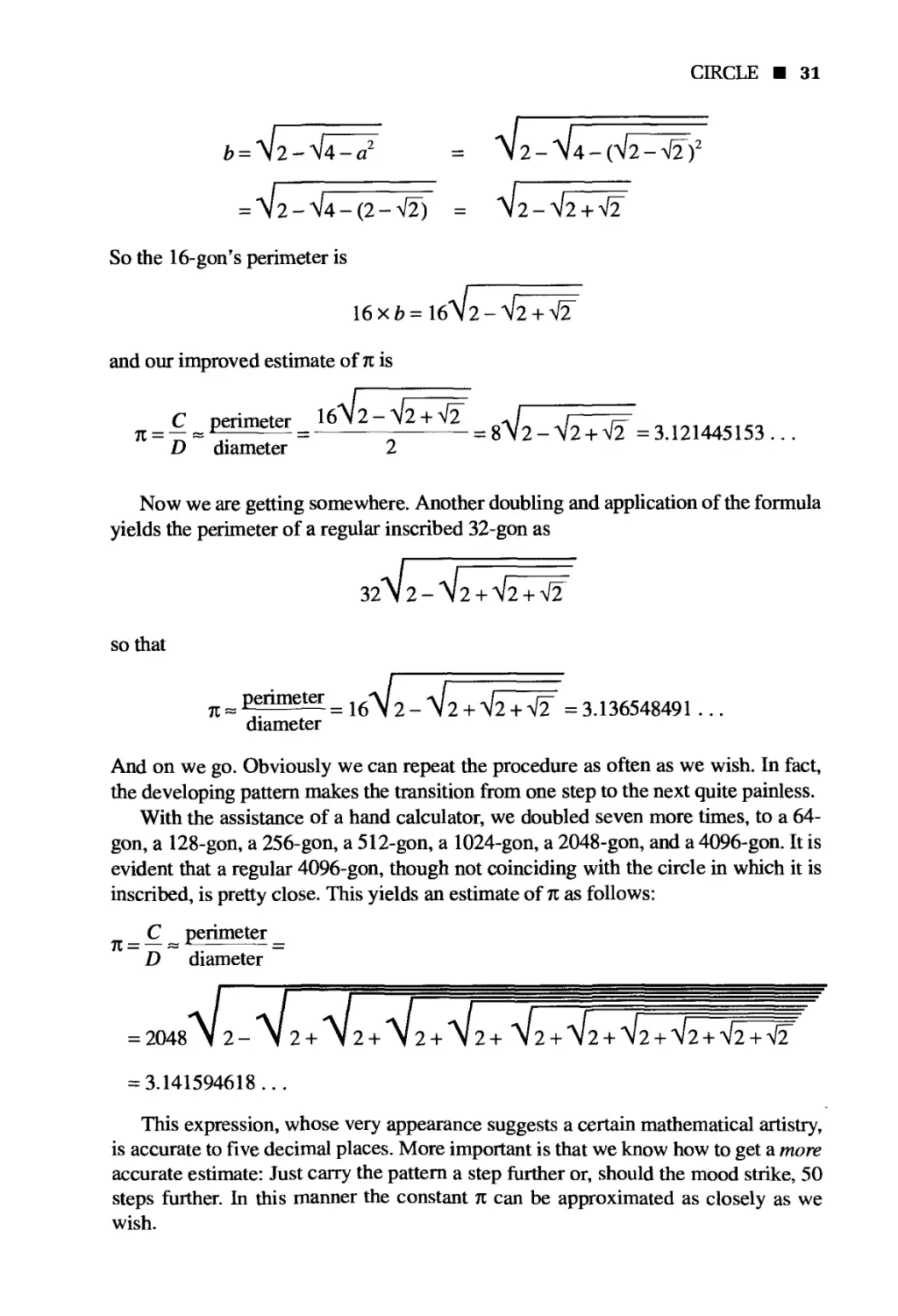

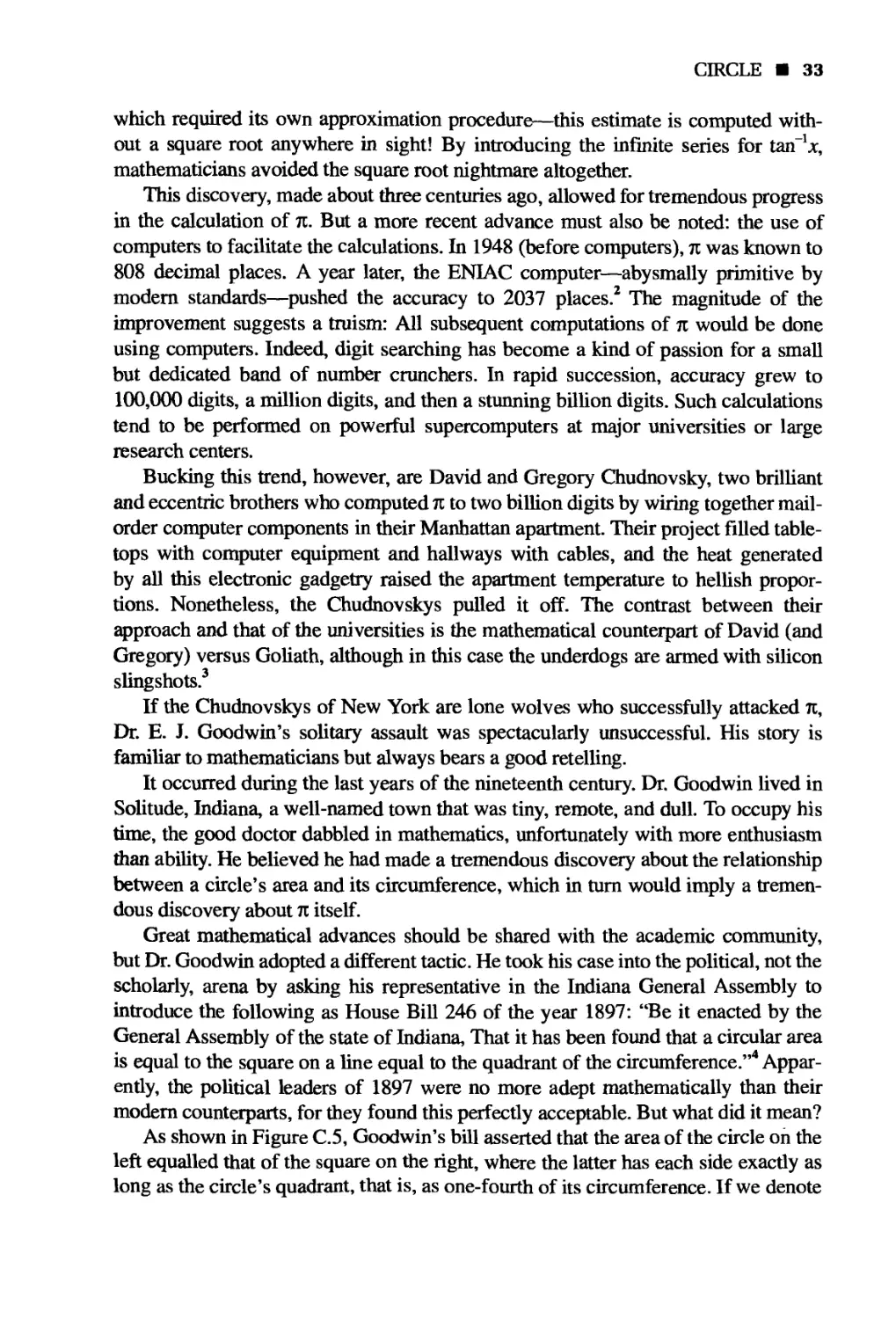


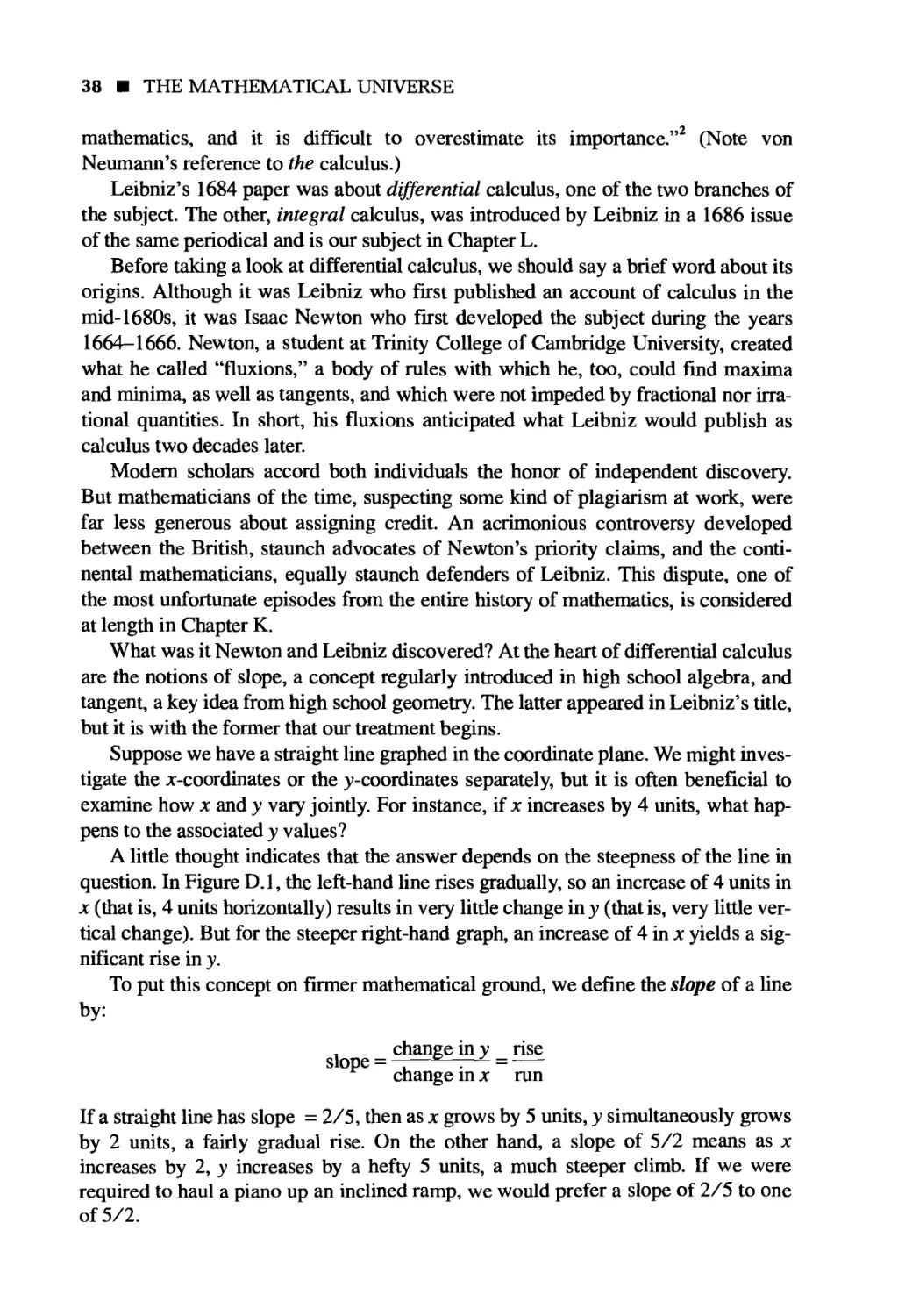

























Author: Dunham
Tags: mathematics history of mathematics exact sciences terminology
ISBN: 0-471-53656-3
Year: 1994

Text
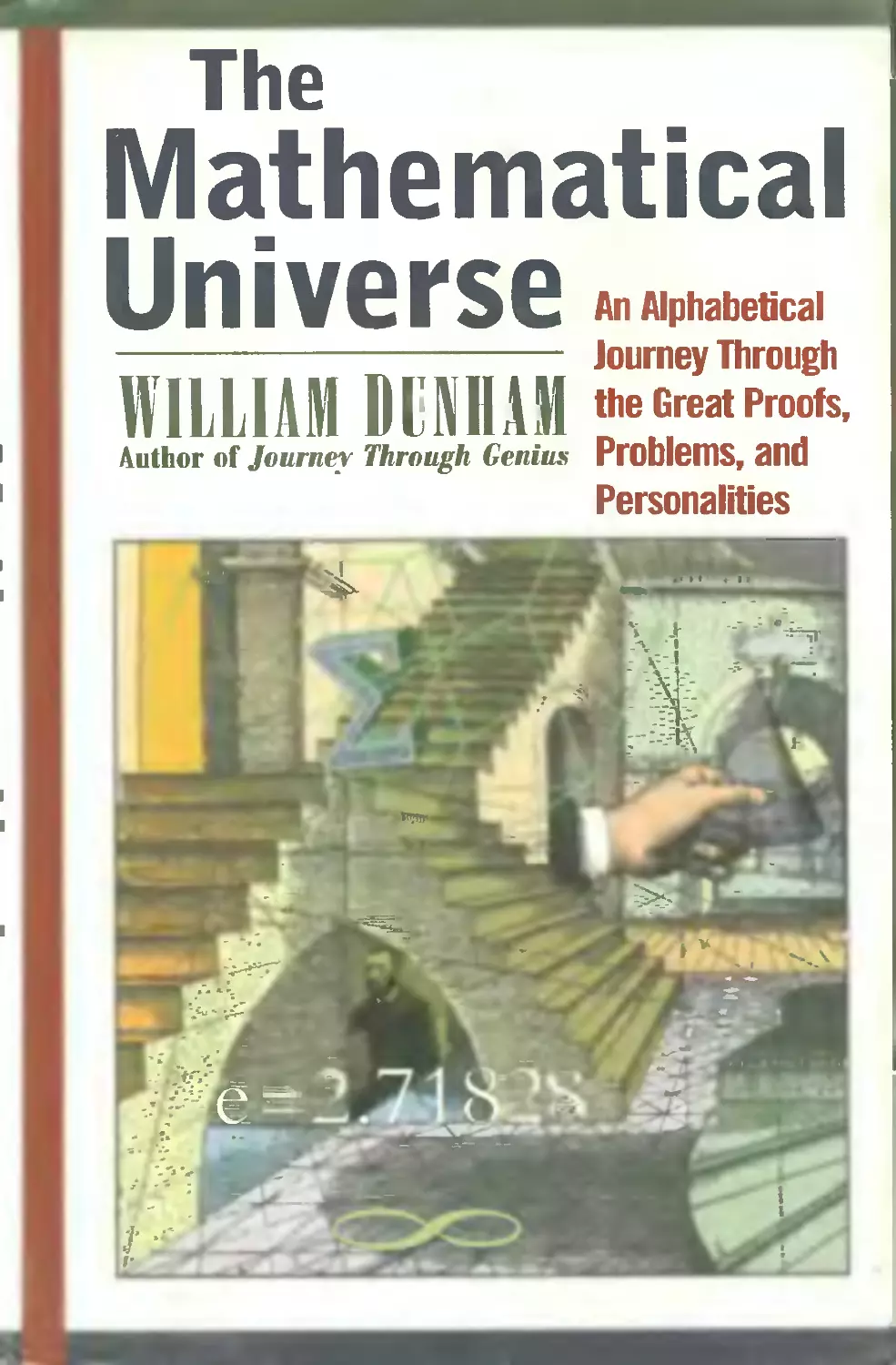
                    The
Mathematical
Universe
An Alphabetical
Journey Through
WILLIAM BliNHAM *■-■**
Author of Journey Through Genius Problems, and
Personalities
^
**

The
Mathematical
Universe
An Alphabetical Journey
Through the Great Proofs,
Problems, and Personalities
William Dunham
John Wiley & Sons, Inc.
New York ■ Chichester ■ Brisbane ■ Toronto ■ Singapore

This book is dedicated to Brendanand Shannon
This text is printed on acid-free paper.
Copyright © 1994 by John Wiley & Sons, Inc.
All rights reserved. Published simultaneously in Canada.
The poem "Misunderstanding," which appears on page 164,
is © 1993 by JoAnne Growney.
Reproduction or translation of any part of this work beyond
that permitted by Section 107 or 108 of the 1976 United
States Copyright Act without the permission of the copyright
owner is unlawful. Requests for permission or further
information should be addressed to the Permissions Department
John Wiley & Sons, Inc.
This publication is designed to provide accurate and authoritative
information in regard to the subject matter covered. It is sold with
the understanding that the publisher is not engaged in
rendering professional services. If legal, accounting, medical,
psychological, or any other expert assistance is required, the
services of a competent professional person should be sought.
Library of Congress Cataloging-in-Publication Data:
Dunham, William, 1947-
The mathematical universe : an alphabetical journey through the great
proofs, problems, and personalities / William Dunham,
p. cm.
Includes index.
ISBN 0-471-53656-3
1. Mathematics—History. 2. Mathematicians—History. I. Tide.
QA21.D785 1994
510—dc20 93-48720
Printed in the United States of America
10 9876543

Contents
Preface iv
Acknowledgments vi
Arithmetic 1
Bernoulli Trials -<11
Circle 23
Differential CalculusT 37
Euler^l
Fermat ^5
Greek Geometry 75
Hypotenuse 89
Isoperimetric Problem 103
Justification 115
Knighted Newton 129
Lost Leibniz 443
Mathematical Personality 159
Natural Logarithm 167
Origins 179
Prime Number Theorem 193
Quotient 201
Russell's Paradox -213
Spherical Surface 225
Trisection 237
Utility 249
Venn Diagram 261
Where Are the Women? 263
X-Y Plane 273
Z 28Z/
Afterword 296
Notes 297
Index 309
Hi

PREFACE
Many children begin reading with an alphabet book. Comfortably seated on a warm
lap, youngsters listen as the alphabet unwinds from "A is for alligator" to "Z is for
zebra." Such books may not be great literature, but they provide an effective
introduction to letters, words, and language.
Echoing those alphabet readers of childhood, this volume surveys the discipline
of mathematics in a series of essays running from A to Z. The content is considerably
more sophisticated—D now stands for differential calculus rather than doggie—and
a warm lap is no longer mandatory. But the basic idea of an alphabetical journey
remains.
Such a format imposes severe restrictions upon a book meant to be read from
cover to cover. Mathematical topics, after all, do not align themselves in a logical
progression so as to mirror the Latin alphabet. Consequently, the transition between
chapters is sometimes abrupt. Moreover, although certain letters of the alphabet are
rich in possible subjects, others are quite barren, a situation reminiscent of children's
alphabet books in which "C is for cat" but "X is for xenurus." As the reader will
readily note, some of the following topics have been shoehorned into position, much
as a size 16 foot must be squeezed into a size 8 boot. Devising a topical flow to
coincide with the alphabetical flow has presented a true logistical challenge.
The book begins with the (apparently) simple subject of arithmetic. Later
chapters have recurring and often interlaced themes. Sometimes consecutive chapters fit
together, as with Chapters G, H, and I on geometry or the back-to-back Chapters K
and L on seventeenth-century rivals Isaac Newton and Gottfried Wilhelm Leibniz.
Some chapters focus on single mathematicians: We meet Euler in Chapter E, Fermat
in Chapter F, and Bertrand Russell in Chapter R. Some describe specific results,
such as the isoperimetric problem or Archimedes' determination of the surface area
of a sphere. Some address such broader issues as the mathematical personality or the
presence of women in the discipline. And whatever the subject, each chapter
provides a strong dose of history.
Along the way, the major branches of mathematics—from algebra, to geometry,
to probability, to calculus—make at least a brief appearance. Those sections
designed to explain key mathematical ideas have the flavor of an informal textbook,
IV

PREFACE ■ v
and actual proofs (or at least "prooflets") appear here and there. Chapters D and L,
for instance, introduce differential and integral calculus, and thus carry a bit more
mathematical baggage.
In most chapters, however, there has been a deliberate attempt to avoid an
overtly technical development. Virtually all of the mathematics is elementary—that
is, pitched to those with some high school algebra and geometry under their belts.
Professional mathematicians will find few surprises on these pages. The book is
aimed at those whose interest in mathematics is at least as extensive as their training.
A few themes return again and again: that mathematics is an ancient yet vital
subject, that it treats matters of everyday importance as well as matters of no utility
whatever, and that it is a discipline whose remarkable breadth is matched only by its
equally remarkable depth. To convey something of this in a sequence of
alphabetically ordered chapters is the book's objective.
I would be remiss not to mention John Allen Paulos's book Beyond Numeracy
(Knopf, New York, 1991), which he described as "in part a dictionary, in part a
collection of short mathematical essays, and in part the ruminations of a numbers man."
Paulos's lively volume charted a mathematical course from A to Z—in his case, from
algebra to Zeno. By allowing multiple entries for some letters, he achieved greater
breadth of coverage; by writing fewer but longer essays, I opted for greater depth. It
is my hope that our two books can coexist peacefully as variations of the same
alphabetical format.
Of course, there is no way an author can address every key point, introduce every
important figure, or consider every pressing mathematical issue. Choices must be
made at each turn, choices constrained by the demands of internal consistency, by
the complexity of the subject, by the author's interest and expertise, and by the
utterly artificial arrangement of the alphabet. A project of this type will omit a
thousand times more than it can include, and scores of potential topics are bound to end
up on the cutting room word processor.
In the end, this book is the response of a single individual to the immense
mathematical universe. It represents one of countless journeys that could have been
undertaken by countiess authors, and I make no claim to having followed the
comprehensive or definitive route from A to Z.
Such qualifications aside, I hope these chapters provide at least a glimpse into a
subject of endless fascination. As the nineteenth-century mathematician Sofia
Kovalevskaia observed, "Many who have never had the occasion to discover more
about mathematics confuse it with arithmetic and consider it a dry and arid science.
In reality, however, it is a science which demands the greatest imagination."1 And
perhaps the book can serve to underscore Proclus' lofty sentiment from fifth-century
Greece: "mathematics alone can revive and awaken the soul ... to the vision of
being, can turn her from images to realities and from darkness to the light of the
intellect."2

ACKNOWLEDGMENTS
In the course of writing this book, I have received the support of friends and
relatives, of colleagues and editors. Among these it is important to single out a few.
Special thanks are due to Daryl Karns, who first suggested the idea of an
alphabet book about mathematics. Daryl is one of the great biology professors, a liberal
artist extraordinaire, and, I am pleased to say, a dear friend.
As a new faculty member at Muhlenberg College, I have greatly appreciated the
welcome extended by President Arthur Taylor and by my colleagues in the
Department of Mathematical Sciences: John Meyer, Bob Stump, Roland Dedekind, Bob
Wagner, George Benjamin, and Dave Nelson. The same appreciation goes out to the
staff of Muhlenberg's Trexler Library for their cheerful assistance during the
preparation of this manuscript.
Beyond Muhlenberg, I thank colleagues Don Bailey, Victor Katz, Alayne Parson,
and Buck Wales for assistance at various points in the preparation of the manuscript.
And I gratefully acknowledge my editors at John Wiley & Sons: Steve Ross, who
served as midwife in bringing this book into existence, and Emily Loose and Scott
Renschler, who carried it through adolescence to maturity.
An especially warm thank you goes to my mother, to Ruth and Bob Evans, and to
Carol Dunham for their constant love and encouragement.
Most of all, I thank my wife and colleague, Penny Dunham. She was
instrumental in determining the book's contents and in outlining some of its chapters. As
maestro of the Macintosh, she created the figures and diagrams contained within. And
her editing of the manuscript improved the final product immeasurably. Without
question, Penny's influence is everywhere evident on the pages that follow.
W. Dunham
Allentown, Pennsylvania, 1994
VI

+
r
rithmetic
x
For each of us, mathematics begins with arithmetic, and so does this book. As we all
know, arithmetic deals with the most basic of quantitative concepts, the whole
numbers 1, 2, 3 .... If any mathematical idea is universal, it is that of distinguishing
degrees of multiplicity, which is to say "counting."
The intrinsic inevitability of the whole numbers, their undeniable naturalness,
lies at the heart of Leopold Kronecker's well-known observation, "God made the
integers; all else is the work of man."1 If we imagine mathematics as a grand
orchestra, the system of whole numbers could be likened to a bass drum: simple, direct,
repetitive, providing the underlying rhythm for all the other instruments. There
surely are more sophisticated concepts—the oboes and French horns and cellos of
mathematics—and we examine some of these in later chapters. But whole numbers
are always at the foundation.
Mathematicians call the infinite collection, 1, 2, 3,..., the positive integers, or
perhaps more descriptively, the natural numbers. Once we have introduced and
named them, our attention turns to combining them in certain important ways. Most
fundamental is addition. This operation is not only fundamental, but it is also natural
in the sense that the numbers are created additively. That is, 2=1 + 1,3 = 2+1,4 =
3+1, and so on. Even as a powerful thoroughbred is "born to run," so, too, are the
natural numbers "born to add."
During elementary-school days, we add numbers ad infinitum (almost) and then
take up the opposite, or inverse, operation of subtraction. Next, it is on to
multiplication and division, accompanied by seemingly interminable periods of drill. After
many years of this instruction, youngsters master the operations of arithmetic with
varying degrees of imperfection, undaunted by the fact that a $7.95 calculator can do
1

2 ■ THE MATHEMATICAL UNIVERSE
12
4
6 J 1 1
I 3
Figure A.1
it all flawlessly in a fraction of the time. It is unfortunate that, to so many young
people, arithmetic becomes synonymous with drill and drudgery.
In the not-too-distant past, however, the term arithmetic embraced not only the
basic operations of addition, subtraction, multiplication, and division but also the
deeper properties of the whole numbers. Europeans, for instance, spoke of the
"higher arithmetic," by which was meant, in all honesty, the "harder arithmetic."
The preferred term nowadays is number theory.
This subject, though ranging far and wide, is more or less anchored on the notion
of prime numbers. A whole number greater than 1 is prime if it cannot be written as
the product of two smaller whole numbers. Thus the first ten primes are 2,3,5,7,11,
13, 17, 19, 23, and 29. None of these has a positive integer divisor other than 1 and
itself.
An argumentative reader might contend that 17 can be written as a product—for
instance, 17 = 2 x 8.5 or 17 = 5 x 3.4. But in these cases the factors are not
themselves integers. It must be remembered that in number theory the starring roles are
played by whole numbers; their more sophisticated and far-ranging cousins—the
fractions, the irrationals, the imaginaries—must remain tantalizingly offstage.
If a whole number greater than 1 is not prime—which is to say, if a number
possesses an integer factor other than 1 and itself—we say it is composite. Numbers
such as 24 = 4x6 or 51=3x17 are examples. For reasons that will become
apparent shortly, the whole number 1 is excluded from the ranks of either primes or
composites. Consequently the smallest prime is 2.
A simple and frequently cited method of visualizing these concepts is to imagine
square pieces of floor tile that must be assembled into a rectangular shape. If we
have 12 such pieces, we enjoy different options as to the rectangle that can be
formed, as shown in Figure A.l. This, of course, is because 12=1x12, or
12 = 2x6, or 12 = 3x4 (we do not distinguish between 3x4 and 4x3 because the
shape of the resulting floor is the same in both cases, although one is rotated). Like-

ARITHMETIC ■ 3
7
1
Figure A.2
wise, 48 pieces of tile yield five different floor plans, corresponding to the
decompositions 48 = 1 x 48 = 2 x 24 = 3 x 16 = 4 x 12 = 6 x 8.
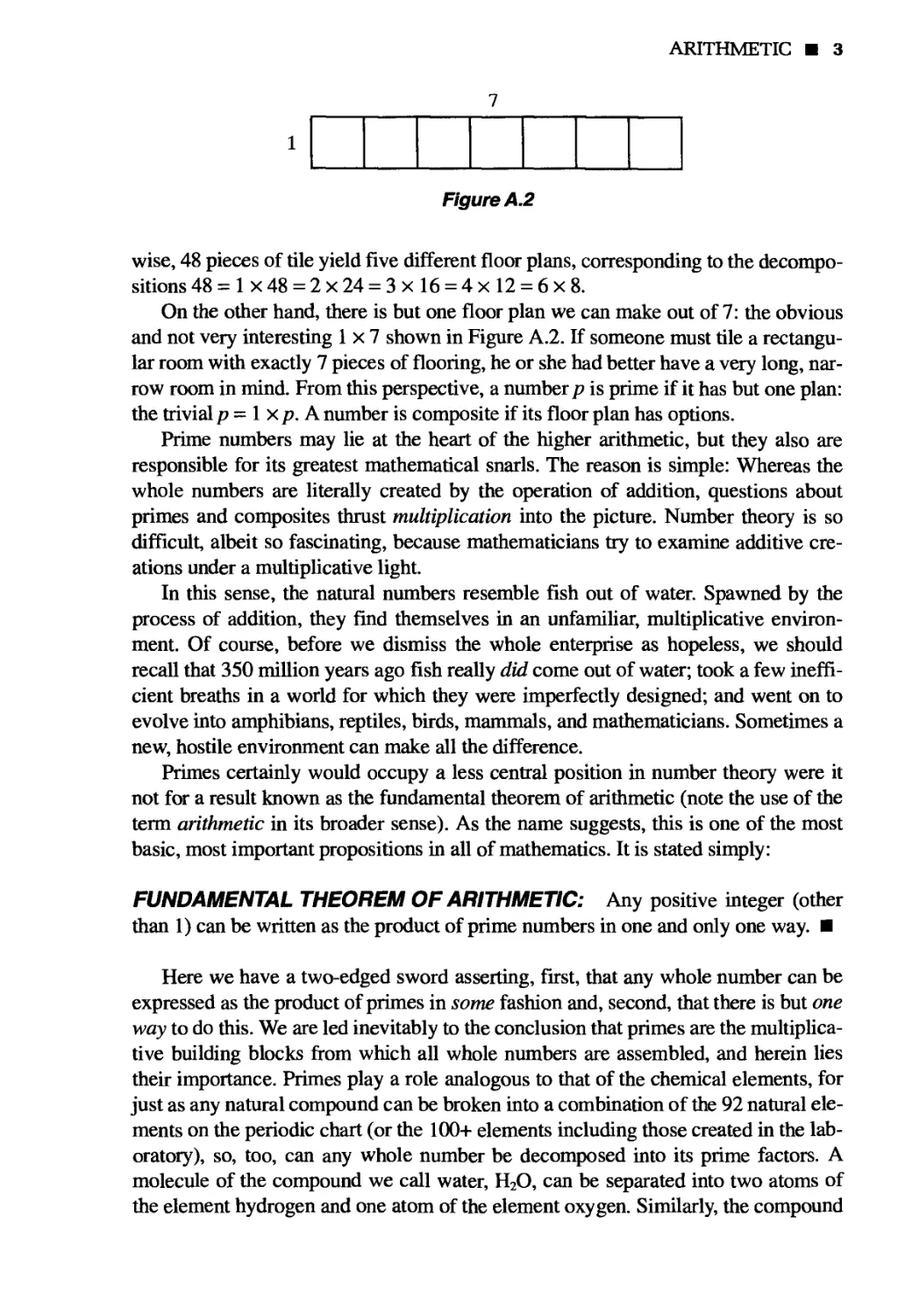
On the other hand, there is but one floor plan we can make out of 7: the obvious
and not very interesting 1x7 shown in Figure A.2. If someone must tile a
rectangular room with exactly 7 pieces of flooring, he or she had better have a very long,
narrow room in mind. From this perspective, a number p is prime if it has but one plan:
the trivial p = 1 x p. A number is composite if its floor plan has options.
Prime numbers may lie at the heart of the higher arithmetic, but they also are
responsible for its greatest mathematical snarls. The reason is simple: Whereas the
whole numbers are literally created by the operation of addition, questions about
primes and composites thrust multiplication into the picture. Number theory is so
difficult, albeit so fascinating, because mathematicians try to examine additive
creations under a multiplicative light.
In this sense, the natural numbers resemble fish out of water. Spawned by the
process of addition, they find themselves in an unfamiliar, multiplicative
environment. Of course, before we dismiss the whole enterprise as hopeless, we should
recall that 350 million years ago fish really did come out of water; took a few
inefficient breaths in a world for which they were imperfectly designed; and went on to
evolve into amphibians, reptiles, birds, mammals, and mathematicians. Sometimes a
new, hostile environment can make all the difference.
Primes certainly would occupy a less central position in number theory were it
not for a result known as the fundamental theorem of arithmetic (note the use of the
term arithmetic in its broader sense). As the name suggests, this is one of the most
basic, most important propositions in all of mathematics. It is stated simply:
FUNDAMENTAL THEOREM OF ARITHMETIC: Any positive integer (other
than 1) can be written as the product of prime numbers in one and only one way. ■
Here we have a two-edged sword asserting, first, that any whole number can be
expressed as the product of primes in some fashion and, second, that there is but one
way to do this. We are led inevitably to the conclusion that primes are the
multiplicative building blocks from which all whole numbers are assembled, and herein lies
their importance. Primes play a role analogous to that of the chemical elements, for
just as any natural compound can be broken into a combination of the 92 natural
elements on the periodic chart (or the 100+ elements including those created in the
laboratory), so, too, can any whole number be decomposed into its prime factors. A
molecule of the compound we call water, H20, can be separated into two atoms of
the element hydrogen and one atom of the element oxygen. Similarly, the compound

4 ■ THE MATHEMATICAL UNIVERSE
(i.e., composite) number 45 can be broken into a product of two factors of the prime
3 and one of the prime 5. Mimicking water's chemical notation, we could write
45 = 325, although mathematicians prefer the exponential form 45 = 32 x 5.
But arithmetic's fundamental theorem provides more than just a decomposition
into primes. Equally critical is its guarantee of the uniqueness of such
decompositions. If someone determines the prime factorization of 92,365 to be 5 x 7 x
7 x 13 x 29, then a colleague—working across the room or across the country,
working today or a thousand centuries from now—must come up with precisely the same
prime decomposition.
This is very comforting to mathematicians. Of course, it is equally comforting
that, when a chemist decomposes a water molecule into one oxygen and two
hydrogen atoms, a different chemist is not going to decompose that molecule into one
atom of lead and two of molybdenum. Primes, like elements, are not only building
blocks but also unique building blocks.
It is worth noting that the desire for unique factorization requires us to exclude 1
from among the primes. For if 1 were classified as a prime, then the number 14, for
instance, would have prime decomposition 14 = 2 x 7 as well as the different prime
decompositions 14 = 1 x 2 x 7 and 14=1x1x1x2x7. The uniqueness of prime
factorization would vanish. It is far better, say mathematicians, to give 1 a special
role. Neither prime nor composite, it is called a unit.
Confronted with a positive integer, a mathematician may wish to determine
whether it is prime or composite and, in the latter case, to find its prime factors.
Sometimes the matter is simple. Any even whole number (other than 2) is obviously
not prime because it has a factor of 2, and any whole number ending in the digits 5
or 0 (other than 5) is likewise composite. In other cases, the question of primality
presents far greater difficulties. Who, for instance, would care to determine which of
4,294,967,297 and 4,827,507,229 is prime and which is not?*
The nineteenth-century mathematician Carl Friedrich Gauss (1777-1855),
perhaps the greatest number theorist of all, put it simply in his 1801 masterpiece Dis-
quisitiones Arithmeticae:
The problem of distinguishing prime numbers from composite numbers and of
resolving the latter into their prime factors is known to be one of the most important and
useful in arithmetic.. .. The dignity of the science itself seems to require that every
possible means be explored for the solution of a problem so elegant and so
celebrated.2
For more than two dozen centuries, from ancient Greeks to modern number
theorists, mathematicians have been irresistibly drawn to such problems, even as moths
are drawn to a flame or spaghetti sauce to a white shirt. Along the way scholars have
made a multitude of conjectures about the primes. Some have been proved, others
disproved, and a surprising number remain unresolved.
*
Believe it or not, 641 divides evenly into 4,294,967,297; the other number is pnme. See David Wells,
The Penguin Dictionary of Curious and Interesting Numbers, Penguin, New York, p. 192.

ARITHMETIC ■ 5
For instance, an intriguing question was raised by the French priest Marin
Mersenne (1588-1648) in 1644. Mersenne played an important role in seventeenth-
century science, not only for his contributions to the theory of numbers but also for
his valuable service as a clearinghouse of information among mathematicians.
Scholars curious about the state of mathematics or perplexed by a difficult problem
would write Mersenne, who either knew the answer or could direct them to a likely
authority. The value of such a channel of information—in the days before scientific
meetings, professional journals, or e-mail—can hardly be overestimated.
Mersenne was intrigued by numbers of the form T - 1; that is, numbers that are
one less than a power of 2. Today these are called Mersenne numbers in his honor.
Obviously, all such numbers are odd. More important, some of them are prime.
Immediately Mersenne recognized that if n is composite, then 2" - 1 must be
composite, too. For instance, if n = 12, the Mersenne number 212 - 1 = 4095 = 3 x
3 x 5 x 7 x 13 is composite (because 12 is); for the composite n = 33, 233 - 1 =
8,589,934,591 = 7 x 1,227,133,513 is likewise not a prime.
When the exponent is prime, however, the situation is less clear. Letting
p = 2, 3, 5, and 7 yields the "Mersenne primes" 22 - 1 = 3, 23 - 1 = 7,25 - 1 = 31,
and 27 - 1 = 127. But if we use the prime p = 11 as exponent, we get 211 - 1 = 2047;
alas, this number is the product of 23 and 89 and is therefore composite. Mersenne
was fully aware that p being prime is no guarantee that 2P - 1 is prime as well. In
fact, he asserted that the only primes between 2 and 257 for which 2P - 1 is prime are
p = 2, 3,5,7,13, 17, 19, 31, 67, 127, and 257.3
Unfortunately, Father Mersenne's assertion contained sins of both commission
and omission. For instance, he missed the fact that the number 261 - 1 is a prime. On
the other hand, 267 - 1 turned out not to be prime at all. This latter fact was
established in 1876 by Edouard Lucas (1842-1891), who demonstrated that the number
was composite using an argument so indirect that it did not explicitly exhibit any of
the factors. In a sense, then, the story of 267 - 1 remained less than complete, and its
final chapter is worth a brief digression.
The year was 1903 and the setting was a meeting of the American Mathematical
Society. Among the speakers on the program was Frank Nelson Cole of Columbia
University. When his turn came, Cole walked to the front of the room, silently
multiplied 2 by itself 67 times, subtracted 1, and arrived at the monumental result
147,573,952,588,676,412,927. Having witnessed this wordless computation, the
perplexed spectators next watched as Cole wrote on the board
193,707,721 x 761,838,257,287
which he also calculated in silence. The product was none other than
147,573,952,588,676,412,927
Cole sat down. His performance would have been perfectly appropriate at a
convention of mimes.
Those in the audience—who had just witnessed the explicit factorization of
Mersenne's number 267 - 1 into two gigantic factors—were momentarily as speech-

6 ■ THE MATHEMATICAL UNIVERSE
less as Cole. Then they burst into unrestrained applause and gave him a standing
ovation! This recognition, it is hoped, warmed Cole's heart, for he later admitted that
he had been working on his calculation for the previous two decades*
Cole's factorization notwithstanding, Mersenne numbers remain a fruitful source
of primes. Almost certainly, when a newspaper proclaims that a new "largest" prime
has been found, it turns out to be of the form 2P - 1. As of 1992, the largest known
prime was 2756839- 1, a behemoth of 227,832 digits.5 But the general question of
determining which Mersenne numbers are prime and which are not remains an
unsolved problem of number theory.
The Mersenne number 27 - 1 = 127 figures in another tale about primes. In the
mid-nineteenth century, the French mathematician A. de Polignac asserted:
Every odd number can be expressed as the sum of a power of 2 and a prime.
For instance, 15 can be written as 8 + 7 = 23 + 7, whereas 53 = 16 + 37 = 24 + 37
and 4107 = 4096 + 11 = 212 + 11. Although de Polignac did not claim to have proved
his fascinating conjecture, he implied he had checked it for all odd numbers up to
three million.
Because any power of 2 has no odd number in its prime decomposition, such
powers are somehow the most purely even of all numbers. De Polignac's statement
suggested that any odd number could be built out of a prime, that most fundamental
of building blocks, and a purely even power of 2. It was a bold statement.
It was also dead wrong. If de Polignac really spent the time necessary to check
his assertion into the millions, we can only pity him, for the relatively tiny Mersenne
prime 127 refutes his claim; there is no way to write 127 as a power of 2 plus a
prime. This is evident if we simply decompose 127 in all possible ways into a power
of 2 and a remainder and observe that the latter is never prime:
127 = 2+125 = 2 + (5x25)
127 = 4+123 = 22 + (3x41)
127 = 8+119 = 23 + (7xl7)
127=16+lll = 24 + (3x37)
127 = 32 + 95 = 25 + (5xl9)
127 = 64 + 63 = 26 + (3x21)
(Because 27 = 128 is larger than 127, we need go no further.) De Polignac's
conjecture is now relegated to the number theoretic scrap heap, for he overlooked a coun-,
terexample that was, in mathematical terms, right under his nose. Like the ornithop-
ters of the nineteenth century, his ambitious assertion never got off the ground.
We have drawn parallels between the unique decomposition of chemicals into
elements and the unique factorization of integers into primes. This chemical
analogy, although helpful, breaks down in one significant way: All the laboratory work
of all the chemists in history has expanded the supply of elements to just over 100,

ARITHMETIC ■ 7
but the collection of primes is infinite. Although the periodic chart of chemical
elements can fit on a medium-size wall, a similar chart of mathematical primes would
require a wall of endless extent.
The earliest proof of the infinitude of primes is due to the Greek mathematician
Euclid (ca. 300 B.C.) and appeared in his classic work, the Elements.1 We present a
slightly modified version of his argument, but one that retains the power and beauty
of the original.
To follow the reasoning requires two preliminary results from number theory,
neither of them very deep. The first is that for any whole number n, the difference
between two multiples of n is itself a multiple of n. Symbolically, if a and b are
multiples of n, so is a - b. For example, both 70 and 21 are multiples of 7, and so is their
difference, 70 - 21 = 49; likewise, both 216 and 72 are multiples of 9, as is
216 - 72 = 144. The general proof of this fact is not included here, but its
verification is as simple as it is believable.
The other prerequisite is equally elementary. It says that any composite number
has at least one prime factor. Again we illustrate by example. The composite 39 has
the prime factor 3, the composite 323 has the prime factor 17, and the composite 25
has the prime factor 5. Euclid gave a clever proof of this theorem as the 31st
proposition of the seventh book of the Elements.
Beyond that, all that is necessary to establish the infinitude of primes is an
understanding of proof by contradiction. This in turn requires that we recognize the most
basic dichotomy of logic: A statement is either true or false.
One way to demonstrate the truth of a statement is to prove it directly. This is
obvious (and banal). A different but equally valid approach—the so-called proof by
contradiction—is to assume the statement is false and from this assumption, using
the rules of logic, derive an impossible consequence. The appearance of such a
consequence indicates that something is wrong somewhere along the chain of
reasoning, and if our steps were valid the only possible culprit is the original assumption of
the statement's falsehood. We must therefore reject this falsehood, and the
dichotomy mentioned above leaves us with a single possibility: The statement must in fact
be true. Admittedly, this strategy may seem strangely indirect and unnecessarily
devious. To emphasize the indirectness, we consider the following example before
returning to the infinitude of primes.
Suppose we are investigating numbers that are both perfect squares and perfect
cubes, as 64 is both 82 and 43 or 729 is both 272 and 93 Such a number will be called
a "sqube." Our goal is to prove:
THEOREM: There are infinitely many squbes.
PROOF: This is easy and perfectly direct. We merely observe that if n is any
whole number, then n6 = n3 x n3 = (n3)2 is a perfect square, and n6 = n2xn2x
n2 = (n2)3 is simultaneously a perfect cube. So we get an infinitude of squbes by
looking at

8 ■ THE MATHEMATICAL UNIVERSE
16=12=13 26 = 64 = 82=:43 36 = 729 = 272 = 93
46 = 4096 = 642 = 163 56 = 15625 = 1252 = 253 66 = 46656 = 2162 = 363
76 = 117649 = 3432 = 493 86 = 262144 = 5122 = 643 and so on
Obviously this process continues without end, for each different choice of n
generates a new and different n. The infinitude of squbes has been demonstrated directly.
■
Unfortunately, to prove the infinitude of primes we have no such direct option.
Neither Euclid nor anyone since has found a simple formula that churns out primes
as our formula rt churned out squbes. Rather than make a frontal assault, we must
resort to the indirect attack of proof by contradiction—more sophisticated, more
subtle, but in the end far more beautiful. In fact, this proof often serves as a kind of
litmus test for mathematical sensibility: Those with a genuine mathematical yen find
it moves them to tears; those without such a yen find it bores them to tears. We let
the reader be the judge.
THEOREM: There are infinitely many primes.
PROOF: (by contradiction) Assume instead that there are only finitely many
primes, and suppose they are denoted by a, b, c,..., d. This collection may contain
400 primes or 400,000, but we assume it contains them all We now start marching
toward a contradiction.
Multiply these primes together and add 1 to create the new number:
N=(axbxcx ...xd) + l
Note that because we have only finitely many numbers, we can indeed multiply
them in this fashion; an infinitude of primes could not have been so multiplied.
Obviously N is larger than any of the individual primes a, b, c,..., or d, so N is
different from all of them. Since these were the only primes in town, we conclude
that N is not one of the primes.
This means N must be composite, and by the second of our preliminary
observations above, N has a prime divisor. Because we assumed that a,b,c,...,d constitute
the world's entire supply of primes, this prime divisor of N must be somewhere
among them.
Put another way, N is a multiple of one of the primes a, b, c,. .., or d. It really
doesn't matter which prime it is, but for the sake of concreteness, assume Nisa.
multiple of c. Clearly the product axbxcx...xd is also a multiple of c because c
appears as one of the factors. By the first preliminary cited above, the difference
between N and axbxcx.. .xd will also be a multiple of c. But we defined N to
be just 1 more than this product, so the difference is 1.
We thus have been led to conclude that 1 is a multiple of c (or of any other prime
that is a factor of N). This is clearly impossible because the smallest prime is 2 and
thus 1 is not a multiple of any prime. Something has gone haywire.

ARITHMETIC ■ 9
As we scan back through the argument, we see the only source of trouble is our
original assumption that there are only finitely many primes. We therefore reject this
and conclude, by contradiction, that the primes must be infinitely abundant The
proof is complete. ■
This wonderful piece of reasoning is elementary yet profound. It guarantees that
primes are endless and inexhaustible. After the most powerful computer confirms
that 2756'839 - 1 is prime, we can smugly assert that even bigger primes—indeed,
infinitely many bigger primes—still lay undiscovered. Even if we are unable to specify
any of these larger primes, let no one think we are being evasive. Thanks to the
subtleties of logic and proof by contradiction, we know they are out there.
Because it boasts results of such simple beauty, number theory has served as the
point of entry into higher mathematics for many young scholars. Among these was
the U.S. mathematician Julia Robinson (1919-1985). In 1970 Robinson was among
a trio of scholars who solved what is known as Hilbert's Tenth Problem, a very deep
question from number theory that had remained unanswered since it was posed by
David Hilbert (1862-1943) seven decades earlier. Even as a youngster, Robinson
had been enthralled by the wonderful properties of the whole numbers. "I was
especially excited by some of the theorems of number theory," she wrote, "and I used to
recount these to Constance [her sister] at night after we went to bed. She soon found
that if she wasn't ready to go to sleep she could keep me awake by asking questions
about mathematics."8
Or there is the Hungarian mathematician Paul ErdGs (pronounced "air-dish").
Reminiscing on his long career, Erdos (1913- ) recalled, "When I was ten, my
father told me about Euclid's proof [of the infinitude of primes], and I was hooked."9
Erdos's youth was as intellectually productive as it was socially sheltered. At the
age of 17, when most college freshmen are simply hoping to survive adolescence,
Erdos achieved mathematical fame by devising an elementary proof that between
any whole numbers n and 2n there must always lie at least one prime. For instance,
there must be a prime between 8 and 16, or between 8 billion and 16 billion.
This may seem like a fairly unspectacular theorem. Indeed, it had been proved
almost a century earlier by the Russian mathematician with the mellifluous name of
Pafnuty Lvovich Chebyshev (whose appearance in the mathematical literature as
Chebychev, Tchebysheff, Cebysev, and Tshebychev should be attributed to errors of
transliteration rather than a fondness for aliases). But Chebyshev's proof was very
complicated. The amazing thing about Erdos's argument was that it was so much
simpler and came from one so young.
We note in passing that his theorem provides an alternate proof of the infinitude
of primes, for it guarantees that there is a prime between 2 and 4, a prime between 4
and 8, another between 8 and 16, and so on. Even as we can keep doubling numbers
forever, so, too, must the primes be limitless.
This was the first of a long line of theorems from Paul Erdos, the twentieth
century's most prolific, and perhaps most eccentric, mathematician. Even in a
profession in which unusual behavior is accepted as something of the norm, Erdos is

10 ■ THE MATHEMATICAL UNIVERSE
legendary. For instance, so sheltered was this young scholar that only at the age of
21—four years after proving the theorem on primes mentioned above—did he first
butter his own bread. He later reminisced: "I had just gone to England to study. It
was tea time, and bread was served. I was too embarrassed to admit that I had never
buttered it. I tried. It wasn't so hard."10
Equally unusual is that Erdos has no permanent residence. Instead, he travels
around the globe from one mathematical research center to another, living out of a
suitcase and trusting that at each stop someone will put him up for the night. As a
result of his incessant wanderings, this vagabond mathematician has collaborated
with more colleagues, and published more joint papers, than anyone in history. He is
proof of the scriptural adage that a human being does not live by (buttering) bread
alone.
The mathematical community, in return, has devised a whimsical recognition of
his impact: the so-called Erdos number.11 Erdos himself has Erdos number 0; any
mathematician who has jointly published a paper with Erdos has Erdos number 1; a
mathematician who, though not collaborating directly with Erdos, has jointly
published a paper with someone who published a paper with Erdos receives Erdos
number 2; someone who published a paper with someone who published a paper with
someone who published a paper with Erdos has Erdos number 3; and so on. Like a
gigantic oak, the Erdos tree has branched across the mathematical world.
So, with prime numbers, composite numbers, Mersenne numbers, and even
Erdos numbers, it is clear that the passion for number theory is in no danger of
subsiding. For mathematicians from Gauss to Robinson, from Euclid to Erdos, no part
of mathematics has proved more beautiful, elegant, or endlessly fascinating than the
higher arithmetic.

n\
ernoulli Trials
X
N P
At the outset, we stress that a Bernoulli trial is not a Florentine legal proceeding.
Rather, it is a cornerstone of the elementary theory of probability and thus plays an
important role in understanding our uncertain world.
A Bernoulli trial is simply an experiment with a dichotomous outcome. It results
in either success or failure, black or white, on or off. There is no middle ground, no
room for compromise, no comfort for the wishy-washy.
Examples abound. We deal a card from a deck and classify it as either black or
red. We give birth to a child and get either a girl or a boy. We go through a 24-hour
day and either do or do not get hit by a meteor. In each case it is convenient to
designate one outcome as the "success" and the other as the "failure." For instance,
choosing a black card, having a daughter, and not getting struck by a meteor could
be labeled successes. From a probabilistic perspective, however, it makes no
difference whether the red card, the son, or the meteor are regarded as successes. In this
arena, the word success carries no value judgment.
A single Bernoulli trial is rarely of much interest. The plot thickens, however,
when Bernoulli trials are conducted repeatedly, and we observe how many of these
trials yield successes and how many yield failures. This accumulated record can
shed some very useful information on the underlying processes.
One stipulation is essential as we conduct our experiments: The repeated trials
must be independent. This term has a technical definition but also carries an
informal meaning adequate for our purposes: Namely, two events are independent if the
outcome of one has absolutely no impact on the outcome of the other. Thus, for
instance, the birth of a son to the Smiths and that of a daughter to the Johnsons are
■
11

12 ■ THE MATHEMATICAL UNIVERSE
independent events. So, too, are the outcomes (heads or tails) of tossing a dime and a
penny; the outcome of one coin has no bearing on that of the second.
But if we deal two cards from a deck, one at a time, and regard a black card as a
success, independence is lost in going from the first card to the second. For if the
first is the ace of clubs (a success), this will influence the outcome on the next draw,
making it somewhat less likely to be black. It also is somewhat less likely to be an
ace and absolutely certain not to be another ace of clubs.
Fortunately this lack of independence can be remedied by a simple expedient.
After drawing the first card, we put it back into the deck, shuffle well, and draw
again. Because our first card has been replaced within a thoroughly mixed deck, its
identity can have no impact upon our next draw. In this sense, independent events
require a clean slate for each experiment so that the probability of a success remains
the same from trial to trial.
The clearest examples of Bernoulli trials arise in games of chance, such as the
tossing of coins or the rolling of dice. For coins there is a clear independence from
flip to flip so that the probability of a success—such as getting a head—is the same
on each toss. By saying a coin is "balanced," we mean that this probability is exactly
1/2. For a fair die, if we designate a success as rolling a 3, our probability of success
is always 1/6.
But what happens if we flip a coin five times? What is the probability that we get
a mix of three heads and two tails among the five flips? For that matter, if we flip the
coin 500 times, what is the chance of getting 247 heads and 253 tails? This may
seem like a nightmarish problem, but its solution appears in one of the early
masterpieces of probability theory, the Ars Conjectandi by Jakob Bernoulli (1654-1705).
Bernoulli was a native of Switzerland whose grandfather, father, and father-in-
law were all prosperous pharmacists. Forsaking the mortar and pestle, Jakob studied
theology in college, obtaining a degree at the age of 22. But though his family was
in serums and his training in sermons, Jakob Bernoulli's real interest lay in
mathematics.
From the late 1670s until the end of his life, Bernoulli was one of the world's
leading mathematicians. His remarkable talent was coupled with a prickly
personality, a massive ego, and a tendency to belittle the efforts of those less gifted. For
instance, after studying what are now called (in his honor) the "Bernoulli numbers,"
Jakob found an ingenious shortcut for summing the powers of positive integers. He
observed that "it took me less than half of a quarter of an hour" to determine the sum
of the tenth powers of the first 1,000 positive integers. That is, in less than ten
minutes he determined
l10 + 210 + 310 + 410+...+ l,00010
= 91,409,924,241,424,243,424,241,924,242,500
a truly stupendous sum. But in a self-serving editorial comment, Jakob pointed out
that his shortcut made it "clear how useless was the work of Ismael Bullialdus ... in
which he did nothing more than compute with immense labor the sums of the first

BERNOULLI TRIALS ■ 13
;_
>C$
*.
>7
, 1" , ^" Sv-v
t " " , r *fc
**«** <*f
, .^':
r-k
VdG
Jakob Bernoulli
(Reprinted by permission of Birkhauser Verlag AG, Basel, Switzerland, from
Jakob Bernoulli, Collected Works, Vol. 1: Astronomia, Philosophia naturalis;
edited by Joachim O. Fleckenstein, 1969)
six powers, which is only a part of what we have accomplished in the space of a
single page."1 One's heart goes out to poor Ismael, who had as critic a mathematician
not only of enormous insight but also of enormous ego.
Jakob Bernoulli's productive years coincided with Gottfried Wilhelm Leibniz's
discovery of calculus, and Jakob was one of the chief popularizers of this immensely
fruitful subject. As with any developing theory, calculus benefited from those who
followed in its creator's footsteps, scholars whose brilliance may have fallen short of
Leibniz's but whose contributions toward tidying up the subject were indispensable.
Jakob Bernoulli was one such contributor.
In this undertaking, he had an uneasy ally in Johann (1667-1748), the younger of
what we might call, with unashamed alliteration, the brilliant but bickering Bernoulli

14 ■ THE MATHEMATICAL UNIVERSE
Figure BA
brothers. Jakob, in fact, had played a role in teaching mathematics to his younger
sibling. In later years he probably regretted that he taught Johann so well, for the
youngster turned out to be a mathematician to rival, if not surpass, his teacher. There
arose between the brothers a fierce competition for mathematical supremacy. Johann
expressed unconcealed glee when he solved a problem that had stumped his brother,
whereas Jakob demeaningly called Johann his "pupil," implying that Johann was
only parroting his mentor's brilliance. Neither Bernoulli was what one would call
gracious.
A famous clash came with the problem of the catenary. A catenary is the curve
assumed by a hanging chain affixed to a wall at two points (see Figure B.l). Those
familiar with high school algebra may guess that the chain hangs in a parabolic arc, a
perfectly reasonable conjecture advanced by no less a figure than Galileo earlier in
the seventeenth century. But the hanging chain is not parabolic, and by 1690 Jakob
Bernoulli was working hard to determine the curve's true identity—that is to say, its
equation.
As it turned out, Jakob was not up to the task. It is easy to imagine his
consternation when Johann came forth with the answer. Johann later gloated over his triumph,
asserting that the solution "cost me study that robbed me of rest for an entire night."2
As tactless as he was brilliant, Johann rushed to Jakob and presented the correct
solution to his still perplexed brother. Jakob was crestfallen.
But Jakob would have his revenge. This time the battleground was the so-called
isoperimetric problem. The issue at hand was to identify, from among all curves with
the same perimeter, that which encloses the maximum area. We examine this more
closely in Chapter I, but for now we observe that Jakob Bernoulli applied calculus to
a version of this problem in 1697. His work required him to wrestle with a
complicated mathematical entity called a third-order differential equation and pointed the
way to a new, important, and far-reaching branch of mathematics now known as the
calculus of variations.
Brother Johann disagreed and claimed to have resolved the isoperimetric
challenge with a considerably simpler second-order differential equation. As was so
often the case in the house of Bernoulli, their disagreement decayed into antagonism
and stopped just short of musket fire.

BERNOULLI TRIALS ■ 15
Johann Bernoulli
(Courtesy of Carnegie Mellon University Library)
This time, however, it was Jakob who earned the last laugh, for his brother's
second-order differential equation was incorrect. Unfortunately, Jakob never actually
got a chance to laugh, or even grin, for he died in 1705 while Johann's incorrect
solution to the problem remained inexplicably sealed in the offices of the Paris
Academy. There is speculation that Johann had realized his error and arranged to

16 ■ THE MATHEMATICAL UNIVERSE
conceal the mistake so as not to endure a public humiliation while his brother was
around to enjoy it.3
These episodes give a sense of the friction that characterized this brotherly
relationship. It is little wonder that, when Johann was suggested as the obvious person to
edit the papers of his recently deceased brother, Jakob's widow forbade this, fearing
that the vindictive Johann would sabotage Jakob's mathematical legacy.4 Perhaps
J. E. Hofmann put it best in his characterization of Jakob in the Dictionary of
Scientific Biography: "He was self-willed, obstinate, aggressive, vindictive, beset by
feelings of inferiority, and yet firmly convinced of his own abilities. With these
characteristics, he necessarily had to collide with his similarly disposed brother."5 Indeed,
Jakob and Johann Bernoulli are the kind of people who give arrogance a bad name.
Sibling rivalry aside, we return to the probabilistic question posed earlier: If a
balanced coin is tossed five times, what is the probability it yields three heads and
two tails? In the Ars Conjectandi Jakob Bernoulli gave a general rule: If we conduct
n + m repeated, independent trials of an experiment (that is, n + m Bernoulli trials),
where the probability of a success on any trial is p and the probability of a failure is
1-/7, then the chance of getting exactly n successes and m failures is given by the
formula
(fH-m)x(n + m-l)x...x 3x2x1 _
[n x (n - 1) x ... x 3 x 2 x 1] x [m x (m - 1) x ... x 3 x 2 x 1]
To simplify this expression, mathematicians introduce the factorial notation:
rt!=«x(rt-l)x...x3x2xl
For instance, 3! = 3x2x1=6 and 51 = 5x4x3x2x1= 120. (We stress that the
exclamation point in the factorial notation does not require us to speak in a loud
voice.) With this notational convention, Bernoulli's result simplifies to
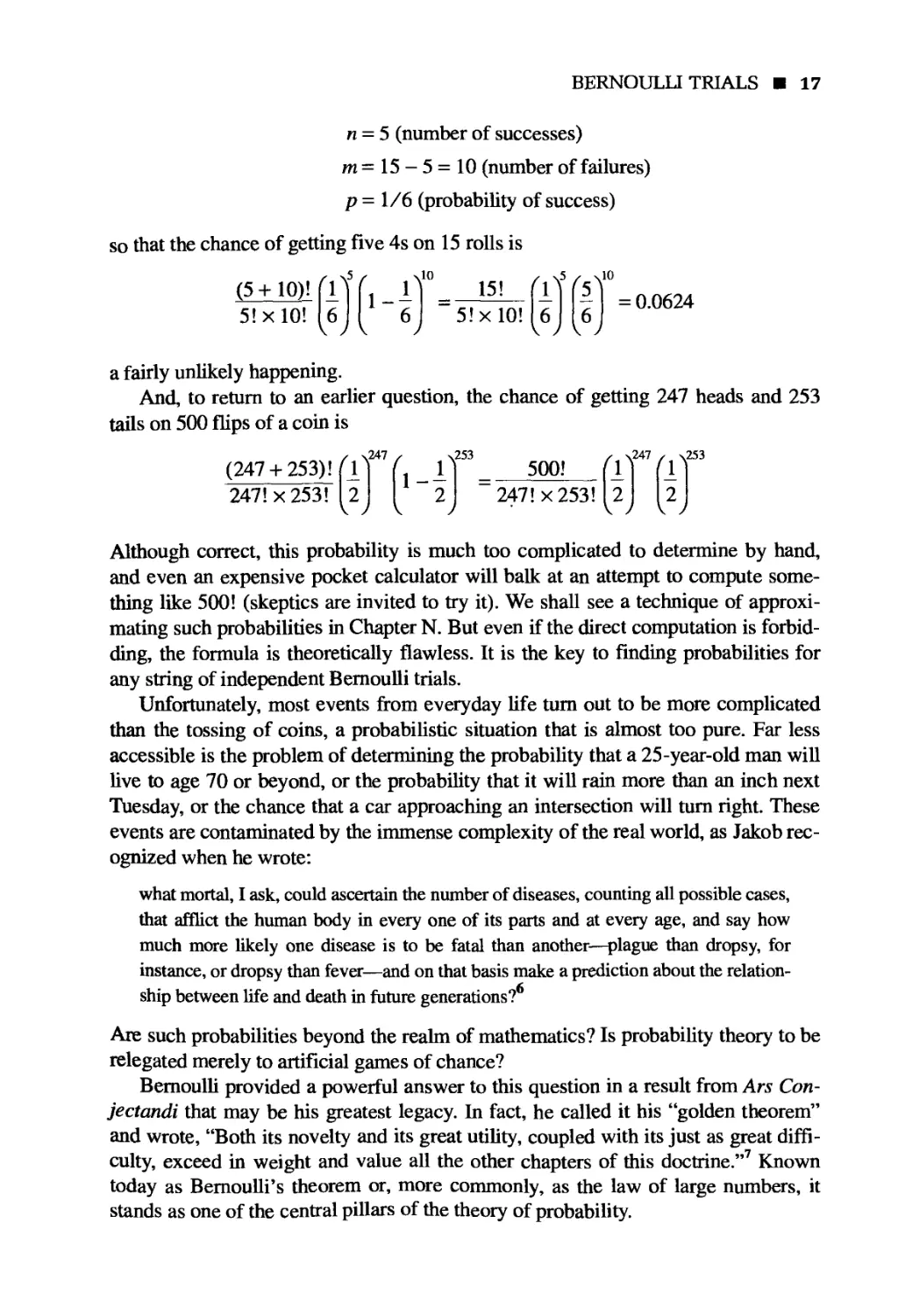
Prob (n successes and m failures) = ^ v pn(\ - p)m
Thus the probability of getting three heads on five flips of a balanced coin is
found by letting n = 3, m = 2, and p = Prob (flipping a head) = 1/2. That is,
Prob (3 heads, 2 tails) = |±f ft] (l -4 = ^ &Vl
J
120 (l
6x2
v
,= 0.3125, or just over 31%
Likewise, to find the probability of getting exactly five 4s on 15 independent
rolls of a die, we declare getting a 4 to be a "success" and assign the values:

BERNOULLI TRIALS ■ 17
n = 5 (number of successes)
m=15-5 = 10 (number of failures)
p=l/6 (probability of success)
so that the chance of getting five 4s on 15 rolls is
xio
(5+10)!
rtfr
5!xl0!
6
V J
1
15!
5!xl0! 6
= 0.0624
a fairly unlikely happening.
And, to return to an earlier question, the chance of getting 247 heads and 253
tails on 500 flips of a coin is
(247 + 253)!
247!x 253!
,247
1-
x253
500!
247!x 253!
247
Although correct, this probability is much too complicated to determine by hand,
and even an expensive pocket calculator will balk at an attempt to compute
something like 500! (skeptics are invited to try it). We shall see a technique of
approximating such probabilities in Chapter N. But even if the direct computation is
forbidding, the formula is theoretically flawless. It is the key to finding probabilities for
any string of independent Bernoulli trials.
Unfortunately, most events from everyday life turn out to be more complicated
than the tossing of coins, a probabilistic situation that is almost too pure. Far less
accessible is the problem of determining the probability that a 25-year-old man will
live to age 70 or beyond, or the probability that it will rain more than an inch next
Tuesday, or the chance that a car approaching an intersection will turn right. These
events are contaminated by the immense complexity of the real world, as Jakob
recognized when he wrote:
what mortal, I ask, could ascertain the number of diseases, counting all possible cases,
that afflict the human body in every one of its parts and at every age, and say how
much more likely one disease is to be fatal than another—plague than dropsy, for
instance, or dropsy than fever—and on that basis make a prediction about the
relationship between life and death in future generations?
Are such probabilities beyond the realm of mathematics? Is probability theory to be
relegated merely to artificial games of chance?
Bernoulli provided a powerful answer to this question in a result from Ars Con-
jectandi that may be his greatest legacy. In fact, he called it his "golden theorem"
and wrote, "Both its novelty and its great utility, coupled with its just as great
difficulty, exceed in weight and value all the other chapters of this doctrine."7 Known
today as Bernoulli's theorem or, more commonly, as the law of large numbers, it
stands as one of the central pillars of the theory of probability.

18 ■ THE MATHEMATICAL UNIVERSE
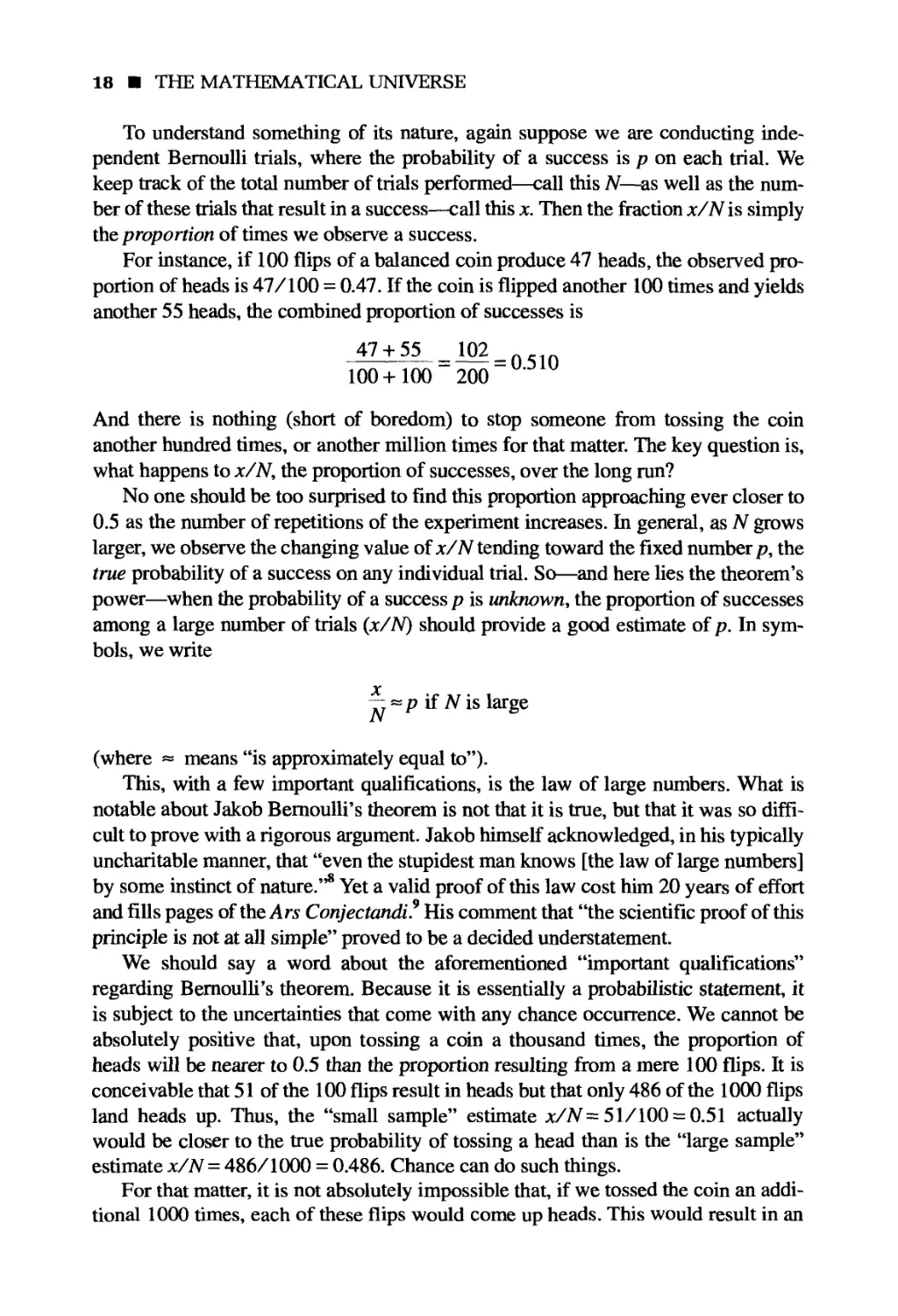
To understand something of its nature, again suppose we are conducting
independent Bernoulli trials, where the probability of a success is p on each trial. We
keep track of the total number of trials performed—call this N—as well as the
number of these trials that result in a success—call this x. Then the fraction x/N is simply
the proportion of times we observe a success.
For instance, if 100 flips of a balanced coin produce 47 heads, the observed
proportion of heads is 47/100 = 0.47. If the coin is flipped another 100 times and yields
another 55 heads, the combined proportion of successes is
47 + 55 102 = 0.510
100+100 200
And there is nothing (short of boredom) to stop someone from tossing the coin
another hundred times, or another million times for that matter. The key question is,
what happens to x/N, the proportion of successes, over the long run?
No one should be too surprised to find this proportion approaching ever closer to
0.5 as the number of repetitions of the experiment increases. In general, as N grows
larger, we observe the changing value of x/Ntending toward the fixed number/?, the
true probability of a success on any individual trial. So—and here lies the theorem's
power—when the probability of a success p is unknown, the proportion of successes
among a large number of trials (x/N) should provide a good estimate of p. In
symbols, we write
x
— ~p if Af is large
(where « means "is approximately equal to").
This, with a few important qualifications, is the law of large numbers. What is
notable about Jakob Bernoulli's theorem is not that it is true, but that it was so
difficult to prove with a rigorous argument. Jakob himself acknowledged, in his typically
uncharitable manner, that "even the stupidest man knows [the law of large numbers]
by some instinct of nature."8 Yet a valid proof of this law cost him 20 years of effort
and fills pages of the Ars Conjectandi.9 His comment that "the scientific proof of this
principle is not at all simple" proved to be a decided understatement.
We should say a word about the aforementioned "important qualifications"
regarding Bernoulli's theorem. Because it is essentially a probabilistic statement, it
is subject to the uncertainties that come with any chance occurrence. We cannot be
absolutely positive that, upon tossing a coin a thousand times, the proportion of
heads will be nearer to 0.5 than the proportion resulting from a mere 100 flips. It is
conceivable that 51 of the 100 flips result in heads but that only 486 of the 1000 flips
land heads up. Thus, the "small sample" estimate x/N= 51/100 = 0.51 actually
would be closer to the true probability of tossing a head than is the "large sample"
estimate x/N = 486/1000 = 0.486. Chance can do such things.
For that matter, it is not absolutely impossible that, if we tossed the coin an
additional 1000 times, each of these flips would come up heads. This would result in an

BERNOULLI TRIALS ■ 19
astounding 1486 heads on 2000 flips, and an estimated probability of 1486/2000 =
0.743. In such a case, the law of large numbers seems to have been repealed.
But not really. For what Jakob Bernoulli proved was that, given any small
tolerance—say 0.000001—the chance that the estimated probability x/N and the true
probability p differ by this tolerance or less can be made as close to 1 as we like
merely by increasing the number of trials. By taking enough trials, we can be almost
certain—Bernoulli used the term morally certain—that our estimate x/N is within
0.000001 of the true probability p.10 Admittedly, we are not 100 percent confident
that p and x/N agree within 0.000001, but the large number of trials makes us
certain enough of this agreement so as not to lose any sleep over the matter.
The situation above in which the probability of flipping a head was estimated as
0.743 after 2000 tosses of a balanced coin is less likely than the chance of a person's
getting hit with a meteor while reading this chapter. Moreover, even if such an
improbable estimate arose, Bernoulli could smugly assert that by conducting more
trials—2000 more, or 2000 million more—the ratio of x/N would, with "moral
certainty," return to the vicinity of 0.5.
It is important to stress that, even with these fairly minor qualifications, the law
of large numbers is provable. This distinguishes it from other famous laws
encountered in life, from Murphy's law to the law of gravity. These are either generally
accepted platitudes (as with the former) or highly regarded physical models (as with
the latter) that are always subject to modification should new evidence arise. But the
law of large numbers is a mathematical theorem, proved within the unforgiving
constraints of logic to stand forever.
And it certainly has its uses. Survival probabilities governing the actuarial tables
of insurance companies are based upon the results of a large number of similar trials
(i.e., of people's lives and deaths). So, too, are the weather forecaster's chances of
rain.
Or consider the example, dating back to the eighteenth century, of finding the
probability that a woman gives birth to a boy rather than a girl. How could anyone
calculate this probability in an a priori fashion? Complex factors of genetics
hopelessly confuse the situation of determining beforehand in some purely theoretical
way the chance of having a boy. Instead, we are forced to launch an "after-the-fact,"
or a posteriori, attack with our weapon being Bernoulli's law.
This very issue was on the mind of John Arbuthnot of England in the early years
of the 1700s. Like others before him, he noted from census records that slightly
more boys than girls were born each year and asserted that this imbalance has been
present "for ages of ages, and not only at London, but all over the world."11
Arbuthnot tried to account for this phenomenon by invoking a divine intervention in human
affairs. Some years later, Nicholas Bernoulli, nephew of Jakob and Johann in this
talented mathematical family, applied the law of large numbers to conclude that the
probability of bearing a boy was 18/35. In other words, the large number of
recorded births showed a marked and stable tendency toward 18 males for every 17
females. Bernoulli's theorem had been put to work "not only at London but all over
the world."

20 ■ THE MATHEMATICAL UNIVERSE
Lake
Bernoulli
Figure B.2
It is still at work today. A technique known as the Monte Carlo method, which
combines Bernoulli's theorem with the power of the computer, has become quite
important in allowing scientists to simulate a wide range of random phenomena in a
probabilistic fashion. The following is a simplistic yet illustrative example of the
Monte Carlo method. Suppose we wish to find the surface area of an irregularly
shaped lake. We could walk its borders or take an aerial photograph, but the lake's
curving and seemingly random boundaries tend to defy any simple mathematical
formula for the determination of its area.
We suppose our lake is mapped in Figure B.2, where we have superimposed the
standard x and y axes onto a diagram. Because we plan to return to this example in
Chapter L, we have chosen a lake that is quite tame—one bounded by the ;t-axis and
the parabolic segment with equation v = Sx - x2.
We shall estimate its area probabilistically. First, enclose the region within the
8 x 16 rectangle shown in the diagram. Next, unleash the computer to select at
random hundreds of (jc, y) points within this rectangle. For instance, the computer might
churn out points A = (3.5, 7.3) or B = (6.0,13.7) as shown.
We now ask the computer whether these random points fall inside the lake or not.
In our example, this question is easily resolved. To check point A, we let x = 3.5 in
the parabola's equation and find the associated value of y = 8(3.5) - (3.5)2 = 15.75.
This means that the point (3.5,15.75) lies on the parabola. Consequently A, with the
same first coordinate but with second coordinate of only 7.3, falls below the
parabola and lands in the water.
Similarly, when considering point B, we" substitute its first coordinate into the
equation and get a value of y = 8(6) - 62 = 12. Hence (6, 12) is on the parabola, so
B = (6, 13.7) falls a bit above the curve and thus hits dry land. With a few millisec-

BERNOULLI TRIALS ■ 21
onds of computer time, we can choose scores of random points and determine
whether or not they fall into the lake.
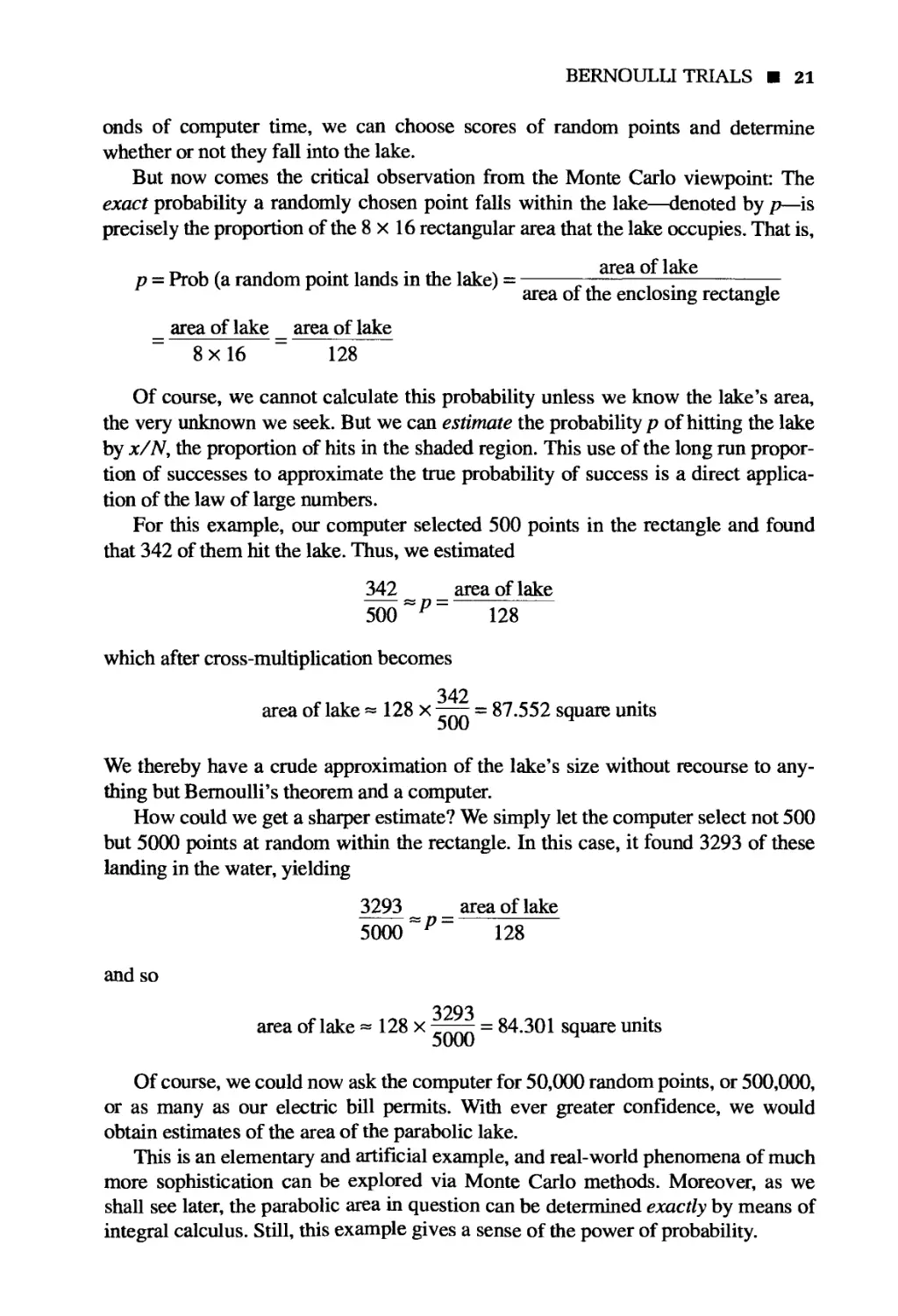
But now comes the critical observation from the Monte Carlo viewpoint: The
exact probability a randomly chosen point falls within the lake—denoted by p—is
precisely the proportion of the 8 x 16 rectangular area that the lake occupies. That is,
p - Prob (a random point lands in the lake) = -~ —: —
area of the enclosmg rectangle
area of lake area of lake
8x16 128
Of course, we cannot calculate this probability unless we know the lake's area,
the very unknown we seek. But we can estimate the probability p of hitting the lake
by x/N, the proportion of hits in the shaded region. This use of the long run
proportion of successes to approximate the true probability of success is a direct
application of the law of large numbers.
For this example, our computer selected 500 points in the rectangle and found
that 342 of them hit the lake. Thus, we estimated
342 area of lake
500 ~P~ 128
which after cross-multiplication becomes
342
area of lake ~ 128 x —- = 87.552 square units
We thereby have a crude approximation of the lake's size without recourse to
anything but Bernoulli's theorem and a computer.
How could we get a sharper estimate? We simply let the computer select not 500
but 5000 points at random within the rectangle. In this case, it found 3293 of these
landing in the water, yielding
3293^ area of lake
5000 ~p~ 128
and so
3293
area of lake » 128 x ——- = 84.301 square units
5000
Of course, we could now ask the computer for 50,000 random points, or 500,000,
or as many as our electric bill permits. With ever greater confidence, we would
obtain estimates of the area of the parabolic lake.
This is an elementary and artificial example, and real-world phenomena of much
more sophistication can be explored via Monte Carlo methods. Moreover, as we
shall see later, the parabolic area in question can be determined exactly by means of
integral calculus. Still, this example gives a sense of the power of probability.

22 ■ THE MATHEMATICAL UNIVERSE
Three centuries have passed since Jakob Bernoulli proved his great theorem. As
is not uncommon in mathematics, his original argument since has been replaced by a
streamlined version that cuts to the heart of the matter much more efficiently.
Today's standard proof depends upon a result due to the Russian mathematician
Pafhuty Chebyshev, whom we met in Chapter A. This approach, involving such
concepts as the expected value and standard deviation of a random variable, allows us to
condense the proof of the law of large numbers into just a paragraph and makes
Bernoulli's multipage argument appear cumbersome indeed. However, in a spirit of
generosity unknown to Jakob we shall resist the temptation to label his work
"useless" because he required a chapter to do "what we have accomplished in the space
of a single page."
Such is the nature of progress. But, as in all human endeavors, it is best to
remember the pioneers. Just as today's laser disk technology provides recorded
music infinitely superior to the scratchy sound of a nineteenth-century phonograph,
so, too, has modern probability theory shortened and simplified Bernoulli's proof of
the law of large numbers. Yet we still revere Thomas Edison in spite of subsequent
advances that have rendered his original creation obsolete. It is only fitting that we
accord the same respect to Jakob Bernoulli for the golden theorem of which he was
so justly proud.

ircle
C D = r
The first two chapters introduced the domains of number theory and probability.
Before proceeding further, we should consider a topic from geometry, one of the
major branches of mathematics. Geometry was the primary focus of the Greek
mathematicians, as we shall see in Chapter G, and has a rich and distinguished history. So
prominent was this subject in the classical world that the words mathematician and
geometer were synonymous. To a great extent, geometry was what
mathematicians did.
One can of course introduce geometry from many different angles. The present
chapter examines the circle, surely one of the most important of geometric concepts.
Circles are simple, elegant, and beautiful, exhibiting a genuine two-dimensional
perfection. In the hands of the Greeks they were of interest not only in themselves but
also as primary tools in the exploration of other geometric ideas.
The terminology of circles has become part of our common vocabulary. By
definition a circle is a plane figure all of whose points lie the same distance from a fixed
point. The fixed point is called the center, and the common distance of all points
from the center is the radius. The distance across the circle through the center is the
circle's diameter, and the length of the circular curve itself—the distance one would
travel in making a complete circuit—is the circumference.
A novice, introduced to circles for the first time, would rather quickly recognize
an essential fact: All circles have the same shape. Some may be large and some
small, but their "circleness," their perfect roundness, is immediately evident.
Mathematicians say that all circles are similar. Before dismissing this as an utterly trivial
observation, we note by way of contrast that not all triangles have the same shape,
23

24 ■ THE MATHEMATICAL UNIVERSE
C = circumference
Figured
nor all rectangles, nor all people. We can easily imagine tall narrow rectangles or tall
narrow people. But a tall narrow circle is not a circle at all.
So, circles are all the same shape. Behind this unexciting observation lies one of
the profound theorems of mathematics: that the ratio of circumference to diameter is
the same for one circle as for any other. Whether the circle is gigantic, with large
circumference and large diameter, or minute, with tiny circumference and tiny
diameter, the relative size of circumference to diameter will be the exactly the same.
Letting C stand for circumference and D for diameter, mathematicians say the ratio
C/D is constant from one circle to another.
What do we call this constant? Never missing an opportunity to introduce a new
symbol, mathematicians chose the sixteenth letter of the Greek alphabet, n, instantly
elevating it to a kind of mathematical immortality. The choice is fitting because the
Greeks were the first to subject the circle to mathematical scrutiny, but the Greeks
themselves did not use % in this sense.
To formalize the concept, we consider Figure C. 1 and introduce:
DEFINITION: If C is a circle's circumference and D is its diameter, then
C/D = n.
When cross-multiplied, this definition yields the famous formula C-nD.
Alternately, because the diameter is twice the radius, we restate this to get the equally
well-known C = 2nr.
Thus % provides the critical connection between circumference (a length) and
radius (another length). It is immensely important, although not intuitively clear, that
this same constant does an equally good job connecting the circle's area and radius.
It is worth a moment's discussion to see why this is so.

CIRCLE ■ 25
Figure C.2
The critical idea is to approximate a circle with an inscribed regular polygon,
that is, a polygon with sides all the same length and angles all the same measure.
Polygons are more accessible figures than circles, yet our knowledge of polygons
can lead us to an understanding of the circles within which they lie.
In Figure C.2 we see a regular pentagon inscribed in a circle of radius r. To
determine the pentagon's area, we draw radii from the circle's center to the five vertices
on the circle, thereby breaking the pentagon into five triangular pieces. Each triangle
has base of length b, the side of the pentagon, and height h, the dotted line drawn
perpendicularly from the center of the circle to the side of the polygon and called the
apothem. By the well-known formula for triangular area, we see that
area(each triangle) =
- (base) (height) = - bh
and so
area(inscribed pentagon) = 5x area (each triangle) = 5 x
\t*\=
h\x5b
But 5b is just five times the length of the pentagon's side and consequently is the
pentagon's perimeter. In short, we have established that
area(regular pentagon) =
— h | x perimeter
A moment's thought reveals that the same formula holds whether we inscribe
within the circle a regular 5-gon or 20-gon or 1000-gon. For the general case, in
which is inscribed a regular n-gon, the polygon will be divided into n little triangles,
each with apothem h (the distance from the center of the circle perpendicular to the
side) and base b (the length of a side of the n-gon). Hence

26 ■ THE MATHEMATICAL UNIVERSE
area(polygon) = nxarea (triangle) = nx\Jzbh
^
x nb = | - h
x perimeter
because the perimeter is n times the length b of each side.
Now imagine inscribing consecutively a regular 10-gon, a regular 10,000-gon, a
regular 10,000,000-gon, and so on, increasing the number of sides without end. It is
clear, at least intuitively, that in this fashion the polygons will gradually "fill up"—
the Greeks said "exhaust"—the circle, and the areas of the inscribed figures will
approach the circular area as an upper limit. Using the notation lim to stand for limit,
we see that
area (circle) = lim [area (regular inscribed polygons)] = lim
A
x perimeter
Never will an inscribed polygon have exactly the same area as the circle, for straight
sides, no matter how tiny, will never coincide precisely with a circular arc.
Nonetheless, the polygonal areas will approach the limiting area of the circle as closely as
one wishes.
Two questions remain: What happens to the apothem and to the perimeter as the
number of polygonal sides increases indefinitely? Clearly h will have as its limit the
radius of the circle. Likewise the limiting value of the perimeters of the inscribed
regular «-gons will be the circle's circumference. These facts can be stated
symbolically as
lim h = r and lim (perimeter) = C
Hence
area(circle) = lim
\
x perimeter
/
= \~r
xC =
rC
At last 71 makes its appearance, for we noted above that C = %D = 2%r. The
preceding formula thus becomes:
Inr2
area(circle) = — =
r(2nr)
= nr
This is without doubt one of the key formulas in all of mathematics, one that
resonates not only with mathematicians but even with newspaper cartoonists (see
example, opposite).
So, if we want to find either the circumference or the area of a given circle, we
are sure to encounter n. But this raises a practical problem, namely, to determine the
value of this key ratio. After all, K is only a symbol for a real, honest-to-goodness
number, and anyone having to do a calculation with circles needs to know that
number (at least approximately). One can no more find a circle's numerical area using
only the symbol n than one can bake a cake using only the word egg.

CIRCLE ■ 27
FRANK & ERNEST® by Bob Thaves
-FF3
/4 = «ajc*x r*
As Tart x r*
(FRANK & ERNEST, reprinted by permission of NEA, Inc.)
The simplest way to approximate the ratio C/D is to measure the circumference
and diameter of a particular circle and divide the former by the latter. For instance, a
piece of string wrapped around the outside of a bicycle tire measured 82 inches,
whereas another piece stretched diametrically across the tire came out at 26 inches.
Our real-world experiment thus yielded the estimate: K = C/D = 82/26 = 3.15 ...,
where = stands for "is approximately equal to," as it did in the previous chapter.
Unfortunately, when a similar procedure was applied to the circumference and
diameter of the circular top of a coffee can, we got n = C/D ~ 18/6 = 3.00, which is not
terribly close to the first estimate. Physical measurements such as these obviously
introduce inaccuracies, and in any case tangible coffee cans or bicycle wheels are
not perfect, mathematical circles.
For a purely mathematical estimate of the ratio of circumference to diameter, we
turn to Archimedes of Syracuse (287-212 B.C.), a revered figure from the history of
mathematics. Absentminded, self-absorbed, and somewhat eccentric, Archimedes
was recognized as a scientific genius even in his own time. For better or worse, he is
probably best remembered today for the incident with the crown of King Hieron.
According to legend, the king of Syracuse had given a craftsman a certain
amount of gold to be made into an exquisite crown. When the project was
completed, a rumor surfaced that the craftsman had substituted a quantity of silver for an
equivalent amount of gold, thereby devaluing the crown and defrauding the king.
Was the rumor correct? The task of uncovering the truth was assigned to
Archimedes. We pick up the story with the words of the Roman architect Vitruvius:
While Archimedes was considering the matter, he happened to go to the baths. When
he went down into the bathing pool he observed that the amount of water which
flowed outside the pool was equal to the amount of his body that was immersed. Since
this fact indicated the method of explaining the case, he did not linger, but moved with
delight, he leapt out of the pool, and going home naked, cried aloud that he had found
exactly what he was seeking. For as he ran he shouted in Greek: eureka, eureka]1
Although of questionable authenticity, this is certainly a famous story. Probably
no other tale in all of science combines the elements of brilliance and bareness quite
so effectively.

28 ■ THE MATHEMATICAL UNIVERSE
Figure C.3
Historians report that Archimedes often did his mathematics by drawing figures
in the sand. It is even said that he carried a portable sand tray, the laptop computer of
the time. When inspiration struck, he would place the tray upon the ground, smooth
out the sand, and begin to draw his geometric diagrams. From today's perspective,
such a medium offers clear disadvantages: A strong burst of wind could blow away a
brilliant proof; a bully could kick a theorem into your face; and should a cat wander
into the tray, the outcome could be too disgusting to contemplate.
Yet Archimedes prevailed, creating a body of mathematics that left not only his
contemporaries but also generation after generation of scholars in awe. We return to
him in Chapter S, where we examine in some detail one of his greatest triumphs, the
determination of the surface area of a sphere. But here the focus is on his splendid
estimate of the ratio of circumference to diameter—in other words, his
approximation of 71.
Archimedes' strategy, like that above, approached the circle via regular
polygons. The following development, although employing modern notation and a
slightly different starting point, is consistent with that strategy. It requires only a bit
of algebra and the Pythagorean theorem. The latter, of course, states that in a right
triangle the square on the hypotenuse equals the sum of the squares on the other two
sides. (A discussion of the theorem of Pythagoras is available to anyone who wishes
to turn to Chapter H.)
We refer to Figure C.3, where we have inscribed square ABCD in a circle.
Because the ratio of circumference to diameter is the same for all circles, we might
as well make our job easier by choosing the radius of this circle to be r = 1. Thus the
square's diagonal, the dotted line in the figure, is the circle's diameter, 2r = 2.
We denote by s the length of each side of the square, so that right triangle ABD
has two sides of length s and hypotenuse of length 2. From the Pythagorean theorem

CIRCLE ■ 29
it follows that s2 + s2 = 22, so that 2s2 = 4 and s = V2~. Consequently the perimeter of
the square is P = 4s = 4^2^
The square's perimeter provides a first, albeit rough, estimate of the circle's
circumference. Replacing circumference by perimeter, we get
diameter diameter 2
This approximation of n as 2.8284 is dreadfully inaccurate, worse even than the
bicycle-tire estimate above. If we cannot do better than this, we should go back to
the drawing board, or perhaps the sand tray.
But in the spirit of Archimedes we improve upon the first estimate by doubling
the number of sides of the polygon, thereby getting a regular inscribed octagon and
letting its perimeter be our next estimate of the circle's circumference. We double
again to get a regular inscribed 16-gon, then a 32-gon, and so on. It is clear that at
each step our estimate will be sharper. It is also clear that the major obstacle in our
way is determining how the perimeter of one of these polygons relates to that of the
next
This obstacle is readily overcome with another application of the Pythagorean
theorem. Figure C.4 shows a portion of a circle with center O and radius r = 1. The
line segment AB of length a is a side of a regular inscribed «-gon. By bisecting AB at
D and drawing a radius through D out to the circle at C, we generate segment AC, a
side of a regular inscribed 2«-gon. If b is the length of AC, we wish to determine the
relationship between a and b\ that is, between the side of a regular inscribed polygon
and that of a regular inscribed polygon with twice as many sides.
Figure C.4

30 ■ THE MATHEMATICAL UNIVERSE
Notice first that A ADO is a right triangle having hypotenuse of length r = 1 and
leg AD of length (l/2)a. If x represents the length of leg OD, the Pythagorean
theorem guarantees that
i* I1
1 = \-a
, 2 CI 2 v 2 -,
+ x = — + x —»x = 1
4
->x
-vr
4
Because the length of CD is clearly the difference between the length of OC (a
radius) and that of OD, we conclude that CD has length
l-jc=l-Vl-?
Applying the Pythagorean theorem once more to the shaded right triangle ADC
yields
b2 = \la
Y 2
+ (1-jc)2 = ^+1-2x + x2
a + ^\\ + cl .
= — +1-2V1-— +1
- = 2-2
V^T
because the a2/4 terms cancel. We simplify this expression by moving the 2 from
outside to inside the radical, squaring it in the process, to get
b2 = 2
-2>/l^? = 2- \<
= 2-4
A-al
and finally arrive at
b
= V2-V4^
Now we return to the problem of estimating n. Recall that the side of our
inscribed square was s = V2~. This plays the role of a as we apply the formula above
to calculate the side of a regular inscribed octagon:
6= \2-V4-a2 = \2-V4-(V2)2 =^2-^4-2 = V2^Vf~
Thus the perimeter of the octagon is 8 x b = 8 V 2 - ^2 and we estimate n by
^ = circumference ^ perimeter = 8^2-^ = 4^Z^f = 3.061467459 .
diameter diameter 2
Next we move to the 16-gon. This time a = V 2 - V2~, the side of the octagon just
determined, and we use it to find b, the side of the 16-gon:

CIRCLE ■ 31
^2-^4^7 = \2-V4-(V2^
<2?
-(2-V2) = V2-V2 + V2"
So the 16-gon's perimeter is
16x&=16\2-V2 + V2"
and our improved estimate of n is
B=c^a4^sg^fsll21wl5J...
D diameter 2
Now we are getting somewhere. Another doubling and application of the formula
yields the perimeter of a regular inscribed 32-gon as
32 \ 2- \2 + V2 + V2~
so that
^ perimeter = 16V2 - ^2 + V^WT =
diameter
3.136548491
And on we go. Obviously we can repeat the procedure as often as we wish. In fact,
the developing pattern makes the transition from one step to the next quite painless.
With the assistance of a hand calculator, we doubled seven more times, to a 64-
gon, a 128-gon, a 256-gon, a 512-gon, a 1024-gon, a 2048-gon, and a 4096-gon. It is
evident that a regular 4096-gon, though not coinciding with the circle in which it is
inscribed, is pretty close. This yields an estimate of n as follows:
C perimeter
D diameter
= 2048
= 3.141594618...
This expression, whose very appearance suggests a certain mathematical artistry,
is accurate to five decimal places. More important is that we know how to get a more
accurate estimate: Just carry the pattern a step further or, should the mood strike, 50
steps further. In this manner the constant n can be approximated as closely as we
wish.

32 ■ THE MATHEMATICAL UNIVERSE
This basic approach using regular polygons dates back 22 centuries to
Archimedes. But it has one liability: the need to calculate square roots of square roots of
square roots. With each additional doubling of the number of sides, we embed
another square root in the design and complicate the process accordingly.
Archimedes, who had neither a decimal system nor a hand calculator, had to weather the
storm of square roots by finding fractions of roughly equal value. He stopped with
the 96-gon. That he was able to get that far is a testimony to his genius.
But is there an easier, more efficient route to the same end? The answer is yes,
although it remained obscure until the discovery of calculus and infinite series
during the seventeenth century. Only then could mathematicians find truly efficient
approximations of 7t. Although this topic is one of considerable subtlety, we would
like to give at least a sense of the line of attack.
There is an important function called the inverse tangent (denoted by tan"1*)
whose origins lie in the domain of trigonometry and need not concern us here. What
is important is that we can express tan"1* as the infinite series
tan lx
'* 3 + 5 7 + 9 11 13"
where the summation process continues indefinitely in the obvious pattern. The
further we carry the arithmetic, the closer we get to the true value of tan"1*.
But what does this have to do with 71? It can be proved, using trigonometry, that
71 = 4
. -i 1 „ -i 1 -i 1
tan - + tan - + tan -
2 j o
Then we approximate tan-11/2, tan"1 1/5, and tan"11/8 by putting, respectively,
* = 1/2, x = 1/5, and * = 1/8 into the series shown above. Carrying the
computations in each series through seven terms yields
71 = 4
111
tan"1 - + tan"1 - + tan"1 -
2 j o
1/2 (1/2)3 + (1/2)5 _ (1/2)7 + (1/2)9 _ (1/2)" + (1/2)13
11
13
J1/s i!Z5)\l!Z5)! {l/5j\il/5)! (1/5)" (1/5)13 )
+ [1/5~ 3 + 5 " 7 + 9 ' 11 + 13 J
J.„ (1/8)' (1/8)5 (1/8)' HZ?)! (1/8)" (1/8)13
+ [1/8"~T- + ~^~~ 7 + 9 " 11 + 13
= 4(0.785399829 ...) = 3.141599318 ...
Like our previous estimate, this is accurate to a good number of decimal places.
But whereas the previous approximation introduced many square roots—each of

CIRCLE ■ 33
which required its own approximation procedure—this estimate is computed
without a square root anywhere in sight! By introducing the infinite series for tan"1*,
mathematicians avoided the square root nightmare altogether.
This discovery, made about three centuries ago, allowed for tremendous progress
in the calculation of n. But a more recent advance must also be noted: the use of
computers to facilitate the calculations. In 1948 (before computers), n was known to
808 decimal places. A year later, the ENIAC computer—abysmally primitive by
modern standards—pushed the accuracy to 2037 places.2 The magnitude of the
improvement suggests a truism: All subsequent computations of n would be done
using computers. Indeed, digit searching has become a kind of passion for a small
but dedicated band of number crunchers. In rapid succession, accuracy grew to
100,000 digits, a million digits, and then a stunning billion digits. Such calculations
tend to be performed on powerful supercomputers at major universities or large
research centers.
Bucking this trend, however, are David and Gregory Chudnovsky, two brilliant
and eccentric brothers who computed n to two billion digits by wiring together
mailorder computer components in their Manhattan apartment. Their project filled table-
tops with computer equipment and hallways with cables, and the heat generated
by all this electronic gadgetry raised the apartment temperature to hellish
proportions. Nonetheless, the Chudnovskys pulled it off. The contrast between their
approach and that of the universities is the mathematical counterpart of David (and
Gregory) versus Goliath, although in this case the underdogs are armed with silicon
slingshots.3
If the Chudnovskys of New York are lone wolves who successfully attacked n,
Dr. E. J. Goodwin's solitary assault was spectacularly unsuccessful. His story is
familiar to mathematicians but always bears a good retelling.
It occurred during the last years of the nineteenth century. Dr. Goodwin lived in
Solitude, Indiana, a well-named town that was tiny, remote, and dull. To occupy his
time, the good doctor dabbled in mathematics, unfortunately with more enthusiasm
than ability. He believed he had made a tremendous discovery about the relationship
between a circle's area and its circumference, which in turn would imply a
tremendous discovery about n itself.
Great mathematical advances should be shared with the academic community,
but Dr. Goodwin adopted a different tactic. He took his case into the political, not the
scholarly, arena by asking his representative in the Indiana General Assembly to
introduce the following as House Bill 246 of the year 1897: "Be it enacted by the
General Assembly of the state of Indiana, That it has been found that a circular area
is equal to the square on a line equal to the quadrant of the circumference."4
Apparently, the political leaders of 1897 were no more adept mathematically than their
modern counterparts, for they found this perfectly acceptable. But what did it mean?
As shown in Figure C.5, Goodwin's bill asserted that the area of the circle on the
left equalled that of the square on the right, where the latter has each side exactly as
long as the circle's quadrant, that is, as one-fourth of its circumference. If we denote

34 ■ THE MATHEMATICAL UNIVERSE
-c
1 4
ic
4
Figure C.5
the circle's radius by r and circumference by C = 2nr, we know that the area of the
circle is nf and that of the square is
If, as Goodwin claimed, these areas are equal, then it follows that
nf = area(circle) = area(square) = — TtV
Upon cross-multiplying, we get 4ti^ = 7cV and cancellation of nf from each side
yields the remarkable result that n - 4.
Although Archimedes would have turned over in his grave, none of the Hoosier
lawmakers was much troubled by this conclusion. To them, the language probably
sounded abstruse enough to be unassailable. The bill passed its first committee,
strangely but perhaps appropriately the House Committee on Swamp Lands. On
February 2, 1897, it was passed by the House Committee on Education. Three days
later, the entire Indiana House of Representatives voted "aye" on Goodwin's
assertion that n = 4.
At some point along the way, the matter began to attract attention from the press.
The Indianapolis Sentinel weighed in with its support:
The bill... is not intended to be a hoax. Dr. Goodwin .. . and State Superintendent of
Public Instruction Geeting believe that it is the long-sought solution Dr. Goodwin,
the author, is a mathematician of note. He has it copyrighted and his proposition is that
if the legislature will endorse the solution, he will allow the state to use [it] free of
charge.
Besides revealing that the superintendent of public instruction supported the bill,
this passage gives a possible rationale for these strange goings-on: The legislators

CIRCLE ■ 35
coveted the national or even international royalties owed to Indiana by all who
would use this new value of n.
House Bill 246 moved to the Senate's Committee on Temperance. This it passed
on February 12 and was now on its way to full Senate approval and the status of law.
Fortunately the bill was derailed at the last moment. Its downfall was largely due
to the efforts of Purdue mathematician C. A. Waldo, who was in Indianapolis at the
time. Waldo gave this third-person recollection of what happened when he visited
the capitol: "A member then showed the writer a copy of the bill... and asked him if
he would like an introduction to the learned doctor, its author. He declined the
courtesy with thanks, remarking that he was acquainted with as many crazy people as he
cared to know." 6
With the professor's negative appraisal, support for the legislation collapsed. On
the afternoon of February 12, the Senate indefinitely postponed the proposal, and it
remained legal for k to equal 3.14159 ... in Indiana as elsewhere. Senator Hubbell,
an insightful opponent of the bill, summed it up nicely when he grumbled, "The
Senate might as well try to legislate water to run up hill."
Circles and n have thus intrigued people from the sand trays of Archimedes to
the legislative halls of Indianapolis. We shall meet both concepts again in later pages
of this book, for they are central to the mathematical enterprise. For now, we leave
the reader with the first 30 decimal places of one of the world's great numbers:
71 = 3.141592653589793238462643383279 ...

lim
h '0
* ifferential
Calculus
During the year 1684 a mathematical paper appeared in an issue of the journal Acta
Eruditorum. Its author was Gottfried Wilhelm Leibniz, a German scholar and
diplomat with broad interests and virtually limitless abilities. The paper was a densely
packed mixture of Latin words and mathematical symbols, and contemporary
readers probably found litde in it that was comprehensible. From the modern
perspective, the best clue to the subject matter is a word appearing inobtrusively near the
end of the title: calculi.
This was the first published version of calculus. Its title translates as "A New
Method for Maxima and Minima, as well as Tangents, which is impeded neither by
Fractional nor Irrational Quantities, and a Remarkable Type of Calculus for This."1
Here the word calculus means "set of rules," in this case rules applicable to
problems about maximum and minimum values and tangents that Leibniz proclaimed to
be impervious to the onslaughts of fractional or irrational quantities. Because of the
significance of his discovery, the word calculus has achieved mathematical
immortality. In truth, when mathematicians want to lend special emphasis to the
subject, they call it "the calculus," which sounds even more awesome.
Awesome it is. In the traditional undergraduate curriculum, calculus serves as an
entry (and, unfortunately for some, as a barrier) to higher mathematics. It has
become an indispensable tool for engineers, physicists, chemists, economists, and
many others. Calculus was certainly the crowning achievement of
seventeenth-century mathematics, and many regard it as the crowning achievement of mathematics,
period. John von Neumann (1903-1957), one of the twentieth century's most
influential mathematicians, wrote that "The calculus was the first achievement of modern
37

38 ■ THE MATHEMATICAL UNIVERSE
mathematics, and it is difficult to overestimate its importance."2 (Note von
Neumann's reference to the calculus.)
Leibniz's 1684 paper was about differential calculus, one of the two branches of
the subject. The other, integral calculus, was introduced by Leibniz in a 1686 issue
of the same periodical and is our subject in Chapter L.
Before taking a look at differential calculus, we should say a brief word about its
origins. Although it was Leibniz who first published an account of calculus in the
mid-1680s, it was Isaac Newton who first developed the subject during the years
1664-1666. Newton, a student at Trinity College of Cambridge University, created
what he called "fluxions," a body of rules with which he, too, could find maxima
and minima, as well as tangents, and which were not impeded by fractional nor
irrational quantities. In short, his fluxions anticipated what Leibniz would publish as
calculus two decades later.
Modern scholars accord both individuals the honor of independent discovery.
But mathematicians of the time, suspecting some kind of plagiarism at work, were
far less generous about assigning credit. An acrimonious controversy developed
between the British, staunch advocates of Newton's priority claims, and the
continental mathematicians, equally staunch defenders of Leibniz. This dispute, one of
the most unfortunate episodes from the entire history of mathematics, is considered
at length in Chapter K.
What was it Newton and Leibniz discovered? At the heart of differential calculus
are the notions of slope, a concept regularly introduced in high school algebra, and
tangent, a key idea from high school geometry. The latter appeared in Leibniz's title,
but it is with the former that our treatment begins.
Suppose we have a straight line graphed in the coordinate plane. We might
investigate the jc-coordinates or the y-coordinates separately, but it is often beneficial to
examine how x and y vary jointly. For instance, if x increases by 4 units, what
happens to the associated y values?
A little thought indicates that the answer depends on the steepness of the line in
question. In Figure D.l, the left-hand line rises gradually, so an increase of 4 units in
x (that is, 4 units horizontally) results in very little change in y (that is, very little
vertical change). But for the steeper right-hand graph, an increase of 4 in x yields a
significant rise in y.
To put this concept on firmer mathematical ground, we define the slope of a line
by:
change in y rise
change in x run
If a straight line has slope = 2/5, then as x grows by 5 units, y simultaneously grows
by 2 units, a fairly gradual rise. On the other hand, a slope of 5/2 means as x
increases by 2, y increases by a hefty 5 units, a much steeper climb. If we were
required to haul a piano up an inclined ramp, we would prefer a slope of 2/5 to one
of 5/2.

DIFFERENTIAL CALCULUS ■ 39
H—l—I 1—I—I—I—fi x _f
Figure DA
The usual symbol for slope is m, and as illustrated in Figure D.2, the formal
definition for the slope of a line passing through the points (xu yi) and (x2, y2) is
change iny yi~yi
change in jc jc2 - X\
For a line with slope 5/2, an increase of 2 units horizontally results in a rise of 5
vertically. Hence if jc were to grow by 3 x 2 = 6 units, the accompanying growth in y
would be 3x5 = 15 units. Likewise—and this is critical for interpreting slope—a
rightward increase in x of a single unit would lead to an increase in y of 5/2 = 2.5
units. For a line with slope 2/5, an increase of 1 unit in jc results in an increase of
2/5 = 0.4 units in y. Thus, we can think of the slope of a line as the change in y per
unit change in jc. Quite simply, the slope tells us what y does when x increases by 1.
O^'^)
>* x
Figure D.2

40 ■ THE MATHEMATICAL UNIVERSE
All of this might seem empty of any real-world significance, but nothing could
be further from the truth. Suppose, for instance, we are considering the motion of an
airplane, where x represents the amount of time the plane has been aloft and y is the
distance it has flown during those x hours. Assuming that the graph of this x-y
relationship is a straight line, we interpret the line's slope to be the change in distance
(change in y) per unit change in time (change in x). That is, the slope represents the
plane's velocity measured in miles per hour. That velocity is a subject of importance
to airplane pilots is undeniable. That it is intimately linked to the abstract
mathematical concept of slope gives an indication of why this idea holds such importance
beyond the realm of pure mathematics.
Or consider an economic problem. We are plotting two variables related to a
manufacturing process: x is the number of units produced and y is the profit resulting
from the sale of x units. If the x-y relationship is linear, we interpret the slope as the
change in profit per unit change in sales; that is, the additional profit we make from
each additional item sold. Economists are so enamored of this concept that they give
it a special name, marginal profit, and its value can determine the course of great
industries.
There are many other examples of slopes arising in natural ways. Such measures
as miles per gallon, feet per second, or price per pound indicate that a slope is
lurking nearby. Without doubt, some of the most important applications of mathematics
involve the rate of change of one quantity with respect to another that is embodied in
the idea of slope.
For our examples thus far, a unit increase in x resulted in an associated increase
in y. Graphically, this means the line is climbing as we move toward the right. But
not all linear relationships are of this type. We obviously can encounter cases in
which an increase in x leads to a corresponding decrease in y. Returning to the
airplane example, we might let x be the time aloft and y be the distance of the plane
from its destination. In this case, as x grows, y shrinks. Such situations are illustrated
by the line on the left in Figure D.3, where, as x increases by 2, y decreases by 5.
Here
change in y -5 - _
m = ——p . ^ = -— = -2.5
change in x 2
A final case, and one of particular importance for differential calculus, is that of
the horizontal line on the right in Figure D.3. Here, an increase in x results in neither
an increase nor a decrease in y, because y is unchanging. Consequently,
change in y 0
m= u . / =~7 :— = 0
change m x change in x
In summary, an uphill line has positive slope; a downhill line has negative slope; and
a horizontal line, at the boundary between uphill and downhill, has slope of zero, at
the boundary between positive and negative. It is all very consistent.
Unfortunately this theory is applicable only to straight lines, which exhibit the
same inclination—the same slope—throughout their length. Lines are certainly of

DIFFERENTIAL CALCULUS ■ 41
slope = -5/2
y
hrX
slope = 0
-J—I—h
-*JC
Figure D.3
great importance in mathematics, but it is obvious that many real-world phenomena
produce variable, nonlinear behavior. Airplanes do not fly at a constant velocity;
manufacturing processes do not exhibit a constant marginal profit. How, if at all, can
we determine slopes of curves? In addressing this question, we finally move into the
realm of differential calculus.
To illustrate the problem, consider the graph of the parabola y = x - 4x + 7
shown in Figure D.4. When x = 3, we find y = 32 - 4(3) + 7 = 4 and label the point
(3,4) on the curve as A.
Clearly a parabola does not have a constant slope throughout. As we move along
the curve, we constantly change direction, from a downhill plunge on the left, to a
leveling out at the bottom, to an ever steeper rise toward the right. A basic principle
is evident: For curves, unlike lines, the slope changes from point to point.
So how can we determine the slope of this curve at A? Geometrically, it seems
reasonable to draw the tangent line to the parabola at A and interpret the slope of the
(curving) parabola to be the slope of the (linear) tangent at this point. The
reasonableness of this approach is suggested by the following scenario.
Suppose we are riding in a tiny vehicle along this parabolic path. We have
descended from the left, leveled out, and now are climbing toward the right, all the
time heading more steeply upward. Precisely as we reach the point (3, 4), we
suddenly fly out of the vehicle and continue in a straight line (with the arrow in Figure
D.4) as the vehicle curves up and away on its parabolic path. Our line of flight is
thus tangent to the curve at (3, 4), and the slope of this tangent line is what we shall
mean by the slope of the parabola at the point A.
This much is easy. Less obvious is how to find the tangent's slope. Before
examining the solution, we should mention where the difficulty lies. Because slope is
defined by
y2-yi
m~ —
Xi — X\

42 ■ THE MATHEMATICAL UNIVERSE
* x
Figure DA
two points on a line are necessary in order to compute it. In the example above,
however, we know only a single point on the tangent line, namely A = (3,4) itself. If we
knew the identity of just one other point on the tangent, finding its slope would be a
snap. Without such knowledge it may seem as though we have reached a dead end,
but differential calculus provides a way around this roadblock by approaching the
slope of the tangent line indirectly. It is a wonderfully ingenious line of attack.
For our problem, where we want the slope of the tangent line at x = 3, we first
consider what happens at x = 4. At the moment there is no way to know the point on
the tangent line corresponding to x = 4, but we can determine the point on the
parabola for x = 4, namely y = 42 - 4(4) + 7 = 7. We label the point (4, 7) as B in Figure
D.5, which shows an enlargement of the critical portion of the curve. It is easy to
find the slope of the straight line, called the secant, connecting A and B:
y2-yx 7-4 3 -
m = = -—- = — = 3
x2 - JCi 4-3 1
This is a perfectly simple calculation; unfortunately it is not the slope of the tangent
line itself but that of the secant line, a rough approximation. How can we improve
the estimate?
Why not choose a point on the parabola closer to A than was Bl Perhaps let
x - 3.5. The associated y value is 3.52 - 4(3.5) + 7 = 5.25, so the point C with
coordinates (3.5, 5.25) is on the parabola. The secant line connecting A and C has slope
m =
y2-yj 5.25-4 1.25
x2 — X\ 3.5 — d
0.5
-2.50

DIFFERENTIAL CALCULUS ■ 43
y = X Z ~ Ax + 7
/ / (3.5, 5.25)
A/S (3.1,4.21)
tangent ^(3,4)
Figure D.5
If one imagines drawing the line between A and C on Figure D.5, it will clearly be a
better approximator to the tangent than was our first try, that between A and B.
Consequently, the slope of 2.50 is closer to the slope of the tangent than was our first
estimate of 3.00.
The next step should be predictable: Take a point on the parabola even closer to
A. For instance, let x = 3.10 so that y = 3.102 - 4(3.10) + 7 = 4.21, and let D be the
point (3.10,4.21). The secant line connecting A and D lies quite close to the desired
tangent, and the slope of the former is
m = '
:3fr~yi
X2 —X\
4.21-4
3.10-3
0.21
0.10
= 2.10
We continue in this fashion, letting our points slide down along the parabola
toward A and computing the slopes of the associated secant lines as we go. Such a
string of computations appears in the accompanying chart.
Point on Parabola
(4.0, 7)
(3.5, 5.25)
(3.10,4.21)
(3.01, 4.0201)
(3.0001,4.00020001)
Slope of Secant
Connecting This Point with A
3.0
2.5
2.10
2.01
2.0001

44 ■ THE MATHEMATICAL UNIVERSE
Figure D.6
A pattern is evident. As our point moves along the parabola toward A = (3, 4), the
associated secant lines are rotating toward ever better approximations of the tangent
line, and their slopes provide ever more accurate estimates of the elusive slope of the
tangent. In our example, we readily surmise that the exact slope of the tangent in
question is the number toward which these estimates are tending: The slope of the
tangent to the parabola y = x2 - 4x + 7 at the point (3, 4) appears to be 2.
So far, so good. But what if we needed the slope of the tangent to the same
parabola at the point (1, 4)? We would have to run through similar calculations and
prepare a similar chart. And what if we were then given a dozen additional points at
which the slope of the tangent was required? We would face a dozen more charts,
and the whole business would become excessively tedious. Can the process of
finding slopes of tangents be streamlined?
Of course. This, in fact, is what was accomplished by the rules Leibniz described
in his 1684 article. The streamlining requires us to adopt a slightly more general—
which is to say, more algebraic—viewpoint. Instead of focusing on the point (3, 4),
we want to develop a formula for the slope of the tangent at any point P on any
parabola y = ax2 + bx + c.
Let P have coordinates (jc, y), where y = ax2 + bx + c. As above, choose a point
near (x, y) and use the slope of the secant to approximate the slope of the tangent.
As Figure D.6 indicates, it is customary to denote the first coordinate of the
"nearby" point as x + h. In so doing, we regard h as a tiny but unspecified amount, a
small increment that moves us just a bit beyond x. The associated point on the
parabola is labeled Q in the diagram. To find its second coordinate, we merely substitute
x + h into the parabola's equation; in other words, replace each occurrence of x by
x + h. This gives Q's second coordinate as

DIFFERENTIAL CALCULUS ■ 45
a(x + hf + b(x + h) + c = tfC*2 + 2x7* + A2) + 6(x + h) + c
= ax2 + laxh + ah2 + bx + bh + c
so Q is the point (x + h, ax2 + 2ojc/i + a/*2 + fcx + bh + c). The reader will notice that
the algebraic intensity of the problem has been turned up a notch or two, but the
benefits of a general formula will be worth the effort.
The next step is to use the formula for m to determine the slope of the secant line
between P and Q:
?2 - yi (ax2 + laxh + ah2 + bx+bh + c)- (ax2 + bx + c)
x2 - jci (x + h)—x
ax2 + 2ojc/i + aft2 + bx + foft + c - ax2 - fac - c
x + h-x
laxh + ah2 + fcft
A
after combining like terms in numerator and denominator
h(lax + ah + b)
h
after factoring h out of the numerator
= lax + ah + fc
upon cancelling the common A
In short, for any small increment h, the slope of the secant line between P and Q
is given algebraically by lax + ah + b. But the idea of "sliding" Q toward P along
the parabola amounts to nothing more than letting h tend ever closer toward zero. In
other words, we determine the exact slope of the tangent by taking the Umit of the
slopes of the secant as h approaches zero. For our example, the slope of the tangent
is therefore given by:
lim (lax + ah + b) = lax + a(0) + b = lax + b
because a, b, and x remain unchanged as h moves toward zero. (The symbol lim is
read "the limit as h approaches 0.") h ~* °
We note in passing that we can apply this general formula to the specific
parabola y - x2 - Ax + 7 cited above. Here, a = 1, b = -4, and c = 7. Thus, at the point A
where x = 3, the slope of the tangent line will be lax + b = 2(1) (3) + (-4) = 2, as
our chart suggested. If we wanted the slope of the tangent at (1,4), we merely let
x=l and get a slope of 2(1) (1)-4 = -2; the graph confirms the parabola is
descending at this point, consistent with the negative slope.
To repeat: The slope of the tangent to a curve is taken to be the limit of the slopes
of the associated secants as h goes to zero. This limit is called the derivative; the
process of finding the derivative is called differentiation; and the branch of
mathematics investigating these things is called differential calculus.

46 ■ THE MATHEMATICAL UNIVERSE
One goal of differential calculus is to develop ever more general formulas. We
certainly do not want to be restricted to treating parabolas. Following a procedure
analogous to that above, mathematicians start with an unspecified function v =f(x)
and seek the slope of its tangent at any point (x,y) upon it. As before, we choose a
nearby point on the curve whose first coordinate is x + h and whose second
coordinate is consequently f(x + h)\ next, determine the slope of the secant line:
m _ y2' yi J{x + h) ~/W J{x + h)~ (x)
x2-xi (x + h) - x h
and finally take the limit of this quotient as h —> 0.
Leibniz denoted the derivative by dy/dx. A competing notation was later
introduced by Joseph Louis Lagrange (1736-1813), who used the symbol/'(x) for the
derivative of/(x). With this, we arrive at the basic formula found in all books on
differential calculus:
f>(X)=y™f{x+Tf{x)
h->o h
Starting with this general definition, we can find derivatives of a vast array of
functions. When differentiating a power of x—that is, a function of the form xn—a
beautiful pattern emerges, namely:
iff{x) = x\ then f'(x) = nxn~'
In words, this says that finding the derivative of a power xn requires nothing more
than moving the exponent down in front as a coefficient and lowering the power by
one. Thus the derivative of x5 is 5x4 and that of x19 is 19x18. This is certainly a strange
and wonderful rule. Somehow, buried deep within the mathematics, properties of
curves and their tangents translate into something so simple.
At this point it is proper to issue a few warnings about the definition of the
derivative. First, although derivatives of some functions emerge easily from the
associated algebra, there are plenty of functions for which the derivative formula leads into
a tangled mathematical mess. Worse, for some functions the derivative fails even to
exist at one or more points. For such functions, it is impossible to assign any number
as the slope of the tangent to the curve at the point in question.
An example is illustrated in Figure D.7. At the point (2,1) this graph has a sharp
corner. There is no way to draw a unique tangent to the curve at (2,1) because it
abruptly changes direction there. But if we cannot draw a tangent, we certainly
cannot determine the tangent's slope, and this is what is meant by its derivative. This
function, indeed any function with a jagged graph, has no derivative at its corners.
Our example indicates that subtle and difficult issues can arise in connection
with the derivative. These usually involve the concept of "limit," an idea with which
mathematicians have grappled in one form or another since classical times. The
theoretical meaning of limit, upon which the definition of the derivative rests, is by no
means trivial. Needless to say, we shall not pursue the concept into these logical

DIFFERENTIAL CALCULUS ■ 47
y
h
(V)
Figure D.7
depths. Neither, we add, did Leibniz. He was happy to exploit the more immediate
benefits of his "New Method of Maxima and Minima, as well as Tangents" without
worrying too much about their theoretical underpinnings.
We have spent a good deal of time on tangents. We conclude this chapter with an
application of differential calculus to maxima and minima.
At the outset, we stress that knowing how big or how small a function can get—
in other words, knowing its maximum or minimum values—can be of extreme
importance to both the theoretician and the user of mathematics. Under what
conditions can we maximize profit, or minimize gasoline consumption? Questions of
extremes lie at the heart of decisions made daily in the world around us. That
differential calculus provides a tool for answering these questions suggests something of
its power.
To see how this works, consider the graph of a generic function y =f(x) in Figure
D.8. This example is certainly not linear, for it rises and falls as x moves rightward,
but two of its points deserve special notice. These are M, where the curve reaches a
maximum, and N, where it attains a minimum. It would certainly be of interest to
determine the coordinates of M and N.
But how is this done? The key to finding maxima and minima lies in our prior
discussion of slope: At the top of a crest or the bottom of a valley, the tangent to the
curve will be horizontal, and a horizontal line, as we noted, has a slope of zero.
Therefore our search for a maximum or minimum leads precisely to those points at
which the slope of the tangent line—in other words, the derivative—equals zero.
Stated algebraically, our task is to solve the equation/ \x) = 0 and we should be well
on our way to finding a function's extreme values.

48 ■ THE MATHEMATICAL UNIVERSE
y
A
M
/ y=fc)
N
> x
Figure D.8
As an illustration, we examine an assertion of the Italian mathematician
Gerolamo Cardano (1501-1576) to which we shall return in a different context in
Chapter Z. While considering a problem in algebra, Cardano claimed that there do
not exist two real numbers summing to 10 and multiplying to 40. With differential
calculus, we can easily verify his claim.
That is, let one of the two real numbers be x and the other be z. The fact that their
sum is 10 translates into the equation x + z = 10, from which it immediately follows
that z = 10 - x. We wish to determine how large the product xz can become. Clearly,
xz - jc(10 - jc), so we introduce the product function
f{x) = xz = jc(10 - x) = -jc2 + IOjc
and apply calculus to find its maximum.
We already showed the derivative of the general quadratic /(jc) - ax2 + bx + c is
f'(x) = 2ax + b\ hence, the function/(jc) = -x2 + IOjc has derivative/'(jc) = -2x + 10
(because a = -l,b = 10, and c = 0). To find the maximum product, we need only
locate those values of x where the curve has a horizontal tangent. We thus set
/'(jc) = 0 and solve the resulting equation for x:
0 = slope of tangent =/'(jc) = -2jc + 10 -» 2x = 10 and so x = 5
The graph of the product function/(jc) = -jc2 + IOjc in Figure D.9 supports this
conclusion, for the parabola tops out when jc = 5. At this point the product of jc and z
is/(jc) = xz = 5(10 - 5) = 25, and this is as big as the product can get. In other words,
two real numbers summing to 10 have a maximum possible product of 25. Cardano
was correct in saying that no such numbers could possibly multiply to 40.
The previous examples have given a bit of the flavor, but have barely scratched
the surface, of differential calculus. The subject has applications to a bewildering

DIFFERENTIAL CALCULUS ■ 49
= -x2 +10*
* x
Figure D.9
array of problems, and it should come as no surprise that we meet it again in later
chapters. But for now we must leave the topic, a concept of enormous mathematical
importance and one that has justified Leibniz's enthusiastic description of "A
Remarkable Type of Calculus" from three centuries ago.

2
6
uler
P(X) - Q(X)
In previous chapters we have met some mathematical superstars: Euclid, the Ber-
noullis, Archimedes. In this spirit we devote the present chapter to one of the
greatest mathematicians in history, Leonhard Euler (whose name rhymes with boiler not
ruler). Astonishingly prolific, Euler created a body of mathematics whose sheer
volume defies belief. But what endears him to his successors is not so much the mass of
his writings as their richness, beauty, and penetrating insight.
A short chapter cannot even begin to do justice to Euler's legacy. Where a
modern mathematician can build a respectable reputation with a dozen (or fewer)
publications of moderate (or lesser) quality, Euler produced nearly 900 treatises, books,
and papers. When the dust had settled, his output far surpassed in both quantity and
quality that of scores of mathematicians working many lifetimes. It is estimated that
he pubUshed an average of 800 pages of new mathematics per year over a career that
spanned six decades.1 In all of history, no mathematician has been able to think that
fast; for that matter, most people can't even write that fast. Without question, Euler
possessed a mental agility, a quickness, an ingenuity matched by only the smallest
handful of mathematicians from antiquity down to the present day. Like
Michelangelo or Einstein, he was an undisputed master.
Starting in 1911 scholars began to publish Euler's collected works under the title
Opera Omnia. This was one of the most ambitious publication projects ever begun.
To date there are well over 70 volumes on the shelves (but who's counting?) and
new ones will appear sporadically well into the twenty-first century. As a typical
volume runs to 500 large pages and weighs about 4 pounds, the overall bulk of his
Opera Omnia stands at more than 300 pounds! No other mathematician can match
this poundage.
51

52 ■ THE MATHEMATICAL UNIVERSE
So, Euler was prolific. In addition he was extremely broad in his interests.
Accomplished in such established subjects as number theory, calculus, algebra, and
geometry, he also gave birth almost single-handedly to new branches of mathematics
such as graph theory, the calculus of variations, and combinatorial topology. He was
influential in establishing the legitimacy of complex numbers, which we discuss in
Chapter Z, and of elevating to prominence the idea of "function" that now unifies
much of mathematics.
Euler excelled in applied mathematics as well. He attacked problems of
mechanics, optics, electricity, and acoustics with his powerful mathematical weaponry and
thereby explained natural phenomena ranging from the motion of the moon to the
flow of heat to the underlying structure of music (although regarding the latter it was
said that Euler's work contained "too much geometry for musicians and too much
music for geometers.")2 More than half the volumes of the Opera Omnia deal with
applications.
It is important to observe that Euler was a skillful expositor whose choice of
notation and terminology soon became the standard of the discipline. Consequently
his mathematical writings "look" modern because all who followed have written
mathematics as Euler did. Among his texts, the most revered is the Introductio in
analysin infinitorum of 1748. This book, writes historian of mathematics Carl Boyer,
is probably the most influential textbook of modern times. It is the work which made
the function concept basic in mathematics. It popularized the definition of logarithms
as exponents and the definitions of the trigonometric functions as ratios. It crystallized
the distinction between algebraic and transcendental functions and between
elementary and higher functions. It developed the use of polar coordinates and of the
parametric representation of curves. Many of our commonplace notations are derived from
it. In a word, the Introductio did for elementary analysis what the Elements of Euclid
did for geometry.
No less a mathematician than Gauss, describing his first exposure to Euler's works,
recalled becoming "animated with fresh ardor," and "fortified in my resolution to
push forward the boundaries of this wide department of science."4
The portrait of Euler shown here is well worth remembering. If anyone ever
carves a Mount Rushmore of mathematics, Euler's likeness will occupy a prominent
position.
Euler was born in Basel, Switzerland, in 1707. While still an adolescent he
studied with Johann Bernoulli at a time when the latter was recognized as one of the
world's great mathematicians. Unquestionably this was to Euler's advantage, even if
he had to contend with the prickly Bernoulli personality. (One imagines the grumpy
Johann, after a session with young Euler, muttering the eternal complaint of the
teacher: "Students just aren't as good as they used to be.")
But Johann Bernoulli had no cause to complain, for few teachers have ever had a
student like this. Euler finished college at the age of 15. Four years later, he made his
first international splash by winning a prize from the Parisian Academy of Sciences.
The academy had issued as a challenge the problem of determining the optimum

EULER ■ 53
127 ana'l r sin
IN F I N I '■' - ■'.''""■ ''■.
am» jm ¥ Jem ■am* -m* ?* .«•»» < . '
LEONHARDO EUJLERO*
Wroftjfort Regie Beholinensi* £j? Jc^demklm-
pmdisSekntiarmi Petropolitana
* T 0 M-V $ ;.R1MD4
■^-.*V'*i
UUSANNI,
Agod Marcum-Mjchaexjem Bousqugt ft Stetbft,
MDCCXLVUL
Frontispiece of Euler's Introductio
(Courtesy of Lehigh University Library)
placement of masts upon a sailing ship, and Euler's solution was deemed worthy of
recognition. It is always observed that the Swiss Euler won his prize in spite of the
fact that Switzerland is not known as a seafaring power. The power, in this case, was
mathematical rather than nautical.

Leonhard Euler
(Courtesy of Lehigh University Library)
During 1727 Euler, barely 20, traveled to Russia to assume a chair in the recently
founded St. Petersburg Academy. There he remained until 1741, when an offer from
the Berlin Academy of Frederick the Great proved more attractive. For a quarter of a
century Euler worked at the German academy, where he overlapped such notables as
d'Alembert, Maupertuis, and Voltaire. Then in 1766 he returned to St. Petersburg for
good. Euler died there in 1783, still scientifically active at the age of 76.
By all accounts Euler was a modest and unassuming individual, one who valued
family life and easily made friends. His good nature persisted in spite of the painful
loss of vision beginning in 1735 and progressing to nearly total blindness by 1771.
Remarkably, these difficulties did not sap his spirit nor impede his research. He
simply kept at it, even if it meant dictating to an amanuensis the formulas and equations
he could see only in his mind's eye. The record of his mathematical discoveries

EULER ■ 55
shows that blindness was in no way a barrier to his productivity, and to this day his
triumph in the face of adversity remains an enduring legacy.
It is absurd to try to summarize Euler's mathematical discoveries in a few pages.
We instead describe his contributions to a few mathematical subdisciplines, leaving
the reader to multiply these by many thousands to get some sense of the scope of his
work.
We began with Chapter A on the higher arithmetic, so we first mention one of
Euler's number theoretic contributions. This was a branch of mathematics to which
Euler was not immediately drawn, but once he took the plunge he was hooked. Four
volumes of his Opera Omnia, running to some 1,700 pages, contain Euler's number
theoretic papers.
One of his discoveries concerned amicable numbers, a concept dating back to
ancient times. It was the Greeks who defined two whole numbers to be amicable
if each was the sum of the proper divisors of the other. The numbers 220 and 284
are an example. That is, the divisors of 220 are 1, 2, 4, 5, 10, 11, 20, 22, 44, 55, 110,
and, of course, 220. Discarding the last, we find that the sum of the proper divisors
of 220 is
1 + 2 + 4 + 5 + 10 + 11 + 20 + 22 + 44 + 55 + 110 = 284
On the other hand, upon adding the proper divisors of 284, we get
1+2 + 4 + 71 + 142 = 220
Thus 220 and 284 are an amicable pair.
For many centuries this was the only known example of amicable numbers. The
next breakthrough came from the thirteenth-century Arabic mathematician ibn al-
Banna, who discovered the considerably more complicated pair 17,296 and 18,416.5
In 1636 the French mathematician Pierre de Fermat (the subject of our next chapter)
rediscovered al-Banna's numbers and seemed quite pleased with this achievement.
But in 1638, feeling somewhat less than amicable, his fierce rival Rene Descartes
(1596-1650) boasted about having found the even more stupendous pair 9,363,584
and 9,437,056. In the slang of today, the message from Descartes to Fermat was, "In
your face!"
No further progress was made until Leonhard Euler came along in the eighteenth
century. We stress that, at this point, only three sets of amicable pairs were known:
those of the Greeks, al-Banna, and Descartes. Euler took a deep breath, went to
work, and produced nearly 60 additional pairs. In your face, Descartes!
Of course, what Euler did was to perceive a hitherto unrecognized pattern that
allowed him to generate amicable numbers by the bushel. Leonhard Euler could
examine an age-old problem and see something that had escaped the finest minds of
previous generations.-
The same was true in elementary geometry, a field so thoroughly explored that
one might expect it to yield no further surprises. But Euler spotted something new.
In fact, four large volumes and another 1600 pages of his Opera Omnia are devoted
to geometry.

56 ■ THE MATHEMATICAL UNIVERSE
Figure E.1
To see Euler the geometer in action, begin with arbitrary triangle ABC as shown
in Figure E. 1. Bisect each side and draw the triangle's three altitudes; that is, the
perpendiculars from each vertex to the opposite side. In the figure we have put an M at
the midpoint of each side and a P at the foot of each perpendicular. What, if
anything, is noteworthy about these six seemingly unrelated points?
Euler proved the remarkable fact that all six lie on a single circle!6 The circle's
center is found as shown in Figure E.2. Let D be the common point where the three
altitudes of the triangle intersect (technically called the triangle's orthocenter) and
let E be the common point where the perpendicular bisectors of the three sides
intersect (the circumcenter). Draw the segment connecting D and E and bisect this
segment at 0. Then O is the center of a circle passing through all six points cited above,7
This extremely peculiar theorem, overlooked by Euclid, Archimedes, Ptolemy, and
everyone else for thousands of years, shows that Euler could geometrize with the
best of them.
What about calculus? Did Euler have anything to contribute to this subject? The
answer is an emphatic yes. For starters, he wrote texts on both differential and
integral calculus that consume almost 2,200 pages of volumes 10-13 of his Opera
Omnia. These expositions taught calculus to generations of mathematicians and
have influenced the subject down to modern times. Today's students, who complain
about the size and expense of their 6-pound calculus book should be thankful not to
be studying the subject from Euler, whose four massive volumes fill a small suitcase.
One of Euler's early triumphs in this arena involved the summation of a specific
infinite series. An unsolved problem dating back to the previous century was to
evaluate the series
,111111 1
1 + 4 + 9+T6+^+36+^ + ---+^ + --'
in which are summed the reciprocals of the squares of all whole numbers.
For some time mathematicians had known that this series adds to
(mathematicians say "converges to") a finite sum. But what sum? Even Leibniz, the creator of

EULER ■ 57
Figure E.2
calculus, was clueless. So, too, were the Bernoulli brothers. Both Jakob and Johann
Bernoulli worked on the problem, not only for its intrinsic interest but also
presumably for the bragging rights that would accrue. Imagine the humiliation Jakob could
have inflicted upon Johann—or vice versa—by solving so difficult and famous a
problem.
But no progress was made until Leonhard Euler gave the series a look in 1734.
At first, he, too, was baffled. He resorted to a tedious calculation to show that its sum
was approximately 1.6449, but this was certainly not a recognizable number. Euler
may have been tempted to join the illustrious company of Leibniz and the Bernoullis
in admitting defeat, but then, in his words, "quite unexpectedly I have found an
elegant formula... depending on the quadrature of the circle."8
What he meant was that his solution, which veered off into trigonometry and
calculus, required the circular constant n. With a boldness to match his brilliance, Euler
proved that
i 111111 jl,,
1 + 4 + 9+l6+^ + 3^ + 4^+---^/6
Although we must refer the reader to the chapter notes for details of the proof,
suffice it to say that the sum of 7^/6 came as a complete surprise to everyone.9 By
resolving a problem that had so thoroughly stumped his predecessors, Euler put the
European mathematical community on notice that a new star had risen.
There is much more we could say about Euler's mathematical achievements. But
we conclude this chapter by presenting, in some detail, a single theorem from 1740.
This example, a mere crumb from Euler's mathematical table, serves as a
representative to illustrate the power so typical of his work.
The problem in question was suggested to Euler in a letter from the French
mathematician Philippe Naude. In the autumn of 1740 Naude inquired about the number
of ways a positive integer could be written as the sum of distinct positive integers.
The matter caught Euler's interest. He sent an answer within days, accompanied by

58 ■ THE MATHEMATICAL UNIVERSE
an apology for a delay caused by "bad eyesight for which I have been suffering for
some weeks."10
Before examining Euler's proof, we should take a quick look at the
decomposition of whole numbers into sums of integers. Consider n = 6. The following are the
four ways of writing 6 as the sum of distinct whole numbers:
6,5 + 1,4 + 2,3 + 2+1
(Here we regard the "sum" consisting of 6 alone as an allowable representation.) Of
course, the decomposition 6 = 3 + 3 is impermissible because the summands are not
distinct. Note also that we do not restrict the number of summands: We can have
one, two, or more numbers, provided they are all different and add to 6. Introducing
the notation D(n) to stand for the number of ways of writing n as the sum of distinct
whole numbers, we have shown that D(6) = 4.
Now consider the number of ways of writing 6 as the sum of odd whole numbers,
where we no longer insist that these summands be different. A moment's
experimentation leads to the following possibilities:
5+1,3 + 3,3 + 1 + 1+1, 1 + 1 + 1 + 1 + 1 + 1
Notice that here repetitions are permitted, although we are now restricted to odd
summands only. Letting 0(n) be the number of ways of writing n as the sum of (not
necessarily distinct) odd integers, we see that 0(6) = 4.
Is it a mere coincidence that there are as many ways to write 6 as the sum of
distinct integers as there are to write it as the sum of odd integers? The obvious next
step is to repeat the process with a different number. Such a practice is common
among mathematicians who, like chemists, gain valuable insight by experimenting
with specific cases before trying to formulate and prove general laws. Of course,
unlike chemists, mathematicians need not worry about being blown up by their
experiments.
Take a look at n = 13. The 18 ways to write 13 as the sum of distinct whole
numbers are:
13
12+1
11+2
10 + 3
9 + 4
8 + 5
7 + 6
10 + 2+1
9 + 3 + 1
8 + 4+ 1
8 + 3 + 2
7 + 5+ 1
7 + 4 + 2
7+3+2+
6 + 5 + 2
6 + 4 + 3
6+4+2+
5+4+3+

EULER ■ 59
In our notation, D(13) = 18. Likewise, the following are the ways of writing 13 as
the sum of odd integers:
13 5 + 5 + 1 + 1 + 1
11 + 1 + 1 5 + 3 + 3 + 1 + 1
9+3+1 5+3+1+1+1+1+1
9+1+1+1+1 5+1+1+1+1+1+1+1+1
7+5+1 3+3+3+3+1
7+3+3 3+3+3+1+1+1+1
7+3+1+1+1 3+3+1+1+1+1+1+1+1
7+1+1+1+1+1+1 3+1+1+1+1+1+1+1+1+1+1
5+5+3 1+1+1+1+1+1+1+1+1+1+1+1+1
A quick count reveals that 0(13) = 18 also. This suggests that we may be onto
something.
It is easy to imagine Euler, with his talent for calculation, trying more examples.
Each experiment yielded the same surprising result: The number could be
decomposed into distinct integers in precisely as many ways as it could be decomposed
into odd integers.
Euler noticed this phenomenon, but he did much more: In a single master stroke
he proved the equality of D(n) and 0(n) for all whole numbers. His method of attack,
involving a small bit of algebra and a large dose of ingenuity, can be resolved into
three simple steps. Looking over Euler's shoulder, we begin with
STEP 1: Introduce the infinite product.
P(x) = (l +x) (1 + x2) (1 + x3) (1 + x4) (1 +jc5) (1 + x6) ...
where the terms continue in the obvious pattern. Never timid, Euler multiplied out
and collected like powers of x. The constant term of the resulting expression is
clearly 1, formed by multiplying an infinitude of Is. There is only one way to get an
x from such a multiplication, namely when the x in the first factor multiplies only Is
thereafter. Likewise x2 occurs only once. But there are two ways to get an x3: One
when the x from the third factor multiplies all Is and the other when the x from the
first term multiplies the x2 from the second. We write this as (x + x2+l) to indicate not
only the two x3 terms but also the manner in which they arise. With this convention,
the two x4 terms are expressed as (x4 + x3+1), the three x5 terms as (x5 + x4*1 + x3+2), the
four x terms as (x6 + V*1 + x4*2 + x3+2+1), and so on.
The process can be continued until we grow weary, but the pattern is evident:
There are as many x" terms in the expansion of P(x) as there are ways to write n as
the sum of distinct positive integers. In this regard, note that the exponents on the
four x6 terms are precisely the four decompositions of 6 into distinct integers that we
found above. Distinctness is guaranteed because each factor in the expression for
P(x) contains a different power of x.

60
THE MATHEMATICAL UNIVERSE
Therefore, the coefficient of x" in the expansion of P(x) is just D(n), the number
of decompositions of n into distinct factors. In other words,
P(x) = 1 + D(l)x + D(2)x2 + D(3)x3 + D(4)x4 + D^x5 + . .. + D(h)x" +...
STEP 2: Setting P(x) aside for the time being, introduce the expression
Q(x) =
1
l-x
1
l-x3
1
V
l-x5
1
l-x7
where the denominators feature all odd powers of x in increasing order. Euler first
had to transform each of these fractions into equivalent nonfractional expressions.
But how? Disregarding the subtleties of infinite series, we observe that
1 = 1 - a + a - a2 + a2 - a3 + a3 - a4 + a4 - ...
because on the right side all terms but the first will cancel. Pairing off the terms on
the right and factoring allows us to convert this to
i = (i-fl) + (fl-flV(fl-flV(fl3-flV(fl4-fl5)...
= (1 - a) + a(l - a) + a\\ -a) + a\\ - a) + a (I - a) + ...
Then divide both sides by 1 - a to get
_L 1-q q(l-fl) a\\-a) a (I-a) a\\-a)
I—a I—a I—a I—a I—a I —a
= 1 + a + a + a3 + a4 +...
because we can cancel (1 - a) from each fraction in the string. In this way we
conclude:
1
\-a
1 + a + a2 + a3 + a4 +...
Now replace a by x in the formula to get
1
l-x
which we write equivalently as
1 +x + x2 + x3 + x4 + ...
1 -, , 1 , 1+1 , 1+1+1 , 1+1+1+1 .
= 1 +x +x +x +x +.
l-x
(*)
Next substitute x3 for a in formula (*) to get
^ = 1 + (x3) + (x3)2 + (x3)3 + (x3)4 + .
l-x
-l+x3+x3+3 +
i+3 , 3+3+3 . 3+3+3+3
+ X

EULER ■ 61
Similarly, substituting x5 for a in (*) yields
1-JC
^=l+(^) + (^)2 + (^)3 + (^)4 + .■
zrl+^+^+Jt^+J^
.5+5+5 . 5+5+5+5
and so on.
With these expressions, Euler transformed Q(x) as follows:
Q(x) =
(
1
l-x
1
l-x3
1
l-x5
1
l-xJ
= (1+jc1 + jci+i+jc1+1+i+jc1-
.)
(I +x3 + x3+3 4-jc3^3 + ...) (1 + x5 +X*5 + ...).
and from here he multiplied out. Again, there emerges a constant term of 1, followed
by a single x1 = x and a single x1+1 = x2. There will be two occurrences of the cubic
term: x3 and x1+1+1. We get an x4 when the x3 in the second parenthesis multiplies the
jc1 in the first one (with each remaining parenthesis contributing a 1), and we get
another x4 when x1+1+1+1 in the first multiplies only Is elsewhere. Similarly, x5
arises three times (x5, jc3+1+1, and x1+1+1+1+1). There are four occurrences of x6, namely
And on it goes. It should be clear that the number of x" terms appearing in the
expansion of Q(x) will be precisely the number of ways of writing n as the sum of
odd integers, as only odd powers occur as exponents in Q{x). As additional
verification of this principle, note that the four exponent arrangements for x6 are the four
ways of writing 6 as the sum of odd integers that we saw earlier. Therefore, when
Q(x) is expressed as an infinite sum, the coefficient of x" is 0{n) as defined above.
That is,
Q(x) = 1 + 0(l)x + 0(2)x2 + 0(3)jc3 + 0(4)x4 + 0(5)x5 + ... + Oin)^ + ...
STEP 3: Having rewritten P(x) and Q(x) in steps 1 and 2, we finally will show the
quite unexpected fact that these two are actually the same thing. To do so, begin with
the original expression for Q(x) and multiply numerator and denominator by the
product of (1 - jc2), (1 - x4), and all other even-powered terms. That is,
( i V 1 V 1 V 1 A
1 -jc
l-x3
l-x5
1
1
(l-x2)(l-x4)(l-;c6)(l-x*),
(l-x) (1 -x2) (1 -x3) (l-x4) (1 -x5) (1 -x6) (1 -x7) .. .
Next recall that the expression (l-x2) can be factored into the product of (1 - x) and
(1 + jc); that (1 -x4) = (1 -x2) (1 +x2); that (1 -x6) = (1 -x3) (1 +X3); and so on.
Making these replacements in the numerator yields

62 ■ THE MATHEMATICAL UNIVERSE
aX) =,(1 ~x) (1 +x) (1 ~*2) (1 +^} (1 ~*3) (1 +*3) (1 ~*4) (1 +*4) • • •
(1 -x) (1 -x2) (1 -x3) (1 -x4) (1 -x5) (1 -x6) (1 -x7) . . .
from which we see at once that each term in the denominator cancels its mate in the
numerator. When this wholesale cancellation is complete, there remains
Q(x) = (1 +x) (1 +x2) (1 +x3) (1 +x4)...
which, as if by magic, is precisely the formula for P(x) with which we began. In
short, Q(x) and P(x) are indeed equal.
But now we quickly follow Euler to his conclusion. Because we previously
established that
P(x) = 1 + D(l)x + D(2)x2 + D(3)x3 + D(4)x4 + D(5)x5 + ... + D(n)xn + ...
and that
Q(x) = 1 + 0(l)x + 0(2)x2 + 0(3)x3 + 0(4)x4 + 0(5)x5 + ... + 0(n)xn + ...
and because in step 3 we found that P(x) and Q{x) are the same, it follows that the
individual coefficients of each x" term must likewise be same. Hence, D(l)-
0(1), D(2) = 0(2), and generally for any whole number n, D(n) = 0(n). In other
words, this means there are exactly as many ways of writing n as the sum of distinct
whole numbers as there are ways of writing it as the sum of (not necessarily distinct)
odd numbers. This is the conclusion Euler sought, and his proof is complete. ■
This argument, proving a subtle and nonobvious fact about the decompositions
of whole numbers, is a masterpiece. It displays the following characteristics that
typify Euler's mathematics:
1. He was remarkably adept at manipulating symbolic expressions. This
ability is certainly evident in this proof and has earned him a reputation as the
greatest symbol manipulator of all times.
2. Euler's talent in juggling algebraic expressions went hand in hand with
his faith that such juggling would lead to valid conclusions. Subsequent
mathematicians showed that uncritically manipulating symbols, especially those involving
infinite processes, can lead to trouble. But Euler seemed to believe devoutly that if we
follow the symbols, they will lead to the truth.
3. One of Euler's most fruitful mathematical strategies was to write the
same expression in two different ways, equate these alternate representations, and
from them draw powerful conclusions. This was certainly the case in our example,
where P(x) and Q(x) offered alternative ways to express the same thing. The ability
to look at one object from two radically different perspectives characterizes many of
Euler's most profound and beautiful arguments.

EULER ■ 63
4. Finally, when the algebraic manipulation and technical prowess are
stripped away, there remains a degree of ingenuity that is simply astonishing. In the
proof above, what insight suggested that to gather information about the
decomposition of whole numbers one should expand algebraic expressions? What insight led
him to the expressions P(x) and Q{x)l And what insight showed him that these
would be equal? After one understands his proof, there is a temptation to pronounce
it as self-evident. Such is the advantage of hindsight. But it took a remarkable
intellect to blaze a way through this uncharted territory.
We should add a final word. Leonhard Euier was a mathematician of the very
first rank, yet he is almost universally unknown among the general public, most of
whom presumably cannot even correctly pronounce his name. The same people who
have never heard of Euler would have no trouble identifying Pierre-Auguste Renoir
as an artist or Johannes Brahms as a musician or Sir Walter Scott as an author.
Euler's contrasting anonymity is both an injustice and a shame.
But what makes it all the worse is that Euler's counterpart among painters is not
Renoir but Rembrandt; his counterpart among musicians is not Brahms but Bach;
and his counterpart among writers is certainly not Walter Scott but William
Shakespeare. That a mathematician with such peers—the Shakespeare of mathematics—
commands so little public recognition is a sad, sad commentary.
So, readers are urged to toss this book aside and begin forming fan clubs, making
banners, and otherwise spreading the word about one of the most insightful, most
influential, and most ingenious mathematicians of them all: Leonhard Euler of
Switzerland.

ermat
xn+yn^zn
Any biographical sketch of Pierre de Fermat (1601-1665) is bound to be short. His
life spanned the first two-thirds of the seventeenth century but was, truth to tell,
rather dull. He never held an appointment at a university nor occupied a chair at a
royal academy. By training a lawyer, by profession a magistrate, Fermat published
almost nothing during his lifetime, instead conveying his ideas through
correspondence and unpublished manuscripts. Because he was not a professional
mathematician, Fermat has been dubbed the "prince of amateurs." But if by "amateur" we
mean "marginally talented novice," the moniker is totally inaccurate.
"Mathematical amateur"—the term has a strange ring to it. Were we to classify
people as either professional or amateur mathematicians, then virtually everyone in
history would fall into the latter category. Accordingly, addition errors in your
checkbook would properly be classified as "the mathematics of amateurs." So, too,
would Yogi Berra's observation that "Success is 90% hard work and the other 20%
luck."*
Such statements are light years removed from the mathematical output of the
"amateur" Fermat. And if he is less well known to the general public than his two
great French contemporaries, Rene Descartes and Blaise Pascal, he occupies a more
esteemed place in the hearts of mathematicians. The primary aim of this chapter is to
explain why.
Pierre Fermat was born in Beaumont de Lomagne in southern France at the
beginning of the seventeenth century. His father was a well-to-do merchant and
Who knows where Yogi gets these things?

66 ■ THE MATHEMATICAL UNIVERSE
town consul, and in comfortable circumstances young Pierre spent his childhood. He
received a fine education heavily slanted toward the study of classical languages and
literatures and subsequently attended university to concentrate on legal matters. This
training led to his service as magistrate in the parlement of the city of Toulouse, a
post that, besides providing financial security, gave Fermat the right to insert the
"de" before his last name to signify a kind of minor French nobility.
As a figure of prominence, Fermat married and, with his wife, raised five
children. He held positions of influence in the Catholic Church, of which he was a
devout member. From what we know, he lived his entire life within a hundred miles
of his birthplace.1 This Frenchman never saw Paris.
In short, Pierre de Fermat led a restrained and quiet existence—so quiet, in fact,
that he may not have had enough to do. It has been suggested that the undemanding
nature of his job provided time to write Latin poetry or scholarly critiques of Greek
texts. With excess time and a penetrating intelligence, Fermat brings to mind the
young Albert Einstein some two and a half centuries later, whose unchallenging
position as a Swiss patent clerk gave him the opportunity to develop the theory of
relativity.
Fermat's real passion—more intense than classical poetry, church business, or
even the law—was mathematics, where his contributions were both profound and
far ranging. He played significant roles in the development of many of the topics
thus far addressed in this book: number theory, probability, differential calculus. As
noted, he eschewed publication of his mathematical discoveries, perhaps for reasons
suggested by his remark, "I have so little aptitude in writing out my demonstrations
that I have been content to have discovered the truth, and to know the means of
proving it when I shall have the occasion to do so."2
Fortunately he communicated his ideas by letter to other scholars around Europe.
In this, the jurist from Toulouse was a tireless correspondent, and his letters provide
our best information about his mathematics. The recipients of these letters—
Descartes, Pascal, Christiaan Huygens, John Wallis, and Marin Mersenne—read like
a "who's who" of science spanning the first half of the seventeenth century. From
them Fermat could learn what was going on in Paris or Amsterdam or Oxford; to
them he could convey his own remarkable discoveries.
Among the most impressive of these were his formulation of what we now call
analytic geometry, described in a 1636 treatise titled Ad locus pianos et solidos
isagoge, and his contributions to the foundations of probability theory contained in a
series of letters from 1654. With respect to the latter, Fermat's name is linked with
that of his collaborator, Blaise Pascal (1623-1662). In their extensive
correspondence, they outlined ideas, offered criticism, and nudged the hitherto overlooked
theory of probability into the mathematical limelight. Much of their joint work
would find its way, directly or indirectly, into the Ars Conjectandi of Jakob
Bernoulli described in Chapter B.
As for analytic geometry, Fermat's name is also linked with another
mathematician, although this time not as a collaborator. The other was Rene Descartes, who
independently devised his own system of analytic geometry. Both individuals

FERMAT ■ 67
•lll^/^1//.".
Pierre de Fermat
(Courtesy of Lafayette College Library)
grasped the enormously fertile idea of combining two great currents of mathematical
thought: the geometric and the algebraic. (See Chapter XY for further discussion of
this topic.)
Unfortunately but characteristically, Fermat never published his treatise, whereas
Descartes told the world about his findings in the influential Geometrie of 1637. As a
consequence of being first in print, it was Descartes who received the public acclaim

68 ■ THE MATHEMATICAL UNIVERSE
and whose name has ever after been enshrined in the term Cartesian plane. Had our
French magistrate been a little more forthcoming, mathematicians might instead talk
of the Fermatian plane.
Descartes won this battle but certainly not the war. In fact, his interest in
mathematics was less consuming than that of Fermat, who made so many other significant
contributions that his cocreation of analytic geometry is often overlooked. One such
contribution, and an instance in which Fermat clearly bested Descartes, was in
finding maximum and minimum values of certain curves.
This should sound familiar. It was one of the key objectives of differential
calculus as discussed in Chapter D. There we gave credit to Leibniz and Newton for
formulating the procedures necessary to determine extreme values, but we neglected to
mention that decades earlier Fermat had devised very similar methods. These
appeared in his Methodus ad disquirendam maximum et minimam, another brilliant
but (typically) unpublished work.
His treatment of maxima, minima, and tangents brought Fermat into conflict
with Descartes during the closing years of the 1630s. The latter had developed his
own technique to handle problems of tangents and asserted that 'this is not only the
most useful and most general problem in geometry that I know, but even that I have
ever desired to know."3 However, Descartes's approach proved cumbersome even
for elementary examples. What Fermat could do almost effortlessly required
Descartes to fill page after page with gruelling algebraic computations.
For a time, a rivalry developed over the matter, with Descartes proclaiming the
superiority of his own method. However, it soon became apparent, even to him, that
Fermat had taken the better route. The acknowledgment of defeat—a rare
experience for Rene Descartes—left a residual bitterness between the two greatest
mathematicians of the age.
Because of the success with which Fermat solved simple maxima and minima
problems, Pierre-Simon de Laplace (1749-1827) called him "the true inventor of the
differential calculus."4 This assessment of one French mathematician for another
overstates the case, and Laplace appears to have been carried away by an
uncontrolled outburst of nationalistic zeal. Fermat's insights notwithstanding, we can cite a
number of reasons why he should not be accorded so great an honor.
For one thing, Fermat applied his techniques to a limited family of curves: those
of the formf(x)-xn, sometimes called the "parabolas of Fermat," and those of the
form g(x) = l/y\ the "hyperbolas of Fermat." The true inventors of calculus could
handle more sophisticated functions so as, in Leibniz's words, "to be impeded
neither by Fractional nor Irrational Quantities."
More significantly, Fermat failed to grasp the so-called fundamental theorem of
calculus, the subject's great unifying idea that we shall examine in Chapter L. This
theorem is so central that a failure to perceive it imposes an automatic
disqualification from any claims to have discovered calculus. Both Newton and Leibniz, it
should be mentioned, recognized the fundamental theorem quite clearly.
For these reasons, modern historians of mathematics tend not to dub Pierre de
Fermat as the creator of calculus. But almost all admit that he came mighty close.

FERMAT ■ 69
So we credit Fermat with major advances in analytic geometry, differential
calculus, and probability theory and acknowledge these as remarkable contributions for
an "amateur." But all of this is really prologue. Far more than any of these
achievements, Fermat's reputation rests upon his wonderful investigations into the theory of
numbers.
As noted in Chapter A, this subject had been examined by Euclid and other
classical mathematicians, but it is no exaggeration to say that modern number theory
begins with Fermat. For this French student of Greek classics, interest in number
theory was fueled by ancient texts. This was especially true of Diophantus'
Arithmetica from A.D. 250, whose 1621 translation had come to Fermat's attention.
He meticulously read this work, often jotting marginal comments upon the pages of
his well-thumbed copy.
To Fermat the subject was endlessly fascinating. He was enthralled by, and on
intimate terms with, whole numbers and had the uncanny ability to recognize their
attributes even as one recognizes old friends. Outwardly Pierre de Fermat was a
respected jurist in Toulouse, but inwardly he was a number theorist par excellence.
Here we can touch upon only a few of his discoveries. Of course, mathematicians
are at a disadvantage because he left behind almost no proofs. A marginal note here,
a tantalizing allusion there—these are about all we have. Later scholars, Euler in
particular, tried to reconstruct his thought processes and probable lines of reasoning.
But in the words of the twentieth-century mathematician Andre Weil, "when Fermat
asserts that he has a proof for some statement, such a claim has to be taken
seriously."5
One of his most amazing assertions concerns the decomposition of prime
numbers into the sum of two perfect squares. The essence of Fermat's discovery requires
a few preliminaries.
First, it is clear that if a whole number n is divided by 4, the remainder is either 0,
1, 2, or 3. Remainders, after all, must be less than divisors. Mathematicians say that
any whole number fits into one of four categories:
n = 4k (the number is an exact multiple of 4)
n = 4k + 1 (the number is one more than a multiple of 4)
n = 4k + 2 (the number is two more than a multiple of 4)
n = 4k + 3 (the number is three more than a multiple of 4)
Numbers of the form 4k and 4k + 2 are obviously even, and thus, except for the
trivial case of 2, are not prime. Any odd number—and more importantly any odd
prime—must look like either 4k + 1 or 4k + 3.
Needless to say, examples of both types are plentiful. In the former category are
primes 5 =4(1) + 1,13 =4(3) + 1, and37 = 4(9) + 1; in the latter are 7 = 4(1)+ 3,
19 = 4(4) + 3, and 43 = 4(10) + 3. All odd primes fall into one or the other category.
Beyond this defining characteristic, the two types of odd primes may seem
roughly equivalent. In fact, they differ in a significant and surprising respect, and
this difference is at the heart of Fermat's assertion.

70 ■ THE MATHEMATICAL UNIVERSE
The year was 1640. Fermat, in a Christmas letter to Father Mersenne, made the
following observation: "A prime number, which exceeds a multiple of four by unity,
is only once the hypotenuse of a right triangle."6 This was his curiously geometric
way of stating that primes in the first category—those of the form Ak + 1—could be
decomposed into the sum of two perfect squares and that this decomposition could
be achieved in one and only one way. On the other hand, he observed that primes of
the form Ak + 3 could not be written as the sum of two perfect squares in any way at
all. In this light, the two categories of odd primes appear remarkably dissimilar: One
is the "sum of two squares" type and the other is not.
Some examples might be helpful. For the prime 13 = 4(3)+ 1, we have the
decomposition 13 = 4 + 9 = 22 + 32. For 37 = 4(9) + 1, we can write 37 = 1 + 36 =
l2 + 62; and for the more challenging example of prime 193 = 4(48) + 1, we have
193 = 49+ 144 = 72+122. By contrast, primes such as 19 = 4(4) + 3 or 199 =
4(49) + 3 have no decomposition into the sum of two perfect squares.
It is not difficult to prove the latter fact. We need only examine what happens to
even and to odd numbers when they are squared.
THEOREM: An odd number of the form n = Ak + 3 cannot be written as a sum
a2 + b2 of two perfect squares.
PROOF: We consider the three possible cases.
Case 1: If both a and b are even, so are a2 and b2. Hence a2 + b2, the sum of two
even numbers, is itself even and thus could not equal the odd number n - Ak + 3.
Case 2: If both a and b are odd, their squares a2 and b2 are odd as well. Thus
a2 + b2, being the sum of two odds, is even and could not be n = Ak + 3 either.
Case 3: The only remaining possibility is that we add the square of an even
number to the square of an odd one. Suppose a is even; this means it is a multiple of 2, so
we can write a-2m for some whole number m. Because b is odd, it is one more than
a multiple of 2, and we write b - 2r + 1 for some whole number r. So when we sum
the squares of an even and an odd we get:
a2 + fc2 = (2m)2 + (2r+l)2
= 4m2 + (4r2 + Ar + 1) by the rules of algebra
= 4(m2 + r2 + r) + 1 by factoring out the common 4
Thus a1 + b2 is one more than 4(ra2 + r2 + r)—that is, one more than a multiple of 4.
Although this indeed makes a2 + b2 an odd number, it could not possibly be
n = Ak + 3, which is three more than a multiple of 4.
To summarize, if a and b are both even or both odd, the expression a + b2 is
even; if a is even and b is odd (or vice versa), the expression a2 + b2 is one more than

FERMAT ■ 71
a multiple of 4. In no case could a2 + b2 be three more than a multiple of 4. Thus odd
numbers, and certainly odd primes, of the form 4k + 3 cannot be written as the sum
of two perfect squares. The proof is complete. ■
So much for half of Fermat's result. The other half—that primes of the form
4k + 1 can be written as the sum of two perfect squares in one and only one
fashion—is far too difficult to be proved here. As usual, Fermat left only a vague and
tantalizing indication of his argument. It was Euler who first published the proof a
little more than a century later.7
The dichotomy among primes that lies at the heart of the theorem is both
intriguing and nonintuitive. To see a bit of its power, consider the problem of
determining whether the number n = 53,461 is a prime. (Recall from Chapter A that
Gauss characterized the question of determining primality as "one of the most
important and useful in arithmetic") A little checking reveals that easy candidates
for prime divisors—numbers such as 2, 3, 5, 7, 11, 13—do not work, and we may
quickly tire of the search for factors.
But observe three telling facts:
a. n = 53,461 = 4(13,365) + 1, so n has the form 4k + 1.
b. n = 53,461 = 100 + 53,361 = 102 + 2312, so n can be written as the sum of
two squares in one way.
c. n = 53,461 = 11,025 + 42,436 = 1052 + 2062, so n can be written as the
sum of two squares in a second way.
From these three clues we deduce that n is composite. Otherwise, it would be a
prime of the form 4k + 1 having two different decompositions into the sum of
squares as exhibited in facts (b) and (c). Such a situation is impossible by the
theorem of Fermat just stated. Hence n cannot be prime.
Two features of this argument might be cause for reader annoyance. First, it is
fair to ask how one comes up with the decompositions into squares of facts (b) and
(c); determining these decompositions appears every bit as hard as factoring the
original number. In response to accusations that this example was contrived, we
plead guilty: It was contrived.
More important is the other source of possible consternation, namely our
willingness to conclude that n = 53,461 is not prime without exhibiting a single divisor. It
seems that, to show a number is composite, it is incumbent upon us to produce
explicit factors. The approach above, in which we showed only that 53,461 violates
a condition that primes possess, has a certain indirectness about it. But our
conclusion remains perfectly sound. It is not a flaw in our reasoning but a reminder that
there are many weapons, some of them quite subtle, in the number theorist's arsenal.
To set uneasy minds at rest, we now determine the prime factors of 53,461. In so
doing, we illustrate yet another of Fermat's discoveries, his ingenious factorization
scheme.

72 ■ THE MATHEMATICAL UNIVERSE
Suppose we wish to factor a whole number n. To split n in half "additively," we
would of course use n/2, because n/2 + n/2 = n. But to halve n 1<multiplicatively,"
we look at VtT, because VtTx Vn~= n.
This is where Fermat began his search for factors. Of course VfTis rarely a whole
number, so we let m be the smallest integer greater than or equal to Vn~. For instance,
when trying to factor n = 187, we note that 4n= Vl87 ~ 13.67 and so use m = 14.
Now consider the sequence of numbers m2 - n, (m + l)2 - n, (m + 2)2 - n, etc.,
and suppose one of these turns out to be a perfect square. That is, suppose we
eventually find a number b such that b2 -n- a2.
A bit of rearrangement converts this to n = b2 - a2, an important pattern known as
"the difference of squares." We factor this difference to conclude
n = b2-a2 = (b-a)(b + a)
thereby providing an algebraic recipe for decomposing n into the two factors b - a
and b + a.
As a simple example of Fermat's scheme, we shall factor 187. Begin with
m = 14 and look at 142 - 187 = 196 - 187 = 9 = 32. On our very first try, we got a
perfect square. Hence, with b = 14 and a = 3, we have
187 = 142 - 9 = 142 - 32 = (14 - 3) (14 + 3) = 11 x 17
and 187 has been factored.
Sufficiently warmed up, we now have a go at n = 53,461. Note that Vh~=
V53461 « 231.216, so we start with m = 232 and embark upon the search for a
perfect square:
2322 - 53,461 = 363, not a perfect square
2332 - 53,461 = 828, not a perfect square
2342 - 53,461 = 1295, not a perfect square (although 1296 = 362)
2352 - 53,461 = 1764 = 422. Success!
Hence 53,461 = 2352 - 422 = (235 - 42) (235 + 42) = 193 x 277, and our
number, with help from Fermat, has been factored into primes. It was, all in all, a fairly
painless procedure, especially when compared to a trial-and-error search. It shows
that a little ingenuity goes a long way.
We conclude this chapter with what is, for better or worse, the most famous
number theoretic statement from the pen of Fermat. Its renown comes in spite of—or,
more probably because of—its extreme difficulty. We are describing what has come
to be known as "Fermat's last theorem."
Characteristically, the story begins with Fermat poring over a Greek text,
Diophantus' Arithmetica, where the topic at hand was again the sum of two perfect
squares. Such a sum can, in certain cases, be a square itself. Examples that come to
mind are 32 + 42 = 52 or 4202 + 8512 = 9492 (admittedly, the former comes to mind a

FERMAT ■ 73
bit more quickly than the latter). But, Fermat mused, can the sum of two perfect
cubes be yet another perfect cube?
At this point, in the margin of his copy of Arithmetica, he wrote, 'To divide a
cube into two other cubes, or a fourth power, or in general any power whatever into
two powers of the same denomination above the second is impossible."8 In symbols,
Fermat was asserting that there are no positive integers jc, y, and z such that
x3 + y3 = z3, or jc4 + y4 = z\ or x5 + y5 = z5, and so on. His general claim was that, if
n > 3, the equation x" + yn = z has no whole number solutions jc, y, and z.
As if to tantalize generations of scholars, Fermat added what is perhaps the most
famous statement in all of mathematics: "I have assuredly found an admirable proof
of this, but the margin is too narrow to contain it."9
Here, then, is his doubly misnamed "last theorem." It is "last" not because it was
the final statement of Fermat's career but because it remained in doubt after all of his
other assertions were resolved. Moreover, it is a misnomer to call it his "theorem,"
for he furnished no proof.
We observe that all it would take to disprove Fermat's conjecture is a single
exponent n > 3 and three specific numbers jc, y, z for which jc" + y" = z". Of course, no
one has ever found such numbers.
On the other hand, to prove the conjecture it is necessary to craft an argument
valid for all exponents n > 3, and this, to say the least, has presented problems.
Certain cases were readily handled. Fermat himself is credited with a proof that no
positive integers exist for which jc4 + y4 = z4. During the eighteenth century Euler gave a
substantially correct proof that jc3 + y3 = z was likewise impossible, although he
made a prescient observation that the separate arguments for cubes and fourth
powers differed so radically as to give no inkling of how to tackle the general theorem.
As the decades passed, other mathematicians were caught up in the quest. Sophie
Germain (1776-1831) made important contributions—much too intricate to be
described here—that channeled subsequent efforts in well-specified directions. In
1825, the youthful P. G. Lejeune Dirichlet (1805-1859) and the grandfatherly A. M.
Legendre (1752-1833) showed that two fifth powers cannot sum to a fifth power. In
1832, Dirichlet eliminated the possibility that jc14 + y14 = z14, and a few years later
Gabriel Lame (1795-1870) disposed of jc7 + y7 = z7. Then in 1847, Ernst Kummer
(1810-1893) developed a powerful strategy to show that Fermat's conjecture was
true for a large class of exponents. Of course, this in no way eliminated the
possibility that it might also be false for a large class of exponents.10 Things were moving
slowly.
Interest in the problem continued into the twentieth century, fueled in part by the
1909 offer of 100,000 German marks for a correct solution. The prospect of financial
gain brought out the worst in a number of avaricious pseudo-mathematicians, and a
flood of erroneous arguments washed over the scholarly world. In an afternote to
E. T. Bell's The Last Problem (recently revised and updated by Underwood Dudley),
there is an amusing anecdote about a mathematician whose response to the
onslaught of fallacious proofs was a form letter that began:

74 ■ THE MATHEMATICAL UNIVERSE
Dear Sir or Madam:
Your proof of Fermat's Last Theorem has been received. The first mistake is on
page , line .
With the astronomical inflation rates of post-World War I Germany, the prize was
devalued to the point of absurdity, and there certainly were easier ways to come up
with 100,000 marks.
Fortunately mathematicians are not always driven by financial incentive. One
with a loftier motive was Gerd Fallings (1954- ). In 1983 Fallings proved that for
any n > 3, Fermat's equation xn + yn = z can have at most finitely many different
solutions (apart from those in which one set of solutions is just a multiple of
another). At first glance, this may not seem terribly helpful. Fallings did not rule out
the possibility that, for some exponents, the equation has 100,000 solutions, which is
a far cry from Fermat's insistence that it has none. Still, Faltings put a cap on the
abundance of solutions for the general case. For his proof he received the 1986
Fields Medal, the mathematical equivalent of the Nobel Prize, at the International
Congress of Mathematicians held in Berkeley, California.
As this book goes to press, mathematicians are abuzz over a promising new
proof of Fermat's last theorem from Dr. Andrew Wiles of Great Britain. Excitement
is running so high that the story landed on the front page of The New York Times and
was deemed sufficiently newsworthy to warrant a full page article in Time (where
stories about mathematics are as rare as ads for Newsweek).12 If Wiles's proof
withstands the forthcoming scrutiny of the mathematical community, it will be an
extraordinary triumph and his name will be writ large in math history books yet to
come. If his proof is found to contain an error, it will join thousands of other might-
have-beens. Stay tuned.
This may be a good place to leave our unassuming jurist, Pierre de Fermat.
Among mathematicians he remains a revered figure, one whose study of the
classical masters led him to develop so many pivotal ideas of modern mathematics. In a
1659 letter to a friend, the aging Fermat ventured this hope: "Perhaps posterity will
be grateful to me for having shown that the Ancients did not know everything."13
We can affirm without the least hesitation that posterity has been grateful.

reek Geometry
AC + AB > BC
Geometry, once the cornerstone of mathematics, was introduced in Chapter C. In
this and the following two chapters, we take a deeper look at this ancient and
beautiful subject. And what better place to start than with geometry's finest practitioners,
the mathematicians of classical Greece?
Greek geometry ranks as a major achievement of the human intellect for reasons
both mathematical and historical, both practical and aesthetic. Its golden age
stretched from Thales of Miletus of around 600 B.C. down to the second century B.C.
work of Eratosthenes, Apollonius, and the unparalleled Archimedes of Syracuse.
From there a somewhat less distinguished "silver age" continued to the time of
Pappus around A.D. 300. These individuals, and many others, developed geometry from
a practical method of measuring land (geo = earth, metria = measure) to a vast body
of abstract theorems and constructions laced together by the uncompromising rules
of logic. Greek geometry stands among the great intellectual/artistic movements of
Western civilization and in this sense has much in common with Elizabethan drama
or French impressionism. Like the impressionists, the Greek geometers shared a
general philosophy and style, and though there were as many variants among the
Greeks as among the French artists, the deeper, unifying characteristics of an
impressionist painting or a Greek theorem are instantly recognizable.
What are these characteristics? Historian Ivor Thomas, in his comprehensive
Greek Mathematical Works, singles out (1) the impressive logical rigor the Greeks
employed for proving theorems, (2) the purely geometric—as opposed to
numerical—nature of their mathematics, and (3) their skillful organization in presenting
and developing mathematical propositions.1
75

76 ■ THE MATHEMATICAL UNIVERSE
To these characteristics, we add two others. One is their recognition of geometry
as an unsurpassed exercise in pure thought, a subject at once ideal, immaterial, and
eternal. In the Republic, Plato noted that although geometers draw tangible figures
as an aid to their investigations,
they are not thinking about these figures but of those things which the figures
represent; thus it is the square in itself and the diameter in itself which are the matter of their
arguments, not that which they draw; similarly, when they model or draw objects,
which may themselves have images in shadows or in water, they use them in turn as
images, endeavoring to see those absolute objects which cannot be seen otherwise
than by thought.
Such a view, of course, fits nicely with the Platonic concept of an ideal existence
apart from the human experience, and geometrical considerations surely played a
role in shaping his philosophy. The Greek thinkers—seeking the perfect, the logical,
and the utterly rational—could look to geometry as the embodiment of this ideal.
Less earthshaking, but nonetheless central to much of Greek mathematics, was a
reliance on compass and straightedge for geometric constructions. On the one hand,
these were two readily available tools for drawing the tangible figures of which
Plato talked. But in a more abstract sense, these tools enshrined the straight line (via
the straightedge) and the circle (via the compass) as the keys to geometric existence.
With the unwavering precision of the ideal straight line and the perfect symmetry of
the ideal circle, the Greeks created their geometric figures and, from there, their
geometric theorems. And although we today have extended mathematics beyond the
limitations of lines and circles, their supremacy for the Greek mathematicians was
utterly in character.
There is no question that geometric ideas predated the Greeks. The civilizations
of Egypt and Mesopotamia, for instance, used geometry to partition fields and erect
pyramids, and we shall return to this topic in Chapter O. But it is to the Greeks that
we look for the first geometric theorems, the first propositions proved with logical
rigor.
According to tradition, Greece's earliest mathematician, not to mention its
earliest astronomer and philosopher, was Thales (pronounced THAY-leez) who grew up
along the eastern Aegean shores watching the swimming whales (not pronounced
WHAY-leez). According to the later commentator Proclus, "Thales was the first to
go to Egypt and bring back to Greece this study; he discovered many propositions
and disclosed the underlying principles of many others to his successors."3
Legend holds that it was Thales who first proved that the base angles of an
isosceles triangle are congruent and that any angle inscribed in a semicircle is a right
angle (the latter is sometimes given the tongue-twisting name Thales' theorem).
Unfortunately, legend is all we have to go on, for his actual proofs disappeared long
ago. Still, the ancients held him in very high regard, classifying him as one of the
"seven wise men of antiquity." (There is no truth to the rumor that the other six were
Grumpy, Happy, Dopey, Sneezy, Doc, and Bashful.)

GREEK GEOMETRY ■ 77
With Thales, Greek geometry was underway. To trace its subsequent
developments, its successes and failures, would occupy countless chapters, if not countless
volumes. So here we limit ourselves to two specific geometric issues: how Euclid
did geometry with a collapsing compass and why the Epicurean philosophers
accused him of being no smarter than an ass. Although these choices may seem a bit
odd, they give an accurate sense of the mathematical temperament of the times.
We begin around the year 300 B.C. with Euclid of Alexandria. Although
responsible for a number of mathematical treatises, he is best remembered for the Elements,
a systematic development of much of Greek mathematics up to that point. The work
is divided into 13 books and contains 465 propositions on plane and solid geometry
and number theory. Aptly called the greatest mathematics textbook of all time, the
work has been studied, edited, and revered from its appearance in ancient Greece to
the present day.
What makes the Elements so important is its logical development from basic
principles to sophisticated consequences. Euclid began Book I with a list of 23
definitions so the reader would know precisely what his terms meant. He introduced
point as "that which has no part" (one of his less illuminating definitions);
equilateral triangle as a triangle "which has its three sides equal"; and isosceles triangle as
a triangle "which has two of its sides alone equal."
With terms defined, Euclid presented five postulates to serve as the foundations
of his geometry, the starting points from which all would follow. These were given
without proof or justification; they were simply to be accepted. Fortunately, such
acceptance was not difficult because the postulates appeared to Euclid's
contemporaries, and indeed to most of us today, as utterly innocuous. For our purposes in this
chapter, we need only the first three:
1. [It is possible] to draw a straight line from any point to any point.
2. [It is possible] to produce a finite straight line continuously in a straight
line.
3. [It is possible] to describe a circle with any center and distance.
These seem quite simple, quite self-evident. The first two legitimize the use of
the unmarked straightedge in geometric constructions, for they allow us to connect
two points with a straight line (postulate 1) or to take an existing line and extend it
(postulate 2). This is precisely what straightedges are good for. The third postulate
authorizes what we do with a compass: draw a circle with a given point as center and
with a predetennined length as radius. Thus, it appears that the first three postulates
provide logical support for the operation of the geometric tools.
But the reader may think back to her or his own geometry classes and recall
another operation performed with a compass: the transfer of a length from one part
of the plane to another. This is easily done. We put the points of the compass at either
end of the line segment whose length is to be transferred, lock the compass into
place, pick it up, move it rigidly, then set it down at its desired destination. It is a
process at once simple and necessary in many geometric constructions.

78 ■ THE MATHEMATICAL UNIVERSE
Euclid t/uyjafib&na&fiart /zkt:* «7/;Alocandiiat/r^^>i'|
j t/aefi/At in. tAi~J?ii*/n cf PtoleitprL-agu^ »/ /^/ CXX'01>m«j
I pia8,*/W V^;«/ ■* *./ Rome 454 -/S& //w? matin Mm*/;* re/as,
L-//y tv.sifiiJ'ix'■£*'*///*/^■^■m^.ttyFIiat/mjXFJ2ftr&t jfPj&#>*.m
I /«//:V^ifisvf v$^ /</ i/j/i/ra/t/' /A?m/fitA? /x en/// A* {ft/trf.* s/ *'j
f 7r/rv#*£*f iifw/*S//Jt*J f£& imt-* /ajt• <//v *////?/Wv*i ^-7-ilypijclej
I *•?/ AI. cxi f i • 1 r i a, a/ii * r*ai ft? A/&r . tW* *•/& W ' |
Yet Euclid included no postulate to justify transferring lengths in this fashion.
Where we expect an axiomatic dispensation allowing this procedure, we find
nothing. Although his compass could draw a circle, he did not explicitly permit it to be

GREEK GEOMETRY ■ 79
Figure G.1
locked into position and moved about. Euclid's is thus somewhat facetiously called a
"collapsible compass," a device that falls shut the instant it is lifted from the page.
This raises a serious question of logic: Did the esteemed Greek geometer forget
to include a "transfer of lengths" postulate? Do we have here a Euclidean blunder?
Not at all. As we shall see in a moment, Euclid had his reasons—reasons
logically sound and very Greek in nature—for not including such a postulate. Rather
than a blunder, this omission is evidence of his geometric acumen and organizational
ability.
With postulates in place, Euclid introduced a few "common notions":
self-evident statements of a more general and less geometric nature. For instance, here we
accept without proof that "Things which are equal to the same thing are also equal to
one other," that "If equals be added to equals, the wholes are equal," and that "The
whole is greater than the part." These are statements with which few will quibble.4
Then he was ready to plunge in. With a huge body of geometry to deduce from a
tiny collection of definitions, postulates, and common notions, where does one start?
This is the sort of initial challenge known to freeze mathematicians (and authors) in
their tracks. But if, as the Chinese tell us, a journey of a thousand miles begins with a
single step, then Euclid's journey through geometry began with an equilateral
triangle. The very first proposition of the Elements was the construction, upon a given
line segment, of just such a figure.
The argument is easy. Starting with given segment AB in Figure G.l, we
construct a circle with center at A and radius AB as permitted by postulate 3. Next, with
center B and radius AB, we invoke the same postulate to construct a second circle.
Let C be the point where the circular arcs intersect (see the chapter notes regarding
the existence of such a point of intersection).5 We then draw lines AC and BC by
postulate 1, forming A ABC. In this triangle, AB and AC are the same length because
they are radii of the first circle; and AB and BC are the same length since they are
radii of the second. Because things equal to the same thing are equal to each other,
all three sides are mutually equal. By Euclid's definition, the triangle is equilateral
and the proof is complete.

80 ■ THE MATHEMATICAL UNIVERSE
Figure G.2
It is critical to observe that in using the compass for this construction, Euclid
never needed to move it rigidly. After each arc was drawn, the compass can fall to
pieces without affecting the proof in the least.
But in the next two propositions of Book I, Euclid showed how a length could be
transferred even with a compass that collapses. This means that length transfer was
implied by the postulates already on the table. A new postulate to this end would
have been unnecessary baggage, and Euclid was sharp enough to realize this.
His proofs—here combined into a single argument—were quite elegant. Suppose
we have segment AB as shown in Figure G.2 and wish to transfer its length onto the
segment CD emanating from the point C. First, use the straightedge and apply
postulate 1 to draw the segment connecting B and C. Then upon segment BC construct
equilateral triangle BCE\ the legitimacy of this construction, of course, is exactly
what was established in the previous proposition.
We then engage in a round of circle drawing. With center B and radius AB,
construct a circle meeting BE at F (upon picking up the compass, suppose it collapses).
With center E and radius EF, draw a circle meeting CE at G (again, the compass may
collapse as we lift it from the page). With center C and radius CG, draw a final circle
meeting CD at H. All of these constructions are permitted by Euclid's third
postulate; none require a rigid compass.
Now we merely generate a string_of equalities (for ease of notation, we shall
denote the length of segment XYby XY):

GREEK GEOMETRY ■ 81
AB = BF because they are radii of the same circle
= BE-£F
= 5E - EG because EF and EG are radii of the same circle
= CE- EG because the three sides of A BCE are equally long
= CG
= CH because again we have radii of the same circle
The beginning and end of this chain reveal that AB = CH. Therefore the initial length
of AB has been transferred onto segment CD as required, yet nowhere did we have to
pick up a compass and move it rigidly.
The surprising conclusion of this proof is that constructions seeming to require a
noncollapsing compass can actually be accomplished with a collapsible one. As he
subsequently developed his geometry, Euclid could therefore legitimately transfer a
length from one place to another as if with a rigid compass, his rationale being the
just-proved theorem. By getting it out of the way so early, and so simply, he was free
to use it in all that followed.
At this point some readers may be stifling a yawn, regarding the whole business
as much ado about nothing. After all, everyone knows that stationery stores sell
cheap metal compasses that are made to stay open, and surely it would have done no
great damage for Euclid to have included an extra postulate to that effect.
Adherents of this position, we believe, have not yet gotten into the spirit of
formal Greek geometry. First, the real-world existence of rigid compasses has no
bearing on the development of ideal concepts. Second, stationery stores had not yet been
invented. Third, and most crucially, Euclid would not have wanted to add an
unnecessary postulate to his list. Why assume something that could be derived from other
assumptions? It would make his postulates less pure, less streamlined, and less
perfect and thereby violate an aesthetic, not a mathematical, principle. That aesthetic
considerations were critical for the Greek mathematician is obvious. In Euclid's
proof above we glimpse what Ivor Thomas meant when he wrote:
[A] feature which cannot fail to impress a modern mathematician is the perfection of
form in the work of the great Greek geometers. This perfection of form, which is
another expression of the same genius that gave us the Parthenon and the plays of
Sophocles, is found equally in the proof of individual propositions and in the ordering
of those separate propositions into books; it reaches its height, perhaps, in the
Elements of Euclid.
We now move deeper into Book I to see further evidence of Euclid's genius.
After disposing of the collapsible compass in propositions 2 and 3, Euclid proved the
so-called side-angle-side, or SAS, congruence scheme in proposition 4. That is (see
Figure G.3), if we have triangles ABC and DEF in which AB = DE, AC = DF, and
the included angles a = 8, then the triangles are congruent, meaning they have pre-

82 ■ THE MATHEMATICAL UNIVERSE
Figure G.3
cisely the same size and shape. In other words, if A DEF were picked up and placed
atop A ABC, the two would coincide perfectly, line for line, angle for angle, point for
point.
In Euclid's hands, triangle congruence was the key to proving geometric
propositions. Later he established the additional congruence patterns of side-side-side (or
SSS) in proposition 8, and angle-side-angle (ASA) and angle-angle-side (AAS) in
proposition 26.
Proposition 5 of Book I proved that the base angles of an isosceles triangle are
congruent. As noted, this result has been attributed to Thales, but the proof in the
Elements is probably Euclid's own.7 Although we shall not give it here, we note that
it was accompanied by the diagram in Figure G.4. This configuration, which
suggests a bridge (at least to those with vivid imaginations) may account for calling
proposition 5 the pons asinorum, or bridge of asses. According to tradition,
dullards—that is, asses—find the proof beyond them and thus cannot cross this logical
bridge into the geometric promised land of the Elements.
If weak students were likened to asses, Euclid himself met a similar fate at the
hands of the Epicureans for his proof of proposition 20. To see why, we must
describe a few of the intervening theorems of Book I.
After crossing the pons asinorum, Euclid showed how to bisect angles and
construct perpendiculars with compass and straightedge and soon arrived at one of the
critical theorems of Book I, commonly known as the exterior angle theorem. This
result, which appeared as proposition 16, guaranteed that the exterior angle of any
triangle exceeds either of the opposite and interior angles. That is (see Figure G.5), if
we begin with A ABC and extend side BC rightward to D, then both a and P are less
than ZACD.
The exterior angle theorem was the first geometric inequality in the Elements.
Where Euclid had previously shown sides or angles to be equal (as in the pons

GREEK GEOMETRY ■ 83
Figure GA
asinorum), he here proved certain angles to be unequal. This theorem would play a
significant role in the remainder of Book I.
This brings us to another inequality, proposition 19, whose diagram appears in
Figure G.6. Euclid stated it as, "In any triangle the greater angle is subtended by the
greater side," which in more modern notation becomes:
PROPOSITION 19: In A ABC, if P > a, then AC>BC (i.e., b > a).
PROOF: Here we assume that P > a. It is our job to prove that side AC opposite
ZABC is longer than side BC opposite ZBAC.
Euclid separately considered the three possible cases: b = a,b<a, and b > a. His
strategy was to show that the first two are impossible and thereby conclude that the
third case must hold, as the theorem asserted. Such a technique is called a double
reductio ad absurdum, or a proof by double contradiction. This powerful logical
strategy was nowhere better employed than in Greek mathematics. Here is how
Euclid handled it:
Case 1: Suppose b = a.
Referring to Figure G.6, we have BC = a = b- AC. This makes A ABC isosceles
and so, invoking ihzpons asinorum, we conclude that the base angles are themselves
congruent. That is, ZBAC = ZABC, or equivalently a = p. But this contradicts the
initial assumption that P > a. Hence we dismiss Case 1 as impossible.

84 ■ THE MATHEMATICAL UNIVERSE
B CD
Figure G.5
Case 2: Suppose b< a.
Here we have the situation depicted in Figure G.7. Because AC is assumed to be
shorter than BC, we can construct segment CD of length b where D falls within the
longer side BC. Then draw AD to form A ADC. This triangle, having two sides of
length b, is isosceles and therefore has congruent base angles ZDAC and ZADC.
But applying the exterior angle theorem to the narrow A ABD, we deduce that
P = interior ZABD
< exterior ZADC
= ZDAC
<ZBAC
= a
In other words, P<oc, which contradicts the theorem's original stipulation that
P > a. Case 2, leading as it does to a contradiction, also bites the dust. We are left
with:
Case 3: b>a.
This must be true because no alternatives remain, and the theorem is proved. ■
A B
Figure G.6
by the exterior angle theorem
because A DAC is isosceles
because the whole is greater than the part

GREEK GEOMETRY ■ 85
A B
Figure GJ
We now have reached the proposition that so troubled the Epicurean
philosophers. On the surface it sounds harmless enough:
PROPOSITION 20: In any triangle two sides taken together in any manner are
greater than the remaining one.
Why the controversy? Why the derision? We quote the commentator Proclus:
The Epicureans are wont to ridicule this theorem, saying it is evident even to an ass
and needs no proof; it is as much the mark of an ignorant man, they say, to require
persuasion of evident truths as to believe what is obscure without question. . . . That the
present theorem is known to an ass they make out from the observations that, if straw
is placed at one extremity of the sides, an ass in quest of provender will make his way
along the one side and not by way of the two others.
In short, even a dumb animal knows to take the straight route from C to B in
Figure G.8 rather than go the long way around via A. So why, the Epicureans asked, did
Euclid bother to prove something so blatantly obvious? Proclus gave an answer:
It should be replied that, granting the theorem is evident to sense-perception, it is still
not clear for scientific thought. Many things have this character; for example, that fire
warms. This is clear to perception, but it is the task of science to find out how it
9
warms.
In the Euclidean spirit, the spirit that so typified Greek geometry, we must
employ our faculties of reason to demonstrate that which an ass knows by instinct.
Even a seemingly self-evident proposition cries out for a proof, and this Euclid was
only too happy to provide. Building upon previous results, he reasoned as follows:
PROPOSITION 20: In A ABC, AC + AB>~BC (i.e., b + c> a)

86 ■ THE MATHEMATICAL UNIVERSE
b + c>a
Figure G.8
PROOF: In Figure G.9, extend side BA to D so that AD = AC = fc and therefore
BD = b + c. This construction generates A DAC, which is isosceles because it has
two sides of length b. Considering the large A BDC, we note that
ZBCD > ZACD because the whole is greater than the part
= ZBDC because these are base angles of isosceles A DAC
So ZBCD is greater than ZBDC. As Euclid had just proved that the greater side is
opposite the greater angle, it follows that BD > BC\ in other words, b + oa, which
is exactly what was to be proved. ■
This is a splendid little proof. It has its subtleties, its clever use of inequalities, its
quiet elegance.
In Sir Arthur Conan Doyle's A Study in Scarlet, Dr. Watson described the
deductive powers of Sherlock Holmes in these words: "His conclusions were as infallible
as so many propositions of Euclid."10 Watson was not alone in his high opinion of
the Greek geometer. Centuries ago, the Arabic scholar al-Qifti said of Euclid, "nay,
there was no one even of later date who did not walk in his footsteps,"11 and the
incomparable Albert Einstein added his own tribute: "If Euclid failed to kindle your
youthful enthusiasm, then you were not born to be a scientific thinker."12
Figure G.9

GREEK GEOMETRY ■ 87
What we have considered thus far, of course, is just the tip of the iceberg, just a
sampler of what historian Morris Kline calls the Greeks' "grand exercise in logic."13
We must leave them at this point. But in a sense, no mathematician can leave behind
the legacy of the classical geometers. They gave demonstrative mathematics its start,
honed its logical tools, and aimed it in directions it has traveled ever since. We end
with the words of the twentieth-century British mathematician G. H. Hardy: "The
Greeks . . . spoke a language which modern mathematicians can understand; as
Littlewood said to me once, they are not clever schoolboys or 'scholarship
candidates,' but 'Fellows of another college.' "14
There is no arguing with Hardy when he says, "Greek mathematics is the real
thing."

ypotenuse
c = a + b
This chapter has a single object: to prove the Pythagorean theorem, a profound result
about right triangles that has allowed mathematicians to cut corners for centuries.
The theorem is surely among the greatest in all of mathematics. If our standard of
greatness is the number of different proofs a theorem can boast, then Pythagoras'
masterpiece wins hands down, for there are literally hundreds of arguments
establishing its validity. An early twentieth-century professor named Elisha Scott Loomis
collected and published 367 of them in a slightly kooky book called The Pythagorean
Proposition} Admittedly some of these proofs—which Loomis classifies as
algebraic, geometric, dynamic, or quatemionic—are only minor variants of others, and
in toto they tend to numb rather than illuminate, but their existence makes a point
most clearly: This theorem has occupied mathematicians from classical times to the
present.
We have neither the space nor the inclination to present hundreds of proofs of
anything, but the Pythagorean theorem warrants at least a few. We shall consider
three: one suggested by an ancient Chinese treatise, one popularized by seventeenth-
century English mathematician John Wallis, and one discovered in 1876 by the U.S.
politician and later president James A. Garfield. It is hoped that these will illustrate
the agility of mathematicians in attacking the same problem from different angles.
First we are obliged to state the theorem. In modern form it says that, if ABC is a
right triangle as shown in Figure H.l, then c2 = a2 + b2, where a, b, and c are the
lengths of the three sides. In our triangle, AC and BC are called the legs, and AB, the
side opposite the right angle, is the hypotenuse.
As noted, this is the modern version. Those unfamiliar with Greek mathematics
may be surprised to learn that it was regarded quite differently in classical times. The
89

90 ■ THE MATHEMATICAL UNIVERSE
Figure H.1
Greeks had no algebraic symbolism, no formulas, no exponents. The equation c2 =
a2 + b2 would have been all Greek to them.
No, for the Greeks the Pythagorean theorem was a statement about areas of
squares—literal, two-dimensional, four-side squares. Starting with right triangle
ABC, they constructed squares upon the hypotenuse and legs as shown in Figure
H.2. The theorem stated that the area of the square on the hypotenuse exactly
equalled the sum of the areas of the squares on the legs. It was a remarkable and
quite unexpected decomposition of one square's area into that of two smaller ones.
c
-I \
B
Figure H.2

HYPOTENUSE ■ 91
Figure H.3
Whether regarded algebraically or geometrically, the theorem is of supreme
mathematical importance. But how is it proved? We begin with what is often called
the Chinese proof.
The "Chinese Proof
This is one of the most natural ways to do the job. In fact, many believe this was the
way Pythagoras himself must have proved the result in the sixth century B.C. In all
candor, there are those who doubt this is how Pythagoras did it, others who doubt
that Pythagoras ever did it, and still others who doubt that Pythagoras even existed.
Such are the problems of dealing with half-mythical characters from the distant past.
Although nothing survives of Pythagoras' work, the Chinese left behind a
tangible indication of their reasoning. It appears in the Chou pei suan ching, a text dated
anywhere from the time of Jesus to a thousand years earlier. Clearly the Chinese
knew the theorem for right triangles with sides of length 3, 4, and 5, for they had a
diagram called the hsuan-thu depicting a square askew within a square and shown in
Figure H.3.2
It is true that this diagram was not accompanied by an axiomatic proof as Euclid
would have given nor by a general argument addressing the Pythagorean
relationship for all right triangles. We do not in reality have a proof at all. But the idea
embodied in the hsuan-thu diagram can easily be fleshed out to establish the
Pythagorean theorem.
The necessary prerequisites are few. One is the side-angle-side, or SAS,
congruence scheme mentioned Chapter G. The other is the well-known theorem that the
sum of the measures of a triangle's three angles is two right angles, or, in modern
parlance, 180°. From this follows the trivial observation that the two acute angles of
a right triangle must sum to 90°.

92 ■ THE MATHEMATICAL UNIVERSE
Figure H.4
With these modest underpinnings we begin. Letting A ABC be the right triangle
shown in Figure H.4, mimic the Chinese diagram and construct a square with each
side of length a + b (by counting the blocks, one sees that for the 3-4-5 right triangle
in Figure H.3, each side of the Chinese square was 3 + 4 = 7 units long). Then draw
BD, DE, and EA to create the tilted, four-sided figure within the large square. This is
the generalized version of the hsuan-thu.
The big square has a right triangle in each comer, and these triangles, all having
sides of length a and b surrounding right angles, are mutually congruent by SAS.
Thus they are identical in all respects, so their four hypotenuses are equal—that is,
BD = DE = EA=AB = c —and their angles have measure a and p.
We now assert that quadrilateral BDEA is a square. We have just observed that
each of its four sides is of length c, so all that remains is to determine its angles.
Consider, for instance, ZABD. Because CF is a straight line, we know that
180° = ZCBA + ZABD + ZDBF = p + ZABD + a = 90° + ZABD
by our remark about the acute angles of a right triangle. Consequently
ZA5D=180°-90° = 90°
and this comer of the inner figure is a right angle. The same argument applies to the
other three comers as well, so BDEA, a quadrilateral with four equal sides and four
right angles, is a square. As with any square, its area is just the product of its base
and altitude: cxc = c2.
From here the conclusion follows easily. The large outer square of side a + b has
area of (a + bf = a2 + lab + b2. But this outer square has been decomposed into five

HYPOTENUSE ■ 93
pieces—four congruent right triangles and a tilted inner square—so its area is also
given by
4 x area(A ABC) + area(square BDEA) = 4 | ab ]+ c2 = lab + c
We equate these two area expressions to get
a2 + lab + b2 = lab + c2
and a subtraction of lab from each side yields the desired result:
2 , , 2 2
a +b =c
The Chinese argument illustrates a gem of mathematical wisdom we met in the
chapter on Euler: There is power in simultaneously approaching the same
objective—in this case, the area of the large square—from two different directions. Such
an approach can offer insights that no single viewpoint provides. Surely those who
digest the Chinese proof will not soon again be hungry for knowledge.
A Similarity Proof
This proof of the Pythagorean theorem, attributed to the English mathematician John
Wallis (1616-1703) but certainly much older, is regarded as one of the shortest and
simplest of all. Superficially this assessment is accurate, for it takes very few lines to
follow the argument from beginning to end. But the proof rests upon the notion of
similar triangles, itself a concept requiring much spadework for a thorough
development. Euclid waited until Book VI of the Elements to introduce similarity and thus
could not have included a "Wallis-type" proof until then. As it was, he proved the
Pythagorean theorem quite early, at the end of Book I. In this sense, Euclid's
Pythagorean proof is shorter—closer to the postulates—than Wallis's. The true
measure of the length of a proof must take into account not just the number of lines
within the argument itself but the number of lines of mathematics that necessarily
precede it.
It is also worth noting that, unlike the previous proof, this one does not approach
the Pythagorean theorem by means of areas. Nowhere are squares broken up or
reassembled. Instead the conclusion c2 = a2 + b2 emerges as an algebraic consequence of
results about lengths rather than as a geometric consequence of results about areas.
Nonetheless, this similarity proof is a good one. It requires us first to recall that
two triangles are similar if the three angles of one are respectively congruent to the
three angles of the other. Similarity is thus the perfect weapon for the compleat
angler. In a less technical sense, similar triangles are those with the same shape but
not necessarily the same size, so one triangle looks like an enlargement of the other.
Clearly, similarity is a weaker condition than congruence, the latter requiring both

94 ■ THE MATHEMATICAL UNIVERSE
Figure H.5
the same shape and the same size. In Figure H.5, triangles ABC and DEF are similar
whereas triangles ABC and GHI are congruent.
The critical feature of similar triangles is that their corresponding sides are
proportional. For instance, if side AB is two-thirds as long as side AC in Figure H.5, then
so, too, is side DE two-thirds as long as corresponding side DF. This proportionality
of sides is tied up in what we mean by "same shape."
We now begin the similarity proof of the Pythagorean theorem. As before, let
ABC be a right triangle with sides a and b, hypotenuse c, and with acute angles of
measure a and P, where a + p = 90°. From C draw CD perpendicular to AB, as
shown in Figure H.6, and let x = AD.
Now consider the angles of A ADC. One has measure a; one is a right angle; thus
the remaining ZACD is of size 180° - a - 90° = 90° - a = P, because a + p = 90°.
It follows that A ADC, having one angle of size a, one of size p, and one right angle,
is similar to the original right triangle ABC. But the same can be said of A DCB,
because ZDCB = ZACB - ZACD = 90° - P = a. In short, the perpendicular CD has
split right triangle ABC into two pieces, A ADC and A DCB, that are smaller, similar
copies of the original.
Figure H.6

HYPOTENUSE ■ 95
We now invoke the proportionality of similar figures. Equating the ratios of
hypotenuse to longer leg in A ADC and A ABC, we conclude
AC/AD = AB/AC, or simply ~ = y
x b
from which it follows by cross-multiplication that b2 = ex.
Ne^usejhe similarity of A CDB and A ABC, along with the obvious fact that
DB = AB- AD = c - x, and equate the ratios of hypotenuse to shorter leg to get:
~CB/DB = Jb/CB or
c — x a
Cross-multiplication yields a = c{c - x) = c2 - ex.
Finally, add the results of these cross-multiplications and simplify:
a + b = (c - ex) + cx = c2
The Pythagorean theorem is proved once again, short and sweet.
Garfield's Trapezoidal Proof (1876)
U.S. presidents, whatever abilities they exhibit in other spheres, are seldom known
for their mathematical powers. No professional mathematician has ever been elected
to the White House, and recent presidents, oblivious to astronomical budget deficits,
seem unable even to add properly.
Historically, however, some chief executives have possessed mathematical
talent. One was George Washington, an accomplished surveyor, who endorsed
mathematics with the following words:
The investigation of mathematical truths accustoms the mind to method and
correctness in reasoning, and is an employment peculiarly worthy of rational beings. . . .
From the high ground of mathematical and philosophical demonstration, we are insen-
sibly led to far nobler speculations and sublime meditations.
Such statements tend to make Washington first in war, first in peace, and first in the
hearts of mathematicians.
Abraham Lincoln was also a strong advocate of mathematics. As a young adult
studying law, Abe recognized the need to sharpen his reasoning skills, to learn what
it meant to prove a point by means of a sound logical argument. As he later recalled
in an autobiographical sketch:
I said, "Lincoln, you can never make a lawyer if you do not understand what
demonstrate means"; and I left my situation in Springfield, went home to my father's
house, and stayed there till I could give any proposition in the six books of Euclid at
sight. I then found out what "demonstrate" means, and went back to my law studies."

96 ■ THE MATHEMATICAL UNIVERSE
If Lincoln was telling the truth about mastering the 173 propositions in Books I-VI
of the Elements—and who would accuse Honest Abe of lying?—this was no small
accomplishment.
We should not overlook Ulysses S. Grant, who showed such mathematical
promise while a cadet at the U.S. Mihtary Academy at West Point that he dreamed of
landing a faculty position. He later remembered his youthful vocational objectives:
"My idea then was to get through the course, secure a detail for a few years as
assistant professor of mathematics at the Academy, and afterwards obtain a permanent
position as professor in some respectable college."5 But, as Grant observed,
"circumstances always did shape my course different from my plans." Of course, he
ended up in the White House instead of the ivory tower.
Such achievements notwithstanding, none of these presidents was a
mathematician. Thus, almost by default, the Mathematics Achievement Award for U.S. chief
executives goes to James A. Garfield of Ohio, who published an original proof of the
Pythagorean theorem in 1876.
Garfield was born near Cleveland in 1831 and divided his childhood between
school and the odd jobs necessary to support his widowed mother. Young James,
always a fine student, attended Western Reserve Academy and Hiram College in
Ohio before transferring to Williams College in Massachusetts, from which he
graduated in 1856. With his newly conferred degree, Garfield returned to teach
mathematics at Hiram and seemed destined for the quiet academic life.
But those were not quiet days in the United States, for the nation stood on the
brink of civil war. Amid heated discussions of secession and slavery, James Garfield
was elected to the Ohio Senate in 1859. Radical in his politics and fiercely patriotic,
he left academe to join the Union Army when war erupted in 1861. Interestingly, the
math teacher turned out to be a fine soldier. Garfield quickly rose in the ranks until
he was appointed chief of staff for Union General John Rosecrans.
In 1863, Garfield shifted from the U.S. Army to the U.S. House of
Representatives, where he spent the next 17 years as a Radical Republican intent upon
reforming, if not punishing, the South. It was during this time that Congressman Garfield
discovered his Pythagorean proof while "in some mathematical amusements and
discussions with other M.C.s"6 and published it in the New England Journal of
Education, a periodical devoted to "education, science, and literature."
In 1880 James A. Garfield earned the Republican nomination for the presidency
and narrowly defeated another Civil War hero, the Democrat Winfield Scott
Hancock, in that fall's election. At his inauguration in March of 1881, our mathematical
president promised to improve the educational opportunities of all Americans,
because, "It is the high privilege and sacred duty of those now living to educate their
successors and fit them, by intelligence and virtue, for the inheritance which awaits
them."7
But promise was about all that came from the Garfield administration, for on
July 2, 1881, having served less than four months, he was shot by a disgruntled
office seeker while boarding a train in Washington. Although Garfield's life proba-

HYPOTENUSE ■ 97
I*4 %fi Mw^wsMBKsr ^- "v ~; -s as*^ -v "ssrgggg j»aass® '- "- ™"= —""■ '*|
^'■\rw«'» «*.f* ->"v"' ■ ^m^f^^^ ■£:?%■■■ -,k,; ■ -*"■*••.,>..■ •;.*-■■ ■';■■ .a^/* %■■**: t-^j^-■^^^-t-v™^^-----^
James A. Garfield
(Courtesy of Muhlenberg College Library)
bly could be saved with today's medical techniques, the wound eventually proved
fatal to the president, who lingered until mid-September before death overtook him.
In its grief the nation named towns, streets, schools, and children after its fallen
leader. An impressive tomb was built in Cleveland and thousands of visitors paid
their respects. Politically, his was a life with its greatest dreams left unfulfilled. But
he left a mark upon mathematics.
To understand Garfield's proof, two preliminaries are necessary. One is the well
known angle-side-angle, or ASA, congruence scheme, which says that if triangles
have two angles and the included side of one respectively equal to two angles and
the included side of the other, the triangles are congruent. The other is a formula for
the area of a trapezoid. A trapezoid, of course, is a four-sided figure having a pair of

98 ■ THE MATHEMATICAL UNIVERSE
b2
D
Figure H.7
opposite sides parallel. Finding its area is not difficult, because a diagonal splits the
trapezoid into a pair of triangles with the same height.
Thus, in Figure H.7 we have trapezoid ACDE with (vertical) parallel sides AC
and DE of lengths b{ and b2, respectively, and with height A, the perpendicular
distance between the parallel sides. Diagonal CE divides the figure into the two
triangles, and consequently
area(trapezoid) = area(A ACE) + area(A CED)
= ~blh + ~b2h = ~h(bl^b2)
In other words, the area of a trapezoid is half the product of its height and the sum of
its bases.
We now consider Garfield's proof (although we have reoriented and relabeled his
diagram in Figure H.8). As always, start with right triangle ABC having right angle
atC, legs a and b, and hypotenuse c. From B construct BE perpendicular to AB with
BE = c and from E draw ED perpendicularly downward, where D is the intersection
of the foot of the perpendicular and the rightward extension of line CB. Finally, draw
AE.
Following Garfield, we examine the consequences of these constructions. First,
it is clear that
ZDBE= 180° - ZABE- ZCBA = 180° - 90° - P = 90° - P = a
since a + P = 90°. Because ZDBE = a and ZBDE is right, it follows that
ZBED= p. Thus ABED is congruent to A ABC by the ASA congruence scheme,
where the equal sides are BE and AB. From congruence we conclude the
corresponding sides are equal: BD = AC = b and DE = BC = a.

HYPOTENUSE ■ 99
Further, quadrilateral ACDE is a trapezoid because its opposite sides AC and D£,
both perpendicular to CD, are parallel. Therefore—and here Garfield's insight
becomes apparent—we can determine the area of the trapezoid ACDE in two
different ways. From the trapezoidal area formula above, we know that
area(trapezoid ACDE) = — h(bx + b2) = ~(b + a) (b + a)
because the parallel bases are of length bx -AC = b and b2 = DE = a, and the
distance between the parallel sides is h = CD = BD + BC = b + a.
On the other hand, the area of trapezoid ACDE is the sum of the areas of the three
right triangles of which it is composed:
area(trapezoid ACDE) = area(A ACB) + area(A ABE) + area(A BDE)
1 , 1 2 1 , , 1 2
= 2 2C +2 1°
Finally, equate these two expressions for the trapezoid's area and mop up
algebraically:
^(b + a)(b + a) = ab + ^c2-*^(b2 + lab + a2) = ab + \c2
Upon doubling each side we get b2 + lab + a2 = lab + c2 and a subtraction of lab
gives the desired result:
a2 + b2 = c2
Garfield's is really a very clever proof. Here again we see the benefits of looking
at the trapezoid's area from two different viewpoints. As the author of the New
England Journal article wryly observed, "we think it something on which the
members of both houses can unite without distinction of party."8
Yet there is something vaguely familiar about Garfield's diagram. The reader
may note that, if we augment Garfield's figure by including its mirror image across

100 ■ THE MATHEMATICAL UNIVERSE
D' B' C
C B D
Figure H.9
segment A£, we find ourselves staring at the hsuan-thu of the Chinese proof (see
Figure H.9). Garfield had stumbled upon a variation of the ancient recipe.
We have thus given three proofs of the theorem of Pythagoras, enough (we hope)
to convince even the most hardened skeptic. Of course, one might question the
necessity of proving the same result in multiple ways. Aren't these extra proofs
redundant?
In a practical sense they are. There is no logical necessity to establish a theorem
more than once. But there is an aesthetic motivation to re-explore the same ground.
Just because someone once wrote a love song should not prevent other songwriters
from doing the same, albeit with a different melody, an altered lyric, a modified
rhythm. Likewise, these various proofs of the Pythagorean theorem reveal different
mathematical melodies and rhythms, no less beautiful because they address an old
theme.
It is perhaps fitting to add a brief word about the Pythagorean theorem's
converse. Converse is a term from logic with a precise meaning. If we begin with the
statement, "If A, then B," and interchange hypothesis and conclusion, we get the
related statement, "If B, then A." The latter is called the converse of the original; the
original's hypothesis is the converse's conclusion and vice versa.
A moment's thought reveals that a proposition may be true and its converse be
true as well. For instance, the statement, "If a triangle has three congruent sides, then
it has three congruent angles," and its converse, "If a triangle has three congruent
angles, then it has three congruent sides," are both valid geometric theorems.
On the other hand, a statement may be true yet its converse be false. The
proposition, "If Rex is a dog, then Rex is a mammal," is valid, as any zoologist will confirm.

HYPOTENUSE ■ 101
But its converse, "If Rex is a mammal, then Rex is a dog," is untrue, as my Uncle
Rex is quick to point out.
The converse of the Pythagorean theorem is:
If c2 = a2 + b2, then A ABC is a right triangle.
This converse is true, as Euclid proved in the final proposition of the first book of the
Elements. His argument was another splendid example of Greek geometry in action.
It established that a triangle is right if and only if the square on the hypotenuse is the
sum of the squares on the other two sides. This gives a complete characterization of
right triangles, and geometers cannot ask for more.
With this our discussion of the Pythagorean theorem comes to an end (although
we stress that those with heartier appetites will find 364 more proofs in Loomis's
book). But even a flood of different proofs will not dilute the significance of this
great result. For, no matter how often it is proved, the theorem of Pythagoras always
manages to retain its beauty, its freshness, and its eternal sense of wonder.

soperimetric
circle - max —^ -■ *■
Problem
According to classical mythology, Princess Dido, whose murderous brother
Pygmalion was king of Tyre, fled her homeland, sailed the Mediterranean with a band of
compatriots, and landed on the northern coast of Africa. In theAeneid, Virgil tells us:
Here they bought ground; they used to call it Byrsa,
That being a word for bull's hide; they bought only
What a bull's hide could cover.
That is, Dido's acquisition of land for a great new city was to be limited to the area
she could enclose with the hide of a bull.
Being clever, Dido first cut the hide into a number of long, thin strips. Being
even more clever, she placed these rawhide strands in the shape of a great semicircle
whose diameter ran along the seashore. Within this large area was built the city of
Carthage.
In this fanciful story appear the mythical origins of two perfectly real
phenomena. One is the founding of Carthage, a city-state that exercised tremendous power
over the Mediterranean world, tangled with the equally powerful Romans in three
Punic Wars between 264 and 146 B.C., and gave military historians the specter of
Hannibal's elephants crossing the Alps in an improbable flank attack upon Italy.
Ruins along the Tunisian coast are all that now remain of Carthage, a sad reminder
of Rome's treatment of its enemies.
But the story of Dido also provides the mythic origins of a famous mathematical
question. How should a fixed perimeter (the bullhide strips) be configured so as to
enclose the maximum area along the seashore? Dido reasoned that a semicircle
103

104 ■ THE MATHEMATICAL UNIVERSE
p
n
i
LI
_d
Figure 1.1
would do the job and in the process bequeathed to us what is sometimes called
Dido's problem.
Of course, mathematicians feel uncomfortable attributing results to mythological
beings, and they hate problems requiring bullhide. So it is customary today to call
this the isoperimetric problem (iso = same, perimetric = boundary) and state it
formally as:
To determine, from among all curves of the same perimeter,
the one enclosing the largest area.
This is a wonderful challenge. It gave the Greek geometers a good workout and
resurfaced 2,000 years later as a test for the newly developed subject of calculus.
Enclosing different areas within the same perimeter may seem paradoxical. Pro-
clus, whom we met in Chapter G defending Euclid against the ridicule of the
Epicureans, observed that many of his contemporaries were ill-informed about this matter.
They thought, said Proclus, that the larger the perimeter of a figure, the larger the
area within. This, of course, is sometimes the case, as with the squares of Figure LI:
The square on the left has perimeter 4 and area of 1 and its right-hand counterpart
has larger perimeter (12) and larger area (9).
But such a relationship is not necessary, as Proclus observed. The parallelogram
on the left in Figure 1.2 has been formed by adjoining two 3-4-5 right triangles each
of area l/2bh = 1/2(4 x 3) = 6. Its perimeter is 18 and its area is 6 + 6 = 12. The
4x4 square at the right has smaller perimeter (16) but larger area (16).
So we dare not compare areas by comparing perimeters, a point Proclus drove
home when he mocked "geographers who infer the size of a city from the length of
its walls" or when he described unscrupulous land speculators who exchanged lands

ISOPERIMETRIC PROBLEM ■ 105
Figure 12
of longer periphery (but smaller area) for those of shorter periphery (but larger area)
and yet "gained a reputation for superior honesty."2
Enlarging the perimeter of a figure need not increase the area within. But what if
we are given a fixed perimeter to work with? What can be said about the area it
surrounds?
To put this in concrete terms, imagine that we have a specified length of rope—
say, 600 feet—that we wish to configure in such a way as to maximize the area it
encloses. Obviously there are many different areas that can be contained by this
allotment of rope. A long, narrow rectangle with dimensions 1 x 299 has a perimeter
of 600 feet and an area of 299 square feet, whereas a fatter rectangle of 100 x 200
has the same 600-foot perimeter but now surrounds a much larger 20,000 square feet
of area (see Figure 1.3).
1 C
299
(not to scale)
100
200
Figure 1.3

106 ■ THE MATHEMATICAL UNIVERSE
area = jc^
area = (x + a) (x - a)
x-a
x + a
Figure I A
Of all rectangles with the same perimeter, it is the square that encloses the
greatest area. This is easy to prove using the maximizing techniques of differential
calculus from Chapter D, but we shall give a more elementary argument.
Suppose we have a fixed perimeter from which we make a square of side x. The
enclosed area, shown in Figure 1.4, is obviously x2. If we transform the square into a
rectangle by lengthening the horizontal sides to x + a, we must simultaneously
shrink the vertical sides to x - a in order to maintain the same perimeter.
Consequently, the rectangle's area will be
(x + a)(x-a)
■-x2-a2
which is clearly less than x . In other words, a nonsquare rectangle of a given
perimeter encloses an area smaller by a2 than a square of the same perimeter.
This principle was proved by the Greek mathematician Zenodorus using purely
geometric ideas sometime around 200 B.C. None of his original works survive, so all
we know of him is what can be gleaned from passing references of other writers.
These later commentators recorded that Zenodorus wrote a treatise called On
Isoperimetric Figures in which many key results appeared.
For instance, Zenodorus proved that of all polygons having the same number of
sides, it is the regular polygon (as introduced in Chapter C) that encloses the greatest
area.3 Consequently an equilateral triangle contains a greater area than any other
triangle of the same perimeter, and a square is more spacious than any quadrilateral of
the same perimeter. The proof of this general theorem is by no means simple.
But the isoperimetric challenge is not restricted to triangles or rectangles. In fact,
if we bend our 600 feet of rope into a regular hexagon with each of its six sides 100
feet long, it is even roomier than the square (see Figure 1.5). A proof of this fact
follows:
Let O be the center of the regular hexagon of side 100 feet and let h be the length
of the line from O perpendicular to a side of the hexagon (as we mentioned in
Chapter C, h is called the apothem of the regular polygon). Some elementary geometry
reveals that the apothem is perpendicular to and bisects side AB, so that AD = 50,

ISOPERIMETRIC PROBLEM ■ 107
100
Figure 1.5
and OA = OB = AB = 100 feet. Applying the Pythagorean theorem to right triangle
ODA, we see that 1002 = 502 + ft2, and so
h = VlOO2 - 502 = V7500 feet
It follows that A OAB has area
~bh = ~ (100)V7500 = 50V7500
and the entire regular hexagon has area six times as great, namely 300V7500 »
25980.76 square feet. This exceeds the 20,000-square-foot area of the square with
the same perimeter considered above.
If, however, our 600 feet of rope is configured into a regular octagon (with each
side 75 feet long), it encloses 27,159.90 square feet; and a regular dodecagon (with
each of its 12 sides 50 feet long) encloses 27,990.38 square feet (see Figure 1.6).
This chain of examples suggests that if the perimeter is unchanged but the
number of sides of the regular polygon increases, then the enclosed area simultaneously
increases. According to later commentators, Zenodorus stated this principle as
Of all rectilinear figures having an equal perimeter—I mean equilateral and
equiangular figures—the greatest is that which has most angles
and provided a proof.
At this point we indulge in a fairly extensive digression by jumping ahead many
centuries to the late classical mathematician Pappus, who flourished around A.D.
300. Pappus wrote a treatise describing Zenodorus' work and gave an example of the
previous isoperimetric principle in action. It appeared, strangely enough, when
Pappus interrupted his scholarly work to discuss the mathematical aptitude of bees,

108 ■ THE MATHEMATICAL UNIVERSE
Figure 1.6
insects he obviously held in the highest regard. In what must be one of the most
anthropomorphic statements ever made, Pappus asserted that bees "Believfe]
themselves, no doubt, to be entrusted with the task of bringing from the gods to the more
cultured part of mankind a share of ambrosia."5 Having thus suggested that bees
make honey primarily for human consumption, Pappus noted that they naturally
would want to store it without waste, by depositing it in cells arranged so that
"nothing else might fall into the interstices" and thus be lost. The cells of the honeycomb,
in other words, must be constructed so as to leave no gaps.
Assuming that the honeycomb is made of identical regular polygons (we might
as well join Pappus in believing that bees imposed such a requirement), we prove the
following.
PROPOSITION: There are only three ways to arrange identical regular polygons
about a common vertex without "interstices."
PROOF: As a first step toward verifying this assertion, we determine the number
of degrees in each angle of a regular polygon having 3,4, or, in general, n sides.
Fortunately, this is not difficult. Suppose we have a regular polygon of n sides
each of whose angles is of size a. (Of course, n > 3, because a polygon cannot have
two or fewer sides.) From its center O we draw lines to the vertices, thereby
subdividing the regular polygon into n identical triangles as depicted in Figure 1.7. The
trick now is to calculate in two different ways the degree total of these triangles.
On the one hand, because there are n triangles each containing 180°, the total
number of degrees of the triangles within the polygon is obviously n x 180°. But
look again at the angle sum of these n triangles. Their vertices all meet at point O, so
the sum of their vertex angles is just the number of degrees obtained by making a
complete revolution around that point—that is, 360°. Meanwhile, their base angles,
of which there are a total of 2«, each have degree measure a/2. Therefore, the total
number of degrees in the triangles composing the polygon is 360° + 2n(a/2) =

ISOPERIMETRIC PROBLEM ■ 109
Figure 1.7
360° + hoc. Equate these two different expressions for the total angular measure of
the triangles and solve for a:
360° + «a = nxl80°
na = nx 180° -360°
nx 180°- 360° lon0 360°
n n
This formula gives the number of degrees in each internal angle of a regular w-gon.
We apply the formula to a few specific cases. If n = 3, each angle in a regular
(i.e., equilateral) triangle contains
a = 180° - ^~ = 180° - 120° = 60°
as is well known. Each angle of a square (n = 4) contains 180° - 360V4 = 180° -
90° = 90°, a right angle; each angle of a regular pentagon (n = 5) contains 180° -
360°/5 = 180° - 72° = 108°; and each angle of a regular hexagon (n = 6) contains
180° - 360V6 = 120°.
Fine. But the proposition under consideration goes further, for we are trying to
arrange regular polygons about a common vertex so as to leave no spaces. This is the
sort of configuration displayed by floor tiles, which fit together perfectly and thus
keep spilled milk from dripping down into the basement.
We must determine how many regular polygons can meet at each vertex if gaps
are to be avoided. We therefore let k be the number of identical regular polygons
meeting at a vertex, as shown in Figure 1.8. It is clear that k > 3, for we cannot have
two or fewer polygons meeting about a vertex.
Denote by n the number of sides of each regular polygon. We have just
determined that each polygonal angle contains 180° - 360°/n, and because k of them

110 ■ THE MATHEMATICAL UNIVERSE
Figure 1.8
meet at a vertex, we see that the total number of degrees around the vertex is k x
(180° - 360°/n). But the total number of degrees around each vertex is also 360°.
Equating these two expressions yields
360° = kx 180°
360°
from which it follows, upon dividing both sides by 360°, that
2 n
Finally, because we know that k > 3, we generate the critical inequality
2 n
>3
2 n
1_1
2 n
Hence
3 3 1
->--i=~
n~2 2
Cross-multiply to conclude that 3x2>nxl,or simply n < 6.
This inequality restricts the kinds of regular polygons that can be arranged about
a common vertex, for it shows that each must have six or fewer sides. We investigate
the possible cases separately, with illustrations in Figure 1.9:
a. If n = 3, each polygon is an equilateral triangle with 60° per angle. We
then can put 360°/60° = 6 equilateral triangles together at each vertex
without gaps. This is thus a possible configuration for floor tiles or
honeycombs.

ISOPERIMETRIC PROBLEM ■ 111
Figure 1.9
b. If n = 4, each polygon is a square with 90° per angle. We can clearly
assemble 360°/90° = 4 squares at each vertex. Again, bees and linoleum
installers take note.
c. For n = 5, we have seen that each angle of a regular pentagon contains
108°. But 108° does not go evenly into 360°, as 360°/108° = 3 1/3. Thus,
regular pentagons cannot fill all space about a point without leaving gaps.
This case must be discarded.
d. For n = 6, we have a regular hexagon. Each interior angle contains 120°
and so we can assemble 360°/120° = 3 hexagons at each vertex.
Because 3 < n < 6, there are no other possibilities. Therefore, as claimed, the
only arrangements of identical regular polygons that avoid gaps are six equilateral
triangles, four squares, or three regular hexagons. ■
Whew! This proof was quite an accomplishment for Pappus' bees and must have
kept their little antennae quivering for weeks. But, having displayed so much
mathematical acumen, these bugs faced one final question: Which of the three possible
arrangements is best for their hives?
Here, at last, they exhibited a keen understanding of the isoperimetric principle:
To get the maximum honey storage (i.e., the maximum cross-sectional area) for the
same amount of honeycomb (i.e., the same perimeter), they choose the polygon with
the most sides—the regular hexagon! Sure enough, as any entomologist will
confirm, bees make hexagonal combs. Pappus wrote, "Bees, then, know just this fact
which is useful to them, that the hexagon is greater than the square and the triangle
and will hold more honey for the same expenditure of material in constructing
each."6 Here Pappus attributed to bees a mathematical aptitude that would exceed
the graduation requirements of most modern universities. To him, bees were
miniature geometers with whom he could see eye to eye to eye.
Zenodorus' isoperimetric principle—for a fixed perimeter, the more sides of a
regular polygon, the greater the enclosed area—led to an immediate and remarkable
corollary: A circle, the limiting figure of regular polygons with ever-increasing num-

112 ■ THE MATHEMATICAL UNIVERSE
C = 600
Figure 1.10
bers of sides, encloses greater area than any regular polygon of equal perimeter.
This, too, Zenodorus is said to have proved.
There is something wonderfully Greek about this conclusion. Recall that even
before the time of Euclid the Greeks had enshrined the straight line and the circle as
the two indispensable geometric figures, the two shapes constructible with
geometric tools. Of course, the straight line is the shortest distance between two points. And
Zenodorus showed that the circle was the greatest encloser of area. The figure swept
out by Euclid's compass enclosed the maximum area possible for the given
perimeter. Is this not further indication of the ideal form the Greeks so admired?
To illustrate the isoperimetric principle, we return again to our 600 feet of rope
and bend it into the circle shown in Figure 1.10. Because the circumference is 2nr,
we find that 600 = 27ir, which implies r = 600/271. As shown in Chapter C, circular
area is given by A = nr2, so the area of this circle is
-K
^600^ 360,000 90,000
2rc
471 K
- 28,647.89 square feet
greater than even the regular dodecagon considered above. As Zenodorus observed,
the circle is larger than any regular polygon with the same perimeter.
Why, then, did Dido place her strips of bullhide in a semicircular arrangement?
The answer is that she was using the shoreline as one boundary of her property and
thus did not need to expend bullhide for that part. Under that modification the
semicircle is indeed the best. Had Carthage been founded not along the seacoast but
rather inland—say, somewhere in Kansas—then Dido certainly would have
enclosed her property in a circle.
But even these remarkable theorems did not fully resolve the isoperimetric
problem, for it is conceivable that we might exceed a circle's area by assembling not
regular polygons (which Zenodorus considered) but parabolas, ellipses, or some other
irregular curves (which he did not). Because of the generality of the curves involved,
the final solution eluded the Greek mathematicians. As noted in Chapter B, it was

ISOPERIMETRIC PROBLEM ■ 113
over an isoperimetric challenge that Johann and Jakob Bernoulli engaged in one of
their typical squabbles and thereby helped create the truly sophisticated branch of
mathematics now called the calculus of variations.
But even for the more general isoperimetric problem, it turns out that the ancient
answer was still the correct one. Of all curves with fixed perimeter—polygons,
ellipses, parabolas, etc.—the trusty circle will enclose the maximum area. It is an
amazing property.
Down through the centuries, there have been a handful of seminal problems that
have intrigued, and frustrated, mathematicians. Some, such as the primality of
Mersenne numbers from Chapter A, remain open. Others, such as the trisection of
angles with compass and straightedge, were resolved only after centuries of effort, as
we see in Chapter T. The isoperimetric problem—so simple to state yet so difficult to
prove—holds a similar distinction. With contributions from Dido and Zenodorus,
from the Bernoullis and the bees, it has surely earned its place among the
mathematical classics.

ustification
Q.E.D.
"Proof," says mathematician Michael Atiyah, "is the glue that holds mathematics
together."1 Such a view certainly suggests that proving—or justifying—is the
embodiment of mathematics.
This point can be debated. Mathematics is a discipline vast enough to include
such activities as estimating quantities, constructing counterexamples, testing
special cases, and solving utterly routine problems. A mathematician is not necessarily
engaged 24 hours a day in proving theorems.
But if logical justification of theoretical propositions is not the only activity of
mathematics, it is surely the discipline's trademark. Nothing sets mathematics apart
from other scholarly pursuits like its reliance on proofs, reason, and logical
deduction. In comparing mathematics and logic, Bertrand Russell (1872-1970) asserted,
"it has become wholly impossible to draw a line between the two; in fact, the two are
one."2
Already this book has examined a number of mathematical justifications. In the
first chapter we proved the infinitude of primes, and in Chapter H we proved and
reproved the theorem of Pythagoras. As mathematical arguments go, these were fairly
simple. Other proofs require many pages, many chapters, or even many volumes to
reach their conclusions. The associated demands upon the intellect are not to
everyone's taste, as was suggested when a self-deprecating Charles Darwin wrote,
"My power to follow a long and purely abstract train of thought is very limited; and
therefore I could never have succeeded with metaphysics or mathematics." Or, in
the more succinct words of John Locke, "Mathematical proofs, like diamonds, are
hard as well as clear."4
What exactly is a proof of a mathematical theorem? This question is not as open
and shut as it might seem, for it involves philosophical and psychological as well as
115

116 ■ THE MATHEMATICAL UNIVERSE
362 PROLEGOMENA TO CARDINAL ARITHMETIC
*6442. h::ae2.D:./9Ca.3!/9./Ha. = ./9ci"a
j Dem.
h.*54-4. Dhrifl^i^ui'y.D:.
pCa.frlff.asfl^A.v.p-t'B.v.fi-
1 [*24-53-56.#5V161] s : £ = i'x. v . £ ~ I'y. v. 0 =
h . #5425 . Transp. #52*22. D h : a?+y . D . i«* u t'y ± i'x
[#1312] 3\-:a = t'xvi'y.x=by.'2.a$i'x.a + ity
K(l).(2).DK::a = il*vi'y.a- + y.D:.
/SCa.gJtf./S + a.^
[#51-235] =
[#37*6] ==
1-. (3). #ll-ll-35 - #54101. D h. Prop
#54'43. H:.aJ/Sfel.D:an£ = A. = .au/8€2
Dem.
h .#5426 . D K :.a = i'x.£ = I'y . D : a o 0€2 - r=
[#51*231] =
[#1312] =e.
K(i;.*iHi45.:>
h :. (graj, y).a = i'a>.£=i'y.D:au#e2.=
h . (2). #11-54. #521. D h. Prop
t'y.v.0-
= a
. i'« w t'y ^
:£ = l';r.v
:(a*).sea
:£*i"a
»*y-
l'« n t'y =
an/8=A
oft/3=»A
[PAST II
a:g!/8:
ih
*'y-
(2)
.^ = e'y:
.P~i'z:
(3)
A.
(1)
(2)
From this proposition it will follow, when arithmetical addition has been
defined, that 1 +1 -&
Figure J.1
Russell and Whitehead prove 1 + 1 = 2
(From Principia Mathematica, Vol. 1 by Alfred North Whitehead and Bertrand
Russell, 1935. Reprinted with the permission of Cambridge University Press.)
mathematical issues. Aristotle sensed as much when he described proof as "a matter
not of external discourse but of meditation within the soul."5
Equally valid is Russell's observation that the mathematician can never put onto
paper the "complete process of reasoning," but rather must settle for "such an
abstract of the proof as is sufficient to convince a properly instructed mind."6 He was
suggesting that any mathematical statement is predicated upon other statements and
definitions, which are predicated upon still more statements and definitions, so that
it would be foolhardy to require proofs to track back through every logical
preliminary.
Russell seemed to ignore his own advice when he and Alfred North Whitehead
(1861-1947) produced the magnificently tedious work Principia Mathematica
during the early years of the twentieth century. In it they tried to trace all of
mathematics back to fundamental logical principles and spared no detail in the process. The
result was excruciating. So deliberate was their development that it took until page
362, in section 54.43 of a chapter titled "Prolegomena to Cardinal Arithmetic,"
before they could at last prove that 1 + 1 = 2 (see Figure J.l). The Principia was
justification gone berserk.
In this chapter we try to stay sane. For our purposes, a proof is any argument,
carefully crafted within the rules of logic, that is unassailably convincing as to the

JUSTIFICATION ■ 117
validity of an assertion. Questions such as, "Convincing to whom?" or,
"Unassailable by whose standards?" are left for another time.
Of course, we might alternately consider what a proof is not. It is not justification
by appeals to intuition or to common sense or, worse yet, to intimidation. Neither are
we talking about proof "beyond a shadow of a doubt" as with proof of guilt in a
criminal proceeding. Mathematicians like to think of proof as being not merely
beyond reasonable doubt but beyond all doubt.
A discussion of mathematical justification can lead in many different directions.
Here we present four important maxims and raise one increasingly significant
question regarding the nature of proof in mathematics.
Maxim #1: A Few Cases Aren't Enough
In the sciences, and certainly in everyday life, we tend to accept the truth of a
principle when experiments repeatedly confirm it. If the confirming examples are
numerous enough, we say we have a "proven law."
But to a mathematician the outcomes of a few cases, though perhaps suggestive,
are by no means a proof. As an example of this phenomenon, consider
CONJECTURE: Upon substituting a positive integer into the polynomial/(n) =
n7 - 28«6 + 322n5 - l,960fz4 + 6,769n3 - 13,132n2 + 13,069« - 5,040, we always get
the same positive integer back. Symbolically the assertion states that/(«) = n for
any whole number n.
Is it true? An obvious and perfectly reasonable starting point is to try a few
numbers and see what happens. For n = 1 we get
/(l) = 1 - 28 + 322 - 1,960 + 6,769 - 13,132 + 13,069 - 5,040 = 1
as claimed. If we substitute n = 2, the outcome is
/(2) = 27 - 28(26) + 322(25) - 1,960(24) + 6,769(23)
- 13,132(22) + 13,069(2) - 5,040 = 2
which again is supportive. The reader is invited to take out a calculator and verify
that/(3) = 3,/(4) = 4,/(5) = 5,/(6) = 6, and even
/(7) = 77 - 28(76) + 322(75) - 1,960(74) + 6,769(73)
- 13,132(72) + 13,069(7) - 5,040 = 7
Evidence on behalf of the claim seems to be building. Some people, especially if
unenthusiastic about performing mindless calculations, may be ready to pronounce
the statement true.
But it isn't. Substituting n - 8 yields
/(8) = 87 - 28(86) + 322(85) - 1,960(8*) + 6,769(83)
- 13,132(82) + 13,069(8) - 5,040 = 5,048

118 ■ THE MATHEMATICAL UNIVERSE
rather than the expected outcome of 8. Further computations reveal that/(9) =
40,329,/(10) = 181,450, and/(11) = 604,811, so the assertion not only fails but
fails spectacularly. A conjecture that worked perfectly for n = 1, 2, 3,4, 5, 6, and 7
turned out to be quite incorrect.
The polynomial in question was generated by multiplying out and collecting
terms in the expression
/(n) = n + [(n-l)(n-2)(n-3)(n-4)(n-5)(n-6)(n-7)]
Clearly, for n = 1, the term (n - 1) will be zero, thereby wiping out the entire product
in square brackets; hence /(l) =1+0=1. If n = 2, n - 2 = 0 and so /(2) = 2 +
0 = 2. Similarly,/(3) = 3 + 0 = 3, and so on up to/(7) = 7 + 0 = 7. But thereafter the
term in brackets is no longer obliterated, so that, for instance,/(8) = 8 + 7! = 5,048.
This suggests a provocative extension. Suppose we introduced
g(n) = n + [(n - 1) (n - 2) (n - 3)... (n - 1,000,000)]
and conjectured that g(n) = n for all positive integers n.
Were we to multiply and collect the terms of g(n), we would be left with a
stupendous equation of the one-millionth degree. By reasoning identical to that above,
we would find g(l) = 1, g(2) = 2, all the way up to g(l,000,000) = 1,000,000.
Having found a million consecutive confirmations of the conjecture, what sane
person would doubt that g(n) always yields n? For anyone—except a
mathematician—1 million straight successes would constitute proof beyond all reasonable
doubt. And yet the very next try—g( 1,000,001)—turns out to be 1,000,001 +
(1,000,000)!, which is inconceivably larger than the expected 1,000,001.
This should reinforce the first maxim about mathematical proof: We must verify
a result for all possible cases, not just for a few million.
Maxim #2: Simpler Is Better
Mathematicians admire proofs that are ingenious. But mathematicians especially
admire proofs that are ingenious and economical—lean, spare arguments that cut
directly to the heart of the matter and achieve their objectives with a striking
immediacy. Such proofs are said to be elegant.
Mathematical elegance is not unlike that of other creative enterprises. It has
much in common with the artistic elegance of a Monet canvas that depicts a French
landscape with a few deft brushstrokes or a haiku poem that says more than its
words. Elegance is ultimately an aesthetic, not a mathematical, property.
As with any ideal, elegance is not always achieved. Mathematicians strive for
short, incisive proofs but often must settle for something cumbersome, tedious, and
mind-numbing. For instance, a single proof from abstract algebra that classified
what are called finite simple groups ran to more than 5,000 pages (when last anyone
checked). Those seeking elegance are advised to look elsewhere.

JUSTIFICATION ■ 119
A
n+1
11111111 Y
< n >
Figure J.2
By contrast, an ultimate elegance is achieved by what mathematicians call a
"proof without words," in which a brilliantly conceived diagram conveys a proof
instantly, without need even for explanation. It is hard to get more elegant than that.
Consider, for example, the following:
THEOREM: If n is a positive integer, then 1 + 2 + 3 + .. . + « = -«(«+ 1).
This says that when we add the first n positive numbers, the sum is always half of
the product of n and n + 1. We can easily check this for a few specific values of n;
for instance, if n = 6,
1 + 2 + 3+4 + 5 + 6 = 21=^(6x7)
but our first maxim warns that only fools jump to conclusions based on a single case.
Instead, we prove this proposition with the diagram in Figure J.2.
Here we have taken a "stairstep" configuration made up of one block plus two
blocks plus three blocks, etc.; replicated it as the shaded section in Figure J.2; and fit
them together to form an n x (n + 1) rectangular array. Because the rectangle is made
of two identical stairsteps and the rectangle's area is the product of base and
height—that is, n(n + 1)—then the stairstep's area must be half of the rectangle's.
That is,
l+2 + 3 + ... + fz = -n(«+l)
as claimed. ■

120 ■ THE MATHEMATICAL UNIVERSE
The reader may observe (properly) that this "proof without words" was
accompanied by a paragraph of explanation. But the verbal explanation was really
unnecessary—the picture was worth a thousand words.*
Here is another proof with an undeniable elegance. Suppose we begin with 1 and
add the consecutive odd integers:
1 + 3 + 5 + 7 + 9+11 + 13 + ...
A little experimentation suggests that, no matter how far we carry the sum, the result
is always a perfect square. For example,
l + 3 + 5 = 9 = 32
l+3 + 5 + 7 + 9 = 25 = 52
1+ 3+ 5+ 7 + 9+ 11+ 13+15+ 17+ 19 + 21+ 23+ 25+ 27 = 196 =142
Is this always true? If so, how do we prove the general result?
The following argument, requiring a bit of algebra, rests upon the observation
that an even number is a multiple of 2 and thus takes the form In for some integer n,
whereas an odd number is one less than a multiple of 2 and looks like In - 1 for
some whole number n.
THEOREM: The sum of consecutive odd integers starting at 1 is a perfect square.
PROOF: Let S be the sum of consecutive odd integers from 1 to In - 1. That is,
5=1 + 3 + 5 + 7 + . ..+(2n-l)
It is clear that we will obtain S by taking the sum of all the integers from 1 to In and
then subtracting the sum of the even ones. In other words,
S = [l+2 + 3+4 + 5 + ... + (2n - 1) + 2h] - [2 + 4 + 6 + 8 + . .. + 2n]
= [1+2 + 3 + 4 + 5 + ... + (2n - 1) + 2n] - 2[1 + 2 + 3 + 4 +... + rc]
where we have factored a 2 out of the second bracketed expression.
The first set of square brackets contains the sum of all whole numbers from 1 to
2«, and the second contains the sum of all whole numbers from 1 to n. The "proof
without words" in Figure J.2 showed how to sum such strings of integers, so we
apply the result twice:
S = ~2n(2n+l)-2
Upon simplifying we conclude
5 = n{2n + 1) - n(n + 1) = In1 + n - n - n = n
"Proofs without words" is a regular feature in the College Mathematics Journal.
l
n(n+ 1)

JUSTIFICATION ■ 121
Figure J.3
Thus, regardless of the value of n, the consecutive odd integers sum to the perfect
square n2. The proof is complete. ■
That was, in a word, elegant. But if it is elegance we seek, Figure J.3 provides an
even shorter alternative, another proof without words. Here are the odd integers—
one block, three blocks, five blocks, and so on—arranged in a special way. We begin
with a single block in the lower left-hand corner; three shaded blocks surround it to
form a 2 x 2 square; five unshaded blocks surround these to form a 3 x 3 square;
with the next seven shaded blocks we have a 4 x 4 square; and so on. The diagram
makes clear that the sum of consecutive odd integers will always yield a (geometric)
square. There is something very natural about this proof. It was known to the Greeks
2,000 years ago and can be mimicked by any modern youngster with building
blocks.
It was Winston Churchill who remarked, "Short words are best and the old words
when short are best of all."7 This elegant argument can be paraphrased: Old proofs
are best and the old proofs when short are best of all.
Maxim #3: Counterexamples Count
There is a stark fact of life in mathematics: To prove a general statement requires a
general argument; to disprove it requires but a single specific instance in which the
statement fails. The latter is called a counterexample, and a good counterexample is
worth its weight in gold. Suppose, for example, we are given
CONJECTURE: If a and b are positive numbers, Va2 + b2 = a + b
Over the years hundreds of thousands of students have invoked this very
formula, as any math teacher will confirm. But it is fallacious, and to show this we need

122 ■ THE MATHEMATICAL UNIVERSE
a counterexample. For instance, if a = 3 and b = 4, then \ a2 + b2 = V32 + 42 =
V25~= 5, whereas a + b = 3 + 4 = 7. This lone counterexample is enough to send the
conjecture to the mathematical landfill.
We stress that although it might require a 50-page argument to prove a theorem, a
one-line counterexample will disprove it. In the great struggle between proof and
disproof, it seems we don't have a level playing field. But a word of warning is in
order: Finding counterexamples is not as easy as it might seem. The following story
is a case in point.
More than two centuries ago Euler speculated that at least three perfect cubes
must be added to get a sum that is itself a perfect cube, that at least four perfect
fourth powers must be added to end up with a perfect fourth power, that at least five
fifth powers must be summed to get a fifth power, and so on.
As an example, we add the cubes 33 + 43 + 53 = 27 + 64 + 125 to get a sum of
216, which is just 63. Here three cubes combine to produce a cube, but Euler
asserted—and proved—that two cubes were never adequate to sum to a perfect cube.
The reader of Chapter F should recognize this as a special case (for n - 3) of
Fermat's last theorem.
Moving up a degree, we can find four perfect fourth powers that sum to a fourth
power, as in the considerably less trivial example
304+1204 + 2724 + 3154 = 3534
Euler conjectured that three fourth powers were never sufficient but he provided no
proof. Generally he said that it takes at least n perfect nth powers to add up to
another nth power.
So the matter stood in 1778, and so it stood nearly two centuries later. Those who
believed Euler could not confirm his conjecture with a proof, but those who
disbelieved him were unable to concoct a specific counterexample. The matter remained
open.
Then in 1966 mathematicians Leon Lander and Thomas Parkin discovered that
275 + 845 + 1105 + 1335 = 61,917,364,224 = 1445
Here a perfect fifth power arose as the sum of ov\y four fifth powers. Euler was
disproved. Then, two decades later a powerful computer flexed its electronic mind for a
hundred hours before finding the even more remarkable counterexample:
95,8004 + 217,5194 + 414,5604 = 422,4814
This shows that three fourth powers, not Euler's four, could produce a fourth power.8
The amount of effort necessary to find these counterexamples—even when the
effort came from computers—was staggering. This suggests a corollary to maxim
#3: Sometimes disproving is harder than proving.

JUSTIFICATION ■ 123
Maxim #4; You Can Prove a Negative
In barber shops or at lunch counters, one often hears the old adage that you can't
prove a negative. Perhaps it comes up as follows:
A: "I read in a supermarket tabloid that a leprechaun won the lottery."
B: 'There's no such thing as a leprechaun."
A: "What are you saying?"
B: 'I'm saying leprechauns don't exist."
A: "Are you sure? Can you prove they don't exist?"
B: "Well. .. , no. But you can't prove a negative."
It's a great line. In one pithy utterance it declares that we cannot absolutely certify
the nonexistence of elves or of Elvis.
Mathematicians know better. Some of the greatest, most profound mathematical
arguments demonstrate that certain numbers, certain shapes, certain geometric
constructions do not and cannot exist. And such nonexistence is established using the
most incisive weapon of all: cold, hard logic.
At the core of the common notion that negatives are unprovable is a
misconception. To prove the nonexistence of leprechauns seems to require us to search under
every rock in Ireland and every iceberg in Antarctica. This, of course, is impossibly
ambitious.
To establish nonexistence logically, mathematicians adopt a very different, yet
perfectly sound, strategy: Assume the object does exist and track down the
consequences. If we can show that the assumption of existence leads to a contradiction,
then the laws of logic permit us to conclude that we erred in assuming existence in
the first place. We can draw the incontrovertible conclusion of nonexistence, and the
fact that we took an indirect route makes this conclusion no less valid.
In Chapter Q we consider the most famous nonexistence proof of all: why there
exists no fraction equal to V2~. However, for our present purposes the following
simple example will suffice.
THEOREM: There exists no quadrilateral with sides of length 2, 3, 4, and 10.
A practical attack on the problem is to cut sticks of these lengths and try to
arrange them into a four-sided figure. This is illuminating, yet in a logical sense it
amounts to looking for a leprechaun under a rock. Even if we spend years
unsuccessfully trying to form a quadrilateral from our sticks, that does not eliminate the
possibility that someone, someday, might rearrange them into a four-sided figure.
Rather, we shall prove a negative indirectly. We begin—and here comes the great
strategic leap—by assuming that there is a quadrilateral with sides 2, 3, 4, and 10
and then try to generate a contradiction.
Our supposed quadrilateral is depicted in Figure J.4. Draw the dotted diagonal,
splitting it into two triangles, and let a: be the diagonal's length. As shown in Chapter

124 ■ THE MATHEMATICAL UNIVERSE
Figure J.4
G, Euclid proved that any side of a triangle is shorter than the sum of the other two.
Thus, in A ABC, we know 10 < 4 + jc. The same principle applied to A ADC yields
x < 2 + 3. Combining these inequalities gives
10 < 4 + jc < 4 + (2 + 3) = 9
from which it follows that 10 < 9. This is absurd. Our initial assumption about the
existence of the specific quadrilateral led to this contradiction, and so we reject our
assumption as invalid.
Here the sides of the quadrilateral appeared in the (clockwise) order 10, 2, 3, and
4. There are other ways to configure the sides—one is shown in Figure J.5—but
similar reasoning still leads to a contradiction. Here, 10<2 + jc<2 + (3 + 4) = 9,
another impossibility.
There is no need to look further, no point in rearranging any more sticks. The
quadrilateral in question cannot exist. We have conclusively proved a negative.
Proof by contradiction is a wonderful logical tactic. By assuming the opposite of
what we intend to show, we seem to be putting the eventual goal in jeopardy. Yet, in
the end, calamity is averted. G. H. Hardy (1877-1947) described proof by
contradiction as "one of a mathematician's finest weapons. It is a far finer gambit than any
chess gambit: a chess player may offer the sacrifice of a pawn or even a piece, but a
mathematician offers the game."9
Figure J.5

JUSTIFICATION ■ 125
Question: Are Humans Necessary?
During the 1970s and 1980s, an unsettling image entered the mathematical
consciousness. It is the image of computers, with their lightning speed and virtual
infallibility, taking over the job of proving theorems.
We have mentioned cases in which the computer provided counterexamples to
disprove a statement The discovery that 95,8004 + 217,5194 + 414,5604 = 422,4814
dealt a death blow to Euler's conjecture, and it is difficult to imagine how long it
might have taken human, as opposed to mechanical, intelligence to find this
counterexample. Here we have the kind of problem ideally suited to a computer.
More troubling to the mathematical community are some recent instances in
which computers were employed to prove a theorem. These tend to be done by
shattering the theorem into a host of subcases, confirming each subcase, and then
declaring the matter resolved. Unfortunately, the analysis often requires so many hundreds
of cases and hundreds of millions of calculations that no one could possibly replicate
all the steps; the proof, in short, can be checked only by another machine.
In 1976 the question of computer proofs burst dramatically upon the
mathematical scene with the resolution of the four-color conjecture. This was the assertion that
any map drawn upon a plane surface can be colored with four (or fewer) colors so
that no two regions sharing a common boundary are assigned the same color. (In
Figure J.6, for instance, we would not want to color regions A and B red, for then
their common boundary line would be obliterated. We do allow two regions that
intersect in a single point—such as regions A and C—to be colored the same; a
point, of course, is not a boundary line.)
The four-color conjecture originated in 1852 and attracted much interest during
the next century. A few matters were quickly resolved. It was proved that any planar
map can certainly be colored with/ive colors. On the other hand, there are maps for
which three colors are insufficient. One of these appears in Figure J.7. Here we must
make regions A, B, and C of different colors because they share pairwise boundaries,
but then it would be impossible to color region D unless a fourth color were
introduced.
So five colors are plenty but three are too few. Obviously it all comes down to
four. Are four enough to color any planar map?
Figure J.6

126 ■ THE MATHEMATICAL UNIVERSE
Figure J, 7
Our previous discussion suggests that anyone wishing to resolve this issue has
one of two options: Either come up with a specific counterexample—that is, a
particular map—that cannot be colored with four colors or else devise a general proof
that any map can be so colored. For mathematicians a counterexample proved
elusive. Every map they created, no matter how intricate and convoluted, could be
colored with just red, yellow, blue, and green. (The reader with a box of crayons may
wish to scribble out an arbitrary map and give it a try.)
But, as we have noted repeatedly, proof requires more than just a few failed
counterexamples. A general argument was aggressively sought but turned out to be
every bit as difficult as any counterexample. The situation was at standstill.
Then Kenneth Appel and Wolfgang Haken of the University of Illinois shocked
the mathematical world by announcing that the four-color conjecture was true. What
was shocking was not the conclusion but the technique of proof: A computer had
done the hard part.
Appel and Haken had approached the problem by dividing all planar maps into
certain types and then analyzing each type separately. Unfortunately, there were
hundreds upon hundreds of types to check, and each gave a good workout to a
highspeed computer. In the end the computer announced that, yes, all possible types were
colorable with just four colors. The theorem was proved.
Or was it? It is fair to say that an uneasiness spread across the mathematical
world. Did this amount to a valid justification? The trouble was that it would take a
genuine, flesh-and-blood human being maybe 100,000 years of 60-hour work weeks
to check the computer's calculations. Even the healthiest, most optimistic person
does not expect to be around that long, and anyway who would pay the overtime?
What if the programmers made a mistake? What if a power surge caused the
machine to skip a critical step? What if the computer hardware had a subtle design
flaw that would show up only in the rarest of cases? In short, do we trust a
mechanical brain to give us the truth? As mathematician Ron Graham asked when mulling
over this complicated issue, "The real question is this: if no human being can ever
hope to check a proof, is it really a proof?"10
At this point the question has no definitive answer, although as computer proofs
become more common mathematicians will probably feel more comfortable about

JUSTIFICATION ■ 127
their presence. It is fair to say, however, that most mathematicians would breathe a
sigh of relief if the four-color theorem were established with a two-page proof—
short, ingenious, and elegant—rather than with the brute-force machinations of a
computer. Traditionalists long for the good old days of mathematics unplugged.
"Are humans necessary?" At the moment the answer is still,"Yes." After all,
someone has to turn on the air conditioning. But we concede that this opinion may
be biased because its proponents are, in fact, human.
This brings us to the end of our discussion of mathematical justification.
Obviously, much more could be said, additional issues could be raised, and additional
maxims could be advanced. But we conclude with perhaps most important
observation of all: The standard of proof in mathematics—whether the proof be elegant or
cumbersome, direct or indirect, computer or human generated—is a standard
unmatched in any other field of human endeavor.

nighted Newton
Xn fiXn) f (Xn)
On April 16, 1705, England's Queen Anne knighted Isaac Newton in a solemn
Cambridge ceremony. With this act the queen bestowed Britain's highest honor upon one
of its foremost subjects.
Newton shares with Gottfried Wilhelm Leibniz the distinction of creating the
calculus, and in mathematics it is difficult to imagine a more illustrious distinction. This
chapter sketches Newton's life, discusses his bitter dispute with Leibniz, and
considers one of his mathematical legacies: the "method" that bears his name. (Our only
regret is that, for the purposes of alphabetical ordering, he wasn't named Isaac
Knewton.)
A striking fact about Sir Isaac is that he has become a kind of demigod for not
one but two disciplines. Any mathematician, asked to name history's three or four
most influential mathematicians, will include Newton among the elite. Any
physicist, asked to identify history's three or four great physicists, is sure to include
Newton as well.
It is true that Newton worked at a time before unscalable walls were erected
between disciplines. In his day mathematics and physics were largely
indistinguishable, with common methods, problems, and practitioners. It was a time when
subjects such as optics, astronomy, and mechanics were treated as branches of
mathematics. From today's vantage point, where mathematicians and physicists often find
themselves so specialized as to be unable to communicate with one another, it is not
easy to envision the situation three centuries ago when the boundaries were so
blurred as to be nonexistent. In this light, one might minimize Newton's
cross-disciplinary prominence.
129

130 ■ THE MATHEMATICAL UNIVERSE
Yet this would miss the point. To be held in such high esteem by two disciplines
is extraordinarily rare. A parallel might be Shakespeare, as playwright and poet, or
Michelangelo, as painter and sculptor, but their dual prominence may be no match
for Newton's. His status is truly remarkable.
For Isaac, life had a precarious beginning. Born prematurely in Woolsthorpe,
England, in 1642, he was given little chance of survival. In addition, his father had
died some months before. But a greater trauma lay in store. In his third year
Newton's widowed mother remarried and moved off to her new husband's home.
Quite deliberately she left Isaac behind. She returned to him some years later, but
many psychohistorians believe the damage had already been done. "All Newton's
recent biographers," says a popular book on the subject, "have seen this separation
from his mother, between the ages of three and ten, as crucial in helping to form the
suspicious, neurotic, tortured personality of the adult Isaac Newton."1
Neurotic or not, the boy showed indisputable signs of genius. This ability, along
with his obvious indifference to becoming a gentleman farmer, dictated that he
should head off to university. He thus entered Trinity College, Cambridge, in the
summer of 1661 and embarked upon an extraordinary scholarly career.
Making this intellectual journey possible was the fact that the professors at
Cambridge were as indifferent to teaching as was Newton to the gentle art of farming. He
was thus free to follow his interests, and these soon turned away from the heavy
doses of Greek and Latin that characterized the official curriculum of the day and
toward the exciting mathematical and scientific advances of the age. A solitary
scholar, Newton devoured these subjects until, while still an undergraduate, he was
doing original research. His work continued during the 1665-1667 hiatus when
Cambridge was twice shut down because of outbreaks of the plague. Because of this
Newton had to return to the family home in Woolsthorpe, although he hardly treated
his homecoming as a leisurely vacation.
It was at Woolsthorpe that Newton had his famous encounter with the apple.
According to legend, as he rested under a tree he was nearly hit by the falling fruit.
He mused that if the earth tugged upon an apple, did it not also tug upon more
distant celestial bodies? Newton recalled, "I began to think of gravity extending to ye
orb of the Moon," which is about as concise an introduction to universal gravitation
as one can ask.2
Modern scholars regard the falling apple as not so much a near miss as a near
myth, but the story has its own charm. It prompted Lord Byron to write of Newton,
this is the sole mortal who could grapple,
Since Adam, with a fall, or with an apple.
As the illustration shown here suggests, the apple has been stamped upon the public
imagination as a symbol of Newton's extraordinary powers.
When the plague subsided, Newton returned to Trinity. In 1669, although still
quite young and largely unknown, he assumed the prestigious Lucasian Chair of
Mathematics at Cambridge. His great public breakthrough came in 1687 when, at
the prodding of Edmund Halley, Newton finally agreed to publish something big—

KNIGHTED NEWTON ■ 131
Skis::.:€ ^e r o im-am
Newton's apple on British postage
his Principia Mathematica. This work presented Newtonian mechanics in a precise,
careful, and mathematical fashion. In it he introduced the laws of motion and the
principle of universal gravitation and deduced, mathematically, everything from
tidal flows to planetary orbits. Principia Mathematica is regarded by many as the
greatest scientific book ever written.
With this triumph Newton entered the scientific limelight Of course, the public
had only the vaguest understanding of the details, but, rather like Einstein in the
twentieth century, Newton became a living symbol of the new science. Voltaire

132 ■ THE MATHEMATICAL UNIVERSE
Isaac Newton
(Courtesy of Yerkes Observatory, University of Chicago)
called Newton "the greatest man that ever lived" and remarked that a genius of
Newtonian proportions comes along only once in a thousand years.4
After his emergence from obscurity, Newton's life changed dramatically. In 1689
he served in Parliament as a representative from Cambridge. In 1696 he became
warden of the Mint and moved to London for the remainder of his life. He was
elected president of the Royal Society in 1703 and published his other great
masterpiece, the Opticks, the following year. By the time of his death in 1727, Sir Isaac
Newton was a revered scientist, a wealthy government servant, and an English hero
worthy of burial alongside the elite in Westminster Abbey.
For mathematicians his most heroic discovery, dating to the mid-1660s, was the
subject he called "fluxions" but that has come down to us bearing Leibniz's name of

KNIGHTED NEWTON ■ 133
"calculus." For reasons that never seem entirely comprehensible from a modern
perspective, Newton did not publish his discovery. In possession of perhaps the greatest
mathematical innovation in history, he chose to keep quiet.
His strange and secretive nature did not serve him well. Time and again during
his career, Newton would find others following the same intellectual paths he had
traveled years before. Belatedly he would make a public claim of being the first
discoverer, and this naturally would ruffle feathers across the scholarly world. It would
have been so simple for him to have communicated his work at the time of discovery
and thereby to have guaranteed not only his influence but also his reputation.
An explanation as to why he disdained publication seems always to come back to\
personality quirks: his distrust of others, his distaste of criticism, his "desire to
decline being involved in such troublesome & insignificant Disputes."5 Newton's
views were concisely presented in his observation, "There is nothing wch I desire to
avoyde in matters of Philosophy more then [sic] contention, nor any kind of
contention more then one in print."6
What we have, therefore, is a scientist jealous of his own reputation yet reluctant
to publicize his discoveries. Even with manuscripts prepared for private circulation,
Newton sought to control distribution. "Pray let none of my mathematical papers be
printed," he wrote a colleague in possession of an unpublished manuscript, "w^out
my special licence."7
It does not take a genius of Newton's magnitude to predict that such behavior
would have unfortunate repercussions. As time passed he became embroiled in
priority controversies, nasty battles with other scientists about who did what when. He
butted horns with countrymen Robert Hooke and John Flamsteed, but by far his
most famous dispute was the controversy with Leibniz over the creation of the
calculus.
With the hindsight of history, the basic facts of the case are these:
1. Newton had discovered his method of fluxions by the mid-1660s. He
described it in a 1669 manuscript known as De analyst and an expanded 1671
treatise called De methodis fluxionum. These circulated among a select group of British
mathematicians but were not published and hence not widely known. Those who
read them instantly recognized Newton's power, and one described him as "very
young ... but of an extraordinary genius and proficiency."8
2. During the mid-1670s, a full decade later, Leibniz made virtually the
same discoveries. While on a diplomatic mission to London in 1676, Leibniz saw a
manuscript copy of Newton's De analyst.
3. At about the same time, Leibniz received two letters from Isaac—what
have come to be called the epistola prior and the epistola posterior—revealing some
of Newton's thoughts about infinite series and, much less explicitly, about fluxions.
4. In 1684 Leibniz published the first paper on differential calculus, as we
noted at the beginning of Chapter D. Nowhere in it did he mention that he had seen

134 ■ THE MATHEMATICAL UNIVERSE
manuscripts or exchanged letters with Newton eight years earlier. In fact, nowhere
did he mention Newton at all.
This is not to suggest that Leibniz plagiarized Newton (although this is precisely
the suggestion many English mathematicians advanced). The manuscript trail
establishes that Leibniz, his contacts with Newton notwithstanding, had discovered the
principles of the calculus independently and rightfully shares the glory of discovery.
And because of Newton's chronic secretiveness, Leibniz's 1684 paper was
unquestionably the source from which the scholarly world learned of this wonderful new
subject.
Obviously both parties had made mistakes. Newton could have published his
research at any time during the two decades between its discovery and Leibniz's
paper, and the question of priority would have been moot. With his silence, Newton
asked for trouble. For his part, Leibniz could have acknowledged his contact with
Newtonian documents and more generously shared the credit that, he knew,
deserved to be shared. By his silence, Leibniz let the world believe he was the lone
discoverer. Being less than forthright came back to haunt him as the dispute grew
more heated.
Soon after Leibniz's 1684 publication, Newton started grumbling about priority,
and these grumbles developed into an thinly veiled rage. In Newton's opinion, only
first discoverers deserved recognition (even if those discoverers took enormous
pains to conceal their work from public view).9 In 1699, the texts of Newton's two
1676 letters to Leibniz were published, and the British believed they had found a
"smoking gun"—or, in the jargon of the day, a "smoking blunderbuss"—to convict
the latter of scholarly theft.
After that, the situation spiraled downward into the muck. Accusations became
too numerous to follow without a scorecard, and loyal subordinates joined the two
main characters in lobbing verbal grenades back and forth across the Channel. To us
it seems incredibly unbecoming, but ours is the perspective of distance, uncontami-
nated by the passions of the day and not subject to the divisions of nationality that
separated the British and their continental rivals.
As an indication of the tone of the exchanges, we offer one grenade from each
side. A British follower of Newton penned this 1708 statement, imprudently
published in the Philosophical Transactions of the Royal Society:
All of these [conclusions] follow from the now highly celebrated Arithmetic of
Fluxions which Mr. Newton, beyond all doubt, First Invented, as anyone who reads his
Letters ... can easily determine; the same Arithmetic under a different name and using
a different notation was later published in the Acta eruditorum, however, by Mr.
Leibniz.
Although a lawyer could argue that plagiarism was not explicitly charged here, the
reference to Newton's ideas being "later published . . . , however, by Mr. Leibniz"
using "different notation" made the intent fairly clear. Leibniz certainly thought so.

KNIGHTED NEWTON ■ 135
He complained loudly to the Royal Society for having endorsed such offensive
remarks.
It was a complaint he lived to regret, for in response the Society organized a
committee to investigate the priority dispute. Their report, published in 1713 under
the title Commercium epistolicum, supported Newton on all counts. Leibniz, it
suggested, had no inkling of the calculus until the middle of 1677, long after he had
received Newton's letters and seen Newton's manuscripts. The conclusion of
Commercium epistolicum was inescapable: Leibniz had stolen the ideas of the master.
This harsh verdict, however, loses some of its impact when one recognizes that
Newton was then president of the Royal Society and wrote much of the
Commercium himself.
Charge and countercharge continued. Soon an anonymous broadside appeared on
the Continent with a stridently pro-Leibniz stance. In it one finds this passage:
when Newton took to himself the honour due to another of the analytical discovery of
differential calculus first discovered by Leibniz ... he was too much influenced by
flatterers ignorant of the earlier course of events and by a desire for renown; having
undeservedly obtained a partial share in this ... he longed to have deserved the
whole—a sign of a mind neither fair nor honest.
Here we read that it was Newton who unfairly stole Leibniz's thunder and not
vice versa. Such a ridiculous charge, of course, is the price Newton paid for his
refusal to publish. It may come as no surprise that the author of this anonymous
attack was later revealed to be Gottfried Wilhelm Leibniz.
In retrospect, the mutual denunciations of two of the greatest mathematicians of
all time make for a sad chapter in European intellectual history. That individuals of
such genius descended to petty and outrageous mudslinging does not bode well for
those of us with more modest intellects. The whole matter is a colossal
embarrassment for Newton, for Leibniz, for mathematics, and for scholarship generally.
This unseemly dispute tends to tarnish Newton's image. To a lesser extent, so,
too, does his preoccupation, over a period of decades, with alchemy and theology.
Alchemy, of course, was the medieval pursuit in which scientist/magicians tried
to change common chemicals into gold. Newton, who read voluminously on the
subject, spent huge amounts of time at the furnaces he had built, diligently heating
chemicals and watching for that golden glimmer. Although he seemed even more
secretive about his alchemy than about his fluxions, his alchemical notes eventually
totalled nearly a million words.
His theological writings were similarly vast. Newton was a master at scrutinizing
the Bible, discerning prophecies, connecting seemingly unconnected passages. His
notes include a floor plan for the Temple in Jerusalem that he concocted from
scriptural passages, and he published works such as Observations upon the Prophecies of
Daniel, and the Apocalypse of St. John (in two parts). This was clearly a subject to
which he gave his foremost attention.

136 ■ THE MATHEMATICAL UNIVERSE
Unfortunately, whereas both mathematics and physics have been forever
enriched by Newton's work, his legacy as a theologian is nonexistent, and
alchemists are now regarded as akin to snake-oil salesmen. It is tempting to wonder what
additional scientific fruit might have fallen at Newton's feet had he devoted less time
to these matters.
We now turn to one matter that certainly was worthy of his genius: the so-called
"Newton's method" for approximating solutions of equations. The form in which we
describe it is not precisely the one discovered by Newton in the 1660s. His
technique, modified by Joseph Raphson in 1690 and Thomas Simpson in 1740, has come
down to us in a somewhat different guise. But even with modification, the essential
idea is his.
The issue at hand is one of the most fundamental in all of mathematics: to solve
an equation. Many mathematical journeys eventually lead to this very end, yet the
procedures of algebra are limited in their ability to provide exact solutions. For
instance, the quadratic formula shows that the solutions of 7x2 - 24x - 19 = 0 are
12 + V2T7" , 12-V277
-—— and
7 7
but no algebraic technique will yield exact answers for
x7-3jc5 + 2jc2-11 = 0
What if we need a solution for just such an equation? What does a mathematician do
when confronted with an unsoluable problem?
The strategy is to aim a little lower. If the exact answer is not available, try to
find an approximate one. After all, a solution accurate to ten decimal places would
be sharp enough for any practical need. Moreover, if the approximation technique
were fairly simple, if it carried with it its own theoretical underpinnings, and if it
could be used repeatedly to get ever more accurate estimates, then the procedure
would be nearly as good as the exact solution itself. Fortunately, these properties
characterize Newton's method.
Before proceeding, we observe that the two equations above were written with
zero on the right-hand side. This was no accident, for we stipulate that equations be
put in that format before applying the method. Of course, this is easily achieved by
moving all terms to the left. That is, rather than dealing with x + 3x = Ix -x2 + 2,
we transfer terms across the equals sign to get the equivalent
-7x5 + x3 + x2 + 3x~2 = 0
and thereby reach the desired form/(x) = 0. We shall insist upon this in all that
follows.
At this point, we need a bit of geometric insight. Consider the graph of y =/(x)
as shown in Figure K.l. Solving the equation/(x) = 0 amounts to finding the value
of x at which the graph intersects the x-axis. Such a point is called the x-intercept of
the function and is designated by c in the figure. If we can determine c (at least
approximately), we shall have solved the equation/(x) = 0 (at least approximately).

KNIGHTED NEWTON ■ 137
Figure K.1
Newton's method requires that we begin with a guess about the solution. In
Figure K.l we labeled our first guess as xL In essence we are saying that xx ~ c, the
actual solution. The drawing shows that the estimate is not terribly good, for xi is
considerably smaller than c, but not to worry. The genius of Newton's method is that
it provides a scheme for improving the estimate with each use.
Starting at xx on the horizontal axis, we look directly above to the corresponding
point A on the curve y =f(x). This point has coordinates (xhf(xi)). As indicated, we
draw the tangent line to the curve at A. It is here that differential calculus enters the
picture, for we recall from Chapter D that the slope of this tangent is the derivative
of the function evaluated at x = xL Symbolically, the slope of the tangent is/'(xi).
Now imagine descending along the curve y =f(x) from left to right Ideally we
would continue along the sweeping descent until arriving at the exact value c that is
the solution to the equation. But because this exact solution is unknown, we instead
leave the curve at the point A and move downward along the tangent line. The point
x2 where the tangent line intersects the x-axis, although not exactly the point c, is at
least a closer approximation to c than was our initial guess of Xi
The previous paragraph contains the geometric essence of Newton's method. But
how do we determine the new estimate x2 algebraically? The answer is to consider
the slope of the tangent from two different viewpoints and equate results. As noted,
the slope of the tangent line is given by the derivative /'(xi). On the other hand, the
slope of any line is found by the expression:
. rise y2 - yi
slope = =
run x2 - X\

138 ■ THE MATHEMATICAL UNIVERSE
As the diagram indicates, the tangent line passes through (*i,/(xi)) and U2,0). Its
slope is therefore
0-/(*i) /(*,)
X2 — X\ X2 X\
Equating these two expressions for slope, we solve for x2\
fix)
f'(xx) = slope of tangent line = - -——
Xi —X\
and so
which implies that
mi
x2 — Xi —
We have thus found an expression for x2, our improved estimate of c, based on (1)
the value of xu our previous guess; (2) the value of the function/at xx\ and (3) the
value of the derivative/' at jci- Of course, we still do not know the exact value of c,
but with this formula we have refined the approximation.
What if x2 is not accurate enough for our tastes? We simply apply the whole
argument again, this time starting with x2. This yields yet a better estimate
/fe)
X3~X2~f'(x2)
as indicated in Figure K.2. From the diagram it appears that our approximate
solution X3 and the true solution c differ by very little. But, of course, we can apply the
procedure again. In general, if xn is the approximate solution at step n, then the next
approximation is
and this formula embodies what is known as Newton's method.
An example or two are in order. Suppose we wish to approximate V2~. As we
shall see in Chapter Q, no ten-place, or ten-million-place, decimal will give it
exactly. Yet we often need an estimate of V^ accurate to a goodly number of places.
These days, one simply uses a calculator and lets the machine do the
computation. In a sense, however, this begs the question, for how does the calculator find
V2~? Put another way, how could a mere mortal come up with an answer?
The best approach is to apply Newton's method. We first note that V^is the
solution of the quadratic equation x2 = 2 or, equivalently, x2 - 2 = 0; here we have
adopted the format / (x) = 0 with/(jc) -x1- 2. In Chapter D we showed that the

KNIGHTED NEWTON ■ 139
tangent
Figure K.2
derivative of x2 is 2x, and any constant has derivative (i.e., slope) of zero. Thus
/'(*) = 2x-0 = 2jc.
Newton's method then says that if xx is our first approximation to the solution of
x1 - 2 = 0, then our second is
X2 — #1 —
fipcx)
- = *r
jc?-2
/'(*i) ~' 2x!
If we find a common denominator and simplify, this becomes
*2:
2x? - (x? - 2) xi + 2
2*i
2jcx
An analogous argument applied to the approximation xn yields as next
approximation
X2n + 2
2xn
It now only remains to make a first guess for V2~. A reasonable choice would be
X\ = 1. We then repeatedly apply Newton's method:
x2 = -
x? + 2_l+2__3
2jci 2 ~2
x3 = -
X2 + 2 (9/4)+ 2 17/4 17
2x2
12

140 ■ THE MATHEMATICAL UNIVERSE
_x\ + 2 (289/144)+ 2 577/144 577 6 577
*4 2*3 " 17/6 " 17/6 " 144X 17" 408
_ x\ + 2 _ (332,929/166,464) + 2 665,857
*5~ 2*4 577/204 "470,832
Converting these to decimals yields the string of approximations
xi = 1.000000000..
x2 = 1.500000000.
x3 = 1.416666666.
x4= 1.414215686.
x5 = 1.414213562 .,
As a matter of fact, to nine places V2~- 1.414213562... , so four repetitions of
Newton's method has yielded nine-place accuracy. Moreover, such a reiteration
scheme, in which the output of one step is the input of the next, is perfectly adapted
to what programmers call a "loop." It makes Newton's method quick and efficient
on a computer.
Our other example is Newton's own. In the 1669 treatise (unpublished, of
course) in which he first described the method, he addressed the cubic equation
x3-2*-5 = 0. To approximate a solution, we set f(x)=x3-2x-5 so that
f'(x) = 3x2 - 2 by the differentiation rules of Chapter D. Then Newton's method tells
us that if we have xn as the current approximation to the solution, the next one will be
f'te
Here a reasonable first guess is xx = 2, as/(2) = 2 -2(2)-5=-l, which is
fairly close to 0. Applying the recursion three times gives:
xx = 2
?!)
3(22) - 2 10
^ = ¥^ = ^ = 2.1
2i2J)l±5=^ = 2094568121
3(2.1)2-2 11.23
2(2.094568121)3 + 5 23.37864393 4ff„
3(2.094568121)2 - 2 11.16164684
So our approximate solution is x = 2.094551482. Upon substitution into the original
cubic, we find jc3 - 2x - 5 = (2.094551482)3 - 2(2.094551482) - 5 = 0.000000001,
which is about as close to 0 as anyone could want. Newton's method, repeated just
three times, zeroed in on the answer simply and efficiently. He himself seemed
justifiably pleased with the technique and wrote: "I do not know whether this method of

KNIGHTED NEWTON ■ 141
> x
Figure K.3
resolving equations is widely known or not, but certainly in comparison with others
it is both simple and suited to practice . . . and [it] is easily recalled to mind when
needed."12
In all fairness, we should issue a word of warning: In spite of the previous
numerical examples, there are times when the use of Newton's method requires a bit
more care. Consider, for instance, the cubic equation x3 = x2 + x + 1. Proceeding as
above, we take all terms to the left side and write it as/(x) = x3 - x2 - x - 1 = 0. The
derivative rules from Chapter D tell us that/'(x) = 3x2 - 2x - 1.
Suppose we now choose xx = 1 as a first estimate and substitute into the key
formula to get:
Xj — X\ —
/(*l)
=1-^=1
/'(*l) /'(I)
^2
0
But division by 0 is never allowed in this or any other mathematical procedure. The
expression -2/0 has no meaning. Newton's method has failed.
If we return to the original theory, it is easy to see what went wrong. In Figure
K.3 we have sketched the graph of y =/(*) = Xs — x2 - x - 1 and the first guess of

142 ■ THE MATHEMATICAL UNIVERSE
Xi = 1. Because/(l) = -2, we go down to the point (1, -2), draw the tangent line,
and let the next guess x2 be the point where the tangent line intersects the jc-axis. But
here the tangent is horizontal and thus parallel to the x-axis. Because the tangent and
jc-axis never meet, the point of intersection x2 required by Newton's method simply
fails to exist.
Fortunately the snag is easily fixed. One of the wonderful features of Newton's
method is that it contains its own corrective medicine. We need only make a different
initial guess, such as xY = 2, and let the method churn out the approximations:
x2 = 1.857142857
x3= 1.839544512
jc4= 1.839286812
x5= 1.839286755
Sure enough, x = 1.839286755 satisfies the original cubic equation with great
precision.
Today there is an important and very useful branch of mathematics called
numerical analysis that looks at the finer points of approximation procedures. The subject
has become very subtle and very deep, but its trademark is Newton's method. This is
one of the great theorems of mathematics and one of the most far-reaching
applications of differential calculus.
We close with a last word about Isaac Newton and his remarkable mathematical
career. As noted, he was not without personality flaws, and some scholars even
regard his secretive, neurotic behavior as a sign of madness. But, to paraphrase the
words of Shakespeare: Though this be madness, yet there is (Newton's) method in't.

J
ost Leibniz
As noted in the previous chapter, Isaac Newton is ranked among the greatest
mathematicians of all time. His achievements were numerous, but standing above all
others is his creation of the calculus.
This is an honor he shares with his contemporary Gottfried Wilhelm Leibniz. In
fact it was Leibniz who gave the subject its distinctive notation and even its name.
Yet the same scholars who put Newton atop the list because of'his creation of
calculus regularly overlook Leibniz in spite of his creation of calculus. Somehow, Leibniz
seems to have gotten lost. This is not only unfair but unfortunate, for in many ways
his story is as remarkable as Newton's.
Gottfried Wilhelm Leibniz was born in 1646 in Leipzig. Even as a child, his
reading demonstrated a broad range of interests, and he seemed to possess the ability
to learn just about anything with amazing speed. Leibniz must have been a most
impressive scholar when he entered university at the age of 15. Three years later he
had earned bachelor's and master's degrees, and soon thereafter he received a
doctorate in law from the University of Altdorf. The world seemed to lie at the feet of
this brilliant and engaging young man.
Meanwhile, in Cambridge, Newton was working night and day on his marvelous
fluxions. But Leibniz, although accomplished in so many disciplines, knew little of
mathematics at this point in his life. "When I arrived in Paris in the year 1672," he
recalled decades later, "I was self-taught as regards geometry, and indeed had little
knowledge of the subject, for which I had not the patience to read through the long
series of proofs."1 Even Euclid was largely a mystery to him, and when he chanced
143

144 ■ THE MATHEMATICAL UNIVERSE
to look into Descartes's Geometric he found it much too difficult.2 No one would
have guessed that within a few years his discoveries would place him among the
giants of mathematics.
It was the law that occupied Leibniz for the better part of the next decade. He
was employed as an advisor to the elector of Mainz and in this capacity embarked on
a diplomatic mission to Paris in March of 1672. This proved to be the great
experience of his life. The young diplomat was dazzled by the artistic, literary, and
scientific energy he found there. He fell in love with Paris and all it represented during
this, the reign of the Sun King.
Among the intellectuals who inhabited the French capital, none exerted a more
profound influence on Leibniz than the Dutch scientist and mathematician
Christiaan Huygens (1629-1695). Huygens, who served as a sort of mentor during
this crucial period, wanted to gauge his young friend's mathematical acumen and
thus challenged Leibniz to determine the sum of the infinite series
,1111111
1 + 3 + 6+m+T^ + ^8 + 36 + -"
(Here the denominator of the nth fraction is the sum of the first n whole numbers.)
Leibniz, having to rely on raw intelligence rather than past training,
experimented a bit before rewriting the series as
,111111
. = 2
1111111
— J> — + _L I 1 + +
2 6 12 20 30 42 56
Then, expressing each fraction within the square brackets as a difference of two
others, he transformed the right-hand side into
v
l -
-V
o
— —
2
)
fl
+ —-
U
^
\\
- —
3
J
+
ri i]
3 4
^ )
+
fl 0
—-— +
4 5
^ J
fl 0
—-- +
5 6
^ J
fl l]
6 7
^ J
~~
+ . . .
-
= 2[1] = 2
because within the brackets all terms after the initial 1 cancel. In this fashion, he
correctly concluded that
,1111111
. = 2
The mathematical novice had passed Huygens's test. Historian Joseph Hoffman,
commenting on the critical role played by this problem in Leibniz's career, observed
that "another example only slightly more difficult (and hence for Leibniz insoluble)
would no doubt have quenched his enthusiasm for . . . mathematics."3 Instead,
success ignited him.
Leibniz did more than solve one problem. Fascinated by infinite series, he
considered many other examples and later observed that an investigation of such sums

LOST LEIBNIZ ■ 145
was central to his discovery of the calculus. As was to become his mathematical
trademark, Leibniz sought an underlying principle that unified a wide class of
similar problems. In large measure, his genius lay in the ability to discern general rules
that linked specific and seemingly unrelated examples. It takes a penetrating
intellect to accomplish such a synthesis, and this Leibniz certainly possessed.
A second characteristic of his work was an appreciation of good notation. He
advocated an "alphabet of thought," a collection of symbols and rules that, if
followed, would ensure correct reasoning not only in mathematics but in everyday life.
Although this grandiose plan never came close to fruition, it is regarded as a
precursor of modern symbolic logic. And if Leibniz did not succeed in symbolizing all of
human thought, he introduced the notation of calculus that is used to this day.
In Paris, his intellectual odyssey accelerated. As was his custom, he read
voraciously and, although his diplomatic efforts must have suffered as a consequence, he
moved rapidly toward the mathematical frontier. By the spring of 1673, he was
making discoveries of his own. "I was now ready to get along without help," Leibniz
remembered, "for I read [mathematics] almost as one reads tales of romance."5
Some of these discoveries now are regarded as minor curiosities. For instance, he
solved a challenge problem to find three numbers whose sum is a perfect square and
the sum of whose squares is a square of a perfect square (such arcane problems were
popular in his day). Leibniz found the numbers 64, 152, and 409, whose sum
64 + 152 + 409 = 625 = 252, a perfect square, and the sum of whose squares is
642 + 1522 + 4092 = 194,481 = (441 f = (212)2
the square of a square. How he found these is not important at this moment, but we
stress: It was not by guessing.6 Leibniz also discovered the bizarre formula
which not only perplexed some of the world's great mathematicians (including, in a
sense, him) but helped popularize the imaginary numbers that are the subject of
Chapter Z.7
All of this was merely an overture for the great performance of Leibniz's
mathematical career. Working in his Paris rooms, he pushed his research ever deeper so
that, by the autumn of 1675, he was in possession of the "new method," the subject
we now know as calculus. It was an exhilarating time for him and a momentous one
for mathematics. When modern visitors walk the streets of Paris, they are apt to
think of the art, the music, the literature that was created in that great city, and
people such as Victor Hugo or Toulouse-Lautrec seem to live again. But few realize that
these same avenues saw the birth of calculus more than three centuries ago. If Paris
has spawned great art, it has also spawned great mathematics. That so few are aware
of this is another indication of how badly Leibniz has gotten lost.

146
THE MATHEMATICAL UNIVERSE
ZPWE
* I'
L* Cj
IT
211
Gottfried Wilhelm Leibniz
(Courtesy of Lafayette College Libraiy)

LOST LEIBNIZ ■ 147
A
y=m
Figure L1
His diplomatic mission lasted from 1672 until the autumn of 1676 when he had
to return to his native Germany. It was there that he published the first account of
differential calculus in 1684. Two years later a second paper introduced the other
branch of the subject, integral calculus, which occupies us for the remainder of this
chapter.
As we have seen, differential calculus deals with the slopes of curves. On the
other hand, integral calculus addresses the areas beneath them. By considering area,
integral calculus thus takes aim at a problem whose roots go back thousands of
years.
Our discussion begins with a generic function whose graph lies above the
horizontal axis. The goal of integral calculus is to determine the shaded area under the
curve y ~f(t) between any two points along this axis, say, from t = a on the left end
to t = x on the right as shown in Figure L. 1. (In what follows we use / rather than x as
the independent variable, a notational convention that will prove useful.)
We have previously found areas enclosed by such figures as circles (Chapter C)
or trapezoids (Chapter H). But there we needed a different formula for each different
figure. Integral calculus, by contrast, adopts a more general viewpoint and seeks a
unified method to find areas bounded by arbitrary functions. This is a far more
ambitious goal.
A reasonable starting point is to recall the advice that when faced with something
unknown, try first to relate it to something known. Thus we approach the irregular
shaded area by means of the areas of simpler, better known figures—in this case,
ordinary rectangles.

148 ■ THE MATHEMATICAL UNIVERSE
y=m
Figure L.2
That is, divide the horizontal interval between a and jc into three smaller
segments, called subintervak, at the points u and r2, as shown in Figure L.2. We denote
the lengths of the three subintervals by:
A11 = 11 - a, A t2 = t2 — fi, and A f3 = x -12
Next, construct a rectangle upon each subintervaL Of course, not just any
rectangle will do, for it must bear some relation to the curve y -fit). So choose the height
of the rectangle upon the interval from a to t\ to be the value of the function at ^. In
symbols, the height of the left-hand rectangle is/(fi). Consequently the area of this
rectangle is (height) x (base) =/(fi) A ty. Similarly the middle rectangle has height
f(t2) and area f{t2) A t2, and the right-hand rectangle has height/(jc) and area
fix) At,.
We have thereby approximated the area under the original curve by the sum of
the areas of the three rectangles. That is,
area under curve « sum of rectangular areas =/(/0 A t\ +f(t2) A t2 +/(jc) A r3
Obviously we have here a very crude approximation of the exact area shaded in
Figure L. 1. How can it be improved?
Pretty clearly the trick is to take more, and thinner, rectangles. In Figure L.3 we
have split the interval from a to jc into not three but six pieces, of widths A tu
A ?2, •. •, A r6, and six skinny rectangles are erected upon them. As a consequence,
we have
area under curve « sum of rectangular areas =fih) A h +/(^) A t2 +... +/(jc) A t6
which is an improvement because the narrower rectangles more nearly approximate
the exact area under the curve.

LOST LEIBNIZ ■ 149
>f
Why stop with six? Adopting a general perspective, divide the interval from a to
x into n pieces, of widths A tu A t2,..., A tn, put rectangles upon each, and get the
approximation
area under curve ~ sum of rectangular areas -f{tx) A t\ +f(t2) A t2 + ... +/ (x) A tn
The larger the n, the thinner the rectangles and the better job they do of estimating
the area in question. But even a thousand narrow rectangular strips with not give the
exact area under a curve. To get the area precisely, we must turn to the idea of limits.
Recall that limits appeared in Chapter D, where they played the key role in the
definition of the derivative. This time limits are the pivotal idea behind the integral.
Rather than stopping with a thousand—or a million—rectangles, we let their number
grow without bound even as their widths shrink away toward zero. In so doing, we
shall have determined the area under the curve. That is,
area under curve = lim \f(tx) A tx +/(f2) A t2 +.. ./(*) A tn]
where we take the limit as the lengths of all the subintervals tend to zero. In passing
to the limit we can replace ^ by = and drop the qualifiers about "approximating"
°rea; when the limit has been taken, the resulting area is exact.
As was his custom, Leibniz introduced a new symbol. He denoted the area
beneath a curve with "J ", an elongated letter "S" for "sum," to suggest the
summation of rectangular areas. Interestingly, we know the date on which he chose this
notation: October 29, 1675. Ever afterward the area under y =/(f) between t = a
and t = x has been denoted by

150 ■ THE MATHEMATICAL UNIVERSE
X
\fit)dt
This is the integral, defined above as the limit of the sum of rectangular areas, and
the process of finding integrals is called integration. It is unquestionably one of the
fundamental concepts of higher mathematics.
At this point an example is in order. Suppose we wish to find the area beneath the
straight line y =f(t) = 2t from t = 0 to t = 1, as shaded in Figure L.4. Here the region
is a simple triangle, so we can find its area without recourse to integral calculus. The
triangle is one unit wide and two units high, so its area is simply
±Mr = ±(2xl) = l
As an alternative we determine the same area—and presumably get the same
answer—with an integral. Figure L.5 shows what happens when the interval from 0
to 1 is divided into five equal subintervals and the associated rectangles are
introduced.
> t
Figure LA

LOST LEIBNIZ ■ 151
> t
Figure L.5
Certainly the sum of the five rectangular areas exceeds the triangular area we
seek, but at least it provides a first approximation. Each rectangle has base of length
1/5 and their heights are, respectively,
/
fO
?
^ J
2 *
-5'>
(?■')
1
K )
4 /
= 5' A
V
!HIH'-'™-!
Thus
sum of rectangular areas =
1 2\ (\ \\ (\ 6
v5X5,+
5*5I+
5*5
V J
1 l\
5*5
+ IX2
__?. 1 1 1 ]0
25 + 25 + 25 + 25 + 25
= —(1+2 + 3 + 4 + 5)
= |(15) = f=1.20

152 ■ THE MATHEMATICAL UNIVERSE
which, as expected, overestimates of the exact triangular area of 1.
Notice that in the next to last line of this derivation we encountered the sum of
the first five positive integers. In fact, if we instead divide the interval from 0 to 1
into n equal pieces, an exactly parallel argument shows that
sum of rectangular areas =
= —(1+2 + 3 + ... + n)
n
(l 2}
-x- +
n n \
V J
(I 4^
-x- +
n n
\ J
(l 6]
-x-
n n
\ )
+.
.+
fl Jl
-x2
n
\ )
where we now must sum the first n integers. Fortunately, our "proof without words"
in Chapter J showed that the sum in the parentheses is
n(n + 1)
2
We then substitute to get
sum of rectangular areas =-^(l+2 + 3 + ... + «) = -^x
2 n(n+\)
n
n2 + n n _n__ _1_
n n n n
In words, this says that the sum of the areas of the n rectangles exceeds 1 by an
amount equal to l/n.
Of course, n rectangles will never give the precise area in question. So we take
the limit as n tends toward infinity to get the exact area:
i
J ltdt = lim (sum of rectangular areas) = lim
f
fin
n
because l/n approaches zero as the n in its denominator grows ever larger.
Here is the answer we found using the geometric formula above. Integral
calculus took a very roundabout path to reach the same result. But what is significant is
that our geometric formula was specific to triangles, whereas the ideas of integration
are applicable to figures vastly more complicated. With integral calculus we can
determine areas under parabolas, ellipses, and countless other curves well beyond
the range of elementary geometry. It is the generality of the method that makes it so
powerful.
Unfortunately as our functions become more sophisticated, the process of
summing rectangular areas and taking limits becomes extremely complicated. If our goal
is to determine areas in an automatic and relatively painless way, a shortcut is
essential. In Paris in the mid-1670s, Gottfried Wilhelm Leibniz found it.
The shortcut has become known as the fundamental theorem of calculus, a
result whose very name suggests its overwhelming significance. The theorem is fun-

LOST LEIBNIZ ■ 153
>*
Figure L.6
damental not only because it turns the evaluation of areas into an easy problem but
also because it links the apparently unrelated concepts of derivative and integral.
The theorem is thus the great connector between the two branches of calculus.
Return to the general curve y =f(t). Consider the shaded area beneath it between
t - 0 and f = jc, as shown in Figure L.6 (our choice of left-hand endpoint at 0 reflects
a common seventeenth-century practice and makes what follows a bit simpler). We
let F(x) represent this area. That is, in Leibniz's notation,
F(x) = ]f(t)dt
Note that F is actually a function of jc, for as jc moves to the right, F(x\ the
shaded area under the curve between 0 and jc, will grow as well. The function F is
simply an "area accumulator" function whose value depends on how far to the right
jc is placed.
The goal is to find some kind of formula for F. Such a formula would allow us to
determine the area
\f{t)dt
merely by substituting jc into F. Integration would be automatic /fwe knew the
identity of F.
How do we find it? Strangely enough, the trick is not to attack F directly but to
attack its derivative. That is, we shall determine F \x) and from this infer the for-

154 ■ THE MATHEMATICAL UNIVERSE
y
A
area of strip
= F(x + h)-F(x)
y=K*)
/
>'
x + h
Figure L7
mula for F itself. It may seem hopelessly indirect, but the outcome is more than
worth the indirectness.
At this point the reader may wish to glance back to Chapter D, where the
derivative was introduced. According to that definition, the derivative of F is:
F\x)-
:lim
fc->0
F(x + h)-F(x)
So, we take a small value of h. By the definition of F, we know that F(x + h) is
the area under the curve y =/(0 between t = 0 and t = x + h just as F(x) is the area
under the curve between t = 0 and f = x. Consequently, F(x + h) - F(x) (which
appears in the numerator of the derivative expression above) is the difference of
these areas; in short, F(x + h)- F(x) is the area of the shaded strip in Figure L.7.
Generally it is impossible to determine the exact area of this strip, because its top
is bounded by a portion of the irregular curve y =f(i). We are thus forced to
approximate the strip's area.
To do this, draw the straight line connecting (x,f(x)) and (x + h9f(x + h)) shown
in Figure L.8. The result is a trapezoid. Its bases are of length/W and/(x + h) and
its height (the distance between the parallel bases) is h. Therefore, by the trapezoidal
area formula developed in Chapter H, we find
area(trapezoid) = - h (bx + b2) = ~ h \f (x) +f(x + h)]

LOST LEIBNIZ ■ 155
y
y=m
area of trapezoid = 2^(/(*) + /(* +
(x + h, f(x + h))
x + h
Figure L.8
Now we use this trapezoidal area to approximate the area of the irregular strip in
Figure L.7. That is, if Fis the area accumulator function, then
F{x + h) - F(x) - area of irregular strip ~ area of trapezoid = — h \f (jc) +/ (jc + h)]
It follows that
F(x + H)-FM 2*yW+/» + *)] /W+/Cc + W
(*)
Finally, to determine the derivative F '(*), we take the limit of this expression as
h —» 0. In so doing, the difference between the true area of the strip and that of the
trapezoidal approximation vanishes. Moreover, provided that the original function/
is reasonably well behaved, we find that as h -» 0, then/(jc + h) —>f(x + 0) =/(*).
Combining all of this at last brings us to the fundamental theorem of calculus:
F'(jt) = lim
= lim
F{x + h)- F(x)
h
f(x)+f(x + h)
2
2
= 2^=/(*)
by definition of the derivative
by (*) above
because/(jc + h) —>f(x)

156 ■ THE MATHEMATICAL UNIVERSE
It is time to stop and get our bearings. What exactly has been accomplished by
this long argument?
First, recall the original objective: to find a simple expression for
X
F{x) = \f(f)dt
0
What we have discovered is not the identity of F but that of its derivative. And,
remarkably, F \x) turned out to be just/(jc), the function that bounded the area we
sought.
To put it differently, we needed the area under y -fit). We started with/,
integrated it to get F, and then differentiated F (that is, differentiated the integral) only to
end up at/again. The fundamental theorem of calculus says that the derivative of the
integral of the function/is/. Just as addition undoes subtraction and division undoes
multiplication, so, too, does differentiation undo integration. The two great ideas of
calculus are thus joined. Differentiation and integration are two sides of the same
coin.
We finish up with two examples to indicate that all this work was worth the
effort. First, return to the triangular area in Figure L.4, where we had to evaluate
i
J ltdt
o
In this case/(f) = 2r and we let
X
F(x) = J2tdt
o
The fundamental theorem of calculus says that F '(x) =f(x) = 2x. In other words, F
is the function whose derivative is 2x. But in Chapter D we explicitly showed that
x2 is the function whose derivative is 2x. We conclude that F(x) = x2.
From here, the area of Figure L.4 is easily found. We know that
X
J2tdt = F(x)=x2
o
and, replacing x by 1, we get
i
area of triangle = J ltdt = F(l) = l2 = 1
o
This is the answer we obtained twice before. Everything seems to be consistent.
As a second example look back to Chapter B and our discussion of the Monte
Carlo method. There a probabilistic argument was used to estimate the area of a lake
bounded by the curve y - Sx - x2 and shown again in Figure L.9.

LOST LEIBNIZ ■ 157
16 +
Lake
Bernoulli
Figure L9
With the ideas just developed we can determine the exact area of the lake. Note
that this is the area beneath a parabola. Most people, even those who remember the
area formula for a triangle or trapezoid, have no idea about the area of a parabolic
segment. This is a job for integral calculus.
We denote the lake's area by
o
\<$t-t2)dt
(where we use the variable t rather than x for the function forming the lakeshore).
Introduce the area accumulator
X
F(x) = j(St-t2)dt
In this problem, f(t) = %t-f, so the fundamental theorem tells us that F'{x) =
f(x) = Sx-x\
By recalling the derivative rules from Chapter D and thinking
backwards—mathematicians call this antidijferentiation—we conclude that
This follows because the derivative of
%2-i*3

158 ■ THE MATHEMATICAL UNIVERSE
is
4(2*)-|(3x2) = 8*-;c2=/(*)
Then by the fundamental theorem
X
f (8r -12) dt = F(x) = Ax1 - \x3
o 3
and so the lake's area is found by letting x = 8:
g
J (8f - f2) dt = F(8) = 4(82) -1 (83) = 256 - ^ = 85.3333 ...
o
Recall that the Monte Carlo method approximated the area of the lake as 84.301.
This is reasonably close to the exact answer of 85.333 just obtained, suggesting that
the law of large numbers and the fundamental theorem of calculus are working in
concert.
We conclude this chapter with two words of warning. First, as the reader may
have sensed, a complete theory of integration is vastly more complicated than we
have here let on. Our development has been naive and nonrigorous, with carefully
chosen examples and many logical gaps. In this sense it mirrors the early,
unsophisticated thinking about integral calculus. As later mathematicians grappled with these
ideas, they encountered theoretical obstacles of great subtlety, obstacles that were
finally resolved only in the latter years of the nineteenth century.
Our other word of warning is more germane: Gottfried Wilhelm Leibniz deserves
his share of the spotlight. By a trick of history he lived in the days of Isaac Newton,
and if the bright star of Newton's genius has eclipsed Leibniz in the popular
memory, it is arguable that Newton's star would eclipse that of anyone.
Nonetheless, the mathematical community owes Leibniz his due. Like Newton,
he discovered the great ideas of differentiation and integration and recognized the
fundamental theorem of calculus as the bridge between them; unlike Newton, he
shared these ideas with a receptive world. In so doing, Leibniz inspired others, most
notably the Bernoullis, and through their individual research and mutual
correspondence, they crafted the subject as we know it today. Our calculus, in a very real
sense, is the calculus of Leibniz.
When all is said and done, the critical fact is that, at such an important juncture in
the history of mathematics, not one but two individuals of the highest caliber were
simultaneously active: Isaac Newton and his peer Gottfried Wilhelm Leibniz.

athematical
Personality
This chapter is awash in stereotypes. Heedless of the potential injustice of mis-
characterizing an entire group of people or the very real possibility of getting sued,
we insert tongue firmly in cheek and discuss commonly held views about the
mathematical personality.
The average men or women in the street, when they think about mathematicians
at all, tend to regard them as intelligent, abstract, hyperlogical, socially backward,
preoccupied, withdrawn, myopic, or—to use the comprehensive adjective—nerdy.
Is this a valid assessment? Do mathematicians really exhibit these character traits, or
are they the victims of a widespread misconception?
Some years ago George Polya, a Stanford professor highly respected as a
mathematician and much beloved as a teacher, addressed this very issue. Drawing upon the
experiences of a lifetime, Polya identified two common characteristics: (1)
Mathematicians are absentminded and (2) mathematicians are eccentric.1 These provide a
good starting point.
The charge of absentmindedness seems to be right on target. The folklore is rife
with stories of mathematicians who are forever missing appointments, misplacing
important papers, losing their eyeglasses. For example, there is the oft-repeated tale
of Witold Hurewicz, a renowned mathematician, who drove his car to New York
City, parked it and went about his business, and then took the train home. The next
day, finding an empty parking space, Hurewicz phoned the police to report a stolen
vehicle.2
Polya relates the story of a young professor newly arrived at Gottingen
University in the early years of the twentieth century. The novice wished to pay respects at
159

160 ■ THE MATHEMATICAL UNIVERSE
the home of the esteemed mathematician David Hilbert. Dressed in his finest outfit,
he knocked at Hilbert's door and was invited in for the perfunctory introduction. The
young man removed his hat, took a seat, and began chattering. He quickly outlasted
his welcome. Hilbert's attention wandered into some arcane mathematical problem.
After some minutes of this, Hilbert decided he had had enough. He rose, picked up
the young visitor's hat, politely said goodbye, and left. One can only guess the
reaction of the visitor, sitting alone in the professor's living room.3
Tales of absentminded mathematicians certainly are not limited to the twentieth
century. It was Archimedes who, having made a remarkable discovery while
bathing, leapt naked from the bath and ran through town in the maximum state of
excitement and, unfortunately, in the minimum state of clothing. We are told that Isaac
Newton worked so diligently in his rooms he forgot to eat the meals that had been
brought to him. On those occasions when he did walk to the dining hall, Newton
"would go very carelessly, with Shooes down at Heels, Stockins unty'd, surplice on,
& his Head scarcely comb'd."4
Then there is one of the nineteenth century's great absentminded
mathematicians, Peter Gustav Lejeune Dirichlet of Germany. Dirichlet, who was Gauss's
successor on the mathematics faculty at Gottingen, is often described as not just absent-
minded but "notoriously" absentminded. It is said that Dirichlet was so preoccupied
that he forgot to tell his in-laws of the birth of their first grandchild. The grandfather,
when he finally learned the news after an exasperating delay, observed that Dirichlet
at least could have written "2 + 1 = 3."5 Upon his death, Dirichlet's brain was
removed for later study, surely an instance of carrying absentmindedness to an
extreme.
These stories, and many others, suggest that absentmindedness is a chronic
affliction of mathematicians. However, not everyone is convinced of this, so in the
interest of fairness we briefly mention the opposing viewpoint of John F. Bowers of
the University of Leeds. In a provocative article about the eccentricities of
mathematicians, Bowers bucked the prevailing wisdom by declaring unequivocally, "the idea
that mathematicians are absent-minded is absolutely wrong. There is a conclusive
proof that shows that they are not, but unfortunately it cannot be given here because
it seems to have been mislaid,"6
That serious mathematicians suffer this malady is hardly surprising. After all,
they grapple daily with the most abstract concepts, the most unforgiving logic, the
most intractable challenges. The typical student finds it exhausting to devote an hour
to a single problem, but how many can imagine devoting months or even years to
such a task? The necessary concentration is awesome, and absentmindedness seems
to be a natural consequence. It was the absentminded Newton who said he made a
great discovery only by "thinking on it continually."7
When people spend years thinking continually about things such as the
distribution of prime numbers or the trisection of angles, it is little wonder they neglect to
comb their hair. The material world begins to seem so trivial, so arbitrary, so
ephemeral when contrasted with the timeless beauty of mathematics. It is not surprising
that mathematicians forget to put out the cat; indeed, they often forget they own a

MATHEMATICAL PERSONALITY ■ 161
reier iriisiav Lejeune uincniet
(Courtesy of Muhlenberg College Library)
cat. Their bodies may be resting comfortably in an armchair, but their minds are
wandering through very different realms.
As noted above, Poly a also asserted that mathematicians were eccentric. This
may be an open-and-shut case, for anyone who spends a lifetime thinking about
those primes or trisections is automatically exhibiting a certain degree of
eccentricity. Of course, on the surface most mathematicians act as normal as their banker or
lawyer. But to the trained observer, certain clues give them away.
For one, there is attire. It seems clear that mathematicians select apparel with an
eye toward comfort rather than style. Perhaps the utter absurdity of some
conventions of fashion—men's neckties, for example—is particularly grating to the
unwaveringly logical mathematician. They rarely will be found in silk dresses or gray
flannel suits, preferring instead cotton shirts bearing inscriptions such as

162 ■ THE MATHEMATICAL UNIVERSE
)e dx = ^~
o
For many, the footwear of choice is sandals with black socks, and for others,
dressing up means putting on a new pair of sneakers.
Along these lines, we should mention the cartoon icon of a mathematician in
white lab coat standing before a symbol-laden blackboard. Mathematicians do, in
fact, spend an inordinate amount of time staring at symbol-laden blackboards. But
never do they wear white lab coats. Such garments are as likely to be found on sumo
wrestlers as on mathematicians. Cartoonists, take note.
There is little doubt that male mathematicians are disproportionately bearded.
Full facial hair is the unofficial uniform of the profession, perhaps because shaving
is illogical (if men were meant to have smooth faces, why would little hairs grow out
of their chins?). The prevailing wisdom suggests that roughly 50 percent of male
mathematicians are hirsute. The only place one is likely to encounter more beards is
at a Santa Claus convention or during a curtain call for Fiddler on the Roof.
Then there are the eyeglasses. These are nearly universal. Of course, there are
times when mathematicians absentmindedly misplace their spectacles, but by and
large they can be seen gazing intently through their corrective lenses, although the
object of their gaze might be an invisible equation or an unseen polygon.
Mathematicians are also known for a distinctive brand of humor, a kind often
described as "dry," although "parched" may be more accurate. This in turn can be
subdivided into two categories, which here are called "low" mathematical humor
and "high" mathematical humor.
Low humor involves the intentional confusion of mathematical terminology.
Over dozens of centuries mathematicians have generated a vast lexicon of technical
terms. Some of these, such as homotopy or dijfeomorphism, remain the exclusive
possession of specialists. Others, such as matrix or parameter, have filtered into the
general language, where they are misused on a daily basis. In yet other cases,
everyday words have been borrowed and introduced into the mathematician's vocabulary.
Thus there there are precise mathematical meanings for terms such as field or group
or pencil
All of this allows mathematicians to interchange the technical and common
meanings of words to their heart's delight. They will call a gathering of colleagues a
"finite group" and chuckle knowingly. They will describe a set of twins as being not
identical but "isomorphic." When a situation is improving, mathematicians will say
it has a "positive derivative."
Mathematicians also exploit sound-alikes. Everyone has heard jokes in which
"hypotenuse" is replaced by the name of a large aquatic mammal. The number n
probably holds the record for bad puns related to a baked confection (see the
cartoon, Chapter C). And it was only with the greatest restraint that, in discussing the
Elements in Chapter G, we avoided the overused but wonderful subtitle, "Here's
looking at Eu-Clid."

MATHEMATICAL PERSONALITY ■ 163
Fortunately, there is a higher form of mathematical humor that goes beyond mere
puns. This commonly involves distortions of logic. The humor arises, after a
moment's thought, from some sort of logical inconsistency. Mathematicians, whose
scholarship is logic-driven, find it especially funny when the wheels come off.
We begin with an example from Polya. Looking back from late in his career, he
reminisced about his lifelong affection for the discipline of philosophy and wrote:
"Who is a philosopher? The answer is: A philosopher is one who knows everything
and nothing else."8 This quip has the sort of logical convolution mathematicians find
amusing.
Along similar lines is a comment made by the physicist Wolfgang Pauli. Pauli,
who displayed brilliance and arrogance in roughly equal proportions, once
disparaged a new colleague with the wonderfully twisted comment, "He's so young and
already so unknown."9 Or consider Stephen Bock's description of a sheltered man
and his dreams: "Reading was something Jay knew about only from books, yet he
was quite anxious to experience it for himself."10
The use—or misuse—of logic also figures in the story of mathematician Henry
Mann who, it is told, drove himself and a group of colleagues to scientific meetings
in Cincinnati. Unfamiliar with Cincinnati streets, Mann became ever more lost. His
colleagues, although uneasy, remained silent until they realized he had turned the
wrong way onto a one-way street. But Mann dismissed their warnings. This street
could not possibly be one-way, he pointed out, since their car was heading in one
direction and any number of vehicles were coming toward them in the other.11
These are examples of logic turned on its head. The following story finds humor
in the illogic of English pronunciation. The Polish mathematician Mark Kac
immigrated to the United States and tried to master the sometimes inexplicable
English language. Particularly vexing were those words that, although spelled with
identical endings, were pronounced differently. For instance, the "ow" ending might
be pronounced with a long 0, as in grow or know, yet the same ending is said very
differently when it appears in cow or how. Of course, the word bow, with two
different pronunciations, incorporates the worst of both worlds.
In any case, Professor Kac, in grappling with this phenomenon, came to realize
that the word snowplow was doubly bizarre, because the same "ow" is pronounced
in two different ways within the same word. Mindful of this, he took special care to
recall its illogical pronunciation. Unfortunately, he interchanged the variants, so that
instead of rhyming snowplow with grow-cow, he rhymed it with cow-grow.n
Finally, there is this story with its own surprise twist. During an informal
moment at a mathematical conference, a young admirer asked the noted
mathematician R. H. Bing for his autograph. With this in hand, she asked Paul Halmos, another
celebrated mathematician, to sign on the same sheet. Thus she held in her hand what
was the mathematical equivalent of a page jointly autographed by Gilbert and
Sullivan, or Ruth and Gehrig, or Siskel and Ebert.
When she showed this prize to a colleague, he immediately said, "I'll give you
$25 for that page." But another, wittier mathematician jumped in with the clincher:
"Yes, but I'll give you $50 if you let me sign my name below theirs."

164 ■ THE MATHEMATICAL UNIVERSE
These examples indicate the sort of humor popular among mathematicians. A
moment's thought is required, and the typical response is not necessarily to laugh at
the humor but to appreciate it. Neither ribald nor slapstick, mathematical humor
tends to be cerebral. One suspects that very few mathematicians are numbered
among the Three Stooges Fan Club.
If attire and humor, eccentricity and absentmindedness set mathematicians apart,
their shared identity may be viewed as something of a defense mechanism. They
truly find strength in numbers.
For instance, there is the widespread impression that mathematicians are merely
accountants who spend their days adding up columns of numbers.
Mathematician/poet JoAnne Growney, in confronting this perception, was moved to verse:
Misunderstanding
Ah, you are a mathematician,
they say with admiration
or scorn.
Then, they say,
I could use you
to balance my checkbook.
I think about checkbooks.
Once in a while
I balance mine,
just like sometimes
I dust high shelves.
Are mathematicians misunderstood? Certainly. Are they scorned? Without a
doubt. The two comments most often heard when someone is introduced to a
mathematician are, "I hate mathematics," or "I fear mathematics," although these may be
combined into the incomparable, "I hate and fear mathematics."
Why should mathematicians constantly be bombarded with such remarks? Why
do so many people regard the subject as the academic equivalent of eye surgery
without anesthetic? Were they, as children, bitten by a mathematician? Upon inquiry,
one discovers two common sources of mathophobia: Either the respondent once had
a terrible math teacher or the respondent perceives a terminal inadequacy in his or
her mathematical abilities.
The former excuse, that of the bad instructor, is quite widespread and quite
remarkable. People who forget things such as their wedding anniversary or the name
of the president can nonetheless remember with absolute clarity an offending
algebra teacher from decades ago. Whether Mr. Jones or Ms. Smith really was as awful
as claimed or whether the bad memories have some deeper, darker origin is always a
matter of speculation.

MATHEMATICAL PERSONALITY ■ 165
But if the math teacher from hell is one excuse shared by millions, even more
common is the explanation, "I never could do math and I never will." This is a
confession every teacher of mathematics has heard hundreds of times. It suggests that
mathematical success is genetic. Just as some people are born with blue eyes, so
others are born with the ability to do math. If you were not so born, you are destined to
be a mathematical basket case, and nothing can change the prognosis.
It is not easy to disabuse people of this attitude. Many who encounter difficulty
with mathematics quickly conclude that the fault lies in their stars and not in
themselves. All too few draw the opposite inference, that a little more study might help.
So mathematicians hunker down in the face of this onslaught. Colleagues in
other disciplines rarely encounter such attitudes. It is difficult to imagine the
following exchange in a history class:
Professor: "George, who was president of the U.S. during the Civil War?"
George: "Um... urn ... um... I'm sorry, prof, I never could do history."
Unfortunately, some not only chant a mathophobic mantra but also cherish it.
This is true even of otherwise highly educated people. If a mathematician bragged
about never having read a lick of poetry, she or he would be branded as an ignorant
lout. Yet the poet who admits to being mathematically illiterate often wears this
illiteracy as a badge of pride. Something about this seems unfair.
With a lack of mathematical understanding comes the inability to recognize the
true significance of mathematical ideas. Imagine the following scene:
We are at a cocktail party of learned men and women engaged in highbrow chitchat.
Over by the piano, a biologist is describing to a rapt audience the feeding habits of the
Komodo dragon, while around the sofa a heated discussion is raging about the
bouquet of California wines. These topics are understandable not just to specialists but
also to the general audience, even those who are not herpetologists or chefs.
There comes a lull in the conversation. A mathematician in the corner takes a sip of
ginger ale, fumbles with a plastic pencil holder, and remarks that
00 1—
)e~xdx = ^
0
Conversation ceases. Glasses stop clinking. There is deadly silence. People check
their watches or reach for their coats. Many show signs of terror. The party is over.
In point of fact, the formula above
J e~xdx = —
0 z
is not only true but also essential for our understanding of the normal probability
distribution. The normal distribution, in turn, lies at the heart of statistical inference.
Medical research, polling data, and scores of other important questions depend

166 ■ THE MATHEMATICAL UNIVERSE
squarely upon the validity of this formula. As such, it is far more central to modern
life than Komodo dragons or table wines. Yet few non-mathematicians have the
slightest appreciation of the power contained in this string of symbols. Only other
mathematicians fully "get it." As a group, they must deal as best they can with this
lack of public understanding. It's a hard life.
And so, if you come upon a collection of bespectacled, bemused individuals, all
of whom are talking seriously, some of whom are wearing socks with sandals, and
none of whom are dressed in lab coats; and if they appear to be a finite group
lounging around a trigonometric table making bad puns; and, further, if none of them think
the Three Stooges are the least bit funny—then you can confidently place your bet:
You are in the presence of mathematicians.
Please treat them with kindness.

atural
Logarithm
This chapter tells the story of a special number—denoted by V—and its eternal
partner, the natural logarithm. At first glance, neither seems either special or natural.
Intuition, in fact, suggests that they are relatively insignificant. Our goal is to explain
why, in this case, intuition is at fault.
We begin with e. Of course, "e" is the fifth letter of the English alphabet, but the
mathematician's e is a real number with decimal expansion 2.718281828459045 ...
Whereas everyone knows that "e," the most frequently used letter in the English
language, is indispensable, it may come as a surprise to non-mathematicians that e is
likewise indispensable. Why should this peculiar number, just a bit smaller than 2-3/4
be any more important than, say, 2.12379 ... or 3.55419 ... or any other
garden-variety decimal?
Before answering this question, we must explain how e is defined and
calculated—in short, where it comes from. There are two different but logically
equivalent sources, one involving limits and the other infinite series. We examine the limit
definition first.
Consider the expression
H
where A: is a positive integer. If k = 2, we have
l+\ =(1.5)2 = 2.25
167

168 ■ THE MATHEMATICAL UNIVERSE
if£ = 5,weget
if k =10,
/
>♦*
= (1.2)5 = 2.48832
J
V
= (U)10 = 2.59374...
/
and so on. Mathematicians, always ready to push things to the limit, let k grow
without bound and define
/
e = lim
1 +
T
In words, e is the limit of the &th power of the expression 1 + l/k as the number k
grows ever larger. With the assistance of a calculator we generate the first few places
in the decimal expansion of e:
1 +
1 +
10
100
1,000
1,000,000
1,000,000,000
1
1.1
1.01
1.001
1.000001
1.000000001
2.59374246...
2.70481383...
2.71692393...
2.71828047...
2.71828183 ...
i
Evidently, e = 2.71828183.
With a bit of work it is possible to prove the more general result:
FORMULA A: lim
V J
Here the number x inside the parentheses becomes the exponent on e when we take
the limit as k —»<*>. Note that if we let x = 1 in formula A, we return to the previous
result
/
lim
i+ii.^..

NATURAL LOGARITHM ■ 169
The other way to generate e is to sum the infinite series
- 111111
1 1 1 1 1 1 1
= 1 + 1+r- + 7 + 77 + 777 + ;^7: + ■
2 6 24 120 720
where the denominators involve factorials as introduced in Chapter B. The more
terms we add in this series, the closer we approach the numerical value of e.
Of course, these two formulas for e look very different. However, it can be
established that
lim i 1 + 7
_i I I 1 1 i 1
" l! + 2! + 3!+4! + 5! + 6!+"
In this sense it is instructive to evaluate
111111111 1 1
1! + 2! + 3! + 4! + 5! + 6! + 7! + 8! + 9! + 10! + 11!
The sum turns out to be 2.71828183, precisely the approximation of e generated by
the limit definition above.
Then, using the series approach, we find any power of e—in other words, ex for
any x—by means of
x x2 jc3 x4 x5 x
FORMULAB: 1 +^ + |f + J + Jy + J[ + ^ + .. . = <■
To estimate e2, for instance, we substitute x = 2 into formula B and add the first
dozen or so terms of the series. This, in essence, is what a scientific calculator does
when we push the number 2 followed by the e key and read the output: e-
7.389056099...
In the history of mathematics the person most closely associated with e is
Leonhard Euler, whom we met in Chapter E and elsewhere throughout this book. It
was Euler who chose the symbol for this constant and who grasped its
overwhelming importance. In Figure N.l, reproduced from his Introductio in Analysin
Infinitorwn of 1748, we see Euler introducing what we called formula B—except he
wrote ez rather than ex—and providing the decimal expansion of e to an astonishing
(in the days before computers) 23 places.1
We have described two ways to define and calculate this particular number. But
why bother? Why is it important, and why is it natural? As we shall see, its uses are
almost endless.

170 ■ THE MATHEMATICAL UNIVERSE
qui termini, si in fractiones decimales convertantur atque actu addantur,
praebebunt hunc valorem pro a
2,71828182845904623536028,
cuius ultima adhuc nota veritati est consentanea.
Quodsi iam ex hac basi logarithmi construantur, ii vocari solent loga-
rithmi naturales seu hyperbolici, quoniam quadratura hyperbolae per istiusmodi
logarithmos exprimi potest. Ponamus autem brevitatis gratia pro numero
hoc 2,718281828459 etc. constanter litteram
quae ergo denotabit basin logarithmorum naturalium seu hyperbolicorumx),
cui respondet valor litterae & = 1; sive haec littera e quoque exprimet sum-
mam huius seriei
1 j 1_ l - _ _i_ „ _l. q^c in infinitum.
123. Logarithmi ergo hyperbolici hanc habebunt proprietatem, ut numeri
1 + to logarithmus sit — co denotante a> quantitateni infinite parvam, atque
cum ex hac proprietate valor k = 1 innotescat, omnium numerorum logarithmi
hyperbolici exhiberi poterunt. Erit ergo posita e pro numero supra invento
perpetuo
Figure N.1
Euler introduces e
(Courtesy of Lehigh University Library)
One application is to the growth of interest-bearing bank accounts (a topic to
which we can all relate, if only in our dreams). The formula for determining
compound interest says that if we invest $P at an annual rate of r% where interest is
compounded k times per year, we end up one year later with a total of
%P
1 + OQlr
This is a result bankers know and love.
As an example, suppose we have at our disposal $5,000 to invest in an account
offering 10% interest, compounded once at the end of each year. This means that
money invested on January 1 and not disturbed will, on December 31, increase in
value by 10%. In this case, P = 5,000, r - 10, and k = 1 (annual compounding). The
formula tells us that at the end of a year our account will be worth:

NATURAL LOGARITHM ■ 171
$P
1 +
O.Olr
= $5,000
1 +
0.01 x 10
1
= $5,000(1 + 0.10) = $5,000(1.10) = $5,500
Fine. But suppose the bank decides to allocate interest differently: instead of
giving 10% once a year it gives 5% every six months. This is called semiannual
compounding. For the investor, is it an improvement?
In the interest formula, all is the same except now k = 2 because we have two
interest periods per year. So after a year we end up with an account worth
$P 1 +
0.0b
= $5,000 1 +
0.01 x 10
-$5,000(1.05)2 = $5,512.50
which is a somewhat better return on investment.
A thought is brewing. If the bank offers more frequent interest payments—such
as quarterly, or monthly, or daily—perhaps we will come out even further ahead. To
investigate this, we compute the account's value under various interest schemes:
With quarterly compounding, we let k = 4 and end the year with an account
worth
$P 1 +
O.Olr
= $5,000 1 +
0.01 x 10
= $5,000(1.025)4 = $5,519.06
which is better. With monthly compounding and k = 12, we reach a total of
$P 1 +
O.Olr
= $5,000
1 +
0.01 x 10
12
= $5,000(1.008333)12 = $5,523.57
which is better yet. And with daily compounding (k = 365), the account grows to
$P 1 +
O.Olr
= $5,000 1 +
0.01 x 10
365
365
= $5,000(1.00027397)365 = $5,525.78
Drooling with greed, we envision even higher yields if the bank compounds not
daily but hourly, or every minute, or every second. In fact, why not imagine the best
of all possible interest-bearing accounts: one that compounds interest continuously.
Then we need not wait even a millisecond for the next interest payment to come
along. We imagine the annual 10% rate split among infinitely many compounding
periods, each of infinitely short duration. Even as a tree grows, so will our account
grow, not in a number of little spurts but in one continuous upward movement.
Formally, to say that interest is compounded continuously means that we let k,
the number of compounding periods, tend to infinity. So, after a year of continuous
compounding, the account will have grown to:

172 ■ THE MATHEMATICAL UNIVERSE
where 0.01 r is playing the role of jc in formula A above. Here, as promised, is the
number e in all of its glory.
For our example, the initial investment of $5,000, compounded continuously at
10% for one year, grows to
$5,000e001 x 10 = $5,000e°10 = $5,000(1.105170918) = $5,525.85
This is the best yield possible for a 10% annual rate.
It should not be surprising that e, useful in determining the continuous increase
of a bank account, shows up in other types of continuous growth. For instance
populations—be they of bacteria or of humans—can be regarded as increasing
continuously, with new individuals born at a rate proportional to the population already at
hand. Such a theory was put forth by the British economist Thomas Malthus in 1798
to explain population growth, and half a century later his work would be cited by
another scientist, the incomparable Charles Darwin.2
Under this simple population model, the number of individuals present at time t,
denoted by P(t), is given by
P(t) = P<f
where P0 is the initial size of the population (that is, when we begin observing the
situation) and r is a growth-rate constant. Note the similarity to the formula for
continuously compounded interest derived above.
As an example, we start with P0 = 500 bacteria in a petrie dish and notice that
there are 800 bacteria one hour later. This leads to a growth model in which, after t
hours, the population will number P(t) bacteria, where
P(t) = 500e0A7t
The graph is shown in Figure N.2. Note that for small values of t—that is, for
t= 1, 2, and 3—the curve is reasonably flat. The interpretation is that the bacteria
population is growing moderately early in the process. But as we move to the
right—which is to say, as time passes—the graph starts shooting ever more steeply
upward. This reflects a bacteria baby-boom as the germs spill out of the dish, across
the desktop, and into the hallway.
To be more precise, at t = 1 hour, the formula says we have P (1) = 500e047 =
800 bacteria (which we already knew). After t = 10 hours of sustained growth, the
formula predicts P (10) = 500e047x10 = 500e47 - 55,000 bacteria, and if breeding
continues throughout a 24-hour day, we reach a bacteria population of
P (24) = 500e047x24 = 500*11-28 = 39,600,000
lim
1 +
0.0b
$Pe°

NATURAL LOGARITHM ■ 173
Figure N.2
Were the process to go unchecked for a week, we would have on our hands
P (168) = 500ea47x168 = 500e7896 «
10,000,000,000,0^
bacteria, which certainly qualifies as an epidemic. These numbers and their sharply
rising graph vividly illustrate what is meant when a population is said to be
"growing exponentially."
However, it is easy to spot a flaw in this reasoning, for there must be an upper
bound on the size of any population. Eventually the bacteria will run out of food, or
of water, or simply of space. In this sense, unchecked growth is unrealistic growth.
Mathematicians have thus refined their approach to take into account restrictions
inherent in population increase. One such refinement, called the logistic model,
leads to the equation
P(t) =
Kert
?rt + C
where P{t) is again the population at time t and where AT is a number called the
saturation level that puts a lid on what the environment can support. A logistic growth
curve is shown in Figure N.3. For small values of t, the graph resembles that of the
previous model. This reflects the observed fact that early growth of a population is
pretty much unchecked. But as time passes and we move rightward along the graph,
we witness a leveling off in the population as it approaches the horizontal line at
P - K. This is a graphical reflection of the population approaching its saturation
level.
We have, of course, glossed over a multitude of technical points about the origin
of these equations. Moreover, biologists have devised even more sophisticated mod-

174 ■ THE MATHEMATICAL UNIVERSE
Logistic model
> t
Figure N.3
els to reflect the behavior of populations in nature. (What happens, for instance, if an
antibiotic is further restricting bacteria growth?) For our purposes, however, the key
point is this: population growth formulas depend on the number e. It arises naturally
in describing the biological world around us.
Many other real-life situations lead unexpectedly to this number. Consider the
following: A manufacturer of sulfuric acid has a 100-gallon tank filled to the brim
with a solution of 25 percent acid and 75 percent water. The manufacturer wants to
flush out the tank by introducing a stream of pure water into the top at a rate of 3
gallons per second. To prevent overflow, the mixture is simultaneously pouring out the
bottom at the same 3 gallons per second, as depicted in Figure N.4.
It is clear that this process will continuously dilute the contents of the tank. Yet it
is also clear that the precise dynamics of this situation are far from simple. It is not as
though the incoming water replaces only acid. On the contrary, some of the pure
water pumped into the tank is going to be pumped out again as part of the mixture,
whereas some of the acid will remain behind in solution. The question confronting
mathematicians is to determine the percentage of acid in the tank t seconds after the
onset of the flushing process.
An analysis of this problem, employing the techniques of integral calculus,
generates the following equation for P(t), the percentage of acid in the tank at any
time t:
P(t) =
0.03t
What is significant is that, here again, e has floated to the surface.

NATURAL LOGARITHM ■ 175
pure water in
3 gal/sec
mixture out
3 gal/sec
Figure N.4
We take a look at this equation in action. At the outset the tank contained 25
percent acid. After f = 5 seconds of pouring in pure water and pumping out the mixture,
its contents are diluted to
P(5) = _25_
r \y) 003x5
25 ,
0.15
> = 21.52% acid
After a minute, the acid percentage is diluted to
P (60) = -^% = -^% = 4.13%
e e
And, if the manufacturer continues the process for a quarter of an hour, so that
t = 15 x 60 = 900 seconds, the vat will contain a minuscule
n900)=^J^% = 2|
% = 0.000000000047% acid
For all intents and purposes, after 15 minutes the vat has been flushed clean.
We encounter e in a different situation if we recall the work of Jakob Bernoulli
described in Chapter B. There we saw that the probability of getting exactly 247
heads on 500 flips of a balanced coin is given by the daunting formula
500!
fitVr253
247!x 253!

176 ■ THE MATHEMATICAL UNIVERSE
The computation of such a probability cannot be undertaken directly. But a bit of
mathematical statistics reveals that a close approximation is given by
1
2V25071
1 1
0 025 ¥ 0 049
e e
where e again, for a seemingly inexplicable reason, plays a key role (as does n,
which seems equally improbable). This expression simplifies to 0.0344, so we have
about a 3.44 percent chance of getting 247 heads on 500 flips of a coin. This
example illustrates one of the major truisms of probability theory: If a formula is
important in the world of statistics, it probably has an e in it.
And so, e is of enormous significance in mathematics, for both theoretical and
practical reasons. It is present when we flush vats or flip coins, when we earn
interest or watch bacteria grow. Rather like the characters in a Dickens novel, e keeps
turning up in the most unexpected places. But whereas the appearances and
reappearances of a Dickensian character ask the reader to accept the premise that
stupendously unlikely coincidences are commonplace, the appearances and reappearances
of e require only that we understand a bit of mathematics.
This, however, is only half the story. Although it is important to find powers of e,
it is no less important to be able to reverse the process. Consider the following
example. Upon substituting x = 2 into formula B, we saw that e2 = 7.389056099. Suppose
instead we were asked to determine x knowing that e — 7.389056099. Of course,
this is an easy one: x = 2.
But what if we had to find x knowing that ex = 5 ? We could start guessing
various x values, utilize the # key on the calculator, and eventually zero in on the
answer, but this approach seems a bit roundabout.
To our rescue comes the process of "inverse exponentiation," which undoes
whatever ex does. The function that accomplishes this is called the natural
logarithm, or more familiarly the natural log, and is denoted in most mathematics texts
and calculator keyboards by "In x" It is without question one of the most important
functions in all of mathematics.
For the purposes of this chapter, its one crucial property is the inversion formula
\n(ex)=x
In symbolic form this says what we expressed verbally above: The natural logarithm
undoes the exponential. That is, if we start with x, compute ex, and then insert e into
the natural log, we return to our starting point x. When x = 2, e2 - 7.389056099, and
\n(e2) = ln(7.389056099) = 2, as the calculator readily confirms. To find x knowing
that e - 5, we take logs of both sides to get
ln(^) = ln5
But the relationship above tells us that ln(^) = x, and because ln5 = 1.609437912,
we conclude that
jc= 1.609437912

NATURAL LOGARITHM ■ 177
To summarize: Instead of beginning with x and determining ex, mathematicians
often must go in the other direction, starting with ex and from this determine x itself.
It is in such cases that the natural logarithm earns its keep. Although we shall meet it
again in Chapters P and U, for now we illustrate the utility of In x with a single
example from the shadowy world of crime and punishment, of law and logarithm.
Police were summoned at midnight to a grizzly murder scene where they found
the body of Eddie the Weasel, a notorious criminal with reputed underworld
connections. Upon arrival, officers noted that the air temperature was a mild 68°F and the
body temperature was 85°. At 2:00 A.M., after fingerprints had been taken and
suspects questioned, the body had further cooled to 74°.
Acting on a tip, the police arrest Clare Voyant, Eddie's visionary girlfriend. Clare
had spent the evening in Louie's Bar, drinking a bit too much and threatening
Eddie's life. She stormed out at 11:15 P.M. in a foul mood. It looked like an open-
and-shut case.
Fortunately, Clare knew natural logarithms. She also knew Newton's law of
cooling, a cornerstone of the theory of heat dissipation. Newton's law says that the
rate at which an object cools is proportional to the difference between the object's
temperature and the temperature of its surroundings. In everyday language this
means that when an object is much hotter than the outside air, its rate of cooling is
high, so it cools down very fast; when a body is just a little hotter than its
surroundings, its rate of cooling is low and it cools slowly.
Newton's law applies to anything that is cooling off, be it a hot potato just out of
the oven or a lifeless corpse lying upon the sidewalk. A living person is not cooling
off. Human metabolism insures that body temperature is maintained at or about
98.6°F. But a nonliving person ceases to generate heat and thus cools, potato-like,
according to Newton's law.
Upon translating the verbal description above into a concise mathematical
formula and applying calculus, Clare derived the following equation for T, the
temperature of the body t hours after midnight:
17°
0.5207/
e
Note again the presence of the number e. With a calculator one can check that at
midnight, when t = 0, the body temperature was
T= 68° + -~ = 68° + ^ = 68° + 17° = 85°F
e 1
as the police determined upon arrival. Likewise, at 2:00 A.M., when t = 2, the
formula gives a body temperature of
r= 68° + -~^ = 68° + ~£~- = 68° + 6.000° = 74°F
£0 5207X2 2.8349

178 ■ THE MATHEMATICAL UNIVERSE
which again reflects the police observation. In other words, the formula works fine
at those two times for which we have actual data.
But the central challenge for Clare was to determine when Eddie the Weasel met
his end. She somehow had to use this formula to reverse the cooling process and
thereby calculate the time t when Eddie's body temperature last stood at a normal
98.6°F. This, of course, was his time of death. From that point onward, the deceased
Eddie was merely cooling his heels (and everything else).
So, we substitute the normal body temperature of r=98.6° into the cooling
equation to get
17°
98.6° = 68° +
05207/
e
Subtracting 68° from each side and cross- multiplying gives (30.6°)^05207f - 17°, and
then dividing both sides by 30.6° brings us to
„0.5207r 17° - - -
6 =30^-°-5555
The object was to find t. To do this, Clare took logs of both sides of the equation:
m(ea52°Vln(0.5555)
Now, ln(0.5555) = -0.5878 and the inversion formula above guaranteed that
ln(c05207r) = 0.5207*. Consequently,
0.5207f = ln(ea5207f) - ln(0.5555) = -0.5878
Therefore at time t = -0.5878/0.5207 = -1.13 hours, Eddie's body temperature was
98.6°F.
Here t, measured as the number of hours after midnight, was negative. The
interpretation is immediate: The body had 98.6° temperature 1.13 hours before midnight.
In other words, Eddie the Weasel starting cooling off—which is to say, died—about
68 minutes before 12:00 A.M. This put his time of death at 10:52 RM. But at that
moment Clare was known to be drinking in Louie's Bar. She had an ironclad alibi!
At the trial, Clare's lawyer introduced the evidence above, appealed eloquently
to "the laws of nature and nature's log," and won easy acquittal before a jury of
mathematically sophisticated peers. Thanks to logarithms, justice was served.
Forensic pathologists certainly know about natural logarithms. So do geneticists,
geologists, and virtually everyone else who studies dynamic real-world phenomena.
Intuition aside, it is a remarkably important, pervasive, and useful idea. We trust that
the jury of readers, upon considering the evidence above, will find the number e and
its counterpart, the natural logarithm, not guilty of gross insignificance.

<< TT
rigins
Of the earliest beginnings of mathematics there are no lasting traces. Such
information is irretrievably lost, and just as we cannot determine who uttered the first word
or sang the first song, we have no idea who discovered the first mathematic.
We do know that the rudiments of arithmetic and geometry go back a very long
way. Before written history, before writing itself, humans had developed some
concept of "multitude" or "number," and there are artifacts to support this. A bone from
Africa exhibiting what can only be interpreted as tally marks is at least 10,000 years
old.1 In this prehistoric time, our ancestors were counting something, and the
scratching of marks into bone provided them—and us—with a permanent record of
their counts. It may have had a modest beginning, but mathematics was on its way.
Clearly the subject did not arise in a single spot, any more than storytelling or
music or art had a unique birthplace. Mathematical concepts appear in the historical
record from many different regions around the globe and, as we saw when
discussing the Pythagorean theorem in Chapter H, the same principle may be discovered in
more than one place. This suggests not only the universality of mathematics but also
the universal tendency of humans to mathematize.
In this chapter we take a brief look at a few early mathematical landmarks.
Somewhat arbitrarily, our survey will be restricted to the period before A.D. 1300 and
to discoveries from Egypt, Mesopotamia, China, and India—four cultures that have
served as pillars of human civilization.
Egyptian mathematics can be traced back at least 4,000 years before
disappearing into prehistory. Scholars have deciphered papyrus rolls predating 1500 B.C.,
some of which are indisputably mathematical. Perhaps the most famous is the
179

180 ■ THE MATHEMATICAL UNIVERSE
Ahmes papyrus from about 1650 B.C. and named for the scribe who wrote it. This
18-foot-long document was purchased in Egypt in 1858 and now resides somewhere
in the British Museum. In it, the scribe Ahmes promised "insight into all that exists,
knowledge of all obscure secrets."2 Although the papyrus fell well short of this
ambitious pledge, he did bequeath to future generations some fascinating glimpses
of Egyptian arithmetic and geometry.
The Ahmes papyrus contains dozens of problems and their accompanying
solutions. Often these are what we would today call "story problems," exhibiting much
the same flavor (and the same artificiality) as their modern counterparts. For
instance, the 64th problem of the Ahmes papyrus is:
Divide 10 hekats of barley among 10 men so that the common difference is 1/8 a
hekat of barley.
Those well grounded in algebra are apt to introduce x as the number of hekats
given to the first man. Then the next man gets x + 1/8, the third gets x + 2/8, and so
on up to the tenth man's allocation of x + 9/8. Because altogether there are ten
hekats of barley to be distributed, we arrive at the equation
jc +
JC +
jc + -
r 2\
x + t;
v
+ jc + -
)
8^
t 3
* + 8
+ U+?|=io
f ^
x+~
6^
X+*J
Algebraically, this simplifies to lOx + 45/8 = 10 and so
x=Jox
451 7
10 - — = — hekats of barley
8 16
as the first individual's share. The next person gets
the next gets
7 19
- + - = -hekats
^ + i = ||hekats
and so on.
It must be emphasized that the Egyptian solution did not have this explicit
algebraic character, for symbolic algebra lay thousands of years in the future.
Nonetheless, Ahmes gave the solution correctly, stating that the first individual should get
t + t: + tt hekats of barley
4 8 16

ORIGINS ■ 181
As significant as the right answer is the way it was expressed: as the sum of
fractions each with numerator of 1. These are called unit fractions, and the Egyptians
used them almost exclusively. Thus Ahmes' answer to the barley problem consisted
of the sum of three unit fractions rather than as the equivalent 7/16. To the modern
mind, this is both peculiar and unnecessarily complicated.
But this practice fit nicely with the Egyptian notational scheme: to represent a
reciprocal, they used a symbol—looking something like a floating cigar—atop an
integer. A modern counterpart would be to let 2 stand for 1/2 or 7 stand for 1/7. The
number of hekats in the problem above could thus be concisely written as 4 + 8 +
16. Such a notation is simple but obviously requires numerators of 1. For the
Egyptians, all fractions had to be assembled from unit fractions, with the lone exception
of 2/3, which had its own unique symbol.
Ahmes provided an extensive list of unit fraction representations like that above.
Such a list must have served the Egyptians much as logarithmic or trigonometric
tables served mathematicians in the days before calculators. All in all, the Egyptians
proceeded quite nicely with their unit fraction method, cumbersome though it seems
to us today.
But the Egyptian mathematical contribution was not limited to
arithmetic/algebraic problems like that above. Ahmes' papyrus, for instance, contains a selection of
geometric questions, perhaps the most intriguing of which is problem 50:
A circular field has diameter 9 khet. What is its area?
According to the scribe, the answer is obtained by subtracting one-ninth of the
diameter and then squaring the result. For this problem, with diameter D = 9, the circular
area is
o-\o
9-|(9)
= 8 =64
What is interesting is that an estimate of n can be unearthed from this solution.
Translated into modern notation, Ahmes said that a circle with diameter D has area
( 1 ^
V
D
■%*
Because the true area of a circle is
nr -n
2
V J
-!"
the Egyptian result amounts to
£*-;*■

182 ■ THE MATHEMATICAL UNIVERSE
Figure 0.1
From this it follows that
7C = -
4x64
81
256
: 81 :
16
iV
« 3.1605
which is often cited as the Egyptian approximation of 7t. Given its antiquity, the
accuracy is impressive. But how did they come up with it?
Although no one is certain, a possibility is that the circular area was replaced by
that of a related octagon, as indicated in Figure 0.1. About a circle of diameter D
circumscribe a square and remove from the square's corners the four shaded isosceles
triangles with equal sides of length (1/3)D. What remains is an octagon whose area
approximates that of the original circle. Because each missing triangle has area
1 ^ t. • i^ l(D
- (base x height) = j y
/
«'!H"
we see that
area(circle) * area(octagon)
= area(square) - 4 area(isosceles triangle)

ORIGINS ■ 183
This is very close to Ahmes' value of (64/8l)D2 and suggests that the octagonal
approximation to circular area may have led to the Egyptian formula.
There are those who dismiss this explanation.5 But the technique of
approximating circles with polygons is exactly what Archimedes employed a millennium and a
half later to come up with his significantly sharper estimate of n ~ 3.14. As we saw
in Chapter C, his improved accuracy resulted from approximating the circle by
regular 96-sided polygons rather than the fairly crude octagon above. It is possible that
Archimedes owed a debt to his Egyptian predecessors.
If the Nile Valley was one source of early mathematical ideas, so, too, was the
Tigris-Euphrates region of Mesopotamia. Mesopotamian political history was far
more tumultuous than that of Egypt, for the area was the scene of conquests and
reconquests by many tribes and factions. Although such power transfers make the
designation imprecise, the work we are about to discuss is usually called
"Babylonian mathematics."
The golden age of Babylonian scholarship came at the time of Hammurabi (ca.
1750 B.C.), roughly contemporary with Ahmes in Egypt Fortunately for later
scholars the Babylonians wrote on clay tablets rather than on papyrus. The good fortune is
due to the fact that papyrus deteriorates over time, whereas the heavy tablets, which
were inscribed and then baked, are far less biodegradable. We thus have thousands
of relics, both complete and in shards, and among these is a good sampler of their
mathematics.
If unit fractions are an identifying characteristic of Egyptian mathematics, the
base-60 system of enumeration is its counterpart in the Babylonian. Historians have
long expressed both admiration and surprise that the Babylonians adopted such a
scheme. They used two symbols: one, looking a bit like a T, stood for 1 and the
other, resembling our < , represented 10.
For small numbers, their notation was unexceptional: 2 was written TT; 12 was
< TT; 42 was
«TT
«
and so on. But when the Babylonians reached 60, their symbols took on a different
meaning. If regarded as occupying a position, T could mean not one unit but one 60.
If occupying a different position, it could be one 602 - 3,600. Consequently, the
number 82 appears as T « TT, meaning one 60 plus two 10s plus two Is. Note that
the symbol T here means different things depending on its location in the numeral.
This innovation not only streamlined the process of representing numbers but
kept the collection of primitive symbols to a minimum. By contrast the Roman
numeral system, which was not a place-system, required a bevy of symbols such as
I, V, X, L, C, D, M. As numbers rose into the millions, billions, and trillions, more
Roman letters would have to be introduced until, conceivably, their alphabet would
be exhausted. (Of course, the Romans had no need for numbers of such size, this
being millennia before the arrival of the national debt.)

184 ■ THE MATHEMATICAL UNIVERSE
Equally significant, Babylonian notation allowed them to represent fractions
with ease. One ancient tablet introduced the number whose square is two—we
would write V2—as
T«£<«T <
In our notation, the groupings reduce to the string of integers 1-24-51-10. The
Babylonians had nothing corresponding to a decimal point, so we are left to determine the
integer and fractional parts of this expression. But because V^Tis a bit greater than 1,
it is clear that the first number is the integer and the others represent fractions.
But which fractions? In our base-10 system, the digit immediately to the right of
the decimal point is the number of tenths; the next digit is the number of hundredths;
the next, the number of thousandths; and so on. In precisely this manner, we
interpret the expression following the 1 as the number of sixtieths; the next symbol is the
number of 1/602 or 3,600ths; and the last is the number of 1/603 or 216,000ths.
Consequently, the Babylonian 1-24-51-10 amounts to our
1+i+^+^=1+0-4+0014167+0000046=L414213
As we saw in Chapter K, a nine-place estimate of V2~is 1.414213562, so the
Babylonian estimate was impressive. They evidently had mastered base-60 arithmetic.
From a modern viewpoint, their system has one striking omission: The
Babylonians had no symbol for zero. This omission could lead to misinterpretations
because < T could mean 11, or 10 x 60 + 1 = 601, or 10 x 3,600 + 1 = 36,001, or
10 x 3,600 + 1 x 60 = 36,060. As with fractions, much confusion could be
eliminated by considering the context, but the introduction of a zero as "place holder"
was necessary to relieve ambiguity.
Interestingly, the Babylonians never quite took such a step. By the Seleucid
period in middle of the first millennium B.C., an internal place-holder notation was
introduced that made it possible to distinguish, for instance, between 61 and 601.
But they did not address the issue of zeros at the end of a number, so their notation
never distinguished 620 from 62,000. A true zero finally appeared, centuries later, in
the mathematics of India and, independently, in that of the Mayans of Central
America. When it came, it was a great innovation.
But another question arises: Why did the Babylonians choose 60 as their base?
Anthropological and archaeological studies of human culture have found the
common number bases to be 2, 5, 10, and somewhat less frequently 20. These correlate
nicely with features of the human anatomy: arms, fingers on one hand, fingers on
both hands, fingers and toes. Put another way, people had bodily references in case
their arithmetic failed them.
But why 60? Although it is impossible to answer this question with certainty, it
seems suggestive that a year contains almost exactly 6 x 60 = 360 days. No one
studying the origins of mathematics can fail to recognize the impact of astronomy,
and no astronomical measurement is more critical than the length of the year. Per-

ORIGINS ■ 185
21 ch'ih
Figure 0.2
haps the year of (roughly) 360 days was decisive in elevating the number 60 to a key
position in Babylonian arithmetic. In any case, its presence has come down to us in
such base-60 measurements as 60 seconds in a minute, 60 minutes in an hour, and
360 degrees in a circle.
Babylonian mathematics at least equalled that of the Egyptians in laying a
foundation for later discoveries in the eastern Mediterranean. But this was not the only
place that mathematics flourished 2,000 years ago. At the other end of Asia the
Chinese had established their own impressive mathematical tradition.
We have already encountered Chinese mathematics in Chapter H, where we
looked at the proof of the Pythagorean theorem as found in the Ckou Pel Suan
Ching. The Chinese clearly understood the theorem in its greater generality, as is
evident from a collection of problems that used it. For instance, the following
appears in the Chiu chang suan-shu, a mathematical treatise dating back at least two
millennia and sometimes called the Chinese equivalent of Euclid's Elements. The
fifth problem of the last of nine chapters of the Chiu chang is:
A tree of height 20 ch'ih has a circumference of 3 ch'ih. There is an arrow root vine
which winds seven times around the tree and reaches the top. What is the length of the
vine?6
As shown at the left in Figure 0.2, the vine ascends in a helix-shaped curve
around the cylindrical tree. The objective is to find its length. To do so, imagine this
scenario: Let the foot of the vine be fixed to the ground and the tree then be "rolled"
toward the right through seven revolutions. As the tree moves, the vine unwinds
until we reach a final configuration with the vine stretched tightly between treetop
and ground, as shown on the right in the same figure.

186 ■ THE MATHEMATICAL UNIVERSE
4
3
8
9
5
1
2
7
6
Figure 0.3
This produces a right triangle whose height is 20, the height of the tree and
whose width is the distance covered by a point at the base of the trunk as the tree
rolls along. For each revolution, the point moves through one circumference of the
tree—3 ch'ih—and therefore the triangle's base is 7 x 3 = 21 ch'ih. So we have a
right triangle with legs 20 and 21 and with hypotenuse c, the vine's length. By the
Pythagorean theorem, c2 = a2 + b2 = 202 + 212 = 400 + 441 = 841, and so c = V84f=
29 ch'ih. This is the answer given in the Chiu chang by the Chinese masters of 2,000
years ago. It is a bit sobering to speculate how today's populace would fare on the
vine problem.
Moving from geometry to arithmetic, the Chinese were fascinated by magic
squares, which are square arrays of whole numbers each of whose rows, columns,
and main diagonals has the same sum. As with all ancient mathematics, it is difficult
to assign a precise date to the origins of the subject, but there is a legend that
Emperor Yu of 5,000 years ago copied a magic square from the shell of a mystical turtle.
Although mathematicians prefer attributing results to pure reason rather than
magical reptiles, there is no question that the Chinese were the ancient masters of such
numeric arrangements.
In Figure 0.3 we see a 3 x 3 square containing the whole numbers from 1 to
32 = 9. Note that each row, each column, and the two main diagonals sum to 15. This
3x3 magic square, called the Lho shu, carried a special meaning to the Chinese
because of the harmony and balance, the yin and yang, that gave the mathematical
configuration an almost spiritual dimension.
This square is not too hard to devise, but what about its 4 x 4 or 5 x 5
counterparts? Their construction is a bit trickier and requires a more subtle theory, one that
intrigued not only the Chinese but later the Arabs and still later Benjamin Franklin,
who concocted magic squares when political debates became tedious.
If we wish to create an m x m magic square, the first step is to ascertain the
common sum of each row, column, and main diagonal. Because we must distribute about
the square all the numbers from 1 to m2, we know the total of all integers in the
square is 1 + 2 + 3 + ,.. + m2. As we saw in Chapter J, the sum of the first n whole
numbers is given by the simple formula
n(n+ 1)
2

ORIGINS ■ 187
Thus, regardless of their arrangement, the total of all entries in an m x m magic
square will be
100 2 m2(m2+l)
1+2 + 3 + .. . + m = —^— -
Of course, this same sum will be obtained by adding the totals of each of the square's
m rows. Because each row sum is the same, each must be 1/mth of the total, and
thus the sum of each row (or each column) of an m x m magic square is
1 m2(m2+l)_m(m2+l)
ml 2
For instance, if we wish to build a 5 x 5 magic square, each row, column, and main
diagonal must sum to
5(52+l)
Much work remains in order to arrange the numbers magically, but this preliminary
calculation lets us know what row and column totals to shoot for. The Chinese were
perfectly capable of completing the problem, as is evident from a 5 x 5 magic square
shown in Figure 0.4 and attributed to Yang Hui of the thirteenth century.
Notice that, as predicted, each row, column, and main diagonal sums to 65. Other
internal patterns are evident. For instance, if we extract the 3 x 3 square surrounding
the central entry of 13 (see Figure 0.5), we find it is a modified magic square—
using the numbers 7, 8, 9, 12, 13, 14, 17, 18, and 19—with each row, column, and
diagonal summing to 39. This and other examples of "order within order" held
special appeal to those seeking divine perfection in a numerical array.
1
15
24
20
5
23
14
17
8
3
16
7
13
19
10
4
18
9
12
22
21
11
2
6
25
Figure OA

188 ■ THE MATHEMATICAL UNIVERSE
14
17
8
7
13
19
18
9
12
Figure 0.5
Leaving the Chinese, we must hurry to mention one additional civilization whose
contributions were of the highest significance: the Hindu culture of India. Indian
mathematics dates roughly to the time of the Egyptian papyri and the Babylonian
tablets, and a fascinating but unresolved question is the extent of contact that existed
among these peoples. There are certainly grounds for suspecting an Indian-Chinese
mathematical interaction, but the jury is still out as to its magnitude and direction.
All that aside, the Indians excelled in mathematics. Among their foremost
achievements was the development of trigonometry. Much of their work in this area
passed through later Arab cultures and into Europe of the fifteenth century. The
modern world owes much to the great Indian trigonometers.
The Indians also solved sophisticated problems of an algebraic, albeit
non-symbolic, nature. An example of such a problem is due to Bhaskara—also known as
Bhaskaracharya or "Bhaskara the Teacher"—who lived around A.D. 1150. For
instance, one challenge was to determine whole numbers such that 61 times the
square of the first is one less than the square of the second. In modern notation, this
amounts to finding x and y so that 61.x2 = y2 - 1. The problem, which Bhaskara
correctly solved, turned up again in seventeenth-century Europe and gave
mathematicians quite a workout. This is hardly surprising given his answer: x- 226,153,980
andy=l,766,319,049.7
The Indians also left us some intriguing geometrical results, one of the most
spectacular of which is known as Brahmagupta's formula for the area of cyclic
quadrilaterals. Acyclic quadrilateral is a four sided figure that can be inscribed in a
circle, as shown in Figure 0.6. Brahmagupta, an astronomer/mathematician from the
seventh century A.D., stated that the area of any such quadrilateral with sides a, b, c,
and d is given by
V(,s - a) (s - b) (s-c)(s-d)
where
s = ~(a + b + c + d)
is called the quadrilateral's semiperimeter.

ORIGINS ■ 189
Figure 0.6
To see it in action, consider the rectangle with sides a and b in Figure 0.7. A
circle, of course, can be circumscribed about the rectangle by placing the circle's center
at O, the intersection of the rectangle's diagonals. Because a rectangle is thus a
cyclic quadrilateral, we can apply Brahmagupta's formula. In this case,
s = ^ (a + b + a + b) - - (2a + 2b) - a + b
sos-a = (a + b)-a = b and s-b = (a + b)-b = a. Hence the area of the rectangle
is
^(s-a)(s-b)(s-a)(s-b)=^lbxaxbxa= ^a2b2 = ab
Of course, we hardly need a weapon as powerful as Brahmagupta's formula to
discover that the area of a rectangle is the product of its base and height. This is
rather like mowing the lawn with a combine.
But the next example, taken from an ancient Indian text, is less elementary.8 Here
we seek the area of the cyclic quadrilateral with sides a = 39, b = 60, c - 52, and d =
25, as shown in Figure 0.8. Without the assistance of Brahmagupta, this would
present substantial difficulties; with Brahmagupta, the answer is immediate. Here the
quadrilateral's semiperimeter is
s = | (39 + 60 + 52 + 25) = 88
and its area is V(88 - 39) (88 - 60) (88 - 52) (88 - 25) = 1,764.
Brahmagupta's formula has an interesting consequence. If in Figure 0.9 we slide
vertex D along the circle to C, the inscribed quadrilateral is transformed into triangle

190 ■ THE MATHEMATICAL UNIVERSE
Figure OJ
ABC Under this transformation, the length CD —> 0, so the triangle, viewed as a
"degenerate" quadrilateral, has area
V(s - a) (s - b) (s -c)(s-0)= ^s(s -a)(s- b) (s - c)
where s is now the semiperimeter of AABC. Some readers may recognize this as
Heron's formula for triangular area, named after the Greek mathematician who
furnished a clever proof around A.D. 75. In this sense Brahmagupta's formula provides
an extension of Heron's formula to cyclic quadrilaterals. It is a striking piece of
geometry.
We have briefly mentioned one of the greatest achievements of the Indian
mathematicians: the introduction of zero into a base-10 number system. The origins of this
idea are impossible to date with precision, but it may go back to the middle of the
Figure 0.8

ORIGINS ■ 191
Figure 0.9
first millennium A.D. Documents and inscriptions from this period show the zero
very clearly—looking much as it does today. This innovation proved useful, not only
as a theoretical construct but also as a computational device. So adept were the
Indians at using their numeral system, including zero, that their techniques were quickly
adopted by the Arabs with whom they came in contact. By the end of the first
millennium, Arabic scholars were writing books about the wonderful "Indian
arithmetic."
It was through the Arabs that these ideas eventually filtered westward into
Europe. A critical step came with the publication of the Liber abaci by Leonardo of
Pisa in 1202. Leonardo, who is today better known by the name Fibonacci, spent
much of his youth in Northern Africa where he learned the Arabic language and
studied Islamic mathematics. In this way he mastered what has come to be called the
"Hindu-Arabic" numeration system. Fibonacci's book brought these ideas to the
Italian centers of learning, from which they subsequently spread across the European
continent.
The story of zero typifies much of the history of mathematics. An idea is born; it
is refined and transmitted over the miles and over the centuries; it becomes a part of
the multinational mathematical culture. Mathematics is a creation in which all the
world can proudly share.
Or so it should be. However, the question of mathematical origins has recently
become a small skirmish in the larger battle challenging the traditional view of
Western civilization. One finds two extreme positions. The first, Eurocentrism, holds that
true mathematics started in Greece, where it sprang to life from the minds of
brilliant, indigenous thinkers. This school barely credits mathematical achievement or
influence from any other quarter.
Opposed to this view are the multiculturalists, who assert that mathematics owes
its origins equally to many different peoples around the globe. This position
attributes a wide array of discoveries to non-European civilizations and asserts that
Eurocentric scholars have tried to distort history in order to enhance their own
national, religious, or racial identity.

192 ■ THE MATHEMATICAL UNIVERSE
Needless to say, such arguments quickly grow heated even within the usually
sedate halls of mathematics. As with most scholarly battles, extremists tend to
monopolize the spotlight while the truth lies somewhere in between.
No one, even those most repelled by the excesses and errors of European
civilization, can ignore the colossal achievements of mathematicians from that part of the
world. It cannot be denied that the foremost contribution of the Greeks—imparting
to mathematics the emphasis on logical proof that so fundamentally characterizes it
to this day—brought to the subject a level of sophistication and abstraction missing
from earlier traditions. Scholars have uncovered nothing as sophisticated as Euclid's
Elements or Archimedes' On the Sphere and the Cylinder from any equally remote
mathematical tradition. Greek mathematics was something new and remarkable.
And certainly the subsequent discoveries of Newton, Leibniz, or Euler are no less
magnificent because these individuals happened to hail from England, Germany, or
Switzerland.
But it is equally clear that Greek mathematics did not arise in a vacuum. Other
cultures, both before and after the Greeks, have contributed much to the
mathematical harvest. All too often this fact has been overlooked by scholars who behaved as
though sharing credit was somehow equivalent to forfeiting it. Those who contend
that the Eurocentric interpretation of mathematics history has been terribly myopic
can back up their claims with an impressive list of evidence.
One such piece of evidence that tends to be overlooked by the more ardent
Eurocentrists comes from the Greeks themselves. The historian Herodotus of the
fifth century B.C. wrote that the Egyptian interest in area measurements was "the way
that geometry was discovered and came to be introduced among the Greeks."9
Contact certainly existed between Egypt in Africa and Greece in southern Europe, and
initially the flow of ideas was northward. Without in any way detracting from the
Greek achievement, it would be highly misleading not to recognize the Egyptians of
an earlier time who significantly affected the course of Greek thought.
The Babylonian contributions to arithmetic and enumeration, the Chinese
discoveries about the theory of numbers, the Indian trigonometry, the later Arabic
algebra—all of these have been blended into the feast of modern mathematics.
Removing any from the menu would significantly diminish the whole.
As with so many issues from distant past, the question of origins remains without
a final answer. Better scholarship, more extensive translations, and a lucky
archaeological discovery or two may provide us with clearer glimpses into the beginnings of
mathematics. But much of today's rhetoric over who first discovered what harks
back to an earlier episode: the calculus priority dispute described in Chapter K. Like
that unfortunate controversy—an explosive mixture of truth, falsehood, and national
pride—the current debate can quickly lose sight of an essential fact about the origin
of mathematical ideas: In this sphere of human achievement, there is plenty of glory
to go around.

rime Number
Theorem
Here we return to our haunts of Chapter A: the properties of prime numbers. As we
noted, these serve as unique building blocks for the system of natural numbers and
thus have received, and deserved, considerable attention over the centuries.
Among the many questions involving primes, one of the most interesting
concerns their distribution among the integers. Are they spread among their non-prime
relatives in a purely random fashion? Or is there some rule, some discernible pattern
with which the primes occur? The answer to the latter question is "sort of." If this
seems like an evasive and unsatisfactory response, the present chapter hopes to
demonstrate that it really is a fairly bold one. It paraphrases of one of the most
spectacular results in all of mathematics, the prime number theorem.
Anyone investigating the distribution of primes should begin with a list. Below
are recorded the 25 primes less than 100:
2, 3, 5, 7, 11, 13, 17, 19, 23, 29, 31, 37, 41,
43, 47, 53, 59, 61, 67, 71, 73, 79, 83, 89, 97
If there is a pattern here, it is far from obvious. Of course, all primes after 2 are odd,
but this is not very helpful. We notice a few gaps in the primes: There are none from
24 to 28 nor from 90 to 96, the latter being a run of seven consecutive composites.
On the other hand we see that some primes occur only two units apart—such as 5
and 7 or 59 and 61. Such back-to-back primes, those of the form p and p + 2, are
called twin primes.
To increase the amount of data, we collect all the primes from the second
hundred numbers; that is, from 101 and 200:
4 no

194 ■ THE MATHEMATICAL UNIVERSE
101, 103, 107, 109, 113, 127, 131, 137, 139, 149, 151,
157, 163, 167, 173, 179, 181, 191, 193, 197, 199 *
This time there are 21 such numbers. Again we see gaps, such as the nine straight
composites between 182 and 190, yet prime twins persist right up to 197 and 199.
In a study of the overall distribution of primes, it would seem that gaps (in which
consecutive primes are quite far apart) and twins (in which consecutive primes are
quite close together) should play an important role. Are there longer gaps among the
primes? Is the supply of twin primes infinite? Interestingly, the first of these
questions is easily answered but the second is among the unsolved mysteries of number
theory.
Start with the easy one. Suppose we are asked to generate a string of five
consecutive composites. Using the factorial notation from Chapter B, we consider the
numbers
6!+2 = 722, 6!+ 3 = 723,6!+4 = 724, 6!+ 5 = 725,6!+6 = 726
It is easy to see that none of these is prime, but it is more instructive to ask why this
is the case. The first number is 6!+ 2 = 6x5x4x3x2x1+2. Because 2 is a
factor of both 6! and of itself, 2 is a factor of the sum 6! + 2. Hence 6! + 2 is not a
prime. But neither is 6!+ 3 = 6x5x4x3x2x1 +3, as 3 divides evenly into both
terms and consequently into the sum. Likewise, 4 is a factor of both 6! and 4 and
thus of their sum, 5 is a factor of 6! + 5, and 6 is a factor of 6! + 6. Because each of
these numbers has a factor, none is a prime. We have thereby generated five
consecutive nonprimes.
It could be convincingly argued that we made the search much too complicated.
After all, the five straight composites 24, 25, 26, 27, and 28 would serve just as well.
Why introduce factorials that carry us up into the 700s?
The answer is that we need a general procedure. If we were asked to find a string
of 500 straight composites, scanning of a list of primes would be unrealistic, but the
reasoning used above will provide such a string in exactly the same manner.
That is, begin with the number 501! + 2 and take the integers from there all the
way to 501! + 501. It is evident that this gives 500 consecutive whole numbers.
Almost as evident is that all are composite, for 2 divides evenly into 501! + 2, 3
divides into 501! + 3, and so on all the way to 501, which divides evenly into
501!+ 501. Here are 500 consecutive composites.
The very same procedure starting with 5,000,001! + 2 would yield five million
consecutive numbers with no prime among them, and we could just as easily
generate five billion or five trillion consecutive composites. This argument has a stunning
consequence: There exist arbitrarily long gaps among the primes.
This means that if we continued as above in counting the primes among every
hundred integers, we would reach a point at which there would be none at all—a
hundred straight numbers devoid of primes. But the situation is even stranger. When
we come to the string of five million consecutive composites, we would examine

PRIME NUMBER THEOREM ■ 195
50,000 consecutive groups of a hundred integers each and never find a prime among
them! At that point it would seem virtually certain that we have run out of primes
altogether.
Anyone believing that is referred back to the proof of the infinitude of primes in
Chapter A. Enormous gaps there may be, gaps so large that no human could count
them in a lifetime, yet beyond these somewhere must lie more primes, always more
primes. They are literally inexhaustible.
What about the other issue? Is the supply of twin primes similarly inexhaustible?
Number theorists have struggled with this problem for centuries. Even among very
large numbers, twins pop up now and then. The primes 1,000,000,000,061 and
1,000,000,000,063 are an example. But to this day no one can prove there are
infinitely many prime twins. The question remains unresolved.
Although this problem continues to baffle the finest mathematical minds, the
question of the infinitude of triplet primes is easy to settle. We shall say that three
primes are triplets if they take the form /?,/? + 2, and p + 4. For instance, the primes
3, 5, and 7 are triplets. Are there infinitely many sets of these?
To answer this question, we first observe that when any number is divided by 3,
the remainder must be either 0, 1, or 2. So if we have prime triplets p, p + 2, and
p + 4 and divide p by 3, there are three possible outcomes.
Perhaps the remainder is zero. That is, p might be a multiple of 3 or, in more
symbolic form, p = 3k for some whole number k. If k = 1, then p = 3, and we have
stumbled upon the triplets 3, 5, and 7 again. But if k > 2, then p = 3k is not prime
because it would have two proper factors, 3 and k. It follows that 3, 5, and 7 are the
only possible triplets under this case.
Alternately, the remainder upon dividing p by 3 might be 1 so that/? = 3k + 1 for
some integer k > 1. (Note that we can eliminate k = 0, because p = 3(0) + 1 = 1 is not
a prime.) For this case the second member of the triplet isp + 2 = (3fc+l) + 2 =
3k + 3 = 3{k + 1). Obviously p + 2, having factors 3 and k + 1, cannot be a prime. We
conclude that there are no prime triplets for this case.
Finally, suppose p divided by 3 leaves a remainder of 2. Then p = 3k + 2 for some
integer k>0. Hence the third of the triplets is /? + 4 = (3fc + 2) +4 = 3fc + 6 =
3{k + 2). But then p + 4 is not a prime because it has a factor 3. No prime triplets fit
into this category either.
Collecting our results, we see that the lone set of prime triplets is the easy one: 3,
5, and 7. The answer to the question "Are there infinitely many prime triplets?" is
therefore a resounding "No." There is only one. Yet replacing the word triplet by
twin converts this into a world-class problem. What a difference a word makes.
All of this has taken us far from the original issue: What can be said about the
overall distribution of primes among the whole numbers? One option is to approach
this by collecting data, examining them, and looking for evidence of a possible rule.
In this spirit we proceed.
It is customary at this point to introduce the symbol 7c(jc) to stand for the number
of primes less than or equal to the integer x. For instance, 7t(8) = 4 because 2, 3, 5,

196 ■ THE MATHEMATICAL UNIVERSE
and 7 are the four primes falling at or below 8. Likewise, tc(9) = 7t(10) = 4 as well.
But 7t(13) = 6 because 2, 3, 5, 7, 11, and 13 are the six primes less than or equal
to 13.
We now gather data. This amounts to counting primes and creating a table for
7t(x). Such a table appears below, where we have listed, among other things, values
of n(x) for powers of 10 running from 10 to 10 billion.
X
10
100
1,000
10,000
100,000
1,000,000
10,000,000
100,000,000
1,000,000,000
10,000,000,000
n(x)
4
25
168
1,229
9,592
78,498
664,579
5,761,455
50,847,534
455,052,512
n(x)/x
0.40000000
0.25000000
0.16800000
0.12290000
0.09592000
0.07849800
0.06645790
0.05761455
0.05084753
0.04550525
rix) = x/lt(x)
2.50000000
4.MIMMI
5.95238095
8.13669650
10.4253545
12.7391781
15.0471201
17.3567267
19.6666387
21.9754863
The two rightmost columns of the table require a word of explanation. One gives
values of
x
which is the proportion of numbers less than or equal to x that are prime. For
example, that there are exactly 78,498 primes less than or equal to one million so that
71(1,000,000) _ 78,498
1,000,000 " 1,000,000
= 0.078498
This means that 7.85 percent of all numbers below a million are prime; the lion's
share, 92.15 percent, are composite.
The far right column gives the reciprocal of
tt(jc)
x
which we call r(x). For the case of x = 10, we see that
'^KaoTT-2-5

PRIME NUMBER THEOREM ■ 197
The reason for including this column is that we eventually will identify r(x), at least
approximately, as a familiar mathematical entity.
What patterns are apparent in the table? It is clear that as x increases the
proportion of primes less than or equal to x decreases (scan down the third column). In
other words, primes become proportionately rarer as we move into the larger
numbers. A moment's reflection suggests the reasonableness of this phenomenon. After
all, for a number to be prime it must avoid divisibility by all lesser numbers. For
small numbers, having fewer predecessors, such an escape is more likely. Thus for 7
to be prime, it needs only to have no divisors among 2, 3,4,5, or 6. But for 551 to be
prime, it must avoid divisors among the numbers 2, 3, 4, 5,... , 549, and 550, and
this seems like a much less likely event. (In fact, 551 is divisible by 19 and so is not
a prime.) Just as it is easier to run between raindrops in a light sprinkle than in a
raging thunderstorm, so it is easier for a number to be prime if it has fewer, smaller
numbers to dodge.
But mathematicians want something stronger than the innocuous observation
that the primes get scarcer as we go. They seek a rule or formula that mirrors, at least
roughly, the distribution of primes. For this, the table seems to be of little help. Even
the most perceptive observer will be forgiven for not spotting a pattern among its
entries.
Nonetheless it is there—subtle, sophisticated, and quite unexpected. To spot the
pattern, we must again consider the number e and the natural logarithm. It may seem
quite fantastic that e has anything to do with the primes, but as we saw in Chapter N
this number crops up in the most unexpected places.
So, extend the table to include a column containing the values of d™. For
instance, when x = 10, r(x) = 10/4 = 2.5, so we enter the value e25 = 12.182494 in
the right-hand column. Proceeding in this fashion yields:
X
10
100
1,000
10,000
100,000
1,000,000
10,000,000
100,000,000
1,000,000,000
10,000,000,000
r(x) = x/n(x)
2.50000000
4.00000000
5.95238095
8.13669650
10.4253545
12.7391781
15.0471201
17.3567267
19.6666387
21.9754863
e™
12.182494
54.598150
384.668125
3,417.609127
33,703.4168
340,843.2932
3,426,740.583
34,508,861.36
347,626,331.2
3,498,101,746.

198 ■ THE MATHEMATICAL UNIVERSE
Although the right-hand column does not display perfect regularity, one senses
an underlying principle in action: As we move down, each entry on the right seems
to be about ten times as great as the entry above. It appears as though dropping from
one line to the next—and thereby increasing the value of jc by a factor of 10—
roughly increases the value of er(jc) by a factor of 10 as well.
The phenomenon can be summarized by the algebraic expression
eKl0x) ~ We™ for large x
This simply says that by increasing the input from x to lOx, the new output, e*10jc),
will be about ten times as great as the old output, eAA.
It may not seem like it, but this observation is significant. We had set as our goal
the identification of r(jt), and now at least we are in possession of a relevant formula,
namely e*1^ ~ 10eKx). Surely this is not true of every function. If we can find one
obeying this rule, we shall have gone a long way toward identifying r(x).
We call upon the natural logarithm. In Chapter N it was stressed that
\n(ex)=x
which says that taking the logarithm undoes the process of exponentiation. But this
works in the other direction as well: If we begin with x, take its natural logarithm,
and then exponentiate the result, we return to x. Symbolically,
elnx = x (*)
As a numerical example, if x = 6, then Inx = In 6 = 1.791759469 and elnx = eln6 =
^1.791759469 _ ^ yjQ ^ ^^ where we sX3Jte±
So if we begin with lQx, take the natural log to get In (IOjc), and then
exponentiate to get eln (1(U), the inversion property shows we shall simply get IOjc again. That is,
ein(i(k) _ 1Qjc But by ^ it is dear mat 1Qjc _ 10£?in* paring mese two facts together,
we conclude that
eln(ia*)=1(kln*
All that remains is to consider this equation alongside the relationship above.
That is, we compare
enm^lQe^ and ^(io*)=10em*
The patterns are identical. We make a bold hypothesis: r(x) is roughly equal to In x
when x is large.
This is the essence of the prime number theorem, although it is usually recast in a
slightly different form. That is, replace r(x) by x/n(x) to get x/n(x) ~ In x and then
take reciprocals to end up with:
PRIME NUMBER THEOREM: n(x)/x ~ r^- for large x. m
\nx fc

PRIME NUMBER THEOREM ■ 199
In this form, the theorem is seen in all of its glory. It says that the proportion of
primes among the whole numbers, n(x)/x, is roughly equal to the reciprocal of In x
when x is large. That the distribution of primes should be so linked to the natural
logarithm is quite extraordinary.
Of course, we have not proved anything. Nor will we. We have simply gotten a
sense of what the answer should be. As a kind of numerical check, we modify our
table to include both n(x)/x and its approximator 1/ln (jc):
X
10
100
1,000
10,000
100,000
1,000,000
10,000,000
100,000,000
1,000,000,000
10,000,000,000
n(x)/x
0.40000000
0.25000000
0.16800000
0.12290000
0.09592000
0.07849800
0.06645790
0.05761455
0.05084753
0.04550525
1/ln (jc)
0.43429448
0.21714724
0.14476483
0.10857362
0.08685890
0.07238241
0.06204207
0.05428681
0.04825494
0.04342945
Certainly the agreement is not perfect, but it does seem to improve with
increasing x. As the last entry shows, the proportion of primes less than or equal to ten
billion differs from 1/ln (10,000,000,000) by only 0.002, so the approximation is off
by two parts in a thousand. For some strange reason, as they head off toward infinity,
the primes are marching to the beat of the natural log.
If readers believe that no mortal could ever discern such a relationship, they are
advised to think again. Among the papers belonging to the 14-year-old Carl Fried-
rich Gauss, there appeared the following:1
prime numbers below a (= ©o) —
\a
What is the meaning of these jottings? First, we can replace "prime numbers below
a" by its modern equivalent, n(a). Moreover, it is obvious that "la" is our "In a." And
surely "(= <*>)" means "as a —> oo" or "for large values of a." Thus Gauss's cryptic
phrase translates into
n(a) ~ -— for large values of a
ma °

200 ■ THE MATHEMATICAL UNIVERSE
We divide both sides by a to arrive at
~ -— for large values of a
a ma
and this is exactly the prime number theorem as stated above! Obviously the
adolescent Gauss had recognized the pattern.
It may seem that his achievement was not unlike Houdini's ability to escape from
a chained, underwater safe—which is to say, the boy's gifts look like magic. But we
must not forget that Gauss had always been fascinated by numbers, that he had an
astronomically high I.Q., and that he lived in the days before MTV.
As noted, Gauss recognized the pattern but did not prove it. Nor did anyone else
for the next hundred years. At last the prime number theorem was proved by Jacques
Hadamard (1865-1963) and C. J. de la Vallee Poussin (1866-1962) in 1896 using
some very sophisticated techniques from analytic number theory. Besides sharing
almost identical life spans, Hadamard and Vallee Poussin discovered their proofs
independently and simultaneously and thus share the honor of establishing this
mathematical landmark.
We conclude with a telling observation. Literally thousands of theorems have
been proved about prime numbers from the time of Euclid down to the present.
Many are significant; some are beautiful. But among them, only one—the object of
this chapter—is universally called the prime number theorem.

2 a b
' uotient
In his Geometrie of 1637, Rene Descartes observed, "arithmetic consists of only
four or five operations, namely addition, subtraction, multiplication, division, and
the extraction of roots."1
Apart from his unaccountable waffling on the precise number ("four or five"),
Descartes was quite explicit about the allowable operations of arithmetic. From a
modern vantage point, these can be used to generate a hierarchy of number systems,
each extending its predecessor while simultaneously introducing greater algebraic
maneuverability. The construction of number systems from the operations of
arithmetic has both logical and historical appeal.
The odyssey begins, as did Chapter A, with the set of natural numbers, denoted
by N. Suppose we are working within this system and have at our disposal the lone
operation of addition. That is, we are free to choose any two natural numbers, add
them, and record the result. If we were to sum all possible pairs and collect the
outcomes into a set, what would it be?
The answer is immediate: It would be N again. Mathematicians say the natural
numbers are closed under the operation of addition, by which they mean that one can
never escape from N by adding its members. The set N is adequate for adders.
The same can be said if we allow multiplication. Sums and/or products of whole
numbers are whole numbers, so N exhibits not only additive but multiplicative
closure. So far, so good.
But things deteriorate when we throw in subtraction. It is not true that the
difference of two natural numbers is a natural number, for although 2 and 6 are in N, 2-6
is not. With subtraction we can escape.
201

202 ■ THE MATHEMATICAL UNIVERSE
At this point we face two alternatives. One is suggested by the old joke in which
a patient, painfully raising an arm, says "Doctor, it hurts when I do that."
The doctor's advice: "Don't do that."
In this spirit, we could overcome the defects of subtracting natural numbers by
forbidding subtraction—"don't do it." This, of course, is ridiculous. The other
alternative, and the remedy mathematicians have adopted, is to allow subtraction but
enlarge the number system accordingly. The extended system, including negative
whole numbers as well as zero, is called the integers and is denoted by Z.
Although it seems strange to us, many mathematicians were at first violently
opposed to such an extension of the idea of "number." This was due in part to the
geometrical flavor of mathematics as inherited from the Greeks, for it was difficult
to imagine negative lengths, areas, or volumes. And it was due in part to a
philosophical aversion to quantities being so deficient as to be less than zero. Thus we find
Michael Stifel (ca. 1487-1567) calling negative numbers "numeri absurdi" and
Gerolamo Cardano using the equally scornful term "numeri ficti" Opposition
continued well into the eighteenth century, as in this passage from Baron Francis
Maseres (1731-1824):
It were to be wished ... that negative numbers had never been admitted into algebra or
were again discarded from it: for if this were done, there is good reason to imagine, the
objections which many learned and ingenious men now make to algebraic
computations, as being obscure and perplexed with almost unintelligible notions, would be
thereby removed.
Even Descartes referred to negatives as racines fausses, or false roots. To many
mathematicians, there was something strange and disturbing about them.
Nonetheless they cured the ills of subtraction, for any two integers chosen from
Z and added, subtracted, or multiplied will produce yet another integer in Z. The
new number system is closed under three of Descartes's operations.
Next comes division, and this presents more fundamental problems. Sometimes
things work fine; for instance, 6 and 2 are in Z, as is 6 ■*■ 2 = 3. To use a culinary
example, we can divide 6 apples between 2 people by giving each person 3 apples.
But how do we divide 2 apples among 6 people? The answer—as every
comedian will attest—is to make applesauce. This is a humorous admission that Z is not
closed under division, for 2 •*■ 6 fails to be in Z. (Along these lines, Groucho Marx
was once asked how to divide 2 umbrellas among 6 people. His answer: Make
umbrella-sauce.)
To accommodate division is no joking matter. It requires another extension of the
number system to the set of quotients or, in more technical jargon, rational
numbers. Formally, the rationals Q is the set of all quotients a/b where a and b are
integers and b * 0. Thus -2/3 is in Q, as are 7/18 and 18/7. Note that any integer a also
lives in Q because a = a/1, where the latter is in fractional form.
The one restriction above is that the denominator of a fraction cannot be zero. No
expression such as 4/0 is allowed among the rationals. To see why not, suppose for
a moment that 4/0 does have meaning so there exists a number x with 4/0 = jc. If we

QUOTIENT ■ 203
H 1 h
f til i
2
Figure Q.1
cross-multiply, we get 4 = 0 x x. But, of course, Oxjc = 0, so we are left with 4 = 0,
an unacceptable state of affairs by anyone's standards. Mathematicians conclude that
a quotient with zero in the denominator is not a quotient at all. Dividing by zero is
the closest thing there is to arithmetic blasphemy.
Two important properties of the rational numbers deserve mention. They are
significant because they are not shared by the natural numbers or the integers and
illustrate a superiority of Q over its predecessors N and Z.
The first is that Q is closed under the four basic operations of addition,
subtraction, multiplication, and division, except of course the forbidden division by zero.
Mathematicians favor number systems of this sort, for they can add, subtract,
multiply, and divide to their heart's content while remaining within the system.
The second major distinction of the rationals is that they are densely distributed.
This means that between any two fractions must lie another. The integers clearly do
not possess this property because the gap between, for instance, 5 and 6, is integer-
free. Integers are arranged in lockstep fashion, each having its successor a full unit
away. We think of them as scattered, isolated, and discrete.
Not so the quotients. Between 1/2 and 4/7 lies 15/28, between 15/28 and 4/7
is 31/56, and so on. In general, for any two rationals
a £
b<d
their average value
b d
2
falls halfway between them (see Figure Q.l). Moreover, by multiplying numerator
and denominator of this average by bd, we see that
9l 9. 9l £.
b a\_b a\ bd ad + be
2 ~ 2 X bd~ 2bd
so that the average of two rationals is indeed another rational.
Because this process can be repeated indefinitely, it is clear that between any two
rationals lies an infinitude of rationals. In this sense rational numbers are more
densely packed than any can of sardines or jar of pickles. They are abundant beyond
comprehension.

204 ■ THE MATHEMATICAL UNIVERSE
Does this mean that all numbers are rational? The answer is "no," although it is
not absolutely trivial to see this. One route is to consider the representation of
fractions as infinite decimals.
We all remember decimal expansions from elementary school. The usual pencil-
and-paper calculations generate a chain of quotients and remainders, as illustrated in
the determination of the decimal for 5/8:
0.625
81 5.000
^8
20
16
40
40
0
Here we have highlighted the remainders as we moved downward: 5 (where we
began), then 2,4, and 0. Once a zero remainder appears, there is nothing more to be
done, and we end up with 5/8 = 0.625. Because we are trying to represent rationals
as infinite decimals, we can attach an infinite string of zeros and write 5/8 =
0.625000...
This example, in which the division process stops, illustrates one of two
alternatives. The other arises when we compute the decimal for a rational number such as
5/7:
0.714285 . . .
7 | 5.0000000
49
10
J
30
28
20
li
60
56
40
35
50

QUOTIENT ■ 205
This time the process shows no sign of stopping. But as we consider the string of
remainders—5, 1, 3, 2, 6, 4, 5—we see that a repetition occurs. At this point we will
again find ourselves dividing 7 into 50, so we must run through the same cycle. The
decimal expansion will then repeat the digits 714285, only to return to a remainder
of 5 and start another cycle. The expansion of 5/7 is
0.714285714285714285714285 . . .
The critical question is whether the repetition was a lucky break or a general
principle. It is easy to see that it is the latter. When dividing by 7, the only possible
remainders are 0, 1, 2, 3, 4, 5, or 6. If the remainder is ever zero, the process stops.
Otherwise, after no more than six steps we must get a remainder we have previously
seen, for the digits from 1 to 6 can only be spread around so far. Once a remainder
repeats, so will the cycle of divisors.
There is nothing special about the divisor 7. Precisely the same reasoning shows
that when converting 113/757 to a decimal, the expansion must repeat after at most
756 steps (it actually repeats much sooner). Generally, when attacking a/b, the
division either stops or repeats after at most b - 1 steps.
We thus see that the decimal expansion of any rational number must feature a
repeating block. This is true whether the repeating block is "0" as in the first
example or "714285" as in the second. Rationals are repeaters.
This criterion provides a recipe for generating a number that is not rational:
Simply create an infinite decimal without a repeating block. For instance, the real
number
0.10100100010000100000100000010000000 . . .
has strings of one 0, then two 0s, then three, and so on. No block repeats. This
number, therefore, is not rational and so cannot be expressed as the quotient of two
integers. It is what mathematicians call an irrational number and illustrates what Stifel
meant by his perceptive observation "when we seek to subject them [irrationals] to
numeration ... we find that they flee away perpetually, so that not one of them can
be apprehended precisely in itself." The endless irregularity in the decimal
expansion of irrationals shows that, in Stifel's words, irrationals are hidden "in a cloud of
infinity."3
Although the decimal cited above is an irrational, it is not one that held any prior
interest. Far more intriguing would be the identification of a prominent, widely used
number as an irrational. Such a number is V2~, whose irrationality was recognized 25
centuries ago by the Pythagoreans of ancient Greece.
The importance of V^is evident if we consider a square of side s and diagonal d
in Figure Q.2. The Pythagorean theorem states that
cf = s2 + s2 = 2s2 and so d = Y2s2=s^2
Thus V2~is present in any square, be it a highway sign, a checkerboard, or a baseball
diamond.

206 ■ THE MATHEMATICAL UNIVERSE
Figure Q.2
In spite of its prominence, V2~ is an irrational number. This fact seems to have
come as an unwelcome surprise to the Greeks, and legend says that its discoverer,
Hippasus the Pythagorean, was murdered by his mathematical companions for
publicizing something so unfortunate. A result with life or death consequences deserves
special attention, so we shall give two different irrationality proofs. One requires a
bit of geometry and the other a bit of number theory. In both, our objective is to
show that V2~ cannot be expressed as the quotient of two integers, no matter how
diligently we try.
As we noted in Chapter J, an objective of this sort can never be achieved by
checking a few specific examples. A chemist who drops 50,000 pieces of sodium
into 50,000 beakers of water and witnesses 50,000 explosions may properly
conclude that something has been established. But a mathematician who checks 50,000
fractions and finds that none of them equals V2~ is nowhere nearer a general result
than if he or she had never begun.
For the matter at hand, a more sophisticated weapon is necessary. That weapon is
proof by contradiction, which will undergird the two arguments that follow. In both
cases, to prove that ^2 is irrational, we begin by assuming the opposite, that ^2 is &
rational number, and from this derive a contradiction.
THEOREM: <2 is irrational.
PROOF: (by contradiction) Suppose that V^is rational. Then there exist positive
integers a and b with V2~= a/b. Here we require—and this is crucial—that a/b be
reduced to lowest terms. This is not an unreasonable demand, for it is always
possible to so adjust a fraction. (For instance, we can reduce 15/9 to 5/3.)
With V2 = a/b in lowest terms, construct a square b units on a side (see Figure
Q.3). By our earlier observation, the diagonal has length b^l = b x (a/b) = a. Along

QUOTIENT ■ 207
Figure Q.3
this diagonal mark off segment AD of length ft and draw DE X AC, where E is on BC
as shown. Then segment CD has length AC - AD = a-b.
Note that ZACB contains 45° and ZCDE contains 90°, so the remaining angle of
ACED also measures 45°. This means ACED is isosceles, and it follows that
ED = CD = a-b.
Next draw segment AE, forming right triangles ADE and ABE with shared
hypotenuse AE. Applying the Pythagorean theorem to both yields
AB2 + EB2 = AE?=AD2 + ED2
Thus b2 + EBl = b2 + ED1, from which it follows that EB2 = ED2 and so EB = ED =
a-b. Consequently,EC = BC-EB = b-(a-b) = 2b-a.
We now focus on the small right triangle CED. Because its two legs are of length
a-b, the Pythagorean theorem implies that its hypotenuse EC is of length
(a - b)^2. On the other hand, we have just shown that EC has length 2b - a. Hence
(a - b)^2= 2b - a, or simply
V2 =
2b-a
a-b
To summarize the argument thus far, we assumed V2~= a/b in lowest terms and
then, using some elementary geometry, deduced that
<2 =
2b-a
a-b
as well. It may not seem like it, but we are on the brink of a contradiction. To wrap
this up we need four simple observations:

208 ■ THE MATHEMATICAL UNIVERSE
1. Because a and b are integers, so, too, are 2b - a and a - b.
2. Because we assumed ^2-a/b, and because it is evident that 1 < V2~< 2,
we know that 1 < a/b < 2. Multiplying through by b yields the inequality
b < a < 2b.
3. From the fact that b < a in item (2), we deduce that a - b is positive, and
from the fact that a < 2b in item (2), we deduce that 2b - a is also positive.
4. Doubling both sides of the inequality b < a in item (2), we see that 2b <
2a, and upon subtracting a from both sides, we arrive at 2b - a < a.
So, although we had assumed that V2~= a/b is written as a quotient of positive
integers in lowest terms, we now have
where both numerator and denominator are positive integers (by item (1) and item
(3)), but where the new numerator 2b - a is strictly less than the original numerator
a (by item (4)). Because we now have a smaller numerator, we have reduced the
fractional representation for \2 beyond what was assumed to have been its lowest
terms, a reduction that is obviously impossible.
The contradiction has arrived (and none too soon). It follows that this entire
argument was built upon the quicksand of its initial erroneous assumption, that V2~ was
rational. Rejecting this, we conclude that ^2 is an irrational, and the proof is
complete. ■
At the risk of beating a dead number, we now give a second and much shorter
proof of the irrationality of V^. Its prerequisites are the unique factorization theorem
for whole numbers, discussed in Chapter A, and one additional principle we now
develop.
Suppose a positive integer m has been factored into primes. For instance, if
m = 360, we have m = 23x32x5. Note that the prime 2 appears three times in this
factorization, the prime 3 appears twice, the prime 5 appears once, and all other
primes—7,11, 13, etc.—make no appearance whatever. Certainly for an unspecified
integer there is not much we can say about the number of occurrences of any given
prime.
But consider m2. For our example, this would be
m2 = 3602 = (23 x 32 x 5) x (23 x 32 x 5) = 26 x 34 x 52
Note that in the prime factorization of rn, each prime occurs twice as often as it did
in the factorization of m, which means that each prime occurs an even number of
times. Thus, the three 2s from the first m multiply the three 2s from the second m to
yield six 2s in m2. Similarly, there are four 3s, two 5s, and no 7s, 1 Is, 13s, and so on.
A little thought reveals that this phenomenon will always occur, because by
squaring any positive integer we double the number of appearances of its primes and

QUOTIENT ■ 209
doubling leads to an even result. (Zero, being the double of itself, is also even.) In
short, we have verified the following principle:
The square of any whole number must have each prime occurring an even number of
times in its prime factorization.
With this established, we are ready for our second irrationality proof.
THEOREM: V2~ is irrational.
PROOF: (by contradiction) Suppose that V2~ is rational. Then there exist whole
numbers a and b for which ^l2=a/b. Square both sides and cross-multiply to get
2b2 = a2.
We consider the prime factorization of both sides of this equation. On the right
appears a2, the square of integer a. By the principle above, we know the prime 2
must occur an even number of times in this factorization. Meanwhile the left-hand
side contains b2 and again the prime 2 must appear an even number of times in its
factorization. But—and here's the rub—the entire left side is 2b2, so an additional 2
is present. Because b2 contributes an even number of 2s, the expression 2b2, when
factored into primes, must contain an odd number of 2s.
We have thus reached a contradiction, for we have shown that a2, when factored
into primes, contains an even number of 2s, yet the prime factorization of the same
number 2b2 contains an odd number of 2s. Thus our number—call it a2 or 2b2—has
two different prime factorizations.
This is impossible, for it contradicts the unique factorization theorem from
Chapter A. Logically, something has gone awry. A look back through the chain of
reasoning shows that trouble entered with the initial assumption that V^Tcan be written as a
fraction. We jettison this assumption and conclude again that V^is irrational. ■
This second proof, with 2 replaced by 3, 5, 7, or any other prime, demonstrates
the irrationality of V3~, V5~, V7~, and so on. It turns out that for any whole number n
that is not a perfect square, Vn~ is irrational. So too are numbers like tfn where n is
not a perfect cube, tfn where n is not a perfect fourth power, and so on.
So, irrationals abound. But these examples of irrationals, although not
expressible as quotients of integers, are "tame" by at least one standard: All are solutions of
simple polynomial equations with integer coefficients. For instance, the irrational
V^is the solution of the quadratic jc2 - 2 = 0, and the irrational W solves the fourth-
degree equation x4 - 7 = 0. Both equations, it must be stressed, have integers as
coefficients.
A number of this sort is called algebraic. It follows that any rational number
a/b is algebraic, for it solves bx - a = 0, a first-degree equation whose coefficients b
and -a are integers. In this sense the algebraic numbers can be regarded as an
extension of the rationals that arise simply by removing the "first-degree" restriction and
allowing polynomials of any degree whatever, provided their coefficients remain
integers.

210 ■ THE MATHEMATICAL UNIVERSE
Although any rational number is algebraic, it is certainly not true that any
algebraic number is rational, as V^or 4V7~ illustrate. The algebraic numbers contain all of
the rationals and a multitude of irrationals as well. For instance, we assert that the
irrational 1/2 + VTT is algebraic. To verify this, we must produce a specific
polynomial equation for which it is a solution. This is done as follows: Start with
x = 1/2 + VTT and work backwards algebraically to eliminate the radical. That is,
jc-^=vrr^[x-|J =(VTT)2-ii
Expanding the left side gives jc2 — jc + 1/4 =11. Then, to meet the requirement that
all coefficients be integers, multiply both sides by 4 and collect terms to get
4x2~4jc-43 = 0
A quadratic polynomial equation with integer coefficients has been constructed with
1/2 + VTT as a solution. By definition, this means that 1/2 + VTT is algebraic.
A similar strategy shows that a complicated expression such as
is algebraic, for it is the solution of
4xn - 49,248x10 - 37,260/ - 127,440/ + 174,960/ - 139,968/ + 46,656 = 0
although such a derivation is not for the timid.
Any real number created in a finite number of steps from the integers and
Descartes's five allowable operations of addition, subtraction, multiplication,
division, and root extraction will be algebraic. It is, frankly, difficult to imagine a non-
algebraic number, one that is not the solution of any polynomial equation with
integer coefficients.
It was Euler who first speculated that such numbers exist. A real number that is
not algebraic he called transcendental because it transcends the operations of
algebra.4 Transcendentals were thus introduced not by saying what they are but by
saying what they are not: They are not algebraic.
Defining transcendentals in this negative fashion leaves open the question of
existence. For instance, we could analogously define a dolphin to be algebraic if it
lives in water and transcendental if it is not algebraic. Logically, this definition is
fine; but, of course, there are no transcendental dolphins.
Are there transcendental numbers? Euler could not find any. It took a century
until Joseph Liouville (1809-1882) concocted a number whose transcendence he
could prove. Defined by an infinite series, his example was:

QUOTIENT ■ 211
= 0.1 + 0.01 + 0.000001 + 0.000000000000000000000001 +...
= 0.110001000000000000000001000000...
where the Is become increasingly rare as we move rightward. Liouville's proof was
a brilliant piece of work, and it established once and for all that transcendental
numbers exist. Yet it was difficult not to feel a bit crestfallen that the first known
transcendental number turned out to be one that was so artificial.
It would be far more satisfying to prove the transcendence of a famous, well-
established number, and two candidates soon caught the fancy of mathematicians:
the circular constant n that we met in Chapter C and the natural growth constant e
that appeared in Chapter N.
It had long been known that both n and e were irrational. The irrationality of e
had been recognized by Euler himself as early as 1737, and the irrationality of n was
established by Johann Lambert (1728-1777) in 1767. But being irrational does not
mean a number is transcendental (think of the irrational but algebraic number V2).
Proving transcendence is a vastly more difficult undertaking.
It was e that fell first. After intense effort, Charles Hermite (1822-1901) proved
that e was transcendental in 1873. His result was properly hailed as a triumph of
mathematical reasoning. Unlike Liouville, who created a number whose
transcendence he could prove, Hermite had to wrestle with an already specified opponent.
Liouville was like a paleontologist asked to find a dinosaur bone but permitted to
search the world over; Hermite, by contrast, was told to find a Tyrannosaurus skull
in his backyard.
But he did it. On the heels of his triumph Hermite was urged to tackle 7t. He
declined, and his words suggest the intellectual toll these efforts had exacted: "I do
not dare to attempt to show the transcendence of %. If others undertake it, no one will
be happier than I about their success, but believe me, my dear friend, this cannot fail
to cost them some effort."5 Hermite, great mathematician though he was, wanted no
part of proving the transcendence of any more numbers. One such ordeal was
enough.
And so it fell to Ferdinand Lindemann (1852-1939) to polish off the
transcendence of n in 1882. Ironically, Lindemann's proof rested upon Hermite's
groundbreaking—and mindbreaking—work and turned out to be easier than expected.
With this, the two great constants e and n were shown to be not merely irrational
but far worse: Neither was the solution of any polynomial equation with integer
coefficients. If Stifel correctly characterized irrationals as being hidden under a
"cloud of infinity," the transcendentals seem to be hidden under a cloud of algebraic
inaccessibility.
So where does this leave us? Descartes's short list of algebraic operations opened
the door to various classes of numbers, from the simple integers to the quotients

212 ■ THE MATHEMATICAL UNIVERSE
mentioned in this chapter's tide. But we have seen that quotients are not sufficient to
embrace the irrationality of V2~, and Hermite and Lindemann proved that no amount
of adding, subtracting, multiplying, dividing, or root taking would yield numbers
such as e and n. The discovery of transcendentals, like the earlier discovery of
irrationals, showed that the real numbers are a much stranger and more complicated
system than anyone at first imagined.

ussell's Paradox
R R R R
Bertrand Arthur William Russell was born at the customary age of 0 years on the
eighteenth of May, 1872, and died at the atypical age of 97 years on the second of
February, 1970. For nearly a century he lived a life of astonishing richness and
turbulence, achieving fame as a philosopher and social critic, as a writer and educator,
as a member of the House of Lords and an inmate of Brixton Prison. He taught at
many of the world's most prestigious institutions, from Cambridge to Harvard to
Berkeley. He won a Nobel Prize. He also had four marriages and a number of affairs.
He was reviled for his godless agnosticism and his advocacy of sex outside the
bonds of marriage. A list of those he encountered along the way reads like a who's
who of Western civilization.
The first part of this chapter sketches Bertrand Russell's extraordinary life. In so
doing, we draw heavily from his own writings and from Ronald Clark's excellent
1976 biography, The Life of Bertrand Russell. Then we return to examine Russell's
paradox, one of his early discoveries that had an unsettling impact upon the
foundations of mathematics early in the twentieth century. In this way, we hope to give a
sense of the man and his work.
One of the striking things about Russell was his strange mixture of conformity
and nonconformity, of traditional values and shocking radicalism. In some ways he
seemed very much a product of the British upper crust; in other ways he seemed an
eternal enemy of the status quo. Photographs show him leading antiwar protests in a
three-piece suit and watch fob. Although his vow not to "respect respectable people"
must have labeled him a traitor to his class, Bertrand Russell had a background as
respectable as they come.
213

214 ■ THE MATHEMATICAL UNIVERSE
His grandfather John Russell had been Queen Victoria's prime minister from
1846 to 1852 and again from 1865 to 1866. Bertrand, who would live to see humans
walking on the moon, recalled sitting upon the royal knee of Victoria when she
visited his grandfather's estate. Clearly young Bertie was born into the highest echelons
of nineteenth-century British society.
Yet even for the powerful, life can be cruel. Russell lost both parents by the age
of four. As a consequence he was raised primarily by his grandmother, who decided
to educate him not at school but by tutors at home. This bright and sensitive lad thus
spent much of his youth living among elders in the silent ancestral mansion at
Pembroke Lodge, deprived of the carefree joys of childhood. By his own account, he was
a lonely and repressed youth who spent an inordinate amount of time brooding. He
brooded about good and evil and more than once contemplated suicide.
But from this solitary childhood Russell took one lesson that he would carry with
him to the end. It was his grandmother's favorite biblical passage—"Thou shalt not
follow a multitude to do evil"—words that would serve to characterize Russell's life
about as well as any.2
When the time came, Bertie left Pembroke Lodge for Trinity College,
Cambridge, the same institution that had welcomed a young Isaac Newton more than two
centuries before. With his restricted background and intellectual intensity, he came
across as a rather odd bird. But the scholarly life suited him well, and mathematics
caught his interest above all.
It was love at first sight. Russell felt himself woefully inadequate in the physical
or experimental sciences, but mathematics—an impersonal subject that, in his
words, he could love but that would not love him in return—became an obsession.
For Russell, mathematics offered the one route to certainty and perfection. "I
disliked the real world," he confessed, "and sought refuge in a timeless world, without
change or decay or the will-o'-the-wisp of progress."3 In this spirit, he wrote the
following paean to mathematics, a tribute whose excess is tempered only by its
eloquence:
Real life is, to most men, a long second-best, a perpetual compromise between the
ideal and the possible; but the world of pure reason knows no compromise, no
practical limitations, no barrier to the creative activity embodying in splendid edifices the
passionate aspiration after the perfect from which all great work springs. Remote from
human passions, remote even from the pitiful facts of nature, the generations have
gradually created an ordered cosmos, where pure thought can dwell as in its natural
home, and where one, at least, of our nobler impulses can escape from the dreary exile
of the actual world.
As might be surmised from these words, the utilitarian aspects of mathematics
held little attraction. His love was for a purer, more ascetic kind of mathematical
reasoning. In his Introduction to Mathematical Philosophy, Russell described the two
great and opposite directions of mathematical thought: "the more familiar... is
constructive, towards gradually increasing complexity: from integers to fractions, real
numbers, complex numbers; from addition and multiplication to differentiation and

RUSSELL'S PARADOX ■ 215
integration and on to higher mathematics. The other direction, which is less familiar,
proceeds ... to greater and greater abstractness and logical simplicity."5 It was this
other direction, the movement away from applications and complexity and towards
foundations and simplicity, that characterized for Russell mathematical philosophy.
It was here he found his intellectual home.
His work on the foundations of mathematics was done at Cambridge, first as a
student and then as a Fellow. In this undertaking he was joined by Alfred North
Whitehead, an established logician whose collaboration with Russell would span
decades of scholarly and personal strife. During the summer of 1900, a time of
"intellectual intoxication," Russell made significant advances in mathematical logic.
It was a heady and exciting period for the 28-year-old intellectual, who later
recalled, "I went about saying to myself that now at last I had done something worth
doing, and I had the feeling that I must be careful not to be run over in the street
before I had written it down."6
In 1903, Russell published a 500-page work, The Principles of Mathematics, and
later he and Whitehead authored the massive Principia Mathematica in three
volumes appearing in 1910, 1912, and 1913. This was their definitive attempt to reduce
all of mathematics to the basic and irrefutable ideas of logic. The Principia was so
filled with logical symbols to the exclusion of English words that the mathematics
historian Ivor Grattan-Guinness aptly described a typical page as looking like
"wallpaper."7 (An excerpt from the work appears in Chapter J.)
The unforgiving exactitude of these volumes drained the reserves of Russell,
Whitehead, and presumably of anyone with the perseverance to read them. It also
drained their pocketbooks, for very few people wished to purchase so horrific a
publication. "We thus earned minus £50 each by ten years' work," Russell conceded.8
Worse, it was not clear that Russell and Whitehead had succeeded in their mission of
reducing all of mathematics to logic. What was clear was that they had produced a
work probing the foundations of mathematics to unparalleled depths.
On the eve of World War I the 40-year-old Bertrand Russell had thus made a
mark in mathematical philosophy. A contemporary might have guessed his
remaining years would be spent exploring further arcane theorems of logic. But the
contemporary would have guessed wrong, for Russell's life was about to move in
remarkable and unexpected directions.
Many forces, both internal and external, propelled him, but foremost among
these was the insanity of the First World War. Russell, like many British
intellectuals, watched as an entire generation of young men was swept away in the carnage.
Suddenly the march of logical symbols across a page lost its importance. He
confessed that, in the face of war, "The work I have done seems so little—so irrelevant
to this world in which we find we are living."9
Bertrand Russell plunged into the fray. His activism against the war led to his
arrest in 1916, his dismissal from Cambridge, and the loss of his passport. The last
cost him a position that awaited at Harvard. But none of this silenced his scathing
denunciation of a war effort that daily grew more tragic, and it was inevitable that a
further clash lay in store. This came in 1918 when Russell was again arrested and

216 ■ THE MATHEMATICAL UNIVERSE
carted off for six months to Brixton Prison. The son of nobility had become a
prisoner of conscience.
It was not his antiwar stance alone that put him at odds with the British
establishment. There were at least two other positions that antagonized traditional values.
One was his public agnosticism. Russell was a critic not only of specific religions
but of religion generally. He was a man who believed above all in the supremacy of
reason and saw theology as leading humanity in opposite and unfortunate directions.
His denunciations were cutting, powerful, and harsh. He wrote, for instance, that
"the more intense has been the religion of any period and the more profound has
been the dogmatic belief, the greater has been the cruelty."10 He regularly attacked
the Roman Catholic Church for its prohibition against birth control, and he was
barely kinder to the other denominations of Christendom. To those who saw God's
handiwork in the design of our universe, Russell asked, "Do you think that, if you
were granted omnipotence and omniscience and millions of years in which to perfect
your world, you could produce nothing better than the Ku Klux Klan or the
Fascists?" His views may be summarized in his answer to the question of what it was
in this world that he particularly liked: "Mathematics and the sea, and theology and
heraldry, the two former because they are inhuman, the two latter because they are
absurd."12 It is perhaps understandable that, when he was incorrectly reported to
have died on a trip to China, a religious journal uncharitably editorialized,
"Missionaries may be pardoned for breathing a sigh of relief at the news of Mr. Bertrand
Russell's death."13
But if his religious views were controversial, so, too, were his views on sex and
marriage. There was little in his straightlaced upbringing to predict such unor-
thodoxy. At the age of 22 he married Alys Pearsall Smith, an American Quaker
living in England. Alys insisted upon a Quaker wedding, to which Bertie agreed with
characteristic tact; "Don't imagine that I really seriously mind a religious ceremony
... any ceremony is disgusting."14
At the outset their marriage promised to be eternal, but in matters of the heart
there was little of permanence for Bertrand Russell. One day early in 1902, while on
a bicycle ride near Cambridge, Russell suddenly realized that he no longer loved his
wife.
With that realization began a series of romantic entanglements that would cover
half a century and involve this man of reason in behavior that seemed to all the
world as decidedly unreasonable. He apparently became infatuated with Evelyn
Whitehead, the wife of the man with whom he was writing Principia Mathematica.
He had a long-running affair with Lady Ottoline Morrell, a well-known British
socialite and wife of a prominent politician. There were any number of clandestine
meetings in obscure hotel rooms. It was all quite unseemly for a man of international
stature.
While all of this was going on, he divorced Alys and married Dora Black in
1921. On paper their marriage lasted until 1935, but in 1929 Russell was writing of
his second wife, "Neither she nor I make any pretense of conjugal fidelity."15 Under
these circumstances, he could hardly have been surprised when Dora had another

RUSSELL'S PARADOX ■ 217
man's baby in 1930. But when she had a second child by the same man, even Russell
had had enough. He sued for divorce.
This paved the way for his third marriage, to Helen Patricia Spence, which lasted
from 1936 until 1952. Then, at the age of 80, he wed Edith Finch, a professor of
English at Bryn Mawr, and thus found a partner with whom he could happily spend
his final years.
Such marital and extramarital behavior got Bertrand Russell in a great deal of hot
water, especially because he was ever ready to discuss his views on sex, chastity,
contraception, and the like. In a much celebrated 1940 case, he was banned from a
faculty position at City College of New York at the behest of the religious
community and Mayor Fiorello LaGuardia. It was announced that Russell was unfit to teach
because of his views opposing religion and endorsing promiscuity. As a defense of
sorts, he once observed that lovestruck mathematicians were no different than
anyone else "except, perhaps, that the holiday from reason makes them passionate to
excess."16 Bertrand Russell obviously spent considerable time on holiday.
But he also spent considerable time at work. During these years of controversy
he remained a prolific writer, producing volumes of social commentary, treatises on
education, and even articles for the popular press. It seems a bit incongruous, yet this
social activist occasionally found himself writing for Glamour magazine and
appearing as a celebrity guest on a BBC radio program. Part of his popular
acceptance was due to the fact that, his views notwithstanding, Bertrand Russell was a
genuinely fascinating individual. Part was undoubtedly due to the fact that he
outlived his enemies.
Two other aspects of his life deserve mention. One was his abiding distaste for
the communist political system. During a time when many intellectuals cheered the
rise of communism as the salvation of humanity, Russell characteristically swam
against the tide. On purely intellectual grounds, he gave two succinct reasons for
opposing the philosophy of Karl Marx: "one, that he was muddle-headed; and the
other, that his thinking was almost entirely inspired by hatred."17
Russell's disdain for communism went right to its source, for he had met Lenin
personally during a 1920 visit to Moscow and come away shaken. His assessment
was as harsh as that of any hawkish Western politician when he described the Soviet
state as "an asylum of homicidal lunatics where the warders are the worst." During
World War II, an effort Russell supported, he wondered whether England's enemy
Hitler was really much worse than their ally Stalin,
The other striking feature of Bertrand Russell was his gift as a writer. As noted,
he wrote on a wide variety of subjects. But whether philosophical tomes (e.g., Our
Knowledge of the External World as a Field for Scientific Method in Philosophy),
critical tracts (e.g., An Outline of Intellectual Rubbish), or popular fluff (e.g., If You
Fall in Love with a Married Man), the writing was fresh, provocative, and engaging.
And it had an undeniable flair, particularly if tinged with a touch of his biting
sarcasm. When writing about the classification of gluttony as a sin, Russell mused: "it
is a somewhat vague sin, since it is hard to say where legitimate interest in food
ceases and guilt begins to be incurred. Is it wicked to eat anything that is not nourish-

218 ■ THE MATHEMATICAL UNIVERSE
ing? If so, with every salted almond we risk damnation."19 He poked fun at staunch
supporters of animal rights when he wrote: "A resolute egalitarian... will find
himself forced to regard apes as the equals of human beings. And why stop with apes? I
do not see how he is to resist an argument in favour of Votes for Oysters."20 And he
once delayed the writing of an autobiography because: "I have a certain hesitation in
starting ... too soon for fear of something important having not yet happened.
Suppose I should end my days as President of Mexico; the biography would seem
incomplete if it did not mention this fact."21
His talent with the written word was recognized in the most public fashion
imaginable when Bertrand Russell received the 1950 Nobel Prize for literature. But,
in describing his formula for successful writing, Russell provided little comfort for
composition teachers:
He [a mentor] gave me various simple rules, of which I remember only two: "Put a
comma every four words," and "never use 'and' except at the beginning of a
sentence." His most emphatic advice was that one must always re-write. I conscientiously
tried this, but found that my first draft was almost always better than my second. This
22
discovery has saved me an immense amount of time.
Throughout his life, from his mathematical research to his imprisonment, from
his numerous affairs to his Nobel Prize, Russell hobnobbed with a remarkable array
of interesting and influential people. His godfather was John Stuart Mill. We already
noted that he once sat on Queen Victoria's knee. He later enjoyed the company of
John Maynard Keynes, William James, and H. G. Wells. He knew writers Beatrix
Potter, D. H. Lawrence, George Bernard Shaw, Joseph Conrad, Aldous Huxley, and
Rabindranath Tagore. Among his students were Ludwig Wittgenstein and T. S. Eliot.
In Russia he interviewed Lenin and Trotsky, and his 1920 lectures in Beijing were
reportedly attended by two intense young radicals, Mao Tse-tung and Cho En-lai. He
was friends with everyone from Albert Einstein to Peter Sellers to Winston
Churchill. In regard to the last, Russell reported that one evening at a dinner party,
"Winston asked me to explain differential calculus in two words, which I did to his
satisfaction."23
As if this were not adequate contact with greatness, Bertrand Russell occupied
the rooms at Trinity College that had once been the residence of Isaac Newton.
Although temperamentally Newton and Russell could not have been less alike, these
two Englishmen each possessed an intellect of enormous power and each pushed the
mathematics of their day to new frontiers.
It is one of these frontiers that we wish to examine. We look back to 1901, when
Russell was deep in his research on the logical foundations of mathematics. This
necessitated that he examine relationships among collections of things (Russell
talked of classes although the modern term is sets). The nature of the "things" in the
classes was immaterial; what mattered was the abstract logic of set theory.

RUSSELL'S PARADOX ■ 219
Set membership seems a trivial matter. If we consider the set S = {a, b, c}, then b
is a member of S but g is not. If we consider the set of all even whole numbers, then
2, 6, and 1,660 are members of the set, whereas 3, 1/2, and n are not.
Pushing the level of abstraction a bit, we observe that the members of a set may
themselves be sets. For the two-member set T = {a, {b9c}}, the first member is a and
the second member is the set {b, c}. Or suppose we let W be the set consisting of the
set of all even whole numbers and the set of all odd whole numbers. That is,
W= {{2, 4, 6, 8,...}, (1,3, 5, 7,...}}
The set W has two members, each of which is itself a set containing an infinitude of
members.
The fact that a set may have sets as members raised for Russell an intriguing
question: Can a set have itself as a member? He wrote, "it seemed to me that a class
sometimes is, and sometimes is not, a member of itself."24
He gave as an example the set of all teaspoons, which is certainly not a teaspoon.
Thus, the set of all teaspoons is not a member of itself. Likewise, the set of all people
is not a person and hence is not a member of itself.
On the other hand, it seemed to Russell that certain sets do contain themselves as
members. His example was the set of all things that are not teaspoons. This set of
nonteaspoons contains forks, British prime ministers, eight-digit numbers—indeed,
anything that is not a teaspoon. But the set itself is surely not a teaspoon (one could
not stir tea with it) and so it rightly belongs within itself as yet another nonteaspoon.
Or consider the set X of all sets that can be described in 20 or fewer English
words. The set of all buffaloes would be a member of X because its description,
"The set of all buffaloes," requires only five words. Likewise, the set of all
porcupine needles (six words) is in X, as is the set of all mosquitoes living in South
America (nine words). But this membership criterion guarantees that X—the set of all sets
that can be described in 20 or fewer English words—having thereby been described
in 15 words, must be included within itself.
Clearly every set falls into one of two categories. Either it is a set, like the
teaspoons, that is not a member of itself—in which case we shall call it a Russell set—
or it is a set, like X, that does contain itself among its members.
These innocent reflections took an ominous turn when Russell decided to
consider the set of all those sets that are not members of themselves. That is, collect all
of the Russell sets into a huge new set we shall denote as R. Then R will have among
its members the set of all teaspoons, the set of all people, and much, much else.
And now comes the question that shook the foundations: Is R a member of itself?
That is, is the set of all Russell sets itself a Russell set? There can be only two
possible answers to this question: yes or no.
Suppose the answer is yes. Then R is a member of R. To become a member, R
must have met the membership criterion that is italicized two paragraphs above: R is
not a member of itself. Hence, if R is a member of R, then R cannot be a member of

220 ■ THE MATHEMATICAL UNIVERSE
R. This clear contradiction rules out the possibility of a "yes" answer to the fatal
question.
But what if the answer is no and R is not a member of R? Then R is certainly not
a member of itself and, like our set of teaspoons, meets the membership criterion for
admission to R. So, if R is not a member of R, it must automatically become a
member of R. Again we are staring a contradiction in the face.
To Russell it all should have been so simple. Yet somehow "each alternative
leads to its opposite and there is a contradiction." He stood baffled by the "very
peculiar class" he had created with reasoning that "had hitherto seemed adequate."25
It is what we now call Russell's paradox.
It may be helpful to present a somewhat more concrete illustration of the logical
twists of his argument. Suppose a noted art connoisseur decides to classify all the
world's paintings into one of two mutually exclusive categories. One category,
admittedly quite rare, consists of all paintings which include an image of themselves
in the scene depicted upon the canvas. As an example, we might paint a picture,
titled Interior, of a room and its furnishings—flowing draperies, a statue, a grand
piano—which includes, hanging over the piano, a tiny depiction of the painting
Interior. Thus our canvas would include an image of itself.
The other category, far more common, consists of all paintings that do not
include an image of themselves. We shall call pictures in this category "Russell
paintings." The Mona Lisa, for instance, is a Russell painting because it does not
show within it a small framed picture of the Mona Lisa.
Suppose further that our art connoisseur mounts a huge exhibit that includes all
the world's Russell paintings. After much effort, these are collected and hung upon
the walls of an enormous hall. Proud of his accomplishment, the connoisseur hires
an artist to paint a picture of the hall and its contents.
When the painting is completed, the artist properly titles it All the Worlds Russell
Paintings and presents it to the connoisseur. He examines her work carefully and
detects a minor flaw: There on the canvas, next to a representation of the Mona Lisa,
is a painted image of All the World's Russell Paintings. This means that All the
Worlds Russell Paintings is a picture including an image of itself and thus is not a
Russell painting. Consequently it does not belong in the exhibit and certainly should
not be shown hanging upon the wall. He asks the artist to brush it out.
She does so and again presents the picture to the connoisseur. After some
scrutiny, he realizes that there is a new problem: The painting All the World's Russell
Paintings now does not include an image of itself and so is a Russell painting that
belongs in the exhibit. Consequently it should be depicted as hanging somewhere on
the wall lest the work not include all Russell paintings. The connoisseur therefore
recalls the artist and asks her to dab in a little image of All the World's Russell
Paintings.
But once the image is added, we are back to square one. The image must then be
removed, after which it must be restored, then removed, and so on. Sooner or later (it
is hoped) the artist and connoisseur will realize that something is amiss: They have
stumbled upon Russell's paradox.

RUSSELL'S PARADOX ■ 221
All of this might seem utterly irrelevant. But recall that the object of Russell's
work was to build all of mathematics upon the unshakable foundation of logic. His
paradox jeopardized such a program. Just as the occupant of the penthouse suite
should feel uneasy upon learning of a crack in the basement, so should
mathematicians feel uneasy knowing that, at the very foundation of their subject, there lies a
crack in the logic. It suggests that the whole mathematical enterprise, like the
apartment tower, could come tumbling down at any time.
Needless to say, Russell was shaken by the existence of his paradox. "I felt about
the contradictions," he wrote, "much as an earnest Catholic must feel about wicked
Popes."26 Others were similarly dismayed, as is evident in the famous exchange
between Russell and the logician Gottlob Frege (1848-1925). The latter had
published Grundgesetze der Arithmetik, a huge work aimed at exploring the foundations
of arithmetic. In it Frege had worked with sets in the same naive and cavalier
manner that had led Russell to his paradox. Russell communicated his example to Frege,
who immediately recognized it as dealing a death blow to his enterprise. In the
second volume of his Grundgesetze, which was going to press at the time of Russell's
letter, Frege had to face every scholar's greatest nightmare: that his or her work, at
the last minute, has been rendered incorrect. With a poignancy matched only by his
integrity, Frege wrote: "A scientist can hardly meet with anything more undesirable
than to have the foundations give way just as the work is finished. I was put in this
position by a letter from Mr. Bertrand Russell when the work was nearly through the
press."27
The statement of the paradox was clear, but its resolution was not. After years of
unsuccessful attempts, logicians eventually tried to legislate it away by stipulating
that a set that contained itself as a member is really not a set. By means of such
logical tactics, and some carefully crafted definitions, such classes were proclaimed to
be illegitimate.
The reasonableness of this approach can perhaps be illustrated by our fable about
the paintings. Is it even permissible to talk about a painting that contains a
representation of itself? If All the Worlds Russell Paintings contained an image of itself, then
closer scrutiny of that image—perhaps with the aid of a magnifying glass—would
reveal a tiny image of All the World's Russell Paintings. Within this would have to
be yet a tinier version of All the World's Russell Paintings. And so it would go,
forever, like the endless reflections in a clothing store mirror. A painting with such an
infinite regress could never really be painted.
In a crude sense, this illustrates Russell's attempted resolution of the paradox. He
wrote that "whatever involves all members of a collection must not itself be a
member of the collection."28 Consequently, the self-referential nature of membership in
the Russell set was illegitimate. The Russell set is not a set at all.
This solution, which required some excruciating convolutions of thought,
seemed cumbersome and artificial. Russell spoke of it as "theories which might be
true but were not beautiful."29 If nothing else, it transferred the study of sets from the
naive, pre-Russellian domain into a less intuitive realm.

222 ■ THE MATHEMATICAL UNIVERSE
fR /■ 1
'3tiP
V "••'•«" :
*•" 1-, >£
^f *.-.«
'V '%. /''
-^V>'
v'^0
„ -** ■•' ■* '
tf*5*.-.
:B»«:'^:;;=.|
s^. .. tpm&'r:
Bertrand Russell
(Courtesy of The Bertrand Russell Archives, McMaster University)
For those mathematicians indifferent to foundational questions, the entire matter
seemed to require more thought than it was worth. And Russell came to believe that
his ultimate reduction of mathematics to logic was less satisfactory than he had, in
his youthful optimism, envisioned.

RUSSELL'S PARADOX ■ 223
The intellectual strain and its disappointing conclusion exacted a terrible toll.
Russell recalled how he thereafter "turned aside from mathematical logic with a kind
of nausea."30 There were more thoughts of suicide, although he chose to abstain
because, as he observed, he would surely live to regret it. Gradually the
disappointment passed and, as we have seen, he kept up the good fight for another two-thirds
of a century.
It is difficult, in the final analysis, to summarize his long life. He was an
irresistible intellectual force and the twentieth century's great curmudgeon. He despaired
about the human condition yet fought to improve it. He was labeled a scoundrel as
often as he was proclaimed a hero. But even his worst enemies could not deny that
the man had the courage of his convictions. As his grandmother had advised, he did
not follow a multitude to do evil.
We leave him with the last word. In a 1925 essay, "What I Believe," Bertrand
Russell provided a clue to what sustained him through his long and turbulent life.
"Happiness," wrote the great skeptic,
is none the less true happiness because it must come to an end, nor do thought and
love lose their value because they are not everlasting Even if the open windows of
[reason] at first make us shiver after the cosy indoor warmth of traditional humanizing
myths, in the end the fresh air brings vigour, and the great spaces have a splendour of
their own.

S 4r,rA
pherical
Surface
The sphere is simplicity itself. No three-dimensional body can be more easily
defined, and none exhibits more perfect symmetry. It is indisputably pure.
Like countless people before and since, the philosopher Plato celebrated its
perfection. He asserted that the creator of the universe "turned it into a rounded,
spherical shape, with the extremes equidistant in all directions from the centre, a figure
that had the greatest degree of completeness and uniformity, as he judged uniformity
to be incalculably superior to its opposite."1 In more recent times Cezanne perceived
this superiority and advised artists to 'Treat nature in terms of the cylinder, the
sphere, the cone, all in perspective."2 His painterly eye saw spheres everywhere,
overhead and underfoot. Indeed, but for a handful of astronauts, the human family
has trod upon a very large sphere throughout all of its history.
Even as the sphere is ubiquitous, it also has an undeniable beauty, an elegance
arising from its inherent simplicity and setting it apart from all other shapes. No
solid body has quite the sphere's claim to our attention.
Such musings aside, the sphere is really a mathematical entity. Strictly speaking,
a sphere is defined as the set of all points in space a given distance from a fixed
point. The given distance, of course, is the radius and the fixed point is the center
Euclid, however, adopted a more dynamic viewpoint when he defined a sphere in
these terms: "When, the diameter of a semicircle remaining fixed, the semicircle is
carried round and restored again to the same position from which it began to be
moved, the figure so comprehended is a sphere."3
The idea of a sphere's being swept out by a revolving semicircle, as illustrated in
Figure S.l, brings an exhilarating sense of action. Of course, it also suggests that a
tangible semicircle must be moved physically through space. Modern mathemati-
225

226 ■ THE MATHEMATICAL UNIVERSE
Figure S.1
cians prefer definitions rooted in pure logic to those depending on physical motion.
Nonetheless, Euclid's concept of generating a sphere by revolution was central to
determining its surface, and the mathematician who put all the pieces together was
the incomparable Archimedes of Syracuse.
The objective of the chapter is simply this: to follow Archimedes in finding the
surface area of the sphere. It is a question that led him quickly into very deep waters.
Before plunging in ourselves, we shall derive the surface area of a less challenging
three-dimensional figure, the cylinder.
The standard derivation, illustrated in Figure S.2, cuts the cylinder vertically,
unrolls it, and flattens it out (note that we assume the cylinder has neither top nor
bottom). The result is a rectangle whose height is the height of the original cylinder
and whose width is the circumference of the circle at the cylinder's base. This
circumference, as we saw in Chapter C, is nD = 2nr. Therefore
surface area of cylinder = area of rectangle -bxh- (2nr) xh = 2nrh
The ease of this argument shows that cylinders, though curvy, are not impossibly
curvy.
Finding the area of the curved surface of a sphere, however, is far from trivial.
For one thing, it is unclear where to begin. Taking a cue from the cylinder, we might
try to cut and unroll a sphere, but the outcome is not a simple or recognizable figure.
Or we might try to paste a host of little squares upon the sphere's surface to get its
area, but they never quite cover it all. Using square measures for the surface of a
sphere is like comparing apples and oranges.
These difficulties were not enough to keep Archimedes from probing its deepest
secrets. In Chapter C we noted that he achieved a succession of mathematical
triumphs the likes of which had not been seen before and rarely since. The greatest of
these, in his own opinion and that of succeeding generations, was the determination
of the surface area and volume of the sphere, wonderful discoveries from his master-

SPHERICAL SURFACE ■ 227
Figure S.2
piece On the Sphere and the Cylinder. As we shall see, the geometry gets a bit
involved, but the outcome is worth a little intellectual exertion.
It is a truism in mathematics that a difficult problem can often be approached
through a series of simpler subproblems. (Actually this is not a bad lesson for
dealing with life generally.) This truism was not lost upon Archimedes. Rather than
attacking spherical surface directly, he relied upon the properties of two more
accessible solids: cones and conical frusta. Following in his footsteps, we derive their
surface areas.
Suppose we have a cone as depicted in Figure S.3. The circle at its base has
radius r and the length of the straight line along the conical surface from vertex to
base—the so-called slant height—is s.
To determine the cone's area, we slice it from base to vertex as indicated, then
flatten out the resulting surface to get a portion, technically called a sector, of a
circle. Notice that the slant height s of the original cone has become the radius of this
sector.
We now complete the circle of which this sector is a part, as shown in Figure S.4.
It is clear that the ratio of the area of the sector to the circle's total area equals the
ratio of the arc length along the rim of the sector to the circle's total circumference.
In other words,
area of sector arc length of sector
area of circle circumference of circle
2m
Figure S.3

228 ■ THE MATHEMATICAL UNIVERSE
Figure S.4
For instance, if the sector accounted for one-third of the area of the restored circle,
then its arc length would likewise be one-third of the circumference of the restored
circle.
Of course, the restored circle with radius s has area ns2 and circumference 2ns.
And we see from Figure S.3 that the arc length of the sector is just the circumference
of the circle at the base of the original cone: 2nr. Assembling this information, we
get
area of sector 2nr r
ns2 2ns s
and a cross-multiplication yields
area of sector = - x ns =nrs
s
Because the area of the flattened sector is exactly the surface area of the original
cone, we have proved
FORMULA A: Surface area of cone = nrs, where r is the radius and s is the slant
height.
The second surface Archimedes needed was that of a frustum of a cone. A
frustum is the lower solid remaining when a cone is sliced by a plane parallel to the base
and the top is removed, as shown in Figure S.5. Letting r be the radius of the circle at
the top of the frustum, R be the radius of that on the bottom, and s be the slant height
of the frustum—that is, the length of the line running perpendicularly down the
conical surface from upper to lower circle—we must determine the frustum's surface
area (again, not including its top or bottom).

SPHERICAL SURFACE ■ 229
Figure S.5
The most natural way to proceed is to restore the missing top of the cone, and
then use formula A to find the surface area of the large, restored cone and that of the
smaller one. The difference between these will be the surface area of the frustum.
For notational ease, we call the slant height of the upper part t, as indicated in
Figure S.6. Because the upper cone has radius r and slant height t, its surface area is
nrt by formula A- For the large restored cone, the base radius is R and the slant
height is s +1, the sum of the slant heights of the upper cone and the frustum.
Therefore its surface is nR(s +1). It follows that
surface area of frustum = surface of restored cone - surface of upper cone
= nR(s + t)-nrt
= nRs + nRt -nrt = n[Rs + (Rt - rt)]
Figure S.6

230 ■ THE MATHEMATICAL UNIVERSE
D C
Figure S.7
Unfortunately, this expression leaves something to be desired, for it requires
knowledge of the length t. We much prefer a formula involving only R, r, and s—
dimensions of the original frustum—and not this ghost quantity t that measures a
part of the cone that long since has been discarded. Our expression, though correct,
remains the source of some "frustation."
The situation can be remedied by introducing similar triangles. Suppose we slice
a vertical plane through the restored cone, thereby generating Figure S.7. Clearly the
upper right triangle AEF is similar to the large right triangle ADC because both
contain a right angle and ZDAC. By similarity, the corresponding sides are proportional
and, in particular, the ratio of hypotenuse to horizontal side is the same in both
triangles. Thus t/r = (s + t)/R. Cross-multiplying and simplifying algebraically yields
Rt=r(s + t) = rs + rt or Rt-rt=rs
We then substitute this into the bracketed expression from our earlier formula for the
frustum's area to get
surface area of frustum = n[Rs + (Rt - rt)] = n[Rs + rs] = ns(R + r)
To summarize, we have proved
FORMULA B: Surface area of frustum = ns(R + r), where the frustum has upper
radius r, lower radius R, and slant height s.

SPHERICAL SURFACE ■ 231
In words, this says the surface area of the frustum of a cone is the product of 71, the
slant height, and the sum of radii of the circles forming its bases.
The preliminaries are now complete, but spherical surface is still nowhere in
sight. In fact, at this point Archimedes unexpectedly turned his attention not to the
three-dimensional sphere but to the two-dimensional circle. Hold onto your hats.
Within a circle of radius r and diameter AA\ he inscribed a regular polygon with
an even number of sides, each of length jc. For purposes of illustration in Figure S.8,
we have used regular octagon ABCDA'D'C 'B\ but the reasoning will carry over to
any even-sided polygon. Archimedes drew the vertical lines BB\ CC', and DD'
intersecting diameter AA' at F, G, and H; the dotted lines B'C and C 'D intersecting
the diameter at K and L; and the seemingly unimportant line A'B, whose length we
shall denote by y. With this, his diagram was cut into a forbidding array of large and
small triangles.
There are two immediate consequences of these constructions. One is that
segments BF and B'F are the same length—call it b; that CG and C 'G are the same
lengths—call it c; and that DH and D'H are the same length—call it d.
C'
Figure S.8

232 ■ THE MATHEMATICAL UNIVERSE
The second requires us to invoke a result from Book III of Euclid's Elements to
the effect that angles in circles that intersect equal arcs are themselves equal.
Because we began with a regular polygon, the small arcs into which the circle is
divided by the polygonal sides are equal, so all angles inscribed in the circle and
intersecting these arcs have the same measure. Thus ZBA!A = ZABB' because they
intercept equal arcs AB and AB*, respectively; for the same reason, ZABB'=
ZBB'C- ZB'CC, and so on. In Figure S.8 each of these equal angles is denoted
by a.
We now follow Archimedes in building a string of proportions. Note that A ABA'
and A AFB are similar because both share ZBAA' and both have an angle of size a.
By proportionality of corresponding sides we conclude
^F x
AF/BF = AB/A'B or simply ~~ = ~
b y
Cross-multiplication yields xb = (AF)y, a result we shall store for later use.
Next observe that A AFB is similar to A KFBf because both contain an angle of
size a and because ZAFB and ZKFB' are vertical angles. This yields the proportion
FK/WF = AF/BF or ^ = ^ = -
b b y
where the last equality simply repeats the formula from the previous paragraph.
Cross-multiplication gives xb = (FK)y.
We continue marching along the circle in pursuit of similar triangles. Next in line
are A KFB' and A KGC, which share an angle of size a and which contain the
vertical angles ZFKB' and ZGKC. Thus,
KG/CG = FK/B'F or ^ = ^ = *
c b y
where again the last equality comes from the previous paragraph. Hence xc = (KG)y.
And on we go, concluding that A KGC is similar to A LGC', from which it
follows, exactly as above, that xc = (GL)y. Likewise, the similarity of A LGC' and
ALHD implies that xd=(LH)y, and the similarity of ALHD and AA'HD' gives
xd = (HA,)y.
So what is to be done with this batch of equations? Archimedes added them:
xb = {AF)y
xb = (FK)y
xc = {KG)y
xc = (GL)y
xd=(LH)y
+ xd = (HA')y
xb+xb + xc + xc+xd + xd=(AF + FK+KG + GL + LH + HA')y

SPHERICAL SURFACE ■ 233
Figure S.9
This reduces to the much simpler
x[2b + 2c + 2d] = (AA')y
because the segments on the right-hand side collectively form the circle's diameter.
Because the circle's radius was given to be r, we know AA' - 2r. Thus we have
proved:
x[2b + 2c + 2d\ = 2ry (*)
Although it is yet unclear how Archimedes will use this, the relationship labeled (*)
plays a pivotal role in what follows.
In the next step we at last encounter a sphere. Archimedes revolved the entire
configuration of Figure S.8 about the horizontal axis AA'. As Euclid's definition
promised, the revolving circle sweeps out a sphere; simultaneously the revolving
polygon generates a solid consisting of a series of conical frusta with cones attached
on either end, as shown in Figure S.9.

234 ■ THE MATHEMATICAL UNIVERSE
It is important to note that the slant height of each cone and frustum is x, the
length of each side of the original inscribed regular polygon.
We now determine the surface area of this solid. For the cone on the left, with
slant height x and base radius b, the surface area is nxb by formula A. The left-hand
frustum has slant height jc, upper radius b, and lower radius c, so formula B tells us
its surface is nx(b + c). Likewise the right-hand frustum has surface nx(c + d), and
the cone on the right has surface Tixd. Combining results, we have
surface of inscribed solid = nxb + nx(b + c) + nx(c + d) + nxd
- nx[b + (b + c) + (c + d) + d\ = nx[2b + 2c + 2d\
Here, as if by magic, we have reached an expression containing (*) above.
Substitution brings us to the critical point in this long argument:
surface area of inscribed solid = nx[2b + 2c + 2d\= 7C(2ry)
It now becomes evident why Archimedes introduced the mystery line A'B: Its
length v figures in the surface area of the solid within the sphere. It is likewise
apparent why he needed a regular polygon with an even number of sides. In this way each
internal radius (fr, c, and d in our figure) is shared by two solids. Had Archimedes
begun with an odd number of sides, he would not have gotten cones on either end;
consequently, one radius would fail to be part of both a frustum and adjoining cone,
and this would rule out use of equation (*).
In any case, we have determined the surface area of the inscribed solid, not that
of the sphere itself. But the former serves as an approximation of the latter, an
approximation that gets better as the number of sides of the regular polygon grows.
Rather than inscribing an octagon, we could use a decagon, or a 20-gon, or a
20,000,000-gon. Regardless of the number of sides, the surface area of the inscribed
solid, by the argument above, will be 7c(2ry). At the same time, the solid's surface
will approach that of the sphere. We thus apply the notion of "limit" from Chapter D
to see that:
surface area of sphere = lim(surface area of inscribed solids) = lim 7i(2ry)
As the number of sides of the polygon increases indefinitely, there is no change
in the value of r, the sphere's radius. But y was the length of segment A'B, and this
does change. Clearly, as the number of sides of the polygon grows, the point labeled
B in Figure S.8 descends along the arc of the circle toward A, so segment A'B
approaches diameter AA'. In other words,
limy = limA7fl = A7A = 2r
With this we finally reach the desired end:
surface area of sphere = lim [n(2ry)] = 27ir[lim y] = 2nr(2r) = Anf
This conclusion is as simple to state as it was complicated to prove. ■

SPHERICAL SURFACE ■ 235
In his treatise On the Sphere and the Cylinder, Archimedes stated the theorem
differently. Because he was working almost 2,000 years before the coming of
algebraic notation, a formula like 4nr2 would have held no meaning. Instead he
presented the theorem in words with a hint of poetry: "The surface of any sphere is four
times the greatest circle in it."4 This, of course, agrees with our version above
because the "greatest circle" in a sphere is that formed by slicing through the sphere
along a diameter. This circular cross-section has radius r and area Kr2, so when
Archimedes said the area was four times as great, he was saying that the spherical
surface is Anr2. Whether expressed as a formula or a sentence, this is truly a
wonderful piece of reasoning.
For the sake of historical accuracy, we must add a few disclaimers. Our argument
followed the route taken by Archimedes but with some significant variations. First,
as noted, he proceeded in a purely geometric, as opposed to algebraic, fashion.
Second, he did not use limits. After the argument's critical point—the determination of
the surface area of the inscribed, approximating solid—we simply let the number of
sides of the regular polygon tend to infinity, took a limit, and were done.
But Archimedes, without the limit concept or the algebraic notation underlying
it, employed the proof technique called double reductio ad absurdum that we saw in
our discussion of Euclid's work in Chapter G. That is, he first proved that it was
impossible for the surface area of the sphere to be more than four times its greatest
circle. He then turned around and showed that it was impossible for the spherical
surface to be less than four times its greatest circle. Only after having dispensed with
these two alternatives could he conclude that the surface of the sphere was exactly
four times its greatest circle, not a shade more, not a shade less.
We should in no way condemn Archimedes for the indirectness of his reasoning.
In his skilled hands double reductio ad absurdum was sufficient to establish this and
many other significant results of geometry, and mathematicians more than 1,500
years later were still using the technique. He did a brilliant job with the tools at his
disposal. Only with the introduction of algebraic notation and limits could
mathematicians take the radical shortcut used above.
So, this is the great theorem from On the Sphere and the Cylinder. Elsewhere in
that work Archimedes gave a different version of the result, one that explains the
significance of the title. He wrote, "Any cylinder having its base equal to the greatest
circle of those in the sphere, and height equal to the diameter of the sphere is ... half
as large again as the surface of the sphere."5 By "half as large again" he meant that
cylindrical surface = spherical surface + — (spherical surface)
Here Archimedes had related a cylinder to the sphere fitting snugly within it (see
Figure S.10). But is this statement equivalent to the previous one? The answer, of
course, is "yes," and we shall quickly see why.
Earlier in this chapter we proved that the surface area of a cylinder is 2nrh, and
because the sphere fits into the cylinder, the height of the latter is just the diameter of

236 ■ THE MATHEMATICAL UNIVERSE
sa
Figure S.10
the sphere; that is, h - 2r. Hence the lateral surface of this cylinder is Inrilr) =
4nr\
But this time when Archimedes spoke of the cylinder's area, he was including
the top and bottom as well. The area of the cylinder's circular top is nr2 and the
bottom is the same. Hence the overall surface of the cylinder is
lateral surface + top surface + bottom surface = 4nr2 + nr2 + nf = 6nr2
Archimedes stated that this cylindrical surface is "half as large again as the
surface of the sphere." Letting 5 stand for the sphere's surface area, we thus have
6%^ = cylindrical surface = 5 + — 5
We double both sides to get 1271^ = 25 + 5 = 35, and so 5 = (1/3) x 12tc^ = 4tc/^,
exactly as before.
Archimedes was quite intrigued by this cylinder/sphere relationship and was
justifiably proud to have discovered it. According to legend, he asked that a figure of a
sphere within a cylinder be carved upon his tombstone to serve as a reminder of this
great geometrical truth. It was to be his monument.
We conclude with an observation about the past. It is easy, amid the scientific
and technological advances of the modern age, to feel a certain intellectual
superiority over those generations who came before. Aristotle, after all, never earned a Ph.D.
and Euclid didn't win the Nobel Prize. We sit back, click on the television, and pity
our intellectually limited predecessors.
This chapter should stifle any such feelings. Surely the mathematics we have just
seen dispels the notion that all the world's smart people are alive today. Under the
penetrating gaze of Archimedes more than 20 centuries ago, the mystery of spherical
surface was resolved forever.

risection
ABD 1 /ABC
For longer than anyone can remember there has been a fascination with brave heroes
undertaking impossible quests. From the Holy Grail to the buried treasure of Captain
Kidd, from the Northwest Passage to the fountain of youth, adventurers have
marched away with hopes high. Many returned broken and disappointed. Some did
not return at all. A few, against all odds, succeeded: Jason found the Golden Fleece,
Curie isolated radium, Hillary and Tenzing reached the top of Everest. This is the
stuff of legend, for tales of such perseverance and courage have a powerful grip on
us all.
Mathematics certainly has had its share of quests, both successful and
unsuccessful, although these are undertaken in the rarefied atmosphere of pure reason and not
in the rarified atmosphere of the Himalayas. Among them, none is more famous than
the millennia-old search for angle trisection.
The origins of this story, like so many in mathematics, go back to the Greek
geometers. The challenge was simply put: Start with an arbitrary angle and divide it
exactly into thirds. This task seems fairly straightforward, but at the outset we should
clarify the rules.
First, we are limited to using the tools of geometry—the compass and unmarked
straightedge discussed in Chapter G. Trisections that require other tools, even if
ingenious, do not solve the problem. Indeed, Greek geometers performed trisections
by introducing auxiliary curves like the quadratrix of Hippias or the spiral of
Archimedes, but these curves were not themselves constructible with compass and
straightedge and thus violated the rules of the game. It is rather like reaching the top
of Everest by helicopter: It achieves the end by an unacceptable means. For a
legitimate trisection, only compass and straightedge need apply.
237

238 ■ THE MATHEMATICAL UNIVERSE
B
>
D
60°
,^30°
Figure 7.7
The second rule is that the construction must require only a finite number of
steps. There must be an end to it. An "infinite construction," even if it has trisection
as a limiting outcome, is no good. Construction that goes on forever may be the
norm for interstate highways, but it is impermissible in geometry.
Finally we must devise a procedure to trisect any angle. Trisecting a particular
angle, or even a thousand particular angles, is insufficient. If our solution is not
general, it is not a solution.
This last point is illustrated in Figure T.l. Suppose with compass and
straightedge we construct AB perpendicular to BC (a simple procedure). With AB as base,
next construct equilateral triangle ABD. As we discussed in Chapter G, this was the
very first proposition in the Elements and so is perfectly legitimate. Now ZABD
contains 60° and ZABC contains 90°, so ZDBC has measure 30° = (1/3) {ZABC).
With compass and straightedge we have therefore trisected a right angle.
Is this cause for celebration? Not especially, because the trisection of a right
angle was not the objective. It is the general angle that must be our target, and the
procedure above is certainly not general.
A phenomenon that may have encouraged angle trisectors in their quest is that
two apparently related constructions can be performed with compass and
straightedge. One is the bisection of any angle and the other is the trisection of any line
segment. We digress a moment to see how these are done.
First, suppose we are given an arbitrary angle ZABC as shown in Figure T.2 and
wish to bisect it with compass and straightedge. The procedure we use appears as
proposition 9 of Book I of the Elements. Begin by choosing any point D on segment
AB. With compass centered at B and having radius BD, draw an arc cutting BC at E
so that BD = BE. Use the straightedge to draw DE, and upon DE construct
equilateral triangle DEF. Finally, draw segment BF.
The theory of triangle congruence proves that BF bisects ZABC, for BD = BE by
construction; DF-EF because ADEF is equilateral; and BF-BF. We conclude
that A BDF is congruent to A BEF by SSS, and so ZABF has the same measure as
ZCBF. In other words, ZABC has been split in half.

TRISECTION ■ 239
Figure T.2
We note that we have bisected a general angle using compass and straightedge
in a finite number of steps, thereby satisfying all of our rules. Angle bisection is
obviously quite elementary.
It is also easy to quadrisect an angle, that is, divide it into four equal parts. We
need only bisect ZCBF and ZABF by repeating the preceding construction in order
to get perfect fourths. Bisecting each of these would produce perfect eighths, and so
on. Clearly the division of a general angle into T equal parts presents no difficulty.
Of course, this is of no help whatever in dividing the angle into thirds.
The other related construction is the compass-and-straightedge trisection of a
general line segment. Again we look to Euclid, who described the following
procedure as proposition 9 of Book VI of the Elements.
Start with arbitrary line segment AB, which we wish to trisect (see Figure T.3).
Draw any other line AC emanating from A, and choose D to be any point on AC.
With the compass, construct along AC the segments DE and EF both equal in length
to AD, thereby making AD one-third as long as AF.
Figure T.3

240 ■ THE MATHEMATICAL UNIVERSE
Next draw BF, forming ZAFB whose measure we designate by a. With the
compass and straightedge, construct ZADG also of measure a (a construction Euclid
explained as proposition 23 of Book I). This means that A ADG and AAFB are
similar because both contain an angle of size a and share the common vertex angle at A.
From similarity follows proportionality of corresponding sides. In particular, we
have
AG/AB = AD/AF = ^~
by our observation above. So, segment AG is a third as long as AB. We have thereby
trisected a general segment using compass and straightedge in a. finite number of
steps.
If we can bisect angles and trisect lines, it seems reasonable to expect that we can
trisect angles. So it must have appeared to the ancient Greeks, and so it appeared to
countless mathematicians over the centuries.
There may have been one other fact giving hope to trisectors: The compass and
straightedge are capable of some surprisingly sophisticated constructions. No one
would be shocked to learn that an equilateral triangle or a square is constructible, but
it is far less obvious that compass and straightedge are adequate to construct a
regular pentagon, a procedure Euclid described in the fourth book of the Elements.
Moreover, we can construct a regular hexagon, octagon, decagon, dodecagaon (12 sides),
and even pentadecagon (15 sides), the last of which appears as the final proposition
of Book IV.
If compass and straightedge have this much power, we might optimistically
undertake the construction of, for instance, a regular nonagon (9 sides). A natural
place to begin would be to construct equilateral triangle ABC and extend one of the
sides to D, as shown in Figure T.4. Then the measure of ZDAC is 180° -60° =
120°. Now, if we could trisect ZDAC, we would have constructed an angle of
(1/3) (120°) = 40°, which is exactly one-ninth of the way around the 360° circle.
Transferring this 40° to the center of a circle and replicating it nine times would
produce a regular nonagon, as shown in Figure T.5.

TRISECTION ■ 241
Figure T.5
This construction, of course, hinges on the if clause. Undoubtedly the desire to
construct a regular nonagon was another impetus in the quest for compass-and-
straightedge trisections.
At this point, we should take a look at a pair of "near misses"; that is, procedures
that split a general angle into three equal parts but only by violating one or another
of the stated rules.
The first is a clever argument attributed to Archimedes. The procedure uses a
well-known result, namely that the exterior angle of a triangle equals the sum of the
two opposite and interior angles. To prove it, simply extend side AB to D, generating
exterior angle DBC in Figure T.6. We know that a + |3 + y = 180° because they are
the angles of a triangle; and we know that ZDZ?C+P= 180° because AD is a
straight line. Hence a+ p + y=ZDBC+ P and subtracting p from each side yields
a + y= ZDBC, as required.
We now move to Archimedes' trisection of a general angle AOC, as shown in
Figure T.7. With center O and any radius r, construct a semicircle and continue
segment CO to the semicircle at B and beyond.
It is critical to extend this line just the right distance in a leftward direction. We
do the following: Take the straightedge and place one end at A and the other at a
point D on the extended line, so that the distance along the straightedge from DXoE
(where E is the intersection of the semicircle and line AD) is the semicircle's radius.
In other words, construct AD so that ED = r. We claim that ZADC thus formed is
exactly one-third as large as the original ZAOC.

242 ■ THE MATHEMATICAL UNIVERSE
A B D
Figure T.6
To prove this, let the measure of ZADC be a. Draw EO, a radius of the
semicircle, to create A DEO having ED = EO= r. This triangle is isosceles, so ZEOD = a
as well. Next observe that ZAEO, an exterior angle of A DEO, has measure equal to
the sum of the two opposite interior angles. That is, ZAEO = a + a = 2a. But
A EOA is also isosceles because two of its sides are radii, and so ZEAO -ZAEO =
2a.
We now draw the critical conclusion: ZAOC, as an exterior angle of A AOD,
equals the sum of the two opposite interior angles. Hence
ZAOC =ZODA +ZDAO = a + 2a = 3a
This means the original ZAOC is precisely three times as great as ZADC; equiva-
lentiy, we have constructed ZADC to be one-third of the given ZAOC. We then copy
an angle of the same size within ZAOC, and trisection would be accomplished using
only compass and straightedge.
Or is it? Unfortunately an illegal procedure was employed in the midst of this
argument. It occurred when the point D was being sought. How, in fact, would we
really go about using an unmarked straightedge to locate D (and thus £)? How do we
align a straightedge from A to guarantee that segment ED has length r? One can
imagine putting marks on the straightedge and then wiggling it about to get the
desired fit, but these are not allowable operations. The straightedge must not be
marked; use of it must not require a skilled eye to wiggle and jiggle and thereby esti-
Figure T.7

TRISECTION ■ 243
Figure T.8
mate a certain length. This construction, though it certainly trisects the angle,
violates the rules of the game.
In all fairness to Archimedes, he recognized the violation. The Greeks even had a
term, verging, for such wiggling and sliding of the straightedge. So, rather than fault
Archimedes for a blunder, we should commend him for a very clever line of
reasoning.
Our second near miss also trisects in an illegitimate fashion. Again begin with
ZAOC having measure p, as shown in Figure T.8. By twice bisecting, we get
ZDOC of measure (l/4)p. If we twice bisect ZDOC, we get an angle of measure
and we copy it as ZEOD. A double bisection of this yields an angle of measure
4
'l6P 64p
which is placed as ZFOE.
Continuing indefinitely in this fashion, we build Z.COH of measure
This is an example of an infinite geometric series, and we give a quick (although
naive) way of evaluating it.
Let S be the sum in question. That is,

244 ■ THE MATHEMATICAL UNIVERSE
We subtract a quarter of S from S to get:
s--s=
>+ib+£e+^0+-H 1p+^p+^p+^p+
= >+^P+^p+ikp+-
^P + ^P + 2feP + T^4P-
4P + ^P + ^P + 4P + --^p-iP-2kP-^4P'
4P
because all but one of the terms on the right cancels. Thus we have
s-i54p
and so
lSai^S!
4 1q
3X4P:
■P
In words, the measure of ZCOH (that is, S) is one third of the measure of the
original angle AOC (that is, P). The trisection is complete.
Here the flaw is self-evident: We needed an infinitude of constructions. It is true
that the more double bisections we do, the closer we get to a perfect trisection. We
can carry the procedure far enough to make it accurate to within a fraction of a
degree. But the trisection challenge requires exact, not approximate, division into
thirds. For this procedure to yield an exact trisection would require infinitely many
constructions, and this not only exceeds the stipulated rules but exceeds our finite
life spans. It is a process we could never finish.
Such promising attempts notwithstanding, the trisection problem remained
unsolved during classical times. By the fourth century A.D., Pappus (whom we met
in Chapter I praising the intellect of bees) reported that, "When ancient geometers
desired to divide a given rectilinear angle into three equal parts, they were baffled."1
The befuddlement persisted through the Renaissance and into the modern era.
With each passing century, with each failed attempt, the trisection problem grew in
stature. Like an outlaw with a large bounty on his head, trisection was hotly pursued
by a posse of mathematicians. Scholars and pseudo-scholars devised trisection
procedures and announced them to the world amid great fanfare. Then, without
exception, these unfortunate scholars watched as others found flaws in their reasoning.
The flood of incorrect proofs got so bad that the Paris Academy declared in 1775
that it would no longer accept trisection arguments.2 Anyone bringing a trisection
proof, like someone bringing the plague, would be turned away at the door.
This policy reflected what some in the mathematical world had come to believe:
that the trisection of the general angle was beyond the capacity of compass and

TRISECTION ■ 245
straightedge. No less an authority than Rene Descartes had implied as much more
than a century before, and there was growing suspicion that the lack of a proof
indicated not that mathematicians were insufficiently clever but that the solution was
simply impossible.3 However, in 1775 this remained only a suspicion; no one had
proved impossibility any more than they had divided an angle into thirds.
The danger of drawing a premature conclusion of impossibility was brought
home just two decades after the Paris Academy issued its ban. In 1796 the 18-year-
old Gauss proved that a regular 17-sided polygon could be constructed with compass
and straightedge. This was a bombshell. No one before Gauss had the least idea that
such a construction was possible, and if the 17-gon had over the centuries generated
less interest than trisection, it was only because it seemed even less likely. Gauss's
astonishing discovery showed that the compass and straightedge had hidden powers
indeed. If the 17-gon could be constructed, maybe someone with a Gaussian intellect
could crack the trisection mystery as well.
The question remained open for another few decades until its definitive
resolution by Pierre Laurent Wantzel (1814-1848). Wantzel, a mathematician, engineer,
and linguist, attended the Ecole Polytechnique in Paris, one of the great scientific
training grounds of the day. As sometimes happens with people of such diverse
interests, his attention wandered from subject to subject so that he left no voluminous
body of work nor any lasting fame. Even among mathematicians, most could not
identify the name of Pierre Wantzel.
His obscurity may also be attributed to his short life, and this in turn may be due
to intemperate habits. A colleague remembered Wantzel with these words:
Ordinarily he worked evenings, not lying down until late; then he read, and took only
a few hours of troubled sleep, making alternately wrong use of coffee and opium, and
taking his meals at irregular hours until he was married. He put unlimited trust in his
constitution, very strong by nature, which he taunted at pleasure by all sorts of abuse.
He brought sadness to those who mourn his premature death.
Wantzel's 1837 paper on angle trisection was titled "Research on the Means of
Knowing If a Problem of Geometry Can Be Solved with Compass and
Straightedge."5 For so significant and longstanding a problem, the work numbered only
seven pages, but these were seven remarkable pages indeed. The details of his
reasoning carry us well beyond the scope of this book, but we shall at least provide an
outline.
Crucial to Wantzel's proof was the transfer of the problem from the realm of pure
geometry into that of algebra and arithmetic. He wished to determine which magni-
tides could and could not be constructed with compass and straightedge, and to do
mis he considered the magnitudes not as geometric segments but as numerical
lengths.
Wantzel reasoned that if we can trisect the general angle, we can certainly trisect
an angle of 60°. Then, adopting an algebraic viewpoint and invoking a bit of
trigonometry, he showed that if a 60° angle could be trisected, the cubic equation x3 -
3x - 1 = 0 must have a constructible solution—that is, a solution whose length can

246 ■ THE MATHEMATICAL UNIVERSE
be constructed with compass and straightedge. (Actually, Wantzel used a slightly
different yet entirely equivalent form of this equation, but that need not concern us
here.)
Wanted's ingenuity became apparent when he proved that if the cubic above has
a constructible solution, then it must also have a rational solution. That is, there
must be a rational number (as defined in Chapter Q) that satisfies this cubic. The
issue was thus transferred to investigating whether there exists a rational solution for
jc3-3x-1=0.
Suppose, for the sake of argument, that there is a fraction c/d solving the cubic.
We insist that the fraction be in lowest terms; in other words, the numerator c and the
denominator d have no common factors, other than the obvious 1 or -1. Because
x = c/d is assumed to solve the cubic, we know that
(c/d)3 - 3(c/d) -1 = 0
Multiplying through by dt converts this to c3 - 3cS - d3 = 0.
We now rewrite this equation in two ways. First, observe that c3 - 3cd2 = d3,
which is equivalent to c(c2 - 3d1) - d3. Obviously, the whole number c is a factor of
c(c2 - 3d1) on the left and so c is also a factor of the equivalent d3 on the right. But
we insisted that c and d have no common factors. From this it follows that the only
way c could divide evenly into dt is if c = 1 or -1.
Returning to the equation c3 - 3cd2 - d3 = 0 and arranging it somewhat
differently, we see that 3cS + d3 = c3, or equivalently d(3cd + d2) = c3. Again, it is clear
that d is a factor of the left-hand side, so d must be a factor of c3 as well. Because d
and c are without common factors, this implies that d is either 1 or -1.
To summarize: If c/d is a rational solution in lowest terms to the cubic x3 -
3x - 1 = 0, then c = ±1 and/or d = ±1. But then the fraction c/d can only be 1 or -1.
Thus we have dramatically narrowed the search to these two rational options,
which can be checked one at a time. If x - c/d = 1, we get x3 -3x -1 = 1-3-1 =
-3 ^ 0, and so c/d - 1 is not a solution to the cubic. Similarly, if x - c/d = -1, we
substitute to find that x3-3x- 1 = (-1)3-3(-l)-l=-l+3-l = 1^0, so c/d
= -1 is not a solution either. As we know, these were the only possible rational
solutions, and because neither works, we conclude that this cubic is solved by no rational
number.
So where are we? We need only assemble this string of implications to establish
the impossibility of trisection. The chain of reasoning proceeds as follows:
1. (/"we can trisect the general angle with compass and straightedge,
2. Then we can surely trisect a 60° angle,
3. So we can find a constructible solution for x - 3x - 1 = 0,
4. So we can find a rational solution for x - 3x - 1 = 0,
5. And this rational solution must be either c/d = 1 or c/d = -1.
But, as we checked, statement (5) is false, for neither 1 nor -1 solves the cubic
jc3 - 3x - 1 = 0. We have reached a contradiction. Because statement (1) led inexora-

TRISECTION ■ 247
bly to statement (5), we conclude that statement (1) is equally invalid. In short,
invoking our old friend "proof by contradiction," we have resolved the issue that had
so troubled generations of mathematicians: Trisection of the general angle with
compass and straightedge is impossible.
Wantzel's was certainly not a simple argument; one does not expect simplicity
from a problem that had been kicking around for more than 20 centuries. But it was
final. He proudly staked his claim for priority by observing, "It seems that it has not
yet been rigorously demonstrated that these problems [trisections], so celebrated
among the ancients, are not susceptible to a solution by geometric constructions."6
So in 1837 the matter should have been settled.
It was—for serious mathematicians. But, strangely, a collection of quasi-serious,
misguided, or just plain kooky individuals have persisted in looking for trisections
anyway. Even today angle trisectors are busy. Each claims to have discovered the
magic process by which trisections are possible and thereby to have earned an
honored place in the mathematics history books.
All of them are wrong. Wantzel's proof was conclusive. Trisection cannot be
achieved. In the words of Underwood Dudley, one might as well try "to find two
even integers whose sum is odd."7 Yet committed trisectors are not easily
discouraged. As Robert Yates observed, "Once the virus of this fantastic disease gets into
the brain, if proper antiseptics are not immediately applied, the victim begins a
vicious circle that leads ... from one outrage of logic to another."8
One explanation for such behavior is a misunderstanding of the word impossible.
To some people, impossible sounds more like a challenge than a conclusion. After
all, it was once deemed impossible for humans to fly, or to bridge the Golden Gate,
or to reach the moon. Yet each of these impossible challenges was met. And who
among us has not heard the ringing declamation that "In America, nothing is
impossible!" Never mind that the speakers in such cases are usually politicians or
authors of self-help books.
Mathematicians know better. As shown in Chapter J, mathematicians can prove
negatives in a final, decisive sense. In this case, impossible means, literally,
impossible.
So those souls who continue to seek the Holy Grail of trisection should be
advised that in 1837 P. L. Wantzel proved that if it is possible to trisect, then it is
possible to find a rational solution to a certain equation without rational solutions. The
logical impossibility of the latter implies the logical impossibility of the former.
Compass and straightedge trisections do not—cannot—exist. Case closed.

tility
tan a a b
Mathematics is useful.
It is hard to make a more banal statement, for everyone from seasoned scholar to
uneasy mathophobe is aware of the wide-ranging applicability of mathematics to
problems of the real world. Year in and year out, this awareness fills thousands of
math courses and sells hundreds of thousands of textbooks to those for whom
mathematics is an indispensable means to an end. Students bound for engineering,
architecture, physics, economics, astronomy, or countless other professions are told, quite
rightly, that they must acquire a knowledge of mathematics to succeed in their
anticipated careers. When it comes to utility, few human undertakings can compete.
The banality of this observation masks a subtle philosophical question: Why does
mathematics work so well in its utilitarian role? Pure mathematics, after all, is a web
of abstractions, a system of ideas internally consistent and logically beautiful, but
ideas nonetheless. Logical consistency does not, in and of itself, guarantee
usefulness. The rules of cribbage, for instance, are logically consistent but provide no
insight about the orbit of the moon.
Or consider the geometry of Euclid described in Chapter G. Without question it
is a stunning example of careful deduction from a set of postulates, but that does not
necessarily mean that Euclid's propositions describe the geometry of the vacant lot
across the street. Nonetheless, with a piece of paper and a bit of Euclid we can sit
indoors and calculate lengths and areas of the lot that outdoor measurements will
subsequently confirm. There really is no need to go outside; the abstractions of
mathematics produce results so accurate that the lot itself is hardly necessary.
249

250 ■ THE MATHEMATICAL UNIVERSE
Yet Euclidean geometry is not about vacant lots. It is not about physical objects.
It is about ideas. What is going on here? Why is it that mathematics so often justifies
Lord Kelvin's description of it as "the etherealization of common sense?"1
Does nature, as is often said, obey mathematical rules? Such an obedience
suggests that the outside world is somehow constrained by mathematical principles. Or
do nature and mathematics exhibit parallel but essentially unrelated behavior? Is it
just serendipitous that mathematics, with its orderly character, is the perfect
language to describe the intrinsic order of the world? Perhaps the rhythms and
structures of intangible mathematics simply mimic the rhythms and structures of tangible
reality with neither obeying the other.
Beyond these philosophical issues, a more mundane fact should be observed:
Many natural phenomena have been successful in resisting mathematical solution.
Sometimes mathematicians are just not up to the task. This was the opinion of a
skeptical Frederick the Great, who wrote to Voltaire in 1778: "The English built
ships on the most advantageous shape as indicated by Newton, and their admirals
have assured me that these ships did not sail nearly so well as those built according
to the rules of experience... . Vanity of vanities! Vanity of geometry!"2
Or, we concede that no mathematical model can perfectly predict the weather. A
"perfect" weather forecasting equation would have to take into account such a
blizzard of interacting variables—wind speed, barometric pressure, amount of sunlight,
etc.—that the complexity would soon overwhelm the mathematics. This is not to say
that we should give up. Weather forecasting continues to improve, and the
mathematical models that describe it have grown increasingly sophisticated. But no model
can accurately predict, for example, the exact number of raindrops that will fall on
the roof of Dubuque's City Hall during the month of February. Such accuracy is
utterly beyond us. Of course there will be a certain number of raindrops hitting that
roof in February, and mathematicians' inadequacy will not stop it from raining. In
the perceptive words of Augustin Fresnel, "Nature is not embarrassed by difficulties
of analysis."3
In what follows we shall try to avoid embarrassment. Our goal is to select from
the innumerable applications of mathematics two that are simple and yet reveal
something significant about the world in which we live. The first applies
mathematics to the measurement of space and the second to the measurement of time.
Consider this situation: We stand on one side of a river directly opposite a tall
evergreen tree. Unfortunately we can't swim and are afraid of heights. Under these
limitations, how can we find the size of the tree?
The answer lies in trigonometry, an old and extremely useful branch of
mathematics. The name suggests its content: tri (three) gon (side) metry (measure)—the
measurement of three-gons (i.e., triangles). More precisely, trigonometry exploits
the similarity properties of right triangles.
Consider the right triangles in Figure U.l. Each contains an angle of 40° as well
as a right angle, so the remaining angles in each are 180° - 90° - 40° = 50°. Because
the triangles have angles respectively equal, they are similar and their corresponding
sides are proportional. For example, the ratio of the side opposite the 40° angle to the

UTILITY ■ 251
'40°
Figure U.1
side adjacent to the 40° angle is the same for the triangle on the left as for that on the
right. Symbolically,
gL_c_
b~ d
So if we know that a = 83.91, b = 100, and c = 55, we can substitute and
cross-multiply to find the unknown side:
Using proportionality and knowledge of three sides, that of the fourth can be
determined.
This makes it appear that a. pair of right triangles is necessary, but there is no
reason both must be part of the stated problem. That is, if we were given just the right-
hand triangle of Figure U.2, could we find d anyway?
The answer is "yes," for we can easily imagine another, albeit ideal, right triangle
with a 40° angle and then determine the unknown ratio in a purely mathematical
fashion. Adopting this viewpoint, trigonometers define the tangent of an angle a in a
c = 55
Figure U.2

252
THE MATHEMATICAL UNIVERSE
tan a
Figure U.3
right triangle—denoted by tan a—as the ratio of the leg opposite the angle to the leg
adjacent to the angle. In Figure U.3,
tana:
opposite leg a
adjacent leg b
This ratio can be calculated without recourse to measurements of physical
triangles. Greek mathematicians Hipparchus and Ptolemy did as much 2,000 years ago,
and later work by Indian and Arabic scholars generated trigonometric tables giving
tan a for whatever angle a is desired. These discoveries have found their way into
the modern hand-calculator which, with a few taps on the keys, gives tan 40° =
0.8390996.
Returning to the lone triangle in Figure U.2, we then reason trigonometrically:
tan40o = Opposite _>0>8390996 = ^
adjacent a
Therefore 0.8390996^=55 and d= 55/0.8390996= 65.546, the answer obtained
above.
The key point is that mathematicians can compute the tangent ratio for an ideal
right triangle and use this as one of a pair of similar triangles in solving real-world
problems. That is precisely what we shall do to find the height of the tree on the
opposite bank.
The first objective is to determine the river's width. This can be done by walking
down the shore a measured distance—say, 100 feet—and then finding the angle
from our new position to the evergreen. Suppose this is 58°. The configuration seen
from above appears in Figure U.4. In right AABC, the river's width is of unknown
length b, side BC has length 100 (carefully measured along the riverbank), and
ZABC has measure 58°. Thus,
tan 58° =
opposite leg b
adjacent leg 100

UTILITY ■ 253
Top view
Cross-multiplication gives b = 100 x tan 58° = 100 x 1.600 = 160.0 feet, where the
numerical value of tan 58° = 1.600 was furnished by a calculator. This is the width
of the river.
But we are not done, for the tree's height remains unknown. We simply walk
back to the original point directly across the river from the evergreen and measure
the angle to the tree's top. Suppose this comes out at 30°. Again we have generated a
right triangle, this one perpendicular to the ground as shown in Figure U.5. The
triangle's base is the river's width, previously shown to be 160 feet; the evergreen's
height is the unknown x; and the angle is 30°. Again invoking the tangent ratio we
find:
tan30-^2ositej^ x
adjacent leg 160
and so
x = 160 x tan 30° = 160 x 0.57735 = 92.4 feet
We have found the height of the evergreen without leaving the ground or getting our
feet wet. Although this is a simple application, it suggests an undeniable power.
Of course, a devil's advocate could dismiss the previous work as unnecessary.
After all, someone could get a canoe, row across the river, chop down the tree, and
measure its height. It is not as though trigonometry yielded information that was
impossible to obtain otherwise.
To blunt such indifference, we offer a more dramatic example of trigonometry in
action. It takes us back to 1852 and to the office of the surveyor general of India,
where trigonometric measurements from an ambitious British survey of the
Himalayan Range were being used to calculate the heights of those distant peaks.

254 ■ THE MATHEMATICAL UNIVERSE
Side view
C b = 160 A
Figure U.5
Acquiring this information was enormously complicated. For one thing, there
were problems of scale. Unlike a tree across the river, the Himalayas were a hundred
miles from the surveyors. At that distance one must take into account atmospheric
distortion and the curvature of the earth. Political quarrels had kept surveying teams
from entering either Nepal or Tibet, the two nations along whose border runs the
great Himalayan chain. Only because of their incredible size could the peaks be seen
at all from the Indian foothills; a lesser range would have lain invisible over the
horizon.
In spite of these difficulties, work proceeded. Readings were made of various
peaks, and the data were analyzed by clerks at the Surveyor General's Office. It was
there, according to mountaineering lore, that the Bengali Chief Computer (a human
being, not a machine) checked and rechecked his calculations before announcing
excitedly that he had discovered the highest mountain on earth.4
The survey had labeled it only as Peak XV It did not, in fact, look like the
highest of the mountains on the horizon, but that was because it was much further away
(its distance, like the river's width in the example above, was also calculated from
the trigonometric data). Peak XV rose more than 29,000 feet, or five and one-half
miles above sea level. Its summit scraped the stratosphere. By comparison, Mt.
Blanc, Europe's highest peak, stood roughly two and one-half miles lower.
The British, as is customary for colonial powers, named the peak after one of
their own: Sir George Everest, former head of the trigonometric survey. Of course,
the presence of the great mountain was no secret to those who inhabited its foothills.
The Tibetans to the north had long called it Chomolungma, meaning "Goddess
Mother of the World," and the Sherpas to the south had named it Sagarmatha,
meaning "Mother of the Universe." Nonetheless, it is by the name Mt. Everest that the
earth's highest peak is most widely known. If this is a vestige of British imperialism,
at least we concede that the name "Everest" has a certain majesty befitting such a
wonder of nature. Had the survey director been named Sir George Terwilliger, the
effect would have been considerably diminished.
The point of this illustration, of course, is that the mountain's height was found
trigonometrically in 1852. This was more than a century before human beings, in the
persons of Tenzing Norgay and Edmund Hillary, first stood atop Everest's remote

UTILITY ■ 255
summit in late May of 1953. Climbing the mountain required backpacks and ice
axes and extraordinary courage. Determining its altitude required only trigonometry.
If this earthbound example suggests the utility of mathematics, we shall provide
an even more remarkable illustration. The same reasoning that measured evergreens
and Everests was employed to measure the unimaginably greater distances to the
moon, to the sun, and to the planets.
This story dates back at least to Greek and Islamic scholars, whose estimates of
solar and lunar distances were based upon naked eye observations of eclipses and a
knowledge of trigonometry. Around A.D. 850, for instance, the astronomer Abdul'l-
Abbas Al-Farghani calculated the average distance of the sun from the earth to be
about 1,170 times the earth's radius. This is a gross underestimation, for it puts less
than 5 million miles between us and the sun, a distance that, if true, would fry our
planet to a cinder. But it was a start.5
With the coming of the telescope in the seventeenth century more accurate
observations were possible. These were essential in calculating triangles stretching from
the earth to the sun, for which small inaccuracies in measurement resulted in errors
not of feet, as with the evergreen, but of millions upon millions of miles. The
required precision pushed the instruments of the day to their limits. In spite of such
challenges, by the end of the seventeenth century Giovanni Cassini (1625-1712)
calculated the distance of the sun at about 22,000 earth radii.6 This translates to
about 87 million miles (compared to the currently accepted figure of 93 million
miles). It was a splendid example of the usefulness of trigonometry in resolving a
seemingly impossible extraterrestrial problem.
As often happens in science, the solution of one problem makes possible the
solution of another. In this case, knowledge of the solar distance led to the first
estimate of the velocity of light, one of the most significant constants in all of physics.
The following tells how it was done.
Early in 1610, Galileo had discovered, through his "spyglass," four moons
circling the planet Jupiter. Astronomers subsequently recorded the movements of these
distant satellites so that by the 1670s Cassini had prepared accurate tables giving the
times at which the innermost moon, lo, would disappear behind the giant planet.
These eclipses of lo should take place every 42 hours and 27 minutes.
But an unexpected phenomenon was observed. The disappearance of lo behind
Jupiter occurred later than predicted when the earth and Jupiter stood on opposite
sides of the sun from one another (shown on the left in Figure U.6) but earlier than
predicted when the two planets were lined up on the same side of the sun (as on the
right of Figure U.6). There seemed an inexplicable irregularity in the motion of lo
about Jupiter.
Taking note of this delay was one of Cassini's assistants, Ole Roemer (1644-
1710). He wondered what could account for the tardiness of the eclipse when the
planets were farthest apart and the gradual quickening as they moved closer
together. One explanation, of course, was that lo circled Jupiter at varying speeds,
going faster when the earth was near but then slowing down as the earth receded.

256 ■ THE MATHEMATICAL UNIVERSE
Jupiter Jupiter
Figure U.6
Unfortunately this violated the laws of physics and, in any case, what would a moon
of Jupiter care about the whereabouts of the earth?
The simpler explanation, and one that Roemer endorsed, was that Io moved at a
uniform velocity but its light took longer to reach us when it had farther to travel.
The apparent delay was caused not by anything happening in the vicinity of Jupiter
but by the extra time consumed as light crossed our orbit to reach earthly eyes.
Of course, people knew that sound takes time to get from one point to another, as
is readily observed in the delayed report of thunder after a faraway lightning bolt.
But there was a widespread belief that light travels instantaneously, that what
happens at one place will be seen immediately by anyone, anywhere in the universe. So
thought such authorities as Aristotle in classical times and Descartes in the early
seventeenth century. But Roemer explained the apparent slowing down and speeding up
of Jupiter's moon precisely as one would explain the delayed sound of thunder, with
the critical exception that it was now light that took time to get from place to place.
Roemer himself was less interested in determining the actual velocity of light
than in proving that its transmission was not instantaneous.7 But we can use
Roemer's data to produce a "seventeenth-century" estimate of its speed.
Observations indicated that eclipses of Io fell behind by 22 minutes as the earth moved from
its closest to its farthest distance from Jupiter. Roemer attributed this lost 22 minutes
to the time necessary for light to cross the diameter of the earth's orbit, that is, to
move from point A to point B in Figure U.6. Thus, light takes half of this—that is, 11
minutes—to cover the distance from earth to sun. If we use for this distance
Cassini's estimate of 87 million miles (obtained by trigonometry), we conclude that
light travels about 87,000,000/11 = 7,910,000 miles in one minute, or 7,910,000/
60 = 132,000 miles in a second.
This was an extraordinary speed. Christiaan Huygens exclaimed, "I have learned
recently with much joy of the beautiful discovery made by M. Romer, to
demonstrate that light in spreading from a source requires time, and even to measure this

UTILITY ■ 257
time. It is a very important discovery."8 Another astronomer of the period observed
in astonishment that "we shall be terrified both by the immensity of the distances,
and by the rapidity of the movement of light."9
As it turned out, even this speed was too low. The radius of the earth's orbit had
been underestimated by a good 6 million miles and the time required for light to
cross it was overestimated by many minutes. In fact, it takes light a bit more than
16.5 minutes to make the crossing rather than the 22 minutes of Roemer's estimate.
The velocity of light is now taken to be 186,282 miles per second.
So, mathematics certainly proved useful in measuring vast distances across
space. But the chapter's other example is no less remarkable: the use of mathematics
to measure vast distances back through time.
For centuries scholars had assigned relative ages to prehistoric objects by the
simple observation that, as we dig down through layers of soil and rock, we move
backward into the past. That much is easy. But what of the absolute ages of an
unearthed antler, an Egyptian burial shroud, a charred piece of wood from a cave
dwelling? How can an archaeologist hope to determine the decade, the century, or
even the millennium from which these items came? Such information seems
unknowable and forever lost.
But it is not. One of the most impressive attributes of science is its will to know,
even in the face of situations that seem hopeless. In the charming words of Sir
Thomas Browne, "What song the Sirens sang, or what name Achilles assumed when
he hid himself among women, though puzzling questions, are not beyond all conjee-
tore."10
It was in that spirit that chemist Willard Libby and his associates made the great
discovery of radiocarbon dating in the years following World War II. For this work
Libby received chemistry's Nobel Prize in 1960, a well deserved recognition for
having unraveled the mystery of ancient campfires or prehistoric skeletons. What
Libby discovered was that those old bones and shards of wood are actually tiny,
accurate clocks. And to decipher their hidden message required a knowledge of the
chemical properties of carbon and of the mathematical properties of the natural
logarithm.
First the chemistry. Carbon comes in three varieties. Two of these, the more
plentiful and stable, are called carbon-12 and carbon-13; the other, rarer and more
transient, is carbon-14, a radioactive isotope with a half-life of about 5,568 years. Half-
life is a technical term with a simple meaning: In 5,568 years, half of an original
quantity of carbon-14 will be lost to radioactive decay. Thus, a pound of carbon-14
today, if left undisturbed, will have decayed to just half a pound 5,568 years from
now and to just a quarter of a pound 5,568 years after that.
Carbon-14 originates from cosmic radiation in the upper atmosphere where it
reacts with oxygen to form radioactive carbon dioxide. This eventually settles to the
earth's surface as part of the carbon stew in which all life exists. Libby put it quite
directly: "Since plants live off the carbon dioxide, all plants will be radioactive;
since the animals on earth live off the plants, all animals will be radioactive." As a
consequence, radioactive carbon is present in the carrots you had for lunch, in the

258 ■ THE MATHEMATICAL UNIVERSE
petunias from your garden, in your pet hamster, and in the vice-president. It is a
shared mark of our earthly origins.
With some sophisticated chemistry, it is possible to determine the proportions of
radioactive and nonradioactive carbon in living tissue, and it is reasonable to assume
that similar levels existed in the animals and plants of the past. As organisms go
about the business of living, they continually replenished lost carbon-14 from the
food chain and thereby maintain a fairly constant equilibrium in these proportions.
But at the instant a mastodon dies or a tree is felled, its carbon-replenishing days
are over. Whatever carbon existed in its tissues is all that will ever be there. As the
ages pass, the nonradioactive carbon remains unchanged but the carbon-14
undergoes radioactive decay—which is to say, it tends to disappear. The relative
proportion of radioactive to nonradioactive carbon therefore diminishes over time. Like an
old clock winding down, the radioactive emissions become proportionately slower.
This decline in carbon-14 begins upon the death of the organism and continues right
down to the day the old bone or wooden trinket is dug out of the earth.
Chemists, using specialized equipment, can determine the current radioactive
output of an artifact's carbon- \A—a lowered output from what it was when alive.
Because we know the rate at which carbon-14 decays, we can calculate within
certain bounds of precision how long it has taken the item to reach this diminished
radioactivity level. This, of course, is precisely the length of time since the bone or
wood ceased to be part of a living creature; to put it more succinctly, it is the object's
age. We have here an amazing piece of scientific detective work, one indeed worthy
of a Nobel medallion.
But as is so often the case in the sciences, tidying up the final details requires
mathematics. For radiocarbon dating, the key equation is
A- A°
5 0 693Z/5568
e
where As is the current radioactivity level of the relic, A0 is the radioactivity level of
a living item of the same type, and t is the time that has passed since its death. Note
that, embedded within this equation, is the carbon-14 half-life of 5,568 years. And
note also the presence of the number e in a starring role.
The following example, similar to one Libby himself considered, illustrates the
mathematics involved.12 Suppose archaeologists have unearthed a fragment of wood
from a funerary ship of a long-gone Egyptian pharaoh. We assume that the tree from
which the wood came was cut more or less at the time of the pharaoh's death.
Chemists analyzing the wood in the lab determine its current radioactivity level to be
As - 9.7 decompositions per minute per gram of carbon. By contrast, freshly cut
pieces of the same kind of wood produce A0 = 15.3 radioactive decompositions per
minute per gram of carbon. The object is to calculate t, the age of the wood.
Substituting As and>40 into the equation yields:
).693r/5568

UTILITY ■ 259
Cross-multiply to get 9Je°^/SS6i = 15.3, an(j so eom,/556* = 15.3/9.7 = 1.577.
Now, the objective is to determine the unknown t in the exponent. We first take
the natural logarithm of both sides of the equation:
ln(e0693'/5568)= In 1.577
A quick reference to Chapter N reminds us that x = ln^). Thus we conclude
0-693f
w=0-456
where the value of In 1.577 is furnished by a calculator. It follows that
0.693f = 5,568 x 0.456 = 2,539.0 -> t = 2'5^;Q = 3,663.8 years
0.693
Our calculations therefore reveal that the funerary boat was constructed, and the
pharaoh died, 3,664 years ago. Of course, the precision of this estimate is subject to
doubt; everything from inaccurate determination of radioactivity levels to
contamination of the sample could affect our result in some fashion. Yet if we asserted the
pharaoh died about 3,700 years ago, we would be on pretty solid ground. Combining
knowledge of both wooden logs and mathematical ones, we have forced a mute
object to yield the secret of its own antiquity. Thanks to chemistry and mathematics,
the door to the past has swung open.
Whether measuring the height of Everest, the speed of light, or the antiquity of a
pharaoh, mathematics has proved its usefulness beyond a shadow of a shadow of a
doubt. Morris Kline went so far as to assert that "the primary value of mathematics is
not so much what the subject itself offers but what it helps man to achieve in the
study of the physical world."13
Many would argue that in this passage Kline went overboard. He seems to be
suggesting that, if the astronomers and chemists suddenly satisfied all of their
mathematical needs, then mathematicians could simply clean out their desks and retire.
An opposing view comes from G. H. Hardy, among the purest of the pure
mathematicians. Hardy, with his own knack for outrageous statements, conceded that "a
good deal of elementary mathematics ... has considerable practical utility" but went
on to contend that useful ideas are, "on the whole, rather dull; they are just the parts
which have least aesthetic value. The 'real' mathematics of the 'real'
mathematicians, the mathematics of Fermat and Euler and Gauss and Abel and Riemann, is
almost wholly 'useless.' "14
Although most mathematicians would retreat a bit from Hardy's unflinching
embrace of uselessness, there is widespread agreement in the profession that
mathematics is not merely a servant of the sciences. Results such as the prime number
theorem from Chapter P retain a beauty and fascination—and hence a mathematical
legitimacy—in spite of having no practical value at all. When we judge mathematics
solely on utilitarian grounds, we ignore one of the central privileges of being human:
the opportunity to soar intellectually for the sheer joy of soaring.

260 ■ THE MATHEMATICAL UNIVERSE
Although the truth probably lies somewhere between the positions of Morris
Kline and G. H. Hardy, the utility of mathematics is inescapable, and
mathematicians by the tens of thousands continue to direct their efforts toward its applications.
Among mathematicians one sometimes hears the following pearl of wisdom: It is
easy to become a mediocre applied mathematician; somewhat more demanding is to
become a mediocre pure mathematician; considerably harder is to become an
outstanding pure mathematician; but most difficult of all is to become an outstanding
applied mathematician. To excel in the application of mathematics one must master
multiple subjects: mathematics as well as astronomy or chemistry or engineering.
And, whereas a pure mathematician can freely modify postulates or add hypotheses
to make the work easier, the applied mathematician must make do with the
uncontrollable phenomena of the external world. Pure mathematics is driven by logic;
applied mathematics is driven by logic and nature. Pure mathematicians can change
the ground rules; applied mathematicians are stuck with what reality gives them.
We conclude with the words of Galileo, a scientist of the very first rank who
heard mathematical echoes reverberating from every corner of the natural world.
The utility of mathematics was never more succinctly addressed than in Galileo's
description of the universe as a "grand book" that "cannot be understood unless one
first learns to comprehend the language and read the letters in which it is composed.
It is written in the language of mathematics."15

enn Diagram
All A is B
In the mid-nineteenth century, John Venn (1834-1923), a Fellow of Cambridge
University, devised a scheme for visualizing logical relationships. Venn was a cleric in
the Anglican Church, an authority on what was then called "moral science," and the
compiler of a massive index of all Cambridge alumni. He was not terribly
outstanding in mathematics. But, for better or worse, a single contribution has made him
immortal.
That contribution is the Venn diagram. It is as much a fixture of today's
textbooks as the title page or table of contents. A Venn diagram is simply a field within
which circular areas represent groups of items sharing common properties.
For instance, within the universe of all animals (the large rectangle in Figure
V. 1), region C represents the camels, region B the birds, and region A the albatrosses.
A glance at the diagram reveals that
■ All albatrosses are birds (region A lies entirely within region B).
■ No camels are birds (regions C and B are nonintersecting).
■ No camels are albatrosses (regions C and A are nonintersecting).
This is a depiction of a basic rule of logic—namely, that from the statements "all
A is ZT and "no C is Z?," it follows that "no C is A." The conclusion is evident when
we look at the diagram's circles.
No one, not even John Venn's best friend, would argue that his underlying idea is
very deep. Venn's innovation took immeasurably less brainpower than, for instance,
Archimedes' determination of spherical surface from Chapter S. The latter required
261

262 ■ THE MATHEMATICAL UNIVERSE
O
Figure V.1
extraordinary insight; the former might just as well have been discovered by a child
with a crayon.
But there is more. Gottfried Wilhelm Leibniz, often regarded as the founder of
symbolic logic, used little diagrams of this sort in the seventeenth century. And in
Leonhard Euler's Opera Omnia we find the illustration depicted in Figure V.2. Look
familiar? This is a "Venn diagram" a century before Venn. If justice is to be served,
we should call this an "Euler diagram." Of course, such a name change would add
little to Euler's stupendous fame but would obliterate John Venn's reputation
altogether.
So, the Venn diagram is neither profound nor original. It is merely famous.
Somehow within the realm of mathematics, John Venn's has become a household
name. No one in the long history of mathematics ever became better known for less.
There is really nothing more to be said.
III. Or si la notion C eloit toute entiere hors de la notion B, elle seroit
aussi tout entiere hors de la notion A, comme on voit par cette figure
(©)
d'ou nait cette forme de syllogisme:
Tout A est B:
Or Nul C n'est
Done Nul C n'
©
pas B, ou Nul B n'est pas C:
est pas A,
Figure V.2
A "Euler diagram"
(Courtesy of Lehigh University Library)
B

e here Are the
Women?
If the reader is keeping score, it should be apparent that more men than women have
appeared on the pages of this book. This imbalance reflects the historical male
dominance of the mathematical sciences. But does it mean women have never
contributed to the subject, that women are not currently contributing, or that women will
not contribute in the future?
The answers to these questions are, respectively, "no," "of course not," and "get
serious." Women appear in the history of mathematics as far back as classical times
and are far more active today than ever before. Their presence comes in spite of
obstacles that male mathematicians can hardly imagine, among which are not only a
lack of encouragement but an active discouragement of women's participation.
At the outset we acknowledge that a short list of history's most influential
mathematicians—Archimedes, Newton, Euler, Gauss—is exclusively male. Women in
mathematics prior to 1900 are relatively few in number. Among those most often
cited are Hypatia of Alexandria, who lived around A.D. 400. Emilie du Chatelet
(1706-1749) and Maria Agnesi (1718-1799) were active during the eighteenth
century, and Sophie Germain (1776-1831), Mary Somerville (1780-1872), and Ada
Lovelace (1815-1852) worked in the early nineteenth. Sofia Kovalevskaia (also
known in the literature as Sonya Kovalevsky) brings the list up to the threshold of
the twentieth century.
Of these, Hypatia was an influential geometer, teacher, and writer; Chatelet was
known for translating Newton into French and Somerville for translating Laplace
into English. Agnesi published a mathematics text in 1748 for which she received
263

264 ■ THE MATHEMATICAL UNIVERSE
well-deserved recognition. Lovelace worked with Charles Babbage in the
production of his "analytical engine"—a proto-computer.
Germain and Kovalevskaia are the most accomplished mathematicians on the
list. The former worked in both pure and applied mathematics. We mentioned her
work on Fermat's last theorem in Chapter F, and in 1816 she received a prize from
the French Academy of Science for her mathematical analysis of elasticity.
Kovalevskaia completed a doctorate and held a university position, ground-breaking
achievements for a woman of her day. In the process she earned the respect of many
otherwise skeptical male colleagues.
So, women mathematicians certainly existed prior to the twentieth century. What
is surprising is not that there were few but that there were any at all. For women had
to overcome not only the normal barriers facing those with mathematical
aspirations—namely, that higher mathematics is extremely hard—but an assortment of
culturally imposed barriers as well. We shall discuss three of the most serious
impediments blocking their paths.
First is the pervasive negative attitude about women in the discipline, an attitude
that has left its mark upon both males and females. At the core is a belief that women
are incapable of doing serious mathematics. This conviction has been held by large
numbers of people, including some very influential ones. Immanuel Kant is said to
have remarked that women might as well have beards as "worry their pretty heads
about geometry," a most discouraging remark from so important a philosopher.1
Unfortunately, such attitudes are by no means a thing of the past. There are
numerous accounts of contemporary high school girls wishing to sign up for trigonometry
or calculus only to be advised by counselors, parents, or friends that courses in home
economics or English are better suited to the feminine way of thinking. Believe it or
not, this sort of thing is still going on.
Among the arguments advanced to prove that women cannot do mathematics is
that so few have done it. In other words, the absence of women in mathematics is
used to confirm their unfitness for the subject. Of course, reasoning along these lines
is ridiculous. It is not unlike attributing the absence of African Americans in major
league baseball prior to World War II as proof of some fundamental inability to play
the game. As Jackie Robinson, Henry Aaron, and so many others have amply
demonstrated, the dearth of black major-leaguers reflected not a lack of ability but a lack
of opportunity.
That women can do mathematics is evident from the individuals mentioned
above. We could augment this with an extensive list of women who have been active
in more recent times, from Grace Chisholm Young who played a key role in refining
the advanced theory of integration during the early years of the twentieth century; to
Julia Robinson, solver of Hilbert's tenth problem; to Emmy Noether, one of the
twentieth century's most accomplished algebraists. Attitudes that women cannot do
mathematics are groundless.
But there has also been a simultaneous attitude that women should not do
mathematics. At best, it was deemed a waste of time; at worst, it was seen as harmful.

WHERE ARE THE WOMEN? ■ 265
Just as children should not go near the freeway, so women should not go near
mathematics.
As an example we cite Florence Nightingale, who later made her name in the
medical arts. In her youth she displayed a mathematical enthusiasm that prompted
her incredulous mother to ask, "what use are mathematics to a married woman?"2 As
we noted in Chapter U, few human enteiprises are more useful than mathematics,
yet Nightingale was told just the opposite. Given the traditional roles available to a
nineteenth-century woman, mathematics was seen as having no utility whatever.
Then, too, women were advised that studying mathematics would destroy their
social graces. Worse, medical evidence purportedly showed that women who
thought too much would experience a diversion of blood from the reproductive
organs to the brain, with obvious dire consequences. It is interesting that men (of all
people) never seemed to worry about an analogous blood flow.
Attitudes of this sort quickly translated themselves into action, or perhaps more
accurately, into inaction. Germain had to write her mathematics under a male alias;
Kovalevskaia was at first denied an academic position in spite of her proven
abilities. Even the great Emmy Noether encountered hostility when she sought a junior
position at Gottingen University in Germany. Her detractors disapproved, fearing
that once a woman got her foot in the door, there would be no stopping the downhill
slide. To this, David Hilbert responded with a delicious bit of sarcasm: "I do not see
that the sex of the candidate is an argument against her admission. After all, we are a
university and not a bathing establishment."3 Noether eventually got her job, and the
mathematical community survived quite nicely.
A second impediment has been the denial of formal education. Mathematics is a
subject that requires training—intense, extensive training. To reach the frontiers, one
must march through the preliminaries, and for a discipline as old and complex as
mathematics, this takes years of effort. In the past it was rare for a woman even to
begin this arduous route. Consequently, success in higher mathematics became
almost impossible.
How did men learn the subject? Often they were tutored or received one-on-one
instruction. We have observed that Leibniz sought out Christiaan Huygens and that
Euler studied with Johann Bernoulli. Here was an established master passing the
torch to a future one. Very few women had similar opportunities.
Males, after suitable training, would head off to university, where their talents
and abilities could be further nurtured. Gauss attended the University of Helmstadt,
Wantzel attended the Ecole Polytechnique, and Russell attended Cambridge.
Contrast this with Germain, an individual of enormous promise who, because of
her gender, was prohibited from entering the university lecture hall. Only by
listening at the classroom door or copying notes from sympathetic male colleagues could
she clandestinely keep up with the material. That she prevailed is a testament, in
Gauss's words, to a woman of "the most noble courage."4
The overwhelming majority of women thus had no real contact with the world of
higher mathematics. It is worth noting that many of the women mentioned above

266 ■ THE MATHEMATICAL UNIVERSE
were well-to-do, with the associated advantages of privilege. Germain had access to
her father's library. Somerville eavesdropped on her brother's tutoring sessions.
These daughters of affluent families clearly had options not available to those of
more modest means. As Michael Deakin observed about poor women with
mathematical promise, "the twin disabilities of poverty and womanhood were clearly too
much."5
It is interesting to compare this situation with that of women writers from
roughly the same period. Reading and writing were part of a gentlewoman's
training, although these were regarded as necessary social skills rather than the means
toward an artistic career. Nonetheless, many a woman acquired the writer's tools.
Then, if she had sufficient time, discipline, and ability, she could apply these tools
toward the creation of poetry or literature. An example is Jane Austen, whose writing
grew out of the life she saw around her, carefully observed and filtered through her
extraordinary talent. Austen could read, she could write, and she was an artist. She
produced a body of work that places her among the great names of English
literature.
It is true that many girls also learned a bit of elementary ciphering. But the
parallels with literature break down at this point. Progress in higher mathematics requires
an understanding of geometry, calculus, differential equations—each building upon
its predecessor. Very few people acquire such knowledge without training. When
women were denied that training, they were simultaneously denied the tools of the
mathematician. Doors slammed shut on their scientific futures. We can never know
the mathematical Jane Austens who were lost for want of formal education.
That was the past. What about the present? Certainly the explicit barriers have
fallen, and universities no longer impose a prohibition on women of the sort that
Germain encountered. On the contrary, there is cause for optimism in the most
recent data on mathematics enrollments in U.S. colleges. During the 1990-91
academic year, U.S. institutions granted 14,661 undergraduate degrees in mathematics.
Of these 6,917, or 47 percent, went to women. This near perfect split would have
been unimaginable to the male mathematical establishment of a century ago.
When we look at advanced degrees, the data are less encouraging. In the same
academic year, women received two-fifths of the master's degrees but only one-fifth
of the doctorates in the mathematical sciences.6 This suggests that women, although
pursuing undergraduate mathematics in impressive numbers, are much less likely to
continue their training into graduate programs. And since it is from here that
tomorrow's research mathematicians and college professors will come, the situation
remains imbalanced.
Why do women not continue to graduate school? Historically, many women
have aspired to be teachers at the pre-university level and thus had no need for a
research degree. In some cases low self-esteem, fostered by attitudes described
above, surely has contributed to a pessimism about grad school success. And there is
the matter of encouragement, of finding a mentor who can buck up the spirits and
smooth out the difficulties that come with the study of higher mathematics. Men
have an abundance of compatriots and role models; women can feel alone on the

WHERE ARE THE WOMEN? ■ 267
stormy academic seas. Their route to formal education remains in many ways differ-
ent from that of their male counterparts.
Even when women overcame negative attitudes and acquired a solid education,
there was yet another obstacle: the lack of support for them to pursue their work
apart from the demands of everyday life.
Doing mathematics requires large blocks of otherwise unencumbered time.
Research mathematicians spend long periods just sitting around thinking. In the past,
as today, blocks of time are not equally available to all. As suggested above, the
simplest expedient is to be independently wealthy. Legend says that Archimedes was
part of the royal family of Syracuse. The marquis de l'Hospital (1661-1704) was
rich enough to hire Johann Bernoulli to instruct him in the new calculus that was
then sweeping Europe. Of the women on our list, Emilie Chatelet was a marquise,
Lovelace was a countess, and Agnesi was the child of wealth. None of these folks
spent their days doing laundry.
Another source of support was the European Academy, the think tank of its day.
Patronage from academies in Berlin, Paris, or St. Petersburg put food on the tables of
any number of scholars. Euler, who held positions at both Berlin and St. Petersburg,
was a mathematician who used these opportunities to the fullest.
Or one could have a job so undemanding as to allow periods of leisure for study
and contemplation. We have noted that Leibniz somehow found time during his
diplomatic mission in Paris to learn mathematics and eventually develop calculus. The
magistrate Fermat seemed never to have enough to do in court, so he did
mathematics instead.
In summary, it did not hurt for the potential mathematician to be a person of
means, a member of an academy, or somewhat underemployed. Today, of course, the
primary support for mathematicians is the research university, which provides an
office, a library, money for travel, like-minded colleagues, and modest teaching
responsibilities. In return, the mathematician is expected to think, and think deeply,
about the frontiers of the subject.
Contrast this with the historical role of women: to stay at home, to raise children,
to cook and sew and attend to the domestic chores while husbands or brothers work
outside the home. Even if she had the training, where did a woman get the time to
think about differential equations or projective geometry? The expectations upon her
were entirely different.
In fact, a woman seldom even had a room of her own. As Virginia Woolf reminds
us in an essay of that title, women rarely had a special place to go to be alone, to
think, to write (or to do mathematics). Woolf spins a fable of Shakespeare's
imaginary sister Judith, every bit as talented as her brother, whose life was devoted to
serving the daily needs of the family as William perfected the writer's craft. According to
Woolf, Shakespeare's sister
was as adventurous, as imaginative, as agog to see the world as he was. But she was
not sent to school. She had no chance of learning grammar and logic, let alone of read-
ing Horace and Virgil. She picked up a book now and then . . . and read a few pages.

268 ■ THE MATHEMATICAL UNIVERSE
But then her parents came in and told her to mend the stockings or mind the stew and
not moon about with books and papers.
One sibling was the provider of support; the other was the recipient. It is a
significant dichotomy.
Consider Leonhard Euler, the father of 13 children. Someone had to feed them,
change their diapers, and clean their clothes. It was not Leonhard. Consider
Srinivasa Ramanujan (1887-1920), an incredibly gifted mathematician from early in
the twentieth century. In his day-to-day affairs, he exhibited an almost childlike
helplessness, and his wife cared for his every need. Consider Paul Erdos, whom we
encountered in our first chapter as he learned how to butter his bread at the age of
21. Obviously, he received extraordinary support from his mother through those
early years of mathematical discovery.
What if the shoe had been on the other foot? Would Mrs. Euler or Mrs.
Ramanujan or Mrs. Erdos have succeeded in mathematics had her daily needs been
met by another? Would these women have been famous had they had blocks of time
to devote to mathematical contemplation? No one will ever know. But would more
women appear in the annals of mathematics if they had received the same kind of
support as these men? Undoubtedly.
All of the impediments cited above—negative attitudes, difficulty in getting a
mathematical education, lack of a support system—were present in the life of Sofia
Kovalevskaia, "the greatest woman mathematician prior to the twentieth century."8
Her story illustrates the problems and the triumphs of women in mathematics.
Kovalevskaia was born in Moscow early in 1850 and grew up in an affluent
household with a scholarly atmosphere, an English governess, and the chance to
learn mathematics. There is a charming story that the walls of her bedroom were
papered with old lecture notes from her father's courses on calculus. The young girl
was fascinated by these strange formulas that surrounded her like silent friends. She
vowed someday to learn what secrets they held.
This, of course, took training. At first, she learned arithmetic. Then Kovalevskaia
was permitted to attend her cousin's tutoring sessions, primarily as a way of shaming
him into working harder. In this way she acquired an understanding of algebra (even
if he did not). Next, Kovalevskaia borrowed a book written by a physicist who lived
nearby. Upon reading it, she encountered difficulty with the trigonometry, a subject
of which she was totally ignorant. Unwilling to give up but unable to find a suitable
explanation, Kovalevskaia simply developed the ideas from scratch. Her physicist
neighbor, when he realized what she had done, observed in wonder, "she had created
that whole branch of science—trigonometry—a second time."
This sort of achievement indicates supreme mathematical creativity. At the age
of 17, she and her family traveled to St. Petersburg, where Kovalevskaia overcame
her father's objections and received tutoring in calculus. Her talents were such that,
had she been of the opposite sex, she would have immediately gone off to university.
Unfortunately, this was not an option for a nineteenth-century Russian woman.
Her response to this disappointment was, from a modern perspective, an extreme
one. At the age of 18 she arranged a marriage of convenience with a young scholar

WHERE ARE THE WOMEN? ■ 269
bound for Germany, where she hoped for greater educational opportunities. The man
was Vladimir Kovalevskii, a paleontologist willing to engage in this "fictitious
marriage" for its potential benefit to the liberation of women. The two of them set off for
Heidelberg University to pursue their separate interests while maintaining the facade
of matrimony.
Kovalevskaia excelled at Heidelberg as she had elsewhere, so in 1871 she set her
sights even higher: to the University of Berlin and its revered senior mathematician,
Karl Weierstrass (1815-1897). The determined Kovalevskaia arranged a
meeting with the world famous scholar to plead for private tutoring. Weierstrass sent
her away with a set of problems so challenging that he expected never to see her
again.
But he did. A week later, Kovalevskaia was back, solutions in hand. In Weier-
strass's opinion, her work exhibited "the gift of intuitive genius to a degree . . .
seldom found among even . . . older and more developed students."10 She had added
another skeptic—this time one of the world's most influential mathematicians—to
her band of admirers.
With this began a long collaboration between the aging Weierstrass and the
youthful Kovalevskaia. Her energy and insight earned his sincere respect, and he in
turn put her in touch with much of the European mathematical community. Under
his direction, Kovalevskaia did research on partial differential equations, Abelian
integrals, and the dynamics of the rings of Saturn. This work earned for her a
doctorate in mathematics from Gottingen in 1874. She was the first woman to receive such
a degree from a modern university.
Throughout her life, Kovalevskaia was drawn not only to mathematics but to
issues of social and political justice. A champion of liberal causes, she supported
rights for women and freedom for the Poles. At one point she wrote for a radical
newspaper. With her husband, she surreptitiously entered Paris during the Commune
of 1871, when the city was surrounded by Bismarck's army. On this adventure
Kovalevskaia was actually shot at by German soldiers. Once in Paris, she tended to
the sick and wounded and made contact with the radical leaders of the besieged city.
Here was an individual willing to act upon her social convictions.
But there is more. Besides being a scientist and revolutionary, she was a writer.
Kovalevskaia authored novels, poems, and dramas, as well as Recollections of
Childhood, an autobiographical account of her formative years. While a Russian
adolescent, she had met Fedor Dostoevskii and later in life came to know Ivan
Turgenev, Anton Chekov, and George Eliot. This socially conscious mathematician
moved in distinguished literary circles.
In short, Sofia Kovalevskaia possessed a striking diversity of talent. Brilliant,
determined, articulate, she was described by a contemporary as "simply dazzling."
There emerges the picture of a riveting, charismatic human being, the sort about
whom best-selling books or television miniseries are written.
As in all miniseries, along with triumph came tragedy. In spite of the peculiar
circumstances of her marriage, she developed a genuine love for her husband, and the
couple had a daughter in 1878. But five years later, after he had lost huge amounts of

270 ■ THE MATHEMATICAL UNIVERSE
^;^r. ;4?-/. ;jK>/
VSC:
3f l;^-
>
>
X*.
;.^,;^% ■#<_
.<«%
*>•. -v ■
4
A
i
4
4
i
i
i
<
I
I
4
i
i
<
4
i
i
i
I
4
Sofia Kovalevskaia on Soviet postage
money in failed business schemes, a despondent Vladimir Kovalevskii took his own
life by ingesting chloroform. Sofia was now a widow and single parent.
Fortunately she was also a world-class mathematician. With the enthusiastic
support of Gosta Mittag-Leffler, another of Weierstrass's disciples, she was appointed to
the faculty of Sweden's Stockholm University. In 1889 her position became a
lifetime professorship, another first for a woman in mathematics.

WHERE ARE THE WOMEN? ■ 271
Her time at Stockholm was not without difficulties. The usual prejudice against
women was compounded by Kovalevskaia's unflinching public support of
progressive causes. Conservative scholars, unable to criticize her mathematics, condemned
her contacts with a well-known German socialist. Both Weierstrass and Mittag-
Leffier politely suggested that Kovalevskaia adopt a more discreet political posture.
She did not.
On the mathematical side, she was named an editor of the journal Acta
Mathematical the first woman ever to hold such a post. She corresponded with
mathematicians like Hermite and Chebyshev (whom we met in earlier chapters) and
became an important link between the Russian mathematical community and its
counterparts in Western Europe. In 1888 Kovalevskaia received the Prix Bordin
from the French Academy of Science for her paper "On the Rotation of a Solid Body
about a Fixed Point." With this came international fame, newspaper articles, and
letters of congratulation. The acclaim was sufficient to win her a corresponding
membership in Russia's Imperial Academy of Sciences (but still insufficient to earn her,
as a female, an academic position in her homeland).
So, in 1891 a future of great promise seemed to lie before this remarkable
individual. And then, unexpectedly, final tragedy struck. While on a trip to France,
Kovalevskaia caught what seemed like a trivial cold. But as she returned to
Stockholm, her condition worsened in the raw and wintry weather. Back home, she grew
too weak to attend to her responsibilities. After falling into a coma, Sofia
Kovalevskaia died on February 10,1891, at the much-too-young age of 41.
As always when the talented die prematurely, she left behind shock, utter
disbelief, and a host of unfulfilled dreams. Expressions of tribute arrived from across
Europe and the attendant grief was genuine and widespread. We cannot know what
additional contributions Kovalevskaia might have made to mathematics. Neither can
we know what impact such contributions might have had upon the status of women
in the discipline.
Whereas a talent like Kovalevskaia's is rare, women in mathematics have
become increasingly common in the century since her death. And this, in turn, raises
a troubling question. By devoting this chapter to women mathematicians, are we
guilty of marginalizing women, of treating them as a kind of separate species? As
women have moved into the professions of medicine and law, there is much less talk
of "women doctors" or "women lawyers." In this chapter we do not want to suggest
that the mathematical profession should be broken into two groups: mathematicians
and women mathematicians. This certainly has not been our intent, and it is not the
reality of the situation. Yet it is a danger.
Such was the opinion of Julia Robinson. As her prestige grew, as she entered the
National Academy of Sciences and received her MacArthur Award, Robinson was
cited as a triumphant woman in a male domain. "All this attention," she wrote in a
very significant passage, "has been gratifying but also embarrassing. What I really
am is a mathematician. Rather than being remembered as the first woman this or
that, I would prefer to be remembered as a mathematician should, simply for the the-

272 ■ THE MATHEMATICAL UNIVERSE
orems I have proved and the problems I have solved."12 The proper response is,
"Amen!"
Although the inequities faced by women have yet to be eradicated, there is
reason for optimism that Robinson's wish may be fulfilled. Mathematics enrollments
have risen even as many of the prejudicial barriers have fallen. If the problem has
not been fully solved, the evidence of progress is undeniable. It is hoped that, in the
not too distant future, a chapter raising the question "Where are the Women?" will
be seen as utterly unnecessary.

Plane
m^ mi 1
While consuming two letters of the alphabet at once, this chapter addresses a topic
that has appeared repeatedly on the preceding pages, one so fundamental that it
might seem to have existed forever.
We refer to the system of coordinate axes, the horizontal and vertical grids
superimposed upon the plane that give numerical addresses to each point on the two-
dimensional surface. The horizontal axis, the so-called x-axis, comes with a number
scale increasing toward the right, and the vertical axis, the j-axis, has its scale
increasing toward the top. With these, it is possible to go back and forth between a
geometric point and its numerical coordinates.
Of course, plotting a single point is of little interest. The plot thickens when we
have an equation—such as y = x2 + 1 —and interpret it as the collection of all points
(x, v) in the plane for which the relationship y = x2 + 1 links the variables. Upon
locating many such points, the algebraic equation generates a geometrical curve, in
this case, the parabola in Figure XY.l.
This linkage between algebra and geometry seems quite natural. It is thus
surprising to realize how recently it came into being. Whereas Euclidean geometry,
sans algebra, dates back more than 2,000 years, this analytic geometry is not yet four
centuries old. That makes it younger than, for instance, logarithms, Romeo and
Juliet, and Boston.
The subject appeared, as did so many mathematical innovations, in the
seventeenth century. The innovators were Pierre de Fermat and Rene" Descartes, both
French, both brilliant, and both important characters in the development of
mathematics. As noted in an earlier chapter, Fermat's invention of coordinate geometry has
been overshadowed by his better known contributions to number theory. Moreover,
273

274 ■ THE MATHEMATICAL UNIVERSE
I I I 1 I l> x
Fermat's delay in publishing diminished his influence, and by the time his work
became available the novelty of the idea was long gone. Instead, the glory of
analytic geometry goes to its first published proponent, Rene Descartes.
The year was 1637. Descartes had written a massive work called Discours de la
Methode, a sort of philosophical road map for the scientific revolution. To this
treatise he attached, as if an afterthought, an appendix titled Geometric Descartes began
with this manifesto: "Any problem in geometry can easily be reduced to such terms
that a knowledge of the lengths of certain straight lines is sufficient for its
construction. . . . And I shall not hesitate to introduce these arithmetical terms into
geometry."1 The heretofore blank Euclidean plane, upon which idealized shapes played out
their geometric roles, would now be invaded by numbers—Descartes's "arithmetical
terms"—measuring their lengths and indicating their positions.
Unfortunately, most readers did not find Geometrie easy going. Even Isaac
Newton confessed that at first he could make no sense of Descartes's method. Years later
a biographer wrote that Newton
[t]ook Descartes's Geometry in hand, tho he had been told it would be very difficult,
read some ten pages in it, then stopt, began again, went a little farther than the first
time, stopt again, went back again to the beginning, read on till by degrees he made
himself master of the whole.
If Newton had difficulty, imagine the plight of the less gifted student! Typical of
Descartes was his admonition to the reader: "I shall not stop to explain this in more
detail, because I should deprive you of the pleasure of mastering it yourself. ... I
find nothing here so difficult that it cannot be worked out by anyone at all familiar
with ordinary geometry and with algebra.3

X-Y PLANE ■ 275
f& « v
*
->,/& #
^
' H*
«, •** '
hi* ^
14
* /> ^ **5
'*>' ;%'-
^
&
Rene Descartes
(Courtesy of Muhlenberg College Library)
Descartes was particularly blunt when he described his book to Mersenne. "I
have omitted a number of things," he wrote, "that might have made it clearer, but I
did this intentionally, and would not have it otherwise."4 The implied philosophy—
that clarity is to be avoided in mathematical exposition—is not recommended for the
aspiring textbook writer.
Fortunately, others were able to recast these ideas in more intelligible terms. An
edition of Geometrie prepared by Frans van Schooten (1615-1660) of Amsterdam
hit the streets a dozen years after the Descartes original and, with the addition of a
vast and helpful commentary, made the subject accessible to a much wider audience.
It is significant that both Isaac Newton and Gottfried Wilhelm Leibniz, as they raced
from relative ignorance to the discovery of calculus, benefited greatly from
Schooten' s edition of Descartes.

276 ■ THE MATHEMATICALUNIVERSE
The subject they studied was not identical to its modern counterpart. In those
days, the axes were not always drawn perpendicular to one another; sometimes the
y-axis was not drawn at all; and the aversion to negatives often confined work to the
upper right-hand region of the plane, the so-called first quadrant where both the x
and v coordinates are positive. It would take awhile for all of this to get sorted out.
One who made a significant contribution was Newton himself, whose impact
upon the subject tends to be lost in the glare of his other achievements. His
Enumeratio linearum tertii ordinis, written in 1676 and finally published (after a
typical Newtonian delay) in 1704, has been described as the work in which "analytic
geometry may be said to have come into its own."5 In it, Newton introduced,
analyzed, and meticulously graphed 72 different kinds of third-degree equations.
Obviously his enthusiasm for analytic geometry was exceeded only by his endurance.
And so, with the innovations of Descartes and Fermat and the subsequent
contributions of Newton, the subject was established and standardized. It is easy for us to
minimize the achievement, to write it off as a simple, obvious step. But history
shows that what seems obvious after the fact may have been far from self-evident
beforehand. As Julia Robinson wrote about a troubling mathematical problem:
I have been told that some people think that I was blind not to see the solution myself
when I was so close to it On the other hand, no one else saw it either. There are lots of
things, just lying on the beach as it were, that we don't see until someone else picks
one of them up. Then we all see that one.
These words perfectly describe the merger of geometry and algebra that occurred in
the seventeenth century.
From the outset it was evident that analytic geometry has two important but
opposite themes. In one, algebra is employed in the service of geometry; in the other
geometry is used in the service of algebra, "viewed jointly, these produce a kind of
mathematical symbiosis in which each facet of the problem benefits from its
relationship to the other.
In large part Descartes was an advocate of the former. That is, he tended to begin
with a geometric problem and apply algebraic techniques to reach a solution. For
him the relatively modern ideas of symbolic algebra could resolve questions from
the age-old subject of Euclidean geometry.
The other thrust, somewhat more typical of Fermat, eventually turned out to be
the more important. It began with an algebraic expression and used it to generate a
geometrical figure on the plane, as we did with y = x2 + 1 above and as Newton did
when he graphed his six dozen cubics. Fermat had this approach in mind when he
wrote, 'Whenever in a final equation two unknown quantities are found, we have a
locus, the extremity of one of these describing a line, straight or curved." Fermat's
insight, which Carl Boyer called "one of the most significant statements in the
history of mathematics," allowed mathematicians to generate new curves at will simply
by plotting points of ever more intricate equations.8
Prior to the appearance of analytic geometry, the supply of curves had been
limited to those occurring "naturally." Mathematicians were acquainted with circles,

X-Y PLANE ■ 277
y
A
y = 4x + 3 + 2* - 2
i >x
Figure XY.2
ellipses, and spirals, for these had their origins in well-known geometrical problems.
But a curve like the graph of
4jc + 3 ^
x6+l
in Figure XY.2 would have been utterly unimaginable. By cooking up strange
equations, mathematicians generated curves twisting in heretofore unseen shapes across
the x-y plane. And by acquiring this larger repertoire of curves, they gained insights
that would prove essential to the development of calculus.
In the remainder of the chapter, we consider the two opposite but fundamental
aspects of analytic geometry. We begin by examining how the geometry of a curve
can guide us in understanding its algebraic properties.
Actually, we have seen examples of this phenomenon elsewhere in the book.
Geometric diagrams motivated our discussion of differential and integral calculus
and figured prominently in our development of Newton's method. An even simpler
example came in Chapter D with Cardano's claim that no two real numbers could
sum to 10 and multiply to 40. We verified his assertion using the maximizing
techniques of differential calculus. But the whole matter could have been disposed of at
once by looking at the graph of the product function v = -x2 4- 10x, which appeared
as Figure D.9 and which we here reproduce as Figure XY.3.

278
THE MATHEMATICAL UNIVERSE
y =-jc2 + l(k
>JC
Figure XY.3
Once we have established that the products in question must be v-coordinates of
points on this curve, it is obvious that their product cannot reach 40. The diagram
makes it immediately clear that the largest product possible—that is, the highest
point on the graph—is 25. Here restrictions on the product of the two numbers, a
purely algebraic concern, are evident from the associated geometry of the curve.
Or we can look back to Chapter K where we observed that no algebraic
technique provides an exact solution for an equation such as x1 - 3X5 + Ix2 - 11 = 0. In
such cases we touted Newton's method as a means to an approximate solution. But
there is a different, albeit less efficient, route to the approximation, one that needs
only input from analytic geometry.
We begin by graphing y = x1 - 3x5 + Ix2 - 11. This, of course, is a horrendous
problem to do by hand; the tedium of plotting points for such an equation would be
forbidding indeed. However, technology makes it a snap. There is computer
software, or even calculators that fit in the palm of your hand, that can graph something
like this in seconds by plotting far more points than a human being would care to do
in a month. This is what is illustrated in Figure XY.4.
Because we wish to solve x1 - 3x* + Ix2 - 11 = 0, we must find an x value that
makes y = 0 in our equation above. This is simply the first coordinate of the so-
called jc-intercept where the graph cuts across the x-axis. A glance at Figure XY.4
indicates that there is only one such intercept, so our seventh-degree equation has
only one solution. What we need to do is to zero in on this number.
Calculators and readily available software with a "zoom" feature allow us to do
precisely that. It is as though we are putting a portion of the graph under a
magnifying glass. We first identify a point toward which we shall zoom—in this case a little

X-Y PLANE ■ 279
= jc7-3x5 + 2a:2-11
>*
Figure XY.4
below x = 2 —and give the proper command. The result, shown in Figure XY.5, is an
enlargement of the region around the intercept. From the geometry of the situation, it
now appears that the solution lies somewhere near x = 1.8.
If that is too imprecise, so we zoom again. And we can keep this up until we are
looking at a very tiny section of the x-axis—say, only 0.00001 unit across—within
'=jc7-3x5 + 2jc2-11
1.7
1.9
H >*
2.0
Figure XY.5

280 ■ THE MATHEMATICAL UNIVERSE
)
d-
b~
V
\
p/
{a, b)
1
1
a
/\
/ |
1
1
— ^R
1
1
c
^_ v
•^x
Figure XY.6
which the curve cuts the axis. In this manner we shall have approximated the x-inter-
cept to a high degree of accuracy.
For the present example, we zoomed a few more times until zeroing in on
x = 1.7998295 as an approximate solution. As a check, we substitute into the original
equation to get
(1.7998295)7 - 3(1.7998295)5 + 2(1.7998295)2 -11= -0.000004
so we are very close. Thanks to a graphing calculator, it was all fairly painless.
Before leaving this problem, we make two important observations. First, such a
solution requires technology unthinkable a few decades ago but commonplace
today. The hardware necessary to calculate and plot hundreds of points in a few
seconds is the engineer's gift to mathematicians.
More importantly, although this was fundamentally an algebra problem—finding
the solution of a seventh-degree equation—our solution was driven by the geometry
of a curve crossing the jc-axis. In such cases, mathematicians speak of the "power of
visualization," and it is hard to argue that analytic geometry, augmented by the
computer, holds great power indeed.
This has been an example of geometry in the service of algebra. Now we turn the
tables and apply the weapons of algebra to prove a theorem of geometry. We shall
need two preliminaries: the algebraic treatment of distance and of slope. Because we
discussed the latter in Chapter D, we begin with a word about the former.
Suppose we are given points P and Q in Figure XY.6 and are asked to find the
distance between them, which is the length of the solid line PQ. Letting the points
have respective coordinates (a, b) and (c, d) as shown, we draw the dotted lines,
thereby forming right triangle PQR. By the simple expedient of reading lengths off

X-Y PLANE
281
Figure XYJ
the jc-axis, we see that PR = c - a; a similar use of the v-axis shows that QR -d-b.
Then, by the Pythagorean theorem we have
distance between P and
Q=yPI^ + QR2=^(c-a)2 + (d-b)2
This, not surprisingly, is called the distance formula in analytic geometry.
As to the algebraic formulation of slope, we recall from Chapter D that the line
between P and Q in Figure XY.6 has slope
m:
rise
run
d-b
c — a
We issue a word of warning: If a line is vertical, then any two of its points have the
same first coordinate, and this puts a zero in the denominator of the slope formula.
The result is therefore not a real number, and we say that the slope of a vertical line
is undefined. To avoid this troubling complication, we insist in all that follows that
no line be vertical.
The concept of slope provides us with algebraic characterizations of parallelism
and perpendicularity, two geometric concepts that show up early in Euclid's
geometry. The intuitive idea of slope as "inclination" makes it readily apparent that lines
are parallel if and only if they have the same slope. But an analogous
characterization of perpendicularity is by no means obvious and deserves a brief discussion.
Suppose two lines meet at right angles. To move into the realm of analytic
geometry, we superimpose the coordinate axes, putting the origin precisely at the point of
intersection of the lines as depicted in Figure XY.7.
Along each line, take segments of length 1 terminating at points P with
coordinates (a, b) and Q with coordinates (c, d). By the distance formula above,

282 ■ THE MATHEMATICAL UNIVERSE
^l(a~0)2 + (b -Of =~OP = 1, and so
a2 + b2 = (^a2 + b2^=l2=l
By the same reasoning,
and we conclude that
c2
+^=(S/777j=i
' + b2 + c2 + d2 = 1 + 1 = 2 (*)
Now draw the dotted line PQ to form right triangle POQ. The Pythagorean
theorem guarantees that
Pg = Vl2+l2=V2"
On the other hand, from the distance formula we get
PQ = ^{c-af + (d-b)2
Equating these and squaring yields
(<lf = N(c-a)2 + (d-b)2\ and so
l = (c-a)2 + (d-b)2 = c2-lac + a2 + d2-2bd + b2
= (a2 + b2 + c2 + d2) -lac- 2bd
= 2-lac- Ibd
by (*) above. Thus 2 = 2 - lac - Ibd -» 0 = -2ac-2fcd -» ac^-bd.
The significance of this last equation becomes evident when we introduce slopes
into the discussion. The slope of the line through O and P is
6-0 b
mx= r = -
a-0 a
and that of the line connecting O and Q'\^m2- d/c. Thus we have
b d bd
m1xm2 = — x — = —
a c ac
= ——: because we have just established that ac = -bd
-bd
= -1.
Thus when two lines are perpendicular, the product of their slopes is -1. This
may seem peculiar, but it is merely the Pythagorean theorem transposed into the
world of analytic geometry.

X-Y PLANE
283
Slide down s units
and over r units
to get...
>*
Figure XY.8
What if the lines intersect somewhere other than at the origin? For instance,
consider the perpendicular lines meeting at the point (r, s) on the left side of Figure
XY.8. We can rigidly slide the entire configuration down s units and over r units,
thereby bringing the intersection point to (0, 0) while maintaining the inclinations of
the lines, as illustrated on the right side of the same figure. The result is a situation
like that of Figure XY.7, so the previous discussion shows that the product of the
slopes of the transferred lines is -1. But the original lines have the same inclinations
as the transferred ones, so their slopes also multiply to -1.
With this as prologue, we are ready to prove a geometric theorem with algebraic
tools. Our argument requires the distance formula, the notion of slope, and the
characterizations of parallelism and perpendicularity—in short, all of the weapons we
have assembled over the last few pages. The proposition is about a rhombus, which,
it may be recalled, is a parallelogram all of whose sides are congruent.
THEOREM: If the diagonals of a parallelogram are perpendicular, the
parallelogram is a rhombus.
PROOF: Begin with parallelogram OABC shown in Figure XY.9. It has been
oriented with vertex O at the origin and side OA running along the Jt-axis to the point
(a, 0) so that OA = a. (Were we given a parallelogram not so favorably aligned, we
could slide and rotate it—without changing the lengths or relative positions of the
sides—so as to place it like that shown in Figure XY.9.)
Point C has coordinates (b, c), and because the figure is a parallelogram, side CB
must run parallel to the jt-axis. This guarantees that the second coordinates of C and
B are the same, so we label B as (d, c). But sides OC and AB are also parallel. This
means
— = slope of line OC - slope of AB = —

284
THE MATHEMATICAL UNIVERSE
Figure XY.9
Cross-multiply to get c(d-a)-be. From this it follows that d-a = b, or equiva-
lently, d = b + a.
Now we have made an important assumption about this parallelogram: Its
diagonals OB and AC are perpendicular. As we have seen, this means that the product of
their slopes is -1. Thus we have
-1 = (slope of OB) x (slope of AC) = - x
d b-a
But because
c c
x - , because we showed that d = b + a
b+a b-a
2
b2-a2
l2 2
b -a
= -1
we see that b2 -a2 = -c2, or simply that a2 = b2 + c2. Then, by the distance formula,
OC =W(fc - 0)2 + (c - 0)2 = Vfc2 + c2
= V?by the conclusion above
= a = OA
In short, OC and OA have the same length.
It is now easy to finish up. The length of CB is
^(d-bf + (c-cf =^J(d-bf =d-b = (b + a)-b = a

X-Y PLANE ■ 285
so CB and OA have the same length. Finally,
AB = ^(d-af + (c-0)2=^b2 + c2=7)C=OA = a
Consequently, all four sides of parallelogram OABC are equally long. It is a
rhombus, and the proof is complete. ■
As the reader may sense, this result is quite easy to prove strictly within the
confines of Euclidean geometry, where we employ the expected tools of congruent
triangles, alternate interior angles of parallel lines, and so on. What is significant about
the proof above is its algebraic nature. Taking Descartes's advice, we did "not
hesitate to introduce these arithmetical terms into geometry" and thereby showed we had
a rhombus by manipulating a string of equations.
There are examples of far greater significance that could have been given to
bolster support for analytic geometry. For instance, this is a splendid arena for studying
the so-called conic sections—the ellipse, parabola, and hyperbola. Within the
framework of the x-y axes, these figures are much more easily understood than by treating
them, in the Greek manner, as various cross-sections of cones.
However, the chapter has run its course. Besides, if the conic sections were
discussed here, we "should deprive you of the pleasure of mastering it yourself."
Instead, we end with a last salute to the analytic geometry of the x-y plane, the fusion
of geometry and algebra that remains the happiest marriage in all of mathematics.

e" t- 1 0
The title of this final chapter suggests that we are at a loss for words. Actually the
choice of a single-letter title is perfectly appropriate, for this is a section about
complex numbers and these, in the mathematician's alphabet, are invariably denoted by
the letter z.
Our goal is to describe what complex numbers are, where they came from, and
why they play such a dominant role in modern mathematics. Theirs has been a
tortured history, one requiring the abandonment of widely held prejudices about the
meaning of "number." According to Greek mythology, Athena burst full-grown from
the head of her father, Zeus, but, as we shall see, imaginary numbers emerged by fits
and starts from the heads of many mathematicians over many centuries.
To understand what was so troubling about this concept, we must look to the
properties of familiar real numbers. As everyone knows, nonzero numbers come in
two varieties, positive and negative, with zero fitting into neither category. Their
arithmetic is governed by various rules, but for our discussion one stands out: The
product of two positive numbers or the product of two negative numbers must be
positive. For instance, 3x4=12, and (-3) x (-4) = 12 as well.
Suppose, then, that we are looking for the square root of a negative number, such
as V—15. This presents (dare we say it?) real trouble. Any number, when squared, is
positive or zero; so no number, when squared, equals -15. As our mathematical
forerunners observed, quantities such as V-15 should be readily dismissed as figments
of the imagination.
Yet it is hard to keep a good idea down. This was apparent in the work of the
sixteenth century Italian algebraists who made significant contributions to the art of
287

288 ■ THE MATHEMATICAL UNIVERSE
equation solving. Along the way they inadvertently stumbled upon the square roots
of negatives.
As we mentioned in Chapter Q, mathematicians of this period were still troubled
by the concept of negative numbers, let alone their square roots. We see this aversion
in Gerolamo Cardano's treatment of quadratic equations in his Ars Magna from
1545. For instance, he could handle the case called "square plus cosa equals
number" {cosa is the unknown to be determined). In modern notation, this amounts to an
equation such as jc2 + 3jc = 40. But he refrained from considering "square minus cosa
equals number." That is, he never examined equations such as x2 - 3x = 40. Such an
equation, involving a negative quantity, was tainted.
Instead Cardano described a procedure for solving x2 = 3x + 40. From our
perspective this is equivalent to x2 - 3x = 40 and requires no separate case. But in a
century when negative quantities were viewed so negatively, such algebraic gyrations
were deemed unavoidable.
Those who do not believe in unicorns find it absurd to talk about their eating
habits. Likewise those who doubted the existence of negative numbers surely regarded
their square roots as doubly preposterous. Yet it was Cardano who took the first
tentative step in this direction with a problem he posed in the Ars Magna: "someone
says to you, divide 10 into two parts, one of which multiplied into the other shall
produce 40."1
Cardano noted that the solution is impossible. Indeed, there are no real numbers
with this property, as we proved using differential calculus in Chapter D.
"Nevertheless," he observed, "we shall solve it in this fashion" and gave as solutions
5 + V-HT and 5 - V^
Are these answers reasonable? First of all, their sum is
5 + V^+5-V-nr==5 + 5 = 10
so that he did indeed "divide 10 into two parts." To determine the product of these
parts, we apply the familiar multiplication rule
(a + b) (c + d) = ac + ad + be + bd
where each term in the first parenthesis multiplies each term in the second. This
gives
(5 + <-\5) x (5 - ^FTs) = 25 - 5V:U+ sV1^ - oFTsf
= 25-(-15) = 25+ 15 = 40
because (V-15)2 = -15. So, Cardano seems to have found a way of dividing 10 into
two parts whose product is 40.
But were his solutions "numbers"? What exactly is V-15? Cardano was more
confused than convinced by his own answer, which he called "puzzling" and which
he characterized as being "as subtle as it is useless," hardly a rousing endorsement
for a new mathematical concept.2

Z ■ 289
Square roots of negatives could probably have been dismissed altogether were it
not for the greatest achievement of the Italian mathematicians, the algebraic solution
of the cubic equation. In Ars Magna, Cardano first published the solution to "cube
plus cosa equals number"—that is, to a cubic of the form x3 + mx = n, where m and n
are real. He attacked the problem geometrically by decomposing three-dimensional
cubes into various pieces, but in modern algebraic notation his solution is
^An Jn2 m3 ^/ n \\n , m3
This formula works nicely in solving, for instance, the cubic x3 + 24x = 56. Here
m - 24 and n = 56, and we compute
Vf^=Vf + f =V784T5lT=VT36 = 36
Then, according to Cardano's formula above, the cubic's solution is
a3/56 ,, a3/ 56 _
x= Vy + 36 - V-y + 36
= ^/28 + 36 - ^-28 + 36 = $64 - ^8~ = 4-2=:2
Indeed, x = 2 satisfies the equation, because 23 + 24(2) = 8 + 48 = 56 as required.
Everything is working fine.
But what does one make of the cubic x3 - 78jc = 220? Here we have m = -78 and
n = 220, so that
Vf^£ W^f + ^f =V12,100-17,576 =V=5^T
We have encountered the dreaded square root of a negative. Cardano's wonderful
cubic formula has led to trouble.
What really gave mathematicians headaches was that the cubic x3 - 78* = 220
does have a real solution, namely x = 10. (It is easy to check that 103 - 78(10) =
1,000 - 780 = 220.) Moreover, we can find two other real solutions: -5 + V3~ and
-5 - V3~. The situation is most unsatisfactory, for here is a real cubic with three real
solutions, yet Cardano's formula seemed incapable of finding any of them. Scholars
were more puzzled than ever.
So matters stood for a generation until another Italian mathematician, Rafael
Bombelli (ca. 1526-1572), had a striking insight in his Algebra of 1572. He
suggested that square roots of negatives could be introduced, at least temporarily, in
going from the real cubic to its real solutions. In this fashion these strange and
troubling numbers would serve as an intermediate tool for solving cubics.

290 ■ THE MATHEMATICAL UNIVERSE
To see what Bombelli had in mind, we return to the point at which trouble
appeared in the previous example. Temporarily suspending any prejudice against
square roots of negatives, we write
V-5,476 = V5,476 x (-1) = V5,476 x ^Fl= 74V-T
because V5,476 = 74. Then applying Cardano's formula to the cubic x3 - 78jc = 220
gives
*i\n <\ln2 m3 ^/ n \fn2 m3"
= i/^ + V=^476 -i/-f + V=5^T
= ^110 + 74^ - ^-110 + 74V-T (*)
This seems to have made matters worse, for we not only retain the square root of
-1 but now find it embedded within a cube root. However, Bombelli recognized that
this expression, if approached gingerly, could yet do the job.
We need a few computations to see why. First, note that
(5 + V^T) (5 + yFT) = 52 + 5-\FT+ 5VhT+ V=T2
= 25 + 10^+ (-1) = 24 + lO^FT
where we have used the fact that V^T2 = -1. Put another way, we have shown that
(5 + V^T)2 = 24 + lOV-T. We push the expansion a step further and compute:
(5 + V^)3 = (5+V^)x(5 + V^)2 = (5 + VT)x(24+10V::r)
= 120 + 50V-T+ 24^+ lO(V-T)2 = 120 + 74V-T+ 10(-1)
= 120 + 74V-T- 10 = 110 + 74V-T
This should stir the mathematician's heart, for it is precisely the expression
appearing under the first of the two cube roots in the solution labeled (*) above.
Having thus found that
(5 + V-T)3=:110 + 74V:T
we take cube roots of each side to conclude
5+V=T= ^110 + 74^
A similar computation shows that (-5 + 4-Tf = -110 + lA^-\, and so

Z ■ 291
At last we are able to make sense of Cardano's formula. Upon returning to (*)
and substituting the cube roots just determined, we find
x= ^110 + 74V-T- ^/-110 + 74V-T
= (5 + V=T)-(-5 + V^T)
= 5 + V=T+5-V-r=10
As we previously checked, x= 10 is a solution to the original cubic. Strangely, V^T~
has come to the rescue.
At this point a serious objection can be raised: How would anyone know at the
outset that 5 + V^T was the cube root of 110 + 74V^T? It is certainly not
self-evident, and Bombelli himself had to rely on contrived examples (such as this one)
where he knew the identity of the cube root beforehand. As to how to find the cube
root of the general expression a + frV^T, he had no clue, and this would remain a
mystery for some time.
Bombelli's approach—"a wild thought," he called it—appeared to work as much
by magic as by logic. "The whole matter," he wrote, "seems to rest on sophistry
rather than on truth."3 Still, his willingness to introduce square roots of negatives
was a significant step. It allowed the cubic to be solved; it salvaged Cardano's
formula; and it put a new kind of number under the mathematical spotlight.
As might be expected for so troubling an idea, acceptance was neither universal
nor immediate. Six decades after Bombelli, Descartes coined a term for numbers
such as V^Tin this passage from his Geometrie: "Neither the true nor the false
[negative] roots are always real; sometimes they are imaginary."4 To label a
mathematical concept as imaginary—as a gnome is imaginary or the Mad Hatter is
imaginary—is to suggest that it is somehow hypothetical, paradoxical, or hallucinatory. In
spite of such a connotation, his terminology has persisted down to the present day.
Later in the seventeenth century, Newton rendered a verdict of sorts when he
referred to these numbers as "impossible."5 Meanwhile Leibniz adopted a pseudo-
biological viewpoint in describing "that amphibian between being and non-being,
which we call the imaginary root of negative unity."6 Comparing imaginary numbers
to amphibians may be better than comparing them to the Mad Hatter, but not much.
These numbers remained second-class citizens well into the eighteenth century.
By then certain questions arising from calculus, along with the penetrating insight of
Leonhard Euler, moved imaginary numbers toward full partnership in the
mathematical enterprise. And it was he who helped standardize the symbol i for V^T.
Using this notation, we today define a complex number to be one of the form
z = a + bi, where a and b are real. (Note at last the appearance of letter from the
chapter's title.) Examples of complex numbers are 3 + 4i or 2 - li. Because either a
or b may be zero, the purely imaginary number i(= 0+1/) and any real number
a(= a + 00 fall under the broader heading of complex number. In this sense, the
complex numbers contain within them all the number systems we met in Chapter Q.

292 ■ THE MATHEMATICAL UNIVERSE
Euler did much more than provide a bit of notation. He plugged a logical gap that
had troubled his predecessors by showing how to find the cube root—or indeed any
root—of a general quantity a + bi and in the process demonstrated that a nonzero
complex number has two different square roots, three different cube roots, four
different fourth roots, and so on. For instance, the real number 8 obviously has as one
of its cube roots the real number 2. Less obvious is that -1 + iV^T and -1 - vfe are
two additional cube roots of 8. (The skeptical reader is advised to cube these
complex numbers and observe that the result is 8.)
Euler also investigated powers of complex numbers. It is easy to see that
i2 = *\PT2 = -1 and i3 = i2 x i - (-1) x i - -i. But Euler was after bigger game. With
his customary boldness, he proved the remarkable fact that
^+1=0
As any mathematician is quick to observe, no other equation is quite like this one,
for it provides a link among the most important constants in all of mathematics. Not
only are 0 and 1 featured players, but tc (from Chapter C), e (from Chapter N), and i
(from Chapter Z) return for a final curtain call. This is truly an all-star cast.
Even stranger was Euler's evaluation of i\ an imaginary power of an imaginary
number. It seems preposterous even to think about such a thing, but all we need are
Euler's formula above and two familiar rules of exponents:
(ary = ars = (as)r and ar=\/ar
Assuming (purely on faith) that these rules apply even if the base and/or exponent
are complex numbers, we reason as follows:
ein + 1 = 0 implies that em = -1, which in turn means that em = i
Raise each side of the last equation to the power i to get (ein)1 = (i2)1 and then apply
the first exponent rule to convert this to
But again i2 = -1, so we have e~n = (i1)2. Take square roots of each side to get
Finally, because e~n is the same as \/en, we conclude
1
•i
Note that in this case an imaginary power of an imaginary number turned out to
be the real number
1
V7

Z ■ 293
This is weird. A century later, U.S. logician Benjamin Peirce summarized most
people's reaction to Euler's discovery when he said of this strange result, "we have
not the slightest idea of what this equation means, but we may be sure that it means
something very important."7
Euler deserves much of the credit for popularizing complex numbers. He showed
how to find their powers and roots and even defined such things as their logarithms.
In a sense, he established their arithmetic and algebraic legitimacy.
But there was further to go. During the following century, the calculus of
complex functions was developed by many mathematicians, chief among them
Augustin-Louis Cauchy of France (1789-1857). With these innovations,
mathematicians could find such things as the derivative of z3 + 4z - 2i or an integral such as
J I
Complex numbers had certainly come a long way.
But there is one final and overarching result that gives complex numbers their
special status. It is called the fundamental theorem of algebra, and it establishes the
algebraic superiority of complex numbers over the number systems that came
before. As such, it is surely one of the great theorems of mathematics.
The proof of the fundamental theorem of algebra lies far beyond the limits of this
book, but we can describe what it says and why it is important. Not surprisingly for a
theorem with the word algebra in its name, it concerns the solution of equations.
Think back to Chapter A, where we discussed the natural numbers: 1,2, 3,... By
anyone's standards, these are the simplest—the least complex—numbers around,
and simplicity is surely part of their fascination and charm. At the same time, it
renders them inadequate for equation solving.
Suppose, for instance, we wished to solve 2x + 3 = 11. Its coefficients are 2, 3,
and 11, so this equation is written entirely within the system of whole numbers.
Moreover, its solution is x = 4, again a whole number. For this example the natural
numbers are sufficient both to generate the equation and to furnish its solution.
But what about 2x + 11 = 3? Although written within the system of whole
numbers, this equation has no whole number solution. For even when we assign to x the
smallest possible candidate, x= 1, the expression 2x+ 11 becomes 2(1) + 11 = 13,
which far exceeds the value of 3 that is sought. We here have an equation expressed
in terms of whole numbers but having no whole number solution. In this sense, the
natural numbers are algebraically incomplete.
Nor is the system of real numbers without defect. Consider the quadratic x2 +
15 = 0, which has only real numbers (in fact, has only integers) as coefficients. Yet
its solution, x = V-15, certainly is not real. Here, an equation written within the
system of real numbers has no solution within the system. The reals are incomplete as
well.
But the complex numbers exhibit no such deficiency. Such an algebraic escape is
impossible. This is the essence of the fundamental theorem of algebra. It guarantees
that for a polynomial equation whose coefficients are complex numbers, the solu-

294 ■ THE MATHEMATICAL UNIVERSE
AA2269939L9
1 <s
Hi
^ *
* V
» ^
as
X
U
J. O
6* 3919 *
Carl Friedrich Gauss on a German 10-mark note
tions must exist as complex numbers. This is true for a first-degree equation such as
3x + 8 = 2 + 3i, which has the single complex solution x = -2 + *', or for a second
degree equation such as x2 + x - 11 + 7i, which has the two complex solutions
x - 3 +1 and * = -4 - i. But the theorem also applies to a fifth-degree polynomial
equation such as
5jc5 + ix4 - 3jc3 + (8 -
•2i> -17jc-i = 0
which must have five (perhaps repeated) solutions, all of them complex numbers. In
fact, the degree of the polynomial does not matter. The fundamental theorem of
algebra states that any nth degree polynomial equation written in the complex
numbers will have n (perhaps repeated) solutions, all of which must themselves be
complex numbers.
We should observe that the theorem does not provide an explicit way to find
these complex solutions but merely proves that they exist. Still, it is a very
significant and powerful result, for it shows that the system of complex numbers is
adequate to provide solutions to any polynomial equation written within it.
A number of eighteenth-century mathematicians, Euler included, believed the
theorem to be true but were unable to furnish a satisfactory proof.8 This had to await
the coming of Carl Friedrich Gauss, a mathematician who has appeared time and
again in these pages. In Chapter A, Gauss was introduced as one of history's
foremost number theorists, so it is perhaps fitting that we return to him at book's end.
His 1799 doctoral dissertation from the University of Helmstadt contained the first
proof of the fundamental theorem of algebra. This dissertation, resolving so
important a question, is regarded as the greatest mathematical doctorate of all time. Its
existence should keep other Ph.D. recipients suitably humble.

Z ■ 295
Cardano regarded the imaginary numbers as "useless," Leibniz placed these
"amphibia" somewhere between reality and fiction, and Euler pried loose some of
their most bizarre and intriguing properties. But it was Gauss who established that
the complex numbers are the ideal system in which to solve equations. In a very real
sense, the fundamental theorem establishes complex numbers as the algebraist's
paradise.

AFTERWORD
The alphabet has been exhausted. At this point many readers may feel the same. Our
mathabetical excursion began in Chapter A with the fundamental theorem of
arithmetic. Midway through the book, in Chapter L, we encountered the fundamental
theorem of calculus. And we have ended with the fundamental theorem of algebra.
Mixed among these fundamentals have been mathematics and mathematicians,
diagrams and formulas, issues and controversies. While going from A to Z, we
traveled from China to Cambridge, from Thales to the modern computer. Surely each
chapter could have been expanded a hundredfold, but the limitations of space kept
us from tarrying too long on any one subject. Some chapters, perhaps, could have
been jettisoned altogether, but the interests of the author dictated that they stay.
In the final analysis this has been one individual's journey and nothing more. I
thank the reader for coming along.
296

NOTES
Preface
1. Ann Hibler Koblitz, A Convergence of Lives, Birkhauser, Boston, 1983, p. 231.
2. Proclus, A Commentary on the First Book of Euclid's Elements, trans. Glenn R. Morrow,
Princeton U. Press, Princeton, NJ, 1970, p. 17.
Arithmetic
1. Morris Kline, Mathematical Thought from Ancient to Modern Times, Oxford U. Press,
New York, 1972, p. 979.
2. David Wells, The Penguin Dictionary of Curious and Interesting Numbers, Penguin,
New York, p. 257.
3. Horian Cajori, A History of Mathematics, Chelsea (reprint), New York, 1980, p. 167.
4. David Burton, Elementary Number Theory, Allyn and Bacon, Boston, 1976, p. 226.
5. Focus, newsletter of the Mathematical Association of America, Vol. 12, No. 3, June
1992, p. 3.
6. Leonard Eugene Dickson, History of the Theory of Numbers, Vol. 1, G. E. Stechert and
Co., New York, 1934, p. 424.
7. Thomas L. Heath, The Thirteen Books of Euclid's Elements, Vol. 1, Dover, New York,
1956, pp. 349-350.
8. Donald J. Albers, Gerald L. Alexanderson, and Constance Reid, More Mathematical
People, Harcourt Brace Jovanovich, Boston, 1990, p. 269.
297

298 ■ THE MATHEMATICAL UNIVERSE
9. Paul Hoffman, "The Man Who Loves Only Numbers," The Atlantic Monthly, November
1987, p. 64.
10. Ibid., p. 65.
11. Caspar Goffman, "And What Is Your Erdos Number?" The American Mathematical
Monthly, Vol. 76, No. 7, 1969, p. 791.
Bernoulli Trials
1. David Eugene Smith, A Source Book in Mathematics, Dover, New York, 1959, p. 90.
2. Kline, Mathematical Thought, p. 473.
3. Charles C. Gillispie, ed., Dictionary of Scientific Biography, Vol. 2, Scribner's, New
York, 1970, Johann Bernoulli, p. 53.
4. Anders Hald, A History of Probability and Statistics and Their Applications before I750,
Wiley, New York, 1990, p. 223.
5. Gillispie, Dictionary of Scientific Biography, Jakob Bernoulli, p. 50.
6. James R. Newman, The World of Mathematics, Vol. 3, Simon and Schuster, New York,
1956, pp. 1452-1453.
7. Hald, History of Probability, p. 257.
8. Gerd Gigerenzer et aL, The Empire of Chance, Cambridge U. Press, New York, 1990, p.
29.
9. Newman, World of Mathematics, p. 1455.
10. Ibid., p. 1454.
11. Ian Hacking, The Emergence of Probability, Cambridge U. Press, New York, 1975, p.
168.
Circle
1. Vitruvius, On Architecture, trans. Frank Granger, Vol. 2, Loeb Classical Library,
Cambridge, MA, 1962, p. 205.
2. Howard Eves, An Introduction to the History of Mathematics, 5th ed., Saunders, New
York, 1983, p. 89.
3. Richard Preston, "Mountains of Pi," The New Yorker, March 2, 1992, pp. 36-67.
4. David Singmaster, "The Legal Values of Pi," The Mathematical Intelligencer, Vol. 7, No.
2, 1985, pp. 69-72.
5. Ibid., p. 69.
6. Ibid., p. 70.

NOTES ■ 299
Differential Calculus
1. Dirk Struik, ed., A Source Book in Mathematics: 1200-1800, Princeton U. Press,
Princeton, NJ, 1986, pp. 272-273.
2. James Stewart, Calculus, 2nd ed., Brooks/Cole, Pacific Grove, CA, 1991, p. 56.
Euler
1. C. Boyer and Uta Merzbach, A History of Mathematics, 2nd ed., Wiley, New York, 1991,
p. 440.
2. G. Waldo Dunnington, Carl Friedrich Gauss: Titan of Science, Exposition Press, New
York, 1955, p. 24.
3. Carl Boyer, History of Analytic Geometry, Scripta Mathematica, New York, 1956, p. 180.
4. Dunnington, Carl Friedrich Gauss: Titan of Science, pp. 27-28.
5. G. G. Joseph, The Crest of the Peacock, Penguin, New York, 1991, p. 323.
6. "Glossary," Mathematics Magazine, Vol. 56, No. 5, 1983, p. 317.
7. E. H. Taylor and G. C. Bartoo, An Introduction to College Geometry, Macmillan, New
York, 1949, pp. 52-53.
8. Andre Weil, Number Theory: An Approach through History, Birkhauser, Boston, 1984,
p. 261.
9. W. Dunham, Journey through Genius, Wiley, New York, 1990, Chapter 9.
10. Weil, Number Theory, p. 277.
Fermat
1. Weil, Number Theory, p. 39.
2. E. T. Bell, The Last Problem, (Introduction and Notes by Underwood Dudley),
Mathematical Association of America, Washington, DC, 1990, p. 265.
3. Boyer and Merzbach, History of Mathematics, p. 344.
4. Ibid, p. 333.
5. Weil, Number Theory, p. 51.
6. Michael Sean Mahoney, The Mathematical Career of Pierre de Fermat, Princeton U.
Press, Princeton, NJ, 1973, p. 311.
7. Burton, Elementary Number Theory, p. 264.
8. Smith, Source Book in Mathematics, p. 213.
9. Ibid.
10. Harold M. Edwards, Fermat's Last Theorem, Springer-Verlag, New York, 1977, p. 73.

300 ■ THE MATHEMATICAL UNIVERSE
11. Bell, Last Problem, p. 300.
12. Gina Kolata, "At Last, Shout of 'Eureka!' in Age-Old Math Mystery," New York Times,
June 24, 1993, p. 1; Michael Lemonick, "Fini to Fermat's Last Theorem," Time, July
5, 1993, p. 47.
13. Edwards, Fermats Last Theorem, p. 38.
Greek Geometry
1. Ivor Thomas, Greek Mathematical Works, Vol. 1, Loeb Classical Library, Cambridge,
MA, 1967, pp. viii-ix.
2. Ibid., p. 391.
3. Ibid., p. 147.
4. Heath, Thirteen Books of Euclid's Elements, Vol. 1, p. 153.
5. Dunham, Journey through Genius, pp. 37-38.
6. Thomas, Greek Mathematical Works, p. ix.
7. Heath, Thirteen Books of Euclid s Elements, Vol. 1, pp. 253-254.
8. Proclus, Commentary on the First Book, p. 251.
9. Ibid.
10. A. Conan Doyle, The Complete Sherlock Holmes, Garden City Books, Garden City, NY,
1930, p. 12.
11. Heath, Thirteen Books ofEuclids Elements, Vol. 1, p. 4.
12. American Mathematical Monthly, Vol. 99, No. 8, October 1992, p. 773.
13. Morris Kline, Mathematics in Western Culture, Oxford U. Press, New York, 1953, p. 54.
14. G. H. Hardy, A Mathematician s Apology, Cambridge U. Press, New York, 1967, pp. 80-
81.
Hypotenuse
1. Elisha Scott Loomis, The Pythagorean Proposition, National Council of Teachers of
Mathematics, Washington, DC, 1968.
2. Frank J. Swetz and T. I. Kao, Was Pythagoras Chinese? Pennsylvania State U. Press,
University Park, PA, 1977, pp. 12-16.
3. Edmund Ingalls, "George Washington and Mathematics Education," Mathematics
Teacher, Vol. 47, 1954, p. 409.
4. James Mellon, ed., The Face of Lincoln, Viking, New York, 1979, p. 67.
5. Ulysses S. Grant, Personal Memoirs, Bonanza Books, New York (facsimile of 1885 ed.),
pp. 39-40.

NOTES ■ 301
6. The New England Journal of Education, Vol. 3, Boston, 1876, p. 161.
7. The Inaugural Addresses of the American Presidents, annotated by Davis Newton Lott,
Holt, Rinehart & Winston, New York, 1961, p. 146.
8. The New England Journal of Education, Vol. 3, Boston, 1876, p. 161.
Isoperimetric Problem
1. Virgil, TheAeneid, trans. Rolfe Humphries, Scribner's, New York, 1951, p. 16.
2. Proclus, Commentary on the First Book, p. 318.
3. Thomas, Greek Mathematical Works, Vol. 2, p. 395.
4. Ibid., pp. 387-389.
5. Ibid., p. 589.
6. Ibid., p. 593.
Justification
1. Michael Atiyah comment in "A Mathematical Mystery Tour," Nova, PBS television
program.
2. Bertrand Russell, The Basic Writings ofBertrand Russell: 1903-1959, Robert Egner and
Lester Denonn, eds., Simon and Schuster, New York, 1961, p. 175.
3. Charles Darwin, The Autobiography of Charles Darwin, Dover Reprint, New York,
1958, p. 55.
4. Boyer, History of Analytic Geometry, p. 103.
5. Thomas, Greek Mathematical Works, Vol. 1, p. 423.
6. Russell, The Basic Writings of Bertrand Russell: 1903-1959, p. 163.
7. John Bartlett, ed., Familiar Quotations, Little, Brown, Boston, 1980, p. 746.
8. Barry Cipra, "Solutions to Euler Equation," Science, Vol. 239,1988, p. 464.
9. Hardy, Mathematicians Apology, p. 94.
10. Malcolm Browne, "Is a Math Proof a Proof If No One Can Check It?" New York Times,
December 20,1988, p. 23.
Knighted Newton
1. John Fauvel, Raymond Flood, Michael Shortland, and Robin Wilson, Let Newton Bel,
Oxford U. Press, New York, 1988, pp. 11-12.
2. Ibid., p. 14.
3. Kline, Mathematics in Western Culture, p. 214.

302 ■ THE MATHEMATICAL UNIVERSE
4. Adolph Meyer, Voltaire: Man of Justice, Howell, Soskin Publishers, New York, 1945,
p. 184; Fauvel et al., Let Newton Be!, p. 185.
5. R. S. Westfall, Never at Rest, Cambridge U. Press, New York, 1980, p. 270.
6. Ibid., pp. 273-274.
7. Ibid., p. 266.
8. Ibid., p. 202.
9. Joseph E. Hoffman, Leibniz in Paris, Cambridge U. Press, Cambridge, UK, 1974, p. 229.
10. Westfall, Never at Rest, pp. 715-716.
11. Ibid., p. 761.
12. Derek Whiteside, ed., The Mathematical Papers of Isaac Newton, Vol. 2, Cambridge U.
Press, Cambridge, UK, 1968, pp. 221-223.
Lost Leibniz
1. J. M. Child, The Early Mathematical Manuscripts of Leibniz, Open Court Publishing,
London, 1920, p. 11.
2. J. Hoffman, Leibniz in Paris, pp. 2-3.
3. Ibid, p. 15.
4. C. H. Edwards, Jr., The Historical Development of Calculus, Springer-Verlag, New York,
1979, p. 234.
5. Child, Early Mathematical Manuscripts of Leibniz, p. 12.
6. J. Hoffman, Leibniz in Paris, pp. 91-93.
7. Ibid., p. 151.
8. Eves, Introduction to History of Mathematics, p. 309.
Mathematical Personality
1. G. Polya, "Some Mathematicians I Have Known," American Mathematical Monthly,
Vol. 76, No. 7, 1969, pp. 746-753.
2. Paul Halmos, / Have a Photographic Memory, American Mathematical Society,
Providence, RI, 1987, p. 2.
3. Polya, "Some Mathematicians I Have Known," pp. 746-753.
4. Westfall, Never at Rest, p. 192.
5. Eves, Introduction to History of Mathematics, p. 370.
6. John F. Bowers, "Why Are Mathematicians Eccentric?" New Scientist 22/29, December
1983, pp. 900-903.
7. Westfall, Never at Rest, p. 105.

NOTES ■ 303
8. Harold Taylor and Loretta Taylor, George Poly a: Master of Discovery, Dale Seymour
Publications, Palo Alto, CA, 1993, p. 21.
9. Ed Regis, Who Got Einstein's Office, Addison-Wesley, Reading, MA, 1987, p. 195.
10. Scott Rice, ed., Bride of Dark and Stormy, Penguin, New York, 1988, p. 124.
11. Math Matrix (newsletter of the Department of Mathematics, The Ohio State University),
Vol. 1, No. 5,1986, p. 3.
12. Don Albers and G. L. Alexanderson, "A Conversation with Ivan Niven," College
Mathematics Journal, Vol. 22, No. 5, November 1991, p. 394.
13. JoAnne Growney, "Misunderstanding," Intersections, Kadet Press, Bloomsburg, PA,
1993, p. 48.
Natural Logarithm
1. Leonhard Euler, Opera Omnia, Vol. 8, Ser. 1, B. G. Teubneri, Leipzig, 1922, p. 128.
2. Charles Darwin, The Autobiography of Charles Darwin, Dover, New York, 1958,
pp. 42-43.
Origins
1. Victor Katz, A History of Mathematics: An Introduction, HarperCollins, New York, 1993,
p. 4.
2. Joseph, Crest of the Peacock, p. 61.
3. Ibid., p. 80.
4. Ibid., p. 82.
5. Ibid., pp. 83-84.
6. Swetz and Kao, Was Pythagoras Chinese?, p. 29.
7. Boyer and Merzbach, History of Mathematics, p. 223.
8. Cajori, History of Mathematics, p. 87.
9. Harry Carter, trans., The Histories of Herodotus, Vol. 1, Heritage Press, New York, 1958,
p. 131.
Prime Number Theorem
1. Boyer and Merzbach, History of Mathematics, p. 501.
Quotient
1. Rene Descartes, The Geometry of Rene Descartes, trans. David Eugene Smith and Mar-
cia L. Latham, Dover, New York, 1954, p. 2.

304 ■ THE MATHEMATICAL UNIVERSE
2. Kline, Mathematical Thought, 1972, pp. 592-593.
3. Ibid., p. 251.
4. Ibid., pp. 593-594.
5. Ibid., p. 981.
Russell's Paradox
1. Ronald W. Clark, The Life of Bertrand Russell, Knopf, New York, 1976, p. 7. /
2. Ibid., p. 28.
3. Robert E. Egner and Lester E. Denonn, eds., The Basic Writings of Bertrand Russell
1903-1959, Simon & Schuster, New York, 1961, p. 253.
4. Ibid., pp. 253-254.
5. Bertrand Russell, Introduction to Mathematical Philosophy, Macmillan, New York,
1919, p. 1.
6. Bertrand Russell, The Autobiography of Bertrand Russell, 1872-1914, George Allen &
Unwin Ltd., London, 1967, p. 145.
7. "A Mathematical Mystery Tour," Nova, PBS television program.
8. Russell, Autobiography, p. 152.
9. Clark, Life of Russell, p. 258.
10. Egner and Denonn, Basic Writings, p. 595.
11. Ibid., p. 589.
12. Ibid., p. 253.
13. A. J. Ayer, Bertrand Russell, U. of Chicago Press, Chicago, 1972, p. 17.
14. Clark, Life of Russell, p. 53.
15. Ibid., p. 441.
16. Ibid., p. 334.
17. Egner and Denonn, Basic Writings, p. 479.
18. Clark, Life of Russell, p. 382.
19. Egner and Denonn, Basic Writings, p. 352.
20. Ibid., p. 298.
21. Clark, Life of Russell, p. 451.
22. Egner and Denonn, Basic Writings, p. 63.
23. Clark, Life of Russell, p. 202.

NOTES ■ 305
24. Bertrand Russell, My Philosophical Development, George Allen & Unwin Ltd., London,
1959, p. 76.
25. Ibid., pp. 75-76.
26. Egner and Denonn, Basic Writings, p. 255.
27. Kline, Mathematical Thought, p. 1192.
28. Ibid., p. 1195.
29. Egner and Denonn, Basic Writings, p. 255.
30. Clark, Life of Russell, p. 110.
31. Egner and Denonn, Basic Writings, p. 370.
Spherical Surface
1. Plato, Timaeus and Critias, trans. Desmond Lee, Penguin, London, 1965, pp. 45-46.
2. Bartlett, Familiar Quotations, p. 638.
3. Heath, Thirteen Books of Euclid's Elements, Vol. 3, p. 261.
4. T. L. Heath, ed., The Works of Archimedes, Dover, New York, 1953, p. 39.
5. Ibid., p. 1.
Trisection
1. John Fauvel and Jeremy Gray, eds., The History of Mathematics: A Reader, Macmillan,
London, 1987, p. 209.
2. Cajori, History of Mathematics, p. 246.
3. Descartes, Geometry of Rene Descartes, pp. 216-219.
4. Cajori, History of Mathematics, p. 350.
5. PL. Wantzel, "Recherches sur les moyens de reconnaitre si un Probleme de Geometrie
peut se resoudre avec la regie et le compas," Journal de mathematiques pures et
appliquees, Vol. 2, 1837, pp. 366-372.
6. Ibid., p. 369.
7. Underwood Dudley, "What to Do When the Trisector Comes," The Mathematical
Intelligencer, Vol. 5, No. 1, 1983, p. 21.
8. Robert C. Yates, The Trisection Problem, National Council of Teachers of Mathematics,
Washington, DC, 1971, p. 57.
Utility
1. Kline, Mathematics in Western Culture, p. 13.

306 ■ THE MATHEMATICAL UNIVERSE
2. Richard Aldington, trans., Letters of Voltaire and Frederick the Great, George Routiedge
& Sons Ltd., London, 1927, pp. 382-383.
3. Kline, Mathematical Thought, p. 1052.
4. James Ramsey Ullman, ed., Kingdom of Adventure: Everest, William Sloane Publishers,
New York, 1947, pp. 34-35.
5. Rene Taton and Curtis Wilson, eds., The General History of Astronomy, Vol. 2,
Cambridge U. Press, New York, 1989, p. 107.
6. Albert Van Helden, Measuring the Universe, U. of Chicago Press, Chicago, 1985, p. 129.
7. Albert Van Helden, "Roemer's Speed of Light," Journal for the History of Astronomy,
Vol. 14, 1983, pp. 137-141.
8. Taton and Wilson, General History of Astronomy, p. 154.
9. Ibid., p. 153.
10. Bartlett, Familiar Quotations, p. 275.
11. Willard F. Libby, Radiocarbon Dating, 2nd ed., U. of Chicago Press, Chicago, 1955, p. 5.
12. Ibid., p. 9.
13. Morris Kline, Mathematics for Liberal Arts, Addison-Wesley, Reading, MA, 1967,
p. 546.
14. Hardy, Mathematician's Apology, p. 119.
15. Stillman Drake, trans., Discoveries and Opinions of Galileo, Doubleday, Garden City,
NY, 1957, pp. 237-238.
Where Are the Women?
1. Nadya Aisenberg and Mona Harrington, Women of Academe: Outsiders in the Sacred
Grove, U. of Massachusetts Press, Amherst, MA, 1988, p. 9.
2. Cecil Woodham Smith, Florence Nightingale: 1820-1910, McGraw-Hill, New York,
1951, p. 27.
3. Auguste Dick, Emmy Noether, trans. H. I. Blocher, Birkhauser, Boston, 1981, p. 125.
4. Fauvel and Gray, History of Mathematics, p. 497.
5. Michael A. B. Deakin, "Women in Mathematics: Fact versus Fabulation," Australian
Mathematical Society Gazette, Vol. 19, No. 5, 1992, p. 112.
6. "Earned Degrees Conferred by U.S. Institutions," Chronicle of Higher Education, June
2, 1993,p.A-25.
7. Virginia Woolf, A Room of One's Own, Harvest/HBJ Books, New York, 1989, p. 47.
8. Gillispie, Dictionary of Scientific Biography, essay on Sonya Kovalevsky, p. 477.
9. Koblitz, Convergence of Lives, p. 49.

NOTES ■ 307
10. Ibid., pp. 99-100.
11. Ibid., p. 136.
12. Albers et al., More Mathematical People, p. 280.
X-Y Plane
1. Descartes, Geometry of Rene Descartes, p. 2.
2. Whiteside, Mathematical Papers of Isaac Newton, Vol. 1, p. 6.
3. Descartes, Geometry of Rene Descartes, p. 10.
4. Ibid.
5. Boyer, History of Analytic Geometry, p. 138.
6. Albers et al., More Mathematical People, p. 278.
7. Boyer, History of Analytic Geometry, p. 75.
8. Ibid.
Z
1. Struik, Source Book in Mathematics, p. 67.
2. Ibid., p. 69.
3. Katz, History of Mathematics, p. 336.
4. Descartes, Geometry of Rene Descartes, p. 175.
5. Whiteside, Mathematical Papers of Isaac Newton, Vol. 5, p. 411.
6. Kline, Mathematical Thought, p. 254.
7. A Century of Calculus, Part I, Mathematical Association of America, Washington, DC,
1992, p. 8.
8. William Dunham, "Euler and the Fundamental Theorem of Algebra," The College
Mathematics Journal, Vol. 22, No. 4, 1991, pp. 282-293.

Index
Aaron, Henry, 264
Acta eruditorum, 37, 134
Ad locus pianos et solidos isagoge, 66
Aeneid, 103
Agnesi, Maria, 263-264, 267
Ahmes papyrus, 179-183
Al-Banna, Ibn, 55
Al-Farghani, AdduTl-Abbas, 255
Algebra, 52, 211-212, 235, 245-246,
273-274, 280, 293-295
fundamental theorem of, 293-295, 297
Al-Qiftf, 86
Analytic geometry, 66-68,273-285
Angle:
bisection of, 238-239
trisection of, 237-247
Anne, Queen, 129
Antidifferentiation, 157
Apollonius, 75
Apothem, 25-26
Appel, Kenneth, 126
/pplications of mathematics, 52, 170-178,
249-260
Arabic mathematics, 191, 252, 255
Arbuthnot, John, 19
Archimedes, 27-29, 32, 35, 51,56, 75,
160, 183, 192, 226-236, 241-243, 263,
267
Aristotle, 116,236,256
Arithmetic, 2-3,201. See also Number
theory
fundamental theorem of, 3-A, 297. See
also Unique factorization theorem
Arithmetica, 69, 72-73
Ars Conjectandi, 12,16-18,66
Ars Magna, 288-289
Athena, 287
Atiyah, Michael, 115
Austen, Jane, 266
Babbage, Charles, 264
Babylonian mathematics, 76, 183-185, 192
Bach, Johann Sebastian, 63
Bees:
mathematical aptitude of, 107-108, 111
Bell, Eric Temple, 73
Berlin Academy, 54, 267
Bernoulli, Jakob, 12-19,22,51,57,66,
113, 158, 175
Bernoulli, Johann, 13-16, 51-52,57, 113,
158, 265, 267
Bernoulli, Nicholas, 19
Bernoulli's theorem, 17-19, 21-22
Bernoulli trial, 11-12,16-18
Berra, Yogi, 65
Bhaskara, 188
Bing, R.H., 163
Bock, Stephen, 163
309

310 ■ THE MATHEMATICAL UNIVERSE
Bombelli, Rafael, 289-291
Bowers, John R, 160
Boyer, Carl, 52, 276
Brahmagupta, 188
Brahmagupta's formula, 188-190
Brahms, Johannes, 63
Browne, Sir Thomas, 257
Bullialdus, Ismael, 12-13
Byron, Lord, 130
Calculus, 52,56-57,104,145, 158, 275,
277,291, 293
differential, 38-48, 68^69, 133, 135,
137, 142, 147,156, 218, 277. See also
Derivative
Fermat's anticipation of, 68-69
fundamental theorem of, 68, 152-158,
297
integral, 21, 38,147-158, 277. See also
Integral
priority dispute, 38,129,132-135,192
Calculus of variations, 14,52,113
Cambridge University, 38,129-130,132,
213-215, 261, 297
Carbon-14 dating, 257-259
Cardano, Gerolamo, 48, 202,277,
288-291,295
Carthage, 103,112
Cassini, Giovanni, 255
Catenary, 14
Cauchy, Augustin-Louis, 293
C6zanne, Paul, 225
Chatelet, Emilie du, 263, 267
Chebyshev, Pafhuty Lvovich, 9, 22,271
Chekov, Anton, 269
Chinese mathematics, 91-93,185-188,
192, 297
Chiu chang suan-shu, 185-186
ChoEn-lai,218
Choupeisuan Ching, 91,185
Chudnovsky brothers, 33
Churchill, Winston, 121, 218
Circle, 23-31, 33-35, 76,111-113,
181-183
Circumcenter, see Triangle
Circumference, 23-24, 27-31, 33-34
Clark, Ronald, 213
Classes, see Sets
Cole, Frank Nelson, 5-6
Collapsible compass, 79-81
Combinatorial topology, 52
Commercium epistolicum, 135
Common notions, 79
Compass and straightedge, 76-82,237-247
Complex numbers, see Number(s), complex
Computers, 264, 280, 297
and 7t, 33
and four-color problem, 125-127
Cone, 225, 227-228, 233-234
Congruence, 81,92-93,97-98
Conic sections, 285
Converse, 100-101
Counterexample, 121-122, 125
Cubic equation, 289-291
Cyclic quadrilateral, 188
Cylinder, 225-226, 235-236
d'Alembert, Jean, 54
Darwin, Charles, 115, 172
Deakin, Michael, 266
De analyst, 133
De methodis fluxionum, 133
Derivative, 45-48, 153-154, 293. See also
Calculus, differential
Descartes, Rene\ 55,65-68, 201-202,
210-211, 245, 256,273-276,285, 291
Diameter, 23-24, 225-226
Dido, 103-104,112-113
Differential equation, 14-15
Diophantus, 69, 72-73
Dirichlet, P. G. Lejeune, 73, 160-161
Distance formula, 280-285
Dostoevskii, Fedor, 269
Double reductio ad absurdum, 83-84, 235
Doyle, Sir Arthur Conan, 86
Dudley, Underwood, 73, 247
e, 167-178,197-198, 211-212, 258-259,
292-293
Edison, Thomas, 22
Egyptian mathematics, 76, 179-183,192
Einstein, Albert, 51, 66, 86,131,218
Elements, 7-9, 52, 77-87, 93, 96,144, 185,
192, 232, 238-240. See also Euclid

INDEX ■ 311
Eliot, George, 269
Enumeratio linearum tertii ordinis, 276
Epicureans, 77, 82, 85
Eratosthenes, 75
Erdos, Paul, 9-10,268
Erdos number, 10
Euclid, 7, 10, 51, 56, 69, 77-87, 200,
225-226, 233, 236, 249-250. See also
Elements
Euler, Leonhard, 51-63, 69, 71, 73, 93,
122, 125, 169-170,192, 210, 262-263,
265, 267-268, 291-294
decomposition of numbers, 57-62
mathematical strategy, 62-63
Everest, Mount, 237, 253-255, 259
Exterior angle theorem, 82, 84
Faltings, Gerd, 74
Fermat, Pierre de, 55, 65-74, 267,
273-274, 276
factorization scheme, 71-72
Fermat's last theorem, 72-74,122, 264
Fibonacci, 191
Fields Medal, 74
Flamsteed, John, 133
Fluxions, 38, 132-134
Four-color problem, 125-126
Franklin, Benjamin, 186
Frederick the Great, 54, 250
Frege, Gottlob, 221
Fresnel, Augustin, 250
Frustum of cone, 228-231, 233-234
Function, 52
Fundametal theorem of algebra, see
Algebra, fundamental theorem of
Fundamental theorem of arithmetic, see
Arithmetic, fundamental theorem of
Fundamental theorem of calculus, see
Calculus, fundamental theorem of
Galileo, 14, 255,260
Garfield, James A. 96-97. See also
Pythagorean theorem
Gauss, Carl Friedrich, 4, 10, 52, 71,
199-200, 245, 263, 265, 294-295
Geometrie, 67, 144, 201, 274-275, 291
Geometry, 23-35, 52, 55-56, 75-101,
103-113, 123-124,206-208,225-236,
237-247, 249-250, 273-274, 277
Germain, Sophie, 73, 263-266
Goodwin, Dr. E. J., 33-35
Graham, Ron, 126
Grant, Ulysses S., 96
Graph theory, 52
Grattan-Guinness, Ivor, 215
Greek mathematics, 23-24, 26, 75-87,
89-90, 104-112,121, 191-192, 202,
206, 237-244, 255
Growney, Jo Anne, 164
Grundgesetze der Arithmetic 221
Hadamard, Jacques, 200
Haken, Wolfgang, 126
Halley, Edmund, 130
Halmos, Paul, 163
Hammurabi, 183
Hardy, G. H., 87, 124, 259-260
Hermite, Charles, 211-212, 271
Herodotus, 192
Heron's formula, 190
Hieron, King, 27
Hilbert, David, 9, 160, 264-265
Hillary, Edmund, 237, 254
Hindu-Arabic numerals, 191
Hipparchus, 252
Hippasus, 206
Hoffman, Joseph, 144
Holmes, Sherlock, 86
Hooke, Robert, 133
Horizontal tangent, 47-48, 142
Hsuan-thu, 91-92, 100
Hurewicz, Witold, 159
Huygens, Christiaan, 66,144, 256, 265
Hypatia, 263
Hypotenuse, 89
U 291-294
Imaginary number, see Number(s), complex
Independent trials, 11-12, 16
Indian mathematics, 184, 188-191, 192,
252
Indiana House Bill 246, 33-35

312 ■ THE MATHEMATICAL UNIVERSE
Infinite series, 32-33, 60, 144-145,
169-170, 243-244
Infinitude of primes, 6-9, 195. See also
Number(s), natural
Integers, 202
Integral, 150, 293. See also Calculus,
integral
Interest bearing accounts, 170-172
Introductio in analysin infinitorum, 52-53,
169-170
Introduction to Mathematical Philosophy,
214-215
Inverse tangent, 32-33
Irrational number, see Number(s), real
Isoperimetric problem, 14, 103-113
Jupiter, 255-256
Kac, Mark, 163
Kant, Immanuel, 264
Kelvin, Lord, 250
Kline, Morris, 87,259-260
Kovalevskaia, Sofia, Jt-jri, 263-265,
268-271
Kronecker, Leopold, 1
Kummer, Ernst, 73
LaGuardia, Fiorello, 217
Lambert, Johann, 211
Lam6, Gabriel, 73
Lander, Leon, 122
Laplace, Pierre-Simon de, 68, 263
The Last Problem, 73
Law of large numbers, see Bernoulli's
theorem
Legendre, A.M., 73
Leibniz, Gottfried Wilhelm, 13, 37-38,
44,47,49, 56-57, 68, 129, 132-135,
143-147,149, 152, 158, 192, 262, 265,
267,275,291,295
Lenin, Vladimir, 217-218
Leonardo of Pisa, see Fibonacci
Lhoshu, 186
1'Hospital, Marquis de, 267
Libby, Willard, 257-258
Liber Abaci, 191
Limit, 26, 45-^7, 149-152, 154-155,
167-168,172,234-235
Lincoln, Abraham, 95-96
Lindemann, Ferdinand, 211-212
Liouville, Joseph, 210-211
Locke, John, 115
Logic, 145, 215, 21&-223, 249, 260, 262
Logistic growth model, 173
Loomis, E. S., 89, 101
Lovelace, Ada, 263-264, 267
Lucas, Edouard, 5
Lucasian Chair of Mathematics, 130
Magic squares, 186-188
Malthus, Thomas, 172
Mann, Henry, 163
MaoTse-tung,218
Marginal profit, 40
Marx, Groucho, 202
Marx, Karl, 217
Mathematics degrees, U.S., 266
Mathematical humor, 162-164
Maupertuis, Pierre, 54
Maximum/minimum, 47-48
Mayan mathematics, 184
Mersenne, 5, 66, 70, 275
Mesopotamian mathematics, see
Babylonian mathematics
Methodus ad disquirendam maximum et
minimam, 68
Michelangelo, 51, 130
Mill, John Stuart, 218
Mittag-Leffler, Gosta, 270-271
Monte Carlo method, 20, 156, 158
Morrell, Lady Ottoline, 216
Natural logarithm, 176-178, 198-200, 259
Natural numbers, see Number(s), natural
Naude, Phillipe, 57
Negative numbers, see Number(s), real
New England Journal of Education, 96, 99
Newton, Isaac, 38, 68, 129-136,140-141,
143, 158, 160, 192, 214, 218, 250, 263,
274-276
alchemy, 135-136
law of cooling, 177
theology, 135-136
Newton's method, 136-142, 277-278
Nightingale, Florence, 265
Nobel prize, 213, 218, 236, 257-258

INDEX ■ 313
Noether, Emmy, 264-265
Norgay, Tenzing, 237, 254
Number(s), complex, 52 145,287-295
Number(s), natural, 1-10, 201-202, 293
amicable, 55
Bernoulli, 12
composite, 2,4-5, 7-8,193-195
Mersenne, 5-6,10
prime, 2-10, 69-72, 193-200, 208-209
triplet primes, 195
twin primes, 193-194
Number(s), real, 205, 210-212, 287-288,
292-293
algebraic, 209-210
irrational, 205-212
negative, 202, 287-289
rational, 202-205, 209-210, 246-247
transcendental, 210-212
Number theory, 2-10,52,55,69-74,
119-122
Observations on the Prophecies of Daniel,
135
On Isoperimetric Figures, 106
On the Sphere and the Cylinder, 192, 227,
235
Opera Omnia, 51-52, 55-56, 262
Opticks, 132
Orthocenter, see Triangle
Pappus, 75,107-108, 111, 124
Parabola, 14, 20,41-45
Paris Academy, 15,52,244-245
Paris Commune of 1871, 269
Parkin, Thomas, 122
Pascal, Blaise, 65-66
Pauli, Wolfgang, 163
Peirce, Benjamin, 293
Perimeter, 25-26, 29-31,104-107,
111-113
Pi (7t), 24-35, 57, 176,181-183,211-212,
226, 228, 234-236, 292
Plato, 76, 225
Polignac, A. de, 6
Polya, George, 159, 161,163
Pons asinorum, 82-83
Population growth models, 172-174
Postulate, 77-79
Prime number, see Number(s), natural
Prime number theorem, 193-200, 259
Principia Mathematica (Newton), 130-131
Principia Mathematica (Russell &
Whitehead), 116,215-216
The Principles of Mathematics, 215
Probability theory, 11-12,16-22, 66, 69,
175-176
Proclus, jh, 76, 85, 104-105
Proof, 115-127
by contradiction, 7-9, 83-84,123-124,
206-209
without words, 119-121
Ptolemy, 56, 252
The Pythagorean Proposition, 89
Pythagorean theorem, 28-29, 89-101, 179,
205,207, 282
Chinese proof, 91-93,185
converse, 101
Garfield's proof, 97-100
similarity proof, 93-95
Pythagoras, 91
Quadratix of Hippias, 237
Radius, 23, 26
Ramanujan, Srinivasa, 268
Raphson, Joseph, 136
Rational number, see Number(s), real
Recollections of Childhood, 269
Regular polygon, 25-26, 28, 106-112,
231-232,234,240-241
Rembrandt, 63
Renoir, 63
Rhombus, 283-285
Robinson, Jackie, 264
Robinson, Julia, 9-10, 264,271-272, 276
Roemer, Ole, 255-257
Roman numerals, 183
Royal Society, 132,134-135
Russell, Bertrand, 115-116,213-223, 265
mathematical philosophy, 214-215
Russell, John, 214
Russell's paradox, 218-223
St. Petersburg Academy, 54,267
Saturation level, 173
Scott, Sir Walter, 63

314 ■ THE MATHEMATICAL UNIVERSE
Secant line, 42-46
Sector, 227-228
Semiperimeter, 188
Sets, 218-223
Shakespeare, William, 63, 130, 142, 267
Similar figures, 23, 93-95, 230, 250-251
Simpson, Thomas, 136
Slant height, 227-228, 230, 234
Slope, 38-48, 281-284
and parallelism, 281
and perpendicularity, 281-284
Somerville, Mary, 263, 266
Sphere, 225-226
surface area, 226-236
Spiral of Archimedes, 237
Squbes, 7-8
Stalin, Joseph, 217
Stifel, Michael, 202, 205, 211
Subintervals, 148-150
Tangent, 251-253
Tangent line, 41-48
Thales, 75-77, 82, 297
Thomas, Ivor, 75, 81
Trapezoid, 97-99, 154-155
Triangle:
circumcenter, 56
equilateral, 77, 79-80, 238
isosceles, 77, 82
orthocenter, 56
Trigonometry, 188, 192, 250-255, 268
Trisection:
of angle, see Angle
of line segment, 239-240
Trotsky, Leon, 218
Turgenev, Ivan, 269
Unique factorization theorem, 208-209.
See also Arithmetic, fundamental
theorem of
Unit, 4
Unit fraction, 180-181
Vallee Poussin, C J. de la, 200
van Schooten, Frans, 275
Velocity, 40
of light, 255-257, 259
Venn, John, 261-262
Venn diagram, 261-262
Victoria, Queen, 214, 218
Virgil, 103
Visualization, power of, 278-280
Vitruvius, 27
Voltaire, 54,131-132,250
von Neumann, John, 37
Waldo, C. A., 35
Wallis, John, 55, 93
Wantzel, Pierre Laurent, 245-247, 265
Washington, George, 95
Weierstrass, Karl, 269-271
Weil, Andre, 69
Whitehead, Alfred North, 116,215
Wiles, Andrew, 74
Woolf, Virginia, 267-268
jc-intercept, 136, 278-280
Yang Hui, 187
Yates, Robert, 247
Young, Grace Chisholm, 264
Yu, Emperor, 186
Zenodorus, 106-107, 111-113
Zero, 184, 190-191, 202-203
Zeus, 287

From the reviews of Journey Through Genius..
"I have never come across a book like Dunham's... a
fascinating lingering over individual examples of ingenuity and
insight."
—Isaac Asimov
"... a very special math book, as good as any popular book
on the subject since E. T. Bell wrote Men of Mathematics in
1937."
—Los Angeles Times
"Recommended to all lively minded people, whether their
interests lie mainly in arts or in science, as a vital cultural
experience."
—Ian Stewart, Nature magazine
The Mathematical Universe offers incisive profiles of the great
theorems, conundrums, disputes, and unsolved mysteries that have
shaped the fascinating world of mathematics. With extraordinary
clarity and wit, William Dunham takes you on a lively tour that scales
the heights of mathematical achievement. Spanning five thousand
years, Dunham explores distinctive subjects, from the earliest known
records of arithmetic to the intriguing puzzles of infinite series and
the quirky characteristics of irrational numbers. Throughout he
provides surprising and amusing anecdotes from the lives of the great
masters, such as the flamboyant and irreverent Bertrand Russell, the
bickering but brilliant Bernoulli brothers, and the intuitive genius
Sofia Kovalevskaia. Accessible to all readers with a basic knowledge
of algebra and geometry, this stimulating excursion provides a
unique experience of the astonishing power and majesty of the
mathematician's art.
Cover Illustration: Marc Yankus ISBW 0-471-53fc.5fc.-3
524*5
_
John Wiley & Sons, Inc.
Professional, Reference and Trade Group
605 Third Avenue, New York, N.Y. 10158 0012
New York • Chichester • Brisbane • Toronto • Singapore 9'78oi7i¥53656 r
■