/





























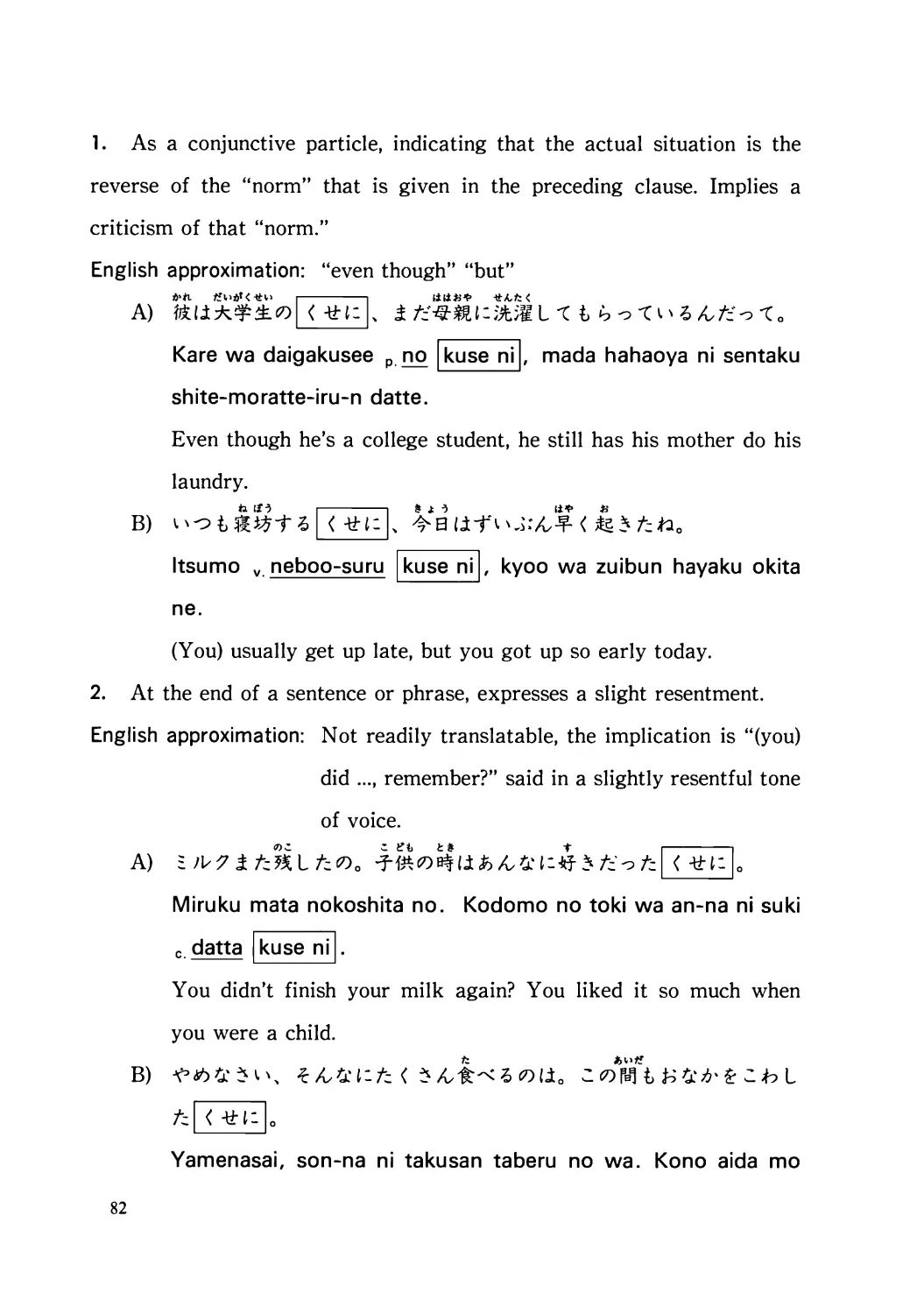
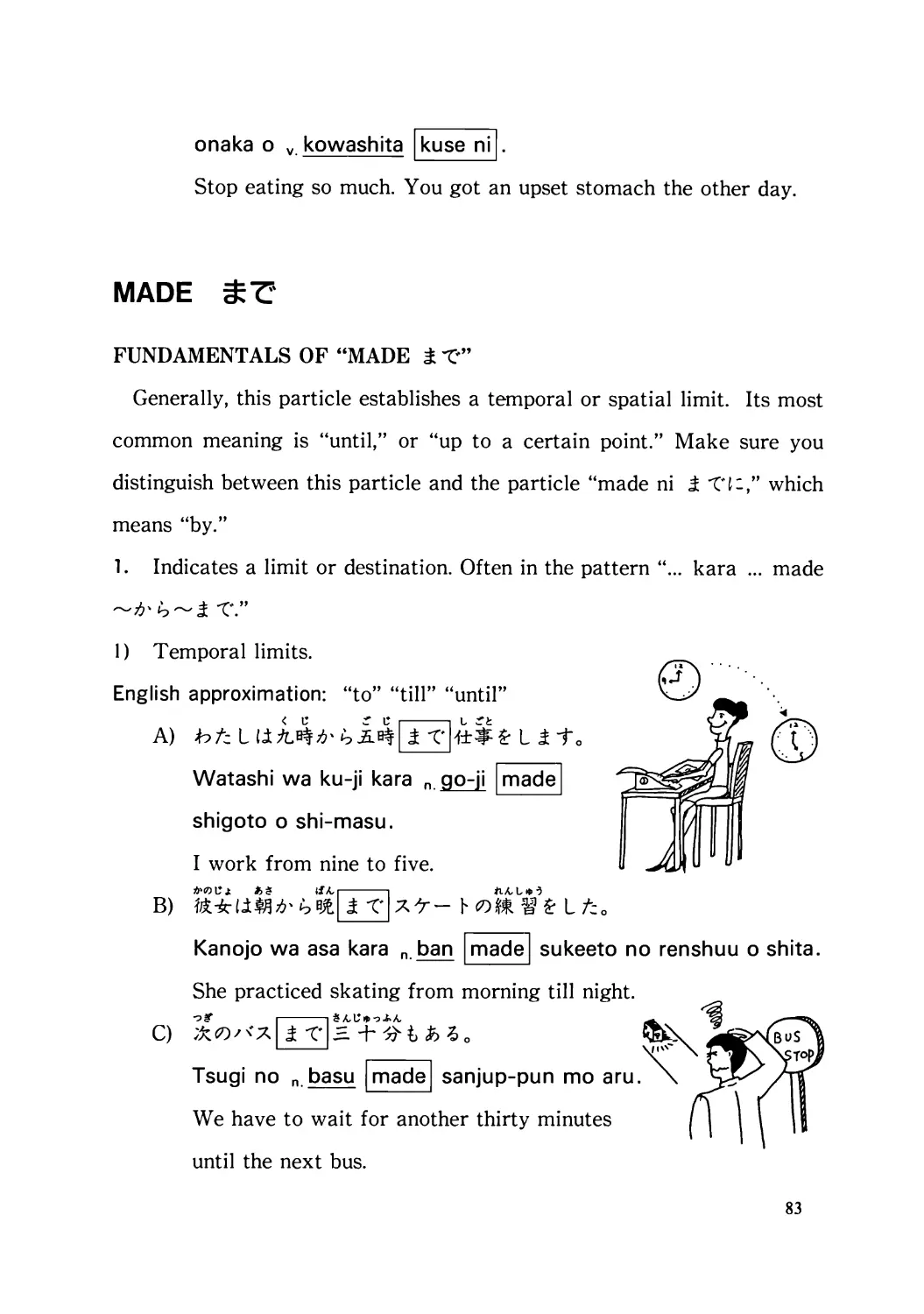


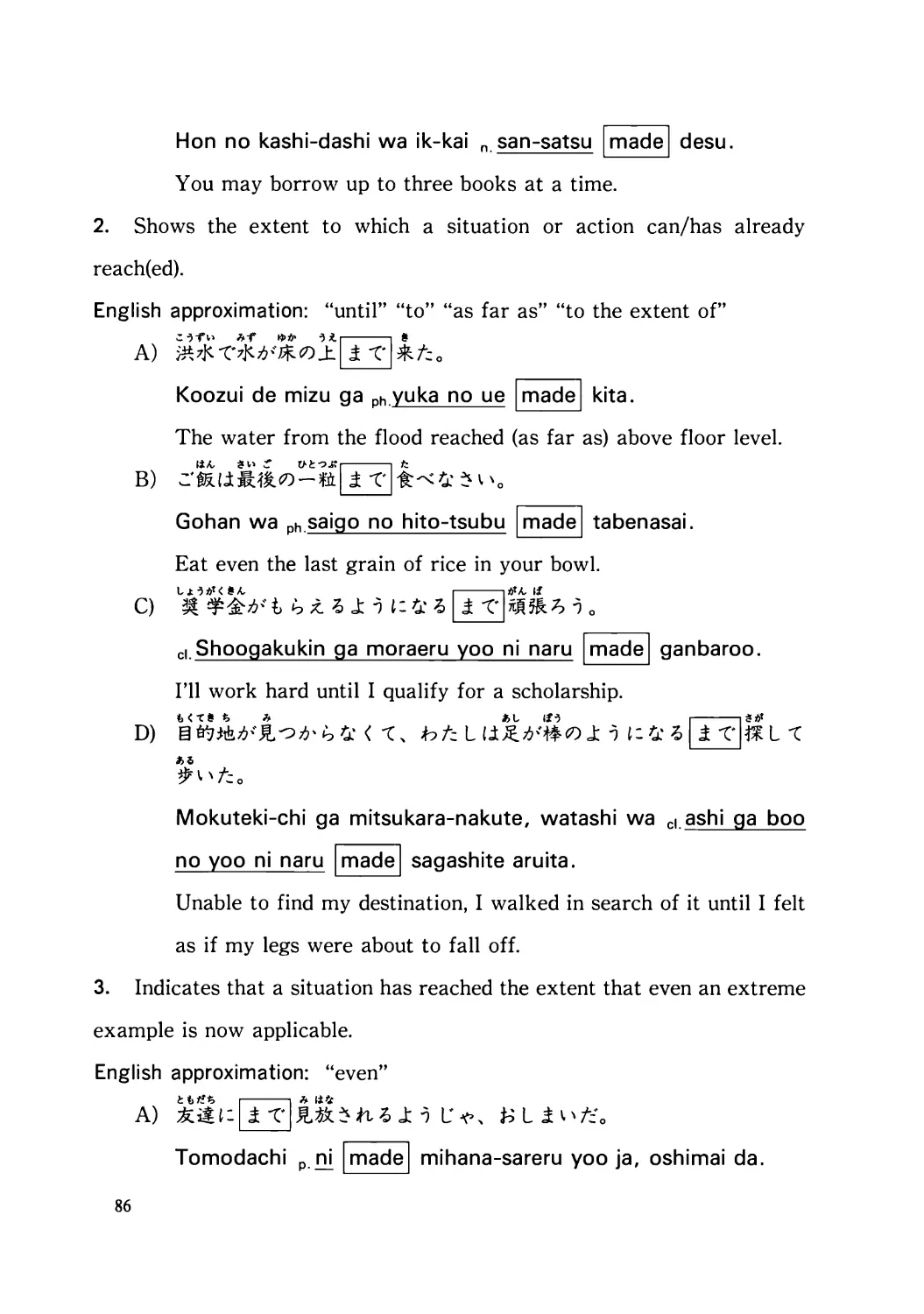

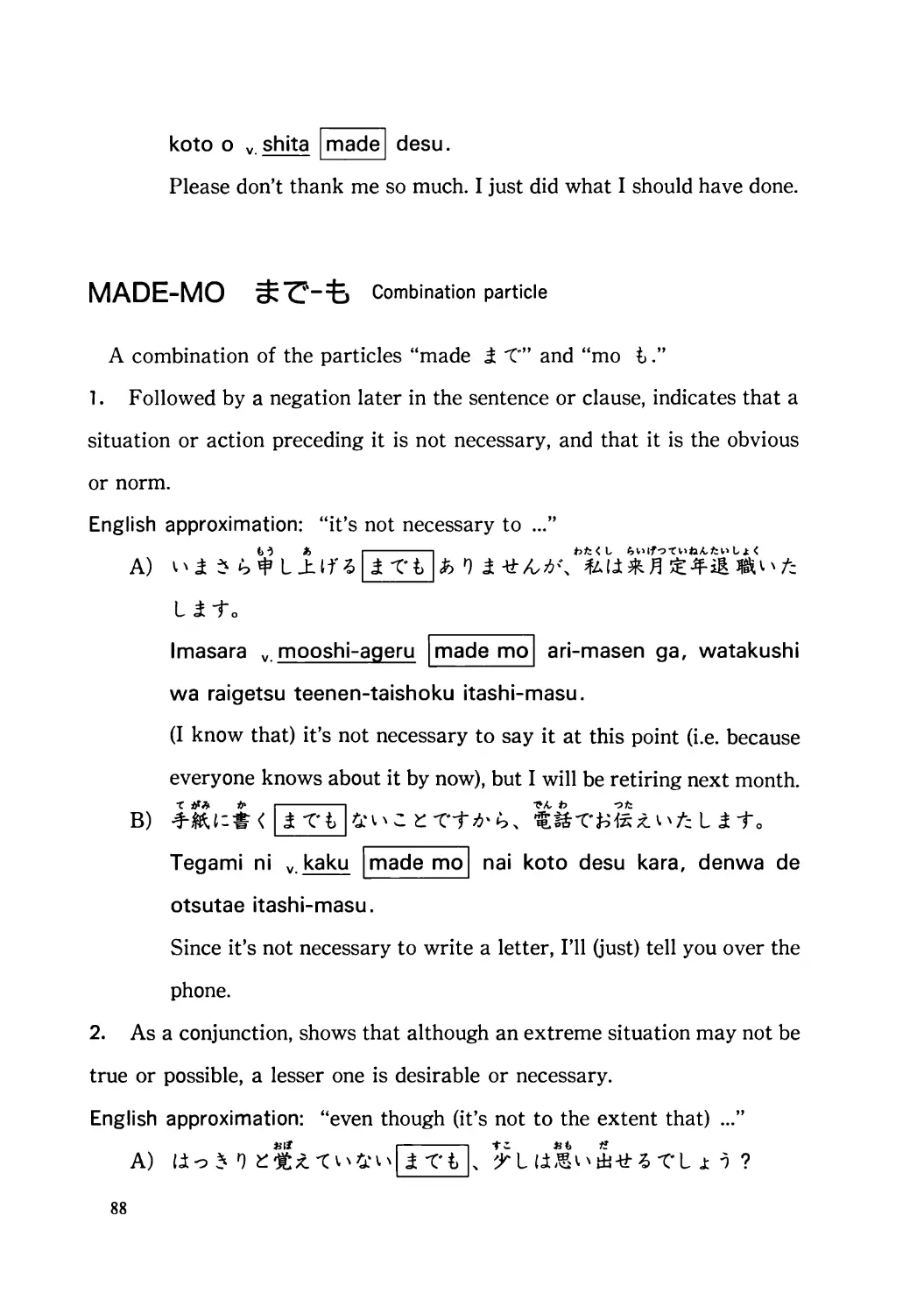

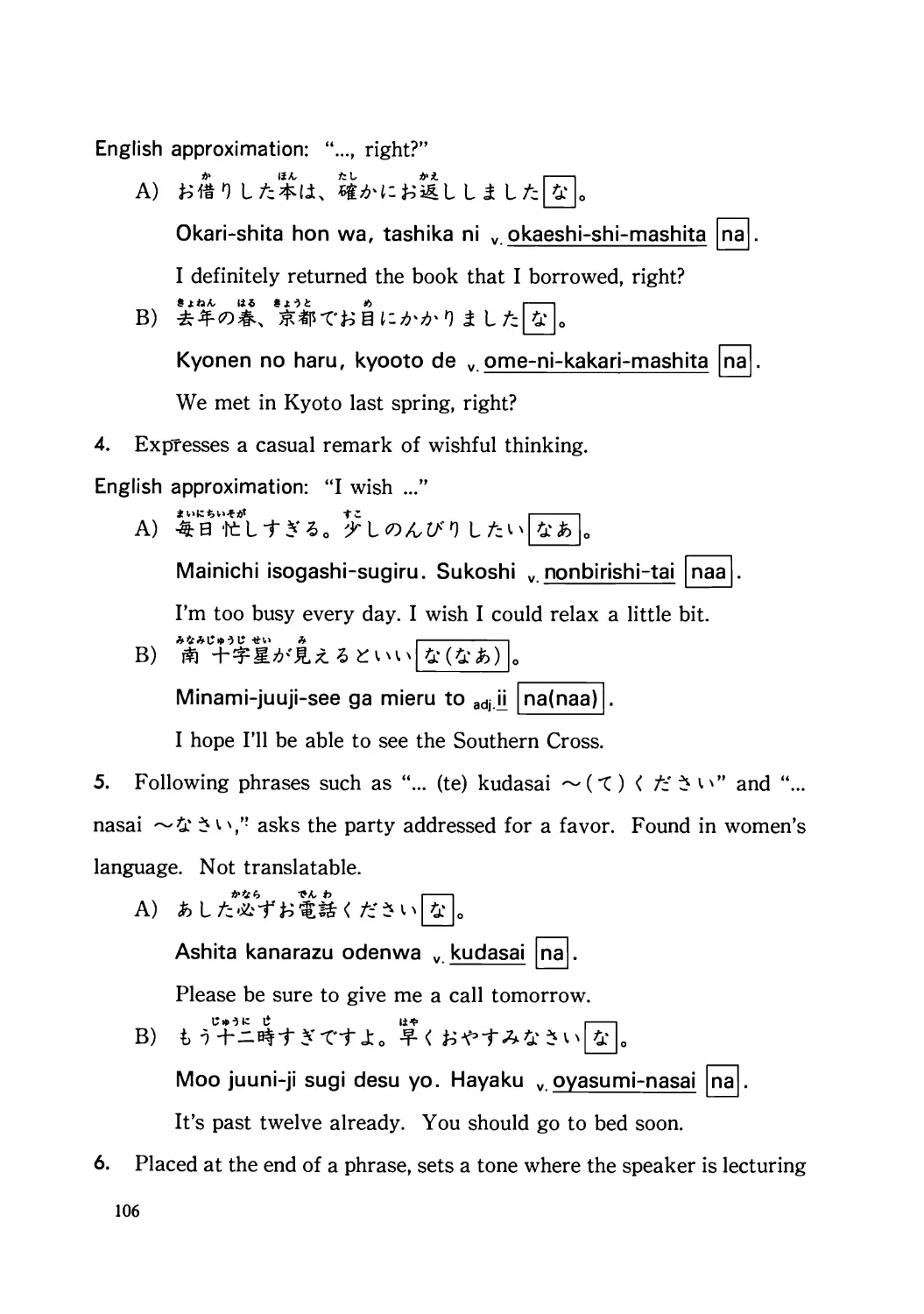
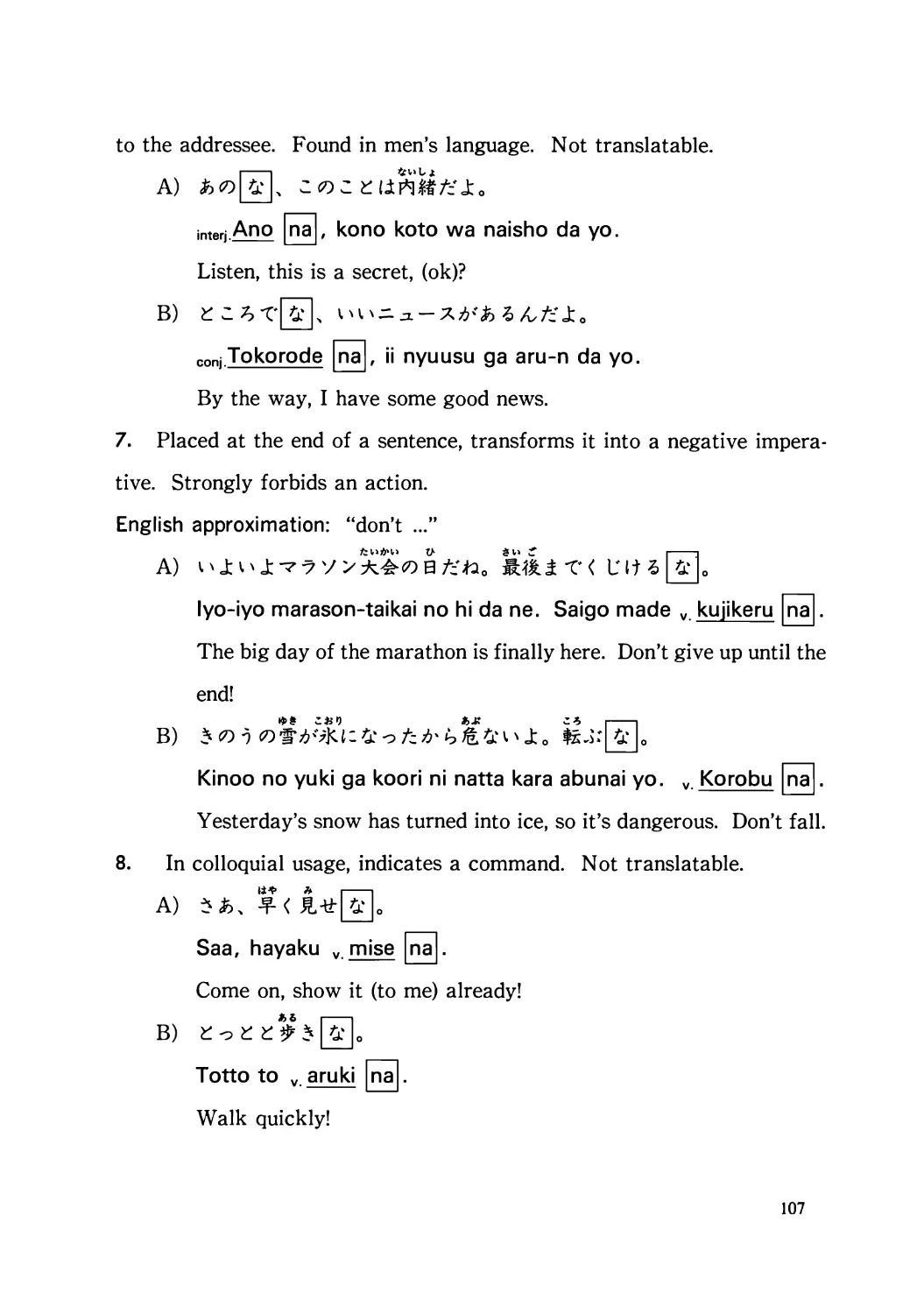
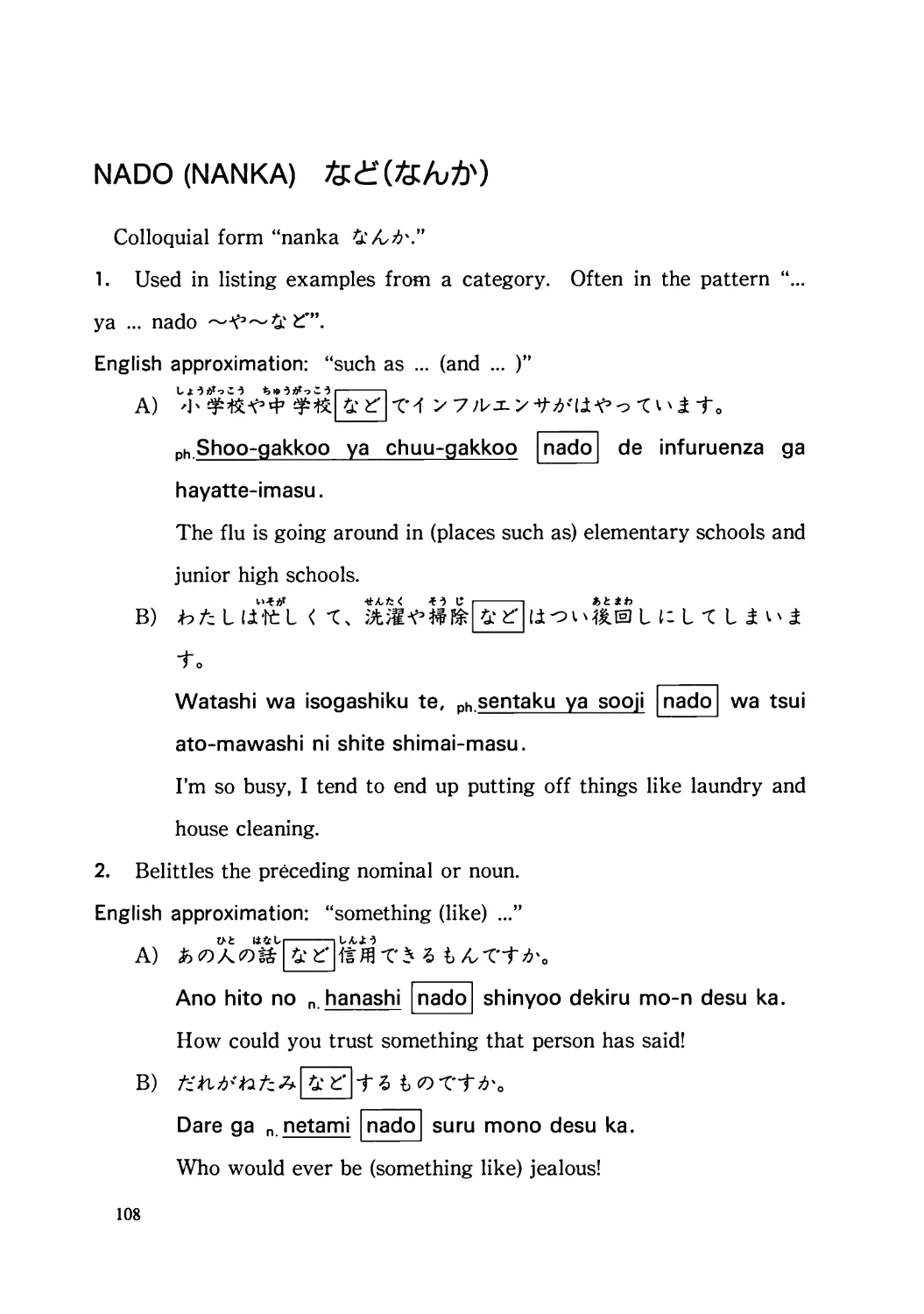
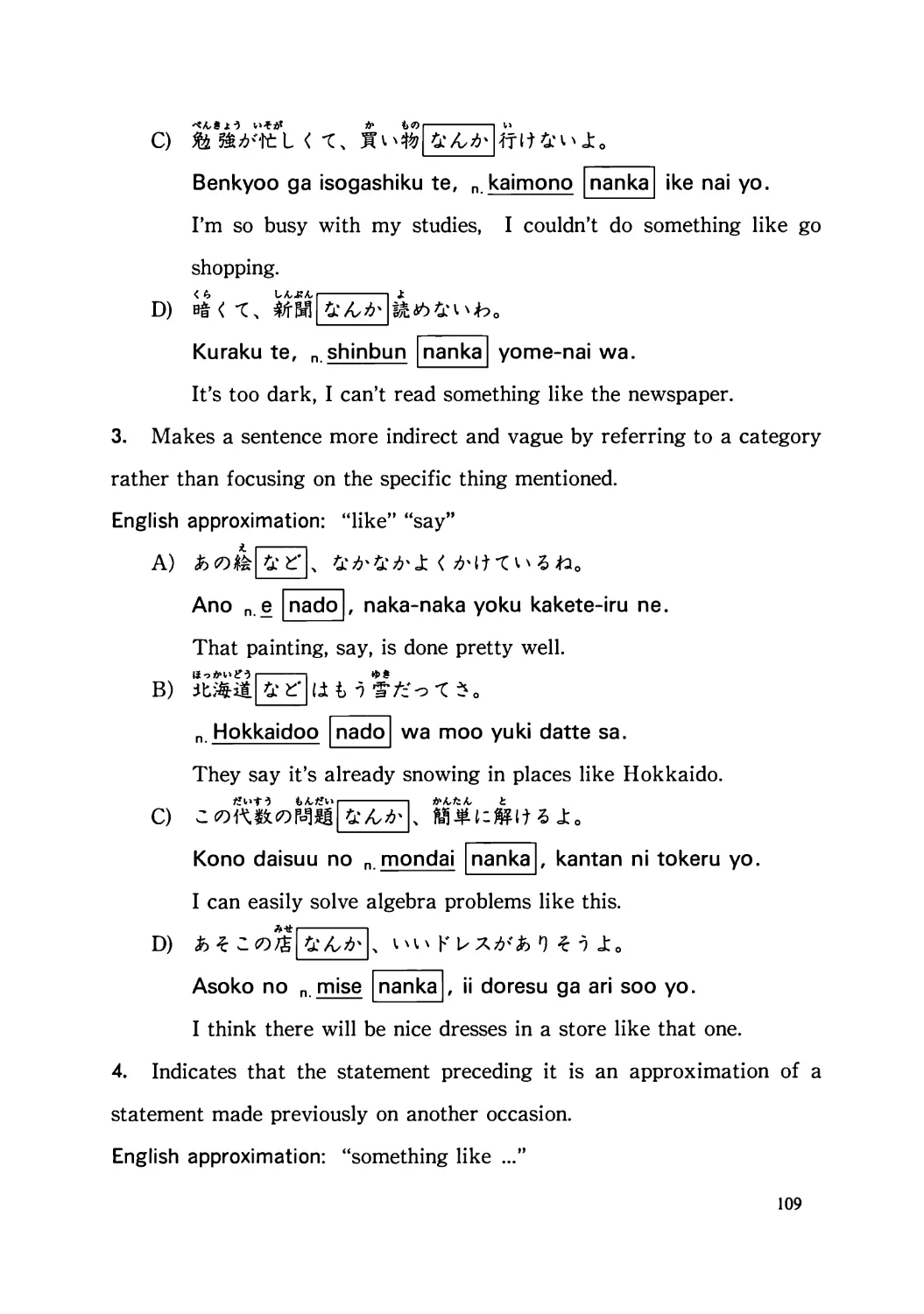
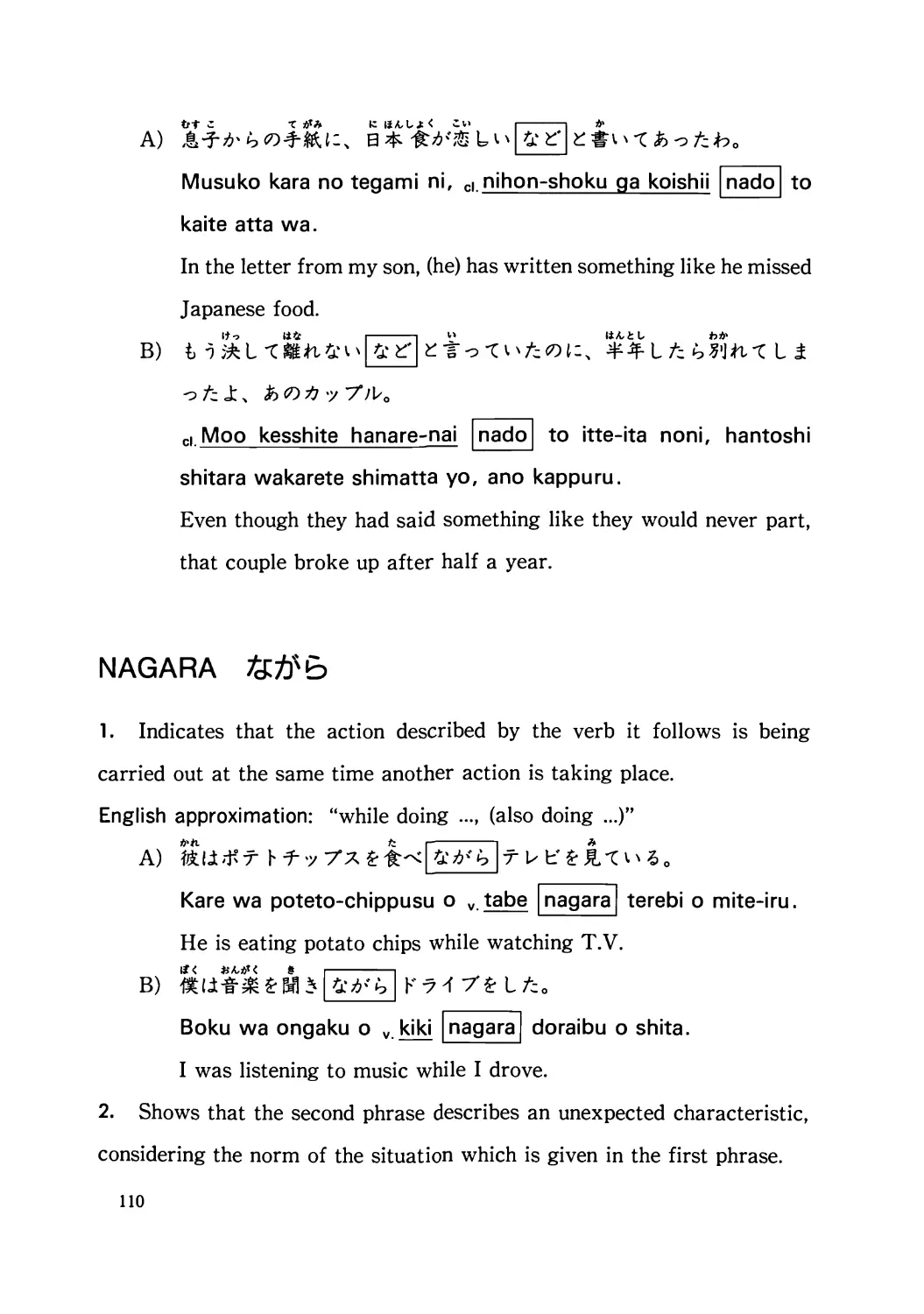
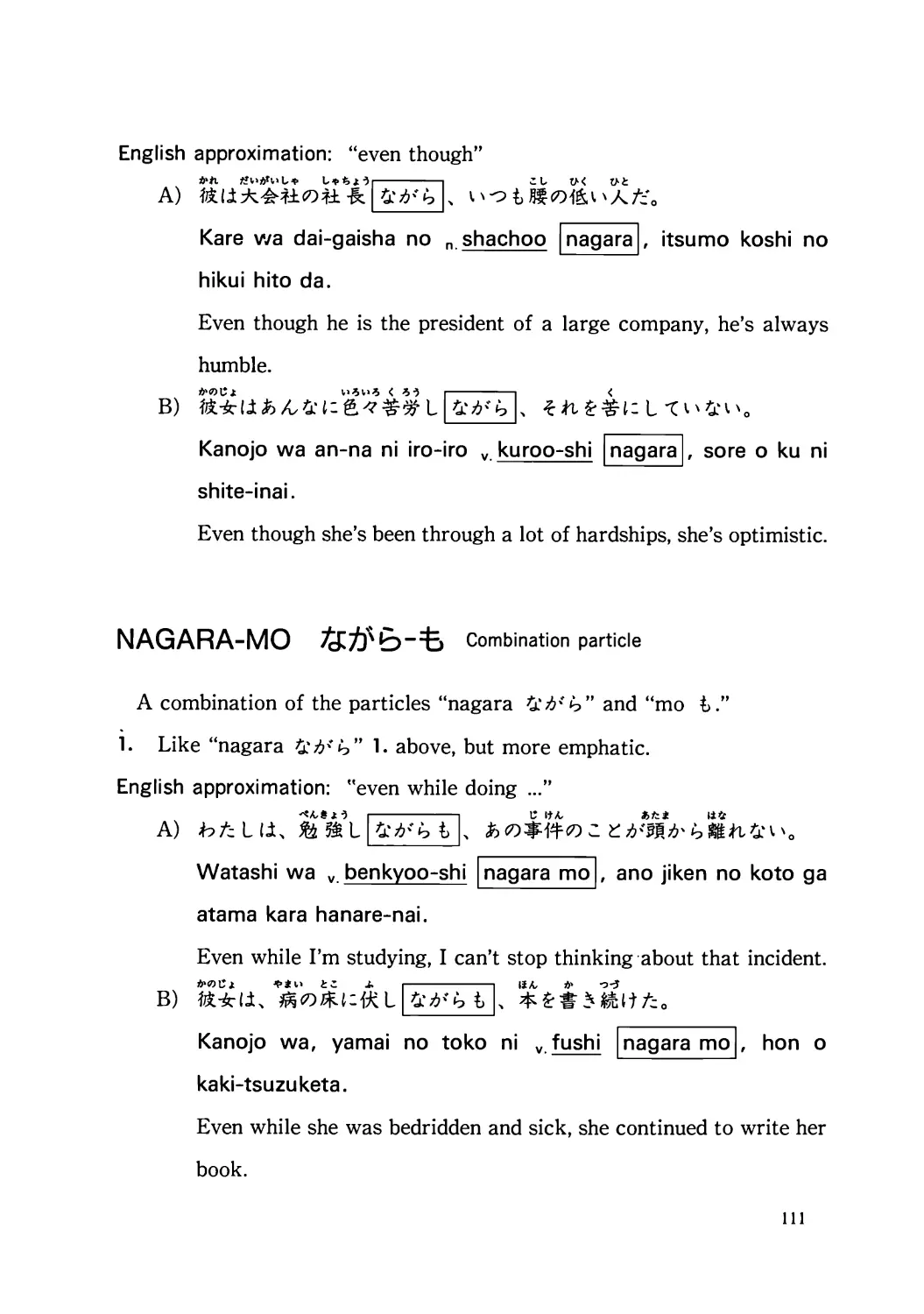
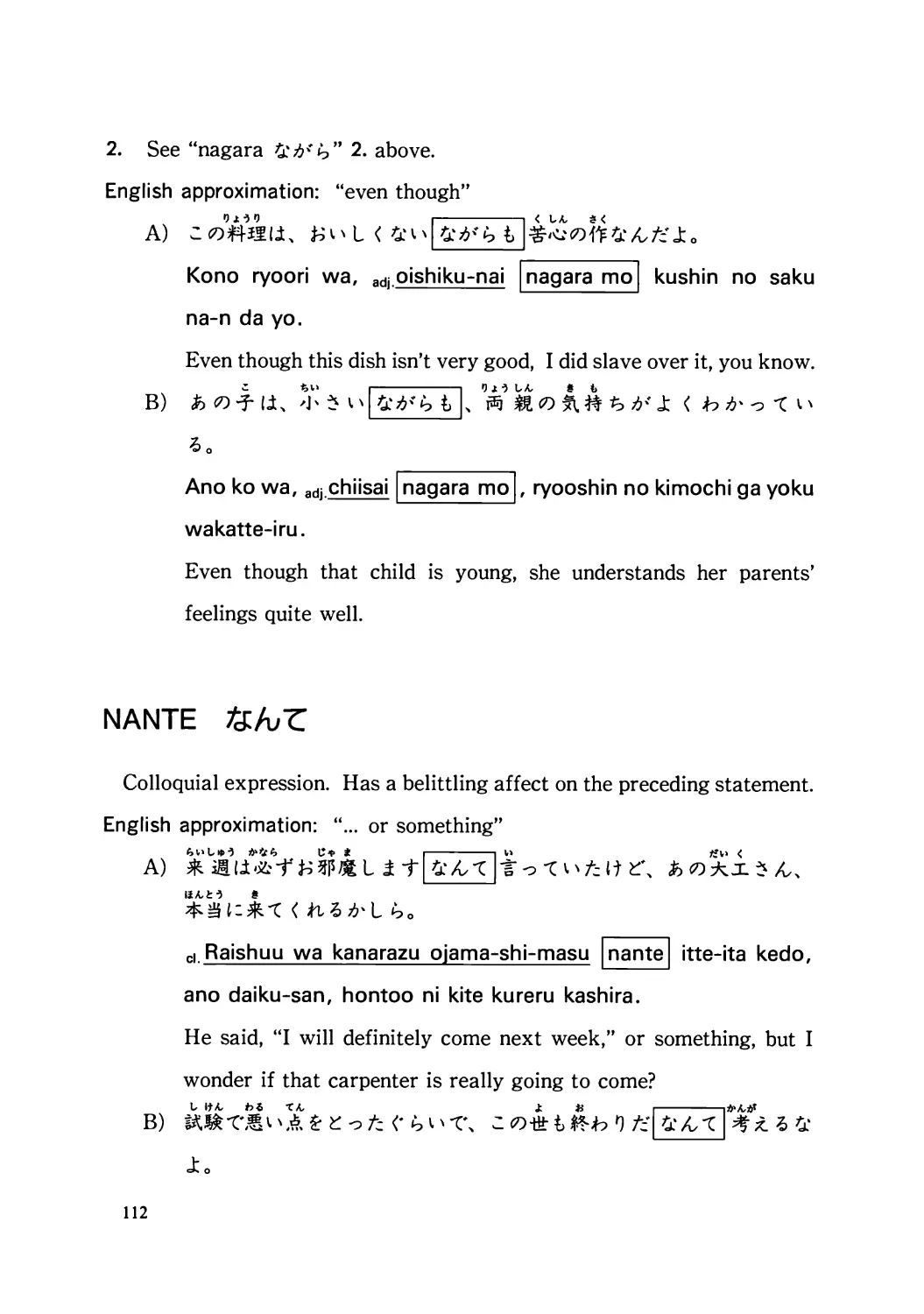
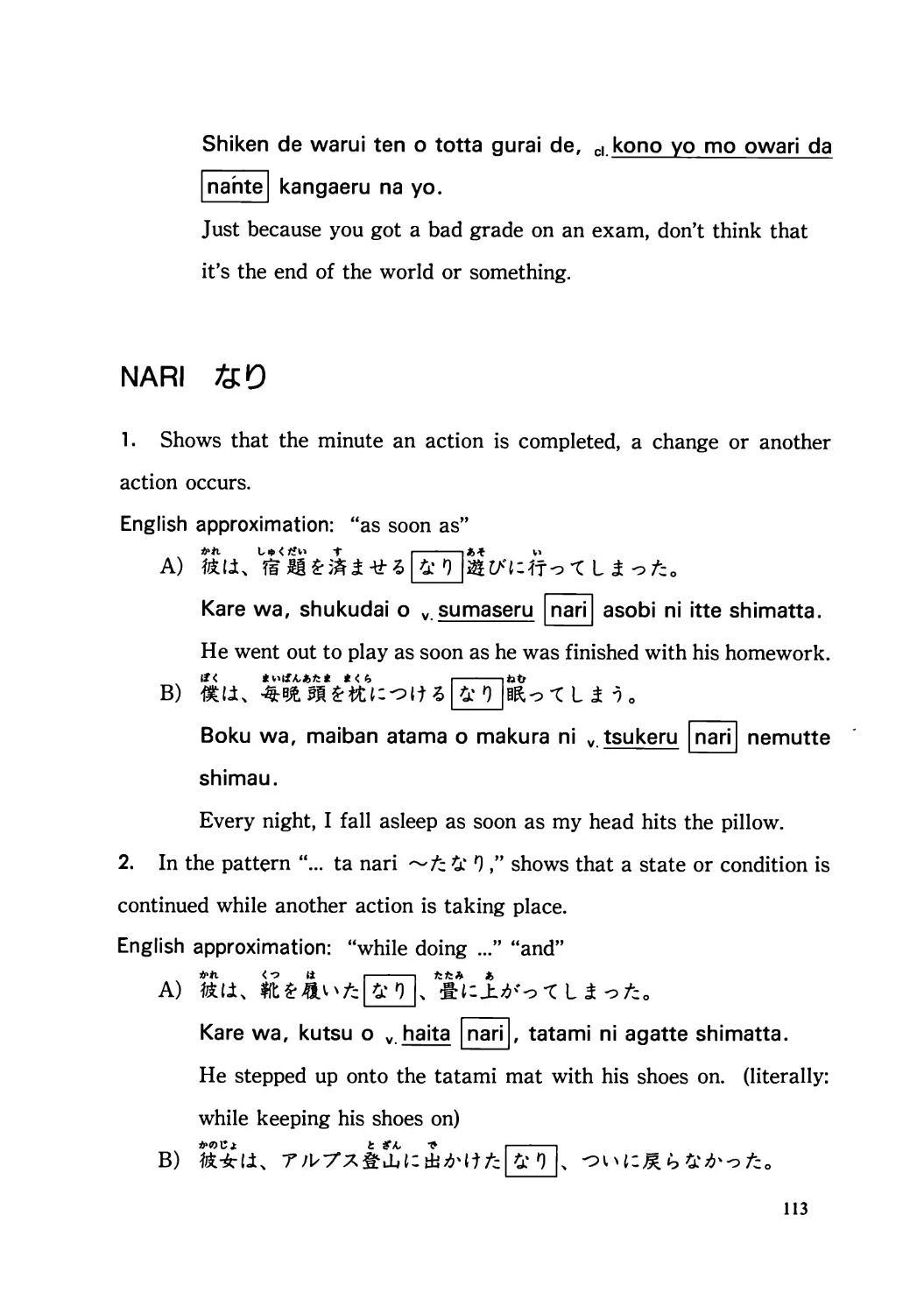






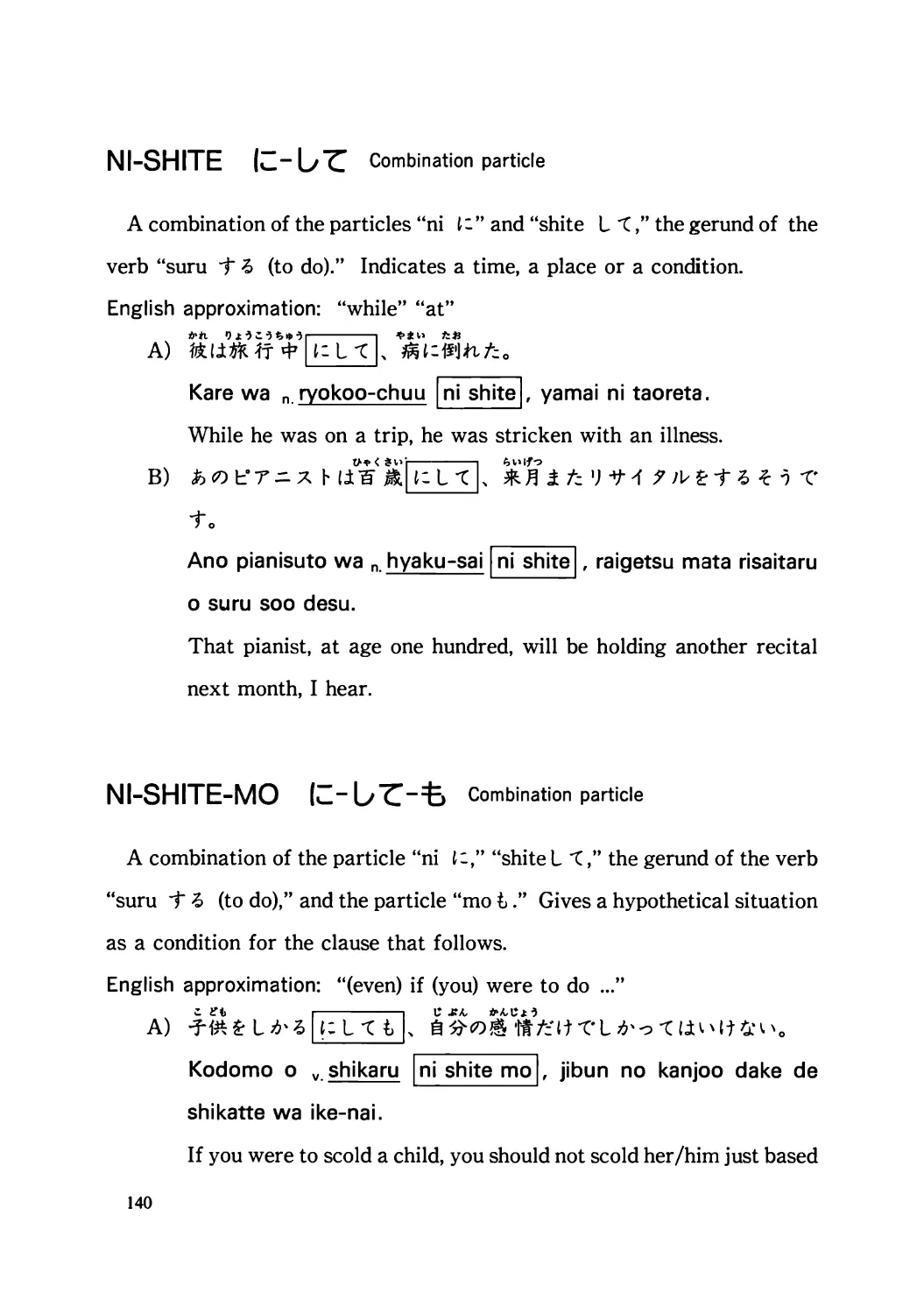
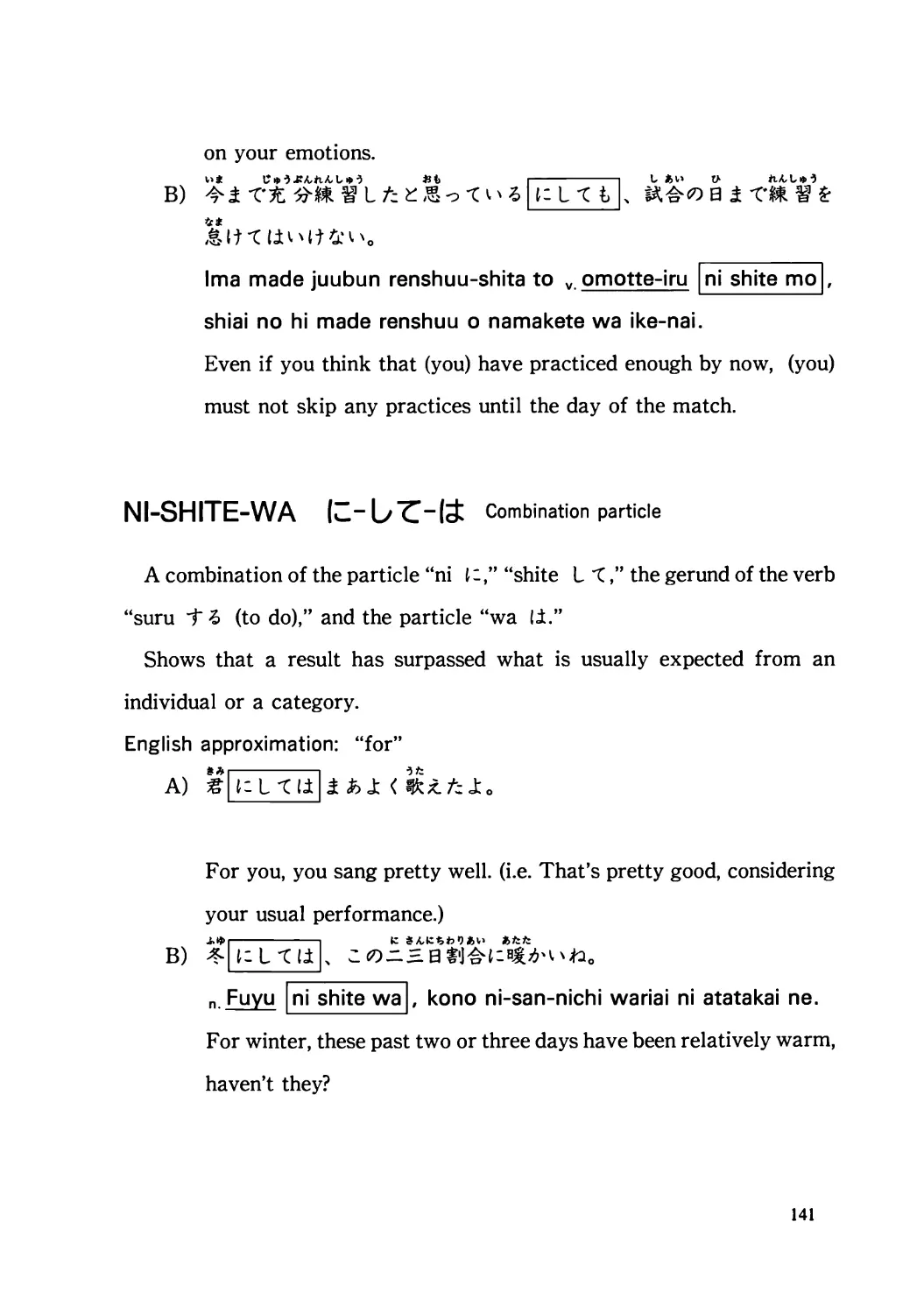
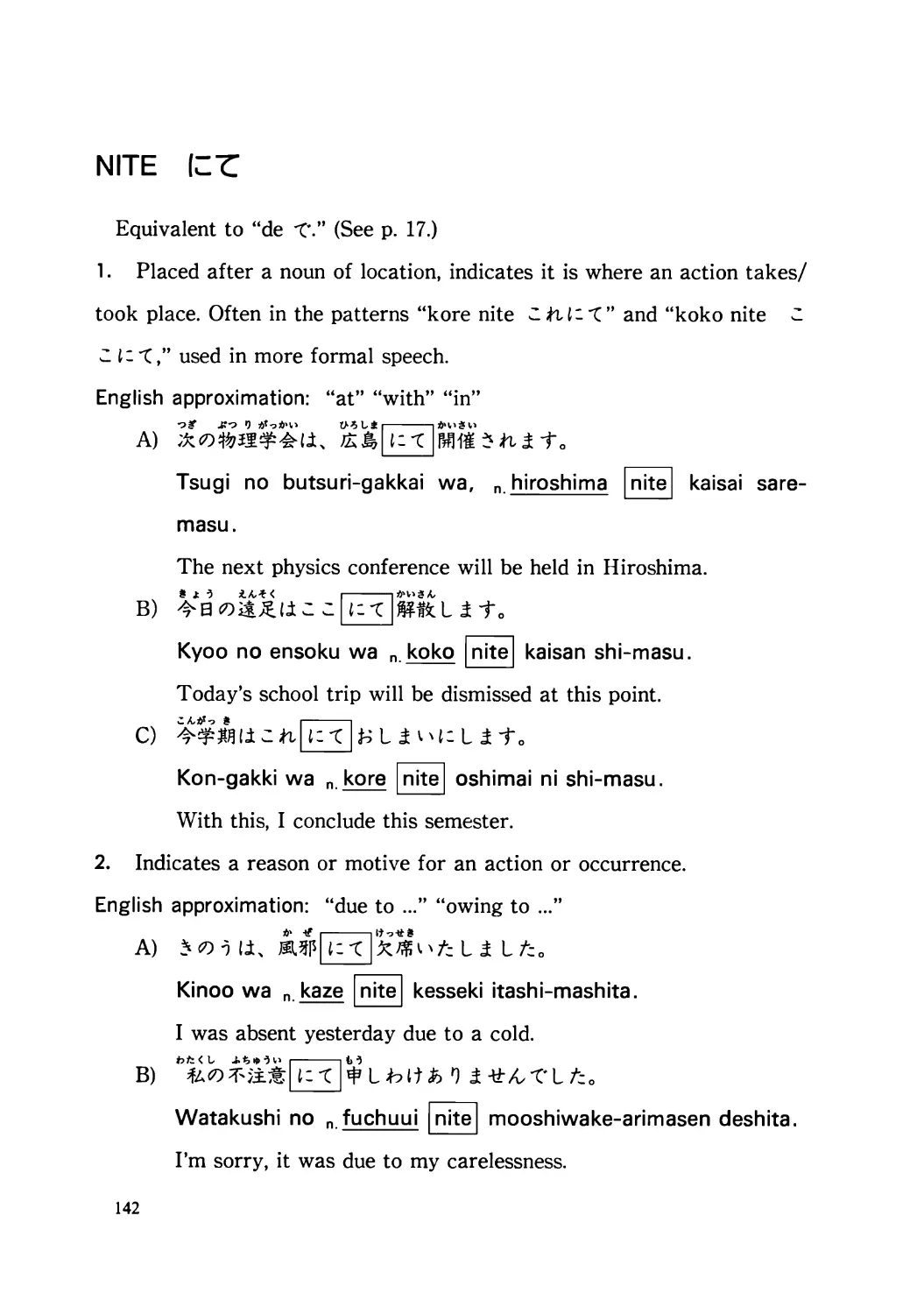
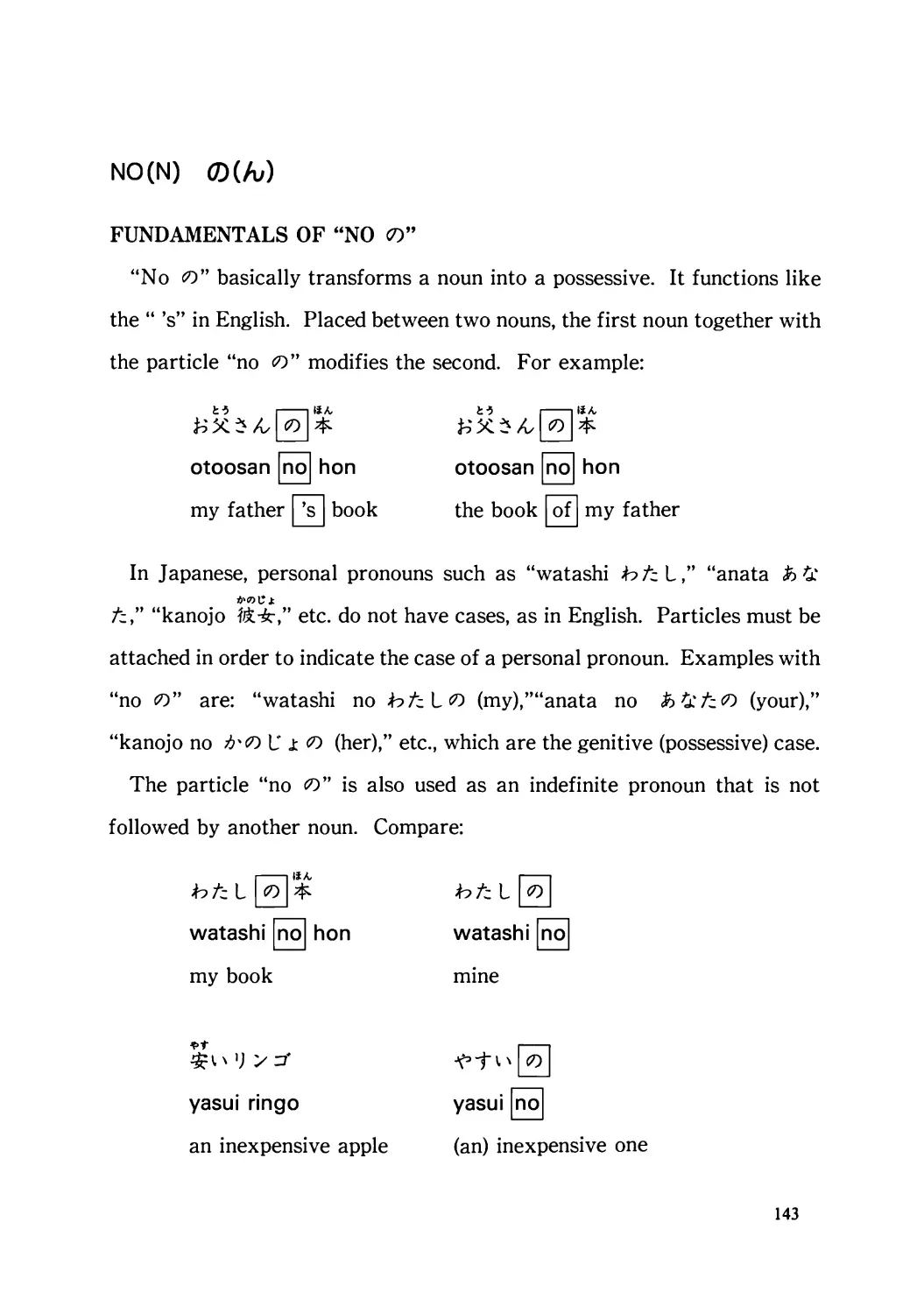












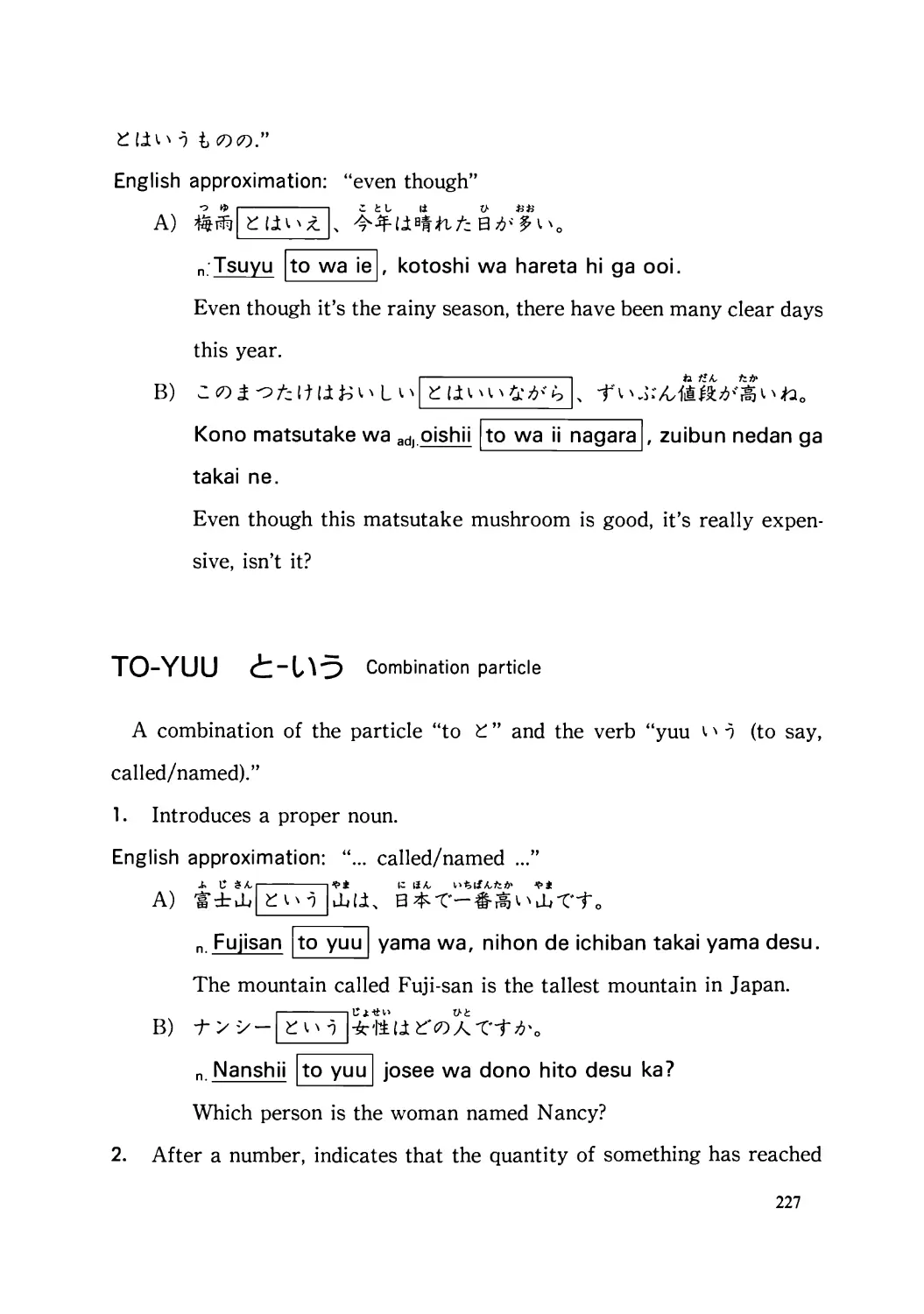
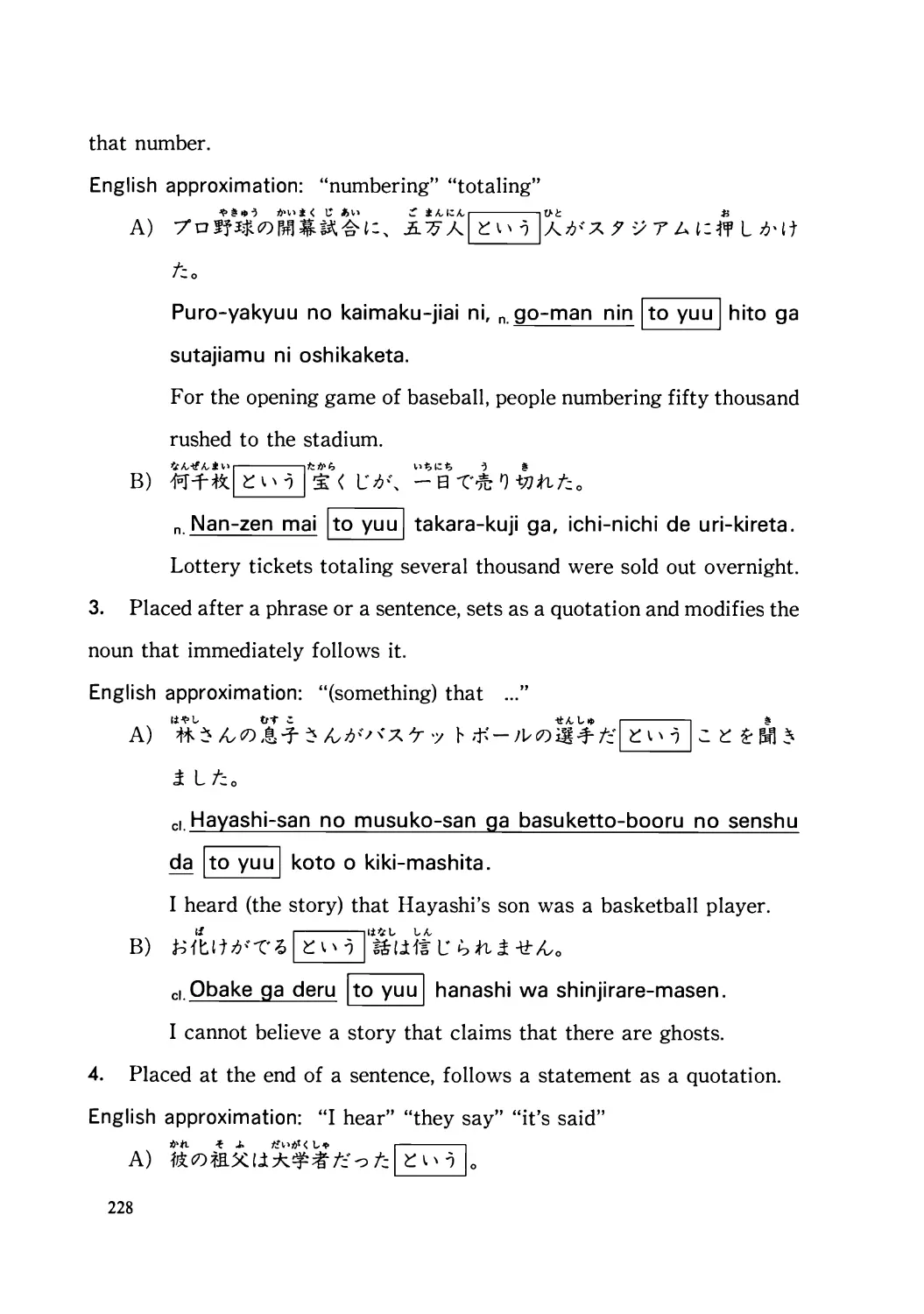
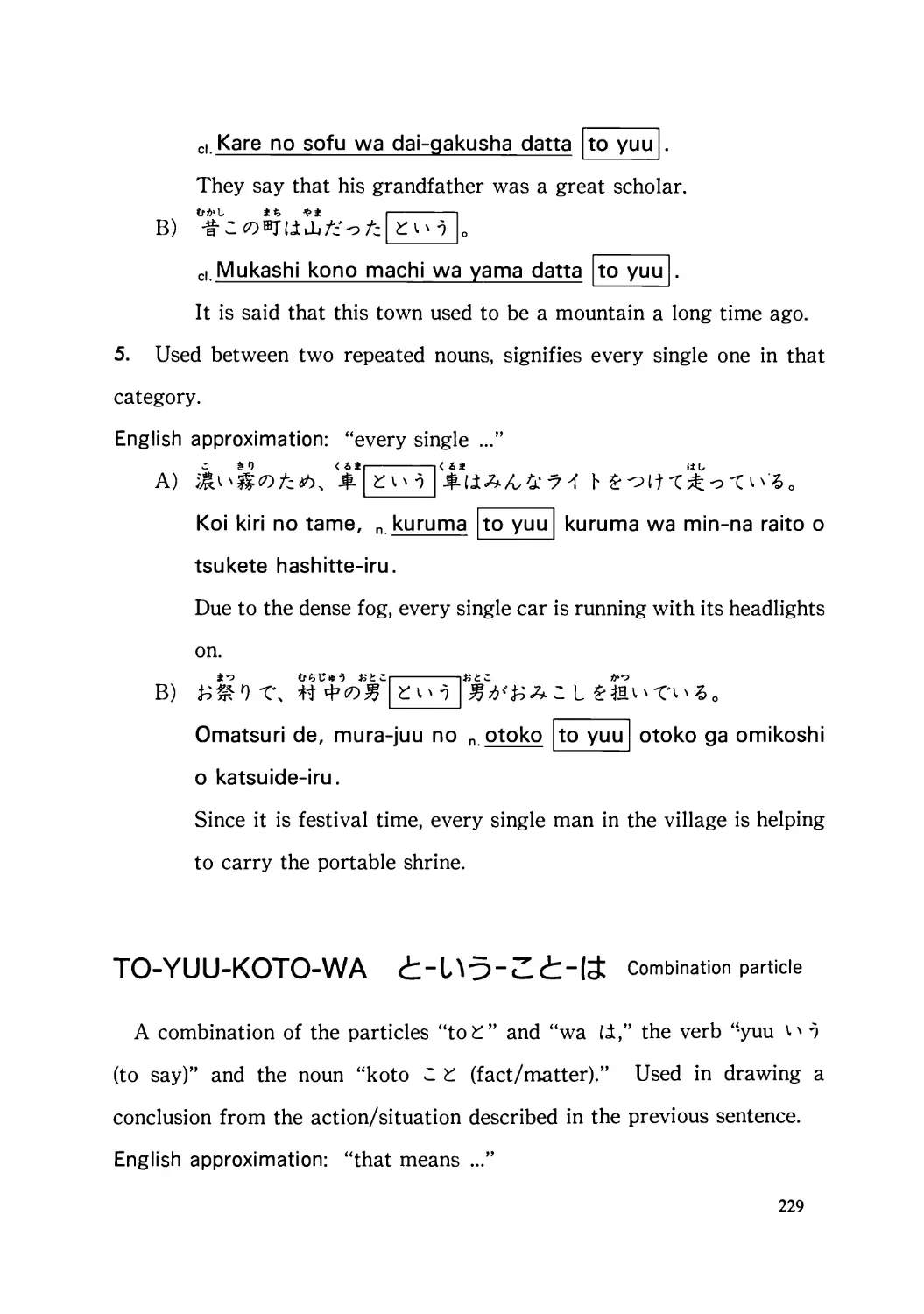

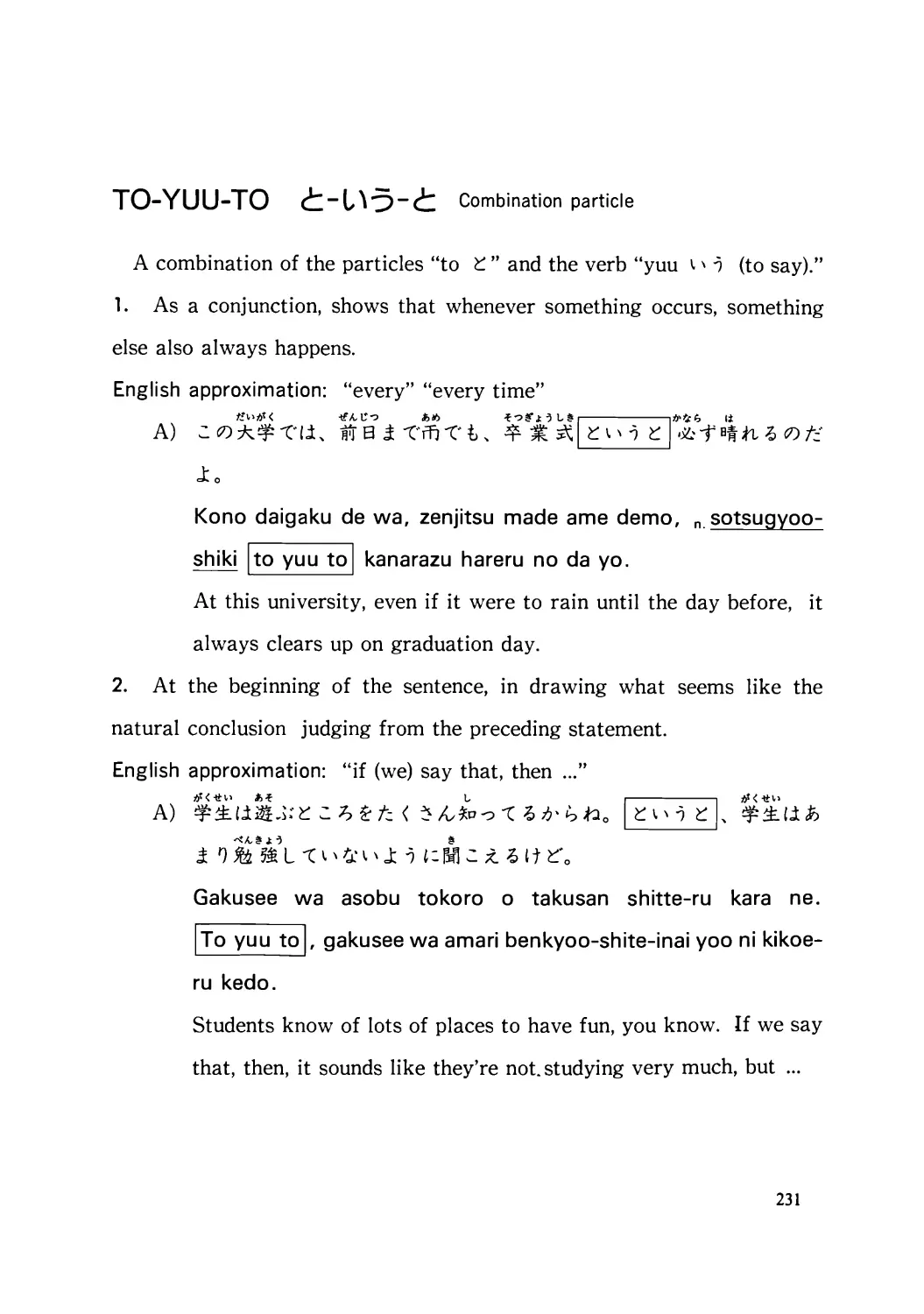
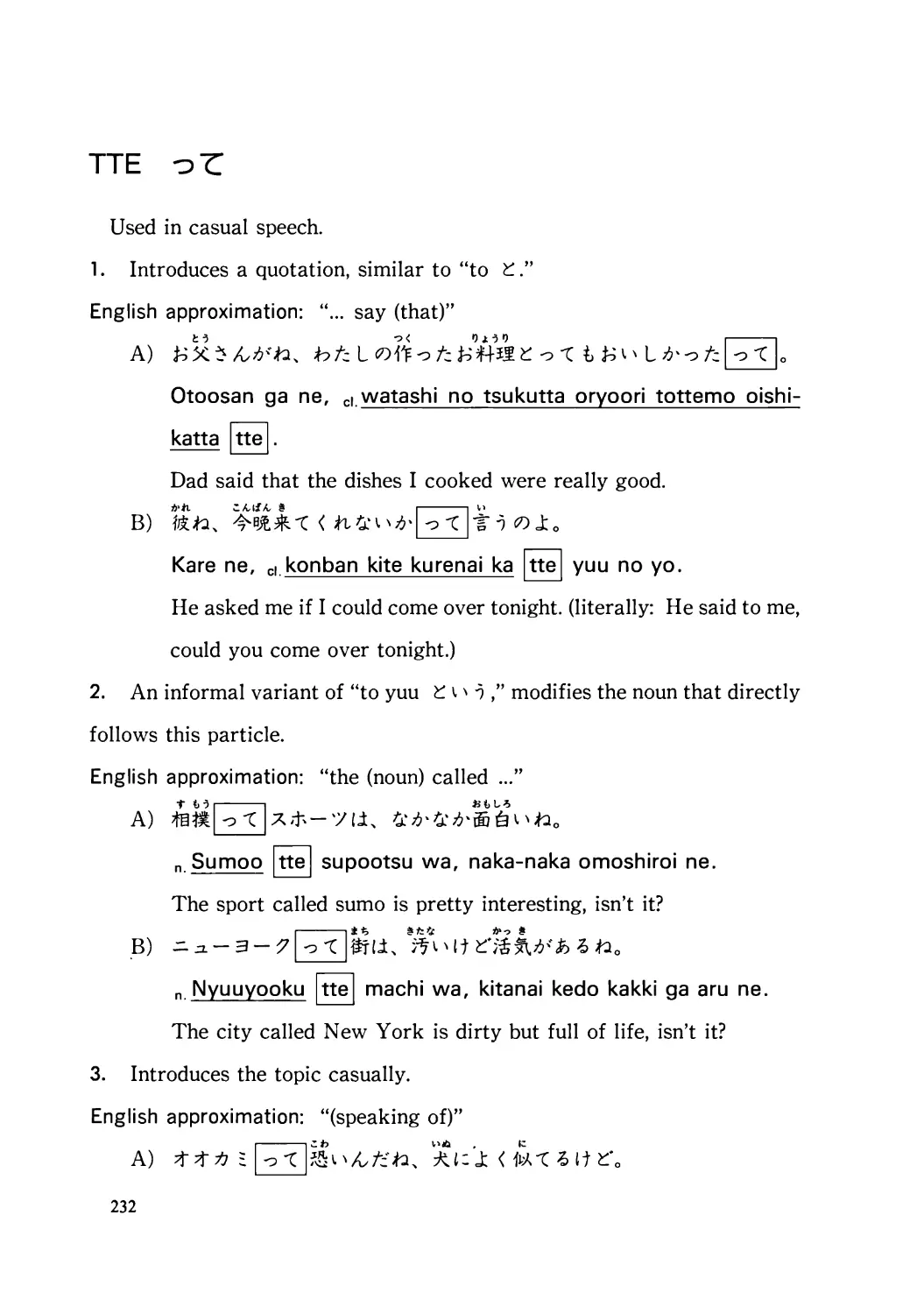
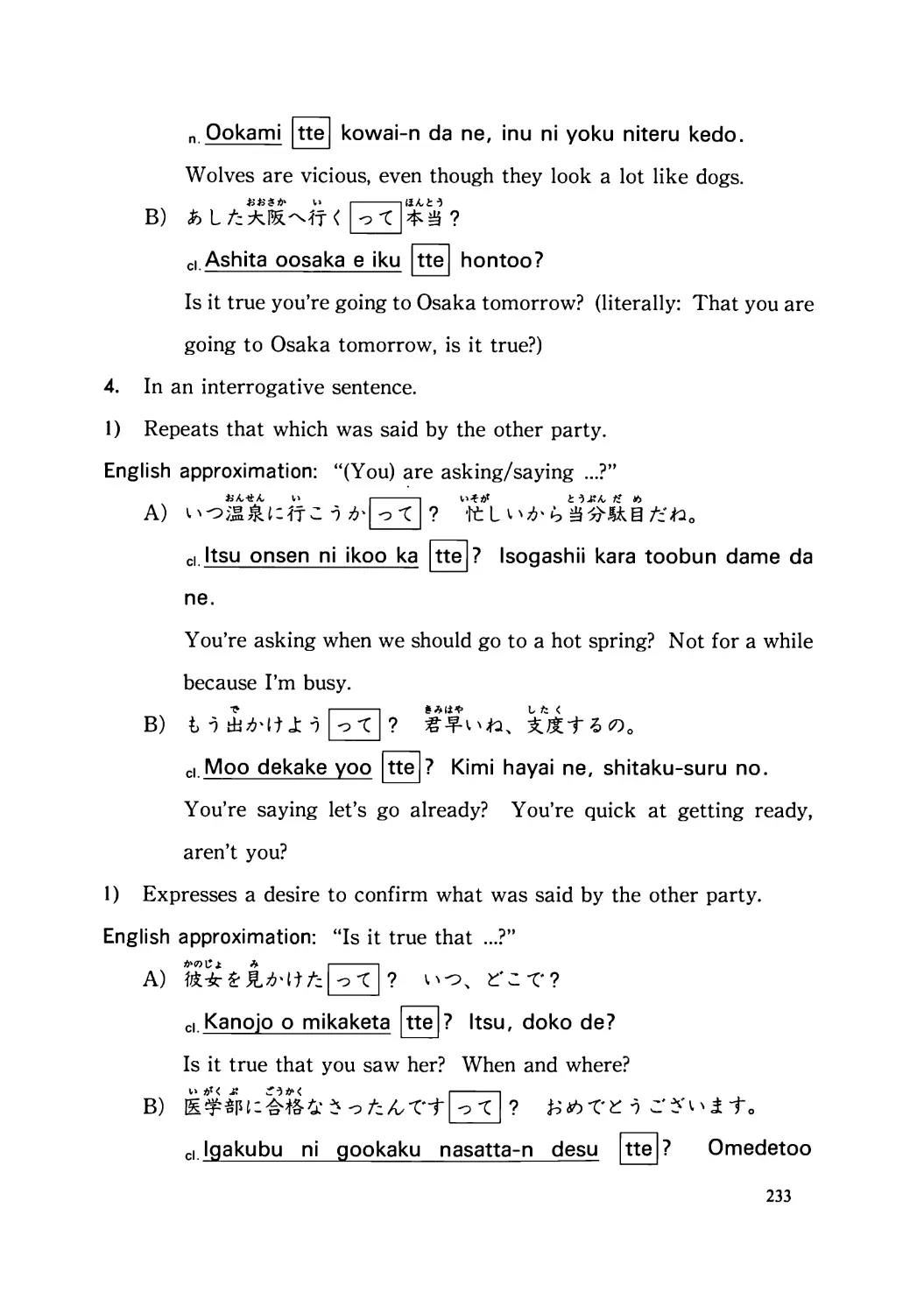
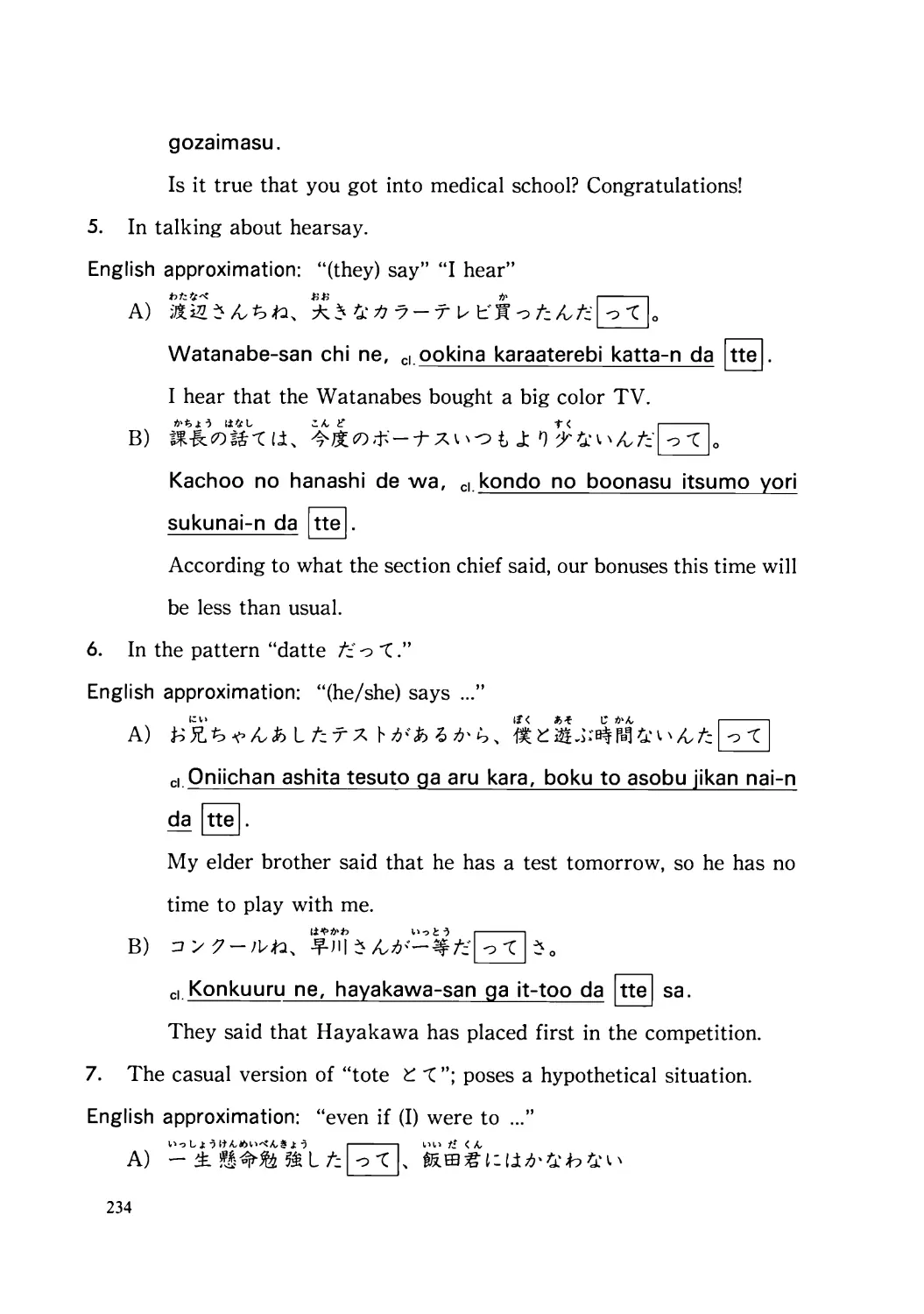
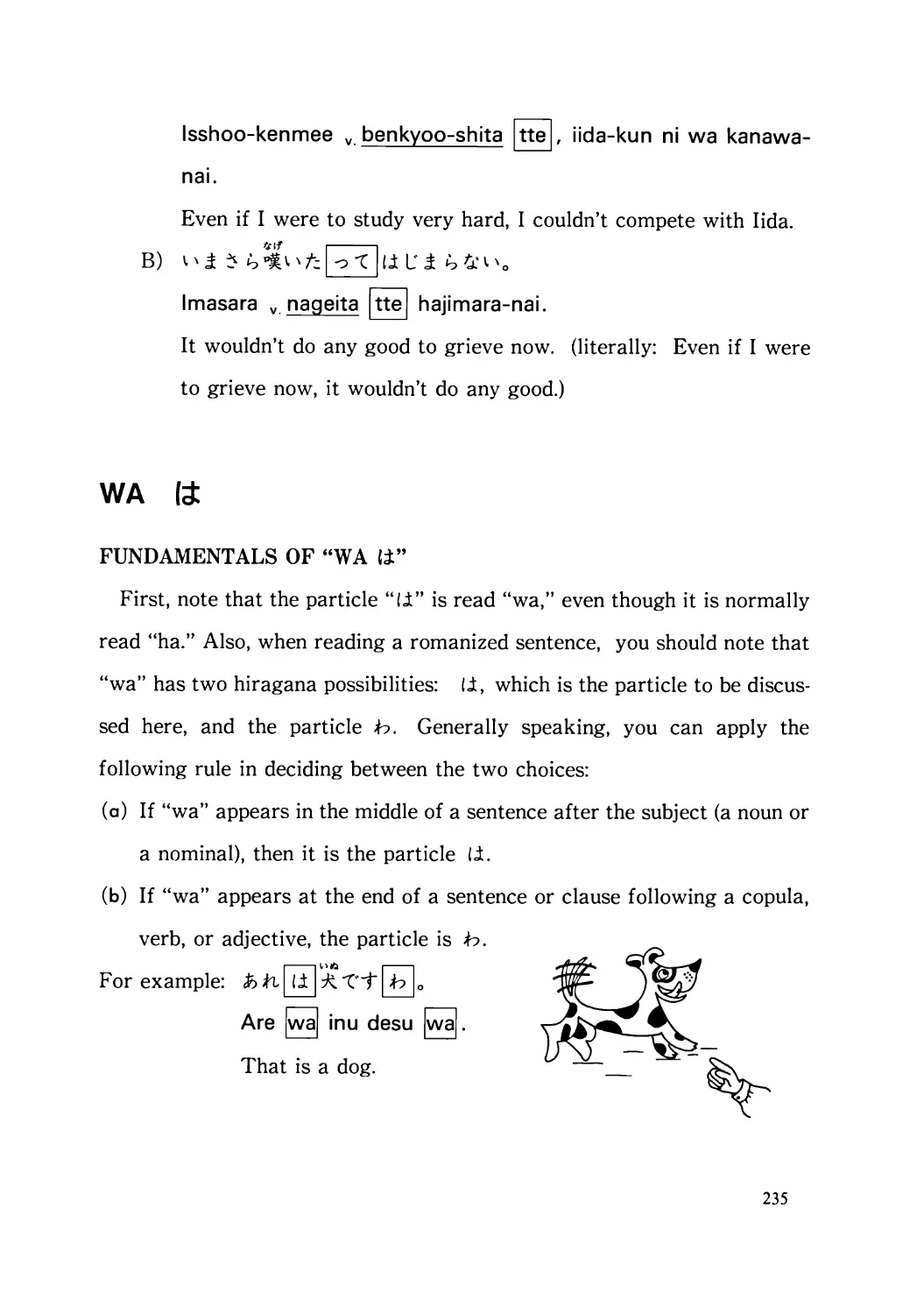

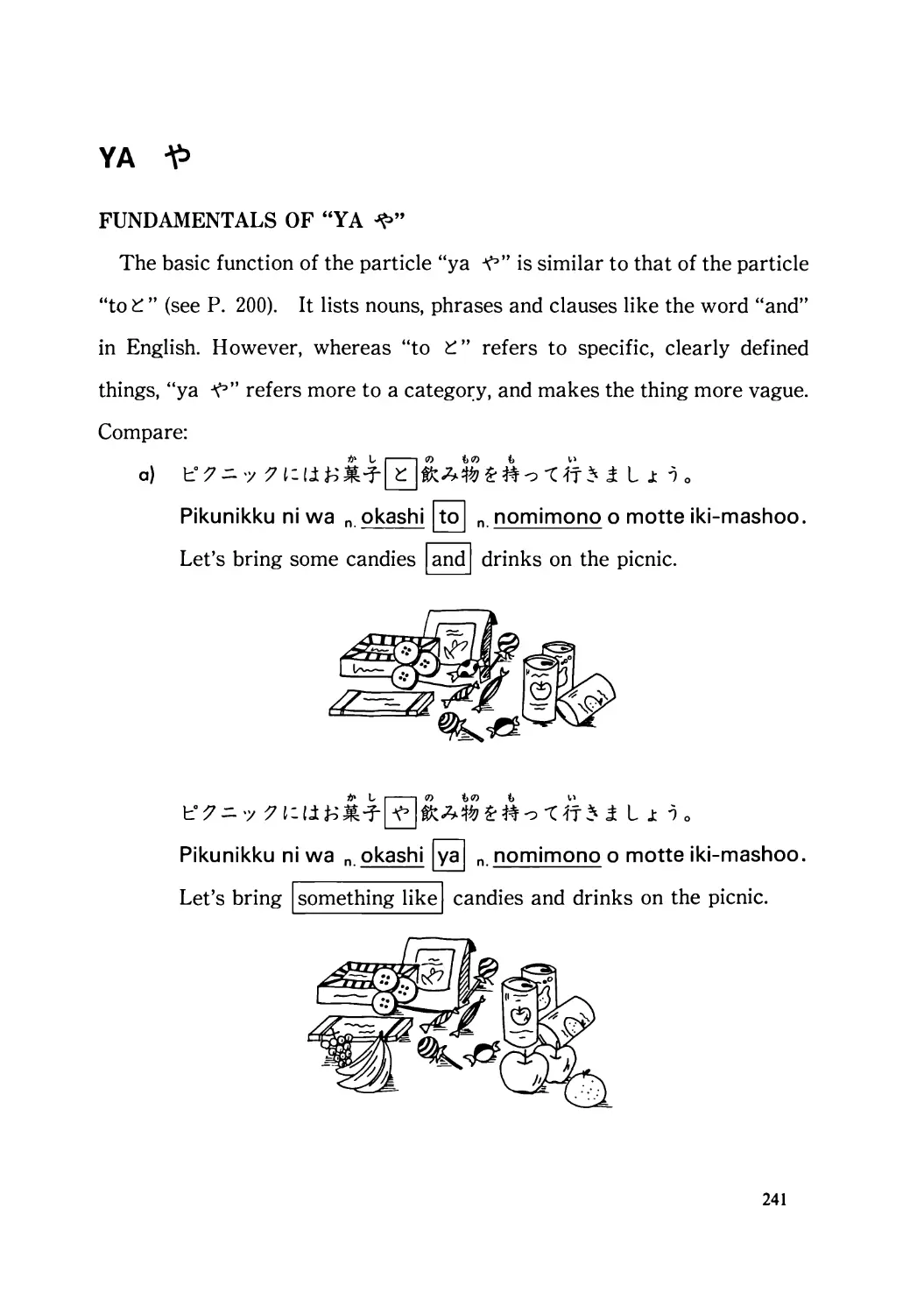


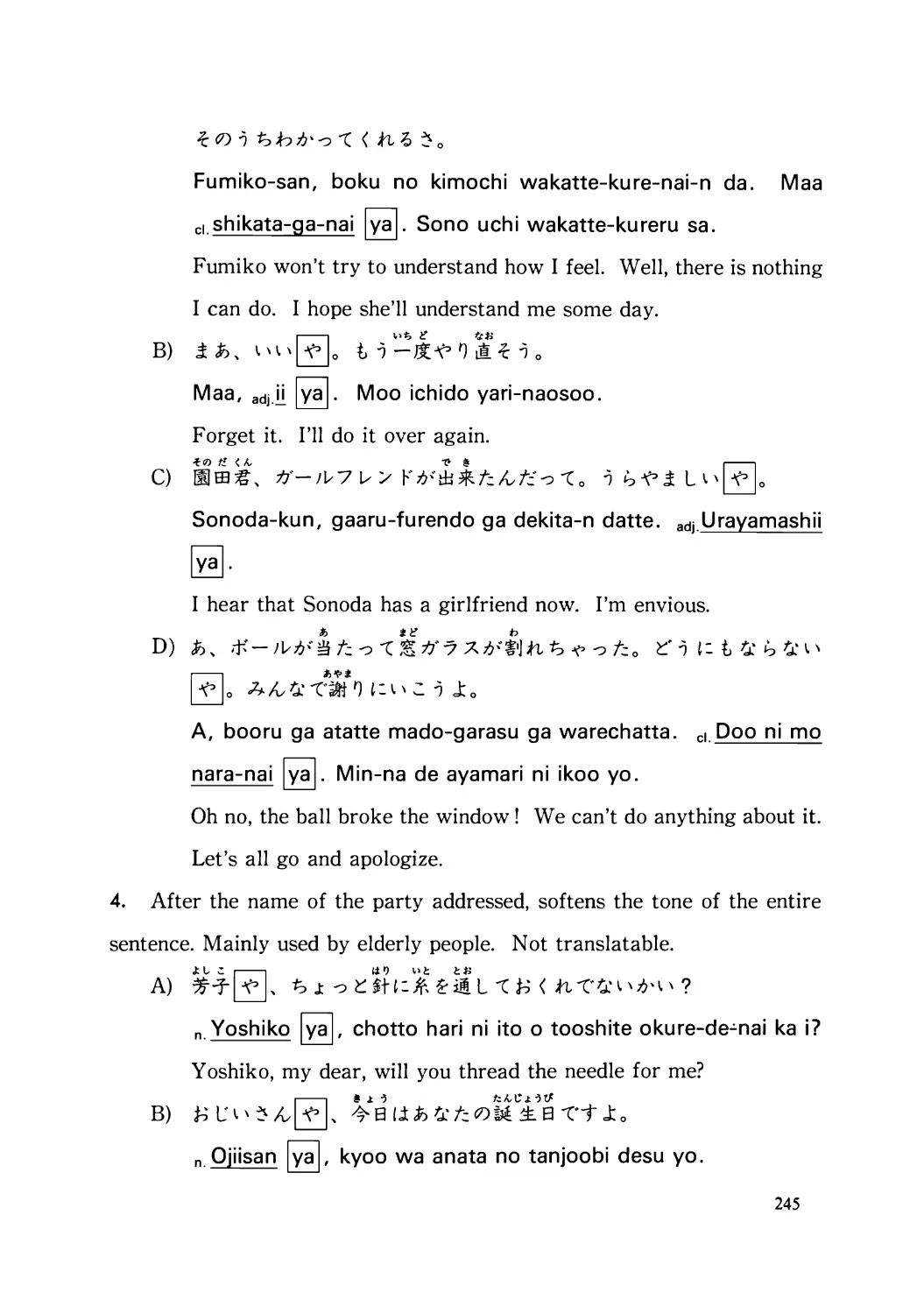
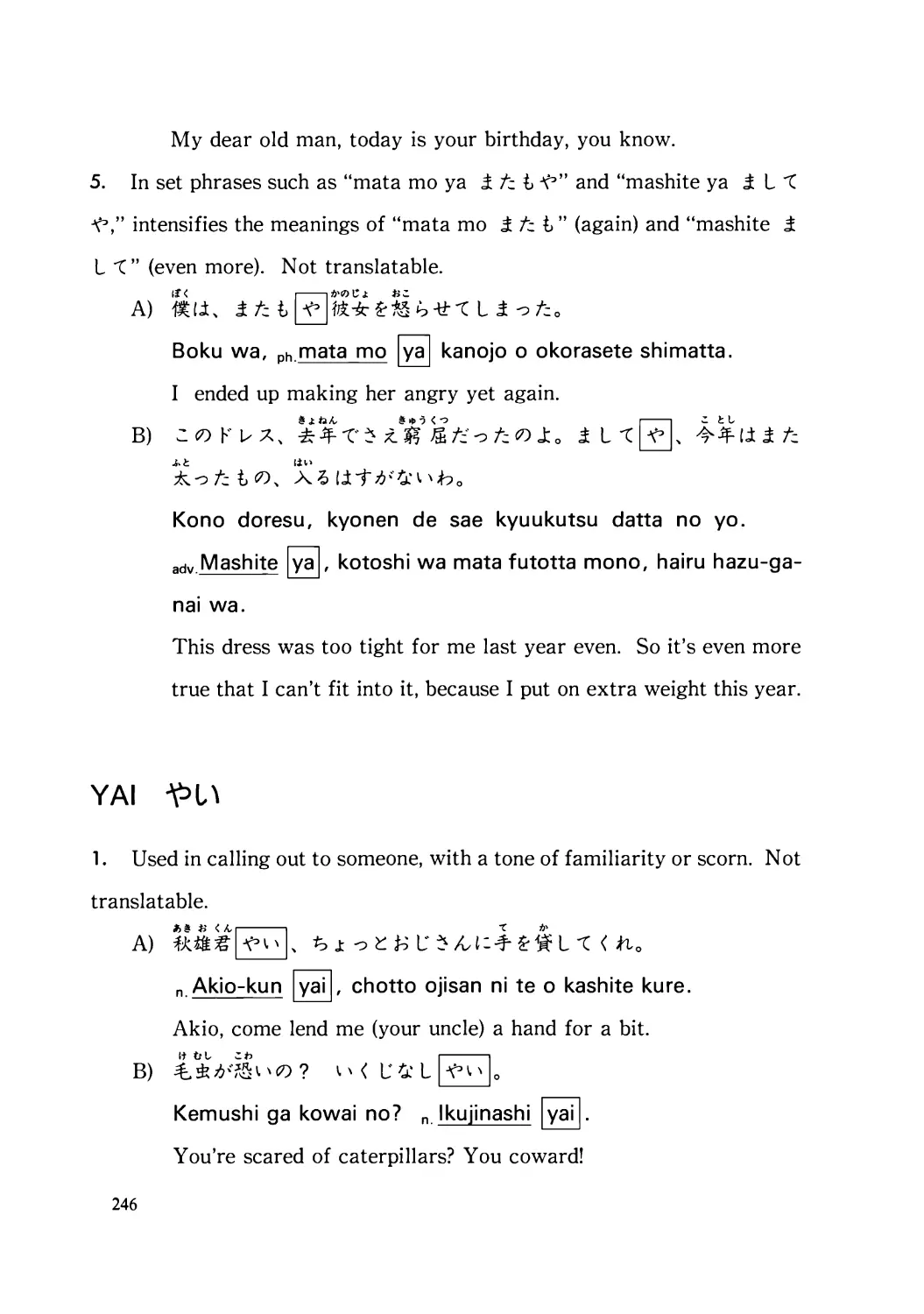
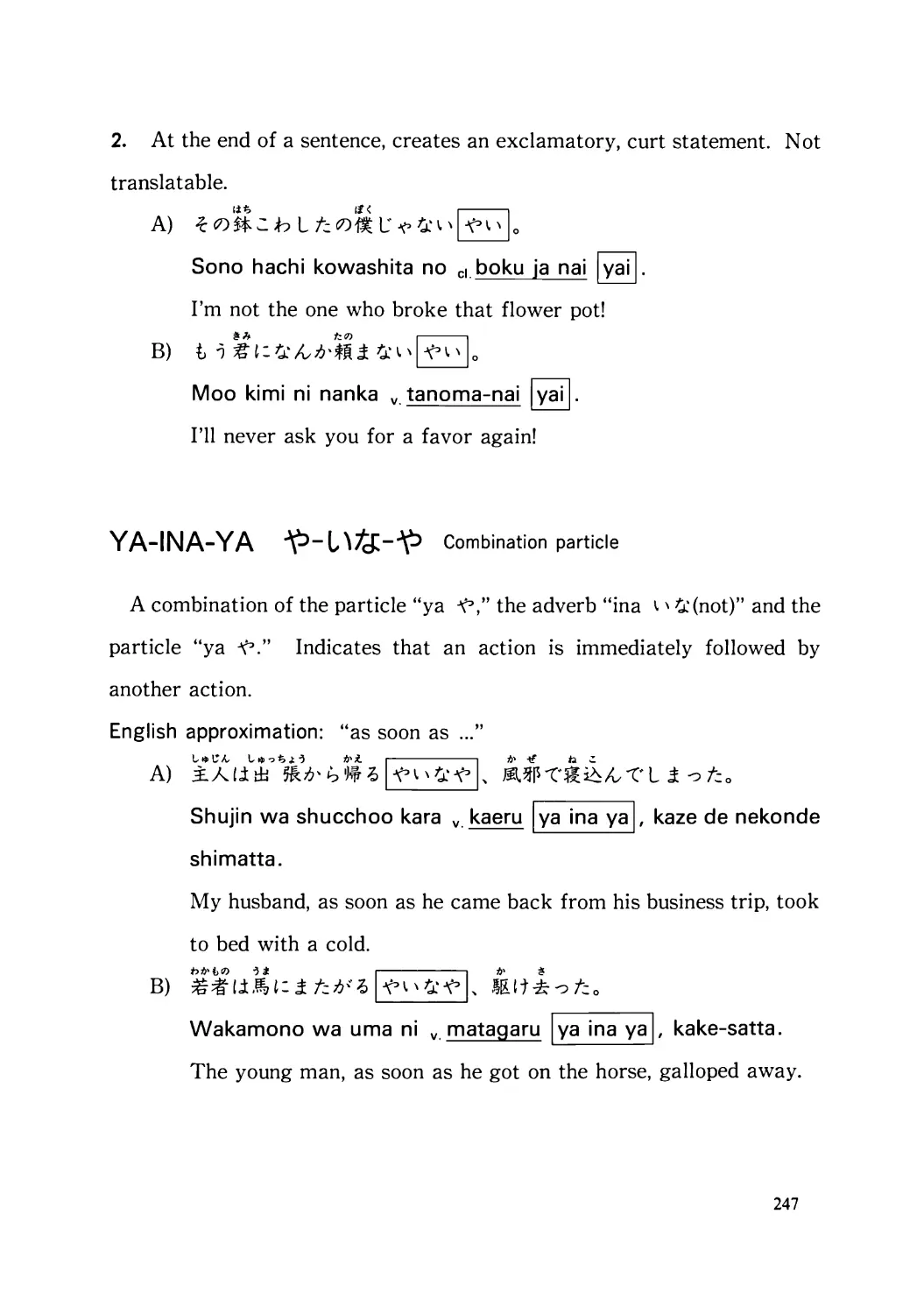
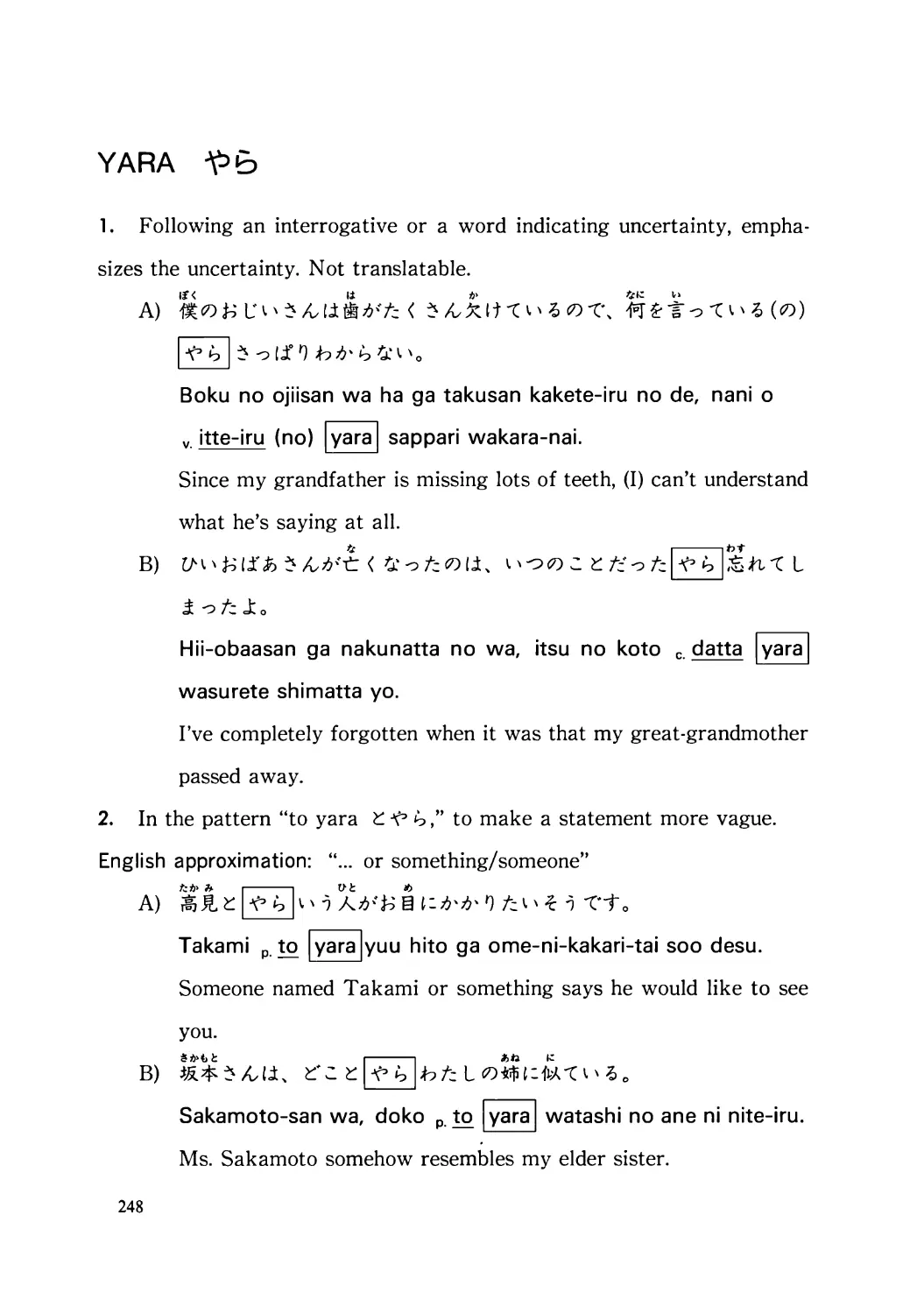
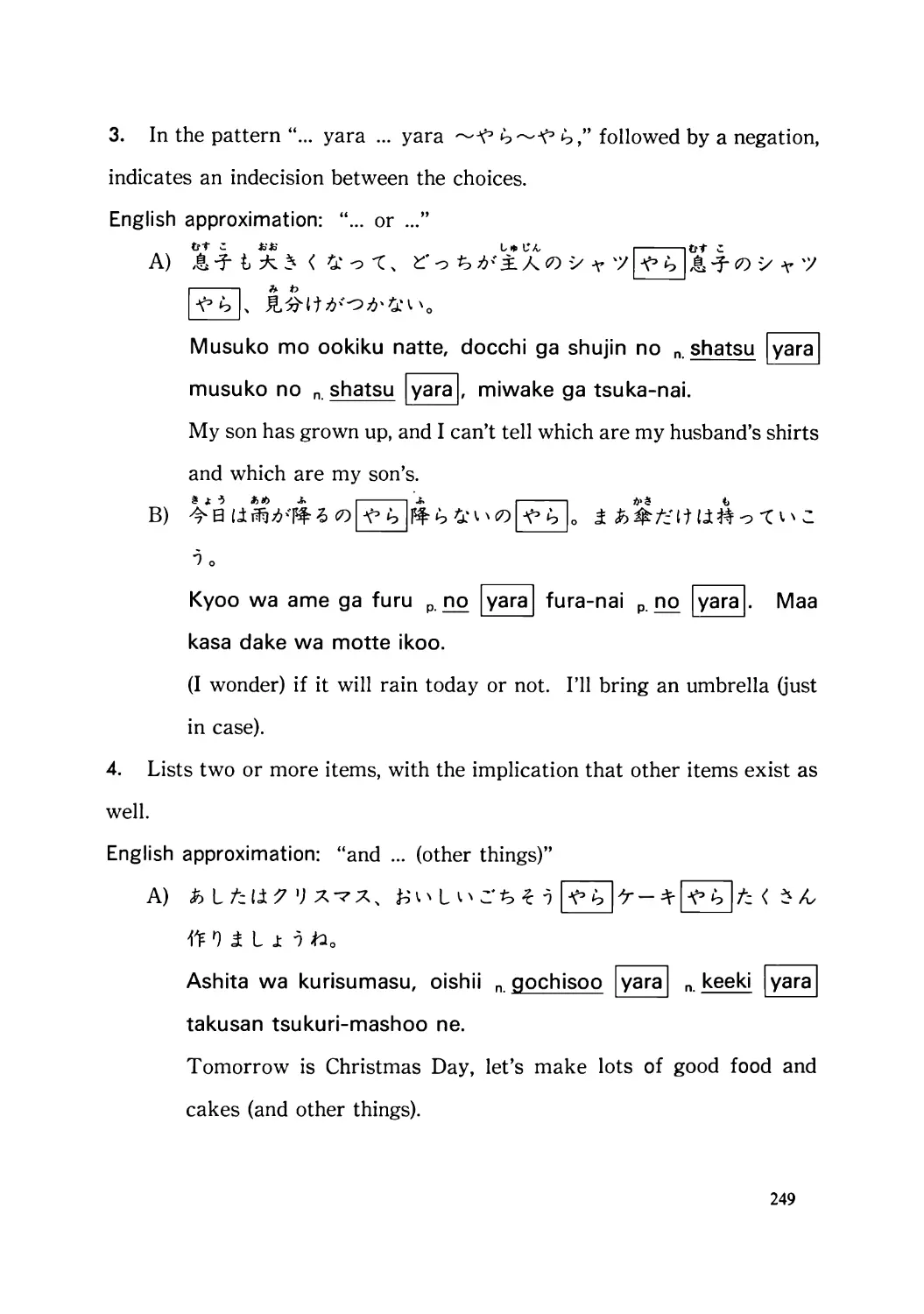

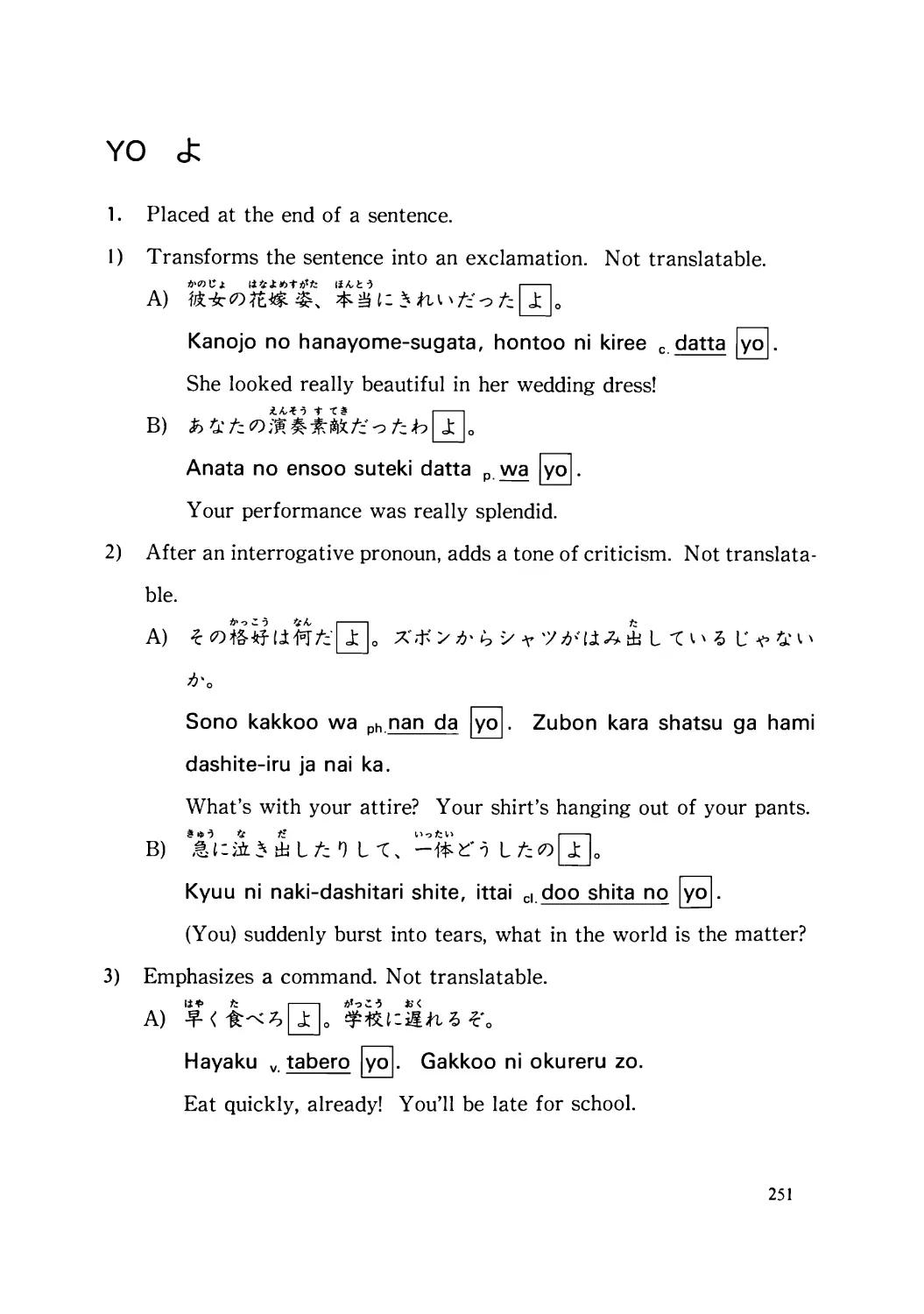

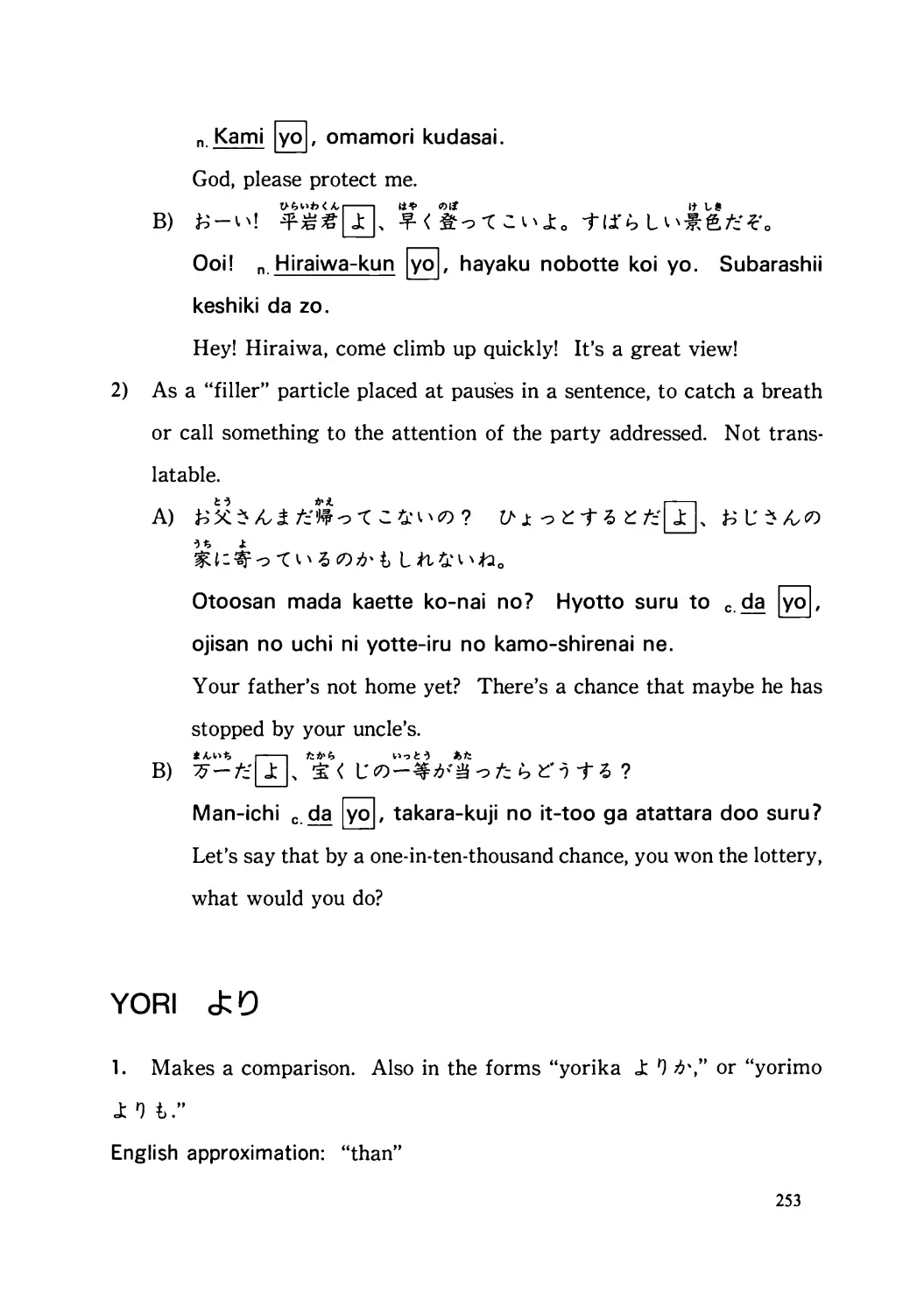






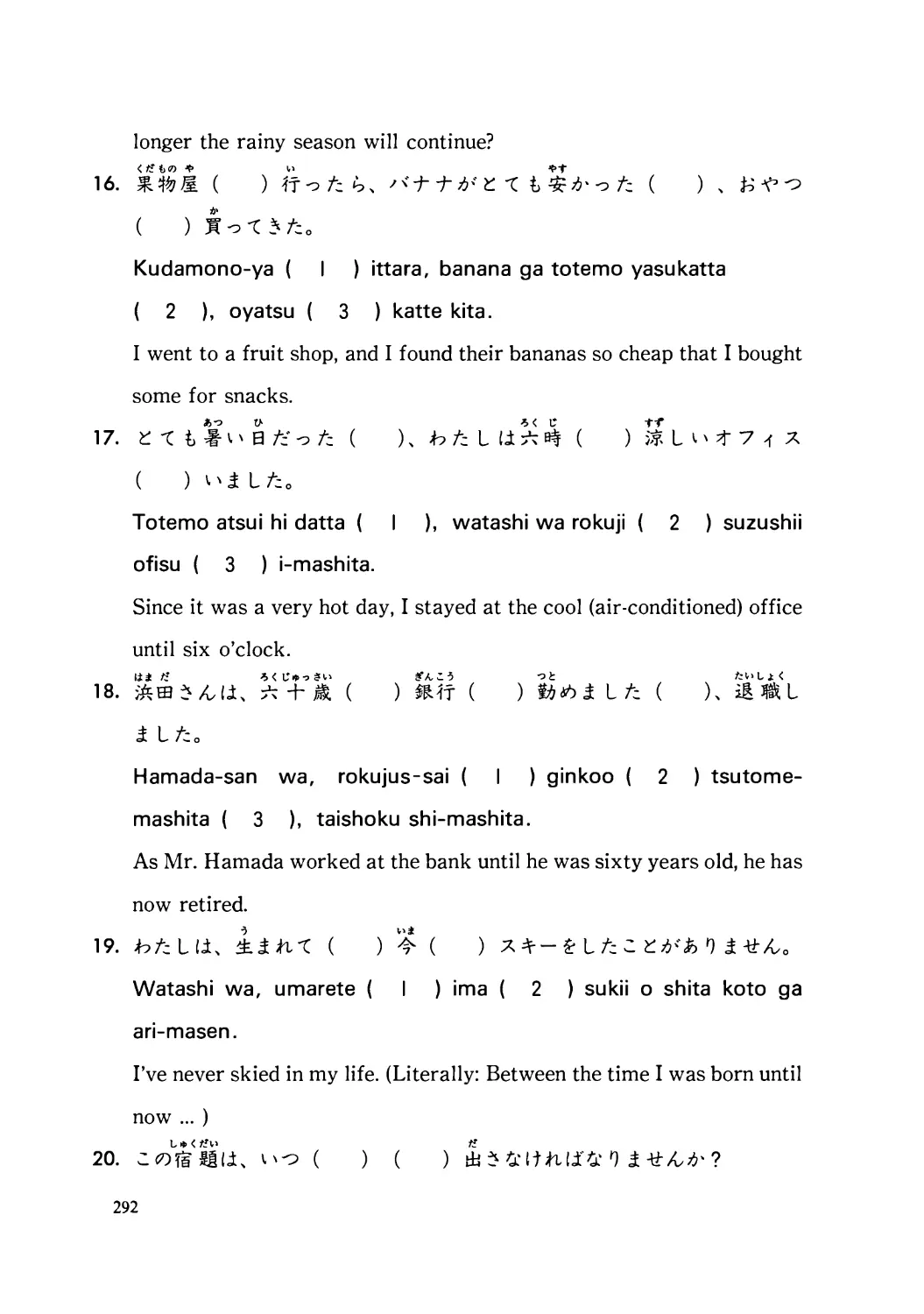
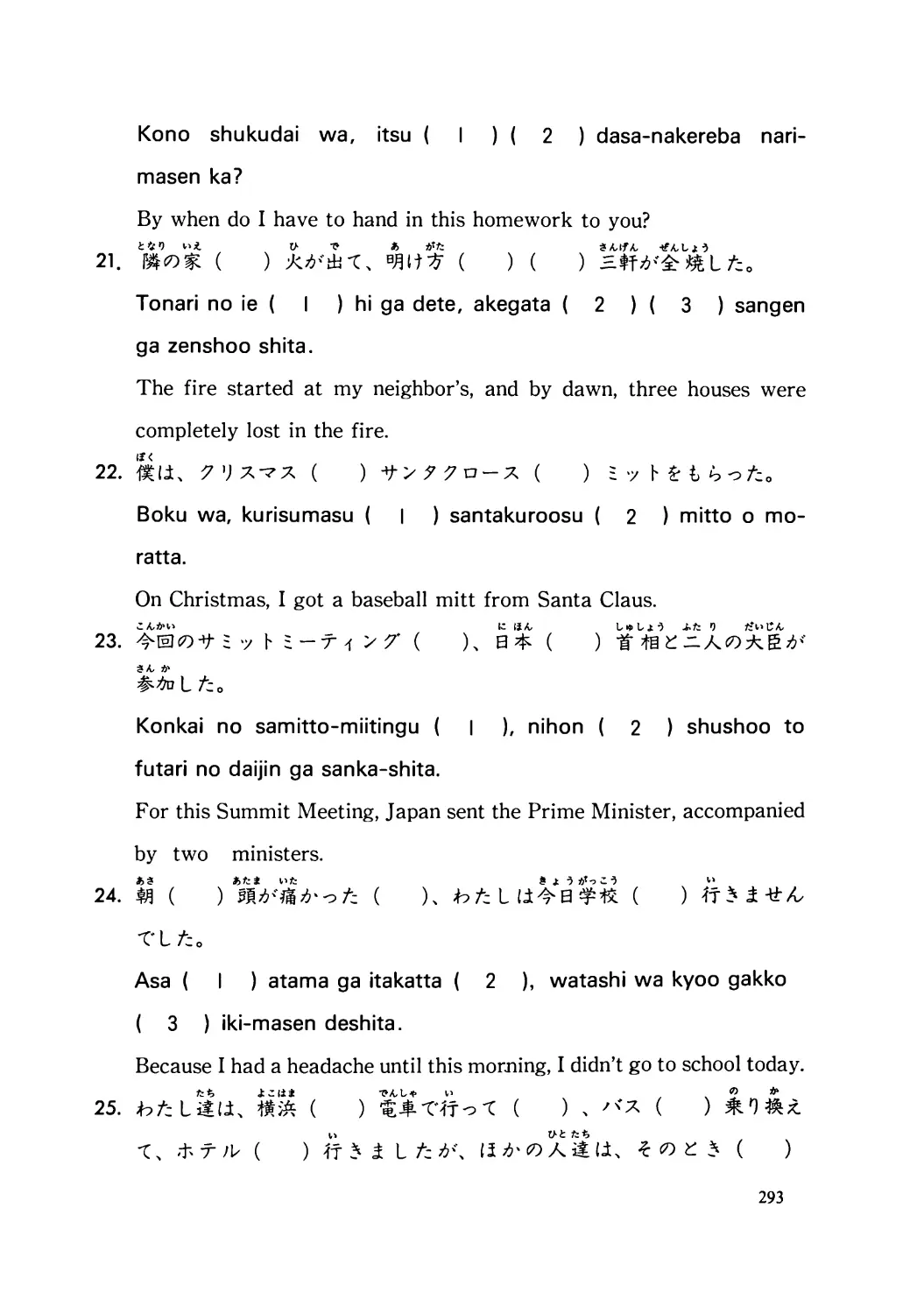
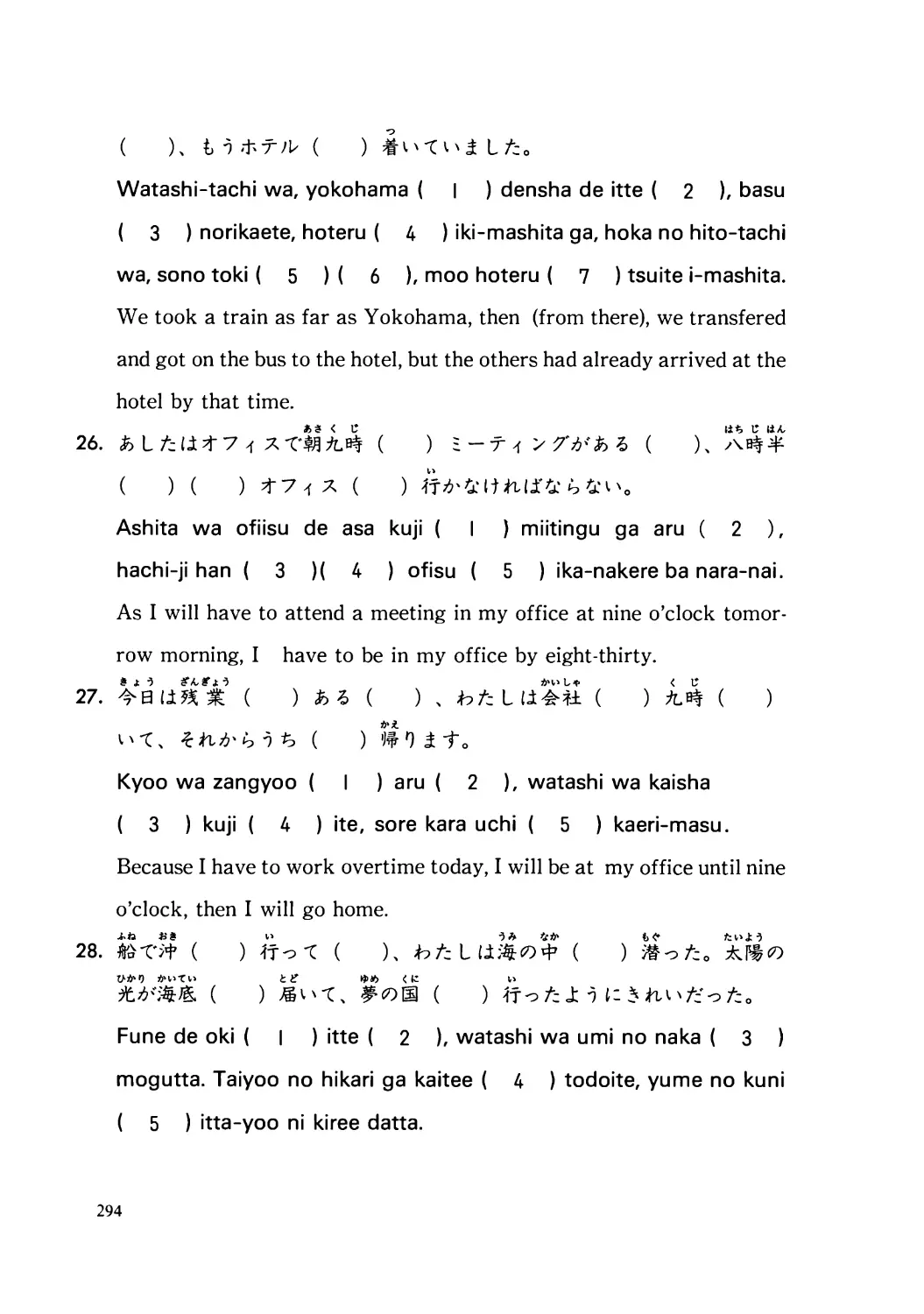
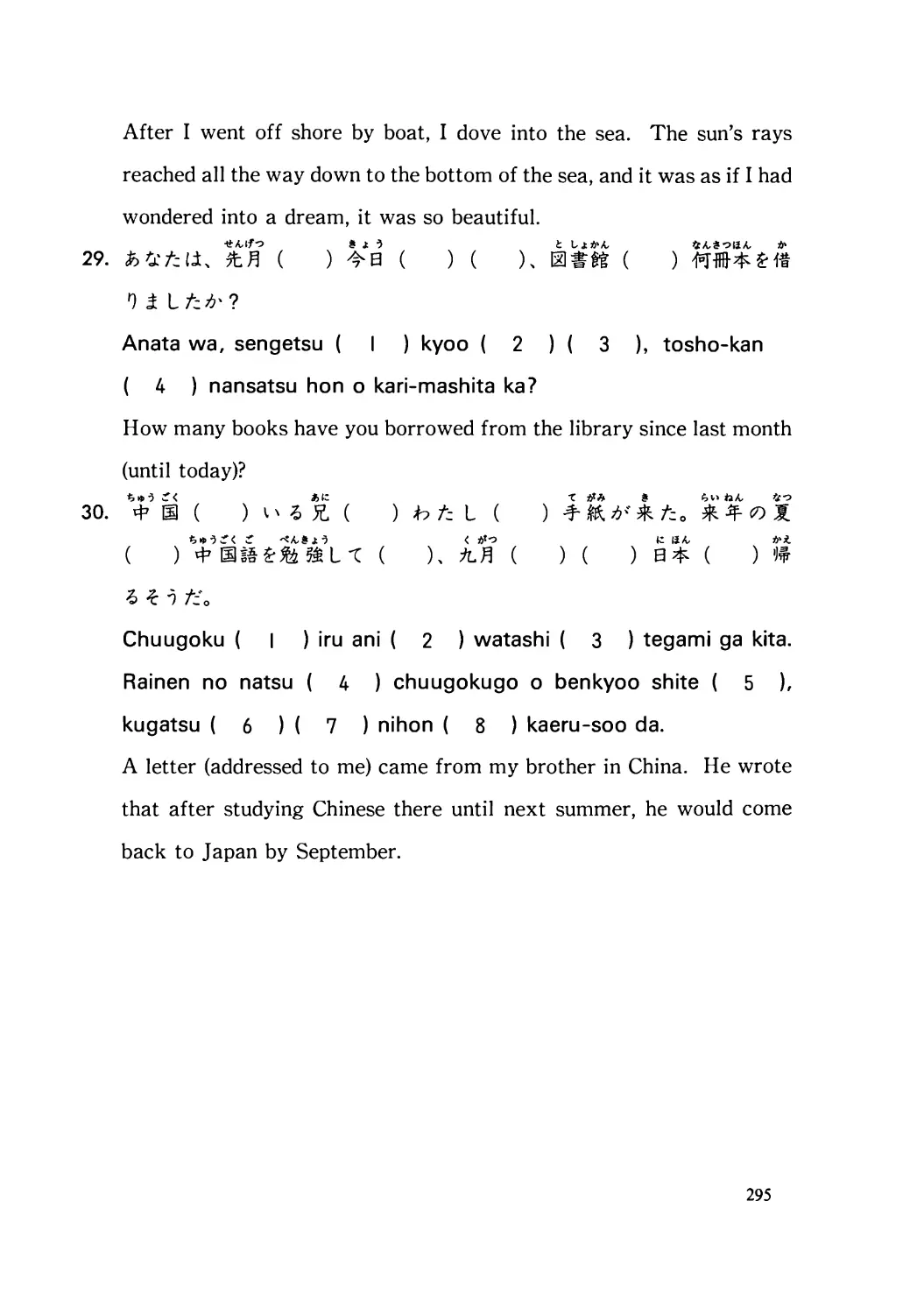




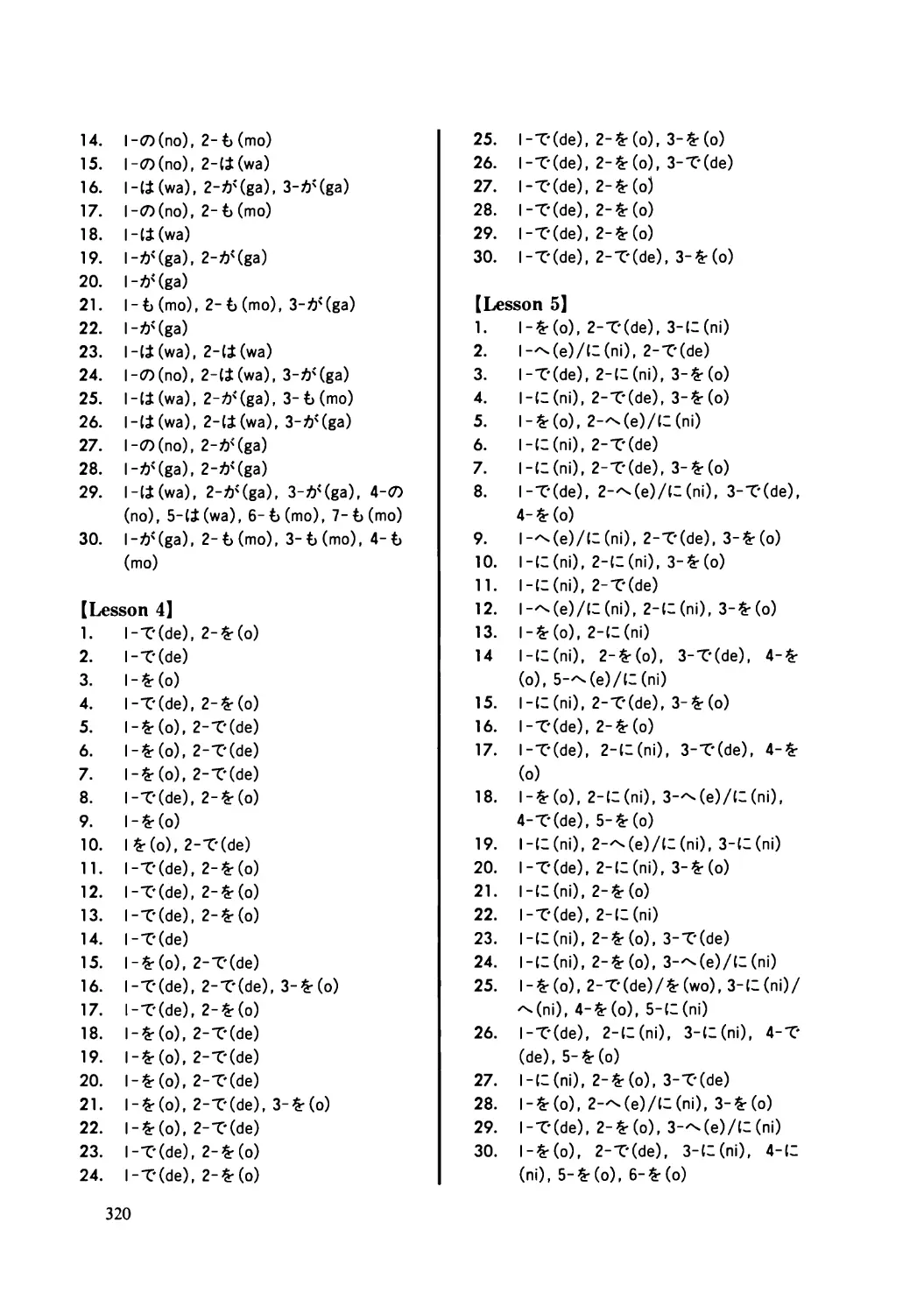
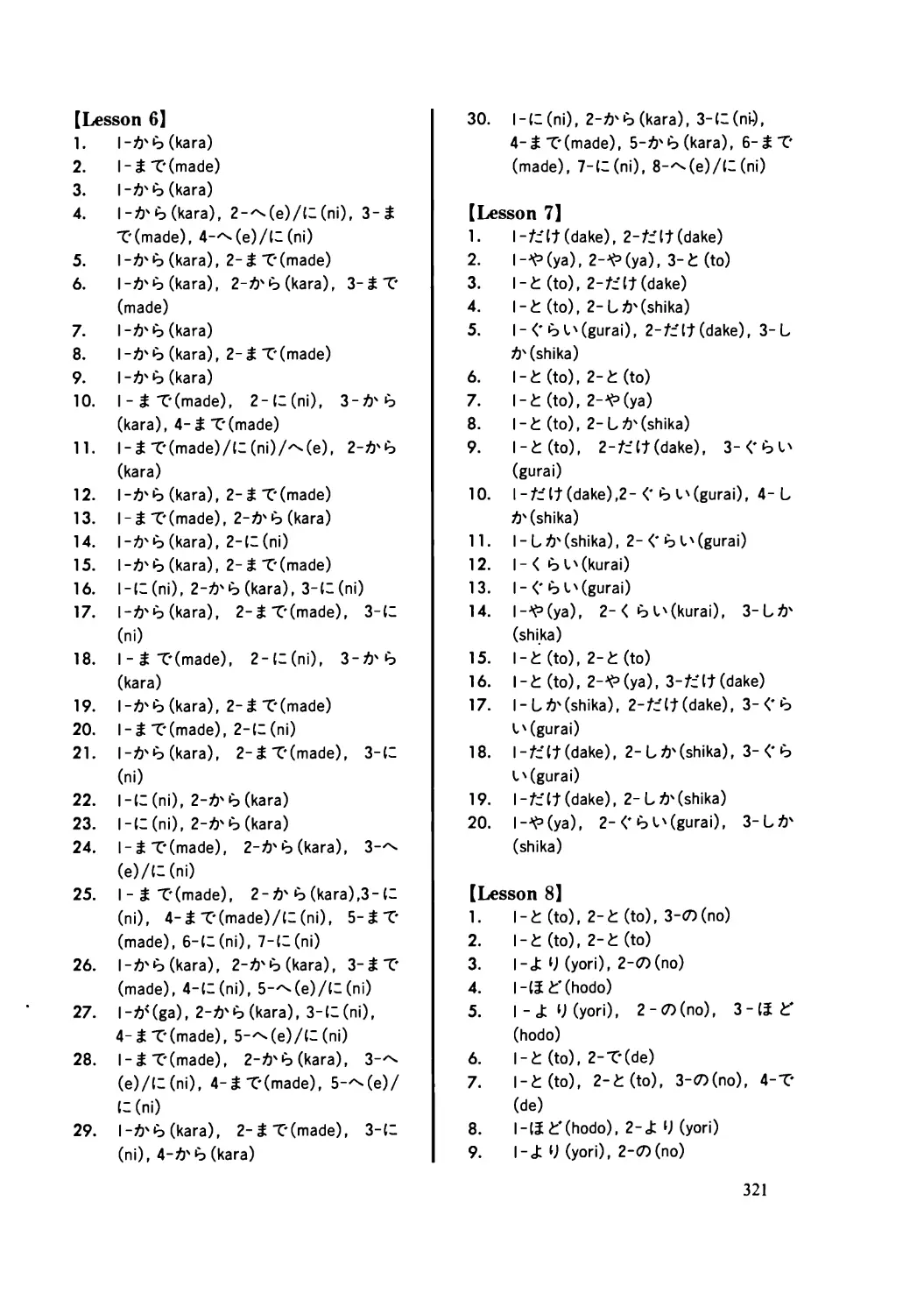

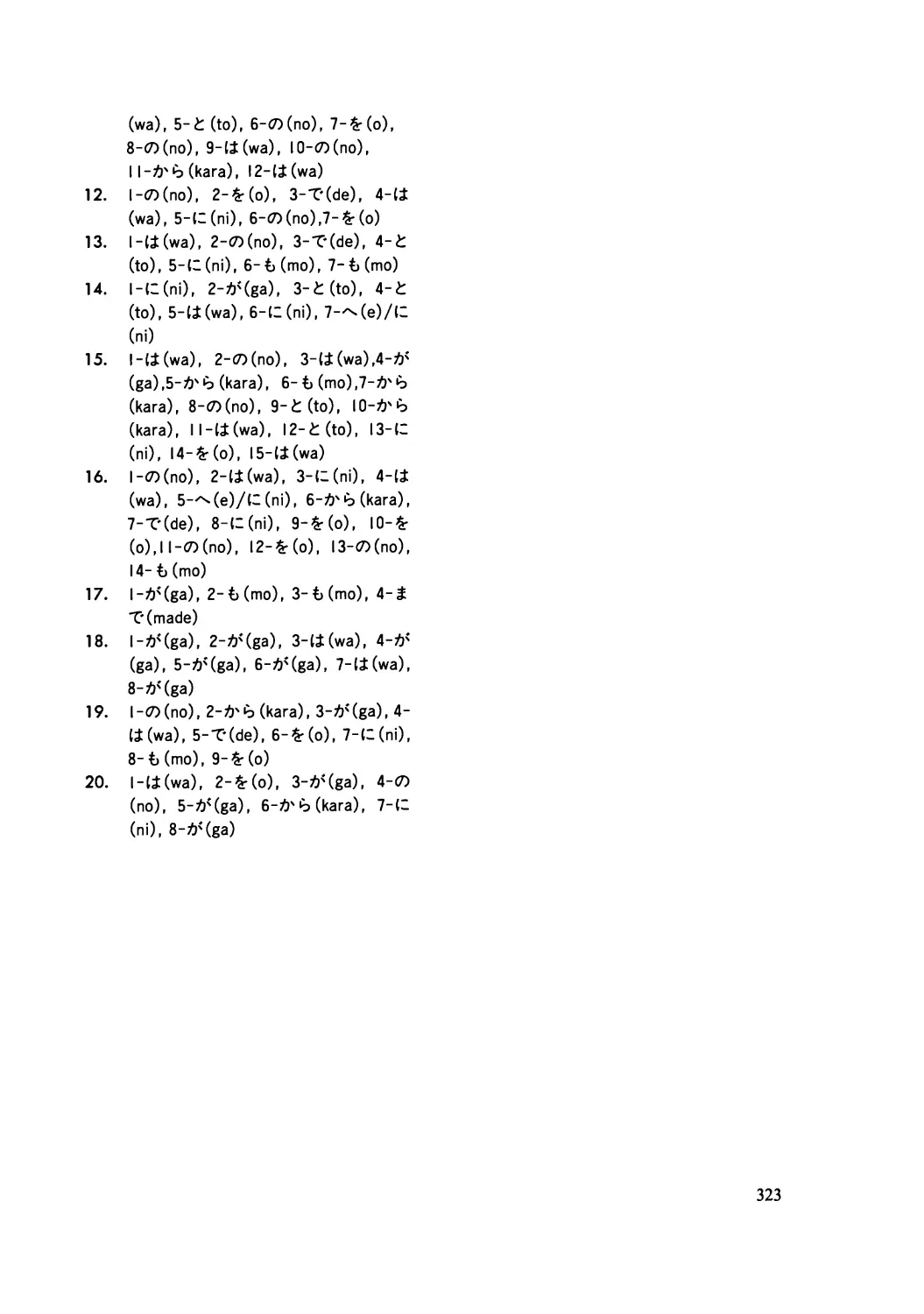
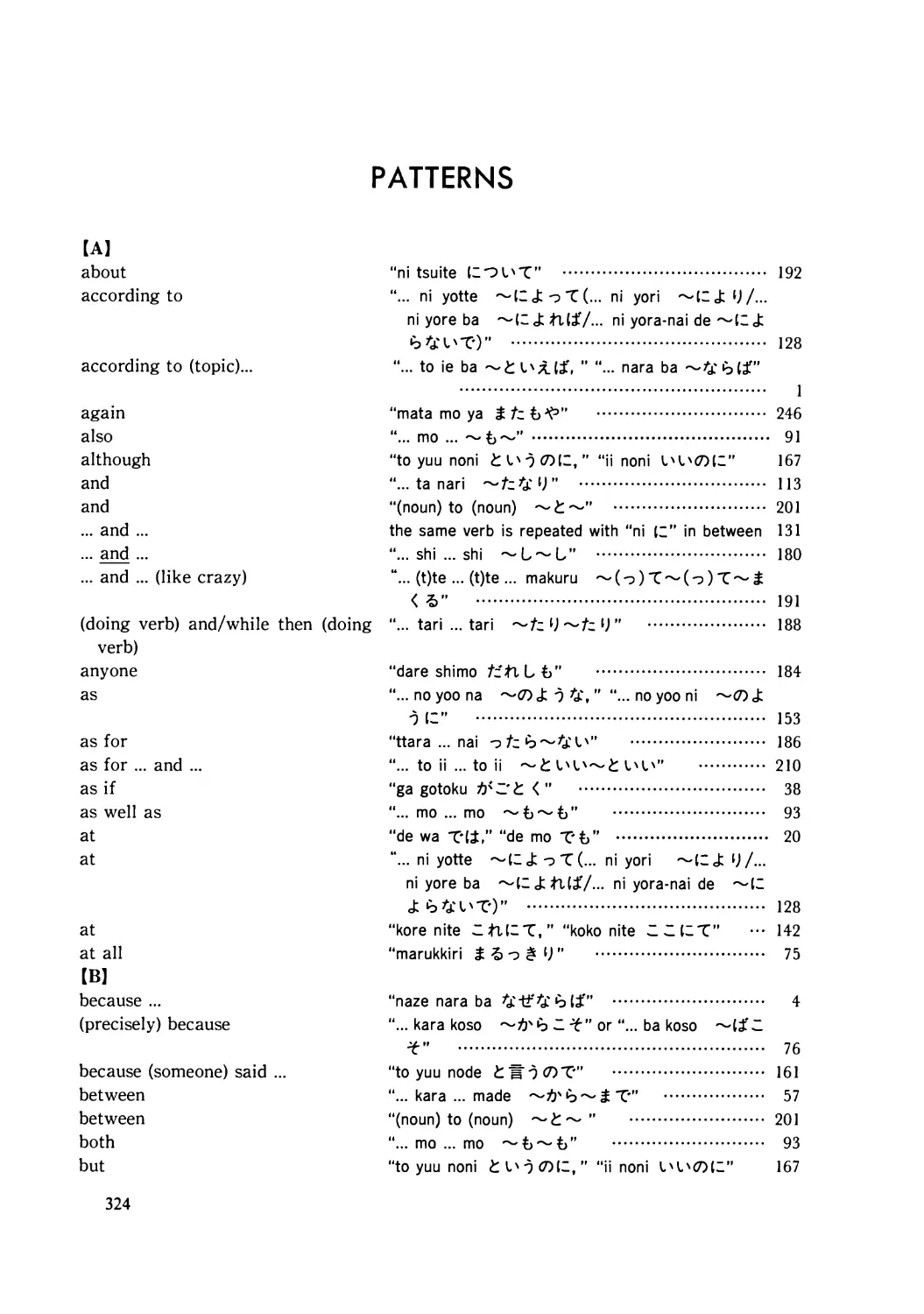



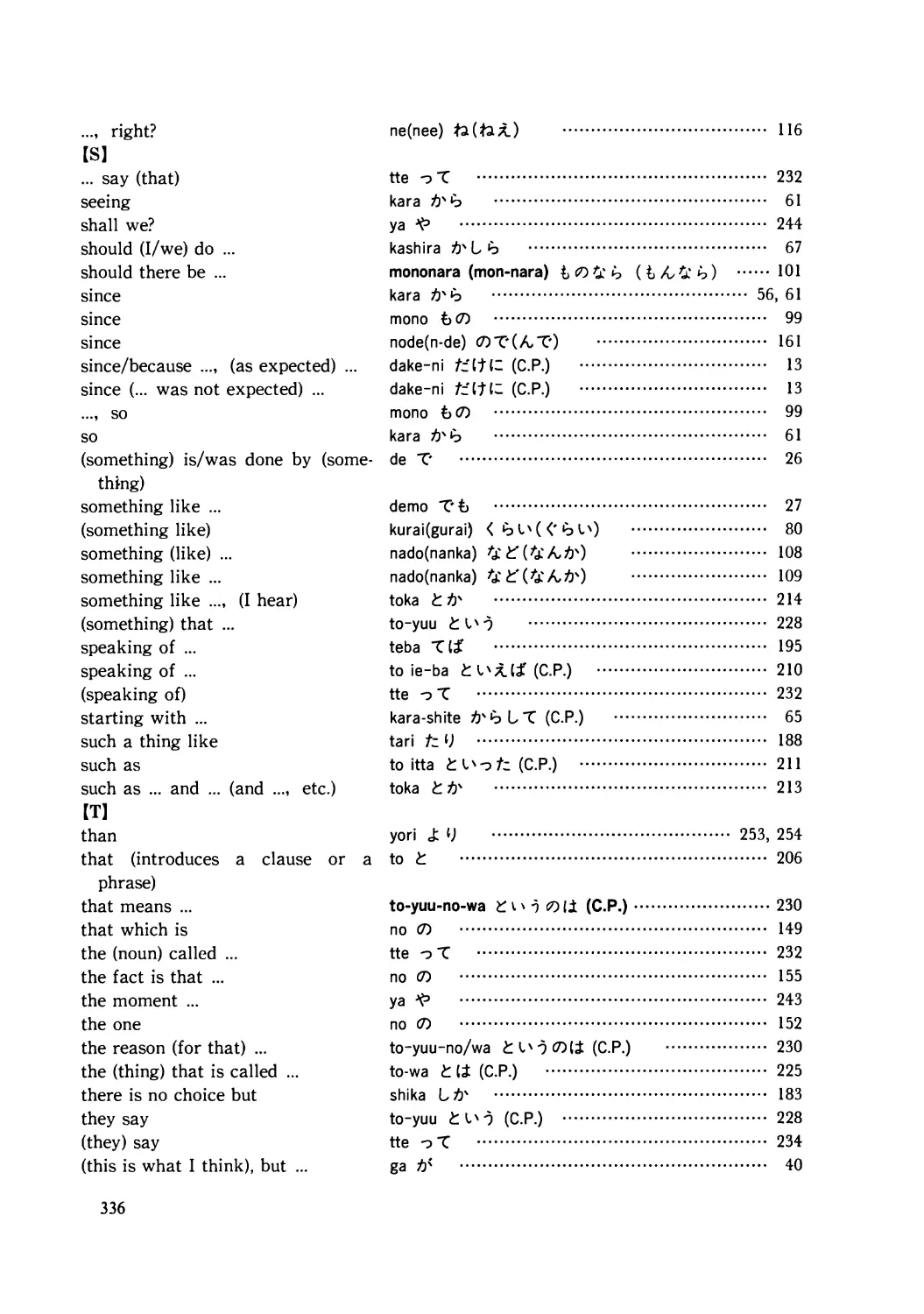

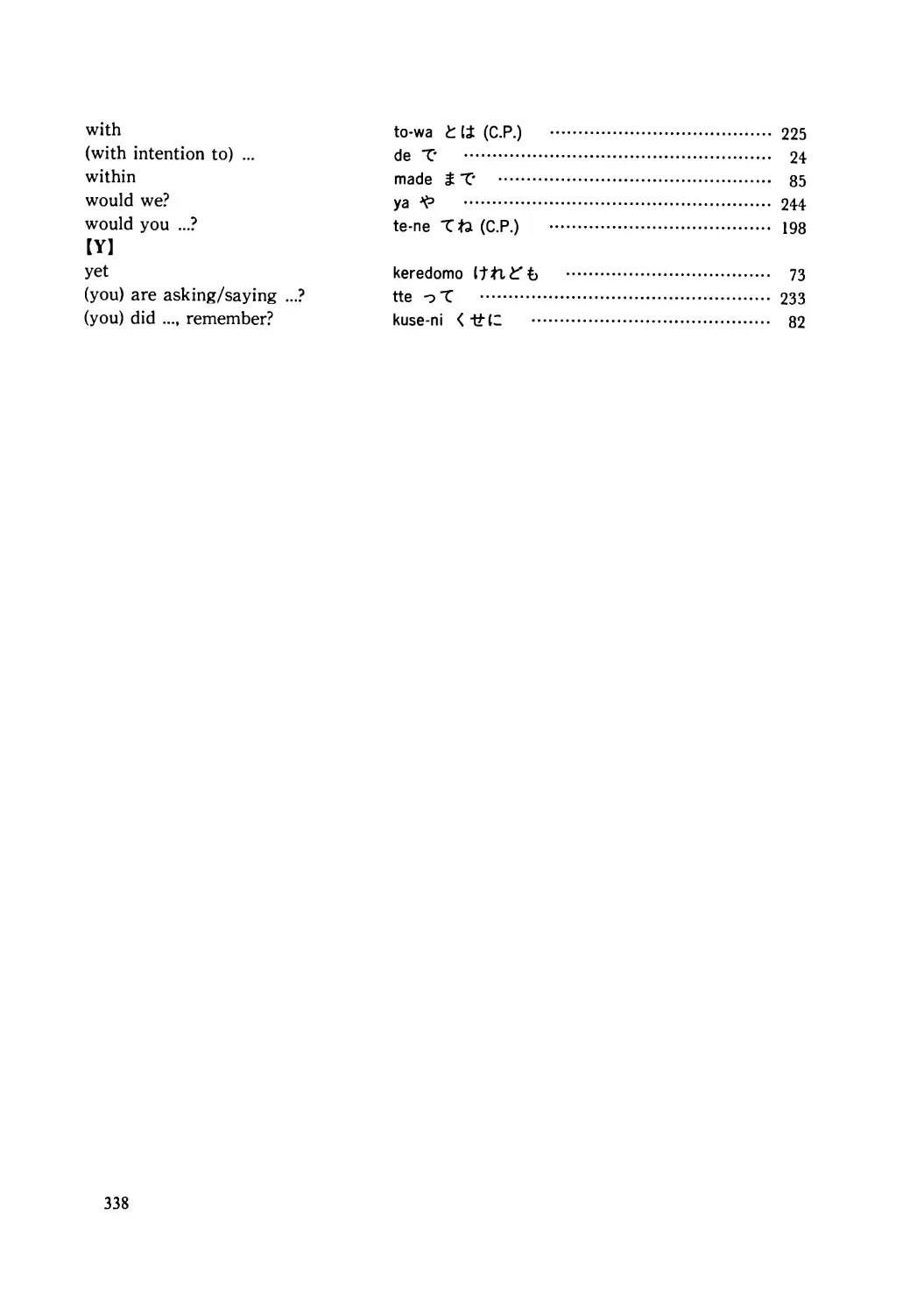
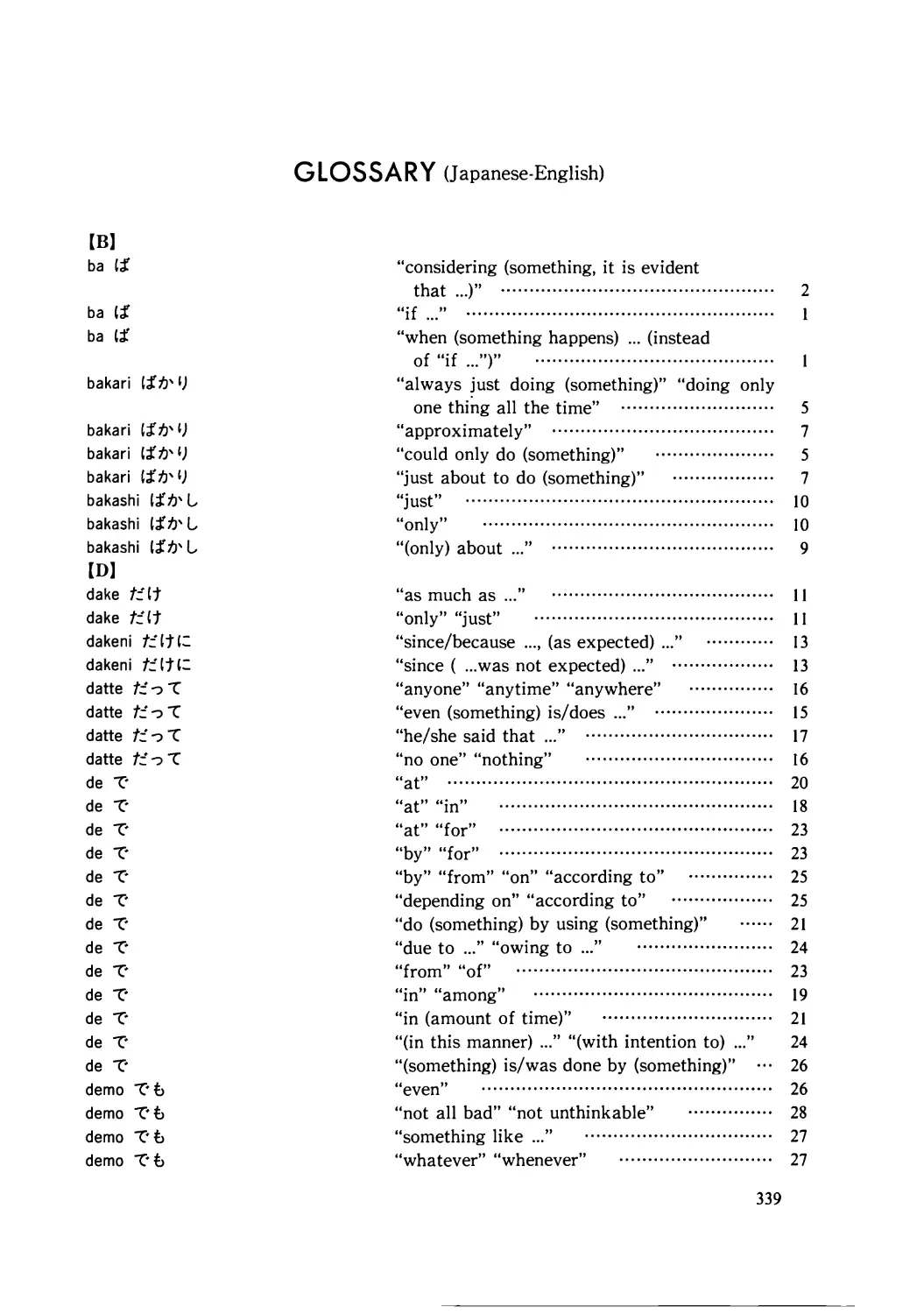
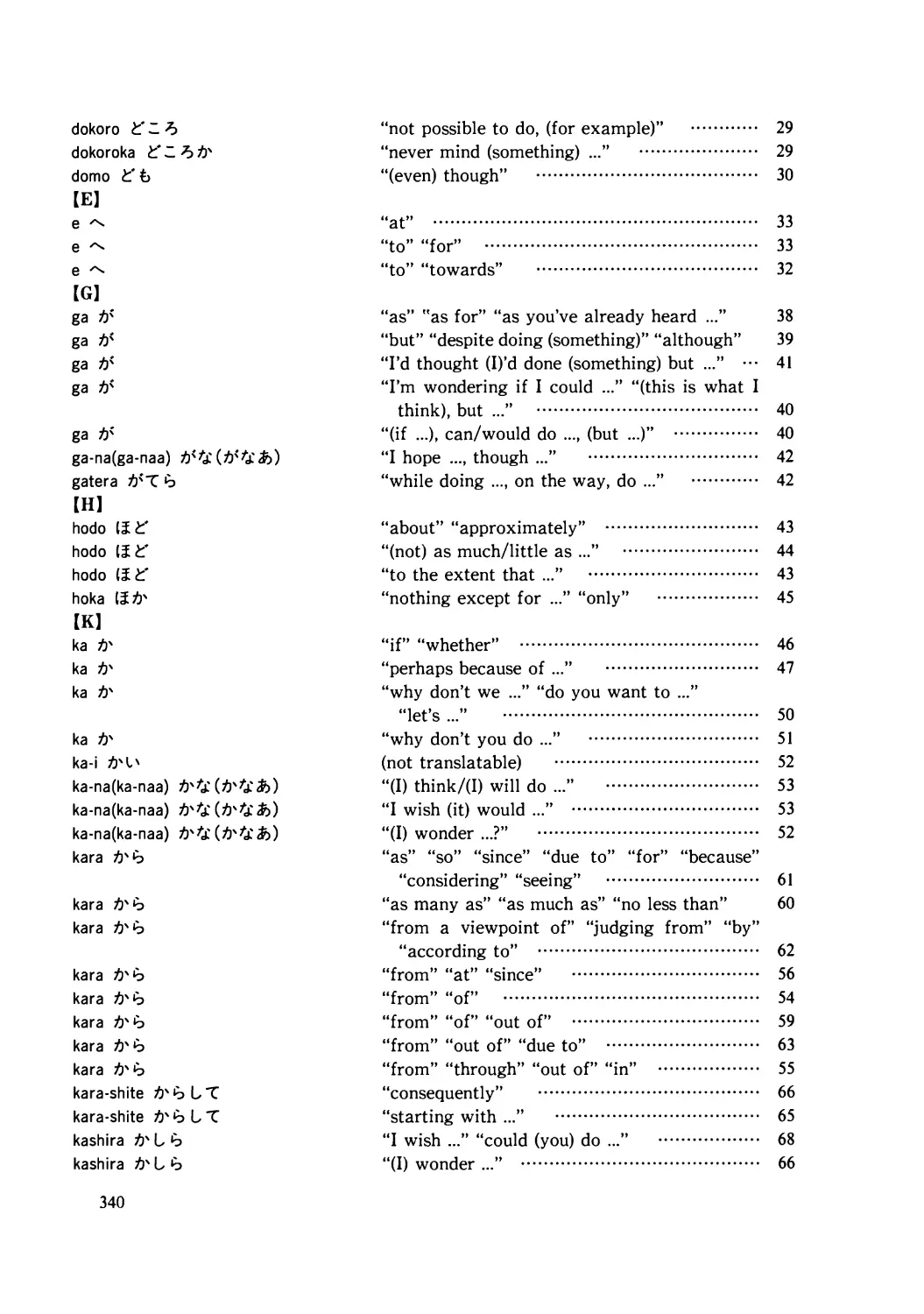
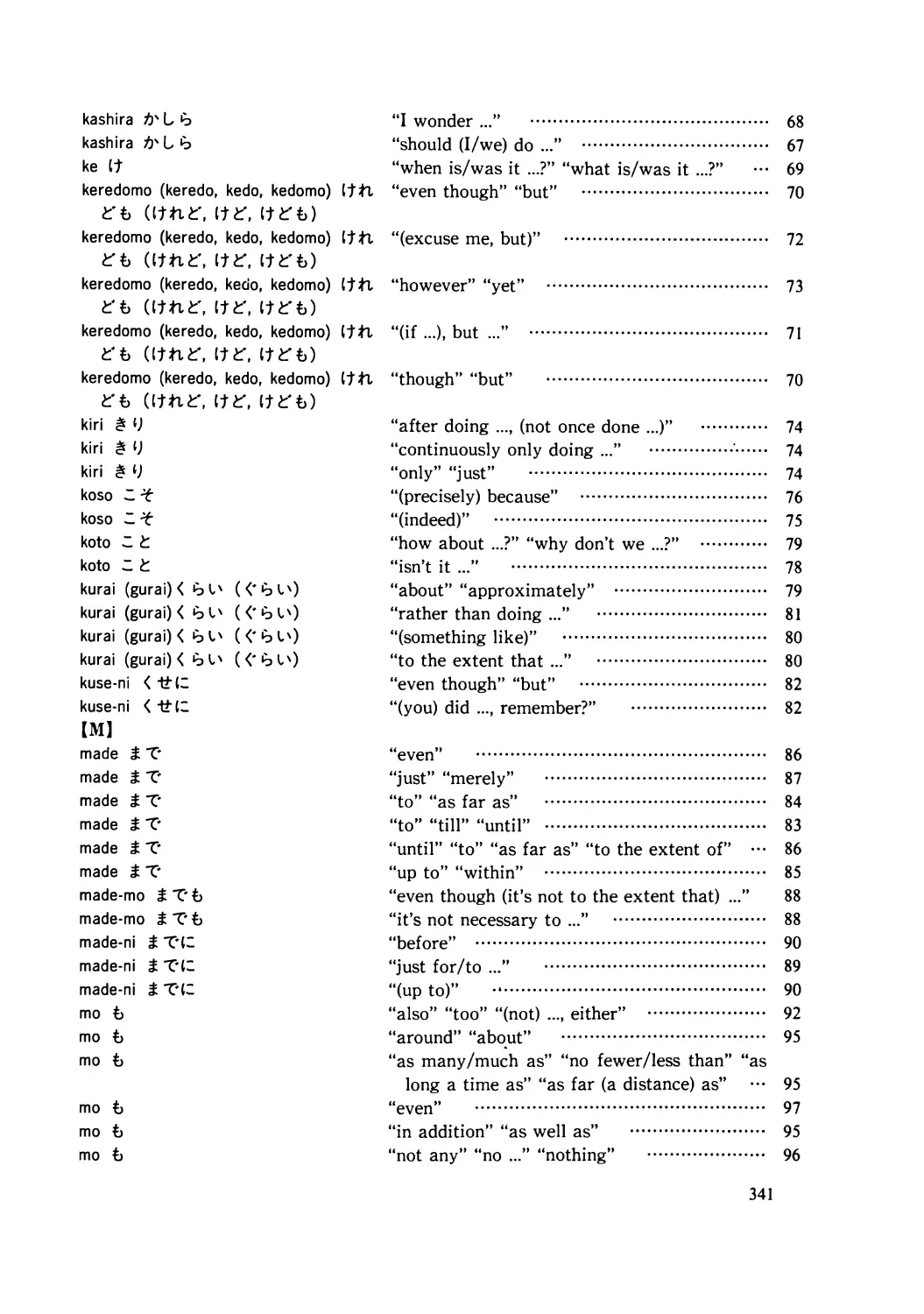
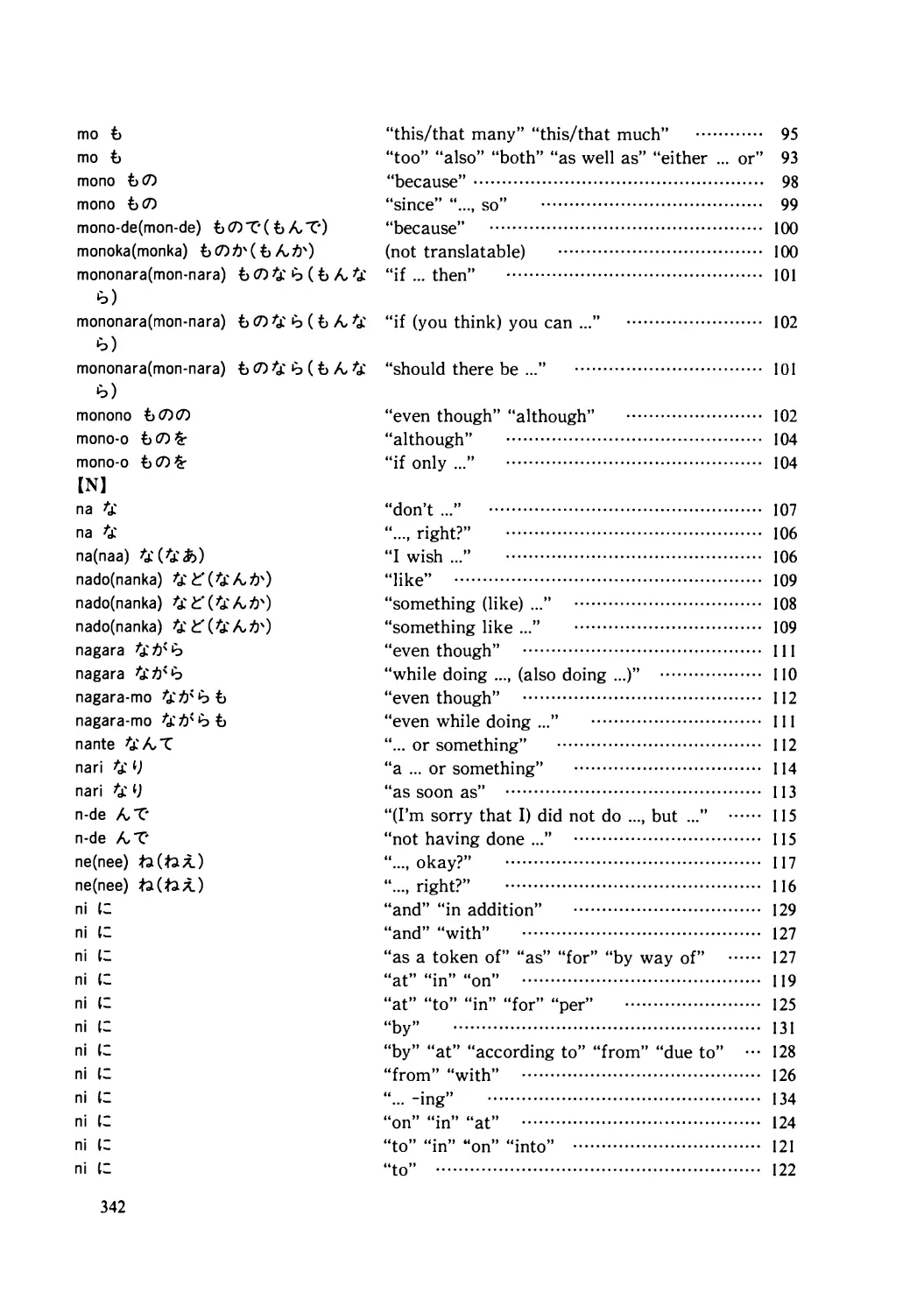
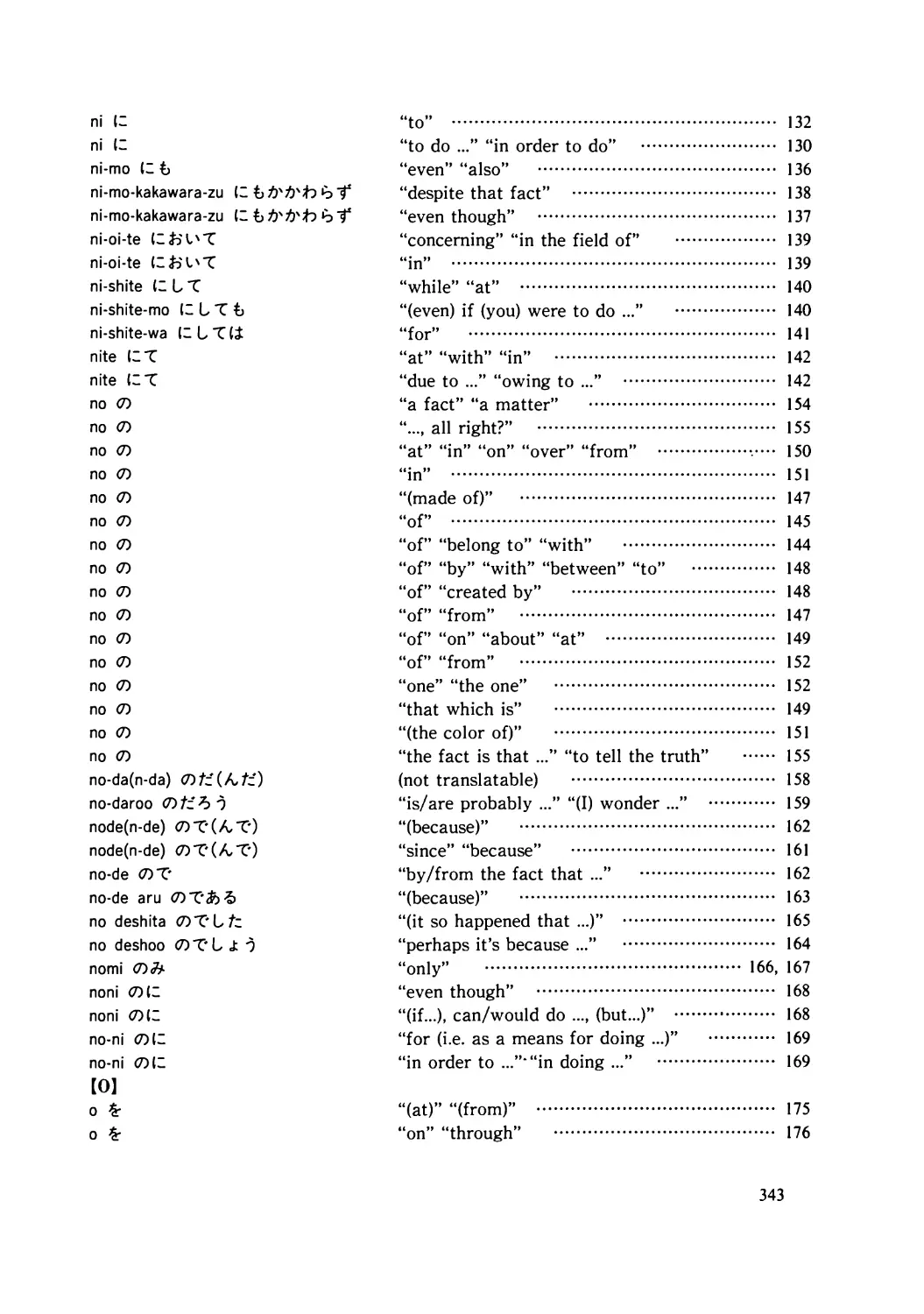
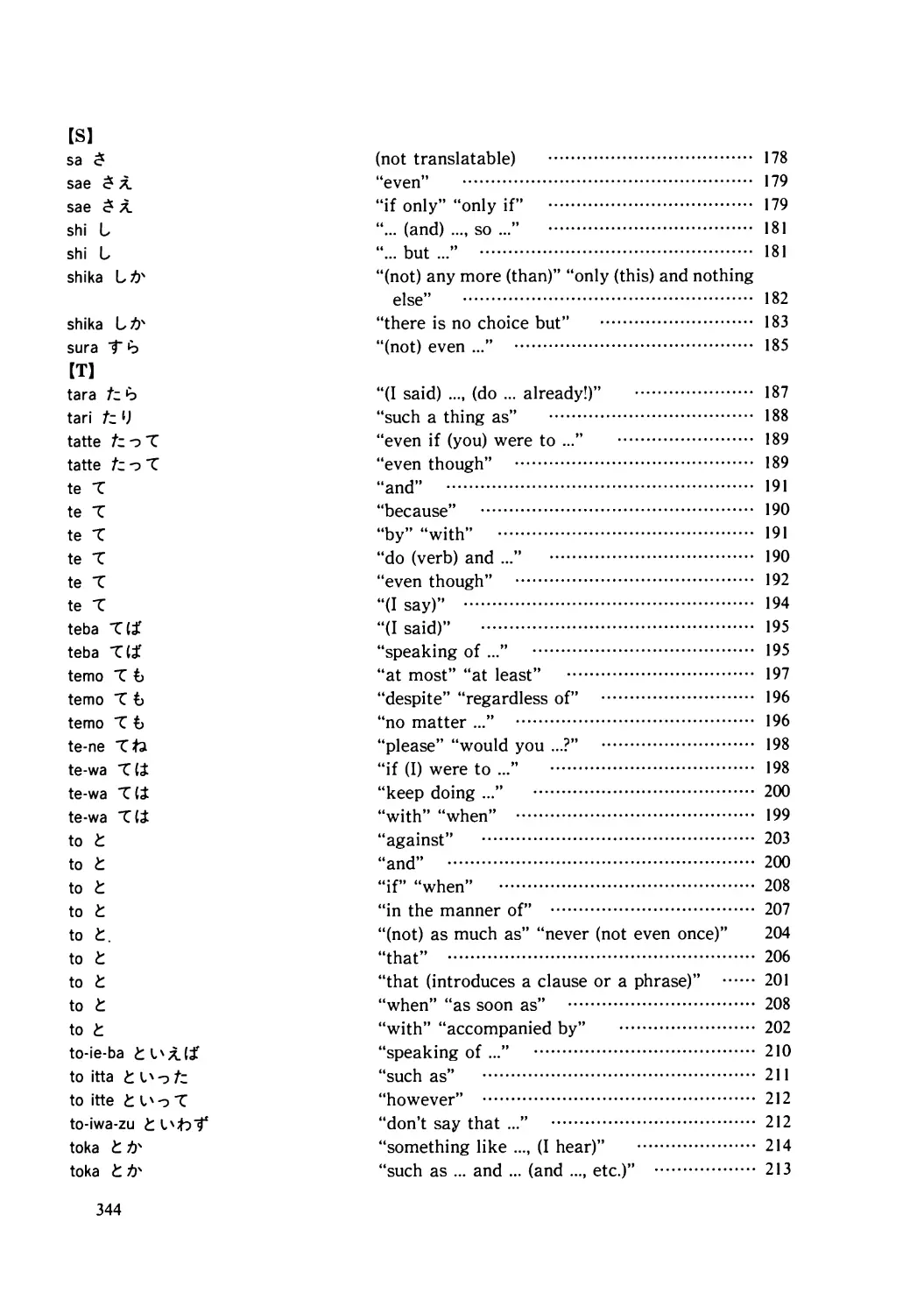


Text
A DICTIONARY OF
JAPANESE
PARTICLES
Sue A. Kawashima
KODANSHA INTERNATIONAL
Tokyo - New York -london
To my students
PREFACE
Although there are many difficult grammatical points that a student
must master in learning the Japanese language, particles belong in a class by
themselves. Appearing in nearly every sentence, they are absolutely crucial to
a proper understanding of the intended meaning. A student may possess a
large vocabulary and a good grasp of verb conjugation, but without a firm
command of particles t he or she cannot hope to construct consistently cor-
rect sentences. In choice and placement, particles can completely transform
the meaning of two sentences that are otherwise exactly the same.
Throughout my teaching career I have felt that particles were the key to
learning Japanese. Though not a linguist, I have many years of teaching expe-
rience, and in this book I hope to have made good use of that experience by
helping students come to a better understanding of particle usage. If the stu-
dent benefits in any substantial way, I will feel my efforts have been rewarded.
I wish to thank my students at Hunter College, who, by posing many
thought-provoking questions, have contributed to the making of this book.
I would also like to express my sincere gratitude to Tetsuo Kuramochi of
Kodansha International, who helped to bring about this incarnation of the
original edition, Particles Plus.
Lastly, I am indebted for much of the translation herein to my daughter,
a professor of Japanese literature, who has edited all of my work.
Sue A. Kawashima
Spring, 1999
Previously published by Harcourt Brace Jovanovich Japan as Particles Plus.
Distributed in the United States by Kodansha America, Inc., 575 Lexington
Avenue, New York N.Y. 10022, and in the United Kingdom and continental
Europe by Kodansha Europe Ltd., 95 Aldwych, London WC2B 4JF. Published
by Kodansha International Ltd., 17-14 Otowa l-chome, Bunkyo-ku, Tokyo
112-8652, and Kodansha America, Inc.
Copyright @ 1999 by Sue A. Kawashima
All rights reserved. Printed in Japan
First edition, 1999
99 00 01 02 1098765432 1
ISBN 4-7700-2352-9
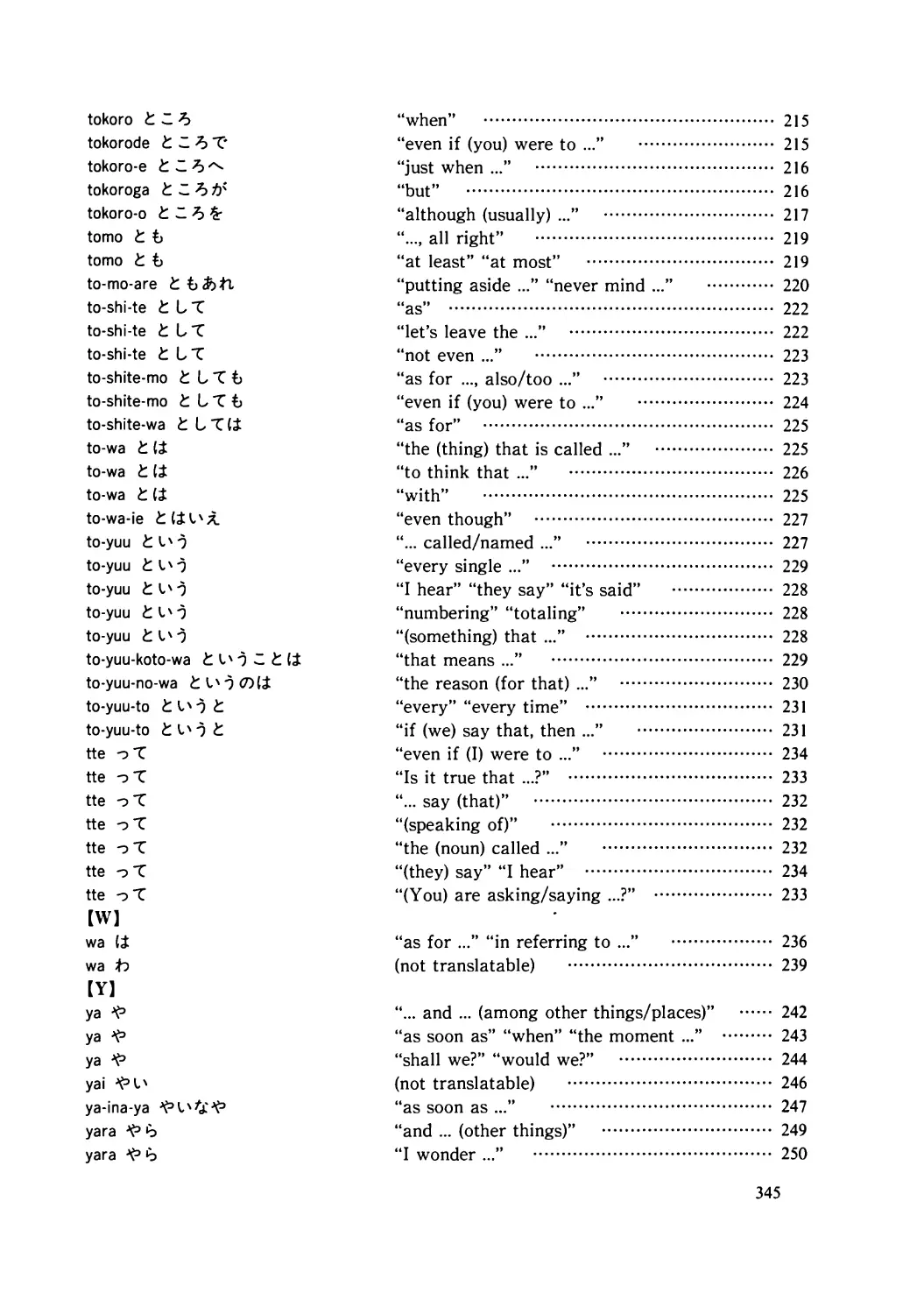
CONTENTS
PREFACE
INTRODUCTION..................................................................... 1
(C.P. = Combination Particles)
BA fd:. . . . . . . . . . . . . . . . . . . . . . . . . . . . . . . . . . . . . . . . . . . . . . . . . . . . . . . . . . . . . . . . . . . . . . . . . . . . . . . . . I
BAKARI f 'n' ..................................................................... 5
D A K E 1::.11. . . . . . . . . . . . . . . . . . . . . . . . . . . . . . . . . . . . . . . . . . . . . . . . . . . . . . . . . . . . . . . . . . . . . . . . . . . I 0
DAKE-N 1 t-:: 1:1-(;: (c. P.) .. .. . . . . . .. . . . . .. . . .. . . . .. . . . . .. . .. . .. .. . . . . . .. . .. .. .. .. . 13
DAN 0 f-:: 0') ........................................................................... 14
D A TIE f-:: -:> L . . . . . . . . . . . . . . . . . . . . . . . . . . . . . . . . . . . . . . . . . . . . . . . . . . . . . . . . . . . . . . . . . . . . . 15
DE <:::' . . . . . . . . . . . . . . . . . . . . . . . . . . . . . . . . . . . . . . . . . . . . . . . . . . . . . . . . . . . . . . . . . . . . . . . . . . . . . . . . . 17
DEMO "(?=t) . . . . . . . . . . . . . . . . . . . . . . . . . . . . . . . . . . . . . . . . . . . . . . . . . . . . . . . . . . . . . . . . . . . . . . . . . . . 26
DOKORO c!:::.' -3 .................................................................. 29
DOKOROKA t!:: -3 n' ............................................................ 29
DO MO t!:: =t) . . . . . . . . . . . . . . . . . . . . . . . . . . . . . . . . . . . . . . . . . . . . . . . . . . . . . . . . . . . . . . . . . . . . . . . . 30
E ". . . . . . . . . . . . . . . . . . . . . . . . . . . . . . . . . . . . . . . . . . . . . . . . . . . . . . . . . . . . . . . . . . . . . . . . . . . . . . . . . . . . 30
GA tJ'. . . . . . . . . . . . . . . . . . . . . . . . . . . . . . . . . . . . . . . . . . . . . . . . . . . . . . . . . . . . . . . . . . . . . . . . . . . . . . . . . 34
GA-NA(GA-NAA) n\-1J.(n\-1J.(jf» (C.P.) ................................. 42
GA TERA n\ Lb. . . . . . . . . . . . . . . . . . . . . . . . . . . . . . . . . . . . . . . . . . . . . . . . . . . . . . . . . . . . . . . . . . 42
H 0 DO fa: t!:: . . . . . , . . . . . . . . . . . . . . . . . . . . . . . . . . . . . . . . . . . . . . . . . . . . . . . . . . . . . . . . . . . . . . . . . . . . . 43
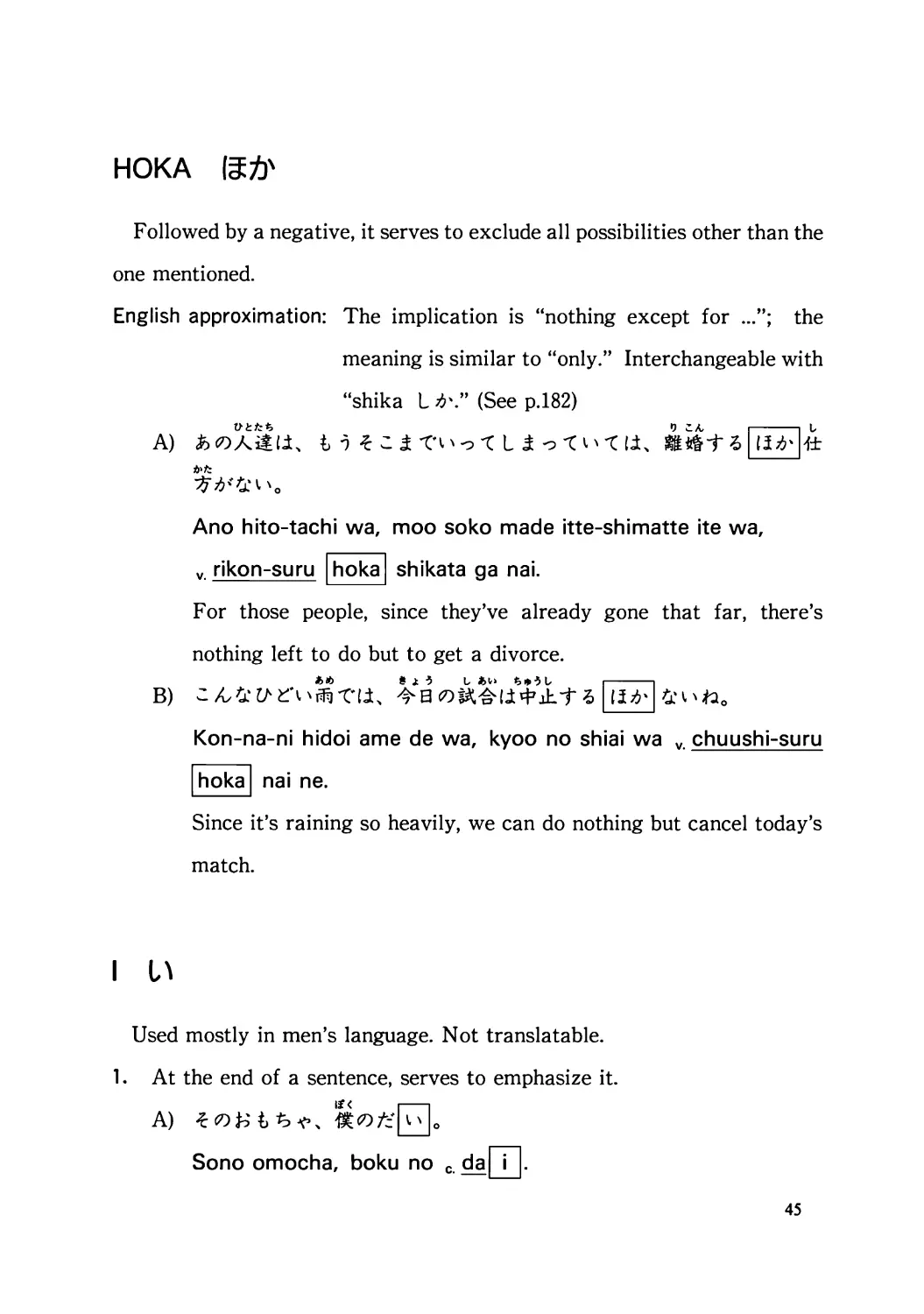
HOKA fa:n' ........................................................................... 45
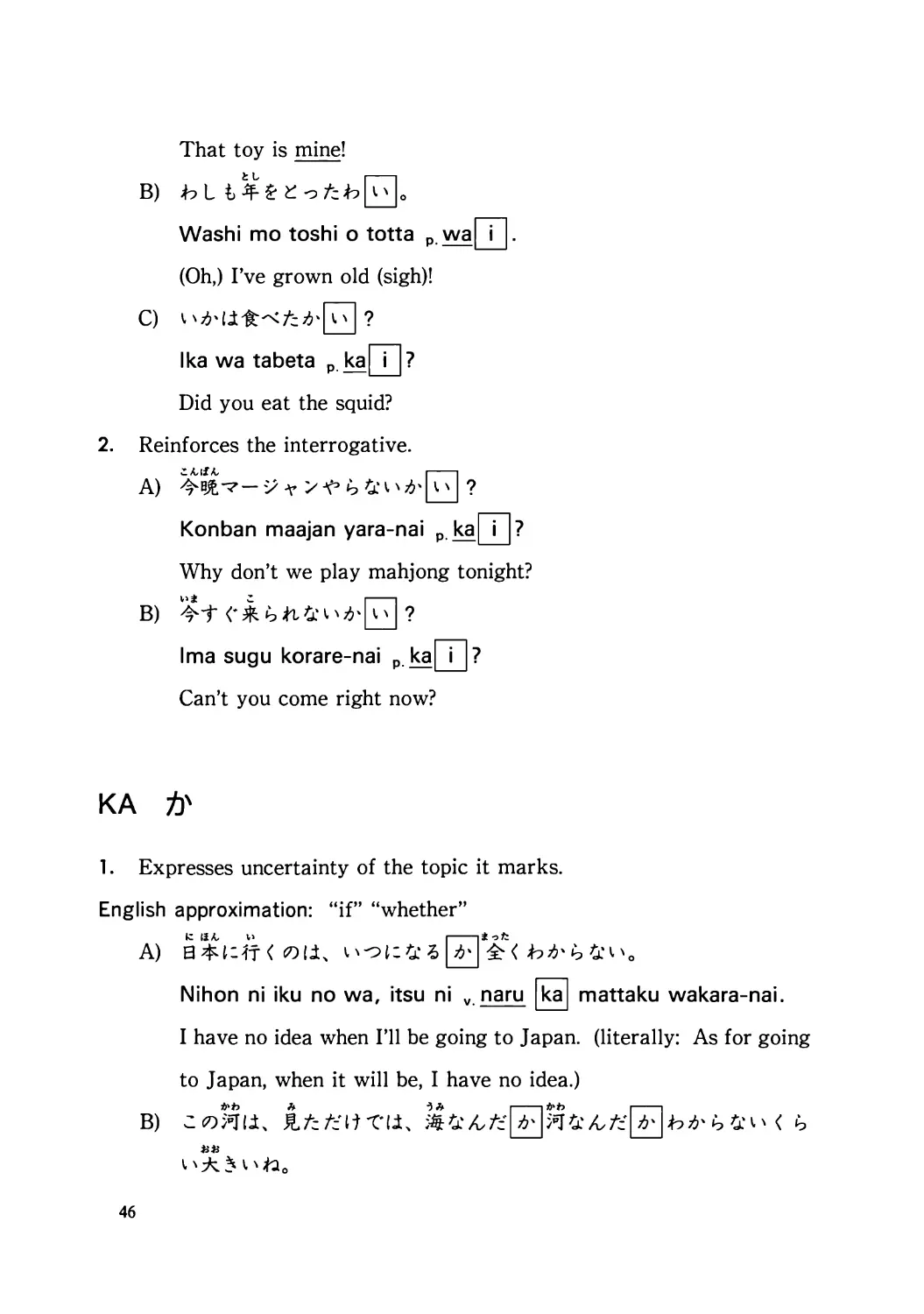
I l, , . . . . . . . . . . . . . . . . . . . . . . . . . . . . . . . . . . . . . . . . . . . . . . . . . . . . . . . . . . . . . . . . . . . . . . . . . . . . . . . . . . . . 45
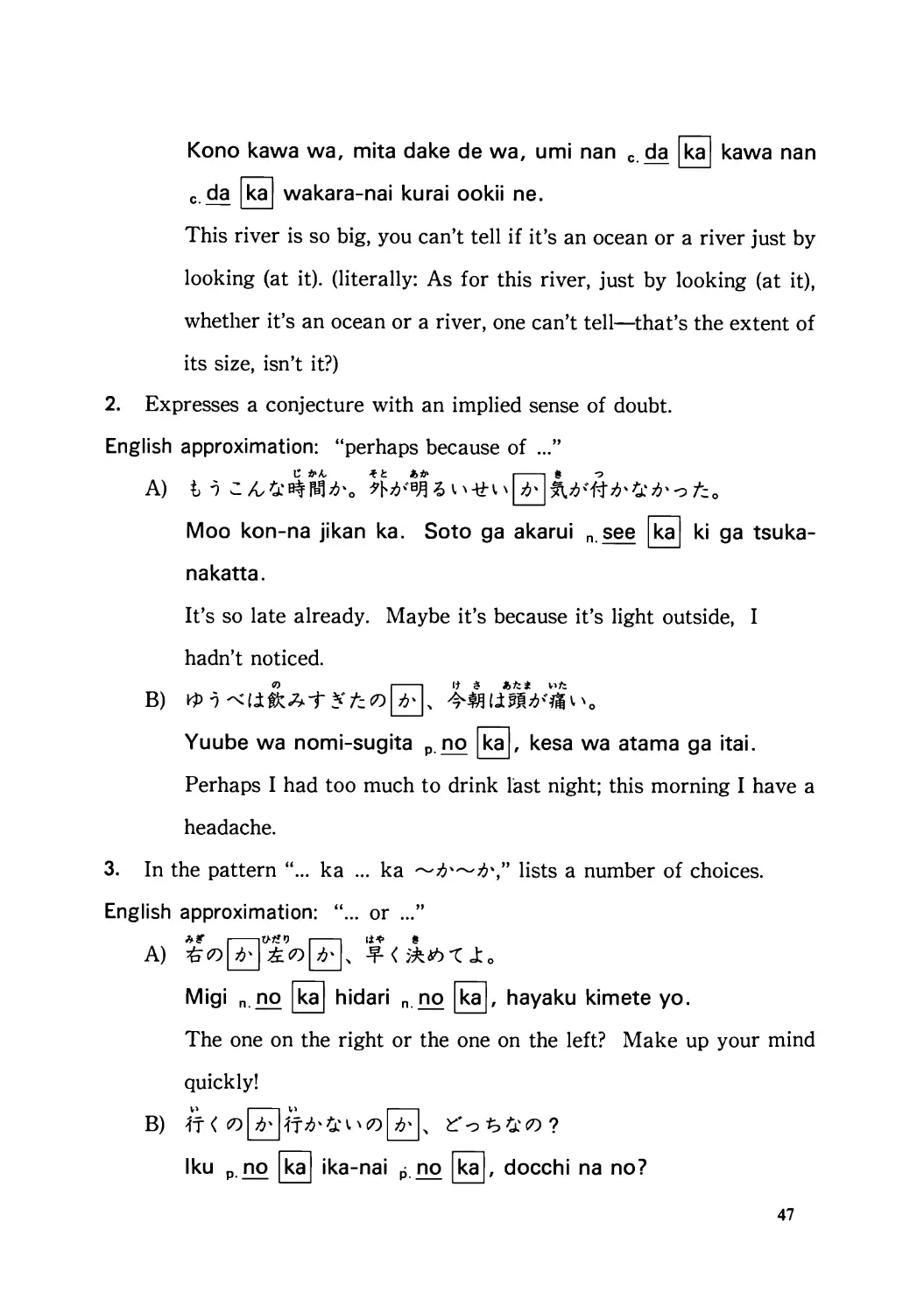
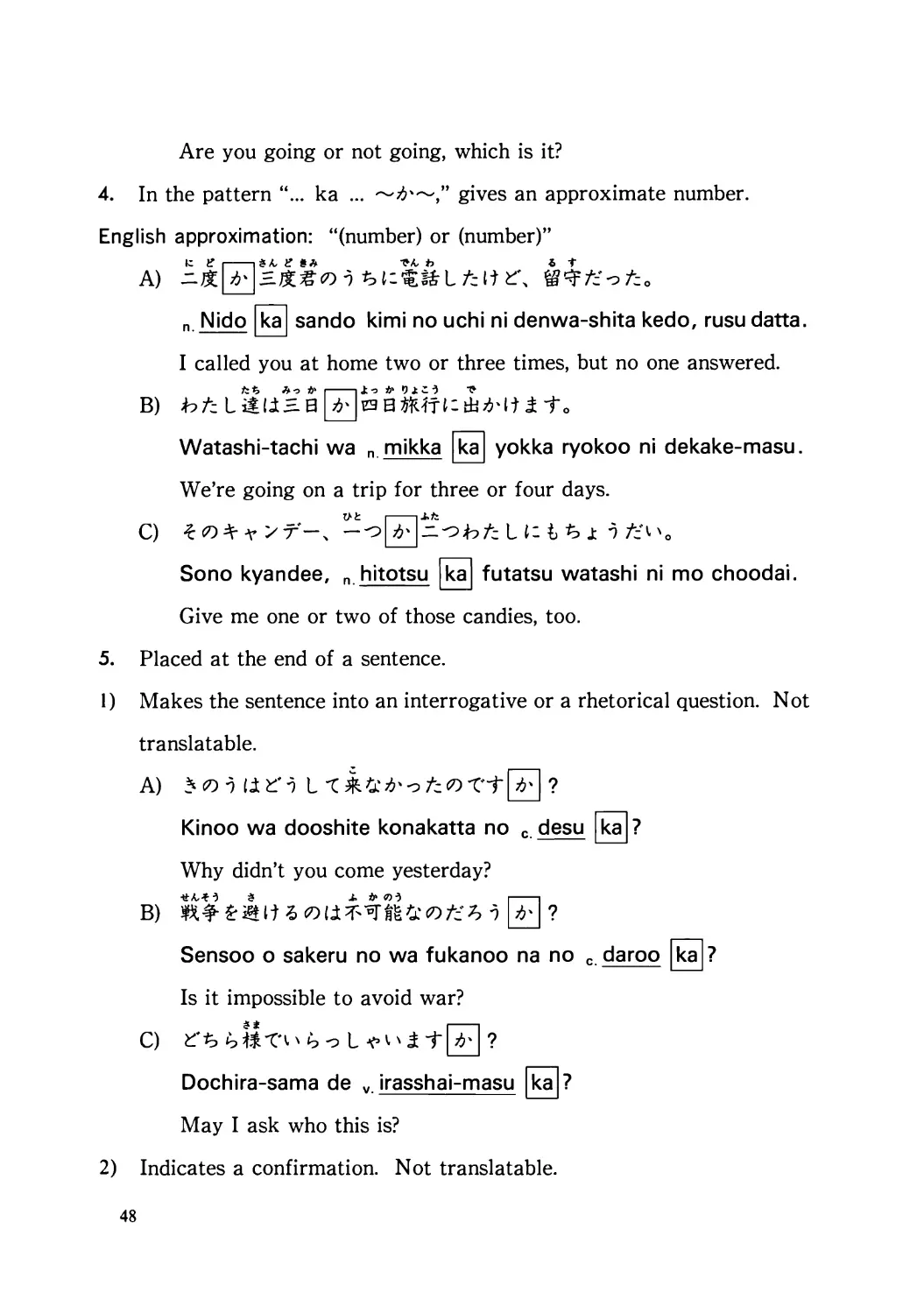
KA n' . . . . . . . . . . . . . . . . . . . . . . . . . . . . . . . . . . . . . . . . . . . . . . . . . . . . . . . . . . . . . . . . . . . . . . . . . . . . . . . . . 46
KA -I n'l, , ( C. P.) . . . . . . . . . . . . . . . . . . . . . . . . . . . . . . . . . . . . . . . . . . . . . . . . . . . . . . . . . . . . . . . . . . 5 I
KA-NA (KA-NAA) n'-tJ. (n'-1J.(jf» (C.P.) ................................. 52
KARA tJ, b ........................................................................... 53
KARA-SHITE n'b-u L (C.P.) ................................................ 65
KASH 1 RA n' u b . . . . . . . . . . . . . . . . . . . . . . . . . . . . . . . . . . . . . . . . . . . . . . . . . . . . . . . . . . . . . . . . . . 66
KE (:1' ................................................................................. 69
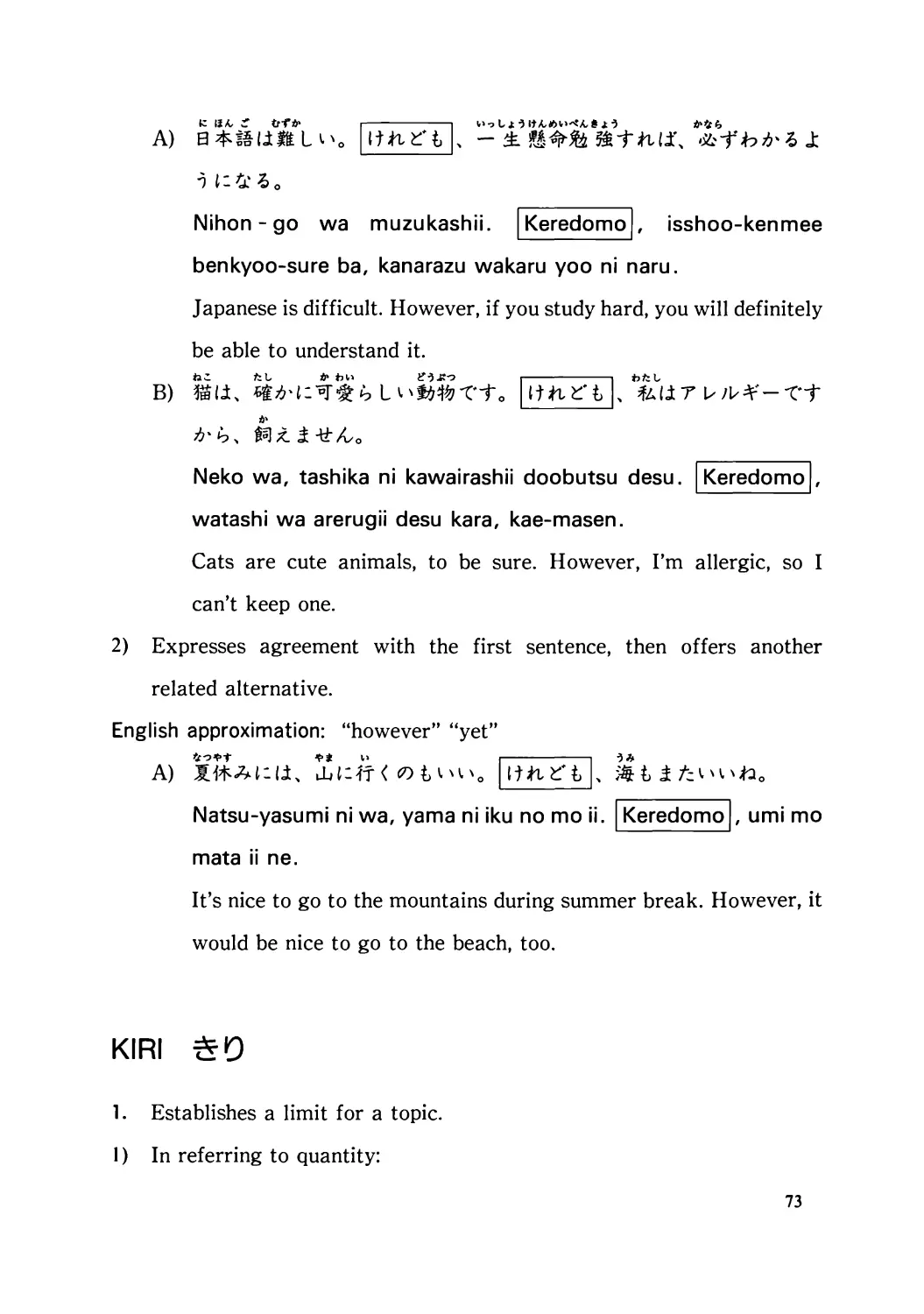
KEREDOMO (KEREDO,KEDO,KEDOMO)
(jttc!:::.'=t) ((jttt!::, (jc!:::.', (jc!:::.'=t)) ....................................... 70
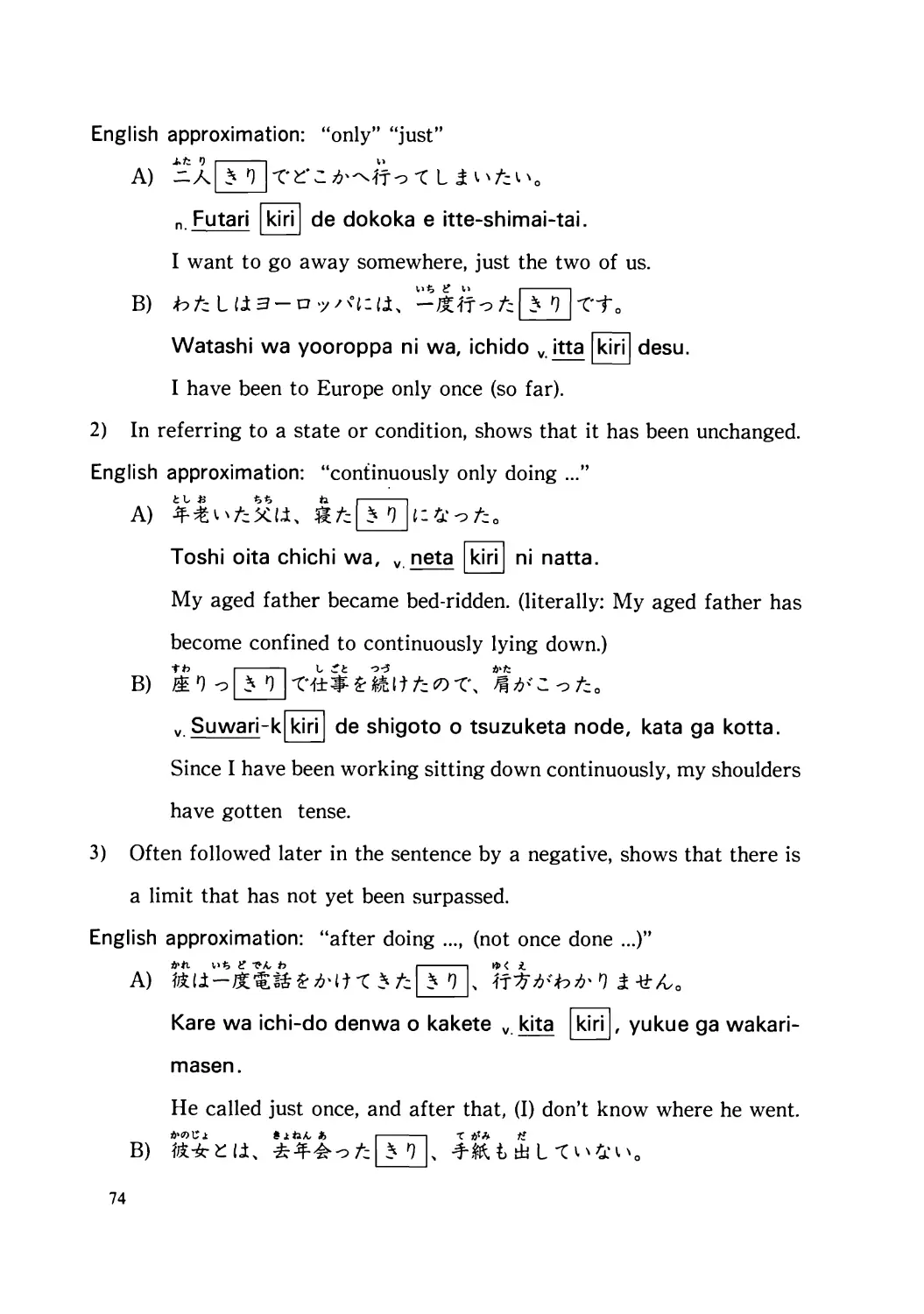
KI RI .............................................................................. 73
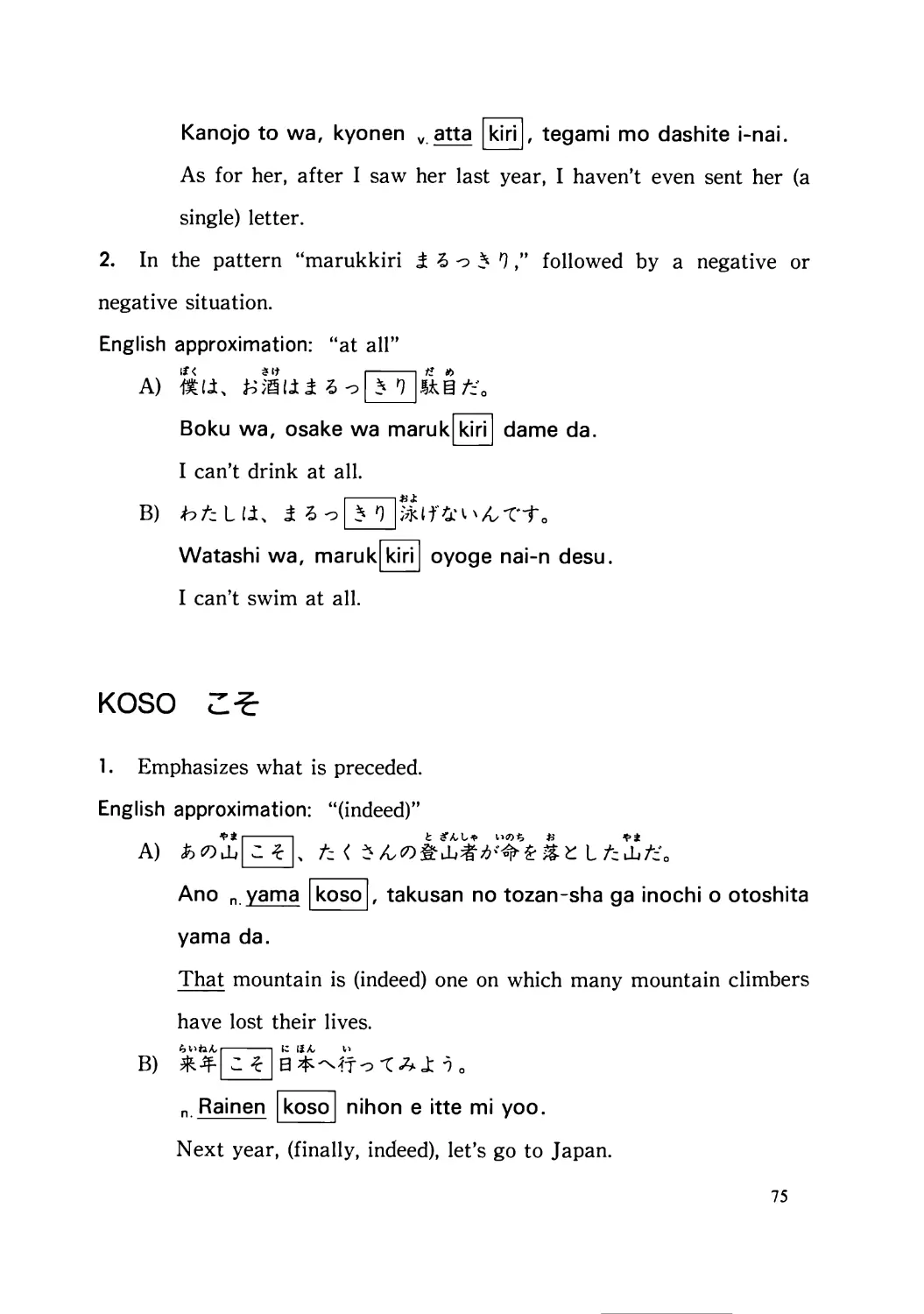
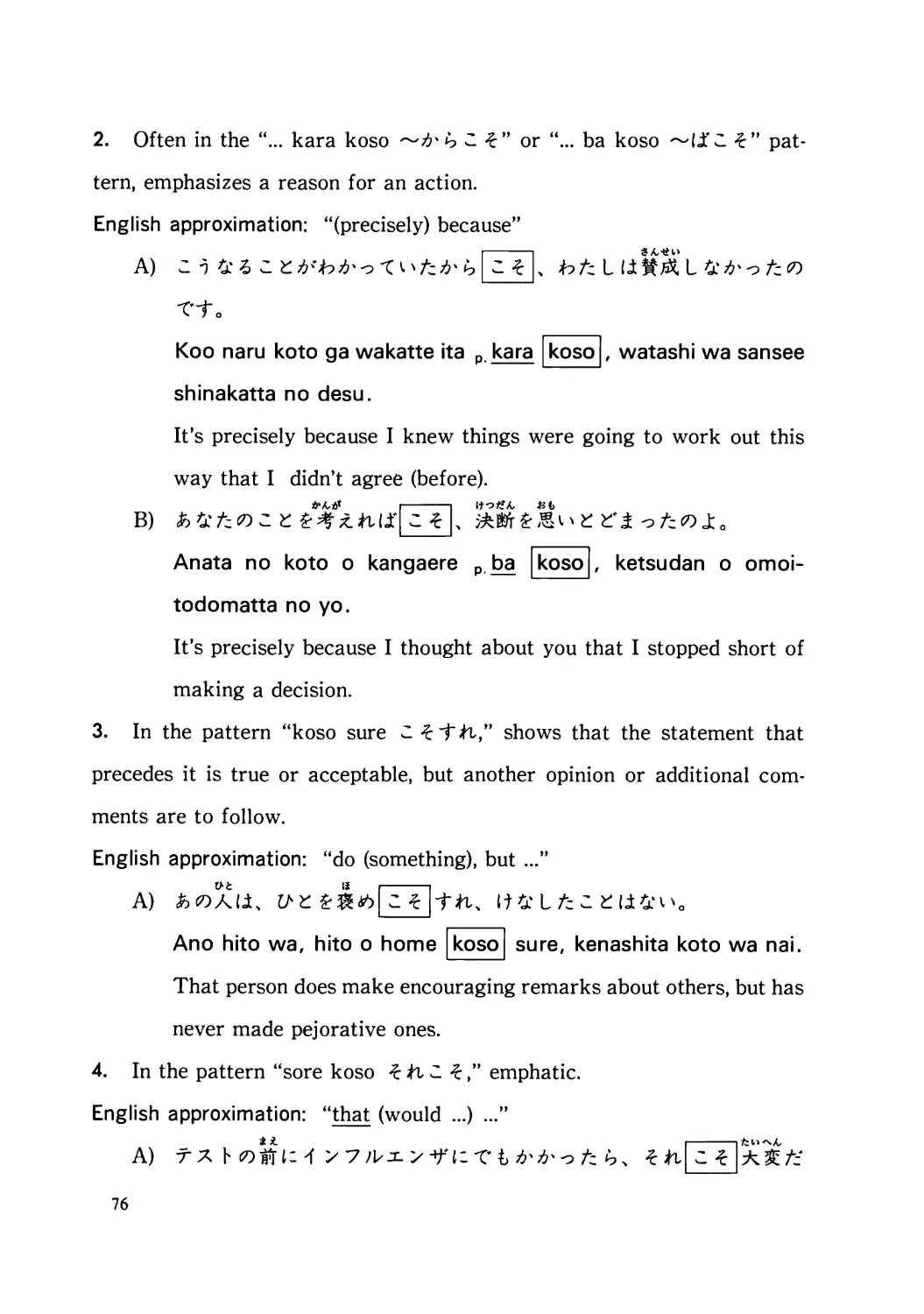
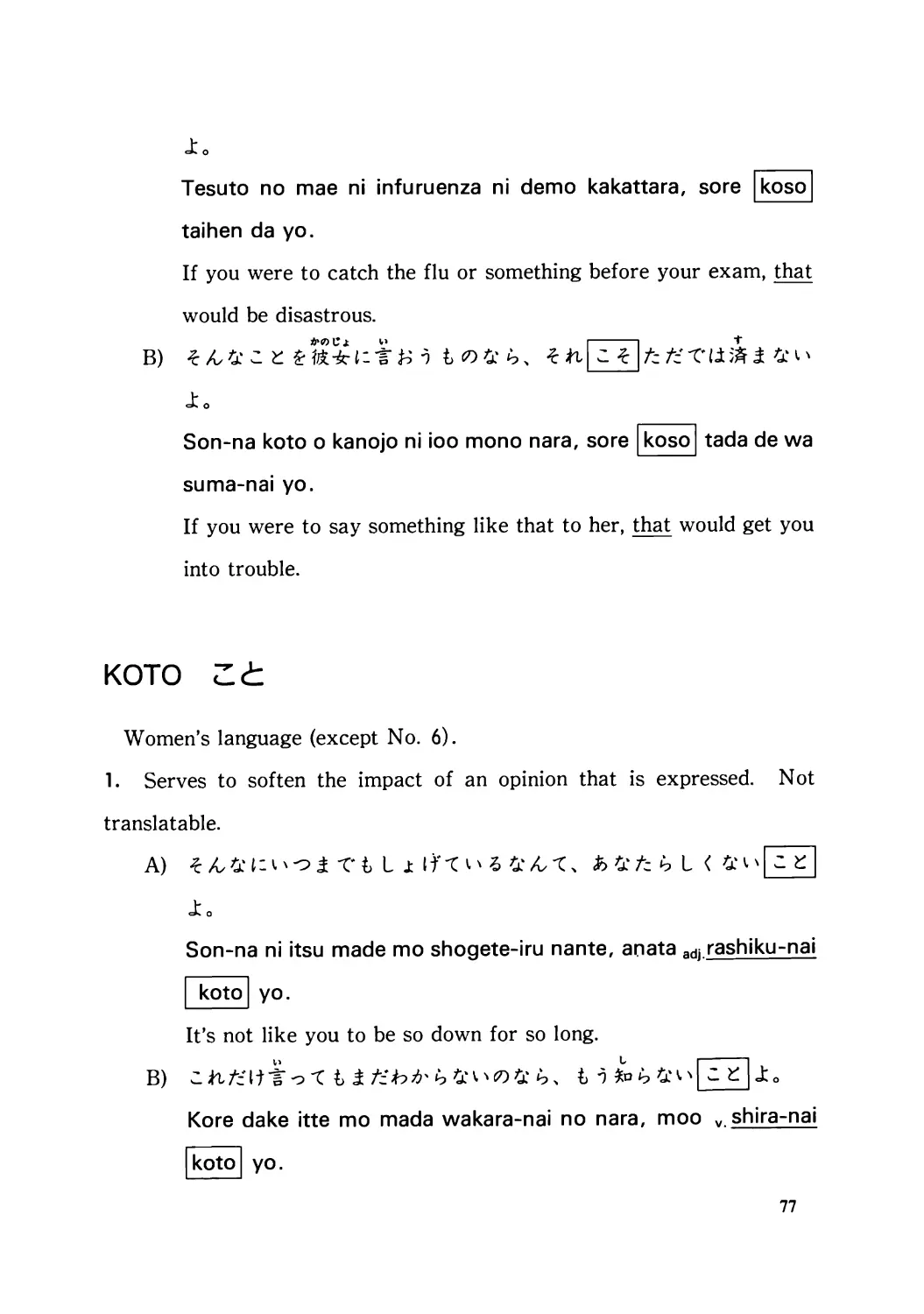
KOSO -t- ........................................................................... 75
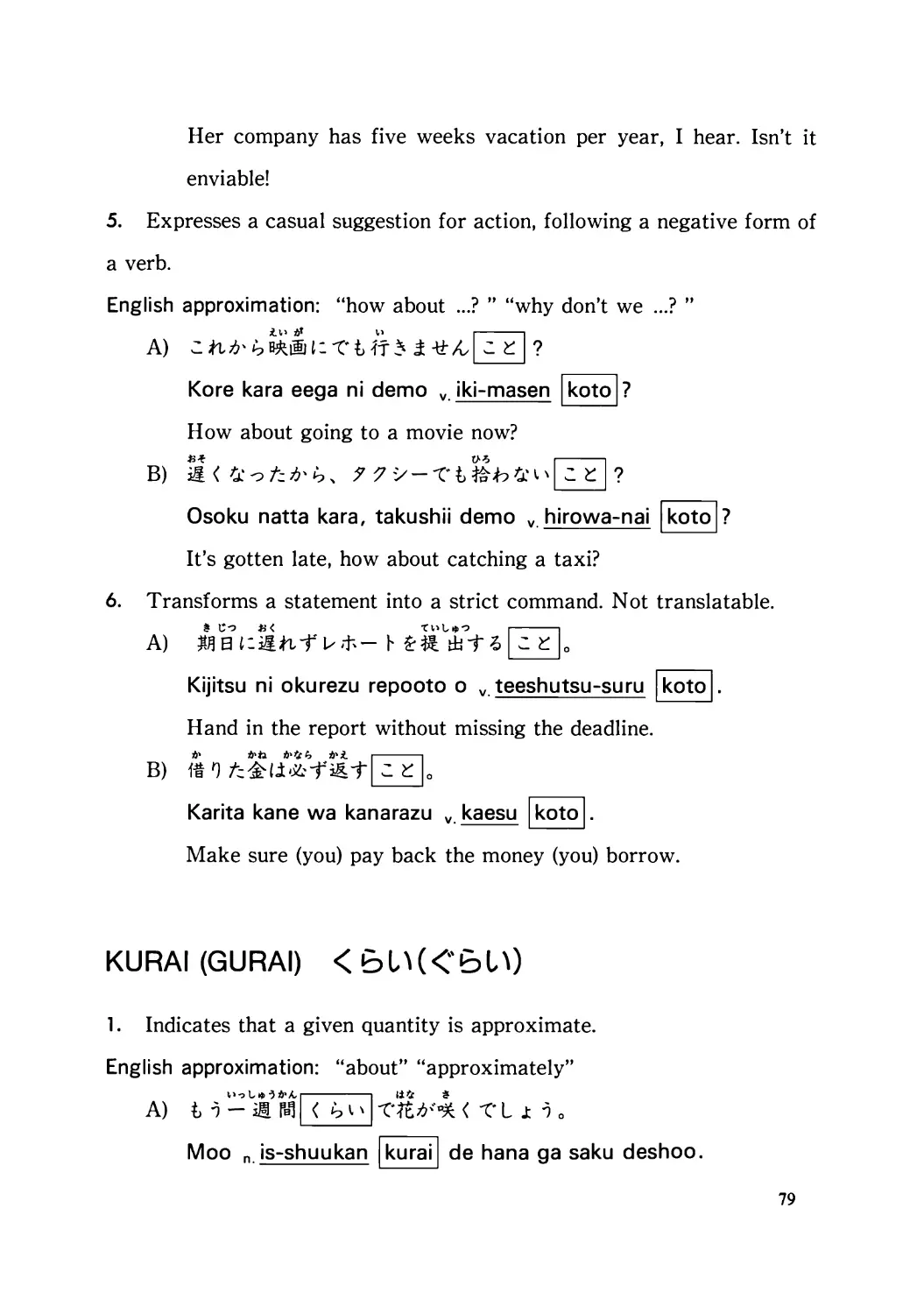
K OTO ........................................................................... 77
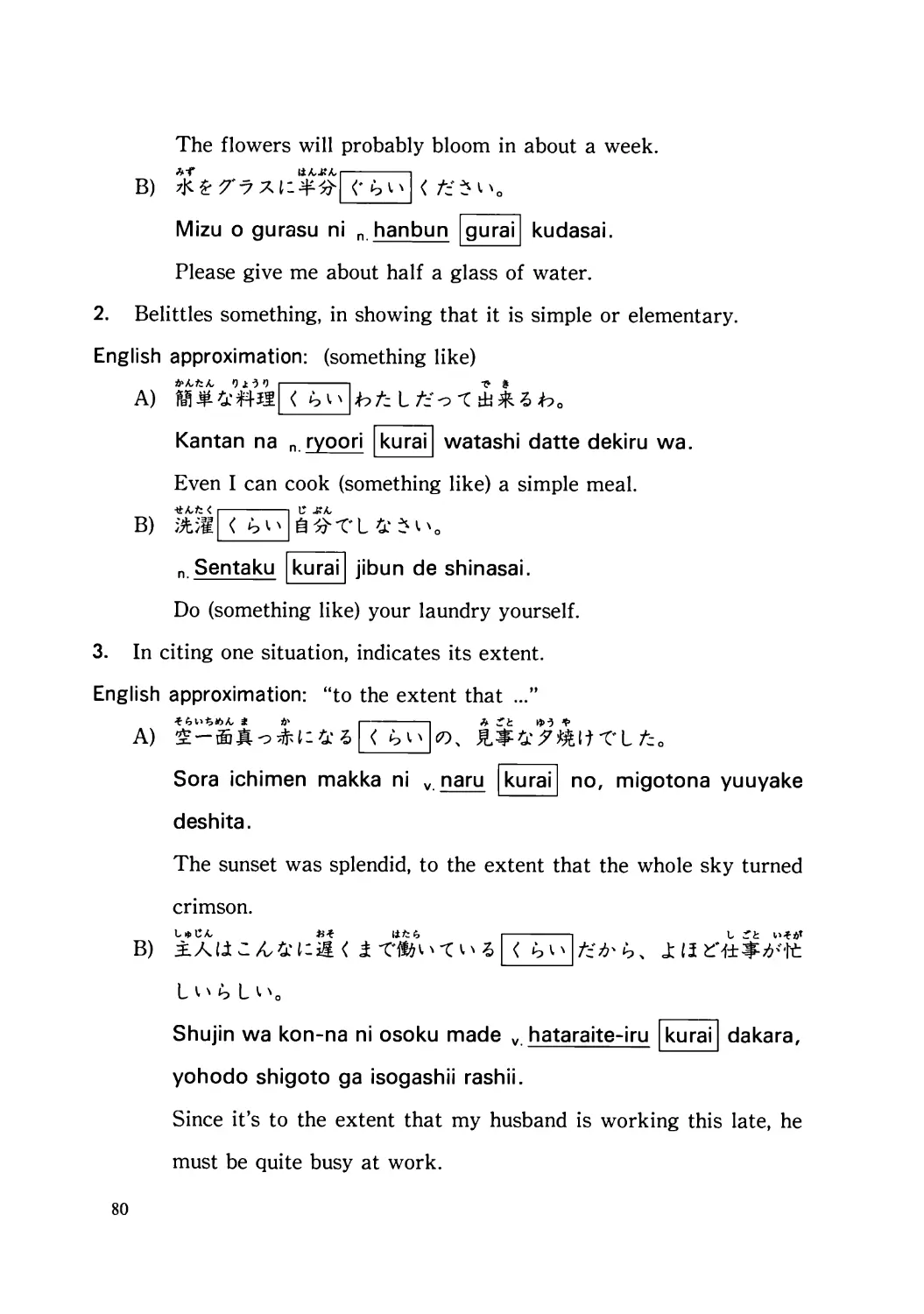
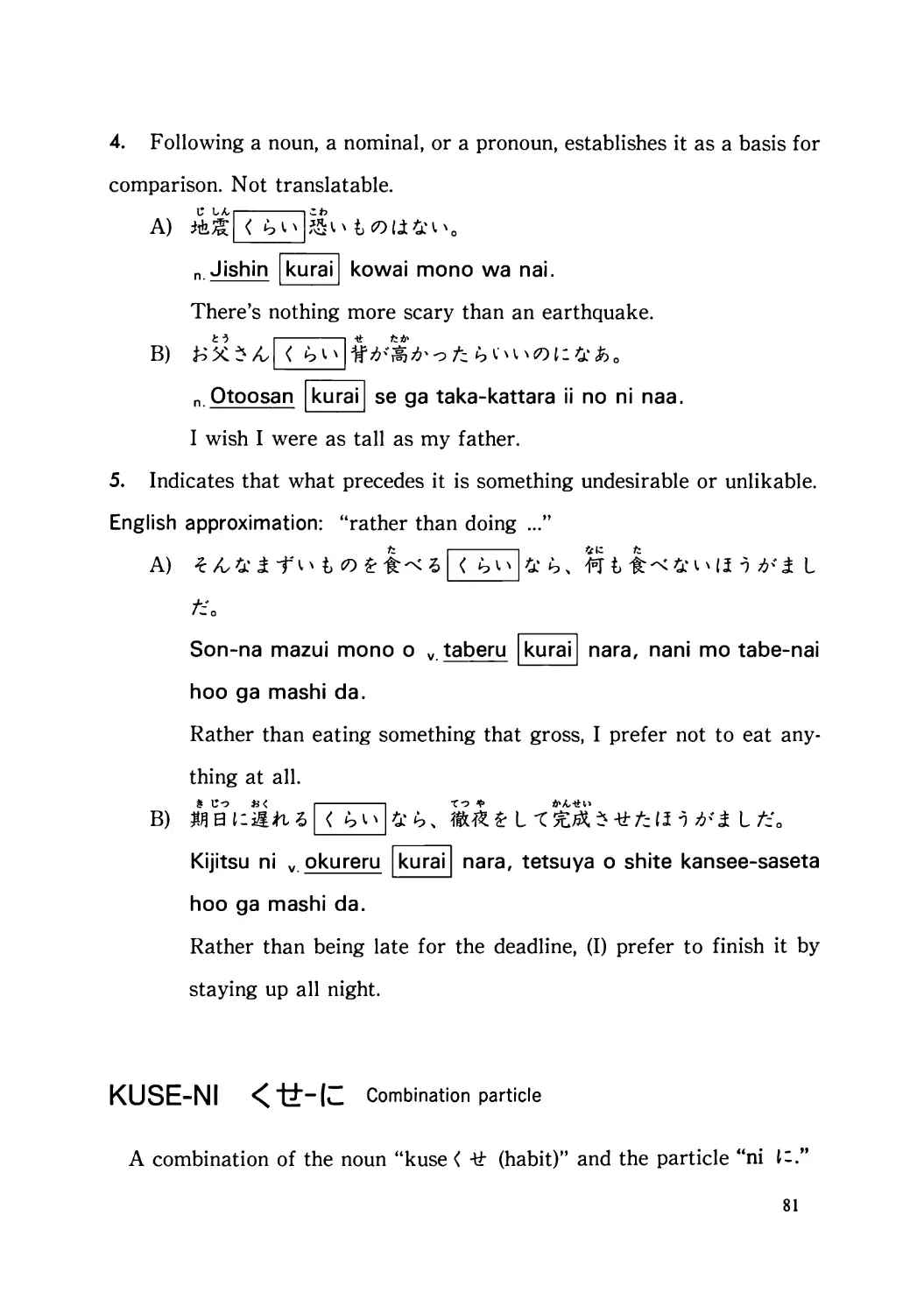
KURAI(GURAI) < bl,'('bl,') .......................................... 79
KUSE-NI < tt-(;::(C.P.) ......................................................... 81
MADE * .. . . . . . . . . . . . . . . . . . . . . . . . . . . . . . . . . . . . . . . . . . . . . . . . . . . . . . . . . . . . . . . . . . . . . . . . . . 83
MADE-MO *"(?-=t) (C.P.) ...................................................... 88
MADE-NI * "(?-(;:: (C.P.) ......................................................... 89
MO =t). . . . . . . . . . . . . . . . . . . . . . . . . . . . . . . . . . . . . . . . . . . . . . . . . . . . . . . . . . . . . . . . . . . . . . . . . . . . . . . . . 91
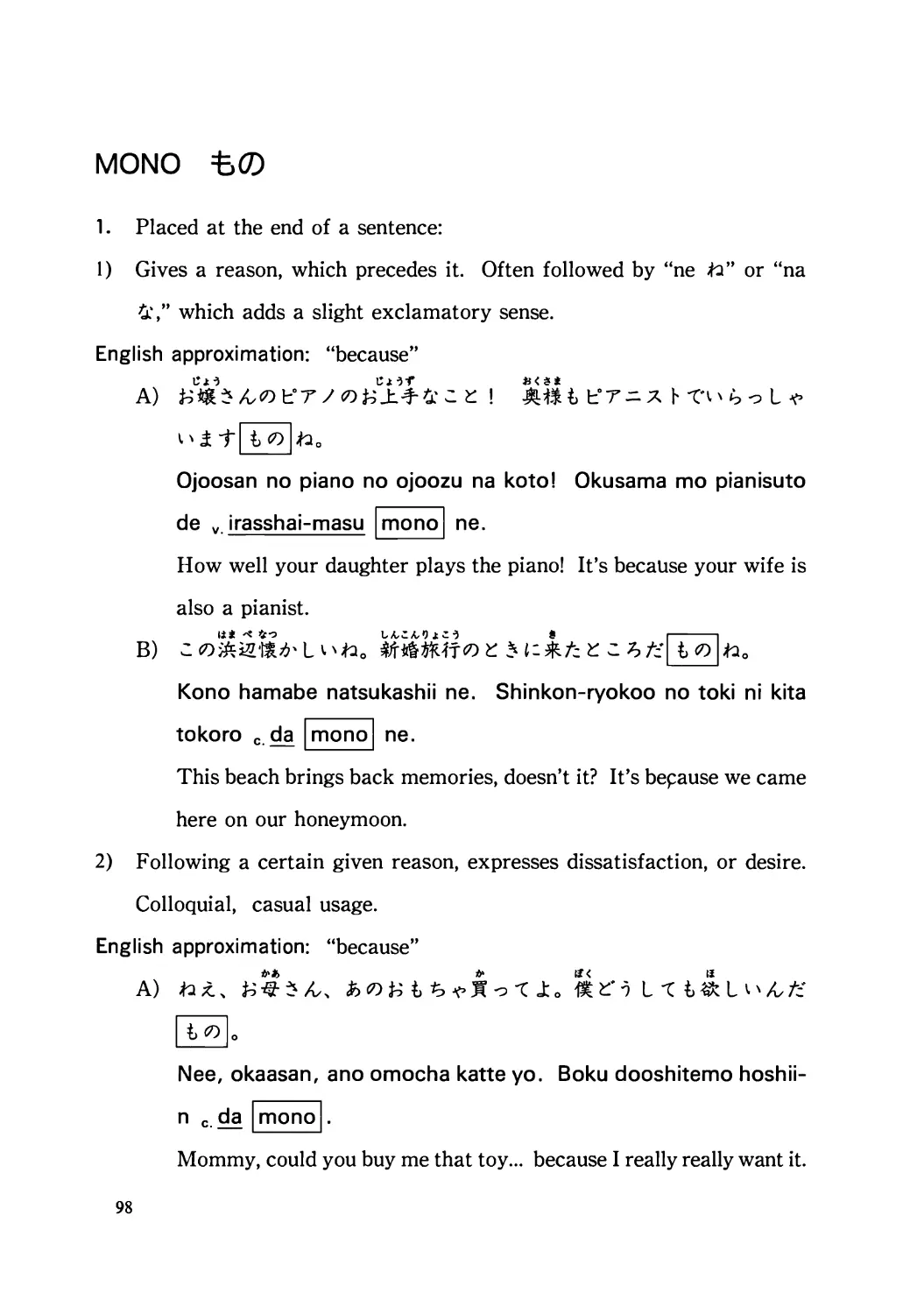
MONO =t)0') ........................................................................ 98
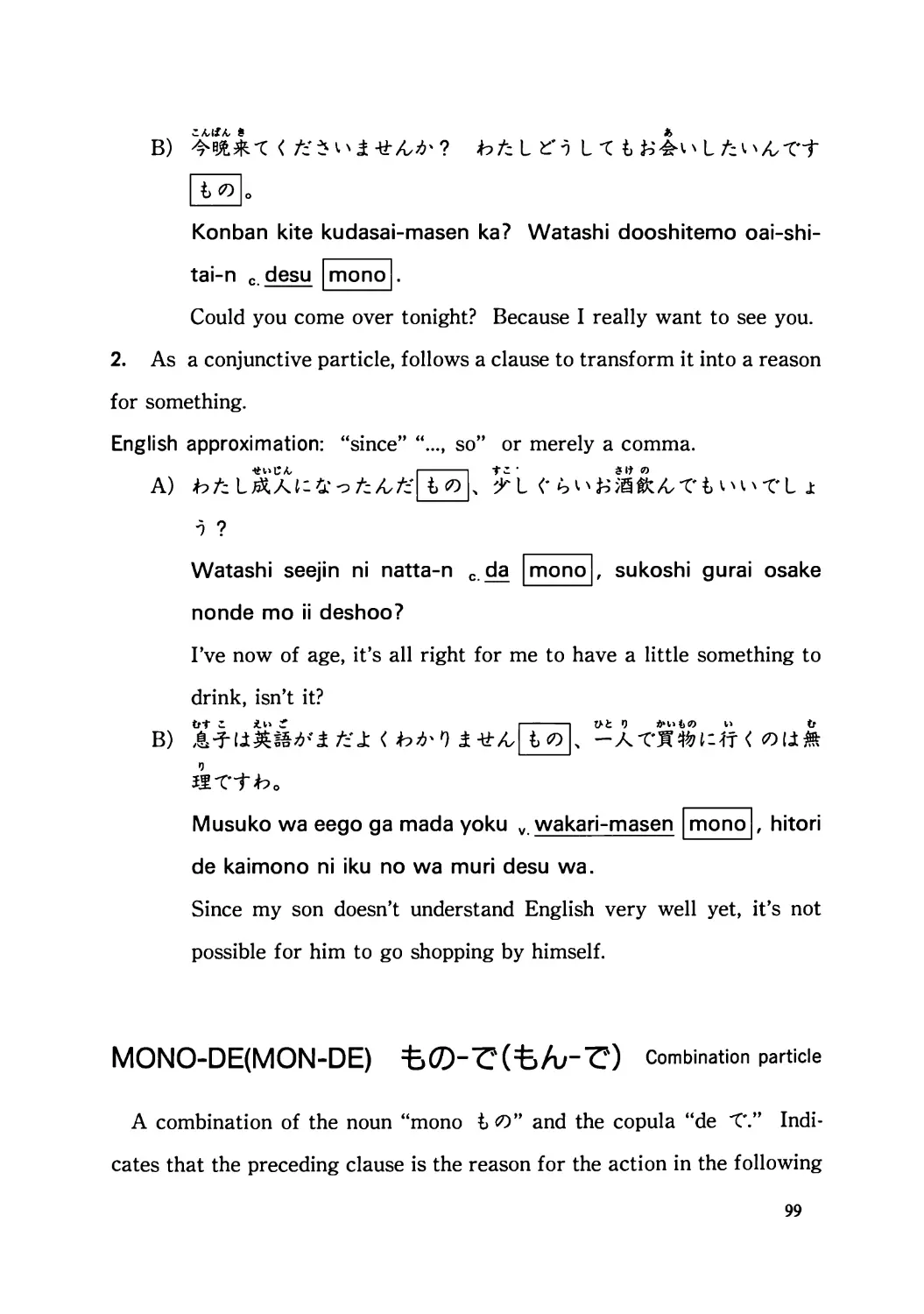
MONO-DE(MON-DE) =t)0')- "(?(=t)fu- "(?) (C.P.) ........................ 99
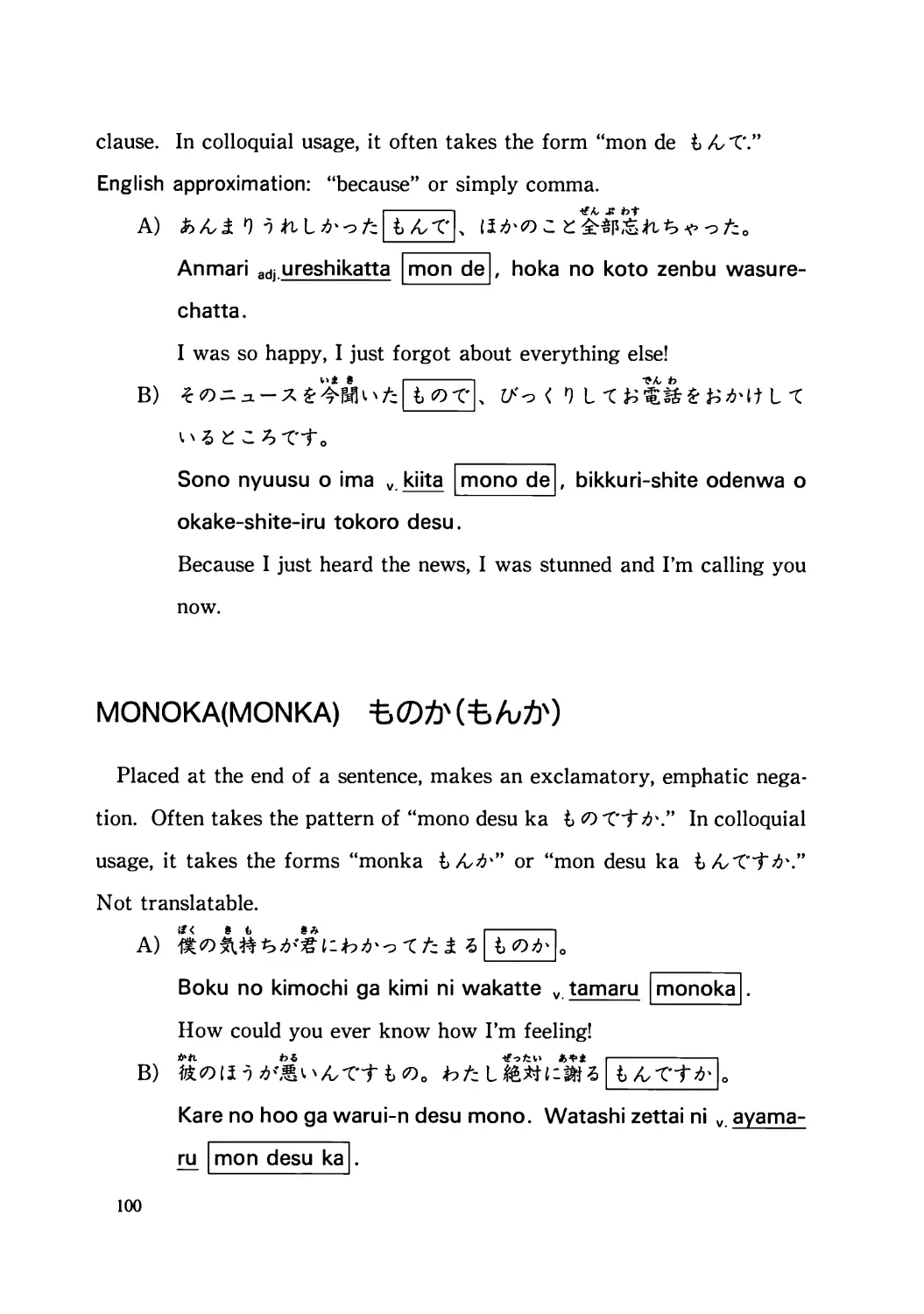
MONOKA(MONKA) =t)O')n'(=t)fun') .................................... 100
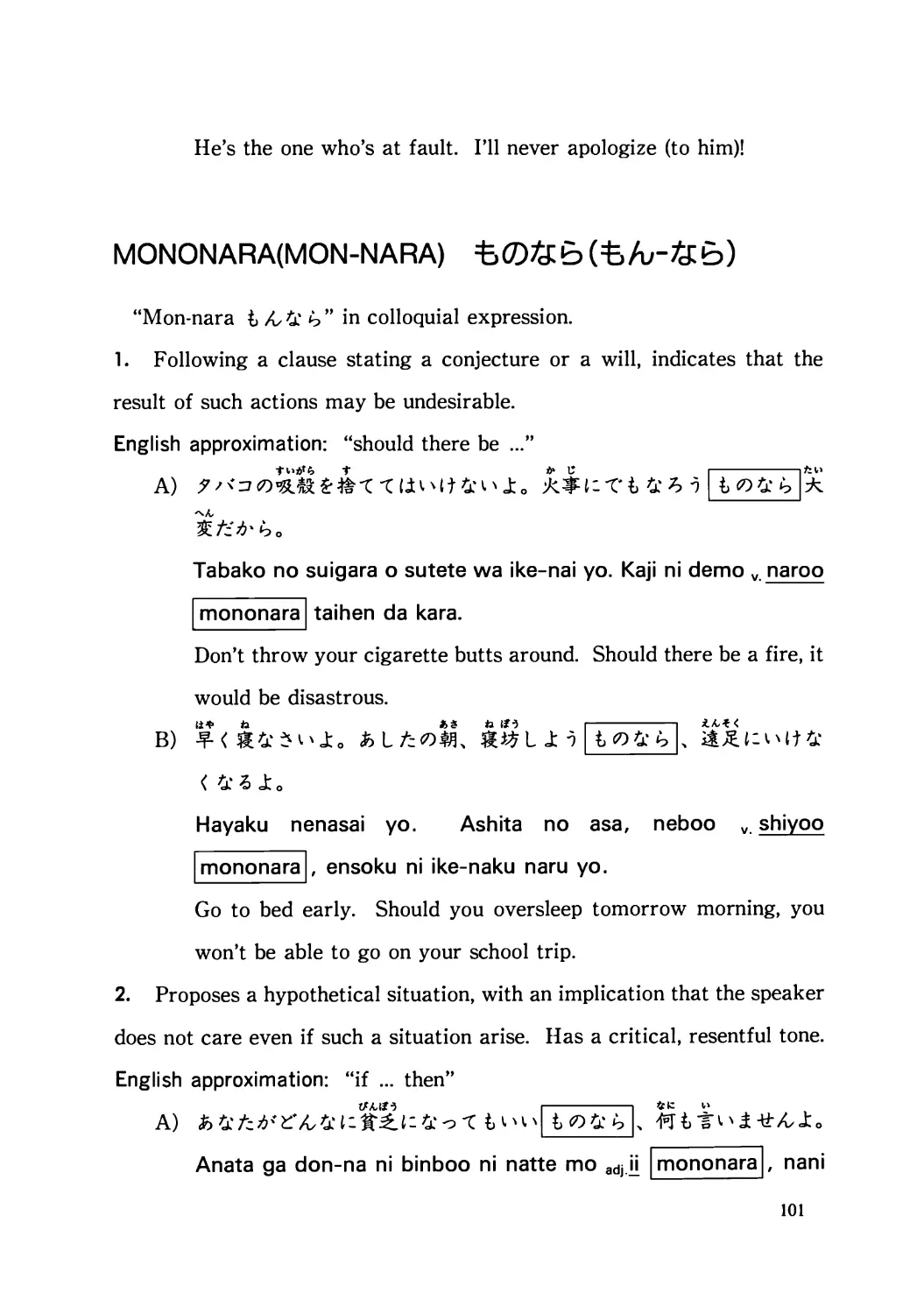
MONONARA (MON-NARA) =t)O')tJ. b (=t)fu-1J. b) ..................... 101
MONONO =t)0)0').................................................................. 102
MONO-O =t)0')- .................................................................. 103
N A (N AA) 1J. (1J. 05 ) . . . . . . . . . . . . . . . . . . . . . . . . . . . . . . . . . . . . . . . . . . . . . . . . . . . . . . . . . . . . I 05
NADO (NAN KA) tJ. t!:: (tJ.fu n' ) .. .. . . . . . . . . . . . .. . . . . . . . .. . . . . . . . . . . . . . . . . . . . 108
NAGARA 1J.n b ........ ... ...... ......... ......... ............... ...... ...... .... 110
NAGARA-MO 1J.n b-=t) (C.P.) ................................................ III
NANTE tJ.fu L . . . . . . . . . . . . . . . . . . . . . . . . . . . . . . . . . . . . . . . . . . . . . . . . . . . . . . . . . . . . . . . . . . . . . 112
NA R I tJ. . . . . . . . . . . . . . . . . . . . . . . . . . . . . . . . . . . . . . . . . . . . . . . . . . . . . . . . . . . . . . . . . . . . . . . . . . . . 113
N-DE fu- "(? (C.P.) ............................................................... 115
NE (NEE) ;f'J (;f'JX) ............................................................ 116
NI I;:: . . . . . . . . . . . . . . . . . . . . . . . . . . . . . . . . . . . . . . . . . . . . . . . . . . . . . . . . . . . . . . . . . . . . . . . . . . . . . . . . . . . . 118
N I-MO (;:: -=t) (C. P.) . . . . . . . . . . . . . . . . . . . . . . . . . . . . . . . . . . . . . . . . . . . . . . . . . . . . . . . . . . . . . . . 136
NI-MO-KAKA W ARA-ZU (;::-=t)-n'n'v b- 9" (C.P.) ..................... 137
NI-OI-TE (;::-d3l, ,- L (C.P.) ................................................... 138
NI-SHITE (;::-u L (C.P.) ......................................................... 140
NI-SHITE-MO (;::-UL-=t) (C.P.) ............................................. 140
NI-SHITE-WA (;::-uL-fct(C.P.) ............................................. 141
N ITE (;:: L . . . . . . . . . . . . . . . . . . . . . . . . . . . . . . . . . . . . . . . . . . . . . . . . . . . . . . . . . . . . . . . . . . . . . . . . . . . 142
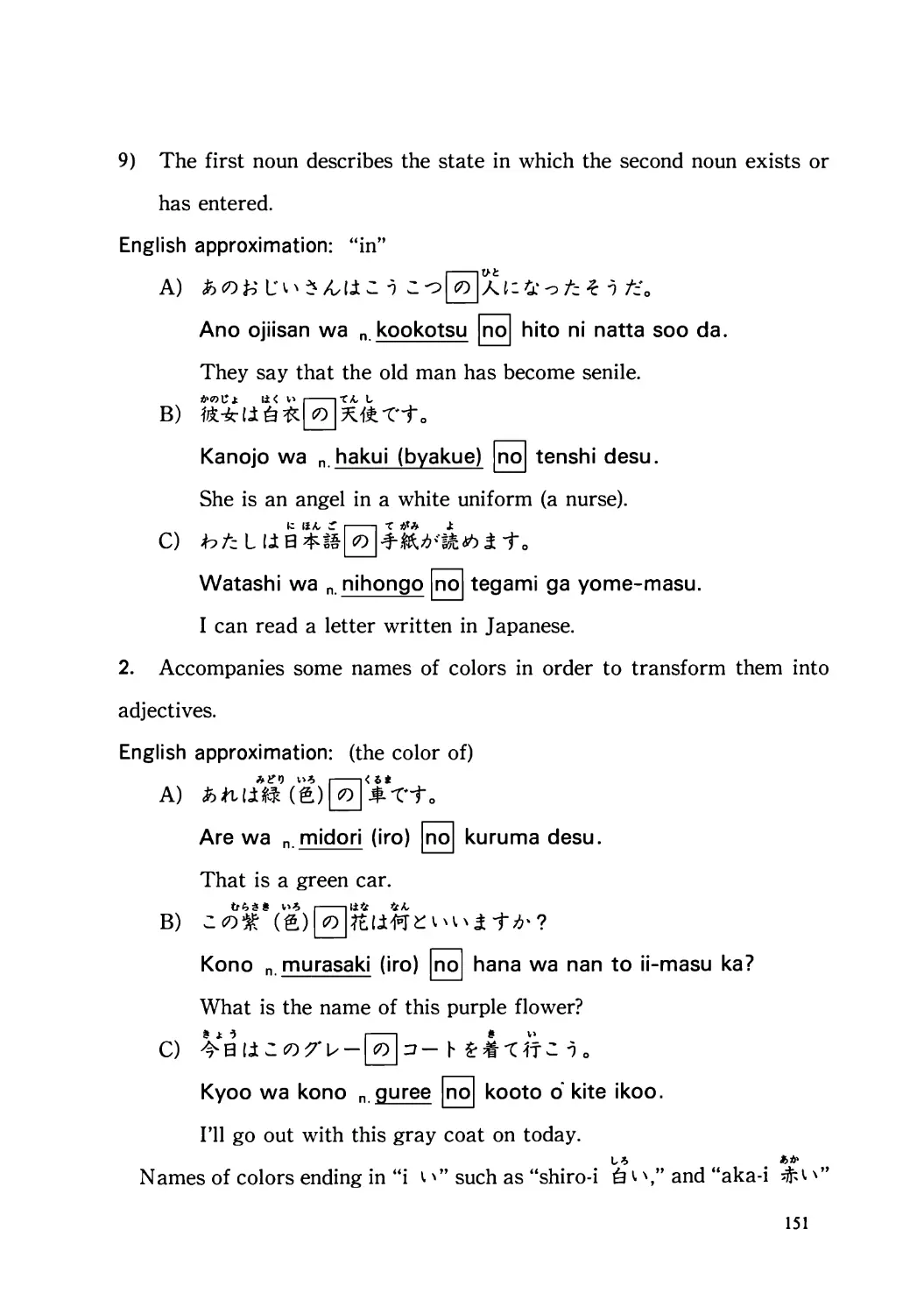
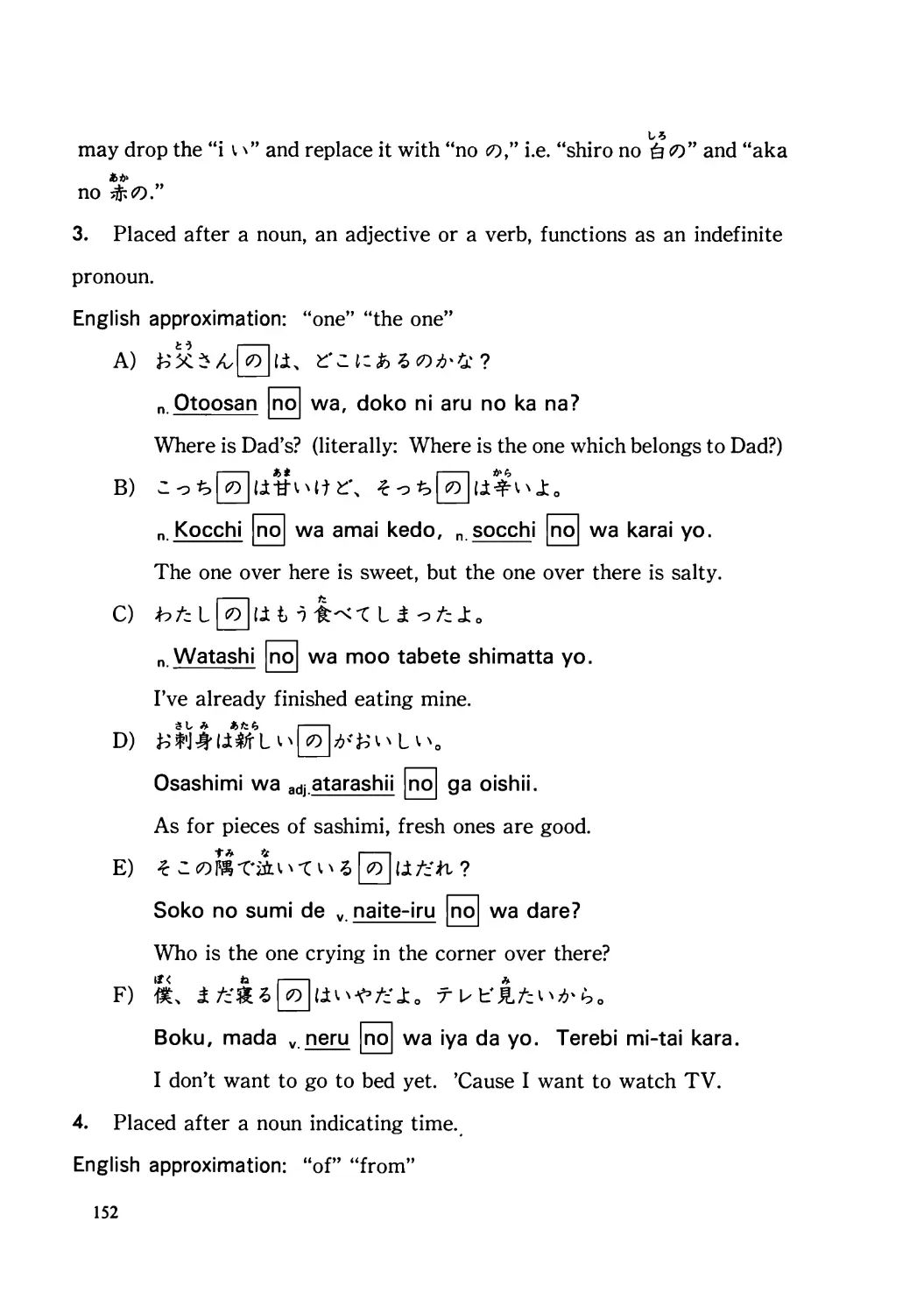
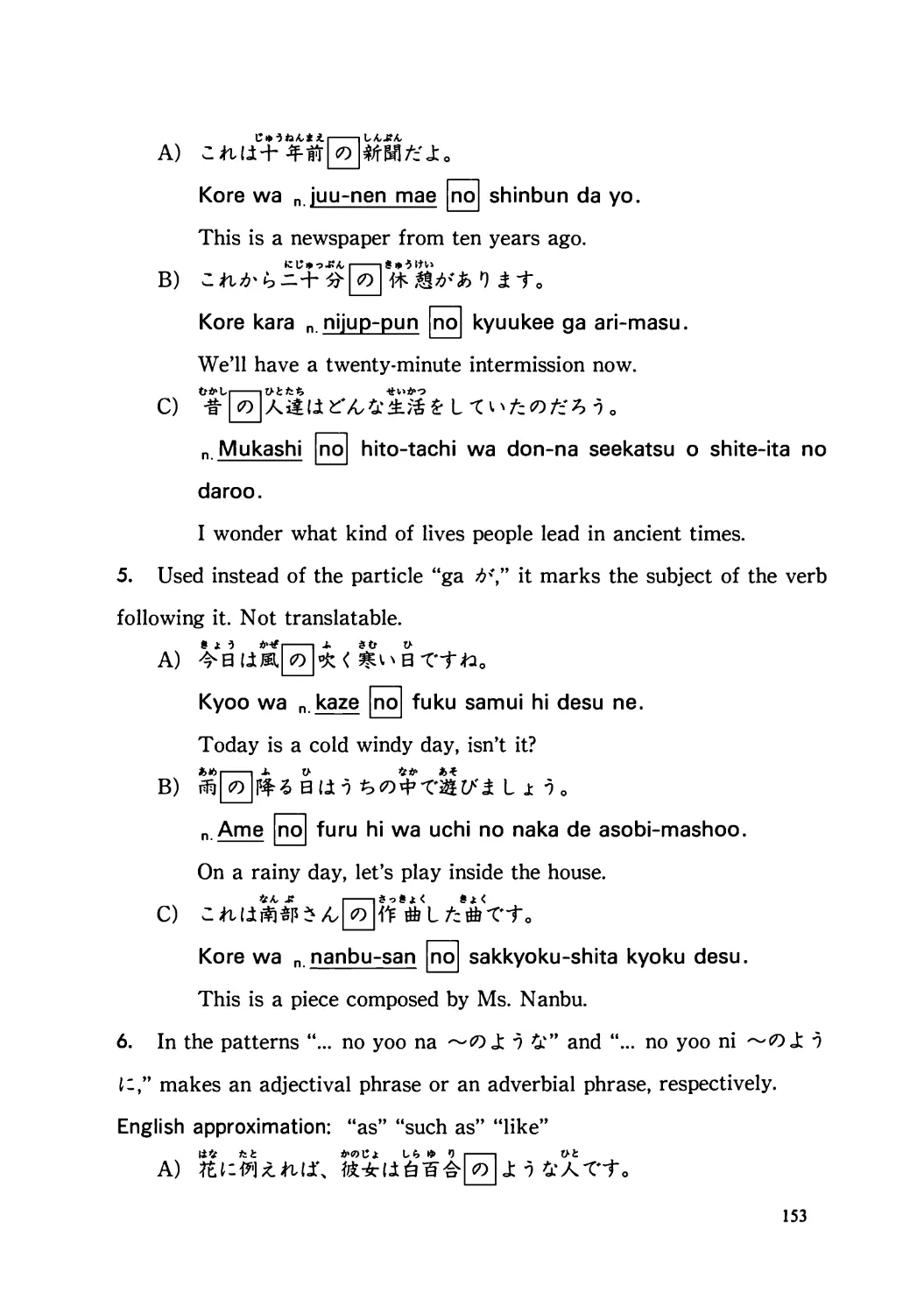
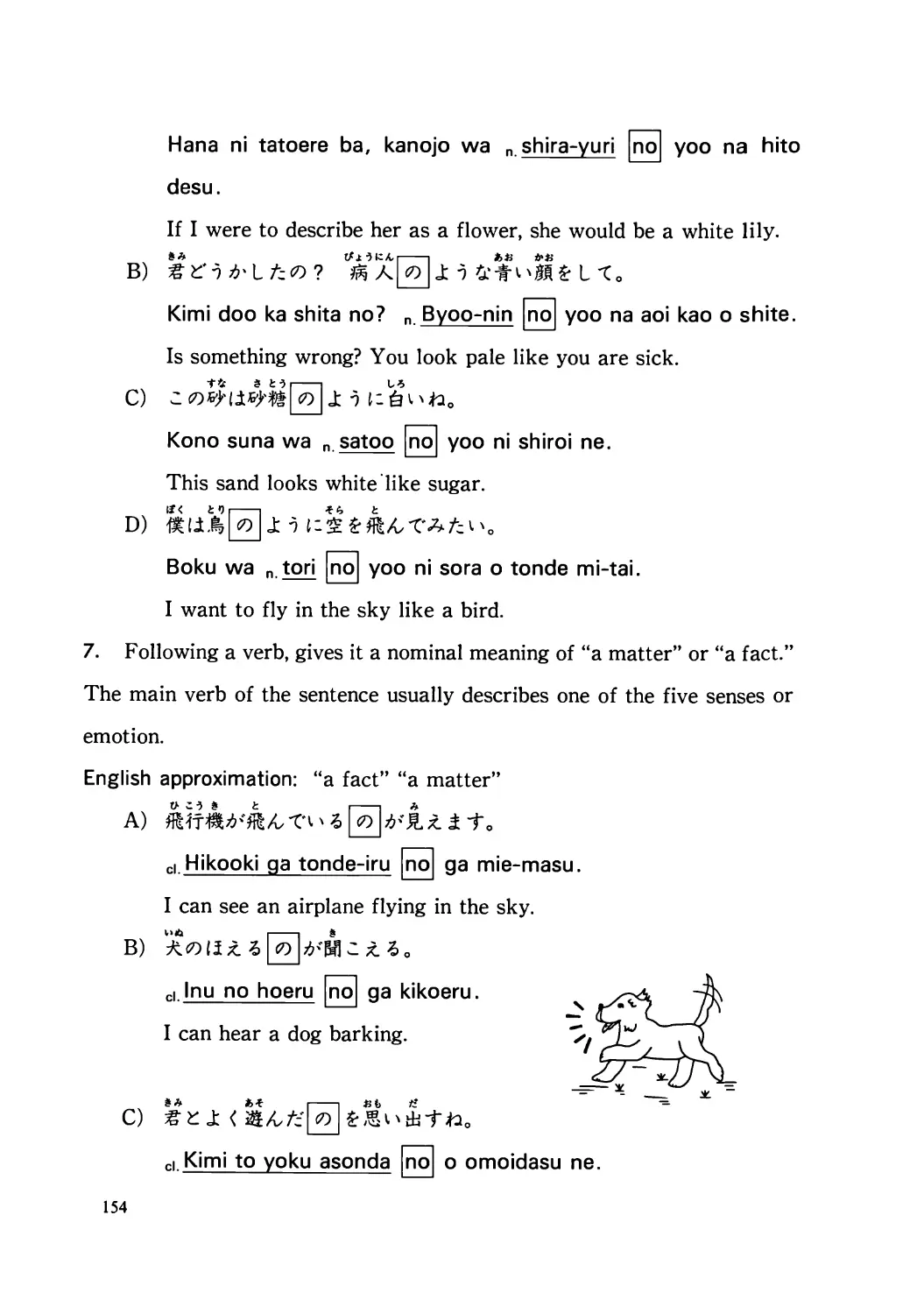
NO (N) 0) ( Iv) . . . . . . . . . . . . . . . . . . . . . . . . . . . . . . . . . . . . . . . . . . . . . . . . . . . . . . . . . . . . . . . . . . 143
NO-DA(N-DA) O')-t-::(fu-t-::) (C.P.) ....................................... 158
NO-DAROO(N-DAROO) 0)-t-::-35 (fu-t-::-35) (C.P.) ............... 159
NODE(N-DE) O')"(?(fu- ) ................................................... 160
NO-DE 0')- "(?(C.P.) ............................................................... 162
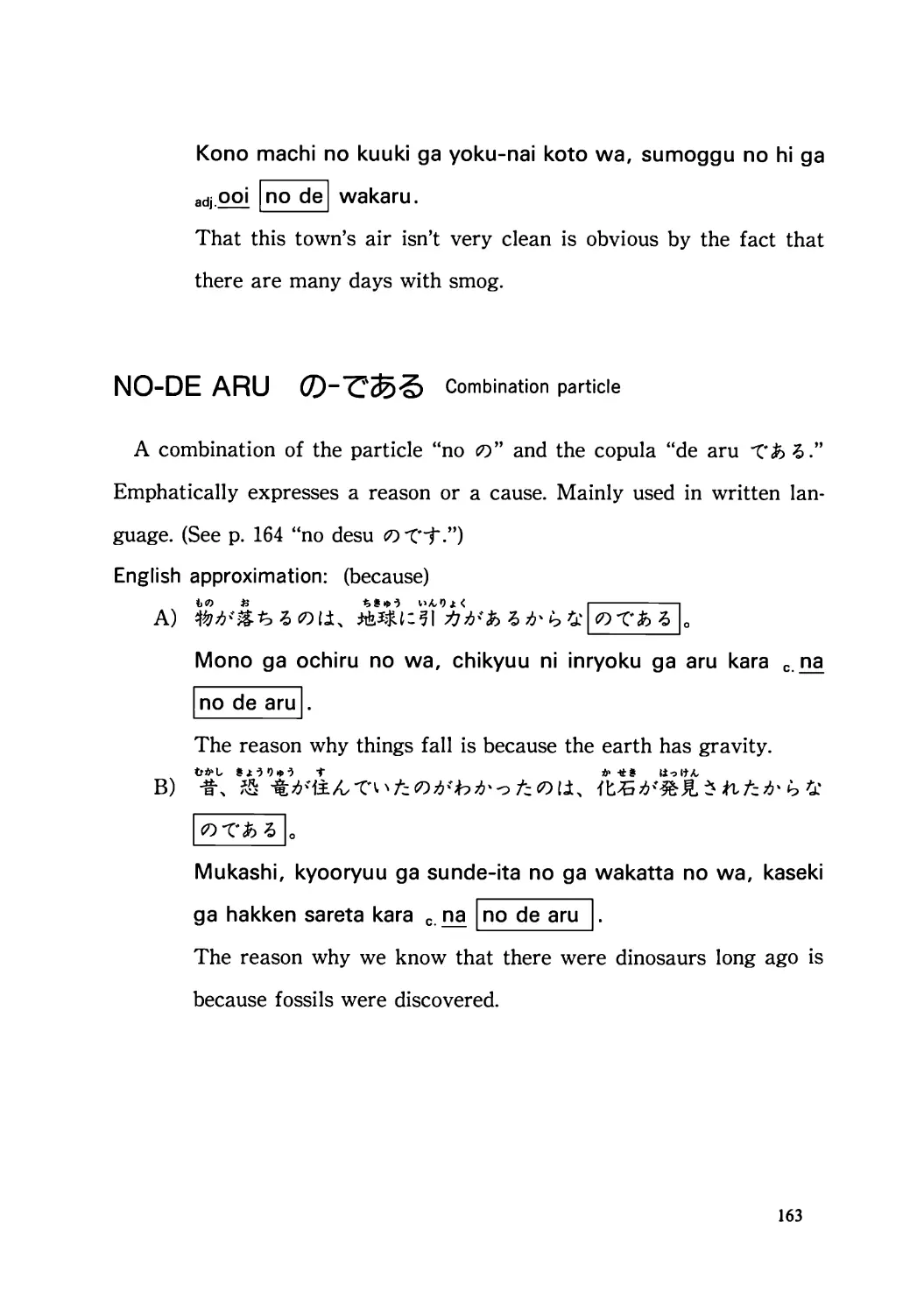
NO-DE ARU 0').. ,,(?05Q (C.P.) ................................................ 163
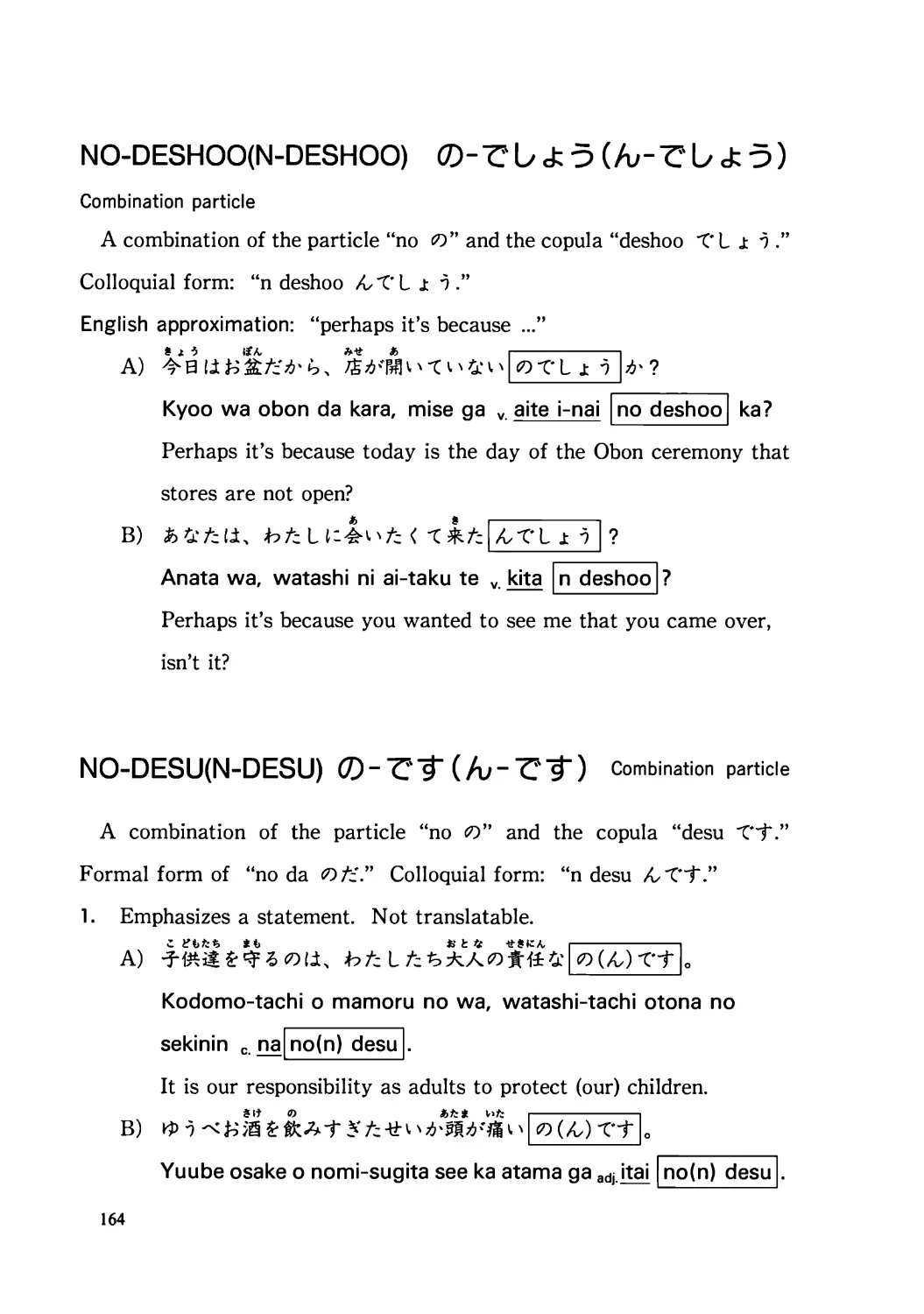
NO-DESHOO (N-DESHOO) 0')- "(? u J: 5 (fu- "(? u J: 5) (c.P.) ...... 164
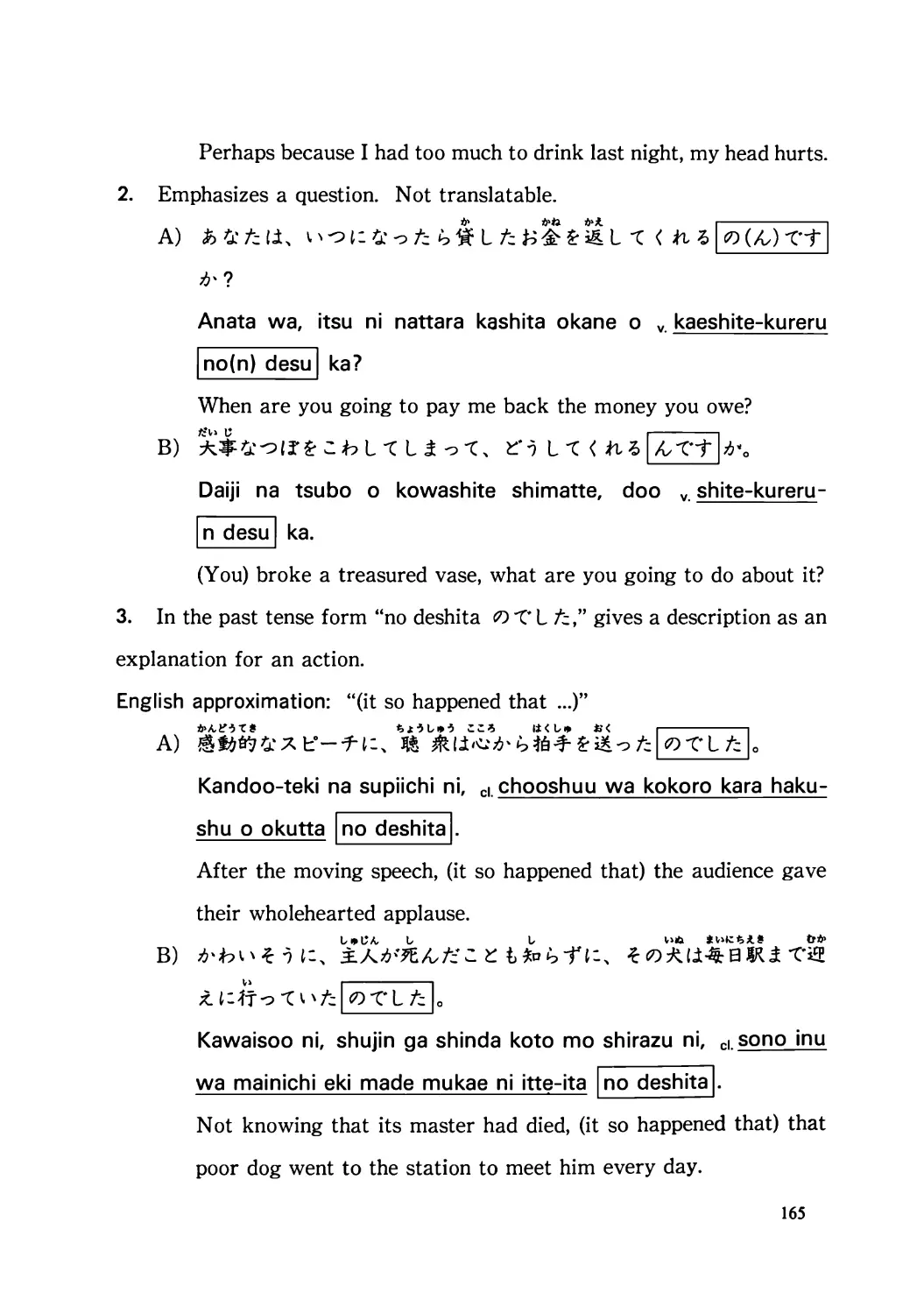
NO-DESU (N-DESU) 0')- "(?"9 (fu- "9) (CoP.) ........................... 164
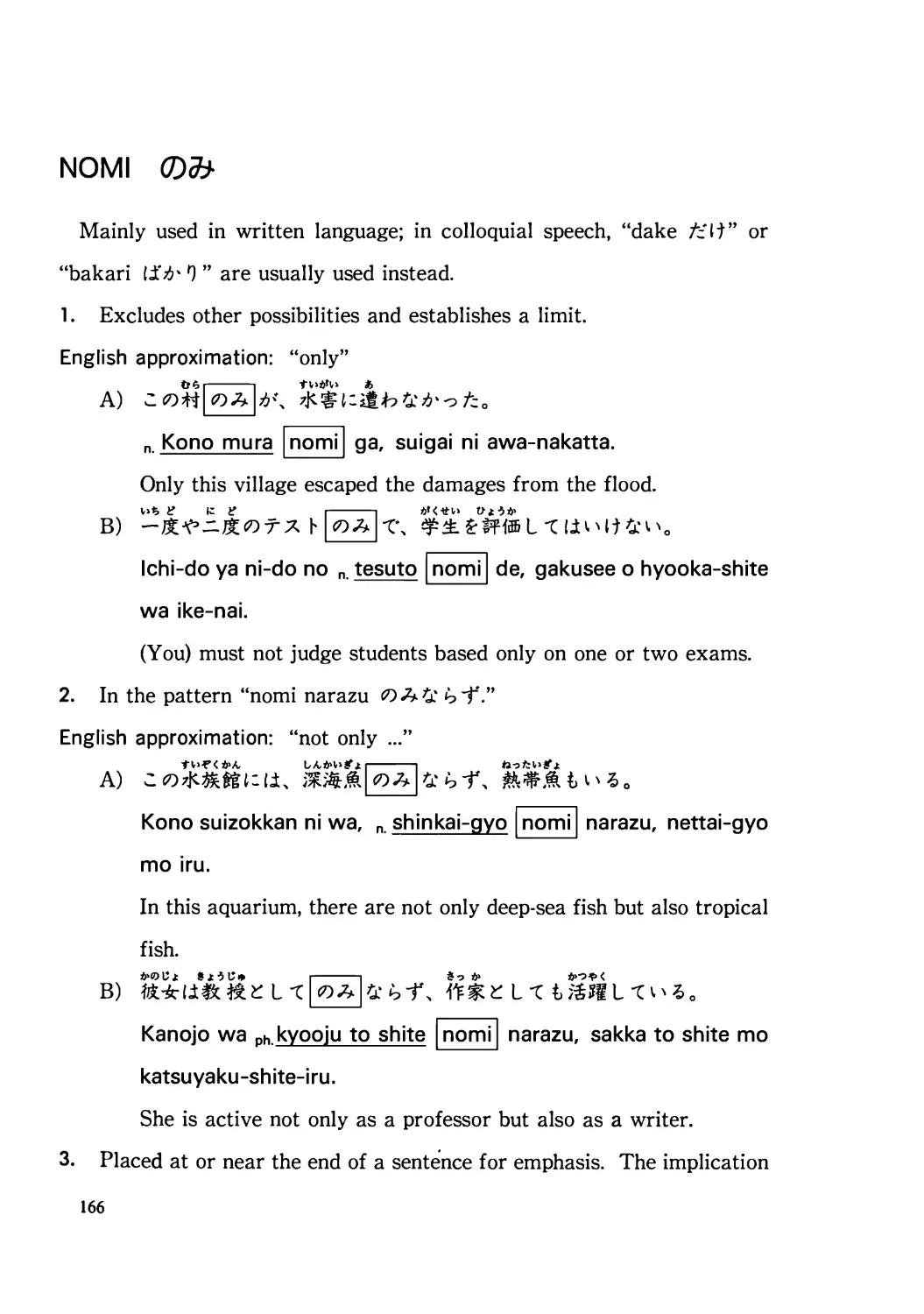
NOMI 0)(Jj......,..................................................................... 166
N ON I 0) (;:: . . . . . · . . . . . . . . . . . . . . . . . . . . . . . . . . . . . . . . . . . . . . . . . . . . . . . . . . . . . . . . . . . . . . . . . . . . . 167
NO-NI 0)-(;:: (C.P.) ................................................................ 169
o (WO) . . . . . . . . . . . . . . . . . . . . . . . . . . . . . . . . . . . . . . . . . . . . . . . . . . . . . . . . . . . . . . . . . . . . . . . . . . . 170
SA <!' . . . . . . . . . . . · . . . . . . . . . . . . . . . . . . . . . . . . . . . . . . . . . . . . . . . . . . . . . . . . . . . . . . . . . . . . . . . . . . . . . I 77
SAE <!' X . . . . . . . . · . . . . . . . . . . . . . . . . . . . . . . . . . . . . . . . . . . . . . . . . . . . . . . . . . . . . . . . . . . . . . . . . . . . . . 179
SH I U' . . . . . . . . . . . . . . . . . . . . . . . . . . . . . . . . . . . . . . . . . . . . . . . . . . . . . . . . . . . . . . . . . . . . . . . . . . . . . . . . 180
SH I KA un' . . . . . · . . . . . . . . . . . . . . . . . . . . . . . . . . . . . . . . . . . . . . . . . . . . . . . . . · . . . . . . . . . . . . . . . . . . . I 82
SHIMO u =t) ........................................................................ 183
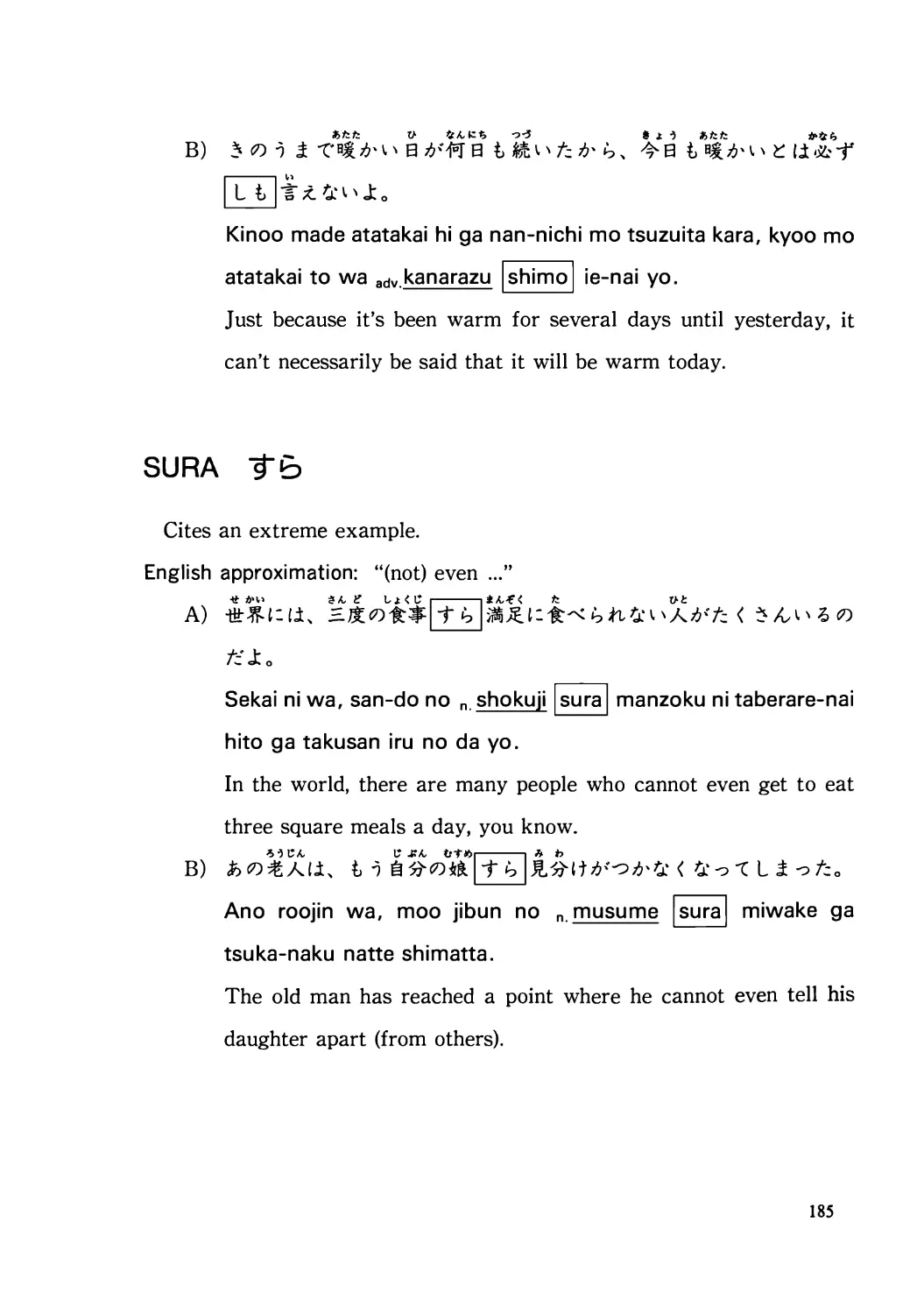
SURA "9 b ........................................................................... 185
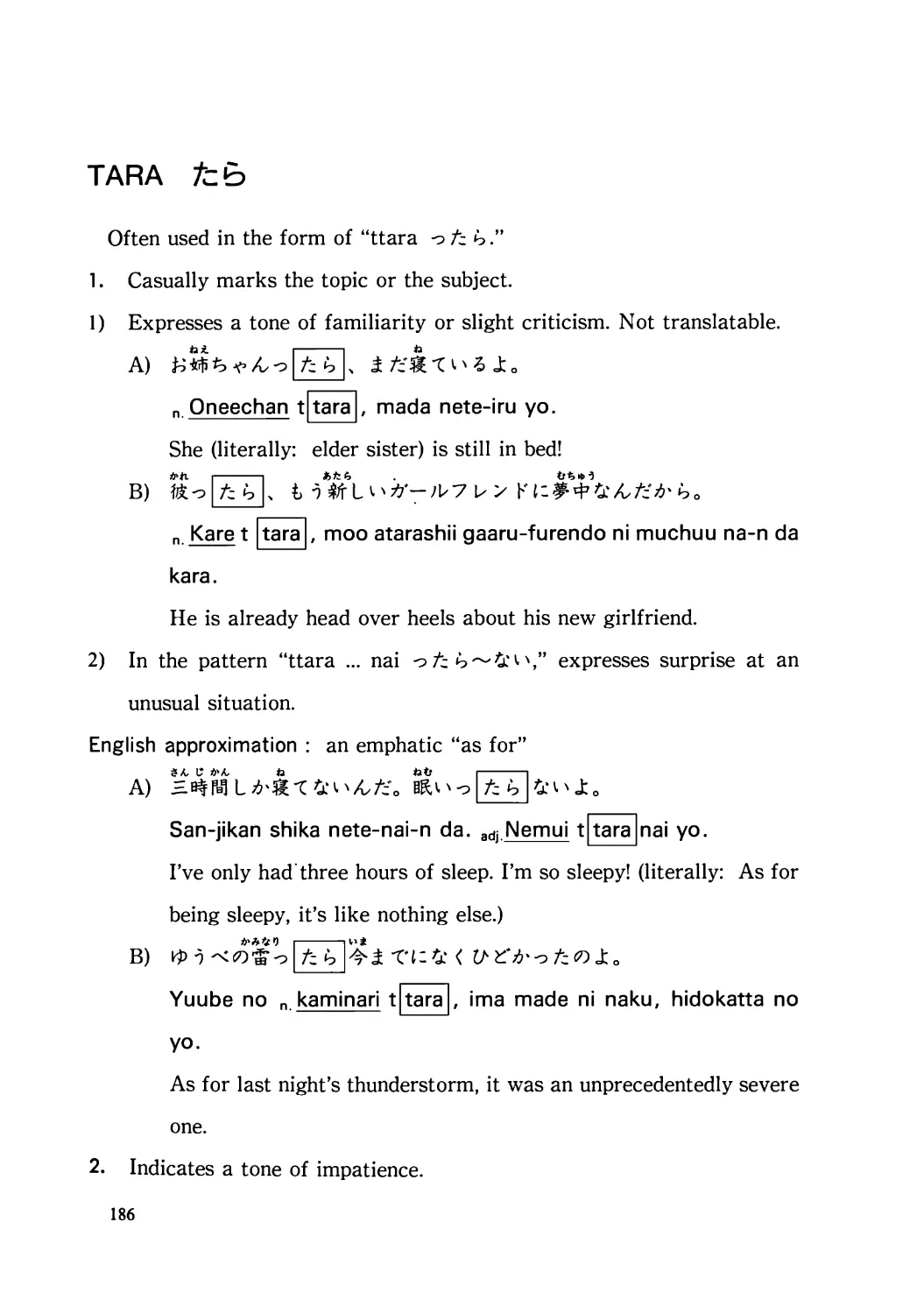
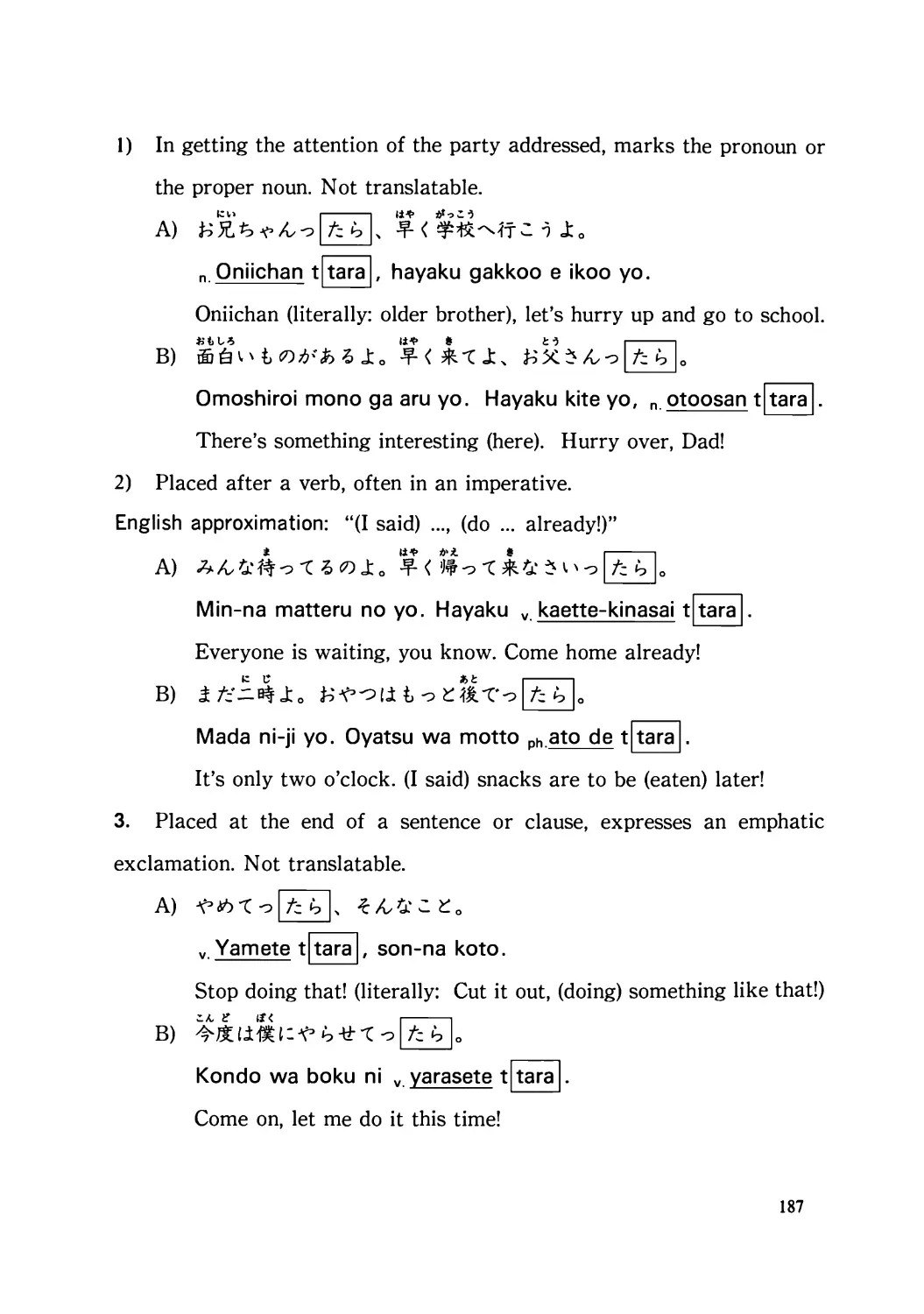
TARA t::. b ........................................................................... I 86
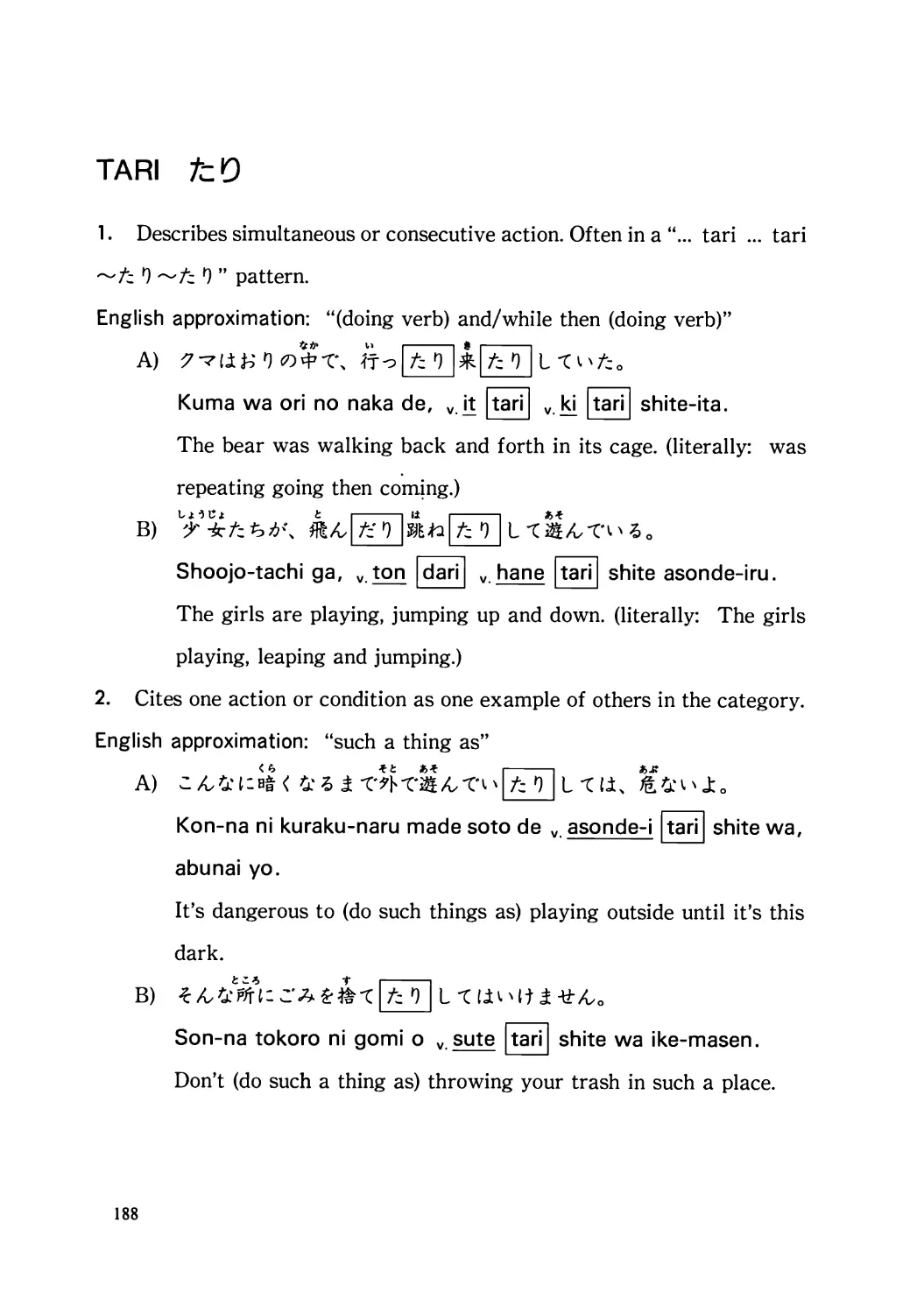
TAR I t::. . . . . . · . . . . . . . . . . . . . . . . . . . . . . . . . . . . . . . . . . . . . . . . . . . . . . . . . . . . . . . . . . . . . . . . . . . . . 188
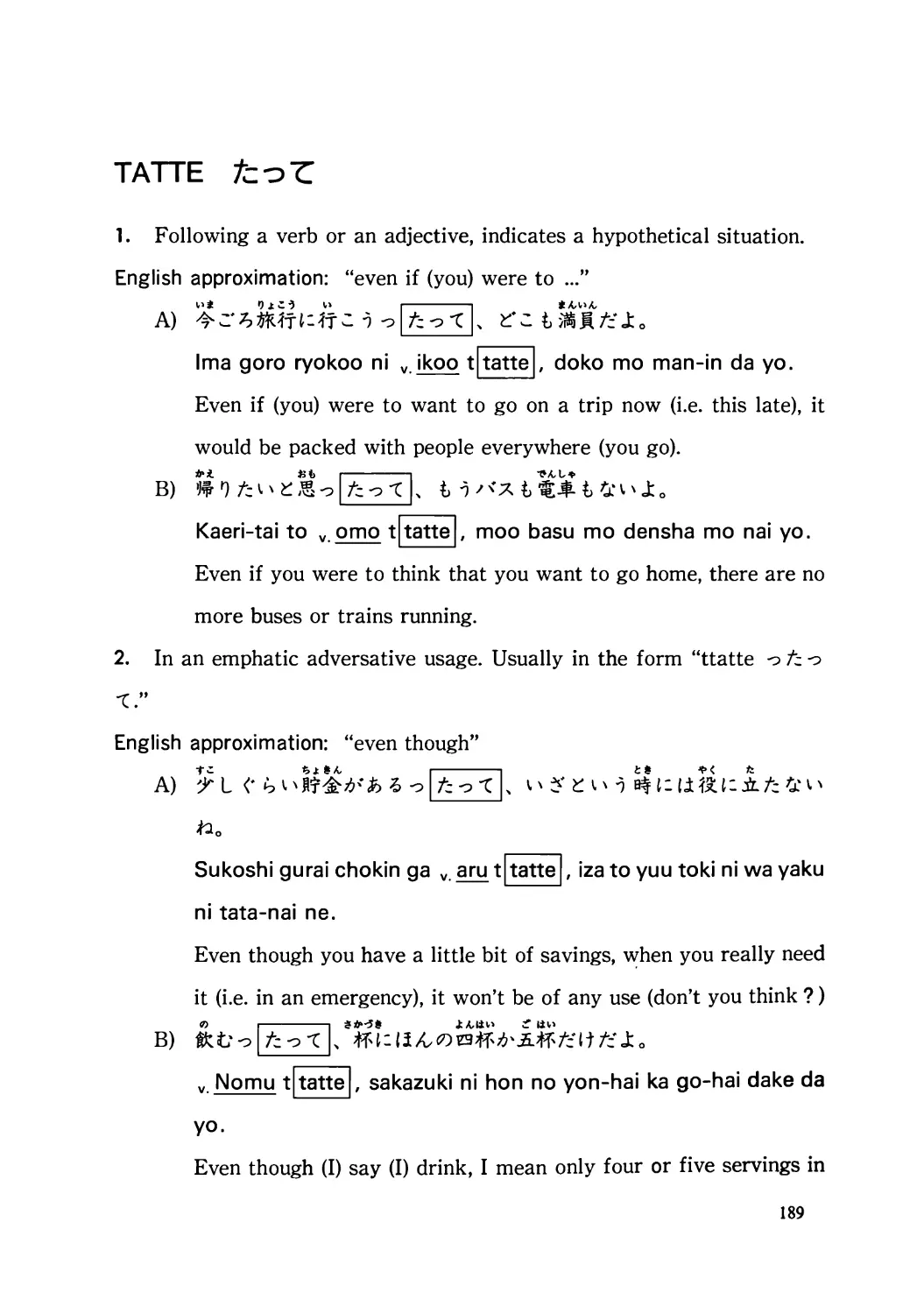
T A TIE t::. -:> L . . . . . . . . . . . . . . . . . . . . . . . . . . . . . . . . . . . . . . . . . . . . . . . . . . . . . . . . . . . . . . . . . . . . . I 89
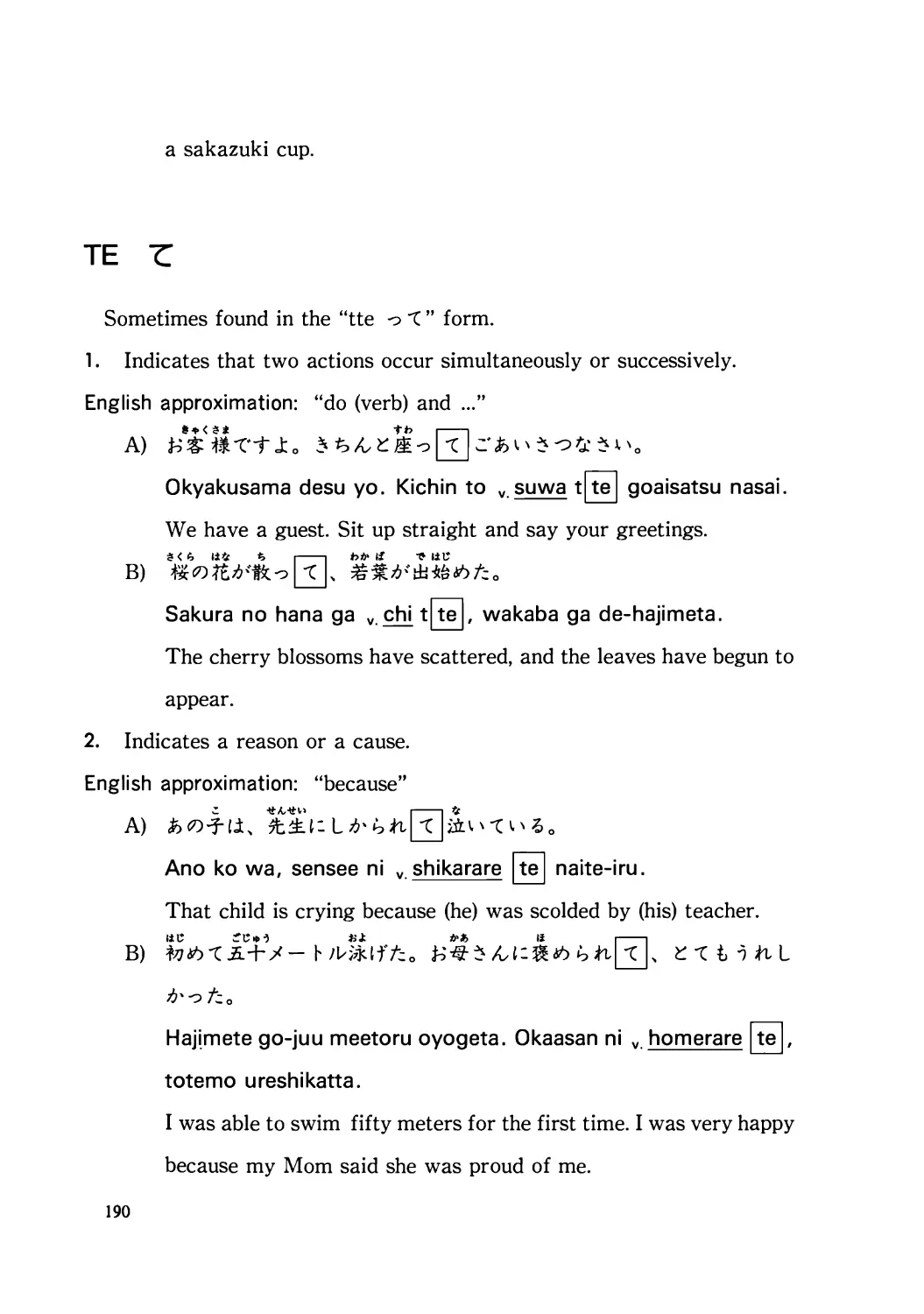
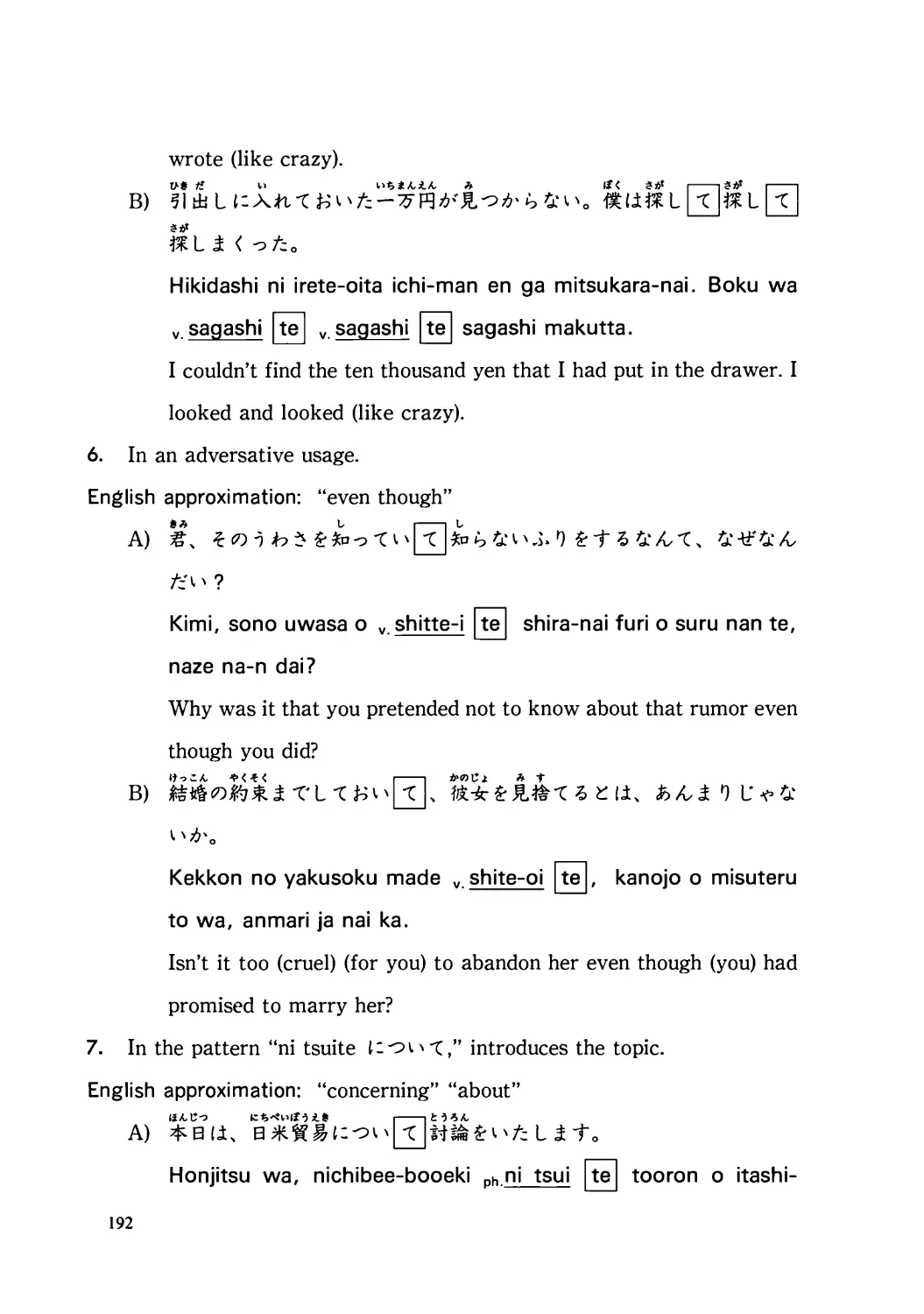
TE L . . . . . . . . . . . · . . . . . . . . . . . . . . . . . . . . . . . . . . . . . . . . . . . . . . . . . . . . . . . . . . . . . . . . . . . . . . . . . . . . . 190
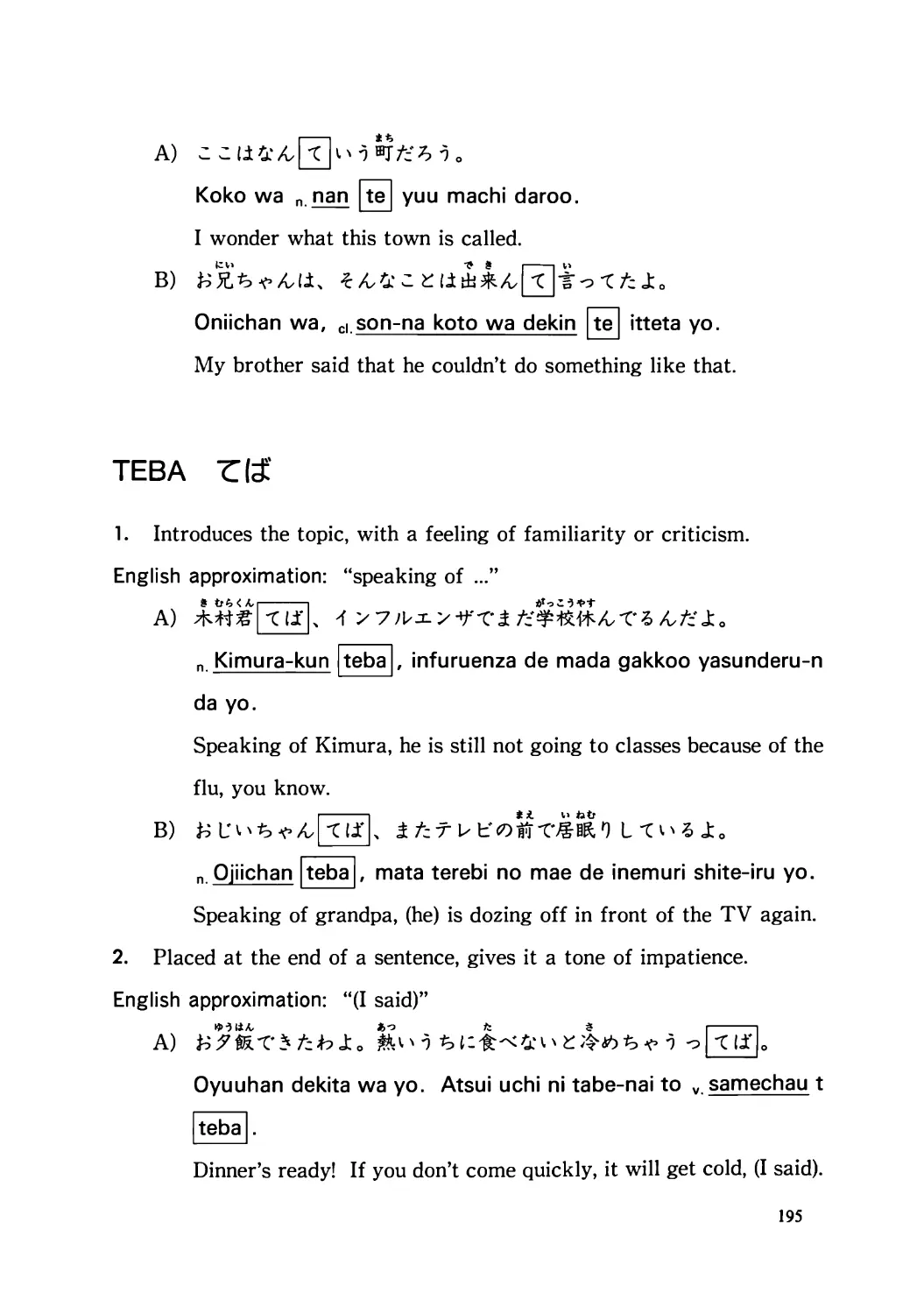
TEBA LId:. . . . . · . . . . . . . . . . . . . . . . . . . . . . . . . . . . . . . . . . . . 0 . . . . . . . . . . . . . . . . . . . . . . . . . . . . . . . . 195
TEMO (DEMO) L =t) ("(?=t) ...................................................... 196
TE -N E L -;f'J ( C. P.) . . . . . . . . . . . . . . . . . . . . . . . . . . . . . . . . . . . . . . . . . . . . . . . . . . . . . . . . . . . . . . . 198
TE - W A L - let (C. P.) . . . . . . . . . . . . . . . . . . . . . . . . . . . . . . . . . . . . . . . . . . . . . . . . . . . . . . . . . . . . . . . 198
TO . . . . . . . . . . . . . . . . . . . . . . . . . . . . . . . . . . . . . . . . . . . . . . . . . . . . . . . . . . . . . . . . . . . . . . . . . . . . . . . .. 200
TO-IE-SA -l, 'X -Id: (C.P.) ................................................... 210
TO-II -l, 'l, , ( C. P.) . . . . . . . . . . . . . . . . . . . . . . . . . . . . . . . . . . . . . . . . . . . . . . . . . . . . . . . . . . . . . .. 210
TO-ITIA -l, , t::.(CoP.) ...................................................... 211
TO-ITIE -l, , -:> L (C..P.) . . . . . . . . . . . . . . . . . . . . . . . . . . . . . . . . . . . . . . . . . . . . . . . . . . . . .. 211
TO-IW A-ZU -l, 'V- 9" (CoP.) ........ ........................................ 212
TO KA n' ........................................................................... 2 I 3
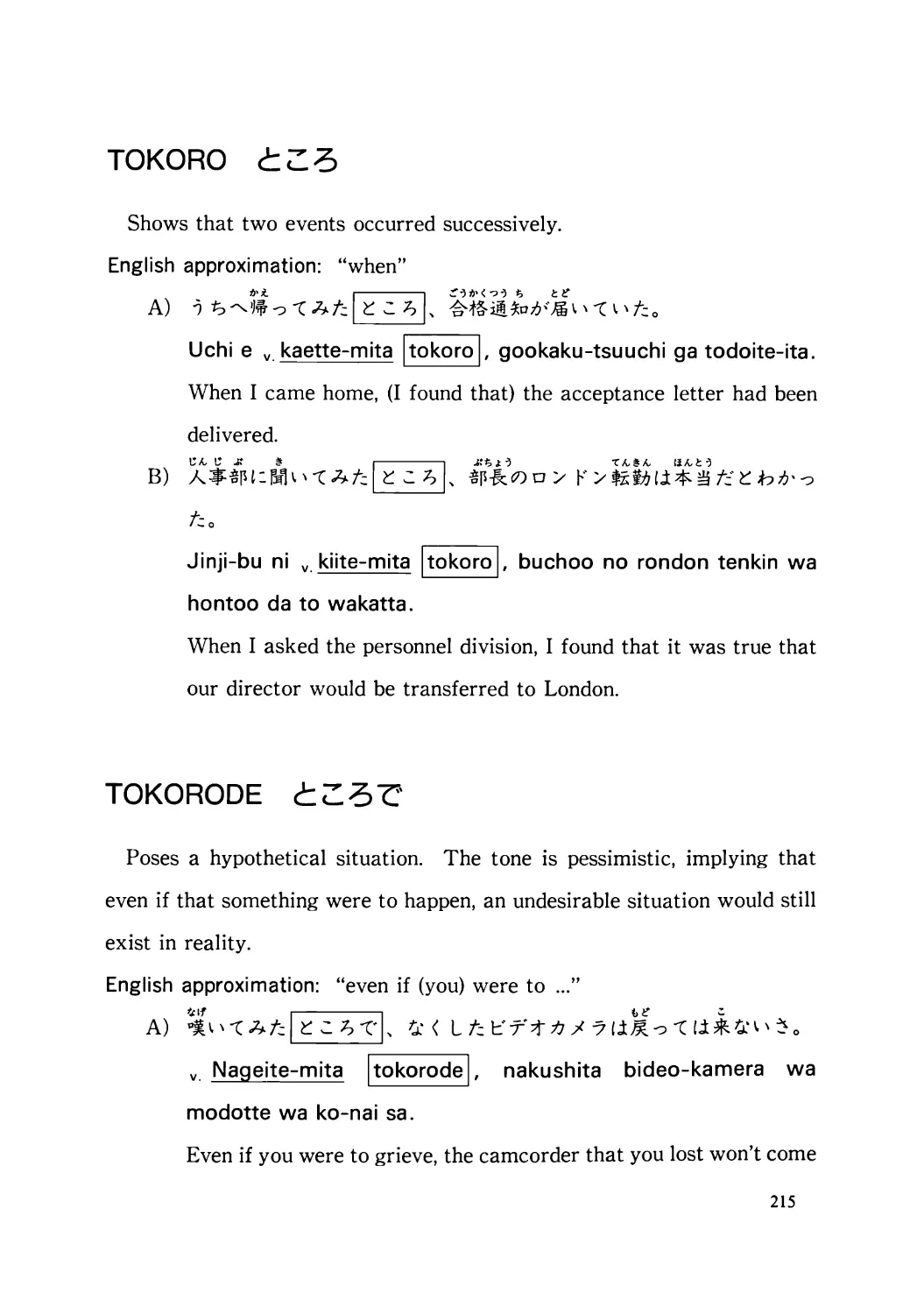
TOKORO -3 .................................................................. 215
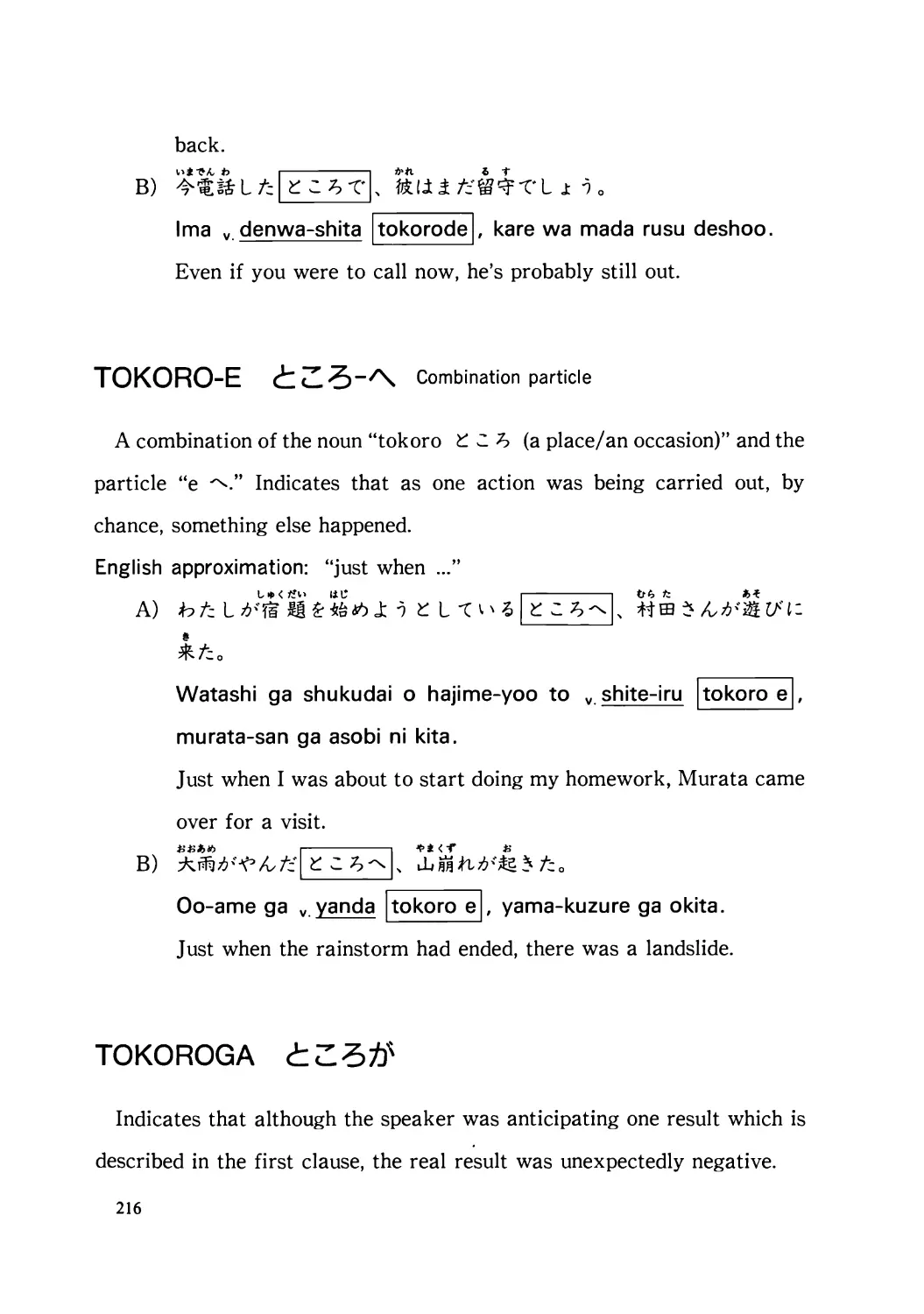
TOKORODE -3 "(? ............................................................ 215
TOKORO-E -3-"(C.P.) ................................................... 216
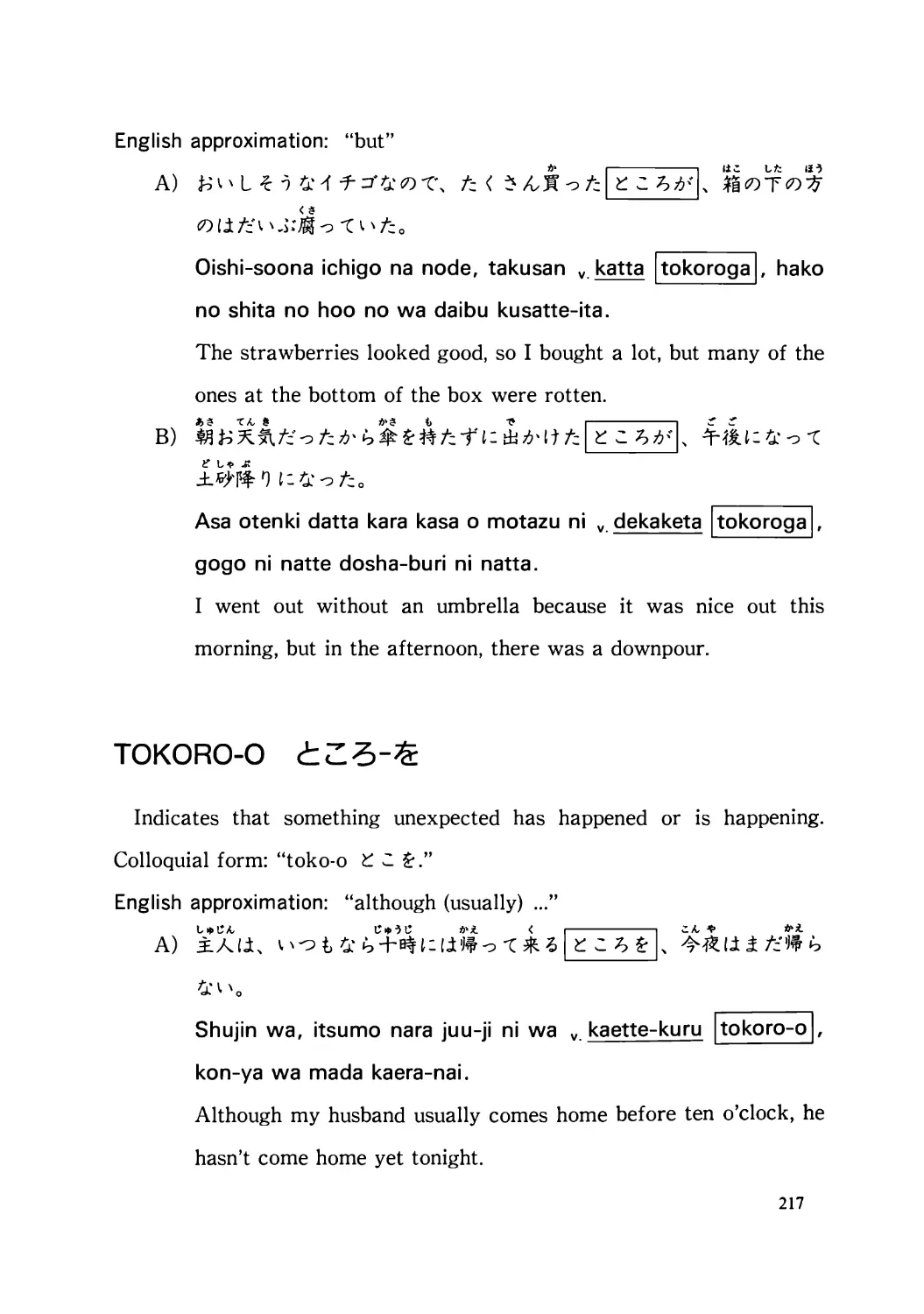
TOKOROGA -3 1J ............................................................ 216
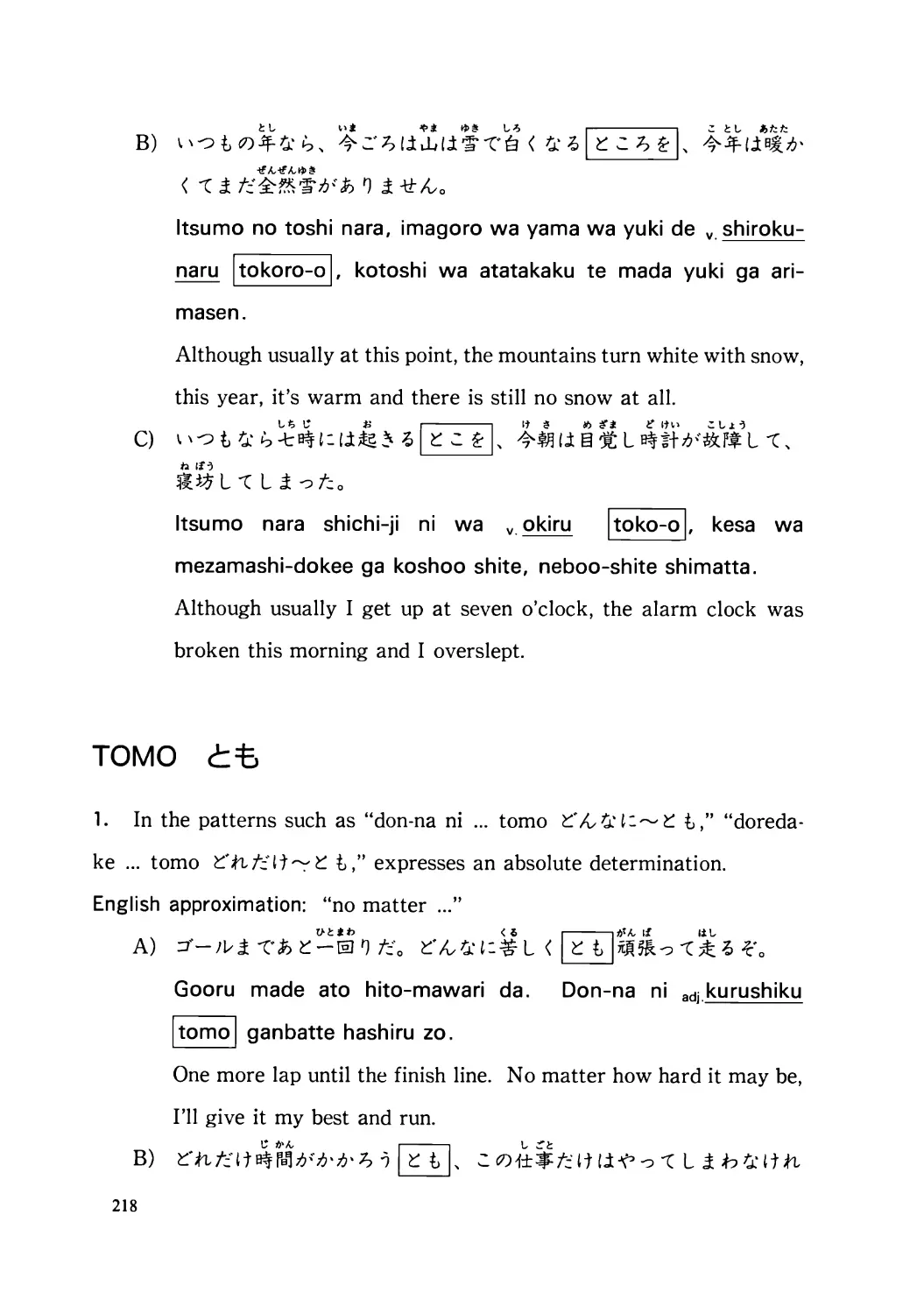
TOKORO-O -3- ............................................................ 217
TOMO =t)........................................................................... 218
TO-MO -=t) (C.P.) ............................................................ 220
TO-MO-ARE -=t)-05tt (CoP.) ..... ............... ... ......... ............. ... 220
TO-SH 1- TE - u- L (C.P.) ................................................... 222
TO-SHITE-MO -UL-=t)(C.P.) ............................................. 223
TO-SHITE-WA -UL-(et(C.P.) ............................................. 224
TO-W A - let (C. P.) . . . . . . . . . . . . . . . . . . . . . . . . . . . . . . . . . . . . . . . . . . . . . . . . . . . . . . . . . . .. 225
TO-WA-IE -(et-l, 'X(C.P.) ................................................... 226
TO-YUU -l, '5 (CoP.) ......................................................... 227
TO-YUU-KOTO-WA -l,'5- -(et(CoP.) .............................. 229
TO-YUU-NO-WA(MO) -l, '5-0')-(et(=t) (C.P.) ..................... 230
TO-YUU-TO -l,'5- (CoP.) ................................................231
TIE -:> L ............................. . . . . . . . . . . . . . . . . . . . . . . . . . . . . . . . . . . . . . . . . . . . . . . . .. 232
W A fc;J:. . . . . . . . . . . . . . . . . . . . . . . . . . . . . . . . . . . . . . . . . . . . . . . . . . . . . . . . . . . . . . . . . . . . . . . . . . . . . . . .. 235
W At>. . . . . . . . . . . . . . . . . . . . . . . . . . . . . . . . . . . . . . . . . . . . . . . . . . . . . . . . . . . . . . . . . . . . . . . . . . . . . . . .. 239
Y A . . . . . . . . . . . . . . . . . . . . . . . . . . . . . . . . . . . . . . . . . . . . . . . . . . . . . . . . . . . . . . . . . . . . . . . . . . . . . . . .. 241
Y A I l,' .............................................................................. 246
YA-INA-YA -l, '1J.- (C.P.) ................................................ 247
Y A RA b ........................................................................... 248
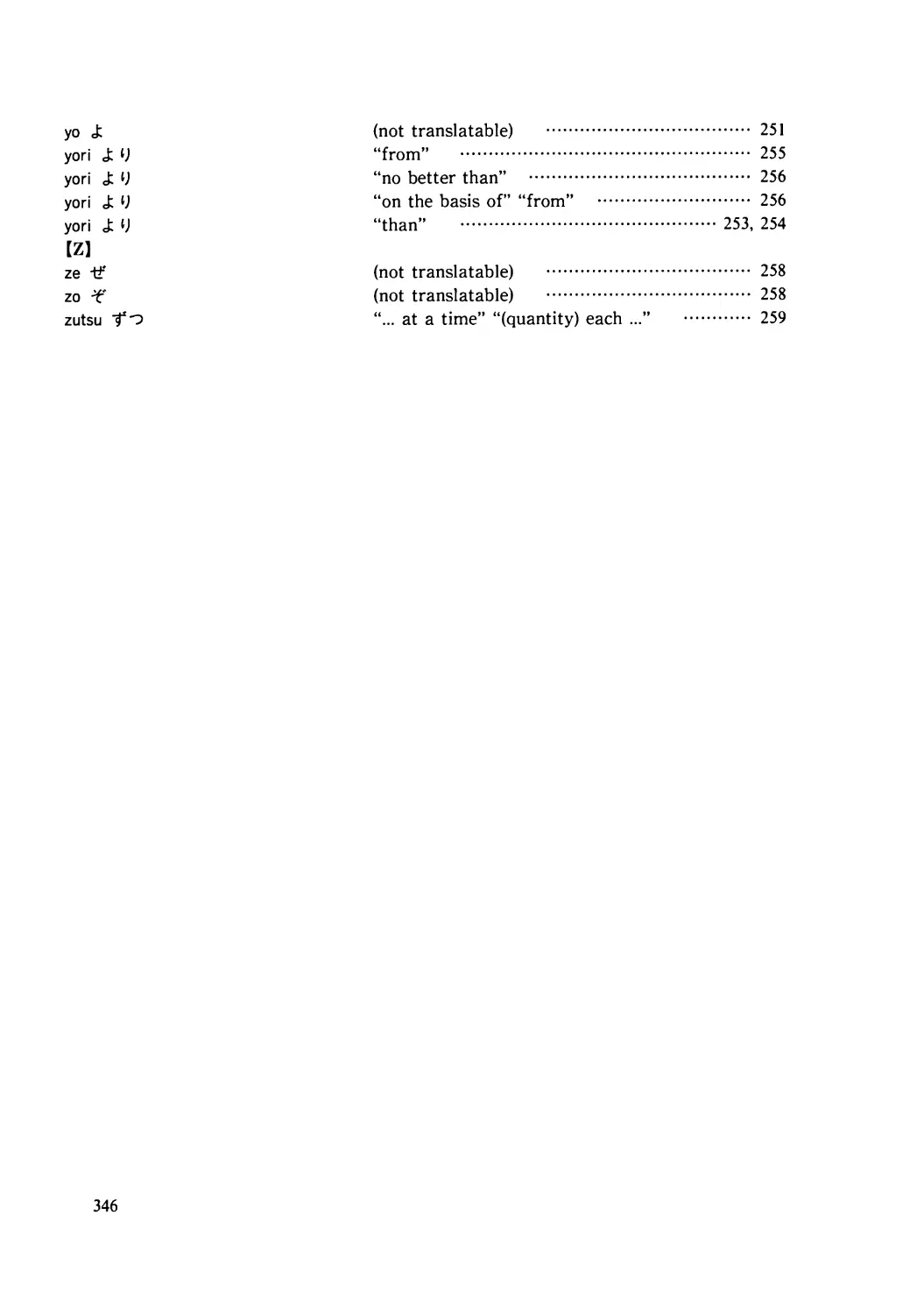
YO cJ::................................................................................. 251
YORI cJ:: ........................................................................... 253
ZE . . . . . . . . . . . . . · . . . . . . . . . · · . . . . . . . . . . . . . . . . . . . . . . . . . . . . . . . . . . . . . . . . . . . . . . . . . . . . . . .. 257
ZO . . . . . . . . . . . . . . . .. . . . . . . . . . . . . . . . . . · . . . . . . . . . . . . . . . . . . . . . . . . . . . . . . . . . . . . . . . . . . . . .. 258
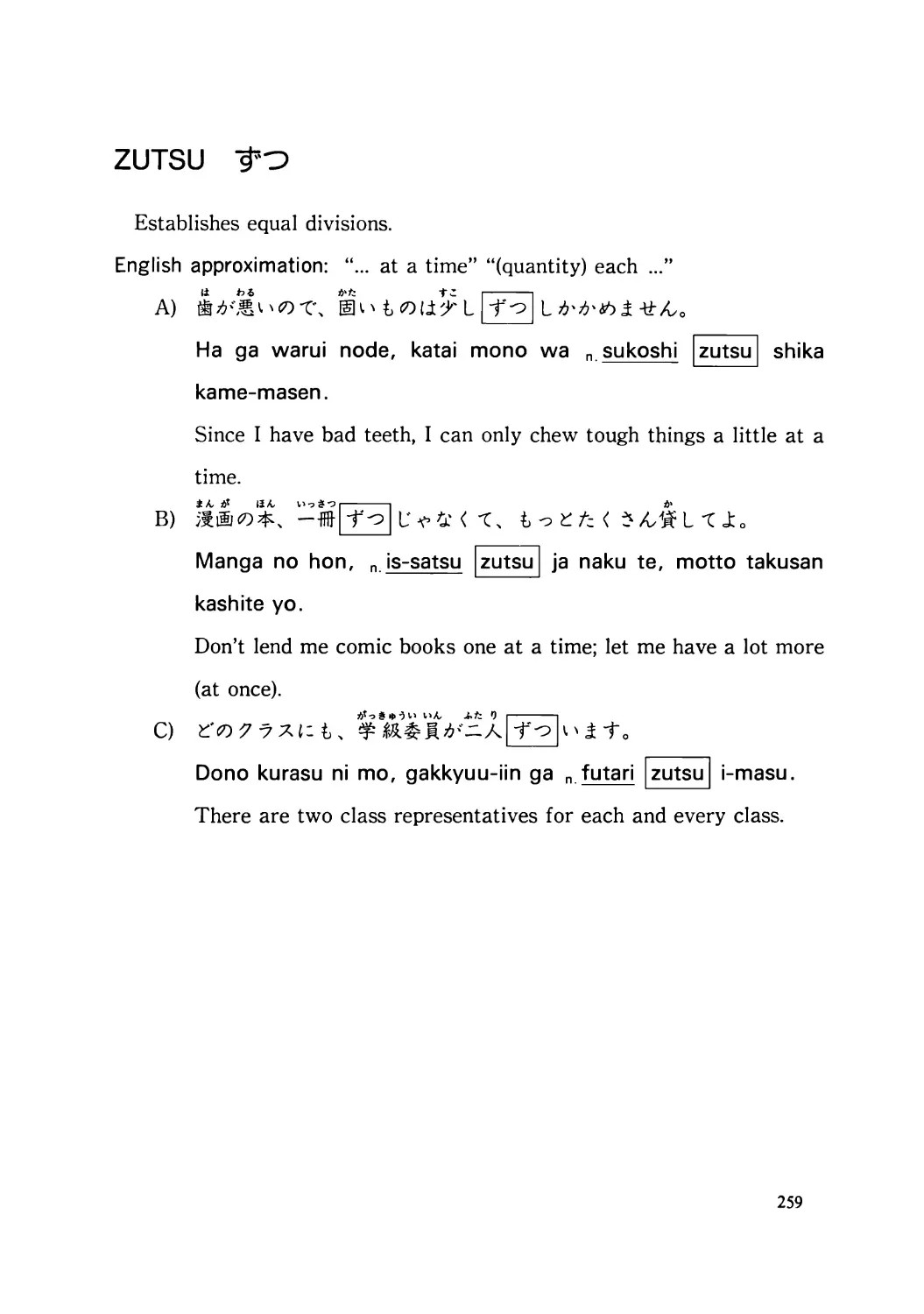
Z UTS U 9" -::> . . . . . . · . . . . . . . . . . . . . . . . . . . . . . . . . . . . . . . . . . . . . . . . . . . . . . . . . . . . . . . . . . . . . . . .. 259
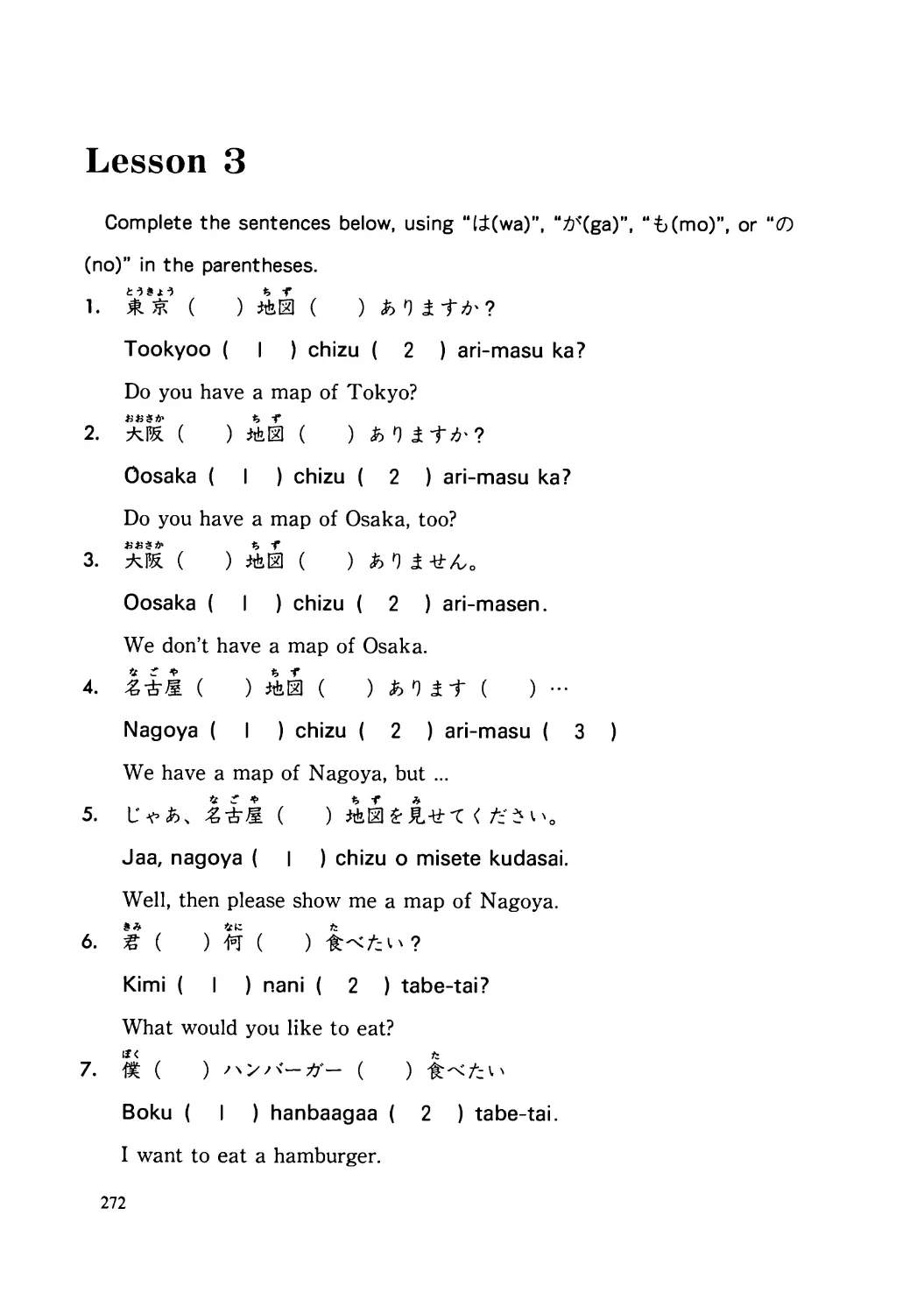
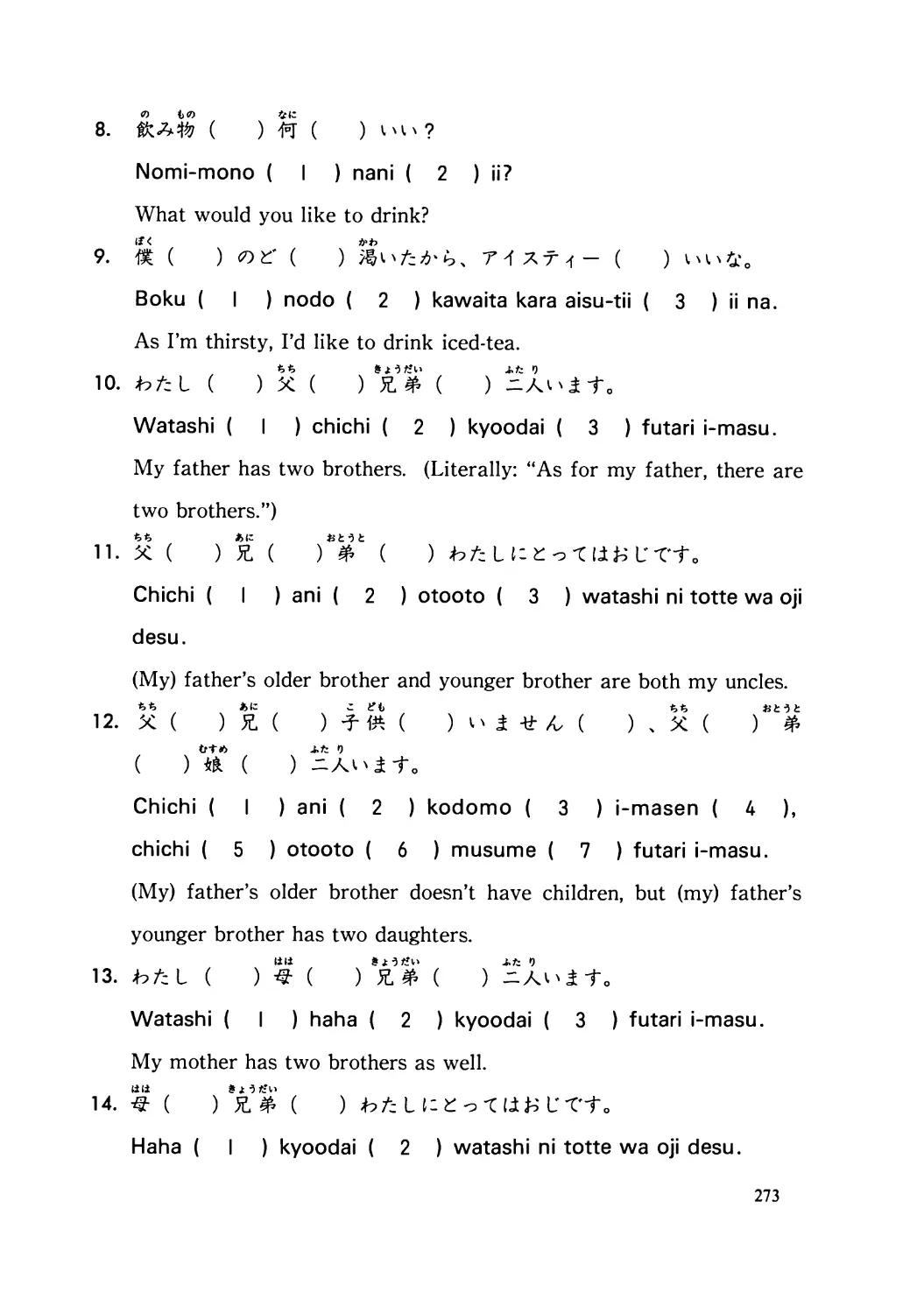
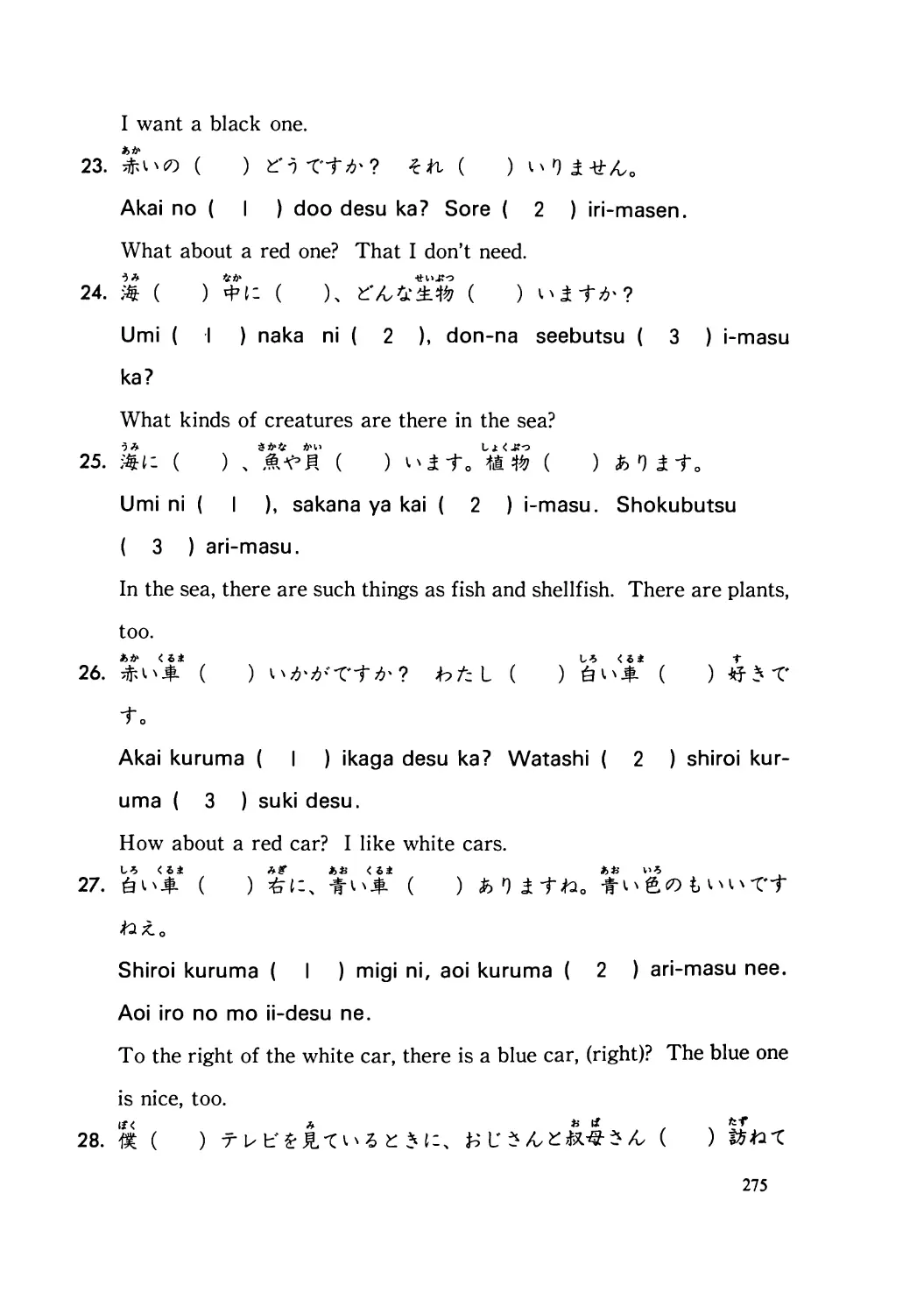
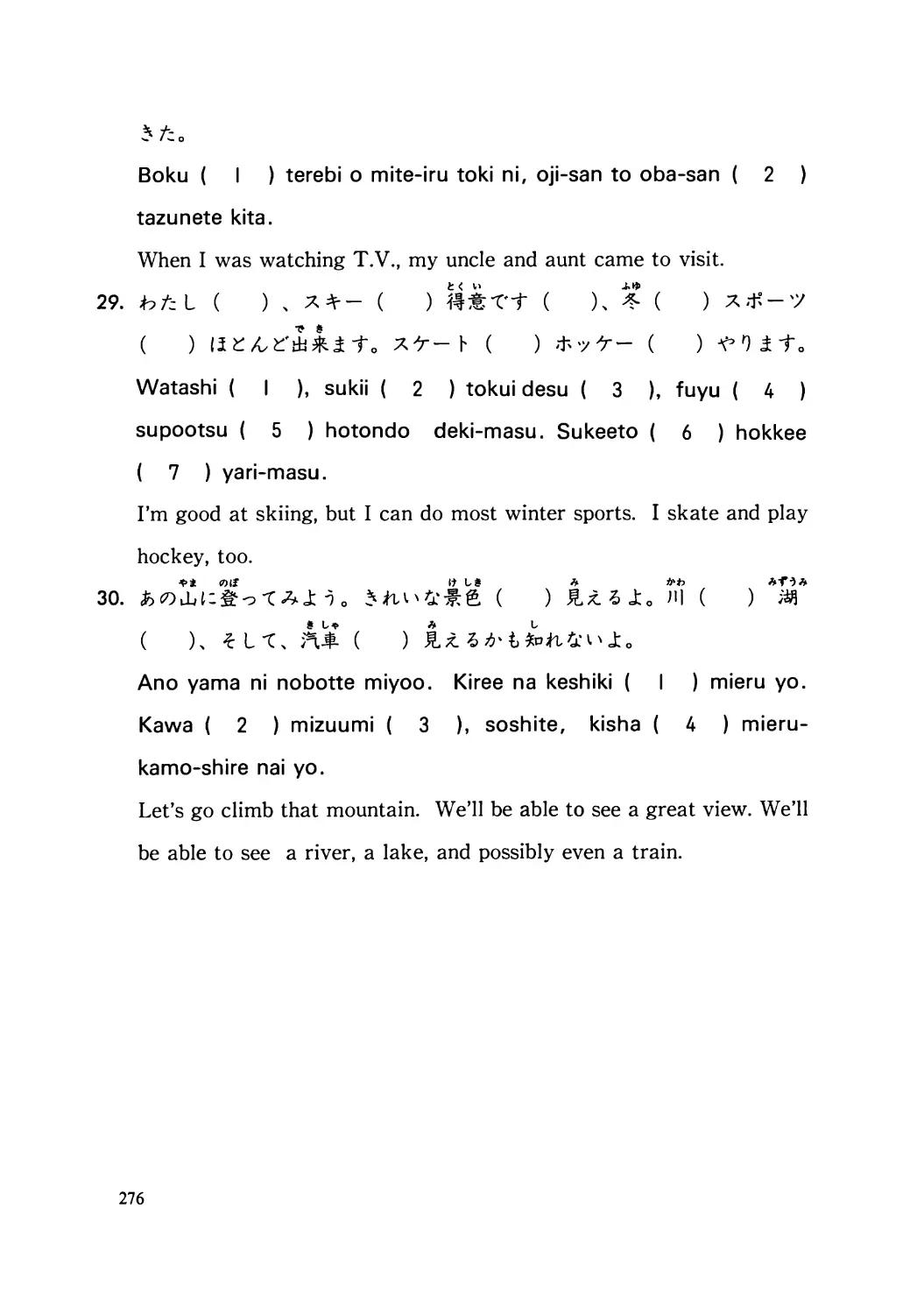
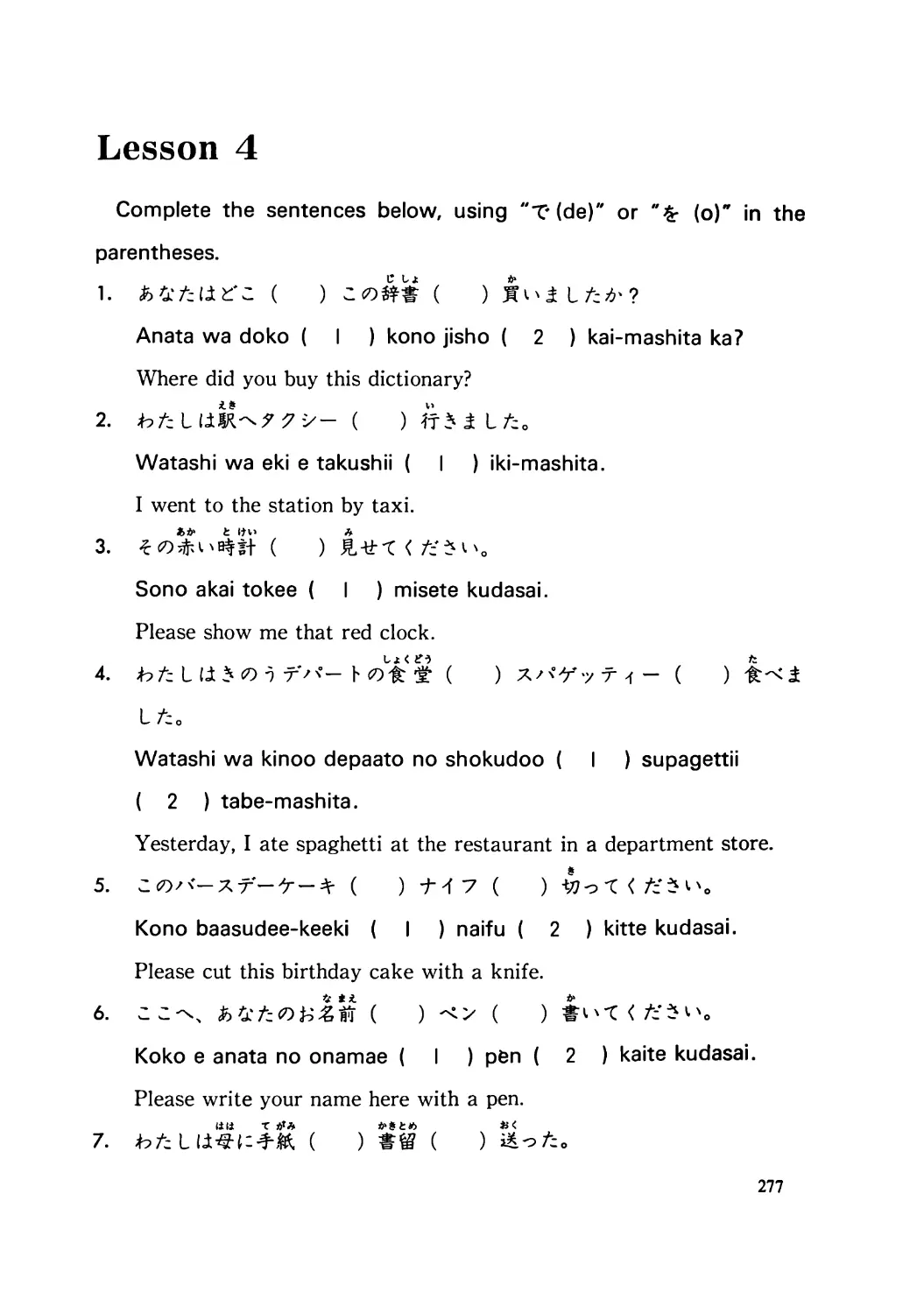
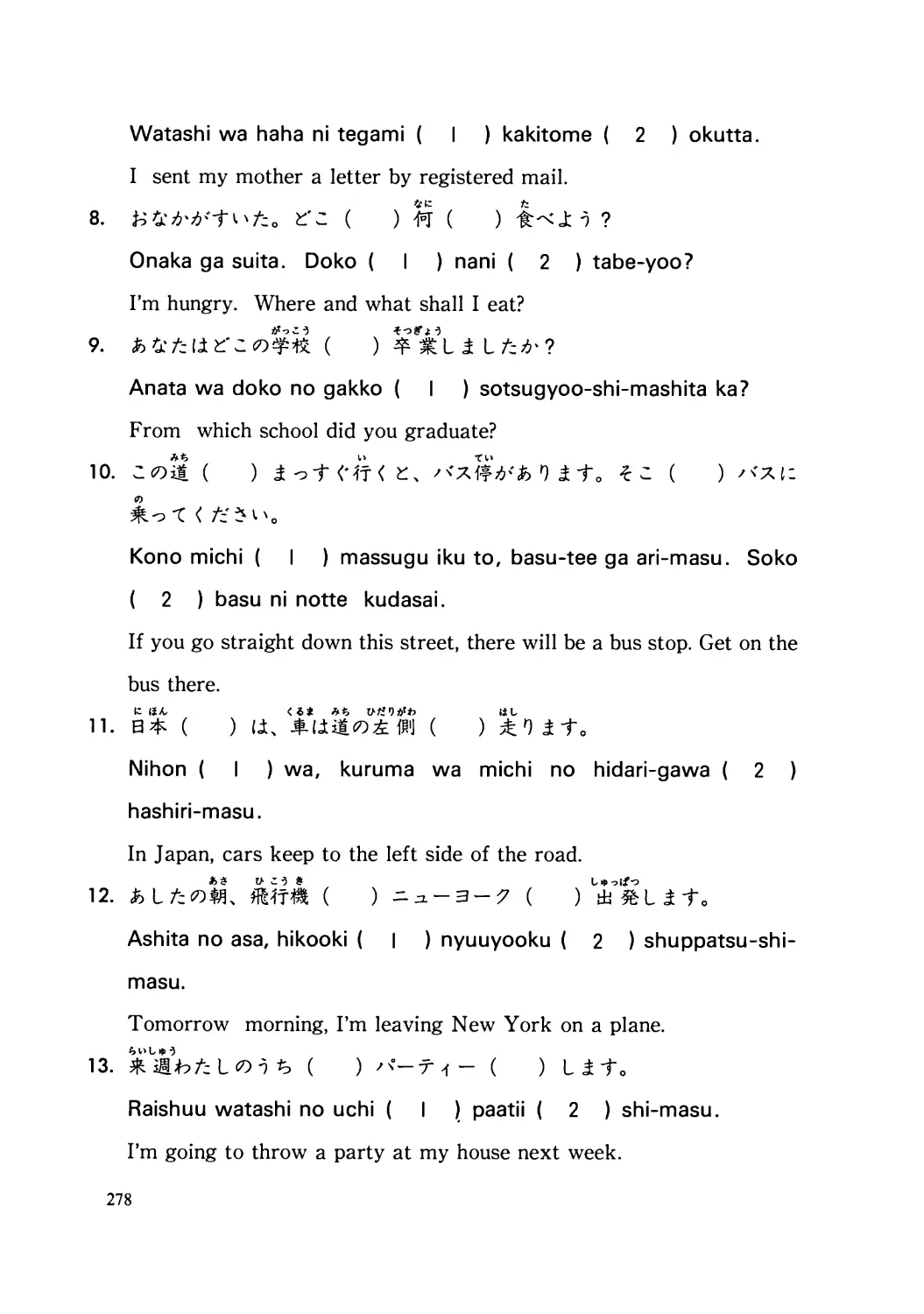
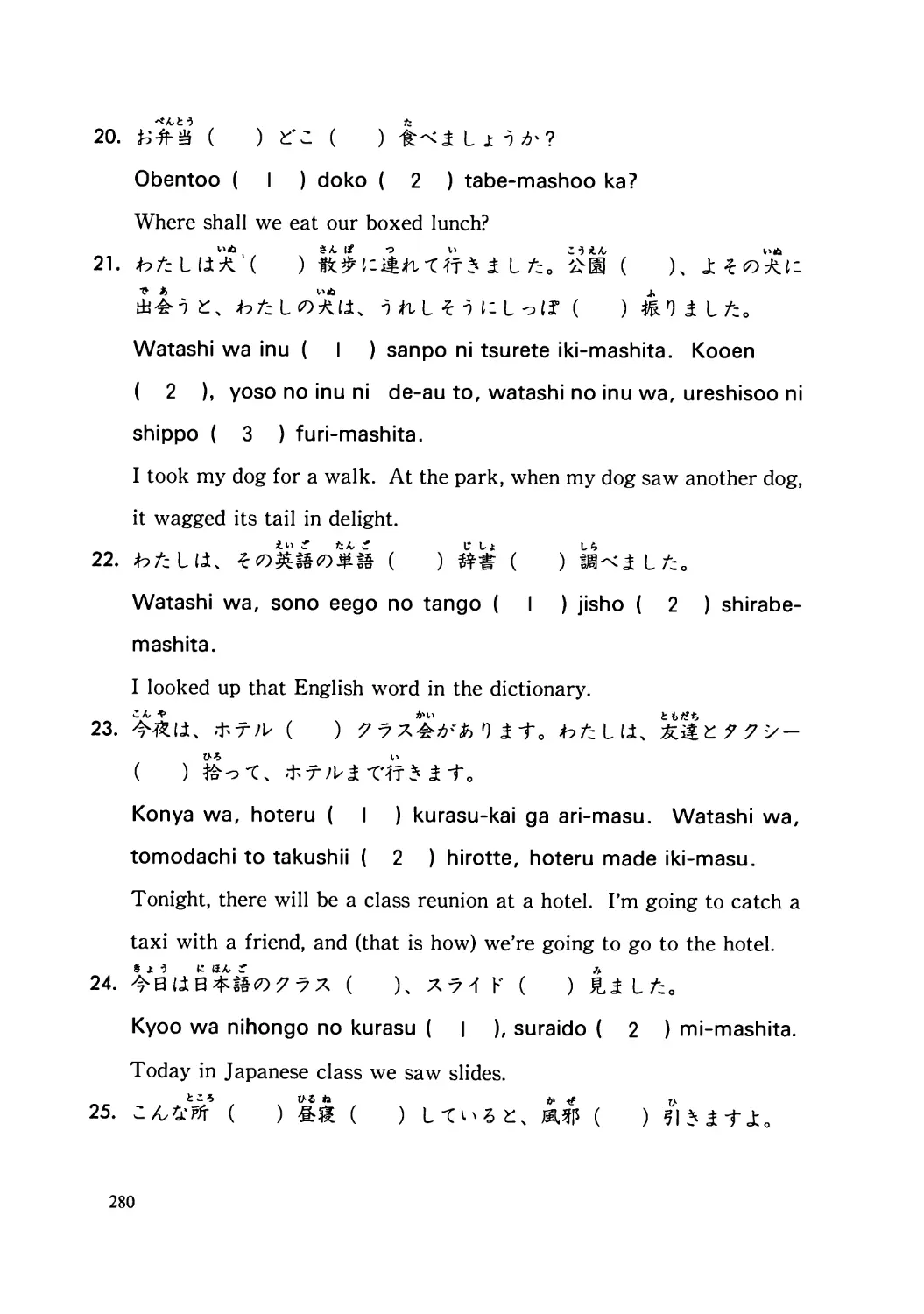
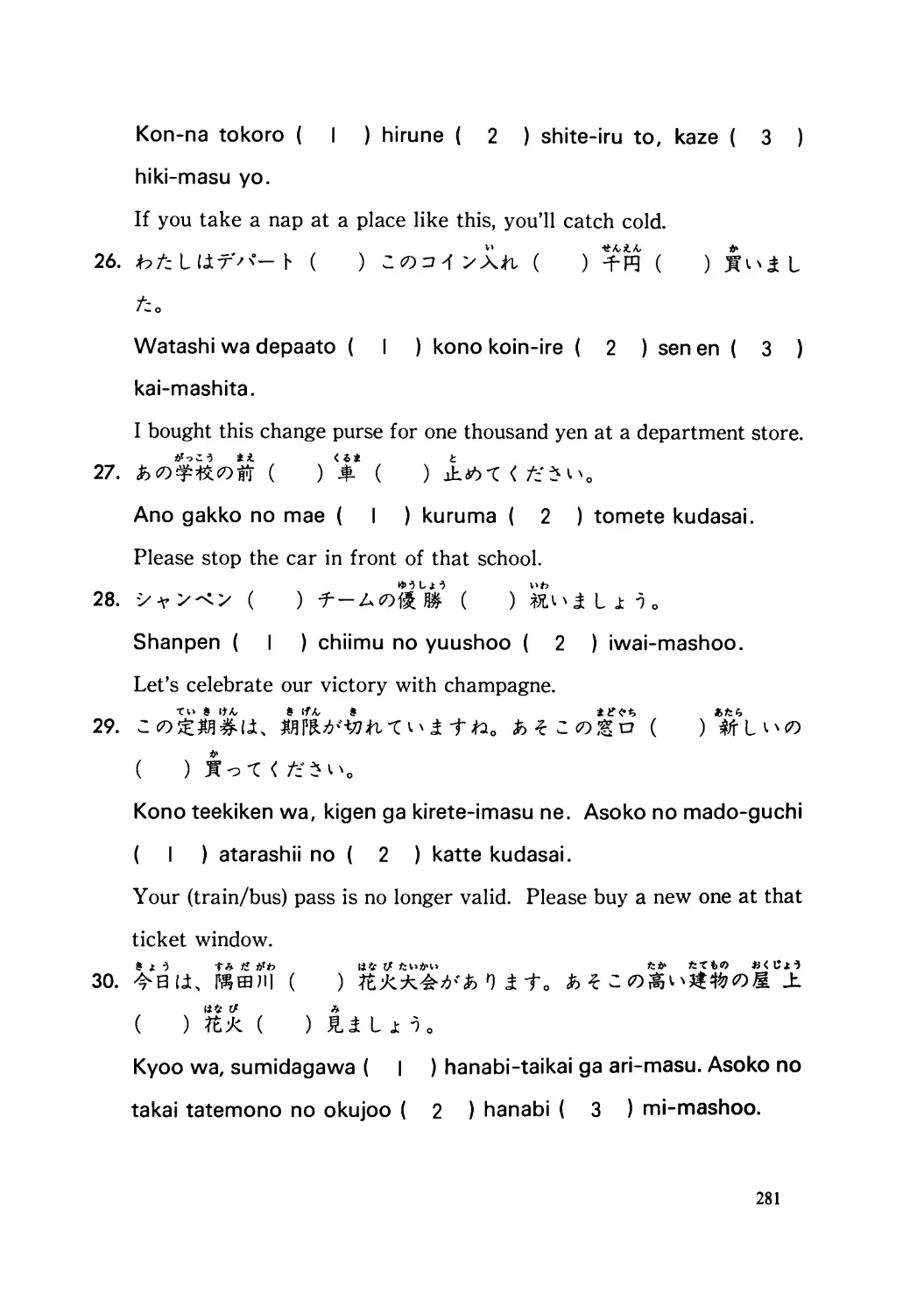
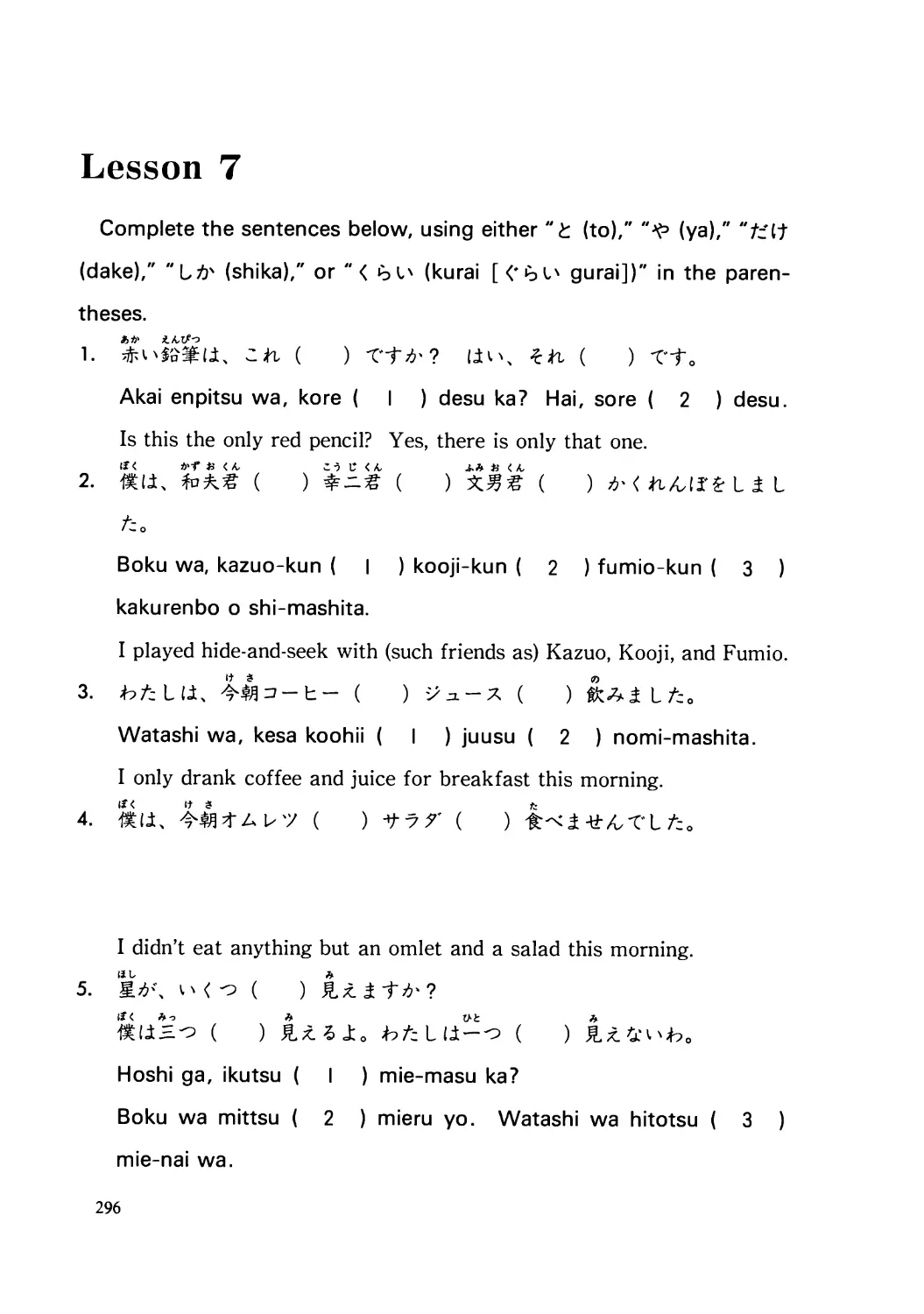
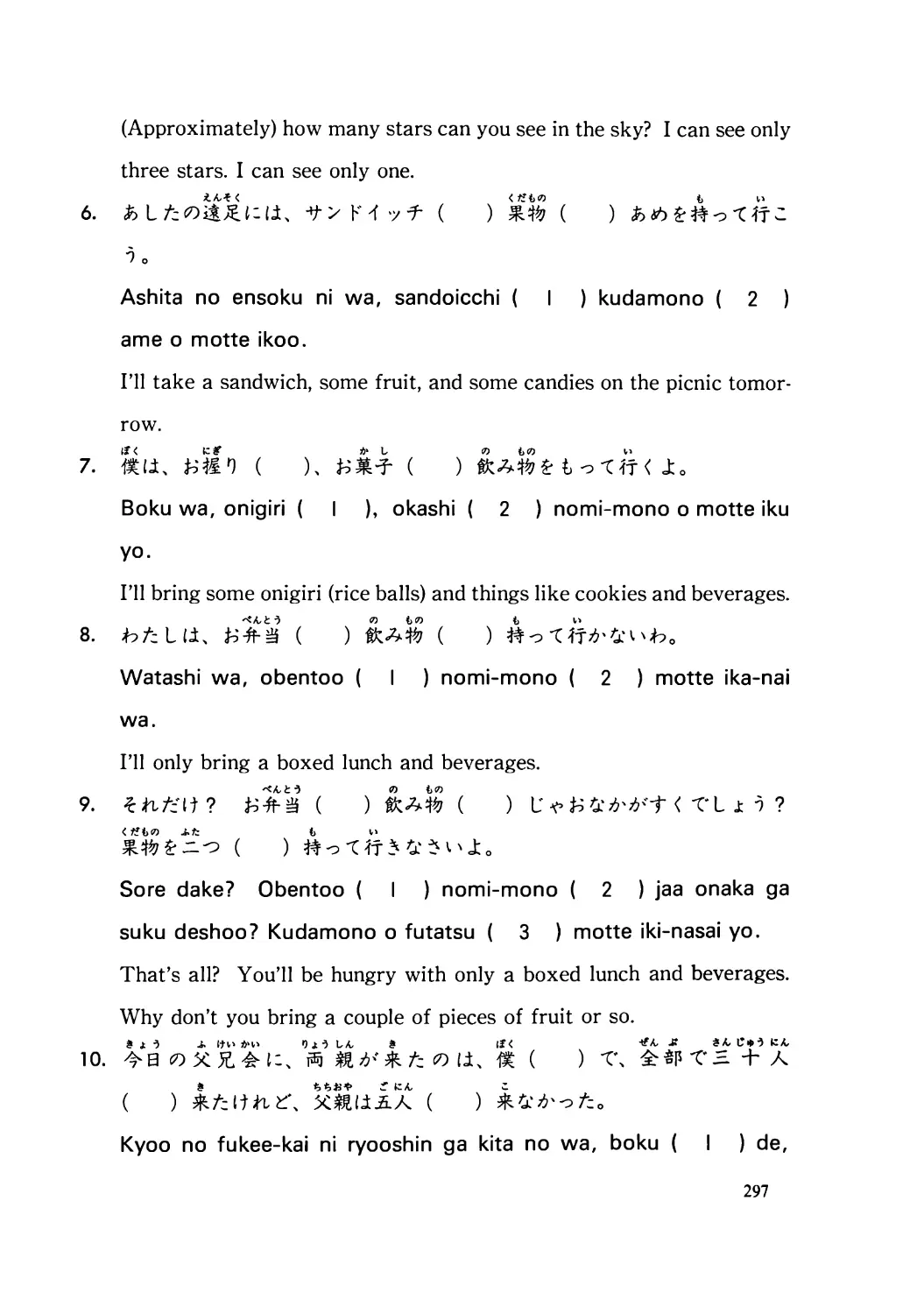
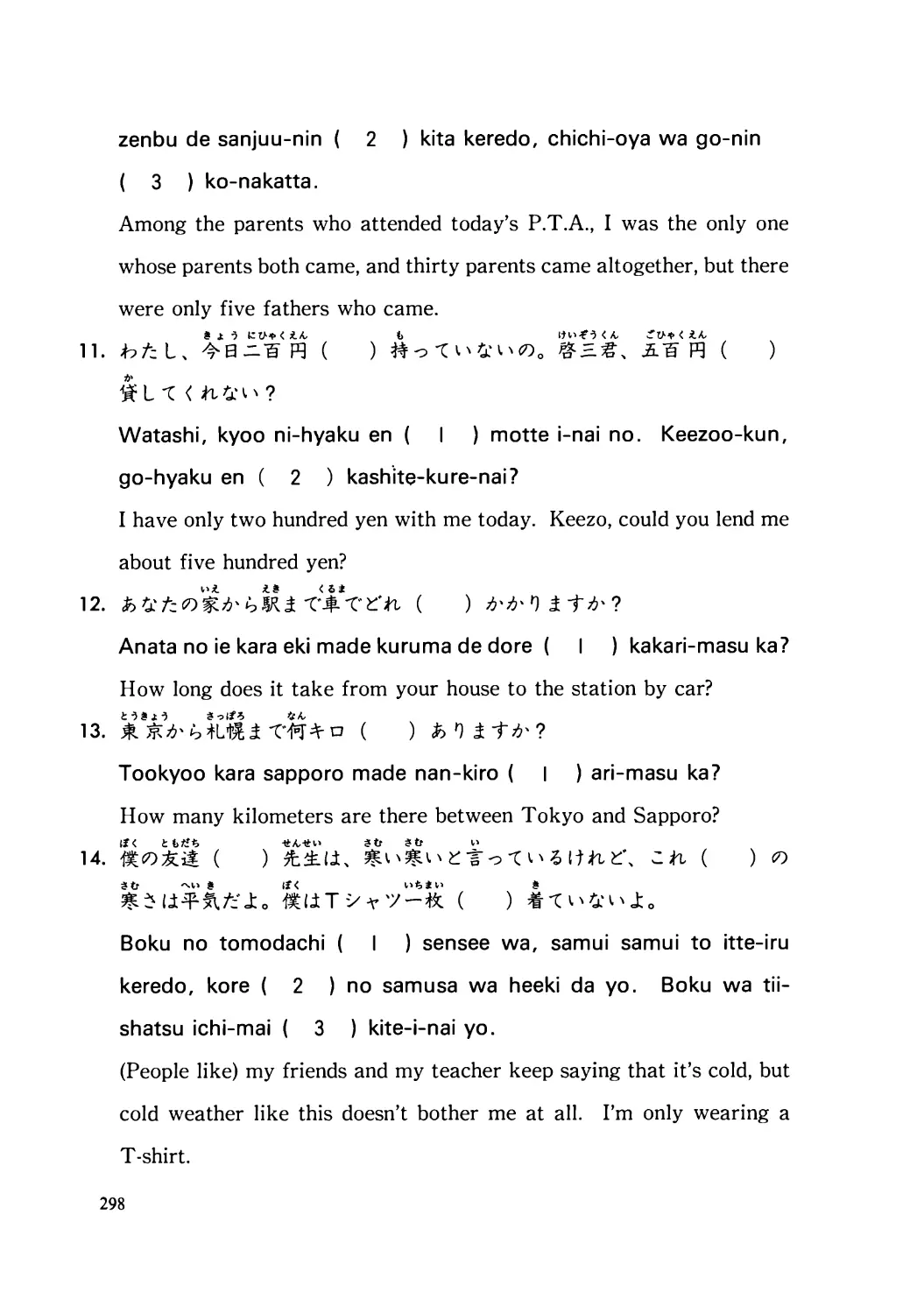
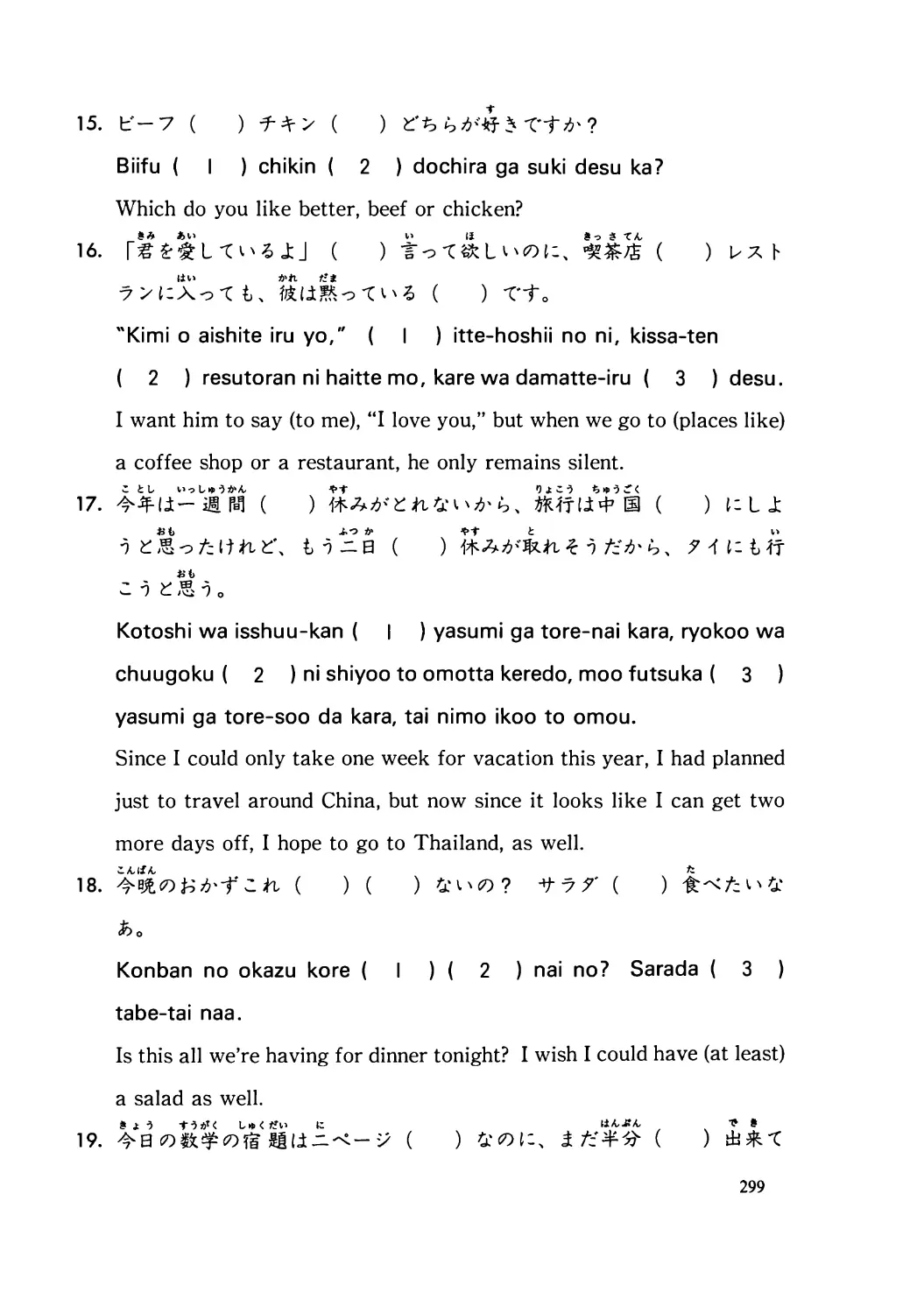
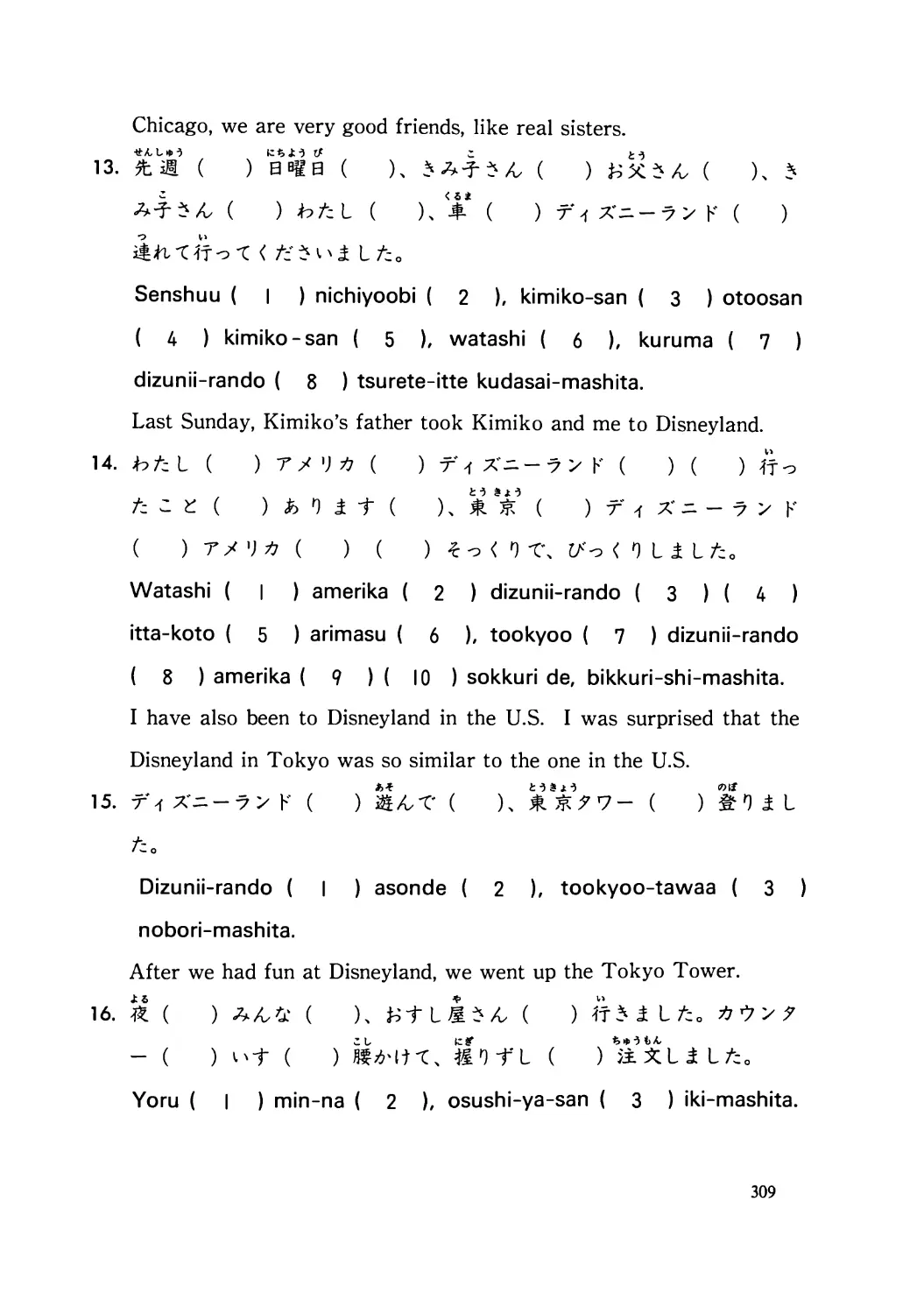
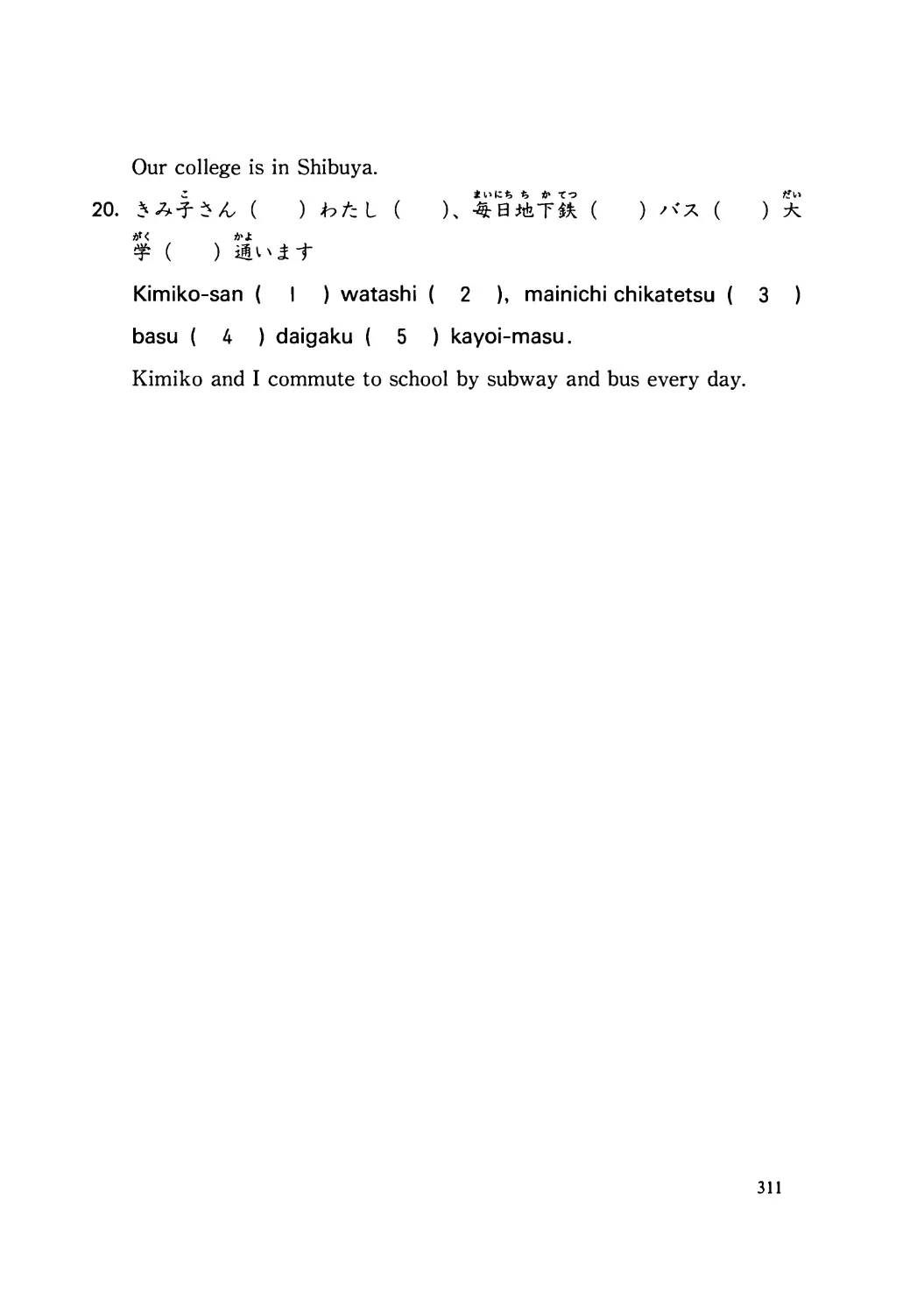
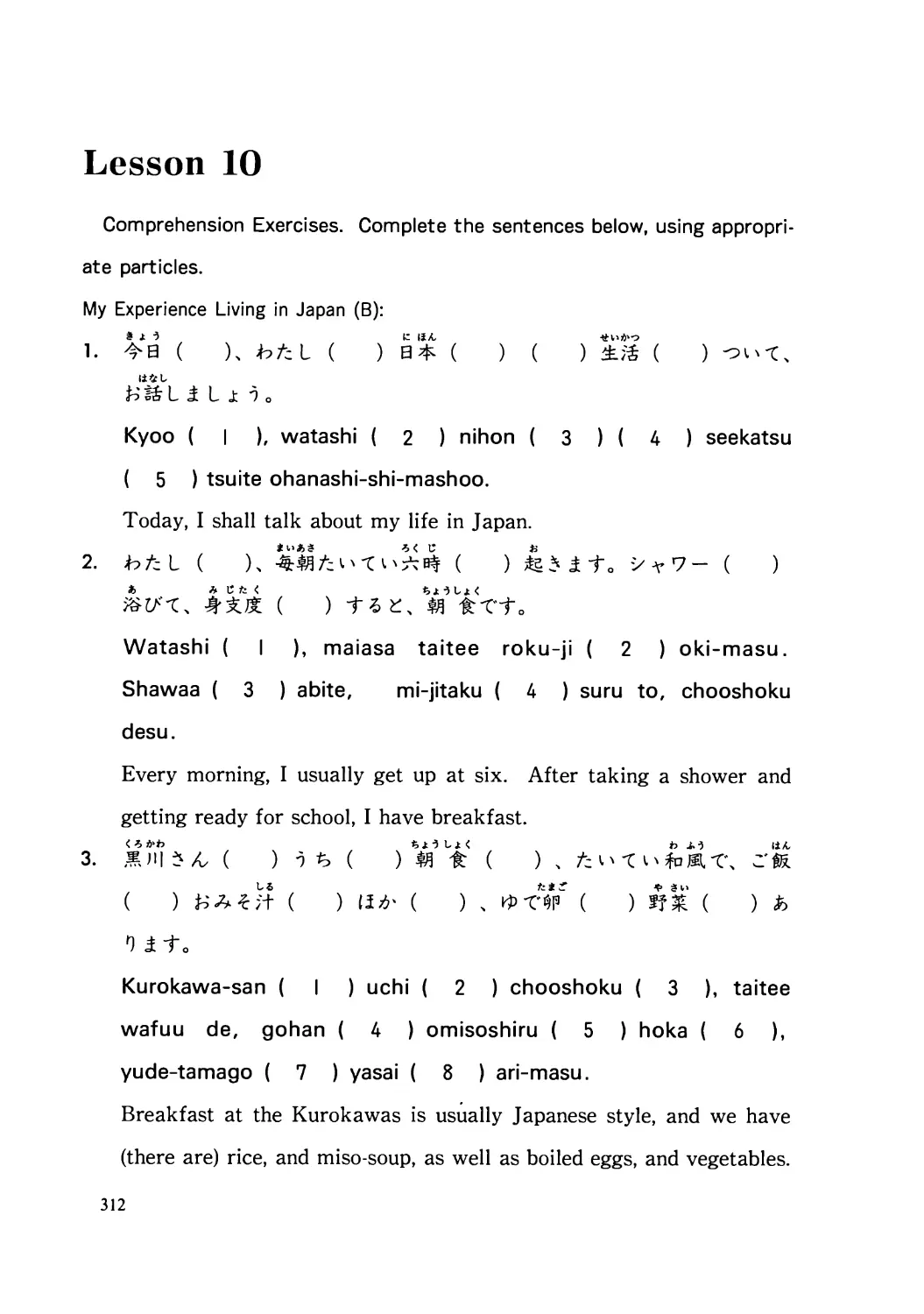
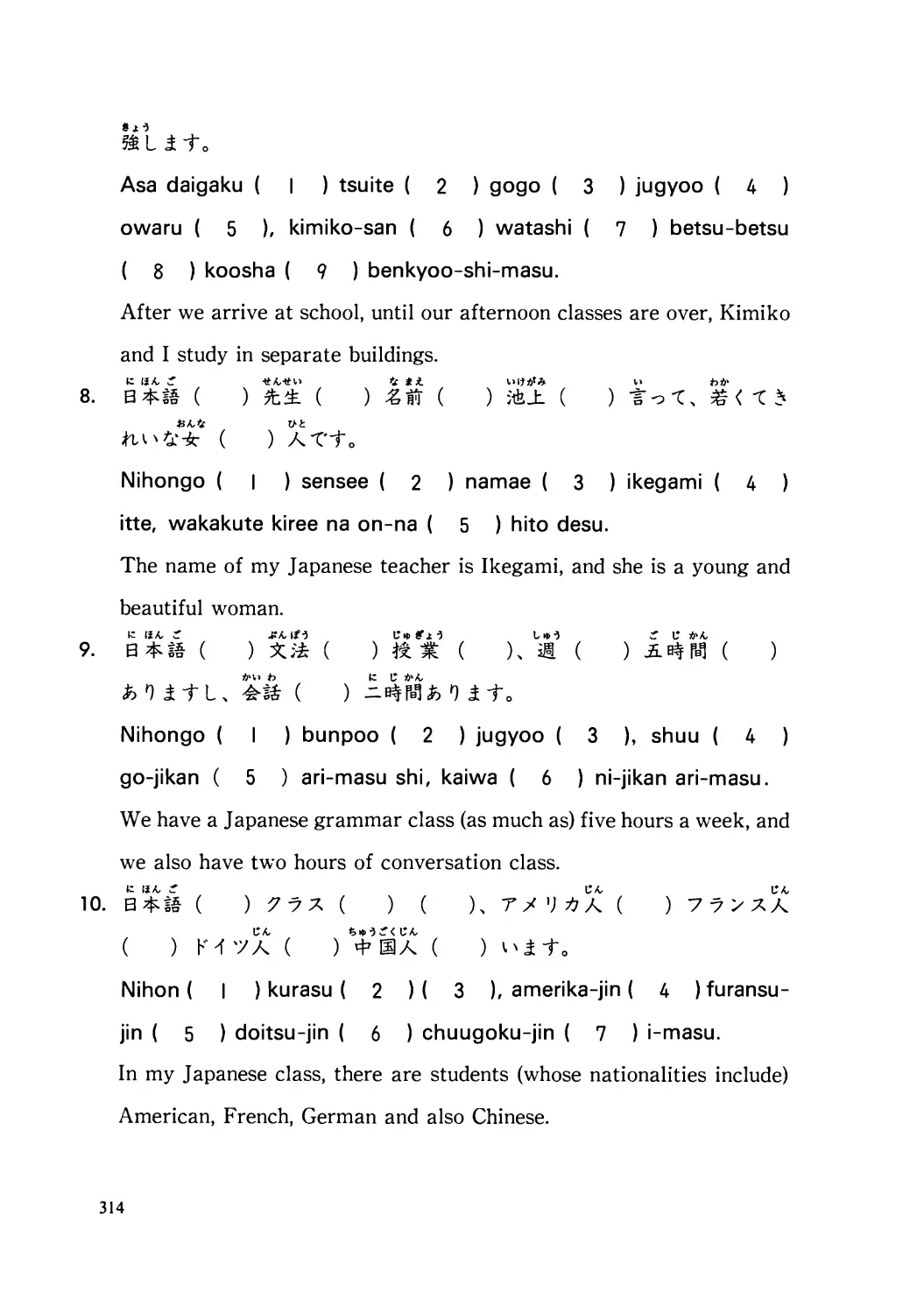
MASTERING PARTICLES: EXERCISES ................................................... 261
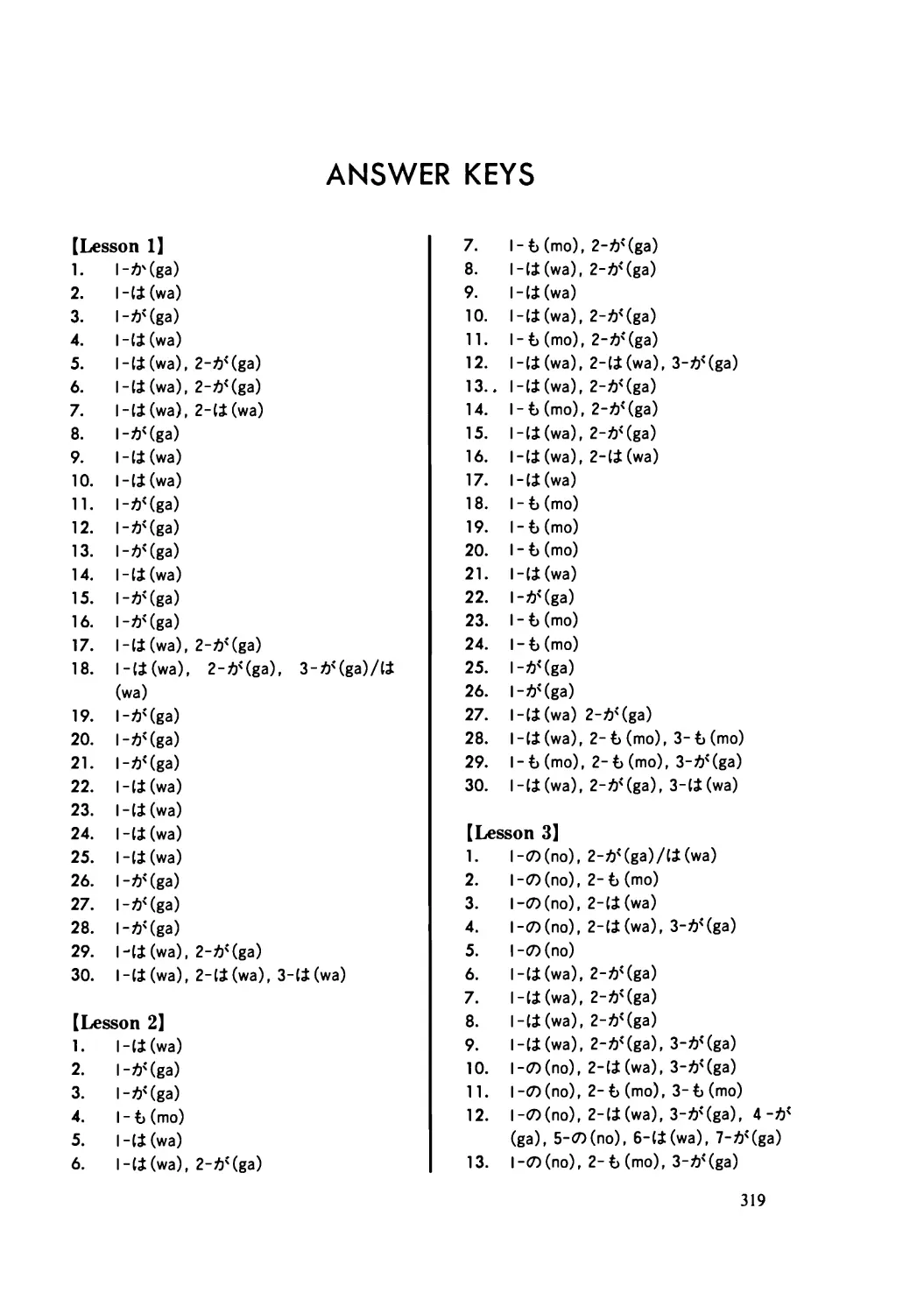
AN S W ER KEY S . . . . . . . . . . . . . . . . . . . . . . . . . . . . . . . . . . . . . . . . . . . . . . . . . . . . . . . . . . . . . . . . 0 . . . 0 0 . 0 . . . . .. 319
PATTERNS ................................................................................. 0.. 324
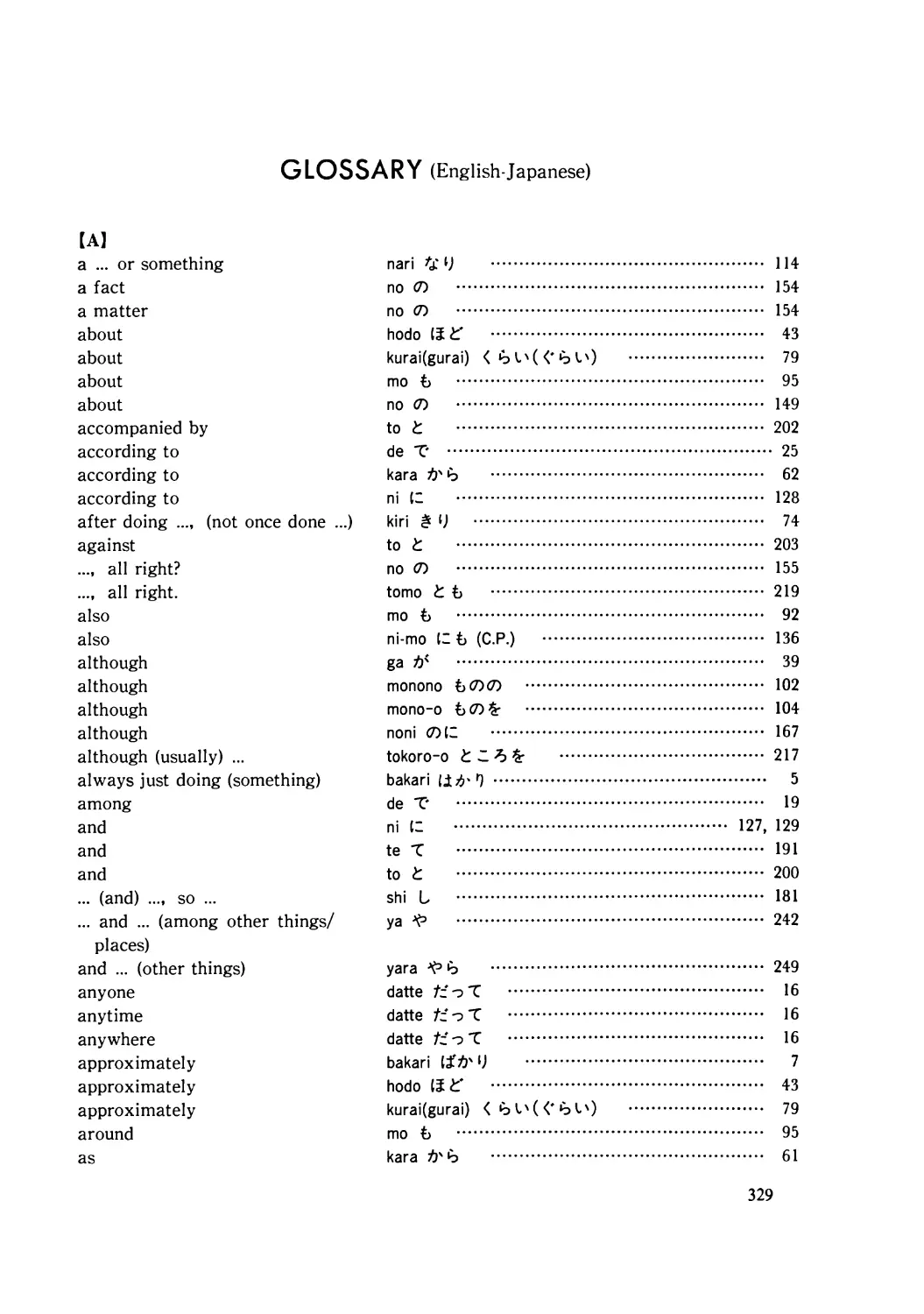
GLOSSARY (English-Japanese) ............... 0 0...................... 0....... 0......... 329
GLOSSARY (Japanese-English) ........ ...... ...... .... o. ......... ..... 0.. 0 ... 0.. 0 0..... 339
INTRODUCTION
DEFINITION OF PARTICLES
I) A particle (111; joshi) in the Japanese language follows a word to:
A) show its relationship to other words in a sentence, and/or
B) give that word a particular meaning or nuanceo
2) Unlike verbs, adjectives and adverbs, particles are not inflected, and
therefore stay in the same form regardless of where they appear in a
sentenceo
3) Generally, particles are considered to be equivalent to prepositions,
conjunctions and interjections of the English language; of these three,
the majority of particles belong to the first categoryo
4) A particle should always be placed after the word it modifies, which
means that in translating them into English, the word order should be
changedo
Example:
English phrase: "top of the desk"
Japanese phrase: tsukue no ue = "(the) desk of top"
WHEN TO USE PARTICLES
Consider the following sentence: "My mother and my father had dinner
at a restaurant in Tokyo with a friendo"
This example contains three prepositions (at, in, with) and one conjunc-
tion (and)o However, the same sentence translated into Japanese is:
"Watashi no haha to chichi wa tomodachi to issho ni tookyoo no
resutoran de yuushoku 0 tabe-mashitao"
There are eight particles in the above exampleo Note, then, two points:
I ) You cannot simply replace English prepositions, conjunctions and inter-
jections with particles; there are particles that cannot be translated into
English but still have vital functions in a Japanese sentenceo
2) Nouns are usually followed by particleso
When you are just starting to learn Japanese, get into the habit of
looking for the appropriate particle every time you see a nouno Of
course, there are exceptions to this rule:
A) Particles are normally not placed directly before a copula (desu, da,
deshita, datta, etco)o
Example: "This is an appleo" = kore wa ringo desu.
Note the absence of any particles before "desu," even though nngo
("apple") is a nouno
B) Words that express quantity, extent, or numbers are not usually
followed by particles, even though they are considered nounso
Example: "Please give me three of thoseo" = sore 0 mit-tsu kudasai.
Note that mit-tsu ("three") is not followed by a particle, though it is
considered a nouno
Particles also follow verbs, adjectives, and adverbs, though less fre-
quently than nounso Learning when to use particles after verbs, adjectives,
ii
and adverbs is really a matter of memorizationo
FUNCTIONS OF PARTICLES
As stated above, particles are vital in J apaneseo Consider the case of
pronouns in English: "I," "my," and "me" are separate words that indepen-
dently signify their functions in a sentenceo However, in Japanese, there is
one word watashi that serves as the basic "stem" for the singular first-
person pronoun, and the subjective, possessive, and objective cases are
constructed in the following ways, through the use of particles:
"1" = watashi Iwal /watashi Igal
"my" = wa tashi I no I
"me" = watashi I ni I /watashi 1 0 (wo) I
bt:. L @J/bt:. L
bt:. L
b t:. L [£]1 b t:. L [I]
It's clear, then, that only through the use of particles can the preCIse
function of the stem "watashi" be identifiedo
Let's look at another set of exampleso The meaning of the English
sentence "I eat fish" is straightforward: the subject is "I," the verb "eat" is
a transitive verb that requires an object, which is "fish" in this caseo
However, if we translate it into Japanese without particles, it would look
like this:
watashi
sakana
taberuo
As it stands, this group of words has no apparent meaningo If we were to
insert some possible particles after the two nouns, we can create sentences
with vastly different meanings (particles are enclosed in squares):
iii
watashi Iwal sakana taberuo "I eat fish" (the meaning of the
original English sentence)
watashi sakana Igal taberuo "The fish eats meo"
watashi Imol sakana taberuo "I, too, eat fisho"
3$ !Fr
watashi sakana I ga I taberuo "The fish and I eat (something)o"
.
iv
watashi Iwal sakana Imol taberuo "I eat fish also (as well as other
things)o"
" "
0\<"
,. I,
0«
watashi Imol sakana Iwal taberuo "Even I eat (it if it's) fisho"
,."'
0/<
There are other possibilities as well, but you can see from these rather
humorous examples that you could be communicating completely different
messages depending on the particles you choose, even though your nouns,
verbs, and other parts of speech in a sentence remain the same! It is
therefore essential for you to grasp the usage of particles in order to master
the Japanese languageo
FEATURES OF THIS BOOK
This book is designed for use by students of Japanese at almost all
levelso For the beginners, the most fundamental particles are shown in bold
face, explained in detail, and accompanied by illustrations where appropri-
v
ateo Since this book contains most particles in the Japanese language with
their usages and examples, even intermediate- and advanced-level students
can use it as a reference tool.
(1) Only particles used in Modern Japanese are includedo Some archaic or
very rarely-used particles have been omittedo Certain combination particles
(CoPo) called rengo (it ) which frequently occur are also explained in this
booko The combination particle (Co Po) combines particles and other words
such as adverbs, copulas, etco
(2) Particles have squares around them every time they appear in an
example sentence (such as I no I ), and parts of speech of the words, or
phrases/clauses that they modify are underlined: n. for nouns, v.
_ for verbs, adj. for adjectives, adv. for adverbs, c. for
copulas, cI. for clauses, ph. for phrases, etco However, certain
patterns and phrases are not underlined, since they are considered one unit,
including the particle enclosed in the squareo Their usages are listed in
outline form, together with the closest approximate English equivalents
where applicableo Sample sentences using the particles follow their defini-
tionso
(3) Particles are listed in alphabetical order in dictionary form, and there
is a glossary at the back that lists the approximate English meanings and
the corresponding particleso Also, for quick reference, see the chart on the
endpaperso
(4) Although the Japanese sentences contain mostly Joo-yoo-Kanji (most
commonly used standard Kanji), there are a few exceptions where other
Kanj i appear.
VI
(5) Some sample sentences contain some compounds that are slightly
advanced, but most of the sample sentences rely on basic vocabulary so that
they are easy to understand, even for beginning-level studentso
(6) All Kanji (Chinese characters) are accompanied by furigana (phonetic
readings in hiragana) over them so that the student can immediately recog-
nize their pronunciationo
(7) Grammar is explained in a way that English-speaking students can
understand clearly; consequently, the method differs from the way grammar
is taught to native Japanese speakerso
(8) Question marks appear much less frequently in a Japanese question
than in Englisho However, in order to clearly indicate interrogative sen-
tences, they are followed by question markso
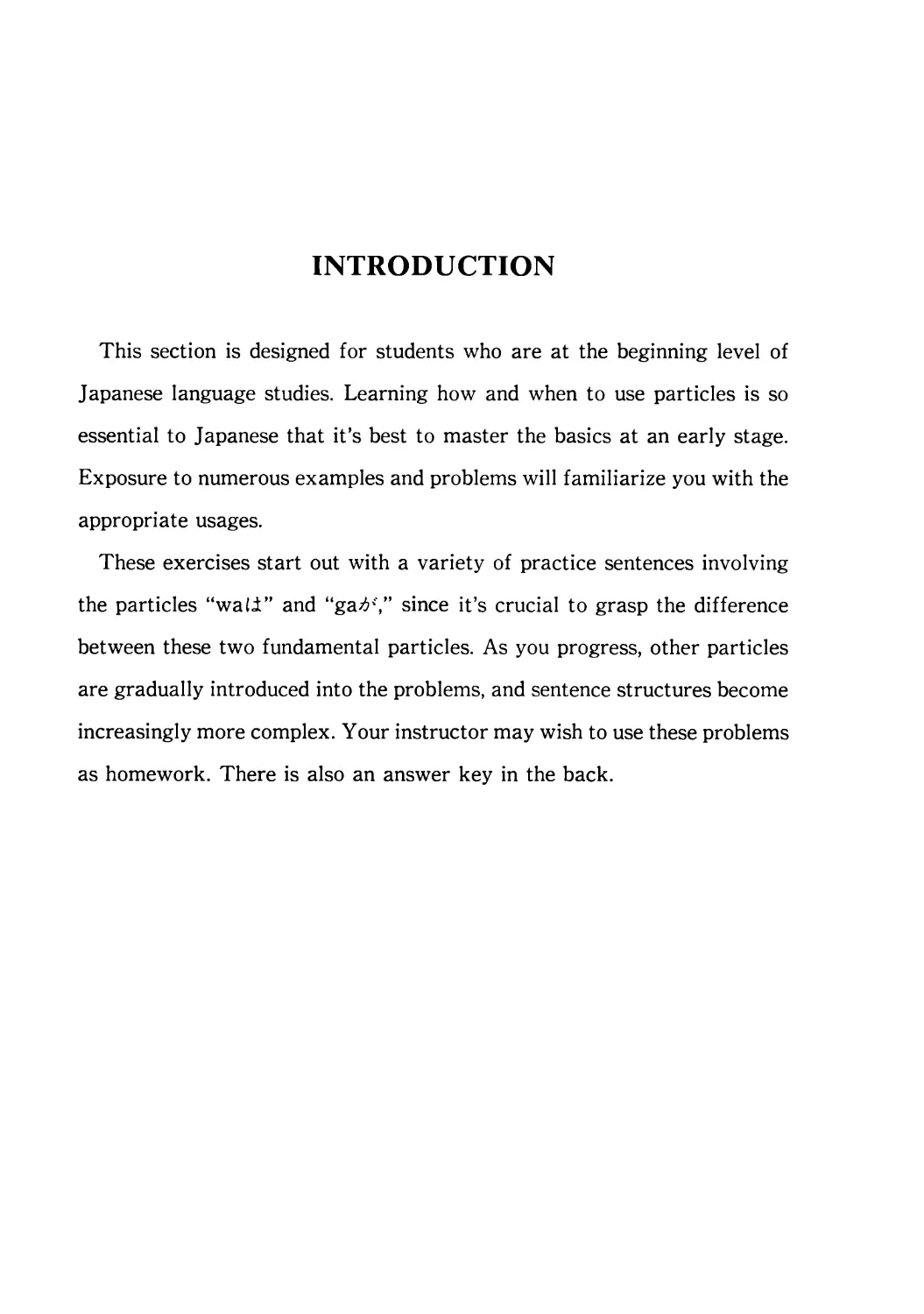
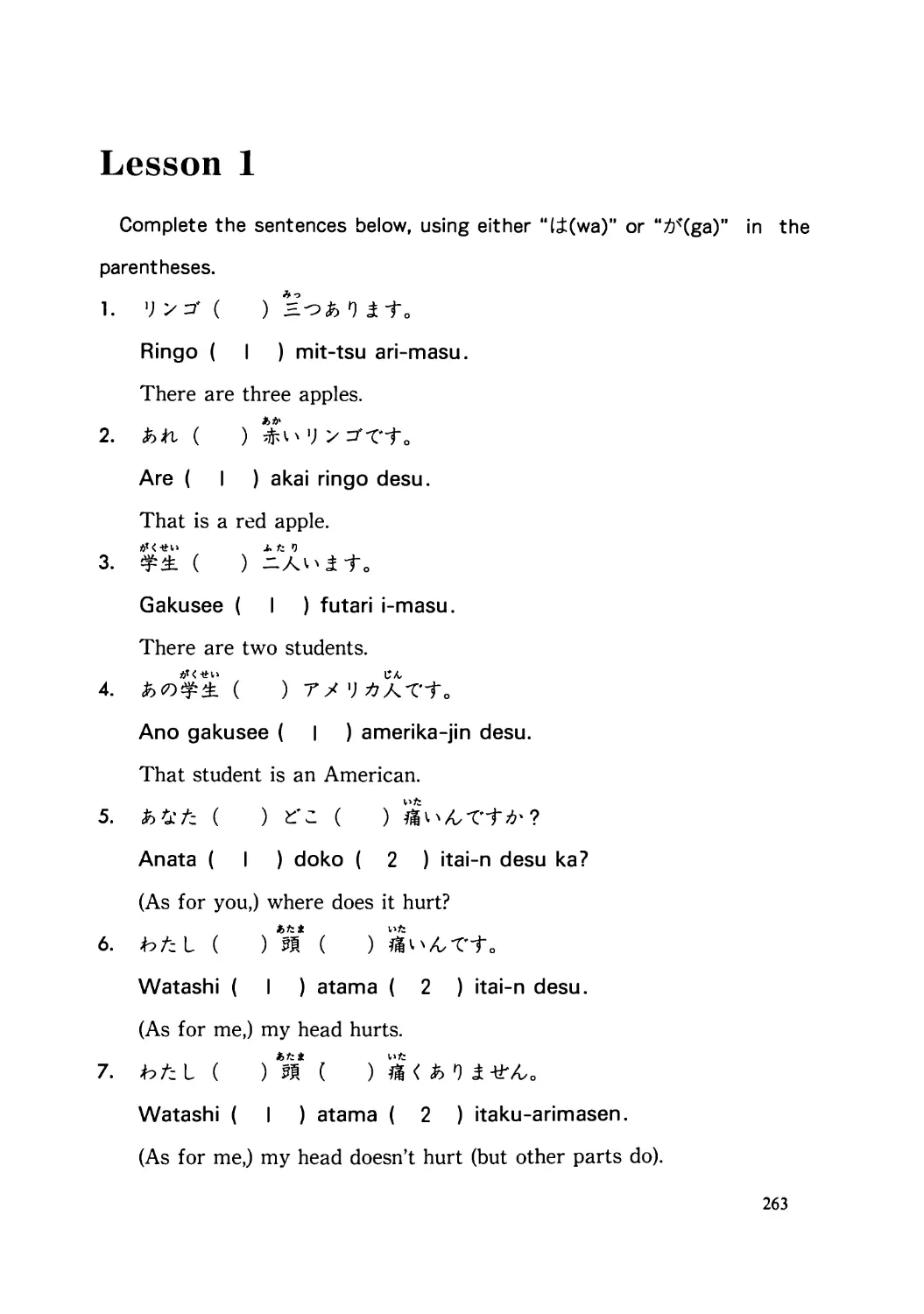
(9) There are exercises at the back of the book that are designed to
familiarize the beginning-level student with the most fundamental particleso
An answer key is also providedo
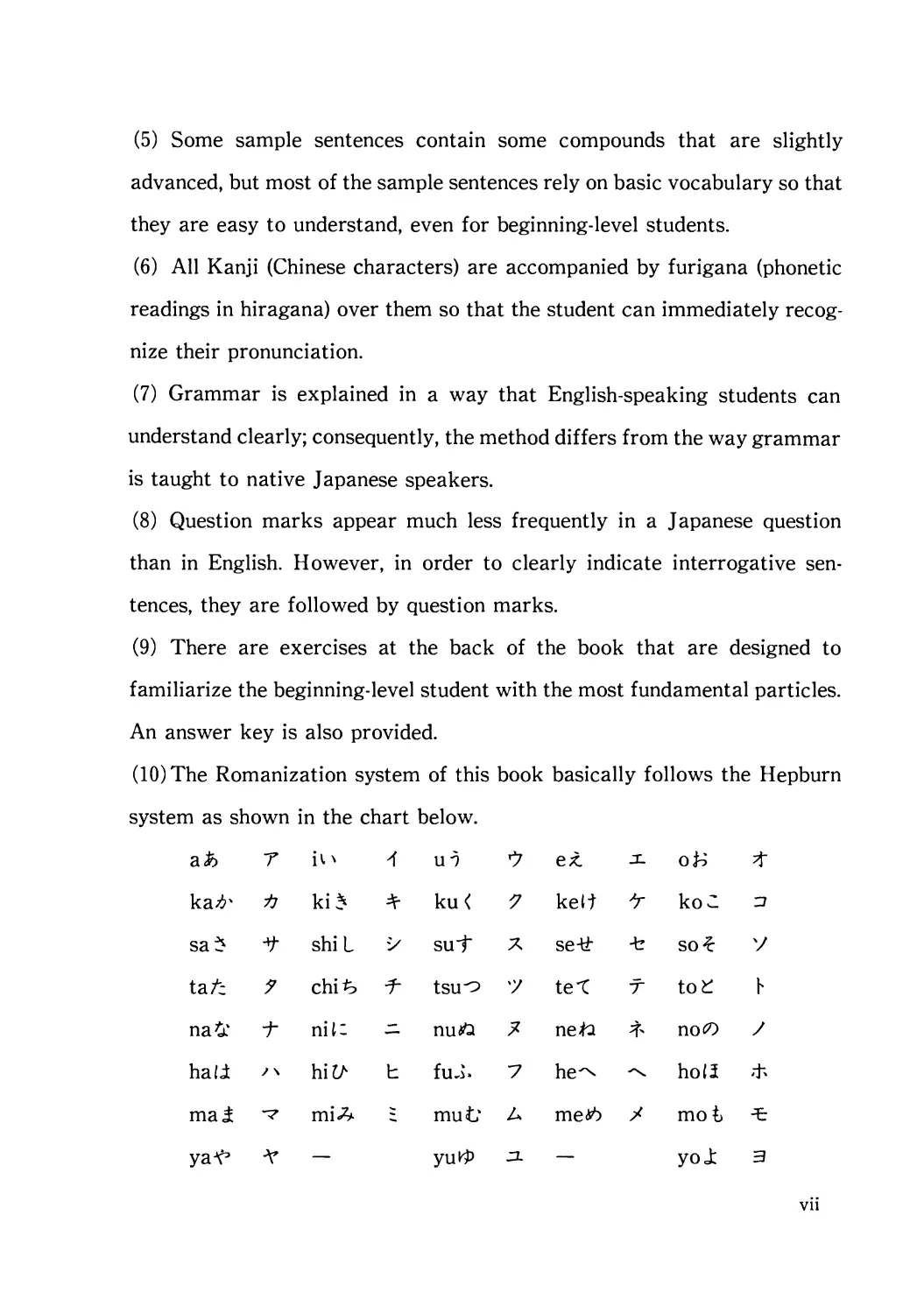
(10) The Romanization system of this book basically follows the Hepburn
system as shown in the chart belowo
aJfJ 7' i \ 1 UI ? ei.. .:r- oj? ;;t
kab' n k' ku < 7 ke't 7- ko .: :J
1 ...
sa -+j- shiL sui" A se -tt so -t- 'J
tat: 7 chi t? T tsu -:> '/ te "'t T to t:
na T nit: - nutJ net:! ;f', noC?) /
-
ha lj: J' hi V- 1: fu..} 7 he ho' .1 ;1;
ma.1 "7 mih. ... mu ' L mecV) .;l mot 1::
ya yu :::1- yo .J: 3
vii
ra -7 ri ') ru Iv retL v ro t.> 0
wab ? o (wo) =]
ntt- ;..-
gab'" -/1' o \. . gu < 7 ge'f 7 go .: ::l
gL..
.3s.., "if zi L' :/ zu-r 'A" ze-tf z 0 -t- 'J
za_
da t:.: 7 j i tJ' f' zu -j' ''/ de "'( T do F
baLf J\ bill t" bu };' 7 be bot.r ;j{
paLf J pi if to pu ; : 7' pe "'"' potr
kya -'(> kyu t1> .:z. kyo j: 3
sha L -'(> shu L t1> .:z. sho L j: 3
cha t? -'(> 7- chu t? t1> 7-.:z. cho t? j: 7-3
nya t: -'(> .::. n yu t: t1> '::'.:z. nyot: j: "::'3
hya V' -'(> t hyu V' t1> t.:z. hyo V' j: t3
mya.7-J. -'(> :. m yu.7-J. t1> :..:z. myo.7-J. j: :. 3
rya -'(> ') ryu t1> ' ) .:z. ryo j: ') 3
j a t: -'(> :/ ju t: t1> :/.:z. jo t: j: :/3
bya U' -'(> t" byu U' t1> 1:".:z. byo U' j: 1:"3
pya if -'(> tO pyu if t1> t°.:z. pyo if j: t03
(a) Long vowels are indicated by two vowels placed one after the other.
Example: Tokyo ......... Tookyoo
The second vowel will remind the beginning-level student that there
should be a hiragana character there that stands in for the long vowel
soundo
Example: To Q kyo Q (Tokyo) ; (movie)
-1 j: -1 i.. l \ b:
viii
(b) Two identical vowels that are placed right next to each other are
separated by hyphens, in order to avoid confusion with the long vowel
soundo
Example: ki noo (yesterday)
monQ-Q (particle "mono" + another particle "0")
(c) Some words are divided by hyphens to indicate the separate syllables,
or the separate units, that compose the word, so that it is easier to
identify these elements visuallyo
Examples: .1-tr,t,o.oooooooari-masen (there is/are not)
1" .ooo.o.o..o.benkyoo-suru (to study)
j:. I.o...o...o..iki-jibiki (a walking dictionary)
I l , cl:f 1"" 0 0 0 0.0... 'omoi-dasu (to remenber)
-k0o..o..o...o...o...o.on-na (a woman)
L ""( l' oooo.ooo..ooshite-iru (be doing)
"" t: l ,.. 0 0...0.. 0 °tabe-tai (to want to eat)
Me.1 l ,.o.ooooo..ooyoma-nai (do not read)
(d) The honorific prefixes "0" and "go" are considered as being part of the
word, and therefore are not set off by a hypheno
Example: oree (appreciation) omatsuri (festival)
gohan (meal) gochisoo (delicacies)
IX
List of Abbreviations
adjo = adjective
advo = adverb
co = copula (da/desu, datta/deshita, daroo/deshoo, etco)
cl. = clause
conjo = conjunction
Copo = combination particle
go = gerund (te/de form)
interjo = interjection
mo = mImeSIS
no = noun (including pronouns), and nominal
00 = onomatopoeia
po = particle
pho = phrase
x
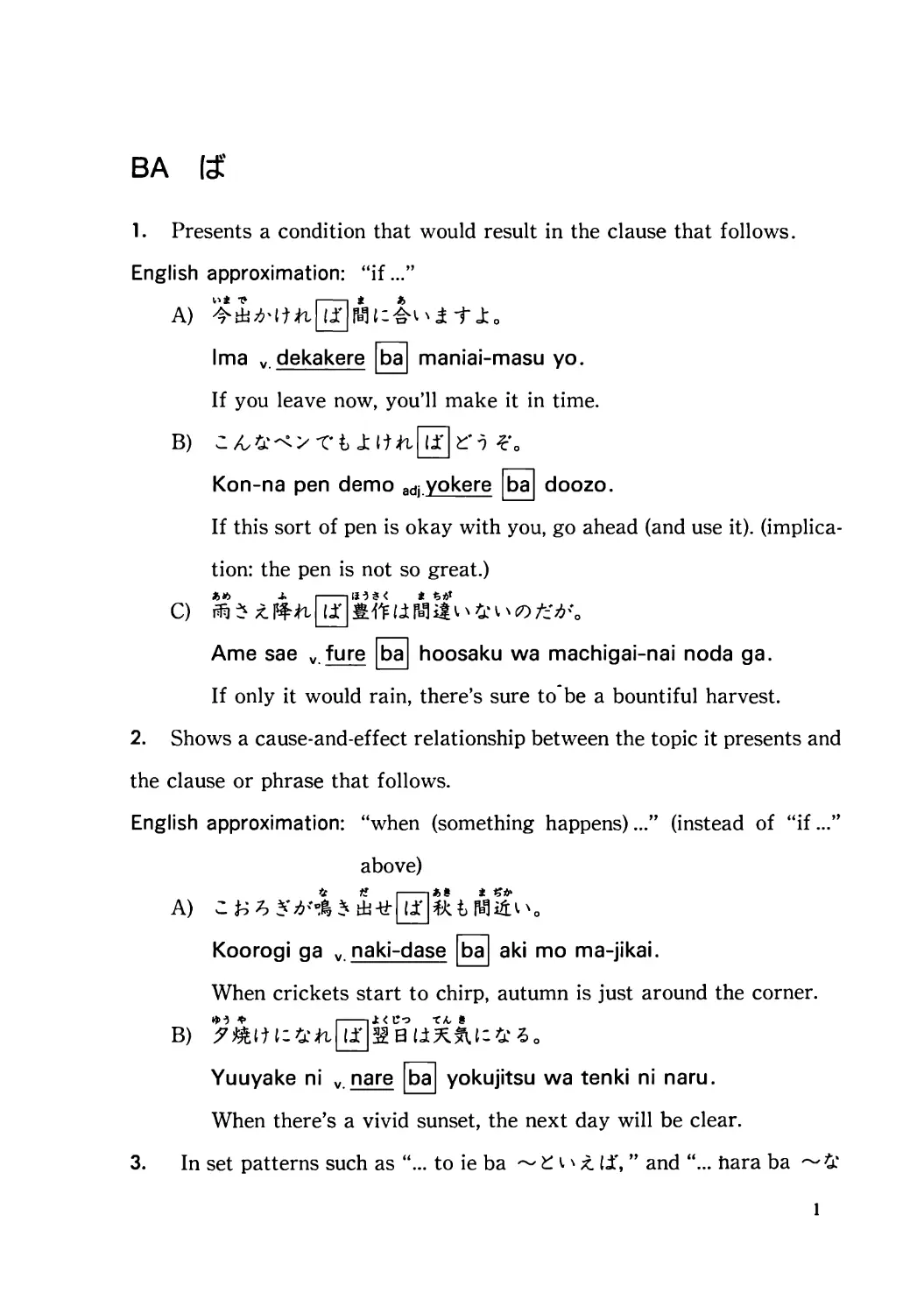
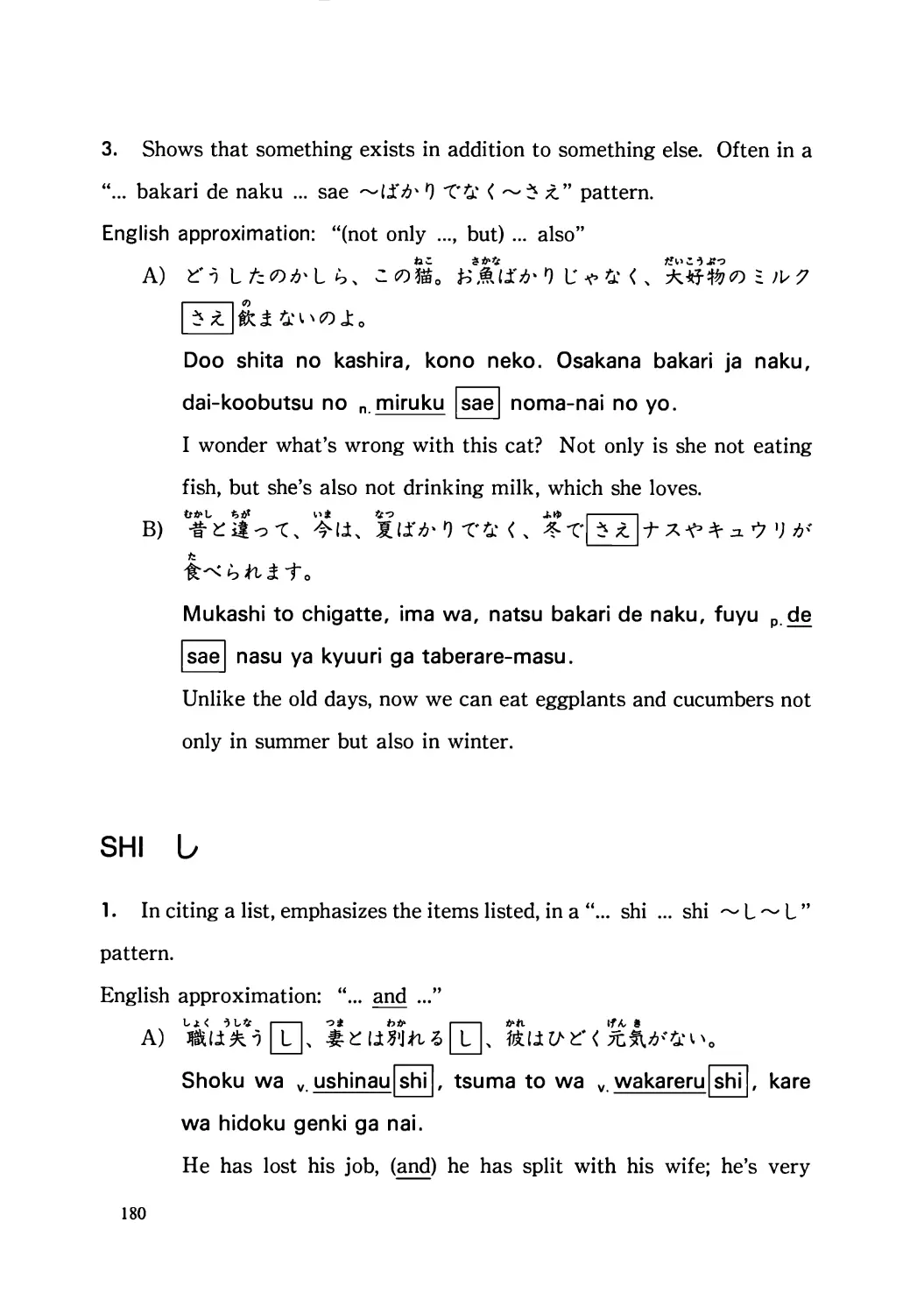
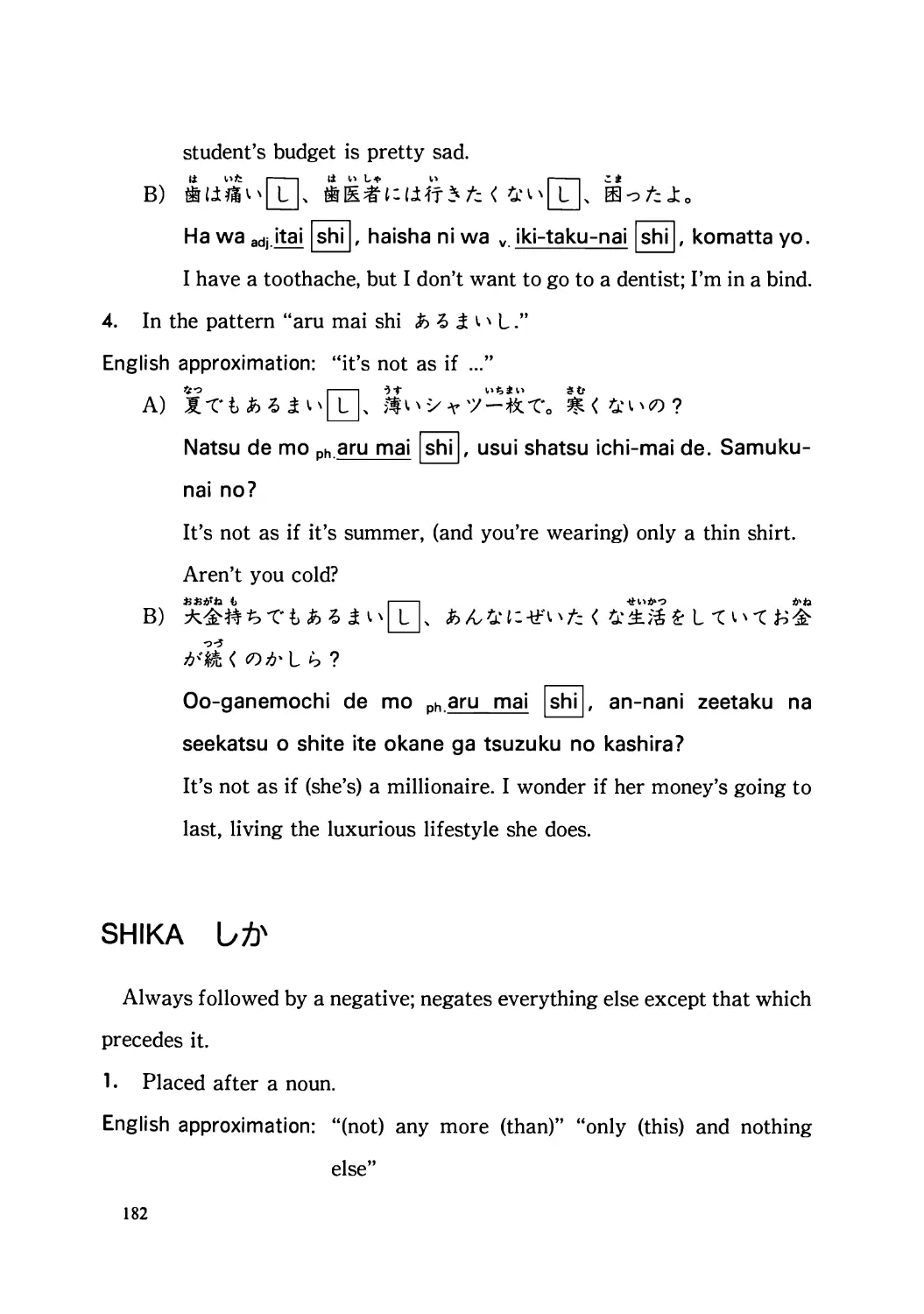
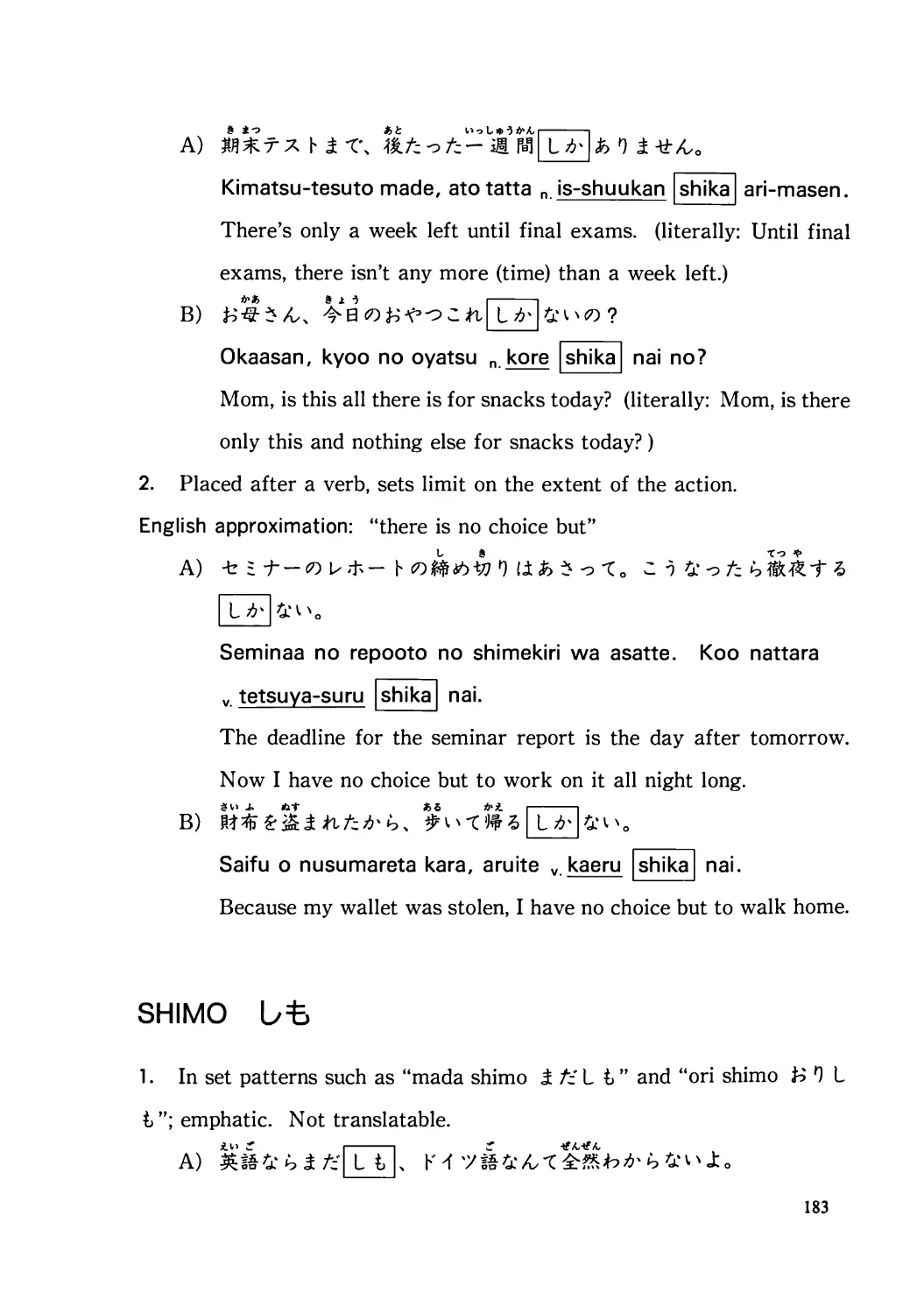
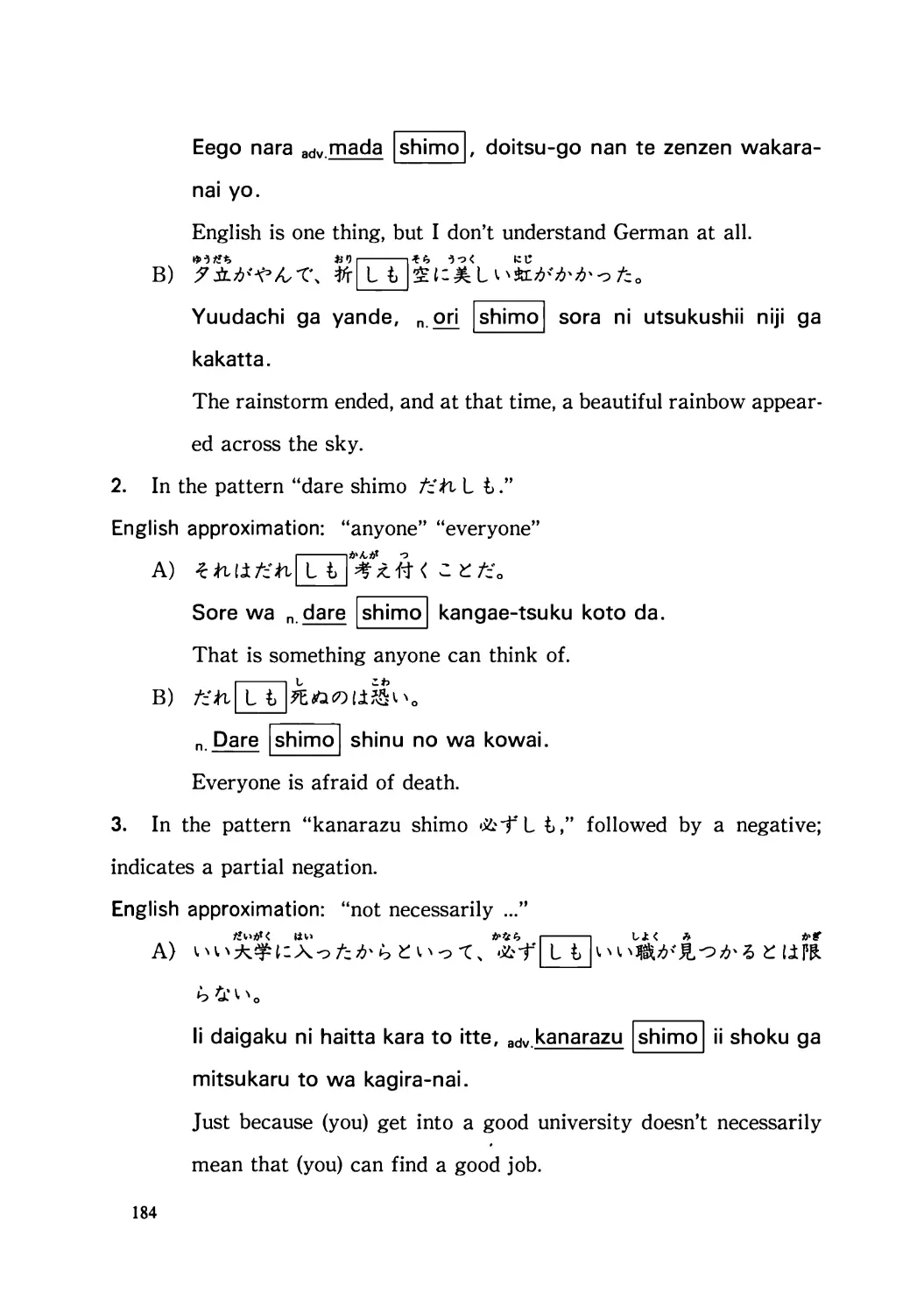
SA let
1. Presents a condition that would result in the clause that followso
English approximation: "if..."
\* * IJ
A) 4' cl:f b' ,t n 8 ra' t : l \ .1 -t .J: 0
Ima v. dekakere Ibal maniai-masu yo.
If you leave now, you'll make it in time.
B) .: ,t, /' "C t .J: ,t n @J . -1 . 0
Kon-na pen demo adj. yokere I ba I doozo.
If this sort of pen is okay with you, go ahead (and use it)o (implica-
tion: the pen is not so great.)
IJ/I) ,J. 1" < * tjfJf
C) i:fu it iItn 8 1'F lj: ra' it l \ l \ C?) t.:b: o
Arne sae v. fure Ibal hoosaku wa machigai-nai noda ga.
If only it would rain, there's sure to-be a bountiful harvest.
2. Shows a cause-and-effect relationship between the topic it presents and
the clause or phrase that follows.
English approximation: "when (something happens)..." (instead of "if ..."
above)
f.l t! IJ 8 * f1'
A) .: j? t.> . b: cl:f -tt 8 k t ra, 1ft l \ 0
Koorogi ga v. naki-dase I ba I aki mo ma-jikai.
When crickets start to chirp, autumn is just around the cornero
,, J:< ? "t' 8
B) 7t#t'tt: n8 8lj: t: o
Yuuyake ni v. nare I ba I yokujitsu wa tenki ni naru.
When there's a vivid sunset, the next day will be clearo
3. In set patterns such as "... to ie ba '"- t: l \ it l.f, " and" 000 hara ba '"-
Lf, " indicates the topic which is to be discussed in the phrase or clause
that followso
English approximation: the nuance is similar to "speaking of (topic)ooo," "in
terms of (topic)ooo," or "according to (topic)ooo"
A) j? -t L @J cry 7i b" j? l \ L l \ "C-t J: 0
Osushi c. nara I ba I ana mise ga oishii desu yo 0
In terms of sushi, that restaurant is a good oneo
fJ'C1) t: l: ::. }rJ t bfJ'
B) -1 h :s. t: J: n ' fit * l j: A. IJ n t: L l \ 0
Uwasa ni v. yore I ba I , kanojo wa koibito to wakareta rashii.
According to rumors, she broke up with her boyfriendo
i. > fJt } } I!A,
C) A T J) - B*. @J it , "':) l j: 1: '/ T :J '/ 7 cry b " - . t.::' tJ 0
Misuterii eega to v. ie Ibal , yappari Hicchikokku no ga ichiban da
neo
Speaking of mystery movies, Hitchcock's are the best after all,
don't you think?
4. Similar to the meanings of the patterns "000 suru to ""'-t " and "000
shita tokoro ga "'" L t: t: .:. 1;,'0"
English approximation: "considering (something, it is evident that 000)"
ii. l... t >i l... t &;<
A) i¥T cry1:t* I it , +cry1:t* lj: t cry "C-t 0
Mae no shigoto 0 v. omoe Ibal , ima no shigoto wa rakuna mono
desuo
Considering my former job, my current job is pretty easyo
J; ';A, l:" -tI: } t: fJ' I:A,
B) -tlt ,g] b' .7-J. n , cry J1t5fJ * cry A. lj: b' t? t: J: -1 t: 0
Yoron-choosa kara v. mire Ibal , sono seejika no ninki wa kanari
ochita yoo da 0
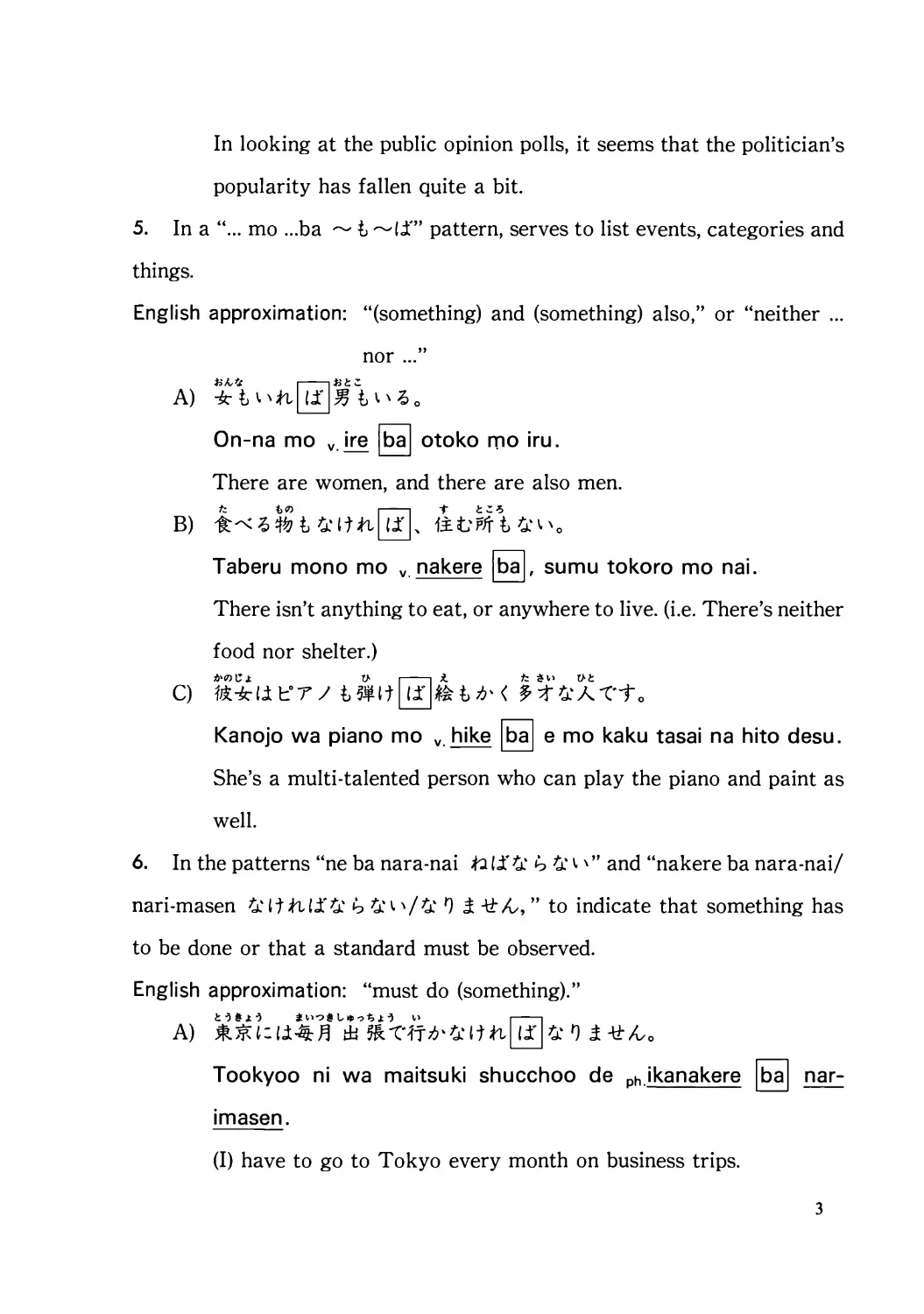
2
In looking at the public opinion polls, it seems that the politician's
popularity has fallen quite a bito
5. In a "000 mo oooba "" t ""Lf" pattern, serves to list events, categories and
thingso
English approximation: "(something) and (something) also," or "neither 000
nor 000"
A- t;::
A) -k t \ kL I l;f I Jij t \ ; 0
On-na mo v. ire I ba I otoko 1110 iru.
There are women, and there are also meno
b T t;::
B) ""; 4bJ t ,t kL , 1.itn i JT t \0
Taberu mono mo v. nakere Ibal , sumu tokoro mo nai.
There isn't anything to eat, or anywhere to liveo (Leo There's neither
food nor shelter.)
f.I' t:.I: v .t \ Vt
C) flt-k Li to 7" / t lft ,t t n < ::t A '( T 0
Kanojo wa piano mo v. hike I ba I e mo kaku tasai na hito desu.
She's a multi-talented person who can play the piano and paint as
well.
6. In the patterns "ne ba nara-nai bL:r \" and "nakere ba nara-nai/
nari-masen ,t kLLf \/ ry .1-\:t 10, " to indicate that something has
to be done or that a standard must be observedo
English approximation: "must do (something)o"
t?@.I:? * \?@t.,I91?-;.I:? \
A) ** t: ll-OJ:. fJ tB ;& '( 1tn ,t kL ry .1 -\:t 10 0
Tookyoo ni wa maitsuki shucchoo de ph. ikanakere Ibal nar-
imasen.
(I) have to go to Tokyo every month on business tripso
3
J: A- \ It \f.I\< 'k !;';l
B) .:r.Jf. J*] (' t@ iL '( b i-:; \ 0
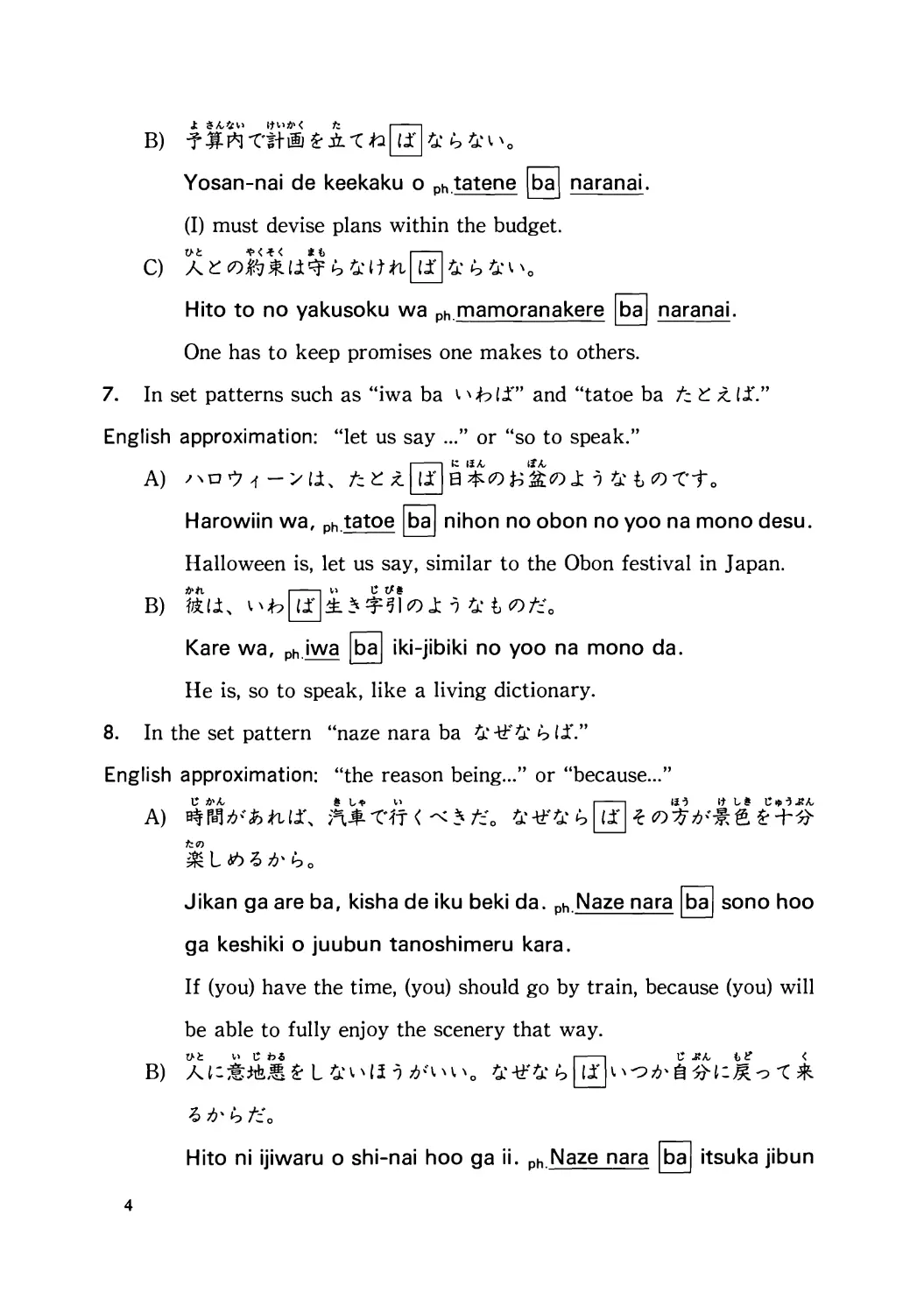
Yosan-nai de keekaku 0 ph. tatene Ibal naranai.
(I) must devise plans within the budgeto
vt, <.f< ib !;';l
C) A * t.i i-:; ,t kL : i-:; ' \ 0
Hito to no yakusoku wa ph. mamoranakere Ibal naranai.
One has to keep promises one makes to otherso
7. In set patterns such as "iwa ba \ b "I" and "tatoe ba t:. i.. "10"
English approximation: "let us say 0"" or "so to speako"
!;';l I: I A- It A-
A) J \ O? -1 -:/ t.i, t:. i.. 8 * t? l'1 t '( T 0
Harowiin wa, ph. tatoe Ibal nihon no obon no yoo na mono desu.
Halloween is, let us say, similar to the Obon festival in J apano
f.I\ tL !;';l \ t: r.J @
B) fJt t.i, \ b ? I l '1 t t:.: 0
Kare wa, ph. iwa Ibal iki-jibiki no yoo na mono da.
He is, so to speak, like a living dictionaryo
8. In the set pattern "naze nara ba '-\f i-:; t.i o"
English approximation: "the reason being..o" or "because..o"
t: f.I\A- @ t., \ !;';l I oj It t., @ t: 191 oj JtA-
A) * ra' n ' JtJ kL t.i , 5 . '( t < :: t 0 -\:f i-:; i 15 n: -t--$t
'k(/)
L &0 ; n' i-:; 0
J ikan ga are ba, kisha de iku beki da. ph. Naze nara I ba I sono hoo
ga keshiki 0 juubun tanoshimeru kara.
If (you) have the time, (you) should go by train, because (you) will
be able to fully enjoy the scenery that way.
vt, \ t: PQ !;';l t: JtA- b <
B) At: ;t I L \ ,.1 '1 n ' \ \ 0 -\:f ' i-:; \ "':) n' \.. t : & '( *-
; n' i-:; t o
Hito ni ijiwaru 0 shi-nai hoo ga ii. ph. Naze nara Ibal itsuka jibun
4
ni modotte-kuru kara da.
One shouldn't do mean things to others, because some day, (your
deeds) might be returned to YOUo
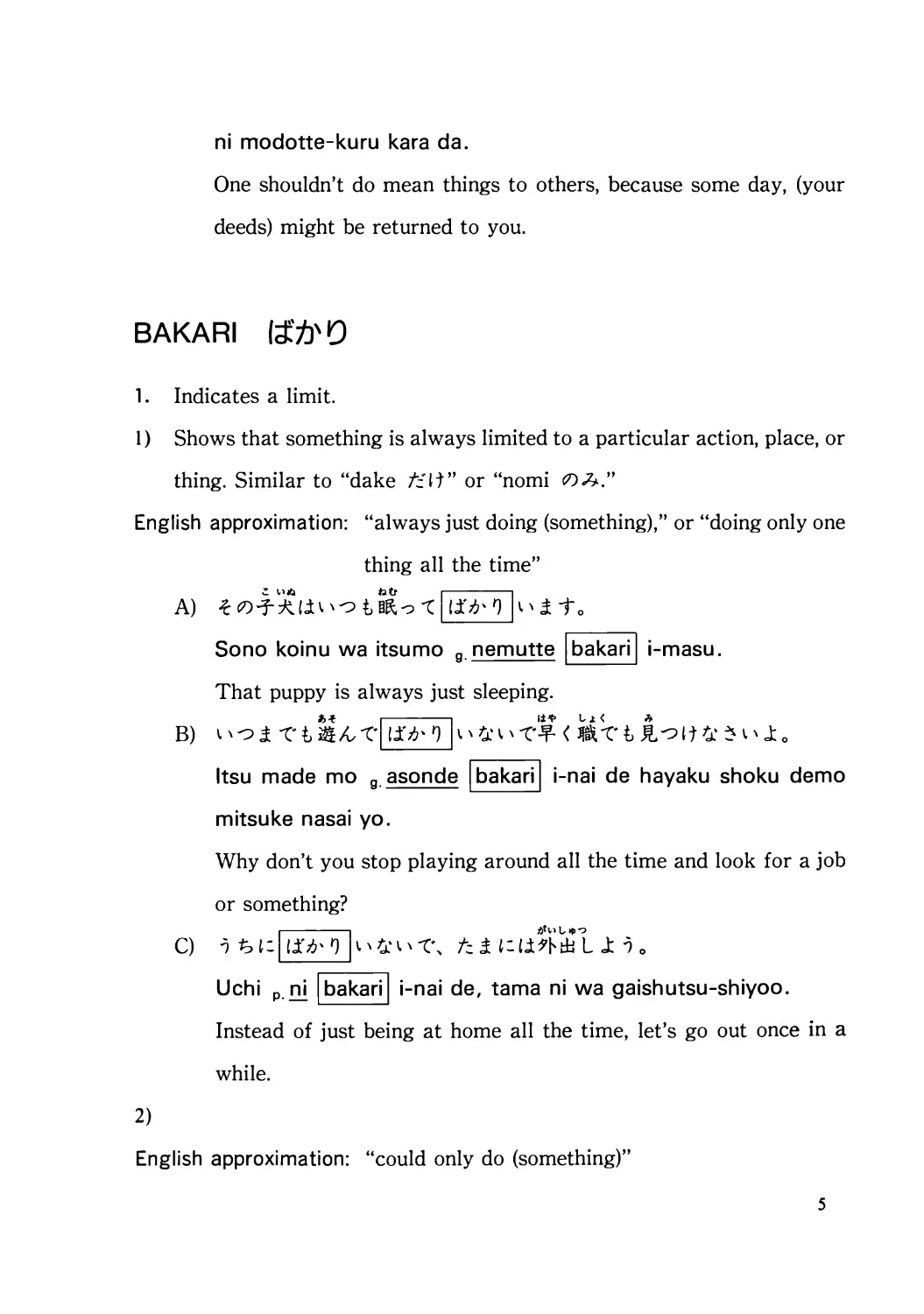
BAKARI ( 1J\
1. Indica tes a limi to
I) Shows that something is always limited to a particular action, place, or
thingo Similar to "dake t t" or "nomi 7-;.0"
English approximation: "always just doing (something)," or "doing only one
thing all the ti me"
A) i '* t j: \"? t ; I Lf h I \ 1 T 0
Sono koinu wa itsumo g. nemutte I bakari I i-masu.
That puppy is al ways ju st sleepingo
" of I I l;i t., .1:< I#-
B) \ "? 1 .. t h., " t j:' h \ ' \ ' Jf- < ' t Jt "? t :s. \ l 0
Itsu made mo g. asonde I bakari I i-nai de hayaku shoku demo
mitsuke nasai yo.
Why don't you stop playing around all the time and look for a job
or something?
I I f.lt \t., 191"':>
C) '1 t.J t: tj:' h \ \ \ t:.. 1 t: tj:? tB L l '1 0
Uchi p. ni I bakari I i-nai de, tama ni wa gaishutsu-shiyoo.
Instead of just being at home all the time, let's go out once in a
whileo
2)
English approximation: "could only do (something)"
5
A) .::. .:z. - A \ '(, {t U: t.: t.: j:? j:? T ; I Lf h I '( L t.: 0
Sono nyuusu 0 kiite, kare wa tada v. oro-oro-suru I bakari I
deshita.
Hearing that news, he could onl y panic o
t?-t!1v -C > 1v VtrJt ? ? t' ? I I
B) '9t 1''it':A 'j: ttii{tT; 'j:'h f.:"':J t.: o
Totsuzen no teeden ni hito-bito wa v. uoo-saoo-suru I bakari I
d atta 0
In the sudden blackout, all people could do was wander in confu-
slono
3) In the pattern "bakari ni 'j:'h ':0"
English approximation: the nuance is "solely due to (one cause), matters
took a turn for the worseo"
lvt., (/) t:.:: "
A) JtJ . , : * "':J t.: I 'j:' h I':, *" , : "':J t.: 0
Ano densha ni v. notta I bakari I ni, jiko ni atta.
It was only because I got on that train that I was involved in an
accident.
1;i1v 1.> If > " I I t: It Iv it .::
B) e. W , : t.: .1 t.: .1 % -g.. b -\t t.: 'l' h' , : , * 1tf: , : .1 t1 '( L .1
"':J t.: 0
Hanzai no ba ni tama-tama v. i-awaseta I bakari I nl, jiken ni
maki-komarete shimatta.
It was only because (I) just happened to be at the scene of the crime
that (I) got dragged into the caseo
2. Indica tes a degree of thingso
I) Similar to "hodo ,.1 '" and "kurai/ gurai < t:; \ / <' t:; \." Usually
preceded by a number or quantityo
6
English approximation: "approximately"
fJ\tI. I: t.::
A) fJt 'l -=- ;t - r ) v 1 'l' h I t JtJ ; -* 'C'T 0
Kare wa n. ni-meetoru I bakari I mo aru oo-otoko desu.
He is a big man, at about t wo met ers tallo
f) .1:.::1 !} J:1 -tlIvJ: t:1tI1*1v.t1v 1 I
B) t{ t 1t m 'l :g 'C'.n. +::? P3 'l' h h h'"':) t 0
Rvokoo no hivoo wa zenbu de n. gojuu-man en I bakari I kakatta 0
The total cost of the trip came to about five hundred thousand yeno
t fJ> g T
C) b t L 'l + 8 1 'l' h I t: L .1 T 0
Watashi wa n. tooka I bakari I rusu ni shi-masu.
I will be away for about ten dayso
2) Following a verb, shows that the action is/was about to be carried outo
English approximation: "just about to do (som ething)"
t., .I: < t: ? < t> t.:. 1 I Iv t>
A) * 1t "':) 'C, t '1 *""; 'l'h .:: t:, t-5h 'h\h\"':) 'C
.1 Lt o
Shokuji 0 tsukuri-owatte, moo v. taberu I bakari I no tokoro ni,
denwa ga kakatte ki-mashita.
I had finished cooking the meal and was about to eat it when there
was a phone callo
,, .&. t! I l .f b J:1
B) mh 'Ft tB Iv Lf h t* *t::.o
Arne ga v. furi-dasan I bakari I no sora movoo da.
The sky looks like it's about to raino
3) In the pattern "ooota bakari --- t Lf h , " to indicate that an action has/
had just been completedo
English approximation: "have/ has just done (something)"
1 I I: lilv ?fJ>
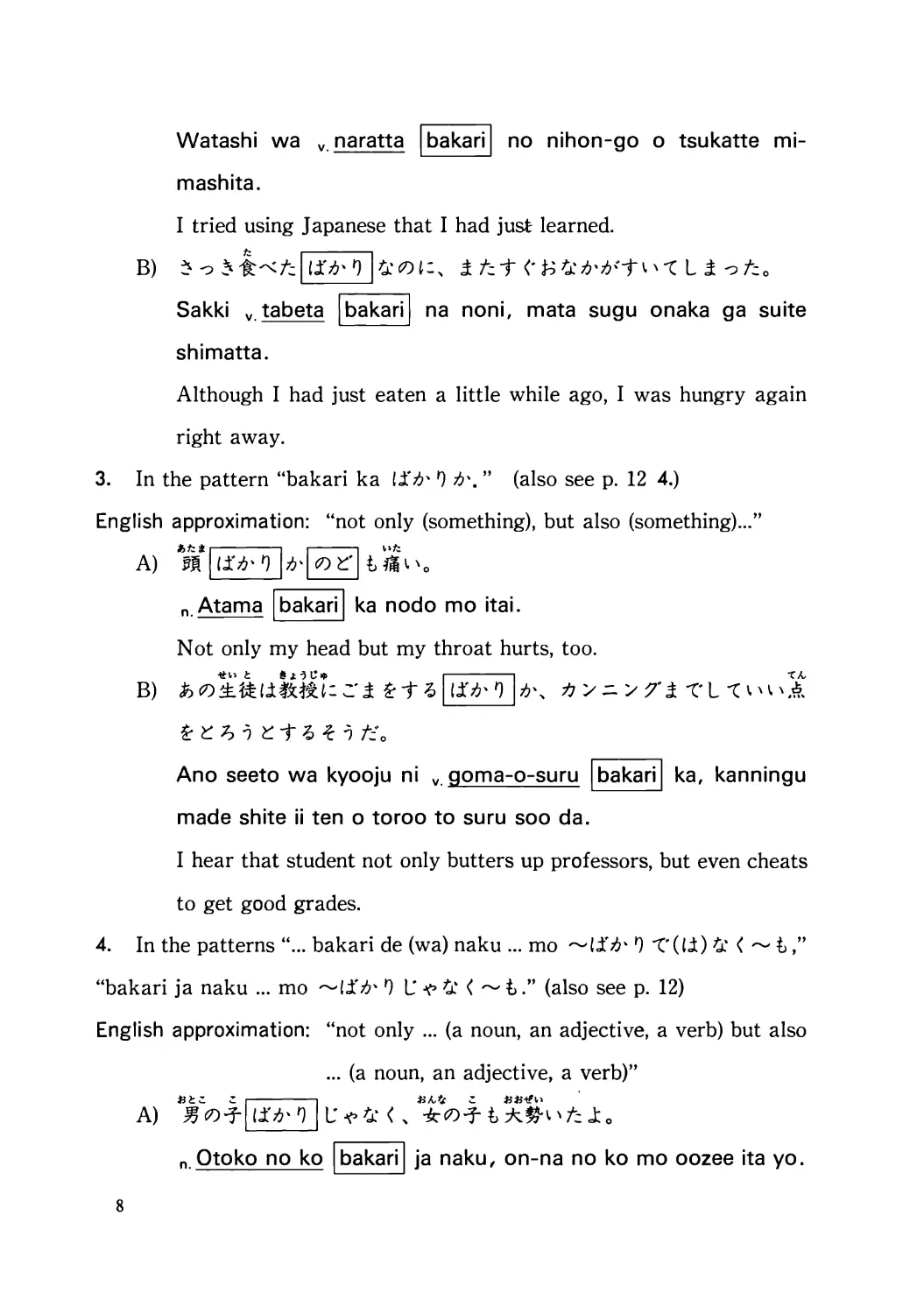
A) b t L 'l "':) t 'l' h 8 *" t 1t "':) 'C h.1 L t 0
7
Watashi wa v. naratta I bakari I no nihon-go 0 tsukatte mi-
mashita.
I tried using Japanes e that I had just learnedo
B) :.s."'? i"" t.: I Lf h I t: , .1 t.: T < 1-:; h h: T \ '( L .1 "'? t.: 0
Sakki v. tabeta I bakari I na noni, mata sugu onaka ga suite
shimatta.
Although I had just eaten a little while ago, I was hungry again
right awayo
3. In the pattern "bakari ka Lf h h'." (also see po 12 4.)
English appr oximati on: "not only (something), but also (something)..."
1Jt.:.* 1 I t.:.
A) :ft ';fh' h' t \0
n. Atama I bakari I ka node mo itai.
Not only my head but my t hroat h urts, tooo
1t t @.I:?I:", I I "(Iv
B) j;. tt: U: ft { t: ::.1 T; Lf h h , "/] /' =- /' 7 .1 '( L '( \ \ . ,
'1 T; i '1 t.: o
Ano seeto wa kyooju ni v. goma-o-suru I bakari I ka, kanningu
made shite ii ten 0 toroo to suru soo da.
I hear that student not only butters up professors, but even cheats
to get good grades.
4. In the patterns" 000 bakari de (wa) naku ... mo '- Lf h '( (U:) < '- t ,"
"bakari ja naku 000 mo '-Lf h t.: < '- t 0" (also see po 12)
English approximation: "not only 000 (a noun, an adjective, a verb) but also
00. (a noun, an adjective, a verb)"
t.: .: Iv .: 1f
A) -r I ';1' h' I t.: < , * -r t -* \ t.: 1 0
n. Otoko no ko I bakari I ja naku, on-na no ko mo oozee ita yo.
8
There were not only boys but also many girlso
I A.. i:>191? < A..@,I:?
B) b t: L Li, 8 *- ! I Lf h I '( <, tV ! t L t: \ 0
Watashi wa, n. Nihon-go ! bakari I de naku, Chuugoku-go mo
ben kyoo-sh itai 0
I would like to study not only Japane se but also Chineseo
-c I I G t!A.. -c
C) .:: -t- 'fLi, j-"-+f 1 / h ' \ \ Lfh '( < , 1 ii t -t-.::' t.: o
Kono tesage wa, dezain ga adjll ! bakari I de naku, nedan mo
tegoro da.
As for this bag, not anly is its design nice, but the price is reason-
able as well.
D) ' h '5i \ t: I Lf h I '( <, j:? h t T \ t: 0
Nodo ga v. kawaita ! bakari I de naku, onaka mo suita.
Not only am I thirsty, but I'm also hungryo
5. In the pattern "bakashi Lf h' L ," a variant of Hbakari Lf h ," used
casuallyo
I) Indicates an approximate amount, often with the implication that it is
not very mucho
English approximation: "(only) about..o"
\.&. !}",,< A.. I I
A) b t: L Rt h t: ,j: .n. 8" P3 '.f h L L h ' \ 0
Watashi no saifu no naka ni wa n. go-hyaku en I bakashi I shika
nal.
Ther e is onl y about five hundred yen in my walleto
I I i:>,I:@A.. 'J,I:':.; \
B) .:: t1 '.f h L RT '( 'j: , {t t: t {t' t \ 0
n. Kore I bakashi I no chokin de wa, ryokoo ni mo ike-nai.
With only about this much savings, (I) can't even go on a tripo
9
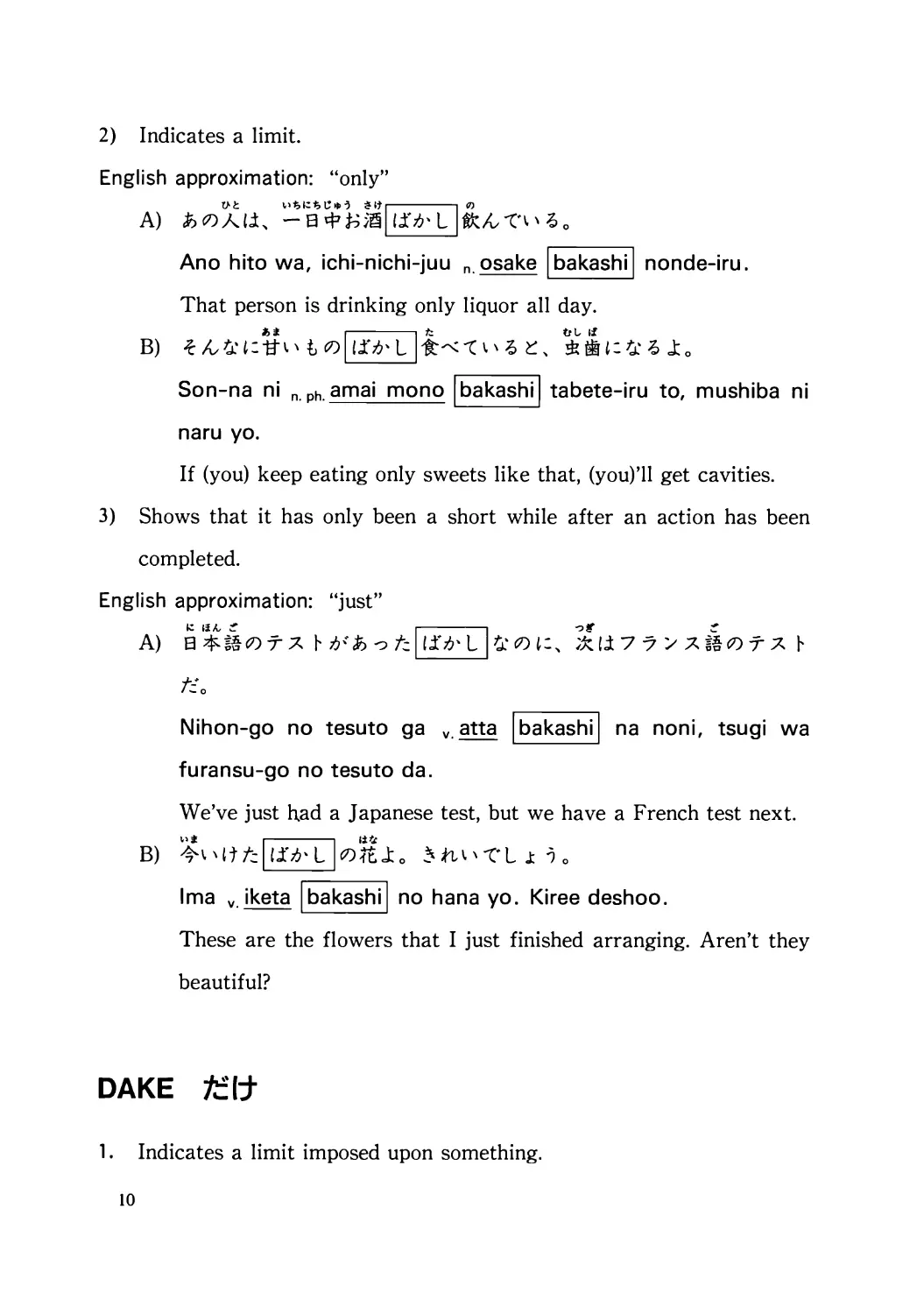
2) Indicates a limit.
English approximation: "only"
!} t \ -; I: -; t: It» oj It I I (/)
A) JtJ A ,j: , - 8 t:p j:-; 5 'j: ;Q L h., '( \ ; 0
Ano hito wa, ichi-nichi-juu n. osake I bakashi I nonde-iru.
That person is d rinking only liquor all day.
"it I I t:. trt., If
B) ih., t:1t \t '.r;Q L ,",'( \; , tjt: ;lo
Son-na ni n. ph. amai mono I bakashi I tabete-iru to, mushiba ni
naru yo.
If (you) keep eating only sweets like that, (you)'ll get cavitieso
3) Shows that it has only been a short while after an action has been
completedo
English approximation: "just"
I A- :: I I ? ::
A) 8 *' T.A r ;Q: JtJ t:. ,.r;Q L t:, ;k' j: 7 "7 :/ .A T.A r
t o
Nihon-go no tesuto ga v. atta I bakashi I na nonl, tsugi wa
furansu-go no tesuto da.
We've ju st had a Japanese test, but we have a French test nexto
\ it I I IHt
B) \,tt:. '.r;Q L 1t lo 5kL \,( L J: '10
Ima v. iketa I bakashi I no hana yo. Kiree deshoo.
These are the flowers that I just finished arrangingo Aren't they
beautiful?
DAKE Ij
1. Indicates a limit imposed upon somethingo
10
English approximation: "only" or "just"
I>fJ> h?
A) >if. \ , 'J A., '::' 3. -::> < t \ '0 c::):J
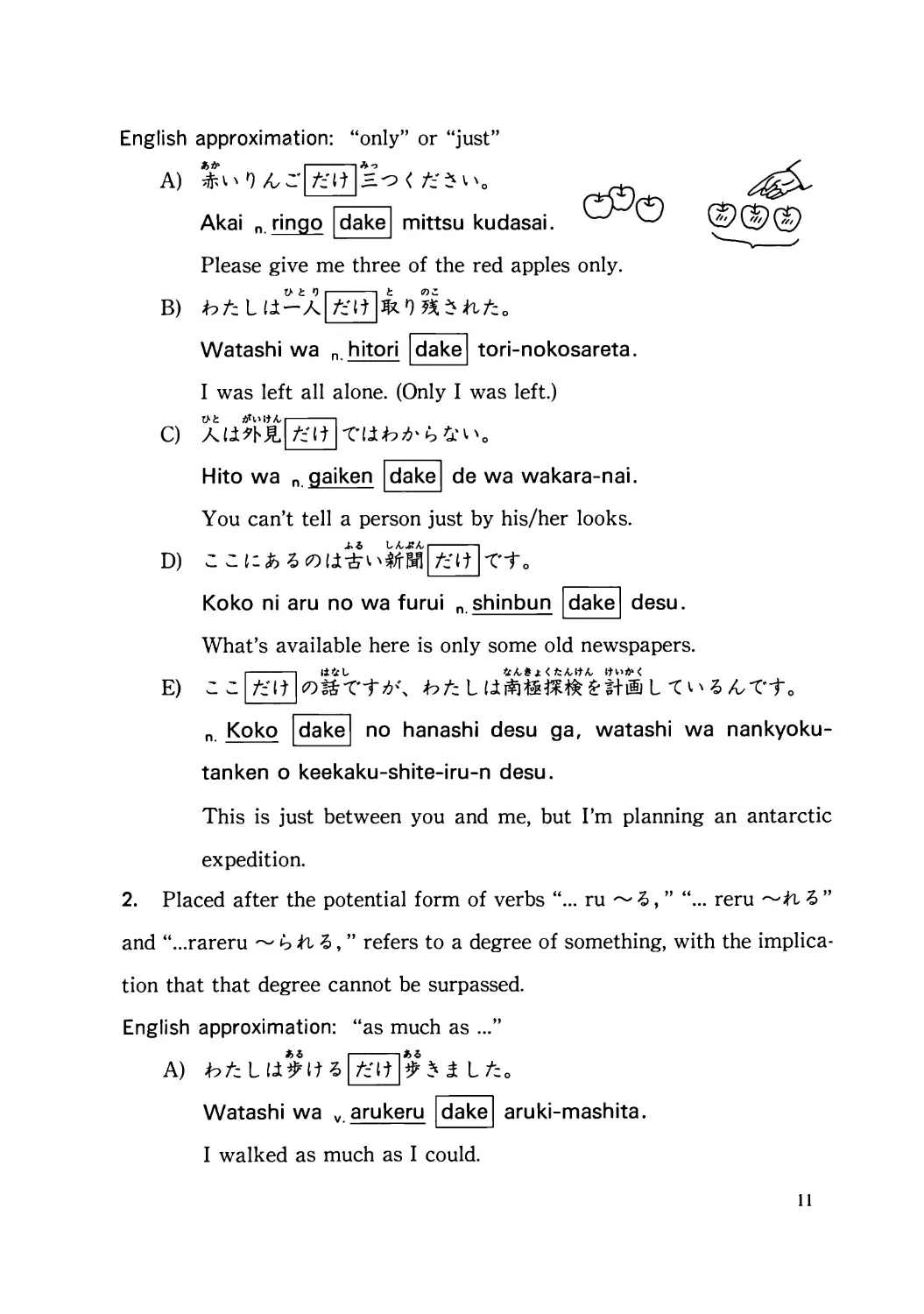
Akai n. ringo I dake I mittsu kudasai, C9
Please give me three of the red apples onlyo
v t f) t (/);:.
B) b t:. L U:- A 7 kLt:. o
Watashi wa n. hitori I dake I tori-nokosareta.
diJ>.-
@(!)@
I was left all aloneo (Only I was lefto)
vt fJt \ltlv
C) A'ei? Jt "CLib/'} i-:; '0
Hito wa n. gaiken I dake I de wa wakara-nai.
You can't tell a person just by his/her look So
.&.1I t.,IvJtIv
D) .:..:. t: cVJ ; t ei t!i ' Jf Bf1 '( T 0
Koko ni aru no wa furui n. shinbun I dake I desu.
What's available here is only some old newspaperso
l;i t., 1v@.I: < t.:lvltlv It \fJ> <
.:. .:. '( T /,):, b t:. L tei 1* t@ L '( , ; h., '( T 0
n. Koko I dake I no hanashi desu ga, watashi wa nankyoku-
tanken 0 keekaku-shite-iru-n desu.
E)
This is just between you and me, but I'm planning an antarctic
expeditiono
2. Placed after the potential form of verbs" 000 ru '-;, " "000 reru '- kL ; "
and "ooorareru '- i-:; kL ;, " refers to a degree of something, with the implica-
tion that that degree cannot be surpassedo
English approximation: "as much as 000"
I>1I I>1I
A) b t:. L tei ,t ; .1 L t:. 0
Watashi wa v. arukeru I dake I aruki-mashita.
I walked as much as I couldo
11
@ t.:T
B) ti:L*; 111; ,t 'C JtJ 'f.1 L J: '1 0
v. Dekiru I dake I tasukete age-mashoo.
I'll try to help you as much as I cano
C) h ; I t , t I "'? 'C 7? 1 '1 1 0
v. Yareru Idakel yatte miyoo YOo
Let's try to do as much as (we) cano
3. In the pattern "... ba ... dake '"'-Jtj:-'"'-Jt ,t. "
English approximation: "the more (something), the 0""
T T
A) 'thLf \ \ \'C'To
Yasukere ba adj. yasui I dake I ii desu.
The cheaper the better.
l;i oj f)
B) Jf- < Th'.fT; IJt o
Hayaku sure ba v. suru I dake I yuuri da.
The faster you do it, the more advantageous it iso
4. In the pattern ""0 dake de Ua) naku 0.. mo '"'-J t , t 'C' ( t.: ) < '"'-J t . "
English approximation: "not only... but (also) 0""
A) 7- - .:f I t , t I 'C' <, 7 1 A 7 I) - L t i"".1 L J: '1 1 0
n. Keeki I dake I de naku, aisukuriimu mo tabe-mashoo yo.
Let's eat not only a cake, but also ice creamo
,, V-!> I>fJ'
B) .:: :g 'lit \ 'C' <, 'C t 8A; \.tJ o
Kono heya wa adj. hiroi I dake I de naku, totemo akarui nee
This room is not only spacious, but also very sunnyo
Pltl 1:.1: oj.... J: If '
C) .:: * 'l , ..t. -t- t : * <- 'C' < t '1 .1 \ 0
Kono inu wa, joozu ni v. oyogu I dake I de naku gee mo umai.
This dog not only swims well, but also does tricks well.
12
DAKE-N I t (1- ( Combination particle
A combination of the particles "dake t:, t" and "ni t:." Often takes the
form "dake atte t:"t "'?--Co"
1. Expresses an opinion that a situation is appropriate and fulfills its
expectationso
English approximation : "sinc e/because 000' (as expected) "
A.. J:? I I , ?iJ><
A) 1 < L t: t:, t t: .. \ \ h J. --C L t: 0
Yoku v. benkyoo-shita I dake ni I , ii seeseki de gookaku-shita.
Since I studied hard , (as ex pected) I passed with good gradeso
?;') , iI'A..'::? -; I I i 'I:-; '(H:. t-r
B) .:.: U: =1f Z 'if! :7\::ttk t:, t t: .. -8l- 8 t: < h- A ;) ' h 0
Koko wa yuumee na n. kankoo-chi I dake ni I , mainichi takusan
no hito ga otozureru.
Since it's a famous tourist spot, (as expected) many people visit it
every dayo
? -;w I I ?
C) .:.: 'l.;;r-i!t:i!t \ t:,t t: .. T': < \.fJ o
Koko wa sekidoo ni adj. chikai I dake ni I , sugoku atsui nee
Since this place is close to the equator, it's terribly hot, isn't it?
2. Indicates that something did not proceed as expected, with the implica-
tion that it was an unexpected surpriseo
English approximation: "since (000 was not expected ) "
iI'tl I I A.. b
A) {It t: 'l t -1 ;t t:t. \ t: 'h -1 I:/) --C \ t: t: ,t t: .. ;) { ;)' ;)' "'?
t
--C t: * t: 'l.. --C t -1 h L ;)'"'? t: 0
Kare ni wa moo ae-nai daroo to v. akiramete-ita I dake ni I ,
denwa ga kakatte-kita toki ni wa, totemo ureshikatta.
13
Since I had thought that I'd never be able to see him again, I was
very happy when he called (un expect edly)o
v.'bt \ I I ii::. J.-?'::?
B) / \ I) '7 - /' Jt ;).;' -* ;) "'? t.: t:. t t t: .. .c IBJ t .. : t:, l 13
h 1;1
JL;t<?J t ;).;' "'? t.: 0
Harikeen no higai ga adj. ookikatta I dake ni I , sono machi no
tukkoo-buri ni wa me 0 miharu mono ga attao
Since the damages caused by the hurricane were extensive, that
town's rate of rebuilding was quite something to beholdo
DANO t (J)
Used to list things successively, usually in a "000 dano 000 dano t:. t:.
" patterno
English approximation: similar in feeling to "things like (something) and
(something)o"
'b'h<-r " 'b'A- hi::. i::.
A) rn t5- .. itt:it ;) "'? "! \?J 0
n. Kamikuzu I dano I n. akikan I dano I , michi ni chirakatte-iru.
Things like scraps of paper and empty cans are scattered on the
street.
v. t IJ ,, ItA- i::. 'b'"C'"? .::b V. .::
B) - A 'l .. :ttk r 'l f \ .. '::'.:z. - 3 - 7 t: 71 "'?
t td!i::. l!
T 5 "'? t.: it;) if ;) h t.: 0
Hitori aruki wa n. kiken I dano I , chikatetsu wa adj. kowai I dano I ,
Nyuuyooku ni hikkosu to kimattara tomodachi kara odokasar-
eta.
When it was decided that I was to move to New York, my friends
14
scared me, saying things like "it's dangerous to walk alone" and
"subways are frighteningo"
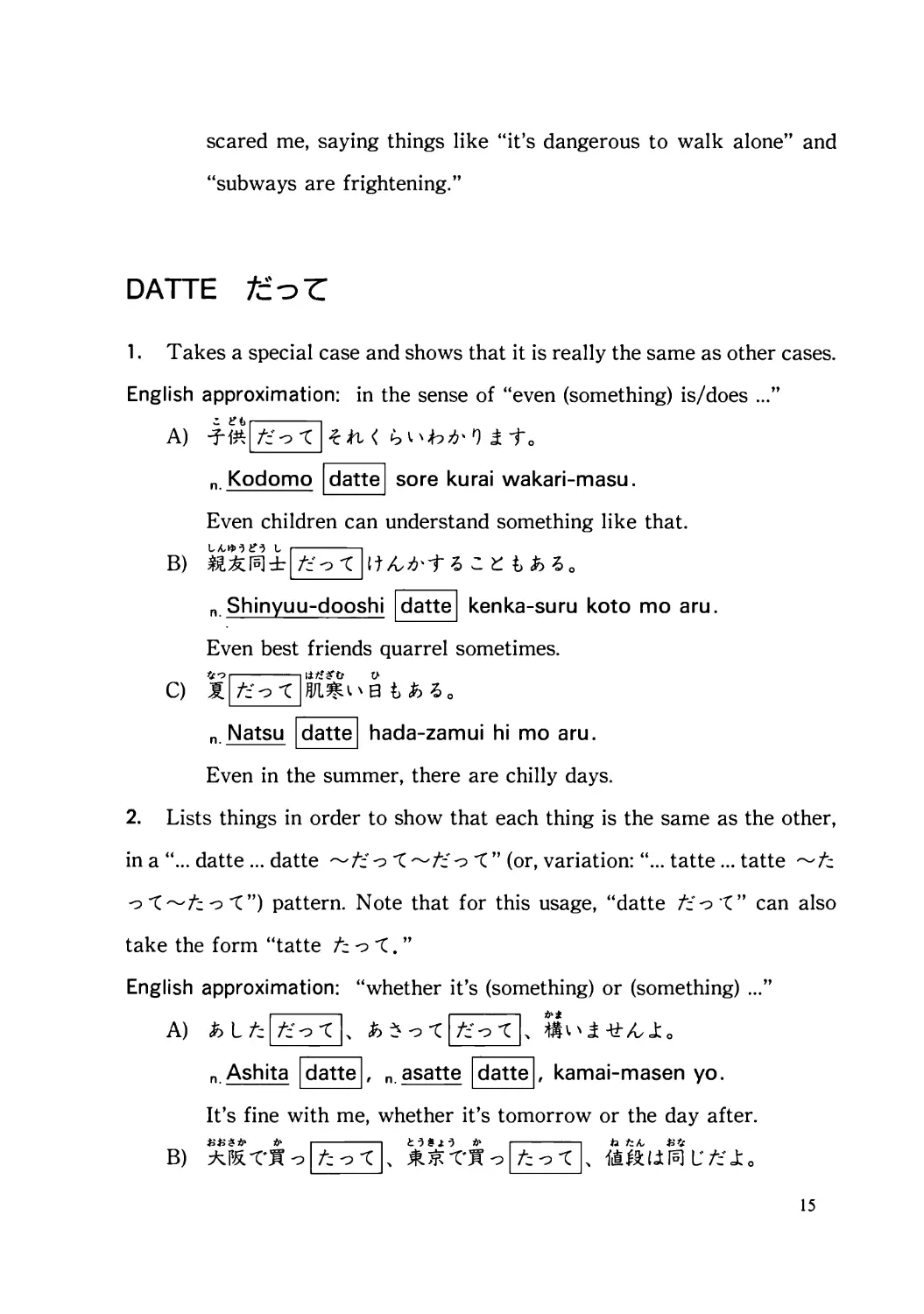
DATTE t 7)L
1. Takes a special case and shows that it is really the same as other caseso
English approximation: in the sense of "even (something) is/does 000"
7 tI
A) -tH 1 f.:>::> --c I h < 'h;)' To
n. Kodomo I datte I sore kurai wakari-masu 0
Even chi ldren ca n understand something like that.
L.A."'., ., L. I I
B) :r t:.."? --c tt h-;)'T .: t 0
n. Shinyuu-dooshi I datte I kenka-suru koto mo aru 0
Ev en best friends quarrel sometimeso
t,,:? I I IH! tr V
C) I t=.'"? --C WL , 8 t 0
n. Natsu I datte I hada-zamui hi mo aru.
Even in the summer, there are chilly dayso
2. Lists things in order to show that each thing is the same as the other,
in a "000 datte 000 datte '"- t=.' "? --C '"- t=.' "? --C" (or, variation: "... tatte 000 tatte '"- t:.
"? --C '"- t:. "? --C ") patterno Note that for this usage, "datte t=.."?{" can also
take the form "tatte t:."? --C . "
English approxi mation: "whether it's (so mething) or (something) 000"
A) L t:. 1 t=.' "? --C I .. "? --C It=.' "? --C I .. . , -tt h- 1 0
n. Ashita I datte I , n. asatte I datte I , kamai-masen yo.
It's fine wi th me, whether it's t omorro w or the day after.
iI' ii' I I t" l" ii' I I G t:.A. t,,:
B) -* & --C j{"? t:."? --C .. * * --C j{"? t:."? --C .. 1 tt U: L' t=.' 1 0
15
Oosaka de v. kat I tatte I , T ookyoo de v. kat I tatte I , nedan wa
onaji da yo.
It's the same price, whether you buy it in Osaka or Tokyoo
3. Follows an interrogative pronouno
I) To qualify anything in its category as valid in the clause that followso
English appro ximatio n: "anyone" "anytime" "anywhere" etco
A) \ "? I t::.# -? --C I i tL T 1 0
n. Itsu I datte I mirare-masu yo.
Y ou can see it an ytimeo
B) Iv ; U: # .: t: I t::.# -? --C I 0
Son-na mono wa ph. doko ni I datte I aru sao
That sort o f thing can be found anywhereo
C) t: tL I t: -? --C I tL < \ h ;) U: f --C. T 0
n. Dare I datte I sore kurai wakaru hazu desu.
Anyone should be able to understand something like that.
2) In a negative sentence, to show that nothing in the group specified by
the interrogative pronoun wants to be something or does somethingo
English appro ximatio n: "no one" "nothing" etco
I I rJlvlt?
A) t: tL t::.# -? --C 1t 'j: \ t: 0
n. Dare I datte I binboo wa iya da.
Noone likes being poor. (literally: Everyone doesn't like being
poor.)
c':'
B) # Iv fj: pIT I t: -? --C l -it t::. < fj: \ 0
Don-na n. tokoro I datte I iki-taku-nai.
No matter where it may be, (I) don't want to goo
16
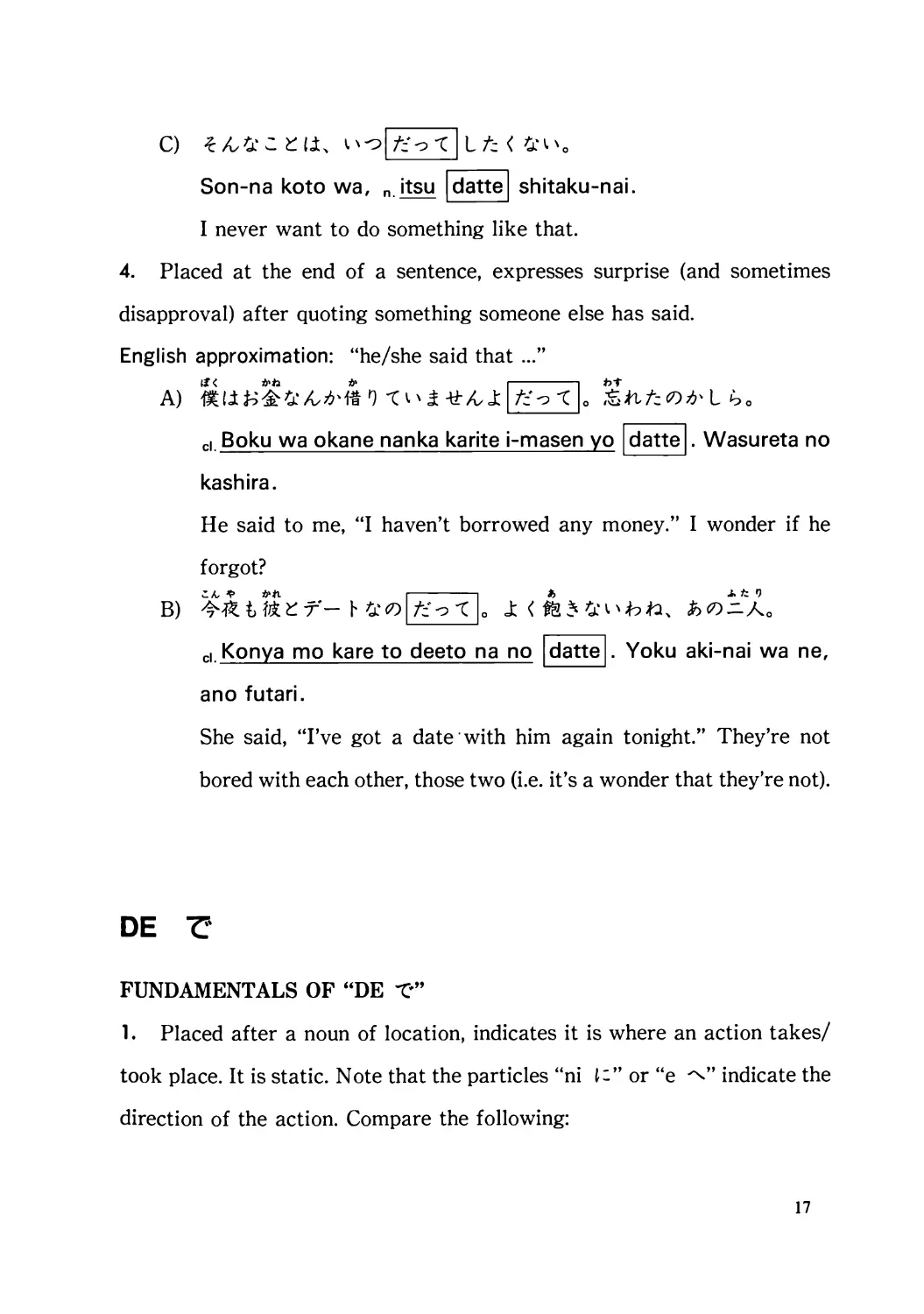
C) .c h.t .: tj:, \ I t: "'? --c I L t: < \ 0
Son-na koto wa, n. itsu I datte I shitaku-nai.
I never want to do something like that.
4. Placed at the end of a sentence, expresses surprise (and sometimes
disapproval) after quoting something someone else has saido
English approximation: "he/she said tha t 0""
11< 'b'G 'b' I I b"t
A) 1( t j: j:-; h.t;) i-t --c \ -tt h.t 1 t: "'? --c 0 h t: ;) L 0
cl. Boku wa okane nanka karite i-masen yo I datte I . Wasureta no
kashira.
He said to me, "I haven't borrowed any moneyo" I wonder if he
forgot?
A- 'b'tl I I kt:.1J
B) t {It T - r t::"'? --c 0 1 < \ h.fJ, =-Ao
cl. Konya mo kare to deeto na no I datte I . Yoku aki-nai wa ne,
ana futari.
She said, "I've got a date' with him again tonight." They're not
bored with each other, those two (Le. it's a wonder that they're not)o
DE z:
FUNDAMENTALS OF "DE '"'C "
1. Placed after a noun of location, indicates it is where an action takes/
took placeo It is statico Note that the particles "ni t:" or "e -,," indicate the
direction of the actiono Compare the following:
17
'b t "? .:: ? r-:::;::l A- l ?
A) *;fXL!J T 0
Gakkoo ldel benkyoo-suru.
(I) study at school.
r-:::;::l A- b
C) ;t 7 1 A L!J 7.7' tt 0
OfiiSu ldel denwa ° kakeruo
(I) make a call at the officeo
Q
English approximation: "at" "in"
'bt"?.::? p
B) *;fXl£J1T < 0
Gakkoo iku.
(I) go to school.
A- b
D) ;t71 Al£J t* 7.7'tt o
Ofiisu denwa ° kakeruo
(I) telephone the officeo
? h r-:::;::lB J:
A) h t:. L U:;:fii-L!J 57j( ' L t:. 0
Watashi wa n. umi Idel oyogi-mashitao
B)
18
t! \'IJ< r-::;.:ll: 11A- A- l?
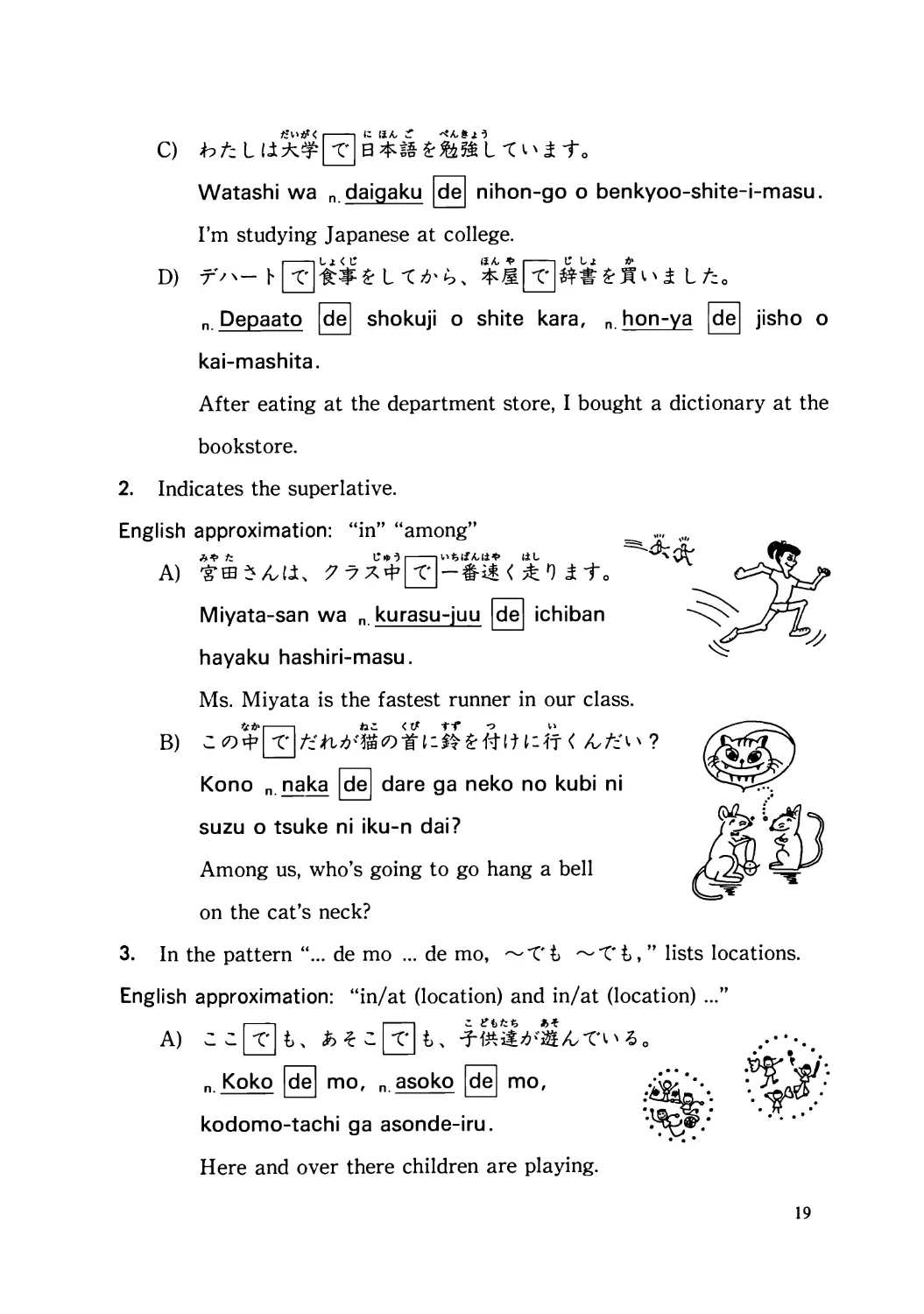
C) ht:.L'j:** 8* ! L--C \ To
Watashi wa n. daigaku Idel nihon-go 0 benkyoo-shite-i-masu.
I'm studying Japanese at collegeo
r-::;.:l L. l < t: 11 A- r-::;.:l t: L. l fJ.
D) T /\- r * L--CI)' .. * t. j{ \ Lt:. o
n. Depaato Idel shokuji 0 shite kara, n. hon-ya Idel jisho 0
kai-mashita.
After eating at the department store, I bought a dictionary at the
bookstoreo
2. Indicates the superlativeo
English approximation: "in" "among"
h t:. t: '" ? r-::;.:l \ -; l:l A-1;1 1;1 L.
A) rg-H3 Iv'j:.. 77At:p -.i! <;try To
Miyata-san wa n. kurasu-juu Idel ichiban
hayaku hashiri-masu 0
dt
Mso Miyata is the fastest runner in our classo
f.t fJ. r-::;.:l b ;:: < rJ 1" -r"? \
B) .: t:p t:h;)q "f t:jt 1ttt t:-1T < Ivt: \ ?
Kono n. naka Idel dare ga neko no kubi ni
suzu 0 tsuke ni iku-n dai?
Among us, who's going to go hang a bell
on the cat's neck?
£fD
3. In the pattern" 000 de mo 000 de mo, '"- --C t '"- --C t , " lists locationso
English approximation: "in/at (location) and in/at (location) ..."
;:: t:.-; ,,
A) .:.: --C t.. .c': --C t.. 1-1 i!;)"' 1v --C \ 0 ... · '.
. ..
n. Koko Idel mo, n. asoko Ide I mo, : .: :
kodomo-tachi ga asonde-iru 0 . .. . .'
. . .
Here and over there children are playingo
19
.:: t L. f.t "? ? h r-::;.:l it r-::;.:l t:.:: .£ < 1;1"?
B) if- I tj:;:fii- t t * t;)\ Mt L t:. 0
Kotoshi no natsu wa n. umi Idel mo n. yama Idel mo jiko ga
zokuhatsu-shita 0
This summer, accidents occurred one after another both at the
ocean and in the mountainso
4. Indicates the time when an action or process happened or happenso
I) Shows the time period when something occurred/occurs, often found in
"de wa "'C'l" and "de mo ..c t " pattern so
English approximation: "in" "at"
'it A- '" ? '(} < J: A- t: '" ? b.A-t! ) r-::;.:l ? t:.
A) - fL \!9 0 if-i\ 'l.. .: h- ;)ql -? t:. .c -1 t:: o
n. Sen-kyuuhyaku-yonjuu-nen-dai Idel wa, kon-na uta ga
hayatta soo da 0
In the 1940's, this sort of song was supposedly popularo
> it r-::;.:l L. '" ? 'b' A- .:: f.t
B) t.. .c ,t;: 'l j:-; -it h h --C \ 0
n. Ima Idel mo, sono shuukan wa nao okonawarete-iru.
Even now (at present), that custom is still carried out.
2) Indicates the age of a persono
English approximation: "at"
'b'n < t;",? ) r-::;.:l t:. )t....t <
A) {Jt'l + i! Lt:.o
Kare wa n. rokujus-sai Idel taishoku-shitao
He retired at age sixtyo
B) 'l I + l;t l--c I U L t:. o
Haha wa n. nijuu-go-sai Idel kekkon-shita.
My mother got married at age twenty-fiveo
3) Imposes a time limit on an action or occurrenceo
20
English approximation: "in (amount of time)"
t...:::':1:. I;: t;", ?J.A-
A) .: 1:t* 'l.::. + I--C I ill * T I; ?
Kono shigoto wa n. nijup-pun Idel deki-masu ka?
Can you do this job in twenty minutes?
I': L. '" ? iJ' A- r-:;:::l f.t? 1"
B) t -1 .::.Y!re' L2J I 1*-h. t: To
Moo n. ni-shuukan Idel natsu-yasumi ni nari-masu 0
Summer vacation is coming in two weekso
f} iJ' rJ \ -; t! l ? ii' A- r-:;:::l -; '" ? f.t f.t i b 1;1 A-
C) :7t. 'l - t,' re' L2J :ttkJ* ..t= @1 .=f. T 0
Hikari wa n. ichi-byookan Idel chikyuu 0 nana-mawari-han suru.
Light travels around the earth seven and a half times in one secondo
5. Indicates what method or tool is/was employed for an actiono
English approximation: "do (something) by using (something)"
il f ? ? t: "'C' A- L. r-:;:::l iJ' J:
A) h t: L 'l * "'"' (:J jft L2J i! -? --C \ To
Watashi wa gakkoo e n. jitensha Idel kayotte-i-masu.
I commute to school by bicycle.
21
V. .:.? r-::;.:l > k b r-::;.:l >
h t: L U: ffi: 1T 0 /' r /' t: 1T "'( 1;' .. Wd A '" -1 /' t: 1T
L t: o
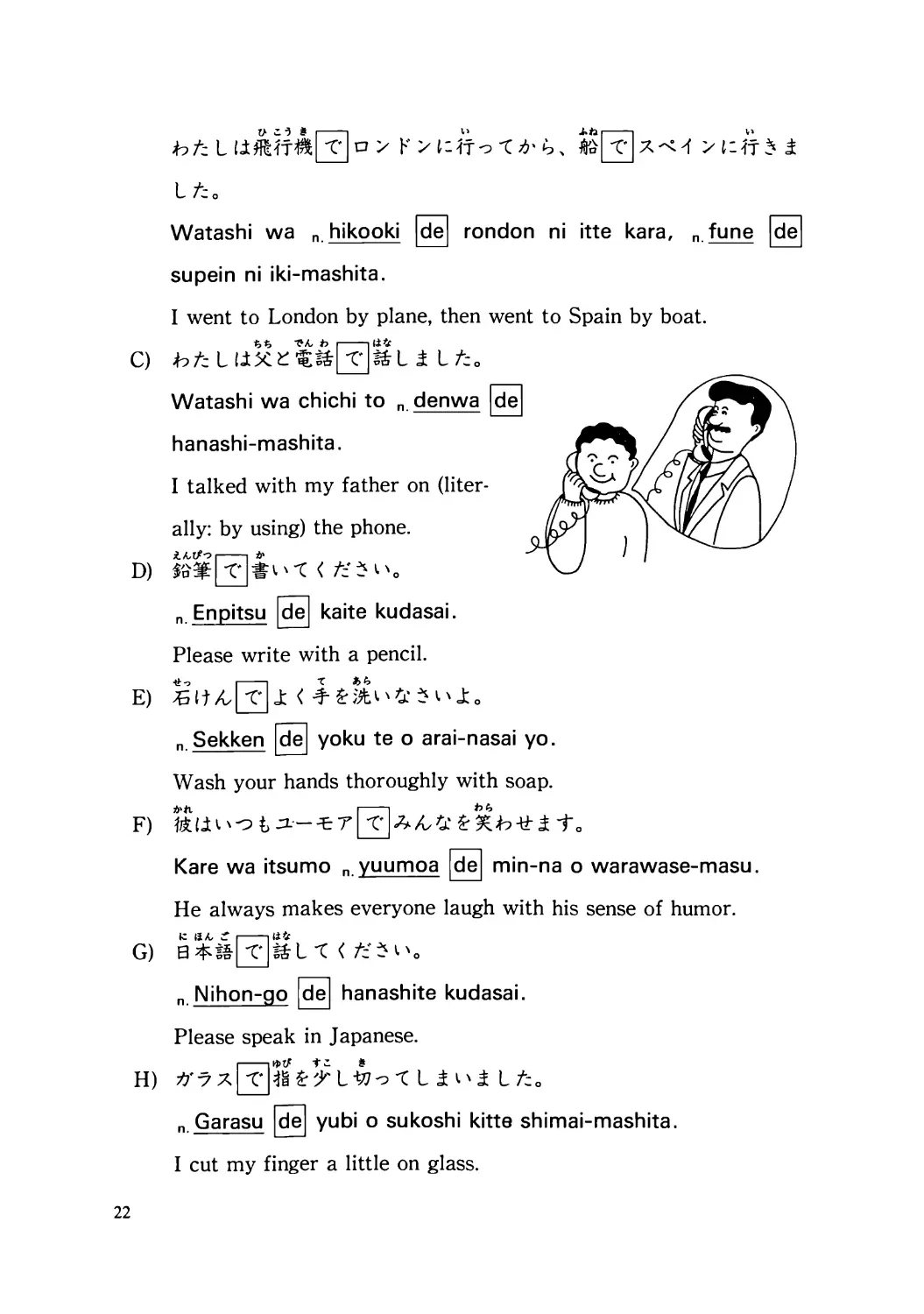
Watashi wa n. hikooki Idel rondon nl itte kara, n. tune Idel
supein ni iki-mashitao
I went to London by plane, then went to Spain by boat.
-; -; A- b r-::;.:ll;t f.t
C) ht: L U:X t* L L t: o
Watashi wa chichi to n. denwa Idel
hanashi-mashita 0
I talked with my father on (liter-
ally: by using) the phoneo
i. A- ? r-::;.:l 'b'
D) }B'* . '",( < t: '0
n. Enpitsu Idel kaite kudasai.
Please write with a pencil.
'it ? r-::;.:l "'C' I>
E) ;G t t Iv 1 < ;t , , 1 0
n. Sekken I de I yoku te 0 arai-nasai yo.
Wash your hands thoroughly with soapo
fJ> t\. r-::;.:l b
F) 1Tttl '-? t .:1:- "7 -h.Iv h-tt To
Kare wa itsumo n. yuumoa Idel min-na 0 warawase-masuo
He always makes everyone laugh with his sense of humor.
11 A- r-::;.:ll;t f.t
G) 8 ;$ t! L "'( < t=.' '0
n. Nihon-go Idel hanashite kudasai.
Please speak in J apaneseo
r-::;.:l"" rJ 1" .:.
H) 7'f"7 A l' L iJJ "'{ L , L t: 0
n. Garasu Idel yubi 0 sukoshi kitte shimai-mashitao
I cut my finger a little on glasso
22
6. Gives the price of somethingo
English approximation: "at" "for"
11 A, I: -1t A, i. A, r::;::l fJ\
A) (?) *' -=- -t JI] \.1 L t: 0
Sono hon 0 n. ni-sen en Idel kai-mashita.
I bought the book for two thousand yeno
B) /'\7 -1 !i \ < 8]1ttt.1 ..,I)'?
Hawai e wa n. ikura Idel ike-masu ka?
How much would it cost for a trip to Hawaii?
7. Indicates time or quantity that makes a unit.
English approximation: "by" "for"
II < t: fJ\ A, r::;::l
A) !i * ra' 7' Jv/" -1 r L --C \ 0
Boku wa n. jikan Idel arubaito 0 shite-iru.
I'm working part time by the houro
.J., t:. r::;::l v < i. A,
B) (?) J) /' ::1"'/i -=- A 8 JI] --C".., 0
Sono ringo wa n. futatsu I de I go-hyaku en desu.
Those apples are two for five hundred yeno
t:. \ ? "C A, tI r::;::l fJ\
C) h t: L 1!(?)1-- L !i- . , Jm. t: o
Watashi-tachi no chiimu wa n. it-ten-sa Idel katta.
Our team won the game by only one point.
8. Indicates the composition of an object.
English approximation: "from" "of"
1:1.::
A) .:: J1,!i 7'"7 A 1- 'Y 7 1--C"1 --C" t: --C"'" 0
Kore wa n. purasuchikku Idel dekita hako desu.
This is a box made out of plastico
h A, 1: r-:;:::l "? < ? "? b
B) J1,!i 6.::J:. it t: --C".., 0
23
Sore wa n. nendo Idel tsukutta utsuwa desu.
It's a vessel made of clayo
C) 1-:7' - t;1 )v 7 1.'e I ii ry .1 To
Bataa wa n. miruku Idel tsukuri-masu.
Butter is made from milko
9. Indicates the manner of an action, or the condition/intention at the time
of occurrence/ actiono
English approximation: "(in this manner) 0"" "(with intention to)
\ r-:;:::l
A) h t L t;1 I , ili h ,t .1 L t 0
Watashi wa v. isoi Idel dekake-mashita.
I left in a rusho
"
)1
f» It. tt i;. .. ., r-:;:::lIH,
B) 1Jttj:;J-tp * t o
Kare wa n. muchuu Idel hashitta.
He ran frantically.
!
It < r-:;:::l \
C) tj: L h '? t ry t (?) .'et;1 '0
Boku wa shikaru n. tsumori Idel itta no de wa nai.
I didn't say it with the intention to scold (you)o
10. Indicates a reason or motive for an action or occurrenceo
English approximation: "due to ..." "owing to ..."
f» It. J, i;. .. ., \ r-:;:::l f» \ f! Iv
A) 1Jttj:/f .i P tth "l?t 0
Kare wa n. fuchuui Idel kaidan kara ochita. f""
He fell down the stairs due to carelessnesso
It < !I .t ., f1' r-:;:::l fJf? .:: ., 1"
B) tj: 8 Jit 1*lvt o
24
Boku wa kyoo n. kaze Idel gakkoo 0 yasunda 0
Today, I was absent from school due to a coldo
,Ht "C;:
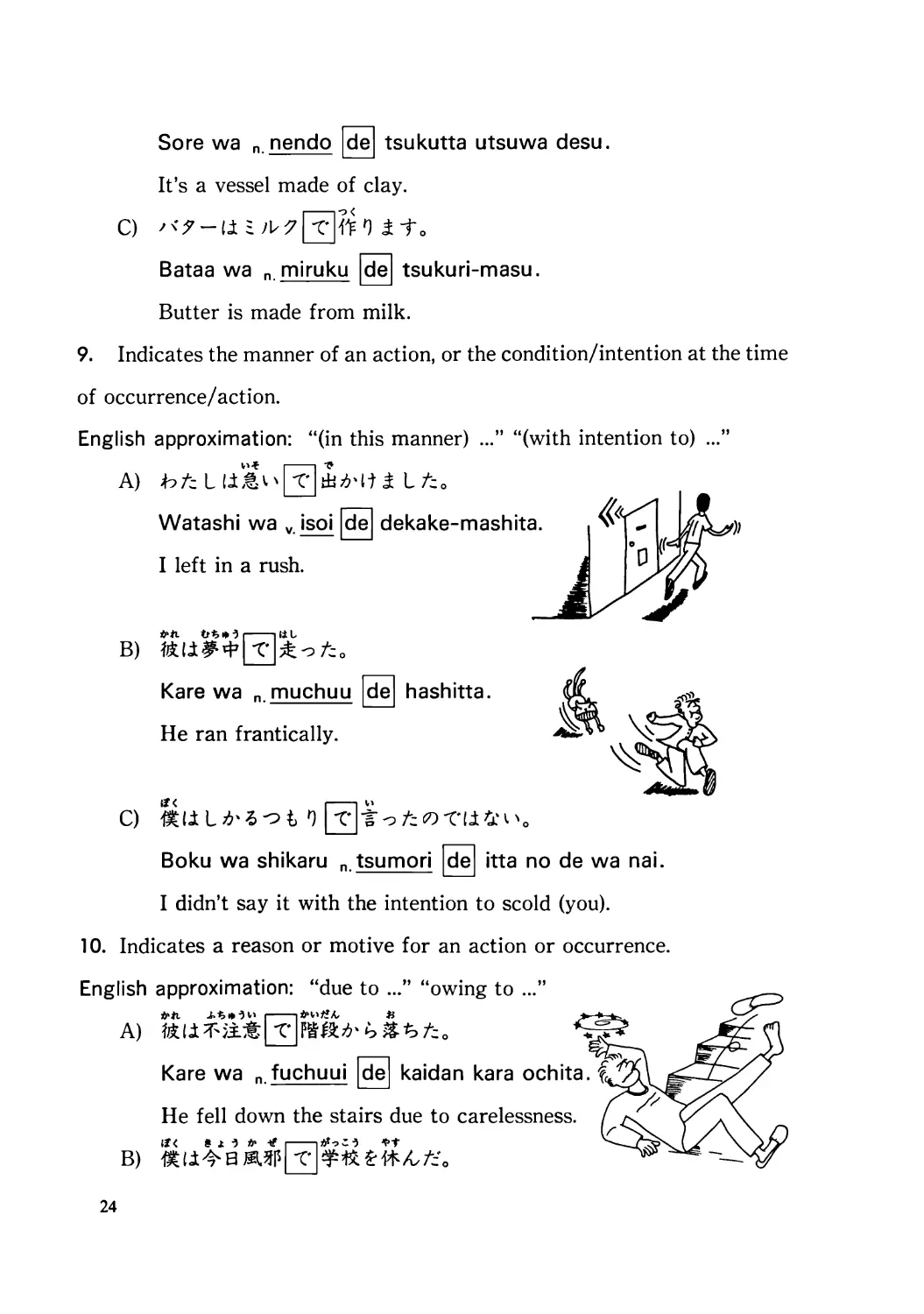
C) * j.'e I -t- h:;* it 1 t: 0
n. Samusa Idel te ga kogoe soo da.
My hands are almost frozen from the coldo
.
..c::::.
_ ..D-
rJ .. ? ;: ? r-:;.::l h -1t t! \ ) 1:1 A, t: .t ?
D) .:: 7:-+f -1 / 5At.lfL.!JJ6tj:* t:o
Kono dezain no n. ryuukoo Idel mise wa dai-hanjoo da.
Due to the popularity of this design, the store is doing very well.
11. Indicates the source of information, basis of a conditiono
English approximation: "by" "from" "on" "according to"
l, A,.£ A, "C A, !I J: II? r-:;.::l h !I .t" < (, rJ
A) ;tjf&1 -T,ItL.!J Ji , 8 'j: t 1 t: 0
Shin bun no n. tenki-yohoo Idel miru to, kyoo wa kumori da soo
da.
According to the weather forecast in the paper, it will be cloudy
todayo
l: It \) r-:;.::l \) * f.t A, t:
B) iY> t:. * tL.!J 'j: M* eT h' ?
Anata no n. tokee Idel wa ima nan-ji desu ka?
What time is it now according to your watch?
f» It. f.t f» \ ) -!I r-:;.::l
C) {Jth:: V' . < 't Iv .'e \ 'j: , @. L.!J h h" 0
Kare ga hidoku nayande-iru no wa, n. kao-iro Idel wakaru.
I can tell from his face that he is very troubledo
12. Indicates the basis of evaluationo
English approximation: "depending on" "according to"
25
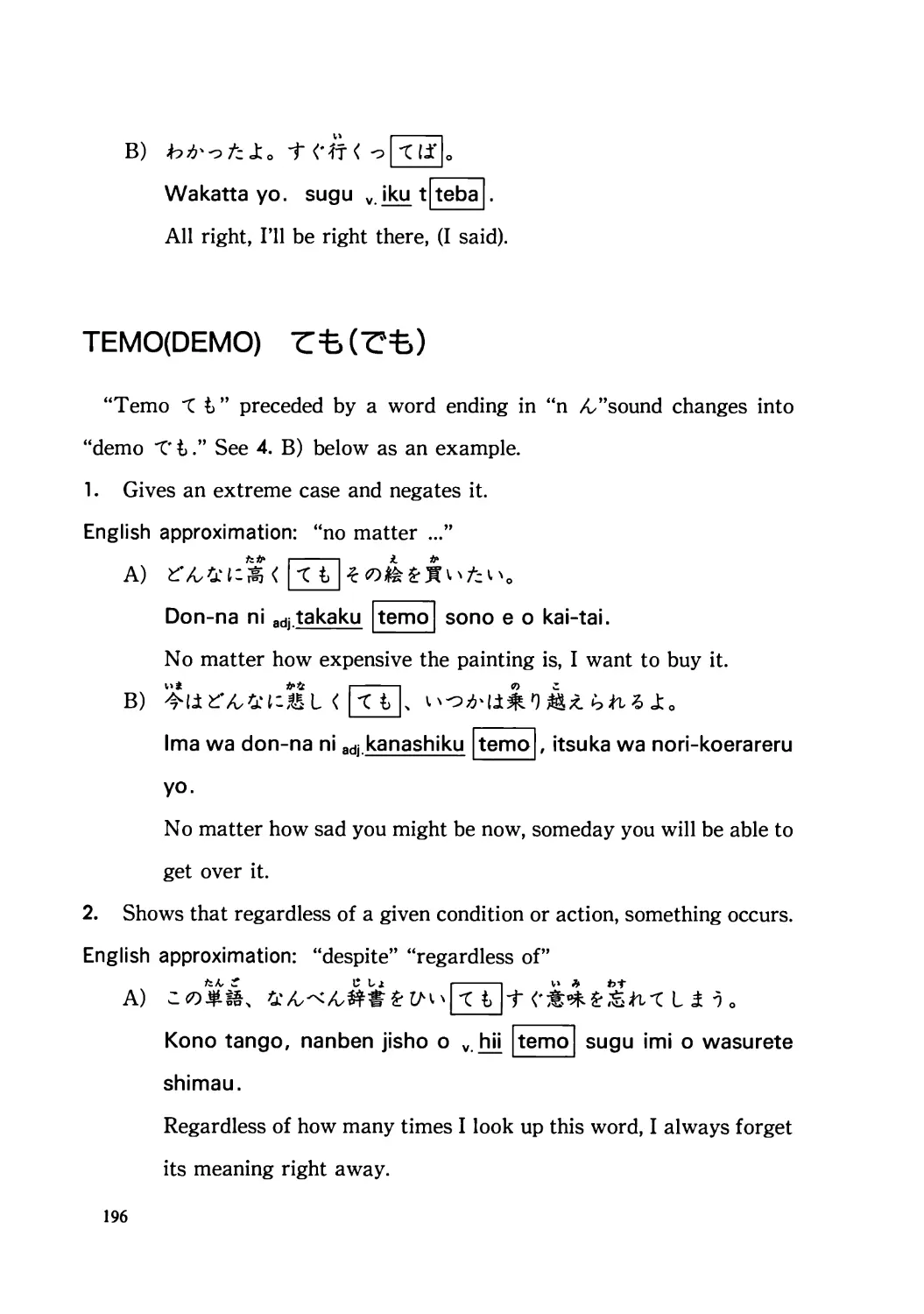
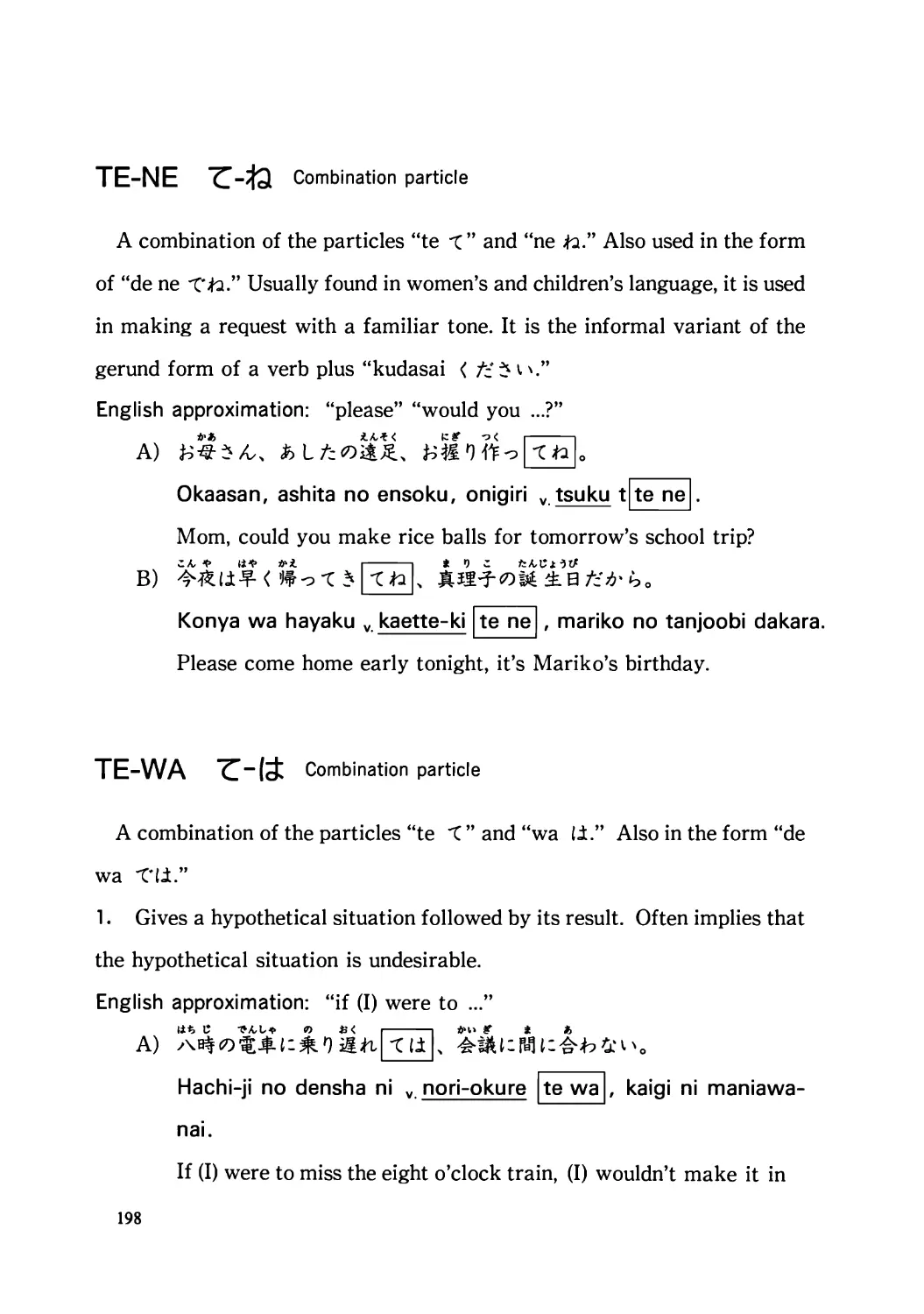
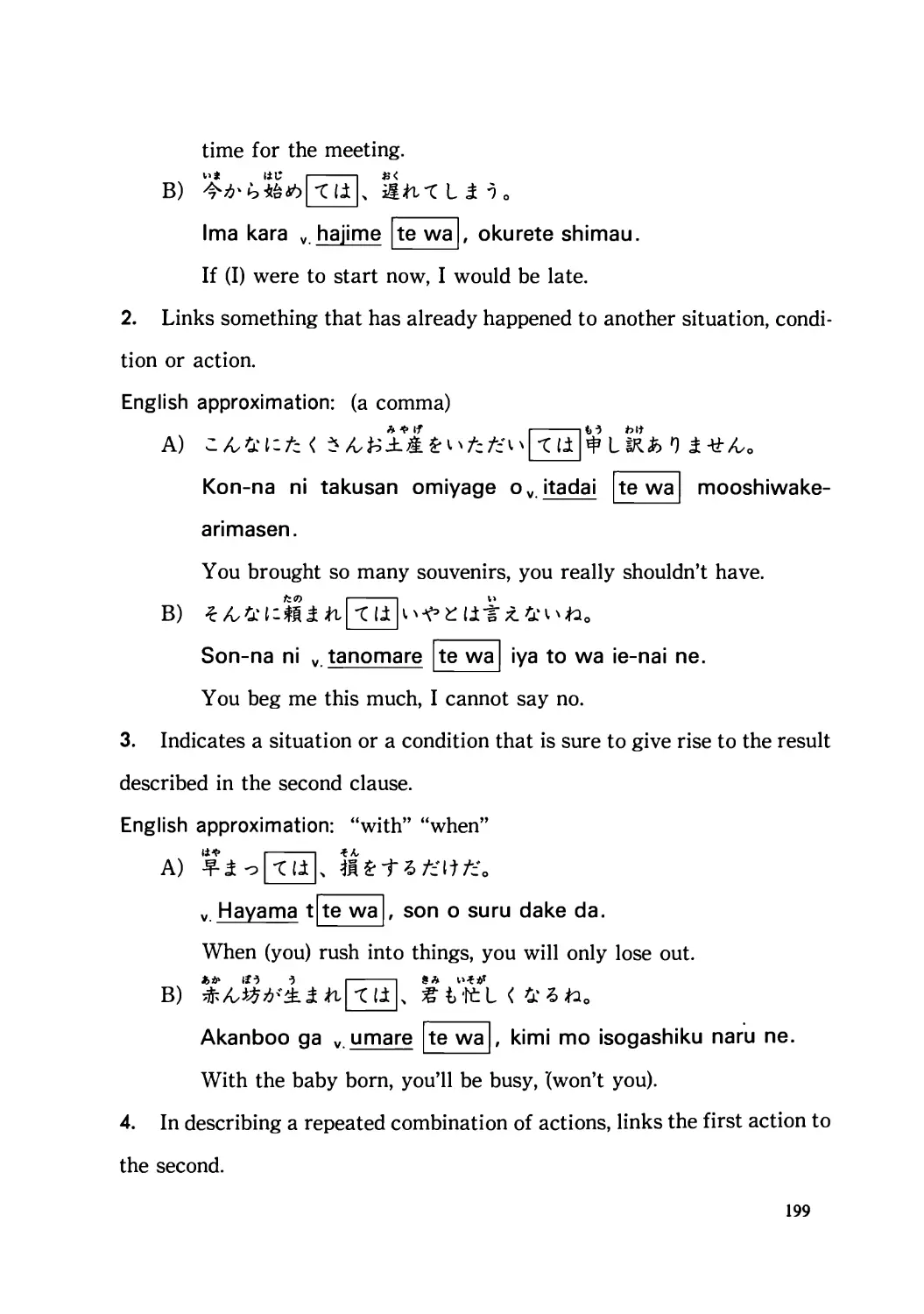
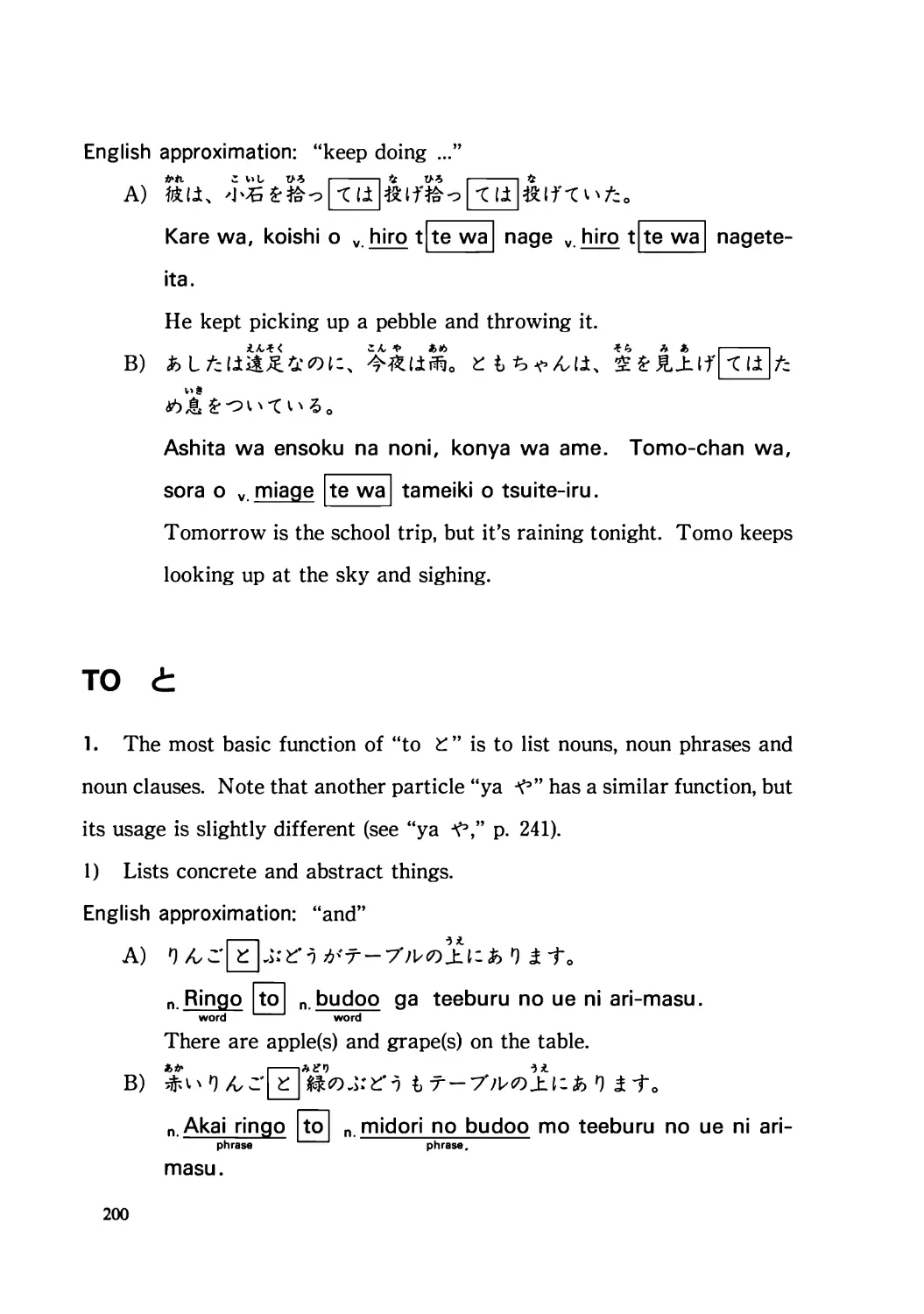
h f! Iv r-:;:::l fJt
A) h 1.7' Iv (?)1 i '1 *- it \ .1 -r 0
Mikan no nedan wa n. ookisa Idel chigai-masu.
The price of oranges varies depending on their sizeo
t h f! Iv V -!I Iv rJ r-:;:::l fJ' b
B) .:J:.:Jtk(?)1 i '1 1t JJ ry .1 -r 0
Tochi no nedan wa n. hirosa to benrisa Idel kawari-masu.
The price of land changes according to the size and locationo
13. Shows which party is/was responsible for an actiono
English approximation: in the sense of "(something) is/was done by (some-
thing)o"
fJ' .£ < r-:;:::l !I
A) J1, '1 5 cY:> t .:: "t -r 0
Sore wa n. kazoku Idel kimeta koto desu.
It was a decision made by (my) familyo
l, Iv Iv fJt? ;: ., r-:;:::l1:1? ;: .,
(?);tjf f}O '1 * 1t J1, t 0
Sono shinbun wa n. gakkoo Idel hakkoo-sareta.
That newspaper was published by the school.
B)
DEMO C'=b
1. Presents an extreme example to make the point that since something
applies to such a case, it therefore certainly applies to more normal caseso
English approximation: "even"
-1t1v-1t 1
A) 7tj:. hh' \"t L J: "1 0
n. Sensee I demo I wakara-nai deshoo.
Even the teacher probably won't be able to understand it.
h 1"1v
B) t:> J: Ji L h{cb "t 'l* t:o
26
n. Chotto 1 demo 1 mi-otoshi 9a atte wa taihen da.
If (we) miss even one thing, there'll be grave consequenceso
2. In the pattern "don-na "0 demo * : "e t . "
English approximation: "no matter what/how (something) ..0" or "regard-
less of the fact that..."
-1tA,-1t > trf'fJ' bA,t!P t
A) iY> 7t j:. '1 * : ft L \ raj I! m ,t 0
Ano sensee wa don-na muzukashii n. mondai I demo I tokeru.
That teacher can solve any problem, no matter how difficult it may
beo
t:. bo) P"" 1: t:. tH
B) h t: L '1 * -]X '1 --C h t: \ I \.1 To
Watashi wa don-na n. tabemono I demo I ichido wa tabete mi-tai
to omoi-masu.
Regardless of the type of food, I'd like to try eating it onceo
3. After an interrogative pronoun, indicates an all-inclusivenesso
English approximation: "whatever" "whenever" etco
A) *.:: l--c* t I \ \ n ' Pi --c < t:' \ 0
n. Doko I demo I ii kara suwatte kudasai.
Please sit wherever you likeo (more literally: "Please sit; anywhere
is fineo")
T "".?bA,
B) 1j: t 51.:>c L --C \ \ j: 0
n. Nan I demo I suki na mono 0 chuumon-shite ii yo.
You can order whatever you likeo
4. Used in casually mentioning something as a suggestiono
English approximation: in the sense of "something like 0""
fJ'i. 0) >
B) '1' ry t: :J - 1:: - fk h t: 1T n lj.' \ ?
27
Kaeri ni n. koohii I demo I nomi ni ika-nai?
Why don't we go have coffee or something on the way home?
1:1 f.t l,
B) .:.: j: tt J1, Lf;.; U- L .1 T 1;:0
n. Koko I demo I yokere ba ohanashi-shi-masu ga.
If it's all right to talk somewhere like here, I will.
5. To express wishful thinking; sometimes in a "semete 000 demo 000 -\t 60 --C
--C t " patterno
English approximation: "if only there were (something), even just a little bit
of it ..."
T;: "".t!lA..
A) -\t 60 --C 1" L t:. t t RT 1;: cb t t:J: cb 0
Semete sukoshi n. dake I demo I chokin ga attara naa.
If only I had even just a little bit of savings 000
;:l, t;:-!I
B) JJt. ;.; .; T;iJf [TI] cb t \ \ (?) t: tj: cb 0
Koshi 0 orosu n. tokoro I demo I attara ii no ni naa.
If only there were some place I could sit down 000
6. Often in a "manzara .00 demo .1 --C t " pattern and/or a double
negative, to indicate that there are other attributes to something, besides
the obvious.
English approximation: examples are "not all bad" and "not unthinkableo"
fJ-t \
A) cb (?) A. (?) '1 .: U:, .1 '1 i t:J: \ 0
Ano hito no yuu koto wa, manzara n. uso I demo I nai.
What that person says isn't all untrueo
It \""< !:?lfA.. J,. .". (f)?
B) .: (?) t@J t.i, jJl. iiJ t:J: b tt t:J: \0
Kono keekaku wa, jitsugen fukanoo na n. wake I demo I nai.
This plan isn't impossible to carry outo
28
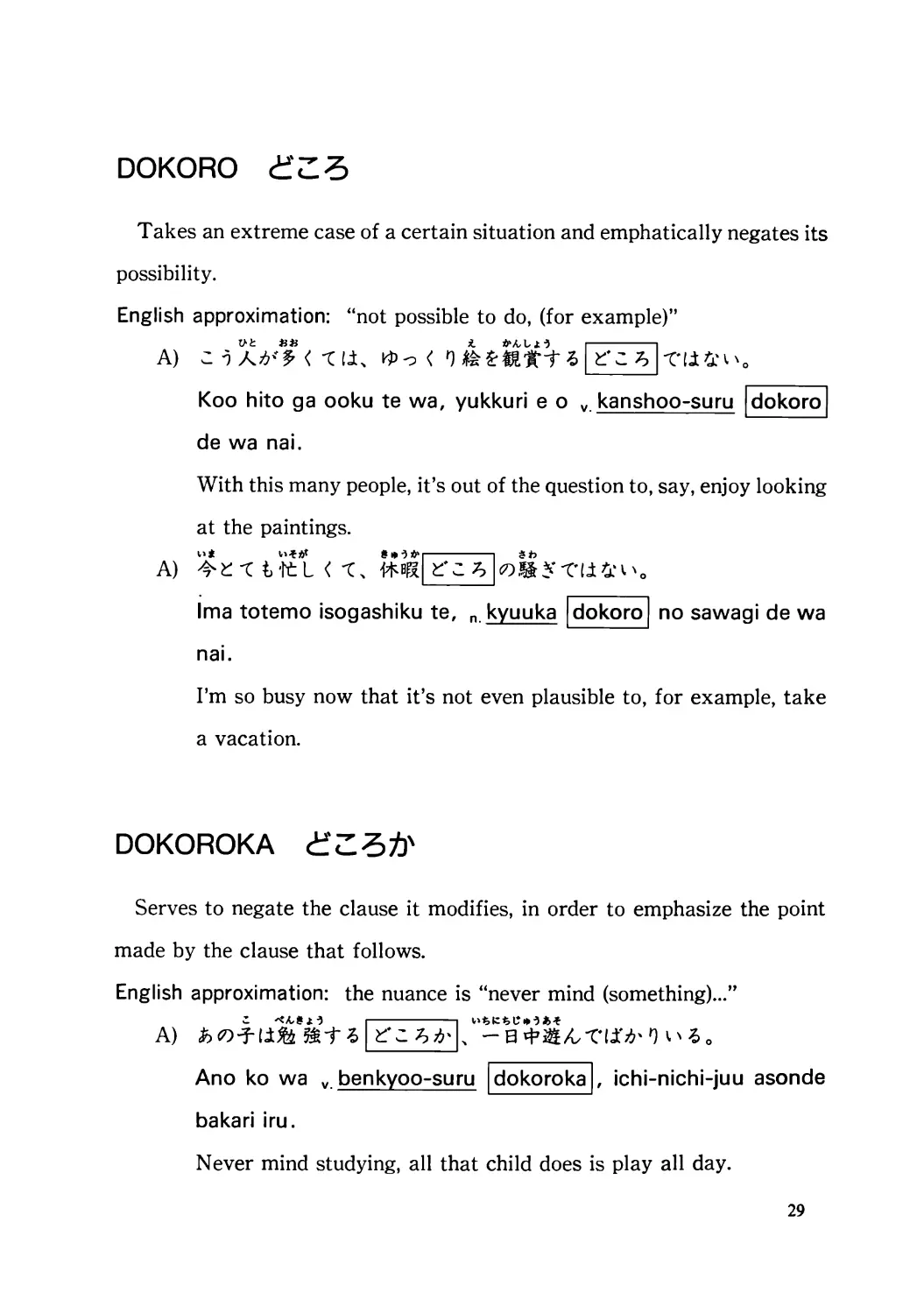
DOKORO c:' L:
Takes an extreme case of a certain situation and emphatically negates its
possibilityo
English approximation: "not possible to do, (for example )"
vt i. f»A,1,,t? I I
A) .:: -) A. I; : < --C U:, < ry . ... T ..:: 'J;, --C. Li \ 0
Koo hito ga ooku te wa, yukkuri e 0 v. kanshoo-suru I dokoro I
de wa nai.
With this many people, it's out of the question to, say, enjoy looking
a t the paintingso
\* \ f)t !I."f» 1 I b
A) --C t ,tt L < --C, 1*Brl ..:: 'J;, (?) ,fA 5 --C. t1 ' \ 0
Ima totemo isogashiku te, n. kyuuka I dokoro I no sawagi de wa
nal.
I'm so busy now that it's not even plausible to, for example, take
a vacationo
DOKOROKA c:'L: tJ\
Serves to negate the clause it modifies, in order to emphasize the point
made by the clause that follows.
English approximation: th e nuance is "never mind (something)..."
;:. --:A,!I,t? I I \i;.j;:i;.t:.?,,
A) cb (?) 1- tj: ;i T ''::"h I; , - 8 tp Iv --C' t.! I; ry \ 0
Ano ko wa v. benkyoo-suru I dokoroka I , ichi-nichi-juu asonde
bakari iru.
N ever mind studying, all that child does is play all day.
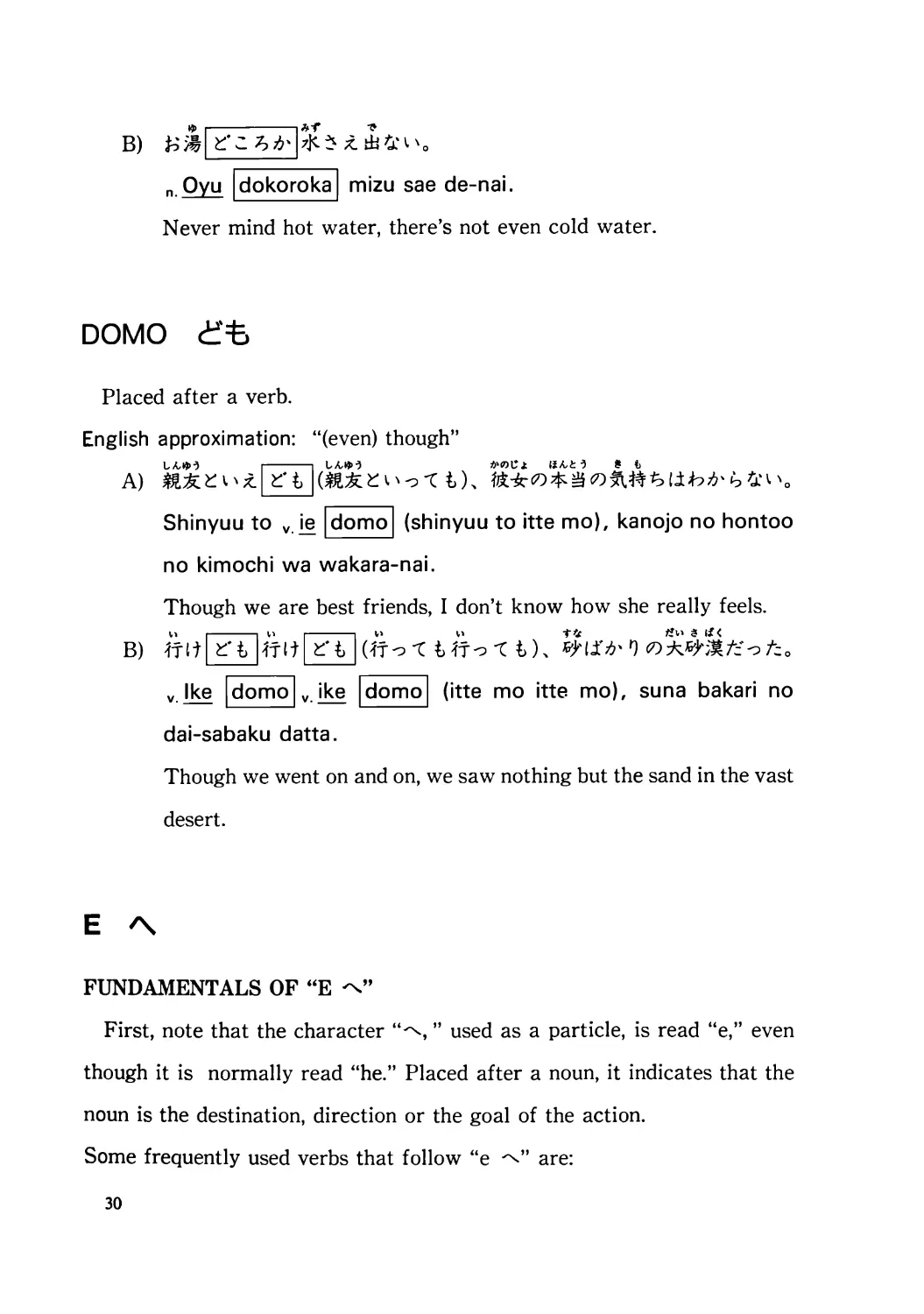
29
I I h-r
B) ;t? ''::"h Ir 7]( ;t ili \ 0
n. Oyu I dokoroka I mizu sae de-nai.
N ever mind hot water, there's not even cold water.
DOMO t:'t,
Placed after a verbo
English approximation: "(even) though"
1,A.. ? 1,A.. ? fJ'q)t:.t 11A..t? !I b
A) \;t 8 ( Jt \ --c t), {Jt*(?) * (?) #t:> U:hh' \0
Shinyuu to v. ie I domo I (shinyuu to itte mo), kanojo no hontoo
no kimochi wa wakara-nai.
Though we are best friends, I don't know how she really feelso
\ \ \ \ "'tf.t f! \ tI 11<
B) 1ttt 81tt t 8 (1t --c t 1t --c t), ;,,;f 1.7" ry (?) * ;' t:: t:. o
v. lke I domo I v. ike I domo I (itte mo itte mo), suna bakari no
dai-sabaku datta.
Though we went on and on, we saw nothing but the sand in the vast
desert.
E "
FUNDAMENTALS OF "E -,,"
First, note that the character " , " used as a particle, is read "e," even
though it is normally read "heo" Placed after a noun, it indicates that the
noun is the destination, direction or the goal of the action.
Some frequently used verbs that follow "e " are:
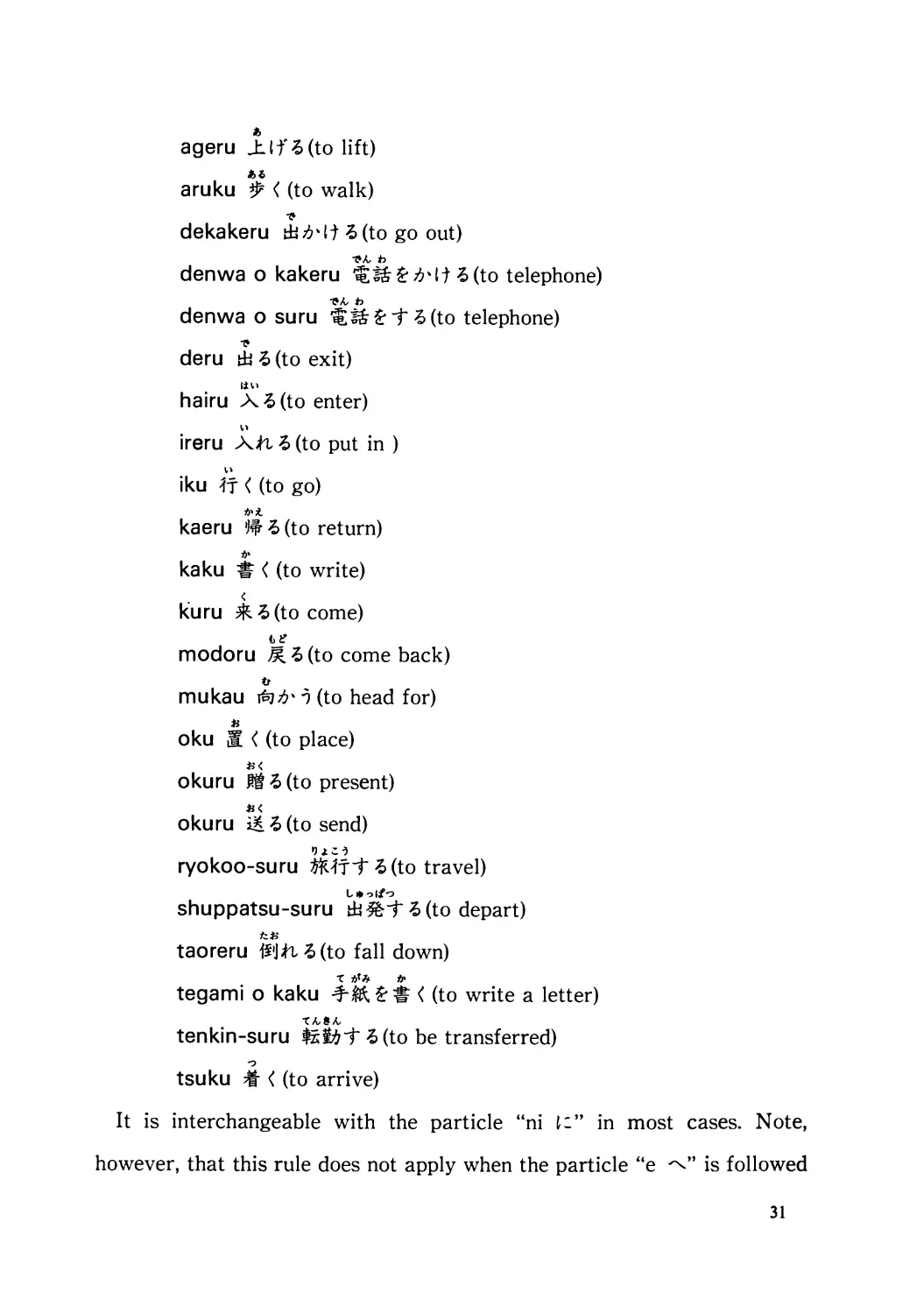
30
ageru ...t. tf (to lift)
aruku < (to walk)
dekakeru ili h tt (to go out)
A, b
denwa 0 kakeru h tt (to telephone)
A, b
denwa 0 suru T (to telephone)
deru ili (to exit)
1:1 \
hairu A (to enter)
\
ireru An (to put in )
\
iku If < (to go)
fJ> i..
kaeru I). (to return)
fJ>
kaku . < (to write)
<
Kuru * (to come)
b
modoru & (to come back)
tt
mukau fc;] h -) (to head for)
oku iI < (to place)
<
okuru mt (to present)
<
okuru i! (to send)
rJ.t;:?
ryokoo-suru lfT (to travel)
l,.. ?I/'?
shuppatsu-suru ili T (to depart)
'k.
taoreru 1flJn (to fall down)
"C fJt h f1'
tegami 0 kaku .:t . < (to write a letter)
"CA, !I A,
tenkin-suru fhT (to be transferred)
'?
tsuku .. < (to arrive)
I t is interchangeable with the particle "ni t:" in most cases. Note,
however, that this rule does not apply when the particle "e " is followed
31
by the particle "no (7)"; "e " then cannot be replaced by "ni t:o"
Examples:
1;11;1 r=l J:> <
A) h t L U: /' v -c / r i! ry .1 L t 0
Watashi wa haha 0 purezento 0 okuri-mashita.
I sent my mother a present.
1;11;1 <
ht L U:-li6/'v-c/ r i! ry .1 L t o
Watashi wa haha purezento 0 okuri-mashita.
I sent my mother a present.
1;11 r:l
B) .: J1, U: (7) /' v -c / r ' eT 0
Kore wa haha 0 no purezento desu.
This is a present for my mother.
Wrong:
1;11;1
.: J1, U: (7) /' v -c / r "t T 0
Kore wa haha no purezento desu.
1. Shows the direction where an action is headedo
English approximation: "to" "toward"
tlf)' \
A) h t L U: *- [t& I 1 11" .1 T 0
Watashi wa n. oosaka 0 iki-masu.
I'm going to Osakao
f),tL ;UI II? r:l" \
B) {Jttj: (7) \"t 11" .1 L t o
Kare wa eki no n. hoo 0 aruite iki-mashita.
He walked toward the stationo
'H (f) r:l1...?""J:?"".?
C) :ttJf Ivtj: 3 - a '/' I' ili t:p "t T 0
Kitano-san wa n. yooroppa 0 shucchoo-chuu desu.
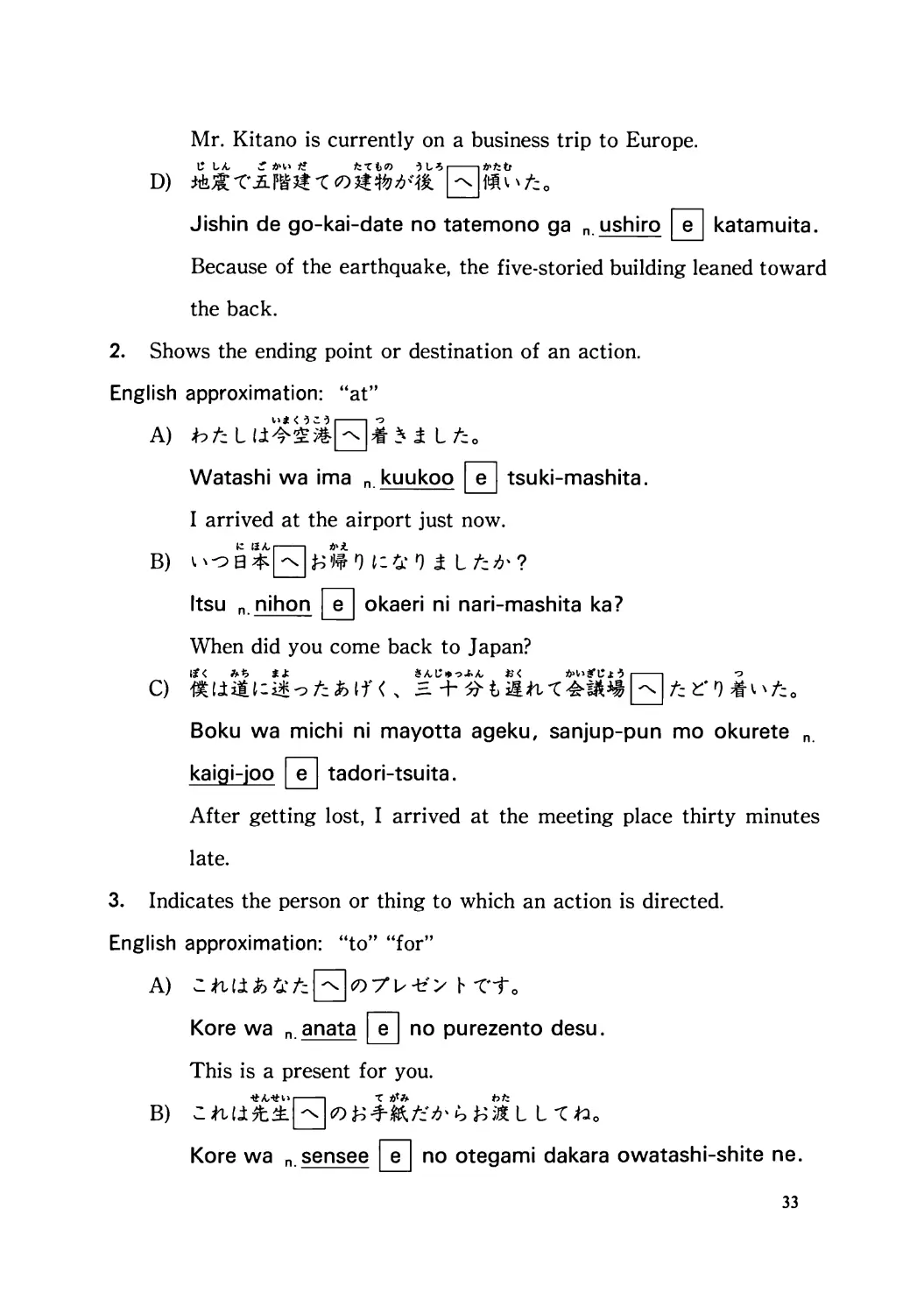
32
Mro Kitano is currently on a business trip to Europeo
t:\.,A, 1.I' \t!. t.:"'t'{)C1) "\" EJ 1.I,t.:fJ
D) Jt!?1l C.E. p 'C (i') 1.J '-1t i \ t: 0
Jishin de go-kai-date no tatemono ga n. ushiro [!] katamuita.
Because of the earthquake, the five-storied building leaned toward
the backo
2. Shows the ending point or destination of an actiono
English approximation: "at"
\i < .,.::., EJ ?
A) bt: L lj: ,f 51 L t: o
Watashi wa ima n. kuukoo [!] tsuki-mashitao
I arrived at the airport just nowo
I: 11 A, EJ 1.1' i..
B) \""'?8* j:.) w t: : 1 Lt:I.J'?
Itsu n. nihon [!] okaeri ni nari-mashita ka?
When did you come back to Japan?
1£< ht? :kJ: A,t:.?.&.A,!i< 1'J> \ t:J: EJ ?
C) l j: it t : "'? t: iJ t f <, ;:. + -5t t 11 tL 'C t: . ,f \ t: 0
Boku wa michi ni mayotta ageku, sanjup-pun mo okurete n.
kaigi-joo [!] tadori-tsuita.
After getting lost, I arrived at the meeting place thirty minutes
lateo
3. Indicates the person or thing to which an action is directedo
English approximation: "to" "for"
A) .: tL l j: iJ t: I I (i') "/ v 1i /' r 'C. 1" 0
Kore wa n. anata [!] no purezento desu.
This is a present for YOUo
'itA,'it \ EJ "'t' 1.I t h ht.:
B) .: tL l j: 7t j:. (i') j:.) .if- t: I.J j:.) 5Lt L L 'C t:l 0
Kore wa n. sensee [!] no otegami dakara owatashi-shite nee
33
This is a letter to the teacher, so please hand it to (him/her)o
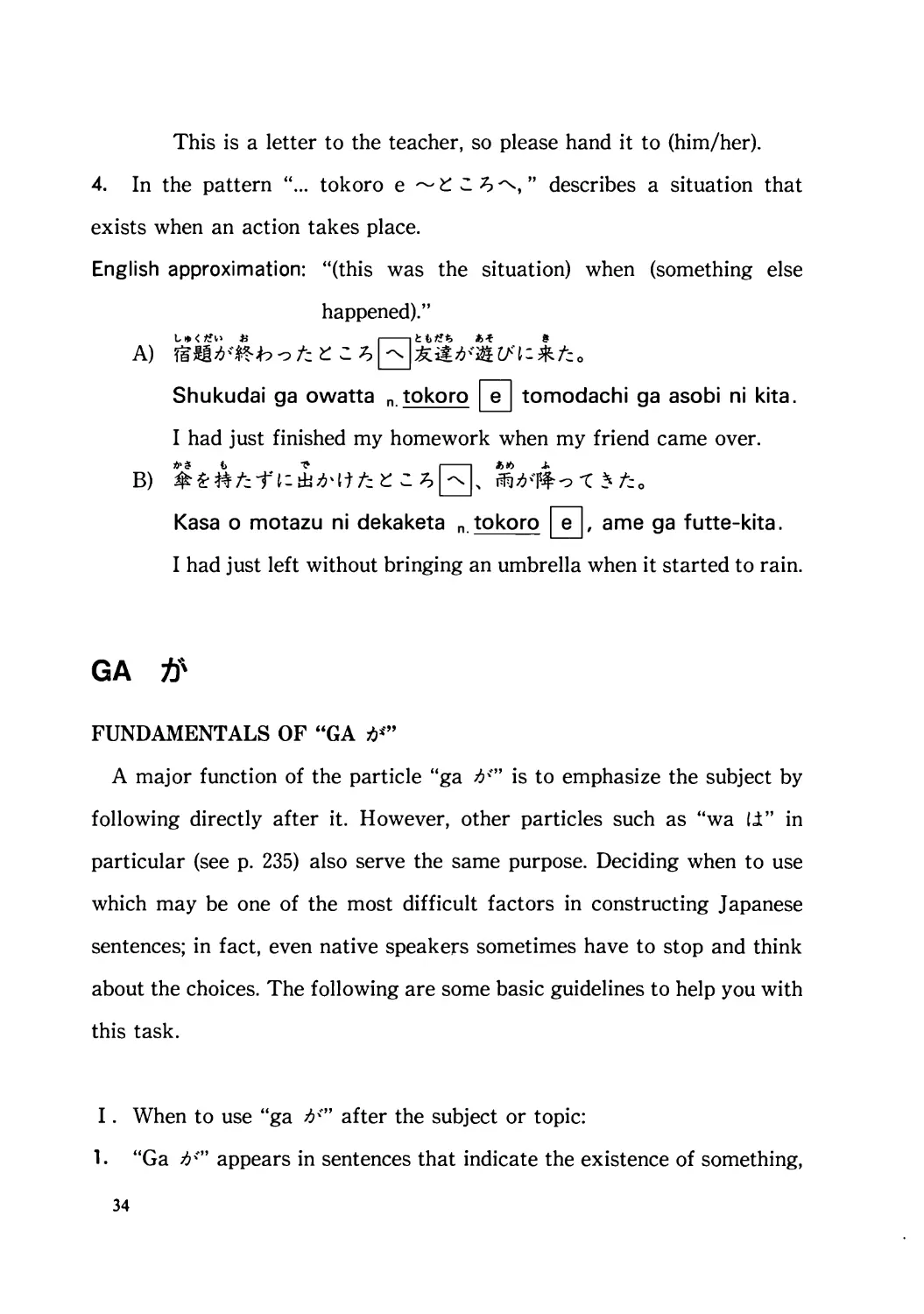
4. In the pattern "000 tokoro e .: 7:J "'-," describes a situation that
exists when an action takes placeo
English approximation: "(this was the situation) when (something else
happened)o"
\.,.. < t!. ) ell: b t!.i;,.t>
A) ffi H! /.) . b "'? t: .: 7:J L::J it /.) . (l t: *- t: 0
Shukudai ga owatta n. tokoro tomodachi ga asobi ni kitao
I had just finished my homework when my friend came overo
fJ' b el .t> J.
B) * # t: -r t: /.) t t t: .: 7:J L::J' f:fu /.) . t"'? '( :: t: 0
Kasa 0 motazu ni dekaketa n. tokoro , ame ga futte-kita 0
I had just left without bringing an umbrella when it started to raino
GA tj'
FUNDAMENTALS OF "GA -IJi"
A major function of the particle "ga /.) ." is to emphasize the subject by
following directly after ito However, other particles such as "wa U:" in
particular (see po 235) also serve the same purposeo Deciding when to use
which may be one of the most difficult factors in constructing Japanese
sentences; in fact, even native speakers sometimes have to stop and think
about the choiceso The following are some basic guidelines to help you with
this task 0
I 0 When to use "ga /.) ." after the subject or topic:
1. "Ga /.) ." appears in sentences that indicate the existence of something,
34
in the sense of "there is/are/was/were 0"" Note that in Japanese, you must
differentiate between living things and non-living things by using separate
verbs that both mean "to be in a place." "Iru \ " is for the former group,
and "aru iJ " is for the lattero
A) A I,;:I \ ( \1..,)o
n. Hite Igal iru (i-masu).
There is a persono
111v
B) * iJ (iJ 11")o
n. Hen Iga/ aru (ari-masu).
There is a booko
Even in talking about the same thing, you must use different verbs
depending on whether or not it is animate:
b)t..: b)t..:
C) .f!!, \ ( \ 1 1") 0 D) .f! iJ (iJ 1 1") 0
n. Sakana Igal iru (i-masu). n. Sakana Igal aru (ari-masu).
"There is a fish." (animate) "There is a fish." (inanimate)
G) --
0"- -
- -
2. To express desire, need, ability or opinion, "ga" follows the topic.
A) bt::.Lti71 A71)-L. "'t::. \o
Watashi wa n. aisukuriimu Igal tabe-taL
35
I want to eat ice creamo
i.P I t..:
B) bt:L'i 1-to
Watashi wa n. eego Igal hanase-masu.
I can speak Englisho
(1)t: lvfl< T
C) {t*'iiT *f '( -t 0
Kanojo wa n. ongaku Igal suki desu.
She likes musico
3. "Ga I;e:" follows an interrogative pronoun or noun phraseo
A) t:tL ll;e:I *1 L t:I;'?
n. Dare Igal ki-mashita ka?
Who came?
t:. b(1) T
B) iJ : t: 'i .Iv *f '( -t 1;' ?
Anata wa n. ph. don-na tabemono Igal suki desu ka?
What kind of food do you like?
t..:1v t:
C) M* ' ''( JI;'?
n. Nan-ji I ga 1 ii desu ka?
What time is good (for you)?
4. "Ga I;e:" often follows a noun that is modified by an adjectiveo
t..:1J. t.:1J'
A) ilt '0
n. Nami Igal takai.
The waves are high.
.Jtlv
B) b t: L 'i 1t , , '( -t 0
Watashi wa n. kibun Igal ii desu.
I feel goodo
-t> .t> "?
C) :g '0
36
n. Heya Igal atsui.
The room is hot.
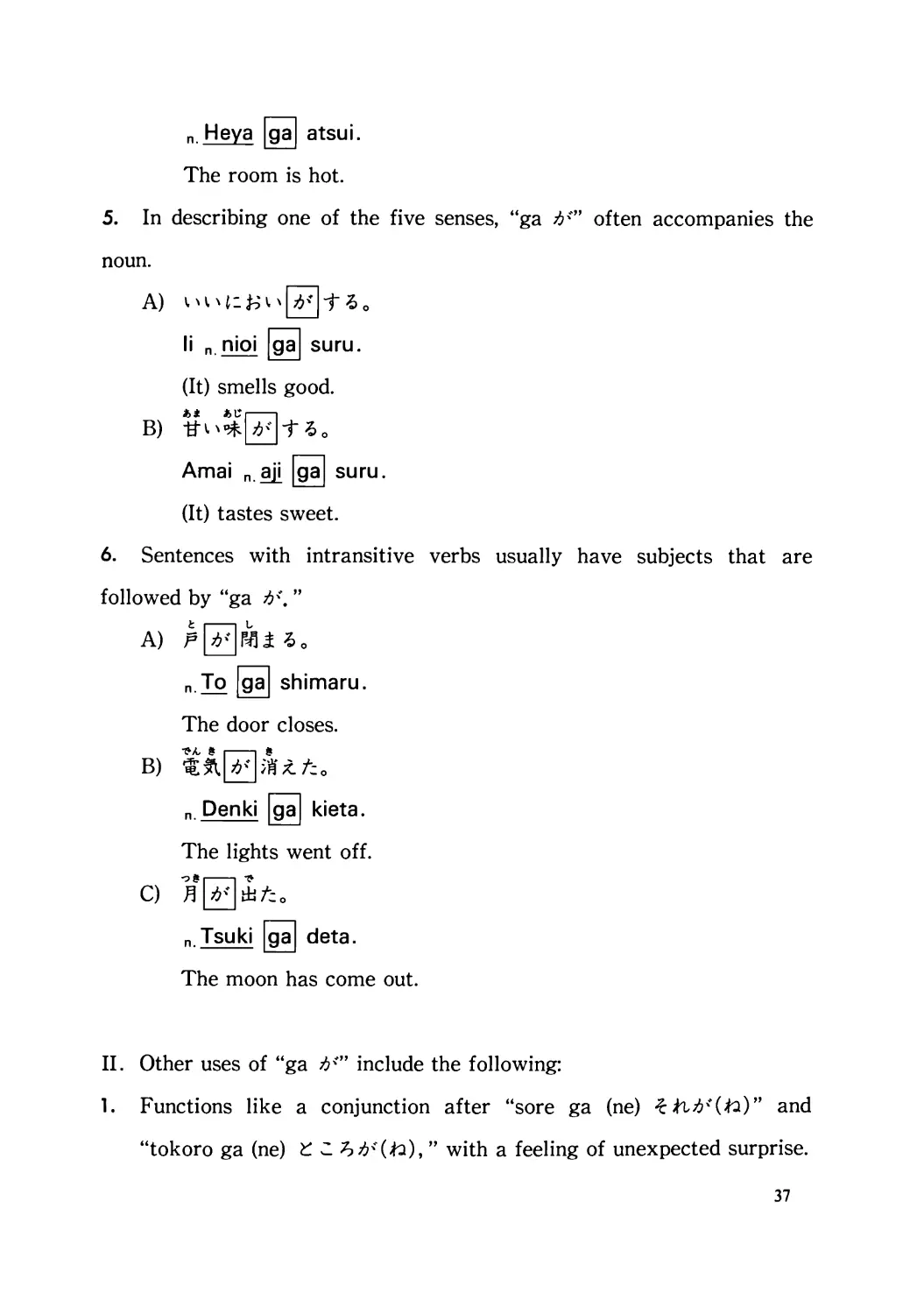
5. In describing one of the five senses, "ga I; '" often accompanies the
nouno
A) q\t:j:? \ II;:I -t o
Ii n. nioi Igal suru.
(It) smells goodo
IJI. 1Jt:
B) 1t \'* -t o
Amai n. Igal suruo
(I t) tastes sweeto
6. Sentences with intransitive verbs usually have subjects that are
followed by "ga 1;:."
A) P II;: I r 1 0
n. To Igal shimaru.
The door closeso
A,
B) 5 it t.: o
n. Denki Igal kieta.
The lights went offo
"?
C) ,ij tJj t.: 0
n. Tsuki Igal deta.
The moon has come out.
II. Other uses of "ga 1;:" include the following:
1. Functions like a conjunction after "sore ga (ne) ;ctl,I;:(.t:l)" and
"tokoro ga (ne) .: I; '(.t:l)," with a feeling of unexpected surpriseo
37
t..:A- .:
A) tL , M t 1":: < j '( \ t: t:o
Sore I ga I , nanto monosugoku konde ita-n da.
But actually, it was really crowded.
1£< t> 1!> h-
B) 'j: t '1 t d.> '( \ t: 0 .: 7:J .t:l, Jt""'? b "'? t: t: .J:, M 0
Boku wa moo akiramete ita. Tokoro Igal ne, mitsukatta-n da yo,
nan to.
I had already given upo But, it was actually found!
2. After a verb, in the patterns "ga gotoku b ',: < " and "ga mama ni b
11 t:."
English approximation: with "gotoku .: < " = "as if", with "mama ni 1
1 t:" = "exactly as (something)"
'itA- " nA- T} 1=A-lfA- .t>f:, tI't..: t:.
A) G:t 'j:, ArB' '1 b , L ':' < :iL"'? '( \ t: o
Sensoo-kinenhi wa, ningen no arasou saga 0 v. kanashimu Igal
gotoku tatte ita.
The war memorial stood, as if grieving over the nature of human-
kind to fight against each othero
il'tL I I \.,
B) {t 'j: , 1" 1" d.> 1 1 t: 1t tip t: ' "'? t: 0
Kare wa, haha no v. susumeru Igal mama ni, gishi ni natta.
Following his mother's advice exactly, he became an engineero
3. Makes an introductory clause before the main point.
English approximation: "as" in the patterns "as for...," "as you've already
heard "0'" etco
"'t' A- < h 'it"? )
A) .fl, '( 1" , t"'? Wf L < IDt 8A L '( < t: \ 0
So no ten c. desu Igal , motto kuwashiku setsumee-shite
kudasai.
38
As for that point, please explain it in more detail.
td IJ Itp < 'it \.::., :k fI b
B) 1" "C t: Ef3 L J:. t f 1 L t: , .: (i') t @J (i') ;JX.:I ';1 ra' it \ ' \ t (i') } \
11" 0
Sude ni v. mooshi-age-mashita Igal , kono keekaku no seekoo
wa machigai-nai mono to omoi-masu.
As I've said before, I think that this plan will undoubtedly succeed.
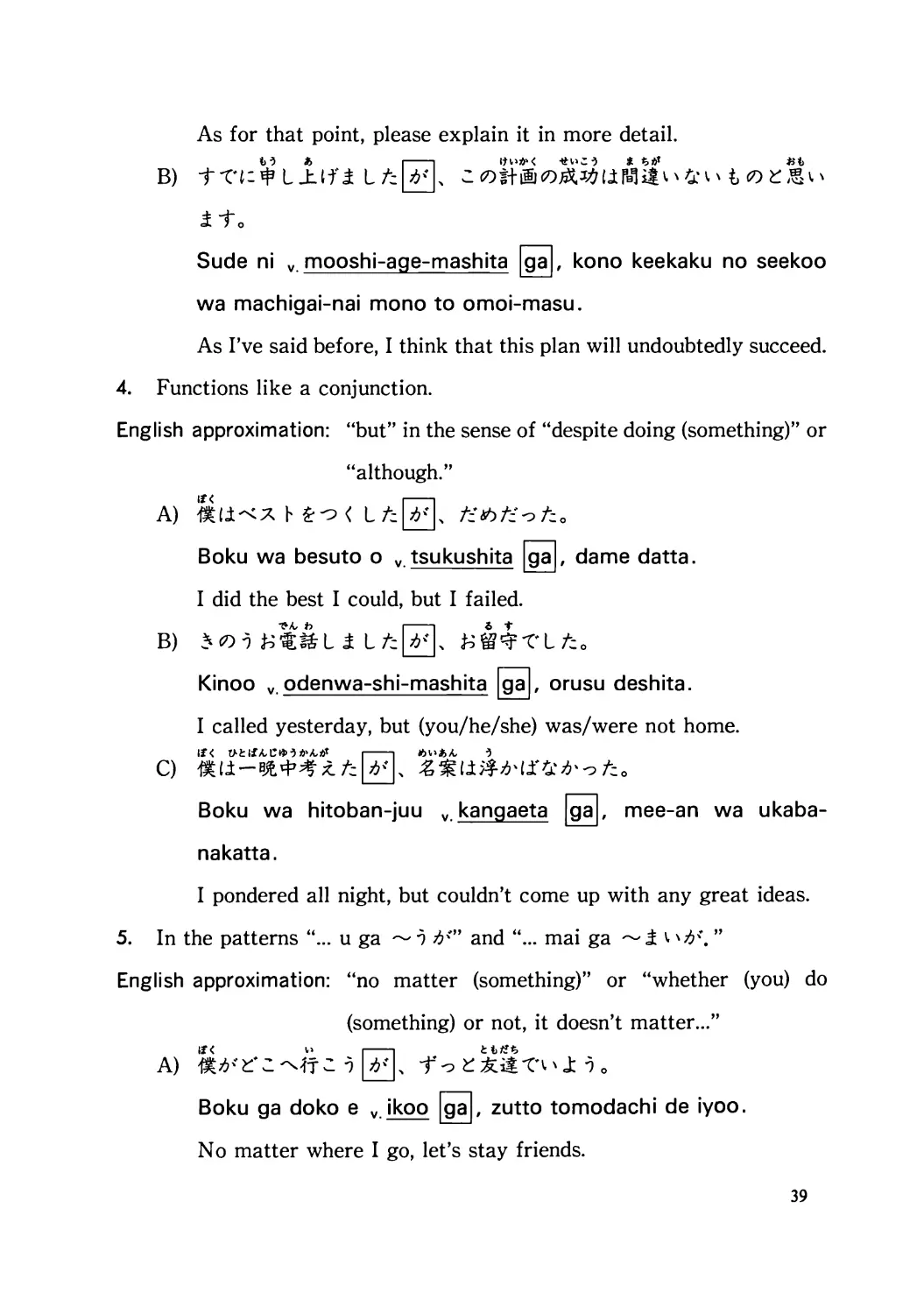
4. Functions like a conjunctiono
English approximation: "but" in the sense of "despite doing (something)" or
"althougho"
It<
A) ';1 A r ""'? < L t: , t: t: -? t: 0
Boku wa besuto 0 v. tsukushita Igal , dame datta.
I did the best I could, but I failedo
Iv h T
B) (i') 1 j:? 't L 1 L t: , j:? m '( L t: o
Kinoo v. odenwa-shi-mashita Igal , orusu deshita.
I called yesterday, but (you/he/she) was/were not homeo
It < TH: If Iv c ., tI'lvtlt \IJ Iv .,
C) ';1 -I!jt tp i.. t: , Z ';1 j /.) ';1 /.) -? t: 0
Boku wa hitoban-juu v. kangaeta Igal , mee-an wa ukaba-
nakatta.
I pondered all night, but couldn't come up with any great ideaso
5. In the patterns"... u ga 1 /.) " and" 000 mai ga 1 \ /.) . "
English approximation: "no matter (something)" or "whether (you) do
(something) or not, it doesn't matterooo"
It< \ t bt!
A) /.) .: 1t.: 1 , f -? 1t '( \.J: 1 0
Boku ga doko e v. ikoo Igal , zutto tomodachi de iyoo.
No matter where I go, let's stay friendso
39
I \" I \" "IJ
B) * '7 , * 1 \ , rB't:*b ' \t: '7o
v. Hashiroo Igal , v. hashiru-mai Igal , mani-awa-nai darooo
(Y ou) won't be on time whether (you) run or not.
6. Indicates wishful thinking in presenting an imaginary, desirable situa-
tion that is the opposite of the current, actual situationo Similar to "noni
t:. " (See po167)
English approximation: "(if "0)' can/would do..., (but "0)"
J.
A) ;9,.JIth t.f \ \ ' iJ 0
Yuki ga fure ba adj.!! Igal naao
It would be good if it were to snow (Leo I wish it would snow)o
t:.fJ' 1Jt:.
B) < t:;9" "'? t: '7 h L \ ' iJ 0
Takarakuji ga atattara adj. ureshii Iga I naa.
I'd be happy if I were to win the lottery (Le. I wish I could win the
lottery)o
7. At the end of the sentence, serves to soften a request or opiniono Takes
a straightforward statement that would sound too direct and transforms it
into a more indirect approacho
English approximation: somewhat akin to the English phrase "I'm wonder-
ing if I could..o" or "(this is what I think), but..."
\.,.i;,J:"
A) 3:-& t: j:? t: ;9';9' t: \ '( -t o
Shachoo-san ni v. omeni-kakari-tai-n desu Igal .
I'd like to meet the president 000
(compare: "shachoo-san ni omeni-kakari-tai-n desu" by itself tends
to sound too forward and impoliteo)
)i;,I;:i;, ."fJ'
B) t '7 - 81*orl t: \ A., '( -t o'
40
Moo ichi-nichi kyuuka 0 v. tori-tai-n desu Igal .
I'd like to take one more day of vacation 0"
b
C) b t::. L U:, .: (i') 1 1 '( \ \ I 1 A-, '( -t I /.) 'I 0
Watashi wa, kono-mama de ii to v. omou-n desu Igal .
I think it would be fine to leave it the way it is ..0
8. Placed at the end of a sentence; exclamatoryo Modifies nouns, and is
said scornfully and disapprovinglyo Men's languageo Not translatable.
A) .: (i') 1 ""'? 5 I /.): I !
Kono n. usotsuki-me Igal '
You liar!
B) .: (i')7'f EJ !
Kono n. gaki-me Igal '
You little brat! ("Gaki" is slang for "little boy," but it often has
negative implicationso)
9. Expresses uncertainty or puzzlement.
English approximation: the nuance is "I'd thought (I)'d done (something)
but..."
l-
A) -6t/.), t: .: .: ,: \ '( j:.) \ t::. A-, '( -t o
Tashika ni koko ni oite-oita-n c. desu Igal .
I had definitely put it here, but ... (Leo "I thought I had put it here
... " )
A, h
B) /.):/.) /.) ",? '( < ';1 -r : A-,t: o 1 L t::. A-,t: 7:J 1 0
Denwa ga kakatte kuru hazu na-n c. da Igal . Dooshita-n daroo.
I'm supposed to get a phone call (Leo he/she is supposed to call me)
0... I wonder what happenedo
41
GA-NA(GA-NAA) tJ - tel: (tJ - tel: ) Combination particle
A combination of the particles "ga I; " and "na(a) ,( iJ)." Expresses
wishful thinking, which is rather unlikely to happen in realityo
English approximation: "I hope ..., though ...."
IJ J. f! "'('A-
A) f:fu I; ' JSt L t::. 0 iJ L t::. 1::0 '7 .::. ''/ '7 U: \ \ j:? t: \ \
11; '(I; iJ) 1 0
Arne ga furi-dashit a. Ashita no pikunikku wa ii otenki da to
adj..!l I ga na(ga naa) I .
It has started to rain. I hope it's going to be a nice day for the
picnic tomorrow, thougho
(1) A- h ., ()
B) 5 1 t {t * ' j: 't I; t t '( .: ' I; -? t::. 0 8 'j: I; t t '( < I 1
II; (I; iJ) 1 0
Kinoo mo kanojo wa d enwa 0 kakete konakatta. Kyoo wa
kakete kuru to v. omou I ga na(ga naa) I .
She didn't call again yesterdayo I think she will call today, thougho
GA TERA tJ L b
Indicates that while one action is being carried out, another related action
is also carried out; much like "killing two birds with one stoneo"
English approximation: " while do ing 0'" on the way, do ... "
.:: () tit?.::., < I I ()C1) \
A) ..:r { -tX t : 1! I; . '( , jt \ t : -1T -? '( .: .J: 1 0
Kodomo 0 gakkoo ni v. okuri I gatera I , kaimono ni itte-koyoo.
While I'm out taking the kids to school, I'll go shopping (on the
42
way)o
"t' * } I I .t:; t: J:
B) j:-; t:j:-; ry L I; '''{ , ;t X .{.,(?)1 "t?t: -?"{ t::.o
Otera ni v. omairi-shi I gatera I , ojisan no uchi ni yotte-kita.
While I was out worshiping at the temple, I went to visit my uncle
(on the way)o
HODO fa: c.'
1. After a quantity, indicates that the amount is an approximation.
Interchangeable with the particle "kurai(gurai) ( \ ( (* \) 0" (See p079)
English approximation: "about" "approximately"
l, t }"':)l,"',)iI'A.. I;,
A) .:: (?)1:t* 'l - V! ra' h '.ftti *-LI; ry .i To
Kono shigato wa ate n. is-shuukan I hada I are ba dekiagari-
masu.
This job will be done in about a week.
}"':) fJ' If'? t.&'? T
B) -7'} 13 "(* I 1*.l1. t: : 0
Ato n. ik-ka-getsu I hada I de natsu-yasumi ni naru.
It'll be summer vacation in about a montho
2. Takes a specific situation and evaluates its extento
English approximation: "to the extent that 0""
fJ'tI. fJ'q)t:J: <
A) 11t 'l , 11t * t : ...} h "{, .l1. "{ \ (?) I; (?) ... L J: t f "{ \ 0
Kare wa, kanojo ni furarete, mite-iru no ga adj. kinodoku na
I hodo I shogete-iru.
She broke up with him, and he's depressed to the extent that just
seeing him makes you feel bad (for him)o
43
?L ? h
B) h t::. L Li:J :/ 7 - Jvt:1f Jm. L , I.J -1 h L I.J "'? t::. o
Watashi wa konkuuru ni yuushoo-shite, namida ga v. deru
I hodo I ureshikatta.
Winning the competition, I was so happy I criedo
3. Followed by a negation, establishes a standard for comparisono
English approximation: "(not) as much/little as ..0"
.: tL '? I;, .t:>.t:>
A) it- (?) f;fu 'l, '-? t f;fu I.J ' < '0
Kotoshi no tsuyu wa, n. itsumo I hodo l ame ga ooku-nai.
During this year's rainy season, there hasn't been as much rain as
usual.
'? T ;i .t:>
B) I1*.l1. 1 ;t L ,t (?)'l '0
n. Natsu-yasumi I hodo I machi-dooshii mono wa nai.
There's nothing that (I) look forward to more than summer vaca-
tiono
4. Often in the patterns "... suru hodo "'-'-r t.1 " and ""0 ba ... hodo
"'-' Lf"'-".1 , "shows that as one thing increases, the other increases as wello
English approximation: "the more ..., the more ...."
n L ? ?
A) : .{., t, *t i1 -r h '.f-r -L -t- t: 0
Na-n demo, renshuu sure ba v. suru I hodo I joozu ni naru.
With everything, the more (you) practice, the better (you) will geto
.: T} J.1I J.1I fJ\ 'I;.
B) it -1 £, l , tS- t t h '.f tS- , 1iffi 1tt I.J 0
Kottoohin wa, furukere ba adj. furui I hodo I kachi ga aru.
As for antiques, the older it is, the more value it haso
44
HOKA (a:7J'
Followed by a negative, it serves to exclude all possibilities other than the
one mentionedo
English approximation: The implication is "nothing except for 000"; the
meaning is similar to "onlyo" Interchangeable with
"shika L fro" (See po182)
v!: 't;, rJ J., t..
A) (7) A it 'j: , t -1 .:: .i "t , "? "t L .i "? "t , "t 'j:, . T @:B 1:t
'b>
7j1.J lj: '0
Ano hito-tachi wa, moo soko made itte-shimatte ite wa,
v. rikon-su ru I hoka I sh ikata ga nai.
For those people, since they've already gone that far, there's
nothing left to do but to get a divorce.
1Ji) J: t.. IJ > 't;,,,, t..
B) '::,{"lj: l.f 'f;fu"t 'j:, 8 (7) ,*'j:o/.Ll: T lj: ,tJ o
Kon-na-ni hidoi ame de wa, kyoo no shiai wa v. chuushi-suru
I hoka I nai nee
Since it's raining so heavily, we can do nothing but cancel today's
matcho
L'
Used mostly in men's languageo Not translatable.
1. At the end of a sentence, serves to emphasize it.
1£<
A) (7) j? t t? , «(7) f.= o
Sono omocha, boku no c. da ITJ.
45
That toy is mine !
B) hLtif "?t hBo
Washi mo toshi 0 totta p. wa ITJ.
(Oh,) I've grown old (sigh)!
C) \I.J 'j: -..:t I.J B?
Ika wa tabeta p. ka ITJ?
Did you eat the squid?
2. Reinforces the interrogativeo
::.lvlflv
A) ?- / \I.J ?
Konban maajan yara-nai p. ka ITJ ?
Why don't we play mahjong tonight?
B) T < * h \I.J B?
Ima sugu korare-nai p. ka ITJ?
Can't you come right now?
KA tJ,
1. Expresses uncertainty of the topic it markso
English approximation: "if" "whether"
111v ) ii '?
A) 8 *' t: -1T < (?), j:, \ '"? t : < h I.J \ 0
Nihon ni iku no wa, itsu ni v. naru I ka I mattaku wakara-nai.
I have no idea when I'll be going to J apano (literally: As for going
to Japan, when it will be, I have no ideao)
fJ'h 11- ') 11- '/ph
B) .: (?) 5PJ 'j:, Jt t t: t t ..t 'j:, ;:Jii- .{., t: 5PJ .{., t: h I.J \ <
.t:U
\.:k \h.o
46
Kono kawa wa, mita dake de wa, umi nan c. da I ka I kawa nan
c. da I ka I wakara-nai kurai ookii nee
This river is so big, you can't tell if it's an ocean or a river just by
looking (at it)o {literally: As for this river, just by looking (at it),
whether it's an ocean or a river, one can't tell-that's the extent of
its size, isn't it?)
2. Expresses a conjecture with an implied sense of doubto
English approximation: "perhaps because of 0""
fJ'1v of l: 1JfJ' ?
A) t oj .:: A,, atr8'I.J o j I.J"'8A \ \ I.J"'1tl.J I.J "'? t.: o
Moo kon-na jikan ka. Soto ga akarui n. see I ka I ki ga tsuka-
nakattao
It's so late alreadyo Maybe it's because it's light outside, I
hadn't noticedo
(f) It 1J'k i 1'k
B) oj -.:, j: IX.l1. T t.: (?) ' 'j: ii:R I.J..' \ 0
Yuube wa nomi-sugita p. no I ka I , kesa wa atama ga itai.
Perhaps I had too much to drink last night; this morning I have a
headacheo
3. In the pattern "... ka ..0 ka '-I.J '-I.J\" lists a number of choiceso
English approximation: ""0 or 0""
h V't.!rJ IH>
A) (?) (?) , Jf- < 5 &I)"t J: 0
Migi n. no I ka I hidari n. no I ka I , hayaku kimete yo.
The one on the right or the one on the left? Make up your mind
quickly!
B) Pi" < (?) [B1tl.J \ (?) [B, #"'? t? (?) ?
Iku p. no I ka I ika-nai p. no I ka I , docchi na no?
47
Are you going or not going, which is it?
4. In the pattern "000 ka 000 -.,I; -.,," gives an approximate number.
English approximation: "(number) or (number)"
I: A.. 1J. A.. tJ 1I T
A) .::. .=. (?) -1 "t? t: L t: tt *, Wl t "? t: o
n. Nido I ka I sando kimi no uchi ni denwa-shita kedo, rusu datta.
I called you at home two or three times, but no one answeredo
t:. 1J."':)iI' J:"':)iI'rJJ:;:'')
B) ht: LitLi.=.a £9a 1tt:ttll; tt.i To
Watashi-tachi wa n. mikka I ka I yokka ryokoo ni dekake-masu.
We're going on a trip for three or four dayso
T.H: J. t:.
C) .i( (?) k- './ T - , - ""? .::. ""? h t: L t: t "t? J: -1 t=.' \ 0
Sono kyandee, n. hitotsu I ka I futatsu watashi ni mo choodai.
Give me one or two of those candies, tooo
5. Placed at the end of a sentenceo
I) Makes the sentence into an interrogative or a rhetorical questiono Not
translatableo
A) (?) -1 Li * -1 L '"( * I; "? t: (?) '"(*T [B ?
Kinoo wa dooshite konakatta no c. desu I ka I ?
Why didn't you come yesterday?
'it A.. of ') J. 'b' q) ')
B) t t (?) 'l PI 1i (?) t=.' -1 ?
Sensoo 0 sakeru no wa fukanoo na no c. daroo I ka I ?
Is it impossible to avoid war?
C) *"t? ;; '"(* \ "? L \ .i T [B ?
Dochira-sama de v. irasshai-masu I ka I ?
May I ask who this is?
2) Indicates a confirmationo Not translatableo
48
I:
A) h I.J "? t: [B 0 t -1 .::. T .{., L \ J: 0
v. Wakatta I ka 1 0 Moo nido to suru-n ja nai yo.
Do you understand? Don't ever do this againo
IIA,t ')
B) * t: Lt:*"t<h.iT ?
Hontoo ni ash ita v. kite-kure-masu I ka I ?
Are you really going to come (on my behalf) tomorrow?
3) Rhetorical questiono Not translatableo
A) -1 L "t ;C'{" 1.J 1i L h t: -1 [Bo
Dooshite son-na koto ga shinji-rareru c. daroo I ka I .
How can (I) believe something like that?
.f,) ,)
B) .{., t: Li, t:'hl.J ' 1 L t: t:' -1 [Bo
Kon-na koto ni naru to wa, dare ga soozoo-shita c. daroo I ka I .
Who would have imagined that this would happen? (literally: As for
this happening, who would have imagined?)
.t. 'b' {}t rd'
C) .{., 1?( 0/ t:AI.7 ' .tJ"t < I.J -1 o
Kon-na yonaka ni hito ga tazunete kuru koto ga v. aroo I ka I .
Is it possible that someone has come to visit at such a late hour?
4) Expresses a rebuttal or objection to a previous sentenceo Not translata-
ble.
A) ;c .{., "? "t .{., "t L J: -1 [B 0
Son-na koto-tte aru-n c. deshoo I ka I .
Can something like that really happen?
11 A, t ') t! ) t: J: ') J:
B) * t::k * "t L J: -1 o
Hontoo ni daijoobu c. deshoo I ka I .
Is it really going to be all right?
49
5) Adds a critical, scolding toneo Not translatableo
e fJ> Iv I.> of {H;
A) .:: .{., ra' .i "t .{., ..t < 7.J A. I; . 'J .i T 0
Kon-na jikan made asonde-kuru hito ga v. ari-masu I ka I .
You're out playing so late! (literally: "Is there anyone who'd stay
out playing until this hour? ")
'k.q) "(' fJth t! b"t
B) .{., t: Ji'{" t.= (?) t:.. .:: (?) -t- ttl T (?) / h t.: (?) 0
An-na ni tanonda no ni, kono tegami dasu no 0 wasureta p. no I ka I .
I asked you so many times, and still you forgot to mail this letter!
6) Often in the pattern "000 de wa/ja nai ka "t'"(j: \I;'/L',\,> \I;,,"
asks a rhetorical question for emphasiso
English approximation: "wasn't it so that 000"
I.> fJ> fJ> i.
A) sA 7.J \ -1 "t? t: W"'? "t j? \ "t'" \ "'? t.: "t (j: \ 0
Akarui uchi ni kaette oide to itta de wa v. nai I ka 1 0
Didn't I tell you to come home while it was still light outside?
B) I; t.="t?.. (?) -1 (j:"t t.: t.: '\'> \ 80
Sakadachi, kinoo wa dekita ja v. nai I ka I .
Weren't you able to do a handstand yesterday?
7) Makes a casual suggestiono
English approximation: "why don't we 000" " do you want to 000" " let's 000"
fJ>i. )"':)It )
A) w'Jt:-*f -1 o
Kaeri ni ippai v. yaroo I ka I .
Do you want to have a drink on our way home?
)'I;. 'k.l,
B) t -1 - Ji: ,Gfll; &I)"t .l1. J: -1 t.: '\'> \ 0
Moo ichido tashikamete miyoo ja v. nai I ka 1 0
Why don't we make sure one more time?
50
8) Often in a "... tara doo ka '- t::. -c: oj/r" pattern, makes a roundabout,
softened commando
English approximation: "why don't you do 0""
) )
A) .i( A.- t: 1T t::. \ (?) , 1T"'? "( 7-;. t::. * oj 0
Son-na ni iki-tai no nara, itte-mitara adv. doo I ka I .
If you want to go that badly, why don't you go?
{H; l,A..lt ) {H;
B) 'J "(* I G L "( \ J: 'J, \ 7:> A.- A. t : I1f} \ "( 7-;. t::. * oj 0
Hitori de shinpai-shite-iru yori, iron-na hito ni kiite-mitara adv.
doc .
Instead of worrying all by yourself, why don't you ask lots of
people (for advice)?
9) As a sort of self-utterance, often with a reminiscent or some emotional
overtoneo Not translatableo
A) .i( oj [B 0 oj oj L t::. [B 0 J: < "'? t::. 0
adv. SOO I ka I . Tootoo v. gookaku-shita I ka I . Yoku yatta na.
Really, (you) finally passed (the test)o (You) did well.
'IJ"f ?t1. ) J:3t1
B) iJ A.-t::, Jj 0 I.J J "'? t::. o
Naan da, n. kage Ikal . Yuuree ka to omotta.
Oh, it's only a shadowo I thought it was a ghost.
KA-I fj'-l,' Combination particle
A combination of the particles "ka I.J " and "i \." Placed at the end of a
sentence to indicate that it is an interrogative, or to express that it opposes
the statement that was just previously made by another part Yo
51
Emphatico Not translatableo
A) ;c 'J , -1;c L \ EJ ?
Sorya, uso ja v. nai I ka i I ?
Isn't that a lie?
"('Iv I;, J.
B) '::A.- \ \ t:, f:f.J A.-I.J t tA.- o
Kon-na ii tenki ni, ame nan ka furu n. man I ka i 1 0
When it's this nice out, there's no way it's going to raino
C) .tf jt? ;c A.- t A.-1i' L EJo
Kaidan? San-na mon v. shinjiru I ka i I .
Ghost stories? I'd never believe in something like that!
fJ' )t!1v
KA-NA(KA-NAA) tJ,- tel: (tJ'- tel:07J) Combination particle
A combination of the particles "ka I.J " and "na :" or "na(naa) (
)o"
1. Casually expresses doubt, with a very light exclamatory tone.
English approximation: "(I) wonder ...?"
t! )fJt < ... ') l, ;: l: l,
A) * A -\, it-.::;c 'l -1 .i < \ < II.J (I.J ) 1 0
Daigaku ny uushi, kotoshi koso wa v. umaku-iku
I ka na(ka naa) I .
I wonder if maybe college entrance examinations will finally go
well this year?
{}l: I} I I
B) -1 L "t - A "t ttil.J t t t: (?) I.J : (I.J ) 0
Dooshite hitori de dekaketa p. no I ka na(ka naa) I .
I wonder why (he/she) went out alone?
52
2. Used in making a suggestion to oneselfo
English approximation: "(I) th ink/(I) will do ..0"
A) :J - t - .'e t \ tL l 1 In' ' (n' ' ) 10
Koohii demo v. ireyoo I ka na(ka naa) I .
I think I'm going to make some coffee ...
fJ'
B) 1 o
Soro-soro v. kaeroo I ka na I .
I think I'm going to go home soono
3. In the pattern ""0 nai kana -., \ n' '," indicates wishful thinkingo
English approximation: "I wish (it) wou ld ..0"
1;1 l;1lJ I !
A) if- < $ t: \ n' (n' ' ) 0
Hayaku haru ni v. nara-nai I ka na(ka naa) 1 0
I wish spring would come soono
c l;t t......?i>.t fJ' I I
B) j:? X Ivif- < ttl 7J:.n' ,-? "'( .: \ n' (n' ) 0
Otoosan ha yaku shucchoo kara kaette v. ko-nai
I ka na(ka naa) 1 0
I wish Dad would come home soon from his business tripo
KARA tJ, b
FUNDAMENTALS OF "KARA '1;>. "
In general, you can understand the function of "kara n' " by identifying
the part of speech of the word immediately preceding it. When "kara n' "
is placed after a noun or a nominal it usually means "from," whereas after
an adjective or a verb and a copula, "kara n' " usually indicates reason or
53
causeo
1. Placed after a noun or a nominal.
1) After a pronoun, interrogative pronoun, a person's name or social
position, indicates that an action or a deed is directed from that persono
English approximation: "from"
Watashi wa sana hanashi a n. sensee
I kara I kiki-mashita.
I heard that story from my teacher.
1;1f,,: t... 'it 'it \ r=7l !I
A) h t L L1 cry * ;t $. r:d1 .i L t 0
B)
11 r=7l fJ'
C) cry*- t.:.tL it .i L t ;?, ?
Sana han a n. dare I kara I kari-mashita ka?
From whom did you borrow the book?
'it 'it \ r=7l 11
D) h t L U: ;t$. tV) tL"'( "3 tL L ;?'"? t o
Watashi wa n. sensee I kara I hamerarete ureshikatta.
I was happy that my teacher gave me a compliment.
r=7l 1;1f,,:
E) t * "3 * j:? L < t * l \ 0
n. Anata I kara I daaza ahanashi kudasai.
54
Please, if you could start talking first. (literally: (Starting) with
you, please tell us your storyo)
1;1 < 'J?
F) h t::. L t if- < !£iL L t::. \ Iv "'( -t 0
Watashi mo hayaku n. ova I kara I dokuritsu shi-tai-n desu.
I, too, would like to become independent from my parents soono
2) Placed after a noun, showing a place/space, indicates that something
starts/started at that placeo
English approximation: "from" "through" "out of" "in"
fJ'tt. < Q t fJ' l: t!.
A) 1t ,j: ;t; 7- ')I r Jtt cry JPt tB L t::. 0
Kare wa n. poketto I kara I kuruma no kagi
o tori-dash ita .
He took his car keys out of his pocket.
-!>It? t I;1 \
B) 5Jt*'j: A"?t::. L \o
Doroboo wa n. made I kara I haitta rashii.
It looks like the robber got into the house
through the windowo
C) * I ' I Iv .:. :tt "'( t::. o
n. Ki I kara I ringo ga ochite kita.
An apple fell from the treeo
t.: \J:? VfJtt... o)lt
D) 7.\. 'j:JR Jt ! -to
Taiyoo wa n. higashi I kara I nobori-masu.
The sun rises in the easto
-,,' A
=./
OO -=-_
55
<t:.t? J. t: A.. h
E) *7 It.-cry&...t II)' 1 'f:i:-L-Li?:JL;{..i L t o
Hoteru no n. okujoo I kara I Fujisan ga mie-mashita.
I saw Mt. Fuji from the roof top -7,i?/ . -:::
.< G
of the hotel. O" ()
- 0"
-=-"==
? T.} .::
F) A 7 './ F 7 "7 A Ii?' 1 7 8 i? " L Iv .'e l \ ; 0
n. Sutendogurasu I kara I yuuhi ga sashi-konde-iru.
The rays of the setting sun are shining through /
/
the stained glasso
/
i> t...!1 11A..
G) h t L ,j: cry t1 *- 1JJ=.i L t o
Watashi wa sono chishiki 0 n. hon I kara I
e-mash ita.
I obtained that knowledge from a booko
3) After a time word, indicates that something begins/began at that
moment.
English approximation: "from" "at" "since"
I: 11A.. t:... .t? '-' < t: I!t:
A) 8 *- cry t ,j:.. 1L * Ii?' I .i .i -t 0
Nihon-go no jugyoo wa, asa n. ku-ji I kara I hajimari-masu.
The Japanese language class begins at nine
o'clock in the morningo
e)
56
I'; \t......? i> fJ> '"C? n"
B) * 1J! i_J ri ;?"1 ..ttft: ; 0
n. Raishuu I kara I chikatetsu ga ne-age ni naru.
From next week, the subway fare will go upo
\offJt J:lJ n
C) h t::. L U:, ,tt L < "'(, cry "3 cry1« -r"? "'( l \.i /VO
Watashi wa, isogashikute, ph. kinoo no yoru I kara I zutto nete
i-masen.
I've been so busy that I haven't slept at all since last night.
t.:."'I!t.:. trfJ\t... I: 11A.. ?t.:. .t? t:
D) -1: :1 'l.. * 8 *- t : 1 h "? "'( l \ ; 1T * "'( -t 0
Tanabata wa n. mukashi I kara I nihon ni tsutawatte-iru gyooji
desuo
The Tanabata festival is a traditional event observed since olden
times in J apano
I: 11A.. !I I: nA..
E) h t::. L 'l, 8 *- t: * "'( t "3 ..::. t: .i -t 0
Watashi wa, nihon ni g. kite I kara I moo ni-nen ni nari-masu.
Two years have already passed since I came to Japano
of J. t,,: nA..
F) lI.X;?,.t: < "?"'( .n. t::. .i L t::. o
Sofu ga g. nakunatte I kara I go-nen tachi-mashita.
It's been five years since my grandfather passed awayo
4) In the pattern" 000 kara 000 made ;?' .i "'( ," shows a range/span of
space or timeo
English approximation: "from/to" "between"
J:? i> ;tA.. &.: \ J:A.. \ .: l:bt.:.i>
A) .: cry 1ft tW t : 'l , ..::. ;j£ ;j£.i "'( cry -t f 11 ;?' l \ .i -t 0
Kono yoochien ni wa, n. ni-sai I kara I yon-sai made no kodomo-
tachi ga i-masu.
57
There are children between the ages of two and four at this
kindergarteno
1: J: 1: I, \t!!I
B) .=. * b *.i .'e cry ra' t: *"'( < t::.*::: l \ 0
n. San-ji I kara I yo-ji made no aida ni kite kudasai 0
Please come over between three and four o'clocko
!I 1: Th Th J:
C) h t::. L U:, cry c* b .i "'(* h.i L t::. 0
Watashi wa, sono kiji 0 n. sumi I kara I sumi made yomi-mashita 0
I've read the article from the beginning to the endo (literally: from
one corner to the other)
D) v A r "7 /' l \ "? "'( t, 1::0 /' I h' I .i "'(* lY> .i -t 0
Resutoran to itte mo, n.2l!! I kara I kiri made ari-masu.
When it comes to restaurants, there's a wide range of themo
(literally: from the first to the last)
':H,.t < n J: 1: 'b'
E) 7 "'( b ; .i ",( t: *ra' lY> ; 0
Yuushoku 0 g. tabete I kara I neru made ni yo-jikan aru.
After dinner, I'll have four hours before I go to bedo
5) In the pattern "000 kara 000 e I)' "'," the particle "kara I)' " is
placed between repeated words, to indicate that the same action occurs
one after another in successiono
English approximation: "one after another"
1;1f,,: rJ ? ? ? I,
A) 1t:kh:, ;xb;x"' T ..ttf tLt::.o
Hanabi ga, n. tsugi I kara I tsugi e to uchi-
agerareta.
.:' 0 ';'.. \./.
. .: Od", .':' . ..... , .
., .' ,,' ': ...- ,, ..: . t :.
............\ ! .-... /.'.... ..
.-?t :. oOli °,°,1 I III I
1111
_\Oto:,
;,. \ .
:/'. .
. . ".
Fireworks were shot up into the sky one after
\ ,"I .
anothero (literally: from next to the next)
It '1 url
58
tHth ? r= :-r) J:
B) *,Jtl;' .. ;xb;x 4'L ",( t::.o
Oo-nami ga n. tsugi I kara I tsugi e to oshi-yosete kita.
One after another, great waves came rolling ino
d' (.
k T.}':1!1 t...:! t...:! l:
C) ht::. Li!'j:m1t "'( b mlvt.:o
Watashi-tachi wa hikooki de n. shima I kara I shima e to tonda.
We flew by plane from one island to anothero
iPs-
6) Indicates the composition of somethingo Interchangeable with the
particle "de "'( ."
English approximation: "from" "of" "out of"
1;1 {,(l) ':1-C? ?<
A) )] 'j: i bi'f tL .i -to
Hamono wa n. kootetsu I kara I tsukurare-masu.
Cutlery is made of steel.
.ff
:' ! I "- .
,V - .a:
" ',' I,'
B) \ / 'j:"J' II;' I ii .i -to
Pan wa n. komugi-ko I kara I tsukuri-masu.
(We) make bread out of flour.
t} , £fiJh
M (j ts
(( '1 " ,I
t . I : ' /1
1'1" ,
59
11 fJ'h
C) *-'j: .'e "'( l \.i -t 0
Hon wa n. kami I kara I dekite i-masu.
Books are made of paper.
I: 11 J: ? t... :!
D) a *- ,j: -? cry -* l \ II)' I "? "'( l \ .i -to
Nihon wa yottsu no ookii n. shima I kara I
natte i-masu.
Japan consists of four big islandso
<I: It \ \ It'j;t!l t......?&.:...? t,,:
E) .:: cry 00 cry k&5 'j:, ,: l ; t{X. A iL"? "'( l \ ; 0
Kono kuni no keezai wa, booeki ni yoru n. shuunyuu I kara I
nari-tatte-iru.
The economy of this country is based on its trade income.
7) Placed after a noun, indicates an approximate amount/number.
English approximation: "as many as" "as much as" "no less than"
v < t!. \ fJf t,,:
A) 8" cry -* r -7 ''/ 7 i?'"AEIv "'( l \ ; 0
n. Hyaku-dai I kara I no oogata torakku ga narande-iru.
More than one hundred big trucks are lined upo
'it &.: fJ' ::.?!I < :! \I:i> t"f"
B) 1- A crytt:7\:. 1;i?", ./ita.::.:: t5tL; 0
n. Sen-nin I kara I no kankoo-kyaku ga, mainichi koko 0 otozure-
ruo
As many as one thousand tourists visit this place every dayo
2. Placed after an abstract noun, an adjective or a verbo
I) Indicates a cause or a reason for an action/attitude that is described in
the predicate clauseo This inverted structure makes the sentence
60
emphatic.
English approximation: "as" "so" "since" "due to" "for" "because" "con-
sidering" "seeing"
fJ>f;t. T fJ>
A) j:? ,@,b: b'"? t.: t.: < Iv}{ l \.1 L t.: o
Osakana ga adj. yasukatta I kara I takusan
kai-mashita.
Because I found the fish inexpensive, I
bought lots of themo
!I .t ? '"CA- !I < I'; :!A.. >p
B) 8LIl\l\j:? t.:' .. {*'l r#Jt: ;t.:' "3o
Kyoo wa ii otenki c. da I kara I , sakura wa mankai ni naru daroo.
Since the weather is very nice today, cherry
blossoms will probably be in full bloomo
!II'; -t!?'k. \ 'k.
C) h t.: L 'l 7 o 'Y '::J 1) 'l**l \ t.:' .. t: '" l \0
Watashi wa burokkori wa kirai c. da I kara I , zettai ni tabe-nai.
Because I don't like broccoli, I never eat it.
I: If A.. :: t:.t?'" \? t....t? ItA..jI') \--tA..!I.t?
D) 8* ;?:..t t: t.:l\ .. -$. j L.1-to
Nihon-go ga joozu nl v. nari-tai I kara I , isshoo-kenmee
benkyoo-shi-masu.
Since I want to be good at Japanese, I'll work hardo
!lh C bt.!i> "t'>!1
E) t: 1!;?:I:!:f:* l \ cry 'l.. "3 t:'l ;?' l \; t.:'.to
Kimi ni tomodachi ga deki-nai no wa, uchi ni bakari v. iru I kara I
da yo.
The reason why you can't make friends is that you stay home most
of the time.
61
11< T !lh t...
F) ;?{* .:' L t: cry 'l.. ;?"ft;{. "'( < tL ;?'"? t: t.= ' 0
Boku ga nori-sugoshita no wa, kimi ga v. oshiete-kure-nakatta
I kara I da zoo
The reason why I missed my stop was that you didn't tell me
(where to get off)o
fJ'tt. ?t J. b ?!I.t
G) 1t'l.. cry :fp .. 'l% L t: o
Kare wa tsuma to no n. fuwa I kara I , bekkyo-shita 0
Due to the fact that he didn't get along with his wife, they separat-
edo
fJ'tt. .: oj .: oj 'it ,'it t... .t oj fJt < !I A..
H) 1t'l.. 'fXcryh Ji , * t "3 .: t: "? t: o
Kare wa, kookoo no n. seeseki I kara I , shoogakukin 0 morau
koto ni natta.
Because of his (excellent) grades in high school, he is to be granted
a scholarshipo
2) Placed after an abstract noun, indicates one's judgment/viewpoint.
English approximation: "from a viewpoint of" "judging from" "by"
"according to"
h t... t fJ'A..t.:.A..
A) t: cry o&. JL tL 'l' .. .: cry 1:t * 'l ¥a' Jtt "'(' L J: "3 0
Anata no n. me I kara I mire ba, kono shigoto wa kantan deshoo.
From your viewpoint, this task may seem to be easyo
-c fJt h , J: oj I! A.. t.! A.. fJ'tt. fJ'i>.t oj t... .t oj t... A..
B) .: cry cry J*J ':{;. l¥'l Irr -t ; .. 1t 'l -& t : Jt- it -t ; L l \ 0
Kono tegami no n. naiyoo I kara I handan-suru to, kare wa
kachoo ni shooshin suru rashii.
Judging from the contents of this letter, it seems that he will be
promoted to managero (literally: section chief)
62
\ il t < -c It A. 1;, iI'tt. It A. ItI ., I., .t ., I.> t.: \
C) * 81 J 3tk 1" kt (,1' , 11t Cl) 1E (.1 / - Iv'" t: t 1 1" 0
Igaku-teki n. kenchi I kara I sure ba, kare no kenkyuu wa
nooberu-shoo ni mo atai suru.
From a medical point of view, his research is worth the Nobel
Prizeo
3) Placed after an abstract noun of emotion, indicates that such an
emotion results in the action/state described in the predicate clauseo
English approximation: "from" "out of" "due to"
A) b t:. L (.1 oj kt L I h' G I u'lh"--? t:. 0
Watashi wa n. ureshisa I kara I tobi-agatta.
I jumped for joyo
'1< < ? < A. \ I.>
B) 'j: , .I. t? J: "'? L t:. \ \ t t Iv h' L --C L "'? t:. 0
Boku wa, kudoo-kun to chotto shita n. ii-ai I kara I kenka-shite
shimatta.
I ended up having a fight with Kudo over something that arose out
of a minor argument.
iI'tt. -tt ,: A. ii' A. t: I., .t <
C) 11t'j:"H: t L t:.o
Kare wa n. sekinin-kan I kara I jishoku-shita 0
He resigned from his office out of a sense of responsibilityo
3. In the pattern" 000 kara to itte "J h' G \ "'? --C ," introduces a restriction
or a warnIng.
English approximation: "even though"
.: ?iI' ?iI' 1"
A) h J · it \ t G "'? t:. \, \ "'? --C, 1t \ ::: , 1" < t:J: <
10
Okozukai 0 v. moratta I kara I to itte, tsukai-sugiru to, sugu
63
nakunaru yo.
Even though you've received an allowance, if you spend it too fast,
it will soon be goneo
B) ¥ \ Ih' I \ "'? --C, t: < Iv it "'? --C Li \ t t -\t Iv 0
adj. Yasui I kara I to itte, takusan katte wa ike-masen 0
Even though they may be a bargain, don't buy too many at a timeo
f.t vt 'J I.>l» ItA.
C) ,t1t kt t: .: .; t.:' \ "'? --C, - A. --C < Cl) (.i.te --C i" 0
Nareta tokoro c. da I kara I to itte, hitori de aruku no wa kiken desu 0
Even though you are familiar with the area, it is dangerous to walk
around aloneo
4. In the pattern "000 kara ni wa -., h' t: (.i," expresses a determination
or a resolutiono
English approximation: "since" "now that"
A. J:? ?iI'< h
A) .: kt t.:' t t L t: t: (.i , "'? * a. L --C it -\t 0
Kore dake v. benkyoo shita I kara I ni wa, kitto gookaku-shite
miseru zo.
N ow that I've studied this hard, I will pass the entrance exam
without fail!
ilt \.: < \ J,:A. ii' l,
B) ? OO"" t < t:(.i, .: Cl)j(1t 1 < t1 lj.'ttktLflj.' \0
Gaikoku e v. iku I kara I ni wa, soko no bunka 0 yoku shira-
nakere-ba-nara-nai 0
N ow that you are going to a foreign country, you must got to know
its culture very well.
iI' \ l,.If' I': 1tI? l,.If' \? l, J: ? It A.1I'> \iltA. If
C) .: Cl) .:I: t : A. tl: L t: t: (.i , - j:. jilt .; oj 0
Kono kaisha ni v. nyuusha-shita I kara I ni wa, isshoo-kenmee
64
ganbaroo 0
N OW that I've been accepted by this company, I will do my best.
5. In the pattern "000 kara ni "JI)' t:o"
English approximation: "just by doing ..."
iI'(1) t: J: h vt
A) 11t* (.i it t: 1 L oj t;;: A "'( -t ho
Kanojo wa v. miru I kara I ni yasashi-soo na hito desu nee
Just by looking at her, you can tell that she's probably a very kind
persono
;:" l;if,tl,
B) kt(.iBf1 < t:f \t*t.:'o
Sore wa v. kiku I kara I ni kowai hanashi da 0
Just by listening to it, the story sends a chill up my spineo
KARA-SH ITE tJ, b - U L Combination particle
A combination of the particles "kara 1;' " and "shite L"'( 0"
1. Cites one characteristic of something/someone in order to make an
emphatic statement about the whole thing/persono
English approximation: "starting with 000"
l:> t ;: V t ii' l:> "Iv
A) Cl)Jj Cl)A(.i6rt"'? II;, L "'( I t? J: "'? "$:.t: o
Ano otoko no hito wa n. kaotsuki I kara shite I chotto hen da.
Starting with his face, he is a little strangeo
ii' (1) t: J: t> t> (1) I I
B) 11t * (.i # t? b) 1;' L"'( -\f' \ t.: < t: 0
Kanojo wa n. mochimono I kara shite I zeetaku da.
Starting with her possessions, she is extravagant.
2. A more emphatic form of "kara 1;' " used in the sense of "because/
65
since"; similar to "node "Co"
English approximation: "conseq uently"
.: t l, l,1tI? l, I.> ii' t: I I f:, }nh.- < t:
A) 1t- j:(l;jf- "C I;' L --C , *1t-(l 1j.'Iv I;',W. t: L 110
Kotoshi no shuushi wa akaji c. de-aru I kara shite I , rainen wa
nantoka kuroji ni shiyoo.
Our balance sheet is in the red this year; consequently, let's try to
somehow come o ut on top next year 0
I I .;. 'J iI'i:;'iI'lt?.: h.-
B) 1 \ 1 1 b t.:' 1;' L --C , -=- A (l 1ft f.a 1" t.:'"h 1 0
Soo-yuu uwasa c. da I kara shite I , ana futari wa chikajika
kekkon-suru daroo 0
Since that sort of rumor is going around, consequently, it's likely
that those two will get married soono
KASHIRA 1J'ub
Found in women's languageo
1. Following an interrogative pronoun, poses a questiono
English appro ximatio n: "(I) wonder 000"
I I }* t
A) t.:-tL 1;' L , t F Ii: t:. t:. < (lo
n. Dare I kashira I , imagoro to 0 tataku no wa.
I wonder who is knocking on my door at thi s hour.
l, I I
B) -Gt 1;' t: .: .: t: \ t:. (l -r t.:- t t *, \ b 0 *.: 1;' L 0
Tashika ni koko ni oita hazu da kedo, nai wa 0 n. Doko I kashira I .
I thought I had definitely put it here, but it's not hereo I wonder
where it could be?
66
J;;J;; ??h
C) * t:J:t!.ho :I: II.I'L "'1 0
Ookina tsutsumi ne. n. Nani Ikashiral . LLLJ-:
That's a big packageo I wonder what it is? 1
dJ
o
2. Casually softens a question or a sense of doubt addressed to oneself or
another part Yo Not translatableo
I! Iv fJ' I I
A) .:: * }t "'? t:. , \ "? t: "'? t:. 1;' L 0
Kono hon 0 katta no, itsu c. datta I kashira 1 0
When was it that I bough t this b ook?
> I I It
B) b t:. L, i-'{" lj.' .:: "'? t:. 1;' L 0 1t i.. --C \ \ t t # 0
Watashi, son-na koto v. itta I kashira I . Oboete-i-nai kedo.
Did I say something like that? I don't remember it.
3. Softens an interrogative sentenceo Not translatableo
':Iv
A) (.i \ "? \ "'? L \ 1" II;' L 1 0
Kondo wa itsu v. irasshai-masu I kashira I .
When will (you) be coming by again?
.t ? h-tt I> I I
B) 8 m (.i r#1 \ --C \ 1;' L 0
Kyoo mise wa v. aite-iru I kashira I .
I wonder, is the store open today?
4. Makes a casual suggestion to oneself or another part Yo
English approximation: "s hould (I /we) do 0""
.: Iv II Iv > fJt It> I 1
A) @J t: t.:: oj 1;' L 0
Konban eega ni v. ikoo I kashira I .
Should I go to the movies tonight?
67
B) 7-;f i"? r .; 1 1 h L G 10
Keeki 0 katte v. kaeroo I kashira I .
Should I buy a cake on the way home?
5. Following a negation:
I) Indicates wishful thinking or softens a statement asking someone for a
favoro
English approximation: "I wis h ..." "c ould (you) do 0""
I;I: ? ii' < ?? 1;, .:: 1 I
A) Jf- ( a.i! t1h: =* \ h L G 0
Hayaku gookaku-tsuuchi ga v. ko-nai I kashira I .
I wish the acceptan ce lette r would arrive soono
\*!: 1 I
B) i" (* =* ( tL \ \ h L G 0
Ima sugu v. kite kure-nai I kashira I .
Could you come right away?
2) Expresses concern over an uncertain or potentially negative situationo
English approximation: "I wonder ..0"
\ * t:. ? t: !: l,.If' * I> 1 I
A) ttl h t t.. + '* cry 71..!¥- t: ra' t: '1 h L G 0
Ima dekake te mo, juu-ji no kisha ni v. mani-au I kashira I .
Even if you were to leave now, I wonder if you could make it in
time to catch the ten o'clock t rain.
B) ?c cry A - ''J 7 - A.. i T \ \ 1 h L G 1 0
Sono suutsu-keesu, v. omo-sugi-nai J kashira I .
I wonder if that suitcase isn't too heavy.
68
KE (j-
Colloquial. Usually placed at the end of the sentence after the copula "da
t ," which is the informal form of "desu .'(*1" ," to form patterns such as
"dakke t "'? t" and "dattakke t "'? t::. "'? t ."
1. Used in reminiscing about a past event.
English approximation: "((I) remember)"
1 !: (1)lt
A) "J \ \ , 1 < * L t::. t Cl) ( t Iv) t "'? 0
Chiisai toki, yoku ki-nobori 0 shita mono (mo-n) c. da -k l ke t .
When (I) was little, (I) used to climb trees all the time, (I remember).
l:': 1
B) i- oj \ it (,1*, i- Iv P1T"'lf"'? t::. "'? hit 0
Soo ie ba, son-na tokoro e v. itta -k ! ke I nee.
That's right, we did go somewhere like that, (I remember) (didn't
we)o
2. In an interrogative, actively solicits an answer from the party addres-
sedo
English approximation: "when is/was it ...?" "what is/was it ...?" etc.
!: h IvfJ < ;6' 1 1
A) \ \ '? Cl) .: t!"'? t::. "'? , if t : If"'? t::. Cl) (.1 0
Itsu no koto c. datta -k ! ke I , kimi to ongak-kai ni itta no wa.
When was it now, that I went with you to the concert?
{Jol: Iv b 1!1v ? f.tM1.1v
B) Cl) A. Cl) .: Cl) U-t-y, Mt- t "'? o
Ano hito no tokoro no denwa-bangoo, nan-ban c. da -k l ke I .
That person's phone number, what is it now?
69
KEREDOMO (KEREDO, KEDO, KEDOMO) (:ttte'=t:,
((:ttte', (:te', (:te'=t:,)
Colloquial forms: "keredo t t tt 't:..#," "kedo t t 't:..#," and "kedomo t t 't:..# t 0"
1. A conjunctive particleo
I) After one statement, functions as an adversative conjunction leading
into the next clause/phraseo
English approximation: "eve n though " "but"
'JJ:?'J I I ?( "C *
A) .: Cl) *4-J.! (.i j? \ L \ t t tt 't:..# t , f'F Cl) , : -t- ra' h""h' h' 0
Kono ryoori wa adj, oishii I keredomo I I tsukuru no ni tema ga
kakaru.
Even though this dish is delicious, it's a hassle to makeo
t: h .: A, \
B) t? J: "'? 't:..;tt!!, '* t.:" ! t t tt 't:..# t I , Cl) \ - T 1 -,: (.i .: tt . ""( If .:
"} 0
Chotto jimi c. da I keredomo I I kon-ya no paatii ni wa kore 0 kite
ikoo.
Even though it's a bit subdued, I'll wear this to the party tonight.
2) Following an apologetic remark, connects it to the main point that
followso
English approximation: "though" "but"
1" 9 t> I>fJt
A) .: tL, '11v Cl) ': L ""(#1" ! t t tt 't:..# t I , L ..t"'?""( < t.:' \ 0
Kore , hon no sukoshi c. desu I keredomo I I meshi-agatte
kudasai.
Though t here's on ly a little bit here, please have it (to eat)o
l:?'i!A, I I fJ' \t..."f'
B) ""(# 1" t t tt 't:..# t , .:I: t cV) -\t ""( \ t.: t: 1" 0
Totsuzen c. desu I keredomo I I kaisha 0 yamesasete itada-
70
kimasu.
I know it's sudden, but I wish to quit the companyo
3) Simply connects two unrelated statementso
English approximation: (like a co mma)
\Q I I t
A) h.q.i it --C \ tt kt . t , t:kt h'? t: \ 10 L lj.' \ ?
Inu ga v. hoete-iru I keredomo I , dare ka soto ni iru-n ja nai?
The dog's barking, isn't there so meone out there?
1;, ,!? tr I I '!A.t? * \I:1;, '() .:
B) .:. Cl);tt!!, 15 (j: * \ M \ t: t t kt . t , * t: -Bt 8 ; it it' h 0
Kono chihoo wa samui to v. kiita I keredomo I , hontoo ni maini-
chi hie-komu neo
I had heard that it was cold in this region, and it's truly quite chilly
every dayo
2. At the end of a sentence or clause.
I) Expresses wishful thinking; a hope that the situation at hand will be
reversedo
English approximation: "(if "0)' but..o"
1" .: I: ,! A.
A) t oj 7' L 8 * ! h:.J: < b h' q \ Cl) t:. 1 t t kt . t 1 0
Moo suko shi Nihon-go ga yoku wakaru to II no c. da
I keredomo I .
It would be better if I could understand Japanese a little more,
but ....
B) t oj ; L Bih: kt (j:., Cl) A T v h"i it Cl) t:. ' ft tL . t 1 0
Moo sukos hi okane ga are ba, ana sutereo ga kaeru no c. da
I keredomo I .
If I had a bit more money, I'd be able to buy that stereo, but ....
71
2) Often in the pattern "doose 000 keredomo .t:.:oj-\:t tttt't:..*t," gives the
sentence an overtone of hopelessness, cynicism, or scorno Not translata-
ble.
l;i l, * I> I I
A) * --:> t: --:> "( 't:..* oj -\:t ra' t: b lj.' \ t t tt 't:..* t 0
Hashitta-tte doose v. mani-awa-nai I keredomo I .
Even if (I) were to run, there's no way (I) woul d make it on timeo
"t t> (1) fJ' I I
B) ':1v -1i; b), }t--:>"{ t 't:..*oj-\:ti" <*':btt t.: oj tttt't:..*t 0
Kon-na ya sumono, katte mo doose sugu kowareru c. daroo
I keredomo I .
This is so cheap, even if I were to buy it, it would surely break right
awayo
3) Used in making an indirect suggestion or statement.
English approximation: "(excuse me, but)"
t: 1tI? t: l,.If' "t'> t: fJ'lv I I
A) +Bi C0J\."{* L t: ho ttl h' tt at ra' "{*i" tt tt 't:..* t 0
Juu-ji no kisha deshita nee Soro-soro dekakeru jikan c. desu
I keredomo I .
Your train is at ten, right? (Excuse me, but) I think it's about time
to leaveo
;:? l;it:
B) tf"? tl*"? 4\h: i" I tt tt 't:..* t 1 0
Botsu-botsu koogi ga v. hajimari-masu I keredomo I .
(Excuse me, but) the lecture should be starting pretty soon.
3. A conjunction which is different from the usage of the above particle
"keredomo tt tt 't:..* t 0" Placed after a complete sentence:
I) Introduces another statement that conflicts with it.
English approximation: "however"
72
111.- trrfJ' I I \?t.,J;"ltl.-;/) \ I.-!J;" fJ'f.t.;
A) 8* !'j:ftL \o tth t .. - j:. 'j Th'j: .. , -rb/.7" l
-1 t: 0
Nihon - go wa muzukashii. I Keredomo I , isshoo-kenmee
benkyoo-sure ba, kanarazu wakaru yoo ni naru.
Japanese is difficult. However, if you study hard, you will definitely
be able to understand it.
nO: t.: t., fJ' b \ ,, ? I I bt.: t.,
B) Ea 'j: .. q /.7' t : PI '1( G L \ fh --c -r 0 t t h t .. 'j: -r v J v =¥ - --c T
fJ'
/.7' G.. f it -tt /VO
Neko wa, tashika ni kawairashii doobutsu desu. I Keredomo I ,
watashi wa arerugii desu kara, kae-masen.
Cats are cute animals, to be sureo However, I'm allergic, so I
can't keep oneo
2) Expresses agreement with the first sentence, then offers another
related alternativeo
English approximation: "however" "yet"
f.t'? T * \ I I "h
A) I 1* h t : 'j: .. LL t : 1t < (/) t \ \ 0 t t h t .. ; t t \ \ .tJ 0
Natsu-yasumi ni wa, yama ni iku no mo ii 0 I Keredomo I , umi mo
mata ii ne 0
It's nice to go to the mountains during summer breako However, it
would be nice to go to the beach, tooo
KIRI
1. Establishes a limit for a topico
I) In referring to quantity:
73
English approximation: "only" "just"
.!.t:. 'J \
A) .::.A --C .:: h ""1t"? --C L \ t \ 0
n. Futari I kiri I de dokoka e itte-shimai-tai 0
I want to go away somewhere, just the two of uSo
\'t;. \
B) h t L ,j: 3 - 0 'y / \' t : ,j: .. - It 1t"? t --C -r 0
Watashi wa yooroppa ni wa, ichido v. itta I kiri I desuo
I have been to Europe only once (so far)o
2) In referring to a state or condition, shows that it has been unchangedo
English approximation: "confinuously only doing 000"
I::t. 't;.'t;. h
A) It- \ t Xl.:!.. t t: '"? t o
Toshi oita chichi wa, v. neta I kiri I ni natta.
My aged father became bed-riddeno (literally: My aged father has
become confined to continuously lying downo)
Tn t. I:: '?? fJ't:.
B) If ry "? --C 1:t* €:- MG t t t c7) --C' h ' .:: "? t 0
v. Suwari -k l kiri I de shigoto 0 tsuzuketa node, kata ga kottao
Since I have been working sitting down continuously, my shoulders
have gotten tenseo
3) Often followed later in the sentence by a negative, shows that there is
a limit that has not yet been surpassedo
English approximation: "after doing 000' (not once done 000)"
fJ't1. \'t;. I.- n <;t,
A) fit l j: - It it * €:- h' t t --C 5 t .. 1t 15 h ' h h' ry -\t Iv 0
Kare wa ichi-do denwa 0 kakete v. kita I kiri I , yukue ga wakari-
masen 0
He called just once, and after that, (1) don't know where he went.
fJ'q)t:.I: !.I: hI.- IJ "C fJth t!.
B) fit -k l j: .. It- 4"? t: .. .:t t tl:f L 1: \ \ 0
74
Kanojo to wa, kyonen v. atta I kiri I , tegami mo dashite i-nai.
As for her, after I saw her last year, I haven't even sent her (a
single) lettero
2. In the pattern "marukkiri "? 5 ry," followed by a negative or
negative situationo
English approximation: "at all"
11< It t!
A) 1{ 'l.. 1-> 5 'l "? . t 13 t:: o
Boku wa, osake wa maruk l kiri I dame da.
I can't drink at all.
J:
B) h t: L 'l.. "? [Ii] jjd f ' \ "t -r 0
Watashi wa, maruk l kiri I oyoge nai-n desu.
I can't swim at all.
KOSO -t
1. Emphasizes what is precededo
English approximation: "(indeed)"
* t cr t. \q)17 *
A) (7) LL .. t: < (7)j'tLL h ' €:- L t: LLt:'o
Ano n. yama I koso I , takusan no tozan-sha ga inochi 0 otoshita
yama da.
That mountain is (indeed) one on which many mountain climbers
have lost their liveso
)n I: '1 )
B) *It- 8* 1t"?"th11o
n. Rainen I koso I nihon e itte mi yoo.
N ext year, (finally, indeed), let's go to J apano
75
2. Often in the ""0 kara koso '"-I; G .: i" or "... ba koso '"-l.f': i" pat-
tern, emphasizes a reason for an actiono
English approximation: "(precisely) because"
'it \
A) .: -1 .: 1;: h I; "? --C \ t: I; G .. h t: L U:" L I; "? t: (/)
--c -r 0
Koo naru koto ga wakatte ita p. kara I koso I , watashi wa sansee
shinakatta no desu 0
It's precisely because I knew things were going to work out this
way that I didn't agree (before)o
f1' fJt It';)f! t>
B) t:J: t: (/) .: €:' .it tL l.f .. 5 Irr €:' } \ "? t: (/) 1 0
Anata no koto 0 kangaere p. ba I koso I , ketsudan 0 omol-
todomatta no yo.
It's precisely because I thought about you that I stopped short of
making a decisiono
3. In the pattern "koso sure .: i -r tL," shows that the statement that
precedes it is true or acceptable, but another opinion or additional com-
ments are to followo
English approximation: "do (something), but ..."
rJ.t 11
A) (/) A l.I.. V' €:' d) -r tL.. t t L t: .: l.I \ 0
Ano hito wa, hito 0 home I koso I sure, kenashita koto wa nai.
That person does make encouraging remarks about others, but has
never made pejorative oneso
4. In the pattern "sore koso i tL .: i," emphatic.
English approximation: " that (would ...) ..."
*:t. \"
A) T A (/) wr t: -1 / 7 Iv.:L / +f t: --C t I; I; "? t: G.. i tL -* t:
76
10
Tesuto no mae nl infuruenza nl demo kakattara, sore I koso I
taihen da yo.
If you were to catch the flu or something before your exam, that
would be disastrouso
fJ'(nt:J: \ T
B) i .:: €:- fit * t: 1 t (/) G.. i tL t.: t "C leI 5R \
10
Son-na koto 0 kanojo ni ioo mono nara, sore I koso I tada de wa
suma-nai yo.
If you were to say something like that to her, that would get you
into troubleo
KOTO C
Women's language (except N 00 6) 0
1. Serves to soften the impact of an opInIon that IS expressedo Not
translatableo
A) i t: \ "'? --C" t L J: t f --C \ --C.. t.: G L < \ I .:: t: I
10
Son-na ni itsu made mo shogete-iru nante, anata adj, rashiku-nai
I koto I yo.
It's not like you to be so down for so longo
B) .:: tL t t t -? --C t t h I)' G \ (/) G.. t 1 o G \ I .:: t: 1 1 0
Kore dake itte mo mada wakara-nai no nara, moo v. shira-nai
I koto I yo.
77
If you still don't understand after all I've said, then I just give upo
2. Expresses a mild surprise or a positive impressiono Not translatableo
-r t'J
A) i? .. L \. n ' \ o
Ova, mezurashii tori ga v. iru I koto 1 0
Look, there's a rare bird!
B) .i .. -r --C * t ' I.: 1 .tJ.it 0
Maa, suteki na e c. da I koto I neeo
My goodness, what a wonderful painting!
3. Placed at the end of a sentence, accompanies a casual questiono Not
translatableo
A) .: it/;, G j:-) C' .i L --c t \ \ I .: I ?
Kore kara ojama-shite mo adj..li I koto I ?
Would it be all right to come over now?
B) ; LI t -1 -r n' ry 1 < : t.: I.: I ?
Kaze wa moo sukkari v. yokunatta I koto I ?
Are you completely over your cold?
4. Makes a rhetorical Question that is exclamatoryo
English approximation: "isn't it ..."
t. ':: 'J.I:'::?
A) Jf 1tLI 3 - 0 ''/ " --C -r --C? -r --C t ' I.: 1 0
Shinkon-ryokoo wa yooroppa desu-tte? Suteki c. da I koto I .
I've heard that (your) honeymoon will be in Europeo Isn't that
wonderful!
iI'q)t:.I: iI' )t. n !o.? t..?iI'
B) fit 3c- (7) .!... it- H .n.1J! ra' --C -r --C 0 -1 G .i L \ 0
Kanojo no kaisha, nenkyuu go-shuukan desu-tte. adJ. urayama-
shii I koto 1 0
78
Her company has five weeks vacation per year, I hearo Isn't it
enviable!
5. Expresses a casual suggestion for action, following a negative form of
a verbo
English approximation: "how about ooo? " "why don't we ooo? "
;t, > fJt >
A) .:: tLh' G @J t: --C t 1t 5 -\t Iv ?
Kore kara eega ni demo v. iki-masen I koto I ?
How about going to a movie now?
B) 11 < t;;: t: h' G.. 7 7 - --C t h t;;: \ ?
Osoku natta kara, takushii demo v. hirowa-nai I koto I ?
It's gotten late, how about catching a taxi?
6. Transforms a statement into a strict commando Not translatableo
!; t:'? < .o>t.. '?
A) Jtij 8 t: 11 tL f v * - r €:- t!f -r 0
Kijitsu ni okurezu repooto 0 v. teeshutsu-suru I koto I .
Hand in the report without missing the deadlineo
fJ' fJ'n fJ'f;t fJ';t,
B) it ry t: 'j:' f1S:-r o
Karita kane wa kanarazu v. kaesu I koto I .
Make sure (you) pay back the money (you) borrow.
KURAI (GURAl) < b L' ( (' b L ,)
1. Indicates that a given quantity is approximate.
English approximatio n: "ab out" "approximately"
>? t.. ? fJ' 1 I l;if;t
A) t 1 - Y! ra' < G \ --Co n h . < --C L J: 1 0
Moo n. is-shuukan I kurai I de hana ga saku deshoo.
79
The flowers will probabl y bloom in about a weeko
h'f' 1;i J: I I
B) 7,)( €:' 7 '7 At:.=f. < \ < t:: \ 0
Mizu 0 gurasu ni n. hanbun I gurai I kudasai.
Please give me about half a glass of watero
2. Belittles something, in showing that it is simple or elementaryo
English approximati on: (so mething like)
fJ' t:. 'J.I:? 'J I I "t" !;
A) a; jf!. #J < \ h t: L t.:'"? "t tl:f * ho
Kantan na n. ryoori I kurai I watashi datte dekiru wao
Even I can cook (something like) a simple meal.
i!: t:. < t: J:
B) ;;tji I < \ I "t L ' \ 0
n. Sentaku I kurai I jibun de shinasai.
Do (something like) your laundry yourselfo
3. In citing one situation, indicates its extento
English approximation: "to the ext ent that 000"
.f >'t;.i') ;t fJ' I I II. l::. ?
A) - t1D . "? ;jf- t: < \ (/), Ji. * .7 J£ t t "t L t: 0
Sora ichimen makka ni v. naru I kurai I no, migotona yuuyake
deshitao
The sunset was splendid, to the extent that the whole sky turned
cnmsono
t.. t: tH l;it:. I I t. l::. >.ffJt
B) .i.A L;i .:: t: it! < "t 1fh \"t \ < \ t Ir , 1 '1 1:t*h ,.tt
L \ L \o
Shujin wa kon-na ni osoku made v. hataraite-iru I kurai I dakara,
yohodo shigoto ga isogashii rashii 0
Since it's to the extent that my husband is working this late, he
must be quite busy at worko
80
4. Following a noun, a nominal, or a pronoun, establishes it as a basis for
comparisono Not translatableo
t: t. .:.1>
A) :t Jit I < \ I f \ t (7) 'l \ 0
n. Jishin I kurai I kowai mono wa nai 0
There's nothing more scary than an earthquakeo
t? I l -it t:.fJ'
B) t?X < \ 1fh ' h "?t.: '\ \(7)t: o
n. Otoosan I kurai I se 9 a taka-kattara ii no ni naa 0
I wish I were as tall as my fathero
5. Indicates that what precedes it is something undesirable or unlikableo
English approximation: "rather tha n doing 000"
A) i .i f \ t (7) €:- i I < \ I , M t i \ '1 -1 h:.i L
t: o
Son-na mazui mono 0 v. taberu I kurai I nara, nani mo tabe-nai
hoo 9a mashi da 0
Rather than eating something that gross, I prefer not to eat any-
thing at all.
!; t:'? < I "C'? fJ\ -it \
B) Jtij 8 t: 11 tL I < \ , ia €:- L --C Jt -\t t.: '1 -1 h:.i L t: 0
Kijitsu ni v. okureru I kurai I nara, tetsuya 0 shite kansee-saseta
hoo 9a mashi da.
Rather than being late for the deadline, (I) prefer to finish it by
staying up all night.
KU8E-N I < tt- ( Combination particle
A combination of the noun "kuse < -\t (habit)" and the particle "ni t:."
81
1. As a conjunctive particle, indicating that the actual situation is the
reverse of the "norm" that is given in the preceding clauseo Implies a
criticism of that "normo"
English approximation : "even though" "but"
ii' h. t!. ) il t < -it ) I I l;iI;UH> -it Iv t:. <
A) fJt'l**j:.c7) < -\t t: .. t.:' t:;;t5 i L 1: t G "? 1: \ Ivt.:'"? 1: 0
Kare wa daigakusee p. no I kuse ni I , mada hahaoya ni sentaku
shite-moratte-iru-n datte.
Even though he's a college student, he still has his mother do his
laundryo
nIt? I I !; J; ? l;i
B) \ "'? t -r < -\t t: .. 8 'l -r \ ..) : Iv.!f- < t: tJ 0
Itsumo v. neboo-suru I kuse ni I , kyoo wa zuibun hayaku okita
neo
(Y ou) usually get up late, but you got up so early todayo
2. At the end of a sentence or phrase, expresses a slight resentment.
English approximation: Not readily translatable, the implication is "(you)
did 0'" remember?" said in a slightly resentful tone
of voiceo
q)::' ::. t!; T
A) Iv 7 t: 7 L t: c7)0 1-1 c7)* 'l Iv : t:-ltf t:'"? t: I < -\t t: 1 0
Miruku mata no koshita no 0 Kodomo no toki wa an-na ni suki
c. datta I kuse ni I .
You didn't finish your milk again? You liked it so much when
you were a childo
t:. 1J \f!
B) /I) t;t \.. i Iv t;t t: t: < Iv 't"" c7) 'l 0 .:: c7) ra' t t? t;t h' €:' .:: h L
t: I < -\t t: I 0
Yamenasai, son-na ni takusan taberu no wa. Kono aid a mo
82
onaka 0 v. kowashita I kuse ni I .
Stop eating so mucho You got an upset stomach the other day.
MADE *z:
FUNDAMENTALS OF "MADE i "'( "
Generally, this particle establishes a temporal or spatial limito Its most
common meaning is "until," or "up to a certain pointo" Make sure you
distinguish between this particle and the particle "made ni "t ,:,,, which
means "byo"
1. Indicates a limit or destinationo Often in the pattern "000 kara 000 made
"-J I)' G "-J "t 0 "
I) Temporal limitso
English approximation: "to" "till" "until"
< C C t.. l:.
A) h t: L 'j: 7L * 1.7 G 1i * I "t 1 1:t * L -t 0
Watashi wa ku-ji kara n. go-ji I made I
shigoto 0 shi-masu.
CD
I work from nine to fiveo
fJ\(J)C: IJ If tt t.....?
B) 1Jt-k 'j: 1.7 G E!>tL.!.!J A 7" - t L t: 0
Kanojo wa asa kara n. ban I made I sukeeto no renshuu 0 shita.
She practiced skating from morning till nighto
? c.?.&. ",", 1
C) ;k I " A L.!.!J..::. + t ; 0
Tsugi no n. basu Imadel sanjup-pun mo aru.
We have to wait for another thirty minutes
until the next buso
83
-;-; v. < } }
D) X(lEi j:. t:.o
Chichi wa n. hyaku-sai I made I ikita.
My father lived to be a hundred years oldo
1£< .? } t!
E) (l fL 0 -? "t.1f"? t:.o
Boku wa n. kyuu-sai I made I rooma de sodatta.
I was raised in Rome until I was nine years oldo
'b' }lt? I.-t...?
A 71 1.7':'M5*-t; Jti(lfhl.7 '0
Sutoraiki ga v. kaiketsu-suru I made I densha wa ugoka-nai.
F)
There will be no train service until the strike is over.
}* f,,:I;:
G) 1PJ L "t ,t:. ?
n. Ima I made I nani 0 shite ita no?
What have you been doing until now?
2) Spatial limitso
English approximation: "to" "as far as"
bt.: t.. 'b t ?.: ? '{: I.- t... 'b'j.
A) /ft. (l, -) t? 1.7 G cy: EJ Jti "t.i!"? "t , .1 -t 0
Watashi wa, uchi kara n. gakkoo I made I jitensha de kayotte
i-masu.
I commute from my house to school by bicycleo
.
.
.
.
.
t... 1)13 I') }
B) .:: 5 Jti (l, -t 1t .1 -to
Kono kisha wa, n. aomori I made I iki-masu.
This train will go to Aomori.
84
-;. i1' 1:1 } }?i1' J: i1'
C) t:p ra' T A , rm (l- I.J E9 "CT 0
Chuukan-tesuto no han-i wa ik-ka kara n. yon-ka I made I desu.
The mid term exam will cover lessons one to four.
D) *.: 1.1 .'(* 1 , "? L , .1 T I.J ?
n. Doko I made I irasshaimasu ka?
Where are you going? (literally: To which place are you going?)
f.t ? I:; * }
E) *" -t;} ff .::* < f: '0
n. Nara I made I no kippu 0 ni-mai kudasai.
Two tickets to N ara, please.
3) Limits of quantity, range, or scopeo
English approximation: "up to" "within"
It?.: t.. v J:? v. < *
A) ;.a i\ . ffl (lEi 7JP:] t: L "( j? .: -) 0
Kekkon-shiki no hiyoo wa n. hyaku-man en I made I nl shite-
okoo.
Let's keep the budget for our wedding within one million yeno
i1't... Itt... Q tt } I:; . .:" }
B) A -+j- 7 -7 · :J / T A 1.Ju JJ L .1 T D Jt. (l .:: + li. ffit
I .1 "(* 1 "(* T 0
Misu sakura kontesuto n o san ka-sha 0 boshuu shi-masu.
Nenree wa n. nijuu-go sai I made 1 desu.
We are looking for contestants for the Miss Sakura pageant. You
must be under twenty-five years oldo (literally: As for the age
(limit), it's up to twenty-fiveo)
Il i1' t! }?i1' } "?
C) * L tI:: L (l - @).::. -ffit "(*T D
85
Hon no kashi-dashi wa ik-kai n. san-satsu I made I desu.
You may borrow up to three books at a timeo
2. Shows the extent to which a situation or action can/has already
reach(ed)o
English approximation: "until" "to" "as far as" "to the extent of"
.: ?-r ' h-r fJ> ?
A) * 7]< "e 7]< I.J . hR ..t. L.!.!J * t:. 0
Koozui de mizu ga ph. yuka no ue I made I kita.
The water from the flood reached (as far as) above floor level.
1:11.- , Vl:? 'k
B) :,: 'j::Il - 1LL.!.!J '0
Gohan wa ph. sai 9 0 no hito-tsubu I made I tabenasai 0
Ea t even the last grain of rice in your bowl.
l,. J: ? fJt < I.- fJfl.- If
C) CY: I.J ' t G i... ; l-1 t: ; L.!.!J j[ ;& -1 0
cl. Shoo9akukin 9a moraeru yoo ni naru I made I ganbaroo.
I'll work hard until I qualify for a scholarshipo
<"C -; h I)l,. It? fJf
D) f3 tG ;tt!?I.J ' Jt "? I.J G < "t, h t:. L 'j: Jt I.J: #- l -1 t: ; L.!.!J 1* L "t
I)g
, t:. 0
Mokuteki-chi ga mitsukara-nakute, watashi wa cl. ashi 9a boo
no yoo ni naru I made I sagashite aruita.
Unable to find my destination, I walked in search of it until I felt
as if my legs were about to fall offo
3. Indicates that a situation has reached the extent that even an extreme
example is now applicableo
English approximation: "even"
l: t!-; h 1:1f.t
A) :b: 11 t: L.!.!J Jt t h ; l -1 L , j? L .1 , t!. 0
Tomodachi p. ni I made I mihana-sareru yoo ja, oshimai dao
86
If even your friends desert you, that's the endo
It? -r 1:< It I.:<
B) ;t .i:ttH t ?£ 't\¥ \ 0 (Proverb)
Boozu nikukerya n. kesa I made I nikui.
When (you) hate the monk, (you) even hate his surpliceo
4. Indicates that an action is/was done by chanceo
English approximation: "just" "merely"
It 1:1 t> .: l: I) f,,: /I)
A) .!f- L t: tj:, t:.1 t: .1 "J'. p "e f3 1.7':''Jt t: 1.1 --C I t:*
lo
Kesa hayaoki shita no wa, tamatama kotori no nakigoe de me
ga v. sameta I made I da yo.
I got up early this morning merely because I happened to have been
woken up by the singing of birdso
fN\t... t...":) ?
B) h t: L 1.7':' .:I: --C cl:H:lt --C t: t j: , 111.7: ll.7' "'? t: .: --C -t 0
Watashi ga kaisha de shusse dekita no wa, un ga adj. yokatta
I made I no koto desu.
It is just luck that I was able to climb up the corporate ladder.
.: 1: t> b
C) Jt tj: \ "'? \ G L --C < t:* ; 1.7' I "'? --C ... 0 J: "'? j? 't * L t:
I .1 --C I l 0
Kondo wa itsu irashit e kudasaru ka to omotte .... Chotto
v. odenwa-shita I made I yo.
I was wondering when you'd be coming over again 000 I just called
(for that), that's all.
1Jt:. *
D) i- ,: j? "'? L G \ --C. < t:. \ 0 h t: L t j: t: t:* M .: L
t:. 1 .1 --C I --c -t 0
Son-na ni osshara-nai de kudasai. Watashi wa tada atarimae no
87
koto 0 v. shita I made I desu.
Please don't thank me so mucho 1 just did what 1 should have doneo
MADE-MO *C"-=b Combination particle
A combination of the particles "made .1 "t.." and "mo to"
1. Followed by a negation later in the sentence or clause, indicates that a
situation or action preceding it is not necessary, and that it is the obvious
or normo
English approximation: "it's not nec essary to "
d IJ I I b'k < t.. }I"?"C }Q 'k } t.. J: <
A) \.1 "Ef1 L ..t. t f; .1"t.. t .1 {t 1.7':', t. 'j: * fJ Jt. i! \ t:
L.1To
Imasara v. mooshi-ageru I made me I ari-masen ga, watakushi
wa raigetsu teenen-taishoku itashi-masu.
(I know that) it's not necessary to say it at this point (Le. because
everyone k nows a bout it by now), but 1 will be retiring next month.
"C fill- fJto I I b ?'k
B) .:j:- t:" < .1"t.. t \ .:: "t.. T 1.7 , 't U- "t.. j? 1 ;t \ t: L .1 T 0
Tegami ni v. kaku I made me I nai koto desu kara, denwa de
otsutae itashi-masu.
Since it's not necessary to write a letter, I'll (just) tell you over the
phoneo
2. As a conjunction, shows that although an extreme situation may not be
true or possible, a lesser one is desirable or necessary.
English approximation: "even th ough (i t's not to the extent that) 000"
13 It I I TO: 13 t!
A) 'j: "'? 1t it "t \ \ .1"t.. t , Y L 'j:} \ tI:: {t ; "t.. L J: '1 ?
88
Hakkiri to v. oboete-i-nai I made mo I , sukoshi wa omoi-daseru
deshoo?
Even though you might not remember it very clearly, can't you
remember ju st a lit tle bit of it?
I:;. } I I t:. J: .?J;? V?J;
B) A L \ .1 -r t , it '5t 1* .I.J IX:* "( -t 0
v. Nyuuin-shi-nai I made mo I , juubun na kyuuyoo ga hitsuyoo
desu.
Even though it's not necessary for (you) to be hospitalized, (you)
need plenty of rest.
MADE-NI * C'- ( Combination particle
A combination of the particles "made .1 "( " and "ni t:."
1. Indicates that a situation or action is not to be taken as more than it is;
has a belittling function, often in a gesture of humbling oneself.
English approximation: "just for/to ..."
t:. :? t:.< tf.t1'J .:
A) h t:. L it, 8 j? fA t: L "( .1 \ .1 L t:. "(\ :..* \ "'?
I I 'h''/)t
.1 "(* t : j? i \ L .1 L t:. 0
Watashi-tachi, ky oo otaku no tonari ni koshite mairi-mashita
node, n. goaisatsu I made ni I oukagai-shi-mashita.
Since we have moved in next door to you today, we're here just to
introduce ourselveso
B) {ip j? "(* -) :..* \ .1 -t 0 II j? }i L ; L 1.1 ,,( t: I I.J
t..f.t 13<
£ j?i! L.1 Lt:.o
Gokekkon omedetoo gozaimasu. Hon no oiwai no n. shirushi
89
I made ni I sasayaka na shina 0 ookuri-shi-mashita.
Congratulations on your marriageo We have sent you this small
token to express our congratulationso
2. Shows to what extent something has reachedo
English approximation: "(up to)"
.:A, I') v.<t>< A, 1 I t:.?
A) ;tt IJ tl8 itP3 .1 "t*t: 11 L t::. o
Konki no rieki wa n. hyaku-oku en I made ni I tasshita.
The profits this term reac hed (up to) ten billion yeno
f)'(J)t:: f.t* fJ' } Thi"h l I t.,
B) {Jt -9; Z M t l , -tit .1"t'" t: t1 h h t::. "? t::. 0
Kanojo no namae wa, sekai no n. sumi-zumi I made ni I shire-
watatta.
Her name became known throughout the worldo (ioeo Her fame
reached (up to) the point where her name was known throughout
the worldo)
3. Sets a time limito
English approximation : "befo re"
v':? I I }-; t: fJ'A,
A) 1t I.7':'::B; .1 "t'"t: tl, .1 t -*rB' <'" G \ ; 0
H ikooki ga v. deru I made ni I wa, mada ichi-jikan gurai aru.
There's still about an hour before the plane leaveso
IJ I I }? 'h' If? V?J;?
B) .:: 1.7 ..t. tf; .1"t'" t: tl , - -/] J1 tl Ix:-t- "t'"-t 0
Kono e 0 v. kaki-ageru I made ni I wa, ate ikka-getsu wa
hitsuyoo desu.
I need at least a month before I can finish this paintingo
90
MO =b
FUNDAMENTALS OF "MO "
When this particle follows a noun, a nominal, or a particle, it usually
indicates a similar quality between two things, which come before and after
ito When "mo t" is preceded by an adjective or a verb, it indicates that
more than one action occurso Note that "mo t" is usually not used after the
p rticles "wa (.;1" and "ga 1;"'" or before the particle "0 ," since it
replaces these particleso For example:
.: h 1 '7 "e-t 0
Kore Iwal bara desu.
This is a rose
hi" U)
7J<!f *.1 Lt:o
Mizuno-san Igal ki-mashita.
Mso Mizuno has comeo
fJ\U) : 'k
{Jt -9; (.;1 I) / ::1 L!J .1 L t: 0
Kanojo wa ringo tabe
mashita.
She ate an appleo
h I1J' '7 --C.-t 0
Are bara desu.
That is a rose, tooo
1i * I1J*.1 L t: o
Sasaki-san ki-
mashita.
Ms. Sasaki also came.
{t * (.;1 h I; I1J 1 .1 L t: 0
Kanojo wa mikan [gI
tabe-mashita.
She also ate an orangeo
91
Furthermore, below are the differences in usage of particles with similar
functions, "to "and "ya ," and "mo t."
A) Simple listing of nouns.
J) / ::t0hl.J 0/TT
ringo I to 1 mikan I to 1 banana
apples, oranges and bananas.
B) Simple listing of nounso
J) / ::1" 1 I hl.J 1 I /TT
ringo Ivai mikan Ivai banana
apples, oranges, bananas and the like.
C) Additiveo "also" "on top of"
J) / ::1"l1Jhl.J I1J/TTI1J
ringo mikan banana
also apples, oranges and bananaso
,
C9JOj
,
".. \
, ' ,
) 6 .:) I':: } ....:.
Jb, · · I .
\J,' ,
,
,
,
) J (3:
,
1. Indicates that two subjects are the same or the same kindo
English approximation: "also" "too" "(notj....o, either"
f/< } f/< }
A) t: (j: cy: j:. "'C-t D b t: L L!J cy: j:. "C.-t 0
Anata wa gakusee desu. n. Watashi I mo I gakusee desu.
You are a student. I'm a student, tooo
B ) (t, (j: -t \ I.J "C\ (t, I1J -t \ I.J "C. -t 0
Kore wa suika de, n. are suika desu.
This is a watermelon, and that is a watermelon, too.
())
92
< t:. t.t t:.
C) b t:. L Li f- ""'.t L t:. 0 b t:. L Li, L!J ""'.t L t:. 0
Watashi wa niku 0 tabe-mashita. Watashi wa n. sakana
tabe-mashita.
I ate meat. I ate fish, tooo
D) b t:. L Li:1- t - f- h.t -tt /VO b t:. L U: :1-7 [IJ h.t -tt /VO
Watashi wa koohii 0 nomi-masen. Watashi wa n. koora
nomi-masen.
I don't drink coffeeo I don't drink soda, either 0
It < \ iI>(1) 1: J: \
E) U: to 7 .::. '/' 7 t: it .t -tt /v ...c L t:. 0 111 * L!J to 7 .::. '/' 7 t: it .t -tt
/v"'CL t:. o
Boku wa pikunikku ni iki-masen deshita. n. Kanojo pikunik-
ku ni iki-masen deshita.
I didn't go on the picnic. She didn't go on the picnic, either.
2. In the pattern "00. mo 000 mo '"- t '"- t ," lists additively two or more
things in a similar category.
English approximation: "too" "also" "both" "as well as" "either ... or"
t.t ;bf?.:., ;bf< 1t \
A) t:. L!J b t:. L L!J.. [5] L ;fX Q) j:. "'CT 0
n. Anata n. watashi onaji gakkoo no gakusee desu.
Both you and I are students at the same school.
B) bt:.LU:?1 /[IJt.-Jv[IJ h.tTo
Watashi wa n. wain n. biiru nomi-masu.
I drink both wine and beer.
t...; I> V't
C) i' Q) 8 \ \ Q) L!J -t \ \ Q) L!J - '? T '? < t: \ \ 0
93
Sono shiroi n. no aoi n. no hitotsu zutsu kudasai.
I want to have one each of that white one and that blue oneo
.: t fJ>I., L.
D) .:r Li B X Iv : L!J B-lQ: Ivt: L!J7E tL t:. o
Ano ko wa otoosan p. ni okaasan p. ni shinareta.
That child has lost his father as well as his mothero
11< .t.8 J: 1:1t.:= 8
E) U: T -!> L!J 1fh < L!J \ t: 0
Boku wa benkyoo-suru n. no hataraku n. no kirai da.
I don't like to study or to work.
F) 1£*'l i<L < IT] -!> L Ti L < IT] -!> 0
Kanojo wa adj. utsukushiku arushi adj. yasashiku aru.
She is beautiful as well as kindo
3. In the pattern "... mo ... mo -., t -., t ," often in the forms "... de mo
-., --C" t" or "... te mo -., --C t ," indicates that (1) there is barely any differ-
ence between the things/actions, and that (2) another action is done regard-
less of the given two conditions/actions.
English approximation: "doesn't make much difference" "doesn't matter"
"regardless of"
It.t. 8.t. v.... < i..t. I: v.... < i..t. It?.:
A) iftk 'ls P3 --C" L!J .::. 13 P3 --C" L!J *'6 --C" T 0
Kenkin wa hyaku en p. de ni-hyaku en p. de kekkoo
desu.
Any amount of contribution would be appreciated; it doesn't matter
if it's one hundred or two hundred yeno
I: Il.t. fJ> h\ fJ> fJ>*
B) 8 * --C"-' \ --C L!J --c"-' \ --C L!J . \ .t -tt Ivo
Nihon-go de v. kaite eego de v. kaite kamai-masen.
It doesn't matter whether you write in Japanese or in Englisho
94
4. Indicates an addition to something already present.
English approximation: "in addition" "as well as"
t It< i. \fJf? \
A) j:; X Iv.. L!J @J t: i! tL --C it"? --C .J: 0
Otoosan, n. boku eega ni tsurete-itte yo.
Dad, could you take me to the movie, too?
fJ'I., t:.
B) j:; Iv.. .:. Q) 7- - ;\=- L!J '" --C \ \ ?
Okaasan, kono n. keeki tabete ii?
Mom, can I eat this cake, too?
5. Emphasizes quantity, distance or frequencyo
English approximation: "as many/much as" "no fewer/less than" "as long
a time as" "as far (a distance) as"
\:... n.t. I: Il.t. fJ>i.
A) b t:. L Li t '1 + Jt- L!J 8 * t: 9' "? --C \ .t -tt Iv o
Watashi wa moo n. juu-nen nihon ni kaette i-masen.
I haven't gone back to Japan for (as long a time as) ten yearso
fJ>tL 1:1 t> I:.t. 8 J: t.! \
B) 111 Li /\.,A.. L!J JL 1;: -!> 0
Kare wa n. hachi-nin kyoodai ga aru.
He has eight brothers !
C) Q) 'l Q) * '1 .ITJ -!> 0
Ano inu wa kimi no setake n. hodo aru.
Tha t dog is as tall as you.
\:... * .t.i..t.
D) .:. Q) Lf 'l + 7j P3 L!J T -!> Iv t "? --C 0
Kono tsubo wa n. juu-man en suru-n datte.
They say that this vase costs as much as one hundred thousand yeno
6. Indicates that a quantity/number is approximateo
English approximation: "around" "about"
95
L. t h? fJ> 8
A) .:: Q)1:t$Li t '1 3.. 8 tL LftB *' -!> "'C L J: '1 0
Kono shigoto wa moo n. mik-ka are ba dekiru deshoo.
This work should be done in about three more dayso
.(i (gi fJ>
B) 3.. 8 7j P3 tL Lf \ \ Jt!.1.J:}{ i.. .t T .J: 0
n. San-byaku-man en are ba ii kuruma ga kae-masu yo.
If you have around three million yen, you can buy a nice caro
7. Used in a negative sentence, emphasizes the lack of somethingo If it
follows an interrogative pronoun, or nouns such as once, one day, etco, it
indicates total negation of its existenceo
English approximation: "not any" "no 0"" "nothing"
A) t: tL [I] Ii .t -tt Iv I.J ?
n. Dare i-masen ka?
Is there no one (there)?
8 J: h1t L.
B) 8 'l rn Li .:: M.t "? --c \ -!> 0
Kyoo wa mise wa n. doko shimatte-iru.
No stores are open today. (literallYi Today, stores everywhere are
closedo)
\-;
D) b t:. L 'l -.It A ;\=- - f- L t:. .:: I.J: ry .t -tt Ivo
Watashi wa n. ichi-do sukii 0 shita koto ga ari-masen.
I've never skiedo (literally: I have never skied even onceo)
\ /I) I.dl
E) *- L t:. .::' t? i- '1 .::' . \ .t -tt Iv I.J'" .. '1 i-' L J:. "? --c < t: \ 0
Taishita n. gochisoo gozaimasen ga, doozo meshi-agatte
kudasai 0
Even though there's nothing special, please go ahead and eato
8. Gives an additional, unexpected situation or conditiono
96
English approximation: "even"
h
A) 1Jttl T'::' A Q)Ig-t-L!J L "'( ,t=. L '0
Kare wa tenisu no n. senshu shite ita rashii.
I've heard that he was even a competitive tennis player onceo
(implying that he has other impressive qualitieso)
n? }«> t (g } n
B) I.J -: , Q) t: , #. t l L , L!J , "'(., L"? "'( '.t L t=. 0
Netsu ga takai nani, imooto wa kurushii p. to iwa-nai de,
jitto nete i-mashita 0
Though she had a high fever, my sister was patiently lying in bed
without even complainingo
9. Colloquial expressiono In the forms "koo mo .:: -1 t," "soo mo i' -1 t ,"
"aa mo t" (meaning "kon-na ni .:: t:" "son-na ni i' : t:" "an-
na ni t: ")0 Indicates the extent of a state/action.
English approximation: "this/that many" "this/that much"
*
A) i' -1 [IJiftl.J tL"'( tl, b t=. L t -!> .J: 0
adv, SOO nakarete wa, watashi mo komaru yo.
You cry that much, then I'm at a loss
;bf } ( l:ll J:( }
B) ? t: , -!> , L!J 8 * I.J -: L < -!> t Q) t: 7-; -1 I.J 0
Gaikaku ni iru to, adv. aa nihon-shoku ga koishiku naru mono
daroo ka.
When one is in a foreign country, does one crave for Japanese food
that much, I wonder.
97
MONO =to)
1. Placed at the end of a sentence:
1) Gives a reason, which precedes it. Often followed by "ne tJ" or "na
"/;J.' ," which adds a slight exclamatory senseo
English approximation: "because"
A) *& Iv Q) to 7' / Q) J:. -t- .:
'.t T tJo
Ojoosan no piano n o ojoo zu na koto I Okusama mo pianisuto
de v. irasshai-masu I mono I nee
< *
* t to 7' .:=. A r "'Co' , "? L
How well your daughter plays the piano! It's because your wife is
also a pianisto
I;U -< t.t? L..t..:.t.1J .: 8
B) .: Q) i!l'ItI.J' L ,tJ o Jf tQ) t:*-f.: .: 7:, f.:" tJo
Kono hamab e nats ukashii nee Shinkon-ryokoo no toki ni kita
tokoro c. da I mono I ne.
This beach brings back memories, doesn't it? It's be ause we came
here on our honeymoono
2) Following a certain given reason, expresses dissatisfaction, or desireo
Colloquial, casual usageo
English approximation: "because"
fJ' " fJ' It < 11
A) tJ;t, lv, Q) t t? }{ "? "'C .J: 0 "1 L "'C t L 'Iv f.:"
o
Nee, ok aasan, ana omocha katte yo. Boku dooshitemo hoshii-
n c. da I mono I .
Mommy, could you buy me that toy... because I really really want it.
98
lvlflv 8 I>
B) 1' * --C < t.: \ .t 1t Ivb' ? b t:. L .1 L --C t j:.; \ L t:. \ Iv --C.T
[00
Konban kite kudasa i-masen ka? Watashi dooshitemo oai-shi-
tai-n c. desu I mono I .
Could you come over tonight? Because I really want to see YOUo
2. As a conjunctive particle, follows a clause to transform it into a reason
for somethingo
English approximation: "since" "000' so" or merely a comma.
1t \t:1v T . cHt (/)
A) b t:. L At: ' "? t:. Iv t.: .. jf' L <. \ j:.; 5@ Iv --C. t \ \ --C. L J:
, ?
") 0
Watashi seejin nl natta-n c. da I mono I , sukoshi gural osake
nonde mo ii deshoo?
I've now of age, it's all right for me to have a little something to
drink, isn't it?
trT i. \ vt IJ \ «>(/) \ tr
B) , 1- U: !b: .t t.: 1. < b b' ry .t 1t Iv .. - A. --C.X t: it < Q) Li
IJ
1.1 --C.T b 0
Musuko wa eego ga mada yoku v. wakari-masen I mono I , hitori
de kaimono ni iku no wa muri desu wa.
Since my son doesn't understand English very well yet, it's not
possible for him to go shopping by himself.
MONO-DE(MON-DE) =b 0)- C' (=b Iu- C') Combination particle
A combination of the noun "mono t Q)" and the copula "de --C.." Indi-
cates that the preceding clause is the reason for the action in the following
99
clauseo In colloquial usage, it often takes the form "mon de t,{, "'Co"
English approximation: "beca use" or simply commao
I I 111.- J: bT
A) ,{,.t ry '1 tL L I.J "? t.: t,{,"'C.. , II.J Q) .:: tL "? t.: 0
Anmari adj. ureshikatta I mon de I , hoka no koto zenbu wasure-
chatta.
I was so happy, I just f orgot a bout everything else!
\ * 8 I I I.- b
B) i' Q)'::'..:L - A f- f}fl \ t.: t Q) "'C: .. ll"? < ry L --C 1? 'it f- j:.; I.J tt L --C
\ -!> .:: 7-; --C T 0
Sono nyuusu 0 ima v. kiita I mono de I , bikkuri-shite odenwa 0
okake-shite-iru tokoro desu.
Because I just heard the news, I was stunned and I'm calling you
now.
MONOKA(MONKA) =b(])tJ' (=blvtJ')
Placed at the end of a sentence, makes an exclamatory, emphatic nega-
tiono Often takes the pattern of "mono desu ka t Q) --C T I.J 0" In colloquial
usage, it takes the forms "monka t '{'I.J " or "mon desu ka t,{, --C T I.J 0"
Not translatable.
11< 8 «> 8h I I
A) Q) # I.J"' t:bl.J "? --C t.:.t -!> t Q)I.J 0
Boku no kimochi ga kimi ni wakatte v. tamaru I monoka I .
How could you ever know how I'm feeling!
fJ>tL blJ 11?'k. \ I) * I I
B) 111 Q)' l'1I.J"'} \,{, --C.-; t Q) 0 b t.: L t: -!> t,{, --C.-; I.J 0
Kar e no hoo ga w arui-n desu mono. Watashi zettai ni v. ayama-
ru Imen desu kal .
100
He's the one who's at faulto I'll never apologize (to him)!
MONONARA(MON-NARA) =b (])tJ. b (=b Iv- tJ. b)
"Mon-nara t,{, " in colloquial expressiono
1. Following a clause stating a conjecture or a will, indicates that the
result of such actions may be undesirableo
English approximation: "should there be 0""
T \iltf T fJ> 1: I I t.: \
A) )7 I ':J Q) T .J t f- =It --C --C Li \ ,t \ .J: 0 .:k * t: --C t 7-; '1 t Q) *-
"-Iv
"$:. t: I; 0
Tabako no suigara 0 sutete wa ike-nai yo. Kaji ni demo v. naroo
I mononara I taihen da kara.
Don't throw your cigarette butts aroundo Should there be a fire, it
would be disastrouso
1:1 n I> n It I I i.1v-t <
B) Jf. < \ .J: 0 L t: Q) .. J;? L .J: '1 t Q) .. it t: \ ,t
< -!>.J: o
Hayaku n enasai yo. Ashita no asa, neboo v. shiyoo
I mononara I , ensoku ni ike-naku naru yo.
Go to bed early. Should you oversleep tomorrow morning, you
won't be able to go on your school tripo
2. Proposes a hypothetical situation, with an implication that the speaker
does not care even if such a situation ariseo Has a critical, resentful toneo
English approximation: "if... then"
1.Jlvlt I I f,tl: \
A) t: 1;'" . ,{, t: 1t t: -? --C t \ \ t Q) .. M t \ .t 1t ,{, .J: 0
Anata ga don-na ni bin boo ni natte mo adj.li I mononara I , nani
101
mo ii-masen yo.
If it's all right with you no matter how poor you become, then I
won't say anything.
B) Iv ' Q) --c \ \ I t Q) I.. .: t: --c t *"? --C \.t T .J: 0
Son-na no de adj,ll l mononara I , doko ni demo utte i-masu yo.
If something like that is all right, then they should have it in any
storeo
3. After a possibility, dares the party addressed to perform ito A rather
antagonistic tone (though possibly playfully sO)o
English approximation: "if (yo u think) you can ..."
A) .: Q) '1 5.. I.J -!> I t Q) I.. I.J Iv --c .: Ivo
Kono unagi, v. tsukameru I mononara I , tsukande goran.
If (you think) you can grab this eel, go right ahead and try grabbing
(it)o
B) m: -!> I t Q) G 1 m:1v --C .: G 1v.J: 0
v. Toberu I mononara I tonde goran yo.
If (you think) you can fly, go ahead and try flyingo
MaNaNa 150)0)
Establishes a situation, then shows that another situation has arisen that
conflicts wi th i to
English approximation: "even thou gh" "a lthough"
1;1 I 1 'IE> .: <
A) \ t .J: ry .!f- < '1 t? f- tl:: t:. t Q) Q) .. '" A I.J: I.J I.J *' < --C.. 11 'J
L --C L .t "? t:. 0
102
Itsumo yori hayaku uchi 0 v. deta I monono I , basu 9a naka-naka
ko-naku te, chikoku-shite shimatta.
Although I had left my house earlier than usual, the bus didn't come
for quite a while, a nd I was lateo
<lI' fJ' I I b I t..
B) Jt!. 'l}\ -? t.: t , .1 t fJ] < "(, \ 1 "7 .:r. 1 'lJttL \ '0
Kuruma wa v. katta I monono I , mada kowaku te haiuee wa
hashire-nai.
Even though (I) have bought a car, I can't drive on the highway
because I'm still afraido
, IJ T -!'
C) ra' t: * -? t.: b \ q , j: -) I t I , -) t:;, ttl -!> b : , t -) y L 1!! b
t} " q) <
-? t.: , ffi!: 1T t : *- ry 1!! kL -!> .: 7:> t.: -? t.: j: 0
Maniatta kara ii adj. yoona I monono I , uchi 0 deru no 9a moo
sukoshi osokattara, hikooki ni nori-okureru tokoro datta yo.
Though it's all right now because we made it on time, if we had left
the house a little bit late r, we would've missed our planeo
D) ¥ \ , b 'l \ , -) I t I , t.: < Iv i -) b ;{. -? "( ; T -!> .: b:
-!>o
Yasui kara to wa v. yuu I monono I , takusan kau to kaette son 0
suru koto 9a aru.
Even though it's cheap, there are times when buying too much of it
can make you lose out in the endo
MONO-O =b0)-
1. Expresses dissatisfaction over the current condition, implying that
103
there was an alternative which would have produced better resultso
English approximation: "alt hough"
IH' "t I 1 tr rJ l;i 'CJ!"
A) Jf. < 1* tV) L1' .J: b -? t.: t t , JJ. t L "'( {fh \ \ t.: .'e , t: -? "'(
L .1 t.: 0
Hayaku yasume ba adj. yokatta I mono-o I , muri 0 shite hataraita
node, byooki ni natte shimatta.
Although I would have been fine if I had taken a rest earlier,
because I pushed myself unreasonably to work, I became ill.
2. An exclamatory particleo Placed at the end of a sentence, indicates
dissatisfaction or regreto
English approximation: "if only..."
IJ
A) .:,{,. ' t: f:fu "'( T ...;: I:J. (L t: -? "'(
(L L1' .J: b -? t.: I t t 1 0
,;t"tA.. J: Ii.,
ttl b' ,t -!> 1M t : l' Il t I1fl \ \"'( <
Kon-na ni ame de zubunure ni n atte I De kakeru mae ni tenki-
yohoo 0 kiite kure ba adj. yokatta I mono-o I .
You got rained on and are soaking wet! If only you had listened to
the weather forecast before you left, you wouldn't have (gotten so
wet)o
-!'l: .,t..!< , t}l:':l: A.. b
B) ? ",( .7 T .1 1:t"'( t.: ? * -? "'( \ \ t.: t: o - L "'( < (L (L
L1'\\\\ lt tl o
Soto de yuushoku sumaset e kita no ? Matte ita noni. Hitokoto
denwa shite kurereba adj..li I mono-o I .
You ate dinner out? I was waiting for YOUo If only you had called
me to tell meo
104
NA(NAA) tcJ: (tcJ: )
"N a "and "naa " are used in almost the same way, but "naa "
has an even more emotional toneo
1. As an exclamatory particle, expresses emotiono Found in men's lan-
guageo Not translatableo
A) 1" L b \ -) i? t: *- 5 < -? t I ( ) 1 0
Sukoshi awa-nai uchi ni ookiku v. natta I na(naa) I .
You've grown so much du ring the li ttle time I haven't seen you!
iH Q t!.1v "f' J: Iv I I
B) Jf (?)1@tib,;'M .1.b,;:-? t ( ) 0
Yasai no nedan 9 a zuibun v. agatta I na(naa) I .
How the price of vegetables has increased!
C) l:: -)v 7 - A b', f \..;: t < fk t: 1 (t;t ) /0
Biiru san-daasu ka, zuibun takusan v. nonda I na(naa) I .
Three dozen beers--you drank a lot!
2. Places a casual emphasis on a decision, suggestion or opiniono Not
transla ta bleo
t.. It Iv I I
A) L t t , t: 0 \ t: ( ) 0
Ashita mo shiken da. Iya c. da I na(naa) I .
I have an exam again tomorrowo What a pain!
11< lilvl:., b I;l
B) Li, i- (?) -) b ,.1* t: } -) L!Jo
Boku wa sono uwasa wa hontoo da to v. omou Inal .
I think that rumor is true.
3. Elicits a response from the party addressed, in agreement with the
statement madeo Usually seen in men's languageo
105
English approximation: "000' right?"
fI' Ii A.. t.. fl'i..
A) };if ry L t *'j:, ;tb t:}; L L L t l£Jo
Okari-shita hon wa, tashika ni v. okaeshi-shi-mashita Inal .
I definitely returned the book that I borrowed, right?
!QA.. l lI !"l:
B) *if-"J,ff.., *$ ..t}; t: b b ry L t l£Jo
Kyonen no haru, kyooto de v. ome-ni-kakari-mashita I na I .
We met in Kyoto last spring, right?
4. Expresses a casual remark of wishful thinkingo
English approximation: "I wish 000"
' I: .f:bt 1"'::
A) 8 .tt L T 5 -!> 0 1" L "J rl ry L t \ , 0
Mainichi isogashi-sugiru. Sukoshi v. nonbirishi-tai I naa I .
I'm too busy every day. I wish I co uld relax a little bit.
hf.tht:...,t:'\t h I I
B) Jtj + £b:JL;t -!> \'\' ( ) 0
Minami-juuji-see ga mieru to adj..!l I na(naa) I .
I hope I'll be able to see the Southern Crosso
5. Following phrases such as "000 (te) kudasai '"-("'() < t \," and "000
nasai '"- \ ','! asks the party addressed for a favor. Found in women's
language. Not translatableo
fl'f.t A.. b
A) L t , -r}; < t: \ 'l£Jo
Ashita kanarazu odenwa v. kudasai I na I .
Please be sure to give me a call tomorrow.
t:..., I: C IH'
B) t -) + -=- * T 5 "'( T j: 0 Jf. < ); T h \ , l£J 0
Moo juuni-ji sugi desu yo. Hayaku v. oyasumi-nasai Inal .
It's past twelve alreadyo You should go to bed soon.
6. Placed at the end of a phrase, sets a tone where the speaker is lecturing
106
to the addresseeo Found in men's language. Not translatable.
f.t t..!
A) "J l£J, :. "J :. 'l T*J *-f t: j: 0
interj. Ano I na I , kono koto wa naisho da yo.
Listen, this is a secret, (ok)?
B) :..; "'( I I , \ q \ .::. ;1. - .A b: -!> Iv t j: 0
conj, T okorode I na I , ii nyu usu ga aru-n da yo.
By the way, I have some good newso
7. Placed at the end of a sentence, transforms it into a negative impera-
tiveo Strongly forbids an actiono
English approximation: "don't ..."
t.: fJ' t) :::
A) \ \ j: \ \ j: <'"7 '/ /' * "J 8 t .fJo m.: t "'( < L tt -!> l£Jo
Iyo-iyo marason-taikai no hi da nee Saigo made v. kujikeru Inal .
The big day of the marathon is finally hereo Don't give up until the
end!
': rJ I,J: ?-!J
B) 5 "J -) "J b '7Kt: t: b \ \ j: 0 ..;: I 1 0
Kinoo no yuki ga koori ni natta kara abunai yo. v. Korobu Inal .
Yesterday's snow has turned into ice, so it's dangerous. Don't fall.
8. In colloquial usage, indicates a commando Not translatableo
IH' h
A) , Jf. < JL-ttl£J o
Saa, hayaku v. mise Inal .
Come on, show it (to me) already!
B) ;: 5 1 1 0
Totto to v. aruki Inal .
Walk quickly!
107
NADO (NANKA) tJ.c:.' (tJ.futJ')
Colloquial form "nanka '{"b ."
1. Used in listing examples from a categoryo Often in the pattern "000
ya 000 nado -., -., .".
English approximation: "such as 000 (and 000 )"
l..!"fjf?.:" ""fJf?':"
A) ...J' * tf' * L _ .('e1 "/7 )v.I."/ -ttb:'j: -? "'( \ \.1 -, 0
ph. Shoo-gakkoo va chuu-gakkoo I nado I de infuruenza ga
havatte-imasu.
The flu is going around in (places such as) elementary schools and
junior high schoolso
-!'fJf -ttA.. < -!'" t: 1Jl:,,,
B) b t:. L 'j:.tt L < "'(, ;;'t 51 'j: -? \ \ t @) L t: L "'( L .1 \ \ .1
-'0
Watashi wa isogashiku te, ph. sentaku va sooji I nado I wa tsui
ato-mawashi ni shite shimai-masu.
I'm so busy, I tend to end up putting off things like laundry and
house cleaningo
2. Belittles the preceding nominal or nouno
English approximation: "something (like) 000"
t}l: IHtl.. l..A..J:"
A) A "M; 1 ffl "'(.5 -!> t ,{" "'(.-' b o
Ano hito no n. hanashi I nado I shinvo o dekiru mo-n desu ka.
How could you trust something that person has said!
B) t kLb:.tJ t:. h I .I -, -!> t "'(.-' b o
Dare ga n. netami I nado I suru mono desu ka.
Who would ever be (something like) jealous!
108
A.. !" .f:bt f1' bq) 1 I
C) b:.tt L < "'(, )\ \ \ lj: A.-b' 1ttt lj: \ \ j: 0
Benkyoo ga isogashiku te, n. kaimono I nanka l ike nai yO.
I'm so busy with my studies, I couldn't do something like go
shoppingo
< l,.A..,&:A.. 1 I J:
D) at < "'(, JfI1f1 lj: A.- b' tV) lj: \ \ b 0
Kuraku te, n. shinbun I nanka I yome-nai wa.
It's too dark, I can't read something like the newspaper.
3. Makes a sentence more indirect and vague by referring to a category
rather than focusing on the specific thing mentionedo
English approximation: "like" "say"
A) "J * Ilj: .I , lj: b' lj: b' j: < b' t t "'( \ \ -!> .tJ 0
Ano n.!! I nado I , naka-naka yoku kakete-iru ne.
That painting, say, is done pretty well.
li':d)' "
B) jt;:Jtit U: t -) t "? "'( 0
n. Hokkaidoo I nado I wa moo yuki datte sa.
They say it's a lready s nowing in places like Hokkaidoo
t! "t" b A..t! I I fJ'A..'k, A.. 1:
C) .:: "Ji "JrD'N! lj: A.-b' , 'a Jt! t:1Wtt -!> j: 0
Kono daisuu no n. mondai I nanka I , kantan ni tokeru yo.
I can easily solve algebra problems like this.
D) i- .: "J 7i Ilj: A.- b' I ' \ q \ . v A b: ry i- -) j: 0
Asoko no n. mise I nanka I , ii doresu ga ari soo yo.
I think there will be nice dresses in a store like that oneo
4. Indicates that the statement preceding it is an approximation of a
statement made previously on another occasiono
English approximation: "something like ..."
109
tr"t .: "t fJt1f. I: Ii A, t.. < .: fI'
A) 1 1- b "J.:r- t:, 8 *' b: b \ \ .\ \"'( ':) t:.. bo
Musuko kara no tegami ni, cl. nihon-shoku ga koishii I nado I to
kaite atta wa.
In the letter from my son, (he) has written something like he missed
Japanese foodo
It? I f.t \ 1 A,l:: t.. bfl'
B) t -) 5* L "'( fi kL \ \ ':) "'( \ \ t:.. "J t:, .:f. if- L t:.. IJ kL"'( L
':) t:.. .J:, "J 7J '/ "/ Jv o
cl. Moo kesshite hanare-nai I nado I to itte-ita noni, hantoshi
shitara wakarete shimatta yo, ana kappuru.
Even though they had said something like they would never part,
that couple broke up after half a yearo
NAGARA tJ.tJ, b
1. Indicates that the action described by the verb it follows is being
carried out at the same time another action is taking placeo
English approximation: "while doi ng ..., ( also doing "0)"
fJ>tt. 'k I I 1f.
A) lit f j: ;j; T T '/ "/ A b: T v l:: it "'( \ \ -!> 0
Kare wa poteto-chippusu 0 v. tabe I nagara I terebi 0 mite-iru.
He is eating po tato ch ips while watching T.Vo
It < A,fJt < I I
B) 'j:1f 11f15 b: .. 7 1 7 L t:.. o
Boku wa ongaku 0 v. kiki I nagara I doraibu 0 shita.
I was listening to music while I droveo
2. Shows that the second phrase describes an unexpected characteristic,
considering the norm of the situation which is given in the first phraseo
110
English approximation: "ev en tho ugh"
f./\tl t.: \fJt \ t.. '" t.. '" ! ., I I .: t.. tJ.< tH:
A) lit 'l *- i "J i -& I;;: I;: , \, "? t JJf. "J i \ 'A. t.= 0
Kare via dai-gaisha no n. shachoo I nagara I , itsumo koshi no
hikui hito da.
Even though he is the president of a large company, he's always
humble.
fJ\q)C! \.; \.; < .;., I I <
B) llt-k'l ,{,, 't:@. 15- L I;;:I;: , i-n 15-t: L "'( \'1;;:\'0
Kanojo wa an-na ni iro-iro v. kuroo-shi I nagara I , sore 0 ku ni
shite-inai 0
Even though she's been through a lot of hardships, she's optimistico
NAGARA-MO tJ.tJ,f:,-:t, Combination particle
A combination of the particles "nagara 'I;: " and "mo t."
1. Like "nagara I;;: 1;: " 1. above, but more emphatic.
English approximation: u e ven while doing 000"
A, !" I I C ItA, 1Jt.:., IHt
A) b t:. L 'l, L I;;: 1;: t , "J*1 "J .: I;:B I;\ fin I;;: \ '0
Watashi wa v. benkyoo-shi I nagara mo I , ana jiken no koto ga
atama kara hanare-nai.
Even while I'm studyi ng, I can' t stop thinking 'about that incident.
fJ\q)C! , \ 1:.: J. I I liA, f1' "??
B) lit -k 'l , "J '*- t : 1 L I;;: 1;: t , * . 5 ,t t:. 0
Kanojo wa, yamai no toko ni v. fushi I nagara mo I , hon 0
kaki-tsuzu keta.
Even while she was bedridden and sick, she continued to write her
booko
111
2. See "nagara /): " 2. aboveo
English approximation: "even though"
rJ!"rJ I 1 < t..A.. <
A) .: "J #JJ. Li, }; \ L < \ t;;: /): t 15-/(: "J 11 t;;: h" t.: l 0
Kono ryoori wa, adj, oishiku-nai I nagara mo I kushin no saku
na-n da yo.
Even though this di sh isn't ve ry good, I did slave over it, you knowo
B) "J 1- U:, ;J \ It;;: /): t I , rJ " "J # -t? /): l < b /) "? --C \
-!>o
Ano ko wa, adj. chiisai I nagara mo I , ryooshin no kimochi ga yoku
wakatte-iru.
Even though that child IS young, she understands her parents'
feelings quite well.
NANTE tJ.fu L
Colloquial expressiono Has a belittling affect on the preceding statemento
English approximation: "000 or so mething "
t...." 'lPf.l t:. , I I t! <
A) *- 11! 'l IX: f }; It L T t;;: h" --C "? --C \ t.: t , "J *:L h",
liA..l:"
* t: *- --C < kL -!> /) L 0
cl. Raishuu wa kanarazu ojama-shi-masu I nante I itte-ita kedo,
ana daiku-san, hontoo ni kite kureru kashira.
He said, "I will definitely come next week," or something, but I
wonder if that carpenter is really going to come?
t.. ItA.. b "t A.. J: I l 'lPA..fJt
B) --C }!1 \ .f!. "? t.: < \ --C\ .: "J-t!!- t b ry t: t;;: h" --C ;;4f it -!> '
lo
112
Shiken de warui ten 0 totta gurai de, cl. kono yo mo owari da
I nante I kangaeru na yo.
Just because you got a bad grade on an exam, don't think that
it's the end of the world or somethingo
NARI td: D
1. Shows that the minute an action is completed, a change or another
action occurs.
English approximation: "as soon as"
'b>h t.... < t.: \ T I>-t \
A) JtL;i.. @ H! f- 5R.i -tt L£..2.J U't:1t L .i t::. o
Kare wa, shukudai 0 v. sumaseru I nari I asobi ni itte shimatta.
He went out to playas soon as he was finished with his homework.
11< ' \lfA,I> " < t.ltr
B) LI.. rt f- t:'? t L£..2.JD L .i -? 0
Boku wa, maiban atama 0 makura ni v. tsukeru I nari I nemutte .
shimau.
Every night, I fall asleep as soon as my head hits the pillow.
2. In the pattern ""0 ta nari "- t::. ," shows that a state or condition is
continued while another action is taking place.
English approximation: "while doing ..." "and"
'b>h <? Ii h I>
A) Jt L1 .. t f- 41 \ t::. L£..2.J .. t: J:. b L .i t::. 0
Kare wa, kutsu 0 v. haita I nari I , tatami ni agatte shimatta.
He stepped up onto the tat ami mat with his shoes ono (literally:
while keeping his shoes on)
'b>(1) l:: A,
B) Jt * L1.. 7" Iv 7" A a.L t: ::B b" t t::. L£..2.J .. '? \ t: b" t::. 0
113
Kanojo wa, arupusu tozan ni v. dekaketa I nari I , tsui ni modora
nakatta.
She had gone to climb the Alps, and in the end, she didn't returno
(Leo the state of her having gone to the Alps continued and did not
changeo)
3. Casually mentions an exampleo
English approximation: "a 000 or something"
A, A, \
A) t: t:, j: iliLJR -.. L!£!.rft"? L J: -? .J: 0
Tama ni wa onsen p.!! I nari I itte-mi-mashoo yo.
Why don't we go to a hot spring or something once in a while?
\ l.,. !I
B) .: B Iv t: L.!.1J fifl , t: "1 -? b ' , .J: 0
Sono koto nara, oisha-san p. ni I nari I kiite mita hoo ga ii yo.
I think it's better to ask a doctor or someone about thato
4 I h ". . t,n t,n"
. n t e pattern 000 nan 000 nan "- -J "- -J 0
English approximation: "whether or not"
\ \ li !I
A) t < L.!.1J tb" 'L.!.1J, Jf- < j '0
v. Iku I nari I v. ika-nai I nari I , hayaku kime nasai.
Whether you're going to go or not, decide quickly.
B) ; f- ;1 , t: 'j:, :;.:J. - A I I ; I I t: < Iv L" .: .
To
Kaze 0 hiita toki wa, n. juusu I nari I n. mizu I nari I takusan nomu
koto desu.
When you have a cold, whether it's juice or water, drink plenty (of
it)o
''t:> t T t! \ l., ? A,
C) mr b" , .: t:1.iL" t b" , *L.!.1J ...J.. L.!.1J {t'j: 1> t
114
-? 0
Machi kara tooi tokoro ni sumu no dakara, n. dai I nari I n. shoo
I nari I no tuben wa aru daroo.
Since (we) are going to live far away from town, there will prob-.
ably be inconveniences, whether they be major or minor.
N-DE Iv- Combination particle
A combination of the negative form "(mase)n (.i -tt) A/' of the form
"masu .i -t" and the particle "de "'C.." A colloquial, polite expression.
1. In a negationo
English approximation: "not having done 0""
'CJ ?!I ?fJ'f1 11. i IJ t..?h \
A) .:. m 1 \ n { B Jt n \ t: t J:. n { .i -tt ' :.th \ t: L .i L
t: o
Gobyooki to ukagai nagara omimai ni mo v. agari-masel n de I ,
shitsuree itashi-mashita.
Please excuse me for not having paid a visit even though I had
heard you were illo
A, b "A, b? bit
B) B f- \ t: t: b { -t <. t: B i& * t L .i -tt ' \fI L 1R. 1> .i
-tt Iv "'C. L t: 0
Odenwa 0 itadaki nagara sugu ni ohenji mo v. shi-masel n de I ,
mooshiwake-arimasen deshita.
I'm sorry for not having returned your call immediatelyo
2. Similar to the function in 1. above, but with an implied apology.
English approximation: "(I'm sorry that I) did not do ..., but ..."
115
.
A) -tt "? n" < \ L < t \.i L t t: , B t L J:. f .i -tt 0
Sekkaku irashite kudasai-mashita no ni, ocha mo v. sashi-age-
mase I n de I .
Even though you had come (out of your way) for a visit, I didn't
even offer you tea ...
, 1.,.CA, l.,.? ? .?
B) b b B ::B . < t \.i L t t: , .i. A L1::B * 4' . B I3 t: n" n" tL
.i -tt IIv .I 0
Waza-waza oide kudasai-mashita no ni, shujin wa shuccho-
chuu de v. ome ni kakare-mase I n de I .
Despite the fact that you came all this way (from afar), my husband
is on a business trip and you didn't get to meet him 000
NE(NEE) ( )
"Ne tJ" and "nee tJ i.." are used in almost the same way, but "nee tJ i.."
implies even more emotion.
1. Expresses a casual exclamationo Not translata bleo
c ?-r v- I I
A) .i 1>, /\1;t J) /n{J:.-t-t:;li! t tJ(hi..) 0
Maa, baiorin ga joozu ni hikeru p. no I ne(nee) I .
My goodness, how well you play the violin!
IJ?II 'k< T I I
B) .Ir. f ' B !t t: B 1i.i \ . \ "? L \ .i T tJ (tJ i..) 0
Rippana otaku ni osumai de v. irasshai-masu I ne(nee) I .
What a nice house you live in!
2. Makes a casual gesture of confirmation.
English approximation: "..., right?"
116
\, \
A) b t: L b ( '? t: .: , .J: < b b ' b '? t: .H. t: \ 0
Ima watashi ga itta koto, yoku wakara-nakatta n. mitai Inel .
You don't seem to have understood what I said just now, right?
!iA,tlq)
B) .: tL L1 L1 *" ,.1 \.J: "'1 *T 0
Kore wa yahari honmono de wa nai yoo c. desu Inel .
It indeed seems like this is not authentic, right?
3. Expresses a desire to elicit an agreement from the party addressedo
English approximation: "000' okay?"
A) b b '? t: b , t"'1 Jr b \ 0
Wakatta kara, moo v. naka-nai de I nel .
I understand, so please don't cry anymore, okay?
lI I: t..A,lt \
B) T L < t:* \ 0 t"'1.::. .:* 1(: G f- B b t L .i -tt Iv b 0
cl. Yurushite kudasai Inel . Moo nido to goshinpai 0 okake shi-
masen kara.
Please forgive me, (all right)? I'll never make you worry againo
4. Often following a phrase with an interrogative pronoun, softens the
posed questiono Not translatableo
? I I
A) 7;i J) IJ t: 1t L t: '.1, \ "? t:* '? t: '? t tJ (tJ .it) 0
Amerika ni ryokoo-shita no wa, cl. itsu datta-kke I ne(nee) I .
When was it that we went on a trip to the U.So?
!lh !I ?
B) '.1 .: b o
Kimi no kokyoo wa ph. doko ka Inel ?
Where are you originally from?
5. Placed at the end of a phrase, as a meaningless particle used just to set
a rhythm 0 Not translatableo
117
? < lI' \ I I t' !I I) II -e:. ? ?
A) .n. *" I3 .i ..... . t"? .. tL I)" tJ ( tJ ;t) .. 7t:: ,.1 \ m J:
mlt
.i . "? t .J: 0
Gogoo-me made kuruma de itte, conj. sore kara I ne(nee) I , sono
saki wa aruite choojoo made nobotta yo.
We drove to the half way point, and then after that, we walked all
the wa y up to t he peak of the mountaino
I I !I ? \? t ?
B) 1> t L tJ (tJ ;t) .. 8 1.7" t "? .: . - t: "? t .J: 0
n. Atashi I ne(nee) I , kyoo kakekko de it-too ni natta no yo.
I came in first in a running race today.
6. Same as 5, but in the set phrases "anone 1> tJ" and "da ne/ desu ne t
tJ/ .T tJo"
English approximation: vanous translations, depending on the CIrcum-
stances.
I I ;:/vlfA..lt< /v b
A) 1> tJ (tJ;t) .. '1 -? 1.7" .i t T .J: 0
interj. Ano I ne(nee) I , konban boku no hoo kara mata denwa-suru
yo.
Listen, I'll call y ou again this eveningo
I I \-e:.t.l/v' i. '? ?
B) -? t tJ (tJ ;t) .. t -? -.1f- iW t: Iv t .. * L t ,.1 0
cl. Soo da I ne(nee) I , moo ichi-nen mae ni naru-n da,
sotsugyoo-shita no wa.
Yeah, you're right, it's been a year already since I graduatedo
NI (
FUNDAMENTALS OF "NI ':"
118
Precedes verbs which indicate the existence of people or things in a
certain place, or which show direction, movement or actiono In the latter
case, it is interchangeable with the particle "e -.." (see po 30)0
1. After a noun or a nominal.
I) Placed after a noun or a nominal, it shows that the noun/nominal is the
place in which the subject of the sentence existso
English approximation: "at" "in" "on"
Some of the verbs that often follow "ni t:" are:
aru I> (to be, to be present, to exist}-used for inanimate .objects.
iru \ (to be, to be present, to exist}-used for animate thingso
<
kurasu ;& T (to live, to get along)
t.l
nezasu *T (to stem from)
(1);:
nokoru J (to remain, to stay behind)
j) "?
ochitsuku tt. ,. < (to settle down)
T
sumu 1.t L" (to live)
l:
tomaru 58.i (to stay over)
"?l:
tsutomeru fh (to work at)
?
ukabu )!fb"... : (to float)
J;;:
yokotawaru t: b (to lie down)
"? < i. ? i. IfA,
A) J:6*b:1> .i To
Tsukue no n. ue hon ga ari-masu.
There is a book on the desko
119
1:. t?!I ?i.!I 1:.:b> T
B) b t::. Lit'.1 jfl * {J{ 1ft < 61.i Iv . \ .i T 0
Watashi-tachi wa tookyoo-eki no
n. chikaku sunde-imasu.
We live in a place near Tokyo Stationo
11. \It
C) Jt ::... Iv.. ::.. 1B6 :111; .t::. < Iv \ .J: 0
Mite go ran, kono n. ike koi ga
takusan iru yo.
Look, there are many carp in this pondo
i;i;tril'l, :b> ' h-r
D) *- it.. :)(£6,](1;: 1>"? t::. -? t:. o
Oo-mukashi, n. kasee mizu ga atta soo da.
They say that a long time ago, there was water on Mars.
E) 1> t::. ,.1 . ::.. 1 t: I B ih .T I; ?
Anata wa n. doko otsutome desu ka?
Where do you work? (literally: Which place are you working at?)
h1:. !1 (/)
F) it6 I;:t::. < IvJ "? \ .i To
n. Michi yuki ga takusan nokotte-ima u. CJ:> 0
There is a lot of snow left on the streeto
i;t v.t \'fJb
G) 1> ::.. 6 ft "? \ 1] A '.1 JIJ Iv .T 0
n. Asoko tatte-iru otoko no hito
wa imagawa-san desu.
The man standing over there (literally:
at that place) is Mr. Imagawao
120
-&-r
-b> i.
H) 1> 6rrrr"? \ LI tL \ .T fJ o
Ano n. kabe kakatte-iru e wa kiree desu nee
The painting hanging on that wall is beautiful.
2) After a noun, indicates the direction or the destination of an actiono
English approximation: "to" "in" "on" "into"
11< t? "(' fill. -b>
A) 'l )( 1v6-t- f-. \ t o
Boku wa n. otoosan tegami 0 kaita.
I wrote a letter to my fathero
\If? \
B) bt L 'l*,ij -1 I) A61t .i To
Watashi wa raigetsu n. igirisu iki-masu.
I am going to England next month.
11< -b>i. \t!?t fI?':? -b>i.
C) n ' -? 69w "? t .. *f;. t -& n" 9w "? t 0
Boku ga n. uchi kaetta toki, imooto mo gakkoo kara kaette-
kita .
When I got home, my sister was also
coming home from school.
:::.
i;i; iI' \t...
D) )('l .:l.6 Wn" t .i L t o
Chichi wa n. kaisha dekake-mashita.
My father has left for his officeo
It t..!1 t .: -!» IJ .: ?
E) \ \;;Jf 6 1t L t \ fJ o
Keshiki no ii n. tokoro ryokoo-shi-tai ne.
Don't you want to travel to a place with nice scenery?
121
\J:? t.. t..-r
F) '.1i365X .iTo
Taiyoo wa n. nishi shizumi-masu.
The sun sets in the west.
v- '::? !I q) 'IJ'/V
G) I>, -1T 6* fb' .T.J:o
Saa, n. hikooki noru jikan desu yo.
It's time to get on the plane now.
4
r-
ij
3) After an abstract condition or state, indicates that the action prescribed
by a related verb is proceeding toward ito
English approximation: "to" or not translatableo
\If? \
A) *,ij A - 6-1T .i -tt /vb" ?
Raigetsu n. sukii iki-masen ka?
Would you like to go skiing next month?
'b'h .:: \
B) 1t ,.1 6 t: 0
Karera wa n. koi ochita.
They fell in loveo
t! IJ t.. -tt ,'IJ' \ li \
C) 83 J;.\ '.1Jft 6A"? t: o
Morita-shi wa n. seekai haitta.
Mr. Morita joined the political circleo
t?V- ? \
D) I> t: ,.1 t -? 6-1T .i L t: b" ?
Anata wa moo n. toohyoo iki-mashita ka?
122
Have you already gone to vote?
E) h t: L 'i -i i; 1 t: I ili -t 0
Watashi wa gogo n. kaigi de-masu.
I'm going to attend a meeting this afternoono
4) In the pattern "... ni naru (nari-masu) ""'t: ( ry -t)" or "0.. ni
'b>b 'b>b
kawaru (kawari-masu) ""'t: ( ry -t)," indicates a change in
condi ti on/ sta tee
English approximation: "(turn) into"
t.,A, ? I.> b'k.
A) 1 T 1.7 -t Li.:J ry L t: 0 , 5Jt ry L J: --) 0
Shingoo ga n. ao nari-mashita. Saa, watari-mashoo.
The traffic light has turned greeno Let's cross the street.
I.>!
B) t --) kLi.:J ry L t: tl o
Moo n. aki nari-mashita nee
It's become autumn, hasn't it?
of It !.. t:..? ,,
C) h t: L cry .ll 'i 7t. -t- Li.:J ry L t: 0
Watashi no sobo wa n. kyuujus-sai nari-mashita.
My grandmother has turned ninetyo
* h<A,
D) J.J-L 'i 7'1 ;( 7' < /' Li.:J "? t: o
Yamagami-kun wa n. kameraman I ni I natta.
Yamagami became a photographer.
* i. < T I') h'it fJ'
E) M 'i t: "? t: cry 'i ;( 7'1"::f.. Li.:J h "? t: 0
Mae wa kusuri-ya datta ano mise wa n. megane-ya
kawatta .
That store which used to be a pharmacy is now an optician'so
5) Indicates the time that an action takes/took placeo
123
English approximation: "on" "in" "at"
il t ? .: ., it 11.> l:t -; t: l:t,t. l:t t:
A) ;fX '.1.8J:-M .I\. at '* 6 f7.1 YJ .1 To
Gakkoo wa mainichi n. hachi-ji han hajimari-masu.
School starts at eight thirty every morningo
Q
., dtd" -; t: iI> i.
B) h t:. L ,.1 7 7j -1:: at 6')' YJ .1 To
Watashi wa yuugata n. shichi-ji kaeri-masu.
I'll be going home/coming home at seven in the evening.
! .. ., It 1 t: iI>,t. (l)
C) h t:. L ,.1 1* at re' 6 ::1 - t - IX h..1 L t:. 0
Watashi wa n. kyuukee-jikan
koohii 0 nom i-mash ita .
---.! ,
I had coffee during the breako
11< 17 1\..."" !,t.J;., rJ 1
D) '.1* 11!cry B1 E t:::1 /' -tj-- 61T .1T 0
Boku wa raishuu no kin-yoobi ni n. konsaato iki-masu.
I'm going to a concert next Friday.
l:tl:t l:t -; t! lt?.:,t.
E) h t:. L cry '.1.::.-t- cry at 6 L t:. o
Watashi no haha wa hatachi no n. toki kekkon-shita.
My mother got married at age twenty 0
124
1f.t?* tJofJ' ? C 17 11t') 1
F) .t:I.7 :7't Mat itc: l.7 o 'h .1 L t.: o
Inazuma ga hikaru to n. dooji raimee ga todoroki-mashita.
Lightening flashed, and at the same time, there was a roll of
thunder.
6) Indicates a rate, proportion, frequency or interval of time or space.
English approximation: "at" "to" "in" "for" "per"
I.> II A.. 1-; -; fJ' 1 Ii 110'/1
A) h t.: L L;!, -M I!t, - 8 '::'1IDtiJ 4f .1 .., 0
Watashi wa, asa to ban, n. ichi-nichi ni-kai ha 0 migaki-
masu.
I brush my teeth twice a day in the
morning and in the eveningo
*(1)"t' 'itA.. A..t.,. -"A.. @
B) J.J.:J- cry Jti'.1.n.5)-t? *.1'" 0
Yamanote-sen no densha wa n. go-fun oki ki-masu.
Yamanote line trains come every five minutes.
t.,.t.,A.. "t'li? J:':c.? A..
C) .: cry A cry -tj- 1 A O '.1, k(.t.l\. /' T - .=. /' T --Co'" 0
Kono shashin no saizu wa, tate n. has-senchi yoko juusan-
senchi desu.
The size of this photograph is eight centimeters by thirteen centi-
meters.
125
J:? t., tH: I') 1-; it 1
D) T A ffl L;!- A l£J - * -r -? -t 0
Tesuto-yooshi wa n. hitori ichi-mai zutsu desu.
The exam should be one page per persono
1-; -t!,t...: t: T': I.>
E) - J.t l£J :g "t-;: \ \ 1" L -r -? j? -LI,} ' fJ \ 0
n. Ichi-do zenbu tabe-nai de, sukoshi zutsu oagari nasai.
Don't eat it all at one time; eat it a little bit at a timeo
'it,t.;u,, ..?i.,t. "t'T?I')J:?
F) 1- P3l£J -? \ .n. -t- P3 cry -t-It *+ I,} ,'I,} I,}' fJ .1 -t 0
n. Sen en tsuite go-juu en no tesuuryoo ga kakari-masu.
There is a fifty yen handling fee per everyone thousand yeno
7) Shows that someone is involved in or influenced by an action or a
condi ti ono
English approximation: "from" "with"
1it It,t.!..? l: <
A) h t:.. L t:.. t? L;!, .:L v 7 0::::" 7 A cry 1E l£J fJ Jl \ .1 -t 0
Watashi-tachi wa, ima erekutoronikusu no n. kenkyuu
tori-kunde-imasu 0
We are now working on a research in electronicso
fJ'tt. fJ' "t' tr-;..?
B) {Jt ,.1 -t- cry ,t \ .:: l£J 'I- tp -t 0
Kare wa karate no n. keeko muchuu desu 0
He's obsessed with karate practiceo
tr J.
C) h t:.. L ,.1 *- l£J ht it t:.. 0
Watashi wa n. samusa furueta.
I shivered from the coldo
11< ':? n"? <
D) '.1 l£J15- L t o
Boku wa n. koonetsu kurushinda.
I suffered from a high fever 0
126
8) Shows the intention or purpose of the actiono
English approximation: "as a token of" "as" "for" "by way of"
It < l: l,f.! i 'it,t. i. ,t.
A) , j:? L \ "l? A" I,} j:?.1f- £ 6 .::. 1- P3 t t::. J:. 0
Boku, ojiichan kara n. otoshidama ni-sen en moratta yo.
I was given two thousand yen by grandpa as aNew Year's gift.
t:-; 1
B) h t::. L it L;!, J \ ::f.. L - /' 6 J \ '7 -1 t 5 .1 L t::. 0
Watashi-tachi wa, n. hanemuun hawai e iki-mashita.
We went to Hawaii for our honeymoono
'it b
C) \ \ j:? -t!t t: YJ .1 L t::. 0 "?.1 \ t ""C -t I,} , '1 i- j:? ;j.h
[g .:: h j:? k , t i YJ < t:: \ 0
Iro-iro osewa ni nari-mashita. Tsumaranai mono desu ga,
doozo n. oree kore 0 ouketori kudasai.
Thank you for everythingo This isn't much, but please accept this
as a token of my appreciationo
9) Placed after a noun, lists a number of thingso Interchangeable with the
particle "to ," but "ni t:" implies an additive sense.
English approximation: "and" "with"
A) h t::. L L;! 7 "7 -1 .. T ;\=- /' [g J \ /' J \ - if -I,} \ \ h 0
Watashi wa n. furaidochikin hanbaagaa ga ii wa.
I want some fried chicken and a hamburger 0
tfl7i"? .: t, bil' tn l:t., J: .f?
B ) t YJ L;!, --j-1 6 :6 \ A 6 j:? .1f- YJ , * tl:: ""C t: 5 h t::. 0
Mura-matsuri wa, n. kodomo wakai n. hito otoshiyori
to, soode de nigiwatta.
Everyone from the village gathered and enjoyed the festival, (in-
cluding) children, youngsters and the elderso
127
!J:?
C) l' 8 cry 1 \' - T -1 -, A iJ - r 6 7 "7 '7 A "( \ \ 1.7 L 0
Kyoo no paatii, n. sukaato burausu de ii kashira.
For today's party, do you think a blouse and a skirt are appropri-
ate?
10) Shows the speaker's respect toward the party addressedo Not translata-
bleo
t.,..t:A.. i 'fA..! t>
A) .:' :£ A * 6 t t? 5t rt "(' \ "? L .: I \ .1 .., 0
n. Goshujin-sama mo ogenki de irassharu koto to omoi-
masu.
I hope your husband, too, is well.
t., If» t., J: ? 17 1'f"? II? t> A..
B) "t ffi 6 L;!, *f) 7' ;( I) iJ t?raj h '1 "('.., 0
n. Shushoo wa, raigetsu amerika 0 hoomon-sareru soo
desu.
The Prime Minister is supposed to make a visit to the UoSo next
montho
II) Shows that something is/was done by/through a measure described by
the preceding nouno Often in the patterns"... ni yotte -., t: .J: "? "{ (... ni
yori -., t:.J: YJ /"0 ni yore ba -., t: .J: h L1/... ni yora -nai de -., t:.J: \
"(,) 0"
English approximation: "by" "at" "according to" "from" "due to"
! 1J 17 i-; t
A) &fl < .: .; 6.J: ht.f, Jf L \1 \ 1 '7 .:L 11.7:.: crylBJ 1m. '1 t o
Kiku n tokoro yore ba, atarashii haiuee ga kono machi 0
tooru SOD da.
According to what I've heard, a new highway is supposed to be
built through this towno
128
J.-;"? 1 tt>t!-; fJ' IH..
B) 51. 6.J: YJ, it I,} 1-t YJ t.: * L L .1 t.: 0
n. Fuchuui yori, tomodachi kara karita hon 0 yogoshite
shimatta.
Due to (my) carelessness, I've soiled the book I borrowed from my
friendo
1!,t. It,t.! ..? ,t. fJf -;..? t...,t.
C) Ji: ili cry 1E 6 .J: h ,.r , 5PJ cry tp I t: ,j: 7*"7 '/ 7 if; - I v I,}: \
'1 .:: t: 0
Saikin no n. kenkyuu yore ba, ginga no chuushin nl wa
burakku-hooru ga aru to yuu koto da.
According to recent studies, there is a black hole in the very center
of our Milky Wayo
12) Placed between two nouns, creates a pairo
English approximation: "and" "in addition"
t...,t.-!,? t...,t. .r:
A) JfY 6 Jf
n. shin roo n. shinpu
A bridegroom and a bride
81: fJ'f.tlt?
B) >t61=-
n. oni n. kanaboo (proverb)
A demon and a metal clubo (Le. the metal
club gives the demon, already a strong
being, additional strengtho)
2. Placed after a verbo
I) Indicates the purpose of an actiono Most frequently used before the
1 <
verbs "iku t < (to go)" and "kuru * (to come)," and related verbs
C t.....?
such as "mukau tf:;] I,} '1 (to head for)," "shuppatsu-suru ili -t (to
129
t>
depart)," "kaeru 'Up. (to return)" and "modoru fI-.. (to come back)o"
English approximation: "to do 0"" "in order to do 0""
A) ht:.L'j:TL t?TL -i [g t To
Watashi wa sushi-ya e osushi 0 Eil QJQ][j)--
v. tabe iki-masu.
I go to a restaurant to eat sushi.
l: t> f!-; tril' < ? .: ? 1
B) ht:.L'j: 1! iEf.t6 t Lt:. o
Watashi wa tomodachi 0 v. mukae kuukoo e iki-mashita.
I went to the airport to pick up my friendo
t.,.. < f! 1 b1" t.,.. < f! 1 l: t>
C) ffl H! h t:. cry , '1 t? (ffl H! ) 6 fI-.. "? t:. 0
Shukudai 0 wasureta node, uchi e (shukudai 0) v. tori
modotta.
As I had forgotten to take my homework with me, I went back
home to get ito
l: t., 8 l: t>f! I.>.f !
D) i JJ, t? 1!1.7 Lf 6 * L t:. .J: 0
Toshio, otomodachi ga v. asobi
ki-mashita yo.
T oshio, your friends are here to play
with you.
130
.Ii
2) In a pattern where the same verb is repeated with "ni t:" in between,
intensifies the degree of the actiono
English approximation: ""0 and ..."
! 1 ? * * .U...f < v-
A) 1'8 '.;1:ft"l? 6:ft"? t.:1t cry 8 ""( -t 0
Kyoo wa v. machi matta ensoku no hi desu.
Today is the day of school trip that I've been really looking
forward too
t... ! f)'(1) C 1 f,t f,t
B) i- cry tJ -\:t &fl \ ""(, {Jt -!J: ,.;1 & 6 & \ t.: 0
Sono shirase 0 kiite, kanojo wa v. naki naita.
Hearing the news, she just cried and criedo
3) When the verb is in passive form, "reru h " or "rareru h ," the
particle "ni t:" is placed after the agent of the actiono
English approximation: "by"
1 J.
A) h t.: L ,.;1 -t YJ 6 ftt;ffi" -t h t.: 0
Watashi wa n. suri saifu 0 su-rareta.
I was robbed of my wallet by a pickpocketo
I was scolded by my fathero
B)
131
< *
D) b t:. L '.;1Jti 6 Jt '.;1.t:l h t:. 0
Watashi wa n. kuruma doro 0
hane-rareta.
I was splashed with mud by a car.
3. Makes the preceding noun an indirect objecto It is placed after the
indirect object and before the direct object.
English approximation: "to"
t.,.t.,,t. 11-
A) (b t:. L 6) t:. cry2j:A Jt-\:t < t '0
( n. Watashi ) anata no shasihn 0 misete kudasai.
indirect obJect direct obJect
Please show me your picture.
1t>? l: ,t.cJ.:?fJ
B) ,.;1 b t:. L 6 j:. E cry 7' v /' < h.1 L t:. 0
Imooto wa n. watashi tanjoobi no purezento 0 kure-
indirect obJect direct obJect
mash ita.
My sister gave me a birthday present.
fJ'(1) c J.: 8 t.,
C) b t:. L ,.;1 {ft * It: 1 7 "7 /' :A ft it t:. 0
Watashi wa n. kanojo furansu-go 0 oshieta.
indirect obJect indirect obJ8ct
I taught her Frencho
4. In relation to the verb form:
In a sentence where the verb follows the pattern "0.. te morau (... te
morai -masu) -.. t '1 (-.. t , .1 -t)," the particle "ni t:" identifies
the preceding noun as the agent or the source of an action which was
requested by the speaker.
English approximation: (receive favor from ... by request)
132
"If.> f! A. t,
A) b t:. L '.i m ;tj:. 1::°7 / ft;:t t \ \.! L t:. o
Watashi wa n. umeda-sensee EJ piano 0 oshiete-morai-
agent
mashita.
I received piano lessons from Mrs. Umeda.
l;U;t ?(
B) b t:. L '.i -if / r -1 ';I -T 11 "? t "? t:. 0
Watashi wa n. haha sandoicchi
agent
o tsukutte-moratta.
My mother made sandwiches for me
(at my request).
f!i!> tJ..-: -C ?f! .
C) 1! J "? L C7.)+1 \ \ t: * t "? t:. o
n. Tomodachi hikkoshi no tetsudai ni kite-moratta.
agent
My friends came over to help me move
(at my request).
5. Placed after mimesis, creates an adverb that modifies the verb in the
predicate. Not translatable.
I> If.> t.a
A) ifJl.J{V' . < , u: L J: u: L J: ittL L .! "? t:. o
Ame ga hidoku te, m. bisho-bisho nurete shimatta.
As it was raining hard, I got thoroughly soaked.
B) :"C7.)/ /, 1.J I.J lt:I ;t\\ \\ .tJo
Kono pan I m. kara-kara kawaite-iru ne.
133
This bread is dried stiff.
6. In the pattern "... ni wa ... keredo(ga) -... t: t j: -... t (I, (I.J ) ," placed
after an adjective or a verbo Used in admitting something with a certain
degree of reservationo
English approximation: "it is certain that 0'" but"
!?
A) v A r 7' :/ *1-!'! t j: , }; \ \ L \ \ t j: }; \ \ L \ \ t (I, , t? J: "?
t:. 'b'
\ \ tJ o
Ano resutoran no ryoori wa, adj. oishii wa oishii keredo,
chotto takai nee
The food at that restaurant is good, all right, but it's a bit ex pen-
si ve, don't you thinko
'" Iv 1: T .: it
B) *, -t tj:-t t , t -1jt'L*"?"ttJ o
Henji, v. suru wa surukedo, moo sukoshi matte ne?
I'll give you the answer, certainly, but could you wait a little
longer?
7. After a short introductory remark before the main sentence, makes the
verb into a present participle ("ing") formo
English approximation: "... -ing"
,,\it !I T': J:< t:.
A) I -1 , b t:. L tj: * tj: Y L IJ I.J: If:. t:J: I.J "? t:. 0
Ima v. omou , watashi wa ana toki wa sukoshi doryoku ga
tari-nakatta.
Thinking back on it now, I didn't make enough of an effort at that
timeo
'b'lvfJ "\1:!? J:?!I.? tr
B) ;;4f;:t"t h , .: (I,),x..t. *tj: !,!t.: -1 0
Kangaete v. miru , kore ijoo no yookyuu wa muri daroo.
134
In thinking about it, I don't think it's possible to make any further
demandso
8. In the patterns" 000 deshoo ni -... "C L J: -1 t:," "000 de aroo ni -... . 'h -1
t:," "00. daroo ni -... t: 'h -1 t:," "000 deshita deshoo ni -... . L t.: . L J: -1 t: ,"
"000 datta deshoo ni -... t: "? t.: . L J: -1 t:," "... datta roo ni -... t: "? t.: 'h -1 t:."
Expresses one's sympathy or regreto Often placed at the end of a sentenceo
English approximation: "I suppose 000" "I regret ..." "I sympathize 000"
.: \ 'CI t b fJ' \(1) "" ? lAt
A) A t \ ?J t: 'h -1 l£.J, \ €:- -1 tj: 0
Koibito mo iru c. daroo , wakai inochi 0 ushinau to wa.
He must have a sweetheart, what a pity that he lost his life so
youngo
"C A, !I fJ't.
B) V' * \ }; t: "? t.: . L J: -1 l£.J 0 .J: < 9' tL t.: .: 0
Hidoi otenki datta c. deshoo . Yoku kaereta koto.
The weather must have been terribleo It's a wonder you managed
to come homeo
T li r;, ?fJ'
C) Iv t: 1*'! -r 1'fh \ , . :J9.. tL t.: t: 'h -1 l£.J 0
Son-na ni yasumazu hataraite, sazo tsukareta c. daroo .
You have been working so hard without a break, how tired you
must beo
"CA,T? A,!I ?
D) .: Iv .f.7, t L I.J tL I.J "? t.: I.J 0 t "? L }; t t tj:* .J: I.J "? t.: t:
'h -1 o
Kon-na tensuu shika tore-nakatta ka. Motto benkyoo shite
okeba yokatta c. daroo .
You only managed to get a low gradeo You should have worked
harder.
135
N I-MO ( - =b Combination particle
A combination of the particles "ni t:" and "mo t ."
1. Indicates that there is something additional or surpassing the normo
English approximation: "even" "also"
t1)C J: U-lI T t, l:.
A) {t"* t.i, .pf.h Li:J:J1:t* €:- L "t \ 0
Kanojo wa, n. hiru-yasumi I ni mo I shigoto 0 shite-iru.
She is doing work even during her lunch break.
) \
B b t: L t.i, -r 7 I) 1J Li:J:J lf "? t: .: 't:../;: .! , 0
Watashi wa, n. afurika I ni mo I itta koto ga ari-masu.
I have also been to Africa.
t, It<
C) C7.)}; ¥-f, «:Li:J:J"l? J: -1 t \0
So no okashi, n. boku I ni mo I choodai.
Please (can you) give me some of those candies, too?
2. In an honorific usage, follows the subject. Not translatable.
A, \ 'fA, !I
A) ;t j:. Li:J:J }; :7t C7.) .: 't:.. 't:.. I \ .! T 0
n. Sensee I ni mo I ogenki no koto to omoi-masu.
I presume that you (sir) are fine.
1:< ht.t it
B) };!t C7.) Li:J:J}; b t.i .: \ .! Iv/; ?
Otaku no n. minasama I ni mo I okawari wa gozaimasen ka?
How is your family? (literally: There are no changes concerning
your family?)
3. In the pattern "(verb) ni mo t: t (verb) zu/nai -r / t:J: ,," where one
verb is repeated twice and followed by a negation, indicates that the action
described by the verb is impossible or difficult to carry out.
136
English approximation: "cannot do ... even if (I) were to try"
#)b !I t1)!1 h-r l: .: tU: J:
A) 'ml"t"t, !d- !d- t: .! .! 1]( t: 1ft If Iv "t L .! \ \, * <" * f .!
Iv"t" L t: o
Awatete kimono 0 kita mama mizu ni tobikonde shimai,
v. oyogu I ni mo I oyoge-masen deshita.
1 jumped into the water in my clothes in a panic, and I couldn't
swim even if 1 triedo
"" #)lI #)lI
B) .: Iv t : :g &. It I.J L "t, < t \ \ L \ \ C7.) 0
Kon-na ni heya 0 chirakashite, v. aruku I ni mo I aruke-nai ja nai
no.
Your room is such a mess, 1 couldn't walk in even if I were to try.
NI-MO-KAKA W ARA-ZU
( -=b-1J'1J,tJ b- 9"
Combination particle
A combination of "ni t:, mo t, zu -r" and the verb "kakawaru 1.J I.J b
(to relate)."
1. Shows that an actual situation is the opposite of what is expectedo
English approximation: "even though"
it #) !I? I I "t'>A,t,.., "t'>
A) re' t : *' -1 .J: -1 t: (J\ t : !d- \ \ t: t: t I.J I.J b -r , .if!. t j: t -1 tI:i"t L .! "?
#)l:
t: lt.: "? t: 0
Maniau yoo ni eki ni v. tsuita I ni mo kakawarazu I , densha wa
moo dete shimatta ate datta.
Even though 1 had gotten to the station so that 1 would be on time,
it was after the t rain had alread y left.
!I J: ? I I of r;, ,,\,,\
B ) 8 t j: B. (I, "t \ \ t: t I.J I.J b -r , A.;c ';I 7."t t j: Jj( e-t 0
137
Kyoo wa v. harete-iru I ni mo kakawara zu I , sumoggu de sora
wa haiiro desu.
Even though it's a clear day today, the sky is gray because of smog.
2. A shortened form of "sore ni mo kakawara zu i- tL t: t ,; ,;'b To"
Placed at the beginning of a sentence as a conjunction, showing that despite
the previous sentence, an unexpected situation exists/existedo
English approximation: "despite that fact,"
fJ,tL A, !II- ? h I I -\tlt\ -\t!l
A) 1Tt,; . L "t , €:- Jt t=. .: ,; '0 t: t ,;'Irb T , l5Xc *_ (.1
'""? t r 'Y /' t: 0
Kare ga benkyoo -shite-iru no 0 mita koto ga nai 0
I Ni mo kakawara zu I , seeseki wa itsumo toppu da.
I've never seen him study. Despite that fact, his grades are always
at the top (of the class)o
!I J: ? IJ? I I J.
B) 8 tj: V' , t=. o t: t ,; ,; b T , }J t.f tj: ::J-
!I
r €:-!d-"t , o
Kyoo wa hidoi atsusa da. I Ni mo kakawara zu I , ana obaasan
wa fuyu no kooto 0 kite-iru.
It's extremely hot today. Despite that fact, that old lady is wearing
a winter coato
N 1-01- TE ( - d3 L ,- L Combination particle
A combination of the particles "ni t:" and "oite }J , "t," the gerund of
the verb "oku }J < (to place)o"
1. Marks the place or time in which an action takes placeo
138
English approximation: "in"
-\tA,!I..?U-.(!I..?t:..?I;: nA, I I ':t.&
A) - 1L 1L =- Jt- ;f I) :/ 1::0 'Y 7 t.1 I \' I v -1: tJ -r t : }j \"t If b tL .!
To
5en ky uu-hyaku kyuu-juu-ni nen no orinpikku wa n. baruserona
I ni oite I okonaware-masu.
The 1992 Olympics will be held in Barcelonao
c..? li?-\t 1 !I I I fJ>? ( ?!I J: (fJ>
B) + /\.i:!t c t:}j \"t ,173fi L t.: 11 HB t:.::c - ';! 1" Iv I.J: \ .! T 0
n. Juuhas-seeki I ni oite I katsuyaku-shita sakkyoku-ka ni moo-
tsaruto ga i-masu.
Mozart is among the composers who were active in the eighteenth
century.
2. Indicates the field of activit Yo
English approximation: "concerning" "in th e field of "
fJ> tL IJ 1 t!. It 1 '\ 1 fJt ( I I T <" It A, !I .. ?
A) 1tt.1, -r I) 1J t: \ re' t:, k&5R t:}j \"t 1ItL t.: 1E L t.: o
Kare wa, amerika ni iru aida ni, n. keezaigaku I ni oite I sugureta
kenkyuu oshita.
When he was in the U 050' he conducted some outstanding research
in th e field of economics.
B) @ It: }j \ "t I t, i It: }j \ "t I t, 1t * l Fi t : .! tL t.: A t.1
.! \ \0
n. Kaiga I ni oite I mo, n. ongaku I ni oite I mo, kanojo yori sainoo
ni megumareta hito wa amari i-nai.
In the fields of both art and music, there aren't too many others
who are more talented than sheo
139
N I-SH ITE r - U L Combination particle
A combination of the particles "ni t:" and "shite L"t ," the gerund of the
verb "suru T (to do)." Indicates a time, a place or a condition.
English approximatio n: "wh ile" "at"
tL rJJ:?':?i:>.? 1 I it,, f:
A) 1t tj: If 0/ t: L"t , t: if'Jk1, t o
Kare wa n. ryokoo-chuu I ni shite I , yamai ni taoreta.
While he was on a trip , he wa s stricken with an illnesso
v.. < " . I I " I1'?
B ) 1::0 7" ;:. Art j: 8" t: L"t , *,ij,! t I) -+t 1 7 J v f: T 1 "t.
To
Ano pianisuto wa n. hyaku-sai I ni shite I ' raigetsu mata risaitaru
o suru 500 desu.
That pianist, at age one hundred, will be holding another recital
next month, I hear.
NI-SHITE-MO r - U L -=b Combination particle
A combination of the particle "ni t:," "shite L "t," the gerund of the verb
"suru T (to do)," and the particle "mo t." Gives a hypothetical situation
as a condition for the clause that follows.
English approximation: "(even) if (you) were to do ..."
.: C .J: Iv tI> Iv C J: ?
A) -f i L I.J I : L "t t I , a 'tt t: t "t. L I.J "? "t t j: \ t \ 0
Kodomo 0 v. shikaru I ni shite mo I , jibun no kanjoo dake de
shikatte wa ike-nai.
If you were to scold a child, you should not scold her/him just based
140
on your emotions.
,,\it t:,,"J:A,tLA,t,..., I I t, 1.>"\ V. tLA,t,...,
B) .! .1t .t f} L t: I \ t: L t , C7.> 8 .! . t f}
t.tit
I t 'i \ t \ 0
Ima made juubun renshuu-shita to v. omotte-iru I ni shite mo I ,
shiai no hi made renshuu 0 namakete wa ike-nai.
Even if you think that (you) have practiced enough by now, (you)
must not skip any practices until the day of the matcho
NI-SHITE-W A I - U L - let Combination particle
A combination of the particle "ni t:," "shite L ," the gerund of the verb
"suru T (to do)," and the particle "wa 'i."
Shows that a result has surpassed what is usually expected from an
individual or a category.
English app roximatio n: "for"
h l I .,
A) t: L 'i .! .J: < .it t.: .J: 0
For you, you sang pretty well. (Le. That's pretty good, considering
yo ur usual p erformance.)
J, I I A, i!>brJl.>"\ I.>
B) t: L 'i, .:. C7.>=- .=. 8 t t:Btl.J \ tJ o
n. Fuyu I ni shite wa I , kono ni-san-nichi wariai ni atatakai nee
For winter, these past two or three days have been relatively warm,
haven't they?
141
NITE ( L
Equivalent to "de --C'o" (See po 170)
1. Placed after a noun of location, indicates it is where an action takes/
took placeo Often in the patterns "kore nite .: tL t: --C" and "koko nite
.: t: --C ," used in more formal speecho
-
'-
English approximation: "at" "with" "in"
? J:? rJ fJt?fJ' \ t..it fJ\ \ \
A) ;x !.!* t.1, Jt r#1H{ tL .i -to
Tsugi no butsuri-gakkai wa, n. hiroshima I nite I kaisai sare-
masu .
The next physics conference will be held in Hiroshimao
!lJ:? A,.f< fJ\ \ A,
B) 8 ;t t.1': .: Wf.t L .i -to
Kyoo no ensoku wa n. koko I nite I kaisan shi-masu.
Today's school trip will be dismissed at this point.
':/.-fJ t ? !I
C) * 1tij !.1 .: tL }J L .i \ \ t: L .i -t 0
Kon-gakki wa n. kore I nite I oshimai ni shi-masu.
With this, I conclude this semestero
2. Indicates a reason or motive for an action or occurrenceo
English approximation: "due to 0"" "owing to ..."
fJ\ -t! It? -1t !I
A) 5 -1 t.1, Jit x \ \ t.: L .i L t.: o
Kinoo wa n. kaze I nite I kesseki itashi-mashita.
I was absent yesterday due to a coldo
bt.:<t.. J,"".? \ d
B) 1 j.i. * L b tt .i Iv --C. L t.: o
Watakushi no n. fuchuui I nite I mooshiwake-arimasen deshita.
I'm sorry, it was due to my carelessnesso
142
NO (N) (J) (Iv)
FUNDAMENTALS OF "NO "
"N 0 "basically transforms a noun into a possessiveo It functions like
the" 's" in Englisho Placed between two nouns, the first noun together with
the particle "no " modifies the secondo F or example:
!: -5 liA,
i?X *
otoosan Inol hon
my father book
!: -5 liA,
i?X *
otoosan Inol hon
the book I of I my father
In Japanese, personal pronouns such as "watashi b t::. L," "anata
iN1) 1: .t
t::. ," "kanojo 1Tt -9::- ," etco do not have cases, as in Englisho Particles must be
attached in order to indicate the case of a personal pronouno Examples with
"no " are: "watashi no b t::. L (my),""anata no t::. (your),"
"kanojo no I)' L J: (her)," etco, which are the genitive (possessive) case.
The particle "no " is also used as an indefinite pronoun that is not
followed by another nouno Compare:
liA,
bt::.L *
watashi Inol hon
my book
bt::.L
watashi Inol
mIne
""'t
\ I) /' -:1.
-t \
yasui Inol
(an) inexpensive one
yasui ringo
an inexpensive apple
143
fJ> Ii I.,
b t::. L h"1t '? t::. *'
bt::. Lh"X '?t::.
watashi ga katta Inol
the one I bought
watashi ga katta hon
the book I bought
The following is an example of an exaggerated phrase with eight "no "
used to indicate the location of a book :
lil.,f!t,,: ., i. t:.t,,: h Ii" t: rJ
i-': *,;fJJij -L ;fJJij "fi 1] * \ 71
asoko Inol hondana Inol ue lnol tana lnol migi lnol hoo Inol ookii jibiki
over there
book shelves
up
shelf
right
toward
big dictionary
l:t,,:1J IiI.,
fA *,
Inol tonari lnol hon
next book
1
The book next to the big dictionary on the right side of the upper shelf of
the book shelves over thereo
I '"
As you can see, all of the preceding words modify the last word, "hon *,0"
IiI.,
In translating this phrase into English, you must begin with "hon *''' and
proceed backwards all the way to "asoko i- ':."
1. Placed between two nouns.
1) Indicates the possessive.
English approximation: "of" "belonging to" "with"
Examples:
Vl:
h \ Dll A
kiree na me Inol hito
a person with beautiful eyes
144
f! \fJt< J: t:.
* ft {
daigaku Inol kyooju
a college professor (literally: a profes-
sor of a college)
A,': l: IJ
}R1t rt
ginkoo Inol toodori
president of the bank
\ \A,
7 -7 A
kurasu Inol iin
a cJass representative
t,,:h l:
,It i=-
nami Inol oto
the sound of waves
t;, t;, < -:>
x t
chichi Inol kutsu
my father's shoes
';'i world peace (literally: peace of the
sekai Inol heewa world)
liA,
A) .:: tL ,.1 t * e-t 0
Kore wa n. anata Inol hon desu.
This is your book.
B) bt L h".! t: h: i-to
n. Watashi Inol kaban Inol naka ni chizu ga ari-masu.
There is a map in my briefcase.
2) Indicates the relative location/direction of the first nouno
English approximation: "of"
i.
T-7*}v -L
teeburu Inol ue
on the table
145
-:>< i. t..
r
tsukue Inol shita
under the desk
d?':" l:t,,:1J
'tX fA
gakkoo Inol tonari
next to the school
....,rJA, J: < * i.
t it M
yuubinkyoku Inol mae
in front of the post office
J:.:
j-"/\- t
depaato Inol yoko
to the side of the department store
"t..
bt:.. L l';
watashi Inol ushiro
behind me
tr
*- , 1:::" }v .:: '1 beyond that big building
ana ookii biru Inol mukoo
t.. >jQ
A) j--7"}v rt:*n 'i To
n. Teeburu Inol shita ni inu ga i-masu.
There is a dog under the tableo
t,,:d t,,:fJ>
B) ;!if. L t: ::t;f 7" I) n' , .J: !
n. Nagashi Inol naka ni gokiburi ga iru yo I
There are cockroaches in the sink!
146
3) Placed between two nouns, indicates the material the latter is made ofo
English approximation: "(made of)"
b '"
* ''J
momen Inol shatsu
It fJtb
Jk ::7 -
kegawa Inol kooto
Iit..
*
ki Inol hashi
::7 L 7 - ''J
gomu Inol buutsu
a cotton shirt
a fur coat
a wooden bridge
a pair of rubber boots
fJ'b "'CJ:( -!> fJ'
A) b t:.. L L1 cry '1 . -1- \ i L t:.. 0
Watashi wa kinoo n. kawa Inol tebukuro
o kai-mashita.
I bought a pair of leather gloves yesterdayo
It
B) i- cry 11" I,}" '::' L1 , < 'C"'" I)' ?
Sono n. take Inol kago wa ikura desu ka?
How much is that bamboo basket?
!
147
-t"., <
C) (/) 7.0 /' A 1j.'j: t h ff "t..., 1;" ?
Ano n. buronz u Inol zoo wa dare no saku desu ka?
Whose work is that bronze statue?
4) Shows that the second noun is the product of the first personal nouno
English approximation: "of" "created by"
:b>bl:t "'P-tf.l: IJ l, J: .,-tt-:>
A) .: h 'j:JIJ "J" IDt. "t..., 0
Kore wa n. kawabata yasunari Inol shoosetsu desu.
This is a novel written by Kawabata Yasunari.
fJ:< '-:" J:" J:<Wt:.I:tA,
B) .: 1lB 'j: "? - -7 - 3( W 1lB -. "t..., 0
Kono kyoku wa n. maaraa Inol kookyookyoku ichi-ban desu.
This is Mahler's First Symphony.
5) Indicates the relationship between the two nounso
English approximation: "of" "by" "with" "between" "to"
tJ'l: t:
A) A.'j:b t::. L ;J= X "t..., 0
Ano hito wa n. watashi Inol oji desu.
That person is my uncle.
:b> (1) t: J: l, . 1:. J: ., t} l, J:
B) Jt* ,j: '! -&: . "t..., 0
Kanojo wa n. shachoo Inol hisho desu.
She is secretary to the president.
t}l: \(1)1:. A,t:A,
C) A'j:bt::.L I A"t...,o
Ano hito wa watashi no n. inochi Inol onjin desu.
He saved my lifeo {literally: That person is the one who saved my
148
lifeo)
6) Establishes that the second noun is in the category of the first noun.
English approximation: "of" "on" "about" "at"
*-:> :tI'-ttA..-tt \ 1J:tI' -ttA..-tt \
A) f 1\:j:. LIJ.I 4 1\:j:. -r-t 0
Matsuoka-sensee wa n. rika Inol sensee desu.
Mr. Matsuoka is a science teacher.
liA.. J: :tI' 1,J:
B) .:: tL ,.1 8 * ft 4. '-e-t 0
Kore wa n. nihongo Inol kyookasho desu.
This is a Japanese language textbook.
1fA.."' \A..1J J: < Ii .f< Ii? ItA..
C) :Q 'ff 71 7J J! 'H .1 , ;:'.:L - :/,: j: '? --C Jt tL t 0
n. Banyuu-inryoku Inol hoosoku wa nyuuton ni yotte hakken-
sareta.
The law of gravity was discovered by Isaac Newton.
7) Shows that the first noun is an attribute of the second noun.
English approximation: "that which is"
Examples:
1,A.."' t: -!> < A..
jj: ;kB
shinyuu Inol jiroo-kun
my best friend Jiro (literally: Jiro who
is my best friend)
. t;.?a \
1L +.tt j:?L!
kyuujus-sai Inol obaasan
an old woman of age ninety
J(A.. l, l, h-r-ttA..-tt \
* t:f:- a7J<1\:j:. Mr. Shimizu, the attorney
bengoshi Inol shimizu-sensee
149
A,ilt< A,
1f '
ongaku Inol dendoo
the great music hall
Iit,,:
1::0 /' 7 n
pinku Inol hana
a pink flower (literally: the flower
which is pink)
Iit,,:
1\7 n
a rose (literally: the flower which is a
rose)
bara Inol hana
bt.:l, .: t:.J: I!A, b
A) /f U: , ;fX -& J,[ jft * L .1 T 0
Watashi wa, n. koochoo Inol bandoo to mooshi-masu 0
I am Bando, the principal of this school.
1: 1,J: iI' \
B) 1::°7;:. A 1ir. .:"*g 1i' \ t L .1 To
n. Pianisuto Inol satoo-san 0 goshookai itashi-masu.
Let me introduce Mso Sato, the pianist.
8) Where the first noun is a place nameo
English approximation: "at" "in" "on" "over" "from" "of"
J.'" tr
A) ;:'.:L - 3 - 7 ti \ .. L J: '1 tJ;{. 0
n. Nyuuyooku Inol fuyu wa samui deshoo nee.
Winter in New York must be very coldo
I>t.: h iI' \iltA,
B) ;:f1l- ;:f1l- ti tL \ "T j: 0
n. Atami Inol kaigan wa kiree desu yo.
The coastline of Atami is beautiful.
J: 1: \ 1: .: -c fJfh
C) *fIS f;tJLh' -1- h *t o
n. Kyooto Inol itoko kara tegam! ga kita.
I received a letter from my cousin in Kyotoo
150
9) The first noun describes the state in which the second noun exists or
has enteredo
English approximation: "in"
A) j:? l' , '.1': oj .: "?@]At: : t i- oj t o
Ano ojiisan wa n. kookotsu Inol hito ni natta soo da.
They say that the old man has become senileo
B) f;t*,.1' @];t1t -t 0
Kanojo wa n. hakui (byakue) Inol tenshi desu.
She is an angel in a white uniform (a nurse)o
I: If A, :: -c fJth
C) b t L ,.1 8 * ! -1- h 'MccV) i -t 0
Watashi wa n. nihongo Inol tegami ga yome-masu.
I can read a letter written in J apaneseo
2. Accompanies some names of colors in order to transform them into
adjectiveso
English approximation: (the color of)
h1!rJ )-!> < *
A) tL '.1 (@.) Jf- -t 0
Are wa n. midori (iro) Inol kuruma desu.
Tha t is a green car 0
tr )-!> Iit,,: t,,:A,
B) .: (@.) rt.'.1M ' 'i-th'?
Kono n. murasaki (iro) Inol hana wa nan to ii-masu ka?
What is the name of this purple flower?
J: )
C) 8 ,.1 .: 7 v - ::7 - :f 1T': oj 0
Kyoo wa kono n. guree Inol kooto 0" kite ikoo 0
I'll go out with this gray coat on todayo
-!>
Names of colors ending in "i ," such as "shiro-i B '," and "aka-i ,"
151
t,-!»
may drop the "i \" and replace it with "no ," Leo "shiro no B " and "aka
"fJ>
.-*-/1"\"
no "J' Vj.
3. Placed after a noun, an adjective or a verb, functions as an indefinite
pronouno
English approximation: "one" "the one"
A) j:? X U:.. ..: t: h' ?
n. Otoosan Inol wa, doko ni aru no ka na?
Where is Dad's? (literally: Where is the one which belongs to Dad?)
B) .: '? "t? ,.1 1; \ ,t ... i- '? "t? ,.1 \ ..1: 0
n. Kocchi Inol wa amai kedo, n. socch i Inol wa karai yo.
The one over here is sweet, but the one over there is salty.
C) bt=. L '.1 t '1 i "t L i '? t=...1: o
n. Watashi Inol wa moo tabete shimatta yo.
I've already finished eating mineo
t,1I- I>t:&;,
D) j:?,IJ!t'.1;tJfL \ h:j:? \ L \o
Osashimi wa adj. atarashii Inol ga oishii.
As for pieces of sashimi, fresh ones are goodo
1"11- t,,:
E) i-.: "t..& \"t \ '.1t h ?
Soko no sumi de v. naite-iru Inol wa dare?
Who is the one crying in the corner over there?
It< n II-
F) .. i t ,.1 \ t ..1: 0 T v 1::. Jt t=. \ h" 0
Boku, mada v. neru Inol wa iya da yo. Terebi mi-tai kara.
I don't want to go to bed yet. 'Cause I want to watch TV.
4. Placed after a noun indicating time.
English approximation: "of" "from"
152
t:. ';GA.* t...A.J:A.
A) .:: tL II + Jf- M ;tJfafl t: l 0
Kore wa n. juu-nen rnae Inol shinbun da yo.
This is a newspaper from ten years agoo
..-:t;.?.&:A. *.'Ht"
B) .:: tLlr -=-+ -5t i* ,;: ¥> To
Kore kara n. nijup-pun Inol kyuukee ga ari-rnasu.
We'll have a twenty-minute intermission now.
tt t... tH': 1:. -tt,, ,?
C) -it- A.itll * j:.,'fj L '( \ t::. t: '7 0
n. Mukashi Inol hito-tachi wa don-na seekatsu 0 shite-ita no
daroo.
I wonder what kind of lives people lead in ancient times.
5. Used instead of the particle "ga ,;:," it marks the subject of the verb
following ito Not translatable.
* .; iI'-iE J. tt Qo
A) 8 llJit < \ 8 '(*TtJ o
Kyoo wa n. kaze Inol fuku sarnui hi desu nee
Today is a cold windy day, isn't it?
"It') J. Qo f.t "of
B) f:fu lIt 8 II '7 -t.:> tp '(* U L J: '7 0
n. Arne Inol furu hi wa uchi no naka de asobi-rnashoo.
On a rainy day, let's play inside the house.
f.tA.J: ?* < * <
C) .:: tL II i'F nB L t::.nB '(*T 0
Kore wa n. nanbu-san Inol sakkyoku-shita kyoku desu.
This is a piece composed by Mso N anbu.
6. In the patterns"... no yoo na -., l '7 " and "... no yoo ni -., l '7
t:," makes an adjectival phrase or an adverbial phrase, respectively.
English approximation: "as" "such as" "like"
lif.t t iI'ent: t....; I') Qot
A) nt:ff'J,iC. tLl.f, {t*ll 8 8 * l '7 A. '(*T 0
153
Hana ni tatoere ba, kanojo wa n. shira-yuri Inol yoo na hito
desu.
If I were to describe her as a flower, she would be a white lilyo
h 1
B) . -1 /,}, L t: ? m A. l -1 '-t \ n L --C 0
Kimi doc ka shita no? n. Byoo-nin Inol yoo na aoi kao 0 shiteo
Is something wrong? You look pale like you are sicko
Tt..: t t...?
C) .: j' ,j: j' '9 l -1 t: 8 \ .tJ 0
Kono suna wa n. satoo Inol yoo ni shiroi nee
This sand looks white .like sugaro
1£< tl') of&; t
D) «: 'j: . l -) t: m --C. h t: \ 0
Boku wa n. tori Inol yoo ni sora 0 tonde mi-tai 0
I want to fly in the sky like a birdo
7. Following a verb, gives it a nominal meaning of "a matter" or "a facto"
The main verb of the sentence usually describes one of the five senses or
emotiono
English approximation: "a fact" "a matter"
v..: t h
A) m1t{!/,} 'm --C. \ /,}: Jt i.. To
cl. Hikooki 9a tonde-iru Inol ga mie-masu.
I can see an airplane flying in the skyo
n
B) :k ,.1 i.. /,}:afl.: i.. 0
cl. lnu no hoeru Inol ga kikoeru.
I can hear a dog barkingo
-
:t:.
,
-
h of t!
C) l < t:' I \ tI:: T .tJ 0
cl. Kimi to yoku asonda Inol 0 omoidasu nee
154
I remember we used to play together all the time.
D) bt:LL;1/\A;j;- r < Lt: t:i,; "1t \t:o
cl. Watashi wa pasupooto 0 nakushita Inol ni ki-ga-tsuita.
I realized that I had lost my passport.
8. Placed at the end of a sentenceo
I) Following a verb, makes a softened commando Often accompanied by
"yo l" after it. Found in women's languageo
English approximation: ""0' all right?"
J. I;h I I
A) i>, .:tL,; Gt?Jit7:>t:A G1)(l) 0
Saa, kore kara ofuro ni v. hairu I no (yo) I .
You're going to take a bath nowo
'b'''I! G I I
B) Jit t:" ,; G j:? : L < --C \ G1) ( l) 0
Kaze dakara otonashiku v. nete-iru I no (yo) I .
You have a cold, so stay in bedo
2) Emphasizes the action or the state describedo
English approximation: "the fact is that 0"" "to tell the truth"
A) b t: L, h l -t.:> t t ,; L -t.:> "? t: 0
Watashi, miyo-chan to v. kenka-shi-chatta Inol .
(The fact is that) I had a quarrel with Miyo.
1: t.!'I:. it A. 'b t 11 A. 'b'
B) i!,; "jf@j G1) * 'it L --C < tL t: o
Tomodachi ga manga no hon 0 v. kashite-kureta Inol .
(The fact is that) my friend lent me a comic booko
1£<
C) «: j:? '; '; 'T \ t:,; G, t -1 -t.:> "? t: o
Boku onaka ga suita kara, moo v. tabe-chatta Inol .
(To tell the truth) I've already eaten because I was hungry.
155
3) Transforms a sentence into an interrogative (with a rising intonation)o
Informal version of "000 no desu ka? '"-'0"(*TI)"?" Not translatable.
"C 'II/, /, f10
A) .: '0"' , b:. \ t: ?
Kono tegami kimi ga v. kaita Inol ?
Was it you who wrote this letter?
B) ¥>Lt:* \ ?
Ashita v. ko-nai Inol ?
You are not coming tomorrow?
IlA...t
C) ':'0*t-1 L "?t: ?
Kono hon moo v. yon-jatta Inol ?
You've read this book already?
4) F or casual emphasis. U sed often by elderly meno Sometimes pro-
nounced "noo '0 -1." Not translatable.
i.:t
A) t? -1, mtb', l < *t: o
00, makoto ka, yoku v. kita Inol .
Gh, it's you, Makoto, good of you to come.
.: tt... .: It-; <
B) ¥> b:t: \ .: L 0 4'Jf-tl*b:Jti'F ""C" o
Arigatai koto ja. Kotoshi wa kome ga hoosaku c. de Inol .
Thank God. We have a good rice harvest this year.
9. In the pattern "... no ... no '"-'0'"-'0," connects two contrasting
actions/ conditions.
English approximation: "(or)"
A) t < t b' \ "? ""C \ \""C\ 'i; < .."? b' t : 5 4f) t: ?
v. lku Inol v. ika-nai Inol to mayotte-inai de, hayaku docchi ka ni
kimetara?
156
Instead of being indecisive whether or not to go, why don't you just
decide whichever quickly?
B) \ \ ""C \""C\ 3 :¥ /' 7 '.1}i L \ 0
adj. Samui Inol adj. atsui Inol to itte-nai de, jogingu wa maiasa
shinasai.
Don't complain about the weather being (too) hot or coldo You
must go jogging every morningo
10. The contraction of "... no tokoro -., .: 'h 0" Colloquial expressiono
English approximation: "of"
Examples:
It< It<r71
1
boku Inol uchi boku- chi
¥> t: .:'h ¥> t: .:
anata Inol tokoro anta- toko
1 1r71
{t .: 'h {t .:
kanojo Inol tokoro kanojo- toko
1: .; A. 't.; A. t! t,-r)'» r7l
A) t? X , .: .. ra' fA ft L < ""C, .:.: .: 'h,;: b ';' \
my place
your place
her place
lo
Otoosan, kono sansuu no mondai muzukashiku te, n. koko -
tokoro ga wakara-nai yo.
Dad, this math problem is hard, and I don't understand this part
here.
It< 'tt..:I;U r7l It.; t... bot
B) ¥>, j' .: ( .: 'h) t : ..;- tL""C "'? t: 0
A, boku n. sunahama - toko (tokoro) ni booshi wasurete
ki-chatta.
157
Oops, I forgot my hat on the beach (literally: at the place on the
beach)o
NO-DA(N-DA) (J)-t (fv-t ) Combination particle
A combination of the particle "no "and the copula "da to!" Colloquial
form: "n da Ivt::...o" Informal form of "no desu -(..t." Past form "no
datta t::." -;; t::." is used mostly in written language with a slight exclama-
tory toneo
1. Emphasizes an explanation, or a cause of events/actionso Not translata-
bleo
A) ¥> *i -(" , b t::. L t::. ll;: < .: it J: * I,p -;; t::. 1 t::." 1 0
Ano oo yuki de, watashi-tachi wa aruku koto sae v. deki-nakatta
I no da I .
It was impossible to even walk in such heavy snow.
"''btb.I.-'/1 :. < < I.: Ill.- t....t < :.
B) -&Jf-? OO t:" L -( , , .., .., 8 * ,; L < o
Naganen gaikoku ni kuras hite-iru to, masu-masu nihon-shoku
ga v. koishiku-naru I no da I .
The longer you live in a foreign country, the more you crave for
Japanese foodo
2. Expresses desire or willo Not translatableo
1£< :.1.- I.-?M 'b\ .,t....t"
A) «:'l J.t.: i- * * -{"1t Jm..., o
Boku wa kondo koso benron-taikai de v. yuushoo-suru I no da I .
This time I've got to win at the speech contest.
flt:.?"C'1.- h(f)'/1 :.t -iE?
B) .: f,fit Jill JL '0 "Iv *,; ¥> -;; -{ t * t: t < 8 0
158
Kono bijutsu-ten wa minogase-nai. Don-na koto ga atte mo
zettai ni v. iku - I n da I .
I can't miss seeing this art exhibitiono No matter what, I'm
definitely going to go.
3. At the end of a sentence, as an exclamatory particleo Not translatable.
A. .t.,"of iI?.:" l;i
A) L \ --c 1ft --C ';f ,; \ t: ';" G.. t t: \ -tX t : A tL ,; '? t:
I cry t: 1 0
Benkyoo-shi-na i de as onde bakari ita kara, iki-tai gakkoo ni
v. haire-nakatta I no da I .
It's because you didn't study and fooled around all the time, you
couldn't get into the school of Your choice.
)'),tL of)')t .,.)')t "(' )')th "A. C t!
B) 1t 'l ,tt L \ cry t : .. -& \ .,. < tL t: 0 T < t: * tI:: < --C
'lo
Kare wa isogashii no ni nagai tegami 0 v. kureta - I n da I . Sugu ni
henji 0 dasa-nakute wa.
Even though he is busy, he wrote me a long letter. I have to write
back right awayo
NO-DAROO(N-DAROO) (J)- t -5 (fu- t -5 )
Combination particle
A combination of the particle "no cry" and the copula "daroo t: -) ."
Colloquial form: "n daroo t: -)." Suggests a reason or a cause, though
it is uncertaino
English approximation: "is/are probably 000" "(I) wonder 000"
159
*btLbtL 't:.IfA.v.'?.t., ':"f1 A.t.: It'? I I
A) 4' .q t: "? --C -.,Jb-t- G1) 'l, rCJ'1! G1)M G1) t!. '1 0
Ima ware-ware ni totte ichiban hi tsuyoo na no wa, koogai-
mondai no kaiketsu c. na I no daroo I .
The most important thing right now IS probably to solve the
problem of pollutiono
I I A.t;.?.&:A. 1»0)(;,/.:
B ) '1 L t: Iv t!. '1 , t '1 3.. + t: t G1) t:, {t 'l t: "? --C .::
'0
Doo v. shita - I n daroo I , moo sanjup-pun ni mo naru no ni,
kanojo wa mada modotte ko-nai.
I wonder what happened to her? It's already been half an hour, she
hasn't come back yeto
NODE(N-DE) (J)-C (Iv-C)
Colloquial form: "n de Iv --C "
Note: "node G1) --C"" vs. "kara I)" ." While both are translated into English
as "since/because," "node G1) --C"" is employed more often in describing a
reason or a cause that is objective, or already present and beyond the
control of the speaker. "Kara I)" " is used to express the speaker's will,
command, conjecture, or question. Compare:
,/.:., IJ <.; *A.
A) 4' 8 'lBt,;' ' , t r#) t: --C" L J: '1 0
Kyoo wa adj. atatakai I node I , sakura mo mankai ni naru deshoo.
Since it is warm today, the cherry blossoms will likely be in full
bloomo
<lI* 't:.'/': A.
B) ... .<Jt , t: , RT L --C , T 0
160
Kuruma 0 v. kai-tai I kara I chokin 0 shite-imasu.
Because I want to buy a car, I am saving upo
This distinction is sometimes very thin, and "kara I)" " and "node --C""
can on occasion be used interchangeablyo
1. Indicates a reason or a causeo
English approximation: "since" "because"
IJflo., .t?.:
A) $ -t.:> 1.7: .t tL t I --c" ( --C,,) I.. h --C" *- .. U' L --C \ .t T 0
Akachan ga v. umareta I node(n de) I , min-na de oo-yorokobi
shite-imasu.
Everyone is very happy, because the bab y was borno
'JJd'J I I rJ.l:(t:.
B) i- *1- J.f ,j: .. I "? t l j? \ L < 1.7" "? t --C" ( --C,,) .. - tJ L 1.7"
.t --C"L t o
Sono ryoori wa, omotta yori adj. oishiku-nakatta I node(n de) I ,
hito-kuchi shika tabe-masen deshita.
Since that dish wasn't as good as I thought it would be, I didn't eat
more than a biteo
\,
2. In the patterns "to yuu node -1 --C"" and "a(n)mari 000 node ( )
.t '"- --C"."
English approximation: "because (so meone) said 000 " "since it was so 00'"
flotL flt:.?floA. \,1 I I IJA.t,,:\,1
A) {tl.7: Vf\t !i t : t t \ -1 --C" ( --C,,) .. J*J L --C t f.t L t 0
Kare ga bijutsukan ni iki-tai to v. y!!!! I node(n de) I , an-nai-shite
age-mash ita.
Because he s aid he want ed to go to a museum, I took him around.
B) .t 1; \ I --C" ( --C,,) I.. A r - 7" t t .t L t 0
Anmari adj. samui I node (n de) I , sutoobu 0 tsuke-mashita.
161
Since it was so cold, I turned on the heatero
3. Placed at the end of a sentence, preceded by a reason for an action
described in the first part of the sentenceo
English approximation: (because)
iI'tL
A) {It 7 I - r "" -it "? t: , . -1 L --C t * --C t G \ t: \ -1
I --C. ( --C.) I 0
Kare no apa ato e itta no, dooshitemo kite morai-tai to v. y!:!!!
I node (n de) I .
I went to his apartment, (because) he said he really wanted me to
come over.
G ,, IH' I I
B) t -1 l, L t: ,; ' Jf- \ --C. ( --C.) 0
Moo neru yo, ashita no asa ga adj. hayai I node (n de) I .
I'm going to go to sleep now, (because) I have to get up early
tomorrow morningo
NO-DE (J)- -C Combination particle
A combination of the particles "no " and "de --C.o"
English approximation: "by/from the fact that ..."
(1)t:.t -ttA..th ilt<-tt ' 1:. tL.t"lfA.
A) {Jt ,;': \ ,;t --C. .: 'j:, it t : f .!fIJ,; ' \ \ b ,; 0
Kanojo ga ii se nsee de aru koto wa, gakusee-tachi ni hyooban
ga adj.li I no de I wakaru .
That she is a good teacher can be gathered from the fact that
students say good things about hero
*1:. <,, tL UJ
B) .: IBJ ,;': l < \ .: 'j:, A.:c 'Y 7* 8 ,;..' \ b ,; 0
162
Kono machi no kuuki ga yoku-nai koto wa, sumoggu no hi ga
adj. ooi I no de I wakaru.
That this town's air isn't very clean is obvious by the fact that
there are many days with smogo
NO-DE ARU (J)- C\ Q Combination particle
A combination of the particle "no " and the copula "de aru --C" -!> 0"
Emphatically expresses a reason or a cause. Mainly used in written lan-
guageo (See po 164 "no desu --C"-;- .")
English approximation: (because)
tlq) j; ":> )A,')J:< I I
A) n 'tt. -!> Li, 1!?J;JU: I 7J n ' -!> n --C" -!> 0
Mono ga ochiru no wa, chikyuu ni inryoku ga aru kara c. na
I no de aru I .
The reason why things fall is because the earth has gravityo
tr J., J: ') T I,h It A,
B) *, f -ti;n':1.i1t- --C" \ t n':h n "? t [.i, 1t n"' Jt tL t n
I --C" -!> I 0
Mukashi, kyooryuu ga sund e-ita no ga wakatta no wa, kaseki
ga hakken sareta kara c. na I no de aru I .
The reason why we know that there were dinosaurs long ago is
because fossils were discoveredo
163
NO-DESHOO(N-DESHOO) (J)- C' U -5 (Iv- C' U -5 )
Combination particle
A combination of the particle "no "and the copula "deshoo woe L J: 1 0"
Colloquial form: "n deshoo It, --C. L J: 1 0"
English approximation: "perhaps it's because ..."
? It I., h-tt tJ I I
A) 8 [.i }; t 1.7 , 161.7 :rtfl \ --C \ \ --C. L J: 1 1.7 ?
Kyoo wa obon da kara, mise ga v. aite i-nai I no deshoo I ka?
Perhaps it's because today is the day of the Obon ceremony that
stores are not open?
B) cfJ t [.i, ht Lt:4 \t < --C*t IIt,--C.L J: 11?
Anata wa, watashi ni ai-taku te v. kita In deshoo I ?
Perhaps it's because you wanted to see me that you came over,
isn't it?
NO-DESU(N-DESU) (J) - C' 9 (Iv - C' 9) Combination particle
A combination of the particle "no " and the copula "desu --C."'."
Formal form of "no da t o" Colloquial form: "n desu It, --C."'."
1. Emphasizes a statement. Not translatable.
.: bt.:":> :t b B C q, -tt 1.:1., I I
A) ..:r1 i! -!> [.i, h t L t -t? *A :fi-1:f: (It,) --C..., 0
Kodomo-tac hi 0 mamor u no wa, watashi-tachi otona no
sekinin c. nal no(n) desu I .
It is our responsibility as adults to pro tect (our) c hildren.
It tJt.::t t.: I I
B) rp 1 }; 5 fk .., 5 t \ l.7 ji}1I.7: \ (It,) --C..., 0
Yuube osake 0 nomi-sugita see ka atama ga adj. itai I no(n) desu I .
164
Perhaps because I had too much to drink last night, my head hurts.
2. Emphasizes a questiono Not translatableo
iJ' iJ'G iJ' I I
A) t [j:, \ '? t: "? t '!it L t }; 1S: L < tL -!> G') (It,) .-;-
I; ?
Anata wa, itsu nl nattara kashita okane 0 v. kaeshite-kureru
I no(n) desu I ka?
When are you going to pay me back the mone y you o we?
B) *>$: '? lr :. h L L .i "? , .-1 L < tL -!> I It, .-;-1 1; 0
Daiji na tsubo 0 kowashite shimatte, doc v. shite-kureru -
In desu I ka.
(Y ou) broke a treasured vase, what are you going to do about it?
3. In the past tense form "no deshita G') . L t ," gives a description as an
explanation for an action.
English approximation: "(it so happened that ...)"
iJ>A.. ? ":>,t?t...? .::.:: IH t... B< I I
A) tJ.J tG A to - T t : , llt [j: I I; 8 if- i! "? t G') . L t 0
Kandoo-teki n a supiichi n i, cl. chooshuu wa kokoro kara haku-
shu 0 okutta I no deshita I .
After the moving speech, (it so happened that) the audience gave
their wholehearted applause.
t.. . t; A.. t.. t.. \,)Q * \,)/.: ":> triJ>
B) I; h \ i- -1 t:, £AI;:1Elt, t :. t tJ -r t:, i- G') [j:4Jt 8 .i .i9!
i.. t:it"? \ t I G') . L t 1 0
Kawaisoo ni, shujin ga shinda koto mo shirazu ni, cl. sono inu
wa mainichi eki made mukae ni itte-ita I no deshita I .
Not knowing that its master had died, (it so happened that) that
poor dog went to the station to meet him every day.
165
NOMI (J)(Jj.
Mainly used in written language; in colloquial speech, "dake t t" or
"bakari Lf I,} " are usually used insteado
1. Excludes other possibilities and establishes a limit.
English approximation: "only"
tr "'Ir)iJ'Ir) IJ
A) :. G')# I,}:, 7j( t:;th I,} "? t.: o
n. Kono mura I nomi I ga, suigai ni awa-nakatta.
Only this village escaped the damages from the floodo
Ir)-; Ii: b'<1tlr) v ?iJ>
B) - J1:. =- J1:. G') T;7.. \ 1:. {tffi L [j: \ t \ 0
Ichi-do ya ni-do no n. tesuto I nomi I de, gakusee 0 hyooka-shite
wa ike-nai.
(Y ou) must not judge students based only on one or two examso
2. In the pattern "nomi narazu G') h. To"
English approximation: "not only..."
"'Ir) < fpl., t..l.,iJ>Ir) n? Ir)
A) :. G')7j( t&t: [j:, j i 3li1-. ,, -r, . t \ -!> 0
Kono suizokkan ni wa, n. shinkai-gyo I nomi I narazu, nettai-gyo
mo iru.
In this aquarium, there are not only deep-sea fish but also tropical
fish.
iJ>U> t; ? t;. ? iJ> fp?"" <
B) t -9: [j: ft L -r, 11 L t if; 1ifl L \ -!> 0
Kanojo wa ph. kyooju to shite I nomi I narazu, sakka to shite mo
katsuyaku-shite-iru.
She is active not only as a professor but also as a writer.
3. Placed at or near the end of a sentence for emphasis. The implication
166
is that there is only one alternative which is not exactly desirable but
unchangeable.
English approximation: "only"
-;-; \,) iJ>;l < \,)U)
A) .11.7 XI.7:,1:. 5 W"? *- -!> 11 t: t t j,fr -!> o
Dooka chichi ga ikite kaette kuru yoo ni to tada v. inoru I nomi I .
(I) can only pray that (my) father will come back alive.
h-" .J: .f < t..A..': < IJ *
B) 7j( Jt. [.i \ 1 \ 1 j* IJ t o [.i t t I.7:ft -!> *'? t o
Mizu-busoku wa iyo-iyo shinkoku da. Ato wa tada ame ga furu
no 0 v. matsu I nomi I da.
The water shortage is really seriouso The only thing we can do now
is to wait for the rain to fall.
NON I o)f
1. Adversative usage, with an implied tone of surprise or dissatisfaction.
Also in the patterns "to yuu noni \ 1 t:" and "ii noni \ \ t:."
English approximation: "although" "but" "even though"
A..I!\') t:
A) , t 1.::.*f t t , .i t 1.7 h ?
Ara, moo san-bai mo v. tabeta I noni I , mata okawari?
My goodness, you've already had three helpings, but you want
another one?
It? t.. t:t.. t;
B) ht L -r, .q1.7 t::. :.t:ii \t l t:l , \ho
Watashi no booshi, tashika ni koko ni v. oita I noni I , nai wa.
I know I definitely put my hat here, but it's goneo
?",,'" t... < t!.\,) . 1J.f \,)
C) .:t 1* t \ 1 , @ IBI.7:t < It, "? lft:fftt '0
167
Natsu-yasumi da to v. yuu I noni I , shukudai ga takusan atte
asobi ni ike-nai.
Even though it's summer vacation, (I) can't go out to play because
(I) have too much homeworko (literally: Even though it is called
"summer vacationo")
2. Expresses dissatisfaction or resentment toward an unexpected situa-
tiono
English approximation: "(if 000)' can/would do ..., (but 000)"
h ( 1£(
A) 1.7 *-!> hl.7 "?--C \tL'j: , , -1 t: \t o
Kimi ga kuru to wakatte ire ba, boku, uchi ni v. ita I noni I .
If I had known that you were coming over, I would have been home,
(but) ...
v... ( I., IiI., iJ>
B) t -1 8 JI3 tL'j: , :. G')*I.7:}t i.. -!> o
Moo hyaku-en are ba, kono hon ga v. kaeru I noni I naao
If only I had one hundred more yen, I could buy this book, (but)...
3. In rebuking the party addressed for a fault or wrongdoingo
English approximation: "even though"
?(
A) \ G')? -\t"? 1.7 < 11"? t o
Tabe-nai no? Sekkaku v. tsukutta I noni I .
You're not going to eat it, even though I went to the trouble of
making it?
168
NO-N I (J)- f Combination particle
A combination of the particles "no " and "ni t:."
1 . Indica tes the method by which an end is to be achievedo
English approximation: "in order to ..." "in doing ..."
liA, t: J: .,.., IH.:
A) 8 * !1.7{ t "? -LiJ- t: !-\t -!> 11 t: -!> [.i, t: 1 L t:. \ \-'("
-t 1.7' ?
Nihon-go ga motto joozu ni hanaseru yoo ni v. naru I no ni I wa,
doc shitara ii desu ka?
In order to become a better speaker of Japanese, what should I do?
*l.>lI trt. tI
B) LL -t-!> [.i, 1 t #"?-'( t"?t:."111.7 ' \ \lo
Yama-aruki 0 v. suru I no ni I wa, mushi-yoke 0 motte-itta hoo
ga ii yo.
In order to hike mountains, it would be better to bring an insect
repellent.
2. Indicates the means or material with which something is to be achieved.
English approximation: "for (Le. as a means for doing ...)"
I ': Ii A,
A) *N, * A tL -!> J: 1 t: \ \ .tJ 0
Kono hako, hon 0 v. ireru I no ni I choodo ii ne.
This box is perfect for putting books in, (isn't it)?
":>J: A, 'JJ:':" T':
B) JT , t{ t-t -!> r L Jt. \ h .tJ 0
Kono chokin, v. ryokoo-suru I no I ni sukoshi tari-nai wa ne.
These savings aren't quite enough for going on a trip, (don't you
think)?
169
Q (WQ)
FUNDAMENTALS OF "0 "
First, note that the particle "0" is always written " ," even though its
pronunciation is shown as "00" See belowo
Examples:
r;:l 11-?
A) .: tLL!J;. '? < f: '0
Kore 0 mittsu kudasai.
Give me three of theseo
J;; b.a r;:l v?
B) tt. t: L t }; L!J l \.i L t o
Otoshita okane 0 hiroi-mashita.
I had dropped the money
I picked up
I picked up the money I had droppedo
Basically, "0 "always follows a noun or a nominal which is the direct
object of a transitive verb.
Example:
h t L ,j: 7-:\- [}]
Watashi wa keeki 0
I cake
.i L t o
ate
tabe-mashita.
I ate (a piece of) cakeo
subject transitive verb object
170
However, some transitive verbs in English take the particle "ga 1;:"
instead of "0 " in J apaneseo Such verbs are not numerous, and some
examples are:
hoshii (desu)'.l L , ( --eT) (to want)
iru '-!> (to need)
kikoeru J*1.: i.. -!> (to be able to hear)
kirai (desu) , (--eT) (to dislike)
h
mieru Jt i.. -!> (to be able to see)
T
suki (desu) *f5 ( T) (to like)
wakaru h I; -!> (to understand)
Examples:
A) t:. U: }; T L II;: l .:t 5 TI; ?
Anata wa osushi Igal suki desu ka?
Do you like sushi?
B) t:. U:M II;:I ' ! TI; ?
Anata wa nani Igal iri-masu ka?
What do you need?
C) 'j: tL ll;:l hl; 'G')?
Kimi wa dore Igal wakara-nai no?
Which is the one you don't understand?
* h
D) i-.: t:LL Jti.. To
Asoko ni yama Igal mie-masu.
I see a mountain over thereo
Another point concerning the particle "0 "is that certain intransitive
171
verbs which do not require objects in English are expressed in Japanese as
a set pattern: "noun + 0 + transitive verbo"
For example:
I ski.
I jogo
I study 0
I swea tedo
Li terally:
h t L 'j: A :\- - [I] L .i -t 0
Watashi wa skii 0 shi-masu.
h t L 'j: 3 :¥:/ 7 [I] L .i -r 0 I do joggingo
Watashi wa jogingu 0 shi-masu.
A.. J:"
h t L 'j: L .i -t 0 I do studyingo
Watashi wa benkyoo 0 shi-masu.
I.>-tt
h t L 'j:if Ir .i L t o
Watashi wa ase 0 kaki-mashita.
I do skiingo
I was in a sweat.
1. In relation to the type of verb in a sentence:
1) Placed after a noun, marks it as the direct object of the verbo Not
translatableo
A) :J - 1:: - [I] ik .i L J: "1 0
n. Koohii nomi-mashoo.
Let's have coffeeo
"CA..
B) h t L 'j:, G') "1, }; \ L \ ..}: .i L t 0
Watashi wa, kinoo, oishii n. tenpura tabe-mashita.
I had very good tempura yesterdayo
172
(:':
It< ;l \ fJf h
C) «: L;l }; \ 7 "7 /' A B*.1iJ L!J t 0
Boku wa ototoi furansu n. eega mita.
I saw a French movie the day before yesterdayo
\ ., l: I.- b
D) L t t : tt- L!J 1.7' t t .! T 0
Ashita imooto ni n. denwa kake-masu.
(I)'ll call my younger sister tomorrowo
/ /////// /
i j?;
2
0
...
&
(
, "'en :7
-..;...0
I.-L.",., T -C! <? 'b'
E) ;'t T / \' - r "'( ;t t L!J j( \.! L t 0
Senshuu depaato de suteki na n. kutsu kai-mashita.
(I) bought a pair of very nice shoes at the department store last
week.
2) Placed after a noun which is the direct object of a transitive verb ending
in the pattern "... tai ro.J t \ (want to)," "... taku-nai ro.J t < \ (don't
want to)," "... takatta ro.J t 1.7' "? t (wanted to)," "... taku-nakatta ro.J t <
1.7" "? t (didn't want to)," as shown below. In these cases, "ga 1.7:" can
be used instead of "0 f''' to add slightly more emphasis. Not translata-
ble.
It< It l I (/)
A) «: U:}; 5 f' (1.7,-) fk t \ "'( T 0
Boku wa n. osake 1 0 (ga) I nomi-tai-n desu.
I want to drink sakeo
173
B) h t::. L L1 71 A 7 I) - L I f' (1.7 ) li t::. '0
Watashi wa n. aisu-kuriimu 1 0 (98) I tabe-tai.
I want to have ice creamo
3) Placed after a noun in a sentence with a causative verb, indicates that
a person/thing causes/caused another person/thing to do something. A
couple of examples of the causative form of a verb are as followso Not
transla ta bleo
Dictionary form
<
* (to come)
Causative form
( f' ) * -\t (to make someone come)
kuru
ko-saseru
\
1T < (to go)
\
(f') 1TI.7 -\t (to make someone go)
iku ika-seru
trt i') f.t
A) :flR t: to 7 / L.!J h -\t""( , .! i" 0
Musume ni n. piano narawasete-imasu.
I'm making my daughter take piano lessonso
tF ., \A.. f.tfJ> .: t="" I;tL.
B ) tp ""(. L1 , ..:r 1 i! L.!J * G -\t 'j: '1 t: L ""( < t!. '0
Byooin no naka de wa, n. kodomo-tachi hashirase-nai yoo
ni shite kudasai.
Don't allow children to run around in the hospital.
4) Placed after a noun which is the direct object of a verb in the passive
form "00. reru(ooo re-masu) -.,tL (-.,tL.! i")," "000 rareru(ooo rare-masu)
-., G tL (-., G tL.! i") ," indicates that the subject of the sentence
receives an action from the other part Yo Not translatableo
A.. \ f.t * J:
A) h t::. L L1;'tj:. t: Z WT L.!J L;rtL t::. o
Watashi wa sensee ni n. namae yobareta.
174
I was called on by my teacher 0
h 1J'f.t l:
B) h t::. L ,;.t an :, Li.J J{5t G (L t::. 0
Watashi wa neko ni n. sakana 0 torareta.
My fish was taken by a cato
2. In the pattern "000 0 shite-iru f' L "'( \ (000 0 shite-imasu f' L "'(
\ .! T )" after a noun indicating an occupation, shows that the subject of
the sentence is engaged in that occupationo Not translatableo
L.."" " T.} L.
A) h t::. L ';.t;fi -& .Li.J L "'( \ .! To
Watashi wa shachoo no n. hisho 0 shite-imasu.
I work as a secretary to the company presidento
.",.", A.dt \
B) X'l;'tj:.Li.J L "'( \ .! To
Chichi wa n. sensee 0 shite-imasu.
My father is a teachero
3. Indicates the point of departure, both in the concrete and the abstract
senseo
English approximation: "(at)"" (from)"
* \I.> f.tA.. t:
A) t::. ';.t-Bt M* t: '1 i? Li.J tl::.! T Ir ?
Anata wa maiasa nan-ji ni n. uchi 0 de-masu ka?
What time do you leave home every morning?
B) L t::. 0 -<[!]k"?"'( / \ I) t:11- .! To
Ashita n. rooma 0 tatte pari ni iki-masu.
I'm leaving Rome for Paris tomorrowo
175
t. fJ' -C? :t:r fJ'i.
C) jt!? r i L!J "'C Ip G, 7 7 - "'C# '1 "t? t: 9. .! L t 0
n. Chikatetsu 0 orite kara, takushii de uchi ni kaeri-mashita.
After I got off the subway, I went home by taxi.
t!. \fJf< .f? "
E) t ';1 \"':)':: * L!J L .! .., I;"?
Anata wa itsu kono daigaku 0 sotsugyoo-shi-masu ka?
When will you be graduating from this university?
4. Used with a verb of motion, indicates that an action is continued at the
place preceding it.
English approximation: "on" "through"
Some examples of verbs of motion are:
doraibu-suru r" 7 1 7.", (to drive)
1;1 L.
hashiru * (to run)
hau ';1 '1 (to creep)
,,\
iku 1T < (to go)
t:t:r T
toori-sugiru i! 5 (to pass through)
hi:.
wataru it (to cross)
T-<
A) ht L ';1;A o-7'L!Jiit .! L t o
Watashi wa n. suroopu 0 suberi-mashita.
I slid down the slopeo
ht. t:t:r !
B ) t ';1 . 1t L!J i! "? "'C .:: .::"" *.! L t 1;" ?
Anata wa dona n. michi 0 tootte koko e ki-mashita ka?
Which road did you take to get here?
t:.t. V')!).,h "i. I;1L.
C) h t L i!';1, lA \;:at J:L!J* / \ 1 '/ :I. 1 L!J r" 71 "/ L .! L t o
Watashi-tachi wa hiroi umi no n. ue 0 hashiru n. haiuee 0
doraibu-shi-mashita.
176
We drove on a highway running over a wide stretch of ocean.
5. Used in some set phrases such as "... 0 hajime to shite ro.J U: l: V) L
V?C
'C (including, foremost)," "... 0 hittoo ni ro.J jjJt t: (from the top down),"
8
"kore 0 ki ni .:: (L . t: (taking this opportunity)."
.f0:> "L.! J. It \ :t:r:t:r-\f \ e., \V'A- L.",? !
A) 1k t:'j:, XJLL!J'j: LV) L 'C, * *1iI.7 tl:: L t:. o
Sotsugyoo-shiki ni wa, n. fukee 0 hajime to shite, oozee no
raihin ga shusseki-shita.
Many guests, including family members, attended the graduation
ceremonyo
1J' \L.. L.."" " V'?t" * \I.> \.f"
B) .:: ;fi 'C 'j:, i -& L!J Ii t:-Bt #-4 L 'C \ .! To
Kono kaisha de wa, n. shachoo 0 hittoo ni maiasa taisoo 0
shite-imasu.
At this firm, everyone from the president on down does exercises
every morning.
! !/d.A-
C) .:: (LL!J.t: L .J: "'1 0
n. Kore 0 ki ni kin-en 0 shiyoo.
Let me take this opportunity to quit smokingo
SA
Placed at the end of a sentence.
1. Emphasizes the sentence. Casual usage. Not translatable.
1:0:> htt I.> *;l
A) "'1 "" L t:.lvt t , D \ L;l t:. M o
Yuube tetsuya-shita-n da mono, nemui no wa n. atarimae I sa I .
You stayed up all night last night, so it's natural (indeed) that
177
you're sleepyo
-r ?., (/) 1ft., IJ 'k.
B) 1111 I,},,' V' " \ "? "'(? '1 "" h.- t: ikh.- t h.- t t 0 !iJ I,},,' "? t:
00
Zutsuu ga hidoit te? Yuube an-na ni nonda-n da mono. Bachi
ga atatta p. no I sa I .
Your headache is really bad? You drank so much last night, you
are (indeed) paying the priceo
2. After interrogative pronouns or a phrase containing an interrogative
pronoun, emphasizes the question in a fairly brusque mannero Not trans-
latableo
A) L , t tL t: r:, \ t: G q \ I 1 0
Jaa, dare ni kiitara ii p. no I sa I .
(So) who do you want me to ask, then?
"Iv t:
B) t: , *t L \"'("o
n. Nani I sa I , henji mo shi-nai de.
What('s with you), that (you) don't even answer meo
3. In the patterns "te sa "'( " and "to sa ," introduces something that
was said by someone elseo
English approximation: "000' (I hear, he/she said)"
:t:r:t:r 'k. < Iv e., \lf? -C1v!1v
A) m , *J3o /1iJvAt: fbt "?"'( o
Oota-kun, raigetsu rosanzerusu ni tenkin p. datte I sa I .
Ota is going to be transferred to Los Angeles next month, I hear.
:t:r:t:r t: * :t:r.,t: * L.lJb <
B) tLl,}' G.!. ..:r* .!. **J'l $-\t t:. G L .! L t: I 1 0
Sore kara ooji-sama to oojo-sama wa shiawase ni kurashi-
mash ita p. to I sa I .
178
The Prince and Princess lived happily ever after, it is saido
SAE
1. Cites an extreme example to make a comment on the normo Often
accompanied by a negative, or in the "sae ... dakara ;t ro.J (t!.) I)" G"
pa tterno
English approximation: "even"
fJ> h h tt
A) .:: , l ,;.t , a) t L \ .J: 0
Kono sakana wa, n. neko I sae I mimuki mo shi-nai yo.
Even cats wouldn't look twice at this fisho
vc :t t:,fJt
B) t::. "? t::. - "? ra' it \ ""( f \ ....): h.- if I,} ""("""( L .! -1 0
Tatta hitotsu no machigai p. de I sae I zuibun sa ga dete shimau.
Even a single mistake can make a big difference.
2. Indicates that if one criterion is fulfilled, all conditions will be fulfilledo
English approximation: "if only" "only if"
I.: fJ> A.. fJ> .;:! h
A) *ra' (L';.t , n1t t t::. \ ""(...., I,} o
n. Jikan I sae I are ba, kabuki mo mi-tai no desu ga.
If only I had time, I would like to see a kabuki performance, as
well, (but)...
'k < :t MIA.. fJ> 1t> 1.:... :t stJ
B) }; !.t .J: "h L tt (L ,;.t , J*J }; Jt L t::. \ I -1 ""(...., I,}:o
n. Otaku-sama I sae I yoroshikere ba, konban kanai to ojama
shi-tai to omou no desu ga.
I would like to come over with my wife this evening, only if it's
convenient for YOUo
179
3. Shows that something exists in addition to something elseo Often in a
"... bakari de naku ... sae ""L;fl.7 "'(. < "" ;t" patterno
English approximation: "(not only 0'" but) ... also"
h.: fJ'f.t f! \ .: ., .1:-:>
A) . '1 L t 1.7 L G, .:: tn 0 B, ';f 1.7 L <, *- -ltt b} J v 7
I ;t I fk:! \ j:o
Doo shita no kashira, kono neko. Osakana bakari ja naku,
dai-koobutsu no n. miruku I sae I noma-nai no yo.
I wonder what's wrong with this cat? Not only is she not eating
fish, but she's also not drinking milk, which she loveso
ttfJ'L. t,fJf \* f.t-:> ,!,""
B) if it "? "'(, 'j:, I 'j:.I.7 "'(. <, "'(. _ _rT A =t .:L '/ I) 1.7
'k
"" G (L :! T 0
Mukashi to chigatte, ima wa, natsu bakari de naku, fuyu p. de
I sae I nasu ya kyuuri ga taberare-masu.
Unlike the old days, now we can eat eggplants and cucumbers not
only in summer but also in winter.
SHI u
1. In citing a list, emphasizes the items listed, in a "... shi ... shi "" L "" L "
pa tterno
English approximation: "... and ..."
L. < ., L. f.t III -:> * b fJ' III fJ't\. If Iv !
A) 'j: '1 L.!:J, .f: 'j: IJ (L L.!:J, Tt 'j: V' . < 5t 1.7 \ 0
Shoku wa v. ushinau I shi I , tsuma to wa v. wakareru I shi I , kare
wa hidoku genki ga nai.
He has lost his job, (and) he has split with his wife; he's very
180
depressedo
\: L. A.. rJl .: ., -r , l;if: It t! /I) rJl
B) jt!?1t "'e '1 "t?';1 .:: h (L Ll.J, * 7]( "'( im ';1 . t. gJ t: Ll.J, '1 L t
q \ C1) Ir h I; \ 0
Jishin de uchi wa v. kowareru I shi I , koozui de hatake wa dame
ni v. naru I shi I , doc shitara ii no ka wakara-nai.
The house was wrecked by the earthquake, and the fields were
ruined because of the flood; I don't know what to do.
2. In a list, shows that the items or situations listed are the reasons or
basis for another action or conditiono
English approximation: "... (and)o.., so "
fJ'-tl ? J: rJl "" ! .!. t! rJl! .,
A) JiU;1 5i \ Ll.J, ';1 .t tl:: L t Ll.J, 8 ';1 tl:: I; t t C1) ';1 .! L J:
'1 .J:o
Kaze wa adj. tsuyoi I shi I , yuki wa v. furi-dashita I shi I , kyoo wa
dekakeru no wa yame-mashoo yo.
It's very windy, and it's started to snow, so let's not go out today.
\: fJ' A..
B) t '1 .:: h,, *ra' t:[], L t t: L .J: '1 .J: 0
Moo kon-na jikan c. da I shi I , ash ita ni shi yoo yo.
It's already this late, so let's put it off until tomorrowo
3. Lists two conflicting items or situationso
English approximation: "... but ..."
IJ f: f;, J: ., J. < 11 rJl fJ't rJl < \ 'CJ
A) ;fJf L \ 5-¥ ijf! ';1 L \ Ll.J ' }; ';1 \ Ll.J ' j:. C1) ...) a .:: tl L \ \
o
Atarashii yoofuku wa v. hoshii I shi I , okane wa adj. nai I shi I ,
gakusee no futokoro wa sabishii naa.
I want some new clothes, but I don't have money (for them); a
181
student's budget is pretty sado
l;t \t.: l;t \ L.'" \ .: *
B) fj L;.t , L.!:J ' fj ;f t : 'j: 1T 5 t < , L.!:J ' "? t j: 0
Ha wa adj. itai I shi I , haisha ni wa v. iki-taku-nai I shi I , komatta yo.
I have a toothache, but I don't want to go to a dentist; I'm in a bindo
4. In the pattern "aru mai shi .! , L 0"
English approximation: "it's not as if ..."
'.t? "... \.",* \ tt
A) I"C t .! , L.!:J, M , '/ - * "'( 0 < , ?
Natsu de mo ph. aru mai I shi I , usui shatsu ichi-mai de. Samuku-
nai no?
It's not as if it's summer, (and you're wearing) only a thin shirto
Aren't you cold?
U3;bfh \:b'? ;b'h
B) *- # "t? "'( t .! , L.!:J ' Iv : t : -tf ,t < j:. i-lJ f' L "'( , "'( };
??
1.7 ' < 1.7 L G ?
Oo-ganemochi de mo ph. aru mai I shi I , an-nani zeetaku na
seekatsu 0 shite ite okane ga tsuzuku no kashira?
It's not as if (she's) a millionaireo I wonder if her money's going to
last, living the luxurious lifestyle she doeso
SHIKA liD'
Always followed by a negative; negates everything else except that which
precedes i to
1. Placed after a nouno
English approximation: "(not) any more (than)" "only (this) and nothing
else"
182
i'? IJI:: \?t...."'b'Iv
A) ;Jtij*-r A r.i 1\ t: t:- r8' .i -\rlvo
Kimatsu-tesuto made, ate tatta n. is-shuukan I shika I ari-masen.
There's only a week left until final examso (literally: Until final
exams, there isn't any more (time) than a week left.)
'b'1J .t .,
B) j:? Iv, 1'-8cryj:? -?':h \cry?
Okaasan, kyoo no oyatsu n. kore I shika I nai no?
Mom, is this all there is for snacks today? (literally: Mom, is there
only this and nothing else for snacks today? )
2. Placed after a verb, sets limit on the extent of the actiono
English approximation: "there is no choice but"
t... "C'?
A) -j- - cry v ;1; - r cry cV) W U: 1: 0 .: -1 t: G 1a T
[IB ' \o
Seminaa no repooto no shimekiri wa asatte. Koo nattara
v. tetsuya-suru I shika I nai.
The deadline for the seminar report is the day after tomorrow.
N ow I have no choice but to work on it all night longo
t' \ J. /;\1" IJQ 'b'x..
B) t f- .i h t: 1;' G, \ 1: 9' ' \ 0
Saifu 0 nusumareta kara, aruite v. kaeru I shika I nai.
Because my wallet was stolen, I have no choice but to walk home.
SHIMO lit,
1. In set patterns such as "mada shimo .i f: L t" and "ori shimo j:? L
t "; emphatico Not translatableo
x.. \ -tflv-tflv
A) ! ' G .i t.:'l...!:..!J, F -1 '/ ! Iv 1: bl;' G \ J: 0
183
Eego nara adv. mada I shima I , doitsu-go nan te zenzen wakara-
nai YOo
English is one thing, but I don't understand German at all.
., t!t:. rJ f:. ., ? < I: 1:
B) 7:iL1; Iv 'C\ [II] t: L \ YJ.I; : 1;"1;" -? t: 0
Yuudachi ga vande, n. ori I shima I sora ni utsukushii niji ga
kakatta.
The rainstorm ended, and at that time, a beautiful rainbow appear-
ed across the skyo
2. In the pattern "dare shimo t: h Lt."
English approximation: "anyone" "everyone"
'b'Iv'bt ?
A) -t- h U: t:.:h i..1t < .: t:.: o
Sore wa n. dare I shima I kangae-tsuku koto da.
That is something anyone can think ofo
t.- ;:,t>
B) t.:h[II] ?EIJ C') Lif \0
n. Dare I shima I shinu no wa kowai.
Everyone is afraid of deatho
3. In the pattern "kanarazu shimo ,Jbf L t," followed by a negative;
indicates a partial negationo
English approximation: "not necessarily..."
t! \'bt< li \ fJ't.t.f:. t.-J; < h fJ'
A) \ \ *-!f: t : A -? t: 1;" G \ -? 'C, ,Jb f \ \ I; Jt -? 1;" U: r
G \0
Ii daigaku ni haitta kara to itte, adv. kanarazu I shima I ii shoku ga
mitsukaru to wa kagira-nai.
Just because (you) get into a good university doesn't necessarily
mean that (you) can find a good jobo
184
IJ V t.t A.. I: 1:. ?? . J:" IJ fJ't.t r:.
B) '1 .i "'( at n' \ 8 n M 8 t \ t.: n' G, 8 t at n' \ '.;1, f
IT}] ;t \ J: o
Kinoo made atatakai hi ga n an-nich i mo tsuzuita kara, kyoo mo
atatakai to wa adv. kanarazu I shima I ie-nai yo.
Just because it's been warm for several days until yesterday, it
can't necessarily be said that it will be warm todayo
SURA 96
Cites an extreme exampleo
English approximation: "(not) even ..."
-tt IN\ tEA.. 1: l.,J: < t: *A.. < VI;
A) i!t t:'j:, .:=.J.t *8 t: Gh \A.n t.: < Iv \
t: J: 0
Sekai ni wa, san-do no n. shokuji I sura I manzoku ni taberare-nai
hito ga takusan iru no da yo.
In the world, there are many people who cannot even get to eat
three square meals a day, you knowo
-!,., t:A.. t:.J:A.. trtt) h b
B) A.'j:, t '1 ia. 8 Jt ,t n -?n' < "'( L .i t.: o
Ano roojin wa, moo jibun no n. musume I sura I miwake ga
tsuka-naku natte shimatta.
The old man has reached a point where he cannot even tell his
daughter apart (from others)o
185
TARA t b
Often used in the form of "ttara t: G."
1. Casually marks the topic or the subjecto
1) Expresses a tone of familiarity or slight criticismo Not translatableo
nx. n
A) I? -trP Iv ' .i t: 1: \ l 0
n. Oneechan t l tara I , mada nete-iru yo.
She (literally: elder sister) is still in bed!
fJ>tL IJ . 01:...,
B) 111 , t -1 Jf L \ 7l Iv 7 v /' r" t: ;J: t:p Iv t.:' n G 0
n. Kare t I tara I , moo atarashii gaaru-furendo ni muchuu na-n da
kara.
He is already head over heels about his new girlfriendo
2) In the pattern "ttara 000 nai t: G -., ,," expresses surprise at an
unusual situationo
English approximation: an emphatic "as for"
,H.. t: ,/»Iv n nO
A) ;. * ra' L n 1: \ Iv t: 0 \ \ l 0
San-jikan shika nete-nai-n da. adj. Nemui t ltara I nai yo.
I've only had' three hours of sleepo I'm so sleepy! (literally: As for
being sleepy, it's like nothing elseo)
,/»hf.t.rJ >*
B) -1 C') 1'-.i 1: t: < (.f " n t: C') l 0
Yuube no n. kaminari t ltara I , ima made ni naku, hidokatta no
yo.
As for last night's thunderstorm, it was an unprecedentedly severe
oneo
2. Indicates a tone of impatienceo
186
I) In getting the attention of the party addressed, marks the pronoun or
the proper nouno Not translatableo
I': \ li fJ!?.::"
A) I?)L Iv L!:..iJ, Jf- < !f: 1t.: -1 J: 0
n. Oniichan t l tara I , hayaku gakkoo e ikoo yo.
Oniichan (literally: older brother), let's hurry up and go to school.
bt.,-!, li ' t"
B) t1D 8 \ t (l) 1;: ¥> J: 0 Jf- < *- 1: J:, I? X Iv L!:..iJ 0
Omoshiroi mono ga aru yo 0 Hayaku kite yo, n. otoosan t l tara I .
There's something interesting (here)o Hurry over, Dad!
2) Placed after a verb, often in an imperativeo
English approximation: "(I said) 0'" (do "0 already!)"
* .
A) h-Iv {;f 1: (l) l: 0 Jf- < 9' 1: *- \ L!:..iJ 0
Min-na matteru no yo 0 Hayaku v. kaette-kinasai t l tara I .
Everyone is waiting, you knowo Come home already!
t
B) .i t.: -=- * l: 0 I? -? ti t 1 1: I t.: 1 0
Mada ni-ji yo. Oyatsu wa motto ph. ato de t l tara I .
It's only two o'clocko (I said) snacks are to be (eaten) later!
3. Placed at the end of a sentence or clause, expresses an emphatic
exclamationo Not translatableo
A) (/) 1: I t.: I , -t- Iv .: 0
v. Yamete t l tara I , son-na koto 0
Stop doing that! (literally: Cut it out, (doing) something like that!)
'::1.- 1: 11<
B) 1'- J.t ti t: -\t 1: L!:..iJ 0
Kondo wa boku ni v. yarasete t l tara I .
Come on, let me do it this time!
187
TARI t V)
1. Describes simultaneous or consecutive actiono Often in a "000 tari 000 tari
,....., t: ,....., t: " pa tterno
English approximation: "(doing verb) and/while then (doing verb)"
A) 7 <' U: i? cry; 1:. , 1t I t: I *- I t: I L 1: \ t: 0
Kuma wa ori no naka de, v. it I tarij v. ki I tarij shite-ita.
The bear was walking back and forth in its cageo (literally: was
repeating going then co ng.)
l.,,t"C,t t Ii IJ
B) 1''' * t: 1;: , mt Iv ;ij .t.l L!:....2J L 1: Iv 1:. \ 0
Shoojo-tachi ga, v. ton I dari I v. hane I tarij shite asonde-iru.
The girls are playing, jumping up and downo (literally: The girls
playing, leaping and jumpingo)
2. Cites one action or condition as one example of others in the category.
English approximation: "such a thing as"
<r:. t IJ IJJ:
A) .: Iv t: at < .i 1:.? 1:. Iv 1:. \ L!:....2J L 1: U:, \ J: 0
Kon-na ni kuraku-naru made so to de v. asonde-i I tari I shite wa,
abunai yo.
It's dangerous to (do such things as) playing outside until it's this
dark.
t.::-!, T
B) -t- Iv pJf t: ':' h. f- ;Jt 1: I t: I L 1: Lt \ ,t .i -\t Iv 0
Son-na tokoro ni gomi 0 v. sute I tari I shite wa ike-masen.
Don't (do such a thing as) throwing your trash in such a placeo
188
TATTE tC.?L
1. Following a verb or an adjective, indicates a hypothetical situation.
English approximation: "even if (you) were to ..."
\* rJJ:O:: \ I I *'(' \A..
A) 1'- .: 7:, t t: t.: -1 t: "'( , ..: t J\ t: J: 0
Ima goro ryokoo ni v. ikoo t l tatte I , doko mo man-in da yo.
Even if (you) were to want to go on a trip now (Le. this late), it
would be packe d with people everywhere (you go).
f1>i.. f> I I A..t......
B) 'J' t: \ J t:.. "'( , t -1 /" A t '1tJlt t \ J: 0
Kaeri-tai to v. omo t l tatte I , moo basu mo densha mo nai yo.
Even if you were to think that you want to go home, there are no
more buses or trains runningo
2. In an emphatic adversative usage. Usually in the form "ttatte t:
"'( ."
English approximation: "even tho ugh"
TO:: 't:.J:tA.. I I tt < 'k.
A) 7 L < G \ ll'f b: t: "'( , \ \ -1 * t: U: t t: .It t: \
b o
Sukoshi gurai chokin ga v. aru t l tatte I , iza to yuu toki ni wa yaku
ni tata-nai nee
Even though you have a little bit of savings, hen you really need
it (Leo i n an e mergency), it won't be of any use (don't you think? )
(/) I I f1>-:Jt J:,(, \ \
B) L" t: "'( , {ft: t.iIvC')V3{fb".n.{ft.=tt t: J: 0
v. Nomu t l tatte I , sakazuki ni hon no yon-hai ka go-hai dake da
yo.
Even though (I) say (I) drink, I mean only four or five servings in
189
a sakazuki cupo
TE L
Sometimes found in the "tte "'(" formo
1. Indicates that two actions occur simultaneously or successivelyo
English approximation: "do (verb) and 000"
..< * Tv
A) j:? ** "'( T l: 0 Iv Ii .: \ -? ). \ 0
Okyakusama desu yo. Kichin to v. suwa t l te I goaisatsu nasai.
We have a guesto Sit up straight and say your greetingso
< r:. lit.t 1:. v'b' II lit:
B) t* 1tn" , jtn"w {/)t:o
Sakura no hana ga v. chi t , wakaba ga de-hajimeta.
The cherry blossoms have scattered, and the leaves have begun to
appear 0
2. Indicates a reason or a causeo
English approximation: "because"
.: -tt A.. -tt \ t.t
A) -r'i, 7tj:.t:Ln Gh ift \"'( \ o
Ano ko wa, sensee ni v. shikarare I te I naite-iru.
That child is crying because (he) was scolded by (his) teachero
Ii t: t:.. ., J: 'b'1J Ii
B) :fJ] (/) "'( .n. + - r Iv ;jd f t: 0 j:? Iv t : (/) G h ' "'( t -1 h L
n t: 0
HaHmete go-juu meetoru oyogeta. Okaasan ni v. homerare I te I ,
totemo ureshikattao
I was able to swim fifty meters for the first timeo I was very happy
because my Mom said she was proud of meo
190
3. Indicates a method for an actiono
English approximation: "by" "with"
t., \ r::;:l (/)
A) Jot: L U:, :J - t - t: I? " * Iv 7 f- Ah h. .i To
Watashi wa, koohii ni osatoo to miruku 0 v. ire I te I nomi-masu.
I drink coffee with milk and sugar. {literally: I put milk and sugar
in my coffee (and that is the way I) drink coffeeo)
t *b r::;:l \
B) ;t@J ry f- L 1t.: -10
Toomawari 0 v. shi I te I ikoo.
Let's take the long way aroundo (literally: Let's go by taking a road
out of our wayo)
4. As a conjunction, lists itemso
English approximation: "and"
fJ> (/) 1: J: r::;:l T
A) 1Jt*ti, 11 L < < 1\ t.:h t: "r t *Tn'h 0
Kanojo wa, adj. yasashiku I te I kisaku de, dare ni demo sukareru.
She is nice and she is down-to-earth, so (she) is liked by everyoneo
IJ r:. r::;:l T r::;:l
B) .: C')h.n'lvti, Jf L < < I? \ L \0
Kono mikan wa, adj. atarashiku I te I adj. yasuku I te I oishii.
These oranges are fresh and inexpensive, and very goodo
5. After a verb, in the pattern "0.. (t)te ... (t)te ..omakuru -., ( ) "'( -., ( )
"'( -.,.i < ." Emphasizes the actiono
English approximation: "... and ..."
II A..': t.. !I TJ 1:. fJ> "'1 fJ> t1. fJ> r::;:l fJ> r::;:l fJ>
A) C') cV)-t;} ry 8 n:ift# \"'(, 1Jt'i. \ . \ . .i < t: o
Genkoo no shimekiri-bi ga chikazuite, kare wa v. kai I te I v. kai
I te I kaki makutta.
As the deadline for the manuscript was approaching, he wrote and
191
wrote (like crazy)o
v. t t! \ \ 1:. * A.. i. A.. h It < fJf r-:::;l fJf r-:::;l
B) lwLt:Ah1:j:? \t:-7j n .Jt"'?n'G \o U: L L
fJf
L .i < -? t: o
Hikidashi ni irete-oita ichi-man en ga mitsukara-nai. Boku wa
v. sagashi I te I v. sagashi I te I sagashi makutta.
I couldn't find the ten thousand yen that I had put in the drawero I
looked and looked (like crazy)o
6. In an adversative usageo
English approximation: "even though"
th r-:::;l
A) , i cry '1 b f- t1 -? 1: \ t1 G \ .. " f- T Iv 1:, -tf Iv
t: \ ?
Kimi, sono uwasa 0 v. shitte-i I te I shira-nai furi 0 suru nan te,
naze na-n dai?
Why was it that you pretended not to know about that rumor even
though you did?
It ? .: A.. < < r-:::;l ;b> t1) 1: J: h T
B) cry Kf-J *-.i 1: L 1: j:? \ ' 111 *" f- Jt;Jt 1: Lt, Iv.i L
\n'o
Kekkon no yakusoku made v. shite-oi I te I , kanojo 0 misuteru
to wa, anmari ja nai ka.
Isn't it too (cruel) (for you) to abandon her even though (you) had
promised to marry her?
7. In the pattern "ni tsuite t:"'? \ 1:," introduces the topic.
English approximation: "concerning" "about"
Ii A.. 1: '? I: 1:. \ It., i. t r-:::;l t ., -!, A..
A) * 8 U:, 8 *- t: "'? \ i f- \ t: L .i T 0
Honjitsu wa, nichibee-booeki ph. ni tsui I te I tooron 0 itashi-
192
masu.
Today, we will hold a debate concerning UoSo-Japan trade.
fJa !.., f»":} ., I! t: ., -!» t: .t ., 11., r:;:-l
B) .:k...Ll.r:.1 t: ,1;tI; f3 .1 L t: o it 'ti ,It t: -? \ ,.;1 7' :; .::. .:L
- A }; rJ1 < t: \ 0
Kazan ga mata katusdoo 0 hajime-mashita. Dooro-joohoo ph. ni
tsui I te I wa rajio no nyuusu 0 okiki kudasai.
The volcano has become active againo Please listen to the news on
the radio for (Le. concerning) road informationo
8. Transforms a verb into a gerund by following ito Creates the "te "'("
verb form. Not translatableo
It\ * fJa I) r:;:-l
A) b t: L '.;1 .n ;J't"? \ .1 T 0
Watashi wa ima kao 0 v. ara t l te I i-masu.
I'm now washing (my) face.
t....<t!It\ -!»!"'J:!'" fJa r:;:-l
B) b t: L ,.;1 @ N! ::>c .. \ L .1 \.1 L t: 0
Watashi wa shukudai no ronbun 0 v. kai I te I shimai-mashita.
I've finished writing the essay for homework.
9. In women's language.
1) In the pattern "00. (t)te yo -., ("?) "'( .J:." Asserts the speaker's opinion.
Not translatable.
A) 1> .. :. A 1J - r.. if "? t: ry 1> "? .J: 0
Ara, kono sukaato, pittari v. t l te I yo.
Look, this skirt fits me perfectlyo
fJa 'k I! t.t t... t... r:;:-l
B) 1> 1j.. -t- };t5 t 1 1J"?"'( \ L .J:o
Ano kata, sono ohanashi nara moo v. shit te irashi I te I yo.
(If you are talking about) that story, that person already knows
193
about ito
2) Forms the interrogativeo Not translatable.
A) 1> t:t. t:. " b t:. L '1 .: b n "? [] ?
Anata, watashi no yuu koto v. waka t l te I ?
Do you understand what I'm saying?
'k 'b' q;, It r-:;:l
B) ;c Ivt:t. \ .: t: tL ?
Son-na takai toko ni v. nobore I te I ?
Can you climb (some place that is) that high up?
10. Indicates a command or a request. Sometimes in the "te yo ""(..t" or "te
ne ""( h" pa tterno Not transla ta bleo
fJ' IJ /I) l' IH> r-:;:l
A) j:? Iv" L \-T37-T3n ' \ .J:o Jf-<* o
Okaasan, mezurashii choocho ga iru yo. Hayaku v. ki I te I .
Mom, there's a rare butterflyo Come (here) quickly!
I! 'k r-:;:l \
B) Jf- < ,, ..to I \ ""( Ivt n o
Hayaku v. tabe I te I yo. Isoideru-n da kara.
Finish eating already! (literally: Eat quickly!) I'm in a rusho
11. Placed at the end of a sentence, in a casual toneo
English approximation: "(I say, think, believe, etco)"
11- t1 .t 'b> t.l t.l Ja r-:;:l
A) 'j:'Jl:-r; "? o
Kimi no byooki wa kanarazu v. naoru t .
You will surely get well, (I believe).
B) 1>t:t.t:. L " 1> \'?t "? bn "? []o
Anata no yasashisa 0 aitsu mo kitto v. wakaru t .
That fellow will surely appreciate your kindness, (I am sure)o
12. As a variant of "to ," makes a quotationo Not translatableo
194
r-::;l i t.
A) .:.: ,.;1 : Iv \ '11BJ t '1 0
Koko wa n. nan I te I yuu machi daroo.
I wonder what this town is calledo
1= \ r-::;l \
B) j:? )(; Iv ,.;1.. ;c Iv .: ,.;1 tI:f *- Iv '? "'( t: .J: 0
Oniichan wa, cl. son-na koto wa dekin I te I itteta yo.
My brother said that he couldn't do something like that.
TEBA L r
1. Introduces the topic, with a feeling of familiarity or criticismo
English approximation: "speaking of ..."
tr U,, f)t?':? T
A) *t1 .. -1 /7 }v.J:. / -tf"'( .1 t ;fX1*1v",( Ivt .J: 0
n. Kimura-kun I teba I , infuruenza de mada gakkoo yasunderu-n
da yo.
Speaking of Kimura, he is still not going to classes because of the
flu, you knowo
ii. \ htr
B) j:? L \ Iv .. .1 t: T v 1:: wr ",( lX. ry L "'( \ .J: 0
n. Ojiichan I teba I , mata terebi no mae de inemuri shite-iru yo.
Speaking of grandpa, (he) is dozing off in front of the TV againo
2. Placed at the end of a sentence, gives it a tone of impatienceo
English approximation: "(I said)"
?I!h, I)"?
A) j:? 7 "'( t: b .J: 0 \ '1 t: "t" \ ; '1 '? 0
Oyuuhan dekita wa yo. Atsui uchi ni tabe-nai to v. samechau t
I teba I .
Dinner's ready! If you don't come quickly, it will get cold, (I said).
195
B) b n t: .J: 0 T <. it < l--c t;f 1 0
Wakatta yo. sugu v. iku t l teba I .
All right, I'll be right there, (I said).
TEMO(DEMO) L=b ( =b)
"Temo --C t" preceded by a word ending in "n Iv"sound changes into
"demo --C. to" See 4. B) below as an example.
1. Gives an extreme case and negates it.
English approximation: "no matter ..."
f: fJa i. fJa
A) .Iv t: < 8;C x ,t: '0
Don-na ni adj. takaku I temo I sono e 0 kai-tai.
No matter how expensive the painting is, I want to buy it.
\ * fJat.t (f)':
B) tj: .Iv t:I L < 8.. '-?n tj:*ry :t tL .J:o
Ima wa don-na ni adj. kanashiku I temol , itsuka wa nori-koerareru
yo.
No matter how sad you might be now, someday you will be able to
get over it.
2. Shows that regardless of a given condition or action, something occurs.
English approximation: "despite" "regardless of"
f:!'" t....t \ h b"t
A) .: Ji! .. 1v"lvtf:C" U' , 8T <. tL --C L .11 0
Kono tango, nanben jisho 0 v. hii Itemo I sugu imi 0 wasurete
shimau.
Regardless of how many times I look up this word, I always forget
its meaning right away.
196
n .::t... ,,\t.: t.t
B) t.:"'? "'( 'L _ _J' Jjf. ' 1;:5€:; '0
Jitto v. nete-i I temo I , koshi no itai no ga naora-nai.
Despite the fact that I'm lying still, my lower back pain isn't getting
any better.
3. In an emphatic usage, indicates the possible limit.
English approximation: "at most" "at least"
.:: ? t.
A) .: "J ' h '.;1:f: < [TI].n tJ ,.;1 , "'( L J: '1 0
Kono kozutsumi wa adj. omoku Itemo I go-kiro wa nai deshoo.
This package weighs at most five kilograms (and is probably less).
If A, "t -t!'A,i.A,
B) ;c *'.;1 < 8.nf-P3 '.;1T "'( L J: '1 0
Sono hon wa adj. yasuku Itemo I go-sen en wa suru deshoo.
That book will cost at least five thousand yeno
4. In a sentence granting permission. Not translatable.
t. t. (f) IJ fJa f!
A) t '1 }; L .1 -tt t: 1;' , It, ,"'( < t: "'? 8 , , "'( T
..to
Moo ochichi 0 nomaseta kara, akachan 0 v. daite kudasa t
Itemol ii desu yo.
I gave it some milk already, so it's all right for you to hold the
baby.
<"trJ ,,\?t....t (f) fJa*
B) .: , Iv? -k.ft: It, « ' .1 -tt It,..t 0
Kono kusuri nara, miruku to issho ni v. non I demo I kamaimasen
yo.
It would be fine (for you) to take Uris medication with milk.
197
TE-NE L - Combination particle
A combination of the particles "te "'(" and "ne h." Also used in the form
of "de ne "'(. h." Usually found in women's and children's language, it is used
in making a request with a familiar tone. It is the informal variant of the
gerund form of a verb plus "kudasai < t: \ 0"
English approximation: "please" "would you o..?"
'/),#) i..t. < I: "? <
A) j:? Iv.. L t.: itJt... j:?{£ ry i'f"? o
Okaasan, ashita no ensoku, onigiri v. tsuku t lte nel .
Mom, could you make rice balls for tomorrow's school trip?
'::A- I fJ>i. * t').:: t.=A-t:.t 'HI
B) 1St'.;1Jf- < 9."?"'( .. AJ.!-f 1:. 8 t:l; o
Konya wa hayaku v. kaette-ki I te ne I ' mariko no tanjoobi dakara.
Please come home early tonight, it's Mariko's birthdayo
TE-W A L - let Combination particle
A combination of the particles "te "'(" and "wa '.;10" Also in the form "de
wa "'(. ,.;1 0"
1. Gives a hypothetical situation followed by its resuIto Often implies that
the hypothetical situation is undesirable.
English approximation: "if (I) were to 0""
I t. t: A-t..."" (f) < fJ> \ * #)
A) .I' * . t: *- ry 1!! tL .. 4-- t: ra' t: b \ 0
Hachi-ji no densha ni v. nori-okure I te wa I , kaigi ni maniawa-
nai.
If (I) were to miss the eight o'clock train, (I) wouldn't make it in
198
time for the meetingo
>* I!t: tH
B) n N) .. 1!! tL"'( L .11 0
Ima kara v. hajime I te wa I , okurete shimau.
If (I) were to start now, I would be lateo
2. Links something that has already happened to another situation, condi-
tion or actiono
English approximation: (a comma)
11. If t. ., bit
A) .: Iv t: t: < Iv };.:i:. Ji , t: t.= , $ L }{ i> ry .1 -tt Ivo
Kon-na ni takusan omiyage 0 v. itadai I te wa I mooshiwake-
arimasen 0
You brought so many souvenirs, you really shouldn't haveo
(/) >
B) ;c Iv t: fi.1 tL ' tj: :t 'ho
Son-na ni v. tanomare I te wa I iya to wa ie-nai nee
You beg me this much, I cannot say no.
3. Indicates a situation or a condition that is sure to give rise to the result
described in the second clauseo
English approximation: "with" "when"
I! !..,
A) Jf-.1 '? .. A T t.:tt t.: o
v. Hayama t l te wa I , son 0 suru dake da.
When (you) rush into things, you will only lose out.
1JfJ> It.,., h > f)t
B) 1v1 n '1:..1 tL .. t 'tt L < ho
Akanboo ga v. umare I te wa I , kimi mo isogashiku nar'u ne.
With the baby born, you'll be busy, (won't you)o
4. In describing a repeated combination of actions, links the first action to
the secondo
199
English approximation: "keep doing 0""
fJ>t1. .:: \\ t... Q-!» t.t Q-!» t.t
A) Jtt.;l.. "J" 1*"? tf 1*"? tf"'( ,t::. o
Kare wa, koishi 0 v. hiro t lte wa I nage v. hiro t lte wa I nagete-
ita.
He kept picking up a pebble and throwing ito
i.A, < '::A, IJ/I) 11. IJ
B) 1> L t::.t.;l.itJt. t:.. 4'lStt.;lr:roo t t? lvt.;l.. Jt-Ltf t::.
\\
dt) '? '"'( ' o
Ashita wa enso ku na noni, konya wa ame. Tomo-chan wa,
sora 0 v. miage I te wa I tameiki 0 tsuite-iru.
Tomorrow is the school trip, but it's raining tonight. Torno keeps
looking up at the sky and sighing.
TO C
1. The most basic function of "to "is to list nouns, noun phrases and
noun clauses. Note that another particle "ya "has a similar function, but
its usage is slightly different (see "ya ," po 241)0
1) Lists concrete and abstract things.
English approximation: "and"
"i.
A) ry Iv .:: ..}: '1 n T - 7 Iv -L t: 1> ry .1 T 0
n. Ringo I to I n. budoo ga teeburu no ue ni ari-masu.
word word
There are apple(s) and grape(s) on the table.
1JfJ> h "i.
B) , ry Iv .:: ..}: . '1 t T - 7. Iv -L t: 1> ry .1 T 0
n. Akai ringo I to I n. midori no budoo mo teeburu no ue ni ari-
phrase phrase.
masu .
200
There are also red apples and green grapes on the tableo
'b> 'b> ., i.
C) b t::. L n"'X "'? t::. ry Iv ':* LEJ i> t::. n"'X "'? t::. ..}: * -J ,.;1 T - 7. Iv -L t: i>
ry 3. .., 0
n. Watashi ga katta ringo I to I n. anata ga katta budoo wa
clause clause
teeburu no ue ni ari-masu.
2) Often in the "(noun) to (noun) to '"- '"- "pattern, contrasts or
compares the two nounso
English approximation: "and" "or" "between"
J. '?., . 'b>
A) A Jv?0*ii! /v?0 * X \3.LJ:-Jn ?
Sukimu n. miruku I to I futsuu no n. miruku I to I dochira 0 kai-
mashoo ka?
Which should I buy, skim milk or regular milk?
t.t'? J. A, 'kw.....A, f1
B) I LEJ LEJ "'(* ,.;1 j,g ,.;1 *- it \ 3. .., 0
n. Natsu I to I n. fuyu I to I de wa kion wa taihen chigai-masu.
Between summer and winter, there is a great difference in tempera-
tureo
'kJ: < A, 'b> < J:A, 'kflb < A, 'b> .H J:A,
C) :e: . \ t::. i'f ::>CLEJ:JtJII . \ t::. i'f::>CLEJ i> t::. ,.;1 * '1 -J
T
n '-ff "'(*.., n ?
n. ph. Tani-kun no kaita sakubun I to I n. ph. kitagawa-kun no kaita
sakubun I to I anata wa dochira no hoo ga suki desu ka?
Which do you like better, the composition written by Tani or the
one by Ki taga wa?
J:t:."nA, * tr'b>t... -r \J:A,'b>b
D) i> tLn t -J .::.+ if-n .. .: ar t * LEJM "'? t::..fJ o
Are kara moo nijuu-nen ka, kono machi mo n. mukashi I to I
201
zuibun kawatta nee
Twenty years have passed since theno This town has changed a lot
(since then)o
· Note that although "to " functions like the English "and," it cannot
connect two separate sentences, nor can it stand alone at the beginning of
a sentence. "Soshite ;c L "'(" must be used in these cases insteado
a) The sentence: "I wrote a letter, and you wrote a letter (also)" must be
translated as "Watashi wa tegami 0 kaki-mashitao Soshite, anata mo
"t fJf h 'b> "t
tegami 0 kaki-mashitao b t::. L l.;l.=j=- .. .1 L t::. 0 ;c L "'(, 1> t::. t .=j=-
fJfh i»
.. .1 L t::.." It can never be: "Watashi wa tegami 0 kaki-mashitao
"t fJfh fJ>
To , anata mo tegami 0 kaki-mashitao b t::. L '.;1.=j=- .. .1 L t::. o X,
"t fJf h i»
1> t::. t.=j=- .. .1 L t::.o"
b) The sentence: "And, after that, (she) sat downo" must be translated as
IH: 1"b
"Soshite, sono ato, suwattao ;c L "'(, ;c !, Ii"'? t::.." It can never be:
X IH: 1"b
" to , sono ato, suwattao ,;C !, Ii"'? t::.."
Therefore, do not get into the habit of always translating "and" as "to
0" Make sure that you think about its usage firsto
2. Indicates that the speaker carried out an action together with the
subject who is marked off by this particleo
English approximation: "with" "accompanied by"
J:i!: !: 'b>b J:i J: ,,
A) '1 '.;1, LEJJII 5* t:-11" .1 L t::. o
Kinoo wa, n. otooto I to I kawa e oyogi ni iki-mashita.
Yesterday, I went swimming in the river with my brothero
V 1£< !: i»1J
4' 8 }j t:, ,.;1 }j X Iv LEJ }j Iv LEJ ' \ / , \" - 1/- " .1
L t::. o
202
Kyoo ohiru ni, boku wa n. otoosan I to I n. okaasan I to I han-
baagaa 0 tabe-mashita.
Today for lunch, I had a hamburger with my father and my mother.
C) t ';1*IJ1h h 0 L To
Kitajima-san wa raigetsu n. minamida-san I to I kekkon-
shimasu.
Kitajima is going to marry Minamida next montho
3. After a nouno
I) Indicates that an action which follows IS performed in a struggle
against somethingo
English approximation: "against"
iI'tl 1I .I: J. t.: t.: ii' fJ>
A) it ';1 f 'I:i1J rM1 "? "{, "'? \ t: Jm"? t.: 0
Kare wa n. kyoofu I to I tatakatte, tsui ni katta.
He fought against his fears, and he finally conquered themo
h-r (l) (,(, '::,(,t..:,(, t.:t.:fJ> t....1:
B) 1](!f ';1 \ \ ;fit rM1"? "(, "'? \ t: 11 Jm L t.: 0
Mizuno - kun wa iro-iro na n. kon - nan I to I tatakatte, tsui nl
yuushoo-shita.
Mizuno, after struggling against many obstacles, finally won first
placeo
2) Precedes certain incomplete intransitive verb such as "call ... (...to
J:
yobu '"'-J ..;:)," "become..o (o..to naru '"'-J -!», "name ... (...to
t..: ?
nazukeru '"'-J % 1'1' t -!> ) 0" The noun preceding "to " becomes the
complement of the verbo Not translatableo
t.: It t...t.: ( ,(, .:: il t (J: il t ( -tt >
A) 1tr ';1.I.*:g ())*1:. "? t.: o
Takeshita-kun wa koogakubu no n. gakusee I to I natta.
203
Takeshita became a student in the engineering department.
l: 1!i;. t< J:
B) 11LI«()) €: 7 ';I t:> L.£J rf.i To
T omodachi wa boku no koto 0 n. tacchan I to I yobi-masu.
My friends call me Tacchan.
8? "C,(, f.t i.
C) Jf L \ 16 ()) % lW €: r .. J) - .L.. J L.£J"'?' t .i L t.: 0
Atarashii kissaten no namae 0 "n. doriimu" I to I tsuke-mashita.
We named the new coffee shop "Dream."
3) Indicates that something reaches/reached a goal or a new state. Not
translatable.
,(,e' iJ> ' ti'
A) \ .J: \ .J: 1itb ()) 8 L.£J ry .i L t.: o
Iyo-iyo u ndoo-kai no n. hi I to I nari-mashita.
At last the field day has come.
'l: t 8,(, i[,(, J: ti'. < '('i.'('
B) 7 J) A7A())arjjJt. ,j: :g "'(.8 7jJI3L.£J -?t.:o
Kurisumasu no gaitoo-bokin wa zenbu de n. hyaku-man en I to I
natta.
The total amount of donations collected on the streets during the
Christmas season reached one million yen.
ti' I ;: e' i;. ;: i.'('
C) ()) JA ,j: 1- i 11 ()) r; L.£J -? t.: 0
Ano hiroba wa kodomo-tachi no n. kooen I to I natta.
That field has now been made into a playground for children.
4) After a quantity or a number, indicates that something can be done in
less than that quantity or number. Also, emphasizes the negativeo
English approximation: "(not) as much as" "never (not even once)"
t.. l: h? iJ>
A) 1:t$ ,j:.:=. 8 L.£J 1.7' 1.7' ry .i --\t o
Son-na shigoto wa n. mik-ka I to I kakari-masen.
204
It wouldn't take more than three days to do that kind of work.
'kh "'?t.._ iJ>'('
B) V- J. b ry ()) J. , --C 1.7 , - 1l! rB' t.: t.: , -7 t:> t: 1.7: W --C
J. L t.: 0
Himawari no tane 0 maite kara, n. is-shuukan I to I tata-nai uchi
ni me ga dete-kimashita.
The sunflower seeds sprouted in less than a week after I planted
them.
&;: l! l: .:: It'
C) t -7 .::.J.t PJf Llffl.7 '0
Moo n. ni-do I to I an-na tokoro e wa ika-nai.
I'm never again going to go to a place like thato
4. In the patterns"... (a verb) yoo to ... mai to "" ( .J:) -7 "" J. , ," "... (a
noun) --C. -7 "" (--Co) 1.7 -7 ," and"... (an adj.) 1.7 -7 "" 1.7 -7 0"
English approximation: "(whether) ... or not"
8 h t..,(, t..,(, 11'('l: S
A) 1.7:1t L .J: -7 1t L J. ' , tL tj:* t: -? t.: t .J: 0
Kimi ga v. shinji-yoo I to I v. shinji-mai I to I , sore wa hontoo ni
okotta-n da yo.
Believe it or not, that really happened, you know.
\: \:? iJ> *
B) tLl.7:$ --C. -7 0 1.7 -7 0, b t.: L tj:«b '0
Sore ga jijitsu c. de aroo I to I adj. nakaroo I to I , watashi wa kama-
wanal.
Whether it's true or not, it doesn't matter to me.
ss i;.", \:
D) * 1.7 -7 "'J I.7 -7 ;t.J:,ttLtj:. , ,o
adj, Ookikaroo I to I adj, chiisakaroo I to I aji sae yokere ba ii.
Whether it's big or small, I don't care as long as it tastes good.
205
5. As a Quotation particle, introduces a clause or a phraseo
English approximation: "that" or a comma
Some examples of verbs that introduce a quoted clause are:
IHt
000 to hanasu tfiT (tell that 000)
)
000 to yuu '7 (say that 000)
fJ'lv/)t
000 to kangaeru i... (consider that 000)
t
00. to omou I '7 (think that 000)
? ?
000 to soozoo-suru :m1 T (imagine that 000)
000 to wakaru h I)' (understand that 000)
t!. ) 1: L A., t
A) \""?h"j:*jt!?71h ' t:.: '7 I '7 0
cl. ltsuka wa daijishin 9a aru daroo I to I omou.
I think that someday, there will be a big earthquakeo
i'? I:L ?fJ'A., i
B) 1t *' TAr U: -=- ra' 7t 5:*= "? t.: 0
cl. Kimatsu-tesuto wa ni-shuukan saki I to I kimatta.
It's been decided that the final exam is going to be in two weekso
II t 1fr>f.t
;t? H:. ,t h I "? t.: G.. 19P ()) * t.:' .J: 0
cl. Obake ka I to I omottara, yanagi no ki da YOo
I thought that it was a ghost, but it's (merely) a willow treeo
(0 ttt!.1:;, ( )?L ?ltA.,"H)I L
D) "7 "7 '/ /' ,j: L h "? t.: h '.. it t: ill h .i \ - 1:. * "? t.: 0
Marason wa kurushikatta ga, cl. tomodachi ni okure-mail to I
C)
isshoo-kenmee hashitta 0
The marathon was very hard; determined that I wasn't going to fall
behind my friends, I ran the best I couldo
h-tt ? I:J 11 A., 1:'? ? ?
F) ;t? m ,j: 8 U: &1 \ "{ \ \ .J: 0 '1 G.. r'* 8 i* J ill "{ \ "{
L J: '7 0
206
Omise wa kyoo wa aite-inai yo. Hora, ph." honjitsu kyuugyoo "
I to I dete-iru deshoo.
The store isn't open todayo See, there is a sign that says "closed for
todayo"
6. Follows a mimesis, an onomatopoeic adverbo
English approximation: "in the manner of"
A) -t-': t: L' 0 Ji "{ \ \ 0
Soko ni m..il t l to I suwatte i-nasai.
You sit still thereo (literally: There, in the manner of stillness, keep
sittingo)
-!>? fJo I L
B) Jtr5r \" 7 \" 7 * "{ '1 \ tt .i -\t h--o
Rooka 0 o. bata-bata I to I hashitte wa ike-masen.
You should not run down the hall making lots of noiseo (literally:
Down the hall, in the manner of making lots of noise, you should
not runo)
fJohf.t I')
C) :1"0 :1"0 h ' "{ \ 0
o. Goro-goro I to I kaminari ga natte-iru.
Thunder is rumblingo (literally: In a rumbling manner, the thunder
is making noiseo)
D) * *h ' * 01f'Jht.:o
Ookina ki ga o. dosa t l to I taoreta.
A huge tree fell down with a thudo (literally: A huge tree, in the
manner of a "thud," fell downo)
7. Placed after a verb, indicates that the action/condition described in the
clause preceding it immediately initiated another action/ conditiono
207
English approximation: "when" "as soon as"
-tt'('-tt , ,I:."L'? I ' < -tt , t -tt '?
A) 7t1:.h 'ft t:A -? "{ * " 1:.ttt.: t:, ,.1 h"{ "( t::If ,t.: o
Sensee ga kyooshitsu ni v. haitte-kuru I to I , seeto-tachi wa
awatete seki ni tsuita 0
As soon as the teacher entered the classroom, the students took
their seats in a hurry 0
It< fJt?.:., '? ttt!1:. "i! ' J:
B) h...*-tXt::If < " 1!h '* -?"( t.: o
Boku ga gakkoo ni v. tsuku I to I , tomodachi ga oozee yotte-kita.
As soon as I got to school, many of my friends came over to meo
i < I:J iI''(' "" < h-r ? L-r
C) .h 'J:h ' " tt 1; ,.1 1]( 11 -? t.: .J: -) t: f h' t: -? t.: o
Maku ga v. agaru I to I , kankyaku wa mizu 0 utta yoo ni shizuka
ni natta 0
When the curtain went up, the audience became completely silento
J.I') I t: t"?J:''? t?h'(' I t:
D) h ' f2 " tJ; t.: t:, '.1 " f2 0
Yuki ga v. furi-hajimeru I to I , doobutsu-tachi wa toomin 0
hajimeru.
When the snow starts to fall, animals go into hibernationo
8. Placed after an adjective or a verb, creates a conditional.
English approximation: "if" "when"
T L ,(,I/ '
A) .i -1l; ' h' -? "( l tiGt.::'o
Anmari adj. yasui Itol kaette shinpai dao
If it's too cheap, then that makes me worryo
8 h .:
B) h:* '0"'?.i G , o
Kimi ga v. ko-nai I to I tsumaranai naa.
It'll be boring if you don't comeo
208
J.o t IH> f.t
C) :.. 1; \ F.. :.. h h ?J \ ,t ' \ h G Jf- < & L .i L J: -) 0
Kono furui to, v. kowareru I to I ikenai kara hayaku naoshi-
masheD 0
Let's fix this old door before it breakso (literally: As for this door,
it won't be good if it were to break, so let's fix it soono)
IJ/I) J. h-r.f: < iI' \L
D) mh . t?J .. 1j( Jth '1W 5 T?J --C Th 'o
Arne ga v. furu I to I , mizu-bu oku ga kaishoo-suru no desu ga 0
If it were to rain, the water shortage would be solved, but "0
\
E) -) * &. t: 1T < .. t? \ L \ -) *.{, h ' G h ?J .J: 0
Ano udon-ya ni v. iku I to I , oishii udon ga taberareru yo 0
If you go to that noodle restaurant, you can have great udon
(noodles)o
9. In the pattern "ari to arayuru.... G rP ?J ",,"
English approximation: "every possible (thing/method)"
Lf.tt f.t
-T .:: - r t: U: G rP ?J £ h AE --C \ ?J 0
Depaato ni wa ari I to I arayuru shinamono ga narande-iru.
Everything that you can think of is available in a department store.
10. In the pattern "... to naku ..0 to naku < "" < ," describes a
ceaseless actiono
English approximation: "without... or ..."
iI'tl u-o J:o I ';
11t'j: < < 1Yh \ t.: o
Kare wa n. hiru I to I naku n. yoru I to I naku hataraita.
He worked all day longo (literally: without day or night)
209
TO-IE-SA c - L ,;t - ( Combination particle
A combination of the particles "to " and "ba Lf" and the verb "ie \ i...,"
from "yuu \ -1 (to say)o" Introduces the topic casuallyo
English approximation : "speak ing of ..."
h'? ) </.- I I -!>? fJ' I:J
A) .. .::. * \ i... Lf.. -? r --CO -? t: l a
Aa, n. mitsui-kun I to ie ba I , sakki rooka de atta YOo
Oh , speakin g of Mitsui, (I) saw him in the hallway awhile agoo
f: 1 I
B) 5t \ i... Lf.. ' h" \ "? --C t T -1 7 11" -7 t h. a
n. Taki I to ie ba nan to itte mo naiagara da neo
Speaking of waterfalls, it's definitely Niagara Falls (that's the
best), no questiono
TO-II c - L 'L' Combination particle
A combination of the particle "to " and the verb "ii \ \," from "yuu \
-1 (to say)o" In the pattern "000 to ii 000 to ii -., \ \-., q \," lists two or
more items and establishes them as the topic, to be followed by a commento
English approximation: "as for 000 and 000"
h-tt 1:Jt: 1 I b t!/.- I I
A) m A T - =t- 'i .. \ \ fiR ti \ \ \ -1 .: \ h. a
Ano mise no suteeki wa, n. I to ii I n. nedan I to ii I yuu koto nai
nee
The steak at that rest aurant, (as for its ) taste and price, it's perfecto
I -tt fnJ /,- ,I:.? I I I I
B) -& J 'I 'i.. \ \ A;f - ''J \ \ \ "'? --Co t r ''J 7' '
la
210
Hasegawa-san wa, n. benkyoo Ito ii I n. supootsu Ito ii I itsu-
demo toppu na no yo.
Hasegawa, (in) studies and sports, is always the best one (in the
group)o
TO-ITT A c - L , -:> t Combination particle
A combination of the particle "to " and the verb "itta \ -? t::.," from
"yuu \ -1 (to say)o" Lists two or more itemso
English approximation: "such as"
I: II A., II- If L A., L ? It? I I
A) 8 '* ()) i? .:f:. 71 ' G.. A * -1: \ -? t::. 7 7 -tt I} - t \ \ "C L J:
., 0
Nihon no omiyage nara, ph. shinju ya shippoo I to itta I akusesarii
mo ii deshooo
In terms of souvenirs from Japan, accessories such as pearls and
cloisonne are probably suitable, t ooo
trtf') T?fJ t < f')fJ\ 1 I fJ\t< t< )
B) -1 t:, ()) Lt U: .. t * J.! 4 \ -? t::. 4 l3 h '1 "{ T 0
Uchi no musume wa, ph. suugaku ya rika Ito itta I kamoku ga
tokui desu 0
Our daughter is good at subjects such as math and scienceo
TO-ITTE c - L , -:> L Combination particle
A combination of the particle "to " and the verb "itte \ "? "{," from
"yuu \ -1 (to say)o" In an adversative usage at the beginning of a sentence.
211
English approximation: "however"
} t:_ t: i I:J I 11 ;tl, "?
A) I 'fLf+* ()) \' At: ra' t:..g.. \ -) t o \"? "{ * ()) ,j: \ t o ;x
()) \'A t: L .J: -) 0
Isoge ba juu-ji no basu ni mani-ai soo da. I To itte I hashiru no
wa iya da. Tsugi no basu ni shi yoo.
If (I) rush, it looks like I might be able to make the ten o'clock buso
However, I don't want to runo I'll (catch) t he next buso
1= 11,(, t.: l, It ) )t.: ).:: < I I .:: < iJ,,(, u- t I') u- t I') <
B) 8 *' j: , ,q h t: k& 5tf jd t: ' "? t.: 0 \ "?"{ , 00 - A - A ()) .. G
t.:
L h '" h t: "? t.: h ,t "( , j: ' \ 0
Nihon wa, tashika ni keezai-taikoku ni natta. I To itte I , kokumin
hitori hitori no kurashi ga yutaka ni natta wake de wa nai.
Japan has certainly become an "economic gianto" However, that
doesn't mean that the standard of living of each member of society
has increased significantlyo
TO-IW A-ZU c - L 'P- Combination particle
A combination of the particles "to " and "zu f," and the verb "iwa(-nai)
\ b ( \)," from "yuu \ -) (to say)o"
1. A negative imperative that influences a quotationo
English approximation: "do n't say th at 0""
I I f)t,(, II
A) t -) -... -... t . \ b f t: i ;&"? "( 0 '1 G, t -) T <. t.::' .J: 0
Moo heto-heto da p. nado Ito iwazu I ni ganbatte. Hora, moo
sugu da yo.
Don't say things like you're completely worn out; just hang in thereo
212
Look, we're almost the reo
I I \,>'1;, l! A.. \,\ .f t!A..
B ) 61) t:. \ b -r , t '1 - J.t 7t: j:. t : /ffiI L h t:. \ \ h" L: -t> 1j:
\ ?
v. Akirameta I to iwazu I , moo ichido sensee nl soodan shite
mitara ii-n ja nai?
Don't say that you've given up; why don't you (literally: wouldn't it
be better if you) talk to your teacher about it again?
2. In the pattern ""0 to iwa zu 000 to iwa zu -., \ b -r -., \ b -r," indi-
cates an all-inclusivenesso
English ap proximatio n: "not onl y all 000' but 0""
"C I 1 ",t.. 1 I :b'a::.t!t: :b'
A) -t- \b-r \b-r , 14'- t:p t: ht:. o
n. Te Ito iwa zu I n. ashi Ito iwa zu I , karada-juu ka ni sasareta.
Not just all over my hands and feet, but I was bitten by mosquitoes
all over my bodyo
:b'tL ", I I J: II I I v*- *- A.. :b t J:
B) {It L1 , \ b -r \ b -r , Bf1 ;t h ,.r 5.1 @J Me h" \ 0
Kare wa, n. asa I to iwa zu I n. yoru I to iwa zu I , hima sae are ba
manga 0 yonde-iru.
Not just in the morning and in the evening, but he reads comics
whenever he has timeo
TOKA c.1J'
1. Lists several itemso
English approximation: "such as 000 and 000 (and 000' etco)"
A) h J: -t> h" L1, to 7" / j?t..i t:. < h" j? ,t \
213
t: \ \ l:o
Miyo-chan wa, n. piano Itoka I n. Itoka I n. oshuuji Itoka I ta-
kusan okeeko ni itte-iru no yo 0
Miyo is taking many lessons such as piano, drawing, and calligra-
phy, you knowo
h 1" .:: tH: oj t /I) I.- 1::>; h , I.- It
B) T v l:",.r 1;' Jt \ ' \ . , jf' L 'j: iID 1 IJ Jt , 7( it
t:iitL \ < , L ' \l:o
Terebi bakari mite-inai de, sukoshi wa otooto no mendeD 0 v.
miru I toka I , inu 0 sanpo ni v. tsurete-iku I toka I , shi-nasai yo.
Instead of watching TV all the time, why don't you at least do
something like look after your little brother or take the dog out for
a walk?
2. Conveys uncertainty, often due to its hearsay natureo
English approximation: "something like ..., (I hear)"
\;(. ,t?t:; < ;(,1.- :>;
A) * 'j:, -it fI] '1G tL t: '" -1 'T l: 0
Ano ie wa, n. ichi-oku en I toka I de u reta soo desu yo.
That house was sold for something like one hundred million yen, I
hearo
t::fJ'l.,<1.- '(} < ;(. ':: t:;l.,
B) j? L \ Iv ':J:, 8 \ < ', .! t::' ! f' ft;{. \ Iv
'T 0
Takashi-kun no ojiisan wa, n. hyaku ikutsu I toka I de mada eego
o oshiete-iru-n desu-tte.
Takashi's grandfather is something like a hundred-odd years old,
and is still teaching English, I hear.
214
TOKORO C
Shows that two events occurred successivelyo
English approximation: " when"
fJ't. I I ?fJ'<?? 1:;, tl!
A) '1 t:>"" I) --::> ""( h t: .: 'h , r B-1! p I.r')ea \ ""( \ t: 0
Uchi e v. kaette-mita I tokoro I , gookaku-tsuuchi ga todoite-ita.
When I came home, (I found that) the acceptance letter had been
deli veredo
t; A., t;..&: i!t ..&:1:;, .d "( A., i!t A., Ii A., t ?
B) A *;g t: M \ ""( h t: I .: 'h I , ;g k ?) 0 :/ F :/ ill 1.1 4' t::' b h' --::>
t: o
Jinji-bu ni v. kiite-mita I tokoro I , buchoo no rondon tenkin wa
hontoo da to wakatta 0
When I asked the personnel division, I found that it was true that
our director would be transferred to Londono
TOKORODE C C'
Poses a hypothetical situationo The tone is pessimistic, implying that
even if that something were to happen, an undesirable situation would still
exist in real it Yo
English approximati on: "eve n if (you) were to ..."
f.t If I I tll! .:
A) \ ""( h t: .: 'h",,(', '< L t: 1::" T;;t 7'J ;l 7' 1.1 --::> ""( 1.1 =* 1j: \ 0
v. Nageite-mita I tokorode I , nakushita bideo-kamera wa
modotte wa ko-nai sa 0
Even if you were to grieve, the camcorder that you lost won't come
215
backo
\*"t"A., b I I fJ,tL II 1"
B) i L t: ':"h"'C, {It 1.1 .! t: ' m "C L J: '1 0
Ima v. denwa-shita I tokorode I , kare wa mad a rusu deshoo.
Even if you were to call now, he's probably still outo
TOKORO-E C -" Combination particle
A combination of the noun "tokoro ':"h (a place/an occasion)" and the
particle "e -...0" Indicates that as one action was being carried out, by
chance, something else happenedo
English approximation: "just when ..."
L. <t! > l;tl: I I trf:.t:, I.>
A) b t: L I.r'" ffi H! f' tV) 1 '1 L ""( \ ':"h -... , t 83 Iv h " rl t :
@
*t: o
Watashi ga shukudai 0 hajime-yoo to v. shite-iru I tokoro e I ,
murata-san ga asobi ni kita.
Just when I was about to start doing my homework, Murata came
over for a visito
I.> *<
B) *f:fuh" lvt:' 1 .: "h-...I, tLMtL h" t: o
Oo-ame ga v. yanda I tokoro e I , yama-kuzure ga okita.
Just when the rainstorm had ended, there was a landslideo
TOKOROGA C tJ
Indicates that although the speaker was anticipating one result which is
described in the first clause, the real result was unexpectedly negativeo
216
English approximation: "but"
fJ I I 1;1..: t..t.: 11
A) j? , L '" '1 t:J: -1 T :J t:J., "''C', t: < Iv It --::> t: ':"h 1;: , r -:Q
<
1.1 t: , ;: --::> ""( , t: 0
Oishi-soona ichigo na node, takusan v. katta I tokoroga I , hako
no shita no hoo no wa daibu kusatte-ita.
The strawberries looked good, so I bought a lot, but many of the
ones at the bottom of the box were rotteno
I.> "(A., @ fJ' tI "t" I I
B ) j? t::. --::> t: 1;' *' # t: -r t: tBl; \ t t t: ':"h I; ,' , T -1i t: t:J., --::> ""(
l! t..
..t.. /' JIt t: t:J., --::> t: 0
Asa otenki datta kara kasa 0 motazu ni v. dekaketa I tokoroga I ,
gogo ni natte dosha-buri ni natta.
I went out without an umbrella because it was nice out this
morning, but in the afternoon, there was a downpour.
TOKORO-O C -
Indicates that something unexpected has happened or IS happening.
Colloquial form: "toko-o .: 0"
English approximation: "although (usually) 000"
t.. t:A., t: t: fJ'i.. < I I .:A., '/Pi..
A) 1A 1.1, , t +at t: L19w --::> ""( * ':"h , 1.1 .! t: w
'0
Shujin wa, itsumo nara juu-ji ni wa v. kaette-kuru I tokoro-o I ,
kon-ya wa mada kaera-nai.
Although my husband usually comes home before ten o'clock, he
hasn't come home yet tonight.
217
tL. \* it i!t L. I I .: tL. 1Jt:.t:.
B ) \ t if- ll' G, ,:''; U: tL 1.1 "C B < ll'; .:.; f' , if- 1.1 Bt h'
-t!A.,-t!A., i!t
< "'( .! t:.::i:: h'" .! -tt /va
Itsum o no tosh i nara, imagoro wa yama wa yuki de v. shiroku-
naru I tokoro-o I , kotoshi wa atatakaku te mad a yuki ga ari-
maseno
Although usually at this point, the mountains turn white with snow,
this year, it's warm and there is still no snow at all.
L. 1:;, t: It /I) it l! It \ .: L. .t "}
C) \ t ll' G --t t: 1.1 ; I .: f' I , .m 1.1 1t L t h ," !{ r. L "'( ,
bIt"}
1 L "'( L .! t:.. a
Itsumo nara shichi-ji ni wa v. okiru I toko-o I , kesa wa
mezamashi-dokee ga koshoo shite, neboo-shite shimatta.
Although usually I get up at seven o'clock, the alarm clock was
broken this morning and I overslept.
TOMO (:15
1. In the patterns such as "don-na ni 000 tomo '/v ll' t:--- t," "doreda-
ke 000 tomo 'tL t:.: t t -: t," expresses an absolute determinationo
English approximation: "no matter 0""
'(Jot * b < II fJtA., II 1;1. L.
A) :t - J v.! "'(' - @J t:: a ' /v ll' t: L < 8 j[ ;it "'( ;It ; ",' a
Gooru made ate hito-mawari da. Don-na ni adj. kurushiku
I tome I ganbatte hashiru zo 0
One more lap until the finish lineo No matter how hard it may be,
I'll give it my best and runo
t: fJ' A., L. ::: t
B) 'tL t::" tt ra' h"h' h''; '1 , .: 1:t* t:: tt 1.1 "'( L .! b ll' tt tL
218
Lr :G : \o
Doredake jikan ga v. kakaroo I tome I , kono shigoto dake wa
yatte shimawa-nakere ba nara nai 0
No matter how long it may take, I absolutely have to finish doing
at least this jobo
2. After an adjective, indicates an approximate limito
English approximation: "at least" "at most"
.f "' >L. ? "I.- t:
A) < 8 * .! 1: t : I:J: j? * f' < t: \ 0
adj. Osoku I tome I raishuu made ni wa ohenji 0 kudasai.
Please give me an answer by next week at the latesto
,, fJt 1"< .7,<t:.t? 11 tI
B) .&. f' 4* L 1: \ Iv 1: T h", jf' < 8 I:J: L \ } } \ .! T 0
Heya 0 sagashite-iru-n desu ga, adj. sukunaku I tome I roku-joo
wa hoshii to omoi-masu.
I'm looking for a room, and I'd like one that has at least six-tatami
matso
3. At the end of a sentence, strongly and curtly expresses a decision or
statement of facto
English approximation: "000' all righto"
A)
h 111.-t? h h
i , * t:UFOf'Jtt: h'?J iJtt:8o J
"Kimi hontoo ni UFO 0 mita no ka?" "v. Mita I tome I ."
"Y ou really saw a UFO?" "I saw it, all righto"
h 1?fJ t 11< >
B) M it \ t: 8 0 «: h" '" Iv ' .: '1 b t t ' \ t:''; ?
Kimi no kiki-chigai c. da I tome I . Boku ga son-na koto
yuu
wake nai daro?
You misheard me, all righto You know there's no way I'd say
219
something like that!
TO-MO (:-1:) Combination particle
A combination of the particles "to " and "mo t 0" Emphasizes the
preceding nouno Not translatableo
IJ T t J:A.. /I)
A) 8A 8 7 ;l I) h t: t::. .! T 0 t : t::. 8 t? Ej t: 1J'IJ'tL.! -tt Ivh:,
If A.. @
* '1 h' t? 5t "'(*0
Asu amerika ni tachi-masu. n. Anata I to mo I toobun orne nl
kakare-masen ga, dooka ogenki de.
I'm leaving for the UoSo tomorrow. I won't be seeing you for a long
time, but please take care of yourselfo
It >fJ\A.. r.J.t T l;t'k f;,
B) ¥rg8 "h '1 A h:, h 1t& ,t::. U:.tJi.. o
n. Keekan Ito mo I aroo hito ga, nusumi 0 hataraita to wa nee.
(Can you believe that) a policeman (literally: someone who is a
policeman) committed a theft!
TO-MO-ARE (:-1:)- tt Combination particle
A combination of the particles "to " and "mo t," and "are h," from
the verb "aru (to be/exist)o"
1. After a noun or a nominal followed by "wa (,1," plays down its impor-
tance.
English approxim ation: "p utting aside 000" "never mind 000"
> @ I I .: t t.. fJ\ >:bt > 'J J: .:
A) 1T 7t: (,1 t tL , if-': i- 'j:;:fii:? 1T L 1 '1 10
220
Ikisaki p. wa I to mo are I , kotoshi koso wa kaigai-ryokoo 0
shi-yoo yo 0
Putting aside the (issue of the) destination (for the time being),
let's (agr ee to) fina lly go on a trip overseas this year.
\ bIt I I A., i!t .t "} @ It"} fJt...,.: "} 1;t 1
B) \ RL1 t tL , t--::> Lll' \ T *;fXt:AtLll' \
10
liwake p. wa I to mo are I , motto benkyoo shi-nai to kiboo-suru
gakkoo ni haire-nai yo.
N ever mind excuses; if you don't study more, you won't be able to
get into the school of your choiceo
f.tl.:
2. In the pattern "nani wa to mo are M 1.1 t tL 0"
English approximation: "in any case 000"
>* f.tl.:
A) 11 b , j? \ L '" 1 ll' 7- - k- ! J 1 \ t::. t:: \ t::. 1 0 M 1.1
I I ...,.f<
t tL , Jf-i! \t::.t: .! L J: 110 J
"Uwaa, oi shi-soona keeki!" "Ima itadaita no yo. ph. Nani wa
I to mo are I , sassoku itadaki-mashoo yo."
"Wow, that cake looks good!" "(Someone) just gave it to uSo In any
case, let's go ahead and eat it nowo"
f.tl. I I 1" IJ 1" @ .t b
B) 1Pi 1.1 t tL , "'( I j: 8A 8 .: t: L "'(, 8 .: .; I j: .:
t: L.! L J: 10
ph. Nani wa Ito mo are I , subete wa asu no koto ni shite, kyoo no
tokoro wa neru koto ni shi-mashoo.
In any case, let's leave everything for tomorrow, and go to bed for
tonighto
221
TO-SHI-TE c-l.J-L' Combination particle
A combination of the particles "to " and "te ""(," and "shi L," from the
verb "suru T (to do)o"
1. Indicates a position or a circumstanceo
English approximation: "as"
::"1.- l! "t >;O> >fN> 1;I. fJ'h fJt?::..?t! >,(}.t?-ttI.-L.1O> 1 I t.f:.
A) 7]<. ;*:k t: I:J:, Jf- JlI Iv I.r"* 1-\ =tz ;g -t- L""( ;g IJ tL.! L
t: o
Kondo no sui ee-taikai ni wa, hayakawa-san ga n. gakkoo-dai-
hyoo-senshu I to shi te I erabare-mashita.
For the coming swim meet, Hayakawa was chosen as the athlete
representing our school.
it I.- t; ? I: 11 I.- t; I.- 1;1. t; i!t .t ? > < ?
B) :; 3 :/:Q;x I:J: , 8 4' A I L ""( I f7} ""(, 7 ;l I) 7'J ""( ft 1f f' t t t: 0
Jon manjiroo wa, n. nihonjin I to shi te I hajimete, amerika de
kyooiku 0 uketa.
John Manjiro was the first Japanese person (literally: the first
person as a Japanese) to receive an education in the UoSo
2. Sets aside a topic for the time beingo
English approximation : "let's leave the 000"
IHt L. " t I I L. .t < t;
A) ti Ll1i ""( T L""( , .! T * t: L .! L J: '1 0
Hanashi wa ate de v. suru I to shi te I , mazu shokuji nl shi-
mashoo.
Let's leave talking for later, and eat firsto
I I fJ,tt 1;1. L.
B) '" '1 b I:J: '" tL L""( , fit t: ' :::H \ ""( I:J: .! t=.' \ .; \ .; til; ' Iv
t=.'lo
222
Sono uwasa wa n. sore I to shi te I , kare ni tsuite wa mada iro-iro
to hanashi ga aru-n da yo.
That rumor aside, I have many other stories about him, you know.
3. Followed by a negative in the sentence or clause, shows that there are
no exceptions to a categoryo
English appro ximatio n: "not even ..0"
vt 'J 1 1 (,A..t! , t bt<-tt '
A) - J.... t: L --C .:: rCJj ,; ..' ' t t: * 1:. ,.1 l \ ci --\t --C L t: 0
n. Hitori I to shi te 1 kono mondai ga toketa gakusee wa i-masen
deshita 0
There was not even one, among the students, who could solve this
problemo
11< 'i:>'':i:> 1 1 1'.1'(7)1.:.1: (, V
B ) ,.1 , - B t: L --C 1ft -k .:: t: I h ' l \ B ,.1 ' l \ 0
Boku wa, n. ichi-nichi I to shi te 1 kanojo no koto 0 omowa-nai hi
wa nalo
There isn't a single day that I don't think about hero
TO-SHITE-MO C- U L -=b Combination particle
A combination of the particles "to t:" and "mo t," and "shite L --C ," from
the verb "suru T (to do)o"
1. Indicates that a position or a circumstance is the same as that which
was mentioned in a previous sentenceo
English approx imation: "as for "0' also/too 0""
1 t..: t..: It \ltA..
A) h t: L I t: L --C t , iJ ' t: ,t h ,.1 1 < h,;' 'J ci 1" 0 f5] L: 1 '1 'k&
,;..'iJ 'J ci 1"';' Go
223
n. Watashi I to shite mo anata no nayami wa yoku wakari-masu.
Onaji-yoona keeken ga ari-masu kara.
As for me, too, I understand your worrieso I've also had similar
experi enceso
I I t: J: ? r;lJ: ? G IJ (, A..t! \ b'A..b t
B) P T A t: L "'( t , { #. 7ft 11i...t. 'f '1, rCJj N! t:.: t: ;;4f 'i.. ci 1" 0
n. PIA I to shite mo I , jugyoo-ryoo no ne-age wa, mondai da to
kangae-masu 0
As for the PT A, (we) too, think that the increase in tuition is a
problemo
2. Establishes a hypothetical situationo
English approximation: "even if (you ) were to 0""
IJ A.. A..-tt \ I I b'G pit!
A) h t: L '1 i- t: '1 it nX. 1" t: L "'( t , j? '1 '1 tl:f ci o
Watashi wa sono an ni wa v. sansee-suru I to shite mo I , okane
wa ima wa dase-masen 0
Even if I were to agree to that proposal, I cannot give you any
money nowo
<oi b' b' I I :.A.. t..
B) Jt!. }t l \ f} 'i.. t: L "'( t , Jj: t ..::>t1 D t) 8 l \ t: L ci L J: "7 ho
Kuruma 0 v. kai-kaeru I to shite mo I , kondo mo yappari shiroi
no ni shi-mashoo nee
Even if we were to buy a new car, we would stick with white, right?
TO-SHITE-WA C- U L -( Combination particle
A combination of the particles "to t:" and "wa '1," and "shite L "'( ," from
the verb "suru 1" (to do)o" Indicates a position or a circumstanceo
224
English appro ximation: "as for"
1'.1'(7) t: J: I I 1'.1'11. .: t b
A) 1ft -k t: L -C U: , 1ft 7' 0 ;j; - ;( '11)' ' I)' -;) t: t: "h 1 0
n. Kanojo I to shite wa I , kare no puropoozu 0 kotowaru hoka
nakatta no daroo.
As for her, there was probably no other choice but to say no to his
marria ge propos al.
I I 1'.1'11. \ It A.. 1;1 A..t.: p
B) h t: L t: L -C U: , 1ft , : .&. -C 1" 0
n. Watashi 1 to shite wa I , kare no iken ni hantai desu 0
As for me, I don't agree with his opiniono
TO-WA C-r Combination particle
A combination of the particles "to t:" and "wa U:o"
1. As a quotation, introduces the topico
English approximation: "the (thing) that is called 000"
\?t.: \
A) 7 7 ':I 7 *-}v , - 1*-t: ' t ' t:::"h 10
n. Burakku-hooru I to wa I , ittai don-na mono na no daroo.
What exactly is the thing that is called a black hole?
-ttp t: -ttp t: 1'.1' i 1'.1'
B) J1.t5 , J1.t5 ,: t:, t 1£ -C j? l \ -C II \ t -C iJ "h 11;' 0
n. Seeji I to wa I , seeji-ka ni dake makasete-oite yoi mono de
aroo ka.
That which is called Ugovernment," is it something that we should
leave only in the hands of politicians?
2. As an emphatic version of "to t:," meaning "together with."
English approximation: "with"
225
f:.b' h <A.. ? IJ
A) ht:L, t"'1 1t "'1 d)t:ho
Watashi, n. takami-kun I to wa I moo tsuki-au no yameta wao
I've decided to stop being friends with Takamio
t; btb t.. J: ?b t ?.:? t (,t.:i:>
B) 'J'JII , 'J' ,*-tX t: 1;' G i?b:i!-C-t o
n. Ogawa-san 1 to wa I , shoogakoo no toki kara no otomodachi
desu no 0
I've been friends with Ogawa since grade school.
3. Placed at the end of a sentence as an exclamatory particle, expresses
surprise, anger or some sort of emotiono
English approximation: "to think that 0""
t.: It ? i:> < A.. p ? t.. J: ? It A...t') p A.. J: oj j.. oj b' <
A) 1tJ*1 , i) : t:- 1:. 4p- L t: t: t t:>:> t: o
Takeuchi-kun, an-n a ni is shoo-kenmee benkyoo-shita no nl
fu-gookaku c. datta 1 to wa 1 0
Takeuchi studied so hard and to think that he didn't pass!
.: t t.. t: ? I: b t ? ? v- f;t A.. Ii
B) t"'1 it- t + =- fJ 0 fJ B t: "':) 'l M t: .!f- l \ t::'.; "'1 0
Moo kotoshi mo n. juuni-gatsu 1 to wa 1 0 Tsukihi no tatsu no wa
nan to hayai no daroo.
To think that it's already December! How quickly the days and
months passo
TO-WA-IE c-r -L ,;t Combination particle
A combination of the particles "to t:" and "wa 'l," and "ie l \ ," from
the verb "yuu l \"'1 (to say)o" Used as an adversative conjunctiono Inter-
changeable with "to wa ii-nagara t: tl l \ l \ 'I;: G" or "to wa yuu mono no
226
'j: l \ "'1 t o"
English approximation: "even though"
? .: t t.. Ii rJ
A) f:fJ I 'j: l \ ;( I, it- 'j: BN n t: B h' l \ 0
n: Tsuyu I to wa ie I , kotoshi wa hareta hi ga ooi 0
Even though it's the rainy season, there have been many clear days
this yearo
I I G t!1v t:.b'
B) .:: .i "':) t: ,t ,j: j? l \ L l \ 'j: l \ l \ .' h " , -t" l \ ' 1 i h" l \ h 0
Kono matsutake wa adJ. oishii Ito wa ii nagara I , zuibun nedan ga
takai ne 0
Even though this matsutake mushroom is good, it's really expen-
sive, isn't it?
TO- YUU c - L '-5 Combination particle
A combination of the particle "to " and the verb "yuu l \"'1 (to say,
called/named)o"
1 . Introduces a proper nouno
English approxi mation: "000 called/named "
j.. t: lv l I i I': 1!1v P I!Ivt:.b' i
A) '( :r LL l \"'1 LL 'j: , B * -CO - . l \ LL -c 1" 0
n. Fujisan I to yuu I yama wa, nihon de ichiban takai yama desu.
The mou ntain c alled Fuji-san is the tallest mountain in J apano
I 1 t:J:-tt \ rJt
B) T /' - l \"'1 -k 'li, j: ' J.... -C'1" h' 0
n. Nanshii I to yuu I josee wa do no hito desu ka?
Which person is the woman named Nancy?
2. After a number, indicates that the quantity of something has reached
227
that numbero
English approximation: "numbering" "t otaling"
? fN\i< t: I.J \ iA..I:A.. 1 I vt
A) 7' 0 !f J* r#J .. t"\ '* , : , 1i 7j A t: l \ '1 AI; " A 7 7 L ,: 4' L 1;' , t
t::. o
Puro-yakyuu no kaimaku-jiai ni, n. go-man nin I to yuu I hito ga
sutajiamu ni oshikaketao
For the opening game of baseball, people numbering fifty thousand
rushed to the stadiumo
t..:A..ilA..iP I 1 f:.1'J' \i:>I:i:>?
B) M 1- * t: l \ '1 3i < L I; " , - B -C'1[; -w tt, t::. 0
n. Nan-zen mai I to yuu I takara-kuji ga, ichi-nichi de uri-kireta 0
Lottery tickets totaling several thousand were sold out overnight.
3. Placed after a phrase or a sentence, sets as a quotation and modifies the
noun that immediately follows ito
English approximation: "(something) that "
li t.. trt .: -ttA.. t.. I I
A) * I -f 1;'"1 -\ A 7- ''/ r ij- - Iv 1!.:t t: t: l \ '1 .: t: tifi
.i L t::. 0
cl. Hayashi-san no musuko-san ga basuketto-booru no senshu
da I to yuu I koto 0 kiki-mashita 0
I heard (the story) t hat Hayashi's son was a basketball playero
II I I ii t..: t.. t.. A..
B) i? 1 t , t I; " -c- t: l \ '1 U: i t L G tt, .i 0
cl. Obake ga deru I to yuu I hanashi wa shinjirare-masen 0
I cannot believe a story that claims that there are ghostso
4. Placed at the end of a sentence, follows a statement as a quotationo
English approximation: "I hear" "they say" "it's said"
iI'tt J. t!P1'Jt<t.. I I
A) 1Jt JiX'j:** t:>? t::. t: l \ '1 0
228
cl. Kare no sofu wa dai-gakusha datta I to yuu I .
They say that his g randfat her was a great scholaro
tl'1'.1't.. i i:> i I I
B) * .:: IBJ 'l LL t.= ""? t: \ oj 0
cl. Mukashi kono machi wa yama datta Ito yuu 1 0
It is said that this town used to be a mountain a long time agoo
5. Used between two repeated nouns, signifies every single one in that
ca tegory 0
English approximation: "e very si ngle 000"
.: :r) < Q i I I < 0 i Ii t..
A) 5 \ t: d), \ oj 'l h .' -7 1 r "':), t -c * ""? -c \. 0
Koi kiri no tame, n. kuruma Ito yuu I kuruma wa min-na raito 0
tsukete hashitte-iru.
Due to the dense fog, every single car is running with its headlights
ono
i"? tr t: ? I:: .: I:: .: b'"?
B) j? t) -c , *t tf' jJJ I \ oj I jJJ h'" j? h .:: L !! \ -c \ 0
Omatsuri de, mura-juu no n. otoko Ito yuu I otoko ga omikoshi
o katsuide-iru 0
Since it is festival time, every single man in the village is helping
to carry the portable shrineo
TO- YUU-KOTO-W A c - L '-5 - c - r Combination particle
A combination of the particles "to " and "wa 'l," the verb ' yuu \ oj
(to say)" and the noun "koto .:: (fact/matter)o" Used in drawing a
conclusion from the action/situation described in the previous sentenceo
English approximation: "that means 000"
229
1'.1'11. A.. t> I I t.. 141? i:> J: ?
A) 1ft 1;' G ci t=. 'it t! I; 'I;' 1;' --:> -C .: ' l '0 t: l , "1 .: t: '1 , ci t=.' tl:f 1;' G
b'i,.
I)' --:> -C ' l , (/) t:'"h "1 0
Kare kara mada denwa ga kakatte-ko-nai 0 I To yuu koto wa I ,
mad a shucchoo kara kaette-nai no daroo 0
He hasn't called me yeto That means he probably hasn't come
home from his business trip yeto
TO-YUU-NO-WA(MO) c-L '5-(J)-( C=b) Combination particle
A combination of the particles "to t:," "no (/)," and "wa(mo) '1 ( t ),"
and the verb "yuu l' "1 (to say)o" Explains a reason or a cause for an action
or situationo
English approximation: "the r eason (for t hat) 000"
1'.1'11. t:. I: A.. t.. A.. I I I:: (d.: i:>
A) 1ft'11eA 1t L' l '0 t: l' "1 (/) '1 , i!t: t=.' ci tt-t: .: t: 1; 'iJ 1;'
G -C"T 0
Kare wa hito 0 shinji-nai. I To yuu no wa I , tomodachi nl
damasareta koto ga aru kara desu 0
He doesn't trust other peopleo The reason (for that) is that he has
been deceived by a friend in the pasto
1'.1'11. , A..b' ' t.. I I IJ t: J: ? Ii t:
B) 1ft '1 1[[ .:I:. d) ci L t: 0 t: l , "1 (/) t , Jf L l , *" f3 d) t: 1;' G
-C- T 0
Kare wa saikin kaisha 0 yame-mashita. ITo yuu no mo I , atara-
shii jigyoo 0 hajimeta kara desu.
He recently quit his jobo The reason (for that) was that he started
a new businesso
230
TO-YUU-TO c:-L '5-c: Combination particle
A combination of the particles "to t:" and the verb "yuu l \"'1 (to say)o"
1. As a conjunction, shows that whenever something occurs, something
else also always happen so
English approximation: "every" "every time"
t! ) b t < -t! Iv "? IJ /I) "? J: ? t.. I I b' f;t Ii
A) .: ** -c'j:, WI B ci -em -e t, t: l \"'1 t: IX: f BN n t:.:
10
Kono daigaku d e wa, zenjitsu made ame demo, n. sotsugyoo-
shiki I to yuu to I kanarazu hareru no da yo 0
At this university, even if it were to rain until the day before, it
always clears up on graduation dayo
2. At the beginning of the sentence, in drawing what seems like the
natural conclusion judging from the preceding statemento
English approximation: "if (we) say that, then 0""
bt<-tt ) IJ t.. I I bt<-tt )
A) * 1:. 'j: . t: .: ?: t:.. < p ""? -C h' G h 0 t: l \"'1 t: , * 1:. 'j: i)
1v J:?
ci t) L -Cl\ 'l\l"'1 ':1*1.:;t ttt:.o
Gakusee w a asobu tokoro 0 takusan shitte-ru kara ne.
I To yuu to I , gakusee wa amari benkyoo-shite-inai yoo ni kikoe-
ru kedo.
Students know of lots of places to have fun, you knowo If we say
that, then, it sounds like they're not. studying very much, but ...
231
TTE -::> L
Used in casual speecho
1. Introduces a quotation, similar to "to t: 0"
English approximation: "000 say (that)"
t? ?< r;lJ:?r;I
A) j? X Ivl.r,'h, h t: L 1'f""? t: j? *+!! t: ""? -c t j? l \ L I)'",,? t: o
Otoosan ga ne, cl. watashi no tsukutta oryoori tottemo oishi-
katta I tte 1 0
Dad said that the dishes I cooked were really goodo
1'.1'11. :'lviliv >
B) 11th, 1!t*-C<n 'l\h' g "'1 lo
Kare ne, cl. konban kite kurenai ka Ittel yuu no yo.
He asked me if I could come over tonighto (literally: He said to me,
could you come over tonighto)
2. An informal variant of "to yuu t: l \ "'1 ," modifies the noun that directly
follows this particleo
English approximation: "the (noun) called 000"
T td 13{,t..
A) 'ffi tt A * - '/ 'j:, 'h' ' h' UiJ 8 l \ h 0
n. Sumoo Ittel supootsu wa, naka-naka omoshiroi neo
The sport called sumo is pretty interesting, isn't it?
ii:> f.t fJ'?
,B) =-;2 -:3 - 7 i1t'j:, 77'l \ tt t: i1; h"iJ ho
n. Nyuuyooku Ittel machi wa, kitanai kedo kakki ga aru neo
The city called New York is dirty but full of life, isn't it?
3. Introduces the topic casuallyo
English approximation: "(speaking of)"
:.1> >,Q. I:
A) ;f;f tJ EJ f l \ Iv t.::' h , :k t: 1 < 11-:).. -c t t t: 0
232
n. Ookami I tte I kowai-n da ne, inu ni yoku niteru kedo.
Wolves are vicious, even though they look a lot like dogso
1',)\ > 'lA,t?
B) L t.:*jI& it < * ?
d. Ashita oosaka e iku I tte I hontoo?
Is it true you're going to Osaka tomorrow? (literally: That you are
going to Osaka tomorrow, is it true?)
4. In an interrogative sentenceo
1) Repeats that which was said by the other part Yo
English approximation: "(You) are asking/saying ...?"
A,-1tA, > }.f1',)t t ? A, t!.
A) \ ""? i JR t : it.: 1 h' ? 'tt L \ h \ G , I3 t tJ 0
cl. ltsu onsen ni ikoo ka I tte I ? Isogashii kara toobun dame da
neo
You're asking when we should go to a hot spring? Not for a while
because I'm busyo
h':1 \...t:, (
B) t1ttlh\tt.J:1 ? .!f- \tJ, j:J.tT (/)o
d. Moo dekake yoo I tte I ? Kimi hayai ne, shitaku-suru no.
You're saying let's go already? You're quick at getting ready,
aren't you?
1) Expresses a desire to confirm what was said by the other part Yo
English approximation: "Is it true that ?"
1',)\q)t:J: h
A) 1ft -9; €: Ji h \ t t t.: ? \ ""? , *,:"'c?
cl. Kanojo 0 mikaketa I tte I ? Itsu, doko de?
Is it true that you saw her? When and where?
> 1',)t( :::?'h'(
B) *;g t: a. -? t.: "'{*T ? }) d) "'{ 1 .:' ' \ .1 To
cl. lgakubu ni gookaku nasatta-n desu I tte I ? Omedetoo
233
gozalmasu 0
Is it true that you got into medical school? Congratulations!
5. In talking about hearsayo
English approximation: "(they) say" "I hear"
bt:.f,t '/),
A) 5Jt i!l h- h, *-:: t:J: -/] -7 - T v t":A -? t: h- t:: EJ 0
Watanabe-san chi ne, cl. ookina karaaterebi katta-n da I tte 1 0
I hear that the Watanabes bought a big color TVo
'/)'"t:.. J:? 1:1f,t t... ::.1.- l: T <
B) -&(7) t!"'( Ii, J.t (7);j; - T A \ '"? t .J: ry l' t:J: \ h- t:' o
Kachoo no hanashi de wa, cl. kondo no boonasu itsumo yori
sukunai-n da I tte 1 0
According to what the section chief said, our bonuses this time will
be less than usual.
6. In the pattern "datte t::' -? "'( 0"
English approximation: "(he/she) says ..0"
I: ) 1£< 1J.f r: '/)'1.-
A) I? 5L h- L t: TAr 1;" 1;' , ;:' * ra' t:J: \ h- t:
cl. Oniichan ash ita tesuto ga aru kara, boku to asobu jikan nai-n
da I tte 1 0
My elder brother said that he has a test tomorrow, so he has no
time to play with meo
1:1 ,/)'b >? l: ?
B) :1 /' 7 - lvh, .!f-JlI h-1;"- t::' 0
cl. Konkuuru ne, hayakawa-san ga it-too da I tte 1 sa 0
They said that Hayakawa has placed first in the competitiono
7. The casual version of "tote "'("; poses a hypothetical situationo
English approximation: "even if (I) were to ..0"
>? t... J: oJ It 1.-jf) > 1.- J: oJ >p t! < I.-
A) - $. j4(t5f!l L t: , m t: Ii 1;' t:J: h t:J: \
234
Isshoo-kenmee v. benkyoo-shita I tte I , iida-kun ni wa kanawa-
nai.
Even if I were to study very hard, I couldn't compete with Iidao
f,tlf
B) , ,t: U: L '0
Imasara v. nageita I tte I hajimara-nai 0
It wouldn't do any good to grieve nowo (literally: Even if I were
to grieve now, it wouldn't do any goodo)
W A (et
FUNDAMENTALS OF "WA ti"
First, note that the particle" U:" is read "wa," even though it is normally
read "hao" Also, when reading a romanized sentence, you should note that
"wa" has two hiragana possibilities: U:, which is the particle to be discus-
sed here, and the particle h 0 Generally speaking, you can apply the
following rule in deciding between the two choices:
(0) If "wa" appears in the middle of a sentence after the subject (a noun or
a nomina!), then it is the particle U:.
(b) If "wa" appears at the end of a sentence or clause following a copula,
verb, or adjective, the particle is h 0
For example: tL *"'t T[E]o
Are /wal inu desu /wal o
That is a dog.
235
1. "Wall" as a topic marker in an affirmative sentenceo
"wa Il" marks the topic or the subject by directly following it. The
structure that is established, then, is a topic followed by a comment on that
topic, where "wa Il" functions like "as for "0'" or "in referring to ...."
Note that the particle "ga /;,'" also serves as a topic/subject marker, but is
used differently (see po 34)0
t?t;",?
A) 71:t /' i t.:'o
n. Raion /wal moojuu da 0
As for lions, (they) are ferocious animalso
IlA, tr-r1')'
B) .: (1)* ft L '0
Kono n. hon /wal muzukashii.
As for this book, (it) is difficulto
i t! t...",t;,(,
C) (1)A , L-L£B h-(1) ,:'£A --C'''' 0
Ano n. hito /wal , yamada-san no goshujin desu 0
As for that person, (he) is Mrso Yamada's husbando
2. "Wa Il" as a topic marker in a negative sentenceo
In a negative sentence, "wa Il" usually indicates a comparison, emphasis,
or choiceo
A) h t.: L @] 1t -tt h- 0
n. Watashi Iwal iki-masen.
236
As for me, I won't go./I'm not going to goo (Leo! will not go, but
someone else probably will.)
B) $- Iv'"' /' @] ry -tt h-o
n. Boorupen /wal ari-masen.
There is no ball-point peno (Leo There
is no ball-point pen, but there
are other writing instruments.)
* Note that when the subject is an interrogative pronoun, "ga 1;"" is used
instead of "wa U:" (see po 34)0
3. As an emphatic particleo
1) When the topic is the object of a verb, it is followed by "wa ';1," which
em phasi zes it.
1')'b lr< 1:1
A) I? 1;" -1 .J: 0
n. Okane Iwal boku ga harau yo.
As for the money, I'll pay (it)o (Leo but I
may not be responsible for other thingso)
t..."'<t! \ T
B) ffi H! t -1 5tr h- f:: o
n. Shukudai Iwal moo sun-dao
As for homework, (I) have already finished (it)o (Leo but I
237
haven't finished doing other thingso)
2) Follows a particle or an adverbo
A) ,""? t [ill / \" A "'t>ft T 0
adv. ltsumo /wal basu de iki-masu 0
Usually, (I) go by buso
r.H: '? IJ
B) (1) A t 111 i,' , -tt /VO
Ano hito p. to Iwal moo tsuki-ai-maseno
I'm not going to associate with that person anymoreo (literally: As
for (relations) with that person, I'm not going to associate (with
him/her) anymoreo)
3) Following a verb, adjective, or the particles "te ""(" or "de ""('0"
A) t1 : & *ih[illL 'h'G 0
Moo nido to v. tanomi Iwal shi-nai kara sa 0
Look, I won't ever ask you (for this favor) again, so
<1"1') q)
B) Ii, t::'fX/v ""(.. , '.J: 0
Kusuri wa, mada non p. de /wal i-nai YOo
As for the medication, I haven't taken it yet.
C) -r: (1) 1 h , 1 -r: ""('[ill ' '(1).J: 0
Sono uwasa, use p. de Iwal nai no YOo
That rumor isn't a lie, you knowo
4. Indicates a contrast between two topicso
V'Q IJ'? J:Q tr 1£< .:"}
A) JEt. :I- <, '0 -r: tLh' 1'5 (1) iJ t:.o
n. Hiru /wal atsuku, n. yoru Iwal samui. Sore ga sabaku no kikoo
dao
Days are hot, and nights are cold. That is the climate of the deserto
238
B) .: tL [ill h t.: L (1), -r: tL [ill t.: (1) 0 r:, i{ ;t \ "'t 0
n. Kore Iwal watashi no, n. sore Iwal anata no. Machigae-nai de.
This is mine, that is yourso Don't get them mixed upo
5. In the pattern" 000 (de)wa 000 (da)ga -... ( "'t ) Ii -... (t.:') h"," indicates that the
speaker is recognizing another view or giving way to somethingo
English approximation: "000' (to be sure) 000"
I.- b -c '/)th t!
A) -l; h"t t: h"tt.:h", -t- t ttl L"'t j:?.: '10
Denwa 0 kakeru p. ni /wal kaketa ga, tegami mo dashite okoo.
I did telephone (to be sure), but I'll also send a letter.
Ill.- J: J: trr'/)'
B) ':(1)*, MtL't: fClvt.:h", ftL <"'t .J: < hh' \o
Kono hon, yomu p. ni Iwal yonda ga, muzukashiku te amari
yoku wakara-nai 0
I've read through this book (to be sure), but it's so difficult that I
couldn't understand it well.
WA P
1. Found in women's languageo
I) Placed at the end of a sentence, serves to soften the statement. Not
translatableo
"I.- (Qi '/). t... 13
A) , t.:' o J¥.(1)fJt, -Gth't:.:.: t:ii \"'t j:? \t.:lvt.:'t o
Ara, hen c. da Iwal o Kuruma no kagi, tashika ni koko ni oite-
oita-n da kedo 0
Hmm, this is strangeo I'm certain I put the car keys here, but 000
B) , T"'t t.: [E] h , /;J.' t.: (1) F v A 0
239
Ara, suteki c. da /wal ne, anata no doresu 0
Wow, your dress is so niceo
1',),tL "tI',(, b tH
C) -r: '1 tJ, \ T <. 1ft t : L t '1 '1 h" \ \ I '1 0
500 ne, ima sugu kare ni denwa-shita hoo ga ii to v. omou Iwal .
Well, yes, I think it would be better to call him right nowo
2) Expresses a casual exclamationo Not translatableo
.t?-r -; .::
A) ...t. -t- t.::' [B, .:: C1) 0 "$ --t h- h" h' \ t h- --C'T -? --C 0
Joozu c. da /wal , kono e. Sachiko-san ga kaita-n desut tee
This drawing is done well! Sachiko drew it, I hearo
1; .t?IJ",? 1;1; 1;t,
B) \ t ' f 1t -? --C h- : t : *- \ I ;L h : h' -? t t C1) 0
v. Odoroita Iwal , kyooryuu tte an-na ni ookii to wa omowa-
nakatta mono 0
I'm surprised! I hadn't thought that dinosaurs were that bigo
2. In making a list in an exclamatory toneo Not translatableo
G'? } .::,(, 1',)' iF
A) 1.& l;t --C. , C1) 'I;t \ ' J.t C1) J l.7J l;t U' . h' -? t 0
Netsu wa v. deru Iwal , node wa adj. itai Iwal , kondo no kaze wa
hidokatta 0
I had a fever, and a sore throat; this cold was pretty severe.
T "tI' "tI' f;t,(,rJ < t!
B) 7 I) C1) Jit ""?""? \ t , ttl ttl , M '8 \ '1 7 I) h.;";t \ ttl
L --C t 0
Ari no su 0 tsutsuitara, v. deru /wal v. deru Iwal , nan-byaku to
yuu ari ga hai-dashite kita 0
When I poked at the anthill, several hundreds of ants came flooding
out (they just kept coming out (literally: came out and came out))o
240
VA
FUNDAMENTALS OF "YA "
The basic function of the particle "ya "is similar to that of the particle
"to " (see Po 200)0 It lists nouns, phrases and clauses like the word "and"
in Englisho However, whereas "to " refers to specific, clearly defined
things, "ya "refers more to a categoI:Y, and makes the thing more vagueo
Compare:
'/)\ \., q) tq) t )
a) to 7 .::. ';1 7 t: Ii I? -rL£J h # -? "'t 1T L J: '1 0
Pikunikku ni wa n. okashi I to I n. nomimono 0 motte iki-mashoo.
Let's bring some candies I and I drinks on the picnico
'/)\ l,.. q) tq) t 1
to 7 .::. \;1 7 t: Ii I? -rL!J h # -? "'t 1T L J: '1 0
Pikunikku n i wa n.okashi Ivai n. nomimono 0 motte iki-mashoo.
Let's bring I something like I candies and drinks on the picnico
241
1')t -:>':: "} } 1')\ t c1) } "(,(, t..."" }
b) * -tX 1T < x \ t : 1T < l;t 0 'i" "'{'1T T 0
n. Gakkoo e iku toki I to I n. kaimono ni iku toki wa jitensha de
clause clause
iki-masu 0
I ride my bicycle (only when I) go to school I and I go shoppingo
1')t-:>.::"} } 1')\ tc1) } "(,(,t..."" }
* -tX 1T < L!J X \ t : 1T < l;t 0 'i" "'{'1T T 0
n. Gakkoo e iku toki I ya I n. kaimono ni iku toki wa jitensha de
clause clause
iki-masu 0
I ride my bicycl e to go to school and to go shopping, (and to go
I to other places 1 )0
1. Placed after a noun, loosely refers to it and other things that are also
present or similaro
English approximation:" and 000 (among other things/places)"
tc1)13 "(,(,t...""
A) ii t: 0 'i"L!J A -0'- L -? "'{ ry To
242
Mono-oki ni n. jitensha I ya I sukii ga shimatte ari-masu.
In the storage room, there is a bicycle and a pair of skis (among
other things)o
-
"? "t r.> fJ'A- it A- }A-
B) I 1*-h -'C, * T JvL!J1Rtg Ii . .:: t. 5t£J t::. o
Natsu-yasumi de, n. hoteru Iyal ryokan wa doko mo man-in dao
Since it is summer vacation, hotels, inns and the like are fully
bookedo
? t.:fJ't..<A- t.:A-t: ? ittQ<A- .I) .:
C) 8Ii. /\-T1-t:-?t: o L!J wft? IvL!J
t t it.: t < A- fJ' J: .I)"?
Ef t? Iv L!J , 1'f L I; { h Iv .1 -? t: l 0
Kyoo wa takashi-kun no tanjoo paatii datta no. n. Mamoru-kun
I ya I n. asako-chan I ya I n. tomo-chan I ya I makoto-kun, nakayoshi
ga min-na atsumatta no yo.
Takashi had a birthday party todayo All his good friends like
Mamoru, Asako, Torno, Makoto, among others, got together.
2. Indicates that an action is immediately followed by another actiono
Shortened version of "000 ya ina ya -.., \ " (see po 247)0
English approximation: "as soon as" "when" "the moment 000"
fJ'(1)t: It< "tfJtt.: h }fJ' 11<I:1"?
A) 1rt*li, 1( Jt L!J, 'Mry 4 1tt:o
243
Kanojo wa, boku no sugata 0 v. miru Iya I , ikari 0 bakuhatsu
saseta 0
As soon as she saw me, she went into a fit of angero
t: t.. A.. 1:1 ? 1t ) t.. J: ? .", J: -; t:. t!. "? II- Ih) Ii -; t!.
B) :tt!? n ' T L!J, IT U: @. t? t : 5 ,It $rl f' ttl L t: 0
Jishin ga v. hassee-suru Iya I , kishoo-choo wa tadachi nl
tsunami-keehoo 0 dashita 0
As soon as the earthquake happened, the Meteorological Agency
issued a tidal wave warningo
3. Placed at the end of a sentence in men's language.
I) Used in casually coaxing or inviting actiono
English approximation: "shall we?" "would we?"
"t.: 1:1 t.. fJ'i,.
A) .1 , t -1 ' L t! f' L --C n' G w -1 L!Jo
Maa, moo sukoshi hanashi 0 shite kara v. kaeroo Iya 1 0
Well now, let's talk a little more before we go home, shall we?
u. f:. )
B) :z L .. :. ry t:, -1 5 --C t '" t : ff':: -1 L!J 0
Hisashiburi ni, unagi demo tabe ni v. ikoo Iya 1 0
It's been a long time (since we had some), so let's go and have unagi
or something, shall we?
<
C) t -1 d) l -1 L!J, '/ 7 r ;j- - J v 0 ;c ;c 8 < --? --C t: l 0
cl. Moo yame-yoo Iya I , sofutobooru 0 Soro-soro kuraku-natte
kita yo 0
Let's stop playing softball, shall we? It's getting darko
2) Expresses a sense of resignation, helplessness or some sort of emotiono
Not translatableo
,J,.II- .: It< t t.. fJ'f:.
A) :>C-r Iv, 1( #t?hn'--? --C < .n \lvt:o .1 1:t7jn ' \L!Jo
244
;c -1 t? h 1;' --? "'"( < J1, 0
Fumiko-san, boku no kimochi wakatte-kure-nai-n da. Maa
cl. shikata-ga-nai Iyal o Sono uchi wakatte-kureru sa.
Fumiko won't try to understand how I feel. Well, there is nothing
I can doo I hope she'll understand me some dayo
>.", l: t3
B) .1 , q\L!J0 t-1-It ry ;c-1o
Maa, adj.ll lya I . Moo ichido yari-naosoo 0
Forget ito I'll do it over againo
(/)t!.<A-
C) mJm , -li-Jlv7v/ FI;"tl:L*-f:lvf:'--?"'"(o -1 G .1 L \L!Jo
Sonoda-kun, gaaru-furendo ga dekita-n datte. adj. Urayamashii
o
I hear that Sonoda has a girlfriend nowo I'm enviouso
* b
D ) , ;j-: - J Iv I; " f: --? "'"( -Ii "7 A I; " tlJ J1, t? --? f: 0 * -1 t: t G \
,, *
L!J 0 h Iv "'"("aM ry t: \ .:: -1 l 0
A, booru ga atatte mado-garasu ga warechatta 0 cl. 000 ni mo
nara-nai Iyal o Min-na de ayamari ni ikoo yo.
Oh no, the ball broke the window ! We can't do anything about ito
Let's all go and apologizeo
4. After the name of the party addressed, softens the tone of the entire
sentenceo Mainly used by elderly peopleo Not translatableo
J: t.. .: 1:1 r.> > t t t3
A) wf L!J, t? J: --? t t: , f'1m. L "'"( t? < J1,"'"(* \ 1;' \ ?
n. Yoshiko Iya I , chotto hari ni ita 0 tooshite okure-de nai ka i?
Y oshiko, my dear, will you thread the needle for me?
!lot? 'kA-t:J:?r.1
B) t? L \ Iv L!J ' 8 1.1 : f: 8 "'"(* T l 0
n. Ojiisan I ya I , kyoo wa anata no tanjoobi desu yo 0
245
My dear old man, today is your birthday, you knowo
5. In set phrases such as "mata mo ya .1 t: t " and "mashite ya .1 L "'t
," intensifies the meanings of "mata mo .1 t: t" (again) and "mashite .1
L "'t" (even more)o Not translatableo
It < \(1) t: J: .:
A) 1( 1.1 , .1 t: t I 1 1ft * f' 'M G 12-"'t L .1 ':) t: 0
Boku wa, ph. mata mo Iyal kanojo 0 okorasete shimattao
I ended up making her angry yet again.
J: tlA.. ? < "? .: t t..
B) .:: F v A, Jf- "'t" ::- ;t !ili t:: ':) t: 1:. 0 .1 L "'t I I , Jf- 1.1 .1 t:
J. t I:h>
1.\. ':) t: t , A Ii T n'- \ h 0
Kono doresu, kyonen de sae kyuukutsu datta no yo.
adv. Mashite Iya I , kotoshi wa mata futotta mono, hairu hazu-ga-
nal wa 0
This dress was too tight for me last year eveno So it's even more
true that I can't fit into it, because I put on extra weight this yearo
y AI L'
1. Used in calling out to someone, with a tone of familiarity or scorno Not
translatableo
,, < A.. -c \
A) k tit ' t? J: ':) t? C' ::- Iv t : -+ f' )t L "'t < J1, 0
n. Akio-kun I yai I , chotto ojisan ni te 0 kashite kureo
Akio, come lend me (your uncle) a hand for a bito
It trt.. ':h
B) n "f \ ? \ < C' L 0
Kemushi ga kowai no? n. Ikujinashi I yai 1 0
You're scared of caterpillars? You coward!
246
2. At the end of a sentence, creates an exclamatory, curt statemento Not
translatableo
1:1"" 11<
A) ;c i*'::hLt: 1(L' \ o
Sono hachi kowashita no cl. boku ja nai Ivai 1 0
I'm not the one who broke that flower pot!
h 1:.(7)
B) t -1 t: : 1v1.J' rt1 \ o
Moo kimi ni nanka v. tanoma-nai Ivai 1 0
I'll never ask you for a favor again!
Y A-INA- Y A - L ,tel: - Combination particle
A combination of the particle "ya ," the adverb "ina \ (not)" and the
particle "ya 0" Indicates that an action is immediately followed by
another actiono
English approximation: "as s oon as ... "
t...t:A.. t...-:>""J:1 fJ'i,. I I fJ' -t! G':
A) 1A 1.1 ttl /)' G I)W \ , J!t)J --C 1v -'e L .1 -? t: o
Shujin wa shucchoo kara v. kaeru I va ina va I , kaze de nekonde
shimatta.
My husband, as soon as he came back from his business trip, took
to bed with a cold.
hfJ't(7) 1* I I fJ'
B) U: . t: .1 t: I.J ' \ , , Ii t t -? t: 0
Wakamono wa uma ni v. matagaru I va ina va I , kake-satta 0
The young man, as soon as he got on the horse, galloped awayo
247
y ARA b
1. Following an interrogative or a word indicating uncertainty, empha-
sizes the uncertaintyo Not translatableo
1£< l;t fJ> t.tl If)
A) 1( cry }J t: \ A., I j: b {t.: < A., X t t "'t \ cry "'t , M f' --? "'t \ (cry)
I G I --? Ij:° ry h b' G \ 0
Boku no ojiisan wa ha ga takusan kakete-iru no de, nani 0
v. itte-iru (no) I yara I sappari wakara-nai.
Since my grandfather is missing lots of teeth, (I) can't understand
what he's saying at all.
t.t bT
B) V' \ }J Ij: A.,b'*t: < --? t.: cry Ij:, \""? cry .:: t: --? t.: .n"'t L
.1 --? t.: l 0
Hii-obaasan ga nakunatta no wa, itsu no koto c. datta I yara I
wasurete shimatta YOo
I've completely forgotten when it was that my great-grandmother
passed awayo
2. In the pattern "to yara G," to make a statement more vagueo
English approximation: "000 or something/someone"
t 'b> h vt
A) Jt \ oj A b {}J 13 ,: b' b' ry t.: \ ?c oj "'t T 0
Takami p. to I yara l yuU hito ga ome-ni-kakari-tai soo desu.
Someone named Takami or something says he would like to see
YOUo
'b) t IJn I
B) ;t *' A., t j: , *.:: I G I h t.: L cry i$ , : 11.:A "'t \ 0
Sakamoto-san wa, doko p. to I yara I watashi no ane ni nite-iru.
Mso Sakamoto somehow resembles my elder sistero
248
3. In the pattern" 000 yara 000 yara ,....., G,....., G," followed by a negation,
indica tes an indecision between the choiceso
English approximation: "000 or 000"
tr"t.: Jz:;Jz:; l.,.,. t:A.. trT .:
A) I 1- t * < --? "'t, --? t? 1;: .i. A ''J I G I -r ''J
I GI , i& tl; '"?I;' \o
Musuko mo ookiku natte, docchi ga shujin no n. shatsu I yara I
musuko no n. shatsu I yara I , miwake ga tsuka-nai.
My son has grown up, and I can't tell which are my husband's shirts
and which are my son'so
? IJ .&. .&. 'b>
B) 8 LIf:fuI; ' G \ o .1 *t:tt tj:# --?"'t \-=
") 0
Kyoo wa ame ga furu p. no I yara I fura-nai p. no I yara I . Maa
kasa dake wa motte ikoo.
(I wonder) if it will rain today or noto I'll bring an umbrella (just
in case)o
4. Lists two or more items, with the implication that other items exist as
well.
English approximation: "and 000 (other things)"
A) L t: tj: 7 ') A -< A, t? \ L \ -= t? ;c 1 1 G 1 7 - I G I t: < Iv
1'f ry .1 L J: 1 t:l o
Ashita wa kurisumasu, oishii n. gochisoo I yara I n. keeki I yara I
takusan tsukuri-mashoo neo
Tomorrow is Christmas Day, let's make lots of good food and
cakes (and other things)o
249
'7;(' , ) J.? J. 1:1 f;t
B) J: -r .1 t: :k w t t Iv I.J 'I.J ' .1 --? t: lot f' t t h d) <
t:. ''''1v
, * t:'t:t.
Ue no kai de mata fuufu-genka ga hajimatta yo. Mono 0
v. nageru I yara I v. wameku I yara I , taihen da naa 0
The couple upstairs has started fighting againo They're throwing
things and screaming (at each other) (and doing other things), it's
quite somethingo
5. Placed at the end of a sentence, expresses a casual remark addressed
to oneself with a tone of uncertaintyo
English approximation: "I wonder 000"
J:? t... 1v ,f;t-J"t" f;tlv'if -J
A) 8 t 1 A Ii . }:J ry t: ttl h' t t t: 0 1PJ [!1 ¥J --? --C < ( ) 0
Kyoo mo shujin wa sakana-tsuri ni dekaketao Nan-biki v. tsutte-
kuru (no) I yara 1 0
My husband went fishing again todayo I wonder how many he'll
catch and bring back?
< of < 'Iv )t, 'Iv L.? J.1v 1" 'G1) t.. J: .:
B) #.'g * %= Fa' f' - %= Fa' + li. t i&l t: t:, 1ft * Ii .1 t:' *- t:t. \ 0 * J1,
t:' t t 1 t: ::- J1, ( ) I I
Yakusoku no jikan 0 ichi-jikan juugo-fun mo sugita no nl,
kanojo wa mad a ko-nai. Doredake v. mata-sareru (no) I yara 1 0
Even though it's an hour and fifteen minutes past the time we're
supposed to meet, she hasn't come yet. I wonder how long I'll be
kept waiting?
250
YO
1. Placed at the end of a sentenceo
I) Transforms the sentence into an exclamationo Not translatableo
'G1)t:J: 1:1t.tJ:iJ')1" tt.: 11A..t?
A) 1rt* 1t. 4?, *- t: .n \ t::'--? t: o
Kanojo no hanavome-sugata, hontoo ni kiree c. datta Ivol .
She looked really beautiful in her wedding dress!
.tA...f oj 1" "'C
B) t: ;'jIi :t t:.. --? t: h o
Anata no ensoo suteki datta p. wa Ivol .
Your performance was really splendido
2) After an interrogative pronoun, adds a tone of criticismo Not translata-
bleo
A) ;c ;iU!j:Mt:'[IJo A";j-: /' IJ' G ';! 1J';'LIh L --C \ L' \
lJ'o
So no kakkoo wa ph. nan da Ivol o Zubon kara shatsu ga hami
dashite-iru ja nai ka 0
What's with your attire? Your shirt's hanging out of your pantso
.? t.t t!. ''?t.: ,
B) I t : ir. ttl L t: ry L --C, -1$- -1 L t: 0
Kv uu ni naki-dashitari shite, ittai cl. doc shita no Ivol .
(Y ou) suddenly burst into tears, what in the world is the matter?
3) Emphasizes a commando Not translatableo
IH> f? ? i><
A) !f- < -t-'"' o * t:ii.n ;c o
Havaku v. tabero Ivol . Gakkoo ni okureru zoo
Eat quickly, already! You'll be late for school.
251
t!. .. t: t.. J: '? fJ\ t3 .:
B) --? "'t f:t f' 1t --? t: < G \ "'t , ;c Iv t: [IJ 0
Damatte' jisho 0 tsukatta gurai de, son na ni okoru p. na Iv o 1 0
Don't get so angry at me just for using your dictionary without
ask ing you!
4) After the form "00 j:? j:? (-1)" or "yoo l -1 0"
Emphasizes a statement of suggestiono Not translatableo
"'C A.. A.. It \
A) q \ j:? ft t: 0 f t: "'t t ff':: -1 0
Ii otenki dao Sanpo ni demo v. ikoo Ivol o
It's nice out. Let's go take a walk or somethingo
t1
B) b;z, j:?X Iv, j:?TL ,",l-1 o
Nee, otoosan, osushi v. tabe voo Ivol o
Say, Dad, shall we have sushi?
Expresses an emotional stateo Not translatableo
< h
C) Iv "'t 8 \ it Iv "'t L J: -1 0
Nan te kurai michi na-n c. deshoo Ivol o
What a dark road (this) is!
fJ\(1)t:J: IJt:. "t" It<
D) 1Ft * t : 1.1 Jf L \ ;j"{ - 1 7 v /' F I.J' tl:L* t: G L \ 0 1( cry .:: Iv I.J' T <
h1"
.n t::. -1 o
Kanojo ni wa atarashii booi-furendo ga dekita rashii. Boku no
koto nan ka sugu wasureru c. daroo Ivol o
I've heard that she has a new boyfriend. I'll bet she'll forget about
me very soon!
2. Placed at the end of a clause or a sentenceo
I) Expresses an exclamatory addresso Not translatableo
fJ\h ..t
A) , ' j:? ry < t::. \ 0
252
n. Kami Ivol , omamori kudasai.
God, please protect meo
t» .; \ b < A, I"i:l l;t (1) It It \., tI
B) t?- \! i¥- , .!f- (1f,:>"'(,: \J:o T';r L \ @.t .o
Ooil n. Hiraiwa-kun Ivol , hayaku nobotte koi vo. Subarashii
keshiki da zo.
Hey! Hiraiwa, come climb up quickly! It's a great view!
2) As a "filler" particle placed at pauses in a sentence, to catch a breath
or call something to the attention of the party addressedo Not trans-
latableo
t ? fJ> i.. I"i:l
A) t? x: .;f t , ':> "'( .: \ (/) ? V' J: ':> T .:, t ' t? L (/)
? t;. J:
t: ':>"'( \.:, (/)1;' t L n1J.' \,fJo
Otoosan mada kaette ko-nai no? Hvotto suru to c. da Ivol ,
ojisan no uchi ni votte-iru no kamo-shirenai nee
Your father's not home yet? There's a chance that maybe he has
stopped by your uncle'so
it A, \t;. I"i:l f:.fJ''; \? t? I>f:.
B) 7j-t , $: ( L(/)- I;"' ':>t #1 T.:, ?
Man-ichi c. da Ivol , takara-kuji no it-too ga atattara doo suru?
Let's say that by a one-in-ten-thousand chance, you won the lottery,
what would you do?
YORI J:
1. Makes a comparisono Also in the forms "yorika J: I; ," or "yorimo
J: to"
English approximation: "than"
253
la,
A) ::. (/) ::.' U:, (/) ::.' [Ii] *- l \ "'CT 0
Kono ringo wa, ana n. ringo I yori I ookii desu 0
This apple is big ger than that appleo
I I .
B) h t: L U:, t:J: t: .J: (I.J' . t) 1f;Q" l \0
Watashi wa, n. anata I yori(ka/mo) I se ga takai 0
I'm taller than YOUo
u C2
.I: ? 1> t I I trrfJ\
C) . 8 (/) TAr '.;L "? t: .J: (;Q' . t) ft L < t:J:;Q'"? t: 0
Kyoo no tesuto wa v. omotta I yori(ka/mo) I muzukashiku-
nakatta 0
Today 's exam was l ess difficult than I had expectedo
I I .I:? tr
D) (/) 1 .J: (;Q' . t) 8 (/) '11 ;Q;-r"? l \ 0
n. Kinoo I yori(ka/mo) I kyoo no hoo ga zutto samui 0
Today is much colder than yesterdayo
2. Establishes a boundaryo Often followed by a word describing time,
distance, or positiono
English approximation: "than"
It < fJt? ;: ? ;(. -r it;(.
A) t: (/) * * '.;1, R -t- wr t : :1 T 0
Boku tachi no gakkoo wa, n. eki I yori I temae ni ari-masu 0
Our school is before the station. (i.e. closer to us than the stationo)
-j L...I: < L..t;. "t
B) :1 t:' j:-) t:J: ;Q' ;Q,'T l \ --C l \ t:J: l \ t:J: G, 7 '.;1...e * 1 t: L :1 L .t 1 0
Mada onaka ga suite-inai nara, yuushoku wa n. shichi-ji I yori I
ate ni shi-mashoo 0
254
If you're not hungry yet, let's have dinner after seven o'clocko
(literally: later than seveno)
1;1 < -ttA.. ? t;.:btb it
C) if; - L (7) a J*J f --CO j:-) * < t:.: l \ 0
Hoomu no n. hakusen Iv ori I uchigawa de omachi kudasai.
Please wait inside the white line on the platformo (literally: at a
more inner location than the white lineo)
3. In the pattern "yori hoka J: ry Lllr," followed by a negation, shows that
matters are limited to what precedes the particle and nothing elseo
English approximation: "(nothing else) to do besides 0""
"t"A.. b ?? 'f.l:b' < A.. ? t;. \
A) '1 L --C t * I.J';' i! L l \ 0 .: 1 "? --C '.1, t:p (7) 1T <
Lll.J' l\o
000 shite mo denwa ga tsuuji-nai. Koo natte wa, nakava-kun
no uchi e v. iku I vori I hoka nai.
I can't get through on the phone no matter whato This being the
case, there's nothing (I) can do except go to N akaya's houseo
.:I.,.I:? ? 'f.lt> it
B) 7- - 7' Iv fJ -1.J,;' r. --C'fi.1I.J' l \ 0 tH..:,:1 --C'*""? '11.J' l \ tJ o
Keeburukaa ga koshoo de ugoka-nai 0 Naoru made v. matsu
I vori I hoka nai ne 0
The tramway is out of order and not runningo There's nothing to
do but wai to
4. In formal or written language, indicates the starting point of time or
space for an actiono In colloquial usage, "kara I.J' G" is usually used in its
placeo
English approximation: "from"
I., A..:b'A..1t A.. l<\t;..:' I::b> 'k 1,;.. < 1/ A..1t A.. I:? 1.,...
A) Jf V'I.J' ry -Tt 1T '.1, + *. L :1 To
255
Shin-kansen hikari-ichi-goo hakata-yuki wa, n. juuroku-ban-sen
I yori I hassha-shi-masu 0
Shin-kansen Hikari N 00 1 to Hakata will be leaving from track No.
160
.1:" iN> >t;. t: I;it:
B) 8 (7) ,.;1 - * fj:1 ry :1 T 0
Kyoo no kaigi wa n. ichi-ji I yori I hajimari-masu 0
Today's meeting will start from one o'clocko
5. Used with an interrogative noun such as "doko #.: (where)," "dare t:
n (who)," "nani M (what)," etco, to indicate that which follows it is the
best.
English approximation: "no better than"
b -t> >t;.I;U,
A) #.: I.J" I.J,;.-.t:.tJo
n. Doko I yori I wagaya ga ichi-ban da ne.
There is no better place than our homeo
B) :1 , ry t: -c (7) -j- 7/, M [II] (7) t (7) ry I.J: 1 .:' ' l \ :1 T 0
Maa, toritate no nashi, n. nani I yori I no mono 0 arigatoo
gozaimasu.
My goodness, (these are) freshly picked pears; thank you so much
(for giving us something that cannot be surpassedo)
h l;i-t> l;it..
C) ,.;1 t:n ( t).!f- < *"? t: tJ o
Kimi wa n. dare I yori I (mo) hayaku hashitta nee
You ran faster than anyone else, didn't you?
6. Indicates the basis for conclusions, results, etco
English approximation: "on the basis of" "from"
., t...I:., t..-\!' ,H>t..",., t..A.. It? fJ'
A) to 7' / . :J /' 7 - Iv (7) it JJ# ;f ,.;1 L t: (7) (7) f.5 * t: 5:*:
256
6f:> :1 T 0
Piano konkuuru no Vuushoo-sha wa ash ita no saishuu-shinsa
no kekka p. ni I vori I kime-masu.
The winner of the piano competition will be selected on the basis
of the results of the final performance tomorrowo
'::A..iI' \ CA..'::?t;._.l:? I.: IIA.. CA...::? < \t;. < I.: -t!"A..itA..I':A..
B) @) t1) A 0 m 1t t: , 8 *' t1) A 0 '.1 -i '::' -f-7J A h I.J'"? t.: o
Konkai no jinkoo-choosa p. ni I vori I , nihon no jinkoo wa V aku
ichi-oku ni-sen-man nin to wakatta.
From this census, it's understood that the population of Japan is
about one hundred twenty milliono
7. In the pattern "to yuu yori l \ 1 J: ry ," indicates that a person/thing
seems to be or is considered to be something other than what it iso
English approximation: "more of a 000 than ..."
\l:? < A.. ii' il t < l,o\!'
A) ii ni '.1, E' q, A"7 /' l \ 1 *+*;f t: o
Saitoo-kun wa, bijinesuman ph, to yuu I vori I kagakusha da.
Saito is more of a scientist than a businessmano
hf?h ?h
B) *- l \ c:b! .: n ,.1 jMJ l \ 1 t: 0
Ookii naal Kore wa mizuumi ph, to yuu Ivoril umi dao
It's so big! It's more like an ocean than a lakeo
ZE if
Found in men's languageo Used only in casual conversation among
colleagues 'or with those whose supposed social status is below that of the
speakero
257
To elicit an agreement from the party addressedo Not translatableo
J:1,l>ii'(A.. ii'ii'I)"".!:? 'b
A) "6 f.i'i] 1.J,;'1 -& t: .:, t:' 0 h. "'C j:-) JL l \ L .J: 1 L!J 0
Yoshioka-kun ga kakari-choo ni naru-n da. Min-na de v. oiwai-
shiyoo I ze 1 0
Yoshioka is going to become an assistant section chiefo Let's all
celebrate (for him)o
,* H? ii' II? -r .:A.. l!
B) .;f"'C ,.;t;. 8 ;7 .i. t::'-? t: 0 t:::1.J ';', Jt ,.;t "? 7 I ":J 6f:> .:, L!J 0
Ima made wa mikka-boozu datta. Daga, kondo wa kitto tabako
o v. yameru Izel o
Until now, I couldn't keep a resolution past three dayso However,
this time, I'm really going to quit smokingo
zo
Placed at the end of a sentence or a clause, emphatically states one's
opinion or judgement. Found in men's languageo Not translatableo
H 11( -tt t:.ii'
A) .J: ry (7) '111.J,;'1f1.J';' l \ liJo
Kimi yori boku no hoo ga se ga adj. takai I zo I .
I'm taller than you!
1,A.. ''''' f.t
B) '1 , .-, tf.:, liJo
Hora, shin-ichi, v. nageru I zo I .
Look, Shin-ichi, I'm going to throw (the ball)!
258
ZUTSU ::>
Establishes equal divisionso
English approximation: "000 at a time" "(quantity) each ..."
A) h " l \ (7) --c , i l \ t (7) ,;t ; L If I L h' h ' 61) :1 0
Ha ga warui node, katai mono wa n. sukoshi I zutsu I shika
kame-masen 0
Since I have bad teeth, I can only chew tough things a little at a
timeo
*/0; fJt 11/0; '? "? fJ'
B) 51 @J (7) ,*, -1Ht L!.2J t.:. < --C, t"? t: < L --C .J: 0
Manga no hon, n. is-satsu I zutsu I ja naku te, motto takusan
kash ite yo 0
Don't lend me comic books one at a time; let me have a lot more
(at once)o
1'.It? ",? , ,/o; t:. I')
C) *(7) 7 "7 At: t, * * h"'::'AL!.2J l \ :1 To
Dono kurasu ni mo, gakkyuu-iin ga n. futari I zutsu I i-masu.
There are two class representatives for each and every classo
259
MASTERING PARTICLES:
EXERCISES
INTRODUCTION
This section is designed for students who are at the beginning level of
Japanese language studieso Learning how and when to use particles is so
essential to Japanese that it's best to master the basics at an early stageo
Exposure to numerous examples and problems will familiarize you with the
appropriate usageso
These exercises start out with a variety of practice sentences involving
the particles "wa Li" and "gah"'," since it's crucial to grasp the difference
between these two fundamental particleso As you progress, other particles
are gradually introduced into the problems, and sentence structures become
increasingly more complexo Your instructor may wish to use these problems
as homeworko There is also an answer key in the back.
Lesson 1
Complete the sentences below, using either II Lt(wa)" or "tJ (ga)" in the
parentheses.
1. I) /' '::J (
Ringo (
h?
) ;.-? .1-to
) mit-tsu ari-masu.
There are three appleso
2. tL (
IJ fJ\
) \ I) /' '::J "C-t 0
Are ( ) akai ringo desu.
That is a red appleo
fJ t ( 1t .&. t:. I')
3. * $. ( ).=. A \ .1 -t 0
Gakusee ( ) futari i-masu.
There are two student so
fJf(1t
4. * $. (
I: A..
) 7 I) 7J A -r-t 0
Ano gakusee (
) amerika-jin desu.
That student is an Americano
5. t:J: t: (
Anata (
) .:: (
t:.
) \ h, "C-t 1.7' ?
) doko ( 2 ) itai-n desu ka?
(As for you,) where does it hurt?
6. b t: L (
Watashi
lJt:.i
) (
\t:.
) \ h, "C-t 0
) atama ( 2 ) itai-n desu.
(As for me,) my head hurtso
7. bt:L (
Watashi
lJt:.i
) (
t:.
) < .1-\t'h,o
) atama ( 2 ) itaku-arimasen.
(As for me,) my head doesn't hurt (but other parts do)o
263
.: b t:.
8. '1 , -r1 3! (
1I
) t: < 1v*.1 Lt:l o
Hora, kodomo-tachi (
) takusan ki-mashita yo.
Look, many children have comeo
.: b t:.
9. -r1 3! (
I3t.: .:
) hlv (7)-r"C-t lo
Kodomo-tachi (
) min-na otoko-no-ko desu yo 0
The children are all boyso
f.t 'IP 1I j. "} 1I
1 O. m tp Iv ( ) 8 *.1 -t I)' ?
Tanaka-san ) kyoo ki-masu ka?
Will Mr. Tanaka come today? (Literally: "As for Mr. Tanaka 000")
1I f.t fJ\ 1I
11. ,.;1 \, *.1 -t l 0 , m tp Iv ( ) *.1 L t: 0
Hai, ki-masu yo. A, tanaka-san ( ) ki-mashita.
Yes, (he) will comeo Ah, Mr. Tanaka has comeo
'IP-I! "?J;
12. lit ( ) \ "C-t tl it 0
Kaze ) tsuyoi desu nee.
It's windy, isn't it? (Literally: "The winds are strong, aren't they?")
IJ .&.
13. Pf:J ( ) t -? --C 5 .1 L t: l 0
Arne ( ) futte-ki-mashita yo 0
It has started to "raino (Literally: "The rain has started to fall.")
1313 i
14. (7) *- 5 \ ( ) 5 tL \ --C -t 0
Ano ookii made ( ) kiree desu 0
That big window is cleano (Literally: "As for that big window 000")
i IJ
15. ( ) rtfJ \ --C \ .1 -t 0
Mado ( ) aite-imasu.
The window is openo
i
16. (
h
) Jtit.1-to
264
Yama (
mle-masu.
(I) can see a mountaino
17. t:J: t: (
Anata (
.tf>i h
) ( ) Jt it .1 -t 1.7' ?
) ana yama ( 2 ) mie-masu ka?
Can you see that mountain? (Literally: "As for you 000")
.tf>i h 1I h
1 8. \ \ it, ( ) Jt it .1 -\:t Iv ( ), *' ( ) Jt it .1 -t 0
lie, yama ( ) mie-masen ( 2 ), ki ( 3 ) mie-masu.
No, (I) can't see a mountain, but (I) can see treeso (Literally: "As for a
mountain, I can't see (it), but 000")
1I
19. . Iv ' *' (
h
) Jt it .1 -t 1.7' ?
Don-na ki ( ) mie-masu ka?
Wha t kind of trees can (you) see?
1I h
20. \ \ t:J: *' ( ) Jt it .1 -t 0
Iro-iro na ki (
) mie-masu.
(I) can see many kinds of treeso
21. 5tL \t:J:n ( ) t: < 1v \--C \.1-to
Kiree na hana ( ) takusan saite-imasu.
Beautiful flowers are blooming in abundanceo
22. T.:I. - I) 'Y 7' (
Chuurippu (
) .1 t: \ --C \ .1 -\:t Ivo
) mada saite-imasen.
Tulips have not bloomed yet (but other flowers have)o
u..
23. * ( ) .1 --C.-t 1.7' ?
Sakura ( ) doc desu ka?
What about cherry blossoms?
u,
24. * ( ) .1-\:tlvlo
265
Sakura (
ari-masen yo 0
There are no cherry blossoms (but there are other flowers)o
.tf>i t! b ")
25. b t:. L ( ) m $ L .1 -t 0
Watashi ( ) yamada to mooshi-masuo
I am (called) Yamadao
.tf>i t!
26. , t:t. t:. ( ) m --c \ -? L \ .1 -t 1;' 0
Aa, anata ( ) yamada-san de irasshaimasu ka.
Oh, you are Mr. Yamadao
'k f.I. fJ'
27. L: , t:t. t:. ( ) m tp --c -t 1;' ?
Jaa, donata ( ) tanaka-san desu ka?
Then, who is Mro Tanaka?
b'k(\"
280 { (
'k f.I. fJ'
) m tp --C -t 0
Watakushi (
) tanaka desuo
I am Tanakao
29. b t:. L (
I: Ii A.. .,./ T .: 1;1: f.I.
) , 8 *' ! ( ' ) l' L * -tt .1 -t
Watashi (
) nihongo ( 2 ) sukoshi hanase-masuo
I can speak a little bit of J apaneseo
30. b t:. L (
1;' .1 -tt o
.,
) , 7 -7 /' A ! (
.,
) b 1;' .1 -t I; ,', F -1 '/' ! (
)b
Watashi (
) furansugo ( 2 ) wakari-masu ga, doitsugo ( 3
wakari-masen.
I can understand French, but not Germano
266
Lesson 2
Complete the sentences below. using II Lt(wa)". "tJ (ga)". or II t (mo)" in the
parent heses.
1. .:: tL (
Kore (
'(} <;t.A.,
) 8 P3 "CT 0
) hyaku en desu.
This is one hundred yeno
2. tL (
Dore (
I;:,(} < ;t.A.,
) .=. 8 P3 --C T 1.7' ?
) ni-hyaku en desu ka?
Which one is two hundred yen?
3. ¥J tL (
I: '(} < ;t.A.,
) .=. 8 P3 --C T 0
Are ( ) ni-hyaku en desu.
That is two hundred yeno
4. .:: tL (
Kore (
I:,(} < ;t.A.,
) .=. 8 P3 --C T 1.7' ?
) ni-hyaku en desu ka?
Is this two hundred yen also?
I;: '(} < ;t. A.,
) .=. 8 P3 L ¥J .1 -tt /VO
5. \ \ i.., -'C tL (
lie, sore (
ni-hyaku en ja ari-masen.
No, that isn't two hundred yeno
6. ¥J t:t. t: (
Anata (
1t fJ'
) if ( ) \ --C T tl i.. 0
) se ( 2 ) takai desu nee.
You are tall, aren't YOUo (Literally: "Your height is high, isn't it.")
t J; t! 1t t:. fJ>
7. . m /v ( ) if ( ) \ --C T tl i.. 0
Toyoda-san ( ) se ( 2 ) takai desu nee.
Mso Toyoda is also tall, isn't she?
267
8. b t: L (
Watashi
) if (
v<
) 1 \ Iv --C- T 0
) se ( 2 ) hikui-n desu.
I am shorto (Literally: "As for me, my height is lowo")
9. 5 1 (
Kinoo (
"( A.. 1I
) - Iv B 7Z rt --C- L t: I)' ?
) don-na otenki deshita ka?
How was the weather yesterday?
10. 5 1 (
Kinoo (
1I .&.
) ( ) Ft .1 Lt: o
) yuki ( 2 ) furi-mashita.
Yesterday! it snowedo
1I j. "}
11. 8 (
Kyoo (
1I
) 'E (
.&.
) Ft"'?--C \.1TI)'?
) yuki ( 2 ) futte-imasu ka?
1I j. "}
12. \ \ it, 8 (
Is it snowing today, too?
) 5} \ --C-
To
lie, kyoo (
koi desu.
1I
) 'E (
.&. 1I
) t"'? --C \ .1 -tt Iv 0 --C- t (
) yuki ( 2 ) futte-imasen. Demo kiri ( 3
No, today it's not snowing (although it snowed yesterday)o But the fog
is denseo
IJ .&.
13. L t: ( ) Pf:J ( ) t --C- L J: 1 0
. .
Ashita ( ) ame ( 2 ) furu deshoo.
Tomorrow, it will probably raino
1I j. "} n?
14. 8 ( ) ( ) .1To
Kyoo ( ) netsu ( 2 ) ari-masu 0
Today, (I) have a fever.
15. 5 1 (
268
n?
) (
) .1 L t: 1;' ?
Ki noo (
) netsu ( 2 ) ari-mashita ka?
Did you have a fever yesterday as well?
n?
16. 5 1 ( ) M ( ) .1 -\:t Iv "C L t: o
Kinoo ( ) netsu ( 2 ) ari-masen deshita.
Yesterday, I didn't have a fever.
6
17. ( ) -t \"C-to
Sora ) aoi desu.
The sky is blueo
"}h
1 8. ;'.Jii: (
) -t \ --C-t 0
Umi
) aoi desu.
The ocean is blue, tooo
1:>1I."}
19. j l* ( ) -t \ "C-t l 0
Chikyuu ( ) aoi desu yo 0
The earth is blue alsoo
< b
20. ( ) -t \ "C-t 1.7 ?
Kumo ( ) aoi desu ka?
Are clouds blue as well?
< b
21. \ \;t, (
.H
) -t < .1 -\:t Iv o
lie, kumo (
) aoku ari-masen.
No, clouds aren't blue (although other things listed above are blue).
.H
22. '11.7 t:-t \t ( ) .1-tI.7 ?
Hoka ni aoi mono ( ari-masu ka?
Is there anything else blue?
bt.:1..
23. L.. (
If Iv 1I
) 7t "C-t 0
Watashi (
) genki desu.
269
I am fine, too
24. t:J: t: (
Anata (
If Iv 1I
) jt --C'-t 0
) genki desu.
You are fine, tooo
25. t:: tL (
Dare (
Who is sick?
fJ'v {, t
26. JlI * Iv (
!lJ:,,}1I
) --C'-t 1.7 ?
byooki desu ka?
!lJ:"}
) --C.'-t 0
awamoto-san (
) byooki desu 0
Mr. Kawamoto is sicko
fJ'v {, t
27. JlI * Iv (
'-= (
vQ
I \ Iv --c.' -t h' ?
Kawamoto-san
) doko ( 2 ) warui-n desu ka?
What is wrong with Mr. Kawamoto? (Literally: "As for Mr. Kawamoto,
where is (he) not well (ioeo which part of him is sick)?")
fJ'v {, t
28. JlI * Iv (
lJ i
) (
) j:? Jj.' h (
} t.
) \ .;c '1 --Co -t 0
Kawamoto-san
desu.
) atama ( 2 ) onaka ( 3 ) itai soo
I heard that Mr. Kawamoto has both a headache and a stomachacheo
(Literally: "000 both (his) head and stomach hurt.")
ilvt.llv{}?
29. 7j If-* (
-to
Man-nen-hitsu
) ;j;-Jv / (
*..Iv!!?
) \ j -tt Iv j * (
Ii
) L \Iv--C'
booru-pen ( 2
iri-masen 0 Enpitsu
3 ) hoshii-n desu 0
I need neither a fountain pen nor a ball-point pen. What I need is a
pencil.
270
30. 5 1 (
I: \" iI'v < A.. i t! < A..
) :e3J1I ij1jm (
I> 1I It <
) llt:*t:o t:1? (
.If>
) , Jf
1I."} I>
1* L -r. Iv t: 0
Kinoo (
) nishikawa-kun to maeda-kun ( 2 ) asobi-ni-kita.
Boku-tachi ( 3 ) yakyuu 0 shite asonda.
Yesterday, Nishikawa and Maeda came over to playo We played
baseball.
271
Lesson 3
Complete the sentences below. using uLt(wa)". utJ (ga)". ut(mo)". or U(])
(no)" in the parentheseso
t
1. jft * ( ) j r;m ( ) -t Ir ?
Tookyoo ( chizu ( 2 ) ari-masu ka?
Do you have a map of Tokyo?
IlI3 f.I\
2. *.f& (
) j r;m (
) -tlr?
Oosaka
) chizu ( 2 ) ari-masu ka?
Do you have a map of Osaka, too?
IlIl f.I>
3. *. f& (
) j r;m (
) -tt /vo
Oosaka
) chizu ( 2
ari-masen 0
We don't have a map of Osakao
4. Z t!J &. ( ) j r;m ( ) -t ) 0 0 0
Nagoya ( ) chizu ( 2 ) ari-masu ( 3
We have a map of Nagoya, but 000
5. L , Z t!J &. (
h
) j r;m Jt-tt --c < t:.' '0
Jaa, nagoya (
) chizu 0 misete kudasai.
Well, then please show me a map of N agoyao
h
6. (
I':
) M (
'k
) t.: , ?
Kimi ) nani ( 2 ) tabe-tai?
What would you like to eat?
11<
7. (
) 1\';/1\--1]"- (
'k
) t.: ,
Boku ) hanbaagaa ( 2 ) tabe-tai 0
I want to eat a hamburger.
272
(/) (/)
8. h b} (
f,( I.:
) 1PJ (
) \ \?
Nomi-mono (
nani ( 2 ) ii?
What would you like to drink?
11<
9. (
) (
fJ'b
) \ t.: n' G, 71 AT -1 - (
) \ \ o
Boku
) node ( 2 ) kawaita kara aisu-tii
3 ) ii na.
As I'm thirsty, I'd like to drink iced-teao
Watashi
J:?t! > .l.t:. I}
) X ( ) JL ( ) '::'Al\.1To
) chichi ( 2 ) kyoodai ( 3 ) futari i-masu 0
1 O. h t.: L (
My father has two brotherso (Literally: "As for my father, there are
two brotherso")
" I.: tH:?t
11. X( ) JL ( ) ( ) h t.: L t: '? --C Li H C' --C T 0
Chichi ( ) ani ( 2 ) otooto ( 3 ) watashi ni totte wa oji
desu.
(My) father's older brother and younger brother are both my uncleso
" I.: .:
12. X ( ) JL ( ) .:r 1 ( ) \ .1-tt1v (
trt i') .l. t:. I}
( ) li ( ) '::'A \.1To
Chichi ( ) ani ( 2 kodomo 3
chichi ( 5 ) otooto 6 ) musume 7
tlt?t
) , X ( )
i-masen 4),
) futari i-masu.
(My) father's older brother doesn't have children, but (my) father's
younger brother has two daughterso
Watashi
IH1 J: ? t! > .l. t:. I}
) -IQ: ( ) JL ( ) '::'A \.1To
) haha ( 2 ) kyoodai 3) futari i-masu.
13. h t.: L (
My mother has two brothers as well.
IH1
1 4. -IQ: (
J: ? t! >
)JL (
) h t.: L t: '? --C Li H L --C T 0
Haha ) kyoodai ( 2 ) watashi ni totte wa oji desu.
273
(My) mother's brothers are my uncles, tooo
J:oj -Clv
15. E ( ) H ( ) . 1 "e-t 1;' ?
Kyoo ( ) otenki 2) doc desu ka?
How is today's weather?
J: oj
16. E (
K yoo (
fJ'
) J!l. (
..&. 1Jt)
) \--C, f:fu (
..&.
) JSt'?--C \.1-to
) kaze ( 2 ) fuite, ame
3 ) futte imasu 0
Today, it's windy and it's raining as well. (Literally:" 000 the wind is
blowing, and the rain is falling, tooo ")
17. L t.: (
-Clv
) H (
bQ
) } \ --C. L J: 11;'?
Ashita (
) otenki ( 2 ) warui deshoo ka?
Will it be bad weather tomorrow, too?
-Clv
1 8. \ \ it, L t.: ( ) \ \ H --C. L J: 1 0
lie, ashita ( ii otenki de shoo.
No, tomorrow will probably be good weather.
i...lvtJ? 11
1 9. j * ( ) L \ Iv --C. -t ( ) 0
Enpitsu ( ) hoshii-n desu ( 2 ).
I'd like a pencil 000
t,(1.: ).IS
20. 1PJ ( ) .J:7:>L \--C.-tI;'?
Nani-iro ( ) yoroshii desu ka?
Which color do you want? (Literally: "Which color would be good?")
IJ <.IS
21. \C1) ( ), , \C1) ( ) .1-t ( )0
Akai no ( ), kuroi no ( 2 ) ari-masu ( 3 ).
There are red ones as well as black ones...
< .IS 11
22. , \ C1) ( ) L \ --C. -t 0
Kuroi no ) hoshii desu 0
274
I want a black oneo
IJ fJ'
23. \ ( ) 1 "C T 1;' ? n ( ) \ .1 -tt Iv 0
Akai no ( ) doc desu ka? Sore ( 2 ) iri-masen.
What about a red one? That I don't needo
?h
24. ;".Jii: (
Umi
ka?
f.t fJ'
) t:f7t: (
'it ) J:-:>
), Iv 1:Ab} (
\.1TI;'?
-I ) naka ni ( 2 ), don-na seebutsu ( 3
I-masu
What kinds of creatures are there in the sea?
?h
25. ;".Jii: t : (
fJ' f.t fJ' )
) , I ' Jt (
t....I:<J:-:>
) \ .1 T 0 {Li b} (
) cVJ .1To
Umi ni
), sakana ya kai
2 ) i-masu 0 Shokubutsu
3 ) ari-masu 0
In the sea, there are such things as fish and shellfisho There are plants,
tooo
IJfJ' <gi
26. \ 1ft (
To
) \ I; 'I; . --C T 1;' ? h t=. L (
t...JS <gi
) a \1ft (
T
) *f --C
Akai kuruma
) ikaga desu ka? Watashi ( 2 ) shiroi kur-
uma ( 3 ) suki desu.
How about a red car? I like white carso
t...JS <gi
27. a \ 1ft (
h IJ <gi
) t:, -t \1ft (
IJ )JS
) cVJ .1 T ho -t \ t \ \ --C T
hit o
Shiroi kuruma
) migi ni, aoi kuruma
2
ari-masu nee.
Aoi iro no mo ii-desu ne.
To the right of the white car, there is a blue car, (right)? The blue one
is nice, tooo
11<
28. (
h
) Tvt.. Jt--C \; t:, };L Iv ;f 1v (
.,
) tJ--C
275
t: o
Boku
) terebi 0 mite-iru toki ni, oji-san to oba-san
2
tazunete kita.
When I was watching ToVo, my uncle and aunt came to visit.
29. h t: L (
) , A - (
t < )
) 1 --e-t (
..&.1')1
), (
) A;t; - '/'
"l"
( ),.1 Iv ttl *'.1 -t 0 A 7- - ( ) * '/' 7- - ( ) .1 -t 0
Watashi ( ), sukii ( 2 ) tokui desu ( 3 ), fuyu ( 4
supootsu ( 5 ) hotondo deki-masu. Sukeeto ( 6 ) hokkee
7 ) yari-masu.
I'm good at skiing, but I can do most winter sportso I skate and play
hockey, tooo
* (/)11 It \.,
30. cry J.J t: ft '? --C h.J: '1 0 n , f: (
h fJ'b
) Jtit;.J: o JIj (
h" h
) j
(
\.,.
), L --C, f1.Jft (
h \.,
) Jt it ; n' t pn , .J: 0
Ano yama ni nobotte miyoo. Kiree na keshiki (
mieru yo.
Kawa ( 2 ) mizuumi
3 ), soshite, kisha
4 ) mieru-
kamo-shire nai yo.
Let's go climb that mountaino We'll be able to see a great viewo We'll
be able to see a river, a lake, and possibly even a traino
276
Lesson 4
Complete the sentences below, using "-C. (de)" or " (0)" in the
parentheses.
1. t.: Li *.: (
t: \.,
) .: C1) (
fJ>
) Jt '.1 L t.: 1.7' ?
Anata wa doko
) kono jisho
2 ) kai-mashita ka?
Where did you buy this dictionary?
i.
2. ht.: L ';1 ",,7 7 - (
\
) 1t .1 Lt.: o
Watashi wa eki e takushii (
) iki-mashita.
I went to the station by taxi.
1;,fJ> t It \
3. C1) , * t (
h
) Jt -tt --c < t: '0
Sono akai tokee (
) misete kudasai.
Please show me that red clocko
\., < .,
4. h t.: L ';1 C1) 1 T*' \ - C1) i: (
) A , \ 7 ''/ T -1 - (
) i:-".1
L t.: 0
Watashi wa kinoo depaato no shokudoo
2 ) tabe-mashita.
) supagettii
Yesterday, I ate spaghetti at the restaurant in a department store.
) naifu
) t.;] ':) --c < t: '0
2 ) kitte kudasai.
5. .: C1)' ,,- A T* -7 - (
Kono baasudee-keeki
) -r17 (
Please cut this birthday cake with a knifeo
t,( * i.
6. ':':"", t.: C1) HZ 'M" (
) -:'/ (
fJ>
) ,--c < t.:* '0
Koko e anata no onamae
) pan ( 2 ) kaite kudasai.
Please wri te your name here with a peno
IU1 "C' fJt h
7. ht.: L ';1 t:.iJ- (
fJ> ti')
) m (
<
) i! ':) t.: 0
277
Watashi wa haha ni tegami (
) kakitome ( 2 ) okutta 0
I sent my mother a letter by registered mail.
8. H h' h ,;' -t \ t.: 0 *.: (
Onaka ga suita 0 Doko
f,( I.:
) 1PJ (
f:.
) .J: 1 ?
) nani ( 2 ) tabe-yoo?
I'm hungryo Where and what shall I eat?
fJt .:?
9. t.: Li * .: cry 1:-tX (
"? J:?
) L .1 L t.: h' ?
Anata wa doko no gakko (
) sotsugyoo-shi-mashita ka?
From which school did you graduate?
hi:..
1 O. .: cry it (
) -c )
) .1 -t (* 1T ( , .I' A 1,f h,;' .1 -t 0 .: (
) .I'At:
(/)
*- --C < t: \ 0
Kono michi (
) massugu iku to, basu-tee ga ari-masu 0 Soko
2 ) basu ni notte kudasai.
If you go straight down this street, there will be a bus stopo Get on the
bus thereo
I.: 11 A..
11. E* (
Nihon (
<gi h17 Vt!rJfJtb
) Li , 1ft Li it cry iL m IJ (
IH..
) * .1-to
) wa, kuruma wa michi no hidari-gawa
2
hashiri-masu.
In Japan, cars keep to the left side of the roado
,, v.:?
12. L t.: cry , 1T (
) =-.:1.-3-7 (
t...It» It"?
) ili1eL.1-to
Ashita no asa, hikooki (
) nyuuyooku ( 2 ) shuppatsu-shi-
masu.
Tomorrow morning, I'm leaving New York on a planeo
) t... It»?
1 3. * 1l! h t.: L cry 1 ( ).1 \ - T 1 - ( ) L.1 -t 0
Raishuu watashi no uchi ( paatii ( 2 ) shi-masu 0
I'm going to throw a party at my house next weeko
278
14. ,: V A "7:/ (
Kono restoran (
)'I7IIA.. I) J:? I} f.tA..
) -.. j::> \ L \ j::> #J.! ';1 1PJ --e-t 1;' ?
) ichiban oishii oryoori wa nan desu ka?
What is the best dish (served) at this restaurant?
* t! < \"ItICA..
15. J.JH3 It, It,';1, ':'3=..A. (
f.t VI::
) t: < L --C 1;' G (
) 7' \-
T
t : 1.i It, --C \ .1 -t 0
Yamada-san no okusan wa, goshujin
2 ) apaato ni sunde-imasu.
After having lost her husband, Mrso Yamada IS living alone in his
) nakushite kara hitori
apartmento
of It .: I:: \.,
16. h t::. L li ';1, 4'-if- (
\ ( ) L.1-to
ItI CItI? )
) 7L + P£ t: .1 -to h It, (
\')b
) j::> >L
Watashi no sobo wa, kotoshi (
) kyuujus - sai nl nari-masu.
Min-na ( 2 ) oiwai ( 3 ) shi-masu.
My grandmother is going to turn ninety this year. We're all going to
celebrate ( her birthday)o
)?\"J: t:.
17. hit, /;J.' ( ) - *-f t: T - ( ) .1 L J: 1 0
Min-na ( ) issho ni dezaato ( 2 ) tabe-mashoo.
Let's all have desert together.
? -c
18. iJJ-t- (
Kitte (
) (
) nori
) ';1 '? --C < t::. \ 0
2 ) hatte kudasai 0
Please paste down the postage stamp with glueo
1JfJ>
19. -$ It, (
? II Q *
) ;jL 1ft (
A.. It '? )
) fk t: it n --C 1T .1 L t::. 0
Aka-chan
) uba-guruma ( 2 ) sanpo ni tsurete-iki-
mashita.
I took the baby out for a walk in a stroller.
279
A..toj
20. H* (
) .: (
f:.
) .1 L J: 1 I)'?
Obentoo
) doko ( 2 ) tabe-mashoo ka?
Where shall we eat our boxed lunch?
)1tI A.. It? ) .: oj i...A.. )1tI
21. h t::. L Li:k \ ( ) it t: it n --C 1T .1 L t::. 0 III ( ),.J: cry :k t :
IJ )1tI ..&.
ili 1 , ht::. L cry:kU:, 1 n L 1 t: L ,r ( );J,R .1 L t::. o
Watashi wa inu (
sanpo ni tsurete iki-mashita. Kooen
2 ), yoso no inu ni de-au to, watashi no inu wa, ureshisoo ni
shippo ( 3 ) furi-mashita.
I took my dog for a walko At the park, when my dog saw another dog,
it wagged its tail in delight.
i... ) f:.A..
22. h t::. L Li, cry cryJf- ! (
t....I:
) t. (
t...
) N3 .1 L t::. o
) jisho ( 2 ) shirabe-
Watashi wa, sono eego no tango (
mash ita.
I looked up that English word in the dictionaryo
.: A..
23. ';1, * T}v (
iN) t t.:1;,
) 7 -7 A I;:cVJ .1-t 0 ht::. L ';1, it 7 7 -
V;S )
( ) 1* --C, * T } v.1 --C 1T .1 -t 0
Konya wa, hoteru (
tomodachi to takushii
) kurasu-kai ga ari-masu. Watashi wa,
2 ) hirotte, hoteru made iki-masu.
Tonight, there will be a class reunion at a hotel. I'm going to catch a
taxi with a friend, and (that is how) we're going to go to the hotel.
.I: oj I': 11A..
24. E ';1 E 4' ! cry 7 -7 A (
), A-71 F (
h
) Jt.1 L t::. o
Kyoo wa nihongo no kurasu (
), suraido ( 2 ) mi-mashita.
Today in Japanese class we saw slideso
t.:;s
25. .: It, pJf (
Vl> tI
) (
fJ> 'if
) L --C \ ; , }!l}J (
v
) 1 .1-t.J:o
280
Kon-na tokoro
) hirune ( 2 ) shite-iru to, kaze ( 3
hiki-masu yo.
If you take a nap at a place like this, you'll catch cold.
26. ht:. L ';17*I\'- (
)
) .: cry :J -1 /' An (
'1tA..i.A..
) -tP3 (
f1'
) Jt \.! L
t:. 0
Watashi wa depaato
kai-mashita 0
) kono koin-ire ( 2 ) sen en ( 3
I bought this change purse for one thousand yen at a department store.
fJt :.? ii.
27. cry 1:;fX cry"M" (
(gi
) 1ft (
t
) .J::. &1) --C < t: \ 0
kuruma ( 2 ) tomete kudasai.
Ano gakko no mae (
Please stop the car in front of that school.
28. /' -:. /' (
?\".I:?
) T - L... cry1t 1m (
)b
) :f>L \.! L J: 1 0
Shanpen (
) chiimu no yuushoo ( 2 ) iwai-mashoo.
Let's celebrate our victory with champagne.
-n ) It A.. If A.. i
29. .: cry 1tij ';1, 1tij r h 'iJJ n --C \ .! -t ho .: cry 0 (
I>'k
) Jf L \ cry
f1'
( ) Jt --C < t:: \ 0
Kono teekiken wa, kigen ga kirete-imasu nee Asoko no mado-guchi
) atarashii no ( 2 ) katte kudasai.
Your (train/bus) pass is no longer valido Please buy a new one at that
ticket window.
.I: ? T h t!. fJtb 1;1 t,( rJ 'k ) fJ\ ) 'k f1' 'k"C t> (1) ( C l. .,
30. E ';1, H3 JIj ( ):t£ :k* h:: .! -t 0 .: cry \ cry J:.
IH. rJ h
( ):t£:k ( ) Jt.! L J: 1 0
Kyoo wa, sumidagawa (
) hanabi-taikai ga ari-masu. Asoko no
takai tatemono no okujoo ( 2 ) hanabi ( 3 ) mi-mashoo.
281
Today, there's going to be fireworks over (at) the Sumida River. Let's
watch the fireworks from the rooftop of that tall buildingo
282
Lesson 5
Complete the sentences below, using u('(de)", U (o)" or U ':'(ni)" (uA...(e)")
in the parentheseso
.: l:'bt.;t;,
1. h t::. L ,.1 -tf it (
) /\A (
it'?
) j:? (
'?
) ittL"'( t .1 L t::. o
Watashi wa, kodomo-tachi (
3 ) tsurete iki-mashita.
I took my children to the festival by buso
) basu ( 2 ) omatsuri
J:?t
2. h t::. L ,.1 * frS (
A...L.
) 11" t::. \ "'( T I,) ', .: C1) (
) \ \ "'(# L .J: -1
I,)'?
Watashi wa kyooto (
ii deshoo ka?
) ikitai-n desu ga, kono densha ( 2
I'd like to go to Kyoto, (but) is this the right train?
1£< "? "CA...
3. '.1 m (
'IN!) 1: J:
) 1t * (
) -+t / F 1 'Y T (
) ,:'"l? i- -1 L .1 L
t::. o
Boku wa kissa-ten (
gochisoo shi-mashita 0
I bought her a sandwich at a coffee shopo
) kanojo ( 2 ) sandoicchi ( 3
4. h t::. L ,.1 =- .:L - 3 - 7 (
T L.A....J:A...
) 1£ h. t::. \ 1,)' G, Jf &fl (
) -r/ -
tJf
( ) 1*L"'( \.1To
Watashi wa nyuuyooku
apaato ( 3 ) sagashite-imasu.
Because I want to live in New York, I am looking for an apartment
sumitai kara, shinbun ( 2
through the newspapero
i..A...rJ'?
5. h t::. L )}t;* (
) #.: (
t>
) iI \t::.C1)?
283
Watashi no enpitsu (
) doko ( 2 ) oita no?
Where did you put my pencil?
::. I., If I., .,. I., t:
6. M* (
), ..: (
IJ
) \.1 L.J: -1lr?
Konban nanji (
) doko ( 2 ) ai-mashoo ka?
Where and when shall we meet tonight?
7. h t: L ,.1 /'7 v /' F (
J,: Ill.,
) 8 * (
"( tJt h
) .:J- (
fJ>
) . .1 L t: o
Watashi wa pen-turendo (
kaki-mashita.
) nihongo ( 2 ) tegami ( 3
I wrote a letter to my penpal in J apaneseo
It < J.n
8. 'j:, \"?I.J t ( ) /\'71 (
-+t-71/' ( ) L t: \o
Boku wa, itsuka tune (
3 ) saatin ( 4 ) shitai.
) t t: \ 0 i- L --C, i-.: (
)
hawai ( 2 ) ikitai. Soshite, soko
Some day I'd like to go to Hawaii by boato Then, I'd like to go surfing
thereo
9. 'A-/'::-?-7 'Y (
t: "(I.,
) (
) /\/, (
fJ>
) Jf \t: t .1 L
t: o
Suupaa-maaketto O(
mash ita.
) jitensha ( 2 ) pan ( 3 ) kai ni iki-
I went to the supermarket by bicycle to buy some breado
i;. J,: i;. i;. l! IUt
10. bt: L 'j:- 8 ( ) -Jt.iQ: (
Watashi wa ichi-nichi (
3 ) shi-masu.
I., b
) (
) L.1To
) ichi-do haha ( 2 ) denwa
I call my mother once every day.
h? fJ>
11. ;. 8 i. (
) .1 t: .:.: (
IJ
) \.1 L .J: -1 0
284
Mikka-go (
) mata koko ( 2 ) ai-mashoo.
Let's meet again here in three dayso
12. o /' .. /' (
I)' ?
Rondon
> u- '::? i! t:ll., t;
) 1T < 1T ,.1 , 1PJ '* (
<?'::?
) 7t-(
If» ? Ii'?
) W1eL.1T
) iku hikooki wa, nanji
shuppatsu shi-masu ka?
When will the plane for London leave the airport?
2 ) ku u koo ( 3
> J,.
1 3. h t:. L ,.1 t :fj) (
) -1"t?
bT
) ,'t tL --c :: t:. 0
Watashi wa saifu (
) uchi
2 ) wasu rete kita.
I forgot my wallet at home (and came here)o
fJ,tl it >I> VI;. t; 1:11.,
14. 1t ,.1, -&- -1:: '*.:f. (
) -1"t? (
t; t"'?
) W --C, ib (
) /\17:L.-
(
1:1 fJ' >
) ;It -? --C tJ: (
>
) 1T::.1To
Kare wa, maiasa shichiji-han (
) uchi
2 ) dete, jidoosha
3 ) haiuee ( 4 ) hashitte kaisha ( 5
iki-masu.
Every morning, he leaves his house at seven-thirty and drives on the
highway to get to his officeo
It < J: t:l fJ'
15. '.1 t:p (
-1t1., 1.,t;J:
), ;5\: tW PJT (
), ::t :t 7 I) (
h
) J[."?' t t:. 0
Boku wa yonaka (
m itsu keta 0
), senmenjo ( 2 ), gokiburi
3
I' found a cockroach in the washroom at midnight.
fJ'rJ .If> < I., u- < "(I., t
16. jIJ '.1T A ( ) 13.Ft, ( ) Jfx.-?t:. o
Kariya-kun wa tesuto ( ) hyaku-ten
Kariya got a hundred (A +) on the testo
2 ) totta.
i!J:? tr
17. 8 '.1* \I.J' G, h.1vt:J.' (
>? J:
) - *-f (
t:l fJ'
) -1"t? C1) t:p (
), -L..
( ) L.1L.J:-1 o
285
Kyoo wa samui kara, min-na (
) issho
2 ) uchi no naka
3 ), geemu ( 4 ) shi-mashoo.
Since it's cold outside today, let's all playa game inside the houseo
1£( U-o t:.
18. L1, j:? ( ) ( ) VA -7 ;;- ( ) If"? --C, i- ,:
J,.
( ) Jtt :fj) ( ) 1J: < L --C L .1 "? t: 0
Boku wa, ohiru ) tabe ( 2 ) resutoran 3 ) itte,
soko ( 4 ) saifu ( 5 ) nakushite shimatta.
I went to a restaurant to eat lunch, and lost my wallet (there)o
t? t ? 1...J:
1 9. . h t: L L1, **' - k-f (
) T /'::- (
jJ, \t(1)
) j{ &j (
) lf .1 Lt: o
Watashi wa, imooto to issho
) depaato ( 2 ) kaimono
3 ) iki-mashita.
I went shopping at a department store with my sistero
20. iJ (
) T -+f- (
) 7 1 A 7 I) - L (
t:.
) .1 L .J: 1 0
Ato ( ) dezaato ( 2 ) aisukuriimu ( 3 ) tabe-mashoo.
Let's have ice cream for dessert latero
21. -.. I) -::J /'7'- (
Herikoputaa (
(1) t
) *"? --C, ( ) --C h. t: \ iJ 0
) notte, sora 2) tonde-mitai naa.
I want to fly through the air in a helicoptero
jJt?.::?
22. iJ L t: ct:-tX (
'it ,t. 'it
) 7t (
i!
) Bit \--Ch.j: 10
Ashita gakko
) sensee
2 ) kiite-miyoo.
I'll ask my teacher (about it) at school tomorrowo
J,:
23. j:? JL (
t:.,t. :: h
) h I.J G lJ.' \ Jti C1) (
i! 1...J:
) Bit \ t: G, r . (
)
1...
--C ':' G J t:'"? --C 0
Oniisan (
) wakara-nai tango no imi
2 ) kiitara, "jisho
3 ) shirabete goran" datte.
286
My older brother said, "Look it up in the dictionary," when I asked him
the meaning of a word that I didn't knowo
'?< i. ?i.
24. J1 C1).l. (
t 'b t.:f;, 1... 1...,t.
) iJ"?t:ititC1) (
) , .: (
) L.1"? t: C1)lr
bT
I t t: 0
Tsukue no ue
) atta tomodachi no shashin ( 2 ), doko
3 ) shimatta no ka wasureta.
I forgot where I put the picture of my friend which had been on the
desk.
i.i! 1:1 1... b \ 1...J: 1...,t. ? h
25. iJ iJ, !!R. --C -t Ir ? iJC1) ( ) 5 "? --c, :Ii J} C1) 1 T ( ) -IQ
i tJf hf;, \ rJ.t.:rJ
( ) aH "? --C , i"C1)i! ( ) .1 "? -t (, 11" < , E:C1)'11 ( ) iJ
.1-t1o
Aa, eki desu ka? Ano hashi (
) watatte, saisho no shingoo
2 ) migi ( 3 ) magatte, sono michi
to, hidari no hoo ( 5 ) ari-masu yo.
"Gh, the station? Go across that bridge, turn right at the first traffic
4 ) massugu iku
light, (then) keep going straight on that road, then you'll see the station
on your left."
tJf"?,:: ? tJ, t? 'it ,t.'it \ 1... It» "? 'it i!
26. iJ L t: L;1, * -tX ( ), J}u 7t C1) :. -r - ( ) tB L lJ.' ,t tL Lf 1J:
.::,t. "f>t:It»?t: '?<
G lJ.' \ I.J' G, + *.1 --C ( ) 7 1 /' ( ) v;j; - ( ) 11
J.o
Ashita wa, gakkoo (
), katoo - sensee no seminaa
2
shusekki-shi-nakere ba nara nai kara, konya juuji made 3
taipu ( 4 ) repooto ( 5 ) tsukurooo
Since I will have to attend Profo Katoh's seminar at school tomorrow,
I'll type my report by ten o'clock tonighto
287
i! \ "b,tl
) # F v A ( ):f "C 1t.:: -1 I.J L G? 1t ,.:1 , 7#
\
) 1t< "?"C \"?t.:,t .o
27. /'\- T -1 - (
7'/771 (
Paatii ( )
burakku-tai (
don-na doresu ( 2
3 ) ikutte itta kedo.
kite ikoo kashira? Kare wa,
What sort of dress shall I wear to the party? He was saying that he
would go in black-tieo
i! J:? 1Jt:.t:. 1:1'1;, ?
28. 8 ,.:1 Btl.J \ I.J G, .:: C1) ;{ (
t
) ? (
"? "C < tL1J.' \?
t! h-r
) tB L "C, 1]( (
)
Kyoo wa atatakai kara, kono hachi-ue
shite, mizu ( 3 ) yatte-kure nai?
It's warm today, so could you take these plants outside and water them?
"b'b i!? "C I.,
29. C1) .1.J '5 \ t.: I.J G, iJ C1) m (
) ::1-1::- (
"b'i..
( ) 9. .1L.J:-1o
) soto ( 2 ) da-
(/)
) "C.I.J G -1 "l?
Nodo ga kawaita kara, ana kissa-ten
nonde kara uchi ( 3 ) kaeri-mashoo 0
I'm thirsty, so let's go home after we have coffee at that coffee shopo
30. i- C1) j? T L (
f:,
) .:: C1) j? JIIl (
) j:?L.J:-1 (
) j:? ,.:1 L (
'I;, \ f:,
tLl.J G, '::C1)"'J \j?JIIl (
t:.
( ) "?,t"C "C < t: \o
Sono osushi (
) ohashi
2 ) kono osara ( 3 ) totte
) koohii ( 2
) "?"C < t.: \o i-
T':: \
) y L AtL "C, h U'
kudasai. Sore kara, kono chiisai osara ( 4 ) oshooyu 5
sukoshi irete, wasabi ( 6 ) tsukete tabete kudasai.
Please put the sushi onto this plate with the chopstick so Then, pour a
little bit of soy sauce onto this small plate, and eat it with the wasabi.
288
Lesson 6
Complete the sentences below, using II tJ, (kara)", U ,= (ni)", (" A...(e)"), II 1-r
(made)", or 111-r '=(madeni)" in the parentheseso
1. "::J / -+j-- *- Iv (
Konsaato-hooru (
U-t
) t: < A.I,) .tB--C .1 L t: o
) takusan hito ga dete ki-mashita.
A crowd of people came out of the recital hall.
i!h t,t.t.t: 'h
2. , C1) -1 ,.1 M* ( ) T v E' J[. t: C1) ?
Kimi, kinoo wa nanji ( ) terebi 0 mita no?
Until what time did you watch ToVo last night?
3. iJ t.: ,.1 \"? (
Anata wa itsu (
trf:. T
) .: C1) -+t t : 1£ --C \ .1 T 1,)' ?
) kono mura ni sunde i-masu ka?
How long have you lived in this village?
i!1n.t. < t?i!1?
4. h t: L ,.1 if- C1) 13 t: *- * (
# # tJ,
) *iI& (
i! f:. >n.t. .t.
) *.1 Lt: o *if-C1)-=-13
(
# t?i!1?
) * &t: \.1 To tLl,)'G, .1 t:*- * (
tJ'i..
) I)* .1 To
Watashi wa kyonen no rokugatsu ni tookyoo (
o osa ka
2 ) ki-mashita. Rainen no sangatsu ( 3 ) oosaka ni i-masu.
Sorekara, mata tookyoo ( 4 ) kaeri-masu.
I came to Osaka from Tokyo in June of last yearo I'll be in Osaka until
March of next yearo Then, I'm going to go back to Tokyoo
5. ? / / (
) 1::A7? (
U-'::? i!
), t --C , tL < G \ 1,)' 1,)' .1 T
I,)'?
Washinton (
) mosukuwa ( 2 ), hikooki de, dore kurai
kakari-masu ka?
How long does it take from Washington DoCo to Moscow by plane?
289
i! J: ? I., 1... 1:1 1...
6. 8 'l A 71 .-c'it I,) '*"? "C \! -\t (
), 1"l? (
tJ, \ 1...
) %tJ:
I> 0 >
( ) \"C11" ! Lt: o
Kyoo wa sutoraiki de, densha ga hashitte i-masen
2 ) kaisha ( 3 ) aruite iki-mashita.
), uchi
Because there was no train service today due to the strike, I walked to
my office from my houseo
of&;
7. (
'iti! t>
) \ I,) .tt "l? "C t: 0
Sora ) inseki ga ochite kita 0
A meteorite came falling out of the skyo
t?i!J:?
8. jft * (
i!J:?t
) *f (
1...1., tJ, I., 'it I., I: t:: tJ, I., 1:11.,
) , Jf f "C .::. * ra'.:f. <' G \ 1,)' 1,)' ! -t 0
Tookyoo (
) kyooto ( 2 ), shinkansen de nijikan-han gurai
kakari-masu.
It takes two and half hours from Tokyo to Kyoto by Shinkan-sen (bullet
train)o
1£< i! J:? ?tJ,
9. 'l, 8 'l ht: (
I> of \
) V" t : 11" I,) , ' \ 0
Boku wa, kyoo wa tsukareta (
) asobi ni ika nai.
Because I'm tired today, I'm not going to go out to have funo
i! I., J:? rJ
10. ht: L 'l, Bi 8 (
) (
I: Ill., < I., tJ,
) 8* C1)1'f)C .I,)' "ttLL;r G ' \
.t. > tJ II- &; >1....?
( ), @J J[. C1) 'l * (
it
) 1;f"? "C < t: \ 0
) ( 2 ) nihongo no sakubun 0
Watashi wa, kin-yoobi (
kaka-nakereba nara-nai
3 ), eega 0 miru no wa raishuu
4 ) matte kudasai.
As I have to finish writing a Japanese composition by this Friday,
please (could we) wait until next week to see a movieo
U- 1...it
11. h t: L 'l It jij (
\ I., 1... I., If I., 'it I.,
) 11" t: \ "C' -t I,) ', 'it 'l M f} K.* (
) ili!-t
290
IJ ?
Watashi wa, hiroshima
) ikitai - n desu ga, densha wa nanban-
sen ( 2 ) de-masu ka?
I'd like to go to Hiroshima, (but) from which platform will the train
lea ve?
Vl>rJ b ".If> Th
1 2. 1J: < L t: C1) "C , &. C1) (
Th
) (
tJ h
) 1* L .1 L t: IJ", J[."? IJ
ry .1-\t "CLt:o
Yubiwa 0 naku-shita node, heya no sumi (
sagashi-mashita ga, mitsukari-masen deshitao
I lost my ring, so I looked for it everywhere in my room, but it
sumi
2
couldn't be foundo
u.'::?i!
13. 1tf,:tIJ'" tB (
I.: tJ,/" 1... <
) .1 t: -=- * ra' iJ .1 T 0 * L"'( (
) ::1-1::-
(/)
"'(# t h..1 L .J: -1 0
Hikooki ga deru (
) mad a ni-jikan ari-masu. Shokuji 0 shite
2 ) koohii de mo nomi-mashoo.
We still have two more hours until the departure of our flighto Let's eat
something and then have some coffeeo
it /" tJf tH 1...
14. '::C1)jf@J'j:tWB \ (
i!h
) (
tJ,
) )tL"'(iJ'f j:o
Kono manga wa omoshiroi (
) kimi ( 2 ) kashite ageru yo.
This comic book is funny, so I'll lend it to YOUo
f:. <f:.
15. 1J,'at < 1J:"?"'( :: t: (
IJ /I) J,. "':) VI>
) .1 t: f:fu IJ "M: j: 0 f:fu 'j: \"? (
"':).-,
) < C1)
t: 1;, -1 0
Sora ga ku raku natte-kita
itsu ( 2 ) tsuzuku no daroo.
The sky is getting dark, so it's going to rain againo I wonder how much
) mata ame ga furu yo. Tsuyu wa
291
longer the rainy season will continue?
<t!t(/) .If>
1 6. &j &. (
} .If>T
) 11" -? t: G, /,,' -j- -j- I; " --c t * 1;' -? t: (
), j:? "?
tJ,
( ) j{-?--C t:o
Kudamono-ya (
2 ), oyatsu
ittara, banana ga totemo yasukatta
3 ) katte kita.
I went to a fruit shop, and I found their bananas so cheap that I bought
some for snack so
I>'? u-
17. --C t \ 8 t: -? t: (
( ) \! Lt: o
Totemo atsui hi datta
ofisu ( 3 ) i-mashitao
< t:
), h t: L 'l * (
T-r
) 5 L \;;t71 A
), watashi wa rokuji ( 2 ) suzushii
Since it was a very hot day, I stayed at the cool (air-conditioned) office
until six o'clocko
1;1 i t! < t: ? }
18. m 'l, + /f£ (
! L t: o
'SA-=.?
jR 11" (
'?C
) fh6!)! L t: (
t.: >l.,J: <
), L
Hamada-san wa, rokujus-sai (
) ginkoo ( 2 ) tsutome-
mashita ( 3 ), taishoku shi-mashita.
As Mro Hamada worked at the bank until he was sixty years old, he has
now retiredo
?
19. h t: L 'l, ! h --C ( )
Watashi wa, umarete (
an-masen.
} i
(
)
) A - L t: .:: 1;" i.> ! -\t o
ima 2) sukii 0 shita koto ga
I've never skied in my lifeo (Literally: Between the time I was born until
now 000 )
1.... < t! }
20. .:: C1) ffi 'l, \"? (
292
) (
t!
) tB 'th'.f !-\t I;'?
Kono shukudai wa, itsu (
) ( 2 ) dasa-nakereba nan-
masen ka?
By when do I have to hand in this homework to you?
tt.t1J }
21. fAc?) (
rJ. "t'" IJ 'b t t:.
) ;k I.J " ill ""(, sA t t 15 (
) (
Iv If Iv Iv l, J: .,
) ;.'fl.J{ L t o
2 ) ( 3 ) sangen
Tonari no ie (
ga zenshoo shita.
The fire started at my neighbor's, and by dawn, three houses were
) hi ga dete, akegata
completely lost in the fireo
1£<
22. L;j:, 7 I) 'A< 'A (
) -+t/-'77o-'A (
) ''J r t "? t 0
Boku wa, kurisumasu
) santakuroosu ( 2 ) mitto 0 mo-
ratta.
On Christmas, I got a baseball mitt from Santa Clauso
.:: Iv'b' >
23. @) c?) -+t ''J r - T -1 /-' 7+ (
I.: 111v
), 8* (
l, l,J:? ....t:. IJ t.: }CIv
) 1r /fEJ .::. A. c?) *- I.J "
Iv 'b'
J]u L t::. 0
Konkai no samitto-miitingu (
futari no daijin ga sanka-shitao
For this Summit Meeting, Japan sent the Prime Minister, accompanied
), nihon ( 2 ) shusheD to
by two ministerso
IJ
24. (
""(+ L t::. 0
Asa (
IJt:. it }t:.
) I.J " fffll.J' "? t::. (
J:?'bt-:>.::?
), b t::. L ';1 8 *;fX (
}
it 5 .11t Iv
) atama ga itakatta
2 ), watashi wa kyoo gakko
3 ) iki-masen deshita 0
Because I had a headache until this morning, I didn't go to school today.
t:. J::'::I;U
25. bt::. L 11';1, t (
"t"'1v l,'f> }
) 't.!tl""(+ -1t"?""( (
) , J\'A (
fJ>
) *ry ;(
""(, * T Iv (
} rJ.t t:.
) -1t 5 .1 L t::. I.J " , '1 I.J' c?) A 11 ';1, -t- c?) 5 (
)
293
(
) , t '1 if; T Iv (
'?
:fl\""(l\.1 Lt: o
Watashi-tachi wa, yokohama ( ) densha de itte ( 2 ), basu
3 ) norikaete, hoteru ( 4 ) iki-mashita ga, hoka no hito-tachi
wa, sono toki ( 5 ) ( 6 ), moo hoteru ( 7 ) tsuite i-mashita.
We took a train as far as Yokohama, then (from there), we transfered
and got on the bus to the hotel, but the others had already arrived at the
hotel by that timeo
I.> < c
26. L t.: L;t:;t 7 1 A ""(' :It* (
( ) ( ):;t 7 1 A (
) - T 1 :/ 7'1;" ; (
l;tt;, C IH"
), /\.*"*
\
it 1;" t t tL '.f l \ 0
Ashita wa ofiisu de asa kuji (
hachi-ji han ( 3 ) ( 4 ) ofisu
) miitingu ga aru ( 2 ) ,
5 ) ika-nakere ba nara-nai.
As I will have to attend a meeting in my office at nine o'clock tomor-
row morning, I have to be in my office by eight-thirtyo
J;? 1v J;? )'J\PL.'f> < C
27. l' 8 U: 7 ( ) ; ( ), b t: L ,j: .:I: ( ):It * (
)'J\i..
l \ ""(, tL 1;" '1 t? ( ) I)W ry .1 -t 0
Kyoo wa zangyoo ( ) aru ( 2 ), watashi wa kaisha
3 ) kuji ( 4 ) ite, sore kara uchi ( 5 ) kaeri-masu.
Because I have to work overtime today, I will be at my office until nine
o'clock, then I will go homeo
J.n P ?h f.t'lJ> t> f.:PJ::?
28. t ""(' 5tp ( it"? ""( ( ) , b t: L 'j:;:fi1- c?) t:p ( * "? t: 0 :J.\. c?)
rJ.'IJ>1J )'J\ \"'C \ t <I: \
:7't I; ";:fi1- ( Aal\""(, ;J.c?)OO ( ) it"? t: .J: '1 t: tL l \ t: "? t: 0
Fune de oki ( ) itte ( 2 ), watashi wa umi no naka ( 3
mogutta. Taiyoo no hikari ga kaitee ( 4 ) todoite, yume no kuni
5 ) itta-yoo ni kiree datta.
294
After I went off shore by boat, I dove into the seao The sun's rays
reached all the way down to the bottom of the sea, and it was as if I had
wondered into a dream, it was so beautiful.
1t A., If'?
29. ct; t: L;t, 7t. Jl (
ry .1 L t: I.J' ?
J; .,
) 1--8 (
) (
t 1.. J; )'J\ A.,
), .tg (
f,t A., '? 11 A., '11'
) 1Pr -ffit * it
Anata wa, sengetsu
) kyoo ( 2 ) ( 3 ), tosho-kan
4 ) nansatsu hon 0 kari-mashita ka?
How many books have you borrowed from the library since last month
(until today)?
30.
t;, ? <
t:f300(
I.> I:
) l \ ; (
) bt: L (
< )'Jt'?
), :lLJl (
"C )'Jth \hA., f,t'?
I.J " *- t: 0 *- it- I
t;, ? < A., J;?
( ) t:f300 ! L--C (
; -t- '1 t:: o
) (
I: 11 A.,
) 8 * (
)'J\ i..
) I)W
Chuugoku (
) iru ani ( 2 ) watashi ( 3 ) tegami ga kita.
Rainen no natsu ( 4 ) chuugokugo 0 benkyoo shite 5),
kugatsu ( 6 ) ( 7 ) nihon ( 8 ) kaeru-soo da.
A letter (addressed to me) came from my brother in Chinao He wrote
that after studying Chinese there until next summer, he would come
back to Japan by Septembero
295
Lesson 7
Complete the sentences below, using either II t (to)," II (ya)," Ilt:tt
(dake)," II L 1J' (shika)," or II < L \ (kurai [<. L \ gurai])" in the paren-
theseso
IJ '/}, i..1v r.I?
1. l \ jt;* U:, .: tL (
) "e-tl;'? ';1l\, i-tL (
) --c" -t 0
Akai enpitsu wa, kore (
) desu ka? Hai, sore ( 2 ) desuo
Is this the only red pencil? Yes, there is only that oneo
It < '/},-r < Iv
2. ';1, (
.::"} t; <Iv
) -$".::. (
....h < Iv
) J5 (
) 1;' < tLlv'f L.1 L
t: o
Boku wa, kazuo-kun (
) kooji-kun ( 2 ) fumio-kun ( 3
kakurenbo 0 shi-mashitao
I played hide-and-seek with (such friends as) Kazuo, Kooji, and Fumioo
It
3. bt: L ';1, 1' :1- t - (
) :J.::z.-A (
fk .1 L t: o
Watashi wa, kesa koohii
) juusu ( 2 ) nomi-mashita 0
I only drank coffee and juice for breakfast this morningo
It< It
4. ';1 , l' :t L v 'J (
) -+t -7 7' (
) .11t Iv --C'. L t: 0
I didn't eat anything but an omlet and a salad this morningo
L h
5. £1;", \ < '? ( ) Jt;t.1 -t 1;' ?
It< h h v.t
';1 ;. '? ( ) Jt;t;.J: 0 b t: L ';1 - '? (
h
Jt;t l\bo
Hoshi ga, ikutsu (
Boku wa mittsu
) mie-masu ka?
2 ) mieru yo. Watashi wa hitotsu ( 3
mie-nai wa 0
296
(Approximately) how many stars can you see in the sky? I can see only
three starso I can see only oneo
A.,.f<
6. L t::. c?)i! t: L;t, -+t /' F -1 ''J T (
<t!b
*- b; (
b 1
#"?",(it.:
1 0
Ashita no ensoku ni wa, sandoicchi (
) kudamono ( 2
ame 0 motte ikoo 0
I'll take a sandwich, some fruit, and some candies on the picnic tomor-
rowo
It < I: 'b' 1.. b >
7. U:, j:? £ ry ( ), j:? -r ( fkh. b; t"?"'( it < 10
Boku wa, onigiri ( ), okashi ( 2 ) nomi-mono 0 motte iku
yo.
I'll bring some onigiri (rice balls) and things like cookies and beverageso
A.,t?
8. b t::. L L;t, j:? -#- (
b
) fkh. b; (
b >
) #"?"'( itl.J' l \b o
Watashi wa, obentoo (
) nomi-mono ( 2 ) motte ika-nai
wa.
I'll only bring a boxed lunch and beverageso
9. -t- tLt:'tt ?
<t!b ....1::
*- b; .::.. '? (
Sore dake?
A.,t?
j:?-#- (
b
) fkh. b; (
) L j:? I.J '0 I.J "T < "'( L J: 1 ?
b >
) #"?",(it l\lo
Obentoo (
) nomi-mono
2 ) jaa onaka ga
suku deshoo? Kudamono 0 futatsu ( 3 ) motte iki-nasai yo.
That's all? You'll be hungry with only a boxed lunch and beverageso
Why don't you bring a couple of pieces of fruit or sOo
J; ? .... It p 'b' > IJ J;? 1.. A., It <
1 O. 8 c?) X t:, f.Ej U I.J{ *' t::. c?) U:, (
-t! A.,.I: I., t:..? &.: I.,
) "'(\ :g "'( .=.. + }...
(
t;,t;, I:A.,
) *' t::. t t tL , XU L;t .n.}... (
*' ' I.J '0 "? t::. 0
Kyoo no fukee-kai ni ryooshin ga kita no wa, boku ) de,
297
zenbu de sanjuu-nin
2 ) kita keredo, chichi-ova wa go-nin
3 ) ko-nakatta 0
Among the parents who attended today's PoToAo, I was the only one
whose parents both came, and thirty parents came altogether, but there
were only five fathers who cameo
J; ? I.: 'U-'f> < i...1v
11. bt: L, 8'::'s (
t> Ih\.f"? < Iv 'U-'f> < i...1v
) #"?--Cl\ l\ o .=. , AS (
fJ'
:iL --C < tL l\?
Watashi, kyoo ni-hyaku en
motte i-nai no 0 Keezoo-kun,
go-hyaku en ( 2 ) kashlte-kure-nai?
I have only two hundred yen with me todayo Keezo, could you lend me
about five hundred yen?
Pi... i... <lIit
1 2. ct; t: I.J' JV{.1 --C --C" ?:: tL (
) I.J' I.J' ry .1 -t I.J' ?
Anata no ie kara eki made kuruma de dore (
) kakari-masu ka?
How long does it take from your house to the station by car?
t? J;? ?It f.l.1v
13. * I.J' Lr;t.1 --C 1Pr D (
) ct; ry .1-tI.J'?
Tookyoo kara sapporo made nan-kiro (
) ari-masu ka?
How many kilometers are there between Tokyo and Sapporo?
It < t t> t.!
14. 1! (
1t1v1tp tr tr P
7t j:. 'j: , l \ l \ "? --C l \ ; t t tL ?:: , .: tL (
)
tr ,, \ It< \ it \
'j: i¥- t:' .J: 0 'j: T 'J - *5t (
) ;f--Cl\ l\.J:o
Boku no tomodachi (
) sensee wa, samui samui to itte-iru
keredo, kore ( 2
no samusa wa heeki da YOo Boku wa tii-
3 ) kite-i-nai yo.
shatsu ichi-mai
(People like) my friends and my teacher keep saying that it's cold, but
cold weather like this doesn't bother me at all. I'm only wearing a
T -shirto
298
"'t
15. (:"-7 ( ) 1-3f-/ ( I.J,' *f --C 1" I.J' ?
Biifu ( ) chikin ( 2 ) dochira ga suki desu ka?
Which do you like better, beef or chicken?
h I.>P > 11 ? "(A.-
16. r L --Cl\; lJ ( ) "?--C Ll\c?)t:, J6 ( ) vAl'
I;h> iI'lt t!."
-7 / t: A"? --C t, {It , ;1 "? --C l \; ( ) --C 1" 0
"Kimi 0 aishite iru yo," ( ) itte-hoshii no ni, kissa-ten
2 ) resutoran ni haitte mo, kare wa damatte-iru ( 3
desu.
I want him to say (to me), "I love you," but when we go to (places like)
a coffee shop or a restaurant, he only remains silento
.: t 1.. >? 1.. ?iI'A.-
17. 1--it- ';1 - ra' (
"'t !JJ;':? t;, ? {
) 1*h-I.J" tL l \ I.J' , 1{-1T ';1 t:p 00 (
) t:Ll
t> J.? ii'
'1 j "? t: t t tL , t '1 .::.. 8 (
"'t t >
) 1* h-I.J ,' tL -t- '1 t: I.J' , 7 -1 t: t -1T
t>
.: '1 j '1 0
Kotoshi wa isshuu-kan (
) yasumi ga tore-nai kara, ryokoo wa
chuugoku ( 2 ) ni shiyoo to omotta keredo, moo futsuka ( 3
yasumi ga tore-soo da kara, tai nimo ikoo to omou.
Since I could only take one week for vacation this year, I had planned
just to travel around China, but now since it looks like I can get two
more days off, I hope to go to Thailand, as well.
.: A.- II A.-
18. 1--1Dt c?) t-; I.J' -r .: tL (
) (
) l \ c?)? -+t -7 7' (
'k
t:l\
J;o
Konban no okazu kore (
) ( 2
nal no? Sarada ( 3
tabe-tai naa.
Is this all we're having for dinner tonight? I wish I could have (at least)
a salad as well.
J;? "'t?il t { 1.. {t.: > I:
19. 1--8 c?) *c?)ffi N!';1'::" - (
l;t A.- .I: A.-
) c?) t:, .1 t:'.:f. (
8
) tl:: *- --C
299
\ \o
Kyoo no suugaku no shukudai wa ni-peeji
hanbun ( 2 ) dekitei-nai 0
) na no ni, mada
The math homework for today is only two pages, but I've only done
half of it.
J;?t
20. L t:. U:, * (
)
t.t L. "j)'Jt{ IJ J;?':::? \ t>
*" tt * -1T t : -1T < t:: j '1 , '1 tL L <
I: t: )'J'1v
--C, .::: * ra' (
htr
tL I.J'"? t:. 0
) nara e shuugaku-ryokoo ni iku noda to
Ashita wa, kyooto (
omou to, ureshikute, ni-jikan. ( 2 ) ( 3 ) nemure-na-katta.
When I thought about going to Kyoto and N ara tomorrow on the school
trip, I was so excited that I could only sleep for about two hourso
300
Lesson 8
Complete the sentences below, using II C (to), " I'-r(de), " 1I(J)(no), " II J: )
(yori)" or II "1 C*(hodo)" in the parentheseso
t Ih>
1. .: c?) * t (
t It >
ct; c?) * t (
) .. ?::* t? (
"'t
"1 '11;{ l \ ""(.-t I)' ?
Kono tokee (
) ana tokee ( 2 ), dochira ( 3 ) hoo ga
yasu i desu ka?
Which is more inexpensive, this watch or that watch?
2. :J - t - (
Koohii (
.:.,t;,
) *x (
) ?::. t? I; "l \ l \ ""(* -t I;"?
) koocha ( 2 ) dochira ga ii desu ka?
Which would you like to have, coffee or tea?
3. b t:. L U: :J - t - (
.:?t;,
) *x (
(f)
"1 '11;"fk t:. l \ ""(*-t 0
Watashi wa koohii
) koocha
2 ) hoo ga nomi-tai desu.
I'd rather drink tea than coffeeo
It < .: ? t;,
4. !j:*x U::J - t - (
"'t
) *f t: ct; ry .11tlvo
Boku wa koocha wa koohii (
) suki ja ari-masen.
I don't like tea as much as I like coffeeo
5. c?) '1 (
J; ?
1--8 (
tr 11 . »'J\ p .,
) '1 '1 1;" l \ ""(* -t .t:l 0 ""(. t j t;:fit it (
tr
) <
ct; ry .11t Iv .J: 0
Kinoo (
kyoo (, 2 ) hoo ga samul desu nee Demo hok-
kaidoo ( 3 ) samuku-arimasen YOo
It's colder today than it was yesterday, isn't it? But it's not as cold as
Hokkaidoo
t
6. .: c?) 1:t * ! j: .. ct; t:J: t:. (
) bt:.L (
) ry.1LJ:'1o
Kono shigoto wa, anata (
) watashi ( 2 ) yari-mashoo 0
301
Let's you and I do this worko
7. -t (
})-tL (
"(A.,
7Z : (
) 1 t? (
p t;, II A.,
?:::' tL I.J - :I-
T
}) "C-t I.J' ?
Sukiyaki (
) osushi ( 2 ) tempura ( 3 ) uchi ( 4
dore ga ichiban osuki desu ka?
Of sukiyaki, sushi, and tempura, which do you like best?
I.>h
8. b t: L L;t $ (
1t t-'b' Pt>?C
) ifl.J" < ry .1 -\t 1v1.J", (
t.:. 'b'
) l \ --Co -t 0
Watashi wa ane (
2 ) takai desu 0
) se ga takaku-ari-masen ga, imooto
I'm not as tall as my elder sister, but I'm taller than my younger sister.
J;?C
9. * I.J' (
Kyooto kara (
t.t
) Zt5"&.I.J' (
C? J;? t;,'b'
) '1 1 I.J" * * t : 1ft l \ --C' -t 0
) nagoya kara ( 2 ) hoo ga tookyoo ni chikai
desu.
It is closer to Tokyo from Nagoya than from Kyotoo
Kisha
\ \ T
-1T < ( ) I" A ( ) -1T < '1 1 I.J " -1{: l \ --Co -t .J: 0
) iku ( 2 ) basu ( 3 ) iku hoo ga yasui desu
L.'"
1 O. /\.!tl (
yo.
It is cheaper to go by bus than by traino
J; ? I.> '? I.> '?
1 1. 8 U: }) ?::: ?::: l \ ( )::1- l \ , t tL ?:::', c?) 1 ( )::1- < l \ 0
Kyoo wa ototoi ( ) atsui keredo, kinoo ( 2 ) atsuku-nai.
It's warmer today than it was the day before yesterday, but not as
warm as yesterday 0
h
1 2. (
h C?
), c?)})X 1v (
I: \
), }) Iv (
) (
I.> pt;,
), t:" tL I.J" -
IIA.,I;t
:I--'f- < .1 -t I.J' ?
Kimi
), kimi no otoosan
2 ), onllsan
3 ) ( 4 ),
302
dare ga asa ichiban hayaku oki-masu ka?
Among you, your father, and your brother, who gets up the earliest in
the morning?
1£< T?tJ t <
13. lj:, t* (
, ?
) j:A (
T .: < hI l.,
) l111.7 '*f 5 t: 0 00 lj:, If: rJ?. (
T
)*f
5 C' : \0
Boku wa, suugaku
) seebutsu
2 ) hoo ga suki da.
Kokugo wa rekishi ( 3 ) suki ja nai.
I like biology better than matho I don't like Japanese as much as
history 0
14. =-::1.-3-7 (
\ --eT 1.7'?
Nyuuyooku
t?IJ:?
) * (
) l j: , * (
\:'('':? t:J
) l111.7:}..."O 1.7:
) tookyoo ( 2 ) wa, dochira ( 3 ) hoo ga
jinkoo ga ooi desu ka?
Which has a greater population, New York or Tokyo?
15. S A -I ,,- (
tJ,
) 'A"?t::I\-T-T (
), ': A-J"- (
) J \-T
T
-T ( ) l111.7{, -r"? \o
Ano suupaa (
) katta banana
2 ), kono suupaa
3 ) banana ( 4 ) hoo ga zutto yasui.
The bananas at this supermarket are much cheaper than the bananas I
bought at that supermarketo
\: "(,(,l.,,,,,
16. EJ .if- ( ) 1\1 7 ( ) l j: * ( ) II 1 1.7: i! \ "'(* T 1.7 ? J\
\: "(,(,l.,,,,, l;t
1 7 ( ) l111.7 ', EJ .if- ( ) it \ "'(' T l 0
J itensha ( ) baiku ( 2 ) wa dochira 3 ) hoo ga hayai
desu ka? Baiku ( 4 ) hoo ga, jitensha ( 5 hayai desu yo.
Which is faster, a bicycle or a motorcycle? A motorcycle is faster than
303
a bicycleo
t t!-t;.
17. 1! (
"e L t: 0
J:?t
) Jf(f\) (
I) J: 'IJ' Iv t .&. 'k I)
) tg t : 58.1 .1 L t: 0 ::... A (
'?I/< ilvi.1v
) -58.n.7JP3
Tomodachi (
) kyooto ( 2 ) ryokan ni tomari-mashitao Futari
3 ) ip-paku ni-man en deshitao
I stayed at a Japanese style inn in Kyoto with my friendo The charge
was twenty thousand yen for the two of us for the nighto
I':
18. b t: L U: JL (
'k'IJ' <?
) 1f 1.7 ' < S .1 -tt Iv 1.7 ', t (
I':
) -+j- -1 ;A' lei, JL cry
) *- \ --C T 0
Watashi wa ani (
) se ga takaku-ari-masen ga, kutsu
2
saizu wa, ani no ( 3 ) ookii desu 0
I'm not as tall as my (elder) brother, but my shoe size is larger than hiso
J:? t?t
19. 8 lei (
'k Iv t: J: ? !I IUt
) j:. 8 --C T 0 £J: (
) bt: L (
(
'h
) j:? *>1.
\ (
?< J:blv
) ::'. -1 f' 1'F .1 L t: 0 7" - ;\=- lei (
t:J:?-r "'tI'
) T"? ..t-t-t:ili
*.1 Lt: o
Kyoo wa otooto (
) tanjoobi desuo Haha ( 2 ) watashi
3 ) ( 4
oiwai ( 5 ) gochisoo 0 tsukuri-mashitao Keeki
wa kyonen ( 6 ) zutto joozu ni deki-mashitao
Today is my brother's birthdayo My mother and I cooked a feast to
celebrateo The cake we made this year was much better than the one
we made last year 0
It< t?t t! 'fJ<
20. lei , *- * (
? 'IJ' < 1;1?!I J: ? h ,
) {e.1e f' JL t: 1T "? t: 0 t: < Iv (
vt
)A
(
It < .&. ??
) \ "? lei \ t:: "? t: 1.7 ', lei 1} i! (
(
'k'IJ' t
) 1f 1.7 ' \ 1.7' , it < 1.7' ,
t: .&. Iv
EJ '-
Iv ? h ?<
) t} T 1.7 'l < JL it t: 0 {e. t:' !
J: ?
8 (
v
) -1 n L \ 8 lei
\
o
304
Boku wa otooto to, daigaku ( ) gookaku-happyoo 0 mlnl-
itta 0 Takusan ( 2 ) hito (3 ippai datta ga, boku wa futsuu
4 ) se ga takai kara, tooku kara, jibun ( 5 ) bangoo ga
yoku mieta 0 Gookaku da' Kyoo ( 6 ) ureshii hi wa nai.
My brother and 1 went to the college to see the acceptance listo It was
packed full of people, but since I'm taller than average, 1 could see my
number well from a distanceo I'd been accepted! I've never been
happier than (I am ) todayo
305
Lesson 9
Comprehension Exerciseso Complete the sentences below, using appropri-
ate particleso
My Experience Living in Japan (A):
1. bt:L (
f.t *:t
) ZAA" (
) 7' v /' 7' (
) \ \.1 To
Watashi (
) namae ( 2 ) burenda ( 3 ) ii-masu
My name is Brendao
2. b t: L (
L.1To
;: lv'IJ t '?
) , 4' * 1t (
t!. )'lJt <
), :: *-* (
I.: Illv
) 8 * ! (
1v J:?
) o
Watashi (
), kon-gakki ( 2 ), kono daigaku ( 3 ) nihongo
4 ) benkyoo-shi-masu.
I'm going to study Japanese at this college starting this semestero
J:t.llv t: It! ? I.: 'lJ t ? 1;1 ? 'IJ' t?
3. bt: L ( ), -t. ( ) +-=-11-=-+8 ( ) , 1] -::1" ( )
J:?
-'- ( ) *.1 L t: o
..If,
Watashi ( ), kyonen 2 ) juuni - gatsu hatsuka ( 3 ),
shikago ( 4 ) too kyoo ( 5 ) ki-mashita.
I came to Tokyo from Chicago on December 20 of last year.
I: Illv 1;1 t: t! )
4. (b t: L ( ) ) 8* ( ) ;fJ} -'( -'(' T ( ) , 1] -::1' ( ) *-
'lJt < I.: Illv 1v J:? I: 11 Iv t: Iv
* ( ) 8 * ! ( ) ( ) L.1 Lt:L, 8*A ( ) t:;
t t!i:" 1;1 t: tt
i! ( ) t: < \.1 L t: ( ) , J} -'( l -1 rt ( ) s.1
L .1 -tt o
(Watashi (
) ) nihon ( 2 ) hajimete desu ( 3 ), shikago
4 ) daigaku ( 5
nihongo ( 6
benkyoo ( 7 ) shi-
mashita shi, nihonjin ( 8 ) otomodachi ( q ) takusan i-mashita
306
10 ), hajimete no yoo na ki ( II ) amari shi-masen.
This is my first time in Japan, but I studied Japanese at a college in
Chicago, and had many Japanese friends (there), so I don't feel very
much like I'm (here) for the first timeo
5.
t! )'lJt<
.: ** (
I: IIA, I: IIA,
) ( ), 8 '* ! ( )"e lei : <, 8 '* (
Ih' '\) A, J: ?
) kk 5R ( ) L .1 T 0
A, fJ>
) )t 1t
t1. l.,
( ) I!t (
Kono daigaku (
) ( 2 ), nihongo ( 3 ) de wa naku, nihon
4 ) bunka ( 5 ) rekishi (- 6 ) keezai ( 7 ) benkyoo-shi-
masu.
At this college, I'm going to study not only Japanese language but also
Japanese culture, history, and economics as wello
6.
1] '::f (
t! )'lJt<
) ** (
t J:? T
) \t:Wf ( ), * ( ) 1.t1v--C \.1 Lt:
) ;j;-L:AT1 ( ) L --C \.1 To ;j;:A r
(
t? J:?
), * (
) (
7 7 I) - (
< -!>'IJ'v
) ,W-JlI 1v (
) \ \.1 To
Shikago (
) daigaku ( 2 ) ita toki ( 3 ), ryoo ( 4
sunde-imashita ( 5 ) tookyoo ( 6 ) ( 7 ) hoomustee
8 ) shite-imasu. Hosuto famirii ( q ) kurokawa-san ( 10 )
ii-masuo
When I was at the college in Chicago, I lived in a dormitory, but in
Tokyo, I'm staying with a host familyo My family is the Kurokawaso
l.,,,,CA, <-!>'IJ'v It?i. 'lJt )l.,-to l.,-to"t:>J:?
7. ':' :£ A ( ) ,W- JlI Iv ( ), tl: ( ) .:I: -& Iv --C.-t 0
Goshujin ( ) kurokawa-san 2), booeki-gaisha ( 3
shachoo-san desuo
Mro Kurokawa, the husband, is the president of a trading company.
<
8. Iv (
.:
) eg..:r Iv (
) I!f.t
), j:.ttn (
A, '
) ;(. j:. --C. T 0
307
Okusan (
His wife, Akiko, is a teacher of flower arrangemento
) akiko-san ( 2 ), ikebana ( 3 ) sensee desuo
d;.II A, ? i.
9. -t}..t (
( ) \.1To
Ichiban ue (
t:J:?
) t:;*& 1v (
It ? .: A, I: )
), M L --C, .::../J£ (
t.:
) (
....
)w:r
ojoosan
2 ), kekkon-shite, nlsal
3
otoko ( 4 ) ko ( 5 ) i-masu 0
Their eldest daughter is married, and has a two-year old boyo
I: II A, /I)
1 O. .::.. t} I3 (
b t: L (
N iban-me (
t:J:?
) t:;*& 1v (
f.t tl.,
) L --C T 0
f.t * i.
), iW (
) :.h.w:r (
) \""?--C,
) ojoosan ( 2 ), namae ( 3 ) kimiko ( 4
itte, watashi ( 5 ) onaji toshi desu.
Their second daughter is named Kimiko, and she is my ageo
l., l., A, t: t?t
11. :.h.w:r 1v ( ) r ( ), 1r¥'::" ( ) \ -1 ( ) \.1T
tJ'tl. ':?':? >-t;.t.lA, >
( ) , it ( ) - j:. --C T 0
Kimiko-san ( ) shita ( 2 ), shinji ( 2 ) yu u otooto ( 4
imasu ( 5 ), kare ( 6 ) kookoo ichi-nen-see desu.
Kimiko has a younger brother, Shinji; he is a first-year student in high
school.
12. b t: L (
(
) 1J '::f (
t
) \t:Wf (
), :.h.w:r 1v (
A,??
) xi!
) L--C \.1Lt: (
J: ? t!. ) f.t tJ, J:
), $ cry l -1 t: 1tf L --C T 0
Watashi (
) shikago ( 2 ) ita toki
3 ), kimiko-san
4 ) buntsuu ( 5 ) shite-imashita ( 6 ), kyoodai no yoo ni
nakayoshi desuo
Because I had been exchanging letters with Kimiko while I was in
308
Chicago, we are very good friends, like real sisters.
A,l.,...? 1.:-t;.J:? rJ t?
13. ;(. ( ) 8B1t8 ( ) , h..:r 1v ( ) t:;X 1v ( ) ,
<0*
h..:r 1v ( ) bt: L ( ) , Jf.. ( ) 7 17-."=--7/r' ( )
? P
It n --C 1T""? --C < t:: \.1 L t: 0
Senshuu (
) nichiyoobi ( 2 ), kimiko-san ( 3 ) otoosan
4 ) kimiko - san ( 5 ), watashi ( 6 ), kuruma 7
dizunii-rando ( 8 ) tsurete-itte kudasai-mashitao
Last Sunday, Kimiko's father took Kimiko and me to Disneylando
14. bt: L ( ) 7;l I) 1J (
t: .: ( ) S .1T (
( ) 7;l I) 1J ( ) (
Watashi ( ) amerika
itta-koto ( 5 ) arimasu (
) 7"17-."=--7/1'" (
) (
\
) 1T""?
t? J:?
), * (
)7'17-."=--7/F
) ""? < --C', U"""? < L .1 L t: 0
2 ) dizunii-rando ( 3 ) ( 4
6 ), tookyoo ( 7 ) dizunii-rando
8 ) amerika ( q ) ( 10 ) sokkuri de, bikkuri-shi-mashitao
I have also been to Disneyland in the UoSo I was surprised that the
Disneyland in Tokyo was so similar to the one in the UoSo
15. 7 1 7-." =- - 7 / r" (
.f
) Iv --C (
t? J:?
), *7?- (
Cf>lt
) .1 L
t: o
Dizunii-rando
) asonde ( 2 ), tookyoo-tawaa ( 3
nobori-mashita.
After we had fun at Disneyland, we went up the Tokyo Tower.
J:o \
16. 1(( ( ) hlvt:J: ( ) , t:;TL 1v ( ) 1T .1 L t: o 717/7
':l., I;: -t;....? A,
( ) \T ( ) JJt.1.7' ,t --c, 1£ -r L ( ) 5i.)t L .1 L t: 0
Yoru ( ) min-na ( 2 ), osushi-ya-san ( 3 ) iki-mashita.
309
Kauntaa ( 4 ) isu ( 5 ) koshi-kakete, nigiri-zushi ( 6
chuumon-shi-mashita.
In the evening, we went to a sushi restauranto We sat on tall stools at
the counter and ordered 'nigiri-zushi.'
17. n (
) hlvt:J: (
), 1J7;;"t7 / "- (
\ tJ\ >l.,..-::ft
) {t .1 L t: 0 4 .:I:fh
t.:
&i)( )'5 (
V t t:. It
) A 11 ( ) t: < Iv *- --C \.1 L t: 0 t:; 5 ( )
it:. it:. vt
), <17 ( ) # --C ( ) --C \-!>A
(f) V t
Iv --C' \ -!> A (
( ) \.1 Lt: o
Sore (
) min-na
2 ), karaoke-baa ( 3 ) iki-mashita.
Kaisha-zutome ( 4 ) otoko ( 5 ) hito-tachi ( 6 ) takusan
kite i-mashita. Osake ( 7 ) nonde iru hito ( 8 ), maiku ( q
motte uta ( 10 ) utatte-iru hito ( II ) i-mash ita.
Then all of us went to a karaoke baro There were many men who
worked at companies who had come (to the bar)o There were people
who were (doing such things as) drinking sake and singing songs,
holding a microphoneo
f.t t!. \tJf< Iv J: 1
1 8. h w:r Iv ( ) b t: L ( ), L * * ( ) L --C \ .1 T
Iv': 1 i. > lvtJf<
( ), h w:r Iv ( ) -w-.!t ( ) )t * --C'T 0
Kimiko-san ( ) watashi ( 2 ), onaji daigaku 3) ben-
kyoo - shite - imasu 4), kimiko - san ( 5 ) senkoo ( 6
eebungaku desu.
Kimiko and I are studying at the same college, but Kimiko is majoring
in English literatureo
t:.
19. b t: L 11 (
t!. > tJf <
) ** (
l.,
), 51t -a. (
) S .1To
Watashi-tachi (
) daigaku { 2 ), shibuya ( 3 ) ari-masu.
310
Our college is in Shibuyao
20. h.:r Iv (
* >I;:-; ..", fJ>"C?
), -8t 8 :Jt!?, r i (
) "7-. (
) bt: L (
'lJf< 'IJ\
* ( ) i! \.1T
Kimiko-san
) watashi ( 2 ), mainichi chikatetsu
basu ( 4 ) daigaku ( 5 ) kayoi-masu.
Kimiko and I commute to school by subway and bus every dayo
t!. >
)*
3
311
Lesson 10
Comprehension Exerciseso Complete the sentences below, using appropri-
ate particleso
My Experience Living in Japan (8):
.t -;
1. 8 (
), bt:L (
I: IIA,
) 8 * (
(
>tJ'?
) j:. ;17 (
) \--C,
1;1 f.t l.,
t?t1iL.1 L J: 10
Kyoo
), watashi
2 ) nihon
3 ) ( 4 ) seekatsu
5 ) tsuite ohanashi-shi-mashooo
Today, I shall talk about my life in J apano
2. b t: L (
* > -!>< t:
), -8t t: \ --C \ Wi (
) .1To ?- (
)
ht:t:.<
Xi-U' --C, -!t (
"t:>.t-;l.,.t<
) T , --CooT 0
Watashi (
Shawaa
), maiasa taitee roku-ji
2
oki-masu.
3 ) abite,
mi-jitaku
4 ) suru to, chooshoku
desuo
Every morning, I usually get up at sixo After taking a shower and
getting ready for school, I have breakfasto
< -!> tJ'v
3. ,W- JlI Iv (
) 1 (
-;.t-;l.,.t<
) (
v J..; 1;1 A,
) , t: \ --C \ --C , ::.: f&.
l.,o
( ) t? h it (
.1 To
) Lib' (
t:.*::
) , rp --CO J9 (
>
) Jf* (
) s
Kurokawa-san ) uchi ( 2 ) chooshoku ( 3 ), taitee
wafuu de, gohan ( 4 ) omisoshiru ( 5 ) hoka ( 6 ),
yude-tamago ( 7 ) yasai ( 8 ) ari-masu 0
Breakfast at the Kurokawas is usually Japanese style, and we have
(there are) rice, and miso-soup, as well as boiled eggs, and vegetableso
312
4. h t::. L (
I;: Ii t. J: <
) 8*-t- (
t!. \ T
) *- *T --C T (
t.&? !:?
), it (
)
t:.
( ),.1 t: 'c:. 1 L --C t -t- G tL .1 Iv o
Watashi (
) nihon-shoku ( 2 ) daisuki desu ( 3 ), nattoo
4 ) ( 5 ), mad a dooshitemo taberare-masen.
I love Japanese food, but natto is the only thing I can't eat yet, no
matter what.
t: ? \i;, l:f IH>
5. h.1- 1v ( ) h t::. L ( ) , 1 J?t:f ( ) -.Jf-< 1 J?
!:?!: t. t:< fJt? .:: ? i;,
( ) tl:f.1T ( ) , ( ) 1$ -=- g ( ) , *;fX ( ) .ift \
t. i;, t: l;t
--C' , -1: * .:f. ':' 1 J? ( ) tl:f .1 T 0
Kimiko-san ( ) watashi ( 2 ), uchijuu ( 3 ) ichiban haya-
ku uchi ( 4 de-masu ( 5 ), otooto 6 ) shinji-ku n
7 ), gakkoo ( 8 ) chikai node shichi-ji han goro uchi ( q
de-masuo
In the family, Kimiko and I leave home the earliest, but Kimiko's
brother, Shinji, leaves home around seven-thirty, since his school IS
close to the houseo
<0*
( ) Jti (
l;ti;, t: < fJ'b
), .I \. * ':' , }l1 Iv (
trfJ'
) i:fit (
* \ IJ \ t.
), 41t .:I:
s
) *.1 To
6.
< fJ' b
, }II Iv (
t. t:
) ':' £ A. (
t. i;,J:?
) .:I: -&. Iv --C T (
Kurokawa-san (
) goshujin ( 2
shachoo-san desu
3 ), mai-asa kaisha ( 4 ) kuruma
5 ), hachi-ji goro
kurokawa-san ( 6 ) mukae ( 7 ) ki-masuo
Since Mro Kurokawa is the president, his compnay car (his chauffeur)
comes to pick him up about eight o'clock every morningo
IJ t! \ 'lJt <"? .". .". t: J: ? .t:J
7. *- * ( ):f \ --C ( ) T ( ) {i jk ( ) h
"? "? .::?t.
( ) , h. 1- Iv ( ) h t::. L ( ) Jj IJ ( );fX ( )
313
SJ:?
L.1To
Asa daigaku ( ) tsuite ( 2 ) gogo ( 3 ) jugyoo ( 4
owaru ( 5 ), kimiko-san ( 6 ) watashi 7 ) betsu-betsu
8 ) koosha ( q ) benkyoo-shi-masu.
After we arrive at school, until our afternoon classes are over, Kimiko
and I study in separate buildingso
I.: li
8. 8 * ! (
-tt -tt \
) ;t (
t.& *:t
) Zwr (
\ltiJth
) 51!?.L
\ biJ'
) "?"'(, <"'(
t.&
tL \ :* (
v-t
) A"'(* T 0
Nihongo (
) sensee ( 2 ) namae ( 3
ikegami ( 4
itte, wakakute kiree na on-na ( 5 ) hito desu.
The name of my Japanese teacher is Ikegami, and she is a young and
bea utiful womano
I: li It? t: J:? t. ? t: iJ'
9. 8 * ! ( ) )C;'-! ( ) { "1it ( ) , i'!l ( ) 1i * ra' (
iJ' \ b I.: t: iJ'
.1TL, tt ( ) ..::. * ra' .1 T 0
)
Nihongo (
) bunpoo ( 2 ) jugyoo ( 3 ), shuu ( 4
go-jikan ( 5 ) ari-masu shi, kaiwa ( 6 ) ni-jikan ari-masu.
We have a Japanese grammar class (as much as) five hours a week, and
we also have t\VO hours of conversation classo
I: li t: t:
10. 8* ! ( ) 77'A ( ) ( ) , "7 ;l ') 1; A ( ) 77/'AA
t: i;. ? <t:
( ) V l' '/ A ( ) t:p OOA ( ) \.1 To
Nihon ( ) kurasu ( 2 ) ( 3 ), amerika-jin ( 4 ) furansu-
jin ( 5 ) doitsu-jin ( 6 ) chuugoku-jin ( 7 ) i-masuo
In my Japanese class, there are students (whose nationalities include)
American, French, German and also Chineseo
314
I.: Ii I.- ;,: I.- fJ' I.- J:") \* i;.
11. 8* ( ) )C it ( ) T 7-7A ( ) ( ) , A })
7 ,
\ Iff.t I.-SJ:") .:
( ) ,t 1t ( ) ( ) L --C \.1 To ..:r 1v ( ) })
fJ'lJ \ Iff.t -tt I.- .tH \
£J::::1v ( ) ,t 1t ( ) ;t --C T ( ) , ht:.. L ( ) \;; \
:tH"
;;t!{it --C t G \.1 To
Nihon (
4 ), ima,
bun ka
2 ) ben kyoo-su ru
ku rasu
3
7
ocha ( 5
ikebana ( 6
8 ) okaasan
benkyoo
q ) ikebana
shite-imasu. Kimiko-san
10 ) sensee desu ( II ), watashi ( 12 ) iro-iro oshiete
moral-masu
In the class where we study Japanese culture, we are learning tea
ceremony and flower arrangingo Since Kimiko's mother is a teacher of
flower arranging, I learn a lot from her.
I.: IiI.- hS l. I.- J: ") .t') \ t: \ l.1.-
12. 8 * ( ) If!:)t ( ) T 7 -7 A ( ) ( ), 8A j 1t Jf
Ii I.- .I:
( ) \ --C ( ) * ( ) Iv --C \ .1 T 0
) rekish i ( 2 ) ben kyoo-su ru ku rasu ( 3
meeji-ishin ( 5 ) tsuite ( 6 ) hon ( 7 ) yonde-
Nihon (
4 ),
Imasu.
In the class in which we study about Japanese History, we are now
reading a book on the Meiji Restorationo
V-o fJt,?,:") l.J:< ") t t.!i;. \'?l.J:
13. }) JEt.. ( ) t:.. \ --C \ ,*;fX ( ) -t- ':t ( )}) iL 11 ( ) - *-f
t:. bl.J:< .I:")l..I:<
( ) -t- .1 To -t- ( ) 5-¥ -t- ( ) "? --C, --C t }) \ L \
--C T 0
Ohiru )
otomodachi (
taitee gakkoo ( 2 ) shokudoo ( 3 )
4 ) issho ( 5 ) tabe-masu. Washoku (
6 ) yoo-shoku ( 7 ) atte, totemo oishii desu.
315
Usually, I have lunch at the school cafeteria with my friendso Both
Japanese and Western style foods are available, and they are deliciouso
.I; t: t: J:?
14. V3* ( ) { ( ) h ( ) , .:r 1v ( ) h t::. L
>"?t..J: fJ>i...
( ) - *-f ( ) 1t? ( ) w .1-;-o
Yoji ( ) jugyoo ( 2 ) owaru 3 ), kimiko-san 4
watash i ( 5 ) issho ( 6 ) uchi ( 7 ) kaeri-masu.
When school is over at four o'clock, Kimiko and I go home togethero
?t..J:< t:.rl) t?
15. 7-t- ( ) L \ V' --C -;- 0 .:r 1v ( ) j?X 1v ( )
>.fiJt iJ' > t.. iJt > .:: <
--C t 'tt L < --C, tl: ( ) h"?--C ( ) ( ) , j OO ( )
< IJ .s. t! I.- 1:.1;,
( ) j?1; 1v ( ) "? t::. L .1 -;- ( ) , .tt ( ) ht::.Li!
>"? t..J: ?t..J:< I:.
( ) - *-f ( ) 7-t- ( ) -t-""' .: ( ) .1 .1
Iv o
Yuushoku
) tanoshii hitotoki desu 0 Kimiko-san ( 2
otoosan ( 3 ) totemo isogashiku te, kaisha ( 4 ) owatte
5
) ( 6 ), gaikoku
7 ) (
8
) okyaku-san (
) watashi-tachi (
q
12
attari
shi-masu
10 ), fudan (
II
issho ( 13 ) yuushoku ( 14 ) taberu koto ( 15 ) amari ari-
masen.
Dinner time is a fun timeo But since Kimiko's father is very busy, and
even after work, he has meetings with visitors from foreign countries,
he seldom has a chance to have dinner with uSo
t? .1;0 < t:
16. --C t, .:r Iv ( ) j? X Iv ( ) iL* ':' ( )
iJ'i... S >"? t..J:
) W"? --C *.1 -;- ( ), 1vJ:J: ( ) -*-f (
fJ> t.. I:. #"?'::?
) Iv t:: j? .:r ( ) -t-"'" t::. L J:J: I; ' G, '* *- (
1 t? (
( )
1;,
)j?
) .:
(
(
l:tf,& t?t
) tL.1-;-o
(
t.. I.- t: < l.-
) 1$..::. g (
>"?t..J:
) - *-f --C'-;- 0
316
Demo, kimiko-san ( ) otoosa n ( 2 ) yoru ku-ji goro ( 3
4 ) uchi ( 5 ) kaette ki-masu ( 6 ), min-na ( 7 ) issho
8 ) ocha ( q ) nondari okashi ( 10 ) tabe-tari shi-nagara,
gakkoo ( II ) koto ( 12 ) hanashi-masu. Otooto ( 13 ) shinji-
kun ( 14 ) issho desuo
However, when Kimiko's father comes home at around nine o'clock, all
of us drink tea and eat sweets while we talk about things (that
happened) at school. Kimiko's brother, Shinji, (chats) with us, tooo
* >I.:i;,t. <t! >
17. 41t 8 ffi H! (
) t: < h,, ..t\ .:r h" (
) ht: L (
)
.l;ot: ?I': t:
+-=-* (
J:?
) L.1To
Mainichi shukudai (
) takusan aru node, kimiko-san
2
watashi ( 3 ) yoru juuni-ji ( 4 ) benkyoo-shi-masu.
Because we have a lot of homework assignments every day, Kimiko
and I study until twelve o'clock midnighto
1 8. .:r h" (
:t >
) ! (
tS
) hl)'G \* ( ), ht:L (
I.: Ii t S
) 8 * ! ( ) h h' G \ * (
)
)
t.
fxit--C 'f.1TL, ht:L (
.:r h" (
t.
) fxit --C < h.1 To
) eego ( 2 ) wakara-nai toki ( 3 ), watashi
Kimiko-san (
4 ) oshiete-age-masu shi, watashi ( 5 ) nihongo ( 6
wakara-nai toki ( 7 ) kimiko-san ( 8 ) oshiete-kure-masu.
When Kimiko does not understand English, I help (teach) her, and in
return, when I don't understand Japanese, Kimiko teaches meo
t S
19. *.q 1;=f (
t t!i;,
) i! (
"C fJt II-
) -t- (
S
) *.1To ht:L (
)
1; =f (
I.: li
) 8 * ! (
f,&t:. .1;.:: * -tt -tt >
) "? t:t L1:1tj:. (
) (
"C 1111-
)-t-
317
fJ>
( ) . To
T oki-doki shikago
) tomodachi
2 ) tegami ( 3 ) ki-
masu. Watashi ( 4 ) shikago ( 5 ) nihongo ( 6 ) na-ratta
yokoyama-sensee ( 7 ) ( 8 ) tegami ( q ) kaki-masu.
I sometimes get a letter from my friend in Chicagoo I also write letters
to Mrso Yokoyama from whom I learned J apaneseo
* >" " I: Ii I.-
20. ht::. L ( ) 41t '7 - ( ) %U'. T ( ) , 8* ( ) j;?
.s. .; t! > T .1;0 .s. .; I;h>
J!tg ( ) **1- --C T ( ) , j:<j;?J!tg ( ) A To A r
VA ( ) tL--C, \ \ # t? --C T b
Watashi (
4 ) ofuro
) mai-asa shawaa ( 2 ) abi-masu ( 3 ), nihon
5 ) daisu ki desu ( 6 ), yoru yoku ofu ro
7 ) hairi-masu. Sutoresu ( 8 ) torete ii kimochi desu.
Although I take a shower every morning, because I love Japanese baths,
I often take a bath in the eveningo It rids me of stress, and makes me
feel goodo
318
ANSWER KEYS
[Lesson 1]
1. -1J'(ga)
20 -,: (wa)
30 -1J (ga)
4. -,: (wa)
50 -,: (wa), 2-1J (ga)
60 -,: (wa), 2-1J (ga)
70 -,: (wa), 2-': (wa)
80 -1J (ga)
90 -,: (wa)
100 -':(wa)
11. -1J (ga)
12. -1J (ga)
130 -1J (ga)
140 -':(wa)
150 -1J (ga)
160 -1J (ga)
170 -':(wa), 2-1J (ga)
180 -':(wa), 2-1J (ga), 3-1J (ga)/':
(wa)
190 -1J (ga)
200 -1J (ga)
21. -1J (ga)
22. -,: (wa)
230 -,: (wa)
240 -,: (wa)
250 -,: (wa)
260 -1J (ga)
270 -1J (ga)
280 -1J (ga)
290 ...,: (wa), 2-1J (ga)
30. -,: (wa), 2-': (wa), 3-': (wa)
[Lesson 2]
1. I-':(wa)
2. 1 -1J (ga)
30 1-1J (ga)
4. I-t,(mo)
5. 1-': (wa)
60 1-': (wa), 2-1J (ga)
70 - t, (mo), 2-1J (ga)
80 - ,: (wa), 2-1J (ga)
90 -':(wa)
100 -':(wa), 2-1J (ga)
11. - t, (mo), 2-1J (ga)
120 -':(wa), 2-':(wa), 3-1J (ga)
130, -,: (wa), 2-1J (ga)
140 - t, (mo), 2-1J (ga)
150 -':(wa), 2-1J (ga)
160 -,: (wa), 2-': (wa)
17. -,: (wa)
180 - t, (mo)
190 - t, (mo)
200 - t, (mo)
21. -':(wa)
22. -1J (ga)
23. - t, (mo)
240 - t, (mo)
250 -1J (ga)
260 -1J (ga)
270 -':(wa) 2-1J (ga)
280 -':(wa), 2-t,(mo), 3-t,(mo)
290 - t, (mo), 2- t, (mo), 3-1J (ga)
300 -,: (wa), 2-1J (ga), 3-': (wa)
[Lesson 3]
1. -(7) (no), 2-1J (ga)/':(wa)
20 -(7) (no), 2- t, (mo)
30 -(7) (no), 2-': (wa)
40 -(7) (no), 2-':(wa), 3-1J (ga)
50 -(7) (no)
60 -,: (wa), 2-1J (ga)
7. -,: (wa), 2-1J (ga)
80 -,: (wa), 2-1J (ga)
90 -':(wa), 2-1J (ga), 3-1J (ga)
100 -(7) (no), 2-': (wa), 3-1J (ga)
11. -(7) (no), 2- t, (mo), 3- t, (mo)
12. -(7) (no), 2- ,: (wa), 3-1J (ga), 4 -1J
(ga), 5-(7) (no), 6-':(wa), 7-1J (ga)
130 1-(7) (no), 2- t, (mo), 3-1J (ga)
319
140 -(J) (na), 2- t (ma) 250 I-""('(de), 2- (a), 3- (a)
1 So -(J) (na), 2-': (wa) 260 1-""(' (de), 2- (a), 3-""(' (de)
160 -':(wa), 2-1J (ga), 3-1J (ga) 270 I-",,('(de), 2- (a)
170 -(J) (na), 2- t (ma) 28. I-",,('(de), 2- (a)
180 -,: (wa) 29. I-",,('(de), 2- (a)
190 -1J (ga), 2-1J (ga) 300 I-",,('(de), 2-",,('(de), 3- (a)
200 -1J (ga)
21. - t (ma), 2- t (ma), 3-1J (ga) [Lesson 5]
220 -1J (ga) 1. I- (a), 2-",,('(de), 3-':(ni)
230 -,: (wa), 2-': (wa) 20 I- (e)/':(ni), 2-",,('(de)
240 -(J) (na), 2-': (wa), 3-1J (ga) 30 1-""(' (de), 2- ,: (ni), 3- (a)
250 -,: (wa), 2-1J (ga), 3- t (mo) 40 I-':(ni), 2-",,('(de), 3- (a)
260 -,: (wa), 2-': (wa), 3-1J (ga) So 1- (a), 2- (e) / ,: (ni)
270 -(J) (na), 2-1J (ga) 60 1-': (ni), 2-",,('(de)
280 -1J (ga), 2-1J (ga) 70 I-':(ni), 2-""('(de), 3- (a)
290 -,: (wa), 2-1J (ga), 3-1J (ga), 4-(J) 80 I-""('(de), 2- (e)/': (ni), 3-",,('(de),
(na), 5-': (wa), 6- t (mo), 7- t (ma) 4- (a)
300 1-1J (ga), 2- t (ma), 3- t (mo), 4- t 90 I- (e)/':(ni), 2-""('(de), 3- (a)
(ma) 100 I-':(ni), 2-':(ni), 3- (a)
11. 1- ,: (ni), 2-""(' (de)
[Lesson 4] 120 I- (e)/':(ni), 2-':(ni), 3- (a)
1. -",,('(de), 2- (a) 130 I- (o), 2-':(ni)
20 -""('(de) 14 I-':(ni), 2- (0), 3-",,('(de), 4-
30 - (0) (a), 5- (e) / ,: (ni)
40 -""(' (de), 2- (0) 1 So I-':(ni), 2-",,('(de), 3- (a)
So - (a), 2-",,('(de) 160 I-",,('(de), 2- (0)
60 - (a), 2-",,('(de) 170 I-",,('(de), 2-':(ni), 3-",,('(de), 4-
70 - (a), 2-",,('(de) (a)
8. -""('(de), 2- (a) 180 I- (o), 2-':(ni), 3- (e)/':(ni),
90 - (a) 4-",,('(de), 5- (0)
100 (a), 2-""(' (de) 190 1- ,: (ni), 2- (e) / ,: (ni), 3- ,: (ni)
11. -""('(de), 2- (a) 200 I-",,('(de), 2-': (ni), 3- (a)
120 -""('(de), 2- (a) 21. 1- ,: (ni), 2- (a)
130 -",,('(de), 2- (a) 220 1-""(' (de), 2- ,: (ni)
140 -""('(de) 230 I-':(ni), 2- (a), 3-",,('(de)
1 So - (o), 2-",,('(de) 240 1- ,: (ni), 2- (a), 3- (e) / ,: (ni)
160 -""('(de), 2-",,('(de), 3- (a) 250 I- (a), 2-""('(de)/ (wa), 3-':(ni)/
170 -""('(de), 2- (0) (ni), 4- (a), 5- ,: (ni)
180 - (a), 2-""(' (de) 260 I-",,('(de), 2- ,: (ni), 3- ,: (ni), 4-""('
190 - (a), 2-",,('(de) (de), 5- (0)
200 - (a), 2-",,('(de) 270 I-':(ni), 2- (a), 3-",,('(de)
21. - (a), 2-",,('(de), 3- (a) 280 I- (a), 2- (e)/':(ni), 3- (0)
220 - (a), 2-",,('(de) 290 I-",,('(de), 2- (0), 3- (e)/':(ni)
230 -""('(de), 2- (a) 300 I- (0), 2-",,('(de), 3- ,: (ni), 4-':
240 -""('(de), 2- (a) (ni), 5- (a), 6- (a)
320
[Lesson 6]
10 1-1J' (kara)
20 1- * ""(, (made)
3. 1-1J' (kara)
40 1-1J' (kara), 2- (e)/t:(ni), 3-*
""(, (made), 4- (e) It: (ni)
So 1-1J' (kara), 2- * ""(, (made)
60 1-1J' (kara), 2-1J' (kara), 3- * ""(-
(made)
70 1-1J' (kara)
80 1-1J' (kara), 2- * ""(, (made)
90 1-1J' (kara)
100 1 - * ""(, (made), 2 - t: (ni), 3 -1J'
(kara), 4- * ""(, (made)
11. 1-* ""('(made)/t: (ni)/ (e), 2-1J'
(kara)
120 1-1J' (kara), 2- * ""(, (made)
130 1- * ""(, (made), 2-1J' (kara)
140 1-1J' (kara), 2- t: (ni)
1 So 1-1J' (kara), 2- * ""(- (made)
160 1- t: (ni), 2-1J' (kara), 3- t: (ni)
170 1-1J' (kara), 2-* ""('(made), 3-t:
(ni)
180 1-* ""(-(made), 2-t:(ni), 3-1J'
(kara)
190 1-1J' (kara), 2- * ""(- (made)
200 1- * ""(, (made), 2- t: (ni)
21. 1-1J' (kara), 2- * ""(, (made), 3- t:
(ni)
220 1- t: (ni), 2-1J' (kara)
230 1- t: (ni), 2-1J' (kara)
240 1- * ""(, (made), 2-1J' (kara), 3-
(e)/t:(ni)
250 1 - * ""(, (made), 2 -1J' (kara),3 - t:
(ni), 4- * ""('(made)/t: (ni), 5- *""(.
(made), 6- t: (ni), 7- t: (ni)
260 1-1J' (kara), 2-1J' (kara), 3- * ""(-
(made), 4-t: (ni), 5- (e)/t: (ni)
270 1-1J< (ga), 2-1J' (kara), 3- t: (ni),
4- * ""(, (made), 5- (e) It: (ni)
280 1- * ""(- (made), 2-1J' (kara), 3-
(e) It: (ni), 4- * ""(, (made), 5- (e) I
t: (ni)
290 1-1J' (kara), 2- * ""(, (made), 3-t:
(ni), 4-1J' (kara)
300 1- t: (ni), 2-1J' (kara), 3- t: (n ),
4-* ""('(made), 5-1J' (kara), 6-*""('
(made), 7- t: (ni), 8- (e) It: (ni)
[Lesson 7]
1. l-t.:tt(dake),2-t.:tt(dake)
20 I- (ya), 2- (ya), 3- t (to)
30 1- t (to), 2- t.: tt (dake)
40 1- t (to), 2- L 1J' (shika)
So 1- <- l \ (gurai), 2- t.: tt (dake), 3- L
1J' (shika)
60 I-t (to), 2-t (to)
70 1- t (to), 2- (ya)
80 1- t (to), 2- L 1J' (shika)
90 1- t (to), 2- t.: tt (dake), 3- <- l \
(gurai)
100 1- t.: tt (dake) ,2- <. l \ (gurai), 4- L
1J' (shika)
110 1- L 1J' (shika), 2- <- l \ (gurai)
120 1- < l \ (kurai)
130 I-<- l\(gurai)
140 I- (ya), 2- < l \ (kurai), 3- L 1J'
(shi.ka)
1 So 1- t (to), 2- t (to)
160 I-t (to), 2- (ya), 3-t.:tt(dake)
170 I-L1J'(shika), 2-t.:tt(dake), 3-<-
l \ (gurai)
180 1- t.: tt (dake), 2- L 1J' (shika), 3- <'
l \ (gurai)
190 l-t.:tt(dake),2-L1J'(shika)
200 I- (ya), 2- <- l \ (gurai), 3- L 1J'
(shika)
[Lesson 8]
1. 1- t (to), 2- t (to), 3-(7) (no)
20 1 - t (to), 2 - t (to)
30 1- J: ') (yori), 2-(7) (no)
40 l-t1 t- (hodo)
So 1 - J: ') (yori), 2 - (7) (no), 3 - t1 t-
(hodo)
60 I-t (to), 2-",,(-(de)
7. I-t (to), 2-t (to), 3-(7) (no), 4-""(-
(de)
80 l-t1t'(hodo), 2-J: ') (yori)
90 1- J: ') (yori), 2-(7) (no)
321
100 I-",,('(de), 2-J: ') (yari) , 3-",,('(de)
11. 1- J: ') (yari), 2-(1 t' (hada)
120 I-t (ta), 2-t (ta), 3-t (ta) , 4-""('
(de)
130 1- J: ') (yari), 2 - (7) (na), 3 - (1 t'
(hada)
140 I-t (ta), 2-",,('(de), 3-(7) (na)
150 I-",,('(de), 2-J: ') (yari) , 3-(7) (na),
4-(7) (na)
160 I-t (ta), 2-",,('(de), 3-(7) (na), 4-(7)
(na), 5- J: ') (yari)
170 1- t (ta), 2-(7) (na), 3-""(' (de)
180 1-(1 t'(hada), 2-(7)(na), 3- J: ')
(yari)
190 1-(7) (na), 2-t (ta) , 3-t (ta) , 4-""('
(de), 5-(7) (na), 6- J: ') (yari)
200 1-(7)(na), 2-(7) (na), 3-",,('(de), 4-J:
') (yari), 5-(7) (na), 6 -(1 t' (hada)
[Lesson 9]
1. 1-(7) (na), 2-(;t (wa), 3- t (ta)
20 I-(;t(wa), 2-1J' (kara), 3-""('(",,('),
4- (a)
30 I-t;t(wa), 2-(7) (na), 3-': (ni),
4-1J' (kara), 5- (e) I': (ni)
40 I-t;t(wa), 2-t;t(wa), 3-1J«ga), 4-(7)
(na), 5-""(' (de), 6-(7) (na), 7- (a),
8-(7) (na) ,9- t, (ma) I 0-1J' (kara),
11-1J< (ga) /t;t (wa)
50 I-",,('(de), 2-t;t(wa), 3-f.:tt(dake),
4-(7) (na), 5- (ya), 6- (ya),
7- t, (ma)
60 1-(7)(na), 2-':(ni), 3-t;t(wa), 4-':
(ni), 5-1J«ga), 6-",,('(de),7-t;t(wa), 8
- (a), 9-t;t (wa), I 0- t (ta)
70 1-(7)(na), 2-t;t(wa), 3-(7) (n"a)
80 1-(7) (na), 2-t;t (wa), 3-(7) (na)
90 1-(7) (na), 2-t;t (wa), 3-(7) (na), 4-(7)
(na), 5-1J< (ga)
100 1-(7) (na), 2-t;t(wa), 3- (a), 4-t
(ta), 5- t (ta)
11. 1-(7) (na), 2- ,: (ni), 3- t (ta), 4-1J<
(ga), 5-1J«ga), 6-t;t(wa)
120 I-t;t(wa), 2-':(ni), 3-1J' (kara),
4- t (ta), 5- (a), 6-1J' (kara)
322
130 1-(7)(na), 2-t;t(wa)/':(ni), 3-(7)
(na), 4-1J< (ga), 5- t (ta) ,6- (a),
7-",,('(de), 8- (e)/': (ni)
140 I-t;t(wa), 2-(7) (na), 3- (e)/':(ni),
4-t,(ma), 5-1J«ga), 6-1J«ga), 7-(7)
(na), 8-t;t(wa), 9-(7)(na),10-t (ta)
150 I-""('(de), 2-1J' (kara), 3- (e)/':
(ni)
160 I-t;t(wa), 2-",,('(de), 3- (e)/':(ni),
4-(7) (na), 5- ,: (ni), 6- (a)
170 1-1J' (kara), 2-""(' (de) , 3- (e)/':
(ni), 4-(7) (na) ,5-(7) (na) ,6-1J< (ga),
7- (a), 8- (ya), 9- (a),
10- (a), II-t,(ma)
180 I-t (ta), 2-t;t(wa), 3-",,('(de), 4-1J<
(ga), 5-(7) (na), 6-t;t(wa)
190 1-(7)(na), 2-t;t(wa), 3-':(ni)
200 I-t (ta), 2-t;t(wa), 3-t (ta), 4-""('
(de), 5- (e) / ,: (ni)
[Lesson 10]
1. I-t;t(wa), 2-(7) (na), 3-",,('(de), 4-(7)
(na), 5-': (ni)
20 I-t;t(wa), 2-':(ni), 3- (a), 4- (a)
30 1-(7)(na), 2-(7) (na), 3-t;t(wa), 4-t
(ta), 5-(7) (na), 6-':(ni),7- (ya),
8- t, (ma)
40 I-t;t(wa), 2-t;t(wa)/1J«ga), 3-1J<
(ga),4-f.:tt (dake), 5-t;t (wa)
50 I-t (ta), 2-t;t(wa), 3-",,('(de), 4-
(a), 5-1J«ga), 6-(7) (na), 7-t;t(wa),
8-1J< (ga), 9- (a)
60 1-(7)(na), 2-t;t(wa), 3-1J' (kara),
4-(7) (na), 5-1J«ga), 6- (a), 7-':
(ni)
7. 1- ,: (ni), 2-1J' (kara), 3-(7) (na),
4-1J«ga), 5-.t ""('(made), 6-t (ta),
7-t;t(wa), 8-(7) (na), 9-",,('(de)
80 1-(7)(na), 2-(7) (na), 3-t;t(wa), 4-t
(ta), 5-(7) (na)
90 1-(7)(na), 2-(7) (na), 3-t;t(wa), 4-':
(ni), 5- t, (ma), 6- t, (ma)
100 1-(7)(na), 2-':(ni), 3-t;t(wa), 4-
(ya), 5- (ya), 6- (ya), 7- t, (ma)
11. 1-(7)(na), 2- (a), 3-""('(de), 4-t;t
(wa), 5- t (to), 6-(7) (no), 7- (0),
8-(7) (no), 9-';t (wa) , 10-(7) (no),
II-tJ' (kara), 12-';t (wa)
120 1-(7) (no), 2- (0), 3-,",(#(de), 4-';t
(wa), 5-(: (ni), 6-(7) (no) ,7- (0)
130 I-';t(wa), 2-(7) (no), 3-'"'(# (de) , 4-t
(to), 5- (: (ni), 6- t (mo), 7- t (mo)
140 I-(:(ni), 2-tJ{(ga), 3-t(to), 4-t
(to), 5-';t(wa), 6-(: (ni), 7-A..(e)/(:
(ni)
150 I-';t (wa), 2-(7) (no), 3-';t (wa),4-tJ{
(ga) ,5-tJ' (kara), 6- t (mo) ,7-tJ'
(kara), 8-(7) (no), 9- t (to), I O-tJ,
(kara), II-';t(wa), 12-t (to), 13-(:
(ni), 14- (0), 15-';t (wa)
160 1-(7)(no), 2-';t(wa), 3-(:(ni), 4-';t
(wa), 5-A.. (e) 1(: (ni), 6-tJ' (kara),
7-,",(#(de), 8-(:(ni), 9- (0), 10-
(0),11-(7) (no), 12- (0), 13-(7) (no),
14- t (mo)
17. l-tJ{(ga), 2-t(mo), 3-t(mo), 4-1
'"'(. (made)
180 l-tJ{(ga), 2-tJ{(ga), 3-';t(wa), 4-tJ{
(ga), 5-tJ{(ga), 6-tJ{(ga), 7-';t(wa),
8- tJ{ (ga)
190 1-(7) (no), 2-tJ' (kara), 3-tJ{ (ga), 4-
';t(wa), 5-,",(#(de), 6- (0), 7-(: (ni),
8- t (mo), 9- (0)
200 I-';t(wa), 2- (0), 3-tJ{(ga), 4-(7)
(no), 5-tJ{(ga), 6-tJ' (kara), 7-(:
(ni),8-tJ{(ga)
323
PATTERNS
(A]
about
according to
"ni tsuite ,: ":>l..' -C" .....0.0... 0.00.........00.......... 192
..... ni yotte "',: J: "? -C (... ni yori "',: J: ') I...
ni yore ba "',: J: ntt/... ni yora-nai de "',: J:
&::> t,t l.. ' -Co ) " 0 . . . 0 0 . 0 . . . . 0 0 . . 0 . . . . 0 . . 0 . . . 0 0 . 0 0 0 0 . 0 . 0 . 0 . . . . 128
..... to ie ba '" t l..' ,t, " ....0 nara ba ",t,t &::> ,tIt
according to (topic)...
again
also
although
and
and
... and ...
... and ...
... and ... (like crazy)
"mata mo ya 1 t: t .I(.J"
....0 mo ... '" t "," 0....0..0..0..00..00..0..............0..00 91
"to yuu noni t l..' -J 0)':," "ii noni l..'l..'o)':" 167
..... ta nari "'t: t,t ')" 0..0...00...0...00.0....000.00.0. 113
"(noun) to (noun) "'t"''' .000..0...0..0..000........201
the same verb is repeated with "ni ,:" in between 131
..... shi ... shi '" L'" L" 00.0...00.00.......0..0.0..... 180
..... (t)te ... (t)te... makuru '" ( "? ) -C '" ( "? ) -C '" 1
<.Q" .0.0......00.00.00.00....0.0..0....0..0..0.......0.
(doing verb) and/while then (doing ..... tari ... tari "'t: ') "'t: ')" 0...0..00.0.00......0
verb)
anyone
as
"dare shima t.:n L tIt
as for
as for ... and ...
as if
as well as
at
at
..... no yoo na "'0) J: -J t,t," ..... no yoo ni "'0) J:
-J ,:" 0 . 0 . 0 0 . 0 0 . . . . . . 0 . . . 0 0 0 0 0 0 . . . . . . . . . 0 0 0 . 0 . 0 . . 0 0 . . . . 0 0
"ttara ... nai "? t: &::> ",t,t l.. ," ...0....000..000........
.. ... to i i ... to i i '" t l..' l.. ' '" t l..' l.. ," . 0 0 0 . . 0 . . 0 . .
"ga gotoku tJ< ::,: t < " ....0.0000.0..00...0.0000.000.0..
..... mo ... mo "'t"'t" 000.00.000.0...000.00.00.0.
"de wa -c,,;t," "de mo -Co t" 0..00..0.........0......0..
..... ni yotte "',: J: "? -C (... ni yori "',: J: ') I...
ni yore ba "',: J: n'tl... ni yora-nai de "',:
J: &::> t,t l.. ' -C' ) " 0 0 . . . 0 0 . . 0 . 0 0 0 . 0 0 0 . . 0 0 . . 0 0 0 . 0 0 . 0 0 0 . . 0 . . 0 . 0
"kore n ite .:. n ,: -C," "koko nite .:..:. ,: -C"
"marukkiri 1.Q"? ')" 0.0....0000000.00.....00000000
at
at all
(B]
because ...
(precisely) because
"naze nara ba t,t1:ft,t &::> ,t" 0......0..00000.00000....00
..... kara koso "'tJ, &::>':'"¥" or ..... ba koso ""t.:.
"¥ " .00.0 .00.0. . . 0 0 . 0 . . . . 0 . . 0 0 0 0 0 0 0 . . 0 . . . 0 . 0 0 0 0 0 . 0 0 . 0 . . 0 . 0
"to yuu node t -J o)-C'" 0.....0..000.0..00.........
..... kara ... made "'tJ'&::>"'1-C'" 0...........0..0..
because (someone) said ...
between
between
both
but
"(noun) to (noun) '" t '" "
..... mo ... mo "'t"'t" .......0..0...0....0..00..0
"to yuu noni t l..' -J 0)':," "ii noni l..'l..'o)':"
324
1
246
191
188
184
153
186
210
38
93
20
128
142
75
4
76
161
57
201
93
167
by
(C]
cannot do ... even if (I) were to try
concerning
considering (something, it is evident
that ...)
(D]
do (something), but ...
doesn't make much difference
doesn't matter
due to
(E]
either ... or
even
(even if I were to ... )
even more
even though
even though
every possible (thing/method)
everyone
exactly as (something)
(F]
from
from ... till
from/to
from ... to
(H]
have/has just done (something)
(he/she) says ...
..., (he/she said)
(I]
..., (I hear)
I regret ...
((I) remember)
... ni yotte "',: J: "? "'C (... ni yori "',: J: 'J /...
ni yore ba "',: J: nLt/... ni yora-nai de "',:
J: &::> t,t. l.. ' "'C' ) " . 0 0 0 . . . 0 0 . 0 0 . 0 0 0 0 . 0 . 0 . 0 . 0 . . . 0 0 0 . . . . . 0 . . 0 0 . 128
.. (verb) ni mo ,: t (verb) zu/nai -r /t,t.l.. ," 136
"ni tsuite ':'?l..''''C'' 000..0...00000..0..00000..0000000.00 192
..... suru to "'9.Q C, " ..... shita tokoro ga '" L t: C .:. ))
tJ<" 0 0 0 0 0 0 0 0 0 0 0 0 0 0 0 0 0 0 0 0 0 0 0 0 0 0 0 0 0 0 0 0 0 0 0 0 0 . . 0 . 0 0 0 0 0 0 0 0 0 0 . 0 0 0 0 0 2
"koso sure .:.:t 9 n"
...000.00000000000.0..00.0.000.00 76
94
94
..... de mo "''''C' t" or ..... te mo "''''C t"
..... de mo ","'Cot" or ....0 te mo "''''Ct'' 0.0000
..... ni yotte "',: J: "? "'C (... ni yori "',: J:
'J /... ni yore ba '" ,: J: n (t/... ni yora-nai de
'" ,: J: &::> t,t. l.. ' "'Co) 0 . . 0 . . 0 . . . . 0 0 . 0 0 . . 0 . . . 0 0 0 0 0 . 0 . 0 0 0 0 0 0
..... mo ... mo '" t '" t"
"sae ... dakara "'t:tJ, &::>" 0..00..0..00.0..00.00
"doose ... keredomo C' '? it'" tt n C' t" . 0 0 0" 0"
"mashite ya 1 L "'CJ(.J" .0000.....0..00..0...0..0..0..00.
..... kara to itte "'tJ, &::> C l..'"? "'C" 00.00.0..0..000000
"to yuu noni C l..' '? 0) ,:" "ii noni l..' l..' 0) ,:"
"ari to arayuru... d:> 'J cd:>&::> .Q ","
"dare shima t:n L t" 00.0000...0000.0..00000.000000
"ga mama ni tJ< 11 ,:" .00...0000.000..00.0000000.0..
..... ni yotte "":J: "?"'C(... ni yori ",':J: 'J/...
ni yore ba ""= J: n(t/... ni yora-nai de "',:
J: &::> t,t. l.. ' "'C' ) " . . . . . . 0 . 0 . . 0 0 . . 0 0 . . . 0 0 0 . . . . 0 0 . 0 . 0 0 . . . 0 0 0 0 0
..... kara ... made tJ'&::> £ "'C"''' ..................
..... kara ... made "'tJ, &::> '" 1 "'C'" 0.000000.0...000..
..... kara ... made "'tJ, &::> '" 1"'C'" 000.0000000....000
..... ta bakari "'t:(ttJ, 'J" 00.000...000.0000....000..0 7
"datte t: "? "'C" 0...000.. 0..0. 0...00.00000000.0.. 0 0.000000 234
"te sa "'C ," "to sa C " 000.0000..000..000..00.. 178
"te sa "'C ," "to sa C " 00..000..0......000..0.. 178
....0 deshoo ni "''''C'L J: '? ':," ..... de aroo ni
'" "'Co d:>)) '? ':, "....0 daroo n i '" t: )) '? ':," ....0
deshita deshoo ni "''''C' L t: "'C' L J: '? ':,"
..... datta de shoo ni "'t:"? t: "'C' L J: '? ':," ....0
datta roo ni "'t:"? t:)) '? ,:" ..0000.00......... 135
"dakke t:"? tt," "dattakke t:"? t: "? 't" 69
128
93
179
72
246
63
167
209
184
38
128
83
57
83
325
I suppose ... "... deshoo ni "'-c. L J: -J ':," "... de aroo ni
"'-C. d:> 'J -J ':," "... daroo ni "'t: 'J -J ':,"
"... deshita deshoo ni "'-C. L t: -C. L J: -J ':, "
"datta deshoo ni "'t:"? t: -C. L J: -J ':," .....
datta roo ni "'t:"? t:'J -J ,:" 00..00.0000000.000 135
I sympathize ... ..... deshoo ni "'-C. L J: -J ':," ..... de aroo ni
"'-C. d:> 'J -J ':," ..... daroo ni "'t: 'J -J ':,"
"... desh ita deshoo n i '" -C. L t: -C. L J: -J ':, "
"... datta deshoo ni "'t:"? t: -C. L J: -J ':, "....0
datta roo ni "'t:"? t:'J -J ,:" 000.0..0.000.00.00 135
I wish (it) would ... ....0 nai kana ",t,t l.. ,tJ,t,t" ..0..0......00..00.....00..0..0.. 53
if only there were (something), even "semete... demo... 1:td.>-C"'-C.t"''' 00.....000000.. 28
just a little bit of it...
in "de wa -C.t1," "de mo -C.t" 000000...00.0000..0..00. 20
in "kore nite .:. tU: -C ," "koko nite .:..:. ,: -C" 142
in/at (location) and in/at (loca- "... demo ... demo ",-c-t"'-C.t" 000...0000...00 19
tion) ...
in any case ...
in terms of (topic)...
"nani wa to mo are fiiH1 C t d:>n" 0..0..000000... 221
..... to ie ba '" C l..' t;t, " ..... nara ba ",t,t t;t"
. 0 0 . . 0 0 0 0 . . . . 0 0 0 0 0 0 0 0 . 0 0 0 0 0 0 0 . 0 0 0 . 0 0 . .. .. . 0 0 0 . 0 0 .. 0 0 . . I
"... ni wa ... keredo (ga) '" ,: t1 '" ,t n c. (tJ )" 134
"aru mai shi d:>.Q 1l..' Lo" 000.0..00..0.0.00....0...00 182
it is certain that ".J but
it's not as if ...
(J]
just by doing...
(L]
let us say...
like
..... kara ni "'tJ, ,:" .00.0..00...0..00..0..000...0..00 65
"iwa ba l.. 'b t;t," "tatoe ba t: C t;t" 4
"... no yoo na "'(J) J: -J t,t, " "... no yoo ni "'(J) J:
-J ,:" 0000.0.0000000.0000000..00.000.00.000000...0000000. 153
(M]
more of a ... than ...
must do (something)
"to yuu yori C l..' -J J: ')" 00.0000000000000000.....000000 257
"ne ba nara-nai bt;tt,t t,t l.. ,," "nakere ba nara-
nai/nari-masen t,t tt n t;t t,t t,t l.. ,/t,t ') 11:t
" 0000.0.00000..000.0.000.000000000.0000000.0...00000000 3
(N]
neith.er ... nor ...
no matter ...
..... mo ... ba "'t"'t;t" 0.0000.00..0000.0..00..0.00000 3
"don-na ni ..0 tomo C. t,t ,: '" c t," "doredake ..0
tomo C*n t: tt'" c t" . 0 0 ...0 0.000000..0.. .00..0..00 218
"... u ga "'-J tJ\" ....0 mai ga "'1l..'tJ " 0.0000 39
(some- "don-na... demo C. t,t"'-C.t 00....000...0000....0 27
no matter (something)
no matter what/how
thing) ...
not all bad
not necessarily...
not only...
not only... but (also) ...
"manzara... demo 1 . "'-C.t" 000....00000 28
"kanarazu shimo 11,\"9 L t" 000.000.....0000....0000 184
"nomi nar zu (J)ht,t -r" 00000.0000.00..000..0... 166
..... dake de(ja) naku ... mo "'t:tt-C.( L; -t-') t,t <
'" t" 0..0000000000..000.000000...00000.0000.0...000000.. 12
326
not only all ..., but ...
..... to iwa zu "0 to iwa zu "'t l.,'b"9"'t l.,'b
"9" 000.000000000. 0 0 0 000..00000000000000000000000000000000 213
not only (something), but also (some- "bakari ka LttJ' ') tJ'" ..000..000..0..00..00...000000..0 8
thing)...
(not only..., but) ... also ..... bakari de naku ... sae ""itJ' ') -ett < '"
;t " 0 0 0 0 . 0 0 0 0 0 0 . . 0 0 0 0 . 0 0 0 0 0 . 0 0 . 0 0 0 0 0 0 0 0 . 0 0 0 0 0 0 0 0 0 0 0 0 0 0 0 0 0 0 180
"manzara ... demo 1 "'-c. t" 0.....0..0.. 28
"yori hoka J: ') 'ltJ'" 00....0000000....000.0..00000..00 255
..... kara ni wa "'tJ, ,: ,;t" 000...000..0.0.......... 64
not unthinkable
(nothing else) to do besides ...
now that
(0]
one after another
or
... or ...
... or ...
(or)
(number) or (number)
... or something/someone
(R]
(receive favor from ... by request)
regardless of
regardless of the fact that...
(8]
since
since/because..., (as expected) ...
since it was so ...
so to speak
solely due to (one cause), matters
took a turn for the worseo
(something) and (something) also
speaking of (topic)...,
such as
such as ... (and ... )
(T]
that (would ...) ...
the more (something), the...
the more ..., the more ...0
the reason being...
things like (something) and (some-
thing)
..... kara ... e "'tJ, ", " 00....00000.0..00.......... 58
"(noun) to (noun) '" t '" " ...0....00000..0....0000 201
..... ka... ka "'tJ''''tJ''' 000000......000000000..0000000 47
..... yara... yara "'.I(.J "'.I(.J " 00.00....0000000.. 249
..... no ... no "'(J)"'(J)" .00000...000...0000..00....0.. 156
..... ka ... '" tJ, "," 0 0 . . 0 0 . 0 0 0 0 . 0 . 0 0 0 0 . 0 . 0 0 0 . 0 0 . 0 0 0 0 0 0 0 0 48
"to yara t.I(.J " .0000..0..00000.0000000. 0 0 0 0 0 0 000000000 248
..... te morau(..o te morai-masu) "'-C t -J ("'-C
t l.,' 19)" .0..0.00..0..00...0000000.....0000000....0 132
..... de mo "'-C.t" or ..... te mo ",-ct" 94
"don-na ... demo tt"'-C.t" 0000..000.0..0......0 27
..... kara ni wa "'tJ, ,:,;t" 00.000.0.000.0000....0.. 64
"dake atte t:,t d:>"? -C" 0000...0000000000....0000..0.. 13
"a(n)mari ... node d:> ( ) 1 ') "'(J)-C." 00000000.... 161
"iwa ba l.,' b Lt," "tatoe ba t: t ;t Lt" 4
"bakari ni 'itJ' ') ,:" 00000000000.000..000000..00....00 6
....0 mo 0.. ba '" t",,;t" .0000..0..0000.00..0000..0..00 3
u 0" to ie ba \ , i. t.f, " u... nara ba t;, t.f"
..... no yoo na "'(J)J: -J tt," ..... no yoo ni "'(J)J:
-J ,:" 0..00000.0...0..0.0000000.000000.00000000000..00000 153
..0.. ya ... nado "'.I(.J ",tt t." 000..0000000....00..0... 108
"sore koso :t n.:. :t" 0 0 0 0 0 0 0...... 0 0 0" 0" 0 0......... 0 76
..... ba ... dake ""i"'t:'t" ...0..00..0............0 12
..... suru hodo "'9.Q '1 ," ....0 ba ... hodo ""i
'" '1 t." 0 0 . . 0 0 0 0 0 0 0 0 0 0 0 0 0 . 0 0 0 0 0 0 0 0 0 0 0 0 0 0 0 0 0 0 0 0 0 0 0 0 . 0 0 0 0 0 44
"naze nara ba tt1f t t 'i" 000..000..0..00000..00..0.. 4
..... dano ... dano "'t:(J)"'t:(J)" 0..0...0......0..0 14
327
this/that many
this/that much
(this was the situation) when (some-
thing else happened)
0'" (to be sure) ...
too
(turn) into
(W]
wasn't it so that ...
h . / . ?
W at IS was It ....
h . / . ?
W en IS was It ....
whether it's (something) or (some-
thing)...
whether or not
(whether) ... or not
whether (you) do (something) or not,
it doesn't matter...
while doing...
why don't you do ...
with
without ... or ...
328
"koo mo .:. -J t (kon-na ni .:. t,t. t:)," "soo mo
:t-J t (son-na ni :t t,t.t:)," "aa mo d:>d:>t
(an-na ni d:> t,t.t:)" .0....00..00....0..0.....0.000 97
"koo mo .:. -J t (kon-na ni .:. t,t. t:)," "soo mo
:t -J t (son-na ni :t t,t. t:)," "aa mo d:> d:> t
(an-na ni d:> t,t. t:)" .00...000..00.. .00.0.0.0.000.0 97
..... tokoro e ",t.:. " 00..000..0000.00..000...... 34
..... (de) wa ... (da) ga, ",(-c-H;t"'(t.:)tJ<" 239
..... mo ... '" t "," 00..00000.00000000000000000000000000000000 92
..... ni naru (nari-masu) "'t:t,t..Q (t,t. 'J 19)" or
..... ni kawaru (kawari-masu) '" t: .Q ( 'J 1
9)" 0.........0....0.....0......00......0..000.00....00.0 0 123
..... de wa/ja nai ka "'-C-t;t t,t.l.. \tJ,/ L; -t-' t,t.l.. \tJ,,, 50
"dakke t.:"? tt," "dattakke t.:"? t: "? tt" 69
"dakke t.:"? tt," "dattakke t.:"? t: "? tt" 69
..... datte ... datte "'t.:"?-C"'t.:"?-C" (or, varia-
tion: ..... tatte ... tatte "'t:"? -c"'t:"? -C") 00. 15
.. ... n a r i ... n a r i '" t,t. 'J '" t,t. 'J " 0 . . . 0 0 . 0 . 0 . 0 0 0 . 0 . . 0 0 0 114
..... (a verb) yoo to... mai to "'(J:)-J t"'1l..\
t" 0..0...0. .00...0....00...00.00000000...00.00.....0.... 205
..... u ga '" -J tJ\" ..... mai ga '" 1l.. \tJ<" ...... 39
..... ta nari "'t:t,t. 'J" .00..000...000.000.0.0000000.00.. 113
..... tara doo ka "'t: l:: -J tJ,,, 00..00.0.00....0.. 51
"kore nite .:. t1,(: -C," "koko nite .:..:. t: -C" 142
..... to naku ... to naku '" t t,t. < '" t t,t. < " 209
GLOSSARY (English-Japanese)
(A]
a ... or something
a fact
a matter
about
about
about
about
accompanied by
according to
according to
according to
after doing ..., (not once done ...)
against
..., all right?
..., all right.
also
also
although
although
although
although
although (usually) ...
always just doing (something)
among
and
and
and
..0 (and) ..., so ...
... and ... (among other things/
places)
and "0 (other things)
anyone
anytime
anywhere
approximately
approximately
approximately
around
as
nari t,t ') 0..000...000.0.00..0... 0 00000 00 0 .00 000 0 00 000 000 0 114
no (J) 0 0 0 . 0 0 0 . . . 0 0 . 0 . 0 . 0 . 0 0 0 0 0 0 0 . 0 0 0 0 0 0 0 0 0 0 . 0 0 0 . 0 0 0 0 0 0 0 0 0 0 0 0 154
no (J) 000.000.00.0...0...0.000.0000000000000.000000000000. 0 0 154
hodo '1 c. ...00..0.000.0000.0.....000....00..0..0000...... 43
kurai(gurai) < l..\( <. l..\) ......0.000..0..0..0..00 79
mo t 0.000000.000.0.....0.0..00.000000.00000000000000000000 95
no (J) 0.0.00..00.0.0.0..0000..00000... .00 0 0 0 .00 0 .00 ....0 .00 0 149
to co. .000.00. . . .000. . . 0 0 . . 0 . 0 0 0 0 0 0 0 .000000000000000000000 202
de -C' 0000.00..000.0.0000000000..0000.0.0000000.00..00000000000 25
kara tJ, .0.....00.0.0000...000.. ...0 0 0 0..00..00..00..000 62
ni ,: ...................................................... 128
kiri ') ....0.0....00...00....00....00000.....0.0..00000..0 74
to co. 0000.00000.00. . 0 . 0 0 . 0 0 . 0 0 0 0 . 0 0 0 0 0 0 . 0 0 0 . .000000.00000 203
no (J) 0000000000000000.0000000000000.00000000000000000000000 155
tomo C to. 0 0 0 0 0 . . 0 . .0000.0.0000. . 0 0 0 0 0 0 0 . 0 0 .000.00.00000 219
mo t .00...0...00..00...00000.000.0.000.....0..00000....000 92
ni-mo ,= t (C.P.) ....................................... 136
ga tJ{ 0000000.0.000..00..000.0.000...000000000......0.0000 0 0 39
monono t (J)(J) ..0..0.00..0000000..00....00.00...00..0..0 102
mono-o t (J) 0.........0..000..0000.0...0...000....0..0 104
noni (J)': 00.0000..00.....0..00....0000000....0000000..000 167
tokoro-o C.:. 000.00.0000.000000000...00..000....0 217
bakari tln' ....0......0000.....00..00000..0..0............0 5
de -C. 00.000.0000. . 0 . . 0 . . 0 0 . 0 0 . 0 0 0 0 . . 0 0 0 0 . . 0 0 0 . . 0 . 0000.00000 19
ni ,: 00..0....000..00...0..0000.000....0.0..000000..0 127, 129
te -C 0 . 0 0 0 .0000. .00.00.0000000000. . . 0 000000000.000000000000 191
to Co. . 0 0 . 0 0 0 0 0 0 0 0 0 0 . 0 . 0 0 . 0 0 . 0 0 0 0 0 0 0 . . 0 0 0 0 . 0 0 0 0 0 0 0 0 0 0 0 0 0 0 0 200
sh i L 0 . 0 . 0 0 . 0 0 0 0 00000.0.0.00. . 0 0 0 0 0 . 0 0 .00000000000000000000 181
ya 000000000000..0....0000000..00..00..00..000..000...... 242
yara 00.00..0.000.0.0000000..0.00..0....00..000000..0 249
datte t: J -C 000.000.00.0.00000000000000000000000000000000 16
datte t: J -C 0000000000. . 0 0 0 0 . 0 0 0 0 0 0 0 0 0 .00.00.000000000000 16
datte t: J -C ..0....00...0000.....00....0....00..0..000000 16
bakari 'itJ' ') ..00....0000.00000..000....0..0..0..0....0 7
hodo '1 c. 000..0..00..0..0..00000..00..0..00..00..00.0.... 43
kurai(gurai) < l.. \ «. l.. \) 000000000..000000..00000 79
mo too 0 0 .00000000000000.00000.00000.000000000000000000000. 95
kara tJ, 000...00000.0000..000000000.00.0000..0.00..0..00 61
329
as
as
as a token of
as far as
as far (a distance) as
as for ...,
as for
as for ...,
as for ..., also/too ...
as long a time as
as many as
as many/much as
as much as ...
as much as
as soon as
as soon as
as soon as
as soon as ..0
as well as
as you've already heard ...,
at
at
at
at
at
at
(at)
... at a time
a t least
a t least
at most
at most
(B]
beca use
beca use
because
beca use
because
(because)
(beca use)
before
belong to
between
but
but
n i ,= ..... ................................................. 127
to-shi-te t L -r (C.P.) ................................. 222
ni ,: .0.00000000..000000.00..0..000...000..00..00000..00..0 127
made 1 -r. 000.0000.00000.000000.00000.00.. .00 0.00000.00 84, 86
mo t 00.000.0.0.0000000000.00000000...0...0.00.00000.00..00 95
ga tJ{ 0..00. ...0 ...0. .00 .00..00 '00 0 0.0.0...0. ..00.. .000... 0 0 38
to-shite-wa t L -r ,: (C.P.) .00...000.00....00..0000 225
wa ,: 0.00.0.00..0...00.0..000.000..000.000...0..00000000000 236
to-shite-mo t L -r t (C.P.) 0000.0000.00.0.0.0.0.... 223
mo t 00000 0000.000000..0..0......0 .000000000.00.000...00.00 95
kara tJ, &::> 000. 0 0 0 o. 0..0..0..0...000. o. 0 0 0 o. 0 0 00000...0..00 60
mo t .00000000..00.000.0000000..0.0....0..0000000000.00..00 95
dake t:'t 0..00..000..0.00.00..000.0.0..0000..0.0...00.000 II
ka r a tJ, &::> 0 . . 0 . . . . 0 . . 0 . 0 0 . . 0 0 . 0 0 0 0 0 0 . 0 . 0 0 0 0 0 . . 0 . . . 0 0 0 . 0 0 0 0 60
nari t,t. ') 00.000000.00.0.000.00....00..00000.00000000..... 113
to to. .0.0.0 .00. 0 0 . . 0 0 . 0 0 0 0 0 . 0 0 0 0 . 0 0 0 . 0 0 0 . . . 0 0 0 0 0 0 0 0 . 0 0 0 o. 208
ya 00.000.0....0...0..0..0. 00 0 0.0.000000.....0000.0.000.0 243
ya-ina-ya l.. \ t,t. (C.P.) .0000..00.. .00..000...0.... 247
mo t 00000000000.00..00000000.00.000...0..0.000.00..000..00 95
ga tJ{ 0..0. ...0...0...0000.000000.000..0...0.0..000.. 00 0..00 38
de -r. 00000.000.00...0..0000000..000.00.0.000.00..0 18, 20, 23
e 000..00..000000.0.0..0.0.0.0.0000...0..000.000.00000. 0 0.0 33
kara tJ, &::> 000. 0..000..0.0.....0000.0.0.0000.. 0.0.0000000.. 56
ni ,: 0000000..000000.00....0..000..00.... 119, 124, 125, 128
ni-shite ,: L -r 0..00..0..0..0...000000000.........0.0..00 140
no (J) 00000000000.000.00000.00.000 ...0 0 00 0 0 0 .00 0.000.. 149, 150
o 0000000..000.000...0...........00..00000000..0.....0....0 175
zutsu "9 J 000.000. .00.. .00. .0. .00 0 o. 00 0 000 0 0.0...0000..000 259
temo -r too 0.000..0.000.0.... 000 0 00. 0 .00 0 0.00...00000000. 197
tomo t too 0.0. ...0..0...0000000. ....00 0...00.000000000.. 219
temo -r t 00000000........000000..00..00...00..000...00..0 197
tomo t t 00.0..0.0.00000000.0. ...0 0 '00 0 0..00..00.0.00..00 219
ka r a tJ, &::> . 0 0 0 0 0 0 .. 0 .. 0 .. .. 0 0 0 0 0 0 0 0 .. 0 0 .. 0 0 0 .. 0 .. 0 0 0 0 .. .. 0 61
mono t (J) 0000000..0......0....00000000000000..00..0..00..0.. 98
mono-de(mon-de) t (J)"'C'( t Iv -r0) .00...000..0..0 100
node(n-de) (J)-r0(1v -r.) 00000..00000000.0..00000000000 161
te -r 00000000000.0000.000000000000.000.00. . .000000000000000 190
node(n-de) (J) -r. (Iv -r0) 000000000.00....0..00...00.000 162
no-de aru (J) -r'd:>.Q 000000.00.000...0 ...00 0 00 0 0 00 00..000 163
made-ni 1-r',: 000000.0000...0.0.000.00.0000.0.0.000..000 90
no (J) 00000000000000.000.0.0. 0000.000. . 0 0 00000.00. . 0 0 0 0 0 0 0 0 0 144
no (J) 0 0 0 0 0 0 0 0 0 . 0 0 . 0 . 0 0 0 0 0 . 0 0 . 0 . 0 0 0 0 . 0 . 0 . . 0 0 0 0 0 0 0 0 0 0 0 0 0 0 0 0 . 0 148
ga tJ{ 0..0. ...0.000..0000..0.0...0.....00 '00 0 0.0000000..00.0 39
keredomo ,t h o t ..000000000000..000000....00..0....00.. 70
330
but
but
but
... but "0
by
by
by
by
by
by /from the fact that ...
by way of
(C]
... called/named ...
(the color of)
concerning
considering
considering (something, it is evident
that ...)
consequently
continuously only doing ...
could only do (something)
could (you) do ...
created by
(D]
depending on
despi te
despite doing (something)
despi te tha t fact
(I'm sorry that I) did not do ...,
but ...
do (verb) and ...
do (something) by using (something)
do you want to ..0
(doing verb) and/while then (doing
verb)
doing only one thing all the time
don't ...
don't say that ...
due to ...
due to
due to
due to ...
(E]
(quantity) each ...
even
kuse-ni < itt: (C.P.) ..00000....0000.0000..0..0..00000 82
non i (J) t: 000000000000000000000000000000000000000.00000000 167
tokoroga t.:. tJ{ 000.. 0 0 0 0" 0 0 0 0.. 0 0 0 0 0 0 0.0.. 0.. 0.. 0 0 217
sh i L 0000.. 0 0 .. 0 0 .. 0 .. .. .. 0 .. 0 0 0 0 0 .. 000.. . 0 0 0 0 0 0 0 .. 0 .. 0 0 000 181
de -C' 0..0000000..00..............0000000......00000.00.. 23, 25
ka r a tJ, &::> 0 0 0 0 0 0 0 0 0 0 0 0 0 0 0 0 0 0 0 0 0 0 0 0 0 0 0 0 0 0 0 0 0 0 0 0 0 0 0 0 0 0 0 0 0 0 0 0 62
ni t: ...00..00..000000000..00....000..000..00......00 128, 131
no (J) 0 0 0 0 . 0 0 0 0 0 0 0 0 0 0 0 0 0 . 0 0 0 0 0 0 0 0 0 0 0 0 0 0 0 0 0 000 0 0 0 0 0 0 0 0 0 0 0 0 0 0 0 148
te -C 0000000.00000000000000.00000000000000000000000000000 0 0 191
no-de (J) -C' 0.0000000000000000000000000000000000000000000000 162
nit: 000.. 0 0 0 . 0 .. .. .. 0 0 0 .. .. .. .. .. 0 .. .. .. 0 .. .. 0 0 .... 0 0 0 0 .. 0 127
to yuu t l..' -J ..00000..000........0..0........0..0..0..0 227
no (J) 0000000.00000..0000000..00000000000000000000000000000. 151
ni-oite t:1-;l..'-C 0.0..000000..000....00..0..0......00000 139
kara tJ, &::> .000000.00000000000000000000000000000000000000.0 61
ba t i 0 0 0 0 0 0 0 0 0 0 0 0 0 . 0 0 0 0 0 . . 0 0 . 0 0 0 0 0 0 0 0 0 0 0 0 0 0 0 0 0 0 0 0 0 0 0 0 0 0 0 0 0 0 2
kara-shite tJ'&::> L -C 0..0....0..0000..00..0..0..0....0..0 66
kiri ') 0000.00..0.000..00000..0..00....00..0000000....0000 74
bakari titJ' ') 0000000000.0000000000000000000..000..00000 5
kashira tJ'L &::> 0....0....0..00..0..0....0........000..000 68
no (J) 0 0 0 0 . 0 0 . . 0 0 0 0 . 0 0 0 0 0 . 0 0 0 0 0 0 0 0 0 0 0 0 0 0 0 0 0 0 0 0 0 0 0 0 0 0 0 0 0 0 0 0 0 0 148
de -C' 000000....000000000..0000000000000000000.0000000000000 25
temo -C to.. 0 0 0 0 0 0 0 0 0 0 . 0 0 0 00000000000000000000.00.0. 0 0 0 0 0 196
ga tJ{ 000000000.0000.000000000000.000..0000.00. 0 0 0 0 0 0 0.00000 39
ni-mo-kakawara-zu t: t tJ'tJ'b &::> -r (CoP.) 0....0..0 138
n de -C' 00.0000. .00000.00000000000000000000000000. 0 0 0 0 0 0 115
te -C 0 0 0 . 0 0 0 0 0 0 0 0 0 0 0 0 0 0 0 0 0 0 0 0 0 0 0 0 0 0 0 0 0 0 . 0 0 0 0 0 0 0 0 0 0 0 0 0 0 0 0 0 0 0 190
de -C' 00000000000000000000000.0000000000000..0.0000000000000 21
ka tJ, . 0 0 0 . 0 0 . 0 . 0 0 0 0 0 0 0 0 0 0 . 0 0 0 0 0 0 0 0 0 0 0 0 0 0 0 0 0 0 0 0 0 0 0 0 0 0 0 . 0 0 0 0 0 50
ta r i t:' ) 0 . 0 0 0 0 0 0 0 0 0 0 0 0 0 0 0 0 0 0 0 .. 0 0 0 0 0 0 0 0 0 0 0 0 0 0 0 0 .. 0 0 0 .. 0 .. 0 0 188
bakari ti tJ, ') 00000000000000000000.. 0 0 0 0 0.. 0 0 0.. 0.. 0 0 0 0 0 5
n a t,t. 0 0 0 .. 0 0 0 0 0 0 . 0 0 0 0 .. 0 0 0 0 0 0 0 .. 0 0 0 .. . 0 0 .. 0 0 .. 0 0 .. .. 0 0 0 0 0 0 0 I 07
to-iwa-zu t l..'b-r (C.Po) ..0..00........0....0..0..0 212
de -C' 0..0000000000000000000000000000000000. 0 0 0 0 0 0 0 0 0 0000000 24
ka r a tJ, &::> 000000000000.. .. 0 0 0 .. 0 0 0 .. 0 o. .. 0 .. 0 ...... 0 0 0 0 61, 63
n i ,: . . . . . . . . . . . . . . . . . . . . . . . . . . . . . . . . . . . . . . . . . . . . . . . . . . . . . . 128
nite t: -C ......000..00000..000....00..0..00....00......00 142
zutsu -r "?
demo -Co t
.0000000000000000000000000.000000000000000000000 259
o 0 0 0 0 0 0 0 0 0 0 0 0 0 0 0 0 0 0 0 0 . 0 0 0 0 0 0 0 0 0 0 0 0 0 0 0 0 0 0 0 0 0 . 0 0 0 0 26
331
even
even
even
even
even if (I) were to ...
even if (you) were to ...
even if (you) were to ...
even if (you) were to ...
(even) if (you) were to do ...
even (something) is/does ...
(even) though
even though
even though
even though
even though
even though
even though
even though
even though
even though
even though
even though (it's not to the extent
that) ...
even while doing ...
every
every single ...
every time
(excuse me, but)
(F]
for
for
for
for
for
for (i.e. as a means for doing ...)
from
from
from
from
(from)
from
from a viewpoint of
(H]
he/she said that ...
how about ...?
332
made 1 -C' .00.00...0...00.0..00...000. 0 0 0...0.000.. 0.0.0.. 86
mo t o .. o ... o 0.00.00.0....00.......0..00..00.0..0.. 0.0...00 97
ni-mo ,= t (C.P.) ....................................... 136
sae ;t .00.00.000......0..00.0.0...0..00......0...00.00... 179
tte J -C 0.........00.0....00.....0... .0...0..0..0. .00.....0 234
tatte t: J -C 00 .00.0. .000.0000000. . 0 0 0000. . 0 . . . 0 0 0 . . . . . 0 . . 189
tokorode t.:.)) -C' .......00.0....0.. 0.0..0... .00.. 0... 215
to-shite-mo t L -C t (C.P.) ..0....00....0.........0 224
ni-shite-mo ,: L -C t (C.P.) 000..0...0.....0....00000.. 140
datte t: J -C .0..00..0............ 0..0....0.0000..0.0.000. 15
domo t't 0.............0...0..0.0.. 0 0.........000..0..000 30
keredomo ttn t' t ....0..00.......000..0..0...0..0.... 70
kuse-ni < it,: (C.P.) 0..0...000..0...00.0..0.0..0....0 82
monono t (J)(J) 0.....0000.0.0.0...00... 0..0...000..0..000 102
nagara f.t.tJ< &::> 000.0.....0..000..0...000....0...00..0.... III
nagara-mo f.t.tJ<&::> t (C.P.) .000.00...00.00...0..0....0 112
ni-mo-kakawara-zu ,: ttJ'tJ'b &::>"( (C.P.) 0.0...000 137
noni (J)': ...0..0.....000....0000..00.00......000.00 167,168
tatte t: J -C . 0 0 . 0 0 . 0 . 0 0 . 0 0 . 0 . . . 0 0 0 0 0 0 . . . 0 . 0 0 0 . 0 0 0 . . . . . . 0 0 189
te -C .00. . 0 0 . 0 0 . . 0 0 . . . . . . 0 0 0 . 0 0 0 0 0 0 . 0 0 . . . 0 . . 0 . . 0 0 0 . . 0 0 0 0 0 . 0 192
to-wa-ie t tj:l.,';t (C.P.) 00.......000000.00...000.00... 227
made-mo 1-C't (C.P.) ...0..00..00...00.00..000..0.0..0 88
nagara-mo f.t.tJ< &::> t (C.P.) ..........0..0....00.0..... III
to-yuu-to t l.,' -J t (C.P.) 00..000..0..0...0000000.000 231
to-yuu t l.,' -J (C.P.) 00...00000......000.0.......00.00... 229
to-yuu-to t l.,' -J t (C.P.) ......000.00......00......0 231
keredomo ttn to t ...0.....0.0.000000.....0000.0...0.0 72
de"'(' .00. 0 0 0 0 0 0 0 0 0 . 0 0 . 0 0 0 0 0 0 0 0 . 0 0 0 0 0 0 0000000000.00000000000.00 23
e ..0.0.......0...00.0.0.000..0.000.00.000..0..000..0.0.000 33
ka r a tJ, &::> . . 0 .0000. 0 . 0 . 0 0 . 0 . . 0 0 0 . 0 0 . . . . 0 . 0 0 . 0 0 . 0 . 0 . . 0 0 0 .00 61
ni ,: ....0..00.000..00..0.....0..00...0.0.0000....00. 125, 127
ni-shite-wa ,: L -C tj: (C.P.) 0..0.00000.0..00...0..000.. 141
no-ni (J)': (C.P.) .0....00.0........0............0......0 169
de -Co ..00.....00000..0000.0..0....00..00.0.0.0..0000.... 23, 25
kara tJ'&::> 00.0.....00.0.000.0..000.0.... 54,55,56,59,63
ni ,: .00000.0..00...000....00.00...0..000.. 0 00 0...0.. 126, 128
no (J) 00.0..0..000. 0..0.0..0..0...000000..00.0...00000 150, 152
o ...0..0...00.00..0000.0.00...00..0......00.0000..0.0...00 175
yori J: ') .0..00...000....0..0..0....000.00.0....... 255, 256
kara tJ, &::> ..0...00.....00.0..000..00..00...0..000.00..0..0 62
datte t: J -C
koto .:. t
0...0000.0..0.. 0..000.. 0 0...0.....00...0..000 17
.0 ....0......00000.00....00.000.0.0 .000.0..0.... 79
however
however
[I]
I'd thought (I)'d done (something) ga ti.
but ...
1 hear
1 hear
1 hope..o, though ....
I'm wondering if 1 could ..0
(I say)
(I said)
(I said) ..., (do ... already!)
(I) think/(I) will do ...
1 wish ..0
1 wish ...
1 wish (it) would ...
1 wonder ...
1 wonder ...
(I) wonder ...?
(I) wonder ...
(I) wonder ...
if ...
if
if
(if ...), but...
(if ...), can/would do ..., (but...)
(if ...), can/would do ..., (but...)
if (I) were to ...
if only...
if only
if ..0 then
if (we) say that, then ..0
if (you think) you can "0
In
in
In
in
In
in addition
in addition
in (amount of time)
in doing ...
in order to do ...
in order to ...
in referring to
keredomo tttt t: t 000.....00000000..0000000....00..0.. 73
to-itte t l'"? '"( (C.P.) 0....000...000....00.00....000000 212
.. 0 0 0 0 . 0 0 . .. 0 0 0 0 .00000.. .. 0 0 0 0 .. 0 0 0 0 .. 0 .000000.0.. 0 000 41
tte "? '"( 00000000000000000.000000....000000..0000000..000000 234
to yuu t l' -) (C.P.) 000000..000..000..00..00....00.00000 228
ga-na(ga-naa) ti.tj. (tJ tj. ci» (C.P.) 0..00000...00000.. 42
ga tJ .00000.0000000000000000000000000000000000.0000000000 0 0 40
te '"( 0 0 . 0 0 0 0 0 0 0 0 0 0 0 . 0 . . . . 0 0 0 0 0 0 . 0 0 0 0 0 0 . 0 0 0 0 0 0 0 0 0 0 0 0 0 0 . 0 0 0 0 0 194
teba '"( ti 0..0000.00000.00000000.0000000000000000000000000 195
ta rat: a::, 00000000.000000000.00000.00.00000000000000000000 187
ka-na(ka-naa)tJ'tj. (tJ,tj. ci» (C.P.) 0...........000000 53
kashira tJ'L a::, 000000000..00..0000..000000..00000000..0.. 68
na(naa) tj. (tj. ci» ...00.0.....00000..00000000..0..0000 106
ka-na(ka-naa) tJ,tj. (tJ,tj. ci» (C.P.) .....00000000..0.. 53
kashira tJ'L a::, 0000..0000...00..0.0.00000..0..0....000... 68
yara .I(:> a::, 0000000000..000..00..0'000.000.......000000..000 250
ka-na(ka-naa) tJ,tj. (tJ,tj. ci» 0..000000.000..0000..0.. 52
kashira tJ'L a::, 0.........00.0000000..0..0000.......000000 66
no-daroo (J)t:)) -) (C.P.) 0000..0000000.....000.00000..0 159
ba ti 000.0 .00.0. . .0000000000.000000.000000.0000000000000000 I
ka tJ, 0 0 0 0 0 0 0 . . 0 0 0 0 0 0 0 0 0 0 0 0 0 . . 0 . 0 0 0 0 0 0 0 0 0 0 0 0 0 0 0 0 0 0 0 0 . 0 0 0 0 0 0 0 46
to too 0 0 . 0 . 0 0 0 0 0 0 0 . . 0 0 . . . . 0 000000000. . 0 .000000. .000000.000 208
keredomo tttt t* t 0000..000..00000000....00000000..0.. 71
ga tJ 0 0 0 . 0 0 0 0 0 0 . 0 . 0 0 0 . 0 0 0 . 0 0 0 0 0 0 0 . 0 . 0 0 0 0 0 0 . 0 0 0 0 0 0 0 0 0 0 0 0 0 0 0 0 40
noni (f)': ...00...000000..000000.....0....0.00..0..00..000 168
te-wa '"( t1 00.00000.000000000000.000.000.000000000000000000 198
mono-o t (J) 00..00000000000.. .00 0 0 0 0 0000 0 .00 0 00 0...... 104
sae C!- 000000000.........00000..000000..00..000000000..0.. 179
mononara(mon-nara) t (J) tj. a::, ( t tj. a::,) 101
to-yuu-to t l' -) t (C. Po) .0.00..000..00...0000000000 231
mononara (mon-nara) t (J) tj. a::, ( t tj. a::,) 0" 102
de '"(0 ..0.00...00000000..0.0000....0..0000....0..0....0.. 18, 19
ka r a tJ, a::, . 0 . 0 0 0 0 0 . 0 0 0 . 0 0 0 0 0 0 0 0 0 0 . 0 0 0 0 0 0 0 0 0 0 0 . 0 0 0 0 0 0 0 0 0 0 0 . 55
ni ,: 0000.....00000000..0000..000..000000 119, 121, 124, 125
ni-oi-te ':};l''"( (C.P.) 00..0..000.........0....00..0.. 139
no (J) 00. ...0 000 0 0 0 0 0 00 0 0 0 0 .00 00 0 0 0 0.00000000..0..0..0 ISO, 151
mo t 00....0.000000.0000..000.00000....0000....0..0..00..00 95
n i ,: 0000.. 0 0 0...000.000.. 0 0 0 0 0.. 0 0 0" 0" 0 0 0 0 0 0" 0 0 0 0 0 0 0.. 0 129
de '"(* 0..000.0000000000000000.000000000000000000000000000000 21
no-ni (f)': (C.P.) 0000000...000..0....0..0..0........0000 169
n i ,: 000000000.000000000000000000000000000000000000000000 0 0 130
no-ni (f)': (C.P.) 000..000....0..000....0000..000000000.. 169
wa I j: 00000000000.. 00000.. 0 . . 0 0 0 0 .. 0 0.0. . . . 0 . o. 0 . 0 0.. 0 0 0 0 0 . 0.. 0 235
333
in the field of
in the manner of
(in this manner) ...
(indeed)
... -lOg
into
Is it true that o..?
isn't it ..0
is/ are probably...
it's not necessary to ...
it's said
(it so happened that ...)
[J]
judging from
just.
just
just
just
just about to do (something)
just for/to ...
just when ...
[K]
keep doing ...
[L]
let's ...
let's leave the ...
like
[M]
(made of)
merely
[N]
never (not even once)
never mind ...
never mind (something)...
no ...
no better than
no fewer/less than
no less than
no matter 0..
no one
not all bad
not any
(not) any more (than)
(not) as much/little as ...
(not) as much as
334
ni-oite ,=}; \'"( (C.P.) .00..0....0..00..00..0...000..0.. 139
to t 000.00......0.... ..00.00..0... .00.0000 .0..0...0 .0. .00. 207
de '"(, .00.00...0....... 0........0...000.0....0........0..0.. 24
koso .::t: 0 . . . . . . 0 0 . . . . . . . 0 . . . 0 . . . . 0 0 . 0 . 0 . . 0 . . . 0 0 . . 0 0 . . 0 . . 75
ni ,= .. 0..0.......00........0.......... 0.......0.....0..0.. 134
n i ,= .. .. 0 0 0... o. .00..... .. . ... ... .0.0. 0 ... .......... ... ... 121
tte J'"( 0.00.0..0.0.................0000.0..0......0......0 233
koto .: to... 0 . . 0 0 . . . 0 . . . . . . . . 0 . . . 0 . 0 0 0 0 . . . 0 0 . 0 0 0 . . . . . . . 0 78
no-daroo (J)t:)) -) (C.P.) 0..0...0........0..0.....0..0. 159
made-mo 1 '"(,t (C.P.) ...0..0...0....0...0........0.000 88
to yuu t \ -)... ...0...........0........0................0 228
no deshita (J)'"(' L t: ...0.........0.0..0...00.0.0....0..0 165
ka r a tJ, a::, .. .. .. .. .. 0 .. 0 . 0 .. .. .. 0 .. .. 0 .. . 0 .. .. . 0 0 .. .. . 0 .. . 62
bakashi 'i tJ, L 0...0..0..0.0............00......000...0.. 10
dake t: tt 00.0......0....................00..0... 0 0 0 0..0.. 10
kiri ') .00..00..0...0..0.....0..0.0...00.000..0.0..00.0... 74
made 1 '"(, ......0.........00.0...00...0...0.........0..0.. 87
bakari titJ' ') 0.........00......00...0.0.0..0....0...0.0 7
made-ni 1 't",= (C.P.) .0.0.00..0.0.00.0.0..0...000..0.. 89
tokoro-e t.:))A... (C.P.) 0..0..0...........0.....0..0.. 216
tewa '"( '1 ............0........0......0............0...... 200
ka tJ, 0 . . 0 . . 0 . . . . 0 . . . 0 . . 0 . . 0 . . . . . . . . . . 0 . 0 0 . . . . . . . . 0 . . . . 0 . . . 0 50
to-shi-te t L,"( (C.P.) 0.....0...00.000.....000....0.000 222
nado(nanka) ti. t' (ti. tJ,) .............000...0.. 0 0 109
no (J) .00.00...0.......0.0..0.....0....0...............0.... 147
made 1 '"(, 0...0...0....0..0.....0..0.....00....0......0.00 87
to t .. ..0 .0...0..00.. ...0.00.0..000......00.. ... .0000..... 204
to-mo-are t t ci>t1. (C.P.) .000....000.0..00.00....... 220
dokoroka t'.:)) tJ, . 0 0.00.000.00........ 0.. 0...0.... 0.. 29
mo t 0.00000.......... ...0.000000.. .0...... .0.. ....000..0.. 96
yori J: ') ....00.000......00..0....0..000..0.............. 256
mo t 00.0..000.0.......0.0.0.0..0...0...00......00...00..0. 95
ka r a tJ, a::, . 0 0 . 0 . . . . 0 . . . . . 0 . 0 . . . . 0 . . . 0 . . . . . . . . . . 0 . . . . . . 0 . 0 0 60
temo '"( t ....0..........0...............00..0..00......00 196
datte t: J '"( .0.....0........0.. 0 0...0..0...00..0000000000 16
demo '"(0 t .. . ...0...0...........0....0.0. 0 0 o. ....0.... ... . 28
mo t .0..0... .0. .0...0 ..00.0.....0 ......... ... .0..0000.0... 96
shika L tJ, ...0....0..0.0..00.0000.0...00......0...0....0.. 182
hodo tI t' 0...0..00.. .....00..0... ....0 ... .0..0...0 .0..0.. 44
to to. 0 0 . 0 . . . . . . . 0 . . . . 0 . 0 . . .0. . 0 . . . 0 0 . . . . . . 0 . . . . . . . .0. . 0 .. 204
(not) ..., either
(not) even ...
not even ...
not having done ...
not possible to do, (for example)
not unthinkable
nothing
nothing
nothing except for ...
numbering
(0]
of
of
of
of
..., okay?
on
on
on
on
on the basis of
one
only
only
only
only
only
(only) about ...
only if
only (this) and nothing else
... or something
out of
over
owing to ...
owing to ...
(P]
per
perhaps because of ...
perhaps it's because ...
please
putting aside ...
(R]
rather than doing ...
regardless of
..., right?
mo too 0 0 0 0 . 0 0 0 0 . 0 0 0 0 0 0 0 0 0 0 0 0 . 0 0 0 0 0 0 0 00000. .00.000000000000 92
sura 9" a::, 0...00..000..00000.000..000000000..0000000000000 185
to-shi-te t L,"( (C.P.) 000.000..0000000000........000000 223
n de Au '"(* .00000000.00000000.00000000000000000000000000000 115
dokoro t*.:)) 0 0 0.000...0000000.000000000000.0.0000000.0 29
demo '"(* too 0.0.00..00000.0..00000000000000000....0... 0..0 28
datte t: '"? '"( .0000. . 0 0 0 0 0 0 0 0 . 0 0 . 0 . 0 0 0 0 0 0000000000000000000 16
mo t 0000..00.0000. .00 0 0...0.0000..000.0... 0 00..00000000000 96
hoka 'I tJ, 00.0000..0000..00.0...00000000000.00000000000000 45
to-yuu t \ -) (C.P.) ........00000.....0000000000000000.. 228
de '"(* 000.0000.000..0... .00 0.0000000.0. ...0 0 000 000 0 00 0 00 0 00 0 23
ka r a tJ, a::, 0 . 0 0 0 0 0 . 0 0 . . . 0 . 0 . . . 0 . 0 0 0 0 0 0 0 0 0 0 0 . 0 0 . 0 0 0 0 0 0 0 0 0 0 0 0 54
ka r a tJ, a::, .000.0. . 0 0 . .000.00.0000. . 0 . . 0 0 0 . .0. . 0 . .00.000000 59
no 0000.0..0.......0..0.000 144, 145, 148, 149, 152, 157
ne(nee) n. (n. ) 0.0..0.000...00.. 0 0 .00..0.00.0000000 II7
de '"(* 0000000. . 0 0 0 0 0 0 0 0 . . 0 0 0 0 0 . 0 0 0 . . . 0 .0. . . 0 0 0 0 0 . 0 0 0 . 0 0 0 .0. . 25
ni t: .00..0......0....00....0..00000...000.00.. 119, 121,124
no (J) .0.0..0...0.0..0.....0.0.0.00.00.00000.0000..0.. 149, 150
o .. 00.0000.00..000.00...00..0..00...000....00.0..00.00..00 176
yori J: ') 0..0000.0.0..00.0.00...00.0....00.0..00.00.000.. 256
no (J) ..0..00..000000000000.0000..0.0000..000000.0000000...0 152
bakashi 'ttJ'L 0.00...0000.000...00000..00.00.00.0..00..0 10
dake t:,t 0.0000.00...000.....000000000.000...000.00.00..0 10
hoka 'I tJ, 0..0000000...00.0.000.00...00.00.0. .00 0.000000.. 45
kiri ') 0000..00000000.00........00.....00..00000000000.... 74
nomi (J);}j. 0.0.000..000....0..000.0000...000.000..0.. 166, 167
bakashi 'ttJ'L .00.000.....0.0.000...0.00000...0.0..000.. 9
sae C!- ....00...00............0..000....0000..000.00.00000 179
shika L tJ, ..0...000..000.00.0...000....000....000.00000..0 182
nante ti. Au '"( 0..00000.00.00.00..0.0.....000.00.0000......0 112
kara tJ, a::, 0000..00000..000000.....0.00..0..00.... 55, 59, 63
no (J) 0..00..000.0.0000000.0..00.0000000..00000..00 000....00 150
de '"(* 0000. . 0 0 0 0 0 0 0 0 0 0 0 0 0 0 . 0 . 0 0 0 .0000000. . 0 0 0 . 0 0 000000000000 24
n ite t: '"( 000.0 .00. . 0 0 0 0 . 0 . 0 0 . . . 0 0 0 0 0 0 0 0000.00.00000000000 142
nit: . . . . . . . . . . . . . . . . . . . . . . . . . . . . . . . . . . . . . . . . . . . . . . . . . . . . . . 125
ka tJ, 0 0 0 0 . . 0 0 0 . 0 0 0 . . . 0 . 0 0 . 0 . . 0 0 0 . 0 . 0 0 0 0 0 0 . 0 0 0 0 0 0 0 0 0 0 0 0 0 0 0 0 0 47
no-deshoo (J)'"(* L J: -) (C.P.) 00000..00..00..0000..0.. 164
te-ne '"( n. (C.P.) 0..00000.0000..00......0..00....00..0.. 198
to-mo-are t t ci>n (C.P.) 0.0..00......0..0.......... 220
kurai(gurai) < a::, \«*a::, \) 0..000.00000000.00000000 81
temo '"( t .0.000.0000. .0000 0.0000000000... 0.. 0 00 000 000 0.00 196
na ti. 000000...000.00000000000.00.. .00 00.0000.00.0.000000000 106
335
so
(something) is/was done by (some-
thing)
something like ...
(something like)
something (like) ..0
something like ...
something like ..., (I hear)
(something) that ...
speaking of ...
speaking of ..0
(speaking of)
starting with 0..
such a thing like
such as
such as ... and ... (and ..., etc.)
[T]
than yori J: ') 000000000..0000.0000...0...0...0....0..000 253, 254
that (introduces a clause or a to t 0000000.0..0.0000.0..0......000.00..00..0....0........ 206
phrase)
that means ...
that which is
the (noun) called ...
the fact is that ...
the moment ...
the one
the reason (for that) ...
the (thing) that is called ...
there is no choice but
they say
(they) say
(this is what I think), but ...
..., right?
[8]
0.. say (that)
seeing
shall we?
should (I/we) do ...
should there be ..0
SInce
SInce
Sl nce
since/because ..., (as expected) ...
since (... was not expected) ...
.. . , so
336
ne(nee) n. (n. )
116
tte "? '"( 000.000000..00.0.00.....00.......000.00.0.000.00000 232
ka r a tJ''::' 0 0 0 0 0 0 0 0 . 0 0 . 0 0 0 . 0 . 0 0 0 0 0 0 0 0 0 0 0 . 0 0 0 . 0 0 0 0 0 0 0 0 . 0 0 . 0 0 61
y a.l(:> 0 0 0 0 . . 0 0 0 . 0 0 0 0 . 0 0 . 0 0 0 0 0 . 0 . . 0 . . 0 0 0 0 . . 0 0 0 . 0 0 . 0 0 0 0 . 0 0 0 . 0 0 244
kashira tJ'L'::' 0..0....0.0.0....0..0..0..0.0..000..0....0 67
mononara (mon-nara) t (t h, ) 0000.0 101
kara tJ''::' .0..0...0.0...0...0...00...0..000.00....0...0 56, 61
mono t (J) 0...0....0..00.......000......0.0.00.0000..00000 99
node(n-de) (J)'"('( '"(.) 0..000..00..000.0....000000.00 161
dake-ni t.:tt,: (C.P.) 00.00..00.0......0..0.0000...0.00 13
dake-ni t.:tt,: (C.P.) .00....00......00..0....0..0....0 13
mono t (J) 00..00...0.0....00.00....00...00..0..0000.00.. 0 0 99
ka r a tJ,.::, .0.. 0 .. .. 0 .. . 0 .. .. 0 .. 0 0 0 .. 0 .. . 0 0 0 . 0 0000000.. 0 .. 0 61
de '"(. 00' 00.. 0 0.0000. 0" 00 0 0.00.. 0 0 0 00.0..000....000....0.00 26
demo '"(. t o ... o 0.0.0..0.0...0..00...0. .00.0....000...00000
kurai(gurai) <.::, \ «..::, \) 0.0...000.00.000.0000.00
nado(nanka) tj. t' (tj. tJ,) .00000000.00.00000000.00
nado(nanka) tj. to (tj. tJ,) .00...000.. 00..0.000..00
toka t tJ, 000.000. . 0 . . . 0 0 . . . 0 . . 0 . . . . . . . . 0 . . . . .0000. . 0 . . 0 0 0
to-yuu t \ -J 0.....00000000.000. 0 0.0.000.00.000000.0.00
teba '"( t: 0000000..0..00000. 0..000.0000000000000000. 0 0 0000
to ie-ba t \ t: (C.P.) ...0...00..000.0...000......00
tte "? '"( 0 . . 0 0 0 . 0 . . . . 0 . .000. . . 0 . . 0 0 0 . 0 0 . . 0 0 . . 0 . . . 0 0 0 . . 0 . . . . 0
kara-shite tJ''::' L '"( (C.P.) 000..00..0.0.0.......0.0.00
tari t: ') 00..0..0.0.0.000.00..000.000000..000000.0000.0....0
to itta t \"? t: (C.P.) 0000.00000000..0000.0...00.0.0000
toka t tJ, 00.0. . . 0 0 . 0 0 . 0 0 0 0 0 0 0 0 0 0 0 0 .00.0000.0. . 0 0 0 0 0 0 0 0 . 0 0
27
80
108
109
214
228
195
210
232
65
188
211
213
to-yuu-no-wa \ '1 Ii (C.P.) 0.0..0.0..0......0000000 230
no (J) 000000.00.000..0.00000000000.0.00...000.00.000000.0000 149
tte "? '"( 0...00.00...0..000...0......00...0...0..0.0....0..0 232
no (J) 0... 0 0.0..000....0.00..00.000..000. 000..0.0000..0...00 155
ya.l(:> 00.00..0000000.0...00.00000000..0000000.00.00000000000 243
no (J) 0..0...00.000..0. 0.0000000. 0 0 0..000.000000...000000000 152
to-yuu-no/wa t \ -J (J)t1 (C.P.) 00..0....0...00... 230
to-wa t t1 (C.P.) 00.0..00.0..0000..0000000000..00......0 225
shika L tJ, .0....0..0..000......000.00...000000.0.00.000..0 183
to-yuu t \ -J (C.P.) 0.00..0..0000.000..00000...00..0.... 228
tte "? '"( 0000.000.0000..0.00..0.. 0 0 0 0..00.. 0 0 0 0 0 0 0 00000000.0 234
ga tJ{ . . . . 0 0 0 . . . 0 . 0 . 0 0 . .00.0. . . . . . 0 0 . . . 0 . . . 0 0 . 0 0 0 . . 0 0 . 0 0 0 00. 40
though
through
through
till
to
to
to
to
to
to do ...
to tell the truth
to the extent of
to the extent that ...
to the extent that ...
to think that ...
too
totaling
towards
[U]
until
up to
(up to)
[W]
what is/was it ...?
whatever ...
when
when
when
when
when (something happens)... (instead
of "if 0"")
whenever
when is/was it ..o?
whether ...?
while
while doing ..., (also doing ...)
while doing ..., on the way, do ...
why don't we ...
why don't we ...?
why don't you do ...
with
with
with
with
with
keredomo tt n t* too 0 000.00.000000000...00.0..00000000 70
kara tJ, a::, 0..0000...00000.00.000000..00000.00.000000000.00 55
o 000.... 0 0 0..0.00..0.000000000.000000000.0.00.000000000000 176
made 1 '"(* ..00.. .00 0 0..000000000000000...000.00.000.00.00. 83
e 00..00....000...000. 00 0 0....0000000000.0000..0..00.00.000 32
e .0.000...0...0. 0 0 0.00000000.00...000.0..000000000.00..00. 33
made 1 '"(* .0.0..0..0.....00.000000...0000000000.. 83, 84, 86
ni t: .000...000.....0...0000.0..0.00..0.. 121, 122, 125, 132
no (J) .000..00..0.000.0.0.00. 0 0.00. .00 0 0 0 0 0..0 0.0. .00 00 0 000 0 148
nit: ..... ................................................. 130
no (J) 0...0...00.00..0.....00000..000...00000000.000.00.00.0 155
made 1":(0 .0......00....00.... . 0 0 0 0 0..000...00.000.0.00000 86
hodo tI t* . 0 0.0..0....0000. 0.000...000.00..0..0.0.. 000 000 0 43
kurai(gurai) < a::, \ «* a::, \) 000......0..0.0...0....0 80
to-wa t t1 (C.P.) 000....000...0.0.....000.0...00.00.0... 226
mo too 0 . . 0 0 . .00 . 0 . . . . . . . .00. 0 . 0 . 0 0 . . .000000.00.00.0. . 0 0 000 92
to-yuu t \ -) (C.P.) ..00........00.000........0..0.00... 228
e .000...00.0.00..000.....0..0..0...000.00.00..0.....000..00 32
made 1 '"(* ..0000..00....0..0..000.000....00...0.....0.0 83, 86
made 1 '"(0 000.0.0...0.0.0...0...00... 0 0 0 0..0..0...0..00000 85
made-ni 1 ,"(°t: 0..0.00. 00 0.00.00..0.000.000..0..0..0...00 90
ke t too 0 0 0 0 o. .0000.0000.00.00. 0 0 0..0.0...00..0..00000.000.. 69
demo '"(* t 0000000000.0000.0..00.000.0.0.0..0......0..0000. 27
te-wa '"( '1 (C.Po) .00.. 0 00..0..000...0. 0..00.00..0.00..0. 199
to too 0 0 0 0 0 0.00.000.0... 0 0 0 0 0 0 0 0 0.0000.. 0 0 0 0 0 0 0 0 0 0 0 0 0.000.0.0 208
tokoro t.:)) 0..0.00..0. 0...0...000.000000000. 0.000.000 215
ya.l(:> 0.0.00.0.0000.00...0.000.000...000..000.00.000.0.000.0 243
ba ti 0..000. 0 0 0.0.00.0.0000000000..0.....0...00.00..0.00000 I
demo '"(0 t 0.....0..0000..0..0..000..0.00000000.00.00.00000 27
ke t too 0 0 0 0 0 0 .000.. 0 0 0 0.00.00.000...0..000..0.0000000.00.00 69
ka tJ, 00. . 0 0 . 0 0 0 0 0 . 0 0 0 0 0 . 0 0 . 0 . . 0 0 0 . . . . 000000000.0. .000000000 46
ni-shite t: L,"( 000.0..0.....000...0.0000000..000000000000 140
nagara f.t.tJ<a::, .........0..0000..000000000.000....00....0 110
gate r a tJ< '"( a::, 0 . . . 0 . 0 . 0 . . . 0 0 0 0 . . 0 0 0 0 0 . . 0 0 0 0 0 0 0 0 0 0 0 0 0 . 0 0 0 42
ka tJ, 000.00. . . . 0 . 0 . . 0 0 0 0 . 0 0 . 0 0 0 . . 0 .00000000. . 0 0 0 0 0 0 0 0 0 0 0 0 0 0 50
koto .: too. 0 0 0 0 . 0 0 0 0 0 . 0 0 0 . . 0 0 0 0 . 0 0 0 0 0 . 0 0 0 0 0 0 0 0 0 0 0 0 0 0 0 0 0 0 79
ka tJ, 000. 0 0 0 . . 0 0 0 0 0 0 0 0 0 0 . 0 . 0 0 0 . . . 0 0 . 0 0 . . .000000000000000.00 51
nit: 00000000. . 0 0 0 . . 0 0 0 0 0 . 0 0 . . 0 0 0 0 . 0 0 0 0 0 0 . 0 0 0 0 0 0 0 0 000 126, 127
no (J) 000. 0 0 0 0..000..0000000.00000..0.0000000000000000 144, 148
te '"( 0 . . 0 0 . . 0 .000.00000.00.000. .00000.0000.00. . 0 .00. . 0 000.0 191
te-wa '"( '1 (C.P.) 000.0..000..00000.000.000..000000..0000 199
to too 0 0 0 . 0 0 0 0 0 0 . . 0 0 0 0 0 0 .000.000. .000000000.00.00000000.00 202
337
with
(with intention to) ...
within
would we?
would you ...?
[V]
yet
(you) are asking/saying ...?
(you) did ..., remember?
to-wa t t1 (CoP.) 0..0..00...00.....000.0..00..000000..00 225
de '"(0 0000......00..0..0..0......0000000.....0000..0000.0000 24
made 1 '"(0 ..000..000000..00...0....0..00..00000000000000.. 85
ya.l(:> 0 0 0 0 0 0 0 0 0 0 0 0 0 0 0 0 0 0 0 0 0 0 0 0 0 0 0 0 0 0 0 0 0 0 0 0 0 0 0 0 0 0 0 0 0 0 0 0 0 0 0 0 0 0 244
te-ne '"( Q (C.P.) 000..0..0..0..00..00..00000..0000000000 198
keredomo tttt t ..0......000.0000....0000..00000...0 73
tte J'"( 0000..0000..0......000....000......00..0..0..000... 233
kuse-ni < it,: 000..00......000....0..00000....0000..0000 82
338
GLOSSARY (Japanese-English)
[B]
ba 'i
"considering (something, it is evident
that "0)" ....0.0000000000..0000..0..............0....0..0 2
"if ..." 000..000.0.......00.00..0....000..0000...00..0..0....0 I
"when (something happens) ... (instead
of "if ...")" .....000000000..000..00....00..0000.000000
"always just doing (something)" "doing only
one thing all the time" ...00.. o. 00 0 00 0 00 0.00000.00 5
"approximately" 000000.000..0000000...00....0.00.000000 7
"could only do (something)" 0000000000000.. 0.... 0 5
"just about to do (something)" 0.00.... 0 0.. 0 0 0 0 0 0 7
"j ust" 0 0 . . 0 0 0 . . . 0 . 0 . . . 0 0 0 0 . 0 0 0 0 0 0 0 0 0 . 0 0 . 0 0 0 0 0 0 0 0 0 0 0 0 0 0 0 0 0 0 0 0 10
"only" 0.....000000000000... 0.0000000000000.00000000. 0 0.00 10
"(only) about ..." 0000.00000.......0000000000....00000000 9
ba 'i
ba 'i
bakari 'i tJ, ')
bakari ,! tJ, ')
bakari 'itJ' ')
bakari 'itJ' ')
bakashi 'i tJ, L
bakashi 'itJ'L
bakashi 'i tJ, L
[D]
dake t: 't
dake t: ,t
dakeni t: 't t:
dakeni t: ,t t:
datte t: J '"(
datte t: J '"(
datte t: J '"(
datte t: J '"(
de '"(,
de '"(,
de '"(,
de '"(,
de '"(,
de '"(,
de '"(,
de '"(,
de '"(,
de '"(,
de '"(0
de '"(,
de '"(,
demo '"(0 t
demo '"(, t
demo '"(, t
demo '"(0 t
"as much as 0"" 0..00.00.0.0..00000000.00....00..0..0.. II
"only" "just" 0...00000000000..0...0..0..0..00..0....0.. II
"since/because ..., (as expected) ..." 0000000...00 13
"since ( ...was not expected) ..0" 0000000..00..00000 13
"anyone" "anytime" "anywhere" 0000000000....0 16
"even (something) is/does 0"" 00....0.0..0000000..0 15
"he/she said that ..." 0...000.0.0000000000.0000....0000 17
16
20
18
23
23
25
25
21
24
23
19
21
24
26
26
28
27
27
"no one" "nothing" 0.0000000000000.0000000000..00000
"a t" 0 0 0 0.00...00000.00000000. 0 0 0 0 0 0 0 0 0 000.000000000000000000.
"at" "in"
"at" "for"
"by" "for" 0000000...0000000000000000.000000000000000000000
"by" "from" "on" "according to" 0..000....0..00
"depending on" "according to" 000....0..00..00..
"do (something) by using (something)"
"due to ..." "owing to ..." ..0000..0..0......000..0
"from" "of" 0 0.0000000000000000000000000000000000. 0000000
"in" "among" 0000.0000000000000000000000000000000000000
"in (amount of time)" ....00000..00000...000......00
"(in this manner) ..." "(with intention to) ..."
"(something) is/was done by (something)"
"even"
"not all bad" "not unthinkable" ......00..0..00
"something like ..." .. ...0 0 0 0 0 0 000 0 00 0 000 00 0 00..00 0"
"wha tever" "whenever" 0..00000..0000000.000000000
339
dokoro t:.:))
dokoroka t:.:)) tJ,
domo t: t
[E]
"not possible to do, (for example)" ....00.000.. 29
"never mind (something) ..." 0.000...00...00.0.... 29
"(even) though" 00.0..0.00000000.000.00..000000000....0 30
e
e
" at" . 0.0.0.0..00.000...0.0.000.000.00000000.00000000.0000 0 0 o. 33
"to" "for" 000000000.0.000000000000000.. 0 0..0..0000.00..000 33
"to" "towards" 00000.0.0000..000..00..00..0.0...0. .0. 0 32
e
[G]
ga tJf..
ga tJf..
ga tJf..
ga tJf..
ga tJf..
ga-na(ga-naa) tJf..tj. (tJf..tj. ci»
gatera tJf..-C a.:,
[H]
hodo tI t:
hodo tI t:
hodo tI t:
hoka tI tJ,
[K]
ka tJ,
ka tJ,
ka tJ,
"as" "as for" "as you've already heard ..." 38
"but" "despite doing (something)" "although" 39
"I'd thought (I)'d done (something) but ..." ... 41
"I'm wondering if I could ..." "(this is what I
think), but ..." 0..0.0...0.00.0...0..00000000...00.00.0 40
"(if ...), can/would do ..., (but ...)" 0..0000000..000 40
"I hope ..., though ..." .000..000.000..00...000.00.000 42
"while doing ..., on the way, do ..." .0000..00... 42
"about" "approximately" 000.00....00.00...0000..000 43
"(not) as much/little as ..." 00.0...000000....00..000 44
"to the extent that ..0" 000.000.0000.0..0.00...0...0.0 43
"nothing except for ..." "only" ...0..0....0...0.. 45
ka r a tJ, a.:,
ka r a tJ, a.:,
"if" "whether" 0...0.000.00.000.000000000.000000000000000 46
"perhaps because of ..." 00.000..000...0...0.0..0..0 47
"why don't we ..." "do you want to ..."
"let's ..." .0....0000........0........0000.....0000..00. 50
"why don't you do ..." ....00.......000..0.....0.0000 51
(not translatable) .......0..000..... ......00. ...0 0 .00 0 52
"(I) think/(I) will do ..0" ...0...00.......0.......000 53
"I wish (it) would ..." .000..00...000000...0.000...0.... 53
"(I) wonder ...?" 0000000000.00000000000.0.00000000000000 52
"as" "so" "since" "due to" "for" "because"
"considering" "seeing" 0000......00.00...000000000 61
"as many as" "as much as" "no less than" 60
"from a viewpoint of" "judging from" "by"
"according to" 000.0.000.000000000000..00.0.0.000.0000 62
"from" "at" "since" 00........000..0......000..000... 56
"from" "of" 000000000000000.......00..0000......00..000.. 54
"from" "of" "out of" 00000.0000000.00000000..000...0.. 59
"from" "out of" "due to" 00....00.000...0...0000.000 63
"from" "through" "out of" "in" 00.000......0..000 55
"consequently" .00000.00.000..000000000000.00000000.00 66
"starting with ..." 000......00.0........00......0.000.. 65
"I wish ..0" "could (you) do ..." 00..00000000000..0 68
"(I) wonder ..." 0..000.0.00.00..00..000.0000..0.000000.000 66
ka tJ,
ka-i tJ, \
ka-na(ka-naa) tJ,tj. (tJ,tj. ci»
ka-na(ka-naa) tJ,tj. (tJ,tj. ci»
ka-na(ka-naa) tJ,tj. (tJ, tj. ci»
kara tJ, a.:,
kara tJ,a.:,
kara tJ,a.:,
ka r a tJ, a.:,
ka r a tJ, a.:,
ka r a tJ, a.:,
kara-shite tJ, a.:, L -C
kara-shite tJ, a.:, L -C
kashira tJ'L a.:,
kashira tJ'L a.:,
340
kashira tJ'L a.:,
kashira tJ'L a.:,
ke tt
keredomo (keredo, kedo, kedomo)
t. t (ttn t., tt t., tt to t)
keredomo (keredo, kedo, kedomo)
t.t (ttnt O , ttt., tttOt)
keredomo (keredo, kedo, kedomo)
t.t (ttnt., ttt O , ttt.t)
keredomo (keredo, kedo, kedomo)
t.t (ttnt., ttt., ttt.t)
keredomo (keredo, kedo, kedomo)
t. t (ttn t., tt t., tt to t)
kiri ')
kiri ')
kiri ')
koso .:
koso .:
koto .: t
koto .: t
kurai (gurai) < a.:, \ «. a.:, \)
kurai (gurai) < a.:, \ «. a.:, \)
kurai (gurai) < a.:, \ «0 a.:, \)
kurai (gurai) < a.:, \ «0 a.:, \)
kuse-ni < it ,:
kuse-ni < it ,:
[M]
made 1 '"(.
made 1 '"(.
made 1 '"(0
made 1 '"(.
made 1 '"(.
made 1 '"(.
made-mo 1 '"(. t
made-mo 1 '"(. t
made-ni 1 '"(.':
made-ni 1 '"(0':
made-ni 1 '"(0':
mo t
mo t
mo t
mo t
mo t
mo t
"I wonder ..0" 00000000..000.000000000000.00.000.00000000 68
"should (I/we) do ..." ..00..000.0..00......000000000000 67
" h . / . ?"" h 0 / O?" 69
w en IS was It.... w at IS was It ....
ttn "even though" "but" 000000..00000000..0......00000000 70
ttn "(excuse me, but)" 00000..00000....00..00......00000000 72
ttn "however" "yet" .....0......00000.0000.....0000000..000 73
ttn "(if ...), but ..." 0.0..00.....000...000....0000000000000..00 71
tt n "though" "but"
.00000000.000...000.0.00000000000000000 70
"after doing "0' (not once done ...)" .....0000000 74
"continuously only doing ..0" 00000..00000..0...0.. 74
"only" "just" 0...00000..00.0..00000..00000..000..00..00 74
"(precisely) because" ..000.........000000.00...0000000 76
"(indeed)" ....000..000. .0.0 0 ...0 0 0.0.0000.0 ..00 0..0 00 0...0 75
"how about ...?" "why don't we ...?" ..000000.... 79
"i sn' tit .. 0 " .. 0 0 0 0 .. 0 0 0 0 0 0 0 0 0 0 .. 0 0 . . 0 0 .. .. .. 0 0 0 0 0 0 0 .. .. .. 78
"about" "approximately" 000.....00000.......0000000 79
"rather than doing ..." 000000.00000...0000000..000..0 81
"(something like)" 000.0.0...00000.0000.00.000...0000.. 80
"to the extent that..." 000.00.....00000..00..0.000..0 80
"even though" "but" ..00..0......0....00000000..00000 82
"(you) did "0, remember?" 0.. 0 0.0.. 0...00... 0.0000 82
"even"
00.0000000000000.000000000000000000000.000000000.00 86
87
84
83
86
85
88
88
90
89
90
92
95
"just" "merely" 000.0..00000000000000000000000000000000
"to" "as far as" ......0....00..00..0000..000..0..0..0..
"to" "till" "until" 00000000000.000000000000000000000.. 0...
"until" "to" "as far as" "to the extent of" 000
"up to" "within" 00000000000000000.........00....00..000
"even though (it's not to the extent that) ..."
"it's not necessary to ..." 0......000..000.0....0..0..
"before" 0 0 0 0 0 0.00000000000.000...0000000.00.000000000000000
"just for/to ..0" ..0.00...000..0..0..00..00....00..0..00
"(up to)" 06.....000.0.00000....00....000..0..0.0..0000..0
"also" "too" "(not) ..., either" 00......0..0..000....
"around" "about" 0.00000000000000.0000000.00000000000
"as many/much as" "no fewer/less than" "as
long a time as" "as far (a distance) as"
"even"
95
000000000000000.0000000000000.000000000000000000000 97
95
96
"in addition" "as well as"
"not any" "no ..0" "nothing"
341
mo t
mo t
mono t (J)
mono t (J)
mono-de(mon-de) t (J) '"(, ( t '"(,)
monoka(monka) t (J) 1J' ( t 1J') (not translatable) .0.0..0...00000.. 0.0.0..0.. ...00 .00 0
mononara(mon-nara) t (J) t a.:, (t t "if... then" ......0..0.000.0..0000......00..0............
a.:,)
mononara(mon-nara) t (J) t a.:, (t t "if (you think) you can ..." 0.........0..000........
a.:,)
mononara(mon-nara) t (J) t a.:, (t t "should there be ..." .......00..................0..... 101
a.:,)
monono t (J) (J)
mono-o t (J)
mono-o t (J)
[N]
na t
na t
na(naa) t (t ci»
nado(nanka) t t: (t 1J')
nado(nanka) t t' (t 1J')
nado(nanka) t t'(t 1J')
nagara t 1J a.:,
nagara t 1J a.:,
nagara-mo t 1J a.:, t
nagara-mo t 1J a.:, t
nante t '"(
nari t ')
nari t ')
node '"(0
node '"(,
ne(nee) n.(n. )
ne(nee) n.(n. )
ni t:
ni t:
ni t:
ni t:
ni t:
ni t:
ni t:
ni t:
ni t:
ni t:
ni t:
ni t:
342
"this/that many" "this/that much" 0...000..000
"too" "also" "both" "as well as" "either ... or"
"because" 0.000.0...00000.0.000.00.000..0000.000.000.000.0000
95
93
98
99
100
100
101
"since" "..., so"
"because"
102
"even though" "although" ...0...00....0.0.0.0....
"although" .0..0.0..........0....0........0..0.00..0..0.
"if only..." ..0.0.....0..00..00...........00..........0..
102
104
104
"don't ..." 0......00..0................00...0..0.....0..0.. 107
"..., right?" 0...........0......0......0.....0....000.00.0 106
"I wish ..." .000..0..0.0...0...0........0...0.000........ 106
" 1 i k e " . . . . . . . . . . 0 0 . . . 0 . . . . 0 . . . . . . 0 . . . 0 . . . . . 0 . . 0 0 . 0 0 0 . . . 0 . . . . I 09
"something (like) ..." .0..000...00...........0.....0..0 108
"something like ..." ..0.00..... 0.00........ 0.0...... 0 109
"even though" 0....0...........000..0.......0...0.0.00.. III
"while doing ..., (also doing ...)" . 0......... 0 0 0.0.. 110
"even though" 00....0.....0..00.0..0....00.0...000.00.0. 112
"even while doing ..." 0....0..0..........00000..0.0. III
"... or something" 0.0.0.0......00.00.......0.....0..00 112
"a ... or something" 000.0.....00.00.0.0......0.....00 114
"as soon as" 00..00...0.00.0.0..000......0.0..0...0.0..0.. 113
"(I'm sorry that I) did not do ..., but ..." 115
"not having done ..." 00.......0000..000.00.000.......0 115
"..., okay?" .00.0..0...0.0.0..000.000.00......00.....0..0 117
"..., right?" o. .00 0 0.00.0.0..000.000..0 0...0...00...000.00 116
"and" "in addition" 000.00..0000.0.......000...0..... 129
"and" "with" 0...00.0.0......00000000.000.... .00 0 0..00. 127
"as a token of" "as" "for" "by way of" 127
"at" "in" "on" ...0..0.000.0..0.0........00.0..0000..00.. 119
"at" "to" "in" "for" "per" ..000.00..0....00...0..0 125
"by" 0000.0..000.000000.0..00.0000.000.000..0...000.... 00 0 0 131
"by" "at" "according to" "from" "due to" 128
"from" "with" 00.000.000..0...000...00...0..0...0.0..... 126
"... -ing" .0.00...0.0......... .00 0 0..000.0000.....0.0.00.0 134
"on" "in" "at" 0 . . 0 0 . 0 . . 0 . . 0 . . . . 0 0 . . 0 . . . 0 0 . 0 . 0 . . . 0 0 0 . . 0 . 0 124
"to" "in" .'on" "into" .00...0.0.000..000.00.00000.00... 121
"to" .0...00........ .00 0....0.000.00.0.0.0..0...0..0000..00.00 122
ni (=
ni (=
ni-mo (= t
ni-mo-kakawara-zu (= t tJ'tJ'h -(
ni-mo-kakawara-zu (= t tJ'tJ'h -(
ni-oi-te (= t-; l \-c
ni-oi-te (= t-; l \-c
ni-shite (= L -c
ni-shite-mo (= L -c t
ni-shite-wa (= L -c (j:
nite (=-c
nite (=-c
no (J)
no (J)
no (J)
no (J)
no (J)
no (J)
no (J)
no (J)
no (J)
no (J)
no (J)
no (J)
no (J)
no (J)
no (J)
no (J)
no-da(n-da) (J) t: (Iv t:)
no-daroo (J) t: )) -)
node(n-de) (J) -C' (Iv -c')
node(n-de) (J)-c'(1v -Co)
no-de (J)-c'
no-de aru (J) -C' ci>
no deshita (J) -C' L t:
no deshoo (J) -C' L J: -)
nomi (J) b
noni (J) (=
noni (J) (=
no-ni (J) (=
no-ni (J) (=
[0]
o
o
"to" o. ...0 000 0.00000..0.. ...0000 ...0 0 .000 0 0.000..00.0.00000.. 132
"to do ..." "in order to do" 0000...0..000.0000.00000 130
"even" "also" .00...000.00.000..000...000.00.00.00000000 136
"despite that fact" 000...00.. .00 0........0... 0.. 00 0 00 0 0 138
"even though" 000.0000.00.0...000...000..0...0.0.000.0.. 137
"concerning" "in the field of" .0000.0..0.0.00000 139
"in" ....000..00000.. 0.0000..0......0....0..000.00.00.0.....0. 139
"while" "at" 0000.00000.0....0000..0...0.00.00.00.0.0..... 140
"(even) if (you) were to do ..." 000000.00.0.000000 140
"for" 000.0000.0000000.0.00000.0000000000000.00.0..0..0..0. 0 141
"at" "with" "in" 0...00.00.000..000...0..0..0..0.0..00.0 142
"due to ..." "owing to ..." ...000...0..0..0.0..0.00.00 142
"a fact" "a matter" 00000000.000..00000.00.0000000000 154
"..., all right?" 000.0.00.0..00..0000..00....00.00.0..0...0 155
"at" "in" "on" "over" "from" .00....0000.... 0 0.... 150
"in" 0000000...000..00..0.0..0..000000000000.. 0 000.00.0..0..0. 151
"(made of)" 0..000.00000...00... 0.. 0.00..0.0000000.000.00 147
"of" . 0 . 0 0 0 . 0 0 0 . 0 . 0 0 0 . . 0 0 0 0 0 0 0 0 0 0 0 0 0 0 0 0 0 . 0 0 0 . 0 0 . 0 0 . 0 0 0 . . 0 0 . 0 0 . 145
"of" "belong to" "with" 000.00000.00000.0.0.000.0.. 144
"of" "by" "with" "between" "to" 0000000.00..0.0 148
"of" "created by" 000000000000...00.000...00.000..0..0 148
"of" "from" ....00......0..00......000..0000...0000000000 147
"of" "on" "about" "at" 000...0.......00....00..00..00 149
"of" "from" 000000.0.0..0..00000..000.000000.000000000000 152
"one" "the one" .0.0..0..000.0... 0 0..0..0..00..00.00000 152
"that which is" .000000000...00000000000000000000.00000 149
"(the color of)" ....0....0.0..00000..0000000000000....0 151
"the fact is that ..." "to tell the truth" 155
(not translatable) .000000......0....0000000000000....0 158
"is/are probably..." "(I) wonder ..0" 00..0..00000 159
"(because)" ...00000.00.000..... 0 00 .00 000 0.00000000000000 162
"since" "because" 0..000.00000000000000000....0....000 161
"by/from the fact that ..0" ..000000000000000......0 162
"(because)" 0.. 0 0 0.0000000.0000000.. 0 0 000.. 0 000.00.. 0... 0 163
"(it so happened that ...)" 00000..0..0.........0...0.. 165
"perhaps it's because ..." 000..0..0..000...0......0.. 164
"only" ...0000..000....000..0000....00..0..000000000 166, 167
"even though" 000000000000000000000000000000000000000000 168
"(if...), can/would do ..., (buL.)" 0.... 0... 0 0 0 0.. 0" 168
"for (i.e. as a means for doing ...)" 0000..0....0 169
"in order to ..o"o"in doing..." ......0..00000......0 169
"(at)" "(from)"
"on" "through"
000...000.. 0 0" 0 0.. 0 0" 0" 0 0 0 0 0 0 0 0 0 0 0 0.... 175
00.000000.0000000.00.000.00000.00000000 176
343
[8]
sa
sae
sae
shi L
shi L
shika L /.),
"even"
178
179
179
181
181
(not translatable)
shika L /.),
sura "9
[T]
tara t:
tari t: ')
tatte t: -:> ""(
tatte t: -:> ""(
te ""(
te ""(
te ""(
te ""(
te ""(
te ""(
teba ""( (t
teba ""( (t
temo ""( t
temo ""( t
temo ""( t
te-ne ""( n
te-wa ""( (j:
te-wa ""( (j:
te-wa ""( (j:
to t
to t
to t
to t
to t.
to t
to t
to t
to t
to-ie-ba t l' (t
to itta t l' -:> t:
to itte t l' -:> ""(
to-iwa-zu t l 'h"9
toka t /.),
toka t /.),
"if only" "only if" 000000..0.00000.000..00000000......0
"... (and) ..0' so ..." 000000.00...000.00000.00.000..00..00
"... but ..." 00000000.00000..000..0.0.0.0. .00 0 00 0..0000.000..
"(not) any more (than)" "only (this) and nothing
else" 000...0..0...0..0..0..00.0.000.0000.0..0...0000..00
"there is no choice but" ....00.00....00.0000..0..00
"(not) even ..." .0000.0.00.00.00...0.0. .00 0 00 0.000...00.00
182
183
185
"(I said) ..., (do ... already!)" .....00......0......0 187
"such a thing as" ..0.00.000..000.0.0. .0...0000.000..0 188
"even if (you) were to ..." .00...0...000000...000.. 189
"even though" 00.000.0.00....000.0.0...0000.00.0.0...0.. 189
"and" . 0 0......0..000..0....0..0....0.0.000..00.....0.0...0 0 191
"because" o. .00 0.000. ..00.00.000..00000.0......000...00.00 190
"by" "with" .00.000..0..0.00000. .00 00..000.00000000.00..0 191
"do (verb) and ..." .0....0....0.. .00 0.000..0..000...00. 190
"even though" .00.00.0..00.00.0000..0....0..000.0000..00 192
"(I say)" 0.00..00..00...0.0.00.00...0.0.000..000..00..00..00 194
"(I said)" 00..00.0000.....0....00.0000..0000000000...00... 195
"speaking of ..." 00.0..0..0..000.000...00.00...0.0.00..0 195
"at most" "at least" 0...00.0000..0..00.......0000.000 197
"despite" "regardless of" ....... 0 0.. 0...00000.. 0" 0 0 196
"no matter ..." ...00.00.0..00.000.000000..000.000.0000.00 196
"please" "would you ...?" 000...0..00..000.00000..0.. 198
"if (I) were to ..." 0.00000000.00.....000...0...000..0.. 198
"keep doing ..." 00.0000000000000000000.....0.000..0.0.. 200
"with" "when" 00.00000.00.0.00000000000000.0000000000000 199
"against" 0..00.00..00.0.00.0..0000000.. 0...00.0.0000000.0 203
"and" 0 0 0 0 0 0 0 . . . 0 . 0 0 0 . 0 0 . 0 . 0 . . 0 0 . . 0 0 0 0 . 0 0 . 0 0 0 0 0 0 0 0 . 0 0 0 0 0 0 0 0 0 200
"if" "when" 00.000..0000....0..00000.00..00........000000 208
"in the manner of" 0... 0 0.00...000.000000000000.... 00.. 207
"(not) as much as" "never (not even once)" 204
"tha t" 0 0 0 0 0 0 . 0 0 . 0 0 0 . 0 0 0 0 0 0 . 0 . 0 0 . . 0 0 . 0 0 0 0 0 . 0 0 0 . 0 0 0 0 0 0 . 0 . 0 0 0 O. 206
"that (introduces a clause or a phrase)" 201
"when" "as soon as" .00.00..00.0.000..0..00..00000000 208
"with" "accompanied by" 0000.000.000...0......00 202
"speaking of ..." 00..........0........000000.00000000..0 210
"such as" 0..0..0.0.00.00000000.0000.0000000000..00000.00. 211
"however" 000.00.. 0 0 .0..0.. 0.00..00.0.000..00000..0.0.0.00 212
"don't say that ..." 00.0.000.0000000.00..000.000.0..0.00 212
"something like ..., (I hear)" 0000000....00000..... 214
"such as ... and ... (and ..., etc.)" 0000..0..00000.00. 213
344
tokoro t.:))
tokorode t.:))-c°
tokoro-e t.:))
tokoroga t.:)) 'Ii
tokoro-o t.:))
tomo t t
tomo t t
to-mo-are t t ci> n
to-shi-te t L -c
to-shi-te t L-c
to-shi-te t L-c
to-shite-mo t L -c t
to-shite-mo t L -c t
to-shite-wa t L -c (j:
to-wa t (j:
to-wa t (j:
to-wa t (j:
to-wa-ie t (j: l \
to-yuu t l \ -)
to-yuu t l \ -)
to-yuu t l\-)
to-yuu t l \ -)
to-yuu t l \ -)
to-yuu-koto-wa t l \ -) .: t (j:
to-yuu-no-wa t l \ -) (J) (j:
to-yuu-to t l \ -) t
to-yuu-to t l \ -) t
tt e -:>-C
tt e -:>-C
tt e -:>-C
tt e -:>-C
tt e -:>-C
tt e -:>-C
tt e -:>-C
[W]
wa (j:
wa h
[V]
ya
ya
ya
yai l \
ya-ina-ya l \ ti.
yara
yara
"when" 000000.0000...00 ..00 0.0..00.0.0000000..0. .0000 0 000 0 215
"even if (you) were to ..." ..00000.00.0..00.00.00.. 215
"just when ..." .000.0.. 0 00 0 00 0 o. .00 0 0 0 0 00 0 000.00....00000 216
"but" 0 0 0 0 0 0 . 0 . 0 . . . 0 0 . 0 . 0 0 0 0 0 0 0 0 0 . 0 0 0 0 0 . . . 0 0 0 0 0 0 . 0 0 . 0 0 0 0 0 0 0 0 216
"although (usually) ..." 0.0...0.....00000.00......0..0 217
"..., all right" 00000..0.00000.000....00...000..0..0..0000 219
"at least" "at most" 0..0......00..00.000000......00.. 219
"putting aside ..." "never mind ..." 000000.....0 220
"as" 0000000000.000000000000000000000. 0 0 0 0 0 0 0 0 0.00000000000.00 222
"let's leave the ..." 00..0.0.....0000000000......00000000 222
"not even ..." 0000..0000000000........00..000000..000000 223
"as for ..., also/too ..0" 0..000000..00.....00..0..00..0 223
"even if (you) were to ..." 0..0000.00..0.0...0000.. 224
"as for" ..0000.0..0000..0......0000000000.00.000000..0....0 225
"the (thing) that is called ..." 000000000.0..000..000 225
"to think that ..0" 0000....00..0000.....000..00000..0.. 226
"with" . 0 0.0.000.00.0. 0 0 0 0 0 0 0 0 0 0 0 0 0 0 0 0 0 0 0 0.000000000000000 225
"even though" 000.0.00.000000000000.0000000000000000.000 227
"... called/named ..." 0......00..000000..0....0..0....0 227
"every single ..." 0..000..00..0000....0000.0000..000....0 229
"I hear" "they say" "it's said" 0....000000000.... 228
"numbering" "totaling" 00..0000..............00000 228
"(something) that 0"" 0..00..00000....0000000..0.0000.0 228
"that means ..." ..0..0..00000000000..00......0..00..0.. 229
"the reason (for that) ..." ......000..0..000000....0.. 230
"every" "every time" 0000..00000..0000......0000000000 231
"if (we) say that, then ..." .0000..0000....0......00 231
"even if (I) were to ..." 0000..00.0..00..00....0..000.. 234
"Is it true that ...?" 0000....0..000......000....00......0 233
"... say (that)" .......................................... 232
"(speaking of)" 00000.000....0........0..000..0..0..0.. 232
"the (noun) called ..0" 0000.....00000..00.....0..00.. 232
"(they) say" "I hear" 0....0000....0000..0..0..0..0..00 234
"(You) are asking/saying o..?" 00....0..00..0..0..00 233
"as for ..." "in referring to ..0" 0000..0........0.. 236
(not translatable) ....0....0000000000000000000..0....0 239
"... and ... (among other things/places)" 242
"as soon as" "when" "the moment ..." 243
"shall we?" "would we?" ..00000..00..0.0..0......00 244
(not translatable) 000000000000000000000000000000000000 246
"as soon as ..0" 0......0..00.....0.00000..0..00..0..0.. 247
"and ... (other things)" .000000.00....0..0000..0...0.. 249
"I wonder ..." .........0..00.......00000000000000..0..00 250
345
yo J:
yori J: ')
yori J: ')
yori J: ')
yori J: ')
[Z]
ze if
zo f
zutsu -( J
(not translatable) 0..0.0.0....000...00..0..0000..0..0. 251
"from" 0..000..0..00.....0..0..0...000..000.. 0 0" 0 0..0.0.. 255
"no better than" 000.0....0...0.....0..000..0...00...0.. 256
"on the basis of" "from" .0.....0..000....0.0.0...0. 256
"than" .00.0.0.000....0......0...00...00.0000..00.0. 253, 254
(not translatable) 0....0.0.0...00...0......00....00..0 258
(not translatable) 0........0.0. o. 0" 0 0 0..0...0........ 258
"... at a time" "(quantity) each ..." .... 0 0...0.. 259
346