/






















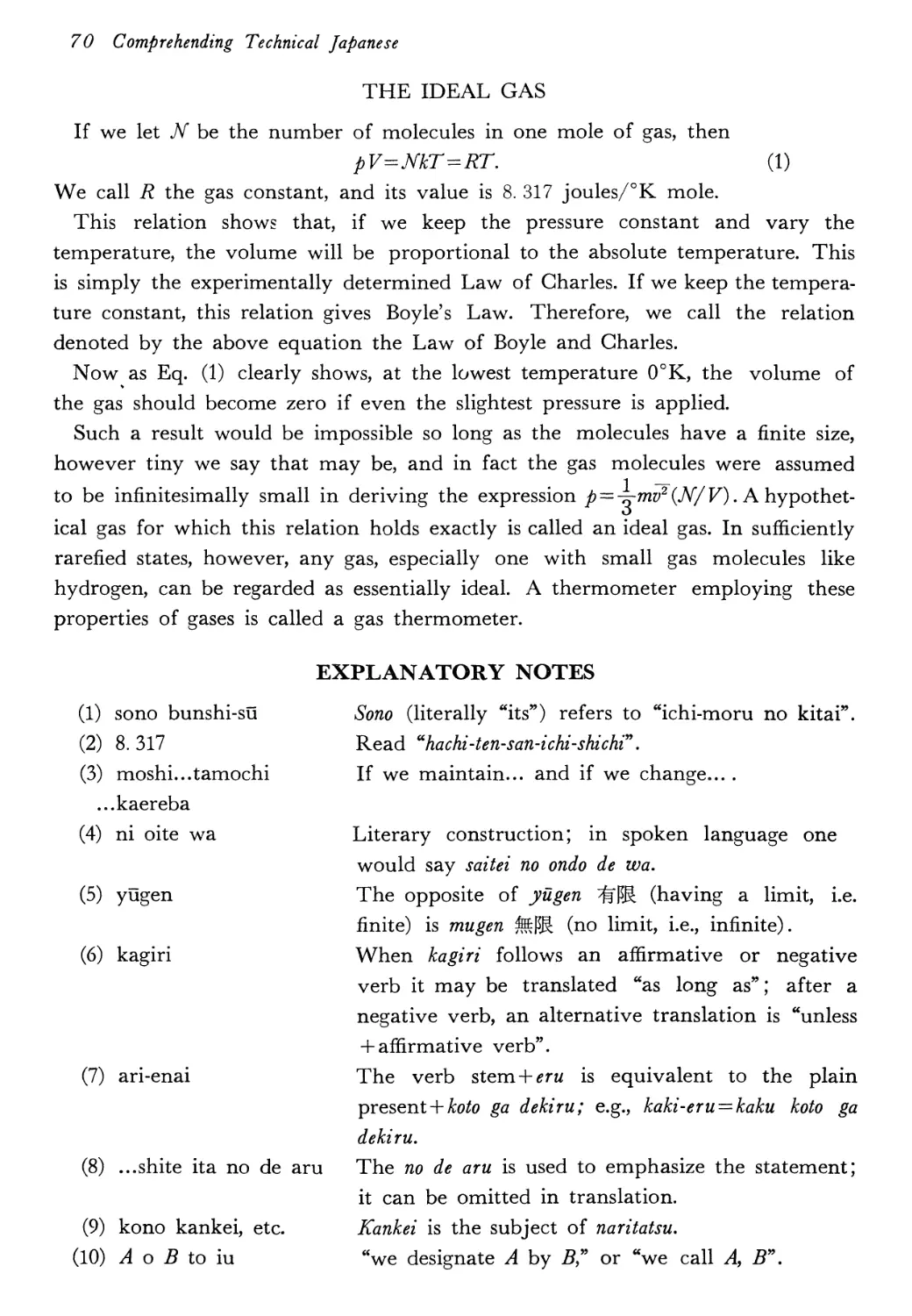
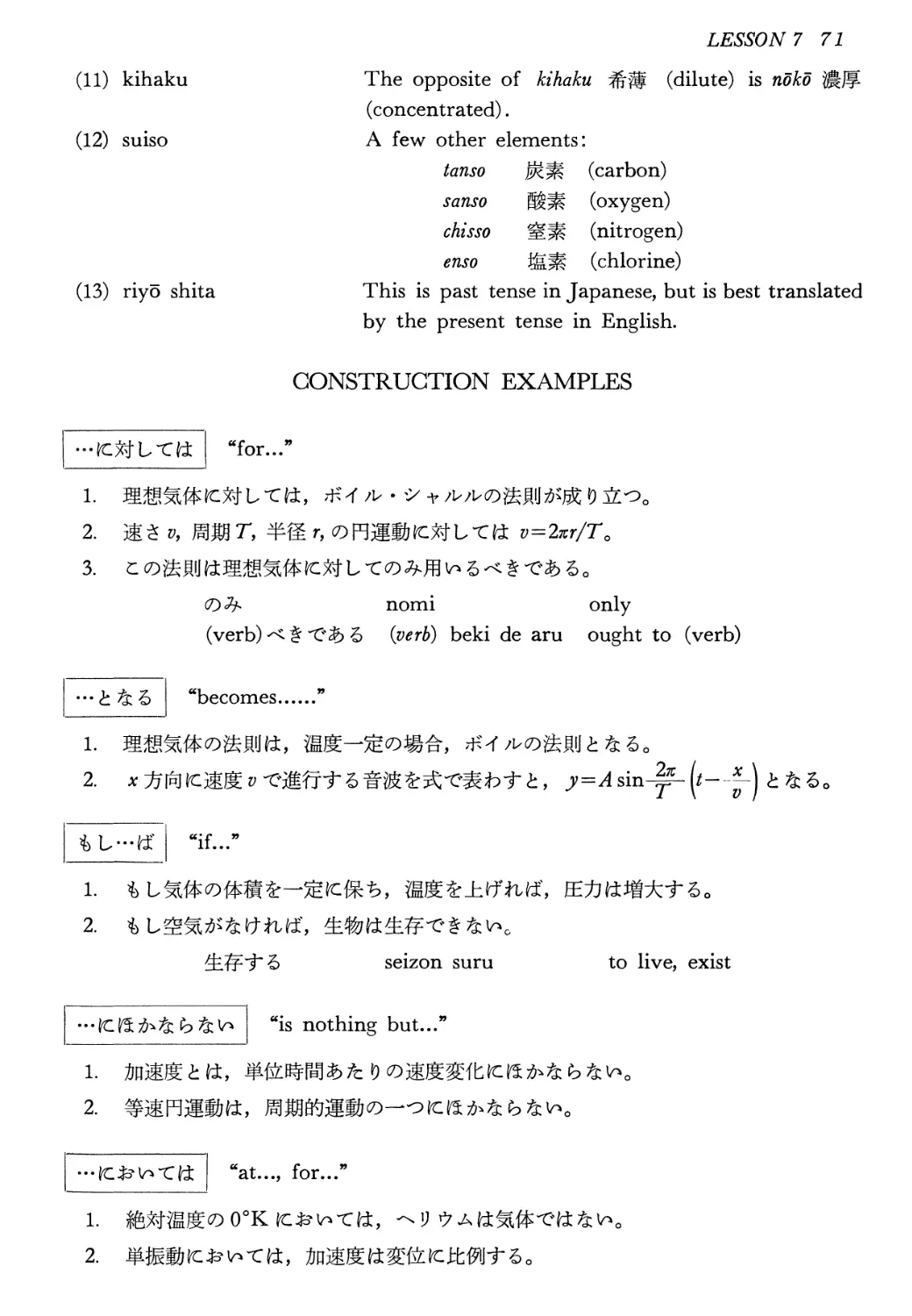
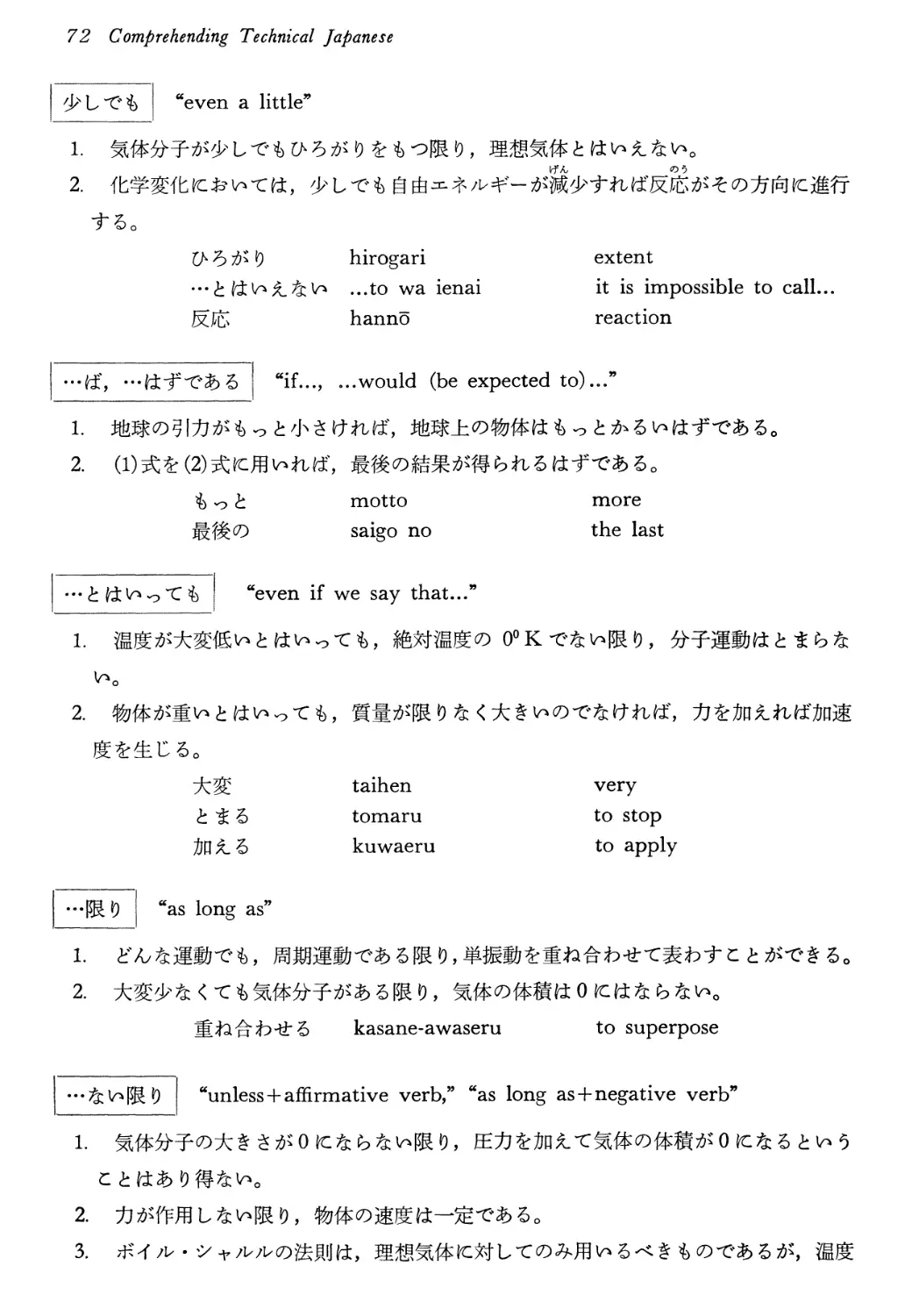
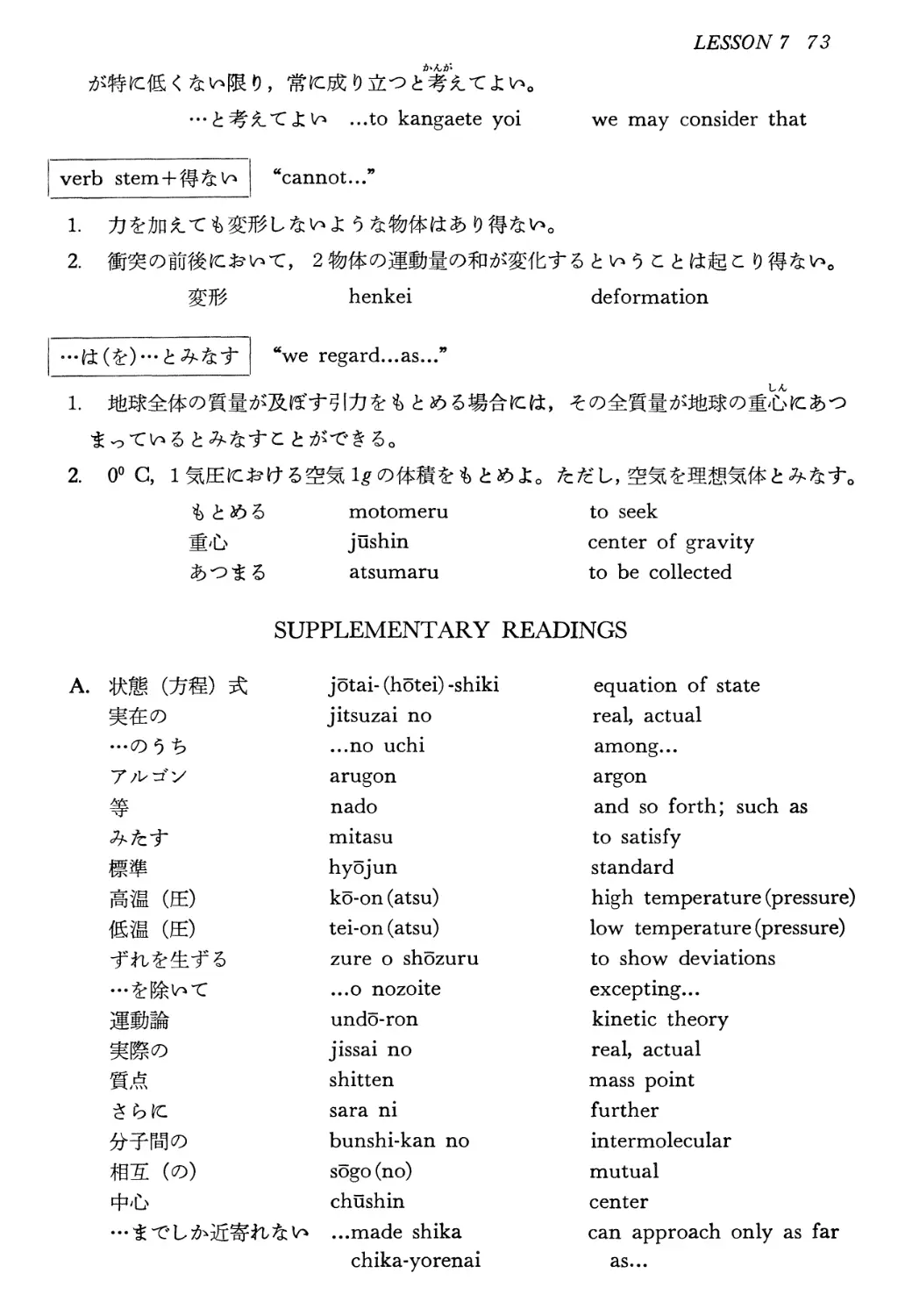













































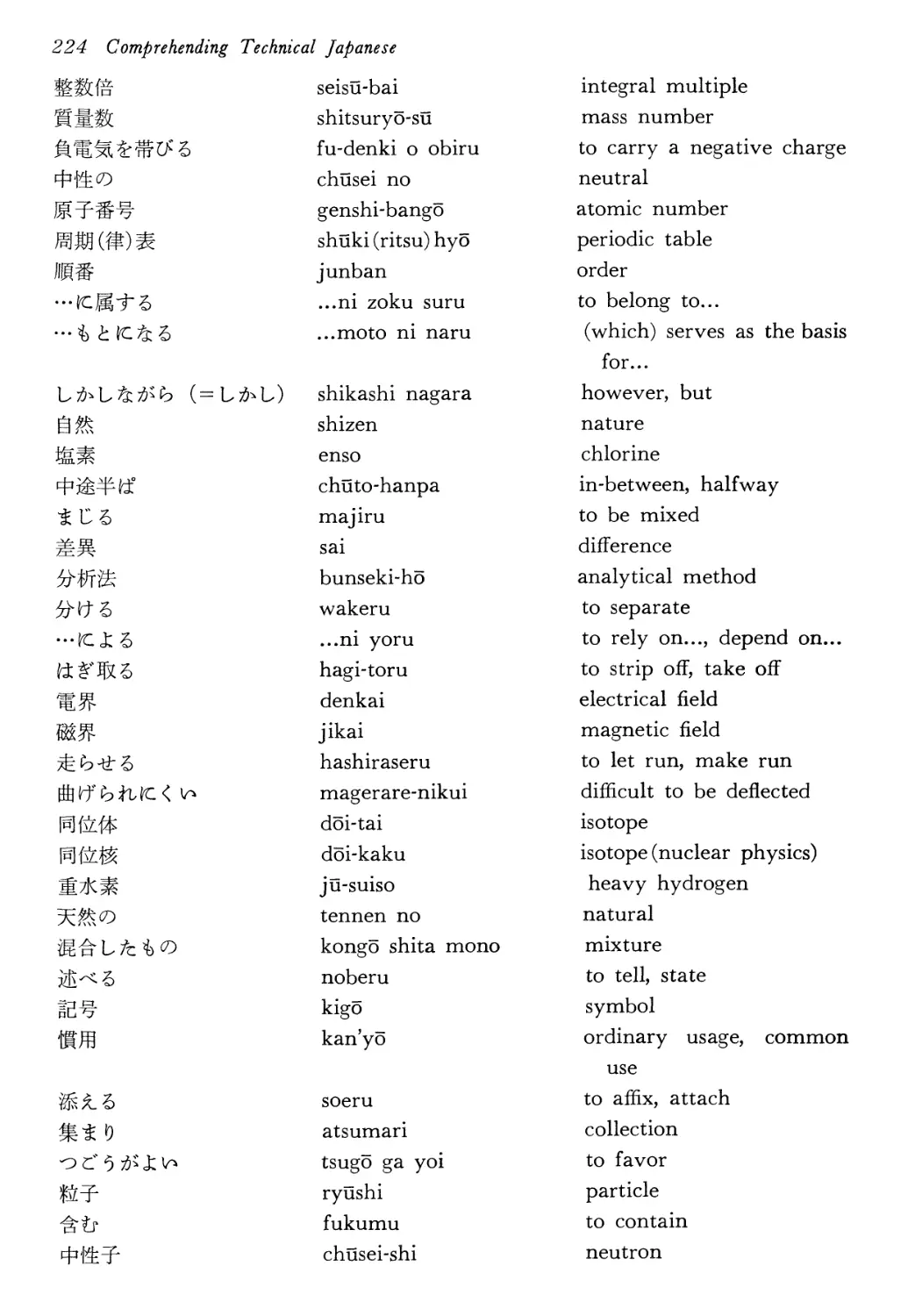
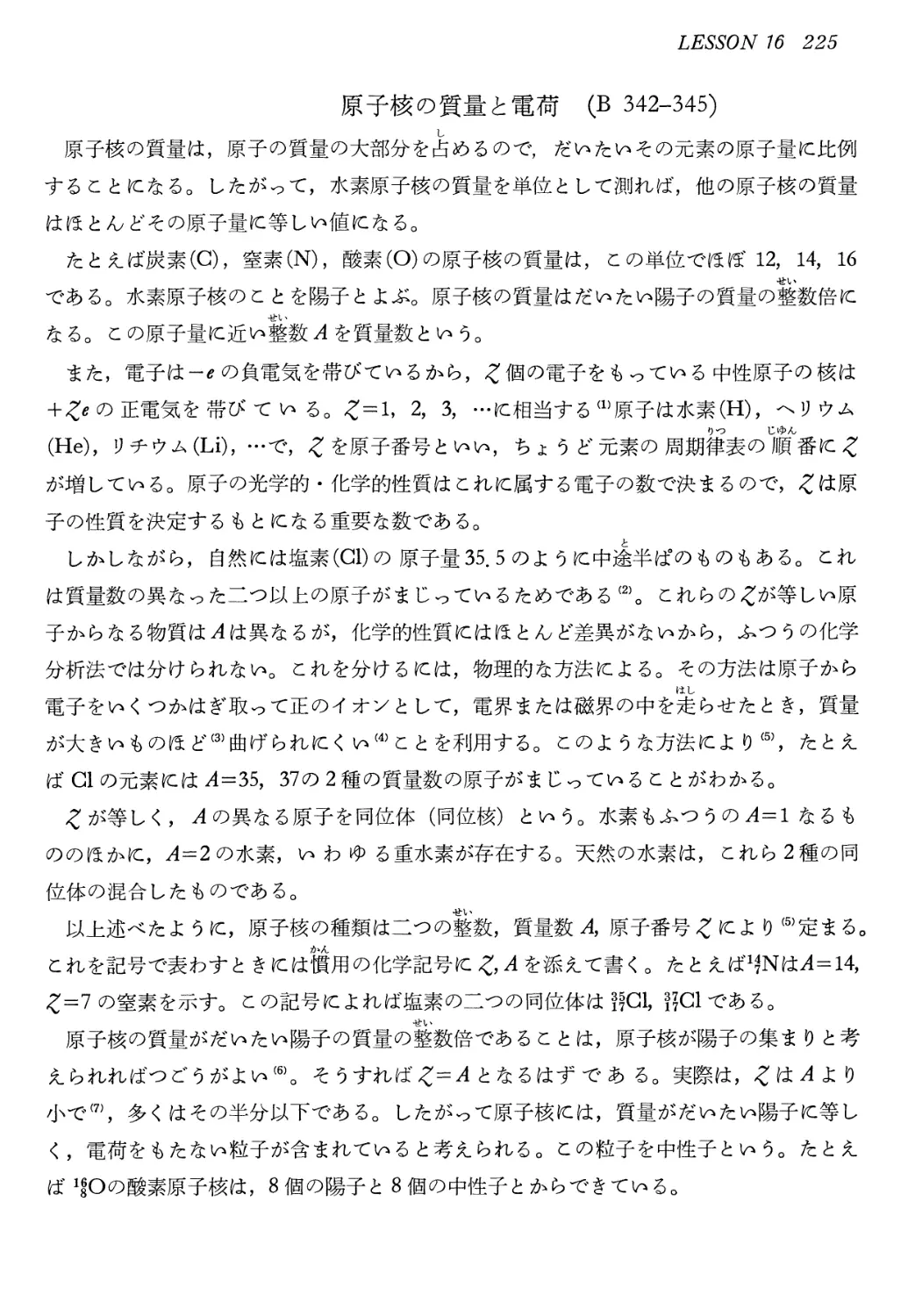

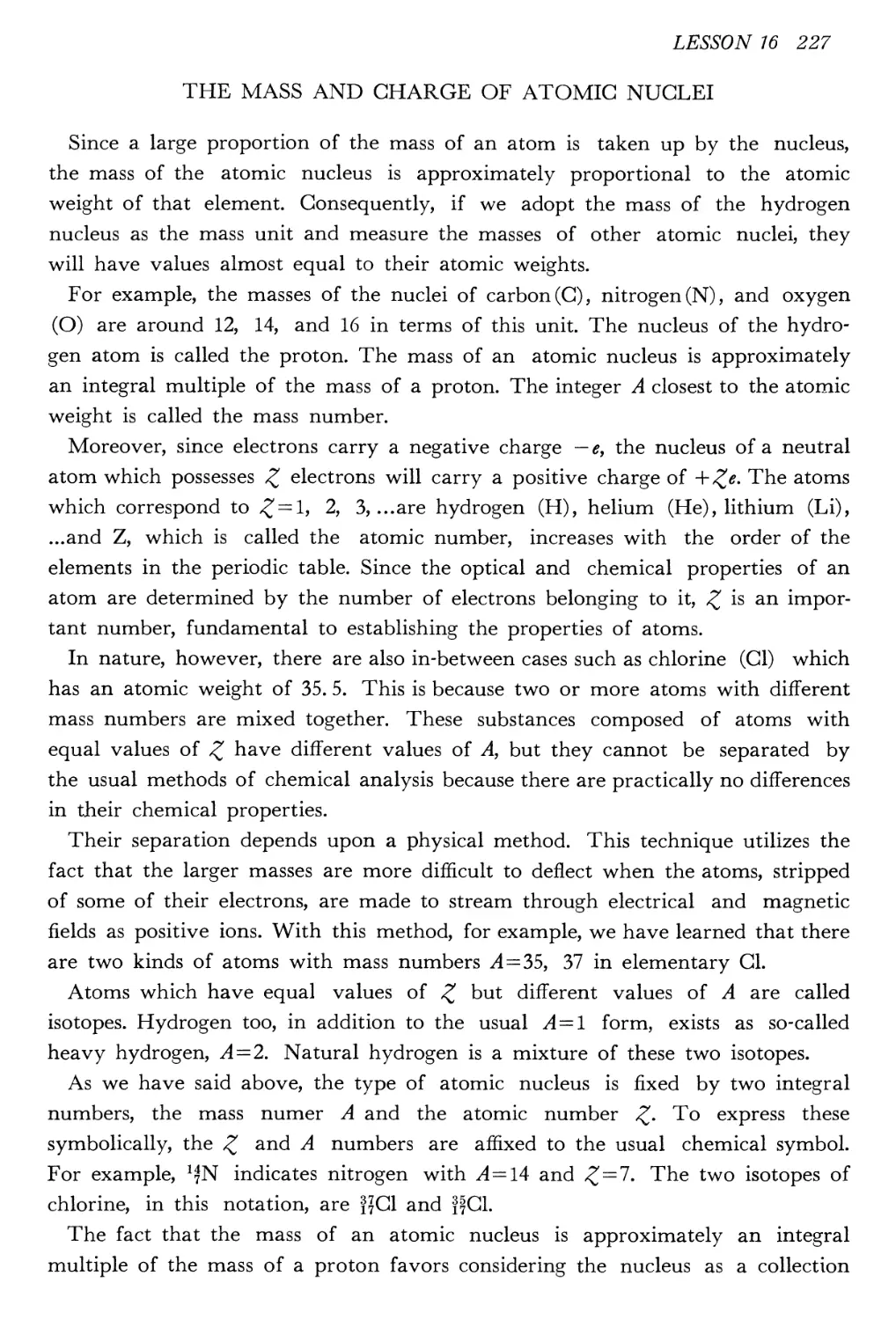

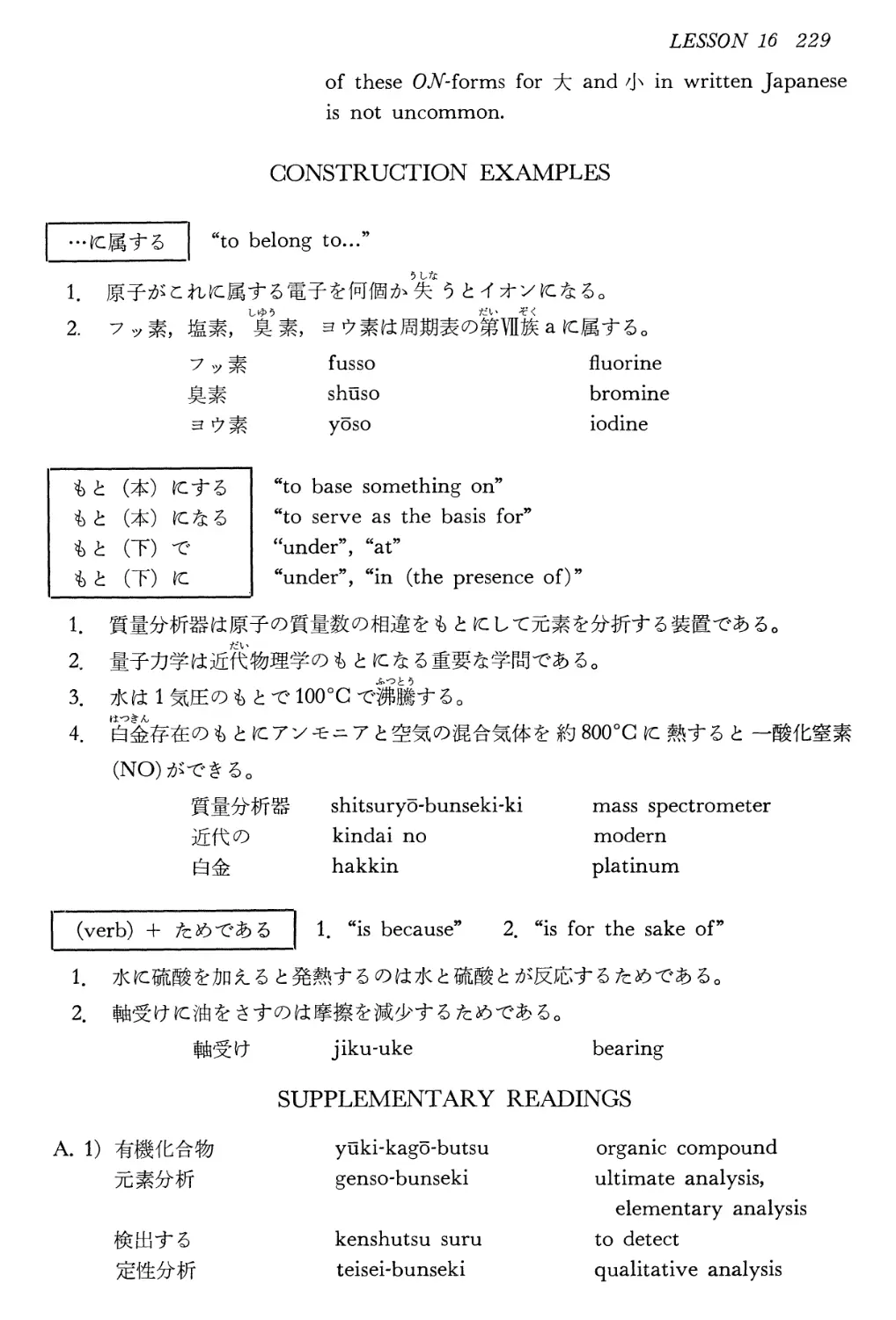
















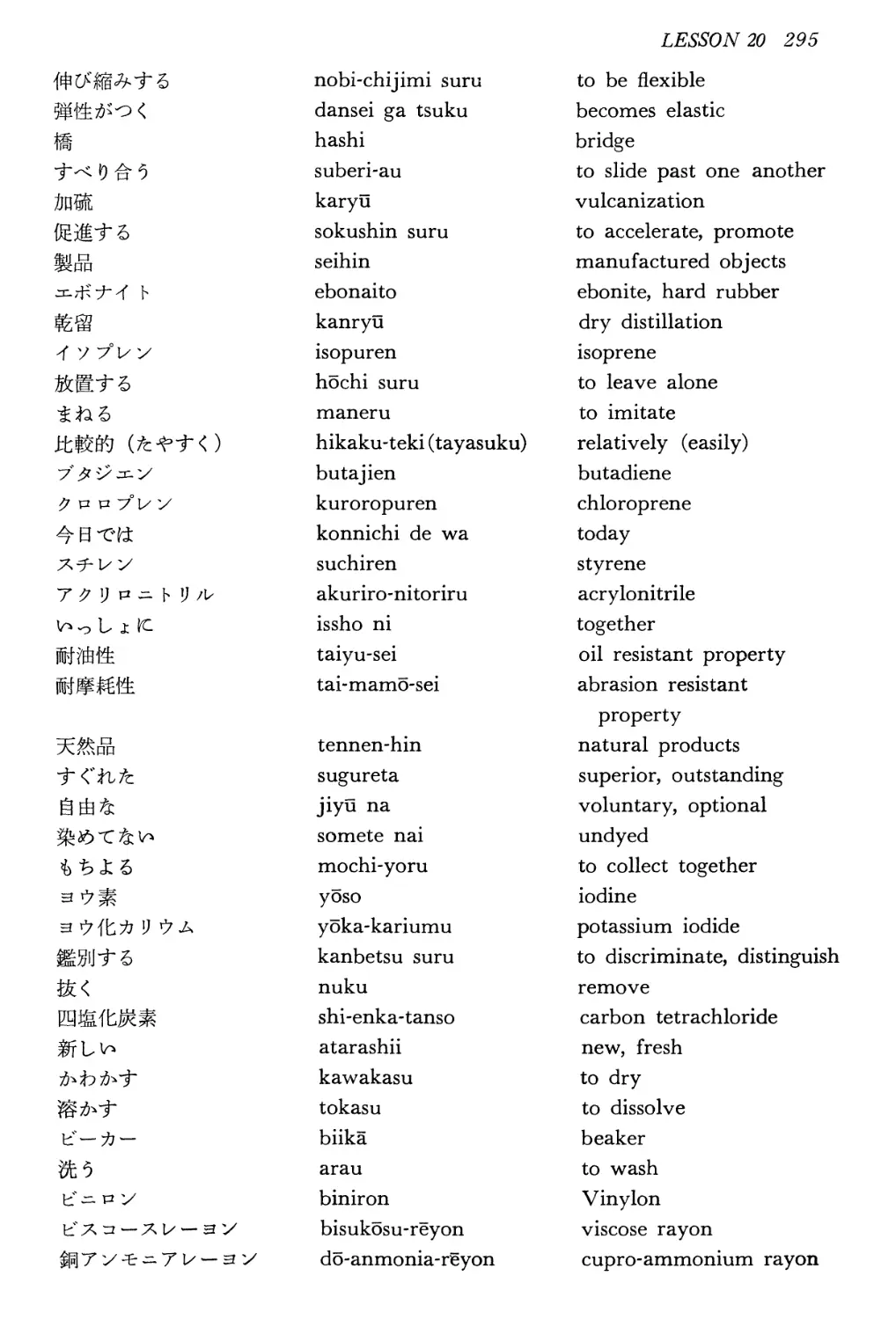
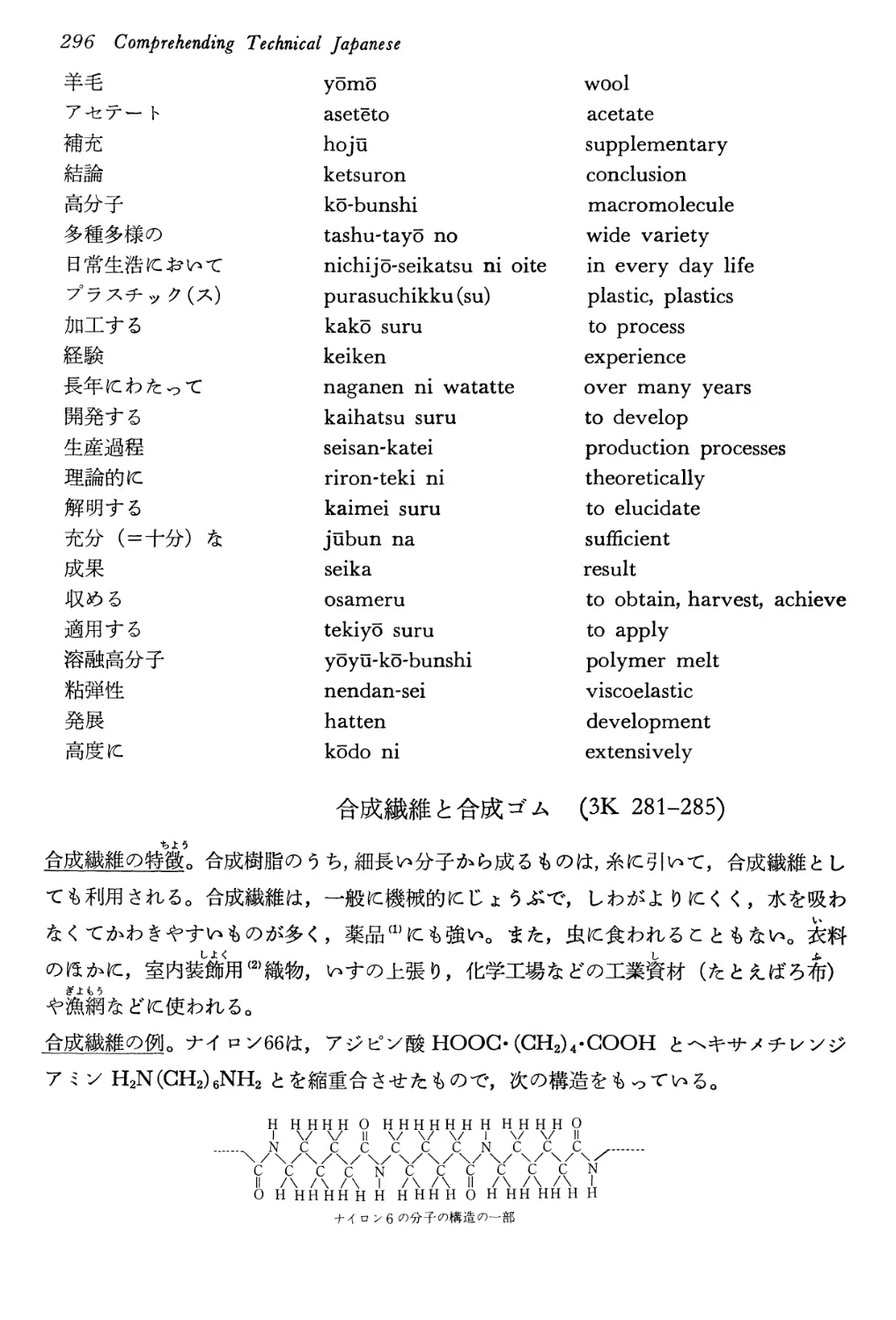


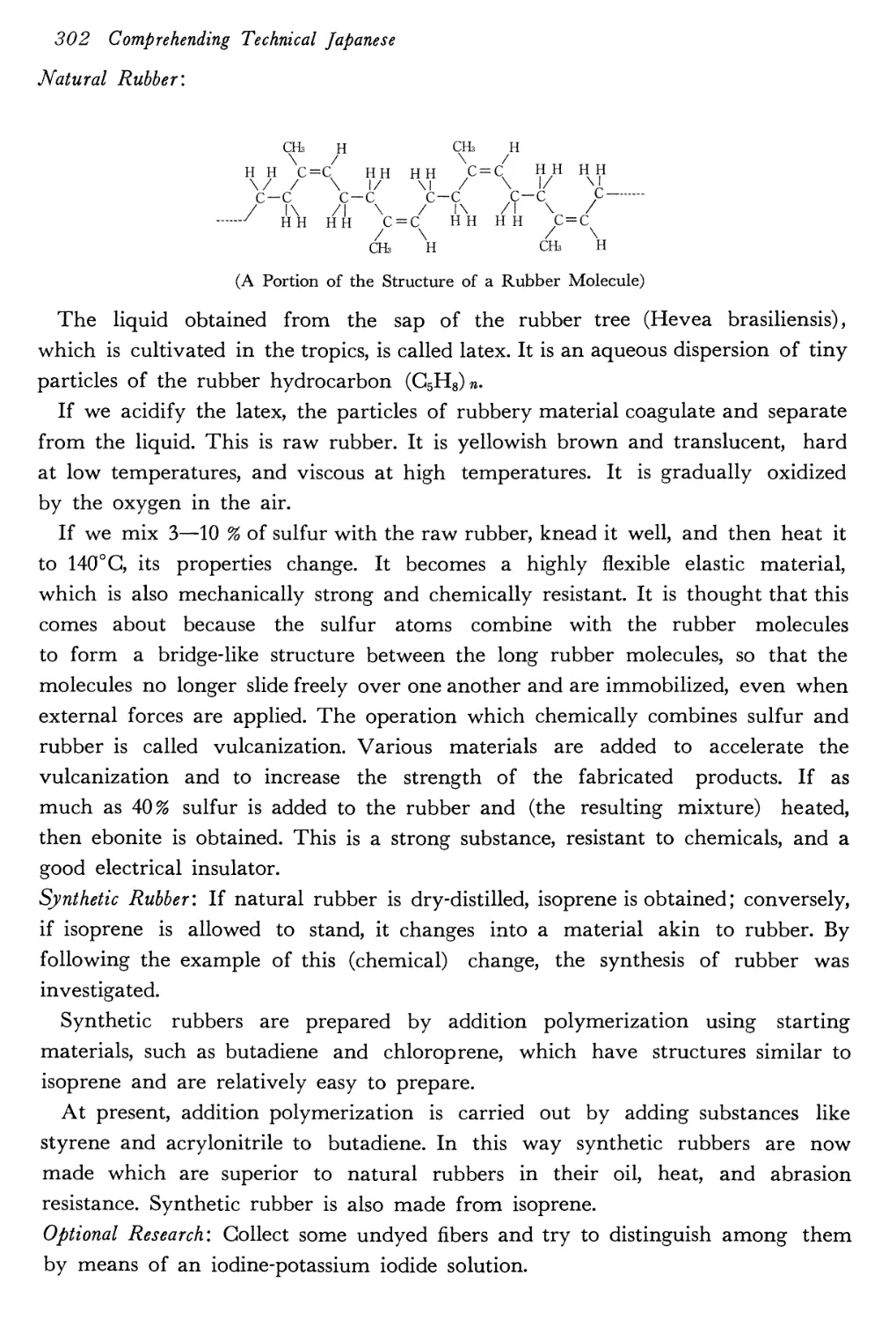
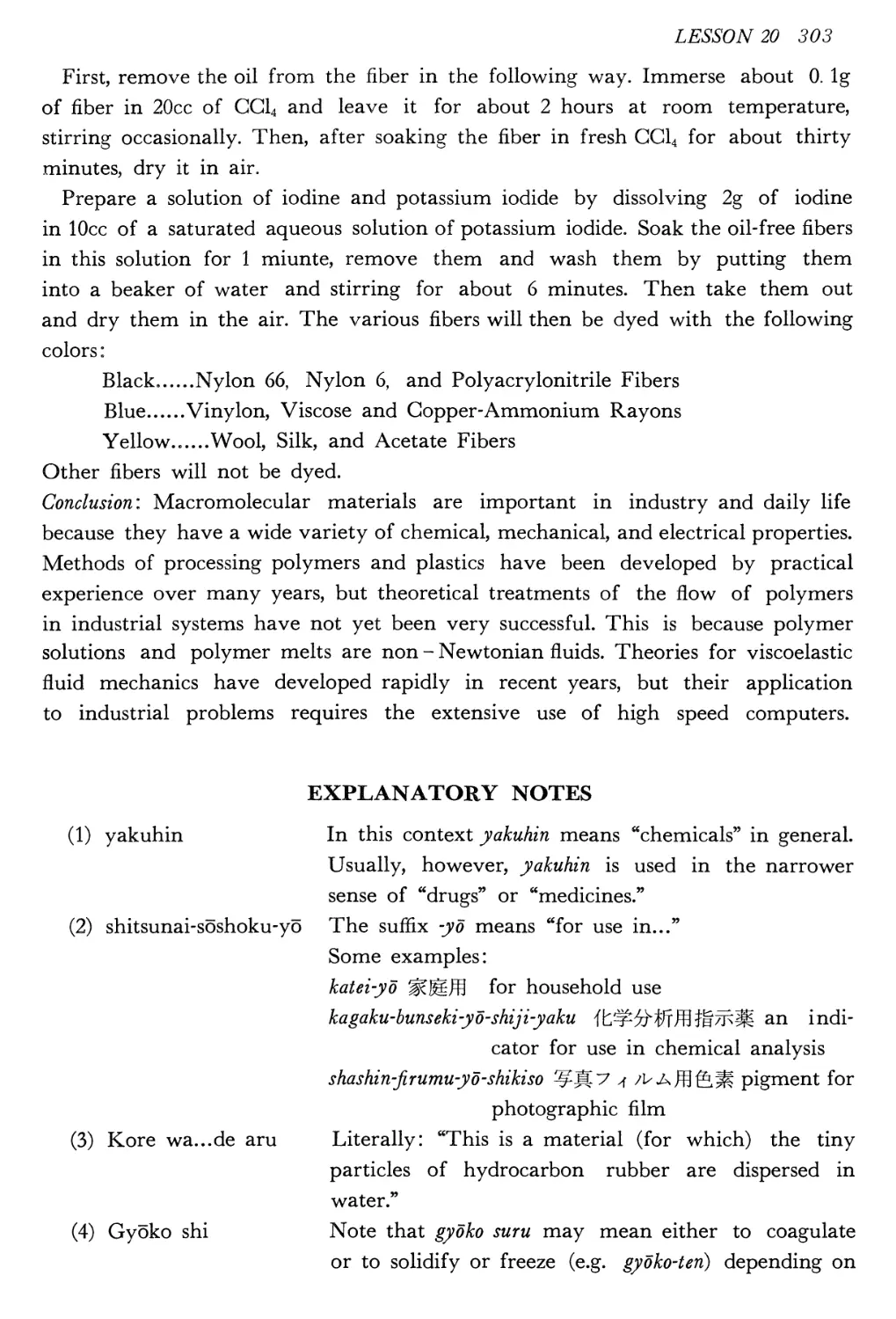









































Text
                    COMPREHENDING
TECHNICAL JAPANESE
EDWARD E. DAUB
College of Engineering
University of Wisconsin, Madison, Wisconsin
R. BYRON BIRD
College of Engineering
University of Wisconsin, Madison, Wisconsin
NOBUO INOUE
Faculty of Engineering
Science University of Tokyo
THE UNIVERSITY OF WISCONSIN PRESS
UNIVERSITY OF TOKYO PRESS

Published 1975 by
The University of Wisconsin Press
Box 1379, Madison, Wisconsin 53701
The University of Wisconsin Press Ltd.
70 Great Russell Street, London
Copyright © 1975
The Regents of the University of Wisconsin System
All rights reserved
Second printing 1982
Printed in Japan
ISBN 0-299-06680-0, LC 74-5900

TABLE OF CONTENTS
PREFACE 3
EXPLANATORY NOTES 6
LESSONS 1-25 11
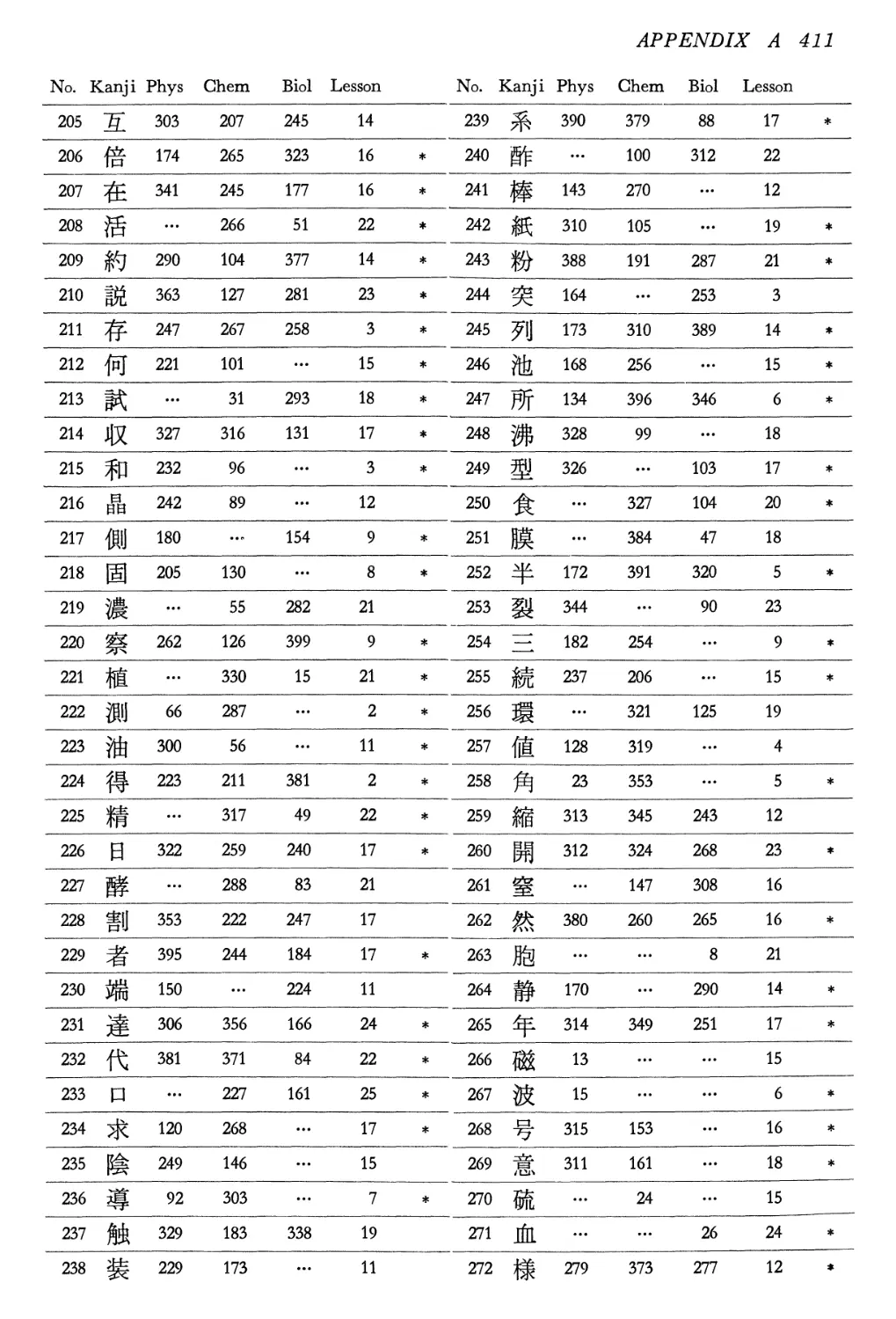
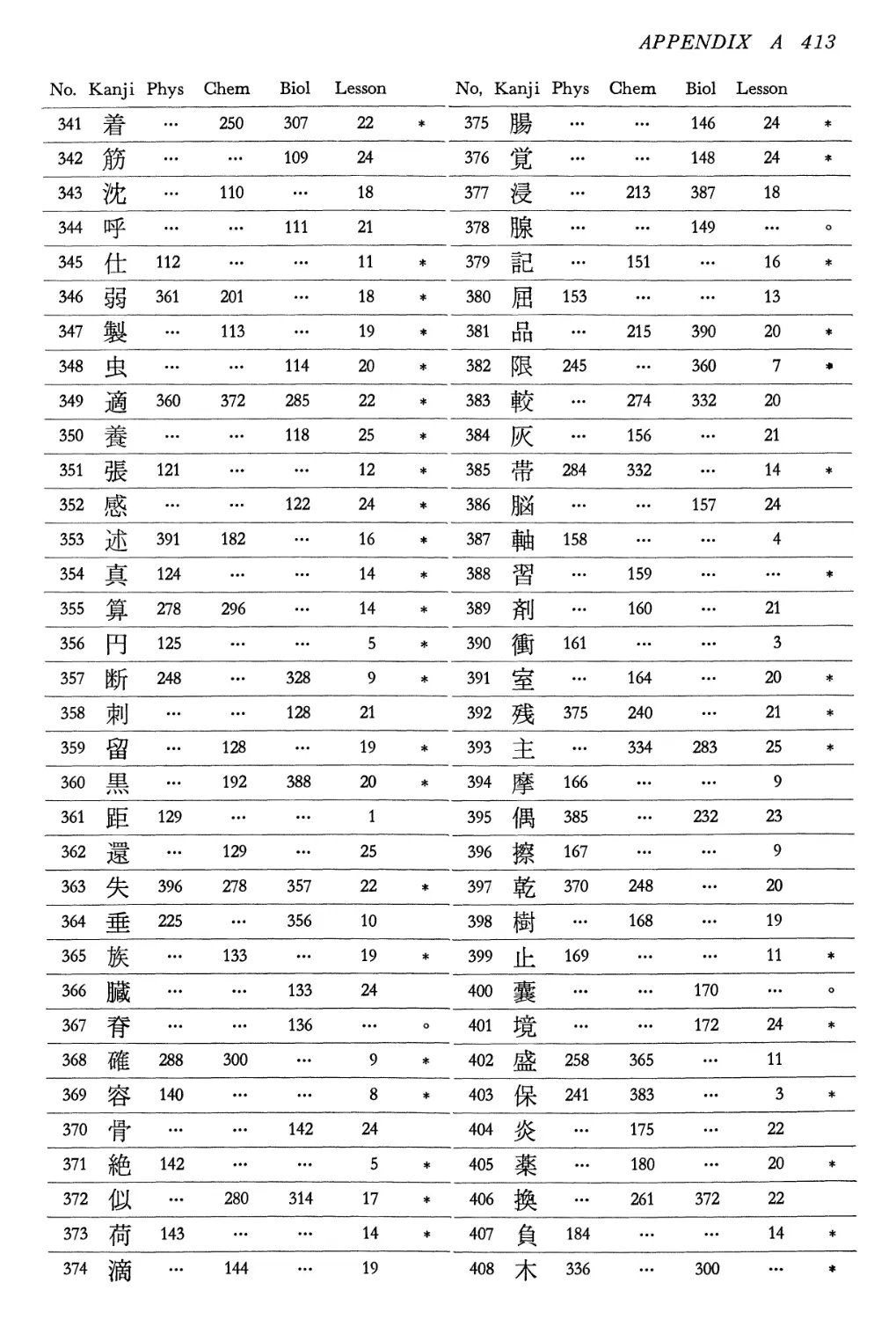
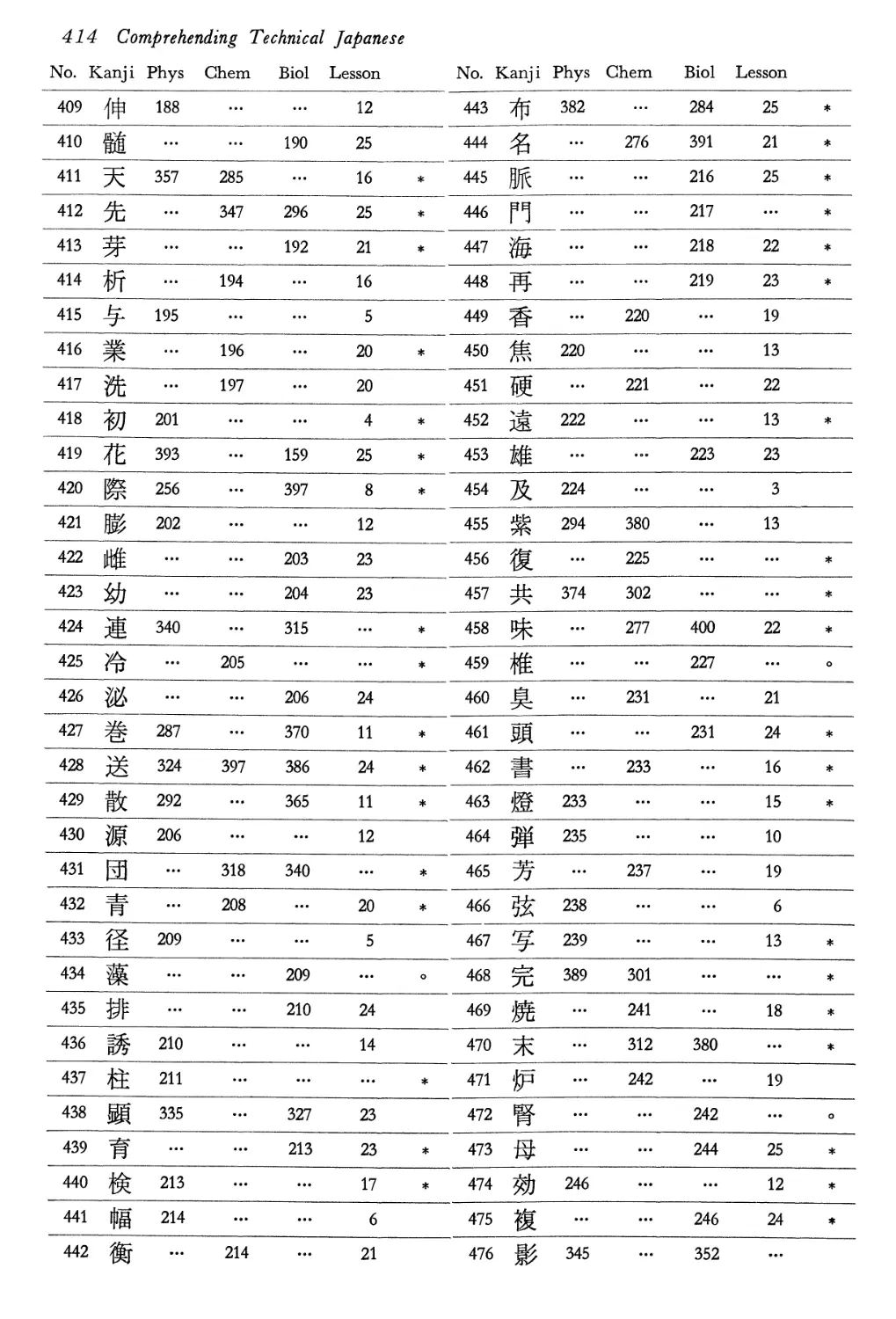
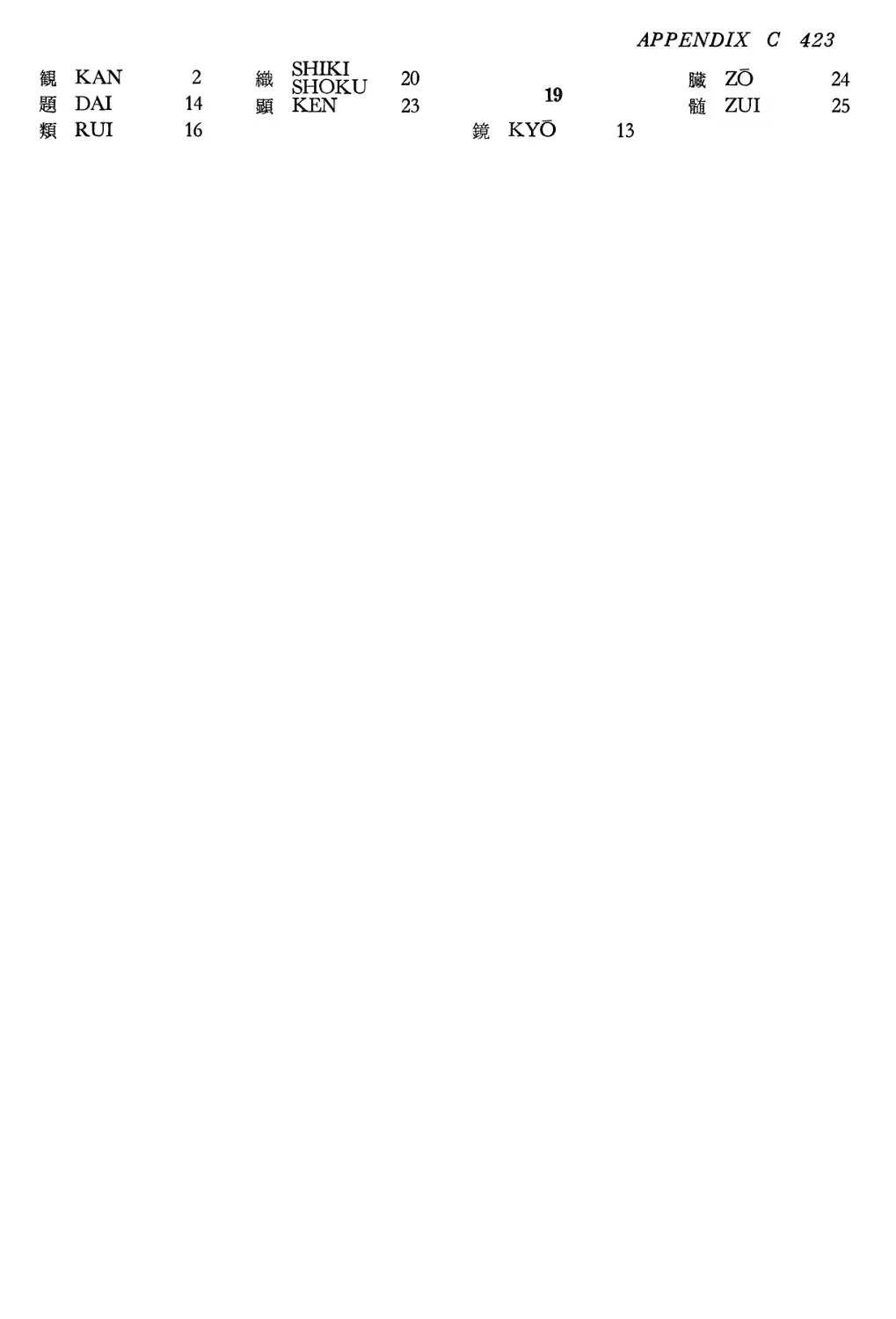
APPENDIX A KANJI FREQUENCY LISTS 407
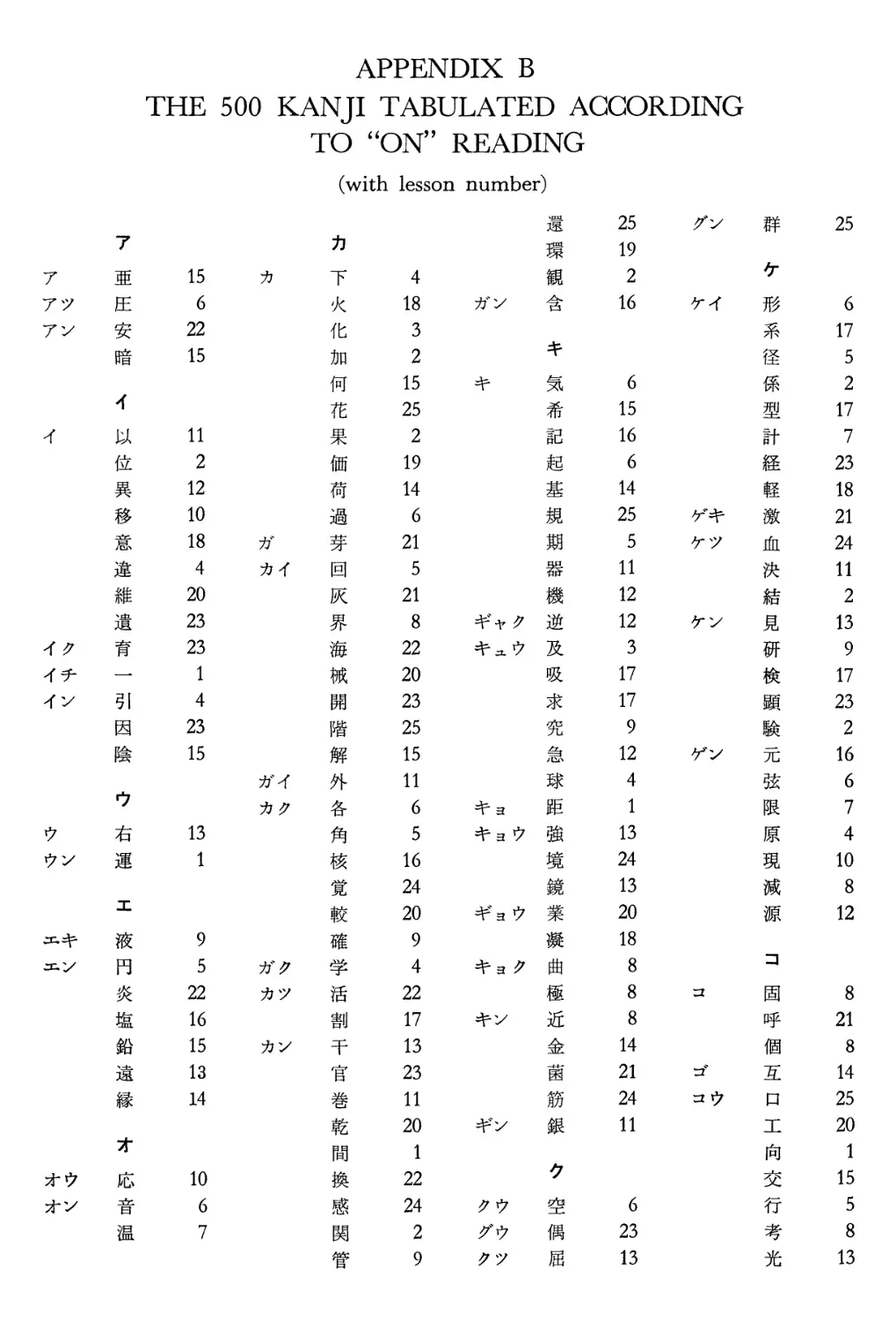
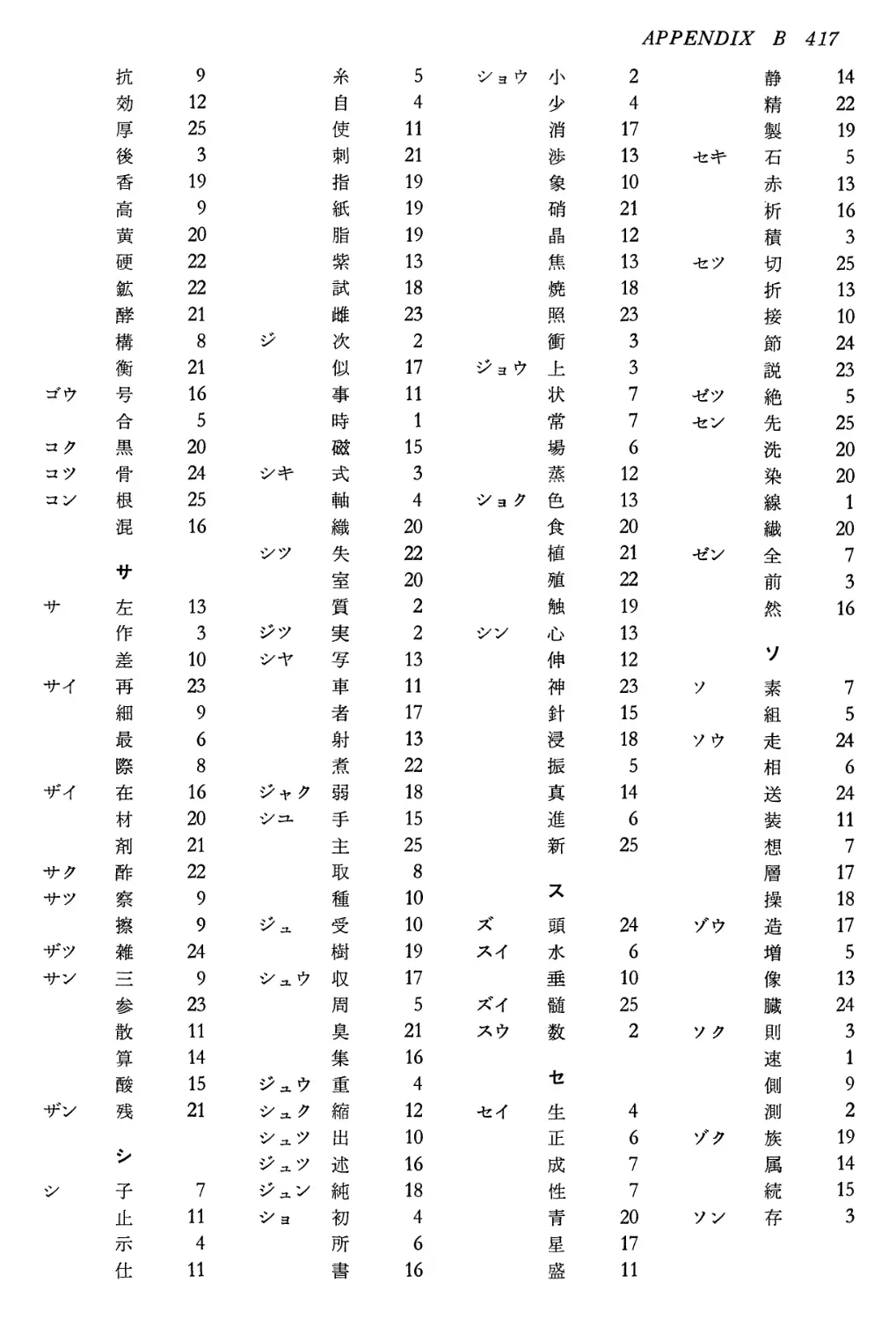
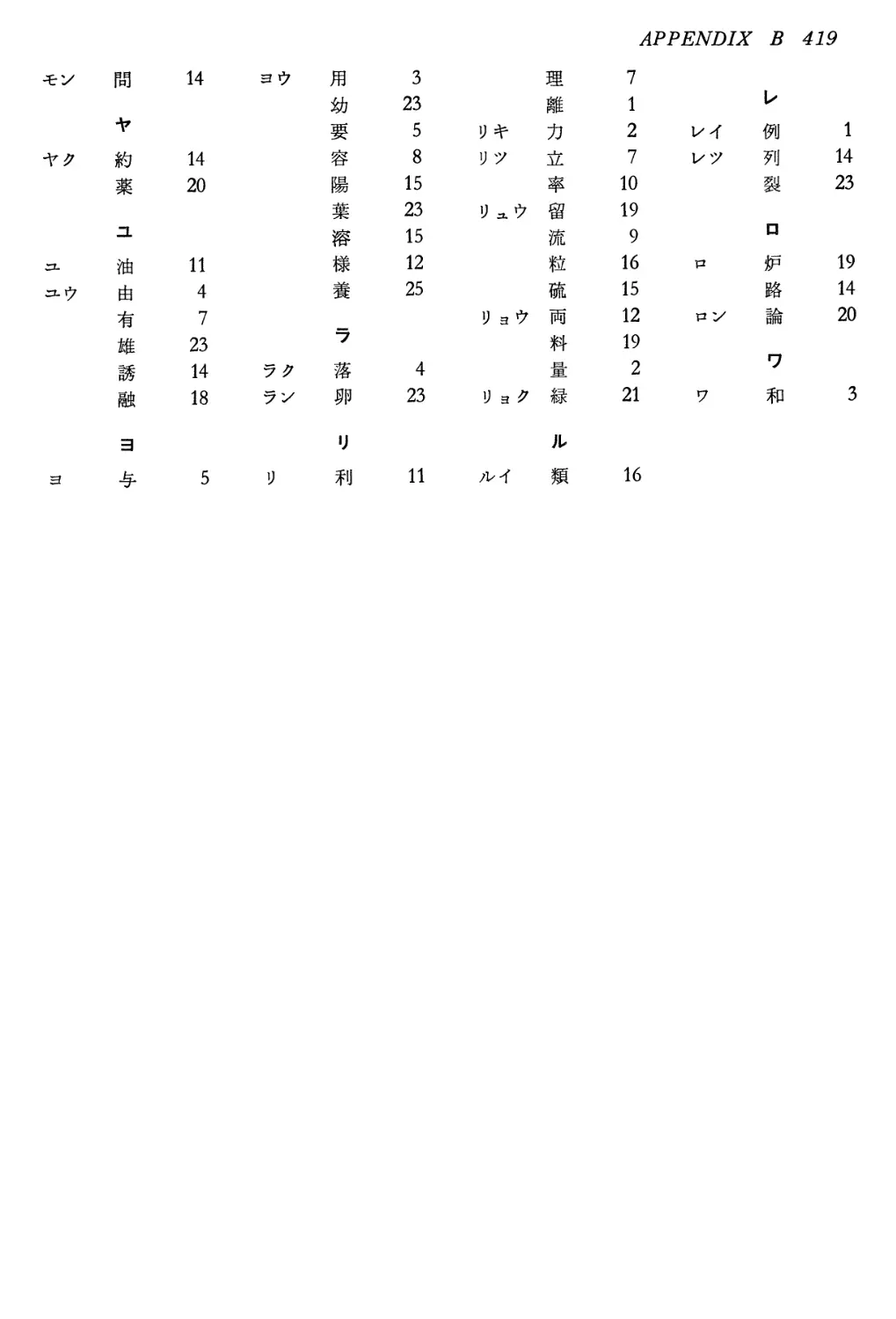
APPENDIX В THE FIVE HUNDRED KANJI TABULATED
ACCORDING TO ON READINGS 416
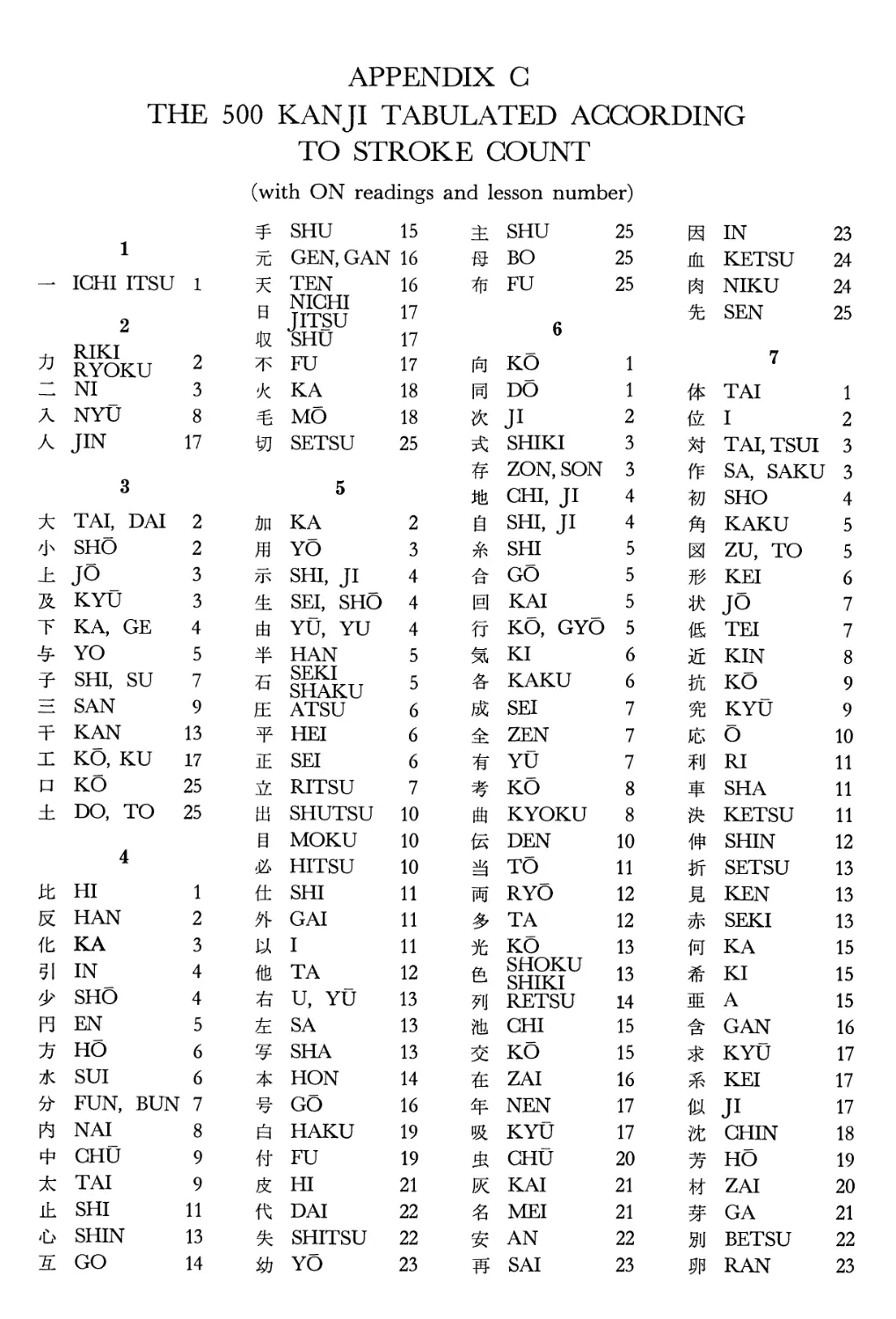
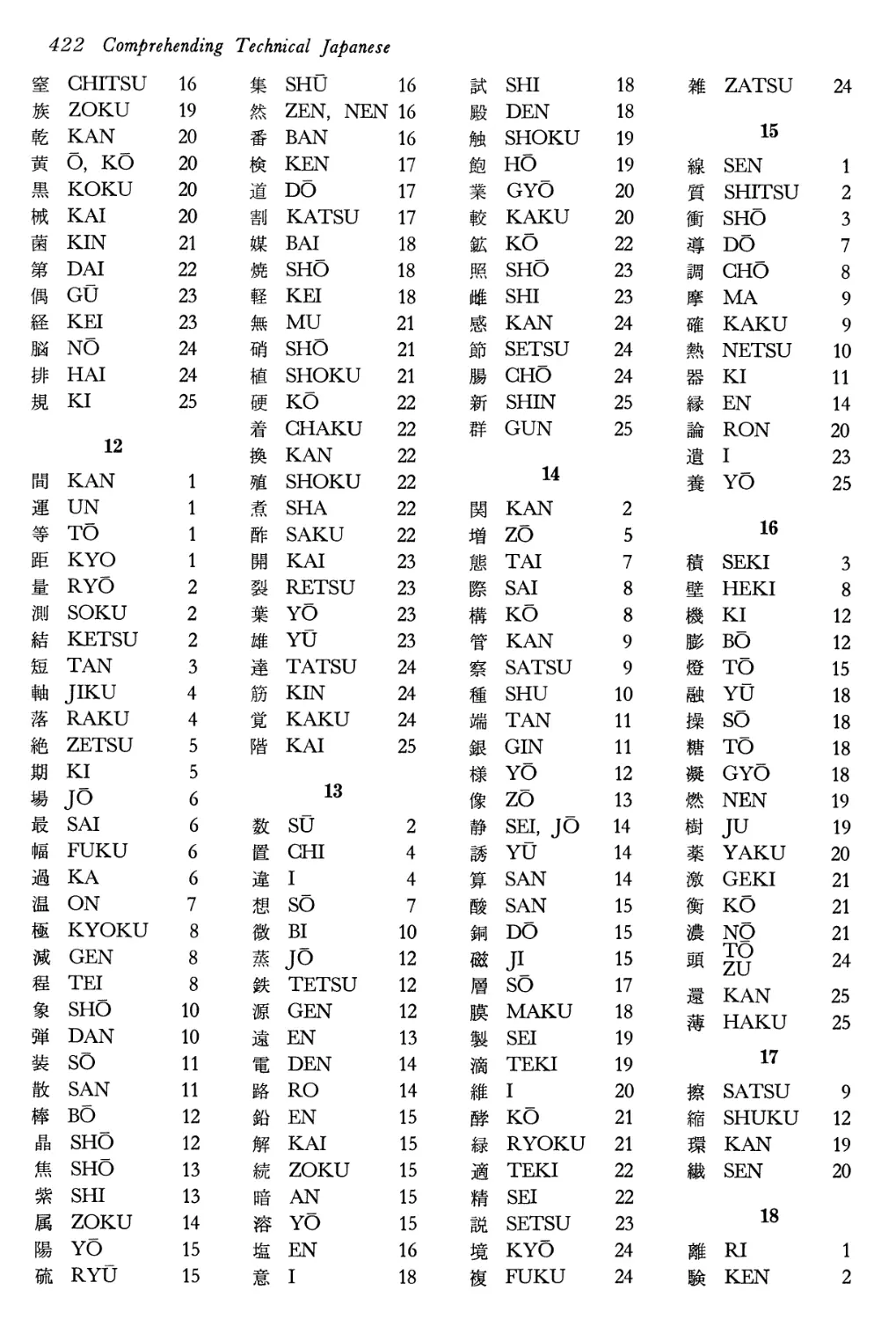
APPENDIX С THE FIVE HUNDRED KANJI TABULATED
ACCORDING TO STROKE COUNT 420
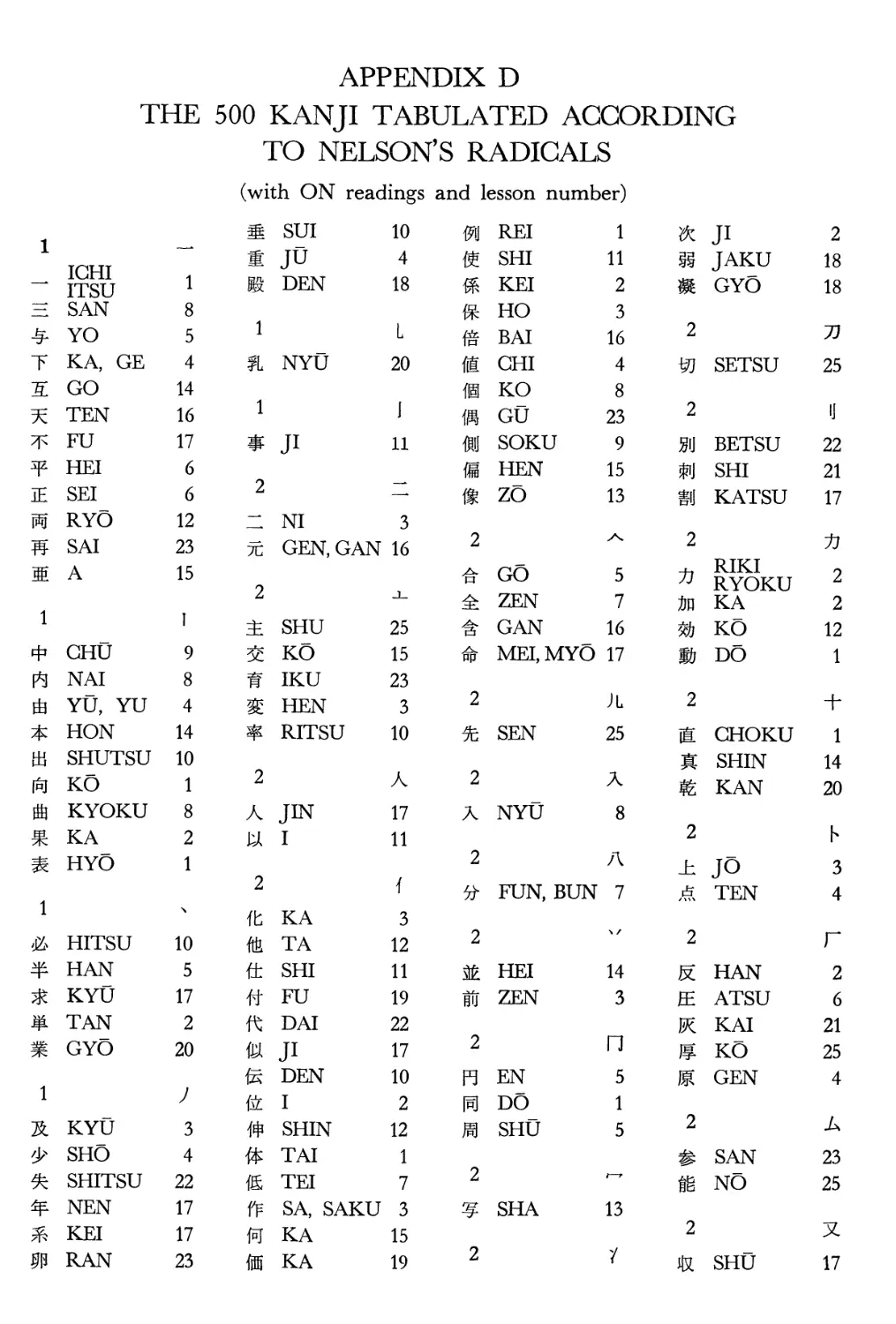
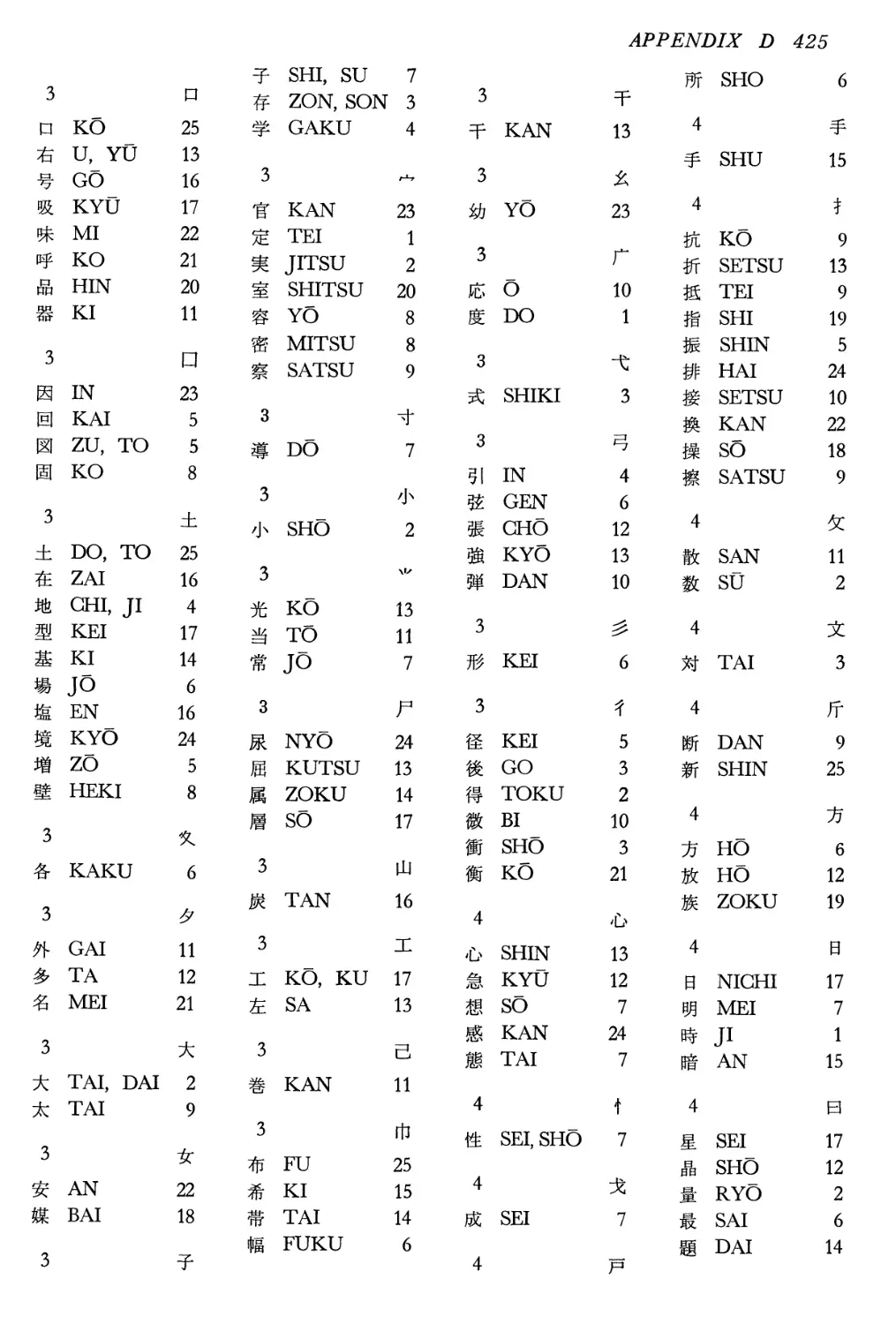
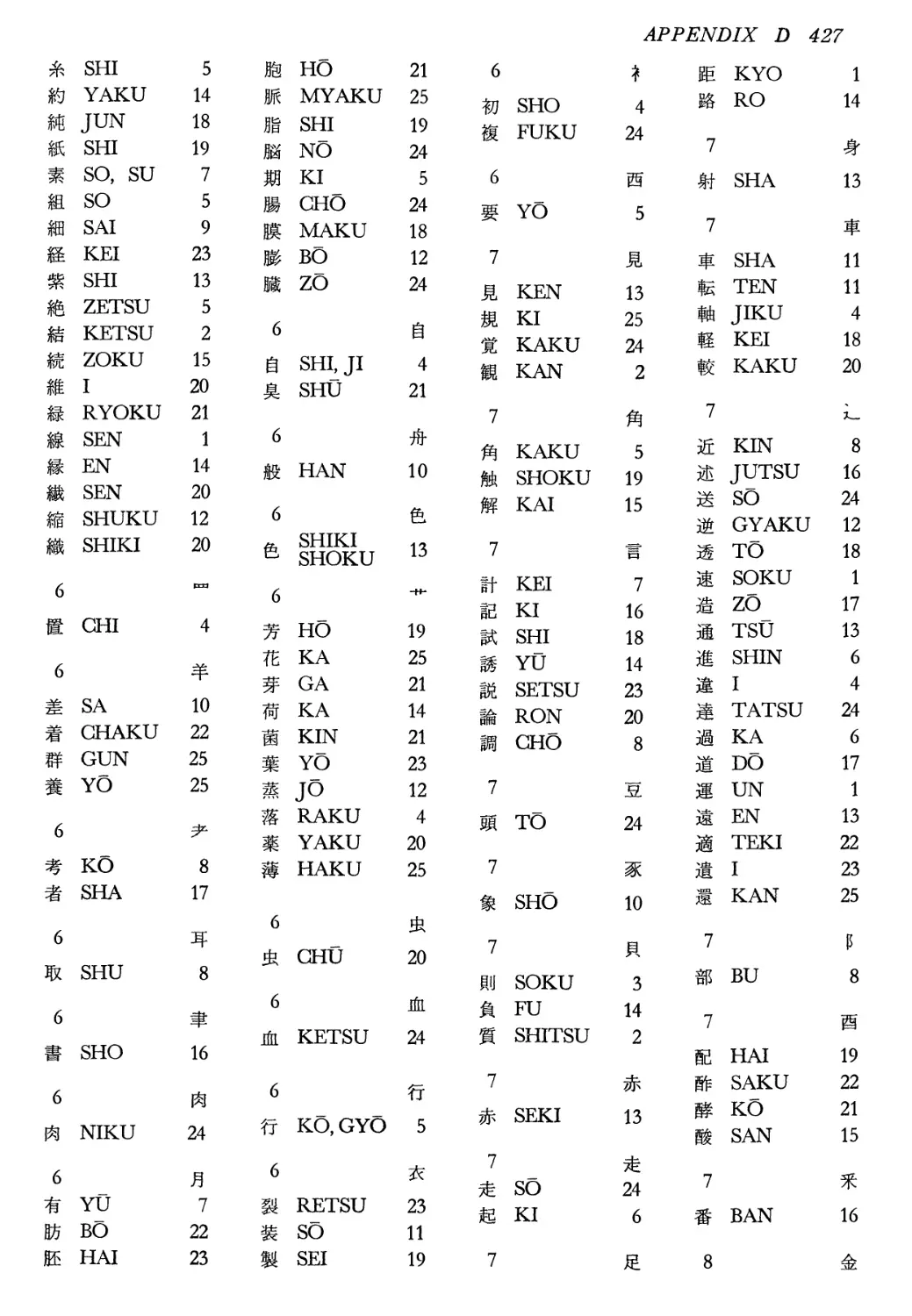
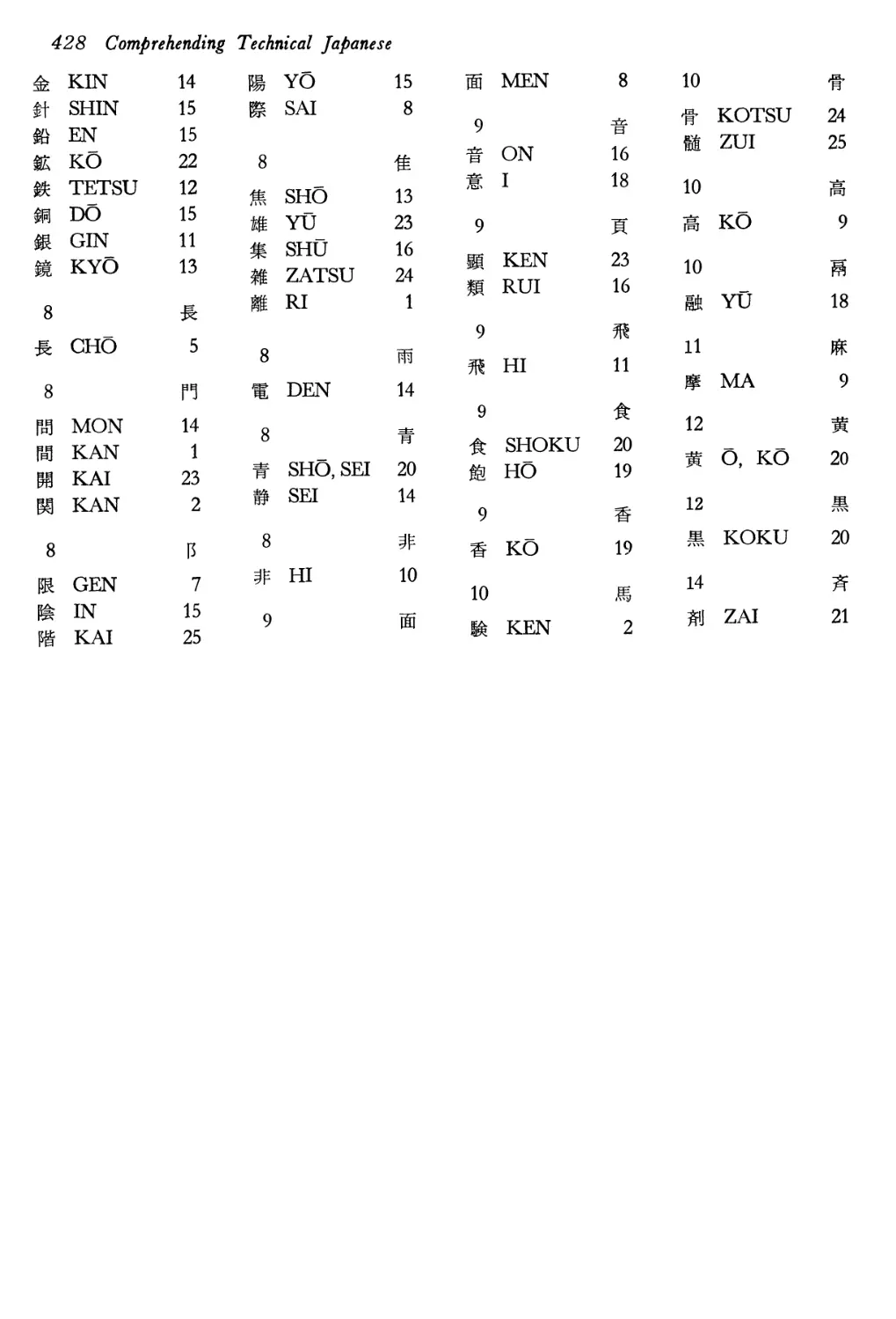
APPENDIX D THE FIVE HUNDRED KANJI TABULATED
ACCORDING TO NELSON'S RADICALS 424
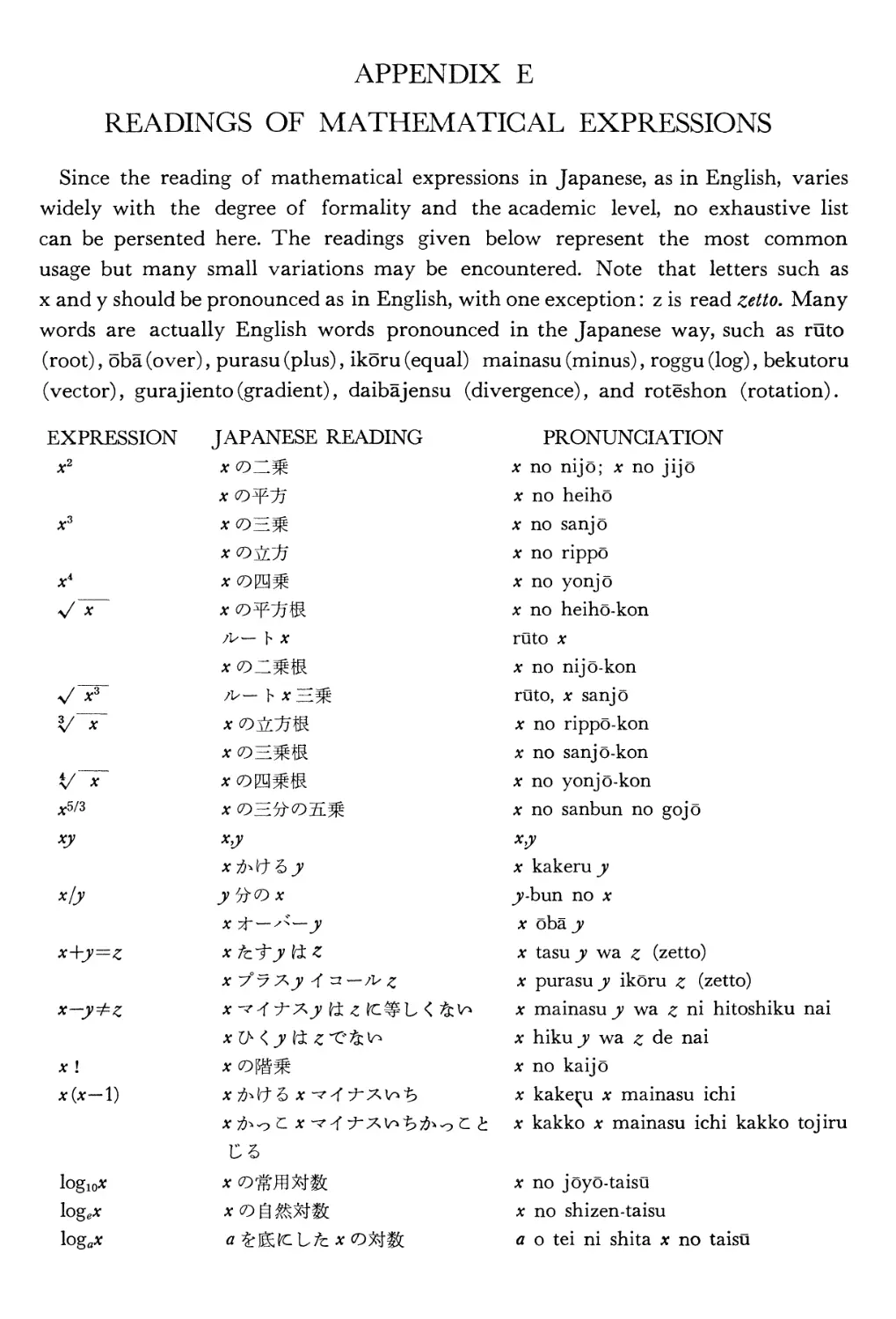
APPENDIX E READINGS OF MATHEMATICAL EXPRESSIONS 429
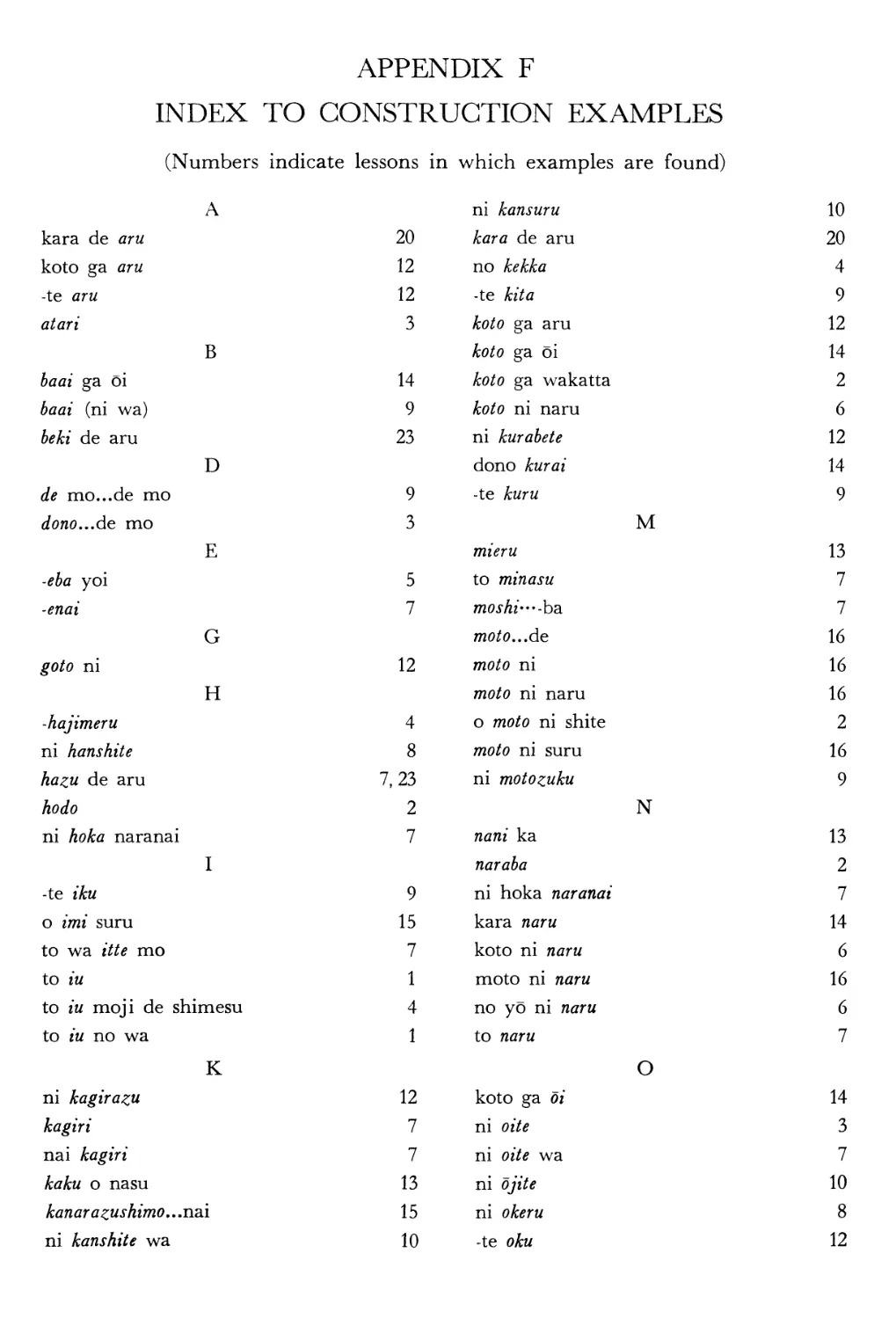
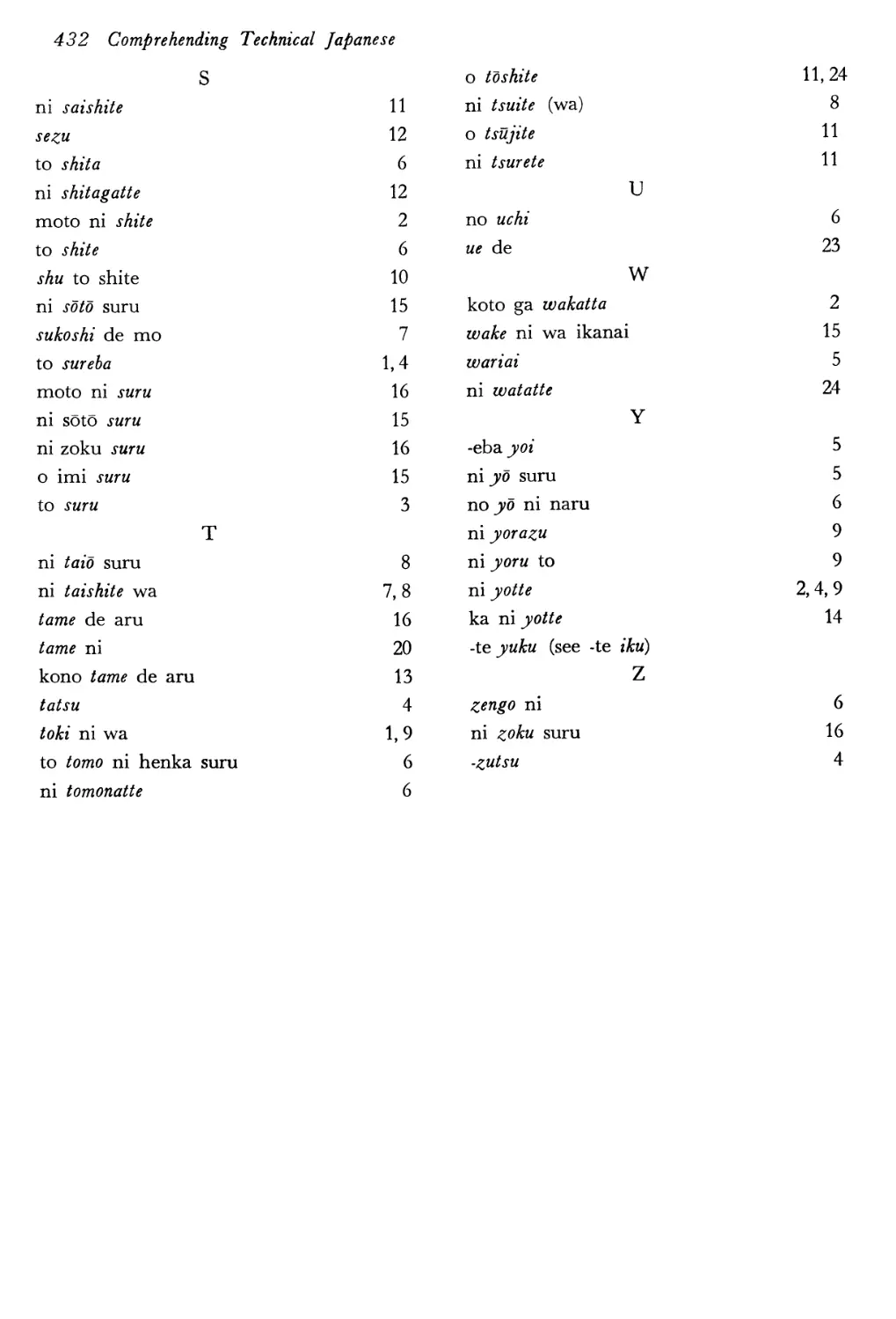
APPENDIX F INDEX TO CONSTRUCTION EXAMPLES 431
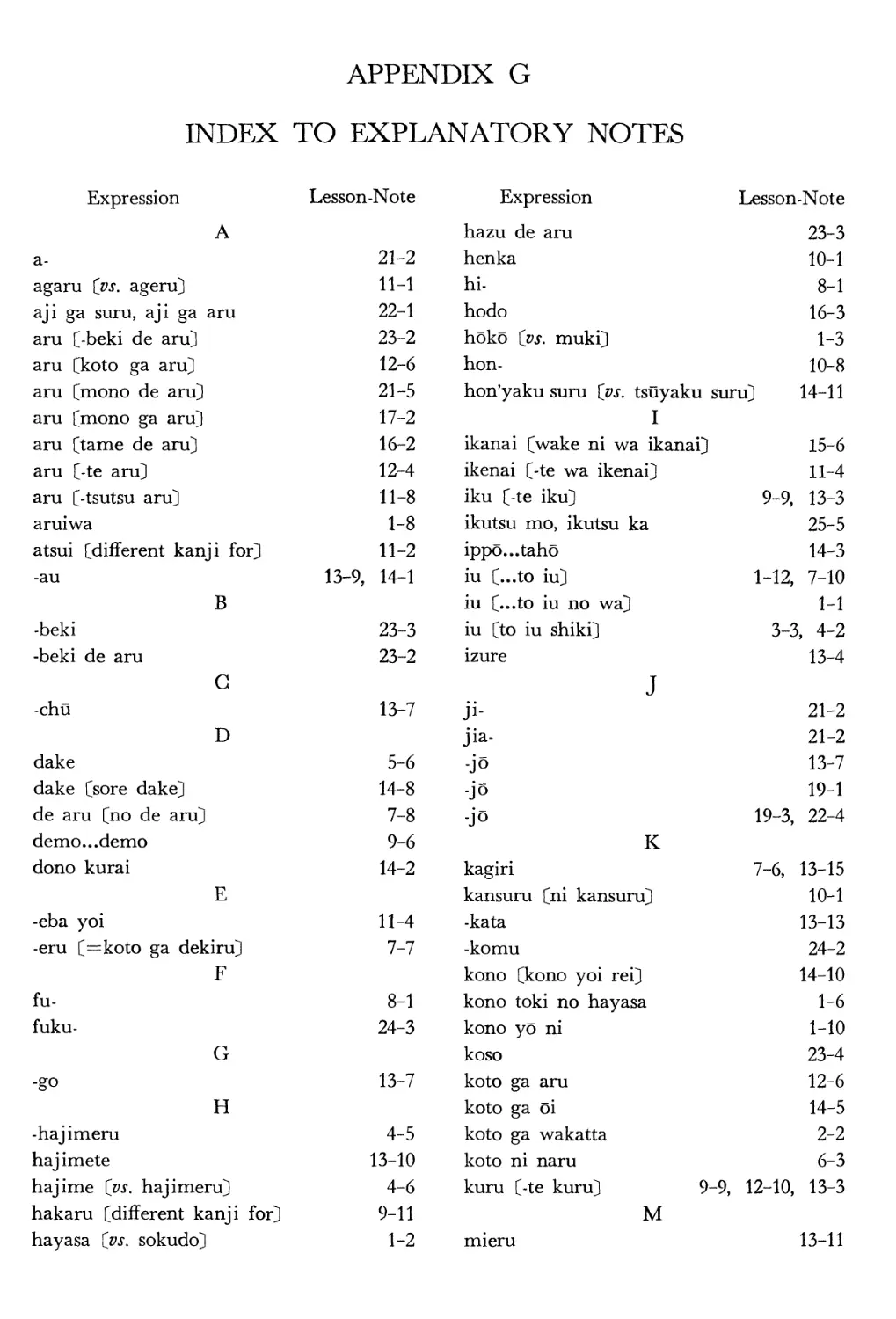
APPENDIX G INDEX TO EXPLANATORY NOTES 433
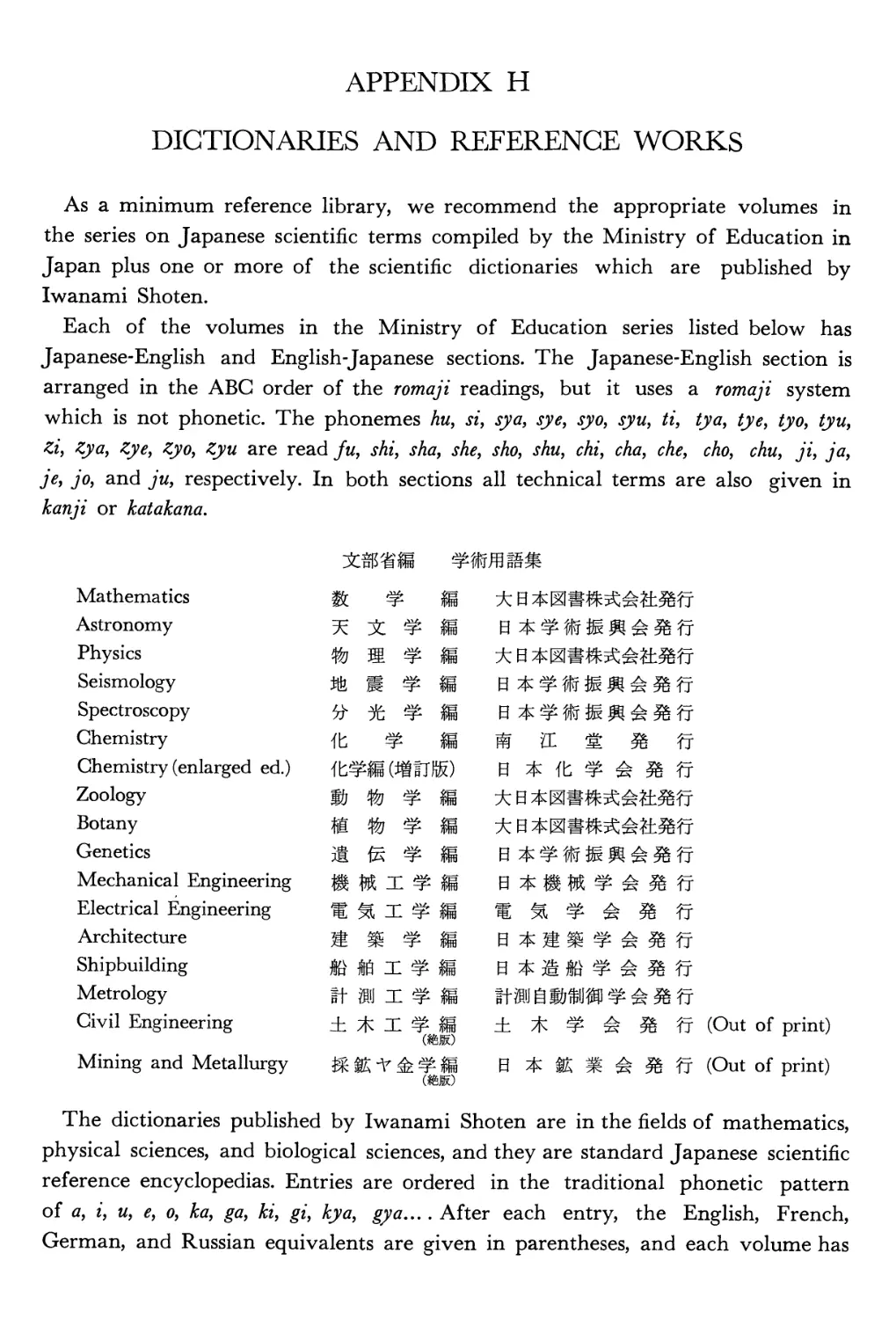
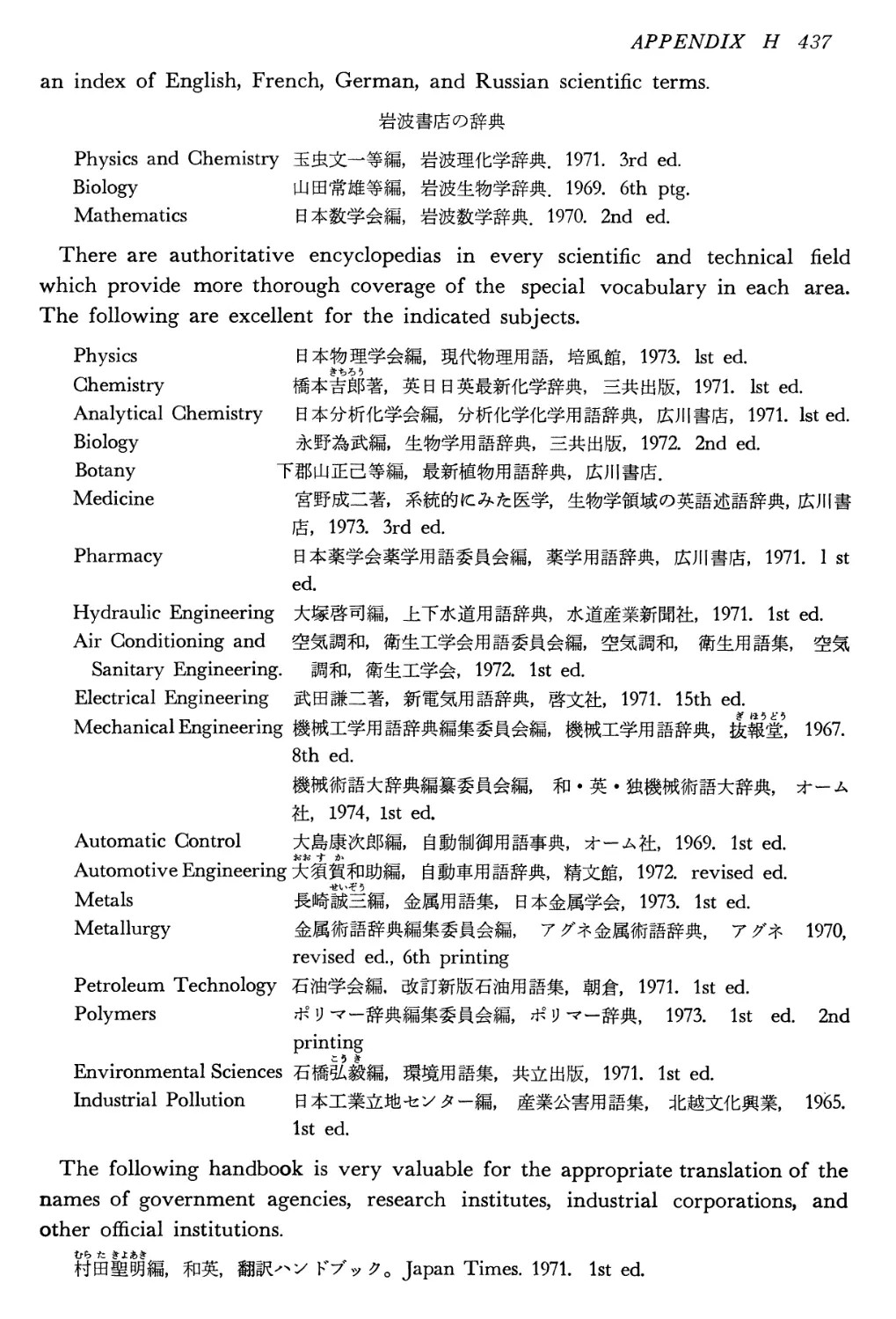
APPENDIX H DICTIONARIES AND REFERENCE WORKS 436

PREFACE
Japan is one of the leading technological nations in the world. Although its
scientific and engineering achievements have been most impressive, few scientists
and engineers have developed the ability to read the literature of their Japanese
counterparts. There are several reasons for this: (a) the extensive efforts of the
Japanese to learn Western languages and their willingness to share their research
results in those tongues; (b) the complexity of the Japanese language for foreign-
foreigners; and (c) the absence of appropriate instructional materials for scientists and
engineers. These points are discussed here briefly.
Although much of Japan's scholarly research has been published in English
and other languages, there remains a vast literature of patents, handbooks, engi-
engineering journals, government reports, and transactions of technical meetings
which is not normally translated. Furthermore there is substantial interest in
graduate and postdoctoral study in Japan, joint US-Japan research projects, and
multinational industrial ventures. All these activities serve to emphasize the need
for providing more people with the opportunity to learn that part of the Japa-
Japanese language which is vital to them, namely the technical part.
The Japanese used in modern technical writing is not nearly as difficult as that
encountered in the literary or the spoken language. Written technical Japanese is
considerably more direct in grammar and style than the literary language with
its delightful nuances and tantalizing ambiguities. Large segments of Japanese
grammar, such as humble and honorific verbs, irregular "counters", words for
family relationships, the verbs for giving and receiving, the formulas for polite
requests, and the whole hierarchy of greetings and apologies are entirely absent.
Moreover, surprisingly, causatives, desideratives, alternatives, the -masu conjuga-
conjugation, and other verb forms do not occur frequently. The basic grammar needed
to read scientific texts is remarkably limited and can be easily mastered. The big
hurdle—and this cannot be minimized—is the development of a recognitional
knowledge of the Chinese characters, the kanji.
Until the publication of this book there has been no reader designed specifi-
specifically to meet the needs of the scientist or engineer. Concerned with the efficient use
of his time, the technical man may wonder which of the approximately 2000 kanji
he should learn first in order to gain access to Japanese technical literature. In
the preparation of this book, therefore, we have stressed the mastery of the five-
hundred most important kanji, and the scientific vocabulary which can be con-
constructed from them.
The organization of lessons is such that the reader will learn these characters
as a result of relentless repetition. To insure that we are introducing the most
important kanji, we have made use of frequency counts which have been made

4 Comprehending Technical Japanese
on physics, l chemistry, 2 and biology texts. 2 We believe that the mastery of
the five-hundred kanji emphasized in this book will provide a very sound basis
for technical reading.
Assuming that the student has had a one-year course in beginning Japanese
(basic grammar, the two капа systems, and the use of a kanji dictionary), we
have structured the lessons in the following way:
1. At the beginning of each lesson a tabulation of the 20 new REQUIRED
KANJI with ON and кип reading which are of importance for scientists and
engineers is presented. These required kanji should be learned thoroughly; the
reader is expected to recognize them in all subsequent lessons.
Next to each kanji two numbers are given. The upper one refers to the kanji
designation in F. Sakade, A Guide to Reading and Writing Japanese, Tuttle, Rut-
Rutland, Vt. A959). The lower one refers to the number of the character in A.
N. Nelson, The Modern Reader s Japanese-English Character Dictionary, Tuttle,
Rutland, Vt. A962). The Sakade book gives the stroke order and the most
important readings; the Nelson reference gives a complete listing of the read-
readings as well as a number of compounds.
2. Next the READING SELECTION, using the twenty new kanji, is given.
Many of these texts are taken from high school books, which are less difficult
and less formal in style than research journals or reference works. The
subject material is rather elementary and hopefully the topics selected will also
be of general interest. A vocabulary list, romaji version of the text, a complete
translation, and explanatory notes accompany the reading selection. For this
part of the lesson no effort is spared to help the reader.
Note that the vocabulary introduced in the reading selection will not be
repeated in later parts of the lesson or in subsequent lessons. Furigana will
always be appended to kanji not previously included as required kanji so that
the reader need not master these kanji and may concentrate on the required
twenty in each lesson.
3. In each reading selection several constructions appear which recur fre-
frequently in technical reading. We single these out and give several examples
further illustrating their use. These CONSTRUCTION EXAMPLES should
be studied with great care, and any new vocabulary words introduced here
should be learned thoroughly, for they will not be repeated subsequently.
4. Next several SUPPLEMENTARY READINGS are included. For these addi-
additional vocabulary is given but no other assistance. The new words introduced
here need not be memorized. Many of these readings are taken from college
1. R.B. Bird, Scientific Japanese, Univ. of Wis., Engr. Expt. Sta. Report # 33, Part KJan.1967), and
part II (Aug. 1967).
2. N. Inoue, unpublished compilation.

Preface 5
level textbooks, reference works, and technical journals. Their purpose is to
provide additional experience in kanji recognition and comprehension.
5. The final essay is a TRANSLATION TEST. Here jurigana are added to
non-required kanji, but otherwise no help is given. The reader is on his own
here—he may have to use a dictionary or grammar book to perform the
translation. In this translation test each of the twenty required kanji for the
lesson will appear at least once.
Thus each lesson progresses from elementary texts with considerable assistance,
to more difficult readings with some vocabulary aids, and then on to a fairly
realistic translation task with no help at all. The final essay should serve as a
guide to the student in judging his mastery of the lesson and in deciding whether
to move on to the next.
Although written primarily to assist the engineer and scientist in learning to
read technical literature, the book may be useful to some technical people who
are interested only in acquiring vocabulary for conversation purposes. Such peo-
people can take a "short course" by using just the romanized readings and the vo-
vocabulary lists. In addition several other groups of people might find this book
helpful: technical librarians, who wish to translate titles and tables of contents;
language majors, who want to train themselves to do technical translation; and
students from non-English-speaking countries who plan to study technical subjects
at Japanese universities.
Our primary purpose, however, is to provide the means for courageous scien-
scientists or engineers to learn to read technical Japanese by hard work. We trust this
book will guide them through those first critical stages of learning to comprehend
written technical texts and hope that the riches of Japanese scientific thought
will be their reward.
E. E. D.
#<DAlK U^teb Uft 9<D1U R. В. В.
N. I.
Madison, Wisconsin
ACKNOWLEDGMENTS
The authors wish to acknowledge financial support and encouragement provid-
provided by the Office of International Studies and Programs, the Engineering Exper-
Experiment Station, and the Graduate School of the University of Wisconsin. In
addition some financial aid was made possible to one of us (RBB) through the
William F. Vilas Trust Estate. We are greatly indebted to Mr. and Mrs. Eiichi
Hamanishi for preparation of the manuscript, to her for the calligraphy and
typing, and to him for advice and proofreading.

EXPLANATORY NOTES
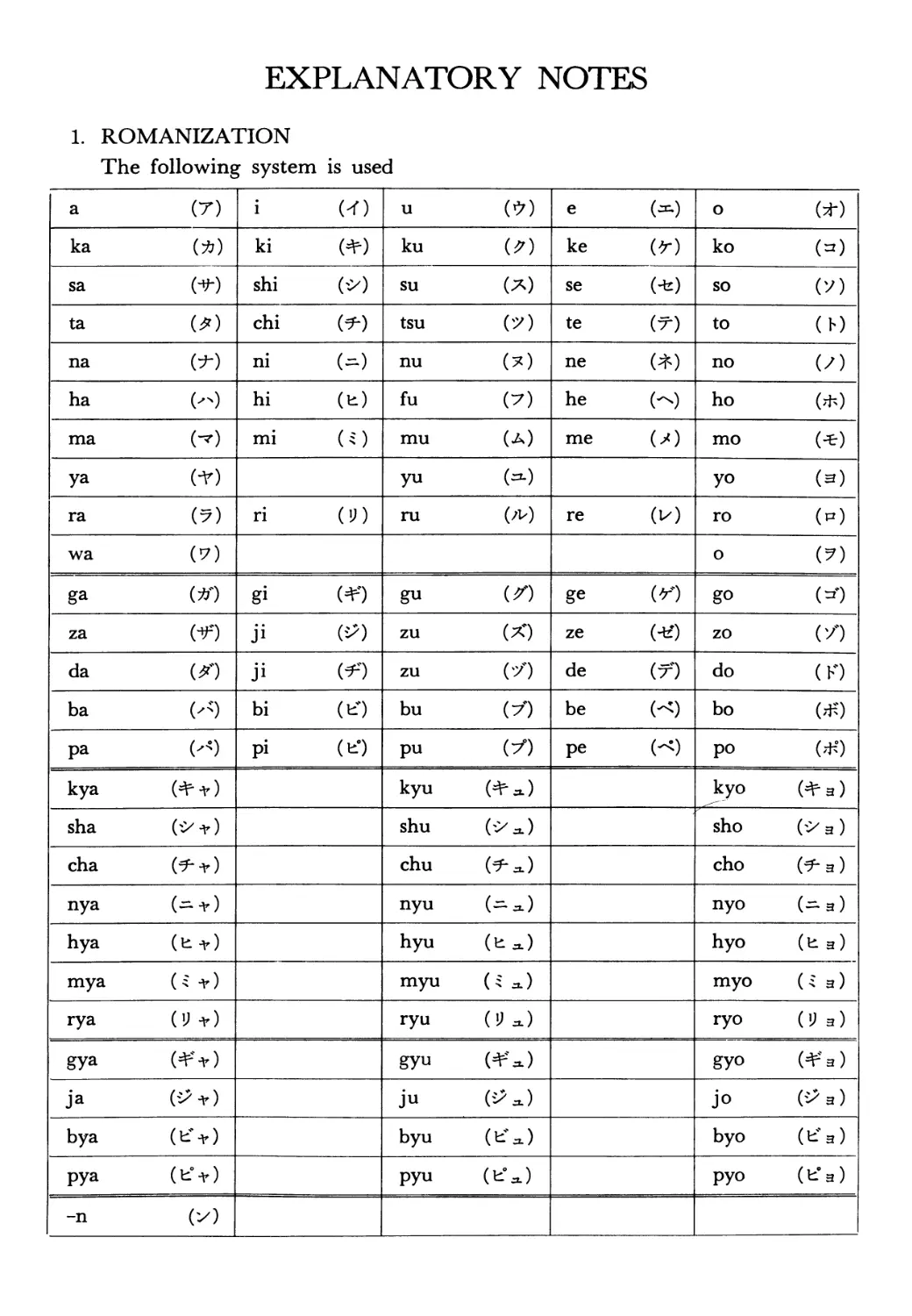
1. ROMANIZATION
The following system is used
a
ka
sa
ta
na
ha
ma
ya
ra
wa
ga
za
da
ba
pa
kya
sha
cha
nya
hya
mya
rya
gya
ja
bya
pya
-n
(r)
(*)
W
(*)
(-)
ft)
ft)
(9)
G)
an
(Я
(-)
('<)
(*+)
(->+)
(*-+)
(-+)
0J+)
(t4)
(t>)
(v)
i
ki
shi
chi
ni
hi
mi
ri
gi
ji
ji
bi
Pi
H)
(+)
('»
(-)
(t)
(«)
(У)
(?)
(^)
(Я
(Ю
u
ku
su
tsu
nu
fu
mu
yu
ru
gu
zu
zu
bu
pu
kyu
shu
chu
nyu
hyu
myu
ryu
gyu
Ju
byu
pyu
(»)
(*)
(Л)
(У)
(?)
G)
(A)
(»)
(/V)
(^)
(X)
("/)
(У)
(^»)
(->»)
(**)
D»)
E*)
(!J»)
(?,)
(^»)
(k**)
e
ke
se
te
ne
he
me
re
ge
ze
de
be
pe
(*)
fr)
(¦t)
(x)
(*)
(-)
(^)
(l/)
(*"*)
(•tf)
(Я
(-<)
(-<)
о
ко
so
to
no
ho
mo
yo
ro
о
go
zo
do
bo
po
kyo
sho
cho
nyo
hyo
myo
ryo
gyo
jo
byo
РУО
m
(a)
(V)
(b)
(/)
(*)
(*)
C)
(p)
(9)
(=0
('/)
(K)
(#)
(*)
ft a)
(^a)
(^a)
(-a)
(ta)
E a)
(У a)
ft в)
а>в)
(Ь'н)
(fa)

Preface 7
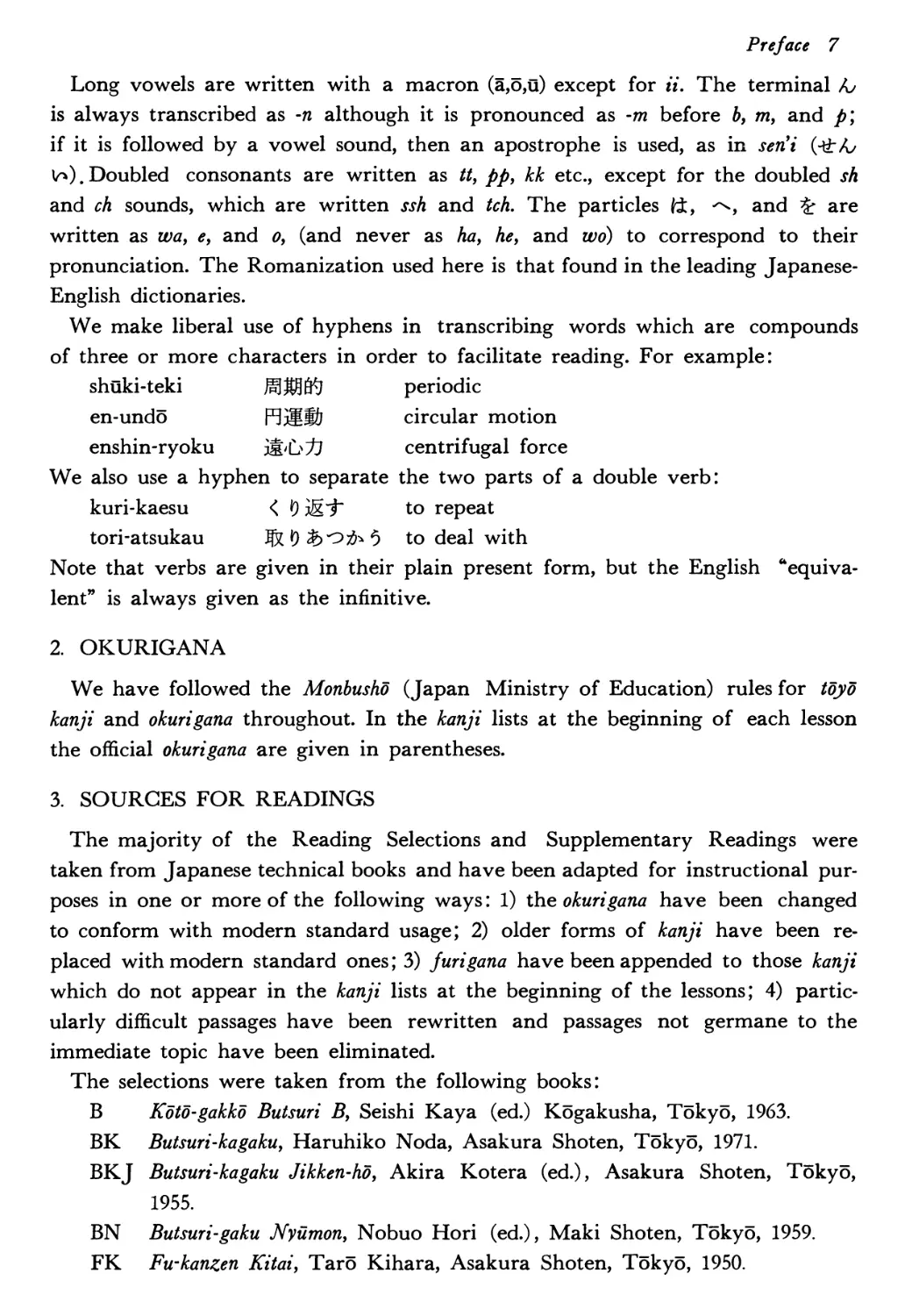
Long vowels are written with a macron (а,о,п) except for гг. The terminal Ay
is always transcribed as -n although it is pronounced as -m before b, m, and p;
if it is followed by a vowel sound, then an apostrophe is used, as in sen9г (-tir/v
V*). Doubled consonants are written as U, pp, kk etc., except for the doubled sh
and ch sounds, which are written ssh and tch. The particles fi, ^, and % are
written as wa9 e9 and o, (and never as ha, he9 and wo) to correspond to their
pronunciation. The Romanization used here is that found in the leading Japanese-
English dictionaries.
We make liberal use of hyphens in transcribing words which are compounds
of three or more characters in order to facilitate reading. For example:
shuki-teki ШШ№] periodic
en-undo НЗЖШ/ circular motion
enshin-ryoku Ш'Ъу*] centrifugal force
We also use a hyphen to separate the two parts of a double verb:
kuri-kaesu < 0 Mir to repeat
tori-atsukau JJX D 2bo#* 5 to deal with
Note that verbs are given in their plain present form, but the English "equiva-
"equivalent" is always given as the infinitive.
2. OKURIGANA
We have followed the Monbusho (Japan Ministry of Education) rules for toyo
kanji and okurigana throughout. In the kanji lists at the beginning of each lesson
the official okurigana are given in parentheses.
3. SOURCES FOR READINGS
The majority of the Reading Selections and Supplementary Readings were
taken from Japanese technical books and have been adapted for instructional pur-
purposes in one or more of the following ways: 1) the okurigana have been changed
to conform with modern standard usage; 2) older forms of kanji have been re-
replaced with modern standard ones; 3) /urigana have been appended to those kanji
which do not appear in the kanji lists at the beginning of the lessons; 4) partic-
particularly difficult passages have been rewritten and passages not germane to the
immediate topic have been eliminated.
The selections were taken from the following books:
В Koto-gakko Butsuri B, Seishi Kaya (ed.) Kogakusha, Tokyo, 1963.
BK Butsuri-kagaku, Haruhiko Noda, Asakura Shoten, Tokyo, 1971.
BKJ Butsuri-kagaku Jikken-ho, Akira Kotera (ed.), Asakura Shoten, Tokyo,
1955.
BN Butsuri-gaku Nyumon, Nobuo Hori (ed.), Maki Shoten, Tokyo, 1959.
FK Fu-kanzen Kitai, Taro Kihara, Asakura Shoten, Tokyo, 1950.

8 Comprehending Technical Japanese
I Ido-sokudo-ron, Daizo Kunii et al., Iwanami Shoten, Tokyo, 1968.
IG Iden-gaku, Yoshito Shinoto and Kaichiro Yanagisawa, Iwanami Shoten,
Tokyo, 1971.
IK Kagaku B, 1st edition, Yuji Shibata, Sakae Tsuda, Osamu Shimamura,
Dai-Nihon Tosho, Tokyo, 1961.
К Kagaku B, new revised edition, Yuji Shibata, Sakae Tsuda, and Osamu
Shimamura Dai-Nihon Tosho, Tokyo, 1966.
KB Ko-bunshi no Butsuri, 3rd edition, The Japan Physical Society (Ed.)
Asakura Shoten, Tokyo, 1966.
KJE Kojien, Izuru Shimamura (ed.), Iwanami Shoten, Tokyo, 1955.
KK Kagaku Kikai no Riron Keisan, Saburo Kamei (ed.), Sangyo Tosho, Tokyo
1959.
KKT Kagaku Kogaku Tsuron, 3rd edition, Koichi Iinoya, Asakura Shoten,
Tokyo, 1959.
KS Kagaku Seni, revised edition, Minoru Iinoto, Iwanami Shoten, Tokyo,
1972.
N Netsu-rikigaku, Masahiro Yorizane, Kagaku Gijutsu-sha, Tokyo, 1957.
2RJ Rika-gaku Jiten, revised 2nd edition, Iwanami Shoten, Tokyo, 1958.
3RJ Rika-gaku Jiten, 3rd edition, Iwanami Shoten, Tokyo, 1971.
S Seibutsu, Tomo-o Miwa and Midemichi Oka, Sanseido, Tokyo, 1972.
SJ Seibutsu-gaku Jiten, Iwanami Shoten, Tokyo, 1960.
SK Sei-kagaku, Fujio Egami, Iwanami Shoten, Tokyo, 1971.
SN Soryushi no Nazo, Hideki Yukawa, Asahi Press, Tokyo, 1972.
SS Seimei о Saguru, Fujio Egami, Iwanami Shoten, Tokyo, 1967.
The symbols at the left are used in refering to these sources.
4. KANJI LISTS
A list of twenty required kanji appears at the beginning of each lesson. The
following are explanations and examples of the notation:
1) Identifying numbers, ON and kun readings.
Number of kanji in Sakade's book
ON reading in capital letters [the additional official
ON reading, KEN, is omitted, since it occurs so rarely
58
4949
in scientific texts]
Number of kanji in N^- кип reading in lower case letters [the additional
Nelson's book official reading ma is omitted, since it occurs infre-
infrequently in scientific texts]

Preface 9
2) Verbs and okurigana.
^-The infrequent reading JO is omitted
The syllables in parentheses are called okurigana
and are written in hiragana.
471
1296
TEI
sada (meru)
sada (maru)
The brace indicates a pair of related verbs, the upper always
being the transitive verb, the lower always being the intransitive
verb. If there are two verbs not joined by a brace, they are not
a transitive-intransitive pair.
3) Unofficial readings.
737
428
[tato (eba) ]
Reading enclosed in brackets is not currently an
official reading. Since this reading is, however, often
encountered in technical Japanese, it is included.
2470
kura(beru)
4) Omission of dakuon readings.
The pronunciation PI as in (КШЭД hanpirei) is not
included, since this is a standard phonetic change
replacing X> by Xfi. Similar phonetic changes, called
dakuon, such as ka (#*) to ga (з^), su (i~) to Zu
(:f), are also not explicitly included.
5) Omission of verbs derived from ON readings.
No separate entry is given for the verb nes{suru).
Similarly in the entry for fo, no separate entry
for o(Zuru) or o(jiru) will be found.
5. VOCABULARY ENTRIES
In the vocabulary lists which accompany the various readings, generally only
the translation of the word which is appropriate in the text at hand has been
listed. For example in Supplementary Reading G in Lesson 1, for the entry
^C % ? okisa magnitude
we have not listed the meanings "largeness, bulk" since they are not appropriate
there. Similary, for the entry
Щ-^Ь ataeru to give
we do not include the meanings "present, award, bestow, provide."
m
490
2797
NETSU
atsu (i)

Page
8
13
34
39
49
64
85
86
91
121
143
171
182
188
198
202
224
229
230
231
247
258
288
298
309
310
312
314
322
331
334
339
348
402
406
407
Line
10
15
20
25
32
12
4
22
9
5
30
8
5
9
15
21
25
9
32
14
14
23
20
2
16-17
24
8
19
25
33
2
4
4
25
20
35
13,36
20
4
10
11
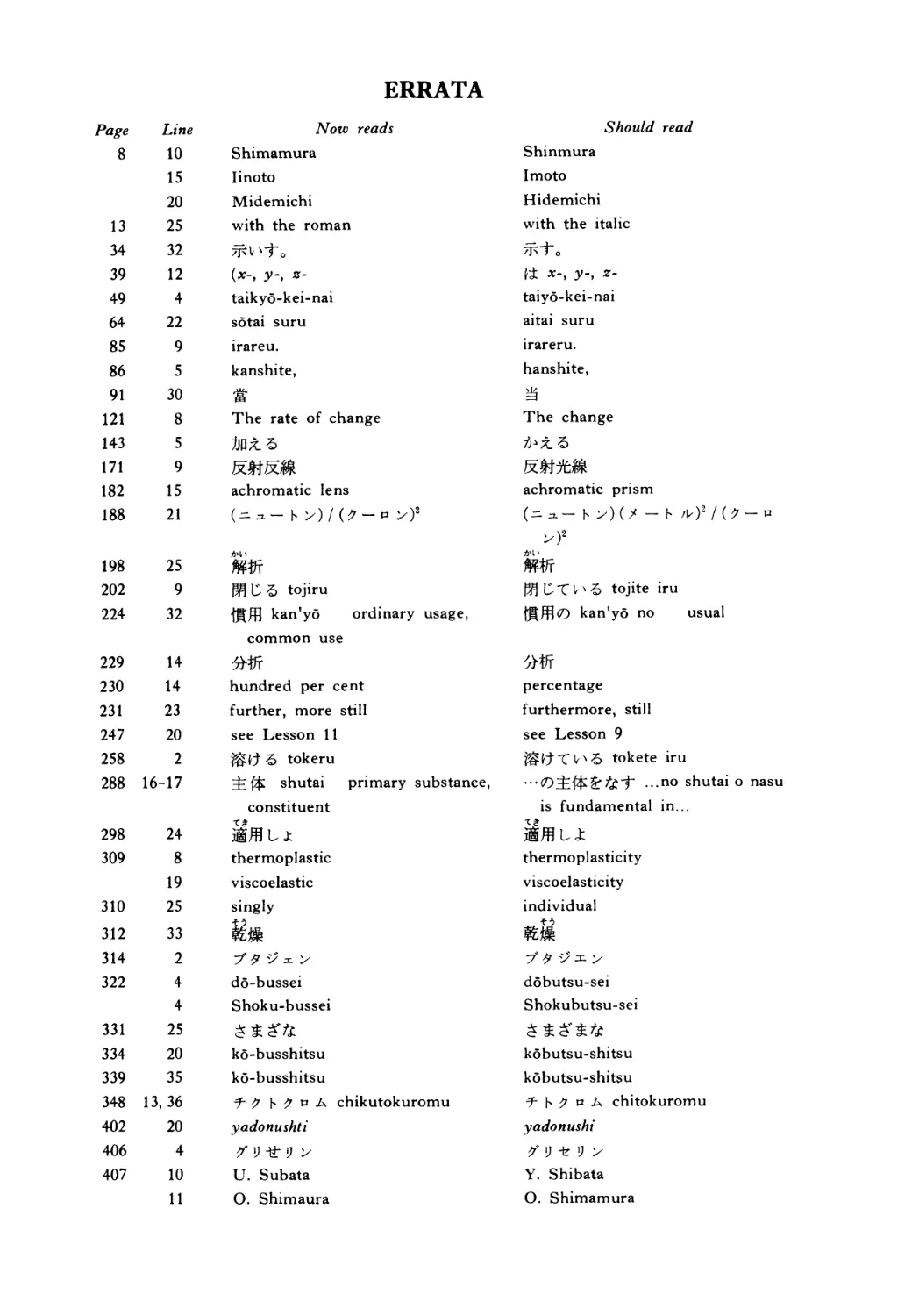
ERRATA
Now reads
Shimamura
Iinoto
Midemichi
with the roman
(*-. y-f *-
taikyo-kei-nai
sotai suru
irareu.
kanshite,
#
The rate of change
achromatic lens
(-*.- b :•)/(*-* у?
Ш
ffi С Ъ tojiru
flUfj kan'yo ordinary usage,
common use
hundred per cent
further, more still
see Lesson 11
Ш№ Z> tokeru
ZEf$ shutai primary substance,
constituent
thermoplastic
viscoelastic
singly
Ш
do-bussei
Shoku-bussei
ko-busshitsu
ko-busshitsu
=f- ^ \, ^ п л chikutokuromu
yadonushti
7 V -fr V У
U. Subata
О. Shimaura
Should read
Shinmura
Imoto
Hidemichi
with the italic
ti *-t y-f z~
taiyo-kei-nai
aitai suru
irareru.
hanshite,
The change
t>*7LZ>
achromatic prism
(-л- Ь У)(* - Ь tvf 1(9 — в
Ш
ffl С X V * Ъ tojite iru
flUfjO kan'yo no usual
percentage
furthermore, still
see Lesson 9
Ш^ХЬ^Ъ tokete iru
•••^ZEftSr&'J'* ...no shutai о nasu
is fundamental in...
thermoplasticity
viscoelasticity
individual
dobutsu-sei
Shokubutsu-sei
kobutsu-shitsu
kobutsu-shitsu
"f- \* 9 и К chitokuromu
yadonushi
>? V ± V У
Y. Shibata
O. Shimamura

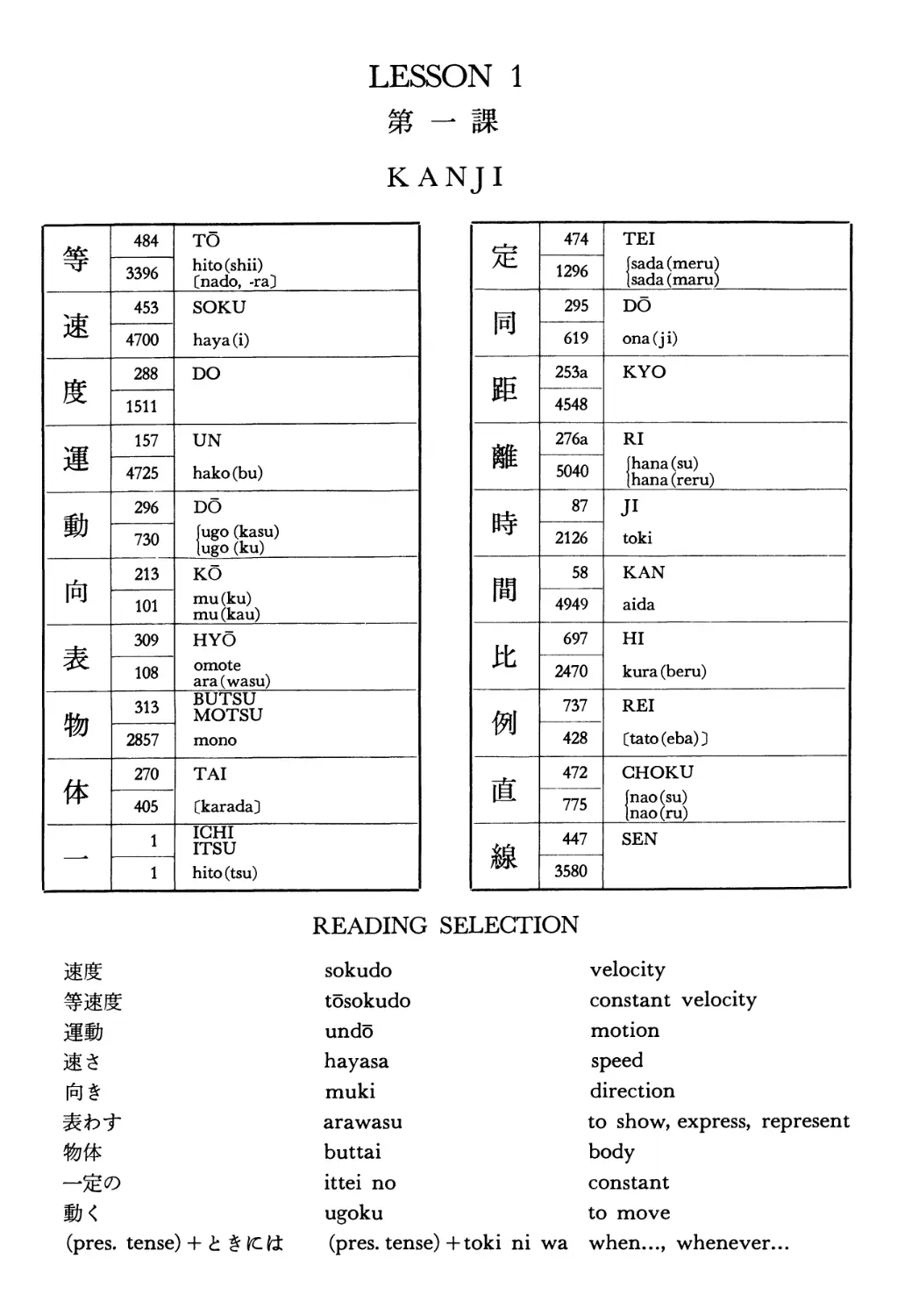
LESSON 1
KANJI
ж
т
п
*
484
3396
453
4700
288
1511
157
4725
296
730
213
101
309
108
313
2857
270
405
1
1
ТО
hito (shii)
Cnado, -raj
SOKU
haya(i)
DO
UN
hako(bu)
DO
(ugo (kasu)
lugo (ku)
КО
mu (ku)
mu (kau)
HYO
omote
ara(wasu)
BUTSU
MOTSU
mono
TAI
CkaradaJ
IGHI
ITSU
hito(tsu)
ma
5Ё
m
Ш
m
m
it
m
m
ш
474
1296
295
619
253a
4548
276a
5040
87
2126
58
4949
697
2470
737
428
472
775
447
3580
TEI
Jsada (meru)
Isada (maru)
DO
ona (j i)
KYO
RI
Jhana (su)
jhana (reru)
JI
toki
KAN
aida
HI
kura (beru)
REI
Ctato(eba):
GHOKU
fnao(su)
Inao(ru)
SEN
<
READING SELECTION
sokudo
tosokudo
undo
hayasa
muki
arawasu
buttai
ittei no
ugoku
velocity
constant velocity
motion
speed
direction
to show, express, represent
body
constant
to move
(pres. tense) + t % (Cf± (pres. tense) +toki ni wa when..., whenever...

12 Comprehending Technical Japanese
V^ О % itsumo
Щ С onaji
kyori
yo shita
jikan
•KUcMiTb ...ni hirei suru
...o v to sureba
aruiwa
chokusen
always
same
distance
required
time
to be proportional to.
if we let v be---
or
straight line
(в И)
о-eft So
c
(9)
TOSOKUDO UNDO
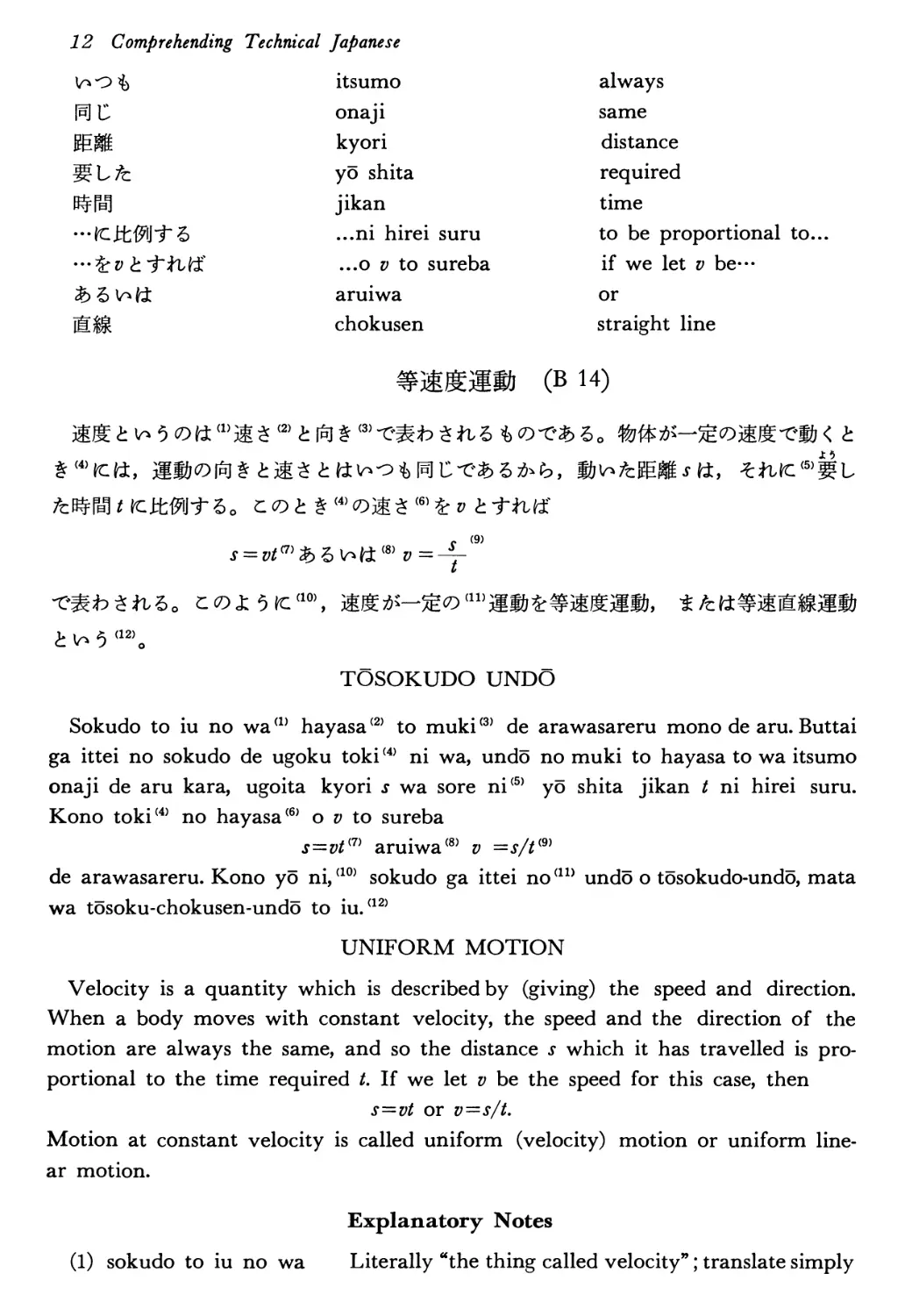
Sokudo to iu no waA) hayasaB) to mukiC) de arawasareru mono de aru. Buttai
ga ittei no sokudo de ugoku tokiD) ni wa, undo no muki to hayasa to wa itsumo
onaji de aru kara, ugoita kyori s wa sore niE) yo shita jikan t ni hirei suru.
Kono tokiD) no hayasa(б) о о to sureba
s=vtm aruiwa(8) v =s/t(9)
de arawasareru. Kono yo ni,A0) sokudo ga ittei noA1) undo о tosokudo-undo, mata
wa tosoku-chokusen-undo to iu.A2)
UNIFORM MOTION
Velocity is a quantity which is described by (giving) the speed and direction.
When a body moves with constant velocity, the speed and the direction of the
motion are always the same, and so the distance s which it has travelled is pro-
proportional to the time required t. If we let v be the speed for this case, then
s—vt or v—s/t.
Motion at constant velocity is called uniform (velocity) motion or uniform line-
linear motion.
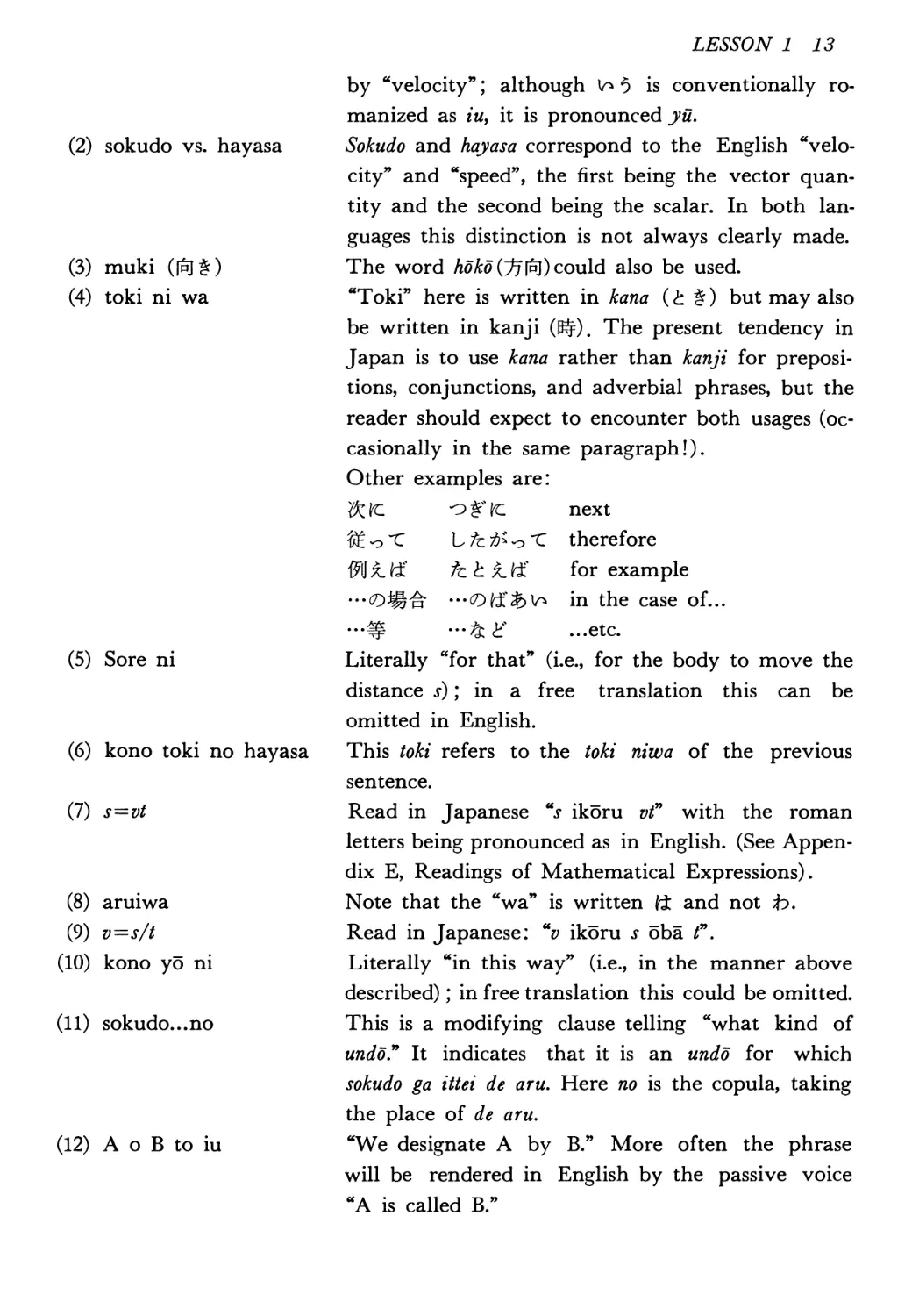
A) sokudo to iu no wa
Explanatory Notes
Literally "the thing called velocity"; translate simply

LESSON 1 13
B) sokudo vs. hayasa
C) muki (|SJ?)
D) toki ni wa
E) Sore ni
F) kono toki no hayasa
G) s=vt
(8) aruiwa
(9) v=s/t
A0) kono yo ni
A1) sokudo...no
A2) А о В to iu
by "velocity"; although V^ Ь is conventionally ro-
manized as iu9 it is pronounced уп.
Sokudo and hayasa correspond to the English "velo-
"velocity" and "speed", the first being the vector quan-
quantity and the second being the scalar. In both lan-
languages this distinction is not always clearly made.
The word hoko(~fjft\) could also be used.
"Toki" here is written in kana (t %) but may also
be written in kanji (Sf). The present tendency in
Japan is to use kana rather than kanji for preposi-
prepositions, conjunctions, and adverbial phrases, but the
reader should expect to encounter both usages (oc-
(occasionally in the same paragraph!).
Other examples are:
#: К о #* К: next
therefore
for example
in the case of...
•••#p —&i* ...etc.
Literally "for that" (i.e., for the body to move the
distance s); in a free translation this can be
omitted in English.
This toki refers to the toki niwa of the previous
sentence.
Read in Japanese us ikoru vf with the roman
letters being pronounced as in English. (See Appen-
Appendix E, Readings of Mathematical Expressions).
Note that the "wa" is written tt and not Ъ.
Read in Japanese: "v ikoru s oba f.
Literally "in this way" (i.e., in the manner above
described); in free translation this could be omitted.
This is a modifying clause telling "what kind of
undo!9 It indicates that it is an undo for which
sokudo ga ittei de aru. Here no is the copula, taking
the place of de aru.
"We designate A by B." More often the phrase
will be rendered in English by the passive voice
"A is called B."

14 Comprehending Technical Japanese
CONSTRUCTION EXAMPLES
A
2.
3.
2.
«л • »
"A is
л • y---
jikan-hyo
dobutsu
jibun no karada
ugokasu
ikimono
time-table
animal
its own body
to move (an object)
living thing
"whenever; when"
"if we let--- be a"
l.
2. А, В И (AtBi <D$$) <ОШШЪ
А, В ?$ А, В кап
between A and В
(verb) Ь~Р%ъ1с? "if we suppose that"
A ?
2.
3.
ono-ono
< hanarete iku
sore-zore
"A we call B; A is called B"
each
to move apart
their respective
1.
2.

LESSON 1 15
SUPPLEMENTARY READINGS
A. %ЪЪк
mochiron
hotondo mirarenai
tatoeba
ochiru
ittei shite inai...
buttai ga ochiru toki
no...
of course
is seldom seen
for example
to fall
...which is not constant
Literally: (the motion)
when a body falls
if
~eft 5 $*,
В. —
* 5
Jt
t
hitotsu
rei
...o totte miyo
doji ni
ono-ono
...o suru to shi(te)
sorezore no
kuraberu
sorera
hi
...to shitara
soshite
hitoshii
one
an example
let us consider...
simultaneously
each, individually
to suppose that..., (and)
respective
to compare
they
ratio
if we suppose...
and, then, now
equal
cm
Lfcfc,
b sb j? it ^<5 b,
A btffoW В &Щ
G. ^ b
bekutoru
sukara
okisa
hoko
ataeru
a vector
a scalar
magnitude
direction
to give

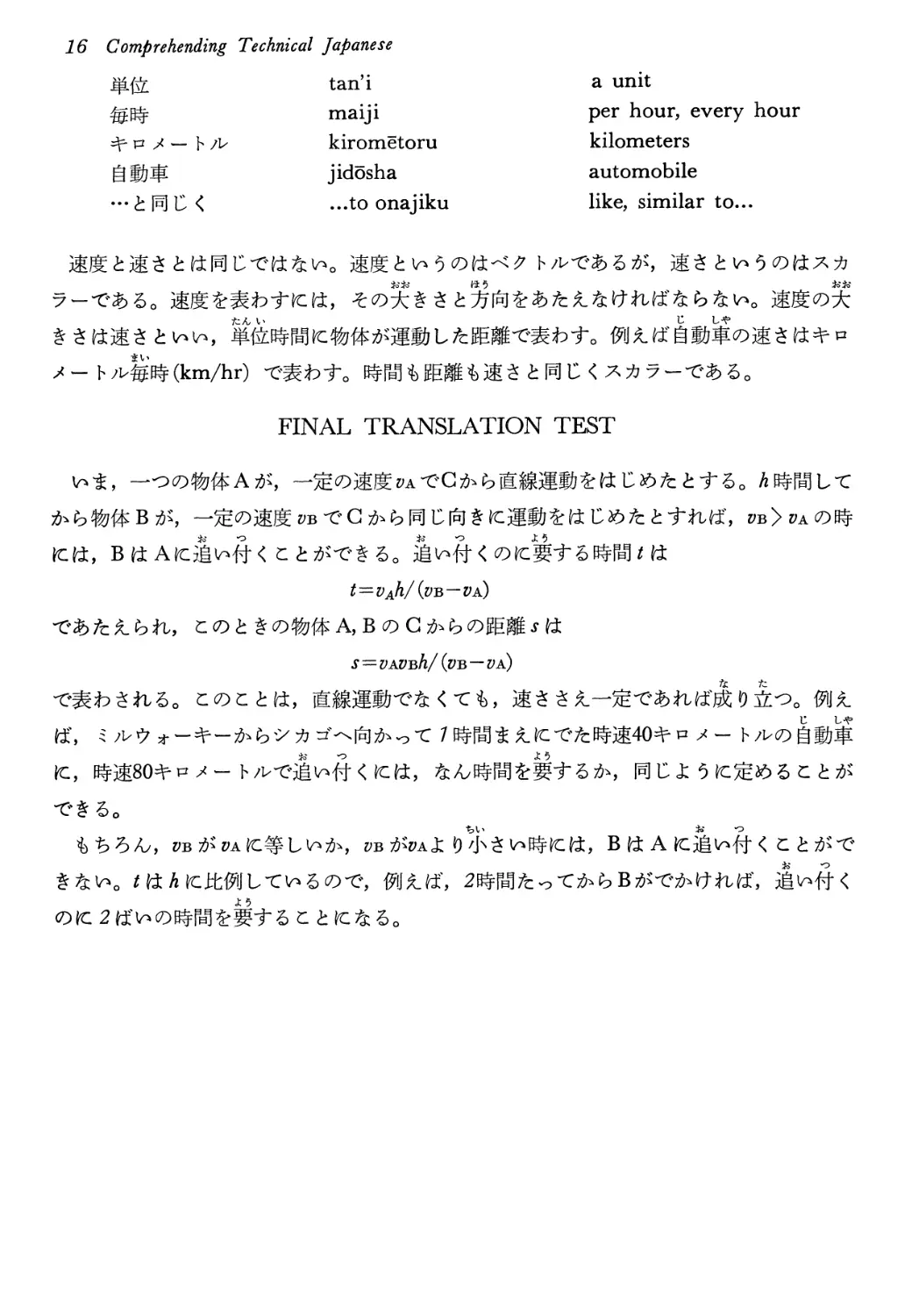
16 Comprehending Technical Japanese
tan'i
maiji
t Щ С <
kirometoru
jidosha
...to onajiku
a unit
per hour, every hour
kilometers
automobile
like, similar to...
FINAL TRANSLATION TEST
—pa)
cot
S = VAVBh/ (VB — VA)
tf, 5
Btt A K:iiv^#< г:

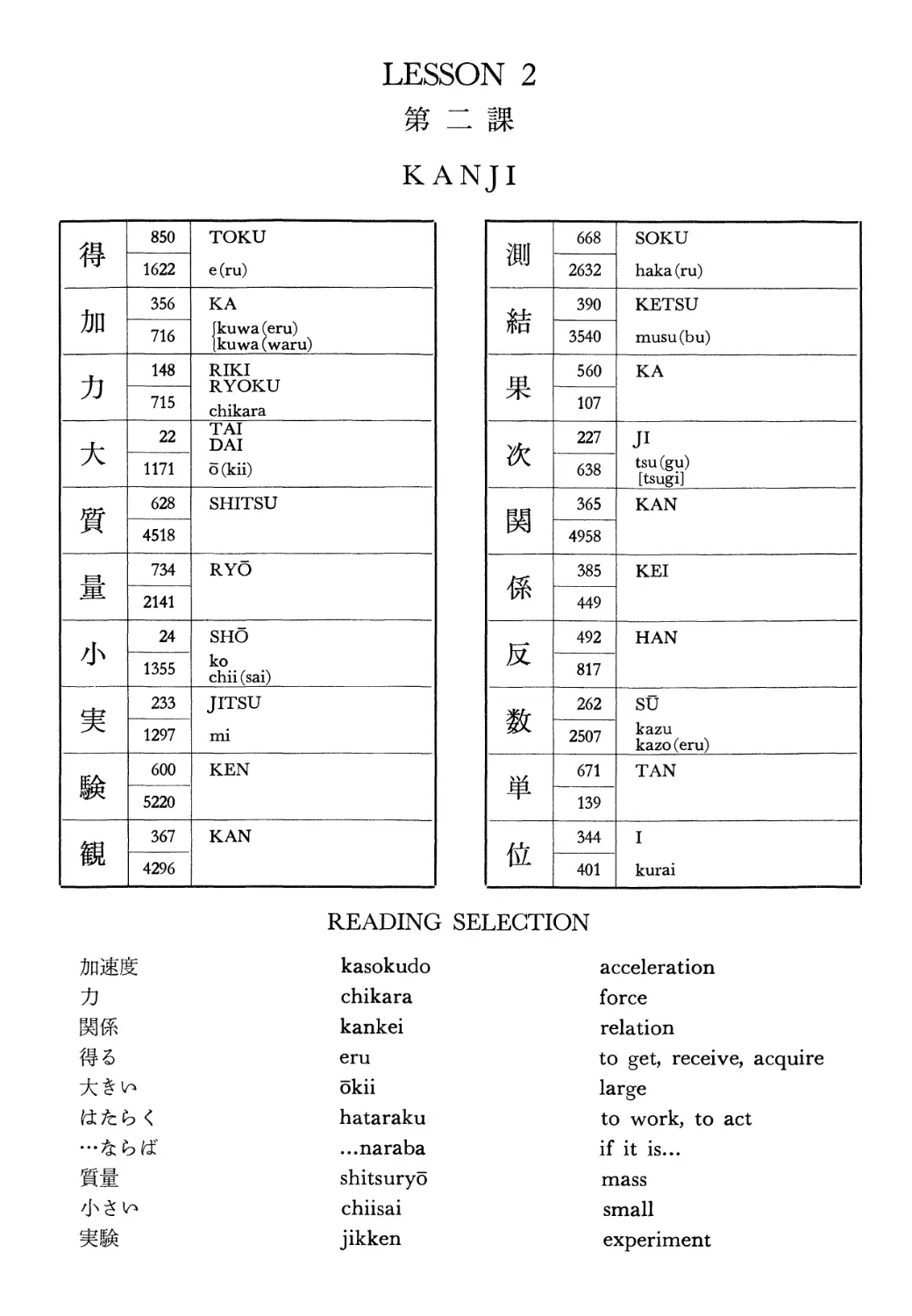
LESSON 2
Ш
850
1622
356
716
148
715
22
1171
628
4518
734
2141
24
1355
233
1297
600
5220
367
4296
токи
e(ru)
КА
jkuwa (eru)
[kuwa (waru)
RIKI
RYOKU
chikara
"TAT
DAI
o(kii)
SHITSU
RYO
SHO
ko
chii (sai)
JITSU
mi
KEN
KAN
KANJI
m
щ
Ш
668
2632
390
3540
560
107
227
638
365
4958
385
449
492
817
262
2507
671
139
344
401
SOKU
haka (ru)
KETSU
musu (bu)
KA
JI
tsu(gu)
[tsugi]
KAN
KEI
HAN
su
kazu
kazo (eru)
TAN
I
kurai
READING SELECTION
kasokudo
chikara
kankei
eru
okii
hataraku
...naraba
shitsuryo
chiisai
jikken
acceleration
force
relation
to get, receive, acquire
large
to work, to act
if it is...
mass
small
experiment

18 Comprehending
•••?& tKLX
AhBb<DT*lK
lfc<D
Technical Japanese
kansoku
...о moto ni shite
kekka
A to В to no aida ni
tsugi no
wakaru
okisa
...ni hanpirei suru
teisu
tan'i
dono yo ni
erabu
...ni yotte
sadamaru
observation
based on...
result
between A and В
the following
to understand, find out
magnitude
to be inversely proportion-
proportional to
constant
unit
in what way
to choose
according to
to be decided, determined
<,
(B 23)
, tilth
CK k
a k
т
, m, a, F
i: <D 1:
KASOKUDO TO GHIKARA TO NO KANKEI
Buttai no eru kasokudo wa, chikara ga okii hodo okiku, mata, hataraku chikara
ga onaji naraba,A) buttai no shitsuryo ga, okii hodo kasokudo wa chiisai. Jikken
ya kansoku no kekka о moto ni shite, chikara to shitsuryo to kasokudo to no
aida ni wa, tsugi no kankei ga aru koto ga wakatta.B)
Buttai ni chikara ga hataraku to, buttai wa sono chikara no muki ni kasokudo
о eru. Kono kasokudo no okisa a wa, hataraita chikara F ni hirei shi,c3) buttai
no shitsuryo m ni hanpirei suru.
a=k(F/m)
Koko ni k wa hirei-teisu de atte, m9 a, F no tan'i о dono yo ni erabu kac4) ni yotte
sadamaru.

LESSON 2 19
THE RELATION BETWEEN ACCELERATION AND FORCE
The acceleration which a body acquires is greater as the force is greater; fur-
furthermore, if the applied force is the same, the acceleration is smaller as the mass of
the body is greater. On the basis of the results of experiments and observations,
we know that the following relation exists between force, mass, and acceleration.
If a force acts on a body, the body accelerates in the direction of that force.
The magnitude of this acceleration a is proportional to the applied force F and
is inversely proportional to the mass m of the body.
a = k(F/m)
Here к is a proportionality constant and is determined by how we choose the
units of m, a, and F.
Explanatory Notes
A) naraba Same as naraiii it is).
B) ...koto ga wakatta This may also be rendered: "it turned out that"
or "we have learned that".
C) hirei shi One could also write hirei shite.
D) m,...ka This entire phrase is the object of ni yotte.
CONSTRUCTION EXAMPLES
v*l&t*—'btv>
1.
2.
3.
4.
the larger the smaller"
"based on...*
titшшt
ь]Ш5ё$с*5ё»ьсt
з.
4.
sokutei
...ni okeru
measurement
in...

20 Comprehending Technical Japanese
kansu
hosoku
function
law
"if it is"
2.
3.
4.
Interrogative Clause + [С j;
"according to"
2.
3.
4.
ЩЪ
¦C t
Ш
"we know
mo ichido
hakaru
kawaru
that
once more
to measure
to vary, change
2.
С Ь
okoru
to occur
v
— л — Ь У
SUPPLEMENTARY READINGS
sunawachi that is, namely
nagasa length
mochi-iru to use
dain dyne
esaseru to give, impart
<B... to shite sadamerareteiru is defined as...
nyuton newton
...to yobu is called
* b

m/sec2
CGSififi,
...baai
metoru-pa-sekondo-jijo
LESSON 2 21
in cases where...
cm
Г g (/5л), ^
sec
В.
l-c
§u
"С
С.
VVi{ilkg(D^}i^Kififcb^X, lm/sec2
, \ШШШк\И
a=F/m
ippan ni (wa) generally
moshi...to shite mo even if...
sono kekka to shite as a result
mae before
ato after
shitagatte consequently
...sae...ba if only
...no пака ш
shunkan-ryoku
sokutei suru
sokutei dekinai hodo...
shikashi
...ni oite wa
...ni taishite
...nai kagiri
...dake ga
henka
...shiyasui
sadamerareru
motomeru
куп ni
kakudo
among...
instantaneous force
to measure
so...as to be immeasurable
but, yet, however
as for..., in...
in relation to...
so long as...is not
only...
change
...is easily (done)
can be determined, to be
able to determine
to seek
suddenly
ansrle

22 Comprehending Technical Japanese
W < ?><?)••• ikura no...
shimesu
hajime no...
D.
how much
to show, point out
original..., initial...
kangaeru
kansu
...ni kansuru
sekibun
ichiji no...
dokansu
to consider
function
with respect to...
pertaining to...
integral
...of the first degree, order
derivative
v=-
ds_
dt
FINAL TRANSLATION TEST
t t,

LESSON 2 23
*
fth
, 5N
Ш. a tt,
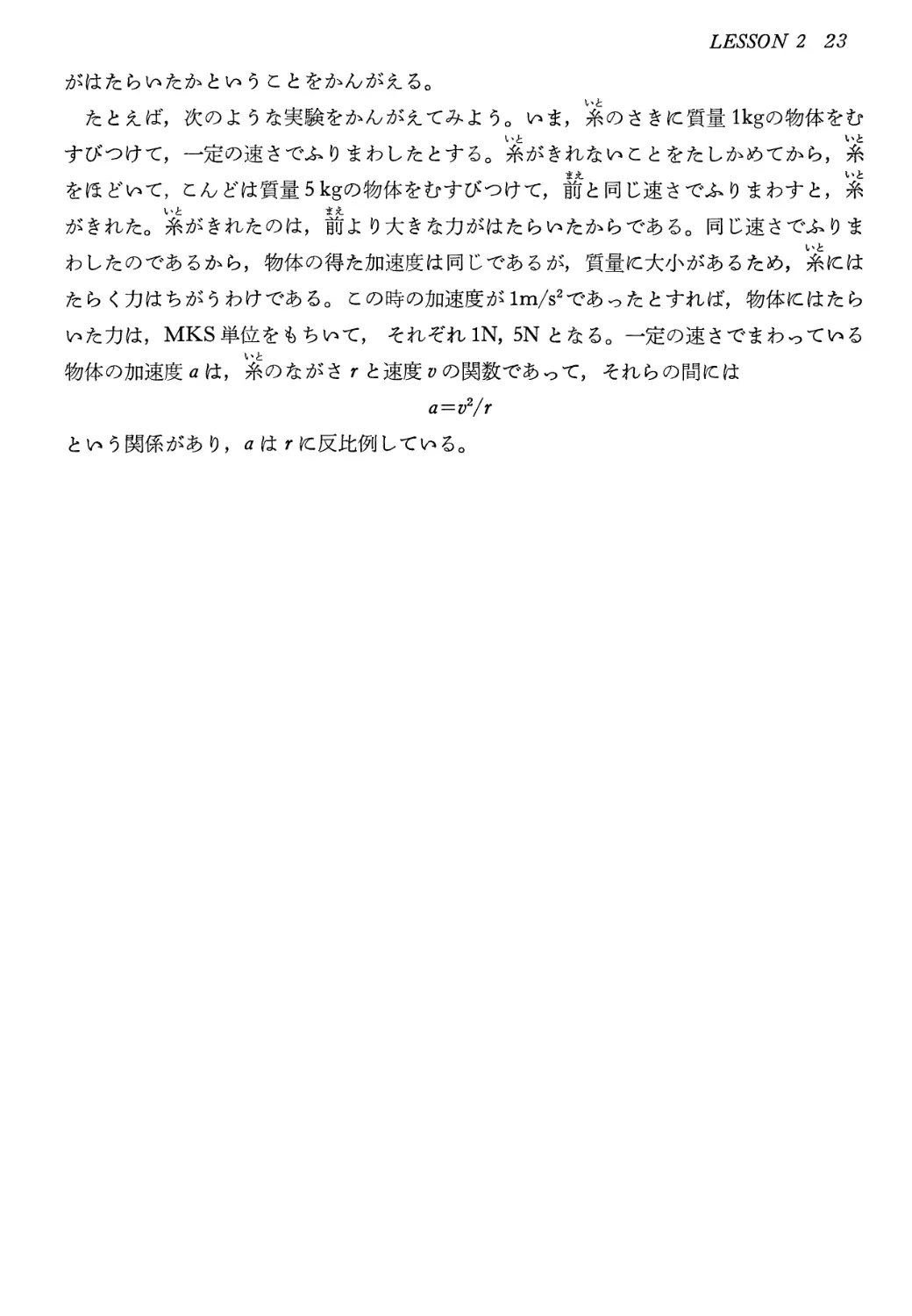
a=v2/r

LESSON 3
KANJI
Ш
±
ж
ft
—
ft
ft
445
3306
20
798
509
306
417
1556
163
350
2
273
268b
1638
219b
3316
716
455
836
1267
SEKI
jtsu (rau)
jtsu(moru)
JO
ue
ja(geru)
la(garu)
HEN
f ka (eru)
{ka (waru)
SHIKI
KA
NI
futa (tsu)
SHO
TOTSU
tsu(ku)
HO
tamo (tsu)
ZON, SON
м
m
10
n
m
ж
n
BU
fP
513
2535
666
4487
208
1610
466
3172
193b
154
82
407
146
2993
461
2067
102
595
338
3268
HO
SOKU
GO
КО
ushi (ro)
nochi
TAN
mij ika (i)
oyo (bi)
foyo(bosu)
[oyo (bu)
SA
SAKU
tsuku(ru)
YO
mochi (iru)
TAI
TSUI
ZEN
mae
WA
?ЪЪ
•3b ft*)
READING SELECTION
rikiseki
itchokusen-jo
ukeru
...ni kawaru
shiki
tsugi no yo ni
kaki-arawasu
...atari
impulse
on a straight line
to receive, get
to change to...
equation
as follows;in the following
way
to write, express
per...

26 Comprehending Technical Japanese
shimesu to show, indicate
kore yori from this
Щ < michibiku to derive
Щ seki product (math.)
ШЬ henka change
Ho futatsu two
Щ% shototsu collision
...ni oitsuku overtake...
shototsu-go ni after the collision
— K&5 ...ni naru to become...
ШШШ undo-ryo momentum
ftf?b--- tadashi... here...
fure-au to come in contact with;
touch each other
(goku)mijikai (extremely) short
oyobosu to exert, cause
fukuzatsu na complicated
fp#! sayo action, effect
KfFffi han-sayo reaction
"ш<ОЩШКЯ& Ь ...no kankei ni aru to be related as...
ЩЩ shunkan instant, moment
ЫМ hantai opposite
shitagatte therefore, consequently
sunawachi that is (to say); i. e.
...no zengo before and after...
...ni oite at, as for, concerning, in
^P wa sum
f^^ hozon conservation
SIJJ hosoku law
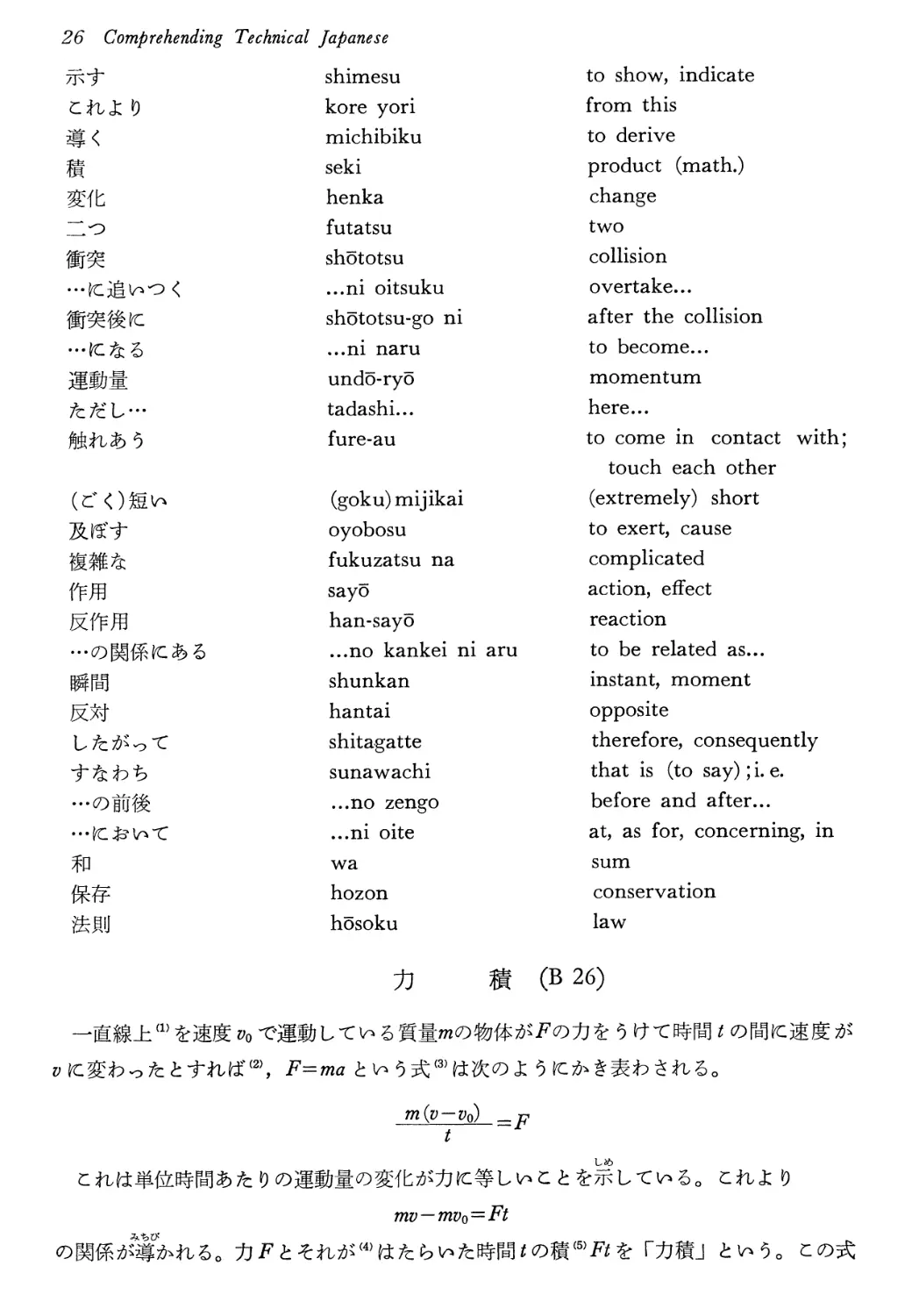
Л Ш (В26)
l}, F=ma
m(v—v0) _
mv—mvo=Ft

LESSON 3 27
fi Ш
(В 26-27)
/с t
m1u'-m1u=F1t
A)
A),
B)
C)
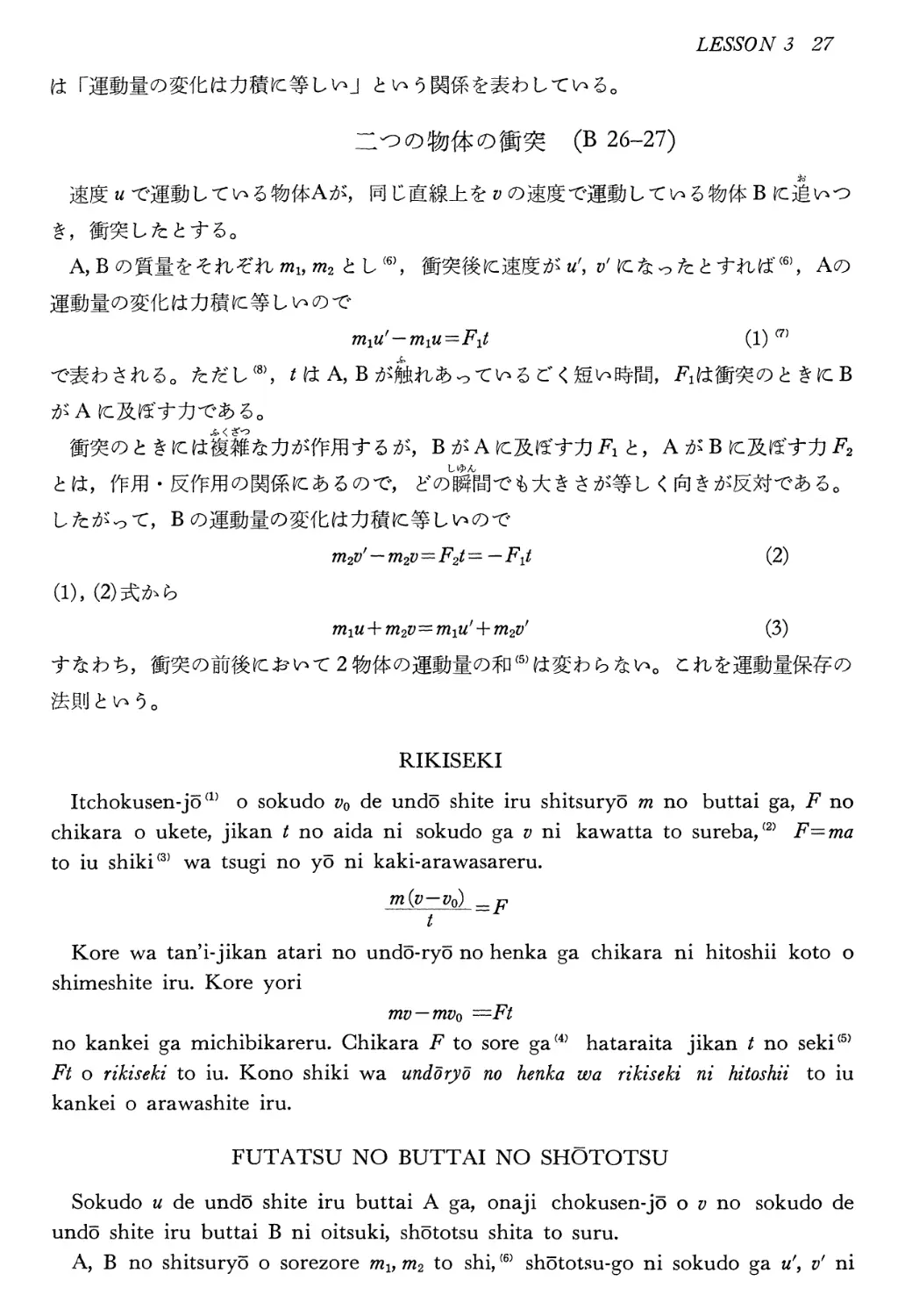
RIKISEKI
Itchokusen-joA) о sokudo v0 de undo shite iru shitsuryo m no buttai ga, i7 no
chikara о ukete, jikan t no aida ni sokudo ga v ni kawatta to sureba,B) F—ma
to iu shikiC) wa tsugi no yo ni kaki-arawasareru.
m(v-vQ) _F
t
Kore wa tan'i-jikan atari no undo-ryo no henka ga chikara ni hitoshii koto о
shimeshite iru. Kore yori
mv — mvo =Ft
no kankei ga michibikareru. Ghikara F to sore gaD) hataraita jikan t no sekiE)
Ft о rikiseki to iu. Kono shiki wa undoryo no henka wa rikiseki ni hitoshii to iu
kankei о arawashite iru.
FUTATSU NO BUTTAI NO SHOTOTSU
Sokudo и de undo shite iru buttai A ga, onaji chokusen-jo о v no sokudo de
undo shite iru buttai В ni oitsuki, shototsu shita to suru.
А, В no shitsuryo о sorezore mlf m2 to shi,F) shototsu-go ni sokudo ga w', v' ni

28 Comprehending Technical Japanese
natta to sureba, F) A no undo-ryo no henka wa rikiseki ni hitoshii no de
miu' — miU — Fit A)
de arawasareru. Tadashi,(8) t wa А, В ga fure-atte iru goku mijikai jikan, Fi wa
shototsu no toki ni В ga A ni oyobosu chikara de aru.
Shototsu no toki ni wa fukuzatsu na chikara ga sayo suru ga, В ga A ni oyo-
oyobosu chikara Рг to A ga В ni oyobosu chikara F2 wa, sayo-hansayo no kankei ni
aru no de, dono shunkan de mo okisa ga hitoshiku muki ga hantai de aru. Shi-
tagatte В no undoryo no henka wa rikiseki ni hitoshii no de
m2v' - m2v =*F2t=— Fxt B)
A), B) shiki kara
mxu + m2v — т^и'Л- m2v' C)
Sunawachi, shototsu no zengo ni oite 2 buttai no undo-ryo no waE) wa ka-
waranai. Kore о undo-ryo hozon no hosoku to iu.
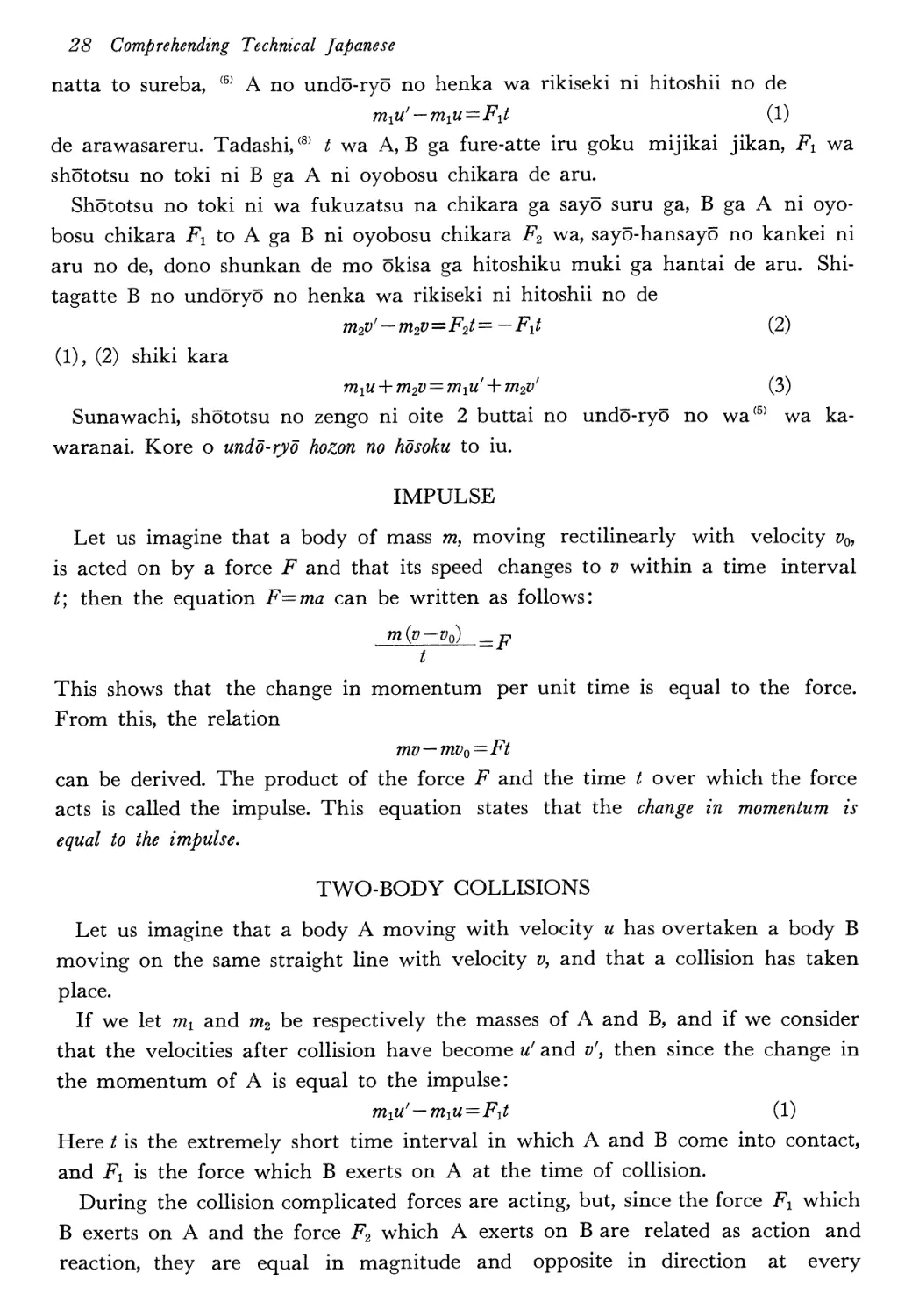
IMPULSE
Let us imagine that a body of mass m, moving rectilinearly with velocity v0,
is acted on by a force F and that its speed changes to v within a time interval
t; then the equation F—ma can be written as follows:
m(v—v0) _p
This shows that the change in momentum per unit time is equal to the force.
From this, the relation
mv — mvQ— Ft
can be derived. The product of the force F and the time t over which the force
acts is called the impulse. This equation states that the change in momentum is
equal to the impulse.
TWO-BODY COLLISIONS
Let us imagine that a body A moving with velocity и has overtaken a body В
moving on the same straight line with velocity v, and that a collision has taken
place.
If we let тг and m2 be respectively the masses of A and B, and if we consider
that the velocities after collision have become u' and г/, then since the change in
the momentum of A is equal to the impulse:
mxu' — mxU—Fit A)
Here t is the extremely short time interval in which A and В come into contact,
and Ft is the force which В exerts on A at the time of collision.
During the collision complicated forces are acting, but, since the force Fi which
В exerts on A and the force F2 which A exerts on В are related as action and
reaction, they are equal in magnitude and opposite in direction at every

LESSON 3 29
moment. Therefore because the change of momentum of В is equal to the
impulse:
m2v' — rn2v — F2t = — Fxt B)
From Eqns. A) and B)
m1u + m2v =m1u' + m2v/ C)
That is, the sum of the momenta of the two bodies before and after the colli-
collision is unchanged. This is called the law of conservation of momentum.
EXPLANATORY NOTES
A) itchokusen-jo о undo suru Move along a straight line. Note that this con-
construction is the same as michi о aruku (walk along
a street).
If we suppose that, if we consider (an often en-
encountered expression in scientific texts).
The equation (called) F—ma (in the last sen-
sentence of this reading selection we also find
to iu kankei).
It (that is, the force F).
The elementary mathematical operations are:
^P wa sum
Ш sa difference
Щ seki product
j§f sho quotient
The corresponding verbs are:
tasu to add
< hiku to subtract
kakeru to multiply
ff waru to divide
Suppose that... and suppose that {to shi is the
literary equivalent of to shite).
These are read in Japanese as "u-dash" and "m-
one".
B) to sureba
C) F—ma to iu shiki
D) sore ga
E) seki, wa
F) ...to shi,...to sureba
G) U', Hi!
(8) tadashi
This word at the beginning of a sentence indi-
indicates that the meaning of the previous sentence
is being elaborated or certain conditions are be-
being specified. When it appears in scientific texts
immediately after an equation, it almost al-
always may be translated as "here", e. g.
X Г fi

30 Comprehending Technical Japanese
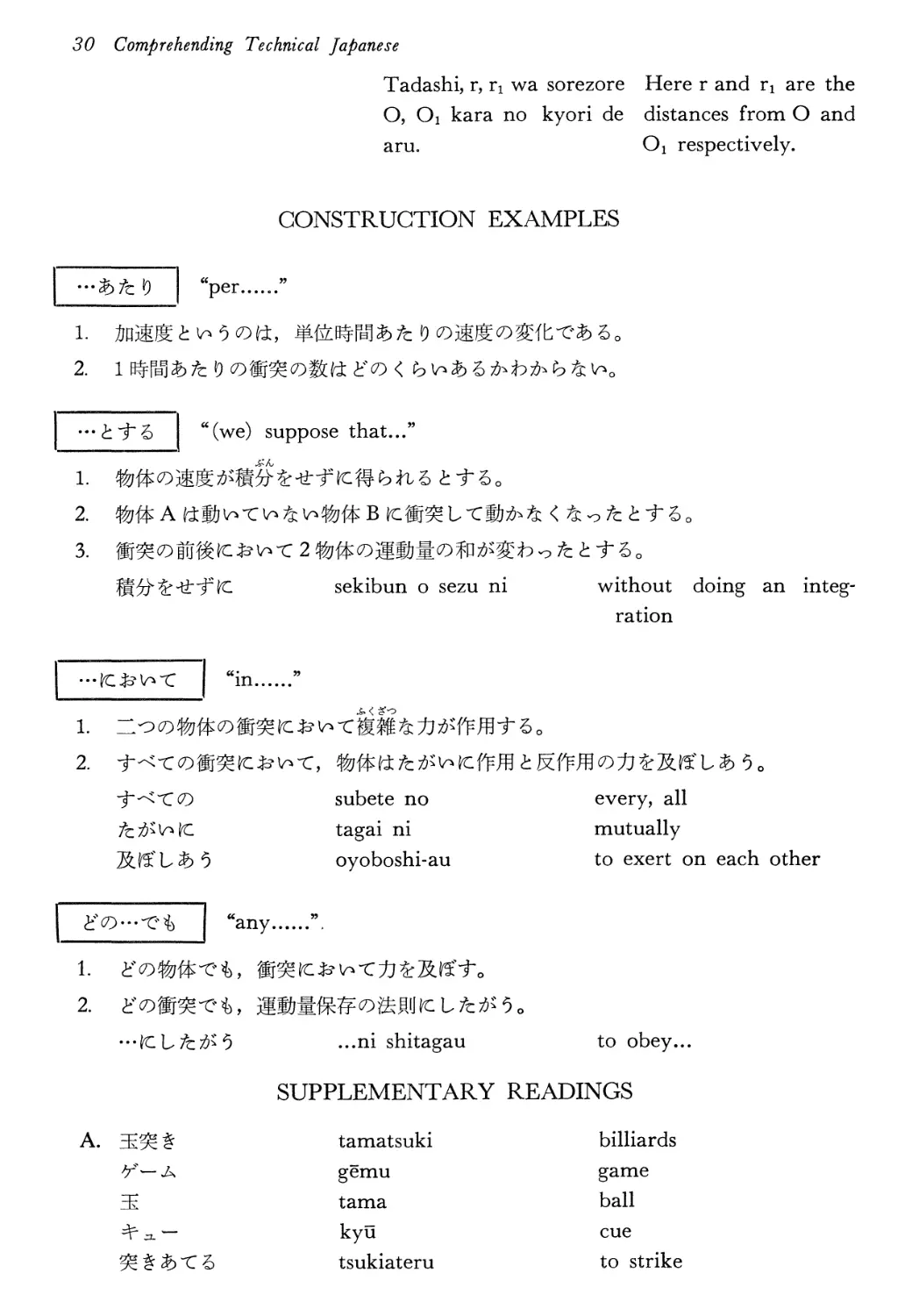
Tadashi, r, r2 wa sorezore Here r and r: are the
O, Oi kara no kyori de distances from О and
aru. Ol respectively.
CONSTRUCTION EXAMPLES
"per.
2.
"(we) suppose that..."
2. ^{t A
3. щ
sekibun о sezu ni
2.
*i~-<XCO
subete no
tagai ni
oyoboshi-au
any.
1.
2.
without doing an integ-
integration
every, all
mutually
to exert on each other
...ni shitagau to obey...
SUPPLEMENTARY READINGS
A.
— Л
Ь X 5
tamatsuki
gemu
tama
куп
tsukiateru
billiards
game
ball
cue
to strike

1th
B.
.к
Ш
тс
fz. О
goku
kuwaeru
betsu-betsu-ni
taihen
muzukashii
sorehodo
hitsuyo
LESSON 3
extremely
to add
separately
very, exceedingly
difficult
to that extent
necessary
31
tzt
kanarazu
mitasu
undo enerugii
kanarazushimo.. .nai
joken
seishitsu
busshitsu
sukunai
dansei
hanpatsu-keisu
tomo ni
sotai...
kanzen na
naritatsu
...ni tsuite
kangaeru
dainamaito
bakuhatsu
shodo-teki na
kagaku-henka
ni yoru
okoru
necessarily, without fail,
always
to satisfy
kinetic energy
not always, not necessarily
conditions
nature, properties
substance, material
few, scarce
elasticity
coefficient of restitution
together
relative...
perfect
to realize, to materialize
in connection with..., relat-
relating to...
to consider
dynamite
explosion
impulsive
chemical change
to depend on
to happen, to occur

32 Comprehending Technical Japanese
t,
u,v t
u'-v"
u—v
м
FINAL TRANSLATION TEST
rt Li
tкШ
tfo

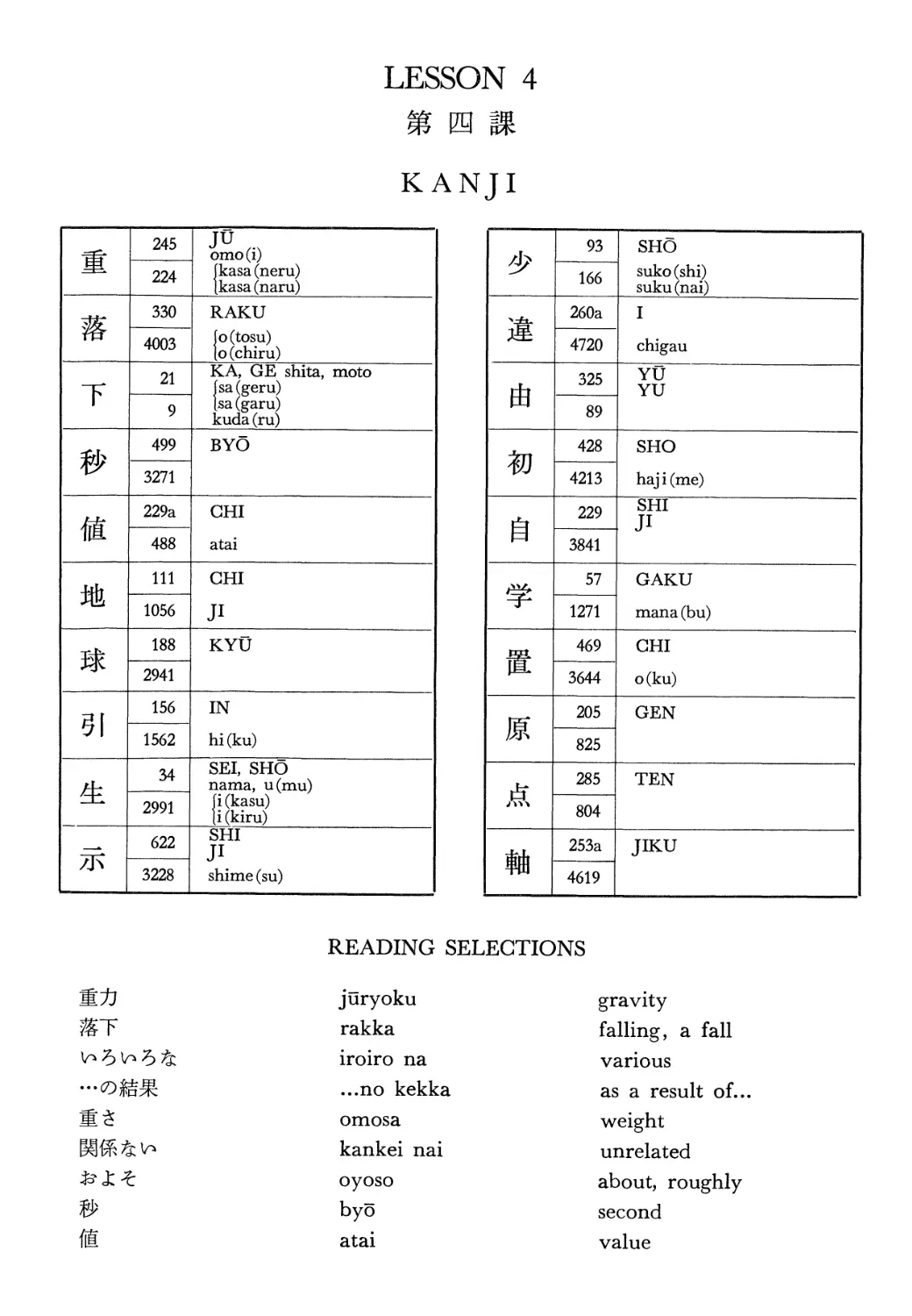
LESSON 4
ш ш ш
KANJI
ж
s
т
»
ш
ш
ш
51
245
224
330
4003
21
9
499
3271
229а
488
111
1056
188
2941
156
1562
34
2991
622
3228
JU
ото (i)
fkasa (neru)
(kasa (naru)
RAKU
f о (tosu)
{o(chiru)
KA, GE shita, moto
jsa(geru)
[ssi (garu)
kuda (ru)
BYO
GHI
atai
GHI
JI
KYtJ
IN
hi(ku)
SEI, SHO
nama, u(mu)
fi (kasu)
li(kiru)
SHI
JI
shime (su)
Ш
ft
*
s
&
Ш
93
166
260a
4720
325
89
428
4213
229
3841
57
1271
469
3644
205
825
285
804
253a
4619
SHO
suko (shi)
suku (nai)
I
chigau
YtJ
YU
SHO
haji(me)
SHI
JI
GAKU
mana (bu)
CHI
o(ku)
GEN
TEN
JIKU
READING SELECTIONS
juryoku
rakka
iroiro na
...no kekka
omosa
kankei nai
oyoso
byo
atai
gravity
falling, a fall
various
as a result of..
weight
unrelated
about, roughly
second
value

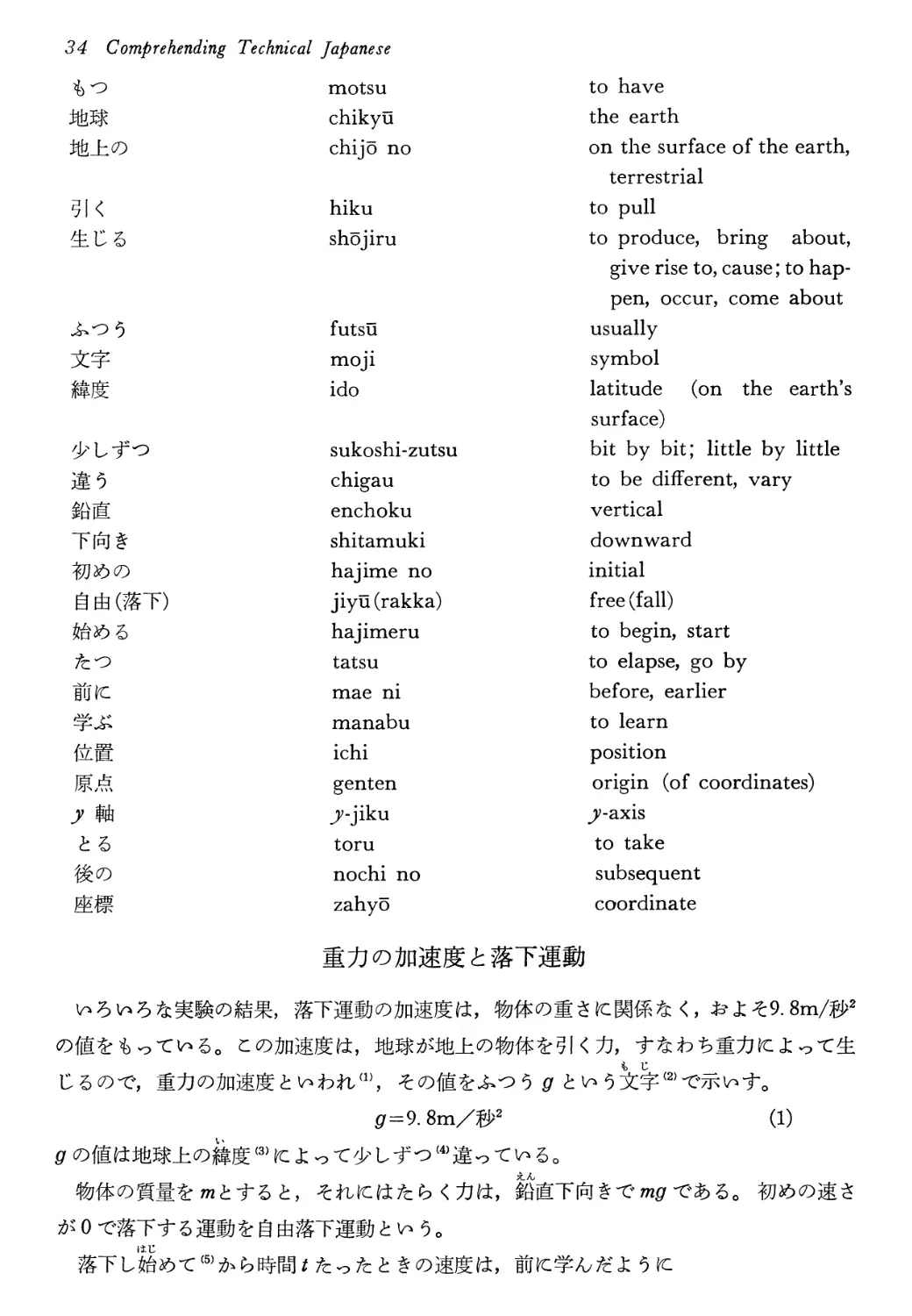
34 Comprehending Technical Japanese
4C5
ЙйШТ)
(
о>
motsu
chikyu
chijo no
hiku
shojiru
futsu
moji
ido
sukoshi-zutsu
chigau
enchoku
shitamuki
hajime no
jiyu(rakka)
hajimeru
tatsu
mae ni
manabu
ichi
genten
jy-jiku
toru
nochi no
zahyo
to have
the earth
on the surface of the earth,
terrestrial
to pull
to produce, bring about,
give rise to, cause; to hap-
happen, occur, come about
usually
symbol
latitude (on the earth's
surface)
bit by bit; little by little
to be different, vary
vertical
downward
initial
free (fall)
to begin, start
to elapse, go by
before, earlier
to learn
position
origin (of coordinates)
^-axis
to take
subsequent
coordinate
t ШУ
9
д=9. 8m/W
A)
fc ё ШТ
к:

LESSON 4 35
v=gt B)
C)
JURYOKU NO KASOKUDO TO RAKKA-UNDO
Iroiro na jikken no kekka, rakka-undo no kasokudo wa, buttai no omosa ni
kankei naku, oyoso куп ten hachi metoru-pa-byo-jijo no atai о motte iru.
Kono kasokudo wa, chikyu ga chijo no buttai о hiku chikara, sunawachi juryo-
ku ni yotte shojiru no de, juryoku no kasokudo to iware,A) sono atai о futsu g
to iu mojiB) de shimesu.
g—9. 8 metoru-pa-byo-jijo A)
g no atai wa chikyu-jo no idoC) ni yotte sukoshi-zutsuD) chigatte iru.
Buttai no shitsuryo о m to suru to sore ni hataraku chikara wa, enchoku
shitamuki de mg de aru. Hajime no hayasa ga 0 de rakka suru undo о jiyu-
rakka-undo to iu.
Rakka shi-hajimeteE) kara jikan t tatta toki no sokudo wa, mae ni mananda
yo ni
v=gt B)
de arawasareru. HajimeF) no ichi о genten to shi,G) enchoku shitamuki nijy-jiku
о tori,G) jikan / no nochi no ichi no zahyo о у to sureba,G)
y^-j-gt2 C)
de aru.
GRAVITATIONAL ACCELERATION AND FALLING MOTION
As a result of various experiments, we know that the acceleration of falling
bodies is not related to their weight and has a value of about 9. 8m/sec2. Since
this acceleration results from the force with which the earth attracts terrestrial
objects, i.e., gravity, it is called the gravitational acceleration and its value is
generally indicated by the symbol g.
#=9. 8m/sec2 A)
The value of g on the surface of the earth varies slightly with latitude.
If we let the mass of a body be m, the force acting on it vertically downward
is mg. Falling* motion with zero initial speed is called freely-falling motion.
As we learned earlier, the velocity after the elapse of a time t since the begin-

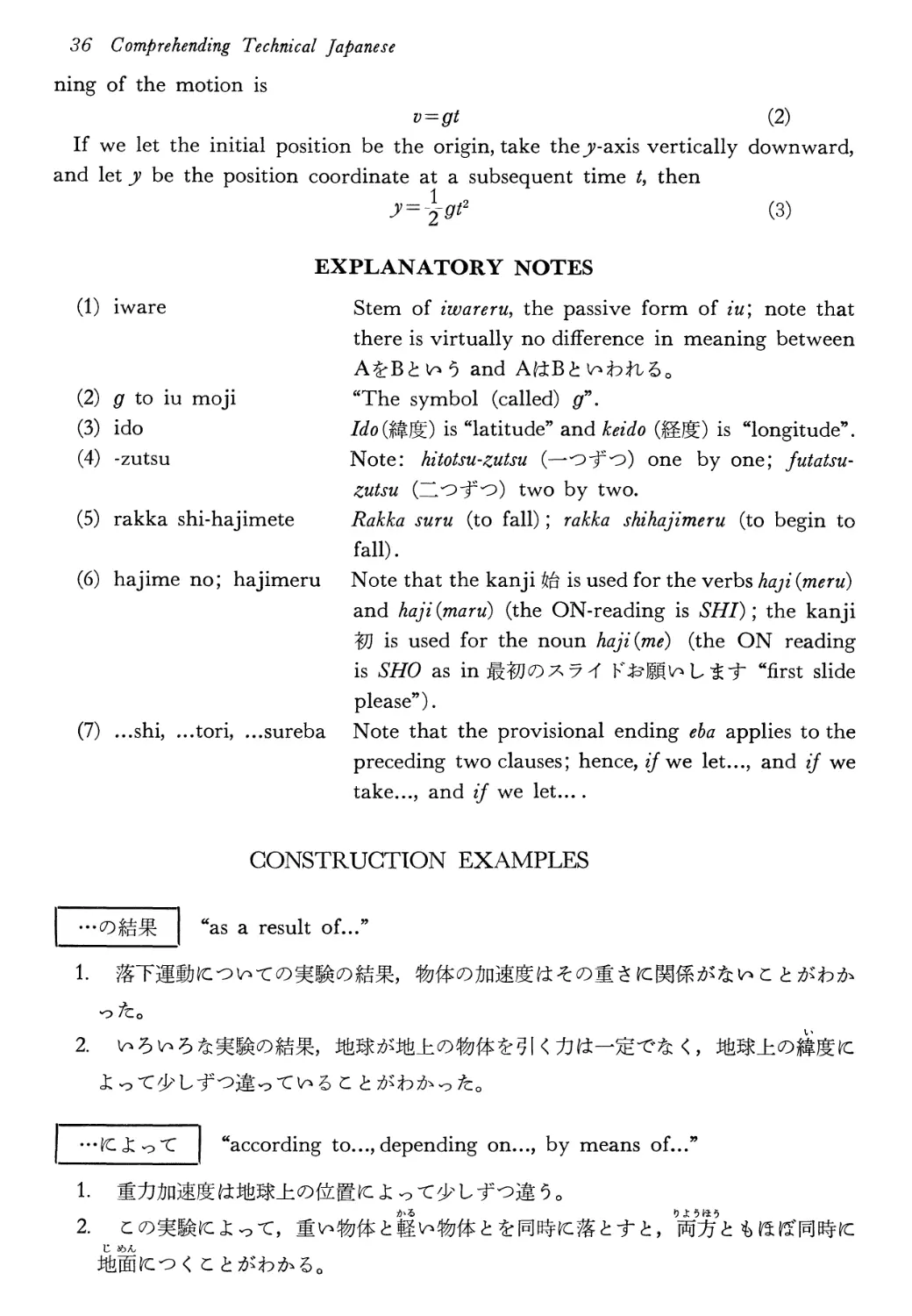
36 Comprehending Technical Japanese
ning of the motion is
B)
If we let the initial position be the origin, take thejy-axis vertically downward,
and let у be the position coordinate at a subsequent time t, then
1 _,9
C)
EXPLANATORY NOTES
A) iware
B) g to iu moji
C) ido
D) -zutsu
E) rakka shi-hajimete
Stem of iwareru, the passive form of iu; note that
there is virtually no difference in meaning between
A?B?^5 and AfiBfc \лзЫг5о
"The symbol (called) g\
ЫоШШ) is "latitude" and keido (ЩЩ) is "longitude".
Note: hitotsu-zutsu (—*z>-f*z>) one by one; futatsu-
Zutsu (Hofo) two by two.
Rakka suru (to fall); rakka shihajimeru (to begin to
fall).
F) hajime no; hajimeru Note that the kanji tn is used for the verbs haji (meru)
and haji (таги) (the ON-reading is SHI); the kanji
~$) is used for the noun haji (me) (the ON reading
is SHO as тЦ^Ю^^^Г K*EBv^L4*f "first slide
please").
G) ...shi, ...tori, ...sureba Note that the provisional ending eba applies to the
preceding two clauses; hence, if we let..., and if we
take..., and if we let....
CONSTRUCTION EXAMPLES
"as a result of..."
2.
2.
"according to..., depending on..., by means of...'3

LESSON 4 37
3.
4.
2.
butsuri-gaku
...ni tsurete
"elapse, pass (of time)"
(tt)
2.
ШШ
¦o<
"...by..."
omoi
karui
ryoho tomo
hobo
jimen
tsuku
heavy
light
both of them
almost
ground; earth's surface
to arrive
physics
as..., along with...
ИШ ...no nijo (or:... no jijo) square of...; second power of.
Kwe designate by the symbol..."
a ?
hensu
variable
¦(verb stem) H—^p
1.
2.
"begin to+ (verb)'
kanarazu
jikoku
necessarily
instant, time, moment
(verb stem) —i-f ^tf "if we... and if we let../
1.
гt^ ft:

38 Comprehending Technical Japanese
X t ft
~-
2.
з. шя&шттш-гь tu
U
5
"Г < 5
nage-ageru
takasa
agaru
sara ni
basho
oriru
orite kuru
to toss upwards
height
to rise
further, again
place, position
to descend
to come (falling) down
l±K
iib
SUPPLEMENTARY READINGS
maue ni
nageru
noboru
futatabi
moto no
modoru
uwamuki
directly upward
to throw
to ascend, to rise
again
original, former
to return, to come back
upward
В.
КЩЬХ
v—VQ—gt) s=vot—2~?
zahyo-jiku
subete
tagai ni
chokkaku ni
majiwaru
ni kanshite
chokkaku-zahyo
migite
coordinate axes
all
mutually
at right angles, perpendic-
perpendicularly
to intersect
in relation to
rectangular coordinates
right handed

LESSON 4 39
sa
hidarite
haichi
zahyo-kei
kubetsu
sei no
oya-yubi
hitosashi-yubi
naka-yubi
left handed
arrangement, placement
coordinate system
distinction, differentiation
positive
thumb (lit. parent finger)
index finger (lit. person-
pointing finger)
middle finger
Ь Ъ
J:
С.
C/BF
shizen kagaku
Gibuzu
jiyu enerugii
hiroku
toku ni
shizen ni
...ka do ka
judai na
ondo
atsuryoku
joken
no moto ni
gensho
shoji-enai
gensoku to shite
okoru
genshi
kaku-bunretsu
the physical sciences, natu-
natural science
(J. Willard) Gibbs
free energy
widely
especially
naturally, spontaneously
whether or not...
important
temperature
pressure
conditions
under
decrease
cannot occur, happen
as a fundamental principle
to occur
atom
nuclear fission
¦g/u Й»
-с,
соК

40 Comprehending Technical Japanese
D. 1666^{€
л
Ш
^<
60fg
га-
bWcfb
Жй
1666 nen ni
tsuki
setsu
tamesu
suchi-teki ni
...ni sotte
chushin-ten
katei suru
nin'i no
hankei
yaku
rokuju-bai
ippun
suchi
do-itsu
sore na no ni
jibun no
happyo suru
riyu
zentai no
shuchu suru
baai
sugaku-teki ni
shomei suru
in 1666
the moon
theory
to test
quantitatively
along...
center
to assume
any
radius
approximately
60 times
one minute
numerical value
identical, equal
in spite of that
his own
to announce
reason
total
to be concentrated at
case
mathematically
to prove
Ь,
В
Mult h < fab,

LESSON 4 41
с--I- Ж_
2 d2
- » - Ь
stm
SOME FIELDS OF STUDY
Using kanji from only the first four lessons you are in a position to understand
the names of almost all of the following fields of study.
^L%^? seibutsu-gaku biology
ШЧй^1 dobutsu-sraku zoology
u< _ ^
n***~ shokubutsu-gaku botany
kagaku chemistry
sei-kagaku biochemistry
kagaku-kogaku chemical engineering
oyo-kagaku applied chemistry
rikigaku mechanics, dynamics
oyo-rikigaku applied mechanics
ШШ^ undo-gaku kinematics
kitai-rikigaku gas dynamics
butsuri-gaku physics
Ш^ sugaku mathematics
ШШ^1 chishitsu-gaku geology
ШШ^ chiri-gaku geography
^M^ seiri-gaku physiology
' genshi-butsuri-gaku atomic physics

42 Comprehending Technical Japanese
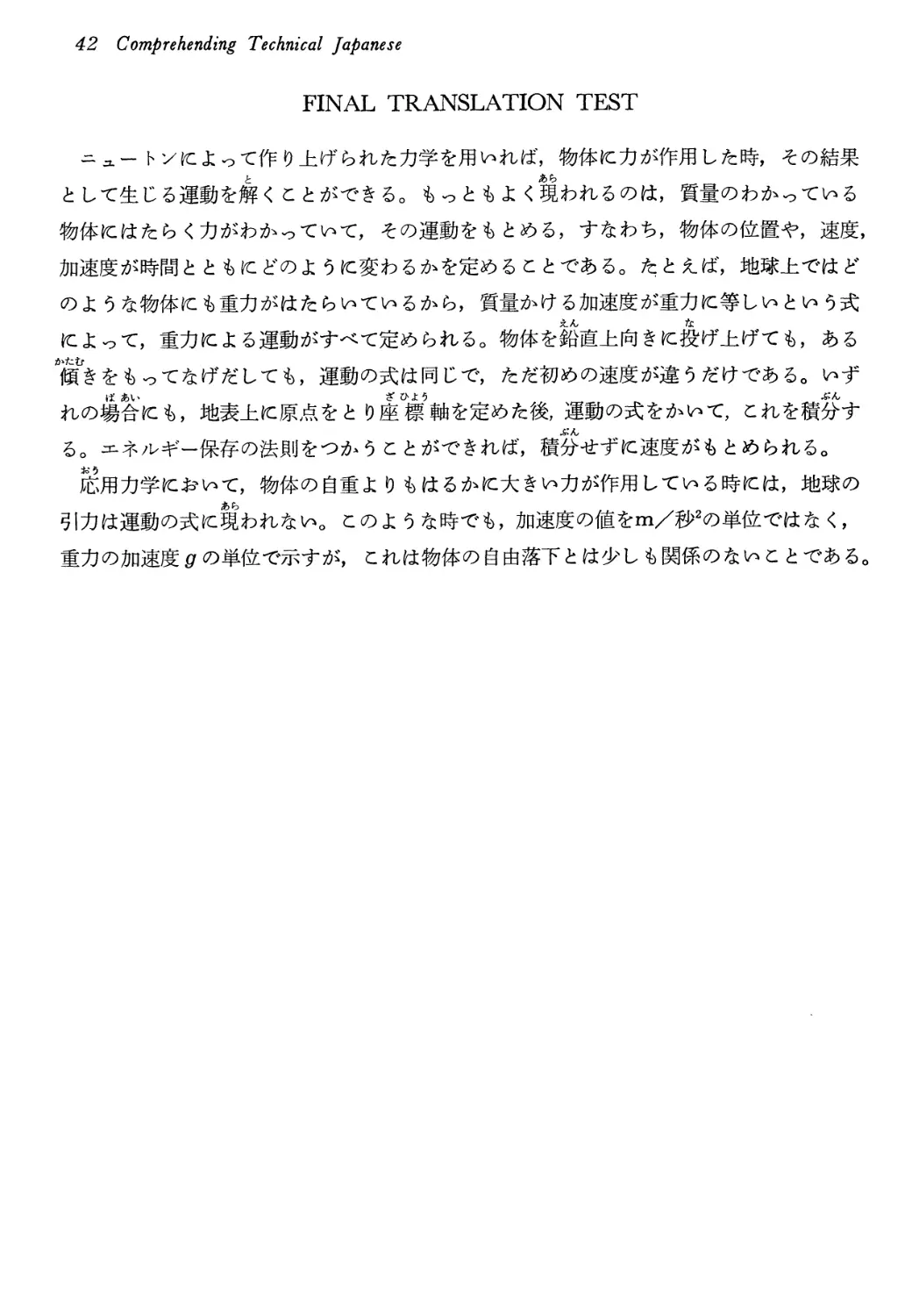
FINAL TRANSLATION TEST
К-f iitf,
д
Тt
ct-c*5,

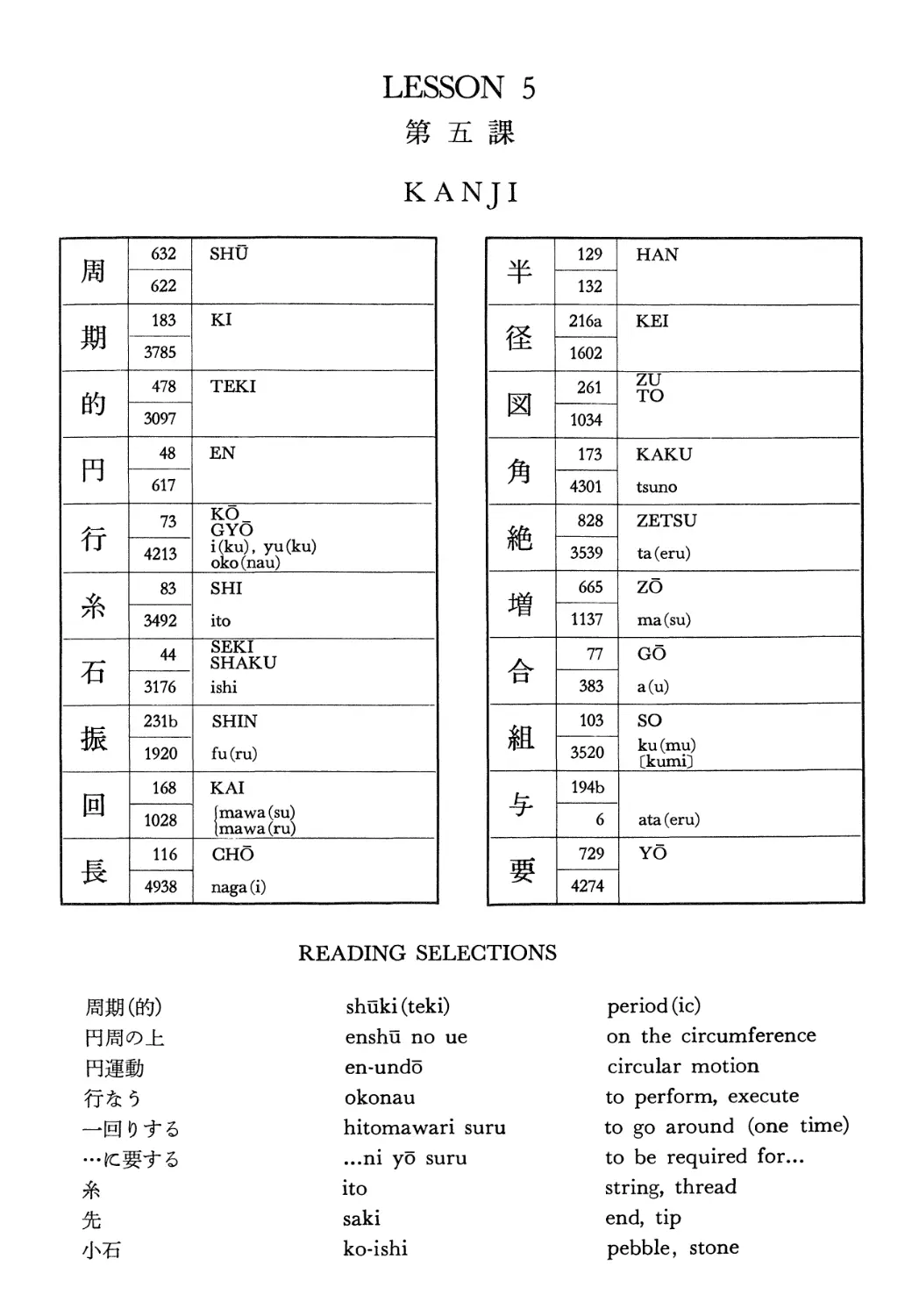
LESSON 5
KANJI
m
№
P3
&
Ш
HO
632
622
183
3785
478
3097
48
617
73
4213
83
3492
44
3176
231b
1920
168
1028
116
4938
SHU
KI
TEKI
EN
КО
GYO
i(ku), yu(ku)
oko(nau)
SHI
ito
SEKI
SHAKU
ishi
SHIN
fu(ru)
KAI
(mawa (su)
(mawa (ru)
CHO
naga(i)
m
a
m
m
&
ш
*
129
132
216a
1602
261
1034
173
4301
828
3539
665
1137
77
383
103
3520
194b
6
729
4274
HAN
KEI
ZU
TO
KAKU
tsuno
ZETSU
ta(eru)
zo
ma (su)
GO
a(u)
SO
ku (mu)
Ckumi]
ata (eru)
YO
READING SELECTIONS
shuki (teki)
enshu no ue
en-undo
okonau
hitomawari suru
...ni yo suru
ito
saki
ko-ishi
period (ic)
on the circumference
circular motion
to perform, execute
to go around (one time)
to be required for...
string, thread
end, tip
pebble, stone

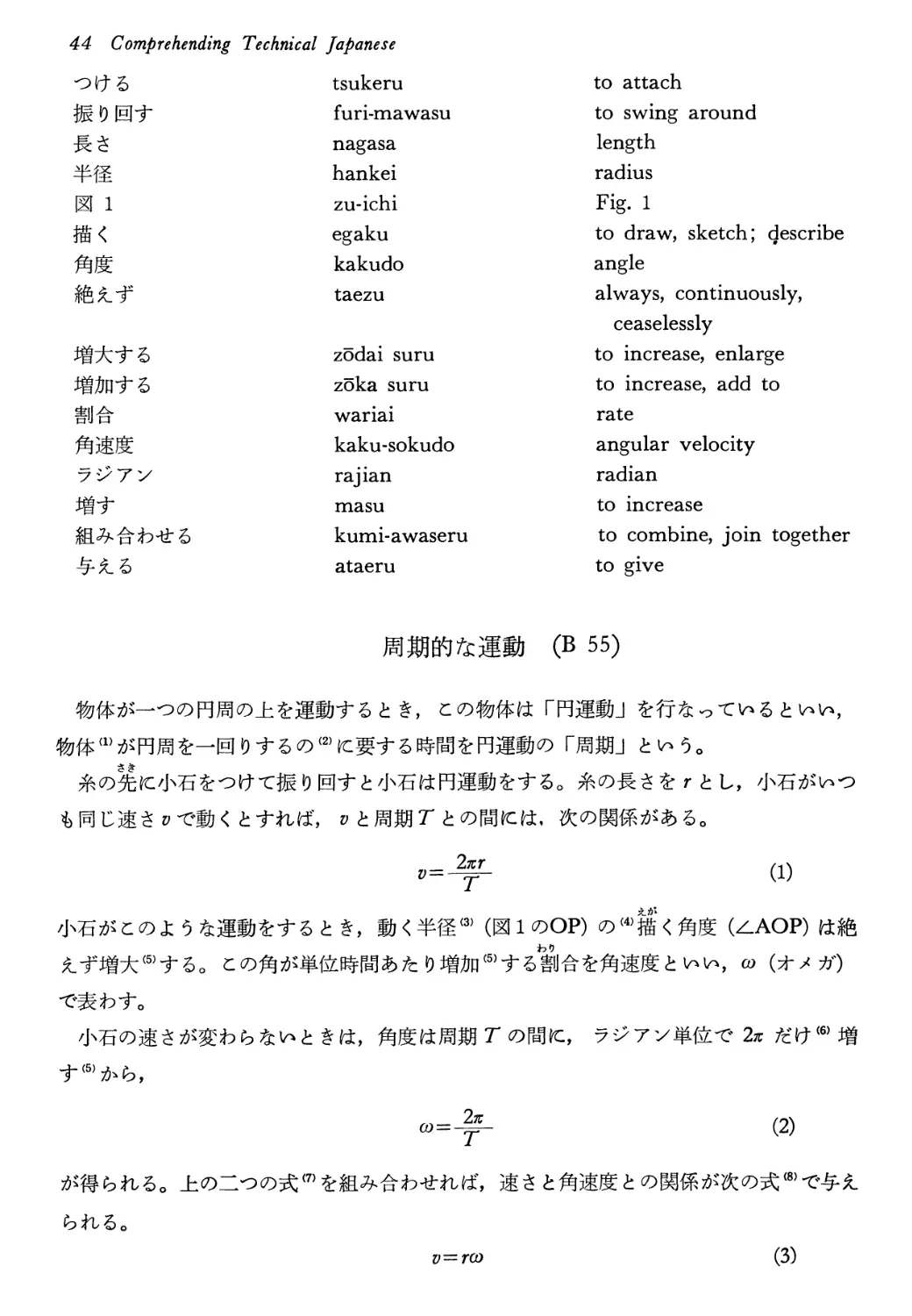
44 Comprehending Technical Japanese
О ^t Ъ tsukeru
|g \) Щ-f- furi-mawasu
Д ? nagasa
?Ш hankei
13 1 zu-ichi
Ш < egaku
^St kakudo
taezu
zodai suru
zoka suru
wariai
kaku-sokudo
rajian
masu
kumi-awaseru
ataeru
to attach
to swing around
length
radius
Fig. 1
to draw, sketch; describe
angle
always, continuously,
ceaselessly
to increase, enlarge
to increase, add to
rate
angular velocity
radian
to increase
to combine, join together
to give
v—-
Ъсг_
т
(В 55)
A)
(Z.AOP)
2% М
со=
2л_
Т
v=rco
B)
C)

LESSON 5 45
SHUKI-TEKI NA UNDO
Buttai ga hitotsu no enshu no ue о undo suru toki, kono buttai wa "en-undo"
о okonatte iru to ii, buttaiA) ga enshu о hitomawari suru noB) ni yosuru jikan
о en-undo no "shuki" to iu.
Ito no saki ni ko-ishi о tsukete furi-mawasu to, ko-ishi wa en-undo о suru.
Ito no nagasa о r to shi, ko-ishi ga itsumo onaji hayasa v de ugoku to sureba,
v to shuki T to no aida ni wa, tsugi no kankei ga aru.
v = 2%r/T A)
Ko-ishi ga kono yo na undo о suru toki, ugoku hankeiC) (zu-ichi no OP) noD)
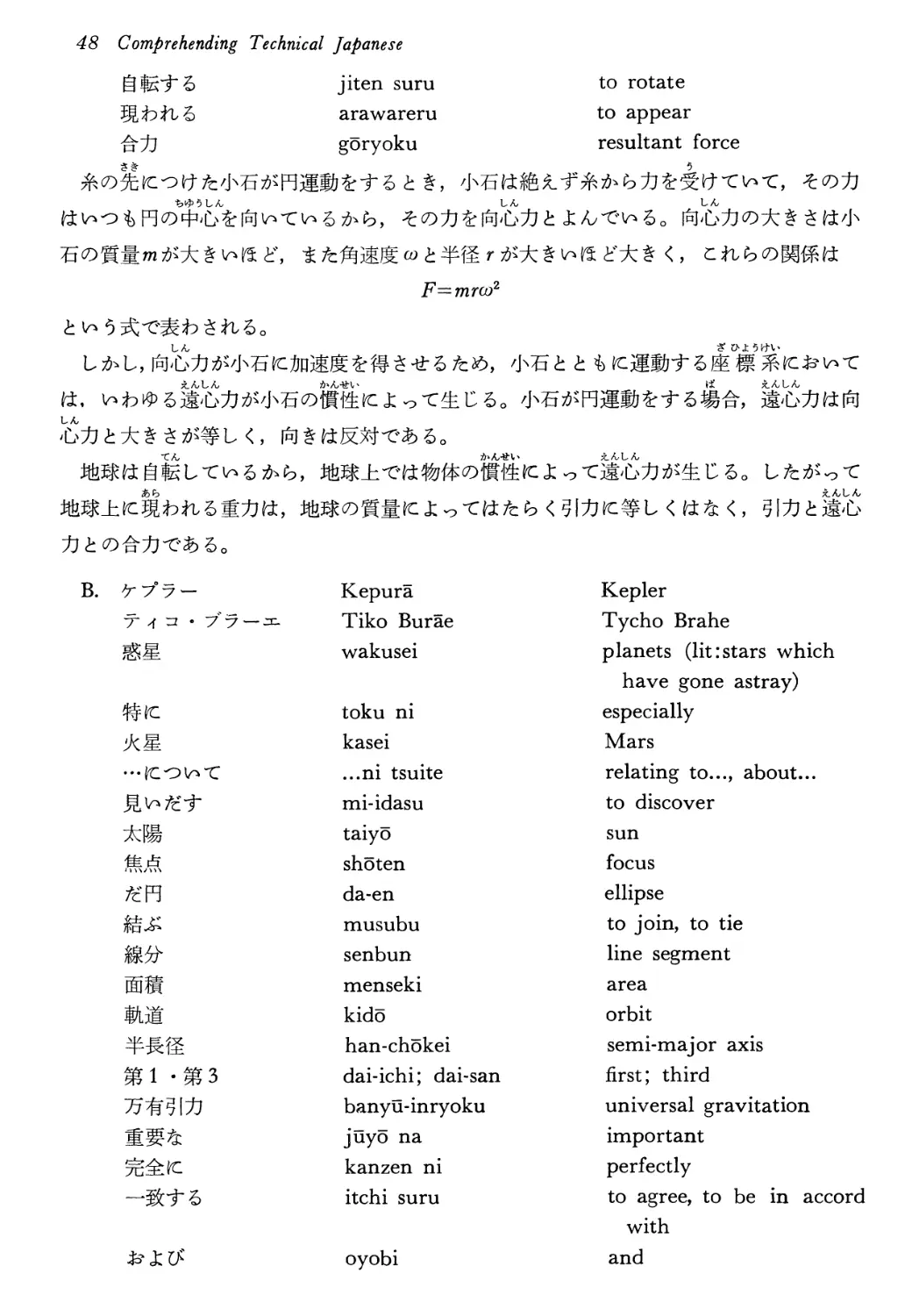
egaku kakudo (Z.AOP) wa taezu zodai<5) suru. Kono kaku ga tan'i jikan atari
zoka<5) suru wariai о kaku-sokudo to ii, со (omega) de arawasu.
Ko-ishi no hayasa ga kawaranai toki wa, kakudo wa shuki T no aida ni rajian
tan'i de 2л dakeF) masuE) kara,
co = 2tu/T B)
ga erareru. Ue no futatsu no shikiG) о kumi-awasereba, hayasa to kaku-sokudo
to no kankei ga tsugi no shiki(8) de ataerareru.
v = rco C)
PERIODIC MOTION
When a body moves along the circumference of a circle, we say that it
executes "circular motion." The time needed for the body to go once around the
circumference we call the "period" of the circular motion.
If we attach a small stone to the end of a string and swing it around, the stone
executes circular motion.
If we let the length of the string be r and if we let the stone always move
with the same speed v, then we have the following relation between v and the
period T:
A)

46 Comprehending Technical Japanese
When the stone executes this kind of motion, the angle AOP generated by
the moving radius (OP in Fig. 1) continuously increases. The rate at which this
angle increases per unit time is called angular velocity and is designated by со
(omega)
When the speed of the stone does not change, then, since the angle expressed
in radians increases exactly by 2% during the period T, we obtain
oo — Liz/1 (Z)
Combining the above two equations gives the following relation between speed
and angular velocity:
v=rco C)
EXPLANATORY NOTES
A) buttai ga enshu...yo suru This is the modifying cause for jikan.
B) suru no ni = suru koto ni
C) hankei (radius); chokkei ШШ (diameter)
D) hankei no egaku kakudo= hankei ga egaku kakudo (no is often used in
subordinate clauses)
E) zoka suru, zodai suru, masu Note that these are virtually synonymous in
this text.
F) 2% dake masu The word dake has the basic meaning of "exact
amount" and is often translated by expressions
such as: "by (the amount of), just (exactly),
only."
"the weight decreases by 2 kg,"
G) shiki
(8) tsugi no shiki
"if the value of x increases by
Often hoteishiki Cfrg^) is used.
In scientific texts one often encounters also
(jishiki).
(present tense)+f!j^
"rate at which../
1.
2.
hen'i
displacement

LESSON 5 47
zettai-chi
...baai ga oi
the value itself; the actual
value
it often happens that...
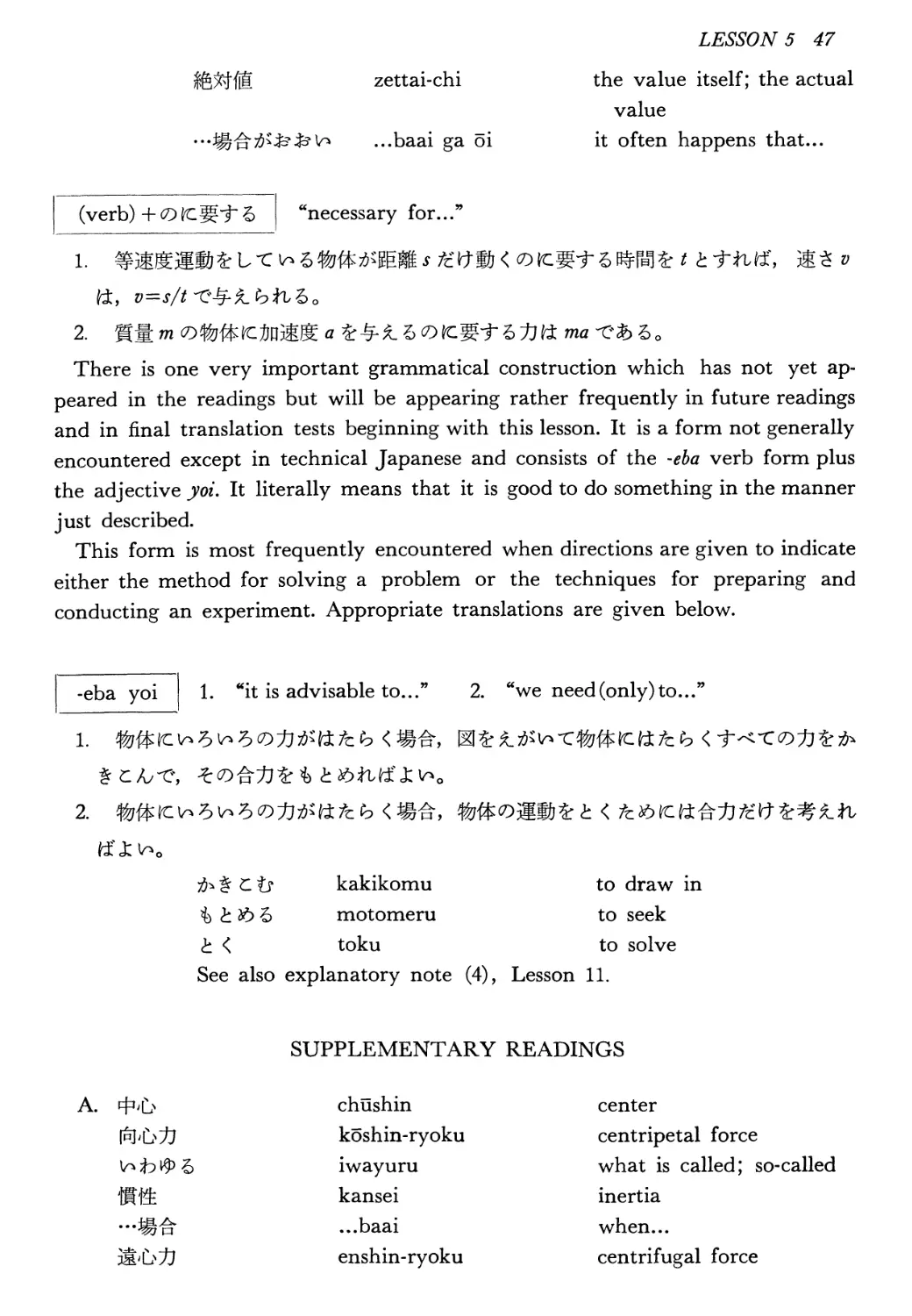
(verb) + <DKH"f"Ь "necessary for..."
2.
та
There is one very important grammatical construction which has not yet ap-
appeared in the readings but will be appearing rather frequently in future readings
and in final translation tests beginning with this lesson. It is a form not generally
encountered except in technical Japanese and consists of the -eba verb form plus
the adjective yoi. It literally means that it is good to do something in the manner
just described.
This form is most frequently encountered when directions are given to indicate
either the method for solving a problem or the techniques for preparing and
conducting an experiment. Appropriate translations are given below.
-eba yoi
2.
1. "it is advisable to..." 2. "we need (only) to..."
% ?tf>6
? <
kakikomu
motomeru
toku
to draw in
to seek
to solve
See also explanatory note D), Lesson 11.
SUPPLEMENTARY READINGS
chushin
koshin-ryoku
iwayuru
kansei
...baai
enshin-ryoku
center
centripetal force
what is called; so-called
inertia
when...
centrifugal force

48 Comprehending Technical Japanese
Ъ %Ъ 5
tt.
в.
74 3 • 7*7-^
¦#-5
jiten suru
arawareru
goryoku
Kepura
Tiko Burae
wakusei
toku ni
kasei
...ni tsuite
mi-idasu
taiyo
shoten
da-en
musubu
senbun
menseki
kido
han-chokei
dai-ichi; dai-san
banyu-inryoku
juyo na
kanzen ni
itchi suru
oyobi
to rotate
to appear
resultant force
L
Kepler
Tycho Brahe
planets (lit.'stars which
have gone astray)
especially
Mars
relating to..., about...
to discover
sun
focus
ellipse
to join, to tie
line segment
area
orbit
semi-major axis
first; third
universal gravitation
important
perfectly
to agree, to be in accord
with
and

LESSON 5 49
hoka no
nitai mondai
tadashii
taikyo-kei-nai
kanari
seimitsu ni
atehamaru
a)
B)
к id ею
G.
Т*/г»=к
га
other
two body problem
correct
in the solar system
rather
accurately, exactly
to hold true, apply, be
applicable
(B 59-60)
К-
, T2/r3
nen
ni yoru
...no nijo
shiru
hitsuyo
enkei no
...no naka de
kangaeru
ennai no
seiho-kei
sozo suru
ni okeru
year
due to
the square of...
to know
necessity, need
circular
inside of...
to consider
within the circle
a square
to imagine, to suppose
in

50 Comprehending Technical Japanese
m
кхъь
musu
hen
sei-takaku-kei
atehameru
suisoku suru
heikin
kankei-zukeru
michibiki-dasu
musubi-tsukeru
...ni yoru to
countless, innumerable
side
regular polygon
to apply
to infer
average
to relate
to derive
to combine, to join
according to...
-»- Ь У
к:
2mKRltMtb C,
T2/r3=k
tmmr

LESSONS 51
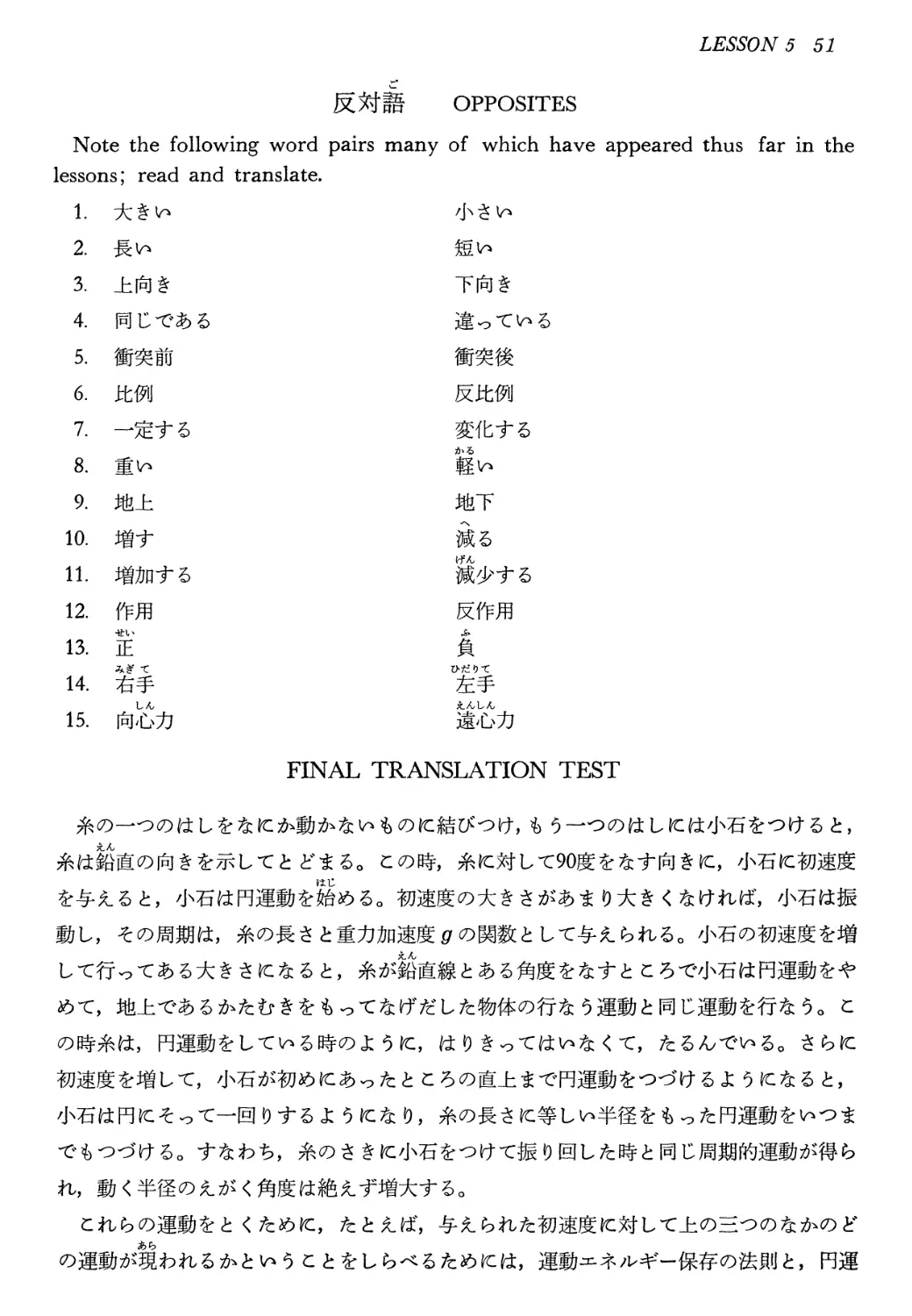
OPPOSITES
Note the following word pairs many of which have appeared thus far in the
lessons; read and translate.
2.
3.
4.
5.
6.
7.
8.
9.
io. щ-t
п.
12.
13. Ш
14.
15.
t, ^©Iltt,
Ш
FINAL TRANSLATION TEST
&%>•? 4)
5 fc, tt •) t
fc,
t,
<?zbt>K, ^iitf,
, R3

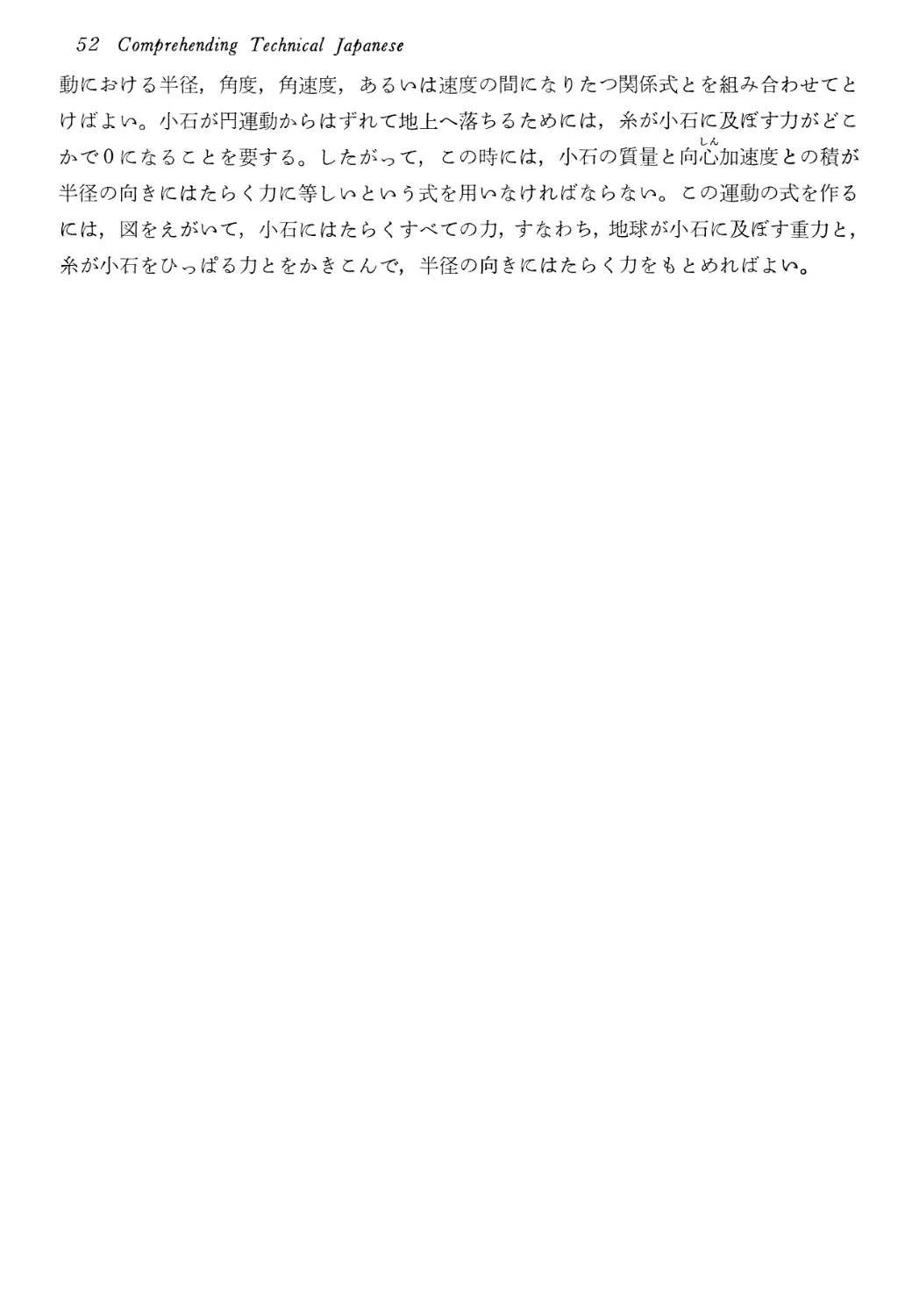
52 Comprehending Technical Japanese

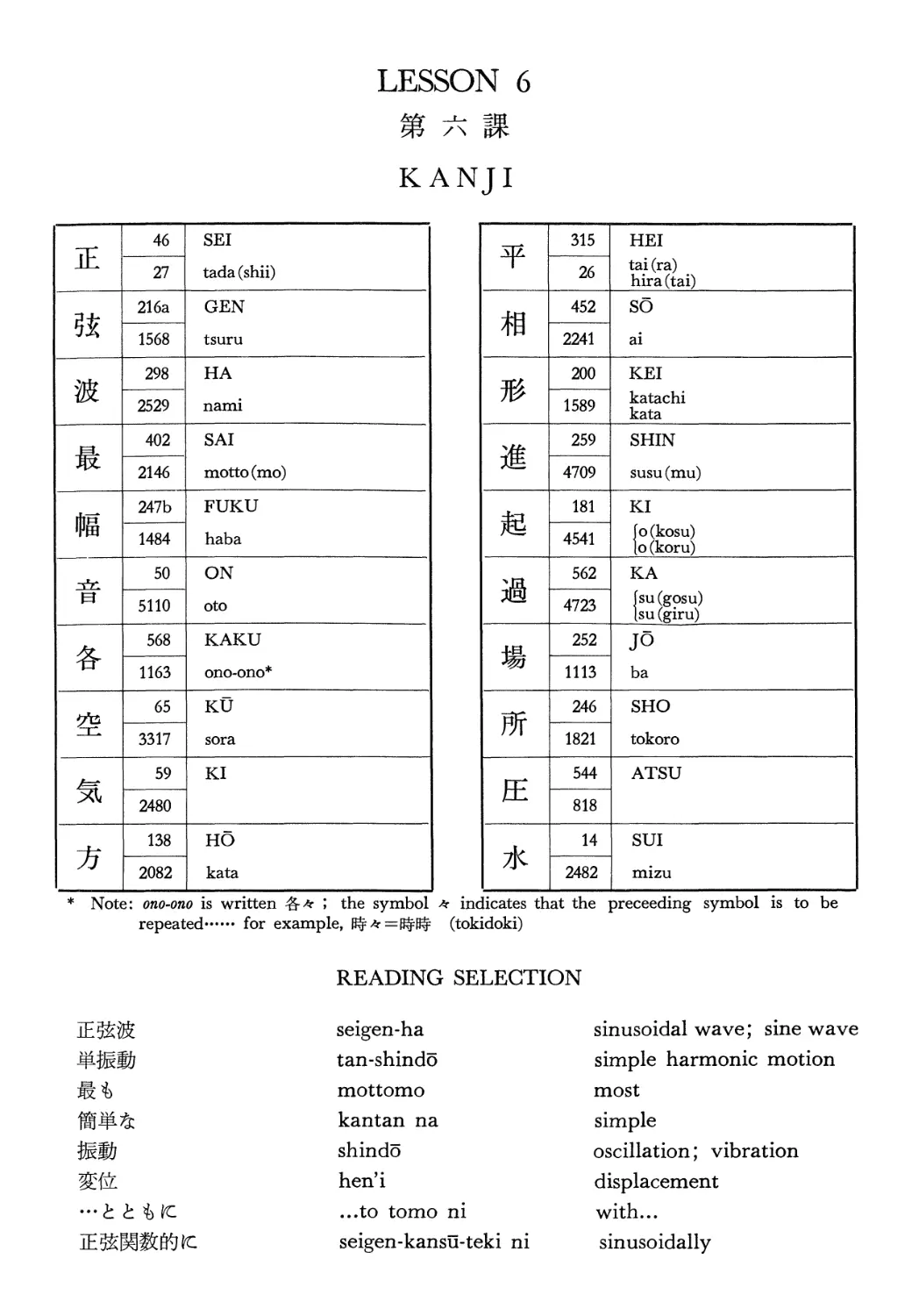
LESSON 6
KANJI
IE
3*
Ш
ft
m
m
46
27
216a
1568
298
2529
402
2146
247b
1484
50
5110
568
1163
65
3317
59
2480
138
2082
SEI
tada (shii)
GEN
tsuru
HA
nami
SAI
motto (mo)
FUKU
haba
ON
oto
KAKU
ono-ono*
KU
sora
KI
HO
kata
№
Ж
»
m
be
315
26
452
2241
200
1589
259
4709
181
4541
562
4723
252
1113
246
1821
544
818
14
2482
HEI
tai (ra)
hira (tai)
SO
ai
KEI
katachi
kata
SHIN
susu (mu)
KI
f о (kosu)
(o (koru)
KA
fsu(gosu)
(su (giru)
JO
ba
SHO
tokoro
ATSU
SUI
mizu
* Note: ono-ono is written %x* \ the symbol
repeated for example, ^/5r
indicates that the preceeding symbol is to be
(tokidoki)
READING SELECTION
seigen-ha
tan-shindo
mottomo
kantan na
shindo
hen'i
...to tomo ni
seigen-kansu-teki ni
sinusoidal wave; sine wave
simple harmonic motion
most
simple
oscillation; vibration
displacement
with...
sinusoidally

54 Comprehending Technical Japanese
shinpuku
onpa
...no uchi
kakuten de
kuki
oto
kuru
hoko
...to heiko
zengo ni
kuri-kaesu
ai-tsugu
TV.
в
<
Ш:<
tb
t
ВЕЛ
hakei
sukoshi-zutsu
zureru
susumu
...koto ni naru
ima
tatejiku
toru
nin'i no
keika suru
katachi
okoru
nami
yobu
shinko-hoko
tatenami
...to chokkaku ni
yokonami
...to shite
baishitsu
ugoki
...to shita
sore ni tomonatte
basho
atsuryoku
mizu
kasanaru
amplitude
sound wave
in...; among...; for...
at each point
air
sound
to come
direction
parallel to...
back and forth
to repeat
to come one after another,
be in succession
wave form, shape of wave
little by little
to slip, shift, lag
to advance
it turns out that...
now
ordinate
to take
any arbitrary
to elapse, pass
form
to take place, occur, happen
wave
to call
direction of propagation
longitudinal wave
perpendicular to...
transverse wave
as...
medium
movement
we supposed that...
along with that, accordingly
place
pressure
water
to be superimposed

LESSON 6 55
lppan m
oku no
kangaeru
IE
in general
many
to consider
(B 157-158)
¦гъьъ
у=А si
t,
t+T
A)
- —T > Ш
2-* C— IfrV.
B)
ъ D)о с с x>m&.y t ь -ешь ь ъ * ©и,
№ 1 IE

56 Comprehending Technical Japanese
SEIGEN-HA
Tan-shindo wa mottomo kantan na shindo de atte, sono hen'i у wa jikan t to
tomo ni seigen-kansu-teki ni henka suru. Sunawachi
y = A sin-^-t A)
koko de, A wa shinpuku, T wa shuki о shimesu.
Onpa no uchi mottomo kantan na mono wa, kakuten de, soko no kuki ga, oto
no kuru hoko to heiko ni, zengoA) ni ichi-shiki no yo na shindo о kurikaesu
mono de aru. Ai-tsugu tenB) de wa, hakei ga sukoshi-zutsu zurete, hayasa v de
susumu koto ni naru.C) Ima, kakuten x de no hen'i у о tatejiku ni tori, jikan t,
t + -r-T, t + -~-T to keika shita toki no hakei о arawasu to zu-ichi no yo ni naru.
Kore о shiki de arawasu to
y=Asm-^(t—f) B)
no katachi de arawasareru. Kono shiki wa x = 0no ten de ichi-shiki to onaji shin-
do о shimeshi, nin'i no ten x de wa, jikan x/v dake keika shita toki, onaji
katachi no shindo ga okoru koto о shimeshite iru. Ni-shiki no yo na katachi no
nami о "seigen-ha" to yonde iru. Hen'i у ga nami no shinko-hoko to onaji hoko
ni shindo suru toki wa tatenami, hen'i у ga shinko-hoko to chokkaku ni shindo
sureba, yokonami de aru.D) Koko de hen'i у to shite arawashita mono wa, onpa
de wa sono baishitsu no itten no chiisa na ugoki to shita ga, sore ni tomonatte,
sono basho no kuki no atsuryoku mo zu-ichi to onaji katachi no henka о suru.
Mizu no nami wa, seigen-ha de wa nai ga, seigen-ha no kasanatta mono de
aru. Ippan ni nami wa oku no seigen-ha no kasanatta mono to kangaeru koto
ga dekiru.
SINUSOIDAL WAVES
Simple harmonic oscillation, in which the displacement у changes sinusoidally
with the time t, is the simplest vibratory motion. That is,
y=A sin^-t A)
where A represents the amplitude and T the period.
Among sound waves the simplest case is that for which the air at each loca-
location repeatedly oscillates back and forth as in Equation A), parallel to the direc-
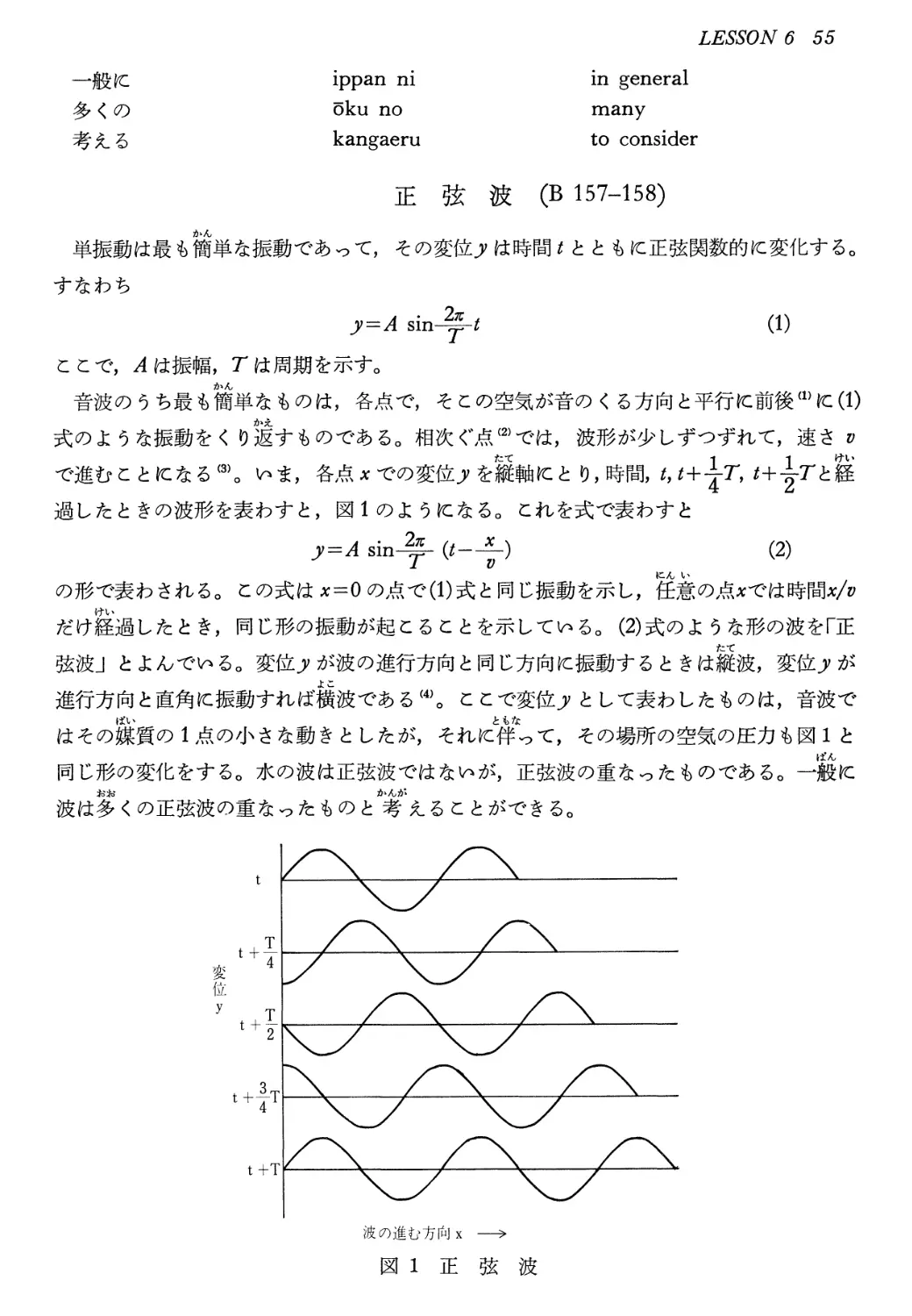
direction from which the sound comes. At successive points the wave form shifts
little by little such that the wave progresses with a speed v. Now, representing
the wave form at each point x by plotting the displacements у as ordinates at
elapsed times /, t + -т^Т, t+ ~2~T, we obtain Fig. 7. Expressed by an equation, this
becomes

LESSON 6 57
y=A&w^-{t—%-) B)
This equation shows that at the point # = 0 the same oscillatory motion occurs
as in Equation A) and that, at any point *, the same form of vibration occurs
whenever a time just equal to x/v has elapsed Waves having the form of Equa-
Equation B) are called sinusoidal. When the displacement у oscillates in the same
direction as that of the wave propagation, it is a longitudinal wave; when the
displacement у oscillates perpendicularly to the direction of wave propagation, it
is a transverse wave. We have supposed here that for sound waves the quantity
expressed as the displacement у is a small movement at a given point in the
medium and that, accordingly, the pressure of the air at that location will have
the same form of variation as that shown in Fig. 1.
A water wave is not a sinusoidal wave, but rather a superposition of sinusoidal
waves. In general waves can be regarded as superpositions of many sinusoidal
waves.
EXPLANATORY NOTES
A) zengo ni Here the meaning is "back and forth." In other con-
contexts Zengo ni means "before and after" (in time)
and "in front of and behind" (in space). See Cons-
Construction Examples.
B) aitsugu ten The word aitsugu is somewhat unusual. On the other
hand, aitsuide (successively) is a frequently encoun-
encountered word.
C) susumu koto ni naru The phrase koto ni naru, very common in scientific
texts, implies that the statement is a consequence of
previously given information or principles. It can
sometimes be conveniently translated as "hence," "it
turns out that," or "would + verb"; often it is best
omitted in translation.
D) tatenami...yokonami Both tatenami and yokonami have de aru as the verb,
de aru. One could insert de atte immediately after tatenami.
CONSTRUCTION EXAMPLES
"to change with.
2.

58 Comprehending Technical Japanese
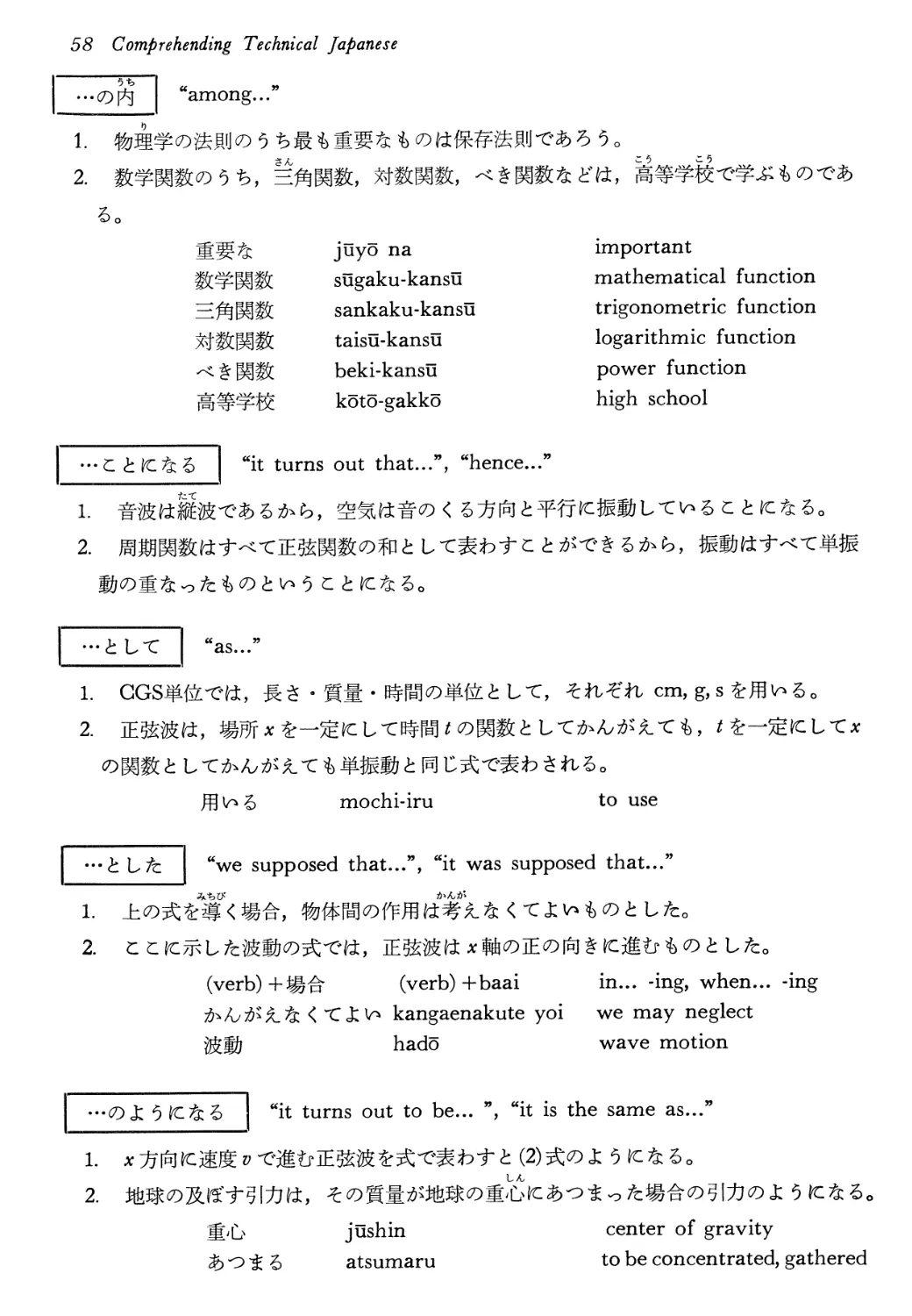
"among..."
с, п
2.
Ъ 5
тщ^ш
2.
? juyo na
ЩШ sugaku-kansu
ЩШ sankaku-kansu
ЩШ taisu-kansu
ЩШ beki-kansu
P& koto-gakko
% turns out that...", "hence...55
1
¦at
2.
2.
mochi-iru
important
mathematical function
trigonometric function
logarithmic function
power function
high school
to use
"we supposed that...", "it was supposed that..."
^ (verb)+baai in... -ing, when.
< XiLV* kangaenakute yoi we may neglect
hado wave motion
-ing
2.
"it turns out to be... ", "it is the same as..."
jushin
atsumaru
center of gravity
to be concentrated, gathered

LESSON 6 59
"(along) with..." "in accordance with..."
it
2.
••(С «tfatf
"back and forth"; "before and after";
"in front of and behind"
2. Ш
3. —
...ni yoreba according to.
kuwawaru to be added
taiseki volume
gensho suru to decrease
A.
pisuton
shirinda
bane
ketsugo suru
shitten
atsumari
tsutawaru
shidai ni
hirogaru
hirogatte iku
piston
cylinder
spring
to join together
mass point
collection
to be transmitted, travel,
pass
gradually
to spread
to spread (and to continue
to do so)
SUPPLEMENTARY READINGS
gosei (shindo)
tsune ni
mukau
katsu
sei no
hotei-shiki
...to naru
resultant (vibration)
always
to be directed towards
moreover, in addition
positive
equation
is..., becomes...

60 Comprehending Technical Japanese
ippan-kai
yogen
пштш
kaku-shindo-su
yobu
shindo-su
doitsu no
...ni tsuite
noberu
go-hen' i
moto no
kotonaru
yokojiku
zu no ue de
kuwae-awaseru
kyokusen
motomerareta...
= a sm(cot + e) (a, s —
T=2x/co,
general solution
cosine
circular frequency
to call
oscillation frequency
identical
about..., concerning...
to explain, mention
resultant displacement
original
to be different, be unlike
the horizontal axis, abscissa
in the figure (diagram)
to combine, add together
curve
the sought-for- ••, the
desired* ••
83-84)
д:1= «i sin (cot +1{), x2 = a2 sin((ot+t2)
г = й sin (cot+e)
ciilfi-Ь t
B) т-

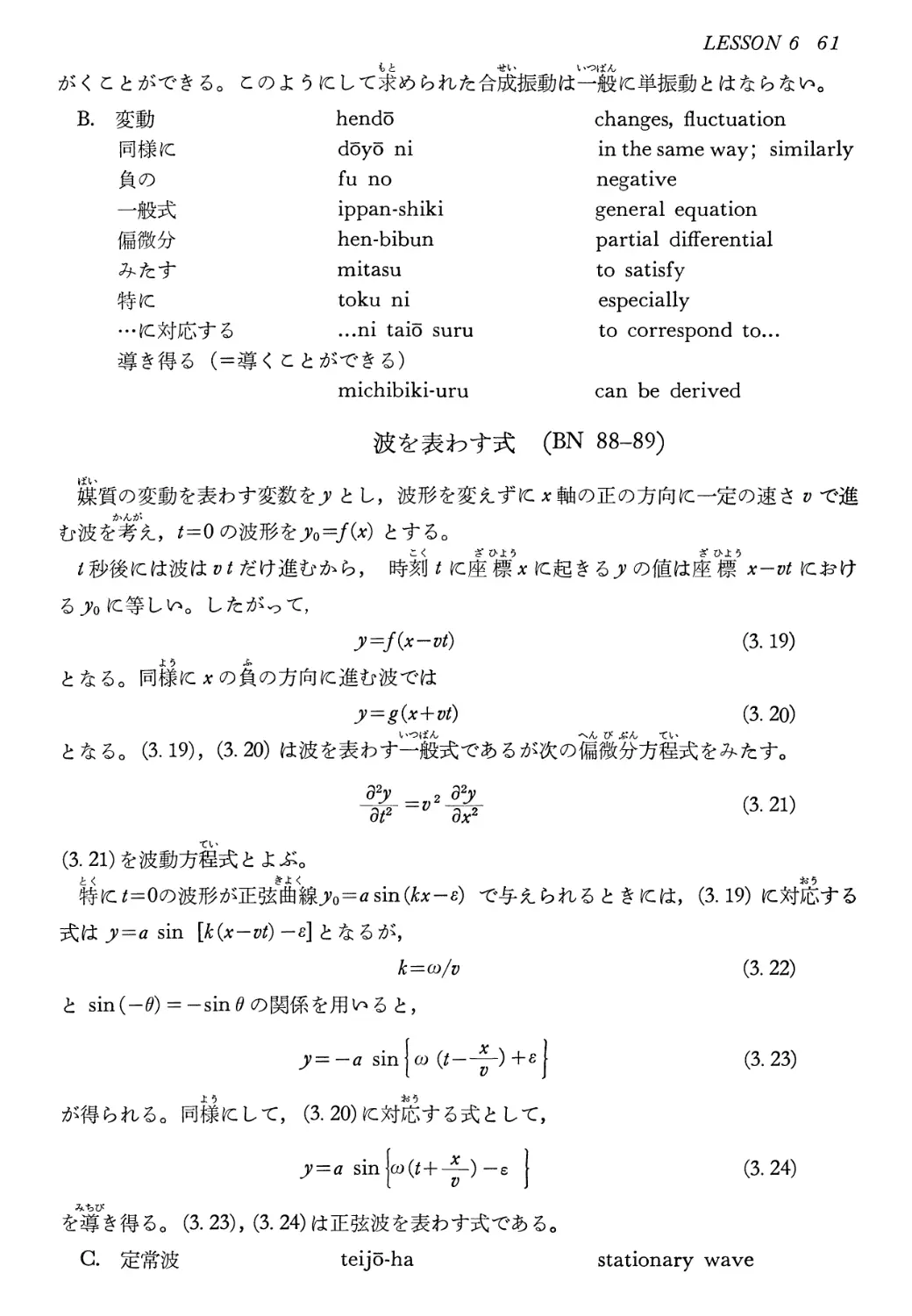
LESSON 6 61
в.
^ftir
, t=0
C.19), C.20)
hendo
doyo ni
fu no
ippan-shiki
hen-bibun
mitasu
toku ni
...ni taio suru
michibiki-uru
changes, fluctuation
in the same way; similarly
negative
general equation
partial differential
to satisfy
especially
to correspond to...
can be derived
(BN 88-89)
ъу
КШШx
5у
y=f(x-vt)
y=g(x+vt)
Ш x-vt
C.19)
C.20)
dt2
t<
4t
t J: <
v=a sin [k(x-vt) -
t sin(-(?) = -si
k=co/v
^5
, C.2О)КМ1&-?ЬЯЬЬ-С,
y=a sinjcoO+-^-)-e J
C.23), C.2
С Ш"ШШ teijo-ha
C. 21)
: tKltt, C.19) КЖ&Ь
C. 22)
C. 23)
C. 24)
stationary wave

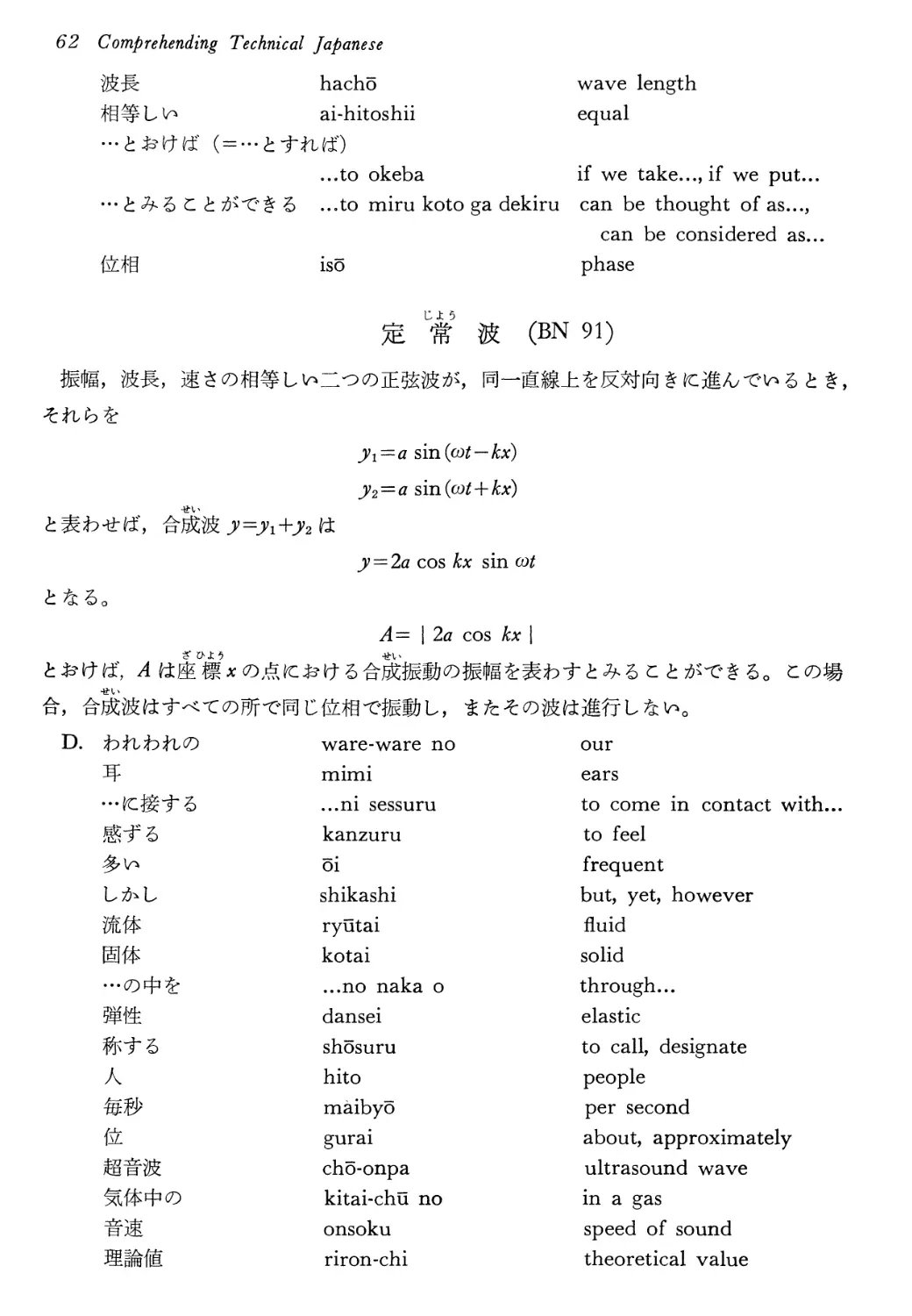
62 Comprehending Technical Japanese
$?ft hacho
ШЩ L V^ ai-hitoshii
t Зь Ъ С t
wave length
equal
...to okeba if we take..., if we put...
Ь ...to miru koto ga dekiru can be thought of as...,
can be considered as..
iso phase
Cfc 5
(BN 91)
J>!=a sin (cot —kx)
у2—a sm{tot+kx)
y = 2a cos kx sin cot
A — | 2a cos kx
?,
D.
Л
ware-ware no
mimi
...ni sessuru
kanzuru
oi
shikashi
ryutai
kotai
...no пака о
dansei
shosuru
hito
maibyo
gurai
cho-onpa
kitai-chu no
onsoku
riron-chi
our
ears
to come in contact with.
to feel
frequent
but, yet, however
fluid
solid
through...
elastic
to call, designate
people
per second
about, approximately
ultrasound wave
in a gas
speed of sound
theoretical value

ichi-kiatsu no moto de
jissoku-chi
sui-chu no
yaku
saidai-chi
tetsu
=Ш (BN 100-101)
LESSON 6 63
at 1 atmosphere pressure
actual measured value
in water
approximately
maximum value
iron
@
Ctt, Ш>16^Ь20,000&-е, с*г<?9Ш
(X=Cp/Cv)
0°С,1
sec t & 5 , ЙШШЮ: 331.45m/sec -е$> Ъ о 7КФ<^1=гд1Ш, 43
? 'ЬФб fct "Co
^й^сШйШ^Ф^С^С So ^U^-tf, ^^Й^дЁй^ < 5000m/sec ^$) 5o
E. The following reading is taken from the 1958 edition of Щ{Ь^^Л a phys-
physical science dictionary. Thus, the description is rather terse and sentences
are not always grammatically complete.
RHIfc en-kansu circular functions
(Note: in older texts ЩШ. is written \ШШ We will use this form occasion-
occasionally without furigana so that the reader will learn this character as well.)
seisetsu
yosetsu
seikatsu
yokatsu
sosho
teigi
shikata
shisu-kansu
jissu
izuremo
tangent
cotangent
secant
cosecant
general term, generic name
definition
way, method
exponential function
real number
everyone of them, any one
of them
BRJ 525)
sin x

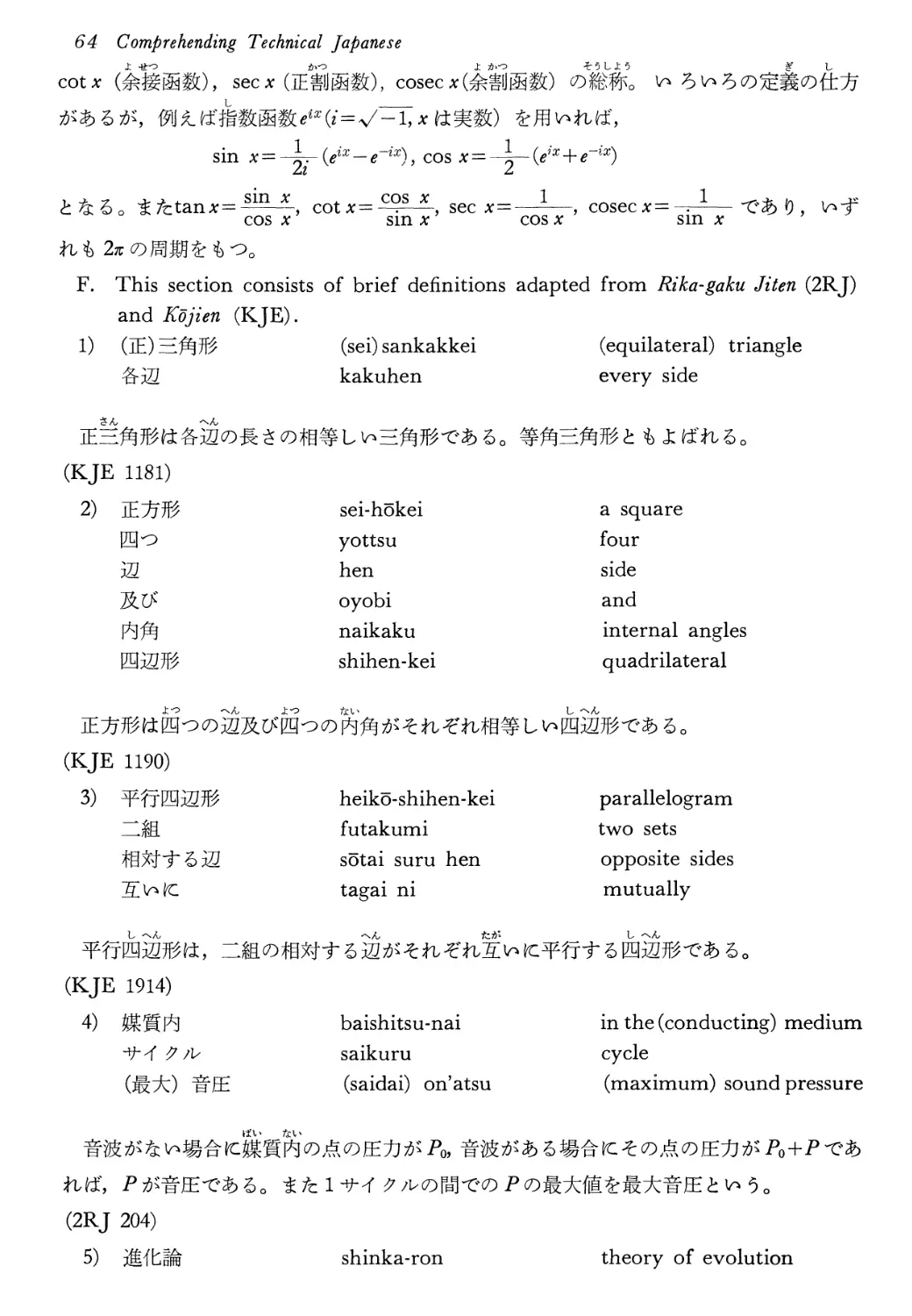
64 Comprehending Technical Japanese
Ш), соьесх(ШШШ)
cot* (тйЙсЭЩ), sec*
v>
Г L
sin х =
-еЧх), cos x =
cos д:
=Щ1Л. Sec x = —±—, со8ес*=-Д—
sin д: cos x sin *
F. This section consists of brief definitions adapted from Rika-gaku Jiten BRJ)
and Kojien (KJE).
1) (Ш)НЙЯ^ (sei) sankakkei (equilateral) triangle
kakuhen every side
(KJE 1181)
2)
а
sei-hokei
yottsu
hen
oyobi
naikaku
shihen-kei
a square
four
side
and
internal angles
quadrilateral
(KJE 1190)
heiko-shihen-kei
futakumi
sotai suru hen
tagai ni
parallelogram
two sets
opposite sides
mutually
(KJE 1914)
9.
baishitsu-nai
saikuru
(saidai) on'atsu
in the (conducting) medium
cycle
(maximum) sound pressure
BRJ 204)
5)
1 t-f
shinka-ron
theory of evolution

ttt (=¦
*
-с, -
BRJ 842)
to wa
arayuru
seibutsu
mottomo
genshi
shuju ni
shinka suru
setsu
Shu no Kigen
hon
taikei-zukeru
LESSON 6 65
See Explanatory Note 1,
Lesson 1.
all
living things
exceedingly
primitive
variously
to evolve, to develop
view, opinion, theory
Origin of Species
book
to systematize
иr^
(KJE 1103)
6) faJE'f' Ь
kettei suru
kukan
chikara no ba
ban'yu-inryoku
dake de kimaru
potensharu
to determine
space
force field
universal gravitation
is determined only by
potential
fro
FINAL TRANSLATION TEST
-.У в

66 Comprehending Technical Japanese
igс Ь

LESSON 7
KANJI
ш
ш
=^
ш
т
и
к
333
2942
660
1728
133
578
31
1260
162
2634
141
2110
677
406
642
1364
523
3727
601
4987
RI
SO
FUN
BUN
wa (keru)
SHI
SU
ко
ON
MEI
aka (rui)
aki (raka)
TEI
hiku(i)
JO
tsune
YU
a(ru)
GEN
kagi(ru)
it
#
ш
tt
и-
684
1354
267
384
439
1799
149
3343
818
2839
840
1743
685
2860
658
3511
645
1666
201
4312
DO
michibi (ku)
ZEN
matta (ku)
SEI
na (ru)
RITSU
fta(teru)
(ta(tsu)
JO
TAI
TOKU
SO
SU
SEI
SHO
KEI
READING SELECTION
riso-kitai
moru
...ni taishite wa
bunshi
gasu-teisu
moshi
tamotsu
ondo
taiseki
ideal gas
mole
for..., in...
molecule
gas constant
if
to maintain, hold
temperature
volume

68 Comprehending Technical Japanese
ШМШШ
*>
is-c
С <Ф 5
mm-tz
zettai-ondo
tashikameru
Sharuru no hosoku
...ni hoka naranai
Boiru no hosoku
ue no shiki
sate
akiraka na
saitei no
...ni oite wa
sukoshi de mo
(...o)kakereba
...hazu de aru
hijo ni
yugen no
...kagiri
...eru(or...uru)
jitsu wa
michibiku
kagiri-naku
katei suru
...ga kanzen ni naritatsu
kaso-teki na
jubun ni
kihaku na
jotai
toku ni
suiso
...no baai ni wa
hobo
(...to)minasu
seishitsu
riyo suru
ondo-kei
absolute temperature
ascertain, confirm
Charles' Law
is nothing but..., is just.
Boyle's Law
the above equation
well, now, so
clear, distinct
lowest
at..., as for..., by...
even a little
if we apply...
it is expected that...;
should...
very
finite
as long as...
to be able to...
actually, in fact
to derive
infinitely, extremely
to suppose, assume,
hypothesize
...holds exactly
hypothetical, imaginary
sufficiently
dilute
condition, state
in particular
hydrogen
in the case of...
almost, nearly
to regard, consider (as...)
property
to utilize, use
thermometer
ft (B 138)

LESSON 7 69
pV=MT=RT A)
->-
О КЪ Ъ tt-f -C*
RISO-KITAI
Ichi moru no kitai ni taishite wa, sono bunshi-suA) о N to suru to,
A)
to naru. i? wa gasu teisu to ii, sono atai wa R=8. 317B) juru-pa-do-moru de aru.
Kono kankei wa, moshi kitai no atsuryoku о ittei ni tamochi, ondo о kaereba,C)
taiseki wa zettai-ondo ni hirei suru koto о shimesu. Kore wa jikken de tashi-
kameta Sharuru no hosoku ni hoka naranai. Moshi ondo о ittei ni tamoteba,
kono kankei wa Boiru no hosoku о shimesu. Shitagatte ue no shiki de shimesareru
kankei о Boiru-Sharuru no hosoku to iu.
Sate ichi shiki kara akiraka na yo ni, saitei no ondo reido Kerubin ni oite
wa,D) kitai no taiseki wa sukoshi de mo atsuryoku о kakereba rei (zero) ni naru
hazu de aru.
Hijo ni chiisai to wa itte mo kitai-bunshi ga yugenE) no okisa о motsu kagiri,F>
kono yo na koto wa ari-enaiG) ga, jitsu wa, p — i^7nv2{N/V) to iu shiki no
kankei о michibiku toki ni kitai-bunshi no okisa wa kagiri naku chiisai to katei
shite ita no de aru.(8) Kono kankei(9) ga kanzen ni naritatsu yo na kaso-teki na
kitai о "riso-kitai" to iu.A0) Shikashi, donna kitai de mo jubun ni kihakuA1) na
jotai de wa, toku ni suisoA2) no yo na chiisai kitai-bunshi no baai ni wa, hobo
riso-kitai to minasu koto ga dekiru. Kono yo na kitai no seishitsu о riyo shitaA3)
ondo-kei ga "kitai-ondo-kei" de aru.

70 Comprehending Technical Japanese
THE IDEAL GAS
If we let N be the number of molecules in one mole of gas, then
pV=MT=RT. A)
We call R the gas constant, and its value is 8. 317 joules/°K mole.
This relation shows that, if we keep the pressure constant and vary the
temperature, the volume will be proportional to the absolute temperature. This
is simply the experimentally determined Law of Charles. If we keep the tempera-
temperature constant, this relation gives Boyle's Law. Therefore, we call the relation
denoted by the above equation the Law of Boyle and Charles.
Now as Eq. A) clearly shows, at the lowest temperature 0°K, the volume of
the gas should become zero if even the slightest pressure is applied.
Such a result would be impossible so long as the molecules have a finite size,
however tiny we say that may be, and in fact the gas molecules were assumed
to be infinitesimally small in deriving the expression p — -~-mv2{N/V). A hypothet-
о
ical gas for which this relation holds exactly is called an ideal gas. In sufficiently
rarefied states, however, any gas, especially one with small gas molecules like
hydrogen, can be regarded as essentially ideal. A thermometer employing these
properties of gases is called a gas thermometer.
A) sono bunshi-su
B) 8.317
C) moshi...tamochi
...kaereba
D) ni oite wa
E) yugen
F) kagiri
G) ari-enai
(8) ...shite it a no de aru
(9) kono kankei, etc.
A0) А о В to iu
EXPLANATORY NOTES
Sono (literally "its") refers to "ichi-moru no kitai".
Read "hachi-ten-san-ichi-shichi".
If we maintain... and if we change... .
Literary construction; in spoken language one
would say saitei no ondo de wa.
The opposite of yugen ^ГРД (having a limit, i.e.
finite) is mugen §&Ш (no limit, i.e., infinite).
When kagiri follows an affirmative or negative
verb it may be translated "as long as"; after a
negative verb, an alternative translation is "unless
+ affirmative verb".
The verb stem + ггм is equivalent to the plain
present Л-koto ga dekiru; e.g., kaki-eru — kaku koto ga
dekiru.
The no de aru is used to emphasize the statement;
it can be omitted in translation.
Kankei is the subject of naritatsu.
"we designate A by Д" or "we call A, B".

LESSON 7 71
A1) kihaku
A2) suiso
A3) riyo shita
The opposite of kihaku #^| (dilute) is покд ШШ-
(concentrated).
A few other elements:
tan so $M (carbon)
sanso ШШ (oxygen)
chisso ШШ (nitrogen)
enso ШШ (chlorine)
This is past tense in Japanese, but is best translated
by the present tense in English.
CONSTRUCTION EXAMPLES
l.
2.
3.
2.
2.
2.
"for..."
Т,
v=2zr/To
(D fy
nomi only
~0%> Ъ (verb) beki de aru ought to (verb)
^becomes.
seizon sum
to live, exist
"is nothing but..."
2. ЩЖШШЪ,
"at..., for..."

72 Comprehending Technical Japanese
l. Ш<
2. {fr?l
-Hf, -fc
"even
Х>Ъ
-t
a
little"
«if...,
hirogari
...to wa ienai
hanno
...would (be expected
extent
it is impossible to call
reaction
to)..."
2.
motto
saigo no
"even if we say that..."
more
the last
2.
2.
2.
3.
JtJ Д.
"as long as"
taihen
tomaru
kuwaeru
kasane-awaseru
very
to stop
to apply
to superpose
"unless + affirmative verb," "as long as 4-negative verb"

verb
LESSON 7 73
...to kangaete yoi we may consider that
cannot..."
2.
henkei
"we regard...as...K
deformation
2. 0° С,
Ь О "t Ь
motomeru
jushin
atsumaru
to seek
center of gravity
to be collected
SUPPLEMENTARY READINGS
А.
(E)
jotai-(hotei)-shiki
jitsuzai no
...no uchi
arugon
nado
mitasu
hyojun
ko-on (atsu)
tei-on (atsu)
zure о shozuru
...o nozoite
undo-ron
jissai no
shitten
sara ni
bunshi-kan no
sogo (no)
chushin
...made shika
chika-yorenai
equation of state
real, actual
among...
argon
and so forth; such as
to satisfy
standard
high temperature (pressure)
low temperature (pressure)
to show deviations
excepting...
kinetic theory
real, actual
mass point
further
intermolecular
mutual
center
can approach only as far
as...

МИо
74 Comprehending Technical Japanese
yoki no naka ni
kukan
zentai de wa
shimeru
zen-taiseki
yonbai
naibu
shui no
tsuri-au
hyomen
naiho ni
kabe
heru
eikyo
kazu
mitsudo
kekkyoku
b ...yori...chiisaku naru
?X) yue ni
...no kawari ni
ireru
soko de
Oft Ob)
inside the container
space
in all, in the whole
to occupy
entire volume
four times
within
surrounding
to balance
surface
inwardly
wall
to decrease
influence
number
density
in the end, finally
becomes smaller than...
consequently, therefore
instead of...
to insert
then
VAN DER WAAIJS
(BN 132-133)
; 5 U^A,
*р*ш(о°с,
L,
Boyle-Charles O&M
J:5
, L/c

a/V2)
LESSON 7 75
p2 Kimtb&,
&
к.ср+
В.
kitai-chu de wa
tasu
tobi-mawaru
kangaeru
seishitsu
setsumei suru
mazu
kangaete miyo
ippen
rippo-tai
yoki-chu ni
toji-komeru
kabe
suichoku na
) chokko-zahyo
tobu
tonde kita bunshi
butsukaru
seibun
hekimen
eikyo
koka
nokoru
ikko
hane-kaeru
heikin
okoru
sosu
t byokan ni ikkai no
wari-ai de
within a gas
many
to fly about
to imagine
property
to explain
first of all
let us consider (and see
how it turns out)
one side
cube
inside a container
to confine
wall
perpendicular
rectangular coordinates
to fly
molecules which come
(flying)
to strike
component
wall surface
influence
effect
to remain
one
to recoil, bounce back
average; arithmetic mean
to occur, happen
total number
at a rate of once every t
seconds

76 Comprehending
MBtb
Jrbft. ТС Xh
(щмт
•-co 2 Ш<Ъ?;
ш
fttz.
Technical Japanese
...ni okeru
chakumoku suru
ta no
nankai mo
futatabi
kaette kuru
(fX*$>b wakaranai wake de aru
kaisu
menseki
mattaku
(fu) kisoku
katte no
ichiyo ni
iri-majiru
Щ ...no nijo no heikin
kotowaru
joken
ii-kaeru to
tada
in...
to fix one's attention on
another
many times; frequently
again
to come back
we cannot know, do not
know
frequency
area
entirely; completely
(ir) regular
arbitrary
uniformly
to be mixed with
mean-square...
to warn
condition
(to say it) in other words
merely, simply
Ш <d ftTMM t tJ-: -f /ю mm (в 134-136)
5 ftivtt,
N-lmvJt

LESSON 7 77
-c, D)
t=2L/vx
Nmvx2/L
P—mVx
V
Л> ft *»o X ?b I»
ьх2, vy2, vz\ v2) i t
V2 = V2 = V2 =
1, —
A)
B)
й^й»
C)
D)
1
, jmv2
У
0
/
v/
/
vy
A
/^ X
в
0 l.
m 2.

78 Comprehending Technical Japanese
С
ft»
Но
itt (=¦
тм (=-
enerugii to-bunpai
tan-genshi-bunshi
...kara naru
kimeru
tame
mittsu
kangaereba yoi
jiyu-do
to wa
haichi
hitsuyo iia
ni-genshi-bunshi
shitsuryo-chushin
...o toru
tagai ni
chokko
...no mawari
kaiten
sokei
shomei dekiru
san-genshi-bunshi
...ijo
amari
...ni taio suru
kinji-teki ni
ta-genshi-bunshi
bunshi-shindo
...ni hishite
haruka ni
equipartition of energy
monatomic molecule
to consist of...
to decide
for (the sake of)
three
we need only to consider
degrees of freedom
(see Lesson 1, Explanatory
Note 1)
arrangement, configuration
necessary
diatomic molecule
center of mass
to pass through...
mutually
orthogonal
around...
rotation
the sum total
can be proved,
demonstrated
triatomic molecule
upwards of...; more
than...
too
to correspond to...
approximately
polyatomic molecule
molecular vibration
compared to...;
in comparison with...
by far, far and away
x,

LESSON 7 79
U=N \4г.
PV=MT
9 9 9
-«
vz2 = ~
х,у, z
it A,
~-}&\^ кТ
SOUND-ALIKE KANJI И^йШоШ^1
The following groups of kanji have the same ON readings. Identify each kanji
by giving a sample compound (jukugo) in which the kanji appears. For example,
in the pair "Ц, 'Sw we can identify the kanji as follows:
onpa no on the on of
ondo no on the on of

80 Comprehending Technical Japanese
The Japanese frequently use ths method for identifying kanji in conversations
when there may be some chance for misunderstanding. Hence, in addition to
being a useful exercise for beginners, this type of drill will be found indispensable
in learning how to communicate with Japanese people.
1.
2.
3.
4.
5.
6.
7.
8.
И
ffl -wi-m
ш
m
FINAL TRANSLATION TEST
ьъ
&,
, o°c,
lg
о-с* 5 *s, -
О°К

m
m
LESSON 8
KANJI
m
®
m
*
m
846
3285
730
1309
393
1036
785
2343
74
3684
612
5018
270a
1148
195
4671
504
4767
489
82
TEI
Chodo]
YO
КО
fkata(meru)
Ikata(maru)
КО
КО
kanga (eru)
SAI
HEKI
kabe
KIN
chika(i)
BU
NAI
uchi
л
775
2637
239a
1316
238
3699
125
574
381
103
471
4392
382
2305
603
489
170
2998
322
5087
GEN
f he (rasu)
jhe(ru)
MITSU
SHU
to(ru)
NYU
ji(reru)
KYOKU
fma(geru)
[ma(garu)
GHO
shira (beru)
KYOKU
Ckiwa(mete)]
КО
KAI
MEN
READING SELECTION
jotai-hotei-shiki
fu-kanzen-kitai
yoseki
hiroku
busshitsu
koyu na
kosei suru
katai
ugoki-mawaru
jissai no
equation of state
imperfect gas
volume
widely
substance
characteristic
to comprise, constitute, form
rigid, hard
to move around
true

82 Comprehending Technical Japanese
5&W eikyo
ЩШ1гЬ koryo suru
К ...no kawari ni
...to oku
sara ni
bunshi-kan
p* 5 fure-au
kabe
chikai
t
ftc
0
bubun
uchigawa
heru koto ni naru
ryo
mitsudo
naibu
shitagatte
tori-ireru
keisan
shoryaku suru
yonbai
v ni kanshite sanji no
jo-zuru
p о v ni taishite egaku
dai-ichi
kyokusen
takai
tancho
tsune ni
...ni hanshite
kyokudai (sho)-chi
motsu
han'i
sanko no jissu
sonzai suru
sakaime
rinkai-ondo
yobu
rinkai-ondo yori shita no
influence, effect
to consider, bear in mind
instead of...
we put...
furthermore
between molecules
to touch each other
wall
near
part, portion
inside
turns out to be less
quantity
density
interior
therefore
to insert
calculation
to omit
four times
third order with respect to v
to multiply
to plot p versus v
first
curve
high
monotone
usually
in contrast to...
maximum (minimum) value
to have
extent, region, limits
three real numbers (f@ is a
counter)
to exist
boundary line
critical temperature
to call
below the critical temper-
temperature

вш-гъ
шь
(=t с 5-с)
ш?
т—
kyokuchi
asshuku suru
kaette
gensho suru
(fu) antei
jitsugen suru
soko de
senbun
majiwaru
shikamo
jo(ka)bu
kakomu
menseki
hashi
doitsu
...ni taio suru
nan to nareba
sekibun
sa
rei
iso
tagai ni tsuri-au
ekitai
ippo...taho
kaishaku suru
howa-joki-atsu
ki (eki) so
ichijirushii
doyo ni
LESSON 8 83
extremum
to compress
instead, on the contrary
to decrease
(un) stable
to come true, be realized
then
line segment
to intersect
furthermore
upper (lower) part
to surround
area
end, tip
identical
to correspond to...
the reason for this is that...
integral
difference
zero
phase
to be in equilibrium (lite-
(literally, to balance each
other)
liquid
the one...the other
to explain; interpret
saturation vapor pressure
gas (liquid) phase
remarkable
in the same way
VAN DER WAALS
(FK9-11)
Lt van der Waals
A)
T=

84 Comprehending Technical Japanese
CCKa ? b ?й&КК:
p=p'-a/v\
fiA,Btt, |SMaGi
p p p
pv=kT ю v
Ь *s
B)
Ш, T
D)
ш

, (dG/dp)T=v
LESSON 8 85
1 H van der Waals
VAN DER WAALS NO JOTAI-HOTEI-SHIKI
Fu-kanzen-kitaiA) no jotai-hotei-shiki to shite van der Waals no shiki
(p + a/v2)(v-b)=kT A)
(/> = atsuryoku, p=ichi-bunshi atari no yoseki,B) ?=Boltzmann teisu, T=zettai-
ondo) wa hiroku mochi-irareu. Koko ni a to b to wa busshitsu ni koyu na teisu
de aru.
Kono kankei-shiki wa tsugi no yo ni shite michibikareru. Kitai о kosei suru
bunshi wa yugenA> na chokkei a no katai kyu de aru to kangaereba, bunshi ga
riso-kitai no bunshi no у о ni jiyu ni ugoki-mawaru koto no dekiru kukan no
yoseki wa jissai no yoseki yori chiisai. Kono eikyo о koryo shite, riso-kitai no
jotai-shiki pv=kT no v no kawari ni v—b to oku. Sara ni bunshi-kan ni wa, bun-
bunshi ga fure-awanai kyori de wa inryoku ga sayo shi, kabe ni chikai bubun no
bunshi wa uchigawa ni hikareru. Sono kekka, jissai no atsuryoku p wa riso-kitai
no atsuryoku //yori heru koto ni naru ga, sono ryo wa kabe no chikaku ni aru
bunshi no mitsudo to, naibu no bunshi no mitsudoC) to no seki ni hirei suru to
kangaerareru. Sunawachi p—p' — a/v2. Shitagatte riso-kitai no jotai-shiki no p no
kawari ni р'—рЛ-aJv2 о tori-ireru koto ni naru.
Bunshi no chokkei a to teisu b toC1 no aida no kankei wa, koko de wa keisan
о shoryaku suru ga
Ъ=2/Ъш\ B)
Sunawachi b wa bunshi no yoseki no yonbai de aru.

86 Comprehending Technical Japanese
Ichi wa v ni kanshite sanji no hotei-shiki de aru. Sunawachi v2/p о jo-zureba
v3 - {kT/p + b) v2 + (a/p) v - ab/p = 0 C)
T о ittei ni shite, p о v ni taishite egakeba dai-ichi-zu no kyokusen ga erareru.
Takai ondo de wa kyokusen wa tancho de ari, tsune ni (др/dv) T <0 ga naritatte
iru. Kore ni kanshite, hikui ondo de wa kyokusen wa kyokudai-chi to kyokusho-
chi toC) о hitotsu-zutsu mochi, sono han'i no p no atai ni tai-shite hotei-shiki C)
ni wa sanko no jissu no v ga sonzai suru. Sono sakaime ni naru ondo wa "rinkai-
ondo" Tc to yobare, T> Tc de wa kyokusen wa tancho, T <Tc de wa kyokuchi
о motsu.
Rinkai-ondo yori shita no to-on-kyokusen ni tsuite wa, kyokudai to kyokusho
to no aida de wa (dp/dv)T>0 to naru ga, kore wa asshuku sureba kaette atsuryo-
ku ga gensho suru to iu fu-antei na jotai de ari, jitsugen shi-enai. Soko de zu
ni shimeshita у о ni v jiku ni heiko na senbun А В о hiite santen de kyokusen to
majiwaraseru. Shikamo, moto no kyokusen no uchi, kono senbun no jobu ni aru
bubun to senbun toC) de kakomareru menseki ga, kabu ni aru bubun to senbun
to de kakomareru menseki ni hitoshii yo ni egaku. So sureba, senbun de musu-
bareta futatsu no hashi no ten А, В wa, do-itsu no Gibbs jiyu enerugii G (ichi-
bunshi atari) о motsu futatsu no jotai ni tai-o suru. Nan to narebaD)
(dG/dp)T=v; GA-GB=f\dp D)
de aru ga, kono sekibun wa senbun А В no jobu ni kakomareta menseki to kabu
ni kakomareta menseki to no sa ni hitoshiku, rei to naru kara de aru.
Shitagatte ten A to ten В toC) ni tai-o suru futatsu no iso wa, sono atsuryoku
ps no moto ni tagai ni tsuriai, ippo wa ekitai, taho wa kitai no jotai to kaishaku
sareru. ps wa ondo T ni okeru howa-joki-atsu de aru. Atsuryoku ga ps yori gensho
sureba, jiyu enerugii mo gensho suru ga, (dG/dp)T=v no kankei ni yotte, v no okii
kiso no ho ga jiyu enerugii no gensho ga ichijirushiku antei ni naru. Doyo ni
p>ps no atsuryoku no moto de wa, v no chiisai ekiso no ho ga antei to naru.
VAN DER WAALS EQUATION OF STATE
The van der Waals equation
a/v2)(v-b)=kT A)
(p = pressure, v — volume per molecule, ? = the Boltzmann constant, T= absolute
temperature) is widely used as an equation of state for imperfect gases. Here a
and b are constants characteristic of the substance.
The equation can be derived as follows. If we think of the molecules which
constitute a gas as hard spheres of finite diameter a, then the volume of space in
which the molecules can move about freely, as molecules of ideal gases do, is
smaller than the actual volume. Considering this effect, we introduce v — b in place
of v in pv — kT, the equation of state for an ideal gas. Moreover, attractive forces

LESSON 8 87
operate between the molecules at distances where they do not touch each other,
and the molecules in that portion of the gas near the walls are attracted inwards.
As a result, the actual pressure p is less than the pressure p' of an ideal gas by
an amount that is thought to be proportional to the product of the density of
the molecules near the walls and the density of the molecules in the interior, i.e.
p=p' — a/v2. Consequently, р—р'Л-a/v2 replaces p in the equation of state for an
ideal gas.
Although the calculation is omitted here, the relation between the molecular
diameter a and the constant b is
b = 2/3za3 B)
namely, four times the volume of a molecule.
Equation A) is of third order with respect to v, i.e. if we multiply through by
v2/p, then
v3- (kT/p + b)v2+ (a/p)v-ab/p = 0 C)
If T is fixed and p is plotted versus v, the curves in Figure 1 are obtained. At
high temperatures, the curves are monotonic and (dp/dv)T<0. At low tempera-
temperatures, however, the curves have both a maximum and a minimum, and for values
of p in that range there exist three real roots for v in equation C). The bound-
boundary-line temperature is called the critical temperature Тс, the curves being mon-
monotonic for T>Tc and having extrema for T<Tc.
Below the critical temperature in the range between the minimum and the
maximum on an isothermal, there is an unrealizable state for which (др/dv) T> 0,
namely, an unstable state where compression would actually result in a decrease
in pressure.
We draw line segment А В parallel to the я-axis, as shown in the figure, and
make it intersect the curve at 3 points. Furthermore, we draw it such that the
area enclosed by the line segment and that part of the original curve above the
line segment is equal to the area enclosed by the line segment and that part of
the curve below it. By so doing, the two extremities A and В joined by the line
segment will correspond to two states which have identical Gibbs free energies
(per molecule). The reason for this is
(dG/др) T=v;GA-GB=(Avdp D)
and this integral is zero, since it is equal to the difference between the area en-
enclosed above line segment А В and that enclosed below.
Consequently, the two phases corresponding to point A and point В are in
equilibrium at the pressure p$ and may be interpreted as liquid on the one hand
and gas on the other, ps is the saturation vapor pressure at temperature T. If
the pressure decreases below ps, the free energy also decreases and, according to
the relation (dG/dp)T=v, it is the vapor phase with its large v which markedly

88 Comprehending Technical Japanese
decreases in free energy and becomes stable. Similarly, at pressures p> ps, it is
the liquid phase with its small v which becomes stable.
EXPLANATORY NOTES
A) fu-kanzen
B) ichi bunshi atari no
yoseki
C) ...to...to no seki
...to...to no aida no
kankei
...to...to no hitotsu-
zutsu motsu
...to...to de kako-
mareru
...to...to ni taio suru
D) nan to nareba
mu-
and hi- (#) corres-
(non) conductor
(in) equality
(non) polar
(non) linear
the opposite is
finite
infinite
organic chemistry
inorganic chemistry
The prefixes fu-
pond to English "un-", "non-",
For example,
(fu) dotai
(fu) toshiki
(mu) kyokusei
№ШШ (hi)senkei
For words prefixed with mu-
often prefixed with уп- (^f).
\W& yugen
mugen
yuki-kagaku
muki-kagaku
"Volume (available) per molecule." The word yoseki
is always used to indicate the volume of a container,
that is, the "volume available" for the contents.
The word taiseki always refers to the "volume
occupied by" a body, but yoseki may also be used.
(cf. bunshi no yoseki "the volume of a molecule," just
after Eq. B)).
product of...and...
relation between...and...
possesses one each of...and...
which is surrounded by...and...
which correspond to...and...
Almost equivalent expressions are:
Naze nareba and
Naze ka to ieba
It generally precedes an explanation for a previous
statement.

LESSON 8 89
CONSTRUCTION EXAMPLES
(Id) "as for..., concerning..., for..."
2.
jitsuzai no
real
1.
2. * к
3.
"to correspond to..., to be equivalent to..., to balance, match"
l, A'; B, B'; C, С
^ K/77
r5
godo na
sankaku-kei
choten
hodogurafu
maue ni
nage-ageru
sukunaku-tomo
congruent
triangle
vertex
hodograph
directly upwards
to toss upwards
at least
"in..., at..., on...
0°C, t°(
2.
kaimen
gensho
5Л hyomen-choryoku
Kfor..." (See also Lesson 7)
btztfi
interface
phenomenon
surface tension
2.
V-

90 Comprehending Technical Japanese
kangae ni ireru
to take into consideration
Kin contrast to...", "contrary to..."
"against...," "in contrast to...," "for..."
2.
A ifefj^tt^
Ш
У
bun'atsu
tekiyo suru
partial pressure
to apply
SUPPLEMENTARY READINGS
taio-jotai
hikaku suru
kore yori
...no gotoku
keisu
tsujo no
dainyu suru
...o tsujite
busshitsu-teisu
fukumu
fuhen-teki na
tokutei no
ippan-ka suru
shuju no
corresponding states
to compare
from this; whence
as...
coefficient
ordinary, usual
to substitute
by means of...
physical constants
to include
universal
special
to generalize
various
van der Waals
v KMtb 3
q
p
(v -VcK = v3-
n-12)
- vc3 = 0
Pc'

der Waals со^
^b —
pc Vc
van der Wads
LESSON 8 91
vc2, b=vc/3<DtU< ,
^ 8
pcVc 3
, сю
, van
p
¦+-
3) 3
bVv, Tt fttit?, van der
щ-мж.*ъъш. т*
tf,
pr=F(Tr,vr)
В. The following three readings are adapted from the highly authoritative
Japanese science dictionary Ш{Ь^ШМ It is an excellent resource for deter-
determining the essential vocabulary necessary for discussing any particular
scientific topic. Note that the law of corresponding states is treated in
terms of the reduced characteristic equation of state.
7тУ
kinshitsu na
toho-sei no
jotai-ryo
hitsuzen-teki ni
...ni soto suru
• V— ?vy\ fan-deru-Warusu
homogeneous
isotropic
quantity of state, state
function
necessarily, inevitably
to correspond to..., be
equivalent to..,
van der Waals

92 Comprehending Technical Japanese
Ж1-5
?P Ул-
narabi-ni
Dieteriichi
Kuraujiusu
korera no
koatsu
ijo no
oku no
aruiwa...aruiwa
riron-teki ni
teishutsu suru
biriaru
tenkai
ekitai
kotai
saikin
bussei-ron
hattatsu
...ni tsurete
and; as well as
Dieterici
Clausius
these
high pressure
above
many
either...or
theoretically
to offer, introduce
virial
expansion (math.)
liquid
solid
recently, lately
theory of matter
development, progress
along with...
Й
2)
BRJ 657)
т,mti p, &т v
PV=RT (R
biriaru keisu
...ni yoranai
dai-ni, dai-san,e..dai-en
gaibu-biriaru
...ni yurai suru
motomeru
virial coefficients
independent of...
2nd, 3rd...nth
external virial
to originate in...,
derived from,.,
to seek
mol
to be

Ш BRJ 107)
pv=rt(i+b/v+c/v2+-)
в, c,
LESSON 8 93
, я&пшш, т
, ^ (г)
i t,
3)
kansan-jotai-shiki reduced equation of state
means to convert, e.g. to convert one currency to another.)
hi-taiseki specific volume
tekito na suitable
shakudo measure, standard, scale
erabu to select, to choose
kotonaru
toitsu shita
kaki-naosu
to be different
unified
to rewrite
CRJ 275)
Ш
, x=P/Pc, v= V/Vc, e= Т/Тс
Cv-l)=i
J:
FINAL TRANSLATION TEST
i v» 5

94 Comprehending Technical Japanese
ift-c,

.соф
LESSON 9
Ш -И Ш
KANJI
ф
т
т
—.
т
334
2576
23
81
406
1334
573
3416
218
3522
3
8
667
509
76
5248
269
1172
552
2599
RYU
fnaga(su)
(naga (reru)
CHU
пака
SATSU
KAN
kuda
SAI
hoso (i)
koma (kai)
SAN
mit (tsu)
SOKU
kawa
КО
taka(i)
TAI
futo(i)
EKI
№
Ш
%
Ш
?n
Ш
Ш
m
m
841
2078
204
3180
185
3314
570
3217
112
3169
216b
1878
210a
1852
242b
3472
266b
5392
273b
2025
DAN
kotowa (ru)
KEN
KYU
KAKU
tashi (kameru)
CHI
shi (ru)
TEI
КО
NEN
neba (ru)
MA
SATSU
READING SELECTIONS
nagare
...no naka
kansatsu
garasu-kan
ichibu
hosoku suru
mittsu
sokkan
tsukeru
flow, stream
in..., inside...
observation
glass tube
one part
to make thin, make narrow
three
side tube
to affix, put on, attach

96 Comprehending Technical Japanese
suihei ni
hidari no ho kara
nagasu
suimen
kaeru
kotei
shiraberu
...no kekka
...ni yorazu
7jCffi
IfflW
ffi
ЖШ
futoi
bubun
takai
ekitai
yosu
teijo-ryu
ittei-jikan ni
hosoi
dan-menseki
men
oshi-chijimeru
seishitsu
osoi
ii-arawasu
tokoro
kuwashii
kenkyu
mitsudo
tashikameru
aruminiumu (usually
pronounced aruminyumu)
funmatsu
maku
kona
michi
michisuji
ryusen
kakomu
ryukan
horizontally
from the left
to cause... to flow
surface of the water
to change
height
investigate
as a result of...
without regard to...,
independently of...
wide, fat
part, portion
high
liquid
appearance
steady-state flow,
stationary flow
in a fixed time
thin, narrow
cross-sectional area
surface
to compress
property, nature
slow
to express
place
detailed
research
density
to ascertain, confirm
aluminum
powder, dust
to scatter, sow
powder, dust; flour
path
course, trajectory
streamline
to surround
stream tube

~- -f
ЭД5
kannai no nagare
...ni kagirazu
seiritsu suru
Berunui no teiri
mochiiru
kaze
hakaru
LESSON 9 97
tube flow
not limited to...
to be valid, be applicable
Bernoulli's theorem
to use
wind
to measure
(В 98-99)
сок А, В, CH
if 5 4 5
А, В
4 Л:,
A)
<,
B)
Л t
-о

98 Comprehending Technical Japanese
шш
-f 5
У Чг
teiko
baketsu
mawasu
naka no mizu
shidai ni
hiki-zuru
nensei
shurui
guriserin
...de wa... de wa
eteru
...no naka de
shizuka ni
...ni motozuku
fukin no
tsugi-tsugi ni
masatsu
...ni niru
komakai
amatsubu
joku
tagai ni
resistance
bucket
to turn, rotate
the water inside
gradually
to drag (along)
viscosity
type, kind
glycerine
for... whereas for...
ether
in...
slowly (lit., quietly)
based on..., owing to...,
due to...
neighboring, adjacent
one after another,
successively
friction
to resemble...
fine, minute
raindrop
sky
mutually, together
(в юо)
-f
*The symbol * indicates a repetition of the previous

LESSON 9 99
тш
NAGARE NO NAKA NO ATSURYOKU
Kansatsu: Zu-ichi no yd na garasu-kan no ichibu о hosoku shitaA) mono ni A, B,
С mittsu no sokkan о tsuke, garasu-kan о suihei ni shite,B) hidariC) no ho kara
mizu о nagashite miyo.D) А, В no sokkan no suimen wa do naru ka. Mata, mizu
no nagare no muki о kaete suimen no koteiE) о shirabeyo.D)
Kono yo na jikken no kekka, nagare no muki ni yorazu, garasu-kan no futoi
bubun no sokkan no suimen no ho ga takai koto ga wakaru.
Ekitai no nagare no yosu ga jikan-teki ni henka shinai baai, kono nagare о
teijo-ryu to iu. Ue no zu no yo na teijo-гуп no baai ni wa, ittei-jikan ni nagareru
ekitai no ryo wa kan no futoi bubun de mo,F) hosoi bubun de moF) onaji de
aru. Ima, kan no danmenseki о S, sono men ni okeru nagare no hayasa о v to
sureba
»5=ittei A)
to naru. Kore wa oshi-chijimeru koto no dekinai ekitaiG) no seishitsu о shimeshite
iru.
Kono koto kara, kan no futoi bubun de wa nagare ga osoku, hosoi bubun de
wa nagare ga hayai koto ga wakaru. Shitagatte ue no jikken no kekka о tsugi
no yo ni ii-arawasu koto ga dekiru.
Teijo-ryu de wa, nagare no hayai tokoro de wa atsuryoku wa chiisaku, osoi
tokoro de wa atsuryoku ga okii.
Kuwashii kenkyu no kekka, ekitai no teijo-ryu no hayasa о v, atsuryoku о р,
mitsudo о p to suru toki, suihei na kan no dono bubun de mo
p+(~jpv2=ittei B)
to iu kankei ga naritatsu(8) koto ga tashikamerarete iru.
Teijo-ryu no naka ni aruminiumu nado no funmatsu о maku to, kona no
undo shite iku(9) michi wa, nagare no michisuji о shimesu. Kono michisuji о
ryusen to iu. Ryusen ni yotte kakomareta кап о ryukan to iu.
Ue no kankei wa, garasu-kan-nai no nagare ni kagirazu, subete no suihei na
teijo-ryu no ryukan ni tsuite seiritsu shi,(8) Berunui noA0) teiri to yobareru.
Berunui no teiri wa kitai ni mo naritachi, kore о mochiireba, undo shite iru
ryutai, tatoeba kaze no oyobosu atsuryoku о hakatteA1), sono hayasa о shiru
koto ga dekiru.

100 Comprehending Technical Japanese
RYUTAI NO TEIKO
Mizu no haitta baketsuA2) о mawasu to, naka no mizu mo shidai ni mawari-
hajimeru. Kono yo ni ryutai wa sono chikaku no bubun no undo ni hiki-zurareru
seishitsu ga aru.
Kono seishitsu о ryutai no nensei to iu. Nensei no okisa wa ryutai no shurui
ni yotte chigai, guriserin no yo na mono de wa okiku, eteru no yo na mono de
wa chiisai.
Ryutai no naka de, chiisai buttai ga shizuka ni undo suru toki ni wa, nensei
ni motozuku chikara ga hataraku. Sunawachi, buttai ga fukin no ryutai о
tsugi-tsugi ni hiki-zuri, hikizurareta ryutai ga buttai ni masatsu ni nita chikara
о oyobosu yo ni naru. Nensei ni yoru teiko wa buttai no hayasa ni hirei shite
masu.
Komakai amatsubu ga joku kara ochite kuru toki, amatsubu ni wa juryoku
to kuki no nensei ni yoru teiko-ryoku to ga tagai ni hantai-muki ni hataraki,
amatsubu wa ittei no hayasa, sunawachi, juryoku to teiko to ga tsuri-au toki no
hayasa de rakka shite iru no de aru.
PRESSURE IN FLUID FLOW
Observation: Attach three side tubes to a glass tube with a narrow section as
shown in Figure 1, and then let water flow through it from the left. What
happens to the water levels in side-tubes A and В ? Then examine the water
levels when the direction of flow is changed.
As a result of this kind of experiment we find that, whatever the direction of
flow, the water level is highest in the side tubes attached to the wide part of
the tube.
When the appearance of the flow of the liquid does not change with time, we
speak of "steady-state flow." For steady state flow of the type shown in the
above figure, the quantity of fluid which flows in a given time interval is the
same both in the wide part and in the narrow part of the tube. Now, if we let
the cross-sectional area be S, and the flow velocity at that cross section be v,
then
vS=constant A)
which expresses the nature of an incompressible fluid.
From this relation, we see the flow is slow in the wide part of the tube but
rapid in the narrow part. Therefore the results of the above experiment can be
expressed as follows.
In steady-state flow the pressure is small at points where the flow is rapid,
and large where the flow is slow.
As a result of detailed research, it has been established that the following

LESSON 9 101
relation holds for any part of a horizontal tube
p + Ш pv2 = constant B)
where v is the speed of the steady-state flow of the liquid, p is the pressure, and
9 is the density.
If we scatter some powder, such as aluminum powder, into a steady-state flow,
the path followed by the powder shows the flow trajectory. These trajectories
are called "stream lines." The tubes which are surrounded by streamlines are
called "stream tubes."
The above relation is not restricted to flow in glass tubes but applies to all
horizontal steady-state stream tubes; it is called "Bernoulli's theorem."
Bernoulli's theorem applies also to gases, and by using it we can ascertain the
speed of a moving fluid, e. g. the wind, by measuring the pressure which it
exerts.
FLUID RESISTANCE
If we rotate a bucket of water, the water in it also gradually begins to
revolve. Thus, a fluid has the property of being dragged along by the movement
of adjacent material.
This property is called the viscosity of the fluid. The magnitude of viscosity
differs with the type of fluid, being large for fluids like glycerine and small for
those like ether.
When a small body moves slowly through a fluid, there is a force acting which
depends on the viscosity. That is to say, the body drags along successively the
neighboring fluid, and the fluid thus dragged along exerts a force akin to friction
on the body. The resistance due to viscosity increases in proportion to the speed
of the body.
When small raindrops fall from the sky, gravity and the resisting force due to
viscosity of the air act in opposite directions on the drops, so that they fall at
constant speed, that is, at that speed for which gravity and fluid resistance are
in balance.
EXPLANATORY NOTES
A) hosoku sum "To make • • • narrow"; compare hosoku naru "to
become narrow".
B) suihei ni suru "To make • • • horizontal"; compare suihei ni naru
"to become horizontal".
C) hidari The opposite of hidari 2§? (left) is migi 1& (right).
D) miyo, shirabeyo These are plain imperatives; do not confuse with
miyoy shirabeyo.
E) kotei The word kotei (height) is an abstraction formed

102 Comprehending Technical Japanese
from combining the kanji for "high" Д and "low"
f?. The word kotei is synonymous with takasa (Д ?).
Other examples of this kind of word formation are:
Formed from
fukai (deep)
> okii (big)
nagai (long)
osoi (slow)
tsuyoi (strong)
Compound
shinsen (depth) :
daisho (size) :
chotan (length) :
chisoku (speed) :
kyojaku (strength)
meian (brightness) :
kansho (temperature) :
asai (shallow)
chiisai (small)
mijikai (short)
hayai (fast)
yowai (weak)
akarui (bright)
samui (cold)
kurai (dark)
atsui (hot)
The nouns in the left column are synonymous with fukasa, okisa, nagasa, hayasa,
tsuyosa, akarusa, ondo. Sometimes the compound words are best translated as ШШ
deep and shallow, ЯИЦ hot and cold, climate; i.e., they may signify the combi-
combination of the ideas embodied in the individual kanji.
F) ...de mo ...de mo
G) oshi-chijimeru koto
no dekinai ekitai
(8) nari-tatsu;
seiritsu suru
(9) undo-shite iku;
ochite kuru
"both... and..."
It would be more concise to say 4?ЛЕШ'ШШ№> hi-
asshuku-sei-ekitai, "incompressible liquid".
Note that these words use the same kanji, one making
use of ?w/z-readings and the other of o/z-readings; the
meanings are substantially the same here.
Similar comments apply to mochi-iru (Д \r* Ь) and
yo-suru (ffi~f5).
The -te iku* construction with verbs of motion usually
implies motion away from the observer or speaker;
similarly the -te kuru construction implies motion
towards the observer or speaker. Hence kona no undo
shite iku michi means "the path of the powder as it
goes moving off" (i.e., away from the place where
we put the powder into the liquid). Amatsubu ga ochite
kuru means "raindrops come falling down" (i. e.,
towards us).
Note also that -te iku and -te kuru may also be used
with temporal, rather than spatial, distinctions: -te
iku has the idea of continuation of the motion (same
as verb-stem + tsuzukeru), and -te kita contains the
idea of an action which begins and continues to the
present (in contrast to verb-stem + hajimeru which
*sometimes -teуики(more formal).

LESSON 9 103
A0) Berunui
A1) hakaru
A2) mizu no haitta
baketsu (=mizu ga
haitta baketsu)
contains only the idea of the beginning of the action.)
Note the following sentence:
Куб wa ame ga furi-hajimete, ima made futte kita no de,
kore kara mo futte iku daro (or: furi-tsuzukerи daro).
"Today it started to rain, it has been raining up
until now, and it will probably go on raining."
In research texts and scholarly journals proper names
are usually written in Romaji. However the katakana
versions are not infrequently encountered, particularly
when a name is firmly attached to an equation or a
piece of equipment; hence one encounters ^—л —
Ь^Щ? "non-Newtonian fluid" and V^V^-^V^t
(Venchurikan) "Venturi tube". Note the use of лл on
the wa row of the капа table to make a z>-row.
For "Torricelli", in the transcription Ь V =5- ^ у V —,
small У is used to simulate the doubling of the "Г
in Italian! There tends to be some diversity in
transcribing foreign names into katakana, because of
the limited number of sounds in Japanese.
Several different kanji may be used for hakaru "to
measure": IJ 5, |+ 5, 16 The first of these is the
most common, and the third kanji should be used
only for volume or weight. In compounds (jukugo),
the most common word is ШлЁ~1~<5 sokutei suru. For
time measurement ff^"j keiji suru may be used;
for volume, f+ft"i keiryo suru; for distance, iff
Ь sokuryo suru.
Lit. "a bucket (into which) water has entered,"
hence freely "a bucket containing water," or "a
bucket with water in it." Note also: nensei о motta
ekitai ("a fluid which has viscosity" or "a viscous
fluid"); ittan no hiraita кап ("a tube (which is) open
at one end"). Note the Japanese use of the past tense
in these sentences; to an English-speaking person a
present tense would seem more usual.

104 Comprehending Technical Japanese
CONSTRUCTION EXAMPLES
1.
"according to..."
г- I "independently of...," "regardless of...",
—I "not due to...,"* "rather than..."**
I "in accordance with...," "by...," "due to..."
:—^?)<MMKZ:6t, ^ф^гдаг^ЖФЕЙЙ:, :IUfbCO\^]%KXhir, I
2.
з.
4.
К
-с*? г: о -с(л
ЛЩШШ
uku
Kankyo-cho
Tokyo-chiho
ko-kagaku...
koba-haien
jidosha
haiki-gasu
jitsuzai-kitai
keisan suru
(Kid) "when...", "for the case that..."
f (Kid) "when...", "for the case that..."
?5 И1,А.Л
fe-f van der Waals
to float
Environmental Agency
Tokyo area
photochemical...
exhaust smoke from
factories
automobile
exhaust gases
real gas
to calculate
*The meaning "not due to" is illustrated in sentence 3.
**The meaning "rather than" is illustrated in sentence 4.

LESSON 9 105
life
yakyu
dasha
utsu
besu
kuru
tori-atsukau
shingo-to
midori-iro
hassha suru
baseball
batter
to hit
base
to come
to deal with
(traffic) signal light
green
to start the car
(See Explanatory Note (9))
2.
3.
4.
2. 11
ЪЩ-~$~ ¦& josho suru
T"p^"j~ 5 kako suru
4. f 5 ikiru
i^^r t tsugi-tsugi to
$f L V* atarashii
ffiT^S dete kuru
ШШ giron
Ш < tsuzuku
WO^ti itsu made mo
тЁ 5 hashiru
tSbW^> uchi-katsu
ШЛ doryoku
^^ hitsuyo
"both...and..."
to ascend
to descend
to live
one after another
new
to arise, come up
argument, discussion
to continue
indefinitely
to run
to overcome
motive power
necessity
karui
shucho suru
kinzoku
light
to affirm, insist
metal

106 Comprehending Technical Japanese
2.
3.
"based on.../' "owing to...," "due to..."
ltt
dansei
sosei
koshi
kekkan
sei-rikigaku
michi no
hozon-rikijo
genri
elasticity
plasticity
lattice
defect
statics
unknown
conservative force field
principle
SUPPLEMENTARY READINGS
A. Selections from Rikagaku-Jiten, 2nd Edition:
1) ЩЬ chijimu
chijimanai ryutai
nin'i no
ippan-ka suru
gairyoku
- -Г
•ь*
2)
=const
yoki
ana о akeru
nagare-deru
to contract, shrink
incompressible fluid
arbitrary
to generalize
external force
BRJ 1245)
A)
(Dtt
B)
container
to make a hole
to flow out

LESSON 9 107
ОЖШ BRJ 971)
(Torricelli)
3) ^
< Xftb
Venchuri-kan
chuo
kubireru
ryusoku
kubire
keisan suru
nao
teika
...o toshite
sui-dasu
gensho
saisho no
kansatsu-sha
shinjirarete iru
na
chinamu
X'
Ог% Ь Р ^ * у Р —
Venturi tube
center, middle
to be constricted
speed of the current
constriction
to calculate
furthermore, moreover
lowering
through..., via...
to aspirate
phenomenon
first
observer
believed to be
name
to be associated with
BRJ 111)
В. Venturi (^хУЬ-!), 1746-1822):
4) Ь° Ь — If Pito-kan
—~$и ittan
И t> <C hiraku
s G.
Pitot tube
one end
to open
Note that the kana transcription is different for the name "Venturi" and for the name in the
expression "Venturi tube."

108 Comprehending Technical Japanese
yodomi-ten
soatsu
sochi
niju no
sokuheki
ana
seiatsu
sa
chokusetsu (ni)
kantan ni
stagnation point
total pressure
apparatus
double
sidewall
hole
static pressure
difference
directly
simply
Ш
t, A &
№
о,
5 К
в.
^-ъ
в
ШШ fb-
soryu
ranryu
ryushi
konjiru
moyo
doyo suru
chokusen-jo ni
dandan
totsuzen
hageshii
konran suru
zensha
laminar flow
turbulent flow
particles
to mix
pattern
to swirl
rectilinearly
gradually
suddenly
violent
to be in disorder, chaotic
the former

и
Я
УШ
sogo ni
kiseki
egaku
iwaba
so jo no
kosha
kogaku-jo
arawareru
ko-nendo
mirareru
ten'i
ikanaru...
kare ni yoreba
kansei-ryoku
izure
shihai-teki
Reinoruzu-su
kettei no
shakudo
ika
ryakki suru
heikin
jigen
mu-jigen-ryo
kaku-inshi
toitsu shita tan'i-kei
shiyo suru
kyokai
kikagaku-teki ni
soji no
utsuru
...sai no
rinkai-sokudo
shosuru
jogen
kagen
kanarazushimo... to wa
ienai
LESSON 9 109
mutually
locus
to trace
in a sense, as it were
stratified, lamellar
the latter
in engineering
to appear
high viscosity
is seen in, occurs in
transition
what kind of...
according to him
force of inertia
which one
controlling
Reynolds number
determining, decisive
measure, criterion
below, in what follows
to abbreviate
average'
dimensions
dimensionless quantity
each factor
unified system of units
to use
boundaries
geometrically
similar
to move
at which...
critical velocity
to call, name
upper limit
lower limit
cannot always say that...;
cannot necessarily say
that...

110 Comprehending Technical Japanese
ш
ж
ЛР
Щ
шхш
ЭД5Ё
daitai
yaku
5-gata no
suiso
ryOnyO suru
iriguchi
nameraka na
rappa-gata
midare
chui suru
...ijo
nao
wazuka no
surudoi
shosho
sonzai suru
ryunyu-go
ma mo naku
kieru
tokubetsu no
chui о harau
nanra ka no
gen'in
hantei
...o kijun ni suru
kato-jotai
generally
approximately
large-sized
water tank
to flow in
entrance
smooth
bell-shaped
disturbance
to be careful, take care
more than...
still
slight
sharp
slightly
to exist
after entering
before long, soon after
to disappear
special
to take care,
to pay attention to
some kind of
cause, source
judgment, decision
to take...as standards
transition state
x,
ШкШ (КК 31-32)
tilf
т
х,
, Osborne Reynolds

LESSON 9 111
(Reynolds number)
ШТ Re
i-Ь)
А
к,
Re
—5Ё ? Ht v»
Re
H© Re
f й
wt (Re) с t mmt ь) ъ
t -C*¦ О Й 2, 300 -C-#> Ь
, f P im h й»& 9 -у
In
, Re ^ 10,000 У
Re<2300 ЙЯЕ
Re>3000 ПЖ
2300<Re<3000
Some National Research Laboratories in Japan
Here are the names of a few of the famous National Research Laboratories
in Japan. Read them aloud, and then try to see how the names in Japanese
correspond to the official English translations.
1. Ш1Ь?ЩЗъШ The Institute of Physical and Chemical Research
National Research Institute for Metallic Materials
National Institute for Genetics
? < I ^ X'A,
3. Щ^^

112 Comprehending Technical Japanese
t ъ
4.
5.
6.
7.
9.
Ю.
11.
12.
п
Institute of Statistical Mathematics
National Institute of Health
National Institute of Agricultural Science
General Electronic Technology Research Labora-
Laboratories
Fermentation Research Institute
Research Institute for Polymers and Textiles
Radio Research Laboratory
Public Works Research Institute
Building Research Institute
FINAL TRANSLATION TEST
тш
ЬЬ
_hfiu
ЪСХ*,
с t
О "С
, ш

шшш
LESSON 10
KANJI
«
M
¦s
a
s
Si
305
2213
556
1504
255b
1631
399
3662
423
3295
240
2826
214b
211
652
1951
235b
3865
247b
1575
HAN
ita
О
BI
SA
sa (su)
SHU
tane
JU
u (keru)
SUI
SETSU
HAN
DAN
@
Ш
ffi
m
ъ
Ш
698
5080
25
3127
602
2943
90
97
497
129
878
319
490
2797
681
379
547
3282
663
4472
HI
MOKU
me
GEN
ara (wareru)
SHUTSU
fda(su)
ide(ru)
HITSU
kanara (zu)
RITSU
NETSU
atsu (i)
DEN
jtsuta (eru)
jtsuta (waru)
I
jutsu (su)
[utsu (ru)
SHO
READING SELECTIONS
nensei-keisu
hiroi
heiban
kotei suru
...ni ojiru
bisho na
ryogawa
sa
zenpo, koho
coefficient of viscosity
broad, wide
flat plate
to fix (in place)
in response to...
infinitesimal
both sides
difference
front side, back side

114 Comprehending Technical Japanese
41 f % ?**#*
тшя
кък
t L X
% if" 5
osoi
hiki-modosu
kyokai
isshu no
sessen-ryoku
sendan-oryoku
ukeru
nensei-ryoku
suichoku na
wariai
kobai
jishiki
nendo
doteki-bussei
ippan ni
tsujo no
tekiyo suru
(hi) Nyuton-ryutai
atsukau
ko-bunshi-busshitsu
...ni chikai
shitagau
...no kawari ni
mokuteki no...
hyogen suru
teishutsu suru
henkei
kagaku
ryudo-gaku
ryusei-gaku
shu to shite
...ni ojiru
kaki no
bunken
sansho
modoru
nendo
nensei-ritsu
slow
to pull back, draw back
boundary
a kind of, a variety of
tangential force
shear (ing) stress
to receive
viscous force
perpendicular
rate
gradient
following equation
viscosity
dynamical property
is known, and...
in general
ordinary, normal
to apply
(non) Newtonian fluid
to deal with, handle, treat
macromolecular materials
near..., akin to...
to obey
instead of...
...which we have as our
object
to express, represent
to present, offer
deformation
science
rheology
rheology
mainly, principally
to meet..., satisfy...
following, (listed) below
literature, bibliography
reference
to return
viscosity
(coefficient of) viscosity

ШШШ
kei
joki no
do-nensei-keisu
katsudo-nendo
teigi
hotondo
yoeki
yobai
...no hoka
yoshitsu
shurui
nodo
LESSON 10 115
system
(listed) above
(coefficient of) kinematic
viscosity
kinematic viscosity
definition
almost
solution
solvent
besides..., in addition to...
solute
sort, kind
concentration
(I 1-3, BM 79, 2RJ 128)
t,
и t-tbt,
du
A)
¦с*S
& A)
J:
^tf^x a)
(l) к
, GGS S

116 Comprehending Technical Japanese
U = Г dyn/cm2 1 = Г g
L (cm/s)/cmj Lcm-s
lg/cm• s ? 1 ^7X (poise, p), ? 7c 0. Olp ? 1-fe v ^ ,-tf 7 X (centipoise,
cp)
M(ffi)
cm2/s
t (Slit)
v=fi/p
netsu-dendo-do
atsusa
губ (men)
nin'i no
(hi)teijo-jotai
jijitsu
netsuryu to chokkaku
(netsu) ido-sokudo
netsu-ryusoku
jikoku
shunkan
bibun
kigo
fugo
ichi-jigen netsu-dendo
honshiki
gensho
setsumei
B)
thermal conductivity*
thickness
both (surfaces), the two
(surfaces)
arbitrary
(un) steady state
fact
perpendicular to the flow
of heat
rate of (heat) transport
heat flux
(instant of) time
moment, instant
differentiation
symbol
minus sign
one-dimensional heat
conduction
this equation
phenomenon
explanation
т
тъ т2
*Chemical engineers use Ш&ЩШ whereas mechanical engineers and physicists use

LESSON 10 117
¦гъъьвжж
A)
B)
X, B)
fi cal/cm-s-°G t fctt kcal/m-hr-°C
5 #, Bf И i i %
Ь, Ш&.ЩШ Ш
\
Ь AT <ъ
B)
-к(ДТ/Дх)
C)
с с
D)
NENSEI KEIStJ
Futatsu no heiko na hiroi heiban no aida ni ryutai ga ari, kotei shita shita no
heiban ni taishite ue no heiban ga ittei sokudo de x hoko ni ugoki, ryutai mo sore
ni ojite heiko ni nagareru to suru. Ryutai-chu ni oite, heiban ni heiko-suru bisho
na men dS о kangaeru to, kono men no ryogawa no bubun ni sokudo no sa ga
ari, jomen ga hayai gawa ni zenpo ni hiki-zurare, kamen ga osoi gawa ni koho
ni hiki-modosareru. Shitagatte kyokai no bisho-men wa isshu no sessen-ryoku,
sunawachi sendan-oryoku о ukeru koto ni naru. Kore о nensei-ryoku to iu. Kono
men ni suichoku na hoko о у to shi, ryutai no sokudo о и to suru to, у hoko
ni kansuru sokudo no henka no wariai,ш sunawachi sokudo kobai wa du/dy de
aru. Soshite kono yo na kyokai-men ga ryutai kara ukeru x hoko e no tan'i-
menseki atari no sendan-oryokuB) тух wa sokudo kobai du/dy ni hirei shite jishiki
de arawasareru.
тух^-iidu/dy (I)

118 Comprehending Technical Japanese
Joshiki no hirei-teisu pi wa nensei-keisu (nendo) to yobare, ryutai no doteki-bussei
to shite juyo na butsuri-teisu de aru. Joshiki wa "nensei ni kan-suru Nyuton no
hosoku" to shite shirarete ori, ippan ni kitai ya tsujo no ekitai ni tekiyo sareru.
Kono yo na ryutai о Nyuton ryutai to yobi, ryutai-rikigaku, sui-rikigaku de atsukatte
iru mono de aru. Jissai ni wa tatoeba kobunshi-busshitsu nado no yo ni dansei no
seishitsu ni chikai ryutai mo juyo de aru ga A) ni wa shitagawanai. Kono yo
ni A) ni shitagawanai ryutai wa, hi-Nyuton ryutai to yobare A) no kawari
ni mokuteki noC) ryutai ni okeru du/dy to zyx no kankei о hyogen suru iroiro
na shiki ga teishutsu sarete iru. Nao, kono yo na busshitsu no nagare ni kanshite
wa, "busshitsu no henkei to nagare no kagaku" de aru "ryudo-gaku mata wa
ryusei-gaku (reorojii)" ga shu to shite tori-atsukatte iru kara, hitsuyo ni 5-jite
kaki no bunken о sansho saretai.D)
Sate A) ni modori nensei-keisu (nendo, nensei ritsu) ц no tan'i о kangaereba, GGS
kei ni oite wa
[]=Г dyVcm^
L (cm/s)/cm
Joki no tan'i de ichi g/cm-s о ichi Poazu (Poise, p), mata 0. 01 p о ichi senchi-poazu
(centipoise, cp) to yonde iru.
Ima ryutai no mitsudo о р to shi, jishiki de do-nensei-keisu (katsudo-nendo) v
о teigi shite miru.E)
v = v/P C)
Do-nensei-keisu no tan'i wa cm2/s de aru.
Kitai no nensei wa chiisaku,F) ondo to tomo ni zoka shi,A) atsuryoku ni yotte
wa hotondo kawaranai.A) Ekitai de wa ippan ni ondo о ageru to nensei wa gensho
shi,A) atsuryoku to tomo ni zoka suru.A) Yoeki no nensei wa yobai no nensei no
hoka, yoshitsu no shurui, nodo nado ni yotte henka suru.A)
NETSU-DENDO-DO
Atsusa L no hiroi kotai-heiban о kangaeyo. Ryo-kyokai-men no ondo ga sorezore
Тъ T2, ni tamotare, nin'i no ichi x ni okeru ondo T ga jikan ni taishite henka
shinaiA) jotai, sunawachi teijo-jotai ni oite wa tsugi no jijitsu ga jikken-teki ni
tashikamerarete iru.
' netsuryu to chokkaku na
tan'i-dan-menseki atari no
netsu-ido-sokudo
ondo-sa
kyori
ч sunawachi netsu-ryusoku q .
Ima hirei-teisu о A; to suru to
q = kAT/L B)
Ue no shiki de teigi sareru к wa cal/cm-sec-°G mata wa к cal/m*hr*°G no tan'i
о mochi, netsu-dendo-do (netsu-dendo-ritsu) to yobareru.

LESSON 10 119
Sate B) wa teijo-jotai no baai no shiki de aru ga, jikan to tomo ni ondo ga
henka suruA) hi-teijo-jotai no baai wa do de aro ka. Aru jikoku ni oite, x hoko
no bisho-kyori Ax ni taishi A T no ondo-sa ga shojite iru baai, sono shunkan ni
oite wa B) no kankei ga seiritsu suru to kangaereba, x ni suichoku na danmen
no tan'i-dan-menseki atari x hoko ni nagareru netsu no ido-sokudo wa — к {AT/Ax)
to naru. Yotte bibun-kigo о mochi-i,G)
qx=-kdT/dx C)
koko ni ondo no gensho suru hoko ni netsu ga nagareru koto о kangaete fugo о
tsukete iru. Joshiki wa ichi-jigen-netsu-dendo ni okeru Furie no hosoku to yobare,
honshiki(8) о sekibun shita shiki wa jissai no hi-teijo-dendo-gensho о yoku setsumei
suru. Moshi ondo T ga x, yb Z no san-hoko ni henka suruA) naraba jishiki no yo
ni naru.
~ D)
THE COEFFICIENT OF VISCOSITY
Consider a fluid located between a pair of wide, parallel flat plates; the upper
plate moves in the x-direction at constant velocity with respect to the lower plate,
which is fixed. In response to the motion of the upper plate, the fluid also flows
parallel to the plates. Let us now consider a differential surface element dS moving
with the fluid, this element being parallel to the flat plates; then there will be a
velocity difference on the two sides of dS, the upper part of the surface being
dragged forward by the rapidly-moving fluid on the top side and the lower part
of the surface being drawn backwards by the slowly-moving fluid on the underside.
Thus the infinitesimal bounding surface experiences a kind of tangential force,
that is to say, a shear (ing) stress. This called a "viscous force." If we take the у
direction perpendicular to the surface and let и be the fluid velocity, then the
rate of change of velocity in the у direction, that is the velocity gradient, is du/dy.
Furthermore, the shearing stress тух per unit area exerted on the boundary
surface by the fluid in the x direction is proportional to the gradient du/dy and
is expressed by the following equation.
xyx——\idu/dy A)
The proportionality constant in the above equation is called the coefficient of
viscosity and, as a dynamic fluid property, is an important physical constant.
The above equation is known as Newton's law of viscosity and is in general
applicable to gases and ordinary liquids. Such fluids are called Newtonian and are
treated in fluid mechanics and hydraulics. Actually there are also important fluids,
having essentially elastic properties, such as macromolecular substances, which do
not obey A). Such fluids that do not obey A) are called non-Newtonian, and to
replace A) a variety of equations have been proposed for expressing the relation
between тух and du/dy for the fluid concerned. Since problems related to the flow

120 Comprehending Technical Japanese
of these materials are treated primarily in rheology, the science of deformation
and flow, the references below should be consulted as occasion demands.
Returning now to A) and considering the units of viscosity \i we have, for the
CGS system,
M =Г dyn/cm2 1 Г g 1
m L (cm/s)/cm J Lcm-sJ
and, for the above units, we call 1 g/cm*s one poise (p) and 0. Olp one centipoise,
cp.
Now if we let the density of the fluid be p, we may define the coefficient of
kinematic viscosity v with the following equation,
The units of kinematic viscosity are cm2/s.
The viscosity of a gas is small, increases with temperature but changes hardly
at all with pressure. The viscosity of liquids generally decreases with rising
temperature and increases with pressure. The viscosity of a solution varies not
only with the viscosity of the solvent but also with the type of solute and the
concentration.
THERMAL CONDUCTIVITY
Let us consider a broad, solid flat plate of thickness L. When the temperatures
of the two boundary surfaces are maintained at Tx and T2 respectively, then at
steady state (i.e., the state in which the temperature T at any point x does not
change with time), the following fact has been experimentally confirmed:
The heat flux q, that is the rate 1
of heat transport per unit area oc „temperature difference (J)
distance
perpendicular to the flow of heat .
Now if к is the proportionality constant, then
q = kAT/L B)
The constant к defined by the above equation is called the thermal conductivity
and has the units cal/cm-sec°C or kcal/m-hr-°C.
Now B) is the equation for the steady state case, but what would it be for
the unsteady state case where the temperature changes with time? If we consider the
relation in B) to be valid for that instant where there is a temperature difference
AT in the x direction over an infinitesimal distance Ax, then the rate of heat
transport in the x direction per unit cross-sectional area perpendicular to x is —k
(AT/Ax). Accordingly, if we use differential symbols and introduce a negative
sign in consideration of the fact that heat flows in the direction of decreasing
temperature, then we have
qx=-kdT/dx C)
The above equation is called Fourier's Law for one-dimensional heat conduction,

LESSON 10 121
and the integrated form of this equation well explains the actual phenomena in
unsteady state conduction. If the temperature T varies in the three dimensions
x, y, Z, then the following equation holds.
—>
q=-WT
EXPLANATORY NOTES
D)
A) Note the many ways in which change and dependence can be stated in
Japanese:
y-hoko ni kansuru sokudo The rate of change of velocity in the ^-direction
no henka
nensei wa ondo to tomo The viscosity increases with temperature
ni zoka suru
The viscosity is almost independent of the pres-
pressure
If we raise the temperature, the viscosity decreases
nensei wa atsuryoku ni
yotte hotondo kawaranai
ondo о ageru to nensei
wa gensho suru
nensei wa nodo ni yotte
henka suru
T ga jikan ni taishite
henka shinai
jikan to tomo ni ondo
ga henka suru
T ga x, y, Z, no 3 hoko
ni henka suru naraba...
B) ryutai kara ukeru;
лг-hoko e no;
tan'i menseki atari no
C) mokuteki no ryutai
D) sansho saretai
The viscosity depends on the concentration
T does not change with time
The temperature changes with time
If T changes in the three directions x,y, and Z...
These three phrases all modify sendan-oryoku. Note
the juxtaposition of the two particles e and no.
In Japanese "the force in the лг-direction" is x-hoko
e no chikara and the no cannot be omitted, x-hoko
e describes the kind of chikara we are dealing
with.
Same as sono ryutai or kangaete iru ryutai (i. e.,
that fluid which we have as the aim of our study.)
"We wish you to consult." The form sansho saretai9
used only in the written language, is the desider-
ative form {-tai ending) of the verb sareru (the
honorific equivalent of suru).
Compare: sansho seyo "consult!" (brusque imper-
imperative) ; sansho shite itadakitai "we should like to
request that you consult" (polite conversational
usage).

122 Comprehending Technical Japanese
Other examples:
E) teigi shite miru
F) chiisaku
G) mochi-i
(8) honshiki
Kono hokoku о yomaretai: We'd like you to read
this report.
Kongetsu no kaigi ni shusseki saretai: I'd like you
to attend this month's conference.
Literally "define it and see how it turns out." In
this case the expression can be replaced by teigi
suru.
In conversation, one would be more apt to say
chiisakute) in either case the meaning is "is small,
and."
In conversation, one would use mochi-ite; in either
case the meaning is "we use..., and."
Same as kono shiki ("this equation"); the use of
hon- as a prefix meaning "this" is often used.
2.
3.
2.
з.
CONSTRUCTION EXAMPLES
"concerned with...," "with respect to...," "related to..."
hensu
kansu
kankyo
jinrui
sonbo
mondai
variable
function
environment
mankind
destiny
problem
"about...", "with regard to...", "as for..."
Its
senmon-sho
specialized works

LESSON 10 123
naiyo
sekinin
hon-gakkai-shi keisai no which appeared in the
journal of this society
ronbun article, paper
contents
responsibility
to bear, assume
(responsibility)
consideration, inquiry
later chapter
to explain fully, enter fully
into
ou
kosatsu
kosho
shojutsu suru
"in accordance with...", "depending on../
2.
у У* у У i/
daisho
atsuryoku-teiko
kijutsu suru
Oira
Raguranju
magnitude
pressure drag
to describe
Euler
Lagrange
"mainly", "principally"
2.
fit
Tffifj
gurajiento
katamuki
bj
gradient (of a vector)
gradient (of a scalar)
SUPPLEMENTARY READINGS
A.
to-moru
(sogo) kakusan
kantan na
kakuheki
yoki
betsu-betsu ni
equimolar
(counter) diffusion
simple
partition
container, vessel
separately

124 Comprehending Technical Japanese
/fc/HL
Vfrft
i< J
Л V
mitasu
hoji suru
mama
chukan no
tori-hazusu
tadashi
kyoshi-teki
tairyu
katei suru
nodo bunpu ga dekiru
bun'atsu
...o tsujiru
sei (f u) hoko
utsuru
shikata
ekikei
tako-sei no
yoku mirareru
sate
ijo no
moru-ryo
ido
ryusoku
kobai
fugo
Fikku
shirarete iru
hikaku suru
to fill
to maintain
as it is
in the middle
to remove
moreover
macroscopic
convection
to assume
a concentration distribution
results
partial pressure
to pass through...
positive (negative)
direction
to move
way, type
liquid system
porous
often seen
now
the above
molar amount, mols
transport
flux
gradient
negative sign
Fick
is known
to compare
(I 18-19)
¦fcJtfci

А, В <Dftm Pa* Ръ b,
Ca+Cb=-
JVa=-Dab
с fc
А, В
В.
Pa+Pb=P
Ш
а, Съ
LESSON 10 125
(D
i = A, В B)
l(mol) 273 n . . /«4
—^ —щ- • -^r- = C=constant C)
=JPi__ 1 (mol) 273
Ы Po ' 22. 4 x 10³ (cm3) ' T '
Po 22. 4 x 10³ (cm3)
D)
—йД!1 fc
dCn
dy
=0
0,
C)
dy ~ dy
ippo-kakusan
joken
...baai ga oi
seishi (jotai)
t
О О О О О
о о о о о
о о о о о
о
о
о
о
о •
• •
о о о
о о о
• о о
о о
E)
F)
G)
unidirectional diffusion
condition
it frequently happens
that...
stationary (state)

126 Comprehending Technical Japanese
Mft В Ф (С kitai-B-chu ni
ШШ~$~Ъ johatsu suru
ШШ~$~Ъ sesshoku suru
MM joki
ataerareta...
heiko-jotai
ш
nm l no
gyaku-hoko
sokatsu-teki ni mite
bunshi-gun
kaizai suru
tozen
yahari
...ni noru
zenjutsu shita
sotogawa no
seishi shite iru kansokusha
moru bunritsu
chojo suru
kijutsu dekiru
shoka
kyushu
kyuchaku
hanno suru
fukin
okoru
in gas В
to evaporate, to vaporize,
to contact
vapor
given...
equilibrium condition,
state
any (arbitrary)
reverse direction
viewed over-all, seen in
total
collection of molecules
to lie within
naturally
of course
to ride on...
aforementioned
outside
stationary observer
mol fraction
superimposed, piled on one
another
can be expressed
sublimation
absorption
adsorption
to react (chemically)
neighborhood, vicinity
to occur, happen
ШШ (I 19-21)
, А, В
l

LESSON 10 127
СЛ5
t 7Ш
№A
Ir 5
t
'^ т* ~Э~
У
i 5
it,
Si,
С*
Ш.А
tfllttf,
Ыг\_
JVa = (Wa+JVb ) xa—i) ab-
rfy
(8)
» < г ^
t!i:
й» < 5 ^
JSlfe
5 Ъ.—;
FINAL TRANSLATION TEST
, *>*. У -^~у

128 Comprehending Technical Japanese
Ч)Ш&, Ш*X

ft
LESSON 11
KANJI
ft
*
Is
m
*
*
Jh
a
ш
221
362
230
272
479
4615
290
1359
493
5152
407
2056
88
4608
220
2429
224
432
252a
4234
SHI
JI
koto
TEN
TO
fa(teru)
[a (taru)
HI
f to (basu)
ito(bu)
SAN
fchi(rasu)
jchi(ru)
SHA
kuruma
SHI
[to (meru)
(to (maru)
SHI
tsuka(u)
SO
Ш
m
ш
Ш
221b
1466
372
994
196
4855
528
3264
242a
3116
202
2509
263a
3363
342
348
522
2534
56
1168 ,
KAN
ma (ku)
KI
utsuwa
GIN
RI
saka (ri)
mo (ru)
KETSU
jki (meru)
[ki (maru)
TAN
hashi
I
YU
abura
GAI
hoka
soto
READING SELECTIONS
t с
shigoto
rikigaku-teki enerugii
nasu
ichijirushii
toishi
naifu
oshi-ateru
togu
hibana
work
mechanical energy
to perform, do
noticeable, significant
grindstone
knife
to push (hold) against
to whet, grind
spark

130 Comprehending Technical Japanese
7V--
Ihft5
ъ
psj iini
ЙЕА
S (
тшъ
tobi-chiru
bureki
tomeru
sharin
atsui
ageru
hoho
koon
netsu
гуппуп
...to kagiranai
nagare-komu
shozuru
josho suru
doto
Juru
tsukau
sochi
ryakuzu
omori
sagaru
itomaki
mawaru
ireru
yoki
hane-guruma
kaiten suru
kaki-mawasu
hane
butsukaru
...ni tsurete
kono hoka
toryo
betsu no
memori
suchi
teion
ketsuron
nochi ni
to fly off (in various direc
tions)
brake
to stop
wheel
hot
to raise, elevate
method, way
high temperature
heat
influx
is not limited to...
to flow in
to produce, bring about
to rise
equality
Joule
to use
apparatus
sketch
weight
to hang down; descend
spool
to rotate
to insert
container, vessel
impeller, paddle-wheel
to rotate
to stir
blade, vane
to hit, collide with
as...
besides (this), moreover
equivalent
different
scale
numerical value
low temperature
conclusion
later

LESSON 11 131
sowa
naibu enerugii
matomete
...no zengo о tsujite
koritsu-kei
awaseru
...ni saishite
soryo
butsuri
kiso-teki na
iisifiс tf
LJ: 5
wъ,
ьш
J=4.2 ^л-
sum total
internal energy
together, collectively
throughout...
isolated system
to combine
in case of...
total amount
physics
fundamental
(B 126-127)
M
A)
B)

132 Comprehending Technical Japanese
7КШ
t-r
(verb stem)
t,
— t
-1
atatakasa
tsumetasa
suryo-teki ni
futsu ni
suigin
reidan
...ni tomonau
riyo suru
nuku
mazu
hyojun
kimeru
ichi-kiatsu
...no mo to de
tokeru
futto suru
(verb stem) + tsutsu aru
kori
sui-joki
hyoten
futten
jotan
tobun suru
ijo; ika
warmth
coolness
quantitatively
generally
mercury
warmth and coldness
to accompany...
to utilize
to remove
first of all
standard
to decide, fix, set
one atmosphere
at..., under...
to melt
to boil
is...-ing
ice
water vapor
melting point
boiling point
upper end
to divide equally
above; below

LESSON 11 133
пь
wanai
kizamu
sekiyu-eteru
gurai
...igai
shido
soi
— Л-(also written toruoru
proportion
to mark off, score
petroleum ether
approximately
outside of...
reading
discrepancy
toluene
gf (B 114-115)
*fcfc o*
A)
B) 1
5
ЖД), 100°
О,
&Т, ЮО
200°G
, -90°G
ENERUGII HOZON NO HOSOKU
Masatsu ya teiko no nai baai ni wa, buttai ni shigoto о suru to, sono buttai wa
shigoto ni hitoshii dake no rikigaku-teki enerugii о eru. Masatsu ya teiko no aru
toki ni wa, rikigaku-teki enerugii no zoka wa nasareta shigoto-ryo yori sukunai
ga, masatsu sareta bubun no ondo wa ichijirushiku agatte iru.A) Tatoeba kaiten-
toishi ni naifu о oshi-atete togu toki ni wa hibana ga tobi-chiri, bureki о kakete
jidosha о tomeru toki ni wa, sharin у a bureki ga atsukuB) natte iru.
Kono yo ni, buttai no ondo о ageruA) hoho wa, кб-on no buttai kara no netsuC> no
гуппуп dake to wa kagiranai. Shigoto ni yotte mo ondo о ageru koto ga dekiru.
Netsu ga nagare-komu koto ni yoru ondo-josho ga, shigoto sunawachi rikigaku-
teki enerugii no henka ni yotte sho-zuru ondo-josho to doto de aru koto о shimesu
tame ni, Juru ni yotte iroiro no jikken ga окопаwareta.

134 Comprehending Technical Japanese
Zu-ichi wa sono jikken ni tsukawareta sochi no ryakuzu de aru. Futatsu no
omori M ga juryoku ni hikarete sagaru koto ni yotte itomaki A ga mawari, mizu
о ireta yoki no naka no hane-guruma G ga kaiten shite mizu о kaki-mawasu ga,
mizu no undo wa yoki no uchigawa ni kotei shita hane ni butsukatte tomerare,
omori ga sagaru ni tsurete mizu no ondo ga agaru.
Kore kara juryoku ga omori ni shita shigoto, aruiwa omori no ichi enerugii no
gensho W to, mizu no ondo-josho ni у о suru netsuryo Q, to no aida ni
W=JQ A)
no kankei ga nari-tatsu koto ga shimesareta. Kono hoka, iroiro no jikken ga oko-
nawareta ga / no atai wa itsu no baai mo ittei de, sono atai wa
/=4.2 Joule/cal B)
de aru. Kore о "netsu no shigoto-toryo" to iu. / ga itsu mo ittei de aru koto kara,
W to Q, to wa onaji губ о betsu no memori de hakatta suchi to kangaete yoiD).
Shitagatte, netsu wa ko-on no buttai kara tei-on no buttai ni nagareru enerugii
de aru koto ga ketsuron sareru. Kore ga netsu enerugii de aru.
Buttai ni netsu ga nagare-komu to, sono buttai no enerugii ga masu. Nochi ni
manabu yo ni, kono enerugii wa buttai о kosei shite iru bunshi no motsu riki-
gaku-teki enerugii no sowa de aruE) to kangaerarete iru. Kono enerugii о buttai no
"naibu-enerugii" to iu. Jotai no henka ga nai toki wa naibu-enerugii ga zoka suru
to, buttai no ondo ga agari, naibu-enerugii ga gensho suru to ondo ga sagaru.
Juru no jikken de, omori, hane-guruma, oyobi yoki-nai no mizu о matomete
kangaereba, omori no ichi-enerugii no gensho W ga mizu no naibu-enerugii no
zoka ni natta to kangaerareru kara, jikken no zengo о tsujite naibu enerugii to
rikigaku-teki enerugii no sowa wa, kawaranai koto ni naru. Sunawachi "Koritsu-
kei no motsu naibu-enerugii to rikigaku-teki enerugii to о awasete kangaereba,
sono jotai no henka ni saishite enerugii no soryo wa, tsune ni ittei ni tamotareru."
Kore о "enerugii hozon no hosoku" to ii, butsuri ni oite wa mottomo kiso-teki
na hosoku no hitotsu de aru.
ONDO-KEI
AtatakasaF) tsumetasaF) G) о suryo-teki ni arawashita mono о ondo to iu. Ondo
о hakaru ondo-kei ni wa iroiro no mono ga aru ga, futsu ni mochi-irareru no wa
suigin-ondo-kei de aru. Kore wa suigin no taiseki ga reidan ni tomonatte henka
suru seishitsu о riyo shita mono de, kuki о nuita hosoi garasu-kan no naka ni
suigin о ireta mono de aru.
Ondo no memori о suru tame ni, mazu futatsu no hyojun-ten о kimeru. Sore
ni wa
A) Ichi-kiatsu no moto de toke-tsutsu aru(8) kori
B) Ichi-kiatsu no moto de futto shi-tsutsu aru(8) mizu no ue no sui-joki
no ondo o, sorezore rei-do (hyoten), hyaku-do (mizu no futten) to kimeru. Kono

LESSON 11 135
toki no suigin no jotan no ichi о rei, hyaku to suru. Rei, hyaku no aida о
hyaku-tobun shi, sara ni rei ika, hyaku ijo mo onaji wariai de kizamu. Kono yo
ni shite sadametac9) ondo-memori о С memori to yobu.
Suigin no kawari ni sekiyu-eteru о mochi-ita ondo-kei mo ari, mainasu sanju-
do kara nihyaku-do gurai no aida de tsukawareru. Kono toki, rei-do to hyaku-do
igai de wa ondo no shido ni soi ga okoru ga, sono sa wa chiisai. Toruoru о
ireta ondo-kei de wa, mainasu kyuju-do gurai made no hikui ondo ga hakara-
reru.
THE LAW OF THE CONSERVATION OF ENERGY
When work is done on a body in the absence of friction and resistance, that
body receives (an amout of) mechanical energy exactly equal to the work. When
friction and resistance are present, the increase in mechanical energy is less than
the amount of work performed, but the temperature of the parts subjected to
friction rises significantly. For example, when we press a knife against a rotating
grindstone, sparks fly off, and when we apply the brakes to stop a car, the wheels
and the brakes become hot.
Thus, the way to raise the temperature of a body is not limited only to the
influx of heat from a high temperature object. Temperature can also be raised
by means of work.
In order to show that the rise in temperature due to the influx of heat is equal
to the temperature rise which occurs due to work, i.e.. to a change in mechani-
mechanical energy, various experiments were performed by Joule.
Figure 1 is a sketch of the apparatus used in the experiments. Spool A revolves
due to the falling of the two weights M pulled by gravity, and the paddle
wheel G in the vessel filled with water rotates and stirs the water. The motion
of the water is stopped by striking against the blades fixed to the inner surface
of the container and, as the weights fall, the temperature of the water rises.
It was shown by these experiments that the relation
W=JQ A)
holds between the work performed by gravity on the weights, i. e., the decrease
in potential energy W of the weights, and the amount of heat Q required to raise
the temperature of the water.
Various other experiments were done and the value of J for every case was
constant, that value being
J=4. 2 joules/cal. B)
This is called the mechanical equivalent of heat. Because / is always constant,
we may consider W and Q to be numerical values of the same quantity meas-
measured by different scales. Consequently, we conclude that heat is an energy which
flows from a high temperature body to a low temperature body. This is "thermal

136 Comprehending Technical Japanese
energy."
If heat flows into a body, the energy of that body increases. As we will learn
later, this energy is thought of as the sum total of the mechanical energy
possessed by the molecules which constitute the body. This energy is called the
internal energy of the body. If the internal energy of a body increases without
a change of state, the temperature of the body rises, and if the internal energy
of the body decreases, the temperature drops.
If we consider collectively the weights, paddle wheel, and water in the container
in Joule's experiments, then, since the decrease in the potential energy of the
weights W can be thought of as having become the increase in the internal ener-
energy of the water, the sum of the internal and mechanical energy throughout the
experiment will not have changed. In other words, if we consider together the
mechanical and internal energies which an isolated system possesses, then in cases
of change in its state, the total amount of energy will always be maintained
constant.
This is called the law of the conservation of energy and is one of the most
fundamental laws in physics.
THERMOMETERS
Temperature is the quantitative expression of warmth and coldness. There are
various kinds of thermometers which measure temperature, but the mercury ther-
thermometer is ordinarily used. It utilizes the property that the volume of mercury
changes according to warmth and coldness, and it consists of mercury inserted
into a fine glass tube from which the air has been removed.
In order to make a temperature scale, two standard points are first fixed; the
temperature of melting ice at 1 atmosphere pressure and that of steam above
boiling water at 1 atmosphere pressure are set respectively at 0° (the ice point)
and 100° (the boiling point of water), The positions of the upper end of the
mercury for these cases are made 0 and 100. The space between 0 and 100 is
divided into a hundred equal parts, and those regions below 0 and above 100 are
further marked off in the same proportions. The temperature scale determined
in this way is called the Centigrade scale.
There is also a thermometer which employs petroleum ether in place of mer-
mercury and which is used in the range from — 30°C to about 200°G. In this case
discrepancies arise for temperature readings other than those at 0°G and 100°G,
but the differences are small. With thermometers filled with toluene low temper-
temperatures can be measured to about — 90° G.
EXPLANATORY NOTES
A) agaru, ageru Note that agaru is intransitive and means "to rise",

LESSON 11 137
whereas ageru is transitive and means "to raise." Cor-
Correspondingly, sagarи (T^5) is intransitive, mean-
meaning "to descend," "to hang down", whereas sageru (T
iff Ь) is transitive and means "to lower". For further
comments on -aru, -eru verb pairs, see Explanatory
Notes of Lesson 13.
B) atsui Note that "hot" may be translated by iftw {atsui) or
by #1л {atsui); the latter is used only for describing
hot weather. Note that a homonym j|Lw {atsui) —used
in Lesson 10—means "thick".
C) koon no buttai kara "The heat from a high-temperature body." The no
no netsu serves to indicate that koon no buttai kara modifies
netsu. Other examples of the juxtaposition of two
particles are:
A conference in Kyoto
Heat exchange with the
surroundings
The road to the research
center
The-/* yoi construction can usually be translated by
"may". The following comparison of several related
constructions should be helpful for future reference
with verbs other than kangaeru.
Kono jikken de wa garasukan о In this experiment,
a) you must use
b) you had better use*
c) it is advisable to use**
d) you may use***
Kyoto de no kaigi
Shui to no netsu-kokan
Кепкуп-jo e no doro
D) kangaete yoi
a) tsukawanakereba naranai
b) tsukau to yoi
c) tsukaeba yoi
d) tsukatte yoi
e) tsukatte mo yoi
f) tsukawanakute yoi
g) tsukatte wa ikenai
****
e) you may use (if necessary)
a glass
tube
f) you need not use
g) you must not use
* i.e., if you want to get good experimental results
** i.e., glass is quite adequate for the experiment
*** i.e., it makes no difference, really, whether you use glass or copper
****i.e., if you can't find the proper copper tubing and end up having to use
glass, then use it!
buttai,,лги modifies bunshi, which in turn is the
subject of motsu] bunshi no motsu — bunshi ga motsu
"which the molecules have".
F) atatakasa, tsumetasa These are nouns formed from the corresponding ad-
E) kono enerugii wa
...de aru

G) tsumetai vs. samui
(8) toke-tsutsu aru;
futto-shi-tsutsu aru
138 Comprehending Technical Japanese
jectives atatakai ("warm") and tsumetai ("cold"). In
previous lessons we have encountered hayasa, takasa,
omosa, okisa, and atsusa ("thickness") similarly formed.
Both tsumetai Q%fc\n>) and samui (iSw) mean cold;
the latter refers primarily to the weather. Tsumetai
would be used in referring to a cold wind, cold water,
iced tea, etc.; it is used to indicate the individual's
perception of coldness.
"which is melting"and "which is boiling"; these are
literary forms which correspond to the present pro-
progressive forms tokete iru and futto shite iru used in the
spoken language. The su&x-tsutsu sometimes has the
same meaning as -nagara, indicating the simultaneous
occurence of two actions:
Netsu-rikigaku no dai-ichi Reactions proceed spontaneous-
hosoku о manzoku shi- ly, and at the same time sat-
tsutsu, shizen ni hanno ga isfy the first law of thermo-
okoru. dynamics.
(9) sadamaru, sadameru Sadamaru means "to be decided, to be determined,"
whereas sadameru means "to decide, to determine."
Hence konoyo ni shite sadameta ondo-memori is "the tem-
temperature scale which we fix in this fashion."
1.
2.
3. 2Ш
4. Шй
CONSTRUCTION EXAMPLES
"in the case of...," "on the occasion of...", "at the time of..."
тжжш
sogo-kakusan
kyoshi-teki na
tairyu
katei suru
kaikai
taikai-iin-cho
aisatsu
counter diffusion
macroscopic
convection
to suppose, postulate
the opening of a meeting
chairman of the conven-
convention committee
introduction

LESSON 11 139
"with...," "as...
(со)
2.
"throughout...," "through..."
2.
zen-kikan
mi-idasu
entire duration
abnormality; anything
unusual
to discover
"passing through...," "by means of..."
2.
tsutaeru
hipparu
to transmit, transfer
to pull
SUPPLEMENTARY READINGS
A. Selections from Rikagaku Jiten
kiwamete
seimitsu na
koan suru
niju-kan
saikan
*X ...to narabete
yaku
han'i
memoru
sukeru
setsuzoku suru
shiyo suru
atatameru
sakasa ni suru
Ш-tb
very
precise, exact
to devise, design
annular tube
narrow tube
side by side with...
approximately
extent, limit, range
to mark off (a scale),
graduate
scale
to connect, join
to use
to warm up
to turn upside down

140 Comprehending Technical Japanese
Ц < karuku
Ш 2> furu
дЙД tekiryo
?. 5 К ...о G ni oku yo ni
shite kara
...ni suru
seiritsu saseru
reiten
nozomi no
Ь
E.O.
2)
latm,910°G
з) тшш
chosei dekiru
fukin
у
-r
lightly
to shake
suitable amount
after putting...in G
to cause..., bring about...
to set upright
zero point
desired
can adjust, regulate
neighborhood
BRJ 1230)
0. Oldeg
ten'i-ten
ten'i-ondo
arawareru
tetsu
transition point
transition temperature
to manifest itself, appear
iron
to shite ii-arawasu to refer to as, speak of as
BRJ 905)
?Ь
в
Г V
netsu-kakusan
kongo-kitai
kaku seibun
sotai-teki ni
thermal diffusion
gas mixture
each component
relatively
-s у

wazuka nagara
tsujo
iko suru
nodo
futsu no
LESSON 11 141
although very slight
usually
to move
concentration
ordinary
A/« \
Ш Ш
BRJ 1017)
4) тш
v К
00
netsu-rikigaku
daisan-hosoku
Nerunsuto
teiri
kakuritsu suru
so
kyokugen
tanso
gurafaito
daiyarnondo
kessho
...o tori-uru
kotonaru...
ai-hitoshii
kettei dekiru
yugen-kaisu
katei
totatsu suru
junsui na
ikanaru...mo
katei suru
irni
genkai
tokei-rikigaku
koryo suru
thermodynamics
third law
Nernst
theorem
to establish
phase
limit
carbon
graphite
diamond
crystal
can adopt..., can take...
different...
equal
can determine
finite number of cycles
process
to reach
pure
whatever...
to assume, postulate
meaning
limitation
statistical mechanics
meaning
to consider

142 Comprehending Technical Japanese
BRj 1024)
Nernstr
у
Т=0 Jci?v»-C, /57r-f Ь t t'-t -V-tv
4P
Planck
В.
m
(=•
b p ьо-
wareware no
keiken
...ni motozuku
yahari
kotogara
kotonatta
sesshoku saseru
ushinau
taho
...tokoro de aru
izen
manzoku suru
...ni mukatte nagareru
kagaku-shu
shizen ni
hanno
hatsunetsu (no)
ta no
seisei suru
heiko no
our
experience
to be based on..., to be
founded on...
also
circumstance, situation
different
to put in contact
to lose
the other
is what...
as it was before
to satisfy
to flow towards...
chemical species
naturally, spontaneously
reaction
exothermic
other
to produce, create
equilibrium

LESSON 11 143
mmti
ж
тшь
-гъ
шх-ts
ш
ш
suishin-ryoku
(fu) kagyaku-teki
gyaku ni suru
oku no
kaeru
seigen
уп suru
joki
ichi-seibun-niso-kei
mushi suru
omori
mu-gendai no
yoryo
koon-so
gyoshuku suru
...ni soto suru
shui
kei
seishi suru
koka
kyushu suru
johatsu suru
moto no...ni modoru
saikuru
kanketsu suru
tori-dasu
mattaku
joken
sara ni
shigoto о nasu
yuko
michibiki-dasu
junkan...
nanra
tasuke
kariru
shomi no
(fu) kano
driving force
(ir) reversible
to reverse
many
to convert
limit
to have
vapor
l-component-2-phase
system
to disregard
a weight
infinitely great
capacity
constant temperature
reservoir
to condense
to correspond to...
surroundings
system
to rest, stand still
fall, lowering
to absorb
to vaporize
to return to the original,
cycle
to complete
to remove
completely, perfectly
conditions
still more
to perform work
available
to deduce
cyclical...
any
aid, help, assistance
to borrow
net
(im) possible

144 Comprehending Technical Japanese
49-50)
L, ^-
$>tzh
Ь vfc^
t, —
-tf ^
tr t
h v
-9-'Г

LESSON 11 145
S с t
FINAL TRANSLATION TEST
fo
tc^-e,
lubricating bearing)
ft
5t,
(self-
>^

272a
3818
ВО
675
1570
CHO
ha (ru)
108
1169
ТА
б®
283
4844
TETSU
336
34
RYO
206a
403
SHIN
{no (basu)
[no (biru)
249a
2302
BO
248b
2137
SHO
738
3008
I
koto (naru)
328
2341
YO
LESSON 12
KANJI
M
Ш
ж
Ш
m
m
m
m
186
1667
274a
3608
758
485
459
361
303
3092
512
2084
257a
2656
373
2379
782
722
258b
4002
KYU
iso(gu)
SHUKU
jchij i (meru)
lchiji(maru)
GYAKU
saka (rau)
ТА
HATSU
HO
hana (su)
GEN
KI
КО
JO
mu (su)
READING SELECTIONS
(netsu) bocho
oku no
...ni shitagatte
tetsu
soto
ichijirushii
tekkyo
ryotan
kansho
(thermal) expansion
many, a number of
as...
iron
rather, fairly
noticeable
iron bridge
both ends
heat and cold, temperature

148 Comprehending Technical Japanese
C'tK
if
, t°C<Dt
-с
sa
tetsuzai
nobi-chijimi
уоуп
bo
...goto ni
nobiru
sen-bocho-ritsu
rnokuzai
tate to yoko to de
kessho(jiku)
kotonaru
josho suru
kakuhen
tai-bocho-ritsu
ichiyo ni
difference, variation
iron (material)
expansion and contraction
allowance (for)
rod
each..., at an interval of...
to expand
coefficient of linear
expansion
wood (material)
longitudinally and
transversely
crystal (axis)
to be dissimilar, unlike
to rise
every edge; every side
coefficient of volume
expansion
uniformly
(В П5-И7)
t,
t'-t
V»
t*5*5(e)o-e,
/' = / {1+a (t'-t)}
-ci
A)
B)
V ftivti,
fK.it

LESSON 12 149
i к:
Ш1г
dannetsu (henka)
kyu(geki) ni
asshuku suru
nuku
oshi-sageru
netsu-yoryo
ippai ni
sashi-komu
hanasu
soto
nigeru
gyaku ni
gaibu
de-iri
C)
D)
adiabatic (change)
quickly
to compress
to pull out, draw out
to push down, depress
heat capacity
as much as possible
to thrust in
to release
outside, surroundings
to escape
on the contrary, conversely
surroundings
going in and out; exchange
(В 128-129)
2)
ь'д ь
(8>
t
t,
t,
<8)
ь ^ЪШ
5

150 Comprehending Technical Japanese
№
шт-гъ
M
Karuno saikuru
ta no...
heru
futatabi
moto no
kaeru
junkan
junkan-katei
shuppatsu suru
(fu) kagyaku-teki
kyushu suru
hoshutsu suru
...te kita
owaru
fuhen de aru
...ni yori
netsugen
(netsu) kikan
упко па
koritsu
joki
nainen
naigai
Garnot cycle
another...
to pass through
again, once more
original
to return
cycle
cyclical process
to depart, start
(ir) reversible
to absorb
to release, discharge
has come to be...
to end
to be unchanged
according to...
heat reservoir
(heat) engine
effective
efficiency
vapor (since7jC^>S is implied
here, translate as "steam")
internal combustion
about, approximately
, AD
2 *¦ X If Тг (<Т2)ю
OrAfrbtU&LX, AB, ВС, GD,DA©f
л>
Т2
Wftb
t-tъ

LESSON 12 151
E)
-Qi %-$-%.,
*7=-
F)
KOTAI NO NETSU-BOCHO
Suigin ya sekiyu nado ni kagirazu, oku no kotai mo ondo ga agaru ni shita-
gatte bocho suru.
Tetsu mo so to ichijirushii netsu-bocho о shimesu no de, tekkyo no ryotan nado
wa kotei sezu,A) kanshoB) no sa ni yotte tetsuzai no nobi-chijimiC) ga okoru yoyu
о motasete aru.D)
Ippan ni, kotai no netsu-bocho wa ekitai ya kitai ni kurabete chiisai.
Ima, t-do no toki no bo no nagasaE) о /, t'-do no toki no nagasa о /; to suru
to, ondo ga t to t1 to no aida de, ichido agaru goto ni, bo ga t-do no nagasa ni
kurabete nobiru wari-ai a wa
a= f-t A)
de shimesareru. Kore о sen-bocho-ritsu to iu. Shitagatte,
-a(f-t)] B)

152 Comprehending Technical Japanese
to naru.
Mokuzai wa tate to yoko to de sen-bocho-ritsu ga chigatte iru. Mata, kessho de
mo kessho jiku no hoko ni yotte, seishitsu ga kotonaru koto ga aruF) no de, nobi-
kata mo hoko ni yotte chigau.
Ondo ga josho suru ni tsurete, kotai no kakuhen ga nobiru no de taiseki mo
bocho suru. Ima t-do no toki no taiseki о V, tLdo no toki no taiseki о V to sure-
ba, ondo ga ichi-do agaru goto ni taiseki ga t-do no toki ni kurabete zoka suru
wari-ai о tai-bocho-ritsu to ii, /3 de arawasu.
Sunawachi p= {"VI~V)/V shitagatte V' = V[l + p(tf-t)] C)
t t
Kaku hoko ni ichiyo ni nobiru kotai de wa
/3=3* D)
no kankei ga aru.
DANNETSU-HENKA
Jikken: Kuki о kyugeki ni asshuku shitari, bocho sasetari suru to, sono ondo ga
do kawaru ka, tsugi no yo ni shite shirabete miyo.
A) Hajime pisuton о ue no ho ni nuite oku.(8) Kono pisuton о куп ni oshi-
sagete naka no kuki о asshuku suru. Kono toki, netsu-yoryo no chiisai ondo-
kei de kuki no ondo о hakaru to, sudo josho shita koto ga wakaru.
B) Hajime pisuton о ippai ni sashi-konde oku.(8) Pisuton о куп ni hanashite
naka no kuki о куп ni bocho saseru to, sono ondo wa sudo sagaru.
Kono yo ni, netsu ga soto e nigenai yo ni shite kitai о kyugeki ni asshuku suru
to, sono ondo ga agari, gyaku ni kitai о kyugeki ni bocho saseru to, ondo ga
sagaru. Ippan ni gaibu to no aida ni netsu no de-iri(9) no nai jotai no henka о
"dannetsu-henka" to ii, sono henka ga asshuku no baai о "dannetsu-asshuku",
bocho no baai о "dannetsu-bocho" to iu.
Kono yo ni netsu no de-iri ga nai yo ni shite, soto kara shigoto о kuwaeru to,
sono shigoto wa, buttai no naibu-enerugii no zoka ni naru no de, buttai no ondo
wa josho suru. Mata, buttai ga soto ni shigoto о suru baai ni wa naibu-enerugii
ga gensho suru no de, ondo ga sagaru.
KARUNO SAIKURU
Buttai ga hitotsu no jotai о hete, futatabi moto no jotai ni kaeru no о saikuru
aruiwa junkan-katei to iu. Ima, zu no yo ni AB to DC о ittei-ryo no kitai no
ondo T2 oyobi T\ (<T2) no toon-kyokusen to shi, AD to ВС о dannetsu-kyokusen
to suru. Mazu A kara shuppatsu shite AB, BG, CD, DA no kagyaku-teki-henka о
hete futatabi A ni kaeru kagyaku-junkan-katei (mata wa sono gyaku no katei) о
Karuno saikuru to iu.
Kono saikuru ni oite kitai wa ondo T2 no toon-bocho A—>B no aida ni netsuryo

LESSON 12 153
Q2 о kyushu shi ondo Тг no toon-asshuku C->D no aida ni netsuryo Q^i о hoshutsu
suru mono to suru. Soshite ikkai no saikuru de kitai ga gaibu ni shita shigoto no
okisa о — W to suru (soto kara sareru shigoto о sei to shite kita).A0) Saikuru о
ikkai owatta toki ni kitai wa moto no jotai ni kaeru no de, sono naibu-enerugii
wa fuhen de aru kara daiichi-hosoku ni yori
<b-Q>=-w E)
de aru.
Kitai wa ondo no takai netsugen (ko-netsugen) kara netsu-enerugii Q2 о tori,
ondo Tx no tei-netsugen ni netsu-enerugii Q\ о atae, sono aida ni soto e shigoto
— Wo shite iru. Kono yo ni netsu-enerugii о shigoto ni kaeru sochi о netsu-kikan
to iu. Netsu-kikan ga soto ni shita yuko na shigoto to ko-netsugen kara eta netsu-
enerugii to no hi о netsu-koritsu arui wa koritsu to yobi, kore о rj to sureba, ka-
gyaku-netsu-kikan de aru Karuno no saikuru no koritsu wa
*l= - W/Q2= (&-&)/&= (Т2-Тг)/Т2 F)
to naru. Ippan ni rj no atai wa chiisaku, joki-kikan ya joki-tabin de 15%, nainen-
kikan de 25% naigaiA1) de aru.
THE THERMAL EXPANSION OF SOLIDS
Not only mercury and petroleum but also many solids expand with rising tem-
temperature.
Since iron also exhibits a rather noticeable thermal expansion, the two ends and
other parts of iron bridges are not rigidly fixed but given play to allow for the
expanding and contracting of the iron material which occurs due to variations
in temperature.
In general, the thermal expansion of solids is small compared to liquids and
gases.
If now we let / be the length of a rod at t°C and I1 be the length at t/oC, then
the rate a at which the rod expands for each degree of temperature between
temperatures t and t1, in comparison to the length at /°G, is expressed by
This is called the coefficient of linear expansion. If follows that
I' = I[l + a(t'-t)] B)
The coefficient of linear expansion of wood differs longitudinally and trans-
transversely. Likewise there are also crystals which, having differing properties along
the directions of their crystal axes, expand differently in those directions.
Since every edge of a solid block expands with rising temperature, the volume
also expands. If now we let V be the volume when at t°C and V the volume
when at t' °G, then the rate at which the volume increases for each degree rise
in temperature, compared to the volume at t°C, is called the coefficient of vol-

154 Comprehending Technical Japanese
ume expansion and is called /3.
In other words,
/3- W'-VyV and? accordinglyj F' = F [i + 0 (*'-*)] C)
For a solid which expands uniformly in every direction, the relation
/3 = 3* D)
holds.
ADIABATIG CHANGE
Experiment: Let us examine the question of how the temperature changes when
air is suddenly compressed or expanded in the following way.
1) First withdraw the piston to an upper position. Then compress the air by
suddenly pushing the piston downwards. If, at that time, you measure the
temperature of the air with a thermometer of small heat capacity, you
will find the temperature has risen several degrees.
2) First thrust the piston in fully. Then, when you allow the air to expand
suddenly by quickly releasing the piston, the temperature will drop several
degrees.
Thus, if you compress a gas suddenly so that heat does not escape to the sur-
surroundings, the temperature rises and, conversely, if you cause a gas to expand
suddenly, the temperature falls. We call those general changes of state in which
no heat is exchanged with the surroundings adiabatic changes, and for the case
of those changes by compression, adiabatic compression, for the case of expansion,
adiabatic expansion.
Thus, if work is added from without and no exchanges of heat occur, the tem-
temperature of the substance rises because the work increases the internal energy of
the substance. Moreover, when the substance performs work on the surroundings,
the temperature falls because the internal energy decreases.
THE GARNOT CYCLE
A process in which a body passes from one state to another and returns once
more to the original state is called a cycle or a cyclical process. Now take AB
and DC in the figure as isotherms at temperatures T2 and 7\ (< T2) for a fixed
quantity of gas, and AD and ВС as adiabatic curves. A reversible cyclical process
which begins first at A, then passes through reversible changes AB, ВС, CD, and
DA to return again to A is called a Carnot cycle.
Suppose the gas in this cycle absorbs an amount of heat Q2 during the isother-
isothermal expansion at temperature T2 from A to В and releases an amount of heat
Од during the isothermal compression at temperature Tx from С to D. Further-
Furthermore take the amount of work done by the gas on the surroundings as — W (work

LESSON 12 155
done by the surroundings is conventionally taken as positive). When a single
cycle has been completed, then since the gas has returned to its original state,
the internal energy is unchanged, and according to the first law
&-&=-W E)
The gas takes thermal energy Q2 from the high temperature heat reservoir, gives
an amount of thermal energy Од to the low temperature heat reservoir, and in
the process performs work — W. A device which thus transforms thermal energy
into work is called a heat engine. The ratio of the actual work performed by
the heat engine and the thermal energy received from the high temperature heat
source is called the thermal efficiency (or efficiency) and, if we let this be r/, then
the efficiency of a reversible heat engine in a Garnot cycle becomes
П= - w/Q2= (Q,2-&)/&= (Г2- Тг)/Т2. F)
In general the value of rj is small, being about 15% for a steam engine or
steam turbine, and about 25% for an internal combustion engine.
A) kotei sezu
B) kansho
C) nobi-chijimi
EXPLANATORY NOTES
"is not fixed, and"; this is the negative analog of
kotei shi "is fixed, and".
"hot and cold" or "temperature," used only for weath-
weather or climate; see the Explanatory Notes for Lesson
9 for other examples of the formation of an abstract
noun from the juxtaposition of two contrasting kanji.
"expansion and contraction" or "extension and com-
compression". Note that the word shinshuku (#Ш)> that
is, the corresponding (XV-reading, appears in the
Supplementary Reading on Bo no shindo in this lesson.
The meaning of both words is about the same.
The -te aru construction usually is most easily rendered
by the passive voice in English; for example hoteishiki
ga kokuban ni kaite aru "the equation is written on
the blackboard." Note: motsu "has"; motaseru "causes
to have"; motasete aru "is caused to have", or, less
literally, "is given".
E) t°C no toki no bo toki here does not have any particular temporal sig-
no nagasa nificance; it has the idea of baai "case, condition,
occasion." Translate as "length of the bar at t°C".
F) (present tense verb) "there are cases for which..." or "it sometimes hap-
+ koto ga aru pens that..." are standard renditions of this phrase.
Hence, "there are crystals for which the properties
differ, etc."
D) motasete aru

156 Comprehending Technical Japanese
G) ...tari...tari suru
(8) nuite oku;
sashikonde oku
(9) gaibu to no aida ni
netsu no de-iri
A0) gaibu kara sareru
shigoto о sei to
shite kita
A1) naigai
Indicates several actions occuring, possibly in alter-
alternation.
The -te oku construction gives the idea of (a) doing
something beforehand for future need or use, or
(b) doing something to get it out of the way. In
descriptions of experimental procedures where one pre-
prepares equipment or chemicals for use in a subsequent
step in the experiment, the -te oku is a convenient
expression. The -te oku is seldom translated into
English, since there is no construction which conveys
the same implications.
"heat exchange with the surroundings". This can be
regarded as an abbreviated version of gaibu to kei to
no aida ni netsu no de-iri "heat exchange between the
system and the surroundings"
For comments on the -te kuru construction see Ex-
Explanatory Notes of Lesson 9. The expression here
means literally, "We (physical scientists) began (at
some time) to take the work done by the surroundings
as positive and have continued to do so." Hence
the translation, "work done by the surrondings is
conventionally taken as positive."
"approximately." Several other synonymous words
ъхе уаки (Щ), oyoso (&?%), gurai (fi)
CONSTRUCTION EXAMPLES
КШЬ-f "not only...but also...," "not just...but..."
2. т
"according as...," "as...
2.
:Ш
(коуп)shindo-su
chikazuku
(characteristic) frequency
to approach

LESSON 12 157
2.
l.
2.
2.
"each...," "at an interval of..."
kuri-kaesu
"compared to..."
"without... -ing"
0°C
1/273 fo
to repeat
(teiatsu) hinetsu
tfJA() ?-Йг2> de-iri saseru
~C Ъ Ь (see Explanatory Note No. 4)
2.
3.
# ?. X Ь Ь
Lt|>5
jikken-dai
chosoku-ki
kangaete aru
shite aru
specific heat (at constant
pressure)
to permit exchange
laboratory bench
governor (Literally: control-
speed-device)
it is planned
it is arranged
1.
2.
"there are cases for which...," "it sometimes happens that..."
0е Ь
sutenresu-ko
de mo
sabiru
stainless steel
even
to rust

158 Comprehending Technical Japanese
nessuru
(see Explanatory Note No. 8)
to heat
2.
kosatsu
kotowatte oku
consideration, study
to warn, remind
SUPPLEMENTARY READINGS
is
A. Selections from Rikagaku Jiten
1) is * у ЬШ jetto-ki
suishin
hiko suru
koku-ki
- V is v j etto-enj in
hiraku
ryoho hiraita tsutsu
nenryo
chunyu suru
nensho
funshutsu suru
suiryoku
kuchi
у Ь ramu-jetto
kongo suru
• is 3i у Ь tabin-jetto
is * у Ь tabo-jetto
jitsuyo-teki ni
kosha
puropera
У tabo-puroppu
roketto
sanso
куокуп
fu-kano
\:иШ.(О sen-onsoku no
з^дЖ^ cho-onsoku no
jet (plane)
propulsion
to fly
aircraft
jet engine
to open
an open-ended tube
fuel
to inject
combustion
to exhaust, blow out
thrust
entrance
ram jet
to mix
turbine jet
turbo jet
in actual practice
the latter
propeller
turbo prop
rocket
oxygen
supply
impossible
transsonic
supersonic

LESSON 12 159
л: У
2) ШШ№
я
mm
mi-
%-Ji-b
sado-ryutai
jishin
fukumu
kito
ben
kuranku
kiko
ofuku
sasu
hoshiki
bunrui suru
куппуп suru
denki-hibana
tenka suru
funsha suru
kyuhai-ki
kotei
kanryo suru
jOyu; keiyu
iwayuru
Diizeru
Otto
bariki
shite sumu
tokucho
CRJ 544)
Ъ 0
< Ь
- t* V • i> л: У Ь
ffi
working fluid
itself
to include
cylinder
valve
crank
mechanism
reciprocating
to indicate
method
to classify
to take in, suck in
electric spark
to ignite
to inject
intake and exhaust of gases
stroke
to complete
heavy oil; light oil
so-called
Diesel
Otto
horsepower
can get by with doing
strong point, merit

160 Comprehending Technical Japanese
ЙШШ BRJ 979)
3) lift
^< xirbb ^
isei
bunshi-shiki
kago-butsu
isei-tai
yuki; muki
kozo-shiki
rittai-haichi
rittai-isei
kika-isei
kaiten-isei
kogaku-isei
taibetsu suru
isomerism
molecular formula
chemical compound
isomers
organic; inorganic
structural formula
spatial configuration
stereoisomerism
geometrical isomerism
rotational isomerism
optical isomerism
to classify broadly
4)
ШШ.
b В
IHB
takei
sosei
kessho (kei)
CRJ 76)
polymorphism,
composition, constitution
crystal (shape)

LESSON 12 161
5) Ш-tb
ftbb
nikei, sankei
koto ni suru
gen'in
ото ni
joken
...shihai sareru
takei-kan
gurafaito-
daiyamondo ten'i
honshitsu-teki ni
sekiei
haichi-kankei
taisho-sei
dimorphism, trimorphism
to be dissimilar
source, cause
chiefly
conditions
to be influenced by...
between polymorphic
substances
graphite-diamond transition
essentially
quartz
configurational relationship
symmetry
# ^ CRJ 785)
shinshuku suru
tate-shindo
nejire-shindo
yoko-hoko
tawamu
yoko-shindo
massugu na
Yangu-ritsu
chu-o
to expand and contract
longitudinal vibration
torsional vibration
transverse direction
to bend
transverse vibration
straight
Young's modulus
center
ЮШШ BRJ 1281)

162 Comprehending Technical Japanese
(S= 1,2,3...)
в.
mm
СШ&)
У У
тшш
heiko
junsui na
...nomi
johatsu-netsu
sore yue
...ni taishi memotta
keisha
motomaru
han'i
yori(seikaku na)
equilibrium
pure
only...
heat of vaporization
therefore
plotted versus...
slope
is obtained
range
more (accurate)
ekitai о heikan-chu ni toru to take the liquid (and put
it) into the closed tube
nozoku to remove
"' "*"'": L, or
...ni suru
...seiteki-hoho to...doteki-
hoho to ga aru
zensha...kosha
daihyo-teki na
jisshi
yoi
kigu
torappu
furasuko
yuki-kago-butsu
aseton
kurorohorumu
benzen
arukoru
shi-enka-tanso
kumi-tate
edatsuki-furasuko
bun'eki-roto
katan
to cause..., bring about...
there is a static method in
which...and a dynamic
method in which...
the former...the latter
representative
execution
easy, not difficult
apparatus
trap
flask
organic compounds
acetone
chloroform
benzene
alcohol
carbon tetrachloride
assembly
distilling flask (Lit. a
branched flask)
separatory funnel
lower end

mm
-f 5
saiku o suru
kyubu
gaze
shibaru
setsuzoku suru
suri-awase bubun
guriisu
keiso
jushi
suiryu ponpu
haiki suru
tojiru;hiraku
more
yaku
hochi suru
dekiru dake teiatsu ni
jojo ni
nuno
teki
soko
tekika suru
suiyoku
johatsu shite shimau
chosetsu suru
yomi
kiroku suru
mosai-kan
kanetsu suru
kuri-kaesu
...ni tassuru
kondo wa
chui
enkatsu ni
yasuri
mizo
eda
LESSON 12 163
to make
bulb
gauze
to tie, fasten
to connect, join
adjoining moving parts (parts
which rub each other)
grease
silicon
resin
tap aspirator
to exhaust
to close;to open
leak
approximately
to leave as it is
at as low a pressure as
possible
slowly, gradually
cloth
drop
bottom
to drip
water bath
to vaporize completely (See
Explanatory Note 1, Les-
Lesson 15)
to adjust, regulate
reading
to record
capillary tube
to heat (up)
to repeat
to reach...
this time
precaution, N.B.
smoothly
a file
groove
side-arm

164 Comprehending
Mffi-tz
±T
тж-гъ
Technical Japanese
renketsu suru
kimitsu
jubun
chui suru
to connect
above and below
air-tight
thoroughly, fully
to be careful
pJJt (BKJ 104-106)
dlogP L
dT * 2.303RT2
(L
, Felsing and Durban, J. Am. Ghem. Soc. 48, 2885 A926) #Ш)
i>k ^c> o-t*
шш
Smith-Menzies
Ramsay-Young
!l5E* J:
1ЩЩ20] Ramsay-Young &K1: Ъ &>
\k : Ramsay-Young ^g, 7КШШЛ1+, Ь777, 10/ У у 7
D ,
Ramsay-Young
3, P H
F fi 250m/
Ш 100m/© ь 9 -у у° С,
-r
40m/
t Ь,

LESSON 12 165
9
20
100mm
K
5Ё1-S
ш
h,
o()
FINAL TRANSLATION TEST
"У V У^-
Ь V(D—
Newcomen

166 Comprehending Technical Japanese
*c-ewatttt, •y^v^-
if J: 5
, г: с
y, f^ h yi, ^
ь у^
СЪ&Ъ&Ш1ЬЫЬ%<О&УГаЬк.е1тМ, t

LESSON 13
KANJI
*
*
т
ж
Я
ш
*
72
1358
194b
1492
241а
2591
651
1855
160
4733
192
1521
281
4703
664
540
94
3889
35
4534
КО
hika (ru)
[hikari)
KAN
SHO
SETSU
fo(ru)
lo (reru)
EN
to(i)
KYO
tsuyo(i)
Jtsuyo(meru)
Itsuyo (maru)
TSU
fto(su)
ito(ru)
ZO
SHOKU
SHIKI
iro
SEKI
aka
aka(i)
ж
Ш
m
Ш
Ш
242b
3534
230b
4603
215b
1386
419
626
67
4284
378
4912
250a
5029
19
878
18
1455
95
1645
SHI
murasaki
SHA
KUTSU
SHA
utsu (su)
KEN
mi (ru)
KYO
kagami
SHO
U, YU
migi
SA
hidari
SHIN
kokoro
ttfcjfi)
READING SELECTIONS
hikari
kansho(jima)
kaisetsu
kogen
enpo
totatsu suru
shikumi
уакуп
katamari
light
interference (fringes)
diffraction
light source
a great distance
to reach, arrive at
arrangement
baseball
lump

168 Comprehending Technical Japanese
Ш tsubu
и у X
У у Ь
v
(-©ЖО)
...ka ...ka no izure ka de
aru
kihonteki na
tsuyoi
renzu
...o tosu
zo о musubaseru
suritto
saki ni
ateru
suri-garasu
meian
shima
iso
okuri-dasu
kasanaru
joken
manzoku suru
tsuyome-au
akarui
kurai
tonari-au
keisan suru
Yangu
hajimete
...no teido de aru
seimitsu na
iro
...no tori
miri-mikuron
aka
daidai
ki
midori
ao
murasaki
grain, particle
is either... or...
fundamental
strong
lens
to pass through...
to focus an image
slit
ahead
to strike, hit
frosted glass
bright and dark
bands, fringes
phase
to send forth
to be superimposed
condition
to satisfy
to reinforce each other
bright
dark
to adjoin each other
to calculate
(Thomas) Young
for the first time;
originally
is of the order of
magnitude of...
accurate, precise
color
in the manner of... (here:
"as shown in")
millimicron
red
orange
yellow
green
blue
purple

LESSON 13 169
ГШ
(8)
(В 178-180)
S2, S3
Г Г
S2) S3 ftft,
))
JV=0, ±1, ±2,...
?
V
tit,
И 2
am
lOcm

170 Comprehending Technical Japanese
700—610
610—590
590—570
570—500
500—450
450—400
ife
7c V» 7c V>
(=1-5)
И
hansha
kussetsu
zenpo no
keshiki
utsuru
mieru
kagami
sugata
utsusu
magaru
uki-agaru
uki-agatte mieru
...kono tame de aru
kyokai-men
suisen
nyusha-kosen
nasu
nyusha-kaku
doitsu-heimen-nai ni
kussetsu-gawa
baishitsu
kussetsu-ritsu
mattaku
tsuyosa
fureru
reflection
refraction
in front, ahead
scenery
to be reflected, mirrored
to be able to see
mirror
figure
to reflect, mirror
to bend
to float; rise to the surface
it appears to be lifted
towards the surface
this is why...
boundary surface
perpendicular
incident ray
to do, make
angle of incidence
in the same plane
refracting side
medium
index of refraction
entirely
strength, intensity
to touch upon, deal with

LESSON 13 171
(В 183-184)
с с
у° V Ха
t,
0. ШЙ («0,
r) t v»
(l)
B) i=i'
m sine »i cji „
sin г v2
t^5
Ж%t?*
totsu-renzu
kojiku
tsuka suru
shoten
chushin
shoten-kyori
saho
uho
tagai ni
taisho no
purizumu
chokaku
sono mama
convex lens
optical axis
to pass through,
be transmitted
focus
center
focal length
the left
the right
mutually
symmetrical
prism
vertex angle
as it is (without changing
or disturbing it)

172 Comprehending Technical Japanese
mmtb
atsui
chokushin suru
gyakushin suru
matomeru
t,
thick
to move straight ahead
to move in reverse
to summarize, collect
(B 200-201)
хл t
C)
И з
К* t ЪЪЪ С t
A)
B)

LESSON 13 173
HIKARI NO KANSHO TO KAISETSU
Hikari wa kogen kara dete enpo made totatsu suru. Hikari no tsutawaruA)
shikumi wa, уакуп no boru no yo ni nani kaB) hitotsu no katamari sunawachi
"tsubu" ga ugoite iku C) no ka, mata wa, oto no yo ni "nami" ga tsutawaru no
ka no izure kaD) de aru.
Nami no mottomo kihon-teki na seishitsu wa kansho yaE) kaisetsu no aru koto
de aru. Hikari ga nami de aru to iwareru no wa, tsugi no yo ni hikari mo
kansho, kaisetsu о окопай kara de aru.
Kansatsu: Zu-ichi no yo ni tsuyoi kogen S kara deta hikari o, renzu L о toshiteF)
suritto Sx joG> ni zo о musubase, tsugi ni Sx kara deru hikari о oyoso 0. 5m saki
ni aru suritto S2, S3 ni ateru. S2, S3 kara deta hikari o, kore kara mata 0. 5 —1m
gurai no kyori ni aru suri-garasu-ita G jo ni ateru to, meian no shima ga
arawareru no о kansatsu seyo.(8>
Suritto S2, S3 kara wa hikari no kaisetsu no kekka, onaji iso no nami ga zu-ni
no yo ni, tsugi-tsugi ni okuri-dasarete iru. Kono futatsu no nami no kasanaruA)
tokoro de kansho ga okoru.F) Ima, kono hikari no hacho о /I to suru to,
suri garasu-ita G jo no itten л: de
s2*-s3*=j\a jv=o, ±i, ±2,...
to iu joken ga manzoku sareru to, kono ten de wa nami ga tsuyome-atte(9)
akaruku naru. Mata,
ga seiritsu suru to kuraku naru. Shitagatte, meian no sen ga tonari-atte,(9)
kansho-jima о tsukuru koto ni naru.
Kono jikken de, S2* —S3# о hakareba, hikari no hacho Xo keisan suru koto ga
dekiru. Yangu wa, kono yo na hoho de hajimetecl0) hikari no hacho о sokutei
shi, sore ga lO~4cm no teido de aru koto о tashikameta. Sono nochi, kansho о
riyo shite, motto seimitsu na hoho de hacho о sokutei suru koto ga dekiru yo ni
nari, hikari no hacho to iro to no kankei wa hyo-ichi no tori de aru koto ga
shirareta.
Ну о Icki. Hikari no Hacho to Iro
Hacho (mirimikuron) Iro
700—610 aka
610—590 dai-dai
590—570 ki
570—500 midori
500—450 ao
450—400 murasaki

174 Comprehending Technical Japanese
HIKARI NO HANSHA TO KUSSETSU
Hikari ga kuki-chuG) kara ta no busshitsu no hyomen ni susunde kuruC) to,
ichi-bubun wa sono busshitsu no naka ni hairi, ta no bubun wa hansha suru.
Shizuka na suimen ni zenpo no keshiki ga utsutte mietari,A1) kagami ni yotte
jibun no sugata о utsusu koto ga dekitari suru no wa, hikari no hansha ni yoru.
Hikari ga ta no busshitsu no naka ni hairu toki, hikari wa magatte susumu.
SuichuG) ni aru buttai ga uki-agatte mietariA1) suru no wa kono tame de aru.
Hansha, Kussetsu no Hosoku: Hikari ga hansha, kussetsu suru toki, kyokai-men no
suisen ga nyusha-kosen, hansha-kosen oyobi kussetsu-kosen to nasuA2) kaku о
sorezore nyusha-kaku (г), hansha-kaku (*') oyobi kussetsu-kaku (r) to iu.
A) Nyusha-kosen, hansha-kosen oyobi kussetsu-kosen wa kyokai-men ni suichoku
na doitsu-heimen-nai ni aru
B) i = i'
C) -sb^=-^=ittei = n
sin r v2
Kore о hansha oyobi kussetsu no hosoku to iu. Kono n wa kussetsu-gawa no
baishitsu no nyusha-gawa no baishitsu ni taisuru kussetsu-ritsu de aru. Koko
de vb v2 wa sorezore nyusha-gawa oyobi kussetsu-gawa ni okeru hikari no hayasa
de aru.
Hikari no hansha oyobi kussetsu no hosoku wa, nami no hansha oyobi kussetsu
no hosoku to mattaku hitoshii.
Hansha, kussetsu no hosoku wa hikari no susumikataA3) ni kansuru hosoku de
atte, hansha-ko oyobi kussetsu-ko no tsuyosa ni tsuite wa furete inai. Sorera no
tsuyosa wa, hansha suru busshitsu no shurui ni yotte kotonaru ga, onaji busshitsu
demo nyusha-kaku ga okiku naru to, hansha-ko ga tsuyoku naru.
TOTSU-RENZU NI OKERU HIKARI NO SUSUMIKATA
Heiko-kosen о totsu-renzuA4) no kojiku ni heiko ni ateru to, renzu о tsuka shita
kosen wa zu-san no yo ni, itten о toru. Kono ten о totsu-renzu no shoten to ii,
renzu no chushin to shoten to no kyori о shoten-kyori to iu.
Zu-san de wa, heiko-kosen о renzu no saho kara ateta no de aru ga, uho kara
ateta baai ni mo renzu о tsuka shita kosen wa itten F о tori, kono ten mo shoten
de aru. Kono yo ni, renzu no shoten wa futatsu ari, renzu ni taishite tagai ni
taisho no ichi ni aru.
Totsu-renzu no kojiku no bubun wa chiisai purizumu to shite no chokaku wa
rei de aru kara, kojiku-jo о susumu kosen wa sono mama chokushin suru. Mat a,
renzu no chushin ni nyusha suru kosen wa, renzu ni suichoku de nai toki de mo,
renzu ga amari atsuku nai kagiriA5) zu-yon no yo ni chokushin shite iku.C)
Ijo no koto to, hikari wa hajime ni susunda michi о gyakushin suru koto ga

LESSON 13 175
капо de aru koto nado kara, totsu-renzu ni nyusha shita kosen no susumikata о
tsugi no yo ni matomeru koto ga dekiru.
A) Renzu no kojiku ni heiko ni susumu kosen wa, renzu tsuka-go, shoten F о
toru.
B) Renzu no chushin О о toru kosen wa sono mama chokushin suru.
C) Shoten F' о toru kosen wa, renzu-tsuka-go,G) kojiku ni heiko ni susumu.
INTERFERENCE AND DIFFRACTION OF LIGHT
Light emanating from a luminous source will reach to great distances. The
mechanism by which light is transmitted may be by the motion of some kind
of lump or "particle" (like a baseball) or by the propagation of a "wave" (like
sound).
The most fundamental characteristics of waves are diffraction and interference.
Light is said to be a wave because light also manifests diffraction and interference
as follows.
Observation: Light which leaves a strong luminous source S, as shown in Figure
1, passes through lens L, then is focussed on slit Si and proceeds on to strike slits
S2 and S3 which are located about 0. 5m ahead. When the light which has left
slits S2 and S3 strikes the plate of frosted glass G located at a distance of about
0. 5 — 1 m, observe the bright and dark bands which appear.
As a consequence of the diffraction of light, waves of the same phase are sent
forth successively from slits S2 and S3 as shown in Figure 2. Where these two
waves are superimposed, interference occurs. If now we let X be the wave length
of light and if at a single point л: on the frosted glass plate G the condition
S2x-Szx=NX N=0, ±1, ±2, ...
is satisfied, then the waves reinforce each other at this point and it becomes
bright. Moreover, if
holds, then it becomes dark. Consequently, bright and dark lines adjoin each
other and interference bands are formed.
If you measure S2*—S3* in this experiment, you can calculate the wavelength
X of light. (Thomas) Young was the first one to measure the wavelength of light
by this method and established that it was of the order of 10~4cm. Subsequently,
it became possible to measure the wavelength by a more precise method using
interference, and it was learned that the relation between color and the wave
length of light is that in Table /.

176 Comprehending Technical Japanese
Table I. Color and the Wavelength of Light
Wavelength (millimicrons) Color
700—610 Red
610—590 Orange
590—570 Yellow
570—500 Green
500—450 Blue
450—400 Purple
REFLECTION AND REFRACTION OF LIGHT
When light moves through air and comes to the surface of another substance,
a part enters the substance and the other part is reflected.
The fact that we can see scenery in front of us mirrored on the surface of
still water and can reflect our own figure by means of a mirror is due to the
reflection of light.
When light enters another substance, it bends and moves on. This is why bodies
in water appear to be lifted towards the surface.
The Laws of Reflection and Refraction: In the reflecting and refracting of light, we
call the angles which the incident ray, reflected ray, and refracted ray make with
the perpendicular to the boundary surface the angle of incidence (г), the angle of
reflection (*') and the angle of refraction (r) respectively.
A) The incident ray, reflected ray and the refracted ray lie in the same plane
perpendicular to the boundary surface.
B) i = i'
C) -^L = i-a constant-n
sin r v2
These are called the laws of reflection and refraction. The constant n is the index
of refraction of the refracting medium with respect to the incident medium. Here
Vi and v2 are the speeds of light in the incident and refraction sides respectively.
The laws of the reflection and refraction of light are exactly the same as the
laws of the reflection and refraction of waves.
The laws of reflection and refraction are laws concerning the propagation of
light and do not deal with the intensities of the reflected and refracted light.
These intensities vary with the type of substance but, as the angle of incidence
becomes larger for any one substance, the reflected light becomes intensified.
THE MOVEMENT OF LIGHT AND CONVEX LENSES
When parallel light rays strike a convex lens parallel to the optical axis, the
light rays transmitted through the lens will pass through a single point as shown
in Figure 3. This point is called the focus of the convex lens and the distance

LESSON 13 177
from the center of the lens to the focus is called the focal length.
In Figure 3 the parallel light rays strike the lens from the left; but also for
light rays striking from the right, those transmitted through the lens will pass
through a single point F and this point also is a focus. Hence, a lens has two
foci and they are in symmetrical positions with respect to the lens.
Since the region of the convex lens at the optical axis, considered as a small
prism, has a vertex angle of zero, the light rays proceeding along the optical
axis move undeflected. Moreover, even if the light rays incident at the center
of the lens are not perpendicular to the lens, as long as the lens is not too thick,
they will continue to move in a straight line as in Figure 4.
From the above facts and the fact that it is possible for light to travel in
reverse on the path by which it originally came, the movement of incident light
rays in convex lenses may be summarized as follows
A) Rays which proceed parallel to the optical axis of the lens will, after
transmission, pass through focus F.
B) Rays passing through the center of the lens 0 will proceed undeflected.
C) Rays passing through the focus F' will, after transmission through the lens,
proceed parallel to the optical axis.
EXPLANATORY NOTES
A) tsutawaru, tsutaeru It was pointed out in Lesson 11 that, for verb pairs
ending in -aru and -егщ the -aru verb is intransitive
and the -eru verb is transitive. Hence tsutawaru is
"to be transmitted, to move," whereas tsutaeru means
"to transmit, transfer". Similar comments apply to
kasanaru and kasaneru.
B) nani ka As a substantive, nani ka means "something, any-
anything" as in the sentence ano yoki no пока ni nani ka
aru ka ("Is there anything in that container?"). In
the text here it has the meaning of "some kind of.
C) ugoite iku, For -te kuru and -te iku, see Lesson 9, Explanatory
susunde kuru Note 9.
D) ...(verb) no ka "is either...or..." This construction implies that one
(verb) no ka no izure or the other of the statements is true.
ka de aru
E) ya Remember that ya (as opposed to to) implies an
incomplete listing.
F) toru, tosu For verb pairs ending in -ru and -su, the -ru verb is
intransitive, whereas the -su verb is transitive. Hence
tosu means "to pass something through," toru "to pass

178 Comprehending Technical Japanese
through." Other such pairs are:
G) suritto Sx jo ni
(8) seyo
(9) tsuyome-au
A0) hajimete
A1) utsutte mietari;
uki-agatte mietari
\kieru to go out
[kesu to extinguish
окоru to happen
okosu to start (something)
iutsuru to be reflected
[utsusu to copy, photograph, reflect
"on slit Sx". Note that one could also say suritto
Si no ue ni by using the extra particle no. Other
examples in this lesson are:
kuki-chu kara—kuki no пока kara
sui-chu ni aru — mizM no naka ni aru
tsiika-go — tsuka no nochi
heimen-nai ni—heimen no uchi ni
Generally the first expression corresponds to the
written style, whereas the second is used in con-
conversation.
Imperative of suru
The compound verbs with -аи as the second element
usually indicate some kind of mutual interaction and
can be translated by " (verb) + each other" or " (verb)
4-one another"
to strengthen
(reinforce) one another
to attract each other
to exert on each other;
to influence one another
to repel one another
to adjoin one another
This has the meaning of "for the first time," but
usually sentences containing this word are best
rearranged in English. Thus,
Koko wa hajimete desu ka?
"Is this the first time you've been here?"
Tanaka kyoju wa hajimete kono riron о rombun to shite
happyo shita
"Prof. Tanaka was the first to publish this theory
(in an article)."
In the first case mieru means "to be visible" ("the
scenery is seen reflected" or more naturally "we can
tsuyome-au
hiki-au
oyohoshi-au
hanpatsu shi-au
tonari-au

LESSON 13 179
see the scenery reflected"). In the second case mieru
means "appears, looks like" ("the body appears to
be lifted towards the surface"). In both instances the
-tari forms indicate that there are other examples of
similar phenomena which could be cited.
A2) kyokai-men...to nasu This entire phrase modifies kaku.
A3) susumi-kata
A4) totsu-renzu
A5) amari atsuku nai
kagiri
Addition of -kata to the verb stem is a standard way
to express "way of...ing." Other examples: ugoki-kata
"way of moving"; nagare-kata "way of flowing."
The opposite of totsu-renzu "convex lens" (Д \/ V X)
is 6-renZu "concave lens" (Щ).
These kanji are not Тдуб kanji but are particularly
useful in optics. Their кип readings appear in the
equally graphic word deko-boko (ЙИ) "bumpy,
uneven, rough".
"as long as it is not too thick," "unless it is too thick"
(See also Note in Lesson 7).
CONSTRUCTION EXAMPLES
"this is why..."; "for that reason..."
2.
ft С
"some kind of..."
ЪА, LA,
fcic
2. т
C^ L
T 9 V
shinku
na-zukeru
akuriru-jushi
kai-jugo
ttV
vacuum
to call, name
acrylic resin
depolymerization

180 Comprehending Technical Japanese
1. jEH
2.
"A makes an angle with B"
ai-tonaru to be adjacent
\L~Cb
tateru
"can be seen" or "appears"
to erect
2.
t
suiso
water tank
SUPPLEMENTARY READINGS
A. Selections from Rikagaku Jiten
tan-renzu
toki to shite wa
? Si fCtt
эшж
2)
omen-kyo
totsumen-kyo
fukumu
...kara naru
kogaku-kei
kosen-soku
hassuru
shugo saseru
hassan saseru
jitsuzo
kyozo
henko
kenbi-kyo
tsujo no
ganseki
simple lens
sometimes, in some cases
concave mirror
convex miror
to contain
to be made of...
optical system
pencil of light rays
to emanate
to cause to converge
to cause to diverge
real image
virtual image
X BRJ 1456)
polarized light
microscope
ordinary, usual
rocks

LESSON 13 181
Ш
ff S
kobutsu
hakuhen
saihen
nikoru purizumu
jinzo no
henko-shi
sonaeru
saibutsu-dai
minerals
lamina
fragment, splinter
Nicol prism
artificial, man-made
polarizer
to provide, equip
table, stage (of microscope)
BRJ 1249)
iso-sa-kenbi-kyo
bubun-teki ni
mushoku no
tomei na
muzukashii
toka-ko
mi-yasui
boen-kyo
taibutsu-renzu
omen no
tekito na
shusoku saseru
yudo suru
yoshiki
kubetsu suru
«5
phase contrast microscope
in different regions
colorless
transparent
difficult
transmitted light
easy to see
BRJ 76)
telescope
objective lens
concave
suitable
to focus
to conduct, lead
style, form
to differentiate
шштт Brj Ю75)
dvb is *j

182 Comprehending Technical Japanese
ЪЖКИ
6)
У У V
ЯШ
7)
ШЬ
Л5
shashin-yo
satsuei suru
kanpan
yuko na
iro-shusa
jisshi...
setsugan renzu
shashin-ki
уХ
Ъ,
iro-keshi purizumu
henkaku
kuraun garasu
furinto garasu
zensha...kosha
bunsan
uchi-kesu
photographic
to take a photograph
dry plate
effective
chromatic aberration
visual...
ocular lens
camera
BRJ 608)
achromatic lens
deflection
crown glass
flint glass
the former...the latter
dispersion
to cancel
BRJ 90)
kaisetsu-goshi
supekutoru
to-kankaku
kizamu
harigane
haru
tsuyomaru
diffraction grating
spectrum
equally spaced
to notch, score
wire
to stretch
to be strengthened,
intensified

LESSON 13 183
тш'ш
В. 1)
taiyo
haku-shokko
...kara... ni itaru
renzoku shita
shikitai
renzoku-supekutoru
hakunetsu dento
sumibi
nanbon ka no...
the sun
white light
from... to...
continuous
a band of colors
continuous spectrum
incandescent electric lamp
charcoal fire
some number of...
(;ф: is the counter for long, slender objects, e. g. pencils, trees, etc.)
ffi*
sen-supekutoru
...ni tokuyu na
kata
michi
bunko-ki
kisen
tokoro-dokoro
misshu suru
taijo
tai-supekutoru
sen'i
line spectrum
characteristic of...
pattern
unknown
spectroscope
bright line
here and there, in places
to be close together
in the form of bands
band spectrum
transition
(Note: used for changes in energy level outside the nucleus.)
7h— У г— \
zen'iki
...ni watatte
kokusen
Furaunhofa-sen
jun ni
meimei suru
jishin
kyushu suru
kyushu-supekutoru
the entire range
throughout...
black lines
Fraunhofer lines
in order
to designate, call
it itself
to absorb
absorption spectrum

184 Comprehending Technical Japanese
fukin
tokutei no
A, B, G, D,
2) jfc
ЫгЫг
l
vicinity, neighborhood
particular
(BN 180)
sekigai-sen
shigai-sen
...iki
han'i
ware-ware
kanjiru
kashi-kosen
...gai
seki-shokko
netsu-koka
fukusha
nessen
gan'en
toka suru
shi-shokko
hakken suru
suisho
infrared ray
ultra violet ray
...region
range
we
to sense; experience
visible rays, visible light
beyond..., outside of...
red light
heat effect
radiation
heat rays
rock salt
to transmit
violet light
to discover
rock crystal, crystalliz
quartz

LESSON 13 185
0. 5cm~0.8//i
¦ct
Ш
ШШкШШ (BN 181)
0. 38^~0. Olp (ОЬСЪ
3) 11
мы
HKfe
life
?fe
manako
kando
o-shokko
kongo suru
tsukuri-dasu
san-genshoku
hoshoku
yoshoku
eye
sensitivity
yellow light
to mix
to produce, create
three primary colors
complementary color
complementary color
(BN 181-182)
4 ft: с
fe
Of
сOHM
it <
fc tor
FINAL TRANSLATION TEST

186 Comprehending Technical Japanese
t, Я

v
LESSON 14
KANJI
л
ж
да
»
я
т
*
н
669
1474
286
5050
194а
14
165
3956
438
783
726
3499
520
4944
464
2164
16
4815
835
1400
TAI
o(biru)
DEN
GO
taga(i)
KA
SHIN
ma
YAKU
MON
to(u)
DAI
KIN
kane
ZOKU
m
268a
3585
219b
589
442
5077
264a
4371
312
4488
755
1098
45
96
537
2438
540
4561
219
3415
EN
HEI
nara (bini)
jnara (beru)
[nara (bu)
SEI
JO
shizu (ka)
YU
saso (u)
FU
KI
moto(zuku)
HON
RETSU
RO
SAN
READING SELECTIONS
taiden-tai
ishu no
doshu no
denki
hiki-au
tagai ni
hanpatsu shi-au
Kuron
nejire-bakari
charged body
of a different kind
of the same kind
electricity
to attract one another
mutually
to repel one another
Coulomb
torsion balance

188 Comprehending Technical Japanese
' 5 oyoboshi-au
seimitsu ni
nijo
kimaru
1Ш denka
Jig? shinku
№ yaku
ЩШ mondai
hedateru
9-
7 ?-
t,
v^y—
fc S
kondensa
ni-mai
kinzoku-ban
zetsuen-tai
hasamu
semai
kankaku
naraberu
tsunagu
ippo...taho
seiden-yudo
nigeru
to exert on one another
accurately
second power; square
to be determined
electric charge
vacuum
approximately
problem
to separate
| (B 223-224)
A)
t t,
condenser
two
metal sheets
insulator
to insert between
narrow
space
to arrange
to connect
the one...the other
electrostatic induction
to escape

LESSON 14 189
&
У г у К
7 F
шш
Ш
Щ
tameru
yakume о suru
den'i-sa
denki-yoryo
farado
zutto chiisai
maikuro-farado
...kara naru
denkyoku
kyokuban
yuden-ritsu
parafin
ittan...tatan
hiki-yoseru
yuden-bunkyoku
...no tsunagikata
heiretsu
chokuretsu
gosei no
t,
to store
perform a function
electric potential difference
electric capacity (capaci-
(capacitance)
farad
much, much smaller
microfarad
to be made of...
electrode
electrode plates
dielectric constant
paraffin
one end...the other end
to attract, draw near
dielectric polarization
method of connecting...
parallel
series
resultant
- (B 227-230)
Ш
< t,
B)
-f
fe 4
rV•?¦-<?>

190 Comprehending Technical Japanese
C=KS/d
ЬЬ t f tctt,
О
Zl ХЬ Ъ #,
< &5
<7)
bilbo *1t,
л
5~8,
C)
VXIA 1. 9—2. 4^(л
К
D)
mm
у — Я л. Я
2~~с[ ~с~2
denshi-keisan-ki
kairo
soshi
shinku-kan
chodo
saiho, saibo
ni niru
hito
manako
mimi
te
kakucho suru
saikin
zuno
.1-1.1 fc
electronic computer
circuit
element
vacuum tube
precisely, exactly
cell
to be similar to
man, people
eyes
ears
hands
to extend
recently
brain

LESSON 14 191
шш
ъ
sakan ni
kono yoi rei
soroban
tama
age-sage
denryu
hi jo ni
...to hikaku ni naranai
fukuzatsu na
Eigo
Nihongo
hon'yaku suru
kokoromiru
erekutoronikusu
hatten
shinpo suru
kongo
oyo
widely, extensively
a good example of this
Japanese abacus
bead
raising and lowering
electric current
exceptionally
cannot compare with...
complicated
English
Japanese
to translate
to try, attempt
electronics
development
to progress
in the future
application
Ш (B 334)
& if*
5tfht
TAIDEN-TAI NO AIDA NI HATARAKU GHIKARA
Ishu no denki wa tagai ni hiki-aiA) doshu no denki wa tagai ni hanpatsu shi-
au.A) Kono chikara no okisa wa, dono kuraiB) ni naru de aro ka.
Kuron wa, nejire-bakari о tsukuri, futatsu no taiden-tai ga oyoboshi-au<1} chi-
chikara о seimitsu ni sokutei shita. Sono kekka ni yoreba, futatsu no taiden-tai no
aida ni hataraku chikara F wa, sorezore no denki-ryo q, q' ni hirei shi, ni-buttai-

192 Comprehending Technical Japanese
kan no kyori r no nijo ni hanpirei shite iru. Sunawachi
F=kqq'/r2 A)
Kore о denki-ryoku ni kansuru Kuron no hosoku to iu. Hirei-teisu к wa taiden-
tai no aida ni aru busshitsu ni yotte kawaru ga, busshitsu ga kimareba ittei no
atai о toru.
Ichi kuron no denka (denki-ryo) о motsu futatsu no buttai o, shinku-chu de
ichi metoru no kyori ni oita toki, tagai ni oyoboshi-au chikara wa yaku куп ка-
keru ju no kyujo nyuton de aru. Shitagatte, q о kuron, г о me toru de arawasu
toki к wa куп kakeru ju no kyujo nyuton metoru no jijo pa kuron no jijo to
naru.
Mondai: Shinku-chu jussenchi hedatete oita futatsu no buttai ga hitoshiku taiden
shite iru toki, sono aida ni rei ten куп nyuton no chikara ga hataraita. Sono
denki-ryo wa ikura ka. (ju no mainasu rokujo kuron)
KONDENSA
Kondensa wa, nimai no kinzoku-ban о zetsuen-tai о hasande semai kankaku de
narabeta mono de aru. IppoC) no kinzoku-ban ni sei no denki о ataeru to, chikyu
ni tsunaida taho no kinzoku-ban ni seiden-yudo ni yotte fu no denki ga shoji,
tagai ni hiki-atte soto ni nigezu ni tomatte iru. Kono yd ni kondensa wa denki
о tamete okuD) yakume о suru.
Kondensa ni tamerareru denka q о shidai ni mashite iku to, sore ni hirei shite,
nimai no kinzoku-ban no den'i-sa V wa okiku naru. Sunawachi
q=CV B)
no kankei ga aru. С wa kondensa ni yotte kimaru hirei-teisu de, kondensa no
denki-yoryo to iu. Denki-yoryo ga okii hodo, chiisai den'i-sa de taryo no denka
ga tamerareru koto ni naru.
Kondensa ni ichi kuron no denka о ataete, ichi boruto no den'i-sa о shojiru
toki, sono denki-yoryo о ichi-farado (F) de aru to iu. Futsu no kondensa no
denki-yoryo wa ichi-farado yori zutto chiisai no de ju no mainasu rokujo о ichi-
maikurofarado QjF) to yobi, kore о tan'i to shite mochi-iru koto ga oi.E)
Nimai no heiko na kinzoku-ban kara naru kondensa no ichimai no denkyoku
no menseki о S, denkyoku no kankaku о d to sureba, denki-yoryo С wa S ni
hirei shi, d ni hanpirei suru. Sunawachi
C=KS/d C)
to naru. К wa nimai no kyokuban no aida ni aru zetsuen-tai no shurui ni yotte
kimaru atai de atteF), zetsuen-tai ga aru toki ni wa, nai toki yori mo denki-yoryo
ga okiku naru.G) Shinkuchu de no К no atai о Ko to suru toki, K/Ko о yuden-
ritsu to iu.
Kuki no yuden-ritsu wa hotondo ichi de aru ga, garasu de wa go naishi hachi,
parafin de wa ichi-ten-куп naishi ni-ten-yon to iu atai о motte iru no de, sore

LESSON 14 193
dake(8) denki-yoryo ga okiku naru. Kyokuban no aida ni zetsuen-tai о ireru to
denki-yoryo ga masu no wa, zetsuen-tai no bunshi no ittan niC) sei, tatan ni fu
no denki ga arawareru no de, kyokuban ni sore dake oku no denki-ryo ga hiki-
yoserarete iru kara de aru. Zetsuen-tai ga kono yo ni naru koto о yuden-bunkyoku
mata wa tan ni bunkyoku suru to iu.
Kondensa no tsunagikata: Jissai ni kondensa о mochiiru toki ni wa, ikutsu ka no
kondensa о tsunaide mochi-iru baai ga oi.E) Kihon-teki na tsunagi-kata to shite
wa heiretsu to chokuretsu to no futatsu ga aru. Denki-yoryo СЪС2 no futatsu no
kondensa о heiretsu ni tsunaida toki ni wa, futatsu no kondensa no den'i-sa V
wa hitoshiku, zen-denka wa sorezore no kondensa no denka ql9q2 no wa ni naru.
Shitagatte, gosei no yoryo С wa
C=(gi + q2)/V .:С=Сг+С2 D)
de ataerareru. Mata, chokuretsu ni tsunaida toki ni wa, futatsu no kondensa ni
tamaru denka q ga hitoshiku, zen-den'i-sa wa Vi~\-V2 to naru no de, gosei-yoryo
С wa
y/C=K=K1+72=(y/C1) + (?/C2) .U/C^/d + l/C, E)
de ataerareru.
DENSHI-KEISAN-KI
Denshi-sochi no hataraki wa iroiro chigatte iru ga, mina onaji у б na kairo-soshi
ya shinku-kan nado о kumi-awasete tsukurarete iru. Kore wa chodo seibutsu ga
iroiro no saiho kara tsukurarete iru no ni(9) nite iru. Hito no manako ya mimi
ya te no hataraki о kakucho suru denshi-sochi no hoka ni, saikin wa zuno no
hataraki о suru mono ga tsukurare, sakan ni mochi-irarete iru.
Kono yoi reiA0) ga denshi-keisan-ki de aru. Soroban wa tama no age-sage de
kazu о arawasu. Denshi-keisan-ki de wa, denryu ga nagareru ka, nagarenai ka ni
yotte kazu о arawasu. Shinku-kan nado de no denshi no hataraki ga hi jo ni hayai
no de, denshi-keisan-ki wa soroban to wa hikaku ni naranai hodo кб-sokudo de
hijo ni fukuzatsu na keisan mo dekiru. Futsu ni wa keisan to wa kangaerarenai
yo na koto, tatoeba Eigo о Nihongo ni hon'yakuA1J suru yona koto made koko-
romirarete iru. Denshi-keisan-ki wa kotai-erekutoronikusu no hatten ni tomonatte
kyusoku ni shinpo shite iru no de kongo sono oyo wa iroiro no homen ni hatten
suru daro.
THE FORGES ACTING BETWEEN CHARGED BODIES
Different kinds of electricity (mutually) attract each other, but identical kinds
(mutually) repel. How large are these forces?
Coulomb constructed a torsion balance and measured accurately the forces
which two charged bodies exert on one another.
According to his results, the force F acting between the two bodies is pro-

194 Comprehending Technical Japanese
portional to their respective electrical charges q and qr and inversely proportional
to the square of the distance r between them.
F=kqq'/r2 A)
This is called Coulomb's law of electrical force.
The proportionality constant к varies with the substance between the charged
bodies but, for any given substance, it has a constant value.
When two bodies each carry an electric charge of 1 Coulomb and are placed
in a vacuum at a distance of 1 meter, they exert a force on each other of about
9 x 10⁹ Newtons. Consequently, if q is expressed in Coulombs and r in meters, к
is 9xlO9 Newtons m2/Coulomb2.
Problem:
If two equally charged bodies placed in a vacuum at a separation of 10 cm.
have a force of 0. 9 Newtons acting between them, how large is their electrical
charge?
(КГ6 Coulomb)
CONDENSERS
A condenser consists of two narrowly separated metal plates with an insulator
between them. If one of the metal plates is charged positively, negative electricity
will be produced by electrostatic induction on the other plate which is connected
to the earth, and these charges will mutually attract each other and become sta-
stabilized. Thus, a condenser performs the function of storing electricity.
If the electrical charge q stored by a condenser is increased continuously, the
potential difference V between the two metal plates increases in direct proportion,
that is, the relation
q = CV B)
is obtained. С is a proportionality constant determined by the condenser and is
called the electric capacity of the condenser. The larger the electric capacity, the
larger the amount of electricity which can be stored at low potential differences.
If a potential difference of 1 volt is produced by giving a 1 Coulomb charge
to a condenser, the electric capacity is said to be 1 Farad. Since the electric ca-
capacity of the usual condenser is far less than 1 Farad, the unit more frequently
used is 10~6F, the microfared (jiF).
If we let S be the area of an electrode in a parallel metal plate condenser and
d their separation, then the electric capacity С is proportional to S and inversely
proportional to d, that is,
C=KS/d C)
The value of К is determined by the variety of insulator present between the
electrodes, and the capacity will be larger with an insulator than without one. If

LESSON 14 195
we take Ko as the value of К in a vacuum, then K/Ko is called the dielectric
constant.
The dielectric constant for air is approximately 1 and, since glass has a value
of 5-8 and paraffin of 1. 9—2. 4, they will increase the electric capacity by those
factors. The increase in the electric capacity upon inserting an insulator between
the electrode plates is due to the fact that positive electricity arises at one end
of an insulator molecule and negative at the other, thus permitting much more
electricity to be attracted by the electrode plates. We call this change in the
insulator dielectric polarization or simply polarization.
Methods of Connecting Condensers: In the actual use of condensers, they are more
frequently used in connected combinations. The two main methods are to connect
them in parallel or in series. When two condensers with electric capacities Cx and
C2 are connected in parallel, their potential differences are equal and the total
electric charge is the sum of their respective charges qx and q2. The resultant ca-
capacity С is given by
since C=(qi + q2)/V D)
When connected in series the electric charge q stored on each of the two conden-
condensers is the same, and the total potential difference is Vx + F2. Thus, the resultant
capacity С is given by
since q/C=V^V1+V2 = q/Cx + q/C2 E)
ELECTRONIC COMPUTERS
Electronic devices have various different functions, but they are all produced
by combining the same circuit elements, vacuum tubes and other parts. This is
exactly similar to living things which are made from various cells.
Electronic devices have been devised which extend the functions of human
eyes, ears, and hands, and more recently the brain, and these (devices) are being
widely used. A good illustration of this (development) is the electronic computer.
The abacus indicates numbers by the raising and lowering of beads, whereas an
electronic computer indicates numbers according to whether or not an electric
current is flowing. Since the functioning of electrons in such things as vacuum
tubes is extremely fast, electronic computers are able to do even complicated
computations at such high speeds that there is no comparison with the abacus.
Even activities that we do not usually consider as calculating, for example, the
translating of English into Japanese, are being attempted. Since electronic com-
computers are progressing extremely rapidly with the development of solid state elec-
electronics, applications will be developing in a variety of directions in the future.

196 Comprehending Technical Japanese
EXPLANATORY NOTES
A) hiki-au, hanpatsu shi-
au, oyoboshi-au
B) dono kurai (or dono
gurai)
C) ippo...taho
D) tamete oku
E) koto ga oi; baai ga oi
F) К wa...de atte
G) zetsuen-tai ga...okiku
naru
(8) sore dake
(9) (verb) -f no ni
A0) kono yoi rei
A1) hon'yaku suru
See Note 9 of Lesson 13. The addition of tagai ni
emphasizes the idea of mutual action.
This can mean "how much," "how long," "how far,"
etc., depending on the context.
"the one...the other." A similar construction occurs
later (ittan...tatan "one end...the other end"). Note that
chikyu ni tsunaida modifies taho no kinzoku ban.
For the -te oku construction see the Notes of Lesson 12.
These are standard Japanese idioms for "often."
К is the subject of de atte, with nimai...kimaru modi-
modifying atai: "K is the value which is determined by...";
nimai...aru is a phrase modifying zetsuen-tai "the die-
dielectric which is between the two electrode plates." $C
(таг) is a counter for flat objects.
Zetsuen-tai is the subject of aru and of nai; denki-yoryo
is the subject of naru. Note that yori is used to com-
compare aru toki ("when it is present") with nai toki
("when it is absent").
Same as sore hodo "to that extent" (i.e., by factors of
5-8 or 1.9-2.4).
Do not confuse with the no ni which, when appearing
at the end of a phrase, means either A) "in spite
of", or B) "for the purpose of". In this sentence the
no is the equivalent of koto, and the ni occurs in the
expression...ni nite iru "to resemble",
"a good example of this." The kono refers back to the
main idea of the foregoing sentence. An additional
illustration of this use of kono is:
Kono kaisetsu ni tsuite wa...o sansho saretai. "For an ex-
explanation of this we should like the reader to consult...."
"to translate" (in written form). The expression for
"to translate" (in oral form) is tsuyaku suru ШИ
CONSTRUCTION EXAMPLES
"how much (long, far, etc.)"

LESSON 14 197
2.
l. Г
2.
1. 2
2.
•"С:Ъ5
(verb) + С t
5
...de waru
dotai
to divide...by
conductor
"to be made of..."
kei
rikigaku
or
(verb)
"according to whether...or (whether)..."
t v» S
system
mechanics
"often + (verb)'
ШШШ
J: <
kikai-kogaku
furyoku
hosei
mushi suru
mechanical engineering
buoyant force
correction
to neglect, ignore
SUPPLEMENTARY READINGS
A. Selections from Rikagaku Jiten
1) f • j i/ & ?\s dijitaru
ШЦ~ shingo
ШШ№} risan-teki
Ш^ sOji
ШШ~$~Ъ hyogen suru
digital
signal
discrete
numeral, figure
to represent

198 Comprehending Technical Japanese
hoshiki
*ЖШ takujo-keisan-ki
:ШШ ШШ kinsen-toroku-kasan-ki
2)
tiWR
isir
у
-е-л,?5б<
anarogu
renzoku-teki na
kikai-teki na
keisan-jaku
bibun-kaiseki-ki
sasu
senkei
jo-bibun
juzoku-hensu
kai
hyoji suru
...yo ni suru
judo
zofuku-ki
kihon-kei
oshirogurafu
type
desk calculator
cash register
CRJ 863)
analog
continuous
mechanical
slide rule
differential analyzer
indicate
linear
ordinary differential
dependent variable
solution
to indicate
to do(something)such that.
passive
amplifier
fundamental type
oscillograph
CRJ 27)
тш
3) ^rtv
ion
genshi-dan
CRJ 979)
ion
group of atoms

LESSON 14 199
ШИк:
chusei no
ushinau
kajo ni
denri
neutral
to lose
in excess
ionization, electrolytic
dissociation
ionization
elementary charge
integral multiple
meaning
Greek
word
ion-ka
ЖШШж denki-soryo
ШШШ seisu-bai
"? V "У ТШ Girishia-go
Ctlf? kotoba
••-КЪ%:А;~Спр%1~$~Ъ ...ni chinandemeimeisuru to name after...
id У — К kasodo cathode
ЩШ inkyoku cathode
io^-irV kachion cation
Ш^^гУ уб-ion cation
T / — V anodo anode
ЩШ yokyoku anode
T — ir v anion anion
^4 ir v in-ion anion
(Note that the pair of characters Щ and Щ§ used to represent negative
and positive, are the characters used in Taoism for dark and bright,
feminine and masculine, i. e. the opposite forces found in the world.)
-i
v CRJ 69)
-f
ttti
\<D
-K (ШШ)
J;5
4)
mm
yudo-jikan
hanno-butsu
sesshoku
kaishi
shigeki
jikan no keika
induction time
reactant
contact
beginning
stimulus
lapse of time

200 Comprehending Technical Japanese
^ЖЩ seisei-butsu
5ШЛ encho
-© Ь kiru
seisei suru
enso
mitomeru
sonzai
fu-junbutsu
yokusei-zai
konnyu suru
kyoson suru
fu-shokubai
shohi suru
products
extension
to cut
to purify
chlorine
to recognize, perceive
existence
impurity
inhibitor
to mix
to coexist
negative catalyst; inhibitor
to consume
, К
B.
r=», -7 Г* \ ^L"^7/
denba
sugaku-teki-keishiki
soji de aru
Kuron-ryoku
shuhen
juryoku-ba
hozon-teki na chikara
teigi suru
moshiku wa
denkai
ten-denka
seifu ni ojite
sei-denba
shindo-denryu
hi-teijo na
kubetsu suru
electric field
mathematical form
is similar, analogous
Coulomb force
surroundings
gravitational field
conservative force
to define
or
electric field
point charge
depending on the sign
electrostatic field
oscillating current
unsteady
to differentiate

LESSON 14 201
sude ni
noberu
baishitsu
yowameru
mottomo kyokutan na.
...to, tadachi ni
seifu no denka
zanson suru
yamu
yuden-tai
...ni sotte
kekkyoku
uchi-kesu
shukyoku-jotai
chokko suru
previously
to relate, tell
medium
to weaken
the most extreme...
if,...then immediately
the positive and negative
charges
to remain
to cease, stop
dielectric
along..., in line with...
finally, eventually
to cancel, eliminate
final state, terminal state
to intersect at right angles
(BN 198-200)
tti
LX, F t
Newton/coulomb
й
$

202 Comprehending Technical Japanese
с.
ш
dosen ni sotte
kiri-kuchi
ryushi
denkai-shitsu (yoeki)
kuwae-au
michi-suji
nanraka no katachi de
tojiru
nin'i no
chokuryu
teijo-denryu
along the conductor
cross-section
particle
electrolyte (solution)
add together
route
in some form or other
to be closed
arbitrary
direct current
stationary current
ffi (BN 210-211)
1 coulomb/sec = 1 ampere G'V-<T)
1*Л, ?5
&щщшь
( + )
FINAL TRANSLATION TEST

LESSON 14 203
h'5
, ЬЬ
4-е,
 л/и^
tut?
j; 5
v>
lcttjEoSM*>[)ofc^-Ct5©iiD#lc4!)) с
Ь Ь й5,
Й О

LESSON 15
¦ffi* Г . -
KANJI
*
m
Ж
#
m
ш
if
ft
110
2489
567
4306
683
4853
206a
43
260a
4842
575
1470
250b
3191
618
4789
236b
4817
456
3544
CHI
ike
KAI
to(ku)
DO
A
EN
namari
KI
RYU
SAN
SHIN
had
ZOKU
jtsuzu (keru)
[tsuzu (ku)
ш
*
Ш
MR
Ш
M
257a
2659
527
5012
245a
5006
212
290
154
2154
485
2800
28
1827
51
409
263a
3209
237a
511
YO
jto (kasu)
Ito (keru)
YO
IN
КО
maj i (waru)
ma (j iru)
AN
kura (i)
TO
SHU
te
nan
nani
ji
HEN
#Also written Ц2745)
Ш
READING SELECTIONS
denchi
denkai
bunkai
sono rei
boruta no
do
aen
battery, electric cell
electrolysis
decomposition
an example of that (See
Explanatory Note 10,
Lesson 14)
voltaic
copper
zinc

ffifa
206 Comprehending Technical Japanese
ki-ryusan
hitasu
dekiru
harigane
tsuzukete
...o tsutawaru
tokeru
yo-denki
nagare-komu
inkyoku
yokyoku
ion-ka
keiko
denkai-shitsu
kiden-ryoku
ma mo naku
sono gen'in
seijo no
sakarau
sui-yoeki
chokuryu
ichi-guramu-ion
kasu
waru
yu suru
ichi-farade"
Abogadoro-su
fukumu
ШМ (Я
Ь,
1 Уул
«15
^1-5
1 У Г УХ —
dilute sulfuric acid
to immerse, moisten
to be made, be produced
wire
continuously
to be transmitted along...,
move along...
to dissolve
positive electricity
to flow into
cathode
anode
ionization
tendency
electrolyte
electromotive force
in no time, shortly
the cause of that,
the reason for that
normal
to oppose
aqueous solution
direct current
one gram ion
magnitude of the charge
to divide
to have
one faraday
Avogadro number
to contain
CK 169-172)
Zn2+ ii

LESSON 15 207
+ 2H+->H2
(ШШ)
-f
Ш, ШШ
ш
ШШ
1/? У
koryu
kurai
neon ranpu
hikaru
dento
soketto
tento suru
te о furu
dento-sen
meimetsu suru
kogo ni
den'atsu
hatsuden-ki
waga kuni
Kanto
Kansai
alternating current
dark
neon light
to light up, shine
electric light
socket
to turn on a light
to wave a hand
electric light cord
to flicker
alternately
voltage
electric generator
our country (i.e., Japan)
the Kanto area (Tokyo)
the Kansai area
(Kyoto-Osaka-Kobe)

208 Comprehending Technical Japanese
щ
sore na no ni
nani
...o imi suru
hassei suru
maibyo
heikin-hatsunetsu-ryo
chodo
jikko-chi
in spite of that;
nevertheless
what
to signify...
to generate
every second; per second
average quantity of heat
produced
precisely, exactly
effective value
ffi (B 271-273)
L-C<2),
v
V=V0 sin 2xft
mm
-с,
vy-y КС о
(l)

LESSON 15 209
100Ф\, ь
s-t
Жм
ЮО *
ь -eft ь с t
chi-jiki
jishin
nanboku
sasu
nani ka no gen'in de
jishaku
jikai
kanarazu-shimo...nai
jushin
sasaeru
Tokyo
katamuku
fukkaku
shin no
ikubun
higashi
nishi
Nihon-naichi
henkaku
fukin
wake ni wa ikanai
kanzen ni
yoso
Ш Ш i
itjttot^i-
100
terrestrial magnetism
magnetic needle
north and south
to point
for some reason or other
magnet
magnetic field
not necessarily...
center of gravity
to support
Tokyo
to incline
magnetic dip, inclination
true
somewhat, partly
east
west
within Japan
declination
neighborhood
cannot
completely
main element
(B 255-256)
t,

210 Comprehending Technical Japanese
"С
DENGHI TO DENKAI
Kagaku-henka ni yotte denryO о eru sochi ga denchi de aru. Mata, denryO ni
yotte, kagaku-henka о okosaseru koto ga dekiru. Denki-bunkai (denkai) wa sono
rei de aru.
Boruta no denchi: Do to aen to о ki-ryusan ni hitasu to, boruta no denchi ga
dekiru. Ryoho no kinzoku о harigane de tsunagu to, tsugi no henka ga tsuzukete
okori, denshi ga harigane о tsutawatte, taezu aen kara do e nagareru.
Aen no hyomen de aen ion Zn2+ ga deki, kore ga ki-ryusan ni tokeru.
Zn->Zn2+ + 2e~
Do no hyomen de suiso ion ga denshi to ketsugo shite, suiso ga dekiru.
DenryO wa denshi no nagare de aru ga, denshi no nagareru hoko to hantai no
hoko ni yo-denki ga nagareru to ii, yo-denki no nagareru hoko о denryO no hoko
to iu. Denchi de wa denryO ga harigane kara nagare-komu ho no kinzoku о fu-
denkyoku (inkyoku) to ii, denryO ga harigane e nagare-deru ho no kinzoku о
sei-denkyoku (yokyoku) to iu. lon-ka-keiko no chigau futatsu no kinzoku о denkai-
shitsu no sui-yoeki ni hitasu to denchi ga deki, ion-ka-keiko no okii ho no kinzoku
ga fu-denkyoku, ion-ka-keiko no chiisai ho no kinzoku ga sei-denkyoku to naru.
Denchi ga denki о nagasu chikara о kiden-ryoku to iu. Boruta no denchi wa
yaku ichi ten san boruto no kiden-ryoku ga aru ga, denryO о nagashi-hajimeru to,
ma mo naku, kiden-ryoku wa rei-ten-yon boruto gurai ni hette shimau.A) Sono
gen'in wa, denchi ga hataraku to, denkyoku de kagaku-henka ga okori, sono
kekka, seijo no kiden-ryoku ni sakarau kiden-ryoku ga shojiru kara de aru. Kono
gensho о denchi no bunkyoku to iu.

LESSON 15 211
Denki-bunkai: Denkai-shitsu no sui-yoeki ni denkyoku о irete chokuryO no denki о
tosu to, denki-bunkai ga okoru. Denchi no fu-denkyoku ni tsunaida denkyoku о
inkyoku, sei-denkyoku ni tsunaida denkyoku о yokyoku to iu.
Aru ion no ichi-guramu ion no omosa o, sono ion no kasO de watta mono ga,
ion no ichi-guramu toryo de aru. Ichi-guramu toryo no ion no yOsuru denki-ryo
wa, dono ion de mo hitoshiku, sono denki-ryo о ichi-farade to iu. Ichi-farade no
denki ga toru to, dono denkyoku de mo ichi-guramu toryo no ion no henka ga
okoru. Kore о Farade no denki-bunkai no hosoku to iu.
Ichi-guramu ion wa Abogadoro-sO no ion о fukumu kara, ichi-farade wa roku
kakeru ju no nijO-san-jo ко no denshi to onaji ryo no in-denki, mata wa yo-denki
ni soto suru. Ichi-farade wa yaku kyOman-rokusen-gohyaku-kOron de, ichi-kuron
wa, ichi-anpea no denryu ga ichi-byokan toru toki ni nagareru denki-ryo de aru.
KORYU
Kansatsu: Heya о kuraku shite,B) neon ranpu о yaku hyaku boruto no denchi ni
tsunagu to, fukyoku dake hikatte iru. Tsugi ni, neon ranpu о dento no soketto
ni tsukete tento shite, sono mae de te о okiku futte miyo.
Neon ranpu о dento-sen ni tsuketa toki wa, taezu meimetsu shite iru. Kore wa
ryoho no denkyoku ga doji ni tento sezu, C)kogo ni tan-jikan dake hikaru kara
de aru. GhokuryO-dengen de tento shita toki wa neon ranpu wa itsu de mo fu no
kyoku dake ga hikaru kara, dento-sen no den'atsu wa muki ga taezu kawatte iru
koto ga wakaru. Sunawachi, dento-sen no denryu wa koryu de aru koto ga wakaru.
Hatsuden-ki kara erareru koryO no den'atsu wa, zu-ichi no у о ni seigen-kyoku-
sen о shimeshi, kore о shiki de arawaseba
V=V0 sin 2xft. A)
to naru. Koko de V wa kaku-shunkan no den'atsu, Vo wa saidai-den'atsu(shinpuku)
de aru. / wa shuha-sO (tan-shindo no shindo-sO to onaji) de, wagakuni de wa
gojO-saikuru (shu to shite Kanto), mata wa rokujO-saikuru (shu to shite Kansai)
de aru. KoryO de wa, kono у о ni den'atsu wa taezu muki to okisa to ga henka shite
iru. Sore na no ni hyaku-boruto no koryO nado to iu no wa nani о imi suru no
ka. Ichi-shiki de ataerareru den'atsu V ga teiko R ni kakaru to, teiko ni wa /= V/R
no denryu ga nagareru. Netsu no hassei suru wariai wa VI—V2/R de zu-ni no
shita no zu no yo ni naru.
Sunawachi, denryoku wa rei to V\/R to no aida de henka shi, sono toki no
maibyo no heikin-hatsunetsu-ryo wa, zu ni shimeshita yo ni saidai-hatsunetsu-ryo
no chodo hanbun, sunawachi V\/2R ni natte iru. Kore wa teiko R ni Vo/V~2
boruto no chokuryO-den'atsu о kuwaeta toki no hatsunetsu-ryo ni soto suru.
Soko de FoA/2 sunawachi, saidai-chi no 1Л/~2~ — 0.707 bai о jikko-chi to yobu.
FutsO hyaku-boruto no koryO to ieba kono jikko-chi ga hyaku-boruto de aru koto
о imi suru. Shitagatte, kono toki saidai-den'atsu wa

212 Comprehending Technical Japanese
100 xV~2~ = 141 boruto
de aru.
GHI-JIKI
ChikyG-jo de wa chiisai jishin ga oyoso nanbokuD) no hoko о sasu. Kore
wa chikyu ga nani ka no gen'in de jishaku ni natte iru tame ni shojiru ji-
kai ni yoru mono da to kangaerareru. Kore о chi-jiki to iu. Ghi-jiki no kyoku
ga chikyu no naibu ni aru tame ni jikai no hoko ga kanarazushimo suihei
de naku, jishin о jushin de sasaeru to, Tokyo de wa N-kyokugawa ga suihei-hoko
yori yaku yonjG-kyG-do shita ni katamuku. Kono toki no jishin no N kyoku no
hoko to sui-heimen to no nasu kakudo о fukkaku to iu. FutsO no jishin wa jushin
yori sukoshi N-kyoku-yoriE) no ho de sasaerarete iru no de daitai suihei ni natte
iru.
Mata, sui-heimen-nai de jiyO ni kaiten dekiru jishin no sasu hoko wa shin no
nanboku de wa naku, ikubun higashi mata wa nishi ni katayotte iru. Tatoeba
Nihon-naichi de wa N-kyoku ga go-do naishi kyO-do nishi ni muite iru. Kono
kakudo о henkaku to iu. Chikyu no ryokyoku no fukin de wa, henkaku ga hijo
ni okii no de, jishin no hoko de nanboku о sugu shiru wake ni wa ikanai.F)
GhikyO-jikai no suihei-hoko no seibun to chi-jiki no henkaku, fukkaku о shireba
chikyu-jo no aru ten no jikai ga kanzen ni kimaru no de korera о chi-jiki no
san-yoso to iu.
ELECTRIC CELLS AND ELECTROLYSIS
An electric cell is a device which yields an electric current by means of a
chemical change. It is also possible for an electric current to cause a chemical
change. An example of this is electrolysis.
Voltaic Cell: If copper and zinc are immersed in dilute sulfuric acid, a voltaic
cell is produced. If the two metals are joined by a wire, the following continuous
change occurs, namely, electrons flow ceaselessly through the wire from the zinc
to the copper.
Zinc ions Zn2+ form at the zinc surface and dissolve in the dilute sulfuric acid.
At the copper surface, hydrogen ions combine with electrons to produce
hydrogen.
An electric current is a flow of electrons, but we say that the direction of cation
flow is the direction of the current and cations flow in the opposite direct-
direction to that of electrons. In an electric cell, the metal into which electric cur-
current flows from the wire is called the negative electrode (cathode), and the
metal from which electric current flows out into the wire is called the positive

LESSON 15 213
electrode (anode). If two metals with different ionization tendencies are immersed
in an aqueous solution of an electrolyte, an electric cell is formed. The metal
with the greater ionization tendency is the negative electrode, and the metal
with the smaller ionization tendency is the positive electrode.
The force with which an electric cell causes an electric current is called
electromotive force. The electromotive force of a voltaic cell is about 1. 3V, but
if a current begins to flow, it soon decreases to about 0. 4V. The reason for this
is that when an electric cell is working, chemical changes occur at its electrodes
and, as a result, an electromotive force arises which is counter to the normal
electromotive force. This phenomenon is called polarization of the cell.
Electrolysis: If electrodes are placed in an aqueous solution of an electrolyte and
a direct current is passed through, electrolysis occurs. The electrode connected to
the negative electrode is called the cathode, the one joined to the positive electrode
is called the anode.
The weight of one gram ion of any ion divided by its charge number is one
gram equivalent of that ion. The amount of electricity carried by one gram
equivalent ion is the same for all ions and is called 1 faraday. If 1 faraday of
electricity passes through a cell, then 1 gram equivalent of ionic change occurs
at either electrode. This is called Faraday's Law of electrolysis.
Since 1 gram ion contains as many ions as Avogadro's number, 1 faraday
corresponds to as much negative or positive electricity as 6 x 10²³ electrons. One
faraday is about 96500 coulombs, and 1 coulomb is the amount of electricity
which passes in one second when a current of 1 ampere is flowing.
ALTERNATING CURRENT
Observations: If a room is darkened and a neon light is connected to a 100 volt
battery, only the cathode lights up. Now, connect the neon light to a light socket,
turn it on, and wave your hand vigorously before it.
When a neon light is connected to an electric light cord, it constantly flickers.
This is because the two electrodes do not light up at the same time, but light
up alternately for only short periods of time. Since it is always only the cathode
which lights up when the neon light is lit by direct current, we realize that the
voltage in the electric light cord is constantly changing direction. That is, we
learn that the current in the electric light cord is an alternating current.
The voltage of an alternating current coming from a generator is a sine curve,
as shown in Figure 1, and when expressed by an equation is
V= Vo sin 2xft. A)
V is the instantaneous voltage and Vo the maximum voltage (amplitude). / is the
frequency (the same as the frequency of a simple vibration) and in our country this
is either 50 cycles (chiefly in the Kanto area) or 60 cycles (mainly in the Kansai

214 Comprehending Technical Japanese
area).
Thus, with an alternating current, the voltage is constantly changing in mag-
magnitude and direction. What is the meaning, then, when we speak of 100 volts
of alternating current?
If we apply the voltage V given by equation 1 to a resistance R, a current
/= V/R flows in the resistance. The rate of heat production will be VI— V2/R as
shown in the bottom figure.
As the electric power varies from 0 to V\/R, the average amount of heat
produced, as shown in the figure, is exactly one-half of the maximum amount of
heat evolved, namely, V\/2R. This corresponds to the amount of heat which
would be produced if a direct current voltage of Vo/+/~2 were applied to a
resistance R.
Here, A/V~2)VO, that is 1Д/~2~ — 0.707 times the maximum value is called the
effective value. Generally, when we speak of 100 volts of alternating current, we
mean that the effective value is 100 volts. Therefore, the maximum voltage is
100 x V~2 = 141 volts.
TERRESTRIAL MAGNETISM
On earth a magnetic needle points approximately in the north-south direction.
This is believed to be caused by a magnetic field which arises because the earth
is for some reason a magnet. We call this terrestrial magnetism. Since the
terrestrial magnetic poles are located within the earth, the direction of the
magnetic field is not necessarily horizontal. Thus, the northerly direction of a
magnetic needle supported at its center of gravity in the Tokyo area will be
inclined to the horizontal at an angle of 49°. This angle between the direction
of the north pole of a magnetic needle and horizontal plane is called the magnet-
magnetic dip. A compass needle is generally supported at a point slightly towards its
north pole from its center of gravity and therefore lies essentially horizontal.
Moreover, the direction indicated by a magnetic needle free to rotate in the
horizontal plane is not the true north-south direction but one deviating partly
to the east or to the west.
For example, within Japan the north pole of a magnetic needle points 5-9°
westerly. This angle is called the declination. Since the declination in the vicinity
of the earth's poles is very large, it is not possible to ascertain readily the
north-south direction from a magnetic needle there.
If we know the horizontal component of the earth's magnetic field and the
declination and inclination, then, since the magnetic field at any point is thereby
completely determined, we call these the three main elements of terrestrial
magnetism.

LESSON 15 215
EXPLANATORY NOTES
A) hette shimau
B) kuraku suru
C) tento sezu
D) nanboku
E) jushin yori sukoshi
N-kyoku-yori no ho
F) (verb) +wake ni wa
ikanai
W
-te shimau means "ends up by ...ing", "finishes ...ing,"
thus indicating the finality of completeness of the
action. The idea embodied in -te shimau is not
always expressed in English.
"to darken" (cf. kuraku naru," to become dark").
Negative of tento shi.
Combinations of the four compass directions in Jap-
Japanese are always given in the order ЖШШ^Ь to-zai-
nan-boku (East-West-North-South). Geographical names
and locations follow the same order.
Ж^±^ Tohoku ("Northeastern") University
Southeast Asia
The U.S. Civil War
Seinan Islands
in the northwest of Tokyo
Note, however, that in giving wind directions, the
English order is used: "northwest wind" JtS^Bl
hokusei no kaze.
"slightly towards its north pole from its center of
gravity."
The first yori is the particle meaning "from." The
second -yori is a suffix used with compass directions
and comes from the verb yoru (iif 5) meaning "to
approach, draw near."
E. g., "north by east" (the compass direction slightly
east of north) is higashi-yori no kita, and sukoshi minami-
yori no tokoro ni is "slightly to the south."
"cannot". If the verb is negative, then the meaning
is "can't help but..."or "must"; e.g. Shiranai wake ni
wa ikanai "can't help but know," "has to know."
These constructions occur frequently in Japanese.
CONSTRUCTION EXAMPLES
-f 5
"to correspond to...," "to be equivalent to..."
= mc2 t
b,
2.
, ЖШ,

216 Comprehending Technical Japanese
l.
2.
2.
2. |^
"not necessarily..."
"to signify..."
Ш
nanra ka no
tsujo
ten'i
"cannot..."
some kind of
ordinarily
dislocation
SUPPLEMENTARY READINGS
A. Selections from Rikagaku Jiten
1) &Ш ty hidari-mawari
0 () migi-mawari
2) ШШШ
ftfcb
шт
a-ryusan
(ni-sanka) io
tadachi
seisei suru
sanso
kangen-sayo
sanka-sayo
yowai
jishin
т
counter-clockwise
clockwise
sulfurous acid
sulfur (dioxide)
immediately
to be produced
oxygen
reducing activity
oxidizing activity
weak
itself
BRj

t ^хШШ t
u
3)
hidari-te
zahyo-kei
oya-yubi
hitosashi-yubi
naka-yubi
LESSON 15 217
left hand
coordinate system
thumb
index finger
middle finger
4)
2fffi
namari (kago-butsu)
sanka-namari
suisanka-namari
enka-namari
ryuka-namari
shosan-namari
dai-bubun
nika; yonka
mare na
namari-en
sasu
lead (compounds)
lead oxide
lead hydroxide
lead chloride
lead sulfide
lead nitrate
majority
bivalent; tetravalent
rare
lead salts
to call, designate
BRJ 985)
тш, шш, mm, mm, шшт
,
5) МШП
ш
netsuden-tsui
netsu-kiden-ryoku
nishu no
ryoshu
setsuzoku-bu
setsugo-bu
kichi no
michi no
do-konsutantan
hakkin
thermocouple
thermoelectromotive force
two kinds of
both kinds of
contact
junction
known
unknown
copper-constantan
platinum

218 Comprehending Technical Japanese
Pv/^Л rojiumu
rhodium
ft BRJ 1021)
5
6) ШШ'Ш
^/ь Ь
m?
ШгГЬ
inkyoku-sen
susen naishi suman
denshi-boruto
denshi-sen
netsu-denshi
rei-inkyoku-hoshutsu
niji-denshi
hoden
shogeki suru
ruminesensu
chumoku suru
...to meimei suru
wankyoku
obiru
bi-ryushi
kakunin suru
*Л/ t ^
ь(ev)
cathode rays
several thousand to several
ten thousand
electron volts
electron ray
thermoelectron
cold (cathode) emission
secondary electron
discharge
to bombard, strike against
luminescence
to observe
to call...
bending
to carry
corpuscle
to confirm
CRJ 303)
, ©о 10~10-4 Torr
= -f 5 О ^г 1859^ J. РШскег &Ш В L, 1876^ E. Goldstein
7)
5 С i ^ J.J. ThomsonA897) К i
kihaku
Henrii no
dilute
Henry's

у у V Ь '/ty7G)
v ь • * -у
LA,.!: 5
8)
9)
B. X|f
Xi
Rauru no
Fanto Hoffu no
shinto-atsu
5
LESSON 15 219
Raoult's
van't Hoff's
osmotic pressure
ШШШ CRJ зоз)
у- У -
henko
koiru
shinro
Buraun-kan
deflection
coil
path
Braun tube
CRJ 1243)
denji...
tojiru
ichiji; niji
moto-moto
electromagnetic...
to close
primary; secondary
originally
CRJ 911)
с—
X-sen
katsu
toka-ryoku
denji-ha
hassei
genzai
X-sen-hassei-yo no
X-senkan
daitai
X-rays
moreover, also
penetrating power
electromagnetic wave
generation, production
presently, now
(used) for the production
of X-rays
X-ray tube
generally

220 Comprehending Technical Japanese
МШШ tai-inkyoku
#Jf zaishitsu
ШШ kyodo
[W|@g do-teido
kisoku-tadashii
hairetsu suru
kaisetsu-goshi
...no yaku о suru
hado-kogaku
ш
з-за
жт
ь<
-П: *>
nron
bisai-kozo
katsuyo suru
sanran suru
kaisetsu-ha
kasanari-au
kokaku
rinsetsu
koro-sa
seisu-bai
mitasu
itchi suru
№JK J:
target
nature of the material
strength, intensity
same degree, measure
orderly
to be arrayed, arranged
diffraction grating
to act as..., serve as...
wave optics
theory
microscopic structure
to put (knowledge, etc.)
to practical use
to disperse
diffraction wave
to overlap one another
angle of intersection
adjacent, contiguous
path-difference
integral multiple
to satisfy
to agree
(BN 267-268)
ц
—lOOkV,
о. 5-юА
АА' KPJj fa fr
Л.
A
В
С
А'
В'
¦С
Ш) ii Huygens

LESSON 15 221
5к,
?5
к ь г.^. х
=2d sin
>, Id %vs\Q — nl
FINAL TRANSLATION TEST
t, ш
Щ-,
t Ш9
-гъъь,
, if
5 J:

LESSON 16
KANJI
Ш
M
Ш
ш
232b
2254
68
275
274
1418
242a
3325
694
483
306
4811
215
882
450
2770
354
1125
217b
2194
KAKU
GEN
GAN
moto
TAN
sumi
GHITSU
BAI
BAN
GO
ZEN
NEN
EN
shio
SEKI
Ш
m
ш
Ш
m
is
613
1055
119
16
787
2604
809
4675
534
5138
180
4318
92
3719
243
5031
242b
3471
208a
402
ZAI
TEN
ame
KON
jma (zeru)
jma (zaru)
JUTSU
no(beru)
RUI
KI
SHO
ka(ku)
SHU
jatsu (meru)
jatsu (maru)
RYU
tsubu
GAN
fuku(mu)
шш
genshi-kaku
dai-bubun
shimeru
daitai
genshi-ryo
tanso
chisso
sanso
yoshi
atomic nucleus
the greater part
to take up, include
approximately
atomic weight
carbon
nitrogen
oxygen
proton

224 Comprehending Technical Japanese
mm
Ш
mm
seisu-bai
shitsuryo-su"
fu-denki о obiru
chusei no
genshi-bango
shuki (ritsu) hyo
junban
...ni zoku suru
...moto ni naru
shikashi nagara
shizen
enso
chuto-hanpa
majiru
sai
bunseki-ho
wakeru
...ni yoru
hagi-toru
denkai
jikai
hashiraseru
magerare-nikui
doi-tai
doi-kaku
ju-suiso
tennen no
kongo shita mono
noberu
kigo
kan'yo
soeru
atsumari
tsugo ga yoi
ryushi
fukumu
chusei-shi
integral multiple
mass number
to carry a negative charge
neutral
atomic number
periodic table
order
to belong to...
(which) serves as the basis
for...
however, but
nature
chlorine
in-between, halfway
to be mixed
difference
analytical method
to separate
to rely on..., depend on...
to strip off, take off
electrical field
magnetic field
to let run, make run
difficult to be deflected
isotope
isotope (nuclear physics)
heavy hydrogen
natural
mixture
to tell, state
symbol
ordinary usage, common
use
to affix, attach
collection
to favor
particle
to contain
neutron

LESSON 16 225
' = 1, 2, 3,
(Не),
-C,
4 С
Gl
Л=35,
(В 342-345)
, Ъ
ftib-cb Ь B)о с
, ^ Ь
<,
t 12, 14, 16
Ь E\ feiiL

226 Comprehending Technical Japanese
GENSHI-KAKU NO SHITSURYO TO DENKA
Genshi-kaku no shitsuryo wa, genshi no shitsuryo no dai-bubun о shimeru no
de, daitai sono genso no genshi-ryo ni hirei suru koto ni naru. Shitagatte, suiso-
genshi-kaku no shitsuryo о tan'i to shite hakareba, ta no genshi-kaku no shitsuryo
wa hotondo sono genshi-ryo ni hitoshii atai ni naru.
Tatoeba tanso(G), chisso(N), sanso(O) no genshi-kaku no shitsuryo wa, kono
tan'i de hobo 12, 14, 16 de aru. Suiso-genshi-kaku no koto о yoshi to yobu.
Genshi-kaku no shitsuryo wa daitai yoshi no shitsuryo no seisu-bai ni naru. Kono
genshi-ryo ni chikai seisu А о shitsuryo-su to iu.
Mata, denshi wa — e no fu-denki о obite iru kara, Z ко no denshi о motte iru
chusei-genshi no kaku wa + Z^ no sei-denki о obite iru. ? = 1, 2, 3, ni soto suruA)
genshi wa suiso (H), heriumu (He), richiumu (Li), ...de, Z° genshi-bango to ii,
chodo genso no shuki-ritsu-hyo no j unban ni Z ?a niashite iru. Genshi no koga-
ku-teki, kagaku-teki seishitsu wa kore ni zoku suru denshi no kazu de kimaru
no de, Z wa genshi no seishitsu о kettei suru moto ni naru juyo na kazu de aru.
Shikashinagara, shizen ni wa enso (Gl) no genshi-ryo 35. 5 no yo ni chuto-
hanpa no mono mo aru. Kore wa shitsuryo-su no kotonatta futatsu ijo no genshi
ga majitte iru tame de aru.B) Korera no Z ga hitoshii genshi kara naru busshitsu wa A
wa kotonaru ga, kagaku-teki seishitsu ni wa hotondo sa ga nai kara, futsu no
kagaku-bunseki-ho de wa wakerarenai. Kore о wakeru ni wa, butsuri-teki na
hoho ni yoru. Sono hoho wa genshi kara denshi о ikutsu ka hagi-totte sei no ion
to shite, denkai mata wa jikai no пака о hashiraseta toki, shitsuryo ga okii mono
hodoC) magerare-nikuiD) koto о riyo suru. Kono yo na hoho ni yori,E) tatoeba
Gl no genso ni wa A — 35, 37 no nishu no shitsuryo-su no genshi ga majitte iru
koto ga wakaru.
Z ga hitoshiku, A no kotonaru genshi о doi-tai (doi-kaku) to iu. Suiso mo futsu
no A — \ naru mono no hoka ni, A — 2 no suiso, iwayuru ju-suiso ga sonzai suru.
Tennen no suiso wa korera nishu no doi-tai no kongo shita mono de aru.
Ijo nobeta у о ni, genshi-kaku no shurui wa futatsu no seisu, shitsuryo-su A,
genshi-bango Z п* yoriE) sadamaru. Kore о kigo de arawasu toki ni wa kan'yo
no kagaku-kigo ni ?, А о soete kaku. Tatoeba^N wa Л = 14, ? = 7 no chisso о
shimesu. Kono kigo ni yoreba enso no futatsu no doi-tai wa ffCl, f?Gl de aru.
Genshi-kaku no shitsuryo ga daitai yoshi no shitsuryo no seisu-bai de aru koto
wa genshi-kaku ga yoshi no atsumari to kangaerarereba tsugo ga yoi.F) So sureba
Z = A to naru hazu de aru. Jissai wa Z wa -^ Уог^ sno de,G) oku wa sono hanbun-
ika de aru. Shitagatte genshi-kaku ni wa, shitsuryo ga daitai yoshi ni hitoshiku,
denka о motanai ryushi ga fukumarete iru to kangaerareru. Kono ryushi о chusei-
shi to iu. Tatoeba l\O no sanso-genshi-kaku wa, hakko no yoshi to hakko no
chusei-shi to kara dekite iru.

LESSON 16 227
THE MASS AND CHARGE OF ATOMIC NUCLEI
Since a large proportion of the mass of an atom is taken up by the nucleus,
the mass of the atomic nucleus is approximately proportional to the atomic
weight of that element. Consequently, if we adopt the mass of the hydrogen
nucleus as the mass unit and measure the masses of other atomic nuclei, they
will have values almost equal to their atomic weights.
For example, the masses of the nuclei of carbon (C), nitrogen (N), and oxygen
(O) are around 12, 14, and 16 in terms of this unit. The nucleus of the hydro-
hydrogen atom is called the proton. The mass of an atomic nucleus is approximately
an integral multiple of the mass of a proton. The integer A closest to the atomic
weight is called the mass number.
Moreover, since electrons carry a negative charge — <?, the nucleus of a neutral
atom which possesses Z electrons will carry a positive charge of + Z€- The atoms
which correspond to ? = 1, 2, 3, ...are hydrogen (H), helium (He), lithium (Li),
...and Z, which is called the atomic number, increases with the order of the
elements in the periodic table. Since the optical and chemical properties of an
atom are determined by the number of electrons belonging to it, Z *s an impor-
important number, fundamental to establishing the properties of atoms.
In nature, however, there are also in-between cases such as chlorine (Cl) which
has an atomic weight of 35. 5. This is because two or more atoms with different
mass numbers are mixed together. These substances composed of atoms with
equal values of Z have different values of A, but they cannot be separated by
the usual methods of chemical analysis because there are practically no differences
in their chemical properties.
Their separation depends upon a physical method. This technique utilizes the
fact that the larger masses are more difficult to deflect when the atoms, stripped
of some of their electrons, are made to stream through electrical and magnetic
fields as positive ions. With this method, for example, we have learned that there
are two kinds of atoms with mass numbers A = 35, 37 in elementary Cl.
Atoms which have equal values of Z but different values of A are called
isotopes. Hydrogen too, in addition to the usual A—\ form, exists as so-called
heavy hydrogen, A — 2. Natural hydrogen is a mixture of these two isotopes.
As we have said above, the type of atomic nucleus is fixed by two integral
numbers, the mass numer A and the atomic number Z- To express these
symbolically, the Z and A numbers are affixed to the usual chemical symbol.
For example, *|N indicates nitrogen with A=14 and ? = 7. The two isotopes of
chlorine, in this notation, are f?Cl and ffCl.
The fact that the mass of an atomic nucleus is approximately an integral
multiple of the mass of a proton favors considering the nucleus as a collection

228 Comprehending Technical Japanese
of protons. If that were the case, Z should equal A. In actuality Z ls less than
A and frequently less than half its value. Therefore, we believe that the atomic
nucleus contains additional particles whose mass is almost equal to the proton
and which carry no electrical charge. These particles are called neutrons. For
example, the oxygen nucleus *f О consists of 8 protons and 8 neutrons.
EXPLANATORY NOTES
A) ...ni soto suru Here this expression means "corresponds to... ." In
technical words "corresponding" or "correspondence"
is almost always translated by taio ШЙл).
taio-jotai (MfcVtM) corresponding states
(in thermodynamics)
taio-genri (%$1&Щ(Ш) correspondence principle
(in quantum mechanics)
taio-kaku (>С^Й^}) corresponding angles
(in mathematics)
Note the following uses of soto-
"Meson" ni soto suru What is the Japanese equivalent of "meson" ?
Nihon-go wa nan desu ka?
Ichi-inchi wa 2.54 senchi ni One inch is equivalent to 2.54 centimeters,
soto suru.
Tetsu wa soto ichijirushiku Iron exhibits a rather noticeable expansion,
bocho suru.
B) (verb) 4-tame de aru "This is because..." or "The reason for this is that...".
This construction is used to give further explanation
for something in the preceding sentence. The phrase
(verb) -f kara de aru may also be used.
C) hodo See Construction Examples in Lesson 2. Here "the
larger... the more difficult to deflect...".
D) -nikui, -yasui Useful endings indicating "difficult to...," "easy to...".
The phrase in which -nikui appears could be rephrased
as- shitsuryo ga chiisai mono hodo magerare-yasui hodo.
E) ...ni yori Same as ...ni yotte. See Construction Examples in
Chapter 9.
F) tsugo ga yoi Often this expression is used with the meaning "it is
convenient." For examples: Kono hoteishiki de wa x
no kawari ni у to oku ho ga tsugo ga yoi. "It is more
convenient to replace x by у in this equation."
G) sho de Same as chiisakute ('JN$ <( X)', similarly dai de (з^СС)
can de used in lieu of okikute (^C# < X). The use

LESSON 16 229
of these OJV-forms for ~X and <h in written Japanese
is not uncommon.
CONSTRUCTION EXAMPLES
"to belong to..."
2.
У у
% ?
% ?
% ?
% ?
(#)
(*)
(T)
(T)
-с
1.
3.
4.
(verb) + t
A. 1)
fusso
shuso
yoso
"to base something on"
"to serve as the basis for"
"under", "at"
"under", "in (the presence of)"
fluorine
bromine
iodine
?КЪЪШЛ
•100оС~сЩ|-Г?с
t —ШШ
shitsuryo-bunseki-ki
kindai no
hakkin
mass spectrometer
modern
platinum
1. "is because" 2. "is for the sake of
jiku-uke bearing
SUPPLEMENTARY READINGS
yuki-kago-butsu
genso-bunseki
kenshutsu suru
teisei-bunseki
organic compound
ultimate analysis,
elementary analysis
to detect
qualitative analysis

230 Comprehending Technical Japanese
yuryo
К
2)
#:
gan yu-ryo
teiryo-bunseki
bunkai suru
seibun
kantan na
muki-kago-butsu
teiryo suru
Riibihi
tansui-so
Kerudaru
Kariusu
chokusetsu ni
hyakubun-ritsu
sowa
content
quantitative analysis
to decompose
component
simple
inorganic compound
to determine quantitatively
Liebig
elementary carbon and
hydrogen
Kjeldahl
Garius
directly
hundred per cent
sum total
422)
kettei suru
kozo-mokei
moppara
bunrui-hyo
jun'i
haichi suru
jun
ichibu no reigai о nozoki
naraberu
sanran
igi; imi
tokusei...
meikaku na
100
to determine
structural model
exclusively
table of classification
order
to arrange
order
aside from certain excep-
exceptions
to arrange in order
scattering
meaning
characteristic...
clear and accurate

LESSON 16 231
CRJ 418)
E. Rutherford A911) cd^I^
, t /cH.G.J. Moseley A913)
3)
(=i
i№
шж
У° Р t° V V
yf- v v
tennen ni
chichu kara
sanshutsu suru
metan
ni-sanka-tanso
san-suru
chiho
funshutsu suru
chitai
shu-seibun
nao
kijo
ekijo
metan-retsu
tanka-suiso
echiren
puropiren
buchiren
(fu) howa
tokoro ni yotte wa
fi
naturally
from within the earth
to produce
methane
carbon dioxide
to produce
locality, region
to gush, spout
area, region
principal component
further, more still
gaseous (state)
liquid (state)
methane series
hydrocarbons
ethylene
propylene
butylene
(un) saturated
in some places
BRJ 935)

232 Comprehending Technical Japanese
G8H18)
уКШ^,
4)
5)
kaku-hanno
sosho
tenkan
tomonau
gentei suru
hyoteki-kaku
nyusha-ryushi
zanryu-kaku
hoshutsu-ryushi
(CH4~G4H10),
nuclear reactions
generic name
transformation
to accompany
to limit
target nucleus
incident particle
residual nucleus
emission particles
CRJ 232)
(G5H1
f (Ш>ШШ) ifcrf1 bi, ...,
X + a—> Y + bi H— • + Ъп,
X(a, bb ..., Ъп) Y
konsho
kin'itsu
yoso
ko-yotai
dokei no
en
myoban-rui
arayuru
joken
ruiji
ageru
b^ (жтЫ^) ^t?
mixed crystal
homogeneous
solution (phase)
solid solution
isomorphic
salts
alums
every possible
condition
similarity, likeness
to raise, propose
CRJ 480)

6)
&fttvxtt, шт^
enseki
kayo-sei no
enrui
sekishutsu suru
tanpaku-shitsu
sekken
seizo
shokuen
LESSON 16 233
u
salting out
soluble
salts
to separate
proteins
soap
manufacturing
table salt
т.
CRJ 176)
7)
В
N2O3A4:8x3),
B.
ion^f
baisu-hirei
какко
a-sanka-chisso
sanka-chisso
san-ni-sanka-chisso
ni-sanka-chisso
go-ni-sanka-chisso
5 с
Ш N2OA4:8xl),
NO2A4:8x4), 2
hikaku suru
chisiki
gijutsu
futten
yuten
katasa
kyushu-ritsu
multiple proportions
parentheses
nitrous oxide
nitric oxide
nitrogen sesquioxide
nitrogen dioxide
nitrogen pentoxide
BRj
N0A4:8x2), HHg?{t
M N2O5A4:8x5) % t\
to compare
knowledge
technique
boiling point
melting point
hardness
absorption coefficient

234 Comprehending Technical Japanese
и
xm
ЖЬХКЪ
45f
mi-ь
i-tiir
jiryoku
seimitsu ni
sosei
hakkiri
shigai-sen
X-sen
hitsuyo
kagaku-sha
tori-ireru
eikyo о ukeru
butsuri-kagaku
kagaku-riron
bumon
...no nakadachi ga
atte
shurui
ко
gomu
maru de
ichio
tori-atsukau
kagaku-butsuri
dasu
kozo
ukagau
tegakari
rikai suru
kagaku-ketsugo
kiko
shimpo suru
masu-masu
honshitsu
kiwameru
kyotsu no
bunya
magnetization
accurately, precisely
composition
clearly, distinctly
ultraviolet rays
X-rays
necessary, essential
chemist
to introduce, adopt
to be influenced by
physical chemistry
chemical theory
branch, division
through the medium
(agency) of...
kind, species, type
steel
rubber
utterly, completely
in a way
to treat
chemical physics
to give out, put out
structure
to inquire, ask about
clue
to understand
chemical bond
mechanism
to progress
more and more,
increasingly
essential nature
to investigate
common
field
(IK 378-379)
L*

LESSON 16 235
t ft, ШЖ
L?
^i v, 5
Ibfcb,
0 ЛЛ-cfb^ai
-с,
7C
L,
5 "С^
t^Ltr, тсШ
FINAL TRANSLATION TEST
тшш, тшш,
Шф-Сй;ШФк:
, %<ъ&ЬЪКШЖШШ,
х,

236 Comprehending Technical Japanese
, 1, 000, 000

LESSON 17
KANJI
m
ж
662
4701
595
1077
126
188
246a
703
235
3685
765
195
625
376
264
2121
122
4724
583
137
ZO
KEI
kata
NEN
KATSU
wa (ru)
wa (reru)
SHA
KEI
ji
ni (ru)
SEI
hoshi
DO
michi
KYU
moto (meru)
moto (maru)
U
VK
m
в
л
X
m
203a
885
631
860
771
2304
261b
1402
519
430
11
2097
30
339
71
1451
429
2574
500
17
KYU
su(u)
SHU
Josa (meru)
(psa (maru)
KEN
SO
MEI
MYO
NICHI, JITSU
hi
-ka
NIN
JIN
hito
КО
KU
SHO
fke (su)
(ki(eru)
FU
ШШ6
- К
READING SELECTIONS
kozo
mokei
sude ni
hoshutsu suru
kosei-yoso
Razafodo
arufa-sen
butsukeru
structure
model
already, previously
to emit, release
constituent element
Rutherford
alpha rays
to throw, hurl
(here:to bombard)

238 Comprehending Technical Japanese
j^^ffj bunpu
4 fg yonbai
$~~^
tlft lfx-Ь Ь
ш-г
Ь а
wanai m
han'i
hirogaru
arufa-ryushi
henko-kaku
semai
kikai
tadashii
mi-idasu
toji-komeru
tokoro de
atsumaru
soko de
ikutsu ka no
taiyo-kei
...ni niru
banyu-inryoku
...to onajiku
wakusei
ryoshi (rikigaku)
tobi-tobi de aru
kido
katte na
yurusu
katei suru
motomeru
chodo
Baruma
koshiki
suisoku suru
...to itchi suru
riron
kitei-jotai
Boa
tobi-utsuru
kyushu
distribution
four times
relatively
extent, range
to spread, reach, extend
alpha particle
angle of deflection
small, limited, narrow
opportunity, chance
correct
to discover
to confine, shut in
now, further
to come together
now, further
several
solar system
to resemble...
universal gravitation
is the same as...and
planet
quantum (mechanics)
to be discrete, incremental
orbit
arbitrary
to permit, allow
to adopt a hypothesis,
suppose, postulate
to seek, search for
exactly
Balmer
formula
to deduce
to agree with...
theory
ground state
Bohr
to jump
absorption

LESSON 17 239
«?f 2* (-
LtTfi,
En=-hc R
1
(В 337-339)
Kl,
-с* 5
A, i* с ©IE
fcv><
n s 4

240 Comprehending Technical Japanese
С С К, a = h2/Dти2те2) =0. 529 А
ФИ?
Ht< # ЙС5
и
шш
uchu-sen
chukan-shi
haku-kenden-ki
jubun
haku ga tojiru
denri suru
toka-ryoku
hosha-sen
joso
furi-sosogu
kigen
hakai suru
tsukuri-dasu
pai-chukan-shi
jumyo
myu-chukan-shi
koshi
yo-denshi
Yukawa Hideki
kakushi
sosho shita
kakuryoku
yogen suru
konnichi de wa
ko-enerugii
kasoku-sochi
jinko-teki na
seisei suru
shizen-kai
so-ryushi
yoi ni
shometsu suru
arata ni
cosmic rays
meson
leaf electrometer
sufficiently
the leaves close
to ionize
penetrating power,
power to penetrate
radiation
upper layers
to pour down
source
to break down
to produce
яг-meson
life, life-time
//-meson
photon
positron
Japanese nuclear physicist
and Nobel Laureate
nucleon
generically named
nuclear force
to predict
at the present time
high energy
accelerator
artificial, man-made
to create
the natural world
elementary particle
easily, readily
to disappear, vanish
again, anew

LESSON 17 241
fflltc
mm
2A@
katsute
fuhen na
sogo ni
utsuri-kawaru
toitsu suru
hito-matome ni
tori-atsukau
tsukuru
gendai butsuri-gaku
kaiketsu suru
kadai
kyoju
Noberu-sho
jusho suru
Nihon-jin
hajimete no
kore ni tsuzuite
doso
Tomonaga Shin'ichiro
riron-butsuri-gakusha
futari-me
jusho-sha
at one time
invariable, permanent
mutually
to change, shift
to unify
as one group
to treat, deal with
to make
modern physics
to solve
question, problem
professor
Nobel Prize
to receive a prize, award
Japanese
the first
following this
classmate
Japanese Nobel Laureate
in the field of quantum
electrodynamics
theoretical physicist
the second
prize winner
(B 355-356)
1949^/
5^

242 Comprehending Technical Japanese
GENSHI NO KOZO TO SONO MOKEI
Sude ni mananda yo ni, genshi kara wa, iroiro no hoho ni yotte fu no denki
о obita denshi ga hoshutsu sareru kara, genshi wa denshi о sono kosei-yoso to
shite fukunde iru to kangaerareru. Tokoro ga genshi wa zentai to shite chusei de
am kara, sei-denki о motta monoA)ga genshi no naka ni nakereba naranai.
1911-nen Razafodo wa genshi ni arufa-sen о butsukeru jikken о shite, genshi
no naka de no sei-denka no bunpu о shirabeta. Arufa-sen wa sei no denka 2e(-e
wa denshi no denka) о mochi, suiso-genshi no yaku yonbai no shitsuryo о motta
ryushiA) no nagare de aru. Genshi no naka ni sei-denka ga wariai hiroi han'i ni
hirogatte ireba, kore ni shototsu shite magerareru arufa-ryushi no kazu wa oi ga,
sono henko-kaku wa chiisai hazu de aru. Kore ni han-shite, semai han'i ni areba
shototsu suru kikai wa sukunai ga, sono kawari oki na kaku de magerareru mono
ga aruB) (Zu-ichi).
Razafodo no jikken no kekka, kosha no ho ga tadashii koto ga mi-idasareta.C)
Sunawachi, sei-denka wa hankei 10~12cm teido no куп no naka ni toji-komerarete
iru koto ga wakatta. Kore ni taishite, genshi no hankei wa X-sen no jikken kara
mo wakaru у б ni daitai 10~8 cm sunawachi ichi-ongusutoromu no teido de aru.
Tokoro de, denshi no shitsuryo wa suiso-genshi no shitsuryo no yaku sen-happyaku-
yonju-bun no ichi de aru kara, genshi no shitsuryo wa, hotondo kono sei-denki
no bubun ni atsumatte iru. Kono genshi no chushin ni aru chiisakute omoi sei-
denki о motta ryushiA>4) о genshi-kaku to yonde iru.
Soko de, genshi no mokei to shite wa, chushin ni omoi genshi-kaku ga atte,
sono mawari ni ikutsu ka no denshi ga mawatte iruE) taiyo-kei ni nita mono a) ga

LESSON 17 243
kangaerarete iru. Toku ni suiso-genshi de wa, denshi wa ikko dake aru to kang-
kangaerareru. Sei-fu-denka no aida no inryoku wa banyu-inryoku to onajiku, kyori no
ni-jo ni hanpirei suru kara, denshi no undo wa taiyo-kei no wakusei no undo to
onaji у о ni naru.
Ryoshi-rikigaku ni yoru to, genshi no enerugii wa tobi-tobi de aru kara, suiso-
genshi no naka no denshiA) no kido wa, katte na hankei no en de aru koto wa
yurusarenai to katei shita.
Kono katei kara denshi no enerugii no atai о motomeru to, chodo,
En=-hcRxl/n2
to naru. Kore wa Baruma no koshiki kara suisoku sareru mono to itchi suru.
Kono riron ni yoreba, enerugii En ni tai-suru denshi no kido-hankei r wa, n2a de
arawasareru.
Koko ni, a = h2/(An2me2) =0. 529 A wa, kitei-jotaiF) no enerugii ni tai-suru kido
no okisa de, Boa-hankei to yobareru.
Kono mokei de wa, hikari wa, denshi ga hitotsu no kido kara ta no kido ni
tobi-utsuru toki ni hoshutsu, mata wa kyushu sareru to kangaerareru.
UCHU-SEN TO CHUKAN-SHI
Haku-kenden-ki ni denki о ataete, jubun zetsuen shite oite mo, nagai aida ni
wa haku ga tojiru. Kore wa kuki о denri suru say о о mochi toka-ryoku no tsuyoi
hosha-sen ga taiki no joso kara taezu chijo ni furi-sosoide iru tame de, kono
hosha-sen о uchu-sen to yobu. Sono kigen wa taiyo-kei no soto no uchu no doko
ka ni aru to kangaerareru. Uchu-sen о kosei suru hijo ni ko-sokudo no genshi-kaku,
shu to shite yoshi wa, taiki-chu no genshi to shototsu shite, genshi-kaku о hakai
shi, doji ni denshi no yaku 300-bai no shitsuryo о motta pai-chukan-shi to iu
ryushi о tsukuri-dasu. Pai-chukan-shi wa 10~8byo gurai no jumyoG) о mochi, myu-
chukan-shi mata wa koshi ni kawaru. Муп-chukan-shi wa denshi no shitsuryo no
yaku 200-bai no shitsuryo о mochi, 10~6 byo hodo no jumyo de, denshi mata wa
yo-denshi ni kawaru. Chijo no uchu-sen wa shu to shite myu-chukan-shi to denshi
to de aru.
Pai-chukan-shi wa Yukawa Hideki* ga, 1935-nen ni kakushi (yoshi, chusei-shi о
sosho shita mono) no aida ni hataraku kakuryoku no kenkyu ni oite, sono sonzai
о yogen shita mono de aru. Konnichi de wa ko-enerugii no kasoku-sochi ni yori,
jinko-teki ni chukan-shi о seisei suru koto ga dekiru.
Denshi, koshi, kakushi, chukan-shi no yd na shizen-kai ni okeru kihon-teki no
ryushi о so-ryushi to iu. Kono uchi, koshi wa yoi ni shometsu shitari, arata ni
hassei shitari suru ga, kakushi ya denshi wa genshi о kosei suru yoso de, katsute
* Yukawa-kyoju wa sono chukan-shi-riron ni yotte 1949-nen Noberu-sho о jusho shita. Nihon-jin
to shite wa haj imete no j usho de aru. Kore ni tsuzuite Yukawa-kyoj u to doso de onaj iku riron-
butsuri-gakusha no Tomonaga-kyoj u ga Nihon-jin to shite futarime no Noberu-sho-jusho-sha to
natta.

244 Comprehending Technical Japanese
wa henka shinai mono to omowarete ita. Shikashi, beta-sen ga deru toki ni wa
chusei-shi wa yoshi ni kawari, denshi ga kaku no naka kara umarete kuru. Mata,
denshi to yo-denshi wa ganma-sen о genshi-kaku ni ateru koto ni yori doji ni tsukuri-
dasare, sore wa mata ganma-sen о dashite doji ni shometsu suru. Ghukanshi ga
pai->myu->denshi no henka о suru hoka, yoshi ga sei-denki о obita chukanshi pai-
purasu о dashite chusei-shi ni kawari, mata, chusei-shi ga pai-mainasu о dashite
yoshi ni kawaru koto mo shirarete iru. Kono yd ni soryushi to itte mo, fuhen
na mono de wa naku, sogo ni utsuri-kawaru mono de aru. Tada sono henka ni
saishite mo, enerugii ya undo-ryo no hozon no hosoku ga tsune ni nari-tatte iru
no wa juyo na koto de aru. Kono yo na tagai ni henka suru so-ryushi о toitsu
shite, hito-matome ni tori-atsukau riron о tsukuru koto wa, gendai-butsuri-gaku no
mada kaiketsu sarete inai oki na kadai de aru.
ATOMIC STRUCTURE AND ATOMIC MODEL
As you have already learned, the atom is thought to contain electrons as con-
constituent elements because electrons carrying negative charges are emitted from
atoms in various ways. However, since the atom as a whole is neutral, there must
also be positively charged constituents in the atom. In 1911 Rutherford performed
an experiment in which he bombarded the atom with alpha rays in order to
investigate the distribution of positive charges within the atom. Alpha rays are
streams of particles which have a positive charge of 2e(-e is the charge on an
electron) and a mass about four times that of the hydrogen atom. If the positive
charge were spread out over a relatively broad region in the atom, then the
number of alpha particles which encounter it and are deflected would be large
but their angles of deflection small. In contrast, if the region were restricted, the
chances for collision would be small but, instead of the above, some alpha particles
would be deflected through a large angle (Fig. 1).
From the results of Rutherford's experiments the latter view was found to be
correct. That is, it was discovered that the positive charge was confined within a
sphere of about 10~12cm radius. In contrast to this, we know from X-ray experiments
that the radius of the atom is about 10~8cm, that is about 1A. Now since the mass
of the electron is about 1/1840 of the mass of the hydrogen atom, the mass of the
atom is almost all collected in the positive electrical part. This small heavy kernel
at the center of the atom containing positive electricity is called the atomic
nucleus.
Now, in the atomic model, the atom is regarded as being something like the solar
system, with a heavy atomic nucleus at the center and electrons revolving around
it. For the hydrogen atom in particular, we imagine there is but one electron.
Since the attractive force between negative and positive electricities, like the
force of gravitation, is inversely proportional to the square of the distance, the

LESSON 17 245
movement of the electrons is the same as that of the planets in the solar system.
Since, according to quantum mechanics, atomic energies are discrete, we adopt
the hypothesis that the orbits of the electrons in the hydrogen atom are not
permitted to be circles of any arbitrary radius.
If we seek the energy values of the electron starting from this hypothesis, then
we obtain exactly
En=-hcRxl/n2,
which agrees with that deduced from the Balmer formula. According to this theory,
the radius of the electron orbit for energy En is given by n2a.
Here the value a — h2/ {An2me2) — 0. 529A gives the size of the orbit corresponding
to the ground state energy and is called the Bohr radius.
In this model, the emission and absorption of light are believed to occur when
the electron jumps from one orbit to another.
COSMIC RAYS AND MESONS
The leaves of a charged electrometer will eventually close even though the
electrometer is adequately insulated. This is because there are radiations of strong
penetrating power, called cosmic rays, which continually pour down upon the
earth from the upper layers of the atmosphere and ionize the air. Their source
is believed to lie outside of the solar system somewhere in the cosmos. The
extremely high velocity atomic nuclei which constitute cosmic rays, mainly protons,
collide with the atoms in the atomsphere, breaking down their nuclei and simul-
simultaneously creating я-mesons, particles with masses about 300 times that of the
electron, я-mesons have a life of about 10~8 seconds and then change into jw-mesons
or photons, jw-mesons with a mass of about 200 times that of the electron have a
life of about 10~6 seconds and then change into electrons or positrons. Cosmic rays
on earth are principally ju-meson and electrons.
The existence of я-mesons was predicted by Hideki Yukawa* in 1935 during
his research on the nuclear forces acting among nucleons (the generic name for
protons and neutrons). At the present time it is possible to create mesons artificially
with high-energy accelerators.
The fundamental particles of the natural world such as electrons, photons,
nucleons and mesons are called elementary particles. Among them the photon
readily disappears and reappears, but nucleons and electrons which are the con-
constituent elements of atoms were at one time thought to be permanent However,
when beta rays emerge, neutrons are changing into protons, and electrons are being
generated from within the nucleus. Moreover, electrons and positrons are simul-
* Professor Yukawa received the Nobel Prize in 1949 for his meson theory, the first Japanese to
receive the prize. Following this, Professor Tomonaga, a classmate of Professor Yukawa and
similarly a theoretical physicist, became the second Japanese to became a Nobel prize winner.

246 Comprehending Technical Japanese
taneously produced by gamma rays striking the atomic nucleus, and they in turn
are annihilated simultaneously with the production of gamma rays. In addition to
mesons changing into electrons, #-»p->electrons, we also know that protons change
into neutrons by giving off positively charged 7zr+-mesons, and neutrons change
into protons by giving off ^"mesons. Thus, though we speak of elementary particles,
they are not invariant but mutually transformable. Nonetheless it is important
that, even with these changes, the laws of energy and momentum conservation
are always valid. The creation of a theory in which these mutually changing
elementary particles can be unified and treated as a single group is one of the
great but yet unsolved problems of modern physics.
EXPLANATORY NOTES
A) sei-denki о motta mo-
mono ;4-bai no shitsuryo
о motta ryushi; sei-
denki о motta ryushi;
taiyo-kei ni nita mono
B) mono ga aru
C) mi-idasu
D) Kono... ryushi
E) chushin... iru
F) kitei-jotai
G) jumyo
The -ta forms here all have the same meaning as the
corresponding -te iru forms, and are translated by the
present tense in English
"There are cases for which..." Hence some (but not
all) alpha particles are deflected through large angles,
is read dasu, but the frequently encountered M
is read mi-idasu. (The reading idasu is not inclu-
included in the current Toyo kanji tabulation.)
Ryushi is modified by kono, genshi no chushin ni aru,
chiisakute omoi, and sei-denki о motta.
This phrase modifies taiyo-kei ni nita mono. Literally:
"a solar-system-like thing, in which..."
"Ground state." For "excited state" the term is ШШ
ViM reiki-jotai.
"Life, lifetime." The term for "half-life" is
hangen-ki.
SUPPLEMENTARY READINGS
A. 1)
А,
denpa-tenmon-gaku
ichi-bunya
uchu-denpa
denpa-sei
ginga-denpa
netsu-hosha
renzoku-supekutoru
radio astronomy
a field
cosmic radio emission
radio star
galactic radio
(frequency) radiation
thermal radiation
continuous spectrum

LESSON 17 247
Ь /u sen-supekutoru
Ь р У shinkurotoron
denpa-boen-kyo
seikan-busshitsu
chiken
reda
ryusei
seimitsu na
line spectrum
synchrotron
radio telescope
interstellar matter
information, knowledge
radar
meteor
precise
2)
тштш
CRJ 918)
, Л, iSM^:
B1стШ
Л,
rigaku-bu
butsuri-gakka
sotsugyo
Rikagaku Кепкуujо
Nishina Kenkyu-shitsu
Tokyo Bunrika Daigaku
gen...
Tokyo Kyoiku Daigaku
teinen
taishoku suru
ryugaku
Nihon Gakujutsu Kaigi
Faculty of Science
Department of Physics
graduation
(see Lesson 11)
Nishina Laboratory
(a very famous laboratory established by Nishina,
one of the most prominent nuclear physicists in
Japan.)
Tokyo University of
Literature and Science
presently...
Tokyo University of
Education
the age of retirement
to retire
to study abroad
The Science Council of
Japan
chairman
The Japan Academy
member
kaicho
Nihon Gakushi-in
kaiin

<
248 Comprehending Technical Japanese
sotai-ron-teki-ba
teishiki-ka suru
cho-taj ikan-riron
happyo
kurikomi-riron
kansei suru
senji
kyokucho-tanpa
...ni shitagau
magunetoron
hasshin-riron
Kotani Masao
Nihon Gakushi-inSho
Bunka Kunsho
ryoshi-denki-rikigaku
gyoseki
relativistic fields
to formalize
super-many-time-theory
publication
renormalization theory
to perfect, complete
war-time
microwave
to engage in...
magnetron
oscillation theory
Famous Japanese physicist;
President of Tokyo Uni-
University of Science A971—)
The Japan Academy Prize
The Order of Cultural
Merit
quantum electrodynamics
achievements, contributions
CRJ 946)
ШШ
, 1932
Ж
t 5 ЩЬ
т (МЖЖ
ЦЦ о 1937—
"-, 1963-68^ В
Ш, 1967^,
Ы5 Ltitf
Leipzig ±^<D W. К. Heisenberg <D% tK
1943—
J. S.
Schwinger, R. P. Feynman t t
з) г
ni-koshi kyushu
ta-koshi-sen'i
pariti
kyoyo (kinsei) sen'i
sen'i-kakuritsu
kyomei
two photon absorption
multiple photon transition
parity
allowed (forbidden)
transition
transition probability
resonance

E. Hughes ? Grabner t
4)
mm,
reza
ko-ryoiki
bunko-gaku
LESSON 17 249
laser
optical domain
spectroscopy
CRJ 972)
Sakata Shoichi
teishutsu sum
tankyu suru
toitsu-teki ni atsukau
kihon-ryushi
fukugo-ryushi
barion
taju-ko
gunron
bunrui-gaku
kiso
donyu suru
tenkai
ichi-jidai о hiraku
kaiso
sutorenjinesu
chakuso
ruisui
reiki-jotai
yosoku
Ikeda, Ogawa, Onuki
kinji
taisho-sei
sekai-teki-ryuko
...nen goro
hadoron
hakken suru
1950^ D.
Japanese physicist
to present
to investigate
to treat in a unified way
fundamental particle
composite particle
baryon
multiplet term
group theory
taxonomy
fundamentals
to introduce
development
to open an era
class
strangeness
conception, idea
analogy
excited state
prediction
Japanese physicists
approximation
symmetry
worldwide trend
about the year...
hadron
discover

250 Comprehending Technical Japanese
АШЩ hachiju-ko
t L J: 51
A956)
A959) №Ш О
5)
таъ
L-r
octet
CRJ 943-494)
s)# t
yuri-ki
todomaru
heikin
shisu-kansu
(bubun) hokai (teisu)
sonzai
kakuritsu
keika suru
...goto ni
channeru
chumoku suru,..
sai-ketsugo
kieru
bengi-teki ni
hAL, y-V Игу
*>- з&'Ь ftt
ФЛ1±Ш
i 5 СФ5 i5
г:
free radical
to stay in, continue in
average
exponential function
(partial) decay (constant)
existence
probability
to elapse
each time that...
channel
the...under consideration
recombination
to disappear
conventionally
CRJ 626)
[1]
К.

LESSON 17 251
[2]
tt r =1Д
6) Л1Ш
т
LJ:5
ж
о 5
jinko-eisei
shui
koten
Soren
uchi-ageru
...ni seiko suru
Bei-So-ryokoku
...no te de
suko-zutsu
jishin
joso
taiki
kensho
sobi
bi-ryushi-ryu
ryusei-jin
netsu-fukusha
artificial satellite
circumference
revolution
Soviet Union
to send off, launch
to succeed in...
both the U.S. and the
U. S. S. R.
by (the effort of)...
several by each (country)
itself
upper layers
atmosphere
inspection, verification
equipment
stream of microscopic
particles
meteoric dust
thermal radiation
BRJ 1504)
шшш
шш

252 Comprehending Technical Japanese
в. mm=f
f—A
shindo-shi
ippo о susumeru
denpa suru
ko-ryoshi
koden-koka
kakuritsu suru
kaimei suru
ryoshi-ron
mohaya...nai
utagai о ireru
Nagaoka
shui
karui
teishutsu suru
setsu
shoko
enban
biimu
usui...haku
tori-nukeru
ryuka-aen
nuru
hakko suru
shinchireshon
kaunta
kenshutsu
sudori suru
sekiryoku
gyaku-nijo
ketsuron suru
shomen-shototsu
seishi suru
...wake ni wa yukazu
koten...
ushinau
oscillator
to go one step further
to propagate
light quantum
photo-electric effect
to establish
to elucidate
quantum theory
no longer
to have doubts, doubt
famous Japanese physicist
surrounding (s)
light (weight)
to propose
theory, view, opinion
small hole
lead plate
beam
thin...foil
to pass through
zinc sulfide
to paint
to become luminescent,
emit light
scintillation
counter
detection
to pass without stopping
repulsive force
inverse square
to conclude
head-on collision
to be stationary
cannot...
(see Construction
Examples for Lesson 15)
classical...
to lose

shidai ni
shukusho suru
tsui ni
mujun
kojun
teijo-jotai
enerugii-jun'i
saiyo suru
owari no
gyaku-katei
ai-irenai
jotai
reiki- jotai
reiki suru
Bohr ©gf ЩЩ
LESSON 17 253
gradually
to contract
finally, eventually
contradiction
postulate
stationary state
energy level
to employ, utilize
final
inverse process
incompatible
the usual state
excited state
to be excited
(BN 280-282)
Planck
5 t ШЖ L 7c #, 1905^ Stark
Einstein tt % h K—#^31^,
Bohr &Ш
t
A913)
Rutherford со
?* 0,
Rutherford Й
— Rutherford (Dg
h l07m/sec
b D2 ^rS-p
t*
{9 а

254 Comprehending Technical Japanese
—у 3 у • A^y^-
hiMto Rutherford ft a t№ t M
-ЪЪ ЬШяЪТ-со HI l (p.239)
Bohr
Rutherford
Set, *?J:С^^
, Bohrtt^
B)
--г2ьь
, A) ©iS^KlH; Planck
B)
Einstein
©"С* 5О и = 1

LESSON 17 255
h<
FINAL TRANSLATION TEST (SN 108-116)
м
(S Matrix)
±#
, # IS Щ fi (resonance level)
L^L,
tc?>&,
(Ghu)
г>^ <ь
*1"съ±
X,
ы, ш
ъ11г
(theory of functions of a complex variable)
fr t' 5 i)-XbЪо
щв
эй,
fc, i'

256 Comprehending Technical Japanese
ь си
-e,
4 5«5
Lfctf

LESSON 18
KANJI
т
ж
»
ш
*
it
т
ш
218Ь
2524
270а
652
247а
1241
271 b
3485
810
3509
233b
2572
236а
4699
210b
2508
257а
242
434
2772
FUTSU
jwa(kasu)
(wa (ku)
GYO
BAI
TO
J
rUN
SHIN
fhita(su)
(hita(ru)
TO
CHIN
shizu (meru)
shizu (mu)
DEN
SHO
fya(ku)
lya(keru)
>X
263b
3803
272a
5274
271a
2015
142
2473
387
4620
416
4361
277
2531
155
5113
236
650
13
2743
MAKU
YU
SO
MO
ke
KEI
karu (i)
SHI
kokoro (miru)
GHU
soso (gu)
I
JAKU
yowa (i)
jyowa (meru)
[yowa (maru)
KA
hi
READING SELECTIONS
#»
mm
Ш1Ш
kihaku
futten
gyoko-ten
(fu) kihatsu-sei
yoshitsu
yobai
Rauru
hakken suru
(hi) denkai-shitsu
dilute
boiling point
freezing point
(non) -volatile
solute
solvent
Raoult
to discover
(non) -electrolyte

258 Comprehending Technical Japanese
-ЬЩ-Ш
У К
F4 -у со
mt
т V Ь ^
х sax
.J-,
USU1
tokeru
josho-do
katsu
koka-do
shoto
tokasu
budo-to
junsui na
moru-futten-josho
moru-gyoko-ten-koka
shinto-atsu
Doitsu no
shokubutsu-gakusha
Peffa
feroshian-ka-do
chinden
me о fusagu
suyaki
tosu
maku
hanto-maku
shinnyu suru
Oranda no
kagaku-sha
Fanto Hoffu
atehamaru
guramu-bunshi
kaki-naosu
yuten
garasu-zaiku
renshu suru
sosa
mosai-kan
bana
hiki-nobasu
naikei
tojiru
dilute
to be dissolved
degree of elevation
moreover
degree of depression
sucrose
to dissolve
grape sugar, dextrose
pure
molar boiling point
elevation
molar freezing point
depression
osmotic pressure
German
botanist
Pfeffer
copper ferrocyanide
precipitate
to clog the pores
unglazed pottery
to let pass through
membrane
semi-permeable membrane
to enter into
Dutch
chemist
van't Hoff
to be applicable to, apply to
gram molecule
to rewrite
melting point
glass blowing
to practice
operation, process
capillary tube
burner
to draw out
internal diameter
to close

LESSON 18 259
•У в Ъ /
< Oi
T-fe F7-P К
шт-tb
shono
nyubachi
kudaku
hiraku
sukuu
tsukue
karuku tataku
sukai
kuri-kaesu
tsumeru
naka-hodo
fukan
aseto-anirido
shiken-kan
shoka suru
chui suru
yowai hi
yukai suru
tokei-zara
johatsu-zara
utsusu
katamaru
maze-awaseru
guriserin
kiru
hameru
tsuku
tomeru
sumiyaka ni
jikabi
jojo ni
camphor
mortar
to grind, break up
to open
to scoop up
desk
to tap lightly
several times
to repeat
to pack in, fill
the middle
sealed tube
acetanilide
test tube
to sublimate
to be careful
low flame
to melt
watch glass
evaporating dish
to transfer
to harden
to mix together
glycerine
to cut
to pull on
to reach
to fasten, fix in place
rapidly
direct heat, flame
slowly
CK 57-58)

260 Comprehending Technical Japanese
0.104°СЩ
ft
* L lkg<7
, 0.052x2
20(g) :*(g) =0.80°: 1.86°
Ш
-tt,
1885^,
У -у
(ЗК 58-60)
|

LESSON 18 261
I mm
ft 2. 'У
KIHAKU-YOEKI NO FUTTEN TO GYOKO-TEN
Fu-kihatsu-sei no yoshitsu no yoeki no futten wa yobai yori mo takaku, sono
gyoko-ten wa yobai yori mo hikui. Rauru wa 1886-nen, tsugi no hosoku о hakken
shita. Hi-denkai-shitsu no usui yoeki de wa, sono yobai no ittei-ryo ni tokete iru
yoshitsu no bunshi-su ga hitoshikereba, yoshitsu ga nan de atte mo,tt) sono futten
no josho-do wa hitoshiku, katsu yoshitsu no губ ni hirei suru. Gyoko-ten no
кока-do ni tsuite mo doyo no hosoku ga naritatsu.
Tatoeba, 1 kg no mizu ni shoto 0.1 guramu-bunshi о tokashita yoeki mo,
budo-to 0.1 guramu-bunshi о tokashita yoeki mo,A> futten wa tagai ni hitoshiku,
junsui na mizu yori mo, 0. 052 °G takai. Moshi, 1 kg no mizu ni 0. 2 guramu-bunshi
о tokaseba, nani о tokashite mo, junsui na mizu no futten yori mo 0. 052 x 2 =
0.104°G takaku naru.
Yobai 1 kg ni yoshitsu 1 guramu-bunshi о tokashita toki no futten-josho-do,
gyoko-ten-koka-do о sorezore moru-futten-josho, moru-gyoko-ten-koka to iu.

262 Comprehending Technical Japanese
Korera no atai о tsukatte, yoshitsu no bunshi-ryo о shiru koto ga dekiru.
Tatoeba, 1 kg no mizu ni 20 g no arukoru о tokashita yoeki wa, gyoko-ten ga
0. 80° С sagaru. Ima, arukoru no bunshiryo о х to suru to, mizu no moru-gyoko-
ten-koka ga 1.86° С de aru kara,
20(g):x(g)=0.80°:1.86°
to iu shiki ga naritachi, kore kara
x = 46.5
ga erareru. Kono atai wa arukoru no bunshiryo (G2H6O = 46) to hobo hitoshii.
KIHAKU-YOEKI NO SHINTO-ATSU
Doitsu no shokubutsu-gakusha Peffa wa, 1874-nen ni shinto-atsu no kenkyu о
okonatta. Feroshian-ka-do no chinden B) de me о fusaida suyaki<3) wa, mizu о
tosu ga mizu ni tokete iru shoto no bunshi о tosanai. Kono yo ni, aru busshitsu
о toshi, aru busshitsu о tosanai maku о hanto-maku to iu. Yoshitsu wa tosanai
de yobai dake о tosu hanto-maku ni yotte, yoeki to yobai о bunri suru to, maku
о totte, yobai ga yoeki-chu ni shinnyu shiyo to suru atsuryoku ga, sono yoeki no
shinto-atsu de aru.
1885-nen, Oranda no kagaku-sha Fanto Hoffu wa, Peffa no jikken no кекка о
shirabe, shinto-atsu ni wa kitai no hosoku pv — nRT to onaji katachi no shiki ga
atehamaru koto о shitta. Sunawachi, shinto-atsu о к kiatsu, n guramu-bunshi no
yoshitsu о tokashite iru kihaku-yoeki no taiseki о v rittoru, zettai-ondo о Т to
suru to, tsugi no kankei ga aru koto ga wakatta.
Kore о kaki-naosuD) to^= (n/v)RT, sunawachi n/v wa yoeki ichi-rittoru ni tokete
iru yoshitsu no moru-su de aru kara, shinto-atsu wa yoeki ichi-rittoru-chu ni
tokete iru yoshitsu no moru-su ni hirei suru koto to nari, yoshitsu ga donna mono
de atte mo,A) moru-su ga hitoshikereba, shinto-atsu wa hitoshii koto ni naru.
Jikken: Gyoko-ten-koka-do
Mokuteki 1. Gyoko-ten-koka-do kara, bunshi-ryo о keisan suru.
Mokuteki 2. Yuten no hakari-kata ya, garasu-zaiku о renshu suru.
Sosa 1. Yuten-sokutei-yo no garasu-mosai-kan о tsukuru. Garasukan о bana de
nesshite hiki-nobashi, naikei 1 mm, nagasa yaku 7 cm no mono о nihon tsukuri,
sono ittan о zu-ichi no yo ni bana de nesshite tojiru.
Sosa 2. Shono о nyubachi de kudaki, sosa 1 no mosai-kan о ippon tori, hiraita
hashi о nyubachi ni irete shono о sukui, tojita hashi о shita ni shite, tsukue no
ue de karuku E) tataku. Kore о sukai kuri-kaeshite, shono no takasa ga yaku 3 mm
ni naru made tsumeru. Mosai-kan no naka-hodo о bana de tokashi, fukan to suru.
Sosa 3. Shono 1 g ni asetoanirido 0. 05 g о mazeta mono o, kawaita shiken-kan
ni ire, shono ga shoka shinai yo ni chui shinagara,F) goku yowaiE) hi de nesshite

LESSON 18 263
yukai sum. Toketara, kore о tokei-zara mata wa johatsu-zara ni zembu utsushi,
katamatta mono о garasu-bo de kudaite yoku maze-awaseru. Sosa 2 no shono
to doyo ni mosai-kan ni tsumete fujiru.
Sosa 4. Futoi shiken-kan no kabu ni guriserin о irete, yuten-sokutei-sochi to
sum. Gomu-kan о mijikaku kitte ondo-kei ni hame, busshitsu о ireta bubun ga,
ondo-kei no kabu e tsuku yo ni, sosa 2 mata wa 3 de tsukutta mosai-kan о tomeru.
Shiken-kan о 15O°C kurai made sumiyaka ni nesshi, sore kara wa, chiisa na jikabi
de jojo ni nesshite, mosai-kan no naka no kotai ga tokeru ondo о sokutei se-
yo.
THE BOILING AND FREEZING POINTS OF DILUTE SOLUTIONS
The boiling point of a solution containing a non-volatile solute is higher than
that of the solvent, and its freezing point is lower. In 1886 Raoult discovered
the following law. If the number of molecules of solute dissolved in a fixed
amount of a certain solvent is the same for dilute solutions of nonelectrolytes,
then the boiling point elevation is the same, no matter what the solute, and is
proportional to the amount of solute. The same law holds for freezing point
depressions as well.
For example, both a solution in which 0.1 gram molecule of sucrose is
dissolved in 1 kg of water and a solution in which 0.1 gram molecule of dextrose
is dissolved have the same boiling point, 0. 052°G higher than that of pure water.
If 0. 2 gram molecules were dissolved in 1 kg of water then, no matter what is
dissolved, the boiling point would be 0. 052x2 = 0. 014°C higher than that of pure
water.
The boiling point elevation and the freezing point depression obtained when
1 gram molecule of solute is dissolved in 1 kg of solvent are called the molar
boiling point elevation and the molar freezing point depression respectively.
Molecular weights of solutes can be determined using these values.
For example, with a solution of 20 g of alcohol dissolved in 1 kg of water the
freezing point is lowered 0. 80°G. Since the molar freezing point depression of
water is 1. 86°G, we obtain the equation 20 (g) : *(g)=0. 80° : 1.86°, where x is
the molecular weight of alcohol, from which
x=46.5
This value is almost equal to the molecular weight of alcohol @21160=46).
THE OSMOTIC PRESSURE OF DILUTE SOLUTIONS
In 1874 the German botanist Pfeffer made studies of osomotic pressure. He
found that unglazed pottery whose pores were clogged by copper ferrocyanide

264 Comprehending Technical Japanese
precipitate would allow water to pass through but not the sucrose molecules
dissolved in the water. Such a membrane which allows one substance to pass
through but not another is called a semi-permeable membrane. If a solution and
its solvent are separated by a semi-permeable membrane which permits only the
solvent to pass through and not the solute, than the pressure arising from the
solvent's tendency to enter the solution through the membrane is the osmotic
pressure of the solution.
In 1885 the Dutch chemist van't Hoff studied the results of Pfeffer's experiments
and found that an equation of the same form as the gas law pv — nRT applies to
osmotic pressure. That is to say he found that, taking the osmotic pressure к in
atmospheres, the volume v of the dilute solution in liters, where n gram molecules
of solute were dissolved at the absolute temperature T, the following relation
exists.
KV—nRT
If this is rewritten as % — {n/v)RT then, since n/v is the number of moles of solute
dissolved in 1 liter of solution, the osmotic pressure becomes proportional to the
number of moles of solute dissolved in one liter of solution and, whatever the
solute may be, the osmotic pressure will be the same if the number of moles is
equal.
Experiment: Freezing Point Depression
Objective 1. To calculate the molecular weight from the freezing point depression.
Objective 2. The measurement of melting points and practice in glass blowing.
Procedure 1. To make glass capillary tubes for use in melting point determina-
determinations. Heat a glass tube with the burner, draw it out to an internal
diameter of 1 mm, make two tubes of about 7 cm length, and close
one end by heating with the burner as shown in Figure 1.
Procedure 2. Break up some camphor in a mortar, take one of the capillary
tubes prepared in Procedure 1 and scoop camphor into the open
end from the mortar, then tapping the closed end gently on the
desk. Repeat this procedure several times until the camphor is
packed in to a height of about 3 mm. Now melt the capillary tube
in the middle to form a closed tube.
Procedure 3. Mix 1 g of camphor with 0. 05 g of acetanilide, place in a dry test
tube and, being careful not to sublimate the camphor, melt the
mixture by heating with a low flame. When it melts, transfer all of
it to a watch glass or evaporating dish and pulverize the lumps with
a glass rod and thoroughly mix. Fill and seal a capillary tube as was
done with the camphor in Procedure 2.
Procedure 4. Fill the lower part of a large test tube with glycerine to serve as
the melting point measurement apparatus. Gut off a short piece of

LESSON 18 265
rubber tubing, slide onto the thermometer and attach the capillary
tubes prepared in Procedures 2 and 3 such that the ends containing
material reach to the lower part of the thermometer. Heat the test
tube rapidly to about 150°С and then heat slowly with a small
direct flame. Measure the temperatures at which the solids in the
capillary tubes melt.
EXPLANATORY NOTES
A) (interrogative) +te mo Combinations like this are usually translated by "
ever" or "no matter what ".
nan de atte mo: whatever it is; no matter what it is.
nani о tokashite mo: whatever we dissolve; no matter
what we dissolve.
donna mono de atte mo: whatever kind of material it is;
no matter what kind of material it is.
B) chinden #fc is the character used for settling of fine particles.
In the case of precipitates in chemical reactions, #fc
Ш is used. In the more general case of sedimentations,
:IJCW is used. Thus $№ё is sedimentary rock.
C) yaku Ш is frequently used as a prefix in words concerning
the heat treatment of metals, thus g^Atb, ffi^tL,
Ш % ?* L. Which of these words would you associate
with annealing, tempering, quenching?
The verb naosu means "to mend, to correct." When
used as the second component of a verb it has
the idea of "redoing something to put it in better
form." Hence, hoteishiki о kaki-naosu means "to
rewrite the equation" (putting it, for example, into
a more useful form).
Ji and || are frequently used as prefixes in contrast
to Ш and $|». Compare, for example,
D) kaki-naosu
E) karui, yowai
F) -nagara
This suffix is used to indicate two simultaneous acti-
actions by the same person (s). Hence shorn ga shdka
shinai yd ni chut shinagara, nesshite yukai suru means "we
supply heat and melt the camphor, while being careful
that it doesn't sublime."

266 Comprehending Technical Japanese
SUPPLEMENTARY READINGS
А. Ж&
7-7X3
mmmm
л >^$-
mm
hyoten
junbi
furasuko
enka-kariumu
kakuhan-ki
shiryo-yoeki
kakudai-kyo
taiyo
kori-mizu
hitasu
joryu-sui
zuchu ni
men-firuta
pipetto
dasshi-men
arau
seiketsu na
menpu
tsutsumu
kizuchi
yaku sanbun no ichi hodo
hitaru
futa о suru
sonyO suru
fiA^*t*S hageshiku kakuhan suru
ittei ni nattara
kiroku suru
fujun na
kirei na
tsukau koto
shokuen
kanzai
reikyaku suru
futa о toru
shizuka ni
nagashi-saru
sosogi-ireru
freezing point of water
preparation
flask
potassium chloride
agitator
test solutions
magnifying lens
general outline
ice water
to immerse
distilled water
in the figure
cotton filter
pipette
absorbent cotton
to wash
clean
cotton cloth
to wrap
wooden mallet
to the extent of about 1/3
to be immersed
to cover
to insert
to shake vigorously
when it has become
constant
to record
impure
clean
be sure to use!
table salt
freezing mixture
to chill
to uncover
gently
to pour off
to pour in

LESSON 18 267
ШГ:
sufun-kan
A-tsuki no В
tori-dasu
yameru
gaiso suru
taisa
denri-do
shimesu-beki
kichi de aru
zenjutsu no
kantan na
seido
several minutes
В to which A is attached
to remove
to stop, cease doing
to extrapolate (a curve)
a large difference
degree of dissociation
which ought to express
to be known
the previously described
simple
accuracy
(BKJ 108-109)
Ж&ЯТШЯЁШШ(Dewar 7 7 X п
*) 1 5 t?t'
mi4*), тптш (-у вш, ? шш
> < tt /v§H, Beckmann
<-y hB5
ЩЩК 200—300
К
25ml к°^ „ Ь

268 Comprehending Technical Japanese
0
м=
Гс о
1853 Ж
¦С,
0 «t5
тт,
си
1/2 къ ь
ш
s
Beckmann
В.
¦ с
\
1
шт
konnan na
kichi-ryo
yoten
kanetsu suru
•••koto nashi ni
futto suru
koan
yo wa
reikyaku-ki
sokkan
nikuromu-sen
ishiwata
hakkin
okonau ka .,
todo-ban
hahen
fusegu
yahari
okonau
difficult
a known quantity
the main points, essentials
to superheat
without***
to boil
design, scheme
the essentials are
condenser
side arm
nichrome wire
asbestos
platinum
to do it by... or by...
porcelain clay plate
fragments
to prevent
also

LESSON 18 269
тъ
Л
garasu-sei
kigu
josho saseru
sosogi-kakeru
yaya
fukuzatsu na
nanten
chosetsu suru
¦м
м=-
JfcW
made of glass
utensil
to cause to rise, lift
to pour onto
somewhat, slightly
complicated
difficulty
to regulate, control
с»
LJ:»
С t t, Beckmann-
:, ШШ

270 Comprehending Technical Japanese
¦#
с.
katsudo-do
shokyo suru
gosa
osoi
heiko ni tassuru
shihyo
sekkyoku-teki ni
heiko-ten
kaihatsu suru
kiho
osu
koden-kan
kanshi suru
tokushoku
yogore
activity
to eliminate
error
slow
to reach equilibrium
indicator
directly
equilibrium point
to develop
gas bubble
to push
photo-electric tube
to observe, watch closely
special characteristic
dirt

LESSON 18 271
ш-tz
— к: fig о "С
try T/u
т
igai ni
eikyo
mamoru
jukuren
arai
suman no
moreru
zushi suru
gaiso suru
su-heikin-bunshi-ryo
juryo-heikin-bunshi-ryo
hikaku suru
imi de
bunpu
yuyo na
ni shitagatte
kaigo suru
katamuki
biriaru
haijo
куп jo no
bojo no
ко
mushi dekiru
surprisingly, far more
than expected
influence, effect
to abide by
experience
coarse
to several 10 thousands
to leak through
to graph, plot
to extrapolate (a curve)
number-average molecular
weight
weight-average molecular
weight
to compare
with regard to
distribution
useful
See Construction Example,
Lesson 12
to associate
slope
virial
excluded
spherical
needle-shaped
term
can be neglected
(BK 33-35)
A)
zVt=RTX2
B)

272 Comprehending Technical Japanese
c2:
C2/M2=m2=N2/V1
m<Dgm, м2.
IE %
z/C2=RT/M2
C2
г Л,
ft 5
L,
C)
Ш
М2
к,
C)
t

LESSON 18 273
ж 1 1 В
С2 RT М2 + М2
B=b-{a/RT)
C)
ШШ
FINAL TRANSLATION TEST
if,
?5 ML15
, жштта&х,
С О X б tz&'ji-Wh (polydisperse system) XK±,
t WO,000шт<ъШЯЩЪ*Ы><г)К.ПЬХ,
Ш
ы±шь
Ш
2,000,000fiк:^
filtra-

274 Comprehending Technical Japanese
ъК, van der Waals
Ш& < -fibЬ Ъ-b-с* 5

LESSON 19
KANJI
*
i№
й
563
422
260b
5162
274a
2970
299
4779
211b
3907
228b
5188
455
2090
85
3510
37
3095
259a
4305
KA
HO
KAN
HAI
HO
КО
ka
ZOKU
SHI
kami
HAKU
shiro
shiro (i)
SHOKU
fu(reru)
P
в
m
m
m
ж
m
502
363
219a
2750
733
3003
690
2808
531
3468
271a
2377
235a
3766
648
4249
262b
2674
226
1904
FU
ftsu (keru)
Itsu(ku)
RO
RYU
Jto (meru)
[to (maru)
NEN
Jmo (yasu)
|mo (eru)
RYO
JU
SHI
SEI
TEKI
SHI
yubi
READING SELECTIONS
tanka-suiso
parafin
shikuro-parafin
mitasu
niju-ketsugo
sanju-ketsugo
(fu) howa
orefin
echiren-kei
hydrocarbon
paraffin
cyclo-paraffin
to satisfy
double bond
triple bond
(un) saturated
olefin
ethylene series

276 Comprehending Technical Japanese
asechiren-kei
kanjo ni
ЬЫг
д
hairetsu suru
hitotsu-oki ni
hoko-zoku no kan
sono rei
tan-ketsugo
honrai no
shiite ieba
tanso-kan
tonari-atta
sore ni mo kakawarazu
bengi-jo
kogo ni
shirusu
shukan to naru
dono...te mo yoi
...ni shimeshita tori
kami
ichi-heimen
shimen-tai
choten
hakkin
shokubai
suiso о kago saseru
fuka-hanno
etan
pori-echiren
genshi-ka
tagai ni howa shi-au
kago suru
fuka-jugo
ippan-shiki
bunshi-shiki
isei-tai
sekiyu-kagaku
juyu
keiyu
acetylene series
in a ring
to be arrayed, arranged
every other one
aromatic ring
examples of these
single bond
proper, normal
one might say
carbon to carbon
adjacent
in spite of that, nevertheless
as a convention,
conventionally
alternately
to write down
become customary
it does not matter which...
as shown in...
paper
single plane
tetrahedron
vertex
platinum
catalyst
to hydrogenate
addition reaction
ethane
polyethylene
polymerization
atomic valence
to saturate each other
to combine
addition polymerization
general formula
molecular formula
isomers
petrochemistry
heavy oil
light oil

t'V V
V V
if У V У
/НУ
Ш-tb
ШШ
hanno-ro
bunkai suru
puropan
puropiren
butan
buchiren
bunkai-joryu
sesshoku-bunkai
gasorin
jido-sha
кбкп-ki
nenryo
yuki-gosei
chukan
genryo
jushi
taiatsu-yoki
katei no
ekika suru
tsumeru
koru-taru
benzen
toruen
seizo suru
gosei-kagaku
issanka-tanso
anmonia
toshi
oiru-gasu
LESSON 19 277
reactor
to decompose
propane
propylene
butane
butylene
destructive distillation
catalytic cracking
gasoline
automobile
airplane
fuel
organic synthesis
intermediate
raw materials
resin
pressure vessel
household, domestic
to liquefy
to fill, store
coal tar
benzene
toluene
to manufacture
synthetic chemistry
carbon monoxide
ammonia
city
oil gas
Щ (ЗК 236-240)
-ЛШ и '
9
Шt

278 Comprehending Technical Japanese
c = c
•tit, бШ>
H
I
н л
H C-H
х
н-с=с-н
н
н-с-н
н
• B) — ^-?±,Л._
Hv^C\r/C Н
|5|C-C?>

LESSON 19 279
н н
н—н
н н
хс=с/
7
(xf 1
ir \у у л
н н
н н
н—н
4-
н-с=с-н
+-
н—н
3 Д /
н н
II
н н
с
н н
II
~СГГ
н н
н н н н
I I I I
с—с—с—с—
I I I I
н н н н
н-с—с—н
Л4
с=с н
i L
3Н8, Ур t°i/v G3H6,
V
enki
base

ti "^ у Ь
280 Comprehending Technical Japanese
teiryo (bunseki)
pipetto
) utsusu
tekika suru
chuwa suru
yomi-toru
tekitei
shuten
shikiso
shiji-yaku
yoryo-bunseki
fenoru-futarein
mechiru-reddo
tt, ШСХ
quantitative analysis
pipet (te)
to transfer
to titrate (but literally and
in other contexts, to drip
in, to add by drops)
to neutralize
to take a reading
titration
end point
coloring matter
indicator
volumetric analysis
phenolphthalein
methyl red
CK 142)
OS
m
SHUJU NO TANKA-SUISO
Tanka-Suiso no Rei: Tanka-suiso ni wa parafin tanka-suiso, shikuro-parafm tanka-
suiso no hoka, tanso no yottsu no genshi-ka ga yonko no ta-genshi ni yotte mi-
tasarenai de, niju-ketsugo >G —G< ya, sanju-ketsugo —G=G —no aru tanka-suiso
ga aru.
Niju-ketsugo, sanju-ketsugo о fu-howa-ketsugo to ii, korera о fukumu tanka-
suiso о fu-howa-tanka-suiso to iu. Niju-ketsugo ga hitotsu aru mono о orefin-tanka-
suiso (echiren-kei-tanka-suiso) to ii, sanju-ketsugo no hitotsu aru mono о asechiren-
kei-tanka-suiso to iu. Kozo-shiki о tsugi ni ageru.

LESSON 19 281
c = c
с=с н
с-н
H-C=C-H
(Echiren) (Puropiren) (Asechiren)
Mata, roku-genshi no tanso ga kanjoA) ni hairetsu shi, hitotsu okiB) ni niju-
ketsugo ga aru yo na kozo о hoko-zoku no kan to ii, kore о bunshi-chu ni mo-
tsu tanka-suiso о hoko-zoku-tanka-suiso to iu. Tsugi ni shimesu mono wa sono
rei de aru.
н
н h~c-h н
i с к I L i t
H
(Benzen) (Toruen) (Nafutarin)
Hoko-zoku no kan de wa niju-ketsugo to tan-ketsugo no honrai no seishitsu wa
naku, shiite ieba, sorera no ketsugo no chukan no seishitsu о motte iru. Tatoeba,
benzen de wa, dono tanso-kan no ketsugo mo mattaku onaji seishitsu no ketsugo
de aru shi, tonari-atta tanso-genshi-kan no kyori ga dore mo onaji de aru. Sore
ni mo kakawarazu, bengi-jo,C) niju-ketsugo to tan-ketsugo to о kogo ni shiru-
shite, hoko-zoku no kan no ketsugo о arawasu shukan to natte iru. Kono yo na
wake de aru kara, dono tanso to tanso no aida no ketsugo kara niju-ketsugo о
shirushi-hajimete mo yoi.
Shuju no tanka-suiso no bunshi no katachi wa zu-ichi ni shimeshita tori de aru.
c
H
с
H
puropan butan
?w-l Kant an na Tanka-Suiso no Bunshi-Mokei.
Tanso-genshi kara deru yon-ko no ketsugo no hoko wa, kami ni kakareta kozoshiki ni
arawasarete iru yd na ichi-heimen ni aru no de wa nakute, shimen-tai no chushin kara
sono choten ni mukatte hiita chokusen no hoko ni aru. Shitagatte, futatsu no ketsugo no
nasu kaku wa 109° 28' de aru.
Howa-kagobutsu to Fu-howa-kago-butsu: Niju-ketsugo ya sanju-ketsugo, sunawachi,

282 Comprehending Technical Japanese
fu-howa-ketsugo о motsu kago-butsu о fu-howa-kago-butsu to iu. Echiren ya ase-
chiren ni hakkin nado о shokubai to shite suiso о kago saseru to, tsugi no yo ni
etan ga dekiru. Kono yo ni, fu-howa-kago-butsu ga ta no bunshi to kago suru
koto о fuka-hanno to iu.
н н н н H7H
)c = c^ —^н-с-с-н^ н-с^с-н
uX + хн А н h-h
H—H
Kore ni taishi, parafin-tanka-suiso ya, shikuro-parafin-tanka-suiso wa, fu-howa-
ketsugo о fukumanai no de, howa-kago-butsu to iu.
Echiren wa niju-ketsugo ga aru kara, tsugi no yo na fuka-hanno mo suru.
н
\
с=с
н
/
н
с
=с
н
/
?
-c-c- -c—c-
н н н н
н н н н
I I I I
—с—с—с—с
1111
н н н н
(Echiren) (Pori-echiren)
Ippan ni, doshu no bunshi ga niko-ijo tagai ni ketsugo suru koto о jugo to ii,
doshu no bunshi-kan de niju-ketsugo no genshi-ka о tagai ni howa shi-ai, tasu
no bunshi ga kago suru koto о fuka-jugo to iu.
Orefin-tanka-suiso wa СпШп no ippan-shiki de shimesareru kara, shikuro-parafm-
tanka-suiso to onaji bunshi-shiki no mono ga aru. Tatoeba, tsugi ni shimesu yo
na mono de aru.
V V н
H~H-H Xc=cx н
h-c-c-h нх \-c-h
(Shikuro-butan) A-buten)
Kono у о ni, chigau busshitsu ga, onaji bunshi-shiki о motte iru toki, korera no
tagai ni chigau busshitsu о isei-tai to iu.
Sekiyu Kagaku: Juyu, keiyu nado о hanno-ro no naka de koon de bunkai suru to,
gasorin, suiso ya, bunshi no chiisai tanka-suiso (metan GH4, echiren G2H4, puro-
pan G3H8, puropiren G3H6, butan С4Ню, buchiren G4H8 nado) ga dekiru. Kono
hoho о bunkai-joryu to iu. Shokubai о tsukatte kono hanno о окопай hoho о
sesshoku-bunkai to iu. Gasorin wa jidosha ya кокп-ki no nenryo to shite tsuka-
ware, korera no tanka-suiso kara wa, yuki-gosei no chukan-genryo ya gosei-jushi
(tatoeba, echiren kara pori-echiren) о tsukuru. Puropan to puropiren wa taiatsu-
yoki ni ekika shite tsume, katei-nenryo to shite tsukawareru. Butan buchiren mo
doyo ni tsukawareru. Korera о ekika-sekiyu-gasu to iu.
Koru-taru kara erareru benzen, toruen nado mo, kagaku-hanno ni yotte, sekiyu
kara seizo dekiru yo ni natta. Ippan ni, sekiyu о genryo to suru gosei-kagaku о

LESSON 19 283
sekiyu-kagaku to iu.
Tennen-gasu ya juyu о sanso to ko-on de hanno saseru to, suiso to issanka-tanso
ga erareru. Kono suiso о anmonia-gosei ni riyo suru. Toshi-gasu ni mazeru tame
ni, juyu о bunkai shite seizo suru gasu о oiru-gasu to iu. Kore wa, suiso, metan,
echiren, puropiren nado о fukunde iru.
SAN, ENKI NO TEIRYO
Busshitsu no sonzai-ryo о hakaru koto о teiryo to iu. San no teiryo ni wa, sono
san no yoeki no ittei taiseki о pipetto de tori, kore о sankaku furasuko ni utsushi,
kore ni byuretto kara nodo no wakatte iru enki no yoeki о tekika shi, chodo
chuwa suru made ni tekika shita enki no taiseki о yomitoru. Enki no teiryo
wa, onaji у б ni shite san no yoeki о tekika shite okonau.
Kono hoho о tekitei to iu. Tekitei no shuten, sunawachi chuwa-ten о shiru
tame ni, shuju no shikiso-yoeki о mochi-iru. Kore о shiji-yaku to iu. Tekitei no
yo ni, taiseki о hakaru hoho de teiryo suru koto о yoryo-bunseki to iu.
San ga yowakute enki ga tsuyoi toki ni wa, shiji-yaku ni fenoru-futarein no
arukoru yoeki о mochi-i, san ga tsuyokute enki ga yowai toki ni wa, mechiru-
reddo (mata wa mechiru-orenji) no sui-yoeki о mochi-iru. San mo enki mo tomo
ni tsuyoi toki ni wa, dochira no shiji-yaku о mochi-ite mo yoi.D)
THE VARIETIES OF HYDROCARBONS
Examples of Hydrocarbons: There are among the hydrocarbons, in addition to the
paraffins and cyclo-paraffins, others which contain double bonds >C = C< and
triple bonds — G = G — in which the four valences of carbon atoms are not satis-
satisfied by four other atoms.
Double and triple bonds are called unsaturated bonds, and hydrocarbons which
contain them are called unsaturated hydrocarbons. Those with a single double
bond are called olefin hydrocarbons (the ethylene series), those with a single triple
bond the acetylene series. Their structural formulas are given as follows.
н н н н
c=c c=c н h-c=c-h
(Ethylene) (Propylene) (Acetylene)
Moreover, the structure where 6 carbon-atoms are arranged in a ring with every
other bond a double bond is called the aromatic ring, and hydrocarbons which
carry this ring within their molecules are called aromatic hydrocarbons. The fol-
following are examples.

284 Comprehending Technical Japanese
H
I
H—C-H
с
н
H
I
(Benzene)
н н
(Naphthalene)
(Toluene)
The double and single bonds in the aromatic ring do not have their natural
properties and we might say that their properties lie in between those of the
two bonds. For example, all of the carbon to carbon bonds in benzene are bonds
of completely similar characteristics, and the distances between adjacent carbon
atoms are all the same. Nevertheless, as a convention, it has become custom-
customary to portray the bonds in an aromatic ring as alternating between single and
double bonds. For this reason, it does not matter which carbon to carbon bond
you initially designate as a double bond.
The shapes of various hydrocarbon molecules are as shown in Figure 1.
propane butane
Figure 1 Molecular Models of Simple Hydrocarbons.
The directions of the four bonds which proceed from a carbon atom are not in a single
plane as depicted by structural formulas written on paper. Rather they lie in the directions
of the straight lines drawn from the center of a tetrahedron to its vertices. The angle
between two bonds, therefore, is 709° 28'.
Saturated and Unsaturated Compounds'. Compounds containing double and triple bonds,
that is, unsaturated bonds, are called unsaturated compounds. If ethylene
or acetylene are hydrogenated using platinum or some other catalyst, ethane is
produced as shown below. Reactions in which unsaturated compounds combine
with other molecules are called addition reactions.
Vc'"
H + H
H—H
h—с—с—н
H H
H—H
+
H—C=C—H
+
H—H

LESSON 19 285
In contrast, paraffin and cycloparaffin hydrocarbons, since they do not contain
unsaturated bonds, are called saturated compounds.
Since ethylene has a double bond, it also performs the following addition reaction.
H H H H
II II
-c-c- -c—c-
И А А
U 7 7
-crcrrr
H H H H
(Ethylene) (Polyethylene)
In general, the mutual bonding of two or more molecules of the same kind is
called polymerization, and the combining of many molecules such that the va-
valences of their double bonds at the same molecular interval are mutually satis-
satisfied is called addition polymerization.
Since the olefin hydrocarbons are represented by the general equation СпШп
there are some which have the same molecular formula as cycloparaffin hydro-
hydrocarbons. There is, for example, the following case.
н н
II H H
h-c-c—н \ /
I I c=c н
h-c-c-h / \ i „
(Gyclobutane) A -butene)
When different substances thus have the same molecular formula, these mutu-
mutually differing substances are called isomers.
Petrochemistry, If substances such as heavy or light oils are decomposed in a re-
reactor at high temperatures, gasoline, hydrogen and hydrocarbons with small mol-
molecules (methane GH4, ethylene G2H4, propane G3H8, butane G4H10, butylene G4H8,
for example) are produced. This method is called destructive distillation, and the
method using a catalyst for the reaction is called catalytic cracking.
Gasolines are used as fuels for automobiles and airplanes, and from their hy-
hydrocarbons we produce intermediates for organic synthesis and synthetic resins (such
as polyethylene from ethylene). Propane and propylene are liquefied and stored
in pressure vessels for use as a domestic fuel. Butane and butylene are similarly
used. These are called liquified petroleum gases.
Substances such as benzene and toluene which are obtained from coal tar can
also now be produced from petroleum through chemical reactions. Synthetic chem-
chemistry using petroleum as raw material is called petrochemistry.
If natural gas or heavy oil is reacted with oxygen at high temperature, hydrogen
and carbon monoxide are obtained. This hydrogen is employed in ammonia syn-
synthesis. Gas manufactured by decomposing heavy oil for mixing with city gas is

286 Comprehending Technical Japanese
called oil gas. It contains hydrogen, methane, ethylene, propylene and other hydro-
hydrocarbons.
QUANTITATIVE ANALYSIS OF ACIDS AND BASES
Measuring amounts of substances present is called quantitative analysis. In the
quantitative analysis of acids, a fixed volume of acid is taken by pipet and trans-
transferred to an Erlenmeyer flask, to which an alkaline solution of known concentra-
concentration is added from a burette, and a reading taken of the volume of base titrated
for exact neutralization. The quantitative analysis of a base is similarly conducted
by titrating with an acid solution.
This procedure is called titration. In order to detect the end point of the titration,
that is, the neutral point, various colored solutions called indicators are used.
Quantitative analyses which, like titration, use volume measurements are called
volumetric analyses.
With a weak acid and a strong base, an alcohol solution of phenolphthalein is used
as indicator and, with a strong acid and a weak base, an aqueous solution of
methyl red (or of methyl orange) is used. When both acid and base are strong,
either indicator may be used.
EXPLANATORY NOTES
A) kanjo The suffix -jo Otfc) has the meaning of "-shaped",,
"having the form of, "-state".
kanjo no MVt?) ring-shaped
senjo no ИЖ<?> linear
kyujd no Ш№<?> globular
gomu-jo ^Л$? rubbery state
B) ...oki ni Often oki ni is exactly equivalent to goto ni and is
translated by "every."
jippun oki ni every ten minutes
go-metoru oki ni every five meters
ichi-senchi oki ni every centimeter
However with the number "one" oki ni, when applied
to discrete rather than continuous systems, means
"every other":
hitori oki ni every other person
ichi-nichi oki ni every other day
ichidai oki ni every other vehicle
C) bengi-jo The suffix -jo (_h) has the meaning of "from the view-
viewpoint of," "as a (matter of)," "in".

LESSON 19 287
Examples:
bengi-jo
kagaku-jo
kogyo-jo no
mondai ni
as a (matter of) convention
in chemistry
in industrial problems
ШЩК
D) dochira no...mochi-
ite mo yoi
"You may use either indicator." This should not
be confused with the...^ mo yoi construction in Ex-
Explanatory Note 4 of Lesson 11. Here the ... te mo is
associated with the interrogative (Explanatory Note
1 of Lesson 18) and the meaning, therefore, is the
same as ...te yoi, namely, "you may," without the
nuance "if necessary" which is associated with ...te
mo yoi without interrogative.
SUPPLEMENTARY READINGS
A. Selections from Rikagaku Jiten
pori-esuteru
ki
у я /i-
У р \? и у
senjo
biniru
tanryo-tai
kyo-jugo
netsu-koka-sei
marein-san
fumaru-san
itakon-san
ji-karubon-san
futaru-san
ajipin-san
jioru
rz—;v echiren-gurikoru
V rz—/u puropiren-gurikoru
suchiren
futaru-san-j i-ariru
metakuriru-san-mechiru
oshoku
kinshi-zai
kaishi-zai
chukei suru
hashi-kake hanno
polyester
radical
linear
vinyl
monomer
copolymerization
thermo-setting
maleic acid
fumaric acid
itaconic acid
di-carboxylic acid
phthalic acid
adipic acid
diol
ethylene glycol
propylene glycol
styrene
diallyl phthalate
methyl methacrylate
yellow
inhibitor
initiator
to mold, pour into a mold
cross-linking reactions

288 Comprehending Technical Japanese
^Ш^Ш^> fuyo-fuyu no
ЙсЯ^#/ seikei-butsu
ШМ^ГЬ seikei suru
Щ& riten
insoluble and infusible
molding
to mold
advantage
И63)
Ш
— /v, ypkVy/!K-/uf)
-t ъ
ш
hoko-zoku-ka
sesshoku-kaishitsu
shutai
rokuin-kan
nafuten
dassuiso
goin-kan
kanka
sho-hanno
sanka-moribuden
sokushin suru
aromatization
catalytic reforming
primary substance,
constituent
six membered ring
naphthene
dehydrogenation
five membered ring
cyclization
various reactions
molybdenum oxide
to accelerate
CRJ 1258)
ift,
ko-jugo
tei-bunshi-kago-butsu
datsuri
j п-fuka-hanno
high polymerization
low molecular weight
compound
separation, coming off
polyaddition reaction

LESSON 19 289
l?
ъ
шш
X
сРР
-?-/¦ v
РР,
CRJ 1426)
AШп)
ryusan-shi
pachimento-shi
yohi
mozo-hin
mokuzai-parupu
wata-boro
no-ryusan
koka saseru
suisen suru
han-tomei
taisui-sei
taiyu-sei
bata
chiizu
shokuhin
yakuhin
hoso
Ш Ш \
parchment paper
parchment paper
sheepskin
imitation
wood pulp
waste cotton
concentrated sulfuric acid
to gelatinize
to wash with water
translucent
waterproof
oil-proof
butter
cheese
foods
medicines, chemicals
packing, wrapping
CRJ П39)
joryu-sui
datsuen
seisei suru
hi-teiko
ion-kokan
seimitsu na
chusha-eki
chosei
distilled water
removal of salts
to purify
specific resistance
ion exchange
precise
injection fluids
preparation, manufacture
7K CRJ 646)
Ш'ШКX
Ь fz7K
2х 105Qcm
"О,

290 Comprehending Technical Japanese
Л
Ir,
В.
Fermi h (= Fermi Щ?)
у /и ь ^
шжи
hakkin-zoku
ruteniumu
rojiumu
parajiumu
osumiumu
irijiumu
platinum family
ruthenium
rhodium
palladium
osmium
iridium
CRJ Ю32)
genshi-ro
kaku-bunretsu
rensa
seigyo suru
Fermi-ra
daigaku-konai
seiko suru
pairu
uran
purutoniumu
noshuku uran
hiki-okosu
dono...ka ni ojite
kosoku-chusei-shi
netsu-chusei-shi
gensoku-zai
ichiyo na
(hi) kinshitsu-ro
tsumari
roshin
nige-dasu
fusegu
gurafaito
nuclear reactor
fission
chain
to control
Fermi et al.
university campus
to succeed
pile
uranium
plutonium
concentrated uranium
to cause, bring about
in accordance with the
kind of...
fast neutron
thermal neutron
a moderator
uniform
(non) homogeneous reactor
in other words, that is
reactor core
to escape
to prevent
graphite

У V Ъ л
У -Г у Ь -:
beririumu
konkuriito
shahei
unten-seigyo
teishi
seigyo-bo
reikyaku-zai
doryoku-gen
doryoku-ro
...yo
zairyo
suishin
seisan
aisotopu
iryo
shohi suru
atarashii
umi-dasu
zoshoku-ro
LESSON 19 291
beryllium
concrete
shield
operation and control
stopping
control rods
coolant
power sources
power reactor
for use in...
materials
propulsion, drive
production
isotopes
medical treatment
to consume
new
to produce
breeder reactor
CRJ 419)
0, E. Fermi
, a v ^ У - Ь
У fs
fcGP-1

292 Comprehending Technical Japanese
¦ft'
ШШШ
Ct
FINAL TRANSLATION TEST
.ftt, Ef
Я)
ifz,
ь it s
200-270°C
11-SXI

LESSON 20
KANJI
tt
m
ш
m
&
-k
Ш
m
m
274a
3607
263a
3552
360
2264
521
4074
311
923
114
4115
253
5154
232
1300
644
3613
380
143
SEN
I
KAI
YAKU
kusuri
HIN
CHU
mushi
SHOKU
ku(u)
ta(beru)
SHITSU
SHIKI, SHOKU
o(ru)
GYO
403
2189
213a
266
214
5399
237a
784
259b
4623
224b
2240
225a
2551
80
5403
36
5076
881
4391
ZAI
NYU
chichi
So
ki
KAN
KAKU
SEN
fso(meru)
[so(maru)
SEN
ara (u)
KOKU
kuro
kuro(i)
SHO, SEI
ao
ao(i)
RON
READING SELECTION
С
gosei-sen i
gomu
tokucho
hoso-nagai
kikai-teki ni
jobu na
shiwa ga yori-nikui
mizu о suu
synthetic fibers
rubber
(distinctive) feature,
characteristic
long and slender
mechanically
strong, hardy
difficult to wrinkle
to absorb water

294 Comprehending Technical Japanese
kawaki-yasui
yakuhin ni tsuyoi
mushi ni kuwareru
ЭШ iryo
ШР^ШШ shitsunai-soshoku
'••Ш ...yo
orimono
isu no uwabari
kogyo-shizai
rofu
gyomo
nairon
ajipin-san
hekisa-mechiren-jiamin
(shuku)jugo
kapurorakutamu
terefutaru-san
gurikoru
kogo ni
esuteru
tsunagaru
nettai-chiho
saibai suru
paragomu no ki
jueki
nyueki
ratekkusu
bi-ryushi
bunsan suru
ШШ~РЪ gyoko suru
^^tl5 wakareru
4 ^ Л nama-gomu
Ж fa о fe ko-kasshoku
^гШШЬ: han-tomei na
fa fc ^ katai
Ш$ W" fatii Ь nebari-ke ga deru
Ш* К jojo ni
Л Зг t? io
ШЬ neru
easy to dry
resistant to chemicals
to be eaten by insects
clothing
interior decorating
for use in...
woven fabrics
chair coverings
industrial materials
cloth
fishing net
Nylon
adipic acid
hexamethylene diamine
(condensation)
polymerization
caprolactam
terephthalic acid
glycol
alternately
ester
to be joined together
the tropics
to cultivate
Hevea brasiliensis
sap
milky liquid
latex
tiny particles
to be dispersed
to coagulate
to separate
raw rubber
yellow-brown
translucent
hard, tough
to become viscous
gradually
sulfur
to knead

LESSON 20 295
-т?-Г4 Ь
У 7 1/У
* В
У ^ У * - Ь
nobi-chijimi suru
dansei ga tsuku
hashi
suberi-au
karyu
sokushin suru
seihin
ebonaito
kanryu
isopuren
hochi suru
maneru
hikaku-teki (tayasuku)
butajien
kuroropuren
konnichi de wa
suchiren
akuriro-nitoriru
issho ni
taiyu-sei
tai-mamo-sei
tennen-hin
sugureta
jiyu na
somete nai
mochi-yoru
yoso
yoka-kariumu
kanbetsu suru
nuku
shi-enka-tanso
atarashii
kawakasu
tokasu
biika
arau
biniron
bisukosu-reyon
do-anmonia-reyon
to be flexible
becomes elastic
bridge
to slide past one another
vulcanization
to accelerate, promote
manufactured objects
ebonite, hard rubber
dry distillation
isoprene
to leave alone
to imitate
relatively (easily)
butadiene
chloroprene
today
styrene
acrylonitrile
together
oil resistant property
abrasion resistant
property
natural products
superior, outstanding
voluntary, optional
undyed
to collect together
iodine
potassium iodide
to discriminate, distinguish
remove
carbon tetrachloride
new, fresh
to dry
to dissolve
beaker
to wash
Vinylon
viscose rayon
cupro-ammonium rayon

296 Comprehending Technical Japanese
— Ь
Wit
ШГ-fb
(=+#)
¦re
Т ^ V H2N(GH2NNH2
yomo
aseteto
hoju
ketsuron
ko-bunshi
tashu-tayo no
nichijo-seikatsu ni oite
purasuchikku (su)
kako suru
keiken
naganen ni watatte
kaihatsu suru
seisan-katei
riron-teki ni
kaimei suru
jubun na
seika
osameru
tekiyo suru
уоуп-кб-bunshi
nendan-sei
hatten
kodo ni
wool
acetate
supplementary
conclusion
macromolecule
wide variety
in every day life
plastic, plastics
to process
experience
over many years
to develop
production processes
theoretically
to elucidate
sufficient
result
to obtain, harvest, achieve
to apply
polymer melt
viscoelastic
development
extensively
CK 281-285)
tic,
Tv>tioy
HOOC-(CH2L-COOH
н нннн о ннннннн нннно
I \/ V II \ \/ \/ I \/ \/ И
VVV'yV

LESSON 20 297
нннннннннонннннннннннонн
\/ \/ I \/ \/ II \/ \/ \/ I \/ \/ II \/
CCNCCCCCC
/ \/ \/ \/ \/ \/ \/ \/ \/ \.
CCCCCNCCCCCCNC
/\ /\ II /\ /\ I /\ /\ /\ II /\ /\ I /\
" ННННННННОННННННН
/\ /\ II /\ /
нннно ннн
HOGH2-GH2OH
¦сн2о-с
о
>ОСН2-СН2О-С
I II
) О
гс-оснг
н н
\/
с—с
/ А
сн,
с=с
н
НН
УК
НН С = С
НН
\|
с-
СНз /Н
С = С
НН
НН
СНз
с
\
НН НН
С = С
/
СНз
3-10%

298 Comprehending Technical Japanese
, <f у
v 66,
t'-РУ, t
v 6, ,-t-: у т ^ у р - ь у
GOSEI-SEN'I TO GOSEI-GOMU
Gosei-serii no Tokucho: Gosei-jushi no uchi, hoso-nagai bunshi kara naru mono wa,
ito ni hiite, gosei-sen'i to shite mo riyo sareru.
Gosei-sen'i wa, ippan ni kikai-teki ni jobu de, shiwa ga yori-nikuku, mizu о
suwanakute kawaki-yasui mono ga oku, yakuhinA) ni mo tsuyoi. Mata, mushi ni
kuwareru koto mo nai. Iryo no hoka ni shitsunai soshoku-yoB) orimono, isu no
uwabari, kagaku-kojo nado no kogyo-shizai (tatoeba rofu) ya gyomo nado ni
tsukawareru.
Gdsei-зепЧ no Rei: Nairon rokuju-roku wa, ajipin-san HOOG-(GH2L-GOOH to

LESSON 20 299
hekisa-mechiren-jiamin H2N (GH2) 6NH2 to о shuku-jugo saseta mono de, tsugi no
kozo о motte iru.
н нннн о ннннннн нннно
I \/ \/ II \/ \/ \/ I \/ \/ II
..... NCCCCCCNCCC ,
CCCCNCCCC^CCN
II /\ /\ /\ I /\ /\ II /\ /\ /\ I
о ннннннн нннн о ннннннн
(Nairon 66 no bunshi no kozo no ichibu)
Nairon roku wa kapurorakutamu no jugo de deki, tsugi no kozo о mochi,
nairon rokuju-roku to nite iru.
xW У W/ 4 \f\f\f V ЧГх? fl HwH
ЛЛЛЛЛЛЛЛЛЛЛЛЛЛ
J N С С С
— ^ccccncccccc
/\ II /\ /\ I /\ /\ /\ II /\ /\ _|_ /\
ЛЛЛЛЛЛЛЛЛЛЛЛЛа
CCCCCNCCCCCCNC^
нннно ннннннннннноннннннн
(Nairon-roku no bunshi no kozo no ichibu)
Pori-terefutaru-san-echiren wa terefutaru-san HOOC-C6H4-COOH to echiren-
gurikoru HOGH2'GH2OH to ga, kogo ni esuteru о tsukutte nagaku tsunagatta
mono de, tsugi no kozo о motte iru.
сн2о-с -\ V-c-och2-ch2o-c-/ V-c-och
(Pori-terefutaru-san-echiren bunshi no kozo no ichibu)
Tennen-gomu:Nettai-chiho de saibai sarete iru paragomu-no-ki no jueki kara totta
nyueki о ratekkusu to iu. Kore wa, gomu-tanka-suiso (G5H8)W no bi-ryushi ga
mizu ni bunsan shite iru mono de aru.C)
Ratekkusu ni san о kuwaeru to, gomu-shitsu no bi-ryushi wa atsumatte gyoko
shi,D) eki kara wakareru. Kore ga nama-gomu de aru. Kore wa, ko-kasshoku
han-tomei de, teion de wa kataku, ondo ga takai to nebari-ke ga deru. Kuki-chu
no sanso ni yotte jojo ni sanka sareru.
с
/
СНз
\
/ /
-с
н
/
\ 1/
с-с
/1 \
нн с
СНз
СНз
\
н н с=
\| /
с-с
= с7 Ахн
\
н
н
/
с
\
н н
1/
с-с
/1
н н
с
/
СНз
c-
/
c=c
H
(Gomu no bunshi no kozo no ichibu)
Nama-gomu ni io san kara ju-pasento (san naishi ju-pasento) о mazete yoku
neri, hyaku-yonju-do gurai ni nessuru to, seishitsu ga kawatte yoku nobi-chijimi
suru dansei ga tsuki, mata, kagaku-teki ni mo kikai-teki ni mo tsuyoku naru. Io

300 Comprehending Technical Japanese
no genshi ga gomu-bunshi ni kago shite, nagai gomu-bunshi to gomu-bunshi to
no aida ni hashi о kaketa yo na kozo о tsukuru tame ni, soto kara chikara ga
kuwawatte mo, bunshi ga jiyu ni suberi-awanaku nari,E) ugoku koto ga naku
naruE) kara de aru to kangaerarete iru.F) Gomu ni io о kago saseru sosa о karyu
to iu. Kono karyu о sokushin sasetari, seihin no tsuyosa о mashitari suru tame
ni,G) shuju no busshitsu о kuwaeru. Gomu ni io о yonju-pasento hodo kuwaete
nessuru to, ebonaito ga dekiru. Kore wa, katakute yakuhin ni mo tsuyoku, denki-
zetsuen-sei ga yoi.
Gosei-gomu: Tennen-gomu о kanryu(8) suru to isopuren ga deki, gyaku ni isopuren
о hochi suru to gomu no yo na busshitsu ni henka suru. Kono henka о manete
gomu no gosei ga kenkyu sareta.
Isopuren ni nita kozo о mochi, hikaku-teki tayasuku tsukurareru butajien у а
kuroropuren о genryo to shite fuka-jugo sasete gosei gomu о tsukuru.
Konnichi de wa, butajien ni suchiren C6H5eCH=CH2 у a akurironitoriru CH2 =
CH-C=N nado о kuwaete, issho ni fuka-jugo saseru. Kono yo ni shite, taiyu-sei,(9)
tainetsu-sei, tai-mamo-sei nado no ten de, tennen-hin yori mo sugureta gosei-gomu
mo tsukurareru yo ni natta. Mata isopuren kara mo gosei-gomu ga tsukurarete
iru.
Луп Kenkyu: Somete naiA0) sen'i о mochi-yori, yoso yoka-kariumu yoeki ni yotte
kanbetsu shiyo.
Hajime ni, tsugi no yo ni sen'i kara abura о nuite oku. Sen'i rei-ten-ichi guramu
hodo о shi-enka-tanso niju-shii-shii ni hitashite, shitsuon de yaku ni-jikan hochi
shi, tokidoki kakimazeru. Tsugi ni, atarashii shi-enka-tanso ni yaku sanjippun
hitashita nochi, kuki-chu de kawakasu.
Yoka kariumu no howa-sui-yoeki ju-shii-shii ni yoso ni-guramu о tokashite
yoso-yoka-kariumu yoeki о tsukure. Kono yoeki ni abura о nuita sen'i о ippun-kan
hitashite tori-dashi, biika ni ireta mizu ni hitashi, yaku roppun-kan kaki-mazete
yoku arau. Sen'i о tori-dashite, kuki-chu de kawakasu. Shuju no sen'i wa, tsugi no
yo na iro ni somaru.
Kuro nairon rokuju-roku, nairon roku, pori-akuriro-nitoriru sen'i
Ao biniron, bisukosu-reyon, do-anmonia-reyon
Ki у ото, kinu, aseteto sen'i
Somaranai mono sono ta no sen'i
Ketsuron: Ko-bunshi-zairyo wa tashu-tayono kagaku-teki, kikai-teki, oyobi denki-teki
seishitsu о motta mono ga aru no de, kogyo-teki ni mo, mata nichijo-seikatsu ni
oite mo juyo na zairyo de aru. Korera ko-bunshi-busshitsu aruiwa purasuchikku
о kako suru hoho wa, jissai no keiken ni yotte naganen ni watatte kaihatsu sarete
kita ga, seisan-katei ni okeru ko-bunshi-busshitsu no nagare о riron-teki ni kaimei
suru koto ni tsuite wa mada jubun na seika ga osamerarete inai. Kore wa,
ko-bunshi yoeki ya yoyu-ko-bunshi ga hi-Nyuton ryutai de aru kara de aru.

LESSON 20 301
Nendan-sei ryutai no rikigaku ni kansuru riron wa saikin kyusoku ni hatten shita
ga, kore о kogyo-jo no mondai ni tekiyo shiyo to suru to, kosoku-keisan-ki о kodo
ni shiyo suru koto ga hitsuyo ni natte kuru no de aru.
SYNTHETIC FIBERS AND SYNTHETIC RUBBER
Characteristics of Synthetic Fibers: Some synthetic resins are made of long slender
molecules which may be drawn out into threads and used as synthetic fibers.
Synthetic fibers generally exhibit good mechanical strength, resist wrinkling, and
dry readily since they do not absorb water. They are also resistant to chemicals
and are not attacked by insects. They are used not only for clothing but also
for woven fabrics in interior decorating, for chair coverings, as industrial materials
in chemical and other factories (cloth, for example), in fishing nets, and in other
ways.
Examples of Synthetic Fibers'. Nylon 66, a synthetic made by the condensation
polymerization of adipic acid and hexamethylene diamine, has the following
structure:
H HHHH 0 HHHHHHH HHHHO
I \/ \/ II \/ \/ \/ I \/ \/ ii
----- NCCCCCCNCCC .
X / \/\/\/ \/ \/\/ \/ \/ \/ \/ \/
CCCCNCCCCCCN
II /\ /\ /\ I /\ /\ I! /\ /\ /\ I
0 HHHHHHH HHHHO HHHHHHH
(A Portion of the Structure of a Nylon 66 Molecule)
Nylon 6 is made by the polymerization of caprolactam; it resembles Nylon 66
and has the following structure:
ннннннннн о нннннн ннннн о нн
У У n У Y с У У У n V V с У .--
/ \/ \/ \/ \/ \/ \/ \/ \/ \/\/ \/\/\/\х
Я Я « Л Я V Я Я Я fi Я Я У Я
нннн о ннннн нннннн о ннннн н н
(A Portion of the Structure of a Nylon 6 Molecule)
Polyethylene terephthalate is a long-chain substance formed by the alternating
esterification of terephthalic acid and ethylene glycol and has the following
structure:
об оо
(A Portion of the Structure of a Polyethylene Terephthalate Molecule)

302 Comprehending Technical Japanese
Natural Rubber'.
СНз Н СНз H
н н \=сх нн нн \c=c нн нн
\/ / \ I/ \l / \ I/ V
cc cc cc cc
\/ / \ I/ \l / \ I/ V
c-c c-c c-c c-c c
/ l\ /I \ / l\ /I \ /
нн нн c = c нн нн c\
c cc c
\ / l\ /I
c = c нн н x\
СНз ХН СНз H
(A Portion of the Structure of a Rubber Molecule)
The liquid obtained from the sap of the rubber tree (Hevea brasiliensis),
which is cultivated in the tropics, is called latex. It is an aqueous dispersion of tiny
particles of the rubber hydrocarbon (С5Н8)и.
If we acidify the latex, the particles of rubbery material coagulate and separate
from the liquid. This is raw rubber. It is yellowish brown and translucent, hard
at low temperatures, and viscous at high temperatures. It is gradually oxidized
by the oxygen in the air.
If we mix 3—10 % of sulfur with the raw rubber, knead it well, and then heat it
to 140°G, its properties change. It becomes a highly flexible elastic material,
which is also mechanically strong and chemically resistant. It is thought that this
comes about because the sulfur atoms combine with the rubber molecules
to form a bridge-like structure between the long rubber molecules, so that the
molecules no longer slide freely over one another and are immobilized, even when
external forces are applied. The operation which chemically combines sulfur and
rubber is called vulcanization. Various materials are added to accelerate the
vulcanization and to increase the strength of the fabricated products. If as
much as 40% sulfur is added to the rubber and (the resulting mixture) heated,
then ebonite is obtained. This is a strong substance, resistant to chemicals, and a
good electrical insulator.
Synthetic Rubber: If natural rubber is dry-distilled, isoprene is obtained; conversely,
if isoprene is allowed to stand, it changes into a material akin to rubber. By
following the example of this (chemical) change, the synthesis of rubber was
investigated.
Synthetic rubbers are prepared by addition polymerization using starting
materials, such as butadiene and chloroprene, which have structures similar to
isoprene and are relatively easy to prepare.
At present, addition polymerization is carried out by adding substances like
styrene and acrylonitrile to butadiene. In this way synthetic rubbers are now
made which are superior to natural rubbers in their oil, heat, and abrasion
resistance. Synthetic rubber is also made from isoprene.
Optional Research: Collect some undyed fibers and try to distinguish among them
by means of an iodine-potassium iodide solution.

LESSON 20 303
First, remove the oil from the fiber in the following way. Immerse about 0. Ig
of fiber in 20cc of GG14 and leave it for about 2 hours at room temperature,
stirring occasionally. Then, after soaking the fiber in fresh GC14 for about thirty
minutes, dry it in air.
Prepare a solution of iodine and potassium iodide by dissolving 2g of iodine
in lOcc of a saturated aqueous solution of potassium iodide. Soak the oil-free fibers
in this solution for 1 miunte, remove them and wash them by putting them
into a beaker of water and stirring for about 6 minutes. Then take them out
and dry them in the air. The various fibers will then be dyed with the following
colors:
Black Nylon 66, Nylon 6, and Polyacrylonitrile Fibers
Blue Vinylon, Viscose and Copper-Ammonium Rayons
Yellow......Wool, Silk, and Acetate Fibers
Other fibers will not be dyed.
Conclusion: Macromolecular materials are important in industry and daily life
because they have a wide variety of chemical, mechanical, and electrical properties.
Methods of processing polymers and plastics have been developed by practical
experience over many years, but theoretical treatments of the flow of polymers
in industrial systems have not yet been very successful. This is because polymer
solutions and polymer melts are non - Newtonian fluids. Theories for viscoelastic
fluid mechanics have developed rapidly in recent years, but their application
to industrial problems requires the extensive use of high speed computers.
EXPLANATORY NOTES
A) yakuhin In this context yakuhin means "chemicals" in general.
Usually, however, yakuhin is used in the narrower
sense of "drugs" or "medicines."
B) shitsunai-soshoku-yo The suffix -yd means "for use in..."
Some examples:
katei-уд ШШШ for household use
kagaku-bunseki-yo-shiji-yaku {Ь^^ФтШШл^Щ an indi-
indicator for use in chemical analysis
shashin-jirumu-yd-shikiso ^Ш? л '^^Ш&Ш pigment for
photographic film
C) Kore wa...de aru Literally: "This is a material (for which) the tiny
particles of hydrocarbon rubber are dispersed in
water."
D) Gyoko shi Note that gyoko suru may mean either to coagulate
or to solidify or freeze (e.g. gyoko-ten) depending on

304 Comprehending Technical Japanese
the context.
E) suberi-awanaku
naru; ugoku koto ga
naku naru
F) ...kara de aru
kangaerarete iru
G) tame ni
(8) kanryu
to
(9) taiyu-sei
tainetsu-sei
tai-mamo-sei
A0) somete nai
suberi-au
suberi-awanai
suberi-awanaku naru
To understand these constructions note how they may
be built up:
to slide past one another
not to slide past one another
to get into a state of not being
able to slide past one another.
Similarly:
ugoku koto ga aru they sometimes move
ugoku koto ga nai they never move
they get into a state of never
moving (i.e., they become
immobilized)
Literally: "It is thought that it is because..." A
somewhat smoother translation might be: "It is
thought that this comes about because..."
Here tame ni means "for the sake of whereas two
sentences earlier tame ni meant "because" or "owing
to the fact that."
"Dry distillation". Some other separation processes
ugoku koto ga naku
naru
are:
(sui-joki)joryu
chushutsu
shinshutsu
kanso
roka
(steam) distillation
extraction
leaching
drying
filtration
The prefix tai- (Щ)
examples are:
tai-yakuhin-sei
taiko-sei no
taika-butsu
tai-arukoru-sei
means "resistant to..." Other
chemical resistance
light fast, sunproof
refractories
alcohol resistance
Somete nai is the negative counterpart of somete aru
(for the -te aru construction see Explanatory Note No.
4 in Lesson 12.)
somete iru we are dyeing
somete inai we are not dyeing
somete aru it is dyed
somete nai it is not dyed

LESSON 20 305
2.
•&<
CONSTRUCTION EXAMPLES
"for the sake of...", "because of..."
ко jo suru
See Explanatory Note No. 4.
to improve
2.
2.
So
^ 9
See Explanatory Note No. 5.
"ТУ У У
denpun
tanpaku-shitsu
nikawa
gyoseki suru
protein
glue
to coagulate
starch
SUPPLEMENTARY READINGS
А. Ш
шт
senryo
tekito na
senchaku suru
yushoku no
mukashi no
shokubutsu
kobutsu
shikiso
yuki-gosei-hin
rekishi
dye (stuff)
suitable
to dye
colored
ancient, in olden times
plant (s)
mineral (s)
pigment
organic synthetic materials
history

306 Comprehending Technical Japanese
7-РУ
F4 У
шт
toruijin
fujun no
anirin
movu
murasaki-iro
Doitsu ya Suisu
hattatsu suru
oyobu
jitsuyo
suhyaku
iro-betsu ni
shohi
kuro kara hai
ao, aka, murasaki, ki
yoto
boshoku
senshoku
toryo
seizo
zakka
chakushoku
yushi
hikaku
kesho-hin
shokuhin
shiji-yaku
soshiki-senshoku
iryo
wataru
toluidme
impure
aniline
mauve
purple (color)
German, Swiss, etc.
to develop, advance
to mount up to, reach
practical use
several hundred
for each individual color
consumption
from black to gray
blue, red, purple, yellow
use, service
spinning and weaving
dyeing
paint (s)
manufacture, production
merchandise, goods
coloration, coloring
oils and fats
hides and skins; leather
cosmetics
food stuffs
indicator
tissue-staining
medical treatment
to range, extend
Щ BRJ 764-765)
Ш%ЬШ-СШК%?Л
Й1856 ^ Perkin It Ь Л-Ч i> v %
i, mm, mm
-=&- У t V» 5
50—60%,

LESSON 20 307
?о й» ЪЪ<
в.
mt
С.
(Ш
Ш
шшт
satchu-zai
gaichu
kujo
korosu
chissoku
shokudoku
sekiyu-nyuzai
hisan-namari
a-hisan-aen
ryusan-nikochin
insecticide
harmful insect
extermination
to kill
suffocation
poison (in food)
petroleum emulsion
lead arsenate
zinc arsenite
nicotine sulfate
BRJ 512)
gosei-senzai
yushi
nyudaku (eki)
nurasu
nuno
aka
shimi-toru
obutsu
arai-dasu
sen jo
shinwa-ryoku
genshi-dan
shibo-san no en
kasui-bunkai
arukari-sei
yuri suru
kosui; kaisui
fu-yo (kai) sei no
sansei-ryusan-esuteru
surufon-san no en
synthetic detergent
oils and fat
emulsion
to wet
cloth
filth
to penetrate
filth, dirt
to wash out
washing, cleansing
affinity
atomic group
salt of a fatty acid
hydrolysis
alkaline properties
to liberate
hard water; sea water
insoluble
acidic sulfuric ester
salt of a sulfonic acid

308 Comprehending Technical Japanese
chusei
yokai-do
chinden
ushinau
itameru
t,
D.
шшт
, -fey
tfz,
neutral
solubility
precipitation
to lose
to injure
CK 291-292)
(fun) ryutai
ryudo
kikai-teki-bunri
inshi
tan'i-sosa
...ni sakidatte
yobi-chishiki
hyoji-ho
kaisetsu suru
chinko
roka
kiso
particles
grain size
mechanical separation
factor
unit operations
(of chemical engineering)
...before
background knowledge
method of expressing
to explain, comment on
sedimentation
filtration
basis, foundation
(KKT 1)
№-c&5(

LESSON 20 309
6^
e. um
01л» "С
JfM
tv»
t & К $
zairyo
...yori miru to
sajo
netsu (ka) sosei
tsuide
haiko
ikasu
ni-jigen
enshin-ho
kakyo suru
sekizai
mokuzai
koshitsu
nendan-sei
...rashii
zure-dansei-ritsu
teika
hikaku-teki
yoyu-nendo
nagashi-komu
seikei
kako
taishoku-sei
setchaku-sei
Ь ,
materials
if we regard from the
viewpoint of...
chain (see Note 1, Lesson
19)
thermoplastic
then, subsequently
orientation
to make good use of
two dimensional
stretching technique
to form a bridge,
cross-linkages
stone (materials)
wood (materials)
hardness
viscoelastic
to be like...
shearing modulus
lowering
comparatively
melt viscosity
to pour into
molding
processing
corrosion resistant
property
adhesive property
(KB 412-413)
p • 7*7
1ЙК1
»7

310 Comprehending Technical Japanese
-v Ь
ftt,
ЙШЙ,
Ett D) ШЖ E)
F. ШВШШ)
-v К
¦ ?J:5
A)
F)
G)
B)
amime (kozo)
taikei
kyodo
suju naishi susen
poazu
kencho na
kanwa
hakogata
С eishi-sei
kyomi aru
...ra
yurusu
yurusenaku natte
shimau
ippon-ippon no
karamaru
bunshi-shugo-tai
atsukau
osodokkusu ni
konnan na
bussei-ron
gomu-jo
ko-bunshi-sa
eikyu-teki na
yoso
tan naru
seisei-shometsu
C) W
network (structure)
system, structure
behavior
from several tens to
several thousands
poise
striking
relaxation
box-shaped
spinnability
interesting
,,,et al.
to permit
(See Notes, this lesson and
Note 1, Lesson 15)
singly
to get twisted around
molecular aggregate
to deal with, treat
in an orthodox way,
manner
troublesome, difficult
molecular theory of matter
rubbery state
macromolecular chains
permanent
constituent; element
simple
formation and destruction

LESSON 20 311
штшш
-ь
< a
mm
ш
з.4||
san'itsu-kiko
hatsugen suru
Yamamoto Misazo
Hayashi Shizuo
tenkai suru
ganrai
kusabi-gata
setsumei
seiko suru
jogen
san-ten-yon-jo
izon-sei
...beki de aru
kakuritsu shite orazu.
о
imi
iki
kiyo
dissipation mechanism
to manifest itself
(Japanese phsysicist)
(Japanese physicist)
to develop, unfold
originally
wedge-shaped
explanation
to succeed
maximum
the 3. 4 power
reliability
ought to...
is not established and.
meaning
region, limits
contribution, service
:
(Weissenberg)
X 5
Debye, Kirkwood
(KB 214-215)
-f
^4 4i Ji^L
Green-Tobolsky, Scott-Stein, №, Lodge, #^ fjc J:

312 Comprehending Technical Japanese
G.
ЩЩСО
kanso
teigi
shimeru
shui no
gaiki
suibun
kihatsu suru
tori-nozoku
genshitsu
more jubun ni
common)
kawaku
shitsudo
fusoku
junbi-kikan
ШЩ koritsu; genritsu
( = -e?5) dekiru
osoi
Rouse-Zimm
drying
definition
to be wet
surrounding
(surrounding, ambient) air
moisture, humidity
to evaporate
to remove
dehumidification
sufficiently
to be dry, dry up
humidity
wind velocity
preliminary period
constant rate; falling rate
to be able
slow
L,
(KKT 125)
с

LESSON 20 313
FINAL TRANSLATION TEST
tt,
(KS 13-19, 103-105)
- ¦ у х- (PC)
-с,
if— (Staudinger) Xb b
vif—
ЫьЬ
fc <7) ХЬ Ъ о 1932^ Л p — if^> (Garothers) tt x a ^ V (Dupont) <ОЩШШХ%
Ш
fti'
Bi'

314 Comprehending Technical Japanese
—^) frh,

Ш
507
3469
271а
2711
205а
820
532
3564
214a
682
271a
2712
272b
1641
409
2445
243b
3976
435
2303
FUN
копа
ко
NO
ko(i)
KAI
hai
RYOKU
midori
SHI
sa (su)
GEKI
hage (shii)
КО
ZAN
jnoko(su)
[noko(ru)
KIN
SHOKU
fu(eru)
(u(waru)
LESSON 21
KANJI
ft
m
4ff?
&
m
M
0-
227a
3841
229b
2524
723
2773
250b
3192
140
1170
307
3109
264b
4787
227a
3749
214b
914
358
3920
SHU
kusa (i)
ZAI
MU
na(i)
SHO
MEI
na
HI
kawa
КО
HO
КО
yo (bu)
GA
me
READING SELECTIONS
enso
harogen
seiho
kogyo-teki ni
enka-natoriumu
jikken-shitsu
sarashi-ko
no-ensan
sosogu
chlorine
halogen
method of producing
industrially
sodium chloride
laboratory
bleaching powder
concentrated HG1
to pour

316 Comprehending Technical Japanese
л
tifr-t
В fatf-С
X;
iti-ъ
suisanka-karushiumu
sho-sekkai
A ni В о suwaseru
shu-seibun
hassei suru
ni-sanka-mangan
enka-mangan
midori-iro о obita
tanko-shoku
shigeki-sei no nioi
nenmaku
okasu
shimetta ritomasu-shi
hyohaku suru
yoka-kariumu-denpun-
shi
nikko
chokusha suru
bakuhatsu teki ni
hikage de
jojo ni
enka-suiso
moyasu
taiki-chu de
nensho
enso-sui
jia-enso-san
ryoho
heiko
sanka suru
nokoru
sayo suru
tei-suru
sakkin
nozoku
fusso
shuso
yoso
sosho suru
(hi) kinzoku
calcium hydroxide
slaked lime
to have A absorb В
main constituent
to be generated
manganese dioxide
manganese chloride
tinged with green
straw color
irritating odor
mucous membrane
to attack, affect
moist litmus paper
to bleach
potassium iodide starch
paper
sunlight
to shine directly on
explosively
in the shade
slowly, gradually
hydrogen-chloride
to burn
in the atmosphere
combustion
chlorine water
hypochlorous acid
both
equilibrium
to oxidize
to remain
to react
to exhibit, present
sterilizing, disinfecting
to remove
fluorine
bromine
iodine
to name generically
(non) metal

LESSON 21 317
a —
t> & ~C
A)
B) -r
sore yue
sanka-zai
arukoru
yodo-chinki
iyaku
shuka-suiso
ic)
mushoku no
hatsuen-sei no
kiwamete
futto
ni-sanka-keiso
order
therefore
oxidizing agent
alcohol
tincture of iodine
medicine
hydrogen bromide
colorless
fuming
exceedingly, very
boiling
silicon dioxide
CK 75-79)
f±,
Ga(OHJ
н2о
Ga (OH) 2+Cla CiaGl (G1O) • H2O
CaGl (CIO) • H2O+2HG1 >GaGl2+Cl2+2H2O
MnO2+4HG1 >G12+MnCl2+2H2O
H2+G12 >2HC1

318 Comprehending Technical Japanese
{Ьтш на ък&штт™ нею ъ % ьо
С12+Н2О >НС1+НС1О
A)
НС1+НСЮ >С12+Н2О
, A) Vfclfcb B)
Cl2+H2Ot=;HCl+HG1O
B)
ш нвг
нею—>hci+ (О)
5 К, Ш
2NaBr+Gl2 >2NaCl+Br2
2KI+C12 >2KC1+I2
hi и:,
ж hci t n с < &
, 19.5°C

LESSON 21 319
iro
SiO2 + 4HF >SiF4+2H2O
у-4
(no) shosan
shihan no
na-zukeru
shihan suru
bunkai suru
ni-sanka-chisso
shigeki-shO
yudoku na
tokashi-komu
hifu
yomo
tanpaku-shitsu
kisanto-purotein-hanno
hakkin
osui
enka-kinsan
enka-hakkin-san
anseki-shoku
shimeri-yasui
(A more technical word is
kyushitsu-sei
(concentrated) nitric acid
commercial, on the market
to name, call
to market
to decompose
nitrogen dioxide
irritating odor
poisonous
to dissolve into
skin
wool
protein
xanthoprotein-reaction
platinum
aqua regia
chloroauric acid
chloroplatinic acid
dark red
hygroscopic
no)
№
(зк 108-109)
(ifcfil.52,
4HNO3^=4NO2+2H2O+O2
t,

320
тш
т
p
Comprehending Technical Japanese
iH2ptci6-6H2o
koso
hakko
fuhai
bi-seibutsu
shokubai
saiho; saibo
shoka-koso
kokyu-koso
unagasu
han'i
Ь ...de eikyo о ukeru
muki-enrui
daeki
amiraze
marutaze
bakuga-to
kasui-bunkai
inberutaze
—*?
HAuGl4 • 4H2O
enzyme
fermentation
decomposition, putrefaction
micro-organism
catalyst
cell (in biology)
digestive enzyme
respiratory enzyme
to accelerate
range
to be affected by...
inorganic salts
saliva
amylase
maltase
maltose
hydrolysis
invertase
CK 308)
So ~-
(pH)
5 L,
ШТ i
ENSO TO HAROGEN GENSO
no Seiko: Enso Cl2 wa, kogy5-teki ni wa enka-natoriumu yoeki no denki-
bunkai de tsukuru ga, jikken-shitsu de wa tsugi no futatsu no hoho ga mochi-

LESSON 21 321
irareru.
A) Sarashi-ko ni no-ensan о sosogu. Sarashi-ko wa, suisanka-karushiumu (sho-
sekkai) Ca(OHJ ni enso о suwasete eta mono de, sono shu-seibun wa,
CaCl(ClO) -H2O de arawasareru kessho-sei no busshitsu de aru.
Ca(OHJ + Cl2 >CaCl(GlO) • H2O
Kore ni ensan о sosogu to, tsugi no yo ni enso ga hassei suru.
CaCl(ClO) • H2O+2HG1 >CaCl2 + Cl2 + 2H2O
B) Ni-sanka-mangan ni ensan о kuwaete nessuru. Kono baai ni wa, ni-sanka-
mangan ga, tsugi no yo ni ensan о sanka shite enso to suru.
MnO2+4HG1 >C12+MnCl2+2H2O
Enka-mangan
Enso no Seishitsu: Enso Cl2 wa midori-iro о obita tanko-shoku no omoi kitai de,
shigeki-sei no nioi ga ari, nenmaku о okashite yudoku de aru. Enso wa shimetta
ritomasu-shi о akaku shita nochi hyohaku shi, yoka-kariumu-denpun-shi о aoku
shita nochi hyohaku suru. Enso to suiso no kongo-kitai ni nikko о chokusha suru
to, bakuhatsu-teki ni kago suru. Kono kongo-kitai wa hikage de mo jojo ni kago
shi, tsugi no yo ni enka-suiso ga dekiru.
H2 + C12 >2HG1
Suiso о enso no naka de moyasu koto mo dekiru shi, enso о suiso no naka de
moyasu koto mo dekiru. Korera no toki mo, enka-suiso ga dekiru. Taiki-chu no
nensho wa sanso to no kagoA) de aru ga, enso-chu no nensho wa enso to no ka-
kago de aru.
Enso-sui: Enso о mizu ni tokashita mono о enso-sui to iu. Enso to mizu to wa,
tsugi no yo ni hanno shite enka-suiso HC1 to jia-enso-san HC1O to naru.
Gl2 + H2O >HC1 + HC1O A)
Ко shite enka-suiso to jia-enso-sanB) ga dekiru to, korera ga tsugi no yo ni
hanno shite enso to mizu to о shojiru.
HC1 + HC1O >G12+H2O B)
Soko de kono sui-yoeki-chu de wa, A) no hanno to B) no hanno to no ryoho
ga okotte iru ga, chodo tsuri-ai ga torete, enso, mizu, enka-suiso, jia-enso-san no
yon-busshitsu ga, mashi mo shinakereba heri mo shinai,C) sunawachi, dochira no
hanno mo tomatte iru yo ni mieru jotai ni aru. Kono jotai о kagaku-heiko no
jotai to ii, tsugi no yo na kagaku-hanno-shiki de arawasareru.
Cl2 + H2O t=i HG1+HG1O
Enso-sui-chu de wa, korera no yon-busshitsu ga kagaku-heiko no jotai ni aru.
Jia-enso-san HC1O wa, tsugi no shiki no shimesu yo ni sanso о ataete, ta no
busshitsu о sanka suru koto ga dekiru.
HC1O >HC1+ (O)
Jia-enso-san ga naku nareba, ue no heiko ga migi e ido shi, nokotte iru enso
ga mizu to say о shite mata jia-enso-san to naru. Kono у о ni, shimetta enso ga

322 Comprehending Technical Japanese
hyohaku no sayo о tei-suru.
Sarashi-ko mo, enso to onaji у о ni hyohaku, sakkin ni mochi-irareru ga, ensan
nado о sosoide sansei ni shita toki, sono sayo ga tsuyoku arawareru.
Enso ya sarashi-ko wa, do-bussei no busshitsu о okasu. Shoku-bussei no busshitsu
de mo hyohaku shita ato de, nokotte iru enso о yoku nozoite okanakereba nara-
nai.
Harogen-genso: Fusso, enso, shuso, yoso wa tagai ni yoku nite ite harogen-genso
to sosho sareru. Kono uchi, enso, shuso, yoso wa toku ni yoku nite iru.
Ippan ni, hi-kinzoku to kinzoku to wa yoku kago suru. Harogen-genso mo kin-
zoku ya suiso to yoku kago suru ga, sono kago-ryoku wa tsugi no jun ni chiisaku
natte iru.
Fusso > Enso > Shuso > Yoso
Sore yue, tsugi no yo na hanno ga okoru.
2NaBr + Gl2 >2NaCl+Br2
2KI + G12 >2KG1+I2
Kono hoho de, shuso ya yoso о tsukuru koto ga dekiru.
Shuso wa, enso to onaji у о ni, sanka-zai to shite mochi-irareru. Yoso wa mizu
ni hotondo tokenai ga, yoka-butsu no suiyoeki ya arukoru ni wa tokeru. Yoso о
yoka-kariumu no sui-yoeki ni tokashita mono ga jikken-shitsu de tsukau yoso-
yoeki de aru. Yodo-chinki wa, iyaku ni mochi-irareru.
Shuka-suiso HBr, у oka suiso HI wa, enka-suiso HG1 to onajiku mushoku,
hatsuen-sei, shigeki-sei no kitai de, kiwamete mizu ni toke-yasuku, sui-yoeki wa
tsuyoi sansei о shimesu. Fukka-suiso HF wa, sesshi-jukyu-ten-go-do de futto suru
ekitai de, sui-yoeki wa yowai sansei о shimeshi, ta no harogenka-suiso to chigai,
garasu о okasu. Garasu no seibun no ni-sanka-keiso SiO2 ga tsugi no yo ni fukka-
keiso SiF4 (kitai) to naru kara de aru.
SiO2 + 4HF >SiF4 + 2H2O
SHOSAN NO SEISHITSU
Shihan no shosan wa, shosan HNO3 to na-zukeru mushoku, hatsuen-sei no
ekitai (hiju ichi-ten-go-ni, futten sesshi-hachiju-roku-do) no sui-yoeki de ari, nodo
ga okiku naru ni tsurete, hiju ga okiku naru. Shosan wa shuju no nodo no mono
ga shihan sarete ite, izure mo no-shosan to iwarete iru.
Shosan wa, hikari ga ataru to ko-kasshoku о obiru. Kore wa hikari no tame ni
shosan ga ichi-bubun tsugi no yo ni bunkai shi, ni-sanka-chisso NO2 to iu kasshoku
no shigeki-shu no aru yudoku na kitai ga dekite, sore ga tokete iru kara de aru.
mei
4HNO3 z=Z 4NO2 + 2H2O + O2
an
No-shosan ni ni-sanka-chisso о tokashi-konda mono o, hatsuen-shosan to iu.

LESSON 21 323
Shosan ga hifu ya yomo nado no tanpaku-shitsu ni sayo suru to, ki-iro no
busshitsu ga dekiru. Kore о kisanto-purotein-hanno to iu.
Kin ya hakkin wa, ensan ni mo shosan ni mo okasarenai ga, ensan to shosan
no kongo-yoeki de aru osui ni wa tokeru. Kono yoeki о johatsu saseru to, sorezore,
enka-kinsan HAuGl4 • 4H2O (ki-iro) oyobi enka-hakkin-san H2PtCl6 • 6H2O (anseki-
shoku) ga erareru. Kore wa dochira mo shimeri-yasui kessho de aru.
KOSO
Hakko ya fuhai ni wa bi-seibutsu ga kankei suru. Kore wa bi-seibutsu no tainai
de dekiru koso ga shokubai to natte, kagaku-henka о okosu no de aru. Ippan ni,
saiho no naka de tsukurareru shokubai-sayo no aru busshitsu о koso to iu.
Koso ni wa, shoka-koso ya кокуп-koso nado iroiro na shurui no mono ga atte,
seibutsu-tainai de shuju no kagaku-henka о unagasu. Koso wa tanpaku-shitsu to
shite no seishitsuD) о motte ite, taitei sesshi-sanju-go-do naishi goju-go-do no han'i
de mottomo sayo ga tsuyoi. Mata, koso no hataraki wa, yoeki no sansei, arukari-
sei no tsuyosa no teido (pH) de eikyo о ukeru shi, shuju no muki-enrui no sonzai
de mo eikyo о ukeru. Tatoeba, daeki-amiraze no sayo ni wa, enso-ion no sonzai
ga hitsuyo de aru. Ippo, do ya suigin nado no ju-kinzoku no enrui no sonzai wa,
koso no sayo о tomeru mono de aru.E)
Hitotsu no koso wa, tokutei no busshitsu no tokutei no hanno ni taishite dake
sayo suru. Tatoeba, marutaze wa, bakuga-to о kasui-bunkai suru ga, shoto sono
ta о kasui-bunkai suru koto wa dekinai. Inberutaze wa, shoto о kasui-bunkai suru
ga, bakuga-to, sono ta о kasui-bunkai suru koto wa dekinai.
CHLORINE AND THE HALOGENS
Methods of Preparing Chlorine: Chlorine Cl2 is made industrially by electrolysis of
sodium chloride solutions; but in the laboratory the following two methods are
used:
A) Concentrated HC1 is poured on bleaching powder. Bleaching powder is
obtained by having calcium hydroxide (slaked lime) absorb chlorine, and its
principal constituent is a crystalline material represented by CaCl (CIO) • H2O.
Ca (OH) 2 + Cl2 >CaCl (CIO) • H2O
Upon the addition of HC1, chlorine is generated as follows:
CaCl (CIO) • H2O + 2HC1 >CaCl2 + Cl2 + 2H2O
B) HC1 is added to MnO2 and heated. In this case MnO2 oxidizes the HC1 to
give Cl2 as follows:
MnO2 + 4HC1 >C12 + MnCl2 + 2H2O
Properties of Cl2: Chlorine is a greenish-yellow, heavy gas with an irritating
odor, which attacks the mucous membranes and is poisonous. Chlorine bleaches
moist litmus paper after turning it red, and also bleaches potassium iodide starch

324 Comprehending Technical Japanese
paper after turning it blue.
When sun light is directed into a gaseous mixture of chlorine and hydrogen,
they combine explosively. Even in the shade this gaseous mixture will react
slowly to produce hydrogen chloride as follows:
H2 + C12 >2HG1
It is possible both to burn hydrogen in chlorine, and chlorine in hydrogen. In
both cases HC1 is produced. Atmospheric combustion is a combination with
oxygen, but combustion in a chlorine atmosphere is a combination with chlorine.
Chlorine Water: Water in which chlorine has been dissolved is called chlorine
water. Chlorine and water react as follows and produce HG1 and HG1O.
Cl2 + H2O >HC1+HG1O A)
When HG1 and HG1O arise in this way, they react as follows and produce Gl2
and H2O:
HG1 + HG1O >G12 + H2O B)
Accordingly, both reactions A) and B) are occurring in this aqueous solution,
and an exact equilibrium is attained in which the four substances Cl2, H2O, HC1
and HG1O neither increase nor decrease, that is, a state in which both reactions
appear to have stopped. This condition is called a state of chemical equilibrium,
and it is indicated by the following chemical (reaction) equation.
Cl2 + H2O—HG1+HC1O
These four substances are in a state of chemical equilibrium in chlorine water.
Hypochlorous acid HC1O, as the following equation shows, can give off oxygen,
and thereby oxidize other substances:
HC1O >HC1+ (O)
When hypochlorous acid disappears, the above equilibrium shifts to the right,
the remaining chlorine reacting with water to give more hypochlorous acid. In
this way wet chlorine exhibits a bleaching action.
Bleaching powder is also used as a bleach and disinfectant in the same way
as chlorine; and its action is enhanced by acidification with hydrochloric or
other acids.
Agents like chlorine and bleaching powder attack animal tissue. After bleaching
plant substances, any residual chlorine must be thoroughly removed.
The Halogens: Fluorine, chlorine, bromine, and iodine are quite similar to one
another and are called halogens. Among them chlorine, bromine, and iodine are
particularly similar.
Non-metals and metals generally combine readily. Halogens thus combine with
metals and hydrogen, their chemical reactivities decreasing in the following
order:
Fluorine > Chlorine > Bromine > Iodine
The following kinds of reactions therefore occur:

LESSON 21 325
2NaBr+Cl2 >2NaCl+Br2
2KI + G12 >2KC1+I2
Bromine and iodine can be prepared in this way.
Bromine like chlorine is used as an oxidizing agent. Iodine is almost insoluble
in water but does dissolve in alcohol and in aqueous solutions of iodides. The
iodine solution used in the laboratory consists of iodine dissolved in an aqueous
solution of potassium iodide. Tincture of iodine is used in medicine.
Hydrogen bromide HBr and hydrogen iodide HI like hydrogen chloride HC1
are colorless, fuming, pungent gases, quite soluble in water, their aqueous solutions
exhibiting strong acidity. Hydrogen fluoride HF is a liquid, boiling at 19. 5° C,
whose aqueous solutions exhibit weak acidity; HF differs from the other hydrogen
halides in that it attacks glass. This is because the silicon dioxide component of
glass, SiO2, goes to silicon fluoride SiF4 (gas) as follows:
SiO2 + 4HF >SiF4+2H2O
THE PROPERTIES OF NITRIC ACID
Commercial nitric acid is an aqueous solution of a colorless, fuming liquid,
called nitric acid HNO3, which has a specific gravity of 1. 52 and a boiling point
of 86°C; its specific gravity increases with concentration. Various concentrations
of nitric acid are marketed, all of which are called concentrated nitric acid.
When light falls on nitric acid it becomes yellowish-brown. This is because the
nitric acid is partially decomposed by the light as follows:
light
4HNO3 Z=r 4NO2+2H2O + O2
darkness
to form the brown, pungent, poisonous gas nitrogen dioxide NO2 which then
goes into solution.
A solution of nitrogen dioxide in concentrated nitric acid is called fuming nitric
acid.
When nitric acid reacts with protein materials, such as skin and wool, yellowish
substances are produced. This is called the xanthoprotein reaction.
Gold and platinum are not attacked by either hydrochloric acid or nitric acid,
but they will dissolve in aqua regia, a mixture of hydrochloric acid and nitric acid
solutions. Upon evaporating such solutions, we obtain chloroauric acid (yellow)
and chloro-platinic acid (dark red) respectively. Both are hygroscopic crystals.
ENZYMES
Micro-organisms are related to such processes as fermentation and putrefac-
putrefaction, because enzymes which are the catalysts causing such chemical changes are
produced in the bodies of micro-organisms. Substances with catalytic activity

326 Comprehending Technical Japanese
which are produced in cells are generally called enzymes. There are various kinds
of enzymes, such as digestive enzymes and respiratory enzymes, and these ac-
accelerate a variety of chemical changes within the bodies of living beings.
Since enzymes have the properties of proteins, they are generally most active in
the range 35—55°C. Furthermore, the action of enzymes is affected by the degree
of acidity or alkalinity (pH) of the solution as well as by the presence of
various inorganic salts. For example the presence of chlorine ion is necessary for
the action of amylase in saliva. On the other hand, the presence of the salts
of copper, mercury, and other heavy metals stops enzyme activity.
An enzyme acts only with regard to one specific reaction of one specific sub-
substance. For example, maltase can hydrolyze maltose but not sucrose or other sugars.
Invertase can hydrolyze sucrose, but not maltose or other sugars.
A) sanso to no kago
B) jia-enso-san
rmsan
a-rinsan
rinsan-natoriumu
a-rinsan-natoriumu
j ia-rinsan-natoriumu
C) mashi mo shinakere-
ba heri mo shinai
D) tanpaku-shitsu to
shite no seishitsu
EXPLANATORY NOTES
"Combination with oxygen" (See Explanatory Note
No.3 of Lesson 11).
The prefix a- (IE) corresponds to the suffixes "-ous"
and "-ite".
The prefix ji- (#:) corresponds to "hypo-" in English.
phosphoric acid
phosphorous acid
sodium phosphate
sodium phosphite
sodium hypophosphite
Note further that the sound jia, written in капа,
frequently occurs in organic nomenclature, with a
totally different meaning of course:
jiazo-kago-butsu diazo compound
jiamin diamine
"Neither increase nor decrease."
This kind of construction is not uncommon.
As another example we cite-
atsuku mo naranakereba neither becomes hotter nor
tsumetaku mo naranai colder
"Properties as proteins."
This construction implies that enzymes fulfill several
roles, one of them being proteins.
As an added illustration, consider a man who is
simultaneously ZD^pfftft kogaku-bucho "dean of the
engineering college" and ^^Ш^Щ-ЮШШ kagaku-

E) ...mono de aru
LESSON 21 327
kogaku-ka no kydju "professor of chemical engineer-
engineering."
The expression §[Ш? ЬХ(ОШЖ bucho to shite no iken
means his "opinion as dean".
This phrase, appended to a statement means "it
happens that..." or "it is characteristic that..." or
"typically..." It is often omitted in translation.
SUPPLEMENTARY READINGS
A.
/TJ B
тш
В.
Ш
m
ъ%
zanson
shokubutsu-chiri-gaku
yogo
katsute
hiroi
bunpu-ken
semai
chi-iki
sei-iku suru
hatsuga
me
kyushi suru
seicho suru
hoshi
kafun
shokubutsu-tai
hassei
shushi
jusei-ran
yoga
yokon
shiyo
keisei suru
kiko
tekion
ko-hatsuga-shushi
relic
plant geography
technical term
formerly
broad
area of distribution
narrow
region
to grow, be born and bred
397)
germination
bud
to be dormant, resting
to grow
spore
pollen
plant body
embryo
seed
fertilized egg
plumule
radicle
cotyledon
to form
mechanism
suitable temperature
light germinator

328 Comprehending Technical Japanese
kyusui
fukaketsu
с.
D.
hi-heiko
shinde shibaraku tatsu
kyokubu-teki ni
sukunakutomo
niju-nen-yo
keika suru
hiraku
shika...nai
hiryo
sekkai-chisso
kokuen
chiri-shoseki
nyoso
mame-ka
shokubutsu
ne
kisei suru
absorbent water
indispensable
802)
b<D
non-equilibrium
a short while after dying
in certain parts, partially
at least
more than 20 years
to elapse
to open
only
(BK 157-158)
fertilizer
lime nitrogen
graphite (black lead)
Chile saltpeter
urea
bean family
plant
root
to live on, be parasitic on

LESSON 21 329
ШЖШШ копгуп-saikin root-nodule bacteria
ШШ~$~%> saibai suru to cultivate
ЦЯЕ ryokuhi green manure (fertilizer
made from green plants)
]) УШ rinsan phosphoric acid
H У V orin yellow phosphorous
ketsueki blood
nyo urine
yaku ni tatsu to help
koppun bone meal (dust)
kotsubai bone ashes
kome-nuka rice bran
# \) ШЩ kari-hiryo potash fertilizers
К hai ash
Ъ^Ш waga-kuni our country (i. e., Japan)
V^y ' 77У^ Doitsu, Furansu Germany; France
kosho ore deposits
yunyu suru to import
sekkai-seki limestone
kona powder
hatake field
maku to spread
eiyo nutrition
naganen a long time, for many years
tsuchi earth, ground
HE Щ (ЗК 220-221)
^ (NH4JSO4
KCaCN2 t #ШС? <О Ш&%0

330 Comprehending Technical Japanese
V у
K2GO3
KV
E.
(verb stem) + о < -f
joso-zai
zasso
koshi suru
yakuzai
seicho-horumon
tekito na
sanpu suru
(ijo)hatsuiku
shigeki suru
chozo
shohi suru
(verb stem) + tsukusu
konbu
nyudaku-eki
herbicide
weeds
to wither, die
chemical
growth hormone
suitable
to scatter
(abnormal) growth
to stimulate
storage
to consume
to exhaust completely
the roots
emulsion
?"?¦? 5 c L
2, 4-D t V* 5
F.
BRJ 656)
nyusan
lactic acid

sakusan (kin)
akushu
LESSON 21 331
acetic acid (bacteria)
bad odor
(S 105)
jtt*.lr?,
Ш
G2H5OH + O2 >GH3COOH + H,
kcal
G.
kokyu-kikan
kokan
ameba
kurage
mimizu
kato-dobutsu
kinrui
sorui
samazama na
sonaeru
S
respiratory organs
exchange
amoeba
jellyfish
earthworm
lower animals
fungi
algae
various
to be equipped with
* (S 105)
FINAL TRANSLATION TEST
t tttrf ;fc
Щ (SS 78, 72-75)
и-
t,

332 Comprehending Technical Japanese
, у
ov»-CV»5
Ш* l-c mvt
L,
, шш,
О,
у у * -*
°*уу, V --

55
2553
516
913
647
3480
248a
1964
463
364
686
2468
679
4738
610
4843
250a
2771
249b
2448
KAI
umi
MI
SEI
KAN
ka (eru)
DAI
ka (wari)
DOKU
TEKI
КО
SHA
ni (ru)
SHOKU
LESSON 22
Й1? * I *B^
KANJI
ft
«
№
Ж
ш
*
ft
153
1283
250b
3193
219b
3734
273
3385
508
674
174
2552
418
178
219a
2751
253b
4783
276
3665
AN
yasu (i)
КО
BO
DAI
BETSU
KATSU
SHITSU
ushina (u)
EN
hono-o
SAKU
su
GHAKU
tsu (ku)
READING SELECTIONS
kaisui
sekishutsu suru
nozoku
shokuen
(nigai) aji
seisei
ion-kokan-jushi
datsuen
so
sea water
to separate
to remove
table salt
(bitter) taste
purification
ion-exchange resin
desalting
beds, layers

334
ЪШЪ
Comprehending Technical Japanese
? Ъ tsukamaru
fujun-butsu
roka suru
roshi no me
myoban
tayasuku
inryo-sui
nigotta
sunda
iya na
yudoku na
yugai na
saikin
byogen-kin
...ni tekisuru
...ka do ka
junsui no
ki no nuketa
(fu)yukai na
ko-busshitsu
yuzamashi
-t
шиш
oi-dasu
korosu
shafutsu suru
tamesu
kensa
hantei
hanshoku
tasukeru
anzen na
a-shosan-en
kosui
nansui
sekken
awa no dekinikui mizu
shibo-san
to be held
impurity
to filter
pores of the filter paper
alum
easily
drinking water
turbid, muddy
clear
unpleasant, disagreeable
poisonous
injurious, harmful
bacteria
pathogenic bacteria
to be suitable for...
whether or not...
pure
flat (tasting)
(un) pleasant
minerals
boiled water (which has
been cooled)
to expel, drive out
to kill
to boil
to test
test
judgment
breeding, propagation
to help
safe
nitrites
hard water
soft water
soap
water which forms suds
with difficulty
fatty acid

LESSON 22 335
•c,
tt,
7K CK 204, 209-211)
CaSO4-2H2O
h V Ъ л (|Ш) NaCl
^fiftt Ь У
lkg (C
(g)
Na+
Mg2+
Ga2+
K+
10.56
1.27
0.40
0.38
Ш.Ш
ci-
SO42~
HGO3-
Br~
18.98
2.65
0.14
0.065
Na+, Ga2+,
t,
so42-
ОН-
< Kit,
5 a
Л/ i"
•n-
5
< с
J: б

336 Comprehending Technical Japanese
v»
genso
shuki-ritsu-hyo
keishiki
yoko (tate) no hairetsu
shuki
zoku
dozoku-genso
junban
kuri-kaesu
kubetsu suru
tenkei-genso
sen'i-genso
betsu ni
tori-dasu
fu-kassei-gasu
nanimono to mo...nai
kassei no okii
ikka no yo-ion
arukari-dorui-kinzoku
bunrui suru
yoi ni
ushinau
yosei
insei
element
periodic table
form
row (column); horizontal
(vertical) arrangement
period
group
elements belonging to the
same group
order
to repeat
to distinguish
typical (pattern) elements
transition elements
separately
to take out
inert gas
with no other substances
highly active
monovalent cation
alkaline earth metal
to classify
easily
to lose
cationic properties
anionic properties

LESSON 22 337
тжъь
hashi-watashi to naru to form a bridge
genshi-ka valence
CK 82, 84)
— 7"/I'
T-fe: ЬУ
Sfctffi-t
^, В
ША1СЙ,
ftfe^Kt?*, ИС
-гъъь,
eteru
akushu
taiatsu-yoki
aseton
tokushu no suikan
fuki-dasu
sanso-asechiren-en
hono-o
tetsuzai
Щ
с
ether
bad odor
pressure vessel
acetone
special blow torch
to blow forth
oxy-acetylene flame
flame
iron (materials)

338 Comprehending Technical Japanese
Щ Ъ kiru
о J& <" tsunagu
T-tr Ь
К
*° У @
\) V
ЖШ
ш
ЬХ,
sakusan
aseto-arudehido
enka-biniru
fu-howa-sei ga aru
pori-sakusan-biniru
setchaku-zai
horumarin
...to...о hatarakaseru
tokuyu no
ganryo
koru
hyo-sakusan
gosei-su
karubokishiru-ki
musui-sakusan
san-musui-butsu
to cut
to join
acetic acid
acetaldehyde
vinyl chloride
to be unsaturated
polyvinyl acetate
adhesive (material)
formalin
to cause...to react with,
characteristic
content
to freeze
glacial acetic acid
(artificial) vinegar
carboxyl group
acetic anhydride
acid anhydride
CK 259-261)
СаС2+2Н2О >С2Н2 + Са (ОН)
ZtlZtlT-b ЬТ/Uxh К
-¦И
T-fe
?'КШЫг6
t* ^

LESSON 22 339
@шсн3-соон Ш17°с; m&nro wt, ш^ттШ:^ьъо #<е>йй#1 ж
"to
Ш- b
TENNEN-SUI
Kaisui: Kaisui ichi-kiro-chu ni fukumareru ion no губ wa yaku sanju-go-guramu
de, hobo hyo-ichi no tori de aru.
Kaisui kara suibun о johatsu sasete iku to, mazu, karushiumu-ion Ca2+ to ryu-
ryusan-ion SO42~ to ga ni-bunshi no mizu to ketsugo shite, ryusan karushiumu GaSO4-
2H2O to natte sekishutsu suru. Sore о nozoite, sara ni suibun о johatsu saseru to,
natoriumu-ion Na+ to enso-ion Gl~ to ga ketsugo shite, enka-natoriumu (shokuen)
NaCl to natte sekishutsu suru. Kono enka-natoriumu о nozoita nokori no eki
wa, maguneshiumu-ion Mg2+ о fukunde iru tame ni, nigai aji ga suru. Kono eki
kara wa maguneshiumu-en, kariumu-en, shuso о seizo suru.
Mizu no Seisei: Tennen-sui ni wa iroiro no enrui ga tokete iru. Kore о seisei suru
ni wa, joryu suru ka, ion-kokan-jushi de datsuen suru. Mizu о yo-ion-kokan-jushi
to in-ion-kokan-jushi no so о tosu to, Na+, Ga2+, у a Mg2+ no у о па yo-ion wa
subete yo-ion-kokan-jushi ni tsukamari, sono kawari ni suiso-ion H+ ga jushi
kara dete kuru. Gl~ ya SO42~ no у о па in-ion wa subete in-ion-kokan-jushi ni
tsukamatte, sono kawari ni suisan-ion OH~ ga jushi kara dete kuru. Suiso-ion to
suisan-ion to wa, ketsugo shite mizu-bunshi to natte shimau no de, mizu no naka
no уб-ion mo in-ion mo mina nozokareru. Tadashi, kono hoho de wa, ion ni
naranai fujun-butsu о nozoku koto wa dekinai. Mizu ni majitte iru kotai о по-
zoku ni wa, roka sureba yoi. Shikashi, roshi no me о tsuka suru yo na komakai
kotai ga aru toki wa, mizu ni ryusan aruminiumu mata wa myoban no sui-yoeki
о kuwaete oku to, korera no ryushi ga atsumatte oki na ryushi to nari, tayasuku
nozokareru.
Inryo-sui: Nigotta mizu wa mochiron, sunda mizu de mo, iya na aji ya nioi ga
attari,A) yudoku na busshitsu ga tokete itari, yugai na saikin (byogen-kin) о fu-
fukunde itari suru mono wa, inryo ni teki shinai.
Joryu-sui wa hotondo junsui no mizu de aru ga, ki no nuketa yo na fu-yukai
na aji ga aru. Sore de, inryo-sui to shite wa shoryo no ko-busshitsu ya kuki no
toke-konde iru mizu ga yoi. Yu yaB) yuzamashi ga oishiku nai no wa, mizu no
naka ni tokete ita kuki ga oi-dasarete iru kara de aru. Mizu ni fukumarete iru

340 Comprehending Technical Japanese
byogen-kin о korosu ni wa, mizu о gofun-kan hodo shafutsu sureba yoi. Shika-
shi, taryo no mizu no baai ni wa, sarashi-ko mata wa enso de sakkin suru.
Tennen-sui ga inryo ni teki-suru ka do ka о tamesu ni wa, saikin-gaku-teki-
kensa о okonatte, saikin no tasho о shirabenakereba naranai ga, sore о shinakute
mo, yakuhin de kagaku-teki-kensa о sureba, aru teido hantei ga dekiru
Yuki-butsu wa saikin no hanshoku о tasukeru kara, yuki-butsu no sukunai mizu
ga anzen de aru. Mata, tanpaku-shitsu ga fuhai suru to, anmoniumu-en ya a-sho-
san-en ga dekiru kara, korera о fukumanai mizu ga anzen de aru.
Kosui to Nansui: Sekken о kuwaeta toki ni nigori ga dekite, awa no deki-nikui
mizu о kosui to ii, sekken о yoku tokashi, awa no yoku tatsu mizu о nansui to
iu. Tennen no kosui wa, futsu, karushiumu-ion Ca2+ ya maguneshiumu ion Mg2+
о fukunde iru. Sekken wa, shibo-san no natoriumu-en de atte, mizu ni tokeru ga,
shibo-san no karushiumu-en ya maguneshiumu-en wa mizu ni tokenai. Kosui no naka
de wa, sekken ga karushiumu-en ya maguneshiumu-en ni kawatte nigoru no de aru.
GENSO NO SHUKI-RITSU-HYO
Genso no shuki-ritsu-hyo ni wa, iroiro na keishiki no mono ga aru ga, dore de
mo yoko no hairetsu о shuki to ii, tate no hairetsu о zoku to ii, onaji hitotsu no
genso ga dono zoku no dono shuki ni zoku suru ka wa sadamatte iru. Onaji zoku
no genso о dozoku-genso to ii, seishitsu ga tagai ni nite iru. Zoku no junban wa
rei kara hachi made ni natte iru ga, daiyon-shuki kara ato wa, dai-ichi zoku kara
dainana-zoku made ga nikai kuri-kaesarete iru. Sore de, kore о А, В to shite ku-
betsu shi, A to dairei-zoku no genso о tenkei-genso, В to daihachi-zoku no genso
о sen'i-genso to iu. Dairoku-shuki to dainana-shuki ni wa В no daisan-zoku ni
zoku suru genso ga takusan atte, shuki-ritsu-hyo ni kaki-komu koto ga dekinai no
de, kore о betsu ni tori-dashite shimeshite aru.
Shuki-ritsu-hyo no dairei-zoku ni wa, fu-kassei-gasu ga atsumatte iru. Korera no
genso wa, futsu nanimono to mo kago sezu, yo-ion ni mo in-ion ni mo naranai.
Daiichi-zoku A ni wa, henka о okoshi-yasui, sunawachi kagaku-teki ni kassei no
okii, arukari-kinzoku ga aru. Korera wa ikka no yo-ion to nari-yasui. Daini-zoku
A ni wa, arukari-dorui-kinzoku no yo ni, nika no yo-ion to naru kinzoku ga aru.
Dainana-zoku A ni atsumatte iru harogen genso wa, kagaku-teki ni kassei no okii
hi-kinzoku-genso de, izure mo ikka no in-ion to naru mono de aru. Та no zoku
de mo, onaji zoku no genso wa nita seishitsu о shimesu. Shitagatte, shuki-ritsu no
zoku ni yotte genso о bunrui suru koto ga dekiru.
Tsugi ni onaji shuki ni zoku suru genso о miru to, sono hajime ni aru daiichi-
zoku A no genso ga mottomo yoi ni denshi о ushinatte yo-ion ni nari-yasui. Su-
Sunawachi, mottomo yosei ga tsuyoi. Genshi-bango ga masu ni tsurete, sukoshi-zutsu
seishitsu ga kawari, dainana-zoku A de mottomo insei ga tsuyoku naru. Sunawachi,
denshi о ete in-ion ni nari-yasui. Sono tsugi no dairei-zoku no genso wa yosei mo

LESSON 22 341
insei mo naku, tsugi no shuki e no hashiwatashi to natte iru. Shuki-ritsu-hyo no
A no genso to В no genso to wa, zoku no bango ga onaji naraba, genshi-ka wa
nita ten ga aru. Tatoeba, dainana-zoku de wa, saiko nanaka no genshi-ka о
shimesu. Shikashi, A no enso wa, in-ion Gl~ to wa naru ga yo-ion to wa naranai
shi, В no mangan wa, yo-ion Mn2+ to wa naru ga, in-ion to wa naranai.
ASECHIREN
Asechiren C2H2 wa, tanka-karushiumu ni mizu о sosoide tsukuru.
GaC2 + 2H2O >C2H2 + Ga (OH) 2
Asechiren wa, mushoku, yudoku na kitai de ari, eteru no yo na kaori no mono
de aru ga, futsu wa fujun-butsu no tame ni akushu ga aru. Atsuryoku о kakete
taiatsu-yoki-chu no aseton ni tokashi-komi, tokushu no suikan kara sanso to to-
mo ni fuki-dasasete, sanso-asechiren-enC) о tsukuru. Kono hono-o wa hijo ni ondo
ga takai kara, tetsuzai о kittari tsunaidari suru no ni tsukau.
Asechiren wa sanju-ketsugo ga aru kara, fuka-hanno о suru koto ga dekiru.
Sunawachi, suigin-en о shokubai to shite, asechiren ni mizu, enka-suiso, sakusan
о fuka sase, sorezore aseto-arudehido, enka-biniru, sakusan-biniru о seizo suru.
Enka-biniru ya sakusan-biniru wa, niju-ketsugo о fukumi, fu-howasei ga aru no
de, fuka-jugo о shi-yasui.
Pori-sakusan-biniru wa setchaku-zai ya toryo nado ni tsukawareru mono de,
kore kara pori-biniru-arukoru ga erareru. Kore о ito ni hiki, horumarin о hata-
rakasete mizu ni tokenai mono ni shita no ga, biniron to iu sen'i de aru.
Aseto-arudehido CH3CHO wa, tokuyu no shigeki-shu ga ari mizu ni yoku to-
keru. Kogyo de wa, mangan-en о shokubai to shite, aseto-arudehido о sanso de
sanka shite, sakusan о tsukuru.
Sakusan GH3GOOH (yuten sesshi-junana-do, futten sesshi hyaku-jukyu-do) wa,
tsuyoi shigeki-shu ga aru. Mizu no ganryo ga ichi pasento ika no mono wa, ko-
ri-yasuku, hyo-sakusan to iu. Sakusan wa, yobai, gosei-su no seizo nado ni mochi-
irareru hoka, kagaku-kogyo-joD) juyo na genryo de aru.
Sakusan wa, sui-yoeki-chu de karubokishiru-ki no suiso ga sukoshi denri shite
heiko о tamotsu kara yowai sansei о shimesu.
Ni-bunshi no sakusan kara mizu no toreta mono wa mushoku no ekitai de atte,
musui-sakusan to iu. Kono yo ni, san kara mizu no toreta kago-butsu о san-musui-
butsu to iu.
NATURAL WATER
Sea Water: The quantities of ions contained in 1 kg of sea water are essentially
those given in Table 1, totaling approximately 35 g.
As we proceed to evaporate sea water, first of all, calcium Ga2+ and sulfate
SO42~ ions combine with 2 molecules of water to form GaSO4 • 2H2O and precipi-

342 Comprehending Technical Japanese
tate out. Upon their removal and further evaporation, the sodium Na+ and Cl~
ions will combine to form NaCl which then precipitates out. The liquid which
remains when this sodium chloride is removed has a bitter taste due to the
magnesium ion Mg2+ content. Magnesium and potassium salts plus bromine are
produced from this liquor.
Water Purification: Various salts are dissolved in natural waters, and they are pu-
purified either by distillation or by desalting with ion exchange resins. If water is
passed through beds of cation and anion exchange resins, all of the cations such
as Na+, Ca2+, and Mg2+ will be captured by the cation exchange resin and
replaced by hydrogen ions H+ coming from this resin, and all of the anions such
as Cl~ and SO42~ will be captured by the anion exchange resin and replaced by
hydroxyl ions OH~ coming from that resin. Since the hydrogen and hydroxyl
ions combine completely into water molecules, all cations and anions in the
water are removed. It is not possible by this method, however, to remove impurities
which do not ionize.
Filtration is best for removing the solids suspended in water. When minute
solids are present which pass through the pores of filter paper, however, the
addition of aqueous solutions of either aluminum sulfate or alum leads to the
coagulation of these particles into large particles which are easily removed.
Drinking Water: Turbid water, of course, is not suitable for drinking, but neither
is clear water which has a disagreeable taste and smell or which contains dis-
dissolved poisonous substances or harmful (pathogenic) bacteria.
Distilled water is practically pure water but has a disagreeable flat taste. Thus,
the best drinking water is water containing dissolved minerals and air. The reason
that hot or boiled water does not taste right is because the dissolved air has been
driven off. To kill pathogenic bacteria present in water, it is best to boil the water
for 5 minutes. For large quantities of water, however, bleaching powder or chlorine
are used for killing germs.
To judge whether or not some natural water is suitable for drinking, a bacte-
bacteriological test must be made to establish the bacterial count, but even without it
judgment to some degree is possible by chemical testing with chemical reagents.
Since organic substances favor bacterial propagation, water low in organic mat-
matter is safer. Moreover, since the putrefaction of proteins produces ammonium
chloride and nitrites, water without them is safest.
Hard and Soft Water: Water which becomes turbid upon the addition of soap and
forms suds with difficulty is called hard water; water which dissolves soap and
suds easily is called soft water. Natural hard waters usually contain such ions as
calcium Ga2+ and magnesium Mg2+. Soap is a sodium salt of fatty acids and is
soluble in water, but the calcium and magnesium salts of fatty acids are insoluble
in water. In hard water soap changes into its calcium and magnesium salts, which

LESSON 22 343
cause turbidity.
THE PERIODIC TABLE OF THE ELEMENTS
There are various forms for the periodic table of the elements, but in every
case the rows are called periods, the columns groups, and the period and the co-
column to which a given element belongs are the same. The group numbers go from
0 to VIII but, from the 4th period on, the groups / through VII are repeated
twice. These are distinguished by A and B, the elements in A and in group 0
being called "typical elements", those in the В groups and in Group VIII being
called "transition elements". Since the elements belonging to the Group /// В in
the 6th and 7th periods are very large in number and cannot be written into the
periodic table, they are presented separately,
The inert gases are collected together in Group 0. These elements usually do
not combine with any substance nor do they form cations or anions. In Group IA
are the alkali metals which readily cause chemical change: that is, they have
pronounced chemical activity. They easily form monovalent cations. In the Group
IIA are the metals which form bivalent cations such as the alkaline earth metals.
The halogen elements gathered in Group VII A are chemically very active and
in every case form monovalent anions. Atoms in other groups show similar pro-
properties as well. Thus, elements can be classified according to their group in the
periodic table.
Considering now the elements which belong to the same period, the initial ele-
element is in Group IA and readily loses an electron to form a cation. That is, it
has strong cationic properties. As the atomic number increases, the properties
change little by little until the Group VII A element with the strongest anionic
properties. That is, it readily accepts electrons and forms anions. The elements
in the next group, the zeroeth group, neither form cations nor anions and act as
a bridge to the next period. A elements and В elements in the periodic table
have similar valence characteristics if their group numbers are the same. For ex-
example, in group VII, they show a maximum atomic valence of 7. However, the
chlorine in A turns into the anion Cl~ but not into a cation, and the manganese
in В turns into the cation Mn2+ but not into an anion.
ACETYLENE
Acetylene C2H2 is produced by pouring water on calcium carbide.
CaC2+2H2O >C2H2+Ca (OH) 2
Acetylene is a colorless poisonous gas with an ether-like fragrance, although due
to impurities it usually has a bad odor. By dissolving acetylene in acetone in a
pressure vessel and blowing it forth together with oxygen from a special blow
torch, the oxy-acetylene flame is produced. Since this flame has an exceedingly

344 Comprehending Technical Japanese
high temperature, it is used to cut and join iron materials.
Since acetylene has a triple bond, addition reactions are possible. For example,
water, hydrogen chloride and acetic acid may be added to acetylene with mercury
salts as catalysts to produce acetaldehyde, vinyl chloride, and vinyl acetate re-
respectively.
Vinyl chloride and vinyl acetate, because they have double bonds and are un-
saturated, readily engage in addition polymerization.
Polyvinyl acetate is used in adhesives and paints, and polyvinyl alcohol is de-
derived from it. Nylon fiber is obtained by drawing this material into threads and
making it insoluble in water by reacting it with formalin.
Acetaldehyde has a uniquely pungent odor and is soluble in water. Acetaldehyde
is oxidized with oxygen industrially using a manganese catalyst to produce acetic
acid.
Acetic acid CH3-COOH (melting point 17°C, boiling point 119°G) has a strong
pungent odor. With less than 1 % of water it freezes easily and is called glacial
acetic acid. In addition to being used as a solvent and in the manufacture of
vinegar, acetic acid is also an important raw material in chemical industries.
In aqueous solution acetic acid is weakly acidic because the hydrogens in the
carboxyl groups dissociate slightly and maintain an equilibrium.
Removing water from two molecules of acetic acid gives a colorless liquid called
acetic anhydride. Compounds formed in this way by removing water from acids
are called acid anhydrides.
Explanatory Notes
A) nigai aji ga suru "Has a bitter taste." A similar idiom is war иг nioi ga
suru "it has a bad smell." Later on in the text we also
find iya na aji ga aru "has an unpleasant taste."
B) mizu; yu Note that the Japanese have two words for water:
mizu water; cold water
yu hot water
The word mizu can be used for "water" in general
or to imply "cold water" as in mizu no shawd "a cold
shower (bath)".
C) hono-o Not hono! The second "o" is distinctly pronounced. (In
капа #i is transcribed as ЙО^ rather than ifl<D 5.)
D) kagaku-kogyo-jo "In chemical industry."
See Note 3, Lesson 19.
SUPPLEMENTARY READINGS
А. if.$i mokutan charcoal

LESSON 22 345
if
В.
moeru to burn
rosoku candle
ittan kitai to natte kara after once becoming a gas
yahari
moyasu
bana
kuki-ko
gai-en
nai-en
sakai-me
also
to burn (something)
(Bunsen) burner
air hole
outer flame
inner flame
boundary, border
CK 26-27)
arudehido
keton
karubon-san
ryakki suru
genshi-dan
arudehido-ki
anmonia-sei-shosan-gin-
yoeki
sajo-tanka-suiso
...de oki-kaeru
karuboniru-ki
daihyo-teki na
Ъ б * <
aldehyde
ketone
carboxylic acid
to abbreviate
atomic group
the aldehyde group
ammoniacal silver nitrate
solution
chain hydrocarbons
to be replaced by...
carbonyl group
representative
#-y| CK 243)
, T

346 Comprehending Technical Japanese
Ш^ 1
T-fe
С
тш
д
IIP
seishoku
taeru
kotai
ikutsu mo no
shuzoku
seishoku-saiho
haigu-shi
hoshi
tai-saiho
fueru
musei-seishoku
yusei-seishoku
goitsu suru
dokei-haigu-shi
ikei-haigu-shi
shisei
yusei
ran
seishi
...ni ataru
setsugo
setsugo-shi
jusei
jusei sareta
jusei-ran
h y
reproduction
to become extinct
an individual
many, several
species
reproductive cell, germ cell
gamete
spore
somatic cell
to multiply
asexual reproduction
sexual reproduction
to unite (in one body)
isogametes
anisogametes,heterogametes
female
male
sperm
to correspond to.
conjugation
zygote
fertilization
fertilized
fertilized egg
214-215)

LESSON 22 347
и
Ф Ь <• 5
D.
mm
shukaku
mikaku
biko
nenmaku
ou
nioi
shu-saiho
shigeki suru
yasei no
kankaku
shokumotsu о tori-
ireru-beki
nakama-doshi
ninshiki suru
teki о sakeru
haigu-sha
shita
fureru
nyuto
tokki
mikaku-ga
daeki
amai
karai
suppai
nigai
sense of smell
sense of taste
nasal cavity
mucous membrane
to cover
odor
olfactory cell
to stimulate
wild
sensation
food they ought to gather
(See Explanatory Note 2,
Lesson 23 for -beki)
fellow family (or pack)
members
to recognize
to avoid enemies
spouse
tongue
to touch, come in contact
papilla
protuberance
taste bud
saliva
sweet
salty
sour
bitter
\ЬШ (S 176-177)

348 Comprehending Technical Japanese
¦^ % fr E'
> t
e. f
ЩШ-tb
if if
kassei-chushin
tokui-teki na
bui
chikutokuromu
hoketsu-bunshi-zoku
itonamu
sogai-inshi
teishi suru
toripushin
mioshin
setsudan suru
sotei suru
rizochiimu
kishitsu-anarogu
N-asechiru-gurokosamin
origoma
amino-san
dotei suru
kishitsu no tokui-teki
kyuchaku
kiri-dasu
danpen
activity center
singular, unique, specific
region
cytochrome
prosthetic group
to perform
inhibitor
to stop
trypsin
myosine
to cut, sever
to imagine, conjecture,
suppose
lysozyme
substrate analog
N-acetylglucosamine
oligomer
amino acids
to identify
substrate specific adsorption
to cut away
fragment
CRJ 444)

S Ш
t,
LESSON 22 349
D.G.Phillips f± P /^—л ilf7tp/t|M N-
F.
!f ^ \/ T
maguneshia
shori suru
shosei suru
magunesaito
taika-butsu
MgO
G.
Ш
if,
shokubai-doku
i-busshitsu
hiso-kagobutsu
(eikyu) hidoku
ichiji-teki ni
kaifuku dekiru
shu-hanno
sogai suru
fuku-hanno
hogo-doku
magnesia
to treat
to calcine
magnesite
refractories
CRJ 208)
catalytic poison (ing)
foreign substance
arsenic compounds
(permanent) poisoning
temporarily
can be regenerated
main reaction
to inhibit
side reaction
protective poison
CRJ 647)

350 Comprehending Technical Japanese
н.
xfi/yi/7 5
#5)
lit it,
I.
gan'yu-ryo
tansan-suiso-en
ichiji-kosui
nanka suru
shigatai
nitoriro-sakusan
echiren-j iamin-tetora-
sakusan
kireto
nanka shiuru
content
bicarbonates
temporary hard water
to soften
difficult to do
nitrilo-acetic acid
ethylene diamine tetra-
acetic acid
chelates
can be softened
7K CRJ 436)
H*-Ctt7K ЮОсс
л tbX lmg
daisu-gaku
moji
sanpo
kaiho о окопай
gun
kan
tai
chusho
algebra
letters
calculation methods
to solve
groups
rings
fields
abstract
ft
CRJ 794)
, algebra

LESSON 22 351
FINAL TRANSLATION TEST
и* 5их
fcЩ-f©-с*5
¦с*
(BOD)
, БЙ i v^ б

352 Comprehending Technical Japanese
7°

LESSON 23
KANJI
IP
Ш
и
w
¦&
m
Ш
*
207b
199
252a
4233
171
4950
347
296
199b
1495
*
3748
364
1295
237b
508
276b
5137
327
4001
RAN
tamago
RETSU
Jsa (ku)
[sa (keru)
KAI
hira (ku)
IKU
f soda (teru)
[soda (tsu)
YO
osana (i)
HAI
KAN
GU
KEN
YO
ha
Я
616
850
433
2785
257
3245
596
3523
739
4745
260b
2435
254a
5030
654
4373
548
1026
788
35
SAN
SHO
SHIN
KEI
SHI
mesu, me
YU
osu, о
SETSU
IN
SAI
futata(bi)
READING SELECTIONS
hassei
tamago
jusei suru
shigeki о ukeru
bunretsu
kaishi suru
shidai ni
saiho
development
to fertilize
to receive a stimulus
division, fission
to begin, commence
gradually
cell
*Not one of the toy 6 kanji.

354
Ш
(MSfcS)
Comprehending Technical Japanese
sodatsu
seitai
yosei
...ni itaru
hai
rank atsu
shoki
jo-saiho
каккуп
shikumi
kikan
guzen ni
hitsuzen-sei
yotei-iki
katei
gyaku ni tadoru
hohai
... ni ataru
imori
kaeru
seitai-senshoku
OSiDfrt) nari-yuki
tsui ni
tsuki-tomeru
hyohi
shinkei-kan
nai-haiyo
chu-haiyo
genki-bunpu-zu
sansho
nohai
shinkei-kei
kokan suru
shujutsu
mi-wakeru
shorai
ishoku suru
soshiki
eikyo sareru
koki
to develop
adult
larva
to reach...
embryo
cleavage
initial stage
sister cell
blastomere
design, plan
organ
by chance
necessity
presumptive region
process
to trace backwards
blastula
to correspond to...
a newt
frog
vital staining
progress, course
finally
to identify
epidermis
neural tubes
endoderm, entoderm
mesoderm
presumptive map
reference
gastrula
nervous system
to interchange
operation
to distinguish
(in the) future
to graft
tissue
to be influenced, affected
later stage

kondo
mattaku
yahari
mohaya
tsumari
kansei sareru
tochu de
LESSON 23 355
this time
completely
also
already
that is to say,
in other words
to be completely developed
on the way
(S 233, 241-243)
0,
i v»
-9 Ь W. Vogt A888—1941)Id,
-vy H. Spemann A869—1941) ft,
^ б 2
А/ /
-f

356 Comprehending Technical Japanese
itfS
m
*.-e
mm
iden
oya
kao
seikaku
tsutawaru
keishitsu
senjin-tachi
kotai
shison
kin'en-kankei
tasho
...ue de
chumoku sareru
furuku kara
shiyu
kake-awase
tokei-teki ni
takumi ni
shori suru
hosoku-sei
senshoku-tai
gensu-bunretsu
toji
hatsugen
inshi
iden-shi
yoso suru
iden-gaku
soshi-sha
uzumoreru
sai-hakken
...o keiki ni
kyugeki ni
shinpo suru
heredity
parents
face
temperament
to be transmitted
character
ancestors
individual
descendants
close relations
to some extent
in order to...,
for the sake of...
to receive attention
for a long time
male and female
hybridization, crossing
statistically
with ingenuity
to conduct, treat
order
chromosome
meiosis
that time, era
manifestation
factor
gene
to predict
genetics
founder
to be buried in obscurity
rediscovery
on the occasion of...
suddenly, abruptly
to progress
(S 253)

LESSON 23 357
б jL-e,
G.J. MendelA822—1884) t-ШМ^Ь о fco *fefe#©#?*, ШШ.^&ШЮ L <
DOBUTSU NO HASSEI
Tamago wa jusei saretari, soto kara shigeki о uketari suru to bunretsu о kaishi
shi, shidai ni tasu no saiho ni naru. Tamago kara sodachi, mada seitai arui wa
yosei no katachi о toru ni itaranai hassei no jidai о hai to iu.
Наг no Shoki-Hassei: Hassei no shoki ni mirareru saiho-bunretsu о rankatsu to iu.
Rankatsu wa futsu no saiho-bunretsu to wa kotonari, bunretsu ga kyusoku ni
okonawareru ga, sono aida, jo-saiho no seicho о tomonawanai. Shitagatte,
bunretsu ga susumu ni tsurete saiho no okisa wa nibun-no-ichi, yonbun-no-ichi,...
to iu yo ni shidai ni chiisaku natte iku. Rankatsu ni yotte, shozuru jo-saiho о
kakkyu to iu.
Hassei no Shikumi: Dono seibutsu о mite mo, kimatta ichi ni wa kimatta kikan
ga aru. Kore wa guzen soA) natta to kangaeru yori mo hitsuzen-sei ga atta to
miru-beki de aro.
Hai no Yotei-iki: Kaku-kikan ga keisei sareru katei о gyaku ni tadoru to, sorezore
no kikan ga hohai de wa dono bubun ni ataru ka о kimeru koto ga dekiru hazu
de aru.
Fokuto A888-1941) wa, jissai ni imori ya kaeru no hohai no hyomen о bubun-
teki ni seitai-senshoku о shite, sono nari-yuki о kenbi-kyo-ka de kansatsu shi, tsui
ni, hohai no hyomen no kaku-bubun ga, nochi ni nani ni naru ka to iu koto о
tsuki-tomete, zu ni shimeshita (tatoeba, hyohi, shinkei-kan, nai-haiyo, chu-haiyo
nado). (Imori no genki-bunpu-zu sansho).
Kettei no Mondai: Doitsu no dobutsu-gakusha Shupeman A869-1941) wa, taishoku
no chigau nishu no imori no nohai-shoki о mochi-i, sorezore shinkei-kei to hyohi
ni naru-bekiB> bubun о kokan suru shujutsu о okonatta. Kokan shita bubun wa
iro ga chigau no de, hassei ga susunde kara de mo sore о miwakerareru.

358 Comprehending Technical Japanese
Sono kekka wa, shorai, shinkei-kei ni naru hazuC) de atta bubun ga hyohi ni,
hyohi ni naru hazu de atta bubun ga shinkei-kei ni natta. Kono yo na koto kara,
nohai-shoki no jiki ni wa kaku-bubun ga sorezore nani ni naru ka, mada kettei
shite inai no de, ishoku sareta basho no soshiki ni tsuyoku eikyo sarete shimau
koto ga wakatta.
Nohai-koki ni onaji shujutsu о suru to, kondo wa mattaku chigatta kekka ni
naru. Sunawachi, shinkei-kei ni naru-bekiC) bubun wa ishoku sareta basho no
soshiki ni hotondo eikyo sarezu ni shinkei-kei to nari, hyohi ni naru-beki bubun
wa yahari hyohi ni natta. Soko de imori no baai ni wa, nohai-koki de wa, kaku-
bubun ga nani ni naru ka, mohaya kettei shite iru koto ni naru. Tsumari,
shinkei-kei ya hyohi wa nohai ga kansei sareru tochu de kettei sareru koto ni naru.
IDEN
Oya no motsu iroiro na seishitsu, tatoeba kao-katachi ya seikaku nado ga oya
kara ко ni tsutawaru gensho о iden to ii, korera no seishitsu о keishitsu to yobu.
Senjin-tachi wa kotai no shison ya kin'en-kankei no keishitsu no araware-kata o,
iroiro na hoho de kenkyu shite kita. Oya kara ко ni tsutawaru to itte mo, oya
to wa tasho kotonaru keishitsu ga ко ni arawareru baai ga aru. Korera о fukume,
konnichi seimei-gensho о rikai suru ue de, saiho no kenkyu nado to tomo ni,
iden no kenkyu wa kiwamete chumoku sarete iru.
Furuku kara, oku no hito-bito ga shiyu no kake-awase о okonatta kekka ni
tsuite kansatsu shite ita ga, kono у о na jikken о tokei-teki ni shikamo takumi
ni shori shite, soko ni hosoku-sei о mi-idashita no wa Menderu A822-1884) ga
saisho de atta. Senshoku-tai no sonzai ya, gensu-bunretsu no shikumi nado ga
shirarete inakatta toji ni oite, Menderu wa oya kara ко ni tsutaerarete keishitsu-
hatsugen no moto ni naru mono to shite inshi о katei shi, sore ni yotte kono
hosoku о setsumei shita. Kono inshi koso,D> konnichi de iu iden-shi de atte, kono
iden-shi no sonzai о yoso shita koto ni yori, Menderu wa iden-gaku no soshi-sha
to yobarete iru. Menderu no kenkyu wa nagai kikan uzumorete ita ga, 1900-nen
no sai-hakkenE) о keiki ni, iden-gaku wa kyugeki ni shinpo shita.
ANIMAL DEVELOPMENT
When an egg is fertilized or receives an external stimulus, it begins to fission
and gradually forms many cells. The stage of development during which the
growth from the egg has not yet reached the point of the adult or larval form
is called the embryo.
Initial Development of the Embryo: The cell division seen in the initial stage of
development is called cleavage. Cleavage differs from the usual division of cells
in that it occurs very rapidly and there is no accompanying growth of the sister

LESSON 23 359
cells during the interval. As division progresses, therefore, the cellular size
gradually decreases as in the series 1/2, 1/4, ... The sister cells produced by cleavage
are called blastomeres.
Design in Development: In every living thing, a given organ will be in a fixed
place. This should not be considered a chance outcome but should rather be
looked upon as evidence of necessity.
The Presumptive Regions in the Embryo: If we were to trace back the process by
which the individual organs are formed, we should be able to determine which
part of the blastula corresponds to each of the respective organs. W. Vogt A888-
1941) actually stained portions of the blastula surfaces of newts and frogs and
observed with a microscope their development. He finally identified the subsequent
development of every part of the blastula surface and showed them on a diagram
(the neural tubes, epidermis, endoderm, and mesoderm, for example). (See the
Presumptive Map for a Newt)
The Problem of Determination: The German zoologist H. Spemann A869-1941)
used the gastrula of newts with two different body colors to perform an operation
in which he interchanged the parts which were supposed to develop respectively
into the nervous system and the epidermis. Since the interchanged parts were of
a different color, they were distinguishable even after progressing in development.
The outcome was that those parts which should have become the nervous
system became epidermis, and those which should have become the epidermis
became nervous system tissue. He realized from facts such as these that the
subsequent development of each part is not yet determined at the beginning of
the gastrula stage and that each part is strongly influenced by the tissue at the
location into which it was grafted.
When he performed the same operation at the later gastrula stage, the outcome
was now completely different. The part which was supposed to develop into the
nervous system was practically unaffected by the tissue into which it was grafted
and did become nervous system tissue, and the part that was supposed to become
epidermis also became epidermis. Thus, in the case of a newt, the subsequent
development of each part is already determined at the later gastrula stage. In
other words, the nervous system and the epidermis are determined intermediary
to the completion of the gastrula.
GENETICS
The various characteristics of parents transmitted from parent to child, such as
the shape of the face and temperament, for example, are called "heredity," and
these characteristics are called "characters." The ways in which ancestors are
manifest in the characters of descendants and close relations have been studied
by various methods. Although we speak of transmittal from parent to child,

360 Comprehending Technical Japanese
there are also cases in which characters somewhat different from the parent
arise in the child. In order to incorporate these facts into our present understanding
of the phenomena of life, genetic research is receiving considerable attention along
with cellular research and other studies.
For a long time many people observed the results of crossing males and
females, but G.J. Mendel A822-1884) was the first to treat such experiments
statistically and, moreover, with ingenuity, and to discover their orderliness.
Mendel, in that era when the existence of chromosomes and the mechanism of
meiosis, for example, were not known, assumed the existence of factors as the
fundamental cause for the manifestation of characters transmitted from parent
to child and in that way explained these laws. These very factors are what we
call genes today, and it is due to his prediction of the existence of genes that
Mendel is called the founder of genetics. Mendel's research was buried in obscurity
for a long time but, on the occasion of its rediscovery in 1900, genetics made
very sudden progress.
Explanatory Notes
A) so This so means "in that way" and is not the suffix -so
meaning "appearance".
B) -beki (de aru) This suffix, meaning "must," "ought to," "is (supposed)
to" may be attached to the affirmative present tense
of a verb.
miru-beki de aru must see
kakwbeki de atta should have written
sokutei su-beki ought not to have (been)
de nakatta measured
kangaeru-beki de aro probably ought to consider
Note that su-beki is preferred over suru-beki. Sometimes
-beki is used without de aru.
C) ...ni naru hazu de The phrase containing hazu means "should have
atta; ...ni naru-beki become" ...i.e., "was expected to become (but didn't)".
The phrase containing beki means "ought to become"
...i.e., "it was supposed to become (and did)."
D) koso This particle emphasizes the word which precedes it.
Suitable English equivalents are "this very...", "...in
particular," "...indeed", "...itself".
Examples are:
Kono keisan koso machigai no moto de atta. (This very
calculation is the source of the error.)
Kono sokutei koso shinto-atsu no hakken ni michibiita mono

LESSON 23 361
E) sai-hakken
de aru. (It was this measurement in particular which
led to the discovery of osmotic pressure.)
Kono jikken de wa mazeru koto koso Seiko no hitsuyo-joken
de aru. (In this experiment the mixing itself is a
necessary condition for success.)
The prefix sai- (Щ) means "again," or "re-":
saisei-gomu reclaimed rubber
sai-joryu redistillation
sai-kessho recrystallization
sai-ketsugo recombination
^
Д
CONSTRUCTION EXAMPLES
See Explanatory Note C)
See Explanatory Note B)
2.
3.
4.
5.
6.
(verb)
2.
3.
4.
bucho(dairi)
mi
nmau
umaku
<D san sono mono
"in order to...", "for the sake of..."
(the representative of the)
dean
engagement, business
to carry
well
the acid itself
4f СЛ
zehi
by all means

362 Comprehending Technical Japanese
У1) horenso spinach
SUPPLEMENTARY READINGS
A. <>^
№Ш
В.
mm
тт-ъ
ев
um
to-o-ran
hachi saiho-ki
dobutsu-kyoku
shokubutsu-kyoku
ni katayoru
hiki-tsuzuku
rankatsu-ko
kannyu suru
fukuro-jo
haiyo
gai-haiyo
a sea urchin
homolecithal egg
eight celled stage
animal pole
vegetative pole
to tend towards
to continue in succession
blastocoele
to sink into
bag-shaped
germ layer
ectoderm
- ОЩЩ\\ (S 235)
ta-saiho
bunka
hatsuiku suru
seishoku
hana о hiraku
shushi о shojiru
iden suru
shuzoku
iji suru
jiko
fuyasu
multi-cellular
differentiation
to grow, develop
reproduction
to open (their) flowers
to produce seeds
to be inherited, transmitted
species
to preserve, maintain
one's self
to multiply, increase

LESSON 23 363
С.
<D 5 -Й"О
D.
»±.
E.
-tt-с,
chosetsu
genkai-chi
kankaku-saiho
bunpitsu suru
horumon
...to aitomonau
tan-saiho no
hoshi
ran-saiho
katei о heru
owaru
regulation, control
threshold value
sensory cells
to secrete
hormone
together with...
41)
unicellular
spore
egg cell
to undergo a process
to finish, complete
(S 231)
кого
shinkei-hai
seicho-kyokusen
time
neurula
growth curve

364 Comprehending Technical Japanese
Л ?. 5 otoroeru
keitai
Ш
L,
F.
Н: v^ Jh i* Ъ
*, t < К
Ш
to decline
shape (of a letter)
form
(S 248)
hentai
kaisan no
kisei-chu
kencho na
gyokei
era
hai-agaru
riku-jo
hai
konchu-rui
cho
sanagi
konchu no keito
metamorphosis
marine
parasites
remarkable, notable
fish
gills
to crawl up
on land
lungs
insects
butterfly
moth
pupa
insect strain
(S 249)
5

LESSON 23 365
G.
н.
saisei
otamajakushi
о о kiru
ato
futatabi
...to minasu
t,
regeneration
tadpole
to cut off the tail
remains
again
to look upon as...
(S 251)
iden-busshitsu
haigu-shi
himerarete iru
saiho-shitsu
chichi-kata
haha-kata
dentatsu suru
yusei no
me-jirushi ni toru
seigyaku-kozatsu
osu
ressei no
mesu
kozatsu suru
ninau
suisoku suru
kyomi aru
shiteki suru
genetic substance
gamete
to be hidden
cytoplasm
the father's side,
the male line
the mother's side,
female line
to transmit
dominant
to take as a mark
reciprocal cross
male
recessive
female
to cross
to carry
to infer
interesting
to point out, indicate

366 Comprehending Technical Japanese
if 5 tsukasadoru
kosho
to govern, rule
a later chapter
-fb-ЬЬ,
с ъ
w. s.
T. H. Morgan ^ С. В. Bridges
tbfcb,
5о -fb.bb,
¦tl'
x
T
kiso
moshimo ...to sureba
kansetsu-teki na
chokusetsu-teki na
daisha-kassei
kakujitsu ni
osoraku
basis
if we believe that...
indirect
direct
metabolic activity
for certain
probably, in all likelihood

LESSON 23 367
тм-гь
suitei suru
shosha suru
totsuzen
totsuzen-hen'i-tai
totsuzen-hen'i
to infer
to apply (a light, X-ray)
sudden, abrupt
mutant
mutation
tk.it,
2, 600А -С* 5
К, DNA &
DNA
DNA
<ъ
(IG 13-14)
DNA
DNA
FINAL TRANSLATION TEST
(IG 47-48)
Mendel Kitit о fcitfSW^tt, 1900 ^ Mendel
t,
t % t
Ш
i-tlbtf,

368 Comprehending Technical Japanese
, -;> f P 17 7 -
ct
DNA W&bAst'fc
, Watson i Crick (C?5 DNA tf/ЮШак i о
, DNA &
с ькШ1гх&<о
bfcifi^X, DNA
-k.ti.lrf, Tt—'Z Amoeba proteus
;шъь о
и tlrt, т/-у-со
, СЮ
, DNA
DNA
t ?*

LESSON 23 369
, DNA
-f^
Т. Gaspersson ^ J. Brachet
RNA t
RNAfi DNA
DNA
о RNA f±S
, RNAiiDNA

LESSON 24
ш
276b
3828
465
4721
389
4205
676
3798
268
4683
209а
1382
228b
1948
865
4255
615
5032
761
1135
zo
TATSU
KETSU
chi
GHO
SO
oku(ru)
NYO
HAI
FUKU
ZATSU
KYO
sakai
KANJI
m
m
ш
m
ж
m
Ш
Й
#
446
3402
218b
2522
243a
3774
176
1731
363
4288
294
4469
105
4539
251a
3395
297
3724
237b
5236
SETSU
fushi
HITSU
NO
KAN
KAKU
obo (eru)
TO
ZU
atama
so
hashi (ru)
KIN
suji
NIKU
KOTSU
hone
READING SELECTIONS
kanzo
fukko
...ni tassuru
migi-jobu
ketsueki
anseki-shoku
kappatsu na
zenshin
liver
peritoneal (abdominal)
cavity
to reach..., come up to
upper right part
blood
dark red
vigorous
the whole body

372 Comprehending Technical Japanese
i?<7JC{b% tansui-kabutsu
Ш.ШК hofu ni
?ft kotai
~ ~ >X ...ni watatte
yakuwari
chozo
ichiji-teki ni
shocho
gurikogen
takuwaeru
okuri-dasu
куокуп suru
gedoku
gurukuron-san
nyoso
jinzo
...o toshite
haishutsu suru
orunishin-kairo
кокуп
shitorurin
aruginin
fukuzatsu na
kankyo
I (ADP) adenoshin-ni-rinsan
I (ATP) adenoshin-san-rinsan
ffл, 9 ру|
i/ Ь
tit,
carbohydrates
plentifully
interchange
extending through...,
throughout...
role
storage
temporarily
small intestine
glycogen
to store
to send out
to supply
detoxication
glucuronic acid
urea
kidney
through..., via...
to discharge
ornithine cycle
respiration
citrulline
arginine
complicated, complex
surroundings, environment
adenosine diphosphate
adenosine triphosphate
131-132)
Jto.
tt,

LESSON 24 373
ЫгЬ t,
Ь,
ADP
^ у- р
H20
"T#v*
-5/ h JU U >-
ADP
JRf*
NH2C0NH2
И 1
horumon
chosetsu
bunpitsu suru
bitamin
oyobosu
sosei
pori-pepuchido
amino-san
steroido
nai-bunpitsu-sen
H2O
hormones
regulation, control
to secrete
vitamin
to exert
composition
polypeptide
amino acids
steroid
endocrine glands

374 Comprehending Technical Japanese
ЛИГ
mrmvf
#
sen
bunpitsu-butsu
okuri-komu
kekkan
sekitsui-dobutsu
noka-suitai
ко jo-sen
fuku-kojo-sen
fukujin
suizo
seiso
ranso
kojo-sei
iji
...ni azukaru
gland
secretion
to send into
blood vessels
vertebrate
pituitary body
thyroid gland
parathyroid
adrenal
pancreas
testes
ovary
homeostasis
maintenance
to take part in...,
share in...
kankaku
hattatsu
seikatsu-yoshiki
honshitsu-teki na
chusu-shinkei
kankaku-chusu
jiritsu-shinkei
kofun
nanra ka no...
(S 160-162)
T 5
senses, sensation
development
way of life
essential
central nerves
sensory center
autonomic nerves
excitation
some... (or other)

LESSON 24 375
ш
% (S 168)
tt,
ш
7 Л-
mm
15 Й
i i X
mm
ameba-undo
ameba
gisoku
genkei-shitsu
tokki
genkei-shitsu-ryudo
henkei-kin
hakkekkyu
benmo (senmo) undo
zori-mushi
ou
senmo
kikan
nen'eki
koto
midori-mushi
yuso-shi
benmo
yuei suru
kinniku
henkei-dobutsu
mimizu
shoka-kan
juso-kin
kanjo-kin
zendo
shushuku suru
gomo
sasaeru
ш
amoeboid movement
amoeba
pseudopodium
protoplasm
protrusion
protoplasm streaming
myxomycetes, slime molds
leucocyte, white blood cells
flagellar (ciliary) movement
paramecium
to cover
cilia
trachea
mucus
larynx
euglenophyta algae
zoospore
flagella
to swim
muscle
flatworms
earthworm
alimentary canal
longitudinal muscle
circular muscle
peristalsis
to contract
bristle, seta
to support

376 Comprehending Technical Japanese
# hone
^ \? ebi
^f#fe gai-kokkaku
ЩЩ kansetsu
ШШ.Ш omon-kin
##Ш kokkaku-kin
tt $ ts hasamu
X С teko
МШ№№- taiko-teki ni
ШШШ kikko-kin
bone
prawn
external skeleton,
exoskeleton
articulation, joint
striated muscle
skeletal muscle
to lie (between two things)
lever
in opposition
antagonistic muscles
(S 145-147)
К У
. "С,
tit,
KANZO NO HATARAKI
Kanzo wa fukuko no migi-jobu ni aru oki na kikan de, sono omosa wa hito

LESSON 24 377
de wa taiju no san naishi yon-pasento ni tasshi, ketsu-eki о oku fukunde ite
anseki-shoku de aru. Kanzo no hataraki wa taihen kappatsu de, zenshin de hassei
suru enerugii no uchi, oyoso juni-pasento wa kanzo de shozuru. Mata, kanzo ni wa,
tansui-kabutsu, shibo, tanpaku-shitsu, kakusan nado no gosei oyobi bunkai ni
hataraku koso ga, ta no kikan ni kurabete hijo ni hofu ni fukumarete iru. Sono
hoka, ima made ni wakatte iru koso no dai-bubun wa kanzo ni sonzai suru koto
ga shirarete iru.
Korera no jijitsu kara, kanzo wa busshitsu oyobi enerugii kotai no subete ni
watatte juyo na yakuwari о shite iru mono to kangaerarete iru ga, mada wakatte
inai ten mo sukunaku nai. Ото na hataraki wa, tsugi no yo de aru.
Busshitsu no Chozo: Kanzo wa tansui-kabutsu no ichiji-teki na chozo basho ni natte
iru. Sunawachi, shocho de kyushu sareta budo-to no ichibu wa kanzo no naka de
gurikogen to natte takuwaerare, hitsuyo ni ojite, futatabi budo-to ni kawatte
ketsu-eki-chu ni okuridasare, zenshin ni kyokyu sareru. Onaji у о ni, shibo mo kanzo
de ichiji-teki ni takuwaerareru.
Gedoku: Yudoku na busshitsu ga shokumotsuA) to tomo ni tainai ni haittari, arui
wa cho no naka de saikin no hataraki ni yotte shojitari suru to, sorera о fukunda
ketsueki ga kanzo о toru toki, dokubutsu ga mudoku no mono ni kaerareru. Kono
baai ni, dokubutsu ga bunkai sarete mudoku to naru koto mo ari, mata ryusan
ya gurukuron-san to ketsugo shite dokusei no naku naru koto mo aru.
Nyoso nado no Seisei: Tanpaku-shitsu ga bunkai shite shozuru anmonia wa, saiho
ni yudoku na busshitsu de aru. Hito de wa anmonia no dai-bubun wa, kanzo no
naka de ni-sanka-tanso to ketsugo shite, mudoku no nyoso to nari, jinzo о toshite
haishutsu sareru. Nyoso wa orunishin-kairo de shozuru.
Kanzo ni wa, orunishin to iu busshitsu ga fukumarete iru. Anmonia to кокуп
no kekka shojita ni-sanka-tanso to wa, orunishin to ketsugo shite, shitorurin о
shozuru. Tsugi ni shitorurin wa mo ichi-bunshi no anmonia to ketsugo shite
aruginin to naru.
Saigo ni, aruginin wa kasui-bunkai sarete nyoso to orunishin to ni naru. Koko
ni shojita orunishin wa mata onaji hanno о kurikaesu. Ijo no hanno wa motto
fukuzatsu de aru ga, sono taiyo wa zu-ichi no yo ni naru.
Haishutsu-bussshitsu no shurui wa kankyo kara no mizu no kyokyu to kankei
ga aru to kangaerarete iru.
HORUMON NI YORU CHOSETSU
Shinkei no hoka ni, karada zentai no chosetsu о tamotsu mono ni horumon ga
aru. Horumon wa karada no tokutei no bubun de tsukurare, taieki-chu ni bunpitsu
sare, bitamin ya koso no yo ni, goku biryo de karada no tokutei no bubun no
hataraki ni oki na eikyo о oyobosu busshitsu de aru.
Horumon no kagaku-teki sosei wa samazama de atte, aru mono wa tanpaku-

378 Comprehending Technical Japanese
shitsu, pori-pepuchido, amino-san, aru mono wa suteroido de ari, sara ni kore igai
no mono ya, kagaku-kozo no hakkiri wakatte inai mono mo aru.
Nai-bunpitsu-sen: Horumon о bunpitsu suru kikan(sen) ni wa, kan ga naku, nai-
bunpitsu-sen to iware, bunpitsu-butsu wa kekkan-nai ni okuri-komareru.B)
Sekitsui-dobutsu de wa, noka-suitai, kojo-sen, fuku-kojo-senC) fukujin, suizo, seiso,
ranso nado kara, sorezore kotonatta horumon ga bunpitsu sarete ori, korera ga
tagai ni tsuriai о tamotsu koto ni yotte, karada no kojo-sei no iji ni azukatte iru.
KANKAKU
Gaikai no shigeki о uke-ireru tame ni, dobutsu de wa tokubetsu no kikan
(kankaku-kikan) ga hattatsu shite iru. Sono hattatsu wa dobutsu no seikatsu-
yoshiki ni ojite ichijirushiku kotonatte iru ga, sono mottomo honshitsu-teki na
koto wa, dono yo na shigeki о uke-ireru shikumi ga dekite iru ka to iu koto de
aru. Kankaku-kikan de uke-torareta gaikai no shigeki wa, koko ni bunpu suru
kankaku-shinkei ni yotte chusu-shinkei ni tsutaerare, sono shigeki ni taio suru
kankaku-chusu de sorezore no shigeki ni ojita kankaku ga okosareru. Sara ni,
chusu-shinkei kara wa karada no sorezore no kikan ni kofun ga tsutaerare, iroiro
na hanno ga okosareru ga, kore to tomo ni, jiritsu-shinkei ni yotte mo nanra ka
no hanno о shozuru koto ga oi.
DOBUTSU NO UNDO
Ameba-undo: Ameba wa gisoku to iu genkei-shitsu no tokki о dashi, sore ga nobiru
hoko ni ido suru, Kore wa ameba-undo to iware, genkei-shitsu-ryudo to missetsu
na kankei о motte iru mono to minasarete iru. Shokubutsu no hen'i-kin mo
dobutsu no hakkekkyu mo doyo na undo о suru.
Senmo-undo, Benmo-undo: Zori-mushiD) wa zenshin о otte iru senmo о ugokashite
oyogu. Hito no kikan-nai ni mo senmo ga ari, sono undo de nen'eki о koto ni
okuru. Midori-mushi ya yuso-shi nado wa, benmo ni yori suichu о yOei suru.
Kinniku-undo: Henkei-dobutsu yori kotoE) na dobutsu wa, ippan ni kinniku ni yotte
undo о suru. Mimizu no karada ya, hito no shoka-kan no kabe ni wa, juso-kin
to kanjo-kin to ga ari, korera no kinniku no hataraki ni yotte, iwayuru zendo-
undo о окопай.
Mimizu no zendo-undo de wa, taiheki no juso-kin ga shushuku suru to, sono
bubun ga chijimi, kanjo-kin ga shushuku suru to, sono bubun wa nobiru. Mata,
karada no ichibu о chi ni tsukete gomo de sasae, zendo-undo о kogo ni okonai,
karada о ido saseru.
Kinniku to Hone to no Kankei: Ebi ya konchu nado wa, gai-kokkaku о motte ite, tagai
ni ugoku koto ga dekiru yo na kansetsu ni natte iru. Koko ni wa, naibu kara
kinniku ga tsuite ori, kono shushuku ni yotte gai-kokkaku о ugokasu koto ga
dekiru.

LESSON 24 379
Sekitsui-dobutsu de wa, omon-kin о kokkaku-kin to mo ii, kore ga hone ni tsuite
iru. Hitotsu no kinniku wa kansetsu о hasande betsu-betsu no hone ni tsuki, sono
shushuku ni yotte, teko no genri de hone о ugokasu. Taitei hitotsu no kansetsu
ni wa, mageru kinniku to nobasu kinniku ga atte, tagai ni taiko-teki ni hata-
raki-atte iru. Kono yo na kinniku о kikko-kin to iu.
THE FUNCTIONS OF THE LIVER
The liver, located in the upper right portion of the peritoneal cavity, is a large
organ, with a weight which in man reaches 3—4% of body weight, and is dark
red with the large quantity of blood it contains. The functioning of the liver is
very vigorous and, of the energy produced in the entire body, about 12% is
generated in the liver. Moreover, the enzymes which act to synthesize and
decompose substances like carbohydrates, fats, proteins, and nucleic acids are
present in far greater abundance in the liver than in other organs. In addition,
a major portion of the enzymes thus far identified are known to be present in
the liver.
From these facts we are led to believe that the liver plays an important role
throughout all material and energy interchanges, but there are more than a few
points not yet understood. The main functions are the following.
The Storage of Substances: The liver is the location where carbohydrates are
temporarily stored. For example, part of the dextrose absorbed by the small
intestine is changed to glycogen and stored within the liver, becoming dextrose
again as need arises, being sent out into the blood and supplied to the whole
body. In the same way fats are temporarily stored in the liver.
Detoxication: When poisonous substances enter the body in foods or arise from the
activity of bacteria in the intestines, they are rendered non-toxic when the blood
containing them passes through the liver. In such cases, the poisons may become
detoxified by decomposition, or they may lose their toxicity by combining with
acids such as sulfuric and glucuronic.
The Production of Urea: The ammonia produced in the decomposition of proteins
is a substance toxic to cells. In man, the great portion of the ammonia reacts
with carbon dioxide in the liver to form non-toxic urea and is discharged through
the kidneys.
Urea is produced in the ornithine cycle. The substance ornithine is contained
in the liver. Ammonia and the carbon dioxide resulting from respiration combine
with ornithine to produce citrulline. The citrulline then combines with one more
molecule of ammonia to become arginine.
Finally, the arginine hydrolyzes into urea and ornithine, and the ornithine thus
produced will again repeat the same reactions. The above reactions are more
complicated, but their general outline is as given in Figure 1. The type of

380 Comprehending Technical Japanese
substance discharged is thought to be related to the supply of water from the
surroundings.
REGULATION BY HORMONES
Among the things which regulate the body as a whole, there are, in addition to
the nerves, hormones. Hormones are produced by particular parts of the body and
secreted into the body fluids. They are substances which, like vitamins and enzymes,
exert a great influence on the activity of specific parts of the body in extremely
small quantities.
Hormones have a variety of chemical compositions, some being proteins, poly-
peptides or amino acids, and others steriods. There are compositions other than
these and even some whose chemical structure is not clearly understood.
Endocrine Glands: Among the organs (glands) which secrete hormones, those called
endocrine glands have no tubes, their secretions being sent into the blood vessels.
Distinctive hormones are secreted from such parts of vertebrate animals as the
pituitary body, thyroid gland, parathyroid, adrenal, pancreas, testes, and ovary;
by keeping mutually balanced, they share in maintaining bodily homeostasis.
SENSATION
Special organs (sensory organs) have developed in animals for the sake of
receiving stimuli from the outside world. These developments differ markedly
according to the animal's way of life, and the most essential feature is the kind
of stimulus which the mechanism is designed to receive. An external stimulus
received by a sensory organ is transmitted to central nerves by the sensory nerves
distributed within the organ, and sensations arise in those sensory centers corre-
corresponding to that stimulus in proportion to their respective stimulations. Further-
Furthermore, excitations are sent from the central nerves to the respective bodily organs
and cause various responses. These are frequently accompanied by some response
or other arising from the autonomic nerves as well.
ANIMAL MOVEMENTS
Amoeboid Movement: The amoeba puts forth protoplasmic protrusions called pseu-
dopodia and moves in the direction of these extensions. This is called amoeboid
movement and is considered to have a very close relation to protoplasm streaming.
Both plant slime molds and white blood cells make similar movements.
Ciliary and Flagellar Movements: The paramecium swims by moving the cilia which
cover its entire body. There are also cilia in man's trachea which send mucus to
the larynx by their movements. Algae in the division euglenophyta and zoospores
swim in the water by means of flagella.
Muscular Movements: Animals in higher classes than flat worms generally move by

LESSON 24 381
means of muscles. The actions of longitudinal and circular muscles in the body
of an earthworm and in the human alimentary canal perform the movement
called peristalsis.
In earthworm peristalsis, a part of the body will shrink when the longitudinal
muscles in its body wall contract, and it will elongate when the circular muscles
contract. Furthermore, the alternation of these movements in peristalsis will move
the body when a part of the body is attached to the earth with the support of
the bristles.
The Relation between Muscles and Bones: Prawns, insects, and the like have an
external skeleton which is so articulated that mutual movements are possible. In
these cases, muscles are attached from within, and the exoskeleton can be moved
by means of their contractions.
In vertebrates, the striated muscles (also called skeletal muscles) are connected
to the bones. A single muscle is attached to each of the bones between which
there is a joint and will move the bones by contraction on the principle of the
lever. At any single joint there are usually bending muscles and straightening
muscles which act in opposition to each other. Such muscles are called antagonistic
muscles.
EXPLANATORY NOTES
A) shokumotsu "Food". Note that that this is written й%> whereas
tabemeno is written j?^<%o
B) okuri-komu In those compounds verbs having -komu as the second
element, the -komu gives the idea of "into." Examples
are:
nagare-komu to flow into
kaki-komu to write in
iri-komu to enter
C) fuku- The prefix fuku- (glj) usually connotes "assistant,"
"associate," "secondary," "sub-," "supplementary."
Examples:
ШШ fukugyo subsidiary business
illflbB: fuku-shacho vice-president (of a
company)
ШШ^д fuku-sanbutsu by-product
НЩ-НйВЛ fuku-genshi-karyoku secondary valence force
There is another prefix fuku- (Щ), which occurs in the compound
jukuzatsu {ШШ) in this lesson, which means "composite," "complexity,"
"multiple," "repeating." Some examples of this prefix are:
fuku-kussetsu double refraction

382 Comprehending Technical Japanese
fukuso-heimen
f ukuso-kanshiki-kago-
butsu
fukugo-kenbi-kyo
D) zori-mushi
E) koto
complex plane (in
mathematics)
heterocyclic compound
compound microscope
To a Westerner the paramecium is shoeshaped, but
to a Japanese it is ?0n-shaped. ?on are Japanese
sandals held on the foot by a thong between the big
toe and the second toe.
In earlier readings Щ was encountered with various
meanings:
hitoshii equal
to-sokudo constant velocity
kinzoku nado metals and the like
Yamamoto-ra Yamamoto et al.
Here we find the same character in the meaning of
"class" or "rank." Hence ЩЩ koto is "high class", and
—Щ itto is "first class".
(Note: The readings nado and ra are not Toy б readings,
but they are frequently encountered in the technical
literature.)
"throughout...," "extending through..."
1. Jfil
2. л
3. k
1.
2.
з. !&
"through"- "via-"
A.
busshitsu-kotai
doka
ika
metabolism
assimilation
catabolism

LESSON 24 383
vt-
tmtt
ъ,
В. ft
yuyo na
tansan-doka
yobun
tai-busshitsu
noryoku
haruka ni
ire-kawaru
shohi suru
useful, of use
carbon dioxide assimilation
nutrient
body substance
ability
by far
to change into
to consume
(S 58-59)
< ь*ъъ
shoka
shoka-kan
fuzoku-ki
shokusei
niku-shokusei no
honyu-rui
kenshi
so-shokusei no
usuba
heikatsu-kin
-с,
<
, ffc^KX
digestion
digestive tract
appended organs
food habits
carnivorous
mammals
canine teeth
herbivorous
molars
smooth muscles
(S 90)
С -с ^

384 Comprehending Technical Japanese
с.
tt—
D.
hosei-zoki
yuketsu
sonpi
zen-tekishutsu
inu
mitomerareru hodo no
sonsho
...ni suginai
seppen
shoshitsu suru
kanso-ryo
living organs (preserved)
blood transfusion
existence, presence
complete extraction,
removal
dog
detectable
damage
no more than...
fragment
to disappear
dry weight
(SK 49-50)
shinkei-setsu
chujiku
keiko
miki
hanno kikan
eda
ganglion
axis
tendency
trunk
reacting organ
branches

LESSON 24 385
#
E.
С
с 5 -ex a <
4,
massho
sekizui
no-shinkei
sekizui-shinkei
peripheral
notochord
cranial nerve
spinal nerve
(S 149)
ко jo-sen
joky о suru
suri-tsubusu
zenyo
taika suru
kaifuku suru
yagate
arakajime
с л ? л
thyroid gland
to remove
pulverize
anterior lobe
to degenerate
to recover
in a short time
beforehand
(S 162-163)
FINAL TRANSLATION TEST
%c75^$>ъо с*1&ШШ0.5

Comprehending Technical Japanese
tt,
¦&v^cox-h Ъ
t,
с

LESSON 25
KANJI
m
9
m
*
M
ff
P
517
3764
606
824
272a
4075
706
1468
731
3671
99
667
237
285
277b
5242
256
2080
27
868
MYAKU
КО
atsu (i)
HAKU
usu (i)
FU
YO
SETSU
ki(ru)
SHU
ZUI
SHIN
atara (shii)
ко
kuchi
mm
mm
±
Ш
ш
%
Ш
m
*&&
Ш
Ш
17
1050
216
2261
273a
4750
33
571
137
2466
43
3909
361
5011
691
853
594
3667
577
4285
DO
TO
tsuchi
KON
ne
KAN
SEN
saki
BO
KA
hana
KAI
NO
GUN
mu(re)
KI
READING SELECTIONS
kekkan
ketsueki
domyaku
jomyaku
mosai-kekkan
kubetsu suru
shinzo
oshi-dasu
karada
danryoku
blood vessel
blood
artery
vein
capillary
to distinguish
heart
to push out, force out
body
resilience

388 Comprehending Technical Japanese
tt< Ш hakudo
~МЩ mattan
myaku (haku)
=- < If tekubi
\ Ь С ts okuri-komu
iv* usui
) Ъ W yurui
myaku о utanai
poketto-jo no
ben
fusegu
amime-jo ni
bunpu suru
? ШШШ) so (hyo-menseki)
1^ yobun
\ШЩ rohai-butsu
•l:lLt ...o toshite
shimeru
yukei-seibun
sekkekkyu
hakkekkyu
jfiLd^ kesshoban
jfiL L x b kessho
chuo
kubomu
otoko; onna
man
hemogurobin
unpan
taisetsu na
yakuwari о hatasu
L~C shu to shite
kotsuzui
< atarashiku
furui
1>Щ hizo
pulsation
end
pulse
wrist
to send into
thin
slow
does not produce a pulse
pocket-like
valve
to prevent
in mesh-like fashion
to be distributed
entire (surface area)
nourishment, nutrient,
waste matter
via..., through...
to occupy, take up
the components having
shape, the visible com-
components
red corpuscles
white corpuscles
blood platelets
blood plasma
center
to become hollow, form a
hollow
male; female
10, 000
hemoglobin
transport
important
to play a role, perform a
task
mainly, primarily
bone marrow
anew, afresh
old
spleen

шш
ШЪ
ШМ&
shoka suru
shoku-sayo
shoku-saiho
byogen-sei no
bogyo
rinpa-sen
katamaru
kiru
kizu
shukketsu suru
kirikuchi
gyoko suru
katamari
usu-kiiro
keppei
kessei
karami-au
LESSON 25 389
to digest
phagocytosis
phagocyte
pathogenic
defense, protection
lymphatic gland, lymph
node
to harden
to cut
cut, wound
to bleed
opening
to coagulate
lump, clod
pale yellow
blood clot
blood serum
to intertwine
(S 124-125)
"С
шяо
ЪЖКЪ&Ь,
Й.то
0 ,
^ 1/13*fifel,
ш.
Й

390 Comprehending Technical Japanese
fett,
i-f (fcf)
o <
chisso-doka
kakusan
rinshi-shitsu
kurorofiru
tsuchi
ото ni
tokushu na
ne
mazu
kangen suru
yoryoku-tai
chisso no kotei
mame
...ni tsuku
konryu (saikin)
endo
daizu
kobu
куЗкуп suru
toboshii
tochi
nitrogen assimilation
nucleic acid
phosphatide
chlorophyll
earth, ground
chiefly, mainly
special, distinct, unique
root
first of all
to reduce (opposite of
oxidize)
chloroplast, chlorophyll
granule
nitrogen fixation
beans
to be attached to...
root nodule (bacteria)
peas
soy beans
lump, protuberance
to supply, furnish
scarce, limited
ground

-f 5
sei-iku suru
shukushu
kyosei
LESSON 25 391
to grow
host
symbiosis
79-81)
It,
ш,
it*
f 5 с ь &
тштш&,
seishoku
hishi-shokubutsu
meshibe (shizui)
oshibe (yuzui)
shibo
shitsu
haishu
sentan
reproduction
angiosperm
pistil
stamen
ovary
loculus
ovule
tip

392 Comprehending Technical Japanese
yaku
тшш
-tit,
tt 20-100^ С
haino (bo-saiho)
gensu-bunretsu
shoshitsu suru
ran-saiho
jo (tai) -saiho
hansoku-saiho
kyokukaku
deki-agaru
kafun-bo-saiho
seijuku suru
chuto
saki
nen'eki
anther
embryo sac (mother cell)
reduction division, meiosis
to disappear, vanish
egg cell, ovum
synergid
antipodal cell
pole nucleus
to be completed
pollen mother cell
to be (come) ripe
stigma
tip
viscous liquid
S 221-222
С
2,
, mm 2
.tot,
bunrui
kiso
ruien-kankei
dankai
seiri suru
hensei suru
soi-ten
chakumoku suru
ikutori mo no
(fu) kano
classification
basis, foundation
relationship
grade, step, level
to arrange, put in order
to organize
point of difference
to notice, pay attention to
many kinds of, various
(im) possibility

шъ
S
kagaku-teki ni
ittai nani о
kagi
shuju-zatta na
yoi ni
yaku-dateru
keito-teki ni
koko no
keitai
seiri
hassei
keishitsu
baai-baai ni ojite
honshitsu-teki to
keito-bunrui
kimete
iken
shu
ко о shozuru
otagai
noryoku
mure, gun
teigi
kohai
sodo-kikan
rui-en
jun ni
zoku
ka
moku
ко
mon
kai
mokeru
a no ji
azoku
ashu
henshu
hinshu
LESSON 25 393
scientifically
what (on earth)
key
all kinds of
easily
to serve
systematically
each, individual
form, shape
physiology
development
character
depending on each
individual case
as essential
phylogenetic system
deciding factor
opinion
species
to produce offspring
ability
herd, group
definition
cross mating
homologous organs
affinity
in order
genus
family
order
class
phylum
kingdom
to establish, institute
the symbol Ш
subgenus
subspecies
variety
form

394 Comprehending Technical Japanese
mm
\<r>
t Ь
y^-y ( —
Ш
Ж Г
IC5
kiyaku
bankoku-kyotsu no
gakumei
hito
noibara
Nihon-go
meisho
wamei
Raten-go
kakuritsu suru
nimei-ho
kokusai-meimei kiyaku
kinjiru
agreement, rule
universal, common to all
countries
scientific name
man (i.e., Homo sapiens)
wild rose
Japanese (language)
name, designation
Japanese name
Latin
to establish
binomial nomenclature
international agreement on
nomenclature
to prohibit
(S 302-304)
Kir ъ
Ш
5J4 H1J
L,
с t
1th
tttti

LESSON 25 395
tiA,?< ?.?5
Homo Sapiens, Rosa Polyantha & ??« &&jfo ^Й^Я*
ffl ^fb*lSo _h<75®|t? Homo, Rosa
Sapiens, Polyantha ttil? T?, С ©Г.о 1гЗЙ-</с % <D ЬЩ-'Ь "С#> 5
v^QV.Linne A707-1778) КИ О
KEKKAN TO KETSUEKI
Кеккап: Kekkan wa domyaku, jomyaku,A) mosai-kekkan ni kubetsu sareru. Do-
myaku wa, shinzo kara oshi-dasareru ketsueki o, karada no kaku-bubun ni hakobu
kekkan de aru. Kekkan-heki wa, atsukute danryoku ga aru.
Shinzo no hakudo ni yotte shozuru ketsueki no atsuryoku no henka wa, shuki-
teki na hado to shite futoi domyaku kara shidai ni mattan e toB) tsutawatte iku.
Kono shuki-teki na hado о myaku (myakuhaku) to ii, tekubiC) nado ni furete
kanjiru koto ga dekiru.
Jomyaku wa, karada no kakubu kara shinzo ni ketsueki о okuri-komu kekkan
de aru. Sono kabe wa usukute danryoku ga chiisai. Ketsueki wa jomyaku-nai о
yuruku nagare, domyaku no у б ni myaku о utanai. jomyaku-nai ni wa poketto-
jo no ben ga atte, ketsueki no gyakuryu о fuseide iru. Mosai-kekkan wa, domyaku
to jomyaku to о tsunagu kabe no usui hosoi kanD) de, karada no kaku-soshiki ni,
amime-jo ni wakarete mitsu ni bunpu shite iru. Shitagatte, mosai-kan no nai-
bu no sohyo-menseki wa kanari hiroi. Ketsu-eki wa mosai-kekkan-nai о yukkuri
nagare-nagara, usui kekkan-heki о toshite, soshiki to no aida ni yobun, sanso, ni-
sanka-tanso, rohai-butsu nado no кбкап о окопай.
Ketsueki: Ketsueki no juryo wa, hito de wa taiju no yaku jusan-bun-no-ichi о
shimeru. Sono yukei-seibun to shite sekkekkyu, hakkekkyu, kesshoban ga ari,
ekitai-seibun to shite wa kessho ga aru.
Hito no sekkekkyu wa chokkei hachi-mikuron, atsusa ni-ten-yon-mikuron gurai
no enban-jo no saiho de, kaku ga naku, chuo ga sukoshi kubonde iru. Ketsueki
ichi-rippo-mirimetoru-chu ni fukumareru kazu wa, otoko yaku go-hyakuman-ko,
onna yaku yonhyaku-goju-man-ko de aru.
Ketsueki no iro wa, sekkekkyO-chu no hemogurobin ni yoru mono de aru.
Hemogurobin wa tetsu о fukumu shikiso о seibun to suru fukuzatsu na tanpaku-
shitsu de, sanso no unpan ni taisetsu na yakuwari о hatashite iru.
Sekkekkyu wa, shu to shite futoku nagai hone no kotsuzui-chu de atarashiku

396 Comprehending Technical Japanese
tsukurare, sono jumyo wa oyoso hyaku-niju-nichi de, furuku natta mono wa ото
ni kanzo ya hizo de kowasareru.
Наккеккуп ni wa, iroiro na shurui ga aru ga, ippan ni sekkekkyu yori okii
saiho de, chokkei oyoso ju-naishi-jugo mikuron, niko-ijo no kaku о motsu mono
ga oi. Hito de wa, ketsueki ichi-rippo-mirimetoru-chu ni yaku rokusen-naishi-
hassen-ko aru. Ameba no yo na undo о okonai, usui mosai-kekkan no kabe о
totte soshiki-nai ni de-hairi suru. Saikin nado о sono saiho-nai ni tori-irete shoka
suru shoku-sayo to iu seishitsu ga aru no de, shoku-saiho to mo iware, byogen-sei
no saikin ni taisuru bogyo no hataraki о suru. Наккеккуп wa, kotsuzui, hizo,
oyobi rinpa-sen de atarashiku tsukurareru.
Ketsueki wa taigai ni deru to katamaru seishitsu ga aru. Karada ni kizu о ukete
shukketsu shite mo, kiriguchi ga chiisakereba, shibaraku suru to sono mama de
shizen ni katamatte shimau. Kore о ketsueki no gyoko to iu.
Ketsueki о shiken-kan no naka de gyoko saseru to, kabu no aka-guroi katamari
to jobu no tomei na usu-kiiro no eki to ni wakareru. Katamari о keppei, tomei
na eki о kessei to iu. Keppei wa sen'i-jo no fiburin ga кеккуп to karami-atte
katamatte iru mono de aru.
CHISSO-DOKA
Chisso wa, tanpaku-shitsu, kakusan, rinshi-shitsu oyobi kurorofiru nado no sei-
bun to shite, kiwamete taisetsu na genso de aru.
Shokubutsu wa, tsuchi no naka kara chisso о, ото ni muki-chisso-kagobutsu
to shite tori-ireru. Shosan-en to anmoniumu-en to ga sono ото na mono de aru.
Shokubutsu-tai de wa, korera no muki-chisso-kagobutsu ya, tokushu na baai ni
wa kuki-chu no chisso kara yuki-chisso-kagobutsu о gosei suru hataraki о motte
iru. Kore о chisso-doka to iu.
Yuki-chisso-kago-butsu no Seisei: Ne kara kyushu sareru muki-chisso-kago-butsu no
uchi de, shosan-en wa ne ya ha no naka de kangen sarete, mazu, anmoniumu-en
ni kawaru. Anmoniumu-en wa sara ni to nado kara shojita yuki-san to ketsugo
shite amino-san to naru. Kono yo ni shite tsukurareta amino-san no dai-bubun
wa, tagai ni tasu-ketsugo shite tanpaku-shitsu to naru ga, sono ichibu wa kakusan
ya kurorofiru nado о tsukuru no ni mo tsukawareru. Korera no kagaku henka ni
wa hikari ga chokusetsu hitsuyo de nai kara, yoryoku-tai о fukumanai saiho de
mo okonawareru.
Kuchu-chisso no Kotei: Futsu no koto-shokubutsu wa, kuki-chu no chisso N2 о cho-
chokusetsu riyo suru koto wa dekinai ga, saikin no uchi ni wa, kore о doka suru
koto no dekiru mono ga aru. Sono hitotsu wa, mame-rui no ne ni tsuite iru kon-
гуп-saikin de aru. Endo, daizu nado no ne ni wa, chiisa na kobu no yo na
mono ga ikutsu moE) mirareru. Kore о копгуп to ii, sono saiho no naka ni wa
копгуп-saikin ga takusan haitte ite, sono naka de kuki-chu no chisso ga genryo

LESSON 25 397
to natte chisso-kagobutsu ga tsukurareru. Kono chisso-kagobutsu ga shokubutsu-
tai ni куокуп sareru no de, mame-rui wa, chisso-yobun ni toboshii tochi ni mo
yoku sei-iku suru koto ga dekiru,
Копгуп-saikin wa, shukushuF) ni naru mame-rui no shurui ni yotte ikutsu kaE)
no shurui ga aru. Soshite, shokubutsu no taigai de mo seikatsu suru koto ga de-
dekiru ga, mame-rui to kyosei shite inakereba, kuki-chu no chisso no kotei wa
okonawarenai.
SHOKUBUTSU NO SEISHOKU-SAIHO
Hishi-shokubutsu no seishoku-kikan no uchi, seishoku ni chokusetsu kankei suru
no wa meshibe to oshibe to de aru.
Meshibe no kabu о shibo to ii, naibu wa ikutsu kaE) no shitsu ni wakarete iru
koto ga oku, naka ni haishu to iu kyujo no soshiki ga aru. Mata, oshibe no sen-
tan ni wa yaku ga aru.
Haishu no naka ni wa ikko no haino-bo-saiho ga aru. Kore wa gensu-bunretsu
о shite yonko no saiho to naru ga, sono uchi no sanko wa shoshitsu shi, nokotta
ikko (haino-saiho) wa sara ni sankai no bunretsu ni yotte, hakko no saiho ni
naru. Tsumari ran-saiho ichi, jotai-saiho ni, hansoku-saiho san, kyokukaku ni to
natte haino ga deki-agaru.
Oshibe no yaku ni wa, tasu no kafun-bo-saiho о shoji, kore ga, gensu-bunretsu
ni yotte yonko-zutsu no kafun-saiho ni wakare, sono hitotsu-hitotsu ga seijuku
shite kafun ni naru.
Kafun no katachi ni wa iroiro aru ga, okisa wa niju naishi hyaku mikuron
gurai de, kyukei mata wa daentai-kei о shite iru mono ga oi. Meshibe no chuto
no saki ni wa, tokki ga attari, nen'eki о dashitari shite, kafun ga tsuki-yasui yo
ni natte iru koto ga oi.
BUNRUI NO KISO
Chikyu-jo ni wa, genzai iroiro no seibutsu ga sunde iru. Sorer a no seibutsu no
naka de, tagai ni ruien-kankei no aru mono о sono teido ni yotte ikutsu ka no
dankai ni seiri shi, hensei suru koto о bunrui to iu.G) Sono baai, dono soi-ten ni
chakumoku suru ka ni yotte iku-tori mo no bunrui ga kano de aru ga, kagaku-
teki ni wa ittai nani о "kagi" to shite, dono yo ni bunrui shite iru no de aro ka?
Seibutsu о bunrui suru mokuteki wa, tan ni, shuju-zatta na seibutsu о kikai-
teki ni seiri shi, sono кекка о yoi ni riyo dekiru yo ni suru to iu dake de naku,
shizen-kai ni sonzai suru seibutsu subete(8) no ruien-kankei о akiraka ni shi, kore
о keito-teki ni hairetsu suru koto de aru. Shitagatte koko no seibutsu no motsu
keitai, seiri, seishoku, hassei, sono ta iroiro no keishitsu о subete(9) koryo shi, baai-
baai ni ojite, mottomo honshitsu-teki to kangaerareru mono о mi-idashite "kagi" to
shi, ono-ono no seibutsu no keito-chu ni okeru shizen no ichi-kankei ga akiraka

398 Comprehending Technical Japanese
ni naru yo ni sum hitsuyo ga aru. Kono yo na bunrui-ho wa keito-bunrui mata
wa shizen-bunrui to iwareru. Shikashi, dono yo na keishitsu ga honshitsu-teki na
mono de aru ka ni tsuite, zettai-teki na kimete wa naku, bunrui-gakusha no aida
de iken no chigatte iru koto mo sukunaku nai.
Seibutsu о bunrui suru kihon no tan'i о "shu" to iu. Kore wa koto-dobutsu no
baai, "o-tagai no aida ni ко о shojiru noryoku no aru shizen no mure de, ta no
doyo na mure to no aida ni seishoku-noryoku о motanai mono" to teigi sarete
iru. Kono teigi wa kato na seibutsu ni wa atehamaranai ga, jissai ni, kohai-jikken
о окопай koto ga fu-kano ni chikai(9) seibutsu-gun mo kanari oi. Soko de, futsu
ni wa "sodo-kikan no ruien no teido" ni motozuki, "shu" kara hajimari, jun ni
"zoku," "ka," "moku," "ко," "mon", "kai" no dankai ga mokerarete iru. Sara ni
komakaku wakeru hitsuyo no aru baai ni wa, sorezore no dankai no aida ni,
"a" no ji о tsuketa dankai о mokeru. Tatoeba, "azoku" wa shu yori mo takai
ga, zoku yori wa hikui dankai de aru. Shu о sara ni komakaku waketa mono ni
"ashu55, "henshu", "hinshu" ga aru.
Homo sapiens, Rosa polyantha nado no na wa, ittei no kiyaku ni yotte kettei sareta
bankoku-kyotsu no na de atte, gakumei to yobareru. Kore ni taishi hito, noibara
to itta Nihongo no meisho о wameiA0) to iu.
Gakumei ni wa Raten-go mochi-irareru. Ue no rei de Homo, Rosa to iu no wa
zokumei de ari, mata sapiens, polyantha wa shumei de, kono futatsu о narabeta
mono ga gakumei de aru. Kono yo ni shite seibutsu-mei о kosei suru hoho wa
Rinne (C.v Linne A707-1778)) ni yori kakuritsu sareta mono de, nimei-ho to iu.
Mochiron, doitsu no seibutsu ni taishi kotonatta shumei о ataetari, kotonatta
seibutsu ni doitsu-mei о mochi-iru koto wa kokusai-meimei-kiyaku ni yori kinji-
rarete iru.
BLOOD VESSELS AND BLOOD
Blood Vessels: Blood vessels are classified as arteries, veins, and capillaries. Arteries
are blood vessels which carry the blood forced out from the heart to all parts of
the body. The walls of these blood vessels are thick and resilient.
The changes in blood-pressure resulting from the pulsations of the heart are
propagated from the large arteries gradually on out to the extremities as a peri-
periodic wave motion. This periodic wave motion is called "the pulse," and it can be
felt by touching the wrist or other locations.
Veins are blood vessels which channel the blood back into the heart from all
parts of the body. Its walls are thin and low in resilience. The blood flows slowly
in the veins, and there is no pulsing as in the arteries. There are pocket-like
valves in the veins which prevent back-flow. Capillaries are tiny, thin-walled ves-
vessels connecting the veins and the arteries; they are divided in a mesh-like fashion
and densely distributed throughout the body tissue. Therefore, the total internal

LESSON 25 399
surface area of the capillaries is quite extensive. The blood, as it flows slowly
through the capillaries, engages in exchanges of nutrients, oxygen, carbon dioxide,
and waste matter with the tissues via the thin blood-vessel walls.
Blood: In man blood accounts for about l/13th of the body weight. It contains
red corpuscles, white corpuscles, and platelets as visible components and plasma
as a liquid component. Human red blood corpuscles are circular disc-shaped cells
8(j in diameter and 2. Apt in thickness, have no nucleus, and are slightly concave
at the center. The number of red blood corpuscles in 1 cubic millimeter of blood
is about 5xlO6 for the male and about 4. 5xlO6 for the female.
The color of blood is due to the hemoglobin in the red blood corpuscles. He-
Hemoglobin, a complex protein which has a pigment component containing iron,
plays an important role in oxygen transport.
The red corpuscles are produced chiefly in the marrow of large, long bones;
their lifetime is about 120 days, the aging ones being destroyed mainly in the
liver and spleen.
There are various kinds of white corpuscles; they are generally larger than red
corpuscle cells, about 10-15^ in diameter, and frequently have 2 or more nuclei.
One cubic millimeter of human blood contains about 6000-8000 of them. They
execute movements like an amoeba and can go in and out of the tissue by pass-
passing through the thin walls of the capillaries. They have the property of phago-
phagocytosis in which they ingest such things as bacteria into their cells and digest
them. They are therefore called phagocytes and perform the function of protect-
protecting (the body) against pathogenic bacteria. New white corpuscles are produced
in the bone marrow, spleen, and lymph glands.
Blood has the property of clotting when it emerges from the body. Even though
the body suffers a wound and bleeds, if the opening is small, the blood will
harden naturally in a short while. This process is called coagulation.
If we have blood coagulate in a test tube, it separates into reddish-black lumps
below and a transparent, pale yellow liquid above. The lumps are called blood
clots and the transparent liquid is called blood serum. The blood clots are a
hardened mass of red corpuscles intertwined with thread-like fibrin.
NITROGEN ASSIMILATION
Nitrogen is an extremely important element, as it is a component of proteins,
nucleic acids, phosphatides, and chlorophyll.
Plants take in nitrogen from the soil chiefly as inorganic nitrogen compounds,
the main ones being nitrates and ammonium salts. A plant has the capability of
synthesizing organic nitrogen compounds from these inorganic nitrogen compounds
and, in certain cases, from atmospheric nitrogen. This is called nitrogen assimi-
assimilation.

400 Comprehending Technical Japanese
The Formation of Organic Nitrogen Compounds: Nitrates, which are among the in-
inorganic nitrogen compounds absorbed by the roots, are reduced in the roots or
leaves, being first converted into ammonium salts. These in turn combine with
organic acids arising from sugars and other substances to form amino acids. Most
of the amino acids thus produced bond together in multiples to form proteins,
but some are also used in making nucleic acids, chlorophyll, and other com-
compounds. Since light is not directly necessary for these reactions, they occur even
in cells which do not contain chloroplasts.
The Fixation of Atmospheric Nitrogen: Most higher plants cannot make direct use
of atmospheric nitrogen, but there are bacteria which can assimilate it. One type
is the root nodule bacteria which are attached to the roots of beans. A great
number of small protuberances called root nodules are seen on the roots of peas,
soy beans, and other legumes. Many root nodule bacteria are present in their
cells, and nitrogen compounds are produced there using atmospheric nitrogen
as the starting material. Beans therefore can grow even in soil which is poor
in nitrogenous nutrients as the nitrogen compounds are supplied by the plant
itself.
There are several kinds of root nodule bacteria depending on the variety of
bean acting as host. These bacteria can live outside the body of the plant but if
they do not have a symbiotic relation with the bean plant, they cannot fix at-
atmospheric nitrogen.
THE REPRODUCTIVE CELLS OF PLANTS
Among the reproductive organs of angiosperms, those having the most direct
connection with reproduction are the pistil and the stamen.
The lower part of the pistil is called the ovary and its interior is often divided
into several loculi, in which there are globular tissues called ovules. Furthermore,
at the tip of the stamen there is the anther.
Inside the ovule there is a single embryo sac mother cell. The latter undergoes
meiosis and becomes four cells, of which three vanish and the remaining one (the
embryo sac cell) subsequently divides three times giving eight cells. The embryo
sac is finally completed with 1 egg cell, 2 synergids, 3 antipodal cells, and 2 pole
nuclei.
The pollen mother cells are produced in the anther of the stamen; these each
undergo meiosis dividing into 4 pollen cells, each one of which ripens into pollen.
Pollen comes in a variety of forms; they range in size from about 20 to lOOjt/
and are frequently spherical or ellipsoidal in shape. There are projections on the
tip of the pistil stigma which, along with the secretion of a viscous liquid and
many other features, provide for the ready attachment of pollen particles.

LESSON 25 401
THE FUNDAMENTALS OF CLASSIFICATION
Various living things inhabit the earth at present. Ordering and organizing
those living things into several levels according to the extent of their mutual re-
relationships is called classification. In doing this, however, there are many possible
ways of making classfications according to which differences (among the various
living things) are given attention, and so we ask what exactly is the key and how
does one really classify scientifically.
The purpose of classifying living things is not simply to provide a readily usable
mechanical ordering of their variety but rather to clarify the relationships between
all living things in the natural world and to arrange them systematically. It is
necessary, therefore, to consider all of the various characters which each ani-
animal possesses—its formation, development, propagation, physiology—and then to
discover in each individual case the essential feature which, taken as the key, will
serve to clarify the natural position and relationships of each living thing within
the system. This method of classifying is called a phylogenetic or natural system.
There is, however, no absolutely decisive factor regarding which characters are
the essential ones, and there exist more than a few differences of opinion among
taxonomists.
The fundamental unit in classifying living things is the species. For higher ani-
animals this is defined as those animals which are able tQ produce offspring with
members of their own natural group but which have no reproductive ability with
those in other similar groups. This definition does not apply to lower organisms
though in actual fact there are quite a few forms of life for which cross-breeding
experiments are close to impossible. Accordingly, it is customary to take the
degree of affinity between homologous organs as a basis and to establish an
order of levels beginning with species and proceeding to genus, family, order,
class, phylum, and kingdom. When it is necessary to subdivide further, levels
denoted with the prefix sub- are introduced between the respective levels. For
example, sub-genus ranks above species but below genus. In the further subdivision
of species there are sub-species, varieties, and forms.
Names such as Homo sapiens and Rosa polyantha are called scientific names and
are universal terms established according to fixed conventions. In contrast hito
and noibara are Japanese names.
Latin is used in scientific names. In the two examples above, Homo and Rosa
are the genus names, sapiens and polyantha the species names, and the two to-
together are the scientific name. This method of constructing the names for living
things was established by Linne A707—1778) and is called binomial nomencla-
nomenclature.
There are, of course, international nomenclature conventions which prevent the

402 Comprehending Technical Japanese
B) ...to tsutawatte iku
C) tekubi
assignment of different names to the same living thing or the use of the same
name for different living things.
EXPLANATORY NOTES
A) jomyaku The character ft is almost always given the reading
SEL The reading JO, occuring in the combination Щ
Ш is unusual.
This is short for...to iu yd ni tsutawatte iku.
Ц kubi neck
^H" tekubi wrist
лЁЩ" ashikubi ankle
D) kabe no usui hosoi kan "A slender tube with thin walls." Here kabe no usui
( — kabe ga usui) and hosoi both modify kan. When
two adjectives modify the same noun, the usual con-
construction is: futoku(te) nagai hone "a long thick bone."
But kabe no usukute tsuyoi kan would mean "a tube
with thin, strong walls."
"A great many"; compare with ikutsu ka (no) "a
few," "some", "several".
"Host" (in the biological sense). The same characters
would be read yadonushti9 the ?tm-reading, if the
reference were to the manager of an inn.
Sorer a...mono о is the object of seiri shi.
"All the living things." Note that subete may follow
the noun, as is the case here, or precede it; in
the latter case the particle no is needed: subete no
seibutsu. Here we know that subete no ruienkankei is
not intended, because seibutsu would then have no
particle to indicate its function in the sentence.
Here subete goes with keishitsu;
one could also write keishitsu no subete o.
A0) kohai-jikken...chikai This clause modifies seibutsu-gun.
The symbol fP wa is an abbreviation for ^cfP Yamato
meaning "Japan".
The opposite of fP is Щ-уо indicating "foreign." Hence:
washoku Japanese food
yoshoku foreign food
wayo-sho Japanese and foreign books
E) ikutsu mo (no)
F) shukushu
G) sorera no...to iu
(8) seibutsu subete
(9) keishitsu о subete
A1) wamei

LESSON 25 403
SUPPLEMENTARY READINGS
A.
•W
Wit
zuiko
mitasu
yawarakai
azukaru
kaimen-yo
kishitsu
mojo-sen'i
doyo-kekkan
yohai-ki
genki
kokka
genshi
shinnyu suru
zoketsu
okureru
kaishi suru
kino
kyushi suru
keizoku suru
shuyo na
pith cavity
to fill
soft
to take a part in, play a
role in
spongy
substrate, matrix
reticulin fibres
sinusoid
beginning embryonic stage
rudiment
ossification
original
to invade
blood production
to be late
to begin
process, function
to stop, discontinue
to continue
chief, main, principal
* 5
ШЬЬ, t
kX
(SJ 341)
<^Ltv^5(
ita
В.
Ь У
^ <
kangen-tekitei
hyojun-yoeki
daiichi-tetsu-en
ahi-san
chio-ryusan-natoriumu
reductimetry
standard solutions
ferrous salt
arsenous acid
sodium thiosulphate

404 Comprehending Technical Japanese
a — Ю Ь V — yodo-metorii
iodometry
274)
С.
Ь У
ь у-
D.
kijun
shusho-mei
saiyo suru
keishiki
owari ni
shin-kumi-awase
soeru
fuki suru
kanrei
standard, basis
specific epithet, trivial name
to adopt, accept
form
at the end
new combination
to attach, append
to add, append
usual practice
(SJ759)
t<o2 Ш
<п& ш*. ь #,
sorui
eiyo-kikan
kuki
algae
vegetative organ
stem
29)
FINAL TRANSLATION TEST
* # Ш, CRJ Ю73)
<*

LESSON 25 405
Ь,
rttCO2 + H2(
Ж
-ка о,
-с* о-с,
1) 3fc=-^
2) ^Ci5-3fy7; F7f-yv>^^i/tf Му| (NADP)
3) ^ЫгК№%:*> O2(D^^
4) l)ri^"C4C/t7r/^yHyyi(ATP)t2) KlJ:.
, D,2),3)
у
о,
J: 0
, ADP

406 Comprehending Technical Japanese
У v
, Calvin
ЩШЩЬ;
ATP iЖ7сМNADP

APPENDIX A
KANJI FREQUENCY LISTS
In order to have a basis for selecting the kanji to be emphasized in this reader,
frequency studies were made for physics, chemistry, and biology. For each field
a list of the 400 most important characters was prepared. There was of course consi-
considerable overlap among the lists, 627 different kanji being included in the three lists.
The texts used for the frequency counts are as follows:
Subject Textbook Used for Frequency Study Study Made by
Physics Butsuri-B, S. Kaya (ed); Kogakusha R.B. Bird
Chemistry Kagaku-B, by U. Subata, S. Tsuda, and N. Inoue and students
O. Shimaura; Dai-Nihon-Tosho
Biology Seibutsu, by T. Miwa and H. Oka; N. Inoue and students
Sanseido
High level high-school textbooks wese chosen for the frequency studies, because it
was felt that the kanji encountered there would represent a wide spectrum of
subjects and that they would emphasize the rudimentary vocabulary which a for-
foreign student would have to begin with.
Below we tabulate the top 524 characters resulting from combining the above-
described frequency lists. This list includes all characters which appeared in the
top 300 of any one list as well as those which appeared in the top 400 of two or
more lists. This tabulation then gives an approximate ranking of the kanji in
decreasing order of importance as well as separate rankings for physics, chemistry,
and biology. In addition we show the lesson in which each kanji is introduced. In
the right-hand column an asterisk(*) indicates those characters which are kyoiku-kanji
(the 881 characters required in elementary school), and a small circle (o) indic-
indicates those which are not included in the toyo-kanji (the 1850 basic characters).
This textbook emphasizes through the 20 kanji introduced in each lesson 500
characters, of which
490 appear on the list of 524 below
5 were on the list below 524
5 were not on any list
376 are kyoiku kanji
123 are toyo kanji but not kyoiku kanji
1 is not toyo kanji
The beginning student can feel confident that the reading selections in this book
do emphasize the most important characters for technical reading. Mastery of our
recommended 500 kanji will enable him to read technical Japanese with consider-
considerable facility.

408 Comprehending Technical Japanese
No. Kanji Phys Chem Biol Lesson No. Kanji Phys Chem Biol Lesson
1 ^ 3 13 4 1 * 35 |g 61 69 72 1 *
2^5 6 11 7 * 36 §[5 72 122 21 8 *
3 Щ 11 11 1 1 * 37 ^] 115 68 35 5 *
4 ^ 19 10 3 7 * 38 fg 1 20 201 14 *
5 ^ 17 2 20 6 * 39 |g 144 25 63 2 *
6 Л 31 12 7 2 * 40 ^ 183 34 19 13 *
7 ф 24 17 18 9 * 41 Щ 40 57 140 7 *
8 fb 48 3 9 3 * 42 Д 73 65 107 8 *
9 ^ 36 8 17 5 * 43 Jjfr 8 232 5 1 *
10 Jff 37 19 31 4 * 44 Д 33 67 152 4 *
11 ^ 51 15 25 7 * 45 ^fe 157 28 68 4 *
12 — 23 42 30 1 * 46 §? 53 21 183 2 *
13 ^ 47 23 29 9 * 47 Ц 52 37 171 3 *
14 g? 25 43 48 3 * 48 |f 34 50 182 4 *
15 |jg 90 7 23 9 * 49 JBE 14 g0 174 6 *
16 % 10 16 97 6 * 50 Щ 68 141 67 6 *
17 Jt 29 22 74 2 * 51 g| 264 1 12 15 *
18 Д 27 39 62 3 * 52 fp 75 36 173 3 *
19 ^108 4 16 7 * 53 }? 12 249 36 13 *
20 gp 7 26 101 1 * 54 -JT) 2 108 188 2 *
21 _t 26 61 50 3 * 55 jg 189 86 24 10 *
22 |U 6 78 60 5 * 56 Jtg; 212 33 56 10 *
23 $? 107 29 13 7 * 57 jfjjj 63 102 137 9 *
24 ^ 65 40 45 2 * 58 ?| 71 177 55 11 *
25 §? 43 49 61 2 * 59 /J\ 59 157 89 2 *
26 ^ 22 94 39 2 * 60 ~f 84 114 110 4 *
27 Щ 45 77 33 10 * 61 Щ 89 95 124 8 *
28 ? 109 46 2 4 * 62 f^ 44 30 239 10 *
29 Щ 39 79 44 2 * 63 Jp 54 18 241 2 *
30 ^ 100 45 22 12 * 64 Jfc 76 223 14 6 *
31 ^ 32 51 85 1 * 65 ^ 176 116 28 12 *
32 Щ 46 60 75 1 * 66 75 82 58 195 4 *
33 HU 28 125 40 1 * 67 g 35 204 98 8 *
34 -jj 16 93 87 6 * 68 Щ 194 73 80 5 *

APPENDIX A 409
No. Kanji Phys Chem Biol Lesson No. Kanji Phys Chem Biol Lesson
69 Щ 192 41 121 15 * 103 Щ 162 97 221 7 *
70 ff 106 212 38 5 * 104 [*] 20 195 267 1 *
71 ^ 171 123 66 7 * 105 ^ 252 98 134 7 *
72 f@ 193 115 54 8 * 106 ^p 62 169 255 6 *
73 Щ 83 106 181 13 * 107 ^f 87 298 108 1 *
74 ^ 58 64 251 5 * 108 fg) 135 209 150 8 *
75 |gg 126 121 126 12 * 109 Jg 67 119 313 6 *
76 ЗЩ 94 139 141 13 * 110 ftJJ 185 154 162 12 *
77 Щ 88 190 96 2 * 111 ^ 277 184 42 5 *
78 Д 104 200 71 13 * 112 ]? 113 181 212 6 *
79 Щ 86 167 127 2 * 113 g 302 47 159 14 *
80 |*| 91 264 27 8 * 114 jfp 102 224 189 1
81 Щ 69 229 86 3 * 115 дЦ; 181 162 176 4
82 j|| 49 297 57 5 * 116 g 177 124 220 10 *
83 ^ 105 66 237 3 * 117 3^ 117 346 59 15 *
84 Щ 101 203 105 2 * 118 /j& 263 148 144 10 *
85 jjjj? 316 14 79 16 * 119 ^ 204 170 155 7 *
86 ^f 130 218 69 11 * 120 g 199 163 185 4 *
87 JjJ 191 138 95 5 * 121 lg? 331 171 46 17
88 jff 55 83 301 4 * 122 J^ 110 322 116 4 *
89 Щ 319 111 10 16 * 123 Ш 122 217 215 3 *
90 $f? 4 193 254 9 * 124 ^ 282 131 143 14 *
91 Щ 272 91 91 8 * 125 Щ 154 339 70 16
92 /J/ 178 120 157 4 * 126 Щ 111 166 292 1 *
93 JJq 57 90 309 1 * 127 ^ 81 38 - 14 *
94 3g 289 74 94 17 * 128 Щ 127 48 398 14 *
95 {? 30 235 194 2 * 129 }Ц 13 354 207 1 *
96 Щ 78 178 208 1 * 130 [Ц 42 342 193 5 *
97 Щ 131 234 100 10 * 131 jfcg - 9 120 16 *
98 ^ 79 35 353 3 * 132 ffi 146 165 275 16
99 jjj 139 236 93 4 * 133 Щ 160 149 278 7 *
100 fij 179 176 113 3 * 134 ^ - 5 139 15
101 #? 56 27 395 2 * 135 {g 132 132 334 11 *
102 Ц 187 179 112 7 * 136 flf[ 38 289 271 1 *

410 Comprehending Technical Japanese
No. Kanji Phys Chem Biol Lesson No. Kanji Phys Ghem Biol Lesson
137 2J? 74 75 - 6 * 171 ^ 60 - 175 8 *
138 ffl 268 135 197 9 * 172 ^ 234 219 233 6 *
139 |S 165 82 354 12 173 Ц 286 320 81 12 *
140 XL 155 172 279 7 * 174 ^ 318 137 236 17 *
141 jfc 266 152 187 13 * 175 j}| - 72 169 19
142 4ffi 383 85 138 21 * 176 $|J 309 192 191 22 *
143 }§ 255 118 235 6 * 177 ^ 257 258 178 7 *
144 Щ 50 109 .» 8 178 ffl 359 71 264 19
145 ^ 215 326 73 10 * 179 g: '" 18<S 58 18 *
146 Щ ... 84 82 18 180 [fjj 141 107 — 14 *
147 дЩ 41 .- 129 1 * 181 §? 196 54 »• 12 *
148 % 267 134 222 9 * 182 J^ 119 239 344 12 *
149 X 231 32 364 16 * 183 fj 114 143 -. 14 *
150 ^ ... 70 106 16 184 §f 70 189 — 7 *
151 j[| 156 291 179 6 * 185 Щ 218 44 — 15 *
152 f$ 80 357 196 13 186 Щ 137 348 228 5 *
153 Ц 9 174 .- 1 * 187 TplJ 197 226 291 11 *
154 ^ 147 142 347 11 * 188 ffi 64 -» 200 9
155 ^ 175 293 168 7 * 189 |Щ 259 ... 6 9 *
156 J^ 217 253 167 2 * 190 $g 21 246 - 5
157 ДЦ 116 145 382 3 * 191 ^ 260 294 164 10 *
158 Щ 118 202 324 3 * 192 $| 299 308 115 17 *
159 Щ ... 59 135 22 * 193 f^ 240 ••• 32 10 *
160 3§ 123 370 155 6 * 194 g? 190 331 202 10 *
161 Щ 151 366 132 6 * 195 gg 358 247 119 19 *
162 Щ 145 309 199 12 * 196 Щ 136 140 »• 5 *
163 ^ 219 238 211 10 197 $g 203 76 •» 11 *
164 ^ 346 136 186 16 * 198 ^ 99 185 - 11 *
165 $? 96 230 347 10 * 199 J\ 230 364 147 17 *
166 |? 163 63 ... 15 200 ?fl 253 228 263 9 *
167 3? 159 313 205 8 * 201 0 198 307 238 10 *
168 Ц1 227 53 .- 2 * 202 Щ 186 112 »• 15 *
169 /jj> 138 395 153 13 * 203 ? - 103 198 19 *
170 J^ 244 216 225 11 * 204 jjg( - 158 145 20 *

APPENDIX A 411
No. Kanji Phys Ghem Biol Lesson No. Kanji Phys Ghem Biol Lesson
205 T? 303 207 245 14 239 ^ 390 379 88 17 *
206 fg 174 265 323 16 * 240 jgfc ». 100 312 22
207 ^ 341 245 177 16 * 241 Щ 143 270 ... 12
208 ^ ... 266 51 22 * 242 ^ 310 105 ... 19 *
209 jj^J 290 104 377 14 * 243 Щ 388 191 287 21 ~
210 Щ 363 127 281 23 * 244 ^ 164 .» 253 3
211 ^ 247 267 258 3 * 245 Щ 173 310 389 14 *
212 fpf 221 101 .- 15 * 246 ^ 168 256 .» 15 *
213 §^ ... 31 293 18 * 247 fljf 134 396 346 6 *
214 J|)? 327 316 131 17 * 248 ffl 328 99 •» 18
215 ^P 232 96 .» 3 * 249 §У 326 ••• 103 17 *
216 Ц 242 89 .» 12 250 j? ... 327 104 20 *
217 Щ 180 -» 154 9 * 251 Jj|t ... 384 47 18
218 Щ 205 130 ..• 8 * 252 ^ 172 391 320 5 *
219 $g ... 55 282 21 253 Щ 344 ••• 90 23
220 Щ 262 126 399 9 * 254 ^ 182 254 ... 9 *
221 Щ .- 330 15 21 * 255 Ц 237 206 - 15 *
222 Щ 66 287 .- 2 * 256 Jg - 321 125 19
223 $J 300 56 -. 11 * 257 fjf 128 319 ••• 4
224 Щ 223 211 381 2 * 258 Щ 23 353 ... 5 *
225 Щ ... 317 49 22 * 259 Ц 313 345 243 12
226 0 322 259 240 17 * 260 Щ 312 324 268 23 *
227 Щ - 288 83 21 261 fg •» 147 308 16
228 ffjj 353 222 247 17 262 $? 380 260 265 16 *
229 ^f 395 244 184 17 * 263 ^ 8 21
230 $g 150 .- 224 11 264 Ц 170 .» 290 14 *
231 Ц 306 356 166 24 * 265 ^ 314 349 251 17 *
232 f^ 381 371 84 22 * 266 Щ 13 15
233 P - 227 161 25 * 267 $f 15 6 *
234 ^ 120 268 -. 17 * 268 -^ 315 153 ••• 16 *
235 1Ц 249 146 -» 15 269 Ц 311 161 ••• 18 *
236 Д| 92 303 - 7 * 270 Щ - 24 - 15
237 f!fa 329 183 338 19 271 jfil 26 24 *
238 Щ 229 173 ••• 11 272 Щ 279 373 277 12 *

412 Comprehending Technical Japanese
No. Kanji Phys Chem Biol Lesson No. Kanji Phys Chem Biol Lesson
273 fl «. 299 180 20 307 j| 362 155 - 25 *
274 @ 273 389 269 8 * 308 §g 152 - 368 11 *
275 $$ 364 117 - 19 * 309 fgfc 295 - 226 10
276 jg 384 263 286 18 310 X 337 188 - 17 *
277 Ц 34 23 * 311 Ц .» 374 151 21 *
278 |p 37 23 312 Jg 76 22
279 fg 285 388 266 7 * 313 ^ 317 210 •» 4 *
280 U ... 255 234 22 314 |? 77 21 *
281 д§ 41 23 * 315 |g 77 9
282 Ц\ 133 360 ». 4 * 316 ff 78 21
283 gg 43 23 * 317 $, 271 314 396 12 *
284 ? 323 363 261 13 * 318 fe 283 378 321 11 *
285 Щ 103 393 «. 10 * 319 Щ - 81 ... 21
286 ffl 52 23 * 320 |g 333 198 ... 19
287 g[5 379 ... 123 24 * 321 g& 334 199 ••• 18
288 Щ ... 52 ... 18 322 Ц 200 »• 335 10 *
289 Щ 53 20 * 323 fp 85 4 *
290 Щ. 354 150 - 18 324 fjfl| - 87 - 19 *
291 Ц 149 355 -. 13 * 325 j^ - 88 .» 15 *
292 i^ 296 392 270 13 * 326 % 208 .» 331 14 *
293 Tfc 236 273 -. 8 * 327 дЦ 243 .» 298 17 *
294 |f ... 279 230 20 328 Щ 92 18 *
295 |Щ 207 .- 304 8 * 329 ]? - 92 ••• 15
296 Щ 228 350 383 8 330 ^ 301 243 ... 10 *
297 Щ. 216 .- 295 4 * 331 #f 95 13 *
298 -gj 307 375 280 25 * 332 Щ — 284 262 20
299 ^ 261 325 376 8 * 333 Jff »• 381 165 17
300 $| .- 62 -. 16 * 334 ^ 97 6 *
301 Цг 298 ... 214 13 * 335 §g 274 ••• 274 8
302 fe 226 .- 288 5 * 336 ff 98 15
303 If 64 23 * 337 Щ 99 23 *
304 gj? .» 398 117 23 * 338 ^ - 292 259 25 *
305 g? 65 23 о 339 Щ 102 25 *
306 gfc 386 .» 130 21 340 §f - 323 229 25 *

No. Kanji Phys Ghem Biol Lesson
341 Щ
342 ffi
344 [J32.
345 ft
347 Щ.
348 F^
349 jjg
350 Щ
352 ^
353 ji7J\
354 Ж
355 %
356 p5
357 ®f
358 Щ
359 Щ
360 Ж
361 Щ 129
112
361
360
121
391
124
278
125
248
396
225
362
363
364
365
366
367
368 Щ 288
369
370
371
372
373
374
140
142
143
250
110
201
113
372
182
296
128
192
129
278
133
300
307
109
111
114
285
118
122
280
144
328
128
388
357
356
133
136
142
314
22
24
18
21
11
18
19
20
22
25
12
24
16
14
14
21
19
20
25
22
10
19
24
24
17
14
19
No, Kanji Phys
375 Ш
376
377
378
* 379 f?
* 380 fg 153
APPENDIX A 413
Ghem Biol Lesson
381 jfjj
382 Щ
383 Щ[
384 J|^
385 ^
386 Щ
387 ВД
388 g
389 ^ffj
390 Щ
391 ^
392 g|
393 ЗЁ
394 Ц|
395 \Щ
396 Щ
397 Щ
98 Щ
399 ^
400 Щ
401 Jjg;
402 ^
403 {^
404 jfe
405 Щ
406 Щ.
407 ^
408 >}C
245
284
158
161
375
166
385
167
370
169
258
241
213
151
215
274
156
332
159
160
164
240
334
248
168
365
383
175
180
261
146
148
387
149
390
360
332
157
283
232
170
172
184
336
372
300
24
24
18
16
13
20
20
21
14
24
21
20
21
25
23
20
19
11
24
11
22
20
22
14

414 Comprehending Technical Japanese
No. Kanji Phys Chem Biol Lesson
No. Kanji Phys Ghem Biol Lesson
409
410
411
412
413
414
415
416
417
418
419
420
421
422
423
424
425
426
427
428
188
357 285
347
195
201
393
256
202
340
287
324
429 ffc 292
430 Ш 2°6
431
432
433
434
435 Щ
436 Щ
437 j?fc
438 gg
439 W
440 ^
441 Ш
442
209
210
211
335
213
214
194
196
197
205
397
318
190
296
192
159
397
203
204
315
206
370
386
365
340
209
210
327
213
214
12
25
16
25
21
16
20
20
25
12
23
23
24
11
24
11
12
20
24
14
23
23
17
21
443
444
445
446
447
448
449
450
451
452
453
454
455
456
457
458
459
460
461 Щ
462
463
464
465
466
467
468
469
470
471
472
382
%
474
475
476
220
222
224
294
374
233
235
238
239
389
246
345
276
220
221
380
225
302
277
231
233
237
301
241
312
242
284 25
391 21
216 25
217
218 22
219 23
19
13
22
223
400
227
380
242
13
23
13
22
21
231 24
16
15
10
19
13
18
19
244 25
12
246 24
352

No. Kanji Phys Ghem Biol Lesson
APPENDIX A 415
No. Kanji Phys Ghem Biol Lesson
477 Щ
478 Ц
479 Щ
480 Щ
481 ff|
482 Щ
483 ^
484 }g
485 ;fc
486 §?
487
489
490
492
493
494
495
496
497
498
499
500
501
502
503
504
505
506
507
508
509
510
250
251
367
254
265
269
270
275
276
369
280
281
283
251
252
336
328
257
262
269
271
272
275
359
281
282
286
248
249
250
256
257
379
260
262
272
273
358
25
24
14
11
20
24
24
18
24
19
25
15
18
23
18
22
15
19
11
14
22
18
16
511 Щ* 351
512 Щ 397
513 т -
514 рр 387
515 Щ 290^
516 JI 291
517 ^р 293
518 tt
* 519 Щ 378
520 Щ ...
* 521 ^*
522 ;§* 297
523 g
* 524 Л
ЭЭ1 ^/р;
DSL Щ^
537 Щ
585 yfyf
№
305
386
340
352
295
305
311
351
289
294
366
297
299
376
359
25
18
17
13
15
17
12
376
13
22
22
20
20
20
25
25

APPENDIX В
THE 500 KANJI TABULATED ACCORDING
TO "ON" READING
(with lesson number)
Ж 25 *V Щ 25
7 Л Щ 19
ТЖ15ЛТ4 «2 *"
ТУ Ш 6 'X 18 **v ^ \Ь >гЛ Щ 6
TV ^22 ft 3 Э& 17
Bt 15 ЙП 2 * fl 5
Я 15 * Я 6 «2
* ТЕ 25 * 15 Ш 17
-f У, И Ж 2 IB 16 ft- 7
fit 2 Л 19 IB 6 Ш 23
m 12 й 14 ж 14 е is
» 10 Ж 6 & 25 Г* Ш 21
Ж 18 it ^21 ЯВ 5 »--7 ли 24
>14;*К[Ш]5 ^11 ЛИ
II 20 К 21 «12 « 2
й 23 ^ 8 ?*7 Ш \2 >rv й 13
Л 9 Щ 23 Ш 22 Ц*^ S. 3 W 9
¦if- — 1 «20 >Й 17 ^17
-fv 51 4 И 23 * 17 Ш 23
Щ 23 Pf 25 ^е 9 ^2
Ш 15 й? 15 Ш 12 Г"У х 16
it 4 Я- И «4 $6 6
* Л^ 45- 6 ^з Sg 1 К 7
*?13 Й 5^а^Й13 Ш 4
^v Ж 1 Щ \6 Ш 24 Ж 10
Ж 24 «13 «8
х К 20 fa1? Ш 20 S 12
** Ж 9 Ш 9 * 18
x-v РЭ 5 *V ^ 4 ^з^ Й 8 а
^ 22 * -7 й 22 Ш 8аЩ 8
Щ 16 flj 17 ^у Ж 8 пр 21
№ 15 *У ^Р 13 ?14 f@ 8
за 13 f 23 Ш 21 =' Ж 14
g 14 #11 Ш 24 а? р 25
Й 20 ?у IS И X 20
* га 1 й 1
^¦9 (Б Ю ^22 * ? 15
:*-У # 6 Ш 24 ^"> ^ 6 ?т 5
S 7 И 2 /^ fi 23 #8
f= 9 ^'7 В 13 * 13

APPENDIX В 417
9
й
ay
iM
U4 ffi
В
m
tic
v/
ft
9
12
25
3
19
9
20
22
22
21
8
21
16
5
20
24
25
16
13
3
10
23
9
6
8
16
20
21
22
9
9
24
9
23
11
14
15
21
7
11
4
11
i?
Ш
*
-УУ
-У а
m
ж
т
5
4
11
21
19
19
19
13
18
23
2
17
11
1
15
3
4
20
22
20
2
2
13
11
17
13
22
18
15
25
8
10
10
19
17
5
21
16
4
12
10
16
18
4
6
16
"У а ? Ф
H5
Ж
±
v'a ;? fe
#
*
-fe-f
ш
2
4
17
13
10
21
12
13
18
23
3
3
7
7
6
12
13
20
21
22
19
13
12
23
15
18
5
14
6
25
24
6
10
25
2
4
6
7
7
20
17
11
-fcf-У
Б
Ш
m
is
-feV
V
т
к
у * и
ш
У У
14
22
19
5
13
16
3
25
13
10
24
23
5
25
20
20
1
20
7
3
16
7
5
24
6
24
И
7
17
18
17
5
13
24
3
1
9
2
19
14
15
3

418 Comprehending Technical Japanese
*-f
*ч
#y
ш
n
ffir
fig
ft
^ №
&
7
7-4
12
12
9
1
3
14
7
2
22
22
14
24
2
16
3
11
9
10
4
15
9
4
4
16
22
9
20
18
5
12
24
8
1
18
5
13
fv Ы
К ±
w
Й
й
л
-у Л
1
8
5
19
22
12
16
4
11
10
14
18
25
1
11
18
1
15
18
1
1
17
15
7
7
2
22
3
3
24
17
8
20
24
17
10
17
Я?
J
ty
У
it
ft
А
9
19
25
24
21
6
23
19
24
16
18
19
25
12
2
5
10
10
16
1
21
10
И
10
10
24
1
4
20
17
25
19
14
8
6
24
18
1
7У
3»
зр
ш
V
1
21
6
14
8
22
3
15
3
25
6
19
12
3
21
19
22
12
12
14
9
18
22
8
25
21
21
17
7
8
18
10

APPENDIX В 419
*v га 14 н* т з а 7
#7 23 К 1 u
* If5i;^^2u-f0||l
^9 Ш 14 § 8 \)у tL 7 \уу Щ 14
Ц 20 Ш 15 ^ 10 й 23
Ш 23 »; л» g 19
11 IS 15 Ж 9 р
з. № И « 12 & 16 р Jp 19
а.^ й 4 * 25 «15 g& 14
* 7 _ У а» М 12 р v |& 20
| 23 7 ЗН- 19
M14^v?4 й 2 9
Й4 18 9У № 23 D з ^ Ш 21 7 fp 3
а и л
з -? 5 У тИ И /W Ш 16

APPENDIX С
THE 500 KANJI TABULATED ACCORDING
TO STROKE COUNT
IGHI ITSU 1
^ RIKI
73 RYOKU
Г N1
Л NYU
A JIN
2
3
8
17
± TAI, DAI 2
'b SHO 2
± JO_ 3
a kyu з
T KA, GE 4
#• YO 5
T SHI, SU 7
H SAN 9
T KAN 13
I КО, KU 17
P КО 25
± DO, TO 25
it HI 1
R HAN 2
ft KA 3
§1 IN 4
4? SHO 4
P3 EN 5
^ HO 6
* SUI 6
* FUN, BUN 7
Й NAI 8
ф GHtJ 9
* TAI 9
Jb SHI 11
«C> SHIN 13
Ж GO 14
(with ON readings and lesson number)
# SHU 15
тс GEN, GAN 16
5?
t—t
0
€
Jn
-7—
-Ei
BE
зр
IE
Ш
Ш
&
ft
Я-
*
#
ft
TEN
NIGHI
JITSU
SHU
FU
KA
MO
SETSU
5
KA
YO
SHI, JI
SEI, SHO
YU, YU
HAN
SEKI
SHAKU
ATSU
HEI
SEI
RITSU
SHUTSU
MOKU
HITSU
SHI
GAI
I
ТА
U, YU
SA
SHA
HON
GO
HAKU
FU
HI
DAI
SHITSU
YO
16
л н
17
17
17
18
18
25
2
3
4
4
4
5
r
5
6
6
6
7
10
10
10
11
11
11
12
13
13
13
14
16
19
19
21
22
22
23
? SHU
ш во
M FU
25
25
25
fa КО 1
Щ DO 1
Л JI 2
& SHIKI 3
ff ZON.SON 3
ft! CHI, JI 4
g SHI, JI 4
* SHI 5
-a- go 5
m kai 5
ft КО, GYO 5
% KI 6
? KAKU 6
Ш. SEI 7
? ZEN 7
* YU 7
# КО 8
Й KYOKU 8
Ш DEN 10
^ TO 11
M RYO 12
# ТА 12
it ко 13
& shoku „
a SHIKI "
Я RETSU 14
fe CHI 15
Й КО 15
? ZAI 16
^ NEN 17
K. KYU 17
Й CHtJ 20
К KAI 21
Z MEI 21
^ AN 22
Ц SAI 23
H IN
ife KETSU
Й NIKU
% SEN
23
24
24
25
№ TAI 1
ft I 2
>sf TAI, TSUI 3
№ SA, SAKU 3
fc» SHO 4
Й KAKU 5
Ш ZU, TO 5
# KEI 6
«t JO 7
{& TEI 7
Й KIN 8
Ш KO_ 9
^ KYU 9
ft- О 10
m ri и
# SHA 11
ft KETSU 11
# SHIN 12
m setsu 13
Л KEN 13
# SEKI 13
<sj KA 15
# KI 15
Ш A 15
ft GAN 16
# KYU 17
% KEI 17
<H JI 17
it CHIN 18
Jt HO 19
W ZAI 20
Ш GA 21
Я1 BETSU 22
IP RAN 23

APPENDIX С 421
7Ё
ТЕ
щ
%
ш
т
ш
т
№
т
ш
ш
т
ш
и-
и
ж
?р
й
ш
?
ш
ж
ш
я
&
ж
ft
NYO
so
KA
8
T"\T ТГТ"lf""iTr T
BUTSU
MOTSU
TEI
GHOKU
HYO
REI
JITSU
KA
HO
TOTSU
WA
GAKU
CHO
TEKI
SHU
KEI
HA
KU
SHO
GEN
SEI, SHO
MEI
КО
SHU
CHI
TEI
SUI
JU
HAN
HI
JI
SHI
YU
HO
КО
KUTSU
KIN
HEI
JUTSU
SEKI
SHA
MEI, MYO
24
24
25
1
1
1
1
1
2
2
3
3
3
4
5
5
5
5
6
6
6
6
7
7
8
8
9
9
10
10
10
10
11
11
11
12
12
13
14
14
16
16
17
17
да
ш
of
Й
a*
w
#
IT
w
m
HJ
11
*
ft
К
ffi
If
fffi
Й
s
FUTSU
CHU
KA
RO
SHO, SEI
NYU
КО
SHI
BO
MI
DOKU
EN
SAN
KAN
IKU
HITSU
9
DO
TAN
KEI
HEN
SOKU
GO, КО
ZEN
HO
TEN
JU
BYO
YO
ON
SO
KEI
GEN
MEN
KAI
KEN
HI
KAN
HATSU
KYU
GYAKU
FU
YAKU
TAN
SEI
18
18
19
19
20
20
21
21
22
22
22
22
23
23
23
24
1
2
2
3
3
3
3
3
4
4
4
5
6
6
7
7
8
8
9
11
11
12
12
12
14
14
16
17
Ш
Щ
m
ft
ш
m
p°p
m
s
m
Щ
m
ш
m
m
ШЕ
fit
ш
Й
ЯЕ
H
*f
ж
к
Ш
it
IB
m
№
ж
KEI
КО
SHI
SHOKU
SHITSU
SEN
HIN
SEN
SHU
HO
KATSU
KAI
SHIN
HAI
SO
КО
10
SOKU
JI
GEN
CHI
SHIN
KI
SO, SU
токи
YO
КО
КО
RYU
SA
HAN
SHA
TSU
SHIN
KA
TAI
SHIN
KAKU
BAI
KI
SHO
ZO
SHO
JAKU
TO
17
19
19
20
20
20
20
20
21
21
22
22
23
23
24
25
1
1
4
4
5
6
7
7
8
8
9
9
10
10
13
13
14
14
14
15
16
16
16
16
17
17
18
18
«
W
m
m
ж
к
ц
as
ш
ш
#
т.
ш
т
ш
ш
ш
ш
ж
#
ж
ш
№
ш
щ
ш
ш
ш
ы
ш
т
ш
ш
га
ш
ш
ш
т
т
SHIN
JUN
SHI
RYU
SHI
HAI
RYO
ZAN
ZAI
FUN
KOTSU
KON
MYAKU
NO
11
DO
токи
KYU
SO
SHIN
RI
JO
BU
MITSU
EKI
SOKU
DAN
SAI
NEN
RTTSU
GEN
SETSU
I
TEN
SEI
CHO
I
KYO
SHO
MON
KI
IN
HEN
RYU
KON
18
18
19
19
19
19
19
21
21
21
24
25
25
25
1
2
4
5
6
7
7
8
8
9
9
9
9
9
10
10
10
10
11
11
12
12
13
13
14
14
15
15
16
16

422 Comprehending Technical Japanese
Ш
ж
m
m
m
ш
m
m
m
m
m
M
w
ж
ш
„В-
Ж
Я
IS
ш
т
ж
ш
т
Ш
Ш
т
и
ш
ш
ш
ш
W
ш
ш
ш
&
т
ш
я
№
ш
GHITSU
ZOKU
KAN
О, КО
коки
KAI
KIN
DAI
GO
KEI
NO
HAI
KI
12
KAN
UN
TO
KYO
RYO
SOKU
KETSU
TAN
JIKU
RAKU
ZETSU
KI
JO
SAI
FUKU
KA
ON
KYOKU
GEN
TEI
SHO
DAN
SO
SAN
BO
SHO
SHO
SHI
ZOKU
YO
RYU
16
19
20
20
20
20
21
22
23
23
24
24
25
1
1
1
1
2
2
2
3
4
4
5
5
6
6
6
6
7
8
8
8
10
10
11
11
12
12
13
13
14
15
15
Ш
#
fIJ
Ш
m
ш
Ш
m
m
ш
ж
m
ш
ж
№
и
ш
ш
ш
ш
ш
%
т
ш
ш.
ж
т
ш
ш
ш.
т
ш
ж
№
ш
ш
ш
№
т
ш
ж
SHU
ZEN, NEN
BAN
KEN
DO
KATSU
BAI
SHO
KEI
MU
SHO
SHOKU
ко
GHAKU
KAN
SHOKU
SHA
SAKU
KAI
RETSU
YO
YU
TATSU
KIN
KAKU
KAI
13
SU
CHI
I
so
BI
JO
TETSU
GEN
EN
DEN
RO
EN
KAI
ZOKU
AN
YO
EN
I
16
16
16
17
17
17
18
18
18
21
21
21
22
22
22
22
22
22
23
23
23
23
24
24
24
25
2
4
4
7
10
12
12
12
13
14
14
15
15
15
15
15
16
18
8*
to
m
M
ш
ш
ж
№
M5
m
m
ш
Щ
m
m
*
ш.
Ш
m
m
ш
w
ш
Ш
Ш
m
m
m
m
m
Ш
Ш
ш
в
m
ш
m
m
ж
m
SHI
DEN
SHOKU
HO
GYO
KAKU
КО
SHO
SHI
KAN
SETSU
CHO
SHIN
GUN
14
KAN
zo
TAI
SAI
КО
KAN
SATSU
SHU
TAN
GIN
YO
ZO
SEI, JO
YU
SAN
SAN
DO
JI
SO
MAKU
SEI
TEKI
I
КО
RYOKU
TEKI
SEI
SETSU
KYO
FUKU
18
18
19
19
20
20
22
23
23
24
24
24
25
25
2
5
7
8
8
9
9
10
11
11
12
13
14
14
14
15
15
15
17
18
19
19
20
21
21
22
22
23
24
24
m zatsu
15
Ш SEN
Ш SHITSU
m sho
m do
Я CHO
m ma
m kaku
m netsu
S KI
m en
Ш RON
Ж I
* YO
16
m seki
Ш HEKI
№ KI
ш во
m то
Ш YU
m so
m то
Ш GYO
m nen
m ju
m yaku
Ж GEKI
m ко
m no
m To
щ zu
M KAIST
Ш HAKU
17
Ш SATSU
Ш SHUKU
m kan
m sen
18
Ш RI
Ш KEN
24
1
2
3
7
8
9
9
10
11
14
20
23
25
3
8
12
12
15
18
18
18
18
19
19
20
21
21
21
24
oc
25
9
12
19
20
1
2

APPENDIX С 423
KAN
DAI
RUI
2
14
16
m
m
SHIKI
SHOKU
KEN
20 Ш ZO 24
19
KYO 13
23 19 it ZUI 25

APPENDIX D
THE 500 KANJI TABULATED ACCORDING
TO NELSON'S RADICALS
(with ON readings and lesson number)
¦f
1
—
$¦
T
ж
?
IE
Щ
Щ
Ш
1
Ф
Й
Й
*
ж
1
1
IP
TpUT
ITSU
SAN
YO
KA, GE
GO
TEN
FU
HEI
SEI
RYO
SAI
A
GHU
NAI
YU, YU
HON
SHUTSU
КО
KYOKU
KA
HYO
HITSU
HAN
KYtJ
TAN
GYO
KYU
SHO
SHITSU
NEN
KEI
FAN
1
8
5
4
14
16
17
6
6
12
23
15
I
9
8
4
14
10
1
8
2
1
10
5
17
2
20
J
3
4
22
17
17
23
S
Ж
Ш.
1
ft
1
«
2
и
о
w
2
Л
JU
2
fk
ft
#
ftt
#
№
Ш
SUI
JU
DEN
NYU
JI
N1
GEN, GAN
SHU
КО
IKU
KEN
RITSU
JIN
I
KA
ТА
SHI
FU
DAI
JI
DEN
I
SHIN
TAI
TEI
SA, SAKU
KA
KA
10
4
18
L
20
1
11
—
3
16
JL_
25
15
23
3
10
Л
17
11
i
3
12
11
19
22
17
10
2
12
1
7
3
15
19
m
ffi
«
m
ш
ш
«
M
Ш
2
it
±
2
2
Л
2
2
III
2
P3
Я
2
?
2
REI
SHI
KEI
HO
BAI
CHI
КО
GU
SOKU
HEN
ZO
GO
ZEN
GAN
MEI, MYO
SEN
NYU
FUN, BUN
HEI
ZEN
EN
DO
SHU
SHA
1
11
2
3
16
4
8
23
9
15
13
5
7
16
17
)l
25
Л
8
A
7
14
3
П
5
1
5
<—т
13
33
к
2
Я
2
m
и
9J
2
JP
Я6
ю
2
Ш
Ж
2
2
S
К
т
2
№
2
JI
JAKU
GYO
SETSU
BETSU
SHI
KATSU
RIKI
RYOKU
КА
КО
DO
CHOKU
SHIN
KAN
JO
TEN
HAN
ATSU
KAI
КО
GEN
SAN
NO
SHU
2
18
18
77
25
У
22
21
17
ts
2
2
12
1
+
1
14
20
h
3
4
Г
2
6
21
25
4
Л
23
25
31
17

APPENDIX D 425
3
q
ft
psji
3
m
@
H
H
/5
3
±
ft
%
ж
Ш
m
ш
ш
m
ш
3
#
3
ft
¦7
3
3
3
ко
U, YtJ
GO
KYU
MI
КО
HIN
KI
IN
KAI
ZU, TO
КО
DO, TO
ZAI
CHI, JI
KEI
KI
JO
EN
KYO
ZO
HEKI
KAKU
GAI
ТА
MEI
TAI, DAI
TAI
AN
BAI
P
25
13
16
17
22
21
20
11
?
23
5
5
8
±
25
16
4
17
14
6
16
24
5
8
%
6
11
12
21
2
9
ic
22
18
3
Ш
m
ш
3
3
>h
3
ft
3
Ш.
a
щ
я
3
3
I
3
#
3
SHI, SU
ZON, SON
GAKU
KAN
TEI
JITSU
SHITSU
YO
MITSU
SATSU
DO
SHO
КО
TO
JO
NYO
KUTSU
ZOKU
SO
TAN
ко, ки
SA
KAN
FU
KI
TAI
FUKU
7
3
4
23
1
2
20
8
8
9
7
2
13
11
7
24
13
14
17
HJ
16
I
17
13
В
11
rti
25
15
14
6
3
3
3
3
3
51
36
as
з
3
4k
n
m
m
№
4
it
M
M
ш
4
4
4
KAN
YO
О
DO
SHIKI
IN
GEN
GHO
KYO
DAN
KEI
KEI
GO
токи
BI
SHO
КО
SHIN
KYU
SO
KAN
TAI
SEI, SHO
SEI
13
i;
23
r
10
1
-t
3
4
6
12
13
10
6
=f
5
3
2
10
3
21
it
13
12
7
24
7
t
7
7
¦^
JJf
4
4
m
m
ж
4
s
R
4
M
4
ff
4
4
0
BJ
Bt
4
Ж
A
*
*
H
SHO
SHU
ко
SETSU
TEI
SHI
SHIN
HAI
SETSU
KAN
SO
SATSU
SAN
SU
TAI
DAN
SHIN
HO
HO
ZOKU
NIGHI
MEI
JI
AN
SEI
SHO
RYO
SAI
DAI
6
15
i
9
13
9
19
5
24
10
22
18
9
11
2
3
/f
9
25
6
12
19
0
17
7
1
15
0
17
12
2
6
14

426 Comprehending Technical Japanese
4
и
т
ш
«
ш
ш
ш
ш
ш
&
ш
ш
ш
т
&
4
Jh
т
л
Ц
ш
ш
4
ш
ш
4
it
4
4
4
Л
*\
Ш
ZAI
SEKI
HAN
SEN
SO
KAKU
KON
KAI
BO
SHOKU
KEN
KYOKU
YO
КО
JU
KI
SHI
SHI
RETSU
ZAN
SHOKU
BO
DOKU
HI
MO
KI
SUI
CHI
20
16
10
20
6
16
25
20
12
21
17
8
12
8
19
12
ib
11
23
-7Г
-y
14
21
22
Ш
25
22
it
1
18
%
6
6
15
et
ш
ш
ш
m
m
ш
m
ш
m
ж
~ф
ш
ш
ш\
и
ш
ш
m
ш
ш
ш
л
4
р
&
Ш
Ш
4
Ш
ш
ш
m
4
л
4
CHIN
KETSU
HITSU
FUTSU
HA
GHU
YU
HO
SEN
KATSU
KAI
SHIN
SHO
RYU
SHO
EKI
KON
SOKU
ON
GEN
GEN
YO
TEKI
NO
GEKI
KA
RO
EN
SHO
TO
NEN
ZEN, NEN
SHA
MU
SHO
NETSU
JU
JO
18
11
24
18
6
18
11
3
20
22
22
18
17
9
13
9
16
2
7
8
12
15
19
21
21
'k
18
19
22
18
15
19
Ann
16
22
21
23
10
10
7
4
Щ
5
«
Ш
m
at
5
5
m
5
m
5
5
й
5
/X.
5
Ш
ли.
5
a
5
s
5
Б
BUTSU
MOTSU
токи
KYU
RI
GEN
KAN
SEI, SHO
YO
KAI
RYU
I
HATSU
HAKU
TEKI
HI
SEI
MOKU
CHI
TAN
SEKI
SHAKU
KEN
RYU
SHO
1
7
4
7
10
19
4
3
ffl
8
19
12
A
12
Й
19
5
&
21
Ж
11
s
10
9
3
Б
5
9
15
21
S!
tt
ffi
5
5
5
m
»
ш
m
m
m
5
%
m
<%
ш
5
ft
ffi
6
Ш
m
щ
m
ж
6
»
ш
6
ко
JI
KAKU
SHI, JI
SHIN
RI
WA
BYO
I
TEI
SHU
SEKI
KYU
TOTSU
KU
CHITSU
RITSU
TAN
DAI
KIN
TO
SETSU
SAN
KAN
RYO
FUN
RYU
NEN
SEI
TO
22
15
9
4
23
*
11
3
4
10
8
10
3
ft
9
3
6
16
7
11
ft
22
24
1
24
14
9
19
21
16
9
22
18

APPENDIX D 427
№
Ш
Ш
Ш
т.
щ
«Ё
Ш
ш
ш
Ш
ш
ш
ш
т
ш
и
в
и
ш
Ж
ш
ш
/С
о
щ
6
ж
6
ж
6
й
6
*
SHI
YAKU
JUN
SHI
so, su
so
SAI
KEI
SHI
ZETSU
KETSU
ZOKU
I
RYOKU
SEN
EN
SEN
SHUKU
SHIKI
CHI
SA
GHAKU
GUN
YO
КО
SHA
SHU
SHO
NIKU
YU
BO
HAI
5
14
18
19
7
5
9
23
13
5
2
15
20
21
1
14
20
12
20
4
10
22
25
25
=&.
8
17
8
*
16
Й
24
Я
7
22
23
№
m
m
№6
m
m
m
в
ж
6
g
6
№
6
6
Ш
Ш
Ш
Ш
Ш
w
6
6
ifil
6
fr
6
SI
Ш
HO
MYAKU
SHI
NO
KI
CHO
MAKU
BO
ZO
SHI, JI
SHU
HAN
SHIKI
SHOKU
HO
KA
GA
KA
KIN
YO
JO
RAKU
YAKU
HAKU
CHU
KETSU
КО, GYO
RETSU
SO
SEI
21
25
19
24
5
24
18
12
24
Ш
4
21
10
fe
13
.ff.
19
25
21
14
21
23
12
4
20
25
20
ifil
24
fir
5
23
11
19
6
Ш
6
7
Ш
Ж
Ш
7
ft
Ш
Ш
7
ft
IB
К
Ш
m
7
ш
7
7
/
№1
Й
Я
7
7
7
SHO
FUKU
YO
KEN
KI
KAKU
KAN
KAKU
SHOKU
KAI
KEI
KI
SHI
YU
SETSU
RON
CHO
TO
SHO
SOKU
FU
SHITSU
SEKI
SO
KI
4
24
Ш
5
Й
13
25
24
2
ft
5
19
15
7
16
18
14
23
20
8
24
ic
10
Й
3
14
2
13
24
6
JP
ЕЕ
7
7
m
Щ
m
ж
i
ж
ш
ж
ш
ж
т
ш
&
ж
ш
ж
ш
т
ш
1
7
/
ш
ш
в
т
7
ш
8
KYO
RO
SHA
SHA
TEN
JIKU
KEI
KAKU
KIN
JUTSU
SO
GYAKU
TO
SOKU
ZO
TSU
SHIN
I
TATSU
KA
DO
UN
EN
TEKI
I
KAN
BU
HAI
SAKU
КО
SAN
BAN
1
14
%
13
11
11
4
18
20
8
16
24
12
18
1
17
13
6
4
24
6
17
1
13
22
23
25
I
8
®
19
22
21
15
%
16

428 Comprehending Technical Japanese
m yo is
i SAI 8
& KIN
ft SHIN
№ EN
Ш, КО
ft TETSU
Я DO
m gin
tt KYO
14
15
15
22
12
15
11
13
GHO
8
Ж SHO
m yu
* SHU
m zatsu
DEN
ra
и
m
m
8
m
ft
m
MON
KAN
KAI
KAN
GEN
IN
KAI
14
1
23
2
13
7
15
25
8
* SH
m se
8
# HI
9
13
23
16
24
1
ffi
14
20
14
10
MEN 8
W ON 16
Ж I 18
KEN 23
RUI 16
HI
КО
10
и
Й SHOKU 20
№ HO 19
19
io it-
# KOTSU 24
Ш ZUI 25
io m
i ко 9
10 ffi
Hk YU 18
и т
12
12
MA
О, КО 20
Ц KOKU 20
14 *
m ken
ZAI
21

APPENDIX E
READINGS OF MATHEMATICAL EXPRESSIONS
Since the reading of mathematical expressions in Japanese, as in English, varies
widely with the degree of formality and the academic level, no exhaustive list
can be persented here. The readings given below represent the most common
usage but many small variations may be encountered. Note that letters such as
x and у should be pronounced as in English, with one exception: z is read zetto. Many
words are actually English words pronounced in the Japanese way, such as ruto
(root), oba (over), purasu (plus), ikoru (equal) mainasu (minus), roggu (log), bekutoru
(vector), gurajient о (gradient), daibajensu (divergence), and roteshon (rotation).
EXPRESSION JAPANESE READING PRONUNCIATION
x2 x (ОИШ x no nijo; x no jijo
x <D^~)i x no heiho
x3 x cD-EiS: x no sanjo
x <D\l~Jj x no rippo
xA x ЮЩШ x no yonjo
s/ x x (D^f-JjWi x no heiho-kon
/is— Ь x ruto x
x (ОИШШ x no nijo-kon
s/ x3 /!•— Ь ^?f ruto, x sanjo
I/ x x ЮКгЗдШ. x no rippo-kon
x coHSfi x no sanjo-kon
%/ x x (ОЩЩШ x no yonjo-kon
#5/3 x <D~EL;jf<DJiJ^k x no sanbun no go jo
xy xy xy
x faky Ь у х kakeru у
x/y у ;jf<D x j>-bun no x
xOr — '^—y x oba у
x+y—z x ?c~f у 1ft Z x tasu у wa z (zetto)
xy^Xy^^—zi^z x purasu у ikoru z (zetto)
х—уф^ x -r>f 7~Xy if± z КЩЪ < %V^ x mainasu у wa z ni hitoshiku nai
*?Л<^Й?"С&1г> x hikuу wa z de nai
x I x (ОЩШ x no kaijo
x(x—l) x i)^\y Ь x-^r ^ ~^Х\^Ъ x kakeru x mainasu ichi
yCt x kakko x mainasu ichi kakko tojiru
logio# x (О'ШШЩЩ. x no joyo-taisu
x no shizen-taisu
; а о tei ni shita x no taisu

430 Comprehending Technical Japanese
x — \ogax
ax
dy/dx
d2y/dx2
(dy/dx)t
(А* В)
x ~? -i
a CO x
dy, dx
dy ^- —'>
у >f x
— dx
у со
усох
у CO х КЩ-f Ь
/,х (О х
A t В 007,^^7
A t ВсоПШ
A t Bco-<y Ь/
A t ВЮШ
i/xuy ь Т
T
P y — iy BV V
а о tei to suru x no taisu
x mainasu roggu x tei a
a no x-]o
dy, dx
dy oba dx
у no x ni tsuite no bibun
у no x ni kansuru bibun
у no x ni kansuru ichiji no do-kansu
у no # ni tsuite no nikai-bibun
у no x ni kansuru niji no do-kansu
у no * ni tsuite no hen-bibun
у no x ni kansuru hen-bibun, ? ittei
/,# no futei-sekibun
/, x no # ni kansuru (futei) sekibun
/, x no x ni tsuite no sekibun
f,x no д kara & made no sekibun
f,x no a,b kan no teisekibun
kagen a, jogen b to shita /, x no
tei-sekibun
Л to В no sukara-seki
Л to В no naiseki
Л to В no bekutoru-seki
Л to В no gaiseki
gurajiento T
deru T
T no kobai
daibajensu v
v no hassan
karu v
roteshon v
v no kaiten

APPENDIX F
INDEX TO CONSTRUCTION EXAMPLES
(Numbers indicate lessons in which examples are found)
kara de aru
koto ga aru
-te aru
atari
baai ga oi
baai (ni wa)
beki de aru
de mo...de mo
dono...de mo
-eba yoi
-enai
goto ni
-hajimeru
ni hanshite
hazu de aru
/W0
ni hoka naranai
-te iku
о imi suru
to wa itte mo
to ш
A
В
D
E
G
H
I
to iu moji de shimesu
to iu no wa
ni kagirazu
kagiri
nai kagiri
kaku о nasu
kanarazushimo...:
ni kanshite wa
К
nai
20
12
12
3
14
9
23
9
3
5
7
12
4
8
7,23
2
7
9
15
7
1
4
1
12
7
7
13
15
10
ni kansuru
kara de aru
no kekka
-te kit a
koto ga aru
koto ga oi
koto ga wakatta
koto ni naru
ni kurabete
dono kurai
-te kuru
mieru
to minasu
moshi—.Ъа
moto. ..de
7720/0 ni
7720/0 ni naru
о 7720/0 ni shite
7720/0 Ш SUrU
ni motozuku
nani ka
naraba
ni hoka naranai
kara naru
koto ni naru
moto ni тгагм
no yo ni naru
tO 72ДГМ
koto ga от."
ni oite
ni oite wa
ni 0/7/г
ni okeru
-te o?m
M
N
О
10
20
4
9
12
14
2
6
12
14
9
13
7
7
16
16
16
2
16
9
13
2
7
14
6
16
6
7
14
3
7
10
8
12

432 Comprehending Technical
S
ni saishite
sezu
to shit a
ni shitagatte
moto ni shite
to shite
shu to shite
ni soto suru
sukoshi de mo
to sureba
moto ni jwrw
ni soto suru
ni zoku suru
о imi jwrw
to suru
T
ni too suru
ni taishite wa
tarn* de aru
tame ni
kono Jd772? de aru
tatsu
toki ni wa
to tomo ni henka suru
ni tomonatte
Japanese
11
12
6
12
2
6
10
15
7
1,4
16
15
16
15
3
8
7,8
16
20
13
4
1,9
6
6
о toshite
ni /jut/* (wa)
о tsujite
ni tsurete
U
no мггУгг
мг de
W
koto ga wakatta
wake ni wa ikanai
wariai
ni watatte
Y
-eba ^>0г
ni jo suru
no yd ni naru
ni yorazu
ni jorw to
ni j>0^*
ka ni yotte
-te j>w?m (see -te iku)
Z
?*я?0 ni
ni zoku suru
11,24
8
11
11
6
23
2
15
5
24
5
5
6
9
9
2,4,9
14
6
16
4

APPENDIX G
INDEX TO EXPLANATORY NOTES
Expression
A
a-
agaru [vs. ageru]
aji ga suru, aji ga aru
aru [-beki de aru]
aru [koto ga aru]
aru [mono de aru]
aru [mono ga aru]
aru [tame de aru]
aru [-te aru]
aru [-tsutsu aru]
aruiwa
atsui [different kanji for]
-au
В
-beki
-beki de aru
G
-chu
D
dake
dake [sore dake]
de aru [no de aru]
demo...demo
dono kurai
E
-eba yoi
-eru [=koto ga dekiru]
F
fu-
fuku-
G
-go
H
-haj imeru
haj imete
hajime [vs. haj imeru]
hakaru [different kanji for]
hayasa [vs. sokudo]
Lesson-Note
21-2
11-1
22-1
23-2
12-6
21-5
17-2
16-2
12-4
11-8
1-8
11-2
13-9, 14-1
23-3
23-2
13-7
5-6
14-8
7-8
9-6
14-2
11-4
7-7
8-1
24-3
13-7
4-5
13-10
4-6
9-11
1-2
Expression
hazu de aru
henka
hi-
hodo
hoko [vs. muki]
hon-
hon'yaku suru [vs. tsuyaku
I
ikanai [wake ni wa ikanai]
ikenai [-te wa ikenai]
iku [-te iku]
ikutsu mo, ikutsu ka
ippo...taho
iu [...to iu]
iu [...to iu no wa]
iu [to iu shiki]
izure
J
ji-
jia-
-jo
-jo
-jo
К
kagiri
kansuru [ni kansuru]
-kata
-komu
kono [kono yoi rei]
kono toki no hayasa
kono yo ni
koso
koto ga aru
koto ga oi
koto ga wakatta
koto ni naru
Lesson-Note
23-3
10-1
8-1
16-3
1-3
10-8
suru] 14-11
15-6
11-4
9-9, 13-3
25-5
14-3
1-12, 7-10
1-1
3-3, 4-2
13-4
21-2
21-2
13-7
19-1
19-3, 22-4
7-6, 13-15
10-1
13-13
24-2
14-10
1-6
1-10
23-4
12-6
14-5
2-2
6-3
kuru [-te kuru] 9-9, 12-10, 13-3
M
mieru
13-11

434 Comprehending Technical Japanese
mi-idasu
miru C-te mini]
mizu [vs. yu]
mokuteki no ryutai
mo...mo
mono de aru
mono ga aru
mo C-te mo]
mu-
muki [vs. hoko]
N
-nado
-nagara
-nai
-nai kagiri
nai C-te nai]
-nakereba naranai
naku naru
-nakute mo yoi
nani ka
nan to nareba
-naosu
naraba C—nara]
naru [hosoku naru;suihei
naru [koto ni naru]
naru C.-«-naku naru]
ni kansuru
-nikui
nioi ga suru
ni oite wa
ni taishite
ni yori
ni yotte
no
no [in combinations with
particles]
no de aru
...no ka...no ka
no ni
О
oi Ckoto ga oi]
oite Cni oite wa]
oki ni
oku C-te oku]
о undo suru
17-3
10-5
22-2
10-3
21-3
21-5
17-2
18-1
8-1
1-3
24-5
18-6
13-7
13-15
20-10
11-4
20-5
11-4
13-1
8-4
18-4
2-1
ni naru] 9-1
6-3
20-5
10-1
16-4
22-1
7-4
10-1
16-5
10-1
5-4
other
11-3, 21-1
7-8
13-4
5-2, 14-9
14-5
7-4
19-2
12-8, 14-4
3-1
R
-ra
S
-sa
sadameru, sadamaru
sai-
samui [vs. tsumetai]
sansho saretai
saretai
seyo
sezu
shi
shiki C=hotei-shiki]
shimau C-te shimau]
shite Cto shite no]
so [vs. -so]
sokudo [vs. hayasa]
sono
sore dake
sore ni
soto suru
subete (no)
sureba Cto sureba]
suru Caji ga suru, nioi ga suru]
suru Chosoku suru; suihei ni
suru]
suru C-tari...-tari suru]
T
-ta Cverb forms]
tadashi
tagai ni
tai-
taio
taiseki [vs. yoseki]
taishite Cni taishite]
tame de aru
tame ni
-tari
-tari ...-tari suru
-te aru
-te kuru, -te iku, -te yuku 9-9,
-te miru
-te mo
-te (mo) yoi
-te nai
-te oku
12-1,
24-5
11-6
11-9
23-5
11-7
10-4
10-4
13-8
15-3
2-3
5-7
15-1
21-4
23-1
1-2
7-1
14-8
1-5
16-1
25-8
3-2
22-1
9-1, 15-2
12-7
17-1
3-8
14-1
20-9
16-1
8-2
10-1
16-2
20-7
13-11
12-7
12-4
12-10, 13-3
10-5
18-1
11-4, 19-4
20-10
12-8, 14-4

APPENDIX G 435
-te shimau
-te wa ikenai
to iu
to iu no wa
to iu shiki
toki [aru toki...nai toki]
toki [kono toki no hayasa]
toki ni wa
to no aida
to shite no
to sureba
to...to
to tomo ni
to yoi
to-zai-nan-boku
tsugi no [vs. ji-]
tsugo ga yoi
tsumetai [vs. samui],
-tsutsu aru
W
wa-
15-1
11-4
1-12, 7-10
1-1
3-3, 4-2
14-7
1-6, 12-5
1-5
12-9
21-4
3-2
8-3
10-1
11-4
15-4
5-8
16-6
11-7
11-8
25-11
wakatta [koto ga wakatta]
wake ni wa ikanai
Y
ya
-yasui
yo-
-yo
yoi
yoi [tsugo ga yoi]
yori
yori [ni yori]
yoseki [vs. taiseki]
yotte [ni yotte]
yu [vs. mizu]
yuku [-te yuku]
Z
zengo ni
-zutsu
2-2
15-6
13-5
16-4
25-11
20-2
11-4, 19-4
16-6
15-5
16-5
8-2
10-1
22-2
9-9
6-1
4-4

APPENDIX H
DICTIONARIES AND REFERENCE WORKS
As a minimum reference library, we recommend the appropriate volumes in
the series on Japanese scientific terms compiled by the Ministry of Education in
Japan plus one or more of the scientific dictionaries which are published by
Iwanami Shoten.
Each of the volumes in the Ministry of Education series listed below has
Japanese-English and English-Japanese sections. The Japanese-English section is
arranged in the ABC order of the romaji readings, but it uses a romaji system
which is not phonetic. The phonemes hu, si, sya, sye, syo, syu, ti, tya, tye, tyo, tyu,
Zi, Zya, Zye, Zyo, Zyu are read fu, shi, sha, she, sho, shu, chi, cha, che, cho, chu, ji, ja,
je, jo, and ju, respectively. In both sections all technical terms are also given in
kanji or katakana.
Mathematics Ш ^ Ш
Astronomy ^ j? ^ Ц
Physics Щ Ш ^ Я
Seismology Ж Ш ^ Ш В
Spectroscopy ft it ^ Я В
Chemistry {b ^ Я W
Chemistry (enlarged ed.) it^M C4tfJ)K) В
Zoology Ш Щ ^ Ш
Botany Ш Щ ^ Я
Genetics Ж © ^ Ш
Mechanical Engineering ||I?| 0*SW^6^ff
Electrical Engineering % % X ^ Ш 1 M ^ Й ^ ff
Shipbuilding № № X ? Я В#3§Ш^?й?Т
Metrology ff- Ш X ^ Ш ftfflU g ШШШ ^ ? Ш ft
Civil Engineering ±^I$| ± yf: ^ ^ Й ff (Out of print)
(«)
Mining and Metallurgy ШШ^ &?Я В * Ж Ш ? Щ П (Out of print)
The dictionaries published by Iwanami Shoten are in the fields of mathematics,
physical sciences, and biological sciences, and they are standard Japanese scientific
reference encyclopedias. Entries are ordered in the traditional phonetic pattern
of a, i, и, е, о, ka, ga, hi, gi, kya, gya.... After each entry, the English, French,
German, and Russian equivalents are given in parentheses, and each volume has

APPENDIX H 437
an index of English, French, German, and Russian scientific terms.
Physics and Chemistry SitfC-^S, ШШЬ^Л. 1971. 3rd ed.
Biology штштщт, Ш?*^й*. 1969. 6th Ptg.
Mathematics В#»^?Ш, ё$Ж^№Л. 1970. 2nd ed.
There are authoritative encyclopedias in every scientific and technical field
which provide more thorough coverage of the special vocabulary in each area.
The following are excellent for the indicated subjects.
Physics B*t/ffi^rS, ШШ/ШШ, JgRfiS, 1973. 1st ed.
Chemistry Ш*ШШ, ? 0 0 3SftfHb?8№, Н#ШШ, 1971. 1st ed.
Analytical Chemistry B*##ffb^S, 5Ш{Ь^{Ь^ЯШЙ?&, Kill»ffi, 1971. 1st ed.
Biology *»»&«, ?#ЗДШЛ, Н*ШК, 1972. 2nd ed.
Botany
Medicine 1Г
l?, 1973. 3rd ed.
Pharmacy в^Щ^^Щ^ЩщЩЩ^^Ш, Щ^щщ^^ ЮИЖ?, 1971. 1st
ed.
Hydraulic Engineering ±Щ^ЧШ, ±У^ШШШШ^, Ж'ШШГШ, 1971. 1st ed.
Air conditioning and ^%wm, №±х^%тшш&м, ^%тт, m^mmm, &%
Sanitary Engineering. Щ%п, ffi^I^^, 1972. 1st ed.
Electrical Engineering ^ШШ—Щ, тШЖШШШЙ:, ШХЖ, 1971. 15th ed.
Mechanical Engineering ШШХ^ШтШШШШШЯ.^Ш, ШШХ^ШШШт, ШМ, 1967.
8th ed.
?±, 1974, 1st ed.
Automatic Control ±^ШШШ, ШЖШШШ&, Jr-^ft., 1969. 1st ed.
tsis -t i*
Automotive Engineering ЛЯК^РЙИ, ёШ*Д!ШЛ, ШХШ, 1972. revised ed
Metals ШШМ, ШШШМ, 0*^Щ^^, 1973. lsted.
Metallurgy &ЯШШ&9тШЯ??Ш, Г ^*?Щ«!ШЛ, Т ^* 1970,
revised ed., 6th printing
Petroleum Technology 5№^?*i. *fI*f»E5ttfflS«, «*, 1971. 1st ed.
Polymers ^o'J-r-fftiISMI, *°!J-*H№ft, 1973. 1st ed. 2nd
printing
Environmental Sciences ЪшНтШ, МШШШШ, *ЛЩШ, 1971. lsted.
Industrial Pollution В*1Ц:йййчг;/*нВ, ЙЖ&ШДаёЖ, 1№ЯИ№Ш, 1965.
1st ed.
The following handbook is very valuable for the appropriate translation of the
names of government agencies, research institutes, industrial corporations, and
other official institutions.
ИШШ Й^ ШЖУ bVy ^o Japan Times. 1971. 1st ed.