/


























Text
Written and edited by Fleur Star
Designed by Janet Allis
Publishing manager Sue Leonard
Managing art editor Clare Shedden
Jacket design Chris Drew
Picture researcher Sarah Pownall
Production Luca Bazzoli
DTP Designer Almudena Dfaz
Consultant Sandra Bell
First American Edition, 2005
Published in the United States by
DK Publishing, Inc.
375 Hudson Street
New York, New York 10014
05 06 07 08 09 10 9 8 7 6 5 4 3 2 1
Copyright © 2005 Dorling Kindersley Limited
All rights reserved under International and
Pan-American Copyright Conventions. No part of
this publication may be reproduced, stored in a retrieval
system, or transmitted in any form or by any means,
electronic, mechanical, photocopying, recording or
otherwise, without the prior written permission of
the copyright owner. Published in Great Britain by
Dorling Kindersley Limited.
A Cataloging-in-Publication record for this book is
available from the Library of Congress.
ISBN 0-7566-0618-7
Color reproduction by Colourscan, Singapore
Printed and bound in Italy by L.E.G.O.
Discover more at
www.dk.com
Contents
4-5
What is a plant?
64
Grow up!
84
Putting down roots
1041
Leaf it out
1243
Food factories
1445
Pollination
1647
Flower partners
1849
Going to seed
2041
Carried away
2243
On the menu
2445
Plant protection
2647
Tree types
3435
Creepers and climbers
28-29
Tree house
30-31
Muscling in
32-33
Meat-eaters
3637
Water worlds
3839
On dry land
40-41
Cold climate
42-43
Plant providers
4445
Strange but true
46-47
Glossary
48
Index and
acknowledg ments
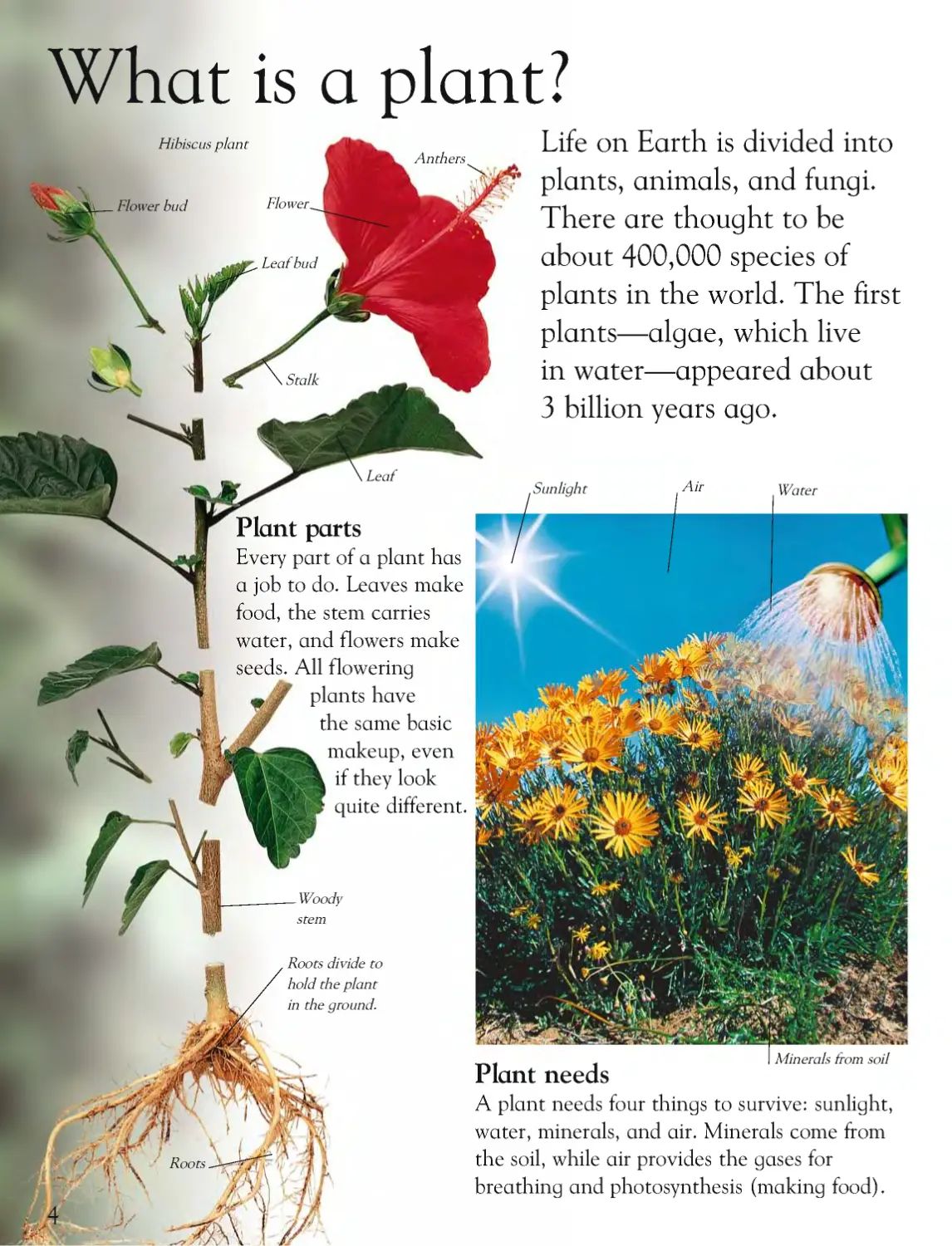
What is a plant?
Hibiscus plant
Anthers
Flower.
bud
Leal bud
Stalk
Leal
Sunlight
Water
Minerals trom soil
Roots
Roots divide to
hold the plant
in the ground.
. Woody
stem
Plant parts
Every part of a plant has
a job to do. Leaves make
food, the stem carries
water, and flowers make
seeds. All flowering
plants have
the same basic
A. makeup, even
A if they look
№ quite different.
Plant needs
A plant needs four things to survive: sunlight,
water, minerals, and air. Minerals come from
the soil, while air provides the gases for
breathing and photosynthesis (making food).
Life on Earth is divided into
plants, animals, and fungi.
There are thought to be
about 400,000 species of
plants in the world. The first
plants—algae, which live
in water—appeared about
3 billion years ago.
Lichen growing
on trees is
usually gray,
green, or yellow.
First flowers
Ancient fossils show that some
of the first flowers looked
very much like magnolias.
They share features that not
all plants have, such as having
many anthers.
Ferns and mosses
do not have seeds,
hut reproduce
trom spores.
Lichen, seen here growing on
rotten trees, is a partnership of
ae and fungi. Unlike algae,
lichen and fungi are not
plants because they do
not make their own food
through photosynthesis.
First plants
Nonflowering plants, such as
ferns and mosses, are among
the oldest plants in the
world. About 300 million
years ago, huge forests of
them covered the land.

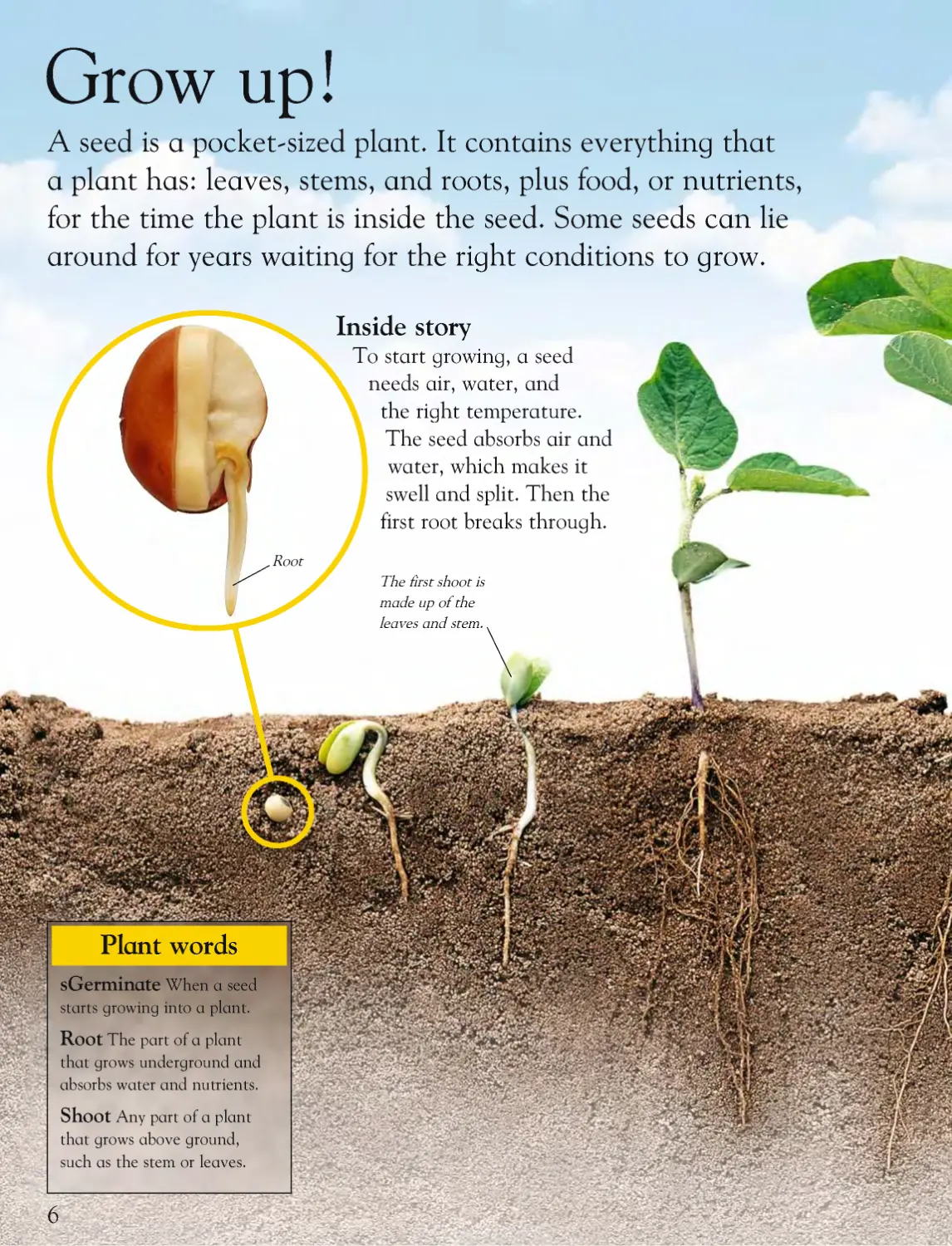
Grow up!
A seed is a pocket-sized plant. It contains everything that
a plant has: leaves, stems, and roots, plus food, or nutrients,
for the time the plant is inside the seed. Some seeds can lie
around for years waiting for the right conditions to grow.
t
The first shoot is
made up of the
leaves and stem.
Plant words
£Ж?«
sGerminate When a seed
starts growing into a plant.
Root The part of a plant
that grows underground and
absorbs water and nutrients.
Shoot Any part of a plant
that grows above ground,
such as the stem or leaves.
Root
Inside story
To start growing, a seed
needs air, water, and
the right temperature.
The seed absorbs air and
water, which makes it
swell and split. Then the
first root breaks through.
6
Reach for the sun
As soon as the leaves are out, they
begin to catch sunlight to make
food. Now that the plant has
grown, the seed will shrivel up
because it is no longer needed.
Cracking up
Young plants are
surprisingly strong. They
can force their way up through
rocks, asphalt, and cracks in
cement. You might be able to
Roots keep the
plant fixed firmly
find some growing through the
sidewalk near your house!
7
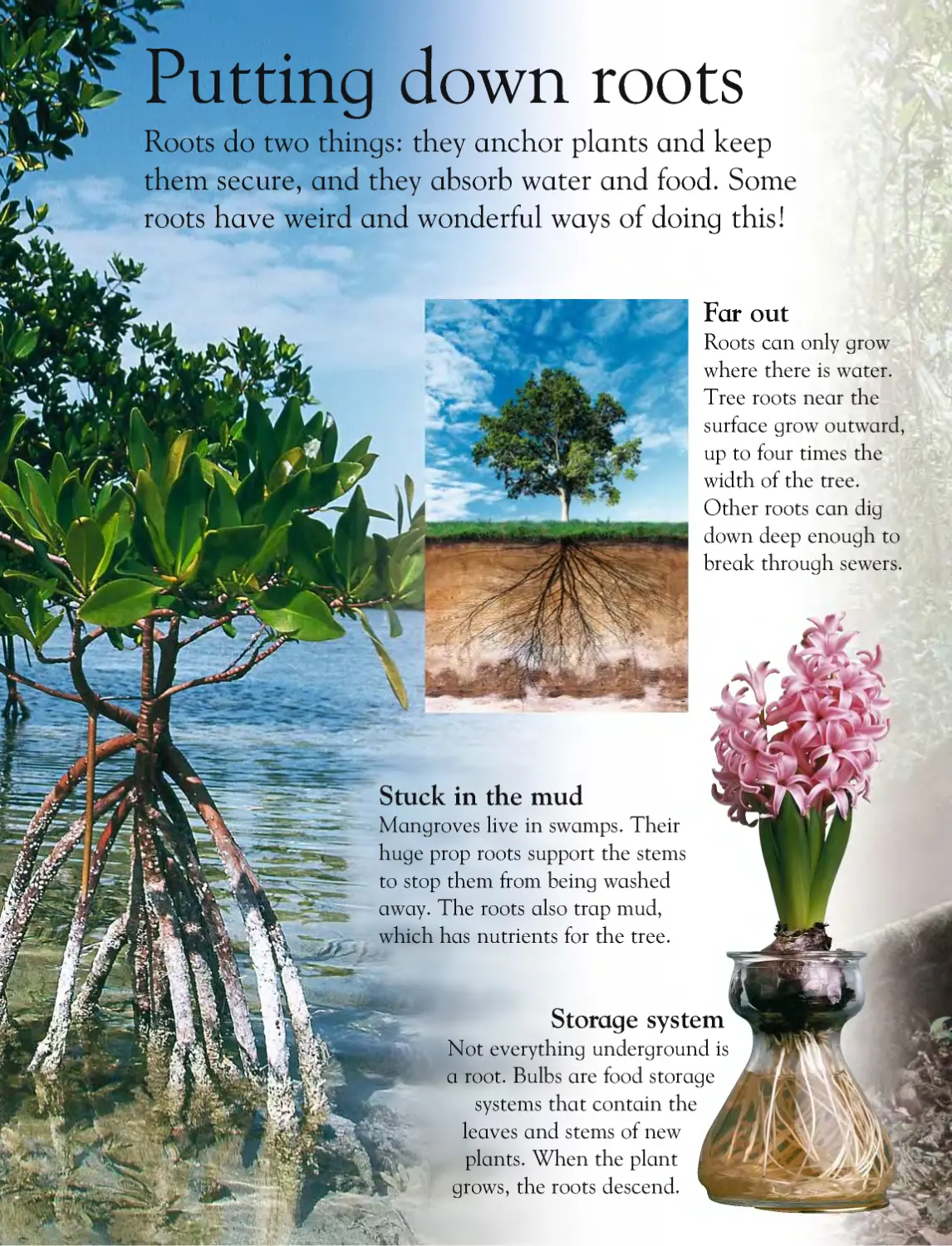
Putting down roots
Roots do two things: they anchor plants and keep
them secure, and they absorb water and food. Some
roots have weird and wonderful ways of doing this!
Far out
Roots can only grow
where there is water.
Tree roots near the
surface grow outward,
up to four times the
width of the tree.
Other roots can dig
down deep enough to
break through sewers.
Stuck in the mud
Mangroves live in swamps. Their
huge prop roots support the stems
to stop them from being washed
away. The roots also trap mud,
which has nutrients for the tree.
Storage system
Not everything underground is
a root. Bulbs are food storage
systems that contain the
leaves and stems of new
plants. When the plant
grows, the roots descend.
Brace yourself
When trees grow in i
shallow soil, such as
in rainforests, their roots ~
might grow above the
surface of the ground.
These are buttress roots,
which keep the tree
stable. Some can
grow to 15 ft
(4.5 m) tall.
In 1937, an American scientist named Howard Dittmer
studied the roots of a rye grass plant. The plant was just
20 in (50 cm) tall and had 80 shoots. But it < •. .,
had more than 380 miles (620 km) of roots! j.
They could cover an area of 2,554 sq ft .и» j '
(237 sq m), enough to carpet ; A-—' * (fo
a large house. And this	1
doesn’t include the 7/,
14 billion root hairs!
Grass roots
Leaf it out
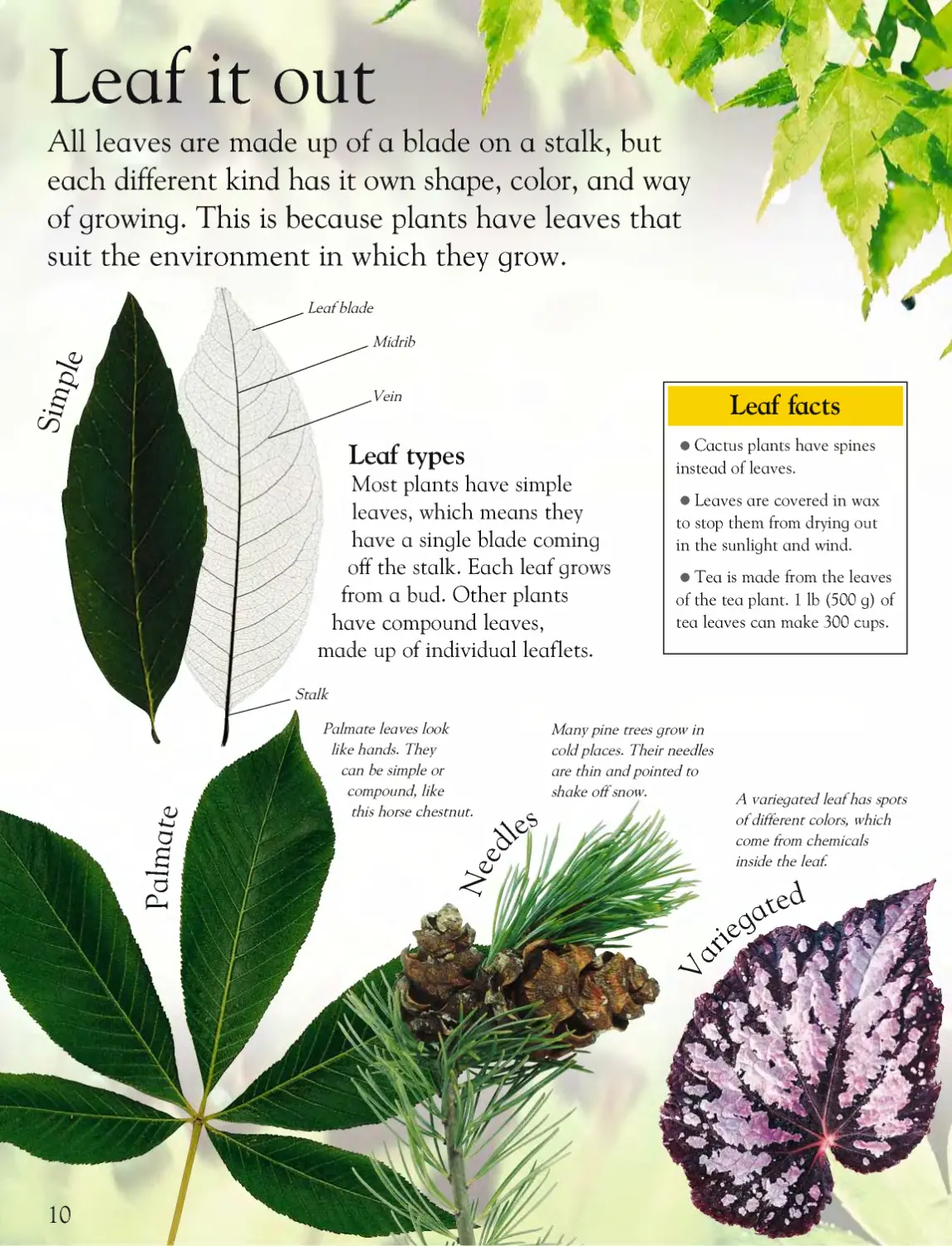
All leaves are made up of a blade on a stalk, but
each different kind has it own shape, color, and way
of growing. This is because plants have leaves that
suit the environment in which they grow.
Vein
Leal blade
Midrib
A variegated leaf has spots
ot different colors, which
come from chemicals
inside the leaf.
Many pine trees grow in
cold places. Their needles
are thin and pointed to
shake oft snow.
Stalk
Leaf types
Most plants have simple
leaves, which means they
have a single blade coming
off the stalk. Each leaf grows
from a bud. Other plants
have compound leaves,
made up of individual leaflets.
Palmate leaves look
like hands. They
can be simple or
compound, like
Leaf facts
• Cactus plants have spines
instead of leaves.
•	Leaves are covered in wax
to stop them from drying out
in the sunlight and wind.
•	Tea is made from the leaves
of the tea plant. 1 lb (500 g) of
tea leaves can make 300 cups.
10
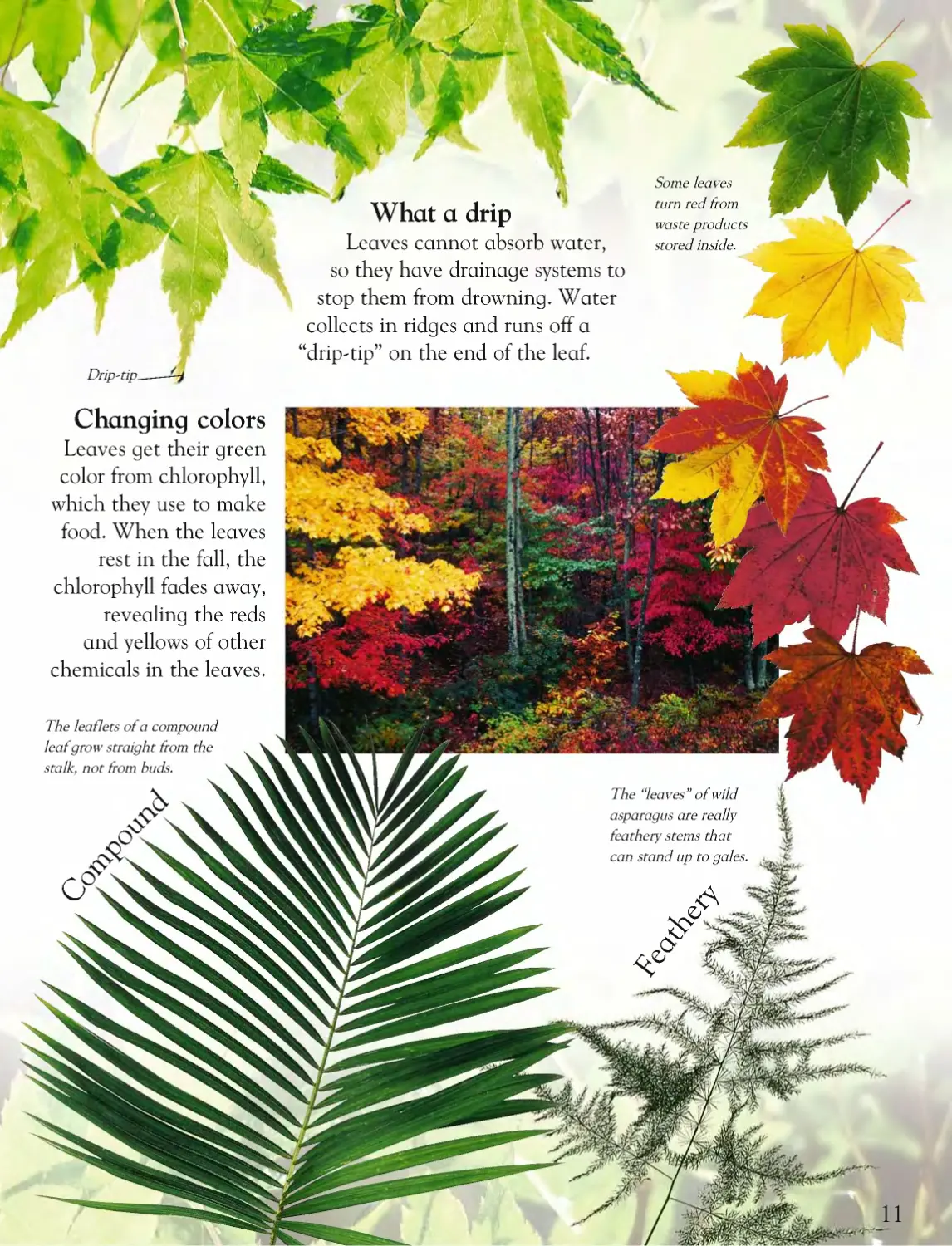
Some leaves
turn red trom
waste products
stored inside.
What a drip
Leaves cannot absorb water,
) they have drainage systems to
stop them from drowning. Water
collects in ridges and runs off a
The leaflets of a compound
leaf grow straight trom the
stalk, not from buds.
Drip-tip——Tj
“drip-tip” on the end of the leaf.
Changing colors
Leaves get their green
color from chlorophyll,
which they use to make
food. When the leaves
rest in the fall, the
chlorophyll fades away,
revealing the reds
and yellows of other
chemicals in the leaves.
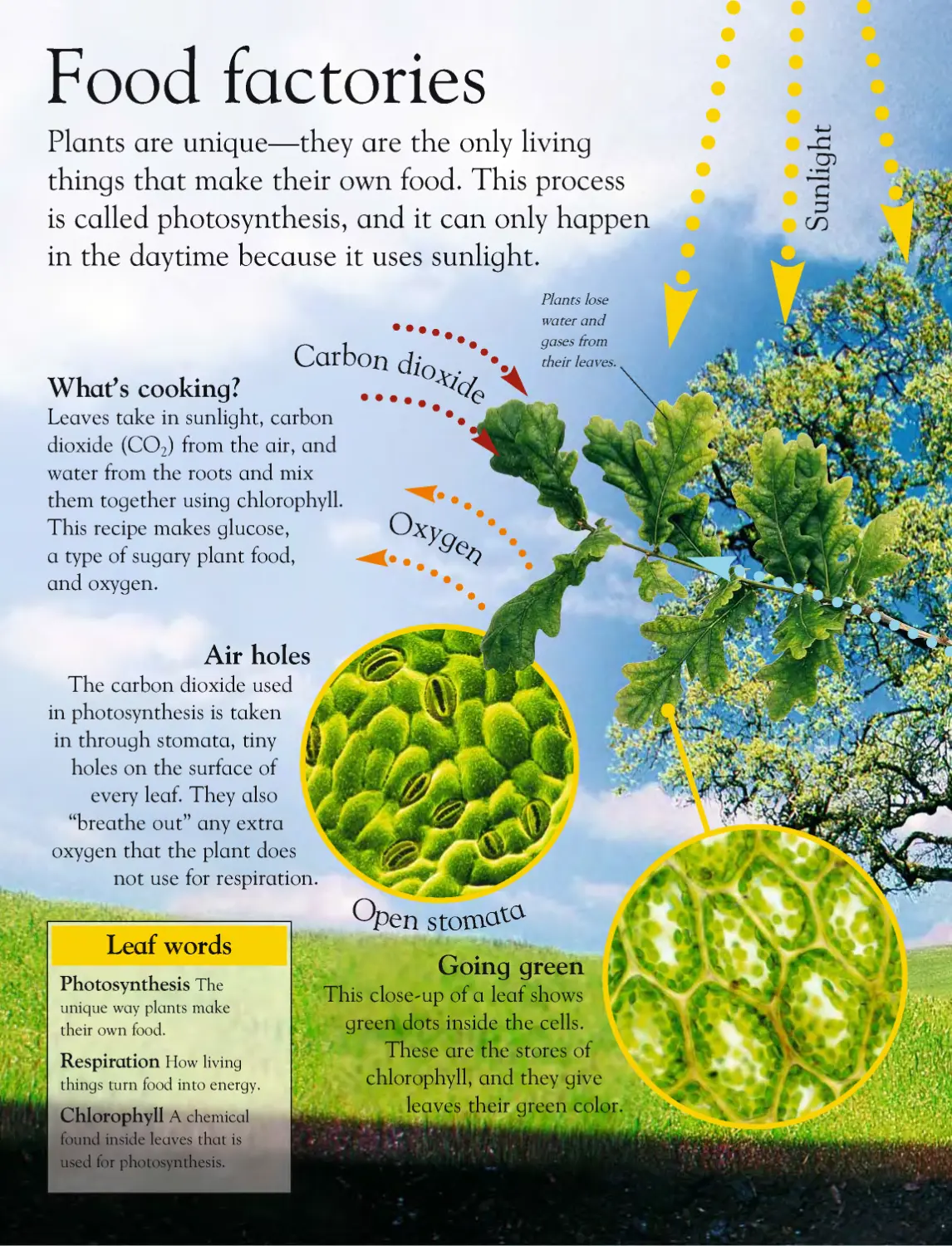
Food factories
Plants are unique—they are the only living
things that make their own food. This process
is called photosynthesis, and it can only happen
in the daytime because it uses sunlight.
What’s cooking?
Leaves take in sunlight, carbon
dioxide (CO2) from the air, and
water from the roots and mix
them together using chlorophyll.
This recipe makes glucose,
a type of sugary plant food,
and oxygen.
Carbon db
Plants lose
water and
gases from
their leaves.
Air holes j
The carbon dioxide used
in photosynthesis is taken
in through stomata, tiny li.
holes on the surface of + .
every leaf. They also $
“breathe out” any extra
oxygen that the plant does
not use for respiration.
Leaf words
Open stomal
Photosynthesis The
unique way plants make
their own food.
Respiration How living
things turn food into energy.
Chlorophyll A chemical
found inside leaves that is
used for photosynthesis.
Going green }
This close-up of a leaf shows
green dots inside the cells.
These are the stores of
chlorophyll, and they give
leaves their green color.
Spare CO, that
has not been used
tor making food
is released back
into the air.
мы
^on dioxide
Energy source
Like all living things, plants
get energy from food. This is
called respiration. Plants use
oxygen to turn food into
energy, which helps them
to grow. The oxygen
comes from the air or
from photosynthesis.
«е-ч

, A


Closed for the night
Respiration occurs 24 hours
a day, but photosynthesis
stops at night when there is
no sun. Many plants close
their stomata at night as
they rest. Oxygen and CO2
can still pass in and out of
the leaf cells even though
the stomata are shut.
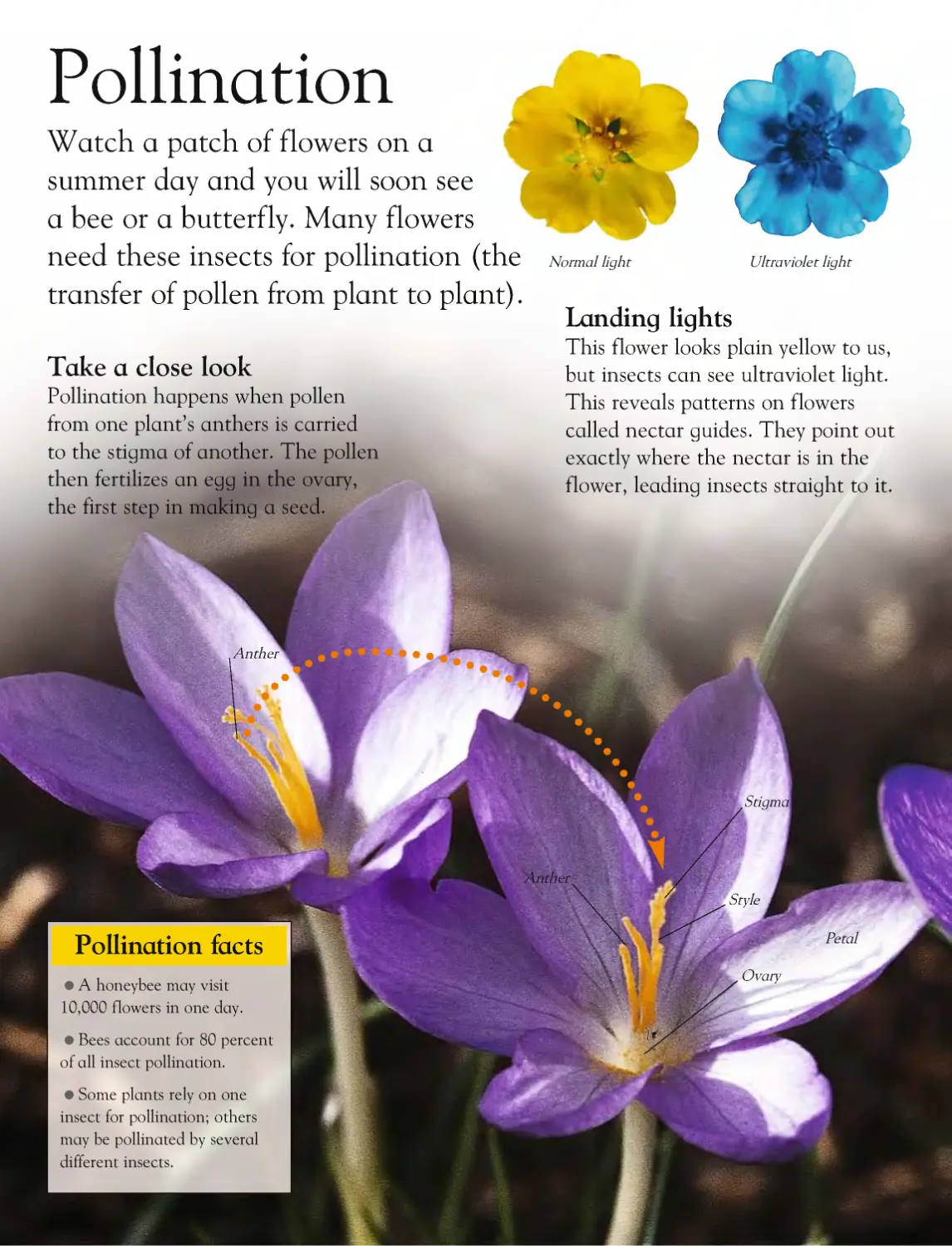
Pollination
Watch a patch of flowers on a
summer day and you will soon see
a bee or a butterfly. Many flowers
need these insects for pollination (the
Normal light
transfer of pollen from plant to plant).
Ultraviolet light
Landing lights
Take a close look
Pollination happens when pollen
from one plant’s anthers is carried
to the stigma of another. The pollen
This flower looks plain yellow to us,
but insects can see ultraviolet light.
This reveals patterns on flowers
called nectar guides. They point out
exactly where the nectar is in the
then fertilizes an egg in the ovary,
flower, leading insects straight to it.
the first step in making a seed.
, The bee uses its
proboscis to suck up
nectar to take back
to the hive.
Busy as a bee
Bees pollinate many of the
1 world’s crops, from apples
' and pears to cucumbers and
melons. They zip between
the flowers at the dizzying
speed of 15 mph (24 km/h)
Th e bee mixes pollen
with nectar, making
it sticky so it stays in
the pollen baskets.
Pollen
Magnified many times, pollen
grains are have different shapes
depending on their parent plant
Some have spiky casings.
A good dusting
When a bee lands on
a flower, its body is
dusted with pollen. It
collects this pollen in
pollen baskets on its
back legs, but enough
is left to pollinate
other flowers.
Flower partners
Just as you might prefer one food to
another, some animals will choose to
drink nectar from certain plants. And
these plants will try all kinds of tricks
to attract their chosen pollinator.
Smelling
right is as
important as
looking pretty.
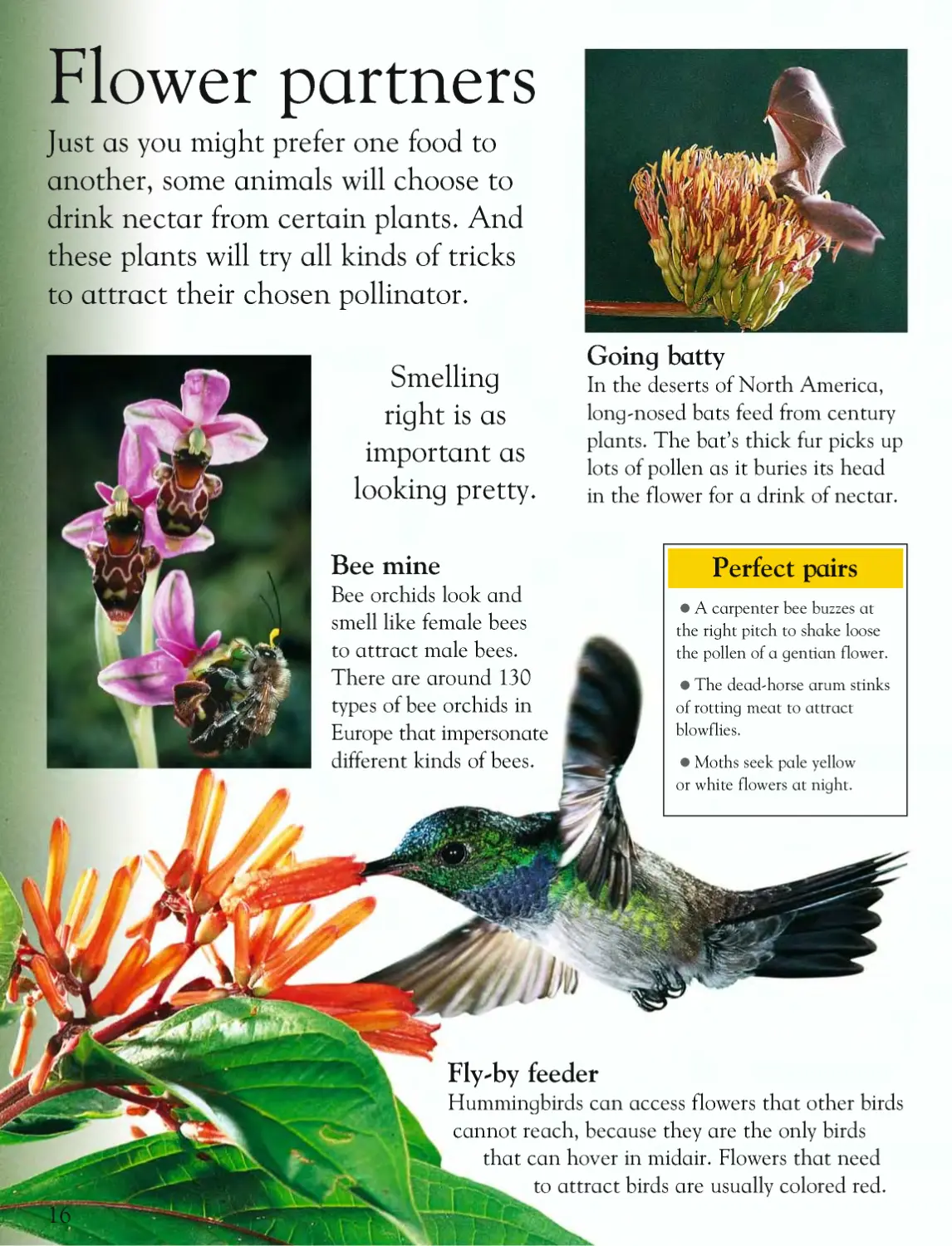
Going batty
In the deserts of North America,
long-nosed bats feed from century
plants. The bat’s thick fur picks up
lots of pollen as it buries its head
in the flower for a drink of nectar.
Perfect pairs
• A carpenter bee buzzes at
the right pitch to shake loose
the pollen of a gentian flower.
• The dead-horse arum stinks
of rotting meat to attract
blowflies.
• Moths seek pale yellow
or white flowers at night.
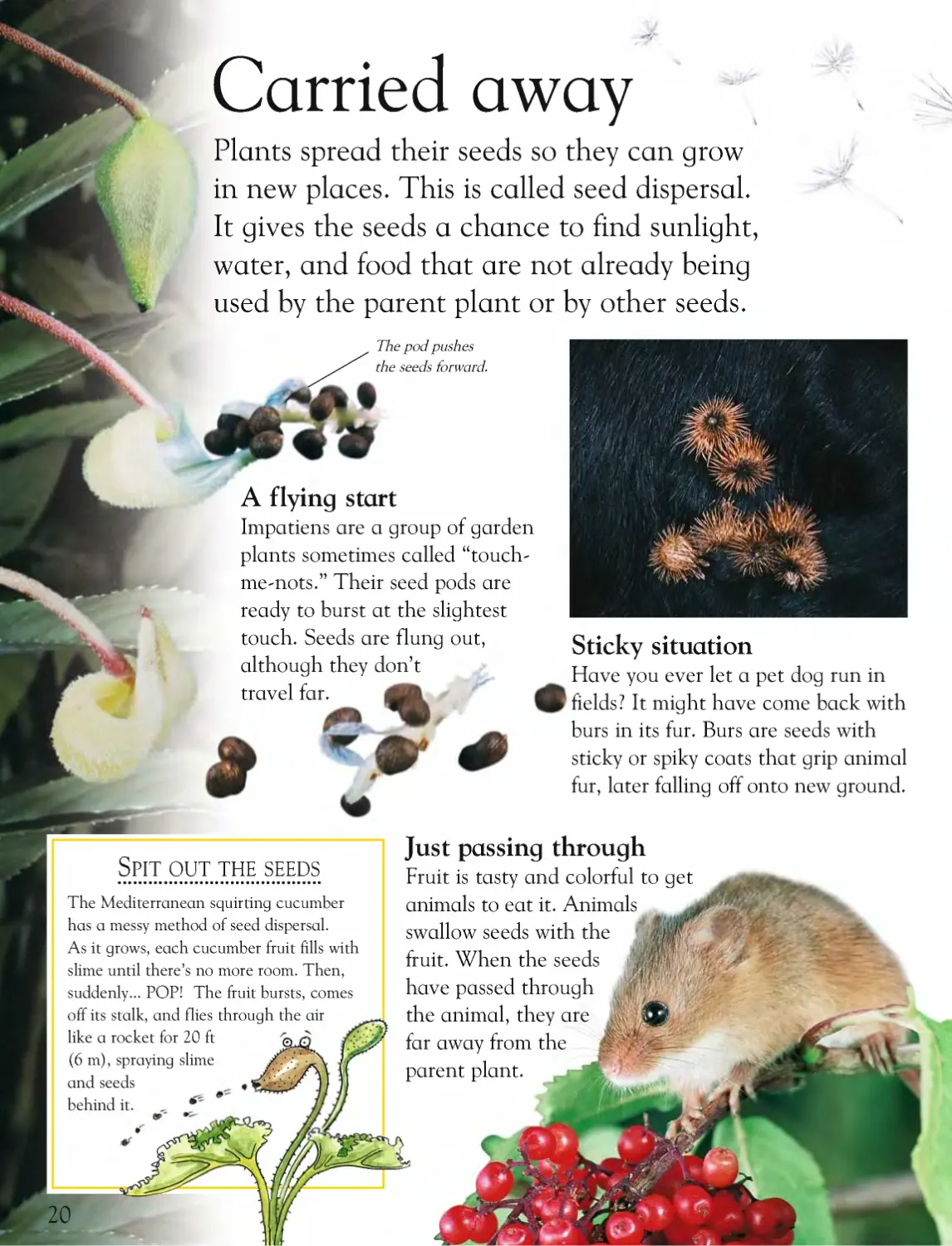
Fly-by feeder
Hummingbirds can access flowers that other birds
cannot reach, because they are the only birds
that can hover in midair. Flowers that need
to attract birds are usually colored red.
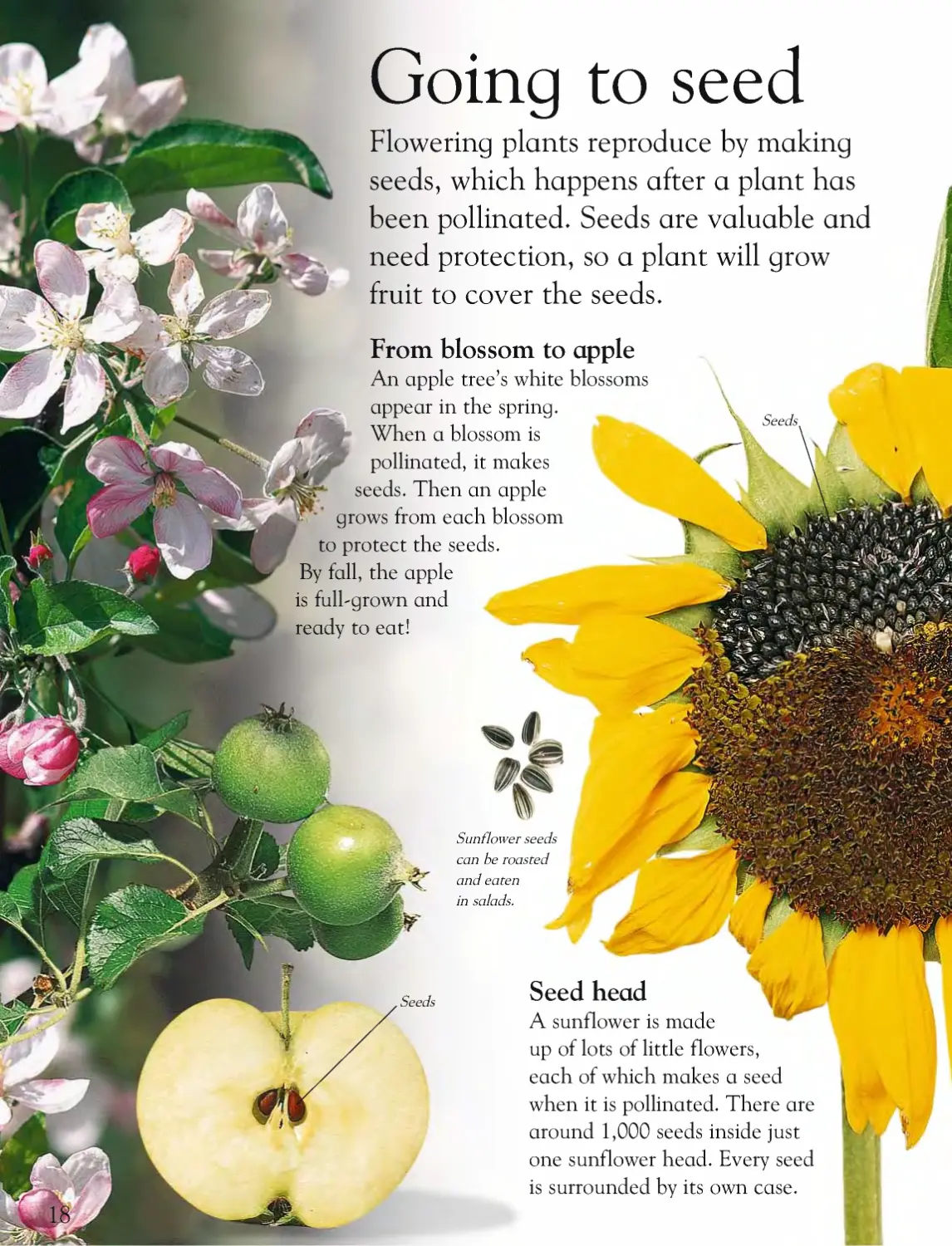
Bee mine
Bee orchids look and
smell like female bees
to attract male bees.
There are around 130
types of bee orchids in
Europe that impersonate
different kinds of bees.
Lap it up
In New Zealand, flax plants provide
a tasty drink for geckos. As they climb
up the stem and drink from the flower,
they get pollen all over their chins.
The yellow
pollen stains
the gecko’s chin.
Running wild
Tiny honey possums in w
Australia clamber all over W
the flowers of a banksia
plant to gather nectar.
Of course, they get covered у
in pollen while doing so!
Seeds
Seeds
Sunflower seeds
can be roasted
and eaten
in salads.
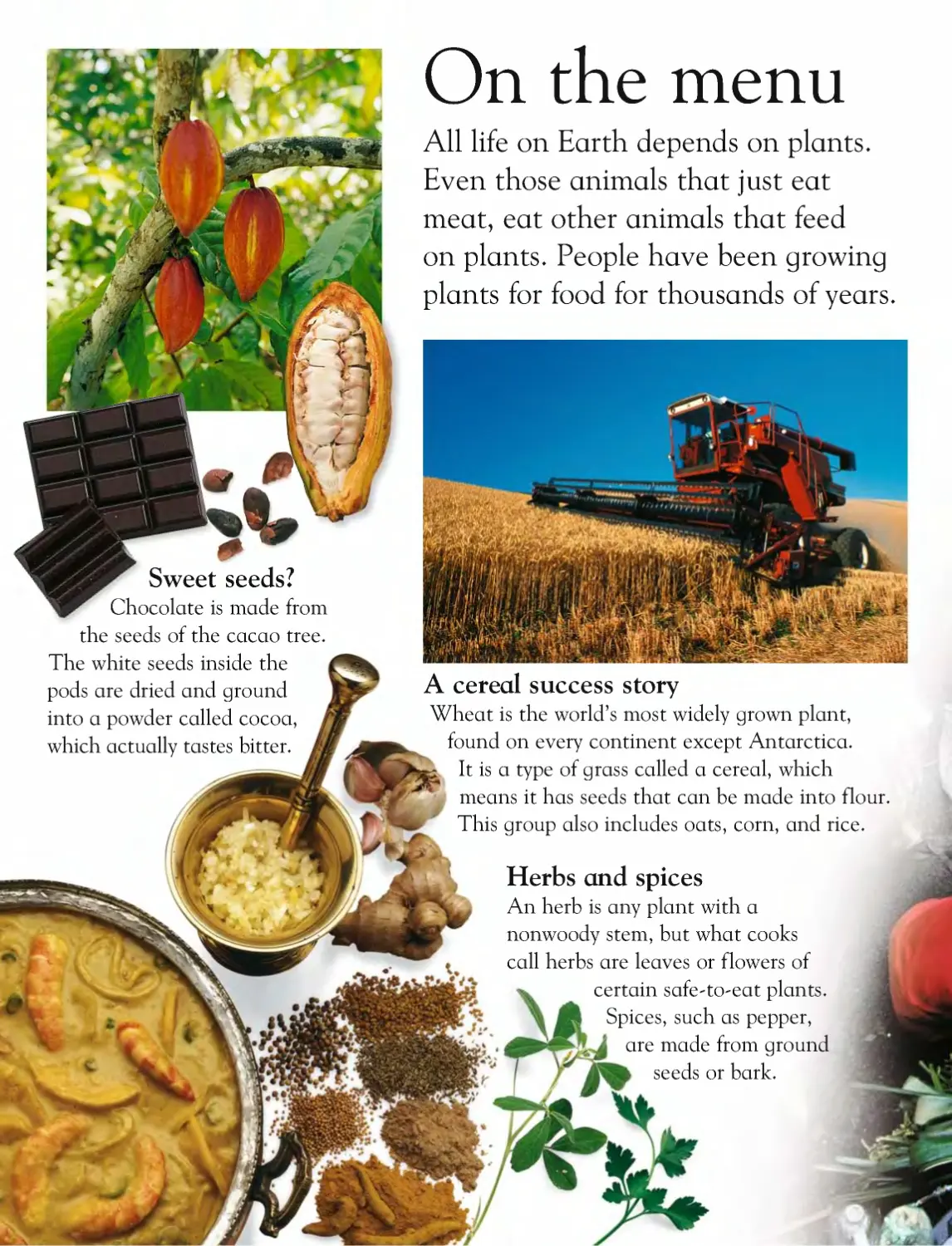
Seed head
A sunflower is made
up of lots of little flowers,
each of which makes a seed
when it is pollinated. There are
around 1,000 seeds inside just
one sunflower head. Every seed
is surrounded by its own case.
From blossom to apple
An apple tree’s white blossoms
appear in the spring.
When a blossom is
pollinated, it makes
seeds. Then an apple
grows from each blossom
to protect the seeds.
By fall, the apple
is full-grown and
ready to eat!
Going to seed
Flowering plants reproduce by making
seeds, which happens after a plant has
been pollinated. Seeds are valuable and
need protection, so a plant will grow
fruit to cover the seeds.
-7^4
Wooden fruit
Not all fruit is edible: the fruits of
pine trees are wooden cones. Pine
trees take two years to make seeds,
which are kept safe inside the cones.
When the seeds are ready, the cones
burst open. The seeds fall to the
ground, where many will be eaten
by forest animals and birds.
Seeds
Spores on
underside ot
a tern lent.
Scores of spores
Nonflowering plants do
not have seeds. Ferns have
spores instead, which can
be seen on the underside of
the leaves. When the spores
are ripe, they fall off the leaf
New potato plants sprouting.
Sprouting spuds
Have you ever seen an
old, wrinkly potato?
It probably has “eyes”—
green buds that will grow
into new plants. Potatoes
are not seeds, but tubers,
which are underground
food stores for the plant.
I
The pod pushes
the seeds forward.
4»
20
Carried away
Plants spread their seeds so they can grow
in new places. This is called seed dispersal.
It gives the seeds a chance to find sunlight,
water, and food that are not already being
used by the parent plant or by other seeds.
A flying start
Impatiens are a group of garden
plants sometimes called “touch-
me-nots.” Their seed pods are
ready to burst at the slightest
touch. Seeds are flung out,
although they don’t
travel far.
Sticky situation
Have you ever let a pet dog run in
fields? It might have come back with
burs in its fur. Burs are seeds with
sticky or spiky coats that grip animal
fur, later falling off onto new ground.
Sht out.the seeds
The Mediterranean squirting cucumber
has a messy method of seed dispersal.
As it grows, each cucumber fruit fills with
slime until there’s no more room. Then,
suddenly... POP! The fruit bursts, comes
off its stalk, and flies through the air
like a rocket for 20 ft
(6 m), spraying slime
and seeds
behind it.
Just passing through
Fruit is tasty and colorful to get
animals to eat it. Animals
swallow seeds with the
fruit. When the seeds
Jr
have passed through ,и <
the animal, they are
far away from the
parent plant. j

Blowing in the wind
A dandelion seed is so light that
it can be blown away by the
wind, carried on its own fluffy
white parachute. A dandelion is
not one flower, but is made up
of florets that each make a seed
when pollinated. One plant can
make up to 500 seeds.
Go with the flow
Coconuts may be one of the
largest seeds, but they are
hollow and light enough to
float. This way they can travel
across oceans, and they have
been known to survive journeys
of 1,000 miles (1,600 km).
Propeller power
Maple seeds are among
the heaviest to ride on the
wind. Their shape works
like a helicopter rotor,
spinning around in the breeze
so the seeds travel farther
On the menu
All life on Earth depends on plants.
Even those animals that just eat
meat, eat other animals that feed
on plants. People have been growing
plants for food for thousands of years.
Sweet seeds?
Chocolate is made from
the seeds of the cacao tree.
The white seeds inside the ।
pods are dried and ground
into a powder called cocoa, f
which actually tastes bitter. A
A cereal success story
Wheat is the world’s most widely grown plant,
found on every continent except Antarctica.
e; It is a type of grass called a cereal, which
means it has seeds that can be made into flour.
This group also includes oats, corn, and rice.
Herbs and spices
An herb is any plant with a
nonwoody stem, but what cooks
call herbs are leaves or flowers of
certain safe-to-eat plants.
A 4R Spices, such as pepper,
f J are made from ground
V-W seeds or bark.
Rich harvest
A vegetable is a plant or part
of a plant that is grown to
be eaten. This includes
fruit, seeds, roots, and
leaves, such as beans
(seeds) and carrots
(roots). But there
is no one plant
that we can eat "
every part of.
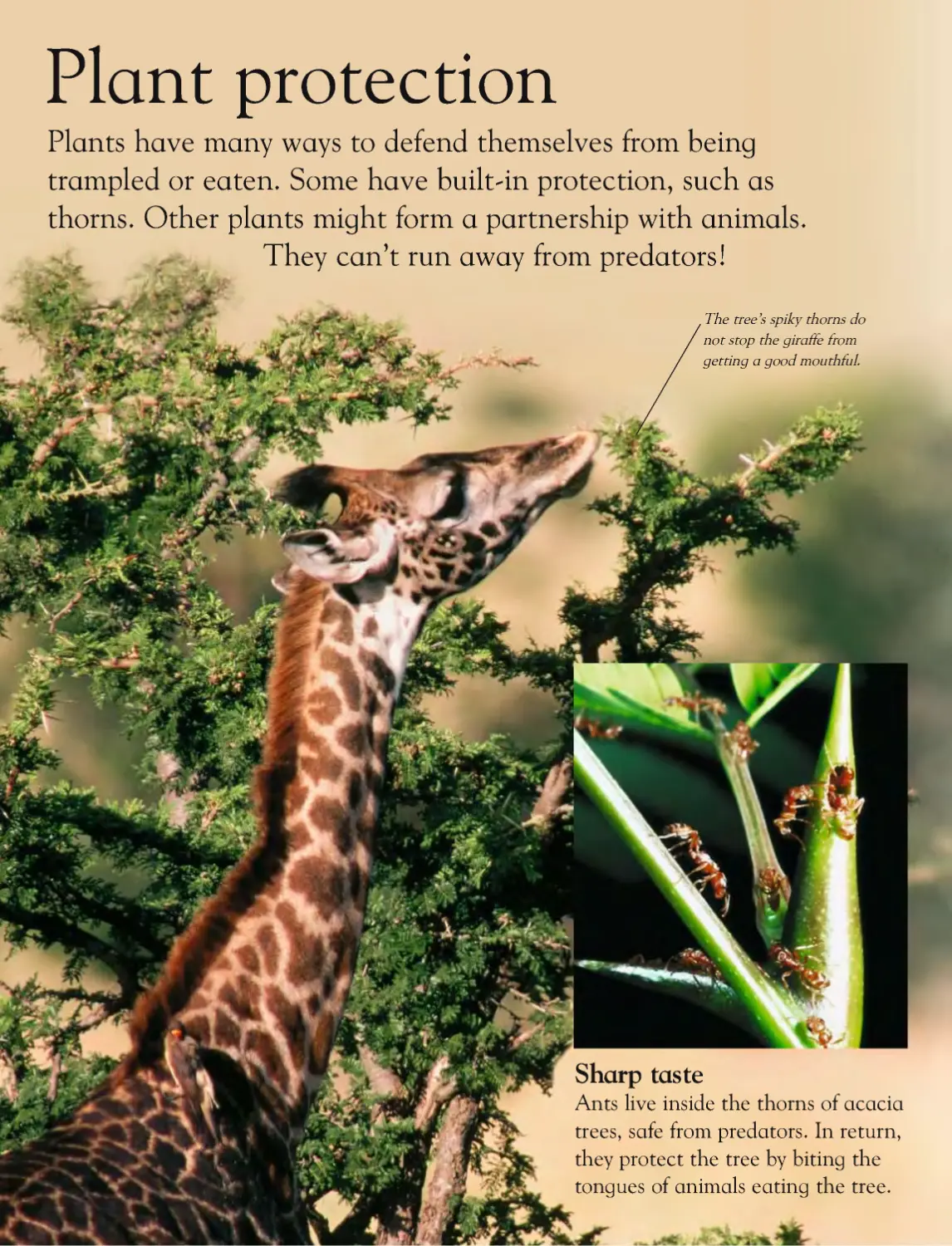
Plant protection
Plants have many ways to defend themselves from being
trampled or eaten. Some have built-in protection, such as
thorns. Other plants might form a partnership with animals.
They can’t run away from predators!
The tree’s spiky thorns do
not stop the girafte from
getting a good mouthful.
Sharp taste
Ants live inside the thorns of acacia
trees, safe from predators. In return,
they protect the tree by biting the
tongues of animals eating the tree.

Water collects here and
Spines, called
bracts, protect
the flower.
Double
Teasels are well prepared
for attack. Insects climbing
up the stem will find spines,
but if they head back down, they
will drown in a leaf moat. This is
the dip where two leaves meet, which
fills with water when it rains
Spot the plant
Hidden among the
stones in African deserts
are small, round plants.
They have dull patterns
that act as camouflage.
You can see why they’re
called living stones.
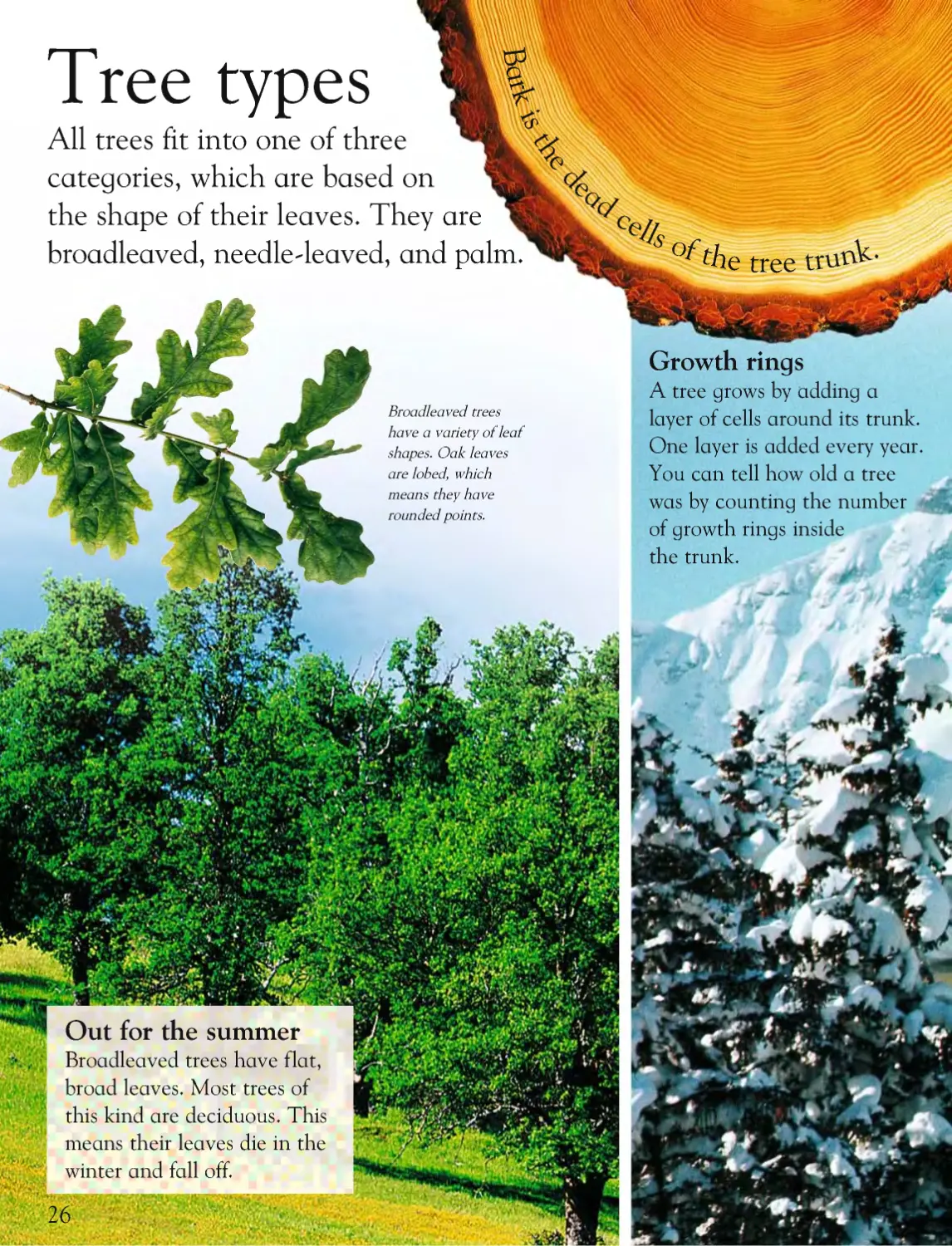
e tree tnin'
Growth rings
A tree grows by adding a
layer of cells around its trunk.
One layer is added every year
You can tell how old a tree
Out for the summer
Broadleaved trees have flat,
broad leaves. Most trees of
this kind are deciduous. This
means their leaves die in the
winter and fall off.
was by counting the r
of growth rings inside
the trunk.
Broadleaved trees
have a variety ot leal
shapes. Oak leaves
are lobed, which
means they have
rounded points.
Tree types
All trees fit into one of three
categories, which are based on
the shape of their leaves. They are 1
broadleaved, needle-leaved, and palm

„ Small, tough
leaves can
stand up to the
cold weather.
Green all year
Needle-leaved trees,
such as pines and firs,
are known as coniferous
because they make seeds
inside cones. They are
also called evergreens
because they keep their
leaves in winter.
Give us a hand
A palm tree’s canopy—
its branches and leaves—
looks like a hand, with
the leaves spreading out
like fingers. There are
more than 3,000 species
of palms, mostly found
in tropical places.
The world’s
biggest leaves
belong to palm
trees. Raffia palm
leaves can grow
65 ft (20 m) long.
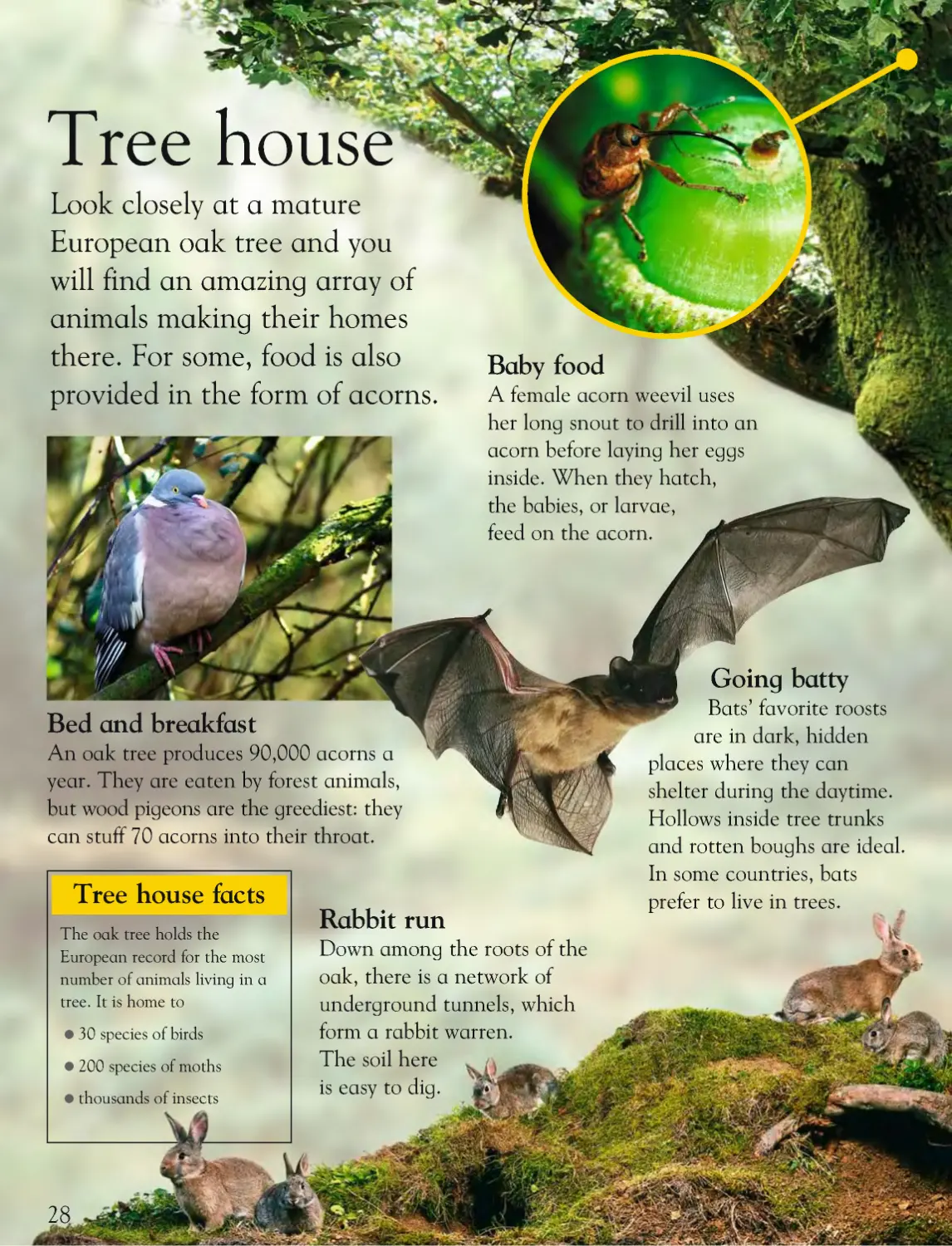
Tree
Baby food
A female acorn weevil uses
her long snout to drill into an
acorn before laying her eggs
inside. When they hatch,
Bed and breakfast
An oak tree produces 90,000 acorns a
year. They are eaten by forest animals,
but wood pigeons are the greediest: they
can stuff 70 acorns into their throat.
Look closely at a mature
European oak tree and you
will find an amazing array of
animals making their homes
there. For some, food is also
provided in the form of acorns.
Going batty
Bats’ favorite roosts
are in dark, hidden
places where they can
shelter during the daytime.
Hollows inside tree trunks
and rotten boughs are ideal.
Tree house facts
The oak tree holds the
European record for the most
number of animals living in a
tree. It is home to
• 30 species of birds
•	200 species of moths
•	thousands of insects
Rabbit run
Down among the roots of the
oak, there is a network of
underground tunnels, which
form a rabbit warren.
The soil here
is easy to dig.
In some countries, bats
prefer to live in trees.
Home to roost
Owls do not build nests in
tree canopies like other birds,
but roost inside the trunk.
Living in a forest with other
animals around means they
can find lots of prey to eat.
Bark gallery
Bark beetles gnaw tunnels,
called galleries, below the
surface of the trunk. It is
a safe place to lay eggs,
but larvae can destroy a
tree by eating its wood.
29
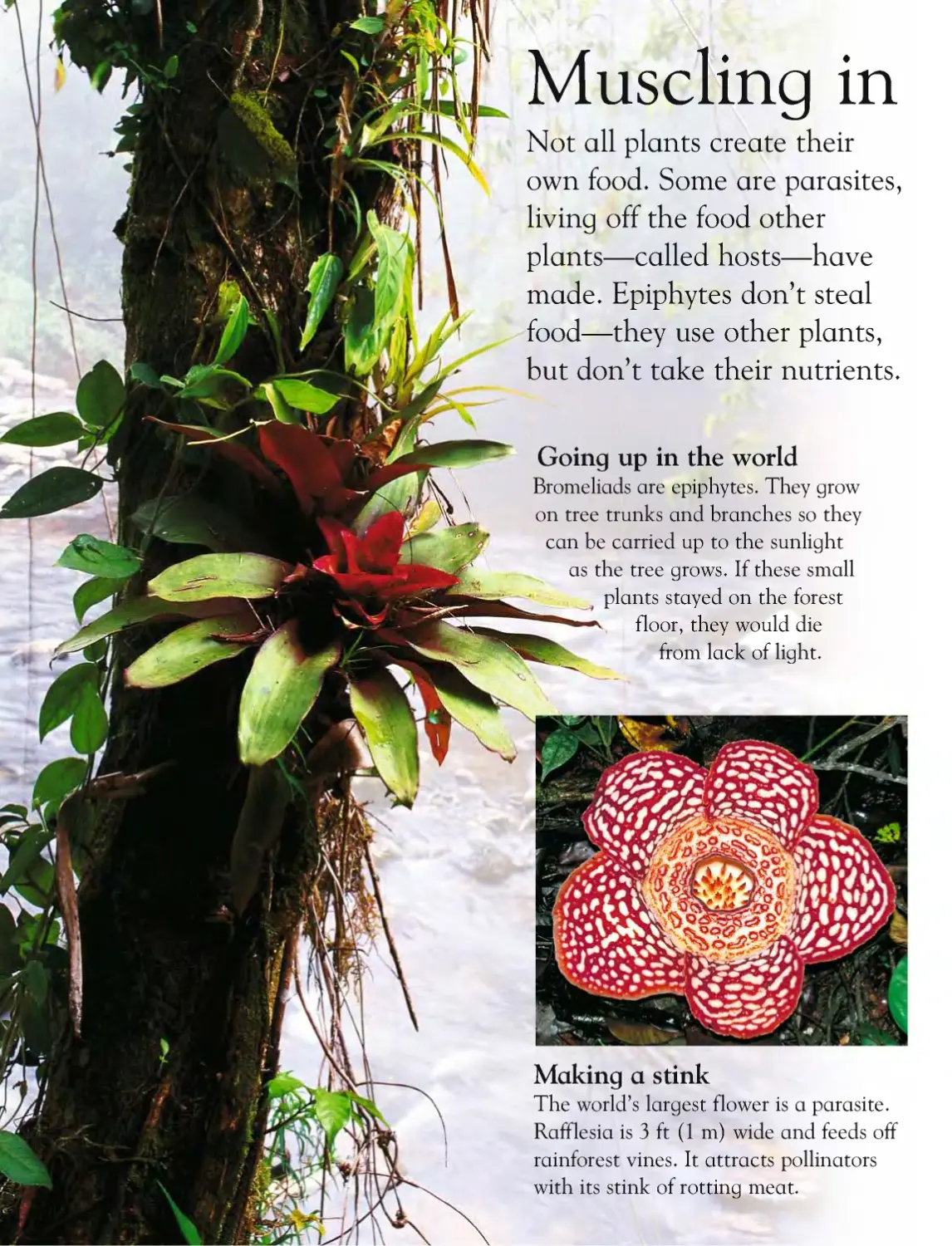
Making a stink
The world’s largest flower is a parasite.
Rafflesia is 3 ft (1 m) wide and feeds off
rainforest vines. It attracts pollinators
with its stink of rotting meat.
Going up in the world
Bromeliads are epiphytes. They grow
on tree trunks and branches so they
can be carried up to the sunlight
as the tree grows. If these small
plants stayed on the forest
— ’• floor, they would die
from lack of light.
Muscling in
Not all plants create their
own food. Some are parasites,
living off the food other
plants—called hosts—have
made. Epiphytes don’t steal
food—they use other plants,
but don’t take their nutrients.
Mistletoe roots are
completely blended
into the tree branch.
Deadly dodder
On the ground, dodder
plant tendrils go hunting
for food. They wrap
around the stems of
other plants and suck
the life out of them.
g Stranglehold
I Strangler figs are not parasites—
they live off debris found in the
host tree. But as their roots descend
the host’s trunk, they block out the
nlight and the host dies.
The roots keep
the tig standing
even after
the host has
rotted away.
The tig starts lite
as a seed landing
on a branch, and
sends down roots
as it grows.
Branching out
Mistletoe is a lazy plant. It has
leaves that can make their own
food, but doesn’t use them much.
Instead, it sends roots down into its
host’s branches and steals the sap.
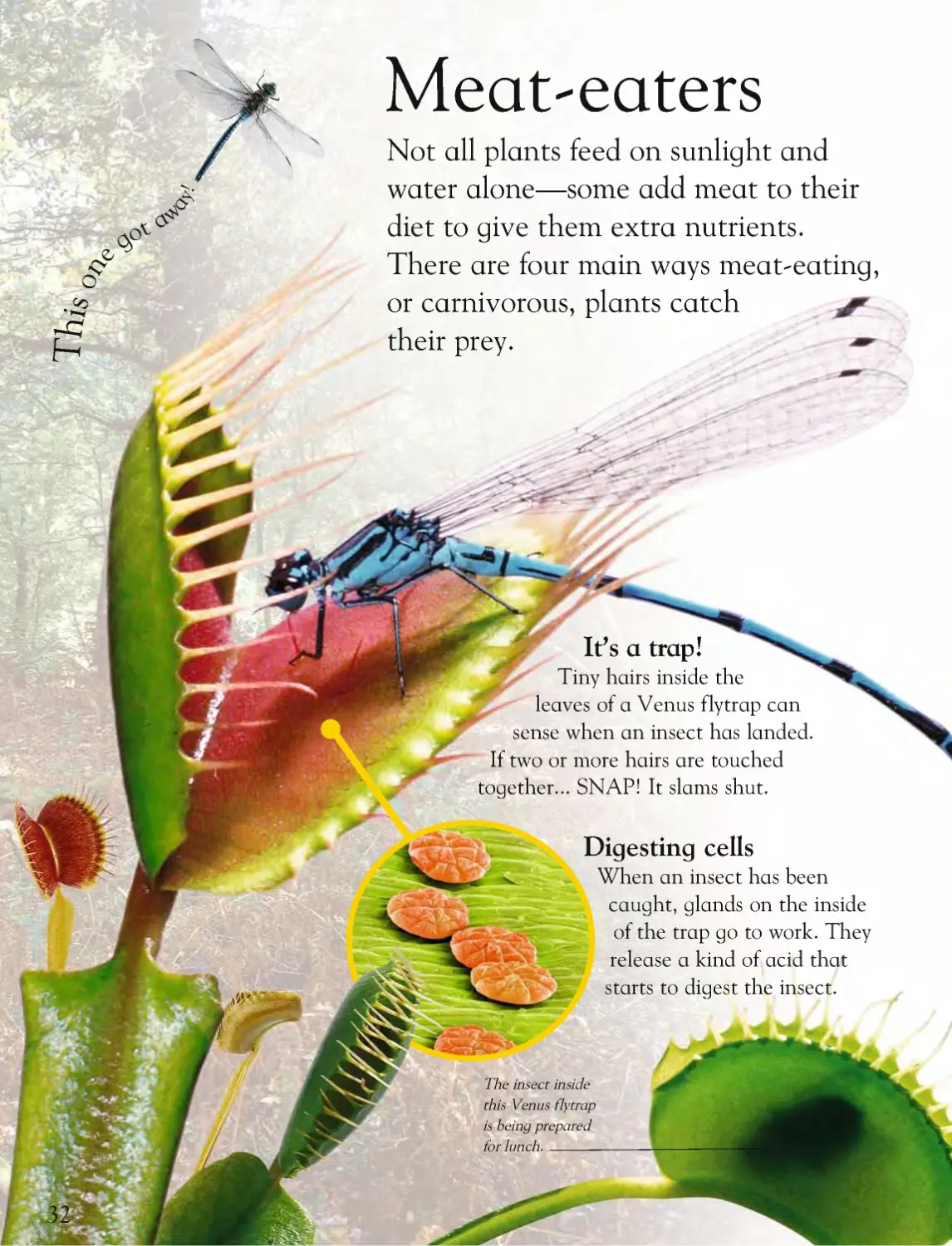
Meat-eaters
Not all plants feed on sunlight and
water alone—some add meat to their
diet to give them extra nutrients.
There are four main ways meat-eating,
or carnivorous, plants catch
their prey.	~
The insect inside
this Venus flytrap
is being prepared
tor lunch. _____
Digesting cells
When an insect has been
caught, glands on the inside
of the trap go to work. They
release a kind of acid that
starts to digest the insect.
It’s a trap!
Tiny hairs inside the
leaves of a Venus flytrap can
sense when an insect has landed.
If two or more hairs are touched
together... SNAP! It slams shut.
The leaf ''•Т'Ь
curls around '
the fly to bring it
toward the
z digestion cells.
sundew acts
The bladder
is full of hairs
that sense prey.
The pitcher’s walls
are thin so the plant
can absorb the
nutrients fron\ »
the insects. \	\
The rim ot the/
pitcher is colored
to attract insects-
and slippery so
they tall in.
Any bits ot !
fly that the plant
doesn’t digest
are left stuck
to the leaf. '.$
• Most carnivorous plants live
in marshy areas where the soil
alone does not provide enough
nutrients.
Tiny trapdoors
When prey floats past this
underwater bladderwort, the
bladders on the leaves quickly open,
like a mouth, sucking the insect
inside. It takes one-thousandth
of a second to trap the prey.
Sticky business
An unfortunate fly lands for a
moment on a sundew flytrap... and
remains stuck fast. The leaves are
covered in sticky hairs that trap the
insect, ready for eating later. \
There is 'y'Tyfyi.
no way a fly
can tree itselt
trom the many
sticky hairs.
Slippery pitch
The pitcher plant can
catch lots of insects inside
its huge leaves. The insects
can’t climb out of the waxy
leaves, and they drown in
the liquid at the bottom
of the deep pit.
• The biggest carnivorous
plant—a kind of pitcher—has
vines up to 33 ft (10 m) long.
It can catch frogs!
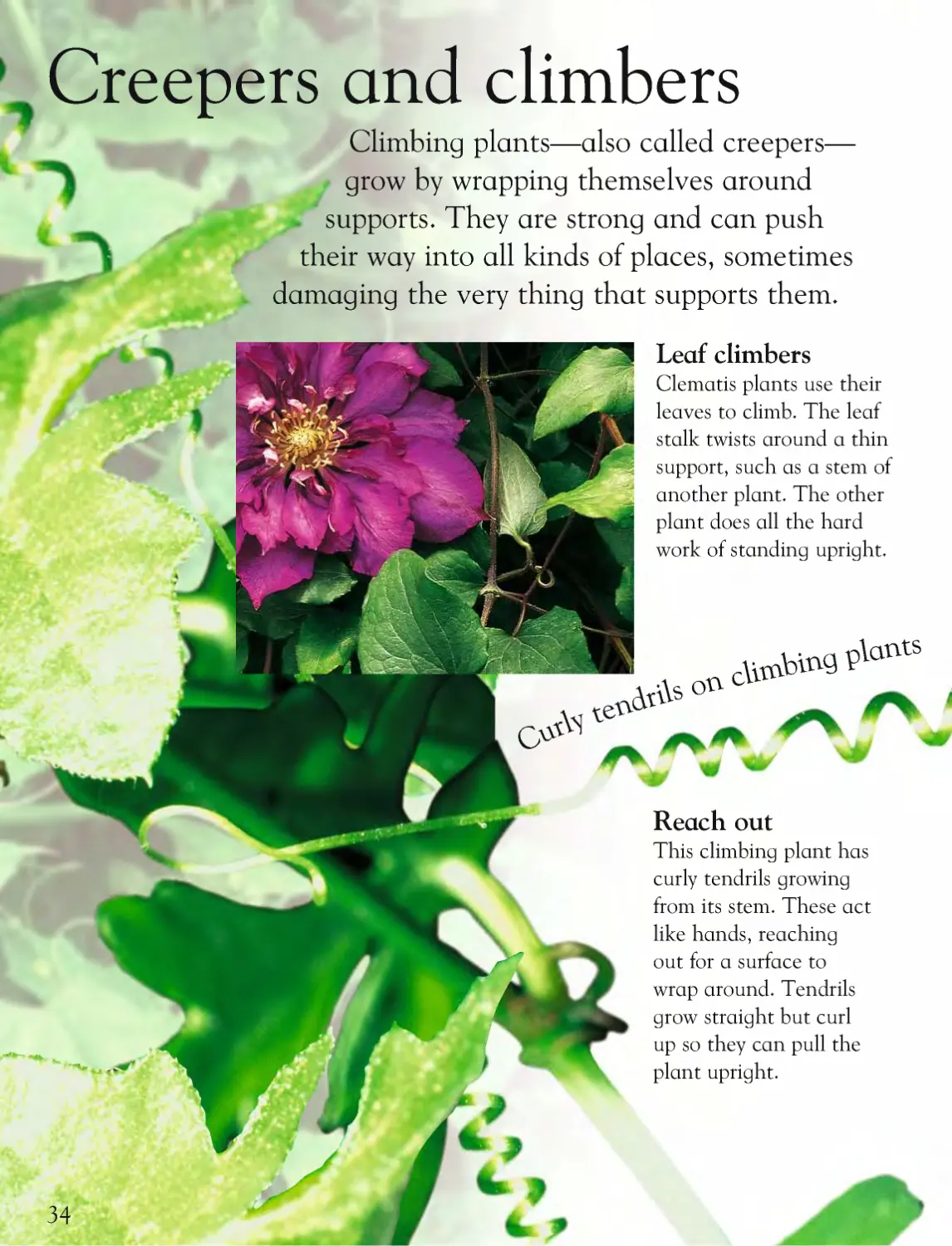
Creepers and climbers
Climbing plants—also called creepers—
grow by wrapping themselves around
supports. They are strong and can push
their way into all kinds of places, sometimes
damaging the very thing that supports them.
Leaf climbers
Clematis plants use their
leaves to climb. The leaf
stalk twists around a thin
support, such as a stem of
another plant. The other
plant does all the hard
work of standing upright.

Reach out
This climbing plant has
curly tendrils growing
from its stem. These act
like hands, reaching
out for a surface to
wrap around. Tendrils
grow straight but curl
up so they can pull the
plant upright.
34
can s t т
Champion climber
Stem climbers, such as morning
glory, can climb over anything.
They are able to wrap their stems
around larger objects than tendrils
or leaf stalks can, including
tree trunks.

Climbing facts
•	Honeysuckle, a stem
climber, can kill trees by
wrapping too tightly around
their trunks.
•	Climbing roses aren’t
actually climbers—they just
lean on their supports and
hang on using their thorns.

Getting a grip
These strange-looking fingers
growing from ivy stems are roots.
They are slightly sticky and
can grip almost any surface.
It is easy for ivy to cover
whole houses, worming
its roots into the bricks.
35
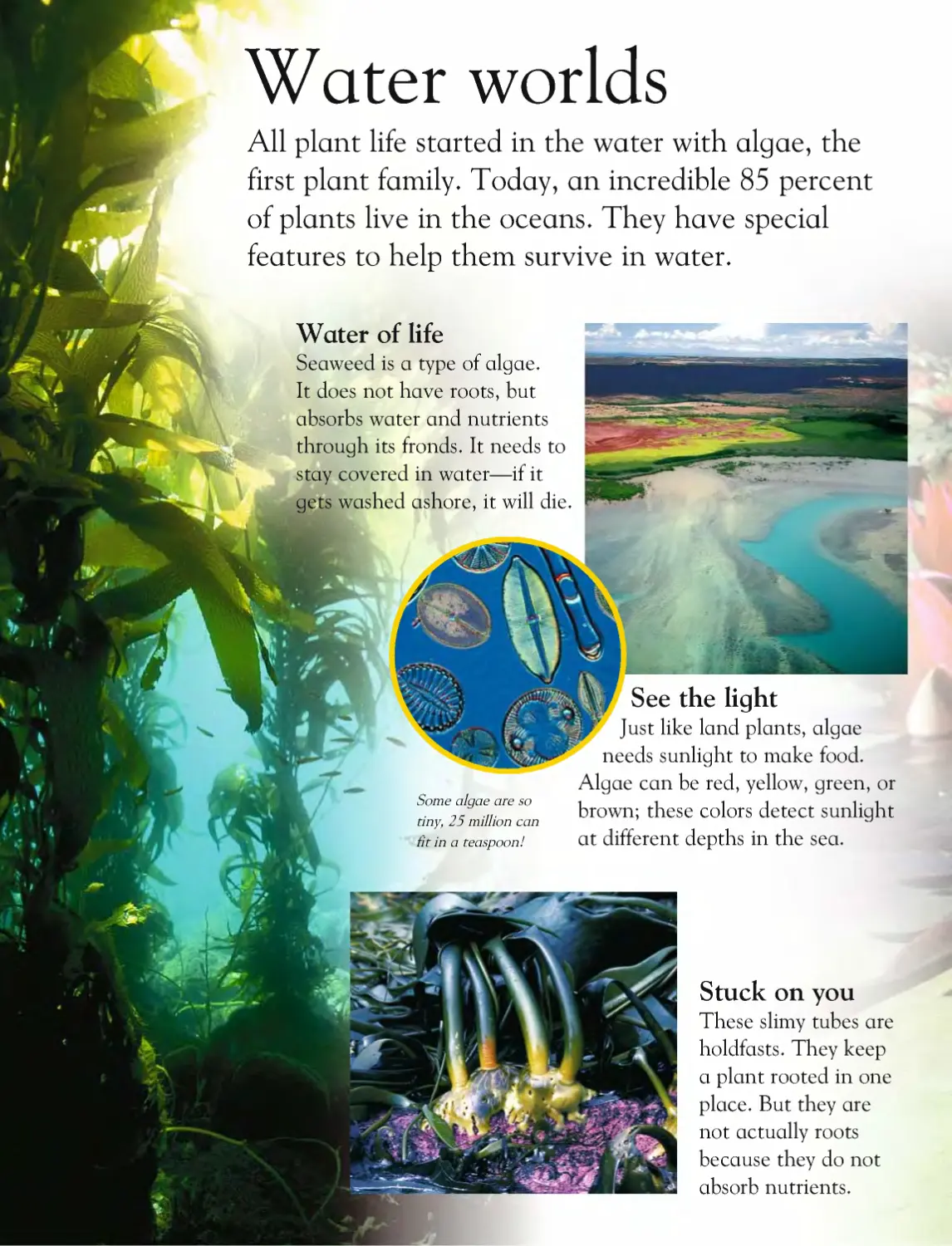
Water worlds
Some algae are so
tiny, 25 million can
tit in a teaspoon!
All plant life started in the water with algae, the
first plant family. Today, an incredible 85 percent
of plants live in the oceans. They have special
features to help them survive in water.
Water of life
Seaweed is a type of algae.
It does not have roots, but
absorbs water and nutrients
through its fronds. It needs
stay covered in water—if it
gets washed ashore, it will die.
See the light
Just like land plants, algae
needs sunlight to make food.
Algae can be red, yellow, green, or
brown; these colors detect sunlight
at different depths in the sea.
Stuck on you
These slimy tubes are
holdfasts. They keep
a plant rooted in one
place. But they are
not actually roots
because they do not
absorb nutrients.
Don’t try this at home
The leaves of the Amazon water lily can grow to
6 ft (1.8 m) across. As well as being large, they are
surprisingly strong. This was discovered by Joseph
Paxton, an English gardener, about 150 years ago.
He noticed the ribs underneath the
leaves and tested their strength...
by asking his daughter
to sit on a leaf
in the middle
of a pond!
Float on by
Floaters such as water
hyacinths have roots that
are the opposite of
holdfasts. They are
not anchored to the
ground, but trail behind
the plant as it floats
along, picking up nutrients.
Through the
Emergent plants, such as lilies,
are rooted in a pond or river bed,
but grow tall to poke through
the surface of the water. This
enables them to reach the light.
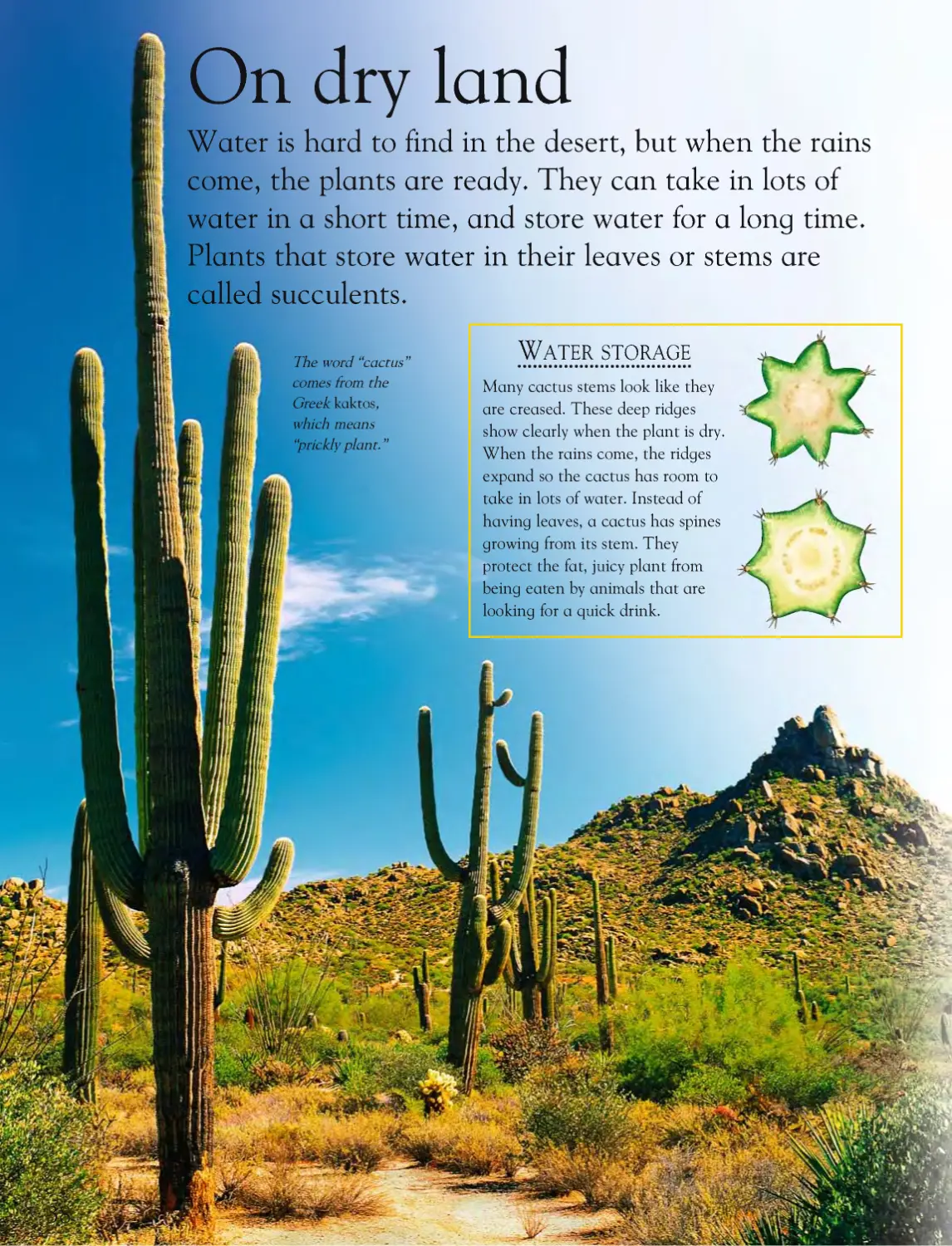
The word "cactus”
comes from the
Greek kaktos,
which means
"prickly plant. ”
On dry land
Water is hard to find in the desert, but when the rains
come, the plants are ready. They can take in lots of
water in a short time, and store water for a long time.
Plants that store water in their leaves or stems are
called succulents.
WateLSToi^ge
Many cactus stems look like they
are creased. These deep ridges
show clearly when the plant is dry.
When the rains come, the ridges
expand so the cactus has room to
take in lots of water. Instead of
having leaves, a cactus has spines
growing from its stem. They
protect the fat, juicy plant from
being eaten by animals that are
looking for a guick drink.
Is it dead or alive?
Not all plants store enough water to get through the dry
season. Dried resurrection plants curl into a ball, pull up
their roots from the ground, and get blown by the wind to
a place where they may find water and come back to life.
A flash of color
Deserts are not always dry.
There is a short spring season
that brings heavy rains. Plants
that live here are ready to
germinate and flower very
quickly—the season lasts
just three weeks
’(4л л ;
J
- '
Hairy sunscreen
The hairy white spines
of these cacti reflect the
strong heat of the desert
sun. This built-in sunscreen
stops the plant drying out.
Bottled water
This funny-looking tree is
called a pachypodium, which
K means “thick foot.”
£ Its bottle-shaped
,/ trunk is fat and
;	swollen with
Ml. .. . stored water.


It’s full of water
Juicy, fleshy, waxy
leaves are the sign of
most succulents. This is
where the plant stores
its water. The waxy
coating stops water ..
from evaporating
from the leaves.

Cold climate
Welcome to the mountains. Plants that live
here have developed ways to cope with cold
temperatures, snow, high winds, and strong
sunlight. From warm coats to heated buds,
these plants know how to protect themselves.
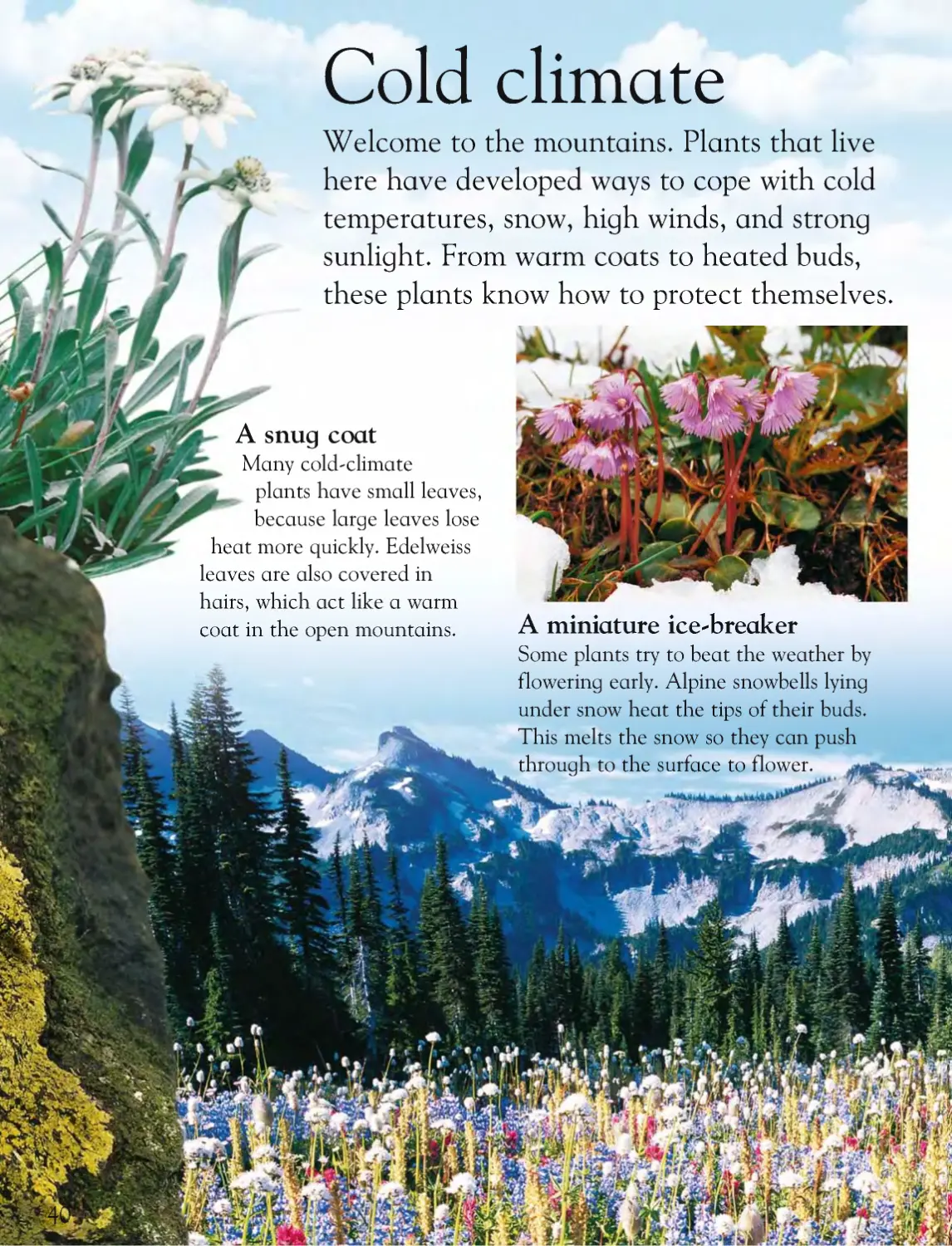
k- A snug coat
' Many cold-climate
4 _ plants have small leaves,
because large leaves lose
heat more quickly. Edelweiss
leaves are also covered in
hairs, which act like a warm
coat in the open mountains.
A miniature ice-breaker
Some plants try to beat the weather by
flowering early. Alpine snowbells lying
under snow heat the tips of their buds.
This melts the snow so they can push
through to the surface to flower.
л..	*5^
ferocious winds. Some, called cushion plants,
even grow huddled together for warmth. They
look like huge pillows scattered on the ground.
Up to a million plants can grow in one clump.
Springtime is short
S° n°Wers don
A bad hair day?
Saussurea plants have taken the
idea of a fur coat to the extreme.
The pink fluff is not its flower, but
hair on the leaves. On some plants,
hair reflects the harsh sunlight,
stopping it from burning the plant.
ave much time for pollination-
I’m over here
Alpine flowers are brightly
colored and quite large. There
are not many insects in this
cold area, so the flowers need
to show off in order to attract
their pollinators.
* дивили
Plant providers
Is your table made from wood? Are
your clothes made from cotton? Plants
provide us with lots of everyday items,
from the houses in which we live to
the pages of this book.
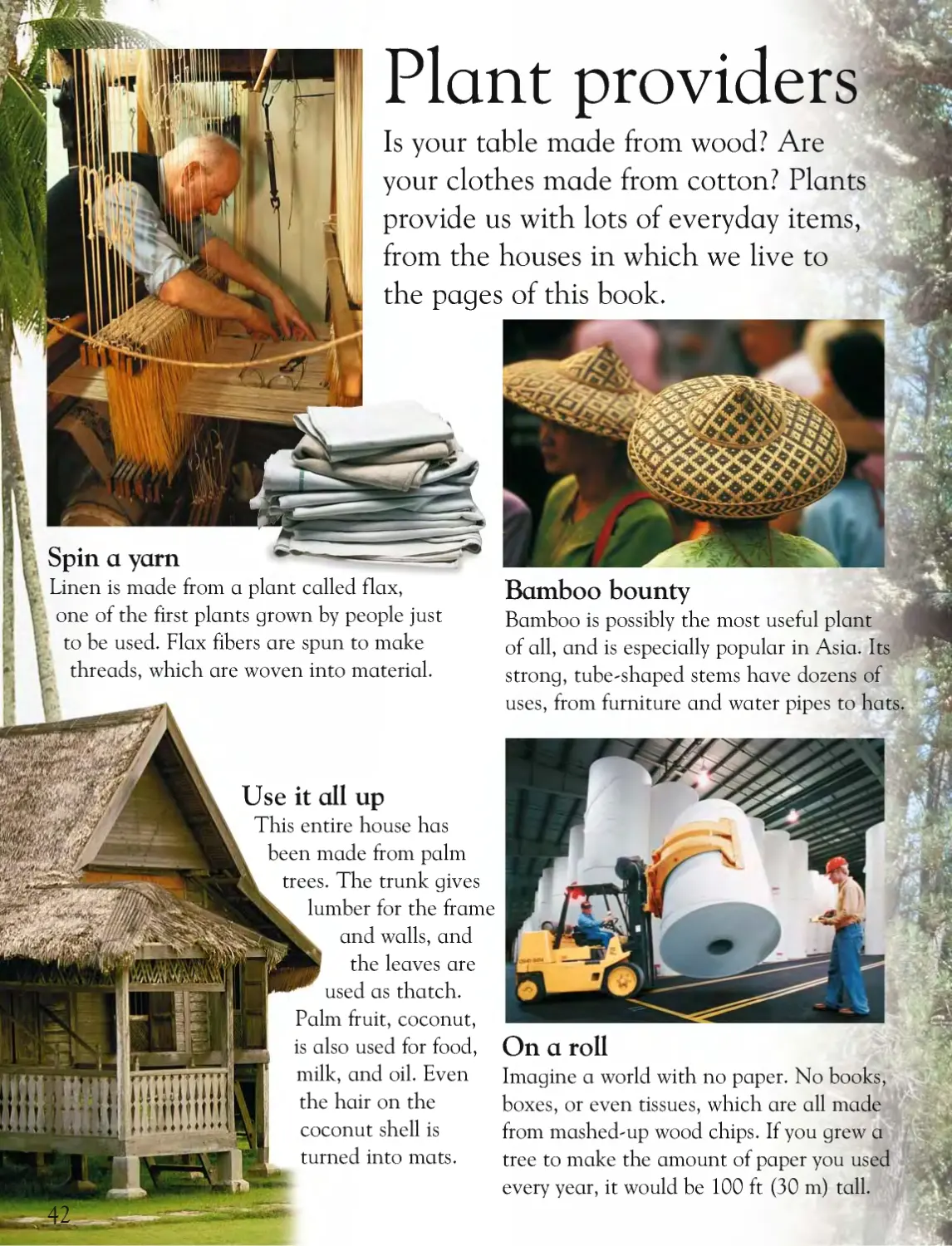
Spin a yarn
Linen is made from a plant called flax,
one of the first plants grown by people just
to be used. Flax fibers are spun to make
threads, which are woven into material.
Bamboo bounty
Bamboo is possibly the most useful plant
of all, and is especially popular in Asia. Its
strong, tube-shaped stems have dozens of
uses, from furniture and water pipes to hats
Use it all up
This entire house has
been made from palm
trees. The trunk gives
lumber for the frame
and walls, and
the leaves are
used as thatch.
Palm fruit, coconut,
is also used for food,
milk, and oil. Even
the hair on the
coconut shell is
turned into mats.
On a roll
Imagine a world with no paper. No books,
boxes, or even tissues, which are all made
from mashed-up wood chips. If you grew a
tree to make the amount of paper you used
every year, it would be 100 ft (30 m) tall.
A stripping tale
A cork oak tree is stripped
for its cork bark. It will
take about seven years
to regrow. Cork was
first used by
the ancient i • уТ- _
Greeks 2,500	'
years ago as	.
bottle stoppers. **•
Strange but true
These weird and wonderful plants
are some of the oldest or smelliest
plants in the world. This is quite an
achievement when there are over
400,000 species to choose from!
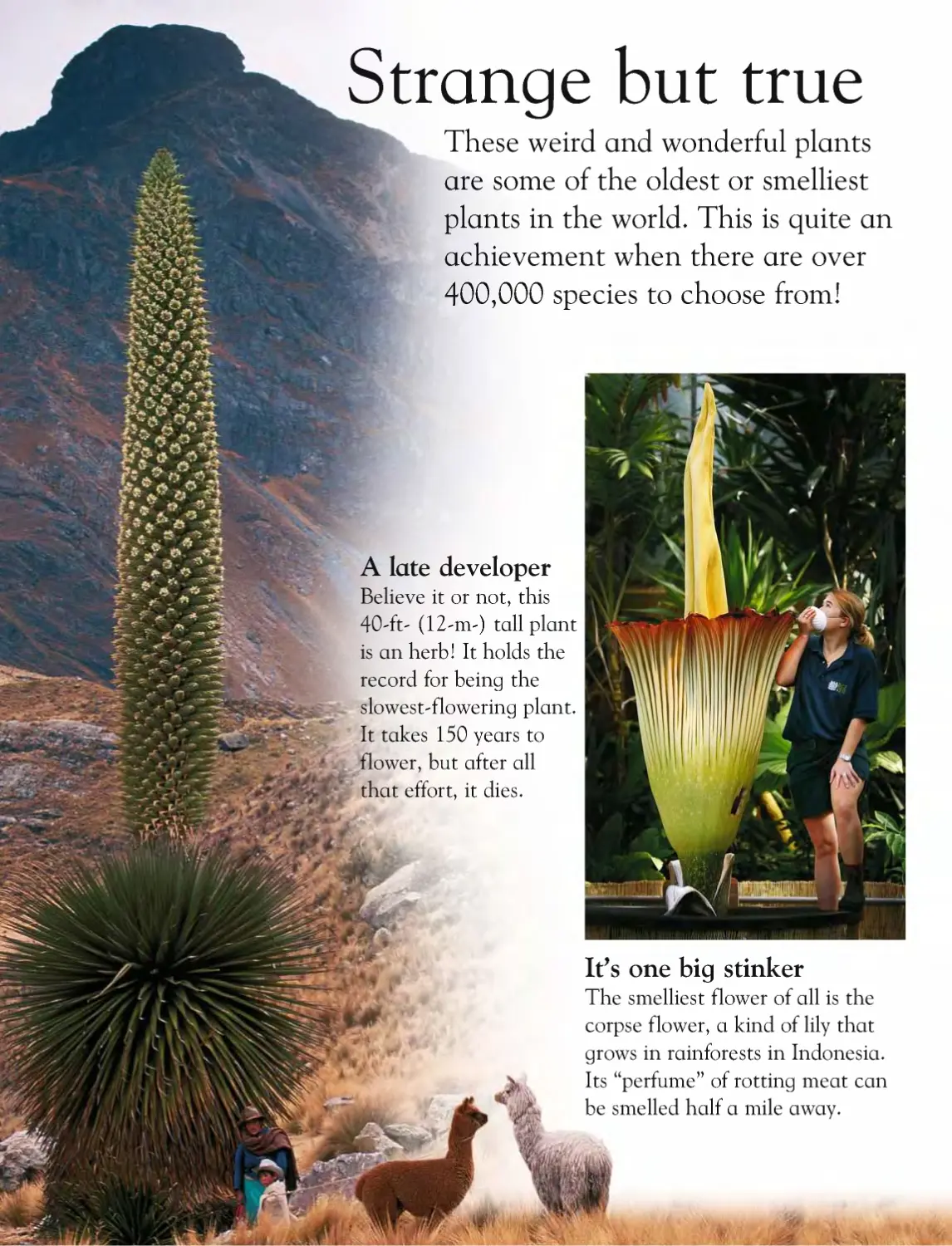
A late developer
Believe it or not, this
40-ft- (12-m-) tall plant
is an herb! It holds the
record for being the
slowest-flowering plant.
It takes 150 years to
flower, but after all
that effort, it dies.
It’s one big stinker
The smelliest flower of all is the
corpse flower, a kind of lily that
grows in rainforests in Indonesia.
Its “perfume” of rotting meat can
be smelled half a mile away.
Oh so rare
In the 1800s, the
lady’s-slipper orchid
was picked almost
to extinction. Just one
plant was left in the wild.
Fortunately, scientists have
been able to use its seeds
to plant more. а дь
Keep on twisting
The weirdest plant of all is found
,JG . in the Namibian desert. It has just
<• two leaves that are dry and woody,
but they never stop growing, so
they end up twisting and turning.
Strange facts
• There is one plant that
grows so fast you can hear it
creaking I Giant bamboo can
grow 3 ft (1 m) each day.
• The biggest seed in the
world is the coco-de-mer. It
weighs up to 45 lb (20 kg), the
same as a six-year-old girl.
Old and gnarled /
The oldest tree
thought to be still
alive is a bristlecone pine.
It is almost 5,000 years old,
but, because they grow in
dry places, even young
ones look wrinkled! '
Turn left at the tree
Giant sequoias are the
world’s biggest trees. In some
California parks, the trees
are so wide that they have
roads cut though them.
Glossary
Here are the meanings of some words it is useful to know
when you are learning about plants.
Anther the part of a flower
that makes pollen.
Blade the flat surface of a leaf,
which is used to catch sunlight
for photosynthesis.
Bur a seed with a sticky or
spiky case.
Canopy the branches and
leaves of a tree.
Carnivore an animal or plant
that eats meat.
Chlorophyll the green chemical
in a leaf that absorbs sunlight to
make food.
Epiphyte a plant that grows
on another plant, but does not
take its food or water.
Floret a small flower that
makes up part of a larger flower.
Flower the part of a plant that
makes seeds and fruit.
Fruit the part of a plant that
protects fertilized seeds.
Germinate when a seed starts
to grow into a plant.
Glucose the sugary food a
plant makes for itself during
photosynthesis.
Eeaf the part of a plant that
makes food.
Eeaflet a small leaf that is
part of a compound leaf.
Minerals substances that are
found naturally in soil, which
a plant needs to grow.
Nectar sweet syrup that flowers
make to attract pollinators.
Nectar guides patterns on
flowers that guide insects
toward the nectar.
Nutrients the useful bits found
in food, which animals and
plants need to stay healthy.
Ovary the part of a flower that
houses the seeds.
Parasite a plant that takes the
food and water of another plant.
Photosynthesis the way that
a plant makes its own food,
using sunlight, water, and
carbon dioxide.
Pollen very fine grains that a
plant uses to start reproduction.
Pollination the process of
moving pollen from one flower
to another in order to reproduce.
Predator an animal that hunts
plants or other animals for food.
Proboscis the long nose of an
insect, which can reach into
flowers to suck up nectar.
Reproduction how a plant or
animal makes another plant or
animals, using seeds or eggs.
Respiration how living things
turn food into energy, using
oxygen.
Root the part of a plant that
grows underground, anchoring
the plant and taking in water
and minerals.
Runner a plant stem that runs
along the ground and grows
new plants by sending out roots.
Seed a case that contains
everything needed to grow
a new plant, plus food.
Shoot any part of a plant
that grows above the ground.
Species a group of animals
or plants that share the same
features, and can breed with
each other.
Spore the “seed” of a non-
flowering plant.
Stem usually the main part of
a plant, on which leaves grow.
Stems carry water and food
around the plant.
Stigma the part of a flower
that receives pollen during
pollination.
Stomata tiny pores in a leaf
that open to let gases pass in
and out.
Succulent a plant that stores
water in its leaves or stems.
Tendril the part of a stem
that some climbing plants
use to reach out for supports.
Tuber part of a root that has
become a food store for the
plant. It is usually lumpy.
Vegetable a plant or part of
a plant that we can eat. Many
vegetables are actually fruits.
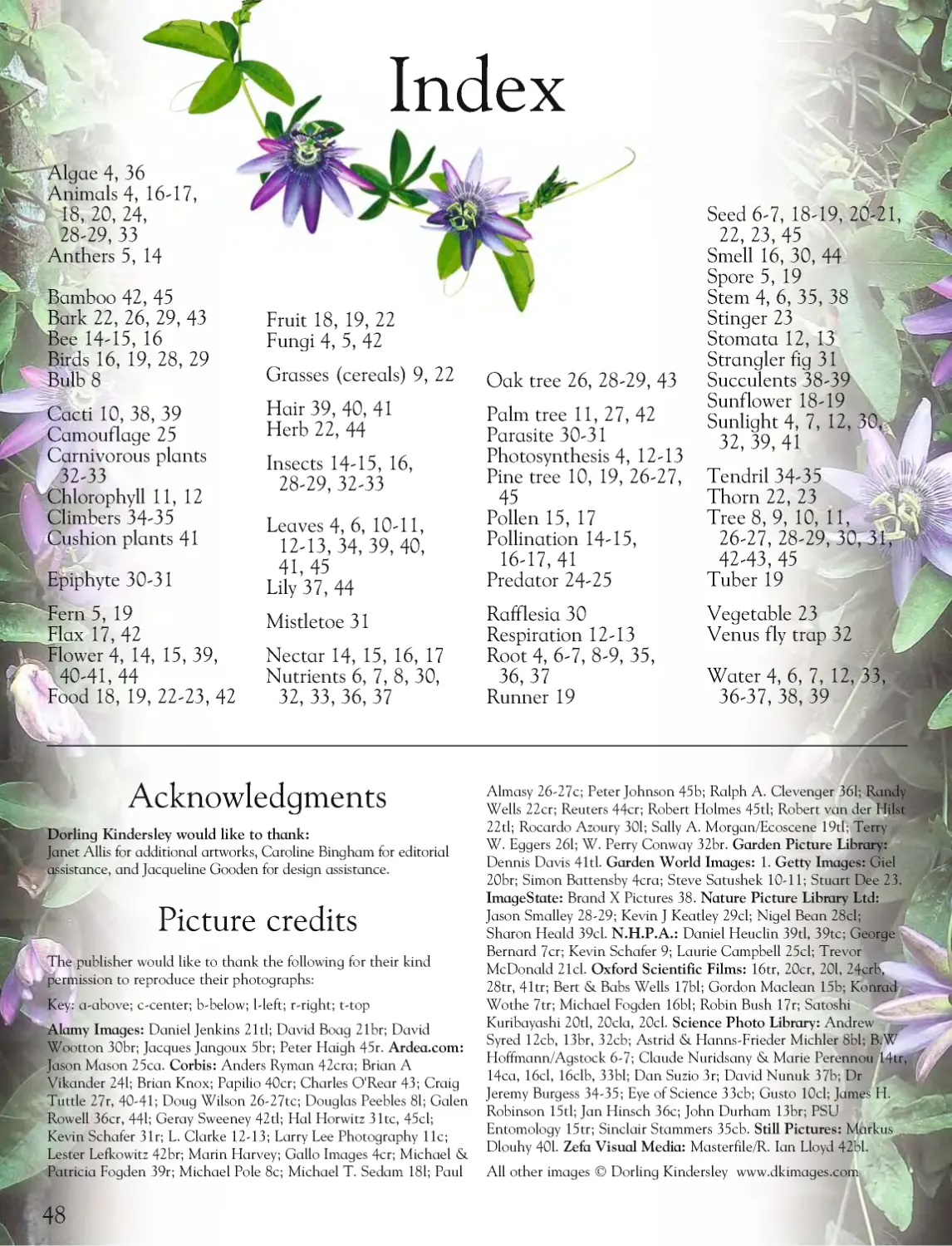
4, 36
4, 16-17,
18, 20, 24,
28-29, 33
Anthers 5, 14
и Bamboo 42, 45
Ж Bark 22, 26, 29, 43
E4 Bee 14-15, 16
Birds 16, 19, 28, 29
Bulb 8
Index
Cacti 10, 38, 39
Camouflage 25
Carnivorous plants
32-33
Chlorophyll 11, 12
Climbers 34-35
Cushion plants 41
Epiphyte 30-31
Fern 5, 19
Flax 17, 42
I Flower 4, 14, 15, 39,
40-41, 44
Food 18, 19, 22-23, 42
Fruit 18, 19, 22
Fungi 4, 5, 42
Grasses (cereals) 9, 22
Hair 39, 40,41
Herb 22, 44
Insects 14-15, 16,
28-29, 32-33
Leaves 4, 6, 10-11,
12-13, 34, 39, 40,
41, 45
Lily 37, 44
Mistletoe 31
Nectar 14, 15, 16, 17
Nutrients 6, 7, 8, 30,
32, 33, 36, 37
Seed 6-7, 18-19,
22 23 45
Smell 16, 30, 44
Spore 5, 19
Stem 4, 6, 35, 38
Stinger 23
Stomata 12,
Strangler fig 31
Succulents 38-3
Sunflower 18-19
Sunlight 4, 7, 12,
32, 39,41
Oak tree 26, 28-29, 43
Palm tree 11, 27, 42
Parasite 30-31
Photosynthesis 4, 12-13
Pine tree 10, 19, 26-27,
45
Pollen 15, 17
Pollination 14-15,
16-17,41
Predator 24-25
Rafflesia 30
Respiration 12-13
Root 4, 6-7, 8-9, 35,
36,37
Runner 19
Tendril 34-35
Thorn 22, 23
Tree 8, 9, 10, 11,
26-27, 28-
42-43, 45
Tuber 19
Vegetable 23
Venus fly trap 32
Water 4, 6, 7, 12, 33,
36-37, 38, 39
Acknowledgments
Dorling Kindersley would like to thank:
Janet Allis for additional artworks, Caroline Bingham for editorial
assistance, and Jacgueline Gooden for design assistance.
Picture credits
The publisher would like to thank the following for their kind
permission to reproduce their photographs:
Key: a-above; c-center; b-below; Lleft; r-right; t-top
fc Alamy Images: Daniel Jenkins 21tl; David Boag 21br; David
Wootton 30br; Jacgues Jangoux 5br; Peter Haigh 45r. Ardea.com:
Jason Mason 25ca. Corbis: Anders Ryman 42cra; Brian A
Vikander 241; Brian Knox; Papilio 40cr; Charles O'Rear 43; Craig
Tuttle 27r, 40-41; Doug Wilson 26-27tc; Douglas Peebles 81; Galen
Rowell 36cr, 441; Geray Sweeney 42tl; Hal Horwitz 3 Itc, 45cl;
Kevin Schafer 3lr; L. Clarke 12-13; Larry Lee Photography 11c;
Lester Lefkowitz 42br; Marin Harvey; Gallo Images 4cr; Michael &
Patricia Fogden 39r; Michael Pole 8c; Michael T. Sedam 181; Paul
Almasy 26-27c; Peter Johnson 45b; Ralph A. Clevenger 361; Randy
Wells 22cr; Reuters 44cr; Robert Holmes 45tl; Robert van der H'st
22tl; Rocardo Azoury 301; Sally A. Morgan/Ecoscene 19tl; Terry
W. Eggers 261; W. Perry Conway 32br. Garden Picture Library-:
Dennis Davis 41tl. Garden World Images: 1. Getty Images: Giel
20br; Simon Battensby 4cra; Steve Satushek 10-11; Stuart Dee 23.
ImageState: Brand X Pictures 38. Nature Picture Library Ltd:
Jason Smalley 28-29; Kevin J Keatley 29cl; Nigel Bean 28cl;
Sharon Heald 39cl. N.H.P.A.: Daniel Heuclin 39tl, 39tc; George
Bernard 7cr; Kevin Schafer 9; Laurie Campbell 25cl; Trevor
McDonald 21cl. Oxford Scientific Films: 16tr, 20cr, 201, 24crb,
28tr, 41tr; Bert & Babs Wells 17Ы; Gordon Maclean 15b; Konrad
Wothe 7tr; Michael Fogden 16Ы; Robin Bush 17r; Satoshi
Kuribayashi 20tl, 20cla, 20cl. Science Photo Library: Andrew
Syred 12cb, 13br, 32cb; Astrid & Hanns-Frieder Michler 8bl; B.W
Hoffmann/Agstock 6-7; Claude Nuridsany & Marie Perennou 14tr,
14ca, 16cl, 16clb, ЗЗЫ; Dan Suzio 3r; David Nunuk 37b; Dr
Jeremy Burgess 34-35; Eye of Science 33cb; Gusto lOcl; James H.
Robinson 15tl; Jan Hinsch 36c; John Durham 13br; PSU
Entomology 15tr; Sinclair Stammers 35cb. Still Pictures: Markus
Dlouhy 401. Zefa Visual Media: Masterfile/R. Ian Lloyd 42Ы.
All other images © Dorling Kindersley www.dkimages.com

See breathtaking flowers, fabulous
forests, and incredible cacti*
Discover the world of plants—from the tallest
tree to the smallest seed. Find out why algae are
amazing, how some leaves eat insects, and why
plants are vital to life on Earth.
•
Packed with fantastic facts and dramatic
photographs, Eye Wonders are the perfect way
to inspire a love of learning and discovery.
•
Consultant Sandra Bell is a horticulturist at the
Royal Botanic Gardens in Kew, England.
Other titles in the series:
Big Cats • Birds • Bugs • Dinosaur
Earth • Forest • Human Body
Invention • Mammals • Ocean • Pyramid
Rain Forest • Reptiles • Rivers and Lakes
Rocks and Minerals • Space • Volcano
Weather • Whales & Dolphins
Printed in Italy
Discover more at
www.dk.com