/



























































































































































































Text
                    S M I T H S O N I A N

FLORA
INSIDE THE SECRET WORLD OF PLANTS

IN ASSOCIATION WITH

First American Edition, 2018
Published in the United States by DK Publishing
345 Hudson Street, New York, New York 10014

DK LONDON
Senior Editor Helen Fewster
US Editors Megan Douglass,
Karyn Gerhard
Project Editors Nathan Joyce,
Anna Limmerick, Simon Maughan,
Steve Setford, David Summers,
Angela Wilkes, Miezan van Zyl
Editorial assistant Daniel Byrne
DK Media Archive Romaine Werblow
Pre-production Producer Gillian Reid
Managing Editor Angeles Gavira Guerrero
Publisher Liz Wheeler
Publishing Director Jonathan Metcalf

Senior Art Editor Sharon Spencer
Project Art Editors Ray Bryant,
Phil Gamble, Vanessa Hamilton
Jacket Designer Surabhi Wadhwa-Gandhi
Jacket Design Development Manager
Sophia MTT
Senior Producers Alex Bell, Mary Slater
Managing Art Editor Michael Duffy
Art Director Karen Self
Design Director Phil Ormerod
Photographer Gary Ombler
Illustrators Dominic Clifford, Alex Lloyd

DK INDIA
Senior Picture Researcher
Surya Sankash Sarangi
Jackets Editorial Coordinator
Priyanka Sharma
Managing Jackets Editor Saloni Singh

Picture Research Manager Taiyaba Khatoon
Jacket Designers Juhi Sheth, Suhita Dharamjit
DTP Designer Rakesh Kumar
Senior DTP Designer Jagtar Singh
Production Manager Pankaj Sharma

Copyright © 2018 Dorling Kindersley Limited
DK, a division of Penguin Random House LLC
18 19 20 21 22 10 9 8 7 6 5 4 3 2 1
001–293639–Oct/2018
All rights reserved.
Without limiting the rights under the copyright reserved above, no part of this publication
may be reproduced, stored in or introduced into a retrieval system, or transmitted, in
any form, or by any means (electronic, mechanical, photocopying, recording, or
otherwise), without the prior written permission of the copyright owner.
Published in Great Britain by Dorling Kindersley Limited
A catalog record for this book is available from the Library of Congress.
ISBN 978-1-4654-7450-6
DK books are available at special discounts when purchased in bulk for sales promotions,
premiums, fund-raising, or educational use. For details, contact:
DK Publishing Special Markets, 345 Hudson Street, New York, New York 10014
SpecialSales@dk.com
Printed and bound in China

A WORLD OF IDEAS:
SEE ALL THERE IS TO KNOW
www.dk.com

Contributors

Smithsonian

Jamie Ambrose is an author, editor, and Fulbright scholar with a special interest
in natural history. Her books include DK’s Wildlife of the World.

Established in 1846, the Smithsonian—the world’s
largest museum and research complex—includes
19 museums and galleries and the National
Zoological Park. The Smithsonian is a renowned
research center, dedicated to public education,
national service, and scholarship in the arts,
sciences, and natural history. Smithsonian Gardens,
an accredited museum and Public Garden, engages
people with plants and gardens, inform on the roles
both play in our cultural and natural worlds, and
inspire appreciation and stewardship of living and
archival collections and horticultural artifacts.

Dr. Ross Bayton is a botanist, taxonomist and gardener with a passion for the
plant world. He has authored books, magazine features, and scientific papers
encouraging readers to understand and appreciate the importance of plants.
Matt Candeias is the author and host of the In Defense of Plants blog and podcast
(www.indefenseofplants.com). Trained as an ecologist, Matt focuses most of his
research on plant conservation. He is also an avid gardener both indoors and out.
Dr. Sarah Jose is a professional science writer and language editor with a PhD
in botany and a deep love of plants.
Andrew Mikolajski is the author of more than 30 books on plants and gardening.
He has lectured in garden history at the English Gardening School at Chelsea
Physic Garden and for the Historic Houses Association.

The Royal Botanic
Gardens, Kew
The Royal Botanic Gardens, Kew, is a world-famous
scientific organization, internationally respected for
its outstanding collections as well as its scientific
expertise in plant diversity, conservation, and
sustainable development around the world. Kew
Gardens is a top London visitor attraction. Kew’s
304 acres (132 hectares) of landscaped gardens
and its country estate—Wakehurst, in Sussex—attract
more than 1.5 million visits every year. Kew was
made a UNESCO World Heritage Site in 2003 and
celebrated its 250th anniversary in 2009. Wakehurst
is home to Kew’s Millennium Seed Bank, the largest
wild plant seed bank in the world.

Esther Ripley is a former managing editor who writes on a range of cultural
subjects, including art and literature.
David Summers is a writer and editor with training in natural history
filmmaking. He has contributed to books on a range of subjects including
natural history, geography, and science.

Half-title page Bird of paradise (Strelitzia reginae)
Title page Northern sea oat (Chasmanthium latifolium)
Above Autumn trees changing color
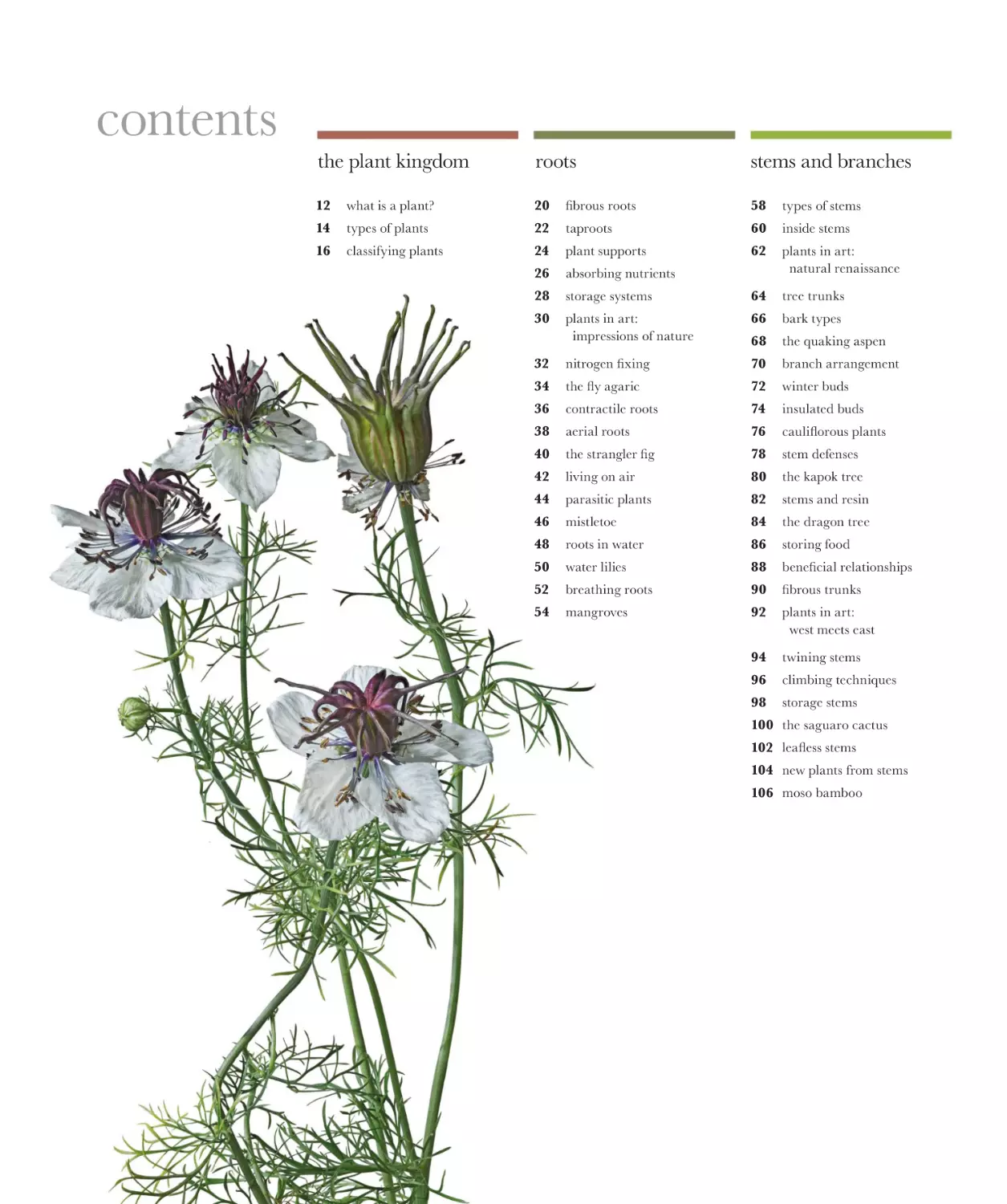
Contents page Nigella papillosa ‘African Bride’

contents

the plant kingdom

roots

stems and branches

12

what is a plant?

20

fibrous roots

58

types of stems

14

types of plants

22

taproots

60

inside stems

16

classifying plants

24

plant supports

62

26

absorbing nutrients

plants in art:
natural renaissance

28

storage systems

64

tree trunks

30

plants in art:
impressions of nature

66

bark types

68

the quaking aspen

32

nitrogen fixing

70

branch arrangement

34

the fly agaric

72

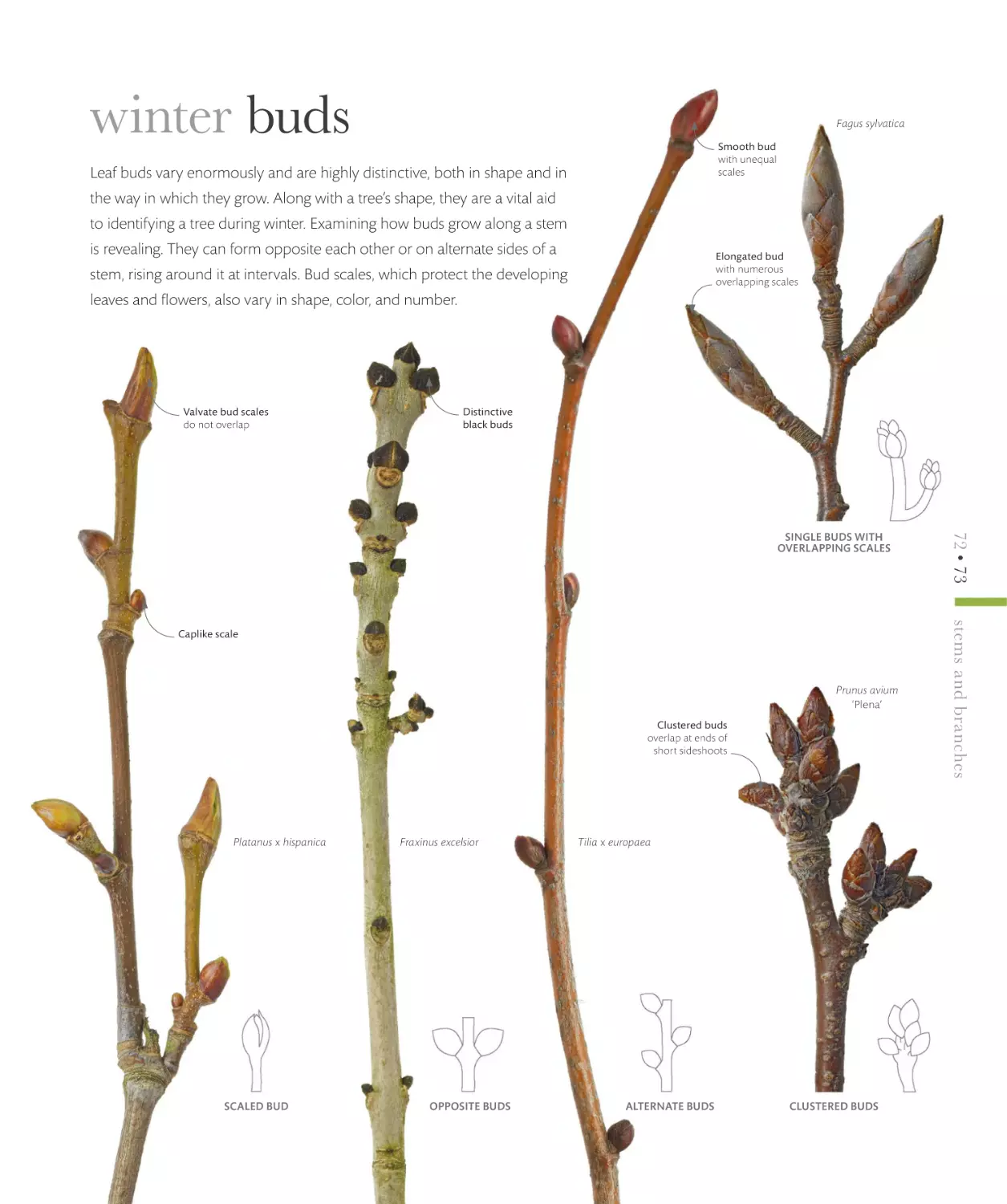
winter buds

36

contractile roots

74

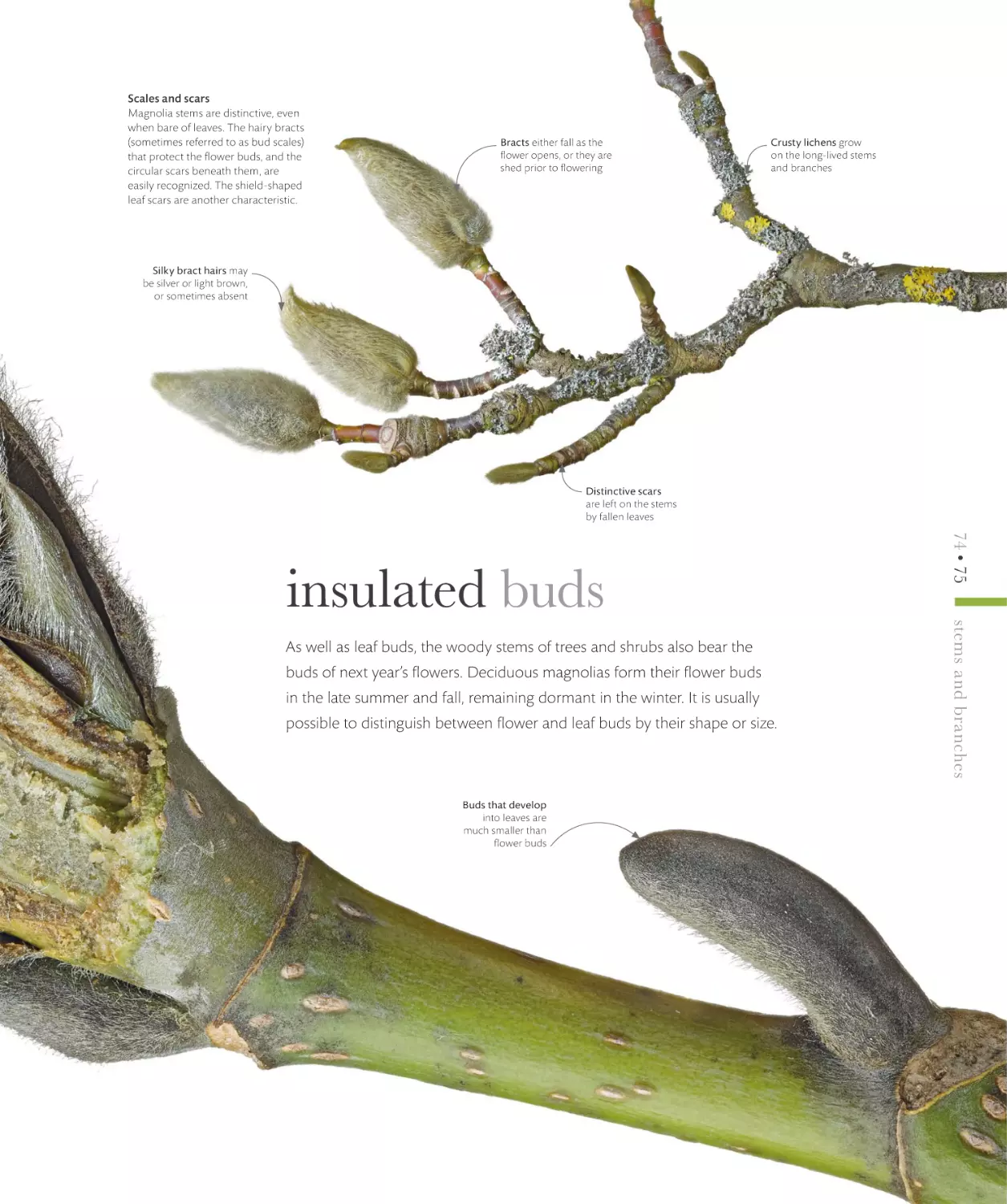
insulated buds

38

aerial roots

76

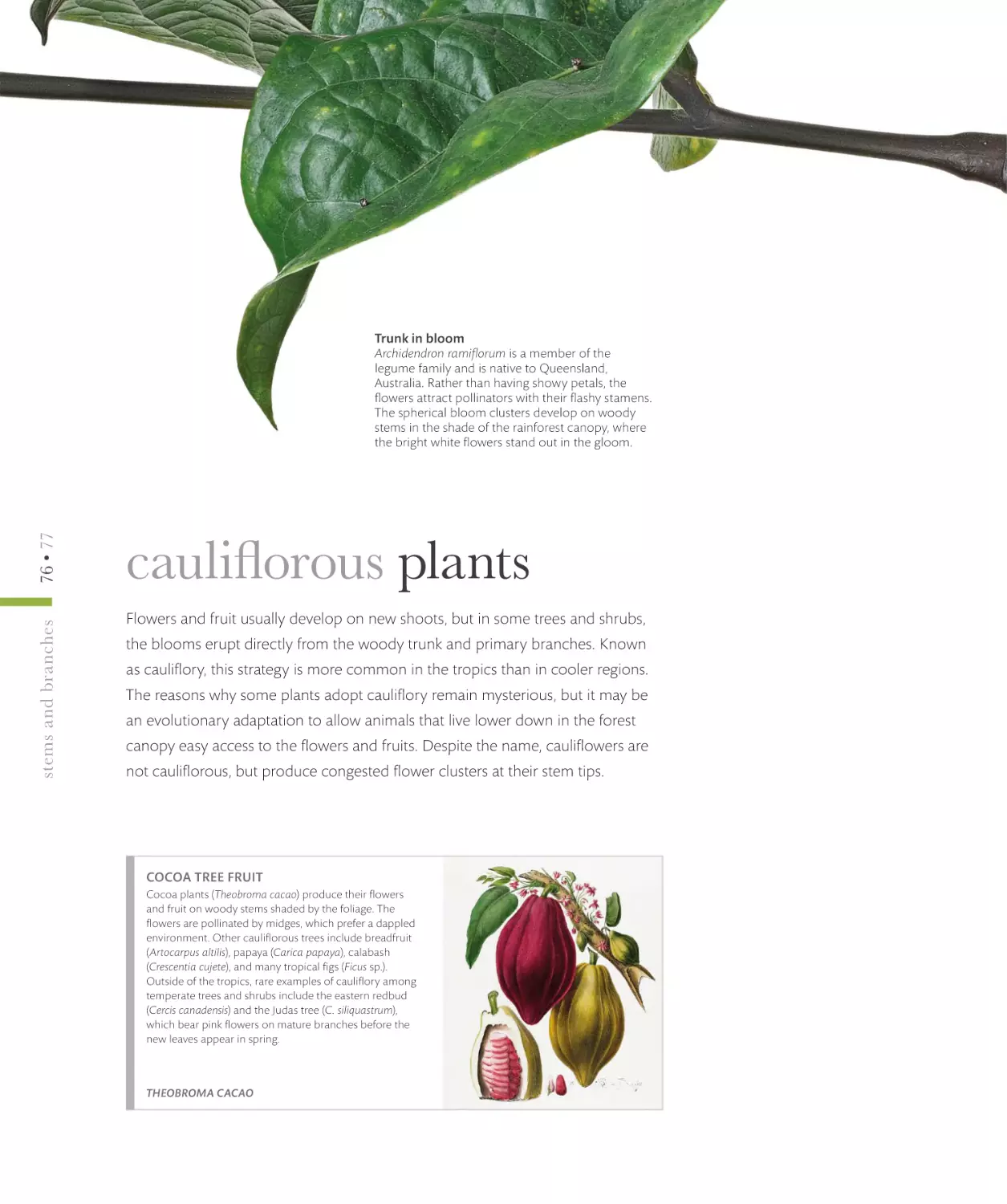
cauliflorous plants

40

the strangler fig

78

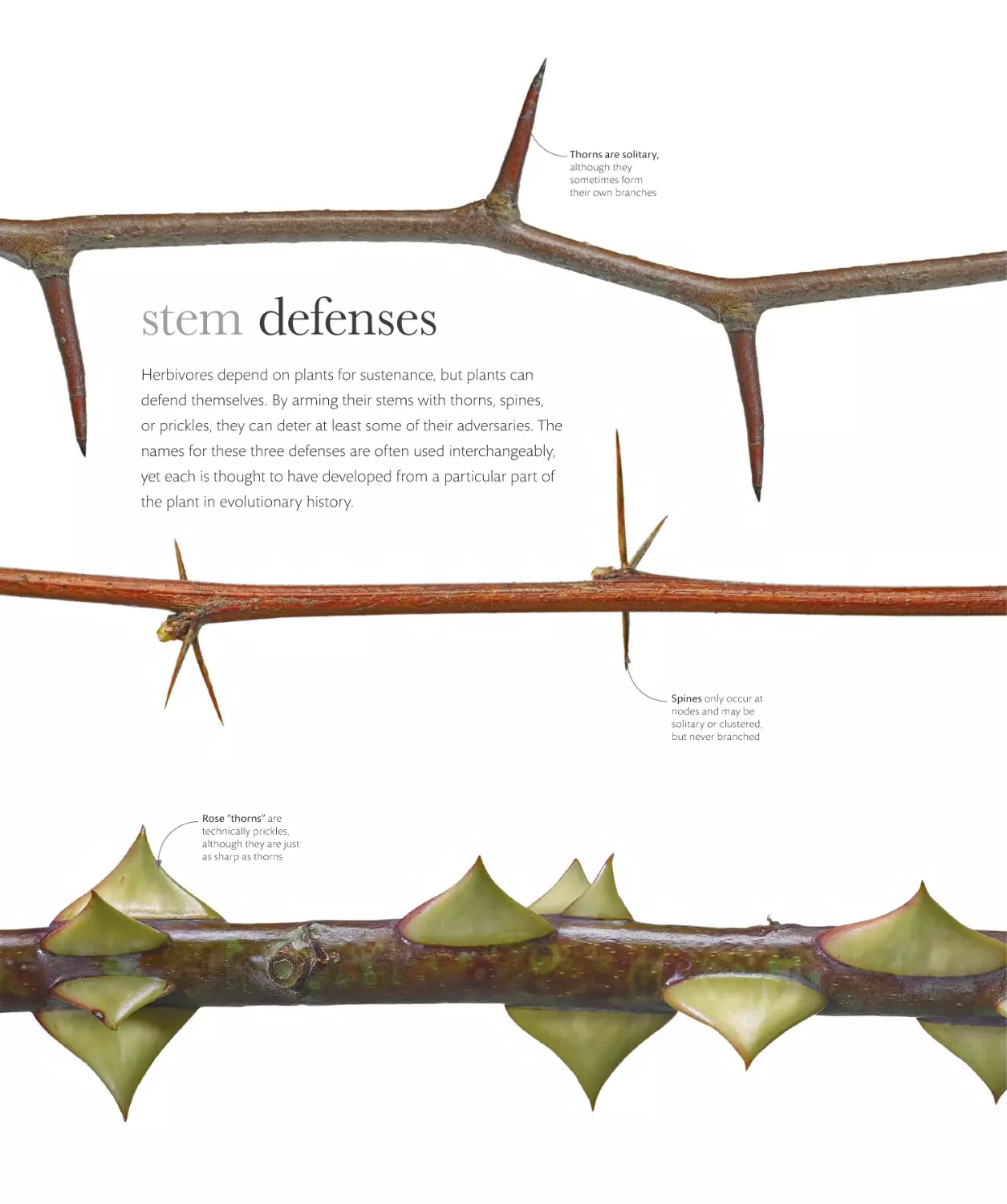
stem defenses

42

living on air

80

the kapok tree

44

parasitic plants

82

stems and resin

46

mistletoe

84

the dragon tree

48

roots in water

86

storing food

50

water lilies

88

beneficial relationships

52

breathing roots

90

fibrous trunks

54

mangroves

92

plants in art:
west meets east

94

twining stems

96

climbing techniques

98

storage stems

100 the saguaro cactus
102 leafless stems
104 new plants from stems
106 moso bamboo

leaves

flowers

seeds and fruits

110

leaf types

184

parts of a flower

256

restricted entry

286

seed structure

112

leaf structure

186

ancient flowers

258

fragrant traps

288

naked seeds

114

compound leaves

188

flower shapes

260

the corpse flower

290

inside seed cones

116

plants in art:
designed by nature

190

flower development

262

special relationships

292

enclosed seeds

192

flowers and seasons

264

natural mimics

294

types of fruits

118

developing leaves

194

266

designed to deceive

296

120

unfurling ferns

plants in art:
chinese painting

268

self-pollinating flowers

plants in art:
ancient gardens

122

leaf arrangement

196

flower fertilization

270

298

flower to fruit

124

plants in art:
botanic reinvention

198

pollen grains

plants in art:
blooms for royalty

300

fruit anatomy

200

encouraging diversity

272

closing at night

302

the banana

126

leaves and the water cycle

202

managing pollen

274

bud defenses

304

seed distribution

128

leaves and light

204

276

armored flowers

306

dispersed by diet

130

leaf size

plants in art:
japanese woodblock prints

278

colorful bracts

308

colorful seeds

132

leaf shapes

206

unisexual plants

280

310

134

drip tips

208

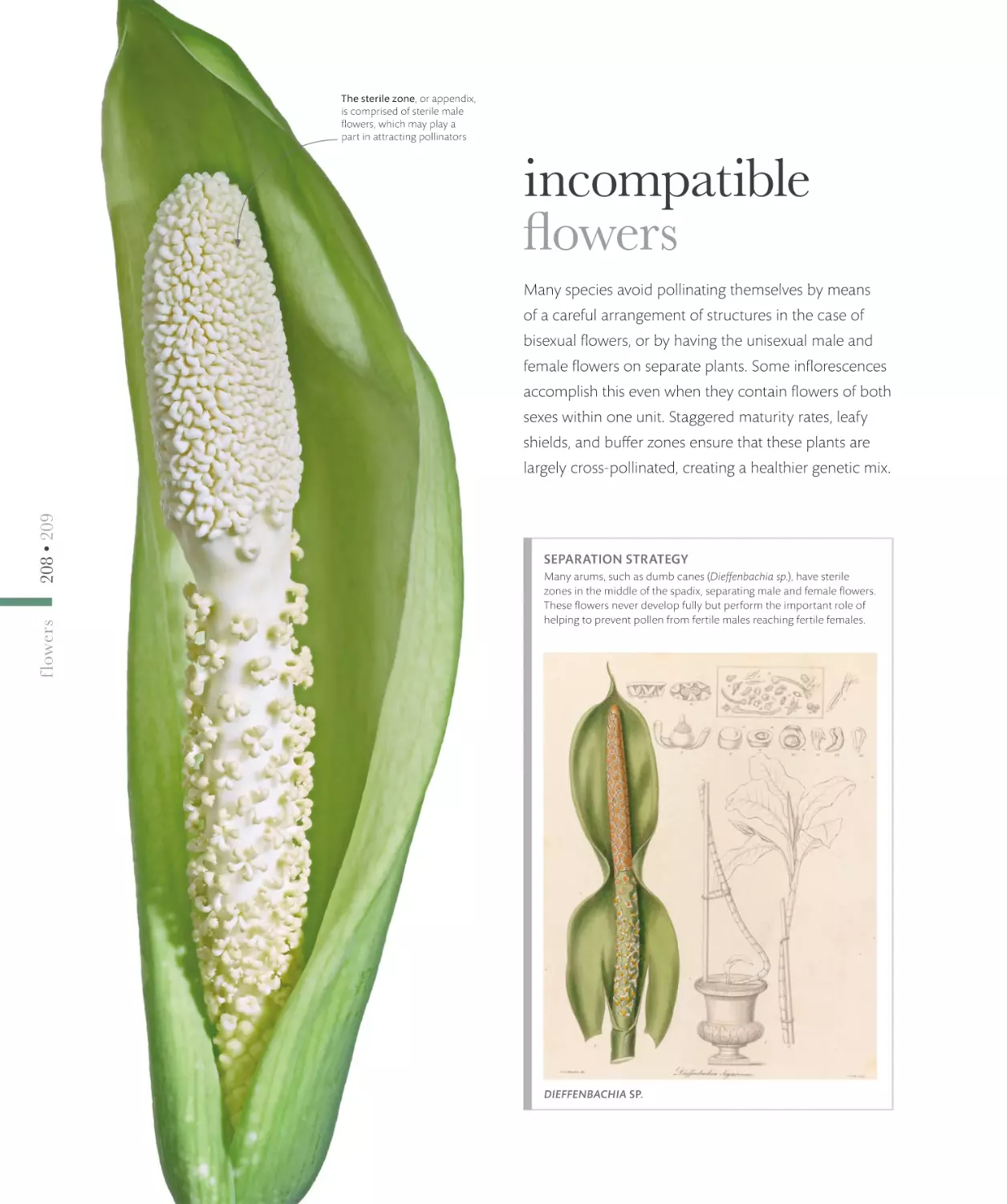
incompatible flowers

plants in art:
american enthusiasts

plants in art:
art and science

136

leaf margins

210

the titan arum

282

cone reproduction

312

animal couriers

138

hairy foliage

212

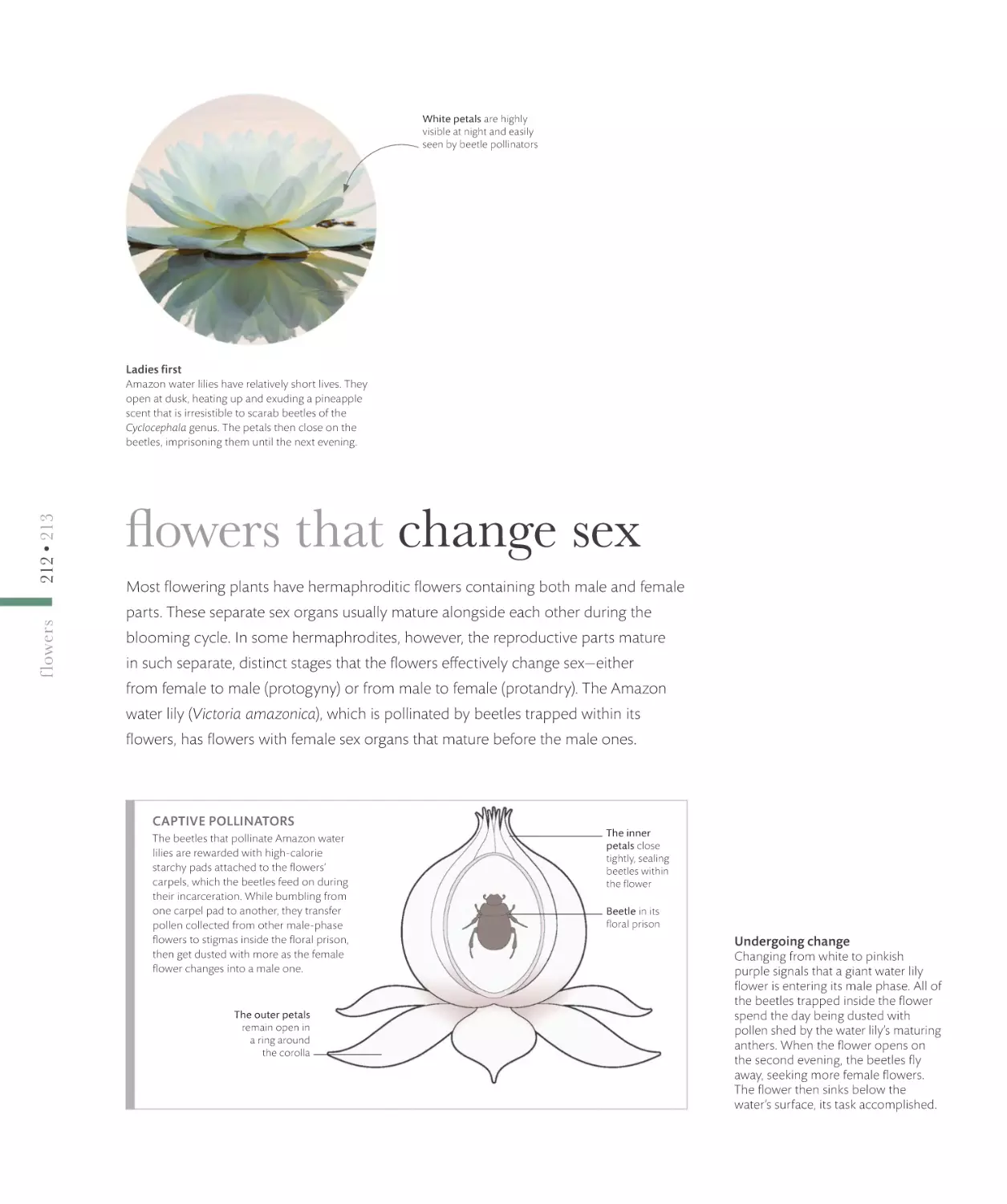
flowers that change sex

314

seeds with wings

140

plants in art:
ancient herbals

214

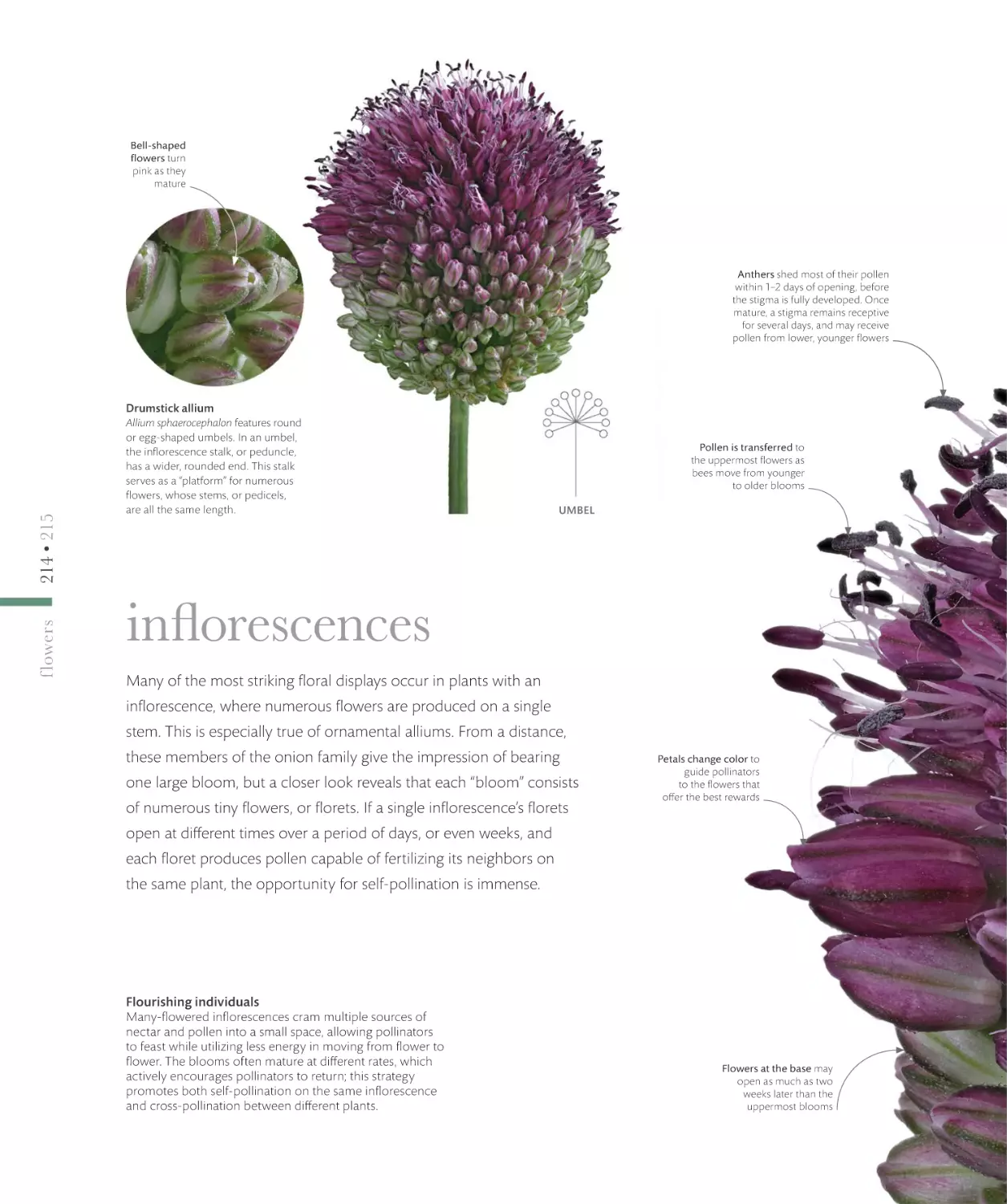
inflorescences

316

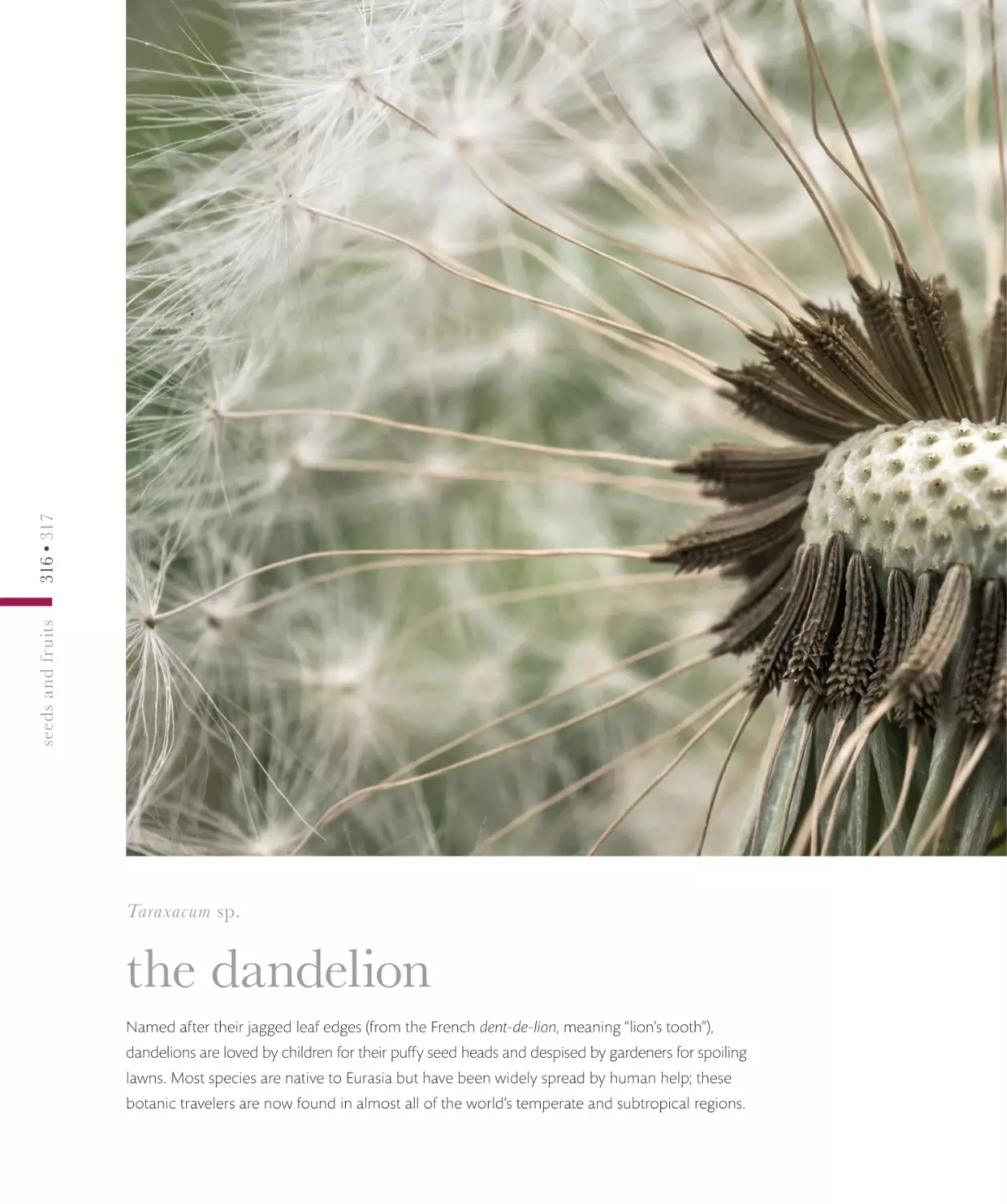
the dandelion

216

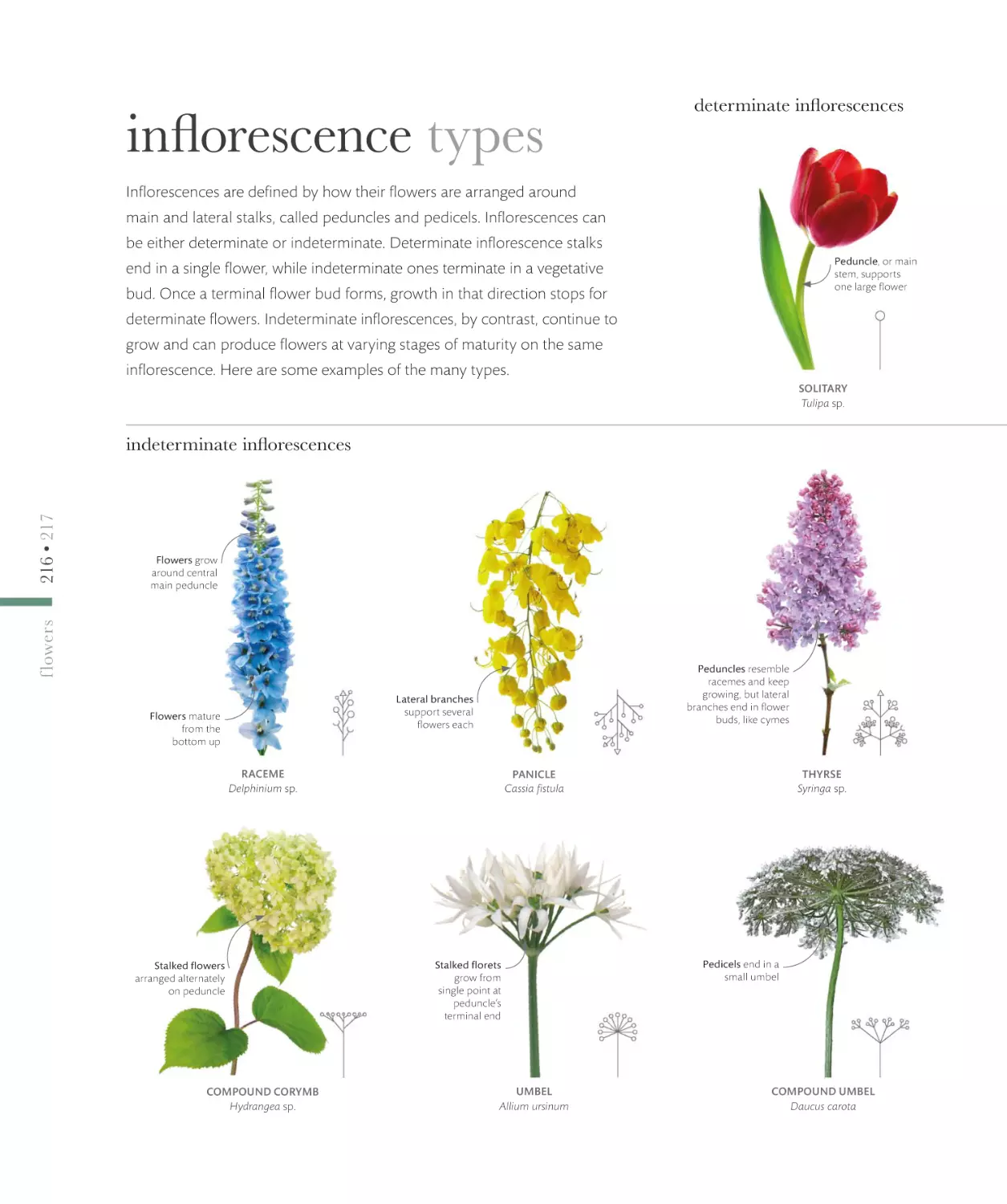
inflorescence types

318

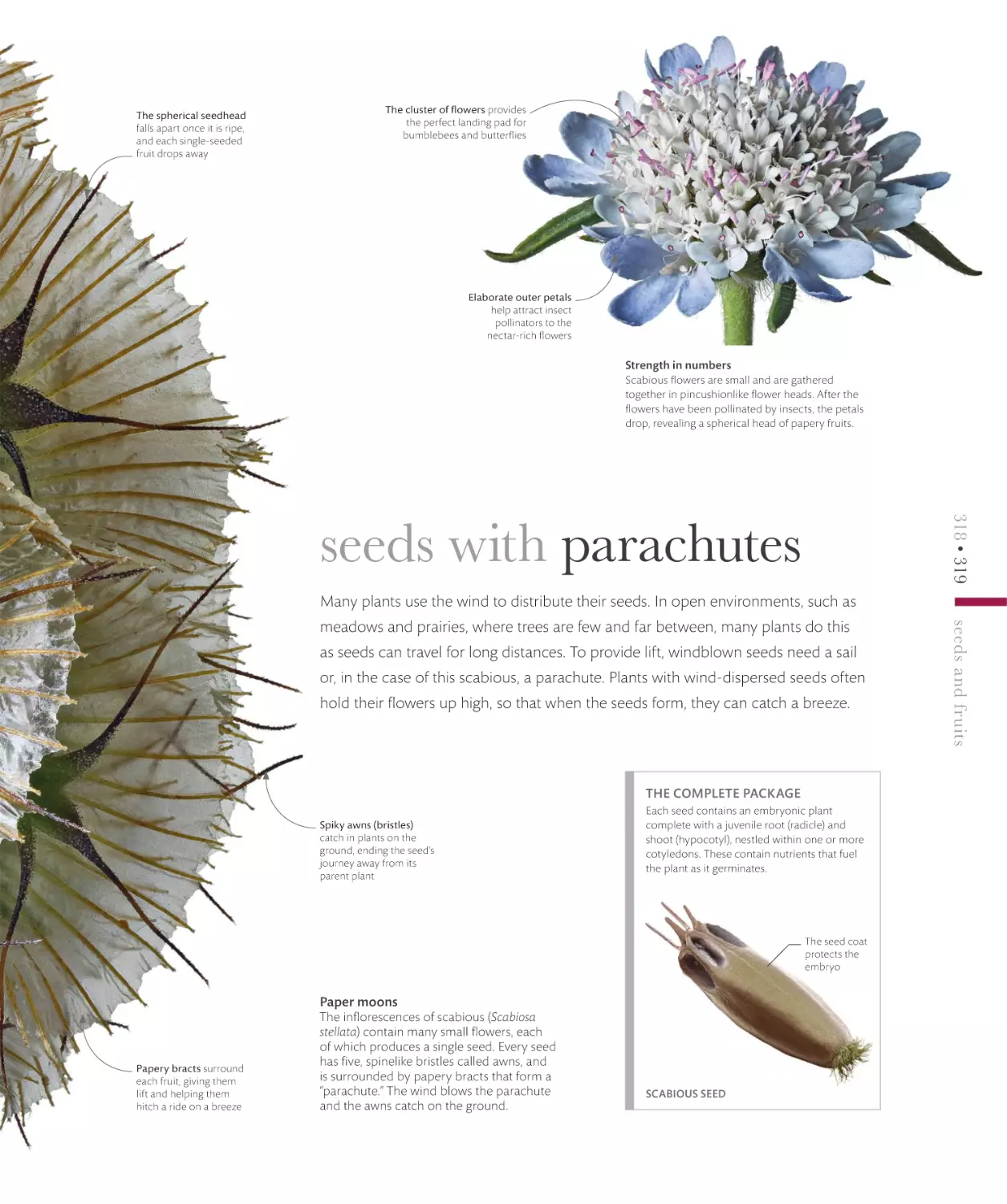
seeds with parachutes

142

succulent foliage

218

rays and disks

320

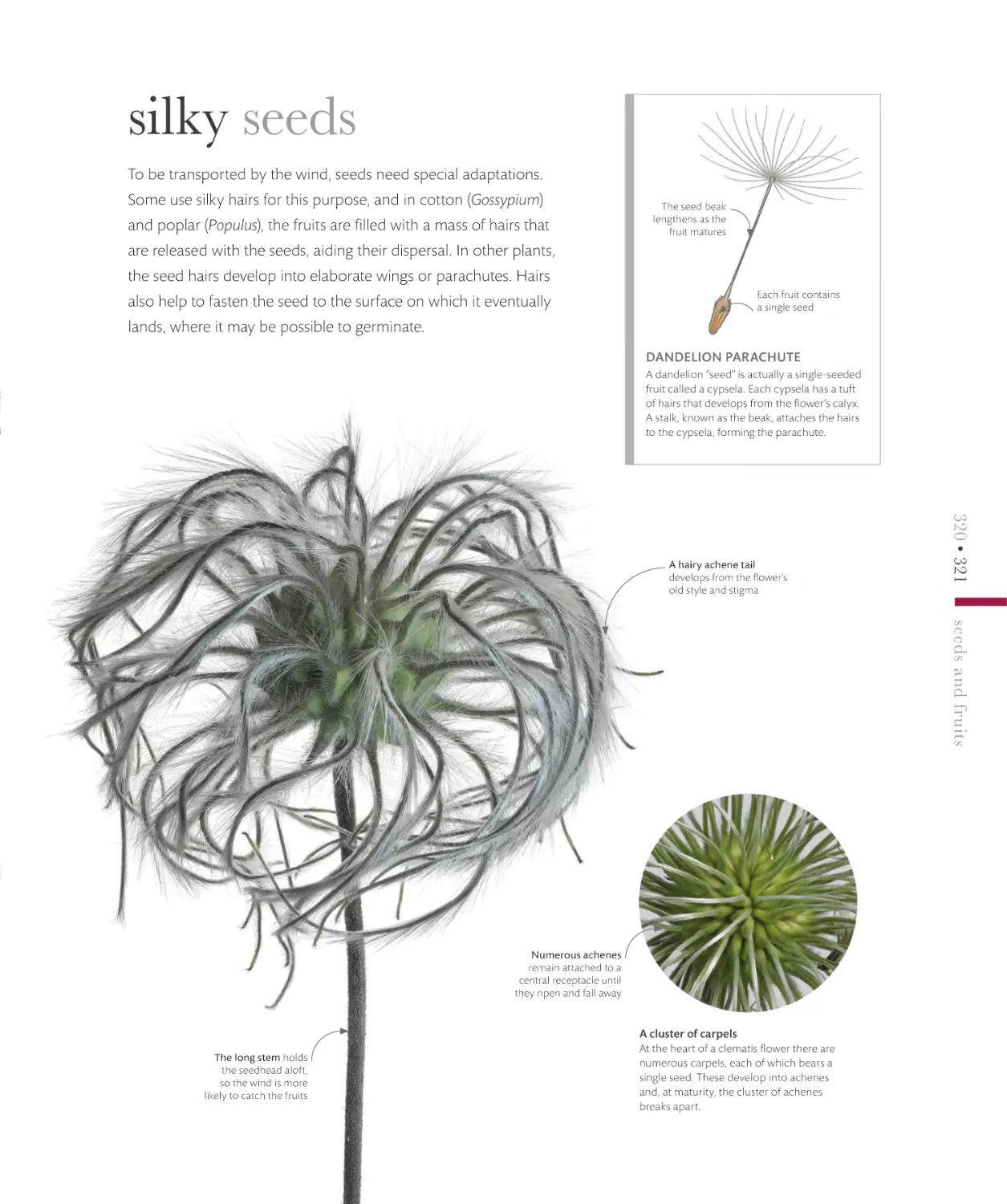
silky seeds

144

waxy leaves

220

the sunflower

322

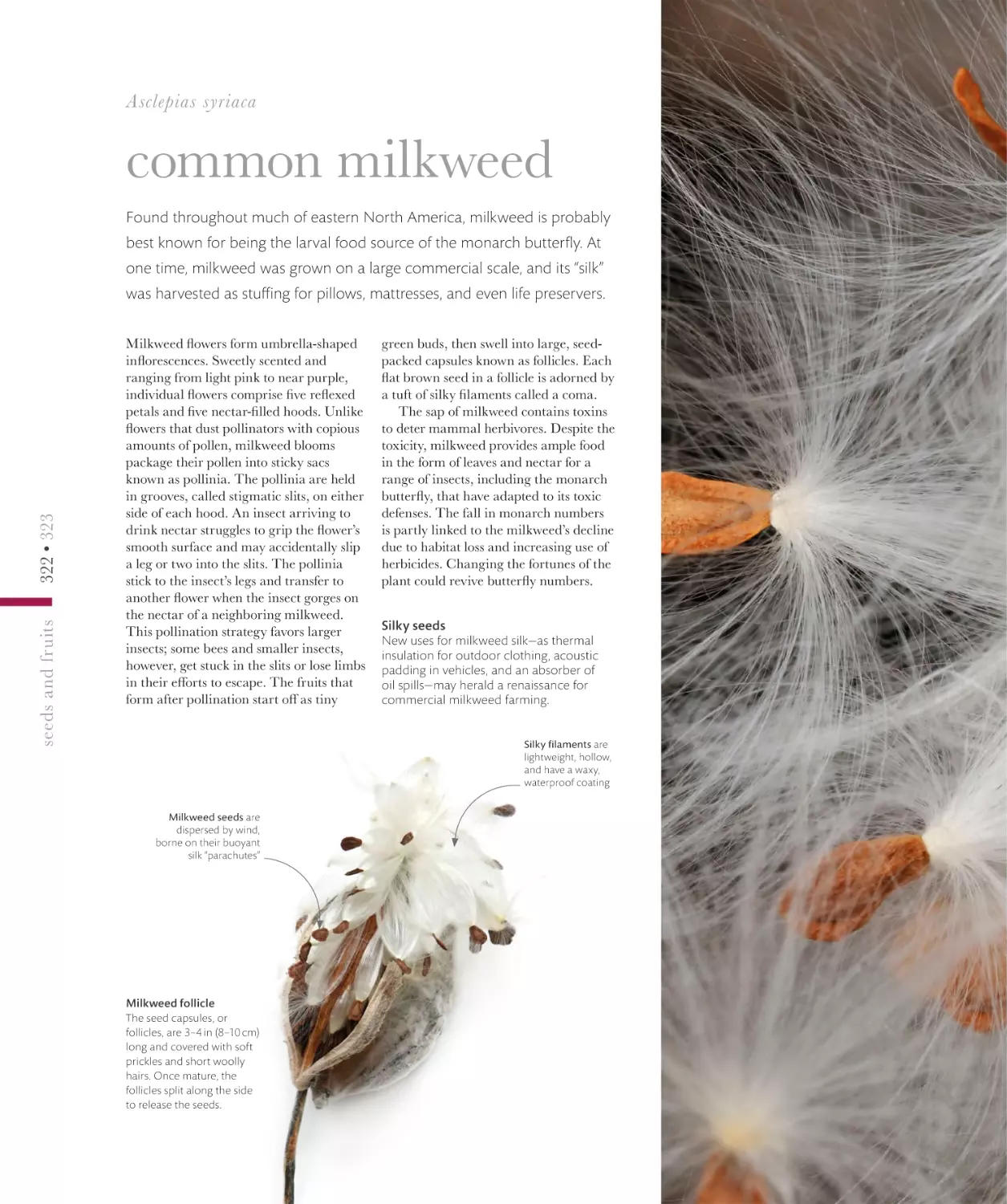
common milkweed

146

the quiver tree

222

wind-pollinated flowers

324

pods and capsules

148

silver leaves

224

grass flowers

326

exploding seedpods

150

variegated leaves

226

flowers and nectar

328

fennel flower

152

the japanese maple

228

storing nectar

330

seeds and fire

154

fall colors

230

designed for visitors

332

water dispersal

156

stinging leaves

232

precision pollination

334

158

the sweet thorn

234

buzz pollination

plants in art:
painting the world

160

leaf defenses

236

336

natural clones

162

leaves in extremes

plants in art:
radical visions

338

fern spores

164

the bismarck palm

238

winter blooms

340

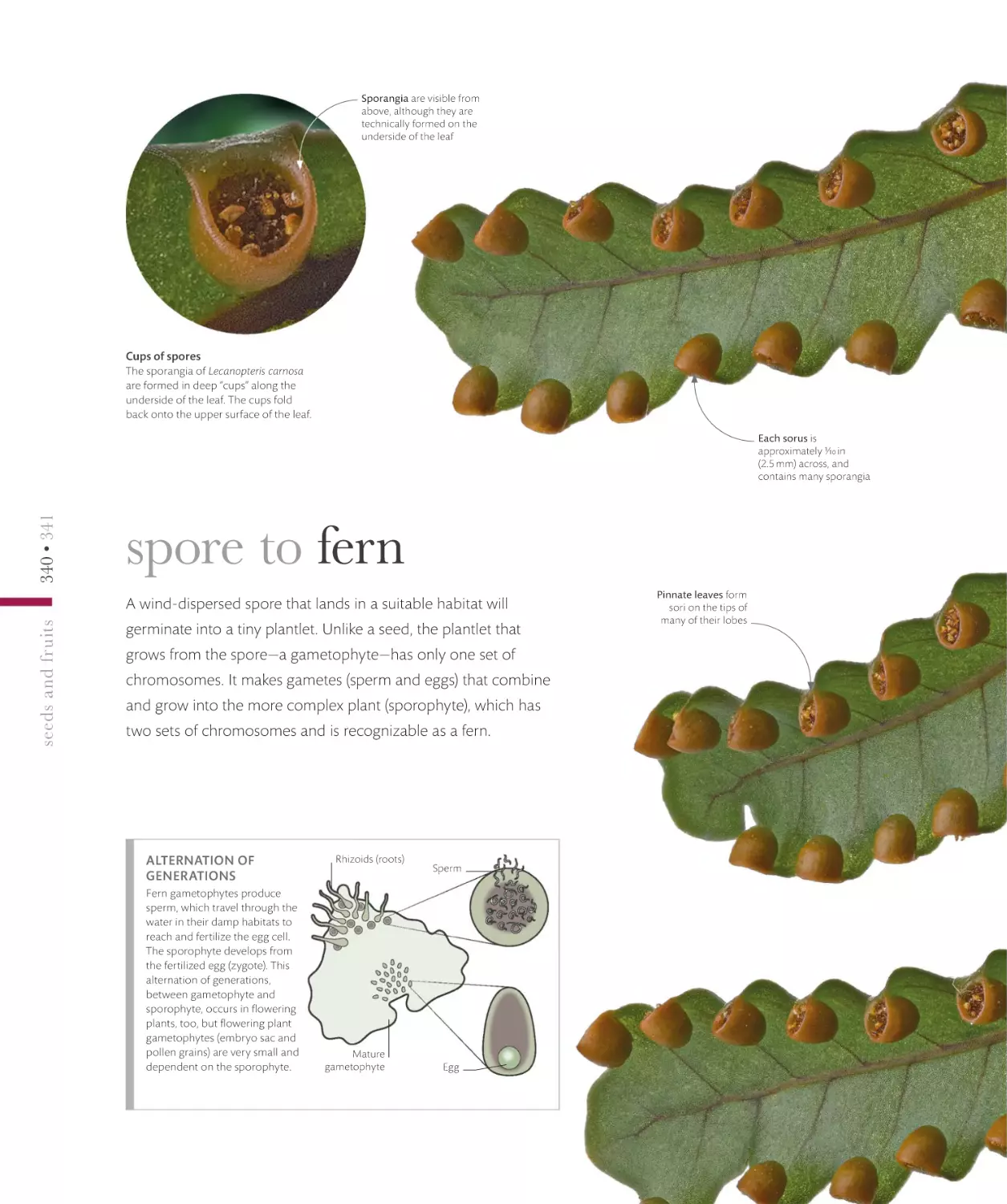
spore to fern

166

floating leaves

240

flowers for birds

342

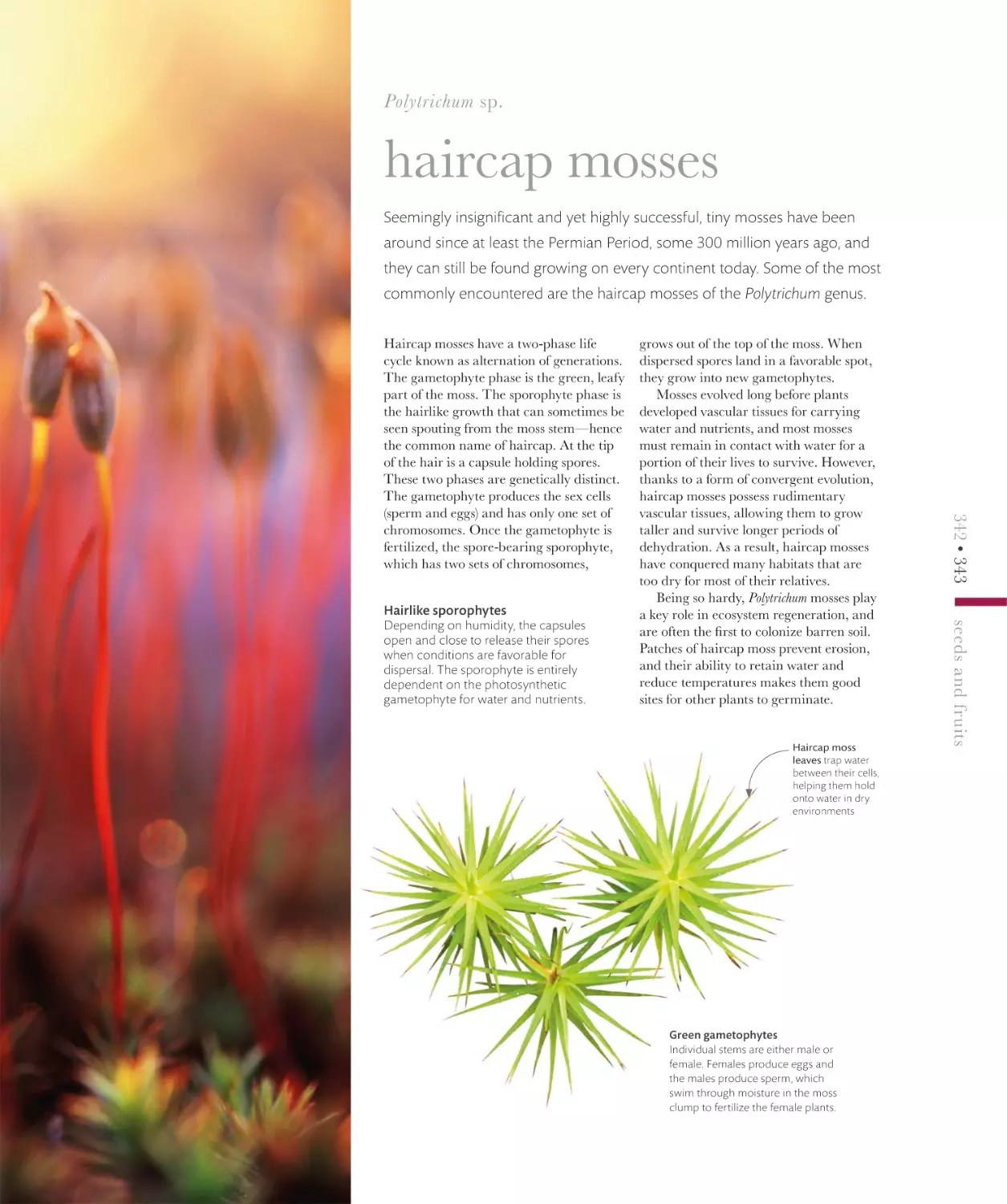
haircap mosses

168

plants with pools

242

flowers for animals

170

leaves that eat

244

flying visitors

plant families

172

sundews

246

the queen of the night

346

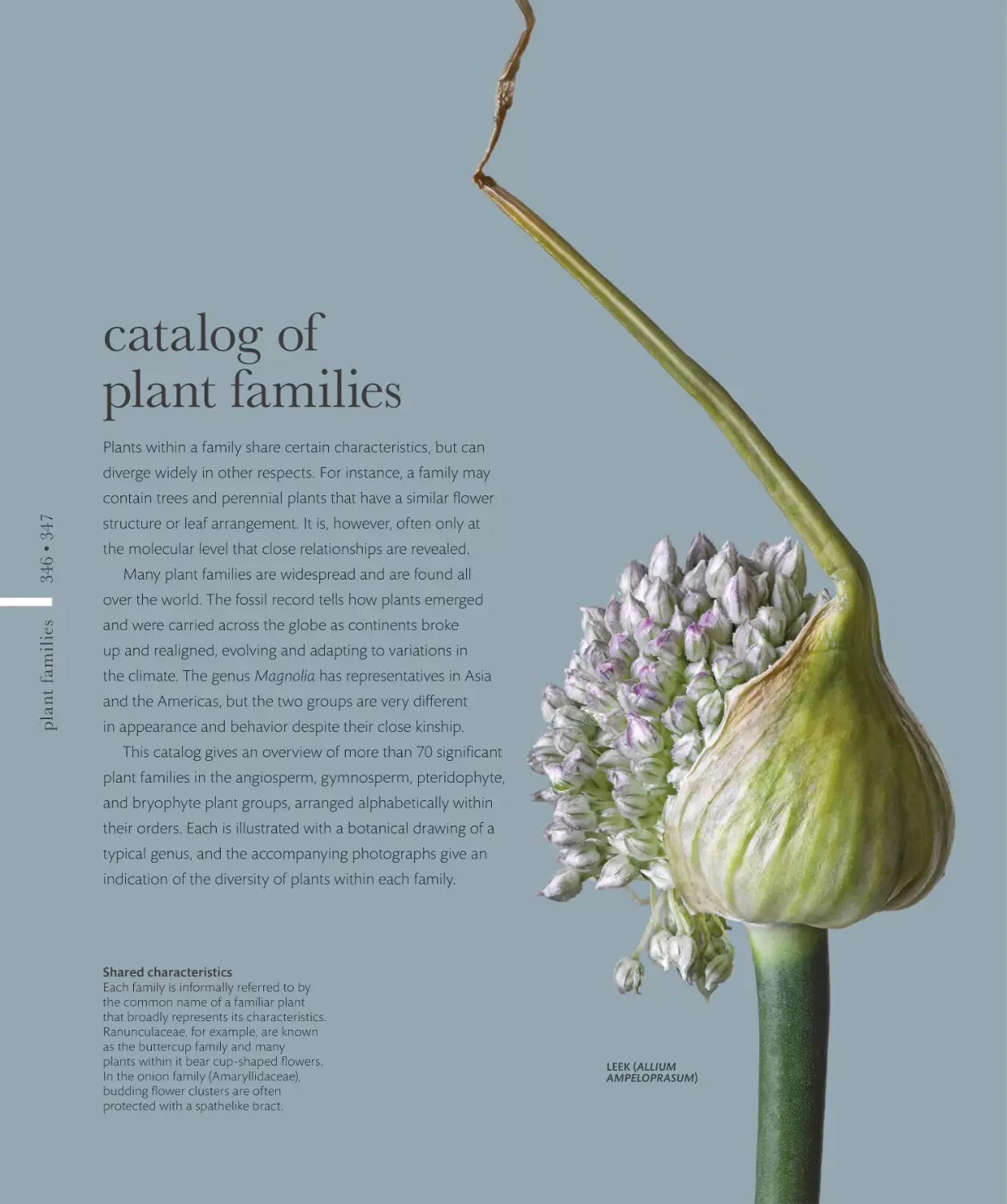
catalog of plant families

174

leaves that reproduce

248

color attraction

420

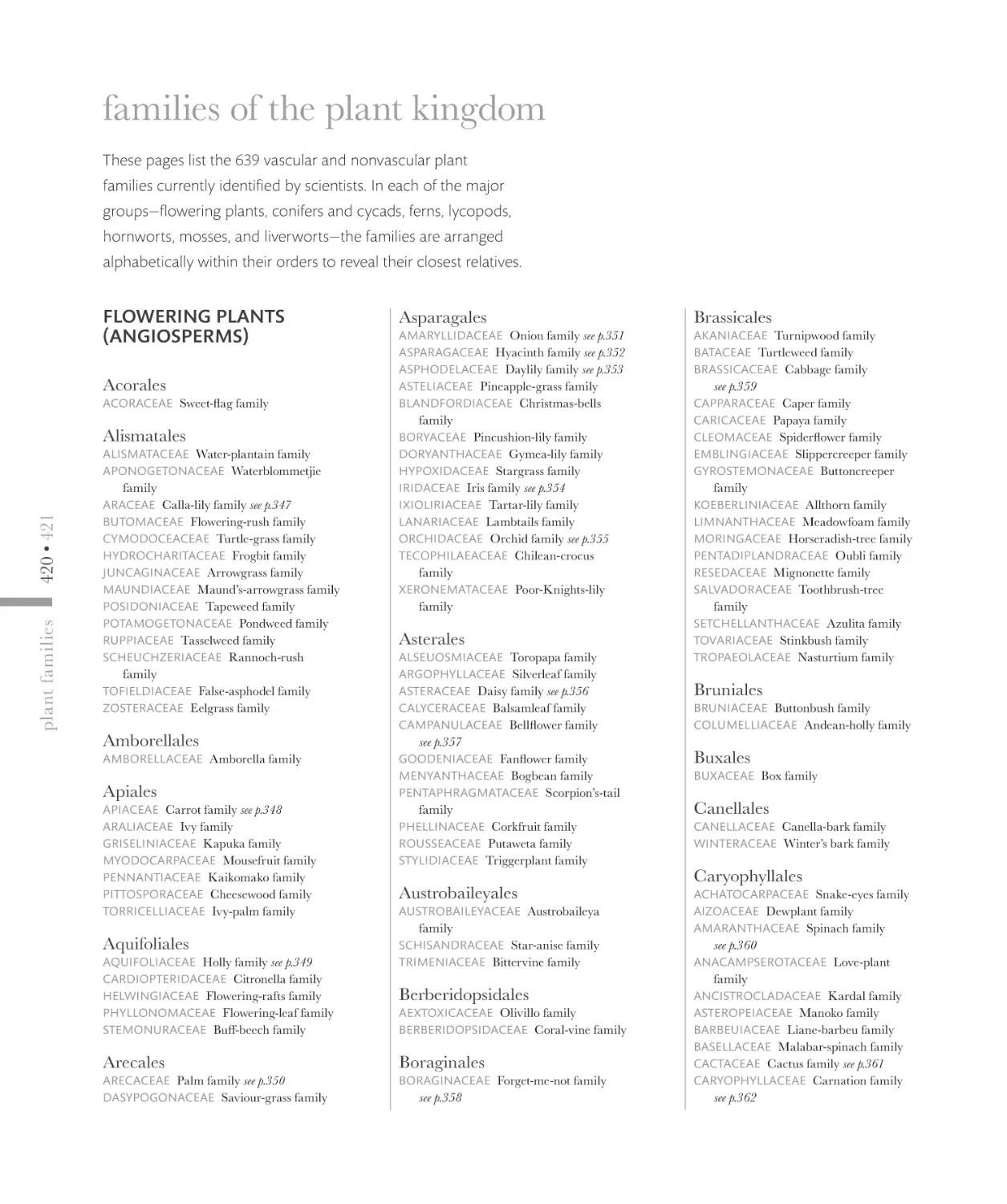
families of the plant

176

protective bracts

250

nectar guides

178

bract types

252

the hollyhock

426

glossary

180

leaves and spines

254

color signals

432

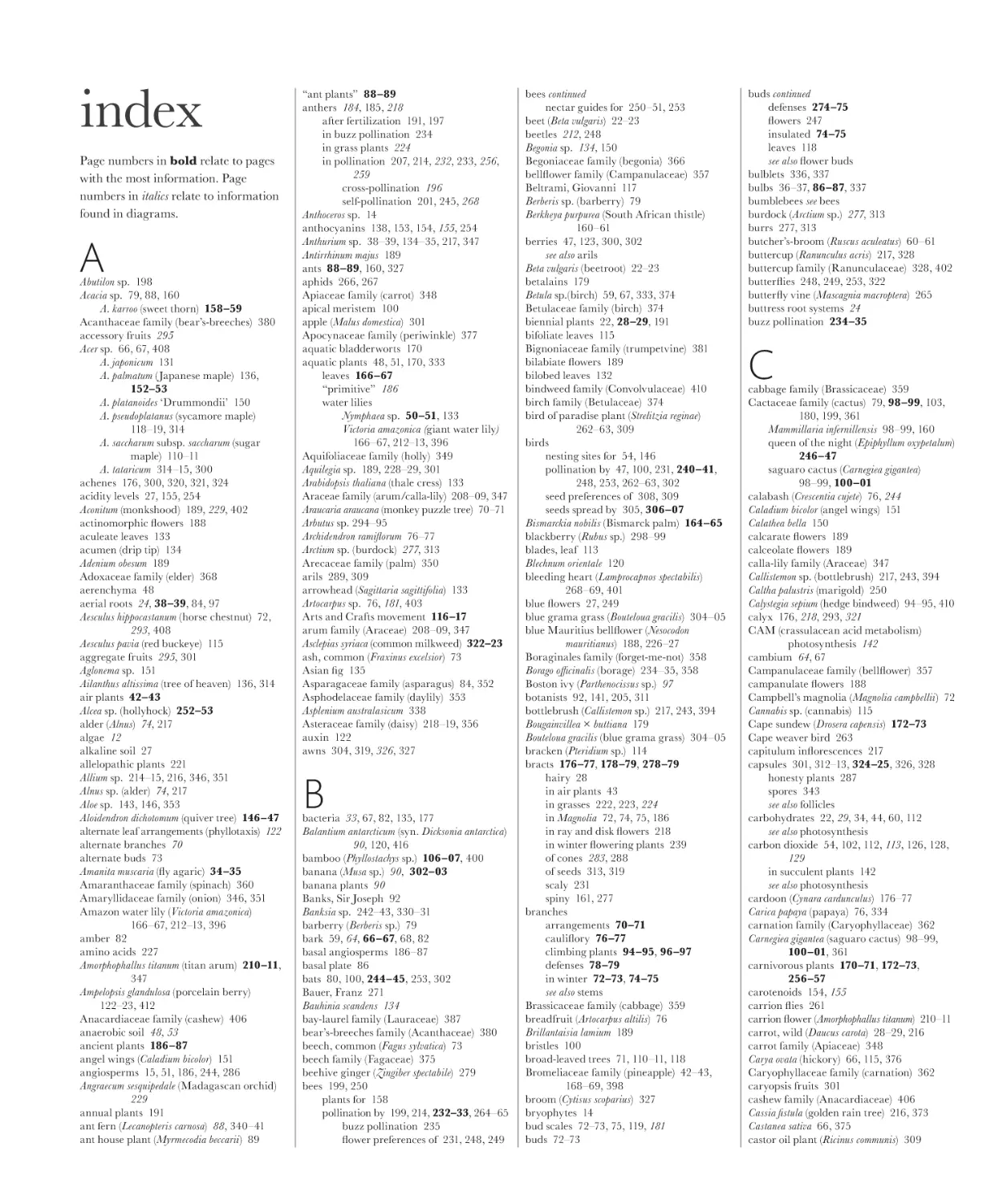
index

438

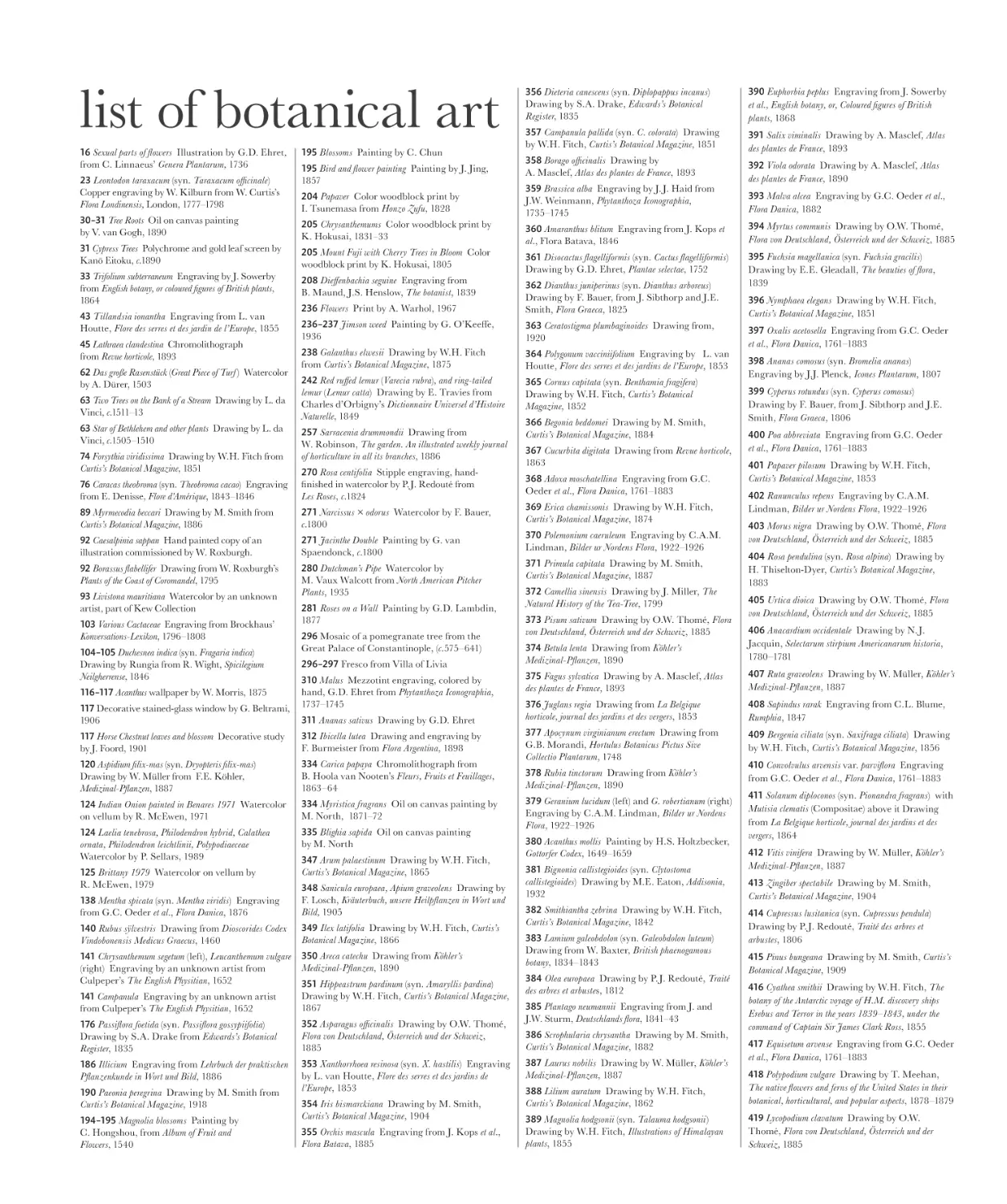
list of botanical art

439

acknowledgments

kingdom

BLUE LOTUS (NYMPHAEA CAERULEA)

foreword
Plants are essential for life. They make our planet’s atmosphere breathable,
their decaying bodies create the soil under our feet, and they transform light
energy into consumable nutrients that keep us alive. They also provide
inspiration for artists: think of O’Keefe’s poppies, Monet’s water lilies, and
van Gogh’s sunflowers. When was the last time you examined the stunning
intricacies of these essential life forms up close?
Flora combines the art and science of plants, revealing botanical details
in astounding and artful photographs. While previewing this book I was
compelled to share the amazing images with coworkers. The otherworldly
beauty of the magnified subjects made me feel like I had landed on Lilliput
and happened upon old friends who had been supersized!
It also reminded me why I began my career in horticulture. At its
most basic level, horticulture is the science and art of growing plants. This
amalgamation of disciplines is what first attracted me to the profession and
has held my interest for over forty years. This volume brought me back to
Horticulture Studies 101, with each chapter examining a different plant
part and how plants interact with the world around them. Thankfully, the
distinctive photography that reveals fabulous details ranging from nectar
bubbles to plant hairs and nettle stings far surpasses the old projected
transparency sheets used by my professors.
Similar to Flora, Smithsonian Gardens combines art and science in its many
diverse garden and landscape exhibits. While their beauty is often what
initially attracts visitors, the science they embody showcases our living
collections and provides depths of engagement with our audiences. Our
gardens are delightful examples of performative art. They change every
season, indeed every day, of their existence. It is obvious that Smithsonian
Gardens’ staff horticulturists and gardeners are extraordinarily knowledgeable
when it comes to plant science, yet so much of their work evolves into
genuine artistry thanks to their natural skill in combining living collections.
Perhaps the sublime melding of art and science in Flora will launch
or revitalize your own journey into the mesmerizing world of plants.

BARBARA W. FAUST
DIRECTOR, SMITHSONIAN GARDENS

the

plant
kıngdom
plant. a living organism, usually containing
chlorophyll—including trees, shrubs, herbs,
grasses, ferns, and mosses—that typically
grows in a permanent position, absorbing
water and inorganic substances through its
roots, and synthesizing nutrients in its leaves
by photosynthesis.

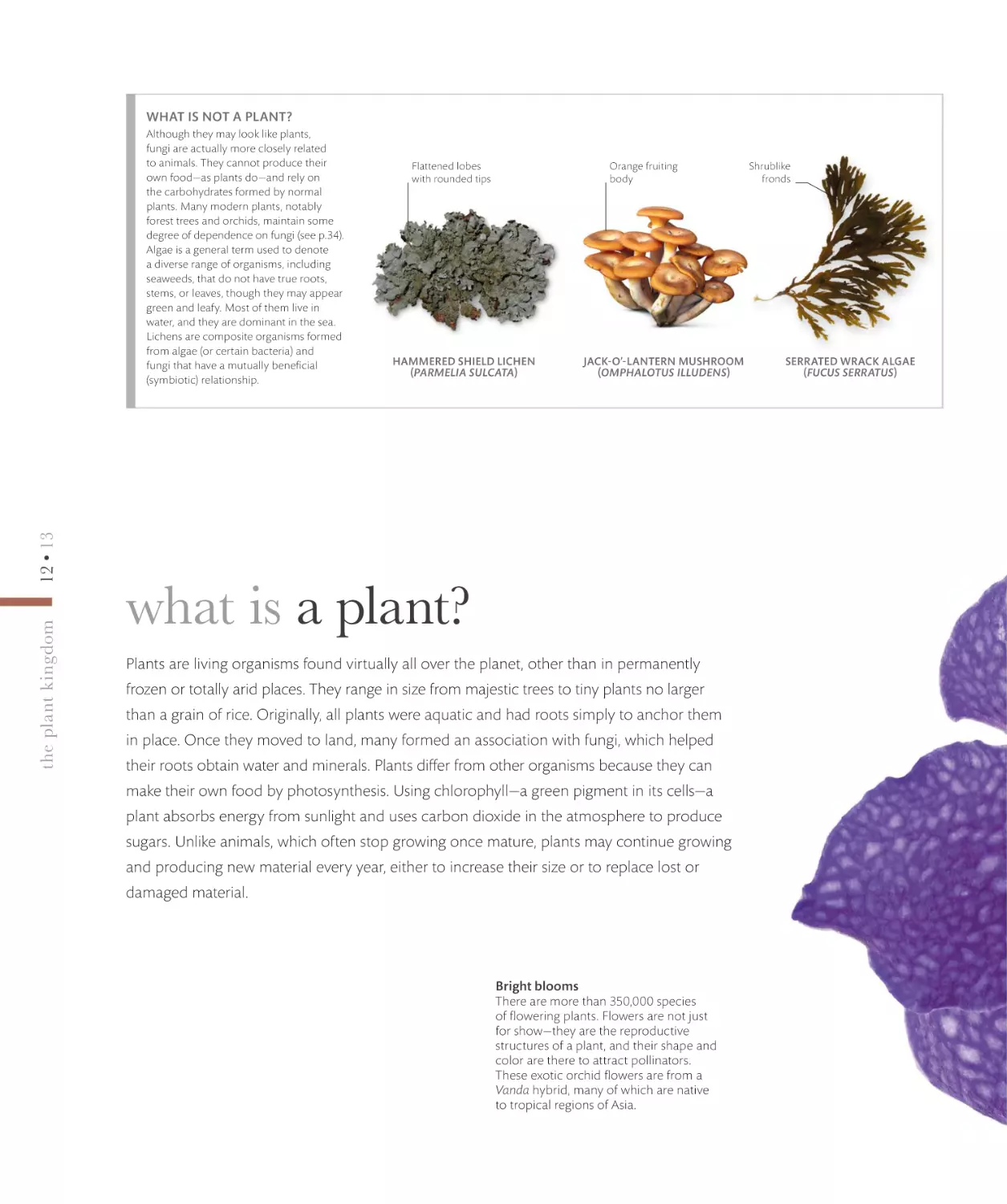
WHAT IS NOT A PLANT?

the plant kingdom

12 • 13

Although they may look like plants,
fungi are actually more closely related
to animals. They cannot produce their
own food—as plants do—and rely on
the carbohydrates formed by normal
plants. Many modern plants, notably
forest trees and orchids, maintain some
degree of dependence on fungi (see p.34).
Algae is a general term used to denote
a diverse range of organisms, including
seaweeds, that do not have true roots,
stems, or leaves, though they may appear
green and leafy. Most of them live in
water, and they are dominant in the sea.
Lichens are composite organisms formed
from algae (or certain bacteria) and
fungi that have a mutually beneficial
(symbiotic) relationship.

Flattened lobes
with rounded tips

Orange fruiting
body

HAMMERED SHIELD LICHEN
(PARMELIA SULCATA)

JACK-O’-LANTERN MUSHROOM
(OMPHALOTUS ILLUDENS)

what is a plant?
Plants are living organisms found virtually all over the planet, other than in permanently
frozen or totally arid places. They range in size from majestic trees to tiny plants no larger
than a grain of rice. Originally, all plants were aquatic and had roots simply to anchor them
in place. Once they moved to land, many formed an association with fungi, which helped
their roots obtain water and minerals. Plants differ from other organisms because they can
make their own food by photosynthesis. Using chlorophyll—a green pigment in its cells—a
plant absorbs energy from sunlight and uses carbon dioxide in the atmosphere to produce
sugars. Unlike animals, which often stop growing once mature, plants may continue growing
and producing new material every year, either to increase their size or to replace lost or
damaged material.

Bright blooms
There are more than 350,000 species
of flowering plants. Flowers are not just
for show—they are the reproductive
structures of a plant, and their shape and
color are there to attract pollinators.
These exotic orchid flowers are from a
Vanda hybrid, many of which are native
to tropical regions of Asia.

Shrublike
fronds

SERRATED WRACK ALGAE
(FUCUS SERRATUS)

Opening flower bud

Flowering stems
sometimes
branch

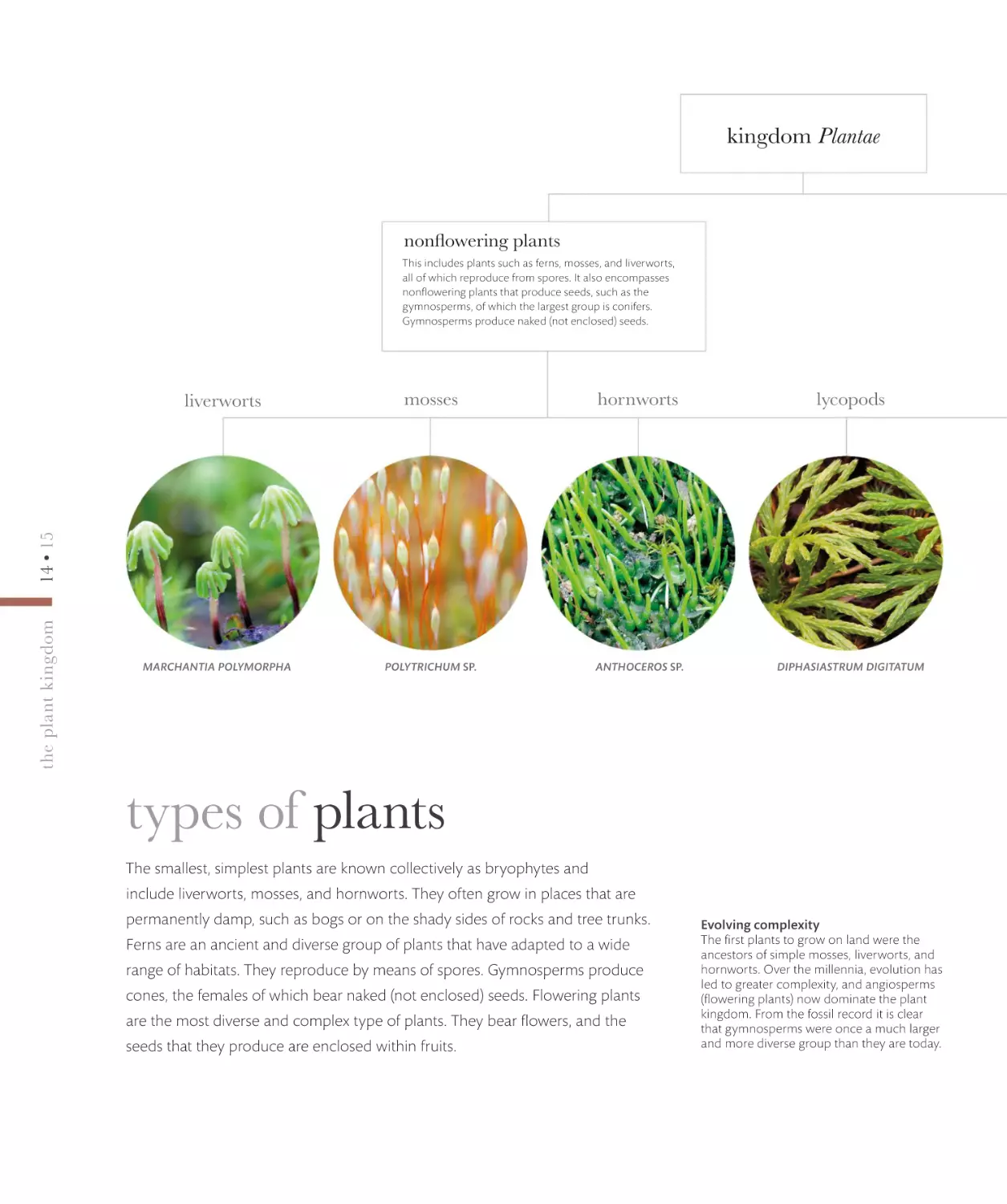
kingdom Plantae

nonflowering plants
This includes plants such as ferns, mosses, and liverworts,
all of which reproduce from spores. It also encompasses
nonflowering plants that produce seeds, such as the
gymnosperms, of which the largest group is conifers.
Gymnosperms produce naked (not enclosed) seeds.

mosses

hornworts

lycopods

POLYTRICHUM SP.

ANTHOCEROS SP.

DIPHASIASTRUM DIGITATUM

the plant kingdom

14 • 15

liverworts

MARCHANTIA POLYMORPHA

types of plants
The smallest, simplest plants are known collectively as bryophytes and
include liverworts, mosses, and hornworts. They often grow in places that are
permanently damp, such as bogs or on the shady sides of rocks and tree trunks.
Ferns are an ancient and diverse group of plants that have adapted to a wide
range of habitats. They reproduce by means of spores. Gymnosperms produce
cones, the females of which bear naked (not enclosed) seeds. Flowering plants
are the most diverse and complex type of plants. They bear flowers, and the
seeds that they produce are enclosed within fruits.

Evolving complexity
The first plants to grow on land were the
ancestors of simple mosses, liverworts, and
hornworts. Over the millennia, evolution has
led to greater complexity, and angiosperms
(flowering plants) now dominate the plant
kingdom. From the fossil record it is clear
that gymnosperms were once a much larger
and more diverse group than they are today.

flowering plants
The angiosperms (flowering plants) are a diverse
group and are found in a wide range of habitats
around the world. Like gymnosperms, they produce
pollen and seeds, but the seeds of an angiosperm
are enclosed within a fruit.

ferns

gymnosperms

angiosperms

CYATHEA SP.

LARIX SP.

NYMPHAEA ‘MASANIELLO’

magnoliids

MAGNOLIA GRANDIFLORA

monocots

LILIUM AURATUM

eudicots

ROSA RUBIGINOSA

classifying plants
Individual plants are formally named according to the system

A system of classification
This page of illustrations by Georg Dionysius Ehret,
published in 1736, illustrates the Linnaean classification
system, which differentiated species by looking at the
sexual parts of the plants, notably the different numbers
of male and female parts.

devised by Swedish botanist Carl Linnaeus (1707–1778), which used
two-word names. In Latin and italics, a plant’s name is made up of
the genus to which it belongs, followed by the name of its particular
species. Plants are grouped together according to the characteristics
that they share. Historically, classification was determined by a plant’s
physical characteristics (notably flower structure) and biochemistry
(the chemical compounds within a plant), and was often speculative
or subjective. Nowadays, genetic evidence provides a more reliable
means of understanding the relationships between plants.

HIERARCHY OF TERMS

16 • 17

Botanists use the following ranks to arrange plants.
Plants are organized into divisions, then classes, and
so on, into increasingly specific groups according
to the structure of their flowers, fruits, and other parts,
as well as evidence from fossils and DNA profiling.

division

the plant kingdom

separates plants according to key features,
e.g. angiosperms and gymnosperms

class
divides plants according to fundamental
differences such as monocots and eudicots

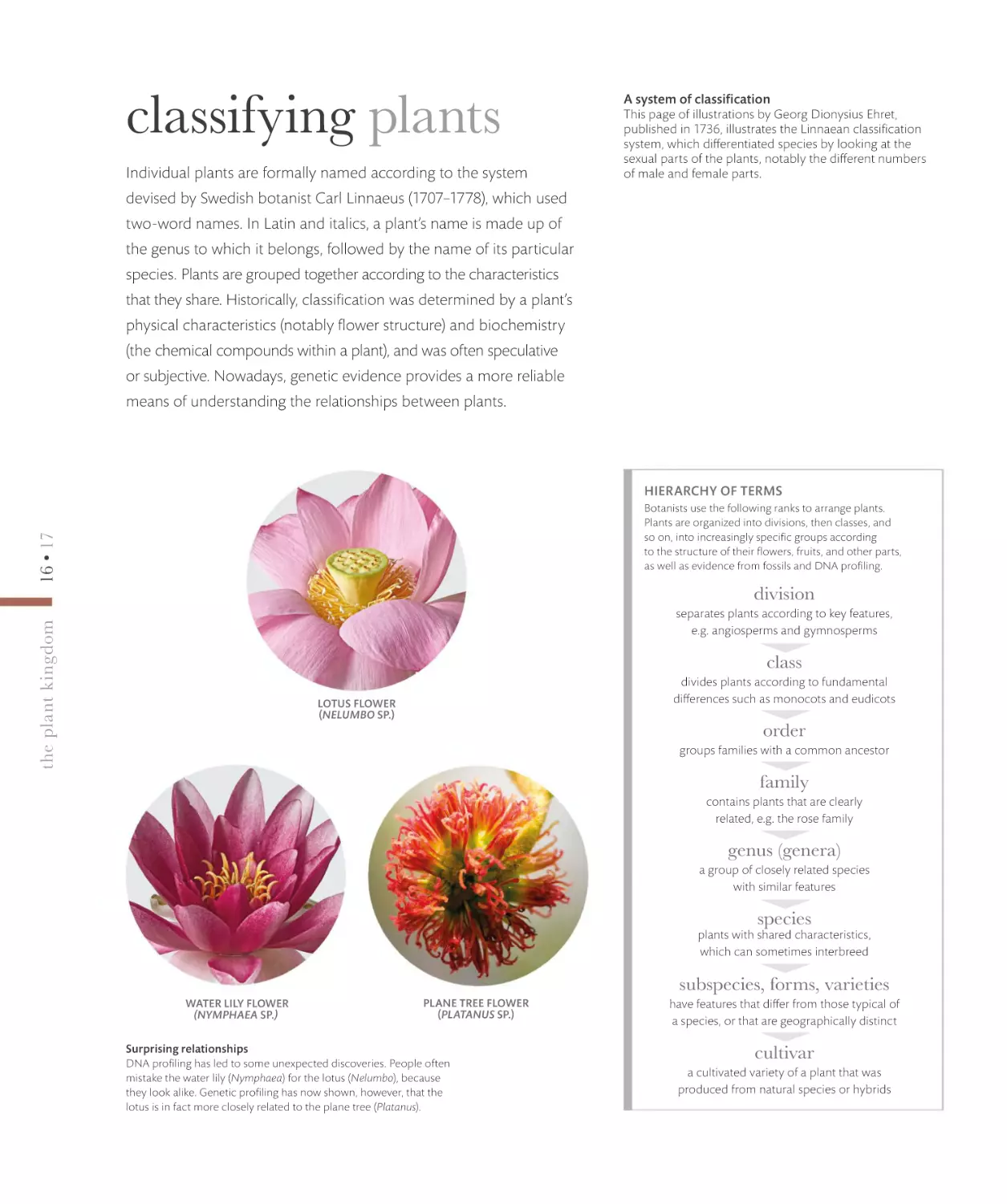
LOTUS FLOWER
(NELUMBO SP.)

order
groups families with a common ancestor

family
contains plants that are clearly
related, e.g. the rose family

genus (genera)
a group of closely related species
with similar features

species

plants with shared characteristics,
which can sometimes interbreed

subspecies, forms, varieties
WATER LILY FLOWER
(NYMPHAEA SP.)

PLANE TREE FLOWER
(PLATANUS SP.)

Surprising relationships
DNA profiling has led to some unexpected discoveries. People often
mistake the water lily (Nymphaea) for the lotus (Nelumbo), because
they look alike. Genetic profiling has now shown, however, that the
lotus is in fact more closely related to the plane tree (Platanus).

have features that differ from those typical of
a species, or that are geographically distinct

cultivar
a cultivated variety of a plant that was
produced from natural species or hybrids

roots
root. the part of a plant, usually
underground, that anchors it in
the earth and transports water and
nutrients to the rest of the plant.

roots

20 • 21

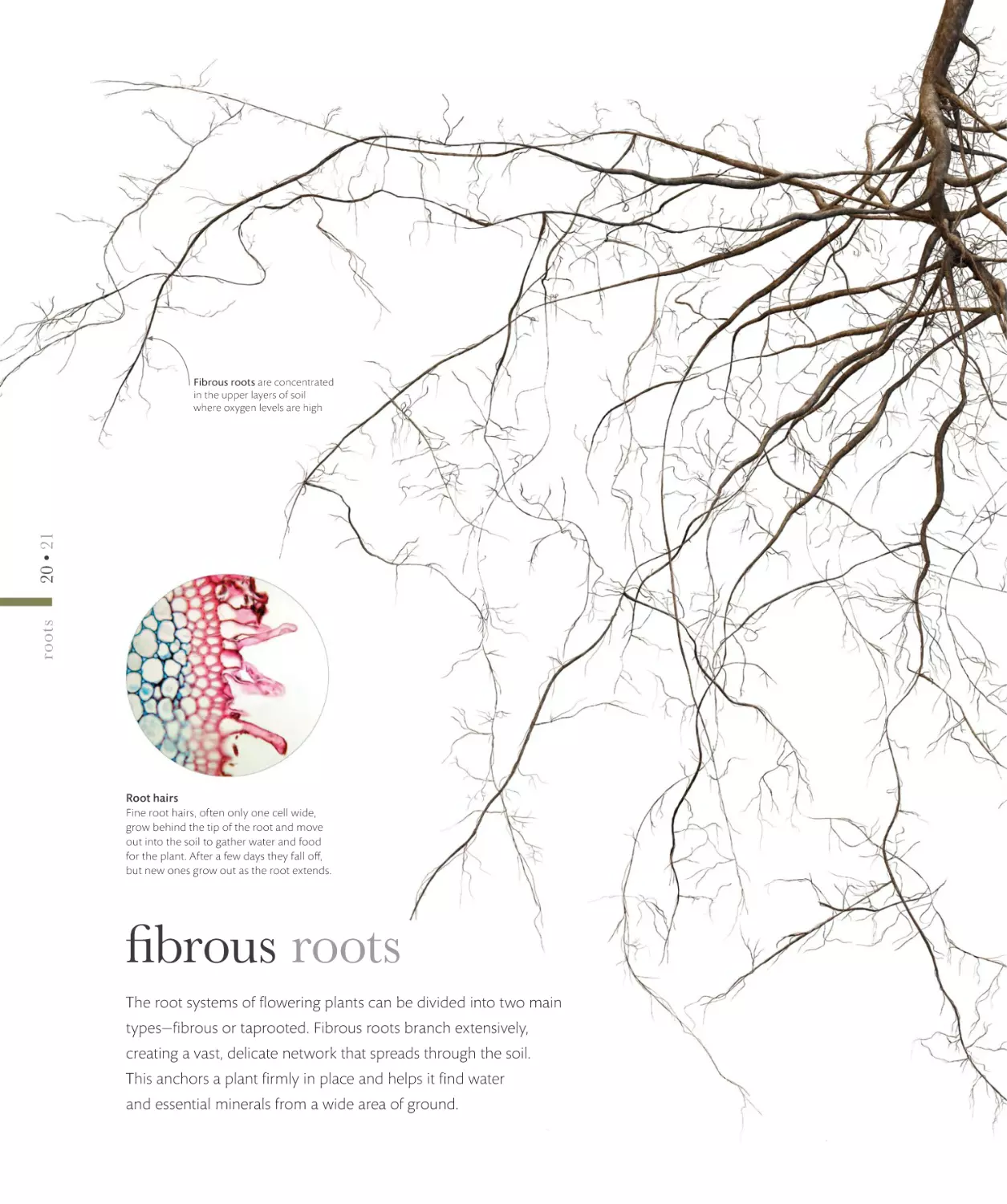
Fibrous roots are concentrated
in the upper layers of soil
where oxygen levels are high

Root hairs
Fine root hairs, often only one cell wide,
grow behind the tip of the root and move
out into the soil to gather water and food
for the plant. After a few days they fall off,
but new ones grow out as the root extends.

fibrous roots
The root systems of flowering plants can be divided into two main
types—fibrous or taprooted. Fibrous roots branch extensively,
creating a vast, delicate network that spreads through the soil.
This anchors a plant firmly in place and helps it find water
and essential minerals from a wide area of ground.

Delicate, sprawling roots
help prevent erosion by
anchoring soil particles

The underground network
Fibrous root systems connect plants to the vital
resources spread throughout the soil. They are found
in all ferns, and in many grasses and other flowering
plants. Some trees produce a deep, thick taproot at
first, then develop a fibrous root system as they age.

HOW ROOT HAIRS WORK
Root hairs wend their way between soil particles in
order to absorb water and the dissolved minerals that it
contains. Profuse, these hairs greatly increase the surface
area of the roots and therefore the amount of water and
nutrients available to the plant. Water and the minerals
dissolved in it are absorbed into the cells by osmosis and
transported via the cortex into the vascular system.

Soil
particle

Water in
soil

Vascular
system
Edge of root
Water flow

Roots may penetrate
deeply in search of
moisture in dry soil
Root hair

Cells of cortex

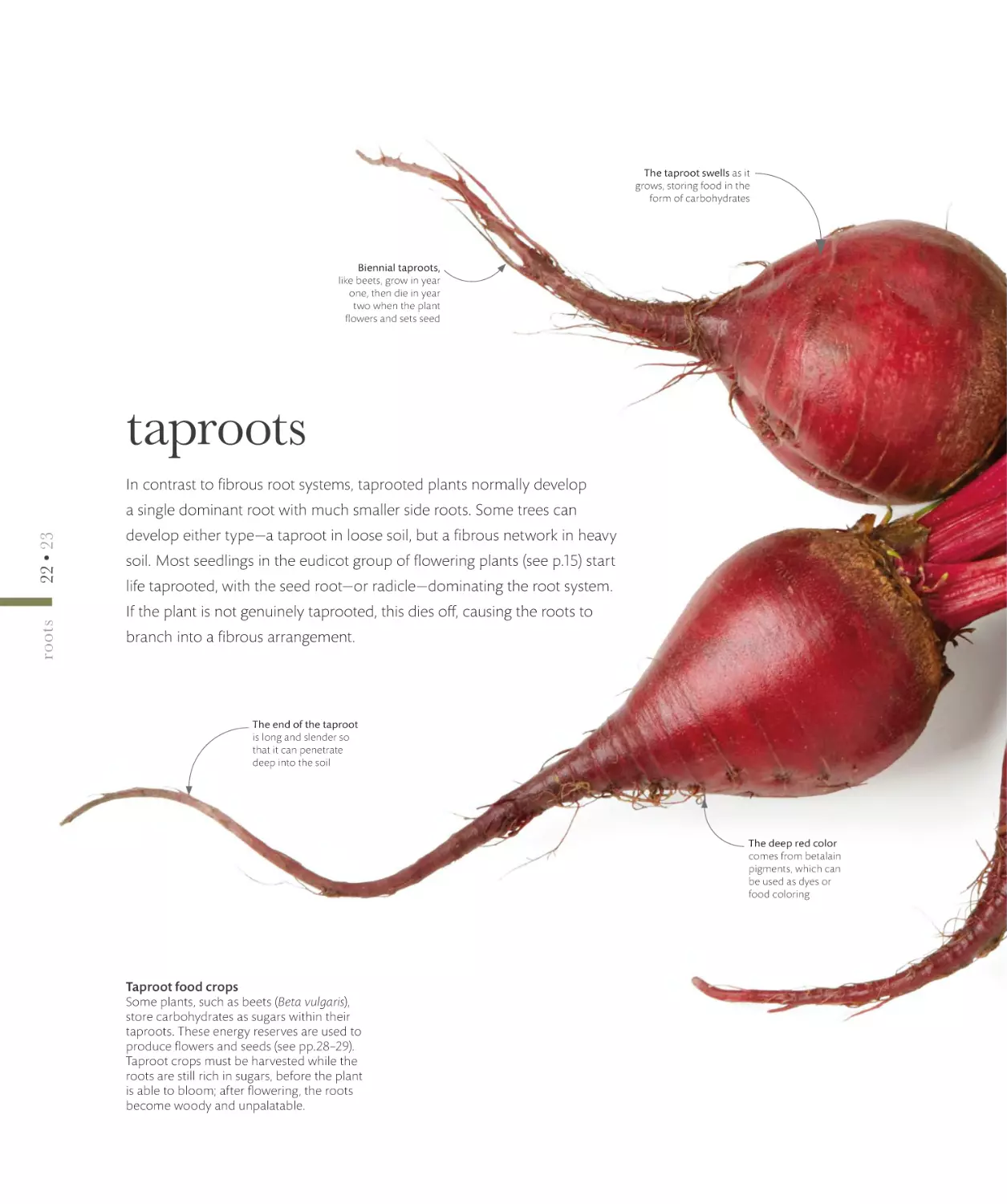
The taproot swells as it
grows, storing food in the
form of carbohydrates

Biennial taproots,
like beets, grow in year
one, then die in year
two when the plant
flowers and sets seed

taproots
In contrast to fibrous root systems, taprooted plants normally develop

roots

22 • 23

a single dominant root with much smaller side roots. Some trees can
develop either type—a taproot in loose soil, but a fibrous network in heavy
soil. Most seedlings in the eudicot group of flowering plants (see p.15) start
life taprooted, with the seed root—or radicle—dominating the root system.
If the plant is not genuinely taprooted, this dies off, causing the roots to
branch into a fibrous arrangement.

The end of the taproot
is long and slender so
that it can penetrate
deep into the soil

The deep red color
comes from betalain
pigments, which can
be used as dyes or
food coloring

Taproot food crops
Some plants, such as beets (Beta vulgaris),
store carbohydrates as sugars within their
taproots. These energy reserves are used to
produce flowers and seeds (see pp.28–29).
Taproot crops must be harvested while the
roots are still rich in sugars, before the plant
is able to bloom; after flowering, the roots
become woody and unpalatable.

Fueled by sugars,
the taproot can
produce new leaves
and stems to replace
any harvested as
salad crops

DEEP ROOTS
Taproots bring several advantages to
their owners. Often growing deep
into the soil, they can access water
and nutrients beyond the reach of
shallow-rooted plants. For weeds
such as dandelions (Taraxacum
officinale), a taproot also makes it
difficult to remove the plant from
the soil. More often than not, the
leaves break off, leaving the intact
root in place and ready to grow
back. Many taproots can regrow
from fragments left in the soil; even
the smallest piece of dandelion root
readily resprouts.

Thin side roots take
up most of the water
through minute
root hairs

TARAXACUM OFFICINALE

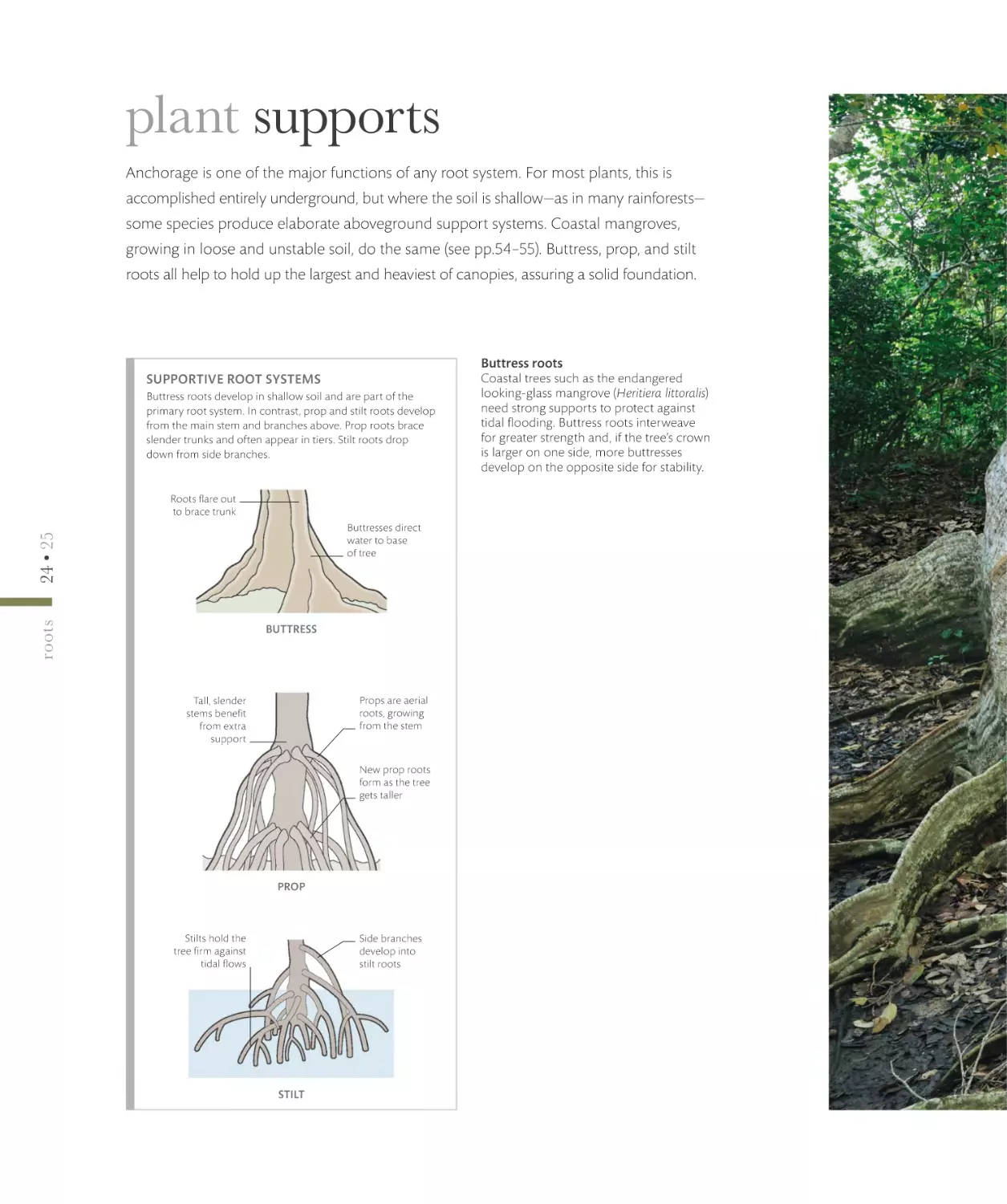
plant supports
Anchorage is one of the major functions of any root system. For most plants, this is
accomplished entirely underground, but where the soil is shallow—as in many rainforests—
some species produce elaborate aboveground support systems. Coastal mangroves,
growing in loose and unstable soil, do the same (see pp.54–55). Buttress, prop, and stilt
roots all help to hold up the largest and heaviest of canopies, assuring a solid foundation.

SUPPORTIVE ROOT SYSTEMS
Buttress roots develop in shallow soil and are part of the
primary root system. In contrast, prop and stilt roots develop
from the main stem and branches above. Prop roots brace
slender trunks and often appear in tiers. Stilt roots drop
down from side branches.

Roots flare out
to brace trunk

roots

24 • 25

Buttresses direct
water to base
of tree

BUTTRESS

Props are aerial
roots, growing
from the stem

Tall, slender
stems benefit
from extra
support

New prop roots
form as the tree
gets taller

PROP

Stilts hold the
tree firm against
tidal flows

Side branches
develop into
stilt roots

STILT

Buttress roots
Coastal trees such as the endangered
looking-glass mangrove (Heritiera littoralis)
need strong supports to protect against
tidal flooding. Buttress roots interweave
for greater strength and, if the tree’s crown
is larger on one side, more buttresses
develop on the opposite side for stability.

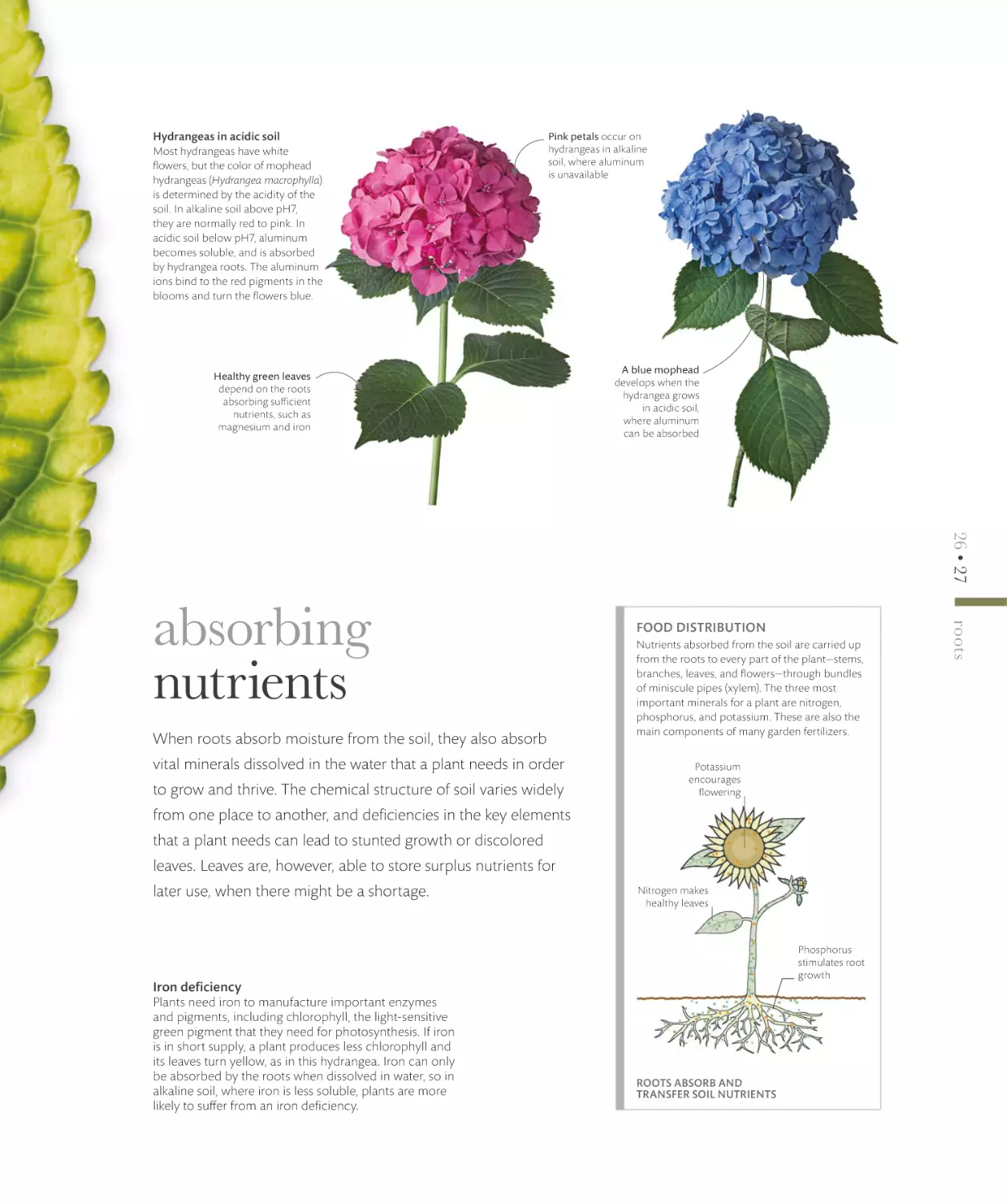
Hydrangeas in acidic soil
Most hydrangeas have white
flowers, but the color of mophead
hydrangeas (Hydrangea macrophylla)
is determined by the acidity of the
soil. In alkaline soil above pH7,
they are normally red to pink. In
acidic soil below pH7, aluminum
becomes soluble, and is absorbed
by hydrangea roots. The aluminum
ions bind to the red pigments in the
blooms and turn the flowers blue.

Pink petals occur on
hydrangeas in alkaline
soil, where aluminum
is unavailable

Healthy green leaves
depend on the roots
absorbing sufficient
nutrients, such as
magnesium and iron

A blue mophead
develops when the
hydrangea grows
in acidic soil,
where aluminum
can be absorbed

26 • 27

When roots absorb moisture from the soil, they also absorb
vital minerals dissolved in the water that a plant needs in order
to grow and thrive. The chemical structure of soil varies widely

FOOD DISTRIBUTION
Nutrients absorbed from the soil are carried up
from the roots to every part of the plant—stems,
branches, leaves, and flowers—through bundles
of miniscule pipes (xylem). The three most
important minerals for a plant are nitrogen,
phosphorus, and potassium. These are also the
main components of many garden fertilizers.
Potassium
encourages
flowering

from one place to another, and deficiencies in the key elements
that a plant needs can lead to stunted growth or discolored
leaves. Leaves are, however, able to store surplus nutrients for
later use, when there might be a shortage.

Iron deficiency
Plants need iron to manufacture important enzymes
and pigments, including chlorophyll, the light-sensitive
green pigment that they need for photosynthesis. If iron
is in short supply, a plant produces less chlorophyll and
its leaves turn yellow, as in this hydrangea. Iron can only
be absorbed by the roots when dissolved in water, so in
alkaline soil, where iron is less soluble, plants are more
likely to suffer from an iron deficiency.

Nitrogen makes
healthy leaves

Phosphorus
stimulates root
growth

ROOTS ABSORB AND
TRANSFER SOIL NUTRIENTS

roots

absorbing
nutrients

Individual flowers and fruit
are arranged in umbrellalike
clusters (umbels), which curl
inward when mature

Each individual
flower produces
two seeds

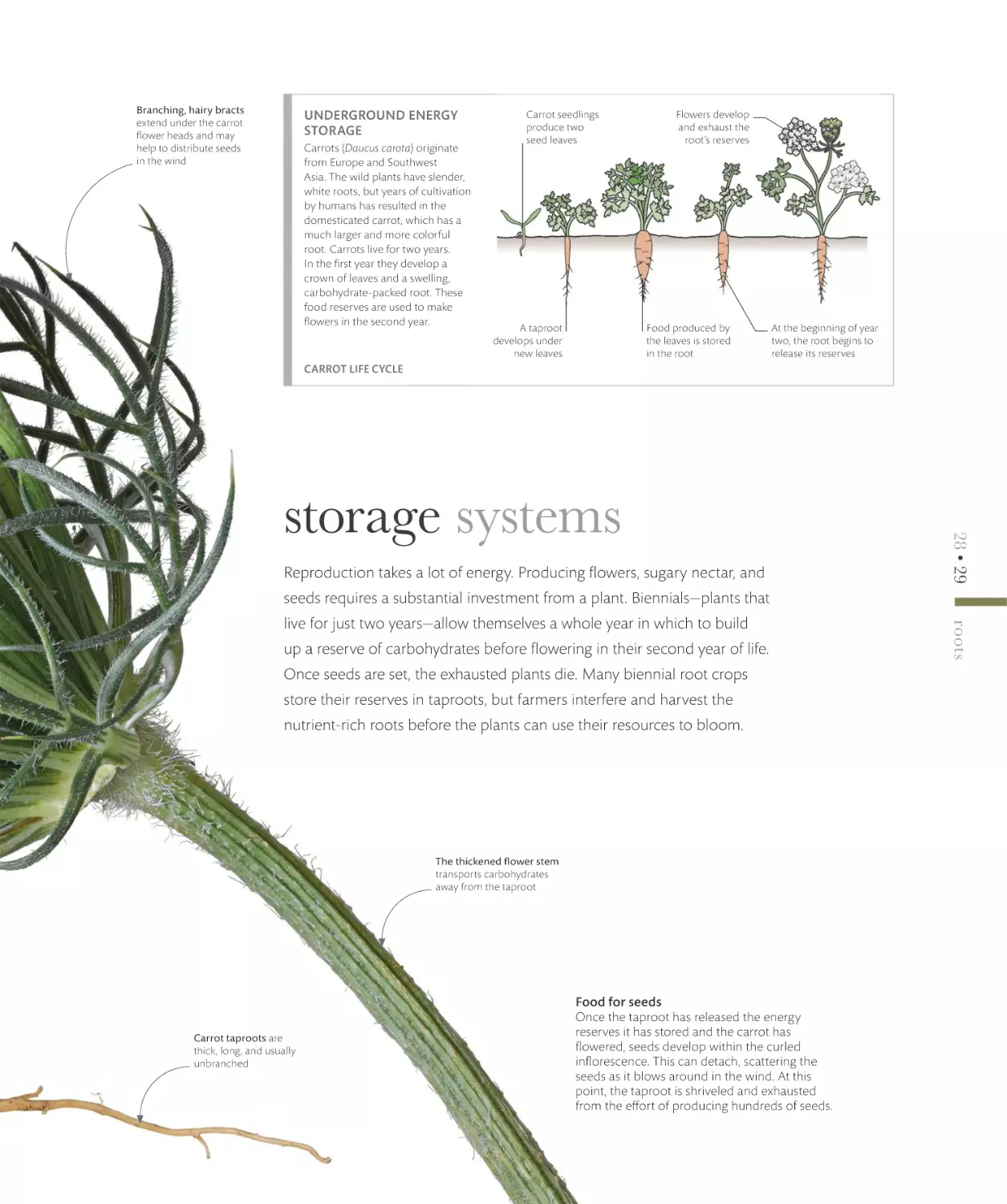
Carrot store
Most of the sugars stored within a
taproot are used to produce flowers.
Once a carrot plant has flowered, its
taproot becomes bitter and inedible.

Wild carrot taproots
are paler and more
slender than the
typically orange,
cultivated carrot

Branching, hairy bracts
extend under the carrot
flower heads and may
help to distribute seeds
in the wind

UNDERGROUND ENERGY
STORAGE
Carrots (Daucus carota) originate
from Europe and Southwest
Asia. The wild plants have slender,
white roots, but years of cultivation
by humans has resulted in the
domesticated carrot, which has a
much larger and more colorful
root. Carrots live for two years.
In the first year they develop a
crown of leaves and a swelling,
carbohydrate-packed root. These
food reserves are used to make
flowers in the second year.

Carrot seedlings
produce two
seed leaves

Flowers develop
and exhaust the
root’s reserves

Food produced by
the leaves is stored
in the root

A taproot
develops under
new leaves

At the beginning of year
two, the root begins to
release its reserves

CARROT LIFE CYCLE

Reproduction takes a lot of energy. Producing flowers, sugary nectar, and

28 • 29

storage systems
seeds requires a substantial investment from a plant. Biennials—plants that
up a reserve of carbohydrates before flowering in their second year of life.
Once seeds are set, the exhausted plants die. Many biennial root crops
store their reserves in taproots, but farmers interfere and harvest the
nutrient-rich roots before the plants can use their resources to bloom.

The thickened flower stem
transports carbohydrates
away from the taproot

Carrot taproots are
thick, long, and usually
unbranched

Food for seeds
Once the taproot has released the energy
reserves it has stored and the carrot has
flowered, seeds develop within the curled
inflorescence. This can detach, scattering the
seeds as it blows around in the wind. At this
point, the taproot is shriveled and exhausted
from the effort of producing hundreds of seeds.

roots

live for just two years—allow themselves a whole year in which to build

plants in art

impressions of
nature
Reacting against the formal constraints and rules of academic painting,
the 19th-century French Impressionist painters immersed themselves in the
natural world and worked at easels outdoors, so they could capture their
fleeting impressions of the changing light on the landscape in a fresh and
spontaneous way. The Postimpressionists who followed them took this
approach a step further. Inspired by the geometric forms and dazzling
colors they saw in the natural world, they created expressive, vibrant,

roots

30 • 31

semiabstract works bursting with energy.
Inspired by the Impressionists’ fresh, new
approach to art, Postimpressionists such
as van Gogh and Cézanne adopted a
simplified approach to painting, with little
attempt at realism, and developed a visual
language of their own. They emphasized
the bold lines, geometric shapes, and
luminous colors of the southern French
landscape, paving the way for the 20thcentury abstract artists to follow.
Vincent van Gogh painted from
nature, but he used intense color and
powerful brushstrokes to express his
emotional response to it. In his search
for a modern approach to art, he was
greatly influenced by Japanese prints,
with their bold, delineated shapes and
flat expanses of color. His letters from
the South of France simmer with joy.
Believing he had found “his Japan,” he
wrote ecstatically about color and shape.
“A meadow full of very yellow buttercups,
a ditch with iris plants with green
leaves … a strip of blue sky.” He was
preoccupied by the cypress trees and
astonished that no one had painted
them as he saw them.

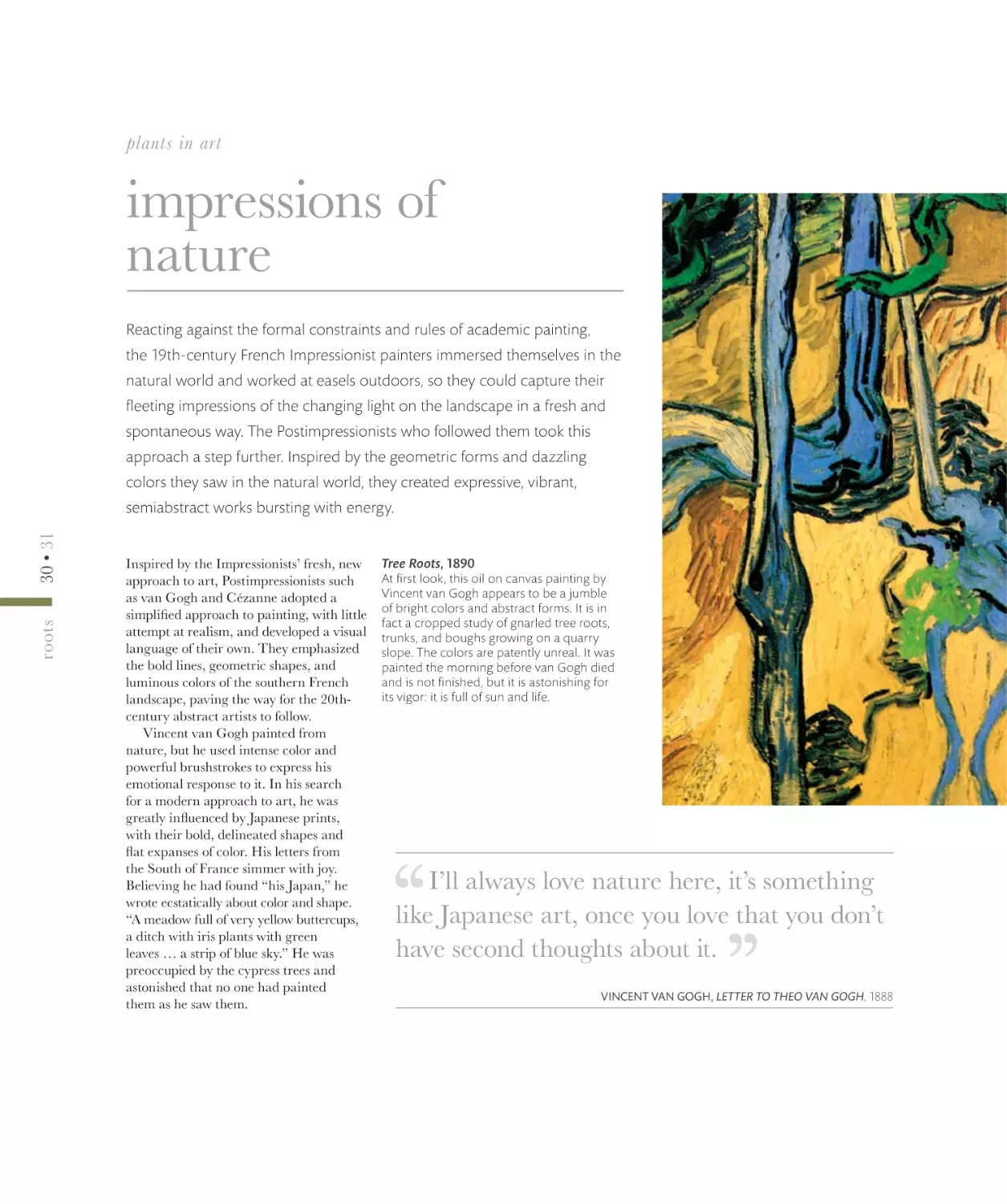
Tree Roots, 1890
At first look, this oil on canvas painting by
Vincent van Gogh appears to be a jumble
of bright colors and abstract forms. It is in
fact a cropped study of gnarled tree roots,
trunks, and boughs growing on a quarry
slope. The colors are patently unreal. It was
painted the morning before van Gogh died
and is not finished, but it is astonishing for
its vigor: it is full of sun and life.

I’ll always love nature here, it’s something
like Japanese art, once you love that you don’t
have second thoughts about it.
VINCENT VAN GOGH, LETTER TO THEO VAN GOGH, 1888

Japanese influence
Cypress Trees, a polychrome and
gold-leaf screen, was painted
c. 1590 by Kanō Eitoku, a major
artist of the Kanō school of
Japanese painting. The cropped
composition; the swirling,
expressive use of line; and the
flat expanses of strong color are
typical of the Japanese style of
art that influenced van Gogh.

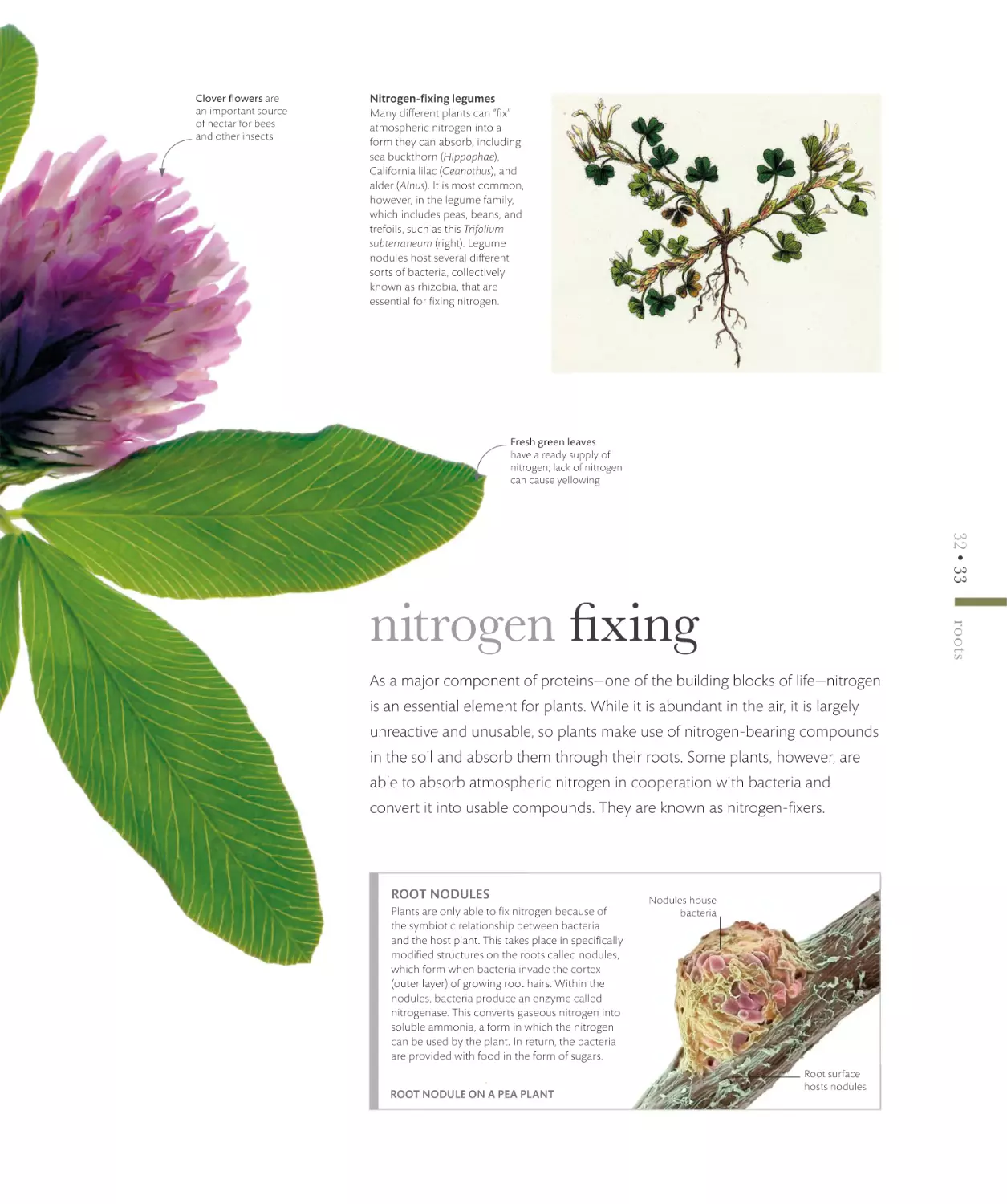
Clover’s three-leaflet
foliage is reflected in
its Latin name, Trifolium

Clover stems and
foliage provide
useful protein for
grazing animals

Enriching the soil
Red clover (Trifolium pratense) is grown by farmers
as a cover crop, in order to protect bare soil from
erosion and nutrient depletion during the winter.
Because it is able to harness nitrogen, clover grows
vigorously. In spring, it is plowed back into the soil,
enriching the soil with nitrogen. These benefical
properties make it ideal in crop-rotation systems.

Clover flowers are
an important source
of nectar for bees
and other insects

Nitrogen-fixing legumes
Many different plants can “fix”
atmospheric nitrogen into a
form they can absorb, including
sea buckthorn (Hippophae),
California lilac (Ceanothus), and
alder (Alnus). It is most common,
however, in the legume family,
which includes peas, beans, and
trefoils, such as this Trifolium
subterraneum (right). Legume
nodules host several different
sorts of bacteria, collectively
known as rhizobia, that are
essential for fixing nitrogen.

Fresh green leaves
have a ready supply of
nitrogen; lack of nitrogen
can cause yellowing

32 • 33
roots

nitrogen fixing
As a major component of proteins—one of the building blocks of life—nitrogen
is an essential element for plants. While it is abundant in the air, it is largely
unreactive and unusable, so plants make use of nitrogen-bearing compounds
in the soil and absorb them through their roots. Some plants, however, are
able to absorb atmospheric nitrogen in cooperation with bacteria and
convert it into usable compounds. They are known as nitrogen-fixers.

ROOT NODULES
Plants are only able to fix nitrogen because of
the symbiotic relationship between bacteria
and the host plant. This takes place in specifically
modified structures on the roots called nodules,
which form when bacteria invade the cortex
(outer layer) of growing root hairs. Within the
nodules, bacteria produce an enzyme called
nitrogenase. This converts gaseous nitrogen into
soluble ammonia, a form in which the nitrogen
can be used by the plant. In return, the bacteria
are provided with food in the form of sugars.

ROOT NODULE ON A PEA PLANT

Nodules house
bacteria

Root surface
hosts nodules

Amanita muscaria

the fly agaric
It is impossible to talk about plants without mentioning fungi. Most plants
have evolved a symbiotic relationship with certain types of fungi, known
as mycorrhizae, which include the fly agaric. This relationship gives plants

roots

34 • 35

access to extra water and nutrients in exchange for carbohydrates.
The fly agaric fungus is native to much of
the northern hemisphere and is spreading
throughout the southern hemisphere as
well. All that most people ever see of this
fungus is the colorful fruiting body, or
mushroom. Its umbrellalike cap is bright
red to orange-yellow and usually studded
with white warts. After releasing its
spores, the mushroom rots away.
Through its main underground body,
the mycelium, the fly agaric plays a vital
role in the ecology of coniferous and
deciduous woodlands. This sprawling
mass of hairlike structures (hyphae),
spread throughout the soil, can form
symbiotic (beneficial) relationships with
the roots of a huge variety of trees,
including pines, spruces, cedars, and
birches. Whereas some fungi penetrate
tree root cells, the fly agaric forms a
sheath that covers the roots. The sheath
not only protects the roots from infectious

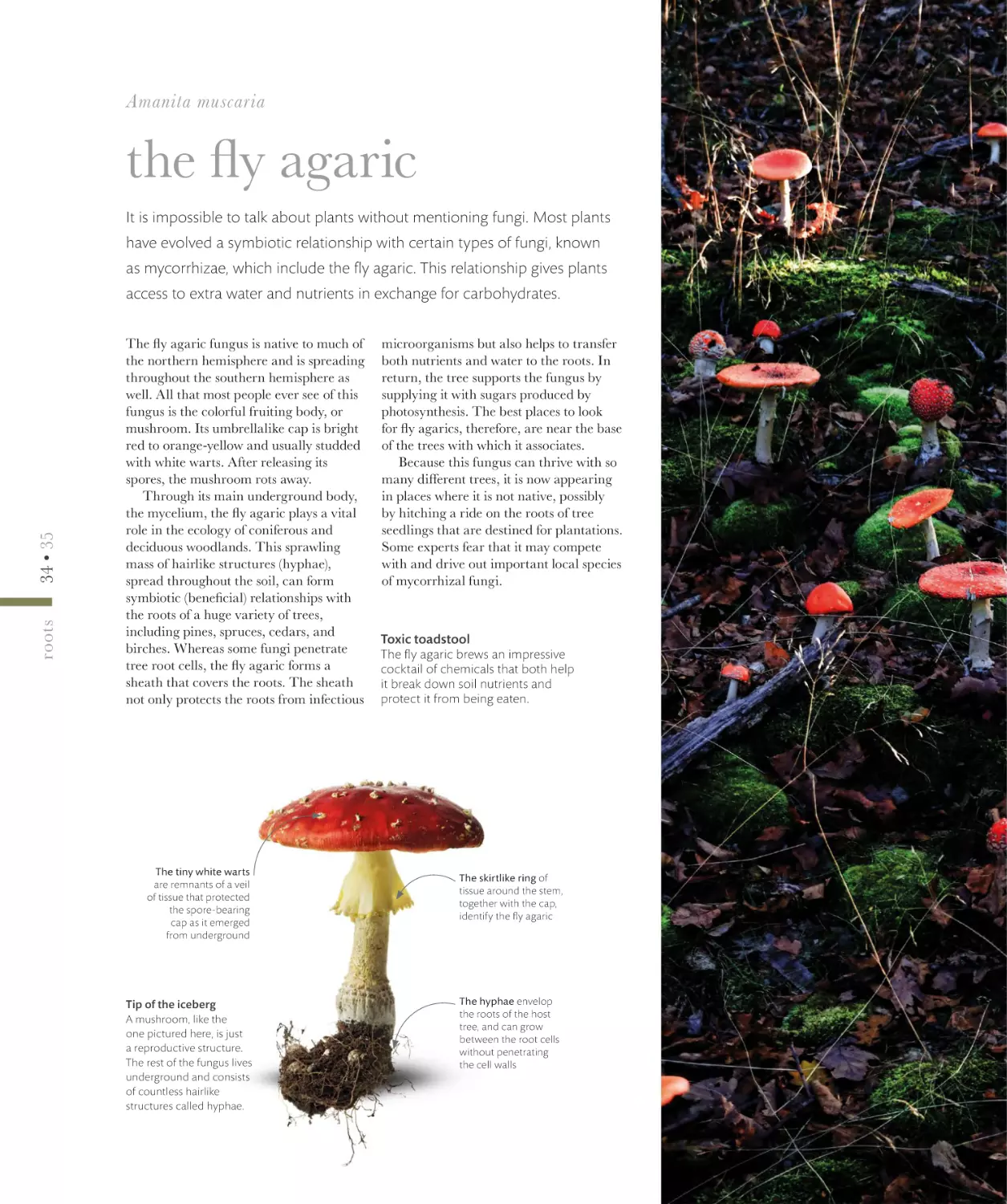
The tiny white warts
are remnants of a veil
of tissue that protected
the spore-bearing
cap as it emerged
from underground

Tip of the iceberg
A mushroom, like the
one pictured here, is just
a reproductive structure.
The rest of the fungus lives
underground and consists
of countless hairlike
structures called hyphae.

microorganisms but also helps to transfer
both nutrients and water to the roots. In
return, the tree supports the fungus by
supplying it with sugars produced by
photosynthesis. The best places to look
for fly agarics, therefore, are near the base
of the trees with which it associates.
Because this fungus can thrive with so
many different trees, it is now appearing
in places where it is not native, possibly
by hitching a ride on the roots of tree
seedlings that are destined for plantations.
Some experts fear that it may compete
with and drive out important local species
of mycorrhizal fungi.

Toxic toadstool
The fly agaric brews an impressive
cocktail of chemicals that both help
it break down soil nutrients and
protect it from being eaten.

The skirtlike ring of
tissue around the stem,
together with the cap,
identify the fly agaric

The hyphae envelop
the roots of the host
tree, and can grow
between the root cells
without penetrating
the cell walls

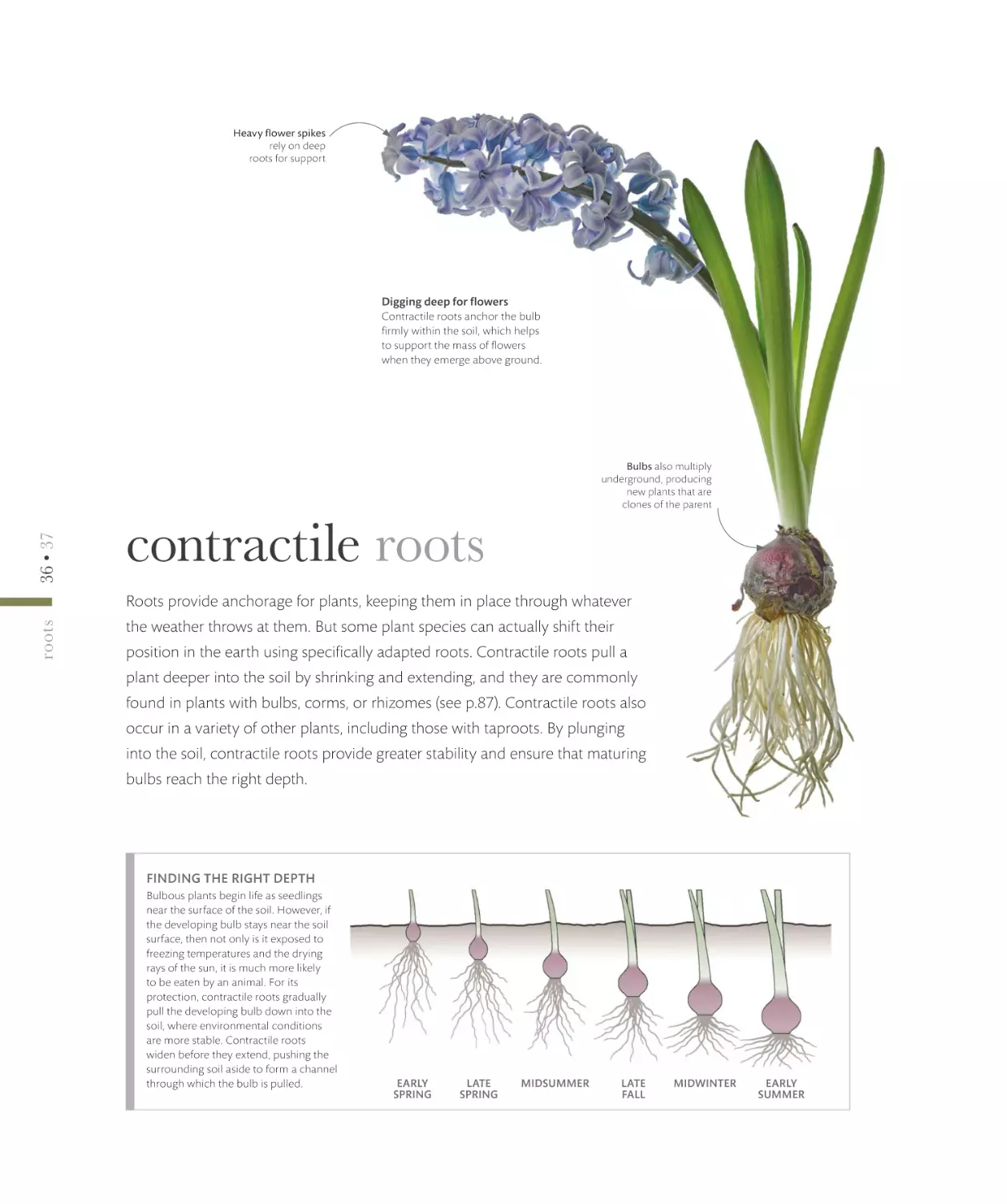
Heavy flower spikes
rely on deep
roots for support

Digging deep for flowers

36 • 37

Contractile roots anchor the bulb
firmly within the soil, which helps
to support the mass of flowers
when they emerge above ground.

Bulbs also multiply
underground, producing
new plants that are
clones of the parent

contractile roots

roots

Roots provide anchorage for plants, keeping them in place through whatever
the weather throws at them. But some plant species can actually shift their
position in the earth using specifically adapted roots. Contractile roots pull a
plant deeper into the soil by shrinking and extending, and they are commonly
found in plants with bulbs, corms, or rhizomes (see p.87). Contractile roots also
occur in a variety of other plants, including those with taproots. By plunging
into the soil, contractile roots provide greater stability and ensure that maturing
bulbs reach the right depth.

FINDING THE RIGHT DEPTH
Bulbous plants begin life as seedlings
near the surface of the soil. However, if
the developing bulb stays near the soil
surface, then not only is it exposed to
freezing temperatures and the drying
rays of the sun, it is much more likely
to be eaten by an animal. For its
protection, contractile roots gradually
pull the developing bulb down into the
soil, where environmental conditions
are more stable. Contractile roots
widen before they extend, pushing the
surrounding soil aside to form a channel
through which the bulb is pulled.

EARLY
SPRING

LATE
SPRING

MIDSUMMER

LATE
FALL

MIDWINTER

EARLY
SUMMER

Surviving drought at depth
Hyacinths and many bulbous
plants live in seasonally dry
regions, where spring rainfall
is followed by long summer
droughts. Contractile roots
pull bulbs deeper into the soil,
where temperatures are cooler
and they are less vulnerable to
desiccation. Spring-flowering
bulbs remain dry throughout
the summer and their roots
may shrivel entirely. When
winter rains arrive, the roots
regrow and the plant is ready
to flower the following spring.
Some feeding roots
thicken and develop into
contractile roots as the
bulb becomes dormant
Contractile roots
work by shortening some
of the cells of the cortex
and widening others

The root surface wrinkles
when the roots contract

Feeding roots sustain
the plant throughout the
growing season, but most
die back after flowering

38 • 39
roots

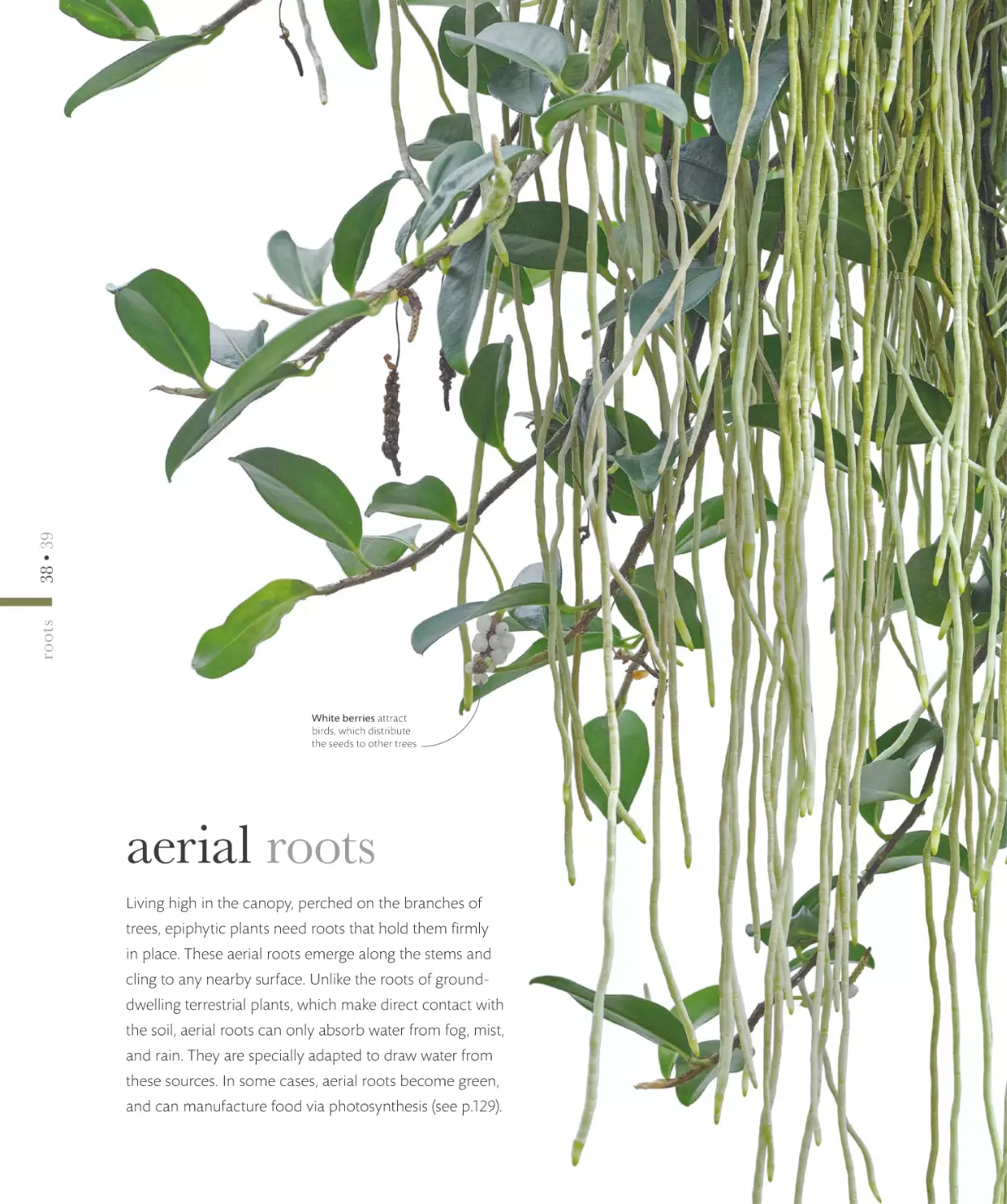
White berries attract
birds, which distribute
the seeds to other trees

aerial roots
Living high in the canopy, perched on the branches of
trees, epiphytic plants need roots that hold them firmly
in place. These aerial roots emerge along the stems and
cling to any nearby surface. Unlike the roots of grounddwelling terrestrial plants, which make direct contact with
the soil, aerial roots can only absorb water from fog, mist,
and rain. They are specially adapted to draw water from
these sources. In some cases, aerial roots become green,
and can manufacture food via photosynthesis (see p.129).

Leaves of epiphytes
receive much more
sunlight than those
belonging to plants
on the forest floor

Treetop traveler
The pearl laceleaf (Anthurium scandens) is
an epiphytic plant that climbs along the
branches of trees, sending out a profusion
of aerial roots and greatly expanding its
territory. The large mass of roots not only
keeps the plant in place, but also increases
the amount of water it can absorb.

AERIAL ROOTS AND WATER
All roots are surrounded by a protective epidermis,
but in some aerial roots, this is many layers thick.
Known as velamen, it rapidly absorbs moisture and
becomes transparent when wet, allowing any green
cells under it to receive sunlight and photosynthesize.
Velamen also protects these light-sensitive cells
from harmful ultraviolet radiation.

Velamen absorbs
water like a sponge

Aerial roots
appear white
when dry, but
turn green
when moist

Exodermis controls
the flow of water
Cortex cells may
be photosynthetic
Phloem cells
transport food
Xylem cells
transport water
Pith cells
store nutrients

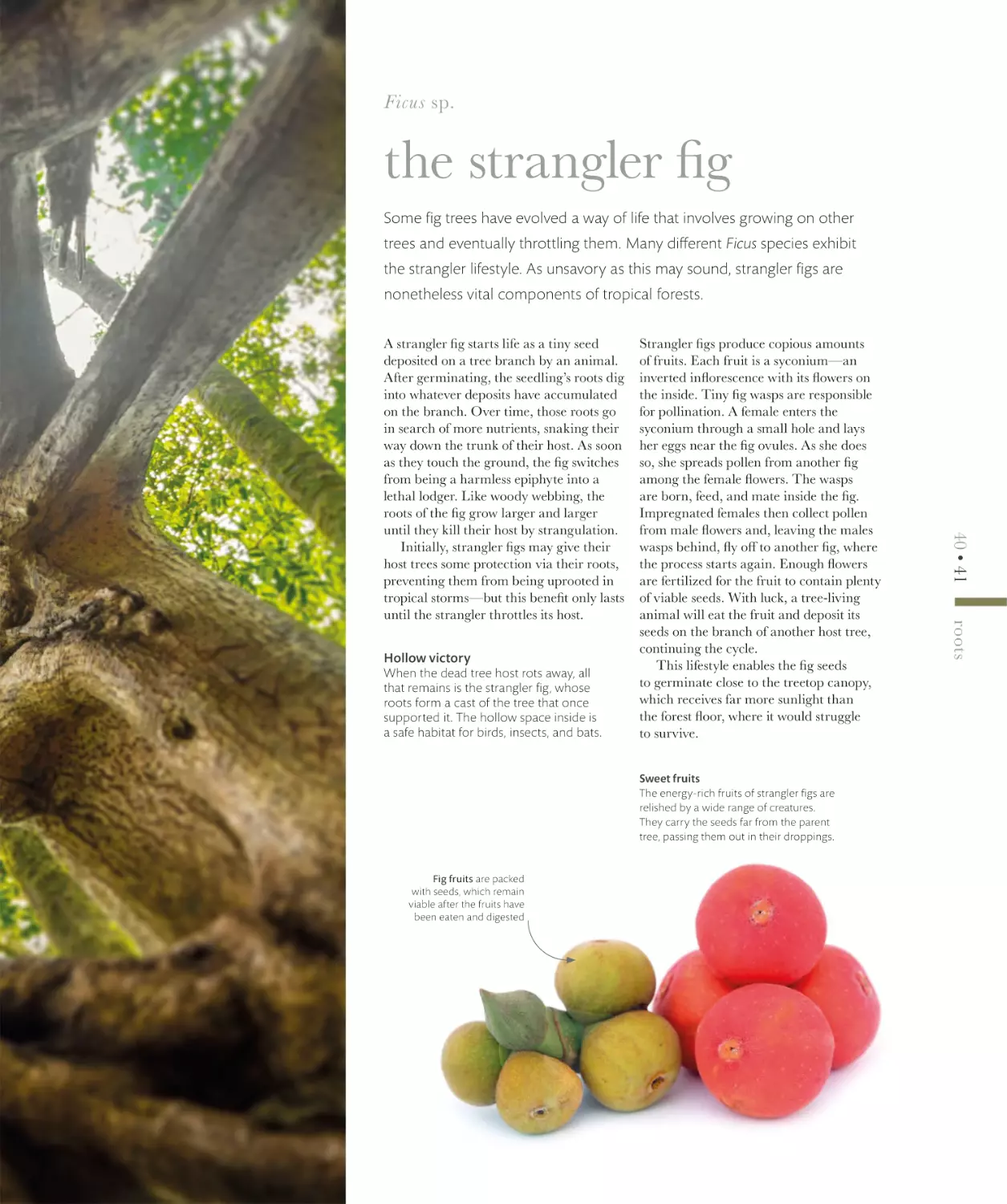
Ficus sp.

the strangler fig
Some fig trees have evolved a way of life that involves growing on other
trees and eventually throttling them. Many different Ficus species exhibit
the strangler lifestyle. As unsavory as this may sound, strangler figs are
nonetheless vital components of tropical forests.

Sweet fruits
The energy-rich fruits of strangler figs are
relished by a wide range of creatures.
They carry the seeds far from the parent
tree, passing them out in their droppings.

Fig fruits are packed
with seeds, which remain
viable after the fruits have
been eaten and digested

roots

Hollow victory
When the dead tree host rots away, all
that remains is the strangler fig, whose
roots form a cast of the tree that once
supported it. The hollow space inside is
a safe habitat for birds, insects, and bats.

Strangler figs produce copious amounts
of fruits. Each fruit is a syconium—an
inverted inflorescence with its flowers on
the inside. Tiny fig wasps are responsible
for pollination. A female enters the
syconium through a small hole and lays
her eggs near the fig ovules. As she does
so, she spreads pollen from another fig
among the female flowers. The wasps
are born, feed, and mate inside the fig.
Impregnated females then collect pollen
from male flowers and, leaving the males
wasps behind, fly off to another fig, where
the process starts again. Enough flowers
are fertilized for the fruit to contain plenty
of viable seeds. With luck, a tree-living
animal will eat the fruit and deposit its
seeds on the branch of another host tree,
continuing the cycle.
This lifestyle enables the fig seeds
to germinate close to the treetop canopy,
which receives far more sunlight than
the forest floor, where it would struggle
to survive.

40 • 41

A strangler fig starts life as a tiny seed
deposited on a tree branch by an animal.
After germinating, the seedling’s roots dig
into whatever deposits have accumulated
on the branch. Over time, those roots go
in search of more nutrients, snaking their
way down the trunk of their host. As soon
as they touch the ground, the fig switches
from being a harmless epiphyte into a
lethal lodger. Like woody webbing, the
roots of the fig grow larger and larger
until they kill their host by strangulation.
Initially, strangler figs may give their
host trees some protection via their roots,
preventing them from being uprooted in
tropical storms—but this benefit only lasts
until the strangler throttles its host.

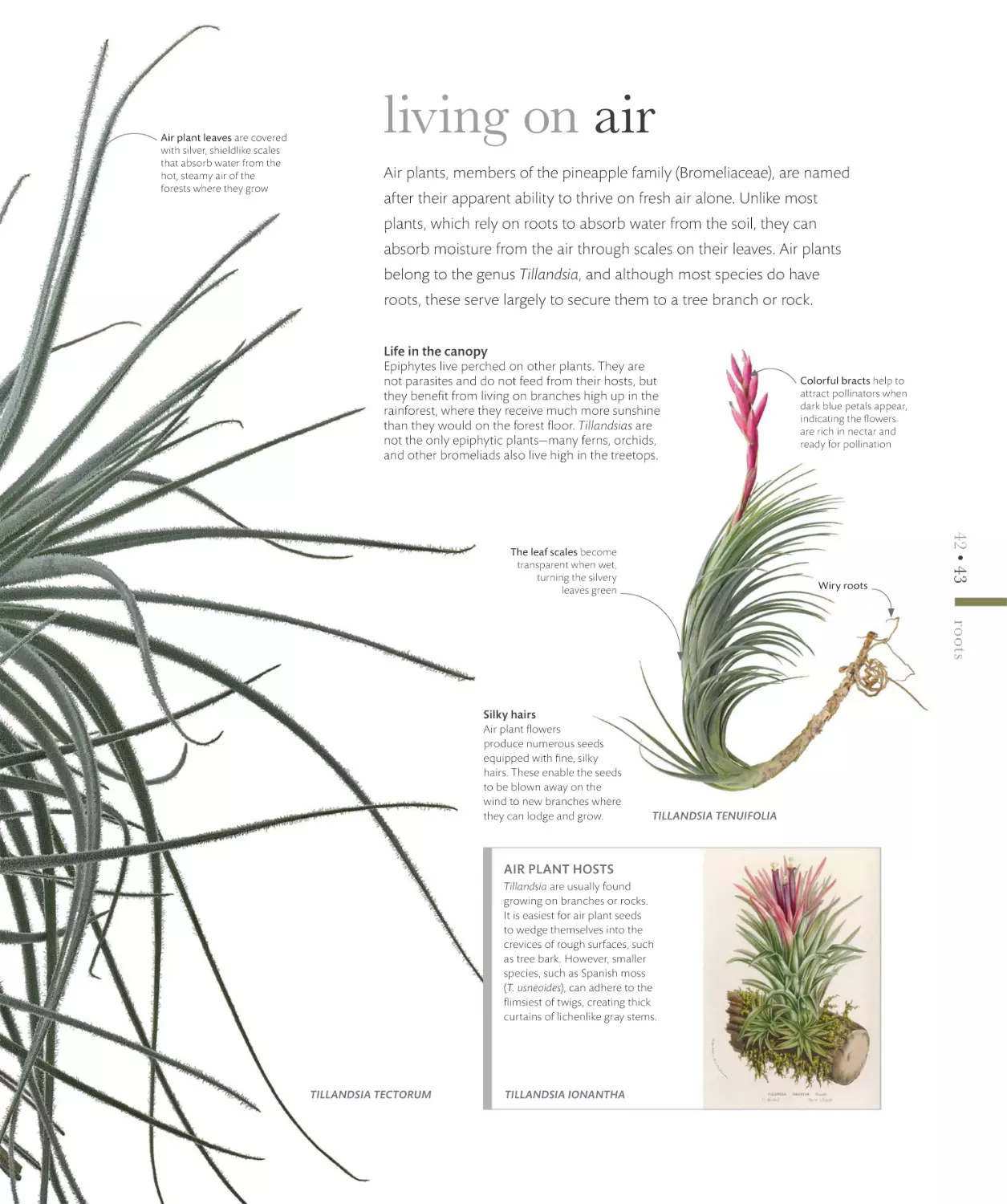
Air plant leaves are covered
with silver, shieldlike scales
that absorb water from the
hot, steamy air of the
forests where they grow

living on air
Air plants, members of the pineapple family (Bromeliaceae), are named
after their apparent ability to thrive on fresh air alone. Unlike most
plants, which rely on roots to absorb water from the soil, they can
absorb moisture from the air through scales on their leaves. Air plants
belong to the genus Tillandsia, and although most species do have
roots, these serve largely to secure them to a tree branch or rock.
Life in the canopy
Epiphytes live perched on other plants. They are
not parasites and do not feed from their hosts, but
they benefit from living on branches high up in the
rainforest, where they receive much more sunshine
than they would on the forest floor. Tillandsias are
not the only epiphytic plants—many ferns, orchids,
and other bromeliads also live high in the treetops.

Wiry roots

42 • 43

The leaf scales become
transparent when wet,
turning the silvery
leaves green

Colorful bracts help to
attract pollinators when
dark blue petals appear,
indicating the flowers
are rich in nectar and
ready for pollination

roots

Silky hairs
Air plant flowers
produce numerous seeds
equipped with fine, silky
hairs. These enable the seeds
to be blown away on the
wind to new branches where
they can lodge and grow.

TILLANDSIA TENUIFOLIA

AIR PLANT HOSTS
Tillandsia are usually found
growing on branches or rocks.
It is easiest for air plant seeds
to wedge themselves into the
crevices of rough surfaces, such
as tree bark. However, smaller
species, such as Spanish moss
(T. usneoides), can adhere to the
flimsiest of twigs, creating thick
curtains of lichenlike gray stems.

TILLANDSIA TECTORUM

TILLANDSIA IONANTHA

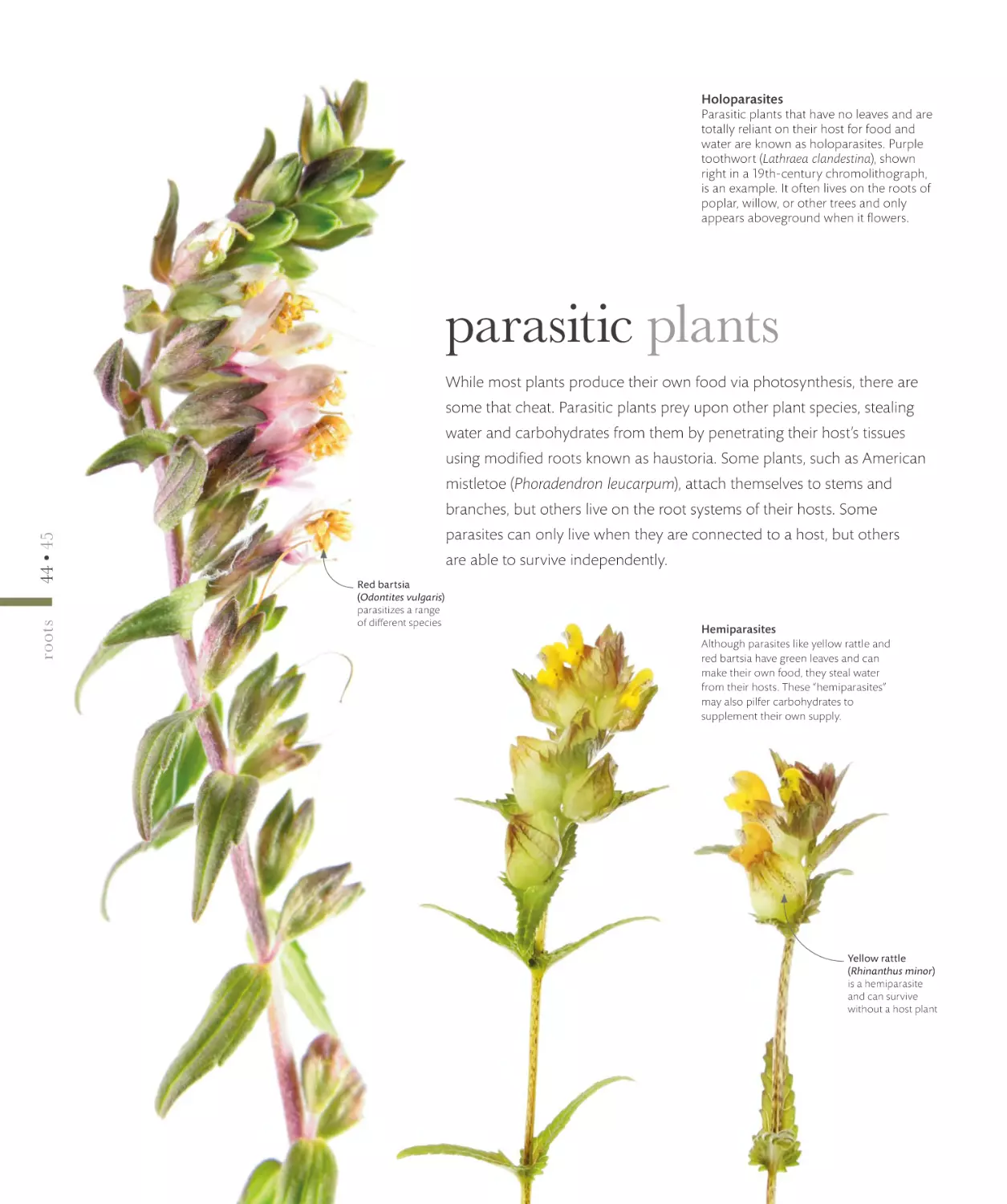
Holoparasites
Parasitic plants that have no leaves and are
totally reliant on their host for food and
water are known as holoparasites. Purple
toothwort (Lathraea clandestina), shown
right in a 19th-century chromolithograph,
is an example. It often lives on the roots of
poplar, willow, or other trees and only
appears aboveground when it flowers.

parasitic plants
While most plants produce their own food via photosynthesis, there are
some that cheat. Parasitic plants prey upon other plant species, stealing
water and carbohydrates from them by penetrating their host’s tissues
using modified roots known as haustoria. Some plants, such as American
mistletoe (Phoradendron leucarpum), attach themselves to stems and

roots

44 • 45

branches, but others live on the root systems of their hosts. Some
parasites can only live when they are connected to a host, but others
are able to survive independently.
Red bartsia
(Odontites vulgaris)
parasitizes a range
of different species

Hemiparasites
Although parasites like yellow rattle and
red bartsia have green leaves and can
make their own food, they steal water
from their hosts. These “hemiparasites”
may also pilfer carbohydrates to
supplement their own supply.

Yellow rattle
(Rhinanthus minor)
is a hemiparasite
and can survive
without a host plant

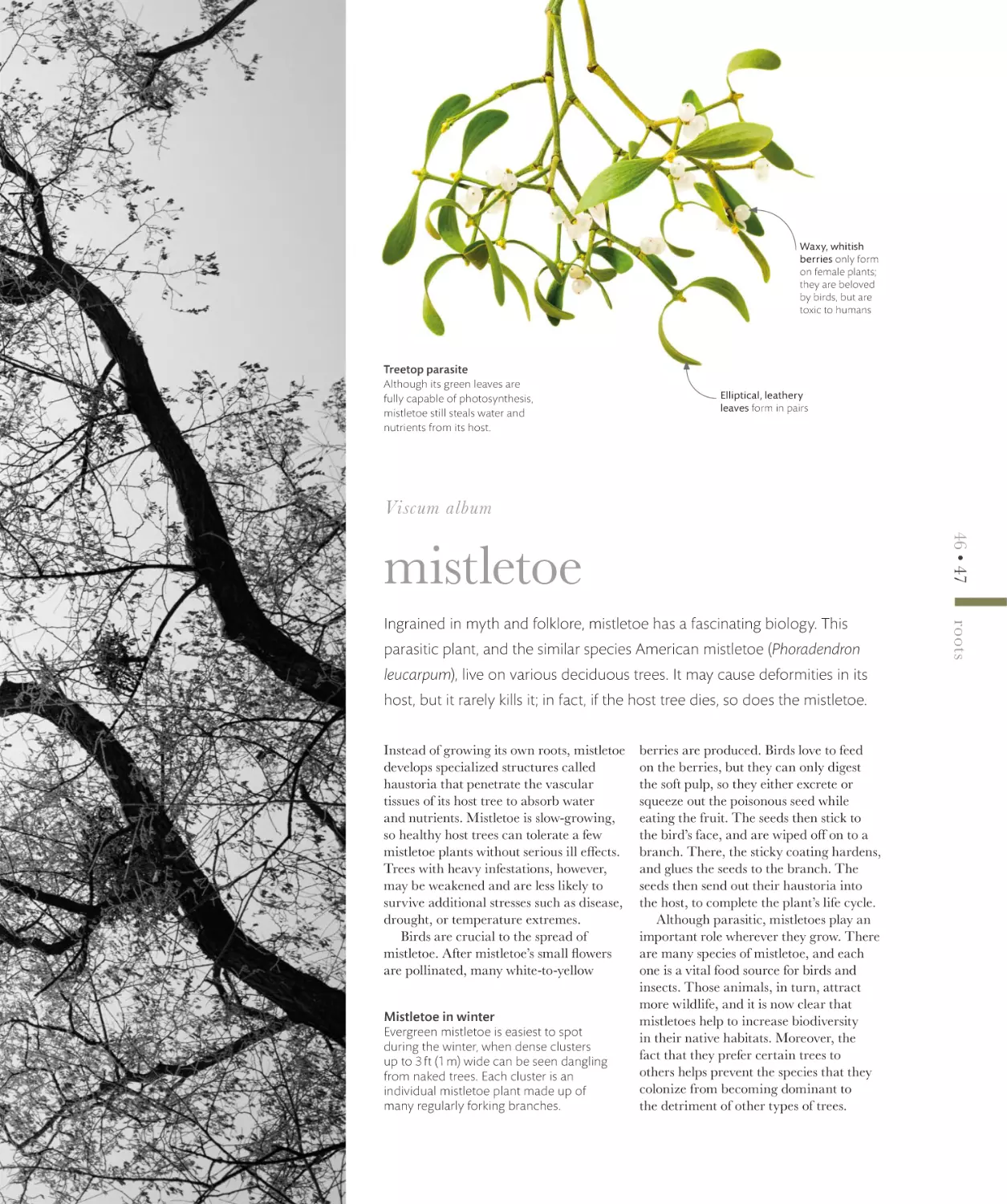
Waxy, whitish
berries only form
on female plants;
they are beloved
by birds, but are
toxic to humans

Treetop parasite
Although its green leaves are
fully capable of photosynthesis,
mistletoe still steals water and
nutrients from its host.

Elliptical, leathery
leaves form in pairs

Viscum album
46 • 47

mistletoe
parasitic plant, and the similar species American mistletoe (Phoradendron
leucarpum), live on various deciduous trees. It may cause deformities in its
host, but it rarely kills it; in fact, if the host tree dies, so does the mistletoe.
Instead of growing its own roots, mistletoe
develops specialized structures called
haustoria that penetrate the vascular
tissues of its host tree to absorb water
and nutrients. Mistletoe is slow-growing,
so healthy host trees can tolerate a few
mistletoe plants without serious ill effects.
Trees with heavy infestations, however,
may be weakened and are less likely to
survive additional stresses such as disease,
drought, or temperature extremes.
Birds are crucial to the spread of
mistletoe. After mistletoe’s small flowers
are pollinated, many white-to-yellow
Mistletoe in winter
Evergreen mistletoe is easiest to spot
during the winter, when dense clusters
up to 3 ft (1 m) wide can be seen dangling
from naked trees. Each cluster is an
individual mistletoe plant made up of
many regularly forking branches.

berries are produced. Birds love to feed
on the berries, but they can only digest
the soft pulp, so they either excrete or
squeeze out the poisonous seed while
eating the fruit. The seeds then stick to
the bird’s face, and are wiped off on to a
branch. There, the sticky coating hardens,
and glues the seeds to the branch. The
seeds then send out their haustoria into
the host, to complete the plant’s life cycle.
Although parasitic, mistletoes play an
important role wherever they grow. There
are many species of mistletoe, and each
one is a vital food source for birds and
insects. Those animals, in turn, attract
more wildlife, and it is now clear that
mistletoes help to increase biodiversity
in their native habitats. Moreover, the
fact that they prefer certain trees to
others helps prevent the species that they
colonize from becoming dominant to
the detriment of other types of trees.

roots

Ingrained in myth and folklore, mistletoe has a fascinating biology. This

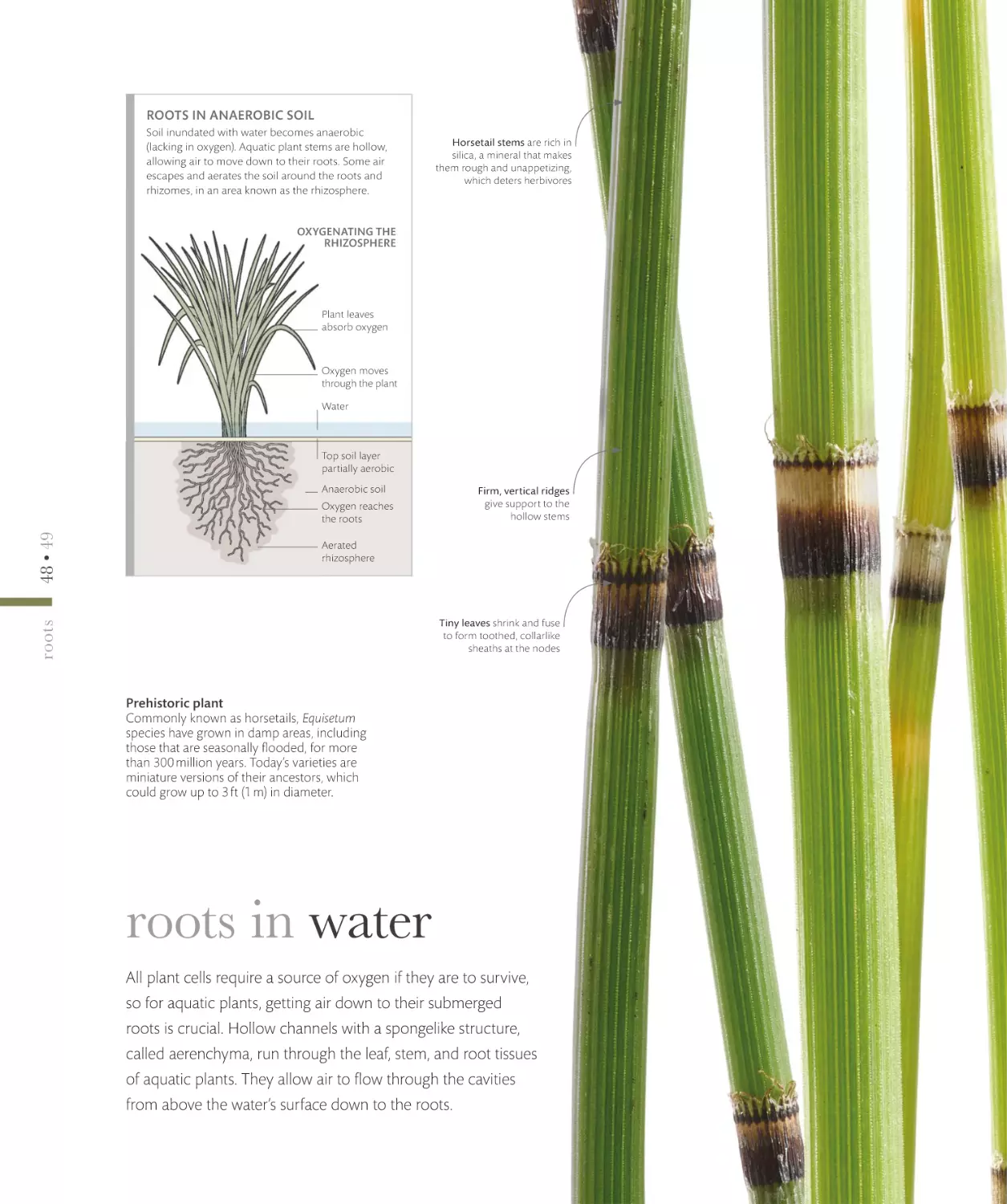
ROOTS IN ANAEROBIC SOIL
Soil inundated with water becomes anaerobic
(lacking in oxygen). Aquatic plant stems are hollow,
allowing air to move down to their roots. Some air
escapes and aerates the soil around the roots and
rhizomes, in an area known as the rhizosphere.

Horsetail stems are rich in
silica, a mineral that makes
them rough and unappetizing,
which deters herbivores

OXYGENATING THE
RHIZOSPHERE

Plant leaves
absorb oxygen

Oxygen moves
through the plant
Water

Top soil layer
partially aerobic
Anaerobic soil

Firm, vertical ridges
give support to the
hollow stems

Aerated
rhizosphere

Tiny leaves shrink and fuse
to form toothed, collarlike
sheaths at the nodes

roots

48 • 49

Oxygen reaches
the roots

Prehistoric plant
Commonly known as horsetails, Equisetum
species have grown in damp areas, including
those that are seasonally flooded, for more
than 300 million years. Today’s varieties are
miniature versions of their ancestors, which
could grow up to 3 ft (1 m) in diameter.

roots in water
All plant cells require a source of oxygen if they are to survive,
so for aquatic plants, getting air down to their submerged
roots is crucial. Hollow channels with a spongelike structure,
called aerenchyma, run through the leaf, stem, and root tissues
of aquatic plants. They allow air to flow through the cavities
from above the water’s surface down to the roots.

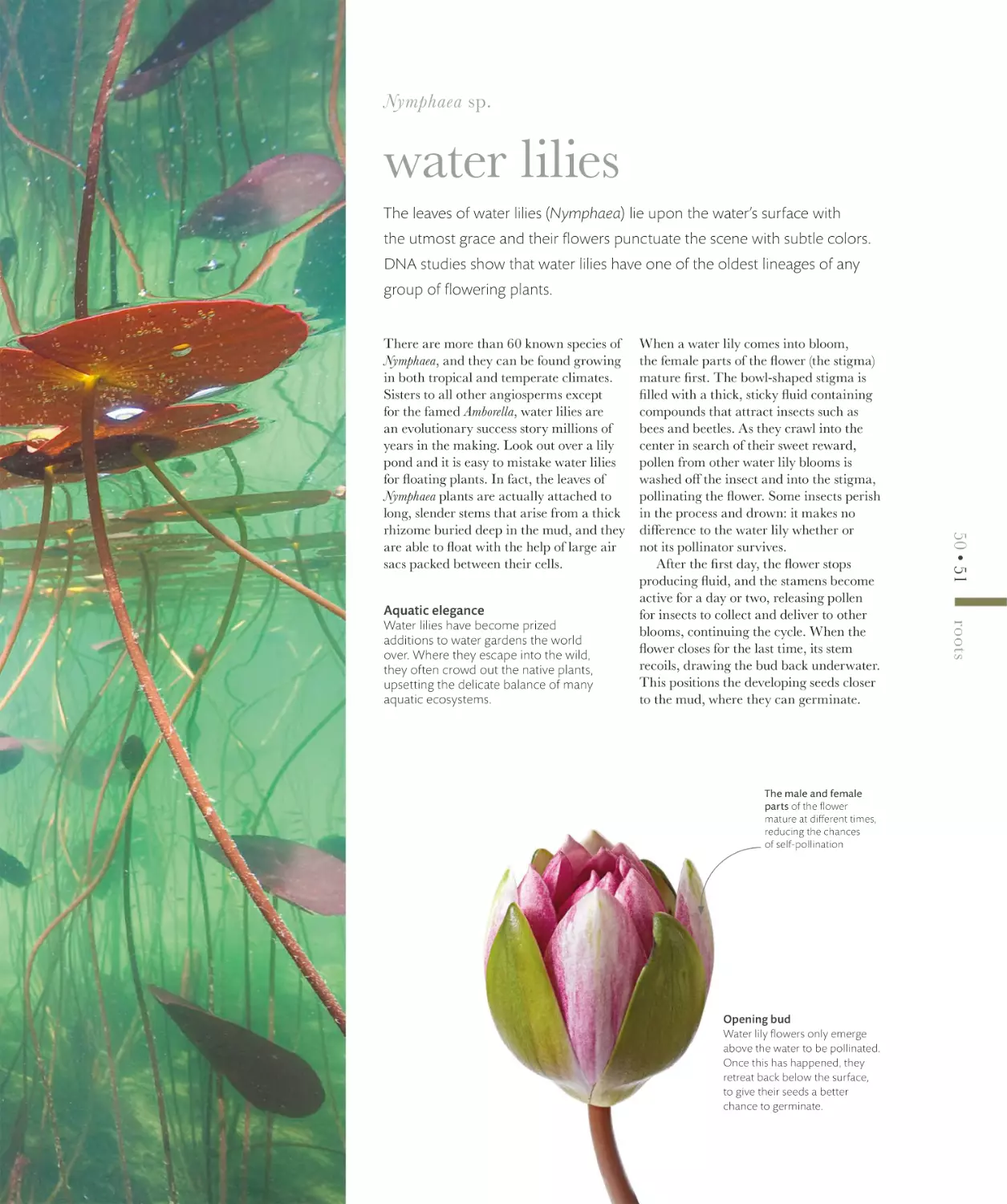
Nymphaea sp.

water lilies
The leaves of water lilies (Nymphaea) lie upon the water’s surface with
the utmost grace and their flowers punctuate the scene with subtle colors.
DNA studies show that water lilies have one of the oldest lineages of any
group of flowering plants.

The male and female
parts of the flower
mature at different times,
reducing the chances
of self-pollination

Opening bud
Water lily flowers only emerge
above the water to be pollinated.
Once this has happened, they
retreat back below the surface,
to give their seeds a better
chance to germinate.

roots

Aquatic elegance
Water lilies have become prized
additions to water gardens the world
over. Where they escape into the wild,
they often crowd out the native plants,
upsetting the delicate balance of many
aquatic ecosystems.

When a water lily comes into bloom,
the female parts of the flower (the stigma)
mature first. The bowl-shaped stigma is
filled with a thick, sticky fluid containing
compounds that attract insects such as
bees and beetles. As they crawl into the
center in search of their sweet reward,
pollen from other water lily blooms is
washed off the insect and into the stigma,
pollinating the flower. Some insects perish
in the process and drown: it makes no
difference to the water lily whether or
not its pollinator survives.
After the first day, the flower stops
producing fluid, and the stamens become
active for a day or two, releasing pollen
for insects to collect and deliver to other
blooms, continuing the cycle. When the
flower closes for the last time, its stem
recoils, drawing the bud back underwater.
This positions the developing seeds closer
to the mud, where they can germinate.

50 • 51

There are more than 60 known species of
Nymphaea, and they can be found growing
in both tropical and temperate climates.
Sisters to all other angiosperms except
for the famed Amborella, water lilies are
an evolutionary success story millions of
years in the making. Look out over a lily
pond and it is easy to mistake water lilies
for floating plants. In fact, the leaves of
Nymphaea plants are actually attached to
long, slender stems that arise from a thick
rhizome buried deep in the mud, and they
are able to float with the help of large air
sacs packed between their cells.

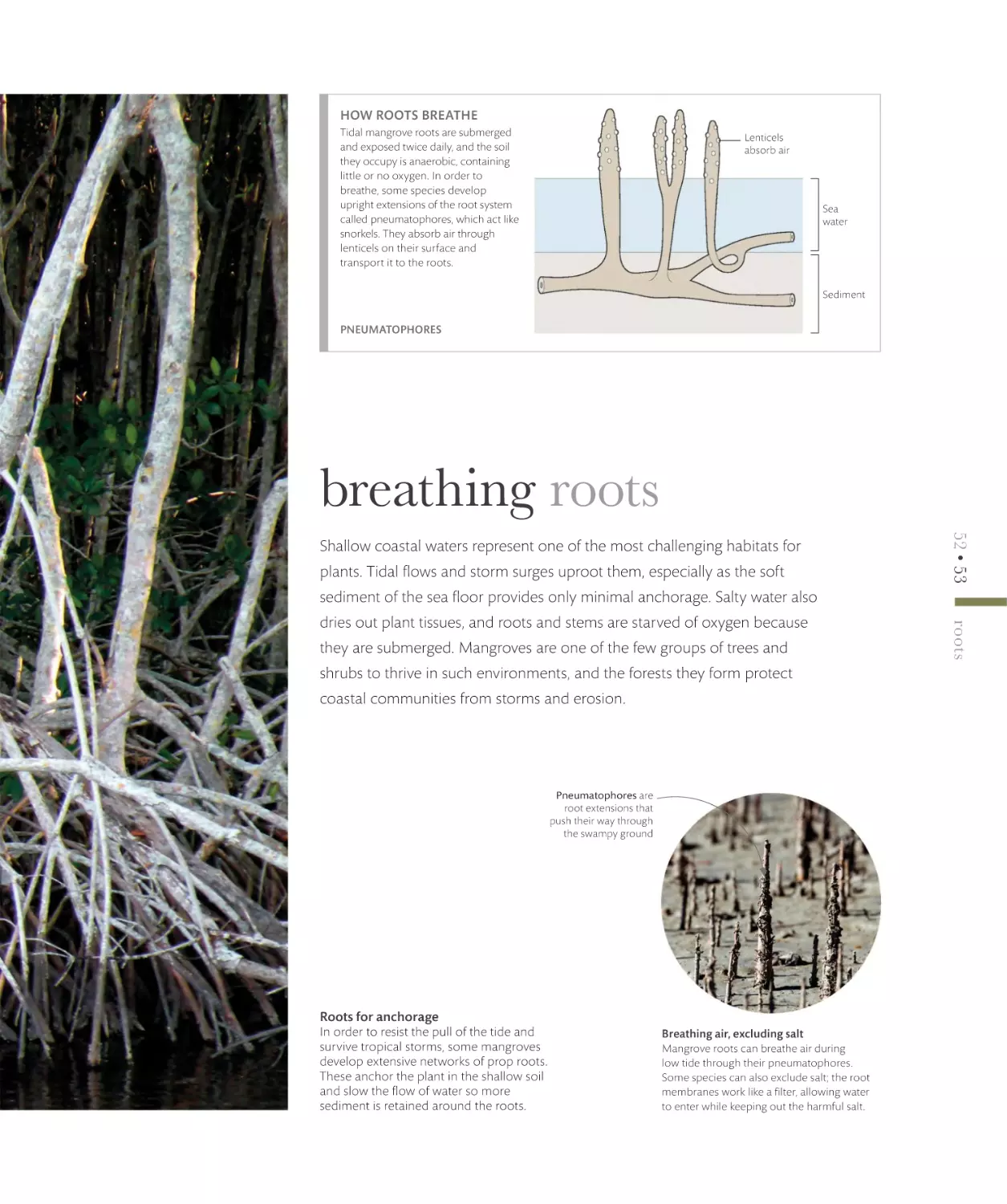
HOW ROOTS BREATHE
Tidal mangrove roots are submerged
and exposed twice daily, and the soil
they occupy is anaerobic, containing
little or no oxygen. In order to
breathe, some species develop
upright extensions of the root system
called pneumatophores, which act like
snorkels. They absorb air through
lenticels on their surface and
transport it to the roots.

Lenticels
absorb air

Sea
water

Sediment

PNEUMATOPHORES

breathing roots
plants. Tidal flows and storm surges uproot them, especially as the soft

52 • 53

Shallow coastal waters represent one of the most challenging habitats for
sediment of the sea floor provides only minimal anchorage. Salty water also
they are submerged. Mangroves are one of the few groups of trees and
shrubs to thrive in such environments, and the forests they form protect
coastal communities from storms and erosion.

Pneumatophores are
root extensions that
push their way through
the swampy ground

Roots for anchorage
In order to resist the pull of the tide and
survive tropical storms, some mangroves
develop extensive networks of prop roots.
These anchor the plant in the shallow soil
and slow the flow of water so more
sediment is retained around the roots.

Breathing air, excluding salt
Mangrove roots can breathe air during
low tide through their pneumatophores.
Some species can also exclude salt; the root
membranes work like a filter, allowing water
to enter while keeping out the harmful salt.

roots

dries out plant tissues, and roots and stems are starved of oxygen because

Rhizophora sp.

mangroves
Living in saline water is an immense challenge for plants, but one that
mangroves have successfully overcome. Of all the trees and shrubs referred
to as mangroves, relatively few are “true mangroves”—meaning those that

roots

54 • 55

live exclusively in salt water habitats, such as the various Rhizophora species.
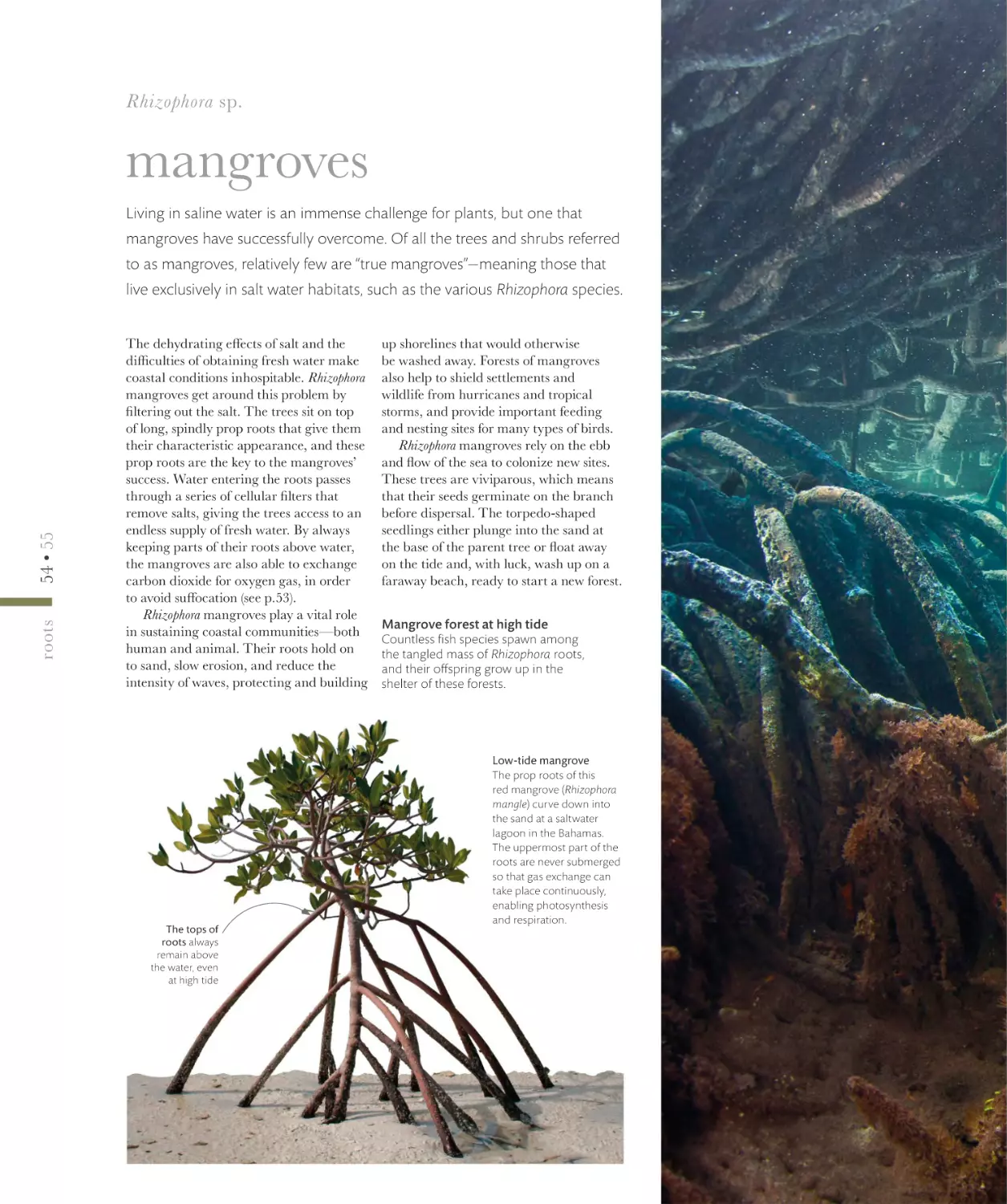
The dehydrating effects of salt and the
difficulties of obtaining fresh water make
coastal conditions inhospitable. Rhizophora
mangroves get around this problem by
filtering out the salt. The trees sit on top
of long, spindly prop roots that give them
their characteristic appearance, and these
prop roots are the key to the mangroves’
success. Water entering the roots passes
through a series of cellular filters that
remove salts, giving the trees access to an
endless supply of fresh water. By always
keeping parts of their roots above water,
the mangroves are also able to exchange
carbon dioxide for oxygen gas, in order
to avoid suffocation (see p.53).
Rhizophora mangroves play a vital role
in sustaining coastal communities—both
human and animal. Their roots hold on
to sand, slow erosion, and reduce the
intensity of waves, protecting and building

up shorelines that would otherwise
be washed away. Forests of mangroves
also help to shield settlements and
wildlife from hurricanes and tropical
storms, and provide important feeding
and nesting sites for many types of birds.
Rhizophora mangroves rely on the ebb
and flow of the sea to colonize new sites.
These trees are viviparous, which means
that their seeds germinate on the branch
before dispersal. The torpedo-shaped
seedlings either plunge into the sand at
the base of the parent tree or float away
on the tide and, with luck, wash up on a
faraway beach, ready to start a new forest.
Mangrove forest at high tide
Countless fish species spawn among
the tangled mass of Rhizophora roots,
and their offspring grow up in the
shelter of these forests.

Low-tide mangrove

The tops of
roots always
remain above
the water, even
at high tide

The prop roots of this
red mangrove (Rhizophora
mangle) curve down into
the sand at a saltwater
lagoon in the Bahamas.
The uppermost part of the
roots are never submerged
so that gas exchange can
take place continuously,
enabling photosynthesis
and respiration.

stems
branches
and

stem. the main body or stalk of a
plant or shrub, usually rising above
ground but occasionally subterranean.
branch. a limb that grows out from
the trunk of a tree or from the main
stem of a plant.

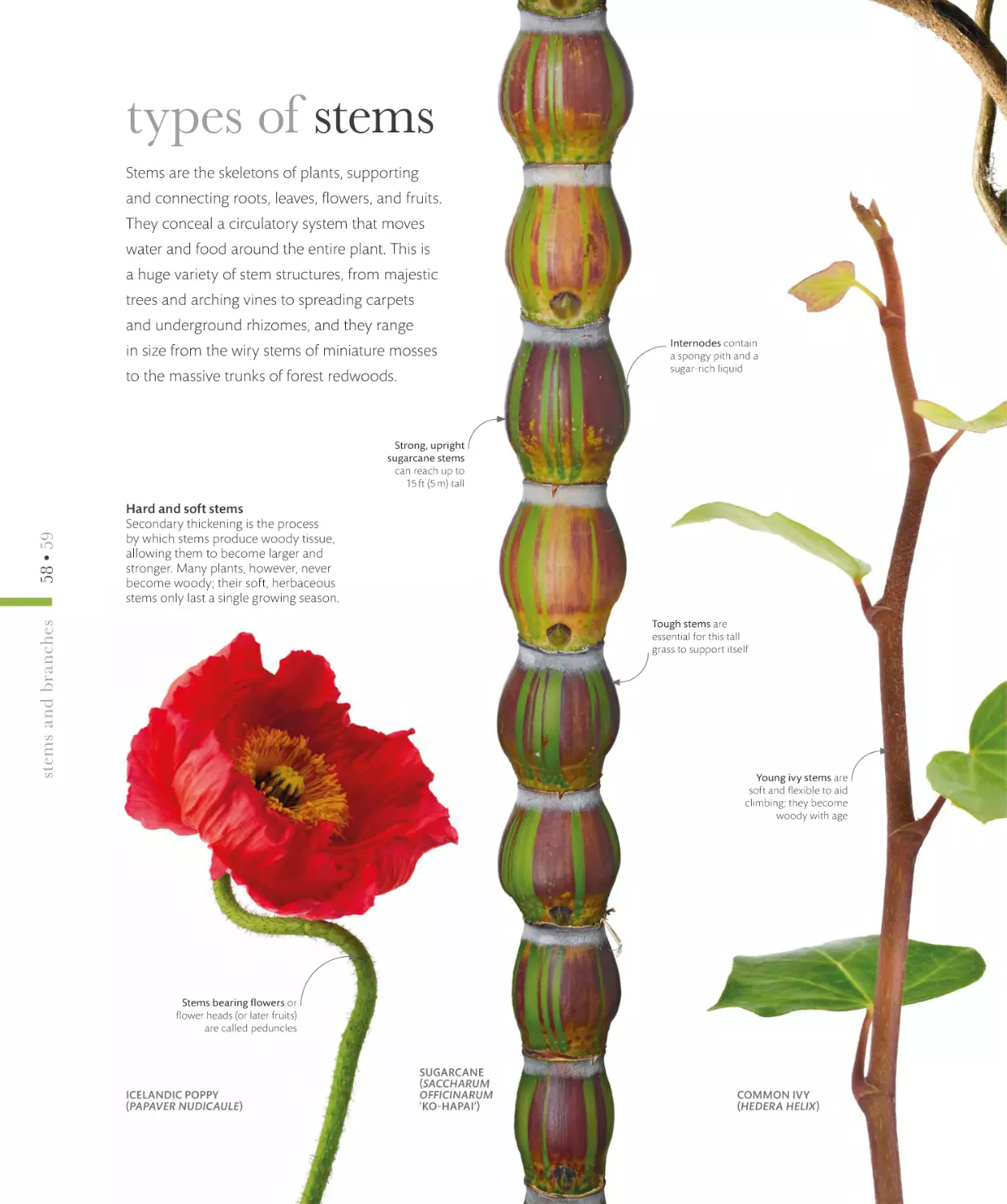
types of stems
Stems are the skeletons of plants, supporting
and connecting roots, leaves, flowers, and fruits.
They conceal a circulatory system that moves
water and food around the entire plant. This is
a huge variety of stem structures, from majestic
trees and arching vines to spreading carpets
and underground rhizomes, and they range
in size from the wiry stems of miniature mosses
to the massive trunks of forest redwoods.

Internodes contain
a spongy pith and a
sugar-rich liquid

Hard and soft stems
Secondary thickening is the process
by which stems produce woody tissue,
allowing them to become larger and
stronger. Many plants, however, never
become woody; their soft, herbaceous
stems only last a single growing season.
Tough stems are
essential for this tall
grass to support itself

stems and branches

58 • 59

Strong, upright
sugarcane stems
can reach up to
15 ft (5 m) tall

Young ivy stems are
soft and flexible to aid
climbing; they become
woody with age

Stems bearing flowers or
flower heads (or later fruits)
are called peduncles

ICELANDIC POPPY
(PAPAVER NUDICAULE)

SUGARCANE
(SACCHARUM
OFFICINARUM
‘KO-HAPAI’)

COMMON IVY
(HEDERA HELIX)

Bark protects woody
stems from damage,
water loss, and
destructive insects

From stems to branches
As the layers of xylem (woody
tissue) build up, the stems
become much stronger and
thicker. The tallest plants in the
world are trees with woody stems.

Woody stems are
durable enough to
survive for many years

The contorted stems of the
corkscrew hazel are a genetic
abnormality, first discovered
growing wild in a hedgerow

CORKSCREW HAZEL
(CORYLUS AVELLANA
‘CONTORTA’)

SILVER BIRCH
(BETULA PENDULA)

stems and branches

60 • 61

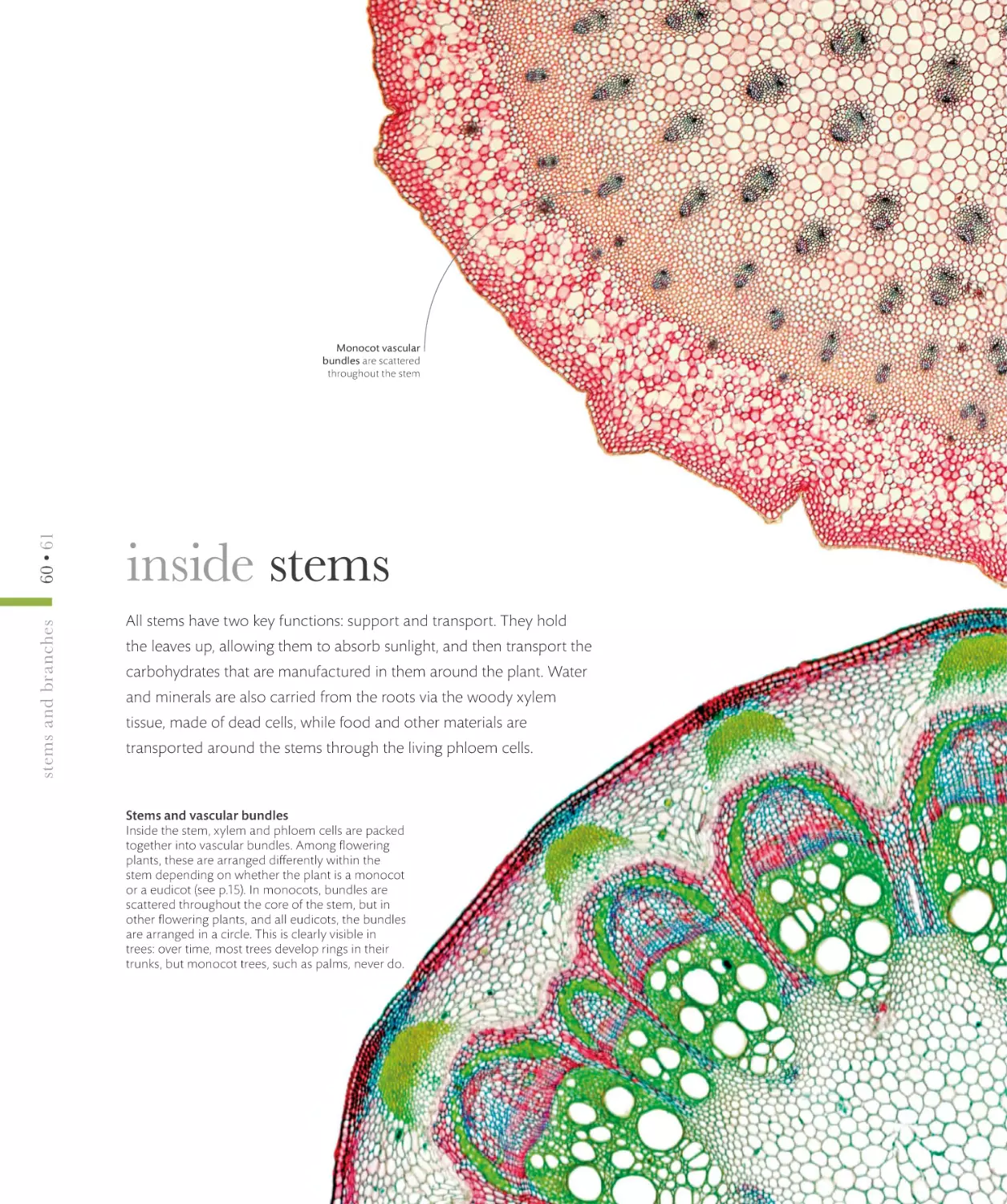
Monocot vascular
bundles are scattered
throughout the stem

inside stems
All stems have two key functions: support and transport. They hold
the leaves up, allowing them to absorb sunlight, and then transport the
carbohydrates that are manufactured in them around the plant. Water
and minerals are also carried from the roots via the woody xylem
tissue, made of dead cells, while food and other materials are
transported around the stems through the living phloem cells.

Stems and vascular bundles
Inside the stem, xylem and phloem cells are packed
together into vascular bundles. Among flowering
plants, these are arranged differently within the
stem depending on whether the plant is a monocot
or a eudicot (see p.15). In monocots, bundles are
scattered throughout the core of the stem, but in
other flowering plants, and all eudicots, the bundles
are arranged in a circle. This is clearly visible in
trees: over time, most trees develop rings in their
trunks, but monocot trees, such as palms, never do.

A thick cuticle surrounds
the outermost cells, or
epidermis, helping to
keep the stem watertight

MONOCOT STEM
RUSCUS ACULEATUS

Eudicot vascular
bundles are arranged in
a ring inside the stem

EUDICOT STEM
CLEMATIS FLAMMULA

Eudicot vascular
bundles have the xylem
(dark green) on the
inside and the phloem
(blue) on the outside

Great Piece of Turf, 1503
Albrecht Dürer‘s meticulous watercolor study of
an everyday clump of grasses and weeds gains its
power from perspective—the viewer is at ground
level with the insects and small creatures that inhabit
the turf. Artfully random and naturalistic against a
plain background, the painting features a range of
perfectly rendered plant species, including cocksfoot,
creeping bent, smooth meadow grass, daisy,
dandelion, germander speedwell, greater plantain,
hound’s-tongue, fool’s watercress, and yarrow.

plants in art

natural renaissance
Throughout the 200 years of the Renaissance, the scope of intellectual
curiosity and human creativity seemed boundless. Major artists studied
linear perspective, and the natural world in order to reproduce plant life

62 • 63

anatomy for sculpture and figure work, mathematics to solve problems of
and landscapes with complete accuracy. Their botanical sketches and

Historically, plants were studied and
illustrated in herbals (see pp.140–141) for
identification, and in the Middle Ages
artists used flowers, such as the lily
(purity), to add symbolic meanings to
religious paintings. These flowers featured
in Italian artist Leonardo da Vinci’s early
works. However, in the late 15th century,
the rediscovery of nature became the
mainspring of Renaissance energy in
Europe, inspiring the work of two giants,
Leonardo in the south and German artist
Albrecht Dürer in the north. Leonardo
underpinned his great paintings with close

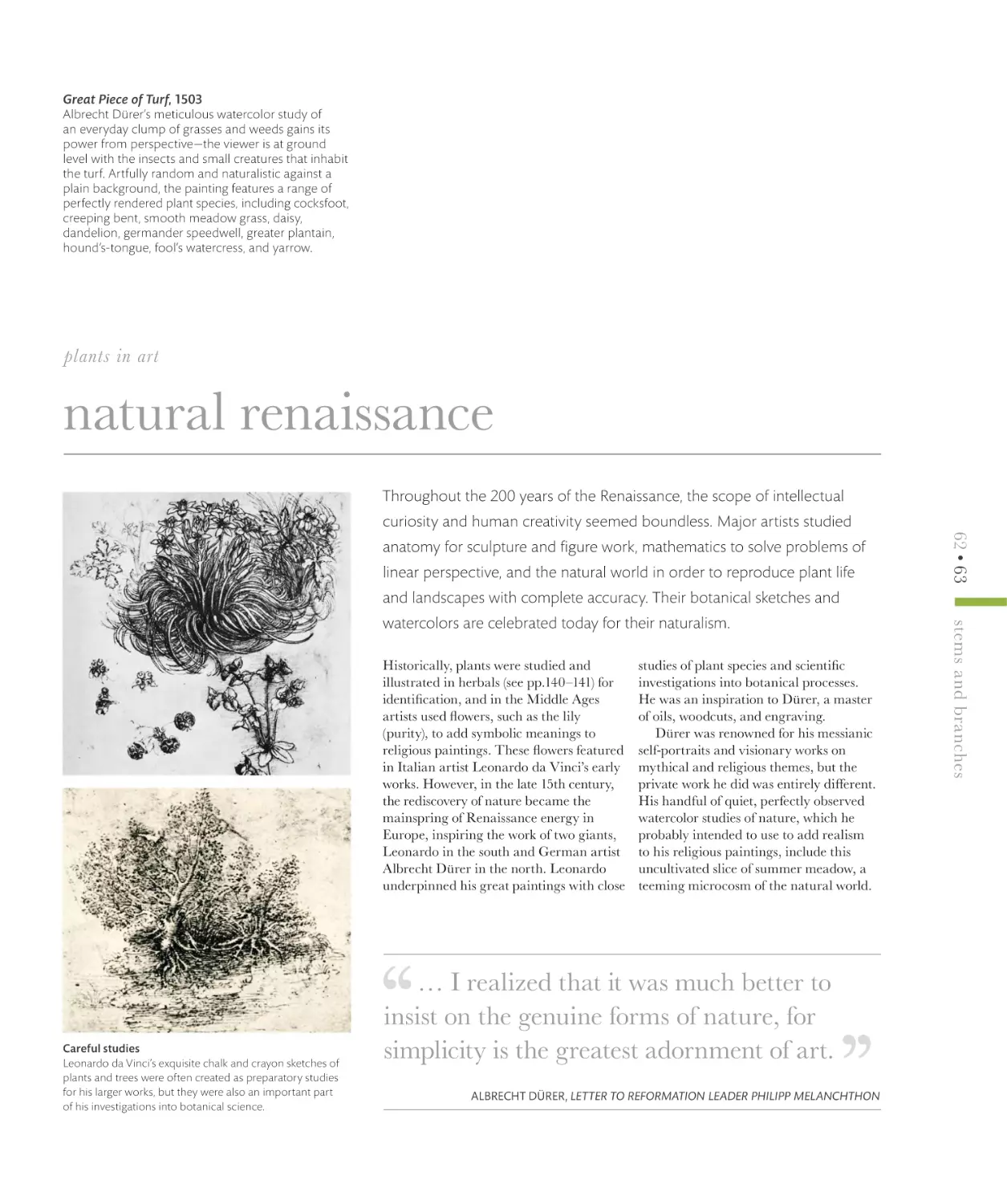
Careful studies
Leonardo da Vinci’s exquisite chalk and crayon sketches of
plants and trees were often created as preparatory studies
for his larger works, but they were also an important part
of his investigations into botanical science.

studies of plant species and scientific
investigations into botanical processes.
He was an inspiration to Dürer, a master
of oils, woodcuts, and engraving.
Dürer was renowned for his messianic
self-portraits and visionary works on
mythical and religious themes, but the
private work he did was entirely different.
His handful of quiet, perfectly observed
watercolor studies of nature, which he
probably intended to use to add realism
to his religious paintings, include this
uncultivated slice of summer meadow, a
teeming microcosm of the natural world.

… I realized that it was much better to
insist on the genuine forms of nature, for
simplicity is the greatest adornment of art.
ALBRECHT DÜRER, LETTER TO REFORMATION LEADER PHILIPP MELANCHTHON

stems and branches

watercolors are celebrated today for their naturalism.

tree trunks
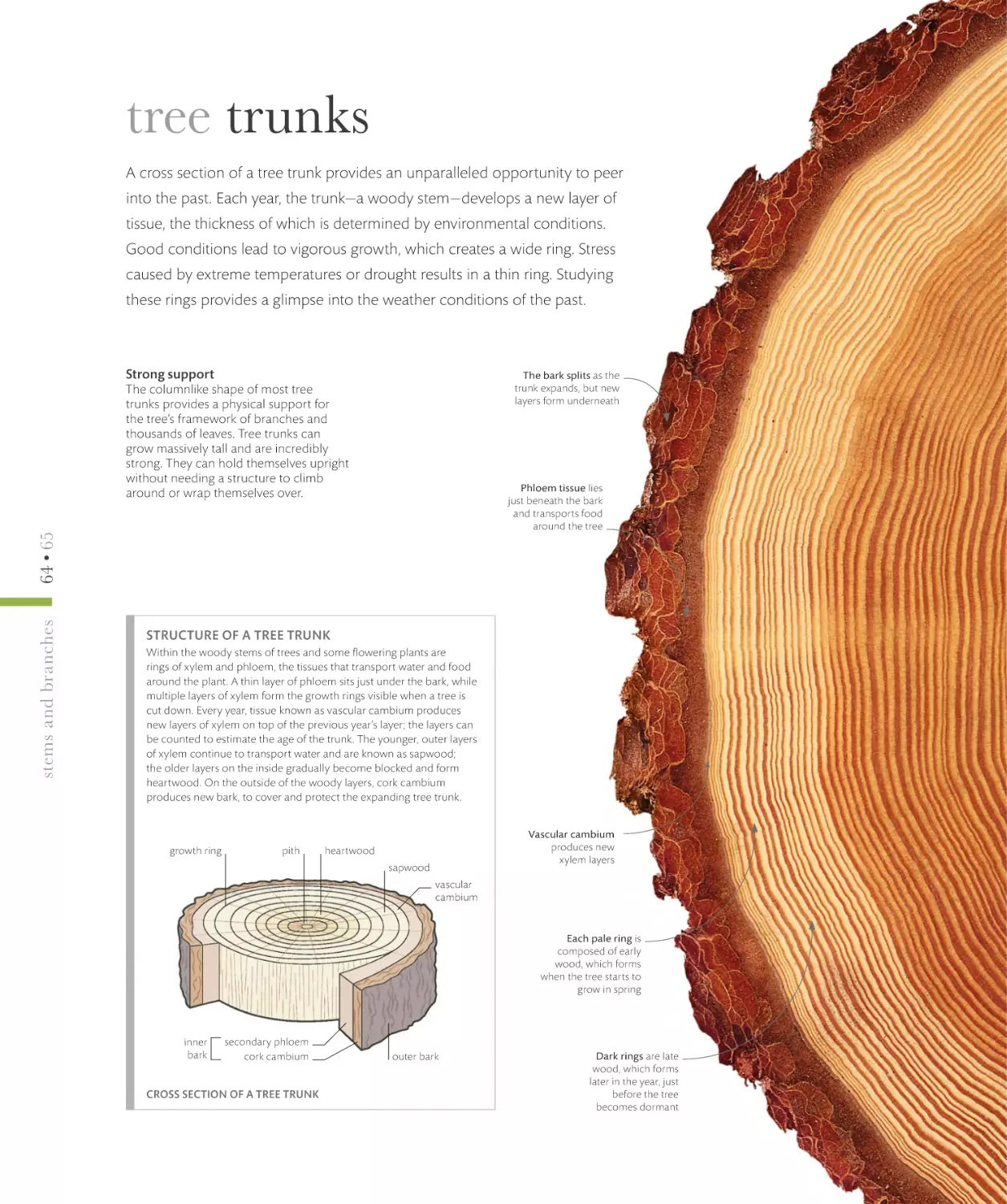
A cross section of a tree trunk provides an unparalleled opportunity to peer
into the past. Each year, the trunk—a woody stem—develops a new layer of
tissue, the thickness of which is determined by environmental conditions.
Good conditions lead to vigorous growth, which creates a wide ring. Stress
caused by extreme temperatures or drought results in a thin ring. Studying
these rings provides a glimpse into the weather conditions of the past.

Strong support
The columnlike shape of most tree
trunks provides a physical support for
the tree’s framework of branches and
thousands of leaves. Tree trunks can
grow massively tall and are incredibly
strong. They can hold themselves upright
without needing a structure to climb
around or wrap themselves over.

The bark splits as the
trunk expands, but new
layers form underneath

stems and branches

64 • 65

Phloem tissue lies
just beneath the bark
and transports food
around the tree

STRUCTURE OF A TREE TRUNK
Within the woody stems of trees and some flowering plants are
rings of xylem and phloem, the tissues that transport water and food
around the plant. A thin layer of phloem sits just under the bark, while
multiple layers of xylem form the growth rings visible when a tree is
cut down. Every year, tissue known as vascular cambium produces
new layers of xylem on top of the previous year’s layer; the layers can
be counted to estimate the age of the trunk. The younger, outer layers
of xylem continue to transport water and are known as sapwood;
the older layers on the inside gradually become blocked and form
heartwood. On the outside of the woody layers, cork cambium
produces new bark, to cover and protect the expanding tree trunk.

growth ring

pith

Vascular cambium
produces new
xylem layers

heartwood
sapwood
vascular
cambium

Each pale ring is
composed of early
wood, which forms
when the tree starts to
grow in spring

inner
bark

secondary phloem
cork cambium

CROSS SECTION OF A TREE TRUNK

outer bark

Dark rings are late
wood, which forms
later in the year, just
before the tree
becomes dormant

CORKY
Quercus suber

STRIATE
Acer pensylvanicum

RIDGED
Castanea sativa

LENTICELLATE
Prunus serrula

SCALY
Pinus sp.

SPINY
Ceiba speciosa

FLAKING
Platanus sp.

PEELING
Eucalyptus gunnii

PEELING IN STRIPS
Carya ovata

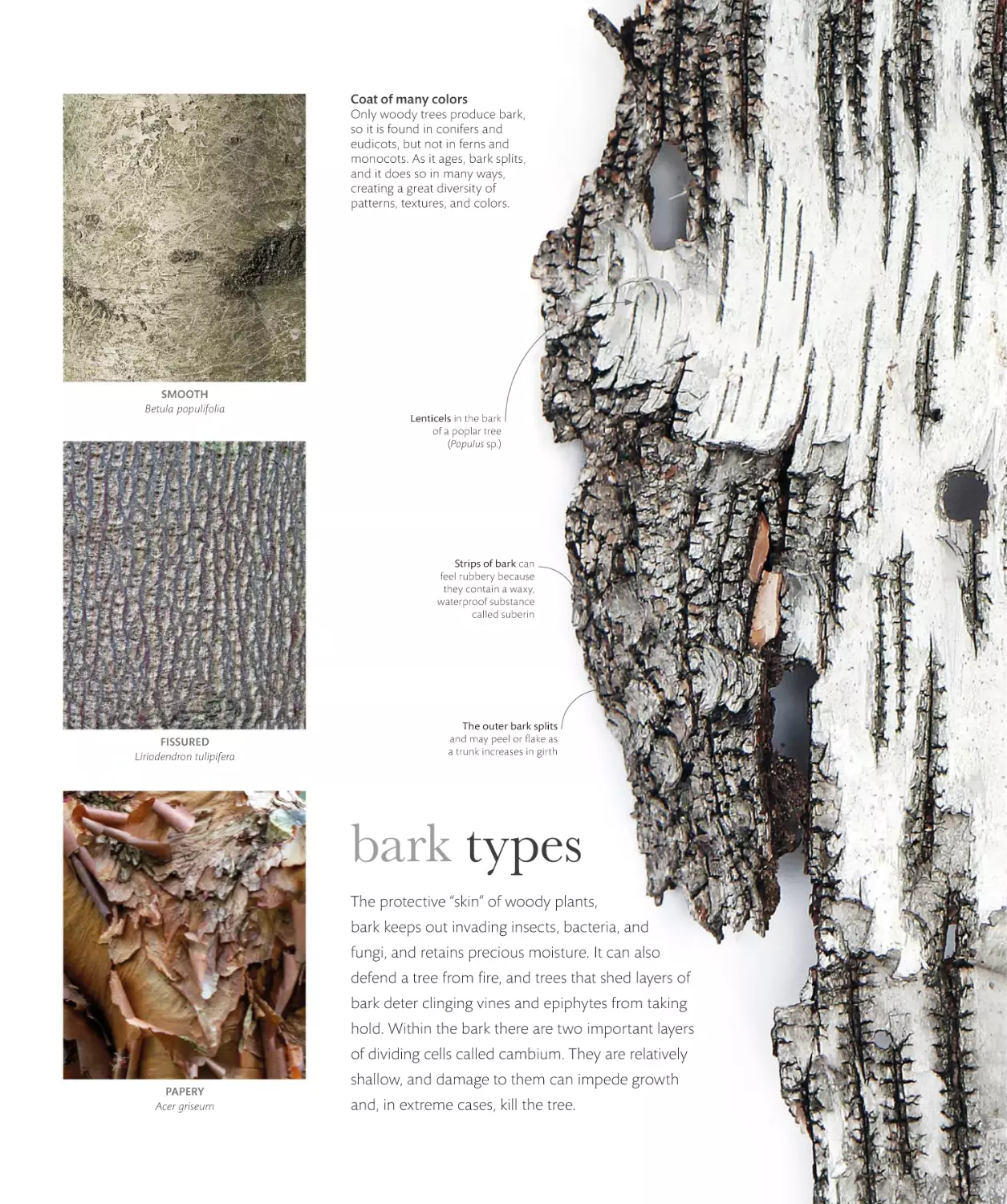
Coat of many colors
Only woody trees produce bark,
so it is found in conifers and
eudicots, but not in ferns and
monocots. As it ages, bark splits,
and it does so in many ways,
creating a great diversity of
patterns, textures, and colors.

SMOOTH
Betula populifolia

Lenticels in the bark
of a poplar tree
(Populus sp.)

Strips of bark can
feel rubbery because
they contain a waxy,
waterproof substance
called suberin

FISSURED
Liriodendron tulipifera

The outer bark splits
and may peel or flake as
a trunk increases in girth

bark types
The protective “skin” of woody plants,
bark keeps out invading insects, bacteria, and
fungi, and retains precious moisture. It can also
defend a tree from fire, and trees that shed layers of
bark deter clinging vines and epiphytes from taking
hold. Within the bark there are two important layers
of dividing cells called cambium. They are relatively
PAPERY
Acer griseum

shallow, and damage to them can impede growth
and, in extreme cases, kill the tree.

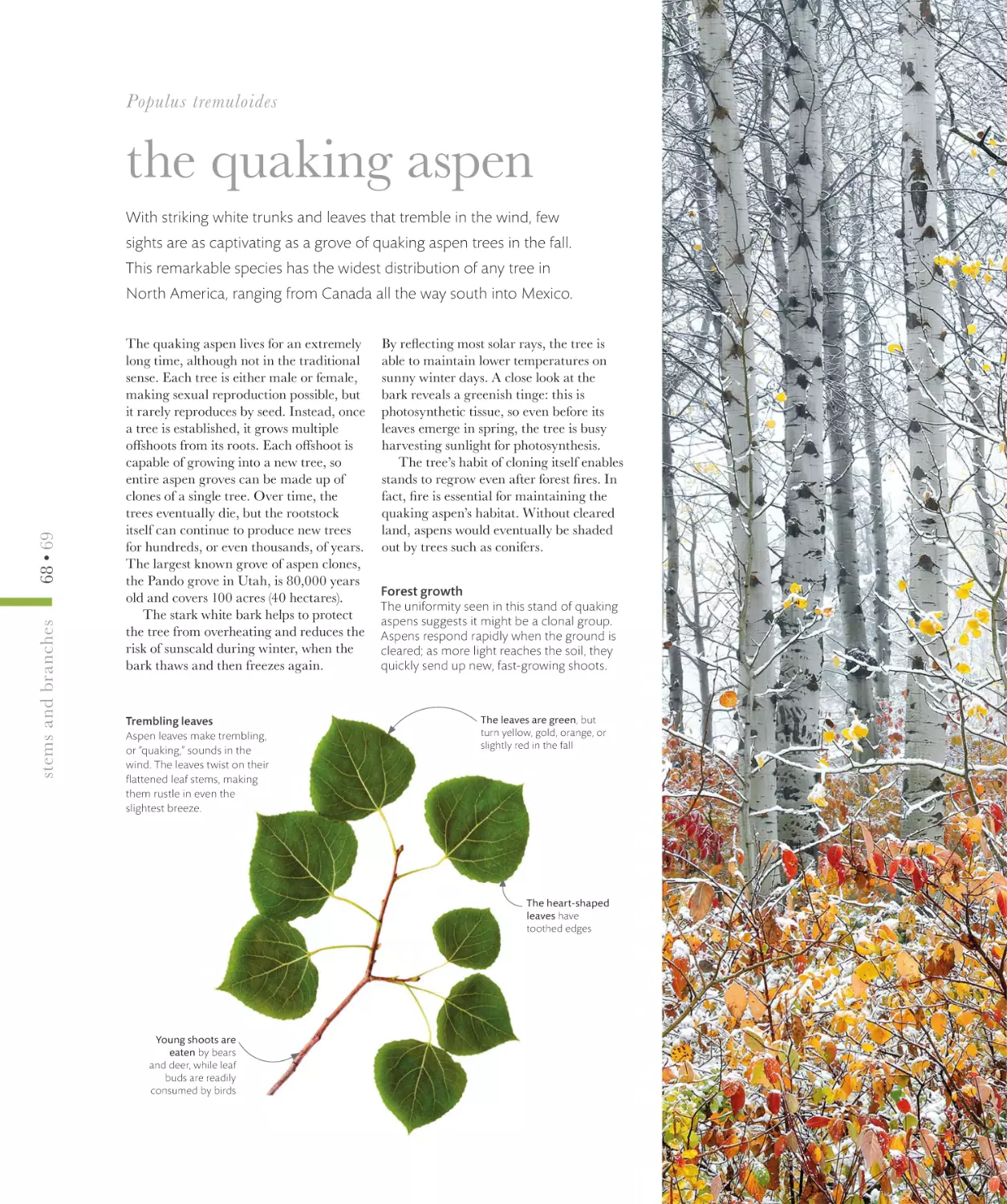
Populus tremuloides

the quaking aspen
With striking white trunks and leaves that tremble in the wind, few
sights are as captivating as a grove of quaking aspen trees in the fall.
This remarkable species has the widest distribution of any tree in

stems and branches

68 • 69

North America, ranging from Canada all the way south into Mexico.
The quaking aspen lives for an extremely
long time, although not in the traditional
sense. Each tree is either male or female,
making sexual reproduction possible, but
it rarely reproduces by seed. Instead, once
a tree is established, it grows multiple
offshoots from its roots. Each offshoot is
capable of growing into a new tree, so
entire aspen groves can be made up of
clones of a single tree. Over time, the
trees eventually die, but the rootstock
itself can continue to produce new trees
for hundreds, or even thousands, of years.
The largest known grove of aspen clones,
the Pando grove in Utah, is 80,000 years
old and covers 100 acres (40 hectares).
The stark white bark helps to protect
the tree from overheating and reduces the
risk of sunscald during winter, when the
bark thaws and then freezes again.

Trembling leaves
Aspen leaves make trembling,
or “quaking,” sounds in the
wind. The leaves twist on their
flattened leaf stems, making
them rustle in even the
slightest breeze.

By reflecting most solar rays, the tree is
able to maintain lower temperatures on
sunny winter days. A close look at the
bark reveals a greenish tinge: this is
photosynthetic tissue, so even before its
leaves emerge in spring, the tree is busy
harvesting sunlight for photosynthesis.
The tree’s habit of cloning itself enables
stands to regrow even after forest fires. In
fact, fire is essential for maintaining the
quaking aspen’s habitat. Without cleared
land, aspens would eventually be shaded
out by trees such as conifers.
Forest growth
The uniformity seen in this stand of quaking
aspens suggests it might be a clonal group.
Aspens respond rapidly when the ground is
cleared; as more light reaches the soil, they
quickly send up new, fast-growing shoots.

The leaves are green, but
turn yellow, gold, orange, or
slightly red in the fall

The heart-shaped
leaves have
toothed edges

Young shoots are
eaten by bears
and deer, while leaf
buds are readily
consumed by birds

BRANCH POSITION AND SHAPE
The position of branches on a tree is
governed by the arrangement of the
new buds, or growing points. Where
buds are arranged alternately along the
stem, so are the resulting branches, and
the tree develops a broad, rounded canopy.
In many conifers, the buds are arranged in
whorls, which means the branches also
develop in whorls. As the lowermost
branches continue to elongate, new ones
develop above. As they are younger, these
branches are also shorter, so the result is
a triangular-shaped tree with the longest
branches at the base.

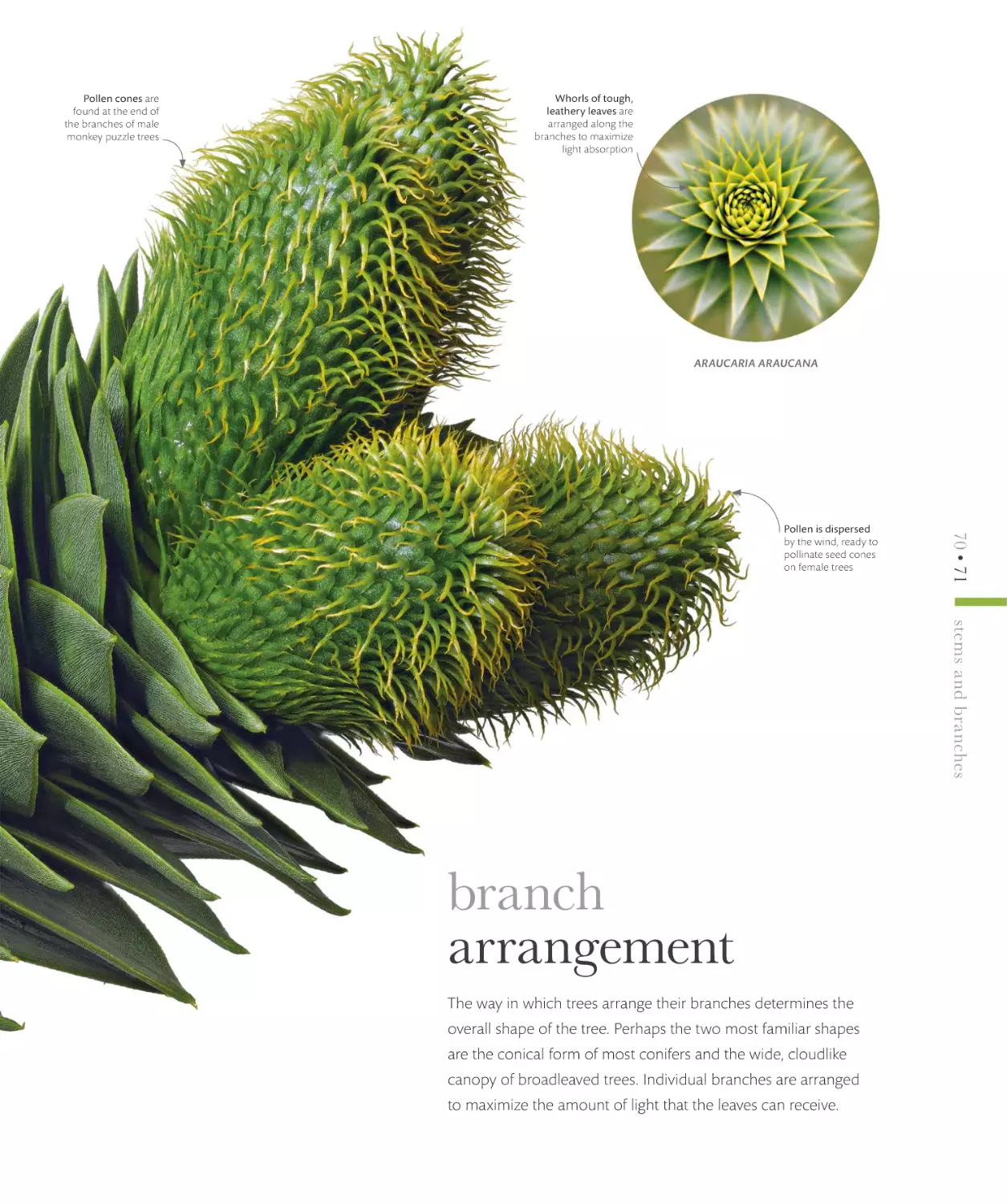
Curious conifer construction
The monkey puzzle tree (Araucaria araucana)
gets its name from its dense covering of
spine-tipped leaves, which even a monkey
would struggle to scale. As a young plant, it
develops a symmetrical, whorled branching
habit. Mature monkey puzzles are generally
less uniform; the lowermost branches are
shed with age, and pests, diseases, storms,
lightning strikes, or other factors can damage
branches and spoil the perfect profile.

Random
branching

Symmetrical
appearance

Uniform
branching

Broad
canopy

ALTERNATE BRANCHES

Conical
shape

WHORLED BRANCHES

Sharp spines
protect the leaves
from herbivores

Pollen cones are
found at the end of
the branches of male
monkey puzzle trees

Whorls of tough,
leathery leaves are
arranged along the
branches to maximize
light absorption

ARAUCARIA ARAUCANA

70 • 71

Pollen is dispersed
by the wind, ready to
pollinate seed cones
on female trees

stems and branches

branch
arrangement
The way in which trees arrange their branches determines the
overall shape of the tree. Perhaps the two most familiar shapes
are the conical form of most conifers and the wide, cloudlike
canopy of broadleaved trees. Individual branches are arranged
to maximize the amount of light that the leaves can receive.

Terminal buds
form at top of
twig or stem

Scaled buds may be
covered by resin for
extra protection in winter

Pseudoterminal buds
form when branches die
back to an axillary bud

Flower buds tend
to be larger than
leaf buds

Unscaled buds have
no scales, but may
still be protected by
hairy bracts

Axillary (or lateral)
buds form where
last year’s leaf
joined stem

Leaf scars are
sometimes left
by the old leaves
when they fall

Juglans mandshurica
var. sieboldiana

TERMINAL BUD

Aesculus hippocastanum

AXILLARY BUD

Quercus frainetto

PSEUDOTERMINAL BUD

Magnolia campbellii

UNSCALED BUD

winter buds

Fagus sylvatica
Smooth bud
with unequal
scales

Leaf buds vary enormously and are highly distinctive, both in shape and in
the way in which they grow. Along with a tree’s shape, they are a vital aid
to identifying a tree during winter. Examining how buds grow along a stem
is revealing. They can form opposite each other or on alternate sides of a

Elongated bud
with numerous
overlapping scales

stem, rising around it at intervals. Bud scales, which protect the developing
leaves and flowers, also vary in shape, color, and number.

Valvate bud scales
do not overlap

Distinctive
black buds

Prunus avium
‘Plena’
Clustered buds
overlap at ends of
short sideshoots

Platanus x hispanica

SCALED BUD

Fraxinus excelsior

OPPOSITE BUDS

Tilia x europaea

ALTERNATE BUDS

CLUSTERED BUDS

stems and branches

Caplike scale

72 • 73

SINGLE BUDS WITH
OVERLAPPING SCALES

Magnolia petals
and sepals are almost
identical and are known
collectively as tepals
The tough, leathery
tepals are strong enough
to prevent damage by
large insect pollinators

Layers of hairy bracts
enclose and protect
the developing flower
buds of magnolias

FLOWERS BEFORE FOLIAGE
When deciduous trees and shrubs such as
forsythia, alder, witch hazel, and deciduous
magnolias produce flowers before their
leaves emerge, it is known as hysteranthy.

FORSYTHIA VIRIDISSIMA

Inside a flower bud
Magnolias were one of the earliest
groups of flowering plants to appear
on Earth, and their blooms have
features that are not found in more
recently evolved species. They do not
have distinct sepals and petals, and
their flower buds are protected by
deciduous bracts rather than sepals.

Magnolia stamens
are unlike the stamens
of most other flowers
because they lack
distinct anthers
and filaments

Scales and scars
Magnolia stems are distinctive, even
when bare of leaves. The hairy bracts
(sometimes referred to as bud scales)
that protect the flower buds, and the
circular scars beneath them, are
easily recognized. The shield-shaped
leaf scars are another characteristic.

Bracts either fall as the
flower opens, or they are
shed prior to flowering

Crusty lichens grow
on the long-lived stems
and branches

Silky bract hairs may
be silver or light brown,
or sometimes absent

Distinctive scars
are left on the stems
by fallen leaves

buds of next year’s flowers. Deciduous magnolias form their flower buds
in the late summer and fall, remaining dormant in the winter. It is usually
possible to distinguish between flower and leaf buds by their shape or size.

Buds that develop
into leaves are
much smaller than
flower buds

stems and branches

As well as leaf buds, the woody stems of trees and shrubs also bear the

74 • 75

insulated buds

stems and branches

76 • 77

Trunk in bloom
Archidendron ramiflorum is a member of the
legume family and is native to Queensland,
Australia. Rather than having showy petals, the
flowers attract pollinators with their flashy stamens.
The spherical bloom clusters develop on woody
stems in the shade of the rainforest canopy, where
the bright white flowers stand out in the gloom.

cauliflorous plants
Flowers and fruit usually develop on new shoots, but in some trees and shrubs,
the blooms erupt directly from the woody trunk and primary branches. Known
as cauliflory, this strategy is more common in the tropics than in cooler regions.
The reasons why some plants adopt cauliflory remain mysterious, but it may be
an evolutionary adaptation to allow animals that live lower down in the forest
canopy easy access to the flowers and fruits. Despite the name, cauliflowers are
not cauliflorous, but produce congested flower clusters at their stem tips.

COCOA TREE FRUIT
Cocoa plants (Theobroma cacao) produce their flowers
and fruit on woody stems shaded by the foliage. The
flowers are pollinated by midges, which prefer a dappled
environment. Other cauliflorous trees include breadfruit
(Artocarpus altilis), papaya (Carica papaya), calabash
(Crescentia cujete), and many tropical figs (Ficus sp.).
Outside of the tropics, rare examples of cauliflory among
temperate trees and shrubs include the eastern redbud
(Cercis canadensis) and the Judas tree (C. siliquastrum),
which bear pink flowers on mature branches before the
new leaves appear in spring.

THEOBROMA CACAO

Flower buds emerge from growing
points, or meristems, located at
nodes along the woody stems

The bold tufts of white
stamens provide pollen
for potential pollinators

Spent flowers will
develop into vivid
red, coiled pods

The stamens can grow
up to 21 ⁄ 2 in (5 cm) long

Thorns are solitary,
although they
sometimes form
their own branches

stem defenses
Herbivores depend on plants for sustenance, but plants can
defend themselves. By arming their stems with thorns, spines,
or prickles, they can deter at least some of their adversaries. The
names for these three defenses are often used interchangeably,
yet each is thought to have developed from a particular part of
the plant in evolutionary history.

Spines only occur at
nodes and may be
solitary or clustered,
but never branched

Rose “thorns” are
technically prickles,
although they are just
as sharp as thorns

Thorns are positioned
at nodes, as if they
were side branches

Thorn
Derived from stems, thorns contain
vascular tissue and can be branched;
some even bear their own leaves. They
are typically stiff and woody, as on this
hawthorn (Crataegus sp.). Thorns also can
be found on the branches of orange trees
(Citrus) and firethorn (Pyracantha).

Spine
Like thorns, spines contain vascular tissue,
but they are derived from leaves or leaf
parts, such as stipules or petioles. They
are never branched but often occur in
clusters at the nodes, as on this barberry
(Berberis sp.). Spines are found on most
cacti and acacias.

Leaves on spiny stems
develop above the spine

Prickle
Unlike thorns and spines, prickles, such
as on this rose (Rosa sp.), develop as
outgrowths of the cortex and epidermis
of a plant, and so do not contain vascular
tissue. They are also not restricted to stems
and can be found on bark, leaves, and fruits.

Prickles can occur all
along the stem and
are not restricted to
the nodes

Ceiba pentandra

the kapok tree
Many rainforest trees grow to great heights and display huge buttress roots.
Few, though, are more impressive than the majestic kapok. Given the right
conditions, this important canopy species can grow as tall as 230 ft (70 m),

stems and branches

80 • 81

with buttresses that project up to 65 ft (20 m) from the trunk.
The deciduous kapok tree is found in the
Americas, growing from southern Mexico
to the southernmost limits of the Amazon
rainforest. It is also found in parts of
West Africa. Exactly how the tree came
to be native to both regions has been the
subject of scientific inquiry. By analyzing
kapok DNA, experts now believe that the
species made it to Africa after seeds were
dispersed across the ocean from Brazil.
The kapok plays a vital role in the local
ecology and culture wherever it grows.
Its textured bark provides a habitat for
bromeliads and other epiphytes, and also
for reptiles, birds, and amphibians. The
tree’s ability to invade disturbed areas
also makes it a key pioneer species, as it
is one of the first trees to colonize open
land after forest clearances.
The kapok’s flowers open at night and
emit a foul odor that attracts bats, its
main pollinators. The tree is able to alter

its pollination strategy according to the
strength of the local bat population. In
places where bats are plentiful, kapoks
rely on them to spread pollen from tree
to tree; where there are few bats however,
the trees self-pollinate, guaranteeing at
least some reproductive success each year.
After pollination, kapoks become laden
with seedpods, each of which opens up
to release about 200 seeds. The seeds are
surrounded by cottonlike fibers that help
them to disperse on the slightest breeze.
Unopened seedpods float in water, so it
is likely that the kapok initially traveled
from the Americas to Africa by sea.
Prickly giant
A kapok’s massive trunk can be up
to 10 ft (3 m) in diameter. The huge
prickles keep animals from gnawing
on its bark. The prickles eventually
drop off as the tree ages.

Wholesome harvest
A kapok tree produces
between 500 and 4,000
woody seedpods, which are
harvested without cutting
down the tree. Each part
of the pod is used for a
different purpose.

Lightweight fibers are
used as stuffing for pillows,
mattresses, and—because
they are water-resistant and
buoyant—even life preservers

Hard pods are smashed open
with a mallet; empty pod
cases are used as firewood

Kapok seeds are
pressed to extract their
oil, and the remainder
is used for cattle feed

82 • 83
stems and branches

stems and resin
Trees are constantly under attack from a huge variety of insects, birds,
fungi, and bacteria, which attempt to break through the bark and feed
on the tissues below, either directly or through existing wounds. Many
trees produce sticky resin to heal breaks in the bark and ensnare pests.
Some resins even contain chemicals that attract predatory insects that
will feed on the tree’s attackers. Resin gradually hardens, and fossil resin,
known as amber, often contains the remains of ancient insects.

Resin canals (or ducts)
distribute resin around
the stem or branch

CROSS SECTION
OF A PINE TRUNK

Releasing resin
Some trees only produce resin in
response to damage, while others, such
as this pine—stained to reveal the cell
structure—have resin ducts in their
wood as a part of their natural makeup.

Sticky protection
The dripping resins produced by
trees such as this oak are designed
to heal wounds, whether inflicted by
pests, or caused by physical damage
from bad weather or fire. Plant resins
are mixtures of organic compounds,
and are used for many things—from
perfumes and varnishes to adhesives.
They are also the source of valuable
commodities such as frankincense,
turpentine, myrrh, and tar.

Secretory cells surround
the resin canals and
produce the resin

Dracaena draco

the dragon tree
The dragon tree looks as though it belongs in a fantasy novel. This strange
but beautiful monocot gets its name from the red resin, known as “dragon’s
blood,” that it exudes when wounded. A member of the asparagus family,
Dracaena draco has evolved a unique treelike growth habit.

Dragon’s blood oozes
from wounds as a
viscous liquid that dries
and hardens

The deep-red resin
has been used in
dyes and traditional
medicines since
ancient times

Hardened resin
The tree bleeds a crimson resin called
“dragon’s blood,” hence the species’ common
name. In nature, resin serves as a form of defense,
deterring herbivores and keeping out pathogens.

stems and branches

Dragon grove
In the wild, the dragon tree grows in
nutrient-poor soils. The thick trunk
branches into upright arms ending in
rosettes of lance-shaped, blue-green
leaves up to 2ft (60cm) long. The species’
status is currently listed as vulnerable.

begins again. Over time, this repeated
branching gives the tree its unusual,
umbrellalike shape. The lifespan of this
species is thought to be about 300 years,
but accurate aging is difficult, as the trees
do not produce annual growth rings.
The dragon tree’s branches produce
aerial roots that gradually snake their
way down the trunk until they reach the
soil. The roots emerge from wounds. If
enough damage has been done to the tree,
the roots can function as a new trunk,
developing into a clone of the parent tree.
The dragon tree’s blood-red resin was
once highly valued as a medicine and an
embalming fluid and is now used to stain
and varnish wood. The resin is obtained
by making cuts in the bark, but repeated
wounding puts the tree at risk of infection.
Dragon tree numbers in the wild are in
decline, due to aggressive resin harvesting
in the past and habitat loss today.

84 • 85

The dragon tree is endemic to parts of
North Africa, the Canary Islands, Cape
Verde, and Madeira. For the first few
years of its life, the dragon tree is a single
stem ending in a tuft of long, slender
leaves. After 10 to 15 years’ growth, the
tree flowers for the first time. Long spikes
full of fragrant white flowers erupt from
the leaves, followed by bright red berries.
A cluster of new buds then emerges from
the top of the plant, and the buds develop
into miniature versions of the original.
They continue to grow for another 10
to 15 years before the branching process

storing food
Some plants have modified stems, roots, or leaf bases that live
permanently underground. Swollen and densely packed with
nutrients, these subterranean bulbs, corms, tubers, and rhizomes
are dormant for part of the year, then sprout new shoots when the
growing conditions are right. They are hidden from herbivores and
can often spread underground to expand a plant’s territory.

SOIL LINE

Green leaves and flower buds
emerge from the central point
of the storage scales

stems and branches

86 • 87

From bulb to bloom
Bulbous plants—which include familiar
plants such as onions—have a short, squat
stem called a basal plate, to which fleshy
leaves (scales) are attached. The scales store
the nutrients and water that the plant needs
in order to produce flowers. These hyacinth
bulbs flower in spring. Afterward, the leaves
photosynthesize to create more food, which
is stored for the next year’s flowering.

The bulb is made up of
numerous overlapping
scales, which are visible
if it is sliced open

The basal plate
is a modified stem
that bears both
roots and leaves

Roots anchor the bulb
underground (see pp. 36–37)
and can pull it deeper into
the soil if necessary

X-RAY OF A DORMANT
HYACINTH BULB

EMERGING BULB WITH A
DEVELOPING FLOWER HEAD

The fully expanded
leaves photosynthesize
to make carbohydrates,
which are stored in the
bulb scales below

STORAGE ORGANS
Bulbs are a round mass of swollen leaf bases that
protect and feed new shoots. Corms and rhizomes
are both a form of modified underground stem:
a corm is bulb-shaped, whereas a rhizome grows
horizontally just beneath or above the ground and
produces shoots at its apex and along its length.
Tubers can be derived from both stems and roots.

BULB
Outer
covering
(tunic)

Basal plate

Growing
point

Bulblet
Roots

The emerging flower head
draws upon the energy
reserves stored below.
Bulbs with too little energy
in reserve will not flower

The growing leaves
surround and protect the
delicate flower buds as they
push up through the soil

CORM
New shoot
Corms
usually have
a tunic

Roots

RHIZOME

New corm
produced
on top of
old one

New shoot
and leaves

Growing
point
Stem
section

Roots

New bulbs called
bulblets form
around the outer
edge of the
basal plate

TUBER
New shoot

Tuber
Roots

BULB WITH MATURE LEAVES
AND ABOUT TO FLOWER

HOMES FOR ANTS
The living quarters that ant plants
provide for ants are known as domatia
and can develop in different parts of the
plant. Dischidia vines house ants in
swollen leaves, whereas Lecanopteris
ferns shelter them within their rhizomes.
Myrmecophila orchids accommodate
ants in hollow, bulblike swellings of the
stem, and some acacias host them
within hollow spines. Myrmecodia and
Hydnophytum both have swollen stem
tubers with intricate internal structures,
giving ants chambers for various uses.

Some chambers are
used as ant nurseries

Chamber for
waste disposal

Good tenants
The elaborate stem tubers of the ant-house
plant (Myrmecodia beccarii) include roughwalled cavities where ants deposit their
waste, as well as remains of their prey and
corpses. Nodules on the walls of the cavities
absorb nutrients from this slurry, providing
this tree-dwelling plant with vital elements
that it would otherwise find hard to access.
The plant shown right, from Australia and
grown at Kew in 1888, is depicted in an
illustration from Curtis’s Botanical Magazine.

stems and branches

88 • 89

DOMATIA IN A
HYDNOPHYTUM TUBER

beneficial
relationships
Insects can be a benefit or a burden for plants. Although some
provide their services as pollinators, others are ruthless leaf-eaters
that weaken the plant to satisfy their appetites. A handful of
plants, however, have struck up a mutually beneficial (symbiotic)
relationship with ants. So-called “ant plants” provide a secure
home for the ant colony and, in return, the ants protect the plant
by attacking anything that comes near it. As many ant plants are
epiphytes, unconnected to the soil and its nutrients, the rich
fertilizer formed from the ants’ waste is also a crucial food supply.

Partners in crime
Some ant plants often grow together. Here,
the brown stem tuber of Hydnophytum is
nestled within the yellow leaves of a Dischidia
species. Both plants provide a home for ants.

Tree ferns

STEM STRUCTURES
A tree fern trunk is really an upright rhizome supported by
a dense, encircling mass of roots and fibers. Banana stems
are not really stems at all, but overlapping layers of leaf
sheaths; the true "stem" is a rhizome (see pp.86–87) that
is concealed underground.

Rhizomes are a type of swollen stem
that usually grow horizontally and
act a food store for the plant, but in
tree ferns they grow upward. Masses
of roots and fibers emerge from the
rhizome and grow around it, forming
a thick, protective mantle that supports
it in an upright position.

Roots and fibers
make up the
outer surface
A vertical
rhizome
forms the
central
cylinder

stems and branches

90 • 91

TREE FERN (DICKSONIA ANTARCTICA)
CROSS SECTION

The leaves
are arranged
in spirals

Hollow
chambers
strengthen
the sheaths

Overlapping
sheaths
provide
support

BANANA PLANT (MUSA SP.)
CROSS SECTION

fibrous trunks
Not all trees are true trees. Well-known species such as pines and firs (conifers),
or oaks and maples (deciduous) have woody trunks with characteristic growth
rings and an outer layer of bark. Tree ferns and banana plants, however, have
quite a different stem structure and do not produce wood or bark. Their upright
stems are supported by densely packed fibers; roots; or tightly packed,
overlapping sheaths of leaves.

Plants of the Coast of Coromandel
William Roxburgh’s Plants of the Coast of
Coromandel (1795), which included this illustration
of the toddy palm (Borassus flabellifer), was
published under the direction of Sir Joseph Banks,
the longtime president of the Royal Society.

Company style
Painted by an unknown artist, this watercolor
illustration of a fan palm (Livistona mauritiana)
is attributed to the Company School, a group of
Indian artists who worked under the patronage
of the East India Company, using the distinctive
Indo-European Company style.

stems and branches

92 • 93

plants in art

west meets east
During the 18th and 19th centuries, with the expansion of British influence
into India, scientists and natural historians engaged by the East India
Company began to explore and document the richness and diversity of
the country’s flora. Highlights of the resulting body of work were striking
illustrations that display a unique fusion of Western science and Eastern art.

William Roxburgh (1751–1815), often
referred to as the father of Indian botany,
was the director of the Calcutta Botanic
Garden when he began to commission
local artists to create the botanical
illustrations used in his important books.
More than 2,500 life-size paintings would
be featured in his landmark Flora Indica.
Influenced by the miniature painters
of the 16th- and 17th-century Mughal
Empire, the Indian artists created a style

that combined the precise detail of
Western botanical illustration with the
decorative approach and immediacy of
their own art. This hybrid style of artwork
was well suited to botanical illustration.
Working with the naturalist Johan KÖnig,
who had been a pupil of the great Swedish
taxonomist Carl Linnaeus, Roxburgh
commissioned many artworks that would
become “type” drawings identifying
particular wild species.
Characteristic arrangement

The artworks embody essential qualities
of their diverse patronage.
PHYLIS I. EDWARDS, INDIAN BOTANICAL PAINTINGS, 1980

Painted in watercolor on paper, this hand-painted copy of
an illustration commissioned by William Roxburgh depicts
the Indian redwood (Caesalpinia sappan). The way that the
plant has been cropped, so that parts of it are not visible,
is characteristic of this style of painting. The illustration is
inscribed “Received from Rodney, 9th June 1791.” This refers
to the East India Company merchant ship that delivered
artworks from India to London.

HOW CLIMBERS FIND
SUPPORTS

Stem
tendril

Plants cannot see, so they must find
another way to locate a support. Some
vines detect shade and grow toward it,
as that is likely to lead them to the foot
of a tree. Others can follow trails of
chemicals that lead to a suitable host,
and avoid those that lead to other vines.
Young stems revolve as they grow, which
can help them snag a neighboring
branch. Once in position, twining stems
or tendrils hook on to the support.

Emerging flowers
have the potential of
releasing many seeds,
further expanding the
plant’s territory
Flexible
stem

Bamboo
support

Long leaf stalks
allow the leaves to
reach away from
the support and
face the sun

Bindweed stems can
quickly choke out
neighboring plants,
reaching over 10 ft (3 m)
in length each year

Takeover by twining
Bemoaned by many gardeners, the twining
stems of hedge bindweed (Calystegia sepium)
are one of the secrets of its success. Growing
through shrubs and perennials, it quickly
smothers their foliage with its own as it
successfully competes with them for sunlight.
Underground, the plant is equally vigorous,
spreading its white rhizomes in all directions.

To expose their leaves
to light, vines climb up
other plants and
escape the shade

By flowering up high,
the blooms are in easy
reach of bee, moth, and
butterfly pollinators

94 • 95

Twining stems can
become rigid and
woody with age, as
with this wisteria

twining stems
Vines and other climbing plants use a number of different methods when
scrambling up a support. Tendrils, aerial roots, and hooked prickles all
attach themselves to supports, but in some climbers, the stem itself can
cling by twining. Some twining plants twist clockwise, while others twist
counterclockwise; this distinction, which may have a genetic basis, can be
used to tell some species of climbers apart. Beans and bindweed twine
counterclockwise, while hops and honeysuckle twine clockwise.

Touch and feel
The ability of a stem to twine around another is
due to thigmotropism. When climbing stems and
tendrils detect the presence of a support, one side
of the growing point begins to grow faster than
the other, making the stem bend.

stems and branches

Bindweed stems twine
counterclockwise when
viewed from the tip of
the stem

climbing techniques

Tendrils recognize their
own stems and avoid
twining around them

For plants growing on the forest floor, sunlight is a limiting factor,
but vines and other climbers have the ability to scramble up trees
and shrubs toward the light. Climbers generally have elongated
internodes (the length of stem between each leaf joint) to help
cover the distance, but they employ other structures to get a
grip, including tendrils, aerial roots, and twining stems.

Tendrils coil when
the cells on each
side grow at
different rates

Tendrils have the
ability to feel, and
may be more sensitive
than the human
sense of touch

Surface hairs detect
foreign objects and
stimulate twining

Springlike tendrils
Many members of the cucumber
family, including this loofah (Luffa
cylindrica), produce tendrils. Derived
from modified leaves, they attach to
a branch, then coil up, pulling the
vine toward its support structure.

Upwardly mobile roots
When roots develop above ground,
they are said to be “aerial.” Like common
ivy (Hedera helix) and many others, this
Rhaphidophora elliptifolia uses aerial roots
to cling to and climb along tree branches.

Vine leaves access
more sunlight due to
the climbing stems

Aerial roots attach
to tree bark or other
vertical structures

SELF-ADHESIVE SUCKERS
Vines such as Boston ivy and Virginia creeper
(Parthenocissus sp.) use tendrils to cling to surfaces, but
their tendrils are unusual in that they have adhesive pads
at the tips. These suckers can hold more than 250 times
their own weight, firmly fastening the vine to its support.

Suckers grip
firmly onto bark
and masonry

SPINES AND WATER
CONSERVATION
Cactus spines are derived
from leaves and protect their
succulent stems from the
attention of thirsty animals.
Spines intercept water and
direct it down to the ground;
they also shade the plant from
sunlight and slow the passage
of air around the plant. Both
strategies reduce water loss.

CROSS SECTION OF A
TYPICAL CACTUS STEM

Spines catch water
Ribbed
stems

Cortex tissues
store water

Reduced air
movement

Water storage
The most famous members of
the cactus family are giants like the
saguaro cactus (Carnegiea gigantea,
see p.100), but tiny treasures like
this Mammillaria infernillensis are
also well adapted to drought. Its
thick skin has a waxy coating that
greatly reduces water loss.

Xylem
vessels
carry water

storage stems
98 • 99

Cacti are renowned for their ability to hoard water in their
succulent stems. Most species live in arid areas where rainfall
is scarce, so when the heavens open, they must take advantage
of the deluge. To absorb as much water as possible, and quickly,

stems and branches

many cacti have ribbed stems that expand like an accordion.
This prevents them from splitting as they become rehydrated.

Lost leaves
Prickly pears such as Opuntia
phaeacantha produce tiny leaves
on new stem segments, but they
are quickly shed to conserve water.
Individual stem segments
can be dropped during
extended droughts

Large spines are surrounded
by tiny, hairlike spines called
glochids, which detach and
irritate animal skin

Tufts of white hair
reduce water evaporation
and reflect sunlight,
cooling the cactus

Sharp spines take the
place of leaves in order
to protect the plant
from predators

Carnegiea gigantea

the saguaro cactus
What Western film would be complete without a backdrop of giant
saguaro cacti? These towering succulents are icons of the Sonoran Desert in
Arizona and northwest Mexico, and a special community of bats, birds, and

stems and branches

100 • 101

other animals has evolved around them.
By far the most impressive aspect of the
saguaro cactus is its size. Individuals
regularly reach 50 ft (15 m) or more in
height and can weigh as much as 4,400 lb
(2,000 kg). Much of that bulk consists of
stored water—a precious commodity in
the desert. On the rare occasions when it
rains, the ribs that run the length of the
saguaro’s stem can expand to allow the
plant to swell and absorb as much water
as possible through its extensive, shallow
root system. Once stored, the water needs
protecting: the saguaro is covered with
spines and bristles that not only deter
herbivores from feeding on its succulent
tissues, but also create shade and reduce
airflow close to the saguaro’s skin,
minimizing water loss to the air.
In spring, saguaro cacti usually put
on an impressive floral display. Dense
clusters of bright white flowers appear
from the apex of the main stem and arms.

The flowers are pollinated by birds and
insects by day, and by bats at night. The
nectar in the saguaro’s blooms contains
compounds that help female lesser
long-nosed bats produce enough milk to
feed their young. After the flowers come
the fruits, providing an energy-rich food
for a wide range of desert animals.
The saguaro has a particularly close
relationship with the Gila woodpecker.
This bird excavates a hole in the cactus
in which it can build its nest. Vacated
woodpecker holes are subsequently used
as shelter and nesting sites by many other
birds, mammals, and reptiles.
Saguaro sentinels
Saguaro cacti stand like alert guards
watching over the desert. Slow-growing
but long-lived, saguaros can survive for
200 years or more. They only grow arms
after they reach 50 to 100 years old.

Crested saguaro
Occasionally saguaro cacti take on a crested form.
This fanlike appearance is due to changes in the
growing tip (apical meristem). The cause is not
known: it may result from a genetic mutation, or
from physical damage by lightning or frost.

Fanlike crests are
thought to develop
on only about 1 in
every 200,000 cacti

New arms can
continue to sprout
on the crest

102 • 103
stems and branches

leafless stems
Leaves produce food for plants, but moisture quickly evaporates through their
large surface area. In the dry, harsh climate of the desert, some plants have
adapted by not growing leaves. Instead, their green succulent stems take on
photosynthesis. By taking in carbon dioxide at night and storing it in their stems,
these plants can photosynthesize with pores closed during the hot sunlight hours.

Succulent stems
only open their
pores to allow gas
exchange at night

Stems at work
Many succulents, such as this Euphorbia woodii,
a South African member of the spurge family,
show the same adaptation to their environment
as cacti. They do not have spines, but their very
reduced leaves mean that they rely on their
succulent stems for photosynthesis to produce
the carbohydrates that all plants need to grow.

A poisonous sap
in the stems of this
succulent Euphorbia
deters herbivores

SPIKED STEMS
Cacti display a great variation in the size and shape of their succulent stems,
but almost all of them are leafless. A few species still produce leaves, but in
most, these have evolved into spines. Spines protect the plant from grazing
animals, reduce air circulation, and help to add shade. Cacti native to humid
rainforests also lack leaves, although their flattened stems may look leaflike.

The green pigments
in the stem that make
photosynthesis possible
are found just below the
outer layer (epidermis)

stems and branches

104 • 105

Strawberry runners
A number of species colonize new
territory using stolons. They include the
edible strawberry (Fragaria x ananassa),
spider plant (Chlorophytum comosum),
and mock strawberry (Duchesnea indica,
syn. Fragaria indica)—shown here in a
drawing made in India for Robert Wright
in 1846. Their stems produce new plants
at the nodes, and become independent
once severed from the parent.

new plants from stems
Stems make it possible for a plant to expand its range in several ways. The
ground-hugging or prostrate stems of some plants can root as they spread,
while subterranean rhizomes do the same underground. Some plants that
are otherwise upright produce slender, elongated horizontal stems that
creep across the soil or just beneath it and form baby plants at the nodes;
these stems are called stolons or runners.

STEMS UNDERGROUND
Many plants develop rhizomes, corms,
or tubers, which are derived from stems.
These underground “stems” grow on
or just below the soil surface, and they
not only allow plants to survive adverse
conditions, but they also provide a means
of propagation. Any pieces broken off
the parent can root and form new plants.
Crocosmia corms can also produce
stolons that distribute new corms a
short distance away from the parent.

CROCOSMIA CORM OFFSETS

Crocosmia flowers on
long, upright stems

New corms form on
top of old corms

Phyllostachys edulis

moso bamboo
The canopy of a grove of moso bamboo can reach a level of up to 100 ft
(30 m) above the ground, making it easy to think these giant bamboos are
trees. But moso bamboo is a grass, albeit a very tall, woody one. Like other

stems and branches

106 • 107

grasses, it is characterized by a jointed stem called a culm.
Although it is synonymous with Japanese
culture, moso bamboo (Phyllostachys edulis)
is actually native to mountain slopes in
warm, temperate regions of China, and
only naturalized to Japan. This species is
of great economic importance throughout
Asia, where it is used as a food source, a
building material, and a fiber for making
textiles and paper.
Moso bamboo has an astonishing rate
of growth, and new stems are able to add
more than 3 ft (1 m) to their height each
day. Growth is also vigorous below the
surface of the soil: dense mats of roots and
rhizomes (underground stems) spread out
relentlessly, throwing up new shoots to
colonize territory. Such vegetative growth
is the plant’s main reproductive strategy.
As a result, entire hillsides can be made
up of clones of a single individual. While
it can also reproduce sexually, this species
flowers only once every 50 to 60 years.

When it does flower, however, it produces
many thousands of seeds that are quick
to germinate.
Moso’s aggressive growth habit is cause
for concern when it is introduced outside
its native range. Individuals can quickly
escape gardens and invade surrounding
areas. Producing impenetrable root mats,
heavy leaf litter, and dense shade, they
easily smother other plant species.
Young moso shoots are edible, but like
many bamboos, moso protects itself with
a potent chemical cocktail that includes
oxalic acid and cyanide compounds. With
adequate boiling, the compounds break
down and make the shoots safe to eat.
Bamboo canopy, Japan
Covering 6 sq miles (16 sq km), the
Sagano Bamboo Forest near Kyoto is
treasured for the beauty and tranquility
of its dense bamboo groves.

Moso branch and leaves
Bamboo branches and leaves
grow from the joints, or nodes,
between the segments on the
hollow culm.

Branches are also
segmented; smaller
branches and leaves emerge
from the branch nodes

Spear-shaped,
paper-thin leaves
sit two to four at the
end of each branch

leaves
leaf. a flat, usually green, structure
attached to a plant stem directly or
by a stalk, in which photosynthesis
and transpiration take place.

Deciduous broad-leaves
Many plants, such as this
sugar maple (Acer saccharum
subsp. saccharum), have large,
flat leaves, maximizing the
surface area available for
photosynthesis.

leaf types
Leaves can be evergreen, which stay on the plant year round, or deciduous,
which are discarded during certain times of year. Leaves are a costly
investment for a plant and evergreen leaves may minimize the demands
on its resources in the long term. However, if they are unlikely to survive
year-round, having cheap, deciduous leaves may be more beneficial.

Defensive spines
on leaf margins

BROAD-LEAVED EVERGREEN
Ilex sp.

Needles shrug off
snow, preventing
its weight from
damaging branches

110 • 111

Deciduous leaves are lost
during certain times of
year, such as winter and
wet or dry seasons

leaves

NEEDLES
Pseudotsuga menziesii

Scales minimize
water loss or snow
accumulation

These leaves are
more prone to being
eaten by herbivores
than needles
and scales

SCALES
Sequoiadendron giganteum

Evergreen leaves
Most conifers have evergreen leaves that are
reduced to needles or scales. These have a
smaller surface for photosynthesis, but they
can photosynthesize for more of the year.
They are also adapted to survive cold winters.

leaf structure
Most leaves are full of cells that harvest light for photosynthesis.
These mesophyll cells are supplied with water and nutrients by a
network of veins. The veins also carry carbohydrates made during
photosynthesis to other parts of the plant. Pores on the leaf
surface—stomata—open to take in carbon dioxide and close to
prevent water loss. Evaporation from the rest of the leaf surface
is halted by a waterproof, waxy coating called the cuticle.

Taro leaves (Colocasia esculenta) are covered
by a single layer of cells called the epidermis
(blue). The interior has palisade mesophyll
(green) and spongy mesophyll (yellow) cells.
The gray structure is a vein, or vascular bundle,
made up of xylem and phloem vessels.

Waxy cuticle
prevents
water loss

leaves

112 • 113

Inside foliage

Xylem transports
nutrients and
water from the
root to the shoot

Phloem carries
carbohydrates made
during photosynthesis to
other parts of the plant

The leaf stem extends
along the center of
the leaf, known
as the midrib

Lateral veins branch
off the midrib to carry
water and nutrients to
all areas of the leaf

Margins and edges may be smooth,
bumpy, or serrated, giving leaves their
characteristic shapes

The midrib—the
central vein—is
surrounded by thick,
supportive tissues that
give the leaf rigidity
and structure

STRUCTURAL VARIATIONS
Although most flowering plant groups have
similar leaf structures, the leaves of grasslike
monocots have a single type of mesophyll, while
those of other plants have two distinct layers:
palisade mesophyll—the main photosynthesis
site—and spongy mesophyll, through which
carbon dioxide can move.
Xylem

Upper
epidermis

Phloem

Bundle
sheath

Cuticle

Guard cell

Stoma

Lower epidermis

Vascular
bundle
(veins)

GRASSY MONOCOT LEAF

Leaf blades are usually
flat in order to harvest
the maximum light and
to minimize how far
nutrients and carbon
dioxide need to travel

Skeletal framework
The skeleton of a leaf is formed by its veins,
which carry water, nutrients, and food
throughout the plant. Like our own bones, leaf
veins also provide support. Monocot leaves
have parallel veins, but the veins of most plants
form a branched network, as in this Magnolia.

Bundle
sheath

Upper
epidermis

Xylem

Phloem
Cuticle

Palisade mesophyll

Substomal
chamber
Lower
epidermis

Stoma
Spongy
mesophyll

TYPICAL PLANT LEAF

compound leaves
Compound leaves are divided into two or more leaflets, providing
plants with more photosynthetic surface area for the same investment
in resource-hungry support tissues, such as branches. When leaflets
radiate from a single common point the leaves are called palmate.
When leaflets originate from several locations along the central
stalk, or rachis, the leaf is said to be pinnate.

Pin
na

leaves

114 • 115

TRIPINNATE (ALTERNATE)
Pteridium sp.

Rachis
Segment

Pinnule

Pinnae are arranged
in a staggered fashion
along the rachis

Fern fronds
Most ferns, such as this Pteridium leaf,
exhibit varying degrees of pinnation. The
leaflets are referred to as pinnae, and these
are often further subdivided into pinnules.
Pinnules, in turn, are divided into segments.

Terminal leaflet forms
at the end of the rachis

Leaflets are
themselves
pinnately divided

Pairs of leaflets
develop along
the rachis

UNIPINNATE
(PARIPINNATE)
Tamarindus indica

UNIPINNATE
(IMPARIPINNATE)
Carya ovata

Winged petiole
(leaf stalk) resembles
the true leaf

BIPINNATE
(OPPOSITE)
Leucaena leucocephala

Three leaflets
comprise a single
palmate leaf

Two leaflets
grow off a
single petiole

UNIFOLIATE
Citrus hystrix

Four palmately
arranged leaflets
on a single petiole

QUADRIFOLIATE
Marsilea crenata

TRIFOLIATE
Trifolium sp.

BIFOLIATE
Hymenaea courbaril

Palmately
compound leaves
with five leaflets

5-PALMATE
Aesculus pavia

Variable numbers
of leaflets form,
depending on the
growing conditions

MULTIFOLIATE
Cannabis sp.

Acanthus wallpaper design, 1875
Morris’s wallpapers and fabrics featured
stylized designs based on large, repeating
patterns of flowers, leaves, or fruit. In this,
his most expensively produced wallpaper,
he used the deeply cut leaves of the
acanthus, a plant that has appeared in
architecture and art since ancient times.
Acanthus was printed by the London firm
Jeffrey & Co., using 15 natural dyes and 30
separate wood blocks for each full repeat.

... any decoration is futile ... when
it does not remind you of something
beyond itself.
WILLIAM MORRIS, LECTURE ON PATTERN, 1881

Art of glass
This decorative stained glass window
design is by the Italian artist Giovanni
Beltrami (1860–1926). The delicate leaf
and floral motifs are typical of the Art
Nouveau style.

plants in art

designed by nature
reaction to the effects of industrialization on the lives of ordinary people and
to the shoddy quality and design of mass-produced goods. Nostalgia for the
simple ways of the past, fine materials, and honest craftsmanship were the
primarily inspired by the forms of the natural world.

Horse chestnut, 1901
Scottish artist Jeannie Foord’s botanic paintings
were composed with a designer’s eye. Their
homage to the simple, naturalistic beauty of
everyday leaves and flowers typifies the values
of the Arts and Crafts movement.

The driving force behind the Arts
and Crafts movement was the British
craftsman William Morris. Virtually all
of his designs for wallpapers and textiles
show twining tendrils, leaves, and flowers.
They were named after the plants they
featured, but Morris’s designs were
stylized evocations of their forms, rather
than botanically accurate reproductions.
Morris’s study of ancient herbals.
medieval woodcuts, tapestries, and
illuminated manuscripts informed his
designs, and he revived traditional crafts
such as woodblock printing and hand
weaving. He urged design students to
correct their “mannered work” with
a diligent study of nature, study of the
different ages of art, and imagination.
Influenced in part by the Arts and
Crafts movement, Art Nouveau artists
and designers regarded nature as the
underlying force of life and developed
their own distinctive vocabulary of motifs
based on the organic shapes of swirling
plant roots, tendrils, and flowers, often
fused with images of sensuous women.

leaves

core tenets of the movement, and its leading craftsmen and designers were

116 • 117

The Arts and Crafts movement of the late 19th century developed as a

developing leaves
Like all parts of a plant, leaves develop from clusters of dividing cells. Many
species of trees, notably conifers, produce leaves continually, but deciduous
broad-leaved trees can only produce them at specific times of the year. In
the fall, deciduous trees produce hardened, dormant buds that contain
partially developed leaves. The buds are protected during the winter and
establish new leaves quickly in the spring when the risk of frost is over.

The folds of the leaf
within the bud dictate
its final shape

Leaves are formed in
pairs within each bud,
pushing against each
other to grow into the
correct shape

118 • 119

As the bud begins to
swell, the scales enlarge,
to continue protecting
the young leaves

leaves

Within the bud,
the blade (lamina)
of the leaf is folded
along the veins
Modified leaves called
scales protect the buds

Newly burst
leaves are still
relatively crinkled

Bud scales eventually fall
off as the leaves grow
Sycamore maple
leaf buds are
produced in pairs
on opposite sides
of the stem

The emerging leaves
slowly expand into a
flat shape

Young leaf tissues
are soft and
easily damaged

Timing it right
New leaves have to emerge at just
the right time; if the buds burst too
early, the young leaves risk being
damaged by frost; if they emerge
too late, they lose valuable growing
time. Trees such as this sycamore
maple (Acer pseudoplatanus)
monitor the number of cold days
to estimate when winter is over,
and wait for warmer temperatures
before the buds start bursting.

Red pigments protect young
sycamore maple leaves from
being damaged by light

WHY LEAVES ARE GREEN
Leaves contain chlorophyll, a pigment that harvests
light energy for use in photosynthesis (see pp.128–129).
Chlorophyll is stored on stacks of membranes within
tiny particles in the leaf cells called chloroplasts. Sunlight
contains every color, and chlorophyll absorbs them all
except for green. The green light reflects out of the leaf,
or passes through it, which makes the leaf look green.

Light

Reflected light

Chloroplast

Transmitted light

CHLOROPLAST ABSORBING
COLORS FROM LIGHT

Expanded sycamore
maple leaves have
five palmate lobes

SPORE-BEARING FRONDS
Ferns do not flower; they produce spores (see
p.338) in speckles on their leaf undersides.
Each speckle, or sorus, has a protective
cover—the indusium, shown as a semicircular
structure on the drawing below—which
shrivels to enable the fern to release its spores.

unfurling ferns
Developing fern fronds are tightly curled into structures called
fiddleheads, which protect the delicate growing tips at their center.
As they slowly unfurl, the lower parts of the leaf toughen and begin to
photosynthesize, providing the energy that powers the development
of the rest of the leaf. This uncoiling process, known as circinate

leaves

120 • 121

vernation, is mainly found in ferns and palmlike cycads.

DRYOPTERIS FILIX-MAS

Why ferns are furled
Ferns produce relatively few large leaves, but each
represents a major investment of resources. The furled
leaves only have a limited ability to photosynthesize,
but remain shielded from herbivores. The loss of
photosynthesis is outweighed by the reduction in
damage from grazing insects.

Blechnum orientale
fiddlehead is edible; it is used
in traditional medicines

Hairs protect the
developing fiddleheads
from insect herbivores

The soft tissues
of the developing
leaf toughen as
the fiddlehead
slowly unfurls
The lower fronds begin
to photosynthesize
as soon as they unfurl

BLECHNUM
ORIENTALE

DICKSONIA
ANTARCTICA

Cibotium glaucum
fiddleheads are the size
of real violin heads, but
they develop into leaves
more than 9 ft (2.5 m) long

CIBOTIUM
GLAUCUM

Alternate leaves
Most plants, such as this porcelain
berry (Ampelopsis glandulosa),
produce leaves at alternate intervals
along their stems. At the shoot tip,
the plant growth hormone auxin
flows into the developing leaves.
The lack of auxin on the opposite
side of the shoot tip makes a new
leaf develop at the farthest point
from the previous leaf.

When viewed from the
shoot tip, leaves often
form spirals in precise
mathematical ratios

leaves

122 • 123

The arrangement
of the developing
leaves protects the
vulnerable shoot tip

TYPICAL ARRANGEMENTS
While alternate leaf patterns are the most common, some plant species
develop pairs (opposite) or groups of leaves (whorls) at the same point
along the stem. These paired and grouped leaves are able to collect
sunlight from multiple directions at once. Whorls are relatively widely
spaced along the stem to avoid shading the leaves below.
Whorls may have
many leaves
Leaves usually
spiral around
the stem

Pairs can be
parallel, or offset
by 90 degrees

ALTERNATE

OPPOSITE

WHORLED

leaf arrangement
It is important to avoid being shaded by neighbors, but plants also
have to avoid shading their own leaves. Leaf arrangement, or phyllotaxis,
occurs in patterns that are specific to each species and prevents the upper
leaves from blocking light to the lower branches, enabling the plant to
absorb as much sunlight as possible.

Brightly colored berries
are positioned in gaps
between the leaves to
attract birds and other
seed dispersers

Brittany 1979 (detail)
This watercolor on vellum painting of a fallen
leaf from a European pear tree (Pyrus communis),
is a portrait of exquisite beauty. McEwen’s focus is
on nature’s treasure lying underfoot in this painting
from his series of leaves in fall colors or stages of decay.
Recording the location and year of each painting, he
captured the hues and imperfections of leaves with
botanic integrity and an artist’s sensibility.

Complex composition
Laelia tenebrosa, Philodendron hybrid, Calathea ornata,
Philodendron leichtlinii, Polypodiaeceae (1989) by Pandora Sellars
not only shows Sellars’ exceptional ability to render plants
accurately, but is also an example of her artist’s sense of
composition, capturing the way light plays across the leaves.

124 • 125

botanic reinvention

leaves

plants in art

There was a revolution in botanic art when artists stopped seeking perfect
specimens and chose to reveal the beauty in ordinary vegetables, fruits,
and flowers, with all their minute imperfections, and leaves ravaged by
beetles or in stages of decay. Rory McEwen, a 20th-century British artist,
was a pioneer of this approach and is widely regarded as the first botanical
painter to portray the natural world with the mind of a modern artist.
McEwen’s radical reworking of botanical
art emerged from the general ferment
of change in the 1960s. Working on
vellum, rather than paper, he found that
his watercolors had an extraordinary
translucency and intensity on the vellum’s
silky smooth and nonporous surface,
just as illustrations did in medieval
illuminated manuscripts.
McEwen painted with scientific
precision, using tiny, fine brushes, and
applied the same meticulous techniques
to every subject, regardless of whether it
was a heritage bloom, an onion, or a
fallen leaf that he had picked up from the
pavement. He took the time to paint his
subjects in minute detail, highlighting
their beauty of form and color regardless
of so-called imperfections.

Another British artist who took botanical
art to new heights in the 20th century was
Pandora Sellars. Her work appeared in
many botanical publications, and her
artistic ability and sensibility brought
worldwide recognition. Sellars started
her career as a botanical artist when she
found that a camera was incapable of
capturing the color and form of the
orchids in her husband’s greenhouse.

Indian Onion painted in Benares 1971 (detail)
This onion, depicted in glowing shades of purple and pink
with a papery brown skin, is almost tangible. Painted in
translucent watercolor, it seems to be poised in space.
McEwen’s series of paintings of onions were among his
most influential and original works.

A dying leaf should be able to carry the
weight of the world.
RORY McEWEN, LETTERS

leaves

126 • 127

Waxy surfaces and drip
tips help rainforest leaves
shed rainwater rapidly

leaves and the
water cycle
Plants use less than five percent of the water they take from the soil; the rest evaporates
from the surface of the leaves into the surrounding air. This seemingly wasteful process,
known as transpiration, can be a problem in dry climates, but it is vital in many ways.
Transpiration makes it possible for water to move up against the pull of gravity through
even the tallest trees, carrying with it nutrients from the soil needed for growth. In hot
climates, the evaporating water cools the leaves, just as sweating cools human skin.

Upper
epidermis

TRANSPIRATION
When the stomata are opened
to take in carbon dioxide, water
continuously evaporates from
the leaves. This creates negative
pressure, drawing water up the
stem from the roots through the
plant’s vascular system—bundles
of fine tubes known as xylem.

Mesophyll
cells
Evaporation
Soil

Lower
epidermis
Stoma

Water

ROUTE OF WATER
THROUGH A LEAF

Water
Xylem

The red lower leaf
surfaces maximize
light absorption in
shady conditions

Wasting water?
Costus guanaiensis grows in
tropical South America. Water
is so abundant in the rainforest
that plants can produce large
leaves to maximize light
absorption without the risk of
dehydrating due to their high
rate of transpiration. As a result,
approximately 30 percent of all
the rain that falls over land each
year passes through the leaves
of rainforest plants.

Rainforest leaves
have many stomata to
maximize the uptake
of carbon dioxide

The long leaves of
Costus guanaiensis are
typically up to 2 ft
(60 cm) in length

leaves and light
A plant’s leaves gather sunlight and convert its energy into food by means
of a complex process called photosynthesis. Plants use light and a light-sensitive
green pigment called chlorophyll in their leaves to transform carbon dioxide
from the air and water in the soil into sugars to feed themselves. As a by-

leaves

128 • 129

product, they also produce the oxygen that supports almost all life on earth.

Broad surface area
Philodendron ornatum leaves are large
because the plant grows in the shade
and needs to survive with little light.
As with most plants, a network of veins
takes water absorbed by the roots
to the leaf; it also transports sugars
produced during photosynthesis
to the rest of the plant.

The long leaf stem
makes it possible for
the plant to tilt the
leaf toward the sun

The green color
of leaves comes
from chlorophyll,
a pigment that
absorbs light energy

Philodendron ornatum
leaves grow up to 2 ft
(60 cm) long, to harvest
as much light as possible

TOP OF LEAF

UNDERSIDE OF LEAF

A drip tip makes it
easy for rainwater
to drain off

The underside of the leaf
is dull because it contains
fewer chloroplasts

PHOTOSYNTHESIS
Just below the surface of a leaf are specialized
cells called mesophyll cells, which carry out
photosynthesis. Mesophyll cells contain tiny
particles called chloroplasts, which contain
the light-absorbing pigment chlorophyll.
Chloroplasts harvest light energy from the
sun, take carbon dioxide from the air and
water (absorbed from the soil by roots and
delivered to the leaf by the plant’s vascular
system), and convert it all into glucose. This
is then packaged into sucrose, a form of
sugar that the plant uses as food. During
photosynthesis, oxygen is also released into
the air through the leaf’s pores (stomata).

Carbon dioxide
enters the leaf

Light energy
from the sun

Oxygen
is released
Cuticle

Chloroplast
collects light
energy

Vacuole
Oxygen exits
the cell

Cell nucleus
Layer of
mesophyll
cells

Glucose
produced by
photosynthesis

Water passes
through the
cell membrane

Chloroplast

Carbon dioxide
enters the cell

Cell wall

Water
from the soil

TOP LAYER OF LEAF

MESOPHYLL CELL

Thick tissues and stiff
veins help a large leaf
to maintain its shape

Small surface area
minimizes heat loss
and evaporation

Tiny surface area
reduces heat loss
in cold climates
Large leaves enable
understory plants to
harvest enough light

SMALL LEAF
Eucryphia sp.

TINY WIDTH
Pinus sp.

Colossal canopy
The enormous leaves of the giant rhubarb (Gunnera
manicata) can reach up to 10 ft (3 m) in diameter.
This plant originates from the warm, wet mountains
of Brazil, where its oversized leaves allow it to
dominate other plants in the battle for sunshine.

Leaves range in size from less than 1 ⁄ 25 in (1 mm) to more than 82 ft (25 m) in
length in some raffia palm trees. Large leaves have a greater surface area for
photosynthesis but also transpire more water, which cools down plants in wet
tropical regions. Plants in cold alpine regions have small leaves that lose less
heat, minimizing the chance of frost damage, while desert species form tiny
leaves (or none at all), to reduce the amount of water evaporation.
Midsize leaves maximize
photosynthesis and help
prevent excessive water loss
in temperate climates

MIDSIZE LEAF
Acer japonicum

leaves

leaf size

130 • 131

GIANT LEAF
Gunnera manicata

LARGE LEAF
Colocasia esculenta

leaf shapes
Leaves grow in a wide array of shapes and sizes, each enabling a plant to
thrive in its natural habitat. Leaf shapes balance the plant’s need to take in
light with that of preventing water loss or resisting damage from wind and
rain. Simple leaves grow in one piece; compound leaves have several parts.

Long, rounded, and
roughly rectangular

leaves

132 • 133

Long and narrow,
like a blade

LINEAR
Typha latifolia

Heart-shaped;
petiole at base
of heart

OBLONG
Eucryphia sp.

Inversely heart-shaped;
petiole at tip of heart

CORDATE
Ipomoea purpurea

OBCORDATE
Cotinus coggygria

Lobes radiate from
base of leaf

Long and
lance-shaped

LANCEOLATE
Chrysolepis chrysophylla

Egg-shaped, with
a narrower base

OBOVATE
Magnolia macrophylla

Multiple leaflets
radiate from a
central point

Long and inversely
lance-shaped

OBLANCEOLATE
Embothrium coccineum

Diamond-shaped,
with pointed ends

RHOMBOID
Hedera colchica

Several leaflets
along a central axis

Divided into two
lobes; older leaves
are fan-shaped

BILOBED
Ginkgo biloba

PALMATELY LOBED
Liquidambar styraciflua

PALMATE COMPOUND
Ptelea trifoliata

PINNATE COMPOUND
Juglans regia

Evolving differences
Why do species growing in the same environment have differentshaped leaves? Evolution is a factor. Over time, a plant’s DNA changes
as individual plants with leaf shapes better suited to their particular
needs—and their environment—are the ones that survive and reproduce.
Plants with less optimal leaf shapes die. Evolution does not always
create a perfect leaf shape, but selects the best option available.

Spoon-shaped,
with a broad tip

Oval-shaped
and tapering

SPATHULATE
Arabidopsis thaliana

ELLIPTICAL
Ficus sp.

Spear-shaped, with
lobes pointing outward

Triangular, with
petiole at base

DELTOID
Melissa officinalis

ACULEATE
Ilex sp.

OVATE
Hoheria glabrata

Arrowhead-shaped,
with lobes pointing
back along petiole

HASTATE
Hedera sp.

RENIFORM
Nymphaea alba

PELTATE
Tropaeolum majus

Deeply lobed

SAGITTATE
Sagittaria sagittifolia

Fan-shaped,
with many lobes

Kidney-shaped,
with notch at base

Spiky leaf
margin

Round with
petiole at center

Egg-shaped, tapers
from a wider base

PINNATIFID
Quercus sp.

Holes across
leaf blade

MULTIFID FAN
Trachycarpus fortunei

FENESTRATE
Monstera deliciosa

DESIGNED FOR DRAINAGE
Drip tips are usually aligned with
major veins, which channel water
from the leaf. Each lobe of more
complex leaves, such as those
shown here, or the segments
(pinnae) of fern fronds, forms its
own drip tip. Combined with a
leaf’s water-repelling, waxy outer
layer (cuticle), drip tips enable
rainforest plants to cope with
extremely heavy rainfall.

Both lobes have
a drip tip

BAUHINIA
SCANDENS

Queen anthurium
Native to South America, the queen anthurium
(Anthurium warocqueanum) has leaves that are more
than 3 ft (1 m) long. This large surface area receives a lot
of rain, but it runs off rapidly with the help of a drip tip.
Drip tips are more common in understory plants such
as anthurium than in leaves that grow at the top of the
rainforest canopy, which dry rapidly in the sun.

A central drip
tip is flanked by
two others

DIOSCOREA
SANSIBARENSIS

Variable numbers
of drip tips per leaf

BEGONIA
INVOLUCRATA

The waxy cuticle
helps water run off

Debris on the leaf
surface, which could
shade leaves, is carried
away by rain flowing
down the leaf

The midrib of the leaf
acts like a gutter,
draining water
toward the drip tip

The weight of water
drops makes the leaf tilt
downward, sending the
water to the drip tip

The drip tip is also
known as an acumen

Each lobe
has a drip tip

MONSTERA
DELICIOSA

The long leaf
can turn toward
the brightest
source of light

134 • 135
leaves

A collective vein circles
the leaf near its edge,
channeling water into
the leaf’s central gutter.
All Anthurium species
have a collective vein

Leaves on Asian figs have drip
tips to cope with heavy rainfall

ASIAN FIG LEAF

drip tips
The petiole holds the leaf
at an angle, directing
water downward

As an adaptation to heavy rainfall, many tropical rainforest
leaves form drip tips—elongated leaf tips that allow water to
drain off rapidly. The exact benefit of this is unclear. Some
researchers think that water left standing on a leaf might
encourage the growth of harmful fungi, algae, or bacteria,
while others believe that removing the water may help the
leaf to regulate its temperature or prevent the droplets from
reflecting sunlight, which would hinder photosynthesis.

leaf margins
The edge of a leaf, known as its margin, is a distinguishing
feature that can be used to identify plant species. Leaf margin
shapes help plants adapt to their environment. Lobed or
Smooth edge with
no serrations (teeth)
or indentations

serrated edges increase the movement of air around the leaf,
leading to more water loss but also allowing the leaf to take
in more carbon dioxide for photosynthesis. Smooth margins

Saw-toothed,
with forwardpointing teeth

ENTIRE
Eucryphia sp.

Serrations of
leaf margin
are further
sub-serrated

Very fine, forwardpointing teeth,
much finer than on
serrate leaves

leaves

136 • 137

help rainforest plants to shed rainwater rapidly.

SERRATE
Mentha sp.

SERRULATE
Prunus x subhirtella

Scallops (crenations)
are smaller than on
crenate leaves

Edge has
scallops,
known as
crenations

CRENATE
Viola reichenbachiana

DOUBLE SERRATE
Acer palmatum

Fine hairs (cilia)
cover the margin

CRENULATE
Cercidiphyllum japonicum

CILIATE
Ailanthus altissima leaflet

Irregular
indentations
make leaf
edge appear
torn or cut

Undulating (sinuous)
edge to leaf

Margin
deeply indented

CLEFT
Quercus palustris

SINUATE
Quercus macranthera

Very fine, outwardpointing teeth, much finer
than on dentate leaves

INCISED
Koelreuteria paniculata
leaflet

Rounded
indentations on
leaf margin

Teeth point
outward

DENTATE
Quercus cerris

Teeth tipped by
sharp defensive
spines

DENTICULATE
Morus rubra

Margins and climate
Plants from warm, dry climates often have
entire (smooth) leaf margins, which lose less
water than leaves with jagged edges. Sap
flows faster through serrated leaves, allowing
temperate plants to begin photosynthesizing
quickly during periods of warm weather.
Looking at the margins of fossil leaves can
reveal details about Earth’s climate at the
time when the leaves were alive.

Margin has 3-D
waves that make
the leaf difficult
to flatten

SPINOUS
Ilex aquifolium

LOBATE
Quercus petraea

UNDULATE
Philodendron ornatum

hairy foliage
Deterring herbivores, protecting against weather extremes, and repelling
competing plants with herbicides—plants achieve all this and more using
hairlike structures called trichomes on their leaves, stems, and flower buds.
Trichomes obstruct insects trying to feed or lay eggs, and may secrete
toxins to defend themselves. Some plants with trichomes inject irritating
chemicals into the skin of mammals, as a warning to stay away.

MINT DEFENSES
The trichomes of many plants interfere with
insect feeding, but some actively fight these
pests. Mint (Mentha sp.) trichomes produce
the essential oil menthol, which both repels
insects and kills those that take a bite.

STACHYS
BYZANTINA

leaves

138 • 139

A dense forest of trichomes
makes it difficult for insects to
move through the mass of
hairs to feed on the leaf

Velvet effect

MENTHA SPICATA

Defense against the elements
Lamb’s ears (Stachys byzantina) is covered by
a silky layer of hairlike trichomes that help
the plant cope with drought. The hairs trap
moisture next to the leaves and deflect the
wind, minimizing evaporation, while their
silver color reflects excessive light
and heat from the sun.

The velvet plant (Gynura aurantiaca)
has purple trichomes that contain
anthocyanin pigments. These pigments
prevent the usually shaded leaves from
being damaged by flashes of strong
sunlight that reach the forest floor.

Fuzzy trichomes are
harvested by some bee
species, which use them
to line their nests

Trichomes cover the leaves,
stems, and flower buds,
insulating them from
frost and heat

Lamb’s ears also have
glandular trichomes. These
excrete compounds with
antimicrobial properties to
help keep the plant
disease-free

Easy identification
In Nicholas Culpeper’s
The English Physitian (1652),
similar plant species were
often placed side by side, in
order to make identification
easier. Here the corn marigold
and the ox-eye daisy are
depicted next to each other.

plants in art

ancient herbals
Herbals were books or manuscripts containing plant descriptions and
information on their properties and medicinal uses. They were also used
among the first books and literature ever produced, and some ancient
examples contain the earliest known drawings and paintings of plants.

De Materia Medica
This page from Dioscorides’
De Materia Medica illustrates a
wild bramble (with the Greek word
batos just above) identified as Rubus
sÿlvestris. This copy of the manuscript
was created in 1460, nearly 1,400
years after the original was first
produced. It was part of the collection
owned by renowned British botanist
and naturalist Sir Joseph Banks.

Woodblock and woodcut printing
increased the scope for reproduction,
but it was the invention of the printing
press in the 15th century that led to a
profusion of illustrated herbals and
an improvement in the quality of the
images. Although their popularity
eventually diminished, herbals may
be seen as forerunners of the scientific
books with botanically accurate
illustrations that replaced them.
Culpeper’s herbal
This hand-colored botanical copperplate
engraving is featured in The English Physitian
by Nicholas Culpeper (1652). Affordable,
accessible, and practical, it became one of the
most popular and successful books of its type.

... one of the rare types of manuscript with an
almost continuous line of descent from the time of
the ancient Greeks to the end of the Middle Ages.
MINTA COLLINS, MEDIEVAL HERBALS: THE ILLUSTRATIVE TRADITIONS, 2000

leaves

Herbals were probably based on the
plant lore and traditional medicines of
the ancient world. Some of the earliest
examples, from the Middle East and Asia,
date back to several thousand years bce.
Herbals became popular in Classical
antiquity, the most influential being
De Materia Medica (c. 50–70 CE), which was
created by Pedanius Dioscorides, a Greek
physician in the Roman army. Containing
detailed information on more than 500
plants, it was copied extensively and used
continuously for more than 1,500 years.
It is not known whether the original
version was illustrated, but the Vienna
Dioscorides, considered to be the oldest
manuscript version, features naturalistic
and often minutely detailed paintings.

140 • 141

as reference guides for plant identification and botanical study. They were

Jade necklace
The tightly stacked leaves of the jade
necklace plant (Crassula rupestris subsp.
marnieriana) are small and rounded to
reduce their surface area and minimize
the evaporation of water, which they
store within specialized cells. Their
cuticles are often coated with a white
waxy “bloom,” which reflects damaging
heat and light from the sun.

The tightly packed leaves
resemble groups of
lumpy stems

leaves

142 • 143

succulent foliage
Few plants can survive for long without water, but succulent
plants store water in their thickened leaves or stems and are
specifically adapted to conserve every drop. Not only do
the leaves have a dense, waterproof, waxy cuticle, but their
stomata (tiny pores) are often sunken, to decrease the airflow
and increase the humidity around them. Unlike most plants,
succulents open their stomata at night, to minimize loss of
water by evaporation during the heat of the day.

CAM PHOTOSYNTHESIS

at night

INSIDE A MESOPHYLL CELL

By day, sunlight drives
photosynthesis in the
chloroplast

At night, CO2 is

stored as an organic
To conserve water, succulents
acid compound
use a type of photosynthesis
called crassulacean acid
metabolism (CAM). Instead of
taking in carbon dioxide (CO₂)
during the day, CAM plants
Water lost by
transpiration
open their stomata at night
to reduce transpiration (see
p.126). The carbon dioxide
is stored as an organic acid
CO2
compound, then moved to
enters
the chloroplast during the
day and released for use
Stoma opens
in photosynthesis.

Epidermis

Chloroplast

CO2 converted
into sugars
Water
not
released

Vacuole

Stoma
closed
by day
Organic acid moves
to chloroplast and
releases CO2

Water
storage
cells

Thick, waxy cuticle
Photosynthetic
mesophyll

Veins

Water-storing leaves
This Aloe vera leaf holds its water in
large, fluid-filled spaces (vacuoles)
within parenchyma storage cells.

Flowers often appear on
succulents during cooler
and rainy periods

Self-cleaning leaves
The leaves of the sacred lotus (Nelumbo nucifera) are
covered in microscopic bumps and a water-resistant
waxy cuticle. Water droplets are repelled by this
protective layer and quickly shed, but they pick up dirt
particles as they run along the leaf, cleaning its surface
and ensuring that light can reach the photosynthetic
cells beneath. This useful property has been replicated
in laboratories to create self-cleaning coatings.

IN CLOSE-UP
Waxy cuticles are made of water-resistant
chemical compounds. These help to prevent
water from evaporating from the leaf while
also providing some protection against fungi
and bacteria. The furlike covering on the
euphorbia plant below are wax crystals, which
often form on the outer surface of the cuticle.

waxy leaves
Plants first evolved in water, but about 450 million years ago they
began to colonize the land. To prevent dehydration, they developed a
waterproof, waxy coating called a cuticle over their leaves and stems.
The cuticle also protects a plant from infection by microorganisms.
Although it is translucent to let light in for photosynthesis, the cuticle

EUPHORBIA LEAF SURFACE

The umbrellalike lotus
leaves measure up to
2 ft (60 cm) across

144 • 145

also reflects excessive light and heat, to prevent damage to the plant.

leaves

A long petiole connects
the leaves to roots at the
bottom of the pond

Banishing dew
Unlike lily pads, lotus leaves often
stand above the water on their slender
petioles. As the large, balancing leaves
vibrate, they cause the dew that forms
between the water-repelling bumps on
the leaf surface to run off.

The surface of a
sacred lotus leaf is
self-cleaning, keeping
it free of dirt even in
muddy habitats

Aloidendron dichotomum

the quiver tree
The name quiver tree was coined by the San people of southern Africa,
who hollowed out this plant’s branches and used them as quivers for their
arrows. A large succulent, Aloidendron dichotomum is a very hardy species

leaves

146 • 147

that can grow to 23 ft (7 m) in height and live for more than 80 years.
Native to southern Namibia and the
Northern Cape region of South Africa,
the quiver tree is essentially an aloe that
grows as big as a tree. Like its smaller,
fleshier relatives, it produces the rosettes
characteristic of an aloe, but at the tips
of its forking branches.
The quiver tree’s branches are covered
in a powdery white substance that acts
like a form of protective sunscreen. As
temperatures rise and the surrounding
landscape sizzles beneath the fierce South
African sun, the powder helps the quiver
tree to maintain its internal temperature
at a much more tolerable level.
In spring, long spikes with bright
orange-yellow flowers emerge from each
rosette of leaves. The spikes are like flags
signaling to wildlife from far and wide.
From bees to birds and even baboons,
many animals arrive to feast on the quiver
tree’s nectar. Even when it is not in flower,

the tree provides valuable nesting sites for
birds among its sturdy branches. Mature
quiver trees often boast huge colonies of
sociable weaver birds, which weave large,
intricate communal nests among the
branches, taking advantage of what little
shade they can provide.
Prolonged droughts have led to many
quiver trees dying in the hotter parts of
their native range. With climate change,
such droughts are predicted to become
more widespread and severe. The loss of
the quiver tree would be an indication
of serious changes in rainfall.
Forking habit
Although it grows into a tree, this plant
does not produce wood. Instead, its
stout branches are filled with pulpy
fibers that store precious water. As a
quiver tree grows, its branches fork
repeatedly, branching in two each time.

Spikes of orange-yellow
flowers produce copious
amounts of nectar, which is
vital to local wildlife

Succulent leaves
The quiver tree has typical aloelike
leaves at the tips of its bright white
branches. These succulent leaves are
important for both photosynthesis
and water storage.

silver leaves
In dry mountain climates with intense sunlight and high
evaporation, many plants keep cool by having silvery leaves,
which deflect light and heat. The color comes from a coating
of translucent wax or hairs (trichomes) on top of the green
leaf cells underneath. Both the wax and the hairs also help to
reduce water loss: hairs raise the humidity around the leaf’s
surface, which minimizes evaporation, and the wax creates

leaves

148 • 149

an additional layer of waterproofing.

Wax is produced
as soon as the leaf
begins to form

EFFICIENT GAS EXCHANGE
The Tasmanian snow gum (Eucalyptus
coccifera) has leaves that grow vertically, to
minimize their exposure to the sun’s heat. It
also means that each leaf can have stomata
(pores) on both sides and take in more
carbon dioxide for photosynthesis, without
losing too much water from evaporation.

The dense, waxy
covering is difficult for
insect pests to walk on

Both the leaf surfaces
are coated in wax
because the leaves
are held vertically

Reflecting rays
The silver-leaved mountain gum (Eucalyptus pulverulenta) is
coated with microscopic waxy tubes that give its leaves a
silvery appearance. This waxy layer helps the plant reflect
heat and keep cool. The stems of the florists’ cultivar ‘Baby
Blue’, shown here, grow horizontally from the main trunk.
In this plant, from high mountains in southern Australia,
the adult leaves are similar to the juvenile leaves, and are
not replaced by narrow leaves as in most Eucalyptus.

variegated leaves
Leaves that are two or more colors are known as variegated. Although common
in gardens, these leaves are rare in nature because only the green parts of a leaf
can photosynthesize. Some rainforest plants became variegated to avoid damage
from sunlight flashing through the trees, or to mimic the effects of disease in order
to deter plant-eaters. Most variegated garden plants are chimeras—the different
colored parts of their leaves contain cells that are genetically different.

This spirally variegated
begonia was developed
for gardeners

Fittonia is known as
the nerve plant due to
its variegated veins

leaves

150 • 151

Light-reflecting air spaces
between the outer “skin”
and the cells beneath

BEGONIA ‘SILVER LACE’

Pale patches indicate
cells that cannot
photosynthesize

CALATHEA BELLA

BEGONIA ‘ESCARGOT’

Cream and green areas
contain cells that are
genetically different

ACER PLATANOIDES ‘DRUMMONDII’

FITTONIA SP.

Different colors show
that different leaf
pigments are present

CODIAEUM VARIEGATUM

Mimicry
Angel wings (Caladium bicolor) is native
to the forests of Central and South
America. The white and red patches on
its leaves cannot photosynthesize, but
they make the leaf look as if it has been
infested by leaf miner insects. This form
of deception seems to be very effective:
in a related species, variegated leaves
like this were found to be up to 12 times
less likely to be infested by leaf miners.

White marks
mimic the
tunnels of leaf
miner larvae

CALADIUM BICOLOR

Variegated red leaves need
more light than purely green
leaves, as they photosynthesize
less efficiently

Fake leaf-miner tunnels
deter plant-eaters from
attacking what appears
to be an infested leaf,
and an inferior
food source

AGLAONEMA SP.

CALADIUM BICOLOR

Bred to be red
Native Japanese maples have green
leaves, but some cultivars display red
leaves all summer. The leaves turn an
even brighter red in the fall.

Palmate (hand-shaped)
leaves have 5, 7, or 9
serrated and pointed lobes

the japanese maple
(Acer palmatum). Native to Japan, North and South Korea, and Russia,
this attractive deciduous tree has become a mainstay in gardens worldwide
thanks to its graceful shape, elegant leaves, and colorful foliage.
The Japanese maple is a relatively small,
slow-growing tree that rarely exceeds
33 ft (10 m) in height, which means it is
quite at home growing in the shade of its
taller neighbors. In the wild, it grows in
the understory of temperate woodlands
and forests up to 3,600 ft (1,100 m).
One of the most intriguing features of
this tree is how variable its appearance
can be. Different native populations take
on a range of forms, from diminutive
shrubs to spindly trees. The leaves that
have made it so famous are also quite
variable in shape and color. All of this
has to do with the species’ DNA.
Small wonder
Some Japanese maples have upright forms;
others are weeping and often develop a
dome-shaped habit. In the fall, the leaves turn
startling shades of yellow, orange, red, purple,
and bronze before they are shed.

Japanese maples show a fairly high degree
of genetic diversity, and seeds from the
same plant can produce offspring that
look wildly different from one another.
Plant breeders have taken advantage
of this natural variety, creating more
than 1,000 different cultivars since the
18th century. Much of that breeding has
focused on producing bright red foliage.
Such vivid coloration comes from a group
of plant pigments called anthocyanins.
The pigments help to protect leaf tissues
from exposure to too much UV radiation
or harmful swings in temperature. There
is some evidence that anthocyanins may
also act as a deterrent to insect herbivores.
Japanese maples produce small red or
purple flowers that are pollinated by wind
or insects. These are followed by winged
seeds called samaras (see p.314). Like little
helicopters, the seeds catch the breeze and
twirl off and away from their parents.

leaves

Few leaves are as recognizable as those of the Japanese maple

152 • 153

Acer palmatum

fall colors
As summer draws to a close, the shorter days and cooler temperatures alert
trees and shrubs that they need to prepare for winter. Spectacular displays
of color may follow when chemical changes within the leaves gradually
transform them from green to brilliant shades of yellow, orange, and red.
Yellow and orange shades
are caused by carotenoids,
which degrade more slowly
than green chlorophyll

leaves

154 • 155

Color combinations
Leaves are colored by chemical
compounds. The most visible
of these is chlorophyll, which
makes leaves appear green.
Carotenoids are responsible
for yellow and orange hues,
while anthocyanins create
shades of red and purple.

Chlorophyll absorbs the
red and blue-violet
parts of sunlight but
reflects green light,
giving leaves their
normal color

Green chlorophyll degrades
in bright light, but it is
constantly replenished by
new chlorophyll during the
growing season

Chloroplasts are where
photosynthesis takes
place, using light energy
captured by chlorophyll

Inside a leaf cell
Leaf cells contain several pigments,
but green chlorophyll dominates
during spring and summer, when
photosynthesis is at its height. The
chlorophyll is found in special cell
structures called chloroplasts, which
produce the plant’s food.

Yellow carotenoids are
always present, but they
become more visible when
chlorophyll is broken down
in fall leaves

HOW COLORS CHANGE
Common carotenoids,
such as beta-carotene, look
orange because they absorb
blue and green light and
reflect red and yellow

In the fall, the plant produces
hormones that tell its leaf tissues
to die. The chlorophyll in the
leaves breaks down more quickly
than the carotenoids, so the
leaves turn yellow. Meanwhile,
red-purple anthocyanins are
actively produced in large cell
compartments called vacuoles.
They give the leaf an orange hue,
which turns to red as the last of
the carotenoids are lost.

Green leaf turns
yellow, then red

Cuticle
Upper
epidermis

Anthocyanins
in vacuole

Palisade
cell
Lower
epidermis

Air
space

Stoma

Vascular bundle (vein)
delivers hormones

Red colors occur
when the tree sap is
acidic; purples occur
if the sap is alkaline

Red-purple colors occur
when leaf starches break
down into sugars, which
react with other chemicals
to form anthocyanins

Anthocyanins may act
as a natural sunscreen
that protects leaves until
their nutrients have
been recycled for use in
other parts of the plant

CHEMICAL COCKTAIL
Stinging nettle trichomes
contain an arsenal of irritating
chemicals, including formic
acid, histamine, serotonin,
and acetylcholine. These
compounds work together to
make the pain and discomfort
that they cause last much
longer than each chemical
could achieve individually.

The fine
tip breaks
off easily

stinging leaves
Plants that sting, such as nettles, are covered in single-celled hairs (trichomes)
unlucky enough to brush against them. The brittle trichome tip breaks off
easily when touched, revealing a sharp hypodermic needle that immediately
injects its toxic mixture under the skin of browsing herbivores. If nettle leaves
are damaged by herbivores, they respond by producing more trichomes.

leaves

156 • 157

full of chemicals that cause pain, inflammation, and irritation in animals

Many more stinging
trichomes are located
along the veins on the
underside of the leaf
Short, non-stinging
trichomes provide
some defense
against insects

Nettle stems
and stalks also
carry stinging
trichomes

Stinging nettle
The sting of the common nettle (Urtica dioica)
is irritating to mammals and some birds, but it
does not affect insects. As a result, nettles are
an important habitat for caterpillars and other
insect larvae that might otherwise be eaten.

Nettle trichomes
are brittle because
they are formed
from glasslike silica

Vachellia karroo

the sweet thorn
Formerly called Acacia karroo, this fragrant acacia is one of the hardiest
trees in southern Africa. A highly adaptable species, it is equally at home
in humid forest, on savanna, or in semidesert. Once established, the sweet

leaves

158 • 159

thorn can handle almost any adversity—even wildfires.
The tree’s daunting “thorns”—technically
spines developed from leafy outgrowths
(stipules) at the base of leafstalks—are up
to 2 in (5 cm) long. Being dressed in spines
is enough to put off many, but not all,
grazing animals. Giraffes, in particular,
have no problem wrapping their leathery
tongues around its branches to feed on
the fine, mimosalike leaves. The bark,
flowers, and nutritious seedpods also
provide sustenance to animals, as does the
gum that oozes from wounds in the bark,
a special favorite of green monkeys and
lesser bush babies.
By no means a large tree—bigger
specimens reach around 40 ft (12 m) in
height—the sweet thorn is also relatively
short-lived, with a maximum lifespan of
30 to 40 years. It is, however, able to cope
with extreme conditions. As well as being
frost-resistant, the sweet thorn can survive
drought due to its long taproot, which
enables it to draw on water reserves deep
underground. When nutrients are scarce,

it can generate its own supply of nutrients
by using structures on its roots that house
nitrogen-fixing bacteria.
Fast-growing and tolerant of many soil
types, the sweet thorn is able to establish
itself without shade or shelter, and is even
impervious to fire. Seedlings that have
survived their first year can be burned to
a crisp, only to sprout new stems, thanks
to the energy stored in their roots.
The sweet thorn’s adaptability makes
it an aggressive, invasive species when it
is introduced outside its native range. The
fact that few animals are brave enough to
graze its well-protected foliage also helps
it outcompete other vegetation.
Wall of thorns
Sweet thorns are leafless during the
winter, when the density of their long,
white thorns is clearly visible. These
spines make it a favorite nesting spot
for birds, as they deter all but the most
persistent nest predators.

Each pom-pom
inflorescence is
made up of many
individual flowers

Pom-pom display
In early summer, the sweet
thorn’s canopy erupts with
hundreds of yellow pom-pom–
shaped blooms. The tree’s long
flowering season offers a reliable
source of pollen and nectar to
bees, making this an important
species for honey production.

STAYING SAFE WITH SPINES
Acacia trees often grow large spines that provide
a home to beneficial ants, which viciously
protect their host from attack. Most cacti have
converted all of their leaves into spines; they
photosynthesize using their succulent stems.

leaf defenses
Running away is not an option, so plants have evolved many
ways to deter would-be predators. Some have converted their
leaves into sharp spines, which hurt animals that attempt to
take a bite. Spines can be modified parts of the leaf, such as
the vascular tissue, petiole, or stipules, while other plants have
converted the entire leaf into defensive spines.

The flowers are
unusual for a
thistle, in that they
resemble daisies
when open

CACTUS (MAMMILLARIA INFERNILLENSIS)

leaves

160 • 161

ACACIA (ACACIA SPHAEROCEPHALA)

The leaf undersides
are cobwebby,
covered with soft,
white hairs

Main stem leaves form
broad, spiny “wings”

Upper leaf
surfaces are
almost shiny

Small, prickly leaves near
the flowers are mainly for
defense against herbivores

Bracts covered in spines
protect the developing
flower buds

Flowers are produced
on short side branches
off the main stem

Spines are most
common in plants
from arid regions,
such as this South
African thistle, and
the Saguaro cactus
(Carnegiea gigantea).

Unprotected
flowers are
sometimes eaten
by weevils; the
leaves are usually
free from pests

South African thistle
The spines of this Berkheya purpurea are
hardened extensions of the vascular tissue
protruding from the leaf. As well as protecting
the plant from herbivorous mammals, these
spiny edges prevent caterpillars and other small
pests from finding a safe place to start munching.

Surviving the storm
The coconut palm (Cocos nucifera) is extremely
wind-tolerant, its pinnate leaves allowing strong
winds to pass right through them. In heavy
storms, fronds facing the wind may snap off
at the base, but this does not usually damage
the rest of the plant.

Fronds can reach 18 ft
(5.5 m) in length

leaves

162 • 163

Leaves surround and protect
the delicate growing tip at the
top of the stem

A pinnate leaf has leaflets
arranged in pairs along
the midrib

leaves in extremes
During a hurricane, the leaves of many trees catch the wind like sails, and
branches or trunks may snap. Palm trees, however, can be bent horizontally
by extreme winds and still emerge largely unscathed. They survive storms
thanks to their flexible stems and aerodynamic leaves. Most palms have
featherlike pinnate leaves, with a strong, flexible midrib and leaflets that
fold up in the wind to avoid major damage.

Leaflets of large
fronds fold up like a
fan to reduce the area
exposed to gales

The trunk is flexible
due to its vascular tissues
that allow it to bend
without breaking

Bismarckia nobilis

the bismarck palm
Offering welcome shade under its impressive canopy, the Bismarck palm is
perhaps the most elegant and spectacular of all the fan palms. Bismarckia
nobilis hails from the arid grasslands of northwestern Madagascar. It is one
of the few endemic Madagascan species not currently in decline.

Myriad small, creamy white
flowers form on long stalks that
eventually droop under the
weight of the resulting fruit

Bismarckia inflorescence
The Bismarck palm develops long,
ropelike inflorescences made
exclusively of either male or female
flowers. Large clusters of fruits form
on the female inflorescences.

leaves

Massive fronds
Fan palms are so named for the shape
of their fan-shaped leaf fronds. The
Bismarck palm’s rounded, silvery blue to
green fronds can reach up to 10 ft (3 m)
across. Each frond is made up of a spray
of multiple stiff, sharp-edged leaflets.

tree uses its deep root system to access
water far below ground, while the waxy
coating that gives its leaves their silvery
hues acts like sunscreen and protects the
sensitive photosynthetic structures inside
from an overdose of solar radiation. A
stout trunk combined with leaves and
growth tips positioned far above the reach
of most flames enables the Bismarck palm
to survive all but the very worst wildfires.
To make the most of the rain when it does
come, the curved frond petioles channel
water down to the base of the trunk.
This palm is dioecious, meaning that
individual trees produce either male or
female flowers, never both. Pollination
is achieved by insects and, if male and
female trees are growing close enough
together, via wind as well. Only the
females trees will grow fruit, with each
small flower developing a single fleshy,
but inedible, stone fruit.

164 • 165

Named after the first chancellor of the
German Empire, Otto von Bismarck
(1815–1898), this tree is the sole member
of its genus. Bismarckia nobilis is not the
tallest of palms, but larger individuals can
up grow to 60 ft (18 m), though it can take
a century to reach such heights.
In its native land, the Bismarck palm
must endure extremes of climate, so it
has to be hardy. The dry season heralds
punishing heat, relentless sun, little to no
rain, and wildfires; the wet season brings
lots of rain and high humidity. When the
weather is driest and the sun fiercest, the

166 • 167
leaves

The leaf is broad so the upper
surface can collect the maximum
amount of sunlight
Floating leaves provide
shelter for young fish,
insects, and amphibians,
but—since they have little
competition—the leaves
can soon cover an area
of water, harming other
aquatic life by blocking
light and oxygen

Firm anchors
Although the leaves of giant water lilies (Victoria
amazonica) float on the water surface, they are
firmly anchored to underground stems at the
bottom of the pond. The formidable prickles
along the stalk and leaf surface protect the
leaves from being eaten by fish.

floating leaves
While most plants fight for space on land, some have turned to a
life on water. Aquatic plants, such as the giant water lily, benefit
from unlimited access to water and less competition for light and
nutrients. Their floating leaves use pockets of air as buoyancy aids,
trapped either in air chambers within the leaves or between dense
hairs on their surface. The leaves of the giant water lily are so
buoyant that they can support the weight of a human baby.

Purple tissues on the lower surface
of the leaf keep it warm by absorbing
excess sunlight passing through the
photosynthetic cells above

HOW WATER LILIES FLOAT
Large air chambers inside water lily leaves provide
them with the buoyancy they need for a floating life.
Rigid, star-shaped structures called sclereids within
the spongy leaf tissues help to maintain the shape
of the leaves. This, in turn, enables the leaves to
use the water’s surface tension to stay afloat.

Prominent veins
Sub-stomatal
chamber

Palisade
parenchyma
Sclereid
Stoma

Upper
epidermis

Cuticle

Vascular
bundle
(vein)

Leaf underside
The long leaf stalk
connects to a stem
buried in the mud

Water lilies lose a lot of water
through evaporation. Taking up more
water means absorbing dissolved
toxic compounds such as heavy
metals, which are safely stored in
epidermal glands. Prominent veins
are surrounded by thick-walled
supporting cells that stiffen the
structure of these broad leaves.

Sclereid
Epidermal
gland

Air
chamber

INSIDE A WATER LILY PAD

Lower
epidermis
Spongy
parenchyma

The waxy surface helps
water drain easily into
the central cavity

plants with pools
Tadpoles living in trees might sound bizarre, but some tree frogs lay
their eggs in pools of water held between the leaves of plants
such as this bromeliad, Neoregelia cruenta, which grows on
trees in the rainforest. These tiny pools, or phytotelmata,
can also support insects, nematodes, and even small
crabs. Phytotelmata can be found in crevices and
cavities between leaves, in Nepenthes and
Sarracenia pitcher plant traps, tree hollows,
and within bamboo stems.

Wide, concave
leaves funnel
rainwater toward
the central cup to
ensure the plant
has a steady
water supply

leaves that eat
Carnivorous plants capture and consume prey to obtain nutrients lacking in the soil.
They have developed ingenious ways of ensnaring their victims. Venus fly traps snap
shut to imprison insects, aquatic bladderworts create a partial vacuum to suck in
swimming creatures, and the sticky hairs of sundews fold around prey, holding it
tight as it is digested. Insects drown in the liquid at the bottom of pitcher plant cups,
while corkscrew plants guide their unsuspecting quarry into a digestion chamber.

170 • 171

Pitcher plants
There are two main pitcher plant families, the
Sarraceniaceae and the Nepenthaceae (shown
here). Insects that fall into a pitcher plant cup
are slowly dissolved. Phosphorus and nitrogen
are the main nutrients that pitcher plants
absorb from their digested prey. Instead of
being eaten, the larvae of some insects are
adapted to live in the water inside pitchers.

leaves

NEPENTHES VEITCHII

The outer rim, or lip, of the
pitcher is slippery when
moistened by rain or nectar

Bright colors,
strong scents, and
sweet nectar are all
used by pitcher
plants to attract
insect prey
The lid (operculum)
prevents rain from filling
the pitcher and diluting
its digestive enzymes

Nepenthaceae produce
pitchers from tendrils
at the tips of otherwise
normal leaves; pitchers
of Sarraceniaceae are
formed by narrow,
cone-shaped leaves

INSIDE A PITCHER PLANT

When the lip of the
pitcher is wet, insects
find it almost impossible
to keep their footing

Struggling insects that fall into the pitcher are
unlikely to find a foothold on the waxy sides of the
trap. The exhausted prey eventually drops into the
liquid at the bottom and is digested by a variety of
enzymes secreted by the pitcher’s digestive glands.

Lid (operculum)

The tendril is an
extension of the leaf’s
midrib; it may loop
around a support to
keep the pitcher steady

Lip
(peristome)
Waxy sides

Trap trickery
The lip (peristome) of a pitcher is
not always slippery. During “safe”
periods, scouting ants discover the
trap’s nectar and leave to inform
other worker ants. By the time a
group of ants returns, the peristome
has regained its slipperiness, so the
pitcher captures many ants at once.

Tendril
Digestive
zone

NEPENTHES TRUNCATA

Digestive
glands

Drosera sp.

sundews
Armed with hundreds of sticky glands on each leaf, sundews are an insect’s
worst nightmare. Lured by the promise of sweet nectar or refreshing dew,
visiting insects rapidly become ensnared by gluey drops of mucilage as the

leaves

172 • 173

leaves curl around their flailing bodies and proceed to digest them.
The idea that there were plants with a
carnivorous diet shocked many early
naturalists. To Carl Linnaeus, it was an
affront to the natural order of the divine
plan. Not all views were so negative,
though. Charles Darwin took great joy in
studying sundews. Writing to a colleague,
he went so far as to say: “at this present
moment I care more about Drosera than
the origin of all the species in the world.”
The carnivorous appetite of sundews
evolved in response to the nutrient-poor
conditions of their typical habitats, which
include bogs, swamps, marshes, and fens.
With nitrogen in short supply, sundews
have foregone symbiotic relationships
with soil fungi and instead trap their
own nitrogen-rich insect prey. Sensing
the movement of insects arriving in search
of nectar, their sticky glands swiftly close
in on their prey. The more the victim
struggles, the more securely it is held.

In most sundews, the process is completed
by the leaf wrapping itself around the
insect. The leaf then releases digestive
fluids that break down the prey’s body;
other glands absorb the resulting juices.
All sundews produce attractive flowers
far above their leaves, so as not to devour
their pollinators. While sundews may
seem exotic, they can be found growing
on every continent except for Antarctica.
Australia is the center of diversity for this
genus, boasting 50 percent of all known
species. Many species have become
beloved, albeit curious, houseplants.
Deadly rosette
There are over 190 Drosera species, and
they take many shapes and forms, from
pygmy rosettes to tuberous climbing
vines. The glistening, sticky droplets at
the end of their “tentacles” give these
plants the common name of sundews.

A trapped insect is
ensnared by yet more
sticky droplets as it
tries to escape
The long, thin
leaf will curl
around the
insect and
digest it

Cape sundew with prey
Native to South Africa, the Cape
sundew (Drosera capensis) is one of the
most commonly cultivated sundews.
It produces multiple pink flowers from
late spring through early summer.

Sticky glands sit
atop tentaclelike
trichomes (hairs)
that are mobile
and sensitive

Mother of thousands
Kalanchoe daigremontiana is known
as “mother of thousands,” since it
produces many tiny plantlets on its
leaves. Once the plantlets form roots,
they drop from the parent plant onto
the soil below. Producing such prolific
“babies” means it can quickly take over
a suitable habitat.
Kalanchoe plantlets can
colonize habitats more
quickly than seedlings
that grow from seed

leaves

174 • 175

Plantlets are produced
by genes involved in
seed development

The plantlets line up
along the margins of
the leaves

KALANCHOE
DAIGREMONTIANA

VEGETATIVE REPRODUCTION
While seeds develop from flowers fertilized
by the pollen of another plant, vegetative
reproduction involves just one parent—so
plants produced vegetatively are genetic
clones of their parent. Many plant species
produce new clones from their roots,
tubers, or shoots, and most plants are able
to grow from cuttings taken by gardeners;
these, too, are forms of vegetative
reproduction. In fact, under the right
conditions, almost all plant tissues are
capable of regenerating entire new plants.

GRAPTOVERIA

Leaves can
regenerate when
detatched from stem

Leaf from
parent plant
Adventitious shoot
of new plant

Adventitious roots

leaves that reproduce
For plants, finding the perfect home is a matter of pure chance. Their seeds are blown,
washed, or carried away from the parent plant, and could end up anywhere. When they
find a suitable environment, some plants make copies of themselves (clones) to spread
across their new home. Some of the most fascinating examples of this are plants that
create tiny plantlets on their leaves. The plantlets are nurtured by the parent plant until
they are big enough to survive on their own.

A plantlet receives
nutrients from the parent
plant until it detaches
from the leaf margin

Roots and leaves form
while the plantlet is still
attached to its parent

NOURISHING BRACTS
The feathery bracts of the stinking
passionflower (Passiflora foetida) exude
a sticky substance that traps insects that
might otherwise eat the flowers or fruit.
The plant is protocarnivorous: it partially
digests the trapped insects for nutrients.

Sharp spines protect the
developing flowers of the wild
cardoon, but domesticated
artichokes lack such protection

leaves

176 • 177

PASSIFLORA FOETIDA

Spiky bracts
The cardoon (Cynara cardunculus) is a
close relative of the globe artichoke. Its
dramatic inflorescences are protected
by an arrangement of thick, spiky bracts
known as the involucre, which defends the
soft developing floral tissues against both
insect and mammalian herbivores. Each
flower produces a single seed, or achene,
topped by the hairy pappus (modified
calyx) that aids dispersal by the wind.

protective bracts
Beneath many flowers and inflorescences are modified leaves called
bracts. The function of bracts is twofold: some showy bracts mimic
colorful petals to attract pollinators (see p.179), while others provide a
protective barrier around the developing flowers or fruit, shielding them
from attack by herbivores or the elements. Hairy bracts can deflect
wind and heat, while spines deter animals from taking a bite.

Bracts are modified
leaves, but they do not
look like the large, cleft
foliage typical of cardoons

Hundreds of these
individual purple
flowers make up
each inflorescence

The bracts contain
antimicrobial
compounds to defend
against fungi
and bacteria

The fleshy
bases of the
bracts form the
edible part of
artichoke hearts

Silvery bracts, stalks,
and leaves help cardoon
plants to reflect heat
and excess light

Spathy bracts
curve around
the inflorescence
and are often
colorful

Leafy bracts
resemble
true leaves

These bracts
form in whorls
beneath the
inflorescence

LEAFY
Eucomis pole-evansii

The lemma and
palea bracts
surround each
grass flower inside
the glumes

178 • 179
leaves

SPATHY
Lysichiton americanus

INVOLUCRAL
Guzmania ‘Olympic Torch’

Woody bracts
fuse at base of
inflorescence to
protect the fruit

Each grass
flower spikelet
is protected by
two scaly bracts
called glumes

GLUME, LEMMA, AND PALEA
Melica nutans

Bracts resembling
sepals form below
the true sepals

CUPULE
Quercus sp.

bract types

EPICALYX
Hibiscus rosa-sinensis

Each flower is
protected by a
tiny, stiff bract

Brightly colored
bracts resemble
petals to attract
pollinators

Plants form many different types of bracts,
positioned beneath or around their flowers
and inflorescences. Some bracts resemble
leaves, while others look more like petals.
Some bracts are deciduous and fall off
before reproduction is complete, while
others may be retained for the lifespan of the
inflorescence to protect the developing fruit.

PETALOID
Euphorbia pulcherrima

SCALY
Humulus lupulus

Papery bracts
The petaloid bracts of Bougainvillea
x buttiana are thin and papery. These
showy structures surround the tiny
flowers and attract pollinators while
protecting the flowers. The bracts
produce pigments called betalains,
which make them bright pink.

New leaves
form at the top
of the plant
Showy white or
red petallike
bracts surround
small yellow
flowers

leaves

180 • 181

Pairs of spines
are formed
from stipules
at the base
of each leaf

The leaf and stem sap
is toxic to many animals

leaves and spines
Many plants produce spines from leaves or parts of leaves, such as the
petiole (stalk) or the leafy outgrowths known as stipules. The main function
Spines cover the
entire length of
the stem

of spines is to defend the plant against herbivores. Some species, such as
cacti, have converted all their leaves into spines; with a reduced leaf surface
area, they lose less water from evaporation.

Crown of spines
Despite its common name, the crown
of thorns plant (Euphorbia milii) actually
produces spines rather than thorns (which
grow from shoots). Spines, modified from
the stipules at the base of the plant’s leaves,
help to defend its succulent stem against
herbivores. The older leaves fall off as the
plant grows, leaving a spine-covered stem
with only a few new leaves at the top.

MODIFIED STIPULES
Many plants form stipules—outgrowths at the base of the petiole. They
are most common in eudicots, which produce a pair of stipules at the
base of each leaf, but single stipules occur in some monocots. Stipules
have various adaptations allowing them to perform specific functions:
some plants use them for photosynthesis; others as tendrils for climbing;
and some plants enjoy extra protection with scaly or spiny stipules.
Smilax
macrophylla

Tendril grasps
support for
climbing

Pisum sativum

The leaflike
stipule is
photosynthetic

FOLIACEOUS STIPULE

TENDRILLAR STIPULE

Artocarpus sp.
Ziziphus mauritiana

Spines help the crown
of thorns to climb over
other plants
Hard, scalelike
covering protects
leaf buds

BUD SCALE

Spines deter
herbivores

SPINOUS STIPULE

The length of spines
can reach 11 ⁄4 in (3 cm)

Leaf scars show the
positions of the old
leaves along the stem

The older part of the
stem has no leaves

flowers
flower. the part of a plant from which
its fruit or seed develops, consisting
of reproductive organs (stamens and
pistils) that are often surrounded
by colorful petals and green sepals.

parts of a flower
About 90 percent of plants produce flowers, ranging from tiny,
almost microscopic grass blooms to alien-looking giants that measure
3 ft (1 m) or more across. The most familiar are individual “complete” or
“perfect” flowers, so-called because they contain both male and female
reproductive organs within a single bloom.

A male anther, supported by
the filament, produces pollen

COMPARING FLOWER STRUCTURES

Simple flowers

Although they contain the same reproductive organs,
monocots—such as lilies—differ from other flowering
plants in the number and arrangement of these parts.
Most monocots present petals, stamens, and ovaries
in multiples of three; other flowering plants have petals
and sepals in fours, fives, or indefinite numbers.

A simple flower, such as this fuchsia, is
comprised of male stamens and a female pistil
surrounded by sepals and petals. Compare this
with a compound ray and disk flower (see p.218).

PISTIL

f lowers

184 • 185

Stigma
STAMEN
Anther
Style

Filament

Tepal
(petal-like
structure)

Ovary
Ovule

Receptacle
Pedicel

LILY (LILIUM)
PISTIL
Stigma

STAMEN
Anther
Filament

Style
Petal
(petals = corolla)
Sepal
(sepals
= calyx)

Sepals enclose the
flower head, peeling
back when it blooms

Ovary
Receptacle
Pedicel

ROSE (ROSA)
FUCHSIA SP.

Inside flowers
Dissecting a flower reveals its structure and helps
with identification. In fuchsias, such as the one here,
the petals, sepals, and stamens occur in groups and
multiples of four. Slicing through the ovary and the
receptacle (the thickened part of the stem where a
flower’s organs attach) reveals the true extent of the
stigma’s length, as well as the flower’s ovules.

The female stigma, supported
by the style, collects pollen

Male anther
head

Filament

The tubular style
supports the stigma,
through which
pollen travels to
fertilize ovules

Receptacle

Petals enclose the
flower’s receptacle

Ovary

The pedicel connects
the flower to the stem

The ovary
contains the
ovules, which
develop into seeds
after fertilization

ancient flowers
Most flowering plants are defined as either monocots or
eudicots, but some do not fit into either group. These are the
so-called “primitive” species (basal angiosperms), which account
for less than five percent of flowering plants. The closest living
relatives of the first flowering species of plants on Earth, they
include the magnolia family, or Magnoliids.

Early flower buds
Unlike many species of flowering
plants, magnolia flower buds emerge
after being encased in bracts rather
than protective sepals.

f lowers

186 • 187

Elongated, conelike
flower bud covered in
thick, waxy tepals

The leaves alternate in
groups of three in rings
around the stem

ANCESTRAL BLOOM
Flowering plants first emerged
around 247 million years ago, when
water lilylike plants with simple
flowers that produced both pollen
and ovules appeared. Gradually,
these diverged into trees and woody
plants, herbaceous land plants, and
aquatics. The ancient woody plants
have survived more successfully than
the others, and have since evolved
into many different tree and shrub
families. Japanese star anise (Illicium
anisatum) is one example. With its
reduced number of ovules merged
into a starlike fruit, it is now thought
to belong to one of the first groups
of woody plants to evolve.

ILLICIUM

The outer flower consists
of tepals—undifferentiated
sepals and petals—arranged
in whorls

Family resemblance
Botanists believe that the earliest flower
looked much like a southern magnolia
(Magnolia grandiflora). Its flowers contain
numerous spirally arranged male and
female organs, and produce conelike
seed receptacles when fertilized.

flower
shapes

shape of corolla

Flat, wheel-shaped
corolla at right
angles to short tube

Botanists categorize flowers in various ways:

Crown-shaped
outgrowth of
corolla

noting how their reproductive organs are
arranged, for example, or whether certain
structures are present. Shape, however,
is one of the most useful classifications.
Noting whether or not a flower head
is symmetrical, then examining the
arrangement of petals (the corolla),
provides the best starting point.

Radial symmetry
flower halves are
identical when divided
through the center

Corolla comprised
of five petals, often
overlapping

f lowers

188 • 189

symmetry

CORONATE
Narcissus ‘Jetfire’

ROTATE
Lycianthes rantonnetii

Four petals at
right angles
to each other

ACTINOMORPHIC
Primula vulgaris

ROSATE
Rosa rubiginosa

CRUCIFORM
Cardamine pratensis

Urn-shaped
corolla, narrow
at tip and wider
at base

Bilateral symmetry
flower halves are
identical when cut
only one way

Rounded,
bell-shaped
corolla, usually
hanging down

ZYGOMORPHIC
Phalaenopsis sp.

CAMPANULATE
Nesocodon mauritianus

URCEOLATE
Clematis viorna

Flower shaped
like a funnel
or cone

INFUNDIBULIFORM
Ipomoea purpurea

Tubelike flower
with petals spread at
right angles to tube

Tube-shaped
corolla with petals
flared at tip

TUBULAR
Ipomopsis aggregata

HYPOCRATERIFORM
Adenium obesum

Butterfly shaped
corolla with two
fused lower petals
Corolla with
helmetlike petals
around the center
Fused petals form
slipper shape

PAPILIONACEOUS
Lathyrus sp.

GALEATE
Aconitum napellus

CALCEOLATE
Phragmipedium sp.

Two “lips” of corolla
remain closed

“Two-lipped” corolla
remains open
Flower has
long, spurlike
appendages

CALCARATE
Aquilegia sp.

BILABIATE
Brillantaisia lamium

PERSONATE
Antirrhinum majus

HERBACEOUS PERENNIALS
Botanically, any plant that flowers and sets
seed year after year, from the mighty oak to
the humble geranium, is called a perennial. In
horticulture, however, the term refers mainly
to non-woody plants. The phrase “herbaceous
perennial” denotes any soft-stemmed plant,
such as a peony, whose stems die back
completely in the fall or winter, in contrast
to evergreen perennials, such as hellebores.

Purple stigmas protrude
from the center of the
fully open bloom

PAEONIA PEREGRINA

The sepals unfurl,
revealing green filaments
topped by purple anthers

Nigella flowers bloom
10–12 weeks after
seeds are sown

flower development
Flowers develop whenever a flowering plant is ready to reproduce. Life cycles
The sepals begin to fold
back, away from the
maturing stamens
and stigmas

range from weeks to years, depending on the species. Annuals germinate,
flower, reproduce, and die within a year or less. Biennials spend a season
developing from seed, rest over winter, and bloom the following spring, living
for roughly two years. Perennials bloom every year and live for three years or
more. Some trees—woody perennials—can live for centuries.

The stigma withers and
curls to form part of the
multichambered seedhead

190 • 191

The anthers shrivel
and die, eventually
falling off

f lowers

Life of a nigella flower
Annuals such as this Nigella papillosa ‘African
Bride’ germinate, set seed, and die within a
single growing season—no live root, stem, or
leaf is left behind, and the plant only survives
by its seed.

The longer tips of floret
styles curl backward
as they mature

DAHLIA
‘DAVID HOWARD’

GLOBE THISTLE (ECHINOPS
BANNATICUS ‘TAPLOW BLUE’)

DAYLIGHT HOURS
Genetic changes triggered by exposure to sunlight make leaves produce a
floral hormone called florigen, which “tells” a plant when it is time to flower.
Plants make more or less florigen in response to daylight, and some species
need more daylight than others.
Night

Day

Night

Night

Day

Day

Daylight
varies

8 DAYLIGHT HOURS

14 DAYLIGHT HOURS

ANY DAY LENGTH

Short-day plants need 8–10 hours of
daylight, followed by 14–16 hours of
darkness; if the darkness is interrupted
at all, they do not bloom. Examples:
poinsettias, dahlias, some soybeans.

Long-day plants need 14-16 hours of
continuous daylight, followed by 8–10
hours of darkness; the daylight is more
critical than the dark. Examples: globe
thistle, lettuce, radishes.

Day-neutral plants are the most
flexible flowering plants and bloom if
exposed to anything from 5–24 hours
of continuous daylight. Examples:
sunflowers, tomatoes, and some peas.

flowers and seasons
hemisphere they live in, most plants germinate, grow, and reproduce in spring and
summer, when warm weather means that pollinators are plentiful. They release seed

192 • 193

Throughout the world, plants respond to the changing seasons. Regardless of which

in late summer and fall, when their growth slows down in preparation for winter. While
crucial trigger is the changing amount of daylight, known as photoperiodism. Only
plants at the equator experience days and nights of equal length all year.

DOG ROSE
(ROSA CANINA)

Blooming times
Plants need differing lengths of daylight to bloom,
and their flowers open at different times of year.
Globe thistle flowers open in midsummer,
whereas dahlias do not open until much later
in the year. Some roses flower only in early
summer, whereas others, such as most cultivated
roses, may flower throughout the summer.

f lowers

these responses are partly a response to seasonal changes in temperature, the most

Beautiful scenes throughout the year
are what you should remember.
CHINESE PROVERB

Chinese hwamei
Bird and flower painting was
one of the many admired
skills of Yuan Jin (active 1857)
in the Qing Dynasty. This ink
and color work features the
Chinese hwamei, or melodious
laughing thrush, amid
viburnum blossoms.

plants in art

chinese painting
have much in common with Chinese calligraphy. Scholars, trained from an
early age in the art of handwriting, used calligraphic brushstrokes in their
paintings. Flower painting was regarded as “silent poetry” and poetry as
that represent the song of nature.

Flowers and poetry
A dainty sweep of magnolia blossoms is one of 12
ink and color leaves inscribed with poems from an
Album of Fruit and Flowers, the work of Qing Dynasty
artist Chen Hongshou (1598–1652). Early flowering
magnolias are celebrated in China as “the flower that
welcomes spring.” Legend has it that, at one time,
only the Emperor was allowed to grow the tree.

Floral thoughts
Ming Dynasty artist Chen Chun (1483–1544)
excelled in the study of ancient poetry, prose,
and calligraphy and brought this wealth of
knowledge to his art. He regarded flower
painting, such as this spontaneous collection
of spring peach blossoms and Ziziphus jujuba,
as “idea writing.”

Chinese flower painting originated from
Buddhist banners decorated with flowers
that were brought into China from India in
the first century CE . The art form reached
its peak in the Tang Dynasty (618-907)
and has endured across the centuries.
The “four treasures” of traditional
Chinese painting and calligraphy are
ink stones, ink sticks, brushes, and paper.
Artists use combinations of four basic
techniques: outlines filled with colors,
“boneless” washes, ink lines, and
sketching ideas. The fine tip of a Chinese
brush produces an infinite variety of strokes
depending on which part of the brush is
used and the pressure on paper or silk.
Plant subjects have a distinct character
in the eye of the artist and a symbolism
recognized throughout Chinese culture.
In bird and flower painting, a specific
genre associated with the Taoist philosophy
of harmony with nature, certain birds and
flowers are paired for their symbolism: the
crane and pine tree, for example, both
represent longevity.

f lowers

“painting with sound;” over time, the two became combined in artworks

194 • 195

The strokes of ink and color on silk and paper in Chinese flower painting

Lateral buds mature
after terminal buds
Pollen grains on the anthers
are ready for transfer by
insects, wind, or gravity

Open petals invite pollinators
to land on flowers, transferring
pollen between blooms

Self-pollination
Plants such as St. John’s wort (Hypericum
pseudohenryi) reproduce through the
transfer of pollen from one flower to
another on the same plant. This can also
occur within the same flower. Both of these
processes are described as self-pollination.

CROSS-POLLINATION
Cross-pollination occurs
when pollen from an anther
of one flower is transferred to
the stigma of another flower
on another plant of the same
species. Once transferred, the
pollen grains release a tube that
pushes down the style into the
ovary. This delivers male sperm
cells to fertilize female egg cells
within the ovary.

Pollen grains
from anther
of flower B

Pollen from
flower A
on stigma
Pollen tube

Anther

Style

Egg cell

Ovary

FLOWER A

FLOWER B

flower fertilization
The formation of flowers indicates that plants are ready to
produce—or “set”—seed and pass on their genes. Fertilization
occurs when sperm-bearing pollen is transferred to the flower’s
female reproductive organs, or pistil, where it fuses with the
female reproductive cells (the ovules) to create seeds.

The stigma loses stickiness
and turns brown on the
ripening seedhead

f lowers

A fertilized ovary
changes color,
transforming into a
red, ripening seedhead

196 • 197

The anthers shrivel and
the stamens droop after
a flower is fertilized

Petals fold back and wither
around the fertilized ovary, a sign
the flower is starting to set seed

Furrow (colpus) provides
exit point for pollen tube

LILIUM SP.

PINUS SYLVESTRIS

PHLEUM PRATENSE

CICHORIUM INTYBUS

EUPHORBIA SP.

VINCA SP.

Surface spines attach
grains to pollinators

f lowers

198 • 199

Granular wall of tough
outer layer (exine)

RIBES SANGUINEUM

ABUTILON SP.

DACTYLORHIZA PRAETERMISSA

pollen grains
Although they look like dust to the human eye, pollen grains vary greatly in
shape, size, and texture. Scanning electron microscopy reveals spheres, triangles,
ovals, threads, and disks, among other shapes. Grain surfaces can be smooth,
sticky, spiny, striated, meshed, or grooved, and marked by pores or furrows.

Plentiful pollen
A honeybee can fill its leg baskets with about
0.0005 oz (15 mg) of pollen in a single foraging
trip to flowers like this cactus.

Spatial constraints
The blooms of species such as Japanese
lantern (Hibiscus schizopetalus) are located
far apart. Hanging pendantlike from the
ends of branches, they are easily seen by
bird and insect pollinators.

f lowers

200 • 201

A slender pedicel
up to 6in (15cm) long
supports each flower

Five long, lobed petals
curve back, forming
a globelike shape

PIN AND THRUM
Primroses feature two
incompatible flower types
to reduce the possibility of
self-pollination. The stigmas
in a “pin” flower are at the top
of the floral tube, but are
located inside the tube in a
“thrum” flower. Pollination
between a pin and a thrum
is more likely to result in
fertilization than pin-to-pin or
thrum-to-thrum pollination.

Petals

Petals

Anthers
Filaments
Stigma

Stigma
Anthers
Filaments

PIN

Style

Style

Ovary

Ovary

THRUM

The underside of petals
shows the veining and
blotching typical of
many Hibiscus species

Green flower buds
dangle from pedicels
sprouting from leaf
axils on upper stem

Self-avoidance
Joint, where the pedicel
connects to the peduncle

encouraging diversity

Most Hibiscus shed their pollen before
the styles are receptive. They coat the legs
and undersides of pollinators with pollen,
which is carried to another bloom. When
the styles become receptive, they curve
up to receive pollen from another flower.

The staminal column
extends from the center
of the flower and is twice
as long as its petals

Pollen-loaded
anther

Many plant species have evolved to favor pollination from other plants
rather than from their own flowers, as cross-pollination usually results in
stronger seeds and healthier plants that are more resistant to disease. One way
in which a plant can reduce the chance of self-pollination and increase the
possibility of cross-pollination is by keeping the reproductive organs of its
flowers as far apart as possible, as is the case with the Japanese lantern.

Curved style

Large, vibrantly colored
petals attract pollinators
such as bumblebees

The winged structure
pushes the bee to the right,
then to the left nectary
deep within its center

Two large, oval leaflets
attach to the winged stems

managing pollen
Flower shape can influence how plants release and receive pollen,
and some plants have evolved blooms that make it difficult—or
impossible—to pollinate themselves. Asymmetrical flowers such
as pea blossoms allow only the strongest insects to gain access;
once inside, the internal structure ensures that pollen is received
and dispersed in two separate stages—avoiding self-pollination.
Tendrils allow the plant
to scramble up and over
varied terrain

202 • 203
f lowers

Two-stage pollination
Everlasting pea blooms (Lathyrus latifolius) have two
nectaries. When a bee forces its way inside, the petals
direct it first to the right, then to the left, releasing the
style, which has a hairy, brushlike area on which the
pollen settles, below the stigma. The stigma touches the
bee, collecting pollen from other flowers. When the bee
moves to the other side, the brush pats it again, this time
to transfer its own pollen for transport to other plants.

f lowers

204 • 205

Mount Fuji with Cherry Trees in Bloom
This polychrome woodcut by Hokusai, made
around 1805, celebrates spring with a view of the
snowy peak of Mount Fuji seen through cherry
blossoms and mist. The luxurious print, known
as a surimono, is on thick paper and includes metal
pigments such as copper and silver powder.

plants in art

japanese woodblock prints
A mainstay of Japanese art for centuries, woodblock printing was at a peak
of popularity in the 19th century. The prints were made with water-based
inks that enhanced color, glaze, and transparency, and their bold, simplified
forms and subtle colors were the perfect medium for capturing the beauty
of the Japanese landscape and its native flora.

Chrysanthemum
At the peak of his career as a landscape artist, Hokusai
turned his attention to flowers, and produced a set of ten
stylized woodcut prints known as the “Large Flowers.”
This detail from a larger work captures the detail of a
chrysanthemum’s many petals.

Honzo Zufu
Botanist Iwasaki Tsunemasa collected plants and
seeds from the countryside and grew them in his
garden so that he could record their fine detail in
his artworks. This vibrant woodblock print of an
opium poppy is taken from his Honzo Zufu
(Botanical Atlas). The first four volumes were
printed in 1828, and the entire work of 92
volumes was finally printed in 1921.

As the power of the last Shogunate declined
and travel restrictions were lifted, Japan’s
botanists were drawn to Western scientific
methods. Iwasaki Tsunemasa (1786–1842),
a young shogun with a passion for the
natural world, spent time with German
scientist Philipp Franz von Siebold, who
was based in the Dutch East Indies (now
Indonesia). Iwasaki, also sometimes
known as Kan-en, roamed the countryside,
bringing back specimens to draw, paint,
and name for his epic work, Honzo Zufu,
a botanical atlas featuring 2,000 plants.

Perhaps the best-known artist of the Edo
period is Katsushika Hokusai (1760–1849).
He learned the art of woodblock printing,
known as ukiyo-e (the art of the floating
world), as a young apprentice and went on
to excel in paint and print in every genre.
Late in life he wrote: “At seventy-three, I
began to grasp the structures of birds and
beasts, insects and fish, and of the way
plants grow. If I go on trying, I will surely
understand them still better by the time
I am eighty-six, so that by ninety I will
have penetrated to their essential nature.”

Illustrations must be made with all
possible skill and accuracy. If they are not,
how then will it be possible to differentiate
plants which closely resemble each other?
IWASAKI TSUNEMASA, PREFACE TO HONZO ZUFU

Male and female plants
Tiny, unisexual flowers are often smaller
than their bisexual counterparts, but tend
to mature faster. By producing a whole
host of anther-bearing flowers, a male
holly (Ilex aquifolium, shown left) increases
its chances of attracting insects to carry
pollen to female trees—which are the only
ones to produce berries.

The ovary is clearly
visible on female
holly flowers
Anthers are empty

FEMALE FLOWERS OF HOLLY
(ILEX AQUIFOLIUM)

206 • 207

In the animal kingdom, separate, individual males and females are the
norm when it comes to reproduction, but in the botanical world, when
one plant bears flowers of only one sex, it faces several challenges. While
such dioecious plants, which include many trees, avoid self-fertilization,
they rely completely on pollen being transported successfully from male
HOLLY BERRIES ON FEMALE TREE

to female—often over quite a distance.

IMPERFECT FLOWER STRUCTURES
Flowers that contain only male or only
female reproductive structures are classed
as unisexual or “imperfect” and are
self-incompatible. This means that they
are unable to pollinate themselves in
order to reproduce. When imperfect
flowers of both sexes appear on the same
plant—as in squashes and cucumbers—the
plant is said to be monoecious. Whether
existing on one plant or found on two
separate individuals, however, male
imperfect flowers can have many separate
(free) stamens, or one central staminate
structure comprised of fused anthers,
filaments, or both.

Corolla

Corolla
Stigma

Fused
anthers

Style
Nectary

Fused
filaments

Ovules

Nectary

Calyx

MALE FLOWER

Calyx

Ovary

FEMALE FLOWER

f lowers

unisexual plants

The sterile zone, or appendix,
is comprised of sterile male
flowers, which may play a
part in attracting pollinators

incompatible
flowers
Many species avoid pollinating themselves by means
of a careful arrangement of structures in the case of
bisexual flowers, or by having the unisexual male and
female flowers on separate plants. Some inflorescences
accomplish this even when they contain flowers of both
sexes within one unit. Staggered maturity rates, leafy
shields, and buffer zones ensure that these plants are

f lowers

208 • 209

largely cross-pollinated, creating a healthier genetic mix.

SEPARATION STRATEGY
Many arums, such as dumb canes (Dieffenbachia sp.), have sterile
zones in the middle of the spadix, separating male and female flowers.
These flowers never develop fully but perform the important role of
helping to prevent pollen from fertile males reaching fertile females.

DIEFFENBACHIA SP.

MALE FLOWERS

FEMALE FLOWERS

Female flowers are enclosed
by the spathe and mature 1–2
days before the male flowers,
lowering the risk of
self-pollination

All in the timing
Plants in the arum family (Araceae), such as
Pseudodracontium lacourii, produce a spadix
(a columnar inflorescence), that contains both
fertile male and female flowers and sterile ones
(usually male) in a separate zone at the top or
center. The female flowers reside at the base,
wrapped in a sheathlike spathe, and the male
flowers only release pollen when the females
have already been pollinated by beetles.

Amorphophallus titanum

the titan arum
This colossus of the Sumatran rainforest holds the record for the largest
unbranched inflorescence in the world. The huge size of the inflorescence
is matched by its powerful odor, which has been likened to that of rotting
flesh—hence its nicknames of “corpse plant” and “carrion flower.”

A frilly spathe
surrounds and protects
the flowers at the base
of the spadix

Meaty allure
Hundreds of tiny flowers are hidden
behind the titan arum’s huge, petallike
spathe. The burgundy coloration of
the spathe is thought to mimic the
appearance of decomposing meat.

f lowers

Titanic bloom
The flowers of the titan arum are
arranged in dense clusters, with male
flowers on top (white) and female flowers
at the bottom (red). The overall structure
of the titan arum acts like a chimney,
channeling the fetid smell up into the
air column to spread it far and wide.

a place to mate and lay their eggs. They
find none of these rewards, and instead
are doused with pollen. With luck, they
fall for the trick again the next evening
and pollinate another titan arum bloom.
The inflorescence itself only lasts 24
to 36 hours before it collapses. It takes so
much effort to produce that individual
plants can only bloom every three to ten
years. When not in flower, the titan arum
exists as a single, enormous leaf, roughly
15 ft (4.5 m) tall. As impressive as the titan
arum is, this plant is at risk of becoming
endangered if the deforestation of its
habitat continues at the current rate.

210 • 211

Appearances are deceptive with the titan
arum: what looks like a 10 ft (3 m) tall
flower is really an inflorescence called a
spadix surrounded by a frilly tissue known
as a spathe. The flowers themselves are
deep inside, at the base of the spadix.
This plant is remarkable not just for
its inflorescence: it also generates its own
heat. As the inflorescence matures, energy
stored in a massive underground organ
called a corm is used to warm the flowers
to about 90°F (32°C). The corm, which
weighs up to 110 lb (50 kg), is the largest
known in the plant world. It is thought
that producing all this heat helps the plant
to disperse its foul scent throughout the
dense rainforest to attract pollinators.
In essence, pollination for the titan
arum relies on a ruse. The smell of rotting
meat draws insects such as flesh flies and
carrion beetles in search of a meal and

The fleshy, hollow
spadix retains the
heat produced
underground

White petals are highly
visible at night and easily
seen by beetle pollinators

Ladies first

f lowers

212 • 213

Amazon water lilies have relatively short lives. They
open at dusk, heating up and exuding a pineapple
scent that is irresistible to scarab beetles of the
Cyclocephala genus. The petals then close on the
beetles, imprisoning them until the next evening.

flowers that change sex
Most flowering plants have hermaphroditic flowers containing both male and female
parts. These separate sex organs usually mature alongside each other during the
blooming cycle. In some hermaphrodites, however, the reproductive parts mature
in such separate, distinct stages that the flowers effectively change sex—either
from female to male (protogyny) or from male to female (protandry). The Amazon
water lily (Victoria amazonica), which is pollinated by beetles trapped within its
flowers, has flowers with female sex organs that mature before the male ones.

CAPTIVE POLLINATORS
The beetles that pollinate Amazon water
lilies are rewarded with high-calorie
starchy pads attached to the flowers’
carpels, which the beetles feed on during
their incarceration. While bumbling from
one carpel pad to another, they transfer
pollen collected from other male-phase
flowers to stigmas inside the floral prison,
then get dusted with more as the female
flower changes into a male one.

The outer petals
remain open in
a ring around
the corolla

The inner
petals close
tightly, sealing
beetles within
the flower
Beetle in its
floral prison

Undergoing change
Changing from white to pinkish
purple signals that a giant water lily
flower is entering its male phase. All of
the beetles trapped inside the flower
spend the day being dusted with
pollen shed by the water lily’s maturing
anthers. When the flower opens on
the second evening, the beetles fly
away, seeking more female flowers.
The flower then sinks below the
water’s surface, its task accomplished.

Bell-shaped
flowers turn
pink as they
mature

Anthers shed most of their pollen
within 1–2 days of opening, before
the stigma is fully developed. Once
mature, a stigma remains receptive
for several days, and may receive
pollen from lower, younger flowers

f lowers

214 • 215

Drumstick allium
Allium sphaerocephalon features round
or egg-shaped umbels. In an umbel,
the inflorescence stalk, or peduncle,
has a wider, rounded end. This stalk
serves as a “platform” for numerous
flowers, whose stems, or pedicels,
are all the same length.

Pollen is transferred to
the uppermost flowers as
bees move from younger
to older blooms

UMBEL

inflorescences
Many of the most striking floral displays occur in plants with an
inflorescence, where numerous flowers are produced on a single
stem. This is especially true of ornamental alliums. From a distance,
these members of the onion family give the impression of bearing
one large bloom, but a closer look reveals that each “bloom” consists
of numerous tiny flowers, or florets. If a single inflorescence’s florets

Petals change color to
guide pollinators
to the flowers that
offer the best rewards

open at different times over a period of days, or even weeks, and
each floret produces pollen capable of fertilizing its neighbors on
the same plant, the opportunity for self-pollination is immense.

Flourishing individuals
Many-flowered inflorescences cram multiple sources of
nectar and pollen into a small space, allowing pollinators
to feast while utilizing less energy in moving from flower to
flower. The blooms often mature at different rates, which
actively encourages pollinators to return; this strategy
promotes both self-pollination on the same inflorescence
and cross-pollination between different plants.

Flowers at the base may
open as much as two
weeks later than the
uppermost blooms

The uppermost flowers often open
first; as they age, flowers may increase
the amount of nectar they produce to
encourage more visits from insects

inflorescence types

determinate inflorescences

Inflorescences are defined by how their flowers are arranged around
main and lateral stalks, called peduncles and pedicels. Inflorescences can
be either determinate or indeterminate. Determinate inflorescence stalks
Peduncle, or main
stem, supports
one large flower

end in a single flower, while indeterminate ones terminate in a vegetative
bud. Once a terminal flower bud forms, growth in that direction stops for
determinate flowers. Indeterminate inflorescences, by contrast, continue to
grow and can produce flowers at varying stages of maturity on the same
inflorescence. Here are some examples of the many types.

SOLITARY
Tulipa sp.

Flowers grow
around central
main peduncle

f lowers

216 • 217

indeterminate inflorescences

Peduncles resemble
racemes and keep
growing, but lateral
branches end in flower
buds, like cymes

Lateral branches
support several
flowers each

Flowers mature
from the
bottom up

RACEME
Delphinium sp.

Stalked flowers
arranged alternately
on peduncle

COMPOUND CORYMB
Hydrangea sp.

THYRSE
Syringa sp.

PANICLE
Cassia fistula

Stalked florets
grow from
single point at
peduncle’s
terminal end

UMBEL
Allium ursinum

Pedicels end in a
small umbel

COMPOUND UMBEL
Daucus carota

Terminal flower
typically opens
before its
lateral blooms

Alternate pedicels
on each side
create a zigzag
flower pattern

Secondary
branching made
up of simple cymes

Flowers grow
from central
point, forming
simple cyme

CYME
Dianthus chinensis

COMPOUND CYME
Ranunculus acris

SCORPIOID CYME
Iris sp.

Fleshy spike of
tiny male and
female flowers

Stalkless (sessile)
flowers attached
directly to
peduncle
Elongated cluster,
usually pendulous,
of male flowers

SPIKE
Callistemon sp.

Spathe—wide,
petallike bract—
surrounds spike

CATKIN
Alnus glutinosa

SPADIX
Anthurium sp.

Stalkless florets
densely packed on
disk-shaped head

Densely packed
florets attached
directly to the end
of the peduncle

Inflorescence
arranged in
whorl

CAPITULUM
Taraxacum sp.

CAPITULUM
Echinacea purpurea

VERTICILLASTER
Stachys palustris

As ray flowers unfold,
the straplike shape of
each individual petal
is revealed

Central disk
flowers begin to
color and swell as
ray flowers elongate

The whorl of bracts
folds back, allowing
the head to expand

How composite flowers open
Composite blooms open from the outside
in. Disk flowers expand and change color
as they mature, but only open once the
surrounding rays have completely unfurled.

ECHINACEA
PURPUREA ‘MAXIMA’

rays and disks

f lowers

218 • 219

The daisy family (Asteraceae) is one of the largest groups of flowering plants. They have a distinct
floral structure—each apparently “single” flower head is comprised of tiny blooms, known as ray
and disk florets. Some, like dandelions, are composed of petallike rays; some, like thistles, contain
only tubelike disks; and some, such as echinacea, have both ray and disk florets.

FLOWER STRUCTURE
While their petals (ligules) differ greatly, ray and
disk blooms both have fused anthers that form a
cylindrical shape, and a pappus—hairlike bristles
that have replaced the sepals, or calyx, found in
typical flowers—that aids in seed dispersal.
Ligule
Stigma

Anther
cylinder

Style
Corolla

Pappus

Ovary

DISK FLOWER

RAY FLOWER

Many-flowered bloom
In echinacea heads, maturing disk flowers enlarge
to form a rounded center. Oval, pinkish ray flowers—
which may be sterile, but help attract pollinators—
flatten and flex backward away from the disks. The
tubular corollas blush orange red, turning darker as
they open to reveal forked, pollen-coated styles,
each surrounded by five small, pointed edges.

Outer disk flowers turn
from green at the base to
red-orange toward the tip

Helianthus sp.

the sunflower
Sunflowers have been cultivated since at least 2600 BCE, not only for
their bright yellow blooms that echo the sun, but also for their highly
nutritious seeds. Originally native to the Americas, the sunflower has
since spread across the globe.

Each “petal” is made up
of the fused petals of an
individual ray flower

False petals
The sunflower’s bright yellow “petals”
are actually sterile flowers, called ray
flowers, that exist only to attract
pollinators to the fertile disk flowers at
the center of the inflorescence.

f lowers

Big yellow inflorescence
Each flower in the inflorescence’s center,
called a disk flower, produces a single
seed. Most of the disk flowers shown
here have yet to open. The more seeds
a plant produces, the better the chances
that it will have offspring the next year.

What looks like a single flower is really
an inflorescence composed of many tiny
flowers. The flowers of the inflorescence
mature from the outside in, providing
plenty of opportunities for pollinators
throughout the blooming period.
The genus Helianthus has some 70
different sunflower species, mostly
annuals or biennials. The most commonly
encountered sunflower is Helianthus annuus,
which has been selectively cultivated for
centuries to grow a single, outrageously
large inflorescence on top of a long, bristly
stalk. Wild sunflowers look quite different,
producing many branching stalks, each
ending in a much smaller inflorescence.
Some sunflowers are allelopathic: they
produce a chemical cocktail that inhibits
other plants’ growth. By poisoning plants
around them, the sunflowers limit the
competition that they face and increase
the amount of seeds they can produce.

220 • 221

Sunflowers are known for their habit of
tracking the sun across the sky. Contrary
to popular belief, this heliotropism only
occurs as plants are developing. Both the
leaves and the flower buds track the sun’s
path to maximize their exposure to its
life-giving rays. Once the flowers have
bloomed, this daily motion stops and
the flowers generally orient themselves
toward the east. In this way, they are
able to take advantage of the sun’s heat
as soon as it rises over the horizon, which
increases pollinator visits as well as the
speed at which their seeds develop.

f lowers

222 • 223

Each floret is held
within two bracts: the
lemma and palea

Spring catkins
Among more noticeable wind-pollinated
flowers are catkins, produced by trees
such as white oak (Quercus alba) and hazel
(Corylus spp.). Most catkins are formed of
male flowers. The merest breeze releases
clouds of pollen, which fertilizes the
female flowers.

The palea is the
short, inner bract

Two glumes,
sheathlike lower
or basal bracts,
enclose the base of
each spikelet

The longer bracts
are called lemma

Spikelets have one or
multiple florets

Shimmering seed heads
The northern sea oat (Chasmanthium latifolium)
is a tall, clump-forming grass native to the woodlands
and inland waterways of central and eastern North
America. It produces dangling inflorescences that are
typical of many wind-pollinated plants. The plant is
sometimes called “spangle grass” because of its oatlike
seedheads that shimmer in the sunlight.

The culm, or main stem,
allows the large, drooping
spikelets maximum
exposure to breezes

Fertilized florets become
more rigid before they
release their seed

wind-pollinated
flowers
Tiny flower

Easily overlooked, most wind-pollinated flowers use breezes to carry their
pollen, so they do not need to draw attention to themselves with showy
petals. Many plants that use wind pollination, such as grasses and hazel
catkins, hide their flowers in special bracts that protect the reproductive
organs until they emerge for just long enough to be fertilized.

Seizing the day
From spring to fall, male and female
flowers emerge from green spikelets of
beach-dwelling sea oats (Uniola paniculata).
Florets open only once in the early morning,
then quickly close.

Anther

INSIDE GRASS FLOWERS
Grass florets have specialized bracts known
as lemmas and paleas instead of petals. These
are pushed apart when the lodicule at the
base swells, opening the flower. Anthers and
stigmas extend beyond the flower in order to
release and receive pollen grains on the wind.
Anther
Filament
Stigma

Style
Lemma
Lodicule

GRASS FLORET

Palea
Ovary

Catching the breeze
Fluffy, wheatlike tufts give Cenchrus
longisetus its common name of
feathertop, but the cloudlike blooms
are for more than show. As well as long
anthers that release pollen, the feathery
structure of its stigmas allows them to
capture pollen grains from passing
breezes, maximizing the chances of
fertilization from other grass blooms.

grass flowers
Despite comprising the third-largest plant group on Earth,
grasses are rarely associated with flowering. This is partly
due to size—individual flowers of low-growing species are
often so tiny that they are imperceptible to the naked eye—
and partly due to structure. Grass flowers are wind-pollinated,
so instead of brightly colored blooms, they feature fuzzy,
tuftlike heads, usually on long stems, and rely on air currents
for pollination and seed dispersal.

An inflorescence develops
into a buff-colored
seedhead
Narrow panicles
covered in fine,
conspicuous bristles

224 • 225
f lowers

Fountains of flowers

Flowers to seedheads

Fine bristles cover the long,
bottlebrush-like tops of
Oriental fountain grass
(Cenchrus orientalis) during
flowering. Riding on stems
up to 3ft (1m) high, the
inflorescences are
well-placed for maximum
exposure to the wind.

A subtle change in color
indicates when hare’s tail
grass (Lagurus ovatus) is going
to seed. Flowering tufts of this
Mediterranean species are pale
green and dotted with yellow
anthers. After blooming, the
anthers disappear and the
heads turn a buff color.

Nectar-seeking
geckos crawl over
flowers, collecting
sticky pollen on their
bodies as they go

Vital relationship
In certain habitats, reptiles serve as key
pollinators. In Mauritius, the ornate day gecko
laps nectar from the blossoms of ox trees
(Polyscias maraisiana), and pollinates this
endangered species in the process.

The bell-shaped bloom
hangs down, so only
adept climbers can
reach the sweet rewards

NESOCODON
MAURITIANUS

226 • 227

flowers and nectar
nectaries attracts a wide range of pollinators. While nectaries also appear on stems,
leaves, and buds, they are most closely associated with flowers, where nectar serves
as a reward for pollination. Sugars such as sucrose, glucose, and fructose are the
main constituents of nectar along with trace amounts of amino acids and other
substances. The type, volume, and even color of the nectar a flower makes differ
from species to species—tailored to the tastes of the animals that pollinate them.

Pale blue petals ensure
the blood-red nectaries
stand out to attract the
plant’s gecko pollinators

Unusual color
Most nectar is colorless, relying on
scent to attract pollinators, but the
blue Mauritius bellflower (Nesocodon
mauritianus) is an exception. To increase
its chances of reproduction, it releases
scarlet fluid from blood-red nectaries.
The color red is very attractive to the
ornate day geckos that pollinate these
rare bellflowers in their rocky habitat.

FLORAL NECTARIES
Within a flower, the three most
common positions for nectaries
are at the base of the ovary, the
base of the stamens (specifically
the filament), and at the petal
bases. All of these locations
require pollinators to push past
the reproductive parts of the
flower to access the nectar—a
design that fosters pollination.
However, nectar-exuding glands
may also occur on other parts of
the ovary, the anthers, stamens,
pistils, stigmas, and on petal tissue.

Scarlet
nectar
Nectary
at base of
filaments

Nectary
at base
of ovary

Nectary at
base of petal

FLORAL NECTARY SITES

f lowers

Nectar is a plant’s ultimate bribe. The sweet, sticky liquid produced by glands called

Petal nectaries
surround center

HELLEBORE FLOWER

Specialized nectaries
The nectaries of the golden columbine
(Aquilegia chrysantha) are highly specialized.
Hidden in chambers at the tips of petal spurs,
they are only accessible to certain long-tongued
hawk moth species. Hellebore nectaries are
located in cones that can only be reached by
bumblebees, which have long proboscises.

NECTARIES
The position of nectaries varies according
to which pollinators are available. The
exposed nectaries of fall-flowering ivy
(Hedera) exude “pools” of nectar favored
by short-tongued wasps and flies. In
early spring, nectar collects in the bases
of hellebores’ conical petal nectaries,
while in summer-flowering monkshood
(Aconitum), two large nectaries are
hidden within the flower’s hood. Both
species attract bumblebees.

Concealed
petal nectary

Conical
petal nectary

Surface
secretion

Bumblebee
enters hood
here

HEDERA

HELLEBORUS

ACONITUM

storing nectar
As flowering plants evolved, nectaries (glands that secrete nectar) became
concentrated within reproductive flower heads, and floral colors and scents
developed to advertise the presence of nectar. Although many nectaries
formed on the surface of flowers to attract a range of pollinators, others

228 • 229

evolved to become accessible only to certain animals.

f lowers

Fine trichomes (hairs) covering
the spur may prevent insects
robbing nectar from outside
Pedicel

Morgan’s sphinx
moth (Xanthopan
morganii praedicta)
has a proboscis up
to 12 in (30 cm) long

The spurs measure
1–3 in (3–7 cm)
in length

The base of the spur
holds a nectary chamber;
hawk moths pollinate
flowers as they push into
the chambers to feed

The nectary spur
extends up to
8–14 in (20–35 cm)

DARWIN’S MOTH PREDICTION
The exceptionally long spur of the
Madagascan orchid Angraecum sesquipedale
led Charles Darwin to conclude that a moth
with an equally long tongue must have
evolved specifically to pollinate it. About
130 years later, in 1992, Darwin’s hypothesis
was confirmed.

BOWL-SHAPED BLOOMS
Wide, open flowers such as
poppies are ideal for flying
insects, particularly bees, which
can land easily on individual,
bowl-shaped heads. The ability
to alight easily and the exposed
floral parts mean that pollinators
expend less energy. This benefits
the flowers because it means
that more poppies are visited
by pollinators—and are therefore
fertilized—in a shorter amount
of time.

Broad petals
provide an ideal
landing place

Pollen-rich
anthers are easy
to access

ICELANDIC POPPY
(PAPAVER NUDICAULE)

designed for visitors
Floral color and scent undoubtedly play crucial roles in attracting the attention
of pollinators, but the shape of a flower can also determine just who those
insects such as bees need landing platforms. Providing these features not only
encourages the right visitors—it also enables some flowers to guide the right
pollinators into their reproductive structures at the right moment.

Landing stages take many forms.
The spongy domes of plume thistles
(Cirsium rivulare) enable butterflies
and bees to grip onto them.

Scaly bracts protect
immature blooms
from damage

Accommodating insect needs
The sap of giant hogweed (Heracleum
mantegazzianum) is caustic to humans, but
its huge, umbrella-shaped flowers provide vast
supplies of nectar and pollen for butterflies,
flies, and beetles. These insects can probe
each flower while comfortably “seated.”

Multiple florets
entice pollinators
to browse longer

f lowers

Landing pads

230 • 231

pollinators might be. Birds—except hummingbirds—need perches, whereas

The bell shape forces
bees to close their wings
as they move along the
tunnel toward the
store of nectar

Anthers release pollen
when bees brush
along the ceiling as they
move up the tunnel

Nectar is found
inside the narrow
end of the “bell”

Guard hairs deter
small insects from
entering the flower

Tailored for bumblebees
Foxgloves attract bumblebees with
their combination of bee-specific colors,
nectar guides, and “landing area.” The
flowers open sequentially from the bottom
to the top, and the anthers mature before
the stigmas.

DIGITALIS PURPUREA

Some plants have evolved to restrict access to certain pollinators. Everything
accommodate just one insect: the bumblebee. Elongated, enclosed blooms
produce nectar that only long-tongued insects can reach, while guard hairs
prevent smaller bees from entering. Bumblebees, however, are just the right
size, shape, and weight to both plunder and pollinate these tubular flowers.

MUTUAL ADVANTAGE
The reproductive organs of
a foxglove are positioned so
that bumblebees are forced
beneath them as they seek
out the nectary, at the base
of the ovary. The tightness of
the tubular flower ensures
that bees are covered with
pollen from the anthers and
from grains dropped at
the bottom. This ensures
maximum pollen exchange as
bees move between flowers
of different foxglove plants.

Ovary

Style

Stigma

Ovule

Petal

Filament

Nectary
Sepal

Anther

Stamen

INSIDE A FOXGLOVE FLOWER

f lowers

about common foxglove (Digitalis purpurea) flowers seems designed to

232 • 233

precision pollination

buzz pollination
Some 20,000 plant species attract pollinators using high-protein
pollen as a lure. To increase the chance of passing on their genes,
most of them, including potatoes and tomatoes, have distinctive
structures that allow only specific insects access to their pollen.
The insects, in turn, have evolved ingenious ways of collecting
their reward. In buzz pollination, for example, certain bees

f lowers

234 • 235

transfer vibrations to flower heads to shake out pollen grains.

Pollination by design
Like other buzz-pollinated plants,
borage (Borago officinalis) flowers
store pollen within poricidal
anthers, tubelike structures where
only a small amount of pollen is
released at a time from the tip.
Other adaptations, such as hairlike
trichomes, may help to deter
unwanted visitors, allowing only
desired pollinators clear access
to the blooms.

Stiff, bristly hairs on
borage stems, leaves, and
flower heads protect the
plant from predators

Bumblebees latch
on to the anther
with their jaws

Bumblebees gather pollen into
basketlike corbiculae, but some
sticks to their bodies and is
transferred to another flower of
the same species

Buzz-pollination in action
As a bee vibrates its flight muscles, the motion
shakes the flower’s anther, making it release a small
cloud of pollen. This “sonication” exposes the bee
to a force equivalent to 30 times that of gravity.

RESTRICTING ACCESS TO POLLEN
The flowers of buzz-pollinated plants share
common features, even if they are only
distantly related. Their protruding, central
anther tubes have short filaments, mainly
arranged in closed cones, and pollen is
released via a slit or pore in the tube tip.

An anther cone protrudes
from the flower’s center,
attracting specific pollinators
while discouraging others

SOLANUM SP.

DICHORISANDRA SP.

RAMONDA SP.

DODECATHEON SP.

Jimson Weed, 1936
The blossoms of the jimson weed (Datura wrightii),
a common desert plant that thrives on roadsides
and wasteland in the US, are magnified in Georgia
O’Keeffe’s largest floral canvas. O’Keeffe was immensely
fond of the plant, in spite of the toxicity of its seeds, and
captured its pinwheel growth habit in this exuberant
composition, charged with energy and movement.

… they will be surprised into taking time to
look at it—I will make even busy New Yorkers
take time to see what I see of flowers.
GEORGIA O’KEEFFE

plants in art

radical visions
As modernist artists sought new techniques to reflect the urban mechanized landscape that
natural world fell by the wayside. Their radical approach rejected centuries of representational
art to focus on abstraction, introspection, and a return to primitivism. Over time, these new

236 • 237

surrounded them in the early 20th century, the faithful and realistic representation of the

freedoms inspired artists to create modern works with an intense response to nature.

f lowers

American artist Georgia O’Keeffe was
already an early embracer of the modernist
movement when she produced the floral
paintings in the 1920s and ’30s that were
to become her most iconic works. These
large-scale close-ups on giant canvases
played with perspective, drawing viewers
into the heart of a rose, or their gaze
upward to a towering Canna lily.
Modernism was shot through with
Freudian psychology, and O’Keeffe’s folds
of petals and open blooms were given
burdensome interpretations of female
eroticism. It was not what she intended.
Her rationale was to capture the fine
detail of plants and write it large, so that
people could witness the everyday miracle
of plant beauty at a glance.
Flower power resurfaced in the 1960s
as a hippie symbol of peace; blooms with
simple shapes, bold patterns, and bright
colors became fixtures of contemporary
design. Although Andy Warhol’s playful
postmodern series of silkscreen prints
entitled Flowers was a startling departure
from his works based on commercial
brands and popular culture, it was a
perfect fit for the times.

Postmodernist art
In his pop art series Flowers, Andy Warhol experimented with
swatches of colors for silkscreen prints based on a photograph
of four hibiscus flowers. The colors of the flowers change from
yellow, red, and blue, to pink and orange, or all white, against
a backdrop of a bed of grass.

Ribbonlike petals fully
unfurl on warmer days,
then curl up tightly
during the cooler nights

Scaleless leaf nodes
will open in spring,
with one leaf per
node along the stem

Winter pollinator
Witch hazel nectar sustains many
insects during colder months. The
satellite moth (Eupsilia transversa),
active from fall to spring, is an
important pollinator of witch hazel.

The satellite moth shivers to raise
its body temperature so that it can
fly in sub-zero conditions

EARLY FLOWERS
Hardy perennials, such as the giant
snowdrop (Galanthus elwesii), are vital
to a healthy ecosystem, because they
are one of the earliest sources of food
for bees. The giant snowdrop is well
adapted to winter conditions and reacts
quickly to the arrival of warm, dry
weather, going dormant for the summer.
Although originating in Turkey, this
species is now common in gardens
around the northern hemisphere.

GALANTHUS ELWESII

The stems are generally
flower- or fruit-bearing;
one year’s flowering stem
bears next year’s fruit

winter blooms
During the fall and winter, competition among plants for pollinators drops,
as most species have long since flowered and are entering a period of
Protective bracts surround
each flower, remaining in
place after the petals fall

dormancy. Some plants, however, only bloom during the coldest months
of the year. One of the hardiest is witch hazel (Hamamelis sp.), whose spidery,
ribbonlike flowers survive temperatures as low as –4°F (–18°C), and daytime
highs that are below freezing, yet still manage to bloom for weeks on end.

The flowers exude
a delicate, spicy
fragrance that attracts
pollinating moths

238 • 239

Next year’s fruit
Native to North America, China,
and Japan, witch hazels bloom from
September through March or April,
depending on the species. Any
fertilized flowers will produce fruits,
but these take a year to develop and
usually appear on different stems from
those that carry the current year’s
blooms. Mature fruits eject small black
seeds, launching them up to 30 ft (9 m).

f lowers

Each flower, up to 2½ in
(6 cm) long, extends from
a 6½-ft (2-m) high stem

Anthers and stigma at the
tip of a fused corolla

Nectaries on the
ovary, at the base of
the corolla, produce
nectar full of sucrose

flowers for birds
Many flowers have evolved to attract bird pollinators. They share many common
features, including a lack of fragrance, specific vivid colors, and the amount and type
Hummingbirds insert
their bills where the
floral tube diverges
from the petals

of nectar. Long-billed, long-tongued, hovering species, such as hummingbirds, prefer
tubular flowers, while other birds, such as honeyeaters and sunbirds, visit blooms that
provide convenient platforms on which to perch.

Invitation only
Hummingbirds hone in on red flowers, such
as Chile’s devil’s tobacco plant (Lobelia tupa),
shown at left. Multiple inflorescences at the
ends of stalks, and nectaries hidden within
floral tubes, ensure that only certain birds can
reach them—and transfer pollen in the process.
Pollen presenters
cover the flower head
of Grevillea, giving it
a “tangled” look

240 • 241
f lowers

Maximizing transfer
Grevillea flower heads make the most of bird
pollinators. While probing for nectar, the bills
and heads of honeyeaters are brushed by pollen
presenters, style tips bearing pollen transferred
from a flower’s own anthers before opening.

GREVILLEA ‘COASTAL
SUNSET’

PRIMATE POLLINATORS
The traveler’s palm (Ravenala madagascariensis) seems to
be adapted to large mammal pollinators. Several lemur
species transfer pollen among plants as they prise apart
the tough, protective leaves to take nectar by “pawdipping,” or by drinking directly from the flowers.

Each individual flower
offers nectar to
pollinators, transferring
pollen grains to fur as the
animals feed

f lowers

242 • 243

The flower spike, 1–5 in
(3–13 cm) long, supports
hundreds to thousands
of flowers that open
in sequence

RED RUFFED AND RING-TAILED LEMURS

Sturdy flowers
Silver banksia (Banksia marginata) flowers develop on
robust spike inflorescences that become repositories for
the plant’s woody seeds. With a mass of nectar-filled
flowers opening in sequence, the spikes tempt birds by
day and small mammals at night. Pollen transfers to fur
just as it does to feathers, and the spikes support the
weight of tiny nocturnal creatures as they search for food.

flowers for animals
Birds and insects pollinate many plant species, but mammals also play a crucial role
in pollination. Many of these furry pollinators are small, nocturnal creatures such as
mice, rats, and shrewlike sengis, lured by the sweet, energy-rich nectar and able to
crawl over flowers without damaging them. Even larger carnivores, such as Cape gray
mongooses, have been seen raiding flowers—and pollinating them in the process.

Underbelly fur
picks up pollen as the
animal crawls over a
flower spike looking
for nectar

The tiny possums
weigh less than a
hen’s egg and are just
3½ in (9 cm) long

Pygmy possums
Prolific nectar and pollen feeders, Australia’s pygmy
possums help to maintain many habitats. These tiny
marsupials pollinate banksias, eucalyptuses, and
bottlebrush plants.

ADAPTED FOR SONAR

244 • 245

Nectar-feeding flying foxes find
flowers by scent and sight, but
New World leaf-nosed bats rely on
echolocation, emitting ultrasonic
calls that help them to identify the
blooms. The plants that they pollinate
have evolved features, such as
cushion- or bell-shaped flowers, to
bounce the bats’ calls back to them
more efficiently and let them know
where they are. The Cuban rainforest
plant Marcgravia evenia uses a
“satellite dish” leaf to guide bats to
its flowers, and Ecuador’s Espostoa
frutescens boosts the audibility of
its amplifier-shaped flowers with a
“dampener” of fuzzy flower heads.

Dishshaped
leaf

Amplifiershaped
flower
Soundabsorbing
flower pad

Flower
Nectary

MARCGRAVIA
EVENIA

ESPOSTOA
FRUTESCENS

Protruding,
bell-shaped
flower

CRESCENTIA
CUJETE

flying visitors

f lowers

Birds pollinate many types of plants, but from 500 to 1,000 species of flowering
plants (angiosperms) rely on bats to do the same job, particularly in tropical
ecosystems and deserts. At least 48 bat and flying fox species around the world
have evolved along with the flowering plants on which they depend for food—so
much so that the forms of each have adapted to the other.

The strong, thick stems of mangrove
flowers are easy for flying foxes to cling to

A flying fox’s entire body is
dusted with pollen when feeding,
especially its head and face

Fruit bats
Unlike smaller leaf-nosed bats that feed on nectar,
flying foxes need large, sturdy flowers to land on
as they feed. The cave nectar bat (Eonycteris
spelaea), an Asian species of flying fox, eats nectar
and pollen from plants such as mangroves, and
important crops such as banana and durian trees.
By climbing onto each flower, the bats get covered
in pollen, helping to transfer it easily.

A scar indicates where
a leaf stem dropped off
prior to blooming

Hundreds of hot-pink
stamens, each about 4 in
(10 cm) long, provide ample
pollen to dust feeding bats

The single stigma
extends well beyond
the reach of the
anthers, helping to
prevent self-pollination

The long, sepallike
petals curl back
from the stamens

Shaving brush flower
Bats are major pollinators of the shaving brush
tree (Pseudobombax ellipticum), which is native to
Mexico and Central America. Each flower on the
tree opens only for one night and part of the
following day. To make it easier for long-tongued
bats to locate its blooms, the tree sheds its leaves
before flowering.

Flower bud
The buds emerge from notches
on the edges of the leaflike stems.
Buds usually start to unfold between
10 pm and midnight, in response to
the falling night temperature.

Flower buds take
about a month to
reach maturity

the queen of the night
a wet, tropical forest, but that is exactly where one finds the queen of the
night. Native to southern Mexico and much of Guatemala, this cactus has
stunning blooms with an intoxicating scent that last for a single night.
The queen of the night lives an epiphytic
lifestyle, making its home up in the forest
canopy. All this species needs for its seeds
to germinate is a little humus in a tree
hollow or fork between branches. Despite
its unusual appearance, the cactus shares
many anatomical features with its more
cylindrical relatives. What look like long,
sprawling leaves are actually the main
stems of the cactus. Because it spends its
life clinging to the limbs of trees, its stems
have evolved a flattened shape to help the
cactus cling to these precarious surfaces.
Its roots not only provide it with water
Fragrant bloom
The flower’s funnel-shaped center holds
a mass of pollen-laden stamens and a
long white stigma. The chemical that
gives the flowers their wonderful aroma,
benzyl salicylate, is commonly used as
a fragrant additive to perfumes.

and nutrients, but also anchor it in place
to stop it from tumbling out of the canopy.
The queen of the night is spineless. Spines
serve to protect cacti from too much sun
and the attentions of herbivores, but
these are minor problems in the shaded,
tropical forests where this species grows.
The name queen of the night refers to
the plant’s massive blossoms, which open
only after dark. Extremely fragrant and
brilliant white, the flowers are visited by
nocturnal sphinx moths. The moths have
only one chance to pollinate each flower:
by the time the sun rises, the 10 in (17 cm)
wide flowers have already wilted. If
pollination has been achieved, the flowers
are soon followed by bright pink fruits.
Birds and other tree-dwelling animals
relish the soft pulp inside the chubby little
fruits. Seeds that pass through their
digestive tracts are deposited on canopy
branches, and a new generation begins.

f lowers

It seems counterintuitive to look for cacti in trees, let alone doing so in

246 • 247

Epiphyllum oxypetalum

color attraction
The scent, size, and shape of flowers all play vital roles in appealing to
pollinators, but color is undoubtedly one of the most important ways a
plant has of attracting attention. The color preferences of insects and birds
may sometimes seem strange to us—until we realize that their eyes, being
structurally different, perceive a different color spectrum than ours. Bees
and many other insects are able to perceive ultraviolet light, which helps
them more easily identify the paths to nectar.

Red and orange flowers
are favored by birds

White flowers attract
nocturnal moths and beetles,
as well as butterflies and flies

Pink flowers are
preferred by butterflies
and some moths

Customized colors
Plants have evolved a rainbow of shades to match the
visual preferences of their pollinators. While many colors
are seen by both insects and birds, not all perceive them
the same way—bees gravitate to purple, while some bird
species are drawn to more vivid oranges and reds.

Yellow appeals to
butterflies, bees,
hoverflies, and wasps

GREEN FLOWERS
Scientists believe that flowers evolved
earlier than many insect pollinators,
and that their blooms were colored
green, like their surounding foliage.
As relationships developed between
plant and pollinator, and competition
for pollinators intensified, plants began
to adapt floral colors to attract
certain species.

Light-colored
flower centers
alert bees to
sweet rewards

GREEN HELLEBORE
(HELLEBORUS VIRIDIS)

Bluish-purple flowers
attract some bees and
butterfly species

Blue flowers of
all shades are easily
seen by bees

Purple flowers are
most preferred by bees

Dark purple-brown
blooms appeal to wasps

The smallest dots
are farthest away
from the nectary

nectar guides
The human eye views reflected light as various colors, but many pollinators
see the world quite differently. Bees, in particular, perceive a specialized
range of wavelengths, including the ultraviolet spectrum. This enables them
to see features of a flower, such as lines, dots, and other patterns—invisible
to the human eye—that guide them directly to where the nectar is. These
“nectar guides” are all-important, not just for the bees but also for the

f lowers

250 • 251

plants, as the bees help the flower to disperse its pollen.

Purple dots, along with
violet and blue ones, are
the three colors most
likely to attract bees
The light background
contrasts with the dark
nectar guides

The large dots tell
bumblebees that they
are getting closer to
the nectary

Follow the dots
The extraordinary mottling of the
toad lily (Tricyrtis hirta) advertises
its presence to nectar-seeking
insects. Although the dots are also
visible to humans in this instance,
the increasing size of the dots is
especially striking to bumblebees,
the toad lily’s main pollinators,
because bumblebees prefer dots
to linear nectar guides.

BEE’S-EYE VIEW
Bees lack the photoreceptors
necessary to see colors like
red, but their ability to discern
ultraviolet light transforms
seemingly plain surfaces into
complex patterns. What we
see as a plain yellow marsh
marigold (Caltha palustris), a
bee perceives as a light-colored
bloom with a contrasting dark
center—effectively a “bull’s-eye”
proclaiming “land here.”

Human’s view

IN DAYLIGHT

Bees’ view

IN ULTRAVIOLET LIGHT

Immature
green bud

Nectary is deep inside
the flower, forcing bees
to pass its reproductive
parts to gain access

Glandular hairs
(trichomes) on the
stem deter unwanted
visitors from accessing
the nectaries

Alcea sp.

the hollyhock
With their tall racemes of big, showy flowers, hollyhocks are highly prized
as garden plants. But like the blooms of many flowering plants, hollyhock
blossoms bear markings that are hidden from human eyes and are only

f lowers

252 • 253

visible to pollinators able to see the ultraviolet (UV) part of the spectrum.
The 60 or so hollyhock species (Alcea sp.)
belong to the mallow family (Malvaceae),
making them distant cousins of plants
such as hibiscus. In summer, hollyhocks
produce large, funnel-shaped flowers.
The visual appeal of these soaring blooms
to the gardener is very different from
what attracts pollinators able to detect
UV light. Where human eyes may see
a plain blossom, the UV-sensitive eyes
of bees, the hollyhock’s main pollinators,
see bull’s-eye markings around the center
of the flower. The bull’s-eye pattern is
produced by special pigments that either
Fluorescing hollyhock
When a hollyhock is made to fluoresce
under UV light, its bull’s-eye pattern is
revealed. As well as guiding pollinators
to nectar, such markings may also help
pollinators distinguish between flowers
that look much the same to human eyes.

The funnel-shaped
flowers, around 4 in
(10 cm) across, may be
white, pink, red,
purple, or yellow

reflect or absorb UV light. As well as
bees, many insects, including butterflies,
and even some birds and bats, can
perceive UV light.
These markings, called nectar guides,
are not unique to hollyhocks—many
flowers have patterns that are only visible
in UV. The markings vary widely, but
they all serve the same function: like
runway lights, they direct pollinators
to a flower’s stores of nectar and pollen.
Both plant and pollinator benefit from
this, as it means that insects spend less
time looking for pollen and nectar, and
flowers are pollinated more quickly. In
fact, insects avoid mutant flowers lacking
nectar guides. Some insects that hunt on
flowers, such as crab spiders and orchid
mantises, resemble nectar guides when
seen in UV light. This clever disguise
may help to lure insect prey toward the
nectar—and their doom.
Hollyhock buds flower
sequentially rather than
all at once, helping to
avoid self-pollination

Common hollyhock
Alcea rosea, the common
hollyhock, can reach 8 ft (2.5 m)
in height, and bears saucer-sized
flowers along its upright stem.
Native to China, it is now widely
cultivated for its attractive blooms.

Older flowers
turn blue-purple,
meaning less nectar
and lower acidity

Emerging flowers are
pale pink, signaling
high acid and high
nectar levels

The reddish color fades
on the petals of mature
or pollinated blooms

Floral acid test
The flowers of lungwort (Pulmonaria officinalis)
bloom pink and turn blue-purple as they age.
This color change is driven by acidity levels within
the lungwort flower, which affect the colored
pigments (anthocyanins). The flower’s pH changes
as it matures, so young, pink, nectar-rich flowers
are more acidic than blue-purple ones.

Dark pink buds
have the highest
acidity levels

A pinkish-red color
indicates unopened buds
or immature flowers with
little or no available reward

f lowers

254 • 255

color signals
While certain shades of flowers are known to be more or less attractive
to different pollinator species, many plants take the use of color a step
further. By varying the hues of individual flowers at a particular stage and
age of development, plants such as honeysuckle (Lonicera periclymenum)
not only attract the right pollinators, but can direct them toward maturing
blooms that contain the most nectar or pollen rewards. In return, the plant
receives more visits from passing insects, which results in a much higher
proportion of fertilized flowers.

SUBTLE SIGNS
Some flowers deploy subtle color
changes to indicate their status.
On spring snowflakes (Leucojum
vernum), tiny green spots change
from green to yellow as the
flowers mature. Thought to
indicate whether or not the
blooms have been pollinated,
the spots on these early spring
flowers attract bees to a
much-needed food source.

LEUCOJUM VERNUM

Spots fade from
green to yellow

Flowers open with
dark green spots

Spots are all yellow
after pollination

A dark pink to
red color warns
potential pollinators
to avoid inner,
unopened buds

Communicating with color
A combination of scent and color indicates
which honeysuckle flowers are worth visiting.
Immature buds blush pinkish red, while white
blooms offer the most pollen and turn yellow
after pollination has occurred, when they still
provide nectar for bees.

White flowers are
strongly scented to
attract night-flying
moth pollinators

Yellow, nectar-filled flowers
attract long-tongued bees—
which may also pollinate any
neighboring white flowers

POLLINATION
A Sarracenia flower is structured
to avoid self-pollination. Visiting
insects push past the stigmas
and transfer pollen as they
enter the style chamber. As they
drink nectar, they are coated in
pollen from both the style and
the anthers, then leave through
gaps between the stigmas.

SARRACENIA FLOWER STRUCTURE

Sepal

Ovules

Bract

Ovary
Filament
Anther

The curved sepals help
shield the floral chamber,
safeguarding the nectar
and pollen

Stigma

Petals

Umbrellashaped style
catches pollen

The leathery sepals
remain on the flower long
after its petals have fallen
(as in the flower shown
here); they are sometimes
still present in winter

The sepals gradually
change color in many
Sarracenia species as
the flowers age

The floor of the style is
covered with tiny hairs,
which pass on both
pollen and nectar
to pollinators

Unique style
Single Sarracenia flowers develop on separate stems
from the plant’s carnivorous pitchers, which are often
closer to the ground. To reduce the risk of ingesting a
valuable pollinator, the flowers bloom in spring, well
before the pitchers become active in summer. The style
may be a strange shape to prevent self-pollination, but it
does allow the plant to hybridize (cross-pollinate) easily.

The flower hangs
upside down, due
to the weight of the
umbrella-shaped style

NEW WORLD PITCHER PLANTS

256 • 257

Pitcher plants belong to the Sarraceniaceae family.
This group of three genera—Darlingtonia, Heliamphora,
and Sarracenia—contains 34 species, and many of them
are highly endangered. All grow in boggy areas with
poor soil—which is why they need nutrients from the
insects they entrap.

f lowers

The style curls around
the developing ovary

restricted entry
Carnivorous pitcher plants attract insects to ingest, but they also
need pollinators to come and go in order to reproduce. To do this,
the pitcher plant’s flowers are physically separated from its deadly
traps, not only by space but also by time, because they bloom before
the traps become active. Their unique structure also controls the way
in which pollinators enter and exit the flowers.

SARRACENIA DRUMMONDII

fragrant traps
Many plants use floral fragrance to attract pollinators. Some, however, go a
step further and emit irresistible scents that lure insects to flowers in order to
trap them inside for “forced pollination.” Hundreds of orchid species—including
nearly 300 greenhood orchids (Pterostylis spp.)—employ this method to ensure
cross pollination, and access a wider gene pool.

f lowers

258 • 259

A sepal and two petals are fused
internally on the hoodlike galea
that covers the sexual organs

A hinged labellum,
or lip, traps the insect
when it moves toward
the lure at the base

TRAPPING MECHANISM
When a gnat begins crawling along the
labellum of a greenhood orchid, this lip
flexes and tips the insect inside. This traps
it within the gynostemium—a reproductive
structure found in several plant families that
consists of fused stamens and pistils. Once
in this column, the insect can only exit by
squeezing past the anthers, which press a
mass of pollen, known as a pollinium, onto
its back. The insect carries this to the next
orchid, pollinating that flower in the process.

Hoodlike
galea

Two fused sepals
form the front of
the orchid, ending
in elongated
“points” on either
side of the galea

Labellum, or
hinged lip

TRAP SET

Only possible
escape route

Translucent stripes on
the galea let in filtered
light, guiding insects to
the back of the flower

Anthers

Labellum
closes

TRAP SPRUNG

Chemical attraction
Greenhood orchids (Pterostylis spp.) are
native from Malaysia to Australia and
New Zealand, but P. tenuicauda is endemic
only in New Caledonia. The majority of
insect visitors to these flowers are male
fungus gnats (Mycetophilidae). It is thought
that, to attract them, the scent given off
by the blooms mimics the pheromones
of tiny female flies.

The red coloration and
textured surface are
thought to mimic the look
and feel of decaying flesh

Short-lived grandeur
Corpse flower blooms may have
evolved to such a huge size to make
them easier for pollinators to find. For
all its grandeur, the blooming of the
corpse flower is an ephemeral event,
lasting barely a week.

the corpse flower
world’s largest single flower. Despite its size, this rare flower is usually
smelled before it is seen. Native to the diverse rainforests of Sumatra and
Borneo, the plant mimics rotting meat in both fragrance and appearance.
The vast bloom is all that is visible of the
Rafflesia arnoldii. This parasitic species has
no stem, no leaves, and no roots. Invading
the food-conducting vascular tissues of
forest vines, it mainly consists of threadlike
tissues living in and around its host’s cells,
from which it obtains the nutrients and
water it needs. The corpse flower cannot
live without its host, so it rarely has any
serious effect on the vine’s health.
At flowering time, tiny buds form on
the vine stem and gradually swell to look
like large purple or brown cabbages. The
flower buds take up to a year to develop,
Mystery plant
Within the central cavity of the corpse
flower is a disk covered with projections
whose function is uncertain. The anthers
and stigma lie below this disk. The plant’s
goopy pollen dries on the back of the
flies and may remain viable for weeks.

during which time they are sensitive to
disturbance. Flowers are either male or
female, so they need to appear relatively
near each other in order to reproduce.
The principal pollinators of Rafflesia
arnoldii are carrion flies. Lured into male
flowers by the false promise of rotting
meat, the flies become covered in gooey
blobs of pollen. When they visit female
flowers, they are corralled into a narrow
crevice that forces them to brush against
the stigma and transfer the sticky pollen.
The rarity of these plants means that the
odds of a male and female plant being in
flower at the same time and within flying
distance of one another are slim; sexual
reproduction does not happen often.
This species relies on intact forest for
survival. Deforestation may be pushing
the species to the brink of extinction, but
its rarity and cryptic lifestyle make it hard
to properly assess numbers in the wild.

f lowers

At 3 ft (1 m) across and weighing 24 lb (11 kg), the corpse flower is the

260 • 261

Raff lesia arnoldii

special
relationships
Mutualism—an association in which two different
organisms each benefit from the actions of the other—is
an intrinsic part of the botanical world, from fungi that
nourish forest root systems to the pollination of flowers
by animals. Over time, highly specialized relationships
have evolved, resulting in structural changes on the part
of flowering plants, and changes in the behaviour of the

The blue inner petal segment
contains anthers and style in a
dart-shaped structure

Each flower has three
orange sepals that stand
up like a bird’s crest

f lowers

262 • 263

animals that depend on them.

Bird of paradise
The South African Strelitzia reginae
has evolved an inflorescence that
resembles an exotic bird’s head.
Commonly known as the bird of
paradise plant, its vivid pointed
flower parts are specifically
adapted to pollination by birds.

The orange sepal
bends back, away
from the blue petals

The scalelike structure
at the base is a third
petal, concealing
the nectary

Pollen perch

Whitish anthers
protrude from the top of
each blue petal segment

The robust spathe and
fused petal “dart” of
Strelitzia reginae make
an effective perch for
feathered pollinators.
The most common is the
Cape weaver bird. As it
presses down the dart to
access the nectary, long
strands of pollen collect
on its feet to transfer to
the next Strelitzia it visits.

Cape weaver birds keep their
feet remarkably still as they
press down petals, preventing
flowers from self-pollinating

Threadlike pollen also
gathers within the
channel of the
fused blue inner
petal segment

A hard, beaklike
spathe protects
4–6 flowers as they
emerge one at a time

FIGS AND FIG WASPS
More than 700 fig species
are pollinated only by
wasps that enter the figs to
lay their eggs. Figs are
specialized inflorescences
known as syconia—sacklike
structures filled with simple
flowers. The fig wasps
themselves can reproduce
only by laying eggs inside
the syconia.

Opening near apex
of fig (ostiole); wasp
loses wings as she
enters here
Flowers line
the inside
of the syconium
Wasp lays eggs
down floret styles,
transferring pollen
to stigmas from her
forelegs

Dark sepals are thought
to imitate an insect’s
“flight pattern,” causing
male bees to charge
White-tipped sepals
attract male Centris bees,
who respond aggressively
to moving white objects

Attracting both sexes
Some Oncidium orchids assume a color,
called bee-UV-green, and shape similar to that
of butterfly vine flowers, which attract female
Centris bees in search of oil and pollen. When
fluttering in the wind, however, some parts
resemble enemy insects. As male bees are
provoked to attack, they get covered in pollen.

The petals of this Oncidium
are bee-UV-green—a color
visible only to bees, who
mistake it for a butterfly vine

The orchid lip, or
labellum, evolved to
resemble paddle-shaped
butterfly vine petals

Unopened buds, wrapped
in greenish sepals, fade to the
background in bees’ UV vision

natural mimics
Some of the best-known cheats in the plant world, orchids lure pollinators
to their flowers by sexual deception, mimicking the appearance of female
insects or giving off fragrances that smell like females ready to mate. Members
of the subtropical Oncidium orchid genus apply two methods: they trick
mimic food-providing flowers to attract foraging female pollinators.

264 • 265

male pollinators into approaching by posing as enemies to attack, and

f lowers

Elaiophores,
or secretory
glands

Dark protrusions
mimic the anthers of
butterfly vine blooms

The real deal
Native to Central and South America, the
butterfly vine (Mascagnia macroptera) produces
oil from secretory glands called elaiophores,
located at the petal bases. Centris bees collect
oil as well as pollen to feed their larvae.

Trapped insects are forced
out behind the staminode,
rubbing past the anther and
stigma before escaping
Wide-tipped
trichomes on the
staminode resemble
aphid colonies,
where hoverflies
lay eggs

Large spots and trichomes
on petals may mimic large
single aphids, a source of
honeydew for hoverflies

The fused lower sepals
are strikingly striped,
a feature known to
attract hoverflies

Brood-site mimic
The striped and spotted Rothschild’s slipper
orchid (Paphiopedilum rothschildianum) has
developed a number of decorative features
that are also very efficient at forcing insects
to pollinate them. These include having
trichomes that look like aphid colonies and
are irresistible to egg-laying hoverflies, as
their larvae feed on aphids.

Following fashion
These two Paphiopedilum hybrids
sport features similar to that of
the Rothschild’s slipper orchid,
attracting pollinators with
enticing stripes, and spots that
can be mistaken for aphids.

After landing, hoverflies
often fall into the
labellum, or lip, and
become trapped

PAPHIOPEDILUM HYBRIDS

Some plants reward pollinators, but others operate through deception,
slipper orchids, lures vary from spots or hairs that mimic aphids appealing
to predators, to holes that resemble tunnels, which attract bees looking for
nest sites. Many visiting insects become trapped with only one way out,
which forces them past sex organs, pollinating flowers for no reward.

The pouch-shaped
labellum—actually a
third petal—resembles
a slipper

Elongated, spotted petals, set
almost horizontally, increase
the plant’s “advertising space”
to attract pollinators

f lowers

fooling pollinators with the false promise of a sweet reward. In the case of

266 • 267

designed to deceive

CLOSED FLOWER STRUCTURE
The corollas of Lamprocapnos flowers are much
smaller than those of many of its relatives in the
poppy family—they are also inconspicuous, and
may be colorless. They completely enclose the
anthers and stigmas, which are so tightly packed
together that they may touch. This makes it easy
for pollen to be transferred within the flower,
allowing self-pollinated seeds to develop.

The terminal bud of
the raceme’s main
stem (peduncle)
keeps growing

Pedicel
Nectar
gland
Sepal
Filament
Ovary

f lowers

268 • 269

Corolla

Anther
Stigma

INSIDE A BLEEDING HEART FLOWER

Heart-shaped blooms
The flowers of bleeding heart (Lamprocapnos
spectabilis) may be pollinated with or without
the help of insects. The flowers produce
nectar, attracting bumblebees, but the close
proximity of the male and female parts inside
the tubular corolla makes self-pollination
possible when pollinators are in short supply.

The tip of the corolla
surrounds the anthers
and stigma

self-pollinating flowers
It takes a lot of energy for a plant to produce the color and nectar necessary to
attract pollinators, and sometimes it is advantageous for a flower to fertilize itself.
Self-pollination allows plants that grow in challenging conditions to preserve the
traits that help them to succeed in those environments. It may also be the reason
that small or sparse populations have survived. For many species, self-fertilization
is a useful “backup plan,” deployed at times when pollinators are scarce.

A single raceme of a
bleeding heart plant
may produce 3–15
pendulous flowers

Anthers are very
close to the stigma
The pink sepals flex
back as the flower
matures

The petals of open dog
violet flowers are large
and attract pollinators

Fallback strategy
Some plants have two types of flowers. If
the spring blooms of the dog violet (Viola
riviniana) are not pollinated, all is not lost.
In the fall, it produces more flowers at
soil level. These closed (cleistogamous)
blooms self-fertilize and produce seeds
without the wind or insect activity.

Narcissus x odorus, c. 1800

This exquisite watercolor of a scented daffodil
is by Austrian artist Franz Bauer, who was
the first resident botanical illustrator at the
Royal Botanic Gardens, Kew. He was also
the official botanic painter to King George III.

plants in art

blooms for royalty
In the golden age of botanical illustration spanning the late 18th and early
and achieved international status for their work. Their watercolors could
be reproduced with exquisite accuracy thanks to major advances in printing

270 • 271

19th centuries, leading artists were favored in the royal courts of Europe

and copperplate engraving techniques.

Jacinthe Double, 1800
The work of Flemish artist Gerard van Spaendonck
combines the traditional Dutch mastery of flower
painting with French sophistication. Jacinthe
Double is one of 24 plates using stipple engraving
that was developed further by Redouté.

Rosa centifolia, c. 1824
A hybrid rose with a clear, sweet fragrance,
“the rose with a hundred petals” is featured
in a stipple engraving from Pierre-Joseph
Redouté’s Les Roses (left). Redouté perfected
the technique of stipple engraving copper
plate with fine dots to reproduce the
gradations of color seen in his flawless
watercolors and allow the “light” of the
paper to shine through. The prints were
then finished by hand in watercolor.

was first appointed as court artist and
tutor to Queen Marie Antoinette. After
the French Revolution he was engaged
in Empress Josephine’s project to create
one of the finest gardens in Europe at
the Château de Malmaison. Her rose
garden included 200 different types of
roses, many of which appear in Redouté’s
three volumes of Les Roses—a work that is
still used today to identify older varieties.
In 1790, the Austrian artist Franz
Bauer was appointed as the first botanical
artist in residence at the Royal Gardens
at Kew. Bauer was both a scientist and
a skilled artist, whose work includes
microscopic studies of plant anatomy.

… among the flowers which have received,
in the highest degree, the gift of mutability,
none can be compared to the Rose …
CLAUDE ANTOINE THORY, FOREWORD, LES ROSES, 1817

f lowers

Often referred to as the “Raphael of
flowers,” Belgian artist Pierre-Joseph
Redouté published more than 2,000 plates
depicting 1,800 plant species during his
lifetime. He studied plant anatomy with
French aristocrat Charles Louis L’Héritier
de Brutelle, and floral art under Gerard
van Spaendonck, who was miniature
painter to Louis XVI of France. Redouté

TEMPERATURE CHANGES
Many flowers open and close because the fluids
in their cells respond to temperature changes,
which make the cells expand and contract, and
expanding cells create surface pressure that
forces petals open. The inner and outer sides
of tulip petals differ in temperature by up to
50°F (10°C). As sunlight warms the flower, the
surface temperature of the inner petal rises and
its cells expand, pushing the flower open. As the
temperature drops, cells on the inner surface
contract first, pulling the flower closed again.

Petal
Stigma
Pollen

LOW TEMPERATURE

HIGHER TEMPERATURE

f lowers

272 • 273

Petals open and
close in response
to light and heat

Copious anthers produce
approximately one million
pollen grains per bloom

Cone-shaped
receptacle
containing
stigmas

Each lotus flower
has 18–28 petals

Opening hours
A lotus (Nelumbo sp.) flower lasts for 3–4
days, opening at dawn and closing at
dusk. The first day it opens only partially
to enable its stigmas to receive pollen,
then it closes completely. The next two
mornings it opens more fully, releasing
scent to attract bees, flies, and beetles.

closing at night
Some flowers open or close in response to external stimuli, such as touch, or changes
in light, temperature, or humidity. These factors trigger physical reactions in many
species, but flowers that close at night may also have a reproductive agenda. By
closing, they are protecting their pollen and sex organs from the elements, and
reducing the risk of being eaten or damaged by nocturnal predators—and therefore
increasing the chances of attracting pollinators by day.

The petals close rapidly
as the light fades and
temperatures drop

The petals close so
tightly on the first
day that the flower
resembles a bud

Each flower
has only two sepals

Closing at night
When lotus flowers (Nelumbo sp.) close at
night, chemical changes inside the receptacles
generate heat, creating temperatures up to
104°F (40°C) higher in the flower than the
outside air. The heat releases scent, which the
lotus, lacking nectar, needs in order to attract
pollinators when it opens the next day.

Sepals protect
the flower bud
as it emerges
Glandular hairs cover
the sepals and provide
extra protection for
the flower bud

The ovary, the
swollen area at the
base of the pistil,
develops into a hip
after pollination

bud defenses
Buds are usually protected by sepals, but some plants use tiny hairs
(trichomes) to strengthen their defenses. These are thought to trap
a layer of air around the bud, which insulates it from the elements
and regulates temperature and moisture content. To further deter
pests, some hairs release chemicals when they are touched.

Anther, which
produces pollen

Protected inside and out
The eglantine rose (Rosa rubiginosa) is often
found scrambling through hedges or over scrub
at woodland edges. Its pests are numerous, so
it needs an arsenal of protection for its buds.
This defense is provided by trichomes, which
protect the leaves and surround the seeds
inside the hips (fruit). They are so effective
that in the past the hairs inside the hips were
extracted and used as “itching powder.”

274 • 275

PLANT HAIRS
Made up of one or many cells, plant hairs, or
trichomes, grow from the epidermis. Those
that secrete protective substances (glandular
trichomes), are usually multicellular. The
secretions are stored in a glandlike cell at
the trichome’s tip.

Epidermal cells
on plant surface

Single-celled hair,
covered by a
protective cuticle

UNICELLULAR TRICHOME

Glandular hairs also
protrude from the
edges of the leaf

Multicell hair
with fluid-filled
secretion cell
Epidermal cells
on plant surface

MULTICELLULAR TRICHOME

f lowers

Sepals, covered with
trichomes inside and out,
fold back when the flower
opens, and conceal the
developing hip

Flower buds
turn pink as
they develop

Spiky protection
The spines on a teasel
flower are actually stiff,
sharp bracts that protect
its developing buds.

Phased flowering
Protected by its spiny bracts, a
single teasel (Dipsacus fullonum)
inflorescence can produce
about 2,000 blooms that begin
to open in a ring around the
middle. Bands of flowers
at the top and bottom mature
later, weeks after the blooms
in the central ring have died.

White-tipped, upcurved
bracts are longer at the
top of the flower head
than at its base

The central
flowers have died,
leaving just the
prickly bracts

276 • 277

armored flowers
When it comes to survival, plants are at a disadvantage—they cannot move
and stems with spines, prickles, or thorns, but the common teasel (Dipsacus
fullonum) has also developed sharp defenses on its flower heads. This “body
armor” allows pollinators to visit the open flowers, while protecting the buds
and developing seeds.

Long, prickly bracts curve up
and around the flower head
to form a protective cage

MULTIPURPOSE SPINES

Anthers and filaments
protrude from pale pink
to purple tubular corollas

The spiny bracts of some flowering
plants, such as burdock (Arctium
sp.), serve a dual purpose. Not only
do they protect the flower head by
repelling potential predators, but
the hooked tips of the resulting
burrs—the inspiration for the
hook-and-loop fastener—also latch
onto the fur of passing animals. This
helps disperse the burdock seeds
over a wide area.

Protective
bracts end in
hooked tips

BURDOCK

f lowers

away or hide when threatened by predators. Many plants protect their leaves

colorful bracts
Apart from the spectacular fall displays shown by the leaves of certain trees,
color in the plant world is most strongly associated with flowers. Modified
protective leaves called bracts can be just as vibrant as flowers, though, and
are often mistaken for flower parts, particularly in hot-climate species. Bracts
can also function as brightly hued petals, such as in crimson Central American

Each bract encloses 3–18
separate hermaphroditic
flowers, each of which
opens for a single day

poinsettias, and their colors are irresistible to pollinators.

278 • 279

Mistaken identity
The bracts of many tropical species often
overshadow the nondescript flowers they
protect. The South American hanging
lobster claw plant (Heliconia rostrata)
features strikingly bright crimson and
yellow bracts, which attract hummingbirds
to pollinate the tiny flowers they enclose.

Terminal bracts are
the last to open,
ensuring pollinators visit
flowers in sequence

The hooked tip of the
bract resembles a claw—
hence its common name

Crimson-colored
stems add to vivid
inflorescence display

The dominant red color
on the top of the bracts
attracts pollinators from
above

Pouchlike bracts conceal
delicate purple flowers
with yellow spots; both
the bract and flower
colors attract insects

A single sepal
protrudes from each
flower, allowing access
to nectar

Red, upturned bracts
conceal tubular flowers that
appeal to hummingbirds

Lighting up the shade
Tropical species use shape as well as vibrant
bracts to stand out in shade. Species such as
the Peruvian Ruellia chartacea and the Malaysian
beehive ginger (Zingiber spectabile) flower in
the understory, but use very different bract
arrangements to attract pollinators.

RUELLIA
CHARTACEA

ZINGIBER
SPECTABILE

Dutchman’s Pipe
Mary Vaux Walcott contributed watercolor
illustrations to the book North American Pitcher
Plants, published by the Smithsonian Institution in
1935. This artwork features a species of Aristolochia
commonly known as the Dutchman’s Pipe. The
name is taken from the shape of the flowers that
resemble smoking pipes once common in the
Netherlands and northern Germany.

plants in art

american enthusiasts
The expansion of the North American railroads during the 19th century

280 • 281

gave adventurers, naturalists, and scientists access to the diverse and
unexplored habitats of the vast continent. Avid photographers and artists
were drawn to remote areas, such as the Rocky Mountains, to capture
images of landscapes and wildlife. Notable among these were intrepid

Born into a prosperous Quaker family
from Philadelphia, Mary Vaux Walcott
(1860–1940) first visited the Canadian
Rockies on a family holiday in 1887,
and was captivated by the landscape.
Subsequently returning during most
summer holidays, she reveled in the
outdoor life and became a keen mountain
climber and amateur naturalist. It was
these interests that she would combine
with her lifelong passion for painting.
On one visit to the Rockies, Walcott
was asked by a botanist to paint a rare
blooming plant, and the results led her
to pursue botanical illustration. For many
years she would traverse the rugged
terrains of North America, seeking out
significant and new species of wild plants,
and creating hundreds of watercolor
paintings. Some 400 of these were
reproduced in a five-volume book set titled
North American Wildflowers, published by
the Smithsonian Institution between 1925
and 1929. Walcott received much acclaim
for the work and her very engaging and
botanically accurate images, and was
hailed as the “Audubon of Botany.”

On some of her expeditions Walcott
was joined by her childhood friend Mary
Schäffer Warren (1861–1939), who shared
her sense of adventure and a talent for
painting. The publication Alpine Flora of the
Canadian Rocky Mountains (1907), inspired
by her late naturalist husband, featured
many of Warren’s striking watercolors of
plants and flowers. The works produced
by these trailblazing women represented
a new age of discovery and revealed to the
world the true, and little known, beauty
of the flora of North America.

f lowers

female painters who produced remarkable collections of botanical artworks.

Formal education
Roses on a Wall (1877) is a painting by the popular
Philadelphia artist George Cochran Lambdin. Renowned for
his formal paintings of flowers, Lambdin is known to have
had Mary Schäffer Warren as a pupil. Some historians believe
that Mary Vaux Walcott may also have studied with him.

… to collect and paint the finest specimens
obtainable, and to depict the natural grace and
beauty of the plant without conventional design.
MARY VAUX WALCOTT

Reproduction without flowers
Male and female cones may be produced by
separate plants, but when both occur on the same
tree, they are often found in different parts of the
canopy to promote cross-pollination. On the Atlas
cedar (Cedrus atlantica), male pollen cones appear
mainly on the lower branches. High above them,
the female cones are more likely to receive pollen
blown from a neighboring tree.

The soft scales of male
cones release clouds
of pollen in the fall

Pollen grains collect
on needles before
being blown to
female cones

Male cedar cones
grow to about 3 in
(8 cm) long

Seed-bearing cones
The female cones of cedars (Cedrus atlantica),
may take up to two years to mature. The
process of fertilization itself often takes
a year to complete, as male pollen-grain
tubes push slowly beneath the female
cone’s scales to deliver sperm to ovules.
In the following months, tiny winged seeds
develop on the underside of the scales.

Each broad scale
releases two
winged seeds

Although they produce pollen and ovules, gymnosperms—an ancient group of plants
that includes cycads, ginkgos, and conifers—share little in common with flowering
species. They reproduce by means of male and female cones, creating seeds over a
much longer period. The term “gymnosperm” literally means “naked seed,” a term
that refers to the ovules of female cones, which emerge fully exposed and are not
surrounded by a protective ovary.

MALE AND FEMALE CONES
In most gymnosperms, male and
female cone structure is different.
A male cone usually lives for a few
days. It is softer-textured, longer, and
slimmer than the female cone, with
bract scales arranged in a spiral
around a central stem; each scale
contains a pollen sac on its lower
surface. Female cones are wider
and more substantial, with spirally
arranged ovule-bearing scales. Each
scale carries one or more ovules,
and these develop into seeds once
they have been pollinated.

Narrow cone
with pollen sacs
beneath soft scales

MALE
CONIFER CONE

Broad cone with
ovule-bearing
woody scales

FEMALE
CONIFER CONE

f lowers

cone reproduction

282 • 283

Young, green female
cones become a woody
barrel shape as seeds
develop on their scales

seeds
fruits
and

seed. a plant’s unit of reproduction,
from which another such plant
can develop.
fruit. the structure that surrounds
a plant’s seeds, often sweet, fleshy,
and edible.

Enclosed seeds
The seeds of angiosperms form within
fruits. Honesty plants have disklike
seed capsules, called siliculae, which
enclose the developing seeds.

Placental lines show
where seeds were
attached to the ovary

A central septum divides
each silicle into two seedcontaining valves

seeds and fruits

286 • 287

A seed coat, also known
as a testa, protects the
seed after release

seed structure

The silvery septums
remain on the plant
long after the valves
have fallen away

Whether they bear cones or fruit, all non-flowering plants (gymnosperms)
and flowering ones (angiosperms) reproduce by seed. And while there are
differences in how the naked seeds of a conifer develop compared with the
enclosed seeds of a flowering plant, the seeds of both have the same basic
structure—an outer seed coat, stored nutrients, and a developing embryo.

INSIDE SEEDS
All seeds have seed leaves (cotyledons)—monocot seeds have one and most other
seed plants have two. Some cotyledons provide food for the plant embryo, as does
endosperm in a monocot. Both types of seed contain epicotyls: shoots for upper
stems and leaves; hypocotyls, which form lower stems; and radicles, which form roots.

Seed coat

Endosperm

Epicotyl

Cotyledon
Coleoptile
Hypocotyl

Epicotyl
Hypocotyl

Radicle

Radicle

Cotyledon

BEAN SEED

SWEETCORN KERNEL (MONOCOT)

Remains of the stalk
where the flower
was attached

Seeds visible within
the translucent valves

The valves separate
at the edges and fall
away to release
mature seeds

Honesty seed capsules
Seed capsules, such as those of honesty
plants (Lunaria annua), are flattened fruits
that add another protective layer around
the developing seeds. Each seedpod
consists of two valves, or carpels, which
are separated by a central panel, or
septum. Seeds develop in the spaces
between a valve and the septum.

naked seeds
Developing without surrounding ovaries, the naked seeds of gymnosperms
are exposed to the environment. Like those of flowering plants, naked seeds
have coats, but they mature within cones instead of fruits. The most familiar
are woody conifer cones, whose scales shield seeds as they ripen. Others,
such as yews, produce single seeds that grow in fleshy cases.

288 • 289

Woody cones
Seed-bearing conifer cones come in a wide variety
of shapes and sizes. Not all cones seem to match
the size of the trees that produce them. Those of
the giant sequoia are just 2–3 in (5–8 cm) long,
although the tree reaches heights of 310 ft (94 m).

seeds and fruits

Three-pointed bracts,
known as “rat tails,”
protrude from scales

Tightly closed scales
peel away to release
wide-winged seeds

PSEUDOTSUGA MENZIESII

CEDRUS ATLANTICA

Cones live for decades,
and only release their
seeds if affected by fire,
squirrels, or beetles

The massive
cones are 9–15 in
(24–40 cm) long
and weigh up
to 11 lb (5 kg)
when fresh

PINUS COULTERI

SEQUOIADENDRON GIGANTEUM

Unusual seed structures
Some gymnosperms produce seed
structures that do not look like cones.
Yews (Taxus spp.) and junipers (Juniperus
spp.) are conifers, but their seeds mature
in fleshy cases called arils. Maidenhair
trees (Ginkgo biloba) bear male pollen
cones, but the seeds develop on stem
ends, revealing one seed per “berry”
after its fleshy covering decays.

Seed just visible
within aril, but still
open to elements

Ovules develop in
pairs, and are exposed
at the ends of the stalks

GINKGO BILOBA

The ripe aril
enlarges into a
brightly colored,
fleshy covering
around the seed

Immature seed
protruding from
lighter-green
unripe aril

TAXUS BACCATA ‘LUTEA’

A juniper produces
tiny cones with
merged scales

JUNIPERUS COMMUNIS

Long-term protection
Most of the structures we think of as
“cones” are female, often known as “seed
cones.” They are generally larger and more
robust than short-lived male cones. The
thick, woody scales that were used to
protect developing seeds allow the female
cones of many species to remain intact,
attached to their parent trees for years
after fertilization and seed release.

Scales develop
from a central axis
called a rachis

A “spike,” or umbo, on a
scale is a remnant of the
cone’s first year of growth

SEED DEVELOPMENT
Conifer seeds develop when pollen
grains released by male cones
fertilize ovules on the scales of
female cones. The wind carries pollen
to female cones, entering via a small
opening called a micropyle. Pollen
grains form tubes through which
male gametes travel to fuse with
female gametes in the ovules. Once
fertilized, the ovule develops into an
embryo surrounded by a seed coat
and protected by scales.

Seed coat
Integument
Food supply
(female
gametophyte
tissue)

Egg nucleus

Megaspore

Pollen tube
Micropyle
Germinated
pollen grain

Pollen grain

UNFERTILIZED OVULE

Embryo

FERTILIZED OVULE

SEED

inside seed cones
Gymnosperms have two distinct phases to their life cycles. Both male and
female reproductive structures form in cones, where each generates sex
cells, or gametes, that are haploid—meaning that the nucleus of each cell
of male and female gametes during fertilization is diploid: containing two
sets of chromosomes. Many gymnosperm trees are diploid organisms,

290 • 291

carries only one set of chromosomes. Each seed produced by the union

created by the fusion of two separate haploid cells.

seeds and fruits

An undetached seed
remains lodged
between scales

A fertilized ovule has
developed into a seed,
wedged between scales

Internal anatomy
Cutting through an unopened female
cone shows how tightly pressed together
the scales are, and how effectively the
developing seeds are protected.

292 • 293
seeds and fruits

The lantern skeleton
remains on the plant
months after the seed has
dropped

enclosed seeds
Enclosed seeds develop within ovaries, which form fruit coverings that protect
developing seeds as they ripen. This extra layer may also act as food to attract
animals that aid in seed dispersal. Additional coverings, such as the layers
surrounding coconut seeds, can be quite hard, while others are so fragile
that, at first glance, they seem to have little purpose at all.

NUT OR SEED?

Seed, surrounded
by pericarpus

Seed coat

Botanically, a “nut” is defined as an enclosed
seed with a hard outer shell that is indehiscent,
meaning that it does not open naturally to
release the seed. Although both sweet and
horse chestnuts include the word “nut” in their
names, neither qualifies as a nut. Both may
be protected by formidable spiky coverings,
but because the coverings eventually fall
apart naturally, what is inside is classed as
a seed with a seed coat. Other common
misnomers include Brazil nuts and cashews,
which both mature in dehiscent pods.

Each Physalis
fruit contains
multiple seeds

HORSE CHESTNUT

SWEET CHESTNUT

Chinese lanterns
Each of the attractive, paperlike coverings of
the Chinese lantern (Physalis sp.) are a calyx—the
sepals of a flower, which have fused and inflated
to envelop a single berrylike fruit. What the
“lanterns” lack in durability they make up for in
other ways. While the fruits they surround may
be edible, the calyx is toxic, and this characteristic,
combined with its ability to provide protection
against the weather, forms an effective enclosure.

Colorful tissues break
down between the veins
of the deteriorating calyx

The stem shrivels and
bends as the plant
deteriorates

Flexible green stems
bear fresh new
blooms awaiting
pollination

294 • 295

Mature stems are
brown and woody and
carry fruits produced
from the previous year

types of fruits

seeds and fruits

After a flower is pollinated, the ovules within the ovary develop into seeds. The ovary
wall, or pericarp, forms a protective layer enclosing the seeds, which comprises the
fruit. The way in which the pericarp develops determines the type of fruit, with some
becoming fleshy and edible, while others are dry and largely inedible. In many fruits,
the pericarp is differentiated into three layers: the skin, or epicarp; the flesh, or
mesocarp; and the stone, or endocarp.

Flower to fruit
At the heart of each madrone (Arbutus
menziesii) flower is an ovary. Once fertilized,
this will develop into a simple fleshy fruit.

A green ovary sits
in the center of the
flower, attached to
the receptacle

Five petals fuse into an
urn-shaped tube that
largely encloses the
flower parts

Urn-shaped corolla
is common in flowers
pollinated by
bumblebees

FRUITS AND FLOWER HEADS
Simple fruits come from a single flower with one ovary.
Aggregate fruits are also the product of a single flower,
but one with several ovaries. Multiple fruits derive from
several close-set flowers, while accessory fruits
incorporate tissues other than the pericarp.
Stigma
receives
pollen

Single ovary
contains ovules

Petals attract
pollinators

Not all flowers
develop to maturity;
some abort at the
bud stage

SIMPLE FRUIT (E.G. CHERRY)

Each ovary
develops into
fruitlet

The color changes
from yellow to red
when ripe, a signal
that the fruits are at
their sweetest

Multiple
ovaries

AGGREGATE FRUIT (E.G. RASPBERRY)

Flowers in
inflorescence

Separate
fruits fuse
together

Arbutus fruits are
popular with birds,
who distribute the seeds
far from the parent plant

MULTIPLE FRUIT (E.G. PINEAPPLE)

Distinguishing features
Fleshy, strawberry-shaped fruits give the
strawberry tree (Arbutus unedo) its name,
but they are not actually strawberries.
Each fruit is formed from the ovary within
a single flower and is therefore a simple
fruit. By contrast, a strawberry is an
accessory fruit with a fleshy receptacle.

Ovules inside
ovary

Receptacle
becomes
part of fruit

ACCESSORY FRUIT (E.G. APPLE)

Pavement of fruit trees

seeds and fruits

296 • 297

This mosaic of a pomegranate
tree, possibly dating to the reign
of Byzantine emperor Heraclius
(575–641), was part of a pavement
decoration from the Great Palace
of Constantinople.

plants in art

ancient gardens
The first gardens were created by the earliest societies of the Middle East,
when the need for self-sufficiency led people to enclose plots of land next to
their homes. Over time, the practical function of the garden was superseded
by people’s desire to enhance their surroundings, with the emerging ruling
classes using gardens to enjoy their leisure time and reinforce their status.
Glimpses of ancient gardens and plants
are found in archaeology, literature, and
art across the ancient world.
The first large-scale formal gardens
were built by the emperors of ancient
Mesopotamia, home to the legendary
Hanging Gardens of Babylon. These
gardens often combined elaborate
irrigation systems and stone landscaping
with formal planting of trees and exotic
plants acquired on foreign campaigns.
The ancient Egyptians created gardens
for both secular and religious purposes,
and temples often had gardens in their
compounds, where symbolic herbs,
vegetables, and plants used in rituals were

grown. The Egyptians also cultivated
many types of flowers that they used in
festive garlands and for medicinal purposes.
Domestic pleasure gardens were rare in
ancient Greece. Relatively simple gardens
were closely associated with religion, and
the trees and plants grown in them were
associated with particular deities.
Heavily influenced by Egypt and
Persia, garden design and horticultural
techniques became highly advanced in
ancient Rome. From the town houses
of Pompeii to Rome’s imperial palaces,
gardens were places for relaxation and
escape, and often featured art and objects
with religious and symbolic meaning.

Timeless garden
A fresco from the Villa of Livia, near Rome, built
for the wife of the Roman Emperor Augustus,
depicts a garden that is both naturalistic and
borne of fantasy. By fruiting and flowering at
the same time, the trees and bushes serve to
convey the fecund “perpetual spring” of the
glorious reign of the Emperor.

If you have a garden and a library,
you have everything you need.
MARCUS TULLIUS CICERO, TO VARRO, IN AD FAMILIARES IX, 4

Ripe blackberries
form at the end of
the panicle

RIPENING
BLACKBERRY

Thorns help protect
the berries from being
eaten by predators

Stamens begin to
wither as fruitlets
emerge after
fertilization

Blackberry fruits
Blackberry (Rubus sp.) bushes produce
long panicles (see p.216), whose branches
end in flower buds. The flowers at the end
of the stem usually bloom and ripen
before the other flowers, so the fruits
develop at different times on just one
section of a blackberry bush.

HOW BLACKBERRY FRUITS DEVELOP

Each “berry” is
made up of several
tiny fruitlets

Each blackberry flower contains many pistils, and
each pistil’s ovary contains multiple ovules. Every
ovule can form a seed surrounded by a single fruitlet,
or drupe. Once fertilized, each flower’s pistils fuse,
forming an aggregate fruit.

A flower contains
numerous pistils,
made up of an
ovary, a style,
and a stigma

FLOWER FERTILIZED

The mature
pistils swell and
join together to
form one unit

FRUITLETS FORM

The seeds in
the soft, black
drupes are
ready to be
dispersed

MATURE BLACKBERRY

flower to fruit
When flowers appear in late spring or early summer, they mark the first stage of fruit
formation. The next stage occurs when a grain of pollen from a plant of the same
species lands on a flower’s stigma. This produces a pollen tube that travels through
its style. This “tunnel” gives the pollen’s nucleus access to the flower’s ovule-filled
ovary (see pp.184–185), where it fuses with an ovule nucleus, fertilizing it. Fertilization
signals the end for the flower, but as its petals wither and fall off, all fertilized ovules
transform into seeds, and their surrounding ovaries swell and ripen into fruit.

seeds and fruits

FRUITLETS RIPEN

298 • 299

The drupes
become hard
and red as the
seeds develop

succulent fruit
Berry with
segmented flesh

Fruit from single flower
with single ovary

HESPERIDIUM
Citrus x limon

BERRY
Solanum betaceum

Unsegmented
berry with
tough rind

Pseudofruit, as
flesh does not form
from ovary and
seeds are achenes

HIP
Rosa rugosa

PEPO
Cucumis metuliferus

seeds and fruits

300 • 301

dry fruit

Single-seeded, but
derived from one
carpel of an ovary

Paired achenes
derived from flower
with two carpels

Winged achene
with wing that
surrounds fruit

Single-seeded
fruit derived from
whole ovary

CYPSELA
Taraxacum sp.

ACHENE
Fragaria x ananassa

SINGLE SAMARA
Ulmus glabra

fruit anatomy

DOUBLE SAMARA
Acer tataricum subsp. ginnala

Schizocarp that
bursts open to
scatter seeds

Essentially, fruit classification is based on a handful of characteristics, one of
the most important of which is texture. Succulent fruits are eaten and dispersed
by animals, whereas dry fruits rely on wind, gravity, or animal fur for dispersal.
Although inspecting a fruit, and ideally the flower from which it is derived,
should make everything clear, botanical classifications can still be surprising.
A cucumber, for example, is classified as a berry, while a strawberry is not.

REGMA
Erodium cicutarium

Seeds enclosed
within leathery core
Seeds are
enclosed within
woody pit

POME
Malus x domestica

Small fruits fuse
together into
one unit

From a single
flower with
multiple carpels

DRUPE
Prunus persica

AGGREGATE
Rubus idaeus

Hard-walled fruit
that does not split
open to release
the seed

May cluster
together and
each splits
along one seam

Derived from one
carpel and split
along two seams

Similar to achenes,
but outer coat is
fused to the seed

NUT
Corylus colurna

CARYOPSIS
Zea mays

LEGUME
Lathyrus odoratus

Often similar to
legumes, but derived
from two carpels

Multiple chambers
distinguish capsules
from other dry fruits

CAPSULE
Rhodophiala bifida

MULTIPLE
Maclura pomifera

FOLLICLE
Aquilegia chrysantha

Fruit splits into
one-seeded pieces
(mericarps)

Capsule develops
open pores to
shed seeds

POROSE CAPSULE
Papaver somniferum

SILIQUE
Lunaria sp.

SCHIZOCARP
Trachyspermum ammi

Musa sp.

the banana
The long, slender fruits of a banana plant are actually berries. Store-bought
bananas are seedless, but in the wild these fruits are full of seeds hard enough
to crack a tooth. There are 68 different banana species, all belonging to the

seeds and fruits

302 • 303

genus Musa and hailing from tropical Indomalaya and Australia.
The species in the Musa genus differ
greatly in height, from the diminutive
Musa velutina, which rarely grows to be
much more than 6 ft (2 m) tall, to the
monstrous Musa ingens, which regularly
reaches 66 ft (20 m). Despite their
appearance, bananas are not trees: they
do not produce any wood and what looks
like a tree trunk is actually the hardened,
tightly packed bases of their long, tropical
leaves. In fact, bananas are the largest
herbaceous plants on the planet.
There are two major flowering forms,
upright and drooping. In the upright
form, the flowers point toward the sky
and are pollinated mainly by birds; in the
drooping form, the flowers point toward
the ground and are pollinated largely
by bats. In both forms, the flowers are
produced on a spikelike inflorescence,
and each whorl of flowers is protected
by large, often showy bracts.

In the wild, bananas only form fruits
if they are pollinated. The fruits start out
greenish in color but change hue as they
ripen. Not all bananas end up yellow:
some species produce bright pink fruits.
If animals harvest the fruits too early,
the banana seeds may not be viable. The
color change occurs only when the seeds
inside are ready, and it signals to animals
that the fruits are fit to eat. Researchers
have found that, upon ripening, some
bananas fluoresce under ultraviolet (UV)
light. This may help animals that can
detect UV to find ripe fruits more easily.
Flowers and fruit
Banana flowers are usually yellow or
cream in color, and tubular in shape.
Birds and bats are the main pollinators
of wild bananas. Cultivated bananas
produce fruits without pollination, so
they are all seedless.

A banana stem (there is
only one stem per banana
plant) can produce as
many as 200 fruits

Banana bunch
Bananas were first cultivated over 7,000
years ago. Today, cultivated bananas all
over the world are descended from only
two species, Musa acuminata and Musa
balbisiana. Banana farming uses mostly
clones of only a few banana varieties,
making these plants far more susceptible
to disease than wild ones.

Hairs on a flower head
signal developing or
fertilized spikelets

seeds and fruits

304 • 305

The dried-out, yellowed
inflorescence retains
spikelets after the seeds
are released

Equipped for dispersal
As blue grama grass seeds ripen,
the flower head curves, opening
the spikelets and giving the plant
its nickname “eyelash grass.” Each
seed has three bristly awns that
are capable of hooking onto fur,
clothing, or feathers.

seed distribution
Seeds and spores are the travelers of the botanical world. No
matter what type or size they are, seeds have one crucial mission:
to transport the genetic material needed to create a new plant.
For some species, this is as simple as falling from a parent
plant onto fertile ground. For others, it means hitching a ride
on whatever is available—wind, water, birds, insects, animals,
humans—or even being ingested and deposited many miles
away from the plant on which they formed.

The terminal (top)
inflorescence is in
the best position to
release seeds on
the wind

Each panicle supports 1–3
main flowering branches,
usually ending with a
terminal inflorescence

Multiple dispersal methods
Launched from stalks up to 12in (30cm) high,
seeds of blue grama grass (Bouteloua gracilis)
have many opportunities to disperse. The
seeds catch passing breezes to float several
yards away, and some will germinate where
they land. They are also eaten by herbivores
and grow where they are excreted. Seeds that
cling to animal fur or bird feathers travel even
farther from their parent plant.

Each blue grama
inflorescence
contains up to
130 spikelets

Seeds are expelled
from the ends of
spikelets when the
seedhead matures

Takeaway advertising
Brightly colored berries of Tasman flax
lilies (Dianella tasmanica) are easy to spot
from the ground or the air, making them
very attractive to birds. By dangling its
high-carbohydrate fruits at the ends of
long stems, the plant also makes it easy
for birds to reach them as they fly past.

306 • 307

Each berry contains
five black seeds that
pass through birds’
digestive systems intact

seeds and fruits

Vivid colors, such
as reds and purples,
are known to attract
wild birds

Germination boost
Seeds of rowan trees (Sorbus aucuparia)
dispersed in bird droppings germinate
faster than non-digested seeds. This
might be due to some chemicals being
removed during the digestive process.

dispersed by diet
Some plant species are much more successful than others at distributing their seeds
over wide areas. One of the most effective ways for the plants to accomplish this is by
feeding birds. Although many other animals also spread seeds through their droppings,
airborne birds can cover a much wider territory, increasing the likelihood of depositing
seeds from a recent meal far away from their source.

A single berry at
the end of a stem
is easy to pluck

FORGOTTEN FOOD
Squirrels are among the
most famous “wild gardeners”
due to their habit of burying,
then losing track of, winter
nut stashes. By caching food
underground for cold-weather
meals, these mammals
inadvertently plant numerous
trees, especially hazels and
oaks, whose saplings reveal
the lost storage locations the
following spring. Buried nuts
and acorns have much higher
germination rates than those
that just fall to the ground
from the branch.

Acorn shells protect
seed underground

Cupule (cup)
formed from
bracts at
flower base

STRANDZHA OAK (QUERCUS HARTWISSIANA)

TASMAN FLAX LILY
(DIANELLA TASMANICA)

Green, unripe berries
are inconspicuous

Red and black for birds
Birds consume a much higher number of
red and black fruits and seeds than those
of any other color. This is thought to be due
partly to birds’ well-developed color vision
and partly to the nutritional content of these
fruits and seeds, or their concentration in
certain habitats. Whatever the reason, red
seeds, such as those of this saucer magnolia
(Magnolia x soulangeana ‘Rustica Rubra’), are
high on the avian menu.

The conelike fruits
bend and split open
when mature

The bright red seeds
stand out against the
brown fruit

Each protective woody
follicle contains one
or two seeds

This undeveloped
bud is still covered
in velvety bracts

BIRD OF PARADISE
(STRELITZIA REGINAE)

TRAVELER’S PALM
(RAVENALA
MADAGASCARIENSIS)

The orange arils appeal
to monkeys, while the
black seeds attract birds

Color and seed distribution

Striking blue arils decorate
the blue seeds of the traveler’s
palm, attracting lemurs, which
can only see blue and green

Like the fruits that bear them, seeds come in a myriad of colors, with
protective seed coats ranging from plain black to dazzling reds, oranges,
and blues. Although we know that light-colored seeds contain more
moisture than dark ones in many species, the reasons why some seeds
have such vivid pigments are still unclear. What is certain, however, is
that particular colors seem to be preferred by certain animals.

TOXIC RICIN SEEDS
The main function of any seed coat is
protection, sometimes protection from
being consumed. Toxic seeds contain
some of the most deadly substances on
earth. Ricin, which is found in castor
beans, is so poisonous that just four beans
are enough to kill a human. Because the
color of castor beans varies from solid
The caruncle is a
white to mottled red and black, many
spongy outgrowth
animals and birds die from ingesting it.

CASTOR OIL PLANT
(RICINUS COMMUNIS)

full of sugars that
attracts ants

Mottled coloring,
similar to that of
edible lima beans

seeds and fruits

colorful seeds

308 • 309

Both mammals and birds consume seeds and
distribute them in droppings or by hiding them
away, but their color preferences vary. Research
worldwide shows that birds prefer red and black
seeds, while mammals eat mainly orange, yellow,
and brown ones. When certain creatures only see
or prefer certain shades, plants may have adapted,
sometimes simply by adding vibrant arils (hairy
coverings) to otherwise drab seeds.

seeds and fruits

310 • 311

plants in art

art and science
The 18th century is often called the Golden Age of botanical painting, and
the illustrations of the botanic artist Georg Dionysius Ehret represent a great
meeting of art and science. Ehret matched Carl Linnaeus’s groundbreaking
approach to the naming and classification of plants and animals with a
clear, precise, and beautiful style of plant illustration.
One of the most influential botanical
illustrators of all time, German-born
Ehret (1708–1770) was the son of a
gardener who taught him about nature.
Ehret’s talent for drawing, eye for detail,
and growing knowledge of plants led him
to produce botanical artworks that brought
him to the attention of some of the world’s
leading scientists and influential patrons.
Ehret first collaborated with the famous
Swedish botanist and taxonomist Carl
Linnaeus on Hortus Cliffortianus (1738),
a catalog of rare plants found on the estate
of George Clifford, the governor of the
East India Company. Under Linnaeus’s
direction, Ehret documented every part

Details of Malus fruit
and flowers
These illustrations of apple and
peach flowers and fruit are mezzotint
engravings that were colored by
hand. Ehret was commissioned by
the Dutch apothecary Johann Wilhelm
Weinmann to illustrate Phytanthoza
iconographia, but he completed only
half the illustrations due to the low
fee paid by Weinmann.

of the plants in beautiful, yet scientifically
accurate and detailed artworks, in a style
that become known as the Linnaean style
of botanical illustration.
Ehret went on to illustrate most of the
important botanical publications of the day,
and produced numerous illustrations for
collectors and institutions, including the
Royal Botanic Gardens at Kew.
Pineapple (Ananas sativus)
Ehret’s work included pencil, ink, and watercolor
studies of plants from around the world, such
as this pineapple, which had recently arrived in
London to be studied at the Chelsea Physic Garden,
one of the oldest botanic gardens in Britain.

The genius of Georg Dionysius Ehret was the
dominant influence in botanical art during the
middle years of the eighteenth century.
WILFRID BLUNT, THE ART OF BOTANICAL ILLUSTRATION, 1950

UNICORN FRUIT
Some of the largest hitchhiking seedheads
are produced by plants known as devil’s
claws, but the spiky pods don’t emerge right
away. The woody seed capsule of Ibicella
lutea forms within a large, hornlike fruit,
earning it the name of “unicorn plant.”

seeds and fruits

312 • 313

The elongated primary
claws curve upward to
increase the chances of
latching onto animals

IBICELLA LUTEA SEED CAPSULE

Shorter secondary claws
sometimes form between
the primary claws

Barbs cover all the
claws of the seedhead,
and hook on to the
feet and legs of
passing animals

animal couriers
To avoid overcrowding, plants have to disperse seeds over as wide
an area as possible. Some plants use wind and water, while others
expel their seeds via “exploding” seedheads. Many plants use animals
that share their environments to scatter their seeds. “Sticky” seed
capsules covered in hooks, barbs, and painful spines latch onto hide
and hoof, and only release their seeds when the capsule is rubbed
off, crushed, or torn open, often many miles away.

The seedhead is up to
6 in (15 cm) in diameter,
with barbed spines

The burr is ½–1 in
(1.5–3 cm) in diameter
and is covered with tiny
bracts with hooked tips

BURDOCK SEEDHEAD
(ARCTIUM SP.)

GRAPPLE PLANT SEEDHEAD
(HARPAGOPHYTUM PROCUMBENS)

Hitchhiker seeds
Clinging seedheads are different shapes,
depending on their environment. The flexible,
hooked bracts of small burdock burrs (Arctium sp.),
native to Europe and Asia, catch on any passing
creature. The sharp, woody, spines of the African
devil’s claw or the grapple plant (Harpagophytum
procumbens) dig into large animal hooves.

Attachment points for
spines that once covered
the entire seedhead

Up to 110 seeds emerge
from the center of each
seed capsule

Clawed seed capsules
The South American devil’s claw plant (Ibicella
lutea) produces about 150 fierce-looking seed
capsules. Each one grows up to 8 in (21 cm)
long and has two long, curved, barbed “claws”
with razor-sharp points. The main body of an
unbroken capsule is also covered in spines.

Ideal launchpad
The tree of heaven (Ailanthus altissima)
is so named because it quickly achieves
heights of 80 ft (24 m) or more—perfect
for wind-borne seed dispersal. A single
tree can launch a million seeds a year—
and because of this, it can become an
invasive species in non-native lands.

Single-seed samaras
break off both individually
and in whole clusters

The rigid, seamlike
edge stabilizes the
samara as it spins

seeds and fruits

314 • 315

The semitransparent
samara wing allows
seeds to glide up to
300 ft (90 m) away

The division line of the
double samara, where
the seeds will separate
from each other

The pericarp
wall extends
and elongates to
form a thin,
membranelike wing

The pedicel attaches
the seed to the tree
and separates from the
stem when it matures

The pericarp layer
encloses a single seed

seeds with wings
Putting enough distance between the parent plant and its seeds is vital
for trees, which can easily grow too close together. The seeds of maples,
sycamores, and other species have evolved winglike extensions that enable
them to catch the breeze and travel much farther. Whether they glide, spin,
or float, all winged seeds, called samaras, take their chances on the air.

Dual dispersal
Some wind-dispersed species, such as the
crimson-leaved Tatar maple (Acer tataricum),
produce mirror-image samaras. The wings and
seeds are part of a single fruit, which began as
one unit but then divided into two segments
with membranelike wings as it matured. Each
half of the samara can produce a new tree.

HELICOPTER FLIGHT
Maple and other helicopter samaras rotate
like spinning tops as they fall to the ground.
The seeds usually have pitched wings, like
helicopter or propeller blades. Their spinning
lowers the air pressure over the seeds’ upper
surface, helping them to descend more slowly.
Veins on the wing
form a rippled surface,
creating turbulence
that aids lift

The pitched
wing helps to
generate lift

The seed spirals
down to the
ground

AUTOROTATION OF
HELICOPTER SAMARAS

316 • 317
seeds and fruits

Taraxacum sp.

the dandelion
Named after their jagged leaf edges (from the French dent-de-lion, meaning “lion’s tooth”),
dandelions are loved by children for their puffy seed heads and despised by gardeners for spoiling
lawns. Most species are native to Eurasia but have been widely spread by human help; these
botanic travelers are now found in almost all of the world’s temperate and subtropical regions.

Dandelion is a catchall term for some 60
species belonging to the genus Taraxacum;
the one most often encountered is the
common dandelion (Taraxacum officinale).
Key to the success of this adaptable plant is
its reproductive strategy. Dandelions are
among the first plants to bloom in spring,
making them an important resource for
insects when little else is in flower, and
helping to ensure they are pollinated.
Having flowered in spring, they will often
bloom again in the fall. Crucially, though,
the dandelion can produce seeds without

being pollinated. When this occurs, the
seeds grow into clones of the parent plant
(apomixis). With each flower head having
up to 170 seeds, and as a single plant is
able to produce a total of more than 2,000
seeds, there is a high chance that more
than one will grow into an adult plant.
With light, feathery parachutes,
dandelion seeds are great aerial travelers.
Most land fairly close to the parent plant,
but some are blown by the wind or caught
on updrafts of warm air and are then
transported long distances.

Feathery parachutes
Each dandelion seed is
attached by a stalk to a
disk of radiating, feathery
filaments that form a
parachutelike structure.

Early bloomer

A dandelion’s flower head
is actually a composite of
many individual flowers.

The spherical seedhead
falls apart once it is ripe,
and each single-seeded
fruit drops away

The cluster of flowers provides
the perfect landing pad for
bumblebees and butterflies

Elaborate outer petals
help attract insect
pollinators to the
nectar-rich flowers

Strength in numbers
Scabious flowers are small and are gathered
together in pincushionlike flower heads. After the
flowers have been pollinated by insects, the petals
drop, revealing a spherical head of papery fruits.

318 • 319

seeds with parachutes
Many plants use the wind to distribute their seeds. In open environments, such as
as seeds can travel for long distances. To provide lift, windblown seeds need a sail
or, in the case of this scabious, a parachute. Plants with wind-dispersed seeds often
hold their flowers up high, so that when the seeds form, they can catch a breeze.

THE COMPLETE PACKAGE
Spiky awns (bristles)
catch in plants on the
ground, ending the seed’s
journey away from its
parent plant

Each seed contains an embryonic plant
complete with a juvenile root (radicle) and
shoot (hypocotyl), nestled within one or more
cotyledons. These contain nutrients that fuel
the plant as it germinates.

The seed coat
protects the
embryo

Papery bracts surround
each fruit, giving them
lift and helping them
hitch a ride on a breeze

Paper moons
The inflorescences of scabious (Scabiosa
stellata) contain many small flowers, each
of which produces a single seed. Every seed
has five, spinelike bristles called awns, and
is surrounded by papery bracts that form a
“parachute.” The wind blows the parachute
and the awns catch on the ground.

SCABIOUS SEED

seeds and fruits

meadows and prairies, where trees are few and far between, many plants do this

Silky hairs catch the
wind, transporting
achenes far from
the parent plant

Heading separate ways
Some flowers develop a single fruit, but those
of Clematis integrifolia produce numerous
one-seeded fruits called achenes. This is an
advantage because the many fruits spread
in various directions, expanding the plant’s
territory. Each achene has a tail covered in
hairs that readily drifts on the wind.

silky seeds
To be transported by the wind, seeds need special adaptations.
Some use silky hairs for this purpose, and in cotton (Gossypium)
and poplar (Populus), the fruits are filled with a mass of hairs that

The seed beak
lengthens as the
fruit matures

are released with the seeds, aiding their dispersal. In other plants,
the seed hairs develop into elaborate wings or parachutes. Hairs
Each fruit contains
a single seed

also help to fasten the seed to the surface on which it eventually
lands, where it may be possible to germinate.

DANDELION PARACHUTE
A dandelion “seed” is actually a single-seeded
fruit called a cypsela. Each cypsela has a tuft
of hairs that develops from the flower’s calyx.
A stalk, known as the beak, attaches the hairs
to the cypsela, forming the parachute.

320 • 321

A hairy achene tail
develops from the flower’s
old style and stigma

seeds and fruits

Numerous achenes
remain attached to a
central receptacle until
they ripen and fall away

A cluster of carpels
The long stem holds
the seedhead aloft,
so the wind is more
likely to catch the fruits

At the heart of a clematis flower there are
numerous carpels, each of which bears a
single seed. These develop into achenes
and, at maturity, the cluster of achenes
breaks apart.

Asclepias syriaca

common milkweed
Found throughout much of eastern North America, milkweed is probably
best known for being the larval food source of the monarch butterfly. At
one time, milkweed was grown on a large commercial scale, and its “silk”

seeds and fruits

322 • 323

was harvested as stuffing for pillows, mattresses, and even life preservers.
Milkweed flowers form umbrella-shaped
inflorescences. Sweetly scented and
ranging from light pink to near purple,
individual flowers comprise five reflexed
petals and five nectar-filled hoods. Unlike
flowers that dust pollinators with copious
amounts of pollen, milkweed blooms
package their pollen into sticky sacs
known as pollinia. The pollinia are held
in grooves, called stigmatic slits, on either
side of each hood. An insect arriving to
drink nectar struggles to grip the flower’s
smooth surface and may accidentally slip
a leg or two into the slits. The pollinia
stick to the insect’s legs and transfer to
another flower when the insect gorges on
the nectar of a neighboring milkweed.
This pollination strategy favors larger
insects; some bees and smaller insects,
however, get stuck in the slits or lose limbs
in their efforts to escape. The fruits that
form after pollination start off as tiny

green buds, then swell into large, seedpacked capsules known as follicles. Each
flat brown seed in a follicle is adorned by
a tuft of silky filaments called a coma.
The sap of milkweed contains toxins
to deter mammal herbivores. Despite the
toxicity, milkweed provides ample food
in the form of leaves and nectar for a
range of insects, including the monarch
butterfly, that have adapted to its toxic
defenses. The fall in monarch numbers
is partly linked to the milkweed’s decline
due to habitat loss and increasing use of
herbicides. Changing the fortunes of the
plant could revive butterfly numbers.
Silky seeds
New uses for milkweed silk—as thermal
insulation for outdoor clothing, acoustic
padding in vehicles, and an absorber of
oil spills—may herald a renaissance for
commercial milkweed farming.
Silky filaments are
lightweight, hollow,
and have a waxy,
waterproof coating

Milkweed seeds are
dispersed by wind,
borne on their buoyant
silk “parachutes”

Milkweed follicle
The seed capsules, or
follicles, are 3–4 in (8–10 cm)
long and covered with soft
prickles and short woolly
hairs. Once mature, the
follicles split along the side
to release the seeds.

HOW SEEDS GERMINATE
Most seeds contain an embryo and a food source to kickstart growth. At germination, roots
emerge first, to anchor the seedling, followed by leaves. In most flowering plants, such as
beans, a pair of seed leaves (cotyledons) are first to appear; these contain food transferred
from the seed. Monocots have only one cotyledon, which may remain within the seed.

First foliage
leaf

Foliage leaves

Cotyledon

seeds and fruits

324 • 325

SWEET CORN (MONOCOT)

BEAN

Shaken apart
The papery capsule fruits of the
regal lily (Lilium regale) contain
numerous winged seeds. When
the fruits are dry, they split open
and shed their seeds—with the help
of the strong winter winds that
sweep through the precipitous
valleys of the lily’s natural habitat
in western China.

Lily capsules have
three chambers, each
containing circular,
coinlike seeds

pods and capsules
Fleshy fruits are perhaps the best known as they are the ones we eat, but dry
fruits are not uncommon. They include pods, capsules, achenes, follicles, and
schizocarps, and they may split open to release their seeds (dehiscent) or remain
intact to be distributed with the seed inside (indehiscent). Without a juicy coat to
attract animals, dry fruits rely on other methods to disperse their seeds. Wind
dispersal is widespread, but seeds can also cling to animal fur or fall to earth.

Valves or openings in
lily fruit reveal two
columns of seeds

The capsules dry out,
shrink, and split open
in late summer

HYGROSCOPIC MOVEMENT
Seed capsules often explode when they change
shape due to moisture loss or desiccation. As
the tissues become dry or wet, they contort—
a process known as hygroscopic movement.
Some plants, such as stork’s bill (Erodium
cicutarium), produce seeds with hygroscopic
taillike structures (awns), that twist when wet,
and partially bury the seeds. Hygroscopic
fruits are usually segmented; when they dry
out, the segments change shape, causing
the fruits to split or burst open. It is not only
dry fruits that pop; some fleshy fruits fill up
with water and become pressurized, then split
apart suddenly, taking the seeds with them.

Coiled awn

Each seed is enclosed
within a capsule,
called a mericarp

Dry seed

Moist seed
drills into
the soil

Seed

seeds and fruits

326 • 327

STORK’S BILL (ERODIUM CICUTARIUM) SEEDS

A woody beak holds the
five awns together after
the fruit splits apart

exploding seedpods
While many dry fruits passively await the wind or an itinerant animal,
some plants take charge of their own seed dispersal. Explosive fruits
fire seeds away from the parent so that they will land in a less
congested patch of habitat. Different plant species have evolved a
variety of explosive mechanisms, although most rely on pent-up
pressure within the fruit to pop the seeds out.

Seed catapult
Cranesbills like Geranium sanguineum are named
for their beaklike fruit. Called a regma (see p.300),
it contains five seeds arranged around a woody
beak. Each seed has its own covering attached to
a long awn, and all five awns are fused at the tip
of the beak. As the fruit dries, the awns contort,
splitting the fruit and flinging the seed away.

Desiccation makes the cell
walls within awns distort,
curving the awns outward

Willing couriers
An explosive fruit can scatter seeds only
a limited distance. Some plants utilize
a secondary method of dispersal to
expand their range, though. Violet
(Viola) and broom (Cytisus) seeds
carry small packages of food called
elaiosomes, which encourage ants to
pick them up and carry them away.

As an awn dries, it
curves outward, pulling the
mericarp away from the fruit

Some violet capsules
slowly split, then pop
seeds out one at a time

PANSY (VIOLA SP.)

As broom pods dry
in the sun, the shady
side dries less, making
the pod contort,
then fly apart

BROOM
(CYTISUS SCOPARIUS)

Each regma has five
sections, one from each
carpel in the flower

Nigella sativa

fennel flower
Nigella sativa, variously known as fennel flower, nigella, black cumin, black
caraway, and Roman coriander, has an ancient association with human
civilization, having been cultivated for about 3,600 years. The seeds are

seeds and fruits

328 • 329

used as a spice sprinkled on bread and naan, and to produce an herbal oil.
Fennel flower’s history of cohabiting with
humans makes unraveling its wild origins
difficult. Some sources claim that it came
from Mediterranean Europe, while others
cite Asia or north Africa. Wild fennel
flowers are still found in southern Turkey,
Syria, and northern Iraq, so it may well
have originated in the Middle East.
Up to 2 ft (60 cm) tall, fennel flower is
a hardy annual that thrives in a variety of
soil types. Despite its common names, it
is not related to fennel (Foeniculum vulgare),
cumin (Cuminum cyminum), caraway (Carum
carvi), or coriander (Coriandrum sativum),
all members of the carrot family, but is
in fact a member of the buttercup family
(Ranunculaceae) and a close relative of
the popular ornamental love-in-a-mist
(Nigella damascena). Like other annuals,
fennel flower puts all of its energy into
flower and seed production. The delicate,
blooms are probably what first drew

human attention to this plant. The
identity of fennel flower’s pollinators in
the wild is not known, but bees perform
the role elsewhere. After pollination, the
plant’s fruits swell into large, inflated
capsules, each with several follicles
containing numerous black seeds.
Irresistible to birds, Nigella sativa’s tiny,
pungent seeds are also widely used as a
spice in Indian and Middle Eastern
cooking. In the ancient world the seeds
and their oil were used to treat a wide
range of ailments, and they are still used
as an herbal remedy today.
Nigella sativa fruit
The pear-shaped seeds develop in a
capsule with up to seven segments
(follicles), each of which ends in a long
projection formed from the style. The
seeds are released when the fruit dries
and the follicles rupture.

Numerous heavily dissected
bracts, which are modified leaves,
often support Nigella flowers

Style

Petals are more
numerous in cultivated
varieties; wild flowers
have 5–10 petals

Cultivated flower
Love-in-a-mist is a popular garden
annual; the flowers are often
semidouble and deep blue in gardens
(left), but paler and single in the wild.

Heat treatment
The strange-looking, woody seedheads of some
Banksia species retain seeds for years, and jettison
them only after natural fires or artificial heat
treatment makes their follicles snap open. Here
the liplike follicles have opened, releasing seeds.

AIDED BY FIRE
Banksia seeds need fire to trigger their release, but they
also thrive in the environment that fire provides. Fire
clears ground, eliminating competition from other plants,
and fallen seeds sink easily into the soft ash left behind,
which helps to protect them from the harsh light.

Triangular seed

seeds and fire
Ripe seeds usually separate spontaneously from parent plants. Some
species, however, particularly those in harsh environments, only release
their seed after an extreme environmental event. Fire is a common trigger
for conifer forests, but it is also necessary for many other trees and shrubs,
such as banksia in Australia. Although wildfires often kill younger trees, the
heat makes their conelike fruits open and drop their seeds, months or even

GROUP OF BANKSIA SEEDS

330 • 331

years after they have matured.

seeds and fruits

The outer fibers
burn away from
the core in a fire
Dense fibers cover
the hard inner core
of the seedhead

The mass of fibers
deters predatory
insects after seeds

Woody protection
Some banksia seedheads appear to
be surrounded by woody “wool,” the
dried remains of reproductive parts
still attached to the seedhead. This
woolly barrier helps protect the seeds
inside from birds and insects.

Unopened follicles
may indicate that
no seed has set

332 • 333
seeds and fruits

The pedicel bends
from the weight of
the seedhead

Weighty release
Each flower of the water-dwelling sacred lotus
(Nelumbo nucifera) produces an aggregate fruit,
which matures into an extraordinary chambered
seedhead that is roughly 3–5 in (7–12 cm) in
diameter. As the numerous seeds mature, the
seedhead shrinks. Eventually its stem bends under
the weight, and the seeds drop into the water.

SEEDS DESIGNED TO FLOAT
Air pockets between the thick,
hairy fibers (coir) of a coconut
keep it afloat in water. This husk is
sandwiched between a protective
outer skin (exocarp) and a hard
inner shell (endocarp). The coconut
“flesh” is food storage tissue
(endosperm) that feeds the seed
when it germinates, and the “milk”
keeps it hydrated. Even after
3,000 miles (4,800 km) in seawater, a
coconut can still produce seedlings.

Outer skin
(exocarp)

Coir (middle
fibrous coat
Shell (inner hard
coat of fruit)
White flesh (solid
endosperm)
Embryo
Coconut milk
(liquid endosperm)

COCONUT

Each seed, or nutlet,
is around ⅓ in (1 cm)
in diameter

The seed chamber
enlarges as the drying
seedhead shrinks

water dispersal
Water transports many seeds—a process known as hydrochory. Obviously,
wetland plants such as lotuses cast their seed into ponds, rivers, and streams,
but the seeds of species such as harebells and silver birch may also be carried
in this way. These short freshwater cruises pale in comparison, though, to the
epic ocean voyages of tropical seeds such as coconuts.
Protective coating

Seeds need robust seed coats if they
are to survive prolonged contact with
water. Lotus seed coats are rock-hard,
which makes them almost impermeable
to water and helps to prevent the seeds
from degrading.

The chambered
seedhead changes
color and turns
brown as it dries out

Peanut-sized lotus
seeds have germinated
when more than 1,000
years old

Exotic fruit
This chromolithograph shows the parts of the
papaya plant (Carica papaya). It was published
in Berthe Hoola van Nooten’s Fleurs, Fruits et
Feuillages de l’île de Java (1863–1864).

plants in art

334 • 335

painting the world
The golden age of botany in the 18th and 19th centuries was characterized
by the exploits of explorers and illustrators engaged in a global quest for

seeds and fruits

specimens. Women were largely excluded from scientific discovery, but
some intrepid individuals managed to set off on expeditions nonetheless,
in search of new plants that they recorded in exquisite paintings.

Nutmeg foliage, flowers, and fruit
North reveals the growth habit of a common culinary spice
in this painting made during her stay in the foothills of
Jamaica’s Blue Mountains during her first major expedition
in 1871–1872. The flowers, foliage, and fruit of the nutmeg
(Myristica fragrans) are shown with a hummingbird (Mellisuga
minima) and butterfly (Papilio polydamas).

Marianne North (1830–1890) was a
remarkable Victorian biologist and artist
who, in 1871 at the age of 41, began to
travel the world, recording flora in her
paintings. Her gallery of 832 landscapes
and plant, bird, and animal portraits at
Kew Gardens in London offered the
Victorian public an insight into the
natural habitats of exotic specimens
before the advent of color photography.
North’s family connections and wealth

I had long dreamed of going to some tropical
country to paint its peculiar vegetation on the spot
in natural abundant luxuriance.
MARIANNE NORTH, RECOLLECTIONS OF A HAPPY LIFE, 1892

made it possible for her to spend 13 years
traveling across all continents, but the
courage and energy were all her own.
Around the same time, Dutch-born
Berthe Hoola van Nooten (1817–1892)
was left penniless in Batavia ( Jakarta)
after her husband’s death, and survived
by selling her paintings of Java’s flora as
chromolithographs. Her publication,
The Fruits and Flowers of Java, was supported
by the Queen of the Netherlands.
A century later, Margaret Mee
(1909–1988) began 30 years of study and
painting in the Amazon rainforest. She
recorded several new specimens, some of
which were named after her, and painted
plants against the rain forest backdrop.
Natural setting
The emerging fruits of the towering ackee
(Blighia sapida) were painted by North in a
natural setting in Jamaica. This West African
plant was brought to Jamaica by Captain
William Bligh and is named after him.

Bulbils grow in the
junction between
leaf and rachis

New plantlet forming
from bulblet, with leaves
partially unrolled

Diplazium sori
are arranged in a
distinctive
V shape

Backup plan

Diplazium proliferum can also reproduce
from spores. These are held in structures
called sori, situated along the veinlets on
the underside of each leaflet.

natural clones
Unfurling young
frond, or fiddlehead,
of plantlet

Some plants have evolved more than one way of creating new generations.
All ferns, for example, reproduce by spores, but many also make clones of
themselves by means of bulblets—tiny secondary bulbs that grow where
leaves meet the main stem, or rachis, of a frond. The bulblets produce new
plants when they fall off the parent fern or form roots where a frond
droops and touches the soil. These new plants are clones of the parent.

336 • 337

Mother ferns
Ferns that produce bulblets are referred
to as “mother ferns.” The African species
Diplazium proliferum is renowned for
producing plantlets along the length
of its yard-long fronds, which makes
it easy to propagate. As the plantlets
develop, the leaves of the main stem
wither and turn brown.

seeds and fruits

The rachis, or
main stem

CLONAL COLONIES
Cloning is a successful strategy,
but some species never sever the
ties between parent and clones.
The Pando aspen grove in Utah
contains some 47,000 genetically
identical trees, and all share a
root system that is around
80,000 years old. This not only
makes Pando a clonal colony—in
effect, a single plant—but also
one of the oldest living organisms
in the world.

Parent tree
Clone

Root system shared by trees

The upper leaf surface does
not produce sporangia

fern spores
Ferns do not flower—they produce spores in structures called sporangia
(singular: sporangium) on the underside of their leaves. Sporangia are
usually grouped in clusters, or sori, on their fronds, in patterns specific
to each species. In some species, the immature sori are protected by a

seeds and fruits

338 • 339

membrane known as the indusium. Each sorus contains many sporangia
and thousands of spores, which are dispersed by the wind once mature.

Sori are arranged in
lines on either side of
the pronounced midrib

ASPLENIUM
AUSTRALASICUM

Round sori produced
between veins sometimes
fuse into lines

SELLIGUEA
PLANTAGINEA

Sori are scattered across
the entire frond, except
over the major veins.

TECTARIA
PICA

The annulus “unzips” the
sporangium as it dries out

Spores released
from sporangium
The distinctive patterns
of sporangia can be used to
identify different species of fern

Sporangium filled
with spores

Fern sorus
Each sporangium in the sori
of this Polypodium sp. has a
curved stripe of brown cells
called an annulus. This slowly
dries out, ripping open the
sporangium, which catapults
mature spores from the leaf.

Scales and hairs are
intermingled with the
sporangia, helping to
protect them

Dense network of
sporangia along
veins of leaf

The heart fern
petiole is black—
unusual for a fern

Heart fern
The leaves of the heart fern (Hemionitis
arifolia) are used in traditional medicines
to treat burns and diabetes. Like many
ferns, this species has both sterile and
fertile (spore-producing) leaves. Each type
of leaf is a distinct shape; the heart-shaped
leaves are sterile and lack spores, while the
arrow-shaped forms (pictured here) have
sporangia along the leaf veins.

HEMIONITIS ARIFOLIA

Sporangia are visible from
above, although they are
technically formed on the
underside of the leaf

Cups of spores
The sporangia of Lecanopteris carnosa
are formed in deep “cups” along the
underside of the leaf. The cups fold
back onto the upper surface of the leaf.

340 • 341

Each sorus is
approximately 1/10 in
(2.5 mm) across, and
contains many sporangia

spore to fern

seeds and fruits

A wind-dispersed spore that lands in a suitable habitat will
germinate into a tiny plantlet. Unlike a seed, the plantlet that
grows from the spore—a gametophyte—has only one set of
chromosomes. It makes gametes (sperm and eggs) that combine
and grow into the more complex plant (sporophyte), which has
two sets of chromosomes and is recognizable as a fern.

ALTERNATION OF
GENERATIONS
Fern gametophytes produce
sperm, which travel through the
water in their damp habitats to
reach and fertilize the egg cell.
The sporophyte develops from
the fertilized egg (zygote). This
alternation of generations,
between gametophyte and
sporophyte, occurs in flowering
plants, too, but flowering plant
gametophytes (embryo sac and
pollen grains) are very small and
dependent on the sporophyte.

Rhizoids (roots)

Mature
gametophyte

Sperm

Egg

Pinnate leaves form
sori on the tips of
many of their lobes

The sporangia are
held horizontally
above the ground

The leaves
reach up to
3 ft (90 cm)
in length

Life in the canopy
The ant fern (Lecanopteris carnosa) grows on
rainforest trees in Indonesia. It produces groups
of four spores (tetrads) connected by filaments.
These act like a parachute, helping to spread the
spores to new trees by wind. Once germinated,
the gametophytes are more likely to mate with
each other than self-fertilize, improving the
genetic diversity of the resulting sporophytes.

Spores may also
be dispersed by ants

Tangled tetrads
of spores will be
dispersed by
the wind
The cups holding
sporangia do not usually
photosynthesize
Pinnae (leaflets) near the
tip of the frond form sori;
those nearer the base are
often sterile

Polytrichum sp.

haircap mosses
Seemingly insignificant and yet highly successful, tiny mosses have been
around since at least the Permian Period, some 300 million years ago, and
they can still be found growing on every continent today. Some of the most
commonly encountered are the haircap mosses of the Polytrichum genus.

Haircap moss
leaves trap water
between their cells,
helping them hold
onto water in dry
environments

Green gametophytes
Individual stems are either male or
female. Females produce eggs and
the males produce sperm, which
swim through moisture in the moss
clump to fertilize the female plants.

seeds and fruits

Hairlike sporophytes
Depending on humidity, the capsules
open and close to release their spores
when conditions are favorable for
dispersal. The sporophyte is entirely
dependent on the photosynthetic
gametophyte for water and nutrients.

grows out of the top of the moss. When
dispersed spores land in a favorable spot,
they grow into new gametophytes.
Mosses evolved long before plants
developed vascular tissues for carrying
water and nutrients, and most mosses
must remain in contact with water for a
portion of their lives to survive. However,
thanks to a form of convergent evolution,
haircap mosses possess rudimentary
vascular tissues, allowing them to grow
taller and survive longer periods of
dehydration. As a result, haircap mosses
have conquered many habitats that are
too dry for most of their relatives.
Being so hardy, Polytrichum mosses play
a key role in ecosystem regeneration, and
are often the first to colonize barren soil.
Patches of haircap moss prevent erosion,
and their ability to retain water and
reduce temperatures makes them good
sites for other plants to germinate.

342 • 343

Haircap mosses have a two-phase life
cycle known as alternation of generations.
The gametophyte phase is the green, leafy
part of the moss. The sporophyte phase is
the hairlike growth that can sometimes be
seen spouting from the moss stem—hence
the common name of haircap. At the tip
of the hair is a capsule holding spores.
These two phases are genetically distinct.
The gametophyte produces the sex cells
(sperm and eggs) and has only one set of
chromosomes. Once the gametophyte is
fertilized, the spore-bearing sporophyte,
which has two sets of chromosomes,

plant
families
family. a taxonomic category,
or group, of related plant genera.

catalog of
plant families
Plants within a family share certain characteristics, but can
diverge widely in other respects. For instance, a family may

346 • 347

contain trees and perennial plants that have a similar flower
structure or leaf arrangement. It is, however, often only at
the molecular level that close relationships are revealed.
Many plant families are widespread and are found all

plant families

over the world. The fossil record tells how plants emerged
and were carried across the globe as continents broke
up and realigned, evolving and adapting to variations in
the climate. The genus Magnolia has representatives in Asia
and the Americas, but the two groups are very different
in appearance and behavior despite their close kinship.
This catalog gives an overview of more than 70 significant
plant families in the angiosperm, gymnosperm, pteridophyte,
and bryophyte plant groups, arranged alphabetically within
their orders. Each is illustrated with a botanical drawing of a
typical genus, and the accompanying photographs give an
indication of the diversity of plants within each family.

Shared characteristics
Each family is informally referred to by
the common name of a familiar plant
that broadly represents its characteristics.
Ranunculaceae, for example, are known
as the buttercup family and many
plants within it bear cup-shaped flowers.
In the onion family (Amaryllidaceae),
budding flower clusters are often
protected with a spathelike bract.

LEEK (ALLIUM
AMPELOPRASUM)

calla-lily family
FAMILY

Araceae

ORDER

Alismatales

This family has virtually worldwide distribution due to
the inclusion of the duckweed subfamily (Lemnoideae),
which are extremely common water plants. The greatest
diversity is found in tropical regions. All members of the
family contain toxic calcium oxalate crystals, and edible
species, such as the widely grown taro (Colocasia esculenta),
need to be cooked carefully to remove them. Many
produce their small flowers in a spike surrounded by a
spathe, which is often a different color than the leaves.
They are followed by sometimes fleshy berries. Fruits of
the popular houseplant Swiss cheese plant (Monstera
deliciosa) have a sweet flavor.

Arum palaestinum
Drawing by W.H. Fitch, Curtis’s Botanical Magazine, 1865

Amorphophallus titanum

Anthurium andraeanum

Zantedeschia aethiopica

Aglaonema sp.

carrot family
FAMILY

Apiaceae (Umbelliferae)

ORDER

Apiales

Comprised of mainly perennials and rarely trees or
shrubs, the carrot family is distributed virtually
worldwide. The leaves are usually compound, and
the plants produce flowers in umbels. This family
includes many well-known vegetables, herbs, spices,
and ornamental plants. Carrots (Daucus carota subsp.
sativus) and parsnips (Pastinaca sativa) are important
commercial crops, but many others have edible
tubers (often starchy), leaves, and seeds, and have

348 • 349

been important food crops. Celery (Apium graveolens
var. dulce) is grown for its stems. Sea holly (Eryngium
maritimum), common in coastal districts in Europe
and naturalized in the US, was once believed to

plant families

be an aphrodisiac.

Sanicula europaea (above, left); Apium graveolens (right and below, left)
Drawing by F. Losch, Kräuterbuch, unsere Heilpflanzen in Wort und Bild, 1905

Petroselinum crispum var. neapolitanum

Anthriscus sylvestris

Anethum graveolens

Eryngium giganteum

holly family
FAMILY

Aquifoliaceae

ORDER

Aquifoliales

This family is found throughout tropical regions,
but has several important species in temperate zones.
Consisting of the single genus Ilex, it contains often
unisexual trees and shrubs, both evergreen and
deciduous, that have simple leaves with sometimes
toothed or spiny margins. Fruits are red, brown,
or black berries, each containing several hard seeds.
Fruiting stems of holly (Ilex spp.) are often used in
floral arrangements and in festive wreaths. Several
hollies are widely grown as garden plants, especially
for dense, prickly hedges, while in some areas young
leaves have been harvested and dried for brewing tea.

Ilex latifolia
Drawing by W.H. Fitch, Curtis’s Botanical Magazine, 1866

Ilex mucronata

Ilex paraguariensis

Ilex aquifolium

palm family
FAMILY

Arecaceae

ORDER

Arecales

Found throughout the tropics, with some also occurring
in warm-temperate regions, palms are trees or shrubs,
and some climbers, with usually unbranching woody
stems. Leaves usually spiral out from stem tips. Some
genera, such as Calamus, are spiny. Palms are among the
most useful of all plant families, providing food as well
as materials for making shelters and tools. The coconut
palm (Cocos nucifera) is one of the world’s major crops,
producing edible coconuts, oils for use in food production
and the cosmetics industry, and, as a by-product, fibers

plant families

350 • 351

(coir) for matting and rope-making. Fruits of the date
palm (Phoenix dactylifera) have a high sugar content.

Areca catechu
Drawing from Köhler’s Medizinal-Pflanzen, 1890

Cocos nucifera

Trachycarpus fortunei

Phoenix dactylifera

onion family
FAMILY

Amaryllidaceae

ORDER

Asparagales

This large family, distributed worldwide, is comprised of
bulbs and perennials with fleshy roots. Flowers, usually
formed of six tepals, are often tubular and can be carried
singly or, more usually, in clusters, which are sometimes
geometrically precise. Of its three subfamilies, Allioideae,
which includes the edible and ornamental onions (Allium)
and their relatives, was formerly a family in its own
right—Alliaceae. Many of these have been cultivated for
thousands of years. Amaryllidoideae, which can be toxic,
includes such popular plants as Clivia, Narcissus, and
Nerine, familiar both in gardens and as houseplants.
Agapanthoideae consists of a single genus, Agapanthus,
native to South Africa.

Hippeastrum pardinum (syn. Amaryllis pardina)
Drawing by W.H. Fitch, Curtis’s Botanical Magazine, 1867

Narcissus pseudonarcissus hybrid

Clivia miniata

Amaryllis belladonna

Allium ‘Purple Sensation’

asparagus family
FAMILY

Asparagaceae

ORDER

Asparagales

This is now a very diverse family of mainly perennial
herbs, many bulbous or succulent, with a few trees,
shrubs, or climbers. It is found in nearly all parts of the
world. Its seven subfamilies have at times been classified
as separate families. They include treelike yuccas, whose
early ancestors have been found fossilized; agaves that
form rosettes of fleshy, pointed leaves at or near ground
level; and the familiar hyacinth. Some are familiar
foodstuffs, including the spring vegetable asparagus and
Americans. Popular garden plants include Aspidistra, lily
of the valley (Convallaria), and Hosta. Sisal (Agave sisalana) is
economically valuable for its fibers.

plant families

352 • 353

camas (Camassia), traditionally eaten by native North

Asparagus officinalis
Drawing by O.W. Thomé, Flora von Deutschland, Österreich und
der Schweiz, 1885

Hosta ventricosa

Agave parryi

Cordyline australis

Hyacinthus orientalis

daylily family
FAMILY

Asphodelaceae

ORDER

Asparagales

Comprised of three subfamilies (Asphodeloideae,
Xanthorrhoeoideae, and Hemerocallidoideae), which
some authorities would prefer to separate, this diverse
family contains perennials, shrubs, climbers, and trees.
Flowers, which are sometimes symmetrical in only one
plane, are made up of six tepals that may be fused at the
base. The succulent Aloe vera is widely used for its sap,
both in cosmetics and in medicine. Daylily (Hemerocallis)
is one of several popular garden plants, with a huge
number of hybrids, many developed in the US. Some
have scented flowers. New Zealand flax (Phormium tenax)
was formerly grown commercially for its fibers but is now
more familiar as an ornamental plant.

Xanthorrhoea resinosa (syn. X. hastilis)
Engraving by L. van Houtte, Flore des serres et des jardins de l’Europe, 1853

Haworthia tessellata

Aloe vera

Kniphofia sp.

Hemerocallis dumortieri

iris family
FAMILY

Iridaceae

ORDER

Asparagales

The iris family may have its origins in the southernmost
part of the globe, from where it has spread virtually
worldwide. Molecular evidence has led to a reallocation
of several genera within the family. Acidanthera, formerly
a separate genus, now belongs to Gladiolus. Plants are
mainly perennials, generally with rhizomes, bulbs, or
corms, and a few are shrubby. Many are popular as
ornamentals, with Iris, Freesia, and Gladiolus being
particularly important in the cut-flower industry.
that produce the spice saffron. Starch derived from
orris root (Iris pallida) was used medicinally and as
a fixative for perfumes.

plant families

354 • 355

Crocus sativus is grown commercially for its stigmas

Iris bismarckiana
Drawing by M. Smith, Curtis’s Botanical Magazine, 1904

Iris sibirica

Crocus goulimyi

Gladiolus murielae

orchid family
FAMILY

Orchidaceae

ORDER

Asparagales

Orchids form the largest family of vascular plants. They
are found worldwide but are most diverse in tropical
regions. Typically perennials, they are terrestrial or
epiphytic, with a few climbers, and have stems that can
be swollen into pseudobulbs. Flowers, often large and
showy, are comprised of three sepals and three unequal
petals. Bold markings guide pollinators toward a landing
platform or pouch. A complicated pollination mechanism
means that cross-pollination is common, and many
artificial genera have been produced for the houseplant
industry alongside the popular Phalaenopsis and
Cymbidium. Vanilla flavoring is derived from species of
Vanilla. The seeds of almost all orchids contain no food,
and rely on symbiosis with fungi for early growth.

Orchis mascula
Engraving from J. Kops et al., Flora Batava, 1885

Anacamptis pyramidalis

Aranthera ‘Anne Black’

Cymbidium aloifolium

Phalaenopsis stuartiana

daisy family
FAMILY

Asteraceae

ORDER

Asterales

Easily recognizable by their flower structure, members
of the daisy family are found in all environments nearly
worldwide, but are particularly abundant in desert
regions. Each “flower” is in fact a composite head, made
up of either tiny disk flowers or petallike ray flowers,
or, in many cases, both. Asteraceae is one of the largest
plant families, including shrubs, climbers, and trees, as
well as the large body of annuals and perennials, such
as Aster and Chrysanthemum, that are common garden
and globe artichokes (Cynara cardunculus var. scolymus).
Wormwood (Artemisia absinthium) was used to flavor the
alcoholic drink absinthe.

plant families

356 • 357

plants. Edible members include lettuce (Lactuca sativa)

Dieteria canescens (syn. Diplopappus incanus)
Drawing by S.A. Drake, Edwards’s Botanical Register, 1835

Cynara cardunculus

Helianthus annuus

Aster alpinus

Taraxacum officinale

bellflower family
FAMILY

Campanulaceae

ORDER

Asterales

While its distribution is global, most members of this
family of both woody and soft-stemmed plants appear in
temperate areas. Flowers are nearly always cup-shaped,
with the (usually) five petals fused, but in some cases, petals
can be almost separate and the flower can open virtually
flat. Stems usually contain a milky white sap. Most species
of Campanula (Latin for “little bell”) produce edible leaves,
although the genus is most widely grown as a garden
plant in cool climates. Lobelia is also popular for summer
bedding. Many cultivated forms of both genera have blue
flowers; a few other genera have edible roots or fruits.

Campanula pallida (syn. C. colorata)
Drawing by W.H. Fitch, Curtis’s Botanical Magazine, 1851

Phyteuma orbiculare

Codonopsis clematidea

Platycodon grandiflorus

Adenophora remotiflora

forget-me-not family
FAMILY

Boraginaceae

ORDER

Boraginales

The order Boraginales comprises this single family of
annuals, perennials, trees, shrubs, and climbers that
occur almost globally. One desert species, Pholisma
sonorae, from California is a parasite with edible tubers.
Plants often have rough, hairy leaves and flowers usually
have five petals. Many contain alkaloids and have been
used widely in traditional medicine. Some have edible
fruits or roots. Poultices for treating wounds were often
made from the common garden weed comfrey (Symphytum
officinale). Borage flowers (Borago officinalis) have a

358 • 359

cucumberlike taste and are used to garnish drinks. The
plant is grown commercially for its seed oil, which is used
in herbal medicine. Alkanna tinctoria (alkanet) is one of

plant families

several plants in this family that is used as a dye.

Borago officinalis
Drawing by A. Masclef, Atlas des plantes de France, 1893

Cordia sebestena

Myosotis arvensis

Alkanna tinctoria

Symphytum officinale

cabbage family
FAMILY

Brassicaceae

ORDER

Brassicales

Found nearly worldwide, though absent from some
tropical regions, the cabbage family is comprised of
mainly soft-stemmed and shrubby plants, and a few small
trees and climbers. They produce pungent mustard oils
(glucosinolates) and many are familiar foodstuffs and
flavorings. Flowers are comprised of two pairs of petals
arranged in a cross. Many of the edible species have been
developed as commercial crops. There are many Brassica
oleracea cultivars, including kale, cabbage, and broccoli.
Other species have edible roots (including swedes and
turnips), while oilseed rape (B. napus and B. rapa) is grown
to provide animal feed, vegetable oil, and biofuel.
Alongside several popular ornamentals, Isatis tinctoria was
grown to make the blue dye woad.

Brassica alba
Engraving by J. J. Haid from J.W. Weinmann, Phytanthoza Iconographia,
1735–1745

Matthiola fruticulosa

Brassica napus

Brassica oleracea

spinach family
FAMILY

Amaranthaceae

ORDER

Caryophyllales

Occurring worldwide, but showing most diversity in
warm-temperate and subtropical regions, members of
the spinach family are mainly soft-stemmed plants and
shrubs. Flowers are produced in cymes, dense heads, or
spikes. The most important species economically is beet
(Beta vulgaris subsp. vulgaris), with sugar beet (Beta vulgaris
var. altissima) also important as an alternative to
sugarcane. South American quinoa (Chenopodium quinoa)
has become an important health food, while samphire
marketed as a luxury vegetable. The family also includes
spinach and other plants grown for their iron-rich leaves.
Forms of Amaranthus and Celosia are popular ornamentals.

plant families

360 • 361

(Salicornia species) is collected from salt marshes and

Amaranthus blitum
Engraving from J. Kops et al., Flora Batava, 1846

Gomphrena globosa

Amaranthus caudatus

Spinacia oleracea

cactus family
FAMILY

Cactaceae

ORDER

Caryophyllales

Natives of the Americas, with the exception of Rhipsalis
baccifera, which is found in tropical Africa and South Asia,
cacti are mainly trees, shrubs, and climbers of distinctive
appearance. Some are epiphytes. Their succulent stems,
sometimes clumping, are globular or columnar, and erect
or scrambling. Stems can be segmented, with the
segments sometimes flattened. While they can be smooth,
they are often ribbed and have spines that can be short or
long, and needlelike or fine, like hairs. Flowers are often
large and striking. Some, such as the prickly pear (Opuntia
ficus-indica), produce edible fruits. Others, such as
Lophophora williamsii (peyote), are the source of
hallucinogens. Many are popular houseplants. In some
warm regions, they have escaped cultivation and have
become naturalized.

Disocactus flagelliformis (syn. Cactus flagelliformis)
Drawing by G.D. Ehret, Plantae selectae, 1752

Opuntia microdasys

Carnegiea gigantea

Echinopsis candicans

Mammillaria senilis

carnation family
FAMILY

Caryophyllaceae

ORDER

Caryophyllales

Largely consisting of annuals and perennials, this family
is one of the most widely distributed, showing greatest
diversity in temperate zones. Some can survive harsh
conditions in Antarctica and high altitudes in the
Himalayas. Flowers usually have five petals. The
carnation, Dianthus caryophyllus, has long been cultivated
for its scent and to make soap. Hybridizing between this
species and others has produced many plants suitable for
gardens and the cut-flower industry. Silene viscaria is one
insects that might otherwise cause it harm. It is possible,
although it has not been demonstrated, that the plant is
able to derive nutrients from the insects.

plant families

362 • 363

of several plants with sticky leaves that allow it to trap

Dianthus juniperinus (syn. Dianthus arboreus)
Drawing by F. Bauer, from J. Sibthorp and J.E. Smith, Flora Graeca, 1825

Saponaria ocymoides

Stellaria holostea

Silene alpestris

thrift family
FAMILY

Plumbaginaceae

ORDER

Caryophyllales

This family is found mainly in the coastal districts of
Europe and North America, although it occurs throughout
the world. Closely related to the Polygonaceae, these
perennials, shrubs, and climbers are divided into two
larger subfamilies, with the mangrove Aegialitis the sole
occupant of a third. Flowers have five petals, usually with
a central nectar disk, and leaves are arranged spirally.
Some are grown as ornamentals. Ceratostigma is common
in gardens, while species of Plumbago are popular garden
shrubs in frost-free areas. Statice (Limonium sinuatum and
other species) comes in many colors and the flowers
retain their color well when cut and dried.

Ceratostigma plumbaginoides
Drawing from Addisonia, 1920

Goniolimon tataricum

Plumbago auriculata

Armeria maritima

Limonium spectabile

knotweed family
FAMILY

Polygonaceae

ORDER

Caryophyllales

Although spread virtually worldwide, most members
of this family are found in temperate regions in the
northern hemisphere. Plants include both soft- and
woody-stemmed species. The (usually) bisexual flowers
are small and carried in spikes, racemes, panicles, or
heads. One of its three subfamilies, Symmerioideae, is
comprised of a single species, Symmeria paniculata, from
West Africa. The family includes several food crops and
ornamentals. Buckwheat (Fagopyrum esculentum) is an
important commercial crop that has been grown since

364 • 365

antiquity. Species of Rheum include both rhubarb—whose
stems are cooked with sugar to make them palatable—
and ornamental plants. Japanese knotweed (Fallopia
japonica) is invasive and considered a pernicious weed

plant families

in many areas.

Polygonum vacciniifolium
Engraving by L. van Houtte, Flore des serres et des jardins de l’Europe, 1853

Rheum rhabarbarum

Persicaria bistorta

Rumex sanguineus

dogwood family
FAMILY

Cornaceae

ORDER

Cornales

Found mostly in temperate regions of the northern
hemisphere, but also occurring in parts of the tropics
and the southern hemisphere, the dogwood family is
comprised of evergreen and deciduous woody plants
and rhizomatous perennials. Molecular analysis has
reduced what was once a larger family to two genera,
Cornus and its close relative Alangium. Usually they have
opposite leaves. Flowers, produced in heads, sometimes
have colorful bracts and can be followed by edible fruits.
The fruit of the Cornelian cherry (Cornus mas) has a
higher vitamin C content than an orange. Several
species are popular garden trees and, because of their
high tannin content, are also of value in medicine.
Regular coppicing or pollarding can provide whippy
stems for basket making.

Cornus capitata (syn. Benthamia fragifera)
Drawing by W.H. Fitch, Curtis’s Botanical Magazine, 1852

Cornus alba

Cornus mas

Cornus florida

begonia family
FAMILY

Begoniaceae

ORDER

Cucurbitales

Widespread throughout the tropics, with a few species
occurring in temperate zones, this family is comprised
of two genera, Begonia, and the much smaller Hillebrandia,
found only in Hawaii. Mainly perennial and succulent,
occasionally epiphytic, but with a few tending to be
more shrublike, plants sometimes form tubers. Flowers
are unisexual and both sexes can appear within the
same inflorescence. While some species have edible
leaves, begonias are grown mostly as ornamentals,
and most plants sold commercially are complex hybrids.

366 • 367

Semperflorens begonias, with brightly colored flowers,
are used for bedding. Tuberous begonias have larger
flowers, and males are often double and very showy.

plant families

Rex begonias are grown for their attractively marked
leaves, often as houseplants.

Begonia beddomei
Drawing by M. Smith, Curtis’s Botanical Magazine, 1884

Begonia ‘Escargot’

Begonia imperialis

Begonia rex

Begonia listada

cucumber family
FAMILY

Cucurbitaceae

ORDER

Cucurbitales

Mainly comprised of climbers, both soft-stemmed and
woody, this family is found most often in tropical
and subtropical areas. The fruits are usually berries
containing one to many flattened seeds. Molecular
analysis suggests an Asian origin. Many of these plants
are of economic value, not only for their edible fruits but
for the oil that can be extracted from the seeds and used
in cooking and salad dressings. Cucumbers (Cucumis
sativus) have been cultivated since antiquity and are eaten
either raw or pickled. Squashes (Cucurbita species) are
cooked as a vegetable. Their thick skins can be used as
bowls, flasks, and even musical instruments. Loofah
sponges are made from Luffa cylindrica.

Cucurbita digitata
Drawing from Revue horticole, 1863

Momordica cochinchinensis

Citrullus lanatus

Cucumis sativus

Lagenaria siceraria

elder family
FAMILY

Adoxaceae

ORDER

Dipsacales

Formerly exclusively consisting of perennials, this family,
distributed mainly across the northern hemisphere, has
been expanded on the basis of molecular evidence to
include some shrubs. They have opposite leaves, and
flowers are followed by fleshy fruits. Shrubby elder
(Sambucus) and Viburnum species are valuable garden
plants, often with fragrant flowers and edible, though
tart, fruits. The sweetly scented flowers of Sambucus nigra
are often used to flavor cordials. The shrub itself was
repels flies and was used to ward off evil. Legend has it
that the biblical figure Judas hanged himself from
an elder and from then on the fruit had a bitter taste.

plant families

368 • 369

thought to have magical properties: the scent of the leaves

Adoxa moschatellina
Engraving from G.C. Oeder et al., Flora Danica, 1761–1883

Viburnum tinus

Viburnum plicatum

Viburnum opulus

Sambucus nigra

heather family
FAMILY

Ericaceae

ORDER

Ericales

Found virtually worldwide, this diverse family is
comprised of woody and soft-stemmed plants, both
evergreen and deciduous. Many have an association with
soil-borne mycorrhizal fungi. Flowers are usually bell- or
cup-shaped, and are sometimes followed by fleshy
berries. Heathers (Calluna and Erica) often colonize tracts
of ground, functioning as a food source for grazing
mammals and pollinating insects. Shoots of Calluna were
used to make brooms and dyes, as well as to brew beer.
Some genera bear edible fruits, including blueberries and
cranberries (forms of Vaccinium), which are important
commercial crops. Many are popular garden plants,
especially Rhododendron, of which a vast number of
hybrids have been developed.

Erica chamissonis
Drawing by W.H. Fitch, Curtis’s Botanical Magazine, 1874

Erica carnea

Rhododendron catawbiense

Cyanococcus sp.

Kalmia latifolia

jacob’s-ladder family
FAMILY

Polemoniaceae

ORDER

Ericales

Mainly comprised of annuals and perennials, with a
few woody species, this family is found in the northern
hemisphere, extending southward in the Americas down
the Andes toward the tip of South America. Flowers are
often saucer- or funnel-shaped, usually with five petals.
Native Americans used several genera as soap and for
their supposed medicinal benefits. Qantu (Cantua buxifolia)
was sacred to the Incas and is the national flower of Peru.
In gardens, Phlox is particularly important. In addition to
the vast number of border plants derived from Phlox

plant families

370 • 371

paniculata, many dwarf species, including P. subulata, are
popular with alpine garden enthusiasts. Cobaea scandens
(cup-and-saucer vine) is often grown as an annual climber.

Polemonium caeruleum
Engraving by C.A.M. Lindman, Bilder ur Nordens Flora, 1922–1926

Cobaea scandens

Cantua buxifolia

Phlox divaricata

primrose family
FAMILY

Primulaceae

ORDER

Ericales

Absent from the world’s major deserts, this family is
otherwise cosmopolitan, comprised of both soft-stemmed
and woody plants including climbers and mangroves.
Leaves are usually arranged spirally and flowers
generally have five petals, often fused into a bell- or
urn-shaped tube. Many genera contain species that are
important in horticulture, particularly Cyclamen and
Primula, extensive breeding of which has resulted in a
range of plants for the garden and potted plant culture.
A few plants have medicinal uses: false black pepper
(Embelia ribes) is used to combat flatulence and tapeworm,
while the fruits of Maesa are bactericidal and used to treat
intestinal parasites. The Maya used Jacquinia flowers to
decorate temples.

Primula capitata
Drawing by M. Smith, Curtis’s Botanical Magazine, 1887

Lysimachia punctata

Soldanella alpina

Cyclamen persicum

Primula vulgaris

tea family
FAMILY

Theaceae

ORDER

Ericales

These mainly evergreen trees and shrubs are found in
the tropical and subtropical Americas and tropical and
temperate East Asia. Flowers have five petals arranged
spirally or in a single whorl. As the source of tea, Camellia
sinensis is one of the world’s major crops, grown first in
China then in Japan, where having tea became a cultural
ritual. The drink was considered a luxury in Europe
before plantations in India and elsewhere brought down
prices. Tea oil, used mainly in cosmetics, is extracted

372 • 373

from the seeds of Camellia oleifera. Other species are
popular ornamentals, and there are many hybrids.
Of the other eight genera, Stewartia is sometimes
grown in gardens. The monotypic Franklinia, originally

plant families

found near the Altamaha River in Georgia, is extinct
in the wild, but is still grown in many North American
east coast gardens.

Camellia sinensis
Drawing by J. Miller, The Natural History of the Tea-Tree, 1799

Camellia sasanqua

Eurya japonica

Stewartia pseudocamellia

Franklinia alatamaha

pea family
FAMILY

Fabaceae

ORDER

Fabales

This family, which dominates its order, contains both
woody and soft-stemmed plants, and the climbing species
are often twining or have tendrils. Distribution is
virtually global. Flowers are usually composed of five
petals often comprised of a standard, two laterals, and
two lower petals fused to form a keel. Roots often bear
nodules that harbor nitrogen-fixing bacteria, and some
species are grown as green manures. Many are grown as
vegetables (legumes), both for eating fresh or dried. The
soybean (Glycine max) is the most important, followed by
the peanut (Arachis hypogaea). Popular garden plants
include Laburnum, Lathyrus (especially Lathyrus odoratus, the
sweet pea), and Wisteria. Astragalus is the largest genus of
vascular plants, with more than 2,000 species.

Pisum sativum
Drawing by O.W. Thomé, Flora von Deutschland, Österreich und
der Schweiz, 1885

Glycine max

Cassia fistula

Wisteria sinensis

Trifolium pratense

birch family
FAMILY

Betulaceae

ORDER

Fagales

Spread across the northern hemisphere, with some
found in mountainous tropical regions, this family is
comprised of deciduous trees and shrubs. They have
alternate leaves, usually with toothed margins. Male
flowers are carried in pendent catkins; females are
carried in short catkins that can be erect. Birch (Betula
species) are common forest trees and many are also
valued as ornamentals, not only in gardens but as street
trees and in urban landscaping. The wood of the birch
Hornbeam (Carpinus betulus) is popular for hedging.
Hazelnuts (Corylus avellana and C. colurna) and filberts
(C. maxima) are important crops.

plant families

374 • 375

and alder (Alnus) is often used to make furniture.

Betula lenta
Drawing from Köhler’s Medizinal-Pflanzen, 1890

Ostrya virginiana

Corylus sp.

Betula papyrifera

beech family
FAMILY

Fagaceae

ORDER

Fagales

Mainly comprised of deciduous or evergreen trees,
with a few shrubs, this family is found in the temperate
northern hemisphere and occasionally in the tropics.
The leaves are usually alternate and often covered with
hairs. Fruits are nuts attached to hardened bracts that
are either cuplike, as in acorns, or enclose the fruit, as
in chestnuts. The sweet chestnut (Castanea sativa) was
introduced into Northern Europe by the Romans and is
often found in forests, sometimes forming an association
with edible truffles. Other Castanea species also have
edible fruits. Oak acorns (from Quercus species) have
served as a famine food and as pig fodder. Oak and
beech (Fagus) are important lumber trees.

Fagus sylvatica
Drawing by A. Masclef, Atlas des plantes de France, 1893

Quercus robur

Fagus sylvatica

Lithocarpus dealbatus

Castanea sativa

walnut family
FAMILY

Juglandaceae

ORDER

Fagales

Deciduous and evergreen trees and shrubs make up
this family, which is distributed across the northern
hemisphere and parts of the southern hemisphere.
The leaves are usually alternate and pinnate, with
leaflets that are often aromatic. The flowers are generally
carried in pendent panicles, followed by often edible nuts.
Juglans regia has long been cultivated for its fruits (walnuts)
and the oil that can be extracted from them. The husks
also yield a dye. Carya illinoinensis, the state tree of Texas,
are grown for their wood, which has an attractive grain
and is extremely durable.

plant families

376 • 377

produces pecans, which have similar uses. Many species

Juglans regia
Drawing from La Belgique horticole, journal des jardins et des vergers, 1853

Juglans sp.

Carya ovata

Pterocarya fraxinifolia

periwinkle family
FAMILY

Apocynaceae

ORDER

Gentianales

This diverse family, widespread from the Arctic to the
tropics, is comprised of both woody and soft-stemmed
plants, including some succulents that look like cacti.
Cut stems often produce a clear, latexlike sap that can
be used to make rubber. Flowers have five petals and are
often scented, sometimes unpleasantly. Several species
have edible fruits, although the seeds can be poisonous,
while others have edible roots or tubers. Many contain
alkaloids that have medicinal applications, although
others are extremely toxic. Java indigo (Marsdenia tinctoria)
is one of several used as a source of blue dye. The
frangipani (Plumeria) is a popular ornamental shrub or
large tree in the tropics.

Apocynum virginianum erectum (now Asclepias syriaca)
Drawing from G.B. Morandi, Hortulus Botanicus Pictus Sive
Collectio Plantarum, 1748

Stapelia gigantea

Hoya carnosa

Plumeria obtusa

coffee family
FAMILY

Rubiaceae

ORDER

Gentianales

This family of both woody and soft-stemmed plants is
absent only in polar regions and permanently dry deserts,
and is particularly diverse in tropical rainforests. They
have simple leaves that are usually opposite or apparently
whorled. Bracts beneath the flowers are sometimes large
and brightly colored. Coffee (Coffea) is one of the world’s
major commodities. Various species are cultivated for
their seeds (beans), depending on the local climate and
altitudes. Quinine is found in the bark of several species
of Cinchona and is used medicinally and to flavor Indian

plant families

378 • 379

tonic water. Gardenia augusta is a popular potted plant,
with fragrant white flowers.

Rubia tinctorum
Drawing from Köhler’s Medizinal-Pflanzen, 1890

Coffea arabica

Morinda citrifolia

Ixora coccinea

Gardenia jasminoides

crane’s-bill family
FAMILY

Geraniaceae

ORDER

Geraniales

Five genera comprise this family of annuals, perennials,
and shrubs, found mainly in temperate areas and at high
altitudes in the tropics. Plants are usually hairy and can
be fragrant, and some are succulent or cormose. Flowers
usually have five petals. Southern African Pelargonium
shows great diversity and extensive hybridizing among
five of the species (P. inquinans, P. zonale, P. cucullatum,
P. grandiflorum, and P. peltatum) has produced thousands
of cultivars that are popular potted plants worldwide.
Oils extracted from other species, particularly Pelargonium
graveolens, are used in perfumes and as food flavorings.
Species and cultivars of Geranium and Erodium are
common garden plants.

Geranium lucidum (left) and G. robertianum (right)
Engraving by C.A.M. Lindman, Bilder ur Nordens Flora, 1922–1926

Erodium cicutarium

Pelargonium quercifolium

Geranium sanguineum

bear’s-breeches family
FAMILY

Acanthaceae

ORDER

Lamiales

Mainly perennials, shrubs, and climbers, with a few
evergreen trees and mangroves, members of this family
are found largely in the tropics, with a few genera in
temperate regions. Flowers, which often have large,
showy bracts, are made up of five petals forming a
two-lipped corolla that is sometimes curved and
scalloped. Many are popular in gardens and as
houseplants, including the lollipop plant (Pachystachys lutea)
and black-eyed Susan (Thunbergia alata). The lobed leaves
in architecture, first used by the ancient Greeks to adorn
the capitals of Corinthian columns, then by the Romans.
It can now be seen worldwide.

plant families

380 • 381

of Acanthus mollis and Acanthus spinosus are a familiar motif

Acanthus spinosus
Painting by H.S. Holtzbecker, Gottorfer Codex, 1649–1659

Ruellia tuberosa

Thunbergia grandiflora

Acanthus mollis

Justicia brandegeeana

trumpetvine family
FAMILY

Bignoniaceae

ORDER

Lamiales

Found throughout the tropics and with some members
in warm-temperate areas, this family is comprised
mainly of evergreen trees, shrubs, and perennials, as
well as climbers that are twining or use leaf tendrils to
attach to their host. They usually have opposite leaves.
The flowers are made up of five petals fused into a
two-lipped corolla with two upper and three lower lobes,
creating a characteristic trumpet shape. The fruits are
sometimes large and woody. Those of the calabash tree
(Crescentia cujete) are used to make bowls and musical
instruments. Some family members have medicinal
qualities, occasionally hallucinogenic or supposedly
aphrodisiac. Catalpa, Jacaranda, and Campsis are among
the genera grown in gardens for their beautiful flowers.

Bignonia callistegioides (syn. Clytostoma callistegioides)
Drawing by M.E. Eaton, Addisonia, 1932

Tabebuia rosea

Catalpa bignonioides

Tecoma stans

Jacaranda mimosifolia

gloxinia family
FAMILY

Gesneriaceae

ORDER

Lamiales

Found in the tropics, with a few examples in temperate
zones, this is a family of perennials, shrubs, small trees,
and climbers. Sometimes epiphytic or rock-dwelling,
they usually have succulent or fleshy leaves and stems
covered with dense hairs. Flowers have four or five
petals and are often two-lipped, varying in shape.
The lower lip sometimes forms an elongated pouch,
as in Calceolaria. Others have tubular, funnel-, bell-,
or cup-shaped flowers, or flowers that open flat. This

382 • 383

family includes several plants that are popular in
gardens or for indoor display, including slipperworts
(Calceolaria hybrids), gloxinias (forms of Sinningia speciosa),
African violets (Saintpaulia hybrids), and Cape primroses

plant families

(Streptocarpus hybrids).

Smithiantha zebrina
Drawing by W.H. Fitch, Curtis’s Botanical Magazine, 1842

Saintpaulia ‘Bright Eyes’

Episcia dianthiflora

Microchirita lavandulacea

mint family
FAMILY

Lamiaceae

ORDER

Lamiales

Distributed worldwide, this is a family of annuals,
biennials, and perennials, with a few woody plants.
Young stems are often square in cross-section and leaves
are usually opposite. Many have glandular hairs with
aromatic oils. Flowers have petals fused into a two-lipped
corolla, sometimes with large, petal-like bracts. Many
are familiar culinary herbs such as mint (Mentha hybrids),
basil (Ocimum basilicum), and oregano (Origanum vulgare).
The scented oils of lavender (Lavandula species) and
bergamot (Monarda) are used in cosmetics. The genus
Salvia includes not only the culinary sage (Salvia officinalis)
but a wide range of garden ornamentals. Teak (Tectona
grandis) is a tropical tree grown for its wood.

Lamium galeobdolon (syn. Galeobdolon luteum)
Drawing from W. Baxter, British phaenogamous botany, 1834–1843

Lavandula angustifolia

Mentha suaveolens

Scutellaria baicalensis

Rosmarinus officinalis

olive family
FAMILY

Oleaceae

ORDER

Lamiales

This family, comprised of woody plants including
climbers, is found virtually worldwide. They usually
have opposite leaves and flowers made up of four
petals, although those of Jasminum are sometimes
more numerous. Because of their oil-rich fruits, olives
(Olea europea) are an important crop, and have long
been cultivated in temperate areas. Fruits harvested
for eating are first cured to reduce their bitterness. A
white dove with an olive branch is a universal symbol
of peace. Forsythia and lilac (Syringa) are widely grown

384 • 385

in gardens. Jasminum species are also popular; those
with scented flowers are grown commercially for use
in perfumes and to flavor tea. Ash (Fraxinus excelsior)

plant families

is an important lumber tree.

Olea europaea
Drawing by P. J. Redouté, Traité des arbres et arbustes, 1812

Jasminum sambac

Syringa reticulata

Osmanthus x burkwoodii

Fraxinus sieboldiana

speedwell family
FAMILY

Plantaginaceae

ORDER

Lamiales

Found virtually worldwide, including arid regions,
this is a variable family of woody and soft-stemmed
plants and submerged aquatics. Flowers are cup-, bell-,
or funnel-shaped or are two-lipped, with two upper
and three lower lobes. Some plants are important in
medicine. Foxglove (Digitalis), though toxic, is a source
of digitalin, which is used to treat heart problems.
Plantago afra has a laxative effect and can ease
constipation. Popular ornamentals include snapdragon
(Antirrhinum), toadflax (Linaria), and Penstemon, of which
there are many hybrids. Philcoxia, from Brazil, is
carnivorous, with subterranean stems and leaves that
sit on or just below the soil surface and are equipped
with glands that trap and digest nematodes.

Plantago neumannii
Engraving from J. and J.W. Sturm, Deutschlands Flora, 1841–1843

Veronica spicata

Globularia cordifolia

Plantago asiatica

Digitalis obscura

figwort family
FAMILY

Scrophulariaceae

ORDER

Lamiales

Found worldwide, except in polar regions and some
deserts, this family has expanded following DNA
sequencing and includes soft-stemmed plants and
shrubs—deciduous and evergreen—with only a few trees
and climbers. Flowers have usually five petals, fused into
a tube-, bell-, or trumpet-shaped or two-lipped corolla.
Butterfly bush (Buddleja), of the former Buddlejaceae, is
one of several important garden plants, others including
mullein (Verbascum) and Cape figwort (Phygelius). In many
a weed, seeding in walls and cracks in the pavement as
well as on waste ground. The African Buddleja salviifolia
can become treelike and is often planted for its wood.

plant families

386 • 387

areas, Buddleja davidii escaped cultivation and has become

Scrophularia chrysantha
Drawing by M. Smith, Curtis’s Botanical Magazine, 1882

Phygelius capensis

Buddleja davidii

Verbascum nigrum

Nemesia caerulea

bay-laurel family
FAMILY

Lauraceae

ORDER

Laurales

Widely distributed, this family consists of trees, shrubs,
and Cassytha, a genus of parasitic climbers. “Laurisilva
forests” are found in certain subtropical regions,
including the Canary Islands. Their leaves are simple
and flowers are often produced in panicles. One of its
most important members is the avocado (Persea americana),
widely grown in warm regions for its tasty fruits and
oil used in cosmetics and soaps. The bark of several
Cinnamomum species provides the spice cinnamon.
Familiar as hedging in the Mediterranean, bay (Laurus
nobilis) was a symbol of victory in ancient Greece and
Rome, where stems would be woven into crowns or
wreaths. Leaves are used as a flavoring for casseroles
and soups.

Laurus nobilis
Drawing by W. Müller, Köhler’s Medizinal-Pflanzen, 1887

Litsea japonica

Persea americana

Cinnamomum camphora

lily family
FAMILY

Liliaceae

ORDER

Liliales

Found mainly in temperate regions of the northern
hemisphere, this is a family of perennial plants that form
underground bulbs or rhizomes. Flowers, comprising six
tepals, are often carried singly and can be marked with
blotches, spots, or streaks. Fritillaria meleagris is one of
several with checkered markings. Bulbs have long been
used as a foodstuff, but now the family is of greater
importance to the flower bulb industry, particularly in
the Netherlands. In addition to Fritillaria, Lilium, and
Tulipa, Cardiocrinum, Erythronium, and Tricyrtis are also

388 • 389

widely grown. The white flowers of Lilium candidum have
long symbolized purity and appear in iconography
associated with the Virgin Mary and, later, Elizabeth I

plant families

of England.

Lilium auratum
Drawing by W.H. Fitch, Curtis’s Botanical Magazine, 1862

Tulipa gesneriana

Erythronium oregonum

Lilium longiflorum

Fritillaria meleagris

tuliptree family
FAMILY

Magnoliaceae

ORDER

Magnoliales

This family consists of two genera of trees and shrubs,
found widely separated in the Americas and in Asia,
in both temperate and tropical regions. Liriodendron
was formerly widespread throughout the northern
hemisphere. Flowers are produced singly on stalks,
either at the tips of branches or on side shoots, and
are most frequently pollinated by beetles. They are
followed by conelike fruits. While both Liriodendron and
Magnolia are used for their lumber, most are grown as
garden ornamentals, with magnolias valued for their
spectacular, often fragrant flowers. Oils from Magnolia
champaca are used to make perfume. The tulip tree
(Liriodendron tulipifera) is the state tree of Kentucky,
Tennessee, and Indiana.

Magnolia hodgsonii (syn. Talauma hodgsonii)
Drawing by W.H. Fitch, Illustrations of Himalayan plants, 1855

Liriodendron tulipifera

Magnolia figo

Magnolia denudata

spurge family
FAMILY

Euphorbiaceae

ORDER

Malpighiales

These woody and soft-stemmed plants are found
worldwide except for polar regions. Sometimes
cactuslike, they have stems that can contain a milky
sap. Bracts are often fused into a cuplike structure and
resemble flowers, while the true flowers are grouped
into a cyathium. Plants provide food, oil, rubber, and
lumber. Roots of cassava (Manihot esculenta) are an
important source of starch in tropical regions. Seeds
of sachi inchi (Plukenetia volubilis) yield an oil high in

390 • 391

omega-3. As a source of rubber, Hevea brasiliensis was
a major commercial crop in the 19th century. Several
Euphorbia species are common in gardens, and some
succulent types, such as crown of thorns (E. milii) and

plant families

the poinsettia (E. pulcherrima), are popular houseplants.

Euphorbia peplus
Engraving from J. Sowerby et al., English botany, or, Coloured figures of British
plants, 1868

Euphorbia pulcherrima

Manihot esculenta

Acalypha hispida

Codiaeum variegatum

willow family
FAMILY

Salicaceae

ORDER

Malpighiales

Found in most parts of the world but absent from the
Antarctic and some deserts, this family is comprised of
trees and shrubs, usually with alternate leaves. Flowers
are often produced in catkins. Salix arctica is the most
northerly distributed vascular plant (alongside Papaver
radicatum). Some tropical genera have edible fruits. A
source of salicin, the bark of white willow (Salix alba) was
used as a painkiller in Europe, where other species were
regularly coppiced or pollarded to provide material for
basketry, fences, and fish traps. Retaining its original
rootstock, a colony of Populus tremuloides in Utah is
estimated to be up to 80,000 years old, placing it among
the oldest living organisms on the planet.

Salix viminalis
Drawing by A. Masclef, Atlas des plantes de France, 1893

Salix lanata

Populus nigra

Azara serrata

violet family
FAMILY

Violaceae

ORDER

Malpighiales

Occurring worldwide, with greatest diversity in the
tropics, this family is comprised of woody and softstemmed plants. Leaves are simple and flowers have
five free petals, the lowest sometimes enlarged. The
largest genus is Viola. Viola odorata is valued for its
sweetly scented flowers, which are used both in perfumes
and confections. Many other species are represented
in gardens; several are suitable for alpine plantings.
Complex hybridization involving V. altaica, V. lutea and
as pansies and violas, V. x wittrockiana—has produced a
range of plants, with nearly all colors represented, that
are widely used for bedding.

plant families

392 • 393

V. tricolor among others—the hybrids known collectively

Viola odorata
Drawing by A. Masclef, Atlas des plantes de France, 1890

Hybanthus calycinus

Viola tricolor

Melicytus crassifolius

mallow family
FAMILY

Malvaceae

ORDER

Malvales

Found globally, apart from particularly cold and dry
places, this family comprises both woody and softstemmed plants, with a few climbers, all with hairs that
can be a skin irritant. Leaves are alternate and flowers
have five petals. The family includes cocoa (Theobroma
cacao), historically used to prepare ceremonial drinks
in its native Central and South America but now an
important crop in many tropical areas; the main
plantations are in Africa. Cocoa butter, extracted from
the seeds, is the principal ingredient not only in chocolate
but in many cosmetics. Kola nuts (Cola acuminata and
C. nitida) from west Africa are high in caffeine and used
to flavor cola and other drinks. The baobab (Adansonia
digitata), a giant tree, stores water in its huge trunk.
Several species—notably hollyhocks (Alcea)—are popular
garden plants.

Malva alcea
Engraving by G.C. Oeder et al., Flora Danica, 1882

Adansonia digitata

Malva sylvestris ‘Zebrina’

Tilia cordata

Hibiscus rosa-sinensis

myrtle family
FAMILY

Myrtaceae

ORDER

Myrtales

Dominant in many Australian and Brazilian plant
communities, the evergreen trees and shrubs that make
up the members of this family are found throughout the
tropics and in some warm-temperate regions. Most
produce oils. Young leaves can be smaller than mature
leaves and differently shaped. Flowers, followed by dry
or fleshy fruits, usually have numerous stamens. Guavas
(Psidium guajava) are among several species that are eaten.
Eucalyptus species are grown for their lumber and

394 • 395

essential oils that are used medicinally, in confectionary,
and in cosmetics. Other genera provide spices such as
cloves and allspice; tea-tree oil is extracted from Melaleuca
alternifolia. Sacred in classical mythology, myrtle (Myrtus

plant families

communis) has been used traditionally in wedding
bouquets; it is also common in gardens.

Myrtus communis
Drawing by O.W. Thomé, Flora von Deutschland, Österreich und
der Schweiz, 1885

Callistemon sp.

Psidium guajava

Eucalyptus sp.

Melaleuca nesophila

fuchsia family
FAMILY

Onagraceae

ORDER

Myrtales

Comprising soft-stemmed and woody plants—mainly
shrubs, with only a few trees and climbers—this family
is found nearly worldwide, including in California
deserts. Plants have simple leaves, and flowers are
followed by fruits that carry numerous seeds. Evening
primrose (Oenothera) is grown not only as an ornamental
but also for the oil that can be extracted from its seeds
and used in medicines. Clarkia and Godetia are also
common in gardens, but the most important is Fuchsia,
of which a vast number of hybrids have been produced.
Both flowers and fruits of fuchsia are sometimes eaten.
Fuchsia magellanica is often used as hedging; in many
regions, it has become naturalized.

Fuchsia magellanica (syn. Fuchsia gracilis)
Drawing by E.E. Gleadall, The beauties of flora, 1839

Epilobium angustifolium

Oenothera lindheimeri

Oenothera biennis

water lily family
FAMILY

Nymphaeaceae

ORDER

Nymphaeales

This family of aquatic annuals and perennials is
widespread, but is not found in frozen or dry regions,
New Zealand, or southern parts of Australia and South
America. They can have rhizomes or tubers, and the
simple leaves are submerged or floating or held above
the water surface. The solitary flowers are often showy
and can have many petals; they are followed by spongy
berries containing many large seeds. Of the five genera,
Nymphaea, with its many hybrids, is important in gardens.

396 • 397

Some species have edible rhizomes and seeds, and
flowers of N. caerulea from the Nile are used as narcotics
in traditional ceremonies. Victoria amazonica produces
the largest undivided leaves of any plant; their veining

plant families

influenced the construction of the Crystal Palace in
Victorian London.

Nymphaea elegans
Drawing by W.H. Fitch, Curtis’s Botanical Magazine, 1851

Nuphar lutea

Nymphaea ‘Escarboucle’

Victoria amazonica

Euryale ferox

wood-sorrel family
FAMILY

Oxalidaceae

ORDER

Oxalidales

Found globally, apart from in the great deserts, members
of this family are sometimes succulent, and include
both soft-stemmed (mainly perennial) and woody plants.
They are particularly diverse in tropical and subtropical
regions. Flowers have five petals, and many species form
bulbs, tubers, or thickened rhizomes. Oxalis tuberosa is
grown in South America as an alternative to potatoes.
Leaves of other species are also edible. Although most
species are used as garden plants, the family also includes
some invasive weeds. The starfruit or carambola (Averrhoa
carambola) is grown in the tropics; the ribbed fruits are
exported while still unripe and are usually sliced as
a star-shaped garnish in fruit salads. Ripe fruits are
sweeter but do not travel well.

Oxalis acetosella
Engraving from G.C. Oeder et al., Flora Danica, 1761–1883

Oxalis triangularis

Averrhoa carambola

Biophytum zenkeri

Oxalis adenophylla

pineapple family
FAMILY

Bromeliaceae

ORDER

Poales

These rosette-forming plants (bromeliads), which
can be terrestrial or epiphytic, have spirally arranged,
sometimes toothed, leaves and stems that can become
woody. They are found in tropical and warm-temperate
parts of the Americas, with a single species (Pitcairnia
feliciana) in West Africa. Flowers are carried at the ends
of stems and often have large, colorful bracts; they are
pollinated predominantly by hummingbirds. The most
commercially important member is the pineapple
(Ananas comosus), whose juicy fruits are composed of

398 • 399

berries that coalesce with the flowers’ fleshy bracts.
The leaves are sometimes harvested for their fibers.
Many other bromeliads are popular as houseplants,

plant families

particularly Aechmea and Tillandsia, and the smaller
species known as air plants.

Ananas comosus (syn. Bromelia ananas)
Engraving by J.J. Plenck, Icones Plantarum, 1807

Tillandsia dyeriana

Aechmea fasciata

Guzmania lingulata

Tillandsia stricta

sedge family
FAMILY

Cyperaceae

ORDER

Poales

Sister to the rushes ( Juncaceae), this family of annuals,
perennials, shrubs, and lianas is often found in wet areas
worldwide. The perennials usually have rhizomes, and
stems are often triangular in cross section. The flowers
do not have petals. Use of papyrus (Cyperus papyrus) to
make a paperlike material dates to at least the 3rd
millennium BCE , when it was naturalized around the
Nile in Egypt. Kept in dry conditions, early documents
have survived virtually unblemished. The species is also
used for handicrafts in parts of Africa. Cyperus esculentus
is grown for its edible tubers (tigernuts).

Cyperus rotundus (syn. Cyperus comosus)
Drawing by F. Bauer, from J. Sibthorp and J.E. Smith, Flora Graeca, 1806

Carex morrowii ‘Variegata’

Scirpus cyperinus

Eriophorum angustifolium

Cyperus papyrus

grass family
FAMILY

Poaceae

ORDER

Poales

This large family comprises annuals, perennials,
and woody bamboos, found globally in every habitat,
sometimes colonizing great tracts to create grasslands.
They have jointed stems, with generally hollow
internodes and leaves arranged alternately, sheathing
the internode at the base. Flowers are produced in
spikelets. Grasses are arguably the most important
economic plants, providing cereal crops, grazing and
fodder for livestock, and biofuels. Wheat (Triticum) is

400 • 401

the principal cereal in temperate climates, used to
make bread, flour, and foodstuffs such as pasta and
couscous that are suitable for storing. Other species are
components of alcoholic drinks. Sugarcane (Saccharum

plant families

species) is grown throughout the tropics. Some bamboos
are grown for their fibers that are used in construction.

Poa abbreviata
Engraving from G.C. Oeder et al., Flora Danica, 1761–1883

Triticum aestivum

Phyllostachys aureosulcata

Zea mays

Cenchrus longisetus (syn. Pennisetum
villosum)

poppy family
FAMILY

Papaveraceae

ORDER

Ranunculales

Comprised of mainly annuals and herbaceous perennials,
with some woody genera, this family is widespread in
the northern hemisphere, with a few members in the
southern hemisphere. Plants often have rhizomes or
tubers. Stems, with leaves arranged spirally, are usually
erect and exude a watery sap when cut. As the source
of drugs such as codeine, heroin, and morphine, the
opium poppy (Papaver somniferum) has been illicitly traded,
leading to unrest and even wars. Seeds of this species
and Papaver rhoeas are commonly used in baking. Other
species, such as bleeding heart (Lamprocapnos), Californian
poppy (Eschscholzia), plume poppy (Macleaya), blue poppy
(Meconopsis), and tree poppy (Romneya), are familiar as
ornamentals in gardens.

Papaver pilosum
Drawing by W.H. Fitch, Curtis’s Botanical Magazine, 1853

Lamprocapnos spectabilis

Papaver orientale

Eschscholzia californica

Corydalis flexuosa

buttercup family
FAMILY

Ranunculaceae

ORDER

Ranunculales

Found in temperate regions, with a few species in the
tropics, this family is made up mainly of perennials,
annuals, climbers, and small shrubs; some are aquatic.
Their leaves are usually alternate, and the flowers
generally have numerous stamens in spirals or whorls.
Clematis, of which there are many garden forms, and
Ranunculus are among the most widespread genera of
flowering plants. Though many others are toxic, Nigella
sativa produces seeds commonly used in baking, and
goldenseal (Hydrastis canadensis), a natural antibiotic,

402 • 403

has been used as a medicine by Native Americans.
Monkshood (Aconitum), Anemone, Delphinium, hellebore
(Helleborus), and pasqueflower (Pulsatilla) are all popular

plant families

garden plants.

Ranunculus repens
Engraving by C.A.M. Lindman, Bilder ur Nordens Flora, 1922–1926

Anemone sp.

Delphinium elatum

Aconitum napellus

Ranunculus repens

mulberry family
FAMILY

Moraceae

ORDER

Rosales

Comprised of both woody and soft-stemmed plants,
some epiphytic, this family is widely distributed, though
absent from parts of North America, Eurasia, and the
southern hemisphere. Stems usually contain a milky
sap. Leaves are usually alternate and fruits are drupes
(occasionally achenes). Many species of fig (Ficus) are
pollinated by specialized wasps. Ficus carica has long
been valued for its fig fruits and is naturalized in the
Mediterranean region. Another important crop is the
breadfruit (Artocarpus altilis), grown in parts of the tropics,
especially Jamaica. Mulberries (Morus sp.) are also grown
for their fruits in temperate regions. The white mulberry
(Morus alba) is cultivated as a food plant for farmed silk
moth caterpillars (Bombyx mori).

Morus nigra
Drawing by O.W. Thomé, Flora von Deutschland, Österreich und
der Schweiz, 1885

Morus alba

Ficus carica

Artocarpus heterophyllus

rose family
FAMILY

Rosaceae

ORDER

Rosales

This family of woody and soft-stemmed plants is found
worldwide, with the exception of frozen regions and
some dry areas. The shrubs and trees often have spiny
branches. Usually, their leaves are alternate and flowers
have five petals, followed by variable fruits, many of
economic worth. Drupe-bearers include peaches,
apricots, cherries, plums, and almonds (Prunus), while
pomes include apples (Malus) and pears (Pyrus). Almond
seeds (Prunus dulcis) are the most commonly eaten nut,

404 • 405

and yield an oil suitable for use in cooking and making
cosmetics. Strawberries (Fragaria x ananassa) are complex
hybrids, the fruits being achenes held on the outside
of a fleshy receptacle. In gardens, roses (Rosa), with

plant families

thousands of cultivars, Alchemilla, Cotoneaster, Photinia,
and Sanguisorba are widely grown.

Rosa pendulina (syn. Rosa alpina)
Drawing by H. Thiselton-Dyer, Curtis’s Botanical Magazine, 1883

Malus sylvestris

Prunus dulcis

Fragaria vesca

Rosa glauca

nettle family
FAMILY

Urticaceae

ORDER

Rosales

Found globally, apart from in dry or frozen regions, this
family comprises both woody and soft-stemmed plants,
including lianas and epiphytes. Some have aerial or stilt
roots. Leaves are arranged spirally, and some plants
carry stinging hairs that can embed themselves in the
skin, causing inflammation. Fruits are achenes. The
common nettle (Urtica dioica), an invasive weed in some
areas, can be eaten as a vegetable and, along with other
species, has also been used to provide fiber for clothing.
A few other members of the family have edible fruits or
tubers. In Central and South America, species of Cecropia
are used by fire ants for nesting.

Urtica dioica
Drawing by O.W. Thomé, Flora von Deutschland, Österreich und
der Schweiz, 1885

Pilea peperomioides

Pilea involucrata

Cecropia peltata

cashew family
FAMILY

Anacardiaceae

ORDER

Sapindales

Native to tropical regions, with a few in temperate zones,
members of this family are trees, shrubs, and climbers,
with resinous bark and sap that turns black on contact
with the air. Their leaves are usually alternate, and fruits
are mainly drupes. Cashews (Anacardium occidentale) are
grown widely in the tropics for their nuts, from which oil
is also extracted. The fruits have a swollen pedicel—
cashew apple—that is edible but eaten only locally. Other
important crops include mangos (Mangifera indica) and
dermatitis, one of the most troublesome being poison ivy
(Toxicodendron radicans and T. rydbergii), widely found in
North America.

plant families

406 • 407

pistachios (Pistacia vera). Many species cause contact

Anacardium occidentale
Drawing by N. J. Jacquin, Selectarum stirpium Americanarum historia, 1780–1781

Mangifera indica

Pistacia vera

Schinus molle

Rhus typhina

citrus family
FAMILY

Rutaceae

ORDER

Sapindales

Found nearly globally but mainly in the tropics and
subtropics, these usually aromatic, woody or softstemmed plants can have spiny or scandent stems.
Flowers have three, four, or five petals and are followed
by variable fruits. In some cases, the fruit has a leathery
skin covered with oil glands over a spongy layer that
protects a juicy pulp containing the seeds. Citrus is the
most important genus. Lemons, limes, and oranges
(among others) are essential crops in warm climates; the
oil is used in perfumery and cosmetics. Most are complex
hybrids whose lineage is difficult to unravel. Rue (Ruta
graveolens) is often planted in herb gardens for its pungent
leaves, despite the fact that it is mildly toxic.

Ruta graveolens
Drawing by W. Müller, Köhler’s Medizinal-Pflanzen, 1887

Citrus reticulata

Citrus bergamia

Citrus maxima

maple family
FAMILY

Sapindaceae

ORDER

Sapindales

Occurring mainly in the tropics, though extending
into temperate zones worldwide, this family includes
woody and soft-stemmed plants. Flowers, usually with
four or five petals, are often white or yellow, and can
have an additional petallike appendage, sometimes
fused at the base. Seeds often have a glossy skin and
large scar. Important crops include lychees (Litchi
chinensis) and rambutans (Nephelium lappaceum). Sugar
maple (Acer saccharum) is the emblem of Canada. Its

408 • 409

sweet sap (and that of other species) is harvested to
make maple syrup. Popular garden trees include horse
chestnut (Aesculus hippocastanum) and Japanese maples
(Acer palmatum and A. shirasawanum), of which there are

plant families

hundreds of cultivars.

Sapindus rarak
Engraving from C.L. Blume, Rumphia, 1847

Dimocarpus longan

Nephelium lappaceum

Acer saccharum subsp. nigrum

saxifrage family
FAMILY

Saxifragaceae

ORDER

Saxifragales

This family of mainly perennials is widespread across
the northern hemisphere. Some species of Saxifraga grow
in rock crevices. They usually produce basal rosettes
of leaves and flowers, generally with five petals, which
are carried on branching stems. Fruits normally contain
numerous small seeds. Although a few genera have edible
leaves, it is the ornamentals that are best known. Astilbe
and elephant’s ears (Bergenia) are common garden plants,
both with many cultivars. Many species of saxifrage
(Saxifraga), some encrusted with lime, are grown in rock
gardens. Astilboides tabularis prefers damp ground, and
its rhizomes have been used to make wine. Some species,
such as the piggyback plant (Tolmiea menziesii), make
good houseplants.

Bergenia ciliata (syn. Saxifraga ciliata)
Drawing by W.H. Fitch, Curtis’s Botanical Magazine, 1856

Saxifraga oppositifolia

Tiarella cordifolia

Astilbe thunbergii

Bergenia crassifolia

bindweed family
FAMILY

Convolvulaceae

ORDER

Solanales

Spread globally, although absent from polar regions
and the great deserts, this is a family of annual,
perennial, and woody plants (only a few of which are
trees) with mainly climbing or trailing stems. Climbers
twine counterclockwise. Flowers have usually five
petals, fused into a variably shaped corolla. Seeds are
sometimes hairy. The sweet potato (Ipomoea batatas) is
a major tropical crop, grown for its tubers but also used
to produce bioplastics and alcohol. Other species also
have edible parts, sometimes used medicinally. The

plant families

410 • 411

genus also includes several ornamentals. Some members
of the family, such as bindweed (Convolvulus arvensis),
are troublesome garden weeds.

Convolvulus arvensis var. parviflora
Engraving from G.C. Oeder et al., Flora Danica, 1761–1883

Calystegia sepium

Ipomoea batatas

Cuscuta sp.

nightshade family
FAMILY

Solanaceae

ORDER

Solanales

Found globally, but absent from polar regions and the
great deserts, this family is comprised of soft-stemmed
and woody plants. Stems are often hairy and prickly
or thorny. Flowers are cup-, funnel-, or tube-shaped,
followed by seed-bearing berries or capsules, sometimes,
as in Physalis, enclosed by persistent sepals. Most
important is the potato (Solanum tuberosum), with edible
tubers, followed by the tomato (S. lycopersicum). Other food
plants include eggplants (S. melongena), peppers (Capsicum
species), and goji berries (Lycium chinense). Some are toxic
or hallucinogenic and have been used in folk rituals. The
leaves of tobacco (Nicotiana) are dried for smoking. The
genus also includes ornamentals; Brugmansia, Cestrum, and
Schizanthus, among others, are represented in gardens.

Solanum diploconos (syn. Pionandra fragrans), with Mutisia clematis
(Compositae) above it. Drawing from La Belgique horticole, journal
des jardins et des vergers, 1864

Solanum melongena

Physalis alkekengi

Datura stramonium

Solanum lycopersicum var. cerasiforme

grapevine family
FAMILY

Vitaceae

ORDER

Vitales

Forming the sole family in its order, these woody
plants are found in the tropics and warm temperate
regions. Climbing species can cling by means of tendrils
or adhesive pads, although these are not always present.
Fruits are berries, sometimes juicy, containing one
to four seeds. The most important member is Vitis,
especially the grape (Vitis vinifera), cultivated in many
warm regions for its fruits that can be eaten fresh or
dried, or fermented as wine. Breeding with other species
climates. Its leaves are also edible. Other genera also
have edible parts. Cissus and Parthenocissus are used in
gardens, the former also often as a houseplant.

plant families

412 • 413

has produced plants that fruit successfully in cooler

Vitis vinifera
Drawing by W. Müller, Köhler’s Medizinal-Pflanzen, 1887

Cissus quadrangularis

Parthenocissus tricuspidata

Ampelopsis glandulosa var.
brevipedunculata

Parthenocissus henryana

ginger family
FAMILY

Zingiberaceae

ORDER

Zingiberales

Found throughout the tropics, as well as in some
temperate zones, these perennials are aromatic in
all their parts. They have creeping, often branching,
rhizomes that can appear above ground level, and
alternate leaves clasping stems. Flowers have three
petals. Many are valued as spices, especially in Asian
cuisine. The rhizome of ginger (Zingiber officinale) is
used in cooking; fresh, pickled, candied, dried, and
ground, it can flavor a range of dishes. Turmeric
(Curcuma longa and C. aromatica) is sometimes used
to color food yellow as a substitute for saffron. Other
spices include green cardamom (Elettaria cardamomum)
and black cardamom (Hornstedtia costata). The ginger
lily (Hedychium) is cultivated as an ornamental.

Zingiber spectabile
Drawing by M. Smith, Curtis’s Botanical Magazine, 1904

Zingiber officinale

Hedychium yunnanense

Elettaria cardamomum

cypress family
FAMILY

Cupressaceae

ORDER

Cupressales

These coniferous trees and shrubs are found globally,
with the exception of Antarctica. The family includes
the world’s largest tree species, the giant redwood
(Sequoiadendron giganteum), and the tallest, Sequoia
sempervirens. The largest genus, Juniperus (juniper), is
widespread throughout the northern hemisphere; some
species are extremely variable. Dwarf or prostrate forms
are popular garden plants. Cones of Juniperus communis,
which are fleshy and berrylike, are used as a foodstuff

414 • 415

and to flavor gin. Forms of the Italian cypress (Cupressus
sempervirens) have traditionally been planted as graveyard
trees in Mediterranean areas. When growing near water,
roots of the bald cypress (Taxodium distichum) produce

plant families

kneelike growths that project above ground level.

Cupressus lusitanica (syn. Cupressus pendula)
Drawing by P. J. Redouté, Traité des arbres et arbustes, 1806

Taxodium distichum

Cunninghamia lanceolata

Juniperus communis

Cupressus sempervirens

pine family
FAMILY

Pinaceae

ORDER

Pinales

The order Pinales consists of this single family that
comprises evergreen and deciduous trees and shrubs,
all parts of which are resinous and aromatic. They
are distributed mainly in the northern hemisphere and
have spirally arranged, needlelike to linear leaves. Male
cones are ovoid to ellipsoid or cylindrical. Seeds are fine
and dispersed by wind. This order provides most of the
world’s softwood and is also used in the production of
paper, tar, turpentine, and household cleaning products.
Some species of Pinus have edible seeds—pine nuts—
used to make pesto. The biblical Temple of Solomon
was made from cedar of Lebanon (Cedrus libani), and
today species of Picea and Abies are grown for use as
Christmas trees.

Pinus bungeana
Drawing by M. Smith, Curtis’s Botanical Magazine, 1909

Abies alba

Pinus sylvestris

Larix decidua

tree-fern family
FAMILY

Cyatheaceae

ORDER

Cyatheales

The order Cyatheales was formerly divided into eight
families that are now treated as subfamilies of the single
family Cyathaceae. Spread throughout the tropics,
subtropics, and wet regions of the southern hemisphere,
it includes some of the largest and smallest ferns. Socalled tree ferns, such as Cibotium and Dicksonia, have
erect rhizomes that resemble tree trunks. Species
with creeping rhizomes are sometimes confused with
polypods (see p.418). Some produce woolly rhizomes
that have been used to stuff cushions. Cibotium barometz

plant families

416 • 417

has a woolly rhizome known as the mythical “Vegetable
Lamb of Tartary”—supposedly, the plant produced
live sheep as its fruit.

Cyathea smithii
Drawing by W.H. Fitch, The botany of the Antarctic voyage of H.M. discovery
ships Erebus and Terror in the years 1839-1843, under the command of Captain
Sir James Clark Ross, 1855

Cibotium barometz

Cibotium cumingii

Balantium antarcticum (syn. Dicksonia antarctica)

horsetail family
FAMILY

Equisetaceae

ORDER

Equisetales

A single genus, Equisetum, represents this family. A
member of the fern plant group, it is the sole survivor
of a formerly diverse family that included many trees.
Its 20 species, found mainly in the northern hemisphere
and South America, are herbaceous plants with jointed,
hollow stems and hollow underground rhizomes. The
leaves are reduced to sheaths that surround the nodes.
Plants hybridize freely. They contain a high concentration
of silicates, which makes them potentially toxic, although
some have been used as foodstuffs and medicines. Stems
of Equisetum hyemale have been used to scour cooking pots
and to polish wood. Field horsetail (Equisetum arvense) is
an invasive garden weed in many territories.

Equisetum arvense
Engraving from G.C. Oeder et al., Flora Danica, 1761–1883

Equisetum sylvaticum

Equisetum telmateia

Equisetum hyemale

polypody family
FAMILY

Polypodiaceae

ORDER

Polypodiales

This is the largest fern family, occurring worldwide
and comprising terrestrial, epiphytic, and rockdwelling plants, as well as some climbers, occasionally
with branching rhizomes. The leaves are variable
and can be simple or divided. This family is most
diverse in rainforests. Some are edible; the leaves of
several species are cooked as a vegetable in parts
of Asia. The rhizomes of certain Polystichum and
Polypodium species were eaten by Native Americans.

418 • 419

Many species are grown as ornamentals, both in
gardens and as houseplants; the Boston fern (Nephrolepis
exaltata ‘Bostoniensis’) is particularly popular. Rumohra
adiantiformis is grown commercially to provide material

plant families

for the cut-flower industry.

Polypodium vulgare
Drawing by T. Meehan, The native flowers and ferns of the United States
in their botanical, horticultural, and popular aspects, 1878–1879

Phymatosorus grossus

Phlebodium aureum

Platycerium hillii

Polypodium vulgare

clubmoss family
FAMILY

Lycopodiaceae

ORDER

Lycopodiales

The order Lycopodiales comprises a single family
of perennials with branching stems found worldwide
apart from arid regions. Their treelike ancestors once
dominated the vegetation but those seen today have
no close affinity with any other group of plants. Spores
of the stag’s-horn clubmoss (Lycopodium species) are rich
in oils and highly flammable; they are often used for
special effects in the film industry. The spores were
also used in cosmetics and as a coating in latex products
such as condoms and surgical gloves but are no longer,
as they can cause an allergic reaction. Other species
have been woven into mats and fish traps.

Lycopodium clavatum
Drawing by O.W. Thomé, Flora von Deutschland, Österreich und
der Schweiz, 1885

Huperzia sp.

Lycopodium annotinum

Diphasiastrum digitatum

families of the plant kingdom
These pages list the 639 vascular and nonvascular plant
families currently identified by scientists. In each of the major
groups—flowering plants, conifers and cycads, ferns, lycopods,
hornworts, mosses, and liverworts—the families are arranged
alphabetically within their orders to reveal their closest relatives.

FLOWERING PLANTS
(ANGIOSPERMS)
Acorales
ACORACEAE Sweet-flag family

Alismatales
ALISMATACEAE Water-plantain family
APONOGETONACEAE Waterblommetjie

plant families

420 • 421

family
ARACEAE Calla-lily family see p.347
BUTOMACEAE Flowering-rush family
CYMODOCEACEAE Turtle-grass family
HYDROCHARITACEAE Frogbit family
JUNCAGINACEAE Arrowgrass family
MAUNDIACEAE Maund’s-arrowgrass family
POSIDONIACEAE Tapeweed family
POTAMOGETONACEAE Pondweed family
RUPPIACEAE Tasselweed family
SCHEUCHZERIACEAE Rannoch-rush

family
TOFIELDIACEAE False-asphodel family
ZOSTERACEAE Eelgrass family

Amborellales
AMBORELLACEAE Amborella family

Apiales
APIACEAE Carrot family see p.348
ARALIACEAE Ivy family
GRISELINIACEAE Kapuka family
MYODOCARPACEAE Mousefruit family
PENNANTIACEAE Kaikomako family
PITTOSPORACEAE Cheesewood family
TORRICELLIACEAE Ivy-palm family

Aquifoliales
AQUIFOLIACEAE Holly family see p.349
CARDIOPTERIDACEAE Citronella family
HELWINGIACEAE Flowering-rafts family
PHYLLONOMACEAE Flowering-leaf family
STEMONURACEAE Buff-beech family

Asparagales

Brassicales

AMARYLLIDACEAE Onion family see p.351
ASPARAGACEAE Hyacinth family see p.352
ASPHODELACEAE Daylily family see p.353
ASTELIACEAE Pineapple-grass family
BLANDFORDIACEAE Christmas-bells

AKANIACEAE Turnipwood family
BATACEAE Turtleweed family
BRASSICACEAE Cabbage family

family
BORYACEAE Pincushion-lily family
DORYANTHACEAE Gymea-lily family
HYPOXIDACEAE Stargrass family
IRIDACEAE Iris family see p.354
IXIOLIRIACEAE Tartar-lily family
LANARIACEAE Lambtails family
ORCHIDACEAE Orchid family see p.355
TECOPHILAEACEAE Chilean-crocus

family
XERONEMATACEAE Poor-Knights-lily

family

Asterales
ALSEUOSMIACEAE Toropapa family
ARGOPHYLLACEAE Silverleaf family
ASTERACEAE Daisy family see p.356
CALYCERACEAE Balsamleaf family
CAMPANULACEAE Bellflower family

see p.357
GOODENIACEAE Fanflower family
MENYANTHACEAE Bogbean family
PENTAPHRAGMATACEAE Scorpion’s-tail

family

see p.359
CAPPARACEAE Caper family
CARICACEAE Papaya family
CLEOMACEAE Spiderflower family
EMBLINGIACEAE Slippercreeper family
GYROSTEMONACEAE Buttoncreeper

family
KOEBERLINIACEAE Allthorn family
LIMNANTHACEAE Meadowfoam family
MORINGACEAE Horseradish-tree family
PENTADIPLANDRACEAE Oubli family
RESEDACEAE Mignonette family
SALVADORACEAE Toothbrush-tree

family
SETCHELLANTHACEAE Azulita family
TOVARIACEAE Stinkbush family
TROPAEOLACEAE Nasturtium family

Bruniales
BRUNIACEAE Buttonbush family
COLUMELLIACEAE Andean-holly family

Buxales
BUXACEAE Box family

Canellales

PHELLINACEAE Corkfruit family
ROUSSEACEAE Putaweta family
STYLIDIACEAE Triggerplant family

CANELLACEAE Canella-bark family
WINTERACEAE Winter’s bark family

Austrobaileyales

ACHATOCARPACEAE Snake-eyes family
AIZOACEAE Dewplant family
AMARANTHACEAE Spinach family

AUSTROBAILEYACEAE Austrobaileya

family
SCHISANDRACEAE Star-anise family
TRIMENIACEAE Bittervine family

Berberidopsidales
AEXTOXICACEAE Olivillo family
BERBERIDOPSIDACEAE Coral-vine family

Arecales

Boraginales

ARECACEAE Palm family see p.350
DASYPOGONACEAE Saviour-grass family

BORAGINACEAE Forget-me-not family

see p.358

Caryophyllales

see p.360
ANACAMPSEROTACEAE Love-plant

family
ANCISTROCLADACEAE Kardal family
ASTEROPEIACEAE Manoko family
BARBEUIACEAE Liane-barbeu family
BASELLACEAE Malabar-spinach family
CACTACEAE Cactus family see p.361
CARYOPHYLLACEAE Carnation family

see p.362

DIDIEREACEAE Octopus-tree family
DIONCOPHYLLACEAE Hookleaf-vine

family
DROSERACEAE Sundew family
DROSOPHYLLACEAE Dew-pine family
FRANKENIACEAE Sea-heath family
GISEKIACEAE Stork’s-henna family
HALOPHYTACEAE Verdolaga family
KEWACEAE Suring family
LIMEACEAE Lizard-foot family
LOPHIOCARPACEAE Sandaarbossie family
MACARTHURIACEAE Macarthuria family
MICROTEACEAE Jumby-pepper family
MOLLUGINACEAE Carpetweed family
MONTIACEAE Blinks family
NEPENTHACEAE Asian-pitcherplant

family
NYCTAGINACEAE Four-o’clocks family
PETIVERIACEAE Henwood family
PHYSENACEAE Balloonfruit family
PHYTOLACCACEAE Pokeweed family
PLUMBAGINACEAE Thrift family

see p.363
POLYGONACEAE Knotweed family

see p.364
PORTULACACEAE Purslane family
RHABDODENDRACEAE Clubfruit-tree

family
SARCOBATACEAE Greasewood family
SIMMONDSIACEAE Jojoba family
STEGNOSPERMATACEAE Cuban-tangle

family
TALINACEAE Fameflower family
TAMARICACEAE Salt-cedar family

Celastrales
CELASTRACEAE Spindle family
LEPIDOBOTRYACEAE Snail-cedar family

Ceratophyllales
CERATOPHYLLACEAE Hornwort family

Chloranthales
CHLORANTHACEAE Pearl-orchid family

Commelinales
COMMELINACEAE Spiderwort family
HAEMODORACEAE Kangaroo-paw family
HANGUANACEAE Susum family
PHILYDRACEAE Frogsmouth family
PONTEDERIACEAE Water-hyacinth family

Cornales
CORNACEAE Dogwood family see p.365
CURTISIACEAE Assegai family
GRUBBIACEAE Koolhout family
HYDRANGEACEAE Hortensia family
HYDROSTACHYACEAE Waterspike family
LOASACEAE Blazingstar family
NYSSACEAE Tupelo-tree family

Crossosomatales

Escalloniales

APHLOIACEAE Mountain-peach family
CROSSOSOMATACEAE Rockflower family
GEISSOLOMATACEAE Cape-cups family
GUAMATELACEAE Guatemalan-bramble

ESCALLONIACEAE Currybush family

family
STACHYURACEAE Spiketail family
STAPHYLEACEAE Bladdernut family
STRASBURGERIACEAE Tawari family

Cucurbitales
ANISOPHYLLEACEAE Leechwood family
APODANTHACEAE Stemsucker family
BEGONIACEAE Begonia family see p.366
CORIARIACEAE Tanner-bush family
CORYNOCARPACEAE Cribwood family
CUCURBITACEAE Cucumber family

see p.367
DATISCACEAE Durango-root family
TETRAMELACEAE False-hemp-tree

family

Dilleniales
DILLENIACEAE Guineaflower family

Dioscoreales
BURMANNIACEAE Bluethreads family
DIOSCOREACEAE Yam family
NARTHECIACEAE Bog asphodel family

Dipsacales
ADOXACEAE Elder family see p.368
CAPRIFOLIACEAE Honeysuckle family

Ericales
ACTINIDIACEAE Kiwifruit family
BALSAMINACEAE Balsam family
CLETHRACEAE Lily-of-the-valley-tree

family
CYRILLACEAE Leatherwood family
DIAPENSIACEAE Pincushion-plant family
EBENACEAE Persimmon family
ERICACEAE Heather family see p.369
FOUQUIERIACEAE Ocotillo family
LECYTHIDACEAE Cannonball-tree family
MARCGRAVIACEAE Shingle-vine family
MITRASTEMONACEAE Nippledaisy family
PENTAPHYLACACEAE Saintedwood family
POLEMONIACEAE Jacob’s-ladder family

see p.370
PRIMULACEAE Primrose family see p.371
RORIDULACEAE Flycatcher-bush family
SAPOTACEAE Sapodilla family
SARRACENIACEAE American-pitcherplant

family
SLADENIACEAE Ribfruit family
STYRACACEAE Storax family
SYMPLOCACEAE Sweetleaf family
TETRAMERISTACEAE Punah family
THEACEAE Tea family see p.372

Fabales
FABACEAE Pea family see p.373
POLYGALACEAE Milkwort family
QUILLAJACEAE Soapbark-tree family
SURIANACEAE Bay-cedar family

Fagales
BETULACEAE Birch family see p.374
CASUARINACEAE She-oak family
FAGACEAE Beech family see p.375
JUGLANDACEAE Walnut family see p.376
MYRICACEAE Bayberry family
NOTHOFAGACEAE Roble family
TICODENDRACEAE Tico-tree family

Garryales
EUCOMMIACEAE Chinese-rubbertree

family
GARRYACEAE Tasselbush family

Gentianales
APOCYNACEAE Periwinkle family

see p.377
GELSEMIACEAE Yellow-jessamine family
GENTIANACEAE Gentian family
LOGANIACEAE Indian-pink family
RUBIACEAE Coffee family see p.378

Geraniales
FRANCOACEAE Bridal-wreath family
GERANIACEAE Crane’s-bill family

see p.379

Gunnerales
GUNNERACEAE Giant-rhubarb family
MYROTHAMNACEAE Resurrection-shrub

family

Huerteales
DIPENTODONTACEAE Shichi family
GERRARDINACEAE Brown-ironwood

family
PETENAEACEAE Petén-linden family
TAPISCIACEAE Silverpheasant-tree family

Icacinales
ICACINACEAE False-yam family
ONCOTHECACEAE Kanak-laurel family

Lamiales
ACANTHACEAE Bear’s-breeches family

see p.380
BIGNONIACEAE Trumpetvine family

see p.381
BYBLIDACEAE Rainbowplant family
CARLEMANNIACEAE Fragrant-princess

family

GESNERIACEAE Gloxinia family

see p.382
LAMIACEAE Mint family see p.383
LENTIBULARIACEAE Bladderwort family
LINDERNIACEAE Wishbone-flower

family
MARTYNIACEAE Unicornplant family
MAZACEAE Cupflower family
OLEACEAE Olive family see p.384
OROBANCHACEAE Broomrape family
PAULOWNIACEAE Empress-tree family
PEDALIACEAE Sesame family
PHRYMACEAE Lopseed family
PLANTAGINACEAE Speedwell family

see p.385
PLOCOSPERMATACEAE Staghorn-shrub

family
SCHLEGELIACEAE Higuerito family
SCROPHULARIACEAE Figwort family

see p.386
STILBACEAE Candlesticks family
TETRACHONDRACEAE Rustweed

family

422 • 423

THOMANDERSIACEAE West-African-

bitterbush family
VERBENACEAE Vervain family

Laurales
ATHEROSPERMATACEAE Southern-

plant families

sassafras family
CALYCANTHACEAE Spicebush family
GOMORTEGACEAE Keule family
HERNANDIACEAE Lantern-tree family
LAURACEAE Bay-laurel family see p.387
MONIMIACEAE Boldo family
SIPARUNACEAE Fevertree family

Liliales
ALSTROEMERIACEAE Inca-lily family
CAMPYNEMATACEAE Green-mountainlily

family
COLCHICACEAE Naked-ladies family
CORSIACEAE Ghost-flower family
LILIACEAE Lily family see p.388
MELANTHIACEAE Wake robin family
PETERMANNIACEAE Petermann’s-vine

family
PHILESIACEAE Chilean-bellflower family
RIPOGONACEAE Supplejack family
SMILACACEAE Catbrier family

Magnoliales
ANNONACEAE Soursop family
DEGENERIACEAE Masiratu family
EUPOMATIACEAE Bolwarra family
HIMANTANDRACEAE Pigeonberry-ash

family
MAGNOLIACEAE Tuliptree family

see p.389
MYRISTICACEAE Nutmeg family

Malpighiales
ACHARIACEAE Chaulmoogra family
BALANOPACEAE Pimplebark family
BONNETIACEAE Cascarilla family
CALOPHYLLACEAE Takamaka family
CARYOCARACEAE Souari-tree family
CENTROPLACACEAE Biku-biku family
CHRYSOBALANACEAE Cocoplum

family
CLUSIACEAE Mangosteen family
CTENOLOPHONACEAE Litoh family
DICHAPETALACEAE Ratbane family
ELATINACEAE Waterwort family
ERYTHROXYLACEAE Coca family
EUPHORBIACEAE Spurge family

see p.390
EUPHRONIACEAE Euphronia family
GOUPIACEAE Kopi family
HUMIRIACEAE Umiri family
HYPERICACEAE St. John’s-wort family
IRVINGIACEAE Ogbono-nut family
IXONANTHACEAE Twentymen-tree

family
LACISTEMATACEAE Cemp-wood family
LINACEAE Flax family
LOPHOPYXIDACEAE Koteb family
MALPIGHIACEAE Acerola family
OCHNACEAE Mickey-Mouse-plant family
PANDACEAE Kana-nut family
PASSIFLORACEAE Passionfruit family
PERACEAE Lightning-bush family
PHYLLANTHACEAE Leafflower family
PICRODENDRACEAE Hollyspurge family
PODOSTEMACEAE Riverweed family
PUTRANJIVACEAE Childlife-tree family
RAFFLESIACEAE Corpse-flower family
RHIZOPHORACEAE Mangrove family
SALICACEAE Willow family see p.391
TRIGONIACEAE Triangle-vine family
VIOLACEAE Violet family see p.392

Malvales
BIXACEAE Annatto family
CISTACEAE Rock-rose family
CYTINACEAE Rockrose-rape family
DIPTEROCARPACEAE Maranti family
MALVACEAE Mallow family see p.393
MUNTINGIACEAE Bajelly-tree family
NEURADACEAE Pietsnot family
SARCOLAENACEAE Tunic-bells family
SPHAEROSEPALACEAE Lombiry family
THYMELAEACEAE Mezereon family

Metteniusales
METTENIUSACEAE Urupagua family

Myrtales
ALZATEACEAE Wantsum family
COMBRETACEAE Bushwillow family
CRYPTERONIACEAE Bekoi family

LYTHRACEAE Pomegranate family
MELASTOMATACEAE Senduduk family
MYRTACEAE Myrtle family see p.394
ONAGRACEAE Fuchsia family see p.395
PENAEACEAE Cape-fellwort family
VOCHYSIACEAE Quaruba family

Nymphaeales
CABOMBACEAE Fanwort family
HYDATELLACEAE Watertufts family
NYMPHAEACEAE Water lily family

see p.396

Oxalidales
BRUNELLIACEAE Palo-bobo family
CEPHALOTACEAE Albany-pitcherplant

family
CONNARACEAE Zebrawood family
CUNONIACEAE Butterspoon-tree family
ELAEOCARPACEAE Fairy-petticoats

family
HUACEAE Cameroon-garlic family
OXALIDACEAE Wood-sorrel family

see p.397

Pandanales
CYCLANTHACEAE Panama hat family
PANDANACEAE Screwpine family
STEMONACEAE Baibu family
TRIURIDACEAE Threetails family
VELLOZIACEAE Baboon-tail family

Paracryphiales
PARACRYPHIACEAE Possumwood

family

Petrosaviales
PETROSAVIACEAE Oze-so family

Picramniales
PICRAMNIACEAE Bitterbush family

Piperales
ARISTOLOCHIACEAE Birthwort

family
PIPERACEAE Pepper family
SAURURACEAE Lizard’s-tail family

Poales
BROMELIACEAE Pineapple family

see p.398
CYPERACEAE Sedge family see p.399
ECDEIOCOLEACEAE Kwongan-rush

family
ERIOCAULACEAE Pipewort family
FLAGELLARIACEAE Whip-vine family
JOINVILLEACEAE Ohe family
JUNCACEAE Rush family
MAYACACEAE Bog-moss family
POACEAE Grass family see p.400

RAPATEACEAE Tow-tow family
RESTIONACEAE Fynbos family
THURNIACEAE Palmiet family
TYPHACEAE Bulrush family
XYRIDACEAE Yellow-eyed-grass family

NELUMBONACEAE Sacred-lotus family
PLATANACEAE Plane-tree family
PROTEACEAE Sugarbush family
SABIACEAE Pao-hua family

CRASSULACEAE Stonecrop family
CYNOMORIACEAE Tarthuth family
DAPHNIPHYLLACEAE Laurel-leaf family
GROSSULARIACEAE Gooseberry family
HALORAGACEAE Water-milfoil family
HAMAMELIDACEAE Witch-hazel family
ITEACEAE Sweetspire family
PAEONIACEAE Peony family
PENTHORACEAE Ditch-stonecrop family
PERIDISCACEAE Ringflower family
SAXIFRAGACEAE Saxifrage family

Ranunculales

TETRACARPAEACEAE Delicate-laurel

Proteales

BERBERIDACEAE Barberry family
CIRCAEASTERACEAE Witch’s-star family
EUPTELEACEAE Asian-elm family
LARDIZABALACEAE Zabala-fruit family
MENISPERMACEAE Moonseed family
PAPAVERACEAE Poppy family see p.401
RANUNCULACEAE Buttercup family

see p.402

Rosales

see p.409
family

Solanales
CONVOLVULACEAE Bindweed family

see p.410
HYDROLEACEAE Fiddleleaf family
MONTINIACEAE Wild-clovebush family
SOLANACEAE Nightshade family see p.411
SPHENOCLEACEAE Gooseweed family

BARBEYACEAE Elm-olive family
CANNABACEAE Hemp family
DIRACHMACEAE Rachman family
ELAEAGNACEAE Oleaster family
MORACEAE Mulberry family see p.403
RHAMNACEAE Buckthorn family
ROSACEAE Rose family see p.404
ULMACEAE Elm family
URTICACEAE Nettle family see p.405

Trochodendrales

Santalales

CANNACEAE Canna-lily family
COSTACEAE Spiral-ginger family
HELICONIACEAE Parrot-flower family
LOWIACEAE Orchid-lily family
MARANTACEAE Prayer-plant family
MUSACEAE Banana family
STRELITZIACEAE Traveller’s-palm family
ZINGIBERACEAE Zingiberaceae family

BALANOPHORACEAE Snake-mushroom

family
LORANTHACEAE Showy-mistletoe family
MISODENDRACEAE Feathery-mistletoe

family
OLACACEAE Tallow-wood family
OPILIACEAE Bally-coma family
SANTALACEAE Sandalwood family
SCHOEPFIACEAE Whitewood family

Sapindales
ANACARDIACEAE Cashew family see p.406
BIEBERSTEINIACEAE Khardug family
BURSERACEAE Frankincense-and-myrrh

family
KIRKIACEAE White-seringa family
MELIACEAE Neem family
NITRARIACEAE Nitrebush family
RUTACEAE Citrus family see p.407
SAPINDACEAE Maple family see p.408
SIMAROUBACEAE Tree-of-heaven family

Saxifragales
ALTINGIACEAE Sweetgum family
APHANOPETALACEAE Gum-vine family
CERCIDIPHYLLACEAE Caramel-tree family

TROCHODENDRACEAE Wheel-tree family

Vahliales
VAHLIACEAE Flindersbush family

Vitales
VITACEAE Grapevine family see p.412

CONIFERS AND CYCADS
(GYMNOSPERMS)
Araucariales
ARAUCARIACEAE Kauri-tree family
PODOCARPACEAE Yewpine family

Cupressales
CUPRESSACEAE Cypress family see p.414
SCIADOPITYACEAE Umbrella-pine family
TAXACEAE Yew family

Cycadales
CYCADACEAE Sago family
ZAMIACEAE Coontie family

Ephedrales
EPHEDRACEAE Jointfir family

Ginkgoales
GINKGOACEAE Maidenhair-tree family

Gnetales
GNETACEAE Emping family

Pinales
PINACEAE Pine family see p.415

Welwitschiales
WELWITSCHIACEAE Tumbo family

Zingiberales

see p.413

Zygophyllales
KRAMERIACEAE Ratany family
ZYGOPHYLLACEAE Twinleaf family

FERNS
(PTERIDOPHYTES)
Cyatheales
CYATHEACEAE Tree-fern family see p.416

Equisetales
EQUISETACEAE Horsetail family see p.417

Gleicheniales
DIPTERIDACEAE Double-fern family
GLEICHENIACEAE Forking-fern family
MATONIACEAE Umbrella-fern family

Hymenophyllales
HYMENOPHYLLACEAE Filmy-fern family

Marattiales
MARATTIACEAE King-fern family

Ophioglossales
OPHIOGLOSSACEAE Adder’s-tongue family

Osmundales
OSMUNDACEAE Royal-fern family

Polypodiales
ASPLENIACEAE Spleenwort family
CYSTODIACEAE Rowan-fern family
DENNSTAEDTIACEAE Bracken family
LINDSAEACEAE Lace-fern family
LONCHITIDACEAE Velvet-fern family
POLYPODIACEAE Polypody family see p.418
PTERIDACEAE Ribbon-fern family
SACCOLOMATACEAE Pouch-fern family

Psilotales
PSILOTACEAE Whisk-fern family

Salviniales
MARSILEACEAE Pillwort family
SALVINIACEAE Water-fern family

Schizaeales

plant families

424 • 425

SCHIZAEACEAE Fan-fern family

LYCOPODS

MOSSES
(BRYOPHYTES)

Hookeriales

Andreaeales

Hypnales

ANDREAEACEAE

Andreaeobryales
ANDREAEOBRYACEAE

Archidiales
ARCHIDIACEAE

Bryales
AULACOMNIACEAE
BARTRAMIACEAE
BRYACEAE
CATOSCOPIACEAE
HYPNODENDRACEAE
LEMBOPHYLLACEAE
MEESIACEAE
MITTENIACEAE
MNIACEAE
PSEUDODITRICHACEAE
RACOPILACEAE
RHIZOGONIACEAE
SPIRIDENTACEAE
TIMMIACEAE

Buxbaumiales
Isoëtales

BUXBAUMIACEAE

ISOËTACEAE Quillwort family

Dicranales

Lycopodiales

BRUCHIACEAE
BRYOXIPHIACEAE
DICNEMONACEAE
DICRANACEAE
DITRICHACEAE
EUSTICHIACEAE
PHYLLODREPANIACEAE
PLEUROPHASCACEAE
RHABDOWEISIACEAE
SORAPILLACEAE
VIRIDIVELLERACEAE

LYCOPODIACEAE Clubmoss family see p.419

Selaginellales
SELAGINELLACEAE Spikemoss family

HORNWORTS

Fissidentales
Anthocerotales

FISSIDENTACEAE

ANTHOCEROTACEAE

Funariales

Dendrocerotales

DISCELIACEAE
EPHEMERACEAE
FUNARIACEAE
GIGASPERMACEAE
OEDIPODIACEAE
SPLACHNACEAE
SPLACHNOBRYACEAE

DENDROCEROTACEAE

Leiosporocerotales
LEIOSPOROCEROTACEAE

Notothyladales
NOTOTHYLADACEAE

Grimmiales

Phymatocerotales

GRIMMIACEAE
PTYCHOMITRIACEAE

PHYMATOCEROTACEAE

DALTONIACEAE
HOOKERIACEAE

AMBLYSTEGIACEAE
BRACHYTHECIACEAE
ENTODONTACEAE
FABRONIACEAE
HYLOCOMIACEAE
HYPNACEAE
LESKEACEAE
MYRINIACEAE
MYURIACEAE
ORTHORRHYNCHIACEAE
PHYLLOGONIACEAE
PLAGIOTHECIACEAE
PLEUROZIOPSACEAE
PTERIGYNANDRACEAE
SEMATOPHYLLACEAE
STEREOPHYLLACEAE
THAMNOBRYACEAE
THELIACEAE
THUIDIACEAE

Hypnobryales
ANOMODONTACEAE
ECHINODIACEAE

Isobryales
CYRTOPODACEAE
FONTINALACEAE
HYDROPOGONACEAE
LEPYRODONTACEAE
PRIONODONTACEAE
PTYCHOMNIACEAE
REGMATODONTACEAE
RUTENBERGIACEAE
TRACHYPODACEAE
WARDIACEAE

Leucodontales
CLIMACIACEAE
CRYPHAEACEAE
HEDWIGIACEAE
LEPTODONTACEAE
LEUCODONTACEAE
METEORIACEAE
NECKERACEAE
PTEROBRYACEAE

Orthotrichales
ERPODIACEAE
HELICOPHYLLACEAE
MICROTHECIELLACEAE
ORTHOTRICHACEAE
RHACHITHECIACEAE

Polytrichales
POLYTRICHACEAE

Pottiales
BRYOBARTRAMIACEAE
CALYMPERACEAE
CINCLIDOTACEAE
ENCALYPTACEAE
POTTIACEAE
SERPOTORTELLACEAE

Schistostegiales
SCHISTOSTEGACEAE

Seligerales
SELIGERIACEAE

Sphagnales
SPHAGNACEAE

Tetraphidae
CALOMNIACEAE

Tetraphidales
TETRAPHIDACEAE

GYROTHYRACEAE
HARPANTHACEAE
HERBERTACEAE
HYGROBIELLACEAE
JACKIELLACEAE
JUNGERMANNIACEAE
LEPICOLEACEAE
LEPIDOZIACEAE
LOPHOCOLEACEAE
LOPHOZIACEAE
MASTIGOPHORACEAE
MYLIACEAE
NOTOSCYPHACEAE
PLAGIOCHILACEAE
PSEUDOLEPICOLEACEAE
SACCOGYNACEAE
SCAPANIACEAE
SCHISTOCHILACEAE
SOLENOSTOMATACEAE
SOUTHBYACEAE
STEPHANIELLACEAE
TRICHOCOLEACEAE
TRICHOTEMNOMATACEAE

Lunulariales
LUNULARIACEAE

LIVERWORTS
Blasiales
BLASIACEAE

Calobryales
HAPLOMITRIACEAE

Fossombroniales
ALLISONIACEAE
CALYCULARIACEAE
FOSSOMBRONIACEAE
MAKINOACEAE
PETALOPHYLLACEAE

Jungermanniales
ACROBOLBACEAE
ADELANTHACEAE
ANASTROPHYLLACEAE
ANTHELIACEAE
ARNELLIACEAE
BALANTIOPSIDACEAE
BLEPHARIDOPHYLLACEAE
BLEPHAROSTOMATACEAE
BREVIANTHACEAE
CALYPOGEIACEAE
CEPHALOZIACEAE
CEPHALOZIELLACEAE
ENDOGEMMATACEAE
GEOCALYCACEAE
GROLLEACEAE
GYMNOMITRIACEAE

Marchantiales
AYTONIACEAE
CLEVEACEAE
CONOCEPHALACEAE
CORSINIACEAE
CYATHODIACEAE
DUMORTIERACEAE
MARCHANTIACEAE
MONOCLEACEAE
MONOSOLENIACEAE
OXYMITRACEAE
RICCIACEAE
TARGIONIACEAE
WIESNERELLACEAE

Metzgeriales
ANEURACEAE
METZGERIACEAE

Neohodgsoniales
NEOHODGSONIACEAE

Pallaviciniales
HYMENOPHYTACEAE
MOERCKIACEAE
PALLAVICINIACEAE
PHYLLOTHALLIACEAE
SANDEOTHALLACEAE

Pelliales
NOTEROCLADACEAE
PELLIACEAE

Pleuroziales
PLEUROZIACEAE

Porellales
FRULLANIACEAE
GOEBELIELLACEAE
JUBULACEAE
LEJEUNEACEAE
LEPIDOLAENACEAE
PORELLACEAE
RADULACEAE

Ptilidiales
HERZOGIANTHACEAE
NEOTRICHOCOLEACEAE
PTILIDIACEAE

Sphaerocarpales
MONOCARPACEAE
RIELLACEAE
SPHAEROCARPACEAE

Treubiales
TREUBIACEAE

glossary
ABAXIAL The side of an organ that
faces away from the stem or supporting
structure; typically used to describe
the lower surface of a leaf.

ANTHER The part of a flower’s
stamen that produces pollen; it is
usually borne on a filament.
ANTHOCYANIN Plant pigment

ACCESSORY FRUIT A fruit consisting

of the ovary together with another
plant part, such as the swollen end
of a flower stalk. Examples include
apples and rose hips. Also known
as false fruit.
ACHENE A dry, one-seeded fruit
that does not open and contains a
single seed.

molecules that are responsible for
red, blue, and purple colors in
leaves and flowers.
APEX The tip or growing point of
a leaf, shoot, or root.

APOMIXIS The process of asexual
reproduction.
ARIL A berrylike, fleshy, hairy, or

ADVENTITIOUS Arising from places
where growths do not normally occur:
adventitious roots may arise from
stems, for example.

spongy layer around some seeds.
AWN A bristle that grows from the
spikelets of certain grasses, including
cultivated cereals.

AERIAL ROOT A root that grows from

the stem of a plant that is located
above the ground.

AXIL The upper angle between a
stem and a leaf, where an axillary
bud develops.

AGGREGATE FRUIT A compound fruit

that develops from several ovaries.
The ovaries are all from the carpels of
a single flower and the separate fruits
are joined together. Examples are
raspberries and blackberries.
ALGAE A group of simple, flowerless,

mainly aquatic, plantlike organisms
that contain the green pigment
chlorophyll but do not have true
stems, roots, leaves, and vascular
tissue. An example is seaweed.
ANGIOSPERM A flowering plant that
bears ovules, later seeds, enclosed in
ovaries. Angiosperms are divided into
two main groups for classification:
monocots and eudicots.
ANNUAL A plant that completes
its entire life cycle—germination,
flowering, seeding, and dying—in
one growing season.

AXILLARY BUD A bud that develops
in the axil of a leaf.
BALAUSTA A fruit with a tough skin,
or pericarp, and many cells, each
containing a seed. A typical example
is pomegranate.
BARK The tough covering on woody
roots, trunks, and branches.
BERRY A fruit with soft, juicy flesh
surrounding one or more seeds that
have developed from a single ovary.
BIENNIAL A plant that flowers and
dies in the second growing season
after germination.
BIPINNATE A compound leaf whose
leaflets are divided into yet smaller
leaflets, such as mimosa leaves.
BISEXUAL See Perfect flower.

ANNULUS (PL. ANNULI) The ring
of thick-walled cells involved in
opening a fern’s sporangium and
releasing the spores.

BLADE The whole part of a leaf

except for its stalk (petiole). The
shape of a leaf blade and its edges—

or margins—are important
characteristics of a plant.
BRACT A leaf that has modified into
an attractive or protective structure—
usually to protect buds—around
the base of a flower or flower cluster.
Some bracts are large, brightly
colored, and resemble flower petals
to attract beneficial insects, while
others look like leaves, although they
may be smaller and shaped differently
from the other leaves on the plant.
BROAD-LEAVED Describes trees and
shrubs that have broad, flat, usually
deciduous leaves, in contrast to the
narrow, needlelike leaves of conifers.
BROMELIAD A rosette-forming plant
in the pineapple family (Bromeliaceae)
that may also be an epiphyte. It has
spirally arranged and sometimes
toothed leaves, and stems that can
become woody.
BUD An immature organ or shoot
enclosing an embryonic branch, leaf,
inflorescence, or flower.
BULB A modified underground bud

that acts as a storage organ. It consists
of one or more buds and layers of
swollen, colorless, fleshy scale leaves,
packed with stored food, on a
shortened, disklike stem.
BULBLET A small bulblike organ,
often borne in a leaf axil, occasionally
on a stem or flower head.
BUNDLE SHEATH A cylinder of cells
surrounding a vascular bundle inside
a plant leaf.
BURR A prickly or spiny dry fruit.
CALYX (PL. CALYCES) The outer part
of a flower, formed from a ring of
sepals, that is sometimes showy and
brightly colored but usually small and
green. The calyx forms a cover that
encloses the petals while in bud.

CAMBIUM A layer of tissue capable of
producing the new cells that increase
the girth of stems and roots.
CAPITULUM (PL. CAPITULA)

A group of flowers (inflorescence) on
a stem that together look like a
single flower head. An example is
a sunflower.
CAPSULE A dry fruit containing
many seeds that has developed from
an ovary formed from two or more
carpels. It splits open when ripe to
release its seeds.
CAROTENOIDS The plant pigment
molecules responsible for yellow
and orange hues.
CARPEL The female reproductive
part of a flower that consists of an
ovary, stigma, and style.
CARYOPSIS (PL. CARYOPSES) A dry,
single-seeded fruit that is indehiscent.
Grasses typically have rows or clusters
of edible caryopses, or grains.
CATKIN A long, thin cluster of small
flowers with inconspicuous or no petals
that hangs from a tree such as a hazel
or birch.
CAULIFLOROUS A term used to
describe flowers and fruits that develop
directly on a tree’s trunk or branches
rather than at the ends of its twigs.
CHASMOGAMOUS Having
open, blooming flowers with
exposed reproductive organs
for cross-pollination.
CHLOROPHYLL The green pigment
inside plant cells that allows leaves and
sometimes stems to absorb light and
carry out photosynthesis.
CHLOROPLAST The particles
inside plant cells that contain
chlorophyll, where starch is
formed during photosynthesis.

CIRCINATE Coiled inward, as in
fern fiddleheads.
CLADOPHYLL A modified stem
that both resembles and performs
the function of a leaf.
CLASS In taxonomy, the rank below
kingdom and above order—for
example, monocots and eudicots.
CLEISTOGAMOUS A flower that
pollinates itself without the bloom
opening. Opposite: Chasmogamous.

CREMOCARP A small, dry fruit that
forms in two flattened halves, each
containing one seed.
CROSS-FERTILIZATION The

fertilization of the ovules of a flower
as a result of cross-pollination.
CROSS-POLLINATION The transfer

of pollen from the anthers of a
flower on one plant to the stigma
of a bloom on another plant.
See also Self-pollination.
CUCURBIT A plant from the

COLEOPTILE A sheath that protects
the shoot emerging from a monocot
seed as it grows through the soil.

cucumber or gourd family
(Cucurbitales) which includes
melon, pumpkin, and squash.

DICOT, DICOTYLEDON A term—
now considered obsolete or incorrect
in evolutionary history—that was
used to describe a flowering plant
with two seed leaves, or cotyledons.
See also Eudicot, Monocot.
DIOECIOUS A plant that bears
unisexual flowers, with male and
female blooms occurring on Separate
plants. See also Monoecious.
DIVISION The propagation of a
plant by splitting it into two or more
parts, each with its own section of
root system and one or more shoots
or dormant buds.

in groups of multiples of four or five.
See also Monocot.
EVERGREEN Describes plants that
retain their foliage for more than one
growing season; semi-evergreen plants
retain only a small portion of their
leaves for more than one season.
EXOCARP The outer layer of the
pericarp of a fruit. The exocarp is
often thin and hard, or like a skin.
EXODERMIS A specialized layer
in a root beneath the epidermis
or velamen.
FALSE FRUIT See Accessory fruit.

COMPOUND LEAF A leaf composed
of two or more similar parts (leaflets).

CONIFERS Mostly evergreen trees or
shrubs, which usually have needlelike
leaves and naked seeds that develop
on scales inside cones.

CULTIVAR (CV.) A contraction of
“cultivated variety,” used to describe
a plant that usually only exists in
human cultivation.

DRIP TIP The edge of a leaf
or leaflet that helps to direct
rainwater runoff.

CUPULE A cup-shaped structure
made of bracts joined together.

DRUPE A fleshy fruit containing a
seed with a hard coat (endocarp).

CORM A bulblike underground

swollen stem or stem base, often
surrounded by a papery tunic.

CYME A branched inflorescence,

CORTEX The region of tissue

flat or round-topped, with each
axis ending in a flower, the oldest
at the center and the youngest
arising in succession from the axils
of bracteoles (secondary bracts).

between the epidermis or bark and
the vascular cylinder.

DECIDUOUS Used to describe

CORYMB A broad, flat-topped,

or domed inflorescence of stalked
flowers or flower heads arising at
different levels on alternate sides
of an axis.
COTYLEDON A seed leaf that
acts as a food store or unfurls
shortly after germination to fuel
a seed’s growth.

FAMILY In plant classification, a
group of related genera; the family
Rosaceae, for example, includes the
genera Rosa, Sorbus, Rubus, Prunus,
and Pyracantha.
FERN A flowerless, spore-producing
plant consisting of roots, stems, and
leaflike fronds. See also Frond.
FIDDLEHEAD The coiled young leaf

of a fern.
CUTICLE A protective, waxy, waterrepellent coating of the outer cells
of the epidermis of some plants.

COROLLA A ring of petals on a
flower head.

A structure produced by a plant that is
inhabited by animals, usually cavities
in the roots, stems, or leaf veins, and
often associated with ants.

plants that shed their leaves at the
end of the growing season and then
renew them at the beginning of the
next. Semi-deciduous plants lose
only some of their leaves at the end
of the growing season.
DEHISCENT FRUIT A dry fruit that
splits or bursts to release its seeds.
DICHASIUM See Inflorescence.

EMERGENT Coming out of, or
emerging from.
ENDOCARP The innermost layer
of the pericarp of a fruit.
EPIDERMIS The outer protective
layer of cells of a plant.
EPIPHYTE A plant that grows on

the surface of another plant without
being parasitic or stealing nutrients
from its host; it obtains moisture
and nutrients from the atmosphere
without rooting into the soil.
EUDICOT, EUDICOTYLEDON

A flowering plant that has two seed
leaves, or cotyledons, including many
plants formerly described as “dicots.”
Most eudicots have large leaves with
branching veins and the floral parts,
such as petals and sepals, arranged

FILAMENT The stalk that bears
the anther in a flower.
FLORET A small flower, usually
one of many florets that make up
a composite flower such as a daisy.
FLOWER The reproductive organ
of a great many plant genera. Each
flower consists of an axis which
bears four types of reproductive
organs: sepals, petals, stamens,
and carpels.
FOLLICLE A dry fruit, similar to a
pod, that develops from a singlechambered ovary with one seam that
splits open to release the seeds. Most
follicles are aggregate fruits.
FROND 1. The leaflike organ of
a fern. Some ferns produce both

glossary

CONE The densely clustered bracts
of conifers and some flowering plants
that often develop into a woody,
seed-bearing structure, such as a
pine cone.

CULM The jointed, usually
hollow, flowering stem of a grass
or bamboo.

426 • 427

DOMATIUM (PL. DOMATIUM)

barren fronds and fertile fronds,
which bear spores. 2. Large, usually
compound leaves such as those
of palms.
FRUIT The fertilized, ripe ovary

of a plant, which contains one or
more seeds, such as berries, hips,
capsules, or nuts. The term is also
used to describe edible fruits.

HEMIPARASITE A parasite that has
green leaves and can photosynthesize.
An example is mistletoe (Viscum album).

INFLORESCENCE A group of flowers
borne on a single axis (stem), such as
a raceme, panicle, or cyme.

HERBACEOUS A non-woody plant
in which the upper parts die down to
a rootstock at the end of the growing
season. The term is mainly used to
describe perennial plants, although
botanically it also applies to annuals
and biennials.

INTERNODE The portion of stem
between two nodes.

FRUITLET A small fruit that

comprises part of an aggregate
fruit such as blackberry.
FUNGUS A single-celled or
multicelled organism that is a
member of the separate kingdom
Fungi: molds, yeasts, and
mushrooms, for example.

HERMAPHRODITE Plant species with

flowers in which the male stamens
and female pistil are present together
in single bisexual or perfect flowers.
HESPERIDIUM The fruit of a citrus
plant with a thick, leathery rind, such
as a lemon or an orange.

FUNICLE The tiny stalk inside a pod

HETEROPHYLLOUS Plants with leaves

from which a seed hangs.

of different shapes or forms on the
same plant that may be adapted to
perform in particular conditions such
as sun or shade.

GENUS (PL. GENERA) A category

in plant classification ranked between
family and species.

HOLOPARASITE A parasitic plant with
GERMINATION The physical and
chemical changes that take place
when a seed starts to grow and
develop into a plant.

no leaves that is totally dependent on
its host for food and water.

usually one of a pair, at the base of
a grass or sedge spikelet.

HYBRID The offspring of genetically
different parent plants. Hybrids
between species of the same genus
are described as interspecific hybrids;
those between different—but usually
closely related—genera are known as
intergeneric hybrids.

GYMNOSPERM A plant with seeds

HYSTERANTHOUS A plant whose

that develop without an ovary to
enclose and protect them while they
mature. Most gymnosperms are
conifers, whose seeds form on scales
and mature within cones.

flowers open before its leaves, such
as forsythia or witch hazel.

GLABROUS Smooth and hairless.
GLUME A scaly, protective bract,

HARDY Describes plants that can
withstand freezing temperatures in
winter.
HAUSTORIA Specialized parasitic
plant roots that protrude into the
tissues of a host plant.

IMPERFECT FLOWER Flowers that
contain either only male or only
female reproductive organs. Also
known as unisexual.

INVOLUCRE A ring of leaflike bracts
below a flower head.
KEEL 1. A prominent longitudinal
ridge, usually on the underside of a
leaf, that resembles the keel of a boat.
2. The two lower, fused petals of a
pealike flower.

LIP A prominent lower lobe on
a flower, formed by one or more
fused petals or sepals.
See also Labellum.
LIVERWORT A simple, flowerless plant
that lacks true roots. It has leaflike
stems or lobed leaves, reproduces by
shedding spores, and is usually found
in damp habitats.
LOBED Describes a part of a plant,
such as a leaf, that has curved or
rounded parts.

LABELLUM A lip, particularly the

LOCULE A compartment or chamber
of an ovary or anther.

prominent third petal of iris or orchid
flowers. See also Lip.

MARGIN The outer edge of a leaf.

LAMINA A broad, flat structure; for
example, the blade of a leaf.
LATERAL A side growth that arises
from a shoot or root.
LEAF Typically a thin, flat lamina
(blade) growing out of a stem that is
supported by a network of veins. Its
main function is to collect the energy
from sunlight that the plant needs
in order to photosynthesize.
LEAFLET One of the subdivisions

of a compound leaf.
LEGUME A dehiscent pod that
splits along two sides to disperse
ripe seed.
LEMMA The outermost of two
bracts enclosing a grass flower.
See also Palea.
LENTICEL A hole in the stem that
allows gases to pass between the plant’s
cells and the air around them.

INDEHISCENT Describes a fruit
that does not split open to release
its seeds, such as a hazelnut.

LIGNIN A hard substance in all
vascular plants that enables them to
grow upright and remain standing.

INDUSIUM A thin flap of tissue
that covers a fern’s sorus.

LINEAR Very narrow leaves that have
parallel sides.

MERISTEM Plant tissue that is able
to divide to produce new cells. Both
shoot and root tips can contain
meristematic tissue and may be
used for micropropagation.
MESOCARP The middle layer of
the pericarp. In many fruits the
mesocarp is the fleshy part of the
fruit. In some pericarps the mesocarp
is missing.
MESOPHYLL The soft, inner tissue
(parenchyma) of a leaf, between
the upper and lower layers of the
epidermis, that contains chloroplasts
for photosynthesis.
MIDRIB The primary, usually central,
vein of a leaf.
MONOCARPIC A plant that flowers
and fruits only once before it dies; such
plants may take a number of years to
reach flowering size.
MONOCOT, MONOCOTYLEDON

A flowering plant that has only one
cotyledon, or seed leaf, in the seed;
it is also characterized by narrow,
parallel-veined leaves. Monocot
examples include lilies, irises,
and grasses. See also Eudicot.

MONOECIOUS A plant with separate
male and female flowers that are
borne on the same plant. See also
Dioecious.
MOSS A small, green, flowerless

plant that has no true roots and grows
in damp habitats. It reproduces by
shedding spores.

OFFSET A small plant that develops
from a shoot growing out of an
axillary bud on the parent plant.
ORDER In taxonomy, the rank
below class and above family.
OVARY The lower part of the carpel

MUCILAGE A gummy secretion

of a flower, containing one or more
ovules; it may develop into a fruit
after fertilization.

present in various parts of plants,
especially leaves.

OVULE The part of an ovary that

MULTIPLE FRUIT A fruit that develops

develops into the seed after pollination
and fertilization.

from several close-set flowers that
fuse together to form a single fruit,
such as pineapple.

(symbiotic) relationship between a
fungus and the roots of a plant.

NECTARY A gland that secretes
nectar. Nectaries are most frequently
located in the flower of a plant, but
are sometimes found on the leaves
or stems.

OVULIFEROUS SCALES The scales
of a female cone, which bear ovules
that become seeds once they have
been fertilized.
PALEA (PL. PALEAE) The innermost
of the two bracts enclosing a grass
flower. See also Lemma.
PALMATE Has lobed leaflets that

arise from a single point.
PANICLE A branched raceme.
PAPPUS An appendage or tuft of
appendages that crowns the ovary or
fruit in various seed plants and
functions in wind dispersal of the fruit.

one or more leaves, shoots, branches,
or flowers arise.

PARENCHYMA Soft plant tissue
consisting of cells with thin walls.

NODULE 1. A small knob on a root

PEDICEL The stalk bearing a single

that contains nitrogen-fixing bacteria.
2. Small swellings on a leaf (on the
petiole, midrib, lamina, or margin)
that contain bacteria.

flower in an inflorescence.

NUTRIENTS Minerals (mineral

ions) used to develop proteins and
other compounds required for
plant growth.

PISTIL See Carpel.
PERIANTH The collective term for

the calyx and corolla, particularly
when they are very similar in form,
as in many bulb flowers.
PERICARP The wall of a fruit that

NODE A point of a stem from which

NUT A one-seeded, indehiscent fruit
with a tough or woody coat, for
example, an acorn. Less specifically,
all fruits and seeds with woody or
leathery coats.

bracts that encircle the stem, so that
the stem appears to pass through the
leaf blade.

PEDUNCLE The main stalk of an
inflorescence, which holds a group
of pedicels.
PENDENT Hanging downward.
PEPO A many-seeded, hard-skinned
berry that forms the fruit of cucurbits
such as pumpkins, watermelons, and
cucumbers.
PERENNIAL A plant that lives for

more than two years.

PIONEER SPECIES A species that
colonizes a new environment, for
example after volcanic eruptions or
fire, and starts a plant succession.

develops from the maturing ovary
wall. In fleshy fruits the pericarp
often has three distinct layers:
exocarp, mesocarp, and endocarp.
The pericarp of dry fruits is papery
or feathery, but on fleshy fruits it is
succulent and soft.
PETAL A modified leaf, usually
brightly colored and sometimes
scented, that attracts pollinators.
A ring of petals on a flower is
known as a corolla.
PETIOLE The stalk of a leaf.

PLANTLET A young plant that
develops on the leaf of a parent plant.
PLUMULE The first shoot that
emerges from a seed when it
germinates.
PNEUMATOPHORE An erect aerial
root that protrudes upward through
swampy soil with the ability to
exchange gases or “breathe.”
Often found in mangroves.
POD A flattened, dry fruit that
develops from a single ovary with
one chamber.
POLLEN The small grains, formed
in the anther of seed-bearing plants,
which contain the male reproductive
cells of the flower.

PHLOEM The vascular tissue in plants
that conducts sap containing nutrients
(produced by photosynthesis) from the
leaves to other parts of a plant.

POLLINATION The transfer of
pollen from an anther to the stigma
of a flower.

PHOTOSYNTHESIS The process by
which the energy in sunlight is trapped
by green plants and used to carry out a
chain of chemical reactions to create
nutrients from carbon dioxide and
water. A by-product is oxygen.

POLLINATOR 1. The agent or means
by which pollination is carried out;
for example, via insects, birds, wind.
2. A plant required to ensure that
seeds set on another self- or partially
self-sterile plant.

PHYLLOTAXIS The arrangement
of leaves on a stem or branch.

POME The fleshy part of an apple
or related fruit, consisting of an
enlarged receptacle and the ovary
and seeds.

PHYTOTELMA (PL. PHYTOTELMATA)

A water-filled cavity in a plant that
serves as a habitat.
PIN FLOWER A flower with a long
style and relatively short stamens.
Opposite: thrum flower.

PRICKLE A sharp outgrowth from
the epidermis or cortex of a plant,
which can be detached without
tearing the part of the plant from
which it is growing.

glossary

NECTAR A sweet, sugary substance
secreted by a nectary, to attract
insects and other pollinators to
a flower.

PERFOLIATE Stalkless leaves or

PINNATE The arrangement of leaflets
on opposite sides of the central stalk
of a compound leaf.

428 • 429

MYCORRHIZA A mutually beneficial

PERFECT FLOWER Flowers that
contain both male and female
reproductive organs. Also known
as bisexual or hermaphrodite.

PROPAGATE To increase plants by
seed or by vegetative means.

bark that have been inflicted by pests
or caused by physical damage.

SCLEREID A plant cell with lignified,
pitted walls.

SPATHE A bract that surrounds a
single flower or a spadix.

PROTANDROUS Hermaphroditic
plants that are functionally male
before becoming functionally
female. Opposite: Protogynous.

RHIZOME A creeping underground
stem that acts as a storage organ and
produces shoots at its apex and along
its length.

SEAM (OR SUTURE) The edge of a
pod where it breaks open.

SPECIES (SP.) In plant classification,
a class of plants whose members have
the same main characteristics and
are able to breed with one another.

PROTOGYNOUS Hermaphroditic
plants that are functionally female
before becoming functionally male.
Opposite: Protandrous.

RHIZOSPHERE A root system and
the immediate surrounding substrate.

PSEUDOBULB A thickened, bulblike

stem arising from a (sometimes very
short) rhizome.
PTERIDOPHYTE A fern or

fern-ally, such as horsetail or
club moss, that reproduces using
alternating generations, with the
main generation producing spores.
RACEME A cluster of several or many
separate flower heads borne singly on
short stalks along a central stem, with
the youngest flowers at the tip.
RACHIS The main axis of a

compound leaf or inflorescence.
RADICLE The root of a plant embryo.
The radicle is normally the first organ
to appear when a seed germinates.
RECEPTACLE The enlarged or
elongated tip of the stem from which
all parts of a simple flower arise.
RECURVED Arched backward.

ROOT The part of a plant, normally

underground, that anchors it in the
soil and through which water and
nutrients are absorbed.
ROOT CAP A hood-shaped cap at the
root tip that continually produces new
cells to protect the root from abrasion
as it grows in the soil.
ROOT HAIR A threadlike growth that

develops behind the root cap. Root
hairs extend the surface area of a root
and increase the amount of water and
nutrients it can absorb.

SEED The ripened, fertilized ovule,
containing a dormant embryo capable
of developing into an adult plant.
SEEDLING A young plant that has
developed from a seed.
SELF-INCOMPATIBLE Describes a
plant that is unable to produce viable
seed by fertilizing itself and needs a
different pollinator in order for
fertilization to take place. Also
known as “self-sterile.”
SELF-POLLINATION The transfer of
pollen from the anthers to the stigma
of the same flower, or alternatively
to another flower on the same plant.
See also Cross-pollination.
SELF-STERILE See Self-incompatible.

ROSETTE A cluster of leaves radiating
from approximately the same point,
often at ground level at the base of a
very short stem.

SEPAL The outer whorl of the perianth
of a flower, usually small and green,
but sometimes colored and petallike.

RUNNER A horizontally spreading,

SEPTUM A partition, such as a

usually slender, stem that runs
aboveground and roots at the nodes
to form new plants. See also Stolon.

separating wall, in a fruit.

SPIKE A long flower cluster with
individual flowers borne on very
short stalks or attached directly
to the main stem.
SPINE A stiff, sharp-tipped,
modified leaf or leaf parts such
as stipules or petioles.
SPORE The minute, reproductive
structure of flowerless plants, such
as ferns, fungi, and mosses.
SPORANGIUM (PL. SPORANGIA)

A body that produces spores on
a fern.
SPUR 1. A hollow projection from a
petal, which often produces nectar.
2. A short branch that bears a group
of flower buds (such as those found
on fruit trees).
STAMEN The male reproductive
part of a flower comprised of the
pollen-producing anther and usually
its supporting filament or stalk.

SHOOT A developed bud or young

stem.
SAMARA A dry, indehiscent, one-

seeded fruit that has “wings” to ensure
dispersal by the wind. Examples are
ash, maple, and sycamore.

SIMPLE FRUIT A fruit that forms
from a single ovary. Examples
include berries, drupes, and nuts.

SAP The juice of a plant contained in
the cells and vascular tissue.

in one piece.

STAMINOID A sterile structure
resembling a stamen.
STANDARD The upper petal in
certain flowers in the pea family.

REFLEXED Bent completely backward.
REGMA (PL. REGMATA) A type of dry

fruit consisting of three or more fused
carpels that break apart explosively
when mature.

SCALE A reduced leaf, usually
membranous, that covers and protects
buds, bulbs, and catkins.

REPLUM A partition in certain fruits,

such as some legumes.
RESIN A thick, sticky substance

formed of organic compounds that a
tree produces to heal wounds in its

SCHIZOCARP A papery, dry fruit,
which breaks up into enclosed, singleseeded units that disperse separately
when the seeds are ripe.

SIMPLE LEAF A leaf that is formed

SORUS (PL. SORI) 1. A cluster of
sporangia on the underside of a fern
leaf. 2. A spore-producing structure
of some lichens and fungi.
SPADIX A fleshy flower spike that
bears numerous small flowers, usually
sheathed by a spathe.

STEM The main axis of a plant,
usually aboveground, that supports
structures such as branches, leaves,
flowers, and fruit.
STIGMA The female part of a
flower that receives pollen before
fertilization. The stigma is situated
at the tip of the style.
STIPULE A leafy outgrowth, often
one of a pair.

STOLON A horizontally spreading
or arching stem, usually aboveground,
that roots at its tip to produce a new
plant. Often confused with a runner.

TESTA The hard, protective coating
around a fertilized seed that prevents
water from entering the seed until it is
ready to germinate.

STOMA (PL. STOMATA) A

THIGMOTROPISM A plant’s ability

microscopic pore on the surface
of aerial parts of plants (leaves
and stems), allowing transpiration
to take place.

to grow, bend, and twine in response
to a touch stimulus.
THORN A modified stipule or simple

STRIATE Striped.

outgrowth from a stem that forms a
sharp, pointed end.

STYLE The stalk that connects the

THRUM FLOWER A flower with a

stigma to the ovary in flowers.

short style in which only the stamens
are visible in the throat of the corolla.
Opposite: pin flower.

SUBMERGENT A plant that lives
entirely underwater.

a species, where the distinction is
not complete.
SUCCULENT A drought-resistant

SUCKER A new shoot that
develops from the roots or the base
of a plant and rises from below ground
level.

TRANSPIRATION The loss of
water by evaporation from plant
leaves and stems.
TRICHOME Any type of outgrowth
from the surface tissue of a plant, such
as a hair, scale, or prickle.
TRIFOLIOLATE Describes a compound
leaf that has three leaflets growing
from the same point.

SYMBIOSIS Living together in a

mutually beneficial relationship.
SYMBIOTIC Mutually beneficial.

TUBER A swollen, usually
underground, organ derived from a
stem or a root, used for food storage.

TAPROOT The primary,

UMBEL A flat or round-topped

downward-growing root of a
plant, such as dandelion.

inflorescence in which the flower stalks
grow from a single point at the top of a
supporting stem.

TENDRIL A modified leaf, branch,

or stem, usually long and slender,
that can attach itself to a support.

UNISEXUAL Flower producing either
pollen (male) or ovules (female).

TEPAL A single segment of a
perianth that cannot be
distinguished as either a sepal
or a petal, as in crocuses or lilies.

VARIEGATED Describes irregular
arrangements of pigments, usually the
result of either mutation or disease,
mainly in leaves.

TERMINAL BUD A bud that forms at
the apex or tip of a stem.

VARIETY Another division of a
species, generally differing from
the type in one character only.

VEIN A vascular structure in a leaf,
surrounded by the bundle sheath,
often visible as lines on a leaf surface.
VELAMEN Water-absorbing tissue
that covers the aerial roots of certain
plants, including many epiphytes.
VENATION The arrangement of
veins in a leaf.
VERNATION The folding of leaves

in a bud.
VIVIPAROUS 1. Describes a plant
that forms plantlets on leaves, flower
heads, or stems. 2. Also applied
loosely to plants that produce
bulblets on bulbs.
WHORL An arrangement of three
or more organs that all originate
from the same point.
WINGED FRUIT A fruit with fine,
papery structures that are shaped like
wings to help carry the fruits through
the air.
XYLEM The woody part of plants,
consisting of supporting and waterconducting tissue.
ZYGOMORPHIC Describes a flower
that can only be cut in one plane to
produce two halves that are mirror
images of each other.

glossary

plant with thick, fleshy leaves or stems
adapted to store water. All cacti
are succulents.

THYRSE A compound inflorescence
with numerous flowering stalks that
branch in pairs from the main stem.

VASCULAR PLANT A plant that has
food-conducting tissues (the phloem)
and water-conducting tissues (xylem).

430 • 431

SUBSPECIES A major division of

VASCULAR BUNDLE A strand of
connecting vessels in the vein or
stem of a plant leaf.

index
Page numbers in bold relate to pages
with the most information. Page
numbers in italics relate to information
found in diagrams.

A

Abutilon sp. 198
Acacia sp. 79, 88, 160
A. karroo (sweet thorn) 158–59
Acanthaceae family (bear’s-breeches) 380
accessory fruits 295
Acer sp. 66, 67, 408
A. japonicum 131
A. palmatum ( Japanese maple) 136,
152–53
A. platanoides ‘Drummondii’ 150
A. pseudoplatanus (sycamore maple)
118–19, 314
A. saccharum subsp. saccharum (sugar
maple) 110–11
A. tataricum 314–15, 300
achenes 176, 300, 320, 321, 324
acidity levels 27, 155, 254
Aconitum (monkshood) 189, 229, 402
actinomorphic flowers 188
aculeate leaves 133
acumen (drip tip) 134
Adenium obesum 189
Adoxaceae family (elder) 368
aerenchyma 48
aerial roots 24, 38–39, 84, 97
Aesculus hippocastanum (horse chestnut) 72,
293, 408
Aesculus pavia (red buckeye) 115
aggregate fruits 295, 301
Aglonema sp. 151
Ailanthus altissima (tree of heaven) 136, 314
air plants 42–43
Alcea sp. (hollyhock) 252–53
alder (Alnus) 74, 217
algae 12
alkaline soil 27
allelopathic plants 221
Allium sp. 214–15, 216, 346, 351
Alnus sp. (alder) 74, 217
Aloe sp. 143, 146, 353
Aloidendron dichotomum (quiver tree) 146–47
alternate leaf arrangements (phyllotaxis) 122
alternate branches 70
alternate buds 73
Amanita muscaria (fly agaric) 34–35
Amaranthaceae family (spinach) 360
Amaryllidaceae family (onion) 346, 351
Amazon water lily (Victoria amazonica)
166–67, 212–13, 396
amber 82
amino acids 227
Amorphophallus titanum (titan arum) 210–11,
347
Ampelopsis glandulosa (porcelain berry)
122–23, 412
Anacardiaceae family (cashew) 406
anaerobic soil 48, 53
ancient plants 186–87
angel wings (Caladium bicolor) 151
angiosperms 15, 51, 186, 244, 286
Angraecum sesquipedale (Madagascan orchid)
229
annual plants 191
ant fern (Lecanopteris carnosa) 88, 340–41
ant house plant (Myrmecodia beccarii) 89

“ant plants” 88–89
anthers 184, 185, 218
after fertilization 191, 197
in buzz pollination 234
in grass plants 224
in pollination 207, 214, 232, 233, 256,
259
cross-pollination 196
self-pollination 201, 245, 268
Anthoceros sp. 14
anthocyanins 138, 153, 154, 155, 254
Anthurium sp. 38–39, 134–35, 217, 347
Antirrhinum majus 189
ants 88–89, 160, 327
aphids 266, 267
Apiaceae family (carrot) 348
apical meristem 100
apple (Malus domestica) 301
Apocynaceae family (periwinkle) 377
aquatic bladderworts 170
aquatic plants 48, 51, 170, 333
leaves 166–67
“primitive” 186
water lilies
Nymphaea sp. 50–51, 133
Victoria amazonica (giant water lily)
166–67, 212–13, 396
Aquifoliaceae family (holly) 349
Aquilegia sp. 189, 228–29, 301
Arabidopsis thaliana (thale cress) 133
Araceae family (arum/calla-lily) 208–09, 347
Araucaria araucana (monkey puzzle tree) 70–71
Arbutus sp. 294–95
Archidendron ramiflorum 76–77
Arctium sp. (burdock) 277, 313
Arecaceae family (palm) 350
arils 289, 309
arrowhead (Sagittaria sagittifolia) 133
Artocarpus sp. 76, 181, 403
Arts and Crafts movement 116–17
arum family (Araceae) 208–09, 347
Asclepias syriaca (common milkweed) 322–23
ash, common (Fraxinus excelsior) 73
Asian fig 135
Asparagaceae family (asparagus) 84, 352
Asphodelaceae family (daylily) 353
Asplenium australasicum 338
Asteraceae family (daisy) 218–19, 356
auxin 122
awns 304, 319, 326, 327

B

bacteria 33, 67, 82, 135, 177
Balantium antarcticum (syn. Dicksonia antarctica)
90, 120, 416
bamboo (Phyllostachys sp.) 106–07, 400
banana (Musa sp.) 90, 302–03
banana plants 90
Banks, Sir Joseph 92
Banksia sp. 242–43, 330–31
barberry (Berberis sp.) 79
bark 59, 64, 66–67, 68, 82
basal angiosperms 186–87
basal plate 86
bats 80, 100, 244–45, 253, 302
Bauer, Franz 271
Bauhinia scandens 134
bay-laurel family (Lauraceae) 387
bear’s-breeches family (Acanthaceae) 380
beech, common (Fagus sylvatica) 73
beech family (Fagaceae) 375
beehive ginger (Zingiber spectabile) 279
bees 199, 250
plants for 158
pollination by 199, 214, 232–33, 264–65
buzz pollination 235
flower preferences of 231, 248, 249

bees continued
nectar guides for 250–51, 253
beet (Beta vulgaris) 22–23
beetles 212, 248
Begonia sp. 134, 150
Begoniaceae family (begonia) 366
bellflower family (Campanulaceae) 357
Beltrami, Giovanni 117
Berberis sp. (barberry) 79
Berkheya purpurea (South African thistle)
160–61
berries 47, 123, 300, 302
see also arils
Beta vulgaris (beetroot) 22–23
betalains 179
Betula sp.(birch) 59, 67, 333, 374
Betulaceae family (birch) 374
biennial plants 22, 28–29, 191
bifoliate leaves 115
Bignoniaceae family (trumpetvine) 381
bilabiate flowers 189
bilobed leaves 132
bindweed family (Convolvulaceae) 410
birch family (Betulaceae) 374
bird of paradise plant (Strelitzia reginae)
262–63, 309
birds
nesting sites for 54, 146
pollination by 47, 100, 231, 240–41,
248, 253, 262–63, 302
seed preferences of 308, 309
seeds spread by 305, 306–07
Bismarckia nobilis (Bismarck palm) 164–65
blackberry (Rubus sp.) 298–99
blades, leaf 113
Blechnum orientale 120
bleeding heart (Lamprocapnos spectabilis)
268–69, 401
blue flowers 27, 249
blue grama grass (Bouteloua gracilis) 304–05
blue Mauritius bellflower (Nesocodon
mauritianus) 188, 226–27
Boraginales family (forget-me-not) 358
Borago officinalis (borage) 234–35, 358
Boston ivy (Parthenocissus sp.) 97
botanists 92, 141, 205, 311
bottlebrush (Callistemon sp.) 217, 243, 394
Bougainvillea × buttiana 179
Bouteloua gracilis (blue grama grass) 304–05
bracken (Pteridium sp.) 114
bracts 176–77, 178–79, 278–79
hairy 28
in air plants 43
in grasses 222, 223, 224
in Magnolia 72, 74, 75, 186
in ray and disk flowers 218
in winter flowering plants 239
of cones 283, 288
of seeds 313, 319
scaly 231
spiny 161, 277
branches
arrangements 70–71
cauliflory 76–77
climbing plants 94–95, 96–97
defenses 78–79
in winter 72–73, 74–75
see also stems
Brassicaceae family (cabbage) 359
breadfruit (Artocarpus altilis) 76
Brillantaisia lamium 189
bristles 100
broad-leaved trees 71, 110–11, 118
Bromeliaceae family (pineapple) 42–43,
168–69, 398
broom (Cytisus scoparius) 327
bryophytes 14
bud scales 72–73, 75, 119, 181
buds 72–73

buds continued
defenses 274–75
flowers 247
insulated 74–75
leaves 118
see also flower buds
bulblets 336, 337
bulbs 36–37, 86–87, 337
bumblebees see bees
burdock (Arctium sp.) 277, 313
burrs 277, 313
butcher’s-broom (Ruscus aculeatus) 60–61
buttercup (Ranunculus acris) 217, 328
buttercup family (Ranunculaceae) 328, 402
butterflies 248, 249, 253, 322
butterfly vine (Mascagnia macroptera) 265
buttress root systems 24
buzz pollination 234–35

C

cabbage family (Brassicaceae) 359
Cactaceae family (cactus) 79, 98–99, 103,
180, 199, 361
Mammillaria infernillensis 98–99, 160
queen of the night (Epiphyllum oxypetalum)
246–47
saguaro cactus (Carnegiea gigantea)
98–99, 100–01
calabash (Crescentia cujete) 76, 244
Caladium bicolor (angel wings) 151
Calathea bella 150
calcarate flowers 189
calceolate flowers 189
calla-lily family (Araceae) 347
Callistemon sp. (bottlebrush) 217, 243, 394
Caltha palustris (marigold) 250
Calystegia sepium (hedge bindweed) 94–95, 410
calyx 176, 218, 293, 321
CAM (crassulacean acid metabolism)
photosynthesis 142
cambium 64, 67
Campanulaceae family (bellflower) 357
campanulate flowers 188
Campbell’s magnolia (Magnolia campbellii) 72
Cannabis sp. (cannabis) 115
Cape sundew (Drosera capensis) 172–73
Cape weaver bird 263
capitulum inflorescences 217
capsules 301, 312–13, 324–25, 326, 328
honesty plants 287
spores 343
see also follicles
carbohydrates 22, 29, 34, 44, 60, 112
see also photosynthesis
carbon dioxide 54, 102, 112, 113, 126, 128,
129
in succulent plants 142
see also photosynthesis
cardoon (Cynara cardunculus) 176–77
Carica papaya (papaya) 76, 334
carnation family (Caryophyllaceae) 362
Carnegiea gigantea (saguaro cactus) 98–99,
100–01, 361
carnivorous plants 170–71, 172–73,
256–57
carotenoids 154, 155
carrion flies 261
carrion flower (Amorphophallus titanum) 210–11
carrot, wild (Daucus carota) 28–29, 216
carrot family (Apiaceae) 348
Carya ovata (hickory) 66, 115, 376
Caryophyllaceae family (carnation) 362
caryopsis fruits 301
cashew family (Anacardiaceae) 406
Cassia fistula (golden rain tree) 216, 373
Castanea sativa 66, 375
castor oil plant (Ricinus communis) 309

D

da Vinci, Leonardo 63
Dactylorhiza praetermissa 198
Dahlia ‘David Howard’ 192
daisy family (Asteraceae) 218–19, 356
dandelion (Taraxacum sp.) 23, 217, 218,
316–17, 300, 321, 356
Darlingtonia (pitcher plant) 257
Darwin, Charles 172, 229
Daucus carota (Queen Anne’s lace) 28–29, 216
daylily family (Asphodelaceae) 353
defenses 138
bracts for 176
of buds 274–75

defenses continued
of flowers 276–77
of leaves 160–61
of stems 78–79, 80–81,
poisons and irritants 221, 293
sap 103, 180, 231, 322
prickles and thorns 78–79, 80–81, 158,
166, 298
see also hairs; spines
deforestation 211, 261
dehiscent seeds 324
Delphinium sp. 216, 402
deltoid leaves 133
dentate leaves 137
denticulate leaves 137
desert habitat 100, 102, 158, 244
see also cacti; succulent plants
determinate inflorescences 216–17
devil’s claw plant (Ibicella lutea) 312–13
devil’s tobacco plant (Lobelia tupa) 240–41
Dianella tasmanica (Tasman flax-lily) 306–07
Dianthus sp. 217, 362
Dichorisandra sp. 235
Dicksonia antarctica (syn. Balantium antarcticum)
tree fern 90, 120, 416
Dieffenbachia sp. (dumb canes) 208
digestion (carnivorous plants) 171, 172
Digitalis sp. (foxglove) 232–33, 385
dioecious plants 165, 207
Dioscorea sansibarensis 134
Dioscorides, Pedanius 140, 141
Diphasiastrum digitatum 14, 419
Diplazium proliferum 336–37
diploid cells 291
Dipsacus fullonum (common teasel) 276–77
Dischidia 88
disk flowers 218–19, 220
division (classification) 16
Dodecatheon sp. 235
dog rose (Rosa canina) 188, 193, 270, 274–75
dog violet (Viola riviniana) 269
dogwood family (Cornaceae) 365
domatia 88
double samaras see samaras
double serrate leaves 136
Douglas fir (Pseudotsuga menziesii) 111, 288
Dracaena draco (dragon tree) 84–85
drip tips 134–35
Drosera sp. (sundew) 170, 172–73
droughts 37, 64, 98, 138, 146, 158
drupe fruits 299, 301
dry fruits 300–01
Dryopteris filix-mas 120
Duchesnea indica, syn. Fragaria indica (mock
strawberry) 105
dumb canes (Dieffenbachia sp.) 208
Dürer, Albrecht 62, 63

E

early dog-violet (Viola reichenbachiana) 136
Echinacea sp. 217, 218–19
Echinops sp. 192, 361
Ehret, Georg Dionysius 310, 311
Eitoku, Kanō 31
elaiophores 265
elaiosomes 327
elder family (Adoxaceae) 368
elliptic leaves 133
Embothrium coccineum (Chilean fire bush)
132
endocarp 294, 333
endosperm 286, 333
entire leaves 136
epicalyx bracts 178
epicarp 294
epicotyls 286
epidermis 39, 112, 275

Epiphyllum oxypetalum (queen of the night)
246–47
epiphytes 67, 80, 88, 247
air plants 42–43
pearl laceleaf 38–39
strangler fig 41
Equisetum (horsetails) 48–49
Equisetaceae family (horsetail) 417
Ericaceae family (heather) 369
Erodium cicutarium (stork’s bill) 300, 326
Eruca sativa 188
Espostoa fruitescens 244
Eucalyptus sp. 66, 148–49, 243, 394
Eucomis pole-evansii 178
Eucryphia sp. 131, 132, 136
eudicots 15, 186
leaves 181
roots 22
stems 60–61, 67
Euphorbiaceae family (spurge) 390
Euphorbia sp. 102–03, 145, 178, 198
E. milii (crown of thorns plant) 180–181,
390
evaporation
in aquatic plants 167
in succulent plants 99, 142
prevention of 112, 126, 138, 148, 180
evergreen plants 110, 111, 190
everlasting pea blooms (Lathyrus latifolius)
202–03
evolution, of plants 133, 186–87
excrement, seed dispersal by 305, 306–07
exine 198
exocarp 333
exodermis 39
eyelash grass (Bouteloua gracilis) 304–05

F

Fabaceae family (pea) 373
Fagaceae family (beech) 375
Fagus sylvatica (common beech) 73, 375
false pepperwort (Marsilea crenata) 115
family (classification) 16
feathertop (Cenchrus longisetus) 224–25
female parts, of flowers 51, 184, 212
pistils 184, 196, 197, 259, 299
style 184, 185, 196, 256, 299, 328
see also ovaries; ovules; stigma
fenestrate leaves 133
fennel (Foeniculum vulgare) 328
ferns 14, 15, 90, 114, 120–21, 337
spores 338–39, 340–41
fertilization 196–97, 207, 214, 268
ferns 340
gametophytes 340, 343
grasses 222, 224
gymnosperms 282–83, 290, 291
pin and thrum flowers 200
see also pollination; tree-fern family
fertilizers 27
fibrous roots 20–21, 22
fibrous tree trunks 90–91
Ficus sp. (fig) 76, 133, 135, 263, 403
strangler fig 40–41
fiddleheads 120, 337
fig (Ficus sp.) 76, 133, 135, 263, 403
figwort family (Scrophulariaceae) 386
filaments 74, 184, 185, 207, 235, 317, 322,
341
fire, release of seeds by 68, 330–31
see also wildfires
firethorn (Pyracantha) 79
fish 54, 166
Fittonia sp. 150
flies 211, 229, 231, 248, 259, 272
carrion flies 261
hoverflies 266

index

cones 71, 282–83, 288, 289, 290–91
conifers
branch arrangement 70, 71
leaves 118
seeds and cones 283, 288, 289, 291, 331
contractile roots 36–37
Convolvulaceae family (bindweed) 410
cordate leaves 132
corkscrew hazel (Corylus avellana ‘Contorta’)
59
corkscrew plants 170
corky bark 66
corms 36, 87, 104, 211
corn (Zea mays) 301
Cornaceae family (dogwood) 365
corollas 184, 188–89, 212, 240, 268, 295
coronate flowers 188
corpse flower (Rafflesia arnoldii) 260–61
corpse plant (Amorphophallus titanum) 210–11
cortex 20, 33, 36, 39
Corylus sp. (hazel) 59, 222, 301, 374
Costus guanaiensis 126–27
Cotinus cogg ygria (European smoketree) 132,
406
cotton (Gossypium) 321
cotyledons 286, 319, 324
cranesbill (Geranium sanguineum) 326–27
crane’s-bill family (Geraniaceae) 379
Crassula rupestris subsp. Marnieriana ( jade
necklace plant) 142–43
crassulacean acid metabolism (CAM) 142
Crataegus sp. (hawthorn) 79
crenate leaves 136
crenulate leaves 136
Crescentia cujete (calabash) 76, 244
Crocosmia 104
crop-rotation systems 32
crops 22, 23, 29, 32, 244
cross-pollination 196, 200–01, 208–09,
214, 257
of cones 282
scent for 258
crown of thorns plant (Euphorbia milii)
180–181
cruciform flowers 188
Cucumis metuliferus 300
Cucurbitaceae family (cucumber) 367
culm 106, 223
Culpeper, Nicholas 141
cultivar (classification) 16
Cupressaceae family (cypress) 414
cupule bracts 178
cuticles 61, 112, 134, 142, 145
Cyathea sp. 15
Cyatheaceae family (tree-fern) 416
cycads 120, 283
cyme inflorescences 217
Cynara cardunculus (cardoon) 176–77
Cyperaceae family (sedge) 399
cypress family (Cupressaceae) 414
cypsela fruits 300, 321
Cytisus scoparius (broom) 327

432 • 433

caterpillars 157, 161
catkins 217, 222
Caucasian oak (Quercus macranthera) 137
cauliflorous plants 76–77
Cedrus atlantica (cedar) 282–83, 288, 415
Ceiba sp. 66
C. pentandra (kapok tree) 80–81
Cenchrus sp. 224, 225, 400
Cercidiphyllum japonicum (katsura) 136
Cercis siliquastrum ( Judas tree) 76
Chasmanthium latifolium (northern sea oat)
222–23
chasmogamous flowers 268
Chen Chun 194
Chen Hongshou 194–95
cherry trees see Prunus sp.
chimeras 150
Chinese botanical art 194–95
Chinese lantern (Physalis sp.) 292–93
Chinese pink (Dianthus chinensis) 217
chlorophyll 27, 119, 128, 154, 155
Chlorophytum comosum (spider plant) 104
chloroplasts 119, 129, 142, 154
Chrysolepis chrysophylla (golden chinkapin)
132
Cibotium sp. 121, 416
Cichorium intybus 198
ciliate leaves 136
circinate vernation 120
Cirsium rivulare (plume thistle) 231
citrus family (Rutaceae) 79, 115, 300, 407
class (classification) 16
classification of plants 16–17, 311
cleft leaves 137
cleistogamous flowers 268–69
Clematis sp. 60–61, 188, 320–21
climate see weather extremes
climbing plants 58, 94–95, 96–97, 181
clones 36, 174, 336–37
aspen groves 68
bamboo 106
banana plants 302
dandelion 317
dragon tree 85
clover (Trifolium sp.) 32–33, 115, 373
club moss family (Lycopodiaceae) 419
clustered buds 73
coastal habitats 24, 53, 54
coats (seeds) 288, 293, 309, 333
cocoa plants (Theobroma cacao) 76
coconut 333
Cocos nucifera (coconut palm) 162–63, 350
Codiaeum variegatum 150, 390
coffee family (Rubiaceae) 378
coir 333
Colocasia esculenta 112, 131
colonies see clones
color pigments 154–155, 248–249, 254
for pollination 254–55, 278–79
green (chlorophyll) 118, 154
see also chlorophyll
red 151, 153, 154
see also anthocyanins
yellow and orange (carotenoids) 154,
155 248
colpus 198
common ash (Fraxinus excelsior) 73
common beech (Fagus sylvatica) 73
common foxglove (Digitalis purpurea) 232–33
common hollyhock (Alcea rosea) 252–53
common ivy (Hedera helix) 58, 97
common lime (Tilia × europaea) 73
common milkweed (Asclepias syriaca) 322–23
common nettle (Urtica dioica) 156–57, 405
common teasel (Dipsacus fullonum) 276–77
compound corymb inflorescences 216
compound cyme inflorescences 217
compound leaves 114–15
compound umbel inflorescences 216

floating leaves 166–67
florets 192, 214, 218, 231
grasses 222–223, 224
florigen 193
flower buds 72, 74–75, 77, 86–87, 247
corpse flower 261
defenses 274–75, 276–77
“primitive” 186
sunflowers 221
see also buds
flowers 13, 184–85, 218
and fruit formation 298, 299
carnivorous plants 256–57
closure at night 272–73
color pigments 248–49, 250–51, 253,
254–55
defenses 276–77
development of 190–91, 192–93
fertilization of 196–97, 199, 206–07
flower head see inflorescences
hermaphroditic 212–13
in grass plants 222–23, 224–25
in succulent plants 143, 247
nectar 226–27, 228–29, 250–51, 253
pollination 202–03, 266–67, 268–69
by mammals 242–243, 244–45,
cross-pollination 208–09,
see also bees, pollination by; birds,
pollination by; bracts
“primitive” species 186–87
scent 211, 258–59, 261
shapes of 188–89, 203, 221, 231
winter flowering plants 238–39
see also cones; flower buds; inflorescences
fly agaric (Amanita muscaria) 34–35
flying foxes 244
see also bats
Foeniculum vulgare (fennel) 328
foliaceous stipules 181
follicles 301, 308, 324, 331
milkweed 322
food see nutrients
Foord, Jeannie 117
forced pollination 258
forests habitats 41, 76, 158, 331
bamboo 106–07
quaking aspen (Populus tremuloides) 68–69
see also mangroves; rainforest habitats
forget-me-not family (Boraginales) 358
Forsythia viridissima 74
fossils 82, 137
foxglove, common (Digitalis purpurea) 232–33
Fragaria × ananassa (edible strawberry) 104,
300
Fraxinus excelsior (common ash) 73
fronds 114, 134, 162, 163, 337, 338
palm trees 165
unfurling (fiddleheads) 120–21
frost damage 131
fructose 227
fruit bats 244
fruitlets 299
fruits 165, 286, 294–95, 298–99, 300–01
figs 41
witch hazel 239
see also seeds
fuchsia family (Onagraceae) 395
fuchsia sp. 184–85, 395
fungi 12, 34, 67, 82, 135, 177

G

Galanthus elwesii (giant snowdrop) 238
galeate flowers 189
gametes 291, 291, 340
gametophyte 340, 341, 343
gardens 296–97
garlic, wild (Allium ursinum) 216

geckos 227
genus (classification) 16
Geraniaceae family (crane’s-bill) 379
Geranium sp. 326–27, 379
germination 51, 305, 306, 324, 333, 341
Gesneriaceae family (gloxinia) 382
giant hogweed (Heracleum mantegazzianum)
230–31
giant redwood (Sequoiadendron giganteum) 111,
288, 414
giant rhubarb (Gunnera manicata) 131
giant snowdrop (Galanthus elwesii) 238
giant water lily (Victoria amazonica) 166–67,
212–13, 396
ginger family (Zingiberaceae) 413
Ginkgo biloba (maidenhair tree) 132, 283, 289
globe artichoke 176
globe thistle (Echinops bannaticus ‘Taplow
Blue’) 192
glochids 98
glucose 129, 227
gloxinia family (Gesneriaceae) 382
glume bracts 178
gnats 259
Gogh, Vincent van 30–31
golden columbine (Aquilegia chrysantha) 228–29
golden rain tree (Cassia fistula) 216
Gossypium (cotton) 321
grapevine family (Vitaceae) 412
grapple plant (Harpagophytum procumbens) 313
Graptoveria 174
grass family (Poaceae) 22, 58, 62, 106, 400
flowers 224–25
pollination by wind 222–23
seed dispersal 304–05
green hellebore (Helleborus viridis) 249
green pigment (chlorophyll) 118, 154
see also chlorophyll
greenhood orchids (Pterostylis spp.) 258–59
Grevillea ‘Coastal Sunset’ 241
growth rings 64–65
guard hairs 232
Gunnera manicata (giant rhubarb) 131
Guzmania sp. 178, 398
gymnosperms 14, 15, 282–83, 286,
288–89, 290–91
gynostemium 259
Gynura aurantiaca (velvet plant) 138

H

haircap moss (Polytrichum sp.) 14, 342–43
hairs
bracts 176
foliage 96, 99, 138–39, 176, 233
seeds 320–21
silky hairs 43, 75, 138, 320–21
see also trichomes
Hamamelis sp. (witch hazel) 74, 238–39
hanging lobster claw plant (Heliconia rostrata)
278–79
haploid cells 291
hare’s tail grass (Lagurus ovatus) 225
Harpagophytum procumbens (grapple plant) 313
hastate leaves 133
haustoria 44, 47
hawthorn (Crataegus sp.) 79
heart fern (Hemionitis arifolia) 339
heartwood 64
heather family (Ericaceae) 369
Hedera sp. (ivy) 132, 133, 229
H. helix (common ivy) 58, 97
hedge bindweed (Calystegia sepium) 94–95, 410
Heliamphoa (pitcher plant) 257
Helianthus sp. (sunflower) 220–21, 356
Heliconia rostrata (hanging lobster claw plant)
278–79
helicopter samaras 153, 300, 314–15

Helleborus sp. 190, 228, 229, 249, 402
Hemionitis arifolia (heart fern) 339
hemiparasitic plants 44
Heracleum mantegazzianum (giant hogweed)
230–31
herbaceous perennial plants 190
herbals 140–41
herbicides 138, 322
herbivores
defenses against 48, 85, 153, 322
hairs 120, 138, 156
spines and prickles 70, 78, 100,
103, 161, 176, 180–81
plants as food for 111, 158, 305
seed preferences of 309
seeds spread by 305, 312–13
Heritiera littoralis (looking-glass mangrove)
24–25
hermaphroditic flowers 212–13, 278
hesperidium fruits 300
Hibiscus sp. 178, 200–01, 393
hickory (Carya ovata) 66, 115
hip fruits 275, 300
Hoheria glabrata (ribbonwood) 133
Hokusai, Katsushika 205
holly family (Aquifoliaceae) 349
holly (Ilex sp.) 111, 133, 137, 206–07, 349
hollyhock (Alcea sp.) 252–53
holoparasitic plants 44
honesty plant (Lunaria annua) 286–87
honeyeaters 241
honeysuckle (Lonicera periclymenum) 254–55
hornworts 14
horse chestnut (Aesculus hippocastanum) 72,
293, 408
horsetail family (Equisetaceae) 417
horsetails (Equisetum) 48–49
hosts see epiphytes
hummingbirds 241, 278
Humulus lupulus 178
Hungarian oak (Quercus frainetto) 72
hyacinth family (Asparagceae) 352
Hyacinth 36–37, 86–87, 352
Hydnophytum 88
Hydrangea sp. 26, 27, 216
hybridize see cross-pollination
hydrochory 333
hygroscopic movement 326
Hymenaea courbaril (Indian locust tree) 115
Hypericum pseudohenryi (St. John’s wort) 196–97
hyphae 34
hypococtyls 286
hypocrateriform flowers 189
hysteranthy 74

I

Ibicella lutea (devil’s claw plant) 312–13
Icelandic poppy (Papaver nudicaule) 58, 231
Ilex sp. (holly) 111, 133, 137, 206–07, 349
Illicium anisatum (star anise) 186
imperfect flower structures 207
incised leaves 137
indehiscent seeds 293, 324
indeterminate inflorescences 216–17
Indian locust tree (Hymenaea courbaril) 115
inflorescences 177, 211, 214–15, 216–17
see also bracts; flowers
infundibuliform flowers 189
insects
“ant plants” 88–89
beetles 212, 248
butterflies 248, 249, 253, 322
carnivorous plants 170–71, 172–73,
256–57
wasps 228, 248, 249
fig wasps 41, 263
see also bees; flies

insulation, buds 74–75
internodes 58, 96
involucral bracts 178
Ipomoea sp. 132, 189, 410
Ipomopsis aggregata 189
Iridaceae family (iris) 354
Iris sp. 217
iron deficiency 27
ivy (Hedera sp.) 132, 133, 229
common ivy (H. helix) 58, 97
Iwasaki Tsunemasa 204

J

Jacob’s ladder (Polemoniaceae) 370
jade necklace plant (Crassula rupestris subsp.
Marnieriana) 142–43
Japanese botanical art 30, 31, 204–05
Japanese lantern (Hibiscus schizopetalus)
200–01
Japanese maple (Acer palmatum) 136, 152–53
Judas tree (Cercis siliquastrum) 76
Juglandaceae family (walnut) 376
Juglans sp. (walnut) 72, 132, 376
Juniperus sp. ( juniper) 289, 414

K

kaffir lime (Citrus hystrix) 115
Kalanchoe daigremontiana (mother of
thousands) 174–75
Kan-en 205
Kanō Eitoku 31
kapok tree (Ceiba pentandra) 80–81
katsura (Cercidiphyllum japonicum) 136
knotweed family (Polygonaceae) 364
Koelreuteria paniculata (pride of India) 137
König, Johan 92

L

labellum 258
Lagurus ovatus (hare’s tail grass) 225
Lambdin, George Cochran 281
lamb’s ears (Stachys byzantina) 138–39
Lamiaceae family (mint) 383
lamina 118
Lamprocapnos spectabilis (bleeding heart)
268–69, 401
lanceolate leaves 132
Larix sp. 15, 415
Lathraea clandestina (purple toothwort) 45
Lathyrus sp. 189, 202–03, 301
Lauraceae family (bay-laurel) 387
leaf arrangement 123
leafless stems 102–03
leaflets 341
leafy bracts 178
leaves 110–11, 112–13, 129
and photosynthesis 128–29
and plantlets 174–75
and transpiration 126–27
aquatic plants 166–67, 167
arrangement of 122–23, 186
carnivorous plants 170–71, 172
color pigments 153, 154–55
compound 114–15
defenses 138–39, 156–57, 160–61,
180–81
see also bracts; trichomes
development of 118–19, 120–21, 245
in arts and crafts design 116–17
in weather extremes 162–63, 165
on succulent plants 142–43
shapes and margins 132–33, 134–35,
136–37

Maclura pomifera 301
Madagascan orchid (Angraecum sesquipedale)
229
madrone (Arbutus menziesii) 294
Magnolia 74–75, 389
M. campbellii (Campbell’s magnolia) 72
M. grandiflora 15, 186–87
M. macrophylla (bigleaf magnolia) 132
M. × soulangeana ‘Rustica Rubra’ (saucer
magnolia) 308
Magnoliaceae family (tuliptree) 389
Magnoliid family (magnolia) 15, 186–87
male parts, of flowers 51, 184, 212
filaments 74, 184, 185, 207, 235, 317,
322, 341
see also anthers; stamens
mallow family (Malvaceae) 253, 393
Malus sp. 301, 404
Malvaceae family (mallow) 253, 393
mammals
defenses against 138, 157, 161, 176, 322
pollination by 242–43
seeds spread by 307, 309, 312–13
Mammillaria sp. 98–99, 160, 361
Manchurian walnut (Juglans mandshurica var.
sieboldiana) 72
mangroves 24, 52–53, 244
Rhizophora sp. (mangrove) 54–55
maples 90, 110, 136, 152–53, 314
maple family (Sapindaceae) 408
Marcgravia evenia 244
Marchantia polymorpha 14

N

naked seeds 288–89
Narcissus sp. 188, 271, 351
nasturtium (Tropaeolum majus) 133
nectar 214, 226–27, 228–29, 255
animals feeding on 242–43, 244, 256,
323
in cacti 100
in carnivorous plants 171
in quiver trees 146
in sundews 172
see also nectar guides; nectaries
nectar guides 253, 250–51
see also color pigments
nectaries 227, 228–29, 241, 242
needles (leaves) 111

Nelumbo sp. (lotus) 17, 144, 272–73, 332–33
Neoregelia cruenta 168–69
Nepenthaceae 170–71
Nesocodon mauritianus (blue Mauritius
bellflower) 188, 226–27
nettle, common (Urtica dioica) 156–57, 405
nettle family (Urticaceae) 405
Nigella sp. 190–91, 328
N. sativa (fennel flower) 328–29, 402
nightshade family (Solanaceae) 411
nitrogen 27, 32–33, 170, 172
nitrogenase 33
nitrogen-fixing plants 32–33
nonflowering plants 14
Nooten, Berthe Hoola van 334
North, Marianne 334, 335
North American botanical art 280–81
northern sea oat (Chasmanthium latifolium)
222–23
nutrients
absorption of 21, 23, 26–27, 34
in epiphytes 41, 47
in leaves 112, 113, 126, 175
in aquatic plants 166
in carnivorous plants 170, 176, 257
storage of 86–87, 158, 286
nuts 293, 301
Nymphaea sp. (water lily) 15, 16, 50–51, 133,
396
Nymphaeaceae family (water lily) 396

O

oak (Quercus sp.) 82–83, 133, 178, 375
caucasian oak (Q. macranthera) 137
cork oak (Q. suber) 66
Hungarian oak (Q. frainetto) 72
pin oak (Q. palustris) 137
sessile oak (Q. petraea) 137
strandzha oak (Q. hartwissiana) 307
Turkey oak (Q. cerris) 137
obcordate leaves 132
oblanceolate leaves 132
oblong leaves 132
obovate leaves 132
Odontites vulgaris (red bartsia) 44
O’Keeffe, Georgia 236–37
Oleaceae family (olive) 384
Onagraceae family (fuchsia) 395
Oncidium 264–65
onion family (Amaryllidaceae) 346, 351
operculum 171
opposite leaf arrangements 122
opposite buds 73
Opuntia sp. 98, 361
orange pigments (carotenoids) 154, 155, 248
orange tree (Citrus) 79
Orchidaceae family (orchid) 43, 88, 265, 355
greenhood orchids (Pterostylis spp.)
258–59
Madagascan orchid (Angraecum
sesquipedale) 229
Oncidium 264–65
Rothschild’s slipper orchid
(Paphiopedilum rothschildianum)
266–67
Vanda 13
order (classification) 16
Oriental fountain grass (Cenchrus orientalis)
225
ovaries 184, 185, 207, 218, 224, 268
after pollination 274, 294
fertilization of 196, 197, 200
in carnivorous plants 257
nectaries in 227, 233, 240
seeds and fruits from 286, 294, 295, 299
see also ovules
ovate leaves 133

ovules 184, 185, 186, 197, 289, 295
of cones 283, 291
ox tree (olyscias maraisiana) 227
Oxalidaceae family (wood-sorrel) 397
oxygen 20, 48, 128, 129
see also photosynthesis

P

Paeonia peregrina (peony) 190
paleas 178, 224
palm family (Arecaceae) 350
palmate compound leaves 132
palmate leaves 114, 153
palmately lobed leaves 132
palms (Cocos nucifera) 162–63
Pando aspen grove, Utah 68, 337
quaking aspen (Populus tremuloides) 68–69
panicle inflorescences 216, 225
pansy (Viola) 327
Papaveraceae family (poppy) 401
Papaver sp. (poppy) 58, 231, 301, 401
papaya (Carica papaya) 76, 334
papery bracts 179
Paphiopedilum (slipper orchid) 266–67
papilionaceous flowers 189
pappus 176, 218
parachutes (seeds) 318–19, 321
parasitic plants 41, 44–45, 47, 261
parenchyma cells 143
Parthenocissus sp. 97, 412
“paw-dripping” 242
pea family (Fabaceae) 373
peach (Prunus persica) 301
pearl laceleaf (Anthurium scandens) 38–39
pedicels 184, 185, 200, 216, 314, 332
peduncles 58, 214, 216, 268
peltate leaves 133
peony (Paeonia peregrina) 190
pepo fruits 300
perennial plants 190, 191, 238
pericarp 294, 314
periwinkle family (Apocynaceae) 377
personate flowers 189
petaloid bracts 178
petals 184, 185, 272–73, 328
closed flowers 268
for pollination 196, 203, 212, 214, 226,
259, 264
in flower development 74, 190, 191, 197
ray flowers 218, 220, 221
winter flowers 238
see also bracts
petiole 79, 134, 145, 160, 181, 339
petunia, wild (Ruellia chartacea) 279
Phalaenopsis sp. 188, 355
Philodendron ornatum (philodendron) 128–29, 137
Phleum pratense 198
phloem 39, 60, 64, 112
phosphorus 27, 170
photoperiodism 193
photosynthesis 112, 128, 129, 136
by aerial roots 38
chlorophyll in 118
crassulacean acid metabolism (CAM)
142
in bulbous plants 86
in ferns 120
in rainforest habitats 135
in variegated leaves 150
leaf size for 131
of succulent plants 102
Phragmipedium sp. 189
Phyllostachys sp. 106–07, 400
phyllotaxis 123
Physalis sp. (Chinese lantern) 292–93
phytotelmata 168
pin flowers 200

index

M

margins, leaf 136–37
marigold (Caltha palustris) 250
marsh woundwort (Stachys palustris) 217
Marsilea crenata (false pepperwort) 115
Mascagnia macroptera (butterfly vine) 265
McEwen, Rory 124–25
medicinal plants 85, 120, 328, 339
herbals 141
Mee, Margaret 334
Melica nutans 178
Melissa officinalis (lemon balm) 133
Mentha sp. (mint) 136, 383
mesocarp 294
mesophyll cells 112, 113, 129, 142
micropyle 291
midrib vein 113
milkweed, common (Asclepias syriaca) 322–23
mimicry
as defense 151
for pollination 176, 211, 259, 261
orchids 266–67, 264–65
minerals 20, 21, 27, 60
mint (Mentha sp.) 136, 383
mint family (Lamiaceae) 383
mistletoe (Viscum album) 44, 46–47
mock strawberry (Duchesnea indica, syn.
Fragaria indica) 105
modern art 236–37
monkey puzzle tree (Araucaria araucana) 70–71
monkshood (Aconitum) 189, 229, 402
monocot plants 15, 85
flowers 184
leaves 113
seeds 286, 324
stems 60–61, 67
monoecious plants 207
Monstera deliciosa (Swiss cheese plant) 133,
134, 347
mophead hydrangea (Hydrangea macrophylla) 27
Moraceae family (mulberry) 403
Morris, William 116–17
Morus rubra (red mulberry) 137
moso bamboo (Phyllostachys edulis) 106–07
mosses (Polytrichum sp.) 14, 342–43
mother of thousands (Kalanchoe
daigremontiana) 174–75
moths 229, 238, 247, 248
mulberry family (Moraceae) 403
multifid fan leaves 133
multifoliate leaves 115
multiple fruit 295, 301
Musa sp. (banana plant) 90, 302–03
mushrooms (fungi) 34
mutualism 88, 262–63
see also symbiotic relationships
mycelium 34
mycorrhizae 34
Myrmecodia beccarii (ant house plant) 89
Myrmecophila 88
Myrtaceae family (myrtle) 394

434 • 435

leaves continued
size 130–31
variegated 150–51
waxy surfaces of 144–45, 148–49, 165
Lecanopteris carnosa (ant fern) 88, 340–41
leeks 346
legumes 33, 301
lemma bracts 178, 222, 224
lemon (Citrus × limon) 300
lemon balm (Melissa officinalis) 133
lemurs 242
lenticels 53, 67
Leucaena leucocephala (white leadtree) 115
Leucojum vernum (spring snowflakes) 254
lichens 12
ligules 218
lilac (Syringa sp.) 216, 384
Liliaceae fily (lily) 388
Lilium sp. 15, 198, 324–25, 388
lily family (Liliaceae) 388
lime, common (Tilia × europaea) 73
lime, kaffir (Citrus hystrix) 115
linear leaves 132
Linnaeus, Carl 16, 17, 92, 172, 311
Liquidambar styraciflua (sweet gum) 132
Liriodendron tulipifera 67, 389
liverworts 14
lobate leaves 137
Lobelia tupa (devil’s tobacco plant) 240–41
London plane (Platanus × hispanica) 73
Lonicera periclymenum (honeysuckle) 254–55
loofah (Luffa cylindrica) 96–97
looking-glass mangrove (Heritiera littoralis)
24–25
lotus (Nelumbo sp.) 17, 144, 272–73, 332–33
love-in-a-mist (Nigella damascena) 328
Luffa cylindrica (loofah) 96–97, 367
Lunaria sp. 286–87, 301
lungwort (Pulmonaria officinalis) 254
Lycianthes rantonnetii 188
lycophytes 14
Lycopodiaceae family (club moss) 419
Lysichiton sp. 178, 371

pin oak (Quercus palustris) 137
pine family (Pinaceae) 415
pineapple family (Bromeliaceae) 42–43,
168–69, 398
pink pigment (flowers) 27, 248, 254
pinnae 114, 134, 341
pinnate leaves 114, 132, 134, 162
pinnatifid leaves 133
Pinus sp. 66, 83, 131, 198, 288, 415
pistils 184, 196, 197, 259, 299
Pisum sativum 181
pitcher plants 170, 171, 256–57
pith cells 39
plane tree (Platanus sp.) 16, 66, 73
Plantaginaceae family (speedwell) 385
plantlets 174–75, 336, 337
Platanus sp. (plane tree) 16, 66, 73
Plumbaginaceae family (thrift) 363
plume thistle (Cirsium rivulare) 231
pneumatophores 53
Poaceae family (grass) 400
pods 324–25
poinsettias 278
poisonous plants 34, 47, 102, 138, 156, 221,
293, 309, 322
Polemoniaceae family ( jacob’s-ladder) 370
pollen cones 71, 282, 289
pollen grains 196, 198–99, 202–03
pollination
attraction for pollinators 76, 211,
230–31, 253
color 248–49, 278–79
see also nectar
in carnivorous plants 172, 256
pollination methods
by animals 41, 212, 229, 242–43, 247,
263
buzz pollination 234–35
by deception 266–67
restricted access 234, 235
see also bats; bees, pollination by;
birds, pollination by
by wind 71, 153, 317, 319, 321
cones 291
grasses 222–23, 224, 225
see also cones; cross-pollination;
fertilization; self-pollination
pollinia 322
Polygonaceae famly (knotweed) 364
Polypodiaceae family (polypody) 418
Polypodium sp. 339
polypody family (Polypodiaceae) 418
Polyscias maraisiana (ox tree) 227
Polytrichum sp. (haircap moss) 14, 342–43
pome fruits 301
poppy family (Papaveraceae) 58, 231, 301, 401
Populus tremuloides (quaking aspen) 68–69
porcelain berry (Ampelopsis glandulosa) 122–23
porose capsule fruits 301
possums 243
Postimpressionist art 30–31
potassium 27
powder coverings 146
prickles 78–79, 80–81, 166
prickly pear (Opuntia phaeacantha) 98
pride of India (Koelreuteria paniculata) 137
“primitive” species 186–87
Primrose 200
primrose family (Primulaceae) 371
Primula sp. 188, 371
Primulaceae family (primrose) 371
prop root systems 24, 54, 55
protandry 212
proteins 33
protogyny 212
Prunus sp. 66, 73, 136, 301, 404
Pseudobombax ellipticum (shaving brush tree)
244–45
Pseudodracontium lacourii 209

pseudofruits 300
pseudoterminal buds 72
Pseudotsuga menziesii ( Douglas fir) 111, 288
Ptelea trifoliata (hoptree) 132
Pteridium sp. (bracken) 114
Pterostylis spp. (greenhood orchids) 258–59
Pucibotium glaucum 121
Pulmonaria officinalis (lungwort) 254
purple coneflower (Echinacea purpurea) 217
purple pigments 155, 249
purple toothwort (Lathraea clandestina) 45
Pyracantha (firethorn) 79

Q

quadrifoliate leaves 115
quaking aspen (Populus tremuloides) 68–69
Queen Anne’s lace (Daucus carota) 28–29, 216
queen of the night (Epiphyllum oxypetalum)
246–47
Quercus sp. (oak) 82–83, 133, 178, 375
Q. cerris (Turkey oak) 137
Q. frainetto (Hungarian oak) 72
Q. hartwissiana (strandzha oak) 307
Q. macranthera (caucasian oak) 137
Q. palustris (pin oak) 137
Q. petraea (sessile oak) 137
Q. suber (cork oak) 66
quiver tree (Aloidendron dichotomum) 146–47

R

raceme inflorescences 216, 298
radicles (seeds) 22, 286, 319
Rafflesia arnoldii (corpse flower) 260–61
rainforest habitats
cacti in 103, 247
epiphytes in 43
flowers in 76, 211, 261
leaves in 127, 135, 150, 168
trees in 24, 80
see also forest habitats
Ramonda sp. 235
Ranunculaceae family (buttercup) 328,
402
Ranunculus sp. 217, 402
raspberry (Rubus idaeus) 298–99
Ravenala madagascariensis (traveller’s palm)
242, 309
ray flowers 218–19, 221
red bartsia (Odontites vulgaris) 44
red buckeye (Aesculus pavia) 115
red clover (Trifolium pratense) 32–33
red colors
beets 22
bracts 278, 279
flowers 248
leaves 151, 153, 154
see also anthocyanins
red mulberry (Morus rubra) 137
Redouté, Pierre-Joseph 270, 271
regal lily (Lilium regale) 324–35
regma 300, 326
Renaissance artwork 62–63
reniform leaves 133
reproduction 174–75, 233, 282–83
see also clones; female parts, of flowers;
male parts, of flowers
reptiles 227
resins 82–83, 84
Rhaphidophora elliptifolia 97
Rhinanthus minor (yellow rattle) 44
rhizobia 33
rhizomes 86, 87, 88, 90, 104
aquatic plants 48, 51
bamboo 106
contractile roots 36

Rhizophora sp. (mangrove) 54–55
rhizosphere 48
Rhodophiala bifida 301
rhomboid leaves 132
ribbonwood (Hoheria glabrata) 133
Ribes sanguineum 198
rice 268
Ricinus communis (castor oil plant) 309
rings, tree 60, 64–65, 90
roots
absorbing and storing nutrients 27,
28–29, 32–33
aerial 38–39
contractile 36–37
fibrous 20–21
in mangroves 52–53, 54
in postimpressionist art 30–31
in water 48–49, 51, 52–53, 54
nodules 33
of epiphytes and parasites 34, 41,
42–43, 44, 47
root systems 24–25
see also clones
runners 104–05
taproots 22–23
Rosa sp. (rose) 15, 79, 300, 404
R. canina (dog rose) 188, 193, 270,
274–75
Rosaceae family (rose) 404
rosate flowers 188
rose see Rosa sp. (rose)
rose family (Rosaceae) 404
rotate flowers 188
Rothschild’s slipper orchid (Paphiopedilum
rothschildianum) 266–67
rowan tree (Sorbus aucuparia) 306–07
Roxburgh, William 92
Royal Botanic Gardens, Kew 271, 311, 334
Rubiaceae family (coffee) 378
Rubus idaeus 301
Rubus sp. (blackberry) 298–99
Ruellia chartacea (wild petunia) 279
runners 104
Ruscus aculeatus (butcher’s-broom) 60–61
Rutaceae family (citrus) 407

S

Saccharum officinarum ‘Ko-hapai’ (sugarcane)
58
sacred lotus (Nelumbo nucifera) 144–45,
332–33
Sagittaria sagittifolia (arrowhead) 133
sagittate leaves 133
saguaro cactus (Carnegiea gigantea) 98–99,
100–01
Salicaceae family (willow) 391
salt water plants 53, 54
Rhizophora sp. (mangrove) 54–55
samaras 153, 300, 314–15
sap
leaf 137, 155
poisonous 103, 180, 231, 322
Sapindaceae family (maple) 408
sapwood 64
Sarraceniaceae family (carnivorous pitcher
plants) 170, 256–57
saucer magnolia (Magnolia × soulangeana
‘Rustica Rubra’) 308–09
Saxifragaceae family (saxifrage) 409
Scabiosa stellata (scabious) 318–19
scales
bark 66
bracts 178, 231, 283
buds 73, 75, 118
cones 283, 288, 290, 291
leaves 43, 86, 111, 181, 339
scars 72, 75, 181, 244

scents
as deception 170, 211, 265
for pollination 212, 227, 247, 255,
258–59, 272
schizocarps 301, 324, 327
sclereids 167
scorpioid cyme inflorescences 217
Scrophulariaceae family (figwort) 386
sea oats (Uniola paniculata) 223
seasons (flowering plants) 192–93
secretory glands 265
sedge family (Cyperaceae) 399
seeds 286–87, 308–09,
coats 333
dispersal 277, 304–05, 317, 320–21
by animals 41, 306–07, 312–13, 247
by explosion 326–27
by fire 330–31
by herbivores
by water 332–33
by wind 314–15, 318–19, 322
see also samaras
enclosed 292–93
naked 288–89, 290–91
of bananas 302
of Japanese maples 153
of sunflowers 221
pods and capsules 324–25
see also fruits
self-pollination 51, 80, 196, 201, 214, 268–69
see also cross-pollination
Sellars, Pandora 124
Selliguea plantaginea 338
sepals 184, 185, 275, 276
bird of paradise plant 262
bleeding heart 269
Chinese lantern 293
lobster claw plant 279
magnolias 74, 186
orchids 258, 259, 265, 266
pitcher plants 256
shaving brush tree 245
septum 286, 287
Sequoiadendron giganteum (giant redwood) 111,
288, 414
serrate leaves 136
serrulate leaves 136
sessile oak (Quercus petraea) 137
Siebold, Philipp Franz von 205
silicles 286
silique fruits 301
silk 322
silky hairs 43, 75, 138, 320–21
see also trichomes
silver banksia (Banksia marginata) 242–43
silver birch (Betula pendula) 59, 333
silver-leaved mountain gum (Eucalyptus
pulverulenta) 148–49
silver leaves 148–49, 165
simple fruit 295
sinuate leaves 137
slipper orchid (Paphiopedilum) 266–67
Smilax macrophylla 181
snowflakes, spring (Leucojum vernum) 254
soil 27, 48
see also nutrients
Solanaceae family (nightshade) 411
Solanium sp. 235, 300, 411
solitary inflorescences 216
sonar 244
sonication 235
Sorbus aucuparia (rowan tree) 306–07
sori 120, 336, 338, 340
South African thistle (Berkheya purpurea)
160–61
spadix inflorescences 217
Spaendonck, Gerard van 271
Spanish moss (Tillandsia sp.) 43
spathes 178, 209, 211, 263

suckers 97
sucrose 129, 227, 240
sugarcane (Saccharum officinarum ‘Ko-hapai’)
58
sugar maple (Acer saccharum subsp. saccharum)
110–11
sugars
by photosynthesis 34, 128, 129
in roots 22, 28
in nectar 227
sundew (Drosera sp.) 170, 172–73
sunflower (Helianthus sp.) 220–21
sunlight 118, 128–29, 193, 272
sweet chestnut 293
sweet thorn (Vachellia karroo) 158–59
Swiss cheese plant (Monstera deliciosa) 133,
134, 347
sycamore maple (Acer pseudoplatanus) 118–19,
314
symbiotic relationships 12, 34, 88–89,
262–63
symmetry, in flowers 188
synconia 41, 263
Syringa sp. (lilac) 216, 384

T

U

Ulmus glabra 300
ultraviolet (UV) light 250, 253, 264, 302
umbels 28, 214, 216
undulate leaves 137
unicorn plant (Ibicella lutea) 312
unifoliate leaves 115
Uniola paniculata (sea oats) 223
unipinnate leaves 115
unisexual plants 206–07
unscaled buds 72
unsegmented fruits 300
urceolate flowers 188
Urtica dioica (common nettle) 156–57, 405
Urticaceae family (nettle) 405

V

Vachellia karroo (sweet thorn) 158–59
vacuoles 143, 155
valve (seeds) 287
van Gogh, Vincent 30–31
variegated leaves 150–51
varieties (classification) 16
vascular cambium 64
vascular tissues 14, 60–61, 163, 343
parasitic plants 47, 261
spines and thorns 79, 160, 161,
see also veins (leaf); xylem
vegetative reproduction 174
veins (leaf ) 112–13, 130, 134–35, 150, 156
aquatic plants 167
velamen 39
velvet plant (Gynura aurantiaca) 138
venus fly traps 170
verticillaster inflorescences 217
vibrations, for pollination 234
Victoria amazonica (giant water lily) 166–67,
212–13, 396
Vinca sp. 198
Vinci, Leonardo da 63
vines 94–95, 97
Violaceae family (violet) 392
Viola sp. (violet) 327, 392
V. reichenbachiana (early dog-violet) 136
V. riviniana (common dog violet) 269
Virginia creeper (Parthenocissus sp.) 97
virgin’s bower (Clematis flammula) 60–61
Viscum album (mistletoe) 44, 46–47
Vitaceae family (grapevine) 412

W

Walcott, Mary Vaux 280–81
walnut family ( Juglandaceae) 376
walnut (Juglans sp.) 72, 132, 376
Warhol, Andy 236

Warren, Mary Shaffer 281
wasps 228, 248, 249
fig wasps 41, 263
water 168–69
absorption 21, 34, 38, 39, 43
see also succulent plants
cycle (in leaves) 126–27
dispersal of seeds by 332–33
storage 98–99, 100, 142, 143, 146
see also aquatic plants
water lily family (Nymphaeaceae) 396
Nymphaea sp. 15, 16, 50–51, 133
Victoria amazonica (giant water lily)
166–67, 212–13, 396
water-resistant plants see waxy surfaces
waxy surfaces
carnivorous plants 170, 171
leaves 112, 126, 134, 144–45, 168
seeds and fruits 47, 322
silver-leaved plants 148–49, 165
succulent plants 98, 142
see also suberin
weather extremes 131, 162–63, 165
droughts 37, 64, 98, 138, 146, 158
storms 41, 53, 162
wetland plants 333
white colored flowers 248
white leadtree (Leucaena leucocephala) 115
white water lily (Nymphaea alba) 133
whorled leaf arrangements 122
whorled branches 70
wild cherry (Prunus avium ‘Plena’) 73
wild garlic (Allium ursinum) 216
wild petunia (Ruellia chartacea) 279
wildfires 158, 165, 331
see also fire, release of seeds by
wildlife see animals
willow family (Salicaceae) 391
wind
for seed spread 29, 43, 176, 304
parachutes 317, 319, 321, 322
samaras 314, 315
for spore dispersal 338, 340, 341
pollination by 71, 153, 317, 319, 321
cones 291
grasses 222–23, 224, 225
tolerant plants 162–63
windmill palm (Trachycarpus fortunei) 133, 350
winged seeds (samaras) 153, 300, 314–15
winter buds 72–73
winter flowering plants 238–39
Wisteria 95
witch hazel (Hamamelis sp.) 74, 238–39
woodblock art 141, 205
woodland habitats 34
wood-sorrel family (Oxalidaceae) 397
woody perennial plants 191
woody tree trunks 90

X, Y, Z

xylem 27
in aerial roots 39
in leaves 112, 113, 126
in stems 59, 60, 64, 98
yellow pigments (carotenoids) 154, 155, 248
yellow rattle (Rhinanthus minor) 44
yew (Taxus sp.) 289
Yuan Jin 195
Zea mays 301, 400
Zingiberaceae family (ginger) 413
Zingiber sp. 279, 413
Ziziphus mauritiana 181
zygomorphic flowers 188

index

Tamarindus indica (tamarind) 115
taproots 20, 21, 22–23
Taraxacum sp. (dandelion) 23, 217, 218,
316–17, 300, 321, 356
Tasman flax-lily (Dianella tasmanica) 306–07
Tasmanian snow tree (Eucalyptus coccifera) 148
Taxus sp. (yew) 289
tea family (Theaceae) 372
teasel, common (Dipsacus fullonum) 276–77
Tectaria pica 338
temperate habitats 51, 76, 106, 153, 316
temperature
changes in 68, 153, 154, 272, 273
extremes 36, 47, 64, 146, 239
see also weather extremes
tendrillar stipules 181
tendrils 94, 95, 96, 97, 117, 171
tepals 74, 186
terminal buds 72, 196, 268
tetrads 341
thale cress (Arabidopsis thaliana) 133
Theaceae family (tea) 372
Theobroma cacao (cocoa plant) 76
thigmotropism 95
thistles 160–61, 218, 231
thorns 78–79, 158, 298
thrift family (Plumbaginaceae) 363
thrum flowers 200
thyrse inflorescences 216
Tilia sp. 73, 393
Tillandsia sp. 42–43, 398
titan arum (Amorphophallus titanum) 210–11,
347
toad lily (Tricyrtis hirta) 250–51
toxic plants see poisonous plants
Trachycarpus fortunei (windmill palm) 133, 350
Trachyspermum ammi 301
transpiration 126, 142
traps 158, 172, 176
orchids 259, 266
pitcher plants 170–7, 257
water lilies 212
traveler’s palm (Ravenala madagascariensis)
242, 309
tree fern (Dicksonia antarctica) 90
tree-fern family (Cyatheaceae) 416
tree frogs 168
tree of heaven (Ailanthus altissima) 136, 314
tree rings 60, 64–65, 90
Tree Roots, van Gogh 30–31
tree trunks 64–65, 83, 90–91, 162

trichomes 138–39, 172, 229, 234
bud defenses 274, 275
silver leaves 148
stinging leaves 156–57
Tricyrtis hirta (toad lily) 250–51
trifoliate leaves 115
Trifolium sp. (clover) 32–33, 115, 373
tripinnate leaves 114
Tropaeolum majus (nasturtium) 133
trumpetvie family (Bignoniaceae) 381
tubers 87, 104
tubular flowers 189
Tulipa sp. (tulip) 216, 272, 388
tuliptree family (Magnoliaceae) 389
Turkey oak (Quercus cerris) 137
Turkish hazel (Corylus colurna) 222
twining stems 94–95
Typha latifolia (reed mace) 132

436 • 437

spathulate leaves 133
speedwell family (Plantaginaceae) 385
spider plant (Chlorophytum comosum) 104
spike inflorescences 36, 85, 146, 217, 242, 302
spikelet 222, 304, 305
spikes
on scales (umbos) 290
on stems 103
see also prickles; spines; thorns
spinach family (Amaranthaceae) 360
spines 78–79, 158
bract 176
flower 276, 277
in cacti 98, 99, 100, 102, 247
leaf 70, 160–61, 180–81
on seed capsules 312, 313
pollen grains 198
spinous leaves 137
spinous stipules 181
sporangia 338, 339, 340
spores
ferns 120, 336, 338–39, 340–41
fungi 34
moss 343
sporophyte 340, 341, 343
spring cherry (Prunus × subhirtella) 136
spring snowflakes (Leucojum vernum) 254
spurge family (Euphorbiaceae) 390
squirrels 307
St. John’s wort (Hypericum pseudohenryi) 196–97
Stachys sp. 138–39, 217
stamens 77, 184, 185, 197
after fertilization 245, 298
in magnolia 74
in water lilies 51
staminal columns 201
star anise (Illicium anisatum) 186
stems 58–59, 60–61
“ant plants” 88–89
cacti 98, 100
cauliflory 76–77
climbing plants 94–95, 96–97
defenses 78–79, 80
leafless 102–03
on aquatic plants 167
resin 82–83, 84
runners 104–05, 106
trunks 64–65, 66–67, 90–91
see also branches; bulbs; corms; rhizomes
sterile male parts (flowers) 208
stigma 184, 185
after fertilization 191, 197
and pollination 51, 203, 214, 245, 256,
261, 266, 268
in grass plants 224
pin and thrum flowers 200
stilt root systems 24
see also mangroves
stinging leaves 156–57
stipules 158, 160, 180, 181
stolons 104
stomata 112, 126, 129, 142, 148
stork’s bill (Erodium cicutarium) 300, 326
storms 41, 53, 162
strangler fig (Ficus sp.) 40–41
strawberry (Fragaria × ananassa) 104, 300
strawberry, mock (Duchesnea indica, syn.
Fragaria indica) 105
strawberry tree (Arbutus unedo) 294–295
Strelitzia reginae (bird of paradise plant)
262–63, 309
style 184, 185, 196, 256, 299, 328
suberin 67
subspecies (classification) 16
succulent plants 102–03, 142–43, 146
fruits 300–01
stems 160, 181
water storage in 98–99
see also Cactaceae family (cactus)

list of botanical art
16 Sexual parts of flowers Illustration by G.D. Ehret,
from C. Linnaeus’ Genera Plantarum, 1736
23 Leontodon taraxacum (syn. Taraxacum officinale)
Copper engraving by W. Kilburn from W. Curtis’s
Flora Londinensis, London, 1777–1798

195 Blossoms Painting by C. Chun
195 Bird and flower painting Painting by J. Jing,
1857
204 Papaver Color woodblock print by
I. Tsunemasa from Honzo Zufu, 1828

30–31 Tree Roots Oil on canvas painting
by V. van Gogh, 1890

205 Chrysanthemums Color woodblock print by
K. Hokusai, 1831–33

31 Cypress Trees Polychrome and gold leaf screen by
Kanō Eitoku, c.1890

205 Mount Fuji with Cherry Trees in Bloom Color
woodblock print by K. Hokusai, 1805

33 Trifolium subterraneum Engraving by J. Sowerby
from English botany, or coloured figures of British plants,
1864

208 Dieffenbachia seguine Engraving from
B. Maund, J.S. Henslow, The botanist, 1839

43 Tillandsia ionantha Engraving from L. van
Houtte, Flore des serres et des jardin de l’Europe, 1855
45 Lathraea clandestina Chromolithograph
from Revue horticole, 1893
62 Das große Rasenstück (Great Piece of Turf ) Watercolor
by A. Dürer, 1503
63 Two Trees on the Bank of a Stream Drawing by L. da
Vinci, c.1511–13
63 Star of Bethlehem and other plants Drawing by L. da
Vinci, c.1505–1510
74 Forsythia viridissima Drawing by W.H. Fitch from
Curtis’s Botanical Magazine, 1851

280 Dutchman’s Pipe Watercolor by
M. Vaux Walcott from North American Pitcher
Plants, 1935
281 Roses on a Wall Painting by G.D. Lambdin,
1877
296 Mosaic of a pomegranate tree from the
Great Palace of Constantinople, (c.575–641)
296–297 Fresco from Villa of Livia
310 Malus Mezzotint engraving, colored by
hand, G.D. Ehret from Phytanthoza Iconographia,
1737–1745
311 Ananas sativus Drawing by G.D. Ehret

117 Horse Chestnut leaves and blossom Decorative study
by J. Foord, 1901

312 Ibicella lutea Drawing and engraving by
F. Burmeister from Flora Argentina, 1898

120 Aspidium filix-mas (syn. Dryopteris filix-mas)
Drawing by W. Müller from F.E. Köhler,
Medizinal-Pflanzen, 1887

334 Carica papaya Chromolithograph from
B. Hoola van Nooten’s Fleurs, Fruits et Feuillages,
1863–64

124 Indian Onion painted in Benares 1971 Watercolor
on vellum by R. McEwen, 1971

334 Myristica fragrans Oil on canvas painting by
M. North, 1871–72

124 Laelia tenebrosa, Philodendron hybrid, Calathea
ornata, Philodendron leichtlinii, Polypodiaeceae
Watercolor by P. Sellars, 1989

335 Blighia sapida Oil on canvas painting
by M. North
347 Arum palaestinum Drawing by W.H. Fitch,
Curtis’s Botanical Magazine, 1865

138 Mentha spicata (syn. Mentha viridis) Engraving
from G.C. Oeder et al., Flora Danica, 1876

348 Sanicula europaea, Apium graveolens Drawing by
F. Losch, Kräuterbuch, unsere Heilpflanzen in Wort und
Bild, 1905

140 Rubus sÿlvestris Drawing from Dioscorides Codex
Vindobonensis Medicus Graecus, 1460

349 Ilex latifolia Drawing by W.H. Fitch, Curtis’s
Botanical Magazine, 1866

141 Chrysanthemum segetum (left), Leucanthemum vulgare
(right) Engraving by an unknown artist from
Culpeper’s The English Physitian, 1652

350 Areca catechu Drawing from Köhler’s
Medizinal-Pflanzen, 1890

141 Campanula Engraving by an unknown artist
from Culpeper’s The English Physitian, 1652

351 Hippeastrum pardinum (syn. Amaryllis pardina)
Drawing by W.H. Fitch, Curtis’s Botanical Magazine,
1867

176 Passiflora foetida (syn. Passiflora gossypiifolia)
Drawing by S.A. Drake from Edwards’s Botanical
Register, 1835

352 Asparagus officinalis Drawing by O.W. Thomé,
Flora von Deutschland, Österreich und der Schweiz,
1885

186 Illicium Engraving from Lehrbuch der praktischen
Pflanzenkunde in Wort und Bild, 1886
190 Paeonia peregrina Drawing by M. Smith from
Curtis’s Botanical Magazine, 1918
194–195 Magnolia blossoms Painting by
C. Hongshou, from Album of Fruit and
Flowers, 1540

361 Disocactus flagelliformis (syn. Cactus flagelliformis)
Drawing by G.D. Ehret, Plantae selectae, 1752

395 Fuchsia magellanica (syn. Fuchsia gracilis)
Drawing by E.E. Gleadall, The beauties of flora,
1839

365 Cornus capitata (syn. Benthamia fragifera)
Drawing by W.H. Fitch, Curtis’s Botanical
Magazine, 1852

92 Borassus flabellifer Drawing from W. Roxburgh’s
Plants of the Coast of Coromandel, 1795

353 Xanthorrhoea resinosa (syn. X. hastilis) Engraving
by L. van Houtte, Flore des serres et des jardins de
l’Europe, 1853
354 Iris bismarckiana Drawing by M. Smith,
Curtis’s Botanical Magazine, 1904
355 Orchis mascula Engraving from J. Kops et al.,
Flora Batava, 1885

393 Malva alcea Engraving by G.C. Oeder et al.,
Flora Danica, 1882
394 Myrtus communis Drawing by O.W. Thomé,
Flora von Deutschland, Österreich und der Schweiz, 1885

242 Red ruffed lemur (Varecia rubra), and ring-tailed
lemur (Lemur catta) Drawing by E. Travies from
Charles d’Orbigny’s Dictionnaire Universel d’Histoire
Naturelle, 1849
257 Sarracenia drummondii Drawing from
W. Robinson, The garden. An illustrated weekly journal
of horticulture in all its branches, 1886

392 Viola odorata Drawing by A. Masclef, Atlas
des plantes de France, 1890

360 Amaranthus blitum Engraving from J. Kops et
al., Flora Batava, 1846

364 Polygonum vacciniifolium Engraving by L. van
Houtte, Flore des serres et des jardins de l’Europe, 1853

271 Jacinthe Double Painting by G. van
Spaendonck, c.1800

125 Brittany 1979 Watercolor on vellum by
R. McEwen, 1979

359 Brassica alba Engraving by J. J. Haid from
J.W. Weinmann, Phytanthoza Iconographia,
1735–1745

238 Galanthus elwesii Drawing by W.H. Fitch
from Curtis’s Botanical Magazine, 1875

92 Caesalpinia sappan Hand painted copy of an
illustration commissioned by W. Roxburgh.

116–117 Acanthus wallpaper by W. Morris, 1875

358 Borago officinalis Drawing by
A. Masclef, Atlas des plantes de France, 1893

363 Ceratostigma plumbaginoides Drawing from,
1920

271 Narcissus × odorus Watercolor by F. Bauer,
c.1800

117 Decorative stained-glass window by G. Beltrami,
1906

391 Salix viminalis Drawing by A. Masclef, Atlas
des plantes de France, 1893

236–237 Jimson weed Painting by G. O’Keeffe,
1936

89 Myrmecodia beccari Drawing by M. Smith from
Curtis’s Botanical Magazine, 1886

104–105 Duchesnea indica (syn. Fragaria indica)
Drawing by Rungia from R. Wight, Spicilegium
Neilgherrense, 1846

357 Campanula pallida (syn. C. colorata) Drawing
by W.H. Fitch, Curtis’s Botanical Magazine, 1851

236 Flowers Print by A. Warhol, 1967

76 Caracas theobroma (syn. Theobroma cacao) Engraving
from E. Denisse, Flore d’Amérique, 1843–1846

103 Various Cactaceae Engraving from Brockhaus’
Konversations-Lexikon, 1796–1808

390 Euphorbia peplus Engraving from J. Sowerby
et al., English botany, or, Coloured figures of British
plants, 1868

362 Dianthus juniperinus (syn. Dianthus arboreus)
Drawing by F. Bauer, from J. Sibthorp and J.E.
Smith, Flora Graeca, 1825

270 Rosa centifolia Stipple engraving, handfinished in watercolor by P. J. Redouté from
Les Roses, c.1824

93 Livistona mauritiana Watercolor by an unknown
artist, part of Kew Collection

356 Dieteria canescens (syn. Diplopappus incanus)
Drawing by S.A. Drake, Edwards’s Botanical
Register, 1835

366 Begonia beddomei Drawing by M. Smith,
Curtis’s Botanical Magazine, 1884
367 Cucurbita digitata Drawing from Revue horticole,
1863
368 Adoxa moschatellina Engraving from G.C.
Oeder et al., Flora Danica, 1761–1883
369 Erica chamissonis Drawing by W.H. Fitch,
Curtis’s Botanical Magazine, 1874
370 Polemonium caeruleum Engraving by C.A.M.
Lindman, Bilder ur Nordens Flora, 1922–1926
371 Primula capitata Drawing by M. Smith,
Curtis’s Botanical Magazine, 1887
372 Camellia sinensis Drawing by J. Miller, The
Natural History of the Tea-Tree, 1799
373 Pisum sativum Drawing by O.W. Thomé, Flora
von Deutschland, Österreich und der Schweiz, 1885

396 Nymphaea elegans Drawing by W.H. Fitch,
Curtis’s Botanical Magazine, 1851
397 Oxalis acetosella Engraving from G.C. Oeder
et al., Flora Danica, 1761–1883
398 Ananas comosus (syn. Bromelia ananas)
Engraving by J.J. Plenck, Icones Plantarum, 1807
399 Cyperus rotundus (syn. Cyperus comosus)
Drawing by F. Bauer, from J. Sibthorp and J.E.
Smith, Flora Graeca, 1806
400 Poa abbreviata Engraving from G.C. Oeder
et al., Flora Danica, 1761–1883
401 Papaver pilosum Drawing by W.H. Fitch,
Curtis’s Botanical Magazine, 1853
402 Ranunculus repens Engraving by C.A.M.
Lindman, Bilder ur Nordens Flora, 1922–1926
403 Morus nigra Drawing by O.W. Thomé, Flora
von Deutschland, Österreich und der Schweiz, 1885
404 Rosa pendulina (syn. Rosa alpina) Drawing by
H. Thiselton-Dyer, Curtis’s Botanical Magazine,
1883
405 Urtica dioica Drawing by O.W. Thomé, Flora
von Deutschland, Österreich und der Schweiz, 1885

374 Betula lenta Drawing from Köhler’s
Medizinal-Pflanzen, 1890

406 Anacardium occidentale Drawing by N. J.
Jacquin, Selectarum stirpium Americanarum historia,
1780–1781

375 Fagus sylvatica Drawing by A. Masclef, Atlas
des plantes de France, 1893

407 Ruta graveolens Drawing by W. Müller, Köhler’s
Medizinal-Pflanzen, 1887

376 Juglans regia Drawing from La Belgique
horticole, journal des jardins et des vergers, 1853

408 Sapindus rarak Engraving from C.L. Blume,
Rumphia, 1847

377 Apocynum virginianum erectum Drawing from
G.B. Morandi, Hortulus Botanicus Pictus Sive
Collectio Plantarum, 1748

409 Bergenia ciliata (syn. Saxifraga ciliata) Drawing
by W.H. Fitch, Curtis’s Botanical Magazine, 1856

378 Rubia tinctorum Drawing from Köhler’s
Medizinal-Pflanzen, 1890
379 Geranium lucidum (left) and G. robertianum (right)
Engraving by C.A.M. Lindman, Bilder ur Nordens
Flora, 1922–1926
380 Acanthus mollis Painting by H.S. Holtzbecker,
Gottorfer Codex, 1649–1659
381 Bignonia callistegioides (syn. Clytostoma
callistegioides) Drawing by M.E. Eaton, Addisonia,
1932
382 Smithiantha zebrina Drawing by W.H. Fitch,
Curtis’s Botanical Magazine, 1842
383 Lamium galeobdolon (syn. Galeobdolon luteum)
Drawing from W. Baxter, British phaenogamous
botany, 1834–1843
384 Olea europaea Drawing by P. J. Redouté, Traité
des arbres et arbustes, 1812
385 Plantago neumannii Engraving from J. and
J.W. Sturm, Deutschlands flora, 1841–43
386 Scrophularia chrysantha Drawing by M. Smith,
Curtis’s Botanical Magazine, 1882
387 Laurus nobilis Drawing by W. Müller, Köhler’s
Medizinal-Pflanzen, 1887

410 Convolvulus arvensis var. parviflora Engraving
from G.C. Oeder et al., Flora Danica, 1761–1883
411 Solanum diploconos (syn. Pionandra fragrans) with
Mutisia clematis (Compositae) above it Drawing
from La Belgique horticole, journal des jardins et des
vergers, 1864
412 Vitis vinifera Drawing by W. Müller, Köhler’s
Medizinal-Pflanzen, 1887
413 Zingiber spectabile Drawing by M. Smith,
Curtis’s Botanical Magazine, 1904
414 Cupressus lusitanica (syn. Cupressus pendula)
Drawing by P. J. Redouté, Traité des arbres et
arbustes, 1806
415 Pinus bungeana Drawing by M. Smith, Curtis’s
Botanical Magazine, 1909
416 Cyathea smithii Drawing by W.H. Fitch, The
botany of the Antarctic voyage of H.M. discovery ships
Erebus and Terror in the years 1839–1843, under the
command of Captain Sir James Clark Ross, 1855
417 Equisetum arvense Engraving from G.C. Oeder
et al., Flora Danica, 1761–1883

388 Lilium auratum Drawing by W.H. Fitch,
Curtis’s Botanical Magazine, 1862

418 Polypodium vulgare Drawing by T. Meehan,
The native flowers and ferns of the United States in their
botanical, horticultural, and popular aspects, 1878–1879

389 Magnolia hodgsonii (syn. Talauma hodgsonii)
Drawing by W.H. Fitch, Illustrations of Himalayan
plants, 1855

419 Lycopodium clavatum Drawing by O.W.
Thomé, Flora von Deutschland, Österreich und der
Schweiz, 1885

acknowledgments
The Publisher would like to thank the directors
and staff at the Royal Botanic Gardens, Kew for
their enthusiastic help and support throughout the
preparation of this book, in particular Richard
Barley, Director of Horticulture; Tony Sweeney,
Director of Wakehurst; and Kathy Willis, Director
of Science. Special thanks to all at Kew
Publishing, especially Gina Fullerlove, Lydia
White, and Pei Chu, and to Martyn Rix for his
detailed comments on the text. Thanks to the Kew
Library, Art, and Archives team, particularly
Craig Brough, Julia Buckley, and Lynn Parker,
and also to Sam McEwen and Shirley Sherwood.
DK would also like to thank the many people
who provided help and support with photoshoots
in the tropical nursery and gardens at Kew and
Wakehurst, and all who provided expert advice
on specific details, notably Bill Baker, Sarah Bell,
Mark Chase, Maarten Christenhusz, Chris
Clennett, Mike Fay, Tony Hall, Ed Ikin, Lara
Jewett, Nick Johnson, Tony Kirkham, Bala
Kompalli, Carlos Magdalena, Keith Manger,
Hugh McAllister, Kevin McGinn, Greg
Redwood, Marcelo Sellaro, David Simpson,
Raymond Townsend, Richard Wilford, and
Martin Xanthos.

Additional picture research: Deepak Negi
Image retoucher: Steve Crozier
Creative Technical Support:
Sonia Charbonnier, Tom Morse
Proofreader: Joanna Weeks
Indexer: Elizabeth Wise

PICTURE CREDITS
The publisher would like to thank the following
for their kind permission to reproduce their
photographs:
(Key: a-above; b-below/bottom; c-center; f-far;
l-left; r-right; t-top)
4–5 Alamy Stock Photo: Gdns81 / Stockimo.
6 Dorling Kindersley: Green and Gorgeous
Flower Farm. 8–9 500px: Azim Khan Ronnie.
10–11 iStockphoto.com: Grafissimo.
12 Dorling Kindersley: Neil Fletcher (tr);
Mike Sutcliffe (tc). 14 Alamy Stock Photo:
Don Johnston PL (fcr). Getty Images: J&L
Images / Photographer’s Choice (c); Daniel
Vega / age fotostock (cr). Science Photo
Library: BJORN SVENSSON (cl). 15 Dorling
Kindersley: Gary Ombler: Center for Wildlife
Gardening / London Wildlife Trust (br).
FLPA: Arjan Troost, Buiten-beeld / Minden
Pictures (c). iStockphoto.com: Alkalyne (cl).
16 Alamy Stock Photo: Mark Zytynski (cb).
17 Alamy Stock Photo: Pictorial Press Ltd.
18–19 iStockphoto.com: ilbusca. 20 Science
Photo Library: Dr. Keith Wheeler (clb).
20–21 iStockphoto.com: Brainmaster.

acknowledgments

DK would also like to thank the following:

(br); Zoonar GmbH (cr). Dorling Kindersley:
Gary Ombler: Center for Wildlife Gardening /
London Wildlife Trust (c). 189 123RF.com:
Anton Burakov (tl); Stephen Goodwin (tc, br);
Boonchuay Iamsumang (tr); Oleksandr
Kostiuchenko (cl); Pauliene Wessel (c); shihina
(bc). Getty Images: joSon / Iconica (bl).
190 Alamy Stock Photo: Paul Fearn (cla).
193 Dorling Kindersley: Gary Ombler:
Center for Wildlife Gardening / London
Wildlife Trust (bl). 194–195 Bridgeman
Images: Blossoms, one of twelve leaves inscribed
with a poem from an Album of Fruit and Flowers
(ink and color on paper), Chen Hongshou
(1768–1821) / Private Collection / Photo
© Christie’s Images. 195 Alamy Stock Photo:
Artokoloro Quint Lox Limited (cb). Mary
Evans Picture Library: © Ashmolean
Museum (tr). 198 Science Photo Library:
AMI Images (tl); Power and Syred (tc, tr); Steve
Gschmeissner (cla, ca, cra, cl, c); Eye of Science
(cr). 198–199 Alamy Stock Photo: Susan E.
Degginger. 202–203 Dorling Kindersley:
Center for Wildlife Gardening / London Wildlife
Trust. 204 © Board of Trustees of the Royal
Botanic Gardens, Kew. 205 Getty Images:
Katsushika Hokusai (cl). Rijksmuseum
Foundation, Amsterdam: Gift of the
Rijksmuseum Foundation (tr). 206 Alamy Stock
Photo: Wolstenholme Images. 207 Alamy
Stock Photo: Rex May (cla). Getty Images:
Ron Evans / Photolibrary (cl). 208 © Board of
Trustees of the Royal Botanic Gardens,
Kew: (br). 210–211 © Douglas Goldman,
2010. 211 Getty Images: Karen Bleier / AFP
(br). 212 Alamy Stock Photo: Nature Picture
Library (tl). 213 SuperStock: Minden Pictures /
Jan Vermeer. 214–215 Dorling Kindersley:
Gary Ombler: Center for Wildlife Gardening /
London Wildlife Trust. 216 123RF.com:
Aleksandr Volkov (bl). Getty Images: Margaret
Rowe / Photolibrary (tr). iStockphoto.com:
narcisa (cr); winarm (c); Zeffss1 (cl). 217 Alamy
Stock Photo: Tamara Kulikova (tl); Timo
Viitanen (c). Dreamstime.com:
Kazakovmaksim (br). Getty Images: Frank
Krahmer / Photographer’s Choice RF (tc).
iStockphoto.com: AntiMartina (bc); cjaphoto
(cr). 220–221 Dreamstime.com: Es75.
221 Getty Images: Sonia Hunt / Photolibrary
(br). 223 FLPA: Minden Pictures / Ingo
Arndt (crb). 227 FLPA: Minden Pictures /
Mark Moffett (tl). 228 Getty Images: Jacky
Parker Photography / Moment Open (tl).
230–231 Getty Images: Chris Hellier /
Corbis Documentary. 233 Alamy Stock
Photo: ST-images (tc). 234–235 Dorling
Kindersley: Gary Ombler: Center for Wildlife
Gardening / London Wildlife Trust. 235 Alamy
Stock Photo: dpa picture alliance (tr).
236 Bridgeman Images: Jimson Weed,
1936–37 (oil on linen), O’Keeffe, Georgia
(1887–1986) / Indianapolis Museum of Art at
Newfields, USA / Gift of Eli Lilly and Company
/ © Georgia O’Keeffe Museum / © DACS 2018.
237 Alamy Stock Photo: Fine Art Images /
Heritage Image Partnership Ltd / © 2018 The
Andy Warhol Foundation for the Visual Arts, Inc.
/ Licensed by DACS, London. / © DACS 2018
(cb). 238 Alamy Stock Photo: Neil Hardwick
(cl). © Board of Trustees of the Royal
Botanic Gardens, Kew: (bc). 242 Getty
Images: Florilegius / SSPL (cla). 243 Alamy
Stock Photo: Dave Watts (cra). 244 FLPA:
Photo Researchers (bl). 244–245 Image
courtesy Ronnie Yeo. 246–247 Getty
Images: I love Photo and Apple. / Moment.
247 Alamy Stock Photo: Fir Mamat (tr).
250 Science Photo Library: Cordelia
Molloy (bc). 252 123RF.com: Jean-Paul
Chassenet (bc). 252–253 Craig P. Burrows.
254 Alamy Stock Photo: WILDLIFE

438 • 439

The Publisher would also like to thank
Sylvia Myers and her team of volunteers at
the London Wildlife Trust’s Center for Wildlife
Gardening (www.wildlondon.org), and Rachel
Siegfried at Green and Georgeous flower farm
in Oxfordshire for hosting photogaphic shoots.
DK is also grateful to Joannah Shaw of Pink
Pansy and Mark Welford of Bloomsbury Flowers
for their help in sourcing plants for photoshoots,
and to Dr. Ken Thompson for his help in the
early stages of this book.

22–23 iStockphoto.com: Pjohnson1.
23 Alamy Stock Photo: Granger Historical
Picture Archive (br). 24–25 Getty Images:
Ippei Naoi. 26 Alamy Stock Photo:
Emmanuel Lattes. 30–31 Alamy Stock
Photo: The Protected Art Archive (t).
31 Alamy Stock Photo: ART Collection (br).
32–33 Science Photo Library: Gustoimages.
33 Getty Images: Universal History Archive /
UIG (tr). Science Photo Library: Dr. Jeremy
Burgess (br). 34–35 Amanita / facebook.
com/Aman1ta/ 500px.com/sot1s.
40–41 Thomas Zeller / Filmgut. 41 123RF.
com: Mohammed Anwarul Kabir Choudhury
(b). 43 © Board of Trustees of the Royal
Botanic Gardens, Kew: (br). 44 123RF.com:
Richard Griffin (bc, br). Dreamstime.com:
Kazakovmaksim (l). 45 © Board of Trustees
of the Royal Botanic Gardens, Kew.
46–47 Dreamstime.com: Rootstocks.
47 Alamy Stock Photo: Alfio Scisetti (tc).
50–51 Getty Images: Michel Loup /
Biosphoto. 52–53 Rosalie Scanlon
Photography and Art, Cape Coral, FL.,
USA. 53 Alamy Stock Photo: National
Geographic Creative (br). 54 Alamy Stock
Photo: Angie Prowse (bl). 54–55 Alamy Stock
Photo: Ethan Daniels. 56–57 iStockphoto.
com: Nastasic. 58 Getty Images: Davies
and Starr (clb). iStockphoto.com: Ranasu (r).
59 iStockphoto.com: Wabeno (r).
60–61 Science Photo Library: Dr. Keith
Wheeler (b); Edward Kinsman (t). 61 Science
Photo Library: Dr. Keith Wheeler (crb);
Edward Kinsman (cra). 62 Alamy Stock Photo:
Interfoto / Fine Arts. 63 Alamy Stock Photo:
The Print Collector / Heritage Image
Partnership Ltd (cl, clb). 64–65 Getty Images:
Doug Wilson. 66 123RF.com: Nick Velichko
(c). Alamy Stock Photo: blickwinkel (tc); Joe
Blossom (tr). iStockphoto.com: Westhoff (br).
67 Dorling Kindersley: Mark Winwood /
RHS Wisley (bl). © Mary Jo Hoffman: (r).
68 Alamy Stock Photo: Christina Rollo (bl).
68–69 © Aaron Reed Photography, LLC.
71 Getty Images: Nichola Sarah (tr).
74 © Board of Trustees of the Royal
Botanic Gardens, Kew: (bl). 76 Denisse, E.,
Flore d’Amérique, t. 82 (1843–46): (bc).
80–81 Getty Images: Gretchen Krupa /
FOAP. 82–83 iStockphoto.com: Cineuno.
83 Science Photo Library: Michael Abbey
(bc). 84–85 Don Whitebread Photography.
85 Alamy Stock Photo: Jurate Buiviene (cb).
86–87 Getty Images: Peter Dazeley / The
Image Ban. 88 FLPA: Mark Moffett / Minden
Pictures (bl). 89 © Board of Trustees
of the Royal Botanic Gardens, Kew.
90–91 Alamy Stock Photo: Juergen
Ritterbach. 92 Bridgeman Images: Borassus
flabelliformis (Palmaira tree) illustration from
Plants of the Coromandel Coast, 1795 (colored
engraving), Roxburgh, William (fl.1795) / Private
Collection / Photo © Bonhams, London, UK (tl).
© Board of Trustees of the Royal Botanic
Gardens, Kew: (crb). 93 © Board of
Trustees of the Royal Botanic Gardens,
Kew. 94–95 Alamy Stock Photo: Arco
Images GmbH. 95 Alamy Stock Photo: Alex
Ramsay (br). 100 123RF.com: Curiousotter (bl).
100–101 © Colin Stouffer Photography.
103 Alamy Stock Photo: FL Historical M (tr).
104–105 © Board of Trustees of the Royal
Botanic Gardens, Kew. 106–107 Ryusuke
Komori. 106 © Mary Jo Hoffman: (bc).
108–109 iStockphoto.com: EnginKorkmaz.

111 Alamy Stock Photo: Avalon / Photoshot
License (tr). 112 Science Photo Library: Eye
of Science (cl). 112–113 Damien Walmsley.
115 123RF.com: Amnuay Jamsri (tl); Mark
Wiens (tc). Dreamstime.com: Anna Kucherova
(cr); Somkid Manowong (tr); Phanuwatn (cl);
Poopiaw345 (bl); Yekophotostudio (br).
116–117 Alamy Stock Photo: Granger,
NYC. / Granger Historical Picture Archive.
117 Alamy Stock Photo: Chronicle (cb).
Getty Images: DEA / G. Cigolini / De
Agostini Picture Library (tc). 118 Alamy Stock
Photo: Richard Griffin (cr); Alfio Scisetti (cl).
119 Alamy Stock Photo: Richard Griffin.
120 © Board of Trustees of the Royal
Botanic Gardens, Kew: (cla). 124 © Pandora
Sellars / From the Shirley Sherwood
Collection with kind permission: (tl).
© The Estate of Rory McEwen: (crb).
125 © The Estate of Rory McEwen.
130–131 iStockphoto.com: lucentius.
131 123RF.com: gzaf (tc). Alamy Stock
Photo: Christian Hütter / imageBROKER (tr).
iStockphoto.com: lucentius (cla). 132 Alamy
Stock Photo: Ron Rovtar / Ron Rovtar
Photography (cl). 133 Alamy Stock Photo:
Leonid Nyshko (cl); Bildagentur-online /
Mc-Photo-BLW / Schroeer (tr). Dorling
Kindersley: Gary Ombler: Center for Wildlife
Gardening / London Wildlife Trust (bl).
iStockphoto.com: ChristineCBrooks (br);
joakimbkk (cr). 134 FLPA: Ingo Arndt /
Minden Pictures (br). 135 iStockphoto.com:
Enviromantic (cr). 136 Dorling Kindersley:
Batsford Garden Center and Arboretum (bc).
Dreamstime.com: Paulpaladin (cl).
137 Dorling Kindersley: Batsford Garden
Center and Arboretum (cl). iStockphoto.com:
ByMPhotos (c); joakimbkk (cr). 138 Alamy
Stock Photo: Val Duncan / Kenebec Images (c).
Dorling Kindersley: Center for Wildlife
Gardening / London Wildlife Trust (tr). © Board
of Trustees of the Royal Botanic Gardens,
Kew: (cl). 138–139 Dorling Kindersley:
Center for Wildlife Gardening / London Wildlife
Trust. 140 Bridgeman Images: Rubus sylvestris
/ Natural History Museum, London, UK.
141 Getty Images: Florilegius / SSPL (tl, cr).
143 Getty Images: Nigel Cattlin / Visuals
Unlimited, Inc. (tl). 144 123RF.com: Sangsak
Aeiddam. 145 Science Photo Library: Eye of
Science (cra). 146 Alamy Stock Photo: Daniel
Meissner (bl). 146–147 © Anette Mossbacher
Landscape & Wildlife Photographer.
148 Science Photo Library: Eye Of Science
(clb). 148–149 © Mary Jo Hoffman.
150 123RF.com: Nadezhda Andriiakhina (bc).
Alamy Stock Photo: allotment boy 1 (cl); Anjo
Kan (cr). iStockphoto.com: NNehring (br).
Jenny Wilson / flickr.com/photos/
jenthelibrarian/: (c). 151 Dreamstime.
com: Sirichai Seelanan (bl). 152–153 © Aaron
Reed Photography, LLC. 153 iStockphoto.
com: xie2001 (tr). 154 Science Photo
Library: John Durham (bl). 154–155 © Mary
Jo Hoffman. 156 Science Photo Library:
Power and Syred (tc). 158 123RF.com: Grobler
du Preez (bl). 158–159 Dallas Reed.
162–163 iStockphoto.com: DNY59.
164–165 © Josef Hoflehner. 165 Benoît
Henry: (br). 172–173 Getty Images: Ralph
Deseniß. 175 Dreamstime.com: Arkadyr
(cr). 176 © Board of Trustees of the Royal
Botanic Gardens, Kew: (cla). 178 123RF.
com: ncristian (bc); Nico Smit (c). Alamy Stock
Photo: Zoonar GmbH (cl). Dreamstime.com:
Indigolotos (br). 179 Getty Images: Alex
Bramwell / Moment. 182–183 iStockphoto.
com: Ilbusca. 186 Getty Images: bauhaus1000
/ DigitalVision Vectors (bc). 188 123RF.com:
godrick (cl); westhimal (tc); studio306 (bl). Alamy
Stock Photo: Lynda Schemansky / age fotostock

440
acknowledgments

GmbH (tc). 257 © Board of Trustees of
the Royal Botanic Gardens, Kew: (br).
260–261 iStockphoto.com: mazzzur (l).
261 Getty Images: Paul Kennedy /
Lonely Planet Images (tr). 263 Johanneke
Kroesbergen-Kamps: (tr).
265 Dreamstime.com: Junko Barker (crb).
268–269 Alamy Stock Photo: Alan Morgan
Photography. 269 Alamy Stock Photo: REDA
&CO srl (br). 270 Bridgeman Images: Rosa
centifolia, Redouté, Pierre-Joseph (1759–1840) /
Lindley Library, RHS, London, UK. 271 Alamy
Stock Photo: ART Collection (clb); The Natural
History Museum (tr). 274–275 Dorling
Kindersley: Center for Wildlife Gardening /
London Wildlife Trust. 275 Dorling
Kindersley: Center for Wildlife Gardening /
London Wildlife Trust (tr). 280 Smithsonian
American Art Museum: Mary Vaux Walcott,
White Dawnrose (Pachyloplus marginatus), n.d.,
watercolor on paper, Gift of the artist,
1970.355.724. 281 Bridgeman Images: Roses
on a Wall, 1877 (oil on canvas), Lambdin, George
Cochran (1830–96) / Detroit Institute of Arts,
USA / Founders Society purchase, Beatrice W.
Rogers fund (cr). 284–285 iStockphoto.com:
Ilbusca. 289 123RF.com: Valentina Razumova
(br). 290–291 Dreamstime.com: Tomas
Pavlasek. 291 Dreamstime.com: Reza
Ebrahimi (crb). 292–293 Getty Images: Mandy
Disher Photography / Moment. 294 Gerald D.
Carr: (bl). 296 Alamy Stock Photo: Picade
LLC (tl). 296–297 Alamy Stock Photo:
Hercules Milas. 298–299 Dorling Kindersley:
Center for Wildlife Gardening / London Wildlife
Trust. 300 123RF.com: Vadym Kurgak (cl).
Alamy Stock Photo: Picture Partners (tl);
WILDLIFE GmbH (c/Wych Elm ).
iStockphoto.com: anna1311 (c/Achene);
photomaru (tc/Hesperidium); csundahl (tc/Pepo).
301 123RF.com: Dia Karanouh (c). Alamy
Stock Photo: deefish (c/Legume); John
Kellerman (tl); Jurij Kachkovskij (tc/Peach);
Shullye Serhiy / Zoonar (tr). Dorling
Kindersley: Center for Wildlife Gardening /
London Wildlife Trust (bc). iStockphoto.com:
anna1311 (tc/Aggregate); ziprashantzi (br).
302 123RF.com: Saiyood Srikamon (bl).
302–303 Julie Scott Photography. 304 Getty
Images: Ed Reschke / Photolibrary (cl).
310 Bridgeman Images: Various apples (with
blossom), 1737–45 (engraved and mezzotint plate,
printed in colors and finished by), Ehret, Georg
Dionysius (1710–70) (after) / Private Collection /
Photo © Christie’s Images. 311 Alamy Stock
Photo: The Natural History Museum. 312 ©
Board of Trustees of the Royal Botanic
Gardens, Kew: (cla). 313 Dreamstime.com:
Artem Podobedov / Kiorio (tl). 316–317
Jeonsango / Jeon Sang O. 319 Science
Photo Library: Steve Gschmeissner (br).
322–323 Getty Images: Don Johnston / All
Canada Photos. 322 © Mary Jo Hoffman: (bc).
326–327 Alamy Stock Photo: Blickwinkel.
327 Alamy Stock Photo: Krystyna Szulecka
(cr); Duncan Usher (tr). 328–329 © Michael
Huber. 333 iStockphoto.com: heibaihui (br).
334 Bridgeman Images: Papaya: Carica
papaya, from Berthe Hoola van Nooten’s Fleurs,
Fruits et Feuillages / Royal Botanical Gardens,
Kew, London, UK (tr). © Board of Trustees
of the Royal Botanic Gardens, Kew: (cl).
335 Science & Society Picture Library:
The Board of Trustees of the Royal Botanic
Gardens, Kew. 339 Getty Images: André
De Kesel / Moment Open (tc). 340 Getty
Images: Ed Reschke / The Image Bank (tl).
342–343 Getty Images: Peter Lilja / The
Image Bank. 343 Alamy Stock Photo: Zoonar
GmbH (cb). 344–345 iStockphoto.com:
Nastasic. 347 Alamy Stock Photo: John
Swithinbank / Garden World Images Ltd (bl).

© Board of Trustees of the Royal Botanic
Gardens, Kew: (tr). 348 123RF.com: Eyewave
(bl); Валентин Косилов (bc/Anthriscus sylvestris);
Olga Ionina (bc). © Board of Trustees of
the Royal Botanic Gardens, Kew: (tr).
349 Alamy Stock Photo: Bluered / REDA
&CO srl (bl); Manfred Ruckszio (bc). © Board
of Trustees of the Royal Botanic Gardens,
Kew: (tr). 350 123RF.com: Skdesign (bl); Hans
Wrang (br). © Board of Trustees of the Royal
Botanic Gardens, Kew: (tl). 351 123RF.com:
Danciaba (bc/Clivia Miniata); Hancess (bl).
Alamy Stock Photo: Rex May (bc). © Board
of Trustees of the Royal Botanic Gardens,
Kew: (tr). 352 Alamy Stock Photo: Anna Yu
(bl). © Board of Trustees of the Royal
Botanic Gardens, Kew: (tr). 353 Dorling
Kindersley: RHS Wisley (br). © Board of
Trustees of the Royal Botanic Gardens,
Kew: (tl). 354 Dreamstime.com: Iva
Vagnerova (bl). © Board of Trustees of
the Royal Botanic Gardens, Kew: (tr).
355 123RF.com: Armando Frazão (bl); Erich
Teister (bc/Aranthera ‘Anne Black’). Alamy Stock
Photo: UtCon Collection (tr). Dreamstime.
com: Anatolii Lyzun (bc). 356 123RF.com:
Natasha Walton (bl). © Board of Trustees
of the Royal Botanic Gardens, Kew: (tr).
357 Alamy Stock Photo: Clement Philippe /
Arterra Picture Library (bl). Dorling
Kindersley: Crug Farm (br). © Board of
Trustees of the Royal Botanic Gardens,
Kew: (tl). 358 123RF.com: Maxaltamor
(bc/Myosotis arvensis); Praiwun Thungsarn (bl);
Krzysztof Slusarczyk (br). Alamy Stock Photo:
Antoni Agelet / Biosphoto / Photononstop (bc).
© Board of Trustees of the Royal Botanic
Gardens, Kew: (tl). 359 123RF.com: Tamara
Kulikova (bl); Scimmery (bc); Achim Prill (br).
© Board of Trustees of the Royal Botanic
Gardens, Kew: (tr). 360 Alamy Stock Photo:
Komkrit Tonusin (bl). © Board of Trustees
of the Royal Botanic Gardens, Kew: (tr).
361 123RF.com: Lindasj2 (bc); Александр
Соколенко (bl). © Board of Trustees of
the Royal Botanic Gardens, Kew: (tl).
362 123RF.com: Susazoom (bl). © Board of
Trustees of the Royal Botanic Gardens,
Kew: (tr). 363 123RF.com: Luca Lorenzelli
(bc); Zanozaru (bl). Dorling Kindersley:
Lindsey Stock (br). Dreamstime.com: Tt (bc/
Armeria maritima). © Board of Trustees
of the Royal Botanic Gardens, Kew: (tr).
364 123RF.com: Maksim Kazakov (bc);
Jane McLoughlin (bl); Kiya (br). © Board of
Trustees of the Royal Botanic Gardens,
Kew: (tl). 365 123RF.com: Lubov Vislyaeva
(bl). Alamy Stock Photo: Shapencolour (br).
Dorling Kindersley: Marle Place Gardens
and Gallery, Brenchley, Kent (bc). © Board of
Trustees of the Royal Botanic Gardens,
Kew: (tr). 366 123RF.com: Grigory bruev (bc/
Begonia Rex); Zigzagmtart (bl); Siamphotos (bc).
Dorling Kindersley: RHS Hampton Court
Flower Show 2012 (br). © Board of Trustees
of the Royal Botanic Gardens, Kew: (tl).
367 123RF.com: Phirakon Jaisangat (bl);
Nataliia Zhekova (bc/Citrullus lanatus); Zdenek
Sasek (bc). © Board of Trustees of the Royal
Botanic Gardens, Kew: (tr). Dreamstime.
com: Apichart Teapakdee (br). 368 123RF.
com: Robert Biedermann (bc); Westhimal (bl).
© Board of Trustees of the Royal Botanic
Gardens, Kew: (tr). 369 123RF.com: Nikolay
Kurzenko (bc); Lianem (bl). © Board of
Trustees of the Royal Botanic Gardens,
Kew: (tr). 370 123RF.com: Marjorie A. Bull
(br). Alamy Stock Photo: dpa picture alliance
(bc); Florapix (bl). © Board of Trustees
of the Royal Botanic Gardens, Kew: (tl).
371 Alamy Stock Photo: Dave Marsden (br).
Dorling Kindersley: Blooms of Bressingham

(bl); RHS Wisley (bc). © Board of Trustees
of the Royal Botanic Gardens, Kew: (tr).
372 123RF.com: Pstedrak (bl). Alamy Stock
Photo: Portforlio / Hd Signature Co.,Ltd (bc).
Dorling Kindersley: RHS Wisley (br).
© Board of Trustees of the Royal Botanic
Gardens, Kew: (tr). 373 123RF.com: Teerapat
Pattanasoponpong (bc). Alamy Stock Photo:
Wildlife GmbH (bl). © Board of Trustees
of the Royal Botanic Gardens, Kew: (tr).
374 123RF.com: Designpics (br). © Board of
Trustees of the Royal Botanic Gardens,
Kew: (tr). 375 123RF.com: Bos11 (bc). Alamy
Stock Photo: Florapix (bc/Lithocarpus dealbatus);
Tim Gainey (bl). © Board of Trustees
of the Royal Botanic Gardens, Kew: (tl).
376 123RF.com: Andrey Shupilo (bl). Alamy
Stock Photo: Blickwinkel / Hecker (br);
McPhoto / Kraus (bc). © Board of Trustees
of the Royal Botanic Gardens, Kew: (tr).
377 123RF.com: Amnat Nualnuch (br).
Getty Images: Dea / G. Cigolini / Veneranda
Biblioteca Ambrosiana (tr). 378 123RF.com:
Arthit Buarapa (bc); Prachaya Kannika (bl).
© Board of Trustees of the Royal Botanic
Gardens, Kew: (tl). 379 123RF.com:
Maxaltamor (bl); Erich Teister (bc). Alamy
Stock Photo: Paul Fearn (tr). 380 123RF.com:
Mansum007 (bl); Doug Schnurr (bc).
Alamy Stock Photo: Paul Fearn (tr).
381 Dreamstime.com: Prakobphoto (bl).
© Board of Trustees of the Royal Botanic
Gardens, Kew: (tl). 382 © Board of Trustees
of the Royal Botanic Gardens, Kew: (tr).
383 123RF.com: Dovicsin András (bl). Alamy
Stock Photo: Florilegius (tr). 384 Alamy Stock
Photo: Florapix (bc). © Board of Trustees
of the Royal Botanic Gardens, Kew: (tl).
385 123RF.com: Taras Verkhovynets (bl).
Alamy Stock Photo: Wildlife GmbH (bc).
© Board of Trustees of the Royal Botanic
Gardens, Kew: (tr). 386 Alamy Stock Photo:
Willfried Gredler / INSADCO Photography
(bl); Geoff Smith (bc). © Board of Trustees
of the Royal Botanic Gardens, Kew: (tr).
387 123RF.com: Nuttapong Wannavijid (br).
Alamy Stock Photo: Florilegius (tr); Portforlio /
Hd Signature Co. Ltd (bl); Nico Hermann /
Westend61 GmbH (bc). 388 123RF.com:
Teresina Goia (bl). © Board of Trustees
of the Royal Botanic Gardens, Kew: (tl).
389 Dorling Kindersley: RHS Wisley (br).
© Board of Trustees of the Royal Botanic
Gardens, Kew: (tr). 390 123RF.com:
Kampwit (bc/Manihot Esculenta); Nicoayut (bl);
Pierivb (bc); Thattep Youbanpot (br).
Bridgeman Images: Euphorbia Peplus Petty
Spurge / Private Collection / Photo © Liszt
Collection (tr). 391 Alamy Stock Photo:
Chronicle (tr); Ingo Schulz / Imagebroker (br);
FloralImages (bc). Dorling Kindersley: RHS
Wisley (bl). 392 Alamy Stock Photo: GWI /
Richard McDowell (bl); Martin Siepmann /
Westend61 GmbH (bc). Dorling Kindersley:
RHS Wisley (br). © Board of Trustees
of the Royal Botanic Gardens, Kew: (tr).
393 123RF.com: Feathercollector (bl); Pauliene
Wessel (bc). Alamy Stock Photo: Frank Teigler
/ Premium Stock Photography GmbH (bc/Tilia
Cordata). Dreamstime.com: Digitalpress (br).
© Board of Trustees of the Royal Botanic
Gardens, Kew: (tr). 394 123RF.com:
Kariphoto (bc); Roseov (bl). © Board of
Trustees of the Royal Botanic Gardens,
Kew: (tr). 395 123RF.com: Grigorii Pisotckii
(bl); Marat Roytman (bc). © Board of Trustees
of the Royal Botanic Gardens, Kew: (tr).
396 123RF.com: Vladimíra Pufflerová (bl).
© Board of Trustees of the Royal Botanic
Gardens, Kew: (tr). 397 123RF.com: Ninglu
(bl); Subin pumsom (bc/Averrhoa Carambola).
Alamy Stock Photo: Premaphotos (bc).

© Board of Trustees of the Royal Botanic
Gardens, Kew: (tl). 398 Dorling Kindersley:
RHS Tatton Park (bl). © Board of Trustees
of the Royal Botanic Gardens, Kew: (tl).
399 123RF.com: Vvoennyy (bl). Alamy Stock
Photo: Fir Mamat (bc). © Board of Trustees
of the Royal Botanic Gardens, Kew: (tr).
400 123RF.com: Nicolette Wollentin (bl).
Dorling Kindersley: RHS Tatton Park (br).
© Board of Trustees of the Royal Botanic
Gardens, Kew: (tr). 401 123RF.com:
Aleksandr Prokopenko (bl). © Board of
Trustees of the Royal Botanic Gardens,
Kew: (tr). 402 123RF.com: Ihor Bondarenko
(bl); Olga Kurguzova (bc). © Board of Trustees
of the Royal Botanic Gardens, Kew: (tl).
403 123RF.com: Lalalulustock (bc); Sinngern
Sooksompong (br). Dorling Kindersley:
Alan Buckingham (bl). © Board of Trustees
of the Royal Botanic Gardens, Kew: (tr).
404 123RF.com: Elena Yakimushkina (bl).
Alamy Stock Photo: Hilary Morgan (bc).
© Board of Trustees of the Royal Botanic
Gardens, Kew: (tr). 405 123RF.com: Grigory
bruev (bc); Maksim Shebeko (bl). Alamy Stock
Photo: Urs Hauenstein (br). © Board of
Trustees of the Royal Botanic Gardens,
Kew: (tr). 406 123RF.com: Josef Muellek (bl);
Hans Wrang (bc). Alamy Stock Photo: Michele
Falzone (bc/Pistacia Vera). iStockphoto.com:
S1llu (br). © Board of Trustees of the Royal
Botanic Gardens, Kew: (tr). 407 123RF.
com: Balipadma (bl); Nucharee Sornsuwit (bc).
© Board of Trustees of the Royal Botanic
Gardens, Kew: (tl). 408 123RF.com: Joemat
(bc); Le Do (bl). Dorling Kindersley: RHS
Wisley (br). © Board of Trustees of the Royal
Botanic Gardens, Kew: (tr). 409 Alamy
Stock Photo: FLPA (bl). Dorling Kindersley:
Crug Farm (bc); RHS Wisley (br). © Board of
Trustees of the Royal Botanic Gardens,
Kew: (tr). 410 123RF.com: Sheryl Caston
(bc); Mironovm (br). © Board of Trustees
of the Royal Botanic Gardens, Kew: (tl).
411 123RF.com: Steffstarr (bc/Datura
stramonium); Lubov Vislyaeva (bl); Jiri Vaclavek
(bc). © Board of Trustees of the Royal
Botanic Gardens, Kew: (tr). 412 123RF.com:
Bundit Singhakul (bl). © Board of Trustees
of the Royal Botanic Gardens, Kew: (tr).
413 Alamy Stock Photo: Manfred Bail /
Imagebroker (bl). Dorling Kindersley:
RHS Wisley (bc, br). © Board of Trustees
of the Royal Botanic Gardens, Kew: (tr).
414 123RF.com: Bos11 (bl); Maurizio Polese
(bc); Simona Pavan (br). © Board of Trustees
of the Royal Botanic Gardens, Kew: (tr).
415 Dreamstime.com: Ruud Morijn /
Rmorijn (br). © Board of Trustees of
the Royal Botanic Gardens, Kew: (tl).
416 123RF.com: Mauro Rodrigues (bl).
Dreamstime.com: Steven Jones (bc). Getty
Images: Ruskpp / iStock / Getty Images Plus
(tl). 417 123RF.com: Umberto Leporini (bc);
Evgeniy Muhortov (bl). © Board of Trustees
of the Royal Botanic Gardens, Kew: (tr).
418 123RF.com: Jamras Lamyai (bl); Wichean
Pornpongswat (bc/Platycerium Hillii); Komkrit
Preechachanwate (br). Alamy Stock Photo:
Blickwinkel / Pinkannjoh (bc). © Board of
Trustees of the Royal Botanic Gardens,
Kew: (tr). 419 123RF.com: Mansum007 (bl);
Иван Ульяновский (bc). Alamy Stock
Photo: Don Johnston_PL (br). © Board
of Trustees of the Royal Botanic
Gardens, Kew: (tr).

All other images © Dorling Kindersley
For further information see:
www.dkimages.com