/
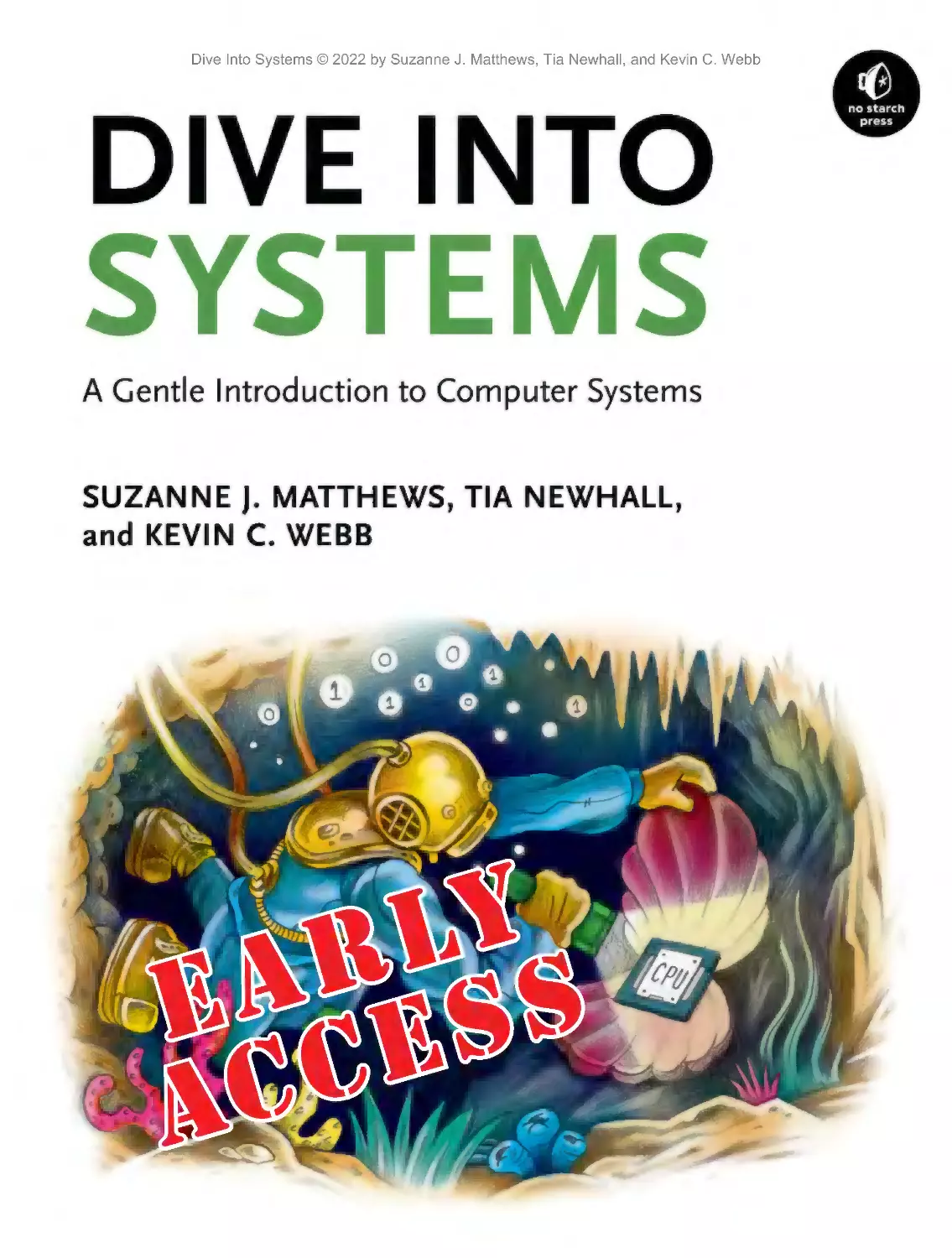


Author: Matthews S.J. Newhall T. Webb K.C.
Tags: information technology computer technology computer equipment operating systems
ISBN: 978-1-7185-0137-9
Year: 2022

Text
Dive Into Systems © 2022 by Suzanne J. Matthews, Tia Newhall, and Kevin C. Webb
Y
L
R
A
E ESS
C
C
A
Dive Into Systems © 2022 by Suzanne J. Matthews, Tia Newhall, and Kevin C. Webb
NO S TA RCH PRE SS
E A R LY A C C E S S P R O G R A M :
FEEDBACK WELCOME!
Welcome to the Early Access edition of the as yet unpublished Dive Into
Systems by Suzanne J. Matthews, Tia Newhall, and Kevin C. Webb! As a prepublication title, this book may be incomplete and some chapters may not
have been proofread.
Our goal is always to make the best books possible, and we look forward
to hearing your thoughts. If you have any comments or questions, email us
at earlyaccess@nostarch.com. If you have specific feedback for us, please
include the page number, book title, and edition date in your note, and
we’ll be sure to review it. We appreciate your help and support!
We’ll email you as new chapters become available. In the meantime,
enjoy!
Dive Into Systems © 2022 by Suzanne J. Matthews, Tia Newhall, and Kevin C. Webb
DIVE INTO SYSTEMS
Dive Into Systems © 2022 by Suzanne J. Matthews, Tia Newhall, and Kevin C. Webb
Dive Into Systems © 2022 by Suzanne J. Matthews, Tia Newhall, and Kevin C. Webb
DIVE INTO
SYSTEMS
A Gentle Introduction to
Computer Systems
by Suzanne J. Matthews, Tia Newhall, and
Kevin C. Webb
San Francisco
Dive Into Systems © 2022 by Suzanne J. Matthews, Tia Newhall, and Kevin C. Webb
DIVE INTO SYSTEMS. Copyright © 2022 by Suzanne J. Matthews, Tia Newhall, and Kevin C. Webb
All rights reserved. No part of this work may be reproduced or transmitted in any form or by any means, electronic
or mechanical, including photocopying, recording, or by any information storage or retrieval system, without the
prior written permission of the copyright owner and the publisher.
26 25 24 23 22
123456789
ISBN13: 9781718501362 (print)
ISBN13: 9781718501379 (ebook)
Publisher: Bill Pollock
Production Editor: Paula Williamson
Cover and Interior Design: Octopod Studios
Copyeditor: Richard Hutchinson
Proofreader: [To come]
Indexer: Sanjiv Kumar Sinha
For information on book distributors or translations, please contact No Starch Press, Inc. directly:
No Starch Press, Inc.
245 8th Street, San Francisco, CA 94103
phone: 415.863.9900; fax: 415.863.9950; info@nostarch.com; www.nostarch.com
Library of Congress CataloginginPublication Data
To come
No Starch Press and the No Starch Press logo are registered trademarks of No Starch Press, Inc. Other product and
company names mentioned herein may be the trademarks of their respective owners. Rather than use a trademark
symbol with every occurrence of a trademarked name, we are using the names only in an editorial fashion and to the
benefit of the trademark owner, with no intention of infringement of the trademark.
The information in this book is distributed on an “As Is” basis, without warranty. While every precaution has been
taken in the preparation of this work, neither the author nor No Starch Press, Inc. shall have any liability to any
person or entity with respect to any loss or damage caused or alleged to be caused directly or indirectly by the infor
mation contained in it.
Dive Into Systems © 2022 by Suzanne J. Matthews, Tia Newhall, and Kevin C. Webb
BRIEF CONTENTS
Chapter 1: By the C, by the C, by the Beautiful C . . . . . . . . . . . . . . . . . . . . . . . . . . . . . . . . . . . . . .
1
Chapter 2: A Deeper Dive into C Programming . . . . . . . . . . . . . . . . . . . . . . . . . . . . . . . . . . . . . . . .
49
Chapter 3: C Debugging Tools . . . . . . . . . . . . . . . . . . . . . . . . . . . . . . . . . . . . . . . . . . . . . . . . . . . . . . . 133
Chapter 4: Binary and Data Representation . . . . . . . . . . . . . . . . . . . . . . . . . . . . . . . . . . . . . . . . . . . 171
Chapter 5: What von Neumann Knew: Computer Architecture . . . . . . . . . . . . . . . . . . . . . . . . . . 213
Chapter 6: Under the C: Diving into Assembly . . . . . . . . . . . . . . . . . . . . . . . . . . . . . . . . . . . . . . . . . 271
Dive Into Systems © 2022 by Suzanne J. Matthews, Tia Newhall, and Kevin C. Webb
Dive Into Systems © 2022 by Suzanne J. Matthews, Tia Newhall, and Kevin C. Webb
CONTENTS IN DETAIL
1
BY THE C, BY THE C, BY THE BEAUTIFUL C
1.1
1.2
1.3
1.4
1.5
1.6
1.7
Getting Started Programming in C . . . . . . . . . . . . . . . . . . . . . . . . . . . . . . . . . . . . . . . . . . .
1.1.1
Compiling and Running C Programs . . . . . . . . . . . . . . . . . . . . . . . . . . . . .
1.1.2
C Types . . . . . . . . . . . . . . . . . . . . . . . . . . . . . . . . . . . . . . . . . . . . . . . . . . . . . . .
Input/Output (printf and scanf) . . . . . . . . . . . . . . . . . . . . . . . . . . . . . . . . . . . . . . . . . . . . . .
1.2.1
printf . . . . . . . . . . . . . . . . . . . . . . . . . . . . . . . . . . . . . . . . . . . . . . . . . . . . . . . . .
1.2.2
scanf . . . . . . . . . . . . . . . . . . . . . . . . . . . . . . . . . . . . . . . . . . . . . . . . . . . . . . . . .
Conditionals and Loops . . . . . . . . . . . . . . . . . . . . . . . . . . . . . . . . . . . . . . . . . . . . . . . . . . . .
1.3.1
Boolean Values in C . . . . . . . . . . . . . . . . . . . . . . . . . . . . . . . . . . . . . . . . . . .
1.3.2
Loops in C . . . . . . . . . . . . . . . . . . . . . . . . . . . . . . . . . . . . . . . . . . . . . . . . . . . .
Functions . . . . . . . . . . . . . . . . . . . . . . . . . . . . . . . . . . . . . . . . . . . . . . . . . . . . . . . . . . . . . . . . .
1.4.1
The Stack . . . . . . . . . . . . . . . . . . . . . . . . . . . . . . . . . . . . . . . . . . . . . . . . . . . . .
Arrays and Strings . . . . . . . . . . . . . . . . . . . . . . . . . . . . . . . . . . . . . . . . . . . . . . . . . . . . . . . . .
1.5.1
Introduction to Arrays . . . . . . . . . . . . . . . . . . . . . . . . . . . . . . . . . . . . . . . . . .
1.5.2
Array Access Methods . . . . . . . . . . . . . . . . . . . . . . . . . . . . . . . . . . . . . . . . . .
1.5.3
Arrays and Functions . . . . . . . . . . . . . . . . . . . . . . . . . . . . . . . . . . . . . . . . . . .
1.5.4
Introduction to Strings and the C String Library . . . . . . . . . . . . . . . . . . . .
Structs . . . . . . . . . . . . . . . . . . . . . . . . . . . . . . . . . . . . . . . . . . . . . . . . . . . . . . . . . . . . . . . . . . . .
1.6.1
Defining a Struct Type . . . . . . . . . . . . . . . . . . . . . . . . . . . . . . . . . . . . . . . . . .
1.6.2
Declaring Variables of Struct Types . . . . . . . . . . . . . . . . . . . . . . . . . . . . . .
1.6.3
Accessing Field Values . . . . . . . . . . . . . . . . . . . . . . . . . . . . . . . . . . . . . . . . .
1.6.4
Passing Structs to Functions . . . . . . . . . . . . . . . . . . . . . . . . . . . . . . . . . . . . .
Summary . . . . . . . . . . . . . . . . . . . . . . . . . . . . . . . . . . . . . . . . . . . . . . . . . . . . . . . . . . . . . . . . .
2
A DEEPER DIVE INTO C PROGRAMMING
2.1
2.2
2.3
2.4
2.5
Parts of Program Memory and Scope . . . . . . . . . . . . . . . . . . . . . . . . . . . . . . . . . . . . . . . .
C’s Pointer Variables . . . . . . . . . . . . . . . . . . . . . . . . . . . . . . . . . . . . . . . . . . . . . . . . . . . . . . .
2.2.1
Pointer Variables . . . . . . . . . . . . . . . . . . . . . . . . . . . . . . . . . . . . . . . . . . . . . . .
Pointers and Functions . . . . . . . . . . . . . . . . . . . . . . . . . . . . . . . . . . . . . . . . . . . . . . . . . . . . .
Dynamic Memory Allocation . . . . . . . . . . . . . . . . . . . . . . . . . . . . . . . . . . . . . . . . . . . . . . . .
2.4.1
Heap Memory . . . . . . . . . . . . . . . . . . . . . . . . . . . . . . . . . . . . . . . . . . . . . . . . .
2.4.2
malloc and free . . . . . . . . . . . . . . . . . . . . . . . . . . . . . . . . . . . . . . . . . . . . . . . .
2.4.3
Dynamically Allocated Arrays and Strings . . . . . . . . . . . . . . . . . . . . . . . .
2.4.4
Pointers to Heap Memory and Functions . . . . . . . . . . . . . . . . . . . . . . . . . .
Arrays in C . . . . . . . . . . . . . . . . . . . . . . . . . . . . . . . . . . . . . . . . . . . . . . . . . . . . . . . . . . . . . . .
2.5.1
Single-Dimensional Arrays . . . . . . . . . . . . . . . . . . . . . . . . . . . . . . . . . . . . . .
2.5.2
Two-Dimensional Arrays . . . . . . . . . . . . . . . . . . . . . . . . . . . . . . . . . . . . . . . .
1
2
4
8
12
12
14
16
18
19
24
27
30
30
33
34
36
38
39
39
39
43
46
49
50
52
53
57
59
60
61
63
66
67
67
70
Dive Into Systems © 2022 by Suzanne J. Matthews, Tia Newhall, and Kevin C. Webb
Strings and the String Library . . . . . . . . . . . . . . . . . . . . . . . . . . . . . . . . . . . . . . . . . . . . . . .
2.6.1
C’s Support for Statically Allocated Strings (Arrays of char) . . . . . . . . .
2.6.2
Dynamically Allocating Strings . . . . . . . . . . . . . . . . . . . . . . . . . . . . . . . . . .
2.6.3
Libraries for Manipulating C Strings and Characters . . . . . . . . . . . . . . .
2.7 C Structs . . . . . . . . . . . . . . . . . . . . . . . . . . . . . . . . . . . . . . . . . . . . . . . . . . . . . . . . . . . . . . . . . .
2.7.1
Review of the C struct Type . . . . . . . . . . . . . . . . . . . . . . . . . . . . . . . . . . . . .
2.7.2
Pointers and Structs . . . . . . . . . . . . . . . . . . . . . . . . . . . . . . . . . . . . . . . . . . . .
2.7.3
Pointer Fields in Structs . . . . . . . . . . . . . . . . . . . . . . . . . . . . . . . . . . . . . . . . .
2.7.4
Arrays of Structs . . . . . . . . . . . . . . . . . . . . . . . . . . . . . . . . . . . . . . . . . . . . . . .
2.7.5
Self-Referential Structs . . . . . . . . . . . . . . . . . . . . . . . . . . . . . . . . . . . . . . . . . .
2.8 I/O in C (Standard and File) . . . . . . . . . . . . . . . . . . . . . . . . . . . . . . . . . . . . . . . . . . . . . . . .
2.8.1
Standard Input/Output . . . . . . . . . . . . . . . . . . . . . . . . . . . . . . . . . . . . . . . . .
2.8.2
File Input/Output . . . . . . . . . . . . . . . . . . . . . . . . . . . . . . . . . . . . . . . . . . . . . .
2.8.3
Using Text Files in C . . . . . . . . . . . . . . . . . . . . . . . . . . . . . . . . . . . . . . . . . . . .
2.8.4
Standard and File I/O Functions in stdio.h . . . . . . . . . . . . . . . . . . . . . . . .
2.9 Some Advanced C Features . . . . . . . . . . . . . . . . . . . . . . . . . . . . . . . . . . . . . . . . . . . . . . . .
2.9.1
switch Statements . . . . . . . . . . . . . . . . . . . . . . . . . . . . . . . . . . . . . . . . . . . . . .
2.9.2
Command Line Arguments . . . . . . . . . . . . . . . . . . . . . . . . . . . . . . . . . . . . . .
2.9.3
The void * Type and Type Recasting . . . . . . . . . . . . . . . . . . . . . . . . . . . . .
2.9.4
Pointer Arithmetic . . . . . . . . . . . . . . . . . . . . . . . . . . . . . . . . . . . . . . . . . . . . . .
2.9.5
C Libraries: Using, Compiling, and Linking . . . . . . . . . . . . . . . . . . . . . . .
2.9.6
Writing and Using Your Own C Libraries . . . . . . . . . . . . . . . . . . . . . . . . .
2.9.7
Compiling C to Assembly, and Compiling and Linking Assembly and
C Code . . . . . . . . . . . . . . . . . . . . . . . . . . . . . . . . . . . . . . . . . . . . . . . . . . . . . . .
2.10 Summary . . . . . . . . . . . . . . . . . . . . . . . . . . . . . . . . . . . . . . . . . . . . . . . . . . . . . . . . . . . . . . . . .
2.6
3
C DEBUGGING TOOLS
3.1
3.2
3.3
3.4
3.5
viii
Debugging with GDB . . . . . . . . . . . . . . . . . . . . . . . . . . . . . . . . . . . . . . . . . . . . . . . . . . . . . .
3.1.1
Getting Started with GDB . . . . . . . . . . . . . . . . . . . . . . . . . . . . . . . . . . . . . . .
3.1.2
Example GDB Sessions . . . . . . . . . . . . . . . . . . . . . . . . . . . . . . . . . . . . . . . . .
GDB Commands in Detail . . . . . . . . . . . . . . . . . . . . . . . . . . . . . . . . . . . . . . . . . . . . . . . . . .
3.2.1
Keyboard Shortcuts in GDB . . . . . . . . . . . . . . . . . . . . . . . . . . . . . . . . . . . . .
3.2.2
Common GDB Commands . . . . . . . . . . . . . . . . . . . . . . . . . . . . . . . . . . . . . .
Debugging Memory with Valgrind . . . . . . . . . . . . . . . . . . . . . . . . . . . . . . . . . . . . . . . . . . .
3.3.1
An Example Program with a Heap Memory Access Error . . . . . . . . . . .
3.3.2
How to Use Memcheck . . . . . . . . . . . . . . . . . . . . . . . . . . . . . . . . . . . . . . . . .
Advanced GDB Features . . . . . . . . . . . . . . . . . . . . . . . . . . . . . . . . . . . . . . . . . . . . . . . . . . .
3.4.1
GDB and make . . . . . . . . . . . . . . . . . . . . . . . . . . . . . . . . . . . . . . . . . . . . . . . .
3.4.2
Attaching GDB to a Running Process . . . . . . . . . . . . . . . . . . . . . . . . . . . . .
3.4.3
Following a Process on a Fork . . . . . . . . . . . . . . . . . . . . . . . . . . . . . . . . . . .
3.4.4
Signal Control . . . . . . . . . . . . . . . . . . . . . . . . . . . . . . . . . . . . . . . . . . . . . . . . .
3.4.5
DDD Settings and Bug Fixes . . . . . . . . . . . . . . . . . . . . . . . . . . . . . . . . . . . . .
Debugging Assembly Code . . . . . . . . . . . . . . . . . . . . . . . . . . . . . . . . . . . . . . . . . . . . . . . . .
3.5.1
Using GDB to Examine Binary Code . . . . . . . . . . . . . . . . . . . . . . . . . . . . .
3.5.2
Using DDD to Debug at the Assembly Level . . . . . . . . . . . . . . . . . . . . . . .
Contents in Detail
78
78
79
80
88
88
90
92
94
95
97
97
101
102
103
106
106
108
110
112
116
122
128
131
133
134
135
135
145
145
145
152
153
156
158
158
159
160
160
161
161
162
163
Dive Into Systems © 2022 by Suzanne J. Matthews, Tia Newhall, and Kevin C. Webb
3.6
3.7
3.5.3
GDB Assembly Code Debugging Commands and Examples . . . . . . . .
3.5.4
Quick Summary of Common Commands for Assembly Debugging . .
Debugging Multithreaded Programs with GDB . . . . . . . . . . . . . . . . . . . . . . . . . . . . . . . .
3.6.1
GDB and Pthreads . . . . . . . . . . . . . . . . . . . . . . . . . . . . . . . . . . . . . . . . . . . . .
3.6.2
GDB Thread-Specific Commands . . . . . . . . . . . . . . . . . . . . . . . . . . . . . . . .
3.6.3
Examples . . . . . . . . . . . . . . . . . . . . . . . . . . . . . . . . . . . . . . . . . . . . . . . . . . . . .
Summary . . . . . . . . . . . . . . . . . . . . . . . . . . . . . . . . . . . . . . . . . . . . . . . . . . . . . . . . . . . . . . . . .
4
BINARY AND DATA REPRESENTATION
4.1
4.2
4.3
4.4
4.5
4.6
4.7
4.8
4.9
Number Bases and Unsigned Integers . . . . . . . . . . . . . . . . . . . . . . . . . . . . . . . . . . . . . . .
4.1.1
Decimal Numbers . . . . . . . . . . . . . . . . . . . . . . . . . . . . . . . . . . . . . . . . . . . . . .
4.1.2
Unsigned Binary Numbers . . . . . . . . . . . . . . . . . . . . . . . . . . . . . . . . . . . . . .
4.1.3
Hexadecimal . . . . . . . . . . . . . . . . . . . . . . . . . . . . . . . . . . . . . . . . . . . . . . . . . .
4.1.4
Storage Limitations . . . . . . . . . . . . . . . . . . . . . . . . . . . . . . . . . . . . . . . . . . . . .
Converting Between Bases . . . . . . . . . . . . . . . . . . . . . . . . . . . . . . . . . . . . . . . . . . . . . . . . . .
4.2.1
Converting Between Binary and Hexadecimal . . . . . . . . . . . . . . . . . . . .
4.2.2
Converting to Decimal . . . . . . . . . . . . . . . . . . . . . . . . . . . . . . . . . . . . . . . . . .
4.2.3
Converting from Decimal . . . . . . . . . . . . . . . . . . . . . . . . . . . . . . . . . . . . . . .
Signed Binary Integers . . . . . . . . . . . . . . . . . . . . . . . . . . . . . . . . . . . . . . . . . . . . . . . . . . . . .
4.3.1
Signed Magnitude . . . . . . . . . . . . . . . . . . . . . . . . . . . . . . . . . . . . . . . . . . . . .
4.3.2
Two’s Complement . . . . . . . . . . . . . . . . . . . . . . . . . . . . . . . . . . . . . . . . . . . . .
Binary Integer Arithmetic . . . . . . . . . . . . . . . . . . . . . . . . . . . . . . . . . . . . . . . . . . . . . . . . . . .
4.4.1
Addition . . . . . . . . . . . . . . . . . . . . . . . . . . . . . . . . . . . . . . . . . . . . . . . . . . . . . .
4.4.2
Subtraction . . . . . . . . . . . . . . . . . . . . . . . . . . . . . . . . . . . . . . . . . . . . . . . . . . . .
4.4.3
Multiplication and Division . . . . . . . . . . . . . . . . . . . . . . . . . . . . . . . . . . . . . .
Integer Overflow . . . . . . . . . . . . . . . . . . . . . . . . . . . . . . . . . . . . . . . . . . . . . . . . . . . . . . . . . .
4.5.1
Odometer Analogy . . . . . . . . . . . . . . . . . . . . . . . . . . . . . . . . . . . . . . . . . . . .
4.5.2
Binary Integer Overflow . . . . . . . . . . . . . . . . . . . . . . . . . . . . . . . . . . . . . . . .
4.5.3
Overflow Summary . . . . . . . . . . . . . . . . . . . . . . . . . . . . . . . . . . . . . . . . . . . . .
4.5.4
Overflow Consequences . . . . . . . . . . . . . . . . . . . . . . . . . . . . . . . . . . . . . . . .
Bitwise Operators . . . . . . . . . . . . . . . . . . . . . . . . . . . . . . . . . . . . . . . . . . . . . . . . . . . . . . . . .
4.6.1
Bitwise AND . . . . . . . . . . . . . . . . . . . . . . . . . . . . . . . . . . . . . . . . . . . . . . . . . .
4.6.2
Bitwise OR . . . . . . . . . . . . . . . . . . . . . . . . . . . . . . . . . . . . . . . . . . . . . . . . . . . .
4.6.3
Bitwise XOR (Exclusive OR) . . . . . . . . . . . . . . . . . . . . . . . . . . . . . . . . . . . . .
4.6.4
Bitwise NOT . . . . . . . . . . . . . . . . . . . . . . . . . . . . . . . . . . . . . . . . . . . . . . . . . . .
4.6.5
Bit Shifting . . . . . . . . . . . . . . . . . . . . . . . . . . . . . . . . . . . . . . . . . . . . . . . . . . . .
Integer Byte Order . . . . . . . . . . . . . . . . . . . . . . . . . . . . . . . . . . . . . . . . . . . . . . . . . . . . . . . . .
Real Numbers in Binary . . . . . . . . . . . . . . . . . . . . . . . . . . . . . . . . . . . . . . . . . . . . . . . . . . . .
4.8.1
Fixed-Point Representation . . . . . . . . . . . . . . . . . . . . . . . . . . . . . . . . . . . . . .
4.8.2
Floating-Point Representation . . . . . . . . . . . . . . . . . . . . . . . . . . . . . . . . . . . .
4.8.3
Rounding Consequences . . . . . . . . . . . . . . . . . . . . . . . . . . . . . . . . . . . . . . . .
Summary . . . . . . . . . . . . . . . . . . . . . . . . . . . . . . . . . . . . . . . . . . . . . . . . . . . . . . . . . . . . . . . . .
5
WHAT VON NEUMANN KNEW: COMPUTER ARCHITECTURE
163
165
165
166
166
167
170
171
174
174
175
177
178
179
180
180
181
183
184
186
189
189
191
192
193
193
195
199
199
200
200
202
202
203
204
206
208
208
210
211
211
213
Contents in Detail
ix
Dive Into Systems © 2022 by Suzanne J. Matthews, Tia Newhall, and Kevin C. Webb
5.1
The Origin of Modern Computing Architectures . . . . . . . . . . . . . . . . . . . . . . . . . . . . . . .
5.1.1
The Turing Machine . . . . . . . . . . . . . . . . . . . . . . . . . . . . . . . . . . . . . . . . . . . .
5.1.2
Early Electronic Computers . . . . . . . . . . . . . . . . . . . . . . . . . . . . . . . . . . . . . .
5.1.3
So What Did von Neumann Know? . . . . . . . . . . . . . . . . . . . . . . . . . . . . . .
5.2 The von Neumann Architecture . . . . . . . . . . . . . . . . . . . . . . . . . . . . . . . . . . . . . . . . . . . . . .
5.2.1
The CPU . . . . . . . . . . . . . . . . . . . . . . . . . . . . . . . . . . . . . . . . . . . . . . . . . . . . . .
5.2.2
The Processing Unit . . . . . . . . . . . . . . . . . . . . . . . . . . . . . . . . . . . . . . . . . . . .
5.2.3
The Control Unit . . . . . . . . . . . . . . . . . . . . . . . . . . . . . . . . . . . . . . . . . . . . . . .
5.2.4
The Memory Unit . . . . . . . . . . . . . . . . . . . . . . . . . . . . . . . . . . . . . . . . . . . . . .
5.2.5
The Input and Output (I/O) Units . . . . . . . . . . . . . . . . . . . . . . . . . . . . . . . .
5.2.6
The von Neumann Machine in Action: Executing a Program . . . . . . . .
5.3 Logic Gates . . . . . . . . . . . . . . . . . . . . . . . . . . . . . . . . . . . . . . . . . . . . . . . . . . . . . . . . . . . . . . .
5.3.1
Basic Logic Gates . . . . . . . . . . . . . . . . . . . . . . . . . . . . . . . . . . . . . . . . . . . . . .
5.3.2
Other Logic Gates . . . . . . . . . . . . . . . . . . . . . . . . . . . . . . . . . . . . . . . . . . . . .
5.4 Circuits . . . . . . . . . . . . . . . . . . . . . . . . . . . . . . . . . . . . . . . . . . . . . . . . . . . . . . . . . . . . . . . . . . .
5.4.1
Arithmetic and Logic Circuits . . . . . . . . . . . . . . . . . . . . . . . . . . . . . . . . . . . .
5.4.2
Arithmetic Circuits . . . . . . . . . . . . . . . . . . . . . . . . . . . . . . . . . . . . . . . . . . . . . .
5.4.3
Control Circuits . . . . . . . . . . . . . . . . . . . . . . . . . . . . . . . . . . . . . . . . . . . . . . . .
5.4.4
Storage Circuits . . . . . . . . . . . . . . . . . . . . . . . . . . . . . . . . . . . . . . . . . . . . . . . .
5.5 Building a Processor: Putting It All Together . . . . . . . . . . . . . . . . . . . . . . . . . . . . . . . . . .
5.5.1
The ALU . . . . . . . . . . . . . . . . . . . . . . . . . . . . . . . . . . . . . . . . . . . . . . . . . . . . . .
5.5.2
The Register File . . . . . . . . . . . . . . . . . . . . . . . . . . . . . . . . . . . . . . . . . . . . . . .
5.5.3
The CPU . . . . . . . . . . . . . . . . . . . . . . . . . . . . . . . . . . . . . . . . . . . . . . . . . . . . . .
5.6 The Processor’s Execution of Program Instructions . . . . . . . . . . . . . . . . . . . . . . . . . . . . .
5.6.1
Clock-Driven Execution . . . . . . . . . . . . . . . . . . . . . . . . . . . . . . . . . . . . . . . . .
5.6.2
Putting It All Together: The CPU in a Full Computer . . . . . . . . . . . . . . . .
5.7 Pipelining: Making the CPU Faster . . . . . . . . . . . . . . . . . . . . . . . . . . . . . . . . . . . . . . . . . .
5.8 Advanced Pipelined Instruction Considerations . . . . . . . . . . . . . . . . . . . . . . . . . . . . . . .
5.8.1
Pipelining Consideration: Data Hazards . . . . . . . . . . . . . . . . . . . . . . . . .
5.8.2
Pipelining Hazards: Control Hazards . . . . . . . . . . . . . . . . . . . . . . . . . . . .
5.9 Looking Ahead: CPUs Today . . . . . . . . . . . . . . . . . . . . . . . . . . . . . . . . . . . . . . . . . . . . . . .
5.9.1
Instruction-Level Parallelism . . . . . . . . . . . . . . . . . . . . . . . . . . . . . . . . . . . . . .
5.9.2
Multicore and Hardware Multithreading . . . . . . . . . . . . . . . . . . . . . . . . . .
5.9.3
Some Example Processors . . . . . . . . . . . . . . . . . . . . . . . . . . . . . . . . . . . . . .
5.10 Summary . . . . . . . . . . . . . . . . . . . . . . . . . . . . . . . . . . . . . . . . . . . . . . . . . . . . . . . . . . . . . . . . .
6
UNDER THE C: DIVING INTO ASSEMBLY
x
Contents in Detail
215
216
217
218
219
220
220
221
221
222
222
224
225
226
228
228
232
234
239
242
243
246
247
248
253
256
257
259
260
261
263
264
265
267
268
271
Dive Into Systems © 2022 by Suzanne J. Matthews, Tia Newhall, and Kevin C. Webb
1
BY THE C, BY THE C, BY THE
BEAUTIFUL C
“By the Beautiful Sea”
—Carroll and Atteridge, 1914
This chapter presents an overview of C pro
gramming written for students who have
some experience programming in another
language. It’s specifically written for Python
programmers and uses a few Python examples for com
parison purposes. However, it should be useful as an
introduction to C programming for anyone with basic
programming experience in any language.
C is a highlevel programming language like other languages you might
know, such as Python, Java, Ruby, or C++. It’s an imperative and a procedu
ral programming language, which means that a C program is expressed as a
sequence of statements (steps) for the computer to execute and that C pro
grams are structured as a set of functions (procedures). Every C program
must have at least one function, the main function, which contains the set of
statements that execute when the program begins.
The C programming language is less abstracted from the computer’s
machine language than some other languages with which you might be fa
Dive Into Systems © 2022 by Suzanne J. Matthews, Tia Newhall, and Kevin C. Webb
miliar. This means that C doesn’t have support for objectoriented program
ming (like Python, Java, and C++) or have a rich set of highlevel program
ming abstractions (such as strings, lists, and dictionaries in Python). As a
result, if you want to use a dictionary data structure in your C program, you
need to implement it yourself as opposed to just importing the one that is
part of the programming language (as in Python).
C’s lack of highlevel abstractions might make it seem like a less appeal
ing programming language to use. However, being less abstracted from the
underlying machine makes C easier for a programmer to see and under
stand the relationship between a program’s code and the computer’s exe
cution of it. C programmers retain more control over how their programs
execute on the hardware, and they can write code that runs more efficiently
than equivalent code written using the higherlevel abstractions provided by
other programming languages. In particular, they have more control over
how their programs manage memory, which can have a significant impact
on performance. Thus, C remains the de facto language for computer sys
tems programming where lowlevel control and efficiency are crucial.
We use C in this book because of its expressiveness of program control
and its relatively straightforward translation to assembly and machine code
that a computer executes. This chapter introduces programming in C, be
ginning with an overview of its features. Chapter 2 then describes C’s fea
tures in more detail.
1.1 Getting Started Programming in C
Let’s start by looking at a “hello world” program that includes an example
of calling a function from the math library. We compare the Python version
of this program (first) to the C version (second). The C version might be put
in a file named hello.c (.c is the suffix convention for C source code files),
whereas the Python version might be in a file named hello.py.
'''
The Hello World Program in Python
'''
# Python math library
from math import *
# main function definition:
def main():
# statements on their own line
print("Hello World")
print("sqrt(4) is %f" % (sqrt(4)))
# call the main function:
main()
2
Chapter 1
Dive Into Systems © 2022 by Suzanne J. Matthews, Tia Newhall, and Kevin C. Webb
Python version
/*
The Hello World Program in C
*/
/* C math and I/O libraries */
#include <math.h>
#include <stdio.h>
/* main function definition: */
int main() {
// statements end in a semicolon (;)
printf("Hello World\n");
printf("sqrt(4) is %f\n", sqrt(4));
return 0;
// main returns value 0
}
C version
NOTE
Both the C version1 and Python version2 are available for download.
Notice that both versions of this program have similar structure and lan
guage constructs albeit with different language syntax. In particular:
Comments:
In Python, multiline comments begin and end with ''', and singleline
comments begin with #.
In C, multiline comments begin with /* and end with */, and singleline
comments begin with //.
Importing library code:
In Python, libraries are included (imported) using import.
In C, libraries are included (imported) using #include. All #include state
ments appear at the top of the program, outside of function bodies.
Blocks:
In Python, indentation denotes a block.
In C, blocks (for example, function, loop, and conditional bodies) start
with { and end with }.
The main function:
In Python, def main():defines the main function.
In C, int main(){ } defines the main function. The main function returns
a value of type int, which is C’s name for specifying the signed integer
By the C, by the C, by the Beautiful C
3
Dive Into Systems © 2022 by Suzanne J. Matthews, Tia Newhall, and Kevin C. Webb
type (signed integers are values like –3, 0, 1234). The main function re
turns the int value 0 to signify running to completion without error.
Statements:
In Python, each statement is on a separate line.
In C, each statement ends with a semicolon ;. In C, statements must be
within the body of some function (in main in this example).
Output:
In Python, the print function prints a formatted string. Values for the
placeholders in the format string follow a % symbol in a commaseparated
list of values (for example, the value of sqrt(4) will be printed in place of
the %f placeholder in the format string).
In C, the printf function prints a formatted string. Values for the place
holders in the format string are additional arguments separated by com
mas (for example, the value of sqrt(4) will be printed in place of the %f
placeholder in the format string).
There are a few important differences to note in the C and Python ver
sions of this program:
Indentation:
In C, indentation doesn’t have meaning, but it’s good programming
style to indent statements based on their containing block’s nested level.
Output:
C’s printf function doesn’t automatically print a newline character at the
end like Python’s print function does. As a result, C programmers need
to explicitly specify a newline character (\n) in the format string when a
newline is desired in the output.
main function:
A C program must have a function named main, and its return type must
be int. This means that the main function returns a signed integer type
value. Python programs don’t need to name their main function main,
but they often do by convention.
The C main function has an explicit return statement to return an int
value (by convention, main should return 0 if the main function is suc
cessfully executed without errors).
A Python program needs to include an explicit call to its main function
to run it when the program executes. In C, its main function is automati
cally called when the C program executes.
1.1.1 Compiling and Running C Programs
Python is an interpreted programming language, which means that another
program, the Python interpreter, runs Python programs: the Python inter
4
Chapter 1
Dive Into Systems © 2022 by Suzanne J. Matthews, Tia Newhall, and Kevin C. Webb
preter acts like a virtual machine on which Python programs are run. To
run a Python program, the program source code (hello.py) is given as input
to the Python interpreter program that runs it. For example ($ is the Linux
shell prompt):
$ python hello.py
The Python interpreter is a program that is in a form that can be run
directly on the underlying system (this form is called binary executable) and
takes as input the Python program that it runs (Figure 11).
Python program:
def main ():
x = 6 + 7;
print ("x %d″ % x)
main ()
Python Interpreter Program
(a binary executable)
Operating System (OS)
Computer Hardware (HW)
Python: Interpreted Execution
Figure 1-1: A Python program is directly executed by the Python interpreter, which is a
binary executable program that is run on the underlying system (OS and hardware).
To run a C program, it must first be translated into a form that a com
puter system can execute directly. A C compiler is a program that translates
C source code into a binary executable form that the computer hardware can
directly execute. A binary executable consists of a series of 0’s and 1’s in a
welldefined format that a computer can run.
For example, to run the C program hello.c on a Unix system, the C code
must first be compiled by a C compiler (for example, the GNU C compiler,
gcc 3 ) that produces a binary executable (by default named a.out). The bi
nary executable version of the program can then be run directly on the sys
tem (Figure 12):
$ gcc hello.c
$ ./a.out
(Note that some C compilers might need to be explicitly told to link in
the math library: -lm):
$ gcc hello.c -lm
By the C, by the C, by the Beautiful C
5
Dive Into Systems © 2022 by Suzanne J. Matthews, Tia Newhall, and Kevin C. Webb
C program:
a.out:
int main() {
int x;
x = 6 + 7;
printf("x %d″,x);
return 0;
}
C
Compiler
01010110101
01010101010
10101010101
01010100
a.out
(a binary executable)
Operating System (OS)
Computer Hardware (HW)
C: First compiled into a.out
Then direct execution of a.out
Figure 1-2: The C compiler (gcc) builds C source code into a binary executable file
(a.out). The underlying system (OS and hardware) directly executes the a.out file to run
the program.
Detailed Steps
In general, the following sequence describes the necessary steps for editing,
compiling, and running a C program on a Unix system.
First, using a text editor (for example, vim4 ), write and save your C source
code program in a file (e.g. hello.c):
$ vim hello.c
Next, compile the source to an executable form, and then run it. The
most basic syntax for compiling with gcc is:
$ gcc <input_source_file>
If compilation yields no errors, the compiler creates a binary executable
file named a.out. The compiler also allows you to specify the name of the
binary executable file to generate using the -o flag:
$ gcc -o <output_executable_file> <input_source_file>
For example, this command instructs gcc to compile hello.c into an exe
cutable file named hello:
$ gcc -o hello hello.c
We can invoke the executable program using ./hello:
$ ./hello
Any changes made to the C source code (the hello.c file) must be recom
piled with gcc to produce a new version of hello. If the compiler detects any
6
Chapter 1
Dive Into Systems © 2022 by Suzanne J. Matthews, Tia Newhall, and Kevin C. Webb
errors during compilation, the ./hello file won’t be created/recreated (but
beware, an older version of the file from a previous successful compilation
might still exist).
Often when compiling with gcc, you want to include several command
line options. For example, these options enable more compiler warnings
and build a binary executable with extra debugging information:
$ gcc -Wall -g -o hello hello.c
Because the gcc command line can be long, frequently the make utility
is used to simplify compiling C programs and for cleaning up files created
by gcc. Using make and writing a Makefile are important skills that you will
develop as you build up experience with C programming.5
We cover compiling and linking with C library code in more detail at the
end of Chapter 2.
Variables and C Numeric Types
Like Python, C uses variables as named storage locations for holding data.
Thinking about the scope and type of program variables is important to un
derstand the semantics of what your program will do when you run it. A
variable’s scope defines when the variable has meaning (that is, where and
when in your program it can be used) and its lifetime (that is, it could per
sist for the entire run of a program or only during a function activation). A
variable’s type defines the range of values that it can represent and how those
values will be interpreted when performing operations on its data.
In C, all variables must be declared before they can be used. To declare
a variable, use the following syntax:
type_name variable_name;
A variable can only have a single type. The basic C types include char,
int, float, and double. By convention, C variables should be declared at the
beginning of their scope (at the top of a { } block) before any C statements
in that scope.
Below is an example C code snippet that shows declarations and uses of
variables of some different types. We discuss types and operators in more
detail after the example.
vars.c {
/* 1. Define variables in this block's scope at the top of the block. */
int x; // declares x to be an int type variable and allocates space for it
int i, j, k;
// can define multiple variables of the same type like this
char letter;
// a char stores a single-byte integer value
// it is often used to store a single ASCII character
// value (the ASCII numeric encoding of a character)
By the C, by the C, by the Beautiful C
7
Dive Into Systems © 2022 by Suzanne J. Matthews, Tia Newhall, and Kevin C. Webb
// a char in C is a different type than a string in C
float winpct; // winpct is declared to be a float type
double pi;
// the double type is more precise than float
/* 2. After defining all variables, you can use them in C statements. */
x = 7;
k = x + 2;
// x stores 7 (initialize variables before using their value)
// use x's value in an expression
letter = 'A';
// a single quote is used for single character value
letter = letter + 1; // letter stores 'B' (ASCII value one more than 'A')
pi = 3.1415926;
winpct = 11 / 2.0; // winpct gets 5.5, winpct is a float type
j = 11 / 2;
// j gets 5: int division truncates after the decimal
x = k % 2;
// % is C's mod operator, so x gets 9 mod 2 (1)
}
Note the semicolons galore. Recall that C statements are delineated by
;, not line breaks — C expects a semicolon after every statement. You’ll for
get some, and gcc almost never informs you that you missed a semicolon,
even though that might be the only syntax error in your program. In fact,
often when you forget a semicolon, the compiler indicates a syntax error on
the line after the one with the missing semicolon: the reason is that gcc inter
prets it as part of the statement from the previous line. As you continue to
program in C, you’ll learn to correlate gcc errors with the specific C syntax
mistakes that they describe.
1.1.2 C Types
C supports a small set of builtin data types, and it provides a few ways in
which programmers can construct basic collections of types (arrays and
structs). From these basic building blocks, a C programmer can build com
plex data structures.
C defines a set of basic types for storing numeric values. Here are some
examples of numeric literal values of different C types:
8
3.4
'h'
// the int value 8
// the double value 3.4
// the char value 'h' (its value is 104, the ASCII value of h)
The C char type stores a numeric value. However, it’s often used by pro
grammers to store the value of an ASCII character. A character literal value
is specified in C as a single character between single quotes.
C doesn’t support a string type, but programmers can create strings
from the char type and C’s support for constructing arrays of values, which
we discuss in later sections. C does, however, support a way of expressing
8
Chapter 1
Dive Into Systems © 2022 by Suzanne J. Matthews, Tia Newhall, and Kevin C. Webb
string literal values in programs: a string literal is any sequence of charac
ters between double quotes. C programmers often pass string literals as the
format string argument to printf:
printf("this is a C string\n");
Python supports strings, but it doesn’t have a char type. In C, a string
and a char are two very different types, and they evaluate differently. This
difference is illustrated by contrasting a C string literal that contains one
character with a C char literal. For example:
(its value is 104, the ASCII value of h)
'h' // this is a char literal value
"h" // this is a string literal value (its value is NOT 104, it is not a char)
We discuss C strings and char variables in more detail in the “Strings
and the String Library” section on page 78. Here, we’ll mainly focus on C’s
numeric types.
C Numeric Types
C supports several different types for storing numeric values. The types dif
fer in the format of the numeric values they represent. For example, the
float and double types can represent real values, int represents signed inte
ger values, and unsigned int represents unsigned integer values. Real values
are positive or negative values with a decimal point, such as –1.23 or 0.0056.
Signed integers store positive, negative, or zero integer values, such as –333,
0, or 3456. Unsigned integers store strictly nonnegative integer values, such
as 0 or 1234.
C’s numeric types also differ in the range and precision of the values
they can represent. The range or precision of a value depends on the num
ber of bytes associated with its type. Types with more bytes can represent a
larger range of values (for integer types), or higherprecision values (for real
types), than types with fewer bytes.
Table 11 shows the number of storage bytes, the kind of numeric values
stored, and how to declare a variable for a variety of common C numeric
types (note that these are typical sizes—the exact number of bytes depends
on the hardware architecture).
Table 1-1: C Numeric Types
Type name
Usual size
Values stored
How to declare
char
short
int
long
long long
float
double
1
2
4
4
8
4
8
integers
signed integers
signed integers
signed integers
signed integers
signed real numbers
signed real numbers
char x;
short x;
int x;
long x;
long long x;
float x;
double x;
byte
bytes
bytes
or 8 bytes
bytes
bytes
bytes
By the C, by the C, by the Beautiful C
9
Dive Into Systems © 2022 by Suzanne J. Matthews, Tia Newhall, and Kevin C. Webb
C also provides unsigned versions of the integer numeric types (char,
short, int, long, and long long). To declare a variable as unsigned, add the
keyword unsigned before the type name. For example:
int x;
unsigned int y;
// x is a signed int variable
// y is an unsigned int variable
The C standard doesn’t specify whether the char type is signed or un
signed. As a result, some implementations might implement char as signed
integer values and others as unsigned. It’s good programming practice to ex
plicitly declare unsigned char if you want to use the unsigned version of a char
variable.
The exact number of bytes for each of the C types might vary from one
architecture to the next. The sizes in Table 11 are minimum (and common)
sizes for each type. You can print the exact size on a given machine using C’s
sizeof operator, which takes the name of a type as an argument and evalu
ates to the number of bytes used to store that type. For example:
printf("number of bytes in an int: %lu\n", sizeof(int));
printf("number of bytes in a short: %lu\n", sizeof(short));
The sizeof operator evaluates to an unsigned long value, so in the call to
printf, use the placeholder %lu to print its value. On most architectures the
output of these statements will be:
number of bytes in an int: 4
number of bytes in a short: 2
Arithmetic Operators
Arithmetic operators combine values of numeric types. The resulting type
of the operation is based on the types of the operands. For example, if two
int values are combined with an arithmetic operator, the resulting type is
also an integer.
C performs automatic type conversion when an operator combines
operands of two different types. For example, if an int operand is combined
with a float operand, the integer operand is first converted to its floating
point equivalent before the operator is applied, and the type of the opera
tion’s result is float.
The following arithmetic operators can be used on most numeric type
operands:
10
Chapter 1
•
add (+) and subtract (-)
•
multiply (*), divide (/), and mod(%):
The mod operator (%) can only take integertype operands (int, unsigned
int, short, and so on).
If both operands are int types, the divide operator (/) performs in
teger division (the resulting value is an int, truncating anything be
Dive Into Systems © 2022 by Suzanne J. Matthews, Tia Newhall, and Kevin C. Webb
yond the decimal point from the division operation). For example
8/3 evaluates to 2.
If one or both of the operands are float (or double), / performs real
division and evaluates to a float (or double) result. For example,
8/3.0 evaluates to approximately 2.666667.
•
assignment (=):
variable = value of expression;
•
assignment with update (+=, -=, *=, /=, and %=):
variable op= expression;
•
// e.g., x = 3 + 4;
// e.g., x += 3; is shorthand for x = x + 3;
increment (++) and decrement (--):
variable++;
// e.g., x++; assigns to x the value of x + 1
WARNING:
PRE- VS. POST-INCREMENT
The operators ++variable and variable++ are both valid, but they’re evaluated
slightly differently:
•
++x: increment x first, then use its value.
•
x++: use x’s value first, then increment it.
In many cases, it doesn’t matter which you use because the value of the
incremented or decremented variable isn’t being used in the statement. For
example, these two statements are equivalent (although the first is the most
commonly used syntax for this statement):
x++;
++x;
In some cases, the context affects the outcome (when the value of the
incremented or decremented variable is being used in the statement). For
example:
x = 6;
y = ++x + 2;
// y is assigned 9: increment x first, then evaluate x + 2 (9)
x = 6;
y = x++ + 2;
// y is assigned 8: evaluate x + 2 first (8), then increment x
Code like the preceding example that uses an arithmetic expression with an
increment operator is often hard to read, and it’s easy to get wrong. As a
result, it’s generally best to avoid writing code like this; instead, write separate
By the C, by the C, by the Beautiful C
11
Dive Into Systems © 2022 by Suzanne J. Matthews, Tia Newhall, and Kevin C. Webb
statements for exactly the order you want. For example, if you want to first
increment x and then assign x + 1 to y, just write it as two separate statements.
Instead of writing this:
y = ++x + 1;
write it as two separate statements:
x++;
y = x + 1;
1.2 Input/Output (printf and scanf)
C’s printf function prints values to the terminal, and the scanf function reads
in values entered by a user. The printf and scanf functions belong to C’s
standard I/O library, which needs to be explicitly included at the top of any
.c file that uses these functions by using #include <stdio.h>. In this section,
we introduce the basics of using printf and scanf in C programs. “I/O in C
(Standard and File)” on page 97 discusses C’s input and output functions in
more detail.
1.2.1 printf
C’s printf function is very similar to formatted print in Python, where the
caller specifies a format string to print. The format string often contains for
matting specifiers, such as special characters that will print tabs (\t) or new
lines (\n), or placeholders for values in the output. Placeholders consist of %
followed by a type specifier letter (for example, %d represents a placeholder
for an integer value). For each placeholder in the format string, printf ex
pects an additional argument. Here, you can see an example program in
Python and C with formatted output.
# Python formatted print example
def main():
print("Name: %s, Info:" % "Vijay")
print("\tAge: %d \t Ht: %g" %(20,5.9))
print("\tYear: %d \t Dorm: %s" %(3, "Alice Paul"))
# call the main function:
main()
Python version
/* C printf example */
12
Chapter 1
Dive Into Systems © 2022 by Suzanne J. Matthews, Tia Newhall, and Kevin C. Webb
#include <stdio.h> // needed for printf
int main() {
printf("Name: %s, Info:\n", "Vijay");
printf("\tAge: %d \t Ht: %g\n",20,5.9);
printf("\tYear: %d \t Dorm: %s\n",
3,"Alice Paul");
return 0;
}
C version
When run, both versions of this program produce identically formatted
output:
Name: Vijay, Info:
Age: 20 Ht: 5.9
Year: 3 Dorm: Alice Paul
The main difference between C’s printf and Python’s print functions
are that the Python version implicitly prints a newline character at the end
of the output string but the C version does not. As a result, the C format
strings in this example have newline (\n) characters at the end to explicitly
print a newline character. The syntax for listing the argument values for the
placeholders in the format string is also slightly different in C’s printf and
Python’s print functions.
C uses the same formatting placeholders as Python for specifying dif
ferent types of values. The preceding example demonstrates the following
formatting placeholders:
%g: placeholder for a float (or double) value
%d: placeholder for a decimal value (int, short, char)
%s: placeholder for a string value
C additionally supports the %c placeholder for printing a character value.
This placeholder is useful when a programmer wants to print the ASCII
character associated with a particular numeric encoding. Here’s a C code
snippet that prints a char as its numeric value (%d) and as its character encod
ing (%c):
// Example printing a char value as its decimal representation (%d)
// and as the ASCII character that its value encodes (%c)
char ch;
ch = 'A';
printf("ch value is %d which is the ASCII value of
%c\n", ch, ch);
By the C, by the C, by the Beautiful C
13
Dive Into Systems © 2022 by Suzanne J. Matthews, Tia Newhall, and Kevin C. Webb
ch = 99;
printf("ch value is %d which is the ASCII value of
%c\n", ch, ch);
When run, the program’s output looks like this:
ch value is 65 which is the ASCII value of A
ch value is 99 which is the ASCII value of c
1.2.2 scanf
C’s scanf function represents one method for reading in values entered by
the user (via the keyboard) and storing them in program variables. The scanf
function can be a bit picky about the exact format in which the user enters
data, which means that it’s not very robust to badly formed user input. In
“I/O in C (Standard and File)” on page 97, we discuss more robust ways of
reading input values from the user. For now, remember that if your pro
gram gets into an infinite loop due to badly formed user input, you can al
ways press CTRLC to terminate it.
Reading input is handled differently in Python and C: Python uses the
input functionto read in a value as a string, and then the program converts
the string value to an int, while C uses scanf to read in an int value and to
store it at the location in memory of an int program variable (for example,
&num1). This code displays example programs for reading user input values in
Python and C.
# Python input example
def main():
num1
num1
num2
num2
=
=
=
=
input("Enter a number:")
int(num1)
input("Enter another:")
int(num2)
print("%d + %d = %d" % (num1, num2, (num1+num2)))
# call the main function:
main()
Python version
/* C input (scanf) example */
#include <stdio.h>
int main() {
int num1, num2;
14
Chapter 1
Dive Into Systems © 2022 by Suzanne J. Matthews, Tia Newhall, and Kevin C. Webb
printf("Enter a number: ");
scanf("%d", &num1);
printf("Enter another: ");
scanf("%d", &num2);
printf("%d + %d = %d\n", num1, num2, (num1+num2));
return 0;
}
C version
When run, both programs read in two values (30 and 67 in this exam
ple):
Enter a number: 30
Enter another: 67
30 + 67 = 97
Like printf, scanf takes a format string that specifies the number and
types of values to read in (for example, "%d" specifies one int value). The
scanf function skips over leading and trailing whitespace as it reads in a nu
meric value, so its format string only needs to contain a sequence of format
ting placeholders, usually with no whitespace or other formatting charac
ters between the placeholders in its format string. The arguments for the
placeholders in the format string specify the locations of program variables
into which the values read in will be stored. Prefixing the name of a variable
with the & operator produces the location of that variable in the program’s
memory — the memory address of the variable. “C’s Pointer Variables” on
page 52 discusses the & operator in more detail. For now, we use it only in
the context of the scanf function.
Here’s another scanf example, where the format string has placeholders
for two values, the first an int and the second a float:
scanf_ex.c int x;
float pi;
// read in an int value followed by a float value ("%d%g")
// store the int value at the memory location of x (&x)
// store the float value at the memory location of pi (&pi)
scanf("%d%g", &x, &pi);
When inputting data to a program via scanf, individual numeric input
values must be separated by at least one whitespace character. However, be
cause scanf skips over additional leading and trailing whitespace characters
(for example, spaces, tabs, and newlines), a user could enter input values
with any amount of space before or after each input value. For instance, if a
user enters the following for the call to scanf in the preceding example, scanf
By the C, by the C, by the Beautiful C
15
Dive Into Systems © 2022 by Suzanne J. Matthews, Tia Newhall, and Kevin C. Webb
will read in 8 and store it in the x variable, and then read in 3.14 and store it
in the pi variable:
8
3.14
1.3 Conditionals and Loops
These code examples show that the syntax and semantics of if–else state
ments in C and Python are very similar. The main syntactic difference is that
Python uses indentation to indicate “body” statements, whereas C uses curly
braces (but you should still use good indentation in your C code).
# Python if-else example
def main():
num1
num1
num2
num2
=
=
=
=
input("Enter the 1st number:")
int(num1)
input("Enter the 2nd number:")
int(num2)
if num1 > num2:
print("%d is biggest" % num1)
num2 = num1
else:
print("%d is biggest" % num2)
num1 = num2
# call the main function:
main()
Python version
/* C if-else example */
#include <stdio.h>
int main() {
int num1, num2;
printf("Enter the 1st number: ");
scanf("%d", &num1);
printf("Enter the 2nd number: ");
scanf("%d", &num2);
16
Chapter 1
Dive Into Systems © 2022 by Suzanne J. Matthews, Tia Newhall, and Kevin C. Webb
if (num1 > num2) {
printf("%d is biggest\n", num1);
num2 = num1;
} else {
printf("%d is biggest\n", num2);
num1 = num2;
}
return 0;
}
C version
The Python and C syntax for if–else statements is almost identical with
only minor differences. In both, the else part is optional. Python and C also
support multiway branching by chaining if and else if statements. The fol
lowing describes the full if–else C syntax:
// a one-way branch:
if ( <boolean expression> ) {
<true body>
}
// a two-way branch:
if ( <boolean expression> ) {
<true body>
}
else {
<false body>
}
// a multibranch (chaining if-else if-...-else)
// (has one or more 'else if' following the first if):
if ( <boolean expression 1> ) {
<true body>
}
else if ( <boolean expression 2> ) {
// first expression is false, second is true
<true 2 body>
}
else if ( <boolean expression 3> ) {
// first and second expressions are false, third is true
<true 3 body>
}
// ... more else if's ...
else if ( <boolean expression N> ) {
// first N-1 expressions are false, Nth is true
<true N body>
}
By the C, by the C, by the Beautiful C
17
Dive Into Systems © 2022 by Suzanne J. Matthews, Tia Newhall, and Kevin C. Webb
else { // the final else part is optional
// if all previous expressions are false
<false body>
}
1.3.1 Boolean Values in C
C doesn’t provide a boolean type with true or false values. Instead, integer
values evaluate to true or false when used in conditional statements. When
used in conditional expressions, an integer expression that is:
zero (0) evaluates to false;
nonzero (any positive or negative value) evaluates to true.
C has a set of relational and logical operators for boolean expressions. The
relational operators take operand(s) of the same type and evaluate to zero
(false) or nonzero (true). The set of relational operators are:
equality (==) and inequality (not equal, !=);
comparison operators: less than (<), less than or equal (<=), greater than
(>), and greater than or equal (>=).
Here are some C code snippets showing examples of relational opera
tors:
// assume x and y are ints, and have been assigned
// values before this point in the code
if (y < 0) {
printf("y is negative\n");
} else if (y != 0) {
printf("y is positive\n");
} else {
printf("y is zero\n");
}
// set x and y to the larger of the two values
if (x >= y) {
y = x;
} else {
x = y;
}
C’s logical operators take integer “boolean” operand(s) and evaluate to
either zero (false) or nonzero (true). The set of logical operators are:
logical negation (!);
logical and (&&): stops evaluating at the first false expression (shortcircuiting);
logical or (||): stops evaluating at the first true expression (shortcircuiting).
18
Chapter 1
Dive Into Systems © 2022 by Suzanne J. Matthews, Tia Newhall, and Kevin C. Webb
C’s shortcircuit logical operator evaluation stops evaluating a logical ex
pression as soon as the result is known. For example, if the first operand to
a logical and (&&) expression evaluates to false, the result of the && expression
must be false. As a result, the second operand’s value need not be evaluated,
and it is not evaluated.
The following is an example of conditional statements in C that use log
ical operators (it’s always best to use parentheses around complex boolean
expressions to make them easier to read):
if ( (x > 10) && (y >= x) ) {
printf("y and x are both larger than 10\n");
x = 13;
} else if ( ((-x) == 10) || (y > x) ) {
printf("y might be bigger than x\n");
x = y * x;
} else {
printf("I have no idea what the relationship between x and y is\n");
}
1.3.2 Loops in C
Like Python, C supports for and while loops. Additionally, C provides do–
while loops.
while Loops
The while loop syntax in C and Python is almost identical, and the behavior
is the same. Here, you can see example programs with while loops in C and
Python.
# Python while loop example
def main():
num = input("Enter a value: ")
num = int(num)
# make sure num is not negative
if num < 0:
num = -num
val = 1
while val < num:
print("%d" % (val))
val = val * 2
By the C, by the C, by the Beautiful C
19
Dive Into Systems © 2022 by Suzanne J. Matthews, Tia Newhall, and Kevin C. Webb
# call the main function:
main()
Python version
/* C while loop example */
#include <stdio.h>
int main() {
int num, val;
printf("Enter a value: ");
scanf("%d", &num);
// make sure num is not negative
if (num < 0) {
num = -num;
}
val = 1;
while (val < num) {
printf("%d\n", val);
val = val * 2;
}
return 0;
}
C version
The while loop syntax in C is very similar in Python, and both are evalu
ated in the same way:
while ( <boolean expression> ) {
<true body>
}
The while loop checks the boolean expression first and executes the
body if true. In the preceding example program, the value of the val vari
able will be repeatedly printed in the while loop until its value is greater than
the value of the num variable. If the user enters 10, the C and Python pro
grams will print:
1
2
4
8
C also has a do–while loop that is similar to its while loop, but it executes
the loop body first and then checks a condition and repeats executing the
loop body as long as the condition is true. That is, a do–while loop will always
execute the loop body at least one time:
20
Chapter 1
Dive Into Systems © 2022 by Suzanne J. Matthews, Tia Newhall, and Kevin C. Webb
do {
<body>
} while ( <boolean expression> );
For additional while loop examples, have a look at whileLoop1.c6 and
whileLoop2.c.7
for Loops
The for loop is different in C than it is in Python. In Python for loops are
iterations over sequences, whereas in C for loops are more general looping
constructs. Here are example programs that use for loops to print all the
values between 0 and a userprovided input number:
# Python for loop example
def main():
num = input("Enter a value: ")
num = int(num)
# make sure num is not negative
if num < 0:
num = -num
for i in range(num):
print("%d" % i)
# call the main function:
main()
Python version
/* C for loop example */
#include <stdio.h>
int main() {
int num, i;
printf("Enter a value: ");
scanf("%d", &num);
// make sure num is not negative
if (num < 0) {
num = -num;
}
By the C, by the C, by the Beautiful C
21
Dive Into Systems © 2022 by Suzanne J. Matthews, Tia Newhall, and Kevin C. Webb
for (i = 0; i < num; i++) {
printf("%d\n", i);
}
return 0;
}
C version
In this example, you can see that the C for loop syntax is quite different
from the Python for loop syntax. It’s also evaluated differently.
The C for loop syntax is:
for ( <initialization>; <boolean expression>; <step> ) {
<body>
}
The for loop evaluation rules are:
1.
Evaluate <initialization> one time when first entering the loop.
2.
Evaluate the <boolean expression>. If it’s 0 (false), drop out of the for
loop (that is, the program is done repeating the loop body state
ments).
3.
Evaluate the statements inside the loop <body>.
4.
Evaluate the <step> expression.
5.
Repeat from step (2).
Here’s a simple example for loop to print the values 0, 1, and 2:
int i;
for (i = 0; i < 3; i++) {
printf("%d\n", i);
}
Executing the for loop evaluation rules on the preceding loop yields the
following sequence of actions:
(1)
(2)
(3)
(4)
(2)
(3)
(4)
(2)
(3)
(4)
(2)
22
Chapter 1
eval init: i is set to 0
eval bool expr: i < 3 is
execute loop body: print
eval step: i is set to 1
eval bool expr: i < 3 is
execute loop body: print
eval step: i is set to 2
eval bool expr: i < 3 is
execute loop body: print
eval step: i is set to 3
eval bool expr: i < 3 is
(i=0)
true
the value of i (0)
(i++)
true
the value of i (1)
(i++)
true
the value of i (2)
(i++)
false, drop out of the for loop
Dive Into Systems © 2022 by Suzanne J. Matthews, Tia Newhall, and Kevin C. Webb
The following program shows a more complicated for loop example (it’s
also available to download8 ). Note that just because C supports for loops
with a list of statements for its <initialization> and <step> parts, it’s best to
keep it simple (this example illustrates a more complicated for loop syntax,
but the for loop would be easier to read and understand if it was simplified
by moving the j += 10 step statement to the end of the loop body and having
just a single step statement i += 1).
/* An example of a more complex for loop which uses multiple variables.
* (it is unusual to have for loops with multiple statements in the
* init and step parts, but C supports it and there are times when it
* is useful...don't go nuts with this just because you can)
*/
#include <stdio.h>
int main() {
int i, j;
for (i=0, j=0; i < 10; i+=1, j+=10) {
printf("i+j = %d\n", i+j);
}
return 0;
}
//
//
//
//
//
//
//
//
//
the rules for evaluating a for loop are the same no matter how
simple or complex each part is:
(1) evaluate the initialization statements once on the first
evaluation of the for loop: i=0 and j=0
(2) evaluate the boolean condition: i < 10
if false (when i is 10), drop out of the for loop
(3) execute the statements inside the for loop body: printf
(4) evaluate the step statements: i += 1, j += 10
(5) repeat, starting at step (2)
In C, for loops and while loops are equivalent in power, meaning that
any while loop can be expressed as a for loop and vice versa. The same is
not true in Python, where for loops are iterations over a sequence of values.
As such, they cannot express some looping behavior that the more general
Python while loop can express. Indefinite loops are one example that can
only be written as a while loop in Python.
Consider the following while loop in C:
int guess = 0;
while (guess != num) {
printf("%d is not the right number\n", guess);
By the C, by the C, by the Beautiful C
23
Dive Into Systems © 2022 by Suzanne J. Matthews, Tia Newhall, and Kevin C. Webb
printf("Enter another guess: ");
scanf("%d", &guess);
}
This loop can be translated to an equivalent for loop in C:
int guess;
for (guess = 0; guess != num; ) {
printf("%d is not the right number\n", guess);
printf("Enter another guess: ");
scanf("%d", &guess);
}
In Python, however, this type of looping behavior can only be expressed
with a while loop.
Because for and while loops are equally expressive in C, only one loop
ing construct is needed in the language. However, for loops are a more nat
ural language construct for definite loops (like iterating over a range of val
ues), and while loops are a more natural language construct for indefinite
loops (like repeating until the user enters an even number). As a result, C
provides both to programmers.
1.4 Functions
Functions break code into manageable pieces and reduce code duplication.
Functions might take zero or more parameters as input and they return a sin
gle value of a specific type. A function declaration or prototype specifies the
function’s name, its return type, and its parameter list (the number and
types of all the parameters). A function definition includes the code to be
executed when the function is called. All functions in C must be declared be
fore they’re called. This can be done by declaring a function prototype or by
fully defining the function before calling it.
// function definition format:
// --------------------------<return type> <function name> (<parameter list>)
{
<function body>
}
// parameter list format:
// --------------------<type> <param1 name>, <type> <param2 name>, ...,
<type> <last param name>
Here’s an example function definition. Note that the comments de
scribe what the function does, the details of each parameter (what it’s used
for and what it should be passed), and what the function returns:
24
Chapter 1
Dive Into Systems © 2022 by Suzanne J. Matthews, Tia Newhall, and Kevin C. Webb
/* This program computes the larger of two
* values entered by the user.
*/
#include <stdio.h>
/* max: computes the larger of two integer values
* x: one integer value
* y: the other integer value
* returns: the larger of x and y
*/
int max(int x, int y) {
int bigger;
bigger = x;
if (y > x) {
bigger = y;
}
printf(" in max, before return x: %d y: %d\n", x, y);
return bigger;
}
Functions that don’t return a value should specify the void return type.
Here’s an example of a void function:
/* prints out the squares from start to stop
* start: the beginning of the range
* stop: the end of the range
*/
void print_table(int start, int stop) {
int i;
for (i = start; i <= stop; i++) {
printf("%d\t", i*i);
}
printf("\n");
}
As in any programming language that supports functions or procedures,
a function call invokes a function, passing specific argument values for the
particular call. A function is called by its name and is passed arguments,
with one argument for each corresponding function parameter. In C, call
ing a function looks like this:
// function call format:
// --------------------function_name(<argument list>);
// argument list format:
By the C, by the C, by the Beautiful C
25
Dive Into Systems © 2022 by Suzanne J. Matthews, Tia Newhall, and Kevin C. Webb
// --------------------<argument 1 expression>, <argument 2 expression>, ..., <last argument expression>
Arguments to C functions are passed by value: each function parame
ter is assigned the value of the corresponding argument passed to it in the
function call by the caller. Pass by value semantics mean that any change to a
parameter’s value in the function (that is, assigning a parameter a new value
in the function) is not visible to the caller.
Here are some example function calls to the max and print_table func
tions listed earlier:
int val1, val2, result;
val1 = 6;
val2 = 10;
/* to call max, pass in two int values, and because max returns an
int value, assign its return value to a local variable (result)
*/
result = max(val1, val2);
/* call max with argument values 6 and 10 */
printf("%d\n", result);
/* prints out 10 */
result = max(11, 3);
printf("%d\n", result);
/* call max with argument values 11 and 3 */
/* prints out 11 */
result = max(val1 * 2, val2); /* call max with argument values 12 and 10 */
printf("%d\n", result);
/* prints out 12 */
/* print_table does not return a value, but takes two arguments */
print_table(1, 20);
/* prints a table of values from 1 to 20 */
print_table(val1, val2);
/* prints a table of values from 6 to 10 */
Here is another example of a full program that shows a call to a slightly
different implementation of the max function that has an additional state
ment to change the value of its parameter (x = y):
/* max: computes the larger of two int values
* x: one value
* y: the other value
* returns: the larger of x and y
*/
int max(int x, int y) {
int bigger;
bigger = x;
if (y > x) {
bigger = y;
// note: changing the parameter x's value here will not
//
change the value of its corresponding argument
26
Chapter 1
Dive Into Systems © 2022 by Suzanne J. Matthews, Tia Newhall, and Kevin C. Webb
x = y;
}
printf(" in max, before return x: %d y: %d\n", x, y);
return bigger;
}
/* main: shows a call to max */
int main() {
int a, b, res;
printf("Enter two integer values: ");
scanf("%d%d", &a, &b);
res = max(a, b);
printf("The larger value of %d and %d is %d\n", a, b, res);
return 0;
}
The following output shows what two runs of this program might look
like. Note the difference in the parameter x’s value (printed from inside the
max function) in the two runs. Specifically, notice that changing the value of
parameter x in the second run does not affect the variable that was passed in
as an argument to max after the call returns:
$ ./a.out
Enter two integer values: 11 7
in max, before return x: 11 y: 7
The larger value of 11 and 7 is 11
$ ./a.out
Enter two integer values: 13 100
in max, before return x: 100 y: 100
The larger value of 13 and 100 is 100
Because arguments are passed by value to functions, the preceding ver
sion of the max function that changes one of its parameter values behaves
identically to the original version of max that does not.
1.4.1 The Stack
The execution stack keeps track of the state of active functions in a program.
Each function call creates a new stack frame (sometimes called an activation
frame or activation record) containing its parameter and local variable val
ues. The frame on the top of the stack is the active frame; it represents the
function activation that is currently executing and only its local variables and
parameters are in scope. When a function is called, a new stack frame is cre
ated for it (pushed on the top of the stack), and space for its local variables
By the C, by the C, by the Beautiful C
27
Dive Into Systems © 2022 by Suzanne J. Matthews, Tia Newhall, and Kevin C. Webb
and parameters is allocated in the new frame. When a function returns, its
stack frame is removed from the stack (popped from the top of the stack),
leaving the caller’s stack frame on the top of the stack.
For the example program above, at the point in its execution right be
fore max executes the return statement, the execution stack will look like Fig
ure 13. Recall that the argument values to max passed by main are passed by
value, meaning that the parameters to max, x and y, are assigned the values of
their corresponding arguments, a and b from the call in main. Despite the max
function changing the value of x, the change doesn’t affect the value of a in
main.
max:
main:
x:
100
y:
100
bigger:
100
a:
13
b:
100
res:
?
Stack
Figure 1-3: The execution stack contents just before returning from the max function
The following full program includes two functions and shows examples
of calling them from the main function. In this program, we declare function
prototypes for max and print_table above the main function so main can access
them despite being defined first. The main function contains the highlevel
steps of the full program, and defining it first echoes the topdown design
of the program. This example includes comments describing the parts of
the program that are important to functions and function calls. You can also
download and run the full program.9
/* This file shows examples of defining and calling C functions.
* It also demonstrates using scanf().
*/
#include <stdio.h>
/* This is an example of a FUNCTION PROTOTYPE. It declares just the type
* information for a function (the function's name, return type, and parameter
* list). A prototype is used when code in main wants to call the function
28
Chapter 1
Dive Into Systems © 2022 by Suzanne J. Matthews, Tia Newhall, and Kevin C. Webb
* before its full definition appears in the file.
*/
int max(int n1, int n2);
/* A prototype for another function. void is the return type of a function
* that does not return a value
*/
void print_table(int start, int stop);
/* All C programs must have a main function. This function defines what the
* program does when it begins executing, and it's typically used to organize
* the big-picture behavior of the program.
*/
int main() {
int x, y, larger;
printf("This program will operate over two int values.\n");
printf("Enter the first value: ");
scanf("%d", &x);
printf("Enter the second value: ");
scanf("%d", &y);
larger = max(x, y);
printf("The larger of %d and %d is %d\n", x, y, larger);
print_table(x, larger);
return 0;
}
/* This is an example of a FUNCTION DEFINITION. It specifies not only the
* function name and type, but it also fully defines the code of its body.
* (Notice, and emulate, the complete function comment!)
*/
/* Computes the max of two integer values.
* n1: the first value
* n2: the other value
* returns: the larger of n1 and n2
*/
int max(int n1, int n2) {
int result;
result = n1;
By the C, by the C, by the Beautiful C
29
Dive Into Systems © 2022 by Suzanne J. Matthews, Tia Newhall, and Kevin C. Webb
if (n2 > n1) {
result = n2;
}
return result;
}
/* prints out the squares from start to stop
* start: the beginning of the range
* stop: the end of the range
*/
void print_table(int start, int stop) {
int i;
for (i = start; i <= stop; i++) {
printf("%d\t", i*i);
}
printf("\n");
}
1.5 Arrays and Strings
An array is a C construct that creates an ordered collection of data elements
of the same type and associates this collection with a single program vari
able. Ordered means that each element is in a specific position in the col
lection of values (that is, there is an element in position 0, position 1, and
so on), not that the values are necessarily sorted. Arrays are one of C’s pri
mary mechanisms for grouping multiple data values and referring to them
by a single name. Arrays come in several flavors, but the basic form is a one
dimensional array, which is useful for implementing listlike data structures
and strings in C.
1.5.1 Introduction to Arrays
C arrays can store multiple data values of the same type. In this chapter, we
discuss statically declared arrays, meaning that the total capacity (the maxi
mum number of elements that can be stored in an array) is fixed and is de
fined when the array variable is declared. In the next chapter, we discuss
other array types such as “Dynamically Allocated” on page 68 and “Two
Dimensional Arrays” on page 70.
The following code shows Python and C versions of a program that ini
tializes and then prints a collection of integer values. The Python version
uses its builtin list type to store the list of values, whereas the C version uses
an array of int types to store the collection of values.
In general, Python provides a highlevel list interface to the programmer
that hides much of the lowlevel implementation details. C, on the other
30
Chapter 1
Dive Into Systems © 2022 by Suzanne J. Matthews, Tia Newhall, and Kevin C. Webb
hand, exposes a lowlevel array implementation to the programmer and
leaves it up to the programmer to implement higherlevel functionality. In
other words, arrays enable lowlevel data storage without higherlevel list
functionality, such as len, append, insert, and so on.
# An example Python program using a list.
def main():
# create an empty list
my_lst = []
# add 10 integers to the list
for i in range(10):
my_lst.append(i)
# set value at position 3 to 100
my_lst[3] = 100
# print the number of list items
print("list %d items:" % len(my_lst))
# print each element of the list
for i in range(10):
print("%d" % my_lst[i])
# call the main function:
main()
Python version
/* An example C program using an array. */
#include <stdio.h>
int main() {
int i, size = 0;
// declare array of 10 ints
int my_arr[10];
// set the value of each array element
for (i = 0; i < 10; i++) {
my_arr[i] = i;
size++;
}
// set value at position 3 to 100
my_arr[3] = 100;
By the C, by the C, by the Beautiful C
31
Dive Into Systems © 2022 by Suzanne J. Matthews, Tia Newhall, and Kevin C. Webb
// print the number of array elements
printf("array of %d items:\n", size);
// print each element of the array
for (i = 0; i < 10; i++) {
printf("%d\n", my_arr[i]);
}
return 0;
}
C version
The C and Python versions of this program have several similarities,
most notably that individual elements can be accessed via indexing, and that
index values start at 0. That is, both languages refer to the very first element
in a collection as the element at position 0.
The main differences in the C and Python versions of this program re
late to the capacity of the list or array and how their sizes (number of ele
ments) are determined. For a Python list:
my_lst[3] = 100
# Python syntax to set the element in position 3 to 100.
my_lst[0] = 5
# Python syntax to set the first element to 5.
For a C array:
my_arr[3] = 100;
// C syntax to set the element in position 3 to 100.
my_arr[0] = 5;
// C syntax to set the first element to 5.
In the Python version, the programmer doesn’t need to specify the ca
pacity of a list in advance: Python automatically increases a list’s capacity as
needed by the program. For example, the Python append function automat
ically increases the size of the Python list and adds the passed value to the
end.
In contrast, when declaring an array variable in C, the programmer
must specify its type (the type of each value stored in the array) and its total
capacity (the maximum number of storage locations). For example:
int arr[10];
// declare an array of 10 ints
char str[20]; // declare an array of 20 chars
The preceding declarations create one variable named arr, an array of
int values with a total capacity of 10, and another variable named str, an
array of char values with a total capacity of 20.
To compute the size of a list (size meaning the total number of values
in the list), Python provides a len function function that returns the size of
any list passed to it. In C, the programmer has to explicitly keep track of the
32
Chapter 1
Dive Into Systems © 2022 by Suzanne J. Matthews, Tia Newhall, and Kevin C. Webb
number of elements in the array (for example, the size variable in the C list
ing on page 31).
Another difference that might not be apparent from looking at the
Python and C versions of this program is how the Python list and the C ar
ray are stored in memory. C dictates the array layout in program memory,
whereas Python hides how lists are implemented from the programmer.
In C, individual array elements are allocated in consecutive locations in the
program’s memory. For example, the third array position is located in mem
ory immediately following the second array position and immediately before
the fourth array position.
1.5.2 Array Access Methods
Python provides multiple ways to access elements in its lists. C, however,
supports only indexing as described earlier. Valid index values range from 0
to the capacity of the array minus 1. Here are some examples:
int i, num;
int arr[10]; // declare an array of ints, with a capacity of 10
num = 6;
// keep track of how many elements of arr are used
// initialize first 5 elements of arr (at indices 0-4)
for (i=0; i < 5; i++) {
arr[i] = i * 2;
}
arr[5] = 100; // assign the element at index 5 the value 100
This example declares the array with a capacity of 10 (it has 10 elements),
but it only uses the first six (our current collection of values is size 6, not 10).
It’s often the case when using statically declared arrays that some of an ar
ray’s capacity will remain unused. As a result, we need another program vari
able to keep track of the actual size (number of elements) in the array (num in
this example).
Python and C differ in their error handling approaches when a program
attempts to access an invalid index. Python throws an IndexError exception if
an invalid index value is used to access elements in a list (for example, index
ing beyond the number of elements in a list). In C, it’s up to the program
mer to ensure that code uses only valid index values when indexing into ar
rays. As a result, for code like the following that accesses an array element
beyond the bounds of the allocated array, the program’s runtime behavior is
undefined:
int array[10];
array[10] = 100;
// an array of size 10 has valid indices 0 through 9
// 10 is not a valid index into the array
By the C, by the C, by the Beautiful C
33
Dive Into Systems © 2022 by Suzanne J. Matthews, Tia Newhall, and Kevin C. Webb
The C compiler is happy to compile code that accesses array positions
beyond the bounds of the array; there is no bounds checking by the com
piler or at runtime. As a result, running this code can lead to unexpected
program behavior (and the behavior might differ from run to run). It can
lead to your program crashing, it can change another variable’s value, or it
might have no effect on your program’s behavior. In other words, this situa
tion leads to a program bug that might or might not show up as unexpected
program behavior. Thus, as a C programmer, it’s up to you to ensure that
your array accesses refer to valid positions!
1.5.3 Arrays and Functions
The semantics of passing arrays to functions in C is similar to that of passing
lists to functions in Python: the function can alter the elements in the passed
array or list. Here’s an example function that takes two parameters, an int
array parameter (arr), and an int parameter (size):
void print_array(int arr[], int size) {
int i;
for (i = 0; i < size; i++) {
printf("%d\n", arr[i]);
}
}
The [] after the parameter name tells the compiler that the type of the
parameter arr is array of int, not int like the parameter size. In the next chap
ter, we show an alternate syntax for specifying array parameters. The capac
ity of the array parameter arr isn’t specified: arr[] means that this function
can be called with an array argument of any capacity. Because there is no
way to get an array’s size or capacity just from the array variable, functions
that are passed arrays almost always also have a second parameter that speci
fies the array’s size (the size parameter in the preceding example).
To call a function that has an array parameter, pass the name of the array
as the argument. Here is a C code snippet with example calls to the print_array
function:
int some[5], more[10], i;
for (i = 0; i < 5; i++) {
some[i] = i * i;
more[i] = some[i];
}
// initialize the first 5 elements of both arrays
for (i = 5; i < 10; i++) { // initialize the last 5 elements of "more" array
more[i] = more[i-1] + more[i-2];
}
print_array(some, 5);
34
Chapter 1
// prints all 5 values of "some"
Dive Into Systems © 2022 by Suzanne J. Matthews, Tia Newhall, and Kevin C. Webb
print_array(more, 10);
print_array(more, 8);
// prints all 10 values of "more"
// prints just the first 8 values of "more"
In C, the name of the array variable is equivalent to the base address of
the array (that is, the memory location of its 0th element). Due to C’s pass by
value function call semantics, when you pass an array to a function, each ele
ment of the array is not individually passed to the function. In other words,
the function isn’t receiving a copy of each array element. Instead, an array
parameter gets the value of the array’s base address. This behavior implies that
when a function modifies the elements of an array that was passed as a pa
rameter, the changes will persist when the function returns. For example,
consider this C program snippet:
void test(int a[], int size) {
if (size > 3) {
a[3] = 8;
}
size = 2; // changing parameter does NOT change argument
}
int main() {
int arr[5], n = 5, i;
for (i = 0; i < n; i++) {
arr[i] = i;
}
printf("%d %d", arr[3], n);
// prints: 3 5
test(arr, n);
printf("%d %d", arr[3], n);
// prints: 8 5
return 0;
}
The call in main to the test function is passed the argument arr, whose
value is the base address of the arr array in memory. The parameter a in the
test function gets a copy of this base address value. In other words, param
eter a refers to the same array storage locations as its argument, arr. As a result,
when the test function changes a value stored in the a array (a[3] = 8), it af
fects the corresponding position in the argument array (arr[3] is now 8).
The reason is that the value of a is the base address of arr and the value of
arr is the base address of arr, so both a and arr refer to the same array (the
same storage locations in memory)! Figure 14 shows the stack contents at
the point in the execution just before the test function returns.
By the C, by the C, by the Beautiful C
35
Dive Into Systems © 2022 by Suzanne J. Matthews, Tia Newhall, and Kevin C. Webb
test:
a:
base address of arr
size: 2
main:
0
1
2
3
4
arr:
0
1
2
8
4
n:
5
Stack
Figure 1-4: The stack contents for a function with an array parameter
Parameter a is passed the value of the base address of the array argu
ment arr, which means they both refer to the same set of array storage loca
tions in memory. We indicate this with the arrow from a to arr. Values that
get modified by the function test are highlighted. Changing the value of the
parameter size does not change the value of its corresponding argument n,
but changing the value of one of the elements referred to by a (for example,
a[3] = 8) does affect the value of the corresponding position in arr.
1.5.4 Introduction to Strings and the C String Library
Python implements a string type and provides a rich interface for using
strings, but there is no corresponding string type in C. Instead, strings are
implemented as arrays of char values. Not every character array is used as a
C string, but every C string is a character array.
Recall that arrays in C might be defined with a larger size than a pro
gram ultimately uses. For example, we saw in the “Array Access Methods”
section on page 33 that we might declare an array of size 10 but only use the
first 6 positions. This behavior has important implications for strings: we
can’t assume that a string’s length is equal to that of the array that stores it.
For this reason, strings in C must end with a special character value, the null
character ('\0'), to indicate the end of the string.
Strings that end with a null character are said to be nullterminated. Al
though all strings in C should be nullterminated, failing to properly account
for null characters is a common source of errors for novice C programmers.
When using strings, it’s important to keep in mind that your character ar
rays must be declared with enough capacity to store each character value in
the string plus the null character ('\0'). For example, to store the string "hi",
you need an array of at least three chars (one to store 'h', one to store 'i',
and one to store '\0').
Because strings are commonly used, C provides a string library that con
tains functions for manipulating strings. Programs that use these string li
brary functions need to include the string.h header.
36
Chapter 1
Dive Into Systems © 2022 by Suzanne J. Matthews, Tia Newhall, and Kevin C. Webb
When printing the value of a string with printf, use the %s placeholder
in the format string. The printf function will print all the characters in the
array argument until it encounters the '\0' character. Similarly, string li
brary functions often either locate the end of a string by searching for the
'\0' character or add a '\0' character to the end of any string that they mod
ify.
Here’s an example program using strings and string library functions:
#include <stdio.h>
#include <string.h>
// include the C string library
int main() {
char str1[10];
char str2[10];
int len;
str1[0] = 'h';
str1[1] = 'i';
str1[2] = '\0';
len = strlen(str1);
printf("%s %d\n", str1, len);
strcpy(str2, str1);
printf("%s\n", str2);
// prints: hi 2
// copies the contents of str1 to str2
// prints: hi
strcpy(str2, "hello"); // copy the string "hello" to str2
len = strlen(str2);
printf("%s has %d chars\n", str2, len); // prints: hello has 5 chars
}
The strlen function in the C string library returns the number of char
acters in its string argument. A string’s terminating null character doesn’t
count as part of the string’s length, so the call to strlen(str1) returns 2 (the
length of the string "hi"). The strcpy function copies one character at a time
from a source string (the second parameter) to a destination string (the first
parameter) until it reaches a null character in the source.
Note that most C string library functions expect the call to pass in a
character array that has enough capacity for the function to perform its job.
For example, you wouldn’t want to call strcpy with a destination string that
isn’t large enough to contain the source; doing so will lead to undefined be
havior in your program!
C string library functions also require that string values passed to them
are correctly formed, with a terminating '\0' character. It’s up to you as the
C programmer to ensure that you pass in valid strings for C library functions
to manipulate. For example, in the call to strcpy above, if the source string
(str1) was not initialized to have a terminating '\0' character, strcpy would
By the C, by the C, by the Beautiful C
37
Dive Into Systems © 2022 by Suzanne J. Matthews, Tia Newhall, and Kevin C. Webb
continue beyond the end of the str1 array’s bounds, leading to undefined
behavior that could cause it to crash.
WARNING:
STRCPY CAN BE AN UNSAFE FUNCTION
The previous example uses the strcpy function safely. In general though, strcpy
poses a security risk because it assumes that its destination is large enough to
store the entire string, which may not always be the case (for example, if the
string comes from user input).
We chose to show strcpy now to simplify the introduction to strings, but we
illustrate safer alternatives in the “Strings and the String Library” section.
In the next chapter we discuss C strings and the string library in more detail.
1.6 Structs
Arrays and structs are the two ways in which C supports creating collections
of data elements. Arrays are used to create an ordered collection of data ele
ments of the same type, whereas structs are used to create a collection of data
elements of different types. A C programmer can combine array and struct
building blocks in many different ways to create more complex data types
and structures. This section introduces structs, and in the next chapter we
characterize structs in more detail (“C Structs” on page 88) and show how
you can combine them with arrays (“Arrays of Structs” on page 94).
C is not an objectoriented language; thus, it doesn’t support classes. It
does, however, support defining structured types, which are like the data
part of classes. A struct is a type used to represent a heterogeneous collec
tion of data; it’s a mechanism for treating a set of different types as a sin
gle, coherent unit. C structs provide a level of abstraction on top of individ
ual data values, treating them as a single type. For example, a student has a
name, age, grade point average (GPA), and graduation year. A programmer
could define a new struct type to combine those four data elements into a
single struct student variable that contains a name value (type char [], to
hold a string), an age value (type int), a GPA value (type float), and a grad
uation year value (type int). A single variable of this struct type can store all
four pieces of data for a particular student, for example, (“Freya”, 19, 3.7,
2021).
There are three steps to defining and using struct types in C programs:
38
Chapter 1
1.
Define a new struct type that represents the structure.
2.
Declare variables of the new struct type.
3.
Use dot (.) notation to access individual field values of the variable.
Dive Into Systems © 2022 by Suzanne J. Matthews, Tia Newhall, and Kevin C. Webb
1.6.1 Defining a Struct Type
A struct type definition should appear outside of any function, typically near
the top of the program’s .c file. The syntax for defining a new struct type is
the following (struct is a reserved keyword):
struct <struct_name> {
<field 1 type> <field 1 name>;
<field 2 type> <field 2 name>;
<field 3 type> <field 3 name>;
...
};
Here’s an example of defining a new struct studentT type for storing stu
dent data:
struct studentT {
char name[64];
int age;
float gpa;
int grad_yr;
};
This struct definition adds a new type to C’s type system, and the type’s
name is struct studentT. This struct defines four fields, and each field defini
tion includes the type and name of the field. Note that in this example, the
name field’s type is a character array, for use as a string (see “Introduction to
Strings and the C String Library” on page 36).
1.6.2 Declaring Variables of Struct Types
Once the type has been defined, you can declare variables of the new type,
struct studentT. Note that unlike the other types we’ve encountered so far
that consist of just a single word (for example, int, char, and float), the name
of our new struct type is two words, struct studentT.
struct studentT student1, student2; // student1, student2 are struct studentT
1.6.3 Accessing Field Values
To access field values in a struct variable, use dot notation:
<variable name>.<field name>
When accessing structs and their fields, carefully consider the types of
the variables you’re using. Novice C programmers often introduce bugs into
their programs by failing to account for the types of struct fields. Table 12
shows the types of several expressions surrounding our struct studentT type.
By the C, by the C, by the Beautiful C
39
Dive Into Systems © 2022 by Suzanne J. Matthews, Tia Newhall, and Kevin C. Webb
Table 1-2: The Types Associated with Various truct studentT Expressions
Expression
C type
student1
student1.age
student1.name
student1.name[3]
struct studentT
integer (int)
array of characters (char [])
character (char), the type stored in each position of the name array
Here are some examples of assigning a struct studentT variable’s fields:
// The 'name' field is an array of characters, so we can use the 'strcpy'
// string library function to fill in the array with a string value.
strcpy(student1.name, "Kwame Salter");
// The 'age' field is an integer.
student1.age = 18 + 2;
// The 'gpa' field is a float.
student1.gpa = 3.5;
// The 'grad_yr' field is an int
student1.grad_yr = 2020;
student2.grad_yr = student1.grad_yr;
Figure 15 illustrates the layout of the student1 variable in memory after
the field assignments in the preceding example. Only the struct variable’s
fields (the areas in boxes) are stored in memory. The field names are labeled
on the figure for clarity, but to the C compiler, fields are simply storage lo
cations or offsets from the start of the struct variable’s memory. For example,
based on the definition of a struct studentT, the compiler knows that to ac
cess the field named gpa, it must skip past an array of 64 characters (name)
and one integer (age). Note that in the figure, the name field only depicts the
first six characters of the 64character array.
field
names
student1:
name:
stored values (memory space)
'K′
'w′
'a′
'm′
age:
20
gpa:
3.5
grad_yr:
'e′
' ′
…
2020
Figure 1-5: The student1 variable’s memory after assigning each of its fields
C struct types are lvalues, meaning they can appear on the left side of an
assignment statement. Thus, a struct variable can be assigned the value of
another struct variable using a simple assignment statement. The field val
ues of the struct on the right side of the assignment statement are copied to
40
Chapter 1
Dive Into Systems © 2022 by Suzanne J. Matthews, Tia Newhall, and Kevin C. Webb
the field values of the struct on the left side of the assignment statement. In
other words, the contents of memory of one struct are copied to the mem
ory of the other. Here’s an example of assigning a struct’s values in this way:
student2 = student1;
// student2 gets the value of student1
// (student1's field values are copied to
// corresponding field values of student2)
strcpy(student2.name, "Frances Allen");
// change one field value
Figure 16 shows the values of the two student variables after the assign
ment statement and call to strcpy have executed. Note that the figure depicts
the name fields as the string values they contain rather than the full array of
64 characters.
student1:
"Kwame Salter″
student2:
"Frances Allen″
20
20
3.5
3.5
2020
2020
Figure 1-6: Layout of the student1 and student2 structs after executing the struct assignment
and strcpy call
C provides a sizeof operator that takes a type and returns the number
of bytes used by the type. The sizeof operator can be used on any C type, in
cluding struct types, to see how much memory space a variable of that type
needs. For example, we can print the size of a struct studentT type:
// Note: the '%lu' format placeholder specifies an unsigned long value.
printf("number of bytes in student struct: %lu\n", sizeof(struct studentT));
When run, this line should print out a value of at least 76 bytes, because
64 characters are in the name array (1 byte for each char), 4 bytes for the int
age field, 4 bytes for the float gpa field, and 4 bytes for the int grad_yr field.
The exact number of bytes might be larger than 76 on some machines.
Here’s a full example program (available for download10 ) that defines
and demonstrates the use of our struct studentT type:
#include <stdio.h>
#include <string.h>
// Define a new type: struct studentT
// Note that struct definitions should be outside function bodies.
struct studentT {
char name[64];
int age;
float gpa;
int grad_yr;
By the C, by the C, by the Beautiful C
41
Dive Into Systems © 2022 by Suzanne J. Matthews, Tia Newhall, and Kevin C. Webb
};
int main() {
struct studentT student1, student2;
strcpy(student1.name, "Kwame Salter");
student1.age = 18 + 2;
student1.gpa = 3.5;
student1.grad_yr = 2020;
//
//
//
//
name field is a char array
age field is an int
gpa field is a float
grad_yr field is an int
/* Note: printf doesn't have a format placeholder for printing a
* struct studentT (a type we defined). Instead, we'll need to
* individually pass each field to printf. */
printf("name: %s age: %d gpa: %g, year: %d\n",
student1.name, student1.age, student1.gpa, student1.grad_yr);
/* Copy all the field values of student1 into student2. */
student2 = student1;
/* Make a few changes to the student2 variable. */
strcpy(student2.name, "Frances Allen");
student2.grad_yr = student1.grad_yr + 1;
/* Print the fields of student2. */
printf("name: %s age: %d gpa: %g, year: %d\n",
student2.name, student2.age, student2.gpa, student2.grad_yr);
/* Print the size of the struct studentT type. */
printf("number of bytes in student struct: %lu\n", sizeof(struct studentT));
return 0;
}
When run, this program outputs the following:
name: Kwame Salter age: 20 gpa: 3.5, year: 2020
name: Frances Allen age: 20 gpa: 3.5, year: 2021
number of bytes in student struct: 76
LVALUES
An lvalue is an expression that can appear on the left side of an assignment
statement. It’s an expression that represents a memory storage location. As we
introduce C pointer types and examples of creating more complicated structures
that combine C arrays, structs, and pointers, it’s important to think carefully
about types and to keep in mind which C expressions are valid lvalues (which
can be used on the left side of an assignment statement).
42
Chapter 1
Dive Into Systems © 2022 by Suzanne J. Matthews, Tia Newhall, and Kevin C. Webb
From what we know about C so far, single variables of base types, array
elements, and structs are all lvalues. The name of a statically declared array is
not an lvalue (you cannot change the base address of a statically declared
array in memory). The following example code snippet illustrates valid and
invalid C assignment statements based on the lvalue status of different types:
struct studentT {
char name[32];
int age;
float gpa;
int grad_yr;
};
int main() {
struct studentT student1, student2;
int x;
char arr[10], ch;
x = 10;
ch = 'm';
student1.age = 18;
student2 = student1;
arr[3] = ch;
x + 1 = 8;
arr = "hello";
//
//
//
//
//
//
//
//
//
Valid
Valid
Valid
Valid
Valid
C:
C:
C:
C:
C:
x is an lvalue
ch is an lvalue
age field is an lvalue
student2 is an lvalue
arr[3] is an lvalue
Invalid C: x+1 is not an
Invalid C: arr is not an
cannot change base addr
(use strcpy to copy the
student1.name = student2.name;
lvalue
lvalue
of statically declared array
string value "hello" to arr)
// Invalid C: name field is not an lvalue
// (the base address of a statically
// declared array cannot be changed)
1.6.4 Passing Structs to Functions
In C, arguments of all types are passed by value to functions. Thus, if a func
tion has a struct type parameter, then when called with a struct argument,
the argument’s value is passed to its parameter, meaning that the parameter
gets a copy of its argument’s value. The value of a struct variable is the con
tents of its memory, which is why we can assign the fields of one struct to be
the same as another struct in a single assignment statement like this:
student2 = student1;
Because the value of a struct variable represents the full contents of its
memory, passing a struct as an argument to a function gives the parameter
a copy of all the argument struct’s field values. If the function changes the
field values of a struct parameter, the changes to the parameter’s field val
ues have no effect on the corresponding field values of the argument. That
is, changes to the parameter’s fields only modify values in the parameter’s
memory locations for those fields, not in the argument’s memory locations
for those fields.
By the C, by the C, by the Beautiful C
43
Dive Into Systems © 2022 by Suzanne J. Matthews, Tia Newhall, and Kevin C. Webb
Here’s a full example program (available for download11 ) using the
checkID function that takes a struct parameter:
#include <stdio.h>
#include <string.h>
/* struct type definition: */
struct studentT {
char name[64];
int age;
float gpa;
int grad_yr;
};
/* function prototype (prototype: a declaration of the
*
checkID function so that main can call it, its full
*
definition is listed after main function in the file):
*/
int checkID(struct studentT s1, int min_age);
int main() {
int can_vote;
struct studentT student;
strcpy(student.name, "Ruth");
student.age = 17;
student.gpa = 3.5;
student.grad_yr = 2021;
can_vote = checkID(student, 18);
if (can_vote) {
printf("%s is %d years old and can vote.\n",
student.name, student.age);
} else {
printf("%s is only %d years old and cannot vote.\n",
student.name, student.age);
}
return 0;
}
/* check if a student is at least the min age
*
s: a student
*
min_age: a minimum age value to test
*
returns: 1 if the student is min_age or older, 0 otherwise
*/
int checkID(struct studentT s, int min_age) {
int ret = 1; // initialize the return value to 1 (true)
44
Chapter 1
Dive Into Systems © 2022 by Suzanne J. Matthews, Tia Newhall, and Kevin C. Webb
if (s.age < min_age) {
ret = 0; // update the return value to 0 (false)
// let's try changing the student's age
s.age = min_age + 1;
}
printf("%s is %d years old\n", s.name, s.age);
return ret;
}
When main calls checkID, the value of the student struct (a copy of the
memory contents of all its fields) is passed to the s parameter. When the
function changes the value of its parameter’s age field, it doesn’t affect the
age field of its argument (student). This behavior can be seen by running the
program, which outputs the following:
Ruth is 19 years old
Ruth is only 17 years old and cannot vote.
The output shows that when checkID prints the age field, it reflects the
function’s change to the age field of the parameter s. However, after the
function call returns, main prints the age field of student with the same value
it had prior to the checkID call. Figure 17 illustrates the contents of the call
stack just before the checkID function returns.
By the C, by the C, by the Beautiful C
45
Dive Into Systems © 2022 by Suzanne J. Matthews, Tia Newhall, and Kevin C. Webb
checkID:
“Ruth”
s:
19
3.5
2021
min_age:
main:
18
ret:
0
“Ruth”
student:
17
3.5
2021
ret:
?
Stack
Figure 1-7: The contents of the call stack before returning from the checkID function
Understanding the pass by value semantics of struct parameters is par
ticularly important when a struct contains a statically declared array field
(like the name field in struct studentT). When such a struct is passed to a func
tion, the struct argument’s entire memory contents, including every array el
ement in the array field, is copied to its parameter. If the parameter struct’s
array contents are changed by the function, those changes will not persist
after the function returns. This behavior might seem odd given what we
know about how arrays are passed to functions (“Arrays and Functions” on
page 34), but it’s consistent with the struct copying behavior described ear
lier.
1.7 Summary
In this chapter, we introduced many parts of the C programming language
by comparing them to similar language constructs in Python, a language
that many readers might know. C has similar language features to those of
many other highlevel imperative and objectoriented programming lan
guages, including variables, loops, conditionals, functions, and I/O. Some
key differences between the C and Python features we discussed include C
requiring that all variables be declared of a specific type before they’re used,
and that C arrays and strings are a lowerlevel abstraction than Python’s lists
and strings. The lowerlevel abstractions allow a C programmer more con
trol over how their program accesses its memory and thus more control over
their program’s efficiency.
46
Chapter 1
Dive Into Systems © 2022 by Suzanne J. Matthews, Tia Newhall, and Kevin C. Webb
In the next chapter, we cover the C programming language in detail. We
revisit in more depth the many language features presented in this chapter,
and we introduce some new C language features, most notably C pointer
variables and support for dynamic memory allocation.
Notes
1. https://diveintosystems.org/antora/diveintosystems/1.0/C_intro/_attachments/hello.
c
2. https://diveintosystems.org/antora/diveintosystems/1.0/C_intro/_attachments/hello.
py
3. https://gcc.gnu.org
4. See https://www.cs.swarthmore.edu/help/editors.html
5. See “Using make and writing Makefile” at https://www.cs.swarthmore.edu/~newhall/
unixhelp/howto_makefiles.html
6. book/modules/C_intro/assets/attachments/whileLoop1.c
7. book/modules/C_intro/assets/attachments/whileLoop2.c
8. book/modules/C_intro/assets/attachments/forLoop2.c
9. book/modules/C_intro/assets/attachments/function.c
10. book/modules/C_intro/assets/attachments/studentTstruct.c
11. book/modules/C_intro/assets/attachments/structfunc.c
NOTES
47
Dive Into Systems © 2022 by Suzanne J. Matthews, Tia Newhall, and Kevin C. Webb
Dive Into Systems © 2022 by Suzanne J. Matthews, Tia Newhall, and Kevin C. Webb
2
A DEEPER DIVE INTO C
PROGRAMMING
With many of the basics of C programming
covered in the previous chapter, we now
dive deeper into the details of C. In this chap
ter we revisit many of the topics from the pre
vious chapter, such as arrays, strings, and structs, dis
cussing them in more detail. We also introduce C’s
pointer variables and dynamic memory allocation. Point
ers provide a level of indirection to accessing program
state, and dynamic memory allocation allows a program
to adjust to changes in size and space needs as it runs,
allocating more space as it needs it and freeing space it
no longer needs. By understanding how and when to
use pointer variables and dynamic memory allocation,
a C programmer can design programs that are both
powerful and efficient.
We begin with a discussion of the parts of program memory, as this will
help in understanding many of the topics presented later. As the chapter
Dive Into Systems © 2022 by Suzanne J. Matthews, Tia Newhall, and Kevin C. Webb
progresses, we cover C file I/O and some advanced C topics including li
brary linking and compiling to assembly code.
2.1 Parts of Program Memory and Scope
The following C program shows examples of functions, parameters, and lo
cal and global variables (function comments are omitted to shorten this code
listing):
/* An example C program with local and global variables */
#include <stdio.h>
int max(int n1, int n2); /* function prototypes */
int change(int amt);
int g_x; /* global variable: declared outside function bodies */
int main() {
int x, result;
/* local variables: declared inside function bodies */
printf("Enter a value: ");
scanf("%d", &x);
g_x = 10;
/* global variables can be accessed in any function */
result = max(g_x, x);
printf("%d is the largest of %d and %d\n", result, g_x, x);
result = change(10);
printf("g_x's value was %d and now is %d\n", result, g_x);
return 0;
}
int max(int n1, int n2) { /* function with two parameters */
int val;
/* local variable */
val = n1;
if ( n2 > n1 ) {
val = n2;
}
return val;
}
int change(int amt) {
int val;
val = g_x; /* global variables can be accessed in any function */
g_x += amt;
50
Chapter 2
Dive Into Systems © 2022 by Suzanne J. Matthews, Tia Newhall, and Kevin C. Webb
return val;
}
This example shows program variables with different scope. A variable’s
scope defines when its name has meaning. In other words, scope defines the
set of program code blocks in which a variable is bound to (associated with)
a program memory location and can be used by program code.
Declaring a variable outside of any function body creates a global vari
ables. Global variables remain permanently in scope and can be used by any
code in the program because they’re always bound to one specific memory
location. Every global variable must have a unique name — its name uniquely
identifies a specific storage location in program memory for the entire dura
tion of the program.
Local variables and parameters are only in scope inside the function in
which they are defined. For example, the amt parameter is in scope only in
side the change function. This means that only statements within the change
function body can access the amt parameter, and an instance of the amt pa
rameter is bound to a specific memory storage location only within a spe
cific active execution of the function. Space to store a parameter’s value is
allocated on the stack when the function gets called, and it is deallocated
from the stack when the function returns. Each activation of a function gets
its own bindings for its parameters and local variables. Thus, for recursive
function calls, each call (or activation) gets a separate stack frame containing
space for its parameters and local variables.
Because parameters and local variables are only in scope inside the func
tion that defines them, different functions can use the same names for local
variables and parameters. For example, both the change and the max functions
have a local variable named val. When code in the max function refers to val
it refers to its local variable val and not to the change function’s local variable
val (which is not in scope inside the max function.)
While there may occasionally be times when using global variables in C
programs is necessary, we strongly recommend that you avoid programming
with global variables whenever possible. Using only local variables and param
eters yields code that’s more modular, more generalpurpose, and easier to
debug. Also, because a function’s parameters and local variables are only al
located in program memory when the function is active, they may result in
more spaceefficient programs.
Upon launching a new program, the operating system allocates the new
program’s address space. A program’s address space (or memory space) rep
resents storage locations for everything it needs in its execution, namely
storage for its instructions and data. A program’s address space can be thought
of as an array of addressable bytes; each used address in the program’s ad
dress space stores all or part of a program instruction or data value (or some
additional state necessary for the program’s execution).
A program’s memory space is divided into several parts, each of which
is used to store a different kind of entity in the process’s address space. Fig
ure 21 illustrates the parts of a program’s memory space.
A Deeper Dive into C Programming
51
Dive Into Systems © 2022 by Suzanne J. Matthews, Tia Newhall, and Kevin C. Webb
Parts of Program Memory
0:
1:
…
Operating system
. . . Memory addresses . . .
Code:
Function instructions stored here
max:
Data:
Global variables stored here
Heap:
Dynamically allocated memory
Grows as program allocates memory
Stack:
Local variables and parameters stored here
Grows as program calls functions
Shrinks on return from function
Figure 2-1: The parts of a program’s address space
The top of a program’s memory is reserved for use by the operating sys
tem, but the remaining parts are usable by the running program. The pro
gram’s instructions are stored in the code section of the memory. For exam
ple, the program listed above stores instructions for the main, max, and change
functions in this region of memory.
Local variables and parameters reside in the portion of memory for the
stack. Because the amount of stack space grows and shrinks over the pro
gram’s execution as functions are called and returned from, the stack part
of memory is typically allocated near the bottom of memory (at the highest
memory addresses) to leave space for it to change. Stack storage space for
local variables and parameters exists only when the function is active (within
the stack frame for the function’s activation on the stack.)
Global variables are stored in the data section. Unlike the stack, the data
region does not grow or shrink — storage space for globals persists for the
entire run of the program.
Finally, the heap portion of memory is the part of a program’s address
space associated with dynamic memory allocation. The heap is typically lo
cated far from stack memory, and grows into higher addresses as more space
is dynamically allocated by the running program.
2.2 C’s Pointer Variables
C’s pointer variables provide a level of indirection to accessing program
memory. By understanding how to use pointer variables, a programmer
can write C programs that are both powerful and efficient. For example,
through pointer variables, a C programmer can:
52
Chapter 2
Dive Into Systems © 2022 by Suzanne J. Matthews, Tia Newhall, and Kevin C. Webb
•
implement functions whose parameters can modify values in the
caller’s stack frame
•
dynamically allocate (and deallocate) program memory at runtime
when the program needs it
•
efficiently pass large data structures to functions
•
create linked dynamic data structures
•
interpret bytes of program memory in different ways.
In this section we introduce the syntax and semantics of C’s pointer vari
ables and introduce common examples of how to use them in C programs.
2.2.1 Pointer Variables
A pointer variable stores the address of a memory location in which a value of
a specific type can be stored. For example, a pointer variable can store the
value of an int address at which the integer value 12 is stored. The pointer
variable points to (refers to) the value. A pointer provides a level of indirection
for accessing values stored in memory. Figure 22 illustrates an example of
what a pointer variable might look like in memory:
12
ptr:
Figure 2-2: A pointer variable stores the address of a location in memory. Here, the
pointer stores the address of an integer variable that holds the number 12.
Through the pointer variable, ptr, the value (12) stored in the memory
location it points to can be indirectly accessed. C programs most frequently
use pointer variables for:
1.
“pass by pointer” parameters, for writing functions that can modify
their argument’s value through a pointer parameter
2.
dynamic memory allocation, for writing programs that allocate (and
free) space as the program runs. Dynamic memory is commonly
used for dynamically allocating arrays. It is useful when a program
mer doesn’t know the size of a data structure at compile time (e.g.,
the array size depends on user input at runtime). It also enables
data structures to be resized as the program runs.
Rules for Using Pointer Variables
The rules for using pointer variables are similar to regular variables, except
that you need to think about two types: the type of the pointer variable, and
the type stored in the memory address to which the pointer variable points.
First, declare a pointer variable using <type_name> *<var_name>:
int *ptr; // stores the memory address of an int (ptr "points to" an int)
char *cptr; // stores the memory address of a char (cptr "points to" a char)
A Deeper Dive into C Programming
53
Dive Into Systems © 2022 by Suzanne J. Matthews, Tia Newhall, and Kevin C. Webb
POINTER TYPES
Note that while ptr and cptr are both pointers, they refer to different types:
•
The type of ptr is pointer to int (int *). It can point to a memory
location that stores an int value.
•
The type of cptr is pointer to char (char *). It can point to a memory
location that stores a char value.
Next, initialize the pointer variable (make it point to something). Pointer
variables store address values. A pointer should be initialized to store the ad
dress of a memory location whose type matches the type to which the pointer
variable points. One way to initialize a pointer is to use the address operator
(&) with a variable to get the variable’s address value:
int x;
char ch;
ptr = &x;
cptr = &ch;
ptr:
// ptr gets the address of x, pointer "points to" x
// cptr gets the address of ch, pointer "points to" ch
addr of x
x:
cptr: addr of ch
ch:
Figure 2-3: A program can initialize a pointer by assigning it the address of an existing
variable of the appropriate type.
Here’s an example of an invalid pointer initialization due to mismatched
types:
cptr = &x;
// ERROR: cptr can hold a char memory location
// (&x is the address of an int)
While the C compiler may allow this type of assignment (with a warning
about incompatible types), the behavior of accessing and modifying x through
cptr will likely not behave as the programmer expects. Instead, the program
mer should use an int * variable to point to an int storage location.
All pointer variables can also be assigned a special value, NULL, which
represents an invalid address. While a null pointer (one whose value is NULL)
should never be used to access memory, the value NULL is useful for testing a
pointer variable to see if it points to a valid memory address. That is, C pro
grammers will commonly check a pointer to ensure that its value isn’t NULL
before attempting to access the memory location to which it points. To set a
pointer to NULL:
ptr = NULL;
cptr = NULL;
54
Chapter 2
Dive Into Systems © 2022 by Suzanne J. Matthews, Tia Newhall, and Kevin C. Webb
ptr:
NULL
cptr:
NULL
Figure 2-4: Any pointer can be given the special value NULL, which indicates that it doesn’t
refer to any particular address. Null pointers should never be dereferenced.
Finally, use the pointer variable. The dereference operator (*) follows a pointer
variable to the location in memory that it points to and accesses the value at
that location:
/* Assuming an integer named x has already been declared, this code sets the
value of x to 8. */
ptr = &x;
*ptr = 8;
ptr:
/* initialize ptr to the address of x (ptr points to variable x) */
/* the memory location ptr points to is assigned 8 */
addr of x
x:
8
Figure 2-5: Dereferencing a pointer accesses the value that the pointer refers to.
Pointer Examples
Here’s an example sequence of C statements using two pointer variables.
int *ptr1, *ptr2, x, y;
x = 8;
ptr2 = &x;
ptr1 = NULL;
// ptr2 is assigned the address of x
ptr2:
ptr1:
*ptr2 = 10;
y = *ptr2 + 3;
NULL
x:
8
y:
// the memory location ptr2 points to is assigned 10
// y is assigned what ptr2 points to plus 3
ptr2:
ptr1:
ptr1 = ptr2;
addr of x
addr of x
NULL
x:
y:
10
13
// ptr1 gets the address value stored in ptr2 (both point to x)
A Deeper Dive into C Programming
55
Dive Into Systems © 2022 by Suzanne J. Matthews, Tia Newhall, and Kevin C. Webb
ptr2:
ptr1:
addr of x
addr of x
x:
y:
10
13
*ptr1 = 100;
ptr2:
ptr1:
ptr1 = &y;
*ptr1 = 80;
addr of x
addr of x
x: 100
y:
13
// change ptr1's value (change what it points to)
ptr2:
addr of x
x: 100
ptr1:
addr of y
y:
80
When using pointer variables, carefully consider the types of the rele
vant variables. Drawing pictures of memory (like those shown above) can
help with understanding what pointer code is doing. Some common errors
involve misusing the dereference operator (*) or the address operator (&).
For example:
ptr = 20;
ptr = &x;
*ptr = 20;
// ERROR?:
this assigns ptr to point to address 20
// CORRECT: this assigns 20 to the memory pointed to by ptr
If your program dereferences a pointer variable that does not contain a
valid address, the program crashes:
ptr = NULL;
*ptr = 6;
// CRASH! program crashes with a segfault (a memoryhttps://www.overleaf.com/pr
ptr = 20;
*ptr = 6;
ptr = x;
*ptr = 6;
ptr = &x;
*ptr = 6;
56
Chapter 2
// CRASH! segfault (20 is not a valid address)
// likely CRASH or may set some memory location with 6
// (depends on the value of x which is used as an address value)
// This is probably what the programmer intended
Dive Into Systems © 2022 by Suzanne J. Matthews, Tia Newhall, and Kevin C. Webb
These types of errors exemplify one reason to initialize pointer variables
to NULL; a program can then test a pointer’s value for NULL before dereferenc
ing it:
if (ptr != NULL) {
*ptr = 6;
}
2.3 Pointers and Functions
Pointer parameters provide a mechanism through which functions can mod
ify argument values. The commonly used pass by pointer pattern uses a pointer
function parameter that gets the value of the address of some storage location
passed to it by the caller. For example, the caller could pass the address of
one of its local variables. By dereferencing the pointer parameter inside the
function, the function can modify the value at the storage location it points
to.
We have already seen similar functionality with array parameters, where
an array function parameter gets the value of the base address of the passed
array (the parameter refers to the same set of array elements as its argu
ment), and the function can modify the values stored in the array. In gen
eral, this same idea can be applied by passing pointer parameters to func
tions that point to the memory locations in the caller’s scope.
PASS BY VALUE
All arguments in C are passed by value and follow pass by value semantics:
the parameter gets a copy of its argument value, and modifying the parameter’s
value does not change its argument’s value. When passing base type values,
like the value of an int variable, the function parameter gets a copy of its
argument value (the specific int value), and changing the value stored in the
parameter cannot change the value stored in its argument.
In the pass by pointer pattern, the parameter still gets the value of its argument,
but it is passed the value of an address. Just like in passing base types,
changing a pointer parameter’s value will not change its argument’s value (i.e.
assigning the parameter to point to a different address will not change the
argument’s address value). However, by dereferencing a pointer parameter,
the function can change the contents of memory that both the parameter and its
argument refer to; through a pointer parameter, a function can modify a
variable that is visible to the caller after the function returns.
Here are the steps for implementing and calling a function with a pass
bypointer parameter, with example code snippets showing each step:
1.
Declare the function parameter to be a pointer to the variable type:
/* input: an int pointer that stores the address of a memory
*
location that can store an int value (it points to an int)
A Deeper Dive into C Programming
57
Dive Into Systems © 2022 by Suzanne J. Matthews, Tia Newhall, and Kevin C. Webb
*/
int change_value(int *input) {
2.
When making the function call, pass the address of a variable in as
the argument:
int x;
change_value(&x);
In the above example, since the parameter’s type is int *, the ad
dress passed must be the address of an int variable.
3.
In the body of the function, dereference the pointer parameter to
change the argument’s value:
*input = 100;
// the location input points to (x's memory) is assigned 100
Next, let’s examine a larger example program:
passbypointer.c #include <stdio.h>
int change_value(int *input);
int main() {
int x;
int y;
x = 30;
y = change_value(&x);
printf("x: %d y: %d\n", x, y);
// prints x: 100 y: 30
return 0;
}
/*
* changes the value of the argument
*
input: a pointer to the value to change
*
returns: the original value of the argument
*/
int change_value(int *input) {
int val;
val = *input; /* val gets the value input points to */
if (val < 100) {
*input = 100; /* the value input points to gets 100 */
} else {
*input = val * 2;
}
58
Chapter 2
Dive Into Systems © 2022 by Suzanne J. Matthews, Tia Newhall, and Kevin C. Webb
return val;
}
When run, the output is:
x: 100 y: 30
Figure 26 shows what the call stack looks like before executing the re
turn in change_value.
change_value:
input: address of x
val: 30
main:
x: 100
y:
?
Stack
Figure 2-6: A snapshot of the call stack prior to returning from change_value
The input parameter gets a copy of the value of its argument (the ad
dress of x). The value of x is 30 when the function call is made. Inside the
change_value function, the parameter is dereferenced to assign the value 100
to the memory location pointed to by the parameter (*input = 100;, meaning
“the location input points to gets the value 100”). Since the parameter stores
the address of a local variable in the main function’s stack frame, through
dereferencing the parameter, the value stored in the caller’s local variable
can be changed. When the function returns, the argument’s value reflects
the change made to it through the pointer parameter (the value of x in main
was changed to 100 by the change_value function through its input parame
ter).
2.4 Dynamic Memory Allocation
In addition to passbypointer parameters, programs commonly use pointer
variables to dynamically allocate memory. Such dynamic memory allocation
allows a C program to request more memory as it’s running, and a pointer
variable stores the address of the dynamically allocated space. Programs of
ten allocate memory dynamically to tailor the size of an array for a particular
run.
Dynamic memory allocation grants flexibility to programs that:
•
do not know the size of arrays or other data structures until runtime
(e.g. the size depends on user input)
A Deeper Dive into C Programming
59
Dive Into Systems © 2022 by Suzanne J. Matthews, Tia Newhall, and Kevin C. Webb
•
need to allow for a variety of input sizes (not just up to some fixed
capacity)
•
want to allocate exactly the size of data structures needed for a par
ticular execution (don’t waste capacity)
•
grow or shrink the sizes of memory allocated as the program runs,
reallocating more space when needed and freeing up space when
it’s no longer necessary.
2.4.1 Heap Memory
Every byte of memory in a program’s memory space has an associated ad
dress. Everything the program needs to run is in its memory space, and
different types of entities reside in different parts of a program’s memory
space. For example, the code region contains the program’s instructions,
global variables reside in the data region, local variables and parameters oc
cupy the stack, and dynamically allocated memory comes from the heap. Be
cause the stack and the heap grow at runtime (as functions are called and
return and as dynamic memory is allocated and freed), they are typically far
apart in a program’s address space to leave a large amount of space for each
to grow into as the program runs.
Dynamically allocated memory occupies the heap memory region of
a program’s address space (see page 52). When a program dynamically re
quests memory at runtime, the heap provides a chunk of memory whose
address must be assigned to a pointer variable.
Figure 27 illustrates the parts of a running program’s memory with an
example of a pointer variable (ptr) on the stack that stores the address of
dynamically allocated heap memory (it points to heap memory).
60
Chapter 2
Dive Into Systems © 2022 by Suzanne J. Matthews, Tia Newhall, and Kevin C. Webb
Parts of Program Memory
0:
1:
…
Operating system
. . . Memory addresses . . .
Code
Data
Heap
6
Stack
ptr:
max:
Figure 2-7: A pointer on the stack points to a block of memory that was allocated from the
heap.
It’s important to remember that heap memory is anonymous memory,
where “anonymous” means that addresses in the heap are not bound to vari
able names. Declaring a named program variable allocates it on the stack
or in the data part of program memory. A local or global pointer variable
can store the address of an anonymous heap memory location (e.g. a local
pointer variable on the stack can point to heap memory), and dereferencing
such a pointer enables a program to store data in the heap.
2.4.2 malloc and free
malloc and free are functions in the standard C library (stdlib) that a program
can call to allocate and deallocate memory in the heap. Heap memory must
be explicitly allocated (malloc’ed) and deallocated (freed) by a C program.
To allocate heap memory, call malloc, passing in the total number of
bytes of contiguous heap memory to allocate. Use the sizeof operator to com
pute the number of bytes to request. For example, to allocate space on the
heap to store a single integer, a program could call:
// Determine the size of an integer and allocate that much heap space.
malloc(sizeof(int));
The malloc function returns the base address of the allocated heap mem
ory to the caller (or NULL if an error occurs). Here’s a full example program
with a call to malloc to allocate heap space to store a single int value:
#include <stdio.h>
#include <stdlib.h>
A Deeper Dive into C Programming
61
Dive Into Systems © 2022 by Suzanne J. Matthews, Tia Newhall, and Kevin C. Webb
int main() {
int *p;
p = malloc(sizeof(int));
// allocate heap memory for storing an int
if (p != NULL) {
*p = 6;
// the heap memory p points to gets the value 6
}
}
The malloc function returns a void * type, which represents a generic
pointer to a nonspecified type (or to any type). When a program calls malloc
and assigns the result to a pointer variable, the program associates the allo
cated memory with the type of the pointer variable.
Sometimes you may see calls to malloc that explicitly recast its return
type from void * to match the type of the pointer variable. For example:
p = (int *) malloc(sizeof(int));
The (int *) before malloc tells the compiler that the void * type returned
by malloc will be used as an int * in this call (it recasts the return type of
malloc to an int *). We discuss type recasting and the void * type in more
detail later in this chapter, on page 110.
A call to malloc fails if there is not enough free heap memory to satisfy
the requested number of bytes to allocate. Usually, malloc failing indicates
an error in the program such as passing malloc a very large request, passing
a negative number of bytes, or calling malloc in an infinite loop and running
out of heap memory. Because any call to malloc can fail, you should always
test its return value for NULL (indicating malloc failed) before dereferencing
the pointer value. Dereferencing a null pointer will cause your program to
crash! For example:
int *p;
p = malloc(sizeof(int));
if (p == NULL) {
printf("Bad malloc error\n");
exit(1);
// exit the program and indicate error
}
*p = 6;
When a program no longer needs the heap memory it dynamically al
located with malloc, it should explicitly deallocate the memory by calling
the free function. It’s also a good idea to set the pointer’s value to NULL af
ter calling free, so that if an error in the program causes it to be accidentally
dereferenced after the call to free, the program will crash rather than mod
ify parts of heap memory that have been reallocated by subsequent calls to
malloc. Such unintended memory references can result in undefined pro
62
Chapter 2
Dive Into Systems © 2022 by Suzanne J. Matthews, Tia Newhall, and Kevin C. Webb
gram behavior that is often very difficult to debug, whereas a null pointer
dereference will fail immediately, making it a relatively easy bug to find and
to fix.
free(p);
p = NULL;
2.4.3 Dynamically Allocated Arrays and Strings
C programmers often dynamically allocate memory to store arrays. A suc
cessful call to malloc allocates one contiguous chunk of heap memory of the
requested size. It returns the address of the start of this chunk of memory to
the caller, making the returned address value suitable for the base address of
a dynamically allocated array in heap memory.
To dynamically allocate space for an array of elements, pass malloc the
total number of bytes in the desired array. That is, the program should re
quest from malloc the total number of bytes in each array element times
the number of elements in the array. Pass malloc an expression for the to
tal number of bytes in the form of sizeof(<type>) * <number of elements>. For
example:
int *arr;
char *c_arr;
// allocate an array of 20 ints on the heap:
arr = malloc(sizeof(int) * 20);
// allocate an array of 10 chars on the heap:
c_arr = malloc(sizeof(char) * 10);
After the calls to malloc above, the int pointer variable arr stores the base
address of an array of 20 contiguous integer storage locations in heap mem
ory, and the c_arr char pointer variable stores the base address of an array
of 10 contiguous char storage locations in heap memory. Figure 28 depicts
what this might look like.
012
main:
…
19
arr: addr in heap
012 … 9
c_arr: addr in heap
Stack
Heap
Figure 2-8: A 20-element integer array and 10-element character array allocated on the
heap
Note that while malloc returns a pointer to dynamically allocated space
in heap memory, C programs store the pointer to heap locations on the
stack. The pointer variables contain only the base address (the starting ad
A Deeper Dive into C Programming
63
Dive Into Systems © 2022 by Suzanne J. Matthews, Tia Newhall, and Kevin C. Webb
dress) of the array storage space in the heap. Just like statically declared
arrays, the memory locations for dynamically allocated arrays are in con
tiguous memory locations. While a single call to malloc results in a chunk of
memory of the requested number of bytes being allocated, multiple calls to
malloc will not result in heap addresses that are contiguous to each other (on
most systems). In the example above, the char array elements and the int ar
ray elements may be at addresses that are far apart in the heap.
After dynamically allocating heap space for an array, a program can ac
cess the array through the pointer variable. Because the pointer variable’s
value represents the base address of the array in the heap, we can use the
same syntax to access elements in dynamically allocated arrays as we use to
access elements in statically declared arrays (see page 30). Here’s an exam
ple:
int i;
int s_array[20];
int *d_array;
d_array = malloc(sizeof(int) * 20);
if (d_array == NULL) {
printf("Error: malloc failed\n");
exit(1);
}
for (i=0; i < 20; i++) {
s_array[i] = i;
d_array[i] = i;
}
printf("%d %d \n", s_array[3], d_array[3]);
// prints 3 3
It may not be obvious why the same syntax can be used for accessing ele
ments in dynamically allocated arrays as is used in accessing elements in stat
ically declared arrays. However, even though their types are different, the
values of s_array and d_array both evaluate to the base address of the array in
memory (see Table 21).
Table 2-1: Comparison of Statically Allocated s_array and Dynamically Allocated
d_array
Expression
Value
Type
s_array
d_array
base address of array in memory
base address of array in memory
(static) array of integers
integer pointer (int *)
Because the names of both variables evaluate to the base address of the
array in memory (the address of the first element memory), the semantics of
the [i] syntax following the name of the variable remain the same for both:
64
Chapter 2
Dive Into Systems © 2022 by Suzanne J. Matthews, Tia Newhall, and Kevin C. Webb
[i] dereferences the int storage location at offset i from the base address of the array
in memory — it’s accessing the ith element.
For most purposes, we recommend using the [i] syntax to access the
elements of a dynamically allocated array. However, programs can also use
the pointer dereferencing syntax (the * operator) to access array elements.
For example, placing a * in front of a pointer that refers to a dynamically
allocated array will dereference the pointer to access element 0 of the array:
/* these two statements are identical: both put 8 in index 0 */
d_array[0] = 8; // put 8 in index 0 of the d_array
*d_array = 8;
// in the location pointed to by d_array store 8
The “Arrays in C” section on page 67 describes arrays in more detail,
and the “Pointer Arithmetic” section on page 112 discusses accessing array
elements through pointer variables.
When a program is done using a dynamically allocated array, it should
call free to deallocate the heap space. As mentioned above, we recommend
setting the pointer to NULL after freeing it:
free(arr);
arr = NULL;
free(c_arr);
c_arr = NULL;
free(d_array);
d_array = NULL;
HEAP MEMORY MANAGEMENT, MALLOC AND FREE
The C standard library implements malloc and free, which are the programming
interface to its heap memory manager. When called, malloc needs to find a
contiguous chunk of unallocated heap memory space that can satisfy the size of
the request. The heap memory manager maintains a free list of unallocated
extents of heap memory, where each extent specifies the start address and size
of a contiguous unallocated chunk of heap space.
Initially, all of heap memory is empty, meaning that the free list has a single
extent consisting of the entire heap region. After a program has made some
calls to malloc and free, heap memory can become fragmented, meaning that
there are chunks of free heap space interspersed with chunks of allocated heap
space. The heap memory manager typically keeps lists of different ranges of
sizes of heap space to enable fast searching for a free extent of a particular
size. In addition, it implements one or more policies for choosing among
multiple free extents that could be used to satisfy a request.
The free function may seem odd in that it only expects to receive the address of
the heap space to free without needing the size of the heap space to free at that
address. That’s because malloc not only allocates the requested memory bytes,
but it also allocates a few additional bytes right before the allocated chunk to
A Deeper Dive into C Programming
65
Dive Into Systems © 2022 by Suzanne J. Matthews, Tia Newhall, and Kevin C. Webb
store a header structure. The header stores metadata about the allocated chunk
of heap space, such as the size. As a result, a call to free only needs to pass
the address of heap memory to free. The implementation of free can get the
size of the memory to free from the header information that is in memory right
before the address passed to free.
For more information about heap memory management, see an OS textbook
(for example, chapter 17 on “Free Space Management” from OS in Three Easy
Pieces covers these details).1
2.4.4 Pointers to Heap Memory and Functions
When passing a dynamically allocated array to a function, the pointer vari
able argument’s value is passed to the function (i.e., the base address of the
array in the heap is passed to the function). Thus, when passing either stat
ically declared or dynamically allocated arrays to functions, the parameter
gets exactly the same value — the base address of the array in memory. As a
result, the same function can be used for statically and dynamically allocated
arrays of the same type, and identical syntax can be used inside the function
for accessing array elements. The parameter declarations int *arr and int
arr[] are equivalent. However, by convention, the pointer syntax tends to be
used for functions that may be called with dynamically allocated arrays:
int main() {
int *arr1;
arr1 = malloc(sizeof(int) * 10);
if (arr1 == NULL) {
printf("malloc error\n");
exit(1);
}
/* pass the value of arr1 (base address of array in heap) */
init_array(arr1, 10);
...
}
void init_array(int *arr, int size) {
int i;
for (i = 0; i < size; i++) {
arr[i] = i;
}
}
At the point just before returning from the init_array function, the con
tents of memory will look like Figure 29. Note that main only passes the
base address of the array to init_array. The array’s large block of contiguous
memory remains on the heap, but the function can access it by dereferenc
ing the arr pointer parameter.
66
Chapter 2
Dive Into Systems © 2022 by Suzanne J. Matthews, Tia Newhall, and Kevin C. Webb
init_array:
size: 10
i: 10
arr: addr in heap
0 1 2
…
9
0 1 2
…
9
main:
arr1: addr in heap
Heap
Stack
Figure 2-9: The contents of memory prior to returning from init_array. Both main’s arr1 and
init_array’s arr variable point to the same block of heap memory.
2.5 Arrays in C
In “Introduction to Arrays” on page 30 we introduced statically declared
onedimensional C arrays and discussed the semantics of passing arrays to
functions. In “Dynamic Memory Allocation” on page 59, we introduced dy
namically allocated onedimensional arrays and discussed the semantics of
passing them to functions.
In this section, we take a more indepth look at arrays in C. We describe
both statically and dynamically allocated arrays in more detail and discuss
twodimensional arrays.
2.5.1 Single-Dimensional Arrays
Statically Allocated
Before jumping into new content, we briefly summarize static arrays with an
example. See “Introduction to Arrays” on page 30 for more detail on stati
cally declared onedimensional arrays.
Statically declared arrays are allocated either on the stack (for local vari
ables) or in the data region of memory (for global variables). A programmer
can declare an array variable by specifying its type (the type stored at each
index) and its total capacity (number of elements).
When passing an array to a function, C copies the value of the base ad
dress to the parameter. That is, both the parameter and the argument refer
to the same memory locations — the parameter pointer points to the argu
ment’s array elements in memory. As a result, modifying the values stored
in the array through an array parameter modifies the values stored in the
argument array.
Here are some examples of static array declaration and use:
// declare arrays specifying their type and total capacity
float averages[30]; // array of float, 30 elements
char name[20];
// array of char, 20 elements
int i;
// access array elements
A Deeper Dive into C Programming
67
Dive Into Systems © 2022 by Suzanne J. Matthews, Tia Newhall, and Kevin C. Webb
for (i = 0; i < 10; i++) {
averages[i] = 0.0 + i;
name[i] = 'a' + i;
}
name[10] = '\0';
// name is being used for storing a C-style string
// prints: 3 d abcdefghij
printf("%g %c %s\n", averages[3], name[3], name);
strcpy(name, "Hello");
printf("%s\n", name); // prints: Hello
Dynamically Allocated
In “Dynamic Memory Allocation” on page 59, we introduced dynamically al
located onedimensional arrays, including their access syntax and the syntax
and semantics of passing dynamically allocated arrays to functions. Here, we
present a short recap of that information with an example.
Calling the malloc function dynamically allocates an array on the heap
at runtime. The address of the allocated heap space can be assigned to a
global or local pointer variable, which then points to the first element of the
array. To dynamically allocate space, pass malloc the total number of bytes to
allocate for the array (using the sizeof operator to get the size of a specific
type). A single call to malloc allocates a contiguous chunk of heap space of
the requested size. For example:
// declare a pointer variable to point to allocated heap space
int
*p_array;
double *d_array;
// call malloc to allocate the appropriate number of bytes for the array
p_array = malloc(sizeof(int) * 50);
d_array = malloc(sizeof(double) * 100);
// allocate 50 ints
// allocate 100 doubles
// always CHECK RETURN VALUE of functions and HANDLE ERROR return values
if ( (p_array == NULL) || (d_array == NULL) ) {
printf("ERROR: malloc failed!\n");
exit(1);
}
// use [] notation to access array elements
for (i = 0; i < 50; i++) {
p_array[i] = 0;
d_array[i] = 0.0;
}
// free heap space when done using it
68
Chapter 2
Dive Into Systems © 2022 by Suzanne J. Matthews, Tia Newhall, and Kevin C. Webb
free(p_array);
p_array = NULL;
free(d_array);
d_array = NULL;
Array Memory Layout
Whether an array is statically declared or dynamically allocated via a single
call to malloc, array elements represent contiguous memory locations (ad
dresses):
array
array
array
...
array
[0]: base address
[1]: next address
[2]: next address
...
[99]: last address
The location of element i is at an offset i from the base address of the
array. The exact address of the ith element depends on the number of bytes
of the type stored in the array. For example, consider the following array
declarations:
int iarray[6]; // an array of six ints, each of which is four bytes
char carray[4]; // an array of four chars, each of which is one byte
The addresses of their individual array elements might look something
like this:
addr element
---- ------1230: iarray[0]
1234: iarray[1]
1238: iarray[2]
1242: iarray[3]
1246: iarray[4]
1250: iarray[5]
...
1280: carray[0]
1281: carray[1]
1282: carray[2]
1283: carray[3]
In this example 1230 is the base address of iarray and 1280 the base ad
dress of carray. Note that individual elements of each array are allocated to
contiguous memory addresses: each element of iarray stores a 4byte int
value, so its element addresses differ by 4, and each element of carray stores
a 1byte char value, so its addresses differ by 1. There is no guarantee that
the set of local variables are allocated to contiguous memory locations on
A Deeper Dive into C Programming
69
Dive Into Systems © 2022 by Suzanne J. Matthews, Tia Newhall, and Kevin C. Webb
the stack (hence, there could be a gap in the addresses between the end of
iarray and the start of carray, as shown in this example.)
2.5.2 Two-Dimensional Arrays
C supports multidimensional arrays, but we limit our discussion of multidi
mensional arrays to twodimensional (2D) arrays, since 1D and 2D arrays are
the most commonly used by C programmers.
Statically Allocated 2D Arrays
To statically declare a multidimensional array variable, specify the size of
each dimension. For example:
int matrix[50][100];
short little[10][10];
Here, matrix is a 2D array of int values with 50 rows and 100 columns, and
little is a 2D array of short values with 10 rows and 10 columns.
To access an individual element, indicate both the row and the column
index:
int val;
short num;
val = matrix[3][7]; // get int value in row 3, column 7 of matrix
num = little[8][4]; // get short value in row 8, column 4 of little
Figure 210 illustrates the 2D array as a matrix of integer values, where a
specific element in the 2D array is indexed by row and column index values.
columns
matrix
0
1
2
3
…
1
8
2
rows
99
…
0
3
…
…
4
…
…
…
…
…
49
…
…
…
…
…
13
matrix [2] [3] = 8;
matrix [49] [99] = 13;
Figure 2-10: A two-dimensional array represented as a matrix. Accessing matrix[2][3] is
like indexing into a grid at row 2 and column 3.
Programs often access the elements of a 2D array by iterating with nested
loops. For example, the following nested loop initializes all elements in matrix
to 0:
70
Chapter 2
Dive Into Systems © 2022 by Suzanne J. Matthews, Tia Newhall, and Kevin C. Webb
int i, j;
for (i = 0; i < 50; i++) { // for each row i
for (j = 0; j < 100; j++) { // iterate over each column element in row i
matrix[i][j] = 0;
}
}
Two-Dimensional Array Parameters
The same rules for passing onedimensional array arguments to functions
apply to passing twodimensional array arguments: the parameter gets the
value of the base address of the 2D array (&arr[0][0]). In other words, the pa
rameter points to the argument’s array elements and therefore the function
can change values stored in the passed array.
For multidimensional array parameters, you must indicate that the pa
rameter is a multidimensional array, but you can leave the size of the first
dimension unspecified (for good generic design). The sizes of other dimen
sions must be fully specified so that the compiler can generate the correct
offsets into the array. Here’s a 2D example:
// a C constant definition: COLS is defined to be the value 100
#define COLS (100)
/*
* init_matrix: initializes the passed matrix elements to the
*
product of their index values
* m: a 2D array (the column dimension must be 100)
* rows: the number of rows in the matrix
* return: does not return a value
*/
void init_matrix(int m[][COLS], int rows) {
int i, j;
for (i = 0; i < rows; i++) {
for (j = 0; j < COLS; j++) {
m[i][j] = i*j;
}
}
}
int main() {
int matrix[50][COLS];
int bigger[90][COLS];
init_matrix(matrix, 50);
init_matrix(bigger, 90);
...
A Deeper Dive into C Programming
71
Dive Into Systems © 2022 by Suzanne J. Matthews, Tia Newhall, and Kevin C. Webb
Both the matrix and the bigger arrays can be passed as arguments to the
init_matrix function because they have the same column dimension as the
parameter definition.
NOTE
The column dimension must be specified in the parameter definition of a 2D array
so that the compiler can calculate the offset from the base address of the 2D array
to the start of a particular row of elements. The offset calculation follows from the
layout of 2D arrays in memory.
Two-Dimensional Array Memory Layout
Statically allocated 2D arrays are arranged in memory in rowmajor order,
meaning that all of row 0’s elements come first, followed by all of row 1’s
elements, and so on. For example, given the following declaration of a 2D
array of integers:
int arr[3][4];
// int array with 3 rows and 4 columns
its layout in memory might look like Figure 211.
int arr [3][4];
Address
Memory
Element
1230:
[0][0]
1234:
[0][1]
1238:
[0][2]
1242:
[0][3]
1246:
[1][0]
1250:
[1][1]
1254:
[1][2]
1258:
[1][3]
1262:
[2][0]
1266:
[2][1]
1270:
[2][2]
1274:
[2][3]
…
Row 0
Row 1
Row 2
…
Figure 2-11: The layout of a two-dimensional array in row-major order
Note that all array elements are allocated to contiguous memory ad
dresses. That is, the base address of the 2D array is the memory address of
the [0][0] element (&arr[0][0]), and subsequent elements are stored contigu
ously in rowmajor order (e.g., the entirety of row 1 is followed immediately
by the entirety of row 2, and so on).
Dynamically Allocated 2D Arrays
Dynamically allocated 2D arrays can be allocated in two ways. For an N × M
2D array, either:
72
Chapter 2
Dive Into Systems © 2022 by Suzanne J. Matthews, Tia Newhall, and Kevin C. Webb
1.
Make a single call to malloc, allocating one large chunk of heap
space to store all N × M array elements.
2.
Make multiple calls to malloc, allocating an array of arrays. First, allo
cate a 1D array of N pointers to the element type, with a 1D array of
pointers for each row in the 2D array. Then, allocate N 1D arrays of
size M to store the set of column values for each row in the 2D array.
Assign the addresses of each of these N arrays to the elements of the
first array of N pointers.
The variable declarations, allocation code, and array element access syn
tax differ depending on which of these two methods a programmer chooses
to use.
Method 1: Memory-Efficient Allocation
In this method, a single call to malloc allocates the total number of bytes
needed to store the N × M array of values. This method has the benefit of
being more memory efficient because the entire space for all N×M elements
will be allocated at once, in contiguous memory locations.
The call to malloc returns the starting address of the allocated space
(the base address of the array), which (like a 1D array) should be stored in
a pointer variable. In fact, there is no semantic difference between allocat
ing a 1D or 2D array using this method: the call to malloc returns the starting
address of a contiguously allocated chunk of heap memory of the requested
number of bytes. Because allocation of a 2D array using this method looks
just like allocation for a 1D array, the programmer has to explicitly map 2D
row and column indexing on top of this single chunk of heap memory space
(the compiler has no implicit notion of rows or columns and thus cannot
interpret double indexing syntax into this malloc’ed space).
Here’s an example C code snippet that dynamically allocates a 2D array
using method 1:
#define N 3
#define M 4
int main() {
int *two_d_array;
// the type is a pointer to an int (the element type)
// allocate in a single malloc of N x M int-sized elements:
two_d_array = malloc(sizeof(int) * N * M);
if (two_d_array == NULL) {
printf("ERROR: malloc failed!\n");
exit(1);
}
...
A Deeper Dive into C Programming
73
Dive Into Systems © 2022 by Suzanne J. Matthews, Tia Newhall, and Kevin C. Webb
Figure 212 shows an example of allocating a 2D array using this method
and illustrates what memory might look like after the call to malloc.
2D mapping
int *two_d_array;
9230:
[0][0]
two_d_array = malloc(sizeof(int) * (3*4));
9234:
[0][1]
9238:
[0][2]
9242:
[0][3]
9246:
[1][0]
9250:
[1][1]
9254:
[1][2]
9258:
[1][3]
9262:
[2][0]
9266:
[2][1]
9270:
[2][2]
main:
two_d_array:
addr in heap
(9230)
Stack
9274:
…
Row 0
Row 1
Row 2
[2][3]
…
Figure 2-12: The results of allocating a 2D array with a single call to malloc
Like 1D dynamically allocated arrays, the pointer variable for a 2D array
is allocated on the stack. That pointer is then assigned the value returned by
the call to malloc, which represents the base address of the contiguous chunk
of N × M int storage locations in the heap memory.
Because this method uses a single chunk of malloc’ed space for the
2D array, the memory allocation is as efficient as possible (it only requires
one call to malloc for the entire 2D array). It’s the more efficient way to ac
cess memory due to all elements being located close together in contiguous
memory, with each access requiring only a single level of indirection from
the pointer variable.
However, the C compiler does not know the difference between a 2D or
1D array allocation using this method. As a result, the double indexing syn
tax ([i][j]) of statically declared 2D arrays cannot be used when allocating a
2D array using this method. Instead, the programmer must explicitly com
pute the offset into the contiguous chunk of heap memory using a function
of row and column index values ([i*M + j], where M is the column dimen
sion).
Here’s an example of how a programmer would structure code to initial
ize all the elements of a 2D array:
// access using [] notation:
// cannot use [i][j] syntax because the compiler has no idea where the
// next row starts within this chunk of heap space, so the programmer
// must explicitly add a function of row and column index values
// (i*M+j) to map their 2D view of the space into the 1D chunk of memory
for (i = 0; i < N; i++) {
74
Chapter 2
Dive Into Systems © 2022 by Suzanne J. Matthews, Tia Newhall, and Kevin C. Webb
for (j = 0; j < M; j++) {
two_d_array[i*M + j] = 0;
}
}
Method 1 (Single malloc) and Function Parameters
The base address of an array of int types allocated via a single malloc is a
pointer to an int, so it can be passed to a function with an (int *) parame
ter. Additionally, the function must be passed row and column dimensions
so that it can correctly compute offsets into the 2D array. For example:
/*
* initialize all elements in a 2D array to 0
* arr: the array
* rows: number of rows
* cols: number of columns
*/
void init2D(int *arr, int rows, int cols) {
int i, j;
for (i = 0; i < rows; i++) {
for (j = 0; j < cols; j++) {
arr[i*cols + j] = 0;
}
}
}
int main() {
int *array;
array = malloc(sizeof(int) * N * M);
if (array != NULL) {
init2D(array, N, M);
}
...
Method 2: The Programmer-Friendly Way
The second method for dynamically allocating a 2D array stores the array
as an array of N 1D arrays (one 1D array per row). It requires N + 1 calls to
malloc: one malloc for the array of row arrays and one malloc for each of the
N row’s column arrays. As a result, the element locations within a row are
contiguous, but elements are not contiguous across rows of the 2D array. Al
location and element access are not as efficient as in method 1, and the type
definitions for variables can be a bit more confusing. However, using this
method, a programmer can use double indexing syntax to access individual
elements of the 2D array (the first index is an index into the array of rows,
the second index is an index into the array of column elements within that
row).
A Deeper Dive into C Programming
75
Dive Into Systems © 2022 by Suzanne J. Matthews, Tia Newhall, and Kevin C. Webb
Here is an example of allocating a 2D array using method 2 (with the
error detection and handling code removed for readability):
// the 2D array variable is declared to be `int **` (a pointer to an int *)
// a dynamically allocated array of dynamically allocated int arrays
// (a pointer to pointers to ints)
int **two_d_array;
int i;
// allocate an array of N pointers to ints
// malloc returns the address of this array (a pointer to (int *)'s)
two_d_array = malloc(sizeof(int *) * N);
// for each row, malloc space for its column elements and add it to
// the array of arrays
for (i = 0; i < N; i++) {
// malloc space for row i's M column elements
two_d_array[i] = malloc(sizeof(int) * M);
}
In this example, note the types of the variables and the sizes passed to
the calls to malloc. To refer to the dynamically allocated 2D array, the pro
grammer declares a variable (two_d_array) of type int ** that will store the
address of a dynamically allocated array of int * element values. Each ele
ment in two_d_array stores the address of a dynamically allocated array of int
values (the type of two_d_array[i] is int *).
Figure 213 shows what memory might look like after the above exam
ple’s N + 1 calls to malloc.
0
int **two_d_array;
addr
in heap
0 1 2 ...
M-1
M-1
two_d_array:
N–1
0 1 2 ...
main:
…
addr in addr
…
heap
in heap
0 1 2 ...
two_d_array = malloc (sizeof (int *) * N) ;
for (i=0; i < N; i++) {
two_d_array[i] = malloc (sizeof (int) * M);
}
1
addr in heap
M-1
Stack
Heap
Figure 2-13: The arrangement of memory after allocating a 2D array with N + 1 malloc
calls
Note that when using this method, only the elements allocated as part
of a single call to malloc are contiguous in memory. That is, elements within
each row are contiguous, but elements from different rows (even neighbor
ing rows) are not.
76
Chapter 2
Dive Into Systems © 2022 by Suzanne J. Matthews, Tia Newhall, and Kevin C. Webb
Once allocated, individual elements of the 2D array can be accessed us
ing double indexing notation. The first index specifies an element in the
outer array of int * pointers (which row), and the second index specifies an
element in the inner int array (which column within the row).
int i, j;
for (i = 0; i < N; i++) {
for (j = 0; j < M; j++) {
two_d_array[i][j] = 0;
}
}
To understand how double indexing is evaluated, consider the type and
value of the following parts of the expression:
two_d_array: an array of int pointers, it stores the base address of an
array of (int *) values. Its type is int** (a pointer to int *).
two_d_array[i]: the ith index into the array of arrays, it stores an (int *)
value that represents the base address of an array of (int)
values. Its type is int*.
two_d_array[i][j]: the jth element pointed to by the ith element of the array of
arrays, it stores an int value (the value in row i, column j
of the 2D array). Its type is int.
Method 2 (An Array of Arrays) and Function Parameters
The array argument’s type is int ** (a pointer to a pointer to an int), and
the function parameter matches its argument’s type. Additionally, row and
column sizes should be passed to the function. Because this is a different
type from method 1, both array types cannot use a common function (they
are not the same C type).
Here’s an example function that takes a method 2 (array of arrays) 2D
array as a parameter:
/*
* initialize a 2D array
* arr: the array
* rows: number of rows
* cols: number of columns
*/
void init2D_Method2(int **arr, int rows, int cols) {
int i,j;
for (i = 0; i < rows; i++) {
for (j = 0; j < cols; j++) {
arr[i][j] = 0;
A Deeper Dive into C Programming
77
Dive Into Systems © 2022 by Suzanne J. Matthews, Tia Newhall, and Kevin C. Webb
}
}
}
/*
* main: example of calling init2D_Method2
*/
int main() {
int **two_d_array;
// some code to allocate the row array and multiple col arrays
// ...
init2D_Method2(two_d_array, N, M);
...
Here, the function implementation can use double indexing syntax. Un
like statically declared 2D arrays, both the row and column dimensions need
to be passed as parameters: the rows parameter specifies the bounds on the
outermost array (the array of row arrays), and the cols parameter specifies
the bounds on the inner arrays (the array column values for each row).
2.6 Strings and the String Library
In the previous chapter we introduced “Arrays and Strings,” on page 30. In
this chapter we discuss dynamically allocated C strings and their use with the
C string library. We first give a brief overview of statically declared strings.
2.6.1 C’s Support for Statically Allocated Strings (Arrays of char)
C does not support a separate string type, but a string can be implemented
in C programs using an array of char values that is terminated by a special
null character value '\0'. The terminating null character identifies the end
of the sequence of character values that make up a string. Not every charac
ter array is a C string, but every C string is an array of char values.
Because strings frequently appear in programs, C provides libraries with
functions for manipulating strings. Programs that use the C string library
need to include string.h. Most string library functions require the program
mer to allocate space for the array of characters that the functions manipu
late. When printing out the value of a string, use the %s placeholder.
Here’s an example program using strings and some string library func
tions:
#include <stdio.h>
#include <string.h>
int main() {
char str1[10];
78
Chapter 2
// include the C string library
Dive Into Systems © 2022 by Suzanne J. Matthews, Tia Newhall, and Kevin C. Webb
char str2[10];
str1[0] = 'h';
str1[1] = 'i';
str1[2] = '\0';
// explicitly add null terminating character to end
// strcpy copies the bytes from the source parameter (str1) to the
// destination parameter (str2) and null terminates the copy.
strcpy(str2, str1);
str2[1] = 'o';
printf("%s %s\n", str1, str2); // prints: hi ho
return 0;
}
2.6.2 Dynamically Allocating Strings
Arrays of characters can be dynamically allocated (as discussed in “C’s Pointer
Variables” on page 52 and “Arrays in C” on page 67). When dynamically al
locating space to store a string, it’s important to remember to allocate space
in the array for the terminating '\0' character at the end of the string.
The following example program demonstrates static and dynamically
allocated strings (note the value passed to malloc):
#include <stdio.h>
#include <stdlib.h>
#include <string.h>
int main() {
int size;
char str[64];
// statically allocated
char *new_str = NULL; // for dynamically allocated
strcpy(str, "Hello");
size = strlen(str); // returns 5
new_str = malloc(sizeof(char) * (size+1)); // need space for '\0'
if(new_str == NULL) {
printf("Error: malloc failed! exiting.\n");
exit(1);
}
strcpy(new_str, str);
printf("%s %s\n", str, new_str);
// prints "Hello Hello"
strcat(str, " There"); // concatenate " There" to the end of str
printf("%s\n", str);
// prints "Hello There"
A Deeper Dive into C Programming
79
Dive Into Systems © 2022 by Suzanne J. Matthews, Tia Newhall, and Kevin C. Webb
free(new_str); // free malloc'ed space when done
new_str = NULL;
return 0;
}
WARNING:
C STRING FUNCTIONS AND DESTINATION MEMORY
Many C string functions (notably strcpy and strcat) store their results by
following a destination string pointer (char *) parameter and writing to the
location it points to. Such functions assume that the destination contains enough
memory to store the result. Thus, as a programmer, you must ensure that
sufficient memory is available at the destination prior to calling these functions.
Failure to allocate enough memory will yield undefined results that range from
program crashes to major security vulnerabilities (see “??” on page ??). For
example, the following calls to strcpy and strcat demonstrate mistakes that
novice C programmers often make:
// Attempt to write a 12-byte string into a 5-character array.
char mystr[5];
strcpy(mystr, "hello world");
// Attempt to write to a string with a NULL destination.
char *mystr = NULL;
strcpy(mystr, "try again");
// Attempt to modify a read-only string literal.
char *mystr = "string literal value";
strcat(mystr, "string literals aren't writable");
2.6.3 Libraries for Manipulating C Strings and Characters
C provides several libraries with functions for manipulating strings and char
acters. The string library (string.h) is particularly useful when writing pro
grams that use C strings. The stdlib.h and stdio.h libraries also contain func
tions for string manipulation, and the ctype.h library contains functions for
manipulating individual character values.
When using C string library functions, it is important to remember
that most do not allocate space for the strings they manipulate, nor do they
check that you pass in valid strings; your program must allocate space for the
strings that the C string library will use. Furthermore, if the library function
modifies the passed string, then the caller needs to ensure that the string is
correctly formatted (i.e. that it has a terminating '\0' character at the end).
Calling string library functions with bad array argument values will often
cause a program to crash. The documentation (for example, manual pages)
for different library functions specifies if the library function allocates space
80
Chapter 2
Dive Into Systems © 2022 by Suzanne J. Matthews, Tia Newhall, and Kevin C. Webb
or if the caller is responsible for passing in allocated space to the library
function.
CHAR[] AND CHAR * PARAMETERS AND CHAR *
RETURN TYPE
Both statically declared and dynamically allocated arrays of characters can be
passed to a char * parameter because the name of either type of variable
evaluates to the base address of the array in memory. Declaring the parameter
as type char [] will also work for both statically and dynamically allocated
argument values, but char * is more commonly used for specifying the type of
string (array of char) parameters.
If a function returns a string (its return type is a char *), its return value can only
be assigned to a variable whose type is also char *; it cannot be assigned to a
statically allocated array variable. This restriction exists because the name of a
statically declared array variable is not a valid lvalue (its base address in
memory cannot be changed; see “Accessing Field Values” on page 42), so it
cannot be assigned a char * return value.
strlen, strcpy, strncpy
The string library provides functions for copying strings and finding the
length of a string:
// returns the number of characters in the string (not including the null character)
int strlen(char *s);
// copies string src to string dst up until the first '\0' character in src
// (the caller needs to make sure src is initialized correctly and
// dst has enough space to store a copy of the src string)
// returns the address of the dst string
char *strcpy(char *dst, char *src);
// like strcpy but copies up to the first '\0' or size characters
// (this provides some safety to not copy beyond the bounds of the dst
// array if the src string is not well formed or is longer than the
// space available in the dst array); size_t is an unsigned integer type
char *strncpy(char *dst, char *src, size_t size);
The strcpy function is unsafe to use in situations when the source string
might be longer than the total capacity of the destination string. In this case,
one should use strncpy. The size parameter stops strncpy from copying more
than size characters from the src string into the dst string. When the length
of the src string is greater than or equal to size, strncpy copies the first size
characters from src to dst and does not add a null character to the end of the
dst. As a result, the programmer should explicitly add a null character to the
end of dst after calling strncpy.
Here are some example uses of these functions in a program:
A Deeper Dive into C Programming
81
Dive Into Systems © 2022 by Suzanne J. Matthews, Tia Newhall, and Kevin C. Webb
#include <stdio.h>
#include <stdlib.h>
#include <string.h>
// include the string library
int main() {
// variable declarations that will be used in examples
int len, i, ret;
char str[32];
char *d_str, *ptr;
strcpy(str, "Hello There");
len = strlen(str); // len is 11
d_str = malloc(sizeof(char) * (len+1));
if (d_str == NULL) {
printf("Error: malloc failed\n");
exit(1);
}
strncpy(d_str, str, 5);
d_str[5] = '\0'; // explicitly add null terminating character to end
printf("%d:%s\n", strlen(str), str);
printf("%d:%s\n", strlen(d_str), d_str);
// prints 11:Hello There
// prints 5:Hello
return 0;
}
strcmp, strncmp
The string library also provides a function to compare two strings. Compar
ing string variables using the == operator does not compare the characters in
the strings — it compares only the base addresses of the two strings. For ex
ample, this expression:
if (d_str == str) { ...
Compares the base address of the char array in the heap pointed to by
d_str to the base address of the str char array allocated on the stack. To com
pare the values of the strings, a programmer needs to either write code by
hand to compare corresponding element values, or use the strcmp or strncmp
functions from the string library:
int strcmp(char *s1, char *s2);
// returns 0 if s1 and s2 are the same strings
// a value < 0 if s1 is less than s2
// a value > 0 if s1 is greater than s2
int strncmp(char *s1, char *s2, size_t n);
82
Chapter 2
Dive Into Systems © 2022 by Suzanne J. Matthews, Tia Newhall, and Kevin C. Webb
// compare s1 and s2 up to at most n characters
The strcmp function compares strings character by character based on
their ASCII representation (see “Summary” on page 171). In other words,
it compares the char values in corresponding positions of the two parame
ter arrays to produce the result of the string comparison, which occasion
ally yields unintuitive results. For example, the ASCII encoding for the char
value 'a' is larger than the encoding for the char value 'Z'. As a result, strcmp("aaa",
"Zoo") returns a positive value indicating that "aaa" is greater than "Zoo", and
a call to strcmp("aaa", "zoo") returns a negative value indicating that "aaa" is
less than "zoo".
Here are some string comparison examples:
strcpy(str, "alligator");
strcpy(d_str, "Zebra");
ret = strcmp(str,d_str);
if (ret == 0) {
printf("%s is equal to %s\n", str, d_str);
} else if (ret < 0) {
printf("%s is less than %s\n", str, d_str);
} else {
printf("%s is greater than %s\n", str, d_str);
}
ret = strncmp(str, "all", 3);
// true for these strings
// returns 0: they are equal up to first 3 chars
strcat, strstr, strchr
String library functions can concatenate strings (note that it’s up to the caller
to ensure that the destination string has enough space to store the result):
// append chars from src to end of dst
// returns ptr to dst and adds '\0' to end
char *strcat(char *dst, char *src)
// append the first chars from src to end of dst, up to a maximum of size
// returns ptr to dst and adds '\0' to end
char *strncat(char *dst, char *src, size_t size);
It also provides functions for finding substrings or character values in
strings:
// locate a substring inside a string
// (const means that the function doesn't modify string)
// returns a pointer to the beginning of substr in string
// returns NULL if substr not in string
char *strstr(const char *string, char *substr);
A Deeper Dive into C Programming
83
Dive Into Systems © 2022 by Suzanne J. Matthews, Tia Newhall, and Kevin C. Webb
// locate a character (c) in the passed string (s)
// (const means that the function doesn't modify s)
// returns a pointer to the first occurrence of the char c in string
// or NULL if c is not in the string
char *strchr(const char *s, int c);
Here are some examples using these functions (we omit some error han
dling for the sake of readability):
char str[32];
char *ptr;
strcpy(str, "Zebra fish");
strcat(str, " stripes"); // str gets "Zebra fish stripes"
printf("%s\n", str);
// prints: Zebra fish stripes
strncat(str, " are black.", 8);
printf("%s\n", str);
// prints: Zebra fish stripes are bla
(spaces count)
ptr = strstr(str, "trip");
if (ptr != NULL) {
printf("%s\n", ptr); // prints: tripes are bla
}
ptr = strchr(str, 'e');
if (ptr != NULL) {
printf("%s\n", ptr);
}
// prints: ebra fish stripes are bla
Calls to strchr and strstr return the address of the first element in the
parameter array with a matching character value or that starts a matching
substring value. This element address is the start of an array of char values
terminated by a '\0' character. In other words, ptr points to the beginning
of a substring inside another string. When printing the value of ptr as a
string with printf, the character values starting at the index pointed to by
ptr are printed, yielding the results listed above.
strtok, strtok_r
The string library also provides functions that divide a string into tokens.
A token refers to a subsequence of characters in a string separated by any
number of delimiter characters of the programmer’s choosing.
char *strtok(char *str, const char *delim);
// a reentrant version of strtok (reentrant is defined in later chapters):
char *strtok_r(char *str, const char *delim, char **saveptr);
The strtok (or strtok_r) functions find individual tokens within a larger
string. For example, setting strtok’s delimiters to the set of whitespace char
84
Chapter 2
Dive Into Systems © 2022 by Suzanne J. Matthews, Tia Newhall, and Kevin C. Webb
acters yields words in a string that originally contains an English sentence.
That is, each word in the sentence is a token in the string.
Below is an example program that uses strtok to find individual words as
the tokens in an input string.2
/*
* Extract whitespace-delimited tokens from a line of input
* and print them one per line.
*
* to compile:
* gcc -g -Wall strtokexample.c
*
* example run:
* Enter a line of text:
aaaaa
bbbbbbbbb
*
* The input line is:
*
aaaaa
bbbbbbbbb
cccccc
* Next token is aaaaa
* Next token is bbbbbbbbb
* Next token is cccccc
*/
cccccc
#include <stdlib.h>
#include <stdio.h>
#include <string.h>
int main() {
/* whitespace stores the delim string passed to strtok. The delim
* string is initialized to the set of characters that delimit tokens
* We initialize the delim string to the following set of chars:
* ' ': space '\t': tab '\f': form feed '\r': carriage return
* '\v': vertical tab '\n': new line
* (run "man ascii" to list all ASCII characters)
*
* This line shows one way to statically initialize a string variable
* (using this method the string contents are constant, meaning that they
* cannot be modified, which is fine for the way we are using the
* whitespace string in this program).
*/
char *whitespace = " \t\f\r\v\n"; /* Note the space char at beginning */
char *token;
char *line;
/* The next token in the line. */
/* The line of text read in that we will tokenize. */
/* Allocate some space for the user's string on the heap. */
line = malloc(200 * sizeof(char));
if (line == NULL) {
printf("Error: malloc failed\n");
A Deeper Dive into C Programming
85
Dive Into Systems © 2022 by Suzanne J. Matthews, Tia Newhall, and Kevin C. Webb
exit(1);
}
/* Read in a line entered by the user from "standard in". */
printf("Enter a line of text:\n");
line = fgets(line, 200 * sizeof(char), stdin);
if (line == NULL) {
printf("Error: reading input failed, exiting...\n");
exit(1);
}
printf("The input line is:\n%s\n", line);
/* Divide the string into tokens. */
token = strtok(line, whitespace);
/* get the first token */
while (token != NULL) {
printf("Next token is %s\n", token);
token = strtok(NULL, whitespace);
/* get the next token */
}
free(line);
return 0;
}
sprintf
The C stdio library also provides functions that manipulate C strings. Per
haps the most useful is the sprintf function, which “prints” into a string
rather than printing output to a terminal:
// like printf(), the format string allows for placeholders like %d, %f, etc.
// pass parameters after the format string to fill them in
int sprintf(char *s, const char *format, ...);
sprintf initializes the contents of a string from values of various types.
Its parameter format resembles those of printf and scanf. Here are some ex
amples:
char str[64];
float ave = 76.8;
int num = 2;
// initialize str to format string, filling in each placeholder with
// a char representation of its arguments' values
sprintf(str, "%s is %d years old and in grade %d", "Henry", 12, 7);
printf("%s\n", str); // prints: Henry is 12 years old and in grade 7
sprintf(str, "The average grade on exam %d is %g", num, ave);
printf("%s\n", str); // prints: The average grade on exam 2 is 76.8
86
Chapter 2
Dive Into Systems © 2022 by Suzanne J. Matthews, Tia Newhall, and Kevin C. Webb
Functions for Individual Character Values
The standard C library (stdlib.h)contains a set of functions for manipulating
and testing individual char values, including:
#include <stdlib.h>
#include <ctype.h>
int islower(ch);
int isupper(ch);
int isalpha(ch);
int isdigit(ch);
int isalnum(ch);
int ispunct(ch);
int isspace(ch);
char tolower(ch);
char toupper(ch);
// include stdlib and ctype to use these
// these functions return a non-zero value if the
// test is TRUE, otherwise they return 0 (FALSE)
// returns ASCII value of lower-case of argument
Here are some examples of their use:
char str[64];
int len, i;
strcpy(str, "I see 20 ZEBRAS, GOATS, and COWS");
if ( islower(str[2]) ){
printf("%c is lower case\n", str[2]);
}
// prints: s is lower case
len = strlen(str);
for (i = 0; i < len; i++) {
if ( isupper(str[i]) ) {
str[i] = tolower(str[i]);
} else if( isdigit(str[i]) ) {
str[i] = 'X';
}
}
printf("%s\n", str); // prints: i see XX zebras, goats, and cows
Functions to Convert Strings to Other Types
stdlib.h also contains functions to convert between strings and other C types.
For example:
#include <stdlib.h>
int atoi(const char *nptr);
// convert a string to an integer
A Deeper Dive into C Programming
87
Dive Into Systems © 2022 by Suzanne J. Matthews, Tia Newhall, and Kevin C. Webb
double atof(const char *nptr); // convert a string to a float
Here’s an example:
printf("%d %g\n", atoi("1234"), atof("4.56"));
For more information about these and other C library functions (includ
ing what they do, their parameter format, what they return, and which head
ers need to be included to use them), see their man pages.3 For example, to
view the strcpy man page, run:
$ man strcpy
2.7 C Structs
In the previous chapter we introduced C structures in “Structs” on page 38.
In this chapter we dive deeper into C structs, examine statically and dynami
cally allocated structs, and combine structs and pointers to create more com
plex data types and data structures.
We begin with a quick overview of statically declared structs. See the
previous chapter for more details.
2.7.1 Review of the C struct Type
A struct type represents a heterogeneous collection of data; it’s a mechanism
for treating a set of different types as a single, coherent unit.
There are three steps to defining and using struct types in C programs:
1.
Define a struct type that defines the field values and their types.
2.
Declare variables of the struct type.
3.
Use dot notation to access individual field values in the variable.
In C, structs are lvalues (they can appear on the lefthand side of an as
signment statement; see “Accessing Field Values” on page 42). The value of
a struct variable is the contents of its memory (all of the bytes making up its
field values). When calling functions with struct parameters, the value of the
struct argument (a copy of all of the bytes of all of its fields) gets copied to
the struct function parameter.
When programming with structs, and in particular when combining
structs and arrays, it’s critical to carefully consider the type of every expres
sion. Each field in a struct represents a specific type, and the syntax for ac
cessing field values and the semantics of passing individual field values to
functions follow those of their specific type.
The following full example program demonstrates defining a struct
type, declaring variables of that type, accessing field values, and passing
structs and individual field values to functions. (We omit some error han
dling and comments for readability).
88
Chapter 2
Dive Into Systems © 2022 by Suzanne J. Matthews, Tia Newhall, and Kevin C. Webb
struct_review.c #include <stdio.h>
#include <string.h>
/* define a new struct type (outside function bodies) */
struct studentT {
char name[64];
int
age;
float gpa;
int
grad_yr;
};
/* function prototypes */
int checkID(struct studentT s1, int min_age);
void changeName(char *old, char *new);
int main() {
int can_vote;
// declare variables of struct type:
struct studentT student1, student2;
// access field values using .
strcpy(student1.name, "Ruth");
student1.age = 17;
student1.gpa = 3.5;
student1.grad_yr = 2021;
// structs are lvalues
student2 = student1;
strcpy(student2.name, "Frances");
student2.age = student1.age + 4;
// passing a struct
can_vote = checkID(student1, 18);
printf("%s %d\n", student1.name, can_vote);
can_vote = checkID(student2, 18);
printf("%s %d\n", student2.name, can_vote);
// passing a struct field value
changeName(student2.name, "Kwame");
printf("student 2's name is now %s\n", student2.name);
return 0;
}
int checkID(struct studentT s, int min_age) {
int ret = 1;
A Deeper Dive into C Programming
89
Dive Into Systems © 2022 by Suzanne J. Matthews, Tia Newhall, and Kevin C. Webb
if (s.age < min_age) {
ret = 0;
// changes age field IN PARAMETER COPY ONLY
s.age = min_age + 1;
}
return ret;
}
void changeName(char *old, char *new) {
if ((old == NULL) || (new == NULL)) {
return;
}
strcpy(old,new);
}
When run, the program produces:
Ruth 0
Frances 1
student 2's name is now Kwame
When working with structs, it’s particularly important to think about
the types of the struct and its fields. For example, when passing a struct to
a function, the parameter gets a copy of the struct’s value (a copy of all the
bytes from the argument). Consequently, changes to the parameter’s field
values do not change the argument’s value. This behavior is illustrated above
in the call to checkID, which modifies the parameter’s age field. The changes
in checkID have no effect on the corresponding argument’s age field value.
When passing a field of a struct to a function, the semantics match the
type of the field (the type of the function’s parameter). For example, in the
call to changeName, the value of the name field (the base address of the name ar
ray inside the student2 struct) gets copied to the parameter old, meaning that
the parameter refers to the same set of array elements in memory as its argu
ment. Thus, changing an element of the array in the function also changes
the element’s value in the argument; the semantics of passing the name field
match the type of the name field.
2.7.2 Pointers and Structs
Just like other C types, programmers can declare a variable as a pointer to
a userdefined struct type. The semantics of using a struct pointer variable
resemble those of other pointer types such as int *.
Consider the struct studentT type introduced above:
struct studentT {
char name[64];
int
age;
float gpa;
90
Chapter 2
Dive Into Systems © 2022 by Suzanne J. Matthews, Tia Newhall, and Kevin C. Webb
int
grad_yr;
};
A programmer can declare variables of type struct studentT or struct
studentT * (a pointer to a struct studentT):
struct studentT s;
struct studentT *sptr;
// think very carefully about the type of each field when
// accessing it (name is an array of char, age is an int ...)
strcpy(s.name, "Freya");
s.age = 18;
s.gpa = 4.0;
s.grad_yr = 2020;
// malloc space for a struct studentT for sptr to point to:
sptr = malloc(sizeof(struct studentT));
if (sptr == NULL) {
printf("Error: malloc failed\n");
exit(1);
}
Note that the call to malloc initializes sptr to point to a dynamically allo
cated struct in heap memory. Using the sizeof operator to compute malloc’s
size request (e.g., sizeof(struct studentT)) ensures that malloc allocates space
for all of the field values in the struct.
To access individual fields in a pointer to a struct, the pointer variable
first needs to be dereferenced. Based on the rules for pointer dereferencing
(see “C’s Pointer Variables” on page 52), you may be tempted to access struct
fields like:
// the grad_yr field of what sptr points to gets 2021:
(*sptr).grad_yr = 2021;
// the age field of what sptr points to gets s.age plus 1:
(*sptr).age = s.age + 1;
However, because pointers to structs are so commonly used, C provides
a special operator (->) that both dereferences a struct pointer and accesses
one of its field values. For example, sptr->year is equivalent to (*sptr).year.
Here are some examples of accessing field values using this notation:
// the gpa field of what sptr points to gets 3.5:
sptr->gpa = 3.5;
// the name field of what sptr points to is a char *
// (can use strcpy to init its value):
strcpy(sptr->name, "Lars");
A Deeper Dive into C Programming
91
Dive Into Systems © 2022 by Suzanne J. Matthews, Tia Newhall, and Kevin C. Webb
Figure 214 sketches what the variables s and sptr may look like in mem
ory after the code above executes. Recall that malloc allocates memory from
the heap, and local variables are allocated on the stack.
main:
sptr: addr in heap
s:
″Freya″
18
4.0
2020
Stack
″Lars″
19
3.5
2021
Heap
Figure 2-14: The differences in memory layout between a statically allocated struct (data
on the stack) and a dynamically allocated struct (data on the heap)
2.7.3 Pointer Fields in Structs
Structs can also be defined to have pointer types as field values. For exam
ple:
struct personT {
char *name;
int age;
};
// for a dynamically allocated string field
int main() {
struct personT p1, *p2;
// need to malloc space for the name field:
p1.name = malloc(sizeof(char) * 8);
strcpy(p1.name, "Zhichen");
p1.age = 22;
// first malloc space for the struct:
p2 = malloc(sizeof(struct personT));
// then malloc space for the name field:
p2->name = malloc(sizeof(char) * 4);
strcpy(p2->name, "Vic");
p2->age = 19;
...
// Note: for strings, we must allocate one extra byte to hold the
// terminating null character that marks the end of the string.
}
92
Chapter 2
Dive Into Systems © 2022 by Suzanne J. Matthews, Tia Newhall, and Kevin C. Webb
In memory, these variables will look like Figure 215 (note which parts
are allocated on the stack and which are on the heap).
main:
p1:
Z
addr in heap
h
i
c
h
e
n \0
22
p2:
addr in heap
addr in heap
V
19
i
c \0
Heap
Stack
Figure 2-15: The layout in memory of a struct with a pointer field
As structs and the types of their fields increase in complexity, be careful
with their syntax. To access field values appropriately, start from the out
ermost variable type and use its type syntax to access individual parts. For
example, the types of the struct variablesshown in Table 22 govern how a
programmer should access their fields.
Table 2-2: Struct Field Access Examples
Expression
Type
Field access syntax
p1
p2
struct personT
struct personT *
p1.age, p1.name
p2->age, p2->name
Further, knowing the types of field values allows a program to use the
correct syntax in accessing them, as shown by the examples in Table 23.
Table 2-3: Accessing Different Struct Field Types
Expression
Type
Example access syntax
p1.age
p2->age
int
int *
p1.age = 18;
p2->age = 18;
p1.name
char *
printf("%s", p1.name);
p2->name
p1.name[2]
p2->name[2]
char *
char
char
printf("%s", p2->name);
p1.name[2] = 'a';
p2->name[2] = 'a';
In examining the last example, start by considering the type of the out
ermost variable (p2 is a pointer to a struct personT). Therefore, to access a
field value in the struct, the programmer needs to use -> syntax (p2->name).
Next, consider the type of the name field, which is a char *, used in this pro
gram to point to an array of char values. To access a specific char storage lo
cation through the name field, use array indexing notation: p2->name[2] = 'a'.
A Deeper Dive into C Programming
93
Dive Into Systems © 2022 by Suzanne J. Matthews, Tia Newhall, and Kevin C. Webb
2.7.4 Arrays of Structs
Arrays, pointers, and structs can be combined to create more complex data
structures. Here are some examples of declaring variables of different types
of arrays of structs:
struct studentT classroom1[40];
// an array of 40 struct studentT
struct studentT *classroom2;
// a pointer to a struct studentT
// (for a dynamically allocated array)
struct studentT *classroom3[40];
// an array of 40 struct studentT *
// (each element stores a (struct studentT *)
Again, thinking very carefully about variable and field types is neces
sary for understanding the syntax and semantics of using these variables in a
program. Here are some examples of the correct syntax for accessing these
variables:
// classroom1 is an array:
//
use indexing to access a particular element
//
each element in classroom1 stores a struct studentT:
//
use dot notation to access fields
classroom1[3].age = 21;
// classroom2 is a pointer to a struct studentT
//
call malloc to dynamically allocate an array
//
of 15 studentT structs for it to point to:
classroom2 = malloc(sizeof(struct studentT) * 15);
// each element in array pointed to by classroom2 is a studentT struct
//
use [] notation to access an element of the array, and dot notation
//
to access a particular field value of the struct at that index:
classroom2[3].year = 2013;
// classroom3 is an array of struct studentT *
//
use [] notation to access a particular element
//
call malloc to dynamically allocate a struct for it to point to
classroom3[5] = malloc(sizeof(struct studentT));
// access fields of the struct using -> notation
classroom3[5]->age = 21;
// age field pointed to in element 5 of the classroom3 array
A function that takes an array of type struct studentT * as a parameter
might look like this:
void updateAges(struct studentT *classroom, int size) {
int i;
for (i = 0; i < size; i++) {
94
Chapter 2
Dive Into Systems © 2022 by Suzanne J. Matthews, Tia Newhall, and Kevin C. Webb
classroom[i].age += 1;
}
}
A program could pass this function either a statically or dynamically
allocated array of struct studentT:
updateAges(classroom1, 40);
updateAges(classroom2, 15);
The semantics of passing classroom1 (or classroom2) to updateAges match
the semantics of passing a statically declared (or dynamically allocated) array
to a function: the parameter refers to the same set of elements as the argu
ment, and thus changes to the array’s values within the function affect the
argument’s elements.
Figure 216 shows what the stack might look like for the second call to
the updateAges function (showing the passed classroom2 array with example
field values for the struct in each of its elements).
updateAges:
main:
classroom: addr in heap
size
15
i:
0 1 2 … 14
"Lars″
"Ruth″
"Leo″
…
19
20
18
…
21
3.0
3.8
3.2
…
3.4
2021
2020
2021
…
2019
classroom2: addr in heap
Stack
"ViJay″
Heap
Figure 2-16: The memory layout of an array of struct studentT passed to a function
As always, the parameter gets a copy of the value of its argument (the
memory address of the array in heap memory). Thus, modifying the array’s
elements in the function will persist to its argument’s values (both the pa
rameter and the argument refer to the same array in memory).
The updateAges function annot be passed the classroom3 array because its
type is not the same as the parameter’s type: classroom3 is an array of struct
studentT *, not an array of struct studentT.
2.7.5 Self-Referential Structs
A struct can be defined with fields whose type is a pointer to the same struct
type. These selfreferential struct types can be used to build linked imple
mentations of data structures, such as linked lists, trees, and graphs.
The details of these data types and their linked implementations are be
yond the scope of this book. However, we briefly show one example of how
to define and use a selfreferential struct type to created a linked list in C.
Refer to a textbook on data structures and algorithms for more information
about linked lists.
A Deeper Dive into C Programming
95
Dive Into Systems © 2022 by Suzanne J. Matthews, Tia Newhall, and Kevin C. Webb
A linked list is one way to implement a list abstract data type. A list repre
sents a sequence of elements that are ordered by their position in the list. In
C, a list data structure could be implemented as an array or as a linked list
using a selfreferential struct type for storing individual nodes in the list.
To build the latter, a programmer would define a node struct to contain
one list element and a link to the next node in the list. Here’s an example
that could store a linked list of integer values:
struct node {
int data;
struct node *next;
};
// used to store a list element's data value
// used to point to the next node in the list
Instances of this struct type can be linked together through the next
field to create a linked list.
This example code snippet creates a linked list containing three ele
ments (the list itself is referred to by the head variable that points to the first
node in the list):
struct node *head, *temp;
int i;
head = NULL;
// an empty linked list
head = malloc(sizeof(struct node)); // allocate a node
if (head == NULL) {
printf("Error malloc\n");
exit(1);
}
head->data = 10;
// set the data field
head->next = NULL; // set next to NULL (there is no next element)
// add 2 more nodes to the head of the list:
for (i = 0; i < 2; i++) {
temp = malloc(sizeof(struct node)); // allocate a node
if (temp == NULL) {
printf("Error malloc\n");
exit(1);
}
temp->data = i;
// set data field
temp->next = head; // set next to point to current first node
head = temp;
// change head to point to newly added node
}
Note that the temp variable temporarily points to a malloc’ed node that
gets initialized and then added to the beginning of the list by setting its next
field to point to the node currently pointed to by head, and then by changing
the head to point to this new node.
The result of executing this code would look like Figure 217 in memory.
96
Chapter 2
Dive Into Systems © 2022 by Suzanne J. Matthews, Tia Newhall, and Kevin C. Webb
head:
1
0
10
temp:
i:
2
Stack
Heap
Figure 2-17: The layout in memory of three example linked list nodes
2.8 I/O in C (Standard and File)
C supports many functions for performing standard I/O as well as file I/O.
In this section, we discuss some of the most commonly used interfaces for
I/O in C.
2.8.1 Standard Input/Output
Every running program begins with three default I/O streams: standard
out (stdout), standard in (stdin), and standard error (stderr). A program can
write (print) output to stdout and stderr, and it can read input values from
stdin. stdin is usually defined to read in input from the keyboard, whereas
stdout and stderr output to the terminal.
The C stdio.h library provides the printf function used for printing to
standard out and the scanf function that can be used to read in values from
standard in. C also has functions to read and write one character at a time
(getchar and putchar), as well as other functions and libraries for reading and
writing characters to standard I/O streams. A C program must explicitly
include stdio.h to call these functions.
You can change the location that a running program’s stdin, stdout and/or
stderr read from or write to. One way to do this is by redirecting one or all
of these to read or write to a file. Here are some example shell commands
for redirecting a program’s stdin, stdout, or stderr to a file ($ is the shell prompt):
# redirect a.out's stdin to read from file infile.txt:
$ ./a.out < infile.txt
# redirect a.out's stdout to print to file outfile.txt:
$ ./a.out > outfile.txt
# redirect a.out's stdout and stderr to a file out.txt
$ ./a.out &> outfile.txt
# redirect all three to different files:
# (< redirects stdin, 1> stdout, and 2> stderr):
$ ./a.out < infile.txt 1> outfile.txt 2> errorfile.txt
A Deeper Dive into C Programming
97
Dive Into Systems © 2022 by Suzanne J. Matthews, Tia Newhall, and Kevin C. Webb
printf
C’s printf functionresembles formatted print calls in Python, where the
caller specifies a format string to print. The format string often contains
special format specifiers, including special characters that will print tabs
(\t) or newlines (\n), or that specify placeholders for values in the output
(% followed by a type specifier). When adding placeholders in a format string
passed to printf, pass their corresponding values as additional arguments
following the format string. Here are some example calls to printf:
printf.c int x = 5, y = 10;
float pi = 3.14;
printf("x is %d and y is %d\n", x, y);
printf("%g \t %s \t %d\n", pi, "hello", y);
When run, these printf statements output:
x is 5 and y is 10
3.14 hello
10
Note how the tab characters (\t) get printed in the second call, and the
different formatting placeholders for different types of values (%g, %s, and %d).
Here’s a set of formatting placeholders for common C types. Note that
placeholders for long and long long values include an l or ll prefix.
%f, %g: placeholders for a float or double value
%d:
placeholder for a decimal value (char, short, int)
%u:
placeholder for an unsigned decimal
%c:
placeholder for a single character
%s:
placeholder for a string value
%p:
placeholder to print an address value
%ld:
%lu:
%lld:
%llu:
placeholder
placeholder
placeholder
placeholder
for
for
for
for
a long value
an unsigned long value
a long long value
an unsigned long long value
Here are some examples of their use:
float labs;
int midterm;
labs = 93.8;
midterm = 87;
printf("Hello %s, here are your grades so far:\n", "Tanya");
printf("\t midterm: %d (out of %d)\n", midterm, 100);
printf("\t lab ave: %f\n", labs);
98
Chapter 2
Dive Into Systems © 2022 by Suzanne J. Matthews, Tia Newhall, and Kevin C. Webb
printf("\t final report: %c\n", 'A');
When run, the output will look like this:
Hello Tanya, here are your grades so far:
midterm: 87 (out of 100)
lab ave: 93.800003
final report: A
C also allows you to specify the field width with format placeholders.
Here are some examples:
%5.3f:
%20s:
%-20s:
%8d:
%-8d:
print
print
print
print
print
float value in space 5 chars wide, with 3 places beyond decimal
the string value in a field of 20 chars wide, right justified
the string value in a field of 20 chars wide, left justified
the int value in a field of 8 chars wide, right justified
the int value in a field of 8 chars wide, left justified
Here’s a larger example that uses field width specifiers with placehold
ers in the format string:
printf_format.c #include <stdio.h> // library needed for printf
int main() {
float x, y;
char ch;
x = 4.50001;
y = 5.199999;
ch = 'a';
// ch stores ASCII value of 'a' (the value 97)
// .1: print x and y with single precision
printf("%.1f %.1f\n", x, y);
printf("%6.1f \t %6.1f \t %c\n", x, y, ch);
// ch+1 is 98, the ASCII value of 'b'
printf("%6.1f \t %6.1f \t %c\n", x+1, y+1, ch+1);
printf("%6.1f \t %6.1f \t %c\n", x*20, y*20, ch+2);
return 0;
}
When run, the program output looks like this:
4.5 5.2
4.5
5.5
90.0
5.2
6.2
104.0
a
b
c
A Deeper Dive into C Programming
99
Dive Into Systems © 2022 by Suzanne J. Matthews, Tia Newhall, and Kevin C. Webb
Note how the use of tabs and field width in the last three printf state
ments result in a tabular output.
Finally, C defines placeholders for displaying values in different repre
sentations:
%x:
%o:
%d:
%u:
%e:
(there
print value in hexadecimal (base 16)
print value in octal (base 8)
print value in signed decimal (base 10)
print value in unsigned decimal (unsigned base 10)
print float or double in scientific notation
is no formatting option to display a value in binary)
Here is an example using placeholders to print values in different repre
sentations:
int x;
char ch;
x = 26;
ch = 'A';
printf("x is %d in decimal, %x in hexadecimal and %o in octal\n", x, x, x);
printf("ch value is %d which is the ASCII value of %c\n", ch, ch);
When run, the program output looks like this:
x is 26 in decimal, 1a in hexadecimal and 32 in octal
ch value is 65 which is the ASCII value of A
scanf
The scanf function provides one method for reading in values from stdin
(usually from the user entering them via the keyboard) and storing them in
program variables. The scanf function is a bit picky about the exact format
in which the user enters data, which can make it sensitive to badly formed
user input.
The arguments to the scanf function are similar to those of printf: scanf
takes a format string that specifies the number and type of input values to
read in, followed by the locations of program variables into which the val
ues should be stored. Programs typically combine the address of (&) opera
tor with a variable name to produce the location of the variable in the pro
gram’s memory — the memory address of the variable. Here’s an example
call to scanf that reads in two values (an int and a float):
scanf_ex.c int x;
float pi;
// read in an int value followed by a float value ("%d%g")
// store the int value at the memory location of x (&x)
100
Chapter 2
Dive Into Systems © 2022 by Suzanne J. Matthews, Tia Newhall, and Kevin C. Webb
// store the float value at the memory location of pi (&pi)
scanf("%d%g", &x, &pi);
Individual input values must be separated by at least one whitespace
character (e.g. spaces, tabs, newlines). However, scanf skips over leading
and trailing whitespace characters as it finds the start and end of each nu
meric literal value. As a result, a user could enter the value 8 and 3.14 with
any amount of whitespace before or after the two values (and at least one or
more whitespace characters between) and scanf will always read in 8 and as
sign it to x and read in 3.14 and assign it to pi. For example, this input with
lots of spaces between the two values will result in reading in 8 and storing it
in x, and 3.14 and storing in pi:
8
3.14
Programmers often write format strings for scanf that only consist of
placeholder specifiers without any other characters between them. For read
ing in the two numbers above, the format string might look like:
// read in an int and a float separated by at least one white space character
scanf("%d%g",&x, &pi);
getchar and putchar
The C functions getchar and putchar respectively read or write a single char
acter value from stdin and to stdout. getchar is particularly useful in C pro
grams that need to support careful error detection and handling of badly
formed user input (scanf is not robust in this way).
ch = getchar(); // read in the next char value from stdin
putchar(ch);
// write the value of ch to stdout
2.8.2 File Input/Output
The C standard I/O library (stdio.h) includes a stream interface for file I/O.
A file stores persistent data: data that lives beyond the execution of the pro
gram that created it. A text file represents a stream of characters, and each
open file tracks its current position in the character stream. When opening
a file, the current position starts at the very first character in the file, and
it moves as a result of every character read (or written) to the file. To read
the 10th character in a file, the first 9 characters need to first be read (or the
current position must be explicitly moved to the 10th character using the
fseek function).
C’s file interface views a file as an input or output stream, and library
functions read from or write to the next position in the file stream. The
fprintf and fscanf functions serve as the file I/O counterparts to printf and
scanf. They use a format string to specify what to write or read, and they in
clude arguments that provide values or storage for the data that gets written
A Deeper Dive into C Programming
101
Dive Into Systems © 2022 by Suzanne J. Matthews, Tia Newhall, and Kevin C. Webb
or read. Similarly, the library provides the fputc, fgetc, fputs, and fgets func
tions for reading and writing individual characters or strings to file streams.
While other libraries support file I/O in C programs, we only present the
stdio.h library’s stream interface to text files in detail.
Text files may contain special chars like the stdin and stdout streams:
newlines ('\n'), tabs ('\t'), etc. Additionally, upon reaching the end of a
file’s data, C’s I/O library generates a special endoffile character (EOF) that
represents the end of the file. Functions reading from a file can test for EOF
to determine when they have reached the end of the file stream.
2.8.3 Using Text Files in C
To read or write a file in C, follow these steps.
First, declare a FILE * variable:
FILE *infile;
FILE *outfile;
The declarations above create pointer variables to a librarydefined FILE
type. These pointers cannot be dereferenced in an application program.
Instead, they refer to a specific file stream when passed to I/O library func
tions.
Second, open the file: associate the variable with an actual file stream by
calling fopen. When opening a file, the mode parameter determines whether
the program opens it for reading ("r"), writing ("w"), or appending ("a"):
infile = fopen("input.txt", "r"); // relative path name of file, read mode
if (infile == NULL) {
printf("Error: unable to open file %s\n", "input.txt");
exit(1);
}
// fopen with absolute path name of file, write mode
outfile = fopen("/home/me/output.txt", "w");
if (outfile == NULL) {
printf("Error: unable to open outfile\n");
exit(1);
}
The fopen function returns NULL to report errors, which may occur if it’s
given an invalid filename or the user doesn’t have permission to open the
specified file (e.g., not having write permission to the output.txt file).
Third, use I/O operations to read, write, or move the current position in
the file:
int ch;
// EOF is not a char value, but is an int.
// since all char values can be stored in int, use int for ch
ch = getc(infile);
102
Chapter 2
// read next char from the infile stream
Dive Into Systems © 2022 by Suzanne J. Matthews, Tia Newhall, and Kevin C. Webb
if (ch != EOF) {
putc(ch, outfile);
}
// write char value to the outfile stream
Finally, close the file: use fclose to close the file when the program no
longer needs it:
fclose(infile);
fclose(outfile);
The stdio library also provides functions to change the current position
in a file:
// to reset current position to beginning of file
void rewind(FILE *f);
rewind(infile);
// to move to a specific location in the file:
fseek(FILE *f, long offset, int whence);
fseek(f, 0, SEEK_SET);
fseek(f, 3, SEEK_CUR);
fseek(f, -3, SEEK_END);
// seek to the beginning of the file
// seek 3 chars forward from the current position
// seek 3 chars back from the end of the file
2.8.4 Standard and File I/O Functions in stdio.h
The C stdio.h library has many functions for reading and writing to files and
to the standard filelike streams (stdin, stdout, and stderr). These functions
can be classified into characterbased, stringbased, and formatted I/O func
tions. Briefly, here’s some additional details about a subset of these func
tions:
// --------------// Character Based
// --------------// returns the next character in the file stream (EOF is an int value)
int fgetc(FILE *f);
// writes the char value c to the file stream f
// returns the char value written
int fputc(int c, FILE *f);
// pushes the character c back onto the file stream
// at most one char (and not EOF) can be pushed back
int ungetc(int c, FILE *f);
A Deeper Dive into C Programming
103
Dive Into Systems © 2022 by Suzanne J. Matthews, Tia Newhall, and Kevin C. Webb
// like fgetc and fputc but for stdin and stdout
int getchar();
int putchar(int c);
// ------------// String Based
// ------------// reads at most n-1 characters into the array s stopping if a newline is
// encountered, newline is included in the array which is '\0' terminated
char *fgets(char *s, int n, FILE *f);
// writes the string s (make sure '\0' terminated) to the file stream f
int fputs(char *s, FILE *f);
// --------// Formatted
// --------// writes the contents of the format string to file stream f
// (with placeholders filled in with subsequent argument values)
// returns the number of characters printed
int fprintf(FILE *f, char *format, ...);
// like fprintf but to stdout
int printf(char *format, ...);
// use fprintf to print stderr:
fprintf(stderr, "Error return value: %d\n", ret);
// read values specified in the format string from file stream f
// store the read-in values to program storage locations of types
// matching the format string
// returns number of input items converted and assigned
// or EOF on error or if EOF was reached
int fscanf(FILE *f, char *format, ...);
// like fscanf but reads from stdin
int scanf(char *format, ...);
In general, scanf and fscanf are sensitive to badly formed input. How
ever, for file I/O, often programmers can assume that an input file is well
formatted, so fscanf may be robust enough in such cases. With scanf, badly
formed user input will often cause a program to crash. Reading in one char
acter at a time and including code to test values before converting them to
different types is more robust, but it requires the programmer to implement
more complex I/O functionality.
104
Chapter 2
Dive Into Systems © 2022 by Suzanne J. Matthews, Tia Newhall, and Kevin C. Webb
The format string for fscanf can include the following syntax specifying
different types of values and ways of reading from the file stream:
%d integer
%f float
%lf double
%c character
%s string, up to first white space
%[...] string, up to first character not in brackets
%[0123456789] would read in digits
%[^...] string, up to first character in brackets
%[^\n] would read everything up to a newline
It can be tricky to get the fscanf format string correct, particularly when
reading a mix of numeric and string or character types from a file.
Here are a few example calls to fscanf (and one to fprintf) with differ
ent format strings (assume the fopen calls from above have executed success
fully):
int x;
double d;
char c, array[MAX];
// write int & char values to file separated by colon with newline at the end
fprintf(outfile, "%d:%c\n", x, c);
// read an int & char from file where int and char are separated by a comma
fscanf(infile, "%d,%c", &x, &c);
// read a string from a file into array (stops reading at whitespace char)
fscanf(infile,"%s", array);
// read a double and a string up to 24 chars from infile
fscanf(infile, "%lf %24s", &d, array);
// read in a string consisting of only char values in the specified set (0-5)
// stops reading when...
// 20 chars have been read OR
// a character not in the set is reached OR
// the file stream reaches end-of-file (EOF)
fscanf(infile, "%20[012345]", array);
// read in a string; stop when reaching a punctuation mark from the set
fscanf(infile, "%[^.,:!;]", array);
// read in two integer values: store first in long, second in int
// then read in a char value following the int value
A Deeper Dive into C Programming
105
Dive Into Systems © 2022 by Suzanne J. Matthews, Tia Newhall, and Kevin C. Webb
fscanf(infile, "%ld %d%c", &x, &b, &c);
In the final example above, the format string explicitly reads in a char
acter value after a number to ensure that the file stream’s current position
gets properly advanced for any subsequent calls to fscanf. For example,
this pattern is often used to explicitly read in (and discard) a whitespace
character (like \n), to ensure that the next call to fscanf begins from the
next line in the file. Reading an additional character is necessary if the next
call to fscanf attempts to read in a character value. Otherwise, having not
consumed the newline, the next call to fscanf will read the newline rather
than the intended character. If the next call reads in a numeric type value,
then leading whitespace chars are automatically discarded by fscanf and the
programmer does not need to explicitly read the \n character from the file
stream.
2.9 Some Advanced C Features
Almost all of the C programming language has been presented in previous
sections. In this section, we cover a few remaining advanced C language fea
tures and some advanced C programming and compiling topics:
•
the C switch statement (page 106)
•
command line arguments (page 108)
•
the void * type and type recasting (page 110)
•
pointer arithmetic (page 112)
•
C libraries: using, compiling, and linking (page 116)
•
writing and using your own C libraries (and dividing your program
into multiple modules (.c and .h files); page 122)
•
compiling C source to assembly code (page 128).
2.9.1 switch Statements
The C switch statement can be used in place of some, but not all, chaining
if–else if code sequences. While switch doesn’t provide any additional ex
pressive power to the C programming language, it often yields more con
cise code branching sequences. It may also allow the compiler to produce
branching code that executes more efficiently than equivalent chaining if–
else if code.
The C syntax for a switch statement looks like:
switch (<expression>) {
case <literal value 1>:
<statements>;
break;
// breaks out of switch statement body
case <literal value 2>:
106
Chapter 2
Dive Into Systems © 2022 by Suzanne J. Matthews, Tia Newhall, and Kevin C. Webb
<statements>;
break;
// breaks out of switch statement body
...
default:
<statements>;
// default label is optional
}
A switch statement is executed as follows:
1.
The <expression> evaluates first.
2.
Next, the switch searches for a case literal value that matches the
value of the expression.
3.
Upon finding a matching case literal, it begins executing the <statements>
that immediately follow it.
4.
If no matching case is found, it will begin executing the <statements>
in the default label if one is present.
5.
Otherwise, no statements in the body of the switch statement get
executed.
A few rules about switch statements:
•
The value associated with each case must be a literal value — it cannot
be an expression. The original expression gets matched for equality
only with the literal values associated with each case.
•
Reaching a break statement stops the execution of all remaining
statements inside the body of the switch statement. That is, break
breaks out of the body of the switch statement and continues execu
tion with the next statement after the entire switch block.
•
The case statement with a matching value marks the starting point
into the sequence of C statements that will be executed — execution
jumps to a location inside the switch body to start executing code.
Thus, if there is no break statement at the end of a particular case,
then the statements under the subsequent case statements execute
in order until either a break statement is executed or the end of the
body of the switch statement is reached.
•
The default label is optional. If present, it must be at the end.
Here’s an example program with a switch statement:
#include <stdio.h>
int main() {
int num, new_num = 0;
printf("enter a number between 6 and 9: ");
scanf("%d", &num);
switch(num) {
A Deeper Dive into C Programming
107
Dive Into Systems © 2022 by Suzanne J. Matthews, Tia Newhall, and Kevin C. Webb
case 6:
new_num = num +
break;
case 7:
new_num = num;
break;
case 8:
new_num = num break;
case 9:
new_num = num +
break;
default:
printf("Hey, %d
}
printf("num %d
return 0;
1;
1;
2;
is not between 6 and 9\n", num);
new_num %d\n", num, new_num);
}
Here are some example runs of this code:
./a.out
enter a number between 6 and 9: 9
num 9 new_num 11
./a.out
enter a number between 6 and 9: 6
num 6 new_num 7
./a.out
enter a number between 6 and 9: 12
Hey, 12 is not between 6 and 9
num 12 new_num 0
2.9.2 Command Line Arguments
A program can be made more general purpose by reading command line
arguments, which are included as part of the command entered by the user
to run a binary executable program. They specify input values or options
that change the runtime behavior of the program. In other words, running
the program with different command line argument values results in a pro
gram’s behavior changing from run to run without having to modify the pro
gram code and recompile it. For example, if a program takes the name of
an input filename as a command line argument, a user can run it with any
input filename as opposed to a program that refers to a specific input file
name in the code.
Any command line arguments the user provides get passed to the main
function as parameter values. To write a program that takes command line
108
Chapter 2
Dive Into Systems © 2022 by Suzanne J. Matthews, Tia Newhall, and Kevin C. Webb
arguments, the main function’s definition must include two parameters, argc
and argv:
int main(int argc, char *argv[]) { ...
Note that the type of the second parameter could also be represented as char
**argv.
The first parameter, argc, stores the argument count. Its value repre
sents the number of command line arguments passed to the main function
(including the name of the program). For example, if the user enters
./a.out 10 11 200
then argc will hold the value 4 (a.out counts as the first command line argu
ment, and 10, 11, and 200 as the other three).
The second parameter, argv, stores the argument vector. It contains the
value of each command line argument. Each command line argument gets
passed in as a string value, thus argv’s type is an array of strings (or an array
of char arrays). The argv array contains argc + 1 elements. The first argc ele
ments store the command line argument strings, and the last element stores
NULL, signifying the end of the command line argument list. For example, in
the command line entered above, the argv array would look like Fig. 218.
argv[0]:
"a.out"
argv[1]:
"10"
argv[2]:
"11"
argv[3]:
"200"
argv[4]:
NULL
Figure 2-18: The argv parameter passed to main is an array of strings. Each command line
argument is passed as a separate string element in the array. The value of the last element
is NULL, signifying the end of the list of command line arguments.
The strings in an argv array are immutable, meaning that they are stored
in readonly memory. As a result, if a program wants to modify the value
of one of its command line arguments, it needs to make a local copy of the
command line argument and modify the copy.
Often, a program wants to interpret a command line argument passed
to main as a type other than a string. In the example above, the program may
want to extract the integer value 10 from the string value "10" of its first com
mand line argument. C’s standard library provides functions for converting
strings to other types. For example, the atoi (“a to i,” for “ASCII to integer”)
A Deeper Dive into C Programming
109
Dive Into Systems © 2022 by Suzanne J. Matthews, Tia Newhall, and Kevin C. Webb
function converts a string of digit characters to its corresponding integer
value:
int x;
x = atoi(argv[1]); // x gets the int value 10
See “Functions to Convert Strings to Other Types” on page 87 for more
information about these functions, and the commandlineargs.c program4 for
another example of C command line arguments.
2.9.3 The void * Type and Type Recasting
The C type void * represents a generic pointer — a pointer to any type, or a
pointer to an unspecified type. C allows for a generic pointer type because
memory addresses on a system are always stored in the same number of
bytes (e.g., addresses are four bytes on 32bit systems and eight bytes on 64
bit systems). As a result, every pointer variable requires the same number of
storage bytes, and since they’re all the same size, the compiler can allocate
space for a void * variable without knowing the type it points to. Here’s an
example:
void *gen_ptr;
int x;
char ch;
gen_ptr = &x; // gen_ptr can be assigned the address of an int
gen_ptr = &ch; // or the address of a char (or the address of any type)
Typically, programmers do not declare variables of type void * as in the
example above. Instead, it’s commonly used to specify generic return types
from functions or generic parameters to functions. The void * type is often
used as a return type by functions that return newly allocated memory that
can be used to store any type (e.g., malloc). It’s also used as a function param
eter for functions that can take any type of value. In this case, individual calls
to the function pass in a pointer to some specific type, which can be passed
to the function’s void * parameter because it can store the address of any
type.
Because void * is a generic pointer type, it cannot be directly derefer
enced — the compiler does not know the size of memory that the address
points to. For example, the address could refer to an int storage location
of four bytes or it could refer to a char storage location in memory of one
byte. Therefore, the programmer must explicitly recast the void * pointer to
a pointer of a specific type before dereferencing it. Recasting tells the com
piler the specific type of pointer variable, allowing the compiler to generate
correct memory access code for pointer dereferences.
Here are two examples of void * use. First, a call to malloc recasts its void
* return type to the specific pointer type of the variable used to store its re
turned heap memory address:
110
Chapter 2
Dive Into Systems © 2022 by Suzanne J. Matthews, Tia Newhall, and Kevin C. Webb
int *array;
char *str;
array = (int *)malloc(sizeof(int) * 10); // recast void * return value
str = (char *)malloc(sizeof(char) * 20);
*array = 10;
str[0] = 'a';
Second, students often encounter the void * when creating threads (see
“??” on page ??). Using a void * parameter type in a thread function allows
the thread to take any type of applicationspecific pointer. The pthread_create
function has a parameter for the thread main function and a void * parame
ter for the argument value that it passes to the thread main function that the
newly created thread will execute. The use of the void * parameter makes
pthread_create a generic thread creation function; it can be used to point to
any type of memory location. For a specific program that calls pthread_create,
the programmer knows the type of the argument passed to the void * pa
rameter, so the programmer must recast it to its known type before deref
erencing it. In this example, suppose that the address passed to the args pa
rameter contains the address of an integer variable:
/*
* an application-specific pthread main function
* must have this function prototype: int func_name(void *args)
*
* any given implementation knows what type is really passed in
* args: pointer to an int value
*/
int my_thr_main(void *args) {
int num;
// first recast args to an int *, then dereference to get int value
num = *((int *)args); // num gets 6
...
}
int main() {
int ret, x;
pthread_t tid;
x = 6;
// pass the address of int variable (x)
// (we recast &x as a (void *) to match
ret = pthread_create(&tid, NULL,
my_thr_main,
//
(void *)(&x)); //
// ...
to pthread_create's void * param
the type of pthread_create's param)
a thread main function
&x will be passed to my_thr_main
A Deeper Dive into C Programming
111
Dive Into Systems © 2022 by Suzanne J. Matthews, Tia Newhall, and Kevin C. Webb
2.9.4 Pointer Arithmetic
If a pointer variable points to an array, a program can perform arithmetic on
the pointer to access any of the array’s elements. In most cases, we recom
mend against using pointer arithmetic to access array elements: it’s easy to
make errors and more difficult to debug when you do. However, occasion
ally it may be convenient to successively increment a pointer to iterate over
an array of elements.
When incremented, a pointer points to the next storage location of the
type it points to. For example, incrementing an integer pointer (int *) makes
it point to the next int storage address (the address four bytes beyond its
current value), and incrementing a character pointer makes it point to the
next char storage address (the address one byte beyond its current value).
In the following example program, we demonstrate how to use pointer
arithmetic to manipulate an array. First declare pointer variables whose type
matches the array’s element type:
pointerarith.c #define N 10
#define M 20
int main() {
// array declarations:
char letters[N];
int numbers[N], i, j;
int matrix[N][M];
// declare pointer variables that will access int or char array elements
// using pointer arithmetic (the pointer type must match array element type)
char *cptr = NULL;
int *iptr = NULL;
...
Next, initialize the pointer variables to the base address of the arrays
they will iterate over:
pointerarith.c // make the pointer point to the first element in the array
cptr = &(letters[0]); // &(letters[0]) is the address of element 0
iptr = numbers;
// the address of element 0 (numbers is &(numbers[0]))
Then, using pointer dereferencing, our program can access the array’s
elements. Here, we’re dereferencing to assign a value to an array element
and then incrementing the pointer variable by one to advance it to point to
the next element:
pointerarith.c // initialized letters and numbers arrays through pointer variables
for (i = 0; i < N; i++) {
// dereference each pointer and update the element it currently points to
*cptr = 'a' + i;
*iptr = i * 3;
112
Chapter 2
Dive Into Systems © 2022 by Suzanne J. Matthews, Tia Newhall, and Kevin C. Webb
// use pointer arithmetic to set each pointer to point to the next element
cptr++; // cptr points to the next char address (next element of letters)
iptr++; // iptr points to the next int address (next element of numbers)
}
Note that in this example, the pointer values are incremented inside the
loop. Each iteration they point to the very next storage location in mem
ory of the size of the type they point to. In other words, incrementing their
value makes them point to the next element in the array. This pattern effec
tively walks through each element of an array in the same way that accessing
cptr[i] or iptr[i] at each iteration would.
THE SEMANTICS OF POINTER ARITHMETIC AND THE
UNDERLYING ARITHMETIC FUNCTION
The semantics of pointer arithmetic are type independent: changing any type of
pointer’s value by N (ptr = ptr + N) makes the pointer point N storage locations
beyond its current value (or makes it point to N elements beyond the current
element it points to). As a result, incrementing a pointer of any type makes it
point to the very next memory location of the type it points to.
However, the actual arithmetic function that the compiler generates for a pointer
arithmetic expression varies depending on the type of the pointer variable
(depending on the number of bytes the system uses to store the type to which it
points). For example, incrementing a char pointer will increase its value by one
because the very next valid char address is one byte from the current location.
Incrementing an int pointer will increase its value by four because the next valid
integer address is four bytes from the current location.
A programmer can simply write ptr++ to make a pointer point to the next
element value. The compiler generates code to add the appropriate number of
bytes for the corresponding type it points to. The addition effectively sets its
value to the next valid address in memory of that type.
You can see how the above code modified array elements by printing
out their values (we show this first using array indexing and then using pointer
arithmetic to access each array element’s value):
printf("\n array values using indexing to access: \n");
// see what the code above did:
for (i = 0; i < N; i++) {
printf("letters[%d] = %c, numbers[%d] = %d\n",
i, letters[i], i, numbers[i]);
}
// we could also use pointer arith to print these out:
printf("\n array values using pointer arith to access: \n");
// first: initialize pointers to base address of arrays:
cptr = letters; // letters == &letters[0]
iptr = numbers;
A Deeper Dive into C Programming
113
Dive Into Systems © 2022 by Suzanne J. Matthews, Tia Newhall, and Kevin C. Webb
for (i = 0; i < N; i++) {
// dereference pointers to access array element values
printf("letters[%d] = %c, numbers[%d] = %d\n",
i, *cptr, i, *iptr);
// increment pointers to point to the next element
cptr++;
iptr++;
}
Here’s what the output looks like:
array values using indexing
letters[0] = a, numbers[0] =
letters[1] = b, numbers[1] =
letters[2] = c, numbers[2] =
letters[3] = d, numbers[3] =
letters[4] = e, numbers[4] =
letters[5] = f, numbers[5] =
letters[6] = g, numbers[6] =
letters[7] = h, numbers[7] =
letters[8] = i, numbers[8] =
letters[9] = j, numbers[9] =
to access:
0
3
6
9
12
15
18
21
24
27
array values using pointer arith to access:
letters[0] = a, numbers[0] = 0
letters[1] = b, numbers[1] = 3
letters[2] = c, numbers[2] = 6
letters[3] = d, numbers[3] = 9
letters[4] = e, numbers[4] = 12
letters[5] = f, numbers[5] = 15
letters[6] = g, numbers[6] = 18
letters[7] = h, numbers[7] = 21
letters[8] = i, numbers[8] = 24
letters[9] = j, numbers[9] = 27
Pointer arithmetic can be used to iterate over any contiguous chunk of
memory. Here’s an example using pointer arithmetic to initialize a statically
declared 2D array:
// sets matrix to:
// row 0:
0, 1, 2, ..., 99
// row 1: 100, 110, 120, ..., 199
//
...
iptr = &(matrix[0][0]);
for (i = 0; i < N*M; i++) {
*iptr = i;
iptr++;
}
114
Chapter 2
Dive Into Systems © 2022 by Suzanne J. Matthews, Tia Newhall, and Kevin C. Webb
// see what the code above did:
printf("\n 2D array values inited using pointer arith: \n");
for (i = 0; i < N; i++) {
for (j = 0; j < M; j++) {
printf("%3d ", matrix[i][j]);
}
printf("\n");
}
return 0;
}
The output will look like:
2D
0
20
40
60
80
100
120
140
160
180
array values initialized using pointer arith:
1 2 3 4 5
6 7
8 9 10 11 12
21 22 23 24 25 26 27 28 29 30 31 32
41 42 43 44 45 46 47 48 49 50 51 52
61 62 63 64 65 66 67 68 69 70 71 72
81 82 83 84 85 86 87 88 89 90 91 92
101 102 103 104 105 106 107 108 109 110 111 112
121 122 123 124 125 126 127 128 129 130 131 132
141 142 143 144 145 146 147 148 149 150 151 152
161 162 163 164 165 166 167 168 169 170 171 172
181 182 183 184 185 186 187 188 189 190 191 192
13
33
53
73
93
113
133
153
173
193
14
34
54
74
94
114
134
154
174
194
15
35
55
75
95
115
135
155
175
195
16
36
56
76
96
116
136
156
176
196
17
37
57
77
97
117
137
157
177
197
18
38
58
78
98
118
138
158
178
198
19
39
59
79
99
119
139
159
179
199
Pointer arithmetic can access contiguous memory locations in any pat
tern, starting and ending anywhere in a contiguous chunk of memory. For
example, after initializing a pointer to the address of an array element, its
value can be changed by more than 1. For example:
iptr = &numbers[2];
*iptr = -13;
iptr += 4;
*iptr = 9999;
After executing the code above, printing the numbers array’s values would
look like this (note that the values at index 2 and index 6 have changed):
numbers[0]
numbers[1]
numbers[2]
numbers[3]
numbers[4]
numbers[5]
numbers[6]
numbers[7]
numbers[8]
=
=
=
=
=
=
=
=
=
0
3
-13
9
12
15
9999
21
24
A Deeper Dive into C Programming
115
Dive Into Systems © 2022 by Suzanne J. Matthews, Tia Newhall, and Kevin C. Webb
numbers[9] = 27
Pointer arithmetic works on dynamically allocated arrays too. However,
programmers must be careful working with dynamically allocated multi
dimensional arrays. If, for example, a program uses multiple malloc calls
to dynamically allocate individual rows of a 2D array (see “Method 2: The
ProgrammerFriendly Way” on page 75), then the pointer must be reset
to point to the address of the starting element of every row. Resetting the
pointer is necessary because only elements within a row are located in con
tiguous memory addresses. On the other hand, if the 2D array is allocated as
a single malloc of total rows times columns space (see “Method 1: Memory
Efficient Allocation” on page 73), then all the rows are in contiguous mem
ory (like in the statically declared 2D array from the example above). In the
latter case, the pointer only needs to be initialized to point to the base ad
dress, and then pointer arithmetic will correctly access any element in the
2D array.
2.9.5 C Libraries: Using, Compiling, and Linking
A libraryimplements a collection of functions and definitions that can be
used by other programs. A C library consists of two parts:
•
The application programming interface (API) to the library, which gets
defined in one or more header files (.h files) that must be included
in C source code files that plan to use the library. The headers de
fine what the library exports to its users. These definitions usually
include library function prototypes, and they may also include type,
constant, or global variable declarations.
•
The implementation of the library’s functionality, often made avail
able to programs in a precompiled binary format that gets linked
(added) into the binary executable created by gcc. Precompiled li
brary code might be in an archive file (libsomelib.a) containing sev
eral .o files that can be statically linked into the executable file at
compile time. Alternatively, it may consist of a shared object file
(libsomelib.so) that can be dynamically linked at runtime into a run
ning program.
For example, the C string library implements a set of functions to ma
nipulate C strings. The string.h header file defines its interface, so any pro
gram that wants to use string library functions must #include <string.h>. The
implementation of the C string library is part of the larger standard C li
brary (libc) that the gcc compiler automatically links into every executable
file it creates.
A library’s implementation consists of one or more modules (.c files),
and may additionally include header files that are internal to the library im
plementation; internal header files are not part of the library’s API but are
part of welldesigned, modular library code. Often the C source code im
plementation of a library is not exported to the user of the library. Instead,
the library is made available in a precompiled binary form. These binary for
116
Chapter 2
Dive Into Systems © 2022 by Suzanne J. Matthews, Tia Newhall, and Kevin C. Webb
mats are not executable programs (they cannot be run on their own), but
they provide executable code that can be linked into (added into) an exe
cutable file by gcc at compilation time.
There are numerous libraries available for C programmers to use. For
example, the POSIX thread library (discussed in Chapter 10) enables mul
tithreaded C programs. C programmers can also implement and use their
own libraries (see “Writing and Using Your Own C Libraries” on page 122).
Large C programs tend to use many C libraries, some of which gcc links im
plicitly, and others that require explicit linking with the -l command line
option to gcc.
Standard C libraries normally do not need to be explicitly linked in with
the -l option, but other libraries do. The documentation for a library func
tion often specifies if the library needs to be explicitly linked in when com
piling. For example, the POSIX threads library (pthread) and the readline
library require explicit linking on the gcc command line:
$ gcc -o myprog myprog.c -lpthread -lreadline
Note that the full name of the library file should not be included in the
-l argument to gcc; the library files are named something like libpthread.so
or libreadline.a, but the lib prefix and .so or .a suffix of the filenames are
not included. The actual library filename may also contain version num
bers (e.g. libreadline.so.8.0), which are also not included in the -l command
line option (-lreadline). By not forcing the user to specify (or even know)
the exact name and location of the library files to link in, gcc is free to find
the most recent version of a library in a user’s library path. It also allows the
compiler to choose to dynamically link when both a shared object (.so) and
an archive (.a) version of a library are available. If users want to statically link
libraries, then they can explicitly specify static linking in the gcc command
line. The --static option provides one method for requesting static linking:
$ gcc -o myprog myprog.c --static -lpthread -lreadline
Compilation Steps
Characterizing C’s program compilation steps will help to illustrate how li
brary code gets linked into an executable binary file. We first present the
compilation steps and then discuss (with examples) different types of errors
that can occur with compiling programs that use libraries.
The C compiler translates a C source file (e.g., myprog.c) into an exe
cutable binary file (e.g., a.out) in four distinct steps (plus a fifth step that
occurs at runtime).
The precompiler step runs first and expands preprocessor directives: the #
directives that appear in the C program, such as #define and #include. Com
pilation errors at this step include syntax errors in preprocessor directives
or gcc not finding header files associated with #include directives. To view
the intermediate results of the precompiler step, pass the -E flag to gcc (the
output can be redirected to a file that can be viewed by a text editor):
A Deeper Dive into C Programming
117
Dive Into Systems © 2022 by Suzanne J. Matthews, Tia Newhall, and Kevin C. Webb
$ gcc -E myprog.c
$ gcc -E myprog.c > out
$ vim out
The compile step runs next and does the bulk of the compilation task. It
translates the C program source code (myprog.c) to machinespecific assem
bly code (myprog.s). Assembly code is a humanreadable form of the binary
machine code instructions that a computer can execute. Compilation errors
at this step include C language syntax errors, undefined symbol warnings,
and errors from missing definitions and function prototypes. To view the
intermediate results of the compile step, pass the -S flag to gcc (this option
creates a text file named myprog.s with the assembly translation of myprog.c,
which can be viewed in a text editor):
$ gcc -S myprog.c
$ vim myprog.s
The assembly step converts the assembly code into relocatable binary
object code (myprog.o). The resulting object file contains machine code in
structions, but it is not a complete executable program that can run on its
own. The gcc compiler on Unix and Linux systems produces binary files in
a specific format called ELF (Executable and Linkable Format).5 To stop
compilation after this step, pass the -c flag to gcc (this produces a file named
myprog.o). Binary files (e.g. a.out and .o files) can be viewed using objdump or
similar tools for displaying binary files:
$ gcc -c
myprog.c
# disassemble functions in myprog.o with objdump:
$ objdump -d myprog.o
The link editing step runs last and creates a single executable file (a.out)
from relocatable binaries (.o) and libraries (.a or .so). In this step, the linker
verifies that any references to names (symbols) in a .o file are present in
other .o, .a, or .so files. For example, the linker will find the printf function
in the standard C library (libc.so). If the linker cannot find the definition
of a symbol, this step fails with an error stating that a symbol is undefined.
Running gcc without flags for partial compilation performs all four steps of
compiling a C source code file (myprog.c) to an executable binary file (a.out)
that can be run:
$ gcc myprog.c
$ ./a.out
# disassemble functions in a.out with objdump:
$ objdump -d a.out
If the binary executable file (a.out) statically links in library code (from
.a library files), then gcc embeds copies of library functions from the .a file
118
Chapter 2
Dive Into Systems © 2022 by Suzanne J. Matthews, Tia Newhall, and Kevin C. Webb
in the resulting a.out file. All calls to library functions by the application are
bound to the locations in the a.out file at which the library function is copied.
Binding associates a name with a location in the program memory. For ex
ample, binding a call to a library function named gofish means replacing the
use of the function name with the address in memory of the function (in
later chapters we discuss memory addresses in more detail—see, for exam
ple, “??” on page ??).
If, however, the a.out was created by dynamically linking a library (from
library shared object, .so, files), then a.out does not contain a copy of the
library function code from these libraries. Instead, it contains information
about which dynamically linked libraries are needed by the a.out file to run
it. Such executables require an additional linking step at runtime.
The runtime linking step is needed if a.out was linked with shared object
files during link editing. In such cases, the dynamic library code (in .so files)
must be loaded at runtime and linked with the running program. This run
time loading and linking of shared object libraries is called dynamic linking.
When a user runs an a.out executable with shared object dependencies, the
system performs dynamic linking before the program begins executing its
main function.
The compiler adds information about shared object dependencies into
the a.out file during the link editing compilation step. When the program
starts executing, the dynamic linker examines the list of shared object de
pendencies and finds and loads the shared object files into the running
program. It then updates relocation table entries in a.out that bind the pro
gram’s uses of symbols in shared objects (such as calls to library functions)
to their locations in the .so file loaded at runtime. Runtime linking reports
errors if the dynamic linker cannot find a shared object (.so) file needed by
the executable.
The ldd utility lists an executable file’s shared object dependencies:
$ ldd a.out
The GNU debugger (GDB) can examine a running program and show
which shared object code is loaded and linked at runtime. We cover GDB in
Chapter 3. However, the details of examining the Procedure Lookup Table
(PLT), which is used for runtime linking of calls to dynamically linked library
functions, is beyond the scope of this textbook.
More details about the phases of compilation and about tools for exam
ining different phases can be found online.6
Common Compilation Errors Related to Compiling and Linking Libraries
Several compilation and linking errors can occur due to the programmer
forgetting to include library header files or forgetting to explicitly link in li
brary code. Identifying the gcc compiler error or warning associated with
each of these errors will help in debugging errors related to using C libraries.
Consider the following C program that makes a call to a function libraryfunc
from the examplelib library, which is available as a shared object file, libmylib.so:
A Deeper Dive into C Programming
119
Dive Into Systems © 2022 by Suzanne J. Matthews, Tia Newhall, and Kevin C. Webb
#include <stdio.h>
#include <examplelib.h>
int main(int argc, char *argv[]) {
int result;
result = libraryfunc(6, MAX);
printf("result is %d\n", result);
return 0;
}
Assume that the header file, examplelib.h, contains the following defini
tions:
#define MAX 10
// a constant exported by the library
// a function exported by the library
extern int libraryfunc(int x, int y);
The extern prefix to the function prototype means that the function’s
definition comes from another file — it’s not in the examplelib.h file, but in
stead it’s provided by one of the .c files in the library’s implementation.
Forgetting to include a header file If the programmer forgets to include
examplelib.h in their program, then the compiler produces warnings and er
rors about the program’s use of library functions and constants that it does
not know about. For example, if the user compiles their program without
#include <examplelib.h>, gcc will produce the following output:
# '-g': add debug information, -c: compile to '.o'
$ gcc -g -c myprog.c
myprog.c: In function main:
myprog.c:8:12: warning: implicit declaration of function libraryfunc
result = libraryfunc(6, MAX);
^~~~~~~~~~~
myprog.c:8:27: error: MAX undeclared (first use in this function)
result = libraryfunc(6, MAX);
^~~
The first compiler warning (“implicit declaration of function library
func”) tells the programmer that the compiler cannot find a function proto
type for the libraryfunc function. This is just a compiler warning because gcc
will guess that the function’s return type is an integer and will continue com
piling the program. However, programmers should not ignore such warn
ings! They indicate that the program isn’t including a function prototype be
fore its use in the myprog.c file, which is often due to not including a header
file that contains the function prototype.
120
Chapter 2
Dive Into Systems © 2022 by Suzanne J. Matthews, Tia Newhall, and Kevin C. Webb
The second compiler error (“MAX undeclared (first use in this func
tion)”) follows from a missing constant definition. The compiler cannot
guess at the value of the missing constant, so this missing definition fails
with an error. This type of “undeclared” message often indicates that a header
file defining a constant or global variable is missing or hasn’t been properly
included.
Forgetting to link a library If the programmer includes the library header
file (as shown in the listing above), but forgets to explicitly link in the library
during the link editing step of compilation, then gcc indicates this with an
“undefined reference” error:
$ gcc -g myprog.c
In function main:
myprog.c:9: undefined reference to libraryfunc
collect2: error: ld returned 1 exit status
This error originates from ld, the linker component of the compiler.
It indicates that the linker cannot find the implementation of the library
function libraryfunc that gets called at line 9 in myprog.c. An “undefined ref
erence” error indicates that a library needs to be explicitly linked into the
executable. In this example, specifying -lexamplelib on the gcc command
line will fix the error:
$ gcc -g myprog.c
-lexamplelib
gcc can’t find header or library files Compilation will also fail with er
rors if a library’s header or implementation files are not present in the di
rectories that gcc searches by default. For example, if gcc cannot find the
examplelib.h file, it will produce an error message like this:
$ gcc -c myprog.c -lexamplelib
myprog.c:1:10: fatal error: examplelib.h: No such file or directory
#include <examplelib.h>
^~~~~~~
compilation terminated.
If the linker cannot find a .a or .so version of the library to link in dur
ing the link editing step of compilation, gcc will exit with an error like the
following:
$ gcc -c myprog.c -lexamplelib
/usr/bin/ld: cannot find -lexamplelib
collect2: error: ld returned 1 exit status
Similarly, if a dynamically linked executable cannot locate a shared ob
ject file (e.g., libexamplelib.so), it will fail to execute at runtime with an error
like the following:
A Deeper Dive into C Programming
121
Dive Into Systems © 2022 by Suzanne J. Matthews, Tia Newhall, and Kevin C. Webb
$ ./a.out
./a.out: error while loading shared libraries:
libexamplelib.so: cannot open shared object file: No such file or directory
To resolve these types of errors, programmers must specify additional
options to gcc to indicate where the library’s files can be found. They may
also need to modify the LD_LIBRARY_PATH environment variable for the run
time linker to find a library’s .so file.
Library and Include Paths
The compiler automatically searches in standard directory locations for
header and library files. For example, systems commonly store standard
header files in /usr/include/ and library files in /usr/lib, and gcc automati
cally looks for headers and libraries in these directories; gcc also automati
cally searches for header files in the current working directory.
If gcc cannot find a header or a library file, then the user must explicitly
provide paths on the command line using -I and -L. For example, suppose
that a library named libexamplelib.so exists in /home/me/lib, and its header file
examplelib.h is in /home/me/include. Because gcc knows nothing of those paths
by default, it must be explicitly told to include files there to successfully com
pile a program that uses this library:
$ gcc
-I/home/me/include -o myprog myprog.c -L/home/me/lib -lexamplelib
To specify the location of a dynamic library (e.g., libexamplelib.so) when
launching a dynamically linked executable, set the LD_LIBRARY_PATH environ
ment variable to include the path to the library. Here’s an example bash
command that can be run at a shell prompt or added to a .bashrc file:
export LD_LIBRARY_PATH=/home/me/lib:$LD_LIBRARY_PATH
When the gcc command lines get long, or when an executable requires
many source and header files, it helps to simplify compilation by using make
and a Makefile.7
2.9.6 Writing and Using Your Own C Libraries
Programmers typically divide large C programs into separate modules (i.e.,
separate .c files) of related functionality. Definitions shared by more than
one module are put in header files (.h files) that are included by the mod
ules that need them. Similarly, C library code is also implemented in one or
more modules (.c files) and one or more header files (.h files). C program
mers often implement their own C libraries of commonly used functionality.
By writing a library, a programmer implements the functionality once, in
the library, and then can use this functionality in any subsequent C program
that they write.
In “C Libraries: Using, Compiling, and Linking” on page 116 we de
scribed how to use, compile, and link C library code into C programs. In
122
Chapter 2
Dive Into Systems © 2022 by Suzanne J. Matthews, Tia Newhall, and Kevin C. Webb
this section we discuss how to write and use your own libraries in C. What
we present here also applies to structuring and compiling larger C programs
composed of multiple C source and header files.
To create a library in C:
1.
Define an interface to the library in a header (.h) file. This header
file must be included by any program that wants to use the library.
2.
Create an implementation of the library in one or more .c files.
This set of function definitions implement the library’s function
ality. Some functions may be interface functions that users of the
library will call, and others may be internal functions that cannot
be called by users of the library (internal functions are part of good
modular design of the library’s implementation).
3.
Compile a binary form of the library that can be linked into pro
grams that use the library.
The binary form of a library could be directly built from its source file(s)
as part of compiling the application code that uses the library. This method
compiles the library files into .o files and statically links them into the binary
executable. Including libraries this way often applies to library code that you
write for your own use (since you have access to its .c source files), and it’s
also the method to build an executable from multiple .c modules.
Alternatively, a library could be compiled into a binary archive (.a) or
a shared object (.so) file for programs that want to use the library. In these
cases, users of the library often will not have access to the library’s C source
code files, and thus they are not able to directly compile the library code
with application code that uses it. When a program uses such a precompiled
library (e.g., a .a or .so), the library’s code must be explicitly linked into the
executable file using gcc’s -l command line option.
We focus our detailed discussion of writing, compiling, and linking li
brary code on the case in which the programmer has access to individual
library modules (either the .c or .o files). This focus also applies to design
ing and compiling large C programs that are divided into multiple .c and
.h files. We briefly show commands for building archive and shared object
forms of libraries. More information about building these types of library
files is available in the gcc documentation, including the man pages for gcc
and ar.
In the following we show some examples of creating and using your own
libraries.
Define the library interface Header files (.h file) are text files that contain
C function prototypes and other definitions — they represent the interface
of a library. A header file must be included in any application that intends to
use the library. For example, the C standard library header files are usually
stored in /usr/include/, and can be viewed with an editor:
$ vi /usr/include/stdio.h
A Deeper Dive into C Programming
123
Dive Into Systems © 2022 by Suzanne J. Matthews, Tia Newhall, and Kevin C. Webb
Here’s an example header file from a library that contains some defini
tions for users of the library.
myfile.h #ifndef _MYLIB_H_
#define _MYLIB_H_
// a constant definition exported by library:
#define MAX_FOO 20
// a type definition exported by library:
struct foo_struct {
int x;
float y;
};
// a global variable exported by library
// "extern" means that this is not a variable declaration,
// but it defines that a variable named total_times of type
// int exists in the library implementation and is available
// for use by programs using the library.
// It is unusual for a library to export global variables
// to its users, but if it does, it is important that
// extern appears in the definition in the .h file
extern int total_times;
// a function prototype for a function exported by library:
// extern means that this function definition exists
// somewhere else.
/*
* This function returns the larger of two float values
* y, z: the two values
* returns the value of the larger one
*/
extern float bigger(float y, float z);
#endif
Header files typically have special “boilerplate” code around their con
tents:
#ifndef <identifier>
// header file contents
#endif <identifier>
This boilerplate code ensures that the compiler’s preprocessor only in
cludes the contents of mylib.h exactly once in any C file that includes it. It
is important to include .h file contents only once to avoid duplicate defini
124
Chapter 2
Dive Into Systems © 2022 by Suzanne J. Matthews, Tia Newhall, and Kevin C. Webb
tion errors at compile time. Similarly, if you forget to include a .h file in a
C program that uses the library, the compiler will generate an “undefined
symbol” warning.
The comments in the .h file are part of the interface to the library, writ
ten for users of the library. These comments should be verbose, explaining
definitions and describing what each library function does, what parame
ter values it takes, and what it returns. Sometimes a .h file will also include a
toplevel comment describing how to use the library.
The keyword extern before the global variable definition and function
prototype means that these names are defined somewhere else. It is par
ticularly important to include extern before any global variables that the li
brary exports, as it distinguishes a name and type definition (in the .h file)
from a variable declaration in the library’s implementation. In the example
above, the global variable is declared exactly once inside the library, but it’s
exported to library users through its extern definition in the library’s .h file.
Implement the library functionality Programmers implement libraries
in one or more .c files (and sometimes internal .h files). The implementa
tion includes definitions of all the function prototypes in the .h file as well as
other functions that are internal to its implementation. These internal func
tions are often defined with the key word static, which scopes their availabil
ity to the module (.c file) in which they are defined. The library implemen
tation should also include variable definitions for any extern global variable
declarations in the .h file. Here’s an example library implementation:
mylib.c #include <stdlib.h>
// Include the library header file if the implementation needs
// any of its definitions (types or constants, for example.)
// Use " " instead of < > if the mylib.h file is not in a
// default library path with other standard library header
// files (the usual case for library code you write and use.)
#include "mylib.h"
// declare the global variable exported by the library
int total_times = 0;
// include function definitions for each library function:
float bigger(float y, float z) {
total_times++;
if (y > z) {
return y;
}
return z;
}
A Deeper Dive into C Programming
125
Dive Into Systems © 2022 by Suzanne J. Matthews, Tia Newhall, and Kevin C. Webb
Create a binary form of the library To create a binary form of the library
(a .o file), compile with the -c option:
$ gcc -o mylib.o -c mylib.c
One or more .o files can build an archive (.a) or shared object (.so) ver
sion of the library. To build a static library use the archiver (ar):
$ ar -rcs libmylib.a mylib.o
To build a dynamically linked library, the mylib.o object file(s) in the li
brary must be built with position independent code (using -fPIC). A libmylib.so
shared object file can be created from mylib.o by specifying the -shared flag
to gcc:
$ gcc -fPIC -o mylib.o -c mylib.c
$ gcc -shared -o libmylib.so mylib.o
Shared object and archive libraries are often built from multiple .o files,
for example (remember that .o for dynamically linked libraries need to be
built using the -fPIC flag):
$ gcc -shared -o libbiglib.so file1.o file2.o file3.o file4.o
$ ar -rcs libbiglib.a file1.o file2.o file3.o file4.o
Use and link the library Other .c files that use this library should #include
its header file, and the implementation (.o file) should be explicitly linked
during compilation.
After including the library header file, code can call the library’s func
tions:
myprog.c #include <stdio.h>
#include "mylib.h"
// include library header file
int main() {
float val1, val2, ret;
printf("Enter two float values: ");
scanf("%f%f", &val1, &val2);
ret = bigger(val1, val2); // use a library function
printf("%f is the biggest\n", ret);
return 0;
}
#INCLUDE SYNTAX AND THE PREPROCESSOR
126
Chapter 2
Dive Into Systems © 2022 by Suzanne J. Matthews, Tia Newhall, and Kevin C. Webb
Note that the #include syntax to include mylib.h is different from the syntax to
include stdio.h. This is because mylib.h is not located with the header files from
standard libraries. The preprocessor has default places it looks for standard
header files. When including a file with the <file.h> syntax instead of the
"file.h" syntax, the preprocessor searches for the header file in those standard
places.
When mylib.h is included inside double quotes, the preprocessor first looks in
the current directory for the mylib.h file, and then other places that you need to
explicitly tell it to look, by specifying an include path (-I) to gcc. For example, if
the header file is in the /home/me/myincludes directory (and not in the same
directory as the myprog.c file), then the path to this directory must be specified in
the gcc command line for the preprocessor to find the mylib.h file:
$ gcc -I/home/me/myincludes -c myprog.c
To compile a program (myprog.c) that uses the library (mylib.o) into a bi
nary executable:
$ gcc -o myprog myprog.c mylib.o
Or, if the library’s implementation files are available at compile time,
then the program can be built directly from the program and library .c files:
$ gcc -o myprog myprog.c mylib.c
Or, if the library is available as an archive or shared object file, then it
can be linked in using -l (-lmylib: note that the library name is libmylib.[a,so],
but only the mylib part is included in the gcc command line):
$ gcc -o myprog myprog.c -L. -lmylib
The -L. option specifies the path to the libmylib.[so,a] files (the . after
the -L indicates that it should search the current directory). By default, gcc
will dynamically link a library if it can find a .so version. See “C Libraries:
Using, Compiling, and Linking” on page 116 for more information about
linking and link paths.
The program can then be run:
$ ./myprog
If you run the dynamically linked version of myprog, you may encounter
an error that looks like this:
/usr/bin/ld: cannot find -lmylib
collect2: error: ld returned 1 exit status
This error is saying that the runtime linker cannot find libmylib.so at
runtime. To fix this problem, set your LD_LIBRARY_PATH environment variable
to include the path to the libmylib.so file. Subsequent runs of myprog use the
path you add to LD_LIBRARY_PATH to find the libmylib.so file and load it at run
time. For example, if libmylib.so is in the /home/me/mylibs/ subdirectory, run
A Deeper Dive into C Programming
127
Dive Into Systems © 2022 by Suzanne J. Matthews, Tia Newhall, and Kevin C. Webb
this (just once) at the bash shell prompt to set the LD_LIBRARY_PATH environ
ment variable:
$ export LD_LIBRARY_PATH=/home/me/mylibs:$LD_LIBRARY_PATH
2.9.7 Compiling C to Assembly, and Compiling and Linking Assembly and C
Code
A compiler can compile C code to assembly code, and it can compile assem
bly code into a binary form that links into a binary executable program. We
use IA32 assembly and gcc as our example assembly language and compiler,
but this functionality is supported by any C compiler, and most compilers
support compiling to a number of different assembly languages. See Chap
ter ?? for details about assembly code and assembly programming.
Consider this very simple C program:
simpleops.c int main() {
int x, y;
x = 1;
x = x + 2;
x = x - 14;
y = x*100;
x = x + y * 6;
return 0;
}
The gcc compiler will compile it into an IA32 assembly text file (.s) using
the -S command line option to specify compiling to assembly and the -m32
command line option to specify generating IA32 assembly:
$ gcc -m32 -S simpleops.c
# runs the assembler to create a .s text file
This command creates a file named simpleops.s with the compiler’s IA32
assembly translation of the C code. Because the .s file is a text file, a user
can view it (and edit it) using any text editor, for example:
$ vim simpleops.s
Passing additional compiler flags provides directions to gcc that it should
use certain features or optimizations in its translation of C to IA32 assembly
code.
An assembly code file, either one generated from gcc or one written by
hand by a programmer, can be compiled by gcc into binary machine code
form using the -c option:
$ gcc -m32 -c simpleops.s
128
Chapter 2
# compiles to a relocatable object binary file (.o)
Dive Into Systems © 2022 by Suzanne J. Matthews, Tia Newhall, and Kevin C. Webb
The resulting simpleops.o file can then be linked into a binary executable
file (note: this requires that the 32bit version of the system libraries are in
stalled on your system):
$ gcc -m32 -o simpleops simpleops.o
# creates a 32-bit executable file
This command creates a binary executable file, simpleops, for IA32 (and
x8664) architectures.
The gcc command line to build an executable file can include .o and .c
files that will be compiled and linked together to create the single binary
executable.
Systems provide utilities that allow users to view binary files. For exam
ple, objdump displays the machine code and assembly code mappings in .o
files:
$ objdump -d simpleops.o
This output can be compared to the assembly file:
$ cat simpleops.s
You should see something like this (we’ve annotated some of the assem
bly code with its corresponding code from the C program):
.file "simpleops.c"
.text
.globl main
.type main, @function
main:
pushl %ebp
movl
%esp, %ebp
subl
$16, %esp
movl
$1, -8(%ebp)
# x = 1
addl
$2, -8(%ebp)
# x = x + 2
subl
$14, -8(%ebp)
# x = x - 14
movl
-8(%ebp), %eax
# load x into R[%eax]
imull $100, %eax, %eax # into R[%eax] store result of x*100
movl
%eax, -4(%ebp)
# y = x*100
movl
-4(%ebp), %edx
movl
%edx, %eax
addl
%eax, %eax
addl
%edx, %eax
addl
%eax, %eax
addl
%eax, -8(%ebp)
movl
$0, %eax
leave
ret
.size main, .-main
.ident "GCC: (Ubuntu 7.4.0-1ubuntu1~18.04.1) 7.4.0"
.section .note.GNU-stack,"",@progbits
A Deeper Dive into C Programming
129
Dive Into Systems © 2022 by Suzanne J. Matthews, Tia Newhall, and Kevin C. Webb
Writing and Compiling Assembly Code
Programmers can write their own assembly code by hand and compile it
with gcc into a binary executable program. For example, to implement a
function in assembly, add code to a .s file and use gcc to compile it. The fol
lowing example shows the basic structure of a function in IA32 assembly.
Such code would be written in a file (e.g., myfunc.s) for a function with the
prototype int myfunc(int param);. Functions with more parameters or need
ing more space for local variables may differ slightly in their preamble code.
.text
.globl myfunc
.type
myfunc:
pushl
movl
subl
#
#
#
#
#
#
#
#
myfunc, @function
#
%ebp
#
%esp, %ebp
#
$16, %esp
this file contains instruction code
myfunc is the name of a function
the start of the function
function preamble:
the 1st three instrs set up the stack
A programmer adds specific IA32 instructions
here that allocate stack space for any local variables
and then implements code using parameters and locals to
perform the functionality of the myfunc function
the return value should be stored in %eax before returning
leave
ret
# function return code
A C program that wanted to call this function would need to include its
function prototype:
#include <stdio.h>
int myfunc(int param);
int main() {
int ret;
ret = myfunc(32);
printf("myfunc(32) is %d\n, ret);
return 0;
}
The following gcc commands build an executable file (myprog) from myfunc.s
and main.c source files:
130
Chapter 2
Dive Into Systems © 2022 by Suzanne J. Matthews, Tia Newhall, and Kevin C. Webb
$ gcc -m32 -c myfunc.s
$ gcc -m32 -o myprog myfunc.o main.c
HANDWRITTEN ASSEMBLY CODE
Unlike C, which is a high-level language that can be compiled and run on a
wide variety of systems, assembly code is very low-level and specific to a
particular hardware architecture. Programmers may hand-write assembly code
for low-level functions or for code sequences that are crucial to the performance
of their software. A programmer can often hand-optimize assembly that runs
faster than the compiler-optimized assembly translation of C, and sometimes a
C programmer wants to access low-level parts of the underlying architecture
(such as specific registers) in their code. Small parts of operating system code
are often implemented in assembly code for these reasons. However, because
C is a portable language and is much higher-level than assembly languages,
the vast majority of operating system code is written in C, relying on good
optimizing compilers to produce machine code that performs well.
Although most systems programmers rarely write assembly code, being able to
read and understand a program’s assembly code is an important skill for
obtaining a deeper understanding of what a program does and how it gets
executed. It can also help with understanding a program’s performance, and
with discovering and understanding security vulnerabilities in programs.
2.10 Summary
In this chapter we covered the C programming language in depth, and dis
cussed some advanced C programming topics as well. In the next chapter
we present two very helpful C debugging tools: the GNU GDB debugger for
generalpurpose C program debugging, and the Valgrind memory debugger
for finding memory access errors in C programs. With these programming
tools and knowledge of the core C programming language presented in this
chapter, a C programmer can design powerful, efficient, and robust soft
ware.
Notes
1.
2.
3.
4.
5.
6.
7.
http://pages.cs.wisc.edu/~remzi/OSTEP/vmfreespace.pdf
book/modules/C_depth/assets/attachments/strtokexample.c
http://www.cs.swarthmore.edu/~newhall/unixhelp/man.html
book/modules/C_depth/assets/attachments/commandlineargs.c
https://wikipedia.org/wiki/Executable_and_Linkable_Format
http://www.cs.swarthmore.edu/~newhall/unixhelp/compilecycle.html
https://www.cs.swarthmore.edu/~newhall/unixhelp/howto_makefiles.html
NOTES
131
Dive Into Systems © 2022 by Suzanne J. Matthews, Tia Newhall, and Kevin C. Webb
Dive Into Systems © 2022 by Suzanne J. Matthews, Tia Newhall, and Kevin C. Webb
3
C DEBUGGING TOOLS
In this section we introduce two debug
ging tools: the GNU debugger (GDB)1 , which
is useful for examining a program’s runtime
state, and Valgrind2 (pronounced “Valgrinned,”),
a popular code profiling suite. Specifically, we intro
duce Valgrind’s Memcheck tool3 , which analyzes a pro
gram’s memory accesses to detect invalid memory us
age, uninitialized memory usage, and memory leaks.
The GDB section includes two sample GDB sessions that illustrate com
monly used GDB commands for finding bugs in programs. We also discuss
some advanced GDB features, including attaching GDB to a running pro
cess, GDB and Makefiles, signal control in GDB, debugging at the assembly
code level, and debugging multithreaded Pthreads programs.
The Valgrind section discusses memory access errors and why they can
be so difficult to detect, and includes an example run of Memcheck on a
program with some bad memory access errors. The Valgrind suite includes
other program profiling and debugging tools, which we cover in later chap
ters. For example, we cover the cache profiling tool Cachegrind4 in “??” in
Chapter 11, and the function call profiling tool Callgrind5 in “??” in Chap
ter 12.
Dive Into Systems © 2022 by Suzanne J. Matthews, Tia Newhall, and Kevin C. Webb
3.1 Debugging with GDB
The GNU Debugger (GDB) can help programmers find and fix bugs in their
programs. GDB works with programs compiled in a variety of languages,
but we focus on C here. A debugger is a program that controls the execu
tion of another program (the program being debugged)—it allows program
mers to see what their programs are doing as they run. Using a debugger
can help programmers discover bugs and determine the causes of the bugs
they find. Here are some useful actions that GDB can perform:
•
Start a program and step through it line by line.
•
Pause the execution of a program when it reaches certain points in
its code.
•
Pause the execution of a program on userspecified conditions.
•
Show the values of variables at the point in execution that a pro
gram is paused.
•
Continue a program’s execution after a pause.
•
Examine the program’s execution state at the point when it crashes.
•
Examine the contents of any stack frame on the call stack.
GDB users typically set breakpoints in their programs. A breakpoint spec
ifies a point in the program where GDB will pause the program’s execution.
When the executing program hits a breakpoint, GDB pauses its execution
and allows the user to enter GDB commands to examine program variables
and stack contents, step through the execution of the program one line at
a time, add new breakpoints, and continue the program’s execution until it
hits the next breakpoint.
Many Unix systems also provide the Data Display Debugger (DDD), an
easytouse GUI wrapper around a command line debugger program (GDB,
for example). The DDD program accepts the same parameters and com
mands as GDB, but it provides a GUI interface with debugging menu op
tions as well as the command line interface to GDB.
After discussing a few preliminaries about how to get started with GDB,
we present two example GDB debugging sessions that introduce commonly
used GDB commands in the context of finding different types of bugs. The
first session, “Example Using GDB to Debug a Program (badprog.c)” on
page 136, shows how to use GDB commands to find logic bugs in a C pro
gram. The second session, “Example Using GDB to Debug a Program That
Crashes (segfaulter.c)” on page 143, shows an example of using GDB com
mands to examine the program execution state at the point when a program
crashes in order to discover the cause of the crash.
In the “Common GDB Commands” section on page Common GDB
Commands we describe commonly used GDB commands in more detail,
showing more examples of some commands. In later sections, we discuss
some advanced GDB features.
134
Chapter 3
Dive Into Systems © 2022 by Suzanne J. Matthews, Tia Newhall, and Kevin C. Webb
3.1.1 Getting Started with GDB
When debugging a program, it helps to compile it with the -g option, which
adds extra debugging information to the binary executable file. This extra
information helps the debugger find program variables and functions in the
binary executable and enables it to map machine code instructions to lines
of C source code (the form of the program that the C programmer under
stands). Also, when compiling for debugging, avoid compiler optimizations
(for example, do not build with -O2). Compileroptimized code is often very
difficult to debug because sequences of optimized machine code often do
not clearly map back to C source code. While we cover the use of the -g flag
in the following sections, some users may get better results with the -g3 flag,
which can reveal extra debugging information.
Here is an example gcc command that will build a suitable executable
for debugging with GDB:
$ gcc -g myprog.c
To start GDB, invoke GDB on the executable file. For example:
$ gdb a.out
(gdb)
# the gdb command prompt
When GDB starts, it prints the (gdb) prompt, which allows the user to
enter GDB commands (such as setting breakpoints) before it starts running
the a.out program.
Similarly, to invoke DDD on the executable file:
$ ddd a.out
Sometimes when a program terminates with an error, the operating sys
tem dumps a core file containing information about the state of the pro
gram when it crashed. The contents of this core file can be examined in
GDB by running GDB with the core file and the executable that generated
it:
$ gdb core a.out
# the where command shows point of crash
(gdb) where
3.1.2 Example GDB Sessions
We demonstrate common features of GDB through two example sessions
of using GDB to debug programs. The first is an example of using GDB to
find and fix two bugs in a program, and the second is an example of using
GDB to debug a program that crashes. The set of GDB commands that we
demonstrate in these two example sessions includes:
C Debugging Tools
135
Dive Into Systems © 2022 by Suzanne J. Matthews, Tia Newhall, and Kevin C. Webb
Command
Description
break
run
cont
quit
next
step
Set a breakpoint
Start a program running from the beginning
Continue execution of the program until it hits a breakpoint
Quit the GDB session
Allow program to execute the next line of C code, then pause it
Allow program to execute the next line of C code; if the next line
contains a function call, step into the function and pause
List C source code around pause point or specified point
Print out the value of a program variable (or expression)
Print the call stack
Move into the context of a specific stack frame
list
print
where
frame
Example Using GDB to Debug a Program (badprog.c)
The first example GDB session debugs the badprog.c program. This pro
gram is supposed to find the largest value in an array of int values. How
ever, when run, it incorrectly finds that 17 is the largest value in the array in
stead of the correct largest value, which is 60. This example shows how GDB
can examine the program’s runtime state to determine why the program is
not computing the expected result. In particular, this example debugging
session reveals two bugs:
1.
An error with loop bounds resulting in the program accessing ele
ments beyond the bounds of the array.
2.
An error in a function not returning the correct value to its caller.
To examine a program with GDB, first compile the program with -g to
add debugging information to the executable:
$ gcc -g badprog.c
Next, run GDB on the binary executable program (a.out). GDB initial
izes and prints the (gdb) prompt, where the user can enter GDB commands:
$ gdb ./a.out
GNU gdb (Ubuntu 8.1-0ubuntu3) 8.1.0.20180409-git
Copyright (C) 2018 Free Software Foundation, Inc.
...
(gdb)
At this point GDB has not yet started running the program. A common
first debugging step is to set a breakpoint in the main() function to pause the
program’s execution right before it executes the first instruction in main().
The break command sets a “breakpoint” (pauses the program) at a specified
location (in this case at the start of the main() function):
(gdb) break main
136
Chapter 3
Dive Into Systems © 2022 by Suzanne J. Matthews, Tia Newhall, and Kevin C. Webb
Breakpoint 1 at 0x8048436: file badprog.c, line 36.
The run command tells GDB to start the program:
(gdb) run
Starting program: ./a.out
If the program takes command line arguments, provide them after the
run command (for example, run 100 200 would run a.out with the command
line arguments 100 and 200).
After entering run, GDB starts the program’s execution at its beginning,
and it runs until it hits a breakpoint. Upon reaching a breakpoint, GDB
pauses the program before executing the line of code at the breakpoint, and
prints out the breakpoint number and source code line associated with the
breakpoint. In this example, GDB pauses the program just before execut
ing line 36 of the program. It then prints out the (gdb) prompt and waits for
further instructions:
Breakpoint 1, main (argc=1, argv=0x7fffffffe398) at badprog.c:36
36
int main(int argc, char *argv[]) {
(gdb)
Often when a program pauses at a breakpoint, the user wants to see the
C source code around the breakpoint. The GDB list command displays the
code surrounding the breakpoint:
(gdb) list
29
}
30
return 0;
31 }
32
33 /***************************************/
34 int main(int argc, char *argv[]) {
35
36
int arr[5] = { 17, 21, 44, 2, 60 };
37
38
int max = arr[0];
Subsequent calls to list display the next lines of source code following
these. list can also be used with a specific line number (for example, list
11) or with a function name to list the source code at a specified part of the
program. For example:
(gdb) list findAndReturnMax
12 * array: array of integer values
13 * len: size of the array
14 * max: set to the largest value in the array
15 * returns: 0 on success and non-zero on an error
16 */
C Debugging Tools
137
Dive Into Systems © 2022 by Suzanne J. Matthews, Tia Newhall, and Kevin C. Webb
17 int findAndReturnMax(int *array1, int len, int max) {
18
19
int i;
20
21
if (!array1 || (len <=0) ) {
The user may want to execute one line of code at a time after hitting a
breakpoint, examining program state after each line is executed. The GDB
next command executes just the very next line of C code. After the program
executes this line of code, GDB pauses the program again. The print com
mand prints the values of program variables. Here are a few calls to next and
print to show their effects on the next two lines of execution. Note that the
source code line listed after a next has not yet been executed—it shows the
line where the program is paused, which represents the line that will be exe
cuted next:
(gdb) next
36 int arr[5] = { 17, 21, 44, 2, 60 };
(gdb) next
38 int max = arr[0];
(gdb) print max
$3 = 0
(gdb) print arr[3]
$4 = 2
(gdb) next
40 if ( findAndReturnMax(arr, 5, max) != 0 ) {
(gdb) print max
$5 = 17
(gdb)
At this point in the program’s execution, the main function has initial
ized its local variables arr and max and is about to make a call to the findAnd
ReturnMax() function. The GDB next command executes the next full line of
C source code. If that line includes a function call, then the full execution
of that function call and its return is executed as part of a single next com
mand. A user who wants to observe the execution of the function should
issue GDB’s step command instead of the next command: step steps into a
function call, pausing the program before the first line of the function is ex
ecuted.
Because we suspect that the bug in this program is related to the findAnd
ReturnMax() function, we want to step into the function’s execution rather
than past it. So, when paused at line 40, the step command will next pause
the program at the start of the findAndReturnMax() (alternately, the user could
set a breakpoint at findAndReturnMax() to pause the program’s execution at
that point):
(gdb) next
40 if ( findAndReturnMax(arr, 5, max) != 0 ) {
(gdb) step
138
Chapter 3
Dive Into Systems © 2022 by Suzanne J. Matthews, Tia Newhall, and Kevin C. Webb
findAndReturnMax (array1=0x7fffffffe290, len=5, max=17) at badprog.c:21
21 if (!array1 || (len <=0) ) {
(gdb)
The program is now paused inside the findAndReturnMax function, whose
local variables and parameters are now in scope. The print command shows
their values, and list displays the C source code around the pause point:
(gdb) print array1[0]
$6 = 17
(gdb) print max
$7 = 17
(gdb) list
16 */
17 int findAndReturnMax(int *array1, int len, int max) {
18
19
int i;
20
21
if (!array1 || (len <=0) ) {
22
return -1;
23
}
24
max = array1[0];
25
for (i=1; i <= len; i++) {
(gdb) list
26
if(max < array1[i]) {
27
max = array1[i];
28
}
29
}
30
return 0;
31 }
32
33 /***************************************/
34 int main(int argc, char *argv[]) {
35
Because we think there is a bug related to this function, we may want to set
a breakpointinside the function so that we can examine the runtime state
part way through its execution. In particular, setting a breakpoint on the
line when max is changed may help us see what this function is doing.
We can set a breakpoint at a specific line number in the program (line
27) and use the cont command to tell GDB to let the application’s execution
continue from its paused point. Only when the program hits a breakpoint
will GDB pause the program and grab control again, allowing the user to
enter other GDB commands.
(gdb) break 27
Breakpoint 2 at 0x555555554789: file badprog.c, line 27.
(gdb) cont
C Debugging Tools
139
Dive Into Systems © 2022 by Suzanne J. Matthews, Tia Newhall, and Kevin C. Webb
Continuing.
Breakpoint 2, findAndReturnMax (array1=0x...e290,len=5,max=17) at badprog.c:27
27
max = array1[i];
(gdb) print max
$10 = 17
(gdb) print i
$11 = 1
The display command asks GDB to automatically print out the same set
of program variables every time a breakpoint is hit. For example, we will dis
play the values of i, max, and array1[i] every time the program hits a break
point (in each iteration of the loop in findAndReturnMax()):
(gdb) display i
1: i = 1
(gdb) display max
2: max = 17
(gdb) display array1[i]
3: array1[i] = 21
(gdb) cont
Continuing.
Breakpoint 2, findAndReturnMax (array1=0x7fffffffe290, len=5, max=21)
at badprog.c:27
27
max = array1[i];
1: i = 2
2: max = 21
3: array1[i] = 44
(gdb) cont
Continuing.
Breakpoint 2, findAndReturnMax (array1=0x7fffffffe290, len=5, max=21)
at badprog.c:27
27
max = array1[i];
1: i = 3
2: max = 44
3: array1[i] = 2
(gdb) cont
Breakpoint 2, findAndReturnMax (array1=0x7fffffffe290, len=5, max=44)
at badprog.c:27
27
max = array1[i];
1: i = 4
2: max = 44
140
Chapter 3
Dive Into Systems © 2022 by Suzanne J. Matthews, Tia Newhall, and Kevin C. Webb
3: array1[i] = 60
(gdb) cont
Breakpoint 2, findAndReturnMax (array1=0x7fffffffe290, len=5, max=60)
at badprog.c:27
27
max = array1[i];
1: i = 5
2: max = 60
3: array1[i] = 32767
(gdb)
We found our first bug! The value of array1[i] is 32767, a value not in
the passed array, and the value of i is 5, but 5 is not a valid index into this ar
ray. Through GDB we discovered that the for loop bounds need to be fixed
to i < len.
At this point, we could exit the GDB session and fix this bug in the code.
To quit a GDB session, type quit:
(gdb) quit
The program is running.
$
Exit anyway? (y or n) y
After fixing this bug, recompiling, and running, the program still does
not find the correct max value (it still finds that 17 is the max value and not
60). Based on our previous GDB run, we may suspect that there is an error
in calling or returning from the findAndReturnMax() function. We rerun the
new version of our program in GDB, this time setting a breakpoint at the
entry to the findAndReturnMax() function:
$ gdb ./a.out
...
(gdb) break main
Breakpoint 1 at 0x7c4: file badprog.c, line 36.
(gdb) break findAndReturnMax
Breakpoint 2 at 0x748: file badprog.c, line 21.
(gdb) run
Starting program: ./a.out
Breakpoint 1, main (argc=1, argv=0x7fffffffe398) at badprog.c:36
36 int main(int argc, char *argv[]) {
(gdb) cont
Continuing.
Breakpoint 2, findAndReturnMax (array1=0x7fffffffe290, len=5, max=17)
at badprog.c:21
21 if (!array1 || (len <=0) ) {
C Debugging Tools
141
Dive Into Systems © 2022 by Suzanne J. Matthews, Tia Newhall, and Kevin C. Webb
(gdb)
If we suspect a bug in the arguments or return value of a function, it
may be helpful to examine the contents of the stack. The where (or bt, for
“backtrace”) GDB command prints the current state of the stack. In this ex
ample, the main() function is on the bottom of the stack (in frame 1) and is
executing a call to findAndReturnMax() at line 40. The findAndReturnMax() func
tion is on the top of the stack (in frame 0), and is currently paused at line 21:
(gdb) where
#0 findAndReturnMax (array1=0x7fffffffe290, len=5, max=17) at badprog.c:21
#1 0x0000555555554810 in main (argc=1, argv=0x7fffffffe398) at badprog.c:40
GDB’s frame command moves into the context of any frame on the stack.
Within each stack frame context, a user can examine the local variables and
parameters in that frame. In this example, we move into stack frame 1 (the
caller’s context) and print out the values of the arguments that the main()
function passes to findAndReturnMax() (for example, arr and max):
(gdb) frame 1
#1 0x0000555555554810 in main (argc=1, argv=0x7fffffffe398) at badprog.c:40
40 if ( findAndReturnMax(arr, 5, max) != 0 ) {
(gdb) print arr
$1 = {17, 21, 44, 2, 60}
(gdb) print max
$2 = 17
(gdb)
The argument values look fine, so let’s check the findAndReturnMax() func
tion’s return value. To do this, we add a breakpoint right before findAndReturnMax()
returns to see what value it computes for its max:
(gdb) break 30
Breakpoint 3 at 0x5555555547ae: file badprog.c, line 30.
(gdb) cont
Continuing.
Breakpoint 3, findAndReturnMax (array1=0x7fffffffe290, len=5, max=60)
at badprog.c:30
30 return 0;
(gdb) print max
$3 = 60
This shows that the function has found the correct max value (60). Let’s
execute the next few lines of code and see what value the main() function
receives:
(gdb) next
31 }
142
Chapter 3
Dive Into Systems © 2022 by Suzanne J. Matthews, Tia Newhall, and Kevin C. Webb
(gdb) next
main (argc=1, argv=0x7fffffffe398) at badprog.c:44
44 printf("max value in the array is %d\n", max);
(gdb) where
#0 main (argc=1, argv=0x7fffffffe398) at badprog.c:44
(gdb) print max
$4 = 17
We found the second bug! The findAndReturnMax() function identifies
the correct largest value in the passed array (60), but it doesn’t return that
value back to the main() function. To fix this error, we need to either change
findAndReturnMax() to return its value of max or add a “passbypointer” param
eter that the function will use to modify the value of the main() function’s max
local variable.
Example Using GDB to Debug a Program That Crashes (segfaulter.c)
The second example GDB session (run on the segfaulter.c program) demon
strates how GDB behaves when a program crashes and how we can use GDB
to help discover why the crash occurs.
In this example, we just run the segfaulter program in GDB and let it
crash:
$ gcc -g -o segfaulter segfaulter.c
$ gdb ./segfaulter
(gdb) run
Starting program: ./segfaulter
Program received signal SIGSEGV, Segmentation fault.
0x00005555555546f5 in initfunc (array=0x0, len=100) at segfaulter.c:14
14
array[i] = i;
As soon as the program crashes, GDB pauses the program’s execution
at the point it crashes and grabs control. GDB allows a user to issue com
mands to examine the program’s runtime state at the point of the program
crash, often leading to discovering why the program crashed and how to fix
the cause of the crash. The GDB where and list commands are particularly
useful for determining where a program crashes:
(gdb) where
#0 0x00005555555546f5 in initfunc (array=0x0, len=100) at segfaulter.c:14
#1 0x00005555555547a0 in main (argc=1, argv=0x7fffffffe378) at segfaulter.c:37
(gdb) list
9 int initfunc(int *array, int len) {
10
11
int i;
C Debugging Tools
143
Dive Into Systems © 2022 by Suzanne J. Matthews, Tia Newhall, and Kevin C. Webb
12
13
14
15
16
17 }
18
for(i=1; i <= len; i++) {
array[i] = i;
}
return 0;
The output above tells us that the program crashes on line 14, in the
initfunc() function. Examining the values of the parameters and local vari
ables on line 14 may tell us why it crashes:
(gdb) print i
$2 = 1
(gdb) print array[i]
Cannot access memory at address 0x4
The value of i seems fine, but we see an error when trying to access in
dex i of array. Let’s print out the value of array (the value of the base ad
dress of the array) to see if that tells us anything:
(gdb) print array
$3 = (int *) 0x0
We have found the cause of the crash! The base address of the array
is zero (or NULL), and we know that dereferencing a NULL pointer (via
array[i]) causes programs to crash.
Let’s see if we can figure out why the array parameter is NULL by look
ing in the caller’s stack frame:
(gdb) frame 1
#1 0x00005555555547a0 in main (argc=1, argv=0x7fffffffe378) at segfaulter.c:37
37 if(initfunc(arr, 100) != 0 ) {
(gdb) list
32 int main(int argc, char *argv[]) {
33
34
int *arr = NULL;
35
int max = 6;
36
37
if(initfunc(arr, 100) != 0 ) {
38
printf("init error\n");
39
exit(1);
40
}
41
(gdb) print arr
$4 = (int *) 0x0
(gdb)
Moving into the caller’s stack frame and printing out the value of the
arguments main() passes to initfunc() shows that the main() function passes
144
Chapter 3
Dive Into Systems © 2022 by Suzanne J. Matthews, Tia Newhall, and Kevin C. Webb
a NULL pointer to the initfunc() function. In other words, the user forgot
to allocate the arr array prior to the call to initfunc(). The fix is to use the
malloc() function to allocate some space to arr at line 34.
These two example GDB sessions illustrate commonly used commands
for finding bugs in programs. In the next section, we discuss these and other
GDB commands in more detail.
3.2 GDB Commands in Detail
In this section, we list common GDB commands and show some of their fea
tures with examples. We first discuss some common keyboard shortcuts that
make GDB even easier to use.
3.2.1 Keyboard Shortcuts in GDB
GDB supports command line completion. A user can enter a unique prefix of a
command and hit the TAB key, and GDB will try to complete the command
line. Also, a unique short abbreviation can be used to issue many common
GDB commands. For example, rather than entering the command print x,
a user can just enter p x to print out the value of x, or l can be used for the
list command, or n for next.
The up and down arrow keys scroll through previous GDB command
lines, eliminating the need to retype them each time.
Hitting the RETURN key at the GDB prompt executes the most recent
previous command. This is particularly useful when stepping through the ex
ecution with a sequence of next or step commands; just press RETURN and
GDB executes the next instruction.
3.2.2 Common GDB Commands
We summarize GDB’s most common commands here, grouping them by
similar functionality: commands for controlling program execution; com
mands for evaluating the point in the program’s execution; commands for
setting and controlling breakpoints; and commands for printing program
state and evaluating expressions. The GDB help command provides informa
tion about all GDB commands:
help help Help documentation for topics and GDB commands.GNU
debugger (GDB)!commands!help documentation
help <topic or command>
Shows help available for topic or command
help breakpoints\index{breakpoints}
Shows help information about breakpoints
help print
Shows help information about print command
Commands for Execution Control Flow
break Set a breakpoint.
C Debugging Tools
145
Dive Into Systems © 2022 by Suzanne J. Matthews, Tia Newhall, and Kevin C. Webb
break <func-name> Set breakpoint at start of function <func-name>
break <line>
Set breakpoint at line number <line>
break <filename:><line> Set breakpoint at <line> in file <filename>
break
break
break
break
main
13
gofish.c:34
main.c:34
Set
Set
Set
Set
breakpoint
breakpoint
breakpoint
breakpoint
at
at
at
at
beginning of main
line 13
line 34 in gofish.c
line 34 in main.c
Specifying a line in a specific file (as in break gofish.c:34) allows a user to
set breakpoints in C programs that span several C source code files (.c
files). This feature is particularly useful when the breakpoint being set is
not in the same file as the code at the pause point of the program.
GNU debugger (GDB)!commands!run@run Start running the de
bugged program from the beginning.
run
run <command line arguments>
run
run 2 40 100
Run with no command line arguments
Run with 3 command line arguments: 2, 40, 100
continue (cont)
Continue execution from breakpoint.
continue
step (s)
GNU debugger (GDB)!commands!steps@steps Execute the
next line(s) of the program’s C source code, stepping into a function if a
function call is executed on the line(s).
step
step <count>
Execute next line (stepping into a function)
Executes next <count> lines of program code
step 10
Executes the next 10 lines (stepping into functions)
In the case of the step <count> command, if a line contains a function
call, then lines of the called function are counted in the count total of
lines to step through. Thus, step <count> may result in the program paus
ing inside a function that was called from the pause point at which the
step <count> command was issued.
[nextGNU debugger (GDB)!commands!next n Similar to the step com
mand, but it treats a function call as a single line. In other words, when
the next instruction contains a function call, next does not step into the
execution of the function but pauses the program after the function call
returns (pausing the program at the next line in the code following the
one with the function call).
next
next <count>
146
Chapter 3
Execute the next line
Executes next <count> instructions
Dive Into Systems © 2022 by Suzanne J. Matthews, Tia Newhall, and Kevin C. Webb
GNU debugger (GDB)!commands!until Execute the program
until it reaches the specified source code line number.
until
until <line>
quit
Executes until hit line number <line>
GNU debugger (GDB)!commands!quit Exit GDB.
quit
Commands for Examining the Execution Point and Listing Program Code
list List program source code.
list
Lists
list <line>
Lists
list <start> <end> Lists
list <func-name>
Lists
list 30 100
next few lines of program source code
lines around line number <line> of program
line numbers <start> through <end>
lines around beginning of function <func-name>
List source code lines 30 to 100
where (backtrace, bt) GNU debugger (GDB)!commands!where (backtrace,
bt)Show the contents of the stack (the sequence of function calls at the
current point in the program’s execution). The where command is help
ful for pinpointing the location of a program crash and for examining
state at the interface between function calls and returns, such as argu
ment values passed to functions.
where
GNU debugger (GDB)!commands!frame <frame-num>
Move into the context of stack frame number <frame-num>. As a default,
the program is paused in the context of frame 0, the frame at the top
of the stack. The frame command can be used to move into the context
of another stack frame. Typically, GDB users move into another stack
frame to print out the values of parameters and local variables of an
other function.
frame <frame-num>
frame <frame-num>
info frame
Sets current stack frame to <frame-num>
Show state about current stack frame
frame 3
Move into stack frame 3's context (0 is top frame)
Commands for Setting and Manipulating Breakpoints
break Set a breakpoint (there is more explanation about this command
in “Commands for Execution Control Flow” on page 145).
break <func-name>
break <line>
Set a breakpoint at start of a function
Set a breakpoint at a line number
C Debugging Tools
147
Dive Into Systems © 2022 by Suzanne J. Matthews, Tia Newhall, and Kevin C. Webb
break main
break 12
break file.c:34
Set a breakpoint at start of main
Set a breakpoint at line 12
Set a breakpoint at line 34 of file.c
enable, disable, ignore, delete, clear Enable, disable, ignore for some
number of times, or delete one or more breakpoints. The delete com
mand deletes a breakpoint by its number. In contrast, the clear com
mand deletes a breakpoint at a particular location in the source code.
disable <bnums ...>
Disable one or more breakpoints
enable <bnums ...>
Enable one or more breakpoints
ignore <bpnum> <num> Don't pause at breakpoint <bpnum>
the next <num> times it's hit
delete <bpnum>
Delete breakpoint number <bpnum>
delete
Deletes all breakpoints
clear <line>
Delete breakpoint at line <line>
clear <func-name>
Delete breakpoint at function <func-name>
info break
disable 3
ignore 2 5
enable 3
delete 1
clear
124
List breakpoint info (including breakpoint bnums)
Disable breakpoint number 3
Ignore the next 5 times breakpoint 2 is hit
Enable breakpoint number 3
Delete breakpoint number 1
Delete breakpoint at source code line 124
Set conditions on breakpoints. A conditional breakpoint is
one that only transfers control to GDB when a certain condition is true.
It can be used to pause at a breakpoint inside a loop only after some
number of iterations (by adding a condition on the loop counter vari
able), or to pause the program at a breakpoint only when the value of a
variable has an interesting value for debugging purposes (avoiding paus
ing the program at other times).
condition
condition <bpnum> <exp>
break 28
info break
Num Type
1 breakpoint
Sets breakpoint number <bpnum> to break
only when expression <exp> is true
Set breakpoint at line 28 (in function play)
Lists information about all breakpoints
Disp Enb Address
What
keep y 0x080483a3 in play at gofish.c:28
condition 1 (i > 1000)
Set condition on breakpoint 1
Commands for Examining and Evaluating Program State and Expressions
print (p) Display the value of an expression. While GDB users typi
cally print the value of a program variable, GDB will print the value of
148
Chapter 3
Dive Into Systems © 2022 by Suzanne J. Matthews, Tia Newhall, and Kevin C. Webb
any C expression (even expressions that are not in the program code).
The print command supports printing in different formats and supports
operands in different numeric representations.
print <exp>
Display the value of expression <exp>
p i
p i+3
print the value of i
print the value of (i+3)
To print in different formats:
value
value
value
value
ASCII
value
print
<exp>
print/x <exp>
print/t <exp>
print/d <exp>
print/c <exp>
print (int)<exp>
Print
Print
Print
Print
Print
Print
print/x 123
print/t 123
print/d 0x1c
print/c 99
print (int)'c'
Prints
Print
Prints
Prints
Prints
of the expression as unsigned int
of the expression in hexadecimal
of the expression in binary
of the expression as signed int
value of the expression
of the expression as unsigned int
0x7b
1111011
28
'c'
99
To specify different numeric representations in the expression (the de
fault for numbers is decimal representation):
0x prefix for hex: 0x1c
0b prefix for binary: 0b101
print 0b101
Prints 5 (default format is decimal)
print 0b101 + 3
Prints 8
print 0x12 + 2
Prints 20 (hex 12 is 18 in decimal)
print/x 0x12 + 2 Prints 0x14 (decimal 20 in hexadecimal format)
Sometimes expressions may require explicit type casting to inform print
how to interpret them. For example, here, recasting an address value
to a specific type (int *) is necessary before the address can be derefer
enced (otherwise GDB does not know how to dereference the address):
print *(int *)0x8ff4bc10
Print int value at address 0x8ff4bc10
When using print to display the value of a dereferenced pointer variable,
type casting is not necessary because GDB knows the type of the pointer
variable and knows how to dereference its value. For example, if ptr is
declared as an int *, then the int value it points to can be displayed like
this:
print *ptr
Print the int value pointed to by ptr
C Debugging Tools
149
Dive Into Systems © 2022 by Suzanne J. Matthews, Tia Newhall, and Kevin C. Webb
To print out a value stored in a hardware register:
Print the value stored in the eax register
print $eax
Automatically display the value of an expression upon reaching
a breakpoint. The expression syntax is the same as the print command.
display
Display value of <exp> at every breakpoint
display <exp>
display i
display array[i]
x (examine memory)
Display the contents of a memory location. This
command is similar to print, but it interprets its argument as an address
value that it dereferences to print the value stored at the address.
x <memory address expression>
x
x
x
0x5678
ptr
&temp
Examine the contents of memory location 0x5678
Examine the contents of memory that ptr points to
Can specify the address of a variable
(this command is equivalent to: print temp)
Like print, x can display values in different formats (for example as an
int, a char, or a string).
WARNING:
EXAMINE’S FORMATTING IS STICKY
Sticky formatting means that GDB remembers the current format setting,
and applies it to subsequent calls to x that do not specify formatting. For
example, if the user enters the command x/c, all subsequent executions of x
without formatting will use the /c format. As a result, formatting options
only need to be explicitly specified with an x command when the user
desires changes in the memory address units, repetition, or display format
of the most recent call to x.
In general, x takes up to three formatting arguments (x/nfu <memory address>);
the order in which they are listed does not matter:
n the repeat count (a positive integer value)
f the display format (s: string; i: instruction; x: hex; d: decimal; t:
binary; a: address; . . .)
u the units format (number of bytes) (b: byte; h: 2 bytes; w: 4 bytes;
g: 8 bytes)
Here are some examples (assume s1 = "Hello There" is at memory ad
dress 0x40062d):
x/d
x/a
150
Chapter 3
ptr
&ptr
Print value stored at what ptr points to, in decimal
Print value stored at address of ptr, as an address
Dive Into Systems © 2022 by Suzanne J. Matthews, Tia Newhall, and Kevin C. Webb
x/wx &temp
x/10dh 0x1234
Print 4-byte value at address of temp, in hexadecimal
Print 10 short values starting at address 0x1234, in decimal
x/4c s1
0x40062d
Examine the first 4 chars in s1
72 'H' 101 'e' 108 'l' 108 'l'
x/s s1
0x40062d
Examine memory location associated with var s1 as a string
"Hello There"
x/wd s1
Examine the memory location assoc with var s1 as an int
(because formatting is sticky, need to explicitly set
units to word (w) after x/s command sets units to byte)
72
0x40062d
x/8d s1
Examine ASCII values of the first 8 chars of s1
0x40062d: 72 101 108 108 111 32 84 104
whatis
Show the type of an expression.
whatis <exp>
Display the data type of an expression
whatis (x + 3.4)
Displays:
type = double
Assign/change the value of a program variable, or assign a value to
be stored at a specific memory address, or in a specific machine register.
set
set <variable> = <exp>
Sets variable <variable> to expression <exp>
set x = 123*y
Set var x's value to (123*y)
Lists information about program state and debugger state. There
are a large number of info options for obtaining information about the
program’s current execution state and about the debugger. A few exam
ples include:
info
help info
help status
info
info
info
info
info
info
Shows all the info options
Lists more info and show commands
locals
Shows local variables in current stack frame
args
Shows the argument variable of current stack frame
break
Shows breakpoints
frame
Shows information about the current stack frame
registers
Shows register values
breakpoints Shows the status of all breakpoints
For more information about these and other GDB commands, see the
GDB man page (man gdb) and the GNU Debugger home page at https://www.
gnu.org/software/gdb/.
C Debugging Tools
151
Dive Into Systems © 2022 by Suzanne J. Matthews, Tia Newhall, and Kevin C. Webb
3.3 Debugging Memory with Valgrind
Valgrind’s Memcheck debugging tool highlights heap memory errors in pro
grams. Heap memory is the part of a running program’s memory that is
dynamically allocated by calls to malloc() and freed by calls to free() in C pro
grams. The types of memory errors that Valgrind finds include:
•
Reading (getting) a value from uninitialized memory. For example:
int *ptr, x;
ptr = malloc(sizeof(int) * 10);
x = ptr[3];
// reading from uninitialized memory
•
Reading (getting) or writing (setting) a value at an unallocated mem
ory location, which often indicates an array outofbounds error. For
example:
ptr[11] = 100;
x = ptr[11];
•
// writing to unallocated memory (no 11th element)
// reading from unallocated memory
Freeing already freed memory. For example:
free(ptr);
free(ptr); // freeing the same pointer a second time
•
Memory leaks. A memory leak is a chunk of allocated heap memory
space that is not referred to by any pointer variable in the program,
and thus it cannot be freed. That is, a memory leak occurs when a
program loses the address of an allocated chunk of heap space. For
example:
ptr = malloc(sizeof(int) * 10);
ptr = malloc(sizeof(int) * 5); // memory leak of first malloc of 10 ints
Memory leaks can eventually cause the program to run out of heap
memory space, resulting in subsequent calls to malloc() failing. The other
types of memory access errors, such as invalid reads and writes, can lead to
the program crashing or can result in some program memory contents be
ing modified in seemingly mysterious ways.
Memory access errors are some of the most difficult bugs to find in pro
grams. Often a memory access error does not immediately result in a notice
able error in the program’s execution. Instead, it may trigger an error that
occurs later in the execution, often in a part of the program that seemingly
has little to do with the source of the error. At other times, a program with
a memory access error may run correctly on some inputs and crash on other
inputs, making the cause of the error difficult to find and fix.
Using Valgrind helps a programmer identify these difficult to find and
fix heap memory access errors, saving significant amounts of debugging
time and effort. Valgrind also assists the programmer in identifying any lurk
152
Chapter 3
Dive Into Systems © 2022 by Suzanne J. Matthews, Tia Newhall, and Kevin C. Webb
ing heap memory errors that were not discovered in the testing and debug
ging of their code.
3.3.1 An Example Program with a Heap Memory Access Error
As an example of how difficult it can be to discover and fix programs with
memory access errors, consider the small program listed below. This pro
gram exhibits a “write to unallocated heap memory” error in the second for
loop, when it assigns values beyond the bounds of the bigfish array (note:
the listing includes source code line numbers, and the print_array() function
definition is not shown but it behaves as described):
bigfish.c
1
2
3
4
5
6
7
8
9
10
11
12
13
14
15
16
17
18
19
20
21
22
23
24
25
26
27
28
29
30
31
32
33
34
35
36
#include <stdio.h>
#include <stdlib.h>
/* print size elms of array p with name name */
void print_array(int *p, int size, char *name) ;
int main(int argc, char *argv[]) {
int *bigfish, *littlefish, i;
// allocate space for two int arrays
bigfish = (int *)malloc(sizeof(int) * 10);
littlefish = (int *)malloc(sizeof(int) * 10);
if (!bigfish || !littlefish) {
printf("Error: malloc failed\n");
exit(1);
}
for (i=0; i < 10; i++) {
bigfish[i] = 10 + i;
littlefish[i] = i;
}
print_array(bigfish,10, "bigfish");
print_array(littlefish,10, "littlefish");
// here is a heap memory access error
// (write beyond bounds of allocated memory):
for (i=0; i < 13; i++) {
bigfish[i] = 66 + i;
}
printf("\nafter loop:\n");
print_array(bigfish,10, "bigfish");
print_array(littlefish,10, "littlefish");
free(bigfish);
free(littlefish);
return 0;
// program will crash here
}
C Debugging Tools
153
Dive Into Systems © 2022 by Suzanne J. Matthews, Tia Newhall, and Kevin C. Webb
In the main() function, the second for loop causes a heap memory ac
cess error when it writes to three indices beyond the bounds of the bigfish
array (to indices 10, 11, and 12). The program does not crash at the point
where the error occurs (at the execution of the second for loop), but instead
it crashes later in its execution at the call to free(littlefish):
bigfish:
10 11 12 13 14 15 16 17 18 19
littlefish:
0
1 2 3 4 5
6 7
8 9
after loop:
bigfish:
66 67 68 69 70 71 72 73 74
littlefish:
78 1
2 3
4 5
6 7 8
Segmentation fault (core dumped)
75
9
Running this program in GDB indicates that the program crashes with
a segfault at the call to free(littlefish). Crashing at this point may make the
programmer suspect that there is a bug with accesses to the littlefish array.
However, the cause of the error is due to writes to the bigfish array and has
nothing to do with errors in how the program accesses the littlefish array.
The most likely reason that the program crashes is that the for loop goes
beyond the bounds of the bigfish array and overwrites memory between the
heap memory location of the last allocated element of bigfish and the first
allocated element of littlefish. The heap memory locations between the
two (and right before the first element of littlefish) are used by malloc() to
store metadata about the heap memory allocated for the littlefish array.
Internally, the free() function uses this metadata to determine how much
heap memory to free. The modifications to indices 10 and 11 of bigfish
overwrite these metadata values, resulting in the program crash on the call
to free(littlefish). We note, however, that not all implementations of the
malloc() function use this strategy.
Because the program includes code to print out littlefish after the
memory access error to bigfish, the cause of the error may be more obvious
to the programmer: the second for loop is somehow modifying the contents
of the littlefish array (its element 0 value “mysteriously” changes from 0 to
78 after the loop). However, even in this very small program, it may be dif
ficult to find the real error: if the program didn’t print out littlefish after
the second for loop with the memory access error, or if the for loop upper
bound was 12 instead of 13, there would be no visible mysterious change to
program variable values that could help a programmer see that there is an
error with how the program accesses the bigfish array.
In larger programs, a memory access error of this type could be in a
very different part of the program code than the part that crashes. There
also may be no logical association between variables used to access heap
154
Chapter 3
Dive Into Systems © 2022 by Suzanne J. Matthews, Tia Newhall, and Kevin C. Webb
memory that has been corrupted and the variables that were used to erro
neously overwrite that same memory; instead, their only association is that
they happen to refer to memory addresses that are allocated close together
in the heap. Note that this situation can vary from run to run of a program
and that such behavior is often hidden from the programmer. Similarly,
sometimes bad memory accesses will have no noticeable affect on a run of
the program, making these errors hard to discover. Whenever a program
seems to run fine for some input, but crashes on other input, this is a sign of
a memory access error in the program.
Tools like Valgrind can save days of debugging time by quickly point
ing programmers to the source and type of heap memory access errors in
their code. In the above program, Valgrind delineates the point where the
error occurs (when the program accesses elements beyond the bounds of
the bigfish array). The Valgrind error message includes the type of error,
the point in the program where the error occurs, and where in the program
the heap memory near the bad memory access was allocated. For example,
here is the information Valgrind will display when the program executes line
27 (some details from the actual Valgrind error message are omitted):
Invalid write
at main (bigfish.c:27)
Address is 0 bytes after a block of size 40 alloc'd
by main (bigfish.c:11)
This Valgrind error message says that the program is writing to invalid
(unallocated) heap memory at line 27 and that this invalid memory is lo
cated immediately after a block of memory that was allocated at line 11,
indicating that the loop is accessing some elements beyond the bounds of
the allocated memory in heap space to which bigfish points. A potential fix
to this bug is to either increase the number of bytes passed to malloc() or
change the second for loop bounds to avoid writing beyond the bounds of
the allocated heap memory space.
In addition to finding memory access errors in heap memory, Valgrind
can also find some errors with stack memory accesses, such as using unini
tialized local variables or trying to access stack memory locations that are
beyond the bounds of the current stack. However, Valgrind does not de
tect stack memory access errors at the same granularity as it does with heap
memory, and it does not detect memory access errors with global data mem
ory.
A program can have memory access errors with stack and global mem
ory that Valgrind cannot find. However, these errors result in erroneous
program behavior or program crashing that is similar to the behavior that
can occur with heap memory access errors. For example, overwriting mem
ory locations beyond the bounds of a statically declared array on the stack
may result in “mysteriously” changing the values of other local variables or
may overwrite state saved on the stack that is used for returning from a func
tion call, leading to a crash when the function returns. Experience using
C Debugging Tools
155
Dive Into Systems © 2022 by Suzanne J. Matthews, Tia Newhall, and Kevin C. Webb
Valgrind for heap memory errors can help a programmer identify and fix
similar errors with accesses to stack and global memory.
3.3.2 How to Use Memcheck
We illustrate some of the main features of Valgrind’s memory analysis tool
Memcheck on an example program, valgrindbadprog.c, which contains sev
eral bad memory access errors (comments in the code describe the type
of error). Valgrind runs the Memcheck tool by default; we depend on this
default behavior in the code snippets below. You can explicitly specify the
Memcheck tool by using the --tool=memcheck option. In later sections, we will
invoke other Valgrind profiling tools by invoking the --tool option.
To run Memcheck, first compile the valgrindbadprog.c program with the
-g flag to add debugging information to the executable file. Then, run the
executable with valgrind. Note that for noninteractive programs, it may be
helpful to redirect Valgrind’s output to a file for viewing after the program
exits:
$ gcc -g valgrindbadprog.c
$ valgrind -v ./a.out
# re-direct valgrind (and a.out) output to file 'output.txt'
$ valgrind -v ./a.out >& output.txt
# view program and valgrind output saved to out file
$ vim output.txt
Valgrind’s Memcheck tool prints out memory access errors and warn
ings as they occur during the program’s execution. At the end of the pro
gram’s execution, Memcheck also prints out a summary about any memory
leaks in the program. While memory leaks are important to fix, the other
types of memory access errors are much more critical to a program’s cor
rectness. As a result, unless memory leaks are causing a program to run out
of heap memory space and crash, a programmer should focus first on fix
ing these other types of memory access errors before considering memory
leaks. To view details of individual memory leaks, use the --leak-check=yes
option.
When first using Valgrind, its output may seem a bit difficult to parse.
However, the output all follows the same basic format, and once you know
this format it’s easier to understand the information that Valgrind is display
ing about heap memory access errors and warnings. Here is an example Val
grind error from a run of the valgrindbadprog.c program:
==31059== Invalid write of size 1
==31059==
at 0x4006C5: foo (valgrindbadprog.c:29)
==31059==
by 0x40079A: main (valgrindbadprog.c:56)
==31059== Address 0x52045c5 is 0 bytes after a block of size 5 alloc'd
==31059==
at 0x4C2DB8F: malloc (in /usr/lib/valgrind/...)
156
Chapter 3
Dive Into Systems © 2022 by Suzanne J. Matthews, Tia Newhall, and Kevin C. Webb
==31059==
==31059==
by 0x400660: foo (valgrindbadprog.c:18)
by 0x40079A: main (valgrindbadprog.c:56)
Each line of Valgrind output is prefixed with the process’s ID (PID)
number (31059 in this example):
==31059==
Most Valgrind errors and warnings have the following format:
•
The type of error or warning.
•
Where the error occurred (a stack trace at the point in the pro
gram’s execution when the error occurs.)
•
Where heap memory around the error was allocated (usually the
memory allocation related to the error.)
In the example error above, the first line indicates an invalid write to
memory error (writing to unallocated memory in the heap—a very bad er
ror!):
==31059== Invalid write of size 1
The next few lines show the stack trace where the error occurred. These
indicate an invalid write occurred at line 29 in function foo(), which was
called from function main() at line 56:
==31059== Invalid write of size 1
==31059==
at 0x4006C5: foo (valgrindbadprog.c:29)
==31059==
by 0x40079A: main (valgrindbadprog.c:56)
The remaining lines indicate where the heap space near the invalid write
was allocated in the program. This section of Valgrind’s output says that the
invalid write was immediately after (“0 bytes after”) a block of 5 bytes of heap
memory space that was allocated by a call to malloc() at line 18 in function
foo(), called by main() at line 56:
==31059== Address 0x52045c5 is 0 bytes after a block of size 5 alloc'd
==31059==
at 0x4C2DB8F: malloc (in /usr/lib/valgrind/...)
==31059==
by 0x400660: foo (valgrindbadprog.c:18)
==31059==
by 0x40079A: main (valgrindbadprog.c:56)
The information from this error identifies that there is an unallocated
heap memory write error in the program, and it directs the user to specific
parts of the program where the error occurs (line 29) and where memory
around the error was allocated (line 18). By looking at these points in the
program, the programmer may see the cause of and the fix for the error:
18 c = (char *)malloc(sizeof(char) * 5);
...
22 strcpy(c, "cccc");
...
C Debugging Tools
157
Dive Into Systems © 2022 by Suzanne J. Matthews, Tia Newhall, and Kevin C. Webb
28
29
30
for (i = 0; i <= 5; i++) {
c[i] = str[i];
}
The cause is that the for loop executes one time too many, accessing
c[5], which is beyond the end of array c. The fix is to either change the loop
bounds at line 29, or to allocate a larger array at line 18.
If examining the code around a Valgrind error is not sufficient for a pro
grammer to understand or fix the error, then using GDB might be helpful.
Setting breakpoints around the points in the code associated with the Val
grind errors can help a programmer evaluate the program’s runtime state
and understand the cause of the Valgrind error. For example, by putting a
breakpoint at line 29 and printing the values of i and str, the programmer
can see the array outofbounds error when i is 5. In this case, the combina
tion of using Valgrind and GDB helps the programmer determine how to fix
the memory access bugs that Valgrind finds.
While this chapter has focused on Valgrind’s default Memcheck tool, we
characterize some of Valgrind’s other capabilities later in the book, includ
ing the Cachegrind cache profiling tool (Chapter 11), the Callgrind code
profiling tool (Chapter 12), and the Massif memory profiling tool (Chap
ter 12). For more information about using Valgrind, see the Valgrind home
page at https://valgrind.org, and its online manual at https://valgrind.org/docs/
manual/.
3.4 Advanced GDB Features
This section presents advanced GDB features, some of which may make
sense only after reading Chapter ??, “??.”
3.4.1 GDB and make
GDB accepts the make command to rebuild an executable during a debug
ging session, and if the build is successful it will run the newly built program
(when issued the run command).
(gdb) make
(gdb) run
Building from within GDB is convenient for a user who has set many
breakpoints and has fixed one bug but wants to continue the debugging ses
sion. In this case, rather than quitting GDB, recompiling, restarting GDB
with the new executable, and resetting all the breakpoints, a GDB user can
run make and start debugging the new version of the program with all the
breakpoints still set. Keep in mind, however, that modifying the C source
and recompiling by running make from within GDB may result in the break
points not being at the same logical location in the new version of the pro
gram as in the old version if source code lines have been added or deleted.
When this problem occurs, either exit GDB and restart the GDB session
158
Chapter 3
Dive Into Systems © 2022 by Suzanne J. Matthews, Tia Newhall, and Kevin C. Webb
on the new executable, or use disable or delete to disable or delete the old
breakpoints and then break to set new breakpoints at the correct locations in
the newly compiled version of the program.
3.4.2 Attaching GDB to a Running Process
GDB supports debugging a program that is already running (rather than
starting a program to run from within a GDB session) by attaching GDB to
a running process. To do this, the user needs to get the process ID (PID)
value.
1.
Get the process’s PID using the ps shell command:
# ps to get process's PID (lists all processes started in current shell):
$ ps
# list all processes and pipe through grep for just those named a.out:
$ ps -A | grep a.out
PID TTY
TIME CMD
12345 pts/3
00:00:00 a.out
2.
Start GDB and attach it to the specific running process (with PID
12345):
# gdb <executable> <pid>
$ gdb a.out 12345
(gdb)
# OR alternative syntax: gdb attach <pid>
$ gdb attach 12345 a.out
(gdb)
<executable>
Attaching GDB to a process pauses it, and the user can issue GDB com
mands before continuing its execution.
Alternatively, a program can explicitly pause itself to wait for debugging
by calling kill(getpid(), SIGSTOP) (as in the attach_example.c example). When
the program pauses at this point, a programmer can attach GDB to the pro
cess to debug it.
Regardless of how a program pauses, after GDB attaches and the user
enters some GDB commands, the program’s execution continues from its
attach point using cont. If cont doesn’t work, GDB may need to explicitly
send the process a SIGCONT signal in order to continue its execution:
(gdb) signal SIGCONT
C Debugging Tools
159
Dive Into Systems © 2022 by Suzanne J. Matthews, Tia Newhall, and Kevin C. Webb
3.4.3 Following a Process on a Fork
When GDB debugs a program that calls the fork() function to create a new
child process, GDB can be set to follow (to debug) either the parent process
or the child process, leaving the execution of the other process unaffected
by GDB. By default, GDB follows the parent after a call to fork(). To set
GDB to follow the child process instead, use the set follow-fork-mode com
mand:
(gdb) set follow-fork-mode child
(gdb) set follow-fork-mode parent
# Set gdb to follow child on fork
# Set gdb to follow parent on fork
(gdb) show follow-fork-mode
# Display gdb's follow mode
Setting breakpoints at fork() calls in the program is useful when the user
wants to change this behavior during a GDB session.
The attach_example.c example shows one way to “follow” both processes
on a fork: GDB follows the parent process after the fork, and the child sends
itself a SIGSTOP signal to explicitly pause after the fork, allowing the program
mer to attach a second GDB process to the child before it continues.
3.4.4 Signal Control
The GDB process can send signals to the target process it is debugging and
can handle signals received by the target process.
GDB can send signals to the process it debugs using the signal com
mand:
(gdb) signal SIGCONT
(gdb) signal SIGALRM
...
Sometimes a user would like GDB to perform some action when a signal
is received by the debugged process. For example, if a program tries to ac
cess memory with a misaligned memory address for the type it is accessing,
it receives a SIGBUS signal and usually exits. The default behavior of GDB on
a SIGBUS is also to let the process exit. If, however, you want GDB to examine
the program state when it receives a SIGBUS, you can specify that GDB handle
the SIGBUS signal differently using the handle command (the info command
shows additional information about how GDB handles signals received by
the process during debugging):
160
Chapter 3
(gdb) handle SIGBUS stop
# if program gets a SIGBUS, gdb gets control
(gdb) info signal
(gdb) info SIGALRM
# list info on all signals
# list info just for the SIGALRM signal
Dive Into Systems © 2022 by Suzanne J. Matthews, Tia Newhall, and Kevin C. Webb
3.4.5 DDD Settings and Bug Fixes
Running DDD creates a .ddd directory in your home directory, which it uses
to store its settings so that users don’t need to reset all their preferences
from scratch on each invocation. Some examples of saved settings include
sizes of subwindows, menu display options, and enabling windows to view
register values and assembly code.
Sometimes DDD hangs on startup with a “Waiting until GDB ready”
message. This often indicates an error in its saved settings files. The easiest
way to fix this is remove the .ddd directory (you will lose all your saved set
tings and need to reset them when it starts up again):
$ rm -rf ~/.ddd
$ ddd ./a.out
# Be careful when entering this command!
3.5 Debugging Assembly Code
In addition to highlevel C and C++ debugging, GDB can debug a program
at its assembly code level. Doing so enables GDB to list disassembled code
sequences from functions, set breakpoints at the assembly instruction level,
step through program execution one assembly instruction at a time, and ex
amine the values stored in machine registers and in stack and heap memory
addresses at runtime. We use IA32 as the example assembly language in this
section, but the GDB commands presented here apply to any assembly lan
guage that gcc supports. We note that readers may find this subsection most
useful after reading more about Assembly in later chapters.
We use the following short C program as an example:
int main() {
int x, y;
x
x
x
y
x
=
=
=
=
=
1;
x +
x x *
x +
2;
14;
100;
y * 6;
return 0;
}
To compile to an IA32 executable, use the -m32 flag:
$ gcc -m32 -o simpleops simpleops.c
Optionally, compiling with gcc’s -fno-asynchronous-unwind-tables com
mand line option generates IA32 code that’s a bit easier for the programmer
to read and understand:
$ gcc -m32 -fno-asynchronous-unwind-tables -o simpleops simpleops.c
C Debugging Tools
161
Dive Into Systems © 2022 by Suzanne J. Matthews, Tia Newhall, and Kevin C. Webb
3.5.1 Using GDB to Examine Binary Code
In this section we show some example GDB commands to debug the short
C program at the assembly code level. The following table summarizes many
of the commands this section demonstrates:
GDB command
Description
break sum
break *0x0804851a
disass main
ni
si
info registers
p $eax
p *(int *)($ebp+8)
x/d $ebp+8
Set a breakpoint at the beginning of the function sum
Set a breakpoint at memory address 0x0804851a
Disassemble the main function
Execute the next instruction
Step into a function call (step instruction)
List the register contents
Print the value stored in register %eax
Print out value of an int at an address (%ebp+8)
Examine the contents of memory at an address
First, compile to IA32 assembly and run GDB on the IA32 executable
program simpleops:
$ gcc -m32 -fno-asynchronous-unwind-tables -o simpleops simpleops.c
$ gdb ./simpleops
Then, set a breakpoint in main, and then start running the program with
the run command:
(gdb) break main
(gdb) run
The disass command disassembles (lists the assembly code associated
with) parts of the program. For example, to view the assembly instructions
of the main function:
(gdb) disass main
# Disassemble the main function
GDB allows a programmer to set breakpoints at individual assembly in
structions by dereferencing the memory address of the instruction:
(gdb) break *0x080483c1
# Set breakpoint at instruction at 0x080483c1
The program’s execution can be executed one assembly instruction at a
time using si or ni to step into or execu the next instruction:
(gdb) ni
# Execute the next instruction
(gdb) si
# Execute next instruction; if it is a call instruction,
# step into the function
The si command steps into function calls, meaning that GDB will pause
the program at the first instruction of the called function. The ni command
162
Chapter 3
Dive Into Systems © 2022 by Suzanne J. Matthews, Tia Newhall, and Kevin C. Webb
skips over them, meaning that GDB will pause the program at the next in
struction following the call instruction (after the function executes and re
turns to the caller).
The programmer can print values stored in machine registers using the
print command and the name of the register prefixed by $:
(gdb) print $eax
# print the value stored in register eax
The display command automatically displays values upon reaching a
breakpoint:
(gdb) display $eax
(gdb) display $edx
The info registers command shows all of the values stored in the ma
chine registers:
(gdb) info registers
3.5.2 Using DDD to Debug at the Assembly Level
The DDD debugger provides a graphical interface on top of another debug
ger (GDB in this case). It provides a nice interface for displaying assembly
code, viewing registers, and stepping through IA32 instruction execution.
Because DDD has separate windows for displaying disassembled code, regis
ter values, and the GDB command prompt, it’s often easier to use than GDB
when debugging at the assembly code level.
To debug with DDD, substitute ddd for gdb:
$ ddd ./simpleops
The GDB prompt appears in the bottom window, where it accepts GDB
commands at the prompt. While it provides menu options and buttons for
some GDB commands, often the GDB prompt at the bottom is easier to use.
DDD displays the assembly code view of a program by selecting the View
▶Machine Code Window menu option. That option creates a new subwin
dow with a listing of the program’s assembly code (you will likely want to
resize this window to make it larger).
To view all of the program’s register values in a separate window, enable
the Status ▶Registers menu option.
3.5.3 GDB Assembly Code Debugging Commands and Examples
Here are some details and examples of GDB commands that are useful for
debugging at the assembly code level (see the “Common GDB Commands”
section on page 145 for more details about some of these commands, partic
ularly for the print and x formatting options):
disass
Disassemble code for a function or range of addresses.
C Debugging Tools
163
Dive Into Systems © 2022 by Suzanne J. Matthews, Tia Newhall, and Kevin C. Webb
disass <func_name>
disass <start> <end>
Lists assembly code for function
Lists assembly instructions between start & end address
disass main
disass 0x1234 0x1248
Disassemble main function
Disassemble instructions between addr 0x1234 & 0x1248
Set a breakpoint at an instruction address.
break
break *0x80dbef10
Sets breakpoint at the instruction at address 0x80dbef10
stepi (si), nexti (ni)
stepi, si
nexti,
Execute next machine code instruction,
stepping into function call if it is a call instr
Execute next machine code instruction,
treating function call as asingle instruction
ni
info registers
Lists all the register values.
print
print $eax
print *(int *)0x8ff4bc10
Print the value stored in the eax register
Print int value stored at memory addr 0x8ff4bc10
Display the contents of the memory location given an address. Re
member that the format of x is sticky, so it needs to be explicitly changed.
x
(gdb) x $ebp-4
# Examine memory at address: (contents of register ebp)-4
# if the location stores an address x/a, an int x/wd, ...
(gdb) x/s 0x40062d # Examine the memory location 0x40062d as a string
0x40062d
"Hello There"
(gdb) x/4c 0x40062d # Examine the first 4 char memory locations
# starting at address 0x40062d
0x40062d
72 'H' 101 'e' 108 'l' 108 'l'
(gdb) x/d 0x40062d
0x40062d
72
# Examine the memory location 0x40062d in decimal
# NOTE: units is 1 byte, set by previous x/4c command
(gdb) x/wd 0x400000 # Examine memory location 0x400000 as 4 bytes in decimal
0x400000
100
# NOTE: units was 1 byte set, need to reset to w
set
Set the contents of memory locations and registers.
set $eax = 10
set $esp = $esp + 4
set *(int *)0x8ff4bc10 = 44
164
Chapter 3
Set the value of register eax to 10
Pop a 4-byte value off the stack
Store 44 at address 0x8ff4bc10
Dive Into Systems © 2022 by Suzanne J. Matthews, Tia Newhall, and Kevin C. Webb
display
print an expression each time a breakpoint is hit
display $eax
Display value of register eax
3.5.4 Quick Summary of Common Commands for Assembly Debugging
$ ddd ./a.out
(gdb) break main
(gdb) run
(gdb)
(gdb)
(gdb)
(gdb)
(gdb)
(gdb)
(gdb)
(gdb)
(gdb)
(gdb)
disass main
break sum
cont
break *0x0804851a
ni
si
info registers
p $eax
p *(int *)($ebp+8)
x/d $ebp+8
(gdb) x/s 0x0800004
(gdb) x/wd 0xff5634
#
#
#
#
#
#
#
#
#
#
#
#
#
#
Disassemble the main function
Set a breakpoint at the beginning of a function
Continue execution of the program
Set a breakpoint at memory address 0x0804851a
Execute the next instruction
Step into a function call (step instruction)
List the register contents
Print the value stored in register %eax
Print out value of an int at addr (%ebp+8)
Examine the contents of memory at the given
address (/d: prints the value as an int)
Examine contents of memory at address as a string
After x/s, the unit size is 1 byte, so if want
to examine as an int specify both the width w and d
3.6 Debugging Multithreaded Programs with GDB
Debugging multithreaded programs can be tricky due to the multiple streams
of execution and due to interactions between the concurrently executing
threads. In general, here are some things to make debugging multithreaded
programs a bit easier.
•
Try to debug a version of the program with as few threads as possi
ble.
•
When adding debugging printf statements to the code, print out the
executing thread’s ID to identify which thread is printing and end
the line with a \n.
•
Limit the amount of debug output by having only one of the threads
print its information and common information. For example, if
each thread stores its logical ID in a local variable named my_tid,
then a conditional statement on the value of my_tid can be used to
limit printing debug output to one thread:
if (my_tid == 1) {
C Debugging Tools
165
Dive Into Systems © 2022 by Suzanne J. Matthews, Tia Newhall, and Kevin C. Webb
printf("Tid:%d: value of count is %d and my i is %d\n", my_tid, count, i);
fflush(stdout);
}
3.6.1 GDB and Pthreads
The GDB debugger has specific support for debugging threaded programs,
including setting breakpoints for individual threads and examining the stacks
of individual threads. One thing to note when debugging Pthreads pro
grams in GDB is that there are at least three identifiers for each thread:
•
The Pthreads library’s ID for the thread (its pthread_t value).
•
The operating system’s lightweight process (LWP) ID value for the
thread. This ID is used in part for the OS to keep track of this thread
for scheduling purposes.
•
The GDB ID for the thread: this is the ID to use when specifying a
specific thread in GDB commands.
The specific relationship between thread IDs can differ from one OS
and Pthreads library implementation to another, but on most systems there
is a onetoonetoone correspondence between a Pthreads ID, an LWP ID,
and a GDB thread ID.
We present a few GDB basics for debugging threaded programs in GDB.
For more information about debugging threaded programs in GDB, see
https://www.sourceware.org/gdb/current/onlinedocs/gdb/Threads.html.
3.6.2 GDB Thread-Specific Commands
Enable printing thread start and exit events:
set print thread-events
List all existing threads in the program (the GDB thread number is
the first value listed and the thread that hit the breakpoint is denoted
with an *):
info threads
Switch to a specific thread’s execution context (for example, to exam
ine its stack when executing where), specify the thread by its thread ID:
thread <threadno>
thread 12
where
166
Chapter 3
Switch to thread 12's execution context
Thread 12's stack trace
Dive Into Systems © 2022 by Suzanne J. Matthews, Tia Newhall, and Kevin C. Webb
Set a breakpoint for just a particular thread. Other threads executing
at the point in the code where the breakpoint is set will not trigger the
breakpoint to pause the program and print the GDB prompt:
break <where> thread <threadno>
break foo thread 12
Break when thread 12 executes function foo
To apply a specific GDB command to all or to a subset of threads,
by adding the prefix thread apply <threadno | all> to a GDB command,
where threadno refers to the GDB thread ID:
thread apply <threadno|all> command
This doesn’t work for every GDB command, setting breakpoints in par
ticular, so use this syntax instead for setting threadspecific breakpoints:
break <where> thread <threadno>
Upon reaching a breakpoint, by default, GDB pauses all threads until
the user types cont. The user can change the behavior to request that GDB
only pause the threads that hit a breakpoint, allowing other threads to con
tinue executing.
3.6.3 Examples
We show some GDB commands and output from a GDB run on a multi
threaded executable compiled from the file racecond.c.
This errant program lacks synchronization around accesses to the shared
variable count. As a result, different runs of the program produce different
final values for count, indicating a race condition. For example, here are two
runs of the program with five threads that produce different results:
./a.out 5
hello I'm thread 0
hello I'm thread 3
hello I'm thread 4
hello I'm thread 1
hello I'm thread 2
count = 159276966
with
with
with
with
with
pthread_id
pthread_id
pthread_id
pthread_id
pthread_id
139673141077760
139673115899648
139673107506944
139673132685056
139673124292352
./a.out 5
hello I'm thread 0
hello I'm thread 1
hello I'm thread 3
hello I'm thread 2
hello I'm thread 4
count = 132356636
with
with
with
with
with
pthread_id
pthread_id
pthread_id
pthread_id
pthread_id
140580986918656
140580978525952
140580961740544
140580970133248
140580953347840
C Debugging Tools
167
Dive Into Systems © 2022 by Suzanne J. Matthews, Tia Newhall, and Kevin C. Webb
The fix is to put accesses to count inside a critical section, using a pthread_mutex_t
variable. If the user was not able to see this fix by examining the C code
alone, then running in GDB and putting breakpoints around accesses to the
count variable may help the programmer discover the problem.
Here are some example commands from a GDB run of this program:
(gdb)
(gdb)
(gdb)
(gdb)
(gdb)
(gdb)
(gdb)
break worker_loop
break 77 thread 4
info threads
where
print i
thread 2
print i
#
#
#
#
#
#
#
Set a breakpoint for all spawned threads
Set a breakpoint just for thread 4
List information about all threads
List stack of thread that hit the breakpoint
List values of its local variable i
Switch to different thread's (2) context
List thread 2's local variables i
Shown below is partial output of a GDB run of the racecond.c program
with three threads (run 3), showing examples of GDB thread commands in
the context of a GDB debugging session. The main thread is always GDB
thread number 1, and the three spawned threads are GDB threads 2 to 4.
When debugging multithreaded programs, the GDB user must keep
track of which threads exist when issuing commands. For example, when the
breakpoint in main is hit, only thread 1 (the main thread) exists. As a result,
the GDB user must wait until threads are created before setting a breakpoint
for a specific thread (this example shows setting a breakpoint for thread 4
at line 77 in the program). In viewing this output, note when breakpoints
are set and deleted, and note the value of each thread’s local variable i when
thread contexts are switched with GDB’s thread command:
$ gcc -g racecond.c -lpthread
$ gdb ./a.out
(gdb) break main
Breakpoint 1 at 0x919: file racecond.c, line 28.
(gdb) run 3
Starting program: ...
[Thread debugging using libthread_db enabled] ...
Breakpoint 1, main (argc=2, argv=0x7fffffffe388) at racecond.c:28
28
if (argc != 2) {
(gdb) list 76
71 myid = *((int *)arg);
72
73 printf("hello I'm thread %d with pthread_id %lu\n",
74
myid, pthread_self());
75
76 for (i = 0; i < 10000; i++) {
77
count += i;
78 }
79
168
Chapter 3
Dive Into Systems © 2022 by Suzanne J. Matthews, Tia Newhall, and Kevin C. Webb
80
return (void *)0;
(gdb) break 76
Breakpoint 2 at 0x555555554b06: file racecond.c, line 76.
(gdb) cont
Continuing.
[New Thread 0x7ffff77c4700 (LWP 5833)]
hello I'm thread 0 with pthread_id 140737345505024
[New Thread 0x7ffff6fc3700 (LWP 5834)]
hello I'm thread 1 with pthread_id 140737337112320
[New Thread 0x7ffff67c2700 (LWP 5835)]
[Switching to Thread 0x7ffff77c4700 (LWP 5833)]
Thread 2 "a.out" hit Breakpoint 2, worker_loop (arg=0x555555757280)
at racecond.c:76
76 for (i = 0; i < 10000; i++) {
(gdb) delete 2
(gdb) break 77 thread 4
Breakpoint 3 at 0x555555554b0f: file racecond.c, line 77.
(gdb) cont
Continuing.
hello I'm thread 2 with pthread_id 140737328719616
[Switching to Thread 0x7ffff67c2700 (LWP 5835)]
Thread 4 "a.out" hit Breakpoint 3, worker_loop (arg=0x555555757288)
at racecond.c:77
77
count += i;
(gdb) print i
$2 = 0
(gdb) cont
Continuing.
[Switching to Thread 0x7ffff67c2700 (LWP 5835)]
Thread 4 "a.out" hit Breakpoint 3, worker_loop (arg=0x555555757288)
at racecond.c:77
77
count += i;
(gdb) print i
$4 = 1
(gdb) thread 3
[Switching to thread 3 (Thread 0x7ffff6fc3700 (LWP 5834))]
#0 0x0000555555554b12 in worker_loop (arg=0x555555757284) at racecond.c:77
77
count += i;
(gdb) print i
C Debugging Tools
169
Dive Into Systems © 2022 by Suzanne J. Matthews, Tia Newhall, and Kevin C. Webb
$5 = 0
(gdb) thread 2
[Switching to thread 2 (Thread 0x7ffff77c4700 (LWP 5833))]
#0 worker_loop (arg=0x555555757280) at racecond.c:77
77
count += i;
(gdb) print i
$6 = 1
3.7 Summary
This chapter concludes our coverage of the C programming language. Com
pared to other highlevel programming languages, C is a relatively small pro
gramming language with a few basic constructs from which a programmer
builds their program. Because C language abstractions are closer to the
underlying machine code executed by the computer, a C programmer can
write code that runs much more efficiently than equivalent code written us
ing the higherlevel abstractions provided by other programming languages.
In particular, a C programmer has much more control over how their pro
gram uses memory, which can have a significant impact on the program’s
performance. C is the language of computer systems programming where
lowlevel control and efficiency are crucial.
In subsequent chapters we use C examples to illustrate how a computer
system is designed to run a program.
Notes
1. GDB is available at https://www.gnu.org/software/gdb
2. Valgrind is available at https://valgrind.org/info/tools.html
3. The Memcheck tool is available at https://valgrind.org/docs/manual/mcmanual.
html
4. https://valgrind.org/docs/manual/cgmanual.html
5. http://valgrind.org/docs/manual/clmanual.html
170
NOTES
Dive Into Systems © 2022 by Suzanne J. Matthews, Tia Newhall, and Kevin C. Webb
4
BINARY AND DATA
REPRESENTATION
From simple stone tablets and cave paint
ings to written words and phonograph grooves,
humans have perpetually sought to record
and store information. In this chapter, we’ll
characterize how the latest of humanity’s big storage
breakthroughs, digital computing, represents informa
tion. We also illustrate how to interpret meaning from
digital data.
Modern computers utilize a variety of media for storing information
(e.g., magnetic disks, optical discs, flash memory, tapes, and simple electri
cal circuits). While we characterize storage devices later in Chapter ??, for
this discussion the medium is largely irrelevant—whether there’s a laser scan
ning the surface of a DVD or a disk head gliding over a magnetic platter, the
output from the storage device is ultimately a sequence of electrical signals.
To simplify the circuitry, each signal is binary, meaning it can only take one
of two states: the absence of a voltage (interpreted as zero) and the presence
of a voltage (one). This chapter explores how systems encode information
into binary, regardless of the original storage medium.
Dive Into Systems © 2022 by Suzanne J. Matthews, Tia Newhall, and Kevin C. Webb
In binary, each signal corresponds to one bit (binary digit) of informa
tion: a zero or a one. It may be surprising that all data can be represented
using just zeros and ones. Of course, as the complexity of information in
creases, so does the number of bits needed to represent it. Luckily, the num
ber of unique values doubles for each additional bit in a bit sequence, so a
sequence of N bits can represent 2N unique values.
Figure 41 illustrates the growth in the number of representable values
as the length of a bit sequence increases. A single bit can represent two val
ues: 0 and 1. Two bits can represent four values: both of the onebit values
with a leading 0 (00 and 01), and both of the onebit values with a leading 1
(10 and 11). The same pattern applies for any additional bit that extends an
existing bit sequence: the new bit can be a 0 or 1, and in either case, the re
maining bits represent the same range of values they did prior to the new bit
being added. Thus, adding additional bits exponentially increases the num
ber of values the new sequence can represent.
# Bits
# Values
1
0
2
3
1
00
000
01
001
010
10
011
100
11
101
110
111
4 0000 0001 0010 0011 0100 0101 0110 0111 1000 1001 1010 1011 1100 1101 1110 1111
N
…
21
2
22
4
23
8
24
16
2N
Figure 4-1: The values that can be represented with one to four bits. The underlined bits correspond to the prefix
coming from the row above.
Because a single bit doesn’t represent much information, storage sys
tems commonly group bits into longer sequences for storing more inter
esting values. The most ubiquitous grouping is a byte, which is a collection
of eight bits. One byte represents 28 = 256 unique values (0–255)—enough
to enumerate the letters and common punctuation symbols of the English
language. Bytes are the smallest unit of addressable memory in a computer
system, meaning a program can’t ask for fewer than eight bits to store a vari
able.
Modern CPUs also typically define a word as either 32 bits or 64 bits,
depending on the design of the hardware. The size of a word determines the
“default” size a system’s hardware uses to move data from one component
to another (e.g., between memory and registers). These larger sequences are
necessary for storing numbers, since programs often need to count higher
than 256!
If you’ve programmed in C, you know that you must declare a variable
before using it (see “Variables and C Numeric Types” on page 7). Such dec
larations inform the C compiler of two important properties regarding the
variable’s binary representation: the number of bits to allocate for it, and
172
Chapter 4
Dive Into Systems © 2022 by Suzanne J. Matthews, Tia Newhall, and Kevin C. Webb
the way in which the program intends to interpret those bits. Conceptually,
the number of bits is straightforward, as the compiler simply looks up how
many bits are associated with the declared type (e.g., a char is one byte—see
“C Numeric Types” on page 9) and associates that amount of memory with
the variable. The interpretation of a sequence of bits is much more concep
tually interesting. All data in a computer’s memory is stored as bits, but bits
have no inherent meaning. For example, even with just a single bit, you could
interpret the bit’s two values in many different ways: up and down, black and
white, yes and no, on and off, etc.
Extending the length of a bit sequence expands the range of its interpre
tations. For example, a char variable uses the American Standard Code for
Information Interchange (ASCII) encoding standard, which defines how an
eightbit binary value corresponds to English letters and punctuation sym
bols. Table 41 shows a small subset of the ASCII standard (for a full refer
ence, run man ascii on the command line). There’s no special reason why
the character 'X' needs to correspond to 01011000, so don’t bother mem
orizing the table. What matters is that every program storing letters agrees
on their bit sequence interpretation, which is why ASCII is defined by a stan
dards committee.
Table 4-1: A Small Snippet of the Eight-Bit ASCII Character Encoding Standard
Binary value
Character interpretation
Binary value
Character interpretation
01010111
01011000
01011001
01011010
W
X
Y
Z
00100000
00100001
00100010
00100011
space
!
”
#
Any information can be encoded in binary, including rich data like graph
ics and audio. For example, suppose an image encoding scheme defines 00,
01, 10, and 11 to correspond to the colors white, orange, blue, and black.
Figure 42 illustrates how we might use this simple twobit encoding strategy
to draw a crude image of a fish using only 12 bytes. In part (a), each cell of
the image equates to one twobit sequence. Parts (b) and (c) show the corre
sponding binary encoding as twobit and byte sequences, respectively. While
this example encoding scheme is simplified for learning purposes, the gen
eral idea is similar to what real graphics systems use, albeit with many more
bits for a wider range of colors.
Binary and Data Representation
173
Dive Into Systems © 2022 by Suzanne J. Matthews, Tia Newhall, and Kevin C. Webb
Binary Interpretation:
(a)
00 White
01 Orange
10 Blue
11 Black
10 10 10 10 10 10 10 10
10101010 10101010
10 10 01 01 10 01 01 10
10100101 10010110
10 01 11 00 01 01 10 10
10011100 01011010
10 01 00 00 01 01 10 10
10010000 01011010
10 10 01 01 10 01 01 10
10100101 10010110
10 10 10 10 10 10 10 10
10101010 10101010
(b)
(c)
Figure 4-2: The (a) image representation, (b) two-bit cell representation, and (c) byte
representation of a simple fish image.
Having introduced two encoding schemes above, the same bit sequence,
01011010, might mean the character 'Z' to a text editor, whereas a graphics
program might interpret it as part of a fish’s tail fin. Which interpretation is
correct depends on the context. Despite the underlying bits being the same,
humans often find some interpretations much easier to comprehend than
others (e.g., perceiving the fish as colored cells rather than a table of bytes).
While the remainder of this chapter largely deals with representing and
manipulating binary numbers, the overall point bears repeating: all informa
tion is stored in a computer’s memory as 0’s and 1’s, and it’s up to programs
or the people running them to interpret the meaning of those bits.
4.1 Number Bases and Unsigned Integers
Having seen that binary sequences can be interpreted in all sorts of non
numerical ways, let’s turn our attention to numbers. Specifically, we’ll start
with unsigned numbers, which can be interpreted as zero or positive, but
they can never be negative (they have no sign).
4.1.1 Decimal Numbers
Rather than starting with binary, let’s first examine a number system we’re
already comfortable using, the decimal number system, which uses a base of 10.
Base 10 implies two important properties for the interpretation and repre
sentation of decimal values.
First, any individual digit in a base 10 number stores one of 10 unique
values (0–9). To store a value larger than 9, the value must carry to an addi
tional digit to the left. For example, if one digit starts at its maximum value
(9) and we add 1 to it, the result requires two digits (9 + 1 = 10). The same
pattern holds for any digit, regardless of its position within a number (e.g.,
5080 + 20 = 5100).
Second, the position of each digit in the number determines how impor
tant that digit is to the overall value of the number. Labeling the digits from
right to left as d0 , d1 , d2 , etc., each successive digit contributes a factor of ten
more than the next. For example, take the value 8425 (Figure 43).
174
Chapter 4
Dive Into Systems © 2022 by Suzanne J. Matthews, Tia Newhall, and Kevin C. Webb
d3
d2
d1
d0
8
4
2
5
The “ones place”: This digit contributes (5 * 1) to the overall value.
The “tens place”: This digit contributes (2 * 10) to the overall value.
The “hundreds place”: This digit contributes (4 * 100) to the overall value.
The “thousands place”: This digit contributes (8 * 1000) to the overall value.
Figure 4-3: The importance of each digit in a base 10 number, using names that you may
have given to each digit in grade school.
For the example value 8425, the 5 in the “ones” place contributes 5 (5 ×
100 ). The 2 in the “tens” place contributes 20 (2 × 101 ). The 4 in the “hun
dreds” place contributes 400 (4 × 10² ), and finally the 8 in the “thousands”
place contributes 8000 (8 × 10³ ). More formally, one could express 8425 as
(8 × 10³ ) + (4 × 10² ) + (2 × 101 ) + (5 × 100 )
This pattern of increasing exponents applied to a base of 10 is the rea
son why it’s called a base 10 number system. Assigning position numbers to
digits from right to left starting with d0 implies that each digit di contributes
10i to the overall value. Thus, the overall value of any Ndigit decimal num
ber can be expressed as
(dN–1 × 10N–1 ) + (dN–2 × 10N–2 ) + · · · + (d2 × 102 ) + (d1 × 101 ) + (d0 × 100 )
Fortunately, as we’ll soon see, a very similar pattern applies to other
number systems.
DISTINGUISHING NUMBER BASES
Now that we’re about to introduce a second number system, one potential
problem is a lack of clarity regarding how to interpret a number. For example,
consider the value 1000. It’s not immediately obvious whether you should
interpret that number as a decimal value (i.e., one thousand) or a binary value
(i.e., eight, for reasons explained soon). To help clarify, the remainder of this
chapter will explicitly attach a prefix to all nondecimal numbers. We’ll soon
introduce binary, for which the prefix is 0b, and hexadecimal, which uses a
prefix of 0x.
Therefore, if you see 1000, you should assume it’s a decimal “one thousand”,
and if you see 0b1000, you should interpret it as a binary number, in this case
the value “eight”.
4.1.2 Unsigned Binary Numbers
While you may never have considered the specific formula describing dec
imal numbers as powers of 10, the concept of {ones, tens, hundreds, etc.}
Binary and Data Representation
175
Dive Into Systems © 2022 by Suzanne J. Matthews, Tia Newhall, and Kevin C. Webb
places should hopefully feel comfortable. Luckily, similar terminology ap
plies to other number systems, like binary. Of course, the base is different in
other number systems, so each digit position contributes a different amount
to its numerical value.
A binary number system uses a base of 2 instead of decimal’s 10. Analyzing
it the same way that we did above for decimal reveals several parallels (with 2
substituted for 10).
First, any individual bit in a base 2 number stores one of two unique val
ues (0 or 1). To store a value larger than 1, the binary encoding must carry
to an additional bit to the left. For example, if one bit starts at its maximum
value (1) and we add 1 to it, the result requires two bits (1 + 1 = 0b10). The
same pattern holds for any bit, regardless of its position within a number
(e.g., 0b100100 + 0b100 = 0b101000).
Second, the position of each bit in the number determines how impor
tant that bit is to the numerical value of the number. Labeling the digits
from right to left as d0 , d1 , d2 , etc., each successive bit contributes a factor of
two more than the next.
The first point implies that counting in binary follows the same pattern
as decimal: by simply enumerating the values and adding digits (bits). Since
this section focuses on unsigned numbers (zero and positives only), it’s nat
ural to start counting from zero. Table 42 shows how to count the first few
natural numbers in binary. As you can see from the table, counting in bi
nary quickly increases the number of digits. Intuitively, this growth makes
sense, since each binary digit (two possible values) represents less informa
tion than a decimal digit (ten possible values).
Table 4-2: A Comparison of Counting in Binary vs. Decimal
Binary value
Decimal value
0
1
10
11
100
101
...
0
1
2
3
4
5
...
The second point about labeling digits looks really familiar! In fact, it’s
so similar to decimal that it leads to a nearly identical formula for interpret
ing a binary number. Simply replace the 10 at the base of each exponent
with a 2:
(dN–1 × 2N–1 ) + (dN–2 × 2N–2 ) + · · · + (d2 × 22 ) + (d1 × 21 ) + (d0 × 20 )
Applying this formula yields the unsigned interpretation of any binary
number. For example, take 0b1000:
(1 × 23 ) + (0 × 22 ) + (0 × 21 ) + (0 × 20 ) = 8 + 0 + 0 + 0 = 8
176
Chapter 4
Dive Into Systems © 2022 by Suzanne J. Matthews, Tia Newhall, and Kevin C. Webb
Here’s a longer onebyte example, 0b10110100:
(1 × 27 ) + (0 × 26 ) + (1 × 25 ) + (1 × 24 ) + (0 × 23 ) + (1 × 22 ) + (0 × 21 ) + (0 × 20 )
= 128 + 0 + 32 + 16 + 0 + 4 + 0 + 0 = 180
4.1.3 Hexadecimal
Thus far, we’ve examined two number systems, decimal and binary. Decimal
is notable due to its comfort for humans, whereas binary matches the way
data is stored in hardware. It’s important to note that they are equivalent in
their expressive power. That is, there’s no number you can represent in one
system that you can’t represent in the other. Given their equivalence, it may
surprise you that we’re going to discuss one more number system: the base
16 hexadecimal system.
With two perfectly good number systems, you may wonder why we need
another. The answer is primarily convenience. As shown in Table 42, binary
bit sequences quickly grow to a large number of digits. Humans tend to have
a tough time making sense of long sequences containing only 0’s and 1’s.
While decimal is more compact, its base of 10 is a mismatch with binary’s
base 2.
Decimal doesn’t easily capture the range that can be expressed using
a fixed number of bits. For example, suppose an old computer uses 16bit
memory addresses. It’s valid addresses range from 0b0000000000000000 to
0b1111111111111111. Represented in decimal, the addresses range from 0
to 65535. Clearly, the decimal representations are more compact than the
long binary sequences, but unless you memorize their conversions, it’s more
difficult to reason about the decimal numbers. Both problems only get worse
on modern devices, which use 32 or 64bit addresses!
These long bit sequences are where hexadecimal’s base 16 shines. The
large base allows each digit to represent enough information for hexadeci
mal numbers to be compact. Furthermore, because the base is itself a power
of two (24 = 16), it’s easy to map hexadecimal to binary and vice versa. For
the sake of completeness, let’s analyze hexadecimal in the same way as deci
mal and binary.
First, any individual digit in a base 16 number stores one of 16 unique
values. Having more than 10 values presents a new challenge for hexadecimal—
traditional base 10 digits stop at a maximum value of 9. By convention, hex
adecimal uses letters to represent values larger than 9, with A for 10, B for
11, up to F for 15. Like the other systems, to store a value larger than 15, the
number must carry to an additional digit to the left. For example, if one digit
starts at its maximum value (F) and we add 1 to it, the result requires two
digits (0xF + 0x1 = 0x10; note that we use 0x to indicate hexadecimal num
bers).
Second, the position of each digit in the number determines how impor
tant that digit is to the numerical value of the number. Labeling the digits
from right to left as d0 , d1 , d2 , etc., each successive digit contributes a factor of
16 more than the next.
Binary and Data Representation
177
Dive Into Systems © 2022 by Suzanne J. Matthews, Tia Newhall, and Kevin C. Webb
Unsurprisingly, the same trusty formula for interpreting a number ap
plies to hexadecimal, with 16 as the base:
(dN–1 × 16N–1 ) + (dN–2 × 16N–2 ) + · · · + (d2 × 162 ) + (d1 × 161 ) + (d0 × 160 )
For example, to determine the decimal value of 0x23C8:
(2 × 163 ) + (3 × 162 ) + (C × 161 ) + (8 × 160 )
= (2 × 163 ) + (3 × 162 ) + (12 × 161 ) + (8 × 160 )
= (2 × 4096) + (3 × 256) + (12 × 16) + (8 × 1)
= 8192 + 768 + 192 + 8 = 9160
WARNING:
HEXADECIMAL MISCONCEPTION
You may not encounter hexadecimal numbers frequently as you’re first learning
about systems programming. In fact, the only context where you’re likely to find
them is in representing memory addresses. For example, if you print the
address of a variable using the %p (pointer) format code for printf(), you’ll get
hexadecimal output.
Many students often begin to equate memory addresses (e.g., C pointer
variables) with hexadecimal. While you may get used to seeing addresses
represented that way, keep in mind that they are still stored using binary in the
hardware, just like all other data!
4.1.4 Storage Limitations
Conceptually, there are infinitely many unsigned integers. In practice, a pro
grammer must choose how many bits to dedicate to a variable prior to storing
it, for a variety of reasons:
178
Chapter 4
•
Before storing a value, a program must allocate storage space for it.
In C, declaring a variable tells the compiler how much memory it
needs based on its type (see “C Numeric Types” on page 9).
•
Hardware storage devices have finite capacity. While a system’s
main memory is typically large and unlikely to be a limiting factor,
storage locations inside the CPU that are used as temporary “scratch
space” (i.e., registers, see “CPU Register” on page 242) are more
constrained. A CPU uses registers that are limited to its word size
(typically 32 or 64 bits, depending on the CPU architecture).
•
Programs often move data from one storage device to another (e.g.,
between CPU registers and main memory). As values get larger,
storage devices need more wires to communicate signals between
them. Hence, expanding storage increases the complexity of the
hardware and leaves less physical space for other components.
Dive Into Systems © 2022 by Suzanne J. Matthews, Tia Newhall, and Kevin C. Webb
The number of bits used to store an integer dictates the range of its rep
resentable values. Figure 44 depicts how we might conceptualize infinite
and finite unsigned integer storage spaces.
0
Max
...
Overflow
1
7
0
∞
2
6
3
5
(a)
4
(b)
Figure 4-4: Illustrations of (a) an infinite unsigned number line and (b) a finite unsigned
number line. The latter “wraps around” at either endpoint (overflow).
Attempting to store a larger value to a variable than the variable’s size
allows is known as integer overflow. This chapter defers the details of overflow
to a later section (see “Integer Overflow” on page 193). For now, think of it
like a car’s odometer that “rolls over” back to zero if it attempts to increase
beyond its maximum value. Similarly, subtracting one from zero yields the
maximum value.
At this point, a natural question to ask about unsigned binary is “What’s
the largest positive value that N bits can store?” In other words, given a se
quence of N bits that are all 1, what value does the sequence represent?
Reasoning about this question informally, the analysis in the previous sec
tion shows that N bits yield 2N unique bit sequences. Since one of those
sequences must represent the number 0, that leaves 2N – 1 positive values
ranging from 1 to 2N – 1. Thus, the maximum value for an unsigned binary
number of N bits must be 2N – 1.
For example, 8 bits provide 28 = 256 unique sequences. One of those
sequences, 0b00000000, is reserved for 0, leaving 255 sequences for storing
positive values. Therefore, an 8bit variable represents the positive values 1
through 255, the largest of which is 255.
4.2 Converting Between Bases
You’re likely to encounter each of the three number bases we’ve introduced
in this chapter in different contexts. In some cases, you may need to convert
from one base to another. This section starts by showing how to convert be
tween binary and hexadecimal, since those two map easily to one another.
After that, we’ll explore conversions to and from decimal.
Binary and Data Representation
179
Dive Into Systems © 2022 by Suzanne J. Matthews, Tia Newhall, and Kevin C. Webb
4.2.1 Converting Between Binary and Hexadecimal
Because the bases for both binary and hexadecimal are powers of 2, convert
ing between the two is relatively straightforward. Specifically, each hexadec
imal digit holds one of 16 unique values, and four bits also represents 24 =
16 unique values, making their expressive power equivalent. Table 43 enu
merates the onetoone mapping between any sequence of four bits and any
single hexadecimal digit.
Table 4-3: The Correspondence Between All Four-Bit Sequences and One-Digit Hexadecimal Numbers
Binary
Hexadecimal
Binary
Hexadecimal
0000
0001
0010
0011
0100
0101
0110
0111
0
1
2
3
4
5
6
7
1000
1001
1010
1011
1100
1101
1110
1111
8
9
A
B
C
D
E
F
Note that Table 43’s content is equivalent to simply counting from 0 to
15 in both number systems, so there’s no need to memorize it. Armed with
this mapping, you can convert any number of consecutive bits or hex digits
in either direction.
To convert 0xB491 to binary, simply substitute the corresponding bi
nary value for each hexadecimal digit:
B
4
9
1
1011 0100 1001 0001
->
0b1011010010010001
To convert 0b1111011001 to hexadecimal, first divide up the bits into
chunks of four, from right to left. If the leftmost chunk doesn’t have four bits,
you can pad with leading zeros. Then, substitute the corresponding hex
adecimal values:
1111011001 ->
11 1101 1001
0011 1101 1001
3
D
9 ->
->
0011 1101 1001
^ padding
0x3D9
4.2.2 Converting to Decimal
Fortunately, converting values to decimal is what we’ve been doing through
out previous sections of this chapter. Given a number in any base B, labeling
the digits from right to left as d0 , d1 , d2 , etc. enables a general formula for
converting values to decimal:
180
Chapter 4
Dive Into Systems © 2022 by Suzanne J. Matthews, Tia Newhall, and Kevin C. Webb
(dN–1 × BN–1 ) + (dN–2 × BN–2 ) + · · · + (d2 × B2 ) + (d1 × B1 ) + (d0 × B0 )
4.2.3 Converting from Decimal
Converting from decimal to other systems requires a little more work. In
formally, the goal is to do the reverse of the formula above: determine the
value of each digit such that, based on the position of the digit, adding each
term results in the source decimal number. It may help to think about each
digit in the target base system in the same way that we described the places
(e.g., the “ones” place, the “tens” place, etc.) for decimal. For example, con
sider converting from decimal to hexadecimal. Each digit of a hexadecimal
number corresponds to an increasingly large power of 16, and Table 44 lists
the first few powers.
Table 4-4: Powers of 16
164
163
162
161
160
65536
4096
256
16
1
For example, to convert 9742 to hexadecimal, consider:
•
How many multiples of 65536 fit into 9742? (In other words, what is
the value of the “65536’s” place?)
The resulting hexadecimal value doesn’t need any multiples of 65536,
since the value (9742) is smaller than 65536, so d4 should be set
to 0. Note that by the same logic, all highernumbered digits will
also be 0, since each digit would contribute values even larger than
65536. Thus far, the result contains only:
0
d4
•
•
d3
d2
d1
d0
How many multiples of 4096 fit into 9742? (In other words, what is
the value of the “4096’s” place?)
4096 fits into 9742 twice (2 × 4096 = 8192), so the value of d3 should
be 2. Thus, d3 will contribute 8192 to the overall value, so the result
must still account for 9742 −8192 = 1550.
0
2
d4
d3
d2
d1
d0
How many multiples of 256 fit into 1550? (In other words, what is
the value of the “256’s” place?)
Binary and Data Representation
181
Dive Into Systems © 2022 by Suzanne J. Matthews, Tia Newhall, and Kevin C. Webb
256 fits into 1550 six times (6 × 256 = 1536), so the value of d2 should
be 6, leaving 1550 − 1536 = 14.
•
•
0
2
6
d4
d3
d2
d1
d0
How many multiples of 16 fit into 14? (In other words, what is the
value of the “sixteens” place?)
None, so d1 must be 0.
0
2
6
0
d4
d3
d2
d1
d0
Finally, how many multiples of 1 fit into 14? (In other words, what is
the value of the “ones” place?)
The answer is 14, of course, which hexadecimal represents with the
digit E.
0
2
6
0
E
d4
d3
d2
d1
d0
Thus, decimal 9742 corresponds to 0x260E.
Decimal to Binary: Powers of Two
The same procedure works for binary as well (or any other number system),
provided that you use powers of the appropriate base. Table 45 lists the first
few powers of two, which will to help convert the example decimal value 422
to binary.
Table 4-5: Powers of Two
28
27
26
25
24
23
22
21
20
256
128
64
32
16
8
4
2
1
Since an individual bit is only allowed to store a 0 or 1, the question is
no longer “How many multiples of each power fit within a value?” when con
verting to binary. Instead, ask a simpler question: “Does the next power of
two fit?” For example, in converting 422:
182
Chapter 4
•
256 fits into 422, so d8 should be a 1. That leaves 422 − 256 = 166.
•
128 fits into 166, so d7 should be a 1. That leaves 166 − 128 = 38.
•
64 does not fit into 38, so d6 should be a 0.
•
32 fits into 38, so d5 should be a 1. That leaves 38 − 32 = 6.
Dive Into Systems © 2022 by Suzanne J. Matthews, Tia Newhall, and Kevin C. Webb
•
16 does not fit into 6, so d4 should be a 0.
•
8 does not fit into 6, so d3 should be a 0.
•
4 fits into 6, so d2 should be a 1. That leaves 6 − 4 = 2.
•
2 fits into 2, so d1 should be a 1. That leaves 2 − 2 = 0.
(Note: upon reaching 0, all remaining digits will always be 0.)
•
1 does not fit into 0, so d0 should be a 0.
Thus, decimal 422 corresponds to 0b110100110.
Decimal to Binary: Repeated Division
The method described above generally works well for students who are fa
miliar with the relevant powers of two (e.g., for 422, the converter must rec
ognize that it should start at d8 because 29 = 512 is too large).
An alternative method doesn’t require knowing powers of two. Instead,
this method builds a binary result by checking the parity (even or odd) sta
tus of a decimal number and repeatedly dividing it by two (rounding halves
down) to determine each successive bit. Note that it builds the resulting bit
sequence from right to left. If the decimal value is even, the next bit should
be a zero; if it’s odd, the next bit should be a one. When the division reaches
zero, the conversion is complete.
For example, when converting 422:
•
422 is even, so d0 should be a 0. (This is the rightmost bit.)
•
422/2 = 211, which is odd, so d1 should be a 1.
•
211/2 = 105, which is odd, so d2 should be a 1.
•
105/2 = 52, which is even, so d3 should be a 0.
•
52/2 = 26, which is even, so d4 should be a 0.
•
26/2 = 13, which is odd, so d5 should be a 1.
•
13/2 = 6, which is even, so d6 should be a 0.
•
6/2 = 3, which is odd, so d7 should be a 1.
•
3/2 = 1, which is odd, so d8 should be a 1.
•
1/2 = 0, so any digit numbered nine or above will be 0, and the
algorithm terminates.
As expected, this method produces the same binary sequence: 0b110100110.
4.3 Signed Binary Integers
So far, we’ve limited the discussion of binary numbers to unsigned (strictly
nonnegative) integers. This section presents an alternative interpretation of
binary that incorporates negative numbers. Given that a variable has finite
storage space, a signed binary encoding must distinguish between negative
values, zero, and positive values. Manipulating signed numbers additionally
requires a procedure for negating a number.
Binary and Data Representation
183
Dive Into Systems © 2022 by Suzanne J. Matthews, Tia Newhall, and Kevin C. Webb
A signed binary encoding must divide bit sequences between negative
and nonnegative values. In practice, systems designers build generalpurpose
systems, so a 50% / 50% split is a good middleoftheroad choice. There
fore, the signed number encodings that this chapter presents represent an
equal number of negative and nonnegative values.
NON- NEGATIVE VS. POSITIVE
Note that there’s a subtle but important difference between non-negative and
positive. The set of strictly positive values excludes zero, whereas the
non-negative set includes zero. Even after dividing the available bit sequences
50% / 50% between negative and non-negative values, one of the
non-negative values must still be reserved for zero. Thus, with a fixed number of
bits, a number system may end up representing more negative values than
positive values (e.g., in the two’s complement system).
Signed number encodings use one bit to distinguish between the sets of
negative numbers and nonnegative numbers. By convention, the leftmost bit
indicates whether a number is negative (1) or nonnegative (0). This leftmost
bit is known as the highorder bit or the most significant bit.
This chapter presents two potential signed binary encodings—signed mag
nitude and two’s complement. While only one of these encodings (two’s com
plement) is still used in practice, comparing them will help to illustrate their
important characteristics.
4.3.1 Signed Magnitude
The signed magnitude representation treats the highorder bit exclusively as
a sign bit. That is, whether the highorder bit is a 0 or a 1 does not affect
the absolute value of the number, it only determines whether the value is
positive (highorder bit 0) or negative (highorder bit 1). Compared to two’s
complement, signed magnitude makes the decimal conversion and negation
procedures relatively straightforward:
•
To compute a decimal value for an Nbit signed magnitude sequence,
compute the value of digits d0 through dN–2 using the familiar un
signed method from “Unsigned Binary Numbers” on page 175.
Then, check the most significant bit, dN–1 : if it’s 1 the value is neg
ative, otherwise it isn’t.
•
To negate a value, simply flip the most significant bit to change its
sign.
WARNING:
NEGATION MISCONCEPTION
184
Chapter 4
Dive Into Systems © 2022 by Suzanne J. Matthews, Tia Newhall, and Kevin C. Webb
Signed magnitude is presented purely for pedagogical purposes. Although it
was used by some machines in the past (e.g., IBM’s 7090 in the 1960s), no
modern systems use signed magnitude to represent integers (although a similar
mechanism is part of the standard for storing floating-point values).
Unless you’re explicitly asked to consider signed magnitude, you should not
assume that flipping the first bit of a binary number will negate that number’s
value on a modern system.
Figure 45 shows how fourbit signed magnitude sequences correspond
to decimal values. At first glance, signed magnitude might seem attractive
due to its simplicity. Unfortunately, it suffers from two major drawbacks that
make it unappealing. The first is that it presents two representations of zero.
For example, with four bits, signed magnitude represents both zero (0b0000)
and negative zero (0b1000). Consequently, it poses a challenge to hardware
designers, since the hardware will need to account for two possible binary
sequences that are numerically equal despite having different bit values. The
hardware designer’s job is much easier with just one way of representing
such an important number.
Negatives
1111 (–7)
1110 (–6)
Non-negatives
0000 (0)
0001 (1)
1101 (–5)
0010 (2)
1100 (–4)
0011 (3)
1011 (–3)
0100 (4)
1010 (–2)
0101 (5)
1001 (–1)
1000 (–0)
0110 (6)
0111 (7)
Figure 4-5: A logical layout of signed magnitude values for bit sequences of length four.
The other drawback of signed magnitude is that it exhibits an inconve
nient discontinuity between negative values and zero. While we’ll cover over
flow in more detail in “Integer Overflow” on page 193, adding 1 to the four
bit sequence 0b1111 “rolls over” back to 0b0000. With signed magnitude,
this effect means 0b1111 (–7) + 1 might be mistaken for 0 rather than the ex
pected –6. This problem is solvable, but the solution again complicates the
design of the hardware, essentially turning any transition between negative
and nonnegative integers into a special case that requires extra care.
For these reasons, signed magnitude has largely disappeared in practice,
and two’s complement reigns supreme.
Binary and Data Representation
185
Dive Into Systems © 2022 by Suzanne J. Matthews, Tia Newhall, and Kevin C. Webb
4.3.2 Two’s Complement
Two’s complement encoding solves signed magnitude’s problems in an elegant
way. Like signed magnitude, the highorder bit of a two’s complement num
ber indicates whether or not the value should be interpreted as negative. In
contrast though, the highorder bit also affects the value of the number. So,
how can it do both?
Computing a decimal value for an Nbit two’s complement number is
similar to the familiar unsigned method, except the highorder bit’s con
tribution to the overall value is negated. That is, for an Nbit two’s comple
ment sequence, instead of the first bit contributing dN–1 × 2N–1 to the sum,
it contributes –dN–1 × 2N–1 (note the negative sign). Therefore, if the most
significant bit is a 1, the overall value will be negative, since that first bit con
tributes the largest absolute value to the sum. Otherwise, the first bit con
tributes nothing to the sum, and the result is nonnegative. The full formula
is:
–(dN–1 × 2N–1 ) + (dN–2 × 2N–2 ) + · · · + (d2 × 22 ) + (d1 × 21 ) + (d0 × 20 )
(note the leading negative sign for just the first term!).
Figure 46 illustrates the layout of fourbit sequences in two’s comple
ment. This definition encodes just one representation of zero—a sequence of
bits that are all 0’s. With only a single zero sequence, two’s complement rep
resents one more negative value than positive. Using fourbit sequences as
an example, two’s complement represents a minimum value of 0b1000 (–8),
but a maximum value of only 0b0111 (7). Fortunately, this quirk doesn’t hin
der hardware design and rarely causes problems for applications.
Negatives
1111 (–1)
1110 (–2)
Non-negatives
0000 (0)
0001 (1)
1101 (–3)
0010 (2)
1100 (–4)
0011 (3)
1011 (–5)
0100 (4)
1010 (–6)
0101 (5)
1001 (–7)
1000 (–8)
0110 (6)
0111 (7)
Figure 4-6: A logical layout of two’s complement values for bit sequences of length four.
Compared to signed magnitude, two’s complement also simplifies the
transition between negative numbers and zero. Regardless of the number of
bits used to store it, a two’s complement number consisting of all ones will
186
Chapter 4
Dive Into Systems © 2022 by Suzanne J. Matthews, Tia Newhall, and Kevin C. Webb
always hold the value –1. Adding 1 to a bit sequence of all 1’s “rolls over”
to zero, which makes two’s complement convenient, since –1 + 1 should pro
duce zero.
Negation
Negating a two’s complement number is slightly trickier than negating a
signed magnitude value. To negate an Nbit value, determine it’s complement
with respect to 2N (this is where the encoding’s name comes from). In other
words, to negate an Nbit value X, find a bit sequence Y (X’s complement)
such that X + Y = 2N .
Fortunately, there’s a quick shortcut for negating a two’s complement
number in practice: flip all the bits and add one. For example, to negate the
eightbit value 13, first determine the binary value of 13 (see “Converting
from Decimal” on page 181). Since 13 is the sum of 8, 4, and 1, set the bits
in positions 3, 2, and 0:
00001101 (decimal 13)
Next, “flip the bits” (change all zeros to ones and vice versa):
11110010
Finally, adding one yields 0b11110011. Sure enough, applying the for
mula for interpreting a two’s complement bit sequence shows that the value
is –13:
–(1 × 27 ) + (1 × 26 ) + (1 × 25 ) + (1 × 24 ) + (0 × 23 ) + (0 × 22 ) + (1 × 21 ) + (1 × 20 )
= –128 + 64 + 32 + 16 + 0 + 0 + 2 + 1 = –13
If you’re curious as to why this seemingly magical shortcut works, con
sider the eightbit negation of 13 more formally. To find 13’s complement,
solve 0b00001101 (13) + Y = 0b100000000 (28 , which requires an extra bit to
represent). The equation can be rearranged as Y = 0b100000000 – 0b00001101.
This is clearly now a subtraction problem:
100000000 (256)
- 00001101
(13)
While such a subtraction might seem daunting, we can express it in a way
that’s easier to compute as (0b011111111 + 1) – 0b00001101. Note that this
change simply expresses 28 (256) as (255 + 1). After that change, the arith
metic looks like:
011111111 (255)
- 00001101 (13)
+ 00000001
(1)
As it turns out, for any bit value b, 1 – b is equivalent to “flipping” that
bit. Thus, the entire subtraction above can be reduced to just flipping all
the bits of the lower number. All that’s left is to add the remaining +1 from
Binary and Data Representation
187
Dive Into Systems © 2022 by Suzanne J. Matthews, Tia Newhall, and Kevin C. Webb
expressing 256 as 255 + 1. Putting it all together, we can simply flip a value’s
bits and add one to compute its complement!
WARNING:
C PROGRAMMING WITH SIGNED VS. UNSIGNED INTEGERS
In addition to allocating space, declaring variables in C also tells the compiler
how you’d like the variable to be interpreted. When you declare an int, the
compiler interprets the variable as a signed two’s complement integer. To
allocate an unsigned value, declare an unsigned int.
The distinction is also relevant to C in other places, like the printf function. As
this chapter has been stressing throughout, a bit sequence can be interpreted in
different ways! With printf, the interpretation depends on the formatting
placeholder you use. For example:
#include <stdio.h>
int main() {
int example = -100;
/* Print example int using both signed and unsigned placeholders. */
printf("%d %u\n", example, example);
return 0;
}
Even though the code above passes printf the same variable (example) twice, it
prints -100 4294967196. Be careful to interpret your values correctly!
Sign Extension
Occasionally, you may find yourself wanting to perform an arithmetic oper
ation on two numbers that are stored using different numbers of bits. For
example, in C you may want to add a 32bit int and a 16bit short. In such
cases, the smaller number needs to be sign extended, which is a fancy way of
saying that its most significant bit gets repeated as many times as necessary
to extend the length of the bit sequence to the target length. Though the
compiler will take care of wrangling the bits for you in C, it’s still helpful to
understand how the process works.
For example, to extend the fourbit sequence 0b0110 (6) to an eightbit
sequence, take the highorder bit (0) and prepend it four times to produce
the extended value: 0b00000110 (still 6). Extending 0b1011 (–5) to an eight
bit sequence similarly takes the highorder bit (this time, 1) and prepends it
four times to the resulting extended value: 0b11111011 (still –5). To verify
the correctness, consider how the value changes after adding each new bit:
0b1011 =
0b11011 =
0b111011 =
188
Chapter 4
-8 + 0 + 2 + 1 = -5
-16 + 8 + 0 + 2 + 1 = -5
-32 + 16 + 8 + 0 + 2 + 1 = -5
Dive Into Systems © 2022 by Suzanne J. Matthews, Tia Newhall, and Kevin C. Webb
0b1111011 =
-64 + 32 + 16 + 8 + 0 + 2 + 1 = -5
0b11111011 = -128 + 64 + 32 + 16 + 8 + 0 + 2 + 1 = -5
As evidenced by the examples, numbers that are nonnegative (high
order bit of zero) remain nonnegative after adding zeros to the front. Like
wise, negatives (highorder bit of one) remain negative after prepending
ones to extended values.
UNSIGNED ZERO EXTENSION
For an unsigned value (e.g., a C variable explicitly declared with an unsigned
qualifier), extending it to a longer bit sequence instead requires zero extension,
since the unsigned qualifier prevents the value from ever being interpreted as
negative. Zero extension simply prepends zeros to the high-order bits of the
extended bit sequence. For example, 0b1110 (14 when interpreted as
unsigned!) extends to 0b00001110 despite the original leading 1.
4.4 Binary Integer Arithmetic
Having presented binary representations for unsigned (“Unsigned Binary
Numbers” on page 175) and signed (“Unsigned Binary Numbers” on page 175)
integers, we’re ready to use them in arithmetic operations. Fortunately, due
to their encoding, it does not matter to the arithmetic procedures whether we
choose to interpret the operands or result as signed or unsigned. This ob
servation is great news for hardware designers, since it allows them to build
one set of hardware components that can be shared for both unsigned and
signed operations. “Circuits” on page 228 describes the circuitry for per
forming arithmetic in more detail.
Luckily, the same pencilandpaper algorithms you learned in grade
school for performing arithmetic on decimal numbers also work for binary
numbers. Though the hardware might not compute them in exactly the
same way, you should at least be able to make sense of the calculations.
4.4.1 Addition
Recall that in a binary number, each digit only holds 0 or 1. Consequently,
when adding two bits that are both 1, the result carries out to the next digit
(e.g., 1 + 1 = 0b10, which requires two bits to represent). In practice, pro
grams add multibit variables, where the result of one digit’s carry out influ
ences the next digit by carrying in.
In general, when summing digits from two binary numbers (A and B),
there are eight possible outcomes depending on the values of DigitA , DigitB ,
and a Carryin from the previous digit. Table 46 enumerates the eight pos
sibilities that may result from adding one pair of bits. The Carryin column
refers to a carry feeding into the sum from the previous digit, and the Carryout
column indicates whether adding the pair of digits will feed a carry out to
the next digit.
Binary and Data Representation
189
Dive Into Systems © 2022 by Suzanne J. Matthews, Tia Newhall, and Kevin C. Webb
Table 4-6: The Eight Possible Outcomes of Adding Two Binary Digits (A and B) with
a Potential Carry In from the Previous Digit
DigitA
Inputs
DigitB
Carryin
0
0
0
0
1
1
1
1
0
0
1
1
0
0
1
1
0
1
0
1
0
1
0
1
Outputs
Result (Sum) Carryout
0
1
1
0
1
0
0
1
0
0
0
1
0
1
1
1
Consider the addition of two fourbit binary numbers. Start by lining up
the numbers so that their corresponding digits match vertically, and then
sum each corresponding digit in order, from the loworder digit (d0 ) to the
highorder digit (d3 ). For example, adding 0b0010 + 0b1011:
Problem Setup
Worked Example
1
0010
0010
+ 1011
+ 1011
← Carry the 1 from digit 1 into digit 2
1101
The example shows a 1 carrying from d1 into d2 . This situation is anal
ogous to adding two decimal digits that sum to a value larger than 9. For
example, when adding 5 + 8 = 13, the resulting ones place contains 3, and a
1 carries into the tens place.
The first operand (0b0010) has a leading 0, so it represents 2 for both
two’s complement and unsigned interpretations. The second operand (0b1011)
represents –5 if interpreted as a signed two’s complement value. Otherwise,
it represents 11 if interpreted as an unsigned value. Fortunately, the inter
pretation of the operands doesn’t affect the steps for computing the result.
That is, the computed result (0b1101) represents either 13 (unsigned: 2 +
11) or –3 (signed: 2 + –5), both of which are correct depending on the inter
pretation of the second operand.
More generally, a fourbit sequence represents values in the range [0, 15]
when interpreted as unsigned. When interpreted as signed, it represents the
range [–8, 7]. In the example above, the result fits within the representable
range either way, but we may not always be so lucky. For example, when
adding 0b1100 (unsigned 12) + 0b0111 (7), the answer should be 19, but
four bits can’t represent 19:
190
Chapter 4
Dive Into Systems © 2022 by Suzanne J. Matthews, Tia Newhall, and Kevin C. Webb
Problem Setup
Worked Example
11
1100
1100
+ 0111
+ 0111
← Carry a 1 from digit 2 into digit 3, and from digit 3
out of the overall value
0011
1
← The carry out
Note that the addition above carries a 1 from the most significant bit, a
condition known as a carry out for the overall arithmetic operation. In this
example, the carry out suggests that the arithmetic output needs an extra
bit to store the intended result. However, when performing fourbit arith
metic, there’s nowhere to put the carry out’s extra bit, so the hardware sim
ply drops or truncates it, leaving 0b0011 as the result. Of course, if the goal
was to add 12 + 7, a result of 3 is likely to be surprising. The surprise is a
consequence of overflow. We’ll explore how to detect overflow and why it
produces the results that it does in “Integer Overflow” on page 193.
NOTE
Multibit adder circuits also support a carry in that behaves like a carry into the
rightmost digit (i.e., it serves as the Carryin input for d0 ). The carry in isn’t useful
when performing addition—it’s implicitly set to 0, which is why it doesn’t appear in
the example above. However, the carry in does become relevant for other operations
that use adder circuitry, most notably subtraction.
4.4.2 Subtraction
Subtraction combines two familiar operations: negation and addition. In
other words, subtracting 7 – 3 is equivalent to expressing the operation as
7 + (–3). This portrayal of subtraction aligns well with how the hardware
behaves—a CPU already contains circuits for negation and addition, so it
makes sense to reuse those circuits rather than build an entirely new subtrac
tor. Recall that a simple procedure to negate a binary number is to flip the
bits and add one (see “Negation on page 187).
Consider the example 0b0111 (7) – 0b0011 (3), which starts by sending
the 3 to a bitflipping circuit. To get the “plus one,” it takes advantage of the
carry in to the adder circuit. That is, rather than carrying from one digit to
another, subtraction feeds a carry in to d0 of the adder. Setting the carry in
to 1 increases the resulting “ones place” value by one, which is exactly what
it needs to get the “plus one” part of the negation. Putting it all together, the
example would look like:
Binary and Data Representation
191
Dive Into Systems © 2022 by Suzanne J. Matthews, Tia Newhall, and Kevin C. Webb
Problem Setup
Converted to Addition
Worked Example
1 (Carry in)
0111
1 (Carry in)
0111
0111
+ 1100 (Bits flipped)
– 0011
+ 1100 (Bits flipped)
0100
← The carry out
1
While the full result of the addition carries into an extra digit, the trun
cated result (0b0100) represents the expected result (4). Unlike the previous
addition example, a carry out from the highorder bit is not necessarily in
dicative of an overflow problem for subtraction.
Performing subtraction as negation followed by addition also works
when subtracting a negative value. For example, 7 – (–3) produces ten:
Problem Setup
Converted to Addition
Worked Example
1 (Carry in)
0111
1 (Carry in)
0111
0111
+ 0010 (Bits flipped)
– 1101
+ 0010 (Bits flipped)
1010
0
← The carry out
We further explore the implications of carrying out (or not) in “Integer
Overflow” on page 193.
4.4.3 Multiplication and Division
This section briefly describes binary multiplication and division with inte
gers. In particular, it shows methods for computing results by hand and
does not reflect the behavior of modern hardware. This description is not
meant to be comprehensive, as the remainder of the chapter focuses primar
ily on addition and subtraction.
Multiplication
To multiply binary numbers, use the common pencilandpaper strategy of
considering one digit at a time and adding the results. For example, multi
plying 0b0101 (5) and 0b0011 (3) is equivalent to summing:
•
the result of multiplying d0 by 0b101 (5): 0b0101 (5)
•
the result of multiplying d1 by 0b101 (5) and shifting the result to
the left by one digit: 0b1010 (10).
0101
x 0011 =
192
Chapter 4
x
0101
1 +
x
0101
10 =
101 + 1010
=
1111 (15)
Dive Into Systems © 2022 by Suzanne J. Matthews, Tia Newhall, and Kevin C. Webb
(Integer) Division
Unlike the other operations described above, division has the potential to
produce a nonintegral result. The primary thing to keep in mind when di
viding integers is that in most languages (e.g., C, Python 2, and Java) the
fractional portion of the result gets truncated. Otherwise, binary division
uses the same long form method that most students learn in grade school.
For example, here’s how computing 11 / 3 produces an integer result of 3:
____
11 |1011
00__
11 |1011
11 (3) doesn't fit into 1 (1) or 10 (2),
so the first two digits of the result are 00.
001_
11 |1011
11 (3) fits into 101 (5) once.
-
101
11
10
0011
11 |1011
101
101 (5) - 11 (3) leaves 10 (2).
11 (3) fits into 101 (5) once again.
At this point, the arithmetic has produced the expected integer result,
0011 (3), and the hardware truncates any fractional parts. If you’re inter
ested in determining the integral remainder, use the modulus operator (%),
e.g., 11 % 3 = 2.
4.5 Integer Overflow
While the number of integers is mathematically infinite, in practice, nu
meric types in a computer’s memory occupy a fixed number of bits (see
“Storage Limitations” on page 178). As we’ve hinted throughout this chap
ter, using a fixed number of bits implies that programs might be unable to
represent values that they’d like to store. For example, the discussion of ad
dition showed that adding two legitimate values can produce a result that
can’t be represented (see page 190). A computation that lacks the storage to
represent its result has overflowed.
4.5.1 Odometer Analogy
To characterize overflow, consider an example from the noncomputing
world: a car’s odometer. An odometer counts the number of miles a car
has driven, and whether it’s digital or analog, it can display only so many
(base 10) digits. If the car drives more miles than the odometer can repre
Binary and Data Representation
193
Dive Into Systems © 2022 by Suzanne J. Matthews, Tia Newhall, and Kevin C. Webb
sent, the odometer “rolls over” back to zero, since the true value can’t be
expressed. For example, with a standard sixdigit odometer, the maximum
value it represents is 999999. Driving just one additional mile should display
1000000, but like the overflowing addition example of page 190, the 1 car
ries out from the six available digits, leaving only 000000.
For simplicity, let’s continue analyzing an odometer that’s limited to just
one decimal digit. That is, the odometer represents the range [0, 9], so after
every 10 miles the odometer resets back to zero. Illustrating the odometer’s
range visually, it might look like Figure 47.
0
9
1
8
2
7
3
6
4
5
Figure 4-7: A visual depiction of a one-digit odometer’s potential values
Because a onedigit odometer rolls over upon reaching 10, drawing a cir
cular shape emphasizes the discontinuity at the top of the circle (and only at
the top). Specifically, by adding one to any value other than nine, the result
lands on the expected value. On the other hand, adding one to nine jumps
to a value that doesn’t naturally follow it (zero). More generally, when per
forming any arithmetic that crosses the discontinuity between nine and zero,
the computation will overflow. For example, consider adding 8 + 4, as in Fig
ure 48.
+2
+3
+1
9
Overflow
1
7
+4
8
0
2
6
3
5
4
Figure 4-8: The result of adding 8 + 4 with only one decimal digit. Crossing the discontinuity between 0 and 9 indicates that an overflow has occurred.
Here, the sum yields 2 instead of the expected 12. Note that many other
values added to 8 (e.g., 8 + 14) would also land on two, with the only differ
ence being that the computations would take additional trips around the cir
cle. Consequently, it doesn’t matter if the car drives 2, 12, or 152 miles—in
the end, the odometer will read 2 regardless.
Any device that behaves like an odometer performs modular arithmetic.
In this case, all arithmetic is modular with respect to a modulus of 10, since
194
Chapter 4
Dive Into Systems © 2022 by Suzanne J. Matthews, Tia Newhall, and Kevin C. Webb
one decimal digit only represents 10 values. Therefore, given any number of
miles traveled, we can compute what the odometer will read by dividing the
distance by 10 and taking the remainder as the result. If the odometer had
two decimal digits instead of one, the modulus would change to 100, since
it could represent a larger range of values: [0, 99]. Similarly, clocks perform
modular arithmetic with an hour modulus of 12.
4.5.2 Binary Integer Overflow
Having seen a familiar form of overflow, let’s turn to binary number encod
ings. Recall that N bits of storage represent 2N unique bit sequences and
that those sequences can be interpreted in different ways (as unsigned or
signed). Some operations that yield correct results under one interpretation
may exhibit overflow according to the other, so the hardware needs to recog
nize overflow differently for each.
For example, suppose a machine is using fourbit sequences to com
pute 0b0010 (2) – 0b0101 (5). Running this operation through the subtrac
tion procedure (see “Subtraction” on page 191) produces a binary result of
0b1101. Interpreting this result as a signed value produces –3 (–8 + 4 + 1), the
expected result for 2 – 5 without overflow. Alternatively, interpreting it as an
unsigned value yields 13 (8 + 4 + 1), which is incorrect and clearly indicative
of overflow. Scrutinizing this example further, it instinctively makes some
sense—the result should be negative, and a signed interpretation allows for
negatives, whereas unsigned does not.
Unsigned Overflow
Unsigned numbers behave similarly to the decimal odometer examples above,
since both represent only nonnegative values. N bits represent unsigned val
ues in the range [0, 2N – 1], making all arithmetic modular with respect to
2N . Figure 49 illustrates an arrangement of the unsigned interpretations of
fourbit sequences into a modular space.
1111 (15)
0000 (0)
1110 (14)
0001 (1)
Overflow
0010 (2)
1101 (13)
1100 (12)
0011 (3)
1011 (11)
0100 (4)
1010 (10)
0101 (5)
0110 (6)
1001 (9)
1000 (8)
0111 (7)
Figure 4-9: An arrangement of four-bit unsigned values into a modular space. All arithmetic is modular with respect to 24 (16).
Binary and Data Representation
195
Dive Into Systems © 2022 by Suzanne J. Matthews, Tia Newhall, and Kevin C. Webb
Given that unsigned interpretations can’t hold negative values, the dis
continuity again sits between the maximum value and zero. Therefore, un
signed overflow results from any operation that crosses the divide between
2N – 1 and 0. Stated more plainly, if performing addition (which should
make the result larger) produces a smaller result, the addition caused un
signed overflow. Symmetrically, if performing subtraction (which should
make the result smaller) produces a larger result, the subtraction caused un
signed overflow.
As a shortcut for detecting unsigned overflow for addition and subtrac
tion, recall the carry out (page 190) and carry in (page 191) bits of those op
erations. A carry out is a carry from the most significant bit in the result of
the computation. When set, a carry in increments the value of the result by
carrying one into the least significant bit of the arithmetic operation. The
carry in is only set to 1 for subtraction as part of the negation procedure.
The shortcut for unsigned arithmetic is: the carry out must match the
carry in, otherwise the operation causes overflow. Intuitively, this shortcut
works because:
•
For addition (carry in = 0), the result should be larger than (or equal
to) the first operand. However, if the sum requires an extra bit of
storage (carry out = 1), then truncating that extra bit from the sum
yields a smaller result (overflow). For example, in the unsigned
fourbit number space, adding 0b1100 (12) + 0b1101 (13) requires
five bits to store the result 0b11001 (25). When truncated to only
four bits, the result represents 0b1001 (9), which is smaller than the
operands (therefore, overflow).
•
For subtraction (carry in = 1), the result should be smaller than (or
equal to) the first operand. Since subtraction executes as a combi
nation of addition and negation, the addition subproblem should
produce a smaller result. The only way addition can end up with a
smaller value is by truncating its sum (carry out = 1). If it doesn’t re
quire truncation (carry out = 0), the subtraction yields a larger result
(overflow).
Let’s examine two examples of fourbit subtraction: one that overflows,
and one that doesn’t. First, consider 0b0111 (7) – 0b1001 (9). The subtrac
tion procedure treats this computation as:
Problem Setup
Converted to Addition
Worked Example
1 (Carry in)
0111
– 1001
0111
+ 0110 (Bits flipped)
1 (Carry in)
0111
+ 0110 (Bits flipped)
1110
0
196
Chapter 4
← The carry out
Dive Into Systems © 2022 by Suzanne J. Matthews, Tia Newhall, and Kevin C. Webb
The computation did not carry out of d3 , so no truncation occurs and
the carry in (1) fails to match the carry out (0). The result, 0b1110 (14), is
larger than either operand and thus clearly incorrect for 7 – 9 (overflow).
Next, consider 0b0111 (7) – 0b0101 (5). The subtraction procedure
treats this computation as:
Problem Setup
Converted to Addition
Worked Example
1 (Carry in)
0111
– 0101
0111
+ 1010 (Bits flipped)
1 (Carry in)
0111
+ 1010 (Bits flipped)
0010
1
← The carry out
The computation carries out a bit to d4 , causing the carry in (1) to match
the carry out (1). The truncated result, 0b0010 (2), correctly represents the
expected outcome of the subtraction operation (no overflow).
Signed Overflow
The same intuition behind overflow applies to signed binary interpretations:
there exists a discontinuity in the modular number space. However, because
a signed interpretation allows for negatives, the discontinuity doesn’t occur
around 0. Recall that two’s complement (see page 186) “rolls over” cleanly
from –1 (0b1111…111) to 0 (0b0000…000). Thus, the discontinuity exists
at the other end of the number space, where the largest positive value and
smallest negative value meet.
Figure 410 shows an arrangement of the signed interpretations of four
bit sequences into a modular space. Note that half the values are negative,
the other half are nonnegative, and that the discontinuity lies at the min/
max divide between them.
Binary and Data Representation
197
Dive Into Systems © 2022 by Suzanne J. Matthews, Tia Newhall, and Kevin C. Webb
Negatives
Non-negatives
1111 (–1)
0000 (0)
1110 (–2)
0001 (1)
1101 (–3)
0010 (2)
1100 (–4)
0011 (3)
1011 (–5)
0100 (4)
1010 (–6)
0101 (5)
Overflow
1001 (–7)
1000 (–8)
0110 (6)
0111 (7)
Figure 4-10: An arrangement of four-bit signed values into a modular space. Because
a signed interpretation allows for negative values, the discontinuity no longer resides at
zero.
When performing signed arithmetic, it’s always safe to generate a result
that moves closer to zero. That is, any operation that reduces the absolute
value of the result cannot overflow, since the overflow discontinuity resides
where the magnitude of the representable values is the largest.
Consequently, systems detect overflow in signed addition and subtrac
tion by comparing the most significant bit of the operands with the most
significant bit of the result. For subtraction, first rearrange the arithmetic in
terms of addition (e.g., rewrite 5 – 2 as 5 + –2).
If the addition’s operands have different highorder bit values (i.e., one
operand is negative and the other is positive), there can be no signed over
flow because the absolute value of the result must be smaller than (or equal
to) either operand. The result is moving toward zero.
If the addition’s operands have the same highorder bit value (i.e., both
are positive or both are negative), then a correct result must also have the
same highorder bit value. Thus, when adding two operands with the same
sign, a signed overflow occurs if the result’s sign differs from that of the
operands.
Consider the following fourbit signed binary examples:
198
Chapter 4
•
5 – 4 is equivalent to 5 + –4. The first operand (5) is positive, whereas
the second (–4) is negative, so the result must be moving toward
zero where no overflow is possible.
•
4 + 2 (both positive) yields 6 (also positive), so no overflow occurs.
•
–5 – 1 is equivalent to –5 + –1 (both negative) and yields –6 (also
negative), so no overflow occurs.
•
4 + 5 (both positive) yields –7 (negative). Since the operands have
the same sign and it doesn’t match the result’s sign, this operation
overflows.
Dive Into Systems © 2022 by Suzanne J. Matthews, Tia Newhall, and Kevin C. Webb
•
–3 – 8 is equivalent to –3 + –8 (both negative) and yields 5 (positive).
Since the operands have the same sign and it doesn’t match the re
sult’s sign, this operation overflows.
4.5.3 Overflow Summary
In general, integer overflow occurs when an arithmetic operation moves be
tween the minimum and maximum values that its result can represent. If
you’re ever in doubt about the rules for signed vs. unsigned overflow, con
sider the minimum and maximum values of an Nbit sequence:
•
The minimum unsigned value is 0 (because unsigned encodings can’t
represent negative numbers) and the maximum unsigned value is
2N – 1 (because one bit sequence is reserved for zero). Therefore
the discontinuity is between 2N – 1 and 0.
•
The minimum signed value is –2N–1 (because half of the sequences
are reserved for negative values) and the maximum is 2N–1 – 1 (be
cause in the other half, one value is reserved for zero). Therefore,
the discontinuity is between 2N–1 – 1 and –2N–1 .
4.5.4 Overflow Consequences
While you may not run into integer overflow frequently, overflows have the
potential to break programs in notable (and potentially devastating) ways.
For example, in 2014, PSY’s popular “Gangnam Style”1 music video
threatened to overflow the 32bit counter that YouTube used to track video
hits. As a result, YouTube switched to using a 64bit counter.
Another relatively harmless example shows up in the 1980 arcade game
PacMan. The game’s developers used an unsigned eightbit value to track
the player’s progress through the game’s levels. As a result, if an expert
player makes it beyond level 255 (the maximum value of an eightbit un
signed integer), half of the board ends up glitching significantly, as in Fig
ure 411.
Binary and Data Representation
199
Dive Into Systems © 2022 by Suzanne J. Matthews, Tia Newhall, and Kevin C. Webb
Figure 4-11: The Pac-Man game board “freaks out” upon reaching level 256.
A much more tragic example of overflow appears in the history of the
Therac252 radiation therapy machine of the mid 1980s. The Therac25
suffered from several design problems, including one that incremented a
truth flag variable rather than setting it to a constant. After enough uses,
the flag overflowed, causing it to erroneously roll over to zero (false) and by
pass safety mechanisms. The Therac25 ultimately caused serious harm to
(and in some cases killed) six patients.
4.6 Bitwise Operators
In addition to the standard arithmetic operations described earlier, CPUs
also support operations that are uncommon outside of binary. These bitwise
operators directly apply the behavior of logic gates (see “Basic Logic Gates”
on page 225) to bit sequences, making them straightforward to implement
efficiently in hardware. Unlike addition and subtraction, which program
mers typically use to manipulate a variable’s numerical interpretation, pro
grammers commonly use bitwise operators to modify specific bits in a vari
able. For example, a program might encode a certain bit position in a vari
able to hold a true/false meaning, and bitwise operations allow the program
to manipulate the variable’s individual bits to change that specific bit.
4.6.1 Bitwise AND
The bitwise AND operator (&) evaluates two input bit sequences. For each
digit of the inputs, it outputs a 1 in the corresponding position of the output
200
Chapter 4
Dive Into Systems © 2022 by Suzanne J. Matthews, Tia Newhall, and Kevin C. Webb
if both inputs are 1 in that position. Otherwise, it outputs a 0 for the digit.
Table 47 shows the truth table for the bitwise AND of two values, A and B.
Table 4-7: The Results of Bitwise ANDing Two Values (A AND B)
A
B
A&B
0
0
1
1
0
1
0
1
0
0
0
1
For example, to bitwise AND 0b011010 with 0b110110, start by lining
up the two sequences. Checking vertically through each digit, set the result
of the column to 1 if both digits are 1. Otherwise, set the result of the col
umn to 0:
011010
AND 110110 Only digits 1 and 4 are 1's in BOTH inputs, so
Result: 010010 those are the only digits set to 1 in the output.
To perform a bitwise AND in C, place C’s bitwise AND operator (&) be
tween two operand variables. Here’s the same example as above, performed
in C:
int x = 26;
int y = 54;
printf("Result: %d\n", x & y);
// Prints 18
WARNING: BITWISE OPERATIONS VS. LOGICAL
TRUTH OPERATIONS
Be careful not to conflate bitwise operators with logical truth operators (see
“Boolean Values in C” on page 18). Despite having similar names (AND, OR,
NOT, etc.), the two are not the same:
•
Bitwise operators consider each bit of their inputs independently and
produce an output bit sequence as a function of the specific input bits
that are set.
•
Logical operators only consider the truth interpretation of their
operands. To C, a value of zero is false, whereas all other values are
considered true. Logical operators are often used when evaluating
conditionals (e.g., if statements).
Note that C often uses similar (but slightly different) operators to distinguish
between the two. For example, you can indicate bitwise AND and bitwise OR
using a single & and |, respectively. Logical AND and logical OR correspond to
Binary and Data Representation
201
Dive Into Systems © 2022 by Suzanne J. Matthews, Tia Newhall, and Kevin C. Webb
a double && and ||. Finally, bitwise NOT uses ~, whereas logical NOT is
expressed by !.
4.6.2 Bitwise OR
The bitwise OR operator (|) behaves like the bitwise AND operator except
that it outputs a 1 for a digit if either or both of the inputs is 1 in the corre
sponding position. Otherwise, it outputs a 0 for the digit. Table 48 shows
the truth table for the bitwise OR of two values, A and B.
Table 4-8: The Results of Bitwise ORing Two Values (A OR B)
A
B
A|B
0
0
1
1
0
1
0
1
0
1
1
1
For example, to bitwise OR 0b011010 with 0b110110, start by lining up
the two sequences. Checking vertically through each digit, set the result of
the column to 1 if either digit is 1:
011010
OR 110110
Result: 111110
Only digit 0 contains a 0 in both inputs, so it's
the only digit not set to 1 in the result.
To perform a bitwise OR in C, place C’s bitwise OR operator (|) be
tween two operands. Here’s the same example as above, performed in C:
int x = 26;
int y = 54;
printf("Result: %d\n", x | y);
// Prints 62
4.6.3 Bitwise XOR (Exclusive OR)
The bitwise XOR operator (^) behaves like the bitwise OR operator except
that it outputs a 1 for a digit only if exactly one (but not both) of the inputs
is 1 in the corresponding position. Otherwise, it outputs a 0 for the digit.
Table 49 shows the truth table for the bitwise XOR of two values, A and B.
Table 4-9: The Results of Bitwise XORing Two Values (A XOR B)
202
Chapter 4
A
B
A^B
0
0
1
1
0
1
0
1
0
1
1
0
Dive Into Systems © 2022 by Suzanne J. Matthews, Tia Newhall, and Kevin C. Webb
For example, to bitwise XOR 0b011010 with 0b110110, start by lining
up the two sequences. Checking vertically through each digit, set the result
of the column to 1 if only one digit is 1:
011010
XOR 110110
Result: 101100
Digits 2, 3, and 6 contain a 1 in exactly one of
the two inputs.
To perform a bitwise XOR in C, place C’s bitwise XOR operator (^) be
tween two operands. Here’s the same example as above, performed in C:
int x = 26;
int y = 54;
printf("Result: %d\n", x ^ y);
// Prints 44
4.6.4 Bitwise NOT
The bitwise NOT operator (~) operates on just one operand. For each bit in
the sequence, it simply flips the bit such that a zero becomes a one or vice
versa. Table 410 shows the truth table for the bitwise NOT operator.
Table 4-10: The Results of Bitwise NOTing a Value (A)
A
~A
0
1
1
0
For example, to bitwise NOT 0b011010, invert the value of each bit:
NOT 011010
Result: 100101
To perform a bitwise NOT in C, place a tilde character (~) in front of an
operand. Here’s the same example as above, performed in C:
int x = 26;
printf("Result: %d\n", ~x); // Prints -27
WARNING:
BITWISE NOT VS. NEGATION
Binary and Data Representation
203
Dive Into Systems © 2022 by Suzanne J. Matthews, Tia Newhall, and Kevin C. Webb
Note that all modern systems represent integers using two’s complement, so
bitwise NOT isn’t quite the same as negation. Bitwise NOT only flips the bits
and doesn’t add one.
4.6.5 Bit Shifting
Another important bitwise operation involves shifting the position of an
operand’s bits either to the left (<<) or to the right (>>). Both the left and
right shifting operators take two operands: the bit sequence to shift and the
number of places it should be shifted.
Shifting Left
Shifting a sequence to the left by N places moves each of its bits to the left
N times, appending new zeros to the right side of the sequence. For ex
ample, shifting the eightbit sequence 0b00101101 to the left by two pro
duces 0b10110100. The two zeros at the right are appended to end of the
sequence, since the result still needs to be an eightbit sequence.
In the absence of overflow, shifting to the left increases the value of the
result, since bits move towards digits that contribute larger powers of two to
the value of the number. However, with a fixed number of bits, any bits that
shift into positions beyond the maximum capacity of the number get trun
cated. For example, shifting the eightbit sequence 0b11110101 (unsigned
interpretation 245) to the left by one produces 0b11101010 (unsigned inter
pretation 234). Here, the truncation of the highorder bit that shifted out
makes the result smaller.
To perform a left bit shift in C, place two lessthan characters (<<) be
tween a value and the number of places to shift that value:
int x = 13;
// 13 is 0b00001101
printf("Result: %d\n", x << 3);
// Prints 104 (0b01101000)
Shifting Right
Shifting to the right is similar to left shifting—any bits that are shifted out
of a variable’s capacity (e.g., off the end to the right) disappear due to trun
cation. However, right shifting introduces an additional consideration: the
new bits prepended to the left side of the result may need to be either all
zeros or all ones depending on the type of the variable being shifted and its
highorder bit value. Conceptually, the choice to prepend zeros or ones re
sembles that of sign extension (see “Sign Extension” on page 188). Thus,
there exist two distinct variants of right shifting:
•
204
Chapter 4
A logical right shift always prepends zeros to the highorder bits of
the result. Logical shifting is used to shift unsigned variables, since
a leading 1 in the most significant bit of an unsigned value isn’t in
tended to mean that the value is negative. For example, shifting
0b10110011 to the right by two using a logical shift yields 0b00101100.
Dive Into Systems © 2022 by Suzanne J. Matthews, Tia Newhall, and Kevin C. Webb
•
An arithmetic right shift prepends a copy of the shifted value’s most
significant bit into each of the new bit positions. Arithmetic shifting
applies to signed variables, for which it’s important to preserve the
signedness of the highorder bits. For example, shifting 0b10110011
to the right by two using an arithmetic shift yields 0b11101100.
Fortunately, when programming in C, you don’t typically need to worry
about the distinction if you’ve declared your variables properly. If your pro
gram includes a right shift operator (>>), virtually every C compiler will au
tomatically perform the appropriate type of shifting according to the type
of the shifting variable. That is, if the shifting variable was declared with the
unsigned qualifier, the compiler will perform a logical shift. Otherwise, it will
perform an arithmetic shift.
C RIGHT SHIFT EXAMPLE PROGRAM
You can test the behavior of right shifting with a small example program like
this one:
#include <stdio.h>
int main(int argc, char **argv) {
/* Unsigned integer value: u_val */
unsigned int u_val = 0xFF000000;
/* Signed integer value: s_val */
int s_val = 0xFF000000;
printf("%08X\n", u_val >> 12); // logical right shift
printf("%08X\n", s_val >> 12); // arithmetic right shift
return 0;
}
The program above declares two 32-bit integers, one as an unsigned integer
(u_val) and another as a signed integer (s_val). It initializes both integers to the
same starting value: a sequence of eight ones followed by 24 zeros
(0b1111111100000000000000000000000000), and then it shifts both values 12 positions
to the right. When executed, it prints:
$ ./a.out
000FF000
FFFFF000
Because a leading 1 doesn’t indicate “negative” for the unsigned u_val, the
compiler uses instructions to prepend it with only zeros. The shifted result
contains 12 zeros, 8 ones, and 12 more zeros
(0b00000000000011111111000000000000). On the other hand, the leading 1 does
indicate “negative” for s_val, so the compiler prepends 1’s to the front of the
shifted value, yielding 20 ones followed by 12 zeros
(0b11111111111111111111000000000000).
Binary and Data Representation
205
Dive Into Systems © 2022 by Suzanne J. Matthews, Tia Newhall, and Kevin C. Webb
4.7 Integer Byte Order
So far, this chapter has described several schemes for encoding numbers
with bits, but it hasn’t mentioned how the values are organized in mem
ory. For modern systems, the smallest addressable unit of memory is a byte,
which consists of eight bits. Consequently, to store a onebyte value (e.g., a
variable of type char) starting at address X, you don’t really have any options—
just store the byte at location X.
However, for multibyte values (e.g., variables of type short or int), the
hardware has more options for assigning a value’s bytes to memory addresses.
For example, consider a twobyte short variable s whose bytes are labeled A
(containing the highorder bits of s) and B (containing the loworder bits
of s). When a system is asked to store a short like s at address X (i.e., in ad
dresses X and X + 1), it must define which byte of the variable (A or B) should
occupy which address (X or X + 1). Figure 412 shows the two options for
storing s in memory.
Memory
Address
X:
X + 1:
Byte
Value
A
B
Layout 1
Memory
Address
X:
X + 1:
Byte
Value
B
A
Layout 2
Figure 4-12: Two potential memory layouts for a two-byte short starting at memory address X
The byte order (or endianness) of a system defines how its hardware as
signs the bytes of a multibyte variable to consecutive memory addresses.
While byte order is rarely an issue for programs that only run on a single sys
tem, it might appear surprising if one of your programs attempts to print
bytes one at a time or if you’re examining variables with a debugger.
For example, consider the following program:
#include <stdio.h>
int main(int argc, char **argv) {
// Initialize a four-byte integer with easily distinguishable byte values
int value = 0xAABBCCDD;
// Initialize a character pointer to the address of the integer.
char *p = (char *) &value;
// For each byte in the integer, print its memory address and value.
int i;
for (i = 0; i < sizeof(value); i++) {
printf("Address: %p, Value: %02hhX\n", p, *p);
p += 1;
}
return 0;
206
Chapter 4
Dive Into Systems © 2022 by Suzanne J. Matthews, Tia Newhall, and Kevin C. Webb
}
This program allocates a fourbyte integer and initializes the bytes, in
order from most to least significant, to the hexadecimal values 0xAA, 0xBB,
0xCC, and 0xDD. It then prints the bytes one at a time starting from the base
address of the integer. You’d be forgiven for expecting the bytes to print in
alphabetical order. However, commonly used CPU architectures (i.e., x86
and most ARM hardware) print the bytes in reverse order when executing
the example program:
$ ./a.out
Address: 0x7ffc0a234928,
Address: 0x7ffc0a234929,
Address: 0x7ffc0a23492a,
Address: 0x7ffc0a23492b,
Value:
Value:
Value:
Value:
DD
CC
BB
AA
x86 CPUs store integers in a littleendian format—from the leastsignificant
byte (“little end”) to the mostsignificant byte in consecutive addresses. Other
bigendian CPU architectures store multibyte integers in the opposite order.
Figure 413 depicts a fourbyte integer in the (a) bigendian and (b) little
endian layouts.
Memory Address
Byte Value
Memory Address
Byte Value
X:
AA
X:
DD
X + 1:
BB
X + 1:
CC
X + 2:
CC
X + 2:
BB
X + 3:
DD
X + 3:
AA
(a) Big-endian
(b) Little-endian
Figure 4-13: The memory layout of a four-byte integer in the (a) big-endian and (b) littleendian formats
The seemingly strange “endian” terminology originates from Jonathan
Swift’s satirical novel Gulliver’s Travels (1726).3 In the story, Gulliver finds
himself among two empires of sixinchtall people who are fighting a war
over the proper method for breaking eggs. The “bigendian” empire of Ble
fuscu cracks the large end of their eggs, whereas people in the “littleendian”
empire of Lilliput crack the small end.
In the computing world, whether a system is bigendian or littleendian
typically only affects programs that communicate across machines (e.g., over
a network). When communicating data between systems, both systems must
agree on the byte order for the receiver to properly interpret the value. In
1980, Danny Cohen authored a note to the Internet Engineering Task Force
(IETF) titled On Holy Wars and a Plea for Peace.4 In that note, Cohen adopts
Swift’s “endian” terminology and suggests that the IETF adopts a standard
Binary and Data Representation
207
Dive Into Systems © 2022 by Suzanne J. Matthews, Tia Newhall, and Kevin C. Webb
byte order for network transmissions. The IETF eventually adopted big
endian as the “network byte order” standard.
The C language provides two libraries that allow a program to reorder
an integer’s bytes5 for communication purposes.
4.8 Real Numbers in Binary
While this chapter mainly focuses on binary integer representations, pro
grammers often need to store real numbers too. Storing real numbers is in
herently difficult, and no binary encoding represents real values with perfect
precision. That is, for any binary encoding of real numbers, there exist val
ues that cannot be represented exactly. Irrational values like π clearly can’t
be represented precisely, since their representation never terminates. Given
a fixed number of bits, binary encodings still can’t represent some rational
values within their range.
Unlike integers, which are countably infinite,6 the set of real numbers is
uncountable.7 In other words, even for a narrow range of real values (e.g.,
between zero and one), the set of values within that range is so large that we
can’t even begin to enumerate them. Thus, real number encodings typically
store only approximations of values that have been truncated to a predeter
mined number of bits. Given enough bits, the approximations are typically
precise enough for most purposes, but be careful when writing applications
that cannot tolerate rounding.
The remainder of this section briefly describes two methods for repre
senting real numbers in binary: fixedpoint, which extends the binary integer
format, and floatingpoint, which represents a large range of values at the cost
of some extra complexity.
4.8.1 Fixed-Point Representation
In a fixedpoint representation, the position of a value’s binary point remains
fixed and cannot be changed. Like a decimal point in a decimal number, the
binary point indicates where the fractional portion of the number begins.
The fixedpoint encoding rules resemble the unsigned integer representa
tion (see “Unsigned Binary Numbers” on page 175), with one major excep
tion: the digits after the binary point represent powers of two raised to a
negative value. For example, consider the eightbit sequence 0b000101.10 in
which the first six bits represent whole numbers and the remaining two bits
represent the fractional part. Figure 414 labels the digit positions and their
individual interpretations.
208
Chapter 4
Dive Into Systems © 2022 by Suzanne J. Matthews, Tia Newhall, and Kevin C. Webb
Binary Point
1
0
d0
d–1
d–2
1
½
¼
0
0
0
1
0
1
Digit: d5
d4
d3
d2
d1
Contribution to Value: 32
16
8
4
2
.
Figure 4-14: The value of each digit in an eight-bit number with two bits after the fixed
binary point
Applying the formula for converting 0b000101.10 to decimal shows:
(0 × 25 ) + (0 × 24 ) + (0 × 23 ) + (1 × 22 ) + (0 × 21 ) + (1 × 20 ) + (1 × 2–1 ) + (0 × 2–2 )
= 0 + 0 + 0 + 4 + 0 + 1 + 0.5 + 0 = 5.5
More generally, with two bits after the binary point, the fractional por
tion of a number holds one of four sequences: 00 (.00), 01 (.25), 10 (.50), or
11 (.75). Thus, two fractional bits allow a fixedpoint number to represent
fractional values that are precise to 0.25 (2–2 ). Adding a third bit increases
the precision to 0.125 (2–3 ), and the pattern continues similarly, with N bits
after the binary point enabling 2–N precision.
Because the number of bits after the binary point remains fixed, some
computations with fullyprecise operands may produce a result that requires
truncation (rounding). Consider the same eightbit fixedpoint encoding
from the example above. It precisely represents both 0.75 (0b000000.11)
and 2 (0b000010.00). However, it cannot precisely represent the result of
dividing 0.75 by 2: the computation should produce 0.375, but storing it
would require a third bit after the binary point (0b000000.011). Truncat
ing the rightmost 1 enables the result to fit within the specified format, but
it yields a rounded result of 0.75 / 2 = 0.25. In this example, the rounding
is egregious due to the small number of bits involved, but even longer bit
sequences will require truncation at some point.
Even worse, rounding errors compound over the course of intermedi
ate calculations, and in some cases the result of a sequence of computations
might vary according to the order in which they’re performed. For exam
ple, consider two arithmetic sequences under the same eightbit fixedpoint
encoding described above:
1.
(0.75 / 2) * 3 = 0.75
2.
(0.75 * 3) / 2 = 1.00
Note that the only difference between the two is the order of the multi
plication and division operations. If no rounding were necessary, both com
putations should produce the same result (1.125). However, due to trunca
tion occurring at different locations in the arithmetic, they produce differ
ent results:
1.
Proceeding from left to right, the intermediate result (0.75 / 2) gets
rounded to 0.25 and ultimately produces 0.75 when multiplied by 3.
Binary and Data Representation
209
Dive Into Systems © 2022 by Suzanne J. Matthews, Tia Newhall, and Kevin C. Webb
2.
Proceeding from left to right, the intermediate computation (0.75
* 3) precisely yields 2.25 without any rounding. Dividing 2.25 by 2
rounds to a final result of 1.
In this example, just one additional bit for the 2–3 place allows the exam
ple to succeed with full precision, but the fixedpoint position we chose only
allowed for two bits after the binary point. All the while, the highorder bits
of the operands went entirely unused (digits d2 through d5 were never set to
1). At the cost of extra complexity, an alternative representation (floating
point) allows the full range of bits to contribute to a value regardless of the
split between whole and fractional parts.
4.8.2 Floating-Point Representation
In a floatingpoint representation, a value’s binary point is not fixed into a pre
defined position. That is, the interpretation of a binary sequence must en
code how it’s representing the split between the whole and fractional parts
of a value. While the position of the binary point could be encoded in many
possible ways, this section focuses on just one, the Institute of Electrical and
Electronics Engineers (IEEE) standard 754.8 Almost all modern hardware
follows the IEEE 754 standard to represent floatingpoint values.
Sign Bit (n)
Exponent Bits (e)
Significand Bits (s)
1 1 0 0 0 0 0 1 1 0 0 0 0 0 0 0 0 0 0 0 0 0 0 0 0 1 0 1 1 0 1 0
d31 d30
…
d23 d22
…
d0
Interpretation: (–1)n * 2(e-127) * 1.s
Figure 4-15: The 32-bit IEEE 754 floating-point standard
Figure 415 illustrates the IEEE 754 interpretation of a 32bit floating
point number (C’s float type). The standard partitions the bits into three
regions:
210
Chapter 4
1.
The loworder 23 bits (digits d22 through d0 ) represent the signifi
cand (sometimes called the mantissa). As the largest region of bits,
the significand serves as the foundation for the value, which ulti
mately gets altered by multiplying it according to the other bit re
gions. When interpreting the significand, its value implicitly follows
a 1 and binary point. The fractional portion behaves like the fixed
point representation described in the previous section.
For example, if the bits of the significand contain 0b110000…0000,
the first bit represents 0.5 (1 × 2–1 ), the second bit represents 0.25
(1 × 2–2 ), and all the remaining bits are zeros, so they don’t affect
the value. Thus, the significand contributes 1.(0.5 + 0.25), or 1.75.
2.
The next eight bits (digits d30 through d23 ) represent the exponent,
which scales the significand’s value to provide a wide representable
Dive Into Systems © 2022 by Suzanne J. Matthews, Tia Newhall, and Kevin C. Webb
range. The significand gets multiplied by 2(exponent–127) , where the
127 is a bias that enables the float to represent both very large and
very small values.
3.
The final highorder bit (digit d31 ) represents the sign bit, which en
codes whether the value is positive (0) or negative (1).
As an example, consider decoding the bit sequence
0b11000001101101000000000000000000. The significand portion is
01101000000000000000000, which represents 2–2 + 2–3 + 2–5 = 0.40625,
so the signifcand region contributes 1.40625. The exponent is 10000011,
which represents the decimal value 131, so the exponent contributes a factor
of 2(131–127) (16). Finally, the sign bit is 1, so the sequence represents a nega
tive value. Putting it all together, the bit sequence represents 1.40625 × 16 ×
–1 = –22.5.
While clearly more complex than the fixedpoint scheme described
above, the IEEE floatingpoint standard provides additional flexibility for
representing a wide range of values. Despite the flexibility, a floatingpoint
format with a constant number of bits still can’t precisely represent every
possible value. That is, like fixedpoint, rounding problems similarly affect
floatingpoint encodings.
4.8.3 Rounding Consequences
While rounding isn’t likely to ruin most of the programs you write, real num
ber rounding errors have occasionally caused some highprofile system fail
ures. During the Gulf War in 1991, a rounding error caused an American
Patriot missile battery to fail to intercept an Iraqi missile.9 The missile killed
28 soldiers and left many others wounded. In 1996, the European Space
Agency’s first launch of the Ariane 5 rocket exploded 39 seconds after tak
ing off.10 The rocket, which borrowed much of its code from the Ariane 4,
triggered an overflow when attempting to convert a floatingpoint value into
an integer value.
4.9 Summary
This chapter examined how modern computers represent information using
bits and bytes. An important takeaway is that a computer’s memory stores all
information as binary 0’s and 1’s—it’s up to programs or the people running
them to interpret the meaning of those bits. This chapter primarily focused
on integer representations, beginning with unsigned (nonnegative) integers
before considering signed integers.
Computer hardware supports a variety of operations on integers, includ
ing the familiar addition, subtraction, multiplication, and division. Systems
also provide bitwise operations like bitwise AND, OR, NOT, and shifting.
When performing any operation, consider the number of bits used to repre
sent the operands and result. If the storage space allocated to the result isn’t
large enough, an overflow may misrepresent the resulting value.
Binary and Data Representation
211
Dive Into Systems © 2022 by Suzanne J. Matthews, Tia Newhall, and Kevin C. Webb
Finally, this chapter explored common schemes for representing real
numbers in binary, including the standard IEEE 754 standard. Note that
when representing floatingpoint values, we sacrifice precision for increased
flexibility (i.e., the ability to move the decimal point).
Notes
1.
2.
3.
4.
5.
6.
7.
8.
9.
10.
212
NOTES
https://en.wikipedia.org/wiki/Gangnam_Style
https://en.wikipedia.org/wiki/Therac25
Jonathan Swift, Gulliver’s Travels. http://www.gutenberg.org/ebooks/829
Danny Cohen, On Holy Wars and a Plea for Peace. https://www.ietf.org/rfc/ien/ien137.
txt
https://linux.die.net/man/3/byteorder, https://linux.die.net/man/3/endian
https://en.wikipedia.org/wiki/Countable_set
https://en.wikipedia.org/wiki/Uncountable_set
https://en.wikipedia.org/wiki/IEEE_754
http://wwwusers.math.umn.edu/~arnold/disasters/patriot.html
https://medium.com/@bishr_tabbaa/crashandburnashortstoryofariane5flight5013a3c50e
Dive Into Systems © 2022 by Suzanne J. Matthews, Tia Newhall, and Kevin C. Webb
5
WHAT VON NEUMANN KNEW:
COMPUTER ARCHITECTURE
The term computer architecture may refer to the entire
hardware level of the computer. However, it is often
used to refer to the design and implementation of the
digital processor part of the computer hardware, and
we focus on the computer processor architecture in
this chapter.
The central processing unit (CPU, or processor) is the part of the com
puter that executes program instructions on program data. Program in
structions and data are stored in the computer’s random access memory
(RAM). A particular digital processor implements a specific instruction set
architecture (ISA), which defines the set of instructions and their binary en
coding, the set of CPU registers, and the effects of executing instructions on
the state of the processor. There are many different ISAs, including SPARC,
IA32, MIPS, ARM, ARC, PowerPC, and x86 (the latter including IA32 and
x8664). A microarchitecture defines the circuitry of an implementation of a
specific ISA. Microarchitecture implementations of the same ISA can differ
as long as they implement the ISA definition. For example, Intel and AMD
produce different microprocessor implementations of IA32 ISA.
Some ISAs define a reduced instruction set computer (RISC), and others
define a complex instruction set computer (CISC). RISC ISAs have a small set
Dive Into Systems © 2022 by Suzanne J. Matthews, Tia Newhall, and Kevin C. Webb
of basic instructions that each execute quickly; each instruction executes in
about a single processor clock cycle, and compilers combine sequences of
several basic RISC instructions to implement higherlevel functionality. In
contrast, a CISC ISA’s instructions provide higherlevel functionality than
RISC instructions. CISC architectures also define a larger set of instructions
than RISC, support more complicated addressing modes (ways to express
the memory locations of program data), and support variablelength instruc
tions. A single CISC instruction may perform a sequence of lowlevel func
tionality and may take several processor clock cycles to execute. This same
functionality would require multiple instructions on a RISC architecture.
THE HISTORY OF RISC VERSUS CISC
In the early 1980s, researchers at Berkeley and Stanford universities developed
RISC through the Berkeley RISC project and the Stanford MIPS project. David
Paterson of Berkeley and John Hennessy of Stanford won the 2017 Turing
Award1 (the highest award in computing) for their work developing RISC
architectures.
At the time of its development, the RISC architecture was a radical departure
from the commonly held view that ISAs needed to be increasingly complex to
achieve high performance. “The RISC approach differed from the prevailing
complex instruction set computer (CISC) computers of the time in that it required
a small set of simple and general instructions (functions a computer must
perform), requiring fewer transistors than complex instruction sets and reducing
the amount of work a computer must perform.”2
CISC ISAs express programs in fewer instructions than RISC, often resulting in
smaller program executables. On systems with small main memory, the size of
the program executable is an important factor in the program’s performance,
since a large executable leaves less RAM space available for other parts of a
running program’s memory space. Microarchitectures based on CISC are also
typically specialized to efficiently execute the CISC variable-length and
higher-functionality instructions. Specialized circuitry for executing more
complex instructions may result in more efficient execution of specific
higher-level functionality, but at the cost of requiring more complexity for all
instruction execution.
In comparing RISC to CISC, RISC programs contain more total instructions to
execute, but each instruction executes much more efficiently than most CISC
instructions, and RISC allows for simpler microarchitecture designs than CISC.
CISC programs contain fewer instructions, and CISC microarchitectures are
designed to execute more complicated instructions efficiently, but they require
more complex microarchitecture designs and faster clock rates. In general, RISC
processors result in more efficient design and better performance. As computer
memory sizes have increased over time, the size of the program executable is
less important to a program’s performance. CISC, however, has been the
dominant ISA due in large part to it being implemented by and supported by
industry.
Today, CISC remains the dominant ISA for desktop and many server-class
computers. For example, Intel’s x86 ISAs are CISC-based. RISC ISAs are more
commonly seen in high-end servers (e.g. SPARC) and in mobile devices (e.g.
ARM) due to their low power requirements. A particular microarchitecture
214
Chapter 5
Dive Into Systems © 2022 by Suzanne J. Matthews, Tia Newhall, and Kevin C. Webb
implementation of a RISC or CISC ISA may incorporate both RISC and CISC
design under the covers. For example, most CISC processors use microcode to
encode some CISC instructions in a more RISC-like instruction set that the
underlying processor executes, and some modern RISC instruction sets contain a
few more complex instructions or addressing modes than the initial MIPS and
Berkeley RISC instruction sets.
All modern processors, regardless of their ISA, adhere to the von Neu
mann architecture model. The generalpurpose design of the von Neumann
architecture allows it to execute any type of program. It uses a storedprogram
model, meaning that the program instructions reside in computer memory
along with program data, and both are inputs to the processor.
This chapter introduces the von Neumann architecture and the ancestry
and components that underpin modern computer architecture. We build
an example digital processor (CPU) based on the von Neumann architecture
model, design a CPU from digital circuits that are constructed from logic
gate building blocks, and demonstrate how the CPU executes program in
structions.
5.1 The Origin of Modern Computing Architectures
When tracing the ancestry of modern computing architecture, it is tempting
to consider that modern computers are part of a linear chain of successive
transmutations, with each machine simply an improvement of the one that
previously existed. While this view of inherited improvements in computer
design may hold true for certain classes of architecture (consider the iter
ative improvements of the iPhone X from the original iPhone), the root of
the architectural tree is much less defined.
From the 1700s until the early 1900s, mathematicians served as the first
human computers for calculations related to applications of science and
engineering.3 The word “computer” originally referred to “one who com
putes.” Women mathematicians often served in the role of computer. In
fact, the use of women as human computers was so pervasive that compu
tational complexity was measured in “kilogirls,” or the amount of work a
thousand human computers could complete in one hour.4 Women were
widely considered to be better at doing mathematical calculations than men,
as they tended to be more methodical. Women were not allowed to hold the
position of Engineer. As such, they were relegated to more “menial” work,
such as computing complex calculations.
The first generalpurpose digital computer, the Analytical Engine, was
designed by British mathematician Charles Babbage, who is credited by
some as the father of the computer. The Analytical Engine was an extension
of his original invention, the Difference Engine, a mechanical calculator that
was capable of calculating polynomial functions. Ada Lovelace, who per
haps should be known as the mother of computing, was the very first person
to develop a computer program and the first to publish an algorithm that
could be computed using Charles Babbage’s Analytical Engine. In her notes
is included her recognition of the generalpurpose nature of the Analytical
What von Neumann Knew: Computer Architecture
215
Dive Into Systems © 2022 by Suzanne J. Matthews, Tia Newhall, and Kevin C. Webb
Engine: “[t]he Analytical Engine has no pretensions whatever to originate
anything. It can do whatever we know how to order it to perform.”5 How
ever, unlike modern computers, the Analytical Engine was a mechanical de
vice and was only partially built. Most of the designers of what became the
direct forerunners to the modern computer were unaware of the work of
Babbage and Lovelace when they developed their own machines.
Thus, it is perhaps more accurate to think about modern computer
architecture rising out of a primordial soup of ideas and innovations that
arose in the 1930s and 1940s. For example, in 1937, Claude Shannon, a stu
dent at MIT, wrote what would go on to be perhaps the most influential
masters thesis of all time. Drawing upon the work of George Boole (the
mathematician who developed Boolean algebra), Shannon showed that
Boolean logic could be applied to circuits and could be used to develop elec
trical switches. This would lead to the development of the binary computing
system, and much of future digital circuit design. While men would design
many early electronic computers, women (who were not allowed to be engi
neers) became programming pioneers, leading the design and development
of many early software innovations, such as programming languages, com
pilers, algorithms, and operating systems.
While a comprehensive discussion of the rise of computer architecture
is not possible in this book (see elsewhere6,7 for details), we briefly enumer
ate several significant innovations that occurred in the 1930s and 1940s that
were instrumental in the rise of modern computer architecture.
5.1.1 The Turing Machine
In 1937, British mathematician Alan Turing proposed8 the “Logical Com
puting Machine,” a theoretical computer. Turing used this machine to prove
that there exists no solution to the decision problem (in German, the Entschei
dungsproblem), posed by the mathematicians David Hilbert and Wilhelm Ack
ermann in 1928. The decision problem is an algorithm that takes a state
ment as input and determines if the statement is universally valid. Turing
proved that no such algorithm exists by showing that the halting problem (will
machine X halt on input y?) was undecidable for Turing’s machine. As part
of this proof, Turing described a universal machine that is capable of per
forming the tasks of any other computing machine. Alonzo Church, Tur
ing’s dissertation advisor at Princeton University, was the first to refer to the
logical computing machine as the Turing machine, and its universal form as the
universal Turing machine.
Turing later returned to England and served his country as part of the
code breaking unit in Bletchley Park during World War II. He was instru
mental in the design and construction of the Bombe, an electromechani
cal device that helped break the cipher produced by the Enigma machine,
which was commonly used by Nazi Germany to protect sensitive communica
tion during World War II.
After the war, Turing designed the automatic computing engine (ACE).
The ACE was a storedprogram computer, meaning that both the program
216
Chapter 5
Dive Into Systems © 2022 by Suzanne J. Matthews, Tia Newhall, and Kevin C. Webb
instructions and its data are loaded into the computer memory and run by
the generalpurpose computer. His paper, published in 1946, is perhaps the
most detailed description of such a computer.9
5.1.2 Early Electronic Computers
World War II accelerated much of the development of early computers.
However, due to the classified nature of military operations in World War II,
many of the details of innovations that occurred as a result of the frenetic ac
tivity during the war was not publicly acknowledged until years later. A good
example of this is Colossus, a machine designed by British engineer Tommy
Flowers to help break the Lorenz cipher, which was used by Nazi Germany
to encode highlevel intelligence communication. Some of Alan Turing’s
work aided in its design. Built in 1943, Colossus is arguably the first pro
grammable, digital, and fully electronic computer. However, it was a special
purpose computer, designed specifically for code breaking. The Women’s
Royal Naval Service (WRNS, known as the “Wrens”) served as operators of
Colossus. In spite of the General Report on Tunny10 noting that several of
the Wrens showed ability in cryptographic work, none of them were given
the position of cryptographer, and instead were delegated to more menial
Colossus operation tasks.11,12
On the other side of the Atlantic, American scientists and engineers
were hard at work creating computers of their own. Harvard professor Howard
Aiken (who was also a Naval Commander in the U.S. Navy Reserves) de
signed the Mark I, an electromechanical, generalpurpose programmable
computer. Built in 1944, it aided in the design of the atomic bomb. Aiken
built his computer largely unaware of Turing’s work and was motivated by
the goal of bringing Charles Babbage’s analytical engine to life.7 A key fea
ture of the Mark I was that it was fully automatic and able to run for days
without human intervention. This would be a foundational feature in future
computer design.
Meanwhile, American engineers John Mauchly and Presper Eckert of
the University of Pennsylvania designed and built the Electronic Numerical
Integrator and Computer (ENIAC) in 1945. ENIAC is arguably the forerun
ner of modern computers. It was digital (though it used decimal rather than
binary), fully electronic, programmable, and general purpose. While the
original version of ENIAC did not have storedprogram capabilities, this fea
ture was built into it before the end of the decade. ENIAC was financed and
built for the U.S. Army’s Ballistic Research Laboratory and was designed pri
marily to calculate ballistic trajectories. Later, it would be used to aid in the
design of the hydrogen bomb.
As men were drafted into the armed forces during World War II, women
were hired to help in the war effort as human computers. With the arrival
of the first electronic computers, women became the first programmers, as
programming was considered secretarial work. It should come as no sur
prise that many of the early innovations in programming, such as the first
compiler, the notion of modularizing programs, debugging, and assembly
What von Neumann Knew: Computer Architecture
217
Dive Into Systems © 2022 by Suzanne J. Matthews, Tia Newhall, and Kevin C. Webb
language, are credited to women inventors. Grace Hopper, for example,
developed the first highlevel and machineindependent programming lan
guage (COBOL) and its compiler. Hopper was also a programmer for the
Mark I and wrote the book that described its operation.
The ENIAC programmers were six women: Jean Jennings Bartik, Betty
Snyder Holberton, Kay McNulty Mauchly, Frances Bilas Spence, Marlyn
Wescoff Meltzer, and Ruth Lichterman Teitelbaum. Unlike the Wrens, the
ENIAC women were given a great deal of autonomy in their task; given just
the wiring diagrams of ENIAC, they were told to figure out how it worked
and how to program it. In addition to their innovation in solving how to
program (and debug) one of the world’s first electronic generalpurpose
computers, the ENIAC programmers also developed the idea of algorith
mic flow charts, and developed important programming concepts such
as subroutines and nesting. Like Grace Hopper, Jean Jennings Bartik and
Betty Snyder Holberton would go on to have long careers in computing, and
are some of the early computing pioneers. Unfortunately, the full extent
of women’s contributions in early computing is not known. Unable to ad
vance, many women left the field after World War II. We encourage readers
to learn more about early women programmers.12,13,14
The British and the Americans were not the only ones interested in the
potential of computers. In Germany, Konrad Zuse developed the first elec
tromechanical generalpurpose digital programmable computer, the Z3,
which was completed in 1941. Zuse came up with his design independently
of the work of Turing and others. Notably, Zuse’s design used binary (rather
than decimal), the first computer of its kind to use the binary system. How
ever, the Z3 was destroyed during aerial bombing of Berlin, and Zuse was
unable to continue his work until 1950. His work largely went unrecognized
until years later. He is widely considered the father of computing in Ger
many.
5.1.3 So What Did von Neumann Know?
From our discussion of the origin of modern computer architecture, it is ap
parent that in the 1930s and 1940s there were several innovations that led to
the rise of the computer as we know it today. In 1945, John von Neumann
published a paper, “First draft of a report on the EDVAC,”15 which describes
an architecture on which modern computers are based. EDVAC was the suc
cessor of ENIAC. It differed from ENIAC in that it was a binary computer
instead of decimal, and it was a storedprogram computer. Today, this de
scription of EDVAC’s architectural design is known as the von Neumann ar
chitecture.
The von Neumann architecture describes a generalpurpose computer,
one that is designed to run any program. It also uses a storedprogram model,
meaning that program instructions and data are both loaded onto the com
puter to run. In the von Neumann model there is no distinction between
instructions and data; both are loaded into the computer’s internal memory,
and program instructions are fetched from memory and executed by the
218
Chapter 5
Dive Into Systems © 2022 by Suzanne J. Matthews, Tia Newhall, and Kevin C. Webb
computer’s functional units that execute program instructions on program
data.
John von Neumann’s contributions weave in and out of several of the
previous stories in computing. A Hungarian mathematician, he was a pro
fessor at both the Institute of Advanced Study and Princeton University, and
he served as an early mentor to Alan Turing. Later, von Neumann became a
research scientist on the Manhattan Project, which led him to Howard Aiken
and the Mark I; he would later serve as a consultant on the ENIAC project,
and correspond regularly with Eckert and Mauchly. His famous paper de
scribing EDVAC came from his work on the Electronic Discrete Variable
Automatic Computer (EDVAC), proposed to the U.S. Army by Eckert and
Mauchly, and built at the University of Pennsylvania. EDVAC included sev
eral architectural design innovations that form the foundation of almost all
modern computers: it was general purpose, used the binary numeric system,
had internal memory, and was fully electric. In large part because von Neu
mann was the sole author of the paper,15 the architectural design the paper
describes is primarily credited to von Neumann and has become known as
the von Neumann architecture. It should be noted that Turing described
in great detail the design of a similar machine in 1946. However, since von
Neumann’s paper was published before Turing’s, von Neumann received the
chief credit for these innovations.
Regardless of who “really” invented the von Neumann architecture, von
Neumann’s own contributions should not be diminished. He was a brilliant
mathematician and scientist. His contributions to mathematics range from
set theory to quantum mechanics and game theory. In computing, he is also
regarded as the inventor of the merge sort algorithm. Walter Isaacson argued
that one of von Neumann’s greatest strengths lay in his ability to collaborate
widely and to intuitively see the importance of novel concepts.7 A lot of the
early designers of the computer worked in isolation from each other. Isaac
son argues that by witnessing the slowness of the Mark I computer, von Neu
mann was able to intuitively realize the value of a truly electronic computer,
and the need to store and modify programs in memory. It could therefore
be argued that von Neumann, even more than Eckert and Mauchly, grasped
and fully appreciated the power of a fully electronic storedprogram com
puter.
5.2 The von Neumann Architecture
The von Neumann architecture serves as the foundation for most modern
computers. In this section we briefly characterize the architecture’s major
components.
The von Neumann architecture (depicted in Figure 51) consists of five
main components:
1.
The processing unit executes program instructions.
What von Neumann Knew: Computer Architecture
219
Dive Into Systems © 2022 by Suzanne J. Matthews, Tia Newhall, and Kevin C. Webb
2.
The control unit drives program instruction execution on the pro
cessing unit. Together, the processing and control units make up
the CPU.
3.
The memory unit stores program data and instructions.
4.
The input unit(s) load program data and instructions on the com
puter and initiate program execution.
5.
The output unit(s) store or receive program results.
Buses connect the units, and are used by the units to send control and
data information to each other. A bus is a communication channel that trans
fers binary values between communication endpoints (the senders and re
ceivers of the values). For example, a data bus that connects the memory
unit and the CPU could be implemented as 32 parallel wires that together
transfer a 4byte value, 1bit transferred on each wire. Typically, architec
tures have separate buses for sending data, memory addresses, and control
between units. The units use the control bus to send control signals that re
quest or notify other units of actions, the address bus to send the memory
address of a read or write request to the memory unit, and the data bus to
transfer data between units.
The CPU
1. Processing
unit
ALU registers
2. Control
unit
PC IR
3. Memory
unit
4. Input
units
5. Output
units
Address bus
Control bus
Data bus
Figure 5-1: The von Neumann architecture consists of the processing, control, memory,
input, and output units. The control and processing units make up the CPU, which contains
the ALU, the general-purpose CPU registers, and some special-purpose registers (IR and
PC). The units are connected by buses used for data transfer and communication between
the units.
5.2.1 The CPU
The control and processing units together implement the CPU, which is the
part of the computer that executes program instructions on program data.
5.2.2 The Processing Unit
The processing unit of the von Neumann machine consists of two parts. The
first is the arithmetic/logic unit (ALU), which performs mathematical opera
tions, such as addition, subtraction, and logical or, to name a few. Modern
ALUs typically perform a large set of arithmetic operations. The second part
of the processing unit is a set of registers. A register is a small, fast unit of
storage used to hold program data and the instructions that are being exe
220
Chapter 5
Dive Into Systems © 2022 by Suzanne J. Matthews, Tia Newhall, and Kevin C. Webb
cuted by the ALU. Crucially, there is no distinction between instructions and
data in the von Neumann architecture. For all intents and purposes, instruc
tions are data. Each register is therefore capable of holding one data word.
5.2.3 The Control Unit
The control unit drives the execution of program instructions by loading
them from memory and feeding instruction operands and operations through
the processing unit. The control unit also includes some storage to keep
track of execution state and to determine its next action to take: the program
counter (PC) keeps the memory address of the next instruction to execute,
and the instruction register (IR) stores the instruction, loaded from memory,
that is currently being executed.
5.2.4 The Memory Unit
Internal memory is a key innovation of the von Neumann architecture. It
provides program data storage that is close to the processing unit, signif
icantly reducing the amount of time to perform calculations. The memory
unit stores both program data and program instructions — storing program
instructions is a key part of the storedprogram model of the von Neumann
architecture
The size of memory varies from system to system. However, a system’s
ISA limits the range of addresses that it can express. In modern systems,
the smallest addressable unit of memory is one byte (8 bits), and thus each
address corresponds to a unique memory location for one byte of storage.
As a result, 32bit architectures typically support a maximum address space
size of 232 , which corresponds to 4 gigabytes (GiB) of addressable memory.
The term memory sometimes refers to an entire hierarchy of storage
in the system. It can include registers in the processing unit, as well as sec
ondary storage devices like hard disk drives (HDD) or solid state drives (SSD).
In Chapter ?? we discuss the memory hierarchy in detail. For now, we use
the term “memory” interchangeably with internal random access memory (RAM)
— memory that can be accessed by the central processing unit. RAM storage
is random access because all RAM storage locations (addresses) can be ac
cessed directly. It is useful to think of RAM as a linear array of addresses,
where each address corresponds to one byte of memory.
WORD SIZES THROUGH HISTORY
Word size, which is defined by an ISA, is the number of bits of the standard
data size that a processor handles as a single unit. The standard word size has
fluctuated over the years. For EDVAC, the word size was proposed at 30 bits.
In the 1950s, 36-bit word sizes were common. With the innovation of the
IBM 360 in the 1960s, word sizes became more or less standardized, and
started to expand from 16 bits, to 32 bits, to today’s 64 bits. If you examine
the Intel architecture in more detail, you may notice the remnants of some of
What von Neumann Knew: Computer Architecture
221
Dive Into Systems © 2022 by Suzanne J. Matthews, Tia Newhall, and Kevin C. Webb
these old decisions, as 32-bit and 64-bit architectures were added as extensions
of the original 16-bit architecture.
5.2.5 The Input and Output (I/O) Units
While the control, processing, and memory units form the foundation of the
computer, the input and output units enable it to interact with the outside
world. In particular, they provide mechanisms for loading a program’s in
structions and data into memory, storing its data outside of memory, and
displaying its results to users.
The input unit consists of the set of devices that enable a user or pro
gram to get data from the outside world into the computer. The most com
mon forms of input devices today are the keyboard and mouse. Cameras
and microphones are other examples.
The output unit consists of the set of devices that relay results of com
putation from the computer back to the outside world or that store results
outside internal memory. For example, the monitor is a common output
device. Other output devices include speakers and haptics.
Some modern devices, such as the touchscreen, act as both input and
output, enabling users to both input and receive data from a single unified
device.
Solid state and hard drives are another example of devices that act as
both input and output devices. These storage devices act as input devices
when they store program executable files that the operating system loads
into computer memory to run, and they act as output devices when they
store files to which program results are written.
5.2.6 The von Neumann Machine in Action: Executing a Program
The five units that make up the von Neumann architecture work together to
implement a fetch–decode–execute–store cycle of actions that together execute
program instructions. This cycle starts with a program’s first instruction,
and is repeated until the program exits:
222
Chapter 5
1.
The control unit fetches the next instruction from memory. The
control unit has a special register, the program counter (PC), that
contains the address of the next instruction to fetch. It places that
address on the address bus and places a read command on the con
trol bus to the memory unit. The memory unit then reads the bytes
stored at the specified address and sends them to the control unit
on the data bus. The instruction register (IR) stores the bytes of the
instruction received from the memory unit. The control unit also
increments the PC’s value to store the address of the new next in
struction to fetch.
2.
The control unit decodes the instruction stored in the IR. It decodes
the instruction bits that encode which operation to perform and the
bits that encode where the operands are located. The instruction
Dive Into Systems © 2022 by Suzanne J. Matthews, Tia Newhall, and Kevin C. Webb
bits are decoded based on the ISA’s definition of the encoding of its
instructions. The control unit also fetches the data operand values
from their locations (from CPU registers, memory, or encoded in
the instruction bits), as input to the processing unit.
3.
The processing unit executes the instruction. The ALU performs the
instruction operation on instruction data operands.
4.
The control unit stores the result to memory. The result of the pro
cessing unit’s execution of the instruction is stored to memory. The
control unit writes the result to memory by placing the result value
on the data bus, placing the address of the storage location on the
address bus, and placing a write command on the control bus. When
received, the memory unit writes the value to memory at the speci
fied address.
The input and output units are not directly involved in the execution of
program instructions. Instead, they participate in the program’s execution
by loading a program’s instructions and data and by storing or displaying
the results of the program’s computation.
Figures 52 and 53 show the four phases of instruction execution by
the von Neumann architecture for an example addition instruction whose
operands are stored in CPU registers. In the fetch phase, the control unit
reads the instruction at the memory address stored in the PC (1234). It
sends the address on the address bus, and a READ command on the control
bus. The memory unit receives the request, reads the value at address 1234,
and sends it to the control unit on the data bus. The control unit places the
instruction bytes in the IR register and updates the PC with the address of
the next instruction (1238 in this example). In the decode phase the control
unit feeds bits from the instruction that specify which operation to perform
to the processing unit’s ALU, and uses instruction bits that specify which
registers store operands to read operand values from the processing unit’s
registers into the ALU (the operand values are 3 and 4 in this example). In
the execute phase the ALU part of the processing unit executes the operation
on the operands to produce the result (3 + 4 is 7). Finally, in the store phase
the control unit writes the result (7) from the processing unit to the memory
unit. The memory address (5678) is sent on the address bus, a WRITE com
mand is sent on the control bus, and the data value to store (7) is sent on the
data bus. The memory unit receives this request and stores 7 at memory ad
dress 5678. In this example, we assume that the memory address to store the
result is encoded in the instruction bits.
What von Neumann Knew: Computer Architecture
223
Dive Into Systems © 2022 by Suzanne J. Matthews, Tia Newhall, and Kevin C. Webb
The CPU
Processing unit
registers ALU
Control unit
PC: 1234
IR: 101011…
add bus
1234
cntrl bus
READ
data bus
101011…
Memory unit
addr: data
1234:
101011…
1. Fetch: Read instruction bits from memory at address in PC (1234), and store in IR
The CPU
Processing unit
registers ALU
Control unit
PC: 1238
IR: 101011…
Memory unit
addr: data
addr bus
1234:
cntrl bus
101011…
data bus
2. Decode: instruction bits in IR encode which registers store operands & the ALU operation
Figure 5-2: The fetch and decode stages of execution of the von Neumann architecture for
an example addition instruction. Operand, result, and memory addresses are shown as
decimal values, memory contents are shown as binary values.
The CPU
Processing unit
registers ALU
3
7
4 +
Control unit
PC: 1238
IR: 101011…
Memory unit
addr: data
addr bus
1234:
cntrl bus
101011…
data bus
3. Execute: ALU performs instruction operation (+) on operands (3,4) to compute result (7)
The CPU
Processing unit
registers ALU
7
Control unit
PC: 1238
IR: 101011…
add bus
5678
cntrl bus WRITE
data bus 101011…
Memory unit
addr: data
1234:
101011…
5678
00000111
4. Store: the control unit stores the ALU result (7, binary 00000111) to memory
Figure 5-3: The execute and store stages of execution of the von Neumann architecture for
an example addition instruction. Operand, result, and memory addresses are shown as
decimal values, memory contents are shown as binary values.
5.3 Logic Gates
Logic gates are the building blocks of the digital circuitry that implements
arithmetic, control, and storage functionality in a digital computer. Design
ing complicated digital circuits involves employing a high degree of abstrac
tion: a designer creates simple circuits that implement basic functionality
224
Chapter 5
Dive Into Systems © 2022 by Suzanne J. Matthews, Tia Newhall, and Kevin C. Webb
from a small set of basic logic gates; these simple circuits, abstracted from
their implementation, are used as the building blocks for creating more
complicated circuits (simple circuits are combined together to create new
circuits with more complicated functionality); these more complicated cir
cuits may be further abstracted and used as a building block for creating
even more complicated functionality; and so on to build complete process
ing, storage, and control components of a processor.
TRANSISTORS
Logic gates are created from transistors that are etched into a semiconductor
material (e.g. silicon chips). Transistors act as switches that control electrical
flow through the chip. A transistor can switch its state between on or off
(between a high or low voltage output). Its output state depends on its current
state plus its input state (high or low voltage). Binary values are encoded with
these high (1) and low (0) voltages, and logic gates are implemented by
arrangements of a few transistors that perform switching actions on the inputs to
produce the logic gate’s output. The number of transistors that can fit on an
integrated circuit (a chip) is a rough measure of its power; with more transistors
per chip, there are more building blocks to implement more functionality or
storage.
5.3.1 Basic Logic Gates
At the lowest level, all circuits are built from linking logic gates together.
Logic gates implement boolean operations on boolean operands (0 or 1).
AND, OR, and NOT form a complete set of logic gates from which any cir
cuit can be constructed. A logic gate has one (NOT) or two (AND and OR)
binary input values and produces a binary output value that is the bitwise
logical operation on its input. For example, an input value of 0 to a NOT
gate outputs 1 (1 is NOT(0)). A truth table for a logical operation lists the op
eration’s value for each permutation of inputs. Table 51 shows the truth
tables for the AND, OR, and NOT logic gates.
Table 5-1: Truth Table for AND, OR, and NOT
A
B
A AND B
A OR B
NOT A
0
0
1
1
0
1
0
1
0
0
0
1
0
1
1
1
1
1
0
0
Figure 54 shows how computer architects represent these gates in cir
cuit drawings.
What von Neumann Knew: Computer Architecture
225
Dive Into Systems © 2022 by Suzanne J. Matthews, Tia Newhall, and Kevin C. Webb
A
out
AND
out
OR
B
out: A & B
A
out
NOT
out: ~A
out: A|B
Figure 5-4: The AND, OR, and NOT logic gates for single-bit inputs produce a single-bit
output
A multibit version of a logic gate (for Mbit input and output) is a very
simple circuit constructed using M onebit logic gates. Individual bits of the
Mbit input value are each input into a different onebit gate that produces
the corresponding output bit of the Mbit result. For example, Figure 55
shows a 4bit AND circuit built from four 1bit AND gates.
1
0
1
1
A
1
1
0
1
B
B3
A3
B2
1
B
4
4
AND
4
A1
AND1
0
B0
A0
AND
AND2
B1
AND
AND
AND
AND3
A
A2
AND0
1
0
A AND B
OUT
Figure 5-5: A 4-bit AND circuit built from four 1-bit AND gates
This type of very simple circuit, one that just expands input and output
bit width for a logic gate, is often referred to as an Mbit gate for a particular
value of M specifying the input and output bit width (number of bits).
5.3.2 Other Logic Gates
Even though the set of logic gates consisting of AND, OR, and NOT is suf
ficient for implementing any circuit, there are other basic logic gates that
are often used to construct digital circuits. These additional logic gates in
clude NAND (the negation of A AND B), NOR (the negation of A OR B),
and XOR (exclusive OR). Their truth tables are shown in Table ??.
226
Chapter 5
Dive Into Systems © 2022 by Suzanne J. Matthews, Tia Newhall, and Kevin C. Webb
Table 5-2: Truth Table for NAND, NOR, and XOR
A
B
A NAND B
A NOR B
A XOR B
0
0
1
1
0
1
0
1
1
1
1
0
1
0
0
0
0
1
1
0
The NAND, NOR, and XOR gates appear in circuit drawings as shown
in Figure 56.
A
NAND
out
A
out
NOR
B
B
out: ~(A & B)
A
out
XOR
B
out: ~(A|B)
out: (A^B)
Figure 5-6: The NAND, NOR, and XOR logic gates
The circle on the end of the NAND and NOR gates represents negation
or NOT. For example, the NOR gate looks like an OR gate with a circle on
the end, representing the fact that NOR is the negation of OR.
MINIMAL SUBSETS OF LOGIC GATES
NAND, NOR, and XOR are not necessary for building circuits, but they are
additional gates added to the set {AND, OR, NOT} that are commonly used in
circuit design. Of the larger set {AND, OR, NOT, NAND, NOR, XOR}, there
exist other minimal subsets of logic gates that alone are sufficient for building
any circuit (the subset {AND, OR, NOT} is not the only one, but it is the easiest
set to understand). Because NAND, NOR, and XOR are not necessary, their
functionality can be implemented by combining AND, OR, and NOT gates into
circuits that implement NAND, NOR, and XOR functions. For example, NOR
can be built using a NOT combined with an OR gate, (A NOR B) ≡ NOT(A OR B)),
as shown in Figure 5-7.
A
B
NOR
A
~(A|B)
B
OR
(A|B)
NOT
~(A|B)
Figure 5-7: The NOR gate can be implemented using an OR and a NOT gate.
The inputs, A and B, are first fed through an OR gate, and the OR gate’s output
is input to a NOT gate (NOR is the NOT of OR).
Today’s integrated circuits chips are built using CMOS technology, which uses
NAND as the basic building block of circuits on the chip. The NAND gate by
itself makes up another minimal subset of complete logic gates.
What von Neumann Knew: Computer Architecture
227
Dive Into Systems © 2022 by Suzanne J. Matthews, Tia Newhall, and Kevin C. Webb
5.4 Circuits
Digital circuits implement core functionality of the architecture. They imple
ment the Instruction Set Architecture (ISA) in hardware, and also implement
storage and control functionality throughout the system. Designing digital
circuits involves applying multiple levels of abstraction: circuits implement
ing complex functionality are built from smaller circuits that implement
partial functionality, which are built from even simpler circuits, and so on
down to the basic logic gate building blocks of all digital circuits. Figure 58
illustrates a circuit abstracted from its implementation. The circuit is repre
sented as a black box labeled with its functionality or name and with only its
input and output shown, hiding the details of its internal implementation.
Circuit
implementation
X
Inputs:
Y
Output
Inputs:
X
Circuit
Output
Y
Figure 5-8: A circuit is implement by linking together subcircuits and logic gates. Its functionality is abstracted from the details of its implementation, and can be used as a building
block for creating other circuits.
There are three main categories of circuit building blocks: arithmetic/
logic, control, and storage circuits. A processor integrated circuit, for exam
ple, contains all three types of subcircuits: its register set uses storage cir
cuits; its core functionality for implementing arithmetic and logic functions
uses arithmetic and logic circuits; and control circuits are used throughout
the processor to drive the execution of instructions and to control loading
and storing values in its registers.
In this section we discuss these three types of circuit, showing how to
design a basic circuit from logic gates, and then how to build larger circuits
from basic circuits and logic gates.
5.4.1 Arithmetic and Logic Circuits
Arithmetic and Logic circuits implement the arithmetic and logic instruc
tions of an ISA that together make up the arithmetic logic unit (ALU) of the
processor. Arithmetic and logic circuits also implement parts of other func
tionality in the CPU. For example, arithmetic circuits are used to increment
the program counter (PC) as part of the first step of instruction execution,
228
Chapter 5
Dive Into Systems © 2022 by Suzanne J. Matthews, Tia Newhall, and Kevin C. Webb
and are used to calculate memory addresses by combining instruction operand
bits and register values.
Circuit design often starts with implementing a 1bit version of a simple
circuit from logic gates. This 1bit circuit is then used as a building block for
implementing Mbit versions of the circuit. The steps for designing a 1bit
circuit from basic logic gates are:
1.
Design the truth table for the circuit: determine the number of in
puts and outputs, and add a table entry for every permutation of
input bit(s) that specifies the value of the output bit(s).
2.
Using the truth table, write an expression for when each circuit out
put is 1 in terms of its input values combined with AND, OR, NOT.
3.
Translate the expression into a sequence of logic gates, where each
each gate gets its inputs from either an input to the circuit or from
the output of a preceding logic gate.
We follow these steps to implement a singlebit equals circuit: bitwise
equals (A == B) outputs 1 when the values of A and B are the same, and it out
puts 0 otherwise.
First, design the truth table for the circuit:
Table 5-3: Truth table for a simple equality circuit.
A
B
A == B output
0
0
1
1
0
1
0
1
1
0
0
1
Next, write expressions for when A == B is 1 in terms of A and B com
bined with AND, OR, and NOT. First, consider each row whose output is 1
separately, starting with the first row in the truth table:
A
B
A == B
0
0
1
For the input values in this row, construct a conjunction of expressions
of its inputs that evaluate to 1. A conjunction combines subexpressions that
evaluate to 0 or 1 with AND, and is itself 1 only when both of its subexpres
sions evaluate to 1. Start by expressing when each input evaluates to 1:
NOT(A)
NOT(B)
# is 1 when A is 0
# is 1 when B is 0
Then, create their conjunction (combine them with AND) to yield an
expression for when this row of the truth table evaluates to 1:
What von Neumann Knew: Computer Architecture
229
Dive Into Systems © 2022 by Suzanne J. Matthews, Tia Newhall, and Kevin C. Webb
NOT(A) AND NOT(B)
# is 1 when A and B are both 0
We do the same thing for the last row in the truth table, whose output is
also 1:
A
B
A == B
1
1
1
A AND B
# is 1 when A and B are both 1
Finally, create a disjunction (an OR) of each conjunction corresponding
to a row in the truth table that evaluates to 1:
(NOT(A) AND NOT(B)) OR (A AND B)
# is 1 when A and B are both 0 or both 1
At this point we have an expression for A == B that can be translated to
a circuit. At this step, circuit designers employ techniques to simplify the
expression to create a minimal equivalent expression (one that corresponds
to the fewest operators and/or shortest path length of gates through the
circuit). Designers must take great care when minimizing a circuit design
to ensure the equivalence of the translated expression. There are formal
methods for circuit minimization that are beyond the scope of our coverage,
but we will employ a few heuristics as we develop circuits.
For our example, we directly translate the above expression to a circuit.
We may be tempted to replace (NOT(A) AND NOT(B)) with (A NAND B),
but note that these two expressions are not equivalent: they do not evaluate
the same for all permutations of A and B. For example, when A is 1 and B
is 0, (A == B) is 0 and (A NAND B) is 1.
To translate the expression to a circuit, start from the innermost expres
sion and work outward (the innermost will be the first gates, whose outputs
will be inputs to subsequent gates). The first set of gates correspond to any
negation of input values (NOT gates of inputs A and B). Next, for each con
junction, create parts of the circuit feeding input values into an AND gate.
The AND gate outputs are then fed into OR gate(s) representing the disjunc
tion. The resulting circuit is shown in Figure 59.
A
B
AND
OR
A == B
AND
Figure 5-9: The one-bit equality circuit (A == B) constructed from AND, OR, and NOT
logic gates
To verify the correctness of this circuit, simulate all possible permuta
tions of input values A and B through the circuit and verify that the output
230
Chapter 5
Dive Into Systems © 2022 by Suzanne J. Matthews, Tia Newhall, and Kevin C. Webb
of the circuit matches its corresponding row in the truth table for (A == B).
For example, if A is 0 and B is 0, the two NOT gates negate their values be
fore being fed through the top AND gate, so the input to this AND gate is
(1, 1), resulting in an output of 1, which is the top input value to the OR
gate. The values of A and B (0, 0) are fed directly though the bottom AND
gate, resulting in output of 0 from the bottom AND gate, which is the lower
input to the OR gate. The OR gate thus receives input values (1, 0) and
outputs the value 1. So, when A and B are both 0, the circuit correctly out
puts 1. Figure 510 illustrates this example.
1
0
A
0
B
1
AND
1
0
0
OR
1
A == B
AND
0
Figure 5-10: An example showing how the one-bit equality circuit computes (A == B). Starting with input values 0 for A and 0 for B, the values propagate through the gates making
up the circuit to compute the correct output value of 1 for A == B.
Viewing the implementation of a 1bit equality circuit as a unit allows
it to be abstracted from its implementation, and thus it can be more easily
used as a building block for other circuits. We represent this abstraction of
the 1bit equality circuit (shown in Figure 511) as a box with its two inputs
labeled A and B and its single output labeled A == B. The internal gates that
implement the 1bit equality circuit are hidden in this abstracted view of the
circuit.
A
1 bit
A == B
B
A == B
Figure 5-11: The one-bit equality circuit abstraction. This circuit can be used as a building
block in other circuits.
Singlebit versions of NAND, NOR, and XOR circuits can be constructed
similarly, using only AND, OR, and NOT gates, starting with their truth ta
bles (Table 54) and applying the same steps as the 1bit equality circuit.
Table 5-4: Truth Table for the NAND, NOR, and XOR Circuits
A
B
A NAND B
A NOR B
A XOR B
0
0
1
1
0
1
0
1
1
1
1
0
1
0
0
0
0
1
1
0
What von Neumann Knew: Computer Architecture
231
Dive Into Systems © 2022 by Suzanne J. Matthews, Tia Newhall, and Kevin C. Webb
Multibit versions of these circuits are constructed from multiple single
bit versions of the circuits in a similar way to how the 4bit AND gate was
constructed from four 1bit AND gates in “Basic Logic Gates” on page 225.
5.4.2 Arithmetic Circuits
Arithmetic circuits are constructed using exactly the same method as we
used for constructing the logic circuits. For example, to construct a 1bit
adder circuit, start with the truth table for singlebit addition, which has two
input values, A and B, and two output values, one for the SUM of A and B,
and another output for overflow or CARRY OUT. Table 55 shows the re
sulting truth table for 1bit add.
Table 5-5: Truth Table for a One-Bit Adder Circuit
A
B
SUM
CARRY OUT
0
0
1
1
0
1
0
1
0
1
1
0
0
0
0
1
In the next step, for each output, SUM and CARRY OUT, create logical
expressions of when the output value is 1. These expressions are expressed
as disjunctions of perrow conjunctions of input values:
SUM: (NOT(A) AND B) OR (A AND NOT(B))
CARRY OUT: A AND B
# 1 when exactly one of A or B is 1
# 1 when both A and B are 1
The expression for CARRY OUT cannot be simplified. However, the
expression for SUM is more complicated and can be simplified, leading to
a simpler circuit design. The first thing to note is that the SUM output can
also be expressed as (A XOR B). If we have an XOR gate or circuit, express
ing SUM as (A XOR B) results in a simpler adder circuit design. If not, then
the expression using AND, OR, and NOT is used and implemented using
AND, OR, and NOT gates.
Let’s assume that we have an XOR gate we can use for implementing the
1bit adder circuit. The resulting circuit is shown in Figure 512.
232
Chapter 5
Dive Into Systems © 2022 by Suzanne J. Matthews, Tia Newhall, and Kevin C. Webb
1-bit adder circuit
A
B
Sum (A+B)
XOR
A
B
1-bit
adder
circuit
Sum
(A+B)
AND
Cout
Carry out
Figure 5-12: The one-bit adder circuit has two inputs, A and B, and two outputs, SUM and
CARRY OUT.
The 1bit adder circuit can be used as a building block for more compli
cated circuits. For example, we may want to create Nbit adder circuits for
performing addition on values of different sizes (e.g. 1byte, 2byte, or 4byte
adder circuits). However, creating an Nbit adder circuit from N 1bit adder
circuits requires more care than creating an Nbit logic circuits from N 1bit
logic circuits.
When performing a multibit addition (or subtraction), individual bits
are summed in order from the least significant bit to the most significant bit.
As this bitwise addition proceeds, if the sum of the ith bits results in a carry
out value of 1, then an additional 1 is added with the two (i + 1)st bits. In
other words, the carry out of the ith bit add circuit is an input value to the
(i + 1)st bit adder circuit.
Thus, to implement a multibit adder circuit, we need a new 1bit adder
circuit that has three inputs: A, B, and CARRY IN. To do this, follow the
steps above for creating a 1bit adder circuit, with three inputs (A, B, CARRY
IN) and two outputs (SUM and CARRY OUT), starting with the truth table
for all possible permutations of its three inputs. We leave the design of this
circuit as an exercise for the reader, but we show its abstraction as a 1bit
adder circuit in Figure 513.
Cin
A
B
1-bit
adder
circuit
Sum
(A+B)
Cout
Figure 5-13: The one-bit adder circuit with three inputs (A, B, and CARRY IN) and two
outputs (SUM and CARRY OUT).
Using this version of a 1bit adder circuit as a building block, we can con
struct an Nbit adder circuit by feeding corresponding operand bits through
individual 1bit adder circuits, feeding the CARRY OUT value from the ith
1bit adder circuit into the CARRY IN value of the (i + 1)st 1bit adder circuit.
What von Neumann Knew: Computer Architecture
233
Dive Into Systems © 2022 by Suzanne J. Matthews, Tia Newhall, and Kevin C. Webb
The 1bit adder circuit for the 0th bits receives a value of 0 for its CARRY IN
from another part of the CPU circuitry that decodes the ADD instruction.
This type of Nbit adder circuit, built from N 1bit adder circuits, is
called a ripple carry adder, shown in Figure 514. The SUM result ripples or
propagates through the circuit from the loworder to the highorder bits.
Only after bit 0 of the SUM and CARRY OUT values are computed will bit
1 of the SUM and CARRY OUT be correctly computed. This is because the
1st bit’s CARRY IN gets its value from the 0th bit’s CARRY OUT, and so on
for subsequent higherorder bits of the result.
1
0
1
1
A
0
1
1
0
B
B3
Cout
A3
1-bit
adder
1
Sum3
B2
Cout
A2
1-bit
adder
Sum2
0
B1
Cout
A1
1-bit
adder
Sum1
0
B0
Cout
A0
1-bit
adder
0 : Cin
Sum0
0
1
SUM (A+B)
B A
4 4
Cout
1
4-bit 1
adder
4
0
(Cin)
Sum
Figure 5-14: A 4-bit ripple adder circuit created from four 1-bit adder circuits
Circuits for other arithmetic and logic functions are constructed in sim
ilar ways by combining circuits and logic gates. For example, a subtraction
circuit that computes (A − B) can be built from adder and negation circuits
that compute subtraction as (A + (−B)).
5.4.3 Control Circuits
Control circuits are used throughout a system. On the processor, they drive
the execution of program instructions on program data. They also control
loading and storing values to different levels of storage (between registers,
cache, and RAM), and control hardware devices in the system. Just like arith
metic and logic circuits, control circuits that implement complicated func
tionality are built by combining simpler circuits and logic gates.
A multiplexer (MUX) is an example of a control circuit that selects, or
chooses, one of several values. The CPU may use a multiplexer circuit to
select from which CPU register to read an instruction operand value.
234
Chapter 5
Dive Into Systems © 2022 by Suzanne J. Matthews, Tia Newhall, and Kevin C. Webb
An Nway multiplexer has a set of N input values and a single output
value selected from one of its inputs. An additional input value, Select (S),
encodes which of its N inputs is chosen for its output.
The most basic twoway MUX selects between two 1bit inputs, A and B.
The Select input for a twoway multiplexer is a single bit: if the S input is 1, it
will select A for output; if it is 0 it will select B for output. The truth table for
a twoway 1bit multiplexer is shown below. The value of the selection bit (S)
chooses either the value of A or B as the MUX output value.
A
B
S
out
0
0
1
1
0
0
1
1
0
1
0
1
0
1
0
1
0
0
0
0
1
1
1
1
0 (B’s value)
1 (B’s value)
0 (B’s value)
1 (B’s value)
0 (A’s value)
0 (A’s value)
1 (A’s value)
1 (A’s value)
Figure 515 shows the twoway multiplexer circuit for singlebit input.
S
S
1 bit 2-way MUX
B
A
B
1 bit
2-way
MUX
Out
Out = (S & A)|(~S & B)
A
Figure 5-15: A two-way 1-bit multiplexer circuit. The value of the signal input (S) is used
to pick which of its two inputs (A or B) will be the circuit’s output value: when S is 1, A is
chosen; when S is 0, B is chosen.
Figure 516 shows how the multiplexer chooses A’s output with an S in
put value of 1. For example, suppose that the input values are 1 for A, 0 for
B, and 1 for S. S is negated before being sent to the top AND gate with B (0
AND B), resulting in a 0 output value from the top AND gate. S feeds into
the bottom AND gate with A, resulting in (1 AND A), which evaluates to the
value of A being output from the bottom AND gate. The value of A (1 in
our example) and 0 from the top AND gate feed as input to the OR gate,
resulting in (0 OR A) being output. In other words, when S is 1, the MUX
chooses the value of A as its output (A’s value being 1 in our example). The
value of B does not affect the final output of the MUX because 0 will always
be the output of the top AND gate when S is 1.
What von Neumann Knew: Computer Architecture
235
Dive Into Systems © 2022 by Suzanne J. Matthews, Tia Newhall, and Kevin C. Webb
S
1
S
1 bit 2-way MUX
1
0
1 bit 2-way MUX
0
B
Out
1
A
0
B
1
A
Out
A
A
If S is 1, AND gates compute:
(0 AND B) and (1 AND A)
The OR gate then computes (0 OR A)
Thus, MUX circuit outputs A’s value
Figure 5-16: A two-way 1-bit multiplexer circuit chooses (outputs) A when S is 1.
Figure 517 shows the path through the multiplexer when the S input
value 0 chooses B’s output. If we consider the same input for A and B as the
example above, but change S to 0, then the negation of 0 is input to the top
AND gate resulting in (1 AND B), or B’s value, output from the top AND
gate. The input to the bottom AND gate is (0 AND A), resulting in 0 from
the bottom AND gate. Thus, the input values to the OR gate are (B OR 0),
which evaluates to B’s value as the MUX’s output (B’s value being 0 in our
example).
S
0
S
1 bit 2-way MUX
1
0
1 bit 2-way MUX
1
B
Out
0
A
B
B
0
B
Out
0
A
If S is 0, AND gates compute:
(1 AND B) and (0 AND A)
The OR gate then computes (B OR 0)
Thus, MUX circuit outputs B’s value
Figure 5-17: A two-way 1-bit multiplexer circuit chooses (outputs) B when S is 0.
A twoway 1 bit MUX circuit is a building block for constructing twoway
Nbit MUX circuits. For example, Figure 518 shows a twoway 4bit MUX
built from four 1bit twoway MUX circuits.
236
Chapter 5
Dive Into Systems © 2022 by Suzanne J. Matthews, Tia Newhall, and Kevin C. Webb
1
0
1
1
A
1
1
0
1
B
B3
A3
1 bit
2-way
MUX
Out3
B2
A2
1 bit
2-way
MUX
Out2
1
B1
A1
B0
1 bit
2-way
MUX
1 bit
2-way
MUX
Out1
0
Out0
1
1
1
S
S
A0
Out
Out = (S & A)|(~S & B)
4
B
4
A
1 bit
2-way
MUX
4
Out
Figure 5-18: A two-way 4-bit multiplexer circuit built from four two-way 1-bit multiplexer
circuits. A single signal bit, S, chooses either A or B as output.
An Nway multiplexer chooses one of N inputs as output. It requires a
slightly different MUX circuit than a twoway MUX, and needs log2 (N) bits
for its Select input. The additional selection bits are needed because with
log2 (N) bits, N distinct values can be encoded, one for selecting each of the
N inputs. Each distinct permutation of the log2 (N) Select bits is input with
one of the N input values to an AND gate, resulting in exactly one MUX in
put value selected as the MUX output. Figure 519 shows an example of a
1bit fourway MUX circuit.
S0
S1
S
0
1
2
3
1 bit 4-way MUX
A
B
Out
C
D
Out
A
B
C
D
S
A
B
C
D
1 bit
2-way
MUX
OUT
Figure 5-19: A four-way multiplexer circuit has four inputs and two (log2 (4)) select bits that
encode which of the four inputs should be output by the multiplexer.
The fourway MUX circuit uses four threeinput AND gates and one
fourinput OR gate. Multiinput versions of gates can be built by chaining to
gether multiple twoinput AND (and OR) gates. For example, a threeinput
AND gate is built from two twoinput AND gates, where the first AND gate
What von Neumann Knew: Computer Architecture
237
Dive Into Systems © 2022 by Suzanne J. Matthews, Tia Newhall, and Kevin C. Webb
takes two of the input values and the second AND gate takes the third input
value and the output from the first AND gate: (x AND y AND z) is equiva
lent to ((x AND y) AND z).
To see how the fourway MUX circuit works, consider an S input value
of 2 (0b10 in binary), as shown in Figure 520. The top AND gate gets as in
put (NOT(S0 ) AND NOT(S1 ) AND A), or (1 AND 0 AND A), resulting in 0
output from the top AND gate. The second AND gate gets input values (0
AND 0 AND B), resulting in 0 output. The third AND gate gets input val
ues (1 AND 1 AND C), resulting in the value of C output. The last AND gate
gets (0 AND 1 AND D), resulting in 0 output. The OR gate has inputs (0 OR
0 OR C OR 0), resulting in the value of C output by the MUX (an S value
of 2 chooses C).
S0
S1
0
1 bit 4-way MUX
1
0
A
0
B
C
1
1
C
Out
C
0
D
Figure 5-20: A four-way multiplexer circuit chooses C as output when the Select input, S,
is 2 (0b10).
Demultiplexers and decoders are two other examples of control circuits.
A demultiplexer (DMUX) is the inverse of a multiplexer. Whereas a multi
plexer choose one of N inputs, a demultiplexer chooses one of N outputs. A
DMUX takes a single input value and a selection input, and has N outputs.
Based on the value of S, it sends the input value to exactly one of its N out
puts (the value of the input is routed on to one of N output lines). A DMUX
circuit is often used to select one of N circuits to pass a value. A decoder cir
cuit takes an encoded input and enables one of several outputs based on
the input value. For example, a decoder circuit that has an Nbit input value
uses that value to enable (to set to 1) exactly one of its 2N output lines (the
one corresponding to the encoding of the Nbit value). Figure 521 shows
an example of a twoway 1bit DMUX circuit, whose selection input value (s)
chooses which of its two outputs gets the input value A. It also shows an ex
ample of a 2bit decoder circuit, whose input bits determine which of four
outputs get set to 1. The truth tables for both circuits are also shown.
238
Chapter 5
Dive Into Systems © 2022 by Suzanne J. Matthews, Tia Newhall, and Kevin C. Webb
A
DMUX
S
A
In
2
Decoder
1
1
1
1
S
Out0
Out1
0
0
0
0 (A)
Out0
1
0
1 (A)
0
Out1
0
1
0
0 (A)
1
1
0
1 (A)
In
Out0
Out1
Out0
0 0
1
0
0
0
Out1
0 1
0
0
0
0
1 0
0
0
1
0
1 1
0
0
0
1
Out2
Out3
Out2
Out3
Figure 5-21: A two-way 1-bit demultiplexer and a 2-bit decoder, along with their truth
tables.
5.4.4 Storage Circuits
Storage circuits are used to construct computer memory for storing binary
values. The type of computer memory built from storage circuits is called
static RAM (SRAM). It is used to build CPU register storage and onchip
cache memory. Systems typically use dynamic RAM (DRAM) for main mem
ory (RAM) storage. The capacitorbased design of DRAM requires that it be
periodically refreshed with the value it stores, hence the “dynamic” moniker.
SRAM is circuitbased storage that does not need to have its values refreshed,
and hence is referred to as static RAM. Circuitbased memory is faster but
more expensive than capacitorbased memory. As a result, SRAM tends to
be used for storage at the top of the memory hierarchy (CPU registers and
onchip cache memory), and DRAM for main memory (RAM) storage. In
this chapter we focus on circuitbased memory like SRAM.
To store a value, a circuit must contain a feedback loop so that the value
is retained by the circuit. In other words, a storage circuit’s value depends
on its input values and also its currently stored value. When the circuit stores
a value, its currently stored value and its inputs together produce an output
that matches the currently stored value (i.e. the circuit continues to store
the same value). When a new value is written into a storage circuit, the cir
cuit’s input values change momentarily to modify the behavior of the cir
cuit, which results in a new value being written into and stored in the circuit.
Once written, the circuit resumes a steady state of storing the newly written
value until the next write to the circuit occurs.
RS Latch
A latch is a digital circuit that stores (or remembers) a 1bit value. One exam
ple is a reset–set latch (or RS latch). An RS latch has two input values, S and
R, and one output value, Q, which is also the value stored in the latch. An
RS latch may additionally output NOT(Q), the negation of the stored value.
Figure 522 shows an RS latch circuit for storing a single bit.
What von Neumann Knew: Computer Architecture
239
Dive Into Systems © 2022 by Suzanne J. Matthews, Tia Newhall, and Kevin C. Webb
R-S latch
S
b
a
NAND
Q (stored value)
NAND
~Q
R
Figure 5-22: An RS latch circuit stores a 1-bit value.
The first thing to note about the RS latch is the feedback loop from its
outputs to its inputs: the output of the top NAND gate (Q) is input (a) to
the bottom NAND gate, and the output of the bottom NAND gate (~Q) is
input (b) to the top NAND gate. When inputs S and R are both 1, the RS
latch stores the value Q. In other words, when S and R are both 1, the RS
latch output value Q is stable. To see this behavior, consider Figure 523;
this shows an RS latch that stores the value 1 (Q is 1). When R and S are
both 1, the feedback input value (a) to the bottom NAND gate is the value
of Q, which is 1, so the output of the bottom NAND gate is 0 (1 NAND 1
is 0). The feedback input value (b) to the top NAND gate is the output of the
bottom NAND gate, which is 0. The other input to the top NAND gate is 1,
the value of S. The output of the top gate is 1 (1 NAND 0 is 1). Thus, when
S and R are both 1, this circuit continuously stores the value of Q (1 in this
example).
R-S latch
S
1
b
NAND
1
Q (stored value)
0
1
R
1
a
NAND
0
~Q
Figure 5-23: An RS latch that stores a 1-bit value. R and S are both 1 when the latch
stores a value. The stored value is output Q.
To change the value stored in an RS latch, the value of exactly one of S
or R is set to 0. When the latch stores the new value, R and S are set back
to 1. Control circuitry around the RS latch ensures that S and R can never
simultaneously be 0: at most one of them will have a value 0, and a value of 0
for one of R or S means that a value is being written into the RS latch. To
store the value 0 in an RS latch, input R is set to 0 (and the value of S stays
at 1). To store the value 1 in an RS latch, input S is set to 0 (and the value of
R stays at 1). For example, assume that the RS latch currently stores 1. To
write 0 into the latch, R’s value is set to 0. This means that the values 0 and 1
are input to the lower NAND gate which computes the result of (0 NAND 1),
or is 1. This output value of 1 is also input b to the top NAND gate (shown
in Figure 524 B). With a new b input value of 1 and the S input value 1, the
upper NAND gate computes a new output value 0 for Q, which is also fed as
input a into the lower NAND gate (shown in Figure 524 C). With a’s value 0
240
Chapter 5
Dive Into Systems © 2022 by Suzanne J. Matthews, Tia Newhall, and Kevin C. Webb
and b’s value 1, the latch now stores 0. When R is eventually set back to 1 the
RS latch continues to store the value 0 (shown in Figure 524 D).
R-S latch
S
1
b
NAND
1
0
1
R
a
0
NAND
0
R-S latch
S
Q
(stored value)
1
b
1
~Q
A. Set R to 0 to store 0
a
0
b
NAND
0
R
a
NAND
~Q
B. Changes lower NAND output to 1
0
1
0
1
NAND
R-S latch
R-S latch
S
Q
(stored value)
1
R
1
1
NAND
1
S
Q
(stored value)
1
b
0
NAND
Q
(stored value)
1
0
~Q
R
C. Changes upper NAND output to 0
0
a
1
NAND
~Q
D. R-S latch now stores 0
(R can be set back to 1 and still stores 0)
Figure 5-24: To write 0 to an RS latch, momentarily set R to 0.
Gated D Latch
A gated D latch adds circuitry to an RS latch to ensure that it never receives
an input of 0 to both S and R simultaneously. Figure 525 shows the con
struction of a gated D latch.
D
NAND
R-S latch
S
b
NAND
Q (stored value)
WE
NAND
R
a
NAND
~Q
D
WE
Gated
D Latch
Q
~Q
Figure 5-25: A gated D latch stores a 1-bit value. Its first set of NAND gates control writes
to the RS latch and ensure that the values of R and S are never both simultaneously 0.
The data input (D) to the gated D latch is the value to store into the cir
cuit (either 0 or 1). The Write Enable (WE) input controls writing a value
into the RS latch. When WE is 0, the output from both NAND gates is 1,
resulting in S and R input values of 1 to the RS latch (the RS latch stores a
value). The gated D latch writes the value of D into the RS latch only when
WE is 1. Because the data input (D) value is inverted before it is sent to the
bottom NAND gate, the input of only one of the top or bottom NAND gates
What von Neumann Knew: Computer Architecture
241
Dive Into Systems © 2022 by Suzanne J. Matthews, Tia Newhall, and Kevin C. Webb
is 1. This means that when the WE bit is 1, exactly one of S or R is 0. For ex
ample, when D is 1 and WE is 1, the top NAND computes (1 NAND 1) and
the bottom NAND gate computes (O NAND 1). As a result, the input to S
from the top NAND gate is 0 and the input to R from the bottom NAND
gate is 1, resulting in writing the value 1 into the RS latch. When the WE
input is 0, both NAND gates output 1, keeping R and S at 1. In other words,
when WE is 0 the value of D has no effect on the value stored in the RS latch;
only when WE is 1 is the value of D written into the latch. To write another
value into the gated D latch, set D to the value to store and WE to 0.
CPU Register
Multibit storage circuits are built by linking several 1bit storage circuits to
gether. For example, combining 32 1bit D latches together yields a 32bit
storage circuit that could be used as a 32bit CPU register, as shown in Fig
ure 526. The register circuit has two input values: a 32bit data value and a
1bit Write Enable signal. Internally, each 1bit D latch takes as its D input
one bit of the register’s 32bit Data in input, and each 1bit D latch takes the
register’s WE input as its WE input. The register’s output is the 32bit value
stored across the 32 1bit D latches that make up the register circuit.
32-bit register
Data in
32-bit bus
Gated
D latch
Gated
D latch
Write
enable
…
Gated
D latch
Data in
WE
32-bit register
Bit 0
Bit 1
Data out
…
Bit 31
Data out
Figure 5-26: A CPU register is built from multiple gated D latches (32 of them for a 32-bit
register). When its WE input is 1, the Data input is written into the register. Its Data output
is the stored value.
5.5 Building a Processor: Putting It All Together
The central processing unit (CPU) implements the processing and control
units of the von Neumann architecture, the parts that drive the execution
of program instructions on program data (see Figure 527).
242
Chapter 5
Dive Into Systems © 2022 by Suzanne J. Matthews, Tia Newhall, and Kevin C. Webb
Control & processing
units (The CPU)
Executes program
instructions on data
Memory unit
Input units
Output units
Stores program
instructions
and data
Load program and
data on system,
initiate execution
Display or
store results
Buses
Figure 5-27: The CPU implements the processing and control unit parts of the von Neumann architecture.
The CPU is constructed from basic arithmetic/logic, storage, and con
trol circuit building blocks. Its main functional components are the arith
metic logic unit (ALU), which performs arithmetic and logic operations; a set
of generalpurpose registers for storing program data; some control circuitry
and specialpurpose registers that are used in the implementation of instruc
tion execution; and a clock that drives the circuitry of the CPU to execute
program instructions.
In this section we present the main parts of the CPU, including the ALU
and register file, and show how they are combined to implement a CPU. In
the next section we discuss how program instructions are executed by the
CPU and how the clock is used to drive the execution of program instruc
tions.
5.5.1 The ALU
The ALU is a complex circuit that implements all arithmetic and logic oper
ations on signed and unsigned integers. A separate floatingpoint unit per
forms arithmetic operations on floatingpoint values. The ALU takes integer
operand values and an opcode value that specifies the operation to perform
(e.g. addition). The ALU outputs the resulting value of performing the spec
ified operation on the operand inputs and condition code values that encode
information about the result of the operation. Common condition codes
specify whether the ALU result is negative, zero, or if there is a carryout bit
from the operation. For example, given the C statement:
x = 6 + 8;
The CPU begins executing the addition by feeding the operand values
(6 and 8) and the bits that encode an ADD operation to the ALU circuit.
The ALU computes the result and outputs it along with condition codes to
indicate that the result is nonnegative, is nonzero, and causes no carryout.
Each condition code is encoded in a single bit. A bit value of 1 indicates that
the condition holds, and a bit value of 0 indicates that it does not hold for
the ALU result. In our example, the bit pattern 000 specifies the set of three
conditions associated with executing 6 + 8: the result is not negative (0), is
not zero (0), and the carryout value is zero (0).
Condition codes, set by the ALU as part of its execution of an opera
tion, are sometimes used by subsequent instructions that choose an action
What von Neumann Knew: Computer Architecture
243
Dive Into Systems © 2022 by Suzanne J. Matthews, Tia Newhall, and Kevin C. Webb
based on a particular condition. For example, an ADD instruction can com
pute the (x + 8) part of the following if statement:
if( (x + 8) != 0 ) {
x++;
}
The ALU’s execution of the ADD instruction sets condition codes based
on the result of adding (x + 8). A conditional jump instruction executed
after the ADD instruction tests the condition code bits set by the ADD in
struction and either jumps (skips over executing the instructions in the if
body) or not based on their value. For example, if the ADD instruction sets
the zero condition code to 0, the conditional jump instruction will not jump
past the instructions associated with the if body (0 for the zero condition
code means that the result of the ADD was not zero). If the zero condition
code is 1, it will jump past the if body instructions. To implement a jump
past a set of instructions, the CPU writes the memory address of the first in
struction after the if body instructions into the program counter (PC), which
contains the address of the next instruction to execute.
An ALU circuit combines several arithmetic and logic circuits (for im
plementing its set of operations) with a multiplexer circuit to pick the ALU’s
output. Rather than trying to selectively activate only the arithmetic cir
cuit associated with the specific operation, a simple ALU sends its operand
input values to all of its internal arithmetic and logic circuits. The output
from all of the ALU’s internal arithmetic and logic circuits are input to its
multiplexer circuit, which chooses the ALU’s output. The opcode input to
the ALU is used as the signal input to the multiplexer to select which arith
metic/logic operation to select as the ALU’s output. Condition code output
is based on the MUX output combined with circuitry to test the output’s
value to determine each condition code bit.
Figure 528 shows an example ALU circuit that performs four different
operations (ADD, OR, AND, and EQUALS) on two 32bit operands. It also
produces a single condition code output that indicates whether or not the
result of the operation is zero. Notice that the ALU directs the opcode to
a multiplexer that selects which of the ALU’s four arithmetic results it out
puts.
244
Chapter 5
Dive Into Systems © 2022 by Suzanne J. Matthews, Tia Newhall, and Kevin C. Webb
Opcode
A
B
32 bit
OR
ALU
A|B
32 bit
ADDER
circuit
A+B
32 bit
AND
A&B
32 bit
EQUALS
circuit
A == B
S
4-way
MUX
Result
Opcode
== 0
circuit
A
ALU
Result
B
Condition
codes
Condition
codes
Figure 5-28: A four-function ALU that performs ADD, OR, AND, and EQUALS on two
32-bit operands. It has one condition code output bit that specifies if the result is 0.
The opcode input to the ALU comes from bits in the instruction that
the CPU is executing. For example, the binary encoding for an ADD instruc
tion might consist of four parts:
OPCODE BITS | OPERAND A SOURCE | OPERAND B SOURCE | RESULT DESTINATION
Depending on the CPU architecture, operand source bits might encode
a CPU register, the memory address storing the operand value, or literal
operand values. For example, in an instruction to perform 6 + 8, the literal
values 6 and 8 could be encoded directly into the operand specifier bits of
the instruction.
For our ALU, the opcode requires two bits because the ALU supports
four operations, and two bits can encode four distinct values (00, 01, 10, 11),
one for each operation. In general, an ALU that performs N distinct opera
tions needs log2 (N) opcode bits to specify which operation result to output
from the ALU.
Figure 529 shows an example of how the opcode and operand bits of an
ADD instruction are used as input into our ALU.
What von Neumann Knew: Computer Architecture
245
Dive Into Systems © 2022 by Suzanne J. Matthews, Tia Newhall, and Kevin C. Webb
CPU
instruction:
ADD
6
8
Opcode
ALU
Result
Condition
codes
Figure 5-29: Opcode bits from an instruction are used by the ALU to choose which operation to output. In this example, different bits from an ADD instruction are fed into the ALU
operand and opcode inputs to perform addition of 6 and 8.
5.5.2 The Register File
At the top of the memory hierarchy, the CPU’s set of generalpurpose regis
ters store temporary values. CPUs provide a very small number of registers,
commonly 8–32 (e.g., the IA32 architecture provides 8, MIPS provides 16,
and ARM provides 13). Instructions often get their operand values from,
or store their results to, generalpurpose registers. For example, an ADD
instruction may be encoded as “add the value from Register 1 to the value
from Register 2 and store the result in Register 3.”
The CPU’s set of generalpurpose registers is organized into a register file
circuit. A register file consists of a set of register circuits (see “CPU Register”
on page 242) for storing data values and some control circuits (see “Control
Circuits” on page 234) for controlling reads and writes to its registers. The
circuit typically has a single data input line for the value to write into one of
its registers, and two data output lines for simultaneously reading two values
from its registers.
Figure 530 shows an example of a register file circuit with four registers.
Its two output values (Data out0 and Data out1 ) are controlled by two multi
plexer circuits. Each of its read selection inputs (Sr0 and Sr1 ) is fed into one
of the MUXs to pick the register value for the corresponding output. The
data input to the register file (the Data in line) is sent to every register cir
cuit, and its write enable (WE) input is fed through a demultiplexer (DMUX)
circuit first before being sent to each register circuit. A DMUX circuit takes
one input value and chooses which of N outputs to send the value to, send
ing the remaining N – 1 outputs 0. The write selection input (Sw ) to the reg
ister file is sent to the DMUX circuit to choose the WE value’s destination
register. When the register file’s WE input value is 0, no value is written into
a register because each register’s WE bit also gets 0 (thus, Data in has no ef
fect on the values stored in the registers). When the WE bit is 1, the DMUX
outputs a WE bit value of 1 to only the register specified by the write selec
tion input (Sw ), resulting in the Data in value being written to the selected
register only.
246
Chapter 5
Dive Into Systems © 2022 by Suzanne J. Matthews, Tia Newhall, and Kevin C. Webb
Sr0
Sr1
Sw
Register file
32-bit register #0
WE
DMUX
MUX
32-bit register #1
32-bit register #2
32-bit register #3
Data in
Data out0
MUX
Data out1
…
Figure 5-30: The register file: the set of CPU general-purpose registers used to store
instruction operand and result values
Special-Purpose Registers
In addition to the set of generalpurpose registers in the register file, a CPU
contains specialpurpose registers that store the address and content of in
structions. The program counter (PC) stores the memory address of the next
instruction to execute, and the instruction register (IR) stores the bits of the
current instruction being executed by the CPU. The bits of the instruction
stored in the IR are used as input into different parts of the CPU during the
instruction’s execution. We discuss these registers in more detail in “The
Processor’s Execution of Program Instructions” on page 248.
5.5.3 The CPU
With the ALU and register file circuits, we can build the main parts of the
CPU, as shown in Figure 531. Because instruction operands often come
from values stored in generalpurpose registers, the register file’s outputs
send data to the ALU’s inputs. Similarly, because instruction results are of
ten stored in registers, the ALU’s result output is sent as input to the register
file. The CPU has additional circuitry to move data between the ALU, regis
ter file, and other components (e.g., main memory).
What von Neumann Knew: Computer Architecture
247
Dive Into Systems © 2022 by Suzanne J. Matthews, Tia Newhall, and Kevin C. Webb
The CPU
Special purpose registers:
ALU inputs from
other sources
(Mem, PC, IR ...)
Sr0
Register
input
from
other
sources
(Mem,
regs, ...)
MUX
WE
Data
in
Register
input
from ALU
Register
file
Data
out0
Data
out1
Address of next instruction
IR:
Current Instruction
opcode
MUX
Sr1
A
MUX
Sw
PC:
B
ALU
Register output to
other destinations
result
condition
codes
ALU output
to other
destinations
(Mem, PC, ...)
Memory
bus
ALU output to
register file
Figure 5-31: The ALU and register file make up the main parts of the CPU. The ALU performs operations, and
the register file stores operand and result values. Additional special-purpose registers store instruction addresses
(PC) and contents (IR). Note that instructions might retrieve operands from or store results to locations other
than the register file (e.g., main memory).
These main parts of the CPU make up its data path. The data path con
sists of the parts of the CPU that perform arithmetic and logic operations
(the ALU) and store data (registers), and the buses that connect these parts.
The CPU also implements a control path that drives the execution of pro
gram instructions by the ALU on operands stored in the register file. Ad
ditionally, the control path issues commands to I/O devices and coordinates
memory accesses as needed by instructions. For example, some instructions
may get their operand values directly from (or store their results directly to)
memory locations rather than generalpurpose registers. In the next section
we focus our discussion of CPU instruction execution on instructions that
get operand values and store results to the register file. The CPU requires
additional control circuitry to read operand values or to write instruction re
sults to other locations, but the main instruction execution steps behave the
same regardless of the source and destination locations.
5.6 The Processor’s Execution of Program Instructions
Instruction execution is performed in several stages. Different architectures
implement different numbers of stages, but most implement the Fetch, De
code, Execute, and WriteBack phases of instruction execution in four or
more discrete stages. In discussing instruction execution we focus on these
four stages of execution, and we use an ADD instruction as our example.
Our ADD instruction example is encoded as shown in Figure 532.
248
Chapter 5
Dive Into Systems © 2022 by Suzanne J. Matthews, Tia Newhall, and Kevin C. Webb
opcode
source1
source2
destination
Example:
ADD
Reg1
Reg3
Reg0
Example binary encoding:
0001
0001
0011
0000
Instruction format:
Figure 5-32: An example instruction format for a three-register operation. The instruction
is encoded in binary with subsets of its bits corresponding to encodings of different parts
of the instruction: the operation (opcode), the two source registers (the operands), and
the destination register for storing the result of the operation. The example shows the
encoding of an ADD instruction in this format.
To execute an instruction, the CPU first fetches the next instruction from
memory into a specialpurpose register, the instruction register (IR). The
memory address of the instruction to fetch is stored in another specialpurpose
register, the program counter (PC). The PC keeps track of the memory ad
dress of the next instruction to fetch, and is incremented as part of execut
ing the fetch stage, so that it stores the value of the very next instruction’s
memory address. For example, if all instructions are 32 bits long, then the
PC’s value is incremented by 4 (each byte, 8 bits, has a unique address) to
store the memory address of the instruction immediately following the one
being fetched. Arithmetic circuits that are separate from the ALU increment
the PC’s value. The PC’s value may also change during the WriteBack stage.
For example, some instructions jump to specific addresses, such as those
associated with the execution of loops, if–else blocks, or function calls. Fig
ure 533 shows the Fetch stage of execution.
What von Neumann Knew: Computer Architecture
249
Dive Into Systems © 2022 by Suzanne J. Matthews, Tia Newhall, and Kevin C. Webb
CPU
PC:
Memory
1234
IR:
Sw
WE
Sr1
Sr0
1234:
Data
out0
Opcode
A
Register
file
Data
out1
Data
in
ALU
ALU
Result
bus
B
cc
A. Issue read request to memory using the
memory address in PC.
CPU
Memory
PC:
IR:
Sw
WE
Data
in
Sr1
1238
opcode | S1 | S2 |
Sr0
Register
file
Data
out0
Dest
1234:
1238:
Opcode
A
Data
out1
ALU
ALU
Result
bus
B
cc
B. Store instruction data in IR and increment PC.
Figure 5-33: The Fetch stage of instruction execution: the instruction at the memory address value stored in the PC register is read from memory and stored into the IR. The PC’s
value is also incremented at the end of this stage (if instructions are 4 bytes, then the next
address is 1238; the actual instruction size varies by architecture and instruction type).
After fetching the instruction, the CPU decodes the instruction bits stored
in the IR register into four parts: the highorder bits of an instruction en
code the opcode, which specifies the operation to perform (e.g. ADD, SUB,
OR, …), and the remaining bits are divided into three subsets that specify
the two operand sources and the result destination. In our example, we use
registers for both sources and the result destination. The opcode is sent on
250
Chapter 5
Dive Into Systems © 2022 by Suzanne J. Matthews, Tia Newhall, and Kevin C. Webb
wires that are input to the ALU and the source bits are sent on wires that are
inputs to the register file. The source bits are sent to the two read selection
inputs (Sr0 and Sr1 ) that specify which register values are read from the reg
ister file. The Decode stage is shown in Figure 534.
CPU
Sw
PC:
1238
IR:
ADD | Reg1 | Reg3 | Reg0
Sr1
Data
out0
WE
Data
in
Memory
Sr0
Register
file
Opcode
1234:
1238:
A
Data
out1
ALU
ALU
B
Result
bus
Condition
codes
Figure 5-34: The Decode stage of instruction execution: separate the instruction bits in the
IR into components and send them as input to the ALU and register file. The opcode bits in
the IR are sent to the ALU selection input to choose which operation to perform. The two
sets of operand bits in the IR are sent to the selection inputs of the register file to pick the
registers from which to read the operand values. The destination bits in the IR are sent to
the register file in the WriteBack stage. They specify the register to which to write the ALU
result.
After the Decode stage determines the operation to perform and the
operand sources, the ALU performs the operation in the next stage, the
Execution stage. The ALU’s data inputs come from the two outputs of the
register file, and its selection input comes from the opcode bits of the in
struction. These inputs propagate through the ALU to produce a result that
combines the operand values with the operation. In our example, the ALU
outputs the result of adding the value stored in Reg1 to the value stored in
Reg3, and outputs the condition code values associated with the result value.
The Execution stage is shown in Figure 535.
What von Neumann Knew: Computer Architecture
251
Dive Into Systems © 2022 by Suzanne J. Matthews, Tia Newhall, and Kevin C. Webb
CPU
Sw
WE
Data
in
Sr1
PC:
1238
IR:
ADD | Reg1 | Reg3 | Reg0
Sr0
Register
file
Memory
Opcode
1234:
1238:
Data
out0
A
Data
out1
ALU
ALU
B
Result
bus
Condition
codes
Figure 5-35: The Execution stage of instruction execution: the ALU performs the specified operation (from the instruction opcode bits) on its input values (from the register file
outputs).
In the WriteBack stage, the ALU result is stored in the destination reg
ister. The register file receives the ALU’s result output on its Data in input,
the the destination register (from instructions bits in the IR) on its write
select (Sw ) input, and 1 on its WE input. For example, if the destination reg
ister is Reg0, then the bits encoding Reg0 in the IR are sent as the Sw input
to the register file to pick the destination register. The output from the ALU
is sent as the Data in input to the register file, and the WE bit is set to 1 to
enable writing the ALU result into Reg0. The WriteBack stage is shown in
Figure 536.
252
Chapter 5
Dive Into Systems © 2022 by Suzanne J. Matthews, Tia Newhall, and Kevin C. Webb
CPU
PC:
1238
IR:
ADD | Reg1 | Reg3 | Reg0
Sw
Sr1
WE
Sr0
Register
file
Data
out0
Memory
Opcode
1234:
1238:
A
Data
out1
Data
in
ALU
ALU
B
Result
bus
Condition
codes
Figure 5-36: The WriteBack stage of instruction execution: the result of the execution stage
(the output from the ALU) is written to the destination register in the register file. The ALU
output is the register file’s Data in input, the destination bits of the instruction go to the
register file’s write-selection input (Sw ), and the WE input is set to 1 to enable writing the
Data in value to the specified destination register.
5.6.1 Clock-Driven Execution
A clock drives the CPU’s execution of instructions, triggering the start of
each stage. In other words, the clock is used by the CPU to determine when
inputs to circuits associated with each stage are ready to be used by the cir
cuit, and it controls when outputs from circuits represent valid results from
one stage and can be used as inputs to other circuits executing the next
stage.
A CPU clock measures discrete time as opposed to continuous time. In
other words, there exists a time 0, followed by a time 1, followed by a time 2,
and so on for each subsequent clock tick. A processor’s clock cycle time mea
sures the time between each clock tick. A processor’s clock speed (or clock rate)
is 1/(clock cycle time). It is typically measured in megahertz (MHz) or giga
hertz (GHz). A 1MHz clock rate has one million clock ticks per second, and
1GHz has one billion clock ticks per second. The clock rate is a measure of
how fast the CPU can run, and is an estimate of the maximum number of
instructions per second a CPU can execute. For example, on simple scalar
processors like our example CPU, a 2GHz processor might achieve a max
imum instruction execution rate of two billion instructions per second (or
two instructions every nanosecond).
Although increasing the clock rate on a single machine will improve its
performance, clock rate alone is not a meaningful metric for comparing the
performance of different processors. For example, some architectures (such
as RISC) require fewer stages to execute instructions than others (such as
CISC). In architectures with fewer execution stages a slower clock may yield
the same number of instructions completed per second as on another ar
chitecture with a faster clock rate but more execution stages. For a specific
What von Neumann Knew: Computer Architecture
253
Dive Into Systems © 2022 by Suzanne J. Matthews, Tia Newhall, and Kevin C. Webb
microprocessor, however, doubling its clock speed will roughly double its
instruction execution speed.
CLOCK RATES AND PROCESSOR PERFORMANCE
Historically, increasing the clock rate (along with designing more complicated
and powerful microarchitectures that a faster clock can drive) has been a very
effective way for computer architects to improve processor performance. For
example, in 1974, the Intel 8080 CPU ran at 2 MHz (a clock rate of two
million cycles per second). The clock rate of the Intel Pentium Pro, introduced in
1995, was 150 MHz (150 million cycles per second), and the clock rate of the
Intel Pentium 4, introduced in 2000, was 1.3 GHz or (1.3 billion cycles per
second). Clock rates peaked in the mid to late 2000s with processors like the
IBM z10, which had a clock rate of 4.4 GHz.
Today, however, CPU clock rates have reached their limit due to problems
associated with handling heat dissipation of faster clocks. This limit is known as
the power wall. The power wall resulted in the development of multicore
processors starting in the mid 2000s. Multicore processors have multiple
“simple” CPU cores per chip, each core driven by a clock whose rate has not
increased from the previous-generation core; multicore processor design is a
way to improve CPU performance without having to increase the CPU clock
rate.
The Clock Circuit
A clock circuit uses an oscillator circuit to generate a very precise and regu
lar pulse pattern. Typically, a crystal oscillator generates the base frequency
of the oscillator circuit, and the pulse pattern of the oscillator is used by
the clock circuit to output a pattern of alternating high and low voltages
corresponding to an alternating pattern of 1 and 0 binary values. Figure 5
37 shows an example clock circuit generating a regular output pattern of 1
and 0.
1
0
1
0
1
0
1
0
1
0
Clock
circuit
1 cycle
Figure 5-37: The regular output pattern of 1 and 0 of a clock circuit. Each sequence of 1
and 0 makes up a clock cycle.
A clock cycle (or tick) is a 1 and 0 subsequence from the clock circuit pat
tern. The transition from a 1 to a 0 or a 0 to a 1 is called a clock edge. Clock
edges trigger state changes in CPU circuits, driving the execution of instruc
tions. The rising clock edge (the transition from 0 to 1 at the beginning of a
new clock cycle) indicates a state in which input values are ready for a stage
of instruction execution. For example, the rising edge transition signals that
input values to the ALU circuit are ready. While the clock’s value is 1, these
inputs propagate through the circuit until the output of the circuit is ready.
This is called the propagation delay through the circuit. For example, while
254
Chapter 5
Dive Into Systems © 2022 by Suzanne J. Matthews, Tia Newhall, and Kevin C. Webb
the clock signal is 1 the input values to the ALU propagate through the ALU
operation circuits and then through the multiplexer to produce the correct
output from the ALU for the operation combining the input values. On the
falling edge (the transition from 1 to 0), the outputs of the stage are stable
and ready to be propagated to the next location (shown as “output ready” in
Figure 538). For example, the output from the ALU is ready on the falling
edge. For the duration of the clock value 0, the ALU’s output propagates
to register file inputs. On the next clock cycle the rising edge indicates that
the register file input value is ready to write into a register (shown as “new
input” in Figure 538).
1 cycle
Clock
circuit
^ New
input
^ Output ^ New
ready
input
Figure 5-38: The rising edge of a new clock cycle triggers changes in the inputs to the
circuits it controls. The falling edge triggers when the outputs are valid from the circuits it
controls.
The length of the clock cycle (or the clock rate) is bounded by the longest
propagation delay through any stage of instruction execution. The execu
tion stage and propagation through the ALU is usually the longest stage.
Thus, half of the clock cycle time must be no faster than the time it takes
for the ALU input values to propagate through the slowest operation circuit
to the ALU outputs (i.e., the outputs reflect the results of the operation on
the inputs). For example, in our fouroperation ALU (OR, ADD, AND, and
EQUALS), the ripple carry adder circuit has the longest propagation delay
and determines the minimum length of the clock cycle.
Because it takes one clock cycle to complete one stage of CPU instruc
tion execution, a processor with a fourstage instruction execution sequence
(Fetch, Decode, Execute, WriteBack; see Figure 539) completes at most one
instruction every four clock cycles.
F
D
E
W
Instruction completion time
Figure 5-39: Four-stage instruction execution takes four clock cycles to complete.
If, for example, the clock rate is 1 GHz, one instruction takes 4 nanosec
onds to complete (each of the four stages taking 1 nanosecond). With a 2
GHz clock rate, one instruction takes only 2 nanoseconds to complete.
Although clock rate is a factor in a processor’s performance, clock rate
alone is not a meaningful measure of its performance. Instead, the average
number of cycles per instruction (CPI) measured over a program’s full exe
cution is a better measure of a CPU’s performance. Typically, a processor
cannot maintain its maximum CPI for an entire program’s execution. A
What von Neumann Knew: Computer Architecture
255
Dive Into Systems © 2022 by Suzanne J. Matthews, Tia Newhall, and Kevin C. Webb
submaximum CPI is the result of many factors, including the execution of
common program constructs that change control flow such as loops, if–else
branching, and function calls. The average CPI for running a set of standard
benchmark programs is used to compare different architectures. CPI is a
more accurate measure of the CPU’s performance as it measures its speed
executing a program vs. a measure of one aspect of an individual instruc
tion’s execution. See a computer architecture textbook16 for more details
about processor performance and designing processors to improve their
performance.
5.6.2 Putting It All Together: The CPU in a Full Computer
The data path (ALU, register file, and the buses that connect them) and the
control path (instruction execution circuitry) make up the CPU. Together
they implement the processing and control parts of the von Neumann ar
chitecture. Today’s processors are implemented as digital circuits etched
into silicon chips. The processor chip also includes some fast onchip cache
memory (implemented with latch storage circuits), used to store copies of re
cently used program data and instructions close to the processor. See Chap
ter ?? for more information about onchip cache memory.
Figure 540 shows an example of a processor in the context of a com
plete modern computer, whose components together implement the von
Neumann architecture.
Modern Digital Computer
Processor chip
CPU
Register
file
ALU
Main
memory
(RAM)
Cache memory
Memory bus
I/O controller
I/O bus
Input and output devices
Figure 5-40: The CPU in a full modern computer. Buses connect the processor chip, main
memory, and input and output devices.
256
Chapter 5
Dive Into Systems © 2022 by Suzanne J. Matthews, Tia Newhall, and Kevin C. Webb
5.7 Pipelining: Making the CPU Faster
Our fourstage CPU takes four cycles to execute one instruction: the first
cycle is used to fetch the instruction from memory; the second to decode the
instruction and read operands from the register file; the third for the ALU
to execute the operation; and the fourth to write back the ALU result to a
register in the register file. To execute a sequence of N instructions takes 4N
clock cycles, as each is executed one at a time, in order, by the CPU.
1 cycle
F
D
E
4 cycles
W
F
D
E
4 cycles
W
F
D
E
W
4 cycles
Figure 5-41: Executing 3 instructions takes 12 total cycles.
Figure 541 shows three instructions taking a total of 12 cycles to exe
cute, four cycles per instruction, resulting in a CPI of 4 (CPI is the average
number of cycles to execute an instruction). However, the control circuitry
of the CPU can be improved to achieve a better (lower) CPI value.
In considering the pattern of execution where each instruction takes
four cycles to execute, followed by the next instruction taking four cycles,
and so on, the CPU circuitry associated with implementing each stage is only
actively involved in instruction execution once every four cycles. For exam
ple, after the Fetch stage, the fetch circuitry in the CPU is not used to per
form any useful action related to executing an instruction for the next three
clock cycles. If, however, the fetch circuitry could continue to actively exe
cute the Fetch parts of subsequent instructions in the next three cycles, the
CPU could complete the execution of more than a single instruction every
four cycles.
CPU pipelining is this idea of starting the execution of the next instruc
tion before the current instruction has fully completed its execution. CPU
pipelining executes instructions in order, but it allows the execution of a
sequence of instructions to overlap. For example, in the first cycle the first
instruction enters its Fetch stage of execution. In the second cycle, the first
instruction moves to its Decode stage, and the second instruction simultane
ously enters its Fetch stage. In the third cycle, the first instruction moves to
its Execution stage, the second instruction to its Decode stage, and the third
instruction is fetched from memory. In the fourth cycle the first instruction
moves to its WriteBack stage and completes, the second instruction moves to
its Execution stage, the third to its Decode, and the fourth instruction enters
its Fetch stage. At this point, the CPU pipeline of instructions is full — every
CPU stage is actively executing program instructions where each subsequent
instruction is one stage behind its predecessor. When the pipeline is full,
the CPU completes the execution of one instruction every clock cycle!
What von Neumann Knew: Computer Architecture
257
Dive Into Systems © 2022 by Suzanne J. Matthews, Tia Newhall, and Kevin C. Webb
1st cycle:
2nd cycle:
3rd cycle:
4th cycle:
5th cycle:
...
F
F
D
F
D
E
F
D
E
W
F
D
E
W
...
Figure 5-42: Pipelining: overlapping instruction execution to achieve one instruction
completed per cycle. The circle indicates that the CPU has reached the steady state of
completing one instruction every cycle.
Figure 542 shows an example of pipelined instruction execution through
our CPU. Starting with the fourth clock cycle the pipeline fills, meaning that
the CPU completes the execution of one instruction every cycle, achieving
a CPI of 1 (shown in the circle in Figure 542). Notice that the total number
of cycles required to execute a single instruction (the instruction latency) has
not decreased in pipelined execution—it still takes four cycles for each in
struction to execute. Instead, pipelining increases instruction throughput, or
the number of instructions that the CPU can execute in a given period of
time, by overlapping the execution of sequential instructions in a staggered
manner, through the different stages of the pipeline.
Since the 1970s computer architects have used pipelining as a way to
drastically improve the performance of microprocessors. However, pipelin
ing comes at the cost of a more complicated CPU design than one that does
not support pipelined execution. Extra storage and control circuitry is needed
to support pipelining. For example, multiple instruction registers may be
need to store the multiple instructions currently in the pipeline. This added
complexity is almost always worth the large improvements in CPI that pipelin
ing provides, and as a result most modern microprocessors implement pipelined
execution.
The idea of pipelining is also used in other contexts in computer science
to speed up execution, and the idea applies to many nonCS applications
as well. Consider, for example, the task of doing multiple loads of laundry
using a single washing machine. If completing one laundry consists of four
steps (washing, drying, folding, and putting away clothes), then after wash
ing the first load, the second load can go in the washing machine while the
first load is in the dryer, overlapping the washing of individual laundry loads
to speed up the total time it takes to wash four loads. Factory assembly lines
are another example of pipelining.
In our discussion of how a CPU executes program instructions and CPU
pipelining we used a simple fourstage pipeline and an example ADD in
struction. To execute instructions that load and store values between mem
ory and registers, a fivestage pipeline is used. A fivestage pipeline includes
a Memory stage for memory access: Fetch–Decode–Execute–Memory–WriteBack.
258
Chapter 5
Dive Into Systems © 2022 by Suzanne J. Matthews, Tia Newhall, and Kevin C. Webb
Different processors may have fewer or more pipeline stages than a typical
fivestage pipeline. For example, the initial ARM architecture had three
stages (Fetch, Decode, and Execute, where the Execute stage performed
both the ALU execution and the register file WriteBack functionality). More
recent ARM architectures have more than five stages in their pipelines. The
initial Intel Pentium architectures had a fivestage pipeline, but later archi
tectures had significantly more pipeline stages. For example, the Intel Core
i7 has a 14stage pipeline.
5.8 Advanced Pipelined Instruction Considerations
Recall that pipelining improves the performance of a processor by overlap
ping the execution of multiple instructions. In our earlier discussion on
pipelining, we described a simple fourstage pipeline with the basic stages
of Fetch (F), Decode (D), Execute (E) and WriteBack (W). In our discussion
below, we also consider a fifth stage, Memory (M), which represents an ac
cess to data memory. Our fivestage pipeline is therefore comprised of the
following stages:
•
Fetch (F): reads an instruction from memory (pointed to by the pro
gram counter).
•
Decode (D): reads source registers and sets control logic.
•
Execute (E): executes the instruction.
•
Memory (M): reads from or writes to data memory.
•
WriteBack (W): stores a result in a destination register.
Recall that the compiler transforms lines of code into a series of ma
chine code instructions for the CPU to execute. Assembly code is a human
readable version of machine code. The snippet below displays a series of
madeup assembly instructions:
MOV
ADD
MOV
ADD
JMP
M[0x84], Reg1
2, Reg1, Reg1
4, Reg2
Reg2, Reg2, Reg2
L1<0x14>
#
#
#
#
#
move value at memory address 0x84 to register Reg1
add 2 to value in Reg1 and store result in Reg1
copy the value 4 to register Reg2
compute Reg2 + Reg2, store result in Reg2
jump to executing code at L1 (code address 0x14)
Don’t worry if you are having trouble parsing the snippet — we cover as
sembly in greater detail in Chapter ??. For now, it suffices to focus on the
following set of facts:
•
Every ISA defines a set of instructions.
•
Each instruction operates on one or more operands (i.e. registers,
memory, or constant values).
•
Not all instructions require the same number of pipeline stages to
execute.
What von Neumann Knew: Computer Architecture
259
Dive Into Systems © 2022 by Suzanne J. Matthews, Tia Newhall, and Kevin C. Webb
In our previous discussion, it was assumed that every instruction takes
the same number of cycles to execute; however, this is usually not the case.
For example, the first MOV instruction requires all five stages, as it requires
the movement of data from memory to a register. In contrast, the next three
instructions require only four stages (F, D, E, W) to execute, since the oper
ations involve only registers, and not memory. The last instruction (JMP) is a
type of branch or conditional instruction. Its purpose is to transfer the flow
of control to another part of the code. Specifically, addresses in the code re
gion of memory reference different instructions in an executable. Since the
JMP instruction does not update a generalpurpose register, the WriteBack
stage is omitted, resulting in only three stages (F, D, E) being required. We
cover conditional instructions in greater detail in “??” on page ??.
A pipeline stall results when any instruction is forced to wait for another
to finish executing before it can continue. Compilers and processors do
whatever they can to avoid pipeline stalls in order to maximize performance.
5.8.1 Pipelining Consideration: Data Hazards
A data hazard occurs when two instructions attempt to access common data
in an instruction pipeline. As an example, consider the first pair of instruc
tions from the code snippet above:
MOV M[0x84], Reg1
ADD 2, Reg1, Reg1
# move value at memory address 0x84 to register Reg1
# add 2 to value in Reg1 and store result in Reg1
MOV M[0x84], Reg1
Add 2, Reg1, Reg1
F D E M W
F D E W
Problem
F D E M W
E W
F D
Partial Solution: use a
“bubble” (NOP)
Figure 5-43: An example of a pipeline hazard arising from two instructions simultaneously
reaching the same pipeline stage
Recall that this MOV instruction requires five stages (as it involves an ac
cess to memory), while the ADD instruction requires only four. In this sce
nario, both instructions will attempt to write to register Reg1 at the same time
(see Figure 543).
The processor prevents the above scenario by first forcing every instruc
tion to take five pipeline stages to execute. For instructions that normally
take fewer than five stages, the CPU adds a “nooperation” (NOP) instruction
(also called a pipeline “bubble”) to substitute for that phase.
However, the problem is still not fully resolved. Since the goal of the
second instruction is to add 2 to the value stored in register Reg1, the MOV in
struction needs to finish writing to register Reg1 before the ADD instruction
can execute correctly. A similar problem exists in the next two instructions:
MOV 4, Reg2
ADD Reg2, Reg2, Reg2
260
Chapter 5
# copy the value 4 to register Reg2
# compute Reg2 + Reg2, store result in Reg2
Dive Into Systems © 2022 by Suzanne J. Matthews, Tia Newhall, and Kevin C. Webb
MOV 4, Reg2
ADD Reg2, Reg2, Reg2
F D E
F D
W
E W
F D E
F D
Problem: SUB doesn’t have
the proper value of Reg2!
W
E W
Solution (suboptimal):
more bubbles!
F D E
W
F D R E W
Operand forwarding: read
and use result from previous
operation
Figure 5-44: The processor can reduce the damage caused by pipeline hazards by forwarding operands
between instructions.
These two instructions load the value 4 into register Reg2 and then mul
tiply it by 2 (by adding to itself). Once again, bubbles are added to enforce
that each instruction takes five pipeline stages. In this case, regardless of
the bubbles, the second instruction’s execute phase occurs before the first
instruction finishes writing the required value (4) to register Reg2.
Adding more bubbles is a suboptimal solution, since it stalls the pipeline.
Instead, processors employ a technique called operand forwarding, in which
the pipeline reads the result from the previous operation. Looking at Fig
ure 544, while the instruction MOV 4, Reg2 executes, it forwards its results to
the instruction ADD Reg2, Reg2, Reg2. So, while the MOV instruction is writing
to register Reg2, the ADD instruction can use the updated value of Reg2 that it
received from the MOV instruction.
5.8.2 Pipelining Hazards: Control Hazards
The pipeline is optimized for instructions that occur one after another. Con
trol changes in a program arising from conditionals such as if statements
or loops can seriously affect the pipeline performance. Let’s take a look at a
different example code snippet, first in C:
int result = *x; // x holds an int
int temp = *y;
// y holds another int
if (result <= temp) {
result = result - temp;
}
else {
result = result + temp;
}
return result;
This snippet simply reads integer data from two different pointers, com
pares the values, and then does different arithmetic based on the result.
Here is how the above code snippet may translate into assembly instructions:
MOV
MOV
CMP
JLE
ADD
JMP
M[0x84], Reg1
M[0x88], Reg2
Reg1, Reg2
L1<0x14>
Reg1, Reg2, Reg1
L2<0x20>
#
#
#
#
#
#
move value at memory address 0x84 to register Reg1
move value at memory address 0x88 to register Reg2
compare value in Reg1 to value in Reg2
switch code execution to L1 if Reg1 less than Reg2
compute Reg1 + Reg2, store result in Reg1
switch code execution to L2 (code address 0x20)
What von Neumann Knew: Computer Architecture
261
Dive Into Systems © 2022 by Suzanne J. Matthews, Tia Newhall, and Kevin C. Webb
L1:
SUB Reg1, Reg2, Reg1 # compute Reg1 - Reg2, store in Reg1
L2:
RET
# return from function
The above sequence of instructions loads data from memory into two
separate registers, compares the values, and then does different arithmetic
based on whether the value in the first register is less than the value in the
second. The if statement is represented in the above example with two in
structions: the compare (CMP) instruction and a conditional jump less than
(JLE) instruction. While we cover conditional instructions in greater detail in
“??” on page ??, it is sufficient to understand that the CMP instruction compares
two registers, while the JLE instruction is a special type of branch instruction
that switches code execution to another part of the program if and only if
the condition (i.e. less than or equal, in this case) is true.
WARNING:
DON’T GET OVERWHELMED BY THE DETAILS!
Looking at assembly for the first time can be understandably intimidating. If this
is how you feel, try not to worry! We cover assembly in much greater detail in
Chapter ??. The key takeaway is that code containing conditional statements
translates to a series of assembly instructions just like any other code snippet.
However, unlike other code snippets, conditional statements are not guaranteed
to execute in a particular way. The uncertainty surrounding how a conditional
statement executes has large ramifications for the pipeline.
MOV
MOV
CMP
JLE
ADD
JMP
L1:
SUB
L2:
RET
M[0x84], Reg1
M[0x88], Reg2
Reg1, Reg2
L1<0x14>
Reg1, Reg2, Reg1
L2<0x18>
Reg1, Reg2, Reg1
F D E M W
F D E M W
F D
R E
F D
R E
F D
E W
F D
E
If branch is not taken…
F D E M W
F D E M W
F D
R E
F D
R E
F D
E W
F D
E
If branch is taken, we have “junk” in the
pipeline that needs to be flushed!
Figure 5-45: An example of a control hazard resulting from a conditional branch
A control hazard occurs when the pipeline encounters a branch (or condi
tional) instruction. When this happens, the pipeline has to “guess” whether
the branch will be taken. If the branch is not taken, the process continues
to execute the next instructions in sequence. Consider the example in Fig
ure 545. If the branch is taken, the next instruction that executes should
be the SUB instruction. However, it is impossible to know if the branch is
taken until the JLE instruction finishes executing. At that point, the ADD and
JMP instructions have already been loaded into the pipeline. If the branch
is taken, these “junk” instructions in the pipeline need to be removed, or
flushed, before the pipeline can be reloaded with new instructions. Flushing
the pipeline is expensive.
262
Chapter 5
Dive Into Systems © 2022 by Suzanne J. Matthews, Tia Newhall, and Kevin C. Webb
There are a few options that hardware engineers can choose to imple
ment to help the processor deal with control hazards:
MOV
MOV
CMP
JLE
ADD
JMP
L1:
SUB
L2:
RET
•
Stall the pipeline: As a simple solution, whenever there is a branch,
add lots of NOP bubbles and stall the pipeline until the processor is
sure that the branch is taken. While stalling the pipeline will fix the
issue, it will also lead to a performance hit (see Figure 546).
•
Branch prediction: The most common solution is to use a branch
predictor, which will predict which way a branch will go, based on
previous executions. Modern branch predictors are really good and
accurate. However, this approach has recently caused some security
vulnerabilities (e.g. Spectre17 ). Figure 546 depicts how a branch
predictor may deal with the control hazard discussed.
•
Eager execution: In eager execution, the CPU executes both sides
of the branch and performs a conditional transfer of data rather
than control (implemented through the cmov and csel instructions
in x86 and ARMv8A respectively). A conditional transfer of data
enables the processor to continue execution without disrupting
the pipeline. However, not all code is capable of taking advantage
of eager execution, which can be dangerous in the case of pointer
dereferences and side effects.
M[0x84], Reg1
M[0x88], Reg2
Reg1, Reg2
L1<0x14>
Reg1, Reg2, Reg1
L2<0x18>
F D E M W
F D E M W
F D E M W
F D
R E
F D
R E
F D
E W
F D
E
F D E M W
F D
R E
F D
R E
Reg1, Reg2, Reg1
F D E W
Solution 1: Stall pipeline execution (slow!)
Solution 2: Use a branch predictor.
If the predictor does well, we only
need to flush every now and then.
Figure 5-46: Potential solutions for handling control hazards
5.9 Looking Ahead: CPUs Today
CPU pipelining is one example of instructionlevel parallelism (ILP), in which
the CPU simultaneously executes multiple instructions in parallel. In a pipelined
execution, the CPU simultaneously executes multiple instructions by over
lapping their execution in the pipeline. A simple pipelined CPU can achieve
a CPI of 1, completing the execution of one instruction every clock cycle.
Modern microprocessors typically employ pipelining along with other ILP
techniques and include multiple CPU cores to achieve processor CPI val
ues of less than 1. For these microarchitectures, the average number of in
structions per cycle (IPC) is the metric commonly used to describe their per
What von Neumann Knew: Computer Architecture
263
Dive Into Systems © 2022 by Suzanne J. Matthews, Tia Newhall, and Kevin C. Webb
formance. A large IPC value indicates that a processor achieves a high sus
tained degree of simultaneous instruction execution.
Transistors are the building blocks of all circuitry on an integrated cir
cuit (a chip). The processing and control units of modern CPUs are con
structed from circuits, which are built from subcircuits and basic logic gates
that are implemented with transistors. Transistors also implement the stor
age circuits used in CPU registers and in fast onchip cache memory that
stores copies of recently accessed data and instructions (we discuss cache
memory in detail in Chapter ??.
The number of transistors that can fit on a chip is a rough measure of
its performance. Moore’s Law is the observation, made by Gordon Moore in
1975, that the number of transistors per integrated circuit doubles about
every two years.18 A doubling in the number of transistors per chip every
two years means that computer architects can design a new chip with twice
as much space for storage and computation circuitry, roughly doubling its
power. Historically, computer architects used the extra transistors to design
more complex single processors using ILP techniques to improve perfor
mance.
5.9.1 Instruction-Level Parallelism
Instruction level parallelism (ILP) is a term for a set of design techniques
used to support parallel execution of a single program’s instructions on a
single processor. ILP techniques are transparent to the programmer, mean
ing that a programmer writes a sequential C program but the processor ex
ecutes several of its instructions simultaneously, in parallel, on one or more
execution units. Pipelining is one example of ILP, where a sequence of pro
gram instructions execute simultaneously, each in a different pipeline stage.
A pipelined processor can execute one instruction per cycle (can achieve an
IPC of 1). Other types of microprocessor ILP designs can execute more than
a single instruction per clock cycle and achieve IPC values higher than 1.
A vector processoris an architecture that implements ILP through special
vector instructions that take onedimensional arrays (vectors) of data as their
operands. Vector instructions are executed in parallel by a vector processor
on multiple execution units, each unit performing an arithmetic operation
on single elements of its vector operands. In the past, vector processors were
often used in large parallel computers. The 1976 Cray1 was the first vector
processorbased supercomputer, and Cray continued to design its supercom
puters with vector processors throughout the 1990s. However, eventually
this design could not compete with other parallel supercomputer designs,
and today vector processors appear primarily in accelerator devices such as
graphics processing units (GPUs) that are particularly optimized for per
forming computation on image data stored in 1D arrays.
Superscalar is another example of an ILP processor design. A super
scalar processor is a single processor with multiple execution units and mul
tiple execution pipelines. A superscalar processor fetches a set of instruc
tions from a sequential program’s instruction stream, and breaks them up
into multiple independent streams of instructions that are executed in par
264
Chapter 5
Dive Into Systems © 2022 by Suzanne J. Matthews, Tia Newhall, and Kevin C. Webb
allel by its execution units. A superscalar processor is an outoforder processor,
or one that executes instructions out of the order in which they appear in a
sequential instruction stream. Outoforder execution requires identifying
sequences of instructions without dependencies that can safely execute in
parallel. A superscalar processor contains functionality to dynamically create
the multiple streams of independent instructions to feed through its multi
ple execution units. This functionality must perform dependency analysis to
ensure the correct ordering of any instruction whose execution depends on
the result of a previous instruction in these sequential streams. As an exam
ple, a superscalar processor with five pipelined execution units can execute
five instructions from a sequential program in a single cycle (can achieve
an IPC of 5). However, due to instruction dependencies, it is not always the
case that a superscalar processor can keep all of its pipelines full.
Very long instruction word (VLIW) is another ILP microarchitecture de
sign that is similar to superscalar. In VLIW architectures, however, the com
piler is responsible for constructing the multiple independent instruction
streams executed in parallel by the processor. A compiler for a VLIW archi
tecture analyzes the program instructions to statically construct a VLIW in
struction that consists of multiple instructions, one from each independent
stream. VLIW leads to simpler processor design than superscalar because
the VLIW processor does not need to perform dependency analysis to con
struct the multiple independent instruction streams as part of its execution
of program instructions. Instead, a VLIW processor just needs added cir
cuitry to fetch the next VLIW instruction and break it up into its multiple
instructions that it feeds into each of its execution pipelines. However, by
pushing dependency analysis to the compiler, VLIW architectures require
specialized compilers to achieve good performance.
One problem with both superscalar and VLIW is that the degree of par
allel performance is often significantly limited by the sequential application
programs they execute. Dependencies between instructions in the program
limit the ability to keep all of the pipelines full.
5.9.2 Multicore and Hardware Multithreading
By designing single processors that employed increasingly complicated ILP
techniques, and increasing the CPU clock speed to drive this increasingly
complicated functionality, computer architects designed processors whose
performance kept pace with Moore’s Law until the early 2000s. After this
time, CPU clock speeds could no longer increase without greatly increasing
a processor’s power consumption.19 This led to the current era of multi
core and multithreaded microarchitectures, both of which require explicit
parallel programming by a programmer to speed up the execution of a single
program.
Hardware multithreading is a singleprocessor design that supports ex
ecuting multiple hardware threads. A thread is an independent stream of
execution. For example, two running programs each have their own thread
of independent execution. These two programs’ threads of execution could
then be scheduled by the operating system to run “at the same time” on a
What von Neumann Knew: Computer Architecture
265
Dive Into Systems © 2022 by Suzanne J. Matthews, Tia Newhall, and Kevin C. Webb
multithreaded processor. Hardware multithreading may be implemented
by a processor alternating between executing instructions from each of its
threads’ instruction streams each cycle. In this case, the instructions of dif
ferent hardware threads are not all executed simultaneously each cycle.
Instead, the processor is designed to quickly switch between executing in
structions from different threads’ execution streams. This usually results in a
speedup of their execution as a whole as compared to their execution on a
singly threaded processor.
Multithreading can be implemented in hardware on either scalar or
superscalartype microprocessors. At a minimum, the hardware needs to
support fetching instructions from multiple separate instruction streams
(one for each thread of execution), and have separate register sets for each
thread’s execution stream. These architectures are explicitly multithreaded20
because, unlike superscalar architectures, each of the execution streams is
independently scheduled by the operating system to run a separate logical
sequence of program instructions. The multiple execution streams could
come from multiple sequential programs or from multiple software threads
from a single multithreaded parallel program (we discuss multithreaded par
allel programming in Chapter ??).
Hardware multithreaded microarchitectures that are based on super
scalar processors have multiple pipelines and multiple execution units, and
thus they can execute instructions from several hardware threads simulta
neously, in parallel, resulting in an IPC value greater than 1. Multithreaded
architectures based on simple scalar processors implement interleaved mul
tithreading. These microarchitectures typically share a pipeline and always
share the processor’s single ALU (the CPU switches between executing dif
ferent threads on the ALU). This type of multithreading cannot achieve
IPC values greater than 1. Hardware threading supported by superscalar
based microarchitectures is often called simultaneous multithreading (SMT).20
Unfortunately, SMT is often used to refer to both types of hardware multi
threading, and the term alone is not always sufficient to determine whether
a multithreaded microarchitecture implements true simultaneous or inter
leaved multithreading.
Multicore processors contain multiple complete CPU cores. Like multi
threaded processors, each core is independently scheduled by the OS. How
ever, each core of a multicore processor is a full CPU core, one that contains
its own complete and separate functionality to execute program instruc
tions. A multicore processor contains replicas of these CPU cores with some
additional hardware support for the cores to share cached data. Each core
of a multicore processor could be scalar, superscalar, or hardware multi
threaded. Figure 547 shows an example of a multicore computer.
266
Chapter 5
Dive Into Systems © 2022 by Suzanne J. Matthews, Tia Newhall, and Kevin C. Webb
Multi-Core Computer
Processor chip
Core 0
Reg.
file
Core 1
ALU
Reg.
file
Cache
cache memory
Core N
Reg.
file
ALU
...
Cache
Cache
ALU
Main
memory
(RAM)
cache cache
memory
Shared
memory
Memory bus
I/O controller
I/O bus
Input and output devices
Figure 5-47: A computer with a multicore processor. The processor contains multiple complete CPU cores, each with their own private cache memory. The cores communicate with
each and share a larger shared cached memory via on-chip buses.
Multicore microprocessor design is the primary way in which the per
formance of processor architectures can continue to keep pace with Moore’s
Law without increasing the processor clock rate. A multicore computer can
simultaneously run several sequential programs, the OS scheduling each
core with a different program’s instruction stream. It can speed up exe
cution of a single program if the program is written as an explicitly multi
threaded (softwarelevel threads) parallel program. For example, the OS can
schedule the threads of an individual program to run simultaneously on in
dividual cores of the multicore processor, speeding up the execution of the
program compared to its execution of a sequential version of the same pro
gram. In Chapter ?? we discuss explicit multithreaded parallel programming
for multicore and other types of parallel systems with shared main memory.
5.9.3 Some Example Processors
Today, processors are built using a mix of ILP, hardware multithreading, and
multicore technologies. In fact, it is difficult to find a processor that is not
multicore. Desktopclass processors typically have two to eight cores, many
of which also support a low level of percore multithreading. For example,
AMD Zen multicore processors21 and Intel’s hyperthreaded multicore Xeon
What von Neumann Knew: Computer Architecture
267
Dive Into Systems © 2022 by Suzanne J. Matthews, Tia Newhall, and Kevin C. Webb
and Core processors22 both support two hardware threads per core. Intel’s
hyperthreaded cores implement interleaved multithreading. Thus, each of
its cores can only achieve an IPC of 1, but with multiple CPU cores per chip,
the processor can achieve higher IPC levels.
Processors designed for highend systems, such as those used in servers
and supercomputers, contain many cores, where each core has a high degree
of multithreading. For example, Oracle’s SPARC M7 processor,23 used in
highend servers, has 32 cores. Each of its cores has eight hardware threads,
two of which can execute simultaneously, resulting in a maximum IPC value
of 64 for the processor. The two fastest supercomputers in the world (as of
June 2019)24 use IBM’s Power 9 processors.25 Power 9 processors have up
to 24 cores per chip, and each core supports up to eightway simultaneous
multithreading. A 24core version of the Power 9 processor can achieve an
IPC of 192.
5.10 Summary
In this chapter we presented the computer’s architecture, focusing on its
processor (CPU) design and implementation in order to understand how
it runs a program. Today’s modern processors are based on the von Neu
mann architecture, which defines a storedprogram, universal computer.
The generalpurpose design of the von Neumann architecture allows it to
execute any type of program.
To understand how the CPU executes program instructions, we built an
example CPU, starting with basic logicgate building blocks to create circuits
that together implement a digital processor. A digital processor’s functional
ity is built by combining control, storage, and arithmetic/logic circuits, and
is run by a clock circuit that drives the Fetch, Decode, Execute, and Write
Back phases of its execution of program instructions.
All processor architectures implement an instruction set architecture
(ISA) that defines the set of CPU instructions, the set of CPU registers, and
the effects of executing instructions on the state of the processor. There are
many different ISAs and there are often different microprocessor implemen
tations of a given ISA. Today’s microprocessors also use a variety of tech
niques to improve processor performance, including pipelined execution,
instructionlevel parallelism, and multicore design.
For more breadth and depth of coverage on computer architecture, we
recommend reading a computer architecture textbook.26
Notes
1. “ACM A. M. Turing award winners,” https://amturing.acm.org/.
2. “Pioneers of modern computer architecture receive ACM A. M. Turing award,”
ACM Media Center Notice, March 2018, https://www.acm.org/mediacenter/2018/
march/turingaward2017.
3. David Alan Grier, When Computers Were Human, Princeton University Press, 2005.
268
NOTES
Dive Into Systems © 2022 by Suzanne J. Matthews, Tia Newhall, and Kevin C. Webb
4. Megan Garber, “Computing power used to be measured in kilogirls,” The Atlantic,
October 16, 2013. https://www.theatlantic.com/technology/archive/2013/10/computingpower
280633/.
5. Betty Alexandra Toole, Ada, The Enchantress of Numbers, Strawberry Press, 1998.
6. George Dyson, Turing’s Cathedral: The Origins of the Digital Universe, Pantheon,
2012.
7. Walter Isaacson, The Innovators: How a Group of Inventors, Hackers, Genius and Geeks
Created the Digital Revolution, Simon and Schuster, 2014.
8. Alan M. Turing, “On computable numbers, with an application to the Entschei
dungsproblem,” Proceedings of the London Mathematical Society 2(1), pp. 230–265,
1937.
9. Brian Carpenter and Robert Doran, “The other Turing machine,” The Computer
Journal 20(3), pp. 269–279, 1977.
10. James A. Reeds, Whitfield Diffie, and J. V. Field (eds), Breaking Teleprinter Ciphers
at Bletchley Park: General Report on Tunny with Emphasis on Statistical Methods (1945),
Wiley, 2015.
11. Jack Copeland et al., Colossus: The Secrets of Bletchley Park’s CodeBreaking Comput
ers, OUP, 2010.
12. Janet Abbate, Recoding Gender, MIT Press, 2012.
13. LeAnn Erickson, Top Secret Rosies: The Female Computers of World War II, Public
Broadcasting System, 2010.
14. Kathy Kleiman, The Computers, http://eniacprogrammers.org/.
15. John von Neumann, “First draft of a report on the EDVAC (1945).” Reprinted
in IEEE Annals of the History of Computing 4, pp. 27–75, 1993.
16. One suggestion is John Hennessy and David Patterson, Computer Architecture: A
Quantitative Approach, Morgan Kaufmann, 2011.
17. Peter Bright, “Google: Software is never going to be able to fix Spectretype bugs,”
Ars Technica, 2019.
18. Moore first observed a doubling every year in 1965; he then updated this in 1975
to every > 2 years, which became known as Moore’s Law. Moore’s Law held un
til around 2012 when improvements in transistor density began to slow. Moore
predicted the end of Moore’s Law in the mid 2020s.
19. Adrian McMenamin, “The end of Dennard scaling,” https://cartesianproduct.wordpress.
com/2013/04/15/theendofdennardscaling/.
20. T. Ungerer, B. Robic, and J. Silc, “A survey of processors with explicit multithread
ing,” ACM Computing Surveys 35(1), pp. 29–63, 2003.
21. https://www.amd.com/en/technologies/zencore
22. https://www.intel.com/content/www/us/en/architectureandtechnology/hyperthreading/
hyperthreadingtechnology.html
23. http://www.oracle.com/us/products/serversstorage/sparcm7processords2687041.pdf
24. https://www.top500.org/lists/top500/
25. https://www.ibm.com/itinfrastructure/power/power9
26. One suggestion is David A. Patterson and John L. Hennessy, Computer Organi
zation and Design: The Hardware and Software Interface, Morgan Kaufmann, 2010.
NOTES
269
Dive Into Systems © 2022 by Suzanne J. Matthews, Tia Newhall, and Kevin C. Webb
Dive Into Systems © 2022 by Suzanne J. Matthews, Tia Newhall, and Kevin C. Webb
6
UNDER THE C: DIVING INTO
ASSEMBLY
Under the C, under the C/Don’t you know it’s better
Dealing with registers/And assembly?
—Sebastian, probably
Prior to the invention of the compiler in
the early days of computing, many program
mers coded in assembly language, which di
rectly specifies the set of instructions that a com
puter follows during execution. Assembly language
is the closest a programmer gets to coding at the ma
chine level without writing code directly in 1s and 0s,
and is a readable form of machine code. To write effi
cient assembly code, programmers must intimately un
derstand the operation of the underlying machine ar
chitecture.
The invention of the compiler fundamentally changed the way program
mers write code. A compiler translates a humanreadable programming lan
guage (usually written using English words) into a language that a computer
understands (i.e., machine code). Compilers translate the humanreadable
Dive Into Systems © 2022 by Suzanne J. Matthews, Tia Newhall, and Kevin C. Webb
code into machine code using the rules of the programming language, the
specification of the operating system, and the instruction set of the ma
chine, and provide some error detection and type checking in the process.
Most modern compilers produce assembly code that is as efficient as the
handwritten assembly code of yesteryear.
The Benefits of Learning Assembly
Given all the benefits of compilers, it may not be obvious why learning as
sembly is useful. However, there are several compelling reasons to learn and
understand assembly code. Here are a few examples.
Higher-Level Abstraction Hides Valuable Program Details
The abstraction provided by highlevel programming languages is a boon for
reducing the complexity of programming. At the same time, this simplifica
tion makes it easy for programmers to make design decisions without fully
understanding the ramifications of their choices at the machine level. Lack
ing knowledge of assembly often prevents a programmer from understand
ing valuable information on how a program runs and limits their ability to
understand what their code is actually doing.
As an example, take a look at the following program:
#include <stdio.h>
int adder() {
int a;
return a + 2;
}
int assign() {
int y = 40;
return y;
}
int main() {
int x;
assign();
x = adder();
printf("x is: %d\n", x);
return 0;
}
What is the program’s output? At first glance, the assign function ap
pears to have no effect, as its return value is not stored by any variable in
main. The adder function returns the value of a + 2, although the variable a
is uninitialized (though on some machines the compiler will initialize a to 0).
272
Chapter 6
Dive Into Systems © 2022 by Suzanne J. Matthews, Tia Newhall, and Kevin C. Webb
Printing out x should result in an undefined value. However, compiling and
running it on most 64bit machines consistently produces an answer of 42:
$ gcc -o example example.c
$ ./example
x is: 42
The output of this program seems nonsensical at first glance, as the
adder and assign functions appear to be disconnected. Understanding stack
frames and how functions execute under the hood will help you understand
why the answer is 42. We will revisit this example in the upcoming chapters.
Some Computing Systems Are Too Resource-Constrained for Compilers
The most common types of “computer” are those we cannot readily identify
as computers. These devices exist everywhere from cars and coffee mak
ers to washing machines and smart watches. Sensors, microcontrollers, and
other embedded processors play an increasingly dominant role in our lives,
and all require software to operate. However, the processors contained in
such devices are often so small that they cannot execute the compiled code
written by higherlevel programming languages. In many cases, these devices
require standalone assembly programs that are not dependent on the run
time libraries required by common programming languages.
Vulnerability Analysis
A subset of security professionals spend their days trying to identify vulner
abilities in various types of computer systems. Many avenues for attacking a
program involve the way the program stores its runtime information. Learn
ing assembly enables security professionals to understand how vulnerabili
ties arise and how they can be exploited.
Other security professionals spend time “reverse engineering” malicious
code in malware and other malicious software. A working knowledge of as
sembly is essential to enable these software engineers to quickly develop
countermeasures to protect systems against attack. Lastly, developers who
lack an understanding of how the code they write translates to assembly may
end up unwittingly writing vulnerable code.
Critical Code Sequences in System-Level Software
Lastly, there are some components of a computer system that just cannot
be optimized sufficiently by compilers and require handwritten assembly.
Some system levels have handwritten assembly code in areas where detailed
machinespecific optimizations are critical for performance. For example,
the boot sequence on all computers is written in assembly code. Operating
systems often contain handwritten assembly for thread or process context
switching. Humans are often able to produce betteroptimized assembly
code than compilers for these short and performancecritical sequences.
Under the C: Diving into Assembly
273
Dive Into Systems © 2022 by Suzanne J. Matthews, Tia Newhall, and Kevin C. Webb
What You Will Learn in the Coming Chapters
The next three chapters cover three different flavors of assembly. Chap
ters 7 and 8 cover x86_64 and its earlier form, IA32. Chapter 9 covers ARMv8A
assembly, which is the ISA found on most modern ARM devices, including
singleboard computers like the Raspberry Pi. Chapter 10 contains a sum
mary and some key takeaways for learning assembly.
Each of these different flavors of assembly implement different instruc
tion set architectures (ISAs). Recall that an ISA (see Chapter 5) defines the
set of instructions and their binary encoding, the set of CPU registers, and
the effects of executing instructions on the state of the CPU and memory.
In the following three chapters you will see general similarities across all
the ISAs, including that CPU registers are used as operands of many instruc
tions, and that each ISA provides similar types of instructions:
•
instructions for computing arithmetic and logic operations, such as
addition or bitwise AND
•
instructions for control flow that are used to implement branching
such as if–else, loops, and function call and return
•
instructions for data movement that load and store values between
CPU registers and memory
•
instructions for pushing and popping values from the stack. These
instructions are used to implement the execution call stack, where
a new frame of stack memory that stores a function activation’s lo
cal variables and parameters is added to the top of the stack on a
function call, and a frame is removed from the top of the stack on a
function return.
A C compiler translates C source code to a specific ISA instruction set.
The compiler uses the set of instructions defined by a specific ISA to trans
late C statements, including loops, if–else, function calls, and variable ac
cess, to a specific set of instructions defined by the ISA and implemented by
a CPU that is designed to execute instructions from the specific ISA. For ex
ample, a compiler translates C to x86 instructions for execution on an Intel
x86 processor, or translates C to ARM instructions for execution on an ARM
processor.
As you read the chapters in the assembly part of the book, you may no
tice that some key terms are redefined and that some figures reproduced.
To best aid other CS educators, we designed each chapter to be used inde
pendently at particular colleges and universities. While most of the material
in each chapter is unique, we hope the commonalities between the chapters
help reinforce the similarities between the different flavors of assembly in
the mind of readers.
Ready to learn assembly? Let’s dive right in!
274
Chapter 6