/



Text
                    INTRODUCTION
HADIQATU’ I HAQIQAT, OR THE WALLED GARDEN OF TRUTH BY HAKIM SANAI

INTRODUCTION
In the town of Ghazna, Afganistan, there once lived a great poet named Hakim Sanai. The time in
which he lived, the twelfth century, was a time when the Persians, greedy for India’s wealth, were
attacking and looting the country.

As a young man Hakim Sanai had become a popular court poet and was well known for his songs in
praise of princes and kings, for he aptly celebrated their virtue and entertained them with stories of
their great conquests.

One day as Ibrahim, the Sultan of Ghazna, was preparing for another journey of conquest in India,
Hakim Sanai was hurrying to his court. Having just composed a poem of praise, Hakim Sanai
wanted to present it to the Sultan before his departure.

The route to the court that Hakim Sanai had chosen passed alongside a walled garden, and this
walled garden was one of the places frequented by the madman, Lai Khur. Known as a drunkard and
a man without morals, Lai Khur was given to uttering loud comments on the world as he saw it, and
as Hakim Sanai was rushing along, his sonorous voice rang out from the opposite side of the wall.

“Give me another drink, Saki,” he said, addressing the youth who was his faithful attendant. “I
propose a toast to the blindness of Sultan Ibrahim!”

“Shhh,” was the reply. “Don’t wish blindness upon our good king.”

Lai Khur replied that Ibrahim deserved blindness for his folly. “What king in his right mind would
leave such a fine city as ours—a city that enjoys his presence and needs his protection—to travel in
the middle of winter on a fool’s journey? Such a king! He deserves worse than my toast for he has
become blind to the work that God has given him!”

Hearing this attitude, Hakim Sanai was somewhat taken aback and slowed his run to a walk. Before
he had gone many more paces the voice rang out again.

“Another drink, good Saki—and with this one I toast to the blindness of the poet, Sanai.”

“Master,” said Saki, “you go too far. The poet Sanai is loved above the king himself, for his words
have a magic, an inspired quality, an enchanting rhythm that is really rare. You can’t wish blindness
upon him. He rather deserves your praise, I’d think.”

“No,” said Lai Khur. “The man is a fool. With all his intelligence and his insight, he is unable to
discern the futility of his existence. He has closed his eyes to the needs of his soul. My toast is well
intended, for a stonger dose of blindness might wake him up!”

Hakim Sanai stopped in his tracks. Frozen, he was unable to continue. The words of the madman
Lai Khur had gripped his heart. He turned away from the palace and walked back toward his home.

The poet, Sanai, left the town of Ghazna and sought the Sufi master Yusef Hamdani. He spent some
time in his presence and embraced what is known as “the way of the heart,” or Sufism. Upon
returning to Ghazna, the Sultan Ibrahim offered him his sister in marriage, but Hakim Sanai
declined and set out on a pilgrimage to Mecca and Medina. When he returned from this pilgrimage,
he composed the great poem Hadiqatu’ l Haqiqat (Hadiqua), or Walled Garden of Truth, a poem of such
ecstasy and abandonment that there can be no doubt that Lai Khur’s toast had worked well.

Hakim Sanai reached the peaks of which all the great mystics speak: He met God within himself. He
threw off the illusions that blinded him, and his heart became open and full. He sang of his great
union with God, or the Beloved, in an enlightened voice full of passion and exhilaration.

When he began to put his experience into words, Hakim Sanai was attacked for being a heretic and
was forced to defend himself in court. However, he managed to find protection from those who were
offended, and spent the rest of his days giving birth to the poetry that has become loved by many and
which, in the years to come, inspired the well-known poet, Jalaluddin Rumi.

The Walled Garden of Truth has a double meaning for Hakim Sanai, for it was from behind the
enclosed garden of Ghazna that Lai Khur’s voice rang out and shocked him into an awareness of his
soul’s deepest longing. The truth, says Sanai, is hidden from us only in order that our passion to
know it can become awakened.

In Persian, the word for an enclosed garden is also the word for “paradise.” In the world of the Sufis,
this very world we live in is paradise, but it takes opened eyes to see it. This very world is everything,
and the heart that knows this, knows all there is to know.

Belief brings me close to You
but only to the door.
It is only by disappearing into
Your mystery
that I wil come in.

Incapable of knowing myself, how can I know You?
I speak of You, but my words are pure conjecture.
I dream of You, but I dream in vain.
I am burning to know You,
and this alone brings me near.

I am swept away in Your presence.
Knowing you is not enough.
I must live with you always
And abandon the world I have known.

The steps toward You are so many,
and yet one single step is all I need to take.
With all my heart,
I strive to take that single step,
but the delusions of my mind prevent me.

Oh to abandon the dreams that prevent our union!
How sincerely I try.
In longing to know You,
I am fil ed with You,
but I fear that this longing stands in the way.

Take everything away
and leave me alone with You.
Close every door
and open the one to You.

The bril iance of Your presence in my soul is my guide
and I am lost in the enormity of my longing.
It leads me where I might not go
were I not so lost in You.

I fix my eye on You,
and like morning’s light,
You lead me out of my darkness.
You change the way I see.
The fragrance of You hangs around and leads me on.

In polishing the mirror of my heart
I strive to clean the veil that blinds me.
Fancy and senses cloud my vision
And obscure my heart
from meeting You.

I keep my eye on You,
I look in vain for any sign.
If my journey is delayed,
it is the humbleness in my heart
that holds me back.

Were I not intoxicated by my love for You,
I fear I might find an easier path;
but once having once tasted Your wine
I abandoned the world of order.

Believers in reason speak of you
and turn away from Your love.
Hidden from those who wil not listen
Your presence sings to my heart.

The way to You
lies clearly in my heart
and cannot be seen or known to the mind.
As my words turn to silence,
Your sweetness surrounds me.

Unable to discern the form of You,
I see Your presence all around.
Fil ing my eyes with the love of You,
my heart is humbled,
for You are everywhere.

The blessings of your way with me
leave me awed and unassuming.
In the face of you,
good and evil are one
and belong to a different world.

If You had not wished for me a glimpse of You,
You might have hidden
someplace more difficult to find.
As it is, my night is now pregnant with the day
And I awake to find You in Your garden.

Having passed beyond the false
and met You in eternity
I know there is no other way
than to abandon my self to Your embrace.

Arriving not by my strength or prowess
I am humbled at Your claim on my heart.
I meet You only because I have lost my head
and arrived with a loss of self.

In the temple of my heart I hold You.
With hope and fear driven away—
worshiper and nihilist,
both have gone—
All that remains is love.

I am who I am
as I arrive at your door.
Whether I come or I go
is not up to me
for I have lost sight of all desire.

What matters acceptance or rejection?
I have come to meet You
and rest in Your way.
I care not for that which may be lost
for the past is long gone from me.

The joy of contentment has seized the reins
and I enter paradise.
I have passed through the world
of fruitless search,
to meet you in eternity.

Having knocked on Your door
I find no harm in the sacrifice of my self
for what has been born
is born from love for You.

As the lion must break from his cage,
so I have burst from the net.
Drunk on You,
my selfness is lost
freeing me from the constraints of desire.

I have broken my faith a thousand times
to meet always with Your forgiveness.
You are more true to me than I to myself
and I bow my head to Your bounty.

Your voice is so silent,
You seem almost not to be.
Yet even in the sound
of the ant’s foot upon a rock
I hear You praised.

Being not less than me
nor more,
You only hide from me
when I forsake you.

Were it not for the taste of you
my life would be empty and for naught.
The bread that sustains my body
nourishes me through the existence of You.

If, my love, I had to describe to You the way,
I would say clearly:
Turn to life for the truth
and not to empty truths for life.

What provisions do I need for the journey?
None save to leave my abode.
Casting aside my possessions,
I melt in Your presence.

In the realms of sleep I looked for You,
waiting in vain.
So tell me,
why do you hide in the dreams of man—
except to awaken.

No tongue can tell Your secret
for the measure of the word obscures Your nature.
But the gift of the ear
is that it hears
what the tongue cannot tell.

Hidden meanings abound as my sight becomes clear—
You teach me to see things differently.
Reaching down through the ocean’s foam
my fingers rest upon a pearl
at the bottom of the sea.

ACKNOWLEDGMENTS

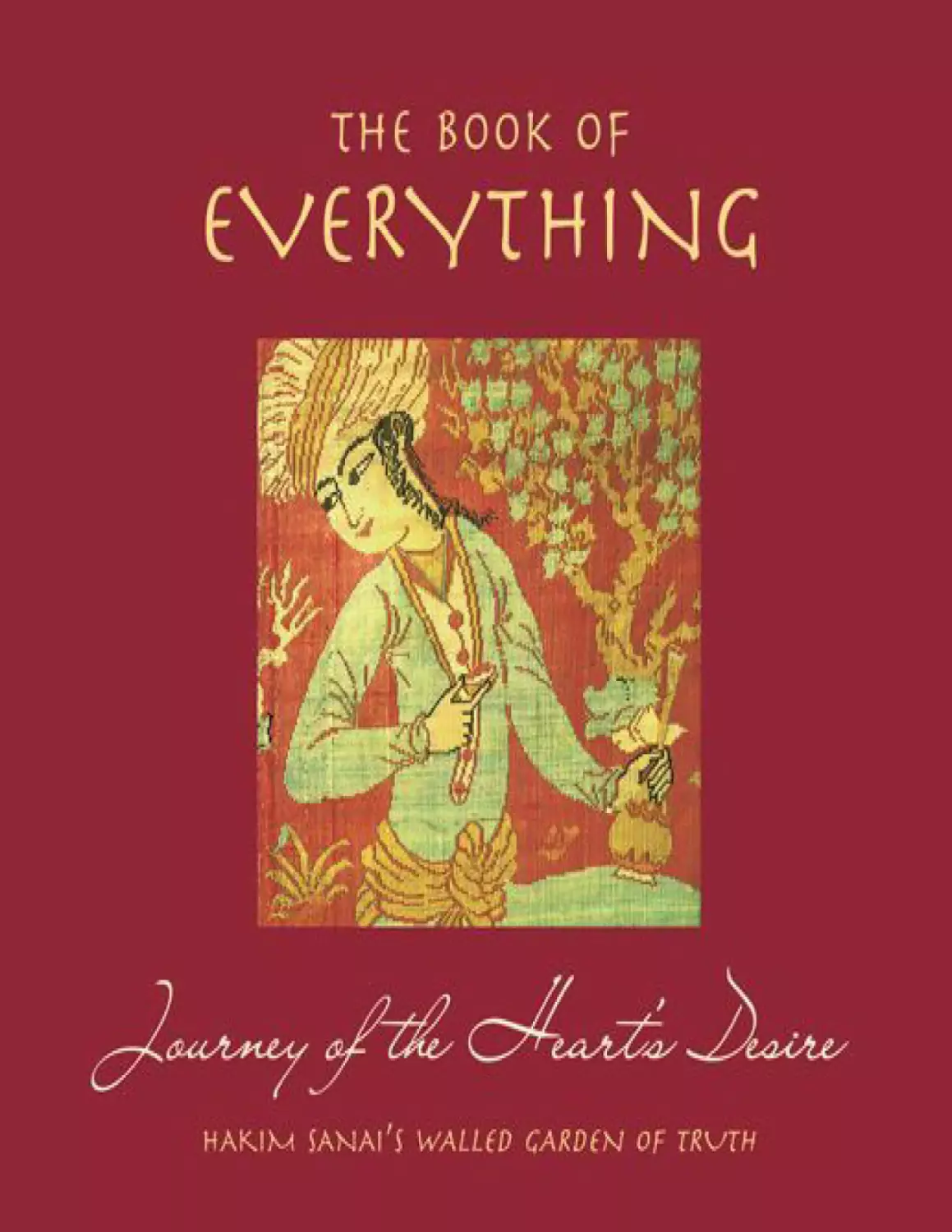
Cover: Werner Forman Archives, London.

Pages 2, 4, 16, 20, 23, 51, 52, 56, 59, 67, 72: Bibliothèque Nationale, Paris.

Pages 6, 32, 60, 63, 71, 79: Werner Forman Archives, London.

Pages 12, 47: Painted Ceiling Panel. Cappella Palatina, Palermo.

Pages 15, 48, 75: Bayerische Staatsbibliothek, Munich.

Pages 19, 27, 31, 40: Library of the Topkapu Sarayi Muzesi, Istanbul.

Pages 24, 39, 68: Library of the Suleymaniye Mosque, Istanbul.

Pages 28, 64: Bodleian Library, Oxford.

Page 35: Biblioteca Apostolica, Vatican.

Pages 36, 43: Nationalbibliothek, Vienna.

Page 44: Freer Gallery of Art, Washington, D.C.

Page 55, 76: British Library, London

The Book of Everything: Journey of the Heart’s Desire copyright

©

TM
2002 by The Book Laboratory
Inc. All rights reserved. No part

of this book may be used or reproduced in any manner whatsoever without written permission except in the case of reprints in the
context of reviews.

Andrews McMeel Publishing, LLC
an Andrews McMeel Universal company
1130 Walnut Street, Kansas City, Missouri 64106

www.andrewsmcmeel.com

Design by Amy Ray

Library of Congress Control Number on file

Attention: Schools and Businesses

Andrews McMeel books are available at quantity discounts with bulk purchase for educational, business, or sales promotional
use. For information, please e-mail the Andrews McMeel Publishing Special Sales Department: specialsales@amuniversal.com