/
















































































Text
                    Patrick Lafon

Langaa Research & Publishing
Common Initiative Group
P.O. Box 902 Mankon
Bamenda
North West Region
Cameroon

VIRTUE IN POLITICAL LIFE

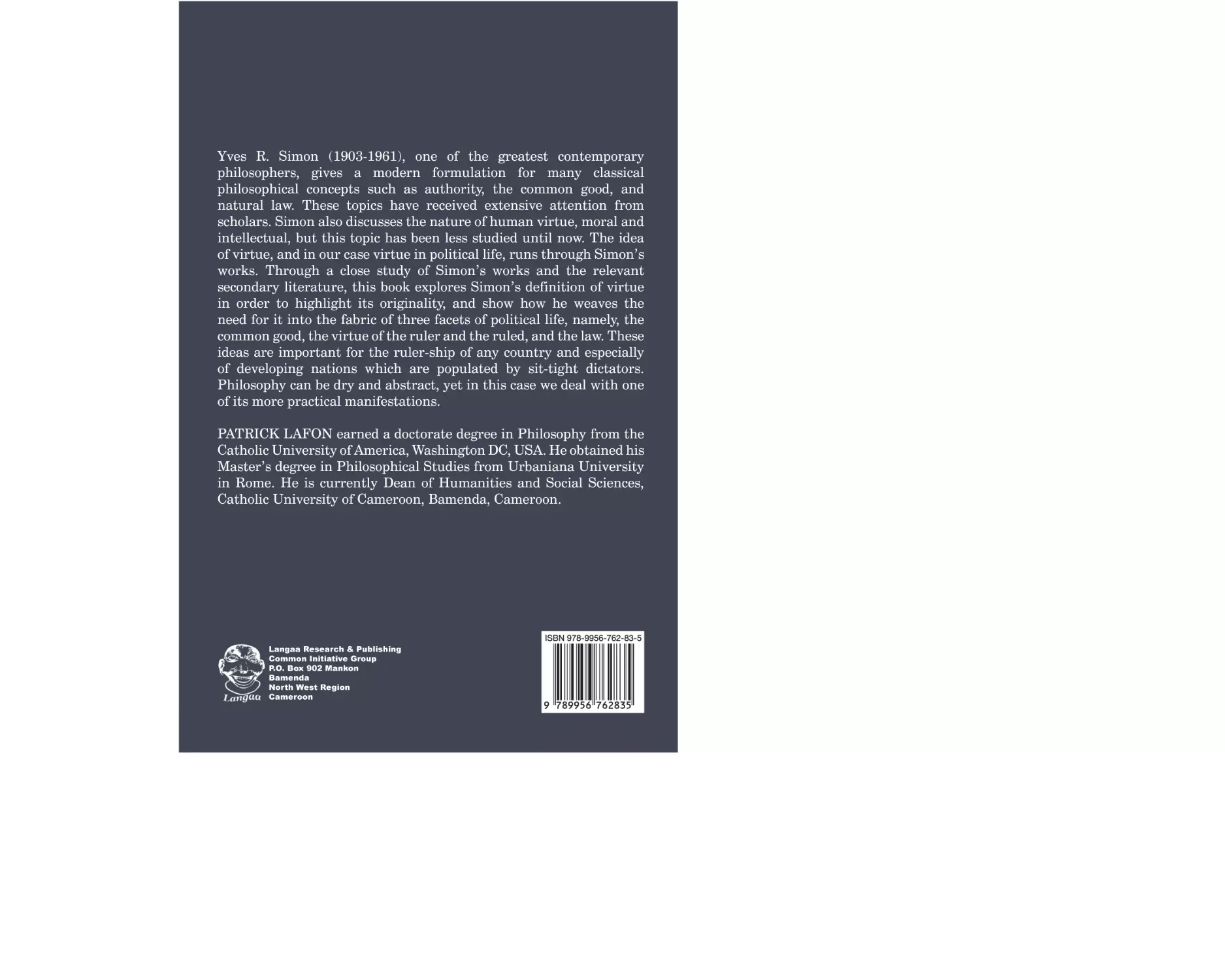
PATRICK LAFON earned a doctorate degree in Philosophy from the
Catholic University of America, Washington DC, USA. He obtained his
Master’s degree in Philosophical Studies from Urbaniana University
in Rome. He is currently Dean of Humanities and Social Sciences,
Catholic University of Cameroon, Bamenda, Cameroon.

YVES SIMON’S POLITICAL PHILOSOPHY FOR OUR TIMES

Yves R. Simon (1903-1961), one of the greatest contemporary
philosophers, gives a modern formulation for many classical
philosophical concepts such as authority, the common good, and
natural law. These topics have received extensive attention from
scholars. Simon also discusses the nature of human virtue, moral and
intellectual, but this topic has been less studied until now. The idea
of virtue, and in our case virtue in political life, runs through Simon’s
works. Through a close study of Simon’s works and the relevant
secondary literature, this book explores Simon’s definition of virtue
in order to highlight its originality, and show how he weaves the
need for it into the fabric of three facets of political life, namely, the
common good, the virtue of the ruler and the ruled, and the law. These
ideas are important for the ruler-ship of any country and especially
of developing nations which are populated by sit-tight dictators.
Philosophy can be dry and abstract, yet in this case we deal with one
of its more practical manifestations.

VIRTUE IN POLITICAL LIFE
Yves Simon’s Political Philosophy
for Our Times

Patrick Lafon

Langaa Research & Publishing CIG
Mankon, Bamenda

Publisher:

Langaa RPCIG
Langaa Research & Publishing Common Initiative Group
P.O. Box 902 Mankon
Bamenda
North West Region
Cameroon
Langaagrp@gmail.com
www.langaa-rpcig.net

Distributed in and outside N. America by African Books Collective
orders@africanbookscollective.com
www.africanbookscollective.com

ISBN-10: 9956-762-83-0
ISBN-13: 978-9956-762-83-5
© Patrick Lafon 2017

All rights reserved.
No part of this book may be reproduced or transmitted in any form or by any
means, mechanical or electronic, including photocopying and recording, or be
stored in any information storage or retrieval system, without written permission
from the publisher

To the memory of my father,
Joseph Noni Lafon (1920-2004),
who did politics the right way.

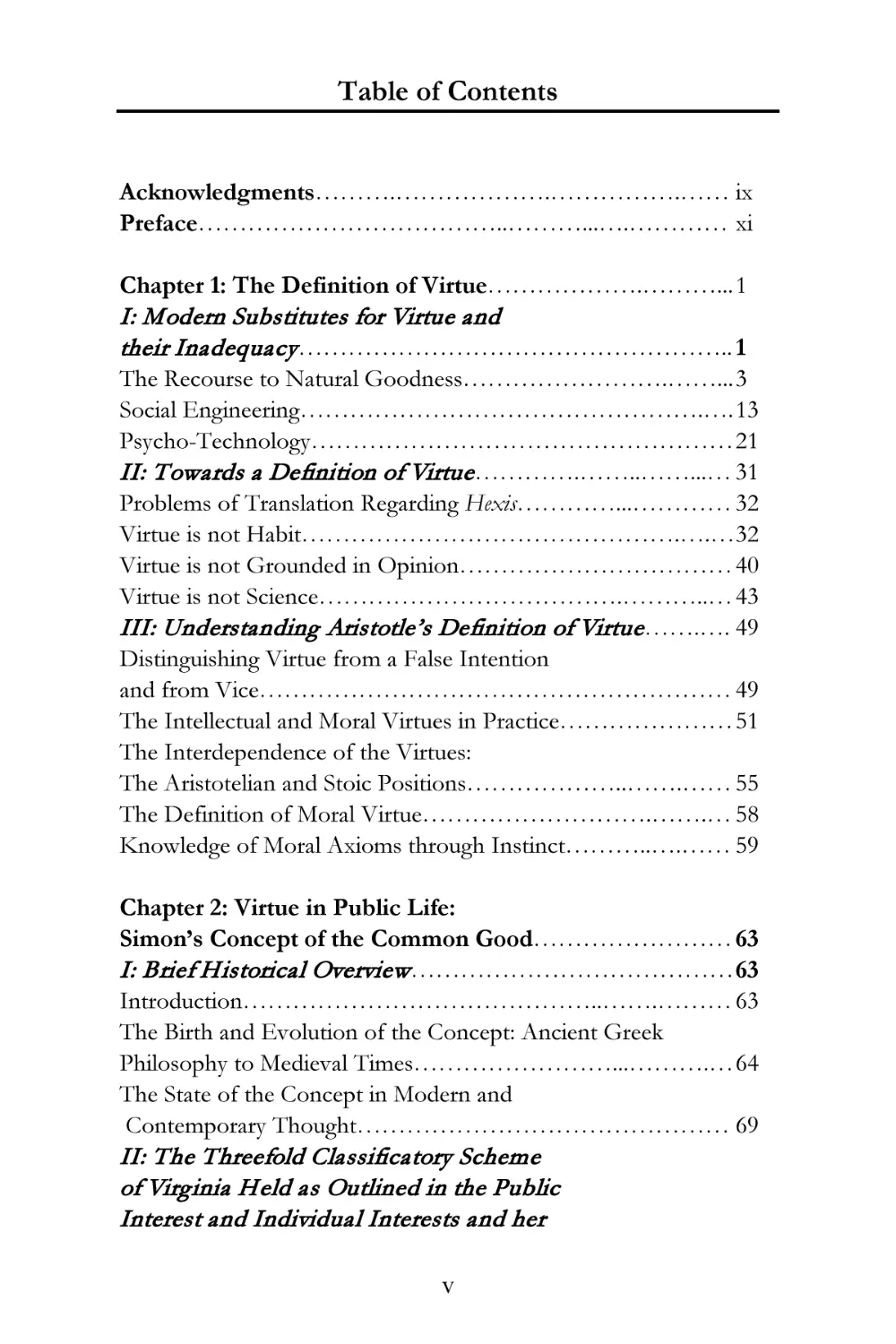
Table of Contents
Acknowledgments……….……………….…………….…… ix
Preface………………………………..………...….………… xi
Chapter 1: The Definition of Virtue……………….………... 1

I: Modern Substitutes for Virtue and
their Inadequacy …………………………………………….. 1

The Recourse to Natural Goodness…………………….……... 3
Social Engineering………………………………………….…. 13
Psycho-Technology…………………………………………… 21
II: Towards a Definition of Virtue ………….……..……...… 31
Problems of Translation Regarding Hexis…………...………… 32
Virtue is not Habit……………………………………….….…32
Virtue is not Grounded in Opinion…………………………… 40
Virtue is not Science……………………………….………..… 43
III: Understanding Aristotle’s Definition of Virtue …….…. 49
Distinguishing Virtue from a False Intention
and from Vice………………………………………………… 49
The Intellectual and Moral Virtues in Practice………………… 51
The Interdependence of the Virtues:
The Aristotelian and Stoic Positions………………..…….…… 55
The Definition of Moral Virtue……………………….…….… 58
Knowledge of Moral Axioms through Instinct………..….…… 59
Chapter 2: Virtue in Public Life:
Simon’s Concept of the Common Good…………………… 63
I: Brief Historical Overview ………………………………… 63
Introduction……………………………………..…….……… 63
The Birth and Evolution of the Concept: Ancient Greek
Philosophy to Medieval Times……………………...……….… 64
The State of the Concept in Modern and
Contemporary Thought……………………………………… 69

II: The Threefold Classificatory Scheme
of Virginia Held as Outlined in the Public
Interest and Individual Interests and her
v

Concept of the Public Interest………………………………79

Preliminary Considerations……………………………….…… 79
The “Preponderance Theories” of Thomas Hobbes,
David Hume, and Jeremy Bentham…………………..…..…… 83
The “Public Interest as Common Interest” Theory…………… 90
The “Unitary Conception” …………………………………… 94
Virginia Held’s Proposed Constituent Elements
of the Common Good……………………………...……….… 101
III: Simon’s Concept of the Common Good …………….… 107
Two Misconceptions of the Common Good. ………………… 109
Simon’s Concept of the Common Good……………………… 118
Drawing the Threads Together…………………………...…… 129
Chapter 3: Virtue in Public Life:
The Virtue of Theoretical Truth and the
Virtue of the Ruler and the Ruled………………….…..…… 133
Introduction……………………………….…….……….…… 133
I: The Virtue of Theoretical Truth …………………….…… 135
The Truth Value of Witness…………………...……………… 135
The Truth Value of Science…………………………………… 137
The Truth Value of Creative Freedom…………………...….… 139
Freedom of the Intellect: The Trouble with the
Position of the Liberals……………….……….…………….…141
Truth and the Market Place of Ideas…………………..………. 148
The Role of Authority in Teaching Transcendent Truth………. 150
II: The Virtue of the Ruler and the Ruled ……………….… 153
Rule by the Virtuous…………………………….…………..… 153
Rule by the Experts or by an Elite…………….…………….… 165
Freedom from Self: Obedience as Perfective……….…….…… 171
Chapter 4: Virtue In Public Life: Virtue and Law…….…… 183
Introduction………………………………………...………… 183

I: Virtue and the Idea of Natural Law and
Philosophical Challenges to the Idea ……………………… 185
The Idea of Natural Law……………………………………… 185
Philosophical Challenges to the Idea of Natural Law……….…. 189

II: Virtue and Facets of Positive Law
vi

and Natural Law ………………………………….…….…… 202
On the Existence of the Just by Nature…………….…….…… 202
On Knowledge of Natural Moral Law………………………… 206
On Law as Premise and Conclusion: The Role of Virtue……… 213
On God as the Author of Natural Law and
Natural Moral Law……………………………………….…… 217
Conclusion……………………………………………...….… 223
Bibliography…………..………….…………………..……… 229

vii

viii

Acknowledgments
If a good number of human undertakings would be impossible
without the help of others, this is even more so in the case of writing
a book. This work would have been impossible without the
invaluable help of a many people at different levels.
Father Paul Verdzekov, the pioneer Archbishop of Bamenda,
who first sent me to do philosophical studies in Rome, remains for
all who knew him a beacon that lights up and enlightens. A
universally acclaimed intellectual and moral giant, unstinting with his
talents, he remains an epitome of the kind of virtue and knowledge
with which this book deals. My debt to him is incalculable.
I am very appreciative of the warm welcome to the Catholic
University of America (CUA) that I received from Fr. Kurt Pritzl,
Dean of the School of Philosophy, when I arrived to do a doctorate
in philosophy some decades after earning a licentiate in 1982 at
Urbaniana University Rome. While he mentioned what such an
enterprise would entail in terms of toil and sweat, he encouraged me
at every step. This book is partly the result of his encouragement and
support. I continue to pray for the happy repose of his gentle soul.
This work would never have been written without Monsignor
Robert Sokolowski who introduced me to the thought of Yves
Simon, in a course on Virtue and Human Action in the Spring of
2009 at the Catholic University of America. It examined the thought
of Aristotle, Aquinas, Kant, Mill, and Simon on the philosophy of
virtue. My debt to Monsignor Sokolowski is immense.
I would also like to thank Monsignor John F. Wippel, perhaps
the foremost Aquinas scholar alive, Dr. V. Bradley Lewis, and Dr.
Angela Mckay Knobel, all faculty of the Catholic University, with
whom I shared philosophical ideas on the above question.
It remains to mention Dr. James A. Oti, and my sisters, Dr.
Felicia L. Oti, and Gladys Lafon, whose technical, moral, and
material support have been invaluable. The constant discussions I
had with Father William Neba, of the ideas in this book, were a
source of intellectual ferment.

ix

x

Preface
Yves R. Simon is one of the greatest contemporary philosophers of
moral virtue. After giving up medical studies for philosophy, he
enrolled as a student of Jacques Maritain in the Catholic Institute of
Paris in 1928. Thanks to this acquaintance and his philosophical
formation, he became well versed in the works of Aristotle and
Aquinas, developing the conviction that philosophy is not just a
mental game aimed at showing theoretical erudition but could and
ought to be a tool for resolving life’s most difficult dilemmas.
Subsequently, Simon began to teach philosophy at the Catholic
Institute of Lille in 1930.
His first published book, his doctoral dissertation, entitled
Introduction à l’ontologie du connaître (1934), 1 was in the field of
epistemology. It was followed by Critique de la connaissance moral, 2 a
work on moral philosophy, published the same year. This work,
which Marie-Vincent Leroy, O.P. calls “an excellent introduction to
the problems of practical knowledge, the scope and method of moral
and political philosophy, and the nature of moral judgment,” 3 lays
down some of the principles of many of his later writings.
In 1936, two years after the publication of his first work, what he
describes as an “immensely sad event,” namely the Italian invasion
of Ethiopia, forced him to turn his attention to political matters and
how moral philosophy might apply to them. The result was La
campaigne d’Ethiopie et la pensée politique française, 4 in which he sought to
Yves R. Simon, Introduction à l’ontologie du connaître (Paris : Desclée de Brouwer,
1934). English translation by Vukan Kuic and Richard J. Thompson, An Introduction
to Metaphysics of Knowledge (New York: Fordham University Press, 1990).
2 Yves R. Simon, Critique de la connaissance moral (Paris: Desclée de Brouwer,
1934). English translation by Ralph McInerny, A Critique of Moral Knowledge (New
York : Fordham University Press, 2002).
3 Yves R. Simon, The Definition of Moral Virtue, ed. Vukan Kuic, with a BioBiography by Marie-Vincent Leroy, O.P., (New York: Fordham University Press,
1986), ix-x.
4 Yves R. Simon, La campaigne d’Ethiopie et la pensée politique française (Paris :
Desclée de Brouwer, 1936). English translation by Robert Royal, The Ethiopian
Campaign and French Political Thought (Notre Dame : University of Notre Dame
Press, 2009).
1

xi

expose the hypocrisy of some political actors and intellectuals in
France. In 1938 he came to the University of Notre Dame as a
visiting teacher. The outbreak of World War II prevented his return
to France, and he continued teaching at Notre Dame as a regular
member of the faculty. Following the start of the war, and what he
considered the culpable hesitation, even tame acceptance of Nazism
by some highly placed Catholics, including some in the hierarchy, he
wrote La grande crise de la République Française: Observations sur la vie
politique français de 1918 à 1938 5 in 1941. Simon was to write two other
works to urge reconciliation and to propose some principles to help
guide action during the post war period. These works were
respectively, La Marche à la déliverance 6 and Par delà l’expérience du
désespoir. 7
There is no question that Simon intended these books to be
understood as the works of a political philosopher rather than a
political scientist, a fact which earned him the title “the philosopher
of the fighting French.” 8 He did not hesitate to look history in the
eye and apply time-worn principles to it. What characterizes these
works, therefore, is the fact that they “transcend the era that saw their
birth” or possess a certain timelessness. 9 In a review of The Community
of the Free, re-issued some forty years after it was written, Robert
Speath justifies the fact of its re-issue so many years afterwards by
pointing to this timeless quality. He says:

Yves R. Simon, La grande crise de la République Française: Observations sur la vie
politique français de 1918 à 1938 (Montreal : Editions de l’Arbre, 1941). English
translation by James A Corbett & George J. McMorrow, The Road to Vichy (Lanham,
MD: University Press of America, 1988).
6 Yves R. Simon, La Marche à la déliverance (New York: Ēditions de la Maison
Française, 1942). English translation by V. M. Hamm, The March to Liberation
(Milwaukee: The Tower Press, 1942).
7 Yves R. Simon, Par delà l’expérience du désespoir (Montreal: Lucien Parizeau,
1945). English translation by Willard R. Trask, The Community of the Free (Lanham,
MD: University Press of America, 1984).
8 Marie-Vincent Leroy, O. P., “Bio-Bibliography,” in Simon, The Definition of
Moral Virtue, x.
9Vukan Kuic, Yves Simon: Real Democracy (Lanham, MD: Rowman & Littlefield
Publishers Inc., 1999), 2.
5

xii

Simon’s way of treating his subject makes his book readily
applicable to social situations that have occurred much later. The
concrete conditions that led to his reflections do not dominate the
contents of these reflections: rather the concrete gave Simon the
occasion to construct arguments of principle and generality that live
on. It is not only possible but, in this reviewer’s opinion, very beneficial
to ponder these essays with the news of the 1980s as a factual
accompaniment. The Community of the Free has transcended the era that
saw its birth. 10

And these remarks can be seen not only as applying to this book
but also to all of the works mentioned above.
After the Second World War, and because of the issues it had
thrown up, Simon continued to reflect and write on questions of
political philosophy, the only difference consisting in the more
generalized nature of the catastrophe. In 1948, he moved from Notre
Dame University to the Committee on Social Thought at the
University of Chicago and was to stay here till his death in 1961. It
was a particularly fruitful time. Not only did he teach twenty seven
different courses in preparation for his projected writing of an
Encyclopedia of Philosophy, 11 in 1951 he published what has
probably become his most famous work, Philosophy of Democratic
Government. This ground-breaking book has been translated into
Japanese, Portuguese, German, Korean, Italian, Polish and French.
After his early death in 1961 at the age of fifty-eight, other important
works in political philosophy have been put together from his
classroom notes, files, and tapes made by his former students. These
include, A General Theory of Authority, A Definition of Moral Virtue, The
Tradition of Natural Law: A Philosopher’s Reflections and Practical Knowledge
among others. These works and others inform this book.
Robert L. Speath, “Simon’s Moderate Pessimism,” The Review of Politics 48
(1986): 122.
11 Simon intended to publish an “Philosophical Encyclopedia.” It would
comprise many volumes dealing with logic, philosophy of science, epistemology,
ontology, political philosophy including the philosophy of work, and moral
philosophy. Because of the illness that led to his death at the young age of fifty
eight, Simon scaled back his project renaming it “Philosophical Inquiries.”
10

xiii

These works, published posthumously, exhibit the same
character of shining the light of the perennial teachings of the past
on contemporary issues. Simon is not so much engaged in a
restoration of the Aristotelian-Thomistic doctrine as a rereading in
the face of different circumstances. 12 Having thoroughly assimilated
the thought of Aristotle and Aquinas, Simon expounds it in a manner
that is personal, faithful to principle, but without depending on
authority. Vukan Kuic makes the point clearly and elegantly:
What Simon is interested in are not “texts” but actual problems,
and he finds the Aristotelian-Thomistic tradition helpful in suggesting
solutions. He may thus be considered a follower of that tradition
because he succeeded, in a relatively short working life, to clarify, bring
up to date, and even improve its teaching on a number of vital
philosophical issues. 13

This book will be concerned specifically with virtue, and how
Simon weaves it into various political contexts. I will examine how it
affects various actors on the political scene and its role in the
different facets of political life. That is: how are we to understand the
important and crucial definition of virtue in a time when a number
of alternatives are being proposed as more relevant and meaningful?
Are these novel theories better than Aristotle’s and Thomas
Aquinas’s? Are we, henceforth, dispensed from the hard and
persevering work of acquiring the virtues? How does virtue relate to
the common good in the light of the competing theories on the
question, such as those that Virginia Held outlines in her influential
book, The Public Interest and Individual Interests? 14 Why is virtue an
indispensable requirement in those who rule, a quality that should
help us assess the performance of sit-tight dictators who populate the
African and other continents, and how does Simon rescue the bad
name of the virtue of obedience? How do natural law, natural moral
law, and positive law incorporate the virtues in the way they work?
The Definition of Moral Virtue, 55-56.
Kuic, Yves Simon: Real Democracy, 12.
14 Virginia Held, The Public Interest and Individual Interests (New York: Basic
Books Inc. 1970).
12Simon,
13Vukan

xiv

In this work, I explore how Simon brings the wisdom of the past to
bear on various aspects of modern efforts at nation building in the
aftermath of the destructive theories of Machiavelli, René Descartes,
Thomas Hobbes, Rousseau, 15 and many others.

15Simon,

The Definition of Moral Virtue, 56.

xv

xvi

Chapter 1
The Definition of Moral Virtue
I: Modern Substitutes for Virtue and their Inadequacy
Yves R. Simon observes that in the Western tradition, virtue theory
has its origins in ancient Greek philosophy. The four cardinal virtues
of prudence, justice, courage, and temperance, go back to Plato’s
Republic, 1 and have won the general acceptance of philosophers
through the ages. 2
But if there is such unanimity regarding the four traditional moral
virtues, defining virtue is not equally straightforward. Not the least
of the problems complicating this task is the fact that perception of
what constitutes natural law, and thus what is virtuous, seems to
change in some cases from one culture to another, from one society
to another, and also from one age to another. In this regard Simon
writes as follows:
There would be no eternal return of natural law without an
everlasting opposition to natural law. Again, this opposition thrives on
the contrast between the notions of actions that are right or wrong by
nature, and the lack of uniformity which we observe in actual
judgments. If the right or wrong of murdering unborn babies is decided
by nature, why should we not be completely agreed on such an

Republic 427e; 435b.
Simon, The Definition of Moral Virtue, 95. See also Peter Geach The Virtues
(Cambridge: Cambridge University Press, 1977); James D. Wallace, Virtues and
Vices (Ithaca: Cornell University Press, 1978). I am aware that in our times Walter
Kaufmann has proposed a new list of the cardinal virtues, namely,
ambition/humility, love, courage, and honesty. Cf. The Faith of a Heretic (New York:
Doubleday & Co. 1961), 317-38. These efforts have not, however, been followed
up by any other moral philosopher that I know of.
1Plato,
2

1

important subject? Even in a well-defined social group divergences are
not inconceivable. 3

There are other examples of moral diversity such as the question
of slavery, which was once thought to be a perfectly acceptable
practice but was rapidly seen as vicious between 1760 and 1800 in
America, France and Britain.
Conscious of these divergences in perception, and while leaving
a complete definition for the end of the chapter, Simon begins his
consideration of how virtue is to be understood in The Definition of
Moral Virtue with a provisional description which all would accept.
He says that “what matters is that everyone recognizes the difference
between people who are really dependable and those who are not.” 4
A virtuous man is dependable and can be trusted not to steal even if
the chances of being caught are nil.
But this is only the beginning since a definition of virtue requires
a multitude of clarifications and distinctions starting, for what Simon
calls “pedagogic” 5 reasons, with an articulation of three major
modern alternatives. He considers these alternatives as deficient and
will, in this work and in other writings, show how they fall short, but
he uses them as foils to help him develop the right definition of
virtue. The three theories are (1) the recourse to natural or
spontaneous goodness, (2) the idea that people can be made good by
way of social engineering and (3) the attempt to achieve goodness
through psycho-technology. In Part I of this chapter, I will present
Simon’s discussion of these theories and his explanation of how they
fall short.
Given that some modern authors, either through a
misunderstanding of Aristotle’s thought or a mistranslation of key
words in Aristotle’s definition of virtue fail to properly grasp this
definition, I will look at why Simon insists that virtue is not habit,
opinion, or scientific habitus. These distinctions which constitute Part
Yves R. Simon, The Tradition of Natural Law: A Philosopher’s Reflections, ed.
Vukan Kuic (New York: Fordham University Press, 1965), 4-5.
4 Simon, The Definition of Moral Virtue, 1, 15.
5 Ibid.
3

2

II of chapter 1, take in chapters three and four of Simon’s work. In
Part III, which covers the last two chapters of Simon’s book, I will
conclude by looking at how he explains Aristotle’s definition of
virtue. This definition is further clarified by an examination of how
the virtues work in practice, their interdependence, and how we get
to virtue by instinct.
The Recourse to Natural Goodness
The Work of Jean Jacques Rousseau and Ralph Waldo
Emerson
If the above introduction proves anything, it is that the idea of
virtue is a complex one and trying to understand it has led many
astray. Simon warns us not to be misled by Rousseau and his
followers, who might continually use the word virtue, but who do
not conceive it in traditional terms. Rather they see it exclusively in
terms of liberating the native goodness man inherits at birth. They
urge people to “be yourself . . . relax and let the goodness in you
come out.” 6 Simon identifies principally Jean Jacques Rousseau
(1712-1778) and Ralph Waldo Emerson (1803-1883) as holding this
position.
He traces the origins of the ideas so powerfully expressed by
Rousseau regarding natural goodness to the inspiration of Michel de
Montaigne (1533-1592), and René Descartes (1596-1650). Montaigne
was one of the most influential writers of the French Renaissance.
He made the essay popular as a literary genre, something which
Rousseau imitated and used effectively in his own work. Montaigne’s
essays also had a strong influence on Emerson and philosophers such
as Descartes, which might explain their connection on the question
of the natural goodness of man. In his Essays, especially the one
entitled “Of the Education of Children,” 7 Montaigne credits his success
in Latin, which he studied for many years, to the fact that his father
aroused his natural interest in the subject rather than use the
Simon, The Definition of Moral Virtue, 84.
Michel de Montaigne, Montaigne’s Essays and Selected Writings, trans. and ed.
Donald M. Frame (New York: St. Martin’s Press, 1963).
6
7

3

unpleasant and harsh teaching methods that were popular and
thought to be effective in the sixteenth century. He writes that while
nothing was forced on him, he had everything, so that he could take
advantage of his freedom to achieve the best in him. 8
Regarding the influence of Descartes on Rousseau’s thought,
Simon points to an affinity between Rousseau’s idea of the
spontaneous goodness of man and Descartes’ theory of intellectual
perfection, precisely as expressed in Descartes’ pregnant phrase “the
natural light of reason,” 9 which itself bears a resemblance to the idea
of “naturalistic optimism” of his near contemporary Francis Bacon. 10
But the question Descartes has to answer is why some people fail
to apprehend reality correctly if we all possess the natural light of
reason. By way of a response, Descartes blames all mistakes we make
on our childhood. Whereas the majority of people would name their
childhood as a happy time when they did not have to shoulder the
responsibilities of adult life, Descartes looks at childhood with regret
since he thinks that of all of the reasons responsible for our having
wrong ideas, this is the most important contributing factor. 11 Our
natural powers, which are good in themselves, are skewed at this
stage, because of an imagination that lacks discipline and tends to run
wild, but above all because of the bad teaching of our parents and
minders who inculcate erroneous ideas in our minds. If the above
problem can be resolved, then the powers of human reason would
be at their best.
Ibid., 64-65, 75-76.See Simon, The Definition of Moral Virtue, 16, 85.
In one of his replies to an objection in the Meditations, Descartes writes: “I
do not see what I can add to make it any clearer that the idea in question could not
be present to my mind unless a supreme being existed.
. . . If (the reader) attends carefully to what I have written he should be able
to free himself from the preconceived opinions which may be eclipsing his natural
light.” The Philosophical Writings of Descartes, vol. II., trans. John Cottingham, Robert
Stoothoff, Dugald Murdoch (Cambridge: Cambridge University Press, 2005), 97.
See also the following pages of the same work: 11, 27-28, 32.
10 Francis Bacon expressed his aspirations and ideals in the New Atlantis
released in 1627 and the New Organon published in 1620 when Descartes was in his
early twenties. In the New Organon, he detailed a system of logic superior to the old
ways of syllogism.
11 Simon, The Definition of Moral Virtue, 2-3.
8.
9

4

Simon is of the view that Rousseau adopted these ideas from
these sources and applied them to moral philosophy with the result
that whereas virtues are acquired qualities for Aristotle and Thomas
Aquinas, for him they result from a freeing of native energies. Simon
writes as follows of Rousseau’s position:
The idea of how to achieve moral excellence is not to work for it
but rather to tap in the individual a natural spontaneity towards
goodness, which Rousseau takes to be antecedent to both rationality
and social order. . . . Rather than an acquired quality of the mind or
character “virtue” for Rousseau means nothing more than “natural
spontaneity.” 12

This rendering by Simon is in harmony with what Rousseau
himself wrote in a famous letter to Malesherbes in 1762:
‘Oh Monsieur, if I had ever been able to write a quarter of what I
saw and felt under that tree, with what force would I have exposed all
the abuses of our institutions, with what simplicity would I have
demonstrated that man is naturally good, and that it is by these
institutions that men have become wicked. 13

I would like to observe, in support of Simon, that this idea of the
natural goodness of man is also evident when Rousseau articulates
his theory of the state of nature in opposition to that of Thomas
Hobbes. Like other philosophers of his day, Rousseau accepts a
hypothetical state of nature as a normative guide. But, in his Discourse
on the Origin and Foundations of Inequality Among Men (or Second
Discourse), Rousseau’s natural man is very different to that of
Hobbes. He criticizes Hobbes for asserting that since man in the state
of nature “has no idea of goodness, he must be naturally wicked

12Ibid.,

4.
Quoted in the introduction to Jean Jacques Rousseau, On the Social Contract,
ed. Roger D. Masters, trans. Judith R. Masters (New York: St. Martin’s Press, 1978),
8. See Simon, The Definition of Moral Virtue, 17.
13

5

because he does not know virtue.” 14 Rather, Rousseau sees man as
good in the natural state in the sense of having what he calls
uncorrupted morals. 15 He is of the view that the state of nature was
a primitive condition admittedly without law or morals, but a
condition in which, there was amour de soi, a positive self love as
opposed to amour propre, or vanity brought on by society, through
competition and an encouragement of the tendency to compare
oneself with other people. 16
The account of Ralph Waldo Emerson makes the same point but
has nuances which Rousseau’s does not have. Simon tells us that he
takes Rousseau’s enthusiasm for spontaneous goodness as virtue
even further, by adding two features to it that are philosophically
significant. He places natural goodness not only before the voluntary
but in opposition to it. He thinks that “our moral nature is vitiated
by any interference of our will.” 17 Secondly, and much more explicitly
than Rousseau, Simon points out, he ties spontaneity to a divine
agent or a god who is the soul of the world. 18 It is this ultimate source
that is responsible for our spontaneous acts becoming virtue, rather
than the will or any struggle to acquire virtue through the consistency
of our good actions. In support of this interpretation of Emerson,
Simon points to Emerson’s essay on “Spiritual Laws” where he states:
People represent virtue as a struggle, and take to themselves great
airs upon their attainments, and the question is everywhere vexed when
a noble nature is commended, whether the man is not better who
strives with temptation. But there is no merit in that matter. Either God
is there or he is not there. We love characters in proportion as they are
14 Jean Jacques Rousseau, Discourse on the Origin and

Foundations of Inequality among
Men or Second Discourse in The Discourses and other early political writings, ed. Victor
Gourevitch (Cambridge: Cambridge University Press, 2002) 151.
15Ibid., 151, 218.
16 Ibid.
17 Ralph Waldo Emerson, The Selected Writings of Ralph Waldo Emerson, ed.
Brooks Atkinson (New York: Modern Library, 1950), 192. See Simon, The Definition
of Moral Virtue, 7.
18 Ralph Waldo Emerson, The Selected Writings of Ralph Waldo Emerson, 192. See
Simon, The Definition of Moral Virtue, 7.

6

impulsive and spontaneous. The less a man thinks or knows about his
virtues, the better we like him. 19

In this quote, Emerson alludes, both to the divine causality of
virtue, and the need to disregard the will.
What does Simon think about this version of what virtue is?
Before I begin an elaboration of Simon’s case against this version of
virtue, this is the place to state what, in his view, is positive about it
because even if modern horrors as witnessed especially in the last
World Wars have seriously dented belief in natural goodness, it still
persists today in some circles. Simon does not dispute that the idea
of natural spontaneity has something to be said for it. If the idea was
ever put forward at all, and if it has survived for so long, it must have
a core truth. 20 The idea of spontaneous goodness is acceptable to a
point because underlying it is the presupposition that there is a
certain goodness, which needs to be let out, in each person. This core
truth has to do with a good pristine disposition. Simon thus gives
Emerson and Rousseau “full credit for defending (spontaneous
goodness) so passionately, because spontaneity is such an essential
ingredient in human fulfillment.” 21
The Role of Childhood Accidents
However, whether it is an adequate substitute for a theory of
virtue is the question that Simon wants to put to the test. He does so
by pointing to the possibility of childhood accidents, by examining
the witness of experience, and by looking at the place of reason in a
truly human act. The first argument is mainly drawn from psychology
and the second from history. The really philosophical argument is the
third. Let us now begin with the first.
Simon points to the fact that it is certainly accepted today that
some of the heinous crimes that people commit defy any rational
explanation. Some of these crimes, as well as certain ways of behaving
point to psychological problems traceable to childhood. He explains
Ralph Waldo Emerson, The Selected Writings of Ralph Waldo Emerson, 191.
Simon, The Definition of Moral Virtue, 15.
21Ibid., 85.
19
20

7

that certain accidents during childhood can damage people
psychologically, and that this argues against giving free rein to native
spontaneity. Rather than originating with Aristotle, Simon thinks that
this argument against spontaneous goodness is proposed by modern
psychology. He says of the argument:
Among the lasting achievements of modern psychoanalysis
perhaps none is more significant than its having shown that an
individual’s strongest and most idiosyncratic tendencies are sometimes
caused by childhood accidents. An authoritarian father, an
authoritarian mother, or two quarreling parents can easily and often do
warp their children’s sound native inclinations into all sorts of harmful
neurotic behaviors. 22

What Simon clearly refers to above is the fact that we are also the
product of the environment in which we grow up. If it is
characterized by love and trust and other positive influences, we grow
up to be rounded individuals. The reverse can leave people in an
unsound state even at that early stage, and this is what Rousseau and
Emerson ignore.
Spontaneity and Experience
Simon takes as his example here a favorite theme of Western
intellectual history, namely, that of the “noble savage” which some
authors attribute to Rousseau but which probably originated with
Christian missionaries anxious to protect native populations from
colonists. 23 He argues that it was the intellectuals of the second half
of the eighteenth century who turned it into a philosophy of history
portraying the “noble savage” as living close to nature, in un-spoilt
conditions. They thus projected man as good by nature.
Simon is of the opinion that the travelogues and accounts of
encounters with people in far-away places were tailored to give the
impression of happy natives and are unconvincing if closely
examined. He says:
22Ibid.,
23Ibid.,

84-85.
29.

8

There is no doubt in my mind that this travel literature, which is
supposed to confirm the native goodness in man, is based to a large
extent on preconceived opinions. Moreover, I do not think that
ethnological enquiry can really tell us anything definitive about this
subject, because, for one thing, the very notion of a primitive people is
ambiguous. Modern science has firmly established that the species
Homo sapiens has been in existence for at least several hundred thousand
years, perhaps much longer. So how primitive can the natives, say, of
New Guinea or Samoa be? Eighteenth-century philosophers may have
believed that the tribes of the Canadian wilderness were truly primitive;
we tend to be more skeptical. Besides, even among peoples considered
more or less primitive, modern anthropologists have found a great
variety of mores, manners, and beliefs. Some of these people do seem
to be “noble,” or at least friendly, but others are definitely hostile and
cruel. 24

The inevitable conclusion is that few today are convinced of
spontaneous human goodness by looking at the historical evidence.
I would add in support of what Simon says, that already in the
eighteenth century, the idea of the bon sauvage was not unanimously
held either. One might point to an example from Hobbes. Even if
for him the state of nature, when “man was a wolf to man” and “the
life of man was solitary, poor, nasty, brutish and short,” 25 is a
postulate rather than a description of history, he still conceives of
native Americans as primitive in a pejorative sense. He writes:
For the savage people in many places of America, except the
government of small families, the concord whereof dependeth on
natural lust, have no government at all; and live at this day in that
brutish manner, as I said before. 26

24Ibid.,

31.
Thomas Hobbes, Leviathan (New York: Collier Books, 1962), 100.
26Ibid., 101.
25

9

Spontaneity and Reason
But it is not only the witness of psychology and the evidence of
history which, according to Simon, dent the claims of Rousseau and
Emerson regarding the acceptance of spontaneous goodness as
virtue. Their theory also ignores the role of reason or, what Simon
calls the role of “the dynamic character or the parts of the human
psyche,” 27 in a truly human act. Simon argues that the main problem
with Rousseau’s position is the presumption of “the superiority of
primeval feelings over rational deliberation.” 28 For Simon, one is
entitled to ask if it is really the case that what is best in man is
spontaneous, and exists prior to the work of reason and the will? The
yearning of the Romantics for action that cuts through the
complications of thinking and the time it often takes to work things
out might sometimes be understandable, but can such impulsive
action be elevated to a general rule?
By way of a response, Simon makes a distinction between human
knowledge or understanding and human fulfillment, which
corresponds to Aristotle’s distinction between theoretical and
practical knowledge. 29 For instance, a medical doctor may be well
aware of the bad effects of smoking on health and still be a smoker.
He has theoretical knowledge but does not use it. Simon says that, “I
may know all there is to know about morality in theory and still
remain totally undependable in my actual conduct,” 30 and elsewhere
quotes John of St. Thomas who writes that, “a man may well be an
ethical philosopher and theologian of great distinction and an
imprudent sinner.” 31 Simon mentions Charles Sanders Peirce, 32 the
Ibid.,
Simon, The Definition of Moral Virtue, 47.
29Ibid., 32.
30 Ibid.
31 John of St. Thomas, The Material Logic of John of St. Thomas: Basic Treatises,
trans. Yves R. Simon, John J. Glanville, G. Donald Hollenhorst (Chicago:
University of Chicago Press, 1955), 46. See Yves R. Simon, Practical Knowledge, ed.
Robert J. Mulvaney (New York: Fordham University Press, 1991), 32. See also
Simon, The Definition of Moral Virtue, 101,
32 Charles Sanders Peirce, Collected Papers of Charles Sanders Peirce, ed. Charles
Hartshorne and Paul Weiss, 6 vols. (Cambridge: Harvard University Press, 193127
28

10

founder of American pragmatism, as having failed to make this
important distinction in his philosophy when he says that “logic
depends on ethics because ethics is the science of aims.” 33 In both
The Definition of Moral Virtue and Practical Knowledge he shows why
Peirce is wrong. In the latter he says:
The aims of logic, say, valid and explanatory reasoning, involve no
consideration of human use. There is such a thing as a logical, and such
a thing as a non-logical use of reasoning, and logic tells me which is
which. But it does not tell me whether I should write papers on logic,
or write papers in demonstrative form about something else, or write
essays that be persuasive rather than demonstrative, or just cultivate my
garden: these are problems of human use with which ethics is
concerned. 34

Logic is about right reasoning and ethics about right actions.
Another way of saying this is that logic is about particular use while
ethics is about human use. 35 He points out that since knowledge is
not virtue which Socrates failed to grasp, nor is Logic subordinated
to Ethics as Charles Sanders Peirce argued, we need to work out a
“unity of theory and practice where understanding becomes a vital
part of human fulfillment.” 36 Whenever the aim is good human use
“explanation is less important than application.” 37
Simon accepts that it is the case that people’s actions are the
result of habits formed through parental guidance, or stem from
obedience to the mores and laws laid down by society. He adds that
when these are good, they lead to fulfillment through upbringing and
1935). Vol. 4, The Simplest Mathematics, 197-203. See Simon, The Definition of Moral
Virtue, 21-22
33 Simon, Practical Knowledge, 38.
34.Ibid., 39.
35 Simon points out that the only sense in which logic could be said to be
subordinated to ethics is if one had to decide how to apply logic to a particular
situation, which would be the same of piano playing or carpentry. (See Simon, The
Definition of Moral Virtue, 21-22). For the distinction between particular use and
human use see p. 33.
36 Simon, The Definition of Moral Virtue, 33.
37Ibid., 32.

11

socialization. But it must be said that this is only routine fulfillment,
which even if better than no fulfillment, is still not human
fulfillment. 38 Discussing this point in Practical Knowledge, he says:
Suppose that the right thing is done without thought, as a result of
sheer habit. It is good, indeed, that the right thing should be done at
all; this sort of fulfillment may be the best we can expect of feebleminded persons who have been trained to do, out of habit, what their
deficient constitution does not allow them to do according to more
human modalities. But clearly, when the right thing is not done in the
way proper to man, it is only in a material sense that we can speak of
fulfillment. No matter how important it may be that the right thing be
done at all, something essential to human fulfillment is lacking. Our best
chance of getting the true signification of progress in moral philosophy,
that is, in the explanation of moral essences, may well consist in
rationality, understanding, and explanation as perfections that do
matter for proper fulfillment in the life of rational agents. 39

One might say therefore, that human fulfillment and thus, virtue
demands reason rather than just acting from mere habit. It is only
when we know and choose, that we are fully human. Simon clinches
the point in the following passage which addresses especially
Emerson’s views but also Rousseau’s:
The truth of the matter is that insofar as it is anterior to the work
of reason, human fulfillment lacks the rational modality which belongs
to it precisely as human fulfillment. Instinct and custom may make us
both behave and be happy; but it is only if we know what we are doing
and why that we become fully human. 40

In support of the principle that reason is constitutive of every
human action, Simon indicates that this is the position in the Socratic

38Ibid.,

33.
Simon, Practical Knowledge, 37.
40Ibid., 33.
39

12

dialogues of Plato, 41 and I would point to a passage in Republic where
Socrates says that it is only when “a mind . . . combines reason and
culture (and) when this resides in someone throughout his life that
his goodness is kept intact.” 42
Social Engineering
The Birth of the Science of Society
In The Definition of Moral Virtue and in several places in Practical
Knowledge, Simon indicates that one of the characteristics of the period
of the Enlightenment was that of rapid progress in science. Simon
tells us, that this is the context in which the social sciences were born,
with a mandate to imitate the mechanical sciences. Society, it was
thought, ought to benefit from the ways of science and the example
of physical causality. Specifically the challenge was couched in these
terms: the mechanical engineers and the scientists having done their
share of work in making the world a better place, the social engineers
now had to do their part and thereby complete the salvation through
knowledge procured by the science of nature. 43 Simon articulates the
challenge as it was conceived at the time:
Here the image of a science of society patterned after the
science of nature could enter the scene. The domain of salvation
through knowledge would then comprise, over and above our
relation to physical things, the whole universe of social relations.
Servitude, exploitation, destitution, and war would fall under the
power of science. Hope for the end of exploitation would have as
good a foundation as hope for the end of cancer. A good part of
the problem of evil would be virtually solved. 44

Simon, The Definition of Moral Virtue, 37.
Plato, Republic, 549b, trans. Robin Waterfield (Oxford: Oxford University
Press, 2008), 284.
43 Simon, The Definition of Moral Virtue, 70.
44 Simon, Practical Knowledge, 119.
41
42

13

The result was the development of the social sciences, which we
would point out, is an umbrella term often used to refer to a number
of fields. These include anthropology, economics, political science,
business administration, and international relations among others.
But, to add a little more background information, we might
observe that more specifically, the term ‘the science of society’ refers
to sociology originally founded by Auguste Comte (1798-1857). He
is, therefore, usually referred to as the ‘Father of Sociology.’ The
credit for putting social research on concrete foundations, however,
belongs to Emile Durkheim (1858-1917) born one year after the
death of Comte. He was the one who created the first department of
sociology in 1895 in the University of Bordeaux and published the
work, The Rules of Sociological Method. 45 He further showed how he
thought the sociological method to be distinct from the philosophical
method in a ground-breaking study of suicide rates among Catholics
and Protestants in 1897. 46
During the two years Simon spent at the Sorbonne, where he
enrolled in 1921, he became acquainted with the great French social
thinkers of the nineteenth century, who had benefited from the work
initiated by Comte and Durkheim. After finishing his studies at the
Sorbonne, Simon was employed as a clerk in the French Ministry of
Education, and with plenty of time on his hands and the National
Library nearby, he decided to do a more thorough reading of the
great French social thinkers, delving into the thought of Henri SaintSimon and his disciples, Considerant, Buchez, but especially the forty
odd volumes of P. J. Proudhon, whom he considered the greatest
social thinker of the period, and Fourier. 47

Emile Durkheim, The Rules of Sociological Method and Selected Texts on Sociology
and its Method, ed. Steven Lukes, trans. W. D. Halls (New York: The Free Press,
1982).
46 Gianfranco Poggi, Durkheim (Oxford: Oxford University Press, 2000),
chapter 1.
47Vukan Kuic, Yves Simon: Real Democracy, 5.
45

14

Charles Fourier as an Advocate of Social Engineering
While Simon considers Proudhon to be the greatest of the social
thinkers of the nineteenth century, it is Charles Fourier (1772-1837)
who furnishes an example of the kind of social engineering he finds
to be extremely problematic, since unlike the others who had toyed
with the idea before or after him, he embraced it with a zeal that was
unequalled. 48 The achievements of science during the period of the
Enlightenment, had, in Simon’s view, a mesmerizing effect on
Charles Fourier and the fact that the French refer to this period as la
Lumière shows how they saw it generally. Simon tells us that Fourier
was particularly moved by the work of Newton, becoming convinced
that the equivalent to the law of gravity in the scientific domain also
existed as far as society was concerned. If this law could be
discovered, we would then be able to fashion a science of society,
and thereby, organize society in a rational way, just as others had
discovered a science of nature, and made life easier. The purpose of
the science of society would be to redesign the basic structure of
society building virtue, as Fourier understood it, into its fabric. 49
Simon tells us that this law of gravity of society was to be
discovered by Fourier himself, and he found it in what he called the
law of “passionate attraction.” 50 The core of his system and of his
utopian plans was based on this theory. We might observe that
according to Fourier, this was the way God had “given” things. He
wrote as follows:
My theory is limited to utilizing the passions just as nature gives
them and without changing anything. That is the whole mystery, the
whole secret of the calculus of passionate attraction. The theory does
See Simon, The Definition of Moral Virtue, 10.
Ibid.
50 Simon translates Fourier’s “passionnelle” as “passional” and thus has
“passional attraction” in his works. Jonathan Beecher and Richard Bienvenu prefer
“passionate attraction” in their edition and translation of Fourier’s work, Charles
Fourier, The Utopian Vision of Charles Fourier, trans. and ed. Jonathan Beecher and
Richard Bienvenu (Boston: Beacon Press, 1971). The idea is the same whether we
adopt the one or the other translation.
48
49

15

not ask whether God was right or wrong to endow human beings with
particular passions; the societary order utilizes them without changing
anything and just as God has given them. 51

Let us further observe, in addition to what Simon says, that
Fourier’s argument for his position was based on certain
metaphysical premises concerning God and his properties. These
metaphysical presuppositions, or what we might call Fourier’s
theodicy, expressed in different and complicated ways in his many
works, were quite simple. They postulated that our understanding of
God meant that he necessarily possessed certain properties. Like
many of the deists of his time, Fourier believed “that the perfectly
harmonious Newtonian universe was itself a proof of an infinitely
wise creator.” Possessing such qualities as infinite wisdom and
universal providence by necessity, he was “bounded by His very
nature to have devised a social code for the terrestrial happiness of
mankind.” 52 Fourier’s job was simply to discover this social code, and
he was convinced that he had done this in the passions. The passions
were meant to be the agents of this social harmony and human
happiness.
Putting the theory of universal passionate attraction into place
involved practical arrangements which Fourier called the Phalanstery,
a term which Simon thinks was coined by Fourier from the Greek
word phalanx (a military formation), and monastery, a kind of common
dwelling. 53 Fourier proposed different phalansteries for people of
different ages and tastes, such as whether they were young and liked
playing in the filth or old and more settled, or whether they preferred
monogamy, polygamy, or “free love,” or had other likes and
dislikes. 54 The idea was to try to make everyone happy according to
their preference. I would add that, for Fourier, these new societal
Fourier, Oeuvres Completes de Charles Fourier, Vol. 5. (Paris: Editions
Anthropos, 1966-1968), 157. The above translation is from The Utopian Vision of
Charles Fourier, 205.
52 Charles Fourier, The Utopian Vision of Charles Fourier, 206-207.
53 Simon, The Definition of Moral Virtue, 11
54 Yves R. Simon, Work, Society, and Culture, ed. Vukan Kuic (New York:
Fordham University Press, 1986), 27-29.
51Charles

16

structures would constitute the equivalent of moving from
“civilized” society and its corrupt nature, to a “harmonious” 55
society. The result would be universal social harmony, the equivalent
of a virtuous society.
Simon indicates some of the differences between Fourier’s work
and that of Rousseau and Emerson in that whereas the latter held
man to be good before the genesis of society, Fourier wanted man
made good through the refashioning of society. Man was to be made
good by society, precisely through appropriate structures. It thus
makes sense, as Simon points out, that Fourier would place the
achievement of such a society in the future. “Human perfection . . .
is still in the future, to be found precisely at the term of full rational
evolution of society.” 56
Simon mentions that Karl Marx and Friedrich Engels were
familiar with Fourier’s work. 57 We would add that they mention it,
together with the work of Saint Simon and Owen, in The Communist
Manifesto (1848) as belonging to socialist and communist literature “in
the early undeveloped period . . . of the struggle between proletariat
and bourgeoisie.” 58 In their view, since Fourier and the
aforementioned, sought to remodel society at a time when the
material conditions for a revolt of the proletariat, or working classes,
did not yet exist, they tried to create them through new social laws
and a new social reality. This constitutes the utopian element in their
thought which practically included such measures as, “the abolition
of the distinction between town and country, of the family, of the
carrying on of industries for the account of private individuals, and
of the wage system.” 59

To rival his analysis of the different types of financial malfeasance, Fourier
names thirteen species of adultery adding up to forty nine different kinds of adultery
in civilized society. All of this would be rectified in a harmonious society. (Cf.
Charles Fourier, The Utopian Vision of Charles Fourier, 183-88.)
56 Simon, The Definition of Moral Virtue, 11.
57Ibid., 9.
58 Karl Marx and Friedrich Engels, The Communist Manifesto, trans. Samuel
Moore, ed. Joseph Katz (New York: Washington Square Press Inc., 1965), 109.
59Ibid., 111.
55

17

Simon believes that Marx did grasp “Fourier’s essential idea that
the solution to the human problem lies in knowing how to design an
appropriate social environment,” 60 but Marx and Engels think that
Fourier’s efforts were doomed to failure, because he aimed at
improving the condition of all members of society without
distinction of class, and also because he hoped to achieve his aims
peacefully and through small, piecemeal experiments, rather than
through revolutionary action. 61 But, whereas Marx and Engels are
disenchanted with Fourier for reasons of lack of respect for the
canons of dialectical materialism, Simon thinks his efforts wrongheaded for the reasons which we will now expound.
Forms of Sociability or Different Ways of Becoming Socialized
Machiavelli, and those who follow him, would have us believe
that politics and morality don’t mix. 62 Politics, supposedly, follows its
own rules, which might sometimes dictate that an immoral course of
action be undertaken if that is what the supposed good of society
demands. An often ignored corollary of this view, Simon points out, 63
is that morality is then seen as a strictly individual concern. The
presumption is that it is not for society to try to make people good,
but rather to ensure their survival, even by immoral means if that is
what it takes.
The good news is that Fourier would not have acquiesced to such
a view. He answers affirmatively, and rightly so, the question as to
whether society has anything to do with morality. After citing
numerous examples 64 to show that people behave like wild animals,
abandoning the most elementary forms of decency, when law and
order break down, as experiences of civil unrest and wars indicate,
Simon, The Definition of Moral Virtue, 9.
Karl Marx and Friedrick Engels, The Communist Manifesto, 109-111.
62 Simon, The Definition of Moral Virtue, 35.
63Ibid., 34-35.
64Ibid., 34-36. He gives the example of a Serbian student, who speaking from
his experiences during the Second World War, related how citizens in his country
who were ordinarily law abiding became criminals when societal norms were
temporarily suspended.
60
61

18

Simon gives credit to Fourier’s basic idea that there is a need for
appropriate societal structures since these have a bearing on morals:
What the available evidence suggests is that society has much to do
not only with how individuals actually behave but also with what they
believe is moral or immoral. While enforcing different types of
conduct, different social arrangements inevitably also produce
corresponding ethical beliefs. . . . And so we can see that Fourier was
not entirely wrong in his plans for a new society. 65

Simon reaffirms this need for an ordered society in other works
of his, such as Freedom and Community. He writes:
The moral conscience of the common man lends itself to every
kind of perversion when it no longer finds, in the daily framework of
social relations, a discipline which ensures the protection and
promotion of moral truths. 66

Thus, for Simon, Fourier was right in his plans for a new society
since society influences morality. However, the problem is how
society assures the task of organizing social relations, and this is
where Fourier creates problems for himself, and throws into sharp
focus what Simon calls the perennial problem of “forms of
sociability” in political philosophy and ethics.
How society and morality interact is an extremely complex
question. What is certain, according to Simon, is the fact that various
social and political arrangements, amount to different forms of
sociability, and these different arrangements affect morality
differently, just as morality influences various structures in different
ways. By organizing society in phalansteries, Fourier does not so
much aim to control the behavior of individuals as to provide a
propitious atmosphere in which individuals can pursue their personal
desires and instincts, without causing harm to each other and to
65Ibid.,

37.

66 Yves R. Simon, Freedom and

Community, ed. Charles P. O’Donnell (New York:
Fordham University Press, 2001), 191.

19

society and thus be happy. He believes that with a clever organization
of society, even the oddest of human instincts can be accommodated
in a way compatible with the common life of the group.
Fourier’s attempt at social engineering, Simon argues, is
problematic because it attributes to human beings the social model
of the beehive, or the anthill, or the herd of sheep. 67 In this model,
no one thinks for himself, but each person has a role to play and is
expected to play it. Everything is like clock-work and is smoothsailing. Virtue, in this model, consists in playing one’s part in a setup.
Indeed, when we look at society today, this is how everything
tends to be: predictable and quiet. Simon argues that the model of
sociability evidenced by ants in an anthill, or bees in a beehive, and
where cattle-like behavior trumps individuality, is reinforced by the
regularity and orderliness of technological developments. Simon
gives the example of diseases which were deadly in the past but have
been conquered in the onward march of science and technology.
Trains run on time and are becoming ever more sophisticated.
Electricity is regular and cars are ever more reliable in their
performance. Simon further speculates that Fourier’s model, like
totalitarianism, in its various manifestations –Nazism, Fascism,
Stalinism, Titoism, and Maoism –seeks to transfer the regularity of
the technological environment to society.
But if there is one thing that bucks this trend, he affirms, it is
man, who remains unpredictable. Man, Simon thinks, does not
always accept a completely regular, predictable pattern of social
relations, making it difficult to fit him into known forms of
sociability. Simon identifies a form of sociability that best suits man:
In order truly to understand the human condition, it seems to me
that we need to identify at least one other form of sociability, which I
should like to call, for lack of a better term, sociability by way of
inspiration. Social thinkers and writers have good reasons to avoid
looking for this form of sociability because it is extremely difficult to
disengage and define. But I do not think that we can just ignore social
67

Simon, The Definition of Moral Virtue, 38.

20

relations in which individuals, far from being depersonalized and made
to conform, are actually inspired to be themselves. . . . Thus clearly
there is more to human sociability than what keeps the herds of sheep
together. If Marx is right, and I think he is on this, there is a form of
sociability characteristic of man that promotes his freedom and is
indispensable for his becoming a unique individual, that is, a person.68

Towards the end of the above quotation, Simon mentions the
idea of a form of sociability that respects the person. He is of the
view that Fourier’s model depersonalizes, robs the individual of the
ability to innovate, and thereby, of his uniqueness and freedom.
Simon goes on to give some telling examples of people who were
inspired by their societies without being determined by them. He
portrays Joan of Arc and the Founding Fathers of the American
nation in this light, but adds that one does not have to have entered
the history textbooks, to belong to this group of people. 69 A true
political society ought to be one that inspires individuals to fulfill
their personal destinies rather than one that puts them in a
straightjacket. The fact that, “in the process of socialization people
(should be) made not only to conform but to be themselves,” 70 gives
the lie to Fourier’s theories regarding social engineering. We would
want to note that it is also in the name of the idea of the involvement
of the person in action, even if that argument is different, that Simon
ultimately rejects Rousseau’s recourse to natural goodness as an
adequate substitute for virtue.
Psycho-Technology
Sigmund Freud and the Behaviorists
Simon believes that the challenge of the behaviorists is the most
recent challenge to the idea of virtue as traditionally understood, and
he thinks that it may well be the most insidious and widespread. 71 He
Simon, The Definition of Moral Virtue, 42-43.
43.
70Ibid., 47.
71Ibid., 12.
68

69Ibid.,

21

blames Sigmund Freud (1856-1939) and the behaviorists, not only
for its birth, but especially for its extensive propagation. 72
Whereas Simon presumes such knowledge, a few paragraphs on
the basic work and ideas of Freud and his followers might be useful
for understanding his critique of their ideas. Sigmund Freud founded
the discipline of psychoanalysis, doing pioneering work in the
interpretation of dreams as a way to the understanding of the
unconscious mind, and thus of human behavior. His work in
psychosexual development resulted in his theory of the Oedipus
complex, named after the Greek tragedy Oedipus Rex by Sophocles,
in which he sought to show that boys have a constant love for their
mothers. In 1923, he published The Ego and the Id, in which he
proposed that the human psyche should be divided into three: Id,
ego, and super-ego. He pioneered verbal psychotherapy as a field of
treatment of psychic disorders. It is possibly, even if not exclusively,
this part of his work that inspired the behaviorists.
B. F. Skinner (1904-1990), whom Simon quotes now and again,
is one of the leading lights of the behaviorists, and his theories build
on the work of Wilhelm Wundt (1832-1920), Ivan Pavlov (18491936), and John Broadus Watson (1878-1958), who are
representative of various shades of emphases within this group. The
core beliefs of Skinner show us why Simon is disenchanted with him.
Skinner distinguishes the pre-scientific view, in which a person’s
behavior is seen as his own personal achievement (Aristotelianism),
from his own scientific view in which “a person’s behavior is
determined by a genetic endowment traceable to the evolutionary history
of the species and by the environmental circumstances to which as an
individual he has been exposed.” 73 What Skinner wants to achieve is
“the scientific design of culture” 74 through the external manipulation
of behavior. He proposes a science or “technology of behavior”
which would “adopt the strategy of physics and biology” 75 and which
Ibid.
F. Skinner, Beyond Freedom and Dignity (New York: Knopf, 1971), 101 (our
emphasis).
74B. F. Skinner, About Behaviorism (New York: Vintage Books, 1976), 164.
75Ibid., 184.
72

73B.

22

would more successfully reduce the aversive consequences of the way
in which we conduct ourselves. This is possible because Skinner,
determined as he is to adopt the ways of science, understands a
person in purely materialistic terms. This is his definition of person:
A person is not an originating agent; he is a locus, a point at which
many genetic and environmental conditions come together in a joint effect.
No one else has his genetic endowment, and no one else has his
personal history. 76

He makes the same point elsewhere when he says that all men
“are the products of genetic and environmental histories.” 77 The
autonomous inner man understood as a responsible being is
abolished. Wanting to answer the accusation that his psychology
devalues the worth of the person, he indicates that he does not
question the uniqueness of each individual, but then hastens to add
that “the uniqueness is inherent in the sources.” These “sources” or
components, from which the individual is made, as is clear from the
above, are not spiritual but exclusively genetic and environmental.
Man, it should be clear in Skinner’s scheme, has no inherent
personality, no will, no self-determination, or personal responsibility.
He is incapable of self-discipline, chosen moral norms or responsible
action since there is no self. Managing oneself is not a manipulation
of one’s states of the mind but of one’s environment. 78 Man can and
should be controlled from the outside to behave as we choose. The
subject matter of human psychology, therefore, is behavior and not
consciousness which is here seen as a legacy of magic and
superstition. It is this view that permits Skinner to write as follows:
We shall not solve the problems of alcoholism and juvenile
delinquency by increasing a sense of responsibility. It is the
environment which is “responsible” for the objectionable behavior,

76Ibid.,

185 (our emphasis).
247.
78Ibid., See, also 195.
77Ibid.,

23

and it is the environment, not some attribute of the individual, which
must be changed. 79

Elsewhere, he is equally clear:
The concept of responsibility offers little help. The issue is
controllability. We cannot change genetic defects by punishment: we
can work only through genetic measures which operate on a much
longer time scale. What must be changed is not the responsibility of
autonomous man but the conditions, environmental and genetic, of
which a person’s behavior is a function. 80

The behaviorist seeks to limit psychology to what is observable,
to behavior, or to what the organism does, and to ask what the
stimulus is that gets a certain response. This stimulus is sought in the
general environment or the physiological conditions of the organism
and its genetic make-up and not in the inner man.
But far from observing after the manner of disinterested
spectators, Skinner and his followers seek these stimuli in order to
acquire the tools which control man’s reactions and are responsible
for his behavior. One can then eventually use the observed results to
change punishable behavior. For instance one might use hormones
to change sexual behavior, surgery to control violence, and
tranquilizers to control aggressions. 81 This explains why Skinner
performed countless experiments on rats and immediately
transferred the results to human society without thought as to the
difference between rats and human beings.
Simon observes that it is for these reasons that Skinner and his
followers are confident that once their methods are applied to the
problems of society, these problems will be resolved immediately and
evil eliminated. He quotes Skinner:

Beyond Freedom and Dignity, 74.
Ibid.
81Ibid., 71-73.
79Skinner,
80

24

It is hard to imagine a world in which people live together without
quarrelling, maintain themselves by producing the food, shelter, and
clothing they need, enjoy themselves and contribute to the enjoyment
of others in art, music, literature, . . .and come to know themselves
accurately and, therefore, manage themselves effectively. Yet all of this
is possible. 82

From the foregone, Simon rightly concludes that psychotechnology systematically sees the person with emotional problems,
or who commits an evil act, or has some destructive tendency, as
someone whose problem can only be analyzed scientifically, and a
cure provided by the psychiatrist or psychoanalyst.
Simon points to the fact that this way of conceiving human
problems is not necessarily new, since there are texts from the Middle
Ages showing that a bath was sometimes prescribed as a remedy for
sadness, just as an electric shock might have been prescribed as a cure
for kleptomania in Simon’s day. He even says that, “there is no
question that modern psychologists have produced treatments of
undesirable human tendencies that often work (and) sometimes
result in a complete suppression of undesirable tendencies.” 83 He
endorses certain aspects of the work of the psycho-technician (even
as he gives advice to moralists):
Moralists who expect even emotionally sick people to act always
according to the rules of Ethics are wrong. Before a person can be
given moral advice, he or she needs to be emotionally sound. The
psycho-technicians definitely have a point here. 84

82

Simon, The Definition of Moral Virtue, 89. Skinner, Beyond Freedom and Dignity,

83

Simon, The Definition of Moral Virtue, 13.
22.

214.

84Ibid.,

25

The Distinction between Nature and Use.
The above positive note notwithstanding, Simon insists that
there are great differences between the techniques of the past and
what obtains today in psycho-technology. He explains the difference:
What is new, however, is . . . their becoming the predominant, if
not the exclusive modern approach to problems arising from human
tendencies recognized as harmful to either individuals or society or
both. Today few people seek moral counsel; most seek medical help. 85

A little later, he continues:
People do not expect their psychoanalyst to raise questions of right
and wrong, and he is, of course, the last person who would want to do
that. But can we be absolutely sure that all those tendencies,
inclinations, obsessions, passions, neuroses–not to mention “hangups” –that are routinely brought to psychological experts and
technicians, are never anything more than psychological tendencies,
inclinations, etc.? . . . What is puzzling . . . and deserves our attention,
is that so few people seem to realize the very simple and plain fact,
namely, that human problems are not limited to the question of
soundness of emotional tendencies. Few people stop and think that
beyond the problem of diseased emotions, twisted passions,
destructive compulsions, and so on, there awaits the real problem of
use and abuse of healthy tendencies and sound emotions, which is a
problem for everyone, those in need of psychological help not
excluded. . . . For me the spread of such moral insensitivity represents
one of the most serious problems of our time.86

In the above citation, Simon raises the question of use and abuse
of our powers, which gives us a clue to his assessment of the
widespread use of psycho-technology in our time. While he admits
that psycho-technology has its uses, as we have indicated above, he
85Ibid.,
86Ibid.,

14.
14-15.

26

denies that it provides the definitive answer to the crisis of morality
that afflicts mankind, that is, to a proper understanding of virtue. In
the face of “diseased emotions, twisted passions, (and) destructive
compulsions,” he proposes we raise the moral question, or the “real
problem” of the “use and abuse of healthy tendencies and sound
emotions.” He thus makes an important distinction between nature
and use in showing the inadequacy of psycho-technological methods.
I will go through Simon’s argumentation in three steps.
a) The first step is a threefold distinction Simon makes in the use
of a thing. In order to explain the distinction, he alludes to Plato’s
own distinction “between being good at a particular skill and being
good absolutely speaking as a human being.” 87 More concretely, he
takes the playing of a piano as an example. 88 In this regard, he says
that there are three things to be considered. There is first of all the
condition or nature of the piano. Is it in a good state or a bad state?
Secondly, and assuming that the piano is in excellent condition, he
says that there is the question of whether the piano player is a good
player or not. Thirdly, and assuming that he is a good player, there is
the question of how he uses it. Does he play loud music late into the
night unnecessarily keeping his neighbors awake? Simon
characterizes these three aspects as 1) the nature of the thing; 2) the
particular use to which it is put; 3) the human use of the thing. In
particular use we are dealing with whether the piano player is a good
or a bad player rather than with his character which concerns the
human use.
b) In the second step, it is interesting to see how Simon applies
the above distinctions to the internal powers of the human soul. In
The Definition of Moral Virtue he mentions the following three internal
powers of the soul: memory, the will, and the emotions. 89 In Practical
Knowledge he adds the imagination and intelligence. 90 This does not,
87Ibid.,

21. As for the distinction in the works of Plato one might gainfully
consult the following works: Apology22d; Euthydemus 288d; Gorgias448b.
88 Simon, The Definition of Moral Virtue, 20-21.
89Ibid., 23-29.
90 Simon, Practical Knowledge, 9-11.

27

however, affect the argument since he gives memory, the will,
imagination, and intelligence, summary treatment given that they are
not overly involved with the case at hand. In their case, he simply
points out that we can use our memory (human use) either to
remember the evil that others have done to us, and thereby bear
grudges or we can choose to use it for good by remembering the
birthdays of others and ours, and other happy events. We can do this
whether our memory is good or not so good 91 (particular use). A
good or bad memory would thus appear to be neutral concerning its
good or bad human use. This is true of the imagination and the
intelligence. With regard to the will, he argues that ideally, we need a
strong and good will. A strong will alone can be used for evil as the
evidence of certain strong willed leaders in history shows. A weak
will is like a car without brakes and will more easily lead to trouble.
However, he explains that it is especially our emotional
tendencies that are most concerned with the problem at hand. Even
our normal emotional tendencies, such as sexual drive, enjoyment of
pleasure, and ambition to win, need to be disciplined. They are sound
if we have control over them. Therefore, for someone with a strong
and good will, the emotions may not be much of a problem.
When this is not the case, we may have one of two situations:
that of a destructive emotional tendency which is so strong that it
eludes rational control, or that of a destructive emotional tendency
which does not take away all rational control. Simon argues that it is
only the first instance, which involves irresistible destructive
tendencies, and which may mean that the person needs to be locked
up for his own good and that of society, which can gainfully be
handled by psychiatrists, that is, by the realm of psycho-technology.
The situation of those in the second group is different. The
majority of those in this group can be coached into a proper and good
management of their emotions and this coaching, which might
sometimes require an extended period of time, falls within the realm
of moralists. Simon writes:

91

Simon, The Definition of Moral Virtue, 23.

28

Think of the person who has lived, say, fifty years without
indulging a tendency of which no right human use can be made. More
than likely, controlling that tendency involved a great deal of effort and
brought that person considerable suffering. Therefore, if such
tendencies could be eradicated once for all by psychological techniques,
that would be immensely desirable. But that is not always possible, and
we have to realize that there are people who have to spend their lives
fighting against all sorts of tendencies which simply do not admit of
any good human use. Each of us probably knows several such people,
whose secret we do not even suspect, because having succeeded in
repressing their urges through the efforts of an enlightened strong will,
they lead entirely normal personal and social lives. 92

c) As for step three, I would like to refer to two questions which
Simon raises as to whether the good condition or nature of a thing,
which by itself is never sufficient to guarantee good use, may
nevertheless favor good use, and conversely, whether the bad
condition or nature of something might not favor bad human use? 93
After examining various concrete examples, Simon answers both
questions in the affirmative. In support of this position he points out
that it is difficult to envisage a scenario in which, for example, a car
without brakes might be put into good use since driving it, even for
a good cause such as rushing a sick person to the hospital, constitutes
a menace for the driver and other road users. A car without brakes
needs to be repaired or sent to the junk yard, not put on the road for
whatever reason. If, however, the car is in good condition, while this
does not guarantee its good use, it favors it. At least, no one runs the
risk of injuring or killing themselves or someone else by simply
driving the car.
Transferring these conclusions to the powers of the soul, Simon
is of the view that a disposition toward wrong human use can lead to
deterioration in the things or powers we use. He tells us he knows a
“few people who used to be intelligent, but who have made

92Ibid.,
93Ibid.,

25.
22.

29

themselves idiotic . . . just by bad human use of their intelligence.” 94
His conclusion:
Rebellious rejection of fundamental rules of doing things, be that
driving a car or studying philosophy, may well lead to the deterioration
of the “natural” conditions of the things used, be that a person’s
intelligence or his car. By contrast, deliberate acceptance of proper
particular use of things, supported by a strong tendency toward good
human use, may well lead to their improvement especially when these
‘things’ happen to be the internal powers of the human soul. 95

By showing that right human use can improve the natural
condition of our powers, whereas wrong human use can result in
their deterioration, Simon articulates, in addition to b) above, one
further reason to avoid purely psycho-technical solutions. In order to
clinch the point Simon uses various examples. Let us refer to one.
Someone who has a poor memory for names can actually improve
on it by repeatedly working at it, using hard and tried rules. The same
is true of someone who hates letter-writing. He might improve
through persistence. On the other hand, a young, brilliant man who
is, lazy or lacking in discipline, runs the risk of failing because he
refuses to put his intelligence to proper use. Simon wraps it up
beautifully:
My reservations about “psycho-technology” should . . . be clearer
now. Its main fault is that it tends to ignore the notion of use, which is
crucial in any realistic understanding of human dependability. Again,
modern psychology has made great strides both in treating diseased
emotions and in assertive training, that is, in methods for strengthening
the will. Yet over and above what psychology can do for the powers of
the soul, there looms the vast world of human action proper, consisting
of human use of these powers, for whose problems psychology has no
answers.96
94Ibid.,

27.
28.
96Ibid., 28-29.
95Ibid.,

30

Here again, as with the other two cases of spontaneous goodness
and social engineering, we would point out that the idea of a proper
understanding of the person comes to the fore. It is a question of the
individual using his inner powers responsibly as a person. Simon
refuses to see an individual, as Skinner does, as someone who should
in every case of difficulty, be manipulated by drugs or psychoanalytic
methods because, supposedly, composed merely of “environmental
and genetic” factors. Rather, it is often the case that it is the will and
a strong decision of the person that need to be engaged. He captures
this element in the following quote in which he has all three modern
alternatives in mind:
In contrast to the modern approaches, all of which appear to want
to assure human dependability with the least cost in effort to
individuals, in the Aristotelian tradition becoming good and true is
primarily a personal achievement. One has to work hard to attain that
stable state of character which enables one to remain kind and honest,
courageous and truthful in any type of situation. 97

Having thus dealt with false modern attempts to define virtue,
Simon is in a position to move to the preliminaries of a good
definition.
II: Towards a Definition of Virtue
As we have seen, Simon explains the basic difference between
modern articulations of virtue and the classical view in terms of the
neglect of personal effort in the achievement of virtue.
Simon, however, points out that if modern alternative
understandings of virtue have been defective on this score, this is also
true of some recent explanations of what early philosophers said on
the question. He says that given the different shades of emphases that
come to us from classical times regarding an understanding of virtue,
for instance the fact that Socrates may have hinted that virtue is
knowledge, and the fact that Plato’s position on the question is not
97Ibid.,

47.

31

simply reducible to Aristotle’s, misinterpretations of these ideas have
cropped up. In Part II we will see what these mistaken ideas of virtue
are and how Simon corrects them. Specifically, we will examine why
hexis in Aristotle’s definition of virtue, rendered as habitus by the Latin
translators of Aristotle, cannot simply be translated as habit in
English, and why virtue which may resemble habit, opinion, or
science, cannot simply be reduced to any of them. In other words,
we will see why Simon tells us that in order to understand Aristotle’s
definition of virtue “it is necessary to keep habit, scientific habit, and
opinion separate and distinct.” 98
Problems of Translation Regarding Hexis
Aristotle defines virtue in the Nicomachean Ethics as a hexis. 99
Simon points out that this Greek word was rendered in medieval
times in Latin as habitus. The problem, however, is that since
Aristotle’s philosophy was neglected at the dawn of the modern age
initiated by Descartes, Bacon and Hobbes, the term hexis disappeared
from philosophical usage. 100
But, because of its philosophical importance, Simon believes it is
crucial that a proper translation be found –one that does not betray
the concept. With regard to such a translation, Simon tells us that he
has labored “for the last thirty years trying to do something about it
and I keep trying.” 101 He mentions the French word ayance from ayant
which was used as a translation for hexis in the seventeenth century
but which quickly fell into disuse, and concludes that even if it is a
useful translation, it would be unprofitable to try to revive it now. 102
Simon is of the view that W. D. Ross who has done a translation
of Aristotle’s Nicomachean Ethics, is more accurate when he renders

Ibid., 66
Aristotle, Nicomachean Ethics, 1103b20.
100 Simon, The Definition of Moral Virtue, 56.
101Ibid., 55.
102Ibid., 56.
98
99

32

hexis as “a state of character.” 103 Not the least of the problems with
this rendering of hexis, though, is the fact that Aristotle also refers to
the intellectual virtues—prudence, understanding, art, science, and
wisdom—as hexis. This translation does not work, Simon argues,
when applied to the intellectual virtues since one cannot, for instance,
refer to mathematics or architecture as “a state of character.” We
must, therefore, continue our search for a better translation.
Virtue is not Habit
Simon thinks that there is no worse attempt at translation, than
to render hexis as habit as some contemporary translations do. Simon
feels so strongly on this question that he gives us two examples of
action he took to correct this. First, he narrates the story of his
sometimes ungentlemanly exchange with Anton C. Pegis who had
come up with precisely such a translation in a selection of the works
of Aquinas he had edited. 104 Simon tells us that he wrote a review 105
of the work praising the selection and organization of the texts but
criticizing the translation of hexis as habit. An exchange of views,
which progressively degenerated in tone, ensued between him and
Professor Pegis, who was President of the Pontifical Institute of
Medieval Studies of Toronto at the time.
The second example he gives concerns the surprise that was
sometimes expressed when people learnt that he and two of his
students were hard at work translating parts of the work by John of
Saint Thomas. 106 Why would anyone spend eight years of their life
translating an obscure seventeenth century text on material logic,
people would ask. Simon tells us that the idea was to put an important
Aristotle, Nicomachean Ethics, trans. W .D. Ross, in The Basic Works of
Aristotle, ed. Richard McKeon (New York: Random House, 1941). 957.
(2.6.1106b36-1107a3; 2.5.1106a11).
104 Thomas Aquinas, The Basic Writings of Thomas Aquinas, ed. Anton C. Pegis
(New York: Random House), 1945.
105 Yves R. Simon, Commonweal 42 (1945): 313-14.
106 John of St. Thomas, The Material Logic of John of St. Thomas: Basic Treatises,
trans. Yves R. Simon, John J. Glanville, G. Donald Hollenhorst (Chicago:
University of Chicago Press, 1955).
103

33

medieval text, written in Latin, “into readable idiomatic English.” 107
He adds that one of the reasons “some of the most difficult passages
in the volume not just read smoothly but also make good sense,” was
because they “decided to call habitus habitus.” 108
In order to understand why habitus should not be rendered as
habit, Simon examines four of the main characteristics of habit.
These are: i) habit as intermediary potency; ii) habit as requiring
stabilization through a repetition of acts; iii) habit as subjective
necessity; iv) and habit as excluding voluntariness and freedom. Let
us see what Simon says about these qualities of habit which
distinguish it from virtue.
Habit as Intermediary Potency.
Simon calls on Aristotle who tells us in the Metaphysics, 109 that
habit is a disposition to act. It is not the activity itself. This leads
Simon to distinguish three phases in every action. There is first simple
potency which denotes the capacity to act in a certain way. This refers
to a natural ability to do something. Simon gives the example of the
capacity to learn and recite a poem. One might remain in this state or
decide to act, that is to recite the poem. A third possibility is to learn
the poem and just keep it in one’s memory which means that one can
recite it whenever one wants. Simon writes:
The ability in reserve, so to speak, this steady and ready disposition
to act, if and when called upon, is what Aristotle calls either
intermediary potency or an initial act. 110

Simon holds that habit is a disposition or similar to intermediary
potency. It is located between being able to learn the lines of the
poem and actually reciting them—that is, learning the poem and
keeping it in reserve. As we will see later, this distinguishes habit from
habitus by a lack of the dynamic character possessed of virtue, since
Simon, The Definition of Moral Virtue, 58.
Ibid.
109Aristotle, Metaphysics 5.12.1019a15-b15.
110 Simon, The Definition of Moral Virtue, 51.
107
108

34

here one can only recite what has been committed to memory
whereas virtuous action judges the proper course of action in
particular situations.
Habit Requires Stabilization through a Repetition of Acts
Simon’s second characteristic of habit is related to the first. If
habit is a disposition to act, this disposition is achieved through a
repetition of acts. Simon recalls Henri Bergson’s work, qualifying his
“distinction between two kinds of memory (as) one of the best
treatments ever of the nature of our habits.” 111 He tells us that in his
work, Matter and Memory, Bergson distinguishes between two kinds of
memory: “pure memory” 112 and memory acquired by way of habit,
through a repetition of acts. 113 Pure memory has to do with
remembering unique events such as where one was when he read a
remarkable book for the first time. Memory acquired through a
repetition of acts is memory by habituation.
Simon points out that habituation through a repetition of acts is
true not only of memory but of habit in general. Disposition is
stabilized through a repetition of acts and the number of acts
required for a habit to form, varies from person to person.
Elsewhere, 114 Simon links this aspect of habit to natural virtue
pointing out that it is not always that acting mechanically is a bad
thing. He gives the example of swimming, which once learnt is done
mechanically; we no longer think about each stroke we will make in
order to stay afloat and continue moving forward. Because of its
mechanical nature some have argued that habits lack finality. Simon
does not accept this. Automatic as they may be, habits are acquired
for a purpose. If there wasn’t a reason, we would not acquire them in
the first place.
Simon writes that this aspect of habit is like the virtue we find in
nature. He points out that before the denial of teleology or final
111Ibid.,

48.
Henry Bergson, Matter and Memory, trans. Margaret Paul and W. Scott
Palmer (London: Allen, 1912), chap. 3. See Simon, The Definition of Moral Virtue, 67.
113Ibid., chap.2. See Simon, The Definition of Moral Virtue, 67.
114 Simon, The Definition of Moral Virtue, 74.
112

35

causality in nature championed by seventeenth century mechanistic
interpretations of nature, what a thing was good for, or the way it
readily behaved, that is, the presence in it of a certain existential
readiness was referred to as its “virtue.” 115 After pointing to how
Shakespeare uses virtue in this sense in a passage of his play Romeo
and Juliet (Act II, Scene ii), he concludes that “the virtue habit
resembles most is not moral virtue—it is the natural virtue of
Shakespeare’s rocks and flowers.” 116 This then is the problem since a
certain mechanical action is implied. As we will soon see, a mere
repetitiveness in action is not human if it does not incorporate other
qualities such as voluntariness, freedom, and objective necessity.
Habit as Subjective Necessity
The third characteristic Simon mentions goes back to David
Hume, and Simon considers it his main claim to philosophical
immortality. Simon also tells us that Hume put it at the heart of his
work on a theory of knowledge. Hume has become so famous on
this score, that Immanuel Kant refers to his work here as jolting him
out of his “dogmatic slumber.” 117 Simon points out insistently, that
for Hume the necessity of habit is a subjective necessity. He refers to
the following passage of Hume which contains his argument for this
position:
It appears then, that this idea of a necessary connection among
events arises from a number of similar instances which occur of the
constant conjunction of these events; nor can that idea ever be
suggested by any one of these instances, surveyed in all possible lights
and positions. But there is nothing in a number of instances, different
from every single instance, which is supposed to be exactly similar;
except only, that after a repetition of similar instances, the mind is
carried by habit upon the appearance of one event to expect its usual
attendant, and to believe that it will exist. This connection, therefore,
115

Ibid.

116Ibid.,

76.
Immanuel Kant, Prolegomena to Any Future Metaphysics, trans. Gary Hatfield
(Cambridge: Cambridge University Press, 2004), iii.
117

36

which we feel in the mind, this customary transition of the imagination
from one object to its usual attendant, is the sentiment or impression
from which we form the idea of power of necessary connection.
Nothing farther is in the case. 118

Simon draws the following conclusion from the above and
similar passages in Hume:
Thus according to Hume, while we might think that we can
discover actual relations of things, all we can ever know for sure are
only the habits of our mind. . . . A particular connection between two
phenomena, no matter how often observed, remains always a
subjective connection, because it exists only in our mind, where it
appears so objective and necessary precisely because repetition has
turned it into a habit. 119

Simon adds that no one would deny that there are various degrees
of necessity depending on whether the degree of compulsion
occasioned by habit is weak, strong, or irresistible. However, whether
it is mild or fierce, the necessity of habit brought about through a
repetition of acts, is always subjective, that is, created by someone
rather than in the nature of things. Nothing could be further from
virtue whose necessity is objective as we will see shortly.
Habit excludes Voluntariness and Freedom
Simon cautions that the idea of subjective necessity should not
lead us to conclude that when we act under the influence of habit, we
always act voluntarily. Acts performed through habit, insofar as they
are done solely out of habit, exclude voluntariness. 120 Simon gives the

David Hume, An Inquiry Concerning Human Understanding, Sect. VII Part ii
(Chicago: Open Court, 1909), 77. See Simon, The Definition of Moral Virtue, 67.
119 Simon, The Definition of Moral Virtue, 52.
120 The qualification “insofar as they are done solely out of habit” is important
since our reasons for acting are hardly ever simple. Some other motive is usually
working together with habit such as indiscreet curiosity in the example given above
of checking a different person’s mailbox. When that is the case, one’s action is no
118

37

example of someone who having lived in the same apartment for
many years moves house. While he was living in that apartment, he
would check his mail box at least once a day. After moving to another
house, he returns to that apartment to visit his former neighbor, and
his first instinct is to get into the mailbox and check the mail. Should
he succumb to instinct and do that, it would be an involuntary act
performed from habit and not because he wanted to pry into another
person’s mail.
To the involuntary nature of such acts, Simon adds that acts
performed out of habit are not free. Is this not the same as saying
that they are involuntary as we have just done above? In answer
Simon points to nuances between the two. He says:
While freedom and voluntariness are, of course, closely related, I
do not think that they should be completely identified. . . . An act may
be more free than it is voluntary, that is, desired or wanted, and another
act may be more voluntary than free. 121

An act which is performed merely from habit excludes choice
and intention.
Habit and Virtue
Taking the above mentioned characteristics of habit into account,
can one say that moral virtue is the same as habit, as Pegis believed
at one point when he translated habitus as habit? Simon answers the
question and tells us that, “if Aristotle’s four moral virtues—
temperance, fortitude, justice, and prudence—are called “habits,” his
whole theory of ethics quickly dissolves into nonsense,” 122 because
such a translation does not even bring us close to explaining the
nature of the virtues. 123

longer purely involuntary and from habit. (See Simon, A Definition of Moral Virtue,
54-55).
121 Simon, The Definition of Moral Virtue, 55.
122Ibid., 57.
123Ibid., 58.

38

The difficulty arises from the fact that habit shares some of the
aforementioned characteristics with virtue. For instance, in both we
have to do with a disposition made stable through a repetition of acts.
But their similarities end there and their differences which outweigh
these similarities are deep-seated. Simon discusses three in particular.
The first is that unlike habit whose necessity is subjective, the
necessity present in virtue is objective. It is akin to the necessity
present in science. By way of example, Simon points out that
personal progress in scientific knowledge would be blocked if the
necessity present in mathematics were not objective. One scientist,
he says, would not be able to pick up and continue from where
another had left off. He quotes the distinguished mathematician
Andre Weil, who writes:
It is certain that few men of our times are as completely free as the
mathematicians in the exercise of their intellectual activity . . . (and
while) others have to have recourse to the muddy streams of sordid
reality (the mathematician is assured that) the very sources of
knowledge will always continue to pour forth, pure and abundant. 124

This grounding in objective necessity makes habit and virtue
operate differently. This is how Simon explains this aspect of their
difference:
What we might call their operations are also quite different. For
while . . . even as they serve specific ends habits operate automatically
or mechanically, the operation of habitus is characterized by
unmistakable vitality. Habit relieves us of the need to think; but habitus
makes us think creatively. 125

In order to illustrate this point, Simon compares two teachers:
one sticks slavishly to his notes and is dull and predictable, but the
other experiments with unrefined concepts, uses metaphors, and
Andre Weil, “The Future of Mathematics,” American Mathematical Monthly
57 (1950): 296. See Simon, The Definition of Moral Virtue, 68.
125 Simon, The Definition of Moral Virtue, 60.
124

39

seems to run ahead of the demonstration, thanks to his mastery of
the subject. 126 This should be taken to mean that whereas habit will
operate in exactly the same way in like situations, habitus will judge
creatively in each situation using especially the virtue of prudence. 127
An equally important difference concerns the crucial issue of the
absence of voluntariness and freedom in actions done from habit and
their important role in acts that proceed from virtue. Here, it is useful
to recall Simon’s disagreement with Pegis since, in the end, what
settled the matter was agreement on this issue. Simon narrates the
circumstances in which resolution was achieved. Let us follow
Simon’s interesting account of the incident. Pegis had edited The Basic
Writings of Thomas Aquinas. Simon writes:
A student in one of my courses, who had been reading the Basic
Writings put it to me as follows: “An act done out of habit is involuntary
isn’t it?” To which I replied: “Yes, sure, insofar as it is done out of
habit. It may not be done purely out of habit. But if it is done purely
out of habit, I don’t see how it could be otherwise.” And then came
her next decisive question: “Virtue is a habit, is it not?” I did not know
whether to laugh or to cry, jump for joy or faint. But as soon as I got
back to my office, I took pen in hand and wrote Professor Pegis
another letter. . . . Habitus translated by “habit,” I said again, forces
readers to conclude that for Aquinas acts proceeding from virtues are
done involuntarily, which is totally absurd. 128

What this student pointed to brings out a key difference between
virtue and habit. While acts performed out of habit are involuntary,
like the man who on visiting his old apartment instinctively checks
his old mail-box, virtuous acts are free and voluntary. The difference
is a radical one. Simon writes that, “a virtuous man acts the way he
does, not because he cannot help it, but rather because he wants to
act that way and, moreover, he knows exactly what he is doing.” 129
Simon, Practical Knowledge, 9-11.
Ibid.
128 Simon, The Definition of Moral Virtue, 57.
129Ibid., 75.
126
127

40

Virtue Is Not Grounded In Opinion
Having distinguished virtue from habit, Simon makes two further
distinctions which are part of the preparation of the grounds for a
proper definition of virtue. These concern opinion and scientific
knowledge. What is the difference between opinion and virtue? The
question needs to be raised because opinion, like virtue, can be a
stable source of action.
An examination of opinion, we might observe, could take us back
to Xenophanes. He was the first philosopher to raise the question of
the fleeting nature of what we know. He was convinced that there
actually exists a truth of reality, but human beings are unable to know
it and must depend on opinion (doxa). Simon tells us that if, however,
there was one philosopher concerned to “confirm the mind in unshatterable truth,” 130 it was Plato. Plato, he says, held that an iota of
truth (episteme) was worth much more than all the opinions on earth.
The problem, though, was that he proceeded to situate truth out of
this world, in the world of Ideas or Forms. The only way of
possessing knowledge of any value in this world was to connect it to
the world of Numbers or Ideas. In any case, given that we live in a
world of the senses, true knowledge would always be weak. 131
Aristotle, Simon continues, was aware of Plato’s views, and
despite his radical departure from major aspects of Platonic thinking
on knowledge, agrees with him, that what differentiates scientific
knowledge (episteme) from opinion (doxa) is the objective necessity in
the one, and the lack thereof in the other. True science, episteme, is the
capacity to demonstrate, which doxa is not. 132
To illustrate the difference between the two, Simon takes the
example of the Pythagorean theorem, that the square of the
hypotenuse (the longest side of a right angled triangle) is equal to the
sum of the squares of the other two sides. No matter the lengths of
the sides of the triangle taken as an example, the Pythagorean
theorem will always be true. This, he says, is not the case with opinion
130Ibid.,

64.
Ibid.
132Ibid., 64-65.
131

41

which can be defined as what we hold of things that can be otherwise
than they are. 133 What are the things of which we can only have
opinion? Simon gives numerous examples. For instance, there can be
no “science of elections” no matter what pollsters would have us
believe, “because everything in the political process can be otherwise
than it is without contradiction.” 134 Results are sometimes different
from the predictions of the pollsters, and then we talk of “upsets.”
There is no science of accidents. One can take all the precautions that
are necessary before a road journey such as, check the tires, fix the
brakes, check the oil, abstain from drinking alcoholic beverages, and
take a good rest before setting off, and yet have someone run into
him and cause an accident. There is no certainty in opinion because
its subject matter is itself something indetermined, such as predicting
if there will be a recession in the next six months. No one can know
the answer because such matters are not subject to any necessity such
as that underlying the theorem of Pythagoras. 135
Simon gives an example of the crucial distinction between
opinion and scientific knowledge which regards their subjective and
objective necessity. It concerns how error may or may not attach to
the person involved. He says:
We recognize an opinion for what it is every time we admit that we
were wrong in our opinion. We were wrong, we say, and our opinion
was wrong. We do not talk that way about science. When a working
scientist makes an error, we blame him alone, not his science. . . .
Normally, we think of his error as due to lack of science; he made a
mistake because he was short of knowledge. This is quite different from
judging opinion, where we do not hesitate to say that both the man and
his opinion were wrong.136

But, says Simon, opinion needs to be distinguished from
scientific opinion. Whereas the one is subjective, the other has a
133Ibid.,

65.
66.
135Ibid., 62-64.
136Ibid., 63-64.
134Ibid.,

42

certain objectivity. He tells us that scientific opinion is a collective
name for “speculative hypotheses, probable judgments, and educated
guesses.” 137 Simon makes the point that these belong to science in a
loose sense, rather than to opinion, playing a substantial role when a
leak-proof demonstration is yet to be had, or when a scientist has to
accept as provisionally true the results of scientific work he has not
performed himself. Simon says that “in their work scientists have no
choice but to use reports and formulae of other scientists, which they
have not fully checked out themselves and may not fully
comprehend.” 138 This happens in science all the time and scientific
progress would suffer if the scientist had to verify every discovery for
himself before accepting or using it.
Besides scientists, Simon says that ordinary people use scientific
opinion in the same way, applying discoveries to their daily lives
whose truth they could never be able to work out for themselves.
Simon gives the example of the upbringing of children in accord with
discoveries in child psychology. Parents have taken the experts at
their word and abandoned certain harsh methods used in the past.
To show that scientific opinion, like science, is similar to virtue,
Simon points out in Practical Knowledge, that moralists act in the same
way when they act on inclination, which should not be taken as
subjective, while deferring proof for their position for later. He
writes:
It is normal that any perfection of man and of mankind, whether
in the sciences or elsewhere, be achieved gradually, through a progress
that is never unqualifiedly terminated. In such reference to human
development, it is normal that a theorem be familiar to geometricians
years or generations before it is demonstrated. 139

Simon stresses one point which opinion shares with habit. Like
habit, opinion can be quite stable even if its subject matter is
contingent and its necessity subjective. People, he indicates, often
137Ibid.,

64.
65.
139 Simon, Practical Knowledge, 36.
138Ibid.,

43

stick to their opinions and one of the reasons for that, may be
because we are identified as persons, as we have just seen, with our
opinions. Opinion thus shares with habit the qualities of stability and
subjective necessity and should be distinguished from virtue.
Virtue is not Science
Aristotle discusses the intellectual virtues, describing them,
among others, by the name of hexis just as he does the moral virtues.
This is on account of the objective necessity of science. In the course
of dealing with opinion as different from virtue, Simon mentions
aspects of science, particularly the quality of its objective necessity,
which distinguish it from opinion. But the fact that science possesses
the characteristic of objective necessity just like virtue, does not mean
that science and moral virtue are the same. We will now expound
Simon’s reasoning as to why the two are different, by looking at the
practical and philosophical arguments he advances.
The Value-Neutrality of Science
From the time of the Renaissance, science began to record
notable advances leading to a fairly widespread conviction that it was
good in itself. The onward march of scientific progress would
conquer not only ignorance, but all evil as well. Simon tells us, that
this faith in the goodness of science (we have seen one example in
psycho-technology) and its ability to resolve all human problems in a
matter of years, reached its peak towards the end of the eighteenth
century. 140
Simon rather humorously points to a paradox which resulted
from this conviction on the part of some people, a paradox which
should, ordinarily, have caused people to pause and think. This was
the fact that social scientists, and those similarly persuaded, were so
fanatical in their conviction in the inevitability of progress that they
did not hesitate to kill those who thought otherwise. How could
See Simon, The Definition of Moral Virtue, 69-70; Simon, Practical Knowledge,
115-116, 119, 142.
140

44

anyone who believed that mankind, as such, was moving forward be
ready to commit murder to prove it? He cites the example of the
French Revolution when “not even the ferocious cruelty of these
optimistic idealists . . . managed to destroy the myth of human
progress through science.” 141 Whatever the situation, the triumph of
progress was thought to be underway at this time, and there was a
heady optimism in the air as to the glorious destiny of mankind that
science would guarantee.
This thinking had been inspired by the discoveries of Newton
and the fact that science had developed by leaps and bounds
thereafter. Inspired by Newton, Descartes’ presuppositions as to the
inevitability of progress thanks to science were accepted as in the
order of things. The presumption was that science was not neutral
but good and that scientific progress could only lead to the defeat of
darkness in all its forms. Regarding what was expected, Simon writes:
Servitude, exploitation, destitution, and war would fall under the
power of science. Hope for the end of exploitation would have as good
a foundation as hope for the end of cancer. A good part of the problem
of evil would be virtually solved. Such a vision attained a climax of
intensity about a century ago. 142

However, a change of perspective followed. Simon tells us that,
“in contrast with earlier approaches, the social science of modern
times generally claims to be independent of ethical concerns,” 143 that
is to say, value-neutral. This, it is thought, gives it objectivity and,
thus, respectability as a science. He refers especially to Max Weber
who argued for Wertfreiheit or the irrelevance of value-judgments as
essential to social science in a celebrated paper 144 and further points

141Ibid.,

70.
119.
143 Simon, Practical Knowledge, 121.
144 Max Weber, On the Methodology of the Social Sciences, trans. Edward A. Shils
and Henry A. Finch (Glencoe, Ill.: Free Press, 1949), 22. See Simon, Practical
Knowledge, 121-125.
142Ibid.,

45

out that, at its inception, a social scientist who questioned this
postulate put his reputation in jeopardy. 145
The idea that science is virtue which remained strong even after
the mayhem of the French Revolution, was blown away by the events
of World War II and its aftermath. The realization, Simon says, that
Curie’s discovery of radioactivity in 1898, 146 can be used to treat
diseases just as it can be employed in mass murder has had a sobering
effect even engendering pessimism regarding scientific progress and
human nature. Clearly, scientific progress does not necessarily
guarantee the right human use of science, and technical prowess does
not determine whether people will employ it for good or for evil. It
is now clear from practical experience that science is not virtue. 147
Qualitative Readiness and Existential Readiness
With regard to the philosophical demonstration of the difference
between science and virtue, Simon again utilizes the distinction
between nature and use even if now in a different context, that of the
kinds of readiness. He indicates that there are two kinds of readiness
and calls them qualitative and existential. This is how he illustrates
the distinction he is making:
For instance, don’t you know someone who, in your opinion, is
wasting his or her talents, whatever these may be? A scientist perhaps,
or a writer, or a musician, who has not done anything worthwhile for
quite some time? There is no doubt in your mind that he can do it, but
he is not doing it. . . . There are people like that in every walk of life, in
every science, in every art. While indubitably qualified, they do not use
their qualifications. . . . By contrast, if you have a friend distinguished
by his prudence, or temperance, or courage, or sense of justice, you are
not worried that he may waste his virtues. You confidently expect your
friend always to do the right thing at the right time. . . . A just man

Simon, Practical Knowledge, 121.
Simon, The Definition of Moral Virtue, 70-71.
147Ibid., 71.
145
146

46

cannot postpone his justice. His readiness is both qualitative and
existential. 148

Basically, the difference here, as Simon explains it, lies in the fact
that whereas science has to do with a state of being, on which one
may or may not act (qualitative being), virtue has to do with always
acting in a certain way thanks to a state of being (existential
readiness).
Simon draws our attention to the fact that the name existential
readiness corresponds to final causality, or what a thing is good for,
or its purpose. There are many things whose finality we know. If, for
instance, it was asked what the kidneys are good for, we would
answer, and rightly so, that their purpose is to clean the body of waste
products resulting from various metabolisms. But, Simon points out,
finality is not limited to living things. Rather, it is involved wherever
there is movement of any kind. The problem, he continues, is that
we do not know what some processes are good for. Why is there
gravity in the world for example? True, it ensures that all things fall
to the ground rather than into space. Simon doubts that this is a
rigorous explanation of gravity. Why should things fall to the ground?
Simon says that such questions have led some philosophers,
biologists, chemists, and physicists, to regard teleological
explanations as irrelevant, and that is why Simon introduces this new
terminology of existential readiness. Sidestepping the question of
why things act in a certain way (finality), Simon’s terminology tells us
how they are existentially ready to act.
To further buttress the need for the introduction of this new
terminology, Simon draws our attention to an interesting fact of
history namely, that going as far back as Aristotle and classical
antiquity, the presence of existential readiness was recognized in the
things of nature and referred to as their natural “virtues.” 149 This is
different from a mere qualitative readiness.

148Ibid.,
149Ibid.,

71-72.
74.

47

Disposition
The readiness to act is based on a person’s disposition. And
disposition, is another important area in which science and virtue met
and differ. Its importance in both areas cannot be gainsaid, since
without a proper disposition neither the one nor the other can exist.
Simon traces the idea of disposition (diathesis) back to its source,
in Aristotle’s fifth book of the Metaphysics, where he defines it as “the
order of that which has parts.” 150Disposition, from the verb “to
dispose,” refers to an arrangement “of the parts of a whole with a
view to an effect pertaining to the whole.” 151 Simon gives the example
of furniture in a room or on a display window in a department store
before Christmas. If it is jumbled together carelessly, then the room
or the window looks unattractive because of a poor disposition of
objects. Simon asks us to take note of the fact that it is the whole
room which looks bad when the disposition of the furniture is badly
done. This is in line with Aristotle who defines disposition not as
order of the parts but “the order of that which has parts.”
Simon tells us that, there are different kinds of wholes or totality,
such as the room with furniture, society, a work of art etc. Whereas
the totality of the items of furniture in a room are external to each
other, this is clearly not the case with a work of art where the wood
and the shape of the statue are clearly not external to each other. A
psychological disposition, or the soul, or the disposition of the parts
of a person’s character, constitute yet another kind of totality. Simon
thinks that this “psychological totality” which represents a person’s
moral character is best described as “dynamic.” He describes it as
“one whose parts represent a multiplicity of virtualities, potentialities,
and real possibilities.” 152 To illustrate this, he takes the example of a
youngster of about twelve years, who even if of “keen intelligence,
good health and looks, excellent memory, artistic talent, (and)

80.

150Aristotle,
151

Metaphysics 5.19.1022b1-3. See Simon, The Definition of Moral Virtue,

Simon, The Definition of Moral Virtue, 79.
81.

152Ibid.,

48

practical sense,” 153 still has an unformed character. After some fifteen
years, when his personality would have achieved some sort of
disposition, the multiple talents he has may help him grow in the ways
of truth, or leave him with a rotten disposition. Since either way is
possible, what the young man needs most in order to be a virtuous
human being, is a proper disposition of his qualities. Simon says:
By a man’s disposition we mean precisely the unique arrangement
of all his moral traits. And when this arrangement makes him totally
reliable and dependable in human affairs, we call both the man and his
disposition virtuous. 154

Simon points out that science is a dynamic totality as well. Like
virtue it is grounded in dynamic necessity. But unlike it, the qualities
which need to be properly arranged in order to constitute this totality,
are different. It is not the psychological totality but “the mind that
needs to be disposed in order to achieve the most objective order
possible.” 155 And the right teachers and a willing student are also
essential. Simon brings together the elements that lead to scientific
virtue as opposed to virtue of the soul thus:
Take again the virgin intellect of a twelve-year-old. The boy knows
some mathematics . . . and he has won the first prize at his school’s
science fair two years in a row. His parents have thus good reasons to
be very proud of him. But since they realize at the same time that none
of these achievements, guarantee that the boy will become a great
scientist, their main worry now is to find the kind of teachers to whom
they can entrust the development of the young genius’ mind. . . . Of
course, teachers cannot do everything, and in this process the student
always remains the principal agent, who if he is ever to acquire the
scientific habitus must first of all make himself teachable. . . . (The

153

Ibid.

154Ibid.,
155Ibid.,

84.
83.

49

teachers’) help consists in guiding the young mind towards an order
among its parts that would match the object known. 156

Clearly, the scientific habitus and moral virtue are different.
III: Understanding Aristotle’s Definition of Virtue
Distinguishing Virtue from a False Intention and from Vice
Having shown why virtue is different from all the modern
alternatives that are proposed, and why we must further distinguish
it from habit, scientific habitus, and opinion, Simon makes one last
clarification on his way to a definition of moral virtue. He points out
that from what has been said about virtue as requiring a qualitative
and existential readiness, virtue “is a disposition of the dynamic parts
of the psyche that would make us existentially ready to do the right
thing at the right time.” 157 This means that virtue is a qualitative and
existential disposition 158 which, however, needs to be distinguished
from two things: i) being rightly disposed and acting in a dependable
way but not from virtue and ii) vice, since vice is also a qualitative
and existential disposition. Let us take a closer look at these
clarifications which Simon makes.
i) In order to make the first point clear Simon gives the example
of a business man 159 who is prompt and regular in paying his bills and
fulfilling all his contractual obligations. For him, honesty is “the best
policy.” But, even though he may be dependable, he might not
possess the virtue of justice since he might be honest not because he
would not steal if someone were not looking, but because he wants
to avoid trouble. While such a person might be a good citizen, Simon
says, he is not at the same time a good person as such because, “as
St. Augustine put it, virtue is the good quality of the soul by which

156Ibid.,
157Ibid.,
158

Ibid.

159Ibid.,

82-83.
93.
91-92.

50

we live rightly—qua recte vivemus—not in pursuit of our various
occupations but as human beings.” 160
ii) Simon articulates the second question thus:
Another problem with defining virtues as dispositions of both the
qualitative and existential type is that their opposites, too, are such
dispositions. A vice would not be a vice, if it was not a stable
disposition, which is why Aristotle himself in several places calls vice a
hexis. 161

The question then, is how we might know which dispositions are
virtuous, and which are vicious. In order to resolve the problem,
Simon points to two factors that differentiate them. First he indicates
that the necessity involved in the one and the other is objective or
subjective as the case may be. He says:
Vice is a stable disposition not of the habitus but of the habit type,
because the necessity involved in it is subjective rather than objective.
Of course, the necessity felt by the person subject to a vice may well
appear to him totally irresistible, and in some cases may actually be so—
for him. But in the power of vice as such, there is no objective
necessity. 162

But, Simon continues, vices do not result only from the
subjective necessity that qualifies them. They also result, he says,
from a poor handling of the continuous conflict in man between his
senses and his reason. 163 Depending on whether a man handles or
resolves this conflict poorly or properly, the result is vice or virtue
and a proper resolution of this conflict depends on the will rather
than reason. Simon thus brings in the important role played by the
See Simon, Practical Knowledge, 10.
Simon, The Definition of Moral Virtue, 92. See Aristotle, Nicomachean Ethics

160Ibid.,
161

3.5.
162
163

Ibid.
Ibid.

51

will, in determining how this conflict is handled and resolved. He
says:
No one could operate effectively in real life without distinguishing
between a person’s intelligence and his will. Thus everyone understands
perfectly well what is meant when a person is described as “intelligent
but unfortunately weak-willed.” Likewise, concrete decisions are
regularly made, and not only in academe, by finding out that a person’s
intelligence is not equal to his good will. 164

If our disposition is to be a good one and we are not to end up
in vice, it must be joined to a good and strong will. 165
The Intellectual and Moral Virtues in Practice
Simon is almost ready to give us a definition of virtue but he
reckons that one more exercise is necessary. This consists in seeing
how the virtues work in practice. He tells us that “still holding off
formal definition, we want to see how these qualities are related to
existence.” 166
This demands that the virtues to be treated be identified first.
Simon accepts and adopts the list of the intellectual virtues that
Aristotle gives and explains in Book VI of the Ethics and the moral
virtues “on which there is a truly remarkable consensus.” 167 He
retains Aristotle’s list of the five intellectual virtues which are
prudence, understanding, science, wisdom, and art. 168 Concerning the
moral virtues, he writes:

Ibid.
Simon hastens to add that he is not juxtaposing reason and the will in an
antithetical way since, “reason, . . . is not excluded from the operations of the will.”
See The Definition of Moral Virtue, 120. See also Freedom of Choice, ed. Peter Wolff
(New York: Fordham University Press, 1969), 97-98.
166 Simon, The Definition of Moral Virtue, 96.
167Ibid., 95.
168Ibid., 96.
164
165

52

The list is the same in Plato and in Aristotle, in the Stoics and in
an eclectic like Cicero, in the medieval moralists and in the Renaissance
moralists, and, insofar as they are interested in such subjects, even in
the modern moralist writers. Such a consensus is not often found in
the history of philosophy, and it gives this list a special weight. The
main moral virtues are: prudence, justice, fortitude, and temperance. 169

The Intellectual Virtues
Simon begins his brief treatment of the intellectual virtues in The
Definition of Moral Virtue by noting that prudence is the only virtue
that belongs to the five intellectual virtues and the four moral virtues
at the same time. He then defines each of the intellectual virtues
which besides prudence include understanding (“the ability to
perceive self-evident propositions”), science (“the ability to
demonstrate conclusions”), wisdom (which “is metaphysics, the
supreme science that brings order to the rest of our knowledge”), art
(which “is something like carpentry, or painting, or architecture, the
knowing of how to make things”), and prudence (which “is practical
wisdom”). 170
The Moral Virtues
Prudence
Simon now proceeds to explain how each of the moral virtues
works beginning with prudence which he returns to given its
importance. He tells us that as an intellectual virtue, “its duty is to
utter judgment.” 171 As a moral virtue, it is “wisdom in acting, wisdom
in practice, wisdom in what we have referred to as human use.” 172 He
further describes its function as a moral virtue thus:
The specific duty of prudence is to tell me what to do no matter
how unprecedented the circumstances, no matter how unique the
169Ibid.,
170Ibid.,
171
172

Ibid.
Ibid.

95-96.
96.

53

situation. If the circumstances are common, perhaps I can look up the
answer in a manual and do what the book says. But in an unprecedented
situation, which may be so constituted by the mere fact that there never
has been a person exactly identical with my own self, as well as by the
historical uniqueness of the circumstances in which I find myself at that
particular moment, there are no answers to be found in any book. To
know what I should do here and now, I must rely on the judgment of
practical wisdom. 173

Simon adds that given the fact of contingency, prudence involves
“an appropriate inclination and disposition.” He says:
Many people would be happy if they could get a textbook of ethics
which would tell them in great detail what to do under all
circumstances. But even though it has been tried many times, no such
book can ever be written, because the decisive circumstances under
which moral judgment has to be uttered are characterized by
uniqueness and contingency and an objective response to these
circumstances can come only from an appropriate inclination or
disposition of the acting subject. 174

Simon discusses the various ways in which prudence functions.
For instance, given the all comprehensive nature of the task it must
perform, prudence takes the other virtues into its purview. We will
look at Simon’s explanation of this heading when we examine what
he says concerning the integration of the virtues. Equally noteworthy
is the fact that the “readiness of prudence is both qualitative and
existential.” 175 This, Simon points out, is in contradistinction to the
intellectual virtues, of which it is one, which embody only a
qualitative readiness. For instance, “when you have art, you still need
virtue to make a good human use of it; but if you have prudence, you
do not need an extra virtue to make good use of it.” 176
173

Ibid.

174Ibid.,
175Ibid.,
176

Ibid.

97.
98.

54

Justice
The virtue of justice is traditionally named after prudence, and
both Aristotle and the Stoics define it as involving a relation to
“another one.” This description, he says, is prone to
misunderstanding since it implies that “another one” is a person,
whereas it might refer also to a community. He gives the example of
paying taxes where “one another” refers to the community. 177 Simon
explains the three kinds of justice which Aristotle treats in Book V
of the Ethics, namely general justice, distributive justice and
rectificatory or corrective justice, paying particular attention to the
last, which students of Aristotle often find hard to understand. 178
After an examination of what Aristotle means by each, Simon gives
a resumé of the logic behind the three kinds of justice thus:
General justice [rules] the relations of the parts of the community
to the community itself; distributive justice [governs] the relations
between the community and its members; and rectificatory or
corrective justice . . . is what the community must enforce when the
rule of just exchange is not lived up to by individual citizens. 179

Fortitude and Temperance
Simon treats the last two virtues, fortitude and temperance,
together because, he says, they belong to the sense appetite.
“Fortitude,” he says, “is relative to the difficult, the arduous, the good
which is hard to get and the evil which is hard to avoid.” 180
Temperance concerns “the drive towards pleasure and away from
pain.” 181 It regards sensual pleasure which is normal and good in
itself, but can be indulged, that is, done in excess. The reference is to
a mean, which as we will see shortly, enters into the definition of
virtue.
177

Ibid.

178Ibid.,

99-100.
100.
180Ibid. (Simon notes that Aristotle is more concerned with courage in the
battlefield and the fear of death.)
181 Ibid.
179Ibid.,

55

With regard to temperance and fortitude, and still in search of a
better understanding of the two, Simon contrasts the positions of
Plato and Aristotle. He refers to Plato’s treatment of the will and
emotions in his well known allegory of the charioteer and the two
steeds in the Phaedrus (253e). Whereas Plato’s description of the two
steeds presents the one as spirited (the will) and the other as mean
(the sense appetites), in a clear reference to the parts of the soul,
Simon thinks that Aristotle is more even handed in his treatment,
since he considers the drive towards pleasure as normal and natural
if it is well regulated. 182 He thinks Aristotle is also balanced in his view
of fortitude which he distinguishes from rash behavior. Even
fortitude needs to be regulated, which brings us back again to the
mean in virtue.
The Interdependence of the Virtues: The Aristotelian and Stoic
Positions
Simon is convinced that a proper understanding of how the
virtues are dependent on each other sheds further light on their
nature. In order to show how and why they are interdependent, he
compares and contrasts the position of Aristotle and his followers
with that of the Stoic school.
Aristotle and Aristotelians defend the interdependence of the
virtues. Simon refers us to Book VI of the Nicomachean Ethics where
Aristotle states the position with clarity. In Stoicism, by contrast,
“they are treated as aspects of something that is one, solid, and admits
of no degrees.” 183 He refers us to a classic work on Stoicism, namely,
Stoic Philosophy by J. M. Rist. In support of Simon’s reading of the
Stoic position, one might quote the following passage from Rist,
which treats of guilt in Stoicism but also goodness, and why there is
no middle way:
From first to last what interests the Stoic is the question: Is it a
moral act or not? If it is non-moral, it is, strictly speaking, immoral; and
182Ibid.,
183Ibid.,

102-103
126.

56

the Stoics were fond of drawing homely analogies to indicate how they
viewed the matter. When a man is under water, he cannot breathe just
below the surface of the water any more than if he is lying on the
bottom. Similarly a puppy which is just about to open its eyes is no less
blind than one which has just been born. Either it sees or it does not.
Either one can breathe or one cannot; either one is guilty or one is not.
. . . A piece of wood is either straight or it is not; there are no degrees
of straightness any more than degrees of justice. The wise man differs
from everybody else not in degree but in kind. Just as a proposition is
either true or not-true, so men are either moral or not-moral. One thing
cannot be ‘more’ true or ‘more’ false than another; and morality is
similar. 184

Simon wonders whether there ever was or will be a virtuous man
(the Stoic wise man) as conceived by the Stoics. It would seem, he
says, that the Stoics themselves often doubted that a wise man as they
conceived him could ever exist. 185
Simon gives two Aristotelian arguments for the interdependence
of the virtues. The first argument is that “all moral virtues are knotted
together in prudence.” 186 He gives a telling example:
Suppose you and your child are starving, and you wonder whether
you have the right to take some food that belongs to your neighbor.
This is essentially a problem of justice, but in order to make the correct
decision you clearly also need both temperance and fortitude. . . . To
save your life and the life of your child, you have a moral right to
appropriate what belongs to your neighbor. But to make that
determination, your prudence needs all the other virtues. 187

The second argument consists in the fact that each of the virtues
“needs the modalities procured by the other virtues.” 188 What this
184

83.

J. M. Rist, Stoic Philosophy (Cambridge: Cambridge University Press, 1969),

Simon, The Definition of Moral Virtue, 126.
127.
187 Ibid.
188Ibid., 128.
185

186Ibid.,

57

means, Simon points out, is that one cannot be just without being
courageous, courageous without being temperate, temperate without
being just and courageous. Simon points out that any virtue will
degenerate if temperance is lacking, which is the case when a man
possessed of a strong sense of justice goes crusading for a cause
without a sense of measure, that is, without exercising temperance. 189
The reverse side of this argument is that the complete lack of one
of the virtues poses insuperable problems for the others. Simon gives
the example of a decent person with a good sense of justice who
becomes addicted to drugs. That person, he points out, will not long
remain just or moderate or courageous. 190
If this is the case, is not the Aristotelian doctrine ultimately the
same as the Stoic, one might ask. The answer is no and Simon
indicates the difference between the two. He says that, “while the
theory of the interdependence of the virtues requires the presence of
all virtues, it does not require that all virtues be possessed in the same
degree.” 191 It is the complete lack of any of the virtues that would
constitute an insurmountable difficulty. Simon points out that society
is able to function because most people possess some proportion of
all the virtues. 192
The Definition of Moral Virtue
Having sufficiently cleared the grounds by putting forward a
multiplicity of ideas as to what virtue looks like in The Definition of
Moral Virtue but in other works as well, Simon is now ready to define
what “he has been talking about all along.” 193 What he proposes to
do is to bring all that has been discussed into a definition. Difficult
as this might be, he thinks Aristotle does well in his definition which
Ross renders thus:

Ibid.
Ibid.
191Ibid., 129.
192Ibid., 130.
193Ibid., 104.
189
190

58

Virtue, then, is a state of character concerned with choice, lying in
the mean, i.e. the mean relative to us, this being determined by a
rational principle, and by that principle by which the man of practical
wisdom would determine it. 194

Simon takes issue with W.D. Ross translating hexis, as he does in
the above translation, as “a state of character” instead of as habitus.
He, however, accepts that while it is not the best, it is a much better
translation of hexis than habit. That this state of character is
concerned with choice “lying in the mean” means, Simon explains,
that when we choose virtuously we avoid excess or defect. Extremes
destroy virtue which lies in the middle. Simon taking the example of
our use of money, says that virtue would lie in our being “neither
prodigal nor mean but generous.” 195 He points out that the phrase
“the mean relative to us” might appear subjective. This is in fact not
the case since the morality of all action depends also on who we are,
and the circumstances surrounding the act, and the prudential
judgment that takes these factors into account. He gives the example
of Sir Winston Churchill for whom what qualified as temperate, given
his great capacity to remain sober after consuming a large amount of
alcoholic beverages, might amount to indulging for another
person. 196 In any case, Simon explains that the very next phrase
removes all traces of subjectivity since Aristotle adds that the mean
relative to us “is determined by a rational principle and by that
principle by which the man of practical wisdom would determine it.”
This means that even if it is a person who has to decide, he does this
on the basis of an objective rational principle and prudence.

Aristotle, Nicomachean Ethics, trans. W.D. Ross in The Basic Works of Aristotle,
ed. Richard McKeon (New York: Random House Inc., 2001), 959. (2.6.1106b361107a3).
195 Simon, The Definition of Moral Virtue, 105.
196Ibid., 106.
194

59

Knowledge of Moral Axioms through Instinct
After giving the definition of virtue and explaining it, Simon
points to what he calls a “gap” in Aristotle’s ethical theory which,
touches on this definition. He argues that “a choice lying in a mean
that makes the difference between a good and a bad man clearly
requires a general understanding of what makes men good or bad,”
that is “a system of axioms.” 197 Since among the intellectual virtues
Aristotle puts understanding in the first place, which as we have seen,
he defines as “the ability to perceive self evident propositions” such
as the whole being bigger than the part, Simon asks whether Aristotle
has any “comparable notion of understanding of practical
principles?” He asks whether he has “a theory of how we know the
basic premises of the moral order,” 198 or what one might call the self
evident propositions of the moral order. In other words, how do we
know that it is wrong to steal, lie, or kill? Simon writes:
There is no point in talking about a wise choice, of choosing rightly
in matters of temperance or fortitude, except in relation to what is good
or what is bad—for man as man. But how do we know what makes
man good as man, and consequently what is right and what is wrong
for man to do? 199

A little later Simon poses the problem in different terms. He says:
How do we come to know moral axioms? What is the mode of our
apprehension of moral principles? Are they known rationally or by
inclination? Or both rationally and by inclination? The ancient Greeks
were not very explicit on this issue. 200

The question is how we know natural law. In answer to the
question, Simon refers to and agrees with his friend and teacher

197Ibid.,
198Ibid.,
199

Ibid.

200Ibid.,

106.
107.
108.

60

Jacques Maritain, especially his treatment of the issue in his work Man
and the State. 201 Simon writes:
Natural law, Maritain explains, is known first of all by inclination.
That does not mean, of course, that it cannot be known rationally, or
that rational knowledge of its principles is not desirable. It is simply
that primordially, primitively, and primarily, natural law, whose core is
constituted by the premises of the moral order, is known by inclination.
I think that is indeed the case. We know these things first by a sort of
instinct. 202

If this is true of moral axioms, it is equally true of the decisions
we make in contingent circumstances and how we apply principles
and maxims to particular situations. Simon explains that the virtue of
prudence or practical wisdom comes into play to help us decide what
is to be done and this final decision is according to instinct. The
decision is taken by instinct and according to Simon this is what
Kierkegaard meant by his tantalizing saying, “In der Subjektivität liegt
die Wahrheit.” 203
But, Simon emphasizes again the fact that this decision, as well
as our knowledge of first principles or axioms, does not lack
objectivity because it is instinctive and subjective. If we are trained in
virtue, and are always consciously looking to do what is right, our
decision in any contingent circumstance will be objectively the right
one. 204 This topic of knowledge of moral axioms through instinct or
inclination is given a fuller treatment in chapter 4. 205
When Aristotle defines virtue as “a state of character concerned
with choice, lying in the mean, that is, the mean relative to us, this
being determined by a rational principle, and by that principle by
which a man of practical wisdom would determine it,” the complete
Maritain, Man and the State (Chicago: Chicago University Press,
1951), 84ff. See Simon, The Definition of Moral Virtue, 108.
202 Simon, The Definition of Moral Virtue, 108.
203 Simon, The Definition of Moral Virtue, 110. (The saying translates: Truth lies
in subjectivity.)
204Ibid., 111-118.
205 See pp. 393-406.
201Jacques

61

understanding of this definition, according to Simon, is the
discussion contained in Chapter One of this book.

62

Chapter 2
Virtue in Public Life:
Simon’s Concept of the Common Good
I: Brief Historical Overview
Introduction
After examining Simon’s definition of virtue in Chapter 1, we will
now begin an exposition of how he sees virtue as applying to aspects
of the public space, beginning, in this chapter, with its relationship to
the common good. There are few concepts more central to politics
and fundamental to any society worthy of the name than that of the
common good. It is, therefore, a respect of good order to begin any
consideration of Simon’s application of virtue to society at this point.
In the first part of the chapter, I will consider, in very summary
fashion, the roots of the idea of the common good as found in
ancient Greek philosophy, the evolution of the concept, and a brief
description of the present situation of the concept. The idea is to
indicate the sources of Simon’s work. This introductory segment
should open the way to Part II, which will be an exposition of how
Virginia Held classifies the various theories of the common good in
her book, The Public Interest and Individual Interests. I will explain why
she calls the three groups “preponderance theories,” “public interest
as common interest theories,” and “unitary conceptions.” This
explication, which takes in its sweep philosophers from Plato at the
dawn of philosophy to Maritain in contemporary times, leads her to
a proposition of the elements that should make for an ideal concept
of the common good. These elements, which are in fact her own idea
of the common good, will close Part II.
We will then be able to see what is distinctive in Simon’s
articulation of the common good, which will occupy us in the third
and final part of the chapter.
63

The Birth and Evolution of the Concept: Ancient Greek
Philosophy to Medieval Times
It is sometimes the case that certain expressions or phrases are
so frequently used that we take it for granted that we understand their
real meaning. Because of the fact that such terms or expressions are
constantly in public discourse we do not take the time to think about
them clearly and to ask what exactly they mean. This is the case with
words such as “authority,” “freedom,” and “law.” It is also the case
with the idea of the common good. 206 As we have just mentioned, it
is generally accepted that the idea of the common good is central to
the very existence of a political community and to discussions of
political action and public policy. The problem is to define the
concept properly.
This is part of the reason for its checkered history which begins
with ancient Greek philosophy. Even though Herodotus provides
good evidence of the activities of Thales as a statesman in Ionia at
around 580 B.C., 207 the first major work of political philosophy,
including an exposition of the common good, belongs to Plato (428347 BC).
At the beginning of the Laws 208 Plato eliminates certain ends as
not belonging to the common good of the city. He says the city
cannot exist to benefit the ruler and his associates. Such a city would
not be a polis but a “faction city” (stasiōteia). 209 Nor, despite the fact
that it must defend itself, should it be on a permanent war footing
like Crete. 210 Such aims are false.

Simon warns against “the Advertising/Public Relations Complex” that
tends to transform important concepts into “brand names easily marketed for
political wars.” Yves R. Simon, Freedom and Community, ed. Charles P. O’Donnell
(New York: Fordham university Press, 2001), x-xi.
207 G. S. Kirk, J. E. Raven, and M. Schofield, The Presocratic Philosophers
(Cambridge: Cambridge University Press, 2003), 78.
208 Plato, Laws, trans. R.G. Bury, ed. Jeffrey Henderson (Cambridge: Harvard
University Press, 2004).
209Plato, Laws 832b; See also 715b.
210Ibid., 626c-d.
206

64

But, since a city can be defeated also from within through luxury
when “individually each man is his own enemy,” 211 the inculcation of
virtue, in its complete form, is the goal of the city and all legislation.
In the Republic he lays it down that the ruler should “establish in this
world the laws of the beautiful, the just, and the good,” 212 and that all
education in the polis must be for molding souls and controlling the
appetites. 213 In the Laws, his last work, Plato is consistent in
identifying the common good with securing both human goods
(health, wealth, peace) and divine goods (wisdom, temperance,
justice, courage). 214 With regard to the constitution of the new colony
of Magnesia which Plato writes about extensively in the Laws,
Christopher Bobonich tells us that “all are eligible to vote for political
offices, to hold most political offices, and participate in the system of
the courts. And . . . doing so will require an active exercise of the
virtues.” 215 From an initial position of proposing rule by a wise
philosopher-king in the Republic, the common good is, henceforth, to
be assured by just laws.
Aristotle (348-322 BC) uses most often the expression sumpheron
koinon (common advantage) and only rarely agathon koinon (common
good) in order to emphasize the fact that the good is good for
someone and not just in the manner of a transcendent Platonic
form. 216 Having read Plato’s Republic and the Laws to which he
specifically refers in Book II of the Politics (1265a1-4), he agrees with
him that the pursuit of virtue is the common good. The end of the
individual is a happy life lived in community according to just laws
(1179b31-1180a13). Thus “any state that is truly so called and is not
Christopher Bruell, “On Plato’s Political Philosophy,” The Review of Politics
56 (1994): 270.
212 Plato, Republic, trans. Paul Shorey in Plato: The Collected Dialogues, ed. Edith
Hamilton and Huntington Cairns (Princeton: Princeton University Press, 1996),
721. (484c-d).
213 George Klosko, The Development of Plato’s Political Theory (New York:
Methuen & Co. Ltd. 1986), 101-113.
214 Plato, Laws, 631b-632d. See also 630c; 705d-706a; 707d; 963a.
215 Christopher Bobonich, Plato’s Utopia Recast: His Later Ethics and Politics
(Oxford: Clarendon Press, 2002), 384.
216 Michael A. Smith, Human Dignity and the Common Good in the AristotelianThomistic Tradition (Queenston, Ontario: The Edwin Mellen Press, 1995), 62-64.
211

65

a state merely in name must pay attention to virtue.” 217 That is why
he also writes that it is more “godlike” (theiōteron) to obtain and
preserve the good of the whole community for the individual is an
integral part of the community. 218
The nature of the governing regime (politeia) of the polis
determines its common good since the regime is the “form” of the
city just as the soul is the form of the body. 219 It makes a difference
to the common good whether the ruler knows and has wisdom
(aristocracy), or whether he lacks it (tyranny, democracy,
oligarchy). 220 Aristotle does not posit any conflict between the
common advantage and particular goods because the common
advantage includes the interests of particular citizens, but between
the common advantage and the private interests of those in power
depending on the nature of the politeia. 221
Augustine (354-430), much like Aristotle, gives a rule of thumb
by which we can recognize the character of a people. It is determined
by their common good or what they agree to love: he says that “the
better the object of this agreement, the better the people, and the
worse the objects, the worse the people.” 222
He sets out his idea of the common good in chapter 21 of Book
19 of the City of God, among others, and does so deliberately in
contradistinction to that of Cicero (106-43 BC) who, in his work De
republica, defines the republic as a multitude “united in fellowship by
common agreement as to what is right and by a community of

Aristotle, Politics, trans. H. Rackham (Cambridge: Harvard University Press,
1932), 205. (1280b5)
218Smith, Human Dignity and the Common Good in the Aristotelian-Thomistic
Tradition, 59.
219 Mary M. Keys, “Politics Pointing Beyond the Polis and the Politeia:
Aquinas on Natural Law and the Common Good,” in Natural Moral Law in
Contemporary Society, ed. Holger Zaborowski (Washington D.C.: The Catholic
University of America Press, 2010), 180.
220 Aristotle, Politics, 3.4.
221Smith, Human Dignity and the Common Good in the Aristotelian-Thomistic
Tradition, 59, 66.
222 Augustine, The City of God against the Pagans, ed. and trans. R.W. Dyson
(Cambridge: Cambridge University Press, 2006), 960.
217

66

interests.” 223 Cicero further insists on the endurance of the republic.
By way of a reaction, Augustine stresses the spiritual side of the
common good pointing out that “what is right” flows from “justice.”
He argues that without justice, without order in the souls of the
citizens, without the rule of reason over vices, without virtue, there
can be no true republic. 224
Augustine names peace (“ordered concord”), in the individual
and in the city, as this common good. Peace is the fruit of justice, that
is, respect for divine law. It results from the disposition of the souls
of the ruler and the ruled. 225 The republic, in which there is an
inordinate desire for pleasure, power, gain, glory, and honor, cannot
be at peace. Augustine’s description of the common good is “as close
to communion with God as one can imagine on this earth.” 226
Thomas Aquinas (1225-1274) is mainly indebted to Aristotle and
Augustine for his ideas on the common good. The main difference
between him and Aristotle is that whereas for the latter the common
good does not transcend the temporal sphere, for Aquinas, like
Augustine, society is ordinated to the heavenly city and to God. 227
Aquinas goes beyond the civic and political good of Aristotle to insist
that the common telos of society must include moral virtue. After
laying down the principle that “everything is called good from the
divine goodness, as from the first exemplary, effective and final
principle of goodness,” 228 he concludes that the common good must
reflect this highest good through a communion of all under God, and
tend towards God through love of Him and of men. That is why
society needs virtue to flourish. This is also the meaning of Aristotle’s
remark that men form communities, not just for the purpose of living
950. (See On the Commonwealth 1.25.).
950-951.
225 Herbert A. Deane, The Political and Social Ideas of St Augustine (New York:
Columbia University Press, 1963), 119.
226 J. Brian Benestad, Church, State, and Society: An Introduction to Catholic Social
Doctrine (Washington D.C.: The Catholic University of America Press, 2011), 110.
227 Smith, Human Dignity and the Common Good in the Aristotelian-Thomistic
Tradition, 71-72; 81-82.
228Thomas Aquinas, Summa Theologiae 1a 6. 4., Vol. 1., trans. Fathers of the
English Dominican Province (Notre Dame, IN: Christian Classics, 1948), 30.
223Ibid.,
224Ibid.,

67

but of living well. 229 But coming together for the purpose of living
well has a material component as well, since a virtuous life would be
difficult if the ordinary necessities of life went unfulfilled. The
common good, therefore, must take into consideration the need for
sufficiency in material goods.
He proposes a new foundation for political virtue based on
natural law. 230 For Aquinas, natural law reveals important truths
about life and political action and thus about the common good by
making people “aware of their citizenship in a universal community
under God,” or “the ethical requirements of human sociality.” 231
Mary Keys points out that this is Aquinas’s answer 232 to the
dichotomy between being a good citizen and being a good human
being or between human and political virtue, 233 a question which
arises in Politics 3.4, within the context of the merits and demerits of
the various kinds of regimes or the tension between human and civic
virtue.
Aquinas also sees this priority of the ethical as “the chief
nexus” 234 between the personal good of individuals and the common
good and affirms that a personal good can be more important than
the common good if the two are not in the same genus. However,
whenever they are in the same genus, the common good holds
priority. This principle, together with the idea of distributability, that
is, the sharing of the bona communia, which fosters political
friendship, 235 and is another important component of the common
good, will be of value to Simon.
As we conclude this section, the point that needs to be
underlined, and that distinguishes this period from modern thinkers
Aristotle, Politics, I.2.1252b29-30; 3.6.1278b17-24; 7.2.1325a7-10
Keys, “Politics Pointing beyond the Polis and the Politeia: Aquinas on
Natural Law and the Common Good,” 185.
231Ibid., 184.
232 Aquinas, Summa Theologiae, I, II, q. 113 a. 1; See also I, II, q. 94 a. 2. See
Keys, 184.
233 Keys, “Politics Pointing beyond the Polis and the Politeia: Aquinas on
Natural Law and the Common Good,” 172.
234Ibid., 170.
235 Gerald B. Phelan, “Justice and Friendship,” The Thomist 5 (1943): 157.
229
230

68

who follow it, is that the doctrine of Augustine and Aquinas respects
the nature of man and takes cognizance of his intrinsic worth. In the
period of the Enlightenment that follows, society is seen as the result
of a contract rather than of nature, and instead of having a divinely
ordained end, the reason for its existence is conceived in terms of a
harmonious resolution of conflicting interests.
The State of the Concept in Modern and Contemporary Thought
A decisive shift in thinking takes place with Machiavelli (14691527). He breaks with the classical view, but it is Thomas Hobbes
(1588-1679), to whom we now turn, who brings this change into the
mainstream. Hobbes initiates the era of natural rights doctrines later
made even more acceptable by Locke. 236 He is the first to advance
the theoretical construct of a state of nature, a device which he then
uses to demonstrate that government is established to act as a cure,
in practical terms, for fallen human nature.
Hobbes writes that the state is established in order “to defend
(citizens) from the invasion of foreigners, and the injuries of one
another, and thereby to secure them in such sort, as that by their own
industry, and by the fruits of the earth, they may nourish themselves
and live contentedly.” 237 The locus classicus where he states his doctrine
of contract also specifies the end of the commonwealth. It is in The
Elements of Law:
In the state of nature, where man is his own judge, and differeth
from other concerning the names and appellations of things, and from
these differences arise quarrels, and breach of the peace; it was
necessary there should be a common measure of all things that might
fall in controversy; as for example: of what is to be called right, what
good, what virtue, what much, what little, what meum and tuum, what a
pound, what a quart, etc. for in these things private judgments may
Leo Strauss, Natural Right and History (Chicago: University of Chicago Press,
1949), 243
237 Thomas Hobbes, Leviathan, ed. Michael Oakeshott (New York: Macmillan
Publishing Company, 1962), 132.
236

69

differ and beget controversy. This common measure, some say, is right
reason: with whom I should consent, if there were any such thing to be
found or known in rerum natura. But commonly they that call for right
reason to decide any controversy, do mean their own. But this is
certain, seeing right reason is not existent, the reason of some man, or
men, must supply the place thereof; and that man or men, is he or they,
that have the sovereign power. 238

In the above passage, Hobbes calls for “a common measure” to
be decided by “the sovereign power” in order to avoid a “breach of
peace.” The common good consists in an avoidance of a breach of
the peace, and the promotion of “the security of man’s person in his
life and in the means of preserving life” 239 or “the procuration of the
safety of the people.” 240
Hobbes explains his idea of public safety very broadly, going
beyond the mere avoidance of harm. He writes:
But by safety here, is not meant a bare preservation, but also all
other contentments of life, which everyman by lawful industry, without
danger, or hurt to the commonwealth, shall acquire to himself. 241

It should be noted that no matter how wide Hobbes defines
safety, the bottom line is always the security of the citizens of the
commonweal. What this means is that Hobbes reduces the common
good to its basic material expression, and sees it as an aggregate of
private goods. These ideas set the pattern for those who come after
him.
John Locke (1632-1704), born half a century after Hobbes,
theorizes that value is produced by private individuals through their
labor. Since its genesis is private, he defines the common good in
terms of an aggregation of private interests. For him “unlimited
Thomas Hobbes, The Elements of Law: Natural and Politic (London: Frank
Cass & Co. Ltd., 1969), 188
239 Hobbes, Leviathan, 105.
240Ibid., 249 (his emphasis).
241Ibid. See also De Cive or The Citizen (New York: Appleton-Century-Crofts,
1949), 142-145.
238

70

appropriation with no concern for the needs of others” 242is a good
thing, and by pursuing their selfish goals people automatically
contribute to the common good. 243 Through his work A Letter
Concerning Toleration (1689), he is at the origin of the liberal contention
that religion should be a private affair and should be kept out of the
business of the state. 244
Jeremy Bentham (1748-1832) is adamant that it is futile to talk
about the good of the community apart from that of the individuals
who make it up. 245 For instance he says:
The interest of the community then is, what?—the sum of the
interests of the several members who compose it. It is vain to talk of
the interests of the community, without understanding what is the
interest of the individual. A thing is said to promote the interest or be
for the interest of an individual, when it tends to add to the sum total
of his pleasures: or, what comes to the same thing, to diminish the sum
total of his pains. 246

Since we will examine his work in greater detail in the next part,
it should be sufficient to mention here that he is the most radical of
those who propose private interest as the reason for the existence of
the state.
Nemetz and Massaro give a beautiful summary of the picture that
emerges of the 19th century leading up to our times thus:
The 19th century inherited and advanced the doctrine that the main
business of government was to do for the multitude what no one
citizen could do for the corporate person, viz, defend the nation from
attack and maintain domestic order. The notion that government . . .
should provide the social conditions for universal self-fulfillment was
unthinkable. The notion of the common good and its priority over
Natural Right and History, 243.
Church, State, and Society, 25.
244Ibid., 427.
245 Jeremy Bentham, An Introduction to the Principles of Morals and Legislation (New
York: Hafner, 1948).
246Ibid., 3. (1.IV-V) (his emphasis).
242Strauss,

243Benestad,

71

private interests had completely disappeared, and its loss involved the
denial of the belief that every man has intrinsic worth and dignity. 247

In contemporary discourse, the concept of the common good is
marked by confusion, a welter of opinions, and the inability of
theorists to arrive at any kind of consensus. Even the terminology is
the subject of quarrels. From Aristotle who speaks of the “common
advantage” to the “common good” in medieval times, there is a
switch today to “public interest,” or “general welfare” or “common
interest.” As we will see these phrases are not necessarily
synonymous, even if henceforth we will take the “common good”
and the “public interest” as meaning the same thing and use them
interchangeably.
The philosophers Wayne A. R. Leys and Charner M. Perry have
made a detailed study of the meaning of the term in contemporary
thinking. After consulting some seventy five philosophers, lawyers,
and social scientists, they conclude, among others, that the state of
theorizing on the concept is “unsatisfactory” 248 and that it “can have
several radically different meanings” 249 which they go on to explain.
From this study and others, it is clear that contemporary scholars
reflecting on the public interest fall into three different groups:
i) Those who think that the concept exists but is vague and mired
in confusion.
ii) Those who think that the concept is vacuous and unnecessary
and, therefore, reject outright the very idea of the public interest as
real and worthy of study.
iii) Those who think that it is a necessary and extremely important
concept even if it is differently characterized by various authors.

247

19.

A. Nemetz and T. Massaro, “Common Good,” in New Catholic Encyclopedia,

Wayne A. R. Leys and Charner Marquis Perry, Philosophy and the Public Interest
(Chicago, Ill.: Committee to Advance Original Work in Philosophy, 1959). See
Virginia Held, The Public Interest and Individual Interests (New York: Basic Books Inc.,
1970), 203-204; 5.
249Ibid., 44.
248

72

i) Regarding the first category, one might point to an article on
the public interest by Anthony Downs, in which he arrives at the
following conclusion:
The term public interest is constantly used by politicians, lobbyists,
political theorists, and voters, but any detailed enquiry about its exact
meaning plunges the inquirer into a welter of platitudes, generalities,
and philosophic arguments. It soon becomes apparent that no general
agreement exists about whether the term has any meaning at all, or if it
has, what the meaning is, which specific actions are in the public
interest and which are not, and how to distinguish between them. 250

In support, Frank Sorauf points out that “not only do scholars
disagree on the defining of the public interest, they disagree as well
about what they are trying to define: a goal, a process, or a myth.” 251
ii) Given the confusion surrounding key aspects of the concept
of the public interest, some of those who allude to this confusion, go
on to reject the concept as unnecessary. That is, they deny “that there
ought to be a theory of the public interest.” 252 This is the case of
Glendon Schubert and Frank Sorauf just mentioned above. Schubert
argues that since the concept “makes no operational sense,
notwithstanding the efforts of a generation of capable scholars . . .
political scientists might better spend their time nurturing concepts
that offer greater promise of becoming useful tools in the scientific
study of political responsibility.” 253 Frank Sorauf suggests that
“perhaps the academicians ought to take the lead in drawing up a list
of ambiguous words and phrases which never would be missed. For

Anthony Downs, “The Public Interest: Its meaning in a Democracy,” Social
Research 29 (1962): 1-2. See Held, The Public Interest and Individual Interests, 2.
251 Frank Sorauf, “The Conceptual Muddle,” in The Public Interest, Nomos V,
ed. Carl J. Friedrich (New York: Atherton Press, 1962), 186. See, Held, The Public
Interest and Individual Interests, 2.
252Glendon Schubert, The Public Interest (Glencoe, Ill.: The Free Press, 1960),
223-224. (his emphasis) See Held, The Public Interest and Individual Interests, 1.
253Ibid., 224. See, Held, The Public Interest and Individual Interests, 9.
250

73

such a list,” he continues, “I would have several candidates but it
should suffice here to nominate the ‘public interest.’” 254
iii) However, despite all the problems one encounters in an effort
to circumscribe the idea of the common good, it does not seem that
it is an idea that can easily be dispensed with. Many writers argue that
the concept is so fundamental to society that we would have to invent
a replacement if we got rid of it. 255 Gerhard Colm writes that “it is
difficult to imagine that politicians, statesmen, judges, and officials
concerned with the formulation of government policies could do
without this concept,” 256 and Julius Cohen points out that decision
makers would be “tongue-tied” if they were deprived of the
concept. 257
This consensus as to its importance does not mean that scholars
who accept its indispensability define it the same way. Schubert,
whose study surveys thirty years of thinking on the common good
leading up to the 1960s, sees a chronological progression, within that
time frame, from rationalist thinking through idealist thinking to
realism. He thinks that rationalist elements dominated in the 1930s
and that realist ones are in the ascendancy today. This is his summary
of the key points each of the groups attributes to the common good:
The Rationalists are propublic, proparty, and anti-interest group.
They postulate a common good, which reflects the presumed existence
of various common –frequently majoritarian –interests. The common
good . . . finds expression in a popular will (public will; will of the
people); the common obligation of all public officials is faithfully to
execute the popular will.

Frank Sorauf, The Conceptual Muddle,” in The Public Interest, Nomos V, ed.
Carl J. Friedrich, 190.
255 Richard E. Flathman, The Public Interest: An Essay Concerning the Normative
Discourse of Politics (New York: Wiley, 1966), 1-2.
256 Gerhard Colm, “In Defense of the Public Interest,” Social Research 27
(1960): 306-307.
257 Julius Cohen, “A Lawman’s View of the Public Interest,” in The Public
Interest, 160. See Held, The Public Interest and Individual Interests, 11.
254

74

The Idealists are propublic, anti-party, and anti-interest group. . . .
Idealists support the true interests of the public, which do not
necessarily coincide with the interests of the public as perceived by the
public itself. Idealists believe that the public interest reposes not in the
positive law made by men, but in the higher law, in natural law. . . . The
public interest becomes whatever the still, small voice of conscience
reveals to each official.
The Realists are pro-interest group. . . . Political parties become
merely a special kind of interest group, and “public” becomes
segmented as “publics,” in which form it, too, merges in the concept
of “interest group.” The Realists, in other words, do not oppose the
public and political parties; they devour them. 258

What the above quote means is that the Rationalists see the
public interest as coinciding with the values already held and shared
by the citizens, or a majority of the citizens of a society (propublic).
The public interest equals the public will. Rationalists are for political
parties and against special interests. The Idealists see the common
good as transcending the opinions of the citizens. Each official ought
to follow his conscience, and because political parties and interest
groups may not have the real interest of the state in mind, decision
making ought to be left to a wise statesman or official who must rise
above partisan considerations to his best understanding of the public
good. For the Realist, there is no such thing as the “public” interest.
Rather there is the interest of the various groups in society, and the
role of government is not to decide but to arbitrate, and to take
decisions “based upon a synthesis of many conflicting group
interests.” 259
By way of conclusion, it should be remarked that this
characterization and others 260 refer to “conscience” (Schubert) or “a
normative conception” (Leys and Perry), thus indicating that the
Schubert, The Public Interest, 198-201. See Held, The Public Interest and
Individual Interests, 212.
259 Schubert, The Public Interest, 160.
260 This is the case of another classification of Wayne A.R. Leys and Charner
Marquis Perry, Philosophy and the Public Interest, 44. See Held The Public Interest and
Individual Interest, 205-206.
258

75

moral element has continued to be part and parcel of some
conceptions of the common good in our times. After World War II,
which showed the bankrupt nature of materialist totalitarian
ideologies, Jacques Maritain, (1882-1973) perhaps the most
influential philosopher of the period, sought to inject this spiritual
and moral aspect into the debate on the common good, within the
context of a wholesome philosophy of personalism. 261 He laid out his
vision in numerous works, most especially in The Person and the
Common Good, 262 Man and the State, 263and The Rights of Man and Natural
Law. 264 We will explore certain aspects of his thinking on the
common good which influenced Simon’s work and were adopted by
him on this question.
Maritain takes as his point of departure the metaphysical
distinction between the individual and the person, a distinction which
he says has the potential to cause endless trouble when ignored. 265
Maritain explains the difference between the individual and the
person in clear metaphysical terms. The individual, he says, is a
member of a species266 and as such is individuated by matter. The
diversity of individuals depends on the quantitative division of
matter. Designated quantified matter (materia signata quantite) 267 is
crucial to individuality in such a way that individuality has its first
ontological roots in matter. 268 On the other hand, a person is a
spiritual whole. Maritain quotes St. Thomas Aquinas, who says that
“person signifies what is most perfect in all nature –that is a
Given the many philosophies of personalism which developed after World
War II and because of it, Maritain distinguishes his version of personalism, which
avoids the excesses of liberal individualism and totalitarian ideologies, by rooting it
in the philosophy of Thomas Aquinas.
262 Jacques Maritain, The Person and the Common Good, trans. John J. Fitzgerald
(Notre Dame, Indiana: University of Notre Dame Press, 1966).
263Jacques Maritain, Man and the State (Chicago: University of Chicago Press,
1998).
264 Jacques Maritain, The Rights of Man and Natural Law, trans. Doris C. Anson
(London: Geoffrey Bles, The Centenary Press, 1971).
265 Maritain, The Person and the Common Good, 11.
266Ibid., 38.
267Ibid., 37.
268Ibid., 36.
261

76

subsistent individual of a rational nature.” 269 Personality refers to the
spiritual, to liberty, to the bountiful in man. The person is such
because of the presence of the spiritual soul, which is the principle of
independence, creative impulses and charity.
He argues that since as St. Thomas says, “the person is that which
is most noble and most perfect in all nature,” 270 and since personality
tends by nature to communion, 271 the common good must be
personalist and communalist at the same time. The common good
must be the good of the person in community and not just the good
of the individual.
On account of the spiritual connotations attached to personality
which are completely lacking in individuality, “the adage of the
superiority of the common good is understood in its true sense only
in the measure that the common good itself implies a reference to
the human person.” 272 He thus links the common good closely to the
good of the human person who is superior to the individual,
demonstrating that one cannot grasp the true nature of society and
the common good dissociated from that of the person.
In working out the practical consequences of the above
metaphysics, Maritain concludes that the common good cannot be
understood simply in terms of providing public services such as
roads, schools and military power for the protection of the state, but
above all in terms of justice, friendship, truth, beauty, and the
promotion of moral rectitude. Because of the spiritual element in the
person, the common good must transcend the conditions of
temporal society. 273 In a classic passage Maritain writes:

32. See Thomas Aquinas, Summa Theologiae, 1a, q. 29, a. 3.
Maritain, The Person and the Common Good, 33; Thomas Aquinas, Summa
Theologiae, 1, 29, 3.
271 Maritain explains that persons need society in response to the law of
superabundance inscribed in the depths of their being, and also because of the
deficiencies which derive from material individuality. See Maritain, The Person and
the Common Good, 47-48.
272 Maritain, The Person and the Common Good, 29-30.
273Ibid., 52.
269Ibid.,
270

77

Thus, that which constitutes the common good of political society
is not only: the collection of public commodities and services—the
roads, ports, schools, etc., which the organization of common life
presupposes; a sound fiscal condition of the state and its military
power; the body of just laws, good customs and wise institutions, which
provide the nation with its structure; the heritage of its great historical
remembrances, its symbols and its glories, its living traditions and
cultural treasures. The common good includes all of these . . . and
above all the sum of these; . . . It includes the sum or sociological
integration of all the civic conscience, political virtues and sense of right
and liberty, of spiritual riches, of unconsciously operative hereditary
wisdom, of moral rectitude, justice, friendship, happiness, virtue and
heroism in the individual lives of its members. 274

Maritain concludes his description thus:
Only on condition that it is according to justice and moral
goodness is the common good what it is, namely, the good of a people
and a city, rather than of a mob of gangsters and murderers. For this
reason, perfidy, the scorn of treaties, political assassination and unjust
war, even though they be useful to a government and procure some
fleeting advantages for the peoples who make use of them, tend by
their nature as political acts . . . to the destruction of the common good.
The common good is something ethically good.275

Linking the common good to man’s eternal destiny is only a last
logical step for Maritain, since the individual as person is made for
God and eternal life, before he is constituted a part of the city. 276 As
the human person is ordained directly to God as its ultimate end,
every social institution must work in this direction.

274

Ibid.

275Ibid.,
276Ibid.,

53.
74-75.

78

II: The Threefold Classificatory Scheme Of Virginia Held As
Outlined In The Public Interest And Individual Interests And
Her Concept Of The Public Interest
Preliminary Considerations
In the broad examination of the history of the idea of the
common good touched on above, I have shown the changes from
one philosopher to another, and the historical shifts in the
understanding of the common good. Is there a comprehensive matrix
for classifying these theories?
Mark C. Murphy 277 has attempted such a task in our times and
has formulated three candidate conceptions of the common good:
the Instrumentalist Conception, the Distinctive Conception, and the
Aggregative Conception. However, Murphy does not engage in a
thorough historical analysis but rather has a limited focus. He briefly
examines the concepts that he says are currently being used, in order
“to exhibit the strength of the credentials of the aggregative
conception for filling the role assigned to the common good by the
natural law account, and to argue that the instrumentalist and
distinctive good conceptions gain their plausibility only by way of the
aggregative conception.” 278 In other words, his aim in discussing the
various conceptions he details, is to show that the aggregative
conception best captures the normative appeal of the common good.
Little wonder that he does not mention a good number of the main
philosophers who have theorized on the common good.
Virginia Held’s 279 account, which is more comprehensive, has
remained a highly influential analysis of the literature on the subject,
and will therefore be the focus of our attention. I would like to begin
with the preliminary issues Held treats by way of clearing the grounds
before tackling the substantive questions.

Mark C. Murphy, Natural Law in Jurisprudence and Politics (Cambridge:
Cambridge University Press, 2006).
278Ibid., 63, 85.
279 Virginia Held, The Public Interest and Individual Interests (New York: Basic
Books, Inc., 1970).
277

79

1) She indicates some of the numerous questions one might ask
in an effort to understand the common good and identifies those
relevant to her discourse. Thus she names eight groups of
questions 280 and eliminates seven. She retains the following group of
questions as of interest to what she intends to do:
What are the meanings of:
X is in the public interest,
X is not in the public interest,
X is more in the public interest than Y,
X is more in the public interest than Y or Z? 281
She eliminates, as outside of her purview, such questions as who
should determine the answers to the above questions; how and by
whom such judgments should be implemented; and the validity of
possible alternatives to those retained above. 282 All questions are
considered to the extent that they relate to or clarify the four
questions in the citation above. Much confusion, she affirms, results
when what is to be attempted is not clearly circumscribed.
2) She thinks that the question is best expressed in terms of the
relations and tensions between the public interest and various
configurations of individual interest and group interest. She writes:
My attempt to classify various theories concerning the concept of
the public interest will be in terms of the relations taken to hold
between assertions of public interest and assertions of individual
interest—whether of single persons or of groups.283

She thus proposes to examine the relations, in logic and in fact,
that are thought to exist, according to the theories of different
thinkers, between the four questions indicated in No. 1 above.
280Ibid.,

12.
Ibid.,
282Ibid., 12-13.
283Ibid., 36.
281

80

3) Held seeks to clarify the meaning of the word “interest” in the
context of individual and group interests, since the word receives a
welter of definitions. In other words, when it is said that X is in the
interest of Y individual or group, what does the word “interest”
mean?
She examines the responses given in the relevant literature and,
not only refers to, but elaborates on three of the
responses 284contained in the book Political Argument 285 by Brian Barry.
The first she refers to is a view that Barry attributes to C. B. Hagen
and that she herself associates with Roscoe Pound. 286 According to
this view, “X is in the interest of Y” is taken by some to mean that X
wants Y. Both Held and Barry discount this understanding of
interest, because what someone wants may not necessarily be in their
interest. She gives the example of a child who wants to put his hand
into a fire, whereas not doing so is what is in its interest. 287
The second explanation, attributed to John Plamenatz, 288 makes
the phrase “X is in the interest of Y,” “equivalent to X would be a
justifiable claim on the part of Y.” 289 This idea of interest is also
problematic, because something might be in someone’s interest
without the person being justified in claiming it. She gives the
example of individuals who might correctly claim that a tariff levied
elsewhere is in their interest because their businesses would otherwise
die, arguing that this does not settle the question as to the moral
justification of their claim. 290
The third explanation which Held quotes Barry as referring to,
concerns those who equate “X is in the interest of Y,” with “X will
give Y more pleasure than any alternative open to him.” 291 Whereas
284Ibid.,

21-29.
Brian Barry, Political Argument (New York: Humanities Press, 1965).
286 Roscoe Pound, “A Survey of Social Interests,” Harvard Law Review 57 (19431944): 1-39.
287Held, The Public Interest and Individual Interest, 21.
288 John Plamenatz, “Interests,” Political Studies, Vol. II. (Oxford: Clarendon
Press, 1954).
289Held, The Public Interest and Individual Interest, 21.
290Ibid., 28.
291Ibid., 21, 28.
285

81

Barry associates Bishop Butler and Hume with this position, Held
sees Bentham as its principal advocate. She quotes Bentham, who
says that “a thing is said to promote the interest or to be for the
interest of an individual, when it tends to add to the sum total of his
pleasures; or what comes to the same thing, to diminish the sum total
of his pains.” 292 Held agrees with Barry’s objection to this definition
of interest when he points out that a person might find pleasure in
advancing the interests of others rather than his own. 293 Such is the
case when X has an interest in seeing Y enacted into law because it is
in the public interest even if it will cause him more pain than
pleasure. 294
After criticizing these three attempts at a definition of interest,
Held says that the statement X is in the interest of Y means more
than Y wants X, or Y demands X. “What it claims in addition,” she
says, “is that there are some, though perhaps not conclusive, good
reasons for enacting or effecting X.” 295 She then goes on to quote the
following passage of Benn, with which she agrees:
An account of the interests of a (group) of people is not simply a
list of actual wants and aspirations which are widely held by members
of that class (though it might be based on such a list), but refers to a
paradigm whose wants would correspond to certain socially accepted
standards, and be limited to what was reasonable by those standards.
But once wants are referred to standards, they are already claims, i.e.,
demands backed by reasons for satisfying them. They may be defeated
by counter-claims or the standards themselves might be questioned;
but they are no longer simply wants. 296

This means that, if certain questions are clarified, such as the fact
that interest involves a claim and a justification and not just a
Bentham, An Introduction to the Principles of Morals and Legislation, 3. See, Held,
The Public Interest and Individual Interests, 28.
293Held, The Public Interest and Individual Interests, 22.
294Ibid., 29.
295 Ibid.
296 S. I. Benn, “’Interests’ in Politics,” Proceedings of the Aristotelian Society 60
(1960): 127-128. Quoted in Held, The Public Interest and Individual Interests, 29-30.
292

82

demand, Held can be said to lean towards the second definition. She
refers approvingly to Charles Fried who regards wants in terms of
“bare demands for satisfaction” and interests in terms of “appeals to
some scheme (or justification) for satisfying wants.” 297 She eventually
states her position thus:
On my analysis, a judgment that “X is in the interest of I” is more
than a factual statement that I wants X or that I claims X or that
someone claims X for I. It is a judgment that X is being claimed as
justifiable by or for I, although it does not have to represent more than
an assumption that the justification appealed to is normatively sound. . .
. The explication which I have proposed . . . provides a conception of
interests which places them somewhere between wants, on the one
hand, and rights, on the other. . . . To say on this analysis, that I have
an interest in X, or that X is in his interest, is to say that a case can be
made for X, by or on behalf of I; it is not to say that the case can be
won. I shall, then, henceforth take my explication as given. 298

4) In her effort to understand the various theories of the
common good, beginning from early Greek philosophy to the
present time, Held develops a threefold classificatory scheme. She
names these as “preponderance theories,” “the public interest as
common interest” theories, and ‘unitary conceptions.”
The “Preponderance Theories” of Thomas Hobbes, David
Hume, and Jeremy Bentham
Held makes it clear she is thinking here of aggregationist
conceptions in which the public interest is the side on which there is
a preponderance or a greater sum of individual interests. This
preponderance might, however, be calculated in different ways. She
says:
Charles Fried, “Two Concepts of Interests: Some Reflections on the
Supreme Court’s Balancing Test,” Harvard Law Review 76 (1963): 755-778. See Held,
The Public Interest and Individual Interests, 30.
298Held, The Public Interest and Individual Interest, 32-34.
297

83

The judgment that an action or state is or is not in the public
interest must coincide with the claim of the side with a preponderance
of individual interests. Some of the theories in this group base
preponderance upon a greater amount of power, others on the votes
of a majority of individuals, others on the forces of contending interest
groups, others on calculations of preference or utility. 299

Elsewhere, and in line with the above citation, she writes that
“preponderance” in the theories that follow is taken to be a
magnitude of some kind, either a degree of force, or a greater amount
of sentiment, or a stronger level of opinion.” 300
Held associates Hobbes, Hume, and Bentham, with this position
and shows the precise way in which preponderance shows itself in
each of them. Let us now examine the essence of each of their
theories as she sees it.
Hobbes’s Preponderance of Force
Held is of the view that Hobbes’s theory is a classic example of a
preponderance theory. According to her, Hobbes places the public
interest in a situation of conflict with individual interest. This is the
meaning of the state of nature. Held points out that one of Hobbes’s
assumptions is that men are equally vulnerable in the state of nature
because even the weakest can harm the strongest. She quotes the
following passage from De Cive:
If we look on men full-grown, and consider how brittle the frame
of our human body is . . . and how easy a matter it is, even for the
weakest man to kill the strongest, there is no reason why any man
trusting to his own strength should conceive himself made by nature
above others; they are equals who can do equal things one against the
other. 301
299Ibid.,

43.
49.
301 Hobbes, De Cive or The Citizen, 25. See, Held, The Public Interestand Individual
Interests, 52.
300Ibid.,

84

From these words she draws the relevant conclusion for her
thesis. She says:
In view of this, the establishment of government is seen by Hobbes
as justifiable, in his sense, because it is in the preponderant interests of
a preponderance of men, and those in whose interests it might not be
at its theoretical beginning would be at the mercy of all the rest. Thus
once a preponderance of individual interests would be better served by
the existence of a common power than by a reliance of each upon his
own strength, then acquiescence in its creation may come to be in the
interests of all. It is in discussing this transition from a state of nature
to a state of civil society, that what may be interpreted as Hobbes’s
theory of the public interest is most apparent. 302

For Hobbes, therefore, individual interests precede all others,
logically and empirically in a state of nature. Since this engenders a
permanent condition of war, men realize that it is in their interest to
confer “all their power and strength upon one Man, or upon one
Assembly of men, that they may reduce all their Wills, by plurality of
voices, unto one Will.” 303
Held points out that once people come together to hand over
power to a Sovereign and accept that he represent them, his decrees
become identical to the public interest. As long as the Sovereign
continues to keep the peace and do his work, his declarations of what
is in the public interest are taken as in the interest of a preponderance
of individual subjects. 304 Held explains how this view differs from the
second category of theories that of the public interest as the common
interest, by making the point that it is only after a preponderance of
individual interests develops that some interests may become common
ones such as the interest in some government rather than none. 305

Public Interest and Individual Interests, 52-53.
Hobbes, Leviathan, 89. See, Held, 53-54.
304Held, The Public Interest and Individual Interests, 54.
305Ibid., 54-55.
302Held.,The
303

85

Hume’s Preponderance of Opinion
Even if unlike Hobbes, Hume “almost” presupposes the
existence of government, like him, he sees “the public interest served
by government as being to the advantage of a preponderance of
individuals who submit to it.” 306 If a preponderance of those affected
by an action or policy benefit from it, it is in the public interest. How
does Hume go about demonstrating his position that what is of
public interest is what is considered as having utility by a preponderance
of the individuals of a nation?
Held indicates that Hume, in his treatment of the public interest,
takes us into the field of morality, interpreting the public interest as
“judgments of moral virtue.” 307 Since for him morals can only be
derived from sentiment rather than reason, Philippa Foot argues that
“this theory of Hume’s about moral sentiment commits him to a
subjectivist theory of ethics.” 308 Held contests this interpretation of
Hume, pointing out that he repeatedly draws an analogy between
having a moral feeling and perceiving something. 309 She quotes the
Treatise on Human Nature where he writes:
When you pronounce any action or character to be vicious, you
mean nothing, but that from the constitution of your nature you have
a feeling or sentiment of blame from the contemplation of it. Vice and
virtue, therefore, may be compared to sounds, colours, heat and cold,
which according to modern philosophy, are not qualities in objects, but
perceptions in the mind. 310

But looking at the above passage, we would be more inclined to
side with Philippa Foot’s interpretation. However, this does not seem
306Ibid.,

57.
58.
308Philippa R. Foot, “Hume on Moral Judgment,” in David Hume: A Symposium,
ed. D. F. Pears (London: Macmillan, 1963), 71. See Held, The Public Interest and
Individual Interest, 59.
309Held, The Public Interest and Individual Interests, 59.
310 David Hume, A Treatise of Human Nature (Garden City, N.Y.: Doubleday
Dolphin, 1961), 423. See Held, 59.
307Ibid.,

86

to affect the essence of the argument, since Held then continues by
saying that “just as a preponderance of opinion gives us some
confidence that snow is white, it enables us to be satisfied that certain
actions are wrong and that certain policies are in the public
interest.” 311 Held goes on to conclude as follows:
The central element in Hume’s theory of the public interest is his
assertion that for something to be in the public interest it must be
considered as having utility by a preponderance of individuals. . . . The
preponderance upon which the public interest depends is for Hume
not the preponderance of force it was for Hobbes, but a preponderance
of opinion.312

This conclusion is in accord, she says, with Hume who declares
that “as force is always on the side of the governed, the governors
have nothing to support them but opinion. It is, therefore, on
opinion only that government is founded.” 313
Bentham’s Superior Sum
After treating Hume, Held turns to Bentham and begins her
explanation of his theory of the public interest with his description
of three realities: individual interest, the community, and the public
interest. Bentham says that “a thing is said to promote the interest,
or to be for the interest, of an individual, when it tends to add to the
sum total of his pleasures: or what comes to the same thing, to
diminish the sum total of his pains.” 314 As for a community, he says
that it is no more than a collection of individuals. Thus he defines it
as “a fictitious body composed of the individual persons who are

The Public Interest and Individual Interests, 59.
62.
313 David Hume, “Of the First Principles of Government,” in Hume’s Moral
and Political Philosophy, ed. Henry Aiken (New York: Hafner, 1948), 307. See Held,
The Public Interest and Individual Interests, 62.
314 Bentham, An Introduction to the Principles of Morals and Legislation, 3. See Held,
The Public Interest and Individual Interest, 63-64.
311Held,
312Ibid.,

87

considered as constituting as it were its members.” 315 If we should
consider that the public interest and “the interest of the community”
are the same thing for him, then this would be his definition of the
public interest: “The interest of the community then is, what?—the
sum of the interests of the several members who compose it.” 316 If
individual interest is what causes happiness and diminishes pain,
since according to Hume nature is governed by the two sovereign
masters of pleasure and pain, 317 and if the public interest is the sum
of the interests of several members, then it is logical that the public
interest be that which “augments the happiness of the
community.” 318
Held goes on to point out that as part of calculating the sum of
individual interests, Bentham introduces the requirement that every
person is “to count for one and no more than one.” That is why Held
says elsewhere that for Bentham “the process of determining
preponderance is seen as a mathematical operation, rather than as a
physical (Hobbes) or psychological (Hume) process.” 319
But Bentham complicates matters for himself somewhat by
adding to the numbers the intensity of feeling (which is an intangible)
in determining preponderance. Held writes:
Since the degrees of interest which a measure can have for different
individuals can in Bentham’s view vary indefinitely, the intensely and
lastingly felt interest of even a small minority might constitute a
preponderance. Bentham offers a procedure for calculating a
preponderance of interests: for every action under consideration as
being in or not in the public interest, account should be taken of the
number of persons affected, and of the way they are affected. The value
of an action to an individual, Bentham argues, will vary according to
the intensity, duration, certainty or uncertainty, propinquity or
remoteness, chance of being followed by similar sensations (fecundity)
See Held, The Public Interest and Individual Interests, 64.
See Held, The Public Interest and Individual Interests, 64.
317Ibid., 1.
318Ibid., 3.
319Held, The Public Interest and Individual Interest, 63.
315Ibid.
316Ibid.

88

and chance of not being followed by opposing sensations (purity) of
the pleasure or pain produced. 320

In confirmation of the above summation, Bentham recommends
that every individual “sum up all the values of all the pleasures on the
one side, and those of all the pains on the other. The balance, if it be
on the side of pleasure, will give the good tendency of the act upon
the whole, with respect to the interests of the individual person; if on
the side of pain, the bad tendency of it upon the whole.” 321
We would be right in seeing the difficulty of bringing the intensity
and duration of sensations of pleasures and pains together in an
ordered whole, but Bentham is not oblivious of the problem. Held
points to how Bentham brings it all together with this prescription:
Take an account of the number of persons whose interests appear
to be concerned; and repeat the above process with respect to each.
Sum up the numbers expressive of the degrees of good tendency, which
the act has, with respect to each individual, in regard to whom the
tendency of it is good upon the whole; do this again with respect to each
individual, in regard to whom the tendency of it is good upon the
whole: 322 do this again with respect to each individual, in regard to
whom the tendency of it is bad upon the whole. Take the balance which,
if on the side of pleasure, will give the general good tendency of the act,
with respect to the total number or community of individuals
concerned; if on the side of pain, the general evil tendency, with respect
to the same community. 323

320Ibid.,

65.
Bentham, An Introduction to the Principles of Morals and Legislation, 31. See Held,
The Public Interest and Individual Interests, 65.
322 In a footnote, Held discusses Bentham’s repetition at this point and
speculates as to how this might be explained. Her explanation and the further
problems it raises cannot be explored here. (Held, The Public Interest and Individual
Interests, 95).
323 Bentham, An Introduction to the Principles of Morals and Legislation, 31. See Held,
The Public Interest and Individual Interests, 66.
321

89

Even though Bentham was exceedingly sure of his “political
arithmetic” 324for calculating the public interest, it has caused nothing
but trouble for his followers seeking to explain the logical aspects of
aggregation. The basic problem has been how one puts a figure on
or calculates such imponderables as intensity of feeling, level of
fecundity, degree of opposing sensations and measuring one man’s
pleasure against the pleasure of another man.
Held indicates that Bentham seemed to be aware of these
problems since he says himself that comparing one man’s happiness
with that of someone else is like adding “20 apples to 20 pears.” 325
But whatever the problems in determining the public interest, Held
is convinced that “Bentham’s view bases it clearly upon a superior
sum of individual interests.” 326
The “Public Interest as Common Interest” Theory
Held begins her explanation of this theory with its general
characteristic. She writes that “this view may be seen in the equation
of the public interest with those interest which all members of a polity
have in common, their common interest, perhaps, in a system of
government, or in a particular decision method for settling their
differences, or their common interest in maintaining some
arrangement that benefits every single individual or group.” 327 She
adds that whereas this conception, like the first, might not rule out
conflicts of individual interest, it defines “the public interest in terms
of unanimity and compatibility.” 328 What this means is that those in
this group define the public interest in terms of individual interests
held in common by all the members of a community. Held gives as
examples the defense of the state, minimal standards of health, or
even a governmental system as a whole. 329 Based on unanimity or
Ibid.
Jeremy Bentham, Works, Vol. IV, ed. John Bowning (Edinburgh: William
Tait, 1843), 540. See Held, The Public Interest and Individual Interests, 67.
326Held, The Public Interest and Individual Interests, 67.
327Ibid., 44.
328 Ibid.
329Ibid., 99.
324
325

90

non-conflicting interests, the theories of those in this group avoid
problems having to do with aggregation.
Rousseau: The Common Good and the General Will
She names Jean Jacques Rousseau as the clearest example of a
theory in this group. In Held’s view, Rousseau set out to correct what
he saw as problematic in the preponderance theory of Hobbes,
especially what Hobbes says with regard to the obligation to obey
authority. In order to prove this opinion, she quotes Rousseau, who
says:
If it is necessary to obey by force, there can be no occasion to obey
from duty; and when force is no more, all obligation ceases with it. We
see, therefore, that this word “right” adds nothing to force, but is
indeed an unmeaning term. If in saying “Let us obey the powerful,”
they mean to say, “Let us yield to force,” the prospect is good, but it is
superfluous, for it never is or can be violated. 330

Held offers the following revealing commentary to this text of
Rousseau’s:
Applied to the public interest, Rousseau’s argument suggests that
if an action or measure merely accords with the interests of those
individuals with a preponderance of force or opinion or preference on
their side, to say that it is in the public interest is “unmeaning” unless
something more is claimed than such a fact or set of facts. What more
this may be, in the case of obligation, is for Rousseau moral
authority. 331

She cites Rousseau in support of this interpretation:

Jean Jacques Rousseau, The Social Contract, ed. Charles Frankel (New York:
Hafner, 1947) Book I, Chapter III, 8-9. See Held, The Public Interest and Individual
Interest, 100.
331Held, The Public Interest and Individual Interest, 100.
330

91

Force is a physical power: I do not see what morality can result
from its effects. To yield to force is an act of necessity, not of
inclination, or it is at best only an act of prudence. In what sense then
can it be a duty? 332

What this means, Held continues, is that the public interest is the
result of moral authority rather than the result of a preponderance of
force or opinion.
Held then explains Rousseau’s doctrine of the public interest as
the general will. She begins with an important distinction between
what Rousseau refers to as “the will of all,” a sort of sum total of
conflicting interests, and the general will, which is the will of all in
common, or the will in which all interests coincide. 333 Rousseau
writes that “the Sovereign, being formed only of the individuals who
compose it, neither has nor can have any interest contrary to
theirs.” 334 On a particular issue, an individual will may coincide with
the general will, but it is “impossible that such agreement should be
regular and lasting; for the private will is inclined by its nature to
partiality, and the general will to impartiality.” 335 Rather the aim of
government is, according to Rousseau, to cater for those interests
held in common by all, that is, those interests which all individuals
share.
Does this mean that a decision taken by majority vote as in
preponderance theories is null and void? Not necessarily, Rousseau
would answer. After the original contract which establishes the polity
by unanimous consent, a majority vote might be taken, but this vote
would indicate only that “which is in accord with the general will.”
Held points out that for Rousseau majority vote should never be a
mechanism used by the majority or anyone to impose their will on
others, since majority or preponderant interest does not constitute
Rousseau, The Social Contract, 8. See Held, The Public Interest and Individual
Interests, 100.
333Held, The Public Interest and Individual Interests, 100-102.
334 Rousseau, The Social Contract, Book II, Chap. VII, 17. See Held, The Public
Interest and Individual Interests, 101.
335 Rousseau, The Social Contract, Book II, Chap. 1, 23. See Held, The Public
Interest and Individual Interests, 102
332

92

the public interest. 336 Held concludes that for Rousseau, “a valid
judgment of public interest rules out a valid judgment of individual
interest in conflict with it, for the public interest is equivalent to the
interests which all members have in common.” 337
Pareto’s Criterion of Optimality.
Some of Rousseau’s followers have sought to apply his theory to
other areas of community life. Held mentions Vilfredo Pareto’s 338
(1848-1923) work in the economic field, where he seeks to develop
“optimal” situations that benefit the public interest. His famous
criterion of optimality for economic changes appeals to the principle
that if one person is better off without anyone being the worse for
it, 339 the common good is assured through an improvement in the
welfare of society
This means that even if a particular government cannot be
reestablished on the principle of unanimity, every governmental
action can at least be measured by the yard stick of whether it benefits
at least one person and harms no one. Held mentions Kenneth
Arrow 340 (b. 1921) and William Baumol 341 (b. 1922), as thinkers who
have weighed in on Pareto’s criterion of optimality. Held briefly
explains what is referred to as the decision method of James M.
Buchanan (b. 1919), and Gordon Tullock 342 (b. 1922) authors who
seek to show how choice can be in the interest of all the members of
a community. She concludes with Brian Barry 343 (1936-2009), another
scholar of similar persuasion.
The Public Interest and Individual Interests, 105.
107.
338Vilfredo Pareto, Manual of Political Economy (London: Macmillan, 1972).
339Held, The Public Interest and Individual Interests, 107-109.
340 Kenneth Arrow, Social Choice and Individual Values (New York: Wiley, 1964).
341 William J. Baumol, Economic Theory and Operations Analysis (Englewood
Cliffs, N. J.: Prentice Hall, 1961).
342 James M. Buchanan and Gordon Tullock, The Calculus of Consent: Logical
Foundations of Constitutional Democracy (Ann Arbor: University of Michigan Press,
1965).
343 Brian Barry, Political Argument (New York: Humanities Press, 1965).
336Held,
337Ibid.,

93

The “Unitary Conception”
Held begins, her explanation of the philosophers she brings
under this heading, as she does with the other two categories, with a
general expression of what she believes to be distinctive about this
group. She states their general position in a straightforward way.
According to her, belonging to this group are various idealist
theories, and all philosophers who appeal to a single, ordered and
consistent scheme of values. In addition, they characterize as
unjustifiable, all other theories that contradict it in any way. She
writes:
On this conception, there can never be justifiable conflict either
between the interests of some individuals and others, or between any
individual interests and the public interest. What is a valid judgment for
one is a valid judgment for all and consistent with the public interest.
There is, on theories in this category, only one legitimate source of
validity for social and political and any other interests, and it cannot
allow both a claim for X and a claim against X to be valid. 344

This is so because “they assert a frankly normative position for
the public interest and expect that claims concerning it can be as valid
as moral claims generally, which they see as capable of judgment in
terms of a unitary, coherent system of values.” 345 She continues:
According to the theories in this group, the public interest is a
moral concept, there is a unitary scheme of moral judgments which
should guide every individual at a given time and place, although these
individuals may be unaware of it. And a valid judgment that a given
measure, decision, or arrangement is in the public interest rules out the
possibility that conflicting individual claims of interest, . . . may be valid.
On a unitary conception, what is genuinely of moral worth is so

344Ibid.,

345Held,

45.
The Public Interest and Individual Interests, 135.

94

universally. Hence, individual interests cannot justifiably conflict with
the public interest or with each other. 346

Held, considers Plato and Aristotle as the philosophers at the
origin of this theory of the common good. She sees Hegel and Marx
as eminent disciples of Plato in this regard, and Thomas Aquinas as
being inspired by Aristotle. Jacques Maritain is a contemporary
protagonist. 347 We will now examine how she describes what these
philosophers have to say.
Traditional Theories: i) Plato
Plato, she points out, hardly ever uses the phrase translated as
“the public interest” in his writings, which is not to say that the
concept is lacking in his writings. In support of its presence in his
thought, she says:
Plato speaks frequently of what has been translated as “the
interests of the community” (Lee) or “the interest of the state” (Jowett).
Those who govern should be those most devoted to it: “If we want to
pick the best guardians, we must pick those who have the greatest skill
in watching over the interests of the community.” 348

The concept is thus not lacking in Plato. On the contrary, she
thinks he is the first to articulate it clearly. One of the ways he does
this, Held contends, is through the idea of the good. She quotes Plato
who says that “good is the end of all endeavor, the object on which
every heart is set, whose existence it divines, though it finds it difficult

346Ibid.,

135-136.
As Vukan Kuic and Clark E. Cochran point out, the philosophers Held
brings together under this category make strange bedfellows. See Vukan Kuic,
“Yves R. Simon on Liberty and Authority,” in Acquaintance with the Absolute: The
Philosophy of Yves R. Simon (New York: Fordham University Press, 1998), 132; Clarke
E. Cochran, “Yves R. Simon and the Common Good: A Note on the Concept,”
Ethics 88 (1978): 230.
348Held, The Public Interest and Individual Interests, 138. Held draws the concluding
quote from Plato’s Republic, trans. H. D. P. Lee (Baltimore: Penguin, 1955), 354.
347

95

to say just what it is.” 349 She gives the following interpretation of this
and similar passages:
Since an assertion that something is in the public interest is a claim
that it is right or good, and since an assertion that something is in the
interest of an individual is, also, a claim that it is right or good, if the
two are both true, and hence valid, they cannot conflict. For Plato, it is
fundamental that genuine values are in harmony, not in conflict. All
men seek the good. 350

She clinches the point by indicating that, for Plato, since
judgments concern human values, or are capable of being true or
false, they assert something which is either true or false for the
individual and the society. The values of the individual and the public
cannot be different. 351
In order to further demonstrate this thesis, Held presses into
service Plato’s ideas regarding unity and justice. She says that the
main reason for social organization in Plato’s view is to consolidate
the unity of the society which is a common good. It is not achieved
at the expense of individual interests, and what is in the interest of
the community is in the interest of all its members. She quotes Plato,
who says:
Is there anything worse for a state than to be split and disunited or
anything better than cohesion and unity? . . . And is not cohesion the
result of the common feeling you get when all members of a society are
glad or sorry at the same successes and failures? . . . The best run state
is one in which as many people as possible use the words “mine” and
“not mine” in the same sense of the same things. . . . Our citizens, then,
are devoted to a common interest, which they call their own; and in
consequence entirely share each other’s feelings of joy and sorrow. . . .

Plato, Republic, trans. H. D. P. Lee, 506. See Held, 137.
137.
351Ibid., 136.
349

350Held,

96

We agreed that this unanimity was the greatest good a society can
enjoy. 352

Sharing each other's feelings of joy and sorrow is not only a
concrete expression of unity, but of justice. Plato says that, “our
purpose in founding our state was not to promote the happiness of
a single class, but so far as possible, of the whole community. Our
idea was that we were most likely to find justice in such a
community.” 353 Held argues that this is the main reason Socrates
refuses to escape from prison after his sentence of death, as some his
friends urge him to do. He is convinced it would be unjust to belong
to a state, benefit from its laws, and escape from it when there is an
unfavorable situation. Thus for Plato, “the solution to actual
problems of conflicting interests is to apply correct philosophical
conceptions of both individual interests and the public interest. 354
Traditional Theories: ii) Aristotle
Like Plato, Aristotle does not use the term public interest, but he
does talk of the common advantage (good) of society, and there is no
doubt that their meaning is the same. Since he defines the good as
“that at which all things aim,” the common good as a part of the
good as such, will be sought by the political community. 355 In this
regard, Held points to the following passage at the beginning of the
Politics:
Every state is as we see a sort of partnership, and every partnership
is formed with a view to some good (since all the actions of all mankind
are done with a view to what they think to be good). It is therefore
evident that, while all partnerships aim at some good, the partnership
that is the most supreme of all and includes all the others does so most
of all, and aims at the most supreme of all goods. 356
Plato, Republic, 462-464.
420. See Held, 139.
354Held., 140.
355Ibid., 141.
356 Aristotle, Politics, trans. H. Rachkam (Cambridge, Massachusetts: Harvard
University Press, 2005), 3. See 1252a.
352

353Ibid.,

97

It is not difficult to see why Held places Plato and Aristotle
together in this category since she compares their theories at various
points and finds similarities. She writes that “like Plato, Aristotle
thinks (that) the common interest of a society is that which is best
for all men of that society.” 357 The one difference, she says, is that
whereas Plato places the structure of values in the realm of Ideas, for
Aristotle, it is found in Nature.
What then, one might ask, is this common good of the polis as
Aristotle discerns it? For him, like for Plato, the objective of the polis
is moral goodness, or virtuous living. 358 Even if Held does not
actually do so, we would corroborate this view with the following
passage from the Politics:
If men formed the community and came together for the sake of
wealth, their share in the state is proportionate to their share in the
property. . . . But if on the other hand the state was formed not for the
sake of life only but rather for the good life. . . . and if its object is not
military alliance for defense against injury by anybody. . . . All those
who are concerned about good government do take virtue into their
purview. Thus it is clear that any state that is truly so called and is not
a state merely in name must pay attention to virtue. 359

For Aristotle, the state exists to further the virtuous activities of
the individual and of the state, and the two are, in his estimation, not
to be seen as incompatible. Held quotes John Herman Randall Jr.
according to whom “the good is the same for the individual citizen
and for his city or polis.” 360 Political good embraces all other goods
and is good for each individual as well as the state.
Held does mention significant differences between Plato and
Aristotle concerning what the public interest actually is. She mentions
two questions in particular: the question of private property and a
The Public Interest and Individual Interests, 141.
Aristotle, Nicomachean Ethics, 1094b. See Held, 142.
359 Aristotle, Politics, trans. H. Rackham, 213-215. (1280a25-1280b5).
360 John Herman Randall Jr., Aristotle (New York: Columbia University Press,
1962), 250.
357Held,
358

98

“private sphere.” Aristotle remarks that those who own property in
common are more often at variance with each other 361 and that the
communal arrangements favored by Plato conflict with a public
interest demand for a private sphere. 362 These disagreements
notwithstanding, Held holds that “they are basically in accord on the
position that if a judgment of public interest is valid, a judgment of
individual interest cannot validly conflict with it.” 363
Medieval and Modern Representations: Aquinas, Hegel, and Marx
After explicating how the original protagonists of the unitary
conception articulate this position, Held explains the contributions
of Thomas Aquinas (1225-1274), Hegel (1770-1831), and Karl Marx
(1818-1883), whose theories she identifies with this group. She traces
the sources of the medieval doctrine sanctioning sedition in certain
circumstances to Cicero who declared that “true law is right reason
in agreement with nature,” concluding that, “it is of universal
application, everlasting (and) valid for all nations and all times.” 364 On
the basis of the above principle of Cicero, Aquinas is of the view that
occasions can arise in which citizens understand better what natural
law demands, and this may include the need to rebel against a
tyrannical regime. 365 Aquinas argues that it is for civil governments to
help citizens follow their “ultimate interests which coincide with the
norms of natural law.” 366 Because positive law, which by definition is
ordained to the common good, has its sources, among others, in
natural law, a conflict between judgments as to what constitutes
public interest and individual interest is unthinkable. 367
Held contends that just as Aquinas was mainly influenced by
Aristotle, Hegel’s views go back to Plato. In addition, what Hegel
Aristotle, Politics, 1263b.
1261a, See Held, 142-143.
363 Held, 143,
364Cicero, Republic, Book III, trans. C. W. Keyes (Cambridge: Harvard
University Press, 1928), 33. See Held, The Public Interest and Individual Interests, 143.
365Aquinas, Summa Theologiae., II-II, Q. 42, a. 2.
366Held, The Public Interest and Individual Interests, 144.
367 Ibid.
361

362Ibid.,

99

says on the question of interests must be understood within the
context of his philosophy of history. Held writes that Hegel holds
that there is “a coherent order of values such that all individual
interests are ultimately compatible with it.” 368 She alludes to this
passage from Hegel’s Philosophy of Right:
The state is the actuality of the ethical Idea. . . . Since the state is
mind objectified, it is only as one of its members that the individual
himself has objectivity, genuine individuality, and an ethical life.
Unification pure and simple is the true content and aim of the universal,
and the individual’s destiny is the living of a universal life. 369

According to Hegel, the fact of individuals pursuing their selfish
interests is only a temporary stage to be overcome, in the
development of the state which knows its universal will. 370
Karl Marx follows Hegel, Held maintains, in defending the
position that true interests must be one in a global social order. 371
The modern representative state based on self interest is a tool of the
bourgeoisie. 372 This situation can only be redressed if the proletariat
or working class seizes power, as eventually it will, and acts as the
movement for the attainment of the common good as distinct from
the exercise of political power over others. The free development of
each will lead to the free development of all, 373social classes will
disappear as well as “the furies of private interest,” leading to the
withering away of the state. When class struggle comes to an end, the

Ibid.
G. W. F. Hegel, Philosophy of Right, trans. T. M. Knox (Oxford: Clarendon
Press, 1942), 257-258. See Held, The Public Interest and Individual Interests, 144-145.
370 G. W. F. Hegel, Philosophy of Right, 270.
371Held, The Public Interest and Individual Interests, 148.
372 Karl Marx and Friedrich Engels, “Manifesto of the Communist Party” in
Basic Writings on Politics and Philosophy, ed. Lewis S. Feuer (New York: Doubleday
Anchor, 1959), 9. See Held, The Public Interest and Indivdual Interests, 148.
373Ibid., 29.
368
369

100

government of persons will be replaced by the administration of
things. 374
Contemporary Advocates: Jacques Maritain (1882-1973)
Held’s mention of Maritain is worthy of note since Maritain’s
approach is quite different from that of the other philosophers in this
group. Her treatment of Maritain is very brief but, we have already
looked at him in some detail in Part I of this chapter and will return
to relevant aspects of his thought in Part III.
According to Held, Maritain disagrees with Hegel, and insists that
it is persons who are timeless and immortal, rather than states which
are not. 375 Persons have the spark of the divine in them. Maritain thus
reverses the equation, arguing that it is the public interest that needs
to be brought into line with true personal interests and not the other
way round, even if both are subject to eternal principles. 376 As to the
kind of society Maritain wants us to strive for, Held says:
Maritain’s objective is a community of men giving themselves to
each other and thus to God. “The man of Christian humanism knows
that political life aims at a common good which is superior to a mere
collection of the individual’s goods and yet must flow back upon
human persons.” 377 Conflict is to give way to love. 378
Virginia Held’s Proposed Constituent Elements of the
Common Good
i) Critique of the Three Groups of Theory
After explaining the theories of the common good in each of the
three categories by looking at the representative philosophers of each
group, Held gives us her assessment of their strong and weak points.
Friedrich Engels, “Socialism: Utopian and Scientific” in Basic
Writings on Politics and Philosophy, 106. See Vukan Kuic, “Yves Simon’s Contribution
to Political Science” in The Political Science Reviewer 4 (1974): 70.
375 Jacques Maritain, The Range of Reason (New York: Scribner, 1952), 147.
376Ibid., 151.
377Ibid., 197.
378Held, The Public Interest and Individual Interests, 151.
374 Karl Marx and

101

Held sees the strength of preponderance theories as residing in the
fact that they allow for valid individual interests of the members of a
community to diverge with each other and with the public interest,
which the other two do not allow. In addition, unlike theories in the
other two categories, there is no presumption that if a government
decision or program is in the public interest, it must be in the interest
of every member of the community. 379
But preponderance theories present two kinds of problems, Held
explains. These are logical or naturalistic. With regard to the question
of logic, Held points out that if a society decides to resolve an issue
or issues by majority vote (preponderance), the question as to
whether majority vote equals the public interest is not thereby
resolved. 380 Elsewhere, in an effort to save the idea of public interest
from “indiscriminate use”, she makes a clear distinction between the
concepts of public interest, common interest, and majority interest.
She says:
If a discussion concerns “what the majority of a given population
declares it favors,” or if it concerns “the interests which all members
of a community have in common,” the terms “majority interest” and
“common interest,” respectively, might well be used instead of “public
interest.” 381

Preponderance theories speak more to majority interests rather
than the public interest. 382 Using a second type of argument which
flows from the first, Held shows that the argument of superior group
strength does not thereby resolve ethical questions about normative
judgments. She says:
If we want to know whether a given X is in the public interest, we
want to know something else than the empirical fact that it is in the
interests of a preponderance of individuals, although being in the
379Ibid.

82.
83.
381Ibid., 163.
382 See p. 190.
380Ibid.,

102

interests of a preponderance of individuals may well be among the
possible good reasons for believing that such an X is in the public
interest. 383

This brings us to what Held has to say about theories belonging
in the second group, namely, those that look at the public interest as
referring to those interests which all have in common. Held begins
with the weak points of the theory and argues that, besides the fact
that few decisions would meet the requirement of being in the
interest of all, which would often lead to deadlock and anarchy, the
main problem with this approach is that it “rewards egoism.” She
quotes Buchanan and Tullock:
With the most inclusive decision rule, unanimity, each voter is a
necessary party to any agreement. Since each voter, then, has a
monopoly of an essential resource (that is his consent), each person can
aim at obtaining the entire benefit of agreement for himself. Under
these circumstances, it seems highly likely that agreement would
normally be almost impossible. Certainly, the rewards received by
voters in any such agreement would be directly proportionate to their
stubbornness. 384

If individual advantage is to be the principle for action, then
action would be impossible in large collectivities. On this assumption,
one might say that “the larger the group, the less likely it will further
its common interests.” 385 Held concludes her criticism of this model
by referring to the game-theoretical situation known as Prisoner’s
Dilemma, 386 which shows that mutual trust is more beneficial than
individual interest.
383Ibid.,

84.
Buchanan and Tullock The Calculus of Consent, 69. See Held, The Public Interest
and Individual Interests, 118-119.
385 James S. Coleman, “Foundations for a Theory of Collective Decisions,”
The American Journal of Sociology, 81 (1966): 616. See Held, The Public Interest and
Individual Interests, 121.
386 Virginia Held, “Rationality and Social Value in Game-Theoretical
Analyses,” Ethics 76 (1966):215-220; “On the Meaning of Trust,” Ethics 78 (1968):
384

103

With regard to unitary conceptions of the public interest, Held
has recourse to the critique of Karl Popper 387 which, in her
estimation, is generally true if hyperbolic, and which regards Plato
and his ideas as the harbinger of totalitarianism. She quotes Popper,
who says of Plato’s theory that it “worships the state, history, and the
nation,” 388 and insists on “the absolute moral authority of the state,
which overrules all personal morality, and conscience.” 389 She brings
in Ernest Baker who contends that this theory sacrifices the
individual and his personal development to the state seen as a higher
end. 390
Held thinks that at a practical level, the unitary conception can
lead to intolerance toward individual interests and demands. In this
atmosphere, anyone involved in a conflict with the state might tend
to be seen as misguided or evil, and victimized on that account.
A question that might be asked is whether conflict in such a state
would be a thing of the past since according to Marx, material needs
which are the sole cause of conflict would be a thing of the past?
Held answers in the negative since, as Hobbes has demonstrated,
conflicts in society can be generated by any of three factors:
competition, diffidence and glory. The first makes men fight for gain,
the second for safety, and the third for reputation. 391
ii) Proposed Ethical System
Following on her critique of the three categories of theory on the
common good, Held sets forth, in the last chapter (Chapter 6) of her
book, what she considers as a “minimal content which the term must
have in order to do the jobs which we should want it to do.” 392 It is
156-159. There has been a lot written in recent times on the centrality of the topic
of the Prisoner’s Dilemma –See Anatol Rapoport and Albert M. Chammah,
Prisoner’s Dilemma (Ann Arbor: University of Michigan Press, 1965).
387 Karl Popper, The Open Society and Its Enemies, 2 Vols. (New York: Harper
Torchbooks, 1962).
388Ibid., 11, 13.
389 Ibid.
390 Aristotle, The Politics of Aristotle, ed. Ernest Baker, Introduction, 1.
391 Hobbes Leviathan, Chapter 13. Held., The Public Interest and Individual Interests,
156.
392Held, The Public Interest and Individual Interests, 8.

104

nothing remotely resembling a system, but rather consists of a series
of distinctions, principles, and recommendations.
Held begins her considerations with the question as to who is
best able to choose interests. She says that whereas, in general,
individuals should have the right to choose their interests, 393 in
certain instances, it is best done by others. She gives the example of
a doctor who might be the best placed to decide if an operation is
opportune. 394 The right of individuals to choose is thus not absolute,
and implies an “internally consistent” 395 validating system which need
not be rigorous in any sense, but which children and the mentally
incompetent might not easily understand. As for judgments of public
interest, their validity presupposes a political and legal system since it
might otherwise be difficult to sort out rival claims. No public
interest can be valid outside of its political and legal system which
provides a decision making procedure as to what is or is not in the
public interest. 396
However, a political and legal system cannot stand on its own. It
needs a normative grounding outside of itself, a Grundnorm. She
quotes Dennis Lloyd, who writes:
Any system of rules must come to a point beyond which you
cannot go. Ultimately you will come to a rule which is the outer limit
of the system, and it is really senseless to look for legal justification,
though there may be some other type of justification such as the will
of God, morality, or de facto obedience. 397

Held summarizes her argument up to this point in the following
way:

Stone, Human Law and Human Justice (Stanford: Stanford University
Press, 1964), 341. See Held, The Public Interest and Individual Interests, 166.
394 Held, The Public Interest and Individual Interests, 166
395Ibid., 167.
396Ibid., 168-174.
397 Dennis Lloyd, Introduction to Jurisprudence, (New York: Praeger, 1965), 195.
See Held, The Public Interest and Individual Interests, 183.
393Julius

105

On the explication of the public interest which I am proposing, no
judgment concerning the public interest can be valid outside the
political system whose decision procedures validate claims about it,
although judgments concerning individual interests may be
independent of judgments concerning the public interest, and the
political system can itself, be judged in moral terms. 398

Having made the above points, which are of a general nature,
Held examines in greater detail the relationship between individual
interest and public interest with particular emphasis on the question
of norms. She returns to the fact that the declaration of an interest is
always an assertion that what is claimed is justifiable. This, she says,
is a normative claim. 399 Anyone therefore, asserting that something is
in the public interest or the private interest, is asserting that it is
justifiable. Thus she can conclude that “a valid judgment that X is in
the public interest does not, on my analysis, imply that judgments of
individual interest in conflict with it are invalid.” 400 How is this
possible?
In answer, Held introduces the idea of moral norms at this
juncture. She writes:
A settlement between rival claims that something is or is not in the
public interest on the basis of the political authority of the claimants
does not amount to a position that whatever a political system decides
is therefore morally justified, since such assertions, even if valid upon
the political system, may be invalid upon other systems, such as the
moral systems of individuals. 401

From Held’s point of view, therefore, “an individual may validly
claim that a given decision, policy, law, or arrangement is or is not
justifiable, and a polity may validly claim the contrary.” 402 When this
The Public Interest and Individual Interests, 183.
184. (Preponderance theories fail to take this into account).
400Ibid., 186.
401Ibid., 187.
402Ibid., 188.
398Held,
399Ibid.,

106

happens and both parties have evidence supporting their positions,
disputes can only be settled by a mechanism beyond the systems of
both. 403
In order to achieve success in this task, Held proposes the
construction of ethical systems shared by all. She admits that such a
task would challenge the resources of moral philosophers but she is
optimistic that it can be done. She says:
It is not inconceivable that the development of effective ethical
systems could proceed in ways analogous to those in which scientific
systems have grown since the 16th and 17th centuries. Within the
sciences, decisions are reached according to agreed upon methods, and
these decisions are accepted as authoritative. It might not be
unreasonable to hope that secular ethical enquiries, in such fields as
social ethics and political ethics, conducted by independent and
impartial scholars, on the bases of assumed principles and ascertainable
tests could begin to make comparable progress. 404

Considered in this way, what is in the public interest may or may
not be advantageous to the majority of citizens, nor gain unanimity,
or the consent of all of the citizens. In the end the assertion that the
action of a state is or is not in the public interest is a normative claim
requiring a normative justification in a political system.
III: Simon’s Concept of the Common Good
In the process of explaining the three categories into which she
classifies theories concerning the common good, Held remarks of the
third category that it has “fewer contemporary defenders than the
other approaches.” 405 But, could the problem be that she does not
look hard enough? For instance, even though she gives Maritain a
brief hearing, she does not mention Yves Simon at all, whom Clarke

403

Ibid.

404Ibid.,
405Ibid.,

190-191.
151.

107

E. Cochran puts forward as an eminent representative of this
group. 406 Cochrane says of Simon’s work in this regard:
I intend to suggest how a “unitary conception” of the common
good, such as Yves R. Simon’s, avoids the theoretical pitfalls to which
other theories are subject. . . . I wish to suggest . . . that Yves R. Simon’s
conception of the common good is a unitary theory which, despite
certain lacunae which I will try to fill, resolves the dilemma posed by
Held. 407

In this final section of chapter 2, we will seek to redress this
lacuna in Held by looking at Simon’s quite considerable contribution
on this question.
This contribution, in my estimation, concerns precisely an area
of the common good to which Held cannot find a clear solution. As
we have just seen, Held attempts to resolve the dilemmas thrown up
by her analysis by proposing an ethical system that achieves a
reconciliation between individual and public interests. Whereas for
her this system is still to be elaborated by moral philosophers, it
would seem that it already exists in the work of Yves Simon. 408 It only
needs to fleshed out, which is what we propose to do here.
What then is Simon’s contribution to this question? Simon did
not write a treatise on the common good but rather treated it in a
number of works 409 as the occasion presented itself and within the
Clarke E. Cochran, “Yves R. Simon and ‘The Common Good’: A Note on
the Concept,” Ethics 88 (1978): 229.
407Ibid., 229-230.
408 This is also the persuasion of Clarke E. Cochran. See Cochran, “Yves R.
Simon and ‘The Common Good’: A Note on the Concept”: 230.
409 The works concerned are the following: Philosophy of Democratic Government
originally published by the University of Chicago Press, 1951. (Notre Dame:
University of Notre Dame Press, 1993), 47-50, 62-66; “Common Good and
Common Action,” Review of Politics 22 (1960): 202-244. This article has been
reprinted with slight changes, as Chapter 2 of A General Theory of Authority (Notre
Dame: University of Notre Dame Press, 1980), 23-79; The Tradition of Natural Law:
A Philosopher’s Reflections, ed. Vukan Kuic (New York: Fordham University Press,
1965), 86-109; Freedom and Community, ed. Charles P.O’Donnell (New York:
Fordham University Press, 1968), 103-108, 130-144.
406

108

context of other questions. He thus examines the idea within the
context of civil society, of authority, and of the law. When we bring
together what he says in his works, we can begin to piece together
the elements constitutive of the common good and its place in his
philosophy as a whole.
Two Misconceptions of the Common Good.
A good place to start an examination of Simon’s contribution is
with what he regards as the two counterfeit ideas of the common
good. He begins his treatment of the common good with these two
erroneous ideas in A General Theory of Authority 410 and The Tradition of
Natural Law: A Philosopher’s Reflections. 411
i) Concerning the first false conception, Simon says that “the
most frequent [misconception] is the myth of the common good as
external to man.” 412 This error perceives the common good as
“something to be constructed and admired, but not something which
touches the hearts of individuals.” 413 Here, the common good is
represented as something external to the members of a state, and the
example that Simon gives is that of the pyramids of Egypt. 414 It is the
temptation of political leaders who conceive of the human
community after the pattern of perfection supplied by a beautiful
artwork. To explain what he means, Simon says:
The myth which identifies the common good with the perfection
of a work of art and thus represents it as something nonhuman is
constantly strengthened by the assumption that society, or at least the
temporal, as distinct from the spiritual society, is concerned only with
external actions, such as digging, orderly conduct in the street,
Simon, A General Theory of Authority, 26-31, 157.
Simon, The Tradition of Natural Law, 92-107. (Simon gives a summary of
these false ideas on page 107).
412Ibid., 92.
413 Cochran, “Yves R. Simon and “The Common Good”: A Note on the
Concept,” 232.
414 Simon, A General Theory of Authority, 27.
410
411

109

marching, charging and retreating according to orders, paying taxes,
fulfilling contracts, etc. Political society in this view, would have
nothing to do with what goes on in the heart of man. 415

In his consideration of what Simon is here referring to, Vukan
Kuic writes that “insidious instances are found in the theories of the
transcendent state from Plato to Hegel.” 416 He continues:
In this model, the state is conceived as a kind of masterwork of art,
and because there is special satisfaction in handling its “material,” that
is, beings endowed with intelligence and freedom, both men of action
and political thinkers are attracted to it. . . . What we have to recognize
is that the good of the city so conceived is exclusively its own good
which not only permits but requires that the lives, liberties, and the
pursuit of the happiness of its members be sacrificed to it. Indeed, with
all the qualifications that would have to be added, Plato’s Republic may
be said to be the original example of such a false common good and
Machiavelli’s Prince its best modern version. 417

What, one might ask, is the problem with this idea of the
common good? We have started hinting at it already in the above
quotes. Simon is of the view that this idea is completely irrelevant to
the common good. Whereas an artwork is good as something to be
admired, whereas it captivates the imagination of politicians because
of the joy they get in creating and managing something as difficult to
manage and as noble as man, 418 it has nothing to do with the common
good. This is the meaning of the following passage:
In all domains of art, whether relative to beauty or not, there is
perfection if the thing worked out is perfect, and the good of man is
completely irrelevant. Gauguin probably would not have produced his
Simon, The Tradition of Natural Law, 95.
Kuic, “Yves R. Simon on Liberty and Authority,” in Acquaintance with
the Absolute: The Philosophy of Yves R. Simon (New York: Fordham University Press,
1998), 132.
417 Ibid.
418 Simon, The Tradition of Natural Law, 93.
415

416Vukan

110

admirable paintings if he had not deserted his family: his desertion was
bad for his people and for himself but did not affect the quality of his
painting. 419

In addition to seeing man as something to be manipulated, this
idea of the common good is untenable because the common good
itself is presented in material terms. However, social and political life
and, therefore, the common good, is not made up of just such facts
as “men engaged in digging a canal, clearing a jungle, building a
railroad (and) the reclaiming of swamp land.” 420 These are not the
only examples of “social facts.” There are others of another nature:
But when men are aware of their unity in knowing and loving or
hating, we speak with entire propriety of their communing in acts of
cognition and love and hatred. Here are immanent actions which,
because of the awareness of unity, assume a social character. Clearly,
these communions are the most genuine and the most profound of all
social facts, and the good condition of whatever pertains to acting
together in these immanent actions, is the deepest and the most
precious part of the common good. 421

The idea of the common good as a beautiful work of art is false,
therefore, because it neglects the fact that immanent actions, or
actions of the spirit, are constitutive of the common good. Simon
gives the example of prisoners watching a play on television first in
their separate rooms and then together in a common hall. Whereas
there is silent watching when they are by themselves, once they are
together, there is communion of interest in what they are watching.
They now express suspense, pity, and admiration together. The most
important part of community life takes place in the heart of man. 422

419Ibid.,

92.
95.
421Ibid., 96.
422 Ibid.
420Ibid.,

111

ii) If the idea of the common good as a work of art is an error, it
does happen that by way of reaction, and in a bid to defend the rights
of the individual, social and political thinkers sometimes go to the
other extreme. The second example of a mistaken view of the
common good is the idea that the common good is a means to the
good of the individual 423 or an aggregation of individual or particular
interests. 424 Simon refers to Harold Laski, a member of the British
Labour Party, as representative of this position. Accusing Laski of
nominalism, he says that, “the nominalist mind is as unable to grasp
the reality of a community as it is unable to grasp the meaning of a
universal nature.” 425 Laski himself writes as follows:
The surrender we make is a surrender not for the sake of the society
regarded as something other than its members, but exactly and
precisely for men and women whose totality is conveniently
summarized in a collective and abstract noun. 426

Kuic explains this citation as follows:
Laski lets individuals trade with each other in surrenders rather
than contributions. And in order to quash all possible claims on its
behalf, Laski, a socialist, not only denies that the good of society has an
independent existence but does not hesitate to reduce “society” itself
to a convenient abstraction. 427

Kuic gives another example of an adherent of this position in the
person of Friedrich A. Hayek. By way of illustration, he points to the
following passage in which Hayek is answering the question as to

Simon, A General Theory of Authority, 26-27.
For those who defend this position see Howard R. Smith, Democracy and the
Public Interest (Athens: University of Georgia Press, 1960); E. Pendleton Herring,
Public Administration and the Public Interest (New York: McGraw-Hill Book Co., 1936).
425 Simon, The Tradition of Natural Law, 106.
426 Harold Laski, Liberty in the Modern State (New York: The Viking Press, 1949),
39. See Simon, The Tradition of Natural Law, 106.
427Vukan Kuic, Yves R. Simon: Real Democracy, 54.
423
424

112

whether a government should use taxes to pay for projects such as
care for the disabled:
It is not to be expected that there will ever be complete unanimity
on the desirability of the extent of such services, and it is at least not
obvious that coercing people to contribute to the achievement of ends
in which they are not interested can be morally justified. Up to a point,
most of us find it expedient, however, to make such a contribution on
the understanding that we will in turn profit from similar contributions
of others towards the realization of our own ends. 428

This thinking accords with that of Christian Bay, 429 whom Kuic
also names as belonging in this circle, since for Bay “man himself is
the only end, (and) maximization of every man’s and woman’s
freedom—psychological, social, and potential—is the only proper
first-priority aim for the joint human effort that we call political.” 430
What, one might ask, is the problem with individualism? Any
assessment of those who conceive the common good in this way
would have to acknowledge that this position is not completely
without merit. It is understandable that some scholars should be
extremely cautious of endorsing a common good independent of that
of the citizens in the light of recent history. The quest for a classless
society, as evidenced in various shades of totalitarianism, the modern
version of Plato’s transcendent state, has led to awful crimes and a
denial of individual rights that is still fresh in our memories.
But individualism creates more problems than it resolves. If one
were asked what the problem is with individualism, one would
immediately point to its egoistic connotation, and one would be right.
It conceives of society almost entirely in terms of what is useful for
the individual. Simon articulates this concern when he says that, “the
philosophy of individualism implies that whatever is called common
A. Hayek, The Constitution of Liberty (Chicago: The University of
Chicago Press, 1960), 144.
429Kuic, “Yves R. Simon on Liberty and Authority,” in Acquaintance with the
Absolute: The Philosophy of Yves R. Simon, 133.
430Christian Bay, The Structure of Freedom (Stanford, California: Stanford
University Press, 1958), 390.
428Friedrick

113

good is merely useful, that things common are but means, and that
the character of end belongs exclusively to the individual.” 431
If society exists only for the sake of satisfying individual desires,
is this not a recipe for grabbing everything for oneself with the
potential for chaos that this can cause? Clarke E. Cochran articulates
this legitimate critique in a number of works, 432 his basic position
consisting in the fact that “their most fundamental flaw is the failure
to see anything to politics beyond the encounter of interests: that is,
wants, desires, or preferences. In the “politics of interest”” he
continues, “there is no public to possess an interest, let alone any
criteria according to which an interest’s moral or political worth
might be assessed.” 433
Simon goes even further in his philosophical argumentation to
counter the idea of the common good as the sum of particular goods.
He argues that individualism is a fundamental misreading of human
needs. This is how Vukan Kuic explains Simon’s argument:
True, we need others to survive, and we use others as they use us
for our own ends. But we also need our fellow human beings gathered
in society in order to become what is in us to be, and that ultimately
means giving to others, not taking from them. The philosophy of
individualism grossly underestimates what Simon calls our othercentered needs. For instance, what other use is there for love, strength
of character, wisdom, or any other real and lasting human
accomplishment, except to give it freely? 434

Simon himself presents and develops this argument in especially
three of his four writings on the common good, namely, A General
Simon, A General Theory of Authority, 68.
Clarke E. Cochran, “Political Science and “The Public Interest,”” Journal of
Politics 36 (1974): 327-355; and “The Politics of Interest: Philosophy and the
Limitations of the Science of Politics,” American Journal of Political Science 17 (1973):
745-766.
433 Cochran, “Yves R. Simon and “The Common Good”: A Note on the
Concept,” 229.
434Kuic, “Yves R. Simon on Liberty and Authority,” in Acquaintance with the
Absolute: The Philosophy of Yves R. Simon, 134.
431
432

114

Theory of Authority, The Philosophy of Democratic Government, and The
Tradition of Natural Law: A Philosopher’s Reflections. His opening and,
indeed, basic premise is that “among the tendencies which make up
the dynamism of a rational being, some are self-centered and some
are generous. All,” he continues, “admit of a state of need, and the
need to give is no less real than the need to take.” 435
He then takes the example of someone who is a “firm and
accomplished person” possessing virtue and not in any material need.
Even such a person, he says, needs to give in order to achieve his
completion. This is the argument:
He (the accomplished person) does not depend on the help of
friends for food or shelter; he is not in the least motivated by
expectation of physical care in case of disease; neither does it occur to
him that he may need friendly attention to soothe him in case of
emotional disaster, for his nervous balance is well assured; . . . We are
describing a distinguished instance of mature development, strength of
character, soundness, dominating indifference, freedom. . . . His very
state of accomplishment intensifies in him every generous trait and
every tendency to act by way of superabundance. He needs to give.
True, the center of the act of giving is found in the beneficiary of the
gift. Yet the gift satisfies also a need in the giver. 436

In The Tradition of Natural Law: A Philosopher’s Reflections, Simon
refers to this characteristic as “disinterested sociability.” 437 In fact, he
insists, the desire to give is so pervasive that even “people of debased
conduct and skeptical judgment still find it natural to die for their
country or for such substitute for a country as a gang.” He continues
that, during the golden age of individualism the conscience of men,
in spite of what the theorists said, often recognized the common
good and served it with devotion under such improper names as
“general interest” or “greatest good of the greatest number.” 438 That
Simon, A General Theory of Authority, 24.
25-26.
437 Simon, The Tradition of Natural Law, 90.
438 Simon, The Philosophy of Democratic Government, 50.
435

436Ibid.,

115

is why “in case of frustration the tendency to act generously becomes
the most redoubtable of antisocial drives.” 439 It is also the reason why
“men would rather stand physical destitution than be denied the
opportunity for disinterested love and sacrifice.” 440 This is the
meaning of the saying by Aristotle that “the common good is greater
and more divine than the private good.” 441
Simon gives this argument another slant when he points out that
one of the “limitations of individual plenitude” 442 is the fact that
individuals are limited in what they possess and can give, a limitation
that is completed by society. Even highly accomplished people are
wanting in some gift that is completed by what others bring to the
table. He says:
The rule to which all men are subjected in varying degree is one of
specialization for the sake of proficiency. . . . A man highly successful
in his calling accomplishes little in comparison with the ample
virtualities of man. He has failed in a hundred respects. Only the union
of many can remedy the failure of each. But of all the restrictions
inflicted upon the boundless ambition of our rational nature, the most
painful concerns the duration of individual achievements. Within the
temporal order we would feel hopeless if the virtual immortal life of
the community did not compensate for the brevity of individual
existence. Death is known to be particularly hard and surrounded with
anxiety for those who end their days in individualistic loneliness. 443

Simon means that individuals are necessarily limited in their
achievements. They depend on society and achieve immortality
therein. Kuic captures this aspect beautifully when he says:
Considering the other-centered needs of individuals, also helps us
see more clearly how intrinsically social is all human achievement. Even
Simon, A General Theory of Authority, 26.
Ibid.
441Ibid., 27; See Aristotle, Nicomachean Ethics, 1. 2. 1094b7.
442 Simon, A General Theory of Authority, 28.
443 Ibid.
439
440

116

the greatest man or woman, besides living but a short time, can excel
at best in two or three fields of endeavor out of an indefinite number
required by society to produce what we call civilization and culture.
Without society there would be no “common heritage of mankind,” no
science, no mathematics, no art, no morality, and probably no mankind.
That is why all theories to the contrary notwithstanding the common
good of society is greater than any individual good. 444

As Simon says, “beyond the satisfaction of individual needs the
association of men serves a good unique in plenitude and
duration.” 445
Simon even thinks that adherence to a common good, and a
desire to contribute to it, and the sense of communion it engenders,
not only give the lie to the philosophy of individualism, but is the
antidote to alienation. Contrary to the analysis of Karl Marx, whom
we would add, sees alienation in purely economic terms as resulting
from the appropriation by some of the fruits of the labor of others,
Simon gives us a different and all round analysis. Solitude results
from individualism, and the mere partnership as opposed to
communion and common action cannot help the situation since
partners in a deal look to their individual interests. Common action
which is “conditioned by immanent actions of knowledge and desire
in which members commune,” 446 results in communion, a
communion that relieves solitude, anxiety, and loneliness. Simon
writes:
Communions in immanent actions make up the most profound
part of social reality; theirs is a world of peace where ennui is
impossible. . . . There alone the individual is freed from solitude and
anxiety. Mere partnership, on the other hand, does not do anything to
put an end to the solitude of the partners. They may be better off as a
Kuic, “Yves Simon’s Contribution to Political Science,” Political
Science Reviewer 4 (1974): 69. See also Kuic, Yves Simon: Real Democracy (Lanham, MD:
Rowman & Littlefield Publishers Inc. 1999), 57.
445Ibid., 29.
446 Simon, Philosophy of Democratic Government, 64.
444Vukan

117

result of their contract, but their contract will not relieve their
lonesomeness. Mere partnership . . . would be a major cause of the
anxiety prevalent in our societies. 447

Simon also touches on this question in this sense in his book,
Work, Society, and Culture. 448
Simon’s Concept of the Common Good
Preliminary Considerations and Definition
If the two counterfeit conceptions of the common good
examined above do not give us an accurate idea of the concept,
Simon’s task is to lay out an understanding of the common good that
avoids both errors, and goes to its essence. We think that in answer
to the concerns of Virginia Held such a theory must do at least two
things: i) correct the errors in the counterfeit explanations of the
common good; and ii) give a proper account of how private goods
are to be reconciled to the public interest by resolving clearly the
questions that lead Held to propose the elaboration of an ethical
system by moral philosophers or even flesh out the details of such a
system.
Our thesis is that Simon fills the void that Held detects, by giving
a clear description of the common good, by showing how valid
particular goods may be reconciled with the common good, and by
alluding to a moral principle that should guide us in the reconciliation
of conflictual interests.
Let me begin with something which is fundamental to Simon’s
political theory, namely the twin concepts of community or
communion and the common good. 449 The two are linked by
inescapable and mutual ties in such fashion that a proper
understanding of the one leads to a right understanding of the other.

447Ibid.,

65; See 307-318.
Yves R. Simon, Work, Society, and Culture, 83-86.
449 Cochran, “Yves R. Simon and “The Common Good”: A Note on the
Concept,” 231.
448

118

We have already seen how Simon shows the deficiency in
individualism by using the contrast between a partnership which
promotes individualism, and community, the other basic form of
association. 450 Let us pursue the difference here a little further. Those
engaged in a partnership pursue their common interests or their
private interests which might be interdependent, but not the
common good. In order to illustrate what he means by partnership
he gives the example of the collaboration that might exist between a
money-lender and a merchant, 451 or what we would call today an
investor and a businessman. The money-lender puts money into the
merchant’s business with the understanding that the profits will be
divided according to an agreed ratio. He then waits for the merchant
to do the work. One of the protagonists might get ten percent, which
is a private good, and the other twenty percent depending on the
agreement, a private good as well. The relationship is purely
contractual. There is no common action or common desire here since
the money-lender is a silent partner. There is only common interest
or a pseudo-common good. 452 Held thus distinguishes common
interest from common good. 453
Following on from the above, Simon points out that those who
see government as a partnership will necessarily have an idea of
government as “involving no common existence, no common life,
no common love, and no common action” but “(as) produced by our
wants.” 454 He refers to the famous saying of Thomas Paine that,
“society is produced by our wants and government by our
wickedness.” 455 The first part of this saying, namely, that society is
the result of our wants implies the idea of government as a
partnership to resolve a lack. The corollary of this is the “tendency

Ibid.
Simon, A General Theory of Authority, 29-30; Philosophy of Democratic
Government, 48-49.
452 Simon, Philosophy of Democratic Government, 49.
453Held.,The Public Interest and Individual Interests, 163.
454 Simon, Philosophy of Democratic Government, 63.
455 Thomas Paine, Common Sense in the Writings of Thomas Paine (New York: G.
P. Putnam’s Sons, 1894), 1, 69. See Simon, Philosophy of Democratic Government, 4. 61.
450
451

119

to substitute a sum of particular goods for the common good of civil
society.” 456
In contradistinction to the partnership and individualism as
described above, there is the common good which Simon is now
ready to define. 457 He does so by saying that a common good calls
for communion in action. It is the activity of achieving something in
common. 458 It calls for common action and common desire. In this
light, when there is no common good in the hearts of the members
of a community to hold them together, the community has long
fallen apart and is dead. Thus Simon describes a common good as
follows:
In order that a good be common, it does not suffice that it should
concern, in some way or other, several persons; it is necessary that it be
of such a nature as to cause, among those who pursue it and in so far
as they pursue it, a common life of desire and action. Whenever the
good interesting several persons or groups causes such common life, it
is a genuine common good. . . . If, on the other hand, a good interesting
several does not call for a common life of desire and action, . . . it is the
sum of particular goods. 459

Simon gives his idea of a common good a number of qualities
that sharpen it, and further distinguish it from defective notions of
it. A key attribute which he mentions again and again is that of
“distributability.” If a common good is not to be confiscated by a
group of individuals, it calls for constant distribution to society’s
members. This quality would seem for him and for Maritain, as we
will see below, to be the biggest antidote to individualism. When
common goods leak out of society for the exclusive use of a few, they

Simon, Philosophy of Democratic Government, 63.
Commentators note that Simon does not explicitly define the common
good and is sometimes loose with his terminology, switching between a common
good and the common good as if the two are synonymous. See Cochran, “Yves R.
Simon and “The Common Good”: A Note on the Concept,” 232.
458 Simon, A General Theory of Authority, 27.
459 Simon, Philosophy of Democratic Government, 49.
456
457

120

are denatured and become, by that very fact, private goods. 460 Simon
writes:
A thing which has the appearance of a common good, inasmuch
as it cannot be realized without common desire and common action, is
not a genuine common good and may amount to sheer destruction if
it is kept apart from the persons who make up the community. Because
society does not exist except in individuals (connected by definite
relations), the good of society demands, by nature and not by accident,
a constant distribution to individuals. 461

Simon is at one with Maritain on this head. In a remarkable
passage, in which he combats the twin errors of totalitarianism and
individualism, Maritain writes:
The end of society is the good of the community, of the social
body. . . . The common good of the city is neither the mere collection
of private goods, nor the proper good of a whole which, like the hive
with respect to its bees, relates the parts to itself alone and sacrifices
them to itself. It is the good human life of the multitude, of a multitude
of persons; it is their communion in good living. It is therefore
common to both the whole and the parts into which it flows back. . . .
It requires by its very essence . . . redistribution to the persons who
constitute society. 462

In the same vein, Maritain argues elsewhere that the good of the
whole is “superior to the private good, only if it benefits the
individual persons, is redistributed to them and respects their
dignity.” 463 The importance of distributability cannot be gainsaid
since it strengthens both the community spirit and the individual. A
winner-takes-it-all society destroys itself by distorting the common
Simon, The Tradition of Natural Law, 98-100. See Cochran, “Yves R. Simon
and “The Common Good”: A Note on the Concept,” 232.
461 Simon, The Tradition of Natural Law, 98.
462 Maritain, The Person and the Common Good, 40-41.
463Ibid., 50-51; 66.
460

121

good. That a common good or the common good demands
distribution belongs to its essence and a common good or the
common good that does not possess this essential quality is not a
common good or the common good.
Besides the question of redistribution in the above quote,
Maritain mentions two other qualities of the common good, namely,
the benefit to persons and respect for their dignity, which Simon
deals with at various points in his own work, and which we might
summarize as the spiritual element of the common good. He deals
with this spiritual component by arguing that the common good is
rational. But he goes further to demonstrate that this rationality is not
based on reasoning alone but on affective communion. This is the
full meaning of the idea of common desire and is necessary if
common action is to be fruitful and stable. For instance, the family
would cease to exist as a community if each member did not judge it
opportune to stay in a particular house, just as a factory could not
operate if a fixed schedule was not observed by the personnel. 464
But this is not the only sense in which the spiritual and the moral
are integral to the common good. The very essence of the common
good is eminently a spiritual good. It is often believed erroneously,
Simon says, that while the physical and material needs of the body
such as the search for food and security are better satisfied through
collaboration among men, “the goods of the spirit are altogether
individual and that their pursuit is an entirely individualistic concern.
Thus, human life would be split into a part socialized by material
needs and a nobler part distinguished both by spirituality and
individual independence.” 465 Simon disposes of this construct by
pointing to the role of society in the passing on of and growth in
knowledge, and the fact that people, as a fact of who they are, are
ready to give of their talents to human society and sacrifice for it. 466
We are wont to pursue and benefit from the spiritual as community.
A common good is not just attained in any transitive action or
communication but in common aversion to evils, in dedication of
Simon, A General Theory of Authority, 32.
24.
466Ibid., 24-26.
464

465Ibid.,

122

lives to what is held to be right and good, and in common fidelity to
plans for a better society and a better world. 467 We are here reminded
of Maritain’s beautiful description of this point in a passage which we
have already quoted in Part I of this chapter, 468 and with which Simon
must have been familiar given that it resonates in his writings.
The Individual Good and the Common Good
The above definition of the common good notwithstanding, we
still have to explain its relations with the particular good of the
members of society. In other words, how are we to reconcile the
common good with particular goods which one might legitimately
choose in contingent circumstances, since both Held and Simon
accept that such conflicts can arise, and for Simon even in a society
of virtuous people? 469
Simon gives the example of a wife who would be in the right if
she did all in her power to save her husband justly condemned to
death for a serious crime. Whereas the common good called for
capital punishment, her personal good would dictate that she should
support her husband. 470 Clarke E. Cochran adds the example of the
building of a highway, a common good, which might require that an
individual cede some of his private land. 471 The individual concerned
here would be right to defend his personal good. In fact Simon says
that, “that particular goods be properly defended by particular persons matters
greatly for the common good itself,” 472 and the emphasis is his.
In working out an answer to the question of conflicts between
the particular and the common good, Held proposes the elaboration
of an ethical road map to be fleshed out in the future by specialists
of moral philosophy. Simon’s resolution of the problem is a mosaic
that can only be discerned through a close reading of his works. We
Simon, A General Theory of Authority, 125-126.
See p. 150-151.
469 Simon, Philosophy of Democratic Government, 26.
470Ibid., 41-42.
471 Cochran, “Yves R. Simon and “The Common Good”: A Note on the
Concept,” 233.
472 Simon, Philosophy of Democratic Government, 41.
467
468

123

are convinced it involves a proper working out of the following
relationships:
i) The distinction between the individual and the person as the
fundamental basis for thinking about the common good;
ii) The relationship between the individual good (interest) and the
personal good (or relations within the particular good);
iii) The relationship between the individual good and the
common good;
iv) The relationship between the personal good and the common
good;
v) The personal good as ethically superior to the common good
in matters concerning the supernatural order.
i) The Distinction between the Individual and the Person as the
Fundamental Basis for Thinking about the Common Good
Clarke E. Cochran writes that this is an extremely important
classical metaphysical distinction which underlies Simon’s thinking
on the question of the common good. Whereas Simon does not go
into a detailed analysis of the distinction in the way that Maritain
does, it is clear that he has his friend’s work, The Person and the Common
Good, at the back of his mind. In fact, he specifically cites this work
in his article, “Common Good and Common Action.” 473 We have
already explained in some detail Maritain’s metaphysics of the
difference between the individual and the person. 474 Simon takes this
metaphysics as given.
ii) The Relationship between the Individual Good (Interest) and the Personal
Good (or Relations within the Particular Good)
The terms particular good, private good, individual good, and
personal good can confuse us if we are not particularly attentive to
their use. The particular good may be private or functional
Yves R. Simon, “Common Good and Common Action,” Review of
Metaphysics 22 (1960): 202-244. It is a matter of regret that this citation was left out
when this article was reprinted as chapter 2 of A General Theory of Authority.
474 See 153-156.
473

124

(special). 475 As private it refers to the good of a subject, and as
functional to the good of an agency such as the good of the
advertising department of a company. The particular good may also
be individual or personal. Let us look at this distinction between the
individual and personal good in some detail.
When Simon talks of individual goods, he has in mind goods of
a material nature such as income, health, and occupation. These are
the same as interests. Personal goods on the other hand, refer to the
soul and would include rationality, freedom, charity, the life of virtue,
and one’s relationship to God. 476 This is consonant with and a follow
up of Maritain’s distinction between the individual and the person.
For Simon (as for Maritain), whereas the individual is a member of a
species, the person is rational, a distinctive way of being a whole. As
rational, the person breaks out from being a mere member of a
species and shows himself as possessing virtually limitless
possibilities for goodness and an adherence to the truth. The person
is autonomous in a way the individual is not and for this reason the
individual is a part in a way the person is not. 477
We would indicate, even though neither Cochran nor Simon
actually says so, that this distinction mirrors the distinction of Plato
between human goods and divine goods. In the Laws, Plato names
the human goods in order of importance as health, beauty, strength,
and wealth; and the divine goods, which correspond to the cardinal
virtues, as wisdom, moderation, justice and courage. 478 Let me add
that Plato sees a relationship of dependency between the human
goods and the divine goods such that “he who receives the greater
(divine) acquires also the less (human), or else he is bereft of both.” 479
Simon talks rather, of individual goods being of service to personal
goods. Thus, regarding what Simon thinks about priority between
individual goods and personal goods, Cochran writes that, “personal
Simon, Philosophy of Democratic Government, 56.
Cochran, “Yves R. Simon and “The Common Good”: A Note on the
Concept,” 233.
477 Simon, A General Theory of Authority, 67-74.
478 Plato, Laws, 361b-d.
479 Plato, Law, trans. R. G. Bury, Loeb Classical Library (Cambridge: Harvard
University Press, 1926), 56.
475
476

125

goods are of higher value than individual goods, for individual goods
are essentially means to personal goods.” 480
Simon accepts the principle of subsidiarity, such that for him the
pursuit of individual and personal goods should be left to the smallest
possible unit, that is, to the individual or the small group and not to
the nation as such. This is a demand of the twin principles of
autonomy and authority. 481 Simon writes:
The progress of society and of liberty requires that at every given
moment in the evolution of a community the greatest possible number
of tasks should be directly managed by individuals and smaller units,
the smallest possible number by the greater units. 482

It should be remarked also that for Simon, whereas people can
have divergent individual goods, this is not the case with personal
goods since “these have an objective transcendent goal which is full
human development and autonomy which is the same for each,” and
“the full development of one does not detract from the full
development of others.” 483 Persons, therefore, do not differ as to end
but the means which are the goods to this end might differ.
iii) The Relationship between the Individual Good and the Common Good
In the same way as individual goods are supposed to be of service
to personal goods, and cede precedence to personal goods, they are
called upon to give way to the common good when so demanded by
legitimate authority. This is in line with Simon who writes:
Insofar as the individual has the character of a part, the principle
of the primacy of the whole signifies not only that the common good

480Ibid.,

233.
Cochran, “Yves R. Simon and “The Common Good”: A Note on the
Concept,” 235.
482 Simon, Philosophy of Democratic Government, 140.
483 Cochran, “Yves R. Simon and “The Common Good”: A Note on the
Concept,” 234.
481

126

is greater, but also that the private good may have to be sacrificed to
the greater good of the community. 484

The common good which, as Simon shows, includes elements of
a spiritual nature, clearly takes pride of place over individual goods
which are of a material nature. Even when a common good is
material like the provision of roads and portable water, it is still more
important than an individual good because a common good is the
good of the whole community and thus of a higher value. 485 The
person pursuing his individual good must formally interiorize the
goods of the society to which he belongs if he will remain a good
citizen, and promote them before his own, if there is divergence from
his own. Such action, therefore, demands virtue on the part of the
individual.
iv) The Relationship between the Personal Good and the Common Good
Simon acknowledges that situations of conflict do arise between
personal goods and a common good or the common good. We have
already seen the case of a wife who has to defend her husband
condemned to death for committing a crime. In this case, it is
legitimate for the wife to choose the personal good of her family
which is threatened by the proposed execution of her husband
because, as Simon says, she wills the common good formally but her
personal good materially. 486 That is, she supports the general
common good of her society, yet is materially committed to the
welfare of her family which is a part of the common good. Elsewhere,
Simon gives another example, drawn from the universal dominion of
God. He points out, that even if by some special revelation which
was absolutely certain, God told me that my father would die
tomorrow, it would still be my responsibility to continue to do
everything in my power to save his life. 487
Simon, The Tradition of Natural Law, 91.
Cochran, “Yves R. Simon and “The Common Good”: A Note on the
Concept,” 233.
486 Simon, Philosophy of Democratic Government, 41-42.
487Ibid., 42
484
485

127

Simon argues that even if the common good itself takes
precedence formally, it demands that personal goods be defended in
this way. 488 But it is not always that the common good takes
precedence formally. This is the case when the good in question
concerns the supernatural order. Let us see what Simon says about it.
v) The Personal Good as Ethically Superior to the Common Good in
Matters Concerning the Supernatural Order
Simon presents a series of poignant quotations from Blaise Pascal
(Pensées), in which he contrasts the body and the mind. Two examples
will suffice to give us his drift:
All bodies, the firmament, the stars, the earth and its kingdoms, are
not equal to the lowest mind; for mind knows all these and itself; and
these bodies nothing.
All bodies together, and all minds together, and all their products,
are not equal to the least feeling of charity. This is of an order infinitely
more exalted. 489

These two quotations, which refer to the sublimity and exalted
nature of the soul and of charity vis-à-vis the material order, lead
Simon to the following conclusion:
What is significant is that Pascal expresses, with his unique power
of words, the great metaphysical and ethical truth that all good of a
lower order falls short of any good of a higher order, “The good of
grace in a single soul is greater than the good of nature in the whole
universe” (Sum. Theol. i-ii.113, 9 ad 2). The primacy of the common
good holds only so long as the goods under comparison belong to one
and the same order, for as Thomas Aquinas and Pascal say, any good
of the higher order is greater than the totality of the good that the lower
order admits of. 490
488Ibid.,

41.
Pascal, Pensées , (New York: E.P. Dutton, 1958), 235. See Simon The
Tradition of Natural Law, 102.
490 Simon, The Tradition of Natural Law, 102.
489Blaise

128

What this means is that for Simon, “the common good enjoys
primacy over the private good of the individual when both are of the
same order,” 491 which is in accord with Maritain, who says that just
as “the human person, as a spiritual totality referred to the
transcendent whole surpasses and is superior to all temporal societies,
. . . a single human soul is worth more than the whole universe of
material goods.” 492
Drawing the Threads Together
It does seem that for Clarke E. Cochran, Simon’s philosophy of
the common good as advanced above fails to resolve two questions:
aspects of the complicated relationship between the particular good
and the common good; and the question as to whether the common
good can be captured in a given policy and thus be attainable, or
whether it is an ideal and can, therefore, only be aspired to but not
achieved.
As far as the first question is concerned, Cochran accepts all that
Simon says about the relationship between the particular good and
the common good. We have sought to outline the different facets of
this relationship above. He returns to the dictum that the fact of
persons pursuing their particular goods is necessary for a proper
understanding of the common good itself. But he points to the fact
that an individual who occupies public office might sometimes have
to decide on an issue in which he is an interested party. Simon, he
rightly says, works out the following principle to resolve such cases:
“As a private person, he must will the common good formally and
his own particular good materially. As a public person, he must be
concerned with both the form and the matter of the common
good.” 493 However, the question that arises might be framed thus:
Even if as Simon says he must pursue his particular good materially,
how far can he go, as a public servant, without the two goods
491Ibid.,

107.
Maritain, The Person and the Common Good, 51.
493 Cochran, “Yves R. Simon and “The Common Good”: A Note on the
Concept,” 235.
492

129

colliding or entering into conflict at some point? Cochran thinks that
Simon neglects to fully account for a resolution of such inevitable
conflicts.
In answer, we would like to suggest that a way out is to be found
in what Simon says, in his definition of virtue which we have
considered in Chapter 1, specifically, the impossibility, and the futility
of trying to legislate for every occasion. Let us recall what Simon says:
Many people would be happy if they could get a textbook of ethics
which would tell them in great detail what to do under all
circumstances. But even though it has been tried many times, no such
book can ever be written, because the decisive circumstances under
which moral judgment has to be uttered are characterized by
uniqueness and contingency and an objective response to these
circumstances can come only from an appropriate inclination or
disposition of the acting subject. 494

As we have seen, the process of practical wisdom, or what might
be called decision-making to use everyday language, presupposes
right reason and good will. But it depends also on an indefinite
number of other factors besides these formal qualities which one
cannot always foresee. The acquisition of the virtues is the best
training for action in existentially unique situations. It suffices to have
what Simon calls “affective knowledge” and then to leave the
application of the virtues, in contingent circumstances, to individuals
who are presumed to be virtuous. If they are possessed of moral
virtue, they will end up doing the right thing.
Cochran expresses his second concern, a problem which he sees
also in Maritain, 495 thus:
Does Simon consider the common good to be a normative
standard by which the life of a political society is to be oriented and
judged but which can never be fully actualized, or does he consider it
Simon, The Definition of Moral Virtue, 97.
Man and the State, 11-12 & 54. See Cochran, “Yves R. Simon and
“The Common Good”: A Note on the Concept,” 236.
494

495Maritain,

130

to be a policy or a set of policies or a particular set of social realities
which, when actualized, constitute the whole of the common good? 496

While admitting that Simon generally sees the common good as
an ideal to be aimed at, Cochran thinks he fudges and confuses the
issue by sometimes referring to common goods being “procured”
and “pursued,” 497 implying that they are attainable. The problem here
is, I think, more apparent than real since an ideal has to be pursued
and can be procured in steps that move progressively towards it, even
if it can never be completely attained by human beings who are
subject to sin. It can in fact be attained in keeping with the particular
circumstances of the moment.
This, in my estimation, is the sum of Simon’s resolution of the
conundrum posed by Held when she questions whether in unitary
conceptions a/the public interest can ever be successfully reconciled
with justifiable individual interests. Simon’s answer consists in a
series of metaphysical distinctions in which—without neglect of the
material good—virtue, rationality, the spiritual order, and the good
of the soul ultimately triumph. It is a masterful bringing together of
the insights of Plato, Aristotle, Thomas Aquinas and Jacques
Maritain. It disqualifies the idea of the common good understood
either as a coming together of individual interests or ideas
(preponderance theories), or as corresponding with the general will,
affirming instead the unitary conception, if certain factors, especially
the preeminence of ethical values, are given their proper place. This
is what Simon means when he says that “every problem relative to
the meaning . . . of the common good . . . deserves to be treated with
elaborate instruments.” 498

Cochran, “Yves R. Simon and “The Common Good”: A Note on the
Concept,” 236.
497 Simon, The Tradition of Natural Law, 91. See Cochran, “Yves R. Simon and
“The Common Good”: A Note on the Concept,” 236.
498 Simon, The Tradition of Natural Law, 105-106.
496

131

132

Chapter 3
Virtue in Public Life:
The Virtue of Theoretical Truth and the Virtue of the
Ruler and the Ruled
Introduction
In the last chapter, we began the examination of virtue in public life
by explaining how it relates to the important question of the common
good. Our conclusion was that, for Simon, the common good cannot
be understood mainly in terms of material and individual interests.
Rather, because of the fact of human personality, it has a strong
spiritual and moral component both as reality (normative standard)
and project (ideal to be pursued).
After treating of the common good and common action in
chapter 2 of A General Theory of Authority, Simon informs us at the
beginning of chapter 3 (The Search for Truth), that “so far our
discussion has been entirely relative to action and practical
judgment.” 499 In other words, the discussion of the common good is
relative to action and concerns practical rather than theoretical
cognition. This is how Simon distinguishes the two realms:
Every practical cognition is designed to answer, directly or
indirectly, the questions “What ought we to do?” “What should we
have done?” “What shall we do?” The ultimate answer to the practical
question is a command. . . . Just as practical cognition is an answer to
the question “What ought we to do?”, so theoretical cognition is
defined as an answer to the question “What are the things?” By
definition, any judgment whose perfection consists in conformity to a
real state of affairs is theoretical. 500

499

Simon, A General Theory of Authority, 81.
81-82.

500Ibid.,

133

The conclusion to a practical judgment is, “do this!” It has the
character of a command. 501 As Vukan Kuic says, here “thought and
action are fused together in a synthesis of realization.” 502
The conclusion to a theoretical question tells us how the thing is
constituted. It answers to the question, “what are the things?”
Whereas theoretical cognition signifies primarily contemplation, it
might refer to contemplation of practically anything: a picture, an
idea, an event etc. Simon makes the point though, that it should be
contemplation of a “theoretically relevant” question and not just a
“theoretical” question or speculation for its sake such as finding out
“the number of pebbles in the bed of a river.” 503
In this chapter, we will continue our exploration of virtue in
public life first on a theoretically relevant virtue and then on a
practical question. Our reflections, therefore, will take us in the
following two different directions:
i) In so far as the virtue of explanatory knowledge or theoretical
truth is concerned;
ii) With regard to the virtue of the ruler and the ruled: that is, how
and why each party is supposed, in his own way, to do what the
common good demands if he is to act virtuously.
This gives us the two parts into which this chapter will be divided.
In Part 1, we will look at the truth value of witness, science, and what
results from creative freedom. This should lead us to the topical
question of whether truth can be tested and confirmed by the market
place of ideas as some would have us believe. If, as Simon shows,
transcendent truth cannot be shifted out in the market place of ideas
because of a deficit in its communicability, what role might authority
play in the search for and proclamation of such truth? The answer to
this question will close Part 1.
In Part II, still concerned with virtue in public life, but shifting
from theoretical to practical cognition, we will look at the
Simon, Practical Knowledge, 4.
Kuic, “Yves Simon’s Contribution to Political Science,” 91.
503 Simon, A General Theory of Authority, 83.
501

502Vukan

134

philosophical arguments Simon adduces for the virtue of the ruler.
Why is a Machiavellian vision of the ruler inadequate? In addition,
since experts sometimes tend to usurp the place of the statesman, we
will look at Simon’s reasons for opposing this trend. We will close
this chapter with the flip side of the virtue of the ruler, namely the
call to exercise the virtue of obedience on the part of the ruled. Simon
says that obedience, like authority, has been given a negative value. It
will be a question of understanding why anyone should obey and why
a certain kind of obedience is virtuous.
I: The Virtue of Theoretical Truth
i) The Truth Value of Witness
Simon treats of a number of sources of theoretical truth. Let us
begin with that of witness. He says that we tend to regard this source
of truth with diffidence and suspicion, probably because “witnesses
do not enjoy, in human relations, a position superior to ours.” 504
Unlike our leaders, they cannot issue commands to make us accept
or refuse what they say. But, according to Simon, the authority of the
witness is much more pervasive in scholarly life as in everyday life
than we imagine. He points to the fact that society continually uses
the authority of one scholar rather than another as model in various
disciplines. It is the case that in some fields of study “social influence
supports the authority of Descartes and Kant, elsewhere that of
Aristotle and St. Thomas, elsewhere that of Hume and Mill,
elsewhere that of Karl Marx.” 505 He continues:
Until the beginning of the 19th century, Hippocrates was
commissioned by all Western societies to teach medicine to physicians.
For more than one century the same societies commissioned Newton
to teach physics to physicists. Closer to us, several generations of
biologists have been subjected to the teaching authority of the theorists
of evolution. In spite of common pronouncements against “the

504Ibid.,
505Ibid.,

84.
98.

135

method of authority” modern societies are very anxious to designate
the teachers that students and professors will have to listen to. 506

The fact that this authority has sometimes been misused does not
take anything away from its basic value. Its necessity and truth-value
should not, therefore, be downplayed. In fact Simon praises the role
of witness when it is judiciously used:
(In order) to realize that it is a thing normal and necessary, it
suffices to consider the insuperable difficulties that the choice of a
guide would involve if society remained silent. . . The young man does
not know where to go and his parents would not be less embarrassed
if society did not tell them, through the voice of persons whose
dependability it certifies, that in anatomy Grant is better than Aristotle
and that in philosophy Plato is better than Herbert Spencer.
Throughout his life (every scholar) is confronted with the necessity of
trusting those who, on such and such a subject, know more than he
does. 507

Simon gives the example of a theoretical physicist who must
accept at face value the conclusions of an experimental physicist and
use them in his work. 508 The fact of scientists presuming the
correctness of each other’s work is common and is based on the fact
that life is short and one man cannot be everything at the same time.
This, Simon says, is also true of the facts of history which are
unique and unrepeatable. Even when we are helped in our analysis
by concrete findings such as artifacts, these are few and far between
and the testimony of witnesses is often all that stands between us and
complete ignorance. Such testimony helps us achieve certitude,
which may be complete or of varying degrees, depending on the
credibility of the witnesses.
Since the reason for confidence is the authority of the witness,
Simon argues that authority is here used as a substitute for objectivity.
506

Ibid.

507Ibid.,
508Ibid.,

99.
85.

136

Here “the function of authority is substitutional.” 509 But the fact of
authority playing such a role makes sense since we would otherwise
remain in darkness. Simon writes:
The simple consideration that the role of authority in theoretical
matters is entirely substitutional makes it easy to understand both how
docility to reliable witnesses proceeds from the love of truth, and how
the love of truth stirs an indefatigable eagerness for a cognition in
which authority no longer plays any part. If truth is loved, the main
thing is to know it. If truth cannot be known obviously, it is good to
know it by way of belief. . . . Only those who do not love truth would
prefer ignorance to belief, since belief is able to preserve, no matter
how imperfectly, the union of the mind with truth. 510

To further illustrate the importance of witnesses in the search for
truth, Simon takes the example of friendship. The ideal friendship is
one of common life and common action. But if this, for some reason
is impossible, a union in thought and affection can substitute for
when common life is again possible. 511
ii) The Truth Value of Science
The most perfect kind of theoretical knowledge has to do with
demonstration. Simon defines demonstration as “a discursive
operation designed to show, through the power of obvious
principles, that there exists a relation of conformity between the
interconceptual synthesis and the real world.” 512 Taking as an
example a subject S and a property P that belongs to the subject, he
continues:
I have understood the demonstration and I have understood that
it holds when I have come to perceive that the object designated by S
Yves Simon, Nature and Functions of Authority (Milwaukee: Marquette
University Press, 1948), 11; See, A General Theory of Authority, 93.
510 Simon, A General Theory of Authority, 93-94.
511Ibid., 94.
512Ibid., 86.
509

137

would not be what it is—that it would be both identical with itself and
different from itself—if it were not united with the object P. Then the
synthesis “S is P” is no longer merely enunciated; it is asserted. It has
received the assent of the mind and by this assent has been promoted
from a state of weakness and potency to a state of firmness and
actuality. Judgment is entirely formed when the mind, by perceiving the
truth of a proposition, i.e., its conformity with the real assents to this
proposition. 513

Unlike the truth from the authority of witnesses which can have
varying degrees of certitude depending on the credibility of the
witnesses, the truth of the demonstrated proposition necessitates
assent. It is the triumph of objectivity rather than of authority. Simon
implies that this discursive work is the highest form of theoretical
knowledge and truth that a man can attain through his efforts. But
he throws in two caveats.
1) It should be noted, he says, that while such knowledge has
objectivity on its side, this is not the same as exhaustiveness. Simon
thinks that this limitation speaks to human nature itself:
Human knowledge is never exhaustive. In exhaustive knowledge,
the object is, from any conceivable or imaginable point of view,
identical with the thing known, but in man, the most true, the most
thorough, the most exact knowledge never succeeds in conferring the
state of object upon more than some aspect of the thing known. No
matter how clearly this aspect is attained there remains behind it
something that may be designated, with equal propriety, as a
transobject or as a mystery and which calls for new acts of cognition
and for indefinite progress in an apprehension never equal to the
knowability of the thing. 514

2) The second note of warning concerns the question of
objectivity. Simon recalls that there are different forms of objectivity
513Ibid.,
514Ibid.,

86.
87-88.

138

which affect both the reality and necessity of the thing known. This
means that the thing will be known in different ways depending on
whether the subject under consideration is logical or mathematical.
Whereas an object which is logical is grounded in reality, the necessity
of mathematical conclusions may be postulational. 515
iii) The Truth Value of Creative Freedom
Simon considers another kind of knowledge, which is current,
but which, unlike the above two examples, must disavow all links
with truth. It is the creative freedom of the mind which some posit
as an alternative to demonstrative knowledge. 516 In order to better
explain what he means, Simon contrasts this idea of knowledge with
knowledge as understood in mathematics and logic. Beings of reason,
which exist thanks to the activity of the mind, may constitute the
entire subject matter of logic and may “crowd the science of
mathematics,” and they may “impose their forms upon the mind,”
but it still remains that beings that are freely created by the mind such
as chimerae and undines “belong to literature” and not to reality. 517
Beings of reason should not displace beings that truly exist.
It is true that all knowledge is constructed piecemeal by adding
fact to fact. Simon is, however, adamant that “whenever research
ends in a free construction, the theoretical intellect has undergone a
setback.” 518 If, however, a determinate piece of research continually
replaces one postulate by another through the accumulation of
knowledge, we are dealing with genuine scientific knowledge and not
a free creation of the mind.
Simon explains why some people might want to replace scientific
knowledge with what is freely created by the mind. The problem is
with our language, which seems to give priority to the object rather
than the mind. Our language inclines us to say that the mind is
“forced” to assent to the object when it is engaged in the process of
knowing things. According to this way of thinking, when the mind is
515Ibid.,
516Ibid.,
517

Ibid.

518Ibid.,

87.
88.
89.

139

confronted by an object or an axiom, it cannot but assent. Simon
points out that putting things this way confuses two kinds of passivity
that are completely different from each other: that of material things
and that of the soul. When material things are acted upon, they lose
some determination and acquire another through the instrumentality
of an external agent. In this case we might say the mind is forced to
assent.
But this is different from the passivity of the soul which receives
“forms and perfections without undergoing concomitant losses.” 519
Simon writes:
There is no constraint in the necessity that obvious truth brings
about in the mind, for constraint is a necessity from without and a
violence done to the spontaneity of the subject. When the intellect
assents to obvious truth, it acts according to what is most intimate in
its own nature. The victory of objectivity is also a victory of intellectual vitality. 520

He cites Aristotle’s work De Anima in support of this position:
For this reason Aristotle (On The Soul, 2.5.41765-8) denies that the
knower is changed or altered in any ordinary sense; rather there takes
place a development into his true self. Objective knowledge far from
being an alienation (alteration) of the knower from his true self, is the
only remedy (soteria, 417b2) for the alienation which is ignorance,
error, doubt. 521

Those, therefore, who champion the cause of “pure truth” do so
on the basis of a false premise. Even from a pragmatic point of view,
Simon adds, it is impossible to live one’s life from one day to the next
on the basis of what the mind itself creates. The proof of this is that
advocates of this theory are prepared to accept and live by the
testimony of witnesses in their daily lives. 522
519Ibid.,

91.
90 (his emphasis).
521Ibid., 91.
522Ibid., 93-94.
520Ibid.,

140

iv) Freedom of the Intellect: The Trouble with the Position
of the Liberals
The topic of creative freedom of the mind leads Simon to raise
the question of freedom of the intellect in general and the quest for
truth as seen especially by what he calls ‘liberals.’ Simon gives us a
definition of liberalism while tracing the links between it and
democracy in Philosophy of Democratic Government. Before doing this he
gives a couple of examples of its manifestation in economic and civil
life: the liberal prefers that market forces rather than the government
determine the prizes of goods and the amount paid out in wages; he
prefers that in matters of public decency everyone be left to decide
for themselves rather than a recourse to censorship; he would rather
high-ranking persons be treated like everyone before the law. 523 He
then describes liberalism as follows:
A systematic tendency to adopt liberal attitudes evidences the belief
that the good of the social whole, or, as they generally put it, the greatest good of the
greatest number, is best procured by the spontaneous operation of elementary
energies. 524

This means that, basically, liberals detest that their thinking and
actions be directed from outside of the person. Classical liberalism
takes freedom as primary given originally as a natural right that the
social contract ought to protect.
Little wonder, therefore, that liberals should promote freedom of
the intellect. Simon indicates that he has no quarrel with freedom of
the intellect understood as “the defeat of the forces of error and
ignorance, blind traditions and unreasonable fashions, the
imperialism of the schools and the arbitrary dogmatism of their
programs.” 525 If this, and all that works against truth, is what is meant
by intellectual freedom, Simon is all for it. So understood, freedom
of intellect would transcend the programs of all schools of thought.

Simon, Philosophy of Democratic Government, 119-122.
122 (his emphasis).
525 Simon, A General Theory of Authority, 100.
523

524Ibid.,

141

But there are movements that militate against freedom of the
intellect even as they pretend otherwise. Simon tells us that “in the
historical reality of the liberal movements, the freedom of the
intellect is the subject of several interpretations.” 526 Some are radical
and others less so. He distinguishes two groups of radical liberals and
names Charles Renouvier (1815-1903) 527 as the founder of the more
radical of these two groups. He believes that Charles Renouvier saw
as his mission the systematic extension of the domain of voluntary
assent. But he pushed it to extremes, and “since necessity is really and
logically prior to freedom,” 528 he sought to do away with all rational
determination, positing axioms and first principles as objects of free
belief. 529
According to Simon, while only a few adherents hold on to this
extremist position, the problem is the extensive influence this theory
of “a free dominion over obviousness” 530 has enjoyed. For instance,
in the field of mathematics, “the term axiom, which used to convey
the inflexible necessity and absolute primacy of the self-evident
propositions, has come to be taken as a mere synonym of
postulate.” 531 He continues as follows:
From the point of view of the history of culture, what is decisive
is that the idea of a choice among principles, of a human initiative in
matters of first premises, of a control over primary determinations, is
active precisely in the area which, for so many centuries, has been
reputed to supply the ideal pattern of determination by objective
evidence. . . . It is easy to detect, in the common discussion of the most
important subjects, the underlying theory that, since the first premises
of mathematics from being axioms have become postulates, there can
be no domain of thought where principles escape the condition of mere

526Ibid.,
527Ibid.,

101.
102.

Ibid.
Ibid.
530 Ibid.
531Ibid., 103.
528
529

142

assumptions selected by the human mind with some degree of
arbitrariness. 532

Simon mentions a second tendency in liberalism which connects
it with agnosticism. Those who make this link draw inspiration from
Auguste Comte, the father of positivism. 533 Pushing to the side the
main thrust of Comte’s work, they are more interested in his efforts
to free man from any reference to the transcendent and dependence
on the absolute. They also downplay the possibility of theology and
metaphysics as important fields of study. They thus divide knowledge
into the positive system, which is that of experience organized by logic,
and the transcendent system which is beyond experimental
verification. 534
Whereas the positive system and its usages are held in high
esteem, this is not the case with the transcendent system. Simon
points out that “any assent to transcendent propositions is treated
with disdain, as if it were expressive of intellectual debasement.” 535
Any reference to the absolute as the guide for living is seen as the
worst servitude.
But agnostic liberalism cannot be logical since as soon as one
begins to define it with exactitude cracks immediately appear. Simon
writes:
The transcendent system comprises all propositions relative to the
divine mysteries and the mysterious history of the relations between
God and man. It comprises propositions relative to metaphysical
objects, such as the first cause of the world and its last end. Consistency
would require that it comprise also the great epistemological problems,
e.g., the relation of universal ideas to reality and the significance of
scientific theories—but then science would prove impossible. It should
also comprise the supreme principles of morality, viz., views relative to

532Ibid

(his emphasis).
104.
534Ibid., 104-105.
535Ibid., 105.
533Ibid.,

143

human destiny, to the meaning of human life, to genuine happiness, to
the origin of obligation, etc.—but then would ethics still be possible? 536

Having given a sketch of these two branches of liberalism, Simon
gives the common denominator that brings them together as far as
intellectual freedom is concerned in terms of a “sociological
agnosticism.” 537 He points out that everyone agrees, without even
giving it a second thought that society can and should legislate on a
number of issues regarding its welfare such as marriage, property
rights, and vaccinations to control infectious diseases, etc. While
people might question a particular piece of legislation for the
prevention of road accidents or certain provisions in a contract, no
one questions society’s right to legislate on such matters. The
paradox, he says, is that “on the contrary, society is commonly denied
the right to have ideas in transcendent matters. It is often denied the
right to take stands on metaphysical issues and on issues pertaining
to the ultimate vindication of legal and ethical rules. The transcendent
system “is held to be the domain of private conscience and of the
spiritual power if there is such a thing.” 538
This “sociological agnosticism” leads Simon to circumscribe the
liberal in relation to freedom of thought in this way.
Whoever holds that society must refrain from any act relative to
transcendent truth, and that the search for such truth must be neither
directed nor helped in any way by society, is a liberal. And whoever
holds that society normally should be concerned with transcendent
truths, or some of them, has rejected the liberal notion of intellectual
freedom. 539

536Ibid.,

105-106.
In the Philosophy of Democratic Government (119-122), Simon deals with
liberalism within the state as such and characterizes it as “the belief that the good
of the social whole is best procured by the spontaneous operation of elementary
energies.” (122) What this means is that the market be allowed to take care of itself.
This question is treated immediately after.
538 Simon, A General Theory of Authority, 107-108.
539Ibid., 108-109.
537

144

Simon articulates the justification given by liberals which on the
surface appears reasonable. They argue that society is made up of a
motley collection of people with diverse beliefs. If one disagrees with
his Church one can look for another one. But this is not the case with
the society in which one lives and which one cannot leave at will. It
is, therefore, necessary for society to choose the least common
denominator with which all can agree. This means that positive truths
which are immediately demonstrable have the upper-hand vis-à-vis
transcendent truths, which are a source of continuous and strong
disagreements.
Simon asserts a link between the argument for giving priority to
positive rather than transcendental truths and the more general
problem of the communication or “intersubjectivability” 540 of truth.
He writes:
Whereas the conditions required for the understanding of
mathematics and biology seem to be well assured by our schools and
other learned organizations, the conditions necessary to understand the
most fundamental theories of metaphysics have never been commonly
satisfied in any society. 541

Simon shows that positive truths are easier to communicate de
jure and de facto than transcendent ones which are only so de jure. 542
This is the case because positive thinking is particularist in a way that
philosophy cannot be. For instance, positive truths leave out of
consideration the qualitative aspects of things preferring to
concentrate on what is measurable. In the ethical domain things
cannot be calculated just in terms of their economic value. In Nature
and Functions of Authority, Simon gives the example of a family man
who has to decide whether to take his family on summer vacation to
Simon often uses the awkward word “intersubjectivability in his Nature and
Functions of Authority (17-19; 59-60), but replaces it later by the simpler term
“communication.”
541 Simon, A General Theory of Authority, 112; See Nature and Functions of Authority,
17.
542 Simon, A General Theory of Authority, 115. See, Philosophy of Democratic
Government, 20-21.
540

145

the mountains or by the seashore. The state of his finances will
certainly come into play but other unquantifiable factors, such as the
health of his family, must also be considered. 543
Positive truth will more easily make itself known because of its
communicability. The problem is that not only is this factor lacking
as far as transcendent truth is concerned and in philosophy, but
rather “the powers at work in the processes of communication do
not give truth any promise of help.” 544 The situation can even
sometimes be worse since, according to Simon, “the proliferation of
philosophic theories is often determined, more or less consciously,
by the desire to ease situations which would remain intolerably
difficult if no alternative were offered to the ways of truth.” 545 In
addition, many hold that there is no such thing as philosophic truth,
and the function of philosophy is seen as not the search for truth but
the stimulation of the mind. 546 This explains the fact that though
some philosophy schools are better than others they do not
necessarily receive any public recognition. Clearly as far as the
transcendent is concerned, truth will not take care of itself in the
market, because though de jure communicable, de facto this
communicability is often limited to “a group of kindred minds.” 547 In
The Tradition of Natural Law, where Simon again talks of truth being
limited to “kindred minds,” he speaks in terms of contingent events
influencing our ability to know. He gives the example of a plant
whose growth is determined by such contingent factors as the nature
of the soil, the amount of rainfall, the presence of insects that might
destroy some of the leaves, 548 and concludes as follows:
The popular belief—shared by a great variety of philosophical
thinkers—that a genuinely demonstrated consensus is perfect evidence
of failure to attain demonstrativeness, ignores the unpleasant fact that
contingency affects intellectual life as certainly as it does the growth of
Nature and Functions of Authority, 22.
120; Philosophy of Democratic Government, 271-272.
545 Simon, A General Theory of Authority, 120-121.
546Ibid., 121.
547Ibid., 100, 113; Philosophy of Democratic Government, 20.
548 Simon, The Tradition of Natural Law, 55-56.
543Simon,
544Ibid.,

146

plants in our forests and in our cultivated fields. There are departments
of knowledge where demonstration, no matter how flawless, is unlikely
to entail factual agreement except within small circles of kindred
minds.549

It is in this context that we are to understand the objections of
Simon to the position of Justice Oliver Wendell Holmes (1841-1935),
a moral skeptic, who would have truth decided by the market place
of ideas. Since Holmes remains one of the most cited and influential
U.S. Supreme Court justices in recent times, it would help our
understanding to give a little background to him and his ideas in order
to understand what he says and Simon’s reaction to it.
Holmes, who was an Associate Justice of the Supreme Court
from 1902-1932, developed his views consequent on the pragmatism
and social Darwinism that dominated intellectual life after the
American Civil War. He then transferred these ‘scientific’ attitudes to
morality and the law which he studied in Harvard. After defining
morality as “a body of imperfect social generalizations expressed in
terms of emotion,” 550 and denying the existence of natural law, he
wanted to eradicate both from judicial reasoning. Legal decisions
should be taken with a view to the practical effects of such decisions
and the needs of the time.
Holmes was thus led to debunk the quest of the philosophers for
absolute truth, suggesting that truth is a function of the outcome of
our endeavors. For instance he says of World War 1:
I used to say, when I was young, that truth was the majority vote
of that nation that could lick all others. Certainly we may expect that
the received opinion about the . . . [First World] war will depend a good
deal upon which side wins (I hope with all my soul it will be mine), and
I think that the statement was correct in so far as it implied that our

549Ibid.,
550

3.

64.
Oliver Wendell Holmes, “Ideals and Doubts,” Illinois Law Review 10 (1915):

147

test of truth is a reference to either a present or an imagined future
majority in favor of our view. 551

Holmes transferred this thinking to other spheres of life such as
the economic sphere writing the piece that Simon uses in his work
about ideas being true by getting themselves accepted “in the
competition of the market,” in his dissent to a judgment argued on
October 21 and 22, 1919, in the case of Abrams v United States. The
case concerned five defendants charged with printing and publishing
anti-U.S. leaflets during the First World War in violation of the
provisions of the Espionage Act of Congress of June 15, 1917. In his
dissenting position following their conviction Holmes writes:
The ultimate good desired is better reached by free trade in ideas .
. . The best test of truth is the power of the thought to get itself
accepted in the competition of the market. 552

Simon’s explanation of the difficulty in the de facto
communicability of transcendent truths shows the inaccuracy of the
reasoning of Justice Holmes. Let us explore the issue a little further
in the next question concerning truth and the market place of ideas.
v) Truth and the Market Place of Ideas
In addition to the above explanation as to why Justice Holmes is
mistaken, Simon subjects his dictum to a rigorous philosophical
examination. He refers to Aristotle, since he thinks that an
examination of the conditions for the spontaneous production of
order will resolve the problem at the philosophical level. While order
sometimes results from disorder, the question is how this happens.
For an answer, Simon uses Aristotle’s treatment of chance in the
Physics. 553 Aristotle distinguishes two kinds of chance for which he
Oliver Wendell Holmes, “Natural Law,” Harvard Law Review 32 (1918): 40.
Oliver Wendell Holmes, The Essential Holmes: Selections form the Letters,
Speeches, Judicial Opinions, and Other Writings of Oliver Wendell Holmes, ed. Richard A.
Posner (Chicago: The University of Chicago Press, 1992), 320. (Holmes, Abrams
v. United States, List of United States Supreme Court Cases, volume 250, n. 616
(1919)).
553 Simon, A General Theory of Authority, 116-117; Aristotle, Physics 2.4-6.
551
552

148

uses two different words. There is the chance event (automaton) which
results from the obviously unintended actions of a non-rational cause
and the chance event (tyche) which results from the unintended
actions of a rational cause. These, Simon tells us, are rendered in
Latin by the words casus and fortuna. It is the former that concerns us
here since our subject is the market place of ideas.
In order to get to the heart of the matter, Simon uses the example
of a box with black and white balls in it. Continually shaking the box
might at some point result in all the black balls going to one side and
all the white balls to the other. 554 So understood, things can take care
of themselves spontaneously. However, this is a random event that
happens by accident. Simon writes:
The end-like event which happens automatically has no ground in
any essential unity: accordingly it is a rare occurrence. 555 A desperate
person may jump out of the window precisely at the time when a truck
loaded with mattresses passes by. The landing is smooth, but this
should not be expected to happen twice. 556

The person falling on the mattress, as well as the black and white
balls congregating by themselves are fortuitous happenings which
result from accidental rather than essential causes and do not prove
any law of statistical regularity. 557 It should be remarked that this is
true of economic affairs as well. Even if the liberal mind is confident
that order will spontaneously result from disorder in economic
affairs, and that truth will impose itself and defeat error, this is not
necessarily the case because order cannot result from disorder as a
necessary and consistent cause. 558 This is Simon’s conclusion from
Aristotle’s analysis in the Physics:

Simon, A General Theory of Authority, 117.
Aristotle, Physics 2.8.198b34.
556 Simon, A General Theory of Authority, 116.
557Ibid., 117.
558 Simon, Philosophy of Democratic Government, 5-6.
554
555

149

In Aristotle’s analysis, which deals with an individual occurrence,
factual order comes into existence casually, that is, by an accidental
concourse of related causes. This factual order is not traceable to any
essential cause, no matter how far we carry the regression. . . . Order
alone can be the essential cause of order. If an effect is statistically
regular, the disorder out of which it emerges cannot be initial. For
instance, the ability of truth “to get itself accepted in the competition
of the market” must have a cause antecedent to the set of random
events made up of men’s opinions, inclinations, traditions and
prejudices, objections and replies, occasional pieces of valid
information and occasional errors. 559

Thus while truth may take care of itself in one or two chance
cases, this could never be posited as a general principle. When truth
does emerge in a human community, it will have been caused by
certain intellectual forces and activities that are responsible for it and
that can be identified.
vi) The Role of Authority in Teaching Transcendent Truth
Transcendent truth, therefore, needs to be given support. But
how should this be done and by whom? Should it be done by the
spiritual power alone, or by the state, or both? A good number of
people argue that spiritual and transcendent matters should be the
concern of the spiritual power alone such as the Church. According
to this thinking, the role of the state is to protect human life against
evil people, enforce respect for property, make laws about family life
and generally be concerned with the smooth running of society.
Simon argues that this is inadequate, pointing out that the massacre
of millions in our times in various countries shows that the police can
be persuaded to collaborate in the perpetration of evil. That is why,
“if society wants to protect human life effectively, it must be
concerned not only with external behavior, but also with the thoughts
of men . . . the deepest ones not excluded.” 560 Temporal society
cannot renounce all concern with the beliefs in people’s hearts. This
559

Simon, A General Theory of Authority, 118-119.
124.

560Ibid.,

150

explains why a radical preacher inciting violence is usually called to
order. That is also the reason why society intervenes directly in the
ethics of marriage. “Thus we are led to understand that the principal
act of the social life is immanent in the souls of men. It (society) is a
communion in some belief, love, or aversion.” 561 If human beings are
not joined together in their souls, there is no community or society.
Society cannot limit its common life to the positive system without
concern as to what gives its actions meaning and cohesion, in other
words, their justification. 562
But beyond this general statement of principle, Simon admits that
the role of the temporal power in promoting transcendent truths is
an extremely difficult question to handle when it comes down to
specifics. This is so because of the abuses to which history is witness
when the secular power has tried to regulate transcendent matters.
These abuses include censorship, persecution, propaganda in
scholarly work, syllabi that avoid questions deemed to be
embarrassing, and similar issues. In a long and telling footnote on the
question, it becomes clear that one of the problems Simon seeks to
avoid is that of a state religion which might pervert freedom of
thought. He accuses rulers of using religion in the 19th century to
reinforce and support the status quo. He says:
In several parts of the Christian world, it has been taken for
granted—most of the time, silently—that the purpose of religion is to
give men the additional energy needed to achieve moral decency.
Accordingly, whenever temporal society gave religious belief and
practice any kind of support, it was principally in view of preserving
discipline in civilian and military life, honesty in economic and other
transactions, the resignation of the poor and the benevolence of the
rich, and some stability in family relations. All these are worthy
achievements, indeed, but they belong to the moral order, which is by
essence inferior and subordinated to the theological order. In many
cases, peoples would rather tolerate dire privations than conspicuous
absurdities. The irritating experience of reversed finality, the all561Ibid.,
562Ibid.,

125.
125-127.

151

pervading feeling that the things of eternal and divine life were valued,
principally or exclusively, for the sake of things temporal, did much to
shape the contemporary notion of the secular state and to develop in
various peoples an impassionate determination to keep the state
secular. . . . Believers are constantly irked by the realization that things
are moving backwards, that the loftier is there to serve the less lofty,
that the theological is treated as an instrument for the perfection of the
moral, that the divine is subordinated to the human, the eternal to the
temporal, and that ultimately the truth of religious belief is considered
an issue of secondary importance. 563

If the state is given a key role in transcendent matters, there is the
added problem of what to do with dissenters 564or those of a religion
different from that of the state. At the time when Simon wrote the
above thoughts, the havoc caused by states run under Islamic or
sharia law was not as glaring as it is today. This shows how good his
instincts were, and how right he was that the role of the state in
matters of transcendent truth be circumscribed.
He thus, gives the civil power a very limited role in transcendent
matters, and one may summarize his brief suggestions in two points.
1) The virtue of prudence will come into play in deciding which
questions of transcendent truth the state might gainfully be interested
in and how they might be tackled. This is because, as already stated a
number of times in this work, moral philosophy does not deal with
contingency but prudence does.
2) Simon then makes a distinction between the state and civil or
temporal society 565 (earlier in his works he often treated them as
synonymous, as in his definition of civil society in Philosophy of
Democratic Government. 566) He proceeds to argue that issues of
transcendent truth should be handled by civil society rather than by
the state. The reason for this is that whereas the state tends to be
563Ibid.,

130-131.
130.
565Ibid., 129.
566 Simon, Philosophy of Democratic Government, 67.
564Ibid.,

152

more mechanical, and bureaucratic in its management of affairs,
temporal society is suppler in dealing with such issues. The spiritual
needs to be handled in a supple and subtle manner because it deals
with questions that are vital. He says:
Briefly, the loftier a function, the more strongly it demands to be
exercised according to the ways of life, and the less it admits of
bureaucratic management. As already said . . . promoting the order of
truth in the social life of the transcendent intellect is the highest
function of the civil community. It is not a function which admits of
bureaucratic methods. It calls for the actualization of what is most vital
in society. From this consideration it may follow that problems of truth
often call for a sharp distinction between the state and the civil, or
temporal, society—a distinction which we have not been using so far.
When a function is directly exercised by the state, according to the ways
which are those of any governing apparatus, it is inevitably exposed to
what is damaging in bureaucracy. 567

The state is too blunt an instrument to take care of transcendent
matters, but since it cannot leave them out of its purview completely,
its role is indirect. Simon sees this role as supporting, with the help
of practical wisdom, the best among those organs which deal directly
with such questions. 568
II: The Virtue of the Ruler and the Ruled
i) Rule by the Virtuous
In the second part of this chapter, we will examine a special role
that Simon accords to authority, a role that is related to the
acquisition and practice of virtue. This function of authority must be
distinguished from two other functions that he attributes to authority
in his political philosophy.
These are his distinction between substitutive and essential
authority, which constitute one of Simon’s most important and well
567

Simon, A General Theory of Authority, 129
130-131.

568Ibid.,

153

known contribution to philosophy. Substitutive authority is based on
a deficiency in the person or persons subject to it; such persons are,
for example, immature, weak, incompetent, or vicious; they need
someone to guide them in their actions. Here, the authority of
someone else substitutes or makes up for their inability. Essential
authority, in contrast, is based not on deficiency but on plenitude: the
“subjects” are talented and proficient, but they need to be
coordinated in their common effort, and so an authority must be
established over them to decide how they are to work together and
how their effort is to be embodied. 569 We mention these two
functions of authority here in summary fashion as they have not been
our main concern in this work.
In A General Theory of Authority, however, Simon introduces a
third task for authority, which he calls its perfective character. 570 It
deals with the way authority communicates excellence or virtue. In
this regard, Simon places the communication of virtue from the ruler
to the ruled at two levels, both of which demand that the ruler be
virtuous.
The first is at the “strictly equalitarian” 571 level where the ruler
passes on virtue by way of his individual “example, love and
friendship.” 572 As to how in general, “example, love, and friendship”
communicate excellence, Simon says:
In the case of example, action is traceable to the sheer power of
attractive patterns. In the case of love, the pattern of better action
receives additional potency from the desire of the lover that the
beloved should be moving at all times toward higher achievements and
more complete happiness. When there is reciprocity in love as
friendship requires, the person who gives also expects, though
disinterestedly, to receive. 573

Simon, The Philosophy Of Democratic Government, 9-10; 19-30; 59-62; 70, 129;
140-41. A General Theory of Authority, 20-22; 47-50; 133-42.
570Ibid., 136.
571Ibid., 134.
572Ibid., 135.
573Ibid., 135.
569

154

The second method of communication of virtue concerns the
ruler who as ruler has to decide the matter and form of the common
good. In this regard Simon writes:
Here, over and above whatever is done by example, love, and
friendship, the communication of excellence follows a way proper to
authority, for the greater excellence of the able leader consists in his
adequate relation to the common good, and it is precisely this relation
which is communicated in the act of taking orders. 574

Let us now examine each of these two in greater detail.
Regarding the first point, Simon explains that even if it may not
seem to be so, people have, from the earliest of times, always wanted
the running of their affairs to be taken care of by the most able. As
Simon observes, most people obviously dislike the idea of being ruled
by criminals and evil people, and keeping criminals from power is
seen as a huge blessing. 575 Simon points to the fact that even when
rulers were chosen through hereditary mechanisms, such as kings,
nations fabricated “myths needed to represent the men designated by
birth as excellently qualified for leadership.” 576 Whereas these myths
might belong to the past, Simon points out that their popularity in
our times “demonstrates that the ideal of having society ruled by the
best persons is not easily given up.” 577
It would be irrelevant, he says, to argue that no state actually
achieves this standard since that does not take away from the ideal.
People generally expect that those who lead them should surpass
them in virtue and wisdom and to have such a leader is a fulfilling
and gratifying experience. 578 This is what grounds love and friendship
in a state. It is also the ground for the obedience of the governed, as
we will show later in this chapter.

574Ibid.,

145.
137; See Philosophy of Democratic Government, 83-84.
576Ibid., 136-137.
577Ibid., 137.
578Ibid., 143.
575Ibid.,

155

This brings us to the second method by which virtue is
communicated. Simon says that nowadays democracy is generally
exercised in one of two ways: either by direct democracy or by
representative government. Rule by direct democracy is a rare
occurrence which happens, for instance, in a referendum, or when a
small group meets regularly to take decisions about their county “as
in New England towns and some Swiss cantons.” 579 Simon argues
that those who opt for direct democracy do so for one of two
reasons. They might hold that “no selected person or group of
persons can be so wise as the majority,” or they might do so because
it affords “clarity, stability, the avoidance of intrigues, the balance of
social forces, general satisfaction and peace.” 580 Both explanations,
according to Simon, go beyond the substitutional and essential
functions of authority and evoke its perfective function. 581 Thus even
here the perfective function of authority is at work.
But people generally prefer representative government or a rule
through a distinct governing personnel. Simon gives the reason for
this preference. He says:
The most obvious reason for this preference is the belief that
politics is no exception to the law of proficiency through division of
labor and specialization. All other things being equal, public affairs will
be better run by people who have a particular inclination and a
particular preparation for political leadership and who, after a while, are
possessed of an experience in public affairs that other citizens cannot
claim. 582

The question that provokes disagreements, however, regards the
kind of person who should run the affairs of the community. What
is the kind of excellence that these persons should possess: virtue or
purely technical expertise? Simon writes that “divergences are great,
both among laymen and among philosophers, with regard to the kind
Simon, Philosophy of Democratic Government, 149.
Simon, A General Theory of Authority, 136.
581 Ibid.
582Ibid., 139.
579
580

156

of excellence expected of statesmen.” 583 According to Simon, the
question arises because of the attitude of modern and contemporary
philosophy to politics. He writes:
Politics is often treated as if it were an art, and, accordingly, a thing
foreign to morality; the political job could be done well by a morally
bad man, just as a great painter may be a person of debased character.
Many would even go as far as to hold that statesmen have got to do
things that virtuous persons hate to do, so that power should better be
in the hands of men not too particular about the morality of their
means. 584

Whereas Simon does not actually name any philosophers who
defend this position, we would point to Niccolo Machiavelli (14691527) as one of its foremost advocates. Machiavelli reveals the origin
of his quarrel with the classical view of virtue in politics in these
words:
And many have imagined republics and principalities that have
never been seen or known to exist in truth; for it is so far from how
one lives to how one should live that he who lets go of what is done
for what should be done learns his ruin rather than his preservation.
For a man who wants to make a profession of good in all regards must
come to ruin among so many who are not good. 585

For him virtues and vices, as well as whether a ruler should be
concerned about praise and blame are irrelevant. The one yardstick
for judging an act or its omission is whether or not it promotes the
security of the state and the prince who rules. After enumerating a
number of qualities which are generally held to be good, such as
liberality, trustworthiness, and showing mercy to others, Machiavelli

Ibid.
Ibid.
585Niccolo Machiavelli, The Prince, trans. Harvey C. Mansfield (Chicago:
University of Chicago Press, 1980), 61.
583
584

157

brings it all under the perspective of what is useful for the state when
he says:
And I know that everyone will confess that it would be a very
praiseworthy thing to find in a prince all the above-mentioned qualities
that are held to be good. But because he cannot have them, nor
honestly observe them, since human conditions do not permit it, it is
necessary for him to be so prudent as to know how to avoid the infamy
of those vices that would take his state away from him. . . . And
furthermore one should not care about incurring the infamy of those
vices without which it is difficult to save one’s state; for if one considers
everything well, one will find something appears to be virtue, which if
pursued would be one’s ruin, and something else appears to be vice
which if pursued results in one’s security and well-being.586

Simon mentions another, more contemporary variant of the
Machiavellian thesis, which, following Locke and the liberals, holds
that morality or ethics is a private affair and should not be introduced
into the running of the state. This, Simon says, is “the myth of the
irreducible conflict between the ethics of man and the ethics of the
state.” 587 We might express the two inter-related questions thus: Are
virtue and morality foreign to politics? And, Are virtue and morality
a private affair?
Simon disposes of the claim that there is a dichotomy between
ethics and politics by remarking, as a first argument in favor of the
need for virtue in those who govern, that it “goes directly against the
doctrine of the Greek philosophers who founded political science
and philosophy.” 588 He points to the fact that “Aristotle’s ethics is
political and his politics is ethical.” 589 Simon does not go into any
detail in support of the above assertion, but we might point to the
fact that in the Politics, the greater part of Book III is taken up with a
classification of states by the number of the rulers of each—one, few,
586Ibid.,

62.
Simon, A General Theory of Authority, 141.
588Ibid., 139.
589 Ibid.
587

158

or several (III.7), and an enquiry into which of these is the best.
Aristotle distinguishes six forms of government, namely monarchy,
aristocracy, republic, tyranny, oligarchy, and democracy. His
conclusion is that the last three are bad because they represent rule
for the interest of one, a few or the mob, rather than rule for the
common good. The first three are good. A republic is rule by laws,
but the best state is an aristocracy or a monarchy, the choice between
the two depending on the virtue or character of the citizens. If there
is only one person of outstanding virtue he should be king and rule
(13.1284b25-34), but if there are many, aristocracy is preferable
(15.1286b3-7). Ruler-ship is an honor which should be exercised by
those who merit it.
We can add another example from Book VI of the Nicomachean
Ethics where, in discussing practical wisdom (phronēsis), Aristotle
ascribes it to those like Pericles who look after households and are
statesmen, for they understand what is good for themselves and for
mankind (6.5.1140b7-11). Even if common opinion distinguishes
four kinds of practical wisdom—that which enables one to decide
what is best for oneself, that which helps one govern his household,
that which is beneficial for a litigant in a court case, and that which
one needs to rule the polis—Aristotle says that the last is the best. 590
Simon’s second argument for the need for virtue in the governing
personnel makes use of the philosophical distinction he articulates in
The Definition of Moral Virtue 591 between the good state of a thing such
as a piano (nature) and the particular and human use into which it is
put. 592 In A General Theory of Authority, he takes the example of a good
painter who, for a variety of reasons, might decide to paint a good
work of art, or a poor one, or none at all. He is a good painter, but it
is the use to which he puts his talent that makes the difference. Simon
points out that “any quality concerned with the good use of man’s
abilities is ethical by essence.” 593 He refers to the saying from
Aristotle’s Nicomachean Ethics that “while there is such a thing as
Nicomachean Ethics, 8.1142a9-10.
Simon, The Definition of Moral Virtue, 20-29.
592Ibid., 33-37.
593 Simon, A General Theory of Authority, 140.
590Aristotle,
591

159

excellence (virtue) of art, there is no such thing as excellence (virtue)
of practical wisdom (prudence)” 594 and then proceeds to offer the
following commentary on the phrase:
From the context, this concise sentence means: one who is
possessed of an art still needs a virtue—in order to make a good use of
his art—but one who is possessed of prudence does not need a distinct
virtue to make a good use of it, for prudence is a virtue and procures
the good use of itself. 595

Simon transfers this reasoning from the painter to the statesman
and shows what happens when a statesman is seen as a mere artist or
technician. He writes:
If the statesman is, by hypothesis, an artist or a technician, there
must be above him, a wise person in charge of all questions relative to
use. But the statesman for Aristotle is precisely this wise person. Any
description of the political leader as a technician merely serves to
postpone the analysis of the main issue; a time comes when we have to
consider the qualifications required for the right use of all the technical
instruments which happen to be of relevance in political life. Then and
only then we begin to study statesmanship. Thus the excellence
required for political government is not of the particular, but of the
human description. It is the highest degree of excellence in the order of
things merely human.596

But ultimately, and this is the decisive argument, the metaphysics
that demands that leaders be upright and wise has to do with a
consideration of the responsibility for the matter and form of the
common good with which leaders are charged by virtue of assuming
rule. This brings us back to a subject mentioned briefly in our
consideration of the common good in chapter 2.
Aristotle, Nicomachean Ethics trans. W.D. Ross in The Basic Works of Aristotle
ed. Richard McKeon, 1027. (6.5.1140b21).
595 Simon, A General Theory of Authority, 140.
596Ibid., 140-141 (his emphasis).
594

160

As we saw in the last chapter, Simon claims that it is
philosophically inadequate to define the common good in terms of
private interests. 597 He also claims that virtue makes people capable
of understanding and also willing the common good. “That virtuous
people, as a proper effect of their very virtue, love the common good
and subordinate their choices to its requirements is an entirely
unquestionable proposition.” 598 Thus the good citizen must adhere
to the common good understood as what is done in common and for
the good of all. The problem is to ascertain whether the virtue of the
private individual concerns the whole of the common good or some
aspect of it. Simon answers that the private person adheres to the
form and not to the matter of the common good and this is a demand
of the common good itself since “he should not be asked to take one
more step and, all by himself, to will what the common good demands. This
he could not do without impairing all the perfections connected with the
preservation of the particular capacity.” 599 Simon puts the above quote in
italics for emphasis and it should be noted that it is a restatement of
the same idea which he again puts in italics in the Philosophy of
Democratic Government to which we have already referred. 600 Simon
considers this principle so important that he calls it “the keystone of
the whole theory” 601 of the common good.
See 205-215; 233-238.
Simon, Philosophy of Democratic Government, 39.
599Ibid., 143.
600 This quote is found above on page 123 of this book and on page 41 of the
Philosophy of Democratic Government. James V. Schall S.J. points out that in articulating
this principle, Simon draws on the Aristotelian axiom which says that for the whole
to be the whole the parts have to be the parts. Schall continues: “The only way the
parts could be what they are, something that was itself necessary for the common
good, would be for these parts to be defended and promoted by their own
authority. Both the parts and the whole will the common good, but the parts are
too busy taking care of their own goods to worry about the specifics of the
common good. Authority’s most essential function is to allow the parts to be the
parts all the while seeking to decide the particular compromises or limits that must
be made in order that other parts continue and flourish in themselves and within
the whole.” (James V. Schall S.J., “On the Most Mysterious of the Virtues: The
Political and Philosophical Meaning of Obedience in St. Thomas, Rousseau, and
Yves Simon,” Gregorianum 79 (1998): 751-752.
601 Simon, Philosophy of Democratic Government, 51.
597
598

161

It is for the competent authority, not for the individual, to
determine the matter of the common good. In the Philosophy of
Democratic Government, Simon takes as an example going to war in the
defense of the state. He writes:
A commanding officer is ordered to hold a certain position at all
costs. . . . We suppose that his will is entirely good. As a good soldier
and a good citizen, he wants and intends the common good of the
whole nation at war, viz., victory. It is in relation to the common good
of the nation that he aims at this particular good, viz., the holding of
this position. Without such subordination of purposes he would not be
a good citizen. A mercenary or an adventurer might pledge himself to
hold a place without caring who wins the war, but not a soldier. Thus
the particular good—holding the place—is willed because of the
common good, on the ground of the common good, under a
determination supplied by the common good. In other words, there is,
as a proper effect of civic virtue, volition and intention of the common
good formally understood. 602

Holding a particular military position belongs to the matter of the
common good and winning the war belongs to the form of the
common good. Thus the individual wills the common good formally
and accepts a material and concrete expression of it dictated by the
competent authority because he wills the common good formally. It
is this reasoning that grounds the following conclusion regarding the
role of authority in the volition and intention of the matter and form
of the common good:
As long as the intended achievement is personal, all takes place
within the person. Only one capacity is involved. But two capacities are
at work in the bringing about of the common good: individual good
will procures the right form, authority determines the right matter. And
thus it is only by the operation of authority that the person enjoys the

602Ibid.,

42-43.

162

benefit of an orderly relation to the common good understood both
with regard to form and with regard to matter. 603

Simon then connects this conclusion to the need for virtue
among those who rule, since rulers have to choose both the form of
the common good (to which individual citizens adhere) and the
matter of the common good. 604 Without virtue, the ruler would not
be able to choose wisely whether a particular war should be fought
(form) and where to deploy a given unit (matter). Elsewhere, he gives
an example of a society which is in the process of morphological and
technological change, a change which has rendered obsolete the old
ways of wealth distribution. In other to enact wise laws which will
ensure a just distribution of the goods of society, and thus protect
the common good, the leader needs the virtue of prudence. If he is
not well versed in some of the social sciences, the virtue of prudence
Simon A General Theory of Authority, 144-145. Using the example of a school
faculty, and on the basis of Simon’s summary in Philosophy of Democratic Government
(48), Vukan Kuic gives a beautiful rendition of Simon’s meaning in a number of
propositions. Here they are:
1. Mature citizenship (Simon says “virtue”) includes willingness to
subordinate one’s own interests to the good of society (e.g., ideal faculty are loyal
to their school).
2. The good of society may be intended formally without being intended
materially (e.g., loyalty is not the same as commitment to a specific curriculum).
3. Mature citizenship guarantees the intention of the common good formally
considered, not the intention of the common good materially considered (e.g.,
there is nothing wrong with the Latin teacher’s loyalty [to the school] despite his
strong advocacy of his subject).
4. Society would be harmed if everyone intended the common good not only
formally but also materially; in a material sense, particular persons ought to intend
particular goods (e.g., society cannot afford too many members like the teacher of
Mathematics, minding the public business rather than his own).
5. The intention of the good of society materially considered, is the business
of a public reason and a public will (e.g., the whole faculty acting as the governing
board of the school).
6. The intention of the good of society by the public reason and will
necessarily develops into a direction of society, by the public reason and will, toward
that good considered not only formally but also materially; which is the same as to
say that the intention of the good of society, materially considered, demands the
operation of authority. (Vukan Kuic, “Simon’s Contribution to Political Science,”
77).
604 Simon, A General Theory of Authority, 145.
603

163

might require that he take into account the consultation of specialists
in economics, history, and sociology. But after finding and consulting
the right experts, it remains his prerogative to take the prudential
decisions required, since arriving at the right decisions regarding the
matter of the common good demands not just technical expertise but
righteous inclination. The individual citizen who already wills the
form of the common good allows authority to choose its content
(matter)—just as it chooses the particular military post to be
defended during war in the quest for victory—and this demands
wisdom and prudence on the part of the ruler. 605
When this division of labor between the ruler and the ruled is not
followed the results can be tragic. Simon points to the anxiety that
fills the lives of the common man who finds himself burdened with
the demand of taking care of the common good materially
considered. If the military commander in the example given above
has to choose where he will deploy his troops and for how long,
rather than having to be told by the over-all command, which has a
view of all that is needed for the victory of the campaign, then a tragic
confusion of roles ensures. “When the private person has to emerge
above his capacity and substitute for nonexistent public persons, an
awe-inspiring solitude makes him realize that the structure of society
has broken down.” 606
The inevitable and powerful conclusion of Simon is that when
people are governed by moral giants, the power of example is
infectious and “the role of love and friendship may be important.” 607
People become better by seeking to be like their leaders. But leaders
must be good and wise also because their public office could not be
properly carried out without virtue.
Let us close this section by referring to something Simon says in
Practical Knowledge which is very pertinent for our times. Even when a
leader is upright, intelligent, well intentioned and virtuous, there are
other internal factors that can ruin his stewardship. Simon especially
mentions involuntary ignorance which “does not result only from
605Ibid.,

145-147.
Simon, Philosophy of Democratic Government, 44.
607Ibid., 143.
606

164

failure to get information that can be procured by consulting the
proper memorandum or the proper man (expert).” 608 He gives us the
other sources of this ignorance:
On a deeper level, it may result from such deficiencies as lack of
memory for names, faces, or traits of individual character; slow
associations and slow processes of thought; inadequacy in the complex
of abilities that we confusedly but meaningfully call instinct, knack,
intuitive craft, practical sense; cold temperament, entailing privation of
the warnings and suggestions that emotional intuition alone can
procure; exposure to disturbance by irrational inclinations and
aversions. 609

A leader who becomes aware of any of the above short comings
in his character will, if he is possessed of virtue, seek the help of better
informed advisers. “But it often happens that no advice can
substitute for personal acquaintance with the data of a problem and
with the possible answers. In the case of a leader, honest awareness
of harmful ignorance sometimes demands that he resign his
duties.” 610Vukan Kuic is right when he concludes that, for Simon,
“the requirements for political leadership seem indeed
superhuman.” 611 They are certainly frightfully high and daunting. For
Simon, the courage to stand down when the situation clearly
demands it is also an act of virtue on the part of the wise leader.
ii) Rule by the Experts or by an Elite
In the 18th century, the physical sciences developed by leaps and
bounds. Generally, following on the discoveries of Galileo and
others, it was widely held that advancement in science and improved
conditions of living were inevitable. “The enlightened man of the
eighteenth century indulged in the belief that technical progress
infallibly entailed the betterment of man’s condition. Coupled with
Simon, Practical Knowledge, 15.
Ibid.
610 Ibid.
611Vukan Kuic, “Yves Simon’s Contribution to Political Science,” 94.
608
609

165

the postulate that nothing could ever stop technique in its march
forward, such beliefs made up a great part of the so-called ‘theory of
necessary progress.’” 612
One of the offshoots of this progress was the birth of technical
expertise. Given the geographical expanse of modern states, their
mixed cultural make up, and the complex economic factors at work
in running them, there should be little surprise that Simon, in dealing
with the wise ruler, mentions the need for and the role of the expert.
He says:
Occasionally, however, a leader may have to decide issues in which
the human and the technical are so closely connected that wise
judgment is impossible without some amount of expertness. Such
occasions are increasingly frequent in technologically advanced
societies. 613

But the problem is the place that the expert now occupies in
public decision making. This is how Simon describes the problem:
The expert is often placed in a position of authority. Even when
he retains the instrumental rank which is his, he is likely to act upon
society in more than instrumental fashion. An instrument must be light;
as a result of technology, the expert has become an instrument so heavy
as often to get out of control. 614

What Simon decries by saying that “the expert has become an
instrument so heavy as often to get out of control,” is the fact that
the expert can frequently usurp the role of the ruler, which is an error
since “leadership belongs to prudence and not to expertness.” 615 As
we have seen, the ruler is supposed to be a man of virtue, a good man
all round, who also has the complete picture of the state of the
commonweal in view. Good order would decree that experts be kept
Simon, Philosophy of Democratic Government, 280.
279.
614 Ibid.
615 Ibid.
612

613Ibid.,

166

in subordinate positions under leaders 616 since experts have only a
partial or particular view tied to their area of specialization. That is
why, in Simon’s view, “violence is done to the nature of public life
whenever government is in the hands of an expert rather than a
prudent man.” 617
In this regard, we would allude to a crucial distinction which Plato
makes between being good in a particular skill, and being good
absolutely speaking as a human being, which has been mentioned
before in chapter one of this work, 618 and to which Simon refers in
The Definition of Moral Virtue. 619 One of the references in support of
this distinction that Simon cites is from the Apology 22d which reads:
Last of all I turned to the skilled craftsmen. I knew quite well that
I had practically no technical qualifications myself, and I was sure that
I should find them full of impressive knowledge. In this I was not
disappointed. They understood things which I did not, and to that
extent they were wiser than I was. But, gentlemen, these professional
experts seemed to share the same failing which I had noticed in the
poets. I mean that on the strength of their technical proficiency they
claimed a perfect understanding of every other subject, however
important, and I felt that this error more than outweighed their positive
wisdom. 620

Someone with a particular expertise or a particular function is
charged with a particular aspect of the common good. Simon thinks
that “shifting from the particular function to an overall concern is
possible, but generally difficult (since) the mental habits of the
specialists are hard to overcome.” 621 That is why someone with a
616

Ibid.

617Ibid.,

307.
See p. 27.
619 Simon, The Definition of Moral Virtue, 21. He mentions two other references
viz., Euthydemus 288d and Gorgias 448b.
620 Plato, Apology, trans. Hugh Tredennick in Plato: The Collected Dialogues
including the Letters, ed. Edith Hamilton and Huntington Cairns (Princeton:
Princeton University Press, 1996), 8-9.
621 Simon, Philosophy of Democratic Government, 47.
618

167

particular leaning needs a person, or a group of persons, above him
who are possessed of wisdom and are concerned with the common
good in its form and in its matter. For this reason, Simon goes so far
as to point out that “if the statesman is, by hypothesis, an artist or a
technician, there must be above him, a wise person in charge of all
questions relative to use.” 622
But Simon’s intention is not to underestimate, in any way, the
importance of experts, or the instrumental role played by several arts,
skills, and techniques in the operation of political virtue. He says of
this instrumental role of experts:
“Instrumental” does not mean “unimportant.” A man having the
ethical dispositions necessary for political leadership may still fall short
of qualification if he lacks the skills that are necessary instruments of
political judgment and action. 623

It is for this reason that finding and using the right experts is a
part of the aptitude for wise leadership, as Simon shows in this
example already alluded to:
Consider this example: a society has recently undergone changes—
say, morphological and technological—which render inadequate the
traditional ways of distributing wealth. . . . We do not expect all its
members to be equally aware of the situation and of its requirements.
In addition to the inequality of the native gifts, it is normal, indeed, that
people should be unequally versed in economics, history and sociology,
and unequally informed about technological and morphological
changes. Since awareness of such changes is of relevance for
determining several aspects of the common good, it must be had in the
highest degree by those in authority. From this it does not follow that
they should be specialists in economics, sociology and economic
history; but they should have the kind of good judgment it takes to find
the dependable experts, (and) make them work. 624
Simon, A General Theory of Authority, 140.
Simon, Philosophy of Democratic Government, 215.
624 Simon, A General Theory of Authority, 145-146.
622
623

168

Being able to do so will demand, besides the virtue of prudence,
the fact of living in affective communion with those one is ruling. It
will demand a certain historical insertion into their reality. In Practical
Knowledge, Simon, considering this question from the point of view of
the ultimate practical judgment, says:
We would not trust a leader who would appear to us as a fine
individual disconnected from the social factors of inclination and
aversion, judgment and action. Always supposing that his will is good,
we would feel less confident if we realized that neither family traditions,
nor historical trends, nor collective representations and drives are of
much weight in his deliberations and decisions. We consider that the
springs of a personality are inevitably weak unless they derive power
from what is most vital in a community. Accordingly, we want a
statesman to be a man of traditions, a man rooted in the history of a
variety of groups, a man inspired by the needs, the ambitions, the
regrets, the defeats, the great memories, and even the myths of the
groups to which he belongs. We know that without all this social and
historical substance his personality would be shallow and his leadership
petty. 625

In other words, rather than belong to an elite, aloof and
concerned with status, the ruler must be a part of the community he
leads. He must live in communion with those he rules, because
judgment about political matters cannot be sound without knowledge
of the past, present, and aspirations of the people one is leading. 626
Simon takes examples from history in order to prove the importance
of this point. He indicates that there are examples, in various epochs,
of governments run by people of great virtue who, in principle,
should have taken care of the welfare of the people especially the
poor and the needy but did not. They were rightly motivated by a
determination to see justice done to the exploited of their societies,
but they had no real idea of what was actually going on among the

625
626

Simon, Practical Knowledge, 16.
Simon, Philosophy of Democratic Government, 215

169

lower classes of the people. Simon says that they “knew” but did not
“realize.” 627
This kind of behavior is akin to rule by an elite, rather than by
those possessed of virtue. Simon says:
If society is ruled by an upper class—by an elite socially recognized,
socially organized, having its own schools, its own books, its own
leaders, its own manners—inevitably and in spite of all the wisdom
used in the training of such an elite, rulers will not realize, except
occasionally and in short-lived flashes, the suffering and aspirations of
the common man. This elite will think merely of slow and inadequate
reforms; its policy will be conservative. So far as the common man is
concerned, government by this elite is government by outsiders. . . . A
leader from outside is considered a blind leader. Only a leader in
communion with us can realize what we are, what we need, what we
are able to accomplish. . . . Blind leadership is the worst, no matter how
well intentioned the blind leader may be. 628

Prudential judgment regarding action in a given situation
demands, of the leader, a certain affective connaturality with the
community he serves. This permits Simon to conclude that “clearly,
it is not only to the good of the political virtue that the statesman
ought to be connaturalized but also to the good of this particular
community, a creation of history that is unique and without any
precedent.” 629
Walking in the “tattered shoes” 630 of others gives the leader an
intuitive knowledge which saves leadership from blindness because
it makes the leader exist, live, suffer and think inside the given
community. 631 This element is a plus to moral goodness and is part
and parcel of the wisdom of ruler-ship. Simon describes it as
“intentional communion.” 632
627Ibid.,

217.
217-219.
629Ibid., 220.
630Ibid., 221.
631Ibid., 220-222.
632Ibid., 222.
628Ibid.,

170

iii) Freedom from Self: Obedience as Perfective
We are now in a position to look at the particular virtue of the
ruled which answers to that of the wise ruler, namely the virtue of
obedience. In our times, the virtue of obedience is not well regarded.
James V. Schall S.J., whose essay we have mentioned already, in
connection with the roles of the individual and authority in assuring
the matter and the form of the common good, 633 calls it a countercultural topic. 634 Simon agrees pointing out that like authority, it has
a bad name. As proof of this fact, Simon quotes W. K. Clifford (18451879) who says that, “there is one thing in the world more wicked
than the desire to command and that is the will to obey.” 635 This
saying, Simon adds, is not without numerous adepts among
intellectuals.
In his examination of the question of obedience to sovereign
authority in chapter III of the Philosophy of Democratic Government,
Simon points an accusing finger at Rousseau as having “probably
done more than anyone else to spread the ideal of (the state as an)
organization capable of doing away with the ethical substance of . . .
obedience.” 636 He quotes the following passage from Book 1, chapter
VI, of Rousseau’s The Social Contract:
The problem is to find a form of association which will defend and
protect with the whole common force the person and the goods of
each associate, and in which each, while uniting himself with all, may
still obey himself alone. 637

Simon cites Augustin Cochin who, in La Crise de l’histoire
révolutionnaire, interprets Rousseau as follows:

See p. 301.
“On the Most Mysterious of the Virtues,” 744.
635 Simon, A General Theory of Authority, 148. See William K. Clifford, Lectures
and Essays (London: Macmillan, 1901).
636Ibid., 148.
637 Jean Jacques Rousseau, The Social Contract and the Discourses, trans. G.D.H.
Cole (“Everyman’s Library” [New York: Alfred A. Knopf, 1993]), 190-91; See
Simon, Philosophy of Democratic Government, 148.
633

634Schall,

171

Such is the precise and new meaning of the ‘war against the tyrants’
declared by the Revolution. It does not promise freedom in the
ordinary sense of the word, i.e., independence, but in the sense in which
Rousseau understands this word, viz., anarchy, deliverance from all
personal authority, whether that of the lord to whom respect is due or
that of the demagogue who exercises fascination. If one is obedient, it will
never be to man but always to an impersonal being, the general will. 638

This “political voluntarism” 639 of Rousseau, which “flatters the
instinct of disobedience,” 640 and which distorts both the meaning of
authority and obedience, was hugely influential in the French
Revolution and other movements which sought to apply it.
And yet, because “the necessity of government and obedience
follows from the nature of community life,” 641 obedience is not only
necessary but can be communicative of virtue. This is how Simon
poses the problem:
On what grounds do some men claim a right to be obeyed? What
are the reasons why they are not always disobeyed? Many would answer
that they do not want to go to jail or to be shot down, and some
theorists would maintain that fear and self-interest account sufficiently
for the fact of obedience in civil society. Any human experience, any
knowledge of history, evidences the shallowness of this explanation. . .
. Things take place in civil relations, not exceptionally but regularly, as
if some men had the power of binding the consciences of other men. .
. . Now the proposition that a man can bind the conscience of another
man raises a very great difficulty: far from being obvious, it is altogether
devoid of verisimilitude. This is the very essence of the problem we
propose to examine. 642

Cochin, La Crise de l’histoirerévolutionnaire (Paris: Champion, 1909),
49. See Simon, Philosophy of Democratic Government, 148-149 (Simon’s emphasis.)
639 Simon, Philosophy of Democratic Government, 191.
640Ibid., 149.
641Ibid., 154.
642Ibid., 145.
638Augustin

172

What is clear is that obedience is considered and justified in
Philosophy of Democratic Government within the context of the demands
of good citizenship in civil society. It is perfective but more as a civic
virtue. 643
In A General Theory of Authority, Simon briefly recalls the different
kinds of authority, a topic he tackles in great detail in the Philosophy of
Democratic Government. 644 The kinds of authority correspond to
paternal authority and to authority that fulfils essential functions in a
community. 645 We have already briefly explained the substitutional
and essential roles of authority in Simon’s political philosophy. 646
One might say that the stress is not on the role of obedience except
in the sense indicated above. In A General Theory of Authority, Simon
recalls that obedience as demanded by the common good can only
be to the benefit of the one who obeys since he too reaps the rewards
in terms of peace, development etc. When the goods of community
life are assured because all obey and do their share of the work,
everyone benefits. But this is only an initial answer regarding the
value of obedience.
He goes on to give authority a third role not found in his
Philosophy of Democratic Government. He says:
But the role played by authority in the communication of
excellence, is neither essential nor substitutional. It ranks above the
substitutional and the essential. Since it takes place within a system of
already attained perfection and aims at further development and greater
perfection, it might be termed the “perfective” function of authority. 647
In this regard, we are aware of Arthur E. Murphy’s essay, “An Ambiguity
in Professor Simon’s Philosophy of Democratic Government,” (The Philosophical
Review 61 [1952]: 198-211) and Simon’s reply in an Appendix to A General Theory of
Authority entitled “On the Meaning of Civil Obedience.” (163-167). The debate
touches on the origin of the obligation to obey political government and the various
theories of the transmission of power from God to man in such fashion that
governments can “bind consciences.” It is thus a question of grounding obedience
in society rather the different ways in which obedience ennobles as a moral virtue.
644 Simon, Philosophy of Democratic Government, 7-35.
645 Simon, A General Theory of Authority, 153-154.
646 See pp. 297-298.
647Ibid., 136.
643

173

Obedience might, therefore, be good for the one who obeys in
the context of parental authority, where it caters to a deficiency;
secondly, it may also be good as a response to a call for common
action, where it fulfils an essential function. Or, and here Simon gives
it a third function, it can benefit the person himself who obeys and it
can be perfective as a moral virtue. For him in this light, the question
to be answered is whether, “beyond the goods of community life,
obedience, by reason of its nature, does something for the law
abiding citizen.” 648 Simon pursues and answers this question in two
steps:
i) By pointing to the possible results of obedience to those who
are virtuous;
ii) By discussing it more philosophically.
We have already seen what Simon has to say about the
equalitarian649 way through which excellence is communicated by way
of example, love, and friendship. Following on this treatment, Simon
makes a first allusion to the beneficial role of obedience as a logical
consequence of being ruled by the virtuous. He writes:
To work under a leader whose qualifications are equal to his task
is a happy experience, always remembered with gratitude. In such
reasonable subordination, the whole character of a man attains to higher levels,
silently, vitally, as a result of his fulfilling, every day and with all possible
intelligence, the orders of the able superior. 650

Here, Simon writes that “reasonable subordination” lifts the
character of the one who obeys to new heights. In this case, what
inspires is the example, love and friendship of the leader.
A little later, and more philosophically, Simon argues the case in
detail as to how excellence is attained through specific obedience to
648Ibid.,

154.
Simon uses the word equalitarian instead of egalitarian. See A General Theory
of Authority, 134.
650Ibid., 143 (our emphasis).
649

174

authority. Simon says that the question is best answered by looking
at his theory of freedom, which he goes on to briefly explain. 651 We
should indicate here that he gives a detailed philosophical explanation
of this theory of freedom as superdetermination in The Community of
the Free 652 and in Freedom and Community. 653 He also mentions it in
Philosophy of Democratic Government. 654 Let us look at a few points from
his analysis with regard to the question at hand.
Obedience would certainly be a problem, if as the moderns
portray it, freedom is seen as license, or defined as Rousseau did, in
terms of primitiveness and spontaneous fancy or as lack of
determination. In Freedom and Community, Simon describes this idea of
freedom:
The identification of liberty with a lack of determination is found
in a number of literary works where happy life is conceived as a
continual refusal to make decisive choices. . . . Refusing to be
determinately anything, trying everything without letting ourselves be
steadily determined in any way, we should achieve an ability to become
everything and this ability . . . is understood to be supreme liberty. It is
easy to recognize in that description what philosophers technically call
the potential indifference of the will, the passive indifference of the
will, an indifference which is a state of non-achievement, a state of
potency, indifferentia potentialitatis; an indifference which results from an
ontological poverty: anything is good to one who has nothing. 655

He then states the problem with this view of freedom:

651Ibid.,

148.
Yves R. Simon, The Community of the Free, trans. Willard R. Trask (Lanham,
MD: University Press of America, 1984).
653 Yves R. Simon, Freedom and Community, ed. Charles P. O’Donnell (New
York: Fordham University Press, 2001).
654 Simon, Philosophy of Democratic Government, 34-35.
655 Simon, Freedom and Community, 35-36.
652

175

Far from being identical with liberty, this indifference is an obstacle
that liberty has to overcome in order to assert itself. The psychological
name of passive indifference is irresolution. 656

Thus, freedom can and should be understood differently. The
perspective changes as soon as we begin to see it in terms of an
“active and dominating indifference” or “mastery over a plurality of
possible ways of action.” 657 What this means is that the biggest
obstacles to freedom might be internal rather than external. Simon
names these internal obstacles and grades them according to whether
they are “lower” or “lofty.” He says:
Considering the lower first and then the more lofty, let us mention
the power of habit, sensuous desires, lust for wealth, attachment to
beloved things and persons, and in my relation to truth, excessive
concern with the contributions of my own self. 658

By way of an example of a habit to which we can become slaves,
Simon takes smoking and drinking. Such a “habit or a native
disposition are obstacles to our freedom if, when we see that it would
be good to act at variance with this habit or disposition, we must
confess that the power of these internal forces is all but
insuperable.” 659 Simon points out that our common language is
accurate when it describes addiction to cigarettes or drink as slavery
as when someone is said to be a slave to drink or cigarettes.
But slavery does not affect only our sensual selves but also the
“operations of scientific and philosophical intelligence which stand
at the peak of intellectual life.” 660 Thus regarding truth, Simon
indicates a particular kind of hindrance which results from being
overly concerned with one’s self and contribution. A researcher
might develop a novel theory that explains some hitherto un656Ibid.,

36.
Simon, A General Theory of Authority, 148.
658 Ibid.
659Ibid., 150.
660 Ibid.
657

176

understood aspect of science such as Newton’s theory of universal
attraction. 661 Or it might be an attachment to a false hypothesis on
the part of a scientist, historian or philosopher. Simon shows that,
just like with the sensual self, such false intellectual desires can
become no less addictive. He writes:
To be sure, it is hard for a narcotic addict to break his old habit;
but the history of human thought testifies that abandoning a theory for
the sake of truth also takes a great degree of fortitude. . . . Whatever
the case may be—i.e., whether the obstacle to the success of truth is
physical and invincible or merely moral—freedom to welcome truth,
without hindrance on the part of our mind, certainly is a rare privilege.
That human freedom should be restricted in this high order of the
mind’s relation to the truth is a moral and metaphysical disaster of the
first magnitude. Knowing is the creatures best chance to overcome the
law of nonbeing. . . . Here, the defeat of knowledge by subjectivity
originates in the intellect itself. 662

Because human beings are deprived of many perfections, they are
creatures that tend towards “becoming.” Knowledge takes away the
privation of what we lack by giving us other forms which complete
our being. This explains the difficulty of giving up what we consider
to be our discoveries, a problem which originates in the intellect, and
is a special kind of selfishness peculiar to the rational being.
In the light of this situation, the question that Simon seeks to
resolve is how to overcome subjectivity and achieve objectivity in
that lofty part of our being. For Simon, the answer lies in obedience
as remedy and method. When, in relation to authority—as far as the
good is concerned, since no one is bound to obey an immoral law—
I give up my judgment in favor of that of authority, the virtue of
obedience comes into play. Here, it plays a perfective role.
But can one man command the interior acts of another and form
their interior acts and not just what they do externally? Simon poses
the question because as he observes, Thomas Aquinas declares that
661Ibid.,
662Ibid.,

151.
151-153.

177

regarding purely internal acts, no man, but God alone, can claim the
obedience of another person. This means that obedience to man is
concerned only with external acts. This is how Aquinas puts it:
Consequently in matters touching the internal movement of the
will man is not bound to obey his fellow man, but God alone.
Nevertheless man is bound to obey his fellow-man in things that have
to be done externally by means of the body. 663

Simon, however, makes a subtle distinction: he shows that
whereas human obedience does not reach purely internal acts, it does
concern practical judgments that are the form for exterior actions
and, in this way, touches our soul. He writes:
Let it be remarked, however, that when an exterior act is voluntary,
its form is something interior to the mind and heart of man, namely, a
judgment. The role of obedience, which covers exterior acts also
covers, by strict necessity, the judgment which is one with the exterior
act in as much as it constitutes its form. 664

He makes use of two different examples to clarify this point. The
first concerns obedience to pirates. “All that is exacted by the pirates
is money and merchandise,” 665 and my action in handing the money
over does not touch on my internal convictions or acts. My action
does not concern or shape my internal beliefs, since I do not think I
should give them the money. Simon contrasts this, with my paying
of taxes, 666 which involve a practical judgment that this is the right
thing to do. I may think that the taxes charged me are too heavy, or
reasonable, or have no opinion at all, but the inner conviction that I
should obey this law and accept the judgment of those I obey, is not
shaken. This internal obedience curbs my subjectivity, and aids the
process of maturation.
Summa Theologiae, II, II, q. 104, a.5.
Simon, A General Theory of Authority, 155.
665Ibid., 156.
666Ibid., 155.
663Aquinas,
664

178

Willingness to act to whatever degree, falls under the virtue of
obedience and ennobles the one who obeys to the extent of the
nobility of the act. When I bring my will and volition into line with
that of legitimate authority regarding the common good, the
excellence of the virtue of obedience becomes mine. When I curb the
rebellious acts of my subjectivity, voluntarily and freely, “for the sake
of the law, for the sake of the good, and for the sake of God,” 667 I
become a virtuous person.
I would like to conclude this chapter by asking whether Simon’s
account of obedience as perfective is convincing. James V. Schall S.J.,
who compares Simon’s philosophical contribution on the question
with that of Aquinas and Rousseau, does not think Simon is
completely successful in doing away with the bad name of obedience.
He says:
Yves Simon, in the “Introduction” to his A General Theory of
Authority, had discussed the “bad name” that the correlative of
obedience, that is, “authority”, had in the modern world. Though
authority’s “bad name” was, I think, largely alleviated by the work of
Simon, the bad name of “obedience,” to which he also addressed
himself, is not so well redeemed. 668

After an analysis of the quote from St Thomas on obedience
which we saw above, for the most part along the same lines as Simon,
Schall comes to the following view of the heart of Simon’s
contribution on the virtue of obedience:
In his analysis, Simon has located obedience as an aspect of
authority’s presentation of good laws. He had recognized that to do a
good act, we must have our interior thoughts properly ordered, to will
what is good in the particular as that appears in a legitimate law.
However, even assuming that God has commanded us to rule our
thoughts, commanded us not to covet, we are still much subject to
pride and opposing desires that will deflect us from the acts of the law.
667Ibid.,

156.
“On the Most Mysterious of the Virtues,” 744-745.

668Schall,

179

Obedience relies on the nature of the superior reasonableness of the
good law over against those disturbing temptations and movements in
our own soul that might at any time seem more suasive than the precept
of the law itself. The law ultimately intends that we be good, though it
does this through our performing good acts, the goodness of which are
found in the law. Obedience to the law or authority, thus, takes the
process one step backwards into our souls to touch the very freedom
we have to see the good in a particular case, the case before the law, in
this case. 669

By way of an assessment, Schall brings in John Finnis and
compares his view with that of Simon. 670Finnis, he points out, never
uses the word obedience but rather obligation since, in his reasoning,
one follows the law not because it is willed by the superior or God,
but because it is good and reasonable. Obedience, therefore, is not
directly to the superior or God. Finnis, he continues, would find
problems with Simon because the will as such has no contents but
the good as presented in reason. Rather than obedience to an
authority, we are obliged to the good as it appears in reason.
Are Simon and Finnis at odds? Is Simon a volutarist? Schall says:
Simon in his view of obedience is not so much concerned with the
good or reason in the formulation of the law. The law is itself attractive
to the reason because the law is itself also reasonable. The reason of
the legislator speaks to the reason of the law observer. Simon is aware,
however, of the tremendous pulls within the law observer that would
deflect him from seeing or following the good in reason found in the
law. For Simon, obedience is a protection from our own subjective
moods and desires. These passions and tendencies are formidable
especially if we see them, after the manner of St. Augustine, in terms
of pride and self-will, rebellion against any rule not our own. In this

669Ibid.,

754-755.
John Finnis, Natural Law and Natural Right (London: Oxford, 1980), 297342. See Schall, “On the Most Mysterious of the Virtues,” 755-756.
670

180

sense, obedience is directed to that one intellectual form in the practical
intellect that is needed that we might observe the law. 671

Schall thus implies that, for Simon, obedience engages the will.
He continues:
Simon conceives obedience as that virtue that overcomes our
subjectivity so that we can act well in each particular case. He is aware
of the strength of the subjective forces within us and seeks to overcome
them through obedience. Finnis, on the other hand, is concerned with
the attractiveness of the good that is itself choiceworthy because it is
true. That which draws us will be a particular good. 672

For Schall, the emphases of Simon and Finnis are different. They
are looking at the same thing from different angles, as obedience or
as obligation. On the one hand Simon stresses the law and obedience
to it as an antidote to the evil that lies in our hearts always pushing
us to do what is wrong; and on the other hand Finnis lays emphasis
on the good in the law as what to aim at in action.
In order to avoid any ambiguity or suspicion of voluntarism on
Simon’s part, we would point out that if for the reasons adduced by
Schall Simon is concerned about the virtue of obedience to the law,
it is necessary to keep the rest of his philosophy in view and stress
that he is no voluntarist. In fact, he argues forcefully against it in his
The Tradition of Natural Law. 673 Even for Simon, one follows authority
because what is commanded is good, and not just because it is
commanded. For instance, he says that “the virtue of obedience
implies that my own judgment is irrelevant in any normal relation of
myself to authority.” 674 This is how he explains the presence of the
word normal in the above quote:

671Schall,

“On the Most Mysterious of the Virtues,” 756
Ibid.
673 Yves R. Simon, The Tradition of Natural: A Philosopher’s Reflections, ed. Vukan
Kuic (New York: Fordham University Press, 1992), 72-78.
674 Simon, A General Theory of Authority, 154-155. (our emphasis).
672

181

The word normal is inserted here in order to exclude those extreme
cases in which it is lawful and perhaps obligatory to act at variance with
orders that are plainly absurd or criminal. . . . Things bearing all the
externals of law and therefore called “laws” may really be no laws at all
for lack of justice, and an agency bearing the externals of authority, and
therefore called authority, government or administration, may be
ungenuine and have no real power to command obedience. 675

Granted the above, it often takes authority to command what is
good. 676 That is why in Philosophy of Democratic Government, Simon
argues forcefully for a recognition of the essential functions of
authority even in a community of virtuous people. Simon’s
metaphysics of obedience does show how it can be an important
virtue in public action. But he also shows, in this chapter, the
relevance of the virtue of those who rule in an age in which technical
expertise is highly prized, and the pursuit of ‘what works’ or is useful
is taken as the norm.

675Ibid.,
676

154.
Simon, Philosophy of Democratic Government, 19-35.

182

Chapter 4
Virtue in Public Life:
Virtue and Law
Introduction
Clarke E. Cochrane and Thomas Rourke observe that the
relationship between virtue and natural law is “not obvious” 677 in the
work of Simon. This means that one has to be attentive to find it.
That is what we try to do in this concluding chapter, namely, to find
the sometimes subtle, sometimes overt manifestations of virtue in
what Simon has to say about law.
In this effort, Simon’s work The Tradition of Natural Law is the
main source of our exposition of what he thinks about virtue and
law. This book, edited by Vukan Kuic, has been put together from
the lectures of a course Simon taught at the University of Chicago in
1958. It is not a systematic treatment of the subject of natural law but
was meant by Simon to clarify certain contemporary problems of
natural law. We have also found certain sections of his works, Practical
Knowledge and The Definition of Moral Virtue, useful.
This chapter is divided into two parts. Part I, which tackles mainly
issues of definition, opens with Simon’s general idea of nature. For
Simon, natural law applies to things in general, to the animal world,
and to rational beings. This means that it applies to the physical and
moral worlds, or shows its double character as “natural law and
natural right,” 678 to borrow the terminology of St Thomas. Things act
for an end and nature recommends a naturally right way of acting.
The virtue of a thing is its ability to act in an excellent way and
according to its nature. In the case of man, Simon says that it is
Clarke E. Cochrane and Thomas Rourke, “Moving Beyond Ideology in
Christian Economic Thought: Yves R. Simon and the Recent Debates,” in Freedom,
Virtue and the Common Good, ed. Curtis L. Hancock & Anthony O. Simon (Notre
Dame: University of Notre Dame Press, 1995), 311.
678 Simon, The Tradition of Natural Law, 42.
677

183

necessary to take cognizance of the fact of freedom that is
characteristic of rational beings. This is where moral virtue comes in
to complete natural virtue. While virtue is immanent in things
generally, in the case of man it needs to be chosen. There is thus a
certain unity and difference, in the concept, as it applies to the
physical and moral worlds.
In order to make this idea stand out even more clearly, we look
at some of the storms that the idea of a naturally just has undergone
in the history of philosophical thought. In The Tradition of Natural Law
Simon discusses three of these philosophical challenges: these are
Epicurean indeterminism and existentialism, the mechanism of
Descartes and the problem of ideology. In addition, therefore, to
looking at Simon’s idea of nature, Part I will examine his treatment
of Epicureanism, Cartesianism, and Existentialism, as well as his
discussion of ideology; it will present his explanation of how these
ways of thinking vitiate the truth that exists in nature and thus
undermines the role of virtue and its place in natural law.
With Part I acting as an introductory backdrop, Part II is intended
to provide outstanding instances of the interplay between virtue and
law. We must distinguish between positive law, natural physical law,
and natural moral law. We will examine four important facets of the
interaction between virtue and these kinds of law. The first problem
we address will be the difficult and basic question about the very
existence of the just by nature or natural moral law. We then,
secondly, proceed from the question of the existence of natural law
to that of how it is known. Simon’s answer that it is known by
inclination and cognition takes us back to Aristotle and Thomas
Aquinas. Of great importance here is the fact that the knowledge of
natural law is progressive, which, for Simon, provides an answer to
those who deny the existence of the naturally just by pointing to the
multiplicity of sometimes contradictory customs and beliefs in
different parts of the world. In addition, Simon makes the point that
the virtue of a people plays no small part as to whether knowledge of
natural law advances or suffers reversals. The third point in this part
will show how each kind of law—positive, natural physical, natural
moral—can function as premise and as conclusion in moral
184

reasoning, and how virtue plays a role in the way they carry out these
functions. 679 We close this chapter with an exposition of the
argument of Simon showing that God is the author of the naturally
just. This argument, which relies on the philosophical principles of
the five ways of Aquinas, is regarded by some scholars as no small
contribution to the question of virtue and law.
I: Virtue and the Idea of Natural Law and Philosophical
Challenges to the Idea
The Idea of Natural Law
In his book The Tradition of Natural Law Simon mentions
Sophocles’ Antigone as being at the very origins of the idea of a law
written into the fabric of nature. He refers to Aristotle who, in one
of only two references 680 to natural law, relates the contribution of
Sophocles. Aristotle writes:
For there really is as everyone to some extent divines, a natural
justice and injustice that is binding on all men, even on those who have
no association or covenant with each other. It is this that Sophocles’
Antigone clearly means when she says that the burial of Polyneices was
a just act in spite of the prohibition: she means that it was just by nature.
Not of to-day or yesterday it is,
But lives eternal: none can date its birth. 681

Simon gives the following clarifying commentary to this passage
of Aristotle’s:
As will be explained later in this chapter, law as premise refers to natural
law as providing justification and grounding for the norms of positive law, which
norms in turn are the conclusions from natural law. See pp. 374-379 and 393- 400.
680 The two references are found in Nicomachean Ethics 5.7. 1134b and in Rhetoric
1.13.1373b.
681 Aristotle, Rhetoric, trans. W. Rhys Robert, in The Basic Works of Aristotle, ed.
Richard McKeon, 1370. (1.13.1373b6-13). See Simon, The Tradition of Natural Law,
131.
679

185

The reference is to the famous page of Antigone. Antigone is
blamed for having buried her brother against an order of the ruler of
the city. Her brother was a rebel and was therefore to be denied the
honor of a decent burial. But Antigone gave him this honor, and when
challenged by the ruler, who was her own uncle, she explains to him
that over and above the written laws there are some that are unwritten,
that are eternal—no one knows when they had been enacted. Antigone
is justly recognized as one of the greatest documents in the history of
natural law. 682

But if Antigone is one of the first works to allude to the existence
of a law of nature, Simon says that Aristotle’s is among the earliest of
attempts to give an explanation of how we are to understand it.
Aristotle provides the philosophical clarification for what the poet
describes. In the passage of the Nicomachean Ethics alluded to above,
Aristotle distinguishes the naturally just (to dikaion phusikon) from the
legally just (to dikaion nomikon). 683 What brings the two sides of the
coin together Simon says, is the idea of “the adjusted, the adequate,
that which fits exactly in relation to something else.” 684 The idea of
the exact and the true is implied. The adjusted is that which is right
for the thing and is measured by the thing. Simon says:
The natural just of Aristotle—and the same remark holds, by all
means, for the natural right and the natural law of Thomas Aquinas—
ignores the . . . contrast between the physical and the moral worlds.
Between the two communication is insured not only by the notion of
nature but also by that of justice, which fundamentally signifies
adjustment. 685

What this means is that, for Aristotle, everything has a way of
acting proper to it or adjusted to its being. If a tree acted like a horse
Simon, The Tradition of Natural Law, 131 -132.
Aristotle, Nicomachean Ethics, 5.7.1134b18; See Simon, The Tradition of
Natural Law, 41.
684 Simon, The Tradition of Natural Law, 41.
685Ibid., 42.
682
683

186

this would not be naturally just because it would not be adjusted to
the nature of the tree. The notion of adjustment is true of the physical
and moral worlds.
Elsewhere in The Tradition of Natural Law, Simon pursues the
question and further explains the meaning of an adjusted way of
acting. He points out that the naturally just is “that which is right by
reason of what the things are.” 686 This, he says, applies equally to the
physical and the moral worlds, namely, to physical nature and to man.
Simon gives the example of sulphuric acid, which refers to both
worlds—the physical and the human—and connects them. He
writes:
For instance, we all assume that sulphuric acid has a steady way of
behaving which is definitely at variance with that of some things which
outwardly look very much like it, say, sherry wine. But mistaking the
former for the latter would be frightful in its consequences. And it is
agreed that no drinks are served in laboratories. Do you recognize here not
only a discreet example of the general consensus on laws embodied in
things but also an important aspect of the unity between the physical
and the moral worlds? 687

There is therefore a law inherent in things according to which
they act in a way proper to their nature. He says that “plainly it is
because natural law is first embodied in things that we declare such and
such an action to be right, and such and such an action to be
wrong.” 688
Even if this fact is true of the physical and moral worlds, Simon
does make a distinction between virtue as it exists in the physical
world and as it exist in the moral world, that is, in man. He says that
there is a “unity and then a contrast in the expressions “natural law”
or “law of nature” as applied to the physical and as applied to the
moral worlds.” 689 It exists as a rule inherent in the nature of things”
686Ibid.,

120.
Ibid., 121
688Ibid., 137.
689Ibid., 120.
687

187

because “there is an interior, an immanent law of operation which
connects the universe of mankind with the universe of physical
nature” 690 but in addition, for man, it has to be freely chosen. Simon
says:
What is particular about the natural law of man, of the moral world,
is that essentially it operates through free choice. It exists as a rule
inherent indeed in the nature of things but which does not direct
operation in determinate fashion. It governs behavior through
judgment and through free choice. 691

What this means is that since man, unlike physical things which
act by rote, is a thinking being, natural virtue besides existing in things
has, for him, to be freely chosen.
In order to make his meaning as clear as possible, he uses a
threefold division of natural law that he adopts from Aquinas. 692
1) The first division of natural law concerns those tendencies
which man shares with all things. They are not particular to man, or
to animals, or to living things, but are common to all things. The
biggest of these, is the tendency to keep existing, to hold on
tenaciously to one’s life, or to persevere in being. Man shares this
virtue with all being.
2) The second division of natural law concerns those
inclinations that man shares in common with animals. Simon says
that these touch on issues of generation, sex and procreation, the
association of male and female, and the care for offspring, which
normally should be the business of the mother. 693
3) The third division of natural law has to do with the natural
inclinations proper to rational beings. Simon puts in this division of
natural law issues which are right or wrong by reason of what the

690Ibid.,

121-122.
122.
692Ibid., 122-125. See Aquinas, Summa Theol. I-II q. 94, a. 2.
693Ibid., 123.
691Ibid.,

188

rational being is such as “the desire to know the truth, problems of
obedience, (and) problems of government.” 694
Simon’s conclusion which speaks to what differentiates and
unites the three groups is instructive. He writes:
Thus everything that is right by nature is right either because the
universal nature of a being is such, or because the universal nature of
animal is such, or because the rational nature is such. This threefold
classification insures the community between the natural law of the
moral world and the natural law of the physical world, no matter how
sharply these laws may be contrasted in some respects. After all, man
is part of this universe. 695

The difference between the natural law of the moral world and
that of the physical world is that, whereas the things of the physical
world act simply by nature, man acts by nature, by animal nature and
by rational nature. 696 Thus the concept of the ‘adjusted’ or of virtue
exists independently of my being. It is immanent in a thing, an animal
or a human being. The addition for the human being is that, as a
rational agent, I have to judge and choose for or against “the
inclinations of being, the inclinations of the animal nature, and the
inclinations of the rational nature.” 697 For man, virtue has the double
meaning of immanence and of being freely chosen.
Philosophical Challenges to the Idea of Natural Law
We would now like to mention some philosophies which Simon
indicates as disruptive of this idea of virtue working in nature. These
deviations, and the philosophical arguments advanced to support
them, help us to understand even better how virtue works in the law
of nature.

694Ibid.,

124.
124.
696Ibid., 125.
697 Ibid.
695Ibid.,

189

i) The Indeterminacy of the Epicureans and the
Existentialists
Epicurus (341-270 B.C.) and the Epicureans provide, for Simon,
a good example of the denial of nature as the stable source of being
and appropriate action. We might give a little background
information to what Simon says, by pointing out that Epicurus
borrows elements for his philosophy from the atomism of
Democritus and Leucippus. Aristotle tells us in On Generation and
Corruption, that the work of the atomists was motivated by a desire to
reconcile the observable facts of motion and change with
Parmenides’ denial of these facts. 698 The single treatise with which
Parmenides is credited, largely preserved for us by Sextus Empiricus
and Simplicius, lays claim to knowledge of a unique truth namely, that
there is no change. A thing either is or it is not. A third way is
metaphysically impossible. In a fragment of his he says, “what is there
to be said and thought must needs be: for it is there for being, but
nothing is not.” 699
Parmenides’ “astonishing deductive tour de force that if something
exists, it cannot come to be or perish, change or move, nor be subject
to any imperfection” 700 had to be dealt with. According to Aristotle,
whereas Anaxagoras sought to resolve the question by postulating
primary things, observable stuffs, and properties, and Empedocles
posited earth, air, fire, and water, the atomists, Democritus and
Leucippus, proposed physical individuals or atoms as the basic
elements constitutive of things. 701 But the atomists think that the
movement of atoms is governed by mechanical necessity. Regarding
this aspect of their doctrine, C.C.W. Taylor writes:
The atomists’ universe is purposeless, mechanistic, and
deterministic; every event has a cause, and causes necessitate their
effects. Broadly speaking the process is mechanical; ultimately,
Aristotle, On Generation and Corruption, trans. Harold H. Joachim, in The Basic
Works of Aristotle, ed. Richard McKeon, 1.7-8.324a35-325a31.
699Quoted in G.S. Kirk, J.E. Raven, M. Schofield, The Presocratic Philosophers,
247.
700 G.S. Kirk, J.E. Raven, M. Schofield, The Presocratic Philosophers, 241.
701Aristotle, On Generation and Corruption, 1.7-8.324a35-325a31.
698

190

everything in the world happens as a result of atomic interaction. The
purpose of atomic interaction has neither beginning nor end, and any
particular stage of that process is causally necessitated by a preceding
stage . . . . The fundamental text is the single fragment of Leucippus
(DK 67 B1) “Nothing happens at random, but everything by
necessity.” 702

Epicurus prefers to go with the solution proposed by the
atomists, but their doctrine of mechanical necessity in the movement
of these atoms riles him.
Let us return to Simon, who says that mechanical necessity is a
problem for Epicurus because it implies the acceptance of fate. 703
While adopting aspects of atomism, he works out a system of
philosophy designed primarily to address the question of how to
attain human happiness. His is above all an ethical system or moral
philosophy, whose aim is “to liberate man from the fear of death,
from the fear of the gods, and from the fear of fate.” 704 Because the
atoms of Democritus “move in a vortex ruled by mechanical
necessity,” 705 a thing he finds more uncongenial than the whims of
gods and goddesses, 706 Epicurus decides to do away with this
necessity by introducing the atomic swerve (clinamen), a device
through which falling atoms deviate from the vertical. Simon says:

C.C.W. Taylor, “The Atomists,” in The Cambridge Companion to Early Greek
Philosophy, ed. A.A. Long (Cambridge: Cambridge University Press, 2006), 185.
703 Within his system which describes nature as based on atomistic materialism,
it is easy to find an answer to his ethical concerns and explain why man should not
fear death or the gods. With regard to the former, fear of death, he explains that
when we die, the soul made up of finer atoms does not survive, and together with
the atoms of the body simply disintegrates and that is the end of us. From this it
follows that there can be no punishment after death, nor regrets for the life that is
gone. As regards the latter, namely, fear of the gods, Epicurus explains that they
are too busy enjoying their happiness to be concerned about human affairs. See
Philodemus, On Piety, ed. Dirk Obbink (Oxford: Clarendon Press, 1996), 321-323.
704 Simon, The Tradition of Natural Law, 59.
705 Ibid.
706Ibid., 29.
702

191

According to Epicurus, atoms fall like rain but also have the
property of deviating from the vertical. This property helps to explain
the constitution of aggregates, but most of all it is designed to rule out
the inescapable necessity asserted by Democritus’ philosophy. The
swerve of the atom is the principle of free choice in Epicureanism. 707

In other to buttress this view, Simon quotes the following
passage of Lucretius who (together with Cicero) is largely responsible
for explaining the idea of the swerve:
This point too herein we wish you to apprehend: when bodies are
borne downwards sheer through void by their own weights, at quite
uncertain times and uncertain spots they push themselves a little from
their course: you just and only just can call it a change of inclination. If
they were not used to swerve, they would all fall down, like drops of
rain, through the deep void, and no clashing would have been begotten
nor blow produced among the first-beginnings: thus nature never
would have produced aught. 708

Simon notes that unlike Aristotle’s idea of chance, which as we
saw does not have an essential cause but several accidental causes
(Physics 2.5.196b; Metaphysics 6.3.1027b), Epicurus’s swerve is even
worse as an explanatory cause. The swerve is simply not a cause. It is
random and irrational. This philosophizing, of course, eliminates the
idea of teleology or a law immanent in natures by which they act and
develop. 709
Simon also briefly alludes to the existentialists, who generally
deny the idea of a given human nature and hold that it is made up
progressively on the bases of our choices. While describing the threat
they pose in dire terms, Simon mentions their challenge only in a few
brief and cryptic phrases. For instance, he says that “existentialism
(is) a philosophy dedicated to the proposition that man has no nature
707Ibid.,

59.
Lucretius, De ReumNatura II, trans. H.A.J. Munro (London: George Bell &
Sons, 1908), 216-225. See Simon, The Tradition of Natural Law, 180-181.
709 Simon, The Tradition of Natural Law, 59-60.
708

192

but only history.” 710 From this premise, he draws the following
conclusion for belief in natural law:
No natural law would be conceivable in a world of all-embracing
indeterminacy, in a world from which all determinate natures would be
excluded; this seems to be the way things are represented by at least the
most extreme forms of existentialism. 711

ii) The Mechanism of Descartes and Others
Simon traces the origins of mechanism to Parmenides (b. 515
B.C.). We have already mentioned the essence of his theory above
while dealing with the indeterminacy of the Epicureans and the
Existentialists. For Simon, Parmenides ignores the three key qualities
of the concept of nature viz., plurality, teleology, and growth, and
sees “the world of reality (as) made of one single, large, definitely
corporal, motionless thing, without qualities, and without any other
diversity than that resulting from the fact that its parts are external to
each other.” 712 If change and multiplicity are illusory, then there is no
idea of natures in the world of Parmenides. Simon points to the
following passage from Aristotle’s Physics, in which he shows the
paradoxical and absurd consequences of the teaching of Parmenides:
But if all things are one in the sense of having the same definition,
like ‘raiment’ and ‘dress,’ then it turns out that they are maintaining the
Heraclitean doctrine, for it will be the same thing ‘to be good’ and ‘to
be bad,’ and ‘to be good’ and ‘to be not good,’ and so the same thing
will be ‘good’ and ‘not good’ and man and horse; in fact, their view will
be, not that all things are one, but that they are nothing. 713

Parmenides’ mechanism is a fitting introduction to René
Descartes, who conceives of reality in terms of extension and thought
710Ibid.,

3.
57.
712 Simon, The Tradition of Natural Law, 45.
713 Aristotle, Physics, trans. R.P. Hardie and R.K. Gaye in The Basic Works of
Aristotle, ed. Richard McKeon, 221 (1.2.185b19). See Simon, The Tradition of Natural
Law, 46.
711Ibid.,

193

and, therefore, does not admit of natures in his philosophy either.
Simon names him as the most thorough going of all the
mechanists, 714 “at least as far as corporal reality is concerned.” 715
Descartes posits only two substances (if they can be called
substances), viz., the thinking thing and the extended thing, that is,
consciousness and space, neither of which is a nature as such, nor is
there any interaction between the two. How, it may be asked, does
Descartes explain the regularity in the action of bodies which we
experience all around us? Simon explains Descartes’ answer:
The truth is that there are no natures in the universe of Descartes.
Stability in natural processes, not being guaranteed by any nature, has
to be guaranteed by an extrinsic power, and this is how the theory of
divine immutability comes to play an essential part in Cartesian physics:
the laws of motion are such as we know them not by reason of any
necessity immanent in things, but because God once decided that they
would be such. Do not worry: God is not subject to whims, and He
will not change his mind; the science of physics is possible. 716

Just as he has problems explaining the relationship between
thought and extension, it is equally difficult for him to explain how
the physical and the mental parts within man relate. Descartes adopts
a spiritualistic explanation according to which consciousness moves
the body and the body influences consciousness. The details as to
how this takes place between two substances that differ toto genere are
beyond Descartes. He has recourse to the pineal gland. Simon quotes
Maritain in support of this understanding of Descartes:
Cartesian dualism breaks man up into two complete substances,
joined to one another no one knows how: on the one hand, the body
which is only geometric extension; on the other hand, the soul which
714Ibid.,

49.
45.
716 Simon, The Tradition of Natural Law, 45-46. Simon refers to Descartes’
Meditations on First Philosophy: Fourth Meditation; and the second part of the
Principles of Philosophy.
715Ibid.,

194

is only thought—an angel inhabiting a machine and directing it by
means of the pineal gland. 717

Given the unsatisfactory nature of Descartes’ explanation, other
philosophers picked up the question and tried to find a solution to it.
Thus Leibniz developed his doctrine of a pre-established harmony
which sees the world of consciousness and that of extension as two
clocks that have both been set and synchronized by a wise horologer,
in such fashion that when one of the clocks strikes twelve, the other
does the same. 718 In this way, when the mind wants something of the
body, it responds.
Simon contrasts Descartes’ view to that of Aristotle for whom
the multiplicity of physical nature is an obvious fact and concludes
that “wherever there is nature there is direction toward a state of
accomplishment, and in order to get rid of teleological
considerations, mechanism has first to replace nature by something
else, e.g., extension.” 719 But extension is not a nature and experience
clearly shows that a nature tends to act in a certain way in order to
fulfill its being. An acorn will grow into an oak tree and not into an
orange tree. In fact, when we talk of an acorn, progression to an oak
tree is postulated. This is teleology.
Simon asks why something so obvious would be disputed so
doggedly by biologists who call teleology “primitive, archaic, prescientific, foreign to science, (and) anti-scientific?” 720 He tells us why
in these words:
The reasons why teleological notions are held suspicious by the
scientific mind are numerous. One of the most profound is already
familiar to us: there are no natures and no final causes in mathematics.
Jacques Maritain, The Dream of Descartes, trans. Mabelle L. Andison (New
York: F. Hubner& Co., Inc., 1944), 179. See Simon, The Tradition of Natural Law,
177.
718 Gottfried Leibniz, The Monadology and Other Philosophical Writings, trans.
Robert Latta (London: Oxford University Press, 1898), 331-334. See Simon, The
Tradition of Natural Law, 50; 178.
719 Simon, The Tradition of Natural Law, 47.
720Ibid., 47.
717

195

When we watch a geometrical figure or an equation develop its
properties, we are aware that it is not in order to achieve a better state
of affairs that this equation or this figure is effecting this development
. . . . It is easy to see what the consequences are for a problem like that
of natural law. When the Cartesian universe displaces the universe of
Aristotle, when a universe made of natures is displaced by a single huge
thing, extension, whose parts and their arrangements and rearrangements lend themselves beautifully to mathematical treatment,
we have to deal with a world picture in which teleological
considerations are as irrelevant as considerations of color and taste
would be in geometry. 721

The reason for the persistent refusal to accept nature and its ways
is based on the scientific mindset. Dealing with beings that grow—a
boy will mature into a man—and develop their actualization over
time calls for a mentality different from the mentality at work in the
sciences that deal with elements and quantities.
This description of modern science, Simon observes, helps us to
understand another tendency that is favored by the modern world, a
tendency to exalt the power and freedom of the human being. In a
universe in which natures are replaced by extension, and “whose
parts and their arrangements and rearrangements lend themselves
beautifully to mathematical treatment,” man is the main actor and he
is consequently also the one who gives values to things. When things
are thus conceived as not having natures and, therefore, as not having
any innate finalities of their own, the tendency is for man to attribute
to them values of his own making. This is how Simon puts it:
When we hear today of moral values, esthetic values, social values,
political values, etc., we should know where these come from. They
come from the mind, they come from outside the things, they are not
embodied in entities, in nature. Thus, “this has value” does not mean
that by reason of what the thing is . . . . Its value is something assigned

721Ibid.,

47-48.

196

to it by the mind while, in itself, it remains without value, without
nature. 722

Since these modern values do not exist in nature, they are
subjective, and Simon holds Kant as having a huge responsibility for
this subjectivist trend which has resulted in a multiplication of values
in modern times.
iii) The Misuse of Natural Law as Ideology
For Simon, the biggest danger threatening efforts aimed at
discovering and explaining the workings of natural justice resides in
the problem of ideology. Simon is of the view that philosophy has
been more or less tainted by ideology in every age 723 and
unfortunately, contemporary times have not been spared. He gives
one of the reasons why ideology has infiltrated the philosophy of
natural law in our times:
Our times have witnessed a new birth of belief in natural law
concomitantly with the success of existentialism, which
represents the most thorough criticism of natural law ever voiced
by philosophers. Against such powers of destruction we feel the
need for an ideology of natural law. 724
Since ideology is often mistaken for philosophy and truth, a
proper understanding of its characteristics is essential. Simon thus
defines what he means by ideology in these terms:
According to the familiar use of the word, an ideology is a system
of propositions which, though indistinguishable so far as expression
goes from statements about facts and essences, actually refer not so
much to any real state of affairs as to the aspirations of a society at a certain
time in its evolution. These are the three components which, taken
together distinguish ideology from philosophy. The notion of truth
Ibid., 51.
29-30.
724Ibid., 23.
722

723Ibid.,

197

which an ideology embodies is utilitarian, sociological, and
evolutionistic. When what is actually an expression of aspirations
assumes the form of statements about things, when these aspirations
are those of a definite group, and when that group expresses its timely
aspirations in a language of everlasting truth—then, without doubt, it
is an ideology that we are dealing with. 725

Cochrane and Rourke capture Simon’s meaning beautifully when
they say that an “ideology is a body of claims, expressed in universal
moral terms, which are useful for a particular group of people in their
efforts to attain their social, political or economic goals, at a particular
point in time.” 726
Simon takes as an example of the workings of an ideology
masquerading as a philosophical explanation, John C. Calhoun’s
justification of slavery in the south of the United States early in the
nineteenth century. The mule-jenny, which caused a rapid increase in
the production of cotton, had just been invented and Calhoun, Vice
President of the United States from 1824 to 1832, realized the utility
of this machine to the south, as far as the abundant and cheap
production of cotton by slaves was concerned. He then argued that
it was a universal law of society for one part of the community to
exercise control over a section on which it depended for cheap labor.
It had always been this way in the history of mankind, therefore, it
must be a universal law, he said. 727
While the sources of Calhoun’s theory are traced by some
scholars to Aristotle’s Politics, 728 what is crucial here is that Simon
725Ibid.,

16-17.
and Rourke, “Moving Beyond Ideology in Christian Economic
Thought: Yves R. Simon and the Recent Debates,” in Freedom, Virtue, and the
Common Good, 309.
727 Simon, The Tradition of Natural Law, 17-18.
728 The reference here is to Politics, Book 1, chapter 5 on the question of slavery
where Aristotle says: “For he who can be, and therefore is, another’s, and he who
participates in rational principle enough to apprehend, but not to have, such a
principle, is a slave by nature.” Aristotle, Politics, trans. B. Jowett, in The Basic Works
of Aristotle, ed. Richard McKeon, 1133.(1.5.1254b20). Simon examines the various
theories in this regard in a long footnote and takes the different positions for what
they are, namely, as the views of the given authors on Calhoun’s sources for his
726Cockrane

198

shows how Calhoun’s theory exhibits all three characteristics of an
ideology: it defends the aspirations of a social group at a given time
under the pretence that it is a philosophical application of timeless
universal principles. 729 However, the workings of philosophy are
completely different, as Simon indicates:
In contrast with ideology, the law of philosophy is altogether one
of objectivity. The object of an aspiration is not a pure object, it is an
object and it is something else, viz., an end, just as the object of
transitive action is an effect. The object of cognition alone is a pure
object . . . . The object of an ideology is, in spite of appearances without
which the ideology would not work, an object of desire. The object of
philosophy is a pure object. 730

Simon is equally clear in An Introduction to Metaphysics of Knowledge:
We are looking at the relation of the object of knowledge to the
faculty of knowing. What kind of relation is it? Well, it is a relation of
pure qualitative determination, innocent of everything involved in the
order of movement, effectuation, or desire . . . . Knowing is not making,
creating, or transforming: we could say that in knowing we touch an
object, but we never interfere with it . . . . Indeed, to conceive
knowledge either as some sort of making or as the result of some sort
of desire is to misconstrue its nature. 731

More importantly for our purposes, Simon points out that if
keeping philosophy pure of ideological influences is difficult, it is
even more so with regard to moral philosophy, including questions
of natural law. He asserts that “a treatise on natural law which would
be purely philosophic and in no way influenced by the ideological
ideology of slavery (171-172). Elsewhere and independently of Calhoun, Simon
accepts that Aristotle’s treatment of slavery amounts to an ideological rather than
a philosophical consideration. (The Tradition of Natural Law, 29-30).
729 Simon, The Tradition of Natural Law, 17-18.
730Ibid., 21.
731 Yves R. Simon, An Introduction to Metaphysics of Knowledge (New York:
Fordham University Press, 1990), 8.

199

needs of the time is, in fact, almost impossible. Ideological currents
will at least influence the choice of the questions treated; we shall be
fortunate if they do not exert any perverse influence on the actual
treatment of these questions.” 732
However, while no philosopher can fully escape the ideological
influences of his community, 733 using ideology, masquerading as
natural law, to combat all the relativisms of our time does a disservice
to natural law. It is thus essential to specify the role of the
philosopher:
A philosopher is not equipped to handle contingent matters 734 . . .
. But a philosopher knows what prudence is; he knows what conditions
must be satisfied for the handling of contingent matters to be
prudential . . . . By providing standards by which it may be possible to
distinguish between prudential action and sheer expediency, or
between a good law and a bad one, a philosopher makes not an
insignificant contribution. 735

And this is where mistakes have been made. Some thinkers have
failed to distinguish natural law from its prudential application to
concrete situations, and this failure results in natural law being turned
into an ideology, a rational system that resolves practical problems.
Simon shows that given the challenge of existentialism, “with its
powers of destruction,” some have unwittingly and unnecessarily had
recourse to ideology as a tool with which to fight back in defense of
natural law, but in fact they replace the natural law by an ideology.
They want to use natural law deductions to prove things that can only
be settled by prudential judgments; they do so because they want a
purely rational argument, with the authority of pure reason, to resolve
the more ambiguous problems of practical life. Simon gives the
Simon, The Tradition of Natural Law, 23.
Ibid., 25
734 Simon distinguishes clearly the role of the philosopher from that of the
wise and prudent ruler. The one deals with essences and objective realities, and the
other with political contingencies which require experience and the wily ways of
virtue. See The Tradition of Natural Law, 24-26.
735 Simon, The Tradition of Natiural Law, 25-26.
732
733

200

example of moral agents trying to prove too much from natural law.
He says:
For a number of years we have been witnessing a tendency, in
teachers and preachers, to assume that natural law decides, with the
universality proper to the necessity of essences, incomparably more
issues than it is actually able to decide. There is a tendency to treat in
terms of natural law questions which call for treatment in terms of
prudence. It should be clear that any concession to this tendency is
bound promptly to cause disappointment and skepticism. People are
quick to realize what is weak, or dishonest, in pretending to decide by
axioms of natural law, or by airtight deduction from these axioms,
questions that really cannot be solved except by the obscure methods
of prudence. 736

The role of virtue is thus denied when a purely rational version
of natural law turns into an ideology that attempts to solve prudential
problems. The role of well-formed inclinations is removed and
replaced by a purely logical argument that makes no appeal to virtue.
If the other theories inimical to natural law, such as existentialism and
mechanism, err by defect, the replacement of natural law by an
ideology errs by excess, in the sense of moralists “taking advantage
of the will to believe on the part of their followers” 737 in order to
pretend, through the use of sophistry, that natural law can do more
than it can actually do.
In Practical Knowledge, Simon points to the “breakdown in
tradition” 738 as the reason for the failure to distinguish natural law
from its prudential application. When firm traditions that guide
action are lost the tendency is to multiply precepts of natural law in
compensation. In order to show how this happens Simon argues that
in spite of the sufficiency of the answers provided by righteous
inclination in prudential decisions, a trait of the culture of our times
is continually to demand explanation for the truth of such actions.
736Ibid.,

23.
31.
738 Simon, Practical Knowledge, 97.
737Ibid.,

201

“The people of our times are less willing than those of other times to
fulfill without understanding.” 739 Simon attributes this need and
demand to the “breakdown of tradition.” Russell Hittinger writes
that what “Simon has in mind is the breakdown of the pre-theoretical
bases for moral consensus—bases that owe more to affective sources
of order and common striving than to philosophy.” 740Hittinger is
surely right since Simon says the following in Practical Knowledge:
This particularly strong demand for explanation, this particular
reluctance to fulfill rules that are not explained, can be traced to . . . the
breakdown of tradition . . . . Now, it is tradition that proposes rules that
have to be fulfilled whether they are understood or not. It is tradition
that is supposed to conserve and to utter the rules that are established
by the inclinations of just hearts without being, as yet, provided with
the character of rational clarity. 741

It may well be this breakdown of the pre-theoretical bases for the
functioning of society and frantic efforts to replace it that is
responsible for the excessive claims of some teachers and preachers
and the proliferation of theories of natural law in our times. These
overdone efforts that neglect the role of the virtue of prudence
constitute a disservice to natural law and breed skepticism.
II: Virtue and Facets of Positive Law and Natural Law
On the Existence of the Just by Nature
Having examined Simon’s definition of the naturally just and
some philosophies that radically negate this idea, we will now look at
what he says about some of the substantive questions touching on
law and virtue. It is a question of looking at the interaction between
virtue and aspects of law. We will begin with the arguments Simon
gives for the existence of the just by nature.
739

Ibid.

Hittinger’s Introduction to The Tradition of Natural Law, xxiv.
Simon, Practical Knowledge, 97.

740Russell
741

202

The existence of the just by nature is an extremely difficult
question, Simon says, because people point to different mores and
practices around the world today and all through human history in
order to deny its existence. Simon gives the example of euthanasia to
illustrate the point:
Take, for instance, a subject like euthanasia. In our society one
finds people having tea, playing bridge, and doing more important
things together, being good friends. And yet some of them think that
killing a patient who has incurable cancer is murder, while others say
that it is a charitable thing to do. He is in this world for a few more
weeks or months, with no prospect but to stand terrible suffering; give
him a pill of morphine and let that be the end of it for him and
everybody around him . . . . What is the right thing to do by nature? 742

If natural law exists, why is there so much disagreement regarding
its contents? A discussion of the question of the existence of natural
law has the aspect of virtue written all over it.
Simon’s approach is to use positive law as foil to get to the
existence of natural law. He asks “whether the understanding of the
positive law leads rationally to an antecedent, to a more profound or
universal law, which we might call the ‘law of nature.’” 743 After
answering the question affirmatively, he informs us that it is best
tackled by way of “three lesser questions.” 744
The first question is whether “it makes sense to ask whether a
positive law is just or unjust?” 745 Noting that only a few legal
positivists and some skeptical lawyers might answer negatively,
Simon says that there is unanimity that such a question makes sense.
In fact, people ask such questions of positive law all the time, the
implication being that there is another yardstick, a natural moral law,
against which positive law is measured.

Simon, The Tradition of Natural Law, 126.
111.
744Ibid., 112.
745 Ibid.
742

743Ibid.,

203

Simon observes that in our times, pragmatists, seeking to avoid
the use of the terms good and bad, and thus the idea of virtue with
regard to the law, prefer to say that we enact laws because they
“work.” In like manner they say that we prefer democracy because it
“works.” 746 Simon argues that this is a cover that seeks to avoid the
issue. To say that something works implies a set goal and an agreed
end. And an end is agreed because people think it is good. He gives
the example of the vaccine against paralytic poliomyelitis. 747 When
we say that the vaccine works, it is because we judge that it is better
not to have any people suffering from paralytic poliomyelitis. It is
relative to this goal that the vaccine is judged to work. Without this
prior setting of ends, judged to be good and worthy of pursuit and
given as something good by nature, it would make no sense to say
that the vaccine works. The same is true of positive law. If it said to
work it is because prior goals, judged to be good, have been set.
Simon formulates the second question, which takes us from
positive law to natural law, by asking the reasons for which we are
sometimes moved to effect changes in positive law. 748 In framing and
giving a response to this question, Simon is inspired by Aquinas who
treats of the topic in “Of change in Laws” in the Summa Theologiae. 749
Simon notes that the issue of the reasons for changing a law is
implied in the preceding question since a law might be changed
because it is judged to be unjust. He adds that a law might also be
changed because of changed circumstances which make the
particular law obsolete. He gives the example of credit organizations
which might crop up in society pretending to offer higher dividends
than the banks but involving greater risks of clients losing all of their
money. A change in the law designed to address the new situation
would be in order, the underlying principle being that “it is better that
people should not be robbed of their savings.” 750 The presumption
is that people who have worked hard and honestly for their money
746Ibid.,

113-114.
114.
748 Ibid., 115; See Jacques Maritain, Philosophy of Nature, trans. Imelda C. Byrne
(New York: Philosophical Library, 1951), 102-114.
749Aquinas, Summa Theologiae, I-II q. 97 a. 1 & 2.
750 Simon, The Tradition of Natural Law, 116.
747Ibid.,

204

should not be duped by unscrupulous money dealers. Positive law is
changed, therefore, because the virtue of justice has been violated
and also to achieve a better application of what is perceived to be
naturally just in different or changed circumstances.
The third question has to do with the reasons for obedience to
positive laws. The question here is why law should be obeyed. Is it
just for extrinsic reasons especially fear of the consequences of
disobedience such as being thrown into jail or worse? Simon asks if
“the ground for obeying the law (can) be reduced, completely and in
all cases, to a desire to avoid the trouble which would follow if the
law was disobeyed?” 751 He admits that it is possible that in some cases
such considerations play a role. But this could not be the case in “all
legal propositions in all respects” since it “would void positive law of
all obligation and ground it in sheer power.” 752
Citing the work of Iredell Jenkins, 753 Simon points to the fact that
there is quasi unanimity that the obligations of positive law should
not be interpreted in such a way that freedom, choice and morality
are shoved to the background and pride of place given to external
constraints. The reasons for obedience to positive law are evident in
the definition of law as “an ordinance of reason for the common
good made by him, who has the care of the community, and
promulgated.” 754 Law, therefore, is obeyed because it is reasonable,
and because it is ordered to the common good, and not just out of
fear of punishment. Simon reasons that “when a society is in such a
condition that its laws are obeyed only insofar as there is fear of being
caught and punished, it has already disintegrated and even the fear of
punishment cannot do much to hold it together.” 755 Rather law is
obeyed because of an intrinsic justice at its heart. “Nothing would be
right by enactment if some things were not right by nature.” 756 We bow before
natural moral law because our virtue is measured by it.
751Ibid.

Ibid.
Iredell Jenkins, “The Matrix of Positive Law,” Natural Law Forum 6 (1961):
1-50 especially 3-16. See Simon, The Tradition of Natural Law, 184.
754Aquinas, Summa Theologiae, I-II q. 90 a.4.
755 Simon, The Tradition of Natural Law, 118.
756Ibid., 117-118 (his emphasis).
752
753

205

On Knowledge of Natural Moral Law
We have already touched on this topic at the end of chapter one
within the context of the definition of moral virtue. Our treatment
there was within the context of the definition of virtue as requiring
consistency in choosing the good in contingent circumstances. We
noted that if virtue has to do with choice of the good there must be
moral axioms that basically point out the good as distinct from what
is evil. These axioms, we said, are known primarily by instinct.
The question to be examined here is whether virtue is operative
in our ability to know natural moral law or what Aquinas refers to as
the natural right. We know positive laws by being told about them or
by the intellectual study of jurisprudence; do we know natural law in
the same way? 757 Clearly, how we know natural moral law, like
everything touching on natural law, is a difficult question to answer,
but following a tradition going back to Aristotle and Aquinas, 758
Simon answers that there are two ways to such knowledge: by
inclination and by cognition.
We have already indicated Simon’s reference to Sophocles’
contribution, in the Antigone, to the idea of natural law. Simon adds
that Aristotle, who quotes from the Antigone, goes on to make an
important contribution on this question, pointing out that this law is
first known by inclination. In the passage from Rhetoric already
referred to, he writes that “there really is, as everyone to some extent
divines, a natural justice and injustice that is binding on all men.” 759 In
order to show this particular contribution of Aristotle’s Simon
analyses the word “divines” found in the above quotation (the Greek
word is manteuomai which is related to the English “mantic”). Going
into its Greek roots he shows that it comes from a verb which means
“to perceive through sympathy or intuition; to detect; to foretell; to
Robert Sokolowski, “Knowing Natural Law,” in Pictures, Quotations and
Distinctions: Fourteen Essays in Phenomenology (Notre Dame: Notre Dame University
Press, 1992), 278-279.
758Aquinas, SummanTheologiae, I-II q. 51 a.1.; See Simon, The Tradition of Natural
Law, xxix.
759 Aristotle, Rhetoric, trans. W. Rhys Robert in The Basic Works of Aristotle, ed.
Richard McKeon, 1370 (1.13.1373b6-8). (our emphasis).
757

206

have or feel a presage.” 760 He concludes by saying that “no doubt
Aristotle in this passage maintains that natural law is known by
inclination,” 761 the inclination of a good and honest will, one shaped
by virtue, before it is known by way of cognition. 762
Sokolowski points us in the same direction:
How then does the sense of what is good or bad by nature arise?
It occurs primarily in an immediate, particular criticism of customary
behavior within which one lives. Someone gradually appreciates that
something we all do really ought not to be done . . . (or) that something
we do not do should really be done. 763

Sokolowski further uses such phrases as “moral perception” 764 or
“there may be a rather clear conviction,” or “there may arise
suspicions that,” in order to indicate this inclination765
Where knowledge by cognition exists, it is to be preferred but
when inclinations are sound, that is, when they are the inclinations of
a virtuous person, judgments by them are certain. Simon argues that
quite often, inclination “is the only way to ascertain practical
judgments when they are considered concretely.” 766 To buttress this
position, he gives an example in The Tradition of Natural Law 767 which
we find in Practical Knowledge 768 and in The Definition of Moral Virtue. 769
Let us narrate it as Simon gives it in The Definition of Moral Virtue:
Let us imagine a smart businessman, who is also a good, prudent
man, being approached by a smart crook. The project he is offered to
Simon, The Tradition of Natural Law, 132.
Ibid.
762Ibid. See also Aristotle, Ethics, 10.5.1176a17; Aquinas, Summa Theologiae I-I
q. 6 ad. 3; I-II q. 65 a. 1&2; q.95 a.2 ad.4; II-II q. 45. a.2.
763Sokolowski, “Knowing Natural Law,” in Pictures, Quotations and Distinctions:
Fourteen Essays in Phenomenology, 279 (our emphasis).
764 Ibid., 284
765Ibid., 280.
766 Simon, The Tradition of Natural Law, 128.
767 Ibid.,
768Simon Practical Knowledge, 19.
769 Simon The Definition of Moral Virtue, 109.
760
761

207

join looks perfect in every way: no risk to speak of, very little work, and
great expectations. Because the plan is so attractive, our businessman
goes over it again very carefully and still cannot find anything wrong
with it. Nevertheless, he rejects the offer and tells the man not to call
back. And when a friend puzzled by his decision asks what was wrong
with the project he says: I did not see anything wrong, but I smelled it.
The deal stinks. 770

The decision is arrived at by inclination or instinct. In the version
narrated in The Tradition of Natural Law, Simon adds the idea that
inclination operates in all contingent circumstances when he says:
When moral problems are considered concretely—in all their
concreteness and individuality—the last word belongs always to sound
inclination. There are no exceptions. There is always some aspect of
the entirely concrete, circumstantiated issue—individual, unique,
unprecedented, unrenewable—some aspect that can be decided only
by inclination. 771

Inclination is sometimes followed by knowledge through
cognition. The two forms of knowledge are not mutually exclusive.
Simon says that inclination and cognition often work together and
gives an example that connects the two. It is of a man who negotiates
a contract to execute a certain job. Some parts of the job will be
difficult to carry out and will demand a lot of work, but he accepts
the terms and freely signs the contract. However, in executing the job
he bails out on those parts that are difficult. Given this situation we
immediately conclude that what he has done is wrong. How do we
know that? At first, by instinct, because the proposition “let us cheat
in the execution of a contract” is naturally repugnant. But we also
know that it is wrong by rational apprehension, since a contract that
was negotiated with the full cooperation and acceptance of all parties
and freely signed by them has been violated. 772
770Ibid.,

109.
Simon, The Tradition of Natural Law, 129.
772Ibid., 132-134.
771

208

Simon repeatedly mentions Kant as the philosopher who tried to
drive a wedge between the universe of nature and the universe of
morality. 773 For Kant, cognizing the moral law by instinct is
unthinkable. Kant appeals to reason alone regarding our knowledge
of the moral law. It is instructive here to refer to Sokolowski who
gives us an account of how Kant does this. He points to Kant’s work
Groundwork of the Metaphysics of Morals in which Kant’s aim is to seek
out and establish the supreme principle of morality. Kant finds this
principle in the categorical imperative which he states as follows: “I
ought never to act except in such a way that I could also will that my
maxim should become a universal law.” 774 Kant appeals to reason to
demonstrate that one would be deterred from stealing or any other
crime, through the test of generalization, if one realized that such
action by everyone would make life in society impossible. As is clear,
there is no question of cognizing through instinct here but by
reasoning.
Sokolowski then goes on to indicate the problem with this
approach:
Kant suggests that we determine moral obligation by turning,
primarily, to abstract reasoning. He finds nothing compelling or
obligatory in moral sensibility as such. Only the necessitating force of
reason instills a prohibition or a command into behavior. This move
into abstract argument implies that the person who reasons about
morals loses his engagement in situations. 775

Kant’s account fails to take into consideration at least two
important factors: the “loss of engagement in situations” indicated in
the above quote and the significance of the character of the person
in moral activity. 776
773Ibid.,

42; 121; 124.
Immanuel Kant, Groundwork of the Metaphysics of Morals, ed. & trans. Mary
Gregor (Cambridge: Cambridge University Press, 2010), 15.
775Sokolowski, “Knowing Natural Law,” in Pictures, Quotations, and Distinctions:
Fourteen Essays in Phenomenology, 285.
776Ibid., 286.
774

209

It remains true that fulfillment without understanding is often all
we can manage and this raises the question as to whether we can trust
our inclinations and why. How can we be sure that our inclinations
shorn of understanding can lead us to virtuous action? Simon
addresses this question in Practical Knowledge. And what he says
there—which is good for all practical judgments seen as the form of
human actions—is also good for the judgments we make regarding
natural law. This is how Simon poses the question:
Is it possible for our heart, i.e., our will and our sense appetite, to
be in such steady agreement with the object of virtue that our
inclinations and aversions no longer be exposed to the arbitrariness of
subjectivity but assume the reliable power of an object? 777

He answers as follows:
If a person is known for unflinching dedication to justice, we think
that his example can be safely followed, in difficult problems of justice,
provided all the relevant circumstances are the same in his case and
ours. We trust that the instincts of people whom we know to be really
virtuous cannot be at variance with what virtue demands. Clearly, there
exists a harmony, a sympathy, a dynamic unity, a community of nature,
in short, a connaturality, between the virtuous heart and the
requirements of virtue. 778

That our inclination has to be righteous rather than warped to get
us there is a basic position of Simon. Whereas someone with a
debased morality is not ruled out by any objective necessity from
metaphysical excellence, the psychological relation between some
metaphysical truths and dispositions of the human appetite, make his
grasp of such truths improbable. 779 This is the reason for Simon’s
strong language regarding the writings of Bertrand Russell on
questions of ethics, marriage and religion in general. He says:
Simon, Practical Knowledge, 20.
Ibid.
779Ibid., 40.
777
778

210

An excellent negative example here is Bertrand Russell. In his
writings on these subjects there is a total absence of inclinations and
repugnances, rational or emotional . . . . When he writes on marriage,
sex, and morals, he reveals not only his ignorance but also a
considerable perversion of judgment. His writings illustrate
convincingly what is left when judgment by inclination is completely
gone, when there are no prepossessions left, when freedom from
tradition is recklessly asserted. Then, what is left, in fact, is nothing, and
the attempt to substitute something strictly rational for that nothing is
a vain illusion. 780

What we have seen about knowledge of natural law by inclination
and rational knowledge, and the reliable nature of the one or the
other, should not, however, be construed to mean that such
knowledge is given all at once. It is not—and here Simon answers
one of the main arguments against the existence of natural law. He
leans on Aquinas for support for his argument specifically Aquinas’
treatment of the question as to whether natural law is the same for
all men. We might point to the following passage, in which after
making a distinction between the speculative and the practical reason,
Aquinas says:
The speculative reason is differently situated in this matter, from
the practical reason. For, since the speculative reason is busied chiefly
with necessary things, which cannot be otherwise than they are, its
proper conclusions, like the universal principles, contain the truth
without fail. The practical reason, on the other hand, is busied with
contingent matters, about which human actions are concerned . . . . As
to the proper conclusions of the speculative reason, the truth is the
same for all: thus it is true for all that the three angles of a triangle are
together equal to two right angles, although it is not known to all. But as to
the proper conclusions of the practical reason, neither is the truth or

780

Simon, The Tradition of Natural Law, 136.

211

rectitude the same for all, nor, where it is the same, is it equally known by
all. 781

In the above passage Aquinas distinguishes, among others,—in
the context of the per se nota status of the first premises of natural
law—that which is per se notum secumdum se (evident in itself) from that
which is per se notum quo ad nos (evident to us). 782
On the basis of passages such as the above, Simon draws two
conclusions regarding our knowledge of the content of natural law:
1) Firstly he points out that knowledge of natural law is
progressive. 783 He argues, quite rightly, that if we do not acquire
knowledge of biology or chemistry all at once but gradually and over
time, neither should we expect to know everything about natural law
in a moment of inspiration. He writes:
The moral world is no less mysterious than the physical world. And
if mankind advances rather slowly in the knowledge of the physical
world, there is absolutely no reason to postulate that it should do better
in the understanding of the moral universe, which is incomparably
more mysterious because it includes the mystery of freedom. 784

Thus there is nothing conclusive about the argument against
natural law, which is based on differences of perception from one
epoch to another, and from one society to another. 785 To indicate this
progress in moral knowledge, Simon gives the example of how
people have progressively moved from polygamy to monogamy, and
how polyandry which jeopardizes knowledge of the paternity of the
child, is virtually non-existent today. 786

Summa Theologiae, I-II q. 94 a. 4 (p. 1011); See also article 6 of the
same question. See Simon, The Tradition of Natural Law, 158. (our emphasis).
782Simon, The Tradition of Natural Law, xxxii.
783Ibid., 158, 161-162.
784Ibid., 162.
785Ibid., 158.
786Ibid., 157; 164.
781Aquinas,

212

2) Secondly, Simon points to the possibility of an “abnormal
blinding” in the understanding, not just of individuals, but of
societies. He writes:
We must be aware of the possibility of an abnormal blinding of our
understanding of what is naturally right. We observe that in individuals
all the time. . . . Now what happens to individuals can also happen to
societies. . . . The possibility of corrupt judgment in a social group
cannot simply be excluded. In fact, it is to be suspected that the
judgment of every social group is blind or corrupt in some respect and
to some extent. 787

This lack of the virtue of discernment, this corruption of
judgment, means that entire social groups can get it wrong when it
comes to natural moral law. This might result from human vice or
from the influence of an ideology.
On Law as Premise and Conclusion: The Role of Virtue
Even though Simon often writes quite simply about natural law
when he means natural moral law, he distinguishes three senses in
which the idea of law can be understood. He says we might talk about
“the law of the land” (positive law), “the law of gravity” (natural law
of the physical world), or “the law of the moral world” which he also
refers to as “the natural law of morality” 788 (natural moral law). He
insists, again and again, that the use of the word law in the above
instances is to be understood analogically. But the analogy is not
metaphorical, nor one of attribution, but one of proper
proportionality since law belongs properly to each of the cases here
and does not apply through attribution or through metaphor. 789 Our
task here is to see what role Simon gives virtue, as premise and as
conclusion, especially in the relationships that exist between natural
law and positive law.
787Ibid.,

158.
110.
789Ibid., 110; 69-70.
788Ibid.,

213

The question with which we are concerned under this heading is
posed by Simon in The Tradition of Natural Law in his examination of
the rational nature of law in these terms:
Let us now ask in what capacity law is a work of reason and more
precisely, whether it is a work of reason in the capacity of conclusion
or in that of premise. 790

This question is important since, as will become clear shortly any
system of laws needs to be applied to concrete situations and has the
ground of its justification outside of itself. It is clear that whether as
premise or as conclusion the interactions between natural moral law
and positive law reveal the workings of virtue. 791
Simon begins with positive law since he says that “sound
method” demands we begin by examining those “judgments which
apply to actions immediately.” 792 Is positive law a premise or a
conclusion and does virtue play any role in its application? Simon
describes a positive law as a rule and points out that as such “there is
nothing more essential to it than the intelligible features implied in
the concept of rule (which) include universality and necessity.” 793 The
universality and necessity of the law of a society take into
consideration, and without sacrificing objectivity, the diversity in the
beliefs and mores of its members. Simon writes that “law is more at
home in the realm of necessity” and “if any law is so grounded in a
necessary state of affairs as to be unqualifiedly immutable, this is law
in the most excellent sense of the term.” 794
The problem is that when it comes to putting the law into
practice, that is when it comes to action, we are always confronted by
features that are the opposite of law, namely, singularity and
contingency. Simon writes:

790Ibid.,
791Ibid.,
792

Ibid.

793Ibid.,
794Ibid.,

82.
161.
83.
84.

214

The individual case with which practical judgment ultimately has
to deal may always be in some significant respect unique,
unprecedented, and unrenewable. Thus, the last conclusion of the
practical discourse is marked in essential fashion by features of strict
singularity and of contingency. 795

What the above means is that not everything can be written into
law since there are a multiplicity of situations to which it must be
applied some of them not even foreseen when the law is written.
This means that between the law and action there is always a
space. This space Simon tells us is filled by the soundness of
inclination. He says:
A practical judgment fully adjusted to the circumstances is not so
much a work of reason as that of an inclination. It cannot be connected
logically with any first principle. It ought indeed to be connected with
principles but owing to the contingency of its matter, the soundness of
an inclination is the only thing that can effect this connection. 796

Simon thus repeats what we have seen elsewhere in this work. Its
relevance here is that positive law is treated in the capacity of premise
and its application in that of conclusion with the need for virtue in
sound inclination being an ever present arbiter. The last practical
judgment, “which is congruent to action as form is congruent to
matter,” 797 is the conclusion mediated by virtuous inclination from
premises whose rational bases have much receded to the background.
It should be mentioned here that Simon uses the idea of law as a
premise rather than a conclusion to debunk the idea of a universally
applicable social science. He says:
If law is a premise rather than a conclusion, if, universally, law
admits of no immediate contact with the world of action, the ideal of a
social science which would, in each particular case, procure a rational
795Ibid.,

82.
Ibid.
797Ibid., 83.
796

215

solution and render governmental prudence unnecessary is thoroughly
deceptive. 798

Simon is very good on this point. Social science could be
universally applicable only if human beings were only subject to
physical natural law. In such a case there would be no room for
deliberation, prudence, and virtue, all of which would really be
illusory. Clearly, no human being can live under such an assumption,
no matter how much a mechanistic reductionist might profess it in
theory.
But—and this brings us to the second case in which law can be
premise or conclusion—while positive law is a premise needing
virtue with regard to its application in contingent circumstances, it is
also a conclusion from a set of premises, namely natural moral law.
It should be added that in this case as well there is a role for virtue,
viz, a need for virtue in the formulation of positive law itself. This is
what Simon says about the existence of this particular relationship of
premise and conclusion:
Law is a premise; it is a work of the reason having the character of
premise. And among laws, the natural laws have more the character of
premises than positive laws; they are prior premises. 799

Regarding the role of virtue here, the relevant question concerns
the nature of this derivation of positive law from natural law. Simon
explains its nature and why it requires virtue:
Are these derived legal formulas determined by logical connection
with axioms, or are some of them the work of prudential
determination? The answer is plain: indefinitely many legal formulas
are the work of a legislative prudence and their determination has been
worked out by the sensible, the dependable inclinations of experienced
and well-intentioned persons. The obscure methods of prudence,
which are at work in the space between the last legal expression and
798Ibid.,
799Ibid.,

85.
129.

216

the ultimate form of action, are already at work, on a very large scale,
within the system of legislation itself. 800

Thus the virtue needed in the application of positive law in
concrete situations is already necessary in its formulation from the
premises of natural law. We have already seen how Simon shows this
in three questions he proposes to show the existence of natural law. 801
Each of these questions leads from positive law to natural law by the
obscure ways of prudence.
On God as the Author of Natural Law and Natural Moral Law
We will conclude this last point of the last chapter by looking at
how Simon ties natural law and natural moral law and thus virtue to
God as its origin. Simon indicates that whereas this question would
be a non issue for atheistic existentialist philosophers, who propose
a comprehensive indeterminacy, and deny both nature as we know it,
and God, 802 it is not for that reason not worth exploring. He takes as
his starting point the question of obligation under natural law, that is,
the issue of why we obey positive law, a topic we have examined in
another context. 803 As we have already seen, Simon’s analysis leads
him to the conclusion that “natural law exists in nature before it exists
in our judgment.” He says:
Natural law, in the very meaning of that expression, exists
ontologically before it exists rationally in our minds; it is embodied in
things before it is thought out, thought through, understood,
intelligently grasped. 804

But the key question is whether we should stop here; it is whether
the “last word belongs to things.” 805 That is, is it possible to talk about
800Ibid.,

86.
See pp.202-205.
802 Simon, The Tradition of Natural Law, 63.
803 See pp. 205.
804 Simon, The Tradition of Natural Law, 137.
805 Ibid.
801

217

natural law as existing in things without raising the question of its
ultimate grounding? If we do, then we are confronted with the
unpleasant fact of the rational being controlled by the non-rational.
That is, if we stop here, it would seem that things control reason. We,
therefore, need to go further in our analysis. 806
Reverting to the witness of philosophical history, Simon
mentions Aristotle and the reasons for his failure to arrive at a proper
idea of God by reflecting on nature. This, he says, is because Aristotle
saw God more as final cause rather than as an efficient cause, and,
given this fact, as moving the universe as an object of desire or love.
Simon says that the “gaps in his metaphysics” prevented him, as one
of the founders of natural law theory, from making a clear
philosophical connection between the world and God. Simon quotes
Eduard Zeller who writes of Aristotle:
The absolutely perfect being, the highest good, is also the end to
which all things move and strive. On him the uniform order, the
cohesion and life of the world depend. Aristotle did not assume the
action of the divine will on the world or any creative activity or
influence of the deity in the course of the world. 807

Simon thinks that Zeller is a bit too categorical in his assertions
and prefers a more nuanced approach when he says that, “Aristotle
never worked out the metaphysical instruments necessary to
understand God as efficient cause without having him bear the
counter impact of his own causation.” “Aristotle was unable,” he
continues, “to explain how God’s cognition of the world involves no
influence of things upon him, no passivity on the part of his
intellect.” 808 It is rather that, given the tools he had, he could not say
more on the question. Simon continues:

806Ibid.,

136-138.
Eduard Zeller, Outlines of the History of Greek Philosophy, trans. L.R. Palmer
(London: Routledge & Kegan Paul Ltd., 1931), 177-178. See Simon, The Tradition
of Natural Law, 175.
808 Simon, The Tradition of Natural Law, 28.
807

218

When we consider the relation between natural law and
intelligence, we realize that a metaphysician who lacks the instruments
needed for treating the relation between natural law as a rule of
behavior immanent in things and natural law as the judgment of an
ultimate governing intelligence—we realize that such a metaphysician
is reasonably inclined to economy of words on the subject. 809

In various parts of The Tradition of Natural Law Simon gives other
examples of philosophers who forge various kinds of links between
God and natural law. He mentions Hugo Grotius 810 and Descartes,
who, as we have seen, works out a relationship between God and the
world that serves his purposes. Within the context of his mechanism,
we have already mentioned how he resolves the question of the
relations between the thinking thing and the extended thing by
positing a certain kind of god in order to guarantee stability in nature.
Simon further mentions eighteenth century deism whose thinking
was along similar lines. For it also, it is God who guarantees stability
in nature such that bodies will fall downwards and not upwards. 811
Simon is of the view that there is today a greater readiness to
accept a link between nature and God. But there is in dispute a prior
methodological question to be resolved. He says:
The connection of the problem of natural law with the problem of
God is perhaps more commonly acknowledged in our time than in any
other period. . . . But it is not easy to show precisely what this
connection is. One may wonder whether the study of moral nature and
of natural law is a way to the knowledge of God or whether the
knowledge of God must be had before the proposition that there exists
a natural law of the moral world is established. We may be able to show
that the truth is better expressed by the first part of this alternative. 812

809

Ibid.

Grotius, The Rights of War and Peace, trans. A.C. Campbell
(Washington: M. Walter Dunne, 1901), 22. Simon, The Tradition of Natural Law, 62.
811 Simon, The Tradition of Natural Law, 138-139.
812Ibid., 62.
810Hugo

219

As the last sentence above says, Simon proposes to anchor his
proof in the experience of nature. In this recourse to experience we
can see the influence of the five ways of Aquinas. He writes:
Just as the consideration of beauty in things perishable leads to
unparticipated Beauty—remember the speech of Socrates in the
Symposium—so the consideration of law in human affairs leads to the
unparticipated Law, the eternal law which is identical with the divine
intellect and the divine substance. 813

In an assessment of Simon’s contribution to natural law theory,
Steven A. Long highlights this recourse to the premises of the five
ways of Aquinas as a “tour de force.” 814 He regards the “assimilation of
the proof for the existence of God proceeding from moral obligation
to the pattern of the proofs from contingency, motion, causality” as
one of the high points of Simon work in this domain. 815
Regarding the proof itself as developed by Simon, let us return
to the deists. Purified of extraneous elements, Simon indicates that
the following syllogism, derived from the deists, and which regards
the order of discovery, would be metaphysically acceptable:
1. Natural law exists in our minds as a proposition.
2. Before it is apprehended, it exists embodied in things.
3. In the third stage, we are led to the recognition of the “author
of nature.” 816
Simon asks why it is that we cannot go back ad infinitum in our
search for the “author of nature” and thus drive it into inexistence.
That is, why is it that the regulating intellect does not need to be
regulated and so on ad infinitum? In answer, he argues that the
Ibid.
Steven A. Long, “Yves Simon’s Approach to Natural Law,” The Thomist 59
(1995): 133.
815 Ibid.
816 Simon, The Tradition of Natural Law, 139.
813
814

220

problem of an infinite series is resolved at the point where being and
knowing are one. 817 This is the substance of Simon’s rebuttal of the
possibility of an infinite series:
The proof of God from the fact of obligation is of the same logical
type as the other aposterioristic proofs, i.e., from the facts of motion,
efficient causality, contingency and necessity, degrees of being, and the
order in the universe. The argument from the fact of obligation shares
with these other philosophical proofs the formal principle of
demonstration, viz., the necessity of a first cause which is pure act or
being, itself subsistent in its own right. Applied to our case, what ends
the allegedly infinite series is an attribute, a characteristic of that pure
act: the identity of “to be” and “to think”. . . . For Aristotle, God is an
act of intellectual consciousness. God’s “to be” is an act of thinking
whose object is itself Met. 12.9.1075a).” 818

As can be seen above, Simon refers to Aristotle for support of
his basic argument that since in God there is identity of “to be” and
“to know,” 819 the existence of things with a certain nature leads
directly to God. Simon clinches the point as follows:
Between the “to be” of God and the “to think” of God there is no
distinction whatsoever; it is like two names designating exactly the same
thing. And it is this identity of being and knowing that stops the
regression into infinity in our search for the ground of obligation under
natural law. . . . The facts of order in the universe and the facts of
obligation under natural law, i.e., that our reason bows before things,
both require rationally a transcendent First Being in whom ‘to be” and
“to act” and “to think” are one and the same.” 820

Things are what they are because God knows them in the very
act of knowing himself.
817Ibid.,

141-142.
Ibid.
819Ibid., 143.
820Ibid., 144-145.
818

221

We might summarize the relationship between virtue and law in
Simon’s thinking as follows. For Simon, that natural law exists and
can be defined is not difficult to discern. That is why the attacks of
the Epicureans, the Existentialists and the Mechanists must be set
aside. That natural law can be known by instinct and cognition is clear
in Aristotle, Aquinas and others. As to the interplay between virtue
and natural law, two approaches are possible. The first would
emphasize the role of natural law in determining the moral content
of our actions. This, for Simon, is a false path, the by-product of
ideology. The second, and the right one for Simon, is that whereas
natural law contributes broad principles, the modalities of their
application belongs to the realm of virtue in such fashion that the
ultimate choice is made by inclination of the will rather than
intellectual cognition. In everyday life, the example of the virtuous
person is indispensable and this is what rescues inclination from the
throes of subjectivity. For Simon, the law of nature is ultimately
anchored in God as its author.

222

Conclusion
Vukan Kuic, who was one of Simon’s students and later edited some
of his works after his death, pays glowing tribute to his teacher when
he tells us that, “Yves Simon may have shed enough light on some
of the most difficult problems of political theory to help us out of
our present confusions.” 821 It would be safe to say that Kuic, for the
most part, has in mind Simon’s philosophical work on the question
of authority and its relation to liberty understood as
superdetermination, the theory of decision making and the role of
the virtue of prudence in it, and his masterly exposition of the
philosophy of work, among others themes.
Even if his work on virtue, its definition and how it applies to
politics have not yet received as much attention, his contribution on
this issue is no less remarkable as this work would have shown.
Regarding the definition of virtue, Simon explains three modern
theories whose aim is to replace virtue, namely, the recourse to
natural or spontaneous goodness, the attempt to make people better
through social engineering, and the thinking that people can be made
good through psychological manipulation. Simon tells us that what
these ideas have in common is the desire to find alternatives to the
need to acquire the virtues. In a beautiful passage he says:
The theory of the interconnection of virtues entails the conclusion
that the cost of prudence is frightfully high. No wonder that much
ingenuity is spent in finding ways out of such a predicament, albeit with
the complicity of the most improbable illusions. Socratic theories
identifying science and virtue, casuistic extensions of moral science into
the domain of contingency, the calculus of probabilities replacing good
judgment in magistrates and rulers, a social science which would say
what we need to know in order to make our societies rational—these

821Kuic,

“Yves Simon’s Contribution to Political Science,” 56.

223

products of rationalistic optimism, no matter how fantastic, are easier
to accept than the prospect of having to acquire all virtues. 822

The key to understanding Simon’s idea of virtue is to examine
how he contrasts it with habit in three areas. Whereas habit is
characterized by subjective necessity, a lack of vitality and excludes
voluntariness, virtue possesses the opposite traits of objective
necessity, vitality, and freedom. In order to explain the first, we might
take the example of a chain smoker. In habit, his urge to smoke is
not on account of health reasons, or for any other personal good, but
is the result of a purely internal compulsion. This is what we refer to
as a subjective necessity, whereas in objective necessity the reasons
for repeated actions are objectively good. The second trait, that of
vitality means that by habit we mechanically repeat certain actions
formed over time. Virtue on the other hand is creative, taking
account of contingent circumstances. The virtuous person, grounded
in the right, gives fresh and original answers to the different situations
in which he finds himself. Thirdly and finally, in contrast to habit
which excludes voluntariness being a mechanical repetition through
internal compulsion, Simon defines virtue in terms of freedom
understood as superdetermination, or the mastery one possesses over
his rational and emotional powers. It is the highest form of freedom
because the person who is truly free is not the one swayed by every
wind, but the one who through right choices has fixed his character
in the good. 823
Quite apart from the theoretical contribution Simon makes in
helping us define and understand the meaning of freedom and other
concepts, Simon’s clarification of the true definition of virtue is of
major importance. His explanation of what a true understanding of
virtue means is designed to save modern man from illusory
alternatives that do not deliver. While accepting that psychotic cases
exist and can be helped by modern medicine, Simon’s work

822
823

153

Simon, Practical Knowledge, 22.
Simon, Freedom of Choice (New York: Fordham University Press, 1992), 152-

224

encourages us to get down to the difficult work of acquiring and
living the virtues.
Simon’s definition of virtue leads to the political realm because
his aim was always to clarify the ideas by which men live whether in
their individual lives or in the public space that they share in
common. He tells us that “political society is not brought about by
instincts and infra-rational forces but by rational judgment and free
will.” 824 If virtue is understood as that which directs us to choose the
objective good in contingent circumstances, there is little doubt it
would play a central role in politics, which is about choice in an
important area of human activity. The question to be answered in this
domain is usually, “what is to be done.”
Given the central character of the common good in politics,
Simon applies his ideas on virtue to the important question of
defining it. Not the least of his contributions on the common good
is how it should not be conceived, namely, as a work of art
(something external to man) or as the concourse of individual
interests. Simon is adamant that “beyond the satisfaction of
individual needs the association of men serves a good unique in
plenitude and duration.” 825 He works out with adroitness how
legitimate individual interests may be reconciled with the common
good, and articulates, in terms of the preeminence of the
supernatural, the one reason for which the individual good and the
personal good might sometimes override the common good.
Whereas Virginia Held proposes the elaboration of an ethical system
with minimum criteria on which all can agree, a quasi impossibility in
contemporary society which is culturally diverse, Simon gets to the
principles that can guide people in their choice when individual
goods, or personal goods clash with the common good.
We mentioned briefly Simon’s division of authority into the
substitutional or paternal and the essential. Before Simon’s work on
this question a good many scholars saw authority as mainly a coercive
force (the deficiency theory of government). Simon tells us that
“according to Tom Paine and a few others, ‘society is produced by
824
825

Simon, Philosophy of Democratic Government, 191.
Simon, A General Theory Of Authority, 29.

225

our wants and government by our wickedness.’” 826 Simon argues
persuasively for its essential function, showing how governing is
necessary even among angels. This is an original contribution to
political philosophy. 827 We recall the above because Simon goes on
to make an important distinction in the essential function of
authority, arguing that taking care of the common good of society
materially considered is the “most essential function” 828 of authority.
As we have seen society would disintegrate if the citizens besides
assuming the common good formally considered have to take charge
of this aspect as well. David Easton says society would cease to exist
without this “authoritative allocation of values.” 829 Simon’s
metaphysics of the responsibilities of various parties in society
regarding the common good considered materially and formally, is
unrivalled in our times.
It is logical to assume that a ruler could not perform properly this
function of “allocating values” if he were not virtuous. Thus Simon
goes further and gives authority another role, its perfective function.
The entire question of virtue in politics must be jarring to some in
our society steeped, as it is, in Machiavelli’s philosophy of the useful,
and in which the expert is now an omnipresent reality. But any
feelings of surprise dissipate when one becomes acquainted with the
different facets of Simon’s arguments and their roots in classical
philosophy. In sum, Simon’s argument is a straightforward one: in
general since all practical knowledge always joins facts or theories to
human desires, the person making the decision makes the difference.
In unique situations, decision making must forever be left to
prudence and love. If this is true of every citizen, it is even more so
of the ruler who has the care of the community. His character is
decisive. Besides right reason and a good will, Simon adds a deep
insertion in the social and historical reality of the people one is
Simon, Philosophy of Democratic Government, 61.
“Yves Simon’s Contribution to Political Science,” 61, 70.
828 Simon, Philosophy of Democratic Government, 71
829 David Easton, The Political System: An Inquiry into the State of Political Science,
(New York: Alfred A. Knopf, 1953), 129-141. See, Kuic, “Yves Simon’s
Contribution to Political Science,” 78.
826

827Kuic,

226

leading. This discourse should be required reading for all who aspire
to rule.
For the ruled, the particular virtue that answers to that of the ruler
is obedience. As we have seen, ever since Rousseau explained
genuine obedience as obedience to oneself, albeit within the context
of the general will through which one person unites himself to all,
obedience to another has had a bad name. Modern ideas of freedom
as indetermination have not helped. It is against this backdrop that
Simon’s achievement must be measured. Simon’s work is the first of
its kind that explains how given our capacity to become all things
through knowledge, the virtue of obedience saves us from that failure
which might result from our subjectivity, and thus perfects us.
Just as it is difficult to see the need for virtue in the ruler in a
world that values technical competence above all else, it is also
difficult to imagine the multiplicity of connections between virtue
and law till one reads Simon. Simon attributes a denial of teleology
to the mentality engendered by transferring the elements found in the
study of mathematics to the rest of life. Since there are no natures
and no final causes in mathematics, it is presumed that that is how
the whole of life is. 830 Once the mentality of the mathematician is
seen not to apply to nature, one recognizes more clearly the workings
of teleology in nature and the role of virtue in recognizing it.
Knowledge of natural moral law which is first had by instinct
demands virtue, as does the drafting of positive law which has its
justification in natural law.
In conclusion, we would make two points:
i) Clearly, one of the keys to understanding Simon is that he sees
the good of society as predominantly a moral good. 831
ii) The scholar Willis D. Nutting, who has studied Simon’s work
closely, makes a remark that is very fitting as an evaluation of Simon’s
work, when he writes as follows in his review of Work, Society, and
Culture:
830

Simon, The Tradition of Natural Law, 47-48.
“Yves Simon’s Contribution to Political Science,” 64.

831Kuic,

227

And so I would repeat, you will find that you will understand any
problem better if you can read something that Yves Simon has written
about it. ‘He touched nothing that he did not adorn.’ 832

One could not agree more.

832

Willis D. Nutting, “Work and Culture,” The Review of Politics, 34 (1972): 239.

228

Bibliography
Primary Sources
Simon, Yves R. “Common Good and Common Action.” Review of
Metaphysics 22 (1960): 202-44.
__________. The Community of the Free. Translated by Willard
R. Trask. Lanham, MD: University Press of America, 1984.
__________. A Critique of Moral Knowledge. Translated and introduced
by Ralph McInerny. New York: Fordham University Press, 2002.
__________. The Definition of Moral Virtue. Edited by Vukan Kuic.
New York: Fordham University Press, 1986.
__________. The Ethiopian Campaign and French Political Thought.
Translated by Robert Royal. Edited by Anthony O. Simon. Notre
Dame: University of Notre Dame Press, 2009.
__________. Foresight and Knowledge. Edited by Ralph Nelson and
Anthony O. Simon. New York: Fordham University Press, 1996.
__________. Freedom and Community. Edited by Charles P.
O’Donnell. New York: Fordham University Press, 2001.
__________. Freedom of Choice. Edited by Peter Wolff. New York:
Fordham University Press, 1969.
__________. A General Theory of Authority. Introduction by Vukan
Kuic. Notre Dame: University of Notre Dame Press, 1980.
__________. An Introduction to the Metaphysics of Knowledge. Translated
by Vukan Kuic and Richard J. Thompson. New York: Fordham
University Press, 1990.
__________. The March to Liberation. Translated by V.M. Hamm.
Milwaukee: The Tower Press, 1942.
__________. Nature and Functions of Authority. Milwaukee: Marquette
University Press, 1948.
__________. Philosophy of Democratic Government. Notre Dame:
University of Notre Dame Press, 1993.
__________. Practical Knowledge. Edited by Robert J. Mulvaney. New
York: Fordham University Press, 1991.
__________. “Progress in Metaphysics.” Commonweal 42 (1945): 5-6.
229

__________. The Road to Vichy: 1918-1938. Translated by James A.
Corbett and George J. McMorrow. Lanham, MD: University
Press of America, 1988.
__________. The Tradition of Natural Law: A Philosopher’s Reflections.
Edited by Vukan Kuic. New York: Fordham University Press,
2001.
__________. Work, Society, and Culture. Edited by Vukan Kuic. New
York: Fordham University Press, 1971.
Maritain, Jacques, and Yves Simon. Correspondance 1927-1940. Tome
1.Établieetannotée par Florian Michel. Tours: Éditions CLD,
2008.
Secondary Sources
Aquinas, Thomas. Summa Theologiae. Complete English Edition in
Five Volumes. Translated by the Fathers of the Dominican
Province. New York: Benziger Brothers Inc., 1981.
__________. The Basic Writings of Thomas Aquinas. Edited by Anton
C. Pegis. New York: Random House, 1945.
Aristotle. Nicomachean Ethics. Translated by David Ross. Oxford:
Oxford University Press, 1998.
__________. On Generation and Corruption. Translated by Harold H.
Joachim. In The Basic Works of Aristotle. Edited by Richard
McKeon. New York: Random House, 2001.
__________. Physics. Translated by R. P. Hardie and R. K. Gaye. In
The Basic Works of Aristotle. Edited by Richard McKeon. New
York: Random House, 2001.
__________. Politics. Translated by H. Rackham. Cambridge:
Harvard University Press, 1932.
__________. Rhetoric. Translated by W. Rhys Roberts. In The Basic
Works of Aristotle. Edited by Richard McKeon. New York:
Random House, 2001.
__________. The Politics of Aristotle. Edited and translated by Ernest
Baker. New York: Oxford University Press, 1962.
Arrow, Kenneth. Social Choice and Individual Values. 2d ed. New York:
Wiley, 1964.
230

Augustine. The City of God against the Pagans. Edited and translated by
R.W. Dyson. Cambridge: Cambridge University Press, 2006.
Bacon, Francis. The New Organon. Edited by Lisa Jardine and Michael
Silverthorne. Cambridge: Cambridge University Press, 2000.
__________. The New Atlantis. In The Major Works including New
Atlantis and the Essays. Edited by Brian Vickers. Oxford: Oxford
University Press, 2008.
Barry, Brian. Political Argument. New York: Humanities Press, 1965.
Baumol, William J. Economic Theory and Operations Analysis. 2d ed.
Englewood Cliffs, N. J.: Prentice-Hall, 1961.
Bay, Christian. The Structure of Freedom. Stanford, California: Stanford
University Press, 1958.
Benestad, Brian J. Church, State, and Society: An Introduction to Catholic
Social Doctrine. Washington D.C.: The Catholic University of
America Press, 2011.
Benn, S. I. “’Interests’ in Politics.” Proceedings of the Aristotelian Society
60 (1960): 123-40.
Bentham, Jeremy. An Introduction to the Principles of Morals and
Legislation. New York: Hafner, 1948.
Bergson, Henry. Matter and Memory. Translated by Margaret Paul and
W. Scott Palmer. London: Allen, 1912.
Bobonich, Christopher. Plato’s Utopia Recast: His Later Ethics and
Politics. Oxford: Clarendon Press, 2002.
Bruell, Christopher. “On Plato’s Political Philosophy.” The Review of
Politics 56 (1994): 261-82.
Buchanan, James M., and Gordon Tullock. The Calculus of Consent:
Logical Foundations of Constitutional Democracy. Ann Arbor:
University of Michigan Press, 1965.
Cicero. Republic. Translated by C. W. Keyes. Cambridge: Harvard
University Press, 1928.
Cochin, Augustin. La Crise de l’histoire révolutionnaire. Paris: Champion,
1909.
Cochran, Clarke E. “Political Science and ‘The Public Interest.’” The
Journal of Politics 36 (1974): 327-55.

231

__________.“The Politics of Interest: Philosophy and the
Limitations of the Science of Politics. American Journal of Political
Science. 17 (1973): 745-66.
__________. “Yves R. Simon and ‘The Common Good’: A Note on
the Concept.” Ethics 88 (1978): 229-39.
Cochran, Clarke E. and Thomas Rourke. “Moving Beyond Ideology
in Christian Economic Thought: Yves R. Simon and the Recent
Debates.” In Freedom, Virtue, and the Common Good, edited by
Curtis L. Hancock and Anthony O. Simon, 30731. Notre Dame: University of Notre Dame Press, 1995.
Cohen, Julius. “A Lawman’s View of the Public Interest.” In The
Public Interest. Nomos V, edited by Carl J. Friedrich, 155- 61. New
York: Atherton Press, 1962.
Coleman, James S. “Foundations for a Theory of Collective
Decisions.” The American Journal of Sociology 81 (1966): 615-27.
Colm, Gerhard. “In Defence of the Public Interest.” Social Research
27 (1960): 295-307.
Deane, Herbert A. The Political and Social Ideas of St. Augustine. New
York: Columbia University Press, 1963.
de Montaigne, Michel. Montaigne’s Essays and Selected Writings. Edited
and translated by Donald M. Frame. New York: St. Martin’s
Press, 1963.
Descartes, René. The Philosophical Writings of Descartes, Vols. 1 & II.
Translated by John Cottingham, Robert Stoothoff, and Dugald
Murdoch. Cambridge: Cambridge University Press, 2005.
Downs, Anthony. “The Public Interest: Its meaning in a
Democracy.” Social Research 29 (1962): 1-36.
Durkheim, Emile. The Rules of Sociological Method and Selected Texts on
Sociology and its Method. Edited by Steven Lukes. Translated by
W.D. Halls. New York: The Free Press, 1982.
Easton, David. The Political System: An Inquiry into the State of Political
Science. New York: Alfred A Knopf, 1953.
Emerson, Ralph Waldo. The Selected Writings of Ralph Waldo Emerson.
Edited by Brooks Atkinson. New York: Modern Library, 1950.
Finnis, John. Natural Law and Natural Right. London: Oxford, 1980.

232

Flathman, Richard E. The Public Interest: An Essay Concerning the
Normative Discourse of Politics. New York: Wiley, 1966.
Foot, Philippa R. “Hume on Moral Judgment.” In David Hume: A
Symposium, edited by D. F. Pears, 67-76. London: Macmillan &
Co. Ltd., 1963.
Fourier, Charles. The Utopian Vision of Charles Fourier. Edited and
translated by Jonathan Beecher and Richard Bienvenu. Boston:
Beacon Press, 1971.
Fried, Charles. “Two Concepts of Interests: Some Reflections on the
Supreme Court’s Balancing Test.” Harvard Law Review 76 (1963):
755-78.
Friedrich, Carl J., ed. The Public Interest. Nomos V. New York:
Atherton Press, 1962.
Gammon, Francis L. “The Philosophical Thought of Yves Simon: A
Brief Survey.” Revue de l’Université d’Ottawa 42 (1972): 237-44.
Grotius, Hugo. The Rights of War and Peace. Translated by A. C.
Campbell. Washington: M. Walter Dunne, 1901.
Hancock, Curtis L., and Anthony Simon O. ed. Freedom, Virtue, and
the Common Good. Notre Dame: University of Notre Dame Press,
1995.
Hayek, Friedrick A. The Constitution of Liberty. Chicago: The University
of Chicago Press, 1960.
Hegel, G.W.F. Philosophy of Right. Translated by T. M. Knox. Oxford:
Clarendon Press, 1942.
Held, Virginia. “On the Meaning of Trust.” Ethics 78 (1968): 156-58.
__________. “Rationality and Social Value in Game-Theoretical
Analyses.” Ethics 76 (1966): 215-20.
__________. The Public Interest and Individual Interests. New York: Basic
Books Inc., 1970.
Herring, Pendleton E. Public Administration and the Public Interest. New
York: McGraw-Hill Book Co., 1936.
Hobbes, Thomas. De Cive or The Citizen. Edited and introduced by
Sterling P. Lamprecht. New York: Appleton-Century-Crofts,
1949.
__________. The Elements of Law: Natural and Politic. Edited by
Ferdinand Tonnies. London: Frank Cass & Co. Ltd., 1969.
233

__________. Leviathan. Edited by Richard Tuck. New York:
Cambridge University Press, 1996.
Holmes, Oliver Wendell. “Ideals and Doubts.” Illinois Law Review 10
(1915): 1-4.
__________. “Natural Law.” Harvard Law Review 32 (1918): 40-44.
__________. The Essential Holmes: Selections from the Letters, Speeches,
Judicial Opinions, and Other Writings of Oliver Wendell Holmes. Edited
by Richard A. Posner. Chicago: The University of Chicago Press,
1992.
Hume, David. A Treatise of Human Nature. Edited by David Fate
Norton and Mary J. Norton. New York: Oxford University Press,
2001.
__________. “Of the First Principles of Government.” In Hume’s
Moral and Political Philosophy. Edited by Henry Aiken. New York:
Hafner, 1948.
Jenkins, Iredell. “The Matrix of Positive Law.” Natural Law Forum 6
(1961): 1-50.
John of St. Thomas. The Material Logic of John of St. Thomas: Basic
Treatises. Translated by Yves R. Simon, John J. Glanville, and G.
Donald Hollenhorst. Chicago: University of Chicago Press, 1955.
Kant, Immanuel. Groundwork of the Metaphysics of Morals. Translated by
Mary J. Gregor. Cambridge: Cambridge University Press, 2010.
__________. Prolegomena to any Future Metaphysics. Translated by Gary
Hartfield. Cambridge: Cambridge University Press, 2004.
Keys, Mary M. “Politics Pointing Beyond the Polis and the Politeia:
Aquinas on Natural Law and the Common Good.” In Natural
Moral Law in Contemporary Society, edited by Holger Zaborowski,
170-94. Washington D.C.: The Catholic University of America
Press, 2010.
Killoran, John. “A Moral Realist Perspective on Yves R. Simon’s
Interpretation of Habitus.” In Freedom, Virtue and the Common
Good, edited by Curtis L. Hancock and Anthony O. Simon, 88103. Notre Dame: University of Notre Dame Press, 1995.
Kirk, G. S., Raven J. E., and Schofield, M. The Presocratic Philosophers.
Cambridge: Cambridge University Press, 2003.

234

Klosko, George. The Development of Plato’s Political Theory. New York:
Methuen & Co. Ltd., 1986.
Kuic, Vukan. “Yves Simon’s Contribution to Political Science.” The
Political Science Reviewer 4 (1974): 55-104.
__________. “Yves R. Simon on Liberty and Authority.” In
Acquaintance with the Absolute: The Philosophy of Yves R. Simon, edited
by Anthony O. Simon, 128-46. New York: Fordham University
Press, 1998.
__________. Yves Simon: Real Democracy. Lanham, MD: Rowman &
Littlefield Publishers Inc. 1999.
Laski, Harold. Liberty in the Modern State. New York: The Viking Press,
1949.
Leibniz, Gottfried. Philosophical Essays. Translated by Roger Ariew
and Daniel Garber. Indianapolis: Hackett Publishing Company,
1989.
Leys, Wayne. A. R. and Chamer Marquis, Perry. Philosophy and the
Public Interest. Chicago, Ill.: Committee to Advance Original Work
in Philosophy, 1959.
Lloyd, Dennis. Introduction to Jurisprudence. Rev. ed. New York:
Praeger, 1965.
Long, Steven A. “Yves R. Simon’s Approach to Natural Law.”
Thomist 59 (1995): 125- 35.
Lucretius. De Rerum Natura. Translated by H. A. J. Munro. London:
George Bell & Sons, 1908.
Machiavelli, Niccolo. The Prince. Translated by Harvey C. Mansfield.
Chicago: University of Chicago Press, 1980.
Maritain, Jacques. Man and the State. Chicago: Chicago University
Press, 1951.
__________. Philosophy of Nature. Translated by Imelda C. Byrne.
New York: Philosophical Library, 1951.
__________. The Dream of Descartes. Translated by Mabelle L.
Andison. New York: F. Hubner & Co., Inc., 1944.
__________. The Person and the Common Good. Translated by John J.
Fitzgerald. Notre Dame, Indiana: University of Notre Dame
Press, 1966.
__________. The Range of Reason. New York: Scribner, 1952.
235

__________. The Rights of Man and Natural Law. Translated by Doris
C. Anson. New York: Gordian Press, 1971.
Marx, Karl and Engels Friedrich. The Communist Manifesto. Edited by
Joseph Katz. Translated by Samuel Moore. New York:
Washington Square Press Inc., 1965.
McInerny, Ralph. “On Yves R. Simon as a Moral Philosopher.” In
Freedom, Virtue and the Common Good, edited by Curtis L. Hancock
and Anthony O. Simon, 76-87. Notre Dame: University of Notre
Dame Press, 1995.
Mulvaney, Robert J. “Practical Wisdom in the Thought of Yves R.
Simon.” In Acquaintance with the Absolute: The Philosophy of Yves R.
Simon, edited by Anthony O. Simon, 147-81. New York:
Fordham University Press, 1998.
Murphy, Arthur E. “An Ambiguity in Professor Simon’s Philosophy
of Democratic Government.” The Philosophical Review 61 (1952):
198-211.
Murphy, Mark C. Natural Law in Jurisprudence and Politics. Cambridge:
Cambridge University Press, 2006.
Nemetz, A. and Massaro, T. “Common Good.” In New Catholic
Encyclopedia.16-22.
Nicgorski, Walter. “Yves R. Simon: A Philosopher’s Quest for
Science and Prudence.” The Review of Politics 71 (2009): 68-84.
Nutting, Willis D. “Work and Culture.” The Review of Politics 34 (1972):
237-39.
Paine, Thomas. Common Sense in the Writings of Thomas Paine. New
York: G. P. Putnam's Sons, 1894.
Pareto, Vilfredo. Manual of Political Economy. London: Macmillan,
1972.
Pascal, Blaise. Pensées. New York: E. P. Dutton, 1958.
Peirce, Charles Sanders. Collected Papers of Charles Sanders Peirce. Edited
by Charles Hartshorne and Paul Weiss 6 vols. Cambridge:
Cambridge University Press, 1931- 1935.
Phelan, Gerald B. “Justice and Friendship.” Thomist 5 (1943): 153-70.
Plamenatz, John. “Interests.” Political Studies. Vol. II. Oxford:
Clarendon Press, 1954.

236

Plato. Laws. Edited by Jeffrey Henderson. Translated by R. G. Bury.
Cambridge: Harvard University Press, 2004.
__________. The Collected Dialogues including the Letters. Edited by
Edith Hamilton and Huntington Cairns. Princeton: Princeton
University Press, 1996.
Poggi, Gianfranco. Durkheim. Oxford: Oxford University Press,
2000.
Pollard, Christopher J. The Concept of Virtue as Habitus in the Moral
Philosophy of Yves Simon. M.A. thesis. The Catholic University of
America, 1994.
Popper, Karl. The Open Society and Its Enemies 2 vols. New York:
Harper Torchbooks, 1962.
Pound, Roscoe. “A Survey of Social Interests.” Harvard Law Review
57 (1943-1944): 1- 39.
Randall Jr., John Herman. Aristotle. New York: Columbia University
Press, 1962.
Rapoport, Anatol and Albert A. Chammah. Prisoner’s Dilemma. Ann
Arbor: University of Michigan Press, 1965.
Rist, J. M. Stoic Philosophy. Cambridge: Cambridge University Press,
1969.
Rousseau, Jean Jacques. Discourse on the Origin and Foundations of
Inequality Among Men or Second Discourse. In The Discourses and other
early political writings. Edited and translated by Victor Gourevitch.
Cambridge: Cambridge University Press, 2002.
__________. On the Social Contract. Edited by Roger D. Masters.
Translated by Judith R. Masters. New York: St. Martin’s Press,
1978.
__________. The Social Contract and the Discourses. Translated by G. D.
H. Cole. Everyman’s Library. New York: Alfred A. Knopf, 1993.
Schall, James V. “On the Most Mysterious of the Virtues: The
Political and Philosophical Meaning of Obedience in St. Thomas,
Rousseau, and Yves Simon.” Gregorianum 79 (1998): 743-58.
Schubert, Glendon. The Public Interest. Glencoe, Ill.: The Free Press,
1960.
Skinner, B. F. About Behaviorism. New York: Vintage Books, 1976.
__________. Beyond Freedom and Dignity. New York: Knopf. 1971.
237

Smith, Howard R. Democracy and the Public Interest. Athens: University
of Georgia Press, 1960.
Smith, Michael A. Human Dignity and the Common Good in the
Aristotelian-Thomistic Tradition. Queenston, Ontario: The Edwin
Mellen Press, 1995.
Speath, Robert L. “Simon’s Moderate Pessimism.” The Review of
Politics 48 (1986): 121-22.
Sokolowski, Robert. “Knowing Natural Law.” In Pictures, Quotations,
and Distinctions: Fourteen Essays in Phenomenology, 277-91. Notre
Dame: University of Notre Dame Press, 1992.
Sorauf, Frank. “The Conceptual Muddle.” In The Public Interest,
Nomos V, edited by Carl J. Friedrich, 183-90. New York:
Atherton Press, 1962.
Stone, Julius. Human Law and Human Justice. Stanford: Stanford
University Press, 1964.
Strauss, Leo. Natural Right and History. Chicago: University of Chicago
Press, 1949.
Taylor, C. C. W. “The Atomists.” In The Cambridge Companion to Early
Greek Philosophy, edited by A. A. Long, 181-204. Cambridge:
Cambridge University Press, 2006.
Weber, Max. On the Methodology of the Social Sciences. Translated by
Edward Shils and Henry A. Finch. Glencoe, III.: Free Press,
1949.
Weil, André. “The Future of Mathematics.” American Mathematical
Monthly 57 (1950): 295-306.
Zaborowski, Holger. Natural Moral Law in Contemporary Society.
Washington D.C.: The Catholic University of America Press,
2010.
Zeller, Eduard. Outlines of the History of Greek Philosophy. Translated by
L. R. Palmer. London: Routledge & Kegan Paul Ltd., 1931.

238

Patrick Lafon

Langaa Research & Publishing
Common Initiative Group
P.O. Box 902 Mankon
Bamenda
North West Region
Cameroon

VIRTUE IN POLITICAL LIFE

PATRICK LAFON earned a doctorate degree in Philosophy from the
Catholic University of America, Washington DC, USA. He obtained his
Master’s degree in Philosophical Studies from Urbaniana University
in Rome. He is currently Dean of Humanities and Social Sciences,
Catholic University of Cameroon, Bamenda, Cameroon.

YVES SIMON’S POLITICAL PHILOSOPHY FOR OUR TIMES

Yves R. Simon (1903-1961), one of the greatest contemporary
philosophers, gives a modern formulation for many classical
philosophical concepts such as authority, the common good, and
natural law. These topics have received extensive attention from
scholars. Simon also discusses the nature of human virtue, moral and
intellectual, but this topic has been less studied until now. The idea
of virtue, and in our case virtue in political life, runs through Simon’s
works. Through a close study of Simon’s works and the relevant
secondary literature, this book explores Simon’s definition of virtue
in order to highlight its originality, and show how he weaves the
need for it into the fabric of three facets of political life, namely, the
common good, the virtue of the ruler and the ruled, and the law. These
ideas are important for the ruler-ship of any country and especially
of developing nations which are populated by sit-tight dictators.
Philosophy can be dry and abstract, yet in this case we deal with one
of its more practical manifestations.