/


Tags: child development pedagogy children's literature children's books
ISBN: 1-59337-304-X
Year: 2005



Text
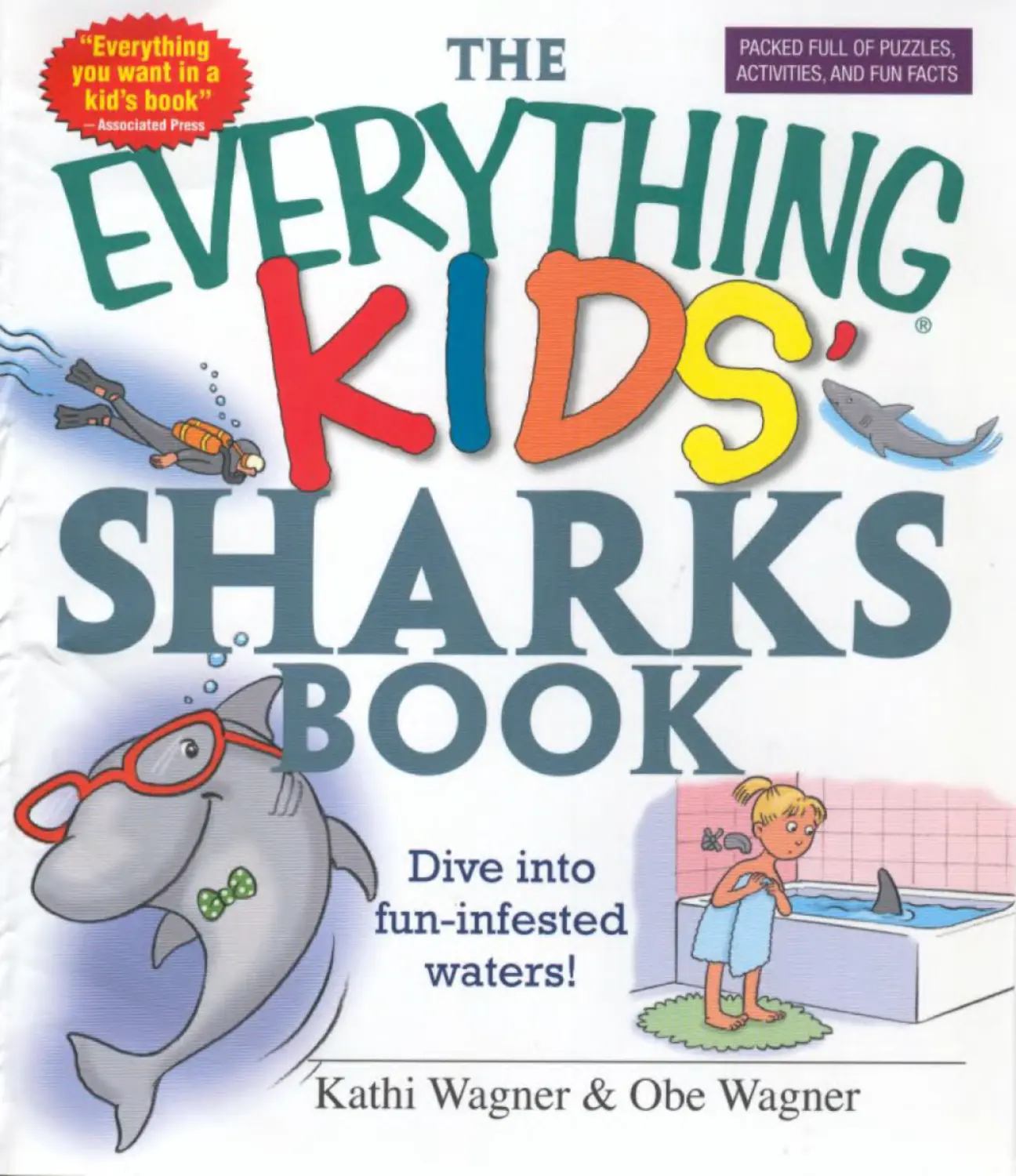
                    THE
оок
| Dive into
fun-infested
waters!
PACKED FULL OF PUZZLES.
ACTIVITIES. AND FUN FACTS
“Everything
you want in a
kid’s book”
Associated Press
$6.95 (Canada $9.95)
Juvenile
PLUNGE INTO FUN!
Grab your wetsuit and goggles—it's time
for a deep-sea adventure with The
Everything*' Kids' Sharks Book'. Explore
the world of these underwater giants through
tons of puzzles, exciting shark facts, and do-
it-yourself activities. You'll learn all about the
skills sharks need to survive in dark ocean wa-
ters, why their body shape helps them move,
how they hunt for food, and what it takes to
Kathi Wagner, author of The Rugrat's Potty Влй, has bevn a children's
librarian for nineteen years. She is also the author of Thr Everything*
Kids Bugs Book, and coauthor of 77м* Everything* Kids' Bible Ттча Book
and The Everything' Kids' Riddles and Brain Teasers Book. Ms. Wagner,
who lives in Red Oak. Iowa, has a B.A in early education and journal-
ism and is the mother of two.
Obe Wagner has been raising and studying animals for more than ten
yean. His favorite field of study is that of ocean life. He lives in Red
Oak. Iowa.
ISBN 1-59337-304-X
BOOK
Using The Everything Kids* Sharks Book, you’ll:
•	Decode words to find answers to fun
shark riddles
•	Search the ocean floor to uncover a
hidden treasure
Wind your way through shark-infested mazes
Rearrange puzzle pieces to make pictures
of your favorite sharks
Unscramble clues jumbled by sneaky sharks
Packed with fun games, exciting projects, and
cool experiments, The Everything Kids' Sharks
Book will have you scouring the ocean for end-
less adventure!
A
idams
media
www.evcrylhing.com
Cover design by Dutton and Sherman
Illustrations by Dana Regan
Caudal
Anal
Gills
Pelvic
Pectoral
Whale Shark
Caudal
Anal
Gills
Pelvic
Pectoral
Gray to
blue-gray
skin
Light-yellow markings
(random stripes and dots)
/ on very dark skin
First
Dorsal fin
White
belly
, First
Dorsal fin
White
belly
Razor-
sharp,
serrated
teeth in
huge jaws
Caudal
Anal
Gills
Pelvic
Pectoral
Hammerhead Shark
Caudal
Anal
Gills
Pelvic
Pectoral
Tiger-like
markings
Gray-brown
skin \
White
belly
Razor-
sharp,
serrated
teeth
White
belly
_ First
Dorsal fin
, First
Dorsal fin
THE
Sharks Book
Dive into fun-infested waters!
Kathi Wagner and Obe Wagner
Adams Media
Avon, Massachusetts
EDITORIAL
Publishing Director Gary M. Krebs
Managing Editor Kate McBride
Copy Chief: Laura M. Daly
Acquisitions Editor: Kate Burgo
Development Editor: Christina MacDonald
Production Editors: Bridget Brace. Jamie Wielgus
PRODUCTION
Production Director: Susan Beale
Production Manager: Michelle Roy Kelly
Series Designers: Colleen Cunningham, Erin Ring
Layout and Graphics' Colleen Cunningham.
Rachael Elben. John Paulhus. Daria Perreault,
Erin Ring
Cover Layout: Paul Beatrice, Matt LeBlanc
Copyright C2005, F+W Publications, Inc. All rights reserved. This book, or parts thereof,
may not be reproduced in any form without permission from the publisher; exceptions are made
for brief excerpts used in published reviews and photocopies made for classroom use.
An Everything* Series Book.
Everything* and everything.com* are registered trademarks of F+W Publications, Inr
Published by Adams Media, an F+W Publications Company
57 Littlefield Street. Avon. MA 02327. U.S A
www adamsmedia com
ISBN: 1-59337-31M-X
Printed in the United States of America
J I H G F E D С В A
Library of Congress Cataloging-in-Publication Data
Wagner, Kat hi
The everything kids7 sharks book / Kathi Wagner and Obe Wagner.
p. cm	(An everything series Vock)
ISBN 1-59332-304-X
1. Sharks—Juvenile literature. I Wagner. Che. IF Title Ш Series: Everything series
QL63B.9.W34	2305
597 3—d-C 2?	2004026332
This publication is designed to provide accurate and authoritative information with regard to the subject matter
covered it is sold with the understanding that the publisher is nut engaged in rendering legal, accounting, or ether
professional advice [f legs! advice or other expert assistance is required, the services of a competent professional
person should be sought.
—From a Declarator! cf Fringes jointly adopted by a Committee of the
American Bar Association and a Committee of Publishers and Associations
Many of the designations used by manufacturers and sellers to distinguish their products are claimed as trade-
marks When those designations appear in this book and Adams Media was aware of a trademark claim, the desig
nations have been printed with initial capital letters
Cover illustrations by Dara Regan
Interior illustrations by Kurt Dolber
Puzzles by Beth L. Blair.
This book ;s Available at quantity discounts fcr bulk purchases.
For ?nfor mat ice, call 3-800-8 72-5 627
See the entire Every thing* series at www. everything com
DEDICATION
To Cami, who loues/shes; Unrle Keuin, who loves the water;
and to Unde Brett and Aunt Sonya, who understand the ocean.
What kind of sharks
go to heaven when
they die?
Angel sharks!
ACKXOWL]’IKiMIATS
To Faith, Jana, and Wanda for ali or their heip.
Contents
Introduction / Vii
Chapter 1:	An Ancient. Enormous Aquarium / I
The Ocean, the First Aquarium / 2 • Fossilized Fish / 3 •
Л Different World / 7 • Fish Families / 9 • The Name Game /12
Chapter 2:	On the Defense / 13
Survival of the Fittest / 14 • Luring with Light / 15 • The Bigger They Are / 16 *
Camouflaged Creatures / 17 • The Great Escape / 21 • Don’t Go in the Water! / 24
Chapter 3:	Feeding Frenzy / 27
Let's Eat / 28 • What’s on the Menu? / 28 • Favorite Foods / 29 •
Now That's a Mouthful / 33 • Man-Eating Shark? / 36
Chapter 4:	l ake a Bite out of This? / 39
Say Cheese! / 40 • At the Root of It All / 44 ♦ Tons of Tooth / 45 •
Skin. Scales, or Teeth? / 47 • Two Kinds of Skin / 48
Chapter 5:	Six Senses / 51
To See or Not to Seo / 52 • Eye to Fye / 53 • Smelling Trouble / 54 •
Shocking Sharks / 57 • Crossing the Line / 61
Chapter 6:	Dynamic Design / f>3
Streamlined Sharks / 64 • The Tail End / 63 •
The Jawbone's Connected to The? / 66 • Sink or Swim / 69
The vfcWTHWc Kip Sharks Book
Chapter 7:	Sizing Them Up / 75
Not-So-Gentle Giants / 76 • Catching a Shark / 77 •
Don't Let Their Size Fool You! / 80 * A Shark You Could Hold in Your Hand / 84
Chapter 8:	The Cycle of Life / 87
Which Came First, the Shark or the Egg? / 88 • Keep Those Eggs Safe! / 90 ♦
Sole Survivors / 94 • On the Move / 94 • How Old Are They? / 97
Chapter 9:	Study in» the Sharks / 99
Visiting an Aquarium / 100 • Make Your Own Aquarium / 102 •
Scientists and Scuba Divers / 105 • Shark Research / 107
Chapter 10:	The Survival Instinct / 109
Are You a Survivor? / 110 • Things to Do with a Shark / 113 •
Seeing It Both Ways / 116 • Future Fish / 118
Appendix A:	Glossary / 121
Appendix В:	Bo Your Own Research / 124
Puzzle Answers / 127
Introduction
Have you ever wondered what it would be like to live in the
ocean? I lave you ever imagined what it must be like to
swim around all day long, eating whatever you want, when-
ever you want, or being able to scare somebody simply by opening
your mouth? Well, then The Everything® Kids' Sharks Book is for you!
This fun filled book will let you see the world through the eyes of a
shark a wet and wild world.
Take a journey down to the deepest part of the ocean, travel
back to the beginning of time, visit an aquarium, become a fos-
sil hunter, and see what it's like to be a famous "movie star." But
youi adventures won't stop there. You can learn how to “hide" like
a shark, float like a shark, or even play cards like- one. Maybe your
favorite part of ’his book will be making an ocean you can eat or
challenging your friends to a survival competition. Or maybe the
thing you like doing the most will be the experiments or the sand
art. Either way you’ll discover why some people think sharks are
monsters while others think they are man's best friend.
In between the covers of this book, you’ll find out how sharks
smell trouble and how they see things very differently from us.
You will also learn the "shocking" truth about the way sharks find
their food, how they travel throughout the ocean, and where they
raise their families. There are hours of fun games and puzzles just
waiting inside this book for you.
So, when does the adventure start? Right now! Get your swim-
suit and goggles ready because you’re probably going to get wet.
Then pack your towels, grab your sand shovel, and prepare to
dig into this book. Don't forget to invite your family and friends.
vii
The tWTH/VC KIP • Sherks Book
There’s plenty of fun to go around for everyone here is your
chance to get everyone to try eating edible sand, searching for
shark's teeth, or just getting them to take a day off and go to the
beach. But remember to warn your ft lends and family, this book
is about sharks, you know. So, everyone nut of the ivater! It’s time to
start reading!

The ©ItWTWWC Wt> Sharks Book
The Ocean, the First Aquarium
magine the world as a very large fishbowl, with
only one piece of land in it—much like an island.
Way back in the beginning this is how it was.
Apart from that one giant piece of land, everything
else in the world at that time was water On land
was the fresh water we know as rivers and lakes,
but most of the water was in the form of an enor-
mous ocean stretching off in all directions.
Many scientists believe that in the very begin
ning of time, the earth was dry. They also think
that our planet was covered with volcanoes. As the
volcanoes began to erupt, clouds formed and rain
pouted down everywhere, making the body of water
that became the first ocean. As the water covered the
salty ground, the first salt water was made.
aquarium:
An aquanum is a container of fresh
or salt water where fish and other
anima’s can live. Aquanums can be
as small as a fish bowl or as large
as a building.
One thing al! sharks have in common is that they need
water, lots and lots of water that is filled with salt, in order to
live. So you might think that in the beginning of time there
were tons of sharks and fish swimming around in this mas
sivc body of water. Actually, all that existed in the water were
creatures loo smalt to see. It would take a long time, a bil-
lion years or so, before small fish, amphibians, and finally the
sharks could be found.
Solving the Puzzle
“So,” you might be wondering, '‘how do we know all of
this? If there were no people there at the time, how can we
be sure what really lived here?r The only way we can guess
is through the study of geology. Geologists are people who
study the rocks of the earth for clues to the mystery of our
past They find the pieces to this puzzle hidden deep in our
2 ‘2^
An Ancient, Enormous Aquarium
earth's crust, in the images captured in stones from the
ocean's floor. These pieces of stone have washed ashore, or
they might have moved inland when the earth changed from
one island to become the separated lands and water that we
know today. Although people were not here to see the world
as it was changing, the sharks and dinosaurs were. Sharks
were one of the first things on our planet. During the great
changes on the planet many land animals vanished, but
the sharks were lucky because they were protected in their
underwater world.
Let’s Go to the Beach
Why no* take a day and go to the beach? If you don't have
an ocean close by, how about hunting for treasure along the
banks of a river or the shore of a lake? There are all kinds of
treasures and clues to be found near the water, like rocks and
footprints. You might even find some small frogs, fish, or ani-
mals. But don’t forget to bring along your family, some lunch,
and a few containers for catching and carrying your crea-
tures. Just remember to let them go before you head home,
because most fish and animals require a very special habitat
to survive.
^^TrjlTiis
Ocean Cake
To make an ocean cake, all you
need is a box of white cake mix.
Follow the directions for mixing
it up, then arid a few drops of
blue food coloring to the bat-
ter. Pour it into a pan,
and have your parents
bake it. Once the cake
is cool, you can hide
a few gummy sharks
dawn in the cake and
then frost it with blue-
colored whipped topping.
Fossilized Fish
Do you like hunting for treasure? The ocean hides treasures
of all kinds. Once in a while it even sends a few of its trea-
sures ashore. AU you have to do is walk along the beach in
the morning to find beautiful shells, starfish and clams,
among other things. If you’re lucky, you may even find a tri-
angle shaped prize that once belonged in the mouth of a
shark. These black, blue, or sometimes white pointed objects
y\\vA ЭЛ» /9
To hear my
пипе you might
think of Moby Dick. But
my spots always give me
away. Don't let my size fool
you. I may be very large, but
lhe food I crave is very small.
What am I?
Tiy This,
A Bone to Pick
If sharks' teeth can change
colors, can bones? Ask your
local butcher if he has any extra
bones he could give you. (Ham
bones work well for this experi-
ment.) Then have one of your
. parents boi> the bone and let it
cool. Now place the
cool bone in a jar with
water and a few drops
of blue food coloring.
Cover the jar. Try to
guess what will happen
to the bone. Were you
right?
fossil:
A fossil is a solidified object
produced by an organism that has
been perfectly preserved in rock or
stone. Fossils have taught us a lot
about the sharks of the past.
are sharks' teeth. Treasure seekers just like you have collect-
ed sharks' teeth for millions of years If you find a white one,
it is not very old But if you find a blue or black one, it is much
older and has become a fossil. A shark’s teeth change in color
by taking in the minerals and other materials from the area
around them.
It takes many years to form a fossil. It a plant, animal, or
shark dies and its remains stay in the same place, covered in
sand, it can become a fossil. Minerals from the water fill the
plant or animal. As the remains decay, water and minerals
fill the empty space where the shark, plant, or animal once
was. As the sand and minerals harden in the space, they cre-
ate an image of the object that was there. Fossils have also
helped us to learn about changes in the Earth's weather,
land, and water.
The majority of shark fossils show only their teeth. But,
the search went on over the years, and eventually a fossil
was found that showed a shark's teeth, skin, and muscles.
Before this fossil was found, humans could only guess what
the ancient sharks might have looked like. Newer fossils have
helped us to see that long ago. some sharks had noses that
were up towards the top of their heads and mouths that were
in the front of their face—like yours!
Sometimes the marks from the shark’s teeth on another
animal's fossilized bones are the only proof we have that the
shark was there! Did you know that the tooth marks from
each type of shark are different? This is the way that we can
tell which sharks were living at a certain time.
Clues from the Past
Do you remember the last thing you had to eat? How
about what you had for lunch yesterday? Some fossils have
been found that even show what a shark ate for its last lunch!
Bidder Than Bio
The tremendous shark megalodon lived about 25
million years ago. it is thought to have been 50 feet
long, or longer! No one has ever found a fossil of a
complete megalodon, but they have found many
fossJs of one particular part of this ancient giant.
Foltow the directions below to see what the scien-
tific name MEGALODON means, and you will find a
description of the fossils that have been found.
Write the name MEGALODON
Move the G to the beginning
Move the A to second place
Move the N to third place
Move the 0 to the end
Delete MEL
Change D to T
Add I between & and A
Double the T
Add TH to the end
Welch Out!
) If this scuba diver is 6 feet ta'I,
how big is the megalodon tiiat
\ is sneaking up on him?
Г/ -4-
The ^WTHIII/G WD ' Sharks Book
These fossils or images created from rock have
recorded our planet’s history in a perfect form
that seems to last forever. Fossils can tell us
a lot about how the earth and the animals
appeared long ago. Even if you live far
from the sea, you can still have fun look-
ing for fossils. Many fossils have been
found inland literally hundreds of miles
from the nearest shorelines
If you want to try and find a few fossils
of your own, you can look in a pile of deco-
rative rocks or gravel. Almost anything can be
fossilized: ferns, trees, plants, and animals, even
evolved:
When something has evolved.
it means that it has changed.
As cats and dogs have evolved,
or changed. over many, many
years, they have become smaller.
Humans have grown taller, and
our brains are getting larger. Some
sharks have evolved to alfow them
to adjust to the changes in their
ocean home.
dinosaurs. Many of the things we know today about the
past came from these stones containing history.
Living Fossils
Fossils have helped us to “take a look" into the past. Some
modern sharks have been called “living fossils’ because they
look almost identical to the sharks that used to swim in the
same ocean millions of years ago. To see what an early shark
looked like, all you have to do is find a picture of one of these
“living fossils," like the hagfish or the lamprey.
When you think of a shark, what do you think of first?
Most people would answer, “the shark’s jaws." Can you imag-
ine a shark without a jaw or not having all those teeth? The
hagfish and lamprey, which are descendants of the first fish
families, have a mouth, but strangely they have no jaws.
These hagfish and lampreys have to use suction rather than
teeth to hang on to their prey. The spiny dogfish that lives in
the ocean today still has the same horn or spine-like weapon
in front of its fin—and like its ancestors, the dogfish is still
prepared to use it.
Ail Ancient. Enormous Aquarium
Some sharks have changed and evolved over the years—
they eventually grew jaws, lost some of their gills, or changed
their form completely. Yet other members of the shark fam-
ily have hardly changed or evolved at all. One mystery of the
sharks that remains to be solved is how some sharks have
never changed.
A Different World
Because we live on the land, the ocean is like a different
world to us. For example, the weight of the ocean is a lot
heavier than the weight of air. Air presses down on you each
day at a pressure close to twenty pounds, which is the same
as walking around al! day with two bags of sugar on your
am /9
If you were
ever sick, you
might think I could help
you. Some may say I am a
more caring shark. I am the
familar brown colored shark
>01.1 see at a lot of aquariums.
What am I?
asiPN
Family Reunion
Do the following equation and you’ I find cut how many shark spacies
* scientists know about... at the moment!
+ + «

The eltWIWWe KIP - Sharks Book
Shrinking Sharks
You can make your own shark's
teeth or shark cha-rns by using
the clear lid from a birthday
cake or deli tray you bought
at the store. With your
parents’ help, color
and cut out the teeth
or sharks from this
plastic. Punch a hole
to string them on later.
Bake them for a few
minutes al 350 degrees.
W мн f?
If you were
thirsty and you heard
my name, you might be
tempted to squeeze me. But
be careful, as other sharks
may come to my "ade." My
bright yellow color allows me
to stand cut m a crowd.
What am I?
sjjeijs iKxuei
shoulders. Every inch of your body feels this weight each day.
No wonder you feel tired at night! Towards the bottom of the
ocean, the water's pressure is a thousand times greater than
that. So if you were a shark trying to breathe at the bottom
of the ocean, it would be sort of the same as you trying to
breathe with an elephant sitting on you! (This doesn’t bother
the sharks, of course—they have always lived underwater
and are used to it.)
Mystery of Lost Color
Other things are very different in the ocean, too. Color, as
we know it. can only be seen in the first few feet below the
surface of the ocean. The farther down in the water you go.
the darker it gets, and the more the color changes until final-
ly it disappears. How well do you see colors in the dark? For
fun, invite someone to a color challenge. You and a friend or
your brother or sister can test each other. All you need are a
few different colored crayons and a room that you can make
dark. Take turns trying out this test:
I.	Have your partner hold the crayons up one by one for
you to see. while the room still has light in it, so you
can tell them the name of each color.
2.	Try naming the colors again with a little less light in
the room (make sure your partner mixes up the order
to really test your eyes).
3.	Try it one more time when the room is almost dark.
What do you see?
Don't forget to give each person a turn to test his or
her eyes!
Color isn't the only thing that disappears below the water;
light is scarce as well. Many of the sharks that live in the
very bottom of the oceans don’t use their eyes much. No one
8
An Ancient, Enormous Aquarium
is completely sure if they ever used them, or if these fish just
evolved or changed because they no longer needed to see.
Whatever the reason, the eyes of these bottom dwellers look
quite different from the eyes of the creatures that live closer
to the surface.
Temperature in the Ocean
Sharks spend twenty-four hours a day in the water. Some
of the water is very cold, while other parts of the ocean are
warmer. Most sharks migrate to warmer places each year,
traveling thousands of miles. These sharks swim back to the
colder waters to bear their young and find food
Just like water, air can be hot or cold. When hot air from
the land moves over the cold water, sometimes it turns
the ocean water upside down, something like the way your
stomach rolls over on the hills or loops of a roller coaster
ride. When the water rolls over, it mixes up plankton from
tiny plants and animals and brings them to the top of the
water near the shore. Fish, large and small, follow' the food.
The plankton that surface don't remain at the top for long
though. Once this cycle starts, they will travel distances of
up to a mile each day to reach the top of the ocean for food,
then return back down toward the bottom for safety.
Fish Families
If you were part of the bony fish family, you could be invited
to the biggest family reunion on the planet. Your family has
the largest variety of members around. The one relative you
won’t find there is a shark. Although they are fish, somehow
sharks and their cousins, the rays and the skates, were over-
looked when backbones were being handed out. This doesn’t
seem to bother them though.
Sharks w3l take a bite out of almost
anyth ng, even metal One type of
shark, which scientists tliought had
vanished mil Lons of years ago. took
a bite at a metal cable and left tooth
marks that matched those from
a 100-ml lion -year- old fossil. Talk
about leaving your mark behind!
Which 0ne?._
You might think it would be fun to
take a ride on me. But because
I don’t have any spurs, you may
have to bring your own along. I
am one of the few creatures in the
ocean that can swim standing up.
Do you know which one I am?
A.	Walking fish
B.	Octopus
C.	Seahorse
D.	Jellyfish
R
к
w
К
w
Swim with the Sharks
These six shark sentences have something in common—the words that complete
them are all missing the same two letters! Once you figure out what the missing
letters are. add them to each of the word bubbles. Next, unscramble the words
and write the correct word in each blank to finish the sentence.
1. A dogfish shark does not
2. Sharks hove teeth that are
very
An angel shark does not have
a halo or a
The megamouth lives in the deep /g*"
ocean where it is very
5. Noah did not bring two sharks
into the
6. You would not find a guitarfish
playing music in the____________.
Extra
laps
There is a riddle swimming around the edge of this page, but the
sharks have eaten all the vowels' The riddle starts at the letter
marked with a dot. Figure out in which direction the riddle reads,
and put ihe vowels in the correct places. Good tuck!
An Ancient, Enormous Aquarium '
There's another thing that separates sharks from
their other fish relatives—sharks don’t make any
sound. Other fish make all sorts of sounds, from
shrieks to moans. But our silent friend the shark
doesn’t seem ro want or need to communicate with
anyone. Still, research has shown that sharks
can be communicated with or taught. In “shark
school? scientists have discovered that sharks can
iecognize different things such as shapes and col-
ors. These shark students are rewarded with food
if they swim to right place, which is marked with
a special shape or color. If you want, you could
test your friends' ability to learn. Try asking them
a few shark trivia questions, like “Which shark has the big-
gest mouth?' and then reward them with a prize or treat
Edible Sand Art
Go Fish
Whoever decided to sort the fish into families had a lot of
work to do. There are so many different kinds of fish, where
would you start? How about with the sharks? For fur., you
and your friends can sort them into your own groups. Follow
these steps, and you’re on your way:
1.	Collect a few pictures of some sharks or fish from old
magazines.
2.	Get several pieces of paper to write your group names
on, a marker, and a pair of scissors.
3.	Sort your sharks by size, color, where they live, what
they eat, or how they look.
4.	After you’ve sorted them, cut each shark nr fish into
three equal parts. Mix the pictures up to create new
creatures, or turn them face down and play a game of
“Go Fish."
If you want to try your hand at
sand art you can eat..all you
need are a few different col-
ors of powdered gelatin, lake
a clear jar and pour in layers of
different colors until you almost
reach the top. Now stick the
handle of a spoon into the jar
and puli it back up through the
powder. Your gelatin
I ’sand'win move and
blend, creating a piece
of art that is fun to look
at and fun to taste. To
taste your art just l ek
a spoon and stick it in
; the powder.
The «JtWTWWG WP Sharks Book
-Which One?________________
Some people think I am too quiet
or cold. Others think I should be
baked. I'm happy just to lie around
on the ocean floor. Do you know
which one I am?
A.	Starfish
B.	Coral
C.	Lobster
D.	Clam
Fish families have been arourxi for
more than 400 milion years. Some
members of Hie first fish family can
still be seen swimming in the ocean
today. One way to tel how king
a certain type of shark has been
around is by counting its gills. The
original types of sharks have six
or seven sets erf gils. Newer types
have onfy the.
Mixing It All Up
Some of the members of the fish family appear to have
gotten mixed up. The angel shark looks like a cross between
a shark and a ray This flat-bodied shark almost appears to
have wings in place of its fins. But this shark scon proves it’s
more of a shark than an angel as it lies hidden on the ocean
floor waiting for its prey. Another shark that looks like a mix-
ture of two things is a sawshark, whose nose looks a lot like a
saw you might find in a toolbox. This silly fish also looks like
it’s wearing a mustache.
The Name Game
Have you ever wondered how all the sharks got their names?
All of the plants and animals on our planet belong to king-
doms or famines. These kingdoms aren’t like the ones with
kings and queens; instead, they are the way scientists group
things into categories. The name given to the shark family is
“Selachian" because it means “shark-like” in Greek. After an
animal is placed in a family, the members of the family ar?
then divided into smaller groups, usually by their appear-
ance or behavior. One of *he ways sharks are grouped is by
the size of their tails. Other ways include the number of dor-
sal fins that they have, the number of gills on their sides,
what the shark likes to eat, or even its basic shape. The shark
family contains more than 300 groups. Because new discov-
eries are made every day. the number of kinds of sharks con-
stantly grows.
12


The еОШДЙ VHP Sharks Book
Look Mom, No Hands!
i A great way to relate to a shark
is to try this “no hands' relay. All
• you need is two lines, both with
the same number of people. To
start, the first person in each
line places a grapefru t under
his or her chin, pass-
; ing it on to the next
person's neck without
j letting either person
' touch the grapefruit
; with their hands. The
first l.ne to get its grape
fruit to the end wins.
Survival of the Fittest
By now you have probably figured out that with all the
big changes going on around the earth, the shark has
had to be pretty tough. Sharks have also had to adapt
to their environment. When you study really hard to get good
grades, practice sports to perform well arid win a game, or
make an effort to he nice to people, you know what it’s like to
try your hardest to succeed and fit in with your classmates,
teammates, and friends. Much like the shark, you work hard
to make a place for yourself. You have to make choices and
learn to adapt to your surroundings and the people in your
world to succeed.
Gold Medal Sharks
If you decided to hold an Olympic contest tomorrow, the
shark family would probably win most of the events. The blue
shark is used to swimming very long distances because it
travels thousands of miles each year to migrate, and it would
probably win the swim marathon. The rnako shark could win
the medal for the- fastest swimmer because it reaches speeds
of around fifty miles an hour. The record
for deep-sea diving would have to go to
the megamouth shark, because it can
swim thousands of feet down below the
ocean's surface only to travel back all
the way back up to the top again each
night. The megamouth would probably
win the title of strongest fish, too,
since it is able to support thou-
sands of pounds of water pressure
on every inch of its body. Then there's
rhe thresher shark, which uses its tai! like
On the Defense
a hockey stick, and that would join the great white shark to
make a prize-winning team for penguin volleyball, bouncing
those poor little penguins way up in the air just for fun. The
high-jumping contest would go to the basking shark, a shark
that is as big as a house that spends its time jumping up out
of the water trying to get rid of the parasites or pests that
cling to it. Can you imagine being famous for trying to ger
someone or something to quit bugging you?
parasite:
A parasite is something that feeds
or lives off of someth rig e'se with-
out giving anything back to its host
or food supply. For iristance, lice
are a parasite ttiat feeds off sharks.
What’s Bugging You?
Do mosquitoes or flies ever "bug you"? Some parasites
not only bug sharks, but they can also hurt them. Some reef
sharks have been seen waiting in line to have the insects
removed from their bodies by a small type of fish known as
a wrasse. These hungry little wrasse fish don’t stop until the
shark is completely clean. Other sharks, like the lemon and
zebra sharks, have their own personal cleaners fish called
remoras that travel throughout the ocean with them.
One thing that is very' different about the remoras is that
they have a fin shaped like a suction cup. Once they are suc-
tioned on to the shark, they ride along waiting for the left-
over scraps that fall from the shark’s mouth.
Stiff Fins
A shark's pectoral fins are stiffer
and harder to move than those o'
a txiny fish. The shark uses tliese
fins to steer and balance itself as it
swims through the water.
Luring with Light
Some of the parasites or pests that bug sharks are luminous,
which means they can light up. The light attracts small fish
down to the bottom, where eventually the sleeper shark eats
them. If you were a shark trying to catch a fish down deep in
the ocean, you might be able to do the same thing by putting
a flashlight near your mouth, then you could quickly swallow
up your victims as they swim toward the light
15
The 0|8WlNt WP Sharks Book
symbiosis:
When two an mais help each other,
like the shark and the remora, it is
called symbiosis, Animals or sharks
that have learned to live close by
each other and work together
have Oils relationship of symbiosis.
When they help each other, both
can exist.
other sharks have been known to lure their lunches with
lights that glow from their abdomen, like the lantern shark
does. Maybe you have seen this type of luminous glow if
you’ve ever snapped a glowstick (the kind you can use like
a bright-colored light or wear around your neck like a neck-
lace). A lantern shark s light starts to shine when two liquids
mix inside its body, very much like a glow stick.
Which One?_
Should you ever try to keep an eye
on me, be careful because I will
be keeping two on you. But watch
very closely, for if l turn you may
not see me at all. Do you know
which one I am?
A. Flatfish
8. Rat fish
C. Sailfish
D. Swordfish
What’s That Glowing?
Another way to sec an example of this strange glow is to
write a message on your hand with a fluorescent highlight-
er or marker and then, hold it under a black light bulb. If you
don’t have a black light bulb, you can buy one at most hard-
ware stores.
Several other things light up in the dark, too—like night
lights, for example. How many things can you list that “glow"
in your home? Try writing down all the things that you
can think of that light up at night to help you find your way
around your house, after the lights are turned out Then lat-
er when it gets dark, check to see how many things you had
right and how many you missed Can your family name all
of them?
The Bigger They Are
Over the years, scientists have noticed that the bigger a
shark is. the faster it can swim. They have also figured out
that a shark’s best chance for survival relies on being the
fastest in its group. So how bad could it really be, to be a
small, slow shark? Pretty bad—and to make things worse,
sharks that are sometimes known as the top killers, such as
the great white and mako, are warm blooded. Tn is allows

Он the Defense
them to move faster than their cold-blooded prey. Sc these
small, co'.d-blooded sharks must stay in top condition so they
can rely on their ability to hide and think fast.
One game you can do that relies on speed and listening
closely is Red Light. Green Light. Only this time, try it in the
swimming pool. You never know when the leader will yell
"red light,” signaling for you to stop. To play, all you need is a
few friends or family members. Then someone is chosen to
start the game as the “leader." When everyone is in a line and
ready, the leader calls out “green light” Everyone swims as
fast as they can toward the leader until they hear the words
"red light." then the players start to dog-paddle, until they
hear the words "green light” again. The first per son to reach
the leader becomes the new leader and the game starts all
over again.
ani /9
I love to
lay around all day
long soaking up the sun.
Because I am so big and
appear from time to time off
in the distance, some people
actually thought I was a sea
monster. What am I?
Camouflaged Creatures
Ycu go to the seashore with your parents to search for a star-
fish, and then you spy one just under some colorful recks
along the edge of the water. You reach down to grab it, but
then the- rocks start to move. Believe it or not. you have just
found a wobbegong, the disguise artist from Down Under.
Down under where, you ask? That’s what some people
call Australia, and that’s where this giant-
sized fish lure comes from. The skin around
a wobb egong’s mouth looks like seaweed,
which tricks the fish that are swimming close by
into trying to take a bite, only to have this sly shark
eat them instead.
If you are walking along in the shallow water,
and you feel the sand move beneath your feet,
beware! It might be the tan colored angel shark that
П
Where’s Wobbe^png?
The wo b beg о ng is a bottom-dwell ng shark. It blends in so
well with the ocean floor that small fish will swim right up to it!
Can you find the two wobbegongs lying on this coral reef?
See if you can a'so find the glove,
needle and thread, sock, pennant,
Sarita hat. teacup, butterfly, pickle,
paper clip, ice cream cone, snake,
ghost, bunny, fried egg, and crown.
18
likes to bury itself under the sand and hide. Sharks come in
all shapes and sizes, and they come in different patterns and
colors too! You might wonder if you’re on a safari when you
hear of the leopard, tiger, and zebra sharks. Just like the ani-
mals on land that have the- same names, these sharks use
their patterns of color to protect themselves or to help them
hunt As these sharks get older, sometimes their stripes will
change to spots, making it even harder to know their family
name.
camouflage:
Some sharks use camouflage as
a way to hide or conceal them-
selves from others. Their camou-
flage might be stripes, patches,
spots, or сокиs. The camouflage
helps them to blend in with ther
surroundings.
Now You See It
Many creatures use camouflage as a way to trick your
brain into not seeing what is right before your eyes.
Have you walked through your yard and been surprised
by a rabbit hiding under a bush? Baby fawns, with their
speckled coats, blend so well into the brown colors of the
trees that you may never see them until they show their
bright white tails as they run away. Do you have any clothes
that are covered with patches of brown and green? Clothes
like this, often called “camos/ are what some people wear
when they are playing games like paint-ball or if they go
hunting or fishing What would you wear if you were trying
to hide in the snow, night, forest, water, grass, or the sand?
Would you like to be able to change the color of your skin
depending on whether you were going to be in the shade or
the sun? What if your skin could change instantly to match
a new landscape? One of the shark's favorite foods, the octo-
pus, can do just that. Their skin is covered with cells that are
like containers of paint. They can choose whatever color they
want to be. Wouldn't it be nice if your bike could be like that?
The only problem would be if you forgot and left it on the
camouflage setting and then couldn't find it!
Some sharks have more than one
name. The wobbegong shark is
also called a carpet sharit because
of its shaggy appearance. It looks a
lol I ke a rug you might find on your
floor.
The cltWTWWc WP  Sharks Book
Which One?
You might expect to see me wear-
ing a round, red nose, but instead
you will probably find me hiding in
amongst the anemones. Do you
know which one I am?
A. Dogfish
8. Sucker
C. Clownfish
A Color Change You Don't Want
Next time you pack to go to the beach, what will you
pack? You probably thought of your flip-flops, swimsuit,
and sunglasses right away, but did you remember your sun-
screen? Without it. your skin will probably change color too!
Although your skin doesn’t change instantly, it can change
color over a few hours. So, remember that even if you put
sunscreen on when you first get there, if you want to kcc-p
from turning pink or red, it’s best to reapply it after you've
been in the water. Here are a few rules to keep you from
looking like a lobster:
•	In the middle of the day. when the sun is strongest, do
not play on the beach for more than a few hours,
•	Spend some of the time sitting in the shade.
•	Cover yourself with a white shirt.
•	Don’t forget to wear a visor or a hat.
an» /9
Some
believe I should be
in a field instead of the
ocean, with my tail that is
shaped ike a sickle. But 1
pre'er to harvest fish with my
tail rather than grain.
What am I?
TYy an experiment. Wear a black T-shirt out in the direct
sunlight. Then try wearing other, different colors. Did you
feel cooler when you were wearing the white shirt?
Tag, You’re It!
Playing a game of tag at the beach could be fun. All you
need are a couple of people and a few simple rules. Try to
pick an area of the beach where you won't bother any other
people, and then start making a large circle in the sand with
your feet When your circle is completed, make lines straight
through the middle as though you wore cutting pieces of pie.
Gather your friends or family and decide who is going to be
the “shark," then start running along the lines that you have
drawn in the sand The first fish that is caught by the “shark"
now becomes the new ‘’shark,” and you start all over again.
On the Defen.se z z
The Great Escape
Are you afraid of anything? Some people are afraid of
heights, while other people fear things like mice or spiders.
Almost everyone has something they don’t like to be around,
but do you know' why most people are afraid of the water?
Sharks, of course! Have you ever wondered what sharks fear?
They fear other, bigger sharks. One reason may be that they
know that the big sharks can swallow them without taking a
bite! Even the- great white and the bull shark are said to fear
the killer whales, which seem to be the only creatures in the
ocean with no enemies to fear.
Size can he important. Have you ever heard the term
"pecking order"? Some families have one. and most chickens
A lot of sharks can txte with the
same strength as an aligator. That
means a shark's jaws can bite down
on its food about twenty times as
hard as yours can.
Ilow Many School Buses Equal One Whale Shark?
The whale shark is the biggest fish in the ocean, weighing up to 15
tons! Rut how big s that rea'ly? Use the information below to see
how much a wltale shark weighs in more familiar terms.
1 whale shark = 15 tons
1 ton = 2,000 pounds
1 school bus = 10,000 pounds
Tke pJtWTW/VC WP  Sharks Book
a,n I?
When peo-
ple talk about me,
they say I am “great."
Unfortunately, seats don't
I ke me very much because I
like to eat them. I am the most
aggressive and dangerous of
all of the sharks.
What am I?
Bretts etntm tear 9
seem to know what it means For chickens, a pecking order
means that they will only let certain chickens crowd ahead
of them while they're in lire, waiting for food. The rest have
to wait their turn, or they get pecked. Ouch! Smaller sharks
also have to learn to wait, although sometimes not too
patiently, while the bigger sharks oat all they want from their
meal. And although you might think only the smaller sharks
fear the bigger sharks, it’s not always true. Even some types
of larger sharks seem to fear certain other shark families, so
they also have to wait for their turn.
Simon Says
Have you ever played Simon Says with a bunch of your
friends? Just like the sharks or chickens, you have to wait for
What’s a shark’s favorite game
smack, yummy, gulp, игр, игр, slurp, yummy
yum, crunch, munch
gurgle
crack
smack
munch
crunch
Let's
not'
yum
yummy
let’s Play Use ihe decoder to figure out this riddle1
On the Defense
the person who is chosen to be Simon to teli you when you
can “hop on your tail? “swim using only one fin,” or “dog-
paddle? The important thing to remember is to listen for the
words “Simon says”—if Simon just calls out “move your fins’
without saying “Simon says" first, and you move your fins
anyway, you're out. The person who is Simon keeps calling
out things to do until only one player is left, and then that
player becomes the new Simon.
Fear Not
Sharks aren’t just afraid of other sharks; they can aiso be
scared of dolphins. Would you think those cute little play-
ful dolphins could ever frighten a shark? They not only scare
them; dolphins have been known to keep butting their heads
against a shark’s side until the shark is dead’ Why would a
shark with a name like the cookie-cutter make whales, dol
phins, or other sharks worried? Especially since they’re less
than two feet long-’ It’s not because they are killers. What the
other animals don’t like is how a cookie-cutter will swim up
to their sides, grab onto them and bite down, then spin them-
selves around until they leave a small hole in their body.
The shark's greatest enemy seems to be humans. When
a person enters the shark's neighborhood or area, the sharks
usually try to give a warning so that he or she will leave. If
you saw a mako shark swimming toward you, making a fig
tire eight like an Olympic skater, you might think you had
nothing to fear right until it opened its mouth filled with
teeth that are as big as a grown man’s fingers! The gray reef
shark prefers to hunch its back tike an angry cat, scr unch up
its nose, and push its pectoral fins downward as though it is
putting on its brakes to let you know that it means business.
Most sharks have their own way to threaten you before
they attack, if you continue to approach them, they further
The biggest fish of all is a shark
known as the whale shark, 1 his
shark Is so big it could barely turn
around In an aquarium the size of
your house.

The &LWTHI/VC fcID®- Sharks Book
warn you wit h their eyes. One way to know when
a shark is not in the mood to play is when its
eyelid, the nictitating membrane, starts
to rise from the bottom of its eye. This
——-------- is the shark's way of letting you
____________________ know there may be a fight. The nic-
— ” titating membrane protects the
shark's eyes so its victim can't
- damage them. These membranes
"________work like the wipers on your car's
—— windshield. They clean the shark's
..eyes as they pass over them.
Some people think that it's
important to “Look them right in the
eye when you talk to them," but that
isn't always a good idea. Looking a per
son or animal in the eye can also mean you're
looking for a fight Making eye contact with a shark
dorsal fin:
A dorsal fin is the fin that sits on
the back of a shark or fish. The
size and shape of these fins vary
greatly from shark to shark.
or any other wild animal is never a good plan.
Don’t Go in the Water!
All those scary movies arc right in one respect. If you see
fins moving around on the surface of the ocean, don’t go in
the water! There aren’t enough man-eaters to fill a Ten Most
Wanted list for sharks, but any shark can be dangerous,
Some are top killers, like the bull, tiger, and great white, but
even these sharks usually don't set out to kill humans. If you
could get the shark’s side of the story, you'd see that a lot
of shark attacks are accidents. If you are aware of the dan-
ger from sharks and know some of the things you can do to
prevent an attack, it will be better for you and the sharks. If
you see a sign posted on the beach that says “Beware of the
21
On the Defense
Sharks/ your family will know that this is a warning that
must be obeyed.
Stay Out!
Sometimes you probably wish you could post a sign like
this in your room whenever you want to have some time by
yourself. You could always ask an adult in. your family to
help you make the sign and hang it on your door. One thing
you could do is use a blackboard or magic slate. That way you
could leave other messages for your family or use it as an
ongoing game site. You could take turns and play tic tac toe,
finish the word, or hangman each time you or anyone else
went by your door.
If you 'nave ever read the story Goldilocks and the Three
Bears, you know that even though the little girl went into the
bear's house and ate their food and broke their furniture, the
bears still didn’t hurt her. Any rime you go to the beach or
enter the shark's home, the ocean, there are a few rules you
should know, so that you won’t be harmed, either.
You might think it would be a good idea to take your
cog along to the beach so he could enjoy the water. All that
splashing might make a shark think a hurt or distressed ani-
mal is in the water, and to a shark that means it is time to
eat! If you're riding a surfboard, the shark might think you
look like a turtle, seal, or dolphin. The only thing the shark
can see is the sutfboard’s outline, which does look a lot like a
dolphin or turtle. If it is warm enough for you to swim in the
water; it's warm enough for the sharks, too. But this doesn’t
mean sharks don’t live or swim in cold water—sharks are
found almost everywhere. Many bull sharks are at home in
some lakes and have even been seen swimming in some big
rivers. Imagine the shock of going to the river and seeing a
dorsal fin traveling upstream?
Tip This
Floating Fins
You can make your own floating
shark tins using two disposable
plastic plates or deli containers.
The first plate is your base, and
I the second one is cut out to be
your shark's fin. Make
a fold at the bottom
of the fin, then staple
or tape the fin on the
plate. You can float your
fin in the pool and use it
as a ring toss or target.
25
The VMtWTW/A© KIP Sharks Book
am /•>
You may
be able to guess
The sandbar shark, which gets its name from swimming
over the- sand, may even be carried up onio the land by the
ocean waves. Spoiled epaulette sharks use their fins like lit-
tle feet, so if they get trapped on shore, all they have to de is
walk back into the water!
my name by my stripes.
un'ess I am older and I
have outgrown them. Like my
r'amesake. I love to eat meat.
What am I?

Shark Safety
You should always take ar. adult with you if you want to
go into the waler. You might think that swimming when the
sun is coming up or going down would be the best lime of
the day because you wouldn't get sunburned. Unfortunately,
that's when the shark's food is moving around in the water
and so are they, so this is a ‘ime to be extra careful. Another
thing that attracts sharks is bright jewelry. When they see
something shimmering on your neck or arm in the sunlight.
they think they are seeing fish scales. Take your
jewelry off before you swim so those shar ks
don't think you are a fish!
It's important to remember
that sharks, like all wild crea-
tures. don’t usually bother
you unless you bother them.
If you follow the rules of
shark safety, the odds are
pretty good that you will
never meet up with one.

о
The VJtWW/Л® KIP ' Shark» Book
Let’s Eat
ave you ever gone to a family
reunion? Sometimes people go home
from these parties with ar. upset
stomach. If this ever happened to you,
your rami ly might have thought it was
due io all the excitement of seeing
and meeting all those new people—
when actually it was al! me food you
ate Everyone kept saying, “'t ry some
of -.his." It was all so good that you
rouldr't stop eating until it was time to
Ti> This
Let’s Go to the Movies
For fun, how about checking
out a movie atxx.it sharks from
your library or video store? It's
an easy way to wsit the ocean
go home. Seeing a large group of -heir
family and the thought of eating large amounts of food can
also influence sharks. No longer willing to wait their tun:,
they may ever, nip or bite a few of then’ own family members!
Sharks aren't the only -ype of fish that have feeding fren
zies. Have you over * n row n Lsh I cod to giant goldfish in the
pond at a park or zoo? You probably saw them got pretty
excited about that food, toe. They don't actually cat each oth-
er, but there a-,.re is a lot of shoving and pushing around.
and a fun way to learn even
more about sharks and
other creatures from
the deep. You might
also want to try one
on submarines or sea
monsters. Just don't
forget the popcorn!
<____________________
What’s on the Menu?
in the ocean. the smallest creatures are the main source of
food for '.he biggest of the fish. The original source of all the
food in the ocean is the sun. Solar energy is needed to make
a'.l the tiny plants grow, and then the tiny animals feed upon
them. Many ct these organisms are too small to be seen
without using a microscope. Others are baby lobsters, eels,
starfish, and other meat eaters that will soon he eating next
year's crop of plankton.
Feeding Frenzy
This pattern of living things eating ether living things is
called a feed chain, but some people ca I it a food web.
The term "food chain” makes you think that only one
type of animal will eat a certain animal and that each ear*
er will be bigger than the animal it eats. This wo..Id make
you thin* that predators and their victims are always linked
together. On the other hand, a “food web* de scribes what
really happens! Most arrrnals in the ocean, and especially
me sharks, will eat lots of different things, even their own
children. Sharks come back to the same areas every year to
chase the schools of fish that they know wil appear when
the plankton arc coming to the top of the water. Large ani-
mals, like the giant octopus, ran be overcome oy packs of
small sharks. Ever, though they are the top predators in the
ocean, sharks are an important part of the food web, since
they help keep the ocean’s population in balance.
feeding frenzy:
Sharks have been known to go into
what is called a feeding frenzy if
they get overly excited when they
are hungry and want to eat. In their
frenzy, these sharks may even take
a bite out of each other.
Favorite Foods
Some of a shark’s favorite foods are seals, swordfish, sting-
rays, dolphins, and. as we’ve mentioned before, other sharks.
What are you r favorite foods? AL your next family reunion,
picnic, or at mealtime a: home, take a poll of what your fami-
ly's favorite foods are. You might be surprised ar the- answers
One way La learn your family's likes and diskkes might oe
to help them plan a few menus. Then you can nelp shop for
the groceries or share in the fun of making a meal using your
new menu ideas.
Open Wide!
Do you or any member of your family have what might
be described as a mouth of enormous size? One way to check
Which One*?
You might expect me to come out
at night. Or maybe you think 1 am
famous. Either way I usually have a
point to make. Do you know which
one I am?
A.	Lantern fish
B.	Starfish
C.	Lamprey
D.	Flame telra
29
The VlERffH/Л® WP Sharks Book
this out is to make triple-decker sandwiches. There is no
limit to what can go into these sandwiches. Just follow these
simple steps:
/ me U»t _
1.	Start with three slices of any type of bread.
2.	Ask people if they want their bread toasted.
3.	Provide them with a variety of sandwich meats like
ham. turkey, chicken, or beef.
•I. Most people like cheese, so give them a variety to
choose from.
5.	Be really daring and offer sardines or anchovies.
6.	ihen it’s time for them to pile on the vegetables and
dressing.
What you may find out is that, like rhe shark, you would
need jaws that aren’t fastened to your skull to fit a meal that
extinct:
When the last of any creature dies,
that type of creature becomes
extinct. To prevent some anima's
big into your mouth. Sharks' teeth act sort of like a jack-in
the-box; when a shark opens its mouth, its teeth leap out
at whatever the shark :s trying to bile. The jaws can stretch
very far apart so it car. take a really big bite!
Most of the time a shark, will sniff its food before it eats it
Do you ever do that? You would think with ail that sniffing,
a shark wouid know the difference between a man. a seal, or
a fish But when it is chasing all those other fish right below
the surface of the water, it might go into one of those feed
ing frenzies and ea* anything that it sees! Sharks have been
known to taste people and then spit them bark out again
once they realize what they are rating.
or fish from possible extinction, we
have started putting a few of them
in preserves, aquariums, protected
waters, or zoos.
The Biggest Party of Them All
Once you’ve ir ied your hand in the kitchen, how about
hosting an enormous or “Really Big” Party. All you need is
a few friends to invite. Ask them to wear something that is
really big. ‘.ike a huge hat or shirt, or to bring something big
with them. Why don’t you and your friends make a gigan-
tic pizza that looks like an open shark’s month? Its teeth
could be triangles of cheese and the tonsils or tongue could
be pieces of pepperoni or ham. if you roll the- crust in front
of the tongue, you can make the edge of the shark's mouth.
How about making a really big root beer float for everyone to
enjoy with the pizza?
Don’t forget to hold a “biggest” contest to see who can
take the biggest step or who can make the biggest tower out
of cards Have a competition for the one who brought rhe big-
gest thing with them, or you can hold a really big shoe relay.
Here's what you need to play this game:
I* Ask if you can borrow a few pairs of shoes from the
adults in your house.
2. Draw names for each team, and have each team make
two lines facing each other.
3. The first person from each line has to put on a pair of
the really big shoes.
1. The person then walks backwards as fast as possible
over to his teammates on the other side.
5.	When the person reaches the ether side, she takes the
shoes off and hands them to the next person.
6.	Roth lines keep going until all the players on one of
the teams finish their turns.
ЭЩ /9
You might
know who I am if you
ever “saw" my nose. You
may have a tool that looks
like me in your toolbox
or garage. I am one of the
sharpest sharks around.
What am I?
One reason there haws been so
many shark sightings reported over
the years by fishermen and prates
is because sharks Ike to follow
boats or ships and wait for the food
scraps that are sometimes thrown
overboard.
Prizes for the winning team could be giant-sized candy
bars. The prize for the second place team could be regular-
sized ones. Hopefully you will chew your candy bar before
you swallow it—not like the sharks, which prefer to swallow
their food whole.
SWIM
SHARKS
SAFE!
HINT: Each out-of-place alter,
or pair of letters, is used only
once on the correct sign.
Some beaches post signs to
warn people that swimming
ccu'c be dangerous.
At this beach, a sneaky shark
has moved the letters of the
warning sign to make it more
to h s I kino!
Sec- if you can put the rnxed-
up letters back on the dotted
lines where they belong.
AR__
IT IS
32
Feeding Irenzv
Now That’s a Mouthful
It isn't always easy getting along with your family. Bur can
you imagine what it would be like trying to argue with your
sister if her mouth was so big it could hold up to six people?
Thankfully, you don’t have to worry about that and neither
do the sharks, either. The mogalodon shark, whose name
means "one of tremendous size" and who could also have
been known as Big Mouth, has been gone from the oceans for
thousands of years. As legend has it, this wondrous fish was
so bigrha* at least six men or several sharks could have eas-
ily fit into its open mouth. Try to picture yourself swimming
along, minding your own business, when tnis shark as big as
a school bus suddenly swims up beside you! If that weren’t
scary enough, did you know that when objects are seen
underwater, they appear to be as big as they really are plus a
third of their size on top? So that shark would have looked as
big as an eighteen-wheeler!
Which One?
I would be a great fish to take
along when you go camping. I
could be especial:у handy when
you need wood for your fire. Do
you know which one I am?
A.	Knife fish
B.	Spearfish
C. Hatchet fish
D. Razor fish
Water Illusions
Do you want to see how water can magnify something?
The next time you are in the bathtub, put your arm under
the water and see if looks any bigger than it did before. The
water can also make your arms or logs appear to bo bent or
broken in the place where they start to go under the water.
TO see this, all you have to do is lie down in a tub filled half-
way with water. Have your elbows and knees touch the sides
of the tub, while your feet and hands touch the bottom of
it. Then look down at your feet and hands. Can you see the
strange bend in your arms and legs just where the water hits
them? The reason this happens is that light travels through
the water ar a different speed than it does through the air.
I have to
be one of the most
tired sharks arouno. I’m
so tired. I th nk 1 could even
doze off wh Ic Гт swimming
up to you.
What am I?
jpeus jad=«is
33 &
ш vjiwmwe wp - Sharks Book 5'^"
spiracle:
A spiracle is an opening locat-
ed above and behind the eye of
a shark. This opening acts Ike a
vacuum that puns water into the
shark's gills, allowing the shark to
breathe even while it is eating. Not
all sharks have spiracles.
Sharks know how to swim the
moment they are bom. From the
moment they first hit the water,
baby sharks—or pups—also know
how to hunt for food, eat, and fight.
Another way to see this water illusion is to place a pencil
in a clear glass filled halfway with water. Look at the pencil
through the glass from the side. What do you see?
Water Ways
Have you ever thought it was str ange to have water go
up your nose'1 Just think how confusing it would be to have
another set of holes in your head that water could pour into!
The angel shark, which hides its body in the sand while it
rests, is probably grateful to have a set of spiracles, also
known as gill holes, above its eyes. These spiracles allow the
water to pour over its gills, so it can take in oxygen and eat at
the same time Most sharks have to decide whether to eat or
force water over their gills. You have the same sort of prob-
lem when you have to decide if you're going to take a breath
or swallow something you ate
Cold-blooded sharks can go a long time without eat-
ing anything They like to eat every day, just like you do, but
they don't have to eat for a month. They store food in their
liver sort of the way you. save money in your piggy bank The
warm-blooded sharks, like the great white and the make, are
the fastest swimmers of the shark family That's a good thing
because the faster thc-y go, the more fish they can catch.
Unfortunately, they also have to eat more often because all
that swimming around burns up more energy!
Hard to Swallow
Maybe it's because they get too hungry. Or maybe they’re
just too excited. Whatever the reason, sharks have swallowed
some pretty strange stuff over the years—things like nuts
and bolts, pieces of wood, clocks, drums, spools of wire, coal,
and other items that they couldn't digest. The stomach of a
Alice went swimming end saw a
Shark, but wasn’t scared. Why not?
Answer as marry clues befow as you can. Write the letters into the grid. Work back
and forth between the clues and the grid until you get the answer to the riddle.
1 G	2 C	3 C	4	C	5 H	6 H 7 F	SB 19 A 	|^S т
И	15G	 10 A | 16 В		 ’ ' ' ll ' ‘ । । । , 	। ' 	'
			II
A.	To stand in line
WAIT
10 18	20	9
B.	Water from the sky
Е. То annoy with scolding
21	13 22
F. Bottom edge of a dress
26 25	8 16
C. Birthday pastry
24 7 14
G. Lowest man's voice
3	4	27	2
D. Past tense of eat
1	15	12 23
H. You and me
И 19 17
5	6

The ^l^THIf/C KIP Sharks Book
shark can dissolve part of the trash, over a period of time,
and the things they can't digest are regurgitated in the same
way a horned owl gets rrd of theirs. Stories about sharks and
whales swallowing humans have been around for years. Have
you ever wondered if anyone ever really has been swallowed
by a whale or shark and then spit back up again? Were they
stiil alive aftei they were thrown back out into the water?
Man-Eating Shark?
When you hear someone mention man-eating
shaiks, almost instantly you feel a shiver go down
your spine. But if you were a shark you would be a
lot more afraid of a man eating you! You’ve pioba-
hy eaten plenty of fish sticks and fish sandwiches.
By this time, you know that sharks are also fish.
Did you ever wonder if that fish you were eating
was a shark?
Sharks sometimes touch their food
before eating it. You probably touch
your food before you eat it because
you use your hands to put it in your
mouth. All a sfiark reaHy needs to
do is open wide and swallow.
When people go to a restaurant, they sometimes like to
older shrimp: they might also order crabs, rams, oysters,
and lobster. They even eat swordfish, so why shouldn’t they
eat shark? In other parts of the world, people eat shark soup
and shark meat every day. This might sound a little strange
until you remernbei that people also eat turtle, octopus, and
raw fish. Shark might actually sound better to you than fish
eggs, frog legs, or snails.
Try Something New!
Have you ever dared to try something really new or dif-
ferent? How about one of these combinations, chocolate-cov-
crcd bananas, peanut-butter-and-cheese-spread sandwiches,
or butter and sugar on your pancakes? Someone had to he
the first person ro dream up barbecue pizza or create the
famous banana split. Maybe you will discover the next new
taste sensation. If you thin-c about it. you have probably slow-
ly added many new foods to your diet without even realizing
it. You'll never know if you like something unless you try it.
Everyone is different Some people like peanut butter on their
eggs, while others eat them with ketchup.
Try This
Make a Tuna Boat
Even if you're not interested in eating a shark, you could
make yourself a tuna boat. Here are the ingredients you will
need:
•	4 buns
•	1 can of tuna (drained)
•	7? of a cup of mayonnaise or sandwich spread
•	1 tablespoon of pickle relish
•	2 slices of cheese
Stress Shark
Use a blue ba'loon and a fun-
nel made out of paper. Fill the
empty balloon about three-
fourths of the way fu'J of sand.
Stretch tire balloon
until it's tight and then
tie the end of the bal-
loon. Now you can
squash your shark into
all kinds of shapes or
just squeeze it to relieve
your stress.
All you have to do is mix
together the drained tuna, mayo,
and relish. Then spread the tuna
mixture on one half of the bun
and place half of a slice of cheese
on top. Ask an adult to broil thc-
runa boat in me oven for a min-
ute or so until the cheese starts to
turn brown. After the adult takes
the “boats" our of the oven, lot
them cool for a minute befoie you
eat them.
ЭДР С The	WP ' Sharks Book
HOW do yoil
make a
Shark float?
Each of the letters in a col-
umn belongs n one of the
boxes directly be'ow it.
When you have fit all the
letters in the proper boxes,
the answer wil read from
left to right, top to bottom.
HINT: The back boxes
are trie spaces between
words.
о

The Q&NTHINC WP ’ Sharks Book
Say Cheese!
• " ' hen baby great white sharks are born, they are live
feet long, have all their sharp teeth, and are ready
v to go hunting. They need to be ready because their
mothers aren’t around to help them find their food. Your
family needed to be there to help you after you
were born because you didn’t have any teeth!
Unlike humans, all sharks are born
with teeth. Most people get their first
tooth before they are a year old. Do you
know what the first teeth that you had
were railed? You guessed it—baby teeth!
You didn't get to keep them very long
before your second set of teeth start-
ed pushing your baby teeth out of your
mouth. The same thing happens to sharks.
As soon as they lose a tooth, another takes its
/9
place Tn fact, they have rows of teeth lying down
inside their mouth. It’s like an escalator of endless teeth'
With my
name, you may
expect me to have nne
lives. But I ke any othe'
shark, I only have one. I have
very d fferent and special
fe ine eyes.
What am I?
ipcifs ivo
Bring in the Replacements
Unlike our permanent teeth, which are much bigger than
our baby teeth, each of a shark’s replacement teeth is just the
same as the tooth ir just lost. Do you have any pictures of you
before you had any teeth? Now take a look at your pictures
after you got some baby teeth, and then the ones after your
permanent teeth came in. When you compare these pictures,
you will sec that your smile looks very different. The new
teeth are much larger than your baby teeth. There are more
of them, and sometimes there isn’t enough room in your
mouth, which is why some people geL braces. Do you know
someone who has wor n braces on "bed teeth? Sharks are
Такс a Bite out of This!
very lucky. They don’t keep their teeth long enough to need
braces. Can you imagine what a shark would look like with
braces? Wouldn’t that be scary? How would you like to be a
shark dentist and have to adjust those braces?
Making an Impression
When someone needs to have braces, they visit a Lype of
dentist called an orthodontist. The first thing the orthodon-
tist does is make an impression of the teeth, to sec which
ones will need straightening. To make this impression of the
teeth, the orthodontist fills a mold with cold stuff that looks
like pink pudding and tells the patient to sink his or her teeth
into it.
If you want to make your own impression to see if you
have straight teeth, all you have to du is flatten out a spoon
ful of cookie dough. When you have the dough in a flat circle,
place it in your mouth and gently bite down just far enough
to see the dents from your teeth. Be careful that you don’t
bite the dough in half! How do those teeth look?
You can take the rest of the dough and make it into cookies
on a cookie sheet and make a different kind of an impression
in them with a fork. When you are ready to bake them, ask an
adult to put them in the oven for you. After they come out of
the oven, you can share them with your family and friends.
Tooth to Tooth
When you checked to see how’ straight your teeth were,
you probably noticed that they had many different shapes.
Our teeth come in all shapes and sizes, and many of the
shark's teeth are similar to ours.
Your sharp pointy teeth that look like a dog’s teeth are
called canines, which is another name for a dog The great
impression:
An impression is a mark or dent
left behind in an object after some-
thing else has been pressed into it.
Sharks have left marks or impres-
sions from their teeth in many de-
ferent things, ike surfboards, oars,
boats, and even boat propellers.
Which One?
A lot of people might think I can
talk, but when I open my beak
the only thing that comes out is
bubbles. Do you know which one
1 am?
A.
B.
C.
D.
Cardinal fish
Perch
Parrot fish
Half-beak
i|$U tojjed ‘O

Гаке a Bite out of This?
white shark also has this kind of teeth. It uses them to tear
meat off a bone, just like our ancestors used to do. When
people started to eat vegetables, fruits, and nuts, we devel-
oped molars to grind up our food. Your molars are the big
teeth in the back of your mouth. Sharks like the horn shark
that chew up all sorts of animals with shells, like clams and
oysters, have molars, too
Building Supplies
Teeth aren't the only things that can leave an impression.
If you press your finger into playdough, it will leave a dent or
an impression of your finger You might even see your finger-
print. You can make your own print, shape your own shark’s
jaws, or create your own shark teeth with playdough. To
make your own dough, all you need are a few things:
Which One?
I would jump up and down if it
weren't for the fact that I'm always
in the water. Do you know which
one 1 am?
A.	Orca
B.	Sand dollar
C.	Man-of-war
D.	Frog fish
•	1 cup flour
•	’Л cup salt
•	1 cup water
•	2 teaspoons cream of tartar
•	1 tablespoon cooking oil
Have your parents combine all the ingredients in a sauce
pan and cook them over low hoat until the dough looks like
mashed potatoes. Have them pour the dough out onto waxed
paper and let it cool for a few minutes. Knead the dough for a
short time. This dough dries nicely and stores well in a plas
tic bag or a plastic tub. If you want your dough to be different
colors for the skin of your shark or for the inside of its mouth,
you can add contrasting food colors to several sections of the
dough.
Most siiarks spend their wtxjle fives
cutting teeth, thousands of them.
Some sharks get a whoie new set
of teeth as often as twice a month.
This means they’re cutting a new
tooth almost every day.
The	WP - Sharks Book
At the Root of It All
Did you ever look really closely at one of you: teeth
when it fell out? The roots of your bab}/ teeth aren't
very long. The roots of a shark’s teeth are also
short, so they can come out very easily. The
tops and sides of teeth are covered with shiny
enamel. This enamel is the hardest substance
in the body. Turn your tooth oven and look
inside. The hole you see is where your tooth
was attached to your jaw. 'through ’his open-
ing, your tooth could ger what it needed from
youi body.
The Shark’s Mouth
Try This
Going Around in Circles
Sharks spend a lot of time
swimming in circles. Do you
think they ever get dizzy? Try
spinning yourself
around in a circle ten
times. What happens?
Now spin in the oth-
er d rection ten more
times. You can also try
spinning in a poo! or
doing somersaults.
If you've- ever wondered what it must look like on the
inside of a shark’s mouth, you can make a shark's mouth
shirt To make your shift, you will need the help of an adult,
an unwanted white T-shirt, three small plastic bags, three
rubber bands, one container of red dye. and a pair of scissors.
Then follow these steps:
1.	Put the bottom four or five inches of the shirt and the
sleeves in a plastic bag (to keep them white).
2.	Secure the bag over the cloth tightly with a i ubber
band.
3.	Have your adult helper dip the center of your shirt
and the top of the sleeves in the dye
4.	Rinse your shirt until rhe water is clear and hang it up
outside to dry.
5.	Cut if iangle shapes out of the bottoms of the shirt
and sleeves, so they look jagged like teeth.
Такс a Bite out of This!
'Гаке a look at some pictures of sharks. What shape
would you make those teeth? The makos have teeth
like daggers. The goblin sharks are called sn aggie-
tooths. The tiger shark looks like it truly has saw
blades for teeth, and the poor gummy shark looks
like it has no teeth at all; all it has are little stubs that
resemble flat bricks. (Yes. believe it or not, there is a
real live shark called the gummy shark. But you prob-
ably wouldn't want to pop him in your mouth!)
Why do these sharks all have such different teeth?
Ono idea is that the shark's teeth have adapted to fit
the different types of food that each kind of shark
eats, in *ne same way that human teeth have changed
ever the years.
Tons of Teeth
Do you know how many teeth you have in your mouth
(without looking in the minor and counting them)?
Have you ever wondered if a great white shark would
he frightened if he could see himself in the mirror?
A great white shark has around 3,000 teeth, but most
of them are lying down on the job, waiting until they
are needed. A great white shark’s teeth can be three
inches long! This shark probably loses at least one-
tooth every day, or around 25,000 teeth in a lifetime
Many of these teeth wash up on beaches, and a lot of
people sell these lost teeth for making all kinds of jew-
elry. There are teeth from all types of sharks. A single
looth can cost as little as a dollar A megalodons fos-
silized tcoth, which may be six inches long, can sell
for hundreds of dollars.
Hot Staff
People usually th-пк of sharks as being
cool and wet. But that’s not aways true!
Take a red or orange marker and co'cr in
a'l the etters that are not X or Q. When
you are finished, read the colored letters
from teft to right and top to bottom. You
w.ll find cut how to change a cool shark
into some hot stuff!
QHXOXWXQXCX
XAXQNXYOQXU
XGXEXTXXQAXX
XQQXSXHXAXQ
RXKXQXTXQOQ
SXTXAXXRXTAX
XXFQXIXRXEXX?
CXHQXXQAQXQ
XNXGXEXTQXH
EXHXQXQIXNXS
HQXAXQXRXKX
QXXTXOXAXPX!
45
The QlWTHWC VclP Sherks Book
A Trip to the Dentist
Wouldn’t it be nice if you didn’t have to worry about get-
ting cavities and then having to go to the dentist to
have them filled? Some reef sharks have their
own kind of private dentist, a cleaner fish called
a goby. The goby picks the little pieces of fish
out from around the bottom of the shark's teeth.
Surprisingly, the goby never seems to be worried
that the shark might cat him.
Some animals don’t have to worry about their
teeth at all because they don’t have any! Can you
name them? That's right! Birds, turtles, anteaters, and
even some whales don't have any teeth.
(
The Strangest Teeth in the World!
Most sharks have a short and round
nose, sometimes cared a “blunt”
nose. A few exceptions to this rule
are the goblin shark, porbeagle,
hammerhead, and the common
sawshark.
If you think a great white shark's teeth are big, you might
be surprised to learn that even its teeth aren't the biggest
teeth in the animal world Do you know that the tusks on an
elephant, walrus, or warthog are really big teeth? The bea-
ver's teeth aren't that big, but they never stop growing. By
chewing on wood, the beaver keeps its teeth from getting too
long. Hamsters have teeth like this, too. If a hamster's teeth
kept growing, without getting worn away by chewing, they
would eventually grow too long for him to eat with.
Something to Sink Your Teeth Into
Do you, or one of your friends, have a sweet moth? "Hav-
ing a sweet tooth" is an expression that means that you like
to eat sweet things like candy, cookies, and cake. If you want
to please your family or friends, you could mix up a batch of
these Garbage Cookies that even a shark would love. To make
Take a Bite out of This!
these cookies, all you need is a spoon, a bowl, and the follow-
ing ingredients:
•	1 cup of margarine
•	1 cup brown sugar (packed)
•	Vi cup white sugar
•	1 teaspoon of vanilla
•	2 eggs
•	2 cups of flour
•	1 teaspoon of baking soda
•	W teaspoon of salt
•	aA cup of crisp rice cereal
•	V* cup of potato chips, crushed
•	1 cup of chocolate chips
•	1 cup of candy-co at cd chocolate pieces
•	1 cup of gummy sharks
Add the ingredients to the bowl in the order they are list-
ed, and mix everything up well. Place spoonfuls of dough on
a cookie sheet, then ask an adult to bake these cookies at 375
degrees until they are lightly browned.
Tiy This
How’s Your Balance
Can you balance on one foot?
How about on the other ore?
Can you balance a book on
your head and walk? Once
you've had some practice, you
and your friends can try
a balancing relay with
plastic bowls of water
on your heads. You
will want to be outside,
where it's okay if you
make a mess—and no
hands!
Skin, Scales, or Teeth?
Sharks eat all kinds of things, and they live in almost every
place in the world. Two body features that they share with
their cousins, the rays, are their skeletons and their skin,
which is made of little scaies that look like teeth.
These scales are called denticles and. like the shark's
teeth, they all look different. The denticles vary in size or
shape all over the shark's body. The ones on the front edge
of their fins look like little knives and help the shark cut
through the water easily.
ctentrc/es:
Sharks have very sharp toothlike
scales called cfenfc/es that cover
most of their body. These denticles
are also known as the shark's skin.

The VJLWTHWC kip  Sharks Book
Try This
A Little Rough
If you look around your house
and yard, you wi I find that sev-
eral things have a pattern or
rough texlure like a shark's skin, j
Some of these textures wil
appear and make inter-
esting pictures if you
place a piece of paper
over the item and rub
a crayon on the paper.
Can your friends guess
what the pattern is?
The denticles along the sides ol the shaik are designed
to allow the water to slip by with very little resistance. Some
people think that the sharks can move these denticles so
they can swim more efficiently! Do you think that you would
want to wear a shark’s skin? Swimmers in the Olympics have
special swimsuits made like the skin of a shark.
Like Shining Armor
The denticles found on the bottom of the shark are a dif-
ferent type from the ones along the sides. The ones along
the hot tom are more like the armor that the knights used to
wear This special armor protects the shark from the many
dangers lurking below him. Ancient sharks had a similar
type of armor all over their bodies. There were other ancient
animals that had their own armor too. like shellfish and tri-
bolites. Many animals living today, like the rhinoceros, the
armadillo, the porcupine, the iguana, and the alligator, are
protected in this way. See how many other animals your
fi lends can name. Do you think that your fingernails could
be called a type of armor? An insect’s armor, the exoskeleton,
is on the outside of its body. Many animals, like the sharks,
have skeletons that you can't see. Can you think of an animal
that has both an exoskeleton like an insect and an internal
skeleton ’.ike yours? It's the turtle!
Two Kinds of Skin
Most sharks' skin is no thicker than the heel of your shoe,
but the whale shark can have a skin that is almost as thick
as a mattress! Its skin is so thick it can stop a harpoon. If
the whales, dolphins, and seals had skins like this, it would
make it a lot more difficult for the sharks to get their meals.
l ake a Bite ont of This!
The denticles in the shark's skin fall out just like its teeth do.
Immediately, a new one pops up to fill the hole in its skin.
Do you wish that you had this type- of skin when you fall and
scrape your knee?
How thick is youi skin? Well, it can vary from the thick-
ness of a paper to the rind of an orange. It never gets thick-
er. because the outer layer fails off. When you take your
bath, you can rub off part of this outer layer with a sponge.
Our skin also is made up of little building blocks that all fit
together.
One common feature of most
storks is wtiat appears to be a cut
or notch in theT tai's. Some of these
notches are rather large while oth-
ers are fairly small.
Hidden Shark
Sneaky sharks I ke the angel shark are very
good at hiding themselves on the sandy
ocean floor. There is a sneaky shark hiding in
this letter grid, too. Can you find him? There
is only one time that the word SHARK is
spelled correctly. It can be from side to side,
top to bottom, diagonal, or backward!
SHRK ASHAKA SH
HSHA R S KHA R HA
A SHKARS KHARS
KHAR SHA RS К A R
R R KHHSHRKHRS
A KAR К A A KAA5 К
HSHR KKRRKKHA
RAKRAHA KSSAK
SHRKSKRAHSKA
К AKARKA KRARR
HSAR KHK KKRAH
The OWNING WP Sharks Book
x\\v.U am /9
By my
name, you might
think that I am net the
richest shark around. You
might also think 1 am some
kind of a dog.
What am I?
>pei|S a ,6eaqx>d
Although sharks are famous for the
single dorsal fin most people see
sticking up out of the water, most
sharks have a second dorsal fin far-
ther down their backs, behind the
first.
Rough or Smooth Skin?
Now that you have heard that sharks are covered with
teeth, you might have a picture in your mind of a shark with
these three-inch-long teeth covering its body! The denticles
really don't look like teeth from a distance, though. Even
if you could get close enough to a shark to see its skin, you
still might not know that the denticles were there unless you
touched them. A shark's skin is so sharp you could scrape
your hand on it People have also used shark's skin to smooth
wood and metal instead of using sandpaper. But if you stroke
the shark's skin in the other direction, it feels smooth.
To get an idea of how this feels, try running your fingers
through your hair, starting at your neck moving upward. This
works best if you’ve just had your hair cut short (If not. try
this on someone else who has really short hair.) Your hair, on
the upward stroke, would feel like sandpaper. Now try pat-
ting your hair back down. Like a shark's skin, it should feel
smooth as silk. In fact, there is one shark whose skin feels so
smooth that they call it the silky shark, but not all sharkskin
feels that smooth!
Some sharks, like the bramble and the prickly dogfish,
are covered with spikes that look like spurs or thorns. Other
sharks, like the Port Jackson shark, the lantern shark, and the
pygmy shark, have enormous denticles right in front of their
dorsal fins that look a lot like a big horn or spine.
What do you call a
group of 1,000 great
white sharks?
Mega-biles!

The BlWflWM® WP  Sharts Book
To See or Not to See
( ave you ever gone on an overnight
trip with your family, and then in
1. rhe middle of the night you woke
up and you couldn't figure out where you
were? Even at home, familiar things look
very different if there is little or no light
in your room. See if one of your par-
ents will help you try to travel all over
your house in the dark without getting
lost. You may rind yourself noticing lit-
tle clues that might tell you where you
are, like the breeze from an open win-
dow or noise from the street. You might
Tr.v fliis
Tongue Twisters
Try saying this five times:
‘Shark-shaped ships ana hard
to sink, I think," Or try. "See-
ing sharks by the seashore
certainty is very scary." How
about trying to make
up a few of your own
tongue twisters? Can
your friends and fam-
ily repeat them? Maybe
they '.•.ill make up a few
for you to try.
know you are in the living room when you
hear the ticking of a clock, or that you are in the kitch-
en by smelling those chocolate chip cookies that you had for
dessert last night.
Do you ever wish that you could see in the dark? Some
types of sharks can. But since you can’t, you’ll have to find
your way around with a flashlight You can play flashlight tag
or flashlight hide-and-seek If you want to have a nighttime
scavenger hunt, all you have to do is give everyone a list of
items to try to find in the dark and then set a time limit for
them to try to find them. When the time is up, see who found
the most items on the list. If you live by the seashore, your
list could include things like a piece of driftwood, a seashell,
a shark egg case, and a lobster claw.
Another fun thing to do is take a night walk to see who
else is out in the dark. Some creatures such as cats, raccoons,
possums, owls. bats, certain crabs, and lemurs only come out
by night.
52
Six Senses
Eye to Eye
The sharks that live below the ocean's surface have a shiny
surface within their eyes that can reflect the small amount
of light that enters their eyes. So, like a cat, they see well in
the dark, and their eyes glow or reflect light. The cat sharks,
some of which are also known as shy-eyes, have these kinds
of eyes, and when fishermen pull them out into the sunlight,
they immediately try to cover their eyes with their tails. Do
you think the sunlight hurts their eyes?
Shark Sight
What would the world look like if you could see like a
shark? Go outside in the- early morning or right before it
gets dark You won’t see nearly as many things at night as
you do in the daytime; however, this is when the sharks see
best. You probably won't see much color, and neither do the
sharks.
The great white is one of the few sharks that scientists
believe- can see in color. Maybe other ocean animals see col-
ors, because they change their skin color or move to areas
that match their body color. It would be bad enough not to be
able to see in color, but can you imagine what it must be ’.ike
to have one eye on each side of your head, like a hammer
head shark?
Cover your left eye and then look around. You should
be able to see up and down and to the right. New do the
same thing with your right eye. When you are using only
one eye. you don't see everything in front of your face. This
should give you a good idea of how much a shark can see. If
you covered one eye for very long, you would probably get
a headache, because your eyes are used to working togeth-
er. Because their eyes are located on opposite sides of their
am /9
My favorite
place to swfcn is near
sha!tow waters, harbors,
and ports. I carry my babies
around in a purse or egg case.
You may have seen me in an
aquarium.
What am I?
uo^per JJOd
Seeing Is Believing
The way that a shark’s eye is
designed makes it harder tor the
shark to see in bright light. Sharks
have very good viston around dawn
and dusk
53
The	WP  Sharts Book
Which One?
I get teased a lot about my size,
just because people think I am
realty small. But despite my size, I
am always a -big" hit on the menu.
Do you know which one I am?
A.	Minnow
B.	Chub
C.	Weakfish
D.	Shrimp
When you compare the eye of a
shark to that of a human, you find
that they are very similar in a lot of
ways. Like your eyes, a shark s eyes
have inses. pupi's, and lenses.
heads, these sharks can have- a problem trying to decide how
close they are to their prey, so they have to use their other
senses to help them determine that.
Human Sight
How far can you see? An eye test is one way to tell how
far you can be from something and still see it. But if you're
not at the doctor’s office, you can check your eyesight by
making an eye chart using different-sized letters of the
alphabet. Once you have pasted your letters on a poster-
board. have a friend hold the board. Walk twenty paces away,
and see if you can read the letters from that distance. If you
can't read them, then your partner should slowly work her
way in closer to you until you are able to read the letters.
Most people have 20/20 vision, which means they can usu-
ally see things clearly from twenty feet away. Schools some-
times use a similar test to see if you should have a real eye
test done by a doctor. Although trying this activity may give
you some idea if you can see things that are very far away,
the only way you can know your real score is to have a pro-
fessional test done in the doctor’s office.
Smelling Trouble
Suppose you ask your friend for a drink, and you're think
ing that you want water because you are really, really thirsty
Then your friend brings you a glass and you take a big gulp
and almost choke on it. What happened? He thought you
wanted a soda. Maybe you should have looked at it and
smelled it before you took that drink' Has something like that
ever happened to you?
51

The VJtWTH/Л® Sharks Book
You can't see a shark's ears
because they are located down
Inside ot the shark's head. Even
though you can't see these inner
ears, the shark has excellent hear-
ing and balance because of them.
Which One?
Because I am so beautiful, most
people think that they would like to
touch me. But bewarel I can actu-
ally sting you with a touch. Do you
know which one I am?
A.	Rosefish
B.	Coral
C.	Neon tetra
D.	Queen angelfish
Would you know what was in each teaspoon if you had a
teaspoon of sugar and a teaspoon of salt in front of you? How
could you and your friends tell one from the other?
If you take the wrappers off different kinds of gum, can
your friends guess which one is peppermint and which one
is spearmint? In each of these examples, you need to rely on
your senses of sight and smell before you use your sense of
taste to figure out what kind of food is in front of you.
Did You Hear That?
Sharks have many ways to find their food, and they usu-
ally are pretty reliable. Scientists believe that the first thing
that gets a shark's attention is noise. Sound waves travel
really well through water from distances that might be as far
as a mile away.
Speaking of sound waves, have you ever blown a dog whis-
tle? A dog hears the high-pitched sound, even though you
can't. Sharks hear sounds that are too low for us to hear. Once
they hear them, they immediately start to search for 'whatever
made that noise, knowing that it usually means food.
Think of all the sounds that you connect with lunch or
supper: sizzling meat in a skillet, the ringing of the timer
from a microwave, the noise of a mixer or a blender, or the
snap that a toaster makes right before it pops up your bread.
What other sounds can you think of that make you think
of food?
Nosy Sharks
Talk about a great sense of smell! Scientists believe that a
shark can detect blood in the water from farther away than
the length of a football field. Once the shark smells blood,
it will start swimming in that direction Although a shark
56
seems to have a nose like ours, it doesn't have to won у about
getting water up its nose or choking, like we do, because the
holes in its nose are not very deep. These holes or nostrils
are like open bags that allow the water to pass into them and
then out again. This way the shark can sample the water and
swim towards the strongest smell.
Sinking at Sea
If you place an empty cup
upright in a sink fu'J of water, the
cup Wrll bob and float around
in the water Ike a boat. What
Shocking Sharks
Because sharks have such sharp senses, people may have
thought they had superpowers. Have you ever thought that
you had superpowers? We do have some senses that are a
little hard to explain. Have you ever stared at someone in
a crowd, and then they turned and looked at you? Do you
sometimes wake up just before your alarm goes off, or can
you sense when a storm is coming? Parents tend to know if
you are telling the truth or if something is bothering you.
They can usually sense when you are in danger, too Do you
does it таке to sink it? Try add-
ing a little water in the
cup, cr maybe add a
spoon. Wilt your cup/
boat stay afloat? Wliat
if you add even more
water?
believe in ESP {extrasensory perception), the ability to read
your friends’ minds? Do you say the same thing at exactly
the same time that your friends do?
Well, a shark doesn't seem to be
able to read minds, but that doesn’t
stop it from having an edge. The
shark uses its ampullae of Lorenzi-
ni, which is a big name for a part of its
body that acts like a magnet, to sense
the electrical charges or radio waves
that are sent out by the other ani-
mals that are around it. Hospitals
and doctors use machines that work
in the same way to pick up signals
that arc coming from your heart and
The	WP? Sharks Book
Soldier Shark
head. Once the shark has found the fish that's sending
the signal, he tastes it and quickly swallows it.
During World War II, there was a very
brave к nd of shark that went into many
battles. These sharks used speed, pre-
cision. flexibility, and surprise to score
victory after victory.
See what these sharks looked I ke by
fol'owing these directions:
1.	Find box 1A and copy it into square
1A in the grid.
2.	Find box 1B and copy it into square
1B in the grid.
3.	Continue doing this until you have
copied afl the boxes into the grid.
EXTRA FUN: When you are finished
with your picture, read mere about the
amazing “soldier shark" in the answer
key on page 130.
Sparks
Electricity is almost everywhere. Sometimes
we find it even when we're not looking for it. Maybe
you've been shocked when you touched your car door,
or when you walked across the carpet and then you
touched your television. Static is a type of electric-
ity or charge that can make your hair fly all over the
place or your clothes stick to your body. Ask an adult if
you can take the socks out of the dryer when it’s time
to do the laundry. Make sure there are a few fuzzy
things in there too. like sweaters and socks. When
the dryer's timer goes off, reach in and take out the
socks You may find out that they're already paired up
for you. Notice what happens as you try to pull them
apart. Do you hear a crackling sound? That sound is
static electricity moving from one sock to the other. If
you want to see this electricity as well as hear it, take
the rest of the socks into a dark room and separate
them. What you'll see should look like a miniature
lightning storm.
Opposites Attract
Have you ever wondered what it would be like if
you never had to look at a map or worry about needing
a compass when you went for a walk in the woods?
Scientists think that sharks are able to tell where they
are by remembering familiar sounds and changes in
the flowing water as they travel from place to place.
The hammerhead shark is also known for sweeping
—	— —	— —	— — —	— —	— — — — — 1
АВС	b E F
59
The ClUWlft KIP Sharks Book
If you cou’d hold a big enough mag-
net in front of a shark, you would
see that the shark would be attract-
ed to the positive end and would
stay away from the negative one.
the ocean floor with its head and then swimming in a dif-
ferent direction, this makes people wander if the shark is
following the earth's lines of magnetism. They wonder if it
might have a type of magnet it: its head that it uses like ar.
inner compass.
We do know the earth is an enormous magnet. It would
make sense to think that sharks can sense the different
magnetic fields, since they can apparently sense electrical
charges.
If yon want to learn how to make your own magnet, all
you have to do is find a large magnet. Then you can make
your own magnets by rubbing metal items over the end of
the magnet several times. Large magnets with two ends work
the best for this. There are several things you can magnetize.
A few of them are steel paper clips, iron nails, metal screws,
sewing pins, and metal washers.
^\vaI a di
I may look a
little strange to you
with my eyes and nose
on the sides of my head.
My shape is the reason 1 am
called what I am. My head
looks like I should be hitting
nails with it.
What am I?
Hieqs peaqjoujiuHH
Headstrong
One of the strangest things about a hammerhead shark
is that its head is almost as long as its body. It has an eye
and a nostril or. either end of its head, and looks more like
a silly bathtub toy than a shark. Can you picture what you
would look like if you had a nostril and an eye above each
ear? The hammerhead is one of the easiest sharks to iden-
tify. with its big mouth and skinny body. Because this shark
is a killer, you would think that other sharks would avoid it.
But fishermen ciaim They have seen hundreds of hammer-
heads swimming together in one big school. Maybe these
supersensitive sharks somehow know the other hammer-
heads aren't going to hurt them.

Six Senses
Crossing the Line
Would you like to be ab.e to dodge a ball that was just about
tc hit you? If you could feel the wind rushing ahead of the
ball from several feet away, you could. A shark has a sense
called the lateral line that lets it feel movement in the water
from many feet away!
Try this experiment with a friend or your family tc see
what this Leis like. Close your eyes and ask the other person
to blow through a plastic straw or gently wave a paper fan
at different places on your skin. Were you able to decide
what object, they used and where the air was moving across
your body?
If you've ever thrown a pebble- in a pond and watched
the circles from it move through the water; you have seen
the rings of movement or motion. When a fish moves in the
water, the shark can feel the same type of waves. Hundreds
of sensors make up the shark's lateral line. This line is locat-
ed on the side of its body. It starts at its head and goes all the
way to its tail. Fish that have backbones also have this same
type of line, if you look at the side of a goldfish, you can see
the line very easily.
A Little Extra Help
Other sharks have another way to find their food, imag-
ine that you are a hound shark. You have barbels, or strings
of tissue, that extend out like fingers so you can touch and
sample shallow areas of the ocean floor as you look for food.
These barbels send messages to your brain. Now, a shark's
brain doesn't look much like that of a human's. The areas of
the shark's brain that handle all the Information coming in
from its senses are much bigger than any other area.
lateral line:
Sharks and fish have a special hue,
called a lateral line, that runs along
the sides of their bodes. This line
is able to sense movement or
vibrations in the water around the
shark.
? Tr,y This
Magic Magnetic Fish
Make your own magic fish using
a paper plate, a picture of a
shark or fish with a paperclip
attached to it, and a magnet.
You can decorate your p'ate to
look Ike the ocean by
panting it or coloring
it with markers. Then
place your fish on top
of the p'ate and move
your magnet under-
nealh, making the fish
swim around.
61
The tWTWWfi KIP Sharks Book
barbel:
The terbe's on a shark are located
under the jaw. These whisker* I ike
feelers sense things in the water,
helping the shark to find food.
Find Those Fish!
Have you ever played a game called Marco Polo? it’s
like playing tag in the swimming pool, only with your eyes
shut. It’s best to play this game when only the ones who
want to play the game are in the pool. It needs to he a very
quiet area, so the one who is chosen to bo ‘'the shark" can
close his eyes and then try to find his ‘fish friends." When
the shark calls out “Marco," the fish have to answer “Polo.”
They keep moving around the pool to avoid being captured,
but usually it is their movements in the water, just like the
movements against the real shark's lateral line, that allow
them to be caught.
Serious fishermen have machines that almost seem to
work like magic. They allow the fishermen to “see” the fish
that are swimming hundreds of feet down under the water
The machine produces a signal that bounces off the schools
of fish and that lets the fishermen know
62

1 he	WP ' Sheris Bool
ords to Know
anal fin:
Л shark's anal fin is located on the
back of the shark's underbelly. The
fin is small but plays a big rcle in
how the shark is able to maneuver
around and swim.
Streamlined Sharks
ч о you ever wonder if the inventors of jet skis, surf-
' boards, submarines, jets, airplanes, and other modern
JW machines got their ideas from looking al these stream-
lined swimmers, Che sharks?
The shark is shaped so that it has points at both ends of
its body. This shape is the key to the shark's ability to move
through the water so easily. It would be difficult for round-
Is it a Bird,
a Plane, or... ?
Try drawing or tracing the oul-
I nc of a few different sharks.
Now. can you use your pencil
to turn their shapes into planes
or ships? Try show-
ing your outlines to
your family, and see
if anyone can guess
which outline belongs
to which shark. You
can give them a list of
the sharks' names if they
need help.
nosed sharks, like the horn shark or megamouth, to move
quickly through the water. You might think that the ham-
merhead shark would have a really hard time The way il is
shaped, the hammerhead may look like it pushes water ahead
of itself like a snowplow, but actually the front of its head
is turned up like the curved ends of skis. So as long as it is
swimming, the water moves upward and over its body. Some
sharks move through the water by flexing their muscles from
their heads to their tails and swishing their - ail from side to
side like an eel or a snake. Their dorsal fins work together
with their tails to push them through the water.
Dive into This
Since you don't have any fins, you have to pull yourself
along through the water by cupping your hands and paddling
your feet. When you really need extra speed, you can do the
backstroke! By lying on your back and putting your arms
over your head, you ran pull all the water within your reach
towards your body while you kick with your legs. When you
do that, you are propelling yourself just like the shark does.
Next time you’re in the pool, try floating on your back
with your arms close to your sides. The littlest wave and
over you go. That’s why the shark has pectoral and dorsal
fins! Those long, wide pectoral fins of the silky shark,
64
Dynamic Design
sandbar shark, and many of the reef sharks
are designed to lift tne shark up, like the wings
of a plane do, and to help the snark turn
quickly and steer through the water.
The shark uses its fins to balance rs
body like a tightrope walker.
One type of killer shark that you
would never see swimming near your
house is called an oceanic whitetip
This shark's scientific name means
’longhands,’ and if you could get one
on the X ray table, you would soon see
why. This "longhand ’ shark's pectoral fins
are very long. On an
X ray, you might think they look more like a very
Color
me inf
short man’s arm attached to a very big hand.
Have you heard of a real flying fish? These fish like to
spend their time swimming around In the ocean, but if
another fish starts chasing them, they jump up out of the
water, spread their wing-like pectoral fins, and glide through
the air, landing somewhere else in the ocean where they’ll be
safe again.
The Tail End
Not all sharks’ tails look alike. The most outstanding tail
belongs to the thresher because it is as long as its body. The
tail, or caudal fin. helps the shark to swim The porbeagle,
rnako, and the great white sharks move more swiftly than
other sharks. They have tails that are the same size on top
as they are on the bottom. As you learn more- about sharks,
you may be able to cell what food a shark eats, how fast it can
swim, and where it lives just by looking at the shape of its tail
pectoral fins:
The pectoral fins are located
towards the front and sides of a
shark or fish. 1 hey can usually be
found under or right behind their
gills.
«5
The VVtWlW WP ' Sharks Book
caudal fin:
The caucfe/ fin of a shark is the
fn located at the end of the tai.
Another name used quite often for
this fin is the tail fin. The caudaJ or
tail fin on most sharks is larger on
the top than the bottom,
Have you ever thought about how your legs and feet
resemble a shark's tail? Next time you go to the swimming
pool, find something to help your upper body float, like a raft
or your swim fins, and let your feet move in the water like a
shark's tail. Can you get around just by using your “Lair?
am /$>
I am best
known for liking to
swim really long dis-
tances from time to time. I
was named for my color that
matches the water and the sky.
What am I?
HJeqs aria
The Jawbone's Connected to The?
Many people don't know what to call a shark. Some think
that they are mammals like dolphins, humans, or whales.
This is probably because a shark's insides, other than its
gills, aren't that much different from ours. Others think that
sharks are fish because they have fins and gills. The truth is
that all sharks arc fish, but not all fish arc sharks.
What makes a shark different from all the other fish?
You could talk about their fins, their scales, their tails, and
the way they float in the water, but the biggest difference
between most fish and sharks is that sharks have no bones!
The next time your mom or dad opens a can of salmon,
look at the bones to see if you can tel- what part of the fish
they come from. In most fish you can see the vertebrae (or
backbone) and ribs.
Bones Versus Cartilage
Have you ever looked at an X ray of your bones at a hos-
pital? if you have, you know that your bones really show up
really well, but you can't see the cartilage very well at all.
People-doctors have it pretty easy. It's not as easy for a shark-
doctor—they have to know if the skeletons in all three hun-
dred and some different kinds of shark are the way they
were supposed to be! If you go on the Internet, you can do
a search for UX ray human skeleton,” and you will get lots of
Can you figure out wh:ch
shark tit the surfboard?
er
The ©K.WTNW& WD • Sharks Book
cartilage
A shark’s frame is made up of car-
results that show what your bones look like. Then type in "X
ray shark skeleton" to see what the cartilage looks like in a
shark's fin. The picture looks mote like a ghost skeleton!
The cartilage in your ears feels as soft as a rubber band,
but shark cartilage would feel more like the cartilage in
your nose. The muscles in a shark’s body are what propel it
through the water, but because they arc pulling on cartilage,
instead of bor.es, the muscles are able to flex more easily. A
good example is the leopard shark, which is so flexible that it
car. squeeze through small holes in coral reefs.
Wage rather than bones. Cartilage
is a type of hard tissue—on your
body, it can bo found in your ears
and at the end of your nose.
Moving Around
You have immovable joints in your head and partly mov-
able joints in your spine, just like a shark’s. Do you think that
they have some kind of ball-and-socket joints at the base of
their fins like you have in your hips? Can you tell if you or the
sharks have a hinge joint in your head? You should know the
answer to this the- minute you start talking!
Have you ever wondered how some people ran wiggle
their ears? Some people are double-jointed, which allows
them to move their joints in both directions instead of just
one. They were probably really surprised the first time one
of their joints popped out. They seem to be able lo do this
trick easily, but very few people have the ability to bend both
ways or maybe it just hasn't happened to them yet!
Counting Bones
Would you ’.ike to see what your hand would look like in
an X ray? All you need to do is borrow a big flashlight from
an adult, turn 1* or., and hold it under your hand. Then try
holding it under your toes to see it it works in the same way.
Can you see all the bones well enough to count them? The
number of bones you have- has changed since when you were
born. No. you didn’t lose them Instead, about fifty of them
just grew together.
Have you ever asked yourself, "Why do 1 need bones?4
Well, к wouldn't be much fun lying aiound on the- ground
having to worry that you might get squished like a worm,
would it? Even a turtle isn’t safe inside its hard shell, liger
sharks have been known to bite turtles in two, shell and all,
with their strong teeth and jawsl
Something to Think About!
If you think that a shark’s main con-
cern is food, you may be right. Sci-
entists believe the largest part of a
shark's brain is used (or smelling.
And what could they be smehng?
Food, what else?
Sink or Swim
Airplanes and sharks have two things in common. They have
the same shape, and if either one of them stops moving, they
start to sink. Most sharks have to keep moving or swimming
to ger oxygen from the water, but a few sharks have found
other ways. The nurse shark has special muscles around its
gills that constantly move rhe water over the gills so that it
can slop and rest. The- sand tiger shark takes a break by float-
ing. without swimming, never dropping completely to the
bottom of the water. To do this, it simply swims to the sur
face of the ocean, takes a big swallow of air, and then sinks
slowly down into the water—ovei and over again. Probably
some of th? people who have seen the sand tiger shark doing
this have thought they were looking ar a whale. Humans have
developed many inventions like boats, rafts, and life-vests ro
make sure that they don’t sink in the water. Gan you think of
other things we use to protect ourselves in the water?
tHU /9
It's as plain
as black and white -
my stripes, that is. When
I am first bom, I have dark
and light stripes that give me
my name. As I grow up. my'
stnpes turn into spots.
What am I?
Going Under
Do you sometimes wish that you could breathe under
water without a snorkel mask? Let’s do some tests to see
МГб’Цэ ej'dH/

The tWTIftVfi KIP • Sharks Book
how you and youi friends' underwater breathing skills would
compare to a shark's:
1.	Take a deep breath and see how long you can hold it.
2.	Now see how long your friends can hold their breath.
3.	Now. measure around your chests. Were the people
with the biggest chests the ones who could hold their
breath for the longest time?
1. Try measuring your chests before you take a breath
and again while each of you is holding it.
5. Compare the measurements. Who took the deepest
breath?
When you visit the doctor, ask if you can listen to your
lungs with the stethoscope while you're taking a deep breath.
^hark boy an
electric toothbrush?
Use the tooth decoder to tig jre out
the answer to this riddle. Write the
к», letters on the I nes.
YV 97?W3
I
~~ V Y V 3
3
! z;
70

In the ocean, sharks seem to he swallowing water, but
actually they are running the water over their gills, which
take in water like a sponge. The oxygen in the water travels
through the gills, making a trip through the shark’s blood
and then back out again to be released through the sponge-
like gills. This gets rid of the other part of the air that the
shark's body doesn't need.
Staying Afloat
Most sharks don't sink because they are constantly on the
move. They also have natural buoyancy because the cartilage
in their skeleton is much lighter than your bones.
Buoyancy is the quality that determines how well a shark
or an object can float in the water. A log will float for a long
time until it becomes completely soaked with water, and
then it sinks. The first boatbuilders might have seen a log
floating down the river and thought that r iding, instead of
walking, was a better way to travel.
They probably thought it was easier to ride in the log,
instead of on top of it, and started to hollow it out. Do you
think they kept putting more of their friends into their boat,
until it sank? If you were a boat builder, how would you decide
how much weight your boats can hold? Ask your parents if
you can try a few experiments to see how well things float:
•	Try placing a dry sponge in the bath water. Does it
fioat better right away, or after it has been in the water
for a while?
♦	Place several of your toy boats in the water. Why do
you think some of them float so much better than the
others?
•	Put some water in the boats. How much water does it
take to sink them?
buoyancy:
When something is said to have
buoyancy, it means that it is able to
float. Some sharks use their buoy-
ancy to rest on the top of the water
in the sunshine.
W am /9
I'm the kind
of shark you might
go down in the swamps
to look for. it should be a
“snap" for you to guess my
name. What am I?
>t reys эррооо^о
What’s worse than seeing a
V 12 shark’s fin when you are swimming?
72
Dynamic Design
Experiments in the Kitchen
Icebergs are just great big ice cubes made from com-
pressed snow, which is basically plain water So why do they
float so well in the salty ocean? If you lived near the Great
Salt Lake in the United States, you would see how easy it is
to float in its water because it is so salty. Ask your parents if
you can use the freezer for a little while to compare how well
things float in plain or salty water:
1.	Try adding a teaspoon of salt to 1У& cups of water and
freeze it in an ice cube tray. Be sure to remember
to throw these cubes out after you’re done with the
experiment!
2.	Compare which cubes float best in a glass of plain
water: the salt cubes or the ice cubes.
3.	Now put a teaspoon of salt in a glass of water and stir
it up.
1. Try floating the different types of ice cubes in the salt
water. What did you find out?
Try This
Underwater
Have you ever tried to swim
down under tne water or sit on
the bottom of the pool? Your
body naturally floats up toward
the surface because you have
air in your lungs. Try
blowing a little air out
while you are under-
water at the pool or in
your tub. Does this help
you stay down for a
longer period of time?
X_____________________
Floating Treats
Do some frozen liquids float better than others? Try
freezing several different types of fruit juices or soft drinks
in plastic ice cube trays. Do those cubes float as well in the
water as the ice cubes? Now pour some other liquids in
glasses and add the juice cubes to them. Do the juice
cubes float better in a glass of juice or seda? See if
your friends can guess what the original flavors
of each of the juices were. Maybe you will have
created a new flavor1 Keep trying different com-
binations of liquids and juice cubes until you find
one you really like. Ice cream also floats on Lop
73
The PJLWTUIIVC WP Sharks Book
am /?
With my
name, you might
expect me to only come
out around Halloween. But
I make a ghostly appearar.ee
all year tong. I am known for my
scary and ghoulish look.
What am I?
HJEtlS 41000
_ JWhich One?
I may be one of the friendliest and
smartest things in the sea. You can
see me perform in water shows.
Do you know wh ch one I am?
A.	Dolphin
B.	Killer whale
C.	Seal
D.	Penguin
UlUd.OQ "V
of soda or fruit juice. Try inure buoyancy experiments with
banana slices, grapes, cherries, marshmallows, pineapple
slices, strawberries, and mandarin oranges.
Is Oil Lighter Than Water?
The biggest fish in the ocean is the whale shark. As heavy
as the whale sharks and basking sharks are, both of these
huge creatures remain close to the top of the water. That’s
because the oil in their liver lifts them up to the surface. A
bony fish like the goldfish has an aii bladder to keep him
from sinking. Will an oil-filled balloon float better than one
that is tilled with water or air? If you want to see if oil really
does help the shark float, you will need three small balloons
(all the same size), three rubber bands, a small funnel, and
some cooking oil.
I.	Blow up the first balloon with air. Fasten it with a rub-
ber band
2.	Fill the second balloon with water from your faucet
and fasten it, too
3.	For the last balloon, ask an adult to help you pour
cooking oil into it. using the funnel. Then fasten it
with a tight rubber band.
•1. When you are through filling them, put all three bal-
loons in s bathtub half-filled with water.
‘Which balloon floats the best? Would you rather be the
shark filled with oil or a goldfish filled with air? Some kinds
of sharks float so well in the water that they can ride the
warm currents rising through the water, like a glider does in
the air.

The VJfcWTWWc glP • Sharks Book
Not-So-Gentle Giants
hey say the size of a fish changes depend-
ing on its environment. In other words, if you
place a small goldfish in a small bowl, it will
stay almost the same size. But if you put the same
fish in a largo pond, over time, that fish will become
enormous! Do you think that living in the ocean,
with all that water, has allowed some of the sharks,
the rays, and the whales to grow to their gigantic size?
If you could put a baby shark in a small container, would
it never get any bigger?
Basking sharks, the second-biggest fish in the ocean,
are as big as a house, with a caudal fin or tail large enough
to swat a boat. They got their name because they apparently
enjoy basking in the sun. They seem to disappear at certain
hibernation:
Hibernation is a state of being idle
or in a deep sleep for a long peri-
od of time. It is believed that some
sharks, as well as otlier animals,
eat large amounts of food before
they hibernate. This food storage
helps to sustain them until ifiey
become active again.
times of the year. Because some of them have been found
without their gill-rakers, scientists think that when they lose
these food strainers and can't get any food, they hibernate
like a bear until they grow new ones. Can you think of other
animals that sleep through the winter?
Was It a Monster?
Several hundred years ago, when a beachcomber stum-
bled across the remains of a basking shark, he probably
thought that he had found a sea serpent. He was sure that
this proved that monsters really did exist as they were
described in the fairy tales, and he went to tell other people
what he had found. When he tried to describe it to his neigh-
bors, they would have laughed and questioned him about
how long that creature really was.
Can you imagine how the dorsal fins of this mighty shark
could look like a sea serpent, especially if a group of basking
76
Sizing Them Vp z
sharks had been swimming in the ocean;1 Was this the fust
fish story?
For years, many fishermen have enjoyed telling tall tales
about the huge fish that they supposedly caught, yet some-
how this huge fish always gets away. You and your friends
could write your own fish stories. Make them as far-fetched
as possible: “The fish was so long, it could tie itself in knots,"
for example. If you look on the Internet and search or. the
names of different sharks, you could get some good ideas for
your stories when you see how strange some of the real-life
ocean dwellers really are!
What Do You Believe?
Have you ever heard of Atlantis? Some people believe
there are roads leading from the coast of America to this
fabled city under the ocean. Others believe that these “roads'
are natural stones made from beach rock. Do you believe
that the Loch Ness monster is swimming around in a lake in
Scotland? Every place in the world seems to have a fish story
The fishermen of the North carved dogfish and other ocean
dwellers into their totem poles to bring them good luck,
while other fishermen thought they would have bad luck if a
thresher shark swam in front of their boat
How Dig?
Are you growing as fast as a
shark? You can make your own
growth chart by gluing several
pieces of paper together in a
line and marking it like
a ruler. Then tape rt
inside your closet door.
Every tew months,
have someone help you
draw a line on the chart
to show how much
you've grown.
Catching a Shark
Greenland sharks are known as sleeper sharks because they
like to lie around and sleep. Although they may be almost as
long as a minivan and do eat fish, the natives of Canada fear
them so little that they catch them using a hook and line. Of
course, the line they use isn’t lightweight like the fishing line
you would use for catching trout.
01П /9
If you start
see. r ig spots before
your eyes, you might be
seeing me. My name sounds
more like a creature you would
find in a jungle ihan an ocean.
What am I?
Hieiis pjedooi
77
The	KIP  Sharks Book
Al first glance, a sharks eye may
appear to be ail black. Actually, their
eyes have different-colored irises
and white edges around them, just
йке our eyes.
These shark hunters use a rope and a chain to prevent
the shark from cutting through the line with its teeth. The
only problem with fishing this way is that it could be very
hard to cut that chain if the shark turned on you and you
wanted to gel it off the line.
Sticky Sharks
if you want to decorate some-

tiVrig with sharks, you can
make you' own shark stickers
or magnets. АЧ you
need are a few shark
pictures from a maga-
zine. Then you simply
glue the pictures to a
page of labels or a flat
piece of an advertising
magnet.
Do You Have What It Takes?
Throughout history, fishermen have always cared about
the number of fish that they catch and how big they were.
Think about what you would need if you were going fishing.
The most important thing to decide is what fish you want to
catch. Then figure out what it would take to catch that kind
of fish For example, you would need a rod and reel if you
were going after any small fish, but a really massive rod and
reel and a big boat if you're going after swordfish, sailfish, or,
of course, shark! You'll also need bait. Some fish, like most
of the sharks, will only eat live bait like a smaller fish. What
would you put in youi tackle box if you wanted to catch a
shark?
Contests are held every year to determine who has caught
the heaviest or longest fish. Usually, it’s better to catch the
biggest fish, unless the fish or shark is able to swallow your
boat! Imagine the shock of reeling in a shark that big. The
sharks that arc big enough to swallow a boat are much big-
ger than land animals, but unlike the land animals, they
don't need strong and heavy bones to support their huge size
because the water supports most of their weight.
Picture This
When you look at pictures of sharks, what do you see?
Does the whale shark, with its stripe-and-dot pattern, make
you think of a big sofa with teeth? Maybe the sawshark looks
78
Ride a Remora
Add up the
points along
each path to
find out!
Which remora will get the most points
for attaching to this shark?
The VrtWWC ND ' Sharks Book
X\W am /9
For a shark,
there is nothing
smooth about me—not
even around the edges. If
like a swimming heron with that long beak and beady eyes.
The Port Jackson shark looks like it could be related to a dino-
saur. See if you and your friends can name some animals that
look like sharks or name mote sharks that look like animals.
Mysteries in the Ocean
you need a little help I can give
you a hint; My name rhymes
with “tough.'
What am I?
4Jfqs чбпоц
The ocean is so deep that under its surface there are
mountains taller than Mount Everest, around six miles high,
if you could turn Everest upside down and put it in the Mari-
anas Trench, which is the deepest valley in the ocean, you
would still have a mile of ocean above it! Because we haven’t
seen everything in the- deepest part of the ocean, we can
only wonder what other kinds of sharks and unusual ani
mals could be living in some of those big holes. Some people
believe that there could be an octopus at least ISO feet long,
which would be almost as long as half a city block. We know
there are tube worms that live in the hot water from volca-
noes in the bottom of the ocean, oarfish that look like thin
snakes with a red mane on them, and strange looking ratfish
that have no bones in their bodies, just like sharks and rays.
Don’t Let Their Size Fool You!
Do you think there is a link between a shark's size
and killing ability? Is a big shark always a bad shark?
You might think that the huge whale shark would
be one of most frightening fish around, but it doesn’t
even harm the remoras that swim in the ocean with it.
if you accidentally reeled one in, you might be afraid
that it would swallow you. Rut like the newly discovered
megamouth shark, the whale shark only eats plankton
and the small fish that get drawn in with all that water.
Sizing Them Up
Do you think they like to eat these fish? No one knows for
sure, but it might be like taking a big sip of lemonade and
ending up with the seeds in your mouth'
The great white shark, which usually weighs as much as
a small truck and is as long as a small house, is a really big
eater. Scientists believe that it eats ten tons of food every
year, which maybe isn’t that much when you know that the
average adult eats the weight of a small car in the same
amount of time.
How Do You Rate Them?
Would you think that sharks were the scariest creatures
around? Have you ever seen piranhas in the pet store? The
piranha is a fish with very sharp teeth that lives in South
Which One?
You might expect to see me shin-
ing in the water like a beam from
the sun. I am a cousin to the shark.
Do you know which one I am?
A, Brittle star
R. Ramac'es
C. Ray
D. Uontish
0 Look at these
_ six pictures. Can
you number them
S so that the story
~ makes sense?
FiSh
Storv
81
(down)
10. (across)
GR8 +
Some snarks tiave very descriptive names! See if you can figure out from the sma'i pictures the
name of each shark n this puzzle. Write the answers in the numbered grid.
America. They travel together in big groups, looking for food
If an animal enters the rivers where these fish are swim-
ming, it’s nor very long before there is nothing left of that
animal but bones.
The dogfish sharks, like the piranhas, have learned that
there is strength in numbers. Their name might make you
think that you could pet them like a puppy, but probably the
reason that they are called dogfish is because they hunt in
packs like dogs. When a bunch of these smaller sharks bands
together, they arc able to defeat the largest of sea creatures.
A pack of sharks can conquer an octopus, which can be as
much as 150 times their size. If you were out in the ocean,
which one would you rather meet up with, rhe whale shark
or the dogfish?
The odds are better that you would meet up with a dog-
fish. Their cousin, rhe spiny dogfish, also known as the spur-
dog, is the only shark that outnumbers them. At one time,
there were so many of these sharks that they were dried and
used for firewood! Fishermen disliked these sharks because
they ate crabs, lobsters, and also octopus. But if they weren’t
there to eat the octopus, the octopus would have eaten the
crabs and lobsters anyway.
Each animal has a purpose in the food web. The great
white shark helps in controlling the numbers of the- creatures
it eats, but there can't be- too many of those sharks or they
would starve.
How Big Are They?
Ask your parents if you can make a largo mural for rhe
wall to compare the sizes of some of these sharks. There are
sites on the internet (check out the list at the back of this
book) or books from the library that will help you find out
the sizes of the different kinds of shark. Another way you can
3 Iiy This
Can Fish Hear?
You can try an experiment on
fish to see if they hear. If you
know someone with a
bowl of fish, see if they
wi'l let you play some
music near them. Do
the fish act any differ-
ent when it is quiet than
they do when it is loud?
Baby sharks are often called pups.
When a mother shark gives birth
to her babies, she might have any-
where from one pup to more than
ICO. Now that’s a fitter!
The fclWW WP  Sharks Book
^^Т^ТЫ»
Ocean Toast
To make a peco of ocean toast, i
all you Wrll need is a piece of
white bread, two smai cups of
milk with two varieties of food
coloring in them, and a couple
of cotton swabs. Op
the swabs in the col-
ored m;ik and paint
your bread. When
you’re through, pop it
in the toaster, butter it,
and eat.
do this is to draw them on the sidewalk with chalk and then
let the next rain wash them away. One shark you will have
to leave out is the whale shark. If you drew its body to size, it
would cover more than a city block, while most of the other
sharks could fit on one square of the sidewalk!
A Shark You Could Hold in Your Hand
Sharks come in all different sizes. A baby great white and
tiger shark can be about five feet long, but most of the sharks
arc as small or smaller than you are. even when they’re
grown up.
You could hold a full-grown pygmy shark in your hand
Think how small their babies must be! These sharks pre-
fer swimming in the waters around Japan, and they travel
almost a mile to the surface for food. T his would be like you
walking ten miles to pick up your lunch! How far would you
be willing to swim or walk to find some food?
In the waters near Mexico, you can find another small
shark, known as a dwarf dogfish. Is a cigar shark a dog-
fish? is a pygmy shark the same thing as a dwarf dogfish? it
depends on which book you're reading. With so many sharks
that look so much alike, even the scientists and the fisher-
men don’t always know for sure.
What’s That Light I Sec?
The scientists are sure about a couple of things Almost
all the sharks that live far down in the ocean are pretty
small, and they use a special light—called bioiumincsccnce—
as a way to protect themselves or lure other fish to their
mouths. When you’re such a small shark, you need some-
thing to give you an edge over the other sharks or bony fish.
84
These sharks usually make the light themselves, or they teed
on some other animal that can rub glowing chemicals onto
them. Can you name some of these sharks? There arc the
tiny sharks, like the pygmy shark, the cigar shark, and the
cookie-cutter shark Others are not so small, like the lantern
and the megamouth sharks.
W din /9
Even though
I live in the ocean,
you might expect to find
me in a barn. Just imagine a
Ocean Night Life
shark giving milk.
What am I?
If you stand on the beach at night, you may get to see
the phosphorescence effect. This is the light that is created
when billions of tiny glowing organisms all float in the water.
When the water is stirred up by a person swimming or a boat
moving through the ocean water, it looks like fireworks! If
you want to try to see this, you can ask an adult to rake you
down to the ocean to watch for it.
M^iis .•••co
You also might see some of the
sea creatures that come onto
the beach under the cover of
darkness to lay their eggs.
There might be some new
seashells that have washed
ashore and hermit crabs
that run across the sand
like tiny motor homes.
XT Color
/ me in!
85
Woter World
There arc more than 2d,000 different species of fish living in the waters of the world! Can you find all the
fish swimming in the grid? One has been highlighted for you. When you are done, read the unused letters
from left to rigtit and top to bottom to discover just how much of the earth is a water covered habitat.
EXTRA FUN:
Try using a fight blue
marker or crayon to
run a s ngle I ne of
color through each
name. It will make the
final answer much
mere interesting!
ARA
ANGLER
BARRACUDA
BASS
BLENNY
CARP
CATFISH
COO
COFLACAN1HS
EEL
GOBIE
GROUPER
GRUNT
HERRING
LAMPREY
MACKEREL
MINNOW
MULLET
NEHU
В G P С 8	A S S A E T S	M 0	R E T H
A SORO:	*^,>*8 К N H S	A N	T WO T
R STB A	DAI U T О C	H I	R D S О
R THI I	С P R N L R A	F T	H E S U
A E U A C	E G A E E E T	R F	А С E О
С T H>*>D	К C S R E О F	F T	H E E A
UREAS	ALP К AS I	R T	HI SC
D A N H L	T T E E А У S	О V	E R E D
A U A E L	R В RTH	W I	T H W A
TROEW	A H О О A С E	T E	R T H A
К CMAN	G L E R U С H	T S	MOVJtA
*S MAC	К E R E L T К	u c	HOF T
S TUR6	E ONYWTM	H I	S P u z
A H E R R	I NSN R E I	Z L	EISC
L У E R P	MA L NA LN	О V	E R E D
M5 ARD	I N E E S L N	W I	THTH
О A H N A	RIP L S U О	E N	AMES
N 6ROU OREOS PERCH ПКЕ PIRANHA RAY	P E R В EMW О F SALMON	SMELT SARDINE	SOLE SHAD	STICKLEBACK SHARK	STURGEON SKA) E	TETRA		FISH TROUT TUNA WAHOO WRASSE
о
The ^.WTHWG glP  Sharks Book
Which Came First, the Shark or the Egg?
Shark eggs can be found in oceans all over the
world, waiting for the right moment to hatch
They come in many forms, shapes, and siz-
es. Depending on what kind of shark they are, some
sharks are ready to start their own families less than
five years after they are born. Others wait until they
are more than twenty years old. Some of the eggs
/ hatch in less than a year, while others can lake up
to two years as long as it takes for a baby elephant
to be born. When shark babies hatch from their eggs,
they don't leave the area where they were born, the
nursery, for many months; some don’t ’eave for years
The baby sharks want to be strong enough to sur-
vive and avoid all the dangers lurking outside in the ocean.
A shark's egg can hatch inside or
outside of the mother. Once the egg
tiatches, the baby shark might be
on its own, out in the ocean. Some
hatch ings stay inside Hie mother
waiting tor the right time to be bom.
which can take anywhere from
a lev/ months to two years. The
length of time depends on the type
of shark.
including the other sharks. What kind of shark would you
expect to find in a shark nursery? If you guessed a nurse
shark, you're right! Do you know why these sharks are real-
ly called nut se sharks? Some say it's because they make a
sound when they are eating that sounds like a baby nursing
or drinking from □ bottle!
Many different types of sharks put their eggs in these
nurseries, where there are plants and other hiding places
for their babies. One of the favorite spots to have a nursery
is in the mouth of a river or bay. Recently, these areas have
become more polluted, so they might not be the safesi places
anymore for baby sharks to emerge from their egg cases.
Some kinds of sharks have at least thirty pups, but oth-
ers have only one or two. No matter how many pups some
sharks have, they can't outnumber the bony fish family
Some of these shark relatives lay millions of eggs at a time.
88
If all тг.е animals in the world had millions of babies, where
would we put them all? So where do all the millions of bony
fish go? Most of them go to lunch with a shark, and only a
few return!
Hunting for Eggs
Would you like to have a shark egg hunt? You can make
your own shark's eggs by emptying the insides out of eggs
that you get from the store. All you will need to make them
are some eggs, a drinking straw, a pencil, magic markers or
water paints or food coloring mixed in water. Then follow
these steps:
I.	Poke a small hole in the big end of the egg with a pen*
cil.
2.	.Move the end of the pencil around until the hole is big
enough to fit a straw.
3.	Poke another hole in the smaller end of the egg.
1. Now insert the straw in the big end of the egg and
blow the egg yolk and white out the other hole.
5.	When the shell is empty, you can rinse it out and let it
dry.
6.	To decorate the eggs, all you need are markers, paints,
or food coloring mixed with water in a glass.
7.	When you’r e through decorating your eggs, hide them
around rhe house or back yard. Call your friends or
family in to start the search!
If you don’t want to hide the eggs that you made, see if
you can find some plastic eggs at the store, or use rocks deco
rated with magic markers.
pollution:
Pollution is the contamination or
destruction of any environment,
possibly causing harmful side
effects for years to come. One type
of pollution that may affect sharks
is oil spills.
Try This
Do Oil and Water Mix?
When oil is spiled into water, do
the two ever mix? Using a clear
glass of water, pour two taWe-
spoons Of cooking 0:1 in
it. What happens? Iry
stirring the water and
oil mixture. What does
it look 'ike in an hour, a
day, a week? What do
you sec when you look
at the water in the sun?
89
The VJWWC gIP - Sharks Book
Keep Those Eggs Safe!
О
° о
о
Shark egg cases can look as different as their eggs. Take
a look at a few pictures of different shark egg cases
(do an Internet search for “shark egg case”
to find lots of good photos). The case
of a swell shark looks like the mother
dropped her baby into a basket, and the
cat shark’s case looks like she placed her eggs
into a little bag. which some people have nicknamed
a mermaid's purse!
The dogfish snark has the same type of carrier for its
babies, but rumor has it that this shark swims around the
patches of seaweed with the purse's strings in its mouth
until they are tied to a plant.
am ,9
I d dn’t gel
my name from honk-
ing Tike a car. It may have
been more because I look
like a cross between a rhino
and a shark.
What am I?
ujoj ।
Making a Mermaid’s Purse
If you want to make your own “see-through" pouch or
purse, you will need two pieces of soft clear vinyl (like the
plastic that is used for photo album pages), and two shoe lac-
es or pieces of yarn or ribbon that are about three feet long.
Then follow these steps:
I.	Put the plastic sheets together, and use a paper punch
to make holes along three sides of the sheets of plas-
tic. Space the holes about one inch apart.
2.	Lino up the holes and lace up your pouch with the
yarn, r ibbon, or shoe laces
3.	If you leave a little extra length on the laces, you will
have handles for your pouch.
You can hi I your mermaid’s purse with all sorts of things;
be sure to add something special like stickers or gum. After


The VJtWWWe WP ' Sharks Hook
Which O11C?—
I am thought to be the ancestor
o! an invertebrates. There isn't too
much to me because I am so little.
Do you knew which one I am?
A.	Squid
B.	Sea squirt
C.	Stingray
D.	Scallop
\<Ъл1 am /9
Some pco
pie beSeve I am one
Of the most heavecMy
sharks you can find in the
sea. With my fins shaped Ike
wings. I soar through the water.
What am I?
XJeqsieCuv
you have put a variety of things inside, show them to your
friends. ТЪеп put the purse away and ask them to make a list
of all the things that they can remember seeing inside the
purse. At the end of the game, award the stickers or gum to
the ones who remembered the most things. You could also
pack a snack in the bag when you go on your egg hunts- you
could even carry some of your eggs in it.
Cases to See
Carrying a bag on your arm or your back can be hard
work, but not as hard as carrying it in your mouth. Horn
sharks not only carry their egg cases in their mouths, hut
they also wind each case into an opening in the rocks on the
sea floor These beautiful polka-dotted egg cases are twisted
into a spiral shape that looks like a seashell.
Even if you don't live by an ocean, you can still see some
of these cases and eggs—sharks that live in captivity haw
egg cases, too’ The next time you visit an aquarium, ask the
guide if any of the sharks currently have egg cases. If you look
long enough, you may be able to find them on your own. The
cases arc usually lying in the bottom of the tank. If they are
old enough, sometimes you can see the baby sharks moving
around inside them! The same is true for other eggs, if you
hold a chicken’s egg up to a bright light, you can see inside of
it in the same way that you can see inside a shark's egg case
Making It on Your Own
Once the egg cases are in the ocean, the shark mother
gees away. This is probably a good thing, since the hungry
mother shark might car the shark pups. Not all meat-eaters
will eat their babies, though For example, alligators are meat-
eaters, too, but they stay with their babies and don't eat them
The Cycle of Life
Havr you ever wondered why some animals care for their
babies while others leave them and never see them again? Il
would he really hard for you to survive if your parents weren't
around to teach you to eat, walk, talk, and even swim.
Do you know which of the egg-laying animals act like the
shark and which ones act like the alligator? Guess from this
list: penguins, lizards, owls, turtles, snakes, and frogs. If you
guessed right, you knew that penguins and owls, like- most
birds, are like the alligator; they build a nest for their eggs
and care for them. Some snakes and turtles also stay with
their eggs, out frogs and lizards are more like sharks. Some
of the shark’s relatives, a few kinds of bony fish, carry their
babies with them everywhere they go.
Full Circle
Before a shark eats its food, it W1
circle it a few times. Have you ever
walked around a buffet ’coking at
the food before you try to decide
wfiat to eat?
Grandaddy Fish
HINT:
This rebus
puzzle also
shows the
sii ark's
name
Write the answers to the questions
in the numbered and. When you
are done. the name of a shark will
appear in Column A. An amazing
fact about this shark wiB appear m
Column B!
A. B.
1.	Shrewd or crafty
2.	Not a knife or fork
3.	Close one eye
4,	Birds have two
5.	Opposite of NO
6.	Peas grow in them
7.	Owl noise
8.	Same as paste
9.	Three plus two
10.	Bees live in them
11.	Opposite of BUY
12.	Saying that shows
dismay (2 words)
93
The VJtWTWWC WE> ' Sharks Book
migration:
Migraton is the patterned move-
ment of sharks, animats, and other
creatures, based on their search
for habitat, food, and safety. Sev-
eral kinds of sharks migrate great
dstanoes each year
Do You Migrate?
How about making your own
migration map? Maybe your
family migrates around town, in
your state or country. Decide
how big a map you need to
cover your journeys.
Make a copy of the
map. and start draw-
ing different colored
lines for each trip you
take. You can also use
stickers or p cturcs to
note each p’aco or yea
Sole Survivors
If you have siblings, you know that your brother or sister can
realty bug you sometimes, but you get over it after a while.
Sharks, on the other hand, have been known to eat their
brothers and sisters. Does this make your siblings seem a
whole lot nicer now? For a shark, it isn't about getting along.
It's more about getting a good start in life or just surviving.
If there are fewer sharks in the ocean, that means more food
for the ones that are left.
Do you over act like a shark? If you and your friend
walked into a candy store and there was only one candy
bar left, what would you do? The two of you would proba-
bly share it Now if you were a shark, you might think about
having the candy bar as dessert to go with your shark main
course. Sharks are not known for sharing or taking turns.
Sharks live to eat and eat to live. No matter whether they
are large or small, they have a huge appetite. The first thing a
newborn baby shark does is find something to eat!
On the Move
If you were a scientist studying sharks, you would probably
notice how sharks follow a pattern of migration, or moving
from place to place, the same way birds fly south in the fall
and north in the spring.
Have you ever seen ducks or geese flying in a big "V" in
the spr ing or fall? some people have tracked salmon and
found out that they swim for thousands of miles to return to
the place where they were born in order to start their own
families. All of these patterns of movement are called migra
tion. Scientists believe that these animals have an inborn
instinct that makes all this happen.
The scientists have discovered that some
sharks, like the blue shark, the make, and
rhe great white, make very iong journeys
every year in search of food
and to have their young.
Some sharks, like the
horn shark, don't migrate.
They never leave their
homes along the shore.
Scientists who want
to figure out which sharks
travel and where they go
have to find a way to track
them. How do you think they
can tell the sharks apart? It's
fairly easy to tell one pet from another But unlike dogs or
cats, many sharks look very similar lo each other. So when
scientists try lo track their migrations, they have to find a
way to tag them. Sometimes they will place a tag at the base
of the shark's dorsal fin and keep track of the number on the
tag. They can also have the shark swallow a transmitter and
then let them go. The transmitters send a signal or a type of
beep that lets the scientists follow the shark's journey
Calling All Sharks
You can track your own signal in a game of hide-and-go-
beep. All you need is a cor dless phone that has a pager but-
ton on the base. Test the pager button to be sure it actually
beeps the phone. Then you and a friend need to flip a coin
to decide who will get to be the first one to hide- the phone.
The first person hides the phone somewhere in the house for
the other person lo find. When they are through hiding the
phone, they return to the base to press the button. Once the
МЪкЬ One?
One of my favorite places to float
around is in your tub. Some people
say I am all wet, but sometimes I'm
dry. Do you know which one I am?
A.	Seal
B.	Narwhal
C.	Whale
D.	Sponge
оБиойз ‘Q
Look close у at the shark egg cases, or “mermaid's
purses." that circle this page. Can you find the comb,
mouse, heart, eye, capital letter H. mitten, sock,
umbrella, cup, and fish hook that are hiding there?
Now take a close look at these two
merer a ds and their purses. Can
you find the ten differences between
them? HINT: It doesn’t count that
they are facing in different directions.
96
The Cycle of Life
phone starts beeping, see how long it takes the seeker to find
it. Now change places and try it again.
an» /9
i'm the kind
How Old Are They?
of shark you would
expect to find in a cr-
Every time a now shark comes into the world, it is a new
beginning for that shark, but the shark family itself is very-
old. For millions of years, sharks have survived by following
the same cycle of life, just like humans and other animals,
they have their babies. The babies grow up. and then they
have more babies. Do you know which anima, is one of the
cus eating peanuts. When I
travel I don't need a suitcase
because I have my nose.
What am I?
oldest creatures on Earth? If you guessed the shark, you're
right! They’re even older than the dinosaurs'
Although the shark family has been around for millions
of years, the average shark doesn’t live very long. Scientists
believe that most of them live only one-four th as long as
humans, but even they don't know fur sure.
it’s not easy to tell how old a shark is because they are
continually losing their denticles and their teeth Guess-
ing a young shark’s age is a lot easier some baby sharks'
spots change, as well as the size and shape of their
Mjwijs luaudag
teeth. Unless you had a baby
shark for a pet and watched it
grow up. how would you ever he
able to guess how old a shark
was? The only way we can
really know is by keep:ng track
of some of the sharks that are
raised in captivity. Some of
these sharks have lived in
aquariums for twenty years
or more.
97 Яг’
At the Shore
Not a I ocean animats live in trie deep sea. Many of them
can be found at tfe stiore. where the land meets the water.
How many ot each animal can you find in this picture?
HINT: Some anima's arc where you might expect to find
them, and some are hiding in unexpected places.
scallop
starfish

The	KID  Sharks Book
Visiting an Aquarium
Have you ever been to a really big
aquarium? Most large aquariums arc
located beside an ocean or a big lake.
This gives the aquarium plenty of water to
pump into its tanks. The aquariums have
special equipment, like big pipes that suck
the water up tike a giant straw. Then the
used water is pumped from the tanks back
out into the ocean or lake. Figuring out how
to move that much water from place to place
took some deep thinking. Probably it also took some expert
menting. How far can you move water from one place to
another? To make a really long straw or tube, all you need is
a package of straws and a friend.
Mfhick One?
You m-ght expect to find me in the
air. when in fact I am at home in
the sea. Do you know which one I
am?
Л. Sea urchin
B.	Porpoise
C.	Pilot fish
D.	Blowfish
1.	Take one straw and squish the end gently until it will
fir inside the end of another straw.
2.	Slide the fir st straw a little way into the second one
(about half an inch).
3.	Add on one straw at a time, and make your pipe as
long as you want.
4.	When you're done, have your friend place one end of
your really long straw into a cup of water.
5.	Try ro drink the water through your new long straw.
How many straws can you put together and still get a
drink?
Who’s in There?
The favorite picks for most public aquariums are the
nurse and lemon sharks because they are bottom dwellers
100
Studying the Sharks
and they don’t have to swim to breathe You can also find
biack-tip and horn sharks. As aquariums are getting big-
ger, the variety of sharks continues to increase, tool If you
went to Japan, you could visit an aquarium that has a whale
shark living in it. Seeing a shark fox the first time, especially
up close, is amazing. You're fascinated, but grateful that the
shark is on the other side of that glass!
Would you expect to see a tiger in an aquarium? You can,
but actually it would be a sand tiger shark Of course, that
wasn't always its name. Some people that ran an aquarium
changed its name from the sand shark, hoping that the visi-
tors would think that it was a scarier shark!
am /*>
You might
think that I am very
timid or quiet when I hide
my eyes from your view.
Really it’s the sun that’s
hurting my eyes.
What am I?
Bringing Them In
One of the hardest parts of starting an aquarium has
to be collecting the sharks. How hard could it be to catch a
shark? Because these shark hunters don't ’want to injure the
sharks, they have to catch them with a rope or have them
swallow bait. Once the hunters nave caught a shark, they
have to guide it into a sling so they can transfer it into a tank
filled with seawater. It’s usually a long trip to the aquarium,
so the shark is giver, medicine to keep it calm ana placed in
another tank built to let water flow over the shark's head.
’Ihe ’water, which is rich, in oxygen, helps to. keep the shark's
insides from drying out while it’s not swimming. It is impor
tant that a shark’s gills and spiracles continually take in
water for the shark to remain breathing while it's transferred
to its new home.

Now That’s a Mouthful!
Sharks spend most of their time
swimming through the water with
their mouths open. This is tlie
opposite of humans. We normalcy
like to have our mouths closed and
noses plugged when v/e swim.
Other Ways to See Them
Even if you don't live near the ocean or an aquarium, oth-
er places like state parks, conservation areas, and pet stores

The VMtWW gIP Sharks Book
Too Salty
The ocean is made up of salt water
that contains approximately 35
parts salt to 1,000 parts water. How
salty is that? it would be about the
same as you adding a liaif of a tea-
spoon of salt to your bowl of soup!
often have freshwater fish on display. Some may even have
small sharks "hat you can see. State parks usually have a lot
of free information and they often have museums with lots
of shells, rocks, or historical artifacts.
□nee in a while, sharks and other animals become
injured. Injured animals can't go to the hospital. Instead,
there are government-operated stations that take injured
animals from *he Department of Natural Resources, the
Coast Guard, or even private individuals who bring them in.
They try to return the animals to the wild after caring for
them. Some of these places will let you tour their facilities.
Make Your Own Aquarium
If you have ever been to a tropical or salt-water fish store,
you've seen the beautiful and blight colors of the ocean. One
reason people like to set up their own salt-water aquariums
is that they ’.ike to see all the strange and unusual ocean life
swimming in their own home. You probably won't be
able to have a shark in your aquarium, though!
If your parents would rather you didn't have
a real fish aquarium, you can still make a dry
aquarium as a decoration foi youi room. You
could go to a pet store and buy one of the vase-
like containers that are used for betta fish. It
should come with a plastic lid for the top. Ask
an adult to poke some holes through the plastic
with a needle. Cut some black thread to varying
lengths. Put fish stickers together, back to back,
with the threads between them. Run the thread
up through the holes and tie the ends together.
ф 102
12 D
16 E
15A
20 В
21 В
В. Owl noise
23 В
22 С
С. What bees make
Answer as many clues below as you can
Fill the letters into the grid. Work back
and forth between the clues and the grid
until you get the answer to the riddle.
F. Word between
choices
The pAWIMWe WP  Sharks Book
marine:
Marine life is something that lives
in the sea or ocean, like a shark.
Freshwater fish would not be con-
sidered marine.
am /?
To Salt, or Not to Salt?
Have you ever gone to the pet store to buy a fish? The first
question that they ask is whether you have a salt-water or a
freshwater aquarium. This is a very important question. П
you have ever looked at your fingers after you've been in the
bathtub for a while, you know what the insides of a salt-water
fish would be like if you put it in a freshwater tank. If you
put a freshwater fish into a salt-water aquarium, its insides
would look more like a balloon. A salt-water aquarium is also
known as a marine aquarium, because it provides surround-
ings similar to the ocean.
The ocean has a lot more salt in its water than a lake or
stream does. The kidneys of freshwater and salt-water fish
have changed, over time, so that different fish are able to live
in very different places, like the oceans and the- lakes. If you
could fit a Liger shark into your home aquarium, it might not
need as much salt in its water as some of the other marine
animals, because it is able to live where the rivers come into
the ocean. A bull shark is the only shark that could live in
either type of aquarium, salt or freshwater.
I would
probably be the
shark that Snow White
would choose for a friend.
My size may give you a hint
about my name. I like to swim
in packs with other fish.
What am I?
эрецЕбор pewo
Taking It All In
Of course, sharks need salt water to live. You also need
salt in your body. You lose salt from your body when you
swear. In fact, the amount of salt in your sweat and your oth-
er body fluids is the same amount of salt that you would find
in the ocean. This makes some people believe that it is possi-
ble that our ancestors originally came from the ocean water.
Although you don’t drink a lot of salt water, you probably
eat a lot of salt each day. Most people eat mere salt than they
should, probably a small bucket of salt a year, but everyone
needs ro eat some salt because the iodine in that salt helps to
104
Shnlviiio (lie Sharks
prevent disease. For years, man has been trying to figure out
how sharks ran live so long and seem to be- disease free. Do
you think al! that salt water disinfects and pieserves them?
For whatever reason, all animals need and crave salt. Even
wild deer will come to a salt block to lick it if you set it out.
Salt not only tastes good, but it can also work as toothpaste
If you over forget to pack your toothpaste or mouthwash, you
can brush your teeth with a little bit of salt and then put 1/4
teaspoon of salt in a glass of water and gargle with it.
Scientists and Scuba Divers
Have you ever thought that you would like to live underwa-
ter like the sharks? Some scientists lived in an underwater
house called Hydrolab. Because they lived there long enough
for their bodies to get used to it. they could stay under much
deeper water, for longer periods of time. Some lived there
for months! Would you like to live underwater and see how
Because different kinds of sharks
only live in certain parts of the
ocean, you won't ever see all kinds
of sharks in the same place at the
same time. Some sharks are only
found in shallow water, whie others
eny swim where the water is deep.
sharks live all day and all night long?
Other scientists do not go so deep underwater, and they
stay shorter periods of time in vehicles called submersibles.
Some of these same vehicles were used to cany divers to and
from Hydrolab. Have you ever heard of remote operated vehi-
cles {or RO Vs)? These RO Vs are unmanned ships hooked to a
mother ship that sends them directions on whore to go and
what to explore. This probably sounds like science fiction, but
it's true! Ships of this type were used to explore the Titanic.
Another submersible vehicle called the Trieste traveled down
into a place called the Marianas Trench the deepest spot in
the ocean!
There- have been many scientists exploring the deep, but
no one enjoyed sharing information about the oceans more
than Jacques Cousteau, an oceanographer, oceanologist, and
105
The QlGMHWC WP Sharks Book
oceanologist:
An oceans'og/st is a person who
studies the oceans and all of the
animals, plants, and other things
that live in it.
Tiy This
Writing to an Aquarium
Would you like to learn more
about sharks and aquariums?
How about writing to an aquar-
: rum or zoo that has sharks?
When you write your
tetter, you could ask if
they have any informa-
tion they could send
to you. Don’t forget to
send a self-ad dressed
; stamped envelope.
explorer from France He spent most of his life documenting
and filming his experiences in the ocean. With a team of div-
ers and photographers, Mr. Cousteau set out to capture the
true world of the shark, one of his favorite subjects.
Who Was in the Cage?
Scientists and scuba divers both know that sharks are
quick to bite anything in the water Because of this, they have
learned the hard way that they need to protect themselves
by using shark cages. These shark cages could also be called
people cages, because the shark is on lhe outside. Generally
the cages are used for studying great white sharks. This is
the best way for scientists to learn more about them, since
the great white shark won't survive in an aquarium.
Have you ever looked in the eyes of a shark in an aquar-
ium or a gorilla in a cage? Did you ever wonder what they
were thinking when they were staring out at those funny-
looking humans that are looking in at them?
Working with the Animals
Do you think you would like a job working with ani-
mals? Here is a list of just a few of the jobs you could do that
involve sharks: marine biologist, aquanaut, oceanographer,
scuba diver, divemaster, marine educator, aquatic biologist,
hatchery manager, animal trainer, aquarium curator, fisher-
man, or park officer.
If you decide that you might want to work at an aquari-
um, you may want to try taking care of a small aquarium. If
you don't have one of your own. the best way to do this is to
see if you know anyone with an aquarium who will let you
help with it.
106
Studying the Sharks
Aquarium keepers have a variety of things to
worry about. One of their biggest problems can be
figuring out how much to feed a shark. Since sharks
tend to gain weight in captivity, the people who run
the aquarium sometimes have to put the sharks on a
diet or limit their food. Working with sharks can be
very exciting and also scary. How would you like to
be the diver that feeds those sharks while they are
finding out what the right amount of food is foi the
shark’s diet?
Shark Research
Would you even think a hour trying to pet a shark?
The shark has a bad reputation; even its паше means
villain, like the bad guys in comics or cartoons.
Humans really don't understand sharks very well yet.
As scientists notice different shark behaviors, they try
to figure out why sharks do what they do so we can
learn more about them.
How do you feel about sharks? Do you see a shark
as a loner, with no friends, simply living to kill? Some
scientists believe they like to travel thousands of
miles year after year with other sharks. Lemon sharks
gather in large gioups as though they seem to like
being around each other.
Sometimes thresher sharks leap ouL of the water
to turn somersaults for what seems to be sheer plea-
sure. When other sharks rub against our boats, are
they curious about us or are they just trying to get rid
of parasites? What shark behaviors are you curious
about?
Why do sharks only
live in salt water?
The answer to this riddle starts in one of
the four corners of the letter grid.
You must figure out which corner, and in
which direction the answer reads!
107
The OJtWW? KIP - Sharks Book
research:
Many scientists research or study
different things in the world, Sharks
are one thing that researchers
would like to study more.
It’s Your Turn
Do you wan* to try a little shark research on your own
lime? You can learn a lor about sharks on the Internet and
in books. If you want to try the Internet, ail you have to do is
search for the word "shark" in your search engine, like www.
google.com or unkw.yahoo.com. If you want something more
specific, check out some of the Web sites listed in the back of
this book. Another way to learn a little more about all kinds
of sharks is to visit a library and ask to sec their shark books.
If you want to go shark watching, ask an adult to take you to
the ocean. Take a lunch, binoculars, a camera, a notebook,
and a recorder. Researchers sit, watch, and record whatever
they see.
Listen to
the Latty
Dr. Eugenie Clark knows so much about sharks, her nickname is “The Shark Lady.
Wnat does she say about how to behave when swimming in a shark’s territory?
Color in all the boxes with a dot in the upper right-hand comer to find out!
	*	«			»		*														•
	4	*				4	♦														•
	•	•					♦					•						A			•
	*	*				♦	*					«						*			•
	«	*	*			•	»					*									—
	4	•				«	«											*
	•		•		•	-	•					*									*
		♦				•	*		4			•	*		4	4	«		«	•	•
			♦				•		•			•	*			4			 '	•	•
	•	*	•			•	»		•			4						«	•		•
	♦					1 •							•			*			•
	*					*	*		•				4			*		«	•	4

108

The ^VYTH/Д/й yip Sharks Book
Are You a Survivor?
Probably the main reason that the sharks
have survived on the planet for as long as
they have is that they seem to look out for
themselves—and just themselves. Do you have
the survival instinct? Have a “Shark Survival"
competition. All you need is a few friends and a
stopwatch, and the rest is up to you.
Sharks love to be in the water, so for your
first competition, each of you will need a pan of
water to sit in. The winner of this competition
is the person who is able to sit in the water for the
longest time. Of course we can't leave out the “Some-
1This
Survival Course
How about making an obsta-
cle course for you and your
friends? Maybe you have some
old tires laying around that you
can step through, a few sleep-
ing bags you can do
somersaults on, a
large box you can
crawl through, and so
on. For fun, time each
other. Can you beat
your own time when
you practice?
thing Fishy Is Coing On'' puzzle. Everyone gets four shark
pictures, cut into three pieces each and stuffed in an enve-
lope. When everyone is ready, open your envelopes and start
putting your sharks together. The first person to get all four
sharks put together correctly wins.
Another place to hold challenges is ir. the pool. Everyone
can take turns in distance relays for underwater swimming,
the crawl stroke, or dog paddling. You could also have a
“holding your breath underwater” test or “who can make the
biggest splash'' competition. You may need a few adults to
supervise and judge this part. Don’t forget to bring medals or
prizes for the winners and treats for everyone who competed.
It Doesn't Have to Be a Competition
Sometimes surviving on your own may mean making
your own lunch or enter taining yourself for a few hours.
There are several things you can do if you want to spend a
little time by yourself: cooking, decorating, drawing, or magic
tricks.
110
The Survival Instinct
If you want to learn more about cooking, start by looking
through a cookbook and ask an adult for help choosing some
of the easy recipes. Several recipes do not require any cook-
ing. Foods like sandwiches, salads, dips, and instant-pudding
desserts can be made with just a small amount of effort, but
they will be sure to make a big impression on your family.
Living in the Ocean
Decorating your room can be as simple as rearranging
your furniture or adding a little of the ocean to your private
world. Hang some pictures of shells and sharks in your room
to give you a sense of being at the sea. You could also see if
your family would let you tie dye a white sheet to make it look
like the waves of color in the water. You will need a sheet, at
least six strong rubber bands, and a package of blue dye
am /9
You might
expect me to dis-
like the color red, or to
charge at you when you say
‘Того!"
What am I?
i.na
1.	Roll the sheet up the long way.
*2. Wrap rubber bands tightly around the sheet, spacing
them three or four inches apart.
3. Have an adult help you place the sheet in the blue dye
and let it soak for a little while.
1. Remove the rubber bands. Rinse the sheet in cold
water until the water runs clear.
gills:
Sharks have grt's, which arc open-
ings in their sides where water
enters their bodies. The g Ils pull
the oxygen out of the water for the
shark to use. Once the oxygen is
removed, the gills send the water
back out again.
If you take a piece of white tissue paper and place it over
a picture of a shark, you can trace the silhouette of the shark.
Then you can draw in the additional features like the shark's
eyes, mouth, and gills.
If you color these tissue drawings with chalk or colored
pencils and tape them to your windows, you will find that
they look like stained glass. You can also take several tissue
sharks, glue them together in a collage, and put them on a
larger piece of paper to make a poster for your room.
The ^HWTHWC KIP ' Sharks Book
± Trv This
Scrimshaw Soap
If you want to try doing your
own scrimshaw, all you need
is a bar of white soap. On a flat
side, draw your shark on tire
bar using a mechanical pen-
cil. You can add a'I the borders
and designs you like.
When you're finished,
paint the scrimshaw
with dark watercolor
paint and wipe the
excess paint off.
Where Did It Go?
Another popular hobby is magic. A lot of people would
like to be able to make a shark disappear, and now you can!
To do this trick all you will need are five plates placed in a
rowr on a table.
1.	Place one gummy shark on the first and third plates.
2.	Place two sharks on the second, fourth, and fifth
plates.
3.	Ask your audience how the sharks can he spaced in
odd, even, odd, even, and odd order by moving only
one plate.
1. When they give up. move the fifth plate over by you
and eat one- shark (making it disappear) and then slide
it back. There should now be odd, even, odd, even, and
odd numbers of sharks on the plates.
Be a Card Shark
If you're looking for something else to try. why not
I.
2.
become a card shark? When someone is known as a card
shark, it means they’re so good at cards that you had better-
watch out! One easy card trick for two peo-
ple is the "mystery card" game:
Before you start your trick,
pul the card that you need to
remember on the bottom of the
deck. (Be sure to do this before
anyone is watching.)
When you are ready to trick
your friend, have them pick a
card from anywhere in the deck.
The Survival Instinct
3.	Once your fr iend lias memorized the card, place it on
top of the deck.
4.	To show that you’re not being tricky, have your friend
cut the deck—but only once.
5.	Now all you have to do is hold the whole deck in your
hands and tell your friend you are going to find the
mystery card. To do this, look through the cards until
you f nd your card Your card should always be sitting
to the left of the mystery card.
6.	Show them the card, and offer to repeat the trick.
You should probably try this by yourself, for practice, the
first time.
Things to Do with a Shark
In the ocean, sharks are like living vacuum cleaners! Sharks
get rid of dead animals and reduce the numbers of live
sharks, so that only the strongest and healthiest survive. Few
animals can escape the shark’s strong teeth.
Many years ago, people realized that there were many
uses tor those jagged shark teeth. They saw a better way to
cut down a tree and make sharp points for their spears, and
they used the delicate blue teeth for jewelry. Have you ever
though: about how you could keep your sunglasses on ii they
had no earpieces? Some people fastened a patch of rough
sharkskin to the nosepiece of the glasses and shoved them
on their nose! Ouch! Shoes, belts, purses, and billfolds are
made from sharkskin. Nut only is the leather strong, it is also
beautiful It ran be striped, spotted—or, in the case of the
whale shark, it could be both!
Fun Гас!
- Sharks That Really Stick Out
Some sharks make a “point' of cot
being eaten. These sharks, like the
prickly shark, have very sharp denti-
cles that stick cut like thorns all over
the r bodes, making them about as
fun to eat as a cactus.
am /$>
You might
be able to guess rny
name if you knew that I
love to swallow lots of water
until I swell up like a baboon to
protect myself from my
enemies.
What am I?
WIS
113
Shark Parts
Collect all the words with the same number and write them under the riddle
of the same number Arrange the words correctly to get the answer!
2	4	3	2	1
cheese!	a	he	the	possible!
1	2	4	5	5
far	teeth	head	pink	they
4	5	5	1	2
tail!	if	small	away	are
3	2	5	3	4
tasted	Because	shrimp!	funny!	its
5	4	1	5	4
and	and	As	would	shark's
1	2	5	2	3
as	marks	be	there	Because
4	5	2	5	5
Between	were	in	Because	they
1. What do you get from a bad tempered shark?
2.	How can you tell if there’s a shark in your ref rigerator?
3.	Why didn't the great white shark eat the clown?
4.	Where is the biggest percentage of sharks found?
5.	Why are many sharks big and gray?
1 he Survival Instinct
Shark Art
Long ago, sailors found a use for another par t of the
shark. They started to carve pictures into the shark's teeth.
Eventually, this type of art came to he known as scrimshaw.
Scrimshaw artists carve pictures into hard surfaces like
sharks' teeth and ivory. Once they carve the lines to form
their picture, they rub a dark-colored powder over it to make
the image show up. When sailors were preparing to work on
their shark tooth, what do you think they smoothed it with?
Dried sharkskin! This skin, covered with sharp denticles, was
called shagreen, and it was used like sandpaper.
Nothing Is Wasted
Other parts of the shark have been used for vitamins;
did you ever think that might be one of the things that came
from a shark? Researchers think that since sharks seem to be
very healthy, they may help us to develop other medicines to
cure human diseases. Sharks provide their skin for a variety
of uses, the corneas of their eyes for transplants, and oil for
the treatment of burns
Shark meat provides fertilizer and animal feed. Shark
parts can also be used to make candles, minerals, and cos-
metics, and dried shark can be burned for fuel. People also
use sharks for entertainment. How many shark movies have
you seen? It didn't take long for man to think of many ways
to use his catch. If you were a shark, you wouldn't want to
see this list!
Say AHHH!
If you were to look Inside a shark's
mouth, you might be surprised to
find that a shark lias taste buds ttie
same as you do. Trie sliarks use
these ixxfe to taste tlie;r food so
they can decide whether to swallow
it or spit it out.
am /9
By my
name, you might
expect to find me pop*
ping all around the cobbler's
bench. Really I'm just one of
the longer, skinnier sharks.
What am I?

The VltWTHWc KIP • Sharks Book
What a Sniffer!

Some sharks have a sense of smell so
powerful that they can detect 1 drop of
bkxxJ mixed into 1,000,000 (1 miliion)
drops of water! Can you figure out how
many gallons of water that is? Use the
measurements below. You will probably
need another piece of paper, a sharp
pencil, and a calculator to help deal
with the numbers!
/
60 drops = 1 teaspoon
3 tsp. = 1 tablespoon
2 Tbsp. = 1 fluid ounce
8 oz. = 1 cup
2 cups = 1 pint
2 pints = 1 quart
4 quarts - 1 gallon

J
ANSWER
Seeing it Both Ways
If someone asked you which animal you like best, the
dinosaur or the shark, which would you pick? It's fun
to imagine unseen, monstrous creatures lurking in the
dark, but it’s sometimes easier if that something is no
longer a threat to you. Would you want to hug an ani-
mal that lives by killing and might hurt you? Well, you
probably have stuffed tigers and bears. What are the
odds of a shark injuring you? More than a million to
one’ The odds are greater of your getting hurt by light-
ning strikes, bee stings, or dogs. But the odds aren't
the same of men hurting sharks.
Humans kill millions of sharks every year. Some
fishermen believe that sharks are like all the oth-
er fish, in an unending supply. If sharks could make
movies or write books, they would probably talk about
how man threatens their existence'
That’s Close Enough!
When you heai people talk about chumming, you
probably think they’re visiting with their friends
What these people are really doing is delivering snacks
to sharks in their own back yard. These shark fans
find sharks fascinating and want to be their friends.
They feel that if you learn more about the sharks,
you'll be more interested in saving them. What they
might, be teaching them, accidentally, is that man
means food, and the beach is the place to go when
they're hungry!
There are those who love sharks, and then there
arc those who don't! If you don’t believe in mak-
ing friends with a shark, would you like to find some-
The Sun hrtl Instinct
ways to keep them a: a distance? Scientists are working on
new methods to try to keep sharks away from our beaches
and us.
One method that people have come up with to protect
themselves from sharks is to stretch a net in front of the
beach so sharks can't swim up close to the shore. Scientists
are also working on a giant-size version of a device that cor.
fuses the sharks’ magnetic nose, /mother idea is to have oth-
er animals around that the sharks don't like, such as killer
whales. There is a type of flatfish called the Moses sole fish
that may keep sharks away. A shark's jaws won't close on the
Moses fish because it can't stand the poison the fish has in
its mouth.
Many sharks are named for their
color, but some sharks have been
named for the shapes of their
heads, such as the winghead,
scoophead, and the bon net head
shark. Other sharks have been
named for the length of their tails.
Who’s the Bad Guy?
Sharks kill to live, but they don’t go fishing for man
for sport! Some say sharks have been killed in an attempt
to make the waters safer for people, bur what about safe
water tor the sharks? Sharks come to their favorite beach-
os because that's where
the best fish are. It’s like
you going to your favor ite
restaurant: you pick that
restaurant because rhe
food’s just better there.
Because sharks return to
the same places, it is very
easy for fishermen to find
the sharks There is one
fisherman who claims to
have caught thousands of
sharks m his lifetime!
117
The VJtWTHWe KIP  Sharks Book
-Mfhieh One? _
Some may call me grumpy or a
kind of hermit just because I like to
be alone part of the time. Do you
know which one I am?
A. Oyster
R. Crab
C. Conch
D. Limpet
Future Fish
If you could speak for the shark, what, would you ask people to
do? Every voice, no matter how small, can make a difference.
Here are some things people can do to protect the sharks:
•	Clean up our shores so the sharks don't lose their
babies to pollution.
*	Find ways to catch fish so that the fishermen only get
the kinds they want.
•	Build more aquariums that provide a safe place for
sharks to reproduce. By seeing sharks and different
kinds of other animals up close, people learn a greater
respect for them.
Htin^ry
Shark,
lull
Shark
Make a path that
alternates Hungry
Shark (ready to bite)
and Fu'l Shark (sniil-
ng). You can move
up and down or
side to side, but not
diagonaly. If you hit
a bitten surfboard,
you are going in the
wrong direction?
The Survival Instinct
Our future may be related to the world's supply of fish.
Fish are one of the foods humans eat. just like beef, chick-
en, grains, and milk. When you save the fish, it’s like saving
future fields of grain and herds of cows. Remember, if your
food source ever runs out. so do you.
It’s the Law!
Grownups try to protect you by making laws that say that
you should wear helmets when you ride your bike and wear
seat belts when you ride in the car. When your family takes
you fishing, there is a limit on how many fish you can catch,
so there will be enough fish for everyone, if we make laws
that protect all the fish all over the world, then there should
always be enough fish for everyone to catch. One reason
sharks have survived for millions of years is their home was
deep enough in the water to be protected. It has taken a long
time to find ways to reach their underwater world.
Now that we have entered their world, we must be- very
careful not to change it so much that these ancient creatures
will vanish forever. Without careful planning, the future
of the shark may end up like that of the buffalo and other
Musical Water
Did you know you can make
music with water? A1! you need
are a few different sized clear
glasses. Fill each one with dif-
ferent amounts of water. To
hear the music or
sounds the water
makes, tap each glass
gently on the side with
a spoon. Using more or
less water will change
the pitch of the sound.
endangered or extinct animals. Five
types of sharks we know of have already
become extinct.
Hope for the Future
Like the zoos that have rescued so
many of the endangered land animals,
aquariums may hold the kc-y to the
shark's ultimate survival Water pol-
lution, increasing temperatures, and
overfishing are all threats to the shark’s
HD
The VftWTWWc JdP • Sherks Book
endangered species:
An animal becomes known as an
endangered species if it is in dan-
ger of being completely wiped cut
of existence. Because there are so
few of them, the animals became
very rare and hard to find.
future, 'these large fish bowls may provide the safest envi
ronment for the shark to exist in until we can solve some of
these big problems.
For a long time, people thought the recently discovered
bony fish known as the coelacanth had vanished from the
earth millions of years ago Who knows what sharks remain
to be discovered in the future, down in the- depths of the
ocean? Who would have believed a few years ago that eagles,
condors, and wolves cou’.d be saved? What medical miracle
might we discover because we take steps now to save a rare
type of shark?
We can help these animals survive if we use what pow-
er we have in the right way! Some people write to their U.S
senators or congressional representatives, asking for laws to
protect these creatures and the waters that they live in. If
you want to learn more ways you can help, or if you're still
curious about sharks and other wildlife, tune in to your edu-
cational channels. There is new information about animals
all the time.
120
Appendix A:	Glossary
anol fin:
A shark's anal fin is located on rhe back
of the shark's underbelly. The fin is small but
plays a big role in how the shark is able to
maneuver around and swim.
An aquarium is a container of fresh or sal*
water where fish and other animals can live.
Aquariums can be as small as a fish bowl or as
large as a building.
barbel:
The barbel on a shark is located under the
jaw. This whisker-like feeler senses things in
the- water, helping the shark lo find food
buoyancy;
When something is said to have buoyancy,
it means that it is able to float. Some sharks use
their buoyancy to rest on the top of the water
in the sunshine.
camouflage:
Some sharks use camouflage as a way to
hide or conceal themselves from others. Their
camouflage might be stripes, patches, spots, or
colors The camouflage helps them to blend in
with their surroundings.
cartilage:
A shark's frame is made up of cartilage
rather than hones. Cartilage is a type of hard
tissue—on your body, it can be found in your
ears and at the end of your nose.
caudal fin:
The caudal fin of a shark is the fin located
at the end of the rail. Another name used quite
often for this fin is the tail fin. The caudal or
tail fin on most sharks is larger on the top than
the bottom.
denticles:
Sharks have very sharp toothlike scales
called denticles that cover most of their body.
These denticles are also known as the shark's
skin.
dorsal fin:
The dorsal fin is the fin that sits on the back
of a shark or fish. The size and shape of these
fins vary greatly from shark to shark.
endangered species:
An animal becomes known as an c-ndan
gered species if it is in danger of being com
plctely wiped out of existence. Because- there
are so few of them, the animals become very
rare and hard to find.
evolved:
When something has evolved, it means that
it has changed. As cats and dogs have evolved,
or changed, over many, many years, they have
become smaller. Humans have grown taller.
121
The 0|№W WP ’ Sharks Book
and our brains are getting larger. Some sharks
have evolved to allow them to adjust to the
changes in their ocean home.
extinct:
When the last of any creature dies, ii
becomes extinct. To prevent some animals or
nsh from possible extinction. we have started
putting a few of them in preserves, aquariums,
protected waters, or zoos.
feetlin» frenzy:
Sharks have been known to go into what is
called a feeding frenzy if they get overly excited
when they are hungry and want co eat In their
frenzy, these sharks will even take a bite out of
each oilier.
fossil:
A fossil is a solidified object produced by an
organism that lias been perfectly preserved in
rock or stone, fossils have taught us a lot about
the sharks of the past
oil Is:
Sharks have giils, which are openings in
their sides where water enters their bodies. The
giils pull the oxygen out of the water for the
shark to use. Once the oxygen is removed, thc-
gills send the water back out again
hibernation:
Hibernation is a state of being idle or in
a deep sleep for a long period of time. It is
believed that some sharks, as well as other ani-
mals, eat large amounts of food before they
hibernate. This food storage helps to sustain
them until they become active again.
impression:
An impression is a mark or dent left behind
in an object after something else has been
pressed into it Sharks have left marks or
impressions from their teeth in many different
things, like surfboards. oars, boats, and even
boat propellers.
lateral line:
Sharks and hsh have a special line, called
a lateral line, that runs along the sides of their
body. This line is able to sense movement or
vibrations in the water around the shark.
marine:
Marine life is something that lives in the
sea or ocean, like a shark. Freshwater fish
would not bo considered marine
migration:
Migration is the patterned movement of
sharks, animals, and other creatures, based
on their search for habitat, food, and safety.
Several kinds of sharks migrate great distances
each year.
oceanologist:
An oceanologist is a person who studies the
oceans and all of the animals, plants, and other
things that live in it.
parasite:
A parasite is something that feeds or lives
off of something else without giving anything
hack to its host or food supply. For instance, lice
are a parasite that feeds off sharks.
symbiosis:
When two animals help each other, like the
shark and the remora, it is called symbiosis Ani-
mals or sharks that have learned to live close
by each other and work together have this rela
t ionship of symbiosis. When they help each
other, both can exist.
pectoral fins:
The pectoral fins are located toward the
front and sides of a shark or fish. They can usu-
ally be found under or right behind the gills.
pollution:
Pollution is the contamination or destruc-
tion of any ecosystem or environment, possibly
causing harmful side effects for years to come.
One type of pollution that may affect sharks is
oil spills.
research:
Many scientists research or study different
things in the world. Sharks are one thing that
researchers would like to study more.
Spiracle:
A spiracle is an opening located above and
behind the eye of a shark that acts like a vac-
uum that pulls water into the shark's gills,
allowing the shark to hreathe even while it is
eating. Not all sharks have spiracles.
Appendix В:	Do Your Own Research
Books About Sharks
All About Sharks
By Jim Arnosky (illustrator)
Publisher: Scholastic; Isteditior July 2003:
Chomp: A Book About Sharks
By Melvin Berger (author)
Publisher: Scholastic (March 1999)
Don’t Invite a Shark to Dinner (Finding Nemo
Stepping Stone)
By R. H, Disney (author)
Publisher: Random House Disney (April 2003)
Draw 50 Sharks, Whales, and Other Sea
Creatures
By Lee J. Ames (author)
Publisher: Broadway (May 1991)
Eyewitness: Shark
By Miranda MacQuitly (author;-, with Dave King
and Frank Greenaway (photographers)
Publisher: DK Publishing 1st edition (Juno
2 COO)
Giant Shark: Megalodon, Prehistoric Super
Predator
By Caroline Arnold (author), Lautie Caple (illus-
trator)
Publisher: Houghton Mifflin Co. (August 2000)
The Great Shark Escape (Magic School Bus:
Science Chapter Book, Book 7)
By Jennifer Johnston (author), Ted Enik (illustra-
tor)
Publisher: Scholastic; Reissue edition (Septem-
ber 2001)
Great White Sharks (The Untamed World)
By Marie Levine (author)
Publisher: Steck-Vaughn Company (April 1998)
Shark' Л Sticker Safari (Discovery Kids)
By Discovery. F P Dutton
Publisher: Dutton Books (October 1999)
Sharks.1
By Rhonda Lucas Donald and Kathleen W.
Kranking (authors)
Publisher HarperCollins (May 2001}
Sharks
By Lisa Hilton and Sarah Fecher (authors)
Publisher: Golden Books (June 1999)
Sharks: A Golden Guide from St. Martin's Press
By Andrea Gibson (author)
Publisher St. Martin’s Press (October 2002)
Sharks for Kids (Wildlife for Kids Series)
By Patricia Corrigan (author), John F. McGee
(illustrator)
Publisher: NotlhWord Press (September 1995)
Appendix В: Do Your Own Research
Sharks; 3-D Thrillers (3-D Books)
By Lynn Gibbons and Chris Coode (authors),
with Meredith Mundy Wasinger and Sarah
Ketchersid (editors)
Publisher: Discovery Kids (June 2000)
Sharks (Zoobooks Series)
By John Bonnett Wexo (author). Barbara Hoopes
(illustrator)
Publisher: Zo ob c ok 5/ Wild life Education (Febru-
ary 1998)
Smiley Shark
By Ruth Galloway (illustrator)
Publisher Tiger Tales (March 2003)
Swimming with Sharks
By Twig C. George (author), Yong Chen (illustra-
tor)
Publisher: HarperCollins Juvenile Books (June
1999)
The Truth About Sharks (Young Readers)
Ry Carol A. Amato (author), David Wenzel and
Patrick O'Brien (illustrators)
Publisher: Barrons Juveniles (July 1995)
Uncouer a Shark
By David George Gordon (author)
Publisher: Silver Dolphin Book and Access edi-
tion (April 2004)
What Do Sharks Eat for Dinner? Questions and
Answers About Sharks (Scholastic Question and
Answer Scries)
By Melvin Berger and Gilda Berger (authors),
John Rice (illustrator)
Publisher Scholastic Reference (September
20-01)
Web Sites About Sharks
Cousteau Society
Join a diving team, play games, or do puzzles.
www.cousteau.org
Discovery Channel: Shark Week
Fun filled site containing 3D sharks, photos,
games, and quizzes.
w w w, cl iscu ue ry. com
Frequently Asked Shark Questions
When you visit the kids’ page, you'll find jokes,
riddles, and strange information.
w w w. т heoceona due n t :j re. com
Monterey Bay Aquarium: Home Page
Watch real sharks swimming around by shark
cam.
www.mbayaq.org
Sea and Sky: Deep Sea Bioluminescence
Board a sub to see the weird and wonderful
world of the sea creatures,
www.seasky.org
(T&d The СЛЕПИЛ© KIP Sharks Book
SDNIIM: Shark Games
Test your shark knowledge using these quizzes,
games, and puzzles. You'll find them by click-
ing the Tun for Kids" link.
wiv iv. sdnhni.org
Shark Anatomy—Enchanted Learning Soft-
ware
This site is packed with everything you ever
wanted to know about sharks, including crafts
to make—just click or. the "Sharks" link.
unuiv.enchantcd'earnmg.corn
Shark Friends
Enjoy a shark theatre, virtual dive, see different
sharks' teeth, and more.
wtv w. shar fe/r iend s. com
Sharks
At this site you find shark-filled information,
experiments, and lesson plans.
wu'W. oceanqfk.org
Sharks and Their Relatives
You find information on this site about the
shark's senses, behavior, and characteristics.
There is also a gcod book list.
tv iv tv. seaworld. org
What do you get if
you cross a shark
with a snowman?
Frostbite!
« ANSWERS
paged • Bigger Than Big
Write the name MEGALODON MEGALODON
Move the 6 to the beginning GMEALODON
Move the A to second place GAMELODON
A\ove the N to third place GANMELODO
Move the О to the end	GANMELDOO
Delete MEL	GANOOO
Change D to T	GA NTQQ
Add I between G and A	GIA NTOO
Double the T .	GIANTTOO
Add TH to the end GIANTTOOTH
page 10 ♦ Swim with the Sharks
All the answers need the letters "AR".
The extra word is “MARK"
page 5 • Watch Out!
If you measure the tiny scuba diver, you’ll find that you
can fit about 11 of him into ihe length of the shark.
That means that this rnass-ve Megalodon is approxi-
mately 11 times 6, or 66 feet long.
1	A dogfish shank does not BARK.
2.	Sharks have teeth that are
very SH ARP
3	An angel shark does not have
a halo or о HARP.
4.	The megamouth lives in the deep
ocean where it is very DARK .
5.	Noah did not bring two sharks
into the ARK .
6.	You would not find a guitarfish
playing music in the PARK
page 7 • Family Reunion
Start with the number of
gills you see here...
ДО
Multiply by the number of eyes the hammerhead has..?-'	40
Multiply by the number of dorsal
fins on the Port Jackson.. (X)
Subtract the total number of
fins on the whaler'...
Multiply by the number of pilot
fish by the sand shark!
370
w
PUZZLE AXSWEKS
page 10 • Where’s Wobbegcng?
page 32 • Mixed Messages
DON'T SWIM
HERE!
SHARKS
ARE IN'THE
AREA!
IT IS
NOT SAFE!
page 21 • How Many School Buses Equal One
Whale Shark?
One school bus weighs 5 tons (10.000 div bed oy
2.C00), so one whale shark is equal to three school
ouses (15 divided by b).
page 22 ♦ Let’s Play
What’s a shark’s favorite game?
S W A L L О vv
smack, yummy, gulp, игр, urp, slurp, yummy
yum, crunch, munch
LEADER
urp, munch, gulp, gurgle, munch, crack
page ЗЪ • Alice went swimming and saw a shark.
but wasn't scared. Why not?
A. To stand in line
WAIT
:c и ?o 9
8. Water from the sky
RAIN
26 25	6 16
C Birthday pastry
С А К E
з 4 ?? г
b Past tense of eat
A T £
:1 Ji 17
E To annoy with scolding
N A 6
?1 В 22
F. Bottom edge of a dress
hem'
24 7 14
G Lowest man's voice
В A S S
1 15 22 23
H. You and me
12 i
5	6
128
PUZZLE ANSWERS ' -Ж- - еЖВ~Йв₽'.Ж' Ж" ЖК
page 45 • Hot Stuff
page 38 • How do you make a shark float?
page 42 • Heap of Hammers
QHXOXWXQXCX
XAXQNXYOQXU
XGXEXTXXQAXX
XQQXSXHXAXQ
RXKXQXTXQOQ
SXTXAXXRXTAX
XXFQXIXRXEXX?
CXHQXXQAQXQ
XNXGXEXTQXH
EXHXQXQIXNXS
HQXAXQXRXKX
QXXTXOXAXPX!
ANSWER: How con you get
о shark to start a fire?
Charge the H ir. shark to o P>
page 49 • Hidden Shark
SHRKASHAKA5H
H5HARSKHARHA
A SHK AR 5 KHA R5
KHAR 5HA RS К A R
R RKHHSHRKHRS
A	KAR	К A	A	KAA	S К
H5HR KK RRKKHA
RA KR	AH	A	KSS	A К
SHRKSKRAHSKA
К	A KA	R К	A	KR ARR
H5AR	KHK	KKR	AH
129
к W TJ pizzi j: answers
page 55 • Hungry Traveler
page 67 • Big Bite
page 59 ♦ Soldier Shark
две ь e f
The ‘Hying Tigers" i$ another name for the American Vol-
unteer Group who flew during WWH. The front of each
F.ying Tiger plane was painted to look l!ke a mouthful of
sharp teeth—but they were shark teeth, not tiger teeth!
Even though their old and battered planes were always
short on fuel and parts, the Elying Tigers used speed,
surprise, and precision flying to score victory after victory.
page 70 • Why didn't the shark buy an electric
toolhbrush?
W WW5?
H E 0 ION ' T
T T YI
ELEC T R I C
T E E T HJ
130
РИШЕ WSMIKS
рууе /2 • What's worse than seeing a
shark's fin when you are swimming?
cage 82  Name Game
H
о
ft
N] IE
rfyolfr
page 81 • Fish Story
io.
(doxn)
Hl II :
EjcN |r [T|E|ft] 3.
M~|M |£|R|H IEIaIp j
- r-T-71
A Jw ;F 11 |S |H]
14.
10. (across)
GR8 +
oagsJJe • Water World
B6taBA55AET$MO&eTH
A S dito’t r*6 К N HJ A N TWO T
R S T В'Л D A I U T>fc H I Й 0 5 О
R THI I%P ft NJ)'. A F THESU
A E и A С E 6 Л E Г R FACED
C TH*D KCS^jf QF F T HE E A
U R bt₽5 ALP K'YkS I R TH I SC
Ь H L T T E E A % 5 О V E ft E D
4 V A E I ft В ft T |J W I I H WA
т R О E «АИО’Ш А С E T E ft T H A
К CM AN6 L E R U С H T SHOWN
*$MACKERELTKUCHOFT
ITUR6EONYWTMHI5PUC
HERRrhlBNREtZlElSC
YERPMALNALNO VEREt)
SARDINE £ SLNWI TH T H
AHNAftIFLSUOENAMES
GROUPER В EMW OFFISH
Unused letters reed:
More than two thirds of the
surface of the earth is covered
with water That's how much
of this puzzle is covered with
the names of fish!
2
О
Pl'ZZLL Ai\S\\ LKS
page 91 ♦ Why did the shark cross the ocean?
page 9G • Mermaid’s Purses
page 93 * Grandaddy Fish
The spiny
dogfish
can live to
be between
75 and 100
years old!
page 98 • At the Shore
raai i answers
page 103 • What's the best
way to catch a shark?
Answer: Because pepper
page 114 ♦ Shark Parts
1.	What do yau get from a bad tempered shark?
4$ far away as possible!
2.	How Can you tell if there's a shark in yaur refrigerator?
Because there are teeth marks in the cheese!
3.	Why didn’t the great white shark eat the clown?
Because he tasted funny!
4.	Where is the biggest percentage of sharks found?
Between a shark's head and its tail!
5.	Why are many sharks big and gray?
Because if they were small and pink, they would be shrimp!
page 11G * What a Sniffer!
21.7 gallons of water. Here's another way to look at it:
a standard bathtub holds about 50 galons of water
when full. So it would only take one teensy tiny lit-
tle drop of blood in halt a bathtub full of water to put
some sharks in the mood for food’
water makes sharks sneeze!
page ’18 • Hungry Shark, Full Shark
The Everything
Packed with tons of information, activities, and puzzles,
the Everything Kids' books are perennial bestsellers that
keep kids active and engaged. Each book is 8м x 9 У»’’,
144 pages, and two-color throughout.
All this at the incredible price of $6.95!
The Everything Kids' Sharks Book
1-59337-304-X
The Everything' Kids’ Animal
Puzzle & Activity Book
1-59337-305-8
The Everything Kids' Baseball Book, 3rd Ed.
1-59337-070-9
The Everything’ Kids' Bible Trivia Book
1-59337 031-8
The Everything Kids' Rugs Book
1-58062-892-3
The Everything” Kids Christmas Puzzle &
Activity Book
1-58062-965 2
The Everything Kids’ Cookbook
1-58062-658-0
The Everything Kids’ Halloween Puzzle &
Activity Book
1-58062-959-8
The Everything Kids' Hidden Pictures Book
1-59337-128-4
The Everything’ Kids' Joke Book
1-58062-686-6
The Everything' Kids' Knock Knock Book
1-59337-127-6
The Everything1' Kids’ Math Puzzles Book
1-58062-773-0
The Everything' Kids' Mazes Book
1-58062-558-4
The Everything Kids' Money Book
1-58062-685-8
The Everything’’ Kids’ Monsters Book
1-58062-657-2
The Everything’ Kids’ Nature Book
1-58062-684-X
The Everything' Kids' Puzzle Book
1-58062 687-4
The Everything Kids’ Riddles & Brain Teasers Book
1-59337 036-9
The Everything Kids' Science Experiments Book
1-58062-557-6
The Everything’ Kids' Soccer Book
1-58062 642 4
The Everything’ Kids' Travel Activity Book
1-58062-641-6
Other £ужжт/ Books bv Adams Media
BEDTIW..STORY
^Lsr4 Ifcih
Trade PawxbaX $14.95
1-56062-U7-3,304 pages
The Everything" Bedtime Story Book
by Mark Binder
The Everything* Bedlime Story Book is a wonderfully original collection of 100 stories that will delight
the entire family. Accompanied by charming illustrations, the stories included arc retold in an exception
ally amusing style and are perfect for reading aloud. Rom familiar nursery rhymes to condensed American
classics. this collection promises to promote sweet dreams, active imaginations and quality family time.
Trace "ак-asSc $12 95
1 6WB2-5+6-0.3Mpsges
The Everything® Fairy Tales Book
by Amy Pieters
Take your children to magical lands where animals talk, mythical creatures wander frock and good
and evil come in every- imaginable form. You'll find all this and more in The Everything Fairy Tales
Book, an extensive collection of 100 classic fairy tales. This enchanting compilation features charming,
original illustrations that guarantee creative imaginations and quality family time.
Available wherever books are sold!
To order, call 800-872-5627 or visit us at www,everything.com
Everything’ and everything гоп/ м Te«jb-itred trademuks. Г+ W РнМкапогь. Inc.