/
Tags: receiver


Text
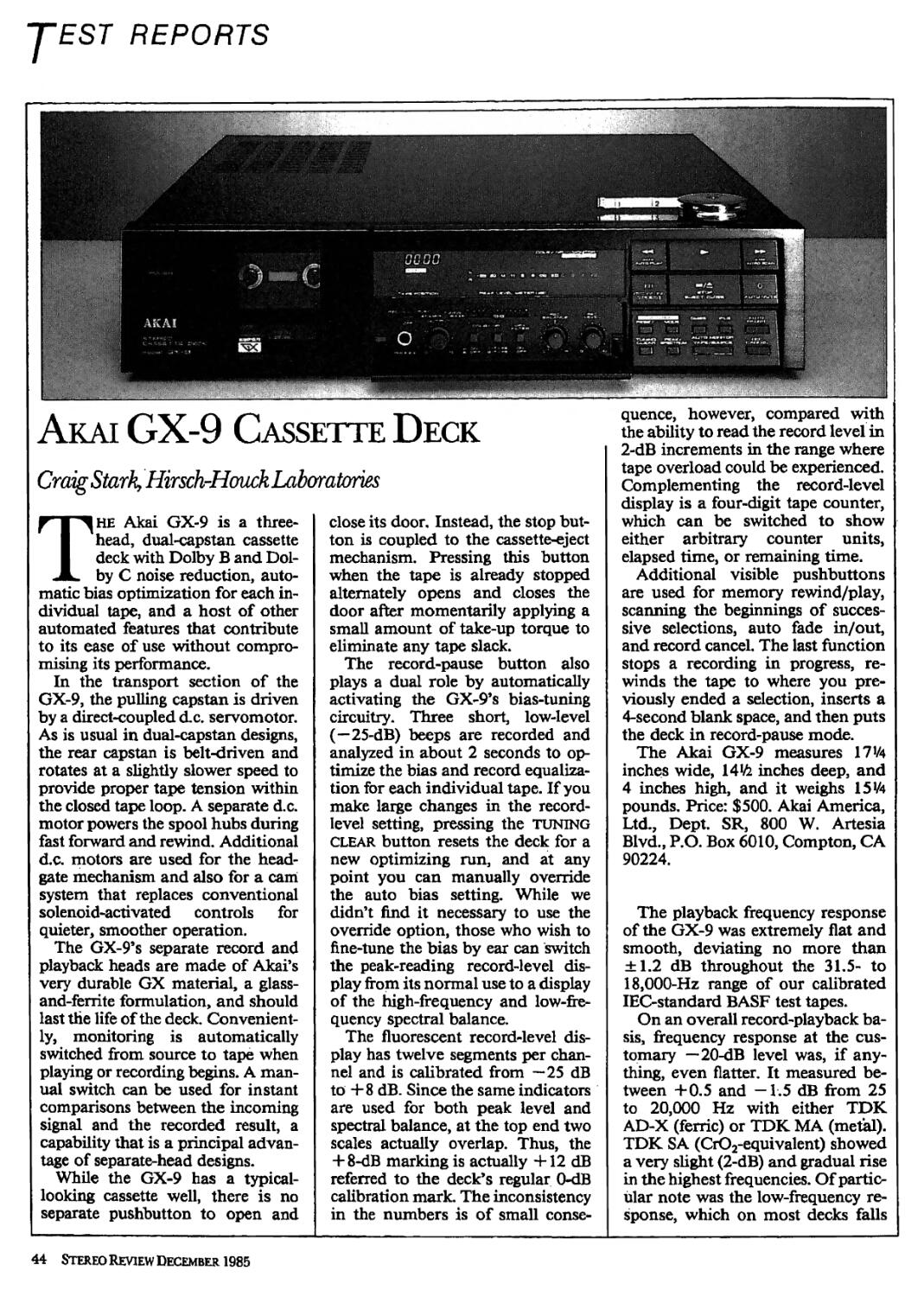
AKAI GX-9 CASSETTE DECK
Craig Stark Hirsch-Houck Laboratories
~~EO RKvlEw DEGEMBKR 1985
7 EST REPORTS
HE Akai GX-9 is a three-
head, dual~pstan cassette
deck with Dolby B and Dol-
by C noise reduction, auto-
matic bias optimization for each in-
dividual tape, and a host of other
automated features that contribute
to its ease of use without compro-
mising its performance.
In the transport section of the
GX-9, the pulling capstan is driven
by a direct-coupled Lc. servomotor.
As is usual in dual-capstan designs,
the rear capstan is belt<ri en
rotates at a slightly slower speed to
provide proper tape tension within
the closed tape loop. A separate d.c.
motor powers the spool hubs during
fast forward and rewind. Additional
d.c. motors are used for the head-
gate mechanism and also for a cam
system that replaces conventional
solenoidwctivated controls for
quieter, smoother operation.
The GX-9's separate record and
playback heads are made of Akai's
very durable GX material, a glass-
and-ferrite formulation, and should
last the life of the deck. Convenient-
ly, monitoring is automatically
switched from source to tape when
playing or recording begins. A man-
ual switch can be used for instant
comparisons between the incoming
signal and the recorded result, a
capability that is a principal advan-
tage of separate-head designs.
While the GX-9 has a typical-
looking cassette well, there is no
separate pushbutton to open and
close its door. Instead, the stop but-
ton is coupled to the cassett~ject
mechanism. Pressing this button
when the tape is already stopped
alternately opens and closes the
door after momentarily applying a
small amount of take-up torque to
eliminate any tape slack
The record-pause button also
plays a dual role by automatically
activating the GX-9's bias-tuning
circuitry. Three short, low-level
( — 25-dB) beeps are recorded and
analyzed in about 2 seconds to op-
timize the bias and record equaliza-
tion for each individual tape. If you
make large changes in the record-
level setting, pressing the TUNING
CLEAR button resets the deck for a
new optimizing run, and at any
point you can manually overxide
the auto bias setting. While we
d.idn't find it necessary to use the
override option, those who wish to
fine-tune the bias by ear can switch
the peak-reading record-level dis-
play from its normal use to a display
of the high-frequency and low-6e-
quency spectral balance.
The fluorescent record-level dis-
play has twelve segments per chan-
nel and is calibrated from — 25 dB
to +8 dB Since the same indicators
are used for both peak level and
spectral balance, at the top end two
scales actually overlap. Thus, the
+8-dB marking is actually + 12 dB
referred to the deck's regular (MB
calibration mark. The inconsistency
in the numbers is of small conse-
quence, however, compared with
the ability to read the record level in
2-dB increments in the range where
tape overload could be experienced.
Complementing the record-level
display is a four-digit tape counter,
which can be switched to show
eider arbitrary counter units,
elapsed time, or remaining time.
Additional visible pushbuttons
are used for memory rewind/play,
scanning the beginnings of succes-
sive selections, auto fade in/out,
and record cancel. The last function
stops a recording in progress, re-
winds the tape to where you pre-
viously ended a selection, inserts a
4-second blank space, and then puts
the deck in record-pause mode.
The Akai GX-9 measures 17>
inches wide, 148 inches deep, and
4 inches high, and it weighs 1504
pounds. Price: $500. Akai America,
Ltd., Dept. SR, 800 W. Artesia
Blvd., P.O. Box 6010, Compton, CA
90224.
The playback frequency response
of the GX-9 was extremely flat and
smooth, deviating no more than
~1.2 dB throughout the 31.5- to
18,000-Hz range of our calibrated
IEC-standard BASF test tapes.
On an overall record-playback ba-
sis, &equ ncy resp ns at the
tomary — 20-dB level was, if any-
thing, even flatter. It measured be-
tween +0.5 and — 1.5 dB from 25
to 20,000 Hz with either TDK
AD-X (ferric) or TDK MA (metal).
TDK SA (Cr02-equivalent) showed
a very slight (2-dB) and gradual rise
in the highest frequencies. Of partic-
ular note was the low-frequency re-
sponse, which on most decks falls
E ' " .'.INH-
JVR o
X)olby B
Dolby C
TEST REPORT$
off rapidly below 50 Hz. The Akai
GX-9 measured only — 3 dB at 20
Hz, partly because of its direct-cou-
pled amplifier design and partly be-
cause it employs the proper record
equalization. While LP's and broad-
casts almost never capture the low-
est musical octave(s), making their
loss unnoticeable in dubbing from
these sources, Compact Discs do
include the low bass.
At a 0-dB recording level, the
overall response with the metal tape
was good, though not exceptional,
in the highest octave (10,000 to
20,000 Hz) and very good when
Dolby C was used — as it surely
would be for dubbing Compact
Discs. Also noteworthy was the very
good performance of TDK AD-X, a
premium-grade ferric oxide that we
selected over Akai's suggested Max-
ell UD, an older formulation whose
curve closely resembled that of
TDK SA (Cro>
Signal-to-noise ratios for the
GX-9 were good, as were its wow-
and-flutter measurements. The lat-
ter slightly exceeded the rating of
0.025 percent wrms, a specification
that seemed unreasonably optimis-
tic for a deck in this price class, but
there was no audible wow-and-flut-
ter in any case.
Dolby tracking at both — 20 dB
and — 30 dB was in some respects
even better than our good measure-
ments suggest, since the error we
found was in the form of a low-fre-
quency (below 400 Hz) "shelf" that
a slight amplifier bass adjustment
could easily eliminate to restore flat
response. Speed accuracy was very
good, and line sensitivity and out-
put were entirely normal.
Comments
The Akai GX-9 is a pleasant
exception to the rule that full-fea-
tured cassette decks are hard to use,
worse to look at, and impossible to
afford. It is tastefully uncluttered in
appearance, and we found it a plea-
sure to use. The automatic bias-
adjustment feature proved highly
accurate and required no operator
intervention at all. While the deck
does not automatically erase its
very brief, low-level setup tones, we
found we could do so very easily
with the record-cancel feature,
though this use is unexplained in
the manual.
I:I Separate glass/crystal record
and piayback heads
0 DuaI-capstan, direct-drive,
four-motor transport
Cl Automatic or manual bias
optimization for each tape
Q Four-digit Ruorescent coUnter
displays hub rotations or elapsed
or remaining time
Q Peak-reading record-level displa
can be switched ta show spectra
balance
Fast forward time (~0); 82
seconds
Rewind time (C-60): 82 seconds
Speed error: -0.2%
Doiby trackinp' error: Dolby B,
+0, -2.0 d8; Dolby C, +0,
— 5.0 dB
Wow-and4iutter: 0.048go wrms;
0.064% DIN peak-weighted
X.ime input for indicated 0 dS!
63.5 mv
Line output at indicated 0 dB:
0.87 volt
Meter indication at IEC-standard
OdS: +2 dB
O Tape; TDK AD-X (Type I,
ferric)
IEC 0MB distortion: 0.84%
Meter indication at 8% third-
hanaonic distortion: +8 dB
Signai-to-noise ratios in decibels):
Ugu id. A-zS, CCIR
NR og 58.8 58.2 55.4
Dolby B 60.6 67.2 65.5
Dolby C 62.6 78.7 74.5
Both playback and recording
quality were good, with clear highs
and unmuddied lows even in dubs
of CD's onto the ferric TDK AD-X.
In sum, the Akai GX-9 manages to
combine the high performance that
will appeal to the serious recordist
Cl Doiby B and Dolby C noise
r educ;tion
CI Memory-rewind and intro-scan
program selection
C3 Cam-activated made-change
mech aaisrn
C3 PlaybaCk level CprItrOl
C3 Selectable two-speed auto fader
0 Switch-selected FM multiplex
filter
D Optional timer and
remote-control operation
Cl Tapei TDK SA XI,
chrome~quivale
IEC < MB distorti n: 0.9
Meter indication at 8% third-
harmonic distortion: +4 ds
Signal-to-noise ratios in decibels).
Unwld A wt . .C-CIR
NR o 54. 1 59.8 57.7
Dolby B 60.6 68.1 67.6
Dolby C 61.5 74.1 75.4
Cl Tape: TDK MA (Type IU,
metal}
IEC 0-dB distortion: 0.95%
Meter indication at 8% third-
harmonic distortion: +4 dS
Signal-to-noise ratios in decibeis):
Unzutd. ¹zot . CCIR
58.5 59.5 57.5
60.6 68.2 67.6
62.2 74.0 75.5
with the kind of automation and
convenience that will be appre-
ciated by all but the obsessive knob-
twister. And in a cassette deck that
lists at $500, that's an impressive
accomplishment.
Circle 141 on reader service card
SZZREo REvKw DEcKMBER 19S5 47