/


Tags: electrical engineering electronics tape recorder
Year: 1989
Text
                    1984, following a period of reorga-
| nization and retrenchment that was,
Ж well, not Pioneer’s finest hour, we
tested its CT-A9 tape deck and found it
to be an exceptional unit—“a Corvette
among dune buggies,” as we put it. The
new CT-91 sits quite squarely in that tra-
dition of excellence.
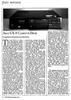
As an Elite Series model, the CT-91 is
fitted with luxuriantly glossy, laminated
end panels, and the high-luster black
faceplate is picked out with gold detail.
It also impresses with its sheer mass. For
the cassette well and, when the motor-
ized well door is closed (by pushing a
front-panel button, any transport-con-
trol button, or simply the door itself),
the cassette housing is pressed against
the pad by fixtures in the door. The dual-
capstan drive is carefully “detuned”:
Resonances of important parts in each
capstan’s mechanism are different so
that they will not act cumulatively to ac-
centuate flutter. Both Pioneer’s techni-
cal data and Diversified Science Labo-
ratories’ findings confirm that the trans-
Pioneer CT-91
Cassette Deck
TONY PETTI NATO
the most part, this is attributable to the
construction standards applied to all
current Elite Series products: rigid, hon-
eycomb, copper-coated metal chassis el-
ements, including compartmentaliza-
tion of circuit elements to minimize
mutual interference.
This monumentality of design also
applies to the casting that holds the
heads and to the dual-capstan closed-
loop drive assembly. The CT-91 incor-
porates a “cassette stabilizer” system
that evidently is intended to damp vibra-
tion in the cassette, just as vibration is
prevented or suppressed in the honey-
comb chassis and its shock-damping
feet. There is a rubbery pad in the back of
port design offers significant perfor-
mance advantages over conventional
drives, although the sonic implications
of these and other innovations in the CT-
91 aren’t always easy to assess.
In basic description, the CT-91 is
a three-head (erase/record/play) model
equipped with Dolby В and С, HX Pro
headroom extension, and a switchable
multiplex filter. The recording and play
heads are mounted in the same housing*
There is no dedicated remote, but back-
panel connections permit use of the CT-
91 with appropriate components in a
Pioneer SR remote-control system. The
usual timer switch is present. And—a
touch as welcome as it is rare—the front-
Di-mensicns; 18 by 5*4 inches (front), 14
inches deep plus clearance for controls and
connections,
Price: $950.
Warranty:"Limited/' one year parts and
labor.
Manufacturer; Pioneer Electronics Corp,,
Japan.
U.S. Distributor Pioneer Electronics (USA),
Inc., P.O. Box 1720, Long Beach, Calif.
90810.
FEBRUARY
I ¥ В 9
37
panel headphone jack comes equipped
with its own level control.
There are three modes on the tape
counter: arbitrary numbers (like those of
a mechanical “turns counter”), elapsed
time (not operative during the fast wind
modes), and time remaining. For the last
function, you can step through four tape-
length settings: C-90, C-80L, C-60, and
C-46L (the letter “L” stands for large-
hub). There is a music-seek function for
skipping to interselection blanks (acti-
vated by pressing fast forward or re-
wind while in play) and a mute-pause
for creating appropriate four-second
blanks (or longer ones, if you hold down
the control button) during recording.
The music-search function cannot be
turned off; if you go directly from play
to a fast-wind mode in cueing up a tape
with frequent soft passages, the system
will misinterpret those passages as
pauses and lurch into playback. To keep
the tape fast-winding, it is necessary to
press STOP before pressing a fast-wind
button.
Switching to off-the-tape monitoring
during recording is automatic, but the
monitor mode can be changed with a
tiny pushbutton to the right of the trans-
port controls. It seems almost an after-
thought, as does the similar meter-mode
button above it. They are almost flush
with the front panel, which quickly be-
comes finger-marked when you use these
two buttons, undercutting the model’s
elegant appearance. Some owners may
never use either button, but I expect that
the sort of serious user to whom the CT-
91’s technical excellence should appeal
will use both switches frequently.
The meters’ peak-hold cursors re-
main a little longer than usual, which
perhaps makes them a little easier to
read, though the behavior is otherwise
substantially like that of typical meters.
The meter-mode switch converts the lev-
el-meter scale from a broad, slightly
coarse “wide range” (spanning a cali-
brated — 35 to +12 dB, with minimum
steps of 2 dB from -6 to +12 dB) to a
finer, “expanded range” scale (showing
—4 to +16 dB). The latter is calibrated
in 1 -dB steps from —4 to +4 dB and in 2-
dB steps from there to +16 dB. The
wide-range scale thus gives you an over-
view of the signal’s dynamics, while the
expanded range acts like a magnifier that
zeroes in on the critical levels around the
tape-overload point.
For general use, I much prefer the
wide-range mode because signals with
any dynamic range, including much of
the classical music I tried, simply drop
off the bottom of the expanded scale
much of the time—which is a bit discon-
certing. But the expanded scale is valu-
able in that it permits a more precise fine-
tuning of levels for best possible
recorded dynamic range, and this capa-
bility, if taken advantage of, can contrib-
ute to the quality of the tapes made on
the deck.
Another contributor is the bias-tun-
ing knob. There are no calibrations or
built-in oscillator assists for it, however. ►
Reports
Record/Play Response, Type 2 Tape (-20 dB)
DB
+5
0
-5
-10
-15


									f
CT-91 (2)	wn Gnannei	то», zt* cm, zu Hz to ZU kHz right channel: no NR	+3%, -24 dB, 20 Hz to 20 kHz " 	 Пл1к1( Q	On ij_	1.1
		- - Dolby C		+Z -5 | |	-74 UU, Z.V Fit LU 4.V КП4 1% dB, 20 Hz to 20 kHz " 1 „J	1
HZ 20	50	100 200	500 1K 2K 5K 10K 20K
Record/Play Response, Type 4 Tape (-20 dB)
DB
0
-5
-10
-15
left channel (no NR)
right channel:
------no NR
------Dolby В
------Dolby C
CT-91 (3)
+U. -2И dB, 20 Hz to 20 kHz
+0, -3 dB, 23 Hz to 20 kHz
+0, -3 dB, 23 Hz to 20 kHz
+4, -3 dB. 23 Hz to 20 kHz


HZ 20	50	100 200	500 1K 2 К 5K 10K 20K
Bias Adjustment Range (-20 dB; Type 11
DB
0
-5
CT-91 (5)
maximum setting
minimum setting
HZ 20	50	100 200	500 1K 2K SK ЮК 20K
FEBRUARY
19 8 9
29
Tfest х
Reports
Multiplex Filter (defeatable)____________________
- V2 dB at 15 kHz; -31 1/2 dB al 19 kHz
S/N Ratio (re DIN 0 dB; R/P; A-welghted)________
________TVpe 2 tape	Type 4 tape	Type 1 tape
no NR SEW	56 3/«dB	533/4 dB
Dolby В 66 dB________65 !/4 dB	63 i/4dB
Dolby C 71 1/2 dB	71 dB	69 dB
Indicator Reading for DIN 0 dB (315 Hz; see text)
Type 2 tape__________+4dB(with 1.17% THD)
Type 4 tape	+ 2 dB (with 0.76% THD)
Type 1 tape	+4 dB (with 0.51% THD)
Indicator Reading for 3% Distortion (315 Hz)* *_
Type 2 tape__________+ 6dB (for +3.4 dBDIN)
Type 4 tape__________+ 8 dB (for +6.2 dB DIN)
Type 1 tape	+8 dE (for +4.2 dB DIN)
Distortion (THD at -10 dB DIN; 50 Hz to 5 kHz)
Type 2 tape_______________________<0,82%
Type 4 tape________________________gO.32%_______
Type 1 tape	<6.38%
Erasure (at 100 Hz)>64 3/4 dB
Channel Separation (at 315 Hz)	47 V? dB
Indicator "Ballistics*1_________________________
response time_____________________1,6msec_______
decay time, main cursor	^320 msec
decay time, peak hold_____________ =? 1.3 sec
overshoot	OdB
Speed Accuracy (105 to 127 VAC)	0.2% fast
Flutter (ANSI weighted peak; R/P)	±0.042%
Sensitivity (re DIN 0 dB; 315 Hz)	100 mV
Input Overload (at 1 kHz)> 10 volts
Input Impedance 49k ohms
Output Impedance 1,350 ohms
Output Level (line; from DIN 0 dB) 0.50 voli___
* See text.
You are instructed simply to record on
your selected tapes and monitor source
and tape alternately, adjusting the bias-
level knob for most precise replication of
the highs. The switching between source
and tape is very fast and, although what
sounds like a relay click tends to distract
your attention, the sonic comparison is
not hampered by a break in output, as it
is in some other models.
The lab always leaves bias controls at
their detents for its record/play tests
(unless an objective routine—such as
one assisted by a built-in oscillator—is
provided for the model under test) and
uses the factory-recommended tape for-
mulations. In this case, samples of the
recommendations came packed with the
test unit: Sony UX-Pro as the Type 2
(“chrome-bias”) formulation, TDK
MA-X for the Type 4 metal, and Maxell
UD-IS as the Type 1 ferric. Pioneer’s
ecumenicism is to be applauded here,
particularly in choosing a Type 2 tape
manufactured by a rival deck maker.
Our blank-tape tests have shown that
Sony is no slouch in this department, but
other hardware companies seldom men-
tion the brand, presumably for competi-
tive reasons.
But it seems that UX-Pro isn’t the
best choice for the CT-91, unless you’re
willing to reset bias by ear. By doing so, I
was able to get excellent reproduction,
without the audible high-end rise visible
in the Type 2 response graph. Brands
more representative of typical Type 2 be-
havior (TDK SA, for instance) produced
excellent recordings with the bias con-
trol at the detent.
The results with the other two tapes
involve no caveats at all: They are top-
notch. The lab’s 0-dB traces with the
Type 4 tape are just as flat as the — 20-dB
trace shown, right out to 10 kHz. There,
the trace without noise reduction starts
to drop off, but that with Dolby C is vir-
tually undisturbed even out to 20 kHz—
that is, it is flatter than the response at
-20 dB! Presumably HX Pro is to be
congratulated for this phenomenon. The
Type 1 traces are excellent in this re-
spect, too; those with the Type 2 tape are
afflicted by the deck/tape mismatch, but
also appear to confirm the helpful contri-
bution of HX Pro.
The remaining data all are typical
where being average is desirable (as in
impedances) and excellent where “typi-
cal” usually translates to “mediocre.”
Even when overloading, the CT-9 l’s dis-
tortion consists essentially of the third
harmonic alone, confirming that it is the
tape and not the deck that is running out
of steam—which isn’t always the case.
Any way you look at it, the CT-91 is a
very fine deck and one that concentrates
on the interests of the very careful re-
cordist. Pioneer evidently has spared no
technology in obtaining performance
worthy of a taping perfectionist.
Robert Long