/







































Tags: warfare field manual
Year: 1943

Text
                    Copy 3 Ч-ЗО-ЧЗ
FM 2-30
WAR DEPARTMENT
CAVALRY FIELD MANUAL
CAVALRY MECHANIZED
RECONNAISSANCE SQUADRON
March 29, 1943
FM 2-30
CAVALRY FIELD MANUAL
CAVALRY MECHANIZED
RECONNAISSANCE SQUADRON
UNITED STATES
GOVERNMENT PRINTING OFFICE
WASHINGTON • 1943
WAR DEPARTMENT,
Washington, March 29, 1943.
FM 2-30, Cavalry Field Manual, Cavalry Mechanized
Reconnaissance Squadron, is published for the information
and guidance of all concerned.
[A. G. 062.11 (1-28-43).]
By ORDER OF THE SECRETARY OF WAR I
G. C. MARSHALL,
Chief of Staff.
Official :
J. A. ULIO,
Major General,
The Adjutant General.
Distribution :
D 2, 7 (5) ; В 2 (5) ; R 2, 7 (4) ; Bn 2, 7 (4); IBn 2 (10);
IC 2 (15).
(For explanation of symbols see FM-6.)
и
TABLE OF CONTENTS
Chapter 1.	General.	Paragraphs
Section I. Purpose and	scope_______________ 1-2
II.	Organization_____________________ 3—4
IH. Equipment_________________________ 5-8
Chapter 2.	Training.
Section I. General_____________________________ 9-10
II.	Squadron headquarters and head-
quarters troop-____________________ 11-17
III.	Combat elements_________________18-19
IV.	Drill___________________________ 20-21
Page
1
1
2
4
6
13
14
V. Inspections________________________ 22	15
Chapter 3.	Employment.
Section I. General_________________________ 23-27	16
II.	Reconnaissance__________________ 28-38	18
1П. Security_________________________ 39-44	36
IV.	Marches, halts, and bivouacs___ 45-47	49
V.	Combat__________________________ 48-57	51
VI.	Logistics_______________________ 58-60	85
VII.	Special operations_____________ 61-66	88
Appendix I_______________________________________________ 93
Appendix II_____________________________________________ 103
Index_____________________________________________________ 107
Ш
FM 2-30
CAVALRY FIELD MANUAL
CAVALRY MECHANIZED RECONNAISSANCE
SQUADRON
CHAPTER 1
GENERAL
Paragraphs
Section I. Purpose and scope____________________________ 1-2
II. Organization_________________________________ 3-4
III. Equipment___________________________________ 5-8
Section I
PURPOSE AND SCOPE
	1. Purpose.—The purpose of this manual is to present
the doctrine for the combat training and employment of
the mechanized reconnaissances, including squadrons of the
motorized infantry division and of the cavalry division.
	2. Scope.—a. This manual covers the functional organiza-
tion, combat training, and tactical employment of the cav-
alry mechanized reconnaissance squadron.
b. The maximum use of functional charts, diagrams, and
pictures will be made as illustrations to simplify and expe-
dite training. These to be exploited must be studied. They
can be used as the basis for sand table layouts (see TF
7-265 and 7-266).
Section II
ORGANIZATION
	3. Organization.—Tables of Organization 2-25, 2-26,
2-27, and 2-29, prescribe respectively the organization of the
cavalry mechanized reconnaissance squadron, its head-
quarters and headquarters troop, reconnaissance troop, and
support troop. Details as to organization are contained
in FM 2-5.
	4. Tactical Grouping.—Appendix I contains charts show-
ing a suggested organization of the reconnaissance squadron
1
4-7
CAVALRY FIELD MANUAL
and its components into functional groups. Manning of the
various vehicles according to the appropriate Table of Or-
ganization is included. These charts are intended as a
guide and may be modified by squadron commanders to meet
particular conditions.
Section III
EQUIPMENT
 5. Vehicles.—a. Combat vehicles of the reconnaissance
squadron Include the following types: armored cars, half-
track cars, half-track personnel carriers, light tanks, y4-ton
trucks, amphibious ’A-ton trucks, and %-ton trucks, weapons
carriers.
b. The light armored car M8 (see fig. 1®), is a 6x6
vehicle, weighs 15,000 pounds, has a 110-horsepower gasoline
engine and is capable of cruising 300 miles. On a level im-
proved road, it can sustain a speed of 55 miles per hour.
Vehicular armament includes one 37-mm gun and one cali-
ber .30 light machine gun fixed in combination mount in the
turret which allows 360° traverse and one caliber .30 light
machine gun in an antiaircraft mount on the turret. Pro-
vision is made for installing two radio sets.
c. The amphibious ’/4-ton truck (see fig. 1®) is similar in
capacity, roadability, and performance to the standard Vi-ton
truck. Appendix I suggests a suitable distribution of the
amphibious vehicles authorized for issue to the squadron.
 6. Weapons.—a. The following weapons are included in
the squadron: carbine, caliber .30 light machine gun, caliber
.50 machine gun (HB), caliber .45 submachine gun, 37-mm
gun, 60-mm mortar, caliber .45 pistol, rifle, caliber .30, and
rocket launcher M-l.
b. Tables of Organization indicate the numbers and dis-
tribution of weapons. 37-mm guns are mounted in armored
cars and in light tanks now being issued to the support troop.
 7. Radio.—The type and quantity of radio sets issued to
units of the reconnaissance squadron are indicated in Tables
of Equipment. A suggested organization of the radio sets
of the squadron into nets is illustrated in appendix II.
2
CAVALRY MECHANIZED RECONNAISSANCE SQUADRON
8
 8. Destruction of Materiel.—In order to prevent an
enemy from using captured vehicles, weapons, and com-
munication equipment, it is necessary that personnel be
trained in the disabling or destruction of all equipment in
the squadron. The various ways of accomplishing this
destruction are detailed in FM 2-20. It is emphasized that
destruction of equipment is a command decision of division
and similar units. This authority may be delegated to sub-
ordinate commanders by the division commander.
3
CHAPTER 2
TRAINING
Paragraphs
Section I. General_________________________________________ 9-10
II.	Squadron headquarters and headquarters troop__ 11-17
III.	Combat elements________________________________18-19
IV.	Drill___________________________________________20-21
V.	Inspections______________________________________ 22
Section I
GENERAL
 9. Objectives.—a. The initial training objective is to
achieve the standards of individual and subordinate unit
proficiency in basic, technical, and tactical phases as
prescribed in FM 2-50 (when printed).
b.	The ultimate objective of the training program is to
achieve a smoothly functioning organization, having excep-
tionally high morale, capable of executing its primary mis-
sion of reconnaissance and of performing aggressive offen-
sive and defensive combat within the limitations of its
equipment and weapons.
c.	In order to insure continuity in action by this unit,
which normally operates under conditions which limit the
possibility of rapid replacement of casualties, it is necessary
that each man be qualified to drive the vehicle in which he
rides (see TM 21-300), man the weapons in the vehicle, and
operate the means of communication provided therein (see
TM 11-454 and FS 11-1). Personnel must be fully trained in
dismounted combat, reduction of road blocks, and individual
and unit protective measures (see FM 21-45).
d.	In mobile warfare it is essential that personnel in all
grades fully appreciate the necessity for and importance of
combat intelligence. In the mind of the private, the G-2
and his section must not be a mystery. The individual must
be given a clear, workable understanding of military intelli-
gence, his relationship to G-2, and how he may contribute to
4
CAVALRY MECHANIZED RECONNAISSANCE SQUADRON 9-10
intelligence operations. In addition to training in field ob-
servation as outlined in FM 21-45, and in reporting certain
specified information as a matter of standing operating
procedure (see par. 33), or on order, the cavalry soldier
should be trained to observe and report any information
which may be of value in the operation being conducted. In
order to prevent the G-2 section from being glutted with a
mass of minutia, each commander should receive such in-
telligence training, compatible with his responsibility, as will
enable him to appreciate the relative importance of infor-
mation received, to recognize and consolidate duplications,
and to report promptly to the appropriate agency the infor-
mation received.
 10. Methods.—a. Training will be conducted according to
the principles set forth in FM 21-5 (note particularly secs.
IV and V). Maximum use will be made of the publications
listed and suggestions contained in FM 21-6 and 21-7. (See
TF 7-295 and FS 7-75.)
b. Effective training can only be achieved when the interest
of all participants is sustained. Interest-holding tactical
problems must be worked out well in advance with painstak-
ing care as to details of execution. The execution of an
applicatory tactical exercise should involve the following
steps:
(1)	The problem is planned to bring out a specific principle
or phase of operation and to emphasize the battle application
to a given situation. This planning will include selection of
suitable terrain first by map study and then examination of
the ground itself to insure suitability and complete
familiarity with it.
(2)	The problem is then staked out on the map and solved
in conference. All rough spots are ironed out and unsound
tactical procedures eliminated.
(3)	The problem is then worked on a sand table with all
officers and selected key noncommissioned officers present.
The problem may be worked several times and each par-
ticipant called upon for a solution to a particular phase.
(See TF 7-265 and 7-266.)
(4)	The problem is then worked on the ground and is
5
10-12
CAVALRY FIELD MANUAL
followed immediately by a critique in which constructive
criticism points out errors in tactics, technique, and procedure
and indicates correct combat methods. The problem, or de-
sired portions of it, may be repeated several times, rotating
organizations in order to allow each unit to participate in
each phase.
Section II
SQUADRON HEADQUARTERS AND HEADQUARTERS
TROOP
	11. Responsibility.—Fundamental training, classified as
basic, technical, and tactical, of individuals of the head-
quarters troop is the responsibility of the troop commander
and is conducted under his supervision. Specialist training
of a technical and tactical nature is conducted under the
supervision of the staff officer to whose section the individual
is assigned or the officer who commands the platoon or
section.
	12. Squadron Headquarters.—Squadron headquarters con-
tains the commissioned and warrant officer personnel neces-
sary to perform squadron command and staff duties in com-
bat. The duties of these individuals are as follows:
a.	Squadron commander.—The squadron commander is re-
sponsible to the division commander for the training, ad-
ministration, and operations of the reconnaissance squadron.
He closely supervises all phases of training, inspecting and
observing constantly. During operations, he visits his units
and gains first-hand knowledge of the tactical situation. He
develops initiative and self-confidence in his subordinates by
delegating appropriate command responsibility to them and
not interfering until circumstances make it absolutely neces-
sary. The squadron commander is provided with a staff to
assist him and relieve him of details in order that he may
devote the maximum time to major decisions and personal
contact with his combat elements. This staff includes the
personnel described in b to /, inclusive, below.
b.	Executive officer.—The squadron executive is second in
command and principal assistant to the squadron com-
mander. He coordinates and supervises all staff activities,
6
CAVALRY MECHANIZED RECONNAISSANCE SQUADRON
12
keeps informed of the situation, verifies the execution of
orders and, when necessary in the absence of the squadron
commander, makes decisions and issues orders to effect them.
Normally he remains at the command post when the com-
mander is away.
c.	Adjutant.—The squadron adjutant (see also par. 15b)
is squadron S-l. His staff duties Include supervision of—
(1)	Receiving and delivering replacements to troops in
coordination with S-2-3.
(2)	Preparation of strength and casualty reports.
(3)	Recreation and morale activities.
(4)	Leaves of absence, furloughs, discipline, rewards, and
punishments.
(5)	The collection and disposition of prisoners of war in
coordination with S-2-3 and S-4.
(6)	Graves registration service, including burials, in co-
ordination with S-4.
(7)	Sanitation, coordinated with S-4 and assisted by the
squadron surgeon.
d.	S-2-3.—The squadron S-2-3 is concerned primarily
with the collection, recording, evaluation, and dissemination
of information of the enemy and with the training and tac-
tical operations of the squadron. In detail, his duties
include—
(1)	Preparation of detailed plans based upon the squadron
commander’s decision.
(2)	Preparation and issuance of intelligence instructions,
reconnaissance instructions, and tactical orders.
(3)	Maintenance of the situation map and preparation of
operations maps.
(4)Planning of security measures to include camouflage
and concealment.
(5)	Maintenance of liaison and exchange of  intelligence
with higher, adjacent, and subordinate units.
(6)	Procurement and distribution of maps, aerial photo-
graphs, and photomaps.
(7)	Preparation of data for tactical and training reports.
(8)	Examination of captured personnel, documents, and
mat6riel for information of immediate importance to the
squadron.
7
12-13
CAVALRY FIELD MANUAL
(9)	Planning and supervising all training in accordance
with the unit training program.
e.	Supply officer.—The squadron supply officer performs
S-4 duties to include—
(1)	Preparation of supply plans based upon tactical plans,
coordinated with S-2-3.
(2)	Supervision of the procurement, storage, and issue
of all classes of supply.
(3)	Control of squadron trains when troop supply vehicles
are operating under squadron control.
(4)	Supervision of the evacuation of casualties, disabled
equipment, prisoners, and captured materiel.
(5)	Supervision of maintenance of equipment, assisted by
the squadron motor maintenance officer and coordinated
with S-2-3 for priorities.
(6)	Security for the rear echelon, coordinated with S-2-3.
/. Communication officer.—The communication officer, in
addition to commanding the command and communication
platoon (see par. 14b), is adviser to the squadron commander
and staff on matters relating to signal communication,
including location of command posts.
 13. Troop Headquarters.—Troop headquarters contain
the necessary personnel for the control and administration
of the troop; the messing of the squadron headquarters and
the troop; and for squadron second echelon motor
maintenance.
a.	Headquarters section.—The troop commander super-
vises the specialist training of all enlisted personnel In the
headquarters section. As headquarters commandant, assisted
by the mess officer and mess sergeant, he supervises the oper-
ation of the mess and the training of cooks, cook’s helpers
and orderlies. Assisted by the first sergeant, he supervises
the training of the troop clerk, messenger, and bugler.
Sergeant, supply, under direction of the troop commander, is
responsible for the receipt, care, and issue of supplies within
the troop. The armorer maintains and repairs the troop
weapons and Is the assistant to the supply sergeant.
b.	Motor maintenance platoon.—The lieutenant in troop
headquarters commands the motor maintenance platoon and
8
CAVALRY MECHANIZED RECONNAISSANCE SQUADRON 13-14
is the squadron motor officer. Master sergeant, motor, is the
squadron motor sergeant and assistant to the squadron motor
officer. The staff sergeant, motor inspector, makes periodic
inspection of all vehicles in the squadron. He prepares and
maintains all records and reports pertaining to supplies,
repairs, and operations of the vehicles of the squadron. The
staff sergeant, motor, is the assistant squadron motor ser-
geant. The sergeant, crew chief, has direct charge of the
mechanics of the platoon. The corporal, supply, motor, is
charged with the procurement, care, and issue of replacement
parts, and assists the staff sergeant, motor inspector, in the
preparation of those records and reports pertinent to motor
supply. The mechanics, in addition to reaching the necessary
high proficiency in maintenance and repair work, must be
specially trained in the use of weapons and field expedients
and should receive such instruction in map reading as will
qualify them to make separate marches incident to salvage
operations. It should be standing operating procedure within
the squadron for the mechanics of the motor maintenance
platoon to be trained as three crews capable of being sent out
to perform squadron second echelon maintenance on vehicles
disabled in the field; these three crews to be commanded
respectively by the master sergeant, motor; the staff sergeant,
motor; and the sergeant, crew chief. (See TF 10-166, 10-167,
10-291, 10-299, 10-300, 10-301, 10-319, 10-376, 10-377.
10-570, 10-592, 10-593, 10-595, 10-596, 10-639; FS 10-33 to
10-36, 10-39, 10-40, 10-42, 10-43, 10-44, 10-53 to 10-56, 10-58,
10-61, 10-62 to 10-66, 17-6, 17-7, 17-9 to 17-12 and 17-14.)
 14. Command and Communication Platoon.—The command
and communication platoon furnishes the personnel and
equipment for the forward echelon of squadron headquarters.
It comprises individuals with functions as follows (see also
FM 2-50):
a.	Intelligence and operations section.—Major S-2-3 per-
forms the duties of S-2 and S-3 as prescribed in FM 101-5
and paragraph 12d. He is assisted in his duties by the
technical sergeant, intelligence and operations. The sergeant
keeps the situation and operations maps and records data
for journal and diary. Specialist training prerequisites for
9
14
CAVALRY FIELD MANUAL
this position include advanced map and aerial photograph
reading, sketching, and drafting. (See FM 21-26 and
30-20.) Major S-2-3 trains his assistant in the collection,
evaluation, interpretation, and distribution of information
of the enemy (see FM 30-5); in the establishment of observa-
tion posts (see FM 30-10); in examination of prisoners of
war, enemy deserters and enemy documents (see FM 30-15);
and in the preparation of orders (see FM 101-5).
b.	Communication.—(1) The communication officer is re-
sponsible to the squadron commander for the training, opera-
tion, and maintenance of all communication agencies within
the squadron. He prepares instructions relative to radio
discipline. He prepares signal operating instructions coordi-
nated with those of the division and, when the squadron is
tactically employed, maintains communication with attached,
adjacent, and higher units. His duties are prescribed in
FM 24^5, FM 101-5 and paragraph 12/.
(2)	The warrant officer, as chief assistant to the communi-
cation officer, must be a qualified radio operator and techni-
cian and be completely familiar with message center procedure
and with the operation, inspection, and maintenance of all
squadron communication equipment. He assists the com-
munication officer in training personnel according to the
principles detailed in FM 24-5.
(3)	The technical sergeant, communication, is In direct
charge of radio communication and supervises the operation
of the net control station in the squadron commander’s car.
He must be expert as a radio operator and in radio pro-
cedure. (See FM 24-6, 24-10; TM 11-454, 11-455, and
11-461.)
(4)	The sergeant, message center, as enlisted chief of the
message center, must keep himself posted as to the location
of higher and lower headquarters and the means of com-
munication available at any given time. He must know
thoroughly and be able to teach message center procedure.
(See FM 24-5.)
(5)	The radio electrician repairs the radio equipment of
both the headquarters troop and the support troop.
(6)	All radio operators, in addition to their specialist
10
CAVALRY MECHANIZED RECONNAISSANCE SQUADRON 14-16
training, should be qualified as drivers and gunners for the
vehicles in which they ride.
c.	All personnel, commissioned and enlisted, of the com-
mand and communication platoon, must be capable of operat-
ing the unit radio sets at least on voice.
 15. Supply and Administrative Platoon.—This platoon
contains the enlisted personnel and equipment for the rear
echelon of squadron headquarters. The captain in this
section, in addition to his duties as squadron supply officer,
performs S-4 functions as indicated in paragraph 12d.
a.	Supply section.—S-4 is assisted by the technical ser-
geant, supply, and one clerk. The supply sergeant must
have a knowledge of the system of supply of the squadron
in the field and of receipt, storage, issue, and care of sup-
plies. He must know how to prepare all papers pertaining
to supply. In addition to training in the paper work inci-
dental to supply, the clerk must be qualified to operate the
machine gun in the truck in which he rides.
b.	Administrative section.—This section is under the com-
mand of the lieutenant, personnel adjutant (see also par. 12b).
However, it functions as two sections. The adjutant, assisted
by the warrant officer, assistant adjutant, and the master
sergeant, sergeant major, handles the correspondence, re-
ports, and filing of administrative records, orders, bulletins,
and other matter received and issued by the squadron, and
trains clerical assistants. Lieutenant, personnel adjutant,
assisted by the technical sergeant, personnel sergeant major,
and the necessary clerks, keeps the personnel records of the
entire squadron. All clerks should be trained as relief drivers
and gunners.
 16. Antitank Platoon and Pioneer and Demolition Pla-
toon.—The lieutenants in command of the antitank platoon
and pioneer and demolition platoon advise the squadron
commander as to the employment of their respective pla-
toons. In addition to his other duties, either of these officers
may be designated as mess officer for headquarters troop.
Details as to the training of these platoons, which comprise
the combat element of headquarters troop, are contained in
MTP 2-1. The standards of technical and tactical proficiency
11
16—17
CAVALRY FIELD MANUAL
for each platoon and its personnel are contained in FM 2-50
(when printed).
a.	The mission of the antitank platoon being essentially
that of mobile, aggressive defense, it is necessary that train-
ing in selection and occupation of firing positions and tech-
nique of fire be most thorough. The platoon must be trained
as a unit to organize the antimechanized defense of the
squadron. In order to develop well coordinated tactical
groups, the antitank sections will receive combined training
with subordinate elements of the squadron. Although it is
necessary that a high degree of teamwork exists between the
vehicles of a section and between sections of the platoon,
it is equally necessary that initiative be developed in the crew
of the individual vehicle. Each member of the vehicle’s crew
must be able to function efficiently in all crew positions. (See
TF 5-146, 5-147, 5-148, and 5-962.)
b.	The pioneer and demolition platoon will receive com-
bined training with the pioneer and demolition squads of
reconnaissance platoons whose operations it complements.
Technical details involved in the operations of the platoon
in the execution of its missions are contained in FM 5-15,
5-20, 5-25, 5-30, and 5-35. (See TF 5-147, 5-149, 5-199 to
5-203, 5-270 to 5-273, 5-571 to 5-575, 5-597, 5-598, 5-697 to
5-699, 5-955, 5-956, and 5-962; FS 5-6 and 5-7.)
 17. Attached Medical.—The squadron medical detach-
ment is commanded by the captain, Medical Corps. As-
sisted by two lieutenants, Medical Corps, he conducts the
technical training of the enlisted personnel of the detach-
ment. Because of the difficulty of evacuating casualties in
this type of unit, personnel should be trained in map reading
and use of cover and concealment. In addition to his com-
mand functions and personal participation in medical care
of casualties, the surgeon is a member of the squadron staff
with duties which include—
a.	Advising the commander and staff on matters pertain-
ing to the health and sanitation of the squadron and the
training of personnel in personal hygiene, sanitation, and
first aid.
b.	Conducting sanitary Inspections.
12
CAVALRY MECHANIZED RECONNAISSANCE SQUADRON 17-19
c.	Procurement, storage, and distribution of medical equip-
ment and supplies.
d.	Preparation of reports.
e.	Evacuation of casualties, coordinated with S-4. (See
TF 8-33, 8-150, and 8-304; FS 8-3 to 8-13, 8-25 to 8-32, 8-35,
8-40, and 8-41.)
Section III
COMBAT ELEMENTS
 18. Reconnaissance Troop.—a. The basic, technical, and
tactical training of the reconnaissance troop of the recon-
naissance squadron is prescribed in MTP 2-1 and is almost
identical with that described in FM 2-20 (when printed).
b. Because of the rapidity with which its parent organiza7
tion marches and maneuvers, limitations of time will fre-
quently necessitate that the squadron abandon stealth and
fight for information. This is called reconnaissance in force.
It is imperative that in the tactical training of the recon-
naissance troop of the reconnaissance squadron offensive
combat, particularly combined offensive action with other
reconnaissance troops and with the support troop, be stressed.
 19. Support Troop.—a. Details of the unit training of the
support troop are contained in MTP 2-1. Combat training of
the tank platoon is covered in FM 2-35 (when printed). (See
also FM 17-30.) (See TF 17-264, 17-314, 17-315, 17-375,
17-576 and FS 17-5.)
b.	The support troop is an offensive weapon, combining
mobility, shock and fire power, which is included in the
squadron as a means of overcoming resistance to the opera-
tions of the reconnaissance troops. By means of combined
training it must become capable of functioning smoothly with
the reconnaissance troops.
c.	The support troop is not intended primarily as a recon-
naissance unit. However, when the terrain is not suited to
the operation of wheeled vehicles or when enemy activity is
too great a hazard to armored cars, it may be expedient to
employ support troop elements on reconnaissance. It is
515140°—43---2	13
19-21
CAVALRY FIELD MANUAL
therefore essential that the support troop be trained in
reconnaissance.
d.	Because of the limited quantity of ammunition carried
in the light tank, it is imperative that training in ammuni-
tion conservation be included. Such training should be
stressed during exercises in which firing is simulated. Both
gunners and assistant gunners should keep track of the
rounds the gunner has simulated firing and cease firing when
the hypothetical number of rounds is exhausted. If promis-
cuous simulated firing without thought of ammunition supply
is permitted, wasteful habits will be developed.
Section IV
DRILL
 20. General.—a. The primary purpose of drill is to train
a number of individuals to move and function as a unit in
order to facilitate control. Psychologically it is a potent
means of developing discipline in the enlisted man and com-
mand responsibility in young or inexperienced officers.
b.	Dismounted drill is as prescribed in FM 22-5. (See TF
7-143, 7-144, 7-248, 7-249, 7-560, and 7-561.)
c.	Normally, mounted drill is performed by the troop or
lower unit. Drill of the squadron is exceptional, being limited
to ceremonies and inspections.
d.	Details of mounted drill are covered in FM 2-5. Drill
commands and signals are indicated in FM 2-5, 2-35 (when
printed), and 22-5.
 21. Tactical Formations.—a. With the exception of the
support troop, the elements of the squadron will not, in their
normal employment, use drill formations in combat. In
desert warfare, extended-interval drill formations may be
used to facilitate control.
b. The support troop may frequently use extended order
drill formations in combat. To facilitate control, the various
combat formations usually are designated in unit standing
operating procedure by a letter symbol such as А, В, C.
14
CAVALRY MECHANIZED RECONNAISSANCE SQUADRON
22
Section V
INSPECTIONS
 22. General.—The conduct of dismounted inspections
without vehicles is covered in FM 22-5. Inspections with full
field equipment are as prescribed in FM 2-5.
15
CHAPTER 3
EMPLOYMENT
Paragraphs
Section I. General________________________________________23—27
II. Reconnaissance________________________________ 28-38
Ш. Security_________________________________________39-44
IV.	Marches, halts, and bivouacs___________________4Б-47
V.	Combat________________________________________ 48-57
VI.	Logistics______________________________________58-60
VII.	Special operations_____________________________61-66
Section I
GENERAL
 23. General Principles.—a. The reconnaissance squadron
is organized and equipped for the specific purpose of securing
the detailed information needed by the commander of a
motorized infantry division or cavalry division to plan his
operations intelligently.
b. The size and composition of the squadron, as compared
with the reconnaissance troop of the infantry division, is
necessitated by the fact that the motorized or cavalry divi-
sion, unlike the infantry division, often will operate on mis-
sions without close support or assistance by other infantry
divisions or at considerable distance from other divisions, will
advance on a broad front and will therefore be unable to
depend on a corps reconnaissance element for information.
Furthermore, the movement of the motorized or cavalry
division is so rapid as to require individual reconnaissance
platoons to operate on a relatively narrower front in order
to accelerate their rate of advance.
c. The operation of the squadron is characterized by speed
in decision and action.
 24. Missions.—a. The principal mission of the reconnais-
sance squadron is to obtain the information required by
higher authority and get it back to the interested commander
in time to be evaluated and acted upon.
16
CAVALRY MECHANIZED RECONNAISSANCE SQUADRON 24-26
b.	While the squadron Is capable of executing counter-
reconnaissance and certain offensive and defensive opera-
tions, the division commander, before assigning such other
missions, should consider the availability of other troops more
suitable to perform them and the relative importance of the
missions compared with reconnaissance.
c.	In issuing orders to the squadron, the division com-
mander must assign definite missions expressing specifically
what information he desires and when he must have It. The
squadron commander must enjoy the confidence of the divi-
sion commander and his general staff, especially the Chief of
Staff, G-2 and G-3, and know their plans sufficiently and in
ample time to insure the effective employment of the squad-
ron. He should be so familiar with the division commander’s
personality, habits, and manner of tactical operation as to
be able, in a given situation, to say, “If he were here he would
want so-and so.”
d.	Within the squadron and its subordinate elements all
personnel should be familiar with and understand their
specific missions and that of the squadron. This is essential
to insure continuity of action because in many situations the
crew of an individual vehicle will be entirely on its own.
 25. Types of Tactical Action.—Either incident to a recon-
naissance mission or otherwise, the reconnaissance squadron
must be fully qualified and must expect to undertake the
following types of tactical action:
Marches.
Security (internal, for other elements, counterrecon-
naissance).
Attack.
Pursuit.
Defense.
Delay.
Demolitions.
Withdrawal.
Certain special operations (antlalrborne, amphibious,
river line, desert, jungle).
 26. Cooperation By Observation Aviation.—a. Coopera-
tion by aviation operating in support of the division increases
17
26-28
CAVALRY FIELD MANUAL
the efficiency of operation of the reconnaissance squadron.
Air observers flying long-range reconnaissance missions can
furnish such timely information to the commander as—
(1)	Location, strbngth, composition, and disposition of the
hostile main force.
(2)	Location and strength of enemy security and recon-
naissance detachments.
(3)	Rates and direction of movement and routes followed
by any hostile forces in the observed area.
(4)	Apparent condition of routes and bridges in the zone to
be reconnoitered by the squadron including location and
nature of road blocks, demolitions, and possible ambush.
(5)	Terrain features which may be utilized to advantage
by either hostile or friendly forces.
b. The air observer communicates directly with the squad-
ron by dropped and pick-up messages, visual signals, or
radio. (See FM 24-5.)
c. Time and the situation permitting, the air unit and the
reconnaissance squadron should be given combined training
to enable them to function efficiently as a team.
 27. Cooperation With Tank Destroyer Battalions.—The
reconnaissance element of the tank destroyer battalion,
operating with either the motorized or cavalry division, bases
its operations upon the information gathered by the recon-
naissance squadron on its normal missions. Closer coopera-
tion is insured when the tank destroyer battalion places a
liaison agent, with transportation and means of communica-
tion, with the squadron headquarters. For greater detail, see
FM 18-5 and 2-20 (when printed).
Section II
RECONNAISSANCE
 28. Methods.—a. The methods of employment described
in FM 2-20 (when printed) for the reconnaissance troop,
infantry division, are applicable equally to the individual
reconnaissance troops of the squadron.
b. The action of the squadron may be described as fluid.
It moves along its assigned channel (route, zone, or area),
18
CAVALRY MECHANIZED RECONNAISSANCE SQUADRON 28-29
rapidly and more forcefully when the channel is narrow;
less rapidly when its front is widened. It seeks to flow around
or infiltrate through such obstacles as hostile counterrecon-
naissance or security groups by means of stealth and to
reach the enemy main body. When the advance of its
detachments is arrested by enemy action, necessary pres-
sure is applied at a weak point by the use of reserve elements
to penetrate the resistance and expose the enemy dispositions
to continued reconnaissance.
c. Contact with the enemy once gained must not be lost.—
However, it is not sufficient merely to gain contact. After
the enemy has been located, reconnaissance activity must
be intensified to secure information as to his disposition,
strength, identity of units, organization, equipment, attitude,
morale, movements, and capabilities. Of particular impor-
tance is information as to the location of command posts,
centers of signal communication, observation posts, reserves,
artillery positions, tank concentrations, advance landing
fields, supply installations, and routes of communication.
(See also par. 33.)
 29. Depth and Frontage.—A statement that a reconnais-
sance squadron is capable of executing reconnaissance in a
zone or area of a stated breadth and at a particular rate or
distance is dangerous if taken too literally. Rarely will two
situations be the same and in each case the influence of
terrain features, condition and pattern of the road net,
present and predicted weather conditions, fatigue of per-
sonnel, condition of vehicles and, most important, enemy
action, will determine the unit’s capabilities. The following
should be considered only as guides:
a.	The distance by which the squadron may precede its
division varies from several hours’ to 1 or more days’ marches.
b.	With a good road net and when unopposed, it can ad-
vance from 125 to 200 miles daily at a rate of between 25 to
30 miles an hour. As an example, when distant air recon-
naissance has located the hostile force at a considerable
distance, the squadron may be sent out at maximum speed
to gain contact.
c.	Active and effective reconnaissance at a rate of more
19
29-30
CAVALRY FIELD MANUAL
than 10 to 15 miles per hour should not be expected. One
of the limiting factors previously mentioned or any com-
bination of them may reduce the rate to as low as 4 miles per
hour.
d.	With one reconnaissance troop initially in reserve, the
squadron, can reconnoiter a zone containing six to ten axial
roads and their intersecting lateral roads on a front of from
25 to 35 miles. Exceptionally, and by employing eight pla-
toons on the front, the assigned zone for reconnaissance
may be extended to 50 miles in breadth.
e.	When the division operates as part of a corps, it is pos-
sible that the squadron, or elements therefrom, will be as-
signed supplementary reconnaissance missions in rear of or
to the flank of the corps reconnaissance regiment. Transfer
of responsibility for reconnaissance from corps to division
agency is accomplished in the manner described in FM 2-20
(when printed). The squadron establishes liaison with the
corps reconnaissance group by radio or, preferably, by an
agent with a radio-equipped vehicle.
 30. Routes, Zones, and Areas.—The division commander
and the squadron commander in turn prescribe specific axes
or routes and boundaries of zones and areas to their respec-
tive reconnaissance agencies. This practice has the twofold
purpose of definitely allocating responsibility on the one
hand and of preventing duplication of effort on the other.
However, such definition of boundaries is not intended to re-
strict the initiative of subordinate commanders. The maxi-
mum freedom of movement that the particular situation war-
rants is allowed. For example, the commander of one de-
tachment observing something which he believes should be
more closely reconnoitered in the zone of a second detach-
ment may take any action from directing the attention of
the second detachment commander to it to making a detailed
reconnaissance himself. The factors that he will consider
in deciding are the urgency of his own mission, time and
space to include relative distance of his own and the adja-
cent detachment from the suspected area, its apparent im-
portance, and the disposition of his own force. The situa-
tions wherein a zone, a route, or an area may be designated
are as follows;
20
CAVALRY MECHANIZED RECONNAISSANCE SQUADRON
30
Figure 2.—Zone boundaries should be easily recognized terrain
features.
a.	When the enemy is disposed on a broad front or when
his location is in doubt, a zone of reconnaissance may be
assigned. Factors to be considered in determining the width
of the zone to be assigned are those indicated in paragraph
27. Zone boundaries should be easily recognized features
such as roads, railroads, rivers, ridge lines, etc. (See fig. 2.)
21
30
CAVALRY FIELD MANUAL
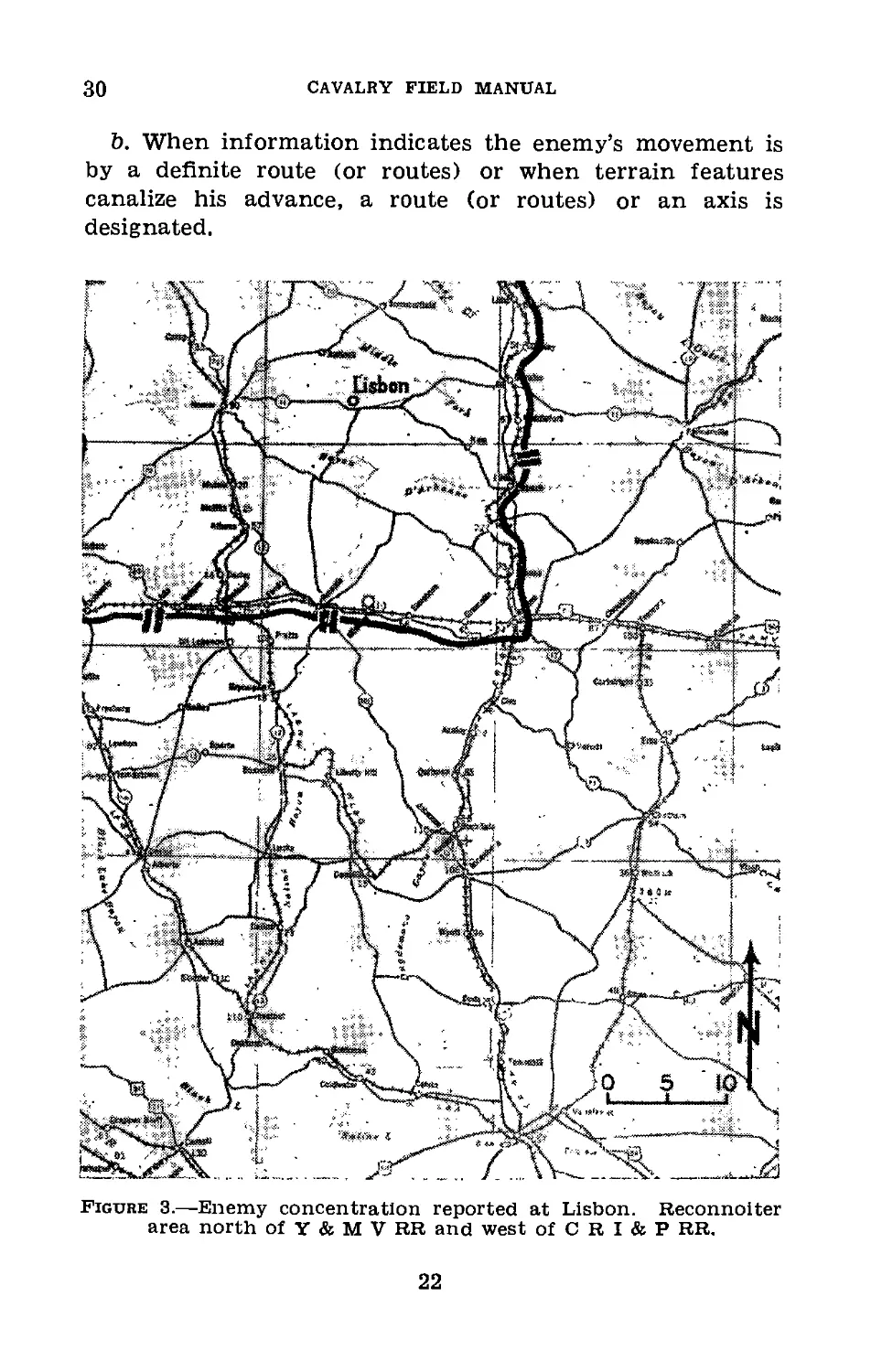
b.	When information indicates the enemy’s movement is
by a definite route (or routes) or when terrain features
canalize his advance, a route (or routes) or an axis is
designated.
Figure 3.—Enemy concentration reported at Lisbon. Reconnoiter
area north of Y & M V RR and west of C R I & P RR.
22
CAVALRY MECHANIZED RECONNAISSANCE SQUADRON 30-32
c.	When accurate information such as that obtained by
espionage or the action of other reconnaissance agencies has
disclosed the presence of the enemy in a definite area, that
area or locality is assigned for reconnaissance. (See fig. 3.)
 31. Strength of Detachments.—a. The size and composi-
tion of a reconnaissance detachment is dictated by the factors
of the particular situation: the mission, terrain, Information
of the enemy including his capabilities, the condition of own
personnel and equipment, and the cooperation of friendly
ground and air units. No arbitrary statement as to strength
can be universally applicable. As a general rule, the principle
of economy of force will govern and the minimum strength
considered necessary to perform the assigned mission will be
employed. The efficiency of the squadron is increased if the
commander is able to operate with one reconnaissance troop
in reserve (see fig. 4ф) and, in a continuing situation, to
relieve the reconnoitering troops by rotation. The support
troop usually will be retained by the squadron commander as
a reserve weapon which he may use to effect a penetration of
a counterreconnaissance screen or to support a reconnais-
sance troop.
b. It may be necessary to employ all three reconnaissance
troops simultaneously (see fig. 4@). The situation often will
require that reconnaissance troops be strengthened by
attaching elements from the reserve (see fig. 4@>. Exception-
ally, the reconnaissance troops may be reinforced by detach-
ments from the support troop. More appropriately the
squadron commander increases the strength of his recon-
naissance troops by the attachment of other units furnished
him on his request by the division commander in such
strength and of such type as the particular situation
necessitates.
c. In a fast-moving situation over terrain having a rela-
tively dense road net, the squadron commander may detach
the platoons from one or more reconnaissance troops and
employ them under his direct control. (See fig. 4@.)
 32. Instructions.—The basic doctrine is that sufficient
information be disseminated, from the commanding general
down through appropriate channels to the lowest ranking
23
32
CAVALRY FIELD MANUAL
Figure 4,—Normal squadron dispositions on reconnaissance.
24
CAVALRY MECHANIZED RECONNAISSANCE SQUADRON 32-33
enlisted man, to insure that all personnel have a clear con-
cept of the commander’s plan and his information needs.
a.	Instructions may be issued to the squadron commander
in an intelligence annex or in a simplification of that form
(see FM 101-5). The essential elements of information (see
FM 30-5), so far as they pertain to the squadron, are ex-
pressed in the form of definite missions requiring positive
or negative answers to specific questions. Further instruc-
tions include—
Time of departure.
Routes or boundaries of zones or areas.
Objectives and time to be reached.
Duration.
Control measures.
Adjacent reconnaissance units.
Time and manner of transmitting reports.
Communication, including air-ground.
Time of departure, routes and objectives of the main
force.
b.	Instructions by the squadron commander to his recon-
naissance detachments follow the same pattern but usually
are issued orally. When feasible, troop officers are assembled
and orders are issued in conference. The use of the blank
forms shown in figures 5 and 6, prepared in advance by
S-2-3 or filled in by subordinate commanders while oral
orders are being issued, expedites the work of S-2-3 and
places specific written instructions in the hands of subordi-
nates in such form as to be unidentifiable and of small value
to the enemy if they are captured.
c.	Within the limitations of the situation, the troop com-
mander assembles his officers and noncommissioned officers
to issue orders. As a given situation develops, additional
fragmentary orders may be transmitted by voice, messenger,
or radio.
 33. Routine Items of Information.—It is standing operat-
ing procedure within reconnaissance units to observe and
report without being specified in orders, information
covering the following (see also par. 9):
25
33
CAVALRY FIELD MANUAL
a.	Terrain.—Swamp and marsh areas or other difficult
areas, fordability of streams, commanding ground, positions
favoring a hostile ambush, area suitable for advanced or
emergency landing fields, cover and concealment.
b.	Roads, bridges, and culverts.—Type, condition, load
limit, traffic capabilities, and materials available in vicinity
to repair or strengthen.
c.	Obstacles, demolitions, mines, and contaminated
areas.—Nature, location, extent, and means of avoiding.
d.	Supplies.—Amounts, location, type and condition,
particularly fuel, lubricants, and food.
e.	Hostile aircraft.—Number, type, altitude, direction of
flight, and location at a stated time.
f.	Utilities (water, sewerage, power, communication, rail-
roads, docks).—Condition, repair necessary, and materials
available for repair.
g.	Civilian population.—Density, economic status, attitude,
evidence of being armed.
26
CAVALRY MECHANIZED RECONNAISSANCE SQUADRON
33
ORGANIZATIO N________________________________________
Detachment No.Hour of departure
Zone boundaries (area, axis, or route)._________________________
OBJECTIV ES:
Time to he reached
Axis of march:________________________________________________________________
Axis of sig. com.
of next higher unit:_ ________________________________________________________
PRI-
ORITY
MISSIONS
REPORT
Due
Submitted
This form is intended primarily for use at the service schools to secure uniformity
in instruction in the formulating of orders to be issued to reconnaissance agencies.
The form may also serve as a supplement to paragraph 3, Intelligence Annex.
Figure 5.—Reconnaissance instructions.
27
INTELLIGENCE INSTRUCTIONS
FOR USE IN SERVICE SCHOOLS
No.______
To:E (Tec ti ve 194.
Maps:___________________________
Report ai.linformation of the enemy
AND IMPORTANT FACTS ABOUT THE TERRAIN
WITH PARTICULAR ATTENTION TO THE ITEMS
CHECKED (^) BELOW.
Special Instructions
(Areas and roads to re observed,
if not included in unit’s normal
sector of observation. Special in-
telligence ACTIVITIES. HOUR AND
DESTINATION OF REPORTS.)
1.	Railroads—Traffic densities, detrain-
inents.
2.	Concentration Areas.—Location,
strength and composition of troops, activi-
ties, movements into, movements from.
3.	Assembly Areas—Location, strength
and composition of troops, activities, move-
ments into, movements from.
4.	Movements on Roads—Time, loca-
tion, nature, direction, speed, strength and
composition or length of columns, destina-
tion.
5.	Movements Across Country —
Time, location, nature, speed, strength
and composition or length of columns, des-
tination.
6.	Units in Contact—Position occu-
pied; strength, composition, identification
and attitude of the hostile units; reinforce-
ment, weakening.
7.	Infantry and Cavalry Weapons—
Type, location, activities.
8.	Artillery—Location, number of bat-
teries, calibers, fires, movements, type
(towed or self propelled).
9.	Reserves—Location, strength, com-
position. movements.
10.	Tanks—Location, numbers, type,
movements.
Figure 6.—Intelligence instructions.
28
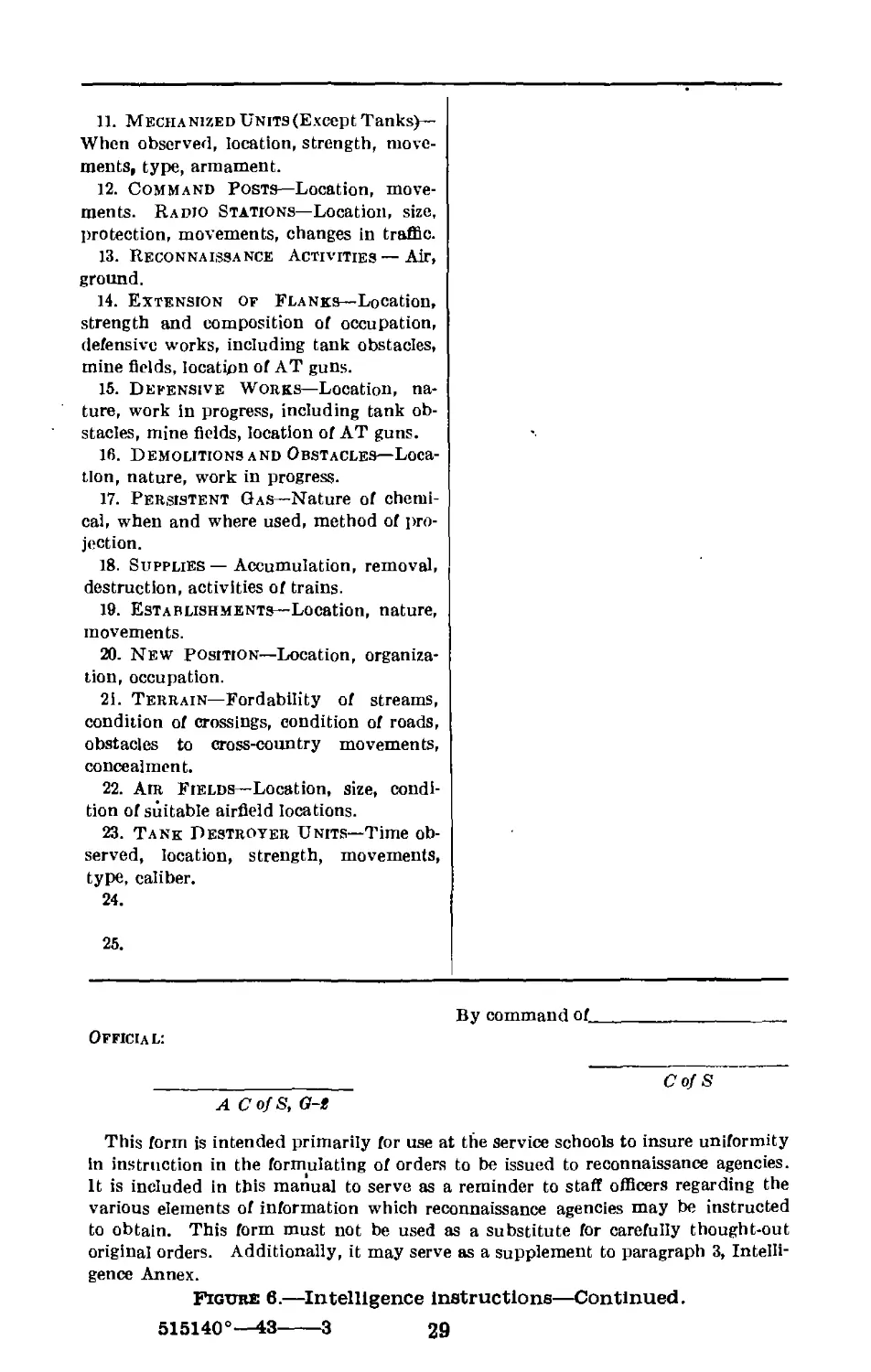
11.	Mechanized Units (Except Tanks)—
When observed, location, strength, move-
ments, type, armament.
12.	Command Posts—Location, move-
ments. Radio Stations—Location, size,
protection, movements, changes in traffic.
13.	Reconnaissance Activities — Air,
ground.
14.	Extension of Flanks—Location,
strength and composition of occupation,
defensive works, including tank obstacles,
mine fields, location of AT guns.
15.	Defensive Works—Location, na-
ture, work in progress, including tank ob-
stacles, mine fields, location of AT guns.
16.	Demolitionsand Obstacles—Loca-
tion, nature, work in progress.
17.	Persistent Gas—Nature of chemi-
cal, when and where used, method of pro-
jection.
18.	Supplies—Accumulation, removal,
destruction, activities of trains.
19.	Establishments—Location, nature,
movements.
20.	New Position—Location, organiza-
tion, occupation.
2i.	Terrain—Fordability of streams,
condition of crossings, condition of roads,
obstacles to cross-country movements,
concealment.
22.	Air Fields—Location, size, condi-
tion of suitable airfield locations.
23.	Tank Destroyer Units—Time ob-
served, location, strength, movements,
type, caliber.
24.
25.
By command of ____________________
Official:
___________________ CofS
A CofS, G-f
This form is intended primarily for use at the service schools to insure uniformity
In instruction in the formulating of orders to be issued to reconnaissance agencies.
It is included in this manual to serve as a reminder to staff officers regarding the
various elements of information which reconnaissance agencies may be instructed
to obtain. This form must not be used as a substitute for carefully thought-out
original orders. Additionally, it may serve as a supplement to paragraph 3, Intelli-
gence Annex.
Figure 6.—Intelligence Instructions—Continued.
515140°—43----3	29
34-35
CAVALRY FIELD MANUAL
 34. Control.—Because of the distances at which detach-
ments and patrols operate from their respective squadron
and troop command groups and the fact that the relative
rates of advance of the various subordinate units may be
accelerated or impeded by terrain, road net, or enemy action,
there must be a predetermined plan for controlling and coor-
dinating their forward movement.
a.	Commanders achieve this control by designating phase
lines or unit objectives to be reached and passed at specified
times, and by periodic reports and checks. Phase lines should
be well-defined terrain features such as rivers, railroads,
highways, or prominent ridge lines, and should be succes-
sively spaced by a 1- to 2-hour time distance. (See fig. 7.)
In the absence of a well-defined terrain feature it is neces-
sary to designate individual unit objectives approximately
the same time-distance from a previous phase line.
b.	Coordination with adjacent detachments and patrols is
furthered by lateral contact on phase lines or at designated
contact points, and by periodic radio communication.
 35. Communication.—a. The reconnaissance operations of
the squadron, regardless of how brilliantly executed, are use-
less if the information obtained is not received by the divi-
sion in time to be exploited. It is also true that the effi-
ciency of the squadron is greatly increased when the division
sends forward pertinent information gleaned from other
sources.
b.	A detailed study of communication within cavalry re-
connaissance units is contained in chapter 3, FM 2-35 (when
printed).
c.	The organization of the organic radio sets of the recon-
naissance squadron into nets is illustrated in appendix II.
d.	The potential value of mechanized reconnaissance ele-
ments as radio intelligence agencies should be exploited.
The amplitude modulated radio sets used in armored cars,
when equipped with suitably calibrated directional loop
antennae, can be used as radio locator stations. When such
antennae are not issued, they can be improvised by the
radio electrician. Since these cars, on normal missions, are
in advance of friendly main forces and usually are in closer
30
CAVALRY MECHANIZED RECONNAISSANCE SQUADRON
35
proximity to the enemy, they are well situated to attempt
the location of active hostile radio sets operating from enemy
command posts, observation posts, patrols, or radio jamming
stations, without materially deviating from or delaying the
Figure 7.—Phase lines should be well-defined terrain features and
should be successively spaced by a 1- to 2-hour time distance.
31
35-37
CAVALRY FIELD MANUAL
accomplishment of the assigned mission. Two or more ar-
mored cars of a reconnaissance troop, using the distance
between themselves as a base line, can establish reasonably
accurate location of another station by means of triangula-
tion.
 36. Execution of Distant Reconnaissance.—Distant re-
connaissance is the term used to indicate the information-
gathering operations of a reconnaissance element performed
beyond the practicable supporting distance of its parent
organization. In the case of the reconnaissance squadron,
this distance may vary from 50 or 75 miles to 150 or more
miles.
a.	Before contact with the enemy in-force is made, the
action of the squadron is characterized by its rapidity. Close
or detailed examination of terrain is subordinated to the
more urgent consideration of gaining contact with hostile
main forces at the earliest practicable moment. Hostile pa-
trols operating in the squadron’s zone of advance are avoided
if possible and their presence and location reported. If such
units cannot be evaded, they are attacked with determina-
tion, using all available force, and either destroyed or
brushed aside.
b.	As the squadron approaches contact with the main force,
its advance will be slowed by the enemy’s efforts to deny
observation. The strength, composition, and aggressiveness
of these, counterreconnaissance elements are clues to the
capabilities and intentions of the enemy and should be re-
ported. The reconnaissance activity becomes more intensive
as the squadron commander seeks to define the enemy’s
contour and secure identifications. Bold action by patrols
will more frequently than not produce the best results, but it
should be tempered by the realization that more detailed and
aggressive missions will be assigned as the division closes on
its objective and the strength of the reconnaissance, means
must not be dissipated prematurely. The methods employed
change and approach those used in close reconnaissance.
 37. Execution ' of Close and Battle Reconnaissance.—a.
The action of the squadron becomes progressively more ag-
gressive and intensive when the division closes to within sup-
32
CAVALRY MECHANIZED RECONNAISSANCE SQUADRON 37-38
porting distance. It is in this phase that the division com-
mander must secure the items of information which he needs
to complete a picture of the enemy on the given terrain and-
perfect his final plan of action. Such items include disposi-
tion and flanks, artillery positions, centers of signal communi-
cation, command posts, and tank concentrations. It is to be
expected that hostile counterreconnaissance will become
stiffer as the situation develops.
(1) As opposition to reconnaissance increases, the support
troop is employed more frequently to assist the advance of a
reconnaissance troop; as a spear head to penetrate the enemy
screen and allow passage of a reserve reconnaissance troop;
or platoons may be detached to reinforce separate recon-
naissance troops. In a situation involving cross-country
operation, it may be necessary to assign a reconnaissance mis-
sion to the support troop or one of its platoons.
(2) As the situation dictates, the antitank platoon, the
pioneer and demolition platoon, and either one reconnais-
sance troop or a reinforcing detachment from the division
may be combined as a task force to contain hostile recon-
naissance or security units while the remaining troops of
the squadron maneuver around their flanks and continue
close reconnaissance. (See fig. 8.)
b. As regimental reconnaissance and security elements,
preceding their respective columns in the approach march,
make contact with elements of the reconnaissance squadron,
they graduaUy take over the close-in reconnaissance.
The squadron may be ordered into division reserve or it
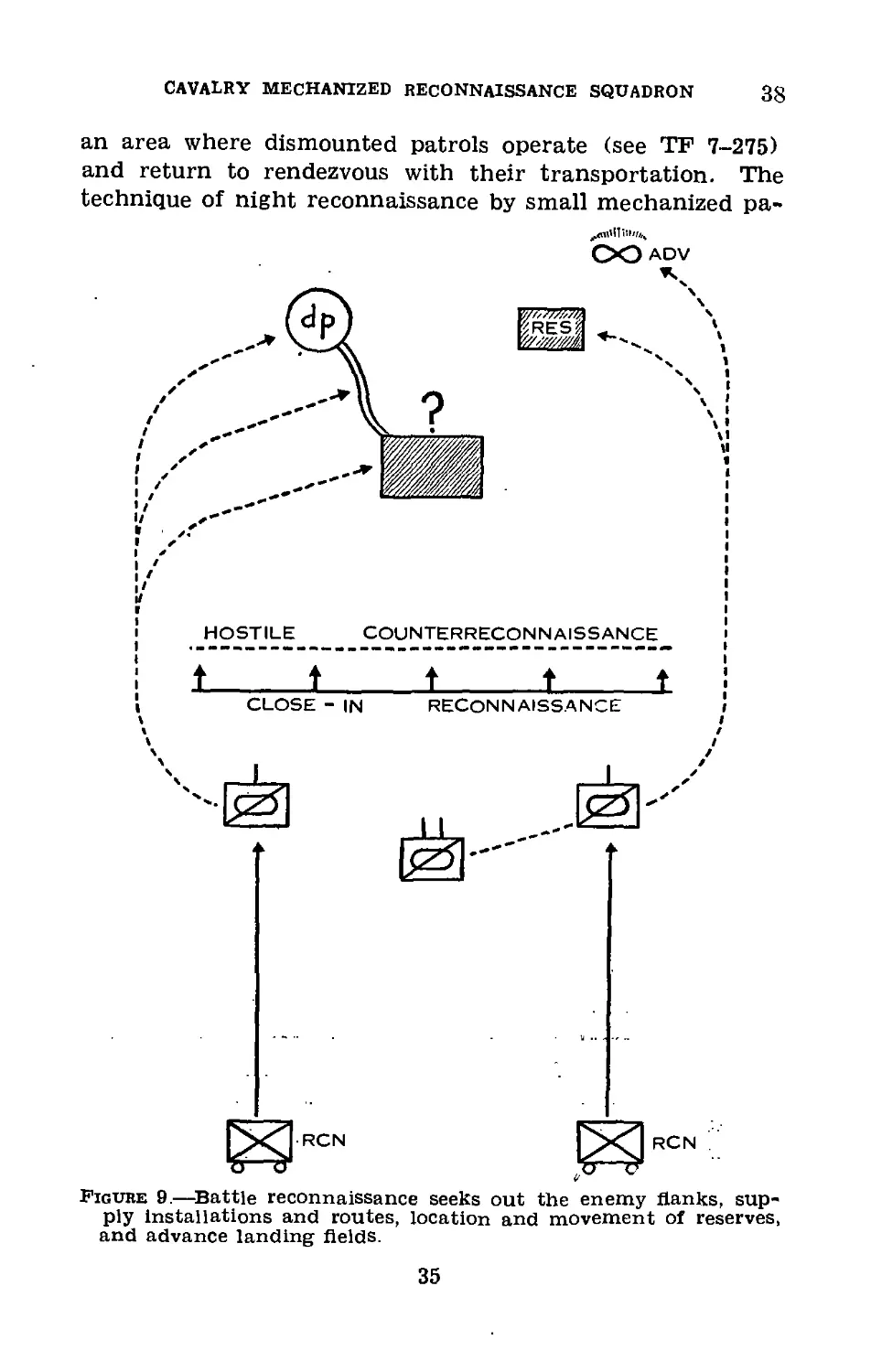
may be directed to execute battle reconnaissance around the
enemy flanks and to his rear, seeking out supply installa-
tions and routes, location and movements of reserves, ad-
vance landing fields, and other important installations.
(See fig. 9.) If ordered into division reserve, the squadron
commander or his executive should remain at the division
command post where he can keep informed of developments
and formulate plans for the future employment of the
squadron.
 38. Reconnaissance at Night.—The efficiency of the
squadron operating on reconnaissance at night is greatly re-
33
38
CAVALRY FIELD MANUAL
duced and such employment, except on roads, will be ex-
ceptional. Vehicles are highly susceptible to ambush.
Reconnaissance across country, except under most favorable
terrain and weather conditions, is slow and laborious. Usu-
ally night reconnaissance uses vehicles for movement to
Figure 8.—The situation permitting, hostile counterreconnaissance
is contained with part of the force while the remainder of the
squadron maneuvers around its flanks.
34
CAVALRY MECHANIZED RECONNAISSANCE SQUADRON
38
an area where dismounted patrols operate (see TF 7-275)
and return to rendezvous with their transportation. The
technique of night reconnaissance by small mechanized pa-
CO ADV
Figure 9.—Battle reconnaissance seeks out the enemy flanks, sup-
ply Installations and routes, location and movement of reserves,
and advance landing fields.
35
38-40
CAVALRY FIELD MANUAL
trols is described in FM 2-20 (when printed). When the
division contemplates movement at night, the squadron
should be sent out during daylight to a line beyond the ex-
pected division bivouac location where it establishes observa-
tion during the hours of darkness to warn of enemy
movements that might interfere with the march or bivouac
of the division.
Section III
SECURITY
	39. General.—The principles of security as prescribed in
FM 100-5 are applicable to the reconnaissance squadron as
a unit. Security within the individual reconnaissance troop
is described in FM 2-20.
	40. While Moving.—a. When the squadron is executing
a reconnaissance mission the patrols, operating at a distance
from the main body, provide a warning system against
ground and air observation and attack.
b. Protection of the main body from surprise attack is ac-
complished by the employment of an advance guard and,
when the situation requires, flank and rear guards. When
approaching combat cross-country, security is provided by
a covering detachment.
(1)	Advance guards.—When the support troop is a part
o.f the main body, one of its platoons with one or more recon-
naissance sections attached normally will form the advance
guard. In the absence of the support troop, such security
will be provided by a detachment from one of the recon-
naissance troops. The advance guard will include V-j-ton
trucks as point and advance party vehicles and tanks or
armored cars in the support. The size of the advance guard
varies from a small fraction to about one-fourth the avail-
able strength, depending upon the tactical situation and the
immediate size and composition of the main body. The dis-
tance at which the advance guard marches is limited by two
considerations: it must be far enough to protect the main
body from hostile small-arms fire and the direct fire of anti-
tank weapons; it must be within supporting distance of the
main body.
36
CAVALRY MECHANIZED RECONNAISSANCE SQUADRON 40-41
(2)	Rear guards.—The size and composition of rear guards
are similar to those of advance guards. In determining the
size of a rear guard, consideration should be given to the
fact that it can expect no support from the main body. It
must be far enough to the rear to eliminate the possibility
of being driven in on the main body. It must be close enough
to prevent hostile elements in force from interposing between
itself and the main body.
(3)	Flank guards.—Flank guards for the squadron nor-
mally are composed of elements from a reconnaissance troop.
Due to the increased mileage incident to flank guard opera-
tions, it is generally not desirable to employ support troop
elements. Exception to this will occur when the route of the
flank guard traverses ground unsuited to wheeled vehicles or
when there is a well-defined threat, such as might be the
case when the squadron on battle reconnaissance is passing
around the enemy flank.
(4)	Covering detachments.—Covering detachments em-
ployed by the squadron normally are composed of recon-
naissance elements. For details of operation, see FM 2-20
(when printed). The use of tanks, except to cover the ad-
vance of the support troop when it has been assigned a
definite combat mission, is not desirable because such employ-
ment may reveal the presence of a tank unit and thereby lose
the chance for surprise.
c. Antiaircraft weapons in all elements of the squadron
are alerted for antiaircraft fire at all times. Whenever over-
head cover is available, units will attempt to escape detection
by concealment. When observed and attacked by hostile air-
craft, all possible small-arms fire should be brought to bear
on the attackers. If aerial threat develops during operations
in open country, the best security is effected by dispersion of
vehicles, off the-road, if possible, or by extending the column
to increase the distance between vehicles. Columns with a
distance of from 200 to 300 yards between vehicles present
an unremunerative target because they force airplanes to
attack each vehicle separately.
 41. While Halted.—When the reconnaissance squadron
halts, it provides for its security by establishing outposts.
37
41
CAVALRY FIELD MANUAL
CD
Figure 11.—In open country, the best security is effected by dispersion of vehicles.
® Close columns increase the hazard from air attack.
Figure 12.
CAVALRY FIELD MANUAL
CAVALRY MECHANIZED RECONNAISSANCE SQUADRON
41
CAVALRY FIELD MANUAL
The position in relation to both friendly and hostile forces
that the squadron invariably will occupy while on a tactical
mission increases the possibility of its being attacked from
any direction. It must, therefore, habitually provide for all-
around security.
a.	The security measures taken by an individual reconnais-
sance troop while halted are described in FM 2-20 (when
printed).
b.	During a temporary halt to rest, or to refuel or eat, the
marching security detachments (advance guards, rear guards,
and Hank guards) establish a march outpost consisting of
observation posts at commanding points. (See fig. 13.)
During a halt at least one member of each vehicle remains
in his vehicle to observe and to man its major armament.
Details of the security measures to be observed at halts
should be contained in the unit’s standing operating pro-
cedure and the establishment of march outposts should be
automatic. If there is a critical terrain objective adjacent
to the halt site, a combat patrol will be sent to cover it.
During halts of any length full use is made of all available
cover and concealment. (See FM 21-45.)
c.	For protracted halts, such as bivouacs, outposts usually
are detailed from the support troop. The outpost disposition
is dependent upon the existing situation and terrain. An all-
around warning system of observation posts comprising air
lookouts and sentinels is established. Obstacles are installed
to block avenues of approach open to mechanization.
Armored vehicles are placed and their weapons laid so as
to defend these obstacles. Other armed vehicles and dis-
mounted machine guns are placed so as to cover other
avenues of approach. (See fig. 14.) All vehicles take ad-
vantage of available cover and concealment and, if neces-
sary, improve their position by means of camouflage.
Bivouac areas selected must give more than one exit. Routes
leading out of the area are reconnoitered. Movements into,
out of, and within the area are restricted and tracks made
are obliterated. While the outpost is being established,
march outposts provide security.
d.	On terrain which affords little or no concealment, such
as deserts, bivouac security demands special consideration.
42
CAVALRY MECHANIZED RECONNAISSANCE SQUADRON
41
(1) In daylight or bright moonlight, the squadron forms
a dispersed bivouac maintaining generally the same forma-
tion as when moving. Intervals and distances between ve-
hicles may be extended to 300 yards or more. Particular
care is taken to avoid lines of vehicles. Armored vehicles
Figure 13.—During a temporary halt, march outposts cover likely
avenues of approach.
43
41
CAVALRY FIELD MANUAL
Figure 14.—In bivouac, security measures must include air look-
outs, sentinels, defended obstacles covering avenues of approach,
cover and concealment for and dispersion of vehicles within
subordinate element areas.
44
CAVALRY MECHANIZED RECONNAISSANCE SQUADRON 4]-42
are placed to provide an all-around defense; 37-mm guns
and antiaircraft weapons are manned at all times. Patrols
of radio-equipped ’A-ton trucks or armored cars are sent
well out to give warning of hostile ground attacks.
(2) The squadron forms a closer bivouac for protracted
halts in darkness. A hollow triangle or square is formed of
tactical vehicles surrounding the supply, service and un-
armored command vehicles, with all facing the direction in
which they are to move in the event of a night alarm. The
interval between vehicles should be 40 to 50 yards. The for-
mation which affords the most even distribution of armor and
fire power and which will least disrupt the unity of troop
organizations is a triangle each side of which is formed by
a reconnaissance troop reinforced by a tank platoon and one
antitank section. Night listening posts are established at
sufficient distance from the bivouac to give warning of ground
attack. Because of the necessity for radio silence, communi-
cation is restricted to messengers and patrols between listen-
ing posts and the main body. At dawn the squadron adopts
an appropriate daylight formation.
e. When operations are halted and troops are required to
remain in tactical disposition, individual troops cover their
sectors by means of combat outposts. The action of the
several outposts is coordinated by the squadron commander.
Contact with the enemy must be maintained.
 42. Train Security.—The problem of protecting the move-
ment of trains varies according to the disposition in a given
situation. The motor maintenance element of each troop
always remains with the troop. However, the combat trucks
and kitchen trucks of the various troops may march with
their respective troops or they may be grouped in a squadron
train.
a.	When troop service vehicles are marching with their
respective units, the unit provides security.
b.	When vehicles are grouped in a squadron train, special
security measures must be observed.
(1)	A medium-range radio set in the squadron supply and
administrative platoon includes the trains in the squadron
warning system. The passage of information by hand signals
515140°—43-
-4
45
42-43
CAVALRY FIELD MANUAL
from truck to truck should be standing operating procedure,
and one man should be on the alert in each truck at all times.
(2)	Passive security measures will include dispersion (see
par. 40), use of cover, concealment, and speed. Since, as a
general rule, the danger of a mechanized or air attack
is in direct proportion to the amount of time the vehicles
are exposed, they should move at the maximum rate of
speed compatible with safe operation. Recent experience
in theaters of operation has proved that vehicles moving
in column at a distance of 300 yards have been able to reduce
casualties by sharply increasing and decreasing speed within
the column when attacked by aircraft. In the desert, trains
move in dispersed irregular formation with intervals and
distances of from 100 to 300 yards. Line and column forma-
tions must be avoided. Protection must be provided by
combat vehicles on the front, flanks, and rear of the forma-
tion. Antitank and antiaircraft weapons normally should
move on the flanks.
(3)	Weapons mounted on vehicles should be manned con-
tinuously during marches, but gunners should be cautioned
against firing at enemy airplanes unless certain that their
vehicles have been sighted.
(4)	When danger of attack is great, it will be necessary for
the squadron to provide additional means of security for
the trains. Such antitank weapons as are available for
train defense should be combined with Vi-ton trucks mount-
ing antiaircraft guns to form groups of concentrated fire
power operating as advance and rear guards. Areas such
as narrow defiles, which are especially likely objectives for
mechanized or air attack, should be organized defensively
by security detachments. (See fig. 15.)
 43. Security for Other Elements.—a. While operating
on its most normal mission of reconnaissance, the squadron
performs an incidental mission of security by protection
of the main body from surprise. The presence, strength,
composition, and direction of' movement of enemy ground
and air forces encountered are reported as a matter of stand-
ing operating procedure so that the division commander
may make early preparation to meet the enemy threat. How-
46
47
Figure 15.—Train security elements cover the movement of supply vehicles through defiles.
CAVALRY MECHANIZED RECONNAISSANCE SQUADRON
43-44
CAVALRY FIELD MANUAL
ever, time and space may cause the division commander to
order an additional and temporary mission for the squadron
to oppose the hostile force, in which case it executes another
phase of security—delay to allow the main body time to
dispose itself to engage the enemy. The reconnaissance
squadron does not take the place of an advance guard. While
the squadron may be given security missions, it should never
be used as the advance guard for the division.
b. When it becomes necessary for the division commander
to assign a primary mission of security, the operations of
the squadron are typical of cavalry. Reconnaissance tactics
are employed to gain and transmit timely information of the
enemy. The other elements (support'troop, antitank platoon,
pioneer, and demolition platoon) cooperate with the recon-
naissance elements and, using the technique of harassing and
delaying action, block the- routes of hostile approach to gain
time for the main body.
 44. Counterreconnaissance.—Counterreconnaissance is a
form of security in which a command prevents hostile obser-
vation of or interference with its own or supported main
forces. A moving counterreconnaissance screen, seeking to
cover a movement, acts offensively to destroy enemy recon-
naissance detachments and patrols. A stationary screen is
defensive in character and is intended to deny enemy recon-
naissance of troop concentrations or an area. ,
a.	The squadron is capable of executing counterreconnais-
sance in a zone 15 to 20 miles wide. Normally the squadron
will divide the zone between two detachments consisting of a
reconnaissance troop each. According to the situation, sup-
port platoons and elements of the antitank platoon and
pioneer and demolition platoon may be attached. The de-
tachment commander sends out patrols on a broad front,
retaining the bulk of his striking power in reserve prepared
to move rapidly in support of the patrols. The advance of
patrols is regulated by movement from one coordinating
line to another. The squadron, less detachments, follows its
detachments within supporting distance and coordinates
their advance.
48
CAVALRY MECHANIZED RECONNAISSANCE SQUADRON 44-45
b.	The dispositions of the squadron in a stationary screen
are not dissimilar to those in a moving screen. The front
of the position is covered by patrols and reserves are located
so as to be able to support them rapidly. Advantage is taken
of terrain; obstacles are constructed and demolitions pre-
pared. As always, obstacles are defended.
Section IV
MARCHES, HALTS, AND BIVOUACS
 45. Marches.—a. The reconnaissance squadron rarely will
execute tactical marches as a unit. If it does move as a part
of a larger force, the squadron normally will march as a serial
and the troop will be the march unit. Details as to the con-
duct of such marches are contained in FM 25-10. When the
squadron marches alone as a unit it establishes reconnais-
sance and security measures' appropriate to the situation.
b. Normally the squadron moves with two troops operating
on a broad front embracing a number of axial roads, while
squadron headquarters, reserve elements, and trains follow
a centrally located route. Movement is by bounds, and as a
general rule, the length of bounds increases with the size
of the unit. Patrols make short bounds from one terrain
feature to the next. The squadron, less detachments, ad-
vances from one phase line to the next.
c. In open terrain where no road net or only a few trails
exist, as in the desert, movement usually will be across coun-
try. Formations must be irregular with vehicles echeloned
and dispersed in width and depth. Intervals and distances
must never be less than 100 yards and may be extended to
300 yards. The absence of roads, trails, and landmarks makes
control and maintenance of direction difficult and requires
the use of special equipment and methods. (See par. 64.)
Prominent terrain features, if present, are used as coordi-
nating lines. In the absence of such landmarks, movement
is coordinated by marching measured distances on a prede-
termined compass bearing. When units are able to move in
columns on roads, a traffic density of 10 to 15 vehicles to the
mile should be maintained.
49
сл
Figure 16.—Road blocks are defended. Weapons are laid to cover routes of approach.
Alternate positions are selected for vehicles.
CAVALRY FIELD MANUAL
CAVALRY MECHANIZED RECONNAISSANCE SQUADRON 46-48
 46. Halts.—a. The locations selected for halts should be
those which offer the most protection from hostile observa-
tion and fire. When no overhead concealment is available,
accidents of the terrain which offer protection from direct
fire should be sought. (See fig. 17.)
b. When halting, vehicles should clear the road whenever
practicable. (See fig. 18.) Every effort is made to conceal
vehicles by placing them under trees or in shadows. When
natural concealment is not adequate, it is improved by means
of camouflage as described in FM 21-45. (See also FM 2-20
(when printed), 5-20, and FS 5-3 and 5-10.) The security
measures observed during halts in the desert are the same as
those for bivouacs in the desert. (See par. 41d.)
 47. Bivouacs.—a. The principles of concealment and cover
considered in the selection of halt sites are applicable equally
in determining the location of a bivouac area. Other con-
siderations involved, but subordinate to security, are sani-
tation, the comfort of troops (see FM 21-10), and facility of
supply. The area selected is reconnoitered, divided into troop
and platoon areas, and guides are posted to direct units to
their positions. Dispositions within desert bivouacs are
described in paragraph 41. c
b. Subordinate units within the bivouac area take protec-
tive measures as described in FM 21-45. The squadron com-
mander checks on the effectiveness of these measures.
c. The disposition of units within the bivouac area should
be that which will facilitate the continued tactical operation
of the squadron. (See fig. 19.) Security is covered in
paragraph 41.
Section V
COMBAT
 48. General.—a. The fundamental methods of both of-
fensive and defensive combat, together with their military
terminology, are explained in FM 100-5. This section deals
with the application of these principles by the cavalry recon-
naissance squadron.
51
05
CAVALRY FIELD MANUAL
Figube 17.—When no overhead concealment Is available, accidents of terrain which offer
protection from direct fire should be sought.
©Vehicles should not close up on the road.
Figure 18.—When halting.
CAVALRY MECHANIZED RECONNAISSANCE SQUADRON
oo
00
54
cavalry field manual
(5) Vehicles should take advantage of available concealment.
Figure 18.—’When halting—Continued.
CAVALRY MECHANIZED RECONNAISSANCE SQUADRON 48-50
b. It is to be expected that the squadron must fight at
some time in the execution of any mission it may be assigned.
In either an offensive or a defensive situation, the action of
the squadron is marked by the bold execution of a sound
plan. The tempo of the typical situation demands quick
appreciation of terrain and rapid formulation of a plan
that will fully exploit it to bring about the most effective
combination of fire and movement.
	49. Employment of Reconnaissance Platoons and
Troops.—Combat by subordinate reconnaissance elements is
described in FM 2-20 (when printed).
	50. Employment of the Support Troop.—The support
troop Is provided to increase the striking power of the
reconnaissance squadron and enable it to operate with
greater aggressiveness.
a.	The tank possesses favorable characteristics of great
fire power, protection to crew, crushing power, shock, and
mobility. However, its mobility is limited by the following
terrain features:
(1)	Ground covered with large stumps and boulders.
(2)	Heavy woods.
(3)	Swamps.
(4)	Steep slopes, especially those which afford loose or
slippery footing.
b.	The tank being essentially an offensive weapon it follows
that the primary mission of the support troop is to attack.
The tank attack seeks to break up organized resistance by
destroying hostile automatic weapons; disrupting commu-
nication; overrunning command posts, mortar, and artillery
positions; and impeding the movement of reserves. Since
the attack of positions strongly organized in depth is beyond
the capabilities of the squadron and therefore rarely will be
attempted, the support troop normally will be assigned lim-
ited objectives. Pursuit is restricted beyond that which Is
necessary to prevent hostile reorganization of the position.
(1)	Before an attack, the troop will occupy an assembly
position where final preparations are made for the attack.
Platoons occupy the area in such manner as will allow them
55
CAVALRY FIELD MANUAL
Kgure 19.—Disposition of units within a bivouac area should facilitate continued tactical operation.
CAVALRY MECHANIZED RECONNAISSANCE SQUADRON
50
to move directly to attack positions without passing through
other units. Final orders are issued and ammunition, fuel,
and oil are replenished. Security measures are taken to
protect against hostile ground and air observation. Obvious
exceptions to the use of an assembly position occur when
the troop repels a surprise counterattack or when it attacks
directly from march column.
(2)	Figures 22 and 23 illustrate basic attack formations
for the platoon and troop. Any combination of platoon for-
mations may be used in any one of the basic troop forma-
tions. Column formation affords the optimum in ease of
control and power for sustained effort as compared with
line formation.
(З)	The advance to the objective Is effected by a combi-
nation of fire and movement In which platoons move by
bounds or by leapfrogging. In leapfrogging, the first platoon
covers the movement of the second platoon until the second
is In position ahead of the first; then the second covers the
movement of the first to a position ahead of the second. In
moving by bounds the first platoon covers the advance of the
second platoon to a position on the same general line with
itself, then the first moves to a new position supported by
the fire of the second. Leapfrogging is comparable to a
man’s stride—movement by bounds to a series of paces each
taken with the same foot leading. The advance of tank
elements across country is described more fully and
illustrated in FM 17-30 and 17-32.
(4)	Targets for tank elements, in order of priority, are
antitank guns, artillery in position, armored vehicles in posi-
tion, moving armored vehicles, automatic weapons, and per-
sonnel. The technique of tank operations against these
targets is described in detail In FM 17-30.
(5)	When time and space demand that the support troop
attack from march column, orders to platoons, based on a
rapid estimate of the situation, are issued by radio and
the situation Is developed as rapidly as possible. Unarmored
troops are attacked quickly and, if possible, overrun before
they can organize the ground to any appreciable extent.
If opposed by armored vehicles of comparable armament, a
57
ф Ground covered with stumps impedes movement of tanks.
Figure 20.
©
CAVALRY FIELD MANUAL
(a) Boulders restrict the movement of tanks.
Figure 20—Continued.
CAVALRY MECHANIZED RECONNAISSANCE SQUADRON
in
©
(з) Swamps should be avoided.
Figure 20.—Continued.
CAVALRY FIELD Main иль
CAVALRY MECHANIZED RECONNAISSANCE SQUADRON
50
® Platoons occupy an assembly area in such a manner as will allow
them to move to the attack, without passing through other
units.
Figure 21.
515140°—43-
-5
61
СЛ
о
CAVALRY FIELD MANUAL
®In the assembly position final orders are Issued, and ammunition,
fuel, and oil are replenished. Security measures are taken.
Figure 21—Continued.
CAVALRY MECHANIZED RECONNAISSANCE SQUADRON
50
Figure 22.—Basic attack formations for the support platoon.
63
50
CAVALRY FIELD MANUAL
64
CAVALRY MECHANIZED RECONNAISSANCE SQUADRON 50-51
small part of the troop or the squadron antitank platoon
may be used to contain the hostile force while the main
strength maneuvers to bring maximum fire to bear.
c. In defense, the support troop is used offensively to exe-
cute counterattacks. Tanks should not be used as stationary
pill boxes except as a last resort. (See par. 54.)
d. In the execution of delaying actions, the support troop
operates offensively against the hostile flanks and rear or is
held as a mobile reserve and employed to prevent enemy
encirclement of the flanks of the delaying force. -Oppor-
tunities to employ ambush tactics are sought and exploited.
 51. Offense.—The cavalry reconnaissance squadron may
engage in offensive combat as an incident in the execution
of any mission which it is assigned. On reconnaissance, indi-
vidual patrols will have frequent engagements with hostile
groups. (See FM 2-20 (when printed).) The squadron may
And Itself opposed by a counterreconnaissance screen around
whose flanks it cannot side slip and be confronted by the
necessity of executing a penetration. A point usually will be
reached at which it will be necessary to attack a covering
force in order to develop so much of a situation as will reveal
the strength and attitude of the enemy. Although generally
it is not considered wise to dissipate the highly specialized
reconnaissance squadron on a strictly combat mission, factors
of time, space, and the current location of the squadron may
force the division commander to direct the squadron to seize
a key terrain point or delay the enemy to gain time for the
division to reach a given point and dispose itself to engage
the hostile force. The reconnaissance squadron applies the
fundamentals of offensive combat in the manner dictated
by the capabilities and limitations of the organization, equip-
ment, and armament. When sustained combat is anticipated,
the squadron must be suitably reinforced.
a. The outstanding combat characteristics of the squadron
are Its great Are power and extreme mobility. The potential
of these assets Is greatly reduced when the squadron Aghts
dismounted. The most desirable situation is one wherein the
principle of Are and movement can be applied by the rapid
transfer of Are power in vehicles with one unit supporting
65
51
CAVALRY FIELD MANUAL
by Are the maneuver of another until a position is reached
from which hostile opposition can be overcome by coordinated
fire or overrun in a short, swift assault. Terrain is the most
influential factor in determining how fire power will be ap-
plied in a given situation.
(1) Irregularities of terrain favor one unit supporting, by
fire from defilade, the movement of another unit to a position
from which the latter can develop its fire power. (See fig. 24.)
(2) Fire from moving vehicles generally is ineffective.
However, when an attack must be made over open ground it
may be necessary to fire while moving. In such a case units
are dispersed as widely as possible to bring fire from several
directions.
b. The normal cavalry attack will take the form of an
envelopment of one or both flanks. When factors of terrain,
enemy disposition, limitation of time, or possibility of sur-
prise argue against an envelopment, the most effective form
of attack may be a rapidly executed penetration.
c. In the attack the elements of the squadron are dis-
tributed to form a main attack force, a secondary attack
force, and a reserve. (See FM 100-5.)
(1)	The main attack force normally will be composed of
the support troop and such additional reconnaissance ele-
ments as the situation may necessitate. In order to reap the
full measure of shock and crushing power accruing from
mass, the support troop should be employed as a unit.
Reconnaissance platoons and troops assigned to the main at-
tack force act as a mobile base of fire in direct support of the
tank unit. (See fig. 25.) Personnel from the pioneer and
demolition platoon may accompany the main attack and be
used to reduce obstacles and remove or explode mines and
booby traps. (See fig. 26.)
(2)	The secondary attack establishes the base of fire on
which the scheme of maneuver of the squadron as a whole
is built. (See fig. 27.) Initially it will include all combat
elements not assigned to the maneuvering element or ele-
ments and reserve. Maximum fire power will be concentrated
by employing the antitank platoon and the mortar squads
of reserve reconnaissance platoons.
66
ENEMY
Figure 24.—One unit supports another by fire from defilade.
CAVALRY MECHANIZED RECONNAISSANCE SQUADRON
сл
0)
co
Figure 25.—Reconnaissance elements assigned to the main attack force act as a mobile
base of fire in direct support of the tank unit.
CAVALRY FIELD MANUAL
CAVALRY MECHANIZED RECONNAISSANCE SQUADRON
. Figure 26.—Pioneer and demolition personnel may accompany the main attack
to reduce obstacles and remove mines.
Figure 27,—Secondary attack establishes the base of fire on which the scheme
of maneuver is built.
CAVALRY FIELD MANUAL
CAVALRY MECHANIZED RECONNAISSANCE SQUADRON
51
(3)	A reserve is held out Initially by the commander to
counter an unpredictable development of the situation or to
influence the final result of the action. The strength of the
reserve normally will vary in size from a reconnaissance pla-
toon to a reconnaissance troop. The strength required varies
in direct proportion to the strength of enemy mechanized ele-
ments and antitank weapons. When the reserve is committed
to action, a new reserve must be constituted without delay.
d. The fire of all weapons must be coordinated in order to
achieve maximum efficiency. The most remunerative target
for each type weapon must be understood; the effects of the
various fires fully appreciated; and finally, all weapons be
given definite, appropriate fire missions with a minimum of
avoidable duplication. In other words, the right tool should
be used on the right job with no more force employed than is
necessary.
(1)	The machine gun is the basic fire support weapon.
Light machine guns are used to kill the hostile soldier or to
pin him to the ground so that he cannot use his weapons with
deliberate effectiveness. The caliber .50 machine gun, though
intended primarily as an antiaircraft weapon, may be used
effectively against light materiel such as machine guns,
mortars, and unarmorecf and lightly armored vehicles.
(2)	The 37-mm gun is essentially an antimechanized
weapon. Its characteristics of high velocity and fiat trajec-
tory limit its fire to direct laying. Being permanently
mounted in its vehicle, it can be moved quickly from .point
to point and can open fire with a minimum of wasted time.
37-mm guns will be disposed to protect the flanks and rear of
the squadron against mechanized attack and also, in the base
of fire, to support the attack. Armor-piercing ammunition
is effective against mechanized vehicles, materiel, and
weapons. High explosive ammunition is effective against per-
sonnel, light materiel, automatic weapons, and mortars.
Hull-down positions should be sought in order to protect the
vehicle.
(3)	The fire of the 81-mm mortar is extremely effective
against machine-gun positions, antitank guns, personnel in
groups, and command posts. Frequently it may be used to lay
71
01
CAVALRY FIELD MANUAL
smoke on the objective to screen the movement of attacking
forces. (See fig. 28.) The mortar squads of the reconnais-
sance platoons may be grouped in a provisional platoon under
central control or left with their respective platoons.
e. The fact that the typical cavalry operation is charac-
terized by speed, dispersion due to exploitation of mobility,
and the initiative of subordinate commanders, tends to make
control and coordination difficult. It is imperative, there-
fore, that application of practicable methods of control be
perfected.
(1)	The successful operation of any control method is
based upon understanding between commanders and sub-
ordinates. A commander must study and know the capabili-
ties of his immediate subordinates; how they will execute a
given order, how they will react in a particular situation.
On the other hand, the subordinate must study the per-
sonality and methods of his superior, know what is expected
of him, and comply with the spirit as well as the letter of the
order. When complete understanding and confidence exist
between individuals, perfect teamwork can be achieved using
any mechanical means of control. As a general rule the
most simple plan will be the most successful.
(2)	The initial order contains the essential elements of
coordination and control. It should, if possible, be Issued to
assembled commanders at a point where the various terrain
features can be pointed out on the ground. Objectives are
given. The direction of attack is designated as an axis or
as a thrust line. Assembly positions and, if necessary, inter-
mediate assembly positions are assigned. Lines of departure
will be designated and the time for clearing same be fixed at
a definite hour, or made contingent upon a signal by messen-
ger, radio, or visual means. Rallying and alternate rallying
points are prescribed in order to expedite reorganization.
(3)	When the individual unit is committed to the attack,
the subordinate exercises his initiative in conformity with the
general plan. The squadron commander exercises necessary
control by means of messengers, radio and visual signals.
Control procedure by means other than radio must be per-
fected, as it is to be expected that the use of radio often will
72
CAVALRY MECHANIZED RECONNAISSANCE SQUADRON
® Smoke may be used to blind hostile antitank gun crews.
Figure 28.—Use of smoke.
Сл
CAVALRY FIELD MANUAL
® Smoke is used to deceive the enemy as to direction of the attack.
Figure 28.—Use of smoke—Continued.
CAVALRY MECHANIZED RECONNAISSANCE SQUADRON
® Smoke should be placed so that the wind will carry it toward the objective.
Figure 28.—Use of smoke—Continued.
Си
51-54
cavalry field manual
be denied by the operation of mobile hostile radio jamming
stations mounted either in vehicles or in aircraft.
 52. Pursuit.—Pursuit is a development of offensive action.
(See FM 100-5.)
a.	The reconnaissance squadron rarely engages in other
than limited pursuit following an independent offensive
action.
b.	When the division pursues, the squadron is used to
envelop or encircle the enemy and arrest his retirement
so that the division can close in and annihilate him. The
squadron concentrates its efforts at bridges, defiles, and
other critical points. When the retiring force is highly
mobile, the faster reconnaissance troops move at maximum
speed to complete the encirclement, while the support troop,
with mission-type orders, moves parallel to the enemy’s
route ’making sudden and repeated harassing attacks for
' the purpose of slowing his rate of march and adversely
affecting his morale.
 53. Harassing Action.—Harassing action is a specialized
form of the offensive in which a unit of relatively inferior
strength executes surprise limited-objective attacks against
a hostile force. Its purpose is to inflict damage without
becoming closely involved and, by keeping the enemy al-
ways alerted, to exhaust him and lower his morale. The
reconnaissance squadron is well suited for this type of of-
fensive action. Depending on the terrain and the opposi-
tion expected, harassing detachments will be composed of
reconnaissance troops reinforced by support platoons or
composed of elements of the support troop reinforced by
reconnaissance units. Mission-type orders are the rule.
 54. Defense.—a. The reconnaissance squadron lacks the
holding power to organize a defensive position in depth. In
the course of its normal mission, it rarely will be necessary
for it to execute a position defense and it should be specifi-
cally ordered to do so by higher authority only when an
extreme situation so demands.
b. When reinforced by more suitable ground holding units
a portion of the squadron’s fire power may be assigned to
76
CAVALRY MECHANIZED RECONNAISSANCE SQUADRON 54-55
strengthen the position. The remainder of the squadron,
always including the support troop, exploits its mobility
in counterattacks and offensive operations against the hostile
flanks.
 55. Delaying Action.—a. Reconnaissance missions fre-
quently will develop into delaying actions. The squadron,
after having located the enemy and secured and reported
the information needed by the division commander to plan
his operations, may be given the mission of impeding the
movement of the hostile force to gain the time and space
necessary for the operation. When the division withdraws,
the squadron may be ordered to delay hostile pursuit.
b. The two main combat characteristics of the squadron,
fire power and mobility, qualify it as an effective delaying
force.
c. The tactics used in delay are a combination of defen-
sive and offensive, with the accent on the latter. Generally
speaking, delaying action will take either one of two forms
depending upon whether the enemy is advancing in column
or on a broad front. .
(1) In the first case, the squadron disposes itself to block
the head of the column and attack its flank.
(a)	The blocking force is similar in composition and func-
tion to the secondary attack of an envelopment. It is com-
posed essentially of reconnaissance elements supported by
the antitank platoon and the mortar squads of reserve ele-
ments. The pioneer and demolition platoon is employed to
prepare demolitions and obstacles to impede or canalize the
hostile advance.
(b)	The support troop is employed to ambush and attack
the flanks. Reconnaissance elements may be assigned to
the attack force to support the tanks or they may be used
to harass either enemy flank by a series of surprise fire
attacks.
(2) When the enemy advances on a broad front, as might
be the case when the division is executing a withdrawal, it
may be necessary to occupy a delaying position from which
bhe hostile approach can be opposed by fire at maximum
effective range. Such a position would not be held to the
515140°—43---6	77
55-56
CAVALRY FIELD MANUAL
point where the squadron could not extricate itself without
serious losses. The support troop, in such a situation, would
be held in reserve prepared to counterattack, particularly
against hostile flank attacks. In close country it may be
necessary for the squadron commander to decentralize con-
trol by assigning sectors to reconnaissance elements rein-
forced by support platoons. These detachments should ex-
ploit opportunities to assist each other by flanking fire.
 56. Withdrawals.—a. When the division seeks to disen-
gage Itself from action, the reconnaissance squadron may be
employed to cover the withdrawal. This operation of the
squadron entails two phases. (See fig. 29.) The first phase
is one of reconnaissance and security to the division flanks.
In the second phase, the squadron closes in behind the divi-
sion where it may effect delay as described in para-
graph 55, or operate as a security detachment. For this type
of operation the squadron, when a part of the cavalry divi-
sion, should have motorizёd artillery attached; when a part
of the motorized division, self-propelled artillery or assault
guns. In either case, engineers normally are attached to
prepare obstacles.
b. It has been pointed out that the squadron avoids be-
coming so involved as to make extrication.too costly. On
the other hand, it should exploit each delaying position to
the fullest extent. Obviously then, perfection of the tech-
nique of withdrawal is a prerequisite to efficient execution
of delaying actions.
(1)	Initially, control is decentralized to allow subordinates
to extricate their commands in accordance with the dictates
of their immediate situation. However, the squadron com-
mander should be so familiar with the situation and exercise
sufficient control to be able to order the withdrawal of
subordinate elements before they become so closely engaged
that they cannot withdraw. Central control is regained
when units have assembled or have joined the march column.
(2)	The squadron commander designates a covering force
to cover the withdrawal of the whole command. This force
withdraws on the instructions of the squadron commander
and ultimately becomes the rear guard of the retiring column
78
CAVALRY MECHANIZED RECONNAISSANCE SQUADRON
56
Figure 29.—When the division withdraws, the squadron reconnoiters
to the flanks initially and then closes in behind the division.
79
56-57
CAVALRY FIELD MANUAL
or the outpost of the next delaying position. Subordinate
units employ small local covering forces.
(3)	The pattern of the terrain determines the order in
which individual units are withdrawn. Troops holding
critical terrain features which favor the covering of other
elements should be withdrawn last. 'The units in the most
difficult or hazardous positions are withdrawn first under
the covering fire of the other element.
 57. Antiairborne Defense.—The reconnaissance squadron
is a highly effective agency in the scheme of antiairborne
defense as outlined in FM 100-5. Generally speaking, air-
borne troops in force will be used either ahead or to the flank
of their enemy for the purpose of seizing and holding key
terrain or behind it as a vertical envelopment. In either case,
the squadron has an active role.
a. The squadron operating ahead of the division will, in
all probability, be the nearest element to any point at which
an air landing is attempted in the division zone of advance.
The points at which such an enemy operation will be profita-
ble should be as well known to friendly commanders as they
are to the enemy and should therefore be expected. Long-
range air reconnaissance may further reduce the element of
surprise. Division G-2 should immediately warn the recon-
naissance squadron commander of any airborne movements
observed either in preparation or aloft. Being thus alerted,
the squadron commander can plan how he will oppose a
landing at any probable point in his zone.
(1) The reconnaissance commander encountering airborne
troops in his zone must make a rapid decision based on the
stage of the enemy development, relative strength, and the
urgency of his primary mission. He may decide to attack, to
contain the force until reinforced by the division, or to bypass
and report the incident.
(2) If the commander decides to attack, the action is
characterized by its rapidity and dispersion. Defense against
light bombardment and fighter aircraft supporting the land-
ing is accomplished by use of overhead cover, wide dispersion
of vehicles, and fire of antiaircraft machine guns. Parachut-
ists, after they have jumped, and gliders and transports
80
CAVALRY MECHANIZED RECONNAISSANCE SQUADRON
57
making a landing approach should be fired on from the
time they come within effective range until they are de-
stroyed. Parachutists should be prevented, if possible, from
reaching and opening the containers of heavy weapons
dropped with them, and glider or transport prevented from
unloading their heavy weapons. High explosive, 37-mm fire,
is effective against gliders and transports on the ground.
Weapon containers may be destroyed by gunfire or by the
light tanks running over them.
b. When the squadron is in reserve it may be assigned the
mission of defense against airborne attacks aimed at rear
installations.
(1)	The squadron commander, in cooperation with G-2
and G-3, makes preparation for the employment of his com-
mand. The squadron is included in the warning system or,
if one has not been established, he assists in its creation and
provides radio-equipped motor patrols. A reconnaissance
of the rear area is made to discover and study likely objec-
tives for airborne attack. Based on this study, plans are
made for the employment of the squadron to include com-
munication, priority on roads, and support by reserve ele-
ments of the division.
(2)	The enemy planning to attack in rear of the division
will take cognizance of the fact that the area probably is
more or less organized for resistance and he will attempt
deception by means of feints and demonstrations. One so-
lution to this problem is to divide the rear area into three
reconnaissance troop sectors, locating each troop in the
position from which it can move most readily to the probable
points in its sector. The squadron, less detachments, should
remain in centrally located reserve prepared for rapid move-
ment to any sector.
(3)	The actual engagement of the airborne troops Is as
previously described.
81
© Parachutists should be prevented from reaching and opening their weapon containers.
Figubb 30.
CAVALRY FIELD MANUAL
09
CO
© High explosive 37-mm fire is effective'against gliders and transports on the ground.
Figure 30—Continued.
CAVALRY MECHANIZED RECONNAISSANCE SQUADRON
@ Weapon containers may be destroyed by gunfire or by light tanks crushing them.
Figure 30—Continued.
CAVALRY FIELD MANUAL
CAVALRY MECHANIZED RECONNAISSANCE SQUADRON 58-59
Section VI
LOGISTICS
 58. Supply.—The general doctrine of supply is expressed in
FM 100-10. Current Tables of Basic Allowances prescribe the
specific items of supply, the quantity of each, and the organic
means of transporting them.
a.	The Squadron S-4 consolidates troop requisitions for
class П and IV supplies and the reports forming the basis
for automatic issue of class I, III, and V supplies and is
responsible for coordinating the flow of supplies from the
division distributing point (DP) to troops.
b.	The reservoirs of supply in the squadron are similar to
those in the reconnaissance troop of the infantry division.
The first reservoir is the ammunition, gasoline, oil, and rations
carried on the individual soldier or vehicle. The second is
transported in the service element of each troop; the third
in the division quartermaster train.
c.	Normal resupply of the squadron is accomplished by
assembling the troop trains into a squadron train which
moves to the rear and draws supplies from an advance
division DP. In a situation where it is foreseen that the
squadron will operate at extreme range and the division will
not close on the squadron, it will be necessary for the division
to attach additional transportation and issue another day
of supply or establish forward truck heads or dumps.
d.	Within the squadron, troop motor maintenance vehicles
and combat trucks will accompany their respective troops.
Kitchen trucks normally will be grouped in the squadron
train. However, a troop operating at a distance from the
squadron may retain its kitchen truck.
 59. Maintenance.—The echelon system of motor mainte-
nance is described in FM 25-10.
a.	Troop motor maintenance sections perform troop second
echelon maintenance for the vehicles of their respective
troops.
b.	The squadron performs squadron second echelon main-
tenance for the vehicles of the troops.
C. In tactical operations, a too strict adherence to the
85
59	CAVALRY	MANUAL
echelon system of maintenance cannot be required. There
is a need for initiative, intelligence, imagination, realism, and
opportunism in addition to technical skill in the operaton of
the maintenance facilities. The inherent mobility of the
squadron will be preserved only if all its personnel have a
knowledge and appreciation of automotive maintenance and
operation.
(1)	It is desirable to bring disabled vehicles to the bivouac
area of the maintenance platoon, but usually it is necessary
for the squadron to send mechanics, tools, and parts to the
disabled vehicle as a matter of expediency. (See par. 13.)
Because of the limited quantity of replacement parts that
can be carried, vehicle drivers, as well as unit mechanics,
must continuously perform preventive maintenance as pre-
scribed in FM 25-10 and TM 21-300.
(2)	The scope of the work that the maintenance section
and platoon can perform is limited more by the replacement
parts that they can transport than by their organic tools
and equipment. Therefore, consideration should be given to
the fact that parts removed from a hopelessly disabled vehi-
cle may be the emergency means of restoring to service sev-
eral vehicles that otherwise would have been evacuated to
rear echelons.
(3)	The extent of work undertaken on a given vehicle is
determined by the amount of work required on all vehicles.
Keep the maximum number rolling.
d. The motor maintenance officer should be present at
staff conferences so that he can have the earliest possible
knowledge of future operations upon which to base his plan
and prepare for the operation of his platoon. His plan will
include—
(1)	Axis of maintenance.
(2)	Squadron support of troop maintenance sections.
(3)	Need for and use of personnel detached from the
division echelon.
(4)	Supplies and replacement parts needed in addition to
those habitually carried.
(5)	Method of reporting and locating disabled vehicles.
(Probably SOP.)
(6)	Evacuation of vehicles.
86
CAVALRY MECHANIZED RECONNAISSANCE SQUADRON
60
 60. Evacuation.—a. Personnel.—General instructions for
the evacuation of personnel are contained in FM 100-10 and
8-10. The squadron medical detachment (see T/O 2-25)
collects and arranges for- the evacuation of squadron casu-
alties. Two troop aid men from the medical detachment are
attached to each combat troop during tactical operations.
First aid is administered to casualties by vehicle crew mem-
bers or aid men. If life or limb of the injured man will not
be jeopardized by so doing, he may continue with his unit In
order to avoid the deleterious effect on morale that abandon-
ment may have. When it is impracticable to transport casu-
alties after first aid has been given, they are made as
comfortable as possible and their location is reported to the
medical detachment.
b.	Prisoners.—The disposition of prisoners is prescribed
in FM 30-15. While it is desirable to evacuate prisoners rap-
idly for examination, reconnaissance elements will not inter-
rupt operations to do so unless there Is sound reason to
believe that important information can be obtained from
them. Prisoners in small numbers will be retained until
transportation is available. A large number of prisoners will
be placed under guard and their location reported.
c.	Captured material.—Captured documents of importance
are sent to the rear as soon as practicable. Captured ma-
teriel, equipment, stores, and transportation will be reported
and then secured, rendered unserviceable, or destroyed as
directed by higher authority. New types of materiel will be
reported without delay and then be protected against deteri-
oration or destruction as long as it remains in the possession
of the capturing element.
d.	Vehicles.—Evacuation of vehicles which the squadron
maintenance platoon is not capable of repairing normally is a
function of the division maintenance echelon.. Such vehicles
are left in the service park, or place where disabled, and the
higher headquarters is notified of their location.
87
61
CAVALRY FIELD MANUAL
Section VII
SPECIAL OPERATIONS
 61. Attack of a River Line.—The general subject of opera-
tions at river lines is covered in FM 100-5. The motorized
division or the cavalry division acting as part of a corps forc-
ing a river line may be either held back initially as part of
a force with the mission of exploiting the penetration, or may
be sent far to a flank to execute a feint, demonstration, or a
crossing which will enable it to support the main attack on
the far side of the river.
a.	In the first case, the reconnaissance squadron will follow
closely the force establishing the bridgehead and continue
on to reconnoiter assigned zones and objectives. Close co-
operation is maintained with the corps reconnaissance
regiment.
b.	In the second case, or when the division makes an
independent attack of a river line, the operations of the
squadron are more extensive.
(1) The squadron, with engineer reconnaissance parties
attached, reconnoiters the river line to determine suitable
crossing points and enemy dispositions. The organic amphib-
ious y4-ton trucks will be particularly valuable during this
phase.
(a)	The amphibians may be left with their respective
platoons to be sent across singly or towing one or more y4-ton
trucks wrapped in paulins. (See fig. 31.) (See also FM
25-10.)
(b)	In another situation it may be expedient for a troop
to form its amphibians into a provisional four-car section for
operation on the far shore or for the squadron to form an
amphibious platoon.
(c)	Additional dismounted patrols are ferried or swim
across to perform close reconnaissance.
(2) From positions on both sides of the river, elements Of
the squadron provide security for infantry and engineer
troops establishing the bridgehead.
(3) If resistance is light, elements of the squadron not
already across the river accompany the bridgehead force
88
Figure 31.—Amphibians may be sent? across singly or towing another 14-ton truck wrapped in a
paulin.
CAVALRY MECHANIZED RECONNAISSANCE SQUADRON
61-64
CAVALRY FIELD MANUAL
across. If resistance is heavy they follow when the bridge-
head is established. The squadron then assembles and pro-
ceeds with reconnaissance of assigned zones and objectives.
 62. Defense of a River Line.—a. In the defense of a river
line, the motorized division normally will be used as a mobile
corps or army reserve to be shifted rapidly to meet a hostile
threat. The cavalry division may be used in similar fashion.
In this situation the squadron reconnoiters the advance of
the division to the river, crosses, and continues reconnais-
sance to locate the hostile main body. After establishing
contact, the squadron withdraws, maintaining contact con-
stantly, determining the hostile strength and movement, ob-
serving his flanks, performing counterreconnaissance and,
if so ordered, executing delaying action. When the river
line is reached patrols are sent to both hostile flanks to
report movements to the flank. The remainder of the
squadron crosses by prearranged means and establishes pa-
trols along the near bank. Contact is maintained with the
patrols on the far bank.
b. A corps organizing a river defense may send out a cav-
alry division with the mission of delaying the approach of a
hostile force. During such an operation the squadron will
operate on the hostile flanks, reconnoitering, harassing, and
providing security for the division.
 63. Operations in Snow and Extreme Cold.—The funda-
mentals of operations in snow and extreme cold are con-
tained in FM 100-5. A more detailed discussion, including
certain field expedients, is to be found in FM 31-15.
 64. Desert Operations.—The special considerations con-
tained in FM 31-25 pertaining to individual and unit equip-
ment, motor maintenance, messing, hygiene and sanitation,
camouflage and concealment are applicable to the reconnais-
sance squadron operating In the desert. Security, movement,
halts, and bivouacs in the desert are described in paragraphs
41, 42, 45, 46, and 47 of this manual. All personnel must be
given special training in determining direction by field
expedients (see FM 21-26) and in navigating by dead reckon-
ing (see FM 31-25). Each vehicle should be equipped with a
90
CAVALRY MECHANIZED RECONNAISSANCE SQUADRON 64-66
liquid filled lensatic compass, universal sun compass, pocket
watch, protractor, 45° triangle, 6-inch scale graduated in
inches and tenths, and Bowditch Table, H. O. 9.
	65. Jungle Operations.—In the jungle proper the combat
efficiency of a mechanized unit is sharply decreased. Move-
ment is restricted to roads and trails, and observation usually
is limited to a matter of feet. All types of vehicles organic
in the reconnaissance squadron are highly susceptible to
ambush. The ’/«-ton truck is the most useful reconnaissance
vehicle. In all but the most favorable of jungle terrain, it will
be necessary for personnel to dismount frequently and scout
on foot under the protection of vehicular armament. Engi-
neers should be attached to the squadron when it is operating
in a jungle area. The subject of jungle warfare is discussed
in detail in FM 31-20.
	66. Landing Operations.—The logistics of oversea move-
ments are contained in FM 101-10.
a.	Landing operations generally involve the main landing,
one or more secondary landings, and one or more demonstra-
tions or feints. The main landing is the one upon which
the ultimate success of the tactical plan depends. Secondary
landings are made outside the immediate area of the main
landing and directly or indirectly support the main landing.
Secondary landings are conducted with the same determina-
tion as the main landing.
b.	Landings usually include three phases:
(1)	The first phase includes the seizure of the terrain im-
mediately in the rear of the beach followed, when sufficient
strength has been landed, by an advance to a position about
10,000 yards inland which secures the beach from enemy
light artillery fire.
(2)	The second phase consists of an advance to a posi-
tion at least 15,000 yards inland which denies enemy medium
artillery fire on the beach.
(3)	The third phase Includes further land and air opera-
tions made for securing the objectives for which the landing
was undertaken.
c.	The motorized division and the cavalry division are
special-purpose organizations. The use of either In the first
91
66
CAVALRY FIELD MANUAL
or second phase of a main landing is not contemplated for
the reason that such employment would fail to exploit their
outstanding characteristic—mobility. Either division may
be used in the third phase of a main landing or may execute
a secondary landing at a favorable point known to be unde-
fended or only lightly defended.
d.	When the division makes a third-phase landing, the
reconnaissance squadron normally will be landed as a combat
team immediately preceding, simultaneously with or follow-
ing the first infantry battalion, or cavalry squadron, combat
team. After reaching the shore, the reconnaissance squad-
ron operates as the main divisional reconnaissance and
security agency.
e.	When the division makes a secondary landing, the order
in which elements of the squadron are landed varies accord-
ing to the tactical situation and landing conditions. When
tank lighters of sufficient speed are available and landing
conditions are not unfavorable to their operation, the sup-
port troop and the antitank platoon should be assigned to the
leading wave of the first combat team to provide immediate
assistance in the advance from the beach or, if the landing
is not immediately opposed, to provide security for following
waves. Tanks and armored cars are extremely valuable at
this time because of the lack of adequate close supporting
artillery fire. At least one reconnaissance platoon also
should go ashore with the first combat team to provide the
means for early, though limited, mechanized reconnaissance.
The rest of the squadron should be sent ashore as soon as
possible after the first or second combat team.
92
CAVALRY MECHANIZED RECONNAISSANCE SQUADRON
Appendix I
FUNCTIONAL GROUPING AND VEHICLE MANNING
CHARTS
CAVALRY MECHANIZED RECONNAISSANCE SQUADRON
7 0	4 0	RCN
2 WO	132 EM	6 0
(CHARTS	(CHARTS	187 EM
1A & 1C)	IA. IB.	(CHARTS
& 1C)	2A. 2D.
& 2C )
SUPPORT
6 О
108 EM
(CHARTS
за & зе>
ATCHD MED
3 О
24 EM
1
A. PERSONNEL
1. OFFICERS
LIEUTENANT
COLONEL
MAJOR
CAPTAIN
LIEUTENANT.
1ST OR 2D
WARRANT
OFFICER
2. enlisted grades
MASTER
SERGEANT
FIRST	TECHNICAL
SERGEANT	SERGEANT
STAFF
SERGEANT

PRIVATE.-
PRIVATE FIRST CLASS.
OR TECHNICIAN
C ss CARBINES. CAL .30. fol
P = PISTOLS. CAL .45
B. ARMED WITH
R = RIFLES. CAL .30
S = SUBMACHINE GUNS. CAL .45
515140°—43-
-7
93
CAVALRY FIELD MANUAL
C. VEHICLES
2
TANK. LIGHT.
WITH ARMAMENT
CAR. ARMORED. LIGHT.
WITH ARMAMENT
CAR HALF-TRACK-
M-2. WITH
'ARMAMENT
TRUCK. 3-4 TON.
WEAPONS CARRIER,
CARRIER. PERSONNEL.
HALF - TRACK M-3. WITH
ARMAMENT
TRUCK. 2 1-2 TON.
CARGO
TRUCK. HEAVY - WRECKING
M-1
COMPRESSOR. AIR.
MTZ. 3-TON. HC. S3
TRUCK. 3-4 TON.
COMMAND
TRUCK. 1-4 TON
TRUCK. 1-4 TON
AMPHIBIAN
MOTORCYCLE. SOLO
X
lii
TRAILER. 1 TON.
2-WHEEL CARGO
TRAILER. 1 TON.
2-WHEEL WATER
TRAILER. 1-4 TON
2-WHEEL CARGO
94
CAVALRY MECHANIZED RECONNAISSANCE SQUADRON
HEADQUARTERS & HEADQUARTERS TROOP.
CAVALRY MECHANIZED RECONNAISSANCE SQUADRON
C. VEHICLES
1	COMPRESSOR. AIR. MTZ. 3-TON. HC.
11	ARMORED CARS. LIGHT. W-ARMAMENT
1	TRUCK. HEAVY-WRECKING M-1
2	MOTORCYCLES. SOLO
3	TRAILERS. 1 TON. 2 WHEEL CARGO
2	TRAILERS. I TON. 2 WHEEL WATER
TANK (2SO-GALLON)
3	TRAILERS. 1-4 TON. 2 WHEEL CARGO
IO TRUCKS. 1-4 TON
2 TRUCKS. 1-4 TON. AMPH
5 TRUCKS. 3-4 TON. COMMAND
6 TRUCKS. 2 1-2 TON. CARGO
(2 COMBAT. 1 KITCHEN. 1 GAS &
OIL. 2 MTR 'MAlNT W-WINCH)
A.	PERSONNEL
11 OFFICERS
2 WARRANT OFFICERS
132 ENLISTED MEN
(INCLUDES 12 BASICS NOT SHOWN ON
CHARTS AS NO TRANSPORTATION IS
PROVIDED FOR BASICS. I
B.	ARMAMENT (INCLUDES 12 PISTOLS
FOR BASICS)
30 CARBINES. CAL. .30
6 LIGHT MACHINE GUNS. CAL. .30
Ю MACHINE GUNS. (HB) CAL. .30
11 SUBMACHINE GUNS, CAL. .45
*81 PISTOLS. CAL .4S
23 RIFLES. CAL .30
(VEHICULAR ARMAMENT NOT INCLUDED)
95
CAVALRY FIELD MANUAL
PLAT
SGT
MSGR
RAD]
OPR
96
CAVALRY MECHANIZED RECONNAISSANCE SQUADRON
3. SERVICE ELEMENT
INSP
97
CAVALRY FIELD MANUAL
STRENGTH
A.	PERSONNEL
6 OFFICERS
«07 ENLISTED
(including 17 basics not shown
ON CHARTS AS NO TRANSPORTATION
IS PROVIDED FOR BASICS.)
B.	ARMAMENT (includes 9 Carbines
and 0 RIFLES cal. 3D. FOR BASICS)
42 PISTOLS. CAL .45
17 LIGHT MACHINE GUNS. CAL. .3D
is machine guns (hb) cal. .sd
17 SUBMACHINE GUNS. CAL. .45
6D CARBINES. CAL. .3D
74 Rifles, cal. 3d
3 MORTARS. 01-MM. M-1
(VEHICULAR ARMAMENT NOT INCLUDED)
C. VEHICLES
9 ARMORED CARS. LIGHT. WITH
ARMAMENT
8 MOTORCYCLES. SOLO
29 TRUCKS. 1-4 TON
4 TRUCKS. 1-4 TON AMPHIBIAN
1 TRUCK 3-4 TON COMMAND
9 TRUCKS. 3-4 TON WEAPONS CARRIER
W-WINCH
2 TRUCKS. 2 1-2 TON. CARGO
(1 KITCHEN. 1 MTR MAInT W-WInCH)
1 TRAILER, 1 TON. 2 WHEEL. CARGO
15 TRAILERS. 1-4 TON. 2 WHEEL. CARGO
I. COMMAND ELEMENT
AM ph
NOTES
% RELIEF RADIO OPERATOR ALSO ACTS AS GUNNER.
98
CAVALRY MECHANIZED RECONNAISSANCE SQUADRON
2. COMBAT ELEMENT
PLAT LDR
'NOTE 1>
RAD OPR
I'CAR COMDR'
NOTE
1. RIDES IN ARMORED CAR OR OTHER CAR
OF RECONNAISSANCE SECTION. AS REQUIRED.
PLAT SGT
.«NOTE 1»
99
CAVALRY FIELD MANUAL
3. SERVICE ELEMENT
ARMR
IFROM НО 5EC)
MESS
SGT
100
CAVALRY MECHANIZED RECONNAISSANCE SQUADRON
OF ORGANIZATION
C. VEHICLES
17 TANKS. LIGHT WITH ARMAMENT
1 HALF-TRACK. M-2. WITH ARMAMENT
2 CARRIERS. PERSONNEL HALF-TRACK
М-Э. WITH ARMAMENT. WITH WINCH
2 TRUCKS. 1-4 TON
1 TRUCK. 3-4 TDN. command
3 TRUCKS. 2 1-2 TON. CARGO
U COMBAT. 1 GAS & OIL.
1	KITCHEN.)
2	TRAILERS. 1 TON. 2 WHEEL. CARGO
1 TRAILER. 1 TON. 2 WHEEL. WATER
tank (25D.gallon»
4	TRAILERS. 1-4 TON. 2 WHEEL. CARGO
SUMMARY
STRENGTH
A.	PERSONNEL
6 OFFICERS
<06 ENLISTED
(INCLUDING 9 BASICS NDT SHOWN
On charts as no transportation
IS PROVIDED FOR BASICS.)
B.	ARMAMENT
2 MACHINE GUNS IHB>. CAL. .90
3 LIGHT MACHINE GUNS. CAL. .3D
2i submachine guns. cal. xs
4 RIFLES, CAL. 3D.
2S CARBINES. CAL. .3D
• INCLUDES 9 FOR BASICS.i
61 PISTOLS. CAL. .45
(VEHICULAR ARMAMENT NOT INCLUDED)
1.	COMMAND ELEMENT
101
CAVALRY FIELD MANUAL
2.	COMBAT ELEMENT
SAME AS 1ST PLATOON
3.	SERVICE ELEMENT
MTR MAINT
CREW CHIEF
MECH
MECH HELPER
102
CAVALRY MECHANIZED RECONNAISSANCE SQUADRON
Appendix II
RADIO NETS
CAVALRY MECHANIZED RECONNAISSANCE SQUADRON
HEADQUARTERS a HEADQUARTERS TROOP
103
104
cavalry mechanized reconnaissance troop
CAVALRY FIELD MANUAL
CAVALRY MECHANIZED RECONNAISSANCE SQUADRON
CAVALRY MECHANIZED SUPPORT TROOP
105

INDEX
Action:	Paragraph
Against air-landing troops_____J____________ 57
Character of________________________________ 23
Defensive__________________________ 24, 42, 44, 54, 57
Delaying__________________________ 43, 51, 55, 56, 62
Harassing_______________________________ 43, 52, 53
Offensive_________________________ 18, 24, 49-53
Of the squadron on reconnaissance_____________28
Tactical, types of___________________________ 25
Advance:
Guards_______________________________________ 40
Rate of______________________________________ 29
Aircraft, security against___________________ 42
Air-ground communication_____________________ 26
Ammunition:
Conservation	of__________________________ 19
Supply of____________________________________ 58
Amphibious %-ton truck:
Description ____________________________________ 5
Employment __________________________________ 61
Antiairborne defense_____________________________ 57
Antiaircraft:
Defense_____________________,___________ 40, 42, 57
Weapons, alert of___________________________ 40
Antitank platoon:
Employment of_______________________________ 37, 43, 51
Training_____________________________________ 16
Areas of reconnaissance__________________________ 30
Armored car, description of_______________________ 5
Artillery attached_______________________________ 56
Assembly position_______________________________ 50, 51
Attached medical________________________________ 17, 60
Attack:
Direction of----------------------------------- 51
Formations of support troop_________________ 50
Harassing __________________________________ 52, 53
Main ________________________________________ 51
Of a river line______________________________ 61
Secondary ___________________________________ 51
Aviation:
Observation, cooperation	by__________________ 26
Information furnished	by____________________ 26
Information of hostile__,___________________	33
Axial roads______________________________________ 29
Page
80
16
16,
45, 48,
76, 80
46,
65, 77,
78, 90
46, 76
13,
16, 55
18
17
36
19
45
17
13
85
2
88
80
36,
45,80
36
32,
46, 65
11
20
2
78
55, 65
12,87
65
55
76
65
88
65
17
17
25
19
107
INDEX
Paragraph Page
Ease of fire_____________________________________ 51	65
Battle reconnaissance____________________________ 37	32
Bivouac_______________________________________ 41, 46	37, 51
Blocks, 'road, reduction of_______________________ 9	4
Boundaries of zones and areas____________________ 30	20
Bounds, movement by___________________________ 45, 50	49, 55
Bridges, Information of__________________________ 33	25
Casualties, evacuation of_________________________ 60
Civilian population_______________________________ 33
Classes of supply_________________________________ 58
Close reconnaissance______________________________ 37
Cold, extreme, operations In______________________ 63
Collection of casualties__________________________ 60
Combat:
By reconnaissance platoons and troops______	49
Defensive _________________________________ 54-57
Dismounted ____________________________________ 9
Formations ________________________________ 21
General ___________________________________ 48
Offensive______________________________ 18, 49-53
Outposts __________________________________ 41
Patrols ___________________________________ 41
Trucks ____________________________________ 58.
Combined training, air-ground_______:__________	26
Command and communications	platoon______________ 14
Communication:
By air observer_______________________________ 26
Command and, platoon__________________________ 14
Importance of_________________________________ 24
In reconnaissance, instruction________________ 32
Means of_______________________________________ 9
Personnel ------------------------------------- 14
Radio__________________________________ 7, 35, 42, 51
Contaminated areas, Information	of_______________ 33
Control:
Decentralization of___________________________ 56
During attack_________________________________ 51
Of reconnaissance detachments______________32, 34
Procedure__________________________________ 51
Cooperation:
By observation aviation____________________ 26
With corps reconnaissance regiment_________29, 61
With tank destroyer battalions________________ 27
Coordination :
Essential elements of_________________________ 51
Of fire_______________________________________ 51
Of reconnaissance elements____________________ 34
Corps reconnaissance regiment, cooperation with. 29, 61
Counterattack__________________________________54, 55
Counterreconnaissance______________________ 24, 44, 62
Cover and concealment______________________ 40, 46, 47
Covering detachments___________________________ 40
Culverts, information of_______________________ 33
87
25
85
32
90
87
55
76
4
14
51
13, 55
37
37
85
17
9
17
9
16
23
4
9
2, 30,
45, 65
25
78
65
23, 30
65
17
19,88
18
55
55
30
19, 88
76, 77
16,
48, 90
36, 51
36
25
108
INDEX
Paragraph Page
1Л51С11ЙС .
Antialrborne____________________________________ 57	80
Antiaircraft____________________________________ 42	45
General_________________________________________ 54	76
Of a river line_________________________________ 62	90
Of obstacles____________________________________ 44	48
Of a position__________________________'----- 54	76
Defilade, fire from_________________________________ 51	65
Delaying action________________________ 41, 51, 55, 56, 62	37,
65, 77,
78,90
Demolitions, information of______________________ 33, 55	25, 77
Depth of reconnaissance_____________________________ 29	19
Desert operations___________________________________ 64	90
Destruction of materiel______________________________ 8	3
Detachments:
Control of______________________________________ 34	30
Counterreconnaissance___________________________ 44	48
Reconnaissance, strength and composition of_ 31	23
Dismounted combat____________________________________ 9	4
Distant reconnaissance______________________________ 36	32
Drill_____________________________________________19,20	13,14
Employment:
General principles______________________________ 23	16
Of the antitank platoon______________________ 37, 51	32, 65
Of the pioneer and demolitions platoon_______ 37, 51	32, 65
VI Llie buppuil urwup_____________1», о», UU“UU	IO, OU,
45, 55
Engineers:
Attached__________________________________________ 56	78
Reconnaissance parties attached_______________ 61	88
Envelopment:
Of flanks_________________________________________ 51	65
In pursuit____________________________________ 52	76
Vertical______________________________________ 57	80
Equipment:
Radio__________________________________________ 7	2
Vehicles_______________________________________ 5	2
Weapons________________________________________ 6	2
Evacuation_________________________________________ 60	87
Fire:
And movement__________________________________ 48	51
Base of________________________________________ 51	65
Coordination	of______________________________ 51	65
Power, application of__________________________ 51	65
First aid_________________________________________ 60	87
Flank guards_______________________________________ 40	36
Formations:
Combat_____________________________________21, 50	14, 55
Drill_________________________________________ 21	14
Frontage on reconnaissance________________________ 31	23
Gasoline supply___________________________________ 58	85
General principles of	employment__________________ 23	16
Grouping, tactical_________________________________ 4	1
515140°—43---8
109
INDEX
Paragraph Page
Half-track vehicles--------------------------------- 5	2
Halts______________________________________________ 46	51
Harassing action____________________________ 43, 53, 62	46,
76, 90
Headquarters and headquarters troop------------- 11—17	6
Antitank platoon.._____________________________ 16	11
Attached medical_______________________________ 17	12
Command and communications platoon----------	14	9
Pioneer and demolitions platoon---------------- 16	11
Squadron headquarters__________________________ 12	6
Supply and administrative platoon-------------- 15	11
Troop headquarters----------------------------- 13	8
Headquarters section--------------------- 13	8
Motor maintenance platoon________________ 13	8
Information:
Essential elements of_______________________ 32, 37	23, 32
Furnished by observation aviation______________ 26	17
Routine items of_______________________________ 33	25
Initiative:
Need for, in motor maintenance platoon______	59	85
Of subordinate commanders______________________ 51	65
Inspection, full field_____________________________ 22	15
Instructions, reconnaissance_______________________ 32	23
Intelligence_______________________________________ 14	9
Annex__________________________________________ 32	23
Radio__________________________________________ 35	30
Jungle warfare__________________________________ 65	91
Kitchen trucks, location of-------------------------
58	85
Landing operations___________________________________ 66	91
Leapfrogging_________________________________________ 50	55
Liaison:
Agent from tank	destroyer	battalion----------- 27	18
With corps reconnaissance	regiment_______________ 29	19
Limited objectives___________________________________ 50	65
Line of departure____________________________________ 51	65
Logistics_________________________________________ 58, 60	85, 87
Machine gun___________________________________ 51	65
March:
Outposts_____________________________________ 41	37
Serial______________-_____________________ 45	49
Unit_________________________________________ 45	49
Marches__________________________________________ 45	49
Materiel:
Destruction of________________________________ 8	3
Evacuation of__________________________________ 60	87
Means of communication____________________________ 9	4
Medical detachment:
Collection of casualties by____________________ 60	87
Training_____________________________________ 17	12
Messages___________________________________________ 26	17
110
INDEX
Paragraph Page
Methods of reconnaissance_________________________ 28	18
Mines, information of_____________________________ 33	25
Missions__________________________________________ 24	16
Mission-type orders____________________________ 52, 53	76
Mortar squads__________________________________ 51,55	65,77
Motor maintenance:
Echelons of___________________________________ 59	85
Initiative in_________________________________ 59	85
Personnel_____________________________________ 13	8
Platoon______________________________________  13	8
Squadron second echelon maintenance________ 13, 59	8, 85
Troop second	echelon maintenance____________ 59	85
Movement:
By bounds_____________________________________ 45	49
Fire and______________________________________ 48	51
Navigation___________________________________:___	64	90
Nets, radio_________________•____________________ 7	2
Night reconnaissance_____________________________ 38	33
Objectives, limited_________________________________ 50
Obstacles:
Defense of_______________________________________________ 44
Information of__________________________________ 33
Preparation of____________________________ 44, 55, 56
Offensive combat______________________________ 18, 49—53
Operations:
At river lines____________________________________61, 62
Cavalry, character of_________________________ 51
Defensive_________________________ 24, 42, 44, 54, 57
In desert___________________________ 41, 42, 45, 46, 47, 64
In snow and extreme cold______________________ 63
In Jungle_____________________________________ 65
Landing_______________________________________ 66
Map___________________________________________ 14
Offensive____________________________ 18, 24, 49-53
Special_____________________________________61-65
Orders:
Fragmentary___________________________________ 32
Initial_______________________________________ 51
Mission-type________________________________52. 53
Organization_______________________________________ 3
OUtposts__________________________________________ 41
55
48 •
25
48,
77, 78
13, 55
88, 90
65
16,
45, 48,
76,80
37,
45,49,
51,90
90
91
91
9
13,
16, 55
88
23
65
76
1
37
Parachutists,	action against_______________________ 57	80
Patrols:
Combat_________________________________________ 41	37
Reconnaissance_________________________________ 34	30
Penetration________________________________________ 51	65
111
INDEX
Paragraph Page
Personnel:
Communication________________________________ 14
Evacuation of________________________________ 60
Phase lines:
Advance regulated by_________________________ 45
Designation of_______________________________ 34
Pioneer and demolitions platoon:
Employment of____________________________ 37, 43, 51, 55
Training_____________________________________ 16
Position:
Assembly_______________________________________ 50
Defense of_____________________________________ 54
Prisoners, evacuation of___________________________ 60
Problems, tactical_________________________________ 10
Protective measures______________________________ 9, 47
Purpose of manual___________________________________ 1
Pursuit____________________________________________ 52
9
87
49
30
32, 46,
65,77
11
55
76
87
5
4, 51
1
76
Badlo:
Equipment_______________________________________ 7	2
Intelligence, locator stations_________________ 35	30
In warning systems_____________________________ 42	45
Jamming_____________________________________ 35, 51	30, 65
Nets____________________________________________ 7	2
Personnel______________________________________ 14	9
Repair____________:_________________________	14	9
Rallying point_____________________________________ 51	65
Rate of advance____________________________________ 29	19
Rations, supply of------------- -------- ------	58	85
Rear guards________________________________________ 40	36
Reconnaissance:
As a part of task force________________________ 61	88
At night_______________________________________ 38	33
At river lines______________________________ 61, 62	88,90
Close and battle_______________________________ 37	32
Detachments, strength and composition of-- 31	23
Distant________________________________________ 36	32
During withdrawal______________________________ 56	78
In force_______________________________________ 18	13
Instructions___________________________________ 32	23
Long range_____________________________________ 57	80
Methods________________________________________ 28	18
Of antlalrborne defense area------------------- 57	80
Rate of advance on_____________________________ 29	19
Reconnaissance troop:
Defensive combat______________________________ 54, 55, 57	76,
77,80
Instructions to_______________________________ 32	23
Offensive combat by___________________ 49, 51-53, 55	55,
65, 77
Training of_______-__________________________ 18	13
Reserve__________________________________________ 51, 57	65, 80
River line, attack of____________________________ 61	88
Road blocks, reduction of________________________ 9	4
112
INDEX
Roads:	Paragraph	Page
Axial___________________________________________ 29	19
Information of__________________________________ 33	25
Routes of reconnaissance____________________________ 30	20
Routine items of information________________________ 33	25
Sand table__________________________________________ Ю
Scope of manual------------------------------------- 2
Screen, counterreconnaissance_______________________ 44
Security:
As a primary mission-------------------------- 43
By support troop-------------------------40,41,50
Counterreconnaissance------------------------- 44
During withdrawal----------------------------- 56
For bridgehead troops_________________________ 61
For other elements_______________________43, 61, 62
Passive measures of-------------------------   42
Train_________________________________________ 42
Use of antitank weapons^______________________ 42
While moving__________________________________ 40
Signals, visual____________________________________ 26
Smoke, use of______________________________________ 51
Snow, operations in________________________________ 63
Special operations______________________________ 61-65
Attack of river line___________________________ 61
Defense of a river line________________________ 62
Desert________________________________________ 64
In snow and extreme cold______________________ 63
Jungle warfare_________________________________ 65
Landing operations_____________________________ 66
Squadron headquarters______________________________ 12
Standards of proficiency____________________________ 9
Standing operating procedure_______________________ 21
Strength of reconnaissance detachments_____________ 31
Supervision of training_______________________11,13-17
Supplies:
Classes of____________________________________________ 58
Information of________________________________ 33
Supply_____________________________________________ 58
Facility of___________________________________ 47
Motor_________________________________________ 59
Responsibility for____________________________ 13
Supply and administrative platoon__________________ 15
Support troop:
Employment of_____________________________ 19,38,42,50-55
5
1
48
46
3S.
37, 55
48
78
88
46,
88, 90
45
45
45
36
17
65
90
88
88
90
90
90
91
91
6
4
14
23
6,8
85
25
85
51
85
8
11
13, 33,
45, 55
13
Training of_________________________________ 18
Tactical:
Exercise, appllcatory__________________________ 10	5
Grouping________________________________________ 4	1
Problems_______________________________________ 10	5
113
INDEX
Tank, light:	Paragraph	Page
Against air-landing troops---------------------- 57	80
Combat, characteristics of---------------------- 50	55
In landing operations___________________________ 66	91
Tank destroyer battalions, cooperation with-----	27	18
Task force on reconnaissance________________________ 37	32
37-mm gun:
Against air-landing troops--------------------- 57	80
Against mechanization-------------------------- 51	65
Thrust line________________________________________ 51	65
Time and space------------------------------------- 51	65
Training:
Combined air-ground____________________________ 26	17
Methods________________________________________ 10	5
Objectives______________________________________ 9	4
Of headquarters and headquarters troop___11,13-17	6, 8
Of reconnaissance troop------------------------ 18	13
Of support troop------------------------------- 19	13
Responsibility for_____________________________ 11	6
Specialist_____________________________________ 11	6
Standards of proficiency------------------------ 9	4
Trains:
Employment of__________________________________ 58	85
Security for___________________________________ 42	45
Troop headquarters, headquarters and headquarters
troop______________________________________________ 13	8
Trucks:
Combat__________________________________________ 58	85
Kitchen_________________________________________ 58	85
%-ton___________________________________________ 5	2
%-ton amphibian_________________________________ 5	2
%-ton weapon carrier____________________________ 5	2
Utilities, information of___________________________ 33	25
Vehicles____________________________________________ 5	2
Evacuation of___________________________________ 60	87
Maintenance of__________________________________ 59	85
Vertical envelopment-------------------------------- 57	80
Visual signals________,_________________________26-51	17
Warning system:
Airborne attack________________________________ 57	80
For other elements_____________________________ 43	46
In trains______________________________________ 42	45
Weapons_____________________________________________ 6	2
Withdrawal______________________________________ 56, 62	78, 90
Zones of reconnaissance____________________________ 30	20
О
114