/
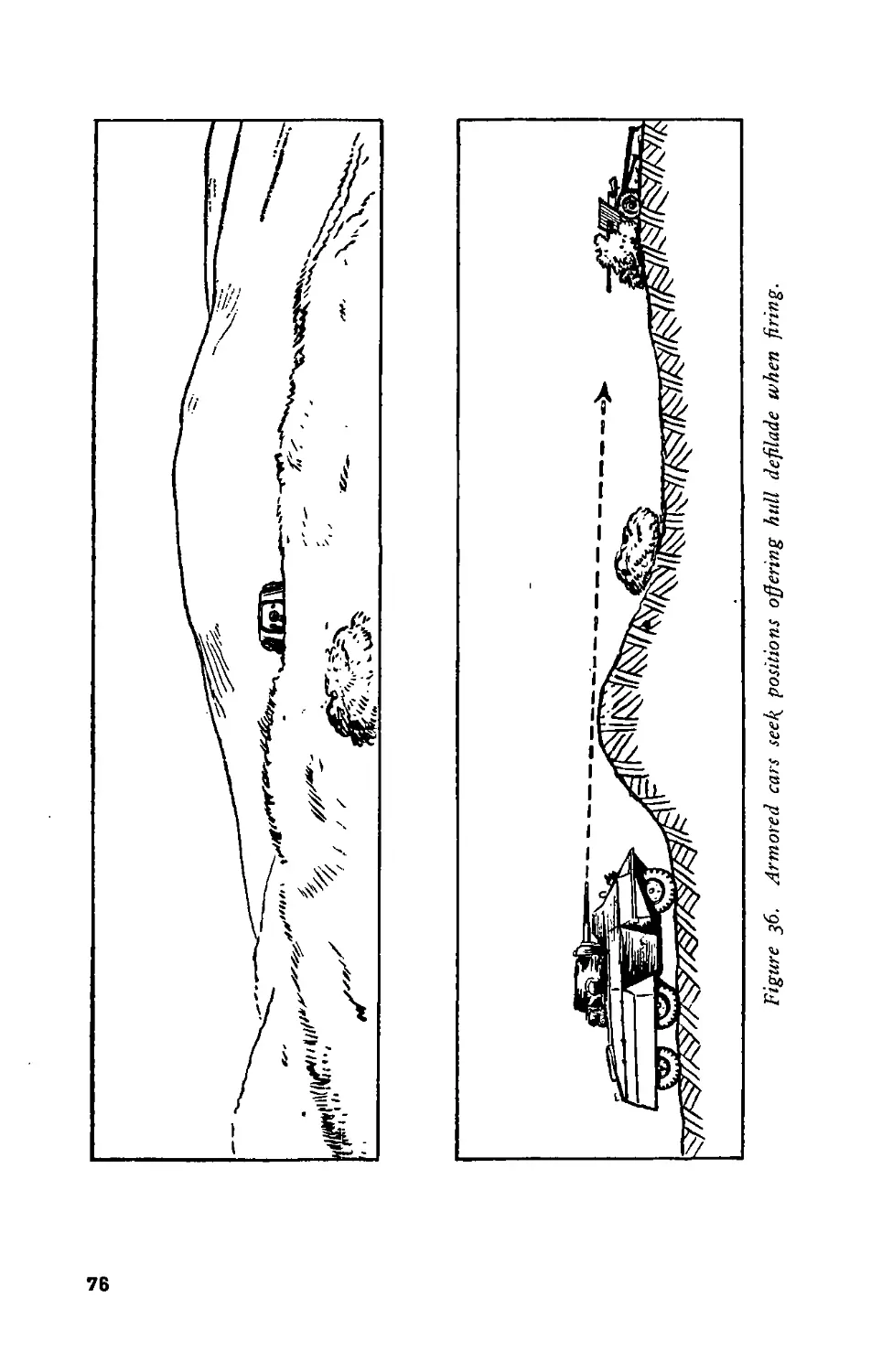
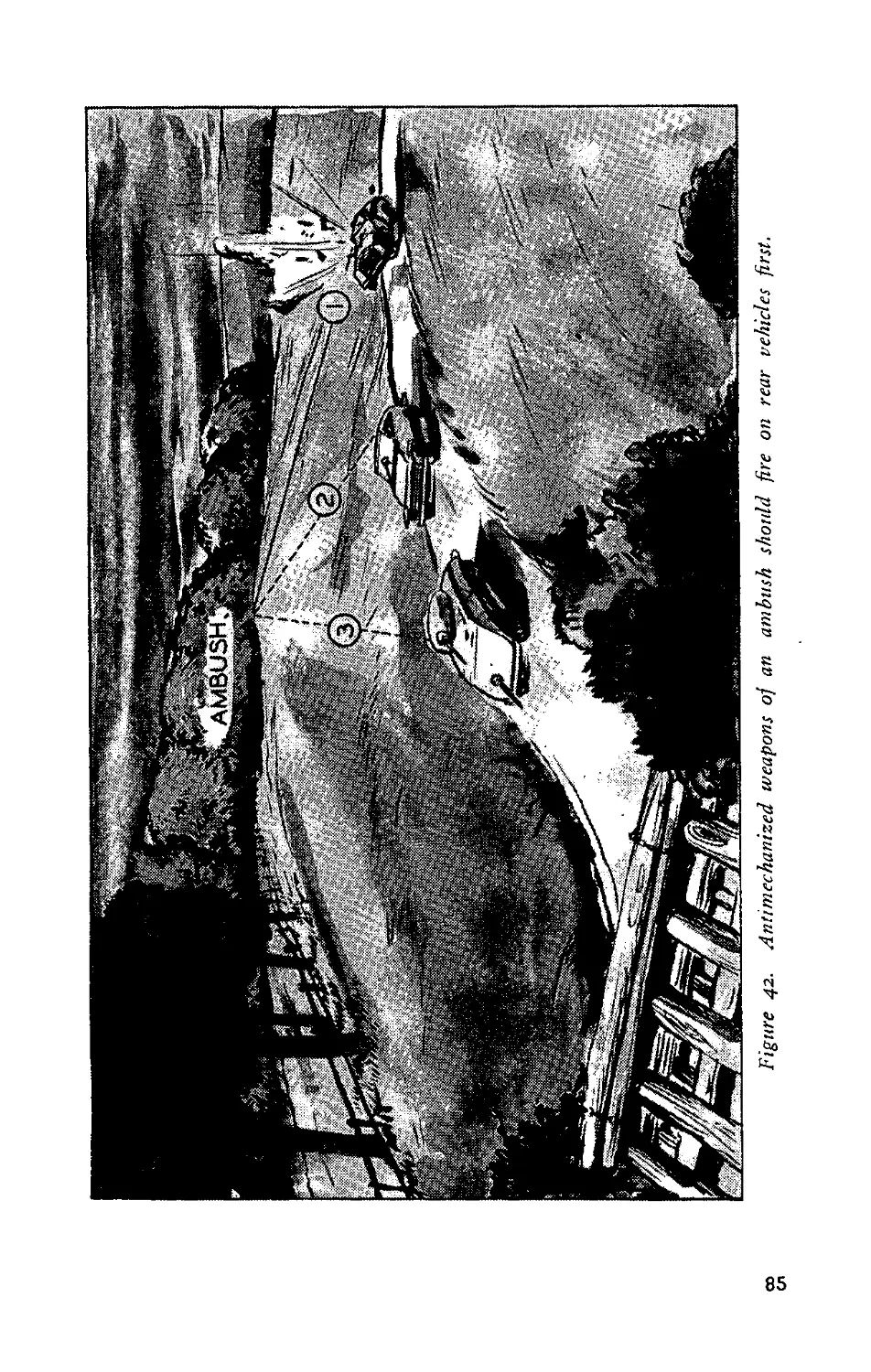



Tags: warfare field manual
Year: 1944


Text
                    MH!
Copy
ж м
&Л R DEPARTMENT FIELD MANUAL
CAVALRY
CAVALRY RECONNAISSANCE TROOP
MECHANIZED
WAR DEPARTMENT
24 FEBRUARY 1944
CHANNON, R. Г.
WAR DEPARTMENT FIELD MANUAL
F M 2-20
This manual supersedes FM 17—20, 30 May 1942
CAVALRY
CAVALRY RECONNAISSANCE
TROOP, MECHANIZED
WAR DEPARTMENT • 2 4 FEBRUARY 1944
United States Government Printing Office
Washington : 1944
For sale by the Superintendent of Documents, U. S. Government Printing Office,
Washington, 25 D. C- - Price 25 cents
WAR DEPARTMENT,
Washington 25, D. C., 24 February 1944.
FM 2-20, Cavalry Field Manual, Cavalry Reconnaissance
Troops, Mechanized, is published for the information and guid-
ance of all concerned.
[A. G. 300.7 (11 Jan. 44).]
By order of the Secretary of War:
 G. C. MARSHALL,
Chief of Staff.
Official:
J. A. ULIO,
Major General,
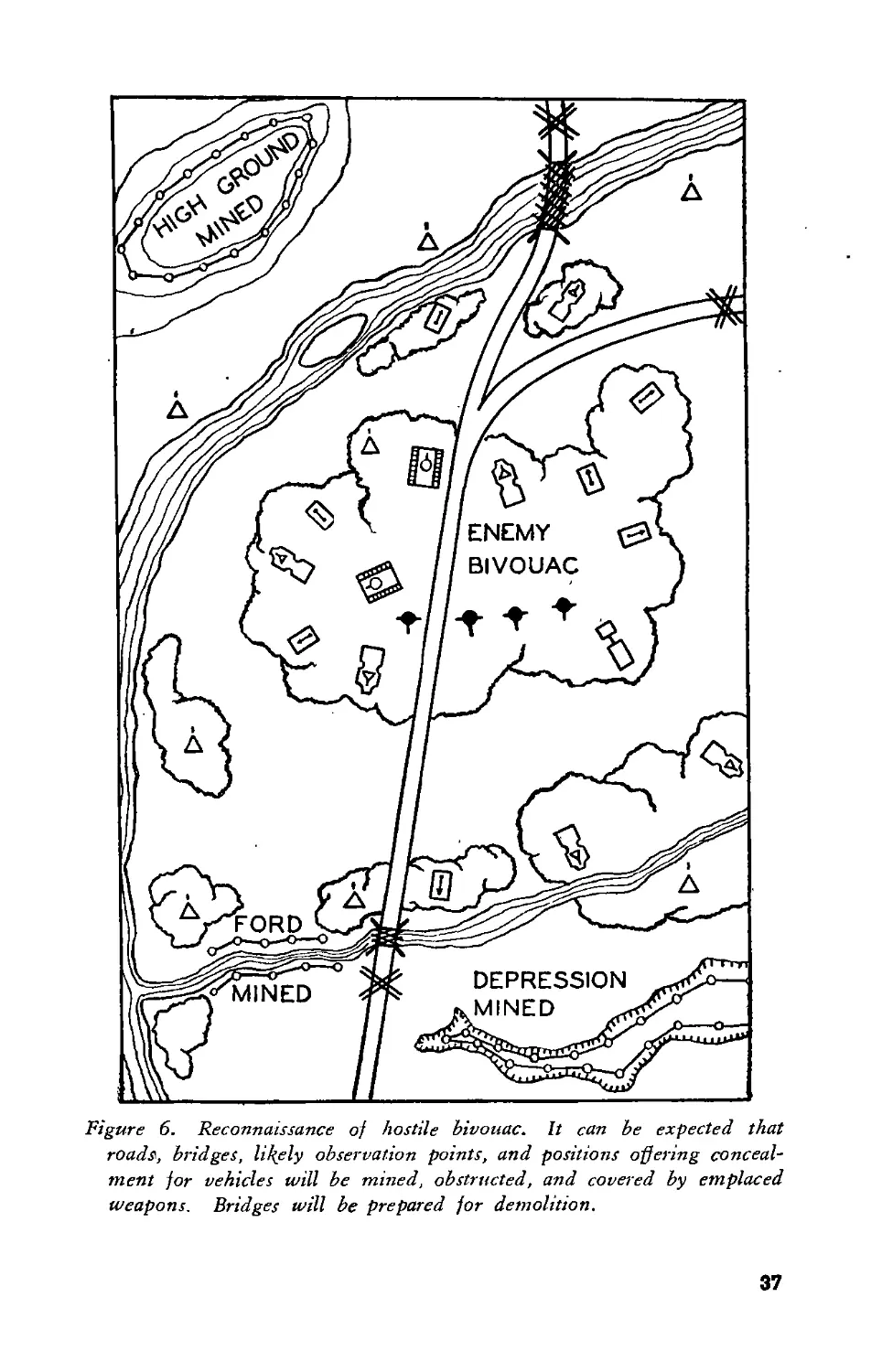
The Adjutant General.
Distribution:
В and H i, 2, 7, 17 (5); R 1, 2, 7, 17, 18 (2); Bn 2, 7, 17,
18 (5); I C 2 (20).
(For explanation of symbols see 21-6.)
Contents
CHAPTER 1. Section I. II.	GENERAL.	Paragraph		Page ]
	Purpose and scope	 Mission		1- 2 3
III.	Organization and equipment		4- 6	2
IV.	Training		7- 9	5
V.	Duties of personnel		IO— 14	IO
VI.	Drill, ceremonies, inspections		15	16
CHAPTER 2. 'Section I.	EMPLOYMENT OF CAVALRY RECON- NAISSANCE TROOP. MECHAN- IZED, INFANTRY DIVISION. General		16- 18	17
11.	Reconnaissance		19- 38	18
111.	Security		39- 47	36
IV.	Combat		48- 55	72
CHAPTER 3. Section I.	EMPLOYMENT OF CAVALRY RECON- NAISSANCE TROOP. MECHAN- IZED, CAVALRY RECONNAIS- SANCE SQUADRON. MECHAN- IZED. General		56- 58	86
II.	Reconnaissance		59- 60	88
III.	Security		61- 66	89
IV.	Combat		67— 68	94
CHAPTER 4.	RIVER CROSSINGS		69- 76	95
CHAPTER 5. Section I.	SIGNAL COMMUNICATION. General		77- 83	102
II.	Means of signal communication		84- 86	104
III.	Training		87- 93	I06
IV.	Miscellaneous		94- 96	112
CHAPTER 6. Section I.	LOGISTICS. Supply		97—106	ИЗ
II.	Vehicular maintenance and evacuation. . .	107-111	119
III.	Medical service for the troop		112-113	121
IV.	Prisoners of war		114	123
V.	Burials		115	124
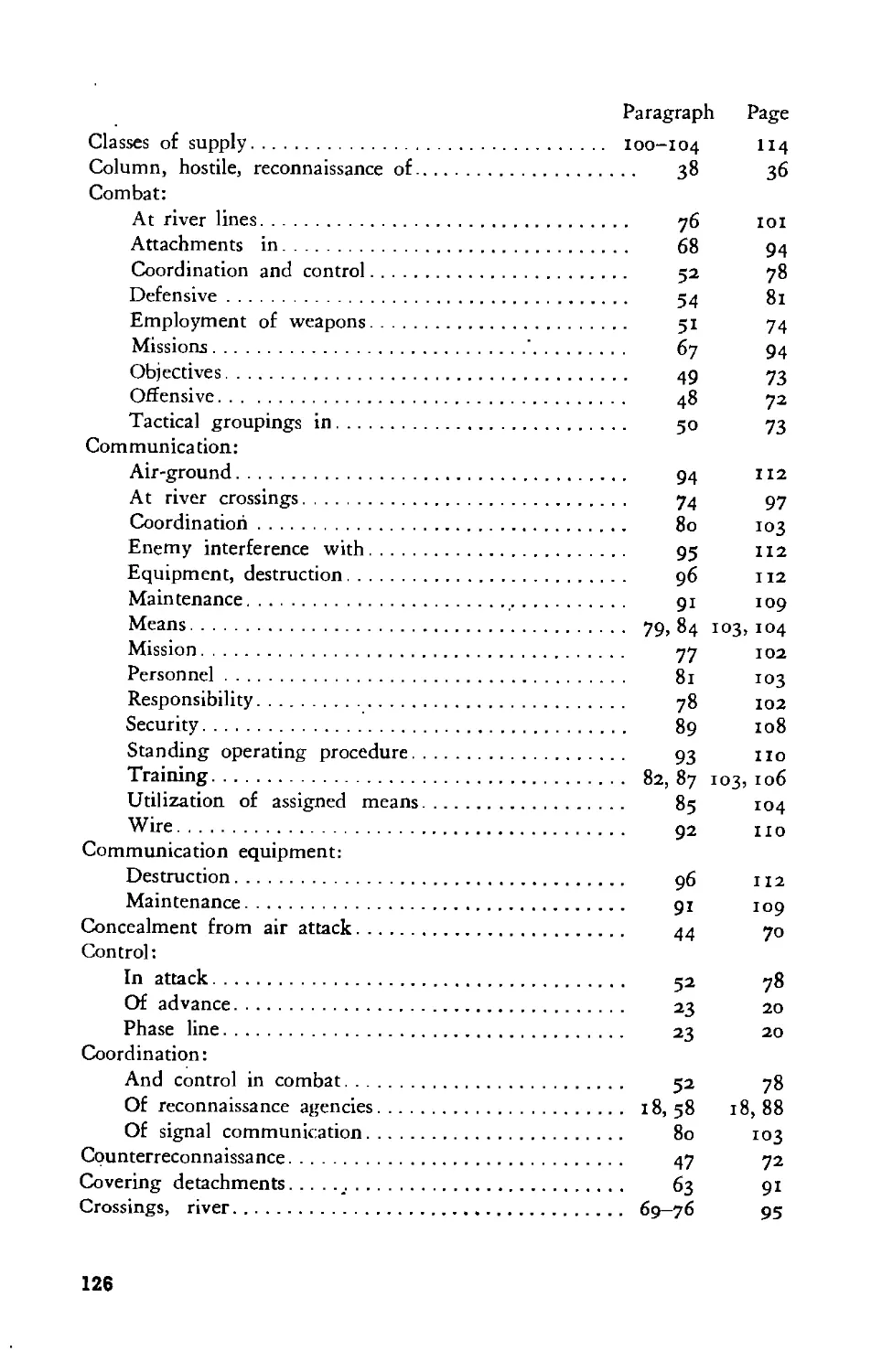
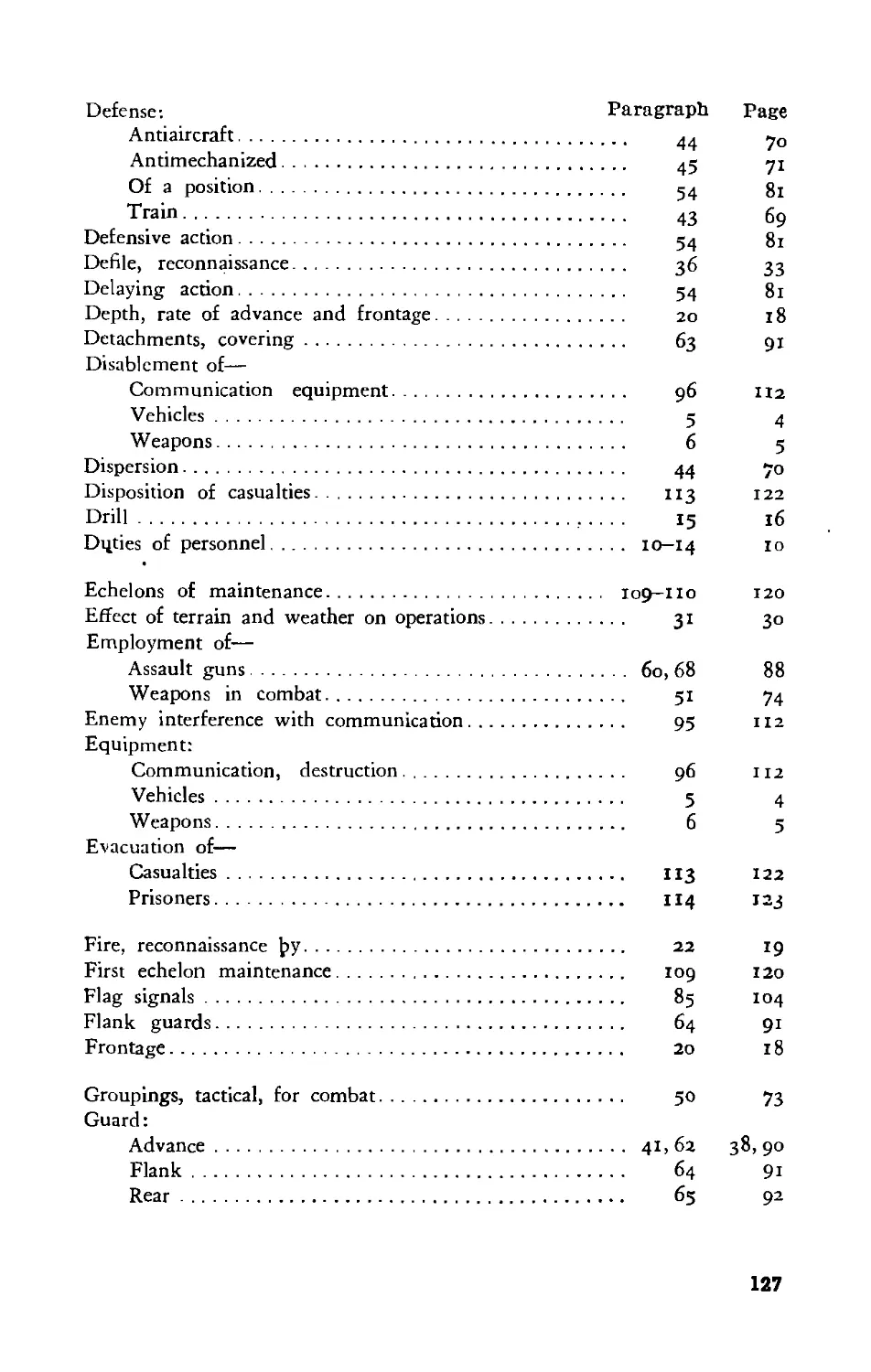
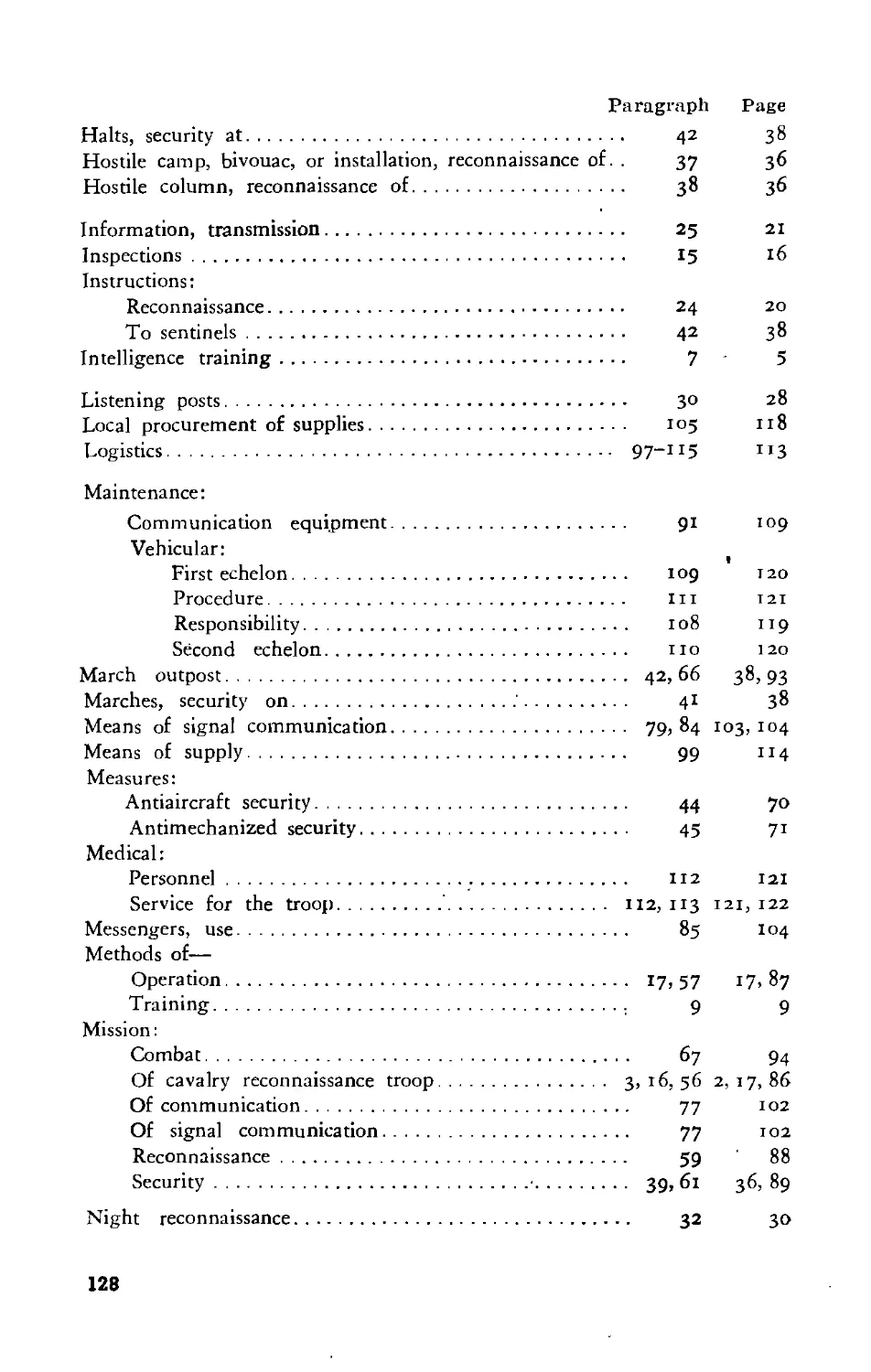
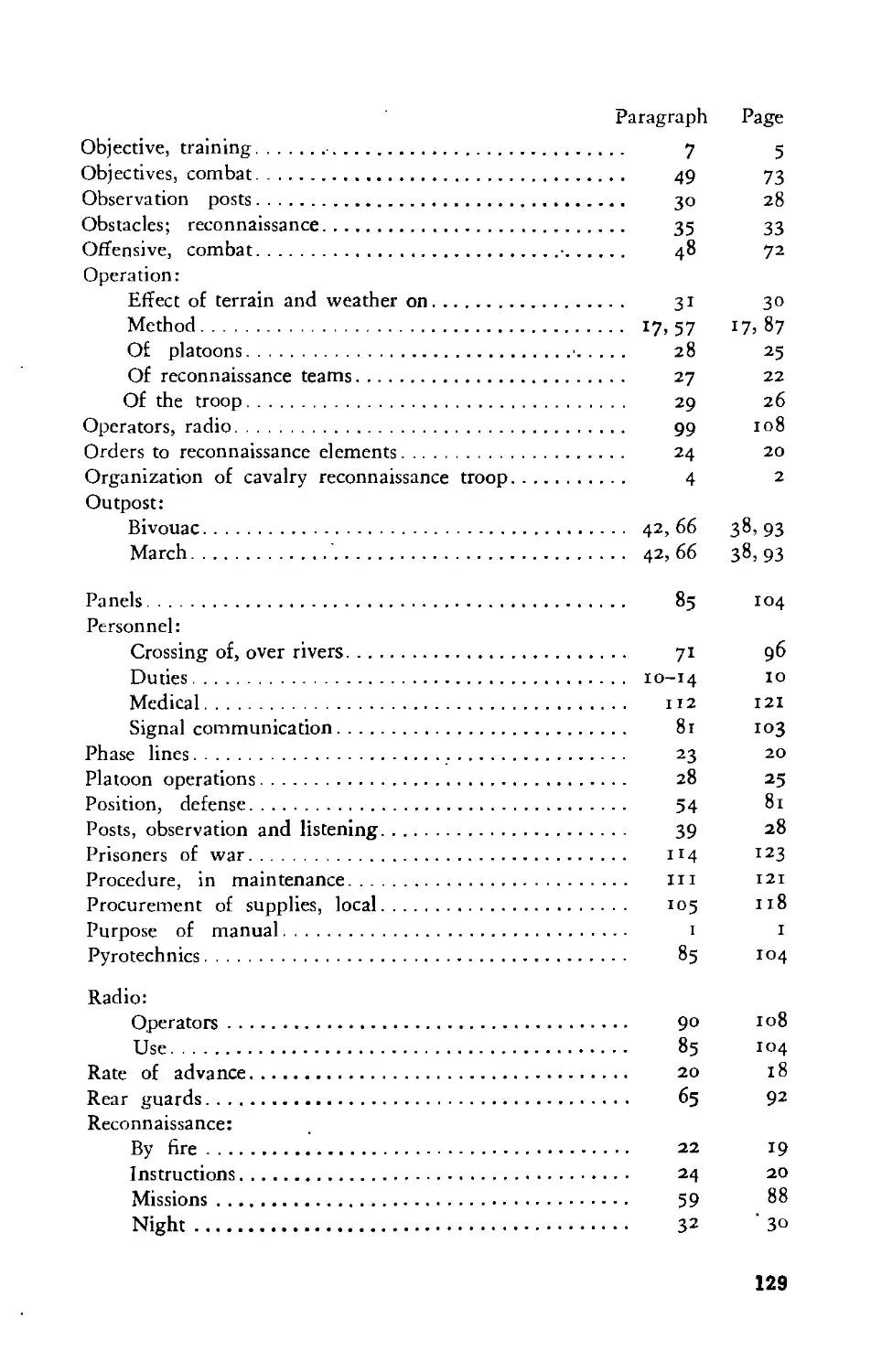
INDEX
125
This manual supersedes FM 17—20, 30 May 19^2,
CHAPTER 1
GENERAL
Section I
Purpose and Scope
1.	PURPOSE. The purpose of this manual is to present the
organization, characteristics, and missions of the cavalry re-
connaissance troop, mechanized; and to set forth doctrine for
its training and tactical employment.
2.	SCOPE. The scope of this manual includes discussion and
illustration of organization, equipment, training, and methods
of employment of the mechanized cavalry reconnaissance troop
and its components, designed to simplify and speed training
and to facilitate understanding of basic doctrine.
1
Section II
Mission
3.	MISSION. The cavalry reconnaissance troop, mechanized,
is organized, equipped, and trained to perform reconnaissance
missions. Other types of missions are given only in the further-
ance of a reconnaissance mission of the troop or the squadron
of which the troop is a part, unless no other troops are available
for other types of operations for the division or other larger
unit. Reconnaissance missions are performed by employment
of infiltration tactics, fire, and maneuver. Combat is engaged
in only to the extent necessary to accomplish the assigned
mission.
Section III
Organization and Equipment
4.	ORGANIZATION, a. For detailed organization and
equipment of the cavalry reconnaissance troop, mechanized,
see current T/O & E 2-27.
b.	The reconnaissance troop, infantry division, is the mobile
reconnaissance agency available to the division commander and
is employed by him to secure details of hostile organization,
strength, and dispositions, the characteristics of terrain, and
other information upon which to base a plan of action. It
operates within the zone of action assigned to the division in
coordination with the ground reconnaissance agencies of higher
and lower echelons.
2
c.	The troop organic within the mechanized cavalry squadron
acts in like capacity and performs the same type of missions as
the reconnaissance troop of the infantry division. The recon-
naissance squadron of the armored division differs from that
of the cavalry division and group in that it includes four
reconnaissance troops instead of three.
d.	The mechanized cavalry reconnaissance troop has a troop
headquarters and three reconnaissance platoons. Each recon-
naissance platoon contains an armored-car section and a scout
section. Armored cars and trucks, %-ton, are included in the
platoon in the ratio of one armored car to two trucks, '/-ton.
This permits flexibility in the organization of reconnaissance
teams for specific missions. Three of the %-ton trucks mount
caliber .30 light machine guns, and each of the remaining
three transports a 60-mm mortar and crew. Three of the
%-ton trucks are provided with short-range radio.
e.	Troop headquarters contains command, maintenance, ad-
ministrative, and supply personnel, and transportation. Ar-
mored cars, each mounting an antitank gun and a light machine
gun, are included for command, maintenance, and liaison
functions. There are %-ton trucks for messenger and traffic-
control duties, half-track personnel carriers to transport essential
supplies and provide maintenance facilities, and a 2 %-ton cargo
truck to provide kitchen facilities. A liaison detachment con-
sisting of an officer and five enlisted men, with an armored
car and a %-ton truck, intended primarily for liaison with
division headquarters, is provided in the cavalry reconnaissance
troop assigned to the infantry division. The reconnaissance
troop of the infantry division has three mechanics, automobile,
for second echelon maintenance, a motor supply corporal, and
an additional half-track vehicle, which are not found in the
reconnaissance troops of mechanized cavalry squadrons.
f.	Each reconnaissance platoon is tactically self-contained. By
attachment of transportation from troop headquarters, two of
the three platoons can operate on detached missions beyond
supporting range of the remainder of the troop.
3
5. TACTICAL VEHICLES. Elements of the mechanized
reconnaissance troop are mounted in various types of wheeled
and half-track vehicles, the characteristics of which must be
appreciated in order to employ the unit effectively. Each
tactical vehicle carries a ground mount for each type of machine
gun mounted in or on the vehicle.
a.	Light armored car, M8. Armored cars are the basic
command and communication vehicles. The light armored
car, M8, is a 6 by 6 vehicle, weighs 16,400 pounds with equip-
ment and crew, and is capable of cruising from too to 250
miles cross country or 200 to 400 miles on highways without
refueling. On a level, improved road, it can sustain a speed
of 55 miles per hour. Each armored car is equipped with a
long-range radio set to assist in the exercise of command or
for the purpose of relaying information received from sub-
ordinate elements to higher headquarters, and a short-range
radio set for communication within a platoon, reconnaissance
team, or headquarters. The armor of the vehicles provides a
fair degree of protection against small-arms fire, while the 37-
mm antitank gun permits mobile defense against lightly ar-
mored vehicles at ranges not exceeding 400 yards when armor-
piercing ammunition is used. The gun also fires canister and
high explosive shell. Each armored car is equipped with one
caliber .30 machine gun, light, for use against personnel. An
antiaircraft machine gun may be added, located so that it can
be fired from the turret. The vehicle is not designed for of-
fensive combat. The car has only fair mobility across country.
Mobility is limited in heavily wooded areas and on broken
terrain. The large turning radius and limited mobility across
country make the car susceptible to ambush on roads and in
defiles.
b.	Truck, %-ton. The 'Л-ton truck is the basic reconnais-
sance vehicle. The dominant characteristics of the '/-ton
truck are low silhouette, speed, and exceptional cross-country
mobility. These characteristics facilitate concealment and ef-
fective use of the minimum amount of cover. It is the cross-
4
country scouting vehicle of the troop; it is not designed for
offensive combat. Equipped with short-range radio, %-ton
truck patrols extend materially the range and effectiveness of
the armored car. During maneuvers, they provide the means
of transporting fire power rapidly and effectively to outflank
resistance.
c.	To disable vehicles. For details of methods to be em-
ployed in the destruction of vehicles which, owing to limita-
tions of time or ।transportation, it will be impossible to evacuate,
see FM 25-10.
6. WEAPONS, a. The types and number of weapons issued
to the personnel of the mechanized reconnaissance troop are
indicated in T/O & E 2-27; details of vehicular armament
are included in current Technical Manuals. Each armored car
is equipped with a 37-mm antitank gun and one caliber .30
light machine gun. Other vehicles are equipped with 60-mm
mortars, caliber .50 (HB) and caliber .30 (light) machine
guns, and antitank rocket launchers. Personnel of the troop
is armed with caliber .30 carbines, caliber .30 rifles, caliber .45
submachine guns, and hand grenades.
b. For characteristics and employment of weapons, see Field
Manual for the weapon concerned.
Section IV
Training
7. OBJECTIVE, a. Purpose. Basic, technical, and tactical
training is conducted to develop—
(l) In the individual, excellent physical condition, discipline,
and high morale; an aggressive spirit; and high standards of
proficiency in the technique of employing weapons and
materiel.
5
(2) In the troop, the ability, through trained leaders, to operate
as an efficient reconnaissance team. Attainment of these ob-
jectives can be realized only by painstaking training of in-
dividuals and the unit.
b. Intelligence training. It is essential that personnel in
all grades appreciate fully the importance of combat intelligence.
The individual must be given a clear, workable understand-
ing of military intelligence and how he can contribute to its
procurement. In addition to training in observation as out-
lined in FM 21-45 and *n reporting information according to
standing operating procedure, train the soldier to observe and
report any information which may be of value. Each com-
mander should receive intelligence training, compatible with
his responsibility, to enable him to determine the importance
of information received, and to report promptly to the
appropriate agency the proper digest of information received.
8. SCOPE, a. Subjects for training are found in MTP 2-2.
Since the primary mission of the troop in combat is recon-
naissance, the following should be emphasized:
(1)	How to observe and how to describe what has been
observed (FM 30-10).
(2)	Ability to move rapidly under all conditions of terrain
and weather, either by vehicle or dismounted (FM 21-45 and
25-ю.)
(3)	How to obtain information by stealth while avoiding
opposition (FM 21-45 and FM 21-75 (when published))..
(4)	Skill in concealment; dismounted as well as mounted
scouting (FM 21-45 and FM 21-75 (when published); TF
7-234, 7-275, and 7-280.)
(5)	A high standard of map and aerial mosiac reading, in-
cluding sketching and knowledge of conventional signs used
by the enemy (FM 21-25, 21-26, 21-45, and 30-22; TF 5-12
and 7-233; TM 30-450 and 30-480.)
(6)	Terrain appreciation. (FM 101-5.)
(7)	Expertness in framing oral and written messages and
reports. (FM 21-45.)
6
(8)	Proficiency in the operation of all weapons (FM 23
series.)
(9)	Skilful operation and efficient maintenance of vehicles.
(FM 25-10; TM 21-300, 31-200, and pertinent Technical
Manuals of the 9 series and the 10 series.)
(10)	Proficiency in the use of expedients in the crossing of
vehicles over unfordable streams by the use of rubber boats,
amphibian vehicles, improvised rafts, or, block and tackle, and
difficult terrain operations. This instruction should include
precautions necessary in order to prevent damage to vehicles
due to immersion. (FM 5-10 and 25-10; ch. 4 of this
manual.)
(11)	Proficiency in radio transmission and radio set mainte-
nance, to include the training of all members of the troop
in some aspects of signal communication. (Ch. 5 of this man-
ual; FM 24-6 and 24-10; TM 11-454, 11-455, and 11-461.)
(12) Identification of enemy uniforms and markings, armored
vehicles, and aircraft. (FM 30 series; TM 30-450 and 30-480.)
(13) Proficiency in the employment of demolitions and road
blocks and in the reduction and removal of road blocks.
(FM 5-20.)
(14)	Proficiency in road and bridge reconnaissance. (FM
5-10-)
(15)	Methods to be employed in destroying organic vehicles
and weapons when such action becomes necessary. (FM 25-10
and appropriate weapons manuals.)
(16)	Proficiency in air-ground communication by panels, pyro-
technics, lights, and radio. (Ch. 5 of this manual.)
(17)	Proficiency in the use of field expedients in the chemical
decontamination of vehicles, arms, and equipment. (TM
3-220; TF 7-275 and 7-280.)
(18)	Familiarity with handling of prisoners. (FM 30-15;
TF 1-674.)
(19)	Familiarity of officers and senior noncommissioned officers
with qualifications and duties of liaison officers. (FM 101-5.)
(20) Elementary navigation; the use of the odometer to register
7
distance from a known point; use of the compass, watch, sun,
and stars to maintain direction;''preparation and maintenance
of a simple strip map. (FM 21-25 and 21-26; TF 7-233.)
(21) Methods to be employed in safeguarding military infor-
mation, reports, and messages; to include signal security and
the preparation of messages for transmission by nonsecret
means. (AR 380-5; FM 30-25; TF n-205, n-324, and
IJ-325-)
(22)	Proficiency in the location, installation, detection, passage,
and removal of mine fields. (FM 5-25.)
(23)	Proficiency in the installation, detection, and removal of
booby traps and warning devices. (TF 5-954.)
(24)	Ability to act as forward observers for artillery. (FM
6~4°-)
b. Upon completion of the initial training phase, individuals
and units must continue to practice their varied duties to
maintain the required degree of proficiency. The goal to be
sought in training is to make members of vehicle crews suffi-
ciently proficient in the duties of other members so that they
may be interchangeable in an emergency.
C. Members of the troop must be able to operate and maintain
themselves for extended periods in cross-country dismounted
operations. For this reason, physical training must receive the
constant attention of all commanders.
d.	Individual training must develop such skill in the technique
of handling weapons and other materiel that correct procedure
is followed habitually. The scope of basic and technical in-
struction of individuals is detailed in MTP 2-2, which may be
used as a general guide.
e.	After basic and technical training of individuals has pro-
gressed sufficiently to permit integration into teams, small unit
tactical exercises should be started. Unit tactical training should
be designed to promote teamwork and leadership in the applica-
tion to combat situations of technique and tactical doctrine.
It is only by combined training of elements that maximum
combat effectiveness of tactical groups can be assured. Tactical
8
proficiency is developed by map and sand table and by exercises
in the field under simulated war conditions. Operations of
mechanized cavalry and reconnaissance aviation are comple-
mentary and every opportunity for operation with aviation must
be taken.
9.	METHODS, a. Training methods will include decentrali-
zation, balanced progressive programs, and applicatory tactical
exercises, in keeping with established training doctrines and
making maximum use of all available training aids. At times,
it may be necessary to centralize training where the number of
trained instructors or the supply of available weapons or other
equipment is limited.
b.	The troop commander is responsible for the training of his
unit. However, he should delegate specific duties and respon-
sibilities to subordinate leaders. .He will further the training
of such leaders in command and leadership concurrent with
individual and collective training.
c.	Each training phase must occur in logical sequence, and
each subject must be developed through easily understood
words and methods so that each individual receives a secure
foundation from which to proceed to more advanced require-
ments. Experience has shown repetition of the application
phase to be desirable, if time and facilities permit. Subsequent
to the attainment of the desired proficiency, training in any
subject must be repeated to insure maintenance of satisfactory
standards.
d.	Full use should be made of Training Films, Film Strips,
and other training aids. For a complete list of publications for
training, including Film Strips and Training Films, see FM
21-6 and 21-7.
9
Section V
Duties of Personnel
10.	HEADQUARTERS SECTION, a. Troop commander.
The troop commander is responsible for the training, adminis-
tration, maintenance, supply, and employment of the troop.
In combat, he assigns missions to platoons, supervises their
operations, and maintains control of and communication with
them. The troop commander of the infantry division recon-
naissance troop may remain for short periods at the division
command post in his capacity of special staff officer.
b.	Troop executive officer. ( r ) The executive officer, who
also is motor officer, accompanies the forward echelon. As
second in command, he assumes the duties of the troop com-
mander in the latter’s absence. He is in charge of the com-
munication net; his car contains the message center. He
supervises the training and operation of the headquarters sec-
tion, except for the liaison and communication detachment
in the cavalry reconnaissance troop of the infantry division.
(2) As troop motor officer, he supervises the training and work
of troop mechanics and the training of drivers. He makes
frequent inspections of the motor vehicles and advises the
troop commander on matters pertaining to vehicle maintenance
and supply. He requisitions spare parts and controls their
distribution. (FM 25-10.)
c.	Liaison and communications officer. Liaison between
the infantry division reconnaissance troop and division head-
quarters is effected by the liaison and communication detach-
ment, consisting of an officer with vehicles and crews. The
troop liaison officer at division headquarters assists in the trans-
mission of information and informs the troop commander of
changes in plans or operation of the division. The liaison
officer should accompany the troop commander when the latter
visits division headquarters in order that he may have full
10
knowledge of the situation and the projected employment of
the troop. He is responsible for the training of the personnel
of his own section and of the communications personnel of
the troop. Duties of the liaison officer are covered in FM 101-5.
d.	Communication chief. The communication chief assists
the liaison and communications officer of the infantry division
reconnaissance troop in training communication personnel. He
will perform similar duties under the supervision of the troop
officers designated as communications officers in reconnaissance
troops of mechanized cavalry squadrons, wherein no commu-
nications officers are provided specifically by Tables of Organi-
zation. In the field, he assists the executive officer in super-
vision of communication personnel and in establishing the
troop command post, and assumes delegated responsibility for
encoding and decoding of messages. He rides in the troop
commander’s car, but may be shifted when needed to the
executive officer’s vehicle.
e.	Liaison agents. Liaison agents perform messenger and
liaison functions. They ride in %-ton trucks. They must
be thoroughly trained in map reading and in movement with-
out benefit of maps.
f.	Bugler. The bugler sounds calls, and serves as a messenger.
He drives a %-ton truck.
g.	Drivers. Drivers operate vehicles as assigned, perform
first echelon maintenance, and must be capable of replacing
gunners or radio operators. For training of drivers, see FM
25-10, TM 21-300, and TM 21-301.
h.	Radio operators. Radio operators operate and maintain
radio sets installed in the vehicles in which they ride. (For
training, of radio operators see ch. 5.) They assist in en-
cryptographing and decryptographing messages, and act as
assistant gunners or relief drivers.
11.	ADMINISTRATIVE, SUPPLY, AND MESS SECTION,
a. First sergeant. The first sergeant assists the troop com-
mander in administration of the troop. He is in immediate
charge of the enlisted personnel and records of the troop.
11
When the troop is in action, he assists the executive officer in
establishing the troop command post and supervising the ac-
tivities of the forward echelon. He maintains a record of all
combat orders and messages.
b. Mess sergeant. The mess sergeant is in charge of the
troop mess under the supervision of an officer designated by
the troop commander as mess officer. The executive officer is
mess officer in the field, but in training this duty may be
rotated among officers of the troop. The mess sergeant super-
vises training and operations of cooks, cooks’ helpers, and
kitchen police. He is responsible for estimating ration needs
and providing the first sergeant with the information required
to complete the ration section of the mo’rning report. In com-
bat or active reconnaissance operations, the mess sergeant estab-
lishes the kitchen at the rear echelon, but assists the mess officer
by going wherever required to assure that the troop is fed
efficiently. He rides in the kitchen truck.
C. Supply sergeant. The supply sergeant obtains and de-
livers supplies and is responsible for troop property and records.
He commands the troop train and supervises plans for re-
supply, movement and distribution of supplies, to include
arrangements for traffic control, guides, train security, and ren-
dezvous points. He prepares daily strength and expenditure
reports for passes I, III, and V supplies. He is responsible for
training and supervising ammunition agents, motor supply
corporal, and armorers. He rides in a %-ton truck with the
service element of the troop.
d.	Ammunition agents. Ammunition agents are assistants
of the supply sergeant. They keep posted at all times on the
status of ammunition supply, and prepare ammunition expendi-
ture reports. They help the supply sergeant to distribute am-
munition to the troop.
e.	Troop clerk. The troop clerk is the first sergeant’s assist-
ant and performs duties pertaining to the administration of
the troop. In addition, he must be skilled in both mounted
12
and dismounted scouting and patrolling, map reading, duties
of messenger, traffic control, and duties of guide.
f.	Cooks. Cooks prepare and deliver meals under the super-
vision of the mess sergeant. They must be capable of acting
as relief drivers and aiding in defense in the troop rear echelon.
g.	Ammunition handlers. Ammunition handlers assist
the ammunition agents and drivers in loading and unloading
ammunition and other supplies carried in half-track vehicles of
the troop train in which they ride. They also are responsible
for operating machine guns mounted on vehicles.
h.	Basic privates. Basic privates are provided in Tables of
Organization for replacement of personnel absent, sick, in
confinement, or for other routine reasons. Some should be
trained in the duties of each position filled by privates first
class or privates.	i
t
i
12.	MAINTENANCE SECTION. a. Motor sergeant.
The motor sergeant is the principal assistant of the motor offi-
cer. He is in direct charge of the mechanics.
b.	Mechanic chief. The mechanic chief must be able to or-
ganize and direct a maintenance team. He must be able to
detect and diagnose mechanical difficulties in vehicles and
initiate and supervise repair. He supervises the operations of
the troop mechanics in the recovery and repair of damaged
vehicles and such other work as may be assigned by the motor
sergeant. He rides in a vehicle of the maintenance section.
c.	Car commanders. Car commanders command the cars
in which they ride and supervise training and operations of
enlisted personnel; they assure march discipline and first echelon
maintenance. When in command of an armored car, the car
commander assists the gunner by loading the 37-mm gun and
machine gun; if provided with an antiaircraft gun, he is
responsible for operation of the weapon. He must be trained
as an alternate driver, gunner, and radio operator.
d.	Motor supply corporal. The motor supply corporal
assists the motor maintenance sergeant in the performance of
570673”—44-
-2
13
his duties and advises him in matters pertaining to motor
vehicle supply. He assists in the supervision of the operations
of the motor maintenance section personnel; knows at all
times the status of motor supplies, and cooperates under the
maintenance sergeant with the troop supply sergeant in requisi-
tioning, obtaining, and distributing gasoline, oil, lubricants,
spare parts, and maintenance equipment. He rides in one of
the vehicles of the motor maintenance section.
e.	Armorers. Armorers repair the troop weapons and estab-
lish and operate the machine-gun belt-filling station. In addi-
tion, they must be skilled in both mounted and dismounted
scouting and patrolling, map reading, acting as messenger,
traffic control, and the duties of a guide.
f.	Mechanics. Mechanics, assisted by vehicle drivers, per-
form second echelon maintenance for troop motor transporta-
tion (par. 108). In the reconnaissance troop of the infantry
division, three mechanics are provided in addition to those
authorized for other cavalry reconnaissance troops. This per-
sonnel with its additional tool sets makes possible the per-
formance of second echelon maintenance which, in troops of
the cavalry reconnaissance squadron, would be performed by
squadron maintenance personnel. Mechanics must be capable
of operating vehicular weapons and voice radio.
g.	Radio repairman. The radio repairman is responsible
for the maintenance of troop radios under the supervision of
the communication sergeant. He assists the communication
officer and communication sergeant in the training of all radio
operators in preventive and scheduled maintenance. He drives
a vehicle of the maintenance section.
13.	ARMORED-CAR SECTION. a. Platoon leader.
The platoon leader commands and trains the personnel of the
platoon as individuals and as a unit, and executes tactical
missions directed by the troop commander. He is responsible
for first echelon maintenance of motor vehicles in his platoon.
He supervises operations and missions of the elements of his
platoon. He takes position where he can best control the action
14
of his unit. When the platoon is on reconnaissance, he rides
well forward in the platoon formation. If moving cross-
country in a deployed formation, he will be located centrally
between the forward security detachment and the remainder
of the platoon.
b. Platoon sergeant. The platoon sergeant assists the pla-
toon leader and commands the platoon in his absence. He
rides or goes where he best can assist in the control of the
platoon or an element thereof. When on reconnaissance or
moving as a platoon, the platoon sergeant rides near the rear
of the column. When the platoon subdivides into reconnais-
sance teams, he leads a team.
14.	SCOUT SECTION, a. Section leader. The section
sergeant has the duties of car commander of the vehicle in
which he rides. He commands the scout section and is
responsible, under the supervision of the platoon leader and
platoon sergeant, for the training and operations of its per-
sonnel. He may be detached as commander of a security
detachment or patrol.
b. Squad leaders. The squad leader is the car commander
of the vehicle in which he rides. He may be the second in
command within a reconnaissance team. He assists the team
leader in supervising and controlling operations of personnel
of the team, and the operation and maintenance of vehicles
and equipment. He assumes command in the event that the
team leader becomes a casualty.
C. Gunners. Gunners are responsible for the care, cleaning,
functioning, and firing of the guns of their respective vehicles.
(See appropriate Field Manuals of the 23 series.) When in an
armored car provided with an antiaircraft machine gun, the
gunner will assist the car commander in the operation of the
antiaircraft weapon by traversing the turret. They must be
capable of replacing drivers and radio operators.
d. Riflemen. Riflemen, together with section and squad
leaders, all of whom ride in the %-ton trucks of the scout
sections, may be used to form parties for dismounted scouting,
15
patrolling, or combat. In addition, they act as radio tenders
and machine gunners or relief drivers. Their training must
emphasize dismounted operations.
Section VI
Drill, Ceremonies, Inspections
15. DRILL, CEREMONIES, AND INSPECTIONS, a.
The procedures, formations, and movements for dismounted
drill, ceremonies, and inspections follow those prescribed in
FM 22-5.
b. Mounted drills and ceremonies are conducted as prescribed
in FM 2-7 (when published).
16
CHAPTER 2
EMPLOYMENT OF CAVALRY
RECONNAISSANCE TROOP, MECHANIZED,
INFANTRY DIVISION
Section I
General
16* MISSION. The cavalry reconnaissance troop, mechanized,
infantry division, is organized, equipped, and trained to per-
form reconnaissance missions. It is the mobile reconnaissance
element available to the division commander. The troop per-
forms close and battle reconnaissance within zones or areas, or
along designated routes or axes. It performs distant recon-
naissance exceptionally.
17.	METHOD OF OPERATION. The troop employs infiltra-
tion tactics, fire, and maneuver to accomplish reconnaissance
missions. It engages in combat only to the extent necessary
17
to accomplish the assigned mission and to avoid destruction
or capture. The troop should be reinforced before departing
on a mission when sustained combat or the crossing of obstacles
is anticipated. Infantry, field artillery, tanks, tank destroyers,
and engineers are suitable attachments.
18.	COORDINATION. Reconnaissance aviation furnishes
higher commanders with information of large enemy concen-
trations and movements. The employment of the reconnais-
sance troop is based on this information and information
received from other sources. The operation of the reconnais-
sance troop is coordinated with nondivisional reconnaissance
agencies and with the reconnaissance elements'of divisional
infantry, field artillery, engineers, tank destroyer, and other
attached units.
Section II
Reconnaissance
19.	GENERAL. The troop is employed to gain timely informa-
tion upon which the division may base decisions and plans.
Contract is gained with large enemy forces at the earliest prac-
ticable moment and maintained thereafter. The troop seeks
to identify hostile units and to determine their strength, com-
position, disposition, and movement. Terrain features and con-
ditions which may affect operations are reported in addition to
information of the enemy.
20.	DEPTH. RATE OF ADVANCE. AND FRONTAGE, a.
The time interval by which the reconnaissance troop precedes
the division in an advance must be determined in each instance.
Visibility, terrain, anticipated enemy contact, nature of infor-
mation sought, and other factors which affect the rate of
advance are considered.
18
b. The reconnaissance troop can march from 150 to 200 miles
daily on good roads at a rate of 35 miles per hour. When
engaged in active reconnaissance, units can advance at a rate
of 10 miles per hour on open terrain under favorable condi-
tions. Unfavorable conditions may reduce the rate to that
of dismounted reconnaissance.
C. The troop can reconnoiter a zone 10 miles wide with
one platoon in support initially (par. 29).
21.	ROUTES. ZONES, AND AREAS, a. To avoid dupli-
cation of effort and to facilitate control, a zone, area, axis,
or route is assigned to each reconnaissance unit. Boundaries
are designated to fix responsibility. They do not prohibit
maneuver by units in adjacent zones or areas. The division
commander assigns an area or zone of responsibility to the
troop and informs all other reconnaissance agencies within
the division.
b. Reconnaissance of a route is prescribed when it is desired
to determine whether or not a particular route is being
used by the enemy or is practicable for use by elements of
the division.
C. Reconnaissance of a zone is performed in front of the divi-
sion when it advances. The troop must be aggressive so that
the division is not delayed. However, the reconnaissance troop
must be allowed adequate time. The more detailed the in-
formation desired, the more time must be allowed.	>
d. Reconnaissance of an area is performed to search for in-
formation in a definite locality. Other elements of the divi-
sion may or may not advance into or through the area.
22.	RECONNAISSANCE BY FIRE. Fire on a suspected
enemy position may cause the enemy to disclose his presence
by movement or by returning fire. This method is employed
at the risk of disclosing the presence of the reconnaissance
unit.
19
23.	CONTROL, a. An axis may be prescribed to control
direction of advance of reconnaissance units. Phase lines and
objectives may be designated to control rate of advance, or
the distance to be covered in a period of time may be pre-
scribed. Phase lines should be roads, railroads, towns, or
prominent terrain features.
b. Radio provides the principal means of controlling and di-
recting reconnaissance elements. Flags and arm-and-hand sig-
nals may be employed where practicable. (See FM 2-7 (when
published).) Vehicular or dismounted messengers may be
used to transmit messages, maps, sketches, or overlays. Radio
silence may necessitate the use of messengers for all com-
munication. Lateral communication between reconnaissance
elements is maintained by radio or messenger. Lateral con-
tact is established where practicable on phase lines and at
designated objectives.
C. Assembly points are designated so that elements can re-
organize if dispersed. A new assembly point is announced
at each halt. The position selected should permit dispersion
of vehicles and should afford concealment and defilade.
24.	ORDERS AND RECONNAISSANCE INSTRUC-
TIONS. a. The reconnaissance mission is assigned to the troop
as a unit. Each mission is given a priority when more than
one is assigned. The troop commander allots tasks and co-
ordinates operations of platoons.
b. Missions must be specific. If they are not, commanders re-
quest clarification. Instructions to all echelons must be com-
plete and must include exactly what information is to be
secured; where the information is to be sought; and when the
mission is to be executed. Essential details include—
(1)	Pertinent information of the enemy and friendly troops.
(2)	Plan of operation of the division commander.
(3)	Specific information desired.
(4)	Zone, area, route, or axis.
(5)	When, where, and how information is to be reported to
the higher commander.
20
(6)	Time of departure.
(7)	Phase lines, when desirable, and objectives, and the time
they are to be reached.
(8)	Expected duration of mission.
C. Whenever possible, platoon and team leaders are assembled
for initial orders to insure that measures for mutual support
and for cooperation with other troops are understood. Ob-
jectives and routes are indicated graphically by the troop
commander on the best map or map substitute available and
are copied by platoon and reconnaissance team leaders. After
active reconnaissance has started, orders to platoon and team
commanders are disseminated by radio, messenger, or by the
troop commander or executive officer in person.
25. TRANSMISSION OF INFORMATION. Transmission
of information is facilitated by standing operating procedure.
This procedure establishes priorities which apply in the ab-
sence of specific instructions. The use of standing operating
procedure simplifies orders and facilitates the transmission of
essential information. Items of information which should be
assigned priorities are—
a.	Location and time of each enemy contact, giving strength,
composition, and direction of movement of hostile forces.
First contact with the enemy is especially important.
b.	Number, type, location, direction, and speed of movement
of enemy armored vehicles, airborne troops, naval combat, and
landing forces.
C. Identification of enemy units.
d.	Number, type, location, and direction of flight of hostile
aircrafts.
e.	Condition and type of routes and bridges.
f.	Location of mine fields, other obstacles, and contaminated
areas, and routes by which they may be avoided.
q.	Terrain features and conditions which may affect opera-
tions.
h. Location and movement of friendly troops.
i. Location of supplies.
21
26. REPORTS. Teams (par. 27) and platoons on reconnais-
sance report factual information. Reports are relayed by radio
or messenger to higher headquarters. The troop commander
may enter a platoon radio net to intercept messages or secure
more detailed information. A log is maintained by platoon
and troops commanders to record data upon which to base
reports. When information is transmitted on marked maps
or sketches, conventional signs and symbols should be used.
(FM 21-30.)
27. OPERATION OF RECONNAISSANCE TEAMS, a.
Reconnaissance teams composed of armored cars and %-ton
trucks operate under platoon control; exceptionally, teams
detached to occupy observation posts (par. 30) may operate
under troop control. Teams move across country wherever
practicable when enemy forces are believed to be near. Roads
are covered by observation unless their detailed reconnaissance
is included in the mission (par. 33). Echelons of a team
move by bounds (fig. 1), utilizing available cover and conceal-
ment. The leading echelon, a %-ton truck or trucks, moves
to successive observation points along a route or axis of advance.
The team leader rides in the second echelon! directing the
advance of the team and following the leading echelon to
successive bounds as they are secured. Additional %-ton trucks
are utilized to reconnoiter between bounds or to the flanks.
Figure 2 shows methods of operation of a team composed of
one armored car and two %-ton trucks.
b. Terrain and the situation may require the use of dis-
mounted patrols (FM 21-75 (when published)) or reconnais-
sance by fire to supplement observation. Guns on armored
cars, mortars, and automatic weapons support the movement
of %-ton trucks and dismounted men. Areas favorable for the
use of mines are examined prior to committing the bulk of
the patrol (par. 35).
C. Reconnaissance teams attempt to secure observation points
from which enemy forces can be observed (par. 30). Contact
is maintained with enemy forces the size of a company or
22

Figure i. Reconnaissance elements advance by bounds. Each vehicle
(2) covers the advance of the vehicle immediately preceding (1).
23
Figure 2. A reconnaissance team operating under varying conditions of observations. A team may be
composed of three, four, five, or six vehicles.
larger pending instructions from the platoon leader. Enemy
patrols are reported and avoided if practicable.
d. Moving vehicles take cover when fired upon; those not in
motion support by fire. Dismounted personnel reconnoiter to
determine the enemy’s strength and dispositions and to discover
routes by which the enemy position can be bypassed. Dis-
mounted reconnaissance parties are covered by the fire of suit-
able weapons. A report is made to the platoon leader who
directs subsequent action. If the enemy withdraws, the team
continues on its mission.
e. When the team is attacked by a small enemy patrol, it may
defend,to hold an observation point, bridge, or defile in order
to accomplish reconnaissance missions. When attacked by a
large force, the team conducts a delaying action to secure
freedom of movement for an advance in a new direction in
order to continue on the assigned mission. A report is made
to the platoon leader, who directs subsequent action.
28. OPERATION OF PLATOONS, a. The platoon is the
basic reconnaissance unit. It is organized to operate under
troop control within a designated zone or area, or along a
prescribed route or axis. The frontage for a platoon recon-
noitering a zone should not exceed 4 miles. The number of
reconnaissance teams formed and their composition depend
upon the frontage assigned, routes available to the enemy,
terrain, and the rate of advance required. Three reconnaissance
teams are considered the maximum number which can be
formed within a platoon. Teams are composed of armored
cars and %-ton trucks where conditions are favorable. Condi-
tions may necessitate the formation of teams composed of one
type of vehicle only or the platoon may operate without
vehicles. The platoon leader should retain a support initially.
b. Platoon leaders control teams by voice radio, supplemented
by visual signals and messengers when practicable. When
control is difficult, movement is regulated by prescribing objec-
tives or phase lines (par. 23).
25
C. When an element of the platoon reports contact with the
enemy, the platoon leader estimates the capabilities of the
enemy force. He confirms reports of large enemy forces by
personal reconnaissance. Enemy strength may necessitate a
change in plan to accomplish the platoon mission. The platoon
leader reports the situation to the troop commander and states
his plan of action.
d. The platoon avoids enemy patrols. Elements of the pla-
toon maneuver to unopposed routes and continue on the
mission. It may be necessary to pin the enemy by fire to
permit maneuver. Movement of the platoon in bypassing an
enemy patrol may be limited to a single route. When an
enemy force the size of a company or larger is encountered,
the platoon maintains contact pending instructions from the
troop commander.
e. The platoon is the smallest unit to initiate an attack. When
it becomes necessary to engage in combat with an enemy force
which threatens the success of the mission, the platoon attacks.
Surprise, speed, and coordination are essential. The enemy
force is located accurately. Vehicles are used for maneuver
where practicable. When reconnaissance indicates enemy
strength beyond the capabilities of the platoon, reinforcement
by other elements of the troop is requested before an attack
is initiated.
29. OPERATION OF THE TROOPS, a. The reconnais-
sance troop is organized to operate as a unit under division
control. The troop commander receives reports from platoons
and relays information to division headquarters. The troop
liaison officer at division headquarters assists in the transmis-
sion of information and informs the troops commander of
changes in plans or operations of the division.
b.	Reconnaissance troops of infantry divisions supplement the
operations of corps reconnaissance elements. The corps com-
mander assigns areas or zones of responsibility to divisions
and to corps. Within division, areas or zones assigned by the
corps commander, reconnaissance troops may be assigned recon-
26
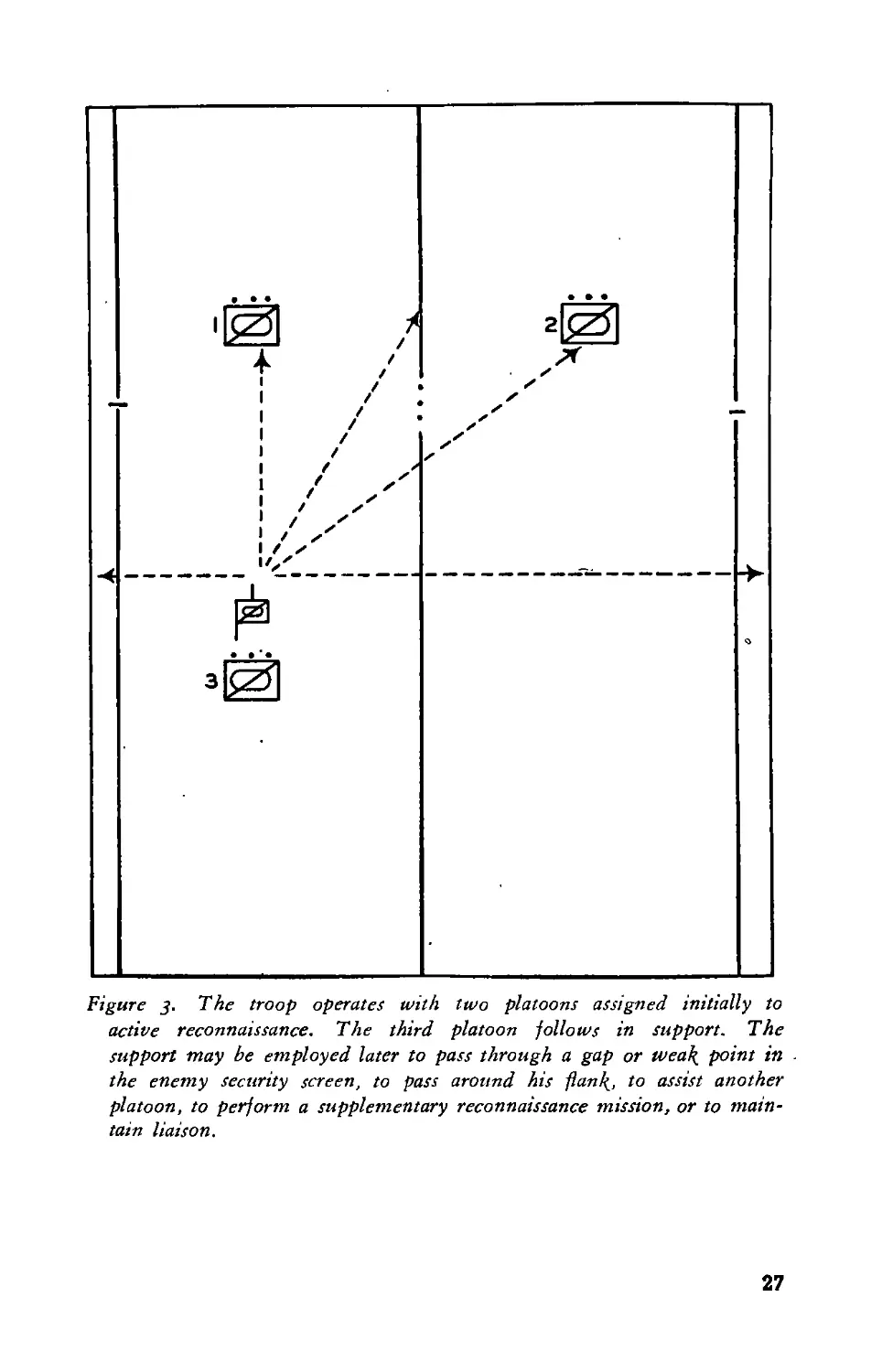
Figure 3. The troop operates with two platoons assigned initially to
active reconnaissance. The third platoon follows in support. The
support may be employed later to pass through a gap or tvea\ point in
the enemy security screen, to pass around his flanl^, to assist another
platoon, to perform a supplementary reconnaissance mission, or to main-
tain liaison.
21
naissance missions or liaison responsibilities. The troop of a
flank division may operate toward an exposed flank. It will
be desirable frequently for a troop to attach a liaison detail
to the corps reconnaissance unit.
c.	The troops can reconnoiter a zone io miles wide with one
platoon in support. Reconnaissance is conducted to the divi-
sion front before opposing forces close. When the width of
the division zone exceeds the capabilities of the troop, the re-
sponsibility for reconnaissance in part of the zone is assigned
to other units or the troop is reinforced. The troop commander
prescribes platoon zones, areas, routes, or axes (par. 21).
d.	The troop operates with two platoons assigned initially to
active reconnaissance (fig. 3). The third platoon follows in
support. The support may be employed later to pass through
a gap or weak point in the enemy’s security screen, to pass
around his flank, to assist another platoon, to perform a sup-
plementary reconnaissance mission, or to maintain liaison.
,e. Platoons are controlled by voice or CW radio supplemented
by vehicular messengers. Movement is regulated by pre-
scribing objectives or phase lines. The location or axis of
advance of troop headquarters must be known by all elements
of the troop.
f.	Active reconnaissance missions should be rotated so that
platoons have opportunity for maintenance and rest.
q. The troop reports all contact with, enemy forces to division
headquarters. Information of enemy forces is transmitted also
to units whose security is threatened. The troop commander
maneuvers his support to avoid enemy patrols reported by
platoons.
h. It may be desirable to relieve reconnaissance units when
opposing forces close. Division reconnaissance troops then may
be employed on reconnaissance missions toward an exposed
flank, may be used to maintain liaison with adjacent units,
or may be placed in reserve.
i. The troop may be employed without vehicles to conduct
battle reconnaissance and to operate over terrain impassable to
28
motor vehicles. When reconnoitering without vehicles, the
troop employs dismounted patrols, observation posts, and listen-
ing posts. Vehicles may be left in rear divisional areas or con-
cealed in forward areas ready for immediate use. For dis-
mounted patrolling see FM 21-75 (when published).
30. OBSERVATION AND LISTENING POSTS, a.
Observation posts are established to observe movement of
enemy troops or activity in enemy installations. Listening
posts are occupied to detect enemy movement or activity when
visibility is limited. Localities for observation and listening
posts are chosen after careful map study when terrain recon-
naissance is impracticable. The actual site is selected on the
ground, located on a map, and reported to commanders.
Locations of observation and listening posts are plotted ac-
curately on a map and are used as reference points in reporting
information. Positions are approached in daylight by con-
cealed routes or during hours of darkness. After posts are
occupied, movement in daylight is limited.
b. An observation post must afford a field of view for at least
one observer, and concealment for personnel and equipment.
A convenient route of withdrawal is desirable. High ground
and the edges of woods or towns are favorable sites. Observ-
ers should not occupy conspicuous buildings, isolated trees, or
prominent crests.
C. Personnel occupying observation posts is held to the mini-
mum required for continuous observation, reasonable security,
and adequate communication. The degree to which the posi-
tion is organized is determined by the length of time it is to
be occupied. Observers and sentries are posted, weapons are
sited, communications are installed, and fox holes are dug.
Camouflage supplements natural concealment. Vehicles are
concealed close to the position where practicable.
d. Listening posts are established along routes available to the
enemy or near enemy concentrations. Personnel is limited to
the minimum required for continuous operation and for com-
munication. The degree to which the position is organized is
570673°—44-
3
29
determined generally by the proximity of the enemy and the
length of time the post is to be occupied.
e. A radio dismounted from a vehicle, supplemented by visual
signals, messengers, and wire, may be used for communication.
Radio is used sparingly to lessen the possibility of interception
and the danger of disclosing the position to the enemy.
31. EFFECT OF TERRAIN AND WEATHER, a. Opera-
tions of the reconnaissance troop are affected greatly by terrain.
Open terrain affords good observation and favors vehicular
movement across country. Wide zones are covered in dispersed
formations. Thorough reconnaissance can be conducted at a
maximum rate. Difficult terrain canalizes movement, favors
the use of obstacles by the enemy, and increases the possibility
of ambush. The width of zones is reduced and units advance
with increased caution. Dismounted reconnaissance may be
required frequently. Heavily wooded or broken terrain may
limit observation and may restrict vehicular movement to roads.
Natural obstacles such as hill masses, bodies of water, and dense
woods may require time-consuming passage or wide detour.
b. The troop commander assigns zones, routes, or axes after
careful estimate of the terrain to be covered. The estimate is
based on detailed map study when the troop operates on
unfamiliar terrain. The composition of reconnaissance teams
and initial formations are determined. They are modified
subsequently with variations in terrain.
C. Rain and fog require reconnaissance teams to operate at
reduced distances and intervals since control is difficult. Obser-
vation is limited. Frontages are narrowed and the rate of
advance is reduced. It may be necessary for dismounted men
to precede vehicles.
d. Extremes of temperature may require relief of personnel
more frequently and increased maintenance of vehicles.
32. NIGHT RECONNAISSANCE, a. Reconnaissance is
slow and less effective at night. Motors are audible for con-
30
siderable distances and observation is difficult. Night recon-
naissance is limited ordinarily to dismounted patrolling, observa-
tion of routes, and the use of listening posts.
b. Night reconnaissance is planned carefully after detailed
map study. Reconnaissance of routes is made in daylight
where practicable. Each unit leader prepares a sketch showing
the route to be followed, the road net of the area, landmarks
which can be recognized easily at night, compass bearings for
major changes of direction, and distances from the initial point
to prominent landmarks along the route.
C. Patrol leaders check equipment prior to departure to insure
that it is muffled. Radio dial lights are masked.
d.	Definite means of identification and methods of signaling
are determined. Shielded colored flashlights and audible sig-
nals may be used for identification and to transmit prearranged
messages. Such signals must be varied. Plans for control are
simple and definite. Assembly points are designated in local-
ities which can be found readily in darkness.
e.	Units move to successive objectives by bounds. The degree
of caution with which the advance is made is determined by
the known or suspected proximity of enemy forces. Dis-
mounted patrols precede vehicles by bounds when the enemy
is believed to be near. The length of each bound is limited
by the range of the method of signaling used.
f.	Halts are made in positions where approaching men and
vehicles are outlined against the sky, and dismounted men are
posted at sufficient distance that sounds can be heard above
the noise of engines. Engines which can be started quietly
may be stopped at halts.
33.	RECONNAISSANCE OF ROADS. a. Reconnaissance
of roads is conducted to determine whether or not a particular
route is being used by the enemy or is usable by elements of
the division. Route reconnaissance is both tactical and techni-
cal. Technical route reconnaissance within the division area is
the responsibility of the engineer battalion. Engineer recon-
31
naissance elements are attached to the reconnaissance troop or
accompany the troop when technical reports on the condition
of roads are desired. However, any condition along routes
which may affect the tactical employment of the division is
reported by the reconnaissance troop.
b. A road is observed by leading elements from successive
observation points off the road. Detailed investigation of the
roadway is accomplished by rear elements, or by leading ele-
ments when they have determined that the road is clear of
enemy. Elements advancing on the road adopt formations
which provide security, and offer poor targets to hostile fire.
Dismounted patrolling may be employed to supplement obser-
vation from vehicles. Careful examination is made of areas
in and adjacent to the roadway favorable for the use of mines.
34.	RECONNAISSANCE OF TOWN. a. A town is ap-
proached from a flank or from the rear. Detailed reconnais-
sance with field glasses precedes mounted reconnaissance
around the town when time and the terrain permit. A dis-
mounted patrol enters the town for detailed reconnaissance.
The remainder of the unit takes position to cover an exit.
Care must be taken by the patrol to avoid being trapped within
the town by hostile forces.
b. Patrols move cautiously within a town. Detailed obser-
vation is made from covered positions. Rear elements protect
the advance of forward elements.
C. The patrol moves along streets with a single file on each
side. Individuals move close to buildings, halting in doorways
or behind other suitable cover to observe windows, cellar
gratings, and roofs on the far side of the street. Streets and
intersections- are crossed by individuals in a single bound.
When the patrol is fired upon, men take cover. Reconnaissance
is made to determine the location, composition, and strength
of the enemy.
d. When vehicles follow a dismounted patrol through a town,
32
they advance by bounds along routes which have been recon-
noitered by the patrol. They move in staggered formation
close to buildings. Intersections and other critical localities are
designated as successive objectives. Men in vehicles are alert.
Vehicular weapons are manned where personnel is available.
They are sited at halts on positions favorable for enemy snipers.
35.	RECONNAISSANCE OF OBSTACLES, a. The lead-
ing vehicle moves cautiously when approaching defiles where
obstacles could be used by the enemy to advantage. Vehicles
are halted in covered positions and reconnaissance of the defile
is conducted dismounted. Automatic weapons and antitank
guns are sited to cover patrols. A search is made for evi-
dence of mines, demolitions, and barricades. The area is
examined carefully for trip wires. Convenient routes around
obstacles are apt to be mined.
b. When an obstacle is discovered, it is reported promptly to
the unit leader. Patrols are sent beyond and to the flanks to
locate defenders. Enemy strength and dispositions are deter-
mined. Reconnaissance is made for routes by which the
obstacle can be avoided. The unit leader determines a plan of
action and reports to higher headquarters. Unless subsequent
action is directed by higher headquarters, the unit leader pro-
ceeds on his mission (pars. 27, 28, and 36).
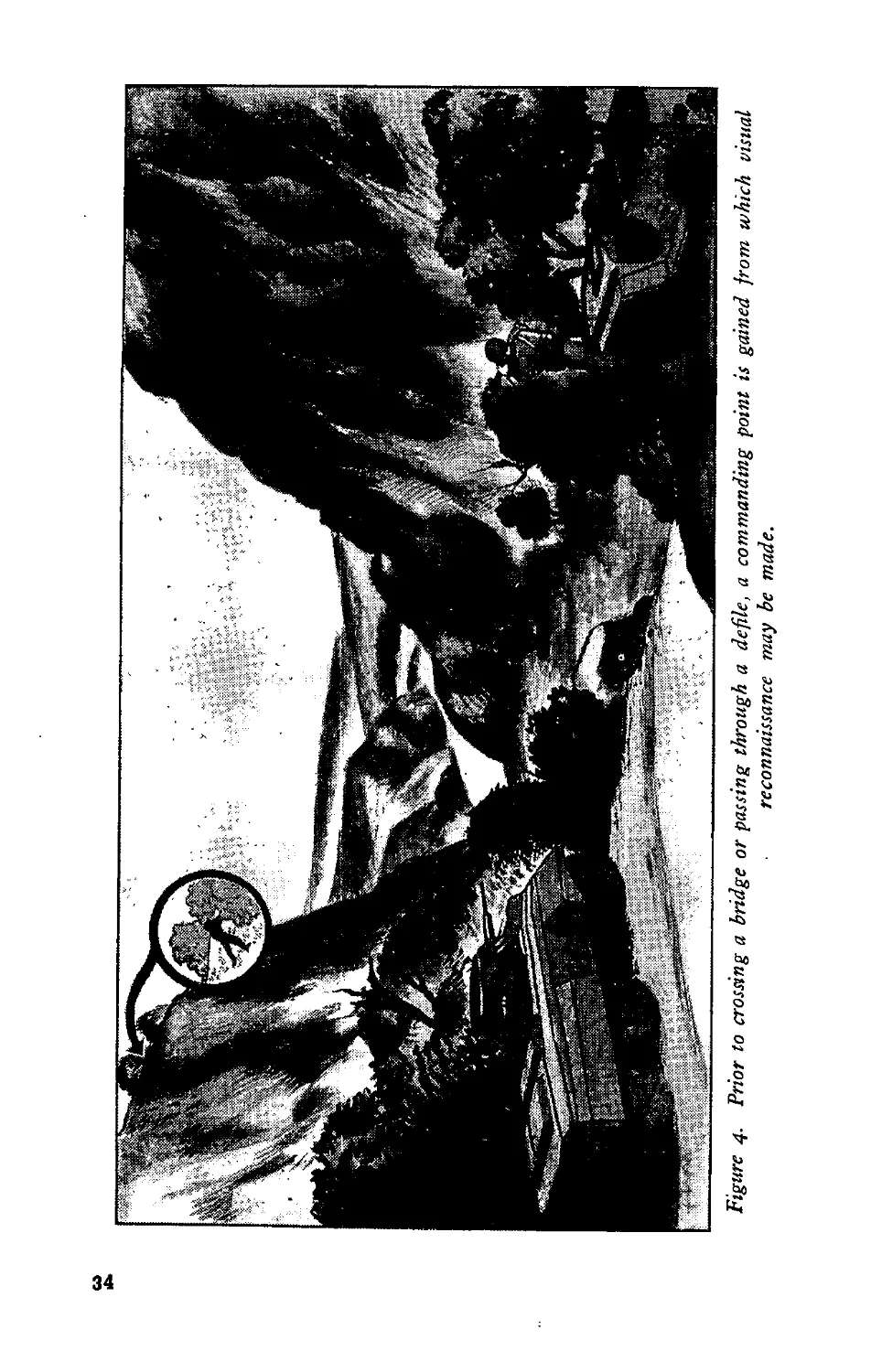
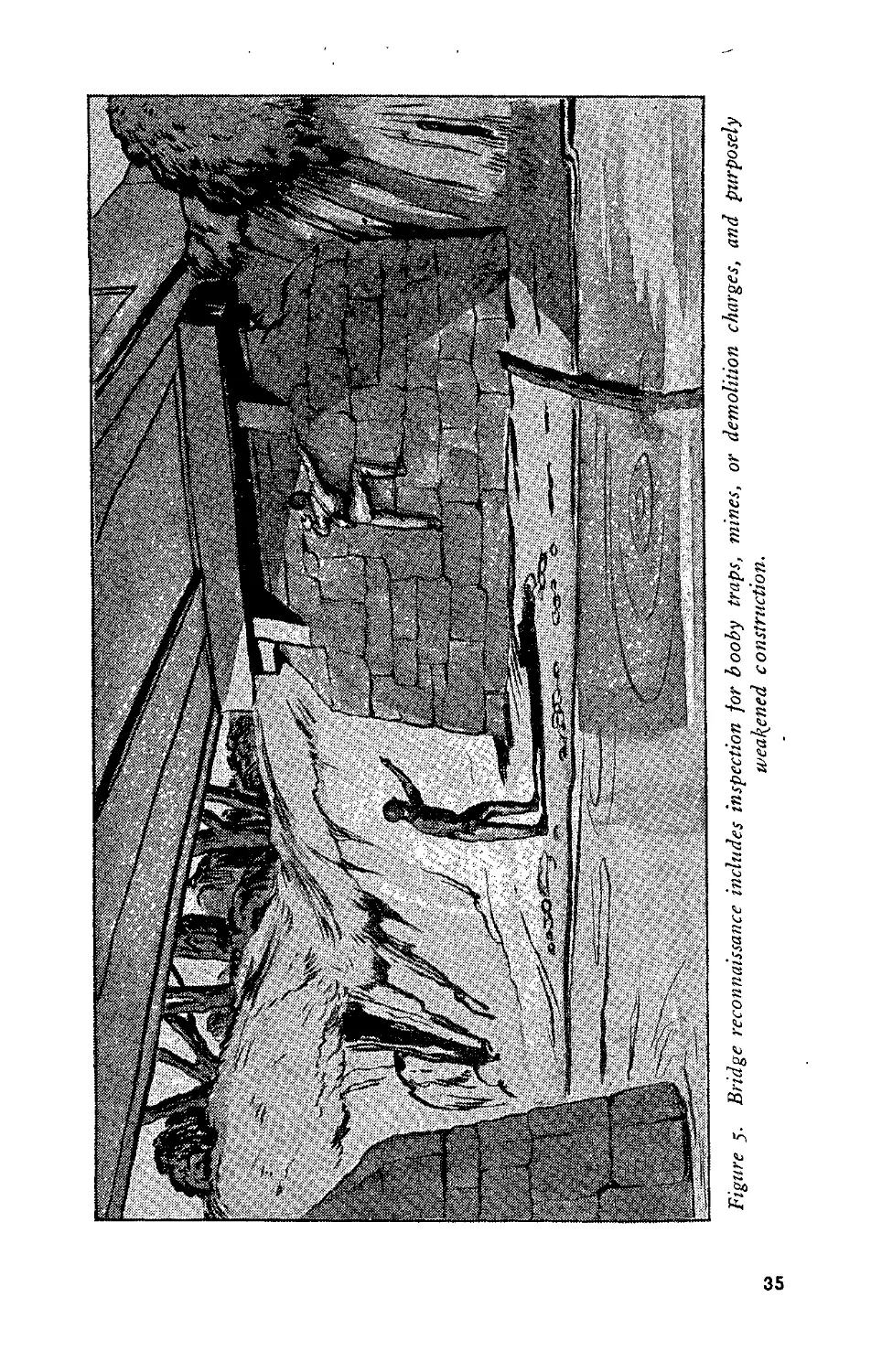
36.	RECONNAISSANCE OF A BRIDGE OR DEFILE.
Visual reconnaissance is made for enemy positions before lead-,
ing elements of a reconnaissance unit cross a bridge (fig. 4).
Dismounted patrols reconnoiter approaches. They precede lead-
ing vehicles across the bridge when ambush, mines, or booby
traps are suspected (fig. 5). Elements in rear cover the
crossing of leading vehicles and the reconnaissance of the far
side. Vehicles in rear cross when the leading element has
secured the far side. The passage of a defile is conducted in
a similar manner.
33
co
lit
Figure 4. Prior to crossing a bridge or passing through a defile, a commanding point is gained from which visual
reconnaissance may be made.
Figure 5. Bridge reconnaissance includes inspection for booby traps, mines, or demolition charges, and purposely
weakened construction.
37.	RECONNAISSANCE OF HOSTILE CAMP. BIV-
OUAC. OR INSTALLATION. Hostile camps, bivouacs, or
installations are approached from the flank or rear by dis-
mounted patrols. Vehicles are concealed at a distance. In-
formation gained by patrols is sent by messenger to a com-
mand vehicle for transmission. Enemy security measures (fig.
6) may necessitate distant observation in daylight and the use
of listening posts at night (par. 30).
38.	RECONNAISSANCE OF HOSTILE COLUMN, a.
A moving column is reconnoitered from a flank. An observa-
tion post is established where terrain and visibility are favor-
able, or dismounted patrols are sent to observe the enemy at
close range. Information is sent by messenger to a command
vehicle for transmission. A column at the halt which cannot
be observed from a single position is reconnoitered by patrols
moving to successive positions along a flank.
b. Patrols which have been cut off or surrounded may be able
to continue observation of the enemy. They remain con-
cealed in daylight and withdraw under cover of darkness,
using routes determined and reconnoitered previously.
Section III
Security
39.	GENERAL. The reconnaissance troop or any element of
it acting alone is responsible for its own local security. The
troop contributes to the security of the division by reporting
the location of enemy forces and by giving timely warning of
ground and air attacks. Information and warnings are trans-
mitted to higher headquarters and directly to units whose
security is threatened.
36
Figure 6. Reconnaissance of hostile bivouac. It can be expected that
roads, bridges, lively observation points, and positions offering conceal'
ment for vehicles will be mined, obstructed, and covered by emplaced
weapons. Bridges will be prepared for demolition.
37
40.	SECURITY ON RECONNAISSANCE, a. The search
for information of the enemy provides the greatest measure
of security for the troop on reconnaissance. Crews observe
constantly while vehicles are in motion. Distance and interval
are maintained between moving vehicles, preferably not less
than too yards. Teams and platoons move by bounds with
vehicles constantly in position to support the advance of pre-
ceding vehicles. Covered routes are used where available.
Dangerous positions to the flanks are reconnoitered before the
bulk of the team or platoon arrives within effective range.
Mounted patrols sent beyond visual range include at least two
vehicles for mutual support.
b.	Observers are posted at halts to provide timely warning of
approaching aircraft and ground units. Vehicles are dispersed.
Maximum use is made of available cover, concealment, and
natural obstacles.
c.	Air scouts are designated specifically. Upon the approach
of aircraft, moving vehicles are dispersed and concealed. Men
take cover. They do not fire at aircraft unless ordered by
commanders. Orders to fire are not issued unless planes
attack.
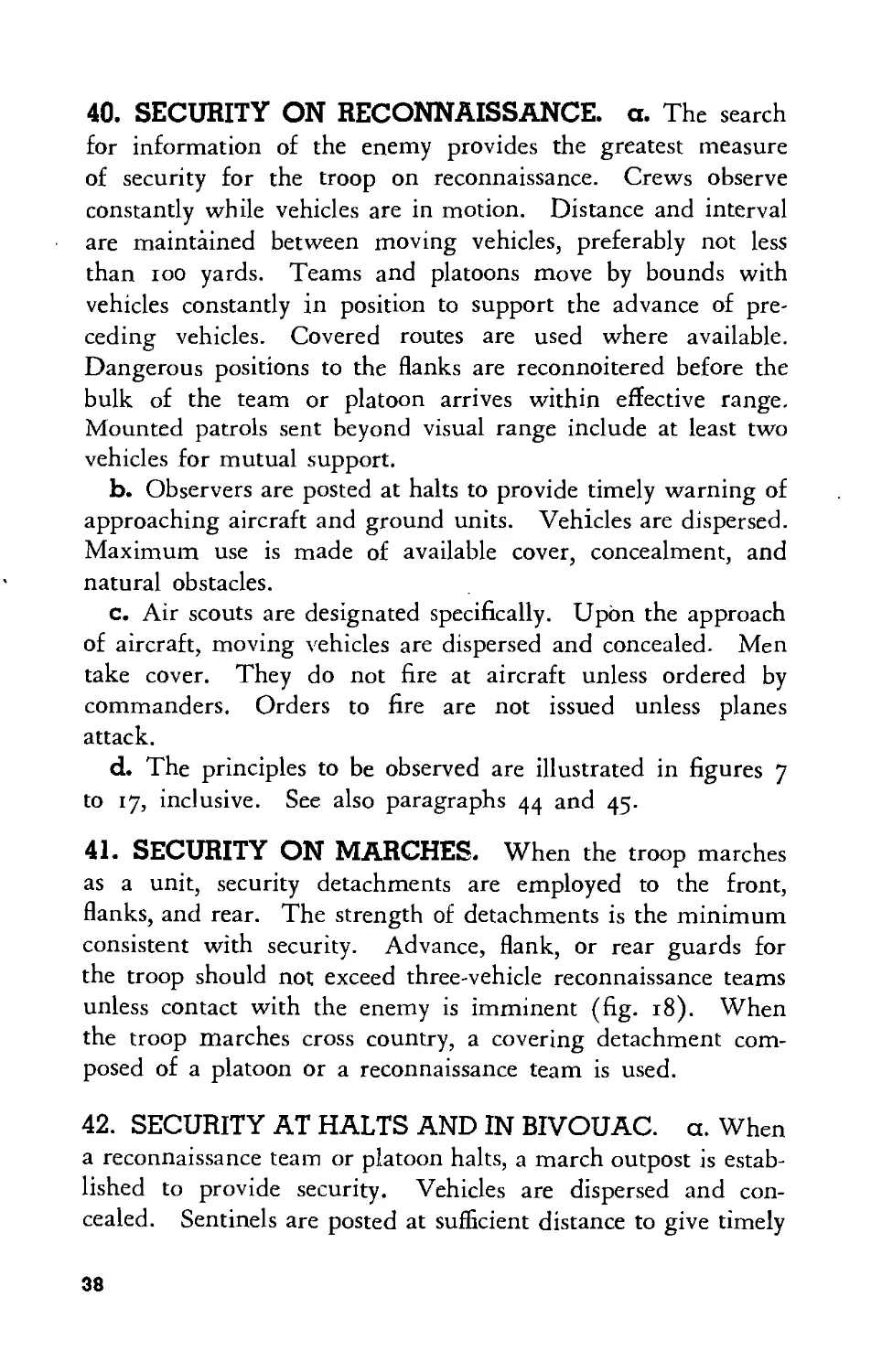
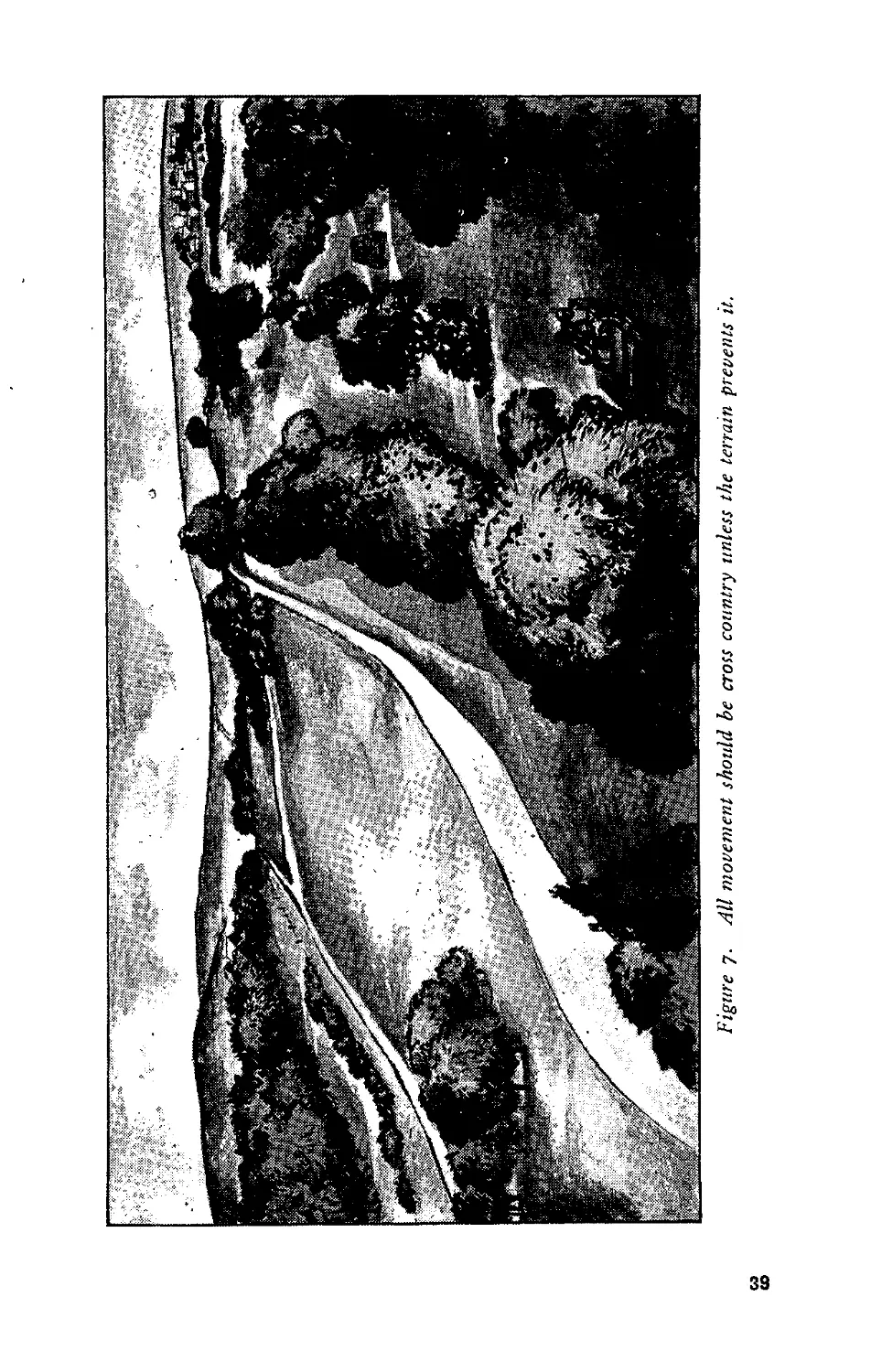
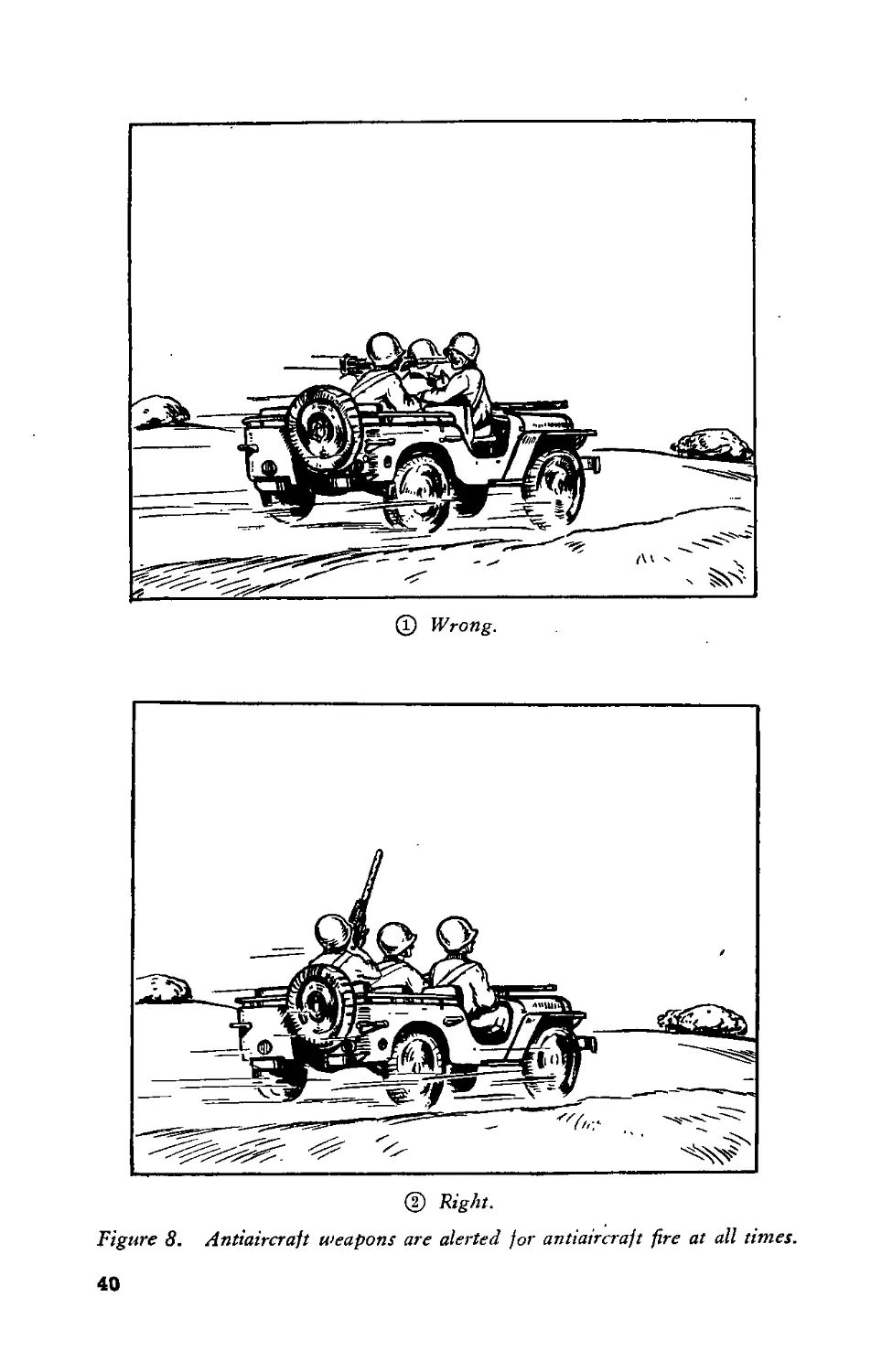
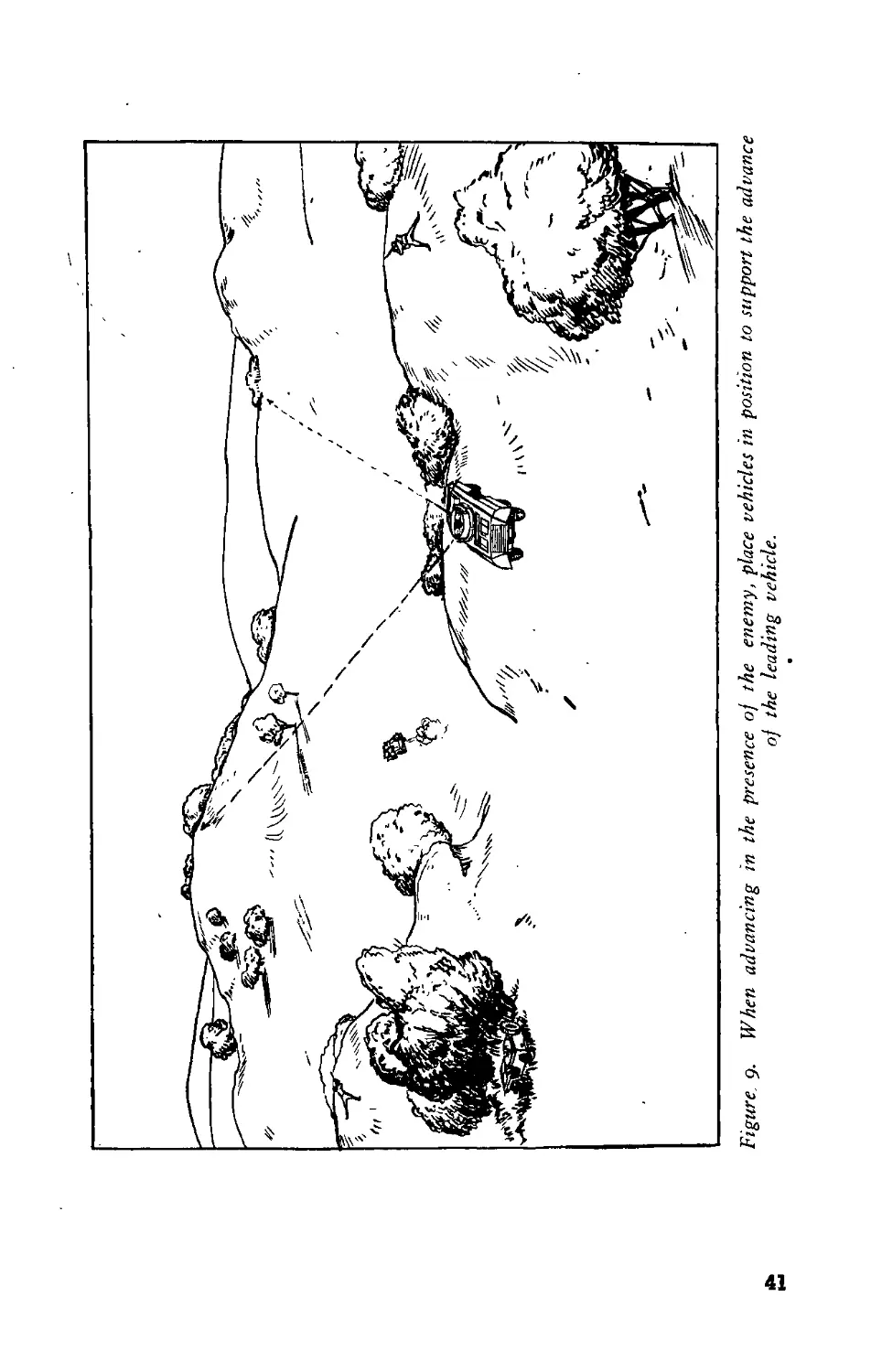
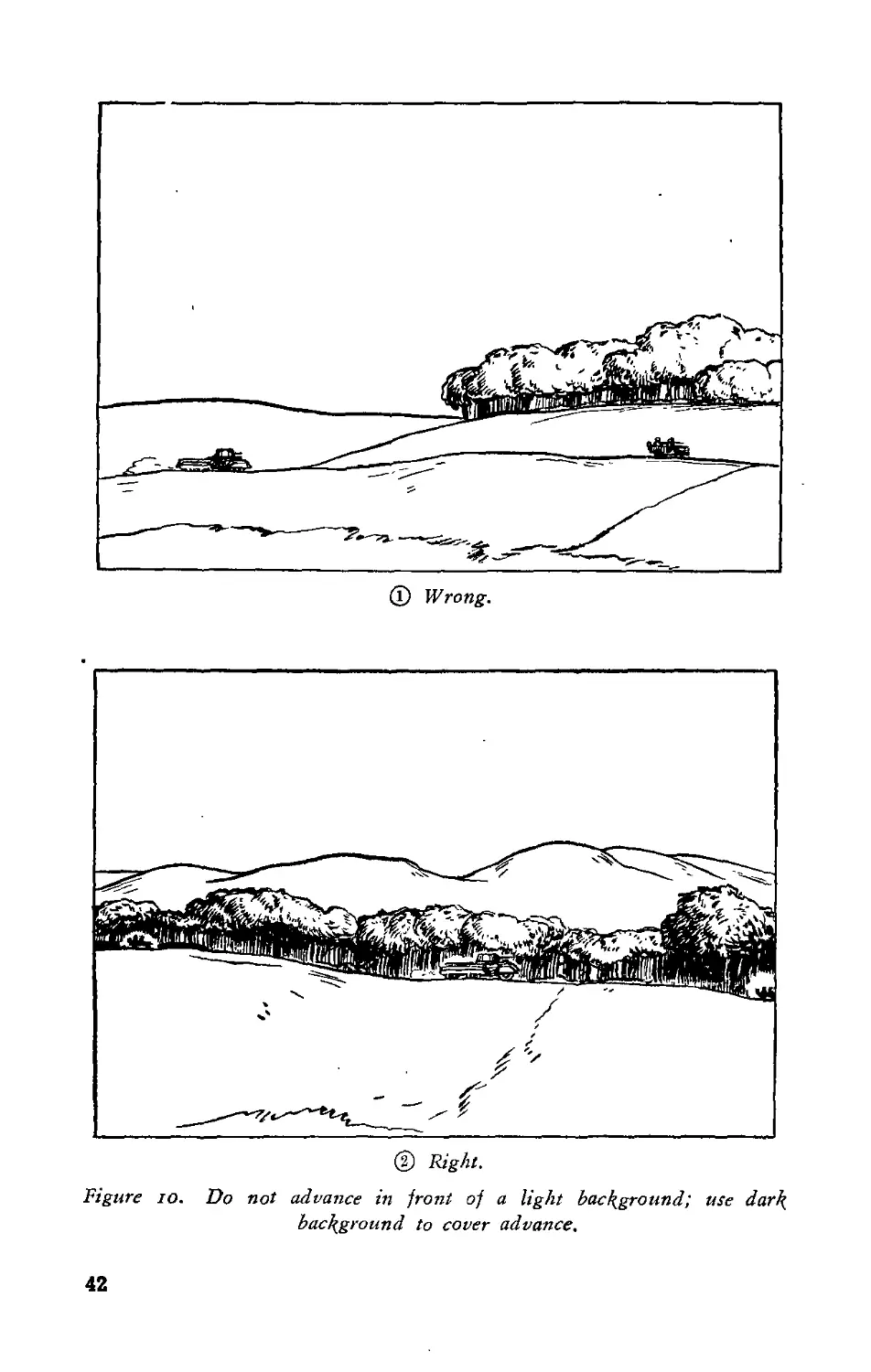
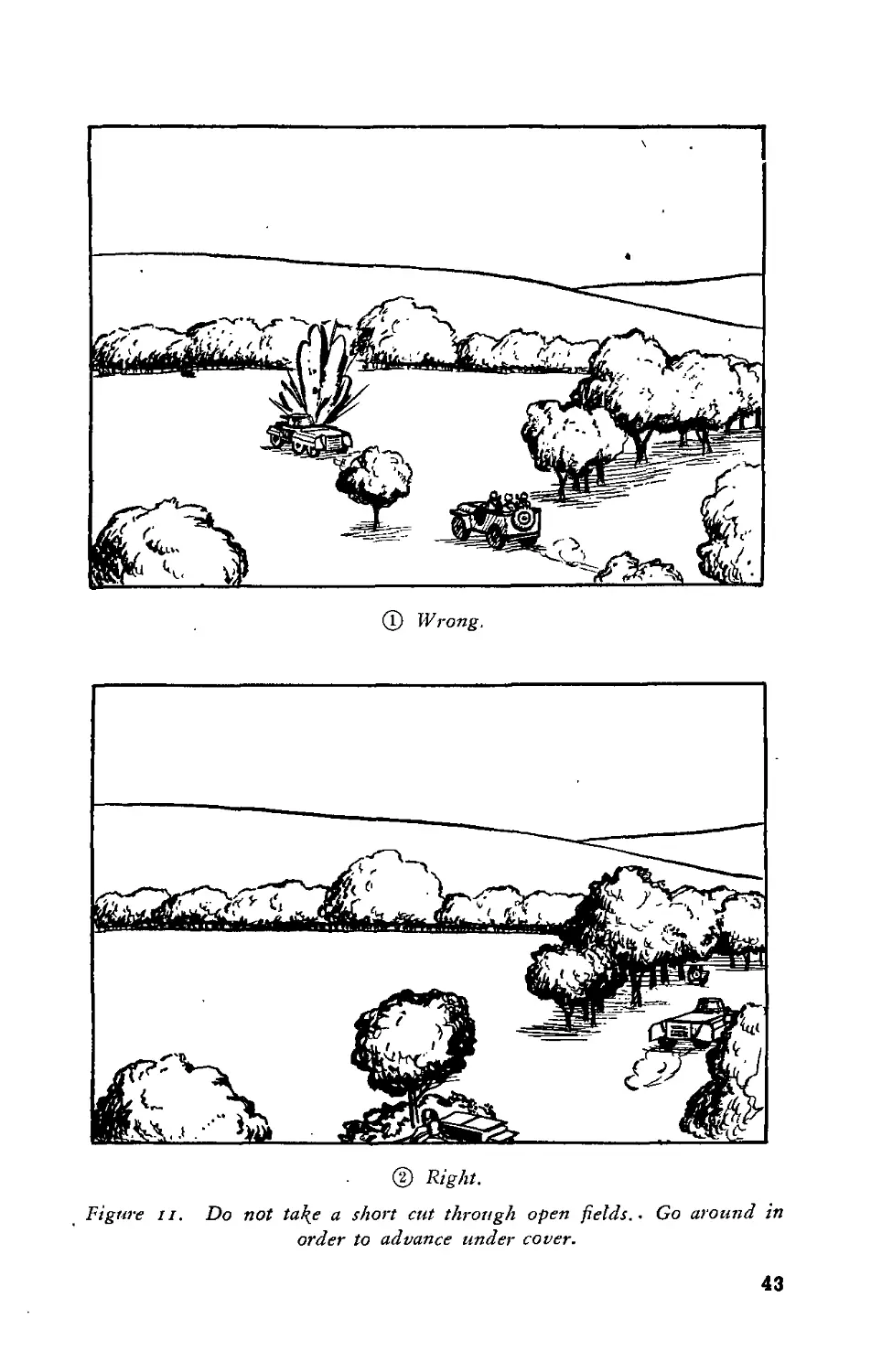
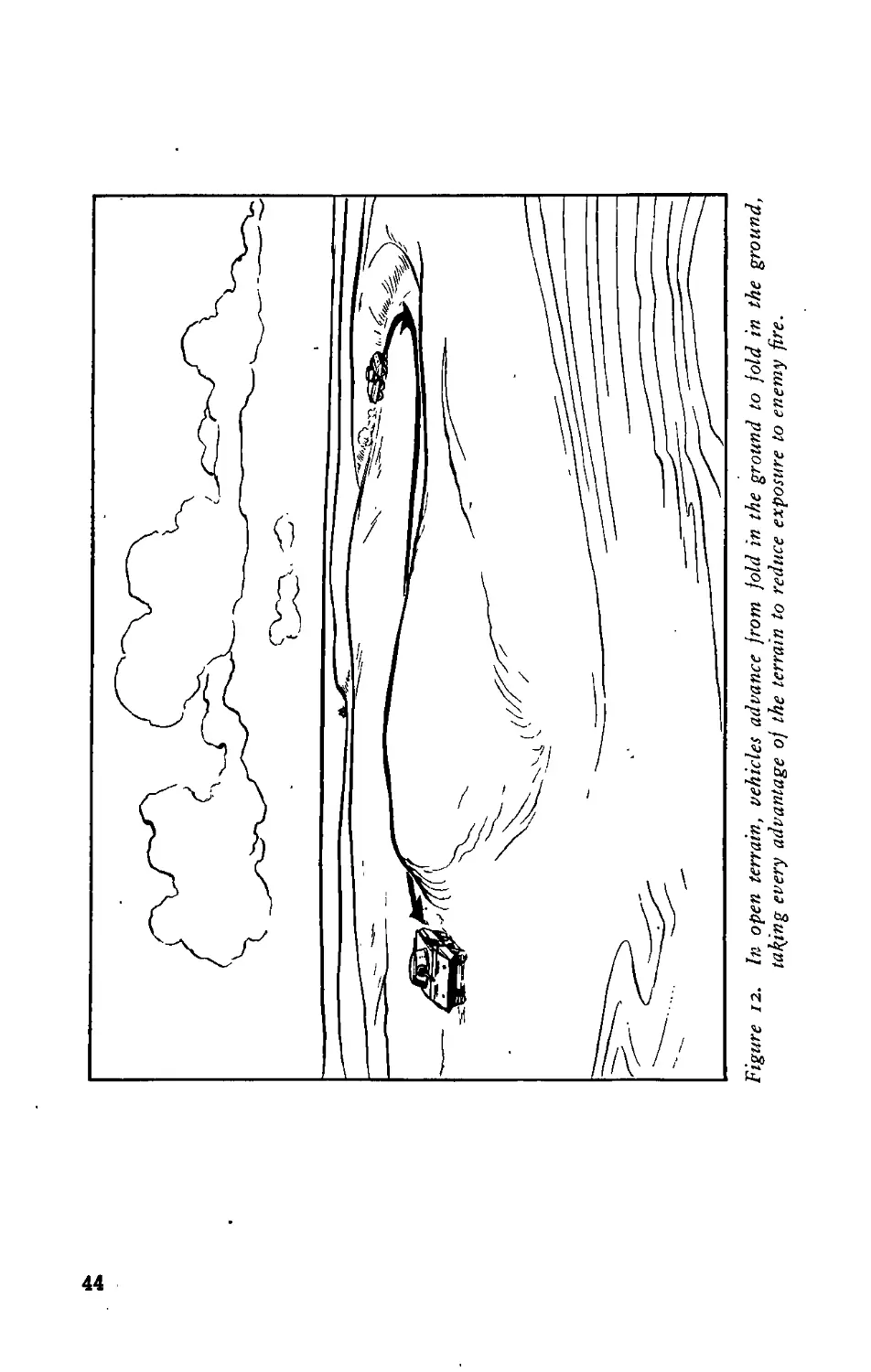
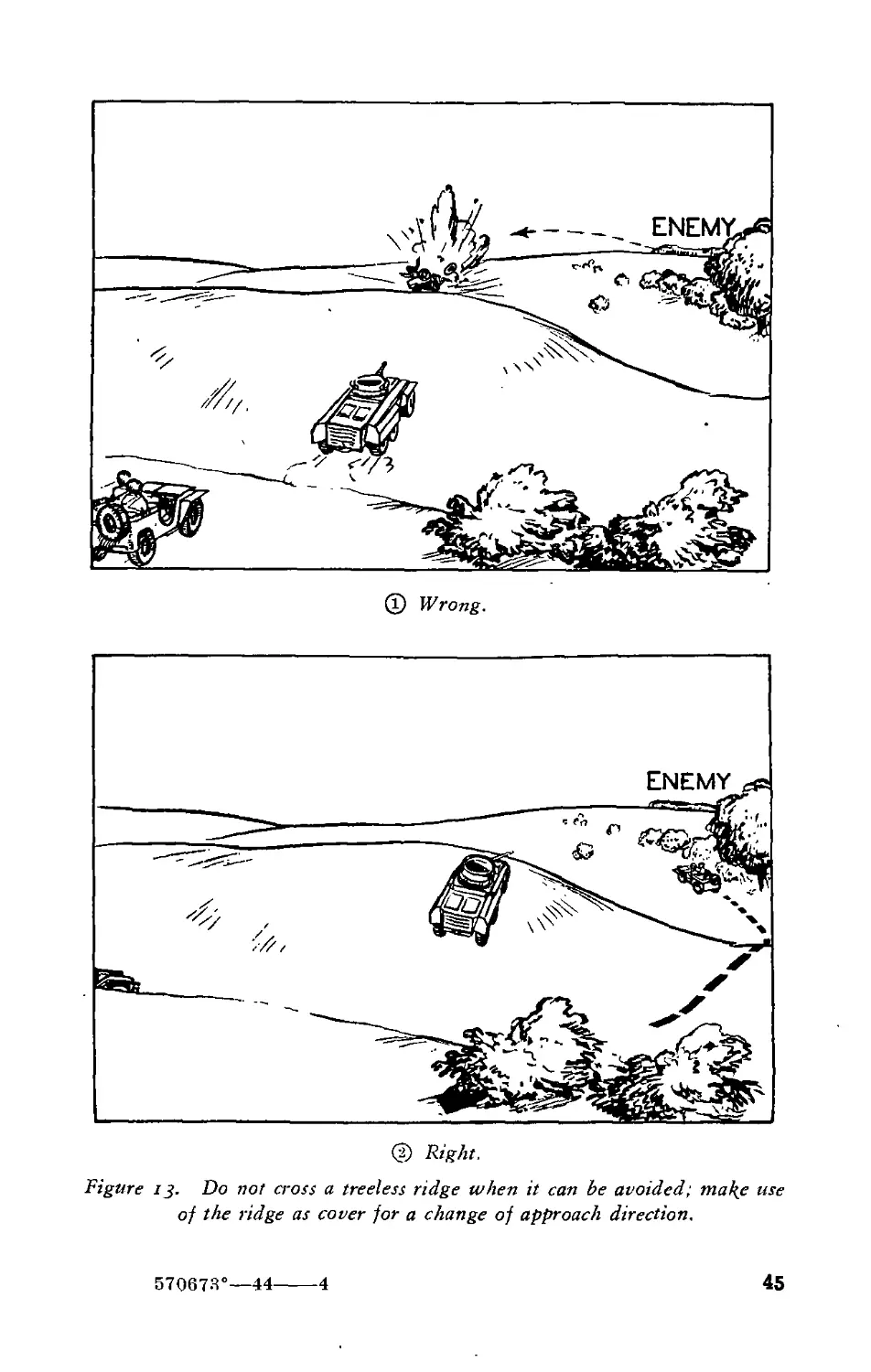
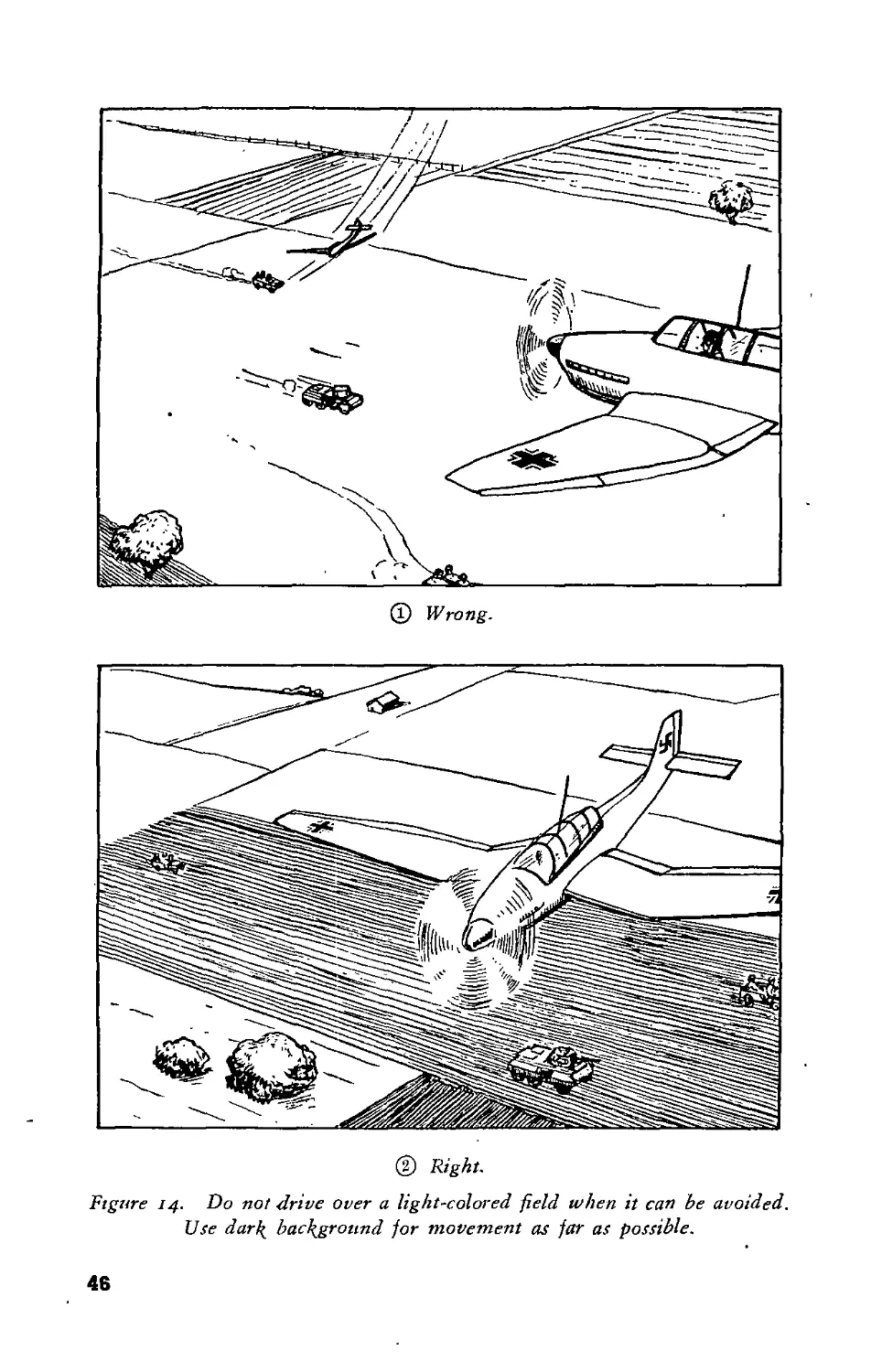
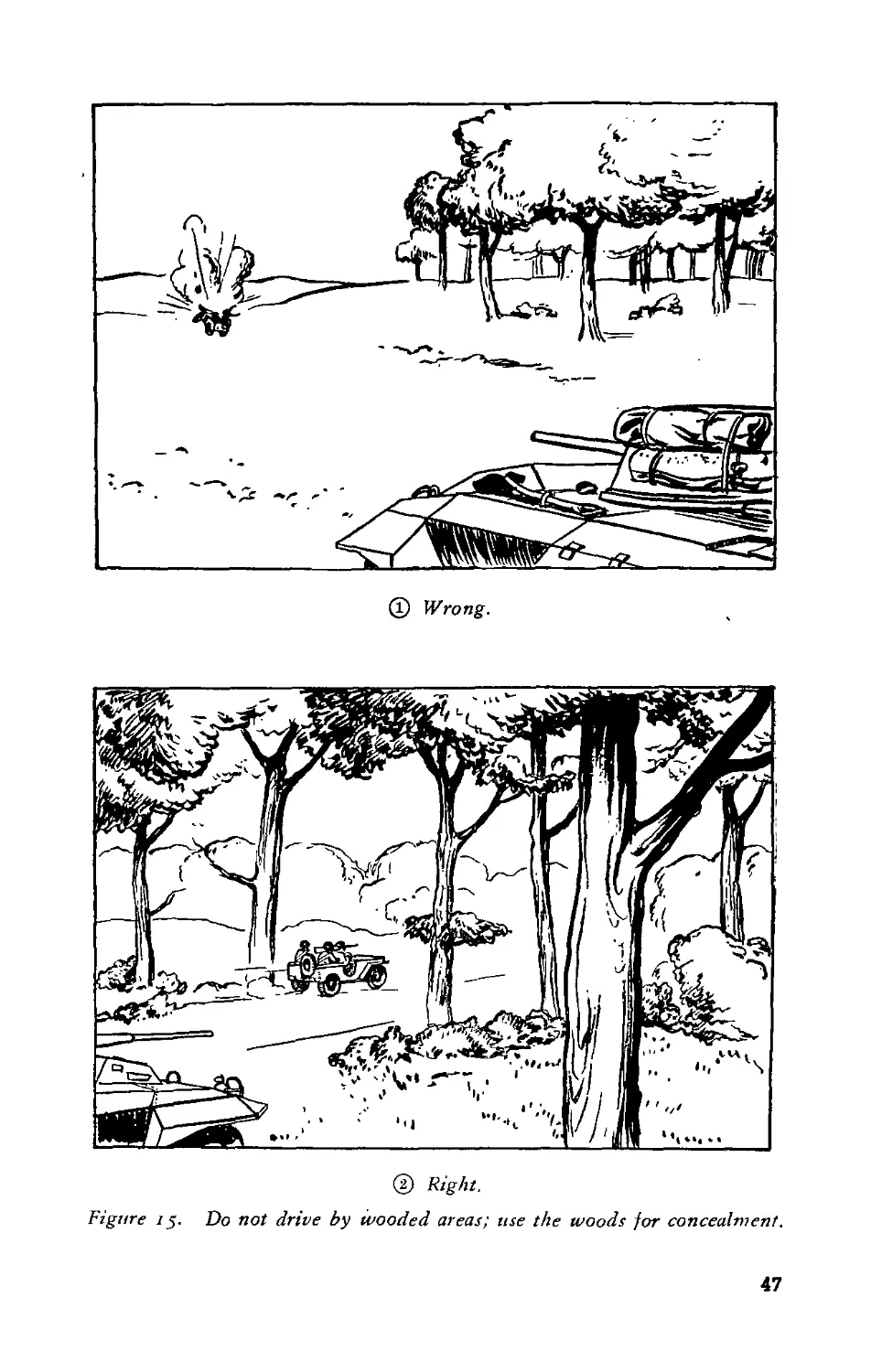
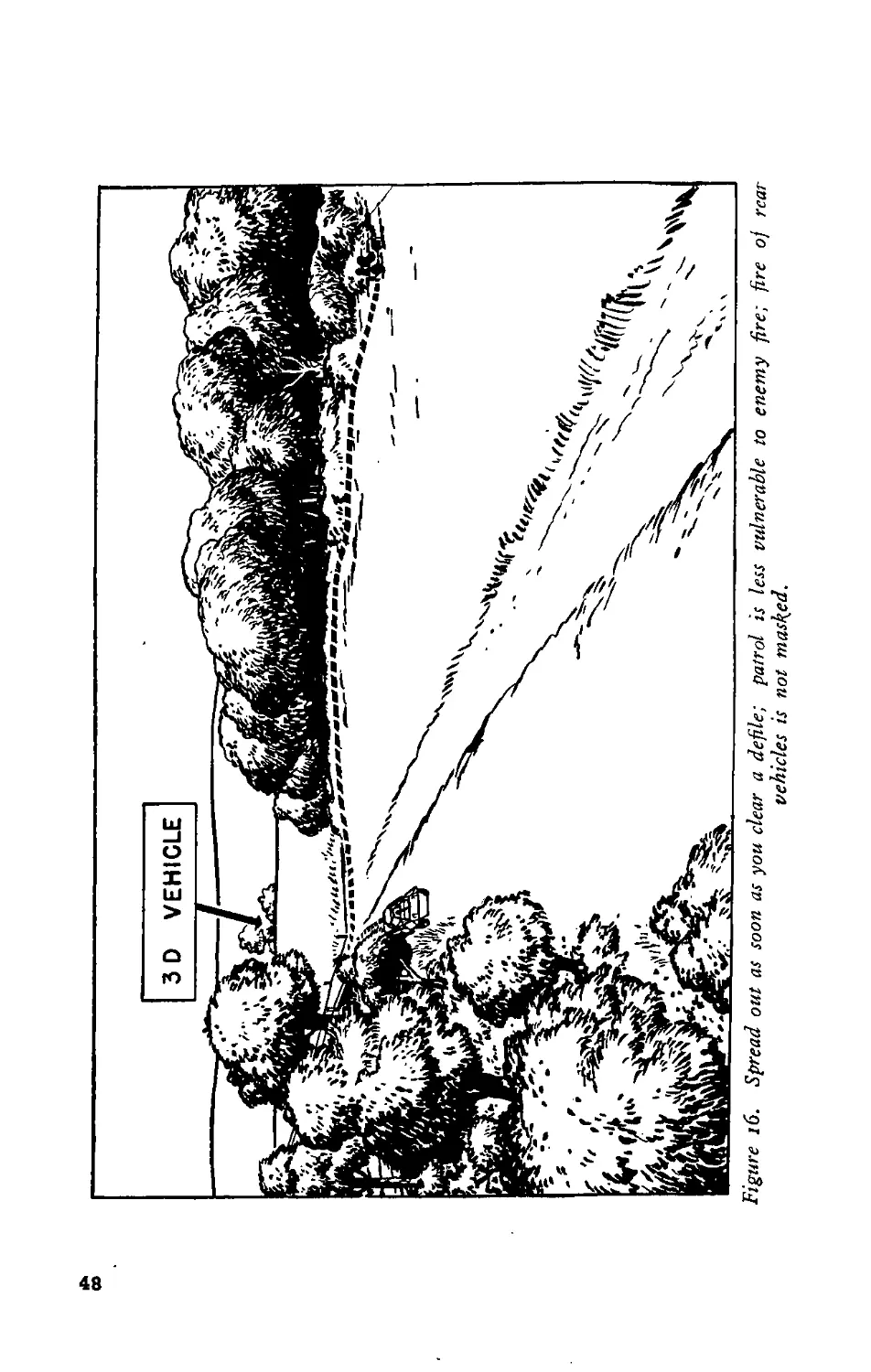
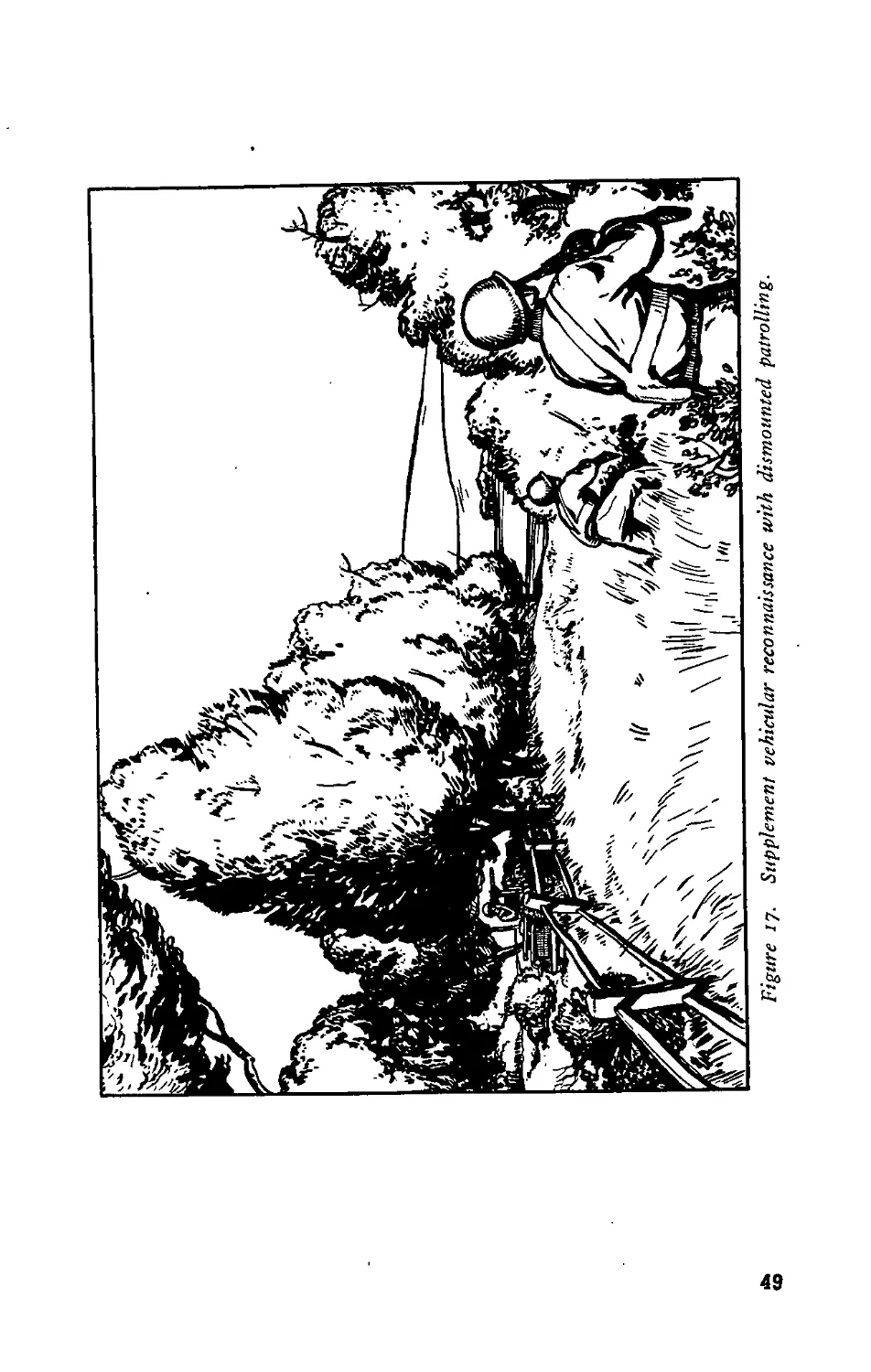
d.	The principles to be observed are illustrated in figures 7
to 17, inclusive. See also paragraphs 44 and 45.
41.	SECURITY ON MARCHES. When the troop marches
as a unit, security detachments are employed to the front,
flanks, and rear. The strength of detachments is the minimum
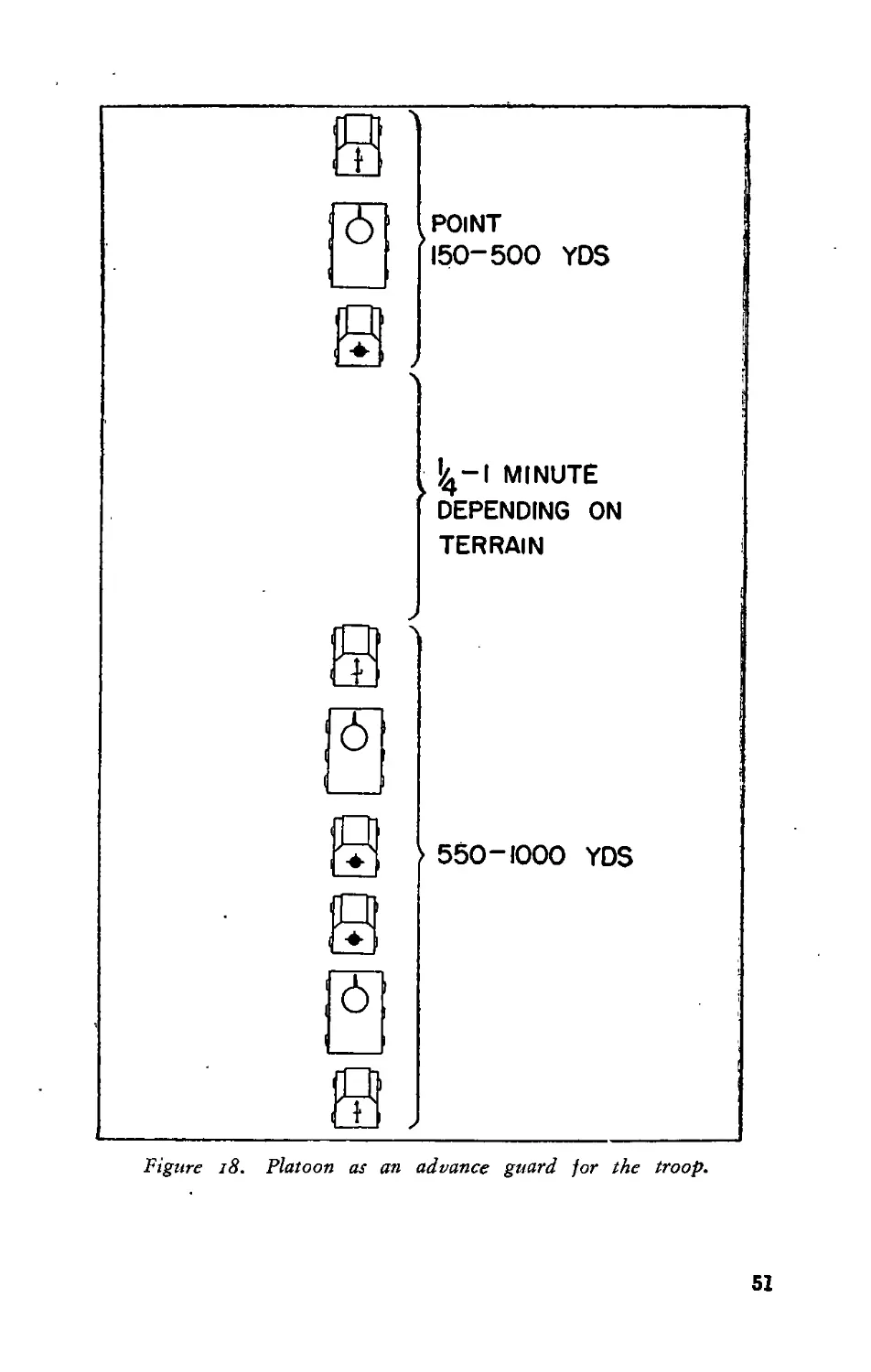
consistent with security. Advance, flank, or rear guards for
the troop should not exceed three-vehicle reconnaissance teams
unless contact with the enemy is imminent (fig. 18). When
the troop marches cross country, a covering detachment com-
posed of a platoon or a reconnaissance team is used.
42.	SECURITY AT HALTS AND IN BIVOUAC, a. When
a reconnaissance team or platoon halts, a march outpost is estab-
lished to provide security. Vehicles are dispersed and con-
cealed. Sentinels are posted at sufficient distance to give timely
38
Figure 7. All movement should be cross country unless the terrain prevents it.
(Г) Wrong.
Figure 8. Antiaircraft weapons are alerted for antiaircraft fire at all times.
40
Figure, 9. When advancing in the presence oj the enemy, place vehicles in position to support the advance
of the leading vehicle.
® Right.
Figure io. Do not advance in front of a light background; use dar\
background to cover advance.
42
© Wrong.
© Right.
Figure ii. Do not ta\e a short cut through open fields.. Go around in
order to advance under cover.
43
Figure 12. In open terrain, vehicles advance from fold in the ground to fold in the ground,
taking every advantage of the terrain to reduce exposure to enemy fire.
® Wrong.
® Right.
Figure 13.	Do not cross a treeless ridge when it can be avoided; tnah^e use
of the ridge as cover for a change of approach direction.
570673°—44----4
45
(Г) Wrong.
® Right.
Figure 14.	Do not drive over a light-colored field when it can be avoided.
Use darl^ background for movement as jar as possible.
46
® Wrong.
® Right.
Figure 15.	Do not drive by wooded areas; use the woods for concealment.
47
Figure 16. Spread out as soon as you clear a defile; patrol is less vulnerable to enemy fire; fire oj rear
vehicles is not masked.
Figure 17. Supplement vehicular reconnaissance with dismounted patrolling.
warning of the approach of hostile aircraft or ground forces.
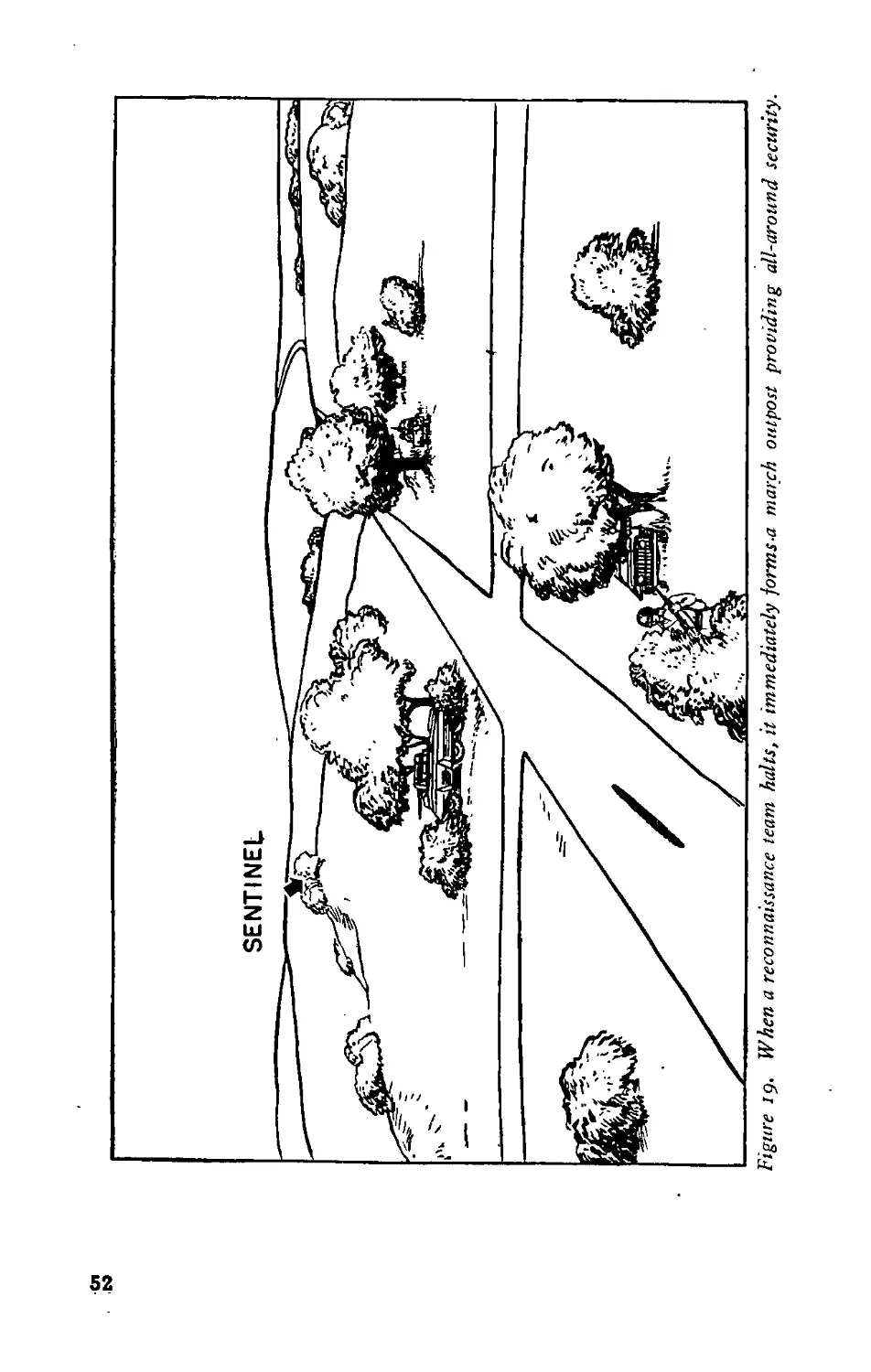
Vehicular weapons are manned. Reconnaissance elements ob-
serve the principles illustrated in figures 19 to 31, inclusive.
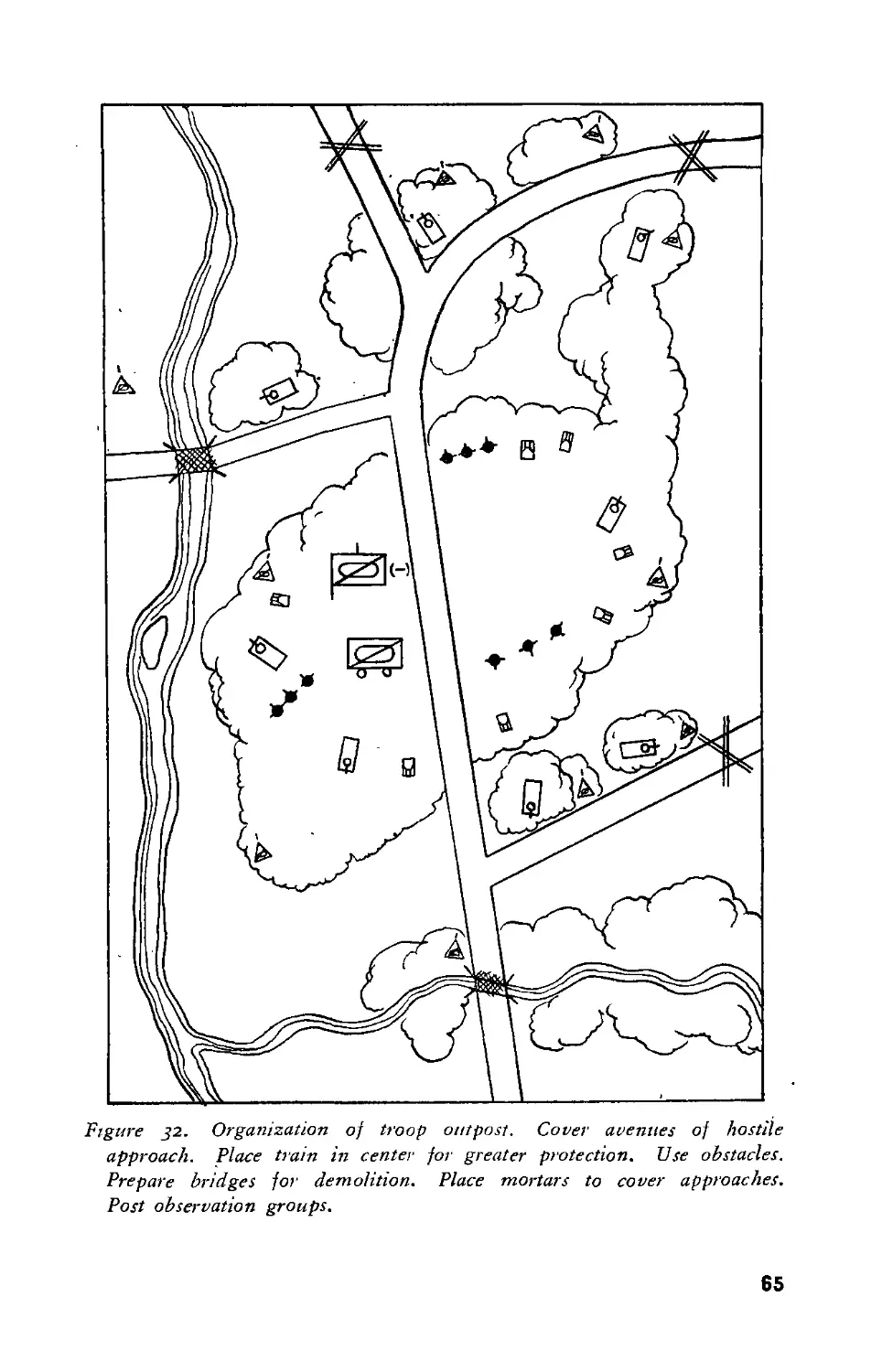
b. When the troop bivouacs, an outpost is established. Troops
may be drawn from the support platoon. The outpost is no
stronger than is consistent with security. Barriers provide
additional security. A bivouac is reconnoitered and selected
in daylight, but occupied after dark to prevent observation by
the enemy. Bivouac areas must be large enough to permit
vehicles to disperse under cover, and must have at least two
exits. Principles to be observed in establishing and operating
outposts are illustrated in figures 32 to 35, inclusive.
(1)	Vehicles are disposed within the bivouac area so that their
weapons furnish all-around protection. Vehicles are concealed
from ground and air observation and are faced toward a route
of departure. At least two routes of departure which have been
reconnoitered are designated for use. Crews bivouac near their
vehicles. One member of the crew of each vehicle on the
perimeter of the bivouac should be awake at all times. Prone
shelters are dug by all personnel for protection against hostile
air attack and artillery fire. Mortars are emplaced and alternate
positions are selected. Automatic weapons are sighted and
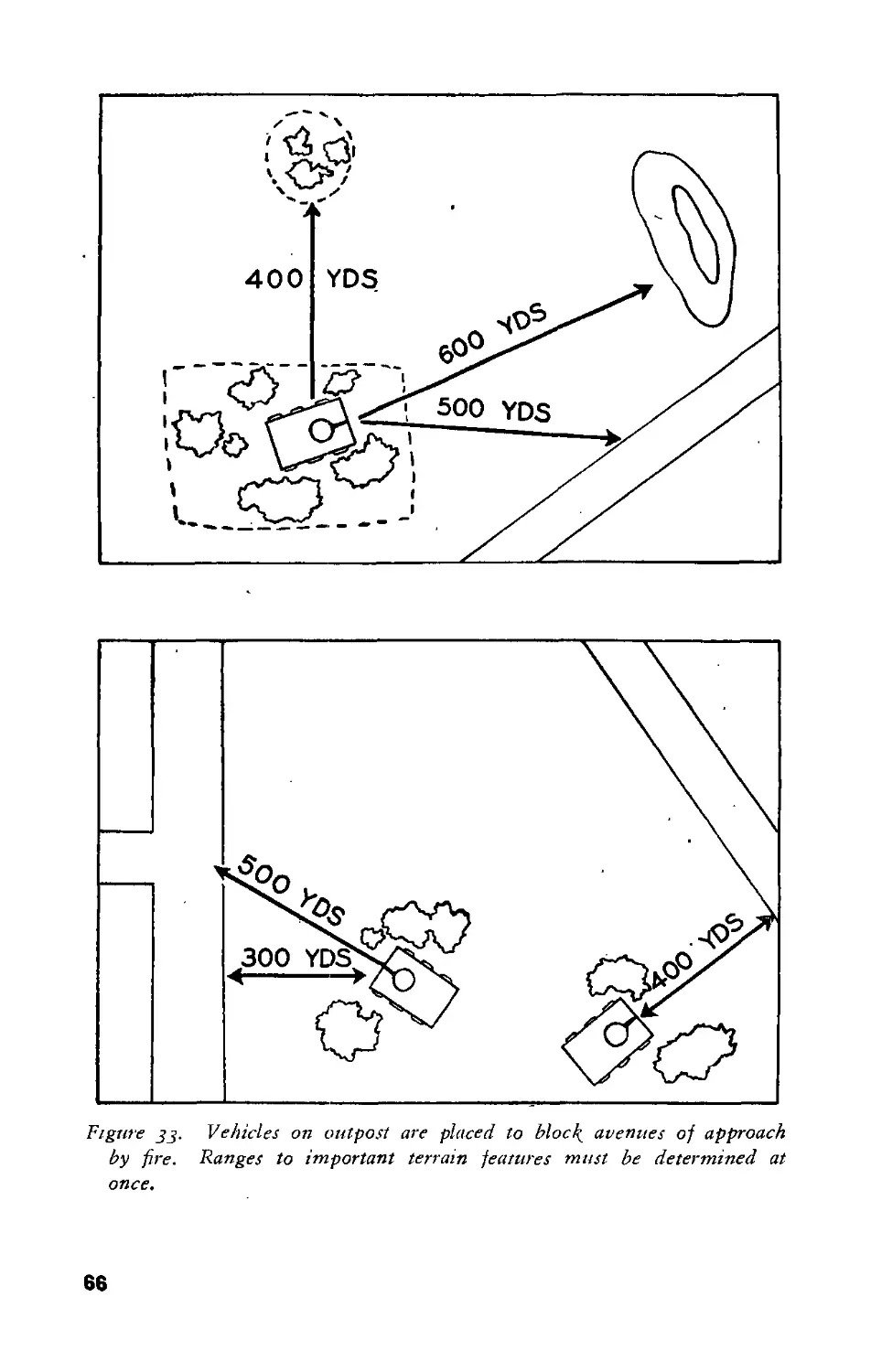
half loaded. Range cards are prepared for mortars, 37-mm
guns, and automatic weapons.
(2)	Sentinels are posted to cover routes of approach. Mines
and warning devices supplement the outpost line. A radio-
equipped %-ton truck may be sent to a distant point to provide
observation and warning of enemy approach.
(3)	Each sentinel is given the following information:
(й) Routes of approach to the bivouac he is to observe.
(Z>) Names of terrain features such as roads, villages, or
streams in his area.
(c) Location of the main body and of adjacent outguards.
(<Z) Number of friendly patrols operating in the vicinity, and
the direction and time of their expected return.
(e) Instructions concerning challenging.
50
51
SENTINEL
Figure /9. When a reconnaissance team halts, it immediately forms-a march outpost providing all-around security.
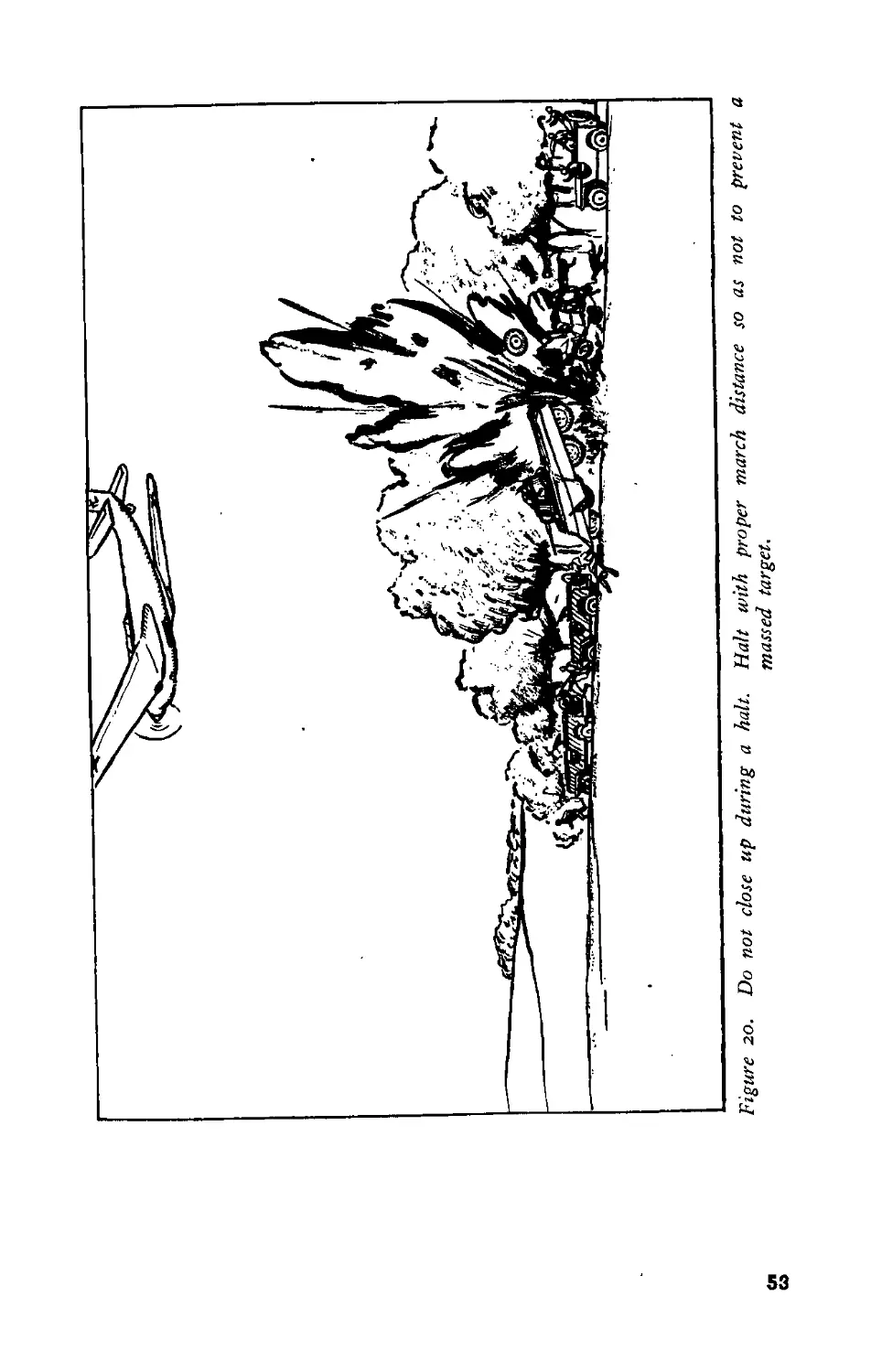
Figure 20. Do not close up during a halt. Halt with proper march distance so as not to prevent a
massed target.
® Wrong.
® Right.
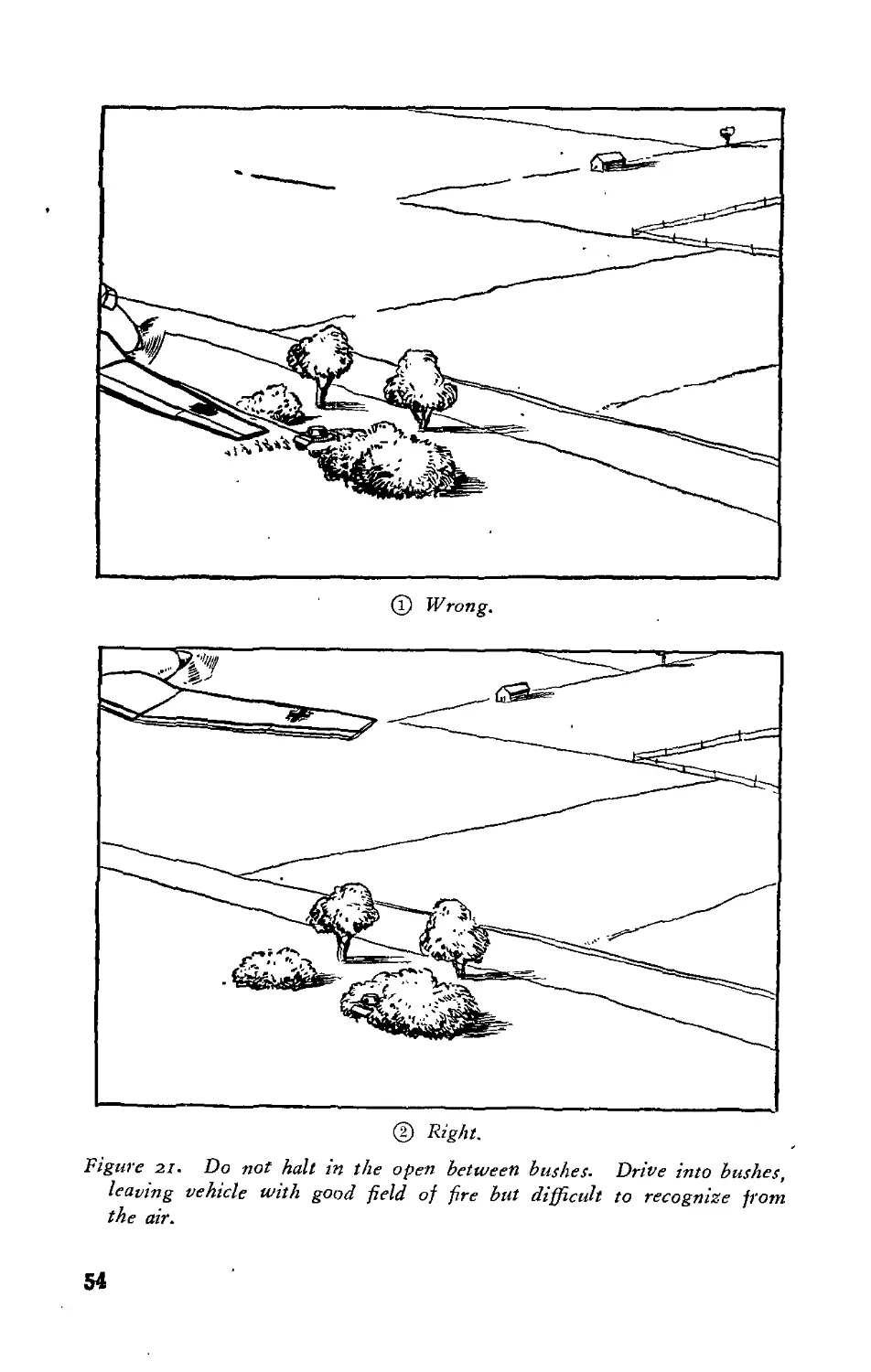
Figure 2.1. Do not halt in the open between bushes. Drive into bushes,
leaving vehicle with good field of fire but difficult to recognize from
the air.
54
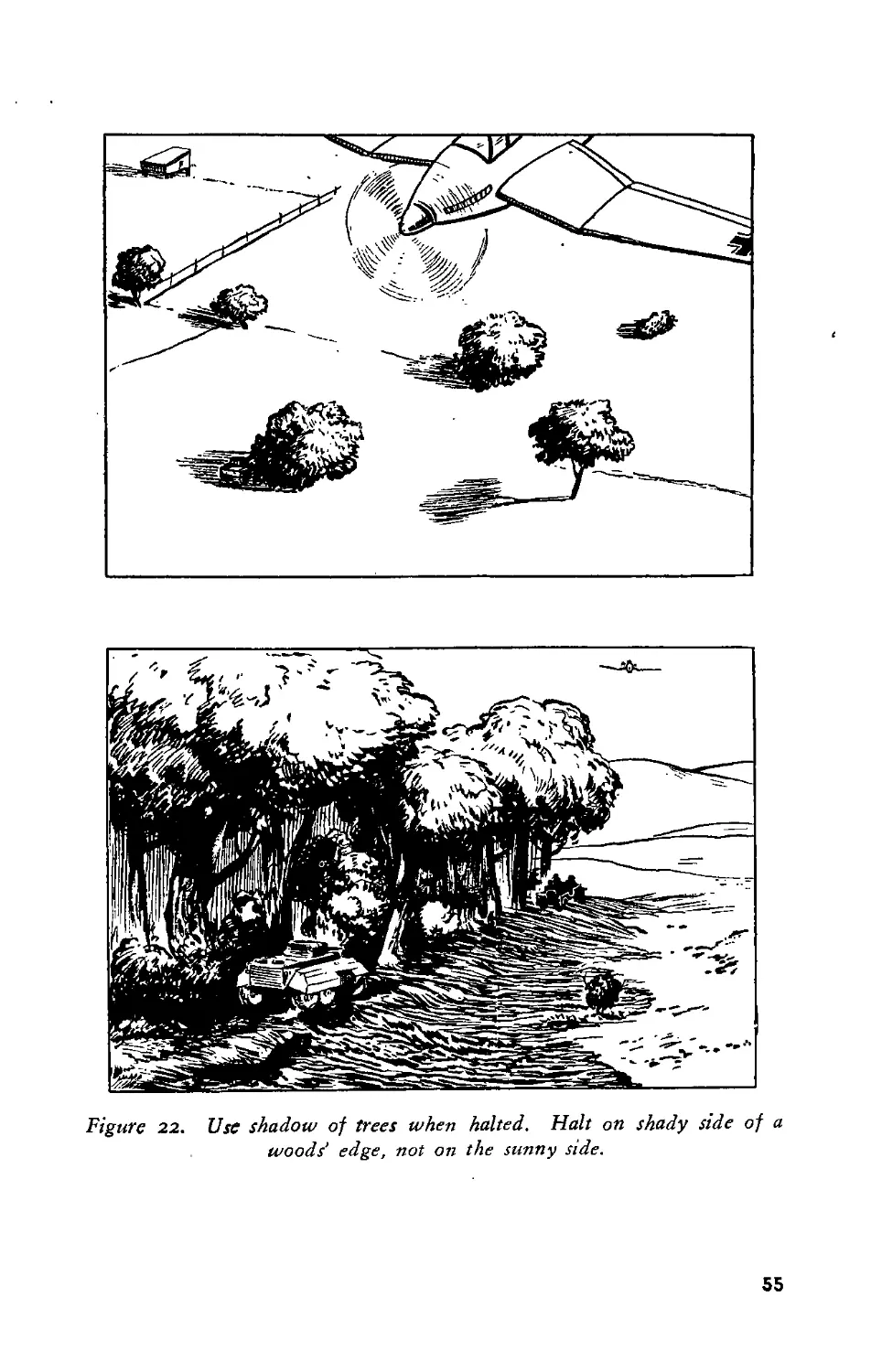
Figure 22. Use shadow of trees when halted. Halt on shady side of a
woods’ edge, not on the sunny side.
55
г
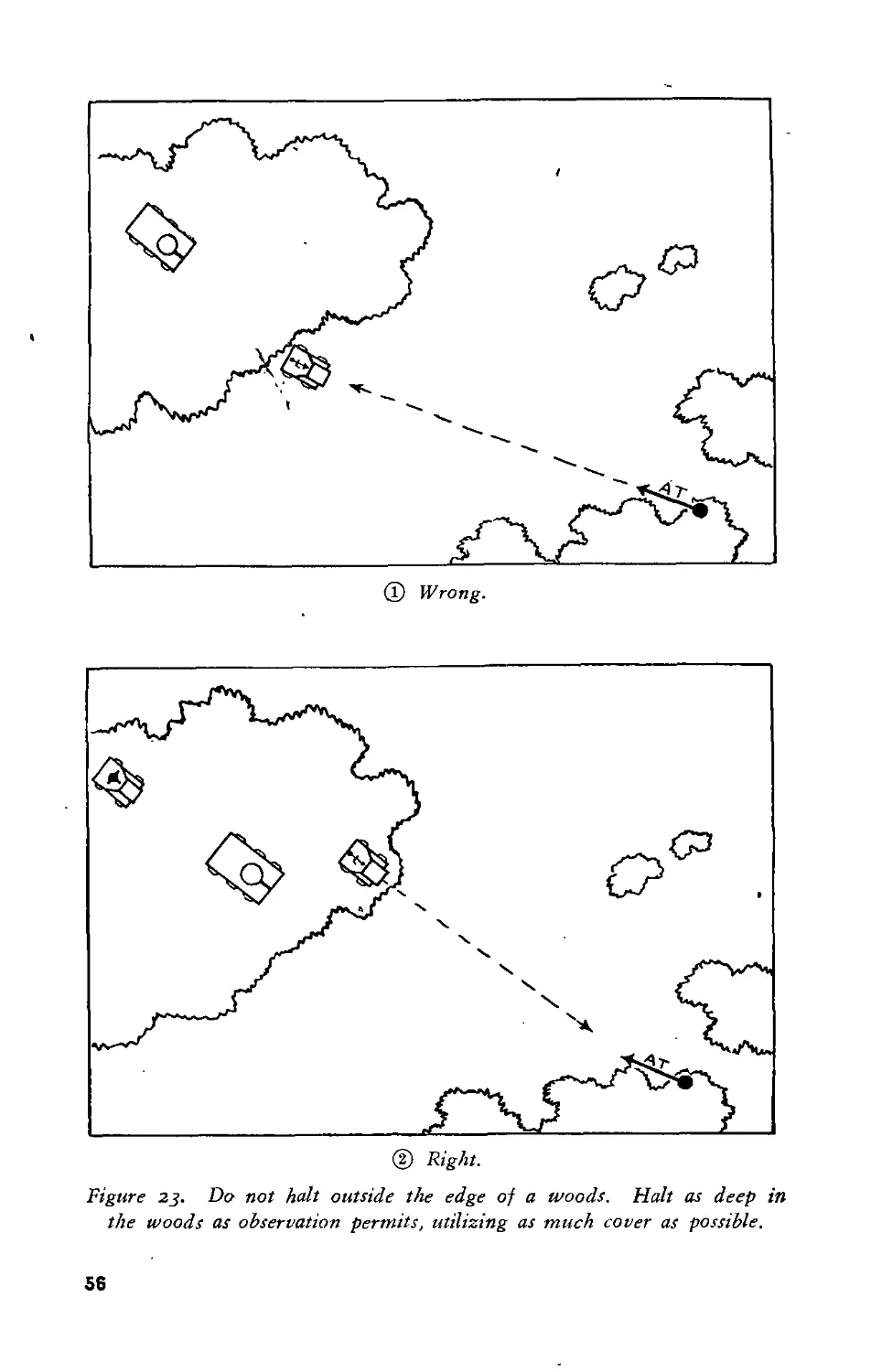
® Wrong.
Figure 23. Do not halt outside the edge of a woods. Halt as deep in
the woods as observation permits, utilizing as much cover as possible.
56
® Wrong.
® Right.
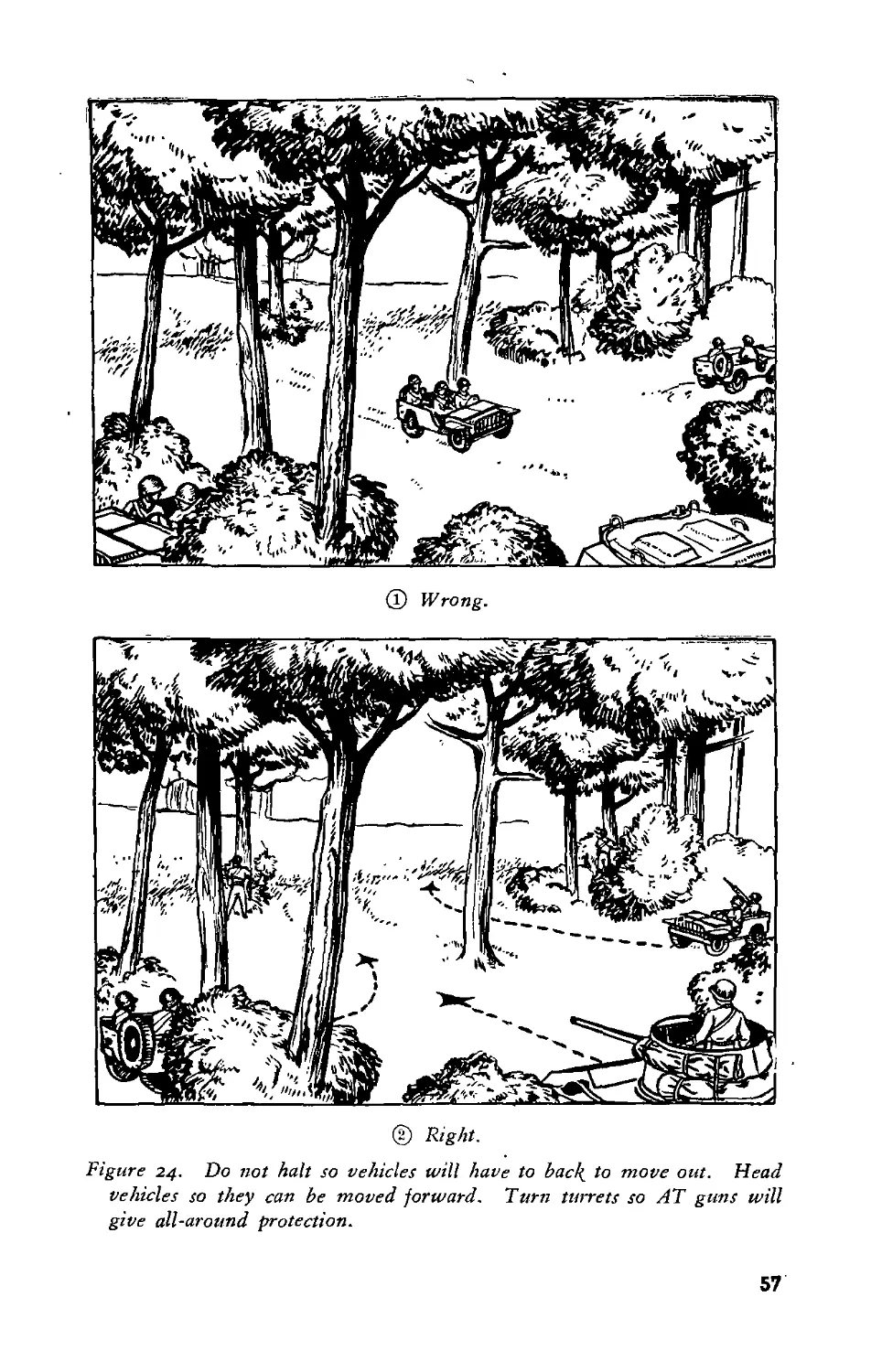
Figure 24. Do not halt so vehicles will have to back^ to move out. Head
vehicles so they can be moved forward. Turn turrets so AT guns will
give all-around protection.
57
® Wrong.
® Right.
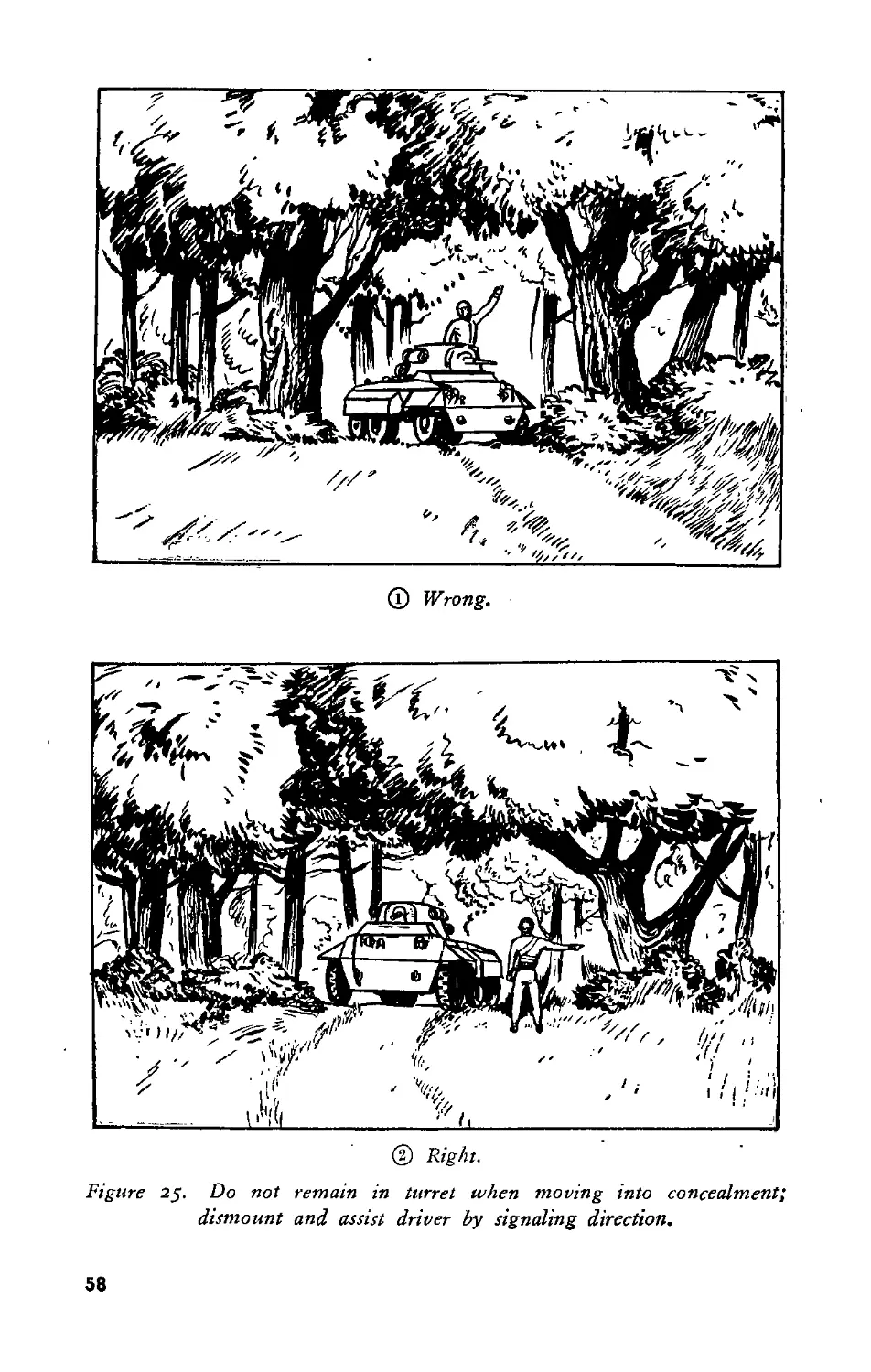
Figure 25. Do not remain in turret when moving into concealment;
dismount and assist driver by signaling direction.
58
® Wrong.
® Right.
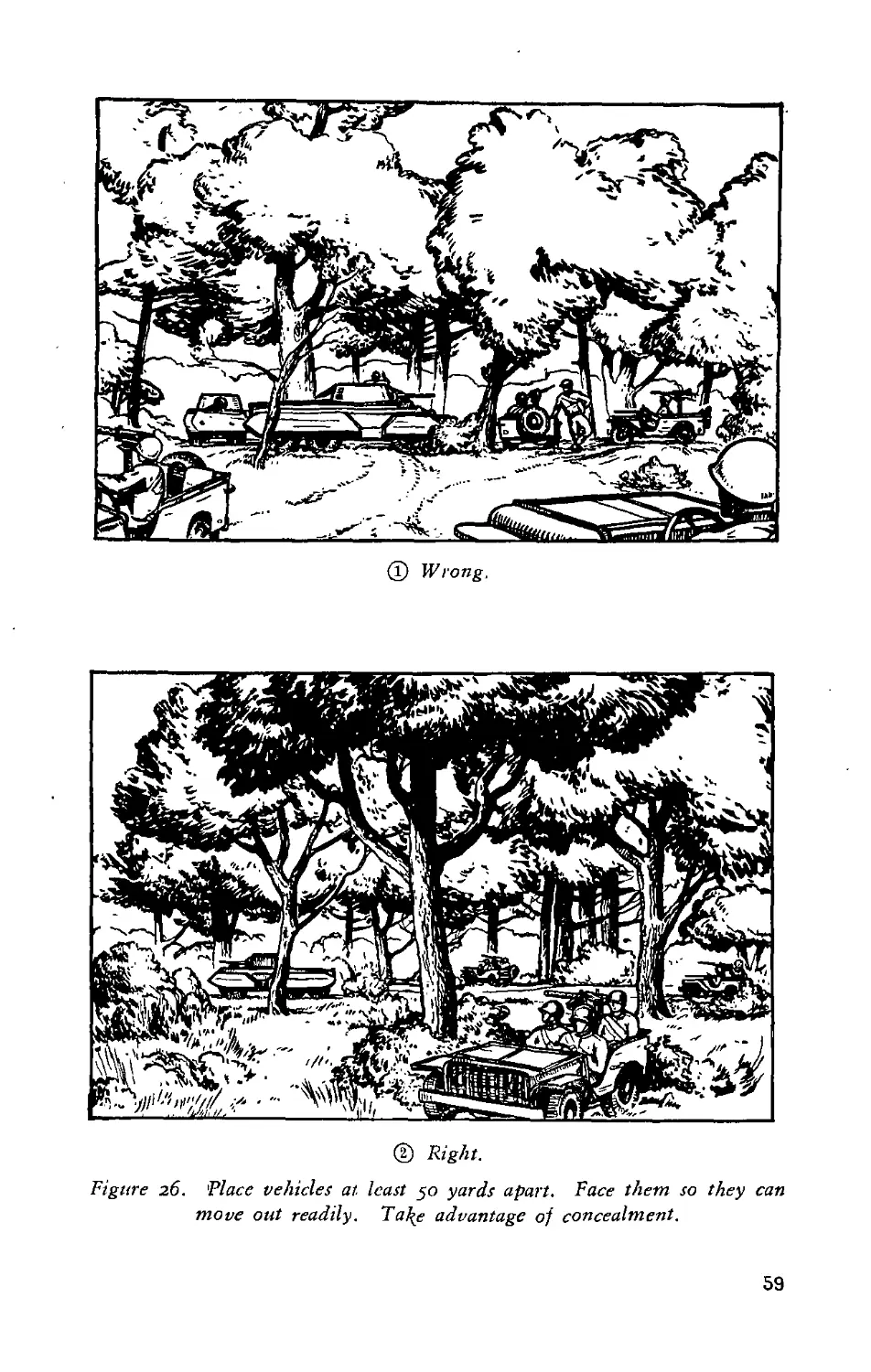
Figure 26. 'Place vehicles at least 50 yards apart. Face them so they can
move out readily. Tafy? advantage of concealment.
59
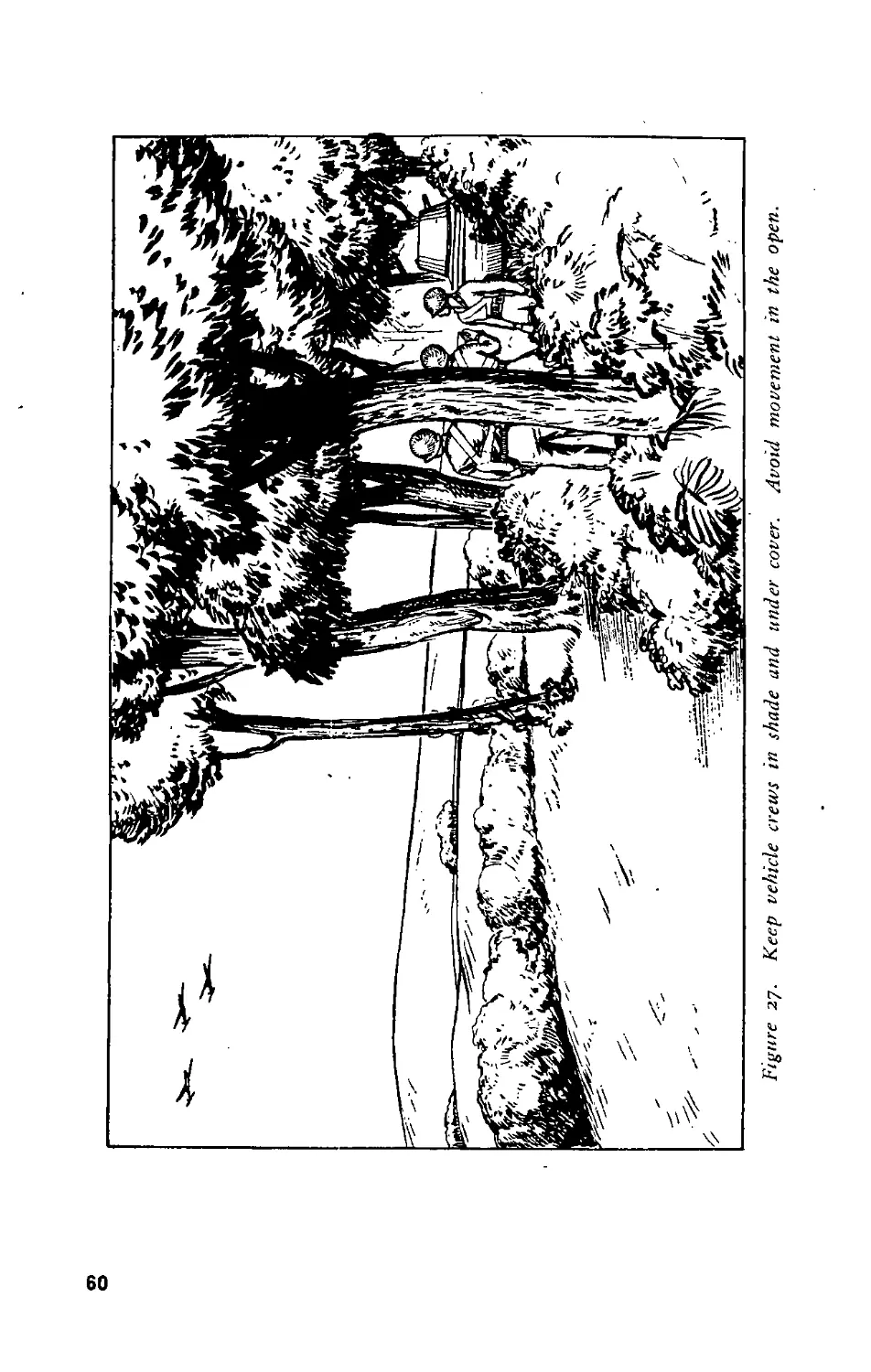
Figure 27. Keep vehicle crews in shade and under cover. Avoid movement in the open.
(T) Wrong.
© Right.
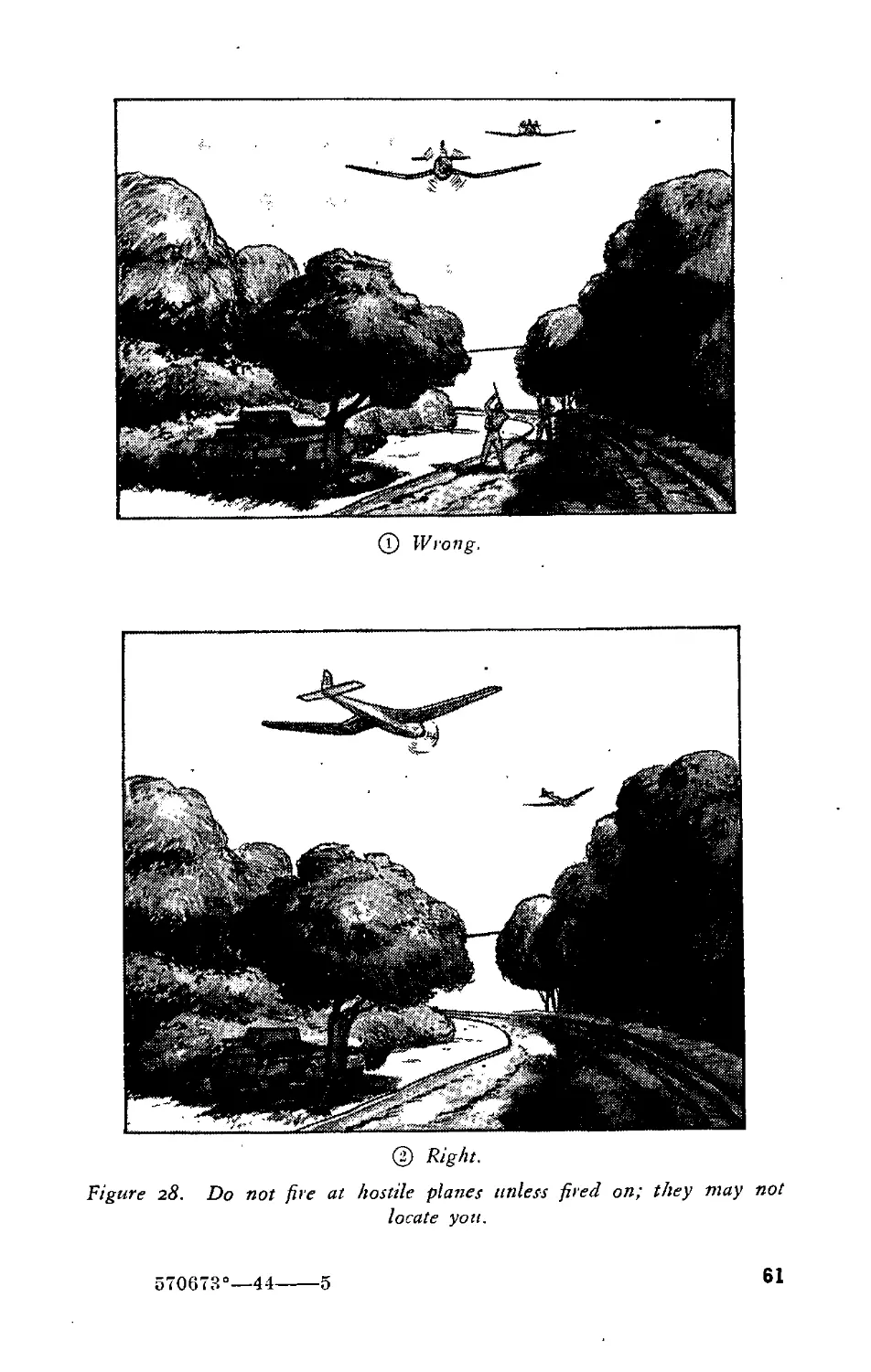
Figure 28. Do not fire at hostile planes unless fired on; they may not
locate you.
570673°—44----5
61
© Wrong.
© Right.
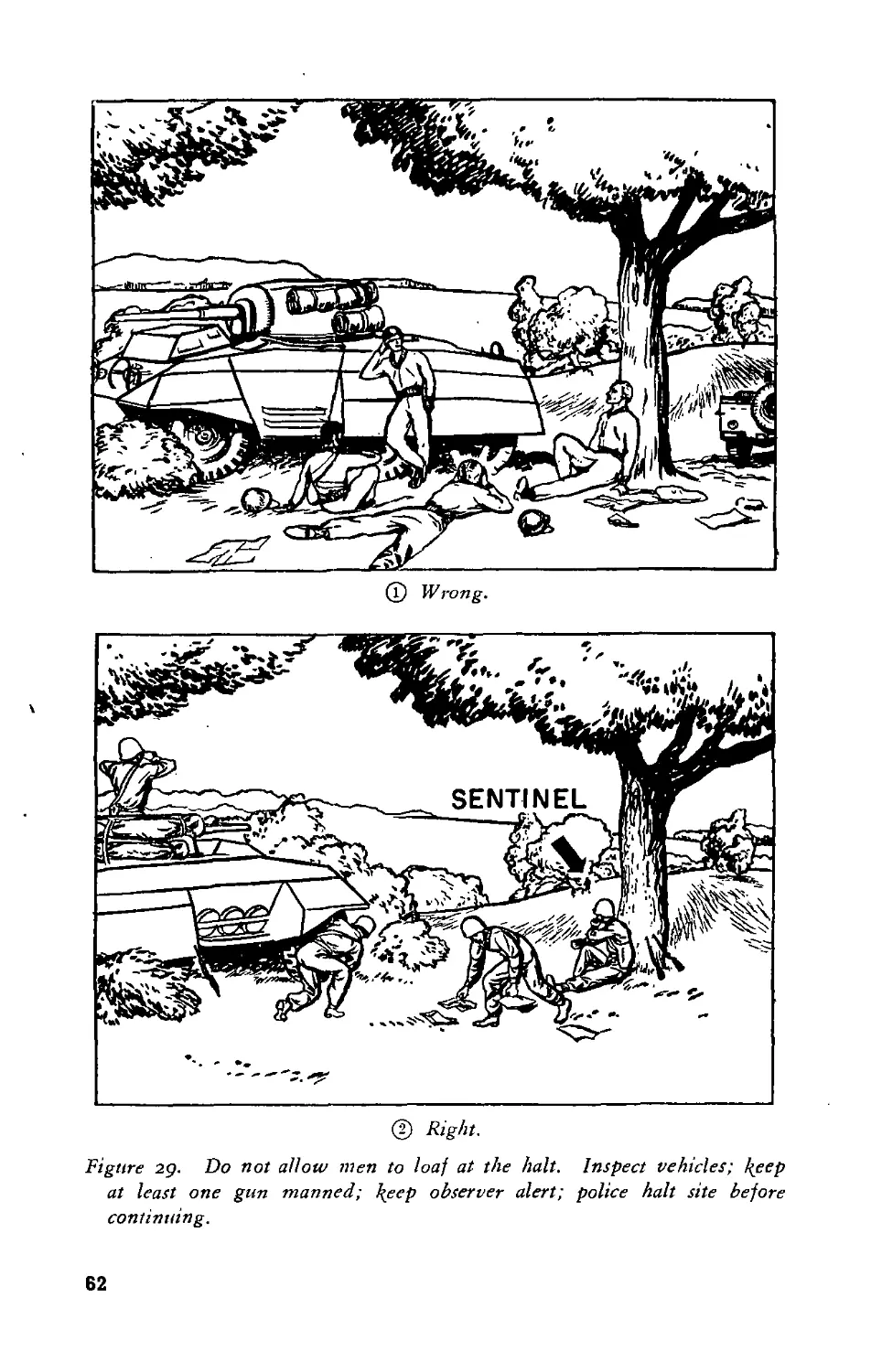
Figure 29. Do not allow men to loaf at the halt. Inspect vehicles; keep
at least one gun manned; keep observer alert; police halt site before
continuing.
62
(1) Wrong.
® Right.
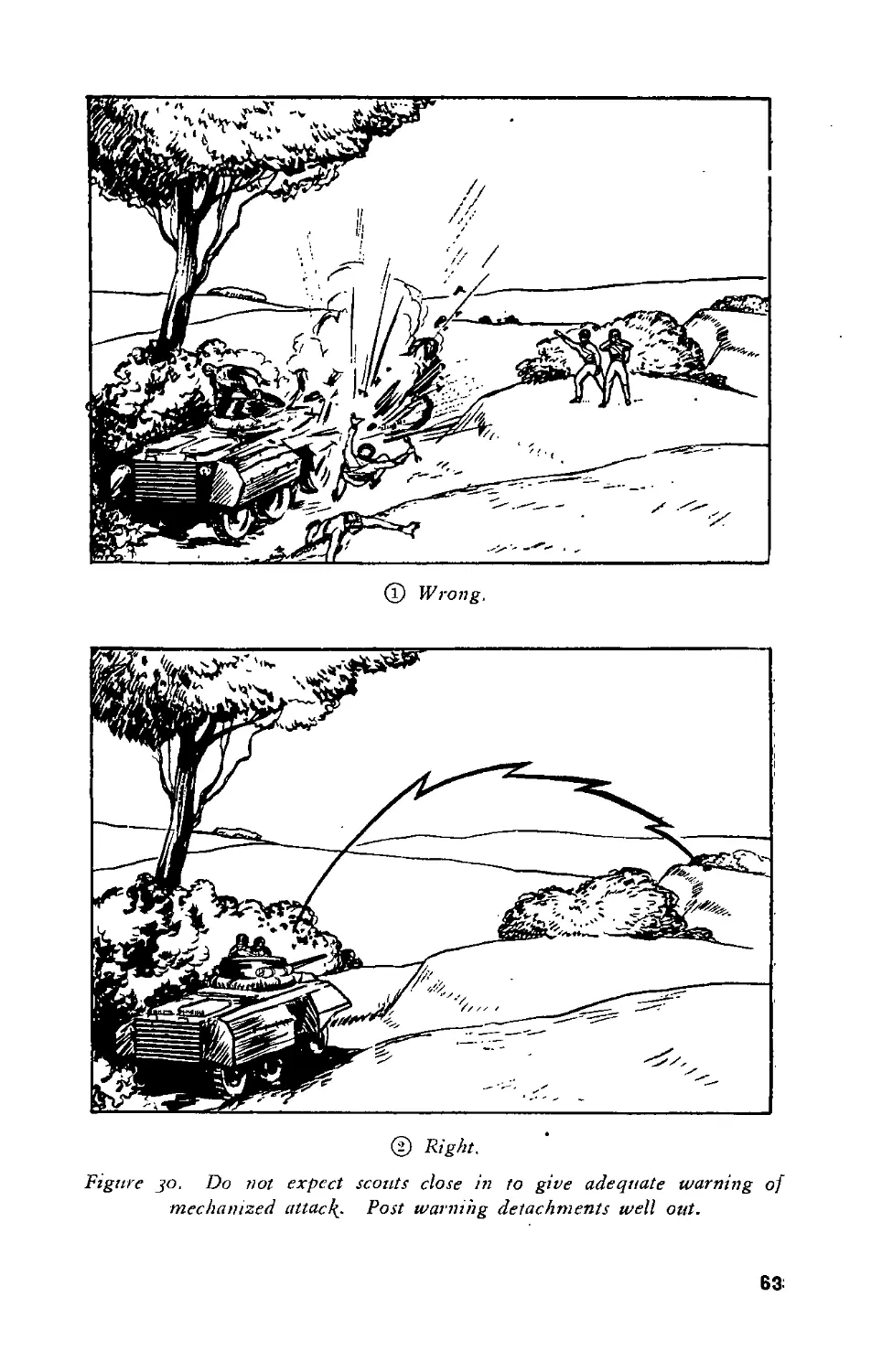
Figure 30. Do not expect scouts close in to give adequate warning of
mechanized attacks Post warning detachments well out.
6a
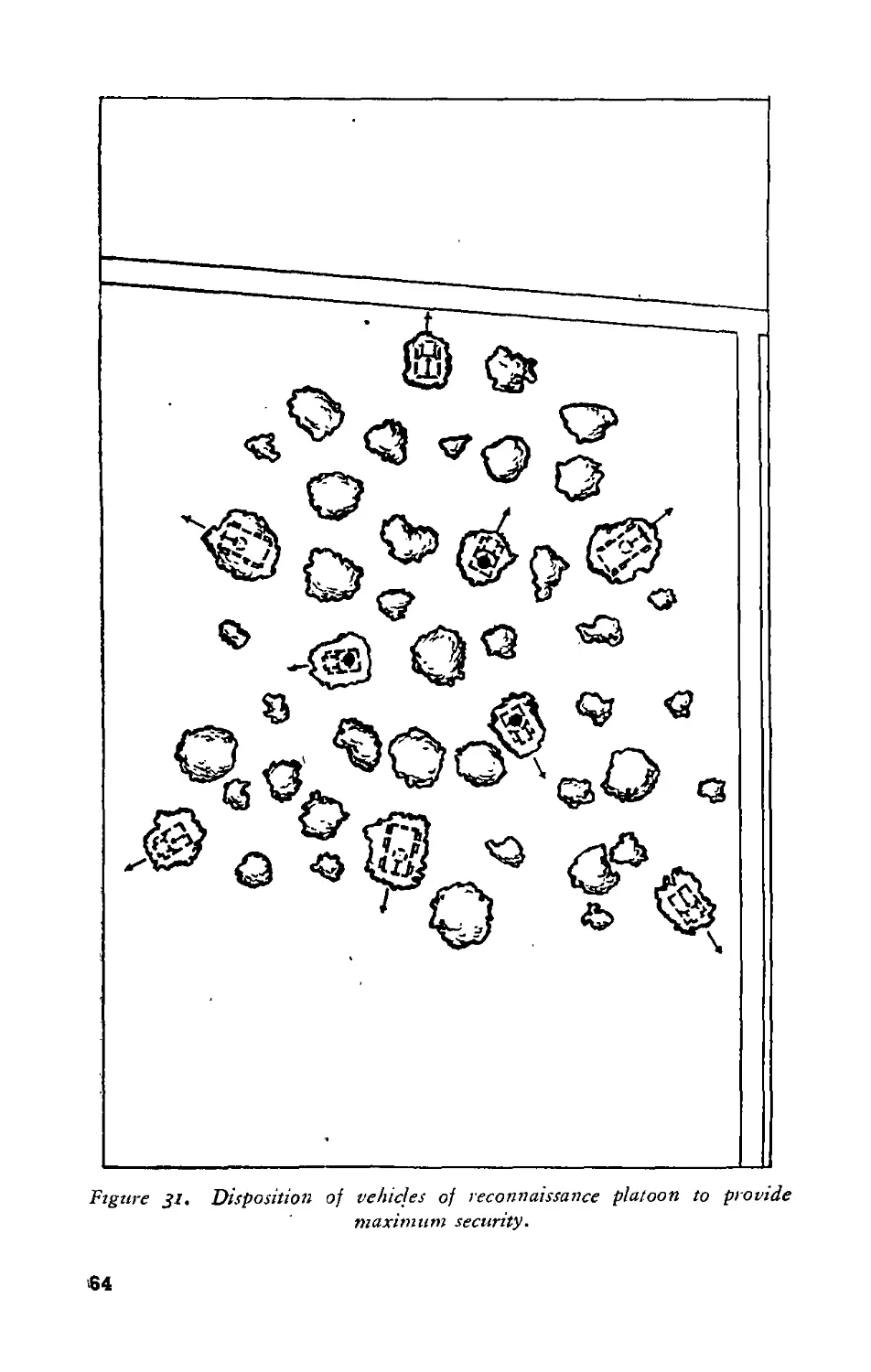
Figure 31 < Disposition of vehicles of reconnaissance platoon to provide
maximum security.
$4
Figure 32. Organization of troop outpost. Cover avenues of hostile
approach. Place train in center for greater protection. Use obstacles.
Prepare bridges for demolition. Place mortars to cover approaches.
Post observation groups.
65
Figure 33. Vehicles on outpost are placed to blocky avenues of approach
by fire. Ranges to important terrain features must be determined at
once.
66
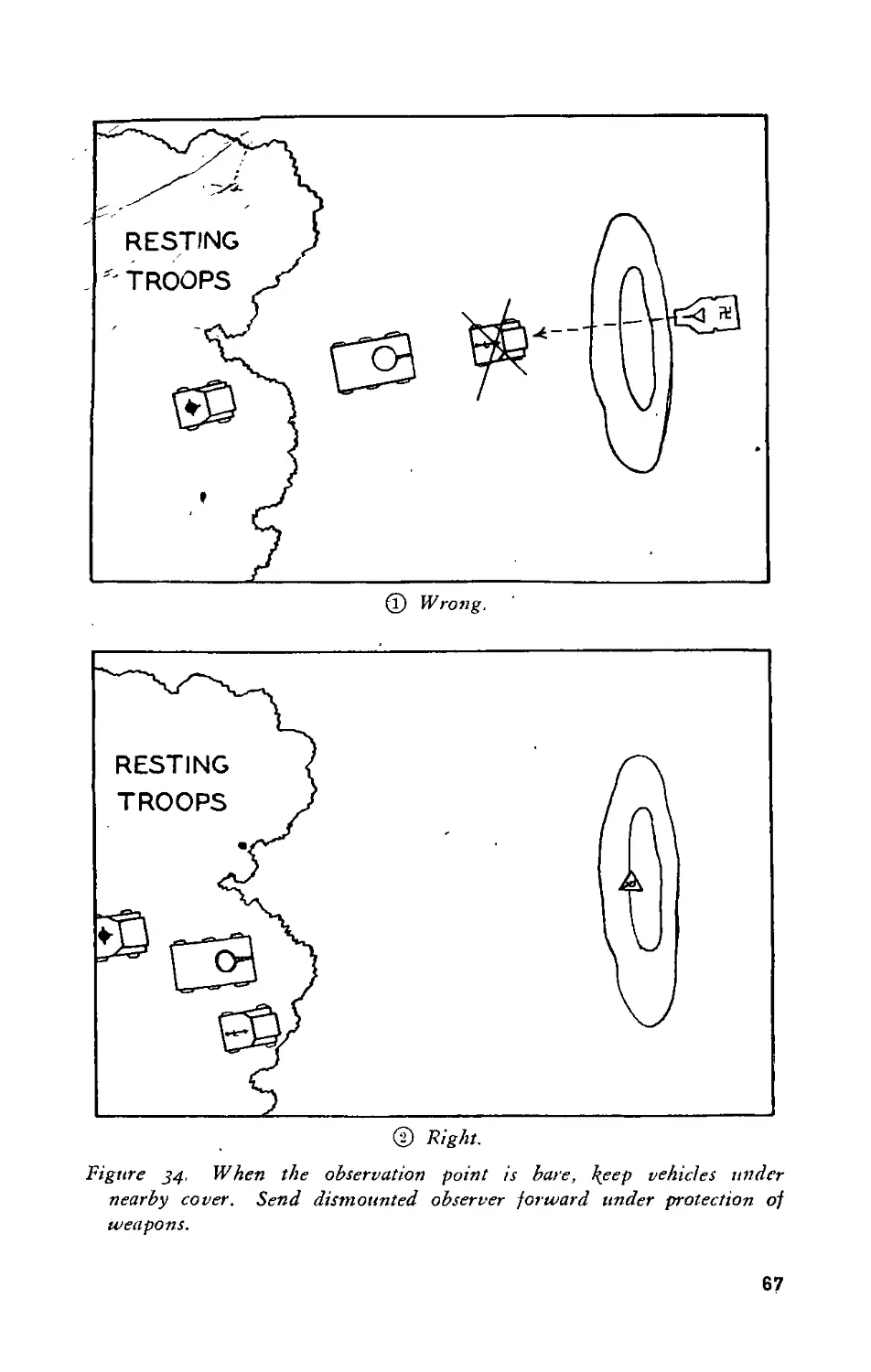
Figure 34. When the observation point is bare, \eep vehicles under
nearby cover. Send dismounted observer forward under protection of
weapons.

® Wrong.
® Right.
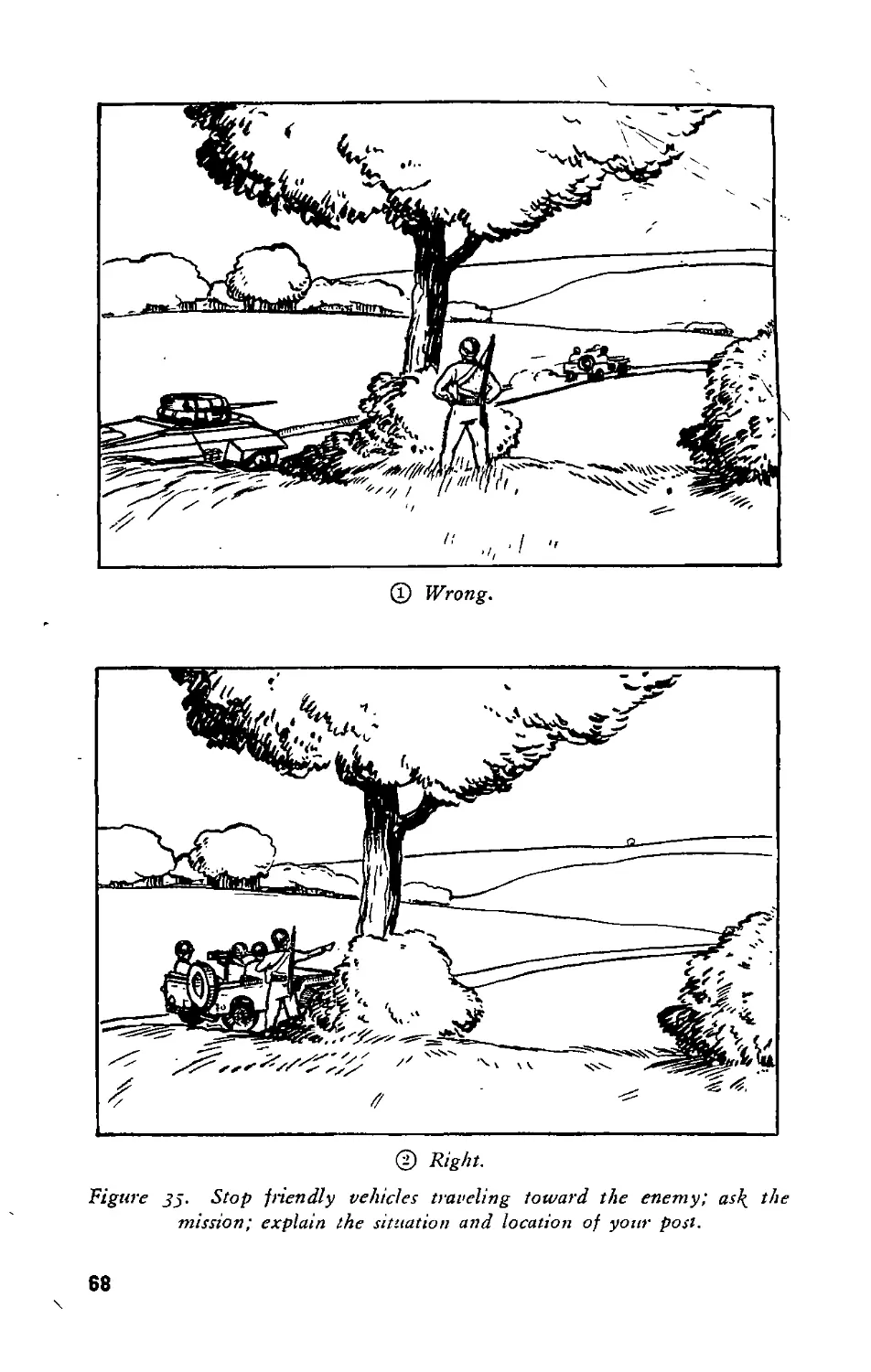
Figure Stop friendly vehicles traveling toward the enemy; as^ the
mission; explain the situation and location of your post.
68
(/) Signals to be used.
(g) Means of identification of friendly vehicles and person-
nel at night.
(Л) Where messages are to be sent.
(/) When he is to be relieved and direction of withdrawal
in case of attack.
(4) Sentinels force vehicles which attempt to pass through the
outpost to stop. Methods employed should not cause damage
to men or vehicles. Removable blocks may be placed across
roads or trails which enter the outpost to cause vehicles to stop
or slow down for challenging.
C. Contact between outguards is maintained by visiting pa-
trols. A definite system of recognition must be prescribed.
d. The reconnaissance troop furnishes information and
warnings of air and ground attack directly to the outpost of
the division, as well as to division headquarters. The recon-
naissance troop may be attached to the division outpost to
perform reconnaissance missions.
43. SECURITY OF TROOP TRAIN, a. The troop train
accompanies troop headquarters in an advance. The support
platoon affords protection when present. Vehicles of the train
are equipped with radio to provide communication within the
train and with troop headquarters. Automatic weapons are
provided on vehicles for antiaircraft defense and rocket launch-
ers for antimechanized protection.
b. When the train operates between supply points and the
troops, the train commander provides security with organic
means unless attachments are made by the troop commander.
Personnel of all vehicles are alert for enemy air or ground
activity. Information is transmitted to the troop commander
by radio or messenger. The train commander, through prior
map or road reconnaissance, must be prepared to change direc-
tion and route of march to avoid encounter with enemy forces.
When warned of approaching aircraft, the train moves off the
road, disperses, and halts, using available concealment to escape
detection.
69
44. ANTIAIRCRAFT SECURITY MEASURES, a. Gen-
eral. The reconnaissance troop provides security against air
reconnaissance and air attack employing measures for warning,
concealment, dispersion, and fire. Antiaircraft security is pre-
scribed in standing operating procedure (figs. 7 to 17,
inclusive).
b. Warning. (1) Air scouts are designated in each vehicle
to observe for hostile aircraft and give timely warning of their
approach. On the march, they observe from the vehicles; at
the halt, they are posted nearby. Security detachments are
provided with signaling equipment if posted beyond visual
range. All individuals are trained in the identification of
hostile aircraft (FM 30-30). Air alarm may be transmitted
by radio, visual signals, prescribed whistle signals, firing of
weapons, or voice.
(2) Units and individuals are governed by the following rules,
upon receipt of the air alarm warning:
(a) When in column,-all vehicles seek cover, or disperse if
no cover is available, and halt.
(Z>) Personnel in open vehicles not naming antiaircraft
weapons dismount and disperse.
(c) Movement is resumed on command after airplanes have
passed.
(<Z) Platoon and teams halt but do not fire at aircraft unless
attacked, since they hope to avoid detection.
(e) Dismounted men seek cover and remain motionless.
(/) Orders to fire at aircraft are not issued unless planes
attack. When fire is ordered, all suitable weapons are used.
(g) Men do not look up at aircraft during daylight or at
night when flares are used, because faces are detected readily.
(A) It is important that movement cease when flares illu-
minate an area.
(3) Units over which enemy planes have passed should be
alert for attack by combat aviation which may follow if the
unit has been discovered.
70
c. Concealment. (i) The presence of troops is disclosed to
an air observer by movement, regular formation or outline,
reflection of light, dust, smoke, fresh tracks, and new installa-
tions. Measures taken for concealment aim to defeat visual
reconnaissance and photography. Concealment is not effective
unless complete. Constant attention is required for effective
camouflage.
(2)	Natural concealment requires less time, skill, and material,
and is more effective than camouflage. Vehicles are concealed
under heavy natural cover, such as dense woods. In partly
open country, they should be driven into woods or brush.
(TF 5-646, 5-648, and 5-649.)
(3)	If natural concealment is not available, vehicles halt on
broken ground. Natural or artificial means are used to camou-
flage their natural outline.
(4)	Camouflage should appear natural. Tree branches, brush,
weeds, leaves, grass, or dirt are used to cover materiel that is
partially or wholly exposed. Regularity of pattern, angles, and
shadows must be avoided. (FM 5-20.)
(5)	Care must be taken that tracks do not disclose the loca-
tion of vehicles. Tracks may be obliterated for short dis-
tances by sweeping or by covering them with brush or leaves.
Paths made within a bivouac area are concealed from air
observation.
(6)	Open fires and unshielded lights should not be permitted.
Smoke may disclose the location of a bivouac during „day light.
d. Dispersion. Vulnerability to air observation and attack
is lessened by dispersed formations. Dispersion may be ac-
complished by increasing width and depth of formations, by
moving in'multiple columns, by distributing units in small
groups within bivouac areas, and by halting vehicles at ex-
tended distances. The troop should have a prearranged sys-
tem for dispersion in the event of air attack.
45.	ANTIMECHANIZED SECURITY MEASURES. a.
Mobility and skillful use of cover and concealment are the
71
principal means of security against mechanized forces. Warn-
ing service, similar to that provided for antiaircraft security,
is established.
b. Advantage is taken of natural obstacles, such as streams,
lakes, marshes, thick woods, and mountainous country, which
restrict enemy mechanized operations. Artificial obstacles, such
as barricades, ditches, demolitions, and mines, provide addi-
tional security for bivouac areas.
C. When the troop defends against mechanized forces, fire
of organic weapons is employed. The 37-mm guns with which
armored cars are equipped are effective against most tanks at
ranges up to 400 yards and against lightly armored vehicles
up to 1,000 yards.
46.	SECURITY AGAINST CHEMICALS. For security
against chemicals, see FM 21-40 and 100-5.
47.	COUNTERRECONNAISSANCE. The troop is em-
ployed on reconnaissance when assigned to a larger force on a
counterreconnaissance mission, and is used to locate and main-
tain contact with enemy patrols (pars. 27 to 29, incl.). Com-
bat is avoided. The composition, location, and'direction of
movement of enemy patrols are reported promptly.
Section IV
Combat
48.	OFFENSIVE COMBAT, a. The troop or platoon en-
gages in combat with enemy forces which threaten the success
of the mission. Elements support each other by employing
fire and maneuver to effect the advance of the unit; or, a part
of the unit contains the enemy while the remainder continues
on the mission. The unit does not become involved so se-
riously that it cannot withdraw to secure freedom of action for
72
an advance in a new direction. In side-slipping hostile re-
sistance, the detour is made beyond the effect of enemy weapons,
so that the enemy must displace to offer further resistance.
b. A reconnaissance unit may encounter a defended obstacle
which must be reduced in order to accomplish the mission.
The unit attacks when reconnaissance indicates that the enemy
position can be taken with the means available. Reinforce-
ments are requested promptly when reconnaissance indicates
enemy strength beyond the capabilities of the unit. Surprise,
speed, and coordination are essential in the attack. The de-
fenders must be located accurately, pinned by fire, and
enveloped.
49.	OBJECTIVES. When on reconnaissance, the troop or its
elements attack limited objectives only. Vital observation
points or other terrain features essential to the mission may be
seized, and the defended obstacles or enemy forces which
threaten the success of the reconnaissance mission may be
attacked.
50.	TACTICAL GROUPINGS, a. The reconnaissance
troop engages in offensive action as a unit exceptionally. Pla-
toons attack to accomplish assigned missions. The troop co-
ordinates the action of platoons and directs the action of at-
tached units. In an attack, three tactical groupings are formed:
a base of fire, a maneuvering force, and a support.
b. The base of fire pins the enemy to the ground and neu-
tralizes his weapons to assist the maneuvering force in reach-
ing a position from which to assault. Weapons selected to
form the base of fire are determined by the type of targets
presented- by the enemy and the availability of covered posi-
tions for armored cars and mortars. Elements of the base
of fire displace to advanced positions when fire superiority is
gained. Under favorable conditions, they may gain positions
from which to participate in the assault.
C. (I) The maneuvering force moves by a covered route to a
position from which to attack the enemy flank or rear. Move-
73
ment is made in vehicles where practicable. Armored cars
may be included where conditions favor the employment of
their armament.
(2)	The movement is protected by a covering force. Move-
ment in vehicles terminates at the last available cover. The
force continues dismounted in an approach march formation
until compelled to fire in order to advance. Fire is opened
on orders of the commander.
(3)	Fire superiority is gained over the enemy by subjecting
him to fire of such accuracy and intensity that hostile fire be-
comes inaccurate or decreased in volume. The base of fire
assists in neutralizing enemy fire.
(4)	Advances are made by infiltration and by successive rushes
and maneuver of small groups. The movement of advancing
elements is covered by the fire of those remaining in position.
Groups push forward during each lull in enemy fire to oc-
cupy successive firing positions. The combination of fire and
movement enables attacking elements to reach positions from
which they can employ grenades and overcome the enemy in
hand-to-hand combat.
d. A support is withheld initially. The support for the troop
or platoon should not exceed a platoon or team, respectively.
It is committed at the proper time and place to assure victory.
After an attack is launched, the support is the principal means
available to the commander to influence the action. Prior to
being committed, it protects the flank and rear. It is held
until the decisive moment and committed as a unit. Other
uses are to cover reorganization on the objective, to initiate
limited pursuit, or to cover a withdrawal. The support com-
mander maintains contact with the unit commander.
51. EMPLOYMENT OF WEAPONS, a. General. The
troop can deliver heavy fire with mortars, antitank guns, and
automatic weapons. The variety of weapons with which the
troop is equipped permits the assignment of proper weapons
to engage particular targets.
74
b.	Individual weapons. Each man is armed with a rifle,
carbine, or submachine gun. He carries his weapon whenever
he is dismounted from the vehicle. Grenades are carried in
vehicles for issue to individuals when required.
c.	37-mm gun. The 37-mm gun has a high muzzle velocity
and flat trajectory. It is effective against most tanks at ranges
not exceeding 400 yards when armor-piercing ammunition
is used. Armor-piercing ammunition is effective against lightly
armored vehicles at ranges less than 1,000 yards. High ex-
plosive ammunition is used against machine guns and anti-
tank weapons. Canister is effective against personnel at
ranges less than 200 yards. The gun is employed from posi-
tions which afford hull defilade for the armored car (fig. 36).
No ground mount is provided for the 37-mm gun. Fire from
a moving vehicle is inaccurate.
d.	Machine gun. The caliber .30 machine gun is a flat
trajectory weapon capable of delivering a relatively high vol-
ume of fire. It is primarily an antipersonnel weapon. Caliber
.30 armor-piercing ammunition is effective against lightly
armored vehicles at close range. The gun may be fired from
the vehicle or from the ground (fig. 37). Fire from a mov-
ing vehicle is inaccurate.
e.	60-nun mortar. The 60-mm mortar is a high-angle fire
weapon for use against crews of enemy weapons, personnel
grouped closely, and targets in defilade. Mortars of a pla-
toon may be fired as a unit or individually. The mortar can
be fired from the %-ton truck or from the ground (fig. 38).
Mortar fire must be observed and adjusted. Crews select pri-
mary and alternate positions habitually. Limiting ranges of
the mortar are approximately too and 2,000 yards.
f.	Rocket launcher. Rocket launchers are provided for
antitank protection. They are effective also against buildings,
machine-gun emplacements, and embrasures.' The launcher has
a relatively low rate of fire and a distinctive flash on discharge.
It is inaccurate at ranges over 300 yards. It is a powerful
supporting weapon at short ranges.
75
Figure 36. Armored cars see!^ positions offering hull defilade when firing.
570G73
Figure 37. Automatic weapons are set up on the ground when good vehiadar positions are not available.
g.	Ammunition. Because of the small amount of ammu-
nition carried in each vehicle, economy must be exercised in
its use. Use the proper weapon and ammunition. For ex-
ample, use the 37-mm gun on targets against which other
available weapons are ineffective. Strip disabled vehicles of
ammunition whenever practicable. Platoon leaders check am-
munition frequently and redistribute when necessary.
52. COORDINATION AND CONTROL, a. The com-
mander coordinates the efforts of all elements employed in
the attack. The following control measures are included in
the attack order:
(1)	Mission.
(2)	Initial dispositions.
(3)	Direction of attack for each element.
(4)	Time of attack.
(5)	Objectives for each element.
(	6) Signals for lifting supporting fire.
(7)	Instructions for maintaining contact and for flank pro-
tection.
(8)	Initial location of the commander.
b. Reliable communications are essential for coordination and
control during an attack. Orders must be clear and concise.
Messengers, radio, and visual signals are used for communica-
tion. The commander observes from a forward position or
accompanies the maneuvering force.
C. Where practicable, complete orders are issued orally to
assembled subordinate commanders at a point from which the
objective can be seen (fig. 39). Orders are delivered by radio
or by messenger to leaders who are absent. Fragmentary orders
may be issued when necessary.
53. REORGANIZATION. The unit reorganizes promptly
when the objective is reached. Preparations are made to repel
counterattack and to continue the mission. Duties of leaders
during reorganization are—
a.	To provide all-around security.
78
Figure 38. The mortar should be placed in a defiladed position near good observation.
Figure 59. Do not give orders from a map or by description alone, if a
position can be reached from which enemy and terrain may be pointed
out.
80
b.	To replace leaders who are casualties.
C. To reconnoiter to the front and flanks.
d.	To care for the wounded.
e.	To report the results of the action to the next higher com-
mander.
f.	To redistribute ammunition.
g.	To send prisoners and captured documents to the next
higher headquarters.
h.	To issue orders for future action.
54. DEFENSIVE ACTION, a. General. Elements of the
reconnaissance troop may be required to defend observation
posts, bridges, or defiles, in order to accomplish reconnaissance
missions. Enemy attack may necessitate defensive action in
other instances. The decision to defend a position rather than
to conduct a delaying action should be made after weighing
the advantage to be gained against the risk involved. The fire
which can be delivered with concealed vehicular weapons, em-
placed automatic weapons, and mortars compensates partially
for inadequate personnel. Mobility is employed to gain infor-
mation of the attacking forces, to maneuver supports, or to effect
withdrawal. Defense of an isolated position by a small force
exposes the unit to danger of being cut off and destroyed.
b.	Defense of a position. Defense of an isolated position
requires patrolling on all routes of approach, local security
measures, organization of ground for all-around defense, and
mobile supports available to occupy previously prepared posi-
tions or to counterattack. The position is organized to the
extent that time permits. Fox holes and weapon emplacements
are dug and camouflaged. Weapons are sited to cover ap-
proaches. Alternate and supplementary positions for weapons
are selected and prepared. Close-in defensive fires are planned.
Natural obstacles are improved and supplemented where prac-
ticable. Part of the position is occupied. Separate plans are
made for employing the support to reinforce the position, extend
the position, and to counterattack. Routes of withdrawal are
reconnoitered.
81
c.	Delaying action in successive positions, (i) A
delaying action in successive positions is conducted by offering
limited resistance only on each position. The unit is deployed
on the broadest front which will permit control and mutually
supporting fires. When a flank is exposed, a stronger support
is retained. A position near the topographical crest is better
generally than one on the military crest. The former affords
the unit defilade immediately upon initiation of withdrawal.
Fires are opened at extreme ranges in order to force the enemy
to deploy and to make time-consuming preparations for attack.
A natural barrier to enemy approach is desirable. Mines are
placed if time permits. Early reconnaissance of successive posi-
tions and routes of withdrawal by all leaders is necessary.
(2) Withdrawal to a rear position is made before hostile fire
can pin the unit to the ground and before the enemy can reach
assaulting distance. Withdrawal can be made by elements
sucessively or simultaneously. When withdrawing succes-
sively, units support one another’s movement. When they
withdraw simultaneously, each unit supports its own with-
drawal (par. 55). Patrols maintain contact with the enemy
between delaying positions.
d.	Delay on one position. Elements of the troop may be
required to hold a position for a predetermined time. A unit
defending a single position to effect delay organizes the position
and plans its fires as Indicated in b above.
55. BREAKING OFF ACTION. A reconnaissance team or
platoon breaks off action to side-slip enemy resistance, or to
withdraw to secure freedom of movement. All elements do
not withdraw simultaneously, since the enemy might have
mobile forces with which to pursue. A small covering force,
located in the rear or to a flank, covers the withdrawal. The
remainder of the unit assembles in a position which is pro-
tected from direct fire, and assists the covering force to with-
draw. Mines and demolitions are used to impede the enemy
advance.
82
Figure 40. Hold key point by disposing vehicles to cover all directions.
Send security detachments well out. Select alternate and supplementary
positions for vehicles and weapons.
83
Figure 41. Place vehicles to fire on hostile vehicles ap proaching ambush. Site machine guns and mortars to
prevent hostile personnel from removing obstacle. Select alternate positions for all vehicles.
Figure 42. Antimechanized weapons oj an ambush should fire on rear vehicles first.
CHAPTER 3
EMPLOYMENT OF CAVALRY
RECONNAISSANCE TROOP, MECHANIZED,
CAVALRY RECONNAISSANCE SQUADRON,
MECHANIZED
Section I
General
56. MISSION. The reconnaissance troop is the principal
reconnaissance element of the cavalry reconnaissance squadron,
mechanized.. Its primary mission is to furnish the commander
of the unit to which the squadron is assigned or attached with
information upon which to base a decision for employment of
that unit. It has relatively great fire power and mobility and
is capable of additional missions of security for the squadron
and of combat in the performance of reconnaissance.
86
57. METHOD OF OPERATION, a. The troop operates
as does the cavalry reconnaissance troop, mechanized, infantry
division, employing infiltration tactics, fire,- and maneuver to
accomplish reconnaissance missions (par. 17). For tactical
operations, an assault-gun platoon from the cavalry assault-gun
troop of the squadron habitually is attached.
b. The troop operates on reconnaissance as a unit only in
the sense that its commander controls and coordinates the activi-
ties of platoons. The platoon is the basic tactical unit, and sep-
arate missions are assigned each platoon.	*
C. The squadron normally operates with two (three) recon-
naissance troops initially assigned to active reconnaissance; one
reconnaissance troop, together with the light tank company,
initially may constitute the squadron reserve. The squadron
reserve may be employed to create a gap in the enemy’s screen
in an area which favors subsequent reconnaissance operations.
During the action, reconnaissance elements are prepared to pass
through the gap without delay.
d.	A reconnaissance troop of the squadron, armored division,
with an assault-gun platoon attached, may be attached to a
combat command.
e.	The troop may be supported by the light tank company,
the latter providing combat power to overcome minor opposi-
tion. The light tank company may be attached as a unit or by
platoons to reconnaissance elements when the squadron front
is so broad, or the terrain so difficult, that reserves cannot be
moved readily to all parts of the squadron zone. Attachment
also may be made when hostile resistance can be foreseen. The
light tank company is employed most effectively in combat as a
unit, supported by the fire of assault guns to neutralize antitank
weapons. (FM 17-30 and 17-32.)
f.	The troop may be replaced by tank units for execution of
reconnaissance when the volume of enemy fire necessitates
greater armor protection for reconnaissance teams and when
terrain is too difficult for operation of wheeled vehicles. Light
tanks supported by assault guns are effective on reconnaissance
87
in causing the enemy to disclose the location of antitank
weapons.
58.	COORDINATION. There must be complete coopera-
tion and coordination of effort between troops of the reconnais-
sance squadron and between the squadron and other ground
and air reconnaissance agencies operating in advance of the
division or other higher unit. Direct communication between
them by radio, liaison, or other practicable means, must be
maintained. Coordination is effected by higher headquarters
(par. 18).
Section II
Reconnaissance
59.	GENERAL. The reconnaissance troop of the mechanized
cavalry reconnaissance squadron executes reconnaissance mis-
sions for the same purpose and by the same methods as does
the cavalry reconnaissance troop, mechanized, infantry division
(pars. 19 to 38, incl.), except that the methods of the former
involve employment of attached assault guns.
60.	EMPLOYMENT OF ASSAULT GUNS. a. The troop
employs attached assault guns to support reconnaissance pla-
toons by placing smoke or HE concentrations on organized
enemy positions, thereby permitting side-slipping and infiltra-
tion by reconnaissance elements. For employment in the con-
duct of offensive and defensive action, see section IV.
b. The assault-gun platoon, consisting of a platoon head-
quarters, two assault-gun sections (one assault gun each), and
an ammunition section, operates under reconnaissance troop con-
trol. Usually, it is held, with one reconnaissance platoon, in
troop reserve, and employed as a unit ift support of reconnais-
sance elements as need for such support arises. Such use retains
88
for the troop commander the initiative in the commitment of his
reserve. Exceptionally, individual assault guns (sections) may
be attached to and operate separately with reconnaissance pla-
toons. In such cases, the platoon headquarters and ammuni-
tion section normally remain with the troop headquarters until
engagement of one or both of the guns necessitates resupply of
ammunition.
C. In the execution of fire and maneuver, the assault-gun
platoon is employed in the base of fire to support the maneuver-
ing element. Assault guns employ direct or indirect fire, de-
pending upon availability of suitable defiladed positions. Pri-
mary targets are antitank guns, light and heavy machine guns,
and tanks. (FM 17-25 and 17-69.)
d. The decision to open fire and the selection of targets are
the prerogatives of the commander of the supported troop
or platoon. He may, however, direct the assault-gun platoon
or section leader to select and occupy a position, and open fire
on favorable targets without further orders.
e. The use of voice radio to direct movement of assault-gun
sections is habitual, supplemented where applicable by whistle
or arm-and-hand signals.
Section III
Security
61.	GENERAL, a. The reconnaissance troop of the cavalry
reconnaissance squadron, mechanized, is responsible for its
own local security and for contributing to the security of the
unit to which the squadron is assigned or attached, as is the
reconnaissance troop, infantry division (par. 39). In addition,
elements of the troop may be called upon to provide security
for the troop, or the troop may be designated as an advance,
flank, or rear guard, or outpost, for the squadron.
89
b. Local security measures prescribed for elements of the
reconnaissance troop, infantry division (pars. 39 to 47, inch),
likewise apply to the assault guns attached to the reconnaissance
troop of the squadron. Elements, when advancing, remove gun
covers and set guns for the probable direction of fire. At the
halt, air and ground sentinels are kept alert; crews are kept
near vehicles. In firing position, the ammunition section is
placed where its vehicular armament may be employed to pro-
tect the flank and rear of the position from ground attack; it
should not be too close to the gun(s). The driver of the
ammunition vehicle may be detailed as air and ground sentinel
to watch to the flanks and rear. In bivouac areas, assault-gun
vehicles should maintain distances prescribed for other ve-
hicles and be placed in positions from which they can go into
action without delay.
62.	ADVANCE GUARDS, a. When acting alone, the troop
or platoon employs an advance guard, as do similar elements
of the reconnaissance troop, infantry division (par. 41). If
an assault-gun section is attached to a reconnaissance platoon
acting as advance guard for a troop or larger unit, it takes
position in column immediately behind the platoon leader’s
reconnaissance team, in the center of the advance party.
b. An entire reconnaissance troop may be detailed as the
advance guard for a reconnaissance squadron which is the re-
serve of a group or, for other reasons, is marching as a unit.
The attached assault-gun platoon in such cases is placed well
forward in the support element.
C. When acting as an advance guard, the troop pushes for-
ward boldly, reconnoiters the route of march, and observes or
reconnoiters to the flanks. The advance guard of a reconnais-
sance platoon operating alone, or the reconnaissance element
acting as point of a larger advance guard, normally is held
responsible only for visual reconnaissance or the examination
of possible enemy positions within effective small-arms range
to the flanks. If an advance party is included in the advance
90
guard, its responsibility for flank reconnaissance extends to a
distance of about 800 yards; for a support, about I mile.
63.	COVERING DETACHMENTS, a. Due to the nature
of the operations of mechanized reconnaissance units, there are
few occasions for the employment of covering detachments for
units larger than a platoon. Each platoon provides its own
covering detachment, composed of two or three %-ton trucks.
b. Exceptionally, the platoon or even the entire troop may
form a covering detachment for a larger unit. When a platoon
is covering the advance of the troop on a mission such as
seizing and holding a key terrain feature, or of the tank
company moving to an attack position, all six of its %-ton
trucks may be necessary to cover the front.
C. When employed as covering detachments, reconnaissance
elements are deployed on a broad front with intervals of 150
to 300 yards between vehicles, the determining factors being
the maintenance of control by a single individual and the
frontage which must be covered. Control of a covering detach-
ment is by the commander of the protected force. If initial
contact is expectd to be with organized positions, including
emplaced antitank or automatic weapons, or with mechanized
forces, assault guns may be attached to a covering detachment.
64.	FLANK GUARDS. a. Reconnaissance elements may be
employed as flank guards for the squadron of which they are
a part.
b.	The strength of a flank guard for a reconnaissance troop
moving as a unit will vary from a three-vehicle reconnaissance
team to a reconnaissance platoon reinforced with an assault-gun
section. A reinforced reconnaissance platoon, or an entire
reconnaissance troop with an attached assault-gun platoon, may
be employed as flank guard for a squadron.
c.	A reconnaissance element employed as a flank guard is
interposed between the main body and the located or antic-
ipated hostile threat. The distance of operation to the flank
will vary, depending upon the enemy composition, terrain, and
91
the size of the main force. The disposition of vehicles within
a flank guard, the subdivision of the flank guard into elements,
and the distances between elements conform to those of an
advance guard (par. 41). Movement is based on the progress
of the main body or the time limit set by the main body
commander for reaching successive phase lines or objectives.
d.	A reconnaissance platoon or troop acting as a flank guard
is conducted with especial reference to routes or localities
which favor attack against the flanks of the main body. It
reconnoiters to locate promptly all enemy forces, and takes
advantage of its mobility to concentrate in order to defeat or
delay the enemy for the necessary period. Contact with the
main body is maintained by the use of radio or of vehicular
messengers. Sufficient contact must be maintained with ad-
vance and rear guards to prevent enemy forces from filtering
in between the security elements. A flank guard may be
ordered to march parallel to the main body when continuous
flank protection is required; when the locality from which
an attack may be expected is well defined, the flank guard
may be directed to occupy a key position covering the route
of approach until the command has passed. In the latter case,
dispositions are made upon arrival at the locality to permit
holding the position as long as may be necessary. When the
enemy is encountered, a flank guard may act offensively, delay
in successive positions, or defend a position, as the situation
may require.
65.	REAR GUARDS, a. A reconnaissance troop or platoon
may be called upon to furnish a rear guard for the larger
reconnaissance unit of which it is a part.
b. The strength and composition of a rear guard provided
by mechanized reconnaissance units usually will be identical
with those indicated for an advanced guard (par. 62). Forma-
tions are similar to those of advance guards reversed.
C. When composed of a reconnaissance platoon, the rear
guard is subdivided into a rear party and a rear point. When
composed of a troop, a rear support is formed. If reinforced
92
by assault guns, they will be placed in column in the rear party
or rear support in positions corresponding to those prescribed
for their disposition in advance guards. Distances between
the main body and the rear guard, and between the elements
of the rear guard, are governed by the size of the detachment
and by the strength, composition, mobility, and proximity of
the enemy. The minimum distance is determined by the
consideration that the rear guard must delay the enemy until
the main body can pass beyond the range of hostile fire or
can prepare for action. The maximum distance is that which
can be taken without danger of being cut off.
d. A reconnaissance element acting as a rear guard moves,
by bounds, based on the progress of the main body. When
in contact with the enemy, the rear guard normally operates
by delay from successive positions, utilizing long-range fire.
Withdrawal from one position to the next is by elements, the
movement of the rearmost being covered by the fire of the
preceding element; each element avoids masking the fire of the
unit covering its withdrawal. The rear party and rear point
each reconnoiters and observes to its own rear and flanks and
keeps the main body commander informed of the enemy
situation.
66.	OUTPOSTS, a. Reconnaissance platoons or troops pro-
vide for their own local security at halts by establishing march
or bivouac outposts, as do similar elements of the reconnais-
sance troop, infantry division (par. 42). The entire recon-
naissance troop may be directed to furnish the outpost for the
reconnaissance squadron or group of which it is a part.
b. Attached assault guns are employed in the outpost to
cover likely avenues of approach for enemy mechanized forces
and in the defense of obstacles. Individual guns are placed in
hull defilade positions from which they can- employ direct
fire to repel a hostile attack. Dug-in emplacements will be used
in very flat terrain where no concealment or defilade is avail-
able. Local security for gun sections is provided as prescribed
570673°—44-
7
93
in paragraph 61. If positions are to be occupied for any length
of time, prone shelters must be dug for the protection of
personnel.
Section IV
Combat
67.	GENERAL. The reconnaissance troop of the squadron,
normally reinforced with assault guns, and with light tanks
when their use is anticipated, is prepared to fight for informa-
tion if necessary to the accomplishment of reconnaissance mis-
sions. It also may be used to harass or delay a hostile column,
to secure critical routes or areas pending the arrival of other
forces, or for counterreconnaissance. Both offensive and de-
fensive action are conducted in accordance with the principles
prescribed for similar action by the reconnaissance troop, infan-
try division (pars. 48 to 55, incl).
68.	ATTACHMENTS, a. Assault guns are used to supple-
ment other available weapons in the base of fire. Their fire
is coordinated with that of mortars, 37-mm guns, and auto-
matic weapons, to avoid duplication of targets. Both HE and
smoke ammunition are available. The former is employed to
destroy antitank gun and machine-gun crews and tanks, and to
pin other enemy personnel to the ground, providing freedom
of maneuver for other elements. Smoke is employed to mask
the action of maneuvering elements and to prevent observation
by enemy gunners.
b. Light tanks are employed in the attack to overrun auto-
matic weapons and personnel, and to penetrate hostile counter-
reconnaissance screens to permit infiltration of reconnaissance
elements. In the defense, they are used to repel enemy attacks
and to counterattack.
94
CHAPTER 4
RIVER CROSSINGS
69.	GENERAL. Unfordable streams with varying widths,
depths, and currents may be encountered in any theater. To
accomplish reconnaissance, the reconnaissance troop must cross
them. If bridges or ferries exist, they should be seized and
utilized. If they do not, the troop must—
a.	Ask for and be prepared to operate %-ton and 2 '/z-ton
amphibian trucks.
b.	Cross personnel by swimming, by small boats or 'rafts
found or built at the site of the crossing, or by rubber recon-
naissance boats.
C. Cross %-ton trucks by rafts, by overhead cable, or by
wrapping in canvas and floating. (FM’s 5-10 and 25-10; TF
7-20.)
d.	Cross armored cars and other heavier vehicles by large
rafts or by towing submerged. (FM 25-10.)
e.	Provide messenger service across the stream by personnel
operating small wooden boats, reconnaissance boats, or rafts.
Unless rafts capable of transporting the lighter vehicles are
provided, it also will be necessary to provide messengers, with
vehicles, on both sides of the crossing.
f.	Protect the crossing from observation or interference by
the enemy.
95
70.	AMPHIBIAN VEHICLES. Amphibian vehicles, due to
the increased weight and the susceptibility of their hulls to
damage, do not have the cross-country mobility and ability
to traverse rough terrain, found in land vehicles of the same
cargo capacity. They require firm footing, free of stumps or
large stones, to approach and leave the stream; a firm, gradually
sloping bank to enter or leave the stream; and a stream bed
free of submerged objects or shoals. Because of these condi-
tions, their employment requires specially trained drivers.
71.	CROSSING OF PERSONNEL. The first concern of a
commander must be to cross personnel with their individual
weapons and equipment. Only the stronger swimmers within
the unit should cross by swimming. The amount of equip-
ment which they can take depends upon the width of the
stream and the strength of the current. Weapons and equip-
ment of two individuals may be made into light rafts by the
use of shelter halves. A search should be made for small boats
or rafts in the vicinity of the crossing. The rubber boats in
the equipment of the troop can be used. If amphibian vehicles
are available, and the crossing is unopposed or is defended by
personnel already crossed, they may be used to ferry personnel
across the stream.
72.	CROSSING OF ‘/«-TON TRUCKS. If amphibian ve-
hicles are not available %-ton trucks should be the first
vehicles to cross. This may be accomplished by raft, by cable,
or by floating. Suitable rafts can be constructed from timber
found near the site, from driftwood, or from a combination of
timber and rubber reconnaissance boats. Two reconnaissance
boats provide sufficient buoyancy to carry a %-ton truck (fig.
43). Other means of providing buoyancy include empty 5-gallon
cans or sealed- wooden or steel barrels. These may be lashed
together and reinforced with timbers to provide a platform.
To cross vehicles by means of a cable, it is necessary to run
the cable from a winch over a support on the near bank, over
a support on the far bank, and anchor it securely on the far
96
bank (fig. 44). Sufficient slack then is given to the cable to
permit the attachment of a sling around the vehicle to pul-
leys on the cable. The cable then is tightened sufficiently by
means of the winch to lift the vehicle clear of the ground. By
means of ropes fastened to the vehicle, it is pulled across the
stream, the cable again slackened by the use of the winch,
and the vehicle brought to rest on the far bank. If trees or
other strong objects of sufficient height are not available, the
necessary support for the cable upon each bank may be provided
by an “A” frame. Quarter-ton trucks may be wrapped in
canvas of sufficient size and strength and floated across the
stream (fig. 45). Canvas paulins, 12 by 17 feet, or large wall
tent flies may be used for this purpose. Due to the limited
number of these canvas articles within the troop, if several
%-ton trucks must be crossed by this method, arrangements
must be made for the return of the paulin or tent fly to the
near bank after each vehicle is crossed.
73.	CROSSING OF ARMORED CARS. Armored cars
and the other heavier vehicles cannot be floated by the means
organic within the troop. If suitable materials can be found
in the vicinity of the crossing, rafts of sufficient strength may
be constructed. In case of emergency, these vehicles may be
waterproofed and towed submerged through the stream.
(FM 25-10; TF 6-105.) This is a time-consuming operation
and, in the usual case, it will be found quicker to await the
bridging of the stream or the arrival of equipment suitable for
providing rafts for their transport.
74.	COMMUNICATIONS. Early provision for messenger
service to and from subordinate units on the far bank of the
stream is provided. While radio communication is available
early through the crossing of the %-ton trucks carrying such
facilities, there still remains the necessity for providing means
of transmitting messages, maps, reports, and documents which
cannot be handled by radio. This messenger service initially
is provided by rubber reconnaissance boats or other small boats.
97
co
Figure 43. Rubber reconnaissance boats may be rafted together with planking to transport A-ton trucks across
streams where banks are not too steep, where there is little floating debris, no shoals, and floating depth
of water next to shore lines.
<0
<0
Figure 44. Truck suspended from cable. Note use of snatch block and tow chains. After the blocks
are placed over cable, the winch only takes up slack sufficiently to lift vehicle off the ground; the
more slack le1{> the better. It avoids excessive strain on the cable.
Figure 45. %-ton trucks wrapped in paulins may be floated across a stream.
If facilities for promptly crossing %-ton trucks are not available,
a relay of messengers provided with these vehicles, both to and
beyond the river bank, is set up.
75.	SECURITY. A crossing site initially free from enemy
observation and interference is selected. It may be expected
that the crossing will be discovered early. The first and suc-
ceeding elements which cross furnish protection for the re-
mainder of the troop during its crossing. It may be advisable
to cross the first elements at one site and the remainder at
another site. In such case, part or all of the leading elements
may be directed to the other site, in order to provide security
on the far bank of the stream. The troop is not organized or
equipped to cross expeditiously and continue a reconnaissance
mission in the face of enemy opposition. If this is ordered, the
troop must be suitably reinforced with engineer troops and
materiel.
76.	COMBAT. The basic principles of combat operations at
river lines are covered in FM 100-5.
101
CHAPTER 5
SIGNAL COMMUNICATION
Section I
General
77. MISSION. The primary mission of signal communica-
tion personnel in the cavalry reconnaissance troop, mechanized,
is to provide rapid, secure, and uninterrupted communication
from reconnaissance elements to higher headquarters. They
operate and maintain signal communication within the unit,
with attached units, and with adjacent units when required.
78. RESPONSIBILITY FOR SIGNAL COMMUNICA-
TION. a. The troop commander is responsible for signal com-
munication within the troop and with higher headquarters.
b. The troop liaison and communications officer conducts
the technical training of communication personnel and super-
vises maintenance of signal communication equipment.
C. During operations, the troop executive officer supervises
operation and maintenance of the signal communication system.
102
79.	MEANS OF SIGNAL COMMUNICATION. The
means of signal communication organic in the troop are dis-
cussed in section II. Radiotelegraph, radiotelephone, and mes-
sengers are the principal means.
80.	COORDINATION OF SIGNAL COMMUNICATION,
a. Effective signal communication requires coordination in all
echelons. Paragraph 5 of the field order of the unit to which
the troop is assigned or attached prescribes a coordinated plan
and designates current signal operation instructions (SOI) and
other pertinent references. SOI contain radio call signs, op-
erating frequencies, code references, cipher keys, authenticator
systems, schedules for radio and messenger service, pyrotechnic
and panel codes, and other current technical information.
b. Coordination within the troop is obtained by using stand-
ing operating procedure (SOP). This may consist of brevity
codes, special sound and visual signaling instructions, a main-
tenance system, personnel assignments and reliefs, and solutions
to other problems. Signal communication personnel should be
drilled so that it will be unnecessary to carry written copies
of SOP into combat.
81.	SIGNAL COMMUNICATION PERSONNEL. Effec-
tive signal communication requires highly trained personnel.
Carelessness, inaccuracy, or failure to maintain equipment may
result in disaster. Careful selection of individuals for training
as signal communication specialists is most important. Selected
individuals should have completed individual training with
above average records.
82.	SIGNAL COMMUNICATION TRAINING, a. Gen-
eral. All members of the troop should receive basic signal
communication training (TM 11-450). Subjects of greatest
importance are message writing, message center procedure, the
use of codes and ciphers, and radiotelephone procedure.
b. Specialist training. Section III covers training of com-
munication specialists.
103
83.	SIGNAL COMMUNICATION SECURITY. Careless-
ness or ignorance of necessary precautions in the employment
of signal communication means may disclose vital information
to the enemy or compromise the security of the. troop. All
personnel must be trained to preserve signal communication
security. Commanders should monitor the nets of subordinate
units to detect violations of security regulations (par. 89).
Section li
Means of Signal Communication
84.	GENERAL, a. Signal communication within the troop
is effected by radio, messengers, visual means, and sound. Sig-
nal communication between the reconnaissance troop and other
headquarters is accomplished by radio or other appropriate
means.
b. An agency to coordinate the use of the various means of
signal communication is required in troop headquarters. Rec-
ords of all messages are maintained in troop and platoon head-
quarters. ' Selected individuals must be trained as message
center specialists in addition to their training in assigned
specialties.
85.	UTILIZATION OF ASSIGNED MEANS OF SIGNAL
COMMUNICATION, a. Radio. Radio is the principal
means of signal communication in the reconnaissance troop.
The proper utilization of radio equipment is a major responsi-
bility of the troop commander. He should know the capabilities
and limitations of each type of equipment, including the trans-
mission characteristics of CW, tone, and voice in the bands of
frequencies available. He should understand the application
of ionospheric data to the operation of his assigned radio equip-
ment. (TM 11-499.)
104
b.	Messengers, (i) Vehicular and dismounted messen-
gers are used to deliver maps, overlays, sketches, detailed orders,
and lengthy reports. Messengers are faster than radio com-
munication under some conditions.
(2)	Dismounted messengers are used when distances are short,
and when movement in vehicles is impracticable.
(3)	Motor messengers may use organic, captured, or impressed
vehicles. Command and communication vehicles should not be
used for transporting messengers except in an emergency.
(4)	Officers may carry important messages, particularly when
an explanation of the situation is required.
c.	Arm and hand signals. See FM 2-7 (when published)
and FM 22-5.
d.	Pyrotechnics. Pyrotechnics are illuminated signals
which are discharged into the air.
(1) ADVANTAGES. («) Transmission of the message is
prompt.
(6) The equipment is comparatively light and compact.
(2) DISADVANTAGES. («) Messages of fixed meanings
only can be transmitted.
(6) Pyrotechnic signals may be misunderstood.
(c) Messages may not be observed unless discharged from
a predetermined locality at a prearranged time.
(tf) Range of observation is limited, especially in the daytime.
(e) Pyrotechnics have little signal security unless codes are
changed frequently.
(/) Errors in transmission cannot be corrected readily.
(3) Pyrotechnic codes are published in signal operation in-
structions. Special signals must not conflict with prescribed
codes.
e.	Smoke. Colored smoke is used to identify friendly
troops in daylight. It may be used also to transmit short
messages in accordance with a prearranged code.
f.	Flags. Flags are used to identify vehicles, to send mes-
sages in semaphore or wigwag code, or to transmit prearranged
messages.
105
g.	Panels. Fluorescent panels are used to identify friendly
troops to supporting air forces. Signaling panels are used to
identify ground units to air forces and to transmit brief mes-
sages in the current panel code.
h.	Sound signals. See FM 2-7 (when published) for
whistle and bugle signals. They are used for close-in com-
munication by small units.
86.	WIRE COMMUNICATION. Wire is not an organic
means of signal communication. It is desirable that signal
communication specialists have sufficient knowledge of the
use of wire communication to use and repair field wire cir-
cuits, to read military line route maps and circuit diagrams,
and to use or interrupt commercial wire circuits. This instruc-
tion should be initiated after specialists have become proficient
in the use of organic equipment.
Section III
Training
87.	GENERAL, a. Training objective. The objective is
to train all members of the troop in the use of organic signal
equipment.
b.	Personnel to be trained. (1) All personnel must be
able to use the Division Field Code, the Converter M-209,
pyrotechnic codes, panel codes, combat codes, brevity codes,
and map coordinate codes.
(2)	All personnel must be trained in the use of radiotelephone
procedure.
(3)	All personnel should be trained in the duties of messengers.
(4)	All personnel should be trained in writing clear, concise,
and correct messages.
(5)	At least three individuals of troop headquarters should
be trained as message center specialists.
106
(6)	At least one radio operator per station which operates in
nets of higher units should be capable of transmitting mes-
sages in International Morse Code at speeds up to 30 words
per minute, with a minimum of 15 words per minute under
normal conditions.
(7)	All radio operators and radio repairmen must be trained
in operator’s (first echelon) and unit mechanic’s (second
echelon) radio maintenance. (Signal Corps Circular 11-1.)
These men should receive training in wire communication
when time permits (par. 86).
c.	Training, how conducted. Training will be con-
ducted in accordance with War Department training publica-
tions. (FM 21-6.)
d.	Schools. Instruction of specialists should be centralized.
The troop commander organizes instruction, within the troop,
unless schools of a higher echelon are available. He verifies
the proficiency of specialists regardless of where they are
trained. For proficiency standards, progress reports, and tests,
see TM 11-450 and AR 615-26.
88.	COMMON SUBJECTS. All members of the troop
should be trained in subjects contained in the following pub-
lications:
TM 11-460, Division Field Code.
TM 11-461, Air-Ground Liaison Code.
TM 11-380, Converter M-209.
FM 24-9, Combined United States-British Radiotele-
phone (R/T) Procedure.
FM 21-45, Protective Measures, Individuals and Small
Units.
CCBP 8, Combined Panel System (Combined Communi-
cations Board Publication).
For training of message center specialists and of specialists in
wire communication, see FM 24-5.
107
89.	SIGNAL SECURITY, a. General. Common viola-
tions of signal security are:
(I)	Discussion of plans for troop dispositions by radiotelephone.
(2)	Transmission of tactical radio messages in clear text.
(3)	Transmission of lengthy radio messages. Long messages
enable enemy to copy traffic and locate the sending station.
(4)	Failure to employ brevity codes or map coordinate codes.
(5)	Reference in the clear to information transmitted pre-
viously in code.
(6)	Failure to destroy SOI, maps, messages, orders, and other
papers when in danger of capture.
(7)	Transmission of messages in the clear which refer to
organizations, individuals, or equipment.
(8)	Any variation in volume of radio traffic which might dis-
close reinforcement or impending action.
b. Training of signal communication personnel.
Signal security is discussed in the following publications:
FM 11-35, Signal Corps Intelligence.
FM 24-18, Radio Communication.
FM 24-5, Signal Communication.
TM 11-454, The Radio Operator.
Combat Code No. 1, Use of Combat Codes.
90.	RADIO OPERATORS, a. For training of radio opera-
tors, use of code practice equipment, radio procedure, and other
operational information, refer to—
TM 11-459, Instructions for Learning International
Morse Characters.
TM 11-432, Code Practice Equipment.
TM 11-454, The Radio Operator.
TM 11-499, Radio Propagation Handbook.
FM 24-6, Radio Operators Manual, Army Ground
Forces.
FM 24-11, Combined Operating Signals.
FM 24-10, Combined Radiotelegraph (W/T) Procedure.
108
FM 24-9, Combined United States-British Radiotele-
phone (R/T) Procedure.
FM 24-18, Radio Communication.
FM 24-5, Signal Communication.
b. Radio operators should receive training in maintenance
of equipment concurrently with other instruction (par. 91).
91.	MAINTENANCE, a. General. Signal communication
personnel must be skilled in maintenance to insure proper
functioning of radio equipment. A system which includes
preventive maintenance must be established, tested, and ap-
plied habitually within the troop. Careful training and dili-
gent supervision are necessary.
b.	Responsibility. The Signal Corps performs mainte-
nance which the operator and unit mechanic are not equipped
to perform.
c.	Testing radio equipment. Tests which can be applied
by unit mechanics with available equipment are:
(1)	Visual checking. The set is examined for broken elements
or burned insulation.
(2)	Point-to-point measurements. Voltages and resistances are
measured by meters at specified points within circuits and com-
pared with correct readings.
d.	Repairs. A list of repairs which may be performed by
operators and mechanics should be prescribed within each troop.
The repairs which unit personnel may perform are determined
by—
(1)	Skill of operators and mechanics.
(2)	Instruments, tools, and spare parts available.
e.	Progressive training. Texts, arranged in order of sim-
plicity, to be used as a guide for maintenance training, in-
clude—
TM 1-455, Electrical Fundamentals.
TM 11-455, Radio Fundamentals.
TM 11-453, Shop Work.
570673°—44-
-8
109
TM 11-300, Frequency Meter Sets SCR-211-A, SCR-
211-B, and SCR-211-C.
TM 11-321, Test Set I-56-E.
TM 11-702, Interphone Equipment RC-99.
TM 11-273, Radio Sets SCR-193-A, В, C, D, and E.
TM 11-630, Radio Set SCR-506-A.
TM n-615, Radio Sets SCR 609-( ) and 6io-( ).
TM 11-600, Radio Sets SCR-5o8-(*), SCR-528-(*),
and SCR-538-(*).
92.	WIRE COMMUNICATION. Troop signal communi-'
cation specialists are trained to operate wire communications,
TM 11-450 includes an outline of course in basic signal com-
munication and prescribes the qualifications of field lineman.
These may be used as guides in training.
93.	STANDING OPERATING PROCEDURE, a. General.
Standing operating procedure should be developed concur-
rently with training. It should embrace eventually all features
of signal communication which can be standardized without
loss of effectiveness.
b. Suggestions for SOP. (1) Prescribe various radio net
organizations. They must conform to channels allocated by
higher headquarters. Two types of radio nets are shown in
figures 46 and 47.
(2)	Indicate when messenger communication will be used.
(3)	Designate elements charged with operating visual com-
munication.
(4)	Prescribe relief operators for radio stations, which may be
required to operate continuously.
(5)	Prescribe short codes to reduce radio transmissions. These
should be coordinated with higher headquarters.
(6)	Prescribe the sequence in which radio frequencies are to
be used in avoiding enemy interference. Each armored car
contains two radio sets, one of which is so designed that two
of twenty channels may be guarded continuously. Transmis-
sions are available instantly on any one of ten channels. The
110
Is/ Platoon
NOTES
O) SCP number of radio shown within
each cor symbol
Q) Normally, Plot Ldrs only will transmit
in troop AM Command net.
G) Ln О in Pen Troop, Inf Div has
Artnd-C with SCP SOS to communicate
with Troop £* О from h'gher Hj.
fit) Sni/d linos indico/a PM nets.
Circle sM number indicates channel
Af Dotted lines indicate AM nets-
2d Platoon
3d Platoon
Figure 46. Radio nets, cavalry reconnaissance troop, mechanized.
other set can guard only one channel at a time, but can transmit
instantly on any one of five preset channels. The versatility
of this equipment permits great variation of the sequence in
which channels can be used. The plan should be coordinated
with higher headquarters.
(7) List permissible repairs to various types of equipment, and
prescribe method of carrying spare parts and spare operating
equipment.
Section IV
Miscellaneous
94.	AIR-GROUND COMMUNICATION. The principal
means of air-ground communication is the very high frequency
radiotelephone used by air support parties and air liaison
parties attached to ground units for that purpose. Signaling
panels, pyrotechnics, lights, smoke, prearranged signals, and
drop and pick-up messages are supplementary means of air-
ground communication. Only slow-speed planes are used to
pick up messages.
95.	ENEMY INTERFERENCE. Enemy interference with
radio communication is discussed in FM 24-18 and TM 11-454.
96.	DESTRUCTION OF EQUIPMENT. Methods of de-
stroying signal equipment are prescribed in FM 24-18 and in
Technical Manuals for the various types of radio sets.
112
Таооп 4
Тяооп В
Troop С
£&ге fJolz (/)/
NOTES
(!)
(2)
(3)
(49
В)
ё)
tn
<8)
Reserved for CO
Reserved to monitor nets or set up a
special net if the situation demands it.
7& be used by Liaison Officer. When
heated pi higher tig the SCR 506
will net with SCR 506 in Ex О cor.
When P/ot of Assault Cun troop ore attached
to other units the Wot radio will work in
the respective unit net
Dotted tines indicate AM nets.
Solid tines indicate FM nets. Circles with
numbers indicate channel 5CR 538 receiver only
When Troop D is present in 5g the nets |
wifi be the some os Troop A.
ALL Ren Plot FM channels ore the same I
as Troop 4.	I
паг *	. 1
Am^. Nat
4/»y f/ef
f/ofe
j	/Vorfe
Mad Def
To higher Ngl
О
Meeh
TA
Figure 47. Radio nets, cavalry reconnaissance squadron, mechanized.
\Assf S-3
Mfr Motsrf
FM CM At
1 Sg Comd t
2 Sg Adm ne
3 Sg rear ecf
4 Troop A Ada
5 Troop A Con
6 id Plot ne
7 2d Plat net
8 3d Plat net
9 Troop В Ac.
Ю Troop C AO
И Company F
!2 Troop В Ct
>3 Troop C Cc
AM CMA
1 5g Comd n
2 Sg Adm net
3 Troop A Co/
4 Troop В Co
3 Troop C Co

570673—44 (F.
CHAPTER 6
LOGISTICS
Section I
Supply
97.	REFERENCES. For the reconnaissance troop organic in
the cavalry reconnaissance squadron, mechanized, see FM 2-30.
For the reconnaissance troop organic in the infantry division,
see FM 100-10. For reconnaissance troops of the cavalry re-
connaissance squadron of the armored division,.see FM 2-30,
17-50, and 100-10. While the S-4 of the armored combat
comfnand will assist in facilitating supply for reconnaissance
troops attached to the command, the channel to accomplish it
may be through the reconnaissance squadron or direct from
division, depending upon its location with respect to the former,
so that either FM 2-30 or FM 17-50 may apply. In the ex-
ceptional case, the troop may be attached for supply to a bat-
talion of the armored combat command. In this instance,
see FM 17-50.
113
98.	RESPONSIBILITY FOR SUPPLY. Since supply is a
function of command which cannot be delegated, the troop
commander is responsible for the supply of his organization.
This responsibility includes the anticipation of supply needs,
the timely submission of requests and data upon which amounts
of supply are based, and the distribution of supplies made
available. This responsibility embraces not only the supply
of the troop, but also of attached units. .
99.	MEANS. For the means available to the troop, see cur-
rent Tables of Organization and Equipment. Personnel and
equipment are grouped in an administrative, supply, and mess
section. The transportation within this section must be pooled
for all classes of supply, to insure its most economical use in
drawing from supply points and in distributing to platoons and
sections. This section must maintain close liaison with the
maintenance section in order to know at all times the needs
for replacement of weapons, combat vehicles, arid radios, to-
gether with the status of the spare parts and tools for mainte-
nance of these items.
100.	CLASS I SUPPLY, a. This class of supply includes
those items which are consumed at a relatively uniform daily
rate, such as rations, water, and kitchen fuel. A ration is the
allowance of food for one person for i day. In time of war
or national emergency, the field ration is used. It is issued
in kind and may be any one of several types. The amount
of each type to be carried in troop transportation will be fixed
by the division, corps, or army commander. At least reday’s
supply of emergency rations should be carried in each vehicle
at all times.
b. Troops should receive three meals a day. If the tactical
situation permits, at least two of these meals are hot. How-
ever, due to the dispersion of the platoons in active operations,
a major portion of troop personnel frequently must subsist on
type C, D, or К rations. To heat these will require individual
or crew effort. Whenever practicable, the В ration should be
114
served. Hot meals can be prepared in the troop kitchen,
transported to detached elements, and reheated on the one-
burner gasoline cooking outfit provided for each vehicle; or
the components of the ration may be sent to the detached
elements and cooked. The unconsumed portion of a В ration
can be issued to individuals for lunches.
C. Rations are replaced daily. The basis of replacement is
the strength of the troop to be fed, as estimated I, 2, or 3
days in advance. The troop commander is responsible that this
estimate is forwarded daily to the headquarters of the next
superior unit. To draw the rations, a vehicle of the admin-
istrative, supply, and mess section reports to the squadron train
bivouac and, in company with similar vehicles of other troops,
proceeds to a ration supply point. The vehicle of the recon-
naissance troop of an infantry division may go alone to the
supply point. Since reconnaissance troops ordinarily will be
operating well to the front, the trip to the supply point serving
the bulk of the division or corps troops will be unduly long.
The troop commander should not hesitate to request that an
advance supply point be established to supply his organization
in the forward area.
d. Water may be issued with the rations, but in most cases
the troop will procure it locally from an advance water point
operated by the division or corps engineers. The troop com-
mander is responsible that the water is sterilized or boiled,
except that water from approved sources need only be tested
by the orthotolodine test. It is supplied to personnel from
canvas water sterilizing bags in the vicinity of the kitchen,
or is sent to platoons in 5-gallon water containers. When
these methods of supply prove inadequate, each platoon may
prepare a canteen full of sterilizing solution and with it,
immediately after preparation, sterilize the contents of all can-
teens in the platoon. A canteen ca°p full of the solution is suffi-
cient for each canteen of water. The water should not be
used until 30 minutes after being treated with the solution.
115
101.	CLASS II SUPPLY, a. This class of supply comprises
articles for which allowances are affixed by Tables of Equipment.
Typical items are individual clothing and equipment, arms,
vehicles, tools, and radios. Prior to movement into a combat
zone, the troop commander must insure that amounts author-
ized are on hand. Thereafter, he should see that clothing and
equipment not essential to fighting are replaced during periods
when the troop is not engaged in combat. Other items should
be replaced as soon as they are lost, damaged beyond organiza-
tional repair, or destroyed.
b. To accomplish initial issue or replacement, the troop com-
mander submits a requisition to the next higher commander.
The troop commander is responsible that sufficient transporta-
tion is dispatched to haul the supplies. He also is responsible
for providing drivers to bring replacement vehicles from the
supply point.
102.	CLASS III SUPPLY, a. This class of supply includes
gasoline and lubricants necessary for the operation of the
vehicles of the troop. The amount of gasoline needed to move
all the vehicles of the troop i mile is called the “unit mile.”
This amount is used for the computation of quantities neces-
sary for marches. The amounts of grease and oil needed are
computed by multiplying the unit mile by factors determined
by the troop motor officer from experience in similar operations,
or as prescribed by a higher commander. For a movement,
all tanks and all containers carried on vehicles are filled before
starting. Additional supplies of this type may be carried on
the maintenance vehicles or may be furnished en route by the
squadron or division. Supplies necessary to refill all tanks and
containers at the end of the march will be hauled from Class III
supply points by vehicles of the troop.
b. During combat, the needs for this class of supply will be
highly variable. This makes it essential that the troop and
subordinate commanders maintain the full supply by requiring
refilling of tanks and containers at every opportunity. The
squadron or division will establish supply points to which
116
troop supply vehicles will haul empty containers. The vehicle
and all containers will be filled and other items issued drawn
in new containers. Gasoline and lubricants may be distributed
to platoons by the vehicles used by messengers, or by those
taking rations forward. In the latter case, precautions to avoid
contamination of food by gasoline must be taken. A supply
of gasoline and oil should be available in the vicinity of the
troop command post at all times. It should be SOP that the
driver of any vehicle will refill upon each visit thereto.
103.	CLASS LV SUPPLY, a. This class includes those arti-
cles which are not covered in Tables of Equipment and de-
mands for which are related directly to operations contemplated
or in progress (except for articles in Classes III and V). For the
reconnaissance troop, this class will include amphibious %-ton
and 2 /1 -ton trucks and additional pioneering and communica-
tion equipment. Issue may be accomplished prior to or during
combat. The authorized amounts should be maintained by
replacement during combat.
b. The troop commander submits a requisition for the quan-
tities authorized or needed. The requisition will be processed
and the items drawn and distributed as described for Class II
supplies. If the issue has not been authorized' previously, the
troop commander should include with his requisition a state-
ment of the situation or conditions which cause the need for
the articles.
104.	CLASS V SUPPLIES, a. This class of supplies includes
ammunition, pyrotechnics, antitank and antipersonnel mines,
grenades, and chemicals. During combat, the troop com-
mander must make every effort to insure that all combat vehicles
are fully supplied at all times. This may require practically
continuous operation of the bulk of his supply vehicles.
b. For the resupply of ammunition for a troop of a squadron,
the supply sergeant or an ammunition agent will—
(1)	Obtain from the troop commander a written request for
the ammunition needed.
117
(2)	Obtain the vehicle or vehicles necessary to transport the
ammunition.
(3)	Proceed to the rear echelon of squadron headquarters and
have the request approved by the squadron S-4.
(4)	Be directed by S-4 either to proceed immediately to the
corps troops ammunition office or, if part of an armored di-
vision, to the division ammunition office; or to wait for a
squadron train to go to that point.
(5)	Have the ammunition request countersigned by the di-
vision or corps troops ammunition officer or his representative.
(6) Proceed to the ammunition supply point, obtain the am-
munition, surrender the countersigned ammunition request,
and return to his troop area.
(7) Send the ammunition forward to the platoons by one of
the ammunition-carrying vehicles or, if the amount needed for
a complete refill is small, by a messenger vehicle.
C. For ammunition resupply of the reconnaissance troop of
an infantry division, the procedure is the same as given in
b above, except that the supply sergeant or ammunition agent
proceeds directly from the troop area to the division am-
munition office.
d. For the reconnaissance troop detached from a squadron
to operate with an armored combat command, the procedure
may be the same as given in b above, or the request may
be approved by the combat command S-4 instead of the
squadron S-4.
105. LOCAL PROCUREMENT OF SUPPLIES, a. When
engagement at a considerable distance from supply points can
be foreseen, plans for the utilization of local resources should
be made and authorization therefor obtained. The extent of
such local resources will be variable in different theaters and
areas within theaters. The only supplies which will be found
in most localities will be rations and water. Occasionally, fuel
and lubricants may be obtained. Any such local procurement
will be of great assistance, since it will release more vehicles for
the transportation of other supplies.
118
b. For methods of local procurement, see FM 10-5 and
pertinent instructions issued by the theater commander.
106. USE OF CAPTURED SUPPLIES, a. The reconnais-
sance troop may, at times, capture enemy supplies and materiel.
If needed, they are utilized. Prior to use, captured materiel
should be examined carefully for booby traps and missing safety
features. Food, motor fuel, and lubricants should be checked
for contamination. The latter should be used only in enemy
vehicles except in emergency.
b. In order that captured weapons and vehicles may be placed
in action expeditiously, all members of the troop should be
trained in their operation before entering combat.
Section II
Vehicular Maintenance and Evacuation
107.	REFERENCES. For all reconnaissance troops: AR 850-
15; FM 25-10 and 100-10; TM 9-2810, 10-460, and 21-300,
and TM 21-301 (when published).
108.	RESPONSIBILITY FOR MAINTENANCE. a.
Proper maintenance is a command function of all echelons
which must receive continuous personal attention of all com-
manders. The responsibility for proper maintenance cannot
be delegated by the troop commander.
b. Repairs to motof vehicles will be performed in the lowest
echelon of maintenance consistent with the availability of suit-
able tools and spare parts, capabilities of mechanics, time avail-
able, and the tactical situation. Subject to these limitations,
troop maintenance personnel will make every effort to keep
needed vehicles in service without regard for the echelon of
repairs made. Repairs may include, when necessary, “can-
119
nibalizing” or combining of usable parts and assemblies of dis-
abled vehicles to create usable vehicles. Vehicles which are
damaged beyond repair facilities of the troop are evacuated
to higher echelons of maintenance.
109.	FIRST ECHELON MAINTENANCE, a. The vehicle
driver (or crew) is the most important single factor in pre-
ventive maintenance. Only through him can the mechanic
know what trouble a piece of equipment is giving.
b. Each driver is expected to perform certain daily mainte-
nance services as a matter of regular routine; this is called
first echelon maintenance.
C. Preventive first echelon maintenance by the driver
includes—
(i)	Inspection and servicing the vehicle in accordance with
those operations listed on War Department Form No. 48
(see TM 9-2810).
(2)	Repair of defects which the driver is capable of repairing,
equipped to repair, and authorized to repair.
(3)	Report of defects the repair of which is not a function of
the driver.
(4)	Prevention of vehicle abuse.
110.	SECOND ECHELON MAINTENANCE, a. Second
echelon maintenance is performed by the troop maintenance sec-
tion. The duties of this echelon include preventive mainte-
nance, adjustments, minor repairs, and minor unit replacement
within the limits of its personnel, tools and equipment, parts,
time, and the tactical situation.
(1)	Personnel authorized are shown in current Tables of
Organization.
(2)	Tools and equipment are authorized by current Tables of
Equipment.
(3)	Parts are authorized in Ordnance Standard Nomenclature
Lists.
b. For the reconnaissance troop of the cavalry squadron,
mechanized, further second echelon maintenance is provided in
120
the squadron maintenance platoon, which has more equipment,
personnel, and tools, and more time to work on vehicles.
111. TROOP MAINTENANCE PROCEDURE. When a ve-
hicle in a platoon becomes disabled, the driver checks the
vehicle. If it cannot be repaired by the driver, the platoon
leader notifies the troop commander of the location of the
vehicle and the nature of the damage, when practicable. The
troop commander notifies the motor officer who dispatches the
maintenance section, or part of it, which usually is in the
vicinity of the troop command post, to the location of the
vehicle. The maintenance section performs the repairs neces-
sary on the vehicle, evacuates it to the troop service area for
further repairs, places the vehicle on the axis of communication,
or leaves it in place and notifies the next higher echelon mainte-
nance unit as to its location.
Section III
Medical Service for the Troop
112. MEDICAL personnel. a. The reconnaissance troop
has no organic medical personnel. Two medical aid men
from the squadron medical detachment should be assigned to
each actively operating troop of the cavalry reconnaissance
squadron, mechanized.
b. For the reconnaissance troop of the infantry division, medi-
cal aid men may be obtained from the medical battalion, in
some situations.
121
C. Due to the limited number of medical aid men available
to mechanized cavalry troops, the troop commander should
insure that all men are trained in administering first aid.
d. Responsibilities of medical aid men include—
(i)	Administering first aid.
(2)	Filling in and attaching to casualties emergency medical
tags.
(3)	Accompanying serious casualties being evacuated.
113. DISPOSITION OF CASUALTIES, a. After minor
casualties have been treated, they continue with their units.
Serious casualties, after initial treatment, should be evacuated
as soon as the tactical situation permits.
b. Methods of evacuation of casualties will vary. When
feasible, arrangements are made with medical units to evacuate
by ambulance. In many situations, and especially in the case
of the reconnaissance troops of infantry divisions, troops and
platoons will operate in areas through which other friendly
troops will not necessarily-pass. In such situations, troops and
platoons must evacuate their casualties in administrative or
tactical transportation to the nearest aid station as soon as the
tactical situation permits. In the case of the reconnaissance
troop of the cavalry reconnaissance squadron, mechanized, the
squadron aid station usually will be located in the vicinity of
the squadron command post. Ambulances may be attached to
troops on reconnaissance. In the case of the reconnaissance
troop of an infantry division, casualties should be evacuated to
the nearest medical installation. In moving situations, when it
is known that friendly forces will cover the same ground,
casualties may be left on the axis of movement of the higher
units.
122
Section IV
Prisoners of War
114. GENERAL, a. Prisoners should be disarmed immedi-
ately after capture. Normally they will be permitted to retain
their clothing, identification tags, decorations, insignia of rank,
and valuables. Officers, noncommissioned officers, and enlisted
men must be divided into separate groups.
b. Documents found on prisoners will be removed from
them, identified with the prisoner on whom found, and sent
to the rear with the prisoner from whom taken.
C. New identifications must be reported immediately to the
unit S-2, giving time and place of capture.
d.	In order to obtain maximum information from prisoners,
they must be interrogated before the shock of capture or injury
wears off. Therefore, it is important that prisoners reach
higher echelon interrogation sections as soon as possible. For
this reason, maximum use must be made of returning motor
transportation and captured motor vehicles for the evacuation
of prisoners.
e.	Wounded prisoners are evacuated in the same manner as
friendly wounded.
f.	When large numbers of prisoners are taken, or when the
situation makes evacuation by the troop impractical, prisoners
should be segregated and left under guard. Their identity and
location should be reported. When no guard is available,
prisoners should be immobilized. (FM xoo-xo.)
123
Section V
Burials
115. GENERAL. Burial normally is by Army, but in emer-
gencies may be by organization. The organization responsible
for burials will be specified in the administrative order of
higher headquarters or designated in separate instructions. If
burial is by organization, reports will be made through chan-
nels as to location of graves and such data as may be required
for grave registration. Information to be recorded includes
decedent’s name, serial number, grade, and organization; place,
cause, and date of death; date of burial, and location of grave.
(FM ioo-io; TM 10-630.)
124
INDEX
Action:	Paragraph Page
Breaking off.......................................... 55	82
Defensive............................................. 54	81
Delaying.............................................. 54	81
During air attack..................................... 44	70
Offensive............................................. 48	72
Advance:
By bounds............................................. 27	22'
Control.......................................... 23	20
Guards.............................................-41,62	38,90
Rate.................................................. 2Q	18
Air attack, action during................................... 44	70
Air-ground communication.................................... 94	112
Ambush...................................................... 54	81
Amphibian vehicles, use..................................... 70	96
Antiaircraft security measures.............................. 44	70
Antimechanized security	measures............................ 45	71
Areas, routes, and zones.................................... 21	19
Arm-and-hand signals........................................ 85	104
• Assault guns, employment............................... 60,68	88,94
Attachments for combat...................................... 68	94
Base of fire................................................ 50	73
Bivouac:
Hostile, reconnaissance............................... 37	36
Outposts........................................... 66,42	93,38
Security.............................................. 42	38
Bounds, advance	by......................................  27	22
Breaking .off action........................................ 55	82
- Bridge or defile,	reconnaissance......................... 36	33
Burials...................................................  115	124
Captured supplies, use..................................... 106	119
Casualties, disposition.................................... 113	122
Ceremonies.................................................. 15	16
Characteristics of—
Vehicles............................................... 5	4
Weapons.................................’.............. 6	5
Chemicals, security against................................. 46	72
570673°—44---9
125
Paragraph Page
Classes of supply...................................... 100-104	114
Column, hostile, reconnaissance of.......................... 38	36
Combat:
At river lines......................................... 76	101
Attachments in......................................... 68	94
Coordination and control.............................   52	78
Defensive............................................   54	81
Employment of weapons.................................. 51	74
Missions..............................................  67	94
Objectives............................................. 49	73
Offensive.............................................. 48	72
Tactical groupings in.................................. 50	73
Communication:
Air-ground................................................. 94	112
At river crossings..................................... 74	97
Coordination........................................... 80	103
Enemy interference	with.............................. 95	112
Equipment, destruction................................. 96	112
Maintenance...........................................  91	109
Means................................................. 79,	84 103,104
Mission................................................ 77	102
Personnel.............................................. 81	103
Responsibility......................................... 78	102
Security............................................... 89	108
Standing operating	procedure........................... 93	no
Training............................................ 82,87	103,106
Utilization of assigned	means.......................... 85	104
Wire........................................................... no
Communication equipment:
Destruction................................................ 96	112
Maintenance............................................ 91	109
Concealment from air attack................................. 44	70
Control:
In attack.............................................. 52	78
Of advance............................................. 23	20
Phase line............................................. 23	20
Coordination:
And control in combat.................................. 52	78
Of reconnaissance agencies.......................... 18,58	18,88
Of signal communication................................ 80	103
Counterreconnaissance....................................... 47	72
Covering detachments........ .........................	63	91
Crossings, river......................................... 69-76	95
126
Defense:	Paragraph page
Antiaircraft........................................... 44	70
Antimechanized......................................... 45	71
Of a position.......................................... 54	81
Train.................................................. 43	69
Defensive action........................................... 54	81
Defile, reconnaissance..................................... 36	33
Delaying action............................................ 54	81
Depth, rate of advance and frontage........................ 20	18
Detachments, covering...................................... 63	91
Disablement of—
Communication equipment................................ 96	112
Vehicles................................................ 5	4
Weapons................................................. 6	5
Dispersion................................................. 44	70
Disposition of casualties................................. 113	122
Drill.....................................................  15	16
Duties of personnel..................................... 10—14	10
Echelons of maintenance............................... 109—no	120
Effect of terrain and weather	on operations................ 31	30
Employment of—
Assault guns........................................ 60,68	88
Weapons in combat...................................... 51	74
Enemy interference with communication...................... 95	112
Equipment:
Communication, destruction................................. 96	112
Vehicles................................................ 5	4
Weapons................................................. 6	5
Evacuation of—
Casualties........................................ 113	122
Prisoners......................................... 114	123
Fire, reconnaissance py.................................... 22	19
First echelon maintenance................................. 109	120
Flag signals............................................... 85	104
Flank guards............................................... 64	91
Frontage................................................... 20	18
Groupings, tactical, for combat...........................  50	73
Guard:
Advance............................................. 41,62	38,90
Flank.................................................. 64	91
Rear................................................... 65	92
127
Paragraph Page
Halts, security at........................................... 42	38
Hostile camp, bivouac, or installation, reconnaissance of. .	37	36
Hostile column, reconnaissance	of.......................... 38	36
Information, transmission.................................... 25	21
Inspections.................................................. 15	16
Instructions:
Reconnaissance.......................................... 24	20
To sentinels............................................ 42	38
Intelligence training......................................... 7	5
Listening posts.............................................. 3°	28
Local procurement of	supplies............................. 105	118
Logistics................................................ 97-115	113
Maintenance:
Communication	equipment............................. 91	109
Vehicular:
First echelon..................................... 109	120
Procedure.......................................... in	121
Responsibility.................................... 108	119
Second echelon..................................... no	120
March outpost............................................ 42,	66	38,93
Marches, security on........................................  41	38
Means of signal communication............................ 79,	84 103, 104
Means of supply.............................................. 99	114
Measures:
Antiaircraft security................................... 44	70
Antimechanized security................................. 45	71
Medical:
Personnel................................................... 112	121
Service for the troop.............................  112,113	121,122
Messengers, use.............................................. 85	104
Methods of—
Operation........................................... 17,	57	17,87
Training................................................. 9	9
Mission:
Combat.................................................. 67	94
Of cavalry reconnaissance troop.................... 3,16,56	2,17,86
Of communication........................................ 77	102
Of signal communication................................. 77	102
Reconnaissance.......................................... 59	88
Security............................................  39,6i	36,89
Night reconnaissance......................................... 32	30
128
Paragraph Page
Objective, training............................................ 7	5
Objectives, combat............................................ 49	73
Observation posts............................................. 30	28
Obstacles; reconnaissance..................................... 35	33
Offensive, combat.................................•........... 48	72
Operation:
Effect of terrain and weather on.......................... 31	30
Method................................................. 17,57	17,87
Of platoons...................................•........... 28	25
Of reconnaissance teams................................... 27	22
Of the troop.............................................. 29	26
Operators, radio.............................................. 99	108
Orders to reconnaissance elements............................. 24	20
Organization of cavalry reconnaissance troop................... 4	2
Outpost:
Bivouac............................................... 42,	66	38,93
March................................................  42,	66	38,93
Panels........................................................ 85	104
Personnel:
Crossing of, over rivers.................................. 71	96
Duties................................................. 10-14	10
Medical.................................................. 112	121
Signal communication...................................... 81	103
Phase lines................................................... 23	20
Platoon operations............................................ 28	25
Position, defense............................................. 54	81
Posts, observation and listening.............................. 39	28
Prisoners of war............................................. 114	I23
Procedure, in maintenance..................................... in	121
Procurement of supplies, local............................... 105	118
Purpose of manual.............................................. 1	1
Pyrotechnics.................................................. 85	104
Radio:
Operators................................................. 9°	108
Use....................................................... 85	104
Rate of advance............................................... 20	18
Rear guards................................................... 65	92
Reconnaissance:
By fire................................................... 22	19
Instructions.............................................. 24	2o
Missions.................................................. 59	88
Night..................................................... 32	‘3o
129
Reconnaissance—Continued.	Paragraph Page
Of bridge or defile..................................... 36	33
Of	hostile	camp,	bivouac or installation............. 37	36
Of	hostile	column..................................... 38	36
Of	obstacles.......................................... 35	33
Of	roads.............................................. 33	31
Of	towns.............................................. 34	32
Platoons, operation..................................... 28	25
Security on............................................. 40	38
Teams, operation........................................ 27	22
Troop, operation........................................ 29	26
Reorganization............................................... 53	78
Reports...................................................... 26	22
Responsibility for—
Communication............................................ 78	102
Supply................................................... 98	114
Vehicular maintenance.................................. 108	119
River crossings:
Communications	at.....................................  74	97
Of personnel..............•............................. 71	96
Security at............................................. 75	101
Vehicles............................................  72,73	96,97
River lines, combat at....................................... 76	101
Roads, reconnaissance of..................................... 33	31
Routes, zones, and areas..................................... 21	19
Scope of—
Manual................................................... 2	I
Training................................................. 8	6
Second echelon maintenance.............................. 110	120
Security:
Advance guards.......................................... 98	114
Against chemicals....................................... 46	72
At halts and on bivouac................................. 42	38
Communication........................................ 83,89	104,108
For river crossings..................................... 75	101
Local............................................... 98-106	114
Measures, antiaircraft.................................. 44	70
Measures, antimechanized................................ 45	71
Missions............................................... 39,	61	36, 89
Of troop train.......................................... 43	69
On marches.............................................. 41	38
On reconnaissance....................................... 40	38
Sentinels, instructions...................................... 42	38
130
Signal—	Paragraph Page
Communication	(see	also Communication)............ 77-96	102
Security................................................ 89	108
Smoke signals................................................ 85	104
Sound signals................................................ 85	104
Standing operating procedure................................. 93	no
Supplies:
Captured, use.......................................... 106	119
Local procurement...................................... 105	118
Supply:
Classes........................................... 100—104	114
Means................................................... 99	1*4
References.............................................. 97	113
Responsibility.......................................... 98	114
Tactical vehicles............................................... 5	4
Terrain, effect of on operations............................... 31	30
To disable vehicles............................................. 5	4
Town, reconnaissance........................................... 34	32
Train, troop, security......................................... 43	69
Training:
Communication.............................................82,87,88	103,
106,107
Intelligence............................................. 7	5
Methods.................................................. 9	9
Objective................................................ 7	5
Scope.................................................... 8	6
Tests.................................................... 7	5
Transmission of information.................................. 25	21
Troop on reconnaissance...................................... 29	26
Troop maintenance procedure.................................. in	121
Troop medical service.................................. ii2>	113 121,122
Unit mile.................................................  i°2
Use of captured supplies.................................... 106	119
Utilization of assigned means of signal communication..	85	104
Vehicular maintenance, responsibility....................... 108	119
Vehicles:
Amphibian, use.......................................... 7°	9^
Characteristics.......................................... 5	4
Crossing of, over rivers........................... 72>	73	9^,97
Disablement of........................................... 5	4
Maintenance and evacuation....................... 107—in	119
Tactical................................................. 5	4
War, prisoners of........................................... 114	123
131
Paragraph Page
Warning, antiaircraft........................................ 44	70
Weapons:
Characteristics.......................................... 6	5
Disablement of............................................6	5
Employment in combat.................................... 51	74
Weather, effect on operations................................ 31	30
Wire communication........................................ 86,92	106, no
Zones, routes, areas......................................... 21	19
132