/











Tags: warfare field manual
Year: 1941
Similar



Text
                    FM 25-6
MH I
Copy 3
WAR DEPARTMENT
BASIC FIELD MANUAL
&
DOG TEAM
TRANSPORTATION
FM 25-6
BASIC FIELD MANUAL
&
DOG TEAM TRANSPORTATION
Prepared under direction of the
Chief of Infantry
UNITED STATES
GOVERNMENT PRINTING OFFICE
WASHINGTON : 1941
For sale by the Superintendent of Documents, Washingion, D. C. - Price IS rente
WAR DEPARTMENT,
Washington, January 4, 1941.
FM 25-6, Basic Field Manual, Dog Team Transportation,
is published for the information and guidance of all con-
cerned.
[A. G. 062.11 (12-27-39)/
By obdeh of the Secretary of War:
G. C. MARSHALL,
Chief of Staff.
Official :
E. S. ADAMS,
Major General,
The Adjutant General.
и
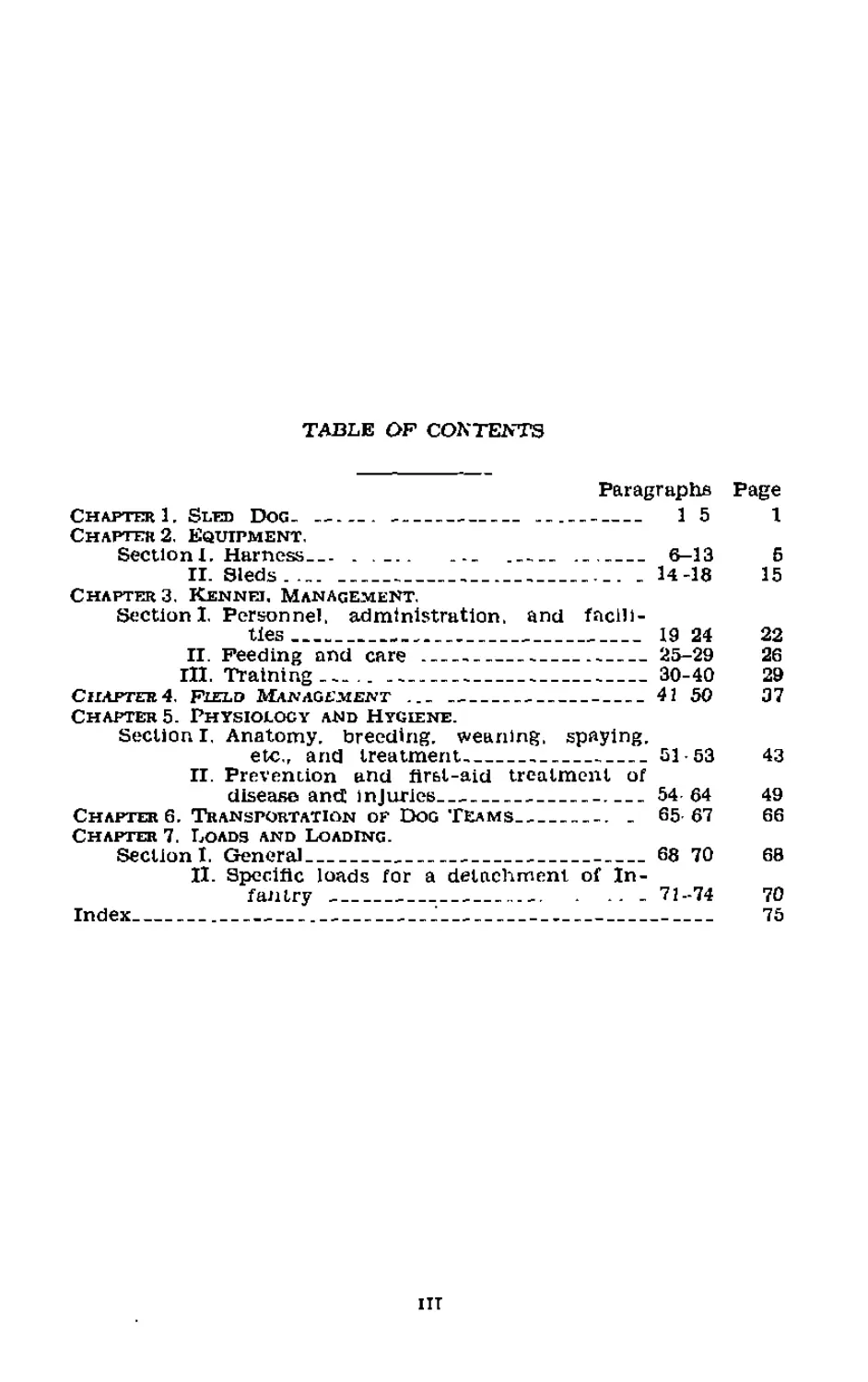
TABLE OF CONTENTS
Paragraphs Page
Chapter 1. Sled Dog. _______ _____________ _________ 1 5	1
Chapter 2, Equipment.
Section 1. Harness_ . ....	____ ______ . _____ 6-13	5
II. Sleds___ _________________________ _ 14-18	15
Chapters. Kennel Management,
Section I, Personnel, administration, and facili-
ties________________________________ 19 24	22
II.	Feeding and	care ____________________ 25-29	26
III.	Training____________________________ 30-40	29
Ciiapter4, Field Management	... ___________________ 41 50	3 7
Chapters. Physiology and Hygiene.
Section I, Anatomy, breeding, weaning, spaying,
etc,, and treatment_____________________________ 51-53	43
II. Prevention and first-aid treatment of
disease and injuries_____________________ 54 64	49
Chapter 6. Transportation of Dog Teams___________ _ 65 67	66
Chapter 7. Loads and Loading.
Section I. General______________________________ 68 70	68
II. Specific loads for a detachment of In-
fantry ________________________ . .. - 71-74	70
Index____________________________J________________________ 75
ITT
FM 25-6
BASIC FIELD MANUAL
DOG TEAM TRANSPORTATION
(This manual supersedes TR 1380-20. June 15, 1926)
CHAPTER 1
SLED DOG
 1. Use of Dog Teams.—Dog transportation is useful under
conditions of snow and ice which preclude the use of horses,
mules, or motorized transportation. Dogs can pull loads
across country and along difficult trails where crusted or
windswept snow is solid enough to support the sled on its
runners. Dry snow and cold dry weather are most favor-
able for dog transportation. When snow is soft, a trail must
be broken for the dogs and sleds by marching men, prefer-
ably wearing snowshoes, wet snow, even if only a few inches
deep, may prevent movement entirely by sticking to the snow-
shoes of men breaking trail and by gathering in masses under
the sled. Light, damp snow adds greatly to the difficulty of
movement by clinging to the sled runners. A sled that lias
hailed may adhere to damp snow so tightly that the efforts
of several men are required io “break it out” before the dogs
can resume the march.
В 2. Classification.—In genera], dog transportation is classi-
fied into two groups according to speed: Messenger or courier
teams which are composed of fast-running dogs and freight
teams which are trained to slower gaits under heavier loads.
Unlike the horse, the trained sled dog has only one gait
which he endeavors to hold under all conditions. Difficult
conditions of weather or steep grades necessitate frequent
halts and reduce the average rate of march; but unless the
team is very tired, a brisk gait will be the rule. Accordingly,
sled transportation will move by bounds in rear of marching
troops and men cannot accompany a sled on foot for a greater
distance than they can move at a run.
1
2-3
INFANTRY
a. Messenger teams.—(1) Past teams are used when speedy
communication is necessary, and for emergencies such as
relief expeditions and the rapid transportation of sick or
medical supplies. Rescue parties for airplanes that have
made forced landings in isolated places usually employ fast
dog teams. The rate and length of marches vary greatly.
When fresh, a learn moving under good conditions will exceed
a rate of 10 miles per hour and will average from 5 to 6 miles
per hour for an 8-hour day.
(2) Messenger teams should not be overloaded and forced
to slower gaits. A slower gait soon becomes habitual with
them and fast service cannot be resumed. Feed pans, dog
chains, the driver’s equipment, tools, and rations comprise
a load which can seldom be reduced below 25 pounds per
dog. The urgency of the mission and other conditions will
necessitate certain loading which will in turn affect the length
and rale of march.
b. Freight teams.—Freight teams are used for transporta-
tion of equipment and supplies. Personnel of equal weight
may be substituted when desired. Under average conditions
of trail and weather, teams will travel at a rale of 4 to 6
miles per hour, but for an 8-hour day frequent halls, which
are necessary, reduce the average rale to about 3 miles per
hour. Freight teams under average conditions of trail and
weather can pull a useful load of 100 pounds for every dog
in excess of three. The three dogs will provide for the sled,
the driver, and his personal equipment, tools, chains, feed
pans, and rations. Il is difficult to establish a rule as con-
ditions are subject to great vanalion. Loads twice as heavy
as provided by the above formula are within the capabilities
of dogs for short distances or on level trails. Steep hills
and difficult places may be passed by unloading a pari of
the load and returning for it after transporting the first
part over the hard stretch.
В 3. Types of Dogs,—a. A medium-sized dog may be pul to
general utility. However, an alert, long-legged, rangy type is
preferable for courier service. A dog of sturdy conformation,
blocky, short-coupled, and stolid, however nimble, will not be
able to keep up with fast dogs on long trips and should be
2
DOG TEAM TRANSPORTATION
3-5
employed for freighting with slower dogs. One dog of this
type in a fast team will not only reduce the rate of travel but
will annoy and disorganize the teamwork of the others. Very
large, heavy, and slow-moving freight dogs are not well
adapted to military use.
Ъ. An all-purpose sled dog. well adapted to military service,
would All the following description: Short-haired, weighing
from 80 to 95 pounds, and of the following measurements:
Height, shoulder to ground, 24 to 28 inches; chest to ground.
15 to 19 inches; length, shoulder to root of tail, 24 to 30 inches.
Large feet and sturdy, straight, hind legs as viewed from the
rear are desirable. They should be alert, smart, and quick-
moving. In general appearance they should have broad chest
and shoulders, body slightly tapering to well-developed hind
quarters, moderately heavy bones, and prick ears preferably
to lop ears. Strength and length of leg arc desirable for
breaking trail.
В 4. Ages.—The average dog will remain useful until about 9
years of age. His training should begin at about 6 to 8 months,
but he should not be put to hard work until he is at least 16
months old. His greatest usefulness will be in his fourth to
sixth years.
В 5. Hitches.—a. General.—Teams may be hitched In tan-
dem or in pairs. Mature dogs accustomed to working in har-
ness may be hitched either in tandem or in pairs without
expectation of difficulty. Each system has its advantages and
both are used in Alaska and the Yukon Territory.
b. Tandem hitches.—(1) Freighting with small teams by
one handler over narrow, broken trails is commonly done
with a tandem hitch. A trail broken by men marching single
file on snowshoes is not quite wide enough for the standard
22-inch sled or for dogs hitched in pairs because both dogs
and sleds drag against the sides of the trail and the snow
falls down on the sled, increasing the weight. At curves
or turns, the bow of the sled cuts into the snowbanks on
the sides of the trail, which greatly increases the difficulties
of travel. Also, sled runners of a loaded sled will slide off
the hardened, trampled, part of a broken trail and cause
3
5
INFANTRY
the sled to turn over to the outside and Into the bank Instead
of riding up on the edge of the higher snow. In such a
situation a narrow sled about 16 inches in width may be
pulled Without difficulty either by hand or by a small team
of dogs hitched in tandem. A combat sled loaded with light
machine guns or trench mortars accompanying troops should
be narrow and may conveniently be drawn by a team in
tandem hitch. The dogs readily learn to follow a beaten
trail walking behind a column on snowshoes.
(2) For large teams, tandem hitching makes the team too
long for efficient control. When going around curves, ten-
sion in the towline tends to drag the wheel dogs and the sled
off the trail. The dogs in rear not only have to keep their
footing on the trail under this side strain, but are forced to
pull the sled alone. Accordingly, it is difficult with a long
team hitched in tandem to turn a corner. On a hairpin
turn, crossing a bridge, the sled and rear dogs may be pulled
off the road into the gulch. This situation also arises with
a long team hitched in pairs. When pulling a heavy load
dogs are hitched very close together in tandem harness.
When traveling light or with empty sleds, the speed may be
increased by hitching them farther apart. This is accom-
plished by lengthening the traces.
c, Pair hitches.—Hitching in pairs with a single dog lead-
ing will ordinarily give best results. The pair hitch gives the
dogs greater freedom of movement, the teams are shortened,
and the difficulty of turning corners is reduced. Moreover, an
accident to a single dog or harness does not disable the whole
team as tn tandem hilches where the traces are continuous
from front to rear.
4
CHAPTER 2
EQUIPMENT
Paragraphs
Section I. Harness________ _ ----------------- 6-13
П. Sleds________________ _______________ 14—18
Section I
HARNESS
В 8. General.—Dog harness is made of leather, webbtng, can-
vas, or native-tanned skins, and, with the exception of the
collars, Which are made over a steel or rattan ring, can readily
be made by the kennel personnel. Collars should be purchased
as they are available commercially. In Alaska, harness is
sometimes made of skins tanned with the hair on so as to
bring the fur side next to the dog, but these native-tanned
skins are not available in quantity and therefore are not to be
considered for military use. Harness made of webbing, or
several thicknesses of canvas sewed together, is satisfactory
and is preferred by many. It is not so easy to handle as
leather and requires a machine capable of sewing heavy ma -
terial. consequently repairs on the trail are difficult to make.
Leather harness will stretch and freeze when wet and some
dogs will chew it, but adjustments may be made to compen-
sate for stretching and dressings applied to keep the leather
soft and to make it water-repellent. For general use the
leather harness is superior to other kinds.
В 7. Construction.—a. Materials required—The following
supplies are necessary for the manufacture and maintenance
of harness:
Collars, steel ring, sizes 5-, 6-, and 7-inch.
Leather, heavy, black, whole sides.
Thread, leather-stitching.
Hardware, buckles, rings, D-rjngs, Conway loops, rivets and
burrs, needles, roundhead screws, washers, swivel snaps
278866'—41- —2
5
7-8
INFANTRY
(round eye). Hubbard loops, %-inch brass tubing. :,lH;-inch
steel rod.
b. Tools.—Trimming knife, leather splitter, leather gage
knife, harness punch, rivet set and header, hammer, cutting
nippers, screw drivers, and pliers. A stitching horse is desir-
able. but would be left behind with the leather splitter when
going into the field.
В 8. Types.—Three types of harness are Illustrated:
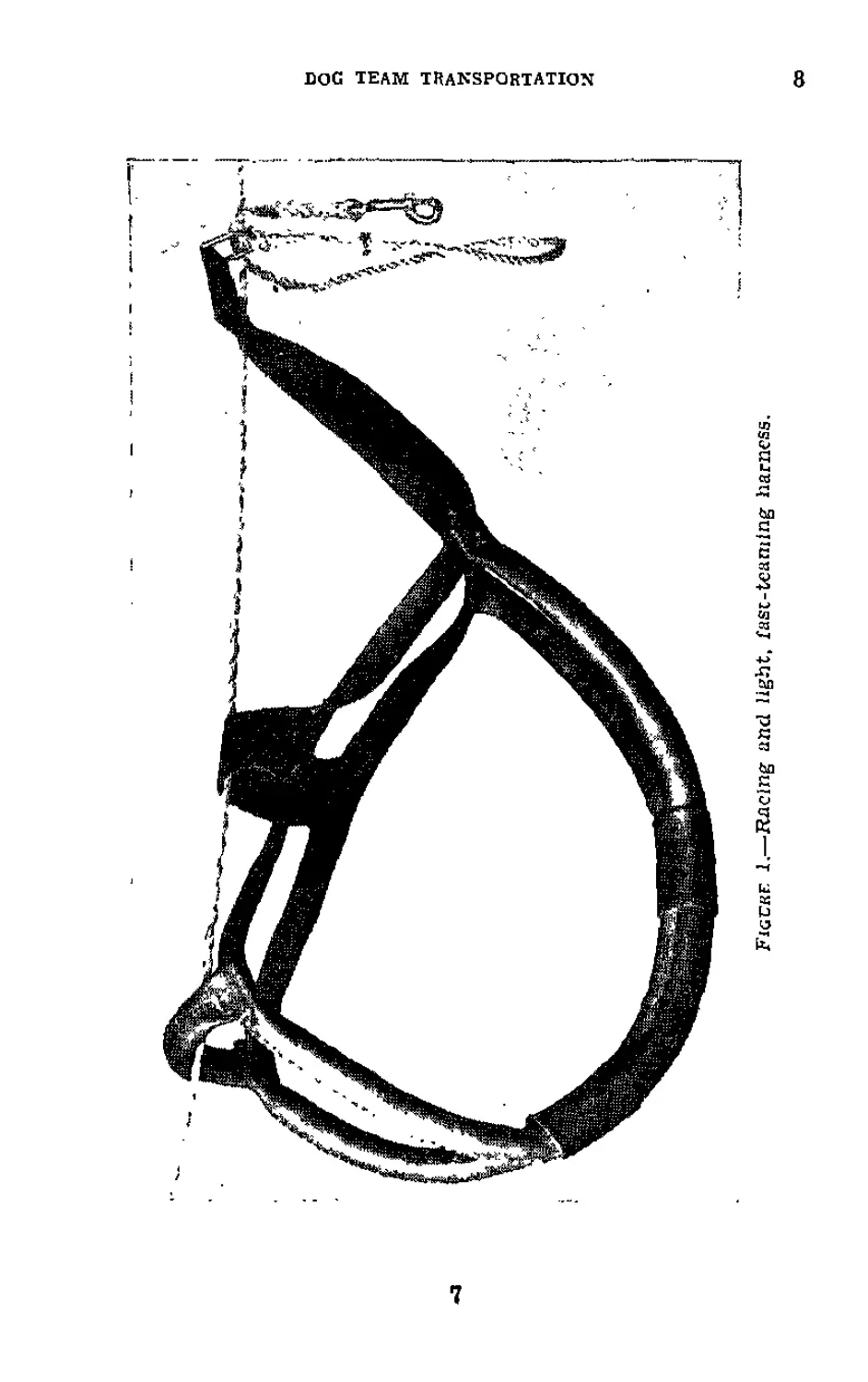
a.	Type 1 (fig. 1).—This is used for racing and light, fast
teaming. IL is made of leather, the yoke is stuffed with rein-
deer hair, and it is not adjustable. This type is also made
of canvas sluffed with Che same material; or of straps of
several thicknesses of canvas, not sluffed. The simplicity of
this harness recommends it, but it has Che disadvantage that
power is transmitted over the dog’s back.
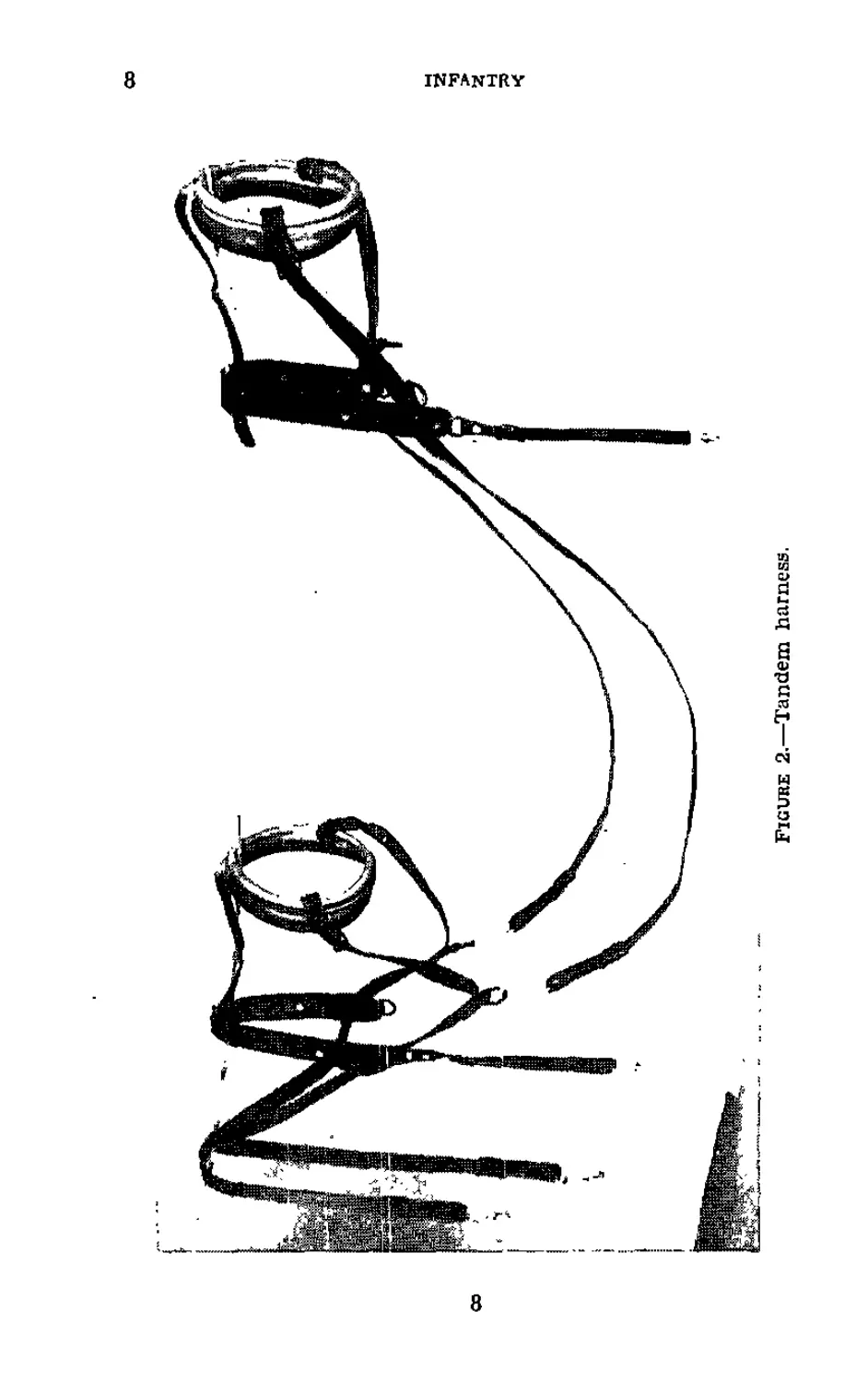
b.	Type 2 (fig. 2).—Tandem harness is suitable for use
when tandem hitching is employed. Extra strong traces are
needed on the harness of rear dogs, otherwise strong dogs
pulling heavy loads will break the traces. In tandem hitch-
ing, injury to one harness incapacitates the entire team.
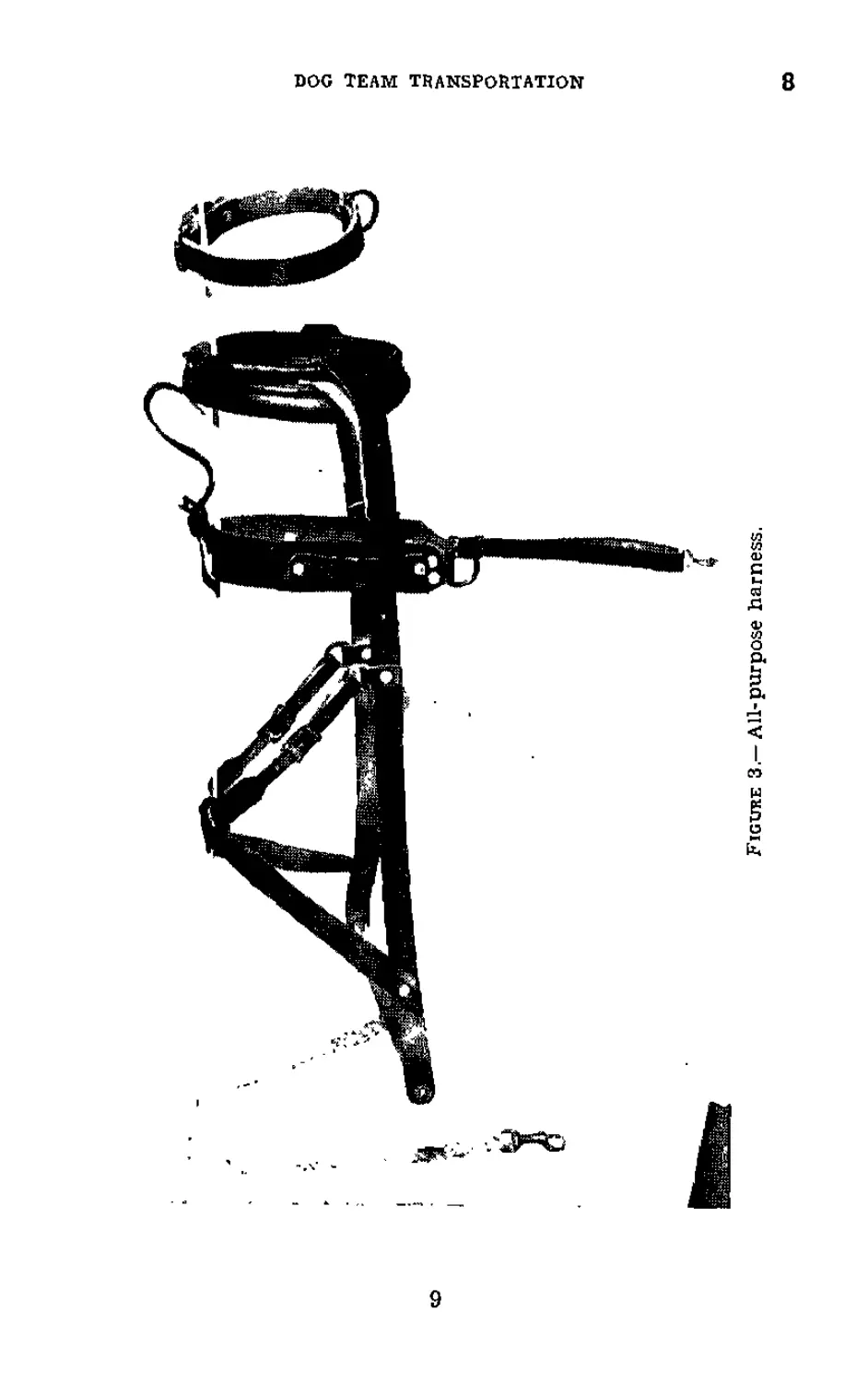
c.	Type 3 (fig. 3).—This is an all-purpose harness of excel-
lent design, suitable for teaming in pairs, which will be found
superior for military service.
(1)	Dimensions.—Heavy leather from the back of the hide
is necessary for traces. Traces should be 1 >4 inches in width
but 1 inch will do for a light dog or when using unusually
thick leather. Latigo leather is strong enough for back pads,
cross straps, collar checks, and belly bands. Straps cut from
the sides and belly of hides are suitable for making these
pieces. Back pads should be made 114 to 2 inches wide, cross
straps 1 inch, belly bands and collar checks % inch in width.
(2)	Adjustments.—The collar Is perforated for the traces
after it has been fitted Co the dog. The trace strap is split
near Che end to pass through the collar and double back to
a Conway loop fastening which permits adjustment. Loops
on the back pad are large enough to permit plenty of vertical
play in the traces. Traces are adjusted to bring Che single-
tree to within 2 or 3 inches of the rear of the dog, where It is
supported by the cross straps. When the dog is in traction,
6
DOG TEAM TRANSPORTATION
8
Figckf I.—Racing and light, fast-teaming harness.
7
00
Figure 2.—Tandem harness.
INFANTRY
«э
Figure 3 —All-purpose harness.
DOG TEAM TRANSPORTATION
co
8-9
INFANTRY
the cross straps should be adjusted to rest lightly on his hips
and not pull down. A Hubbard loop snap is convenient to
fasten the belly band as it has a positive action which may be
forced when the snap is frozen. If the belly band Is adjusted
loosely enough to pass the hand through, it will not be tight
when the dog is breathing heavily. The collar check from
top of collar to back pad serves to keep the dog from pulling
his head out of the collar. It is adjusted to fit without ten-
sion.
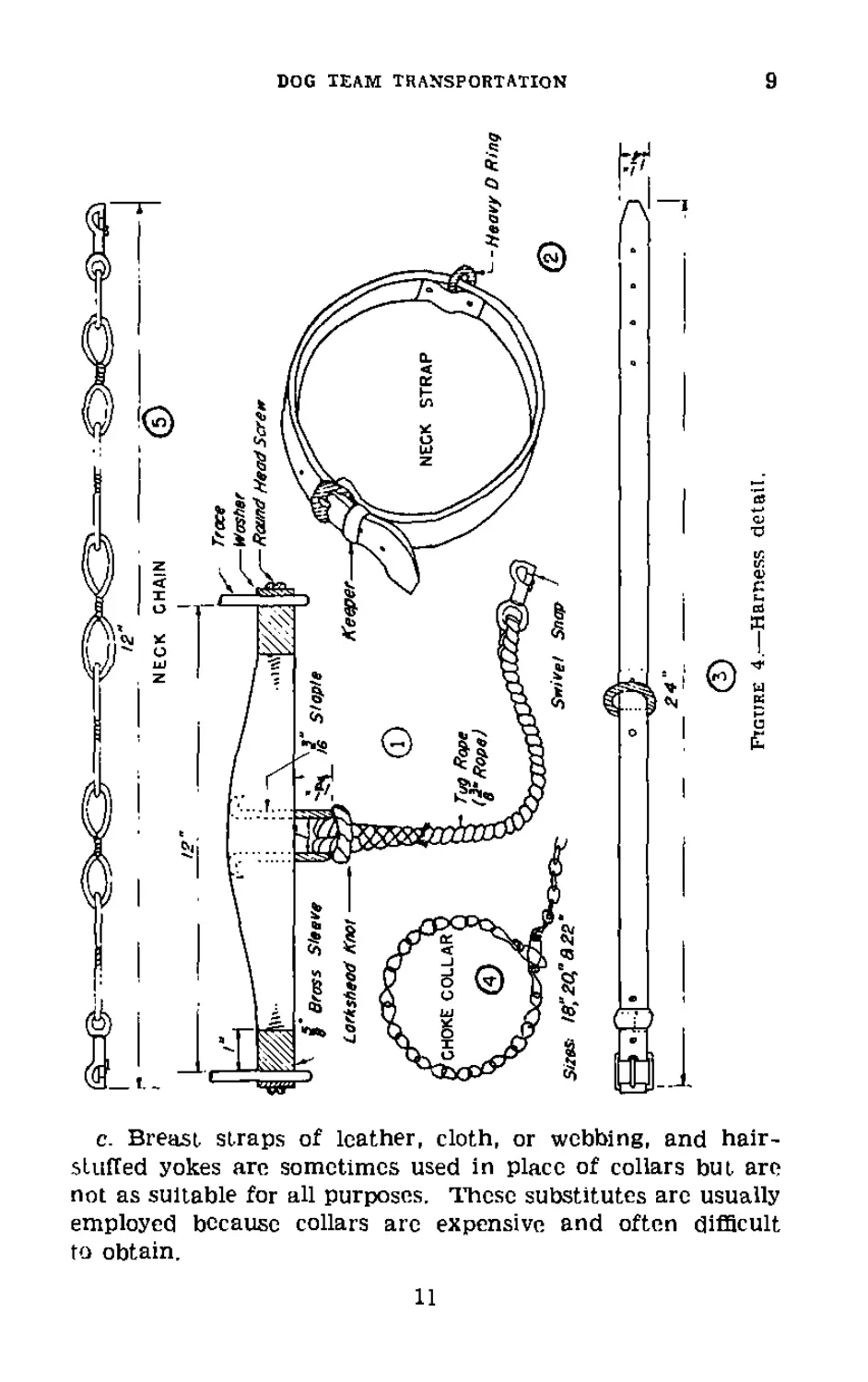
(3)	Singletrees and tug ropes (fig. 4 ф).—Singletrees are
made of hickory. Roundheaded screws and metal washers
are used to fasten the traces tightly to the ends so that they
will not revolve. The tug rope with a swivel snap is passed
through the staple and secured by a larkshead knot. The
tug rope may be shortened when necessary by taking one or
more hitches around the singletree. The tug ropes will nor-
mally remain attached to the harness, but new ones will
Probably be necessary each year. Extra tug ropes should
always be carried on each sled.
В 9. Collars.—a. Collars arc oval-shaped and sized in even
inches along the longer or vertical diameter. Three sizes are
available, ranging from the small (5-inch) to the large
G-inch) collar. As a dog’s shoulders are narrow, the collar
should be supported mainly by the neck muscles. For the
average dog, a well-fitting collar is one that will just slip
over his head and which will leave about one finger's width
clearance between the point of the shoulders and the collar.
New collars should be properly broken in by light work before
they are put into service. Once filled to a dog, a collar should
not be considered interchangeable, but a used collar can be
broken in for another dog.
b. Collars should be made over a steel ring, well-padded
and covered with good leather, Some collars have a rattan
ring instead of a steel one, but these are not considered as
good because they are much less durable. Furthermore, for
heavy work, rattan collars may be too pliable as they become
elongated horizontally by the tension of the traces and tend
to choke the dog. They do form-fit themselves to the dog’s
neck very quickly, especially when wet.
10
DOG TEAM TRANSPORTATION
9
c. Breast, straps of leather, cloth, or webbing, and hair-
stuffed yokes are sometimes used in place of collars but are
not as suitable for all purposes. These substitutes arc usually
employed because collars arc expensive and often difficult
to obtain.
11
10-13
INFANTRY
 10. Neck Straps (fig. 4 ® and ®.)—Neck straps are always
worn by the dog whether in harness or out. They are 24
Inches long, made of heavy leather l$fe inches wide with a
buckle, keeper, and a 1%-inch D-ring made of Л-inch
metal. All seams should be copper riveted. When the dog
is being harnessed, the neck strap is pulled through the
collar and used to fasten him to the tow rope by means of
the neck chain. When not in harness, the dog chain is
snapped to the neck strap.
В 11. Choke Collars (fig. 4 ф).—Vicious dogs, and those
that lunge to break their chains, may be fastened with a
choke collar made of leather-covered cable or chains. An
18-inch size will fit the average dog but a few 20-inch and
22-inch sizes will be required.
В 12. Neck Chains (fig. 4 ®).—Two neck chains with swivel
snaps at each end about 15 inches over-all should be attached
to each section of the towline. A strong chain 2-0, weld-
less. e’A links per foot, is recommended. A dog that has
fallen or is slow to start will be dragged by the neck chain
until he regains his feet and a lighter chain will part under
the strain. Thongs or ropes cannot be used as the dog will
chew them apart.
В 13. Towlines (fig. 4 @).—The towline should be made in
sections 5 ieet 8 Inches over-all. one section to each pair of
dogs (fig. 5). Residents of Alaska use light, strong lines of
rawhide, and native-cured leather, but hard-braided rope
treated to be water-repellent makes a suitable substitute.
Ordinary rope will do and will often be the only thing avail-
able, but it softens when exposed to the weather and, having
absorbed water, becomes heavy and is also difficult to handle
when frozen. Rear sections of the towline should be made
of %-inch rope while ^-tnch rope will suffice for the sec-
ond and third pairs from the front. The lead dog should be
on an elongated tug of %-inch rope passing between the first
pair in his rear (fig. 6). A ring is spliced on the front of
each section of the towline and a clevis or bull snap is used
at the rear to fasten them together or to the sled (fig. 5).
Ordinary snaps are not strong enough for use in a towline.
12
278866
Figuke 5.—Towline section, showing method of hitching one pair.
DOG TEAM TRANSPORTATION
13
infantry
Figure 6.—Bridle rope, showing method of attachment.
14
DOG TEAM TBANSPOKTATION
14
Section II
SLEDS
В 14. Basket Sled (fig. 7).—a. Size.—The 13-foot cross coun-
try sled made of hickory, with six bays and a bow will weigh
about 120 pounds. It is as large as may be conveniently
handled by a driver for ordinary cross country work. When
properly constructed, it is flexible and will stand hard use
over rough surfaces. Larger sleds can be used over level
stretches under favorable conditions, but the 13-foot sled
well loaded will be as much as dogs can pul] on upgrades and
the driver can handle on curves and downgrades.
b. Construction.—The services of an experienced wheel-
wright and a shop equipped with steam pressure for bending
wood are necessary to build sleds to the following specifi-
cations:
(1)	Material.—Hardwood, preferably No. 1, straight grain
hickory (second growth).
(2)	Length over-alt—14 feet 4 inches (13-foot loading
space on bed).
(3)	Runners.—1 inch high by 1% inches wide, upper edges
beveled between uprights. To be shod with nickel steel
closely bolted to the wood. Nickel steel shoes are best on wet
snow and ice or wherever wind-swept gravel is encountered.
These may be purchased ready drilled and countersunk for
bolts. Wooden runners made to fit over the steel ones are
best in extremely cold weather. They are faster but wear
out easily. During construction, an inch block under the
rear of the runners and another under the front between the
first and second uprights will give the runner a slight arch
throughout. The front rises to 18 inches above the ground
at the bow piece.
(4)	Width between runners.—22 inches at the rear taper-
ing to 21% inches at point runners bend up in front. This
taper allows snow to pass freely between runners without
clogging.
(5)	Bed raves.—(a) Exterior.—1/2 inch by 3 inches. Lashed
to cross bents and uprights, bolted to forward cross bent,
bow piece, and rear cross strip.
(b) Interior.—*/2 inch by 2 inches.
15
14-15
INFANTRY
*6) Lashing hooks or cleats.—Lightweight, screwed to under
side of exterior bed raves; hooks turned under.
<7) Uprights.—From runners to bed raves 1% inches by %
inch, from bed raves to top rail they taper to 1% Inches by
Уз inch.
(8)	Rear uprights.—Height from shoe to top rail about 3
feet 6 Inches; forward upright about 16 inches; uprights 19
inches on centers. All uprights slope to the rear about IQ °
from the vertical.
(9)	Top rails.—% inch by % inch.
(10)	Bow piece.—21г inches thick, cut out and fashioned
as shown to fit between runner and bed raves on either side
of the bow,
(11)	Cross bents.—% inch by 2 inches mortised through up-
rights sufficiently to project through and be held in place
by wooden pins. Secured in a flexible manner by two figure-
eight lashings.
(12)	Fastenings.—Joints are mortised and bound with ba-
biche (rawhide). The alternate method of fastening up-
rights to runners shown in detail has a tendency to drag
snow and the simpler joint is therefore preferred. Bolts are
used to attach the steel shoes to the runners and on the
brake and brake Longue. Brass screws ате used on the rear
frame, handle bars, and to attach the interior bed raves to
the cross bents.
(13)	Lashings.—Cross lashings between uprights are of
tightly stretched babiche closely wrapped with No. 3 cotton,
hanging twine to discourage the dogs from chewing it.
(14)	Finish.—All sharp edges are beveled off, all parts sand-
papered smooth and finished with two coats of valspar over
a coat of shellac.
(15)	Bridle rope.—A 1-inch rope tied in the center with
larkshead knot to a 3-lnch steel ring of heavy stock is spliced
to the sled at opposite sides to form a v, 2 feet 6 Inches in
length (see fig. 6). The rear section of the towrope is at-
tached to this ring with an anchor shackle or end clevis.
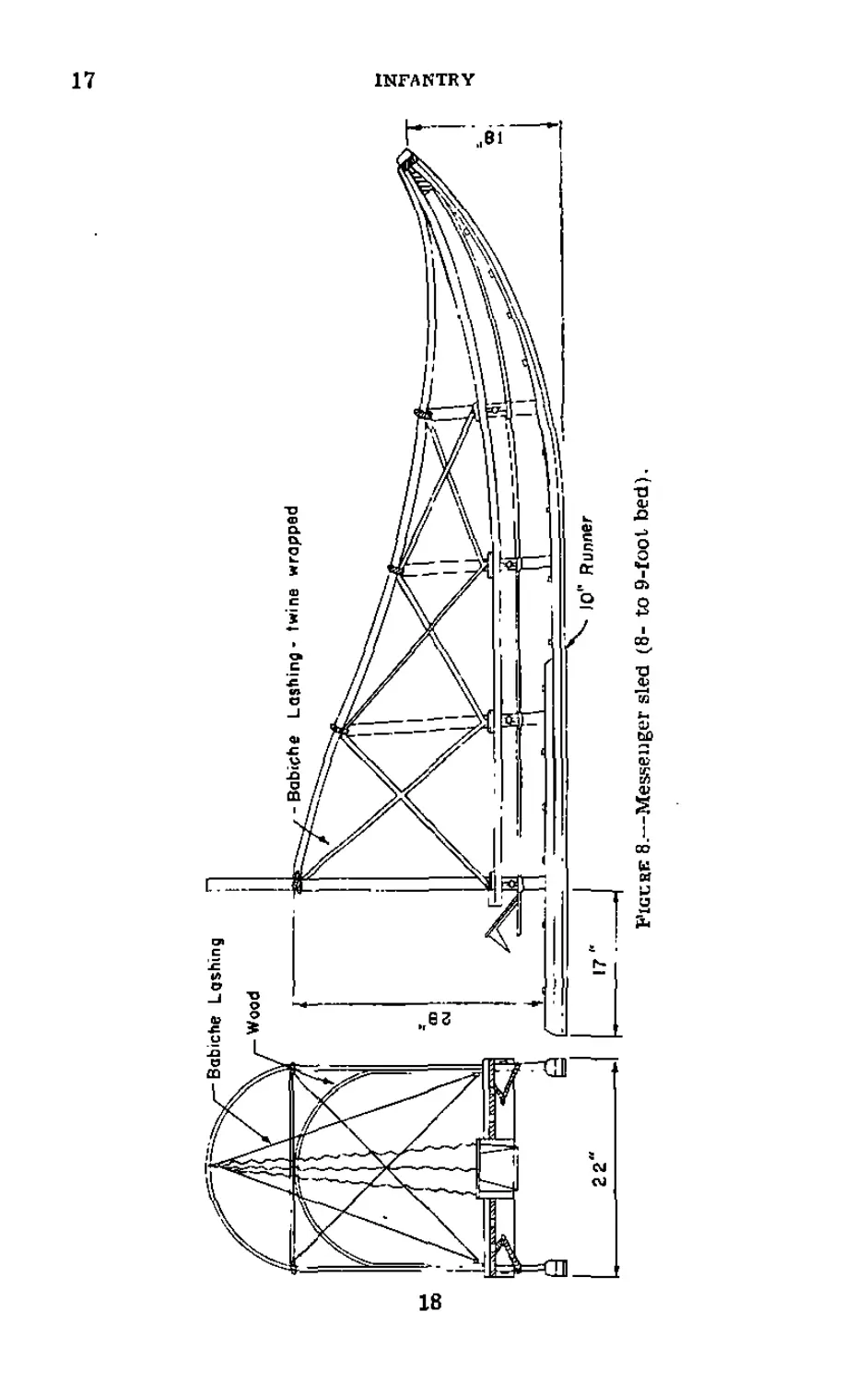
В 15. Messenger or Racing Sled (fig. 8),—This sled is built
with 9-foot runners of the same material and on the same
lines as the 13-foot sled described in paragraph 14. It is
16
Coil springs attached to tap cross bor
SECTION- SHOWING BRAKE MECHANISM
SIDE ELEVATION
DETAIL AT @
ALTERNATE DETAIL AT @
Figure 7,—13-foot cross country sled
U. S. CUVERhMfc*lT PRr4T|NG OFFICE l»40—О - 270366
DOG TEAM TRANSPORTATION
15-17
useful for fast travel with small loads. The high stern arch
adds to riding comfort of the driver, but the absence of
handle bars makes control more difficult. A useful load of
25 pounds per dog in addition to the necessary tools, sup-
plies, and driver's equipment will fill the available space on
this sled.
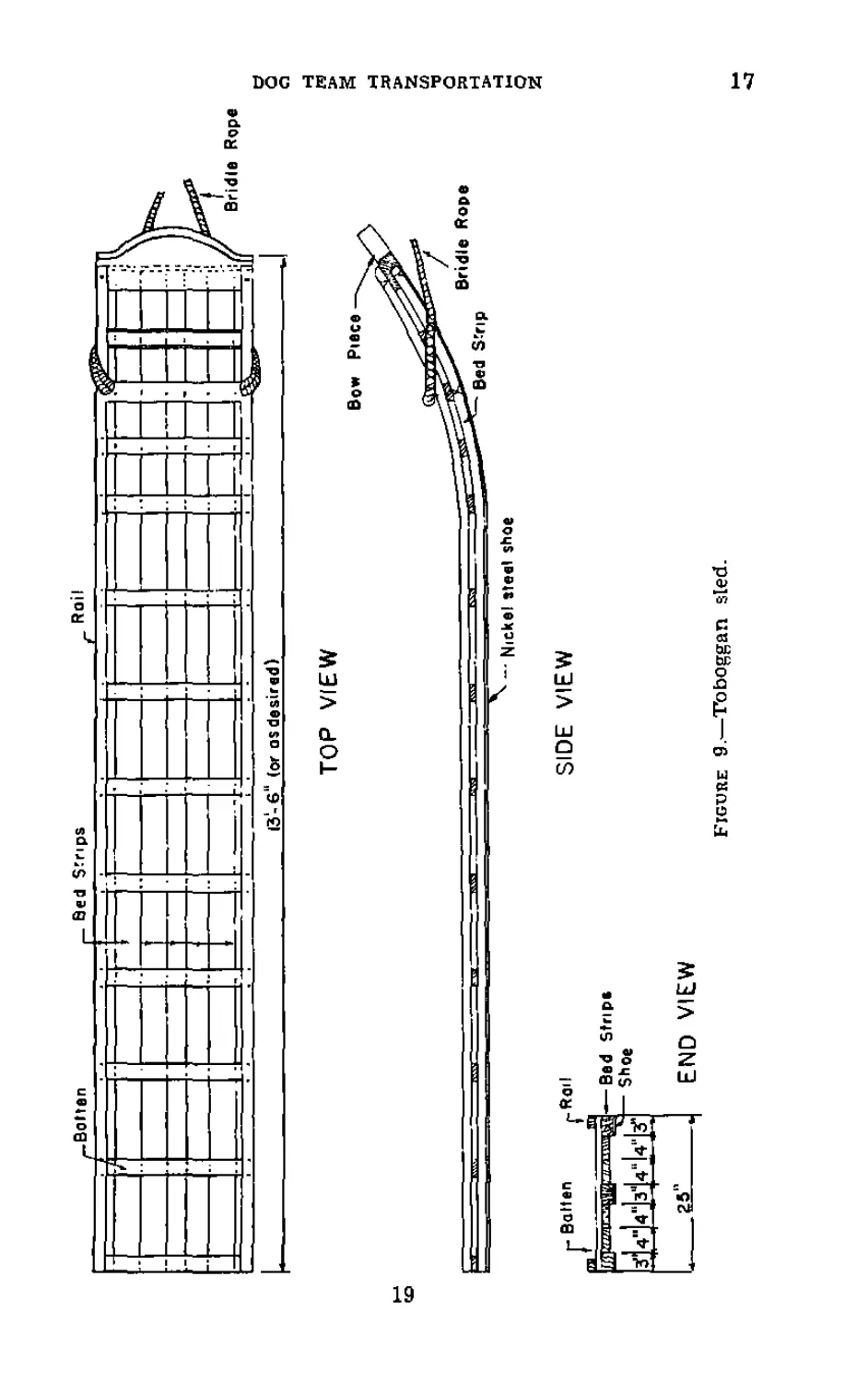
В 16. Toboggan (fig. 9).—a. A toboggan is useful on deep, soft
snow and over areas where snow is drifted and trails are not
broken. It will also travel well over hard surfaces.
b. Construction of a toboggan is comparatively simple. It
is made of parallel bed strips of hardwood steamed and bent
like sled runners. The outside strips and the center strip
are made of thicker material and shod with metal to form
low runners which serve to prevent side slipping and thereby
hold the toboggan on its course. Small stove bolts counter-
sunk at top and bottom are used to fasten all strips to the
battens and to attach the shoes. The rails are bent with the
bed strips and are fastened rigidly to the ends of the battens
with small bolts that reach through the runners and shoes.
Lash ropes for the load are passed through the gaps between
the bed strips and the rails. The bottom ts flat without the
rocker effect of a runner sled. The bridle is attached to eyes
on each side of the curved front high enough above the bot-
tom to avoid catching a mass of snow in the angle between
the rope and runner. If desired, uprights, a Lop rail, and
handle bars can be provided as on a cross country sled. A
chain can be fastened on opposite sides and dragged in a
loop under Che bottom to retard speed when going downhill.
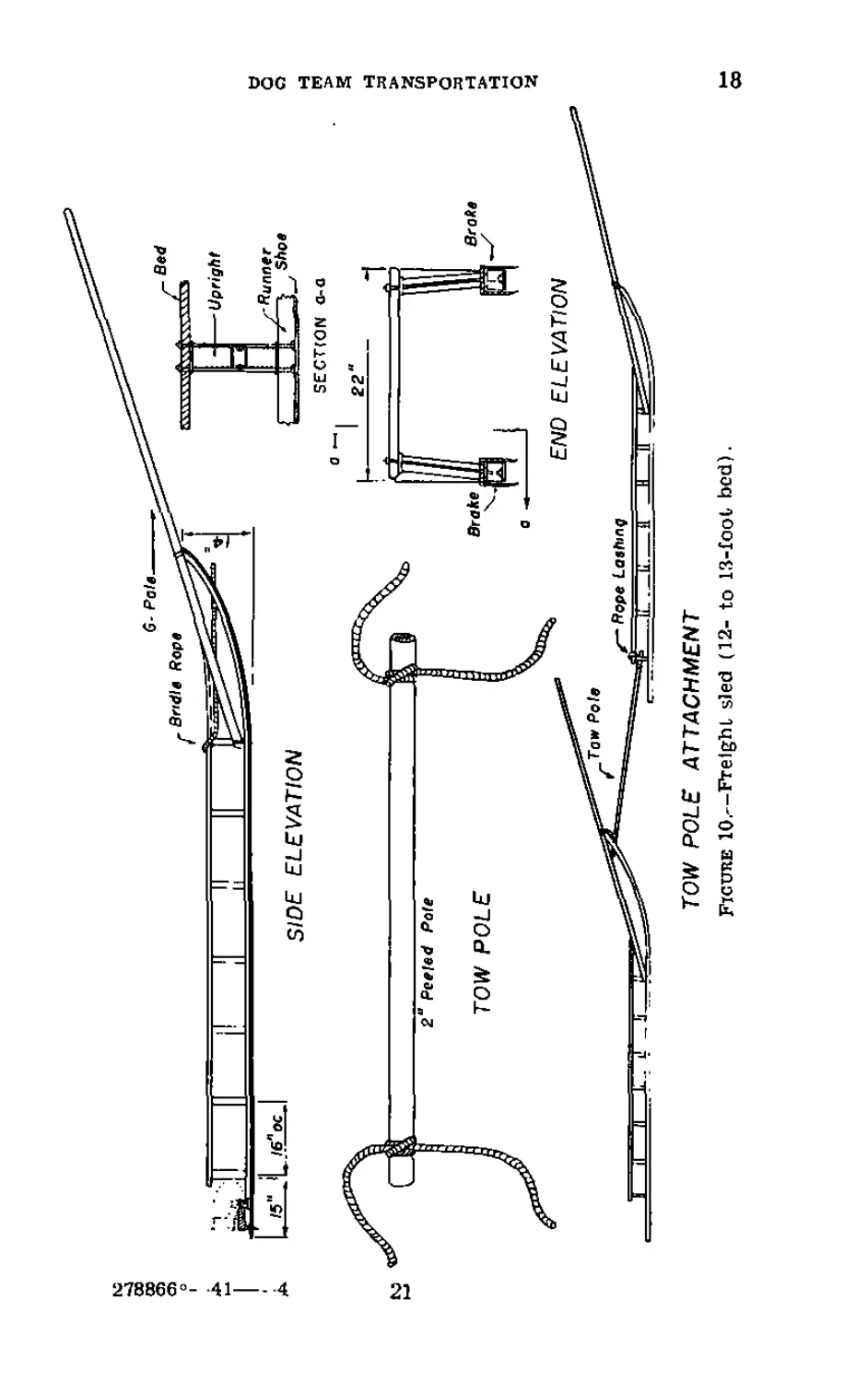
 17. Freight Sled (fig. 10).—a. The freight sled with
13-foot runners is made for convenience in handling bulky
and heavy articles. Ordinarily, no brake is provided; there-
fore, great care must be taken to prevent the loaded sled from
injuring dogs and personnel by coasting into them on hills.
The dog team may be unfastened from a sled while the driver
attempts to take it safely downhill by riding the gee pole.
Chains wrapped around the runners are effective lo control
coasting. An extra section of towline between the sled and
the rear pair of dogs will provide room for the driver to walk
17
Figuhk 8.—Messenger sled (8- to 9-foot bed).
INFANTRY
TOP VIEW
SIDE VIEW
DOC TEAM TRANSPORTATION
Batten
END VIEW
Figure 9.—Toboggan sled.
17-18
INFAUTRY
astride the towline while controlling the sled with the gee
pole. This procedure will only be practicable behind a slow-
moving freight team or when a team is moving in rear of a
column that is breaking trail on foot. Small brakes, which
will turn over out of the way when not in use, may be at-
tached to the ends of the runners on freight sleds. Another
man will be needed to operate these brakes at Limes when
Che driver’s services arc required on the gee pole. On side-
hills, application of the brake on the upper side only will aid
greatly ]n keeping the sled on its course. The gee pole, shown
on the front of Chis sled, may be used either for pulling or
holding back and is necessary for steering the sled on crooked
trails. "When ropes are used to pull a freight sled by hand,
one man steers and holds the sled by means of the gee pole.
b. Trailers are added when it is desired to move more freight
with one team. Unless it is known that the route is level,
tow poles should be used instead of lines, as this will keep
trailers from coasting into the sled ahead. The length of the
tow Pole should be such that the gee pole of the towed sled
is within easy reach of the driver of the towing sled. He is
then in position to control both sleds on hills and curves.
Hauling 1,200 pounds on a sled and two trailers may be accom-
plished by loading 600 pounds on the main sled. 400 pounds
on the first trailer, and 200 pounds on the second.
В 18. Brakes.—a. A good brake is an absolute necessity for
fast driving. Without an effective brake, the sled will get
out of hand when going downhill which will frighten or injure
the dogs. When making sudden slops, the sled will coast into
Che team and on Lums it will swing wide of the course, unless
it is retarded by a brake.
b. Prongs on brakes should be from 5 to 6 inches long and
far enough apart to prevent snow and ice from packing be-
tween them. Two prongs will be adequate under most cir-
cumstances. A satisfactory type of brake is shown on the
sleds shown in figure 7. If the brake tongue is fastened near
the front of the sled where the bridle is attached, application
of the brake will cause very little internal strain in the sled.
A long radius brings the prongs into normal contact with the
ground, causing a true drag instead of a plowing effect.
20
278866
DOG TEAM TRANSPORTATION
TOW POLE ATTACHMENT
Ficuke 10.—Freight sled (12- to 13-fool bed).
CHAPTER 3
KENNEL MANAGEMENT
Paragraphs
Section I. Personnel, administration, and facilities-19-24
II. Feeding and care .	_______________ 25-29
III. Training__________________________________30-40
Section I
PERSONNEL. ADMINISTRATION. AND FACILITIES
В 19. Kennel Personnel.—a. An officer should bo placed in
charge of Che kennels. He should see that Che men on duly
al lhe kennels are properly instructed in the care and han-
dling of the dogs and Chat '„he prescribed kennel routine is
faithfully carried cut. The enlisted personnel should consist
of one noncommissioned officer and enough privates, or pri-
vates first class, to perform the necessary work and drive the
teams. One private or private first class will be needed ior
every 15 dogs or major fraction thereof in lhe kennel.
b. An active man who is patient, even-rlempered. firm, and
intelligent will get the bes: results as a driver. Cruelty,
harshness, and rough behavior are no asset to a dog handler.
During the training period, it is desirable to have each team
handled entirely by one man, who also feeds and looks after
it al lhe kennel. Changes may be made with mature
trained dogs, but lhe best results will be attained by retain-
ing lhe same driver with a team over a long period of lime.
В 20. Location.—The kennels should be situated al least one
quarter mile distant frem the post proper, on lhe leeward
side, otherwise howling of the dogs will disturb residents of
the post. Well-drained ground is necessary and, if the soil
is not naturally sandy, it is desirable to gravel the area.
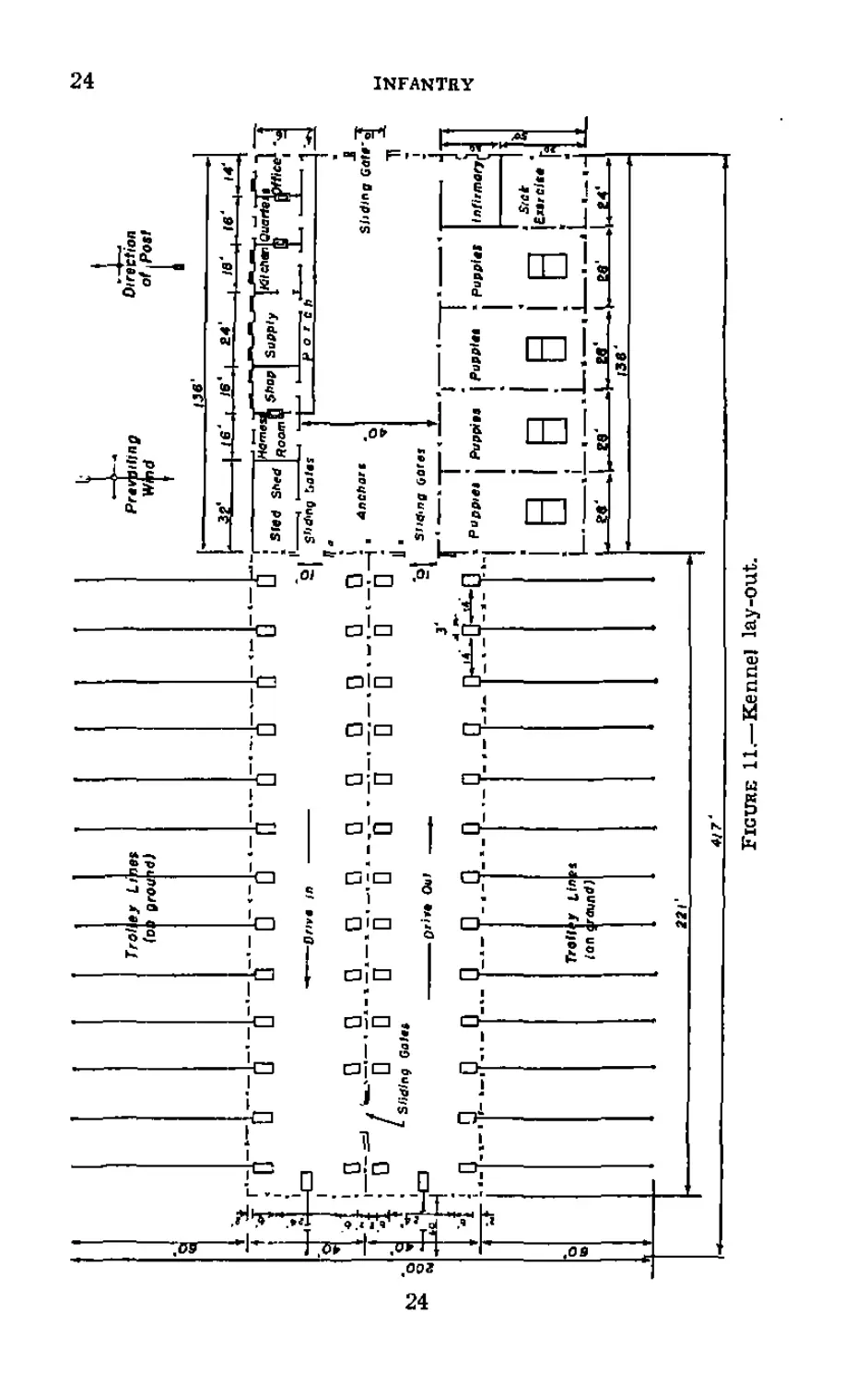
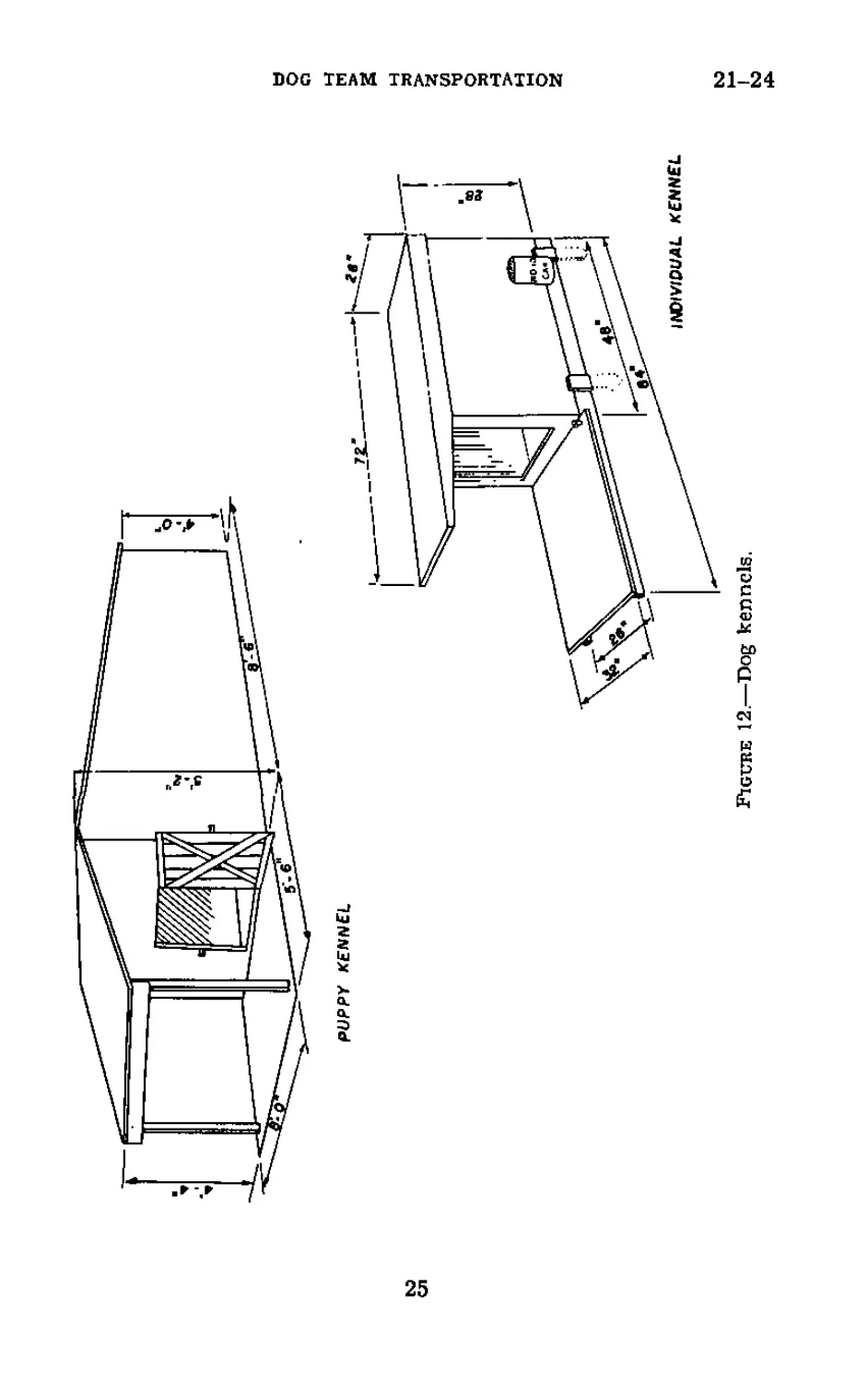
В 21. Construction.—Figure 11 shows a satisfactory arrange-
ment of a kennel that will accommodate 52 dogs. The ken-
nels proper should be inclosed in a 6-fool woven-wire fence.
22
DOG TEAM TRANSPORTATION
21-24
The quarters for two dog handlers, kitchen, harness repair
room, supply room, and storage room for sleds and other
equipment are situated in one long building. A veterinary
infirmary is also provided. The building should be so located
as to shelter the yard from the prevailing winds. Specifica-
tions for satisfactory individual box kennels built on bases of
2- by 8-inch stringers on edge, and the details of houses suit-
able to accommodate a dam and ten puppies, are shown in
figure 12. In windy open country where drifting snow is the
rule, dog barns are considered superior to individual kennels.
Narrow stalls on short platforms arc provided on opposite
sides of the barn and the dogs must be chained short to keep
them from jumping the partitions between stalls and hang-
ing themselves. The dogs may be tied outside during the
daytime.
В 22. Securing Dogs.—Each dog is secured by a 6-foot length
of chain fastened at one end to an eyebolt or staple driven into
the kennel base in the front and to one side of the door. The
other end is snapped to the D-ring of the dog’s neck strap.
Ordinarily. 3-0 dog chains are not strong enough and it is
recommended that chains be made up of solid-link chain of
^ti-inch stock, 14 links to the foot, with swivel snaps at each
end and a swivel link near the center. Dogs with small heads
will require choke collars. On other dogs, ordinary heavy
leather neck straps as shown in figure 4 will be satisfactory.
В 23. Kennel Police.—Each morning the kennel area should
be thoroughly policed. AU dung and food scraps should be
collected and hauled to the dump. The interior of the kennels
should be cleaned and the straw used for bedding changed
every other day. Иге use of straw for bedding is not necessary
during the summer months. The kennels and the surrounding
ground should be sprayed with a 2-percent cresol solution
every 10 days.
В 24. Records.—The following kennel records should be kept:
a. A brief service record of each dog, including the following
data: dam. sire, name, serial number, age, sex. breed, and the
markings. Under remarks, such data as vaccinations, dates
23
□
□_
□
о
□
□
^_i._Q_._.Q_._.Q.._Q_._O Ж_О . О ._Q_._Q_._Q
Trail -'г
(on (round)
4/7‘
INFANTRY
to
Figure 11.—Kennel lay-out.
DOG TEAM TRANSPORTATION
21-24
Figure 12.—Dog kennels.
25
24-25
INFANTRY
of worming, weights, and if a female, dates of mating, etc.,
should be shown.
b. Record of kennel property.
c. (1) A food record must be maintained at the kennels
in order to insure the correct expenditure and requisitioning
of foodstuffs.
(2) The quantity of food fed each dog per day is in pro-
portion to the amount of work done. After the training
program is fixed, the amount of food required for a certain
period on the program is computed by the simple process of
multiplying the pounds per day per dog by the number of
days in the given period. IL is necessary to estimate in
advance Che number of dogs Chat will be on hand, taking
into consideration the expected variation in the number of
grown dogs and the estimated number .of puppies born.
(3) After the food has been divided into portions for dif-
ferent periods, a constant surveillance is necessary to keep
the consumption of food within the budget allowance. A
food shortage is apt to occur if the stock is carelessly expended.
Section П
FEEDING AND CARE
В 25. General.—The health and condition of dogs depend
largely upon the kind of food received and the time of feed-
ing. To feed so as Co obtain the best results requires a
knowledge of the digestive system of dogs, the food constitu-
ents required for their sustenance, the correct proportions of
these elements, proper methods of preparation, and Che best
Lime for feeding. The organs of the digestive system are
enumerated in paragraph 51 e. In addition, there are cer-
tain accessory organs of digestion as the salivary glands,
liver, and pancreas. At feeding Lime the flow of saliva from
the salivary glands, the ducts of which open into the mouth,
is stimulated. Dogs bolt their food, gulping it down as soon
as they have bitten it into chunks small enough to be swal-
lowed. The copious flow of saliva moistens the food so that it
can be more readily swallowed and initiates the preliminary
digestive processes. In the stomach the food is acted upon
by the gastric juice and dilute hydrochloric acid supplied by
26
dog team transportation
25-27
the gastric glands located in the stomach wall. The food
passes on to the small intestine, where the digestive process
is completed, aided by pancreatic Juice and bile supplied by
the pancreas and liver, respectively, entering the first part of
Lhe intestine by a common duct. The absorption of the di-
gested food materials into the blood stream also occurs in the
small intestine. The undigested residue is passed on into the
large intestine, where most of the water is absorbed, and then
eliminated as feces through the rectum and anus.
В 26. Food Constituents.—Food constituents are classified
according to the function they perform in the animal sys-
tem. All standard brands of prepared dog food contain a
balanced ration of the following food constituents:
a.	Proteins.—Protein (flesh-making and tissue-building) is
mainly supplied to dogs in the form of meat.
b.	Fats.—Fats are essential in -the production of energy
and heat. In dogs, this is principally supplied by the fat
contained in meats, tallow, grease, beef suet, and fish.
c.	Carbohydrates.—Carbohydrates are the main supply of
energy. The carbohydrates are supplied to dogs in cereals.
d.	Minerals.—Minerals are essential for proper development
of bones and teeth and their repair. The principal sources
are cereals, salt, and bones.
e.	Vitamins and. roughage.—These are supplied principally
by vegetables, but there are some vitamin^ fin meat and
cereals.
В 27. Proportion and Preparation of Food.—a. For idle
dogs, enough food to maintain normal body weight Is re-
quired. For an ordinary dog, weighing from 75 to 95 pounds,
a satisfactory ration would consist of a mixture of 1 pound
of meat (canned dog food may be substituted) and cooked
grains or cereals, and kitchen scraps to give a total weight
of from 2 to 3 pounds. Rice, cornmeal, or oatmeal mush
makes satisfactory foods, in which kitchen scraps or fish
may be cocked for taste. Salted fish should not be used as it
tends to produce diarrhea. Fresh fish should be cooked or
frozen before it is given to the dogs. All cooked foods should
be cooled before feeding. Several pieces of cracked bones a
27
27-28
INFANTRY
day per dog are desirable. Heavier dogs may require addi-
tional food to maintain their normal weight. All dogs do not
require the same amount of nourishment. The kennel per-
sonnel must observe the dogs, and Increase or decrease the
amount of food In accordance with their individual
requirements.
b. Average-weight dogs on winter trail or moderate exer-
cise are fed a ration consisting of a mixture of 3 pounds of
canned dog food, or IV2 pounds of smoked, or preferably
dried, salmon, with l/2 Pound of oatmeal, cornmeal, or rice.
A ration that may be substituted consists of 2 pounds of dried
or smoked salmon and Уа pound of tallow or grease of some
sort, such as beef suet. For long trips, where economy of
space in packing the sleds ts necessary, the following ration
may be used and should be cooked fresh every day: 1 pound
of rice. 1 pound of grease, and У4 pound of fish for flavor.
If unrendered grease is used, such as suet, old bacon, etc.,
cut up the grease and fish into a kettle containing enough
water to make a thick mixture and boil until the grease is
boiled out well; add rice and more water as required, boil
thoroughly without stirring. If a mixture is once stirred, the
stirring must be kept up constantly to keep the rice from
burning. When well cooked, add a little moistened cornmeal
or oatmeal and then stir continuously until the meal is cooked
through. The mixture should then be cooled and should be
of thick, firm consistency. As it becomes nearly cool, stir
frequently in order to distribute the grease evenly through-
out. When rendered grease is used, put the rice and fish in
a kettle of water, boil until done, then add the grease and
stir until cool enough to feed. When feeding the dry feed—
that is. the dried salmon and tallow—a cooked meal should
be given once a week to keep the bowels In condition. It is
sometimes advisable to add bran about once a week, at the
rate of 1 ounce per ration, to keep the bowels in condition.
В 28. Watering.—It is preferable to water dogs twice a day,
once in early morning and once just before feeding. While
dogs will eat snow on the trail, water is preferable when it can
be obtained.
28
DOC TEAM TRANSPORTATION
29-30
В 29. Feeding Time.—Experience has taught that 4:00 P. M.,
or the end of Lhe work day, is the best time for feeding dogs.
If fed in the morning, Lhe dogs are sluggish and want to sleep.
When they are working especially hard, a light meal may be
fed early in the morning, or at noon if a long halt can be
made at that time. In either case the dogs should be worked
easily for a short Lime thereafter. One-pound bread pans
make good receptacles for both food and water. They will
hold approximately 3 pounds of mixed food. To insure that
all the food is consumed Lhe pans are left out overnight and
gathered the following morning. They are then washed with
hot. soapy water and rinsed with hot, clean water. The
feeding pan of any sick dog should be washed separately
and not used to feed any other dog.
Section III
TRAINING
В 30. Puppies.—a. The training of puppies should begin at
the age of from 6 Lo 8 months, by fitting them with a harness
and taking them for short runs with a Learn including a
few older dogs. Most pups take naturally to harness and
under favorable conditions will perform satisfactorily from
the start.
b.	A team with a slow leader and some steady dogs should
be driven until they have settled down to a normal gait before
hitching in puppies. A good pair will be required immediately
in rear of the leader to help keep the towline tight. An-
other pair of trained dogs should be hitched next to Lhe
empty sled. Pups might be struck by the sled if hitched
next to it and would be afraid of it thereafter.
c.	One or two pairs of pups and older dogs, as desired,
may now be hitched in intermediate positions on the Low-
line. One reason for starting training early is that the older
dogs will not ordinarily bite the puppies. Although nearly
full grown as to size and appearance, a puppy will behave in
very different manner from a veteran dog. He will scuffle
with hts teammate, roll around on the ground, cross the tow-
line, and invariably become tangled with Lhe harness at halts.
278866°—41 - - -5
29
30-31
INFANTRY
Patience is essential to insure good results. An extra driver,
riding on the sled, is useful to untangle the pups and to help
keep the team in order.
d.	If he becomes frightened, a pup is apt to pull back. He
will be dragged along by his neck chain and neck strap. As
long as he is able to keep on his feet there is a chance that he
will resume the gait. In most cases, and certainly if he loses
his feet entirely, a stop should be made to encourage the
pup and to give him a fresh start. Difficulties arise at once
when the gait becomes too fast, as when the team is running
free downhill. For this reason level ground is preferable for
training dogs. In its absence the driver must apply the brake
freely to hold a slow speed going downhill.
e.	Encouragement of pups is effective and punishment
should be avoided. As stated, most pups if handled intelli-
gently will perform well from the start. More time, patience,
and special attention must be expended on those that do not
take naturally to the work. Progress is satisfactory when a
pup shows interest and runs along willingly in position.
Within a short time he can be expected to pull his share of the
load.
/. Al this stage of instruction, it is desirable that the pups
be hitched with the same teammate and always on the same
side and handled by the same driver. Care should be taken
not to tax him with heavy work or hard running until he has
attained an age of at least 16 months. Patience will be re-
warded. Pups making an Indifferent showing during the
period of early training frequently develop into the best
workers during the next season.
В 31. Commands.—a. In harness, the team is controlled by com-
mands to the leader. The command to start is “All right!"
(preferable to “Mush"). At this command every dog in the
team should Jump into his collar and start at full gait.
b.	"Gee" and “Haw" are used to turn right and left, respec-
tively.
c,	"Whoa” stops the team. All dogs know this command
but keep moving until the leader stops.
30
DOG TEAM TRANSPORTATION
32
В 32. The Leader.—a. The importance of the loader is evi-
dent from the fact that there is no rein on the team. Dogs
will follow a well-broken trail over a familiar course, but
when it is necessary to turn, or when traveling over open
country, a lead dog responsive to the commands is a necessity.
More than one leader should be available in each team. The
best leader will be used regularly and the others driven in
positions in. the team until emergency requires their use.
Additional leaders can be used to take their turn breaking
trail.
b.	In addition to obeying commands, a leader is expected
to “hold-out” the towline. The dogs are attached to this line
by their neck chains in front and traces at the rear and neces-
sarily keep their respective places when the line is taut. It
is an imporiant responsibility of the leader to keep the team
strung out in formation by '‘holding-out” the line at all
Limes on the trail and also while Che team is being hitched
and unhitched. A good pair of dogs immediately in his rear
is desirable to help him “hold-ouL” the line. If the lead dog
lies down during halts and when hitching and unhitching,
the other dogs will generally follow his example.
c.	It is the responsibility of the lead dog to pilot the team
past distractions. When passing through a village he should
keep a uniform rate and hold the team to their task despite
the fact that local dogs bark and rush out at them. Upon
meeting a team he should turn out widely to lead his team
around, and thus avoid a melee. The team, fighting as a
pack, will quickly dispatch a single dog that comes within
reach. In open country, a good leader may be expected to
lead a runaway team on a circular course back to the driver.
d.	Over open ground, and during storms when the trail is
indistinct to the driver or has been obliterated, the lead
dog is expected to follow it. He may do this by scent, running
slightly on the leeward side of the old trail and zigzagging
when he has lost it. When there is no trail, he is responsible
for keeping the general direction indicated by the driver.
The tendency to run straight into or straight away from a
driving storm must be resisted when the trail takes an
oblique course. Free (unharnessed) leaders are employed.
31
.32-33
INFANTRY
A good leader not in harness will keep his position at the
head of the team and will have greater freedom of movement
and be able to devote more strength to the task of breaking
trail when he is relieved of tlie responsibility of holding-out
the line and pulling a share of the load.
e.	An intelligent dog, large and strong enough to break
trail and as fast as any dog in the team, should be selected
for the leader. A stubborn dog will not make a good leader.
The driver may observe that certain dogs in the team respond
to commands as promptly as the leader. Such dogs, if other-
wise qualified, are potential leaders. It is not necessary that
the leader be the best fighter in the team as is commonly
supposed. His standing with the team results from the posi-
tion he holds and his relationship to the driver.
/. A good leader is used to train other leaders. After hitch-
ing the pupil beside the leader, but slightly in. rear so that
the leader can easily swing him to the right or left, the train-
ing should proceed over ground where the trail is not well-
defined. As the pupil becomes proficient, his tug rope is
lengthened gradually until he is fully abreast of the leader.
Several periods of instruction will be necessary before the
regular leader can be hitched further back in the team and
the new leader permitted to carry on alone. Much experi-
ence is necessary to develop a leader to his full capabilities.
В 33. Prtting.—a. Affectionate dogs, looking for a caress, will
not keep their positions, will disorganize the work of the team,
and will take advantage of their driver. Pets will not main-
tain the businesslike attitude necessary on the part of both
men. and dogs when at work.
b. The average sled dog will not display affection unless it
is first invited by the driver. Good results will be attained
where there Is a feeling of mutual confidence and respect.
A friendly attitude, as distinguished from the affectionate
behavior of a pet, is desirable. The time for making friends
is when the dog is not at work but never before he is thor-
oughly trained in harness. This is especially true of the
leader. It is difficult to keep him properly disciplined while
at the same time making a pct of him.
32
DOG TEAM TRANSPORTATION
33-34
c. Exceptions to the rule that sled dogs should not be made
into pets are common. Through long association, a close
bond of feeling and understanding Is created between some
capable drivers and their teams. Examples are not uncom-
mon of runaway teams and individual loose dogs that have
returned to a driver for whom they have an affection. How-
ever, a good rule in a kennel is not to pet the dogs, and to
touch them only to hitch and unliitch them or when necessary
for other purposes. On the other hand, it is a mistake to
assume that harshness and rough handling will get good
results. Cruelty is out of place at all times.
В 34. Whip.—a. A whip is carried on each sled, though it Is
seldom that necessity will arise for its use. It can be em-
ployed to prevent fights, and to frighten away dogs that
approach the team, especially when one team is passing an-
other. The mere presence of the whip has a salutary effect,
and it will rarely be necessary to employ it to punish an
individual dog. It is a good rule not to whip dogs in the
presence of pups as they become unnerved and frightened
when whipping takes place in their immediate vicinity.
b.	The dogs are Loo far away and close together to permit
the use of a whip from the driver's position at the rear oi the
sled. There is a chance of hitting the wrong dog and danger
of striking one In an eye. Accordingly, delay in administer-
ing punishment will follow an offense because of the time
necessary to stop the sled and approach the dog: and unless
it is certain that the dog will associate the punishment with
the actual misbehavior, it is well to forego it.
c.	In harness, the dog should feel secure and nothing
should be done to confuse or disconcert him. Calling him
by name will generally suffice to make him pull, or stop
doing a wrong thing. Usually, trained dogs are conscious of
misconduct. Having spoken to him twice, if the offense is
repeated. It may be advisable to whip him. Unless the driver
can strike him in the very act, it is better to unhook his
neck chain and tug rope and Lake him out of the team wliile
whipping him. He is then returned to his place, and the idea
that he Is safe in harness is thus preserved.
33
34-36
INFANTRY
d.	The back is a point of weakness, and it is considered
better to risk a lame muscle by whipping a dog on the flanks
and shoulders than to risk an internal injury by striking him
on the back. Several sharp blows will suffice, and the driver
should move up quickly to administer them. Running up
quickly with the whip, or punishing a dog Loo close to the
others, may frighten the team and cause a runaway. Occa-
sionally a dog will attack the driver or another dog in
defense of his teammate.
e.	Mutual confidence is essential. A dog that is timid and
cowering, that shrinks away and lies down upon the approach
of a driver, may be as difficult to handle as one that will bite
when the driver tries to untangle him or adjust his harness.
В 35. Viciousness.—A vicious dog will bite a man or dog with-
out provocation. Viciousness is a serious fault and is not to
be associated with high spirits, courage, strength, and endur-
ance. One good bite on the leg or fool may disable a dog for
a long time or destroy his usefulness entirely. Thus, on the
trail'a vicious dog may bring about a failure of the under-
taking by injuring others. A light wire muzzle may be used
if designed so that the dog can eat snow while wearing it.
В 36. Fighting.—Fighting is common among sled dogs and
must be guarded against. Occasionally they bite and hold,
especially when in harness, but generally they slash and tear
al each other. The best fighters grab the front legs and feet
and endeavor to kill their antagonist. Once started, whipping
is not effective in stopping a fight. A man trying to slop a
fight will be considered a participant by the dogs and may be
injured. In a general fight among loose dogs in the kennels
whipping indiscriminately may suffice to stop it. By catching
hold of the neck strap from the rear, raising up his front feet,
and striking him several blows on the nose, an individual dog
may be made to stop fighting, at some risk to the driven
Effective measures against fighting are best taken before the
actual fight begins. At that time speaking to them and flour-
ishing the whip may avert trouble. In harness the dogs of
one team will fight other dogs as a pack. Some pains must
be taken to protect a strange dog until the others become used
to his presence.
34
DOG TEAM TRANSPORTATION
37-38
 37. Loose Dogs.—A dog may break loose by tugging and
lunging against his chain. He may then run away, but will
almost invariably return for feeding. When loose, the dogs
may injure other animals or indiscriminate breeding may
result. Loose dogs frequently start fighting with other dogs
in the kennel, which causes an uproar and often ends with
one or more serious injuries. Dogs breaking loose may re-
main quietly by their individual kennel, but this, unfortu-
nately, is seldom true. In any event, sled dogs should never
be loose. When not in harness, they should be securely
chained. The sled dog gets his exercise and recreation in
work, which he enjoys because it takes him away from the
confinement of the kennel.
В 38. Harnessing.—a. The towline, with a section for each
pair oi dogs, is assembled and stretched out with Lhe leader’s
harness and lug rope at lhe front end and anchored Co a
pole or other fixed object by a rope or chain extending from
the bridle ring along lhe snow under the sled. A hold may
be saiely taken through the brake, but an anchor chain
around the uprights may pull the sled apart under the strain.
The other harnesses are laid on the snow in position.
b. The leader is brought out first. Since an excited dog
can drag a man by the chain and as footing on the snow or
ice is seldom secure, the dog should be held by lhe neck strap
in order that his front ieet can be raised from the ground,
it necessary, to restrain him. The driver grasps the dog be-
tween his knees al the flanks and holds him securely while
slipping lhe collar over his head, he Chen pulls the neck strap
through the collar, and iastens lhe belly band. A tight col-
lar may be slipped over the dog’s head with less difficulty if
revolved 90° to bring the long axis horizontal. The lead dog
will now assume his Cask oi holding-oul rhe line as lhe dogs
are brought out singly and iaslened to lhe line from front
to rear. The neck chain is fastened as the driver releases
the dog from between his knees. He Chen moves back and
snaps the tug rope to the sled line. To lake advantage of the
enthusiasm and minimize the period of nervous excitement,
a prompt start should be made. This will mean, in general,
that the sled is loaded before the team is harnessed and
35
38-40
INFANTRY
everything in readiness before the anchor chain is released.
When the driver is in position, he releases the sled, and the
team dashes wildly away. A turn in the road or an obstacle
is very apt to cause a serious wreck during the first moments
of running.
 39. Supervision.—when hitched, dogs require constant at-
tention to keep them from fighting and from chewing ropes
or harness of any materia]. The latter habit, once acquired,
is difficult to break.
В 40. Unhitching.—The dogs do not sweat and it is unneces-
sary to cool them off upon return from a hard run. The sled is
anchored as at the start and the dogs taken off in reverse
order; that is. the rear dogs first and the leader, who is hold-
ing-out the line. last. When all dogs are chained to their
kennels, the sled and harness are put away. If the harness
is wet. it should be straightened out to keep it from freezing
into unusual shapes. The dogs should be examined for sore
feet and treated for any other injuries.
36
CHAPTER 4
FIELD MANAGEMENT
 41. On the Trail.—a. К several sleds are traveling to-
gether, they will proceed in column. When a light fall of
snow necessitates trail-breaking, the leading position should
be shifted regularly among the teams to equalize the work.
Dog teaming is more dependent upon favorable weather con-
ditions than is any other kind of transportation. Without
snow no movement whatsoever is possible. Sleds cannot
travel in damp snow which adheres to the runners and gath-
ers in masses between them. In soft, deep snow a trail must
be broken by other means before dog teams can move suc-
cessfully.
b. Conditions favorable for dog teams are cold, dry snow,
crusted or windswept. Extreme cold weather is no deterrent,
but may necessitate the use of wooden runners. A thaw may
cause the crusted snow to break under the weight of a sled,
stopping all movement.. After thaws set in, it will be possible
to march on cold nights and in the early morning hours when
slush is frozen.
В 42. Equipment.—The following equipment is carried when
on the trail for an extended period. A good plan is to have
this equipment in a roil or box placed on the sled where it is
readily available. Do not make the mistake of loading and
lashing the pay load on top of these items.
First aid kit:
Iodine.
Ointment.
Bandages.
Cotton and swabs.
Sutures and needles.
Scissors.
Tweezers.
Adhesive tape.
27sxi'.i;e -io c,
Tool kit:
Rivet nippers.
Pliers.
Hatchet.
Leather punch.
Rivet punch.
Box of %-inch rivets and
burrs.
Cold chisel.
Screw driver.
37
42-44
INFANTRY
Accessories:
1 Whip, loaded handle.
1	Feed pan per dog.
1	Chain per dog.
2	Extra neck chains.
4 Extra tug ropes.
2 Extra towrope sections.
Dog shoes for team.
Rings, snaps, and wire
picket pins.
2 Lash ropes, 30 feet by ft
inch.
Mantas and lash ropes for
small articles.
В 43. Dog Shoes (fig. 13).—Small boots of leather and canvas
should be worn on sensitive and sore feet. These may de-
velop at any Lime when working hard, but especially when
teaming on sail waler ice or Chin crusted snow. The dogs
should be accustomed to wearing these before taking Che
trail. Because the fool, relaxed, will pass through a small
shoe lop, it is possible Co secure a fair fll on the leg. The
bottom should be large enough to lake care of expansion of
the fool caused by weight and pressure. The thongs may be
lied around the legs or attached to parts of the harness to
serve as suspenders.
 44. Teaming Up.—a. An alert and willing pair of dogs should
be hitched immediately in rear of the leader Co help him
hold-out the line, A slow, headstrong, tired, or unwilling dog
in Chis position can soon discourage a leader. The lighter
dogs should generally precede with the heavier, slower dogs
following, Experienced, powerful dogs should be hitched
next to Che sled. A dog Chat is not afraid of Che sled, and
who knows how to avoid being run over, is desirable on “the
wheel.” The rear pair should be strong enough to handle
lhe sled on sharp curves when lhe rest of the team is pulling
al an angle. The lug ropes of this pair should be hitched to
the bridle ring of lhe sled and not to a section of the towrope
proper. This precaution will insure one pair of dogs Co pull-in
lhe empty sled in lhe event lhe rest of the team breaks
away. On long trips, when the loss of dogs would be a seri-
ous mailer, short lieropes may be employed as couplings
across lhe joints between sections of the towrope, to hold
temporarily should the line break. The newest and strongest
sections of the towline should be in rear,
38
DOC TEAM TRANSPORTATION
59
b. On short runs, bitches may be used when not in heat.
They should always be teamed up with a dog. For cross
country work, it is undesirable to have more than one bitch
in a team. A dog is generally preferred because of his
greater size and strength.
В 45. The Start,—About 30 minutes are required for the
drivers to pack their personal effects and eat breakfast.
Packing the sleds and harnessing the teams will consume an
39
45-47
INFANTRY
hour unless done simultaneously by different crews. Unless
the teams are allowed to precede the troops, a delay will be
necessary before the start, as the dog teams must proceed by
bounds because of their faster rate. The teams should not
be hitched up until the actual moment of starting, otherwise
the dogs will become worn out with impatience, start fighting,
chewing the harness, etc.
В 46. Care.—a. Dogs require a minimum of care on the trail.
One meal a day after camp is reached, preferably around 4
o’clock, is all that they require. The dogs will eat snow even
while running; and although it is desirable to water them
both morning and afternoon, as water quenches thirst better
than snow, it is not necessary,
b. The camp should be made at a place where the dogs will
be sheltered from wind, as in a ravine or under a bank.
Shelter from rain is advisable as dogs are soon chilled and
exhausted by dampness. Unless trees are available to which
to chain the dogs at night, a picket line will be necessary.
This adds additional weight to the load. The line is stretched
on the ground with stakes or deadmen at either end, or the
sled can be used to hold one end in an emergency. The dogs
are then tied by short chains at suitable intervals along the
line. On the ice, small picket pins will serve to fasten the
dogs and, being lighter, are preferable to a picket line.
c. At the end of the day’s work, the dogs should be inspected
for sore feet and other Injuries and given first-aid treatment.
В 47. Harness and Sled.—The sled should be turned on ils
side or set up on skids overnight and the runners wiped
clean so that there will be no ice on the shoes at the next start.
If wet, care should be taken to keep the harness from freezing
into Inconvenient shapes. It should be hung up on trees,
or on a cabin wall inside the cabin when space is available.
The sled must be protected from the dogs to keep them from
chewing the lashings. One loose dog can destroy the sled in
a night. A driver may spread his bed on the sled to be on
hand to prevent injury to it.
40
dog team transportation
43-50'
В 48. Driving.—Skillful handling of Che sled by Che driver
avoids many difficulties, saves his team, and insures the suc-
cessful completion of his trip. By throwing his weight from
side io side to steer, lifting up on the handle bars to help the
sled over hard places, shifting the rear end to give the sled
a new direction, and holding ii to prevent an upset the driver
is able to avoid many serious mishaps and to spare his team
much effort and inconvenience. By running behind the sled
when going uphill, pushing it when necessary, and jumping on
io ride across level places and downhill only the driver in-
creases the lengih and speed of the march and saves ihe
strength of his team. Skillful use of the brake will have Ihe
same effect. By applying it when the lead dog is coming
r.breast of an obstacle such as a log, rock, sharp curve, elc.,
a timely effect is produced which will insure a safe passage.
Care must be taken at all Limes, bui especially when slopping
and on down grades, to apply ihe brake quickly to prevent
the sled from running inio the dogs. A loaded sled will
gather great momenium on a hill, and the runner passing
over the foot of a man or dog will do serious injury. The
most difficult feat expected of a driver is to mush his sled
when breaking trail on a hillside.
В 49. Rate of Travel.—a. The rale of travel will be deier-
mined by the type of team and certain other conditions.
Within limits, the dogs choose their own gait and speed.
When they start to slow down the driver should encourage
lhem by voice, usually calling individual dogs by name.
Many short halts are preferable Co long ones as the dogs
recuperate very quickly. A 2-minule hall every mile will be
sufficient when the going is good.
b. When the dogs show signs of tiring by slowing down or
breathing heavily, the driver should hall them before they
slop of their own accord. Their interest and enthusiasm in *
their work wane markedly as they become tired. The driver's
encouragement is then effective in keeping up the pace.
В 50. Tired or Injured Dogs.—An injured dog may be put
on the sled to ride, but he should be lied to prevent his jump-
ing off. When a dog begins to tire, he can be rested by
41
50
INFANTRY"
removing his harness and allowing him to run along in. his
place without pulling. Otherwise he can be tied to the sled
with a rope and allowed to follow for an hour or so until he
is rested. For quick results, he may be ridden on the sled, but
this should be avoided, as a dog soon acquires a taste for
riding and may be spoiled. After a short rest the dog may be
put back in harness and will finish the day without difficulty.
An utterly exhausted dog may be left on the snow beside the
trail, and when rested he may be expected to overtake the
sled. In a reindeer country, however, he cannot be depended
upon to rejoin them, us dogs like to chase these animals.
42
CHAPTER 5
PHYSIOLOGY AND HYGIENE
Paragraphs
Section I. Anatomy, breeding, weaning, spaying, etc., and
treatment.________________________ - _________51-53
II. Prevention and first-aid treatment of disease and
injuries . _______ ______________________54-64
Section I
ANATOMY. BREEDING. WEANING. SPAYING. ETC.. AND
TREATMENT
В 51. General Structure.—The body of the dog is made up
of the following systems: skeletal, muscular, digestive, respira-
tory, circulatory, nervous, urinary, reproductive, and an
integument of skin and hair.
a.	Skeletal system.—The skeletal system is the bony frame-
work which gives the body form and rigidity and forms cav-
ities for protection of Lhe vital organs. The bones and their
joints together form a system of levers and pulleys which,
through muscular action, gives the body power of locomotion.
b.	Muscular system —The muscles make up most of the bulk
of the body, and by their action produce all movements.
Muscles are attached to the various bones by either broad
fibrous bands or rounded tendons which pass over one or
more joints.
c.	Digestive system.—The digestive system is a long tube,
known as the alimentary canal, beginning at the mouth and
terminating at the anus. The alimentary canal consists of
the mouth, oesophagus, stomach, small intestine, large intes-
tine. and anus. Its function is to receive and digest food. In
the mouth the food is masticated tor chewed) and mixed with
saliva. From the mouth the food passes through the oesoph-
agus to the stomach, where it is mixed with digestive juices,
and the process of digestion begins. In the small intestine
the bulk of the digested food is absorbed into the blood stream.
43
51
INFANTRY
In lhe large intestine Lhe bulk of Lhe water is absorbed, leav-
ing a residue of undigested ir.aterial which is eliminaLed as
feces by the process of defecation. The feces normally should
be of soft consistency and formed. The daily amount varies
between 4 and 10 ounces, depending on the amount and kind
of the diet,
1. Brush.
2. Hip.
3. Rump or withers.
4. Back.
5. Shoulder.
6. Neck.
7. Occiput.
8. Ear or •'leather.”
9. Dome.
10. Stop.
11. HaW.
12. Muzzle.
13. Nose.
14. Chop.
15. Flews.
16. Dewlap.
17. Apron,
18. Arm.
19. Elbow.
20. Forearm-
21. Wrist.
22. Pastern,
23. Pads.
24. Feather.
25. Chest.
26 Fringe.
27. Stifle or knee.
28. Dew-claw.
29. Hock or heel.
30. Breeching or flag.
FicunE 14.—Outline chart of sled dog.
d.	Respiratory system.—The organs of Lhe respiratory sys-
tem are the nasal passages, Lhe pharynx, lhe larynx (or
voice box), trachea (or windpipe), the bronchi, and lungs.
The function of this system is to supply Lhe blood with
44
DOG TEAM TRANSPORTATION
51
oxygen and to throw off waste gases. The process of breath-
ing is divided into an inspiratory and expiratory phase. In-
spiration is the process of drawing fresh air into the lungs
where the oxygen is absorbed into the blood stream. Expira-
tion is the process of expelling waste gases from the lungs.
At rest, the normal rate of breathing varies with the age.
size, and sex. As a rule the rate of breathing in the female
is somewhat faster than in the male. Young dogs have a
faster rate than mature dogs. Smaller dogs breathe faster
than larger dogs. Therefore, the respiratory rate varies from
18 to 30 per minute, and the breathing is free, soft, and
noiseless. After exercise, the respiration becomes rapid,
short, and noisy because of the increased oxygen require-
ments to supply working muscles. After cessation of exer-
cise, the rate of breathing quickly subsides to normal.
e.	Circulatory system.—The circulatory system consists of
the heart and blood vessels. The blood vessels are the arteries
that carry the blood from the heart to all parts of the body,
and the veins that return the blood to the heart. The small
arteries terminate In fine capillary vessels which form a close
network in all body tissues. The blood is collected from
the capillary bed by small veins which progressively increase
in size as they approach the heart. Oxygen and food ma-
terials are absorbed by the tissues in the capillary bed, and
waste products are absorbed by the blood and eliminated.
The heart is a muscular organ divided into four chambers
consisting of the right and left auricles and the right and
left ventricles. On each contraction of the heart, the blood
is forced from the right ventricle through the pulmonary
arteries to the lungs, where it is aerated and is then col-
lected by the pulmonary veins and returned to the left
auricle. From the left auricle, the blood passes into the
left ventricle from which it is forced through the aorta and
its branches to all parts of the body, where it is collected in
the veins and returned to the right auricle. The heart beat
varies from 80 to 120 per minute.
/. Nervous system.—The nervous system consists of a brain,
spinal cord, and nerves running to all parts of the body.
The nerves are of two kinds; those that carry messages
45
51
INFANTRY
from the brain and those that carry sensations to the brain.
Nerves usually lie close to the arteries in their course. In
training dogs, by constant repetition of certain movements
habit reflexes aro developed. This is accomplished by a
short-circuiting of the incoming nerve Impulses through the
spinal cord out through the nerves to the muscle groups
Involved, thereby excluding the brain from the process.
g. Urinary system.—The urinary system consists of two
kidneys, two ureters, the bladder, and the urethra. The
kidneys are bean-shaped organs situated deeply in the upper
part of the abdominal cavity. They are freely supplied with
blood and extract most nitrogenous waste material dissolved
in water. This waste material (urine) passes through Lhe
ureters, which are long tubes leading from the kidney Co the
bladder. Upon filling, the bladder contracts, forcing the
urine through the urethra, a tube leading from the bladder
to the outside of the body. In the male, lhe urethra opens
through the penis’, and in the female, it opens into the upper
part of the vagina, The amount of urine excreted daily
varies with the food, work, external temperature, season,
condition of the animal, and other factors. The average
amount of urine excreted daily by large dogs is 1 quart.
h. Reproductive system.—(1) Function,—The function of
this system is the reproducing of their kind. The male dog
will breed at all seasons of the year, The oestrus, or period
of sexual desire in the bitch, occurs two or three times yearly,
usually during the spring and fall seasons, and lasts for a
period of approximately 10 to 14 days, At the beginning
of the oestrus period, the vulva or lips of the vagina become
swollen and a slight bloody discharge takes place, The bitch
will only submit to sexual intercourse while in heat. If,
during the oestrus period, the bitch is bred and becomes fer-
tilized. the ensuing pregnancy lasts 60 days. The age of
puberty, which may be defined as the time when reproduction
may occur for lhe first lime, is attained in the bitch from
6 months to 1 year of age, However, the full reproductive
capacity may not be attained al this lime. There may be
rather a marked variation in the age at which puberty is
reached, It is principally affected by the state of nutrition
46
DOG TEAM TRANSPORTATION
51
and the climatic condition, occurring earlier in Lhe warmer
climates.
(2) Breeding and cross-breeding.—(a) In Alaska lhe type
of dog known as lhe Husky, which is an Eskimo dog of un-
standardized breed, is recommended as the best type of sled
dog, The Malemute is an excellent dog, supposedly posses-
sing some wolf strain, and nearly equal to lhe Husky when
a short-haired type can be obtained. A wolf strain, how-
ever, is not generally esteemed in sled dogs. The Siberian
dog is small and makes fast time over long distances on
packed snow or ice but is inferior for breaking trail in. deep
snow, as it is loo short-legged and tires quickiy. Collies and
shepherd dogs are of little value as they are not native to a
very cold climate and cannot stand extreme temperatures.
They are also too affectionate and willing to work, which
results In lhe team spending itself early each day, usually
before the distance deshed can be accomplished. Their
strain is not considered desirable in sled dogs,
(b) barge, heavy freight dogs should not be bred with light-
weight dogs as the resulting pups are apt Co show poor con-
formation. That is, they may have a heavy forefront with
a long, light body and rangy hind quarters. The Newfound-
land strain is satisfactory for heavy freight work but is not
good for speed. Some seller strain is considered valuable
to improve the nose for following trails.
(c) For breeding purposes a bitch should be selected that
is in good condition, not over 6 or under 2 years old, and
weighing from 75 to 85 pounds. She should be intelligent,
with good markings and having a conformation as described
in paragraph 3, The bitch should be of proved stamina,
spirited, but not vicious. The male should be mature, hav-
ing lhe same desirable characteristics as the bitch. The
male dog can be used for breeding purposes up to 8 years of
age. Inbreeding should be avoided generally, but in some
cases it has been found satisfactory for one generation, but
full brothers and sisters, or father and mother and one of
their pups, should not be mated. A bitch should not bear
more than one Titter of pups a year. To insure pregnancy
taking place, the bitch should be bred first on the seventh or
47
51
infantry
eighth day of the oestrus period, repeated after an interval
of one day, and in case the oestrus period is not over, a third
mating can be accomplished on the twelfth or thirteenth day.
During pregnancy, the bitch should receive good care, nutri-
tious food, and sufficient exercise, but should not be over-
worked.
(3) Weaning.—A bitch and litter of six puppies could be
cared for under the following routine: Pups are allowed io
nurse for 4 weeks. During this period, the bitch is fed two
cans of canned milk per day. The fifth week one can of milk
is given to the pups, thus diminishing the nursing and teach-
ing them to lap milk. During the fifth week only one can
of milk is given to the bitch daily. The sixth week the bitch
is given no milk and the pups are given two cans daily. No
further nursing is allowed after the sixth week. The seventh
week the pups are started on thin oatmeal gruel and small
amounts of canned dog food от small amounts of finely ground
meat. AL about 8 to 9 weeks pups arc pul on a regular diet
except that no heavy rice or oatmeal mixtures are given. Al
10 weeks no restrictions are placed on the diet, but two meals
are fed daily until the pups are 4 months old.
(4) Spaying.—Spaying is the removal of female sex glands
(ovaries). In general, female pups should be spayed al ap-
proximately 5 months of age, which is well in advance of the
first oestrus period. Female dogs that are spayed after Ihe
oestrus cycle has been established are apt to become fat and
lazy, and although incapable of becoming pregnant still at-
tract the male dog, thereby becoming a nuisance in a sled team.
Female pups that have been successfully spayed should de-
velop into good sled dogs, and can work with other dogs in
the team without causing undue excitement and inefficiency
as a normal bitch in heat- The chief disadvantages of
spaying are—
(a)	The bitch can never be used for breeding purposes
even Chough she develops into an unusually fine animal.
(b)	Although the operation is performed before the oestrus
period has been established the animal may still show a
tendency to become fat and lazy and thereby become useless
as a sled dog.
48
DOG TEAM TRANSPORTATION
51-54
i. Skin and hair.—The skin forms the outer protective
covering of the body. Sweating occurs only through the foot-
pads and not from any other part of Lhe skin. Dogs shed
twice a year. Huskies and Malemutes have a thick, heavy
coat of hair and can stand extremely low, dry temperatures
without apparent discomfort. When long-haired dogs go
through water, such as overflow on creeks, the hair on the
belly and legs becomes wet and coaled with ice, which adds a
wearying weight. It is difficult to remove this ice unless the
dog can be taken into a warm place. The short-haired dog
does not present this problem and is therefore preferred to a
longer-haired type.
В 52. Trmperature.—The average normal body temperature
taken recta]ly of the dog at rest is 101.5° F. but may vary
from 100.5° to 102.5° F. Factors that may produce variations
in temperatures are air temperature, exercise, excitement,
and disease. Temperatures are taken by clinical thermometer
inserted into the rectum.
В 53. Age.—The average dog can work efficiently until about
9 years of age. The training of dogs should begin at about
6 to 8 months, but they should not be given hard transport
work until they are at least 16 months old. The average
duration of life is about 9 years.
Section II
PREVENTION AND I'I RS T-AID TREATMENT OF
DISEASE AND INJURIES
В 54. General. — The treatment of disease and injuries
among animals, as well as prevention of disease, is the func-
tion of the Veterinary Corps. Most diseases and Injuries are
preventable if all concerned are vigilant, intelligent, and un-
tiring In the application of simple preventive measures. Fre-
quently the development of serious disease or injury may be
prevented by prompt first aid measures and early treatment.
In this section the causes, prevention, symptoms, and first
aid treatment of some of the more common diseases are
briefly discussed.
49
55-57
INFANTRY
В 55. Symptoms of Disease.—The most common indications
of disease are partial or complete loss of appetite, tempera-
ture above 102° F„ accelerated breathing, increased pulse
rate, listlessness, dejected countenance, stiffness, nasal dis-
charge, cough, diarrhea, constipation, lameness, inflamed
mucous membranes, Unhealthy coat of hair, loss of hair, itch-
ing, or unnatural heal or swelling in any part of the body.
В 56. Inspection for Sick Animals.—The best time to Inspect
animals for evidence of sickness or injury is while they are
being fed. One of the first and most Important symptoms
of sickness is loss of appetite and sluggishness. Take the
temperature of animals that refuse their feed. Move each
animal around and look for lameness and nasal discharge
and listen for coughs.
В 57. Kennel Veterinary Kit.—For use in treating dogs in
the absence oi veterinary service or for first aid treatment,
small quantities of medicines, bandages, and adhesive tape
may be Issued. The doses and uses of drugs are as follows:
a.	Boric acid powder.—For external use only. May be used,
as supplied, as a drying powder for dusting on a wound or
applied under a dressing. For eye or mouth wash, dissolve
two mess kit spoonfuls (level) in one mess kit cupful of warm
boiled water.
b.	Iodine and potassium iodide.—Issued in tubes for making
Iodine solution. For external use only. Add contents of two
tubes to special bottle and fill with water. Use as antiseptic
and disinfectant on wounds. May be painted on skin over
sprains, strains, от swelling. Do not use in eye.
c.	Cresolis solution.—Antiseptic and disinfectant for ex-
ternal use only. Use only in solutions as indicated. For
wetting antiseptic pack to bandage over wound, add one-
half mess kit spoonful to mess kit cup brimful of water. For
washing wounds, add one mess kit spoonful to mess kit cup
brimful of water. For disinfecting wood, leather, cloth, metal,
etc., add one and one-half mess kit spoonfuls to mess kit
cup of water.
d.	Castor oil.—To be used as a laxative and purgative in
doses of from one to eight tablespoonfuls.
50
DOC TEAM TRANSPORTATION
58-59
Я 58. Classes of Diseases and Injuries.—a. Diseases are
divided into two classes, communicable and noncommuni-
cable.
(1) Communicable diseases are diseases that are trans-
mitted or spread from animal to anima] either by direct
contact or indirectly through the medium of Infected ken-
nels, water and feed pans, food, etc. These diseases deserve
more attention than noncommunicable diseases because some
are incurable, some may be transmitted to man, and all may
cause great losses if not held In check. The general measures
for controlling this type of disease are considered in para-
graph 59.
(2) Noncommunicable diseases include all diseases that are
not transmissible, either directly or indirectly, from one
animal to another.
b. An injury is a break in the tissue of the body resulting
from externa] violence or from muscular activity of the body
itself. The more common injuries of animals are roughly
classified as wounds, bruises, strains, sprains, and fractures.
В 59. Communicable Diseases.—a. Prevention and control.—
(1) General health.—Maintain animals in good condition,
feed well, keep in clean surroundings, do not overwork, pro-
tect from undue exposure, and they will resist many forms
of infection. Animals in run-down condition are very sus-
ceptible to disease.
<2) Segregation.—Animals should be divided Into three
groups; affected, suspected, and healthy. The suspected ani-
mals include al] those which have been in contact with the
diseased. Attendants, watering and feeding arrangements,
and all equipment should be included in the «eparation and
should be kept separate until the outbreak is over. Once an
animal is placed in the affected group it should remain there
until al] danger is over. To avoid possible Introduction of
communicable diseases, al] animals ai'c quarantined at least
21 days upon arrival at any new station.
(3)	Disinfection.—Strict cleanliness of kennels, equipment,
water, and feed pans Is a good safeguard against the spread
of disease. Kennels, equipment, etc., which have been in con-
51
59
INFANTRY
tact with diseased animals should be disinfected with cre-
solis solution (par. 57c). Articles that can be boiled may be
thoroughly disinfected in this manner, (See AR 40-2095.)
(4)	Inspections.—Inspection of all suspected and healthy
animals should be carried out daily, In cases where it may
serve as a guide, the. temperature of suspected animals should
be recorded.
(5)	Destruction о/ dogs.—Certain diseases are incurable
and it is necessary to destroy Lhe animal, This may be ac-
complished by shooting Lhe dog in Lhe middle of the forehead
about 1 inch above Lhe level of the eyes.
(6)	Disposal of dead.—All carcasses of dogs dying as a re-
sult of communicable disease should be burned if practicable;
otherwise buried at depth and covered with quicklime if
available. Ground where discharges from the dead have
fallen should be disinfected,
b.	Acute nasal catarrh or coryza.—This is an acute inflam-
matory condition of nasal mucous membrane producing a
serous or mucous discharge,
(1)	Cause,—Inhalations of dust or other foreign material
such as gases or chemicals, prolonged exposure to damp cold,
and infection by certain germs.
(2)	Symptoms.—Sneezing in the presence of a thin serous
discharge in the early stages, which later is mixed with
mucous which becomes dry and adheres around Lhe nose
opening. The nose is rubbed against objects and wiped by
Lhe paws. Scratches frequently appear around margins of
nostril. The prognosis is favorable and recovery usually
Lakes place within 1 to 2 weeks.
(3)	Treatment,—The dog should be kept warm and pro-
tected from draughts of cold air and segregated from the
well dogs, Clean or spray the nasal passages with a warm
2 percent boric acid solution, A drop or two of a 5 to 10
percent argyrol solution may be placed in the nose once
daily. Vaseline may be applied to Lhe scratches around the
nasal opening.
c.	Acute tracheobronchitis,—This is an acute, inflammatory
condition involving the mucous membranes of the trachea
(windpipe) and bronchial Lubes.
52
DOG TEAM TRANSPORTATION
59
fl) Cause.—Inhalations of small particles of foreign bodies,
dust, etc., entering the trachea and bronchia] tubes produce
an irritation and congestion of the mucous membranes which
allow infection to take place by certain germs. These organ-
isms are already present in the upper respiratory tract. Fac-
tors lowering the general body resistance of Lhe dog, such
as extreme fatigue and prolonged exposure to damp cold,
are predisposing factors in developing the disease.
(2) Symptoms.—(a) General.—Moderate fever (a rise of
1° Co 2° F.), quickened pulse, partial loss of appetite, and in-
creased thirst are Lhe general symptoms present. In severe
cases there is complete loss of appetite, high fever, and
general depression.
(b) Cough.—This is Lhe most important symptom as it is
never absent although it may be slight or severe and at times
it may be paroxysmal in type which often ends in nausea
and vomiting. The cough is dry and harsh in lhe early stages,
later becoming moist as lhe inflamed mucous membranes
produce an increased secretion. The object of lhe cough is
to expel accumulated mucous from the air passages.
(c) Discharge.—This is always present except in the early
stages. Il contains only mucous at first, but lhe mucous Is
replaced by more and more pus as the disease progresses. In
dogs, the discharge is expelled from lhe trachea and bronchi
directly into lhe mouth and swallowed.
rd) Dyspnea.—The degree of dyspnea (shortness of breath)
depends uopn the obstruction of lhe free movement of air
through lhe bronchial lubes. In mild cases it may not be
noticed but in severe cases in which lhe caliber of the bronchi
is materially decreased by swelling of the mucous membranes,
it may be quite distressing.
(3) Prognosis.—The prognosis is favorable in mild and
moderate cases. The course of the disease is usually 8 to 14
days.
(4) Treatment.—The dog must be kept in a warm, dry place
having good ventilation, bul direct currents of cold air must
be avoided. The dog should be segregated to prevent spread
of the disease. A light diet such as milk, extract of beef,
soups, or small amounts of cooked beef is given. In cases
53
59
INFANTRY
where the animal will not eat he should be given raw milk to
which egg has been added. When a severe cough is present,
cough mixtures containing sedatives may be administered
under the direction of a veterinary officer.
d.	Catarrhal pneumonia (bronchoqmeumonia.)—This is an
infectious process involving scattered areas of lung tissue.
(1)	Cause.—Pneumonia is caused by certain germs, princi-
pally, the pneumococcus associated with many other germs.
Predisposing factors are chilling of the body surface due to
prolonged exposure to damp, cold air associated with fatigue,
other diseases which lower the animal’s general resistance,
and inhalation and aspiration of infectious material in the
mouth and nose.
(2)	Symptoms.—The symptoms of pneumonia develop
rapidly, usually beginning with a chill, and the dog appears
depressed and restless. The temperature is high (104° to
106° F.), shortness of breath is marked, breathing being short,
shallow, and very rapid. A short, painful cough is noticed
and the pulse is accelerated (180 to 200 per minute).
(3)	Proffnosis.—Unfavorable.
(4)	Treatment.—The dog should be segregated in a warm,
dry, well-ventilated room free from cold draughts. The dog’s
strength should be sustained by the use of appetizing and
nourishing foods such as milk, beef extract, soups, and egg-
nogs given warm, in small quantities, every few hours. Dur-
ing convalescence, small amounts of lean meat and other
nutritious foods should be given three to four times a day.
At the onset, a purgative (calomel 0.03 gram and sodium
bicarbonate 0.5 gram) should be given to produce free purga-
tion and stimulate the activity of the kidneys. Expectorants
are useful as an aid in expelling the discharge from the
bronchial tubes. Counterirritants to the wall of the chest
in the form of mustard plasters are helpful. The heart
action in severe cases should be stimulated by the use of
digitalis.
e.	Distemper.—Distemper is an acute, infectious, communi-
cable disease which in most cases affects young dogs.
(1)	Occurrence.—This is one of the most common diseases
affecting dogs and is known in every country where dogs are
54
DOG TEAM TRANSPORTATION
59
found. It Is particularly a disease of young animals, the
majority of dogs contracting it at some time during the first
year of their lives. Whole litters of puppies or all the animals
in the kennels may become affected at one time. It occurs
in districts as a local disease. It is more prevalent in cities
than in the open country and it is most prevalent during the
fall and winter months. Highly bred animals are more
commonly affected than those bred by natural selection.
(2)	Cause.—The disease is thought to be produced by a
living organism which is small enough to escape all filters.
Infection may be either direct, the animals coming in direct
contact with each other, or indirect through intermediary
agents, the virus being taken into the digestive tract with
food or drink. A number of factors tend to favor the devel-
opment of the virus, such as reduction of the general resist-
ance of the animal by poor food. Insufficient food, colds,
injuries, operations, and various diseases or conditions inter-
fering with the assimilation of food. Puppies with weak
constitutions are especially susceptible. Ordinarily in ani-
mals the development is from 3 months to 1 year of age.
Older animals arc very seldom affected, and if so. take the
disease in a mild form.
(3)	Symptoms.—The acute form begins with a moderately
high temperature (103° to 106° F.), which may remain ele-
vated from several days to several weeks. The dog is de-
pressed, the hair coat becomes rough and loses Its gloss, the
nose is found to be hot and dry, and the dog may sneeze con-
siderably. In a large number of cases, inflammation of mem-
branes covering the eyeball and inside of the lids is a com-
mon symptom. In the early cases there is a serous or watery
discharge from the eyes which later becomes pus. In severe
cases corneal ulcers occur which result in white scars.
Vomiting is an early symptom in a large number of cases.
The animal is thirsty and drinks large quantities of water.
Constipation is invariably the rule during the early stages
followed by diarrhea in the course of a day or two. The
stools are very frothy, fetid, often shiny, and sometimes
bloody. Early there is a nasal discharge, first clear, later
becoming pus, The dog shows much distress and makes fre-
55
59
INFANTRY
quenl attempts to cicar the nasal passages by sudden expira-
tory efforts, rubbing the nose against objects and clawing at
the nasal openings with the forepaws. In severe cases the
discharge is so copious that the nostril may be found par-
tially or completely closed. Inflammation of the bronchi is
very common, producing severe coughing and labored breath-
ing. The fatal cases have a terminal pneumonia. Fre-
quently, nervous symptoms such as excitement, restlessness,
a yelping cry, and in certain cases fits occur. In extreme
cases paralysis may follow this disease.
(4)	Prognosis.—The prognosis is not favorable even in the
milder forms of Lhe disease.
(5)	Treatment.—The dog should be fed easily digested,
nourishing food, such as raw meat, finely chopped or scraped;
beef broth, warm milk, or eggnogs. The dog should be segre-
gated from other dogs in a dry, warm, well-ventilated room,
free from cold draughts, with a plentiful supply of fresh
water. During lhe early stage calomel (0.075 Co 0.1 gram)
is used as a purgative. To correct lhe constipation, warm
laxative foods arc Indicated. Eyes should be bathed twice
daily with a 3-perccnt solution of boric acid, followed by a
few drops of cod-liver oil in each eye. The nostrils should
be cleansed twice daily with a warm solution of boric acid,
followed by a few drops of a 5-perccnl solution of argyrol,
along with a few drops of glycerine, placed in each nostril.
Distemper serum is highly recommended.
(6)	Prophylaxis.—All puppies should be immunized al 4 Co
6 months of age, using vaccine, virus of canine distemper.
All newly received dogs under 1 year of age should be im-
munized as above unless a definite record of previous vacci-
nation is shown.
/. Rabies,—Rabies is an acute, infectious disease, fatal in
lhe majority of cases and characterized clinically by disturb-
ance of consciousness, marked irritability, and later by
symptoms of paralysis. At lhe present time it is unknown
in Alaska.
(1) Cause.Rabies is produced by an extremely minute
germ and is induced In practically all cases by lhe victim
being bitten by a rabid animal, introducing the virulent saliva
into lhe wound.
56
dog team transportation
59
(2) Types and symptoms.—There are two types of rabies:
furious rabies and dumb rabies. Different trains of symptoms
depend on whether the brain or spinal cord is primarily
Involved.
(a)	Furious rabies.—Лп furious rabies there are three
stages of development:
1.	Melancholic or prodromal stage.—From 3 to 7 weeks
after the dog has been bitten by a rabid animal
it becomes sullen, afraid, seeks dark places, and
is easily irritated, restless, and obstinate. Early
there is not much effect on the appetite, but
later the dog is inclined to eat indigestible ob-
jects. such as pieces of wood, and eat their own
feces and lap up their own urine. The salivary
secretion is increased and saliva hangs from the
mouth in long strands. The dog will often bite
or scratch the place of infection and sometimes
extensively injure the area. This stage lasts
from 1 to 3 days.
2.	Maniacal or irritative stage.—In the stage of irri-
tation the symptoms reach a higher degree of
development. Excitement increases. Halluci-
nations which bring about violent fury or rage
are apparent and the voice of the animal
changes decidedly from the normal. This is a
very characteristic symptom of rabies and no
doubt develops from the congestion and paraly-
sis of the vocal cords. At this stage they become
vicious and, if confined, show a tendency to chew
objects and tear them to pieces. If they are not
confined they will wander away and bite other
animals or persons that happen to come into
their path. Often during a short period of time
they will travel long distances before returning,
which they invariably do. A rabid animal in
this stage, unless confined, may inoculate a large
number of animals. As this stage progresses,
the period of fury becomes shorter and soon
marked depression is noted. The stage of fury
lasts 2 to 4 days.
57
59
INFANTRY
3.	Paralytic stage—In the paralytic stage the symp-
toms of paralysis become pronounced and Lhe
dog is less vicious. Complete loss of voice and
inability to swallow with paralysis of the Longue
and chewing muscles are early symptoms of this
stage. The mouth is held open. The dried
Longue is protruded and completely paralyzed.
The eyes are retracted and lose their expression
and luster; the pupils become dilated and in
some cases unequal. The animal shows marked
general wasting and there is much exhaustion.
The general paralysis asserts itself, beginning in
most cases in the tail and hindquarters. The
animal has difficulty in walking or standing.
Paralysis rapidly ascends to the foreparts and
centra] nervous system, causing death on Lhe
fifth to eighth day of the attack. During Lhe
early stages of rabies Lhe temperature may be
high; later it becomes subnormal.
(b)	Dumb rabies.—This form is characterized by paralysis
of Lhe lower jaw. tongue, and throat- This symptom develops
early in Lhe disease and is Lhe most prominent one until gen-
eral paralysis manifests itself. This often leads to the sus-
picion that Lhe animal has a bone or some other object lodged
between its teeth or in its throat. In Lhe majority of cases
no nervous or excitable systoms are shown; the paralytic
symptoms gradually become more pronounced until Lhe ani-
mal succumbs to general paralysis. There is the same pe-
culiar expression from Lhe eyes as in other forms. The dog
often attempts eating and drinking, which Lhe paralysis pre-
vents, There is usually no tendency to bite or viciousness
manifested. On Lhe other hand, a tendency to become more
affectionate usually predominates. The disease is fatal in
practically all cases.
(3) Treatment.—After rabies has once developed in an
animal no treatment will have any effect on Lhe disease.
Wounds that have been caused by the bite of a rabid dog
should be opened freely, washed thoroughly with formalin,
and cauterized with fuming nitric acid. A preventive vac-
58
DOG TEAM TRANSPORTATION
59
cine is now inoculated into unexposed animals which is con-
sidered to be quite efficient. Exposed animals may be given
antirabic vaccine. However, due to the marked suscepti-
bility of dogs to rabies, Lhe treatment will fail in a consider-
able percentage of cases. Under no circumstances should a
dog showing symptoms of rabies be killed. Il should be
securely confined in quarantine until Lhe disease has termi-
nated fatally. Immediately thereafter the head should be
removed, placed in a watertight container packed in ice,
which should be replenished as necessary, and sent to a com-
petent laboratory for microscopic examination.
g.	Mange.—Mange is a communicable, parasitic skin disease
spread both by direct and indirect contact.
(1)	Cause.—Mange is caused by a very small animal para-
site which lives on or in the skin.
(2)	Symptoms.—There is a patchy loss of hair associ-
ated with intense itching. The surfaces of the affected areas
are likely to be moist and raw or scabby, due Co the activity
of the parasite and scratching or rubbing of Lhe animal.
Later the skin becomes much thickened and Lends Co lie in
ridges.
(3)	Treatment.—Mange is not easily cured and must be
thoroughly Created. Infected dogs must be isolated and their
kennel thoroughly disinfected. The skin of Lhe animal
should be cleaned and all crusts and scales removed. This
may be done by washing or scrubbing with water containing
a mild soap. One of Lhe best preparations used In lhe treat-
ment of mange is a lime-sulphur dip containing l’/2 percent
of polysulphide sulphur (see par. 8, AR 40-2125). As a rule,
at least three treatments are necessary al 48-hour intervals
and in very advanced cases six or more may have Co be
given. The solution should be healed to at least body tem-
perature and lhe animal allowed Co remain in the bath for
5 minutes In order Co attain the maximum results. Precau-
tions should be taken to prevent lhe solution from running
Into lhe ear or having contact with lhe eye.
h.	Ringworm.—This is a communicable skin disease spread
by direct or indirect contact.
59
59
infantry
(1)	Cause.—'It is caused by a iungus quite similar to ordi-
nary mold. This iungus will remain iniectious in kennels
and on equipment ior a long period.
(2)	Symptoms.—Ringworm is characterized by a small,
well-defined circular area cccurring most commonly on the
head and legs. First, slightly reddened, these areas are soon
covered with dirty, gray, crusted scabs. At times, there is
intense itching, inducing scratching and rubbing which re-
moves the crusts and leaves the surface raw and bleeding.
(3)	Treatment.—In cases where large areas are involved,
dipping in hot lime and sulphur solution prepared according
to paragraph 8, AR 40-2125, is recommended. Small areas
may be treated with tincture of iodine. Patients must be
isolated in quarantine and all personnel handling these cases
must exercise due precautions to prevent contracting the
disease.
i.	Fleas.—A dog is the most commonly affected, oi the small
animals, with fleas. Fleas are large enough to be seen with
the naked eye. They are jumping insects without wings,
brown in color, and irom 2 to 4 millimeters long. The female
is the larger. They obtain nourishment by sucking blood.
They readily pass from one animal to another and may reside
in dust and filth. The eggs are dropped or deposited on the
ground or floor and hatch in 8 to 12 days. The final trans-
formation into an adult insect requires 3 to 5 weeks, depend-
ing on the temperature.
(1)	Symptoms.—Sedentary, feeble, or young animals, or
those nursing young are particularly susceptible; also animals
kept in close quarters. Fleas are tormenting and harm the
animal chiefly by disturbing rest and quiet. Large numbers
may produce chronic skin eruptions but the most damage to
the skin results irom frequent and Persistent scratching which
produces irritated areas oi the skin oi the neck, back oi the
ears, and back oi the forearm.
(2)	Treatment.—The destruction oi fleas on dogs is effected
with dilute creolin (1 to 2 percent solution).
j.	Worms.—Dogs are not infrequently infested with worms.
The two common types are the tapeworm and roundworm:
(1) Tapeworm,—(a) Symptoms.—The symptoms in tape-
worm vary considerably. The usual clinical picture is as
60
DOC TEAM TRANSPORTATION
59
follows: abdominal pain, the appetite may become dimin-
ished or in other cases the dog may become greedy. Dogs
often show symptoms of abdominal irration by rolling or
rubbing the abdomen on the ground, or biting at it. Dogs
may develop a shaggy coat and leanness. Ripe segments of
the worm occurring in the rectum and anal glands fre-
quently produce irritation causing Lhe dog to assume a sitting
attitude and to drag the anus over the ground. Either
diarrhea or constipation may be present. A correct diag-
nosis can only be made by finding worm segments on Lhe
hair or bedding or a laboratory examination of Lhe feces.
Tapeworms are acquired by eating raw or insufficiently
cooked flesh of animals and fish, and occasionally from
swallowing infested fleas.
(b) Treatment.—The usual drug employed is arecoline
hydrobromide in doses of Л, to 1 grain, depending upon the
weight of the dog. The drug is administered preferably as
a drench in a small quantity of water or it may be given
in a capsule. The drug is very well tolerated but it easily
causes vomiting. In order to prevent this the dog should
be prepared by giving only milk for 24 hours and then fasting
for another 24 hours. Usually the worms are passed in from
10 to 20 minutes, but if no worms are passed it is advisable
to repeat the dose and follow with an enema.
(2) Roundworm,—Roundworms are quite common in dogs,
especially in puppies. The source of infestation is from the
eggs of female worms passed from Lhe dog with the feces.
Under natural conditions Lhe development of the embryo
may Lake place in water or soil. The eggs are extremely
resistant and may remain viable for a considerable period.
Dogs become infested by ingesting this embryonic egg with
food or water. Infestation with this parasite commonly
occurs in unborn puppies which accounts for finding round-
worm infestation in newborn puppies.
(a)	Symptoms.—^The puppies show symptoms of wasting
at from 3 to 5 weeks of age. They are stupid and do not
play as animals usually do at this stage. Vomiting is com-
mon and quite often some of the worms are expelled. Lean-
ness increases, the linings of the mouth and lids are pale.
61
59-60
INFANTRY
and the abdomen is enlarged. Diarrhea is not uncommon,
often alternating with constipation. Frequently the symp-
toms become more severe, food is refused, followed by weak-
ness, unconsciousness, and death. In mild cases, or in older
dogs, the symptoms are less severe and are often unnoticed.
The appetite remains good and is often voracious. The
hair coat is dull and rough and the growth is impaired.
Diagnosis can only positively be made by finding the eggs in
the feces or worms in thevomitus or feces.
(b)	Treatment.—This should be given as soon as the symp-
toms are noted and before the dog becomes too weak. Oil
of chenopodium in doses of 1 to 4 drops in y2 to 1 ounce
of castor oil produces excellent results. This should be given
after a short period of starvation. It is advisable to have
Lhe feces examined at regular intervals in order to ascertain
if reinfestation occurs.
(c)	Prevention.—in order to rear young animals free from
roundworm infestation, energetic measures must be directed
toward a cure of all infested dogs and a thorough disin-
fection of all the premises to which they have access. This
is best done in the early winter because the weather condi-
tions are unfavorable for their development. All additions
to the kennel should be examined and treated before being
allowed with the other dogs. Pregnant animals should be
entirely free of all parasites and thoroughly washed to re-
move all eggs or embryos that may be on their hair or skin.
Feed and water and all receptacles must not be permitted to
be soiled by dogs which harbor worms.
В 60. Noncommtnicable Diseases.—a. Diarrhea.—(1) Symp-
toms and causes.—This term is applied to a too frequent
evacuation of feces of a more or less liquid discharge. It
may be caused from drinking excess quantities of milk or
water or eating large quantities of fat meat, lard, or butter.
Foods will sometimes produce diarrhea by their irritating
action on the mucous membranes. It may also be caused
from eating such substances as table scraps containing fruit
stones, parings, salty fish, and cheese.
(2) Treatment.—All food should be withheld for 24 to 48
hours. Castor oil, from y2 to 1 ounce is valuable. If the
62
DOG TEAM TRANSPORTATION
60—61
diarrhea persists following this treatment, tincture of opium
may be given,
b. Constipation,—(1) Symptoms and causes.—Constipation
Is infrequent or difficult evacuation of feces which are ab-
normally dry or hard. The common causes of constipation
In dogs are lack of exercise and feeding dry food.
(2) Treatment,—Constipation may be relieved by the use
of a purgative, such as from V2 to 1 ounce of castor oil. The
proper diet and exercise should be provided.
В 81. Injuries.—a, Wounds,—(1) Types.—Wounds are di-
vided into incised wounds or cuts, lacerated wounds or tears,
and puncture wounds or holes.
(2) Treatment.—(a) Precautions.—Cleanliness cf the
wound itself, of the dressings, and the dresser is of the
greatest importance,
(b)	To stop bleeding.—Often just pressure with a snug
bandage is sufficient to control the flow of blood. Sometimes
tight bandaging above and below the wound is necessary. If
a large blood vessel is cut and the end exposed it should be
ligated. This can be done by tying the vessel with a clean
thread which has been soaked in an antiseptic.
(c)	To clean.—Cut the hair from the edges of the wound.
Remove all dirt, clcts of blood, splinters, and foreign bodies
of all kinds. This may be done by careful syringing of the
parts with clean, warm water or clean antiseptic solution.
(d)	To close.—Large gaping wounds should be closed with
stitches, tightly bandaged, and firmly fastened with adhesive
tape to prevent the dog from tearing out the stitches. In
applying stitches the edges of the wound should be brought
together in their natural position. The needle and thread
are passed through the skin at cne side of the wound and
out at the other and tied so as to approximate the' edges
without tension. Stitches should be from to V2 inch from
the edge and about % of an inch apart. The stitches may
be removed in 8 to 10 days.
(e)	Drainage.—Should infection develop, several of the
lower stitches are removed and the edges of the wound
spread to allow for drainage.
63
61
INFANTRY
If) Dressings.—Wounds should be treated promptly after
the injury occurs with an antiseptic, preferably with tinc-
ture of iodine, dried carefully with gauze or cotton, covered
with dry gauze, and a bandage applied. After a wound has
begun to fill in with repair tissue it will often heal much
better If no dressing or bandage is placed in contact with
Lhe wound, providing it is not irritated with flies. IL is
preferable to rest a dog until wounds are healed.
IgO After care.—All wounds should be kept dry, and the
dressings should be changed only often enough to keep Lhe
wound clean. As little washing as possible should be done
and the parts sopped instead of rubbed.
b. Contusions.—Contusions (bruises) are injuries of a part
without a break in the overlying skin, frequently caused by a
blow from a blunt object.
(1) Symptoms.—When over a muscle, they produce sore-
ness and lameness and if severe may rupture a blood vessel
which will result in a fluctuating swelling caused by an ac-
cumulation of blood, usually just under Lhe skin.
(2) Treatment.—-Rest and hot applications. In bruises
where there is a fluctuating swelling that does not reduce in
7 to 10 days, the swelling may be opened with a knife at its
lowest point to allow the fluid contents to escape. After
opening, the incision should be kept clean and painted with
iodine once daily.
c. Sprains.—A sprain is an injury Co a joint without any
break in Lhe overlying skin, it is caused by twisting or pulling
of Lhe joint or bending the joint beyond its normal range of
action resulting in the stretching or tearing of the ligaments.
11) Symptoms.—Marked lameness; heat and swelling over
Lhe joint and tenderness on pressure or movement.
(2) Treatment.—Rest and hot applications and massage
with cloroform liniment once or twice a day.
d. Strains.—A strain is an injury to one of the larger
muscles or muscle groups resulting from stretching or tearing
which is caused by sudden and marked muscular action.
|1) Symptoms.—Pain, tenderness, swelling, and disability
in the region affected.
(2] Treatment— Hot applications and rest.
64
DOG TEAM TRANSPORTATION
61-64
e. Fractures.—Fractures arc broken bones, classified as
simple and compound. In a simple fracture there is no break
in the overlying skin. In a compound fracture a fragment
protrudes through the broken skin.
(1) Symptoms.—If any long, supporting bone of the leg is
completely fractured, the leg dangles helplessly and will bear
no weight. In Incomplete fractures there is usually swelling,
tenderness, and loss of weight-bearing capacity, with or
without deformity.
(2) Treatment.—Incomplete fractures may be supported
with a tight bandage and should heal with 2 to 3 weeks’ rest.
In simple complete fractures of an extremity, splits may be
used, but are difficult to keep on, and complete rest in a very
small enclosure for a period of 3 to 4 weeks is necessary. In
all fractures the services of a veterinarian should be secured.
Until professional assistance arrives the patient should be
confined in a box or similar enclosure just large enough to
permit the animal to lie down. In case of compound fractures
a gauze pad saturated in 70-percent alcohol should be placed
over the broken skin and held in place with adhesive tape.
Dogs with compound fractures are very successfully treated
by veterinarians, if their services are available, and should not
be destroyed.
В 62. Dew Claws.—Dew claws on hind legs are prone to
injury when a dog breaks trail through crusted snow, result-
ing in lameness. It has been noted the "Husky” strain of
sled dog does not have dew claws on the hind legs. It is rec-
ommended that dew claws on the hind legs of puppies be cut
off as a prophylactic measure.
В 63. Toenails.—Ordinarily the nails wear down naturally,
but if the dogs are used in soft snow for long periods, the nails
may require paring. Inspection should be made regularly and
the hard ends of the nails cut off when necessary. Very long
nails may pull out and cause lameness.
В 64. Shedding.—Twice yearly healthy dogs shed some of
their hair. This usually falls out naturally, but If the dogs
seem irritated, they can be made more comfortable by combing.
65
CHAPTER 6
TRANSPORTATION OF DOG TEAMS
 85. Movement by Truck.—a. Advantage should be taken of
available motor transportation to move the dogs as far for-
ward as the roads can be kept open. Beyond the point where
any land transport except men on foot can move, dog trans-
portation is useful under favorable conditions.
b.	A full-size cross country sled and a team of 13 dogs can
be loaded in a 1’/г-ton truck. The sled is lashed in a central
position with the bow projecting over the tailgate which is
adjusted to Lhe horizontal position. The dogs are then Lied
up short on both sides of the sled with chains from 8 to 12
inches long either attached to the sled or passed around the
bows of Lhe tinck cover.
c.	The dog driver will determine Lhe sequence in which
the dogs are to be loaded, arranging them in the order which,
in his best judgment, will minimize fighting and keep together
those that will require special attention. A moderate load
may then be spread out evenly over the sled, except for Lhe
projecting bow upon which the harness or a few light articles
only may be placed.. The driver should ride on Lop of Lhe
load, free to move and control Lhe dogs. As some dogs become
sick from riding in a truck, it is desirable to wait a few
moments after detrucking before starting the sled team.
d.	At the detrucking point, two assistants should be availa-
ble to help unload the dogs and sled. Each dog is fastened to
Lhe truck, as soon as unloaded, with' a chain short enough to
prevent him from fighting ihe others. After Lhe sled is un-
loaded, it can be anchored to the truck, in the absence of a
more convenient object, while ihe team is being hitched. One
extra truck for each three or four dog teams transported will
be necessary to haul the balance of the sled loads.
В 66. Movement by Rail.—a. Two sleds with full loads, two
dog teams and their equipment, and a driver and one attend-
ant for each Learn can be conveniently loaded in a 36-foot
boxcar. One sled should be placed in each end of the car,
66
DOG TEAM TRANSPORTATION
66-67
centrally located, with its bow toward the doors. The dogs
should be chained short on either side of their respective sleds
to staples driven into the sides of the car. At least one
attendant should be with each team at all times.
b.	If some straw is available for bedding it will be easier to
keep the car clean. A shovel must be available for clearing
up droppings and a bucket at hand from which to fill the
dogs’ individual pans wilh waler.
c.	Except in the case of a hard driving storm both doors
of the car should be open at all times, one door should be
open in any event.
d.	No loading facilities will be necessary. With several
men available to lift up the sleds and pass up the loads,
rations, and dogs, it is possible to load the sled at any place
where a man can climb into the car.
e.	Sled dogs are fed cold food. When traveling by train,
prepared dog food in sufficient quantity should be carried and
given to the dogs daily in their pans. The only cooking
facilities needed will be those necessary to perparc food for
the men accompanying the dogs.
/. It will not be necessary to unload the dogs for rest and
recuperation. This would not be practicable in any event
unless the ground is covered with snow, as a dog team cannot
be handled unless hitched to a sled.
В 67. Movement by Water.—a. Any seagoing vessel is suita-
ble for the transportation of many dog teams together with
their sleds and equipment. If loaded on deck, sleds must be
lashed securely in place to prevent them from shifting about.
b. Dogs can be tied short along the ship’s rail at any time
when bad weather or splashing waves will not wet them. Any
crate or box of suitable size will do for a kennel if it is con-
sidered desirable to restrain the dogs. Good-sized boxes with
flap lids may be utilized provided the lids are propped up a
short distance for ventilation and light.
c. The routine of watering and feeding will be carried on
daily as at the kennel. Any dog taken out of his box or
kennel for a rest and exercise must be held securely by his
chain. Attendants should accompany the dogs as it is not
desirable to intrust them to the care of members of the crew.
67
CHAPTER 7
LOADS AND LOADING
Paragraphs
Section I. General________ ____________________________68-70
II. Specific loads lor a detachment of Infantry_71-74
Section I
GENERAL
В 68. Maneuverability.—In order to understand the prob-
lems involved In loading dog sleds, certain information con-
cerning the construction of the sled must be borne in mind.
As the principal joints are lashed with babiche (rawhide), a
sled is quite flexible. Furthermore, the runners are slightly
convex, similar to the rockers of a chair. These factors make
the sled, if properly loaded, maneuverable for the dogs and
driver.
В 69. Driver's Responsibility.—The driver should not ordi-
narily be required to handle the cargo during the loading
and the unloading operations since his attention will be occu-
pied with the team, but he should be directly charged with
the following responsibilities:
a.	Maximum load should not be exceeded unless ordered
by proper authority.—The following empirical formula will
determine the maximum pay load for a freight team operat-
ing on a good, well-packed trail. Allow three dogs of the
team to pull the sled, equipment, and driver. Then allow
100 pounds of pay load for each addiiional dog of the team.
Thus, a team of nine dogs should not be required to pull
more than 6 Limes 100, or 600 pounds pay load. This load
should not be exceeded except for short hauls over level
country and then only when specifically authorized.
b.	Proper location and distribution of load on basket sled.—
Efficient loading insures the maximum use of cargo carrying
68
DOG TEAM TRANSPORTATION
69
capacity and safety in transit. If a load is not properly bal-
anced the sled will be in constant danger of overturning; and
it will be difficult for the driver and dogs to handle. The
following principles should be adhered to in loading all freight-
carrying sleds:
(1)	The heaviest part of the load should be placed just in
rear of Lhe center of gravity of the sled. When lhe center
of gravity of lhe load is in this position, the sled will pivot
easily upon the convex runners when it is pulled to the right
or left by lhe rear pair of dogs to keep it on the trail. This
pivoting action will also enable the driver to steer the sled,
either by throwing his weight from side to side or by lifting
up on the handle bars and shifting the rear of the sled to
the right or left.
(2)	The heaviest part of the load should be placed on the
bottom and evenly distributed on lhe right and left sides,
(3)	Cargo should be nested carefully together in order Ю
prevent lhe load from shifting.
(4)	Unless very light, the load should not be higher Chan
the sides of the sled. A high load has a decided tendency to
cause swaying, augments lhe danger of overturning, and
makes the sled exceedingly difficult to maneuver.
(5)	A light, bulky load should never be built up lo a
point where it will obstruct the vision or freedom of move-
ment of lhe driver when in position at the rear of the sled.
(6)	Since the sled is not a covered vehicle, articles com-
prising the load should be packed in containers which will
withstand the elements.
e. Securing load to sled.—(1) Small packages should be
assembled and placed on mantas and lied into bundles the
width of the sled before loading.
(2)	When the load is in position it should be securely
lashed on the sled. Two 30-foot pieces of quarter-inch rope
are necessary to lash the ordinary cargo lo the sled. Lash
hooks or cleats are usually provided under lhe bed raves of
cargo-carrying sleds. The following procedure should be
followed when lashing lhe load:
(a)	Tuck all loose ends or protruding parts of the load
inside of the top rails and uprights.
69
69-71
INFANTRY
(b)	Fasten one end of a lash rope to front lash hook or
cleat.
(c> Pass the lash rope under the top rail of the sled,
diagonally across Lhe Lop of the load, under Lhe opposite Lop
rail, then around a cleat or lash hook, and take up the
slack.
(d) Continue Lhe process until the rear of the sled has been
reached and secure Lhe end of the rope.
(e) Using the second lash rope, start at the other front
corner of Lhe sled, repeat Lhe procedure indicated above,
using alternate cleats or lash hooks, and secure the end of
the rope at the rear of the sled.
d. Safety о/ load in transit-—After the load has been placed
on the sled, Lhe driver becomes responsible for its safety until
lhe destination is reached.
 70. Trailers.—When only one dog team is available to
handle a bulky load which exceeds the capacity of one sled,
but is not beyond Lhe capabilities of the team, a loaded sled
may be hitched in rear by means of a tow pole <fig. 10). It
should be attached to Lhe bed of Lhe leading sled at one side,
in order not to interfere with Lhe driver, and to the bow of
the sled being towed. The Low pole should be of such a length
that Lhe driver can reach the gee pole of Lhe rear sled to
steer it while mushing his own sled.
Section IT
SPECIFIC LOADS FOR A DETACHMENT OF INFANTRY
В 71. General.—An infantry detachment of 39 riflemen and
one light machine-gun squad and one 60-mm mortar squad
attached, together with field equipment, ammunition, and 4
days’ rations for men and dogs, may undertake operations
employing dog transportation in the following manner:
a.	Train.—Rations for 4 days for men and dogs for a de-
tachment of 39 riflemen and one light machine-gun squad
and one 60-mm mortar squad, together with kitchen equip-
ment and tools, may be loaded on two sleds in Lhe following
manner:
70
DOG TEAM TRANSPORTATION
71
(1)	Divide the equipment and supplies into two loads of
equal weight. Care should be taken that the field range,
kitchen tentage, and tools are kept together on one sled.
(2)	Next place the field range on edge just in rear of the
center of gravity of the sled. Other articles should be placed
around the field range to prevent it from shifting about.
(3)	Crosscut saws, because of their length, should be placed
on the bottom of the sled with the teeth pointing inward.
(4)	Axes should be sheathed and placed where they will
be easily accessible.
(5)	Other components of the load should be placed on the
sled so that the heavier items are at the rear and the lighter
articles are toward the front.
(6)	Small articles should be made up into convenient pack-
ages for loading. Empty gunny sacks are useful for this pur-
pose.
(7)	It is desirable that quarters of beef be boned and placed
in light containers.
(8)	Bread should be packed in a cardboard container or
in a canvas bag and loaded on the forward part of the sled.
Mattress covers make excellent bread carriers.
(9)	Transportation of liquids and canned goods subject to
damage by freezing should be avoided and articles such as
powdered milk and eggs should be substituted.
(10)	Dog rations for the team should be loaded on the front
of each sled.
(11)	For individual packs, see d below.
b.	Combat loads.—Two light machine guns and one 60-mm
mortar with a supply of ammunition may be loaded on one
sled in the following manner:
(1) Light machine guns.—Two light machine guns and
1.750 rounds of ammunition per gun should be loaded on a
basket sled in the following manner:
(a)	Place a layer of ammunition chests, lying on their
sides, on the bottom of the sled.
(b)	Place a light machine gun, muzzle to the front, bolt
handle up, and its tripod folded, cradle to the front, on Lop
of the ammunition chest at the rear of the sled, gun on the
71
71
INFANTRY
left side and tripod on the right, Between trail legs and
gun, place an ammunition or spare parts chest.
(e)	In front of the first gun and tripod place a second gun
and tripod in similar manner except reverse the position
and place the gun on right side, tripod on the left.
(d) Place a light tarpaulin or canvas, folded to appropri-
ate size, over the load and lash all securely to the sled.
|2) 60-mm mortar.—A 60-mm mortar complete with 60
rounds of ammunition may be loaded on the same sled with
the light machine guns in the following manner:
(a)	In front of the light machine-gun load place the
mortar and bipod on the right side of the sled. On the left
side place the base plate and accessories.
(b)	In between these pieces and in front of them place
the loaded ammunition containers.
(e)	Cover all with a canvas or light tarpaulin and lash
securely to the sled.
Note.—The regular sled equipment and 4 days’ rations for the
dogs may be loaded in front of the two light machine guns and
60-mm mortar and their ammunition, and lashed with the rest
of the load.
(3) Ammunition.—The ammunition load of 160 rounds
per man for a detachment of 39 men can be carried on one
sled in the following manner;
(a) Remove the metal containers with the ammunition
from the wooden box.
lb) Place the four meta] boxes of ammunition fiat on their
sides on the bottom of the sled, starting from the center and
loading toward the rear.
Ic) The additional 240 rounds required may be put in a
canvas bag and placed in front of the four metal boxes.
(d) Lash lhe load securely to the sled,
Note.—The regular sled equipment and rations for 4 days for
the dogs pulling the sled may be placed forward of the ammuni-
tion load.
72
DOG TEAM TRANSPORTATION
72-73
В 72. Weights.—The following table gives the weights of the
articles comprising Lhe above loads:
Load
No. 2.
No. 3.
1 range, field, No. 2 . .
Tentage and tools ........
44 dog rations, 3 pounds each
70 rations, 5 pounds each
44 dog rations, 3 pounds rach—..
'134 rations, 5 pounds eacli .. .
I
2 light machine guns.............
2 tripods, lipid machine guns.. .
3,500 rounds (|4 belts).
1 fiO-nim mortar
1 base plate and accessories. ..
00 rounds, 60 mtn animuniror. ..
44 dog rations, 3 ixtundscjch .
6,240cartridges i>ali. cal. ,30 ...
j 36 dog rations, 3 pounds each—.
Pounds	Total
.		—
150
150
132
350
— —	782
13?
670
- 		802
40
62
287(380)
28
23
200(260)
132(132)
—	78)
450
108
				658
Note.—Three sleds with teams of 11 degs each should be used to
transport loads Nos. 1, 2, and 3. and one sled with a team of 9 dogs
for load No. 4. Three of the degs in each team are provided for the
sled, driver, and regular sled equipment.
 73. Individual Packs.—When troops are operating in very
cold country the special equipment required by Lhe individual
is decidedly heavy and bulky. For this reason it is desirable
that whenever possible a portion of the soldiers’ pack be
transported by sled. When the sleds can precede Lhe march-
ing column Lo the new bivouac area it will usually be possible,
because of their greater mobility, for them Lo return empty
and pick up the sleeping bags on a second load. The sleeping
bags, packed with the men’s extra clothing and weighing
about 25 pounds each, can be readily carried by three sleds.
By this method Lhe packs may be lightened without increas-
ing the amount of dog transportation when the march does
not exceed 9 miles.
73
74
INFANTRY
 74. Heavy Weapons Equipment.—Heavy weapons sections
may be transported by dog team in the following substitution
of each type section for the rifle company weapons squads:
	Load	 |0!П
	No. 3. ..	2 heavy machine gnus (cai. .30)_„			 2 tripods		 5,7.50 rounds
Or-	N(h 3 ..	2 й1-лип mortars (coincide) 		 60 rounds M 3 (light shell)
Pounds Tidal
67
W2
471
—	640
272
600
Note- No. 4 sled could be utilized to carry the second section of
a heavy weapons platoon, or for ex-.ra ammunition.
74
IND ГХ
Paragraphs Pages
Basket al cd ______,---------------------------- 14	15
Brakes, sled_____________ 18	20
Care and feeding dog team—______________ _	25-29.4g, 50
Chains, neck, harness... .. ------ - .... --	12
Claws, dew, care__________ _________ ..	64
Collars, harness.___.	_-----9
Choke--------------— . —...------.... ...	11
Commands, dog team------------ -	------— -	31
Dog team:
Classification	------------------------- 2
Equipment, field _ ______—	42
Feeding and care-------------— - - - 25-29.46,50
Harness .	_________ _ 6-13
Hitches_______________________- .. ----------- 5
Loads and loading— . ------------—----------68-70
Infantry detachment.-------------71-74
Management, field---------------_ ----------41-50
Care--------- ------------------------- 46
Driving...	_ -- -------------- 48
Harness and sled----------------------- 47
On the trail.----------- _ ------ — -	41
Bate of travel__________—________________ 49
Starting________________________________   45
Teaming up_______________________________  44
Tired or injured dogs______________________50
Training- _	_____________-- -----------30-40
Transportation for:
Bail----------- -------------------------------     66
Truck_________________________________     65
Water___________________ _ ------------ 67
Use____________________________________________ 1
Dogs:
AgcB_._.________________________— _ — ______ 4.53
Anatomy, treatment, breeding, spaying, wean-
ing, etc---------- ----------------------   51-53
Diseases;
Classes---------------------------------------      58
Communicable----------------------------   59
Inspection, for _ _____________ -_________ 56
Noncomm uiiicuhle_______________________ _	60
Prevention and first-aid treatment. _ 54-60
Symptoms________________ ._____________ 55
Veterinary kit. use___________—	.	57
General structure-------------------------- 51
Injuries;
Classes----------------------,---- - ______-	58
Dew claws________________ _ _ ---------- 62
Prevention and first-aid treatment-----54.61-64
Toenails________________... . . —______ 63
Veterinary kit. use----- _ - . . ------ 57
26. 40. 41
12
65
10
12
30
1
37
26, 40. 41
5
3
68
70
37
40
41
40
37
41
39
38
41
29
66
66
67
1
3,49
43
51
51
50
62
49
50
50
43
51
65
49.63
65
50
75
index
Paragraphs Pages
Shedding_____________	64	65
Shoes for.___________ ----------------.	43	38
Sick, inspection for.__________ _ ---------- 56	50
Temperature .---------------- ------------- 52	49
Tired or injured_____	________ _	50	41
Types ___________.... ________________...	3	2
Vicious_________________ —. _______.._______ 35	34
Equipment:
Dog team, field------------- _ _	--------- 42	37
Heavy weapons company, transportation by
dog team------------------------------------ 74	74
Feeding and care, of dogs________ _____— 25-29.46,50 26,40.41
Feeding time______________ _ _ _______......	29	29
Food________________________ _ . ___________ 26	27
Preparation and	proportioning___. _	_. .. .	27	27
Watering....--------------------------------    ....	20	28
Fighting among dogs-----------------..... .	36	34
First-aid treatment for diseases	and	injury..	.. _ 54-64	49
Harness ........	... .. ..................  6.47	5.40
Collars__________.... ... ...............    9.	11	10.12
Construction_________________ ________ . .	7	5
Neck____________________________ _	......... .	10	12
Chains_______ _ . ------------- ..... . .	12	12
Straps ________________________ 10	12
Towlines._______________ ______________ _ . _	13	12
Types ... _	....------------------...______ 8	6
Harnessing dogs.----- ....... . _ . .... . ...	38	35
Heavy weapons company equipment, transportation
by dog team _ ------------------------------------  74	74
Infantry detachment loads for	dog team--------------  71-74	70
Inspection for sick animals-..	.. ._---------------    56	50
Kennel veterinary kit------- -------------------------   57	50
Kennels:
Construction---------------------------------------- 21	22
Location_______________________________________      20	22
Personnel for. ... _ _ _ _ _ .	....	19	22
Policing_______________________ ___________ .	22 .	23
Records...___------------------------------- 23	23
Leaders, dog team.. -	-------- 32	31
Loads, and loading, dog team:
Driver's responsibility-------------------- ..	69	f,8
infantry detachment------------------ .. ._ — 71 74	70
Heavy weapons company equipment.........	74	74
Packs, individual_________	_ . -------- 73	73
Weights..--------------------------------------- 72	73
Maneuverability.---------------------------------    60	68
Trailers_________________________________________    70	70
Loose dogs______________________________________________ 37	35
76
INDEX
Neck:	Paragraphs Pages
Chains------------------- --------- ------- 12	12
Straps________	____ ___ ___________ —	10	12
Packs, infantry, individual, transportation by dog
team__________________________-.__________________ 73	73
Personnel, kennel__ ------------------ ---------—	22	23
Petting dogs-----------------------------------------   32	31
Police, kennel--------- -------------- --------- __	22	23
Puppies, training______ ____________________________    30	29
Records, kennel-------- ----------------------------     24	23
Shedding dogs.. ------ --- ------ --- -------- —	64
Shoes, dog___________________ ___________ ________ 43
Stckness, inspection for._ . —	---- 56
Sleds---------------------------- ------------ 14-18.47
Basket----- ------ ---------- — — --	14
Brakes-------- --- ------ ----------- -------- 18
Freight__________________ ___________._	17
Messenger or racing_____________________   _	15
Toboggan---------- --- --------------- ----- 16
Straps, neck, harness________ _____________   __	10
Teams, dog:
Classification-------- ----------------------—	2
Feeding and care__ ______ — _________ 25-29.46,50
Harness----------- -------------- -------6 13.47
Hitches____ __________ _________ ________ __	5
Loads and loading___________________________ 68-70
Infantry detachment-----	___ ____ __ 71-74
Management, field___________ __ ________ . _ 41-50
Sleds ______________________ ___________14-18,47
Training ------------ ------ ------- — _ 30-40
Transportation of________________ ___ 65 67
Use _ ----------- ------------- ----------- 1
Travel rate______ ___ — _______ __ _____ __	49
Toboggan sled_________ _____	__ _________	16
Toenails, care.. ____________—___________ ______ 63
Towlines, harness. ___ — —	__ ____ 13
Trailers, sled... —	... ---- __ __ ... _	70
Training, dog team----	— ... _____________30-40
Commands...______	—--------------------- 31
Fighting_____ ___ .-----—___________ ______ 36
Harnessing —------------------------------- 38
Leader.. -------- --- ------ ... ---------- 32
Loose dogs--------------------- -------- _	37
petting _ ------- ---------- ----------.	32
Bupervision - -------------- __ ----------- 39
Unhitching-. ___________	___ ... __	40
Vicious dogs---------,--------------------- 35
Whip, use,._____________ ______ ___________ 33
65
38
50
15. 40
15
20
17
16
17
12
1
26. 40. 41
5.40
3
68
70
37
15.40
29
66
1
41
17
65
12
70
29
30
34
35
31
35
31
36
36
34
32
Unhitching dogs-------------— _______________
40	36
77
INDEX
Paragraphs Pages
Veterinary kit, kennel,________-	. ----------- 57	50
Watering dog team . ----------- .	--------- 28	28
Whip, dog team. --------------- ,	----------- 33	32
78