/










Author: Morgan D.
Tags: finance history marketing trade economics world history eurasian trade international trade
Year: 1607




Text
                    In this remarkable work of comparative economic history, Stephen Dale studies the
activities and economic significance of the Indian mercantile communities which traded in
Iran, Central Asia and Russia in the seventeenth and eighteenth centuries. The author uses
Russian sources, hitherto largely ignored, to show that these merchants represented part
of the hegemonic trade diaspora of the Indian world economy, thus challenging the
conventional interpretation of world economic history that European merchants overwhelmed their Asian counterparts in the early modern era. The book not only demonstrates
the vitality of Indian mercantile capitalism, but also offers a unique insight into the social
characteristics of an Indian expatriate trading community in the Volga-Caspian port of
Astrakhan.

Cambridge Studies in Islamic Civilization

Indian merchants and Eurasian trade, 1600-1750

Cambridge Studies in Islamic Civilization
Editorial board
DAVID MORGAN (general editor)
JOSEF VAN ESS BARBARA FLEMMING
ROY MOTTAHEDEH
BASIM MUSALLAM

METIN KUNT

W. F. MADELUNG

Titles in the series
B. F. MUSALLAM. Sex and society in Islam: birth control before the nineteenth century
SURAIYA FAROQHI. Towns and townsmen of Ottoman Anatolia: trade, crafts and food
production in an urban setting, 1520-1650
SURAIYA FAROQHI. Men of modest substance: house owners and house property in
seventeenth-century Ankara and Kayseri
PATRICIA CRONE. Roman, provincial and Islamic law: the origins of the Islamic patronate
STEFAN SPERL. Mannerism in Arabic poetry: a structural analysis of selected texts, 3rd
century AH19th century AD-5th century AH111th century AD
BEATRICE FORBES MANZ. The rise and rule of Tamerlane
AMNON COHEN. Economic life in Ottoman Jerusalem
BOAZ SHOSHAN. Popular culture in medieval Cairo

PAUL E. WALKER. Early philosophical Shiism: the Ismaili Neoplatonism of Abu Ya'qub
al-Sijistdni

Indian merchants
and Eurasian trade,
1600-1750

STEPHEN FREDERIC DALE
Ohio State University

CAMBRIDGE
UNIVERSITY PRESS

PUBLISHED BY THE PRESS SYNDICATE OF THE UNIVERSITY OF CAMBRIDGE

The Pitt Building, Trumpington Street, Cambridge, United Kingdom
CAMBRIDGE UNIVERSITY PRESS

The Edinburgh Building, Cambridge CB2 2RU, UK
40 West 20th Street, New York NY 10011-4211, USA
477 Williamstown Road, Port Melbourne, VIC 3207, Australia
Ruiz de Alarcon 13,28014 Madrid, Spain
Dock House, The Waterfront, Cape Town 8001, South Africa
http://www.cambridge.org
© Cambridge University Press 1994
This book is in copyright. Subject to statutory exception
and to the provisions of relevant collective licensing agreements,
no reproduction of any part may take place without
the written permission of Cambridge University Press.
First published 1994
Reprinted 1997
First paperback edition 2002
A catalogue recordfor this book is available from the British Library
Library of Congress Cataloguing in Publication data

Dale, Stephen Frederic.
Indian merchants and Eurasian trade, 1600-1750 / Stephen Frederic Dale.
p.
cm. - (Cambridge studies in Islamic civilization)
Includes bibliographical references.
ISBN 0 52145460 3
1. India - Commerce - Eurasia - History. 2. Eurasia - Commerce India - History. I. Title. II. Series.
HF3788.E83D35 1994
382/.095405-dc20 93-31404 CIP
ISBN 0 52145460 3 hardback
ISBN 0 52152597 7 paperback

Contents

List of illustrations
Preface
Note on transliteration
Abbreviations

page ix
x
xiii
xiv

1

An Indian world economy
The Indian diaspora
The Eurasian context

1
1
7

2

India, Iran and Turan in 1600
The economies
Commerce and the state
Intra-Asian trade

14
15
30
42

3

The Indian diaspora in Iran and Turan
Trade routes
Multan and the Multanis
Mediatory trade
The Multanis of Isfahan
Technology transfers

45
46
55
64
66
75

4

Indo-Russian commerce in the early modern era
The Uzbeks of the Franks
The Indian "guest-house" in Astrakhan
Borzois and gyrfalcons
The New Trade Regulations
Merchants and the state

78
78
86
90
95
98

5

The Indian diaspora in the Volga basin
The Indian community in Astrakhan
Patterns of Indian commerce
The Indian "firm" in Astrakhan
"Companies" and capital
Peddlers, merchants and moneylenders

101
101
108
112
121
126
vii

viii
6

Contents
Imperial collapse, mercantilism and the Mughul diaspora
Multanis and Multan
Indian entrepreneurs and Eurasian trade

128
129
133

Appendix
Bibliography
Index

139
142
158

Illustrations

PLATES

1 Caravansarai and Akbar's fort at Attock (Atak-Banares)
2 Western entrance to the Bolan Pass
3 Bazar flanking the entrance to the masjid-i-jami\ Isfahan
4 Haveli, Indian merchant's house in Jaisalmir

page 40
50
68
136

MAPS

1
2
3
4
5

India, Iran and Turan
Northwest routes: India to Iran and Turan
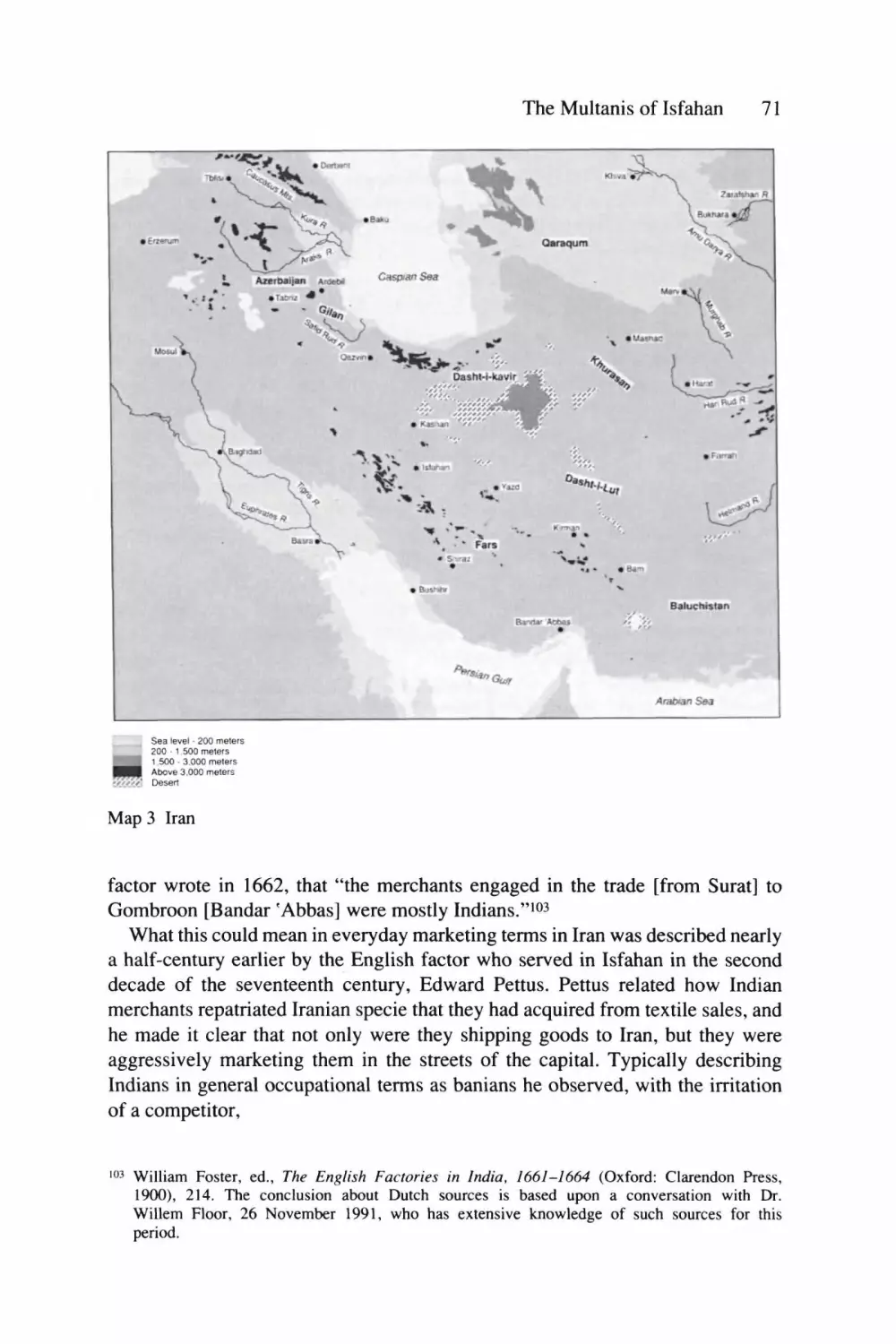
Iran
Eurasia
Russia

17
47
71
80
103

IX

Preface

This work is a study of economies and trade routes, of merchants and their
capital in Mughul India, Safavid Iran, Uzbek Turan and Muscovite Russia. It is,
more particularly, a study of the characteristics and significance of the MughulIndian trade diaspora in Iran, Turan and Russia. The underlying purpose of the
work is to use new evidence and employ a new perspective to amend radically
the persistent Eurocentric bias that continues to characterize most research on
Eurasian trade in the sixteenth, seventeenth and eighteenth centuries. A remarkable number of articles and books have been published on this commerce in the
last two decades, and many have focused on India, but nearly all of them have
been primarily concerned with aspects of European maritime expansion. Two
prevalent assumptions of this historiography have been that Indian commerce
with its neighboring territories was comparatively insignificant when measured
against European trade, and that Indian merchants themselves, to the extent that
they ever had been involved in this trade in the first place, were by the seventeenth
century in full-scale retreat in the face of European competition. As far as Mughul
India's trade with Iran, Turan and Russia was concerned, these assumptions are
incorrect.
I began this study in order to correct this erroneous, one-sided view of Eurasian
commerce by examining the role of large numbers of merchants from Mughul
India who lived semi-permanently and conducted business in Iran, Turan and
Russia in the seventeenth and eighteenth century. I would not have attempted to
do so had not an adolescent interest in understanding the angst of characters in
nineteenth-century Russian novels at least left me with the ability to use more than
eleven hundred pages of published Russian documents that illumine the business
activities of a little-known settlement of Indian merchants in the Russian Caspian
port of Astrakhan. These records provide a uniquely detailed insight into the
commercial and financial activities of Indian merchants, not merely in Astrakhan
itself, but in Iran as well. They offer the only means that I know to discuss specific
Indian business practices in the diaspora in the early modern era, and they contain
at least one set of data for evaluating the economic significance of the larger
emigre Mughul-Indian merchant population. Unfortunately, I was not able to
convince the Soviet government that I should be able to visit Astrakhan itself, but

Preface

xi

my disappointment in not being able to use the district and city archives there
was somewhat diminished by the discovery of several fine historical studies of
Astrakhan city and region by Soviet scholars. In addition I have benefited from a
wide variety of other Soviet studies of the socio-economic characteristics of
merchants and urban societies.
Anyone who studies commerce or mercantile life in the pre-modern era is
quickly made aware of two inescapable realities. First, statistics are rarely
available to document even long-term economic trends, and most conclusions
about commercial life have to be tentatively apprehended from the braille of
occasional coin finds, scattered records and anecdotal evidence. Basic customs
and financial data are almost never available. These are problems too for most
aspects of the economic history of India, Iran, Turan and Russia between 1600 and
1750, the century and a half during which the Astrakhan Indian community first
prospered and then decayed. However, an exceptional number of administrative
manuals, histories and travelers' accounts are extant for this period of Mughul and
Safavid history, and in Astrakhan itself a significant number of customs records
have been preserved. Second, just as it has been practical to write only about a
relatively brief time span out of centuries of commercial interaction between
Indian and adjacent territories, so too I have been compelled artificially to limit
my study of expatriate South Asian merchants to those who emigrated from
Mughul India to Safavid Iran, Uzbek Turan and Muscovite Russia. Yet Mughul
India did not exist in a state of autarky within the South Asian subcontinent, and
the diaspora of Mughul Indian merchants was not confined to these three states or
regions. It extended throughout the Indian Ocean region, was highly visible in the
Ottoman empire and penetrated into Chinese Turkistan. At the very least, though,
this work will offer clues and analogies for understanding the significance of
South Asian merchants throughout the wider diaspora and in so doing encourage
the study of regional economic history of Asia in the early modern era.
I have an enormous intellectual debt to a large number of accomplished
scholars who have written studies of commerce or merchant classes in India, Iran,
Turan and Russia in the early modern era. For India I have particularly benefited
from the writings of Christopher Bayly, K. N. Chaudhuri, Irfan Habib and his
justly influential Aligarh school, Muzaffar Alam, Tapan Raychaudhuri and John
Richards. I would also like specially to acknowledge the work of Surendra Gopal,
the first non-Soviet scholar who recognized the potential scholarly importance of
the Russian Astrakhan records. My understanding of Iranian history of the Safavid
era has been especially influenced by the interpretations of Bert Fragner, Edmund
Herzig, Mehdi Keyvani, Rudolph Matthee, R. Roemer and R. W. Ferrier. E. A.
Davidovich, N. M. Lowick, R. D. McChesney and R. G. Mukminova have
produced works that have been crucial to my understanding of the trade of South
Asian merchants in the Uzbek states or appanages of Turan.
I began my tutorials on Russian merchants by reading the articles and books of
Samuel H. Baron and Paul Bushkovitch, but learned most about the particular
subject of South Asian merchants in Russia by immersing myself in the uniquely

xii

Preface

valuable document collections that were carefully edited by K. A. Antonova,
N. M. Gold'berg and others. My debt to N. B. Golikova will be especially evident
in the notes, for her use of unpublished Astrakhan customs records has allowed me
to make some statistically verified conclusions that could only be inferred from
the published records. I have also benefited from the criticisms and suggestions of
Thomas Allsen, Paul Bushkovitch, John Masson Smith Jr. and my colleague Alam
Payind. I must also record my debt for the second time in my scholarly life to the
exceptional scholarship of the late S. D. Goitein, whose work on the Cairo Geniza
documents has incalculably enriched my understanding of pre-modern commerce
in the Mediterranean and Islamic world.
Finally, I would like to thank Professor Tosun Aricanli for inviting me to
present a paper at the "Workshop on the Political Economies of the Ottoman,
Safavid and Mughal States during the 17th and 18th Centuries," that was held in
Istanbul, Turkey, 16-20 June, 1992. The final revision of this manuscript was
influenced by several of the participants at that conference, particularly Suraiya
Faroqhi, Ashraf Ghani, Edmund Herzig and Rudolph Matthee. While this
manuscript was begun well before that meeting it is, in a way, a testimony to
the wisdom of studying the early modern Islamic world from a comparative
perspective.
Cindy Gray and Jon Fehrman helped with the design of the maps and Jon
Fehrman prepared the final version of each map.

Note on transliteration

I have chosen to follow R. D. McChesney's sensible modifications of the
Encyclopaedia of Islam system of rendering the Cyrillic alphabet that he
employed in his recent study, Waqf in Central Asia. I found it difficult to
decide how to present Russian renderings of Indian names that were generally
unfamiliar to their officials, particularly those who first encountered Indian
merchants in the early seventeenth century. They rendered some names correctly
and others are recognizable. Others, though, have been a matter of anguished
speculation. After consulting with several Indian colleagues and getting as many
variant suggestions for one or two names I decided to transliterate them from
Russian without change. I have, however, usually placed the Russian personal
suffix, -ov, -ev, etc. in parenthesis to enable others to more easily recognize Hindu
and Jain names. Muslim names were not usually a problem. Not only were
Russians more familiar with Muslims, but few Indian Muslims were present in the
Astrakhan settlement.

Xlll

Abbreviations

A'in-i Akbari, Abu'l Fadl 'Allami, trans, and ed. by
H. Blochmann and D. C. Phillott, repr. (New Delhi:
Crown Publications, 1988), 3 vols.
Akbar Nama, Abu'l Fadl 'Allami, trans, by H. Beveridge,
AN
repr. (New Delhi: Ess Ess Publications, 1987), 3 vols.
Russko-lndiiskie Otnosheniia v XVII veke, K. A.
Antonova, I
Antonova et ah, ed., Sbornik Dokumentov [RussianIndian Relations in the 17th Century, A Collection of
Documents] (Moscow: Nauka, 1958).
Russko-lndiiskie Otnosheniia v XVIII veke, K. A.
Antonova, II
Antonova et ah, ed., Sbornik Dokumentov [RussianIndian Relations in the 18th Century, A Collection of
Documents] (Moscow: Nauka, 1965).
The Cambridge Economic History of India, Tapan
CEHI
Raychaudhuri and Man Habib, eds., I: c. 1200-c. 1750
(Cambridge: Cambridge University Press, 1982).
The Cambridge History of Iran, I, W. B. Fisher, ed., The
CHI
Land of Iran; V, J. A. Boyle, ed., The Saljuq and Mongol
Periods', VI, Peter Jackson and Laurence Lockhart,
ed., The Timurid and Safavid Periods (Cambridge:
Cambridge University Press, 1965-86).
Ocherki Po Istorii Gorodov Rossii kontsa XVII-nachala
Golikova, Essays
XVIII v, N. B. Golikova [Essays on the History of
Russian Cities from the End of the 17th to the Beginning
of the 18th Century] (Moscow: Moscow University,
1982).
Mukinova,
SotsiaV naia Differensiatsiia Naseleniia Gorodov
Social Differentiation Uzbekistana v XV-XVI vv [Social Differentiation of the
Urban Population of Uzbekistan in the 15th and 16th
Centuries] (Tashkent: Fan, 1985).
AA

xiv

CHAPTER 1

An Indian world economy

Have we not Indian carpets dark as wine,
Turbans and sashes, gowns and bows and veils,
And broideries of intricate design,
And printed hangings in enormous bales?
James Elroy Flecker: "The Golden Journey to Samarqand"

The Indian Diaspora
In a discussion of the commerce and business classes of Safavid Iran
(1501-1722), Mehdi Keyvani has remarked that the presence and proliferation
of Indian "moneychangers" in several major Iranian cities during the later Safavid
period is "an astonishing and unexplained episode of Iranian economic history."1
Keyvani would have been justified in adding that the increased settlement of these
Indians in Iran has also remained an unexplained aspect of Indian economic
history in this period when Mughul emperors ruled the northern half of the South
Asian subcontinent (1526-1739). If no more than a few Indians had been involved
their presence might justifiably be dismissed as an intriguing anomaly that had no
fundamental significance for the economic history of either Iran or India, but
thousands and perhaps tens ofthousands of Indian businessmen lived and worked
in Iran in the seventeenth and early eighteenth century. Some of these men were
moneychangers and/or moneylenders, but many of the same individuals also
worked as retail and wholesale merchants, commodity brokers and financiers.
Taken as a whole they constituted an influential but rarely noticed trade diaspora
that also encompassed the Uzbek khanates of western Turkistan or Turan
(c. 1500-1920). In the early seventeenth century the diaspora extended its
mercantile activities to include the Russian Caspian port of Astrakhan, the Volga
basin and, for a brief period, Moscow itself. This expanding sphere of Indian
mercantile influence thus represented far more than a transitory episode for
Safavid Iran, far more even than an important moment in Mughul-Safavid
1

Mehdi Keyvani, Artisans and Guild Life in the Later Safavid Period (Berlin: Klaus Schwarz,
1982), 228.

2

An Indian world economy

economic relations. It was a climactic moment of an important phase in Eurasian
economic history.
The concept of a trade diaspora has been widely publicized by the African
historian, Philip Curtin, who, along with Fernand Braudel, is also one of the few
scholars who have alluded to the presence of Indian merchants in Russia.2 'Trade
diaspora" is a useful descriptive tool for the phenomenon of merchant migrations
from one cultural zone to another, and in his book, Cross-cultural Trade in World
History,3 Curtin applies it to a multitude of examples that range from the Middle
East in the fourth century BC to the "tightly controlled trade diasporas of the
chartered European trading companies in eastern seas."4 By itself, though, the
concept is not sufficient to convey the economic significance of this wide-spread
dispersal of Indian merchants in Iran, Turan and Russia. This particular diaspora
reflected an asymmetrical economic relationship in which Indians marketed
agricultural products, textile manufactures and their own financial expertise
throughout a broad region where they enjoyed a competitive advantage in both
goods and services - or, in visible and invisible exports. In brief, the diaspora
manifested in the persons of these merchants the Mughul empire's stature as a
regionally dominant economic power or, in Fernand Braudel's phrase, a regional
"world economy."5
One of the best known and clearest examples of this type of regionally
dominant diaspora in the early modern era, the sixteenth through the eighteenth
century, is that of the western European economic penetration of Russia. The
phenomenon is particularly obvious in this instance because these two societies
had been largely isolated from one another before representatives of the nascent
European world economy in the person of English merchants literally stumbled
over the primitive Muscovite state while searching for a northwest passage to the
orient. T. S. Willan has examined the early English phase of discovery and
Jonathan Israel has written an exceptionally lucid account of the later Dutch phase
in his overall analysis of their hegemonic diaspora, Dutch Primacy in World
Trade, 1585-1740.6 The settlement of English and Dutch merchants and
entrepreneurs in Archangel and Moscow is particularly apropos since it
represented virtually the same process as the nearly simultaneous extension of

Fernand Braudel is the only scholar to hint at the economic significance of these Indian merchants.
The Perspective of the World, Vol. Ill of Civilization and Capitalism 15 th-18th Century, trans, by
Sian Reynolds (London: Collins, 1984), 461.
Philip D. Curtin, Cross-cultural Trade in World History (Cambridge: Cambridge University Press,
1984), 189.
Curtin, Cross-cultural Trade, 8.
Braudel, Perspective of the World, 22, 24-45. See also Frederic Mauro's rhetorical question about
the relationship of merchant communities to the idea of world economy in his essay, "Merchant
Communities, 1350-1750," in James D. Tracy, ed., The Rise of Merchant Empires (Cambridge:
Cambridge University Press, 1990), 286.
T. S. Willan, The Early History of the Russia Company, 1553-1603 (Manchester: Manchester
University Press, 1956), and Jonathan Israel, Dutch Primacy in World Trade, 1585-1740 (Oxford:
Clarendon Press, 1989).

The Indian diaspora

3

Indian economic influence to Astrakhan, the Volga cities and Moscow. The
significance of these two diasporas differed only in that western Europeans were
just beginning their world-wide expansion whereas in retrospect it is obvious that
the arrival of Indian merchants and financiers represented the western highwater
mark of the Indian world economy. Unfortunately, it has been impossible even
to guess at the scope and implications of the Indian diaspora because so little
attention has been devoted to it. Until now more has been written about the
Russian career of one Dutch entrepreneur, Andre Vinius (1605-1662/63), than
about all of the Indian merchants in Iran, Turan and Russia over the entire course
of the seventeenth century.7
The vestigial credit network of this Indian mercantile presence was still
operating effectively in the early nineteenth century. Alexander Burnes, one of the
best informed and precisely accurate British observers who visited northwestern
India, Afghanistan, Turan and Iran, found out while visiting Kabul in 1832 that
much of the trade of Central Asia was in the hands of Hindu merchants, who had
"houses of agency from Astracan and Meshid to Calcutta." These merchants
offered to give him bills of exchange on Nizhnii Novgorod, on the upper Volga,
Astrakhan or Bukhara.8 Yet the magnitude and influence of the Indian diaspora
has remained virtually unknown in modern scholarship because of wellentrenched Eurocentric biases in historical studies on Eurasian commerce in the
early modern era, although the nature of available sources has also discouraged
research on this topic.
To understand how this Indian world economy functioned it will be necessary
to alter fundamentally some of the traditional approaches to and conclusions about
Eurasian economic and commercial history in frr early modern period. First of all
it is essential to discuss Indian economic history as a provincial segment of a much
broader South Asian-Near Eastern regional history. Such a regional perspective
is a commonplace in cultural historiography of the region, but it is still rare in
scholarly studies of the economic history of the Middle East and South Asia,
which tend to be conceptualized in terms of modern political boundaries. 9 Thus no
one who is familiar with Mughul or Safavid historiography would be surprised to
learn that a recent Iranian publication, Karvan-i Hind, The Caravan of India, dealt

For a summary of the career of Vinius see Joseph T. Fuhrmann, The Origins of Capitalism in
Russia (Chicago: Quadrangle Books, 1972), 55-91.
Alexander Burnes, Travels into Bokhara (London: John Murray, 1835), II, 144-45. The operation
of bills of exchange or hundis within Mughul territories is well known, but for a recent description
of the practice in the seventeenth century see Irfan Habib, "The System of Bills of Exchange
(Hundis) in the Mughal Empire," in Satish Chandra, ed., Essays in Medieval Indian Economic
History (New Delhi: Munshiram Manoharlal, 1987), 207-21. It is quite typical of sources for the
period that most of Habib's information comes from English East India Company documents
rather than Persian or other Indian language materials.
This approach is exemplified, for example, by the Cambridge Economic Histoiy of India and the
Cambridge History of Iran. Authors of chapters on commerce or economic history in both volumes
tend to write with very little knowledge of regional commercial ties or the economic history of
contiguous states.

4

An Indian world economy

with the emigration of poets from the Safavid to the Mughul court rather than the
passage of prosaic camel caravans.10
The two most important exceptions to this narrow, politically defined
historiography are the recent dissertations of Rudolph P. Matthee, "Politics and
Trade in Late Safavid Iran: Commercial Crisis and Government Reaction Under
Shah Solayman (1666-1694)," (UCLA, 1991), and Edmund Herzig, "The
Armenian Merchants of New Julfa, Isfahan: A Study in Pre-Modern Asian Trade"
(Oxford, 1991). Both Matthee and Herzig are nominally scholars of Safavid Iran,
but they locate their works within the broader context of Eurasian economic
history, and Professor Matthee's summary of his thesis characterizes both their
approaches. "This study then views Iran as an early modern state embedded in a
commercial network stretching from the Levant and the emerging Russian state
to India."11 Both too use a wide variety of European and Iranian sources that
illuminate the economic relationships of a broad Eurasian region. Both scholars
also understand the crucial nexus between government policy and commerce.
Professor Matthee's work is especially important for the present study, because he
appreciates that Mughul-Safavid commerce was a major factor in the economic
history of both states, and his sophisticated knowledge of commercial and
monetary history complements K. N. Chaudhuri's massive history of British East
India Company trade in the Mughul-Safavid era.12 Professor Herzig's pioneering
study of the famous Armenian commercial community of Isfahan offers crucial
new data on a mercantile diaspora that co-existed with that of the Indians in Iran
and Russia. His research illumines aspects of Armenian merchant organization
and practice that corroborates and supplements the available data on Indian
merchants.
Throughout most of the sixteenth, seventeenth and eighteenth centuries India's
most important markets were located in the countries bordering the Indian Ocean
and the contiguous land mass of the Iranian plateau and the Central Asian steppe.
Equally important, the Mughuls were one of three major early modern Muslim
dynasties, along with the Safavids and Ottomans, who established a fairly
effective pax Islamica throughout the traditional civilizational centers of the Near
East and South Asia. From the sixteenth century most rulers of these dynasties
consistently implemented standardized political-economic policies that were
designed to stimulate both internal and external trade. These policies, which will
be discussed below primarily in terms of Mughul India's commercial relations
with Safavid Iran and Uzbek Turan, were particularly effective in securing the
overland routes between northern India and the Iranian plateau. By the early
seventeenth century Mughul and Safavid monarchs had jointly created what were
probably the most effective conditions for commerce that had ever existed in the
10
11
12

Ahmad Golchin Ma'ani, Karvan-i Hind (Mashad: Astan-i quds-i razavi, 1991), 2 vols.
Matthee, "Politics and Trade," xii.
K. N. Chaudhuri, The Trading World of Asia and the English East India Company, 1660-1760
(Cambridge; Cambridge University Press, 1978).

The Indian diaspora

5

history of the Indo-Persian region. This was an economic "conjuncture," largely
obscured by scholars' traditional preoccupation with European maritime trade,
that favored the steady increase of long-established trading patterns and the
substantial expansion of the Indian mercantile diaspora.
The general assessments of Tapan Raychaudhuri on Mughul India and H. R.
Roemer on Safavid Iran convey an impressionistic sense of conditions in these
countries around 1600, although they are discussing different facets of Mughul
and Safavid rule. After discussing the Mughul regime's efficient land revenue
extraction mechanisms Raychaudhuri writes:
If the Mughuls were ruthless in their expropriation of surplus, their rule beyond doubt
brought a high level of peace and security. From the 1570s - by which time Akbar had
consolidated his empire - for more than a hundred years the greater part of India enjoyed
such freedom from war and anarchy as it had not known for centuries . . . The economy of
the empire derived direct benefits from this altered state of peace and security. Substantial
increases in trade, both inland and foreign, was rendered possible by this development. It
would perhaps be an exaggeration to say that the Mughul age saw the emergence of an
integrated national market. Still, the commercial ties which bound together different parts
of the empire had no precedents.
Roemer in depicting the achievements of the pivotal Safavid monarch, Shah
f
Abbas, writes:
At the end of the 10th/16th and the beginning of the 11/17th century, Shah 'Abbas had
mastered the crises which had shaken his country at the time of his accession . . . After
security had been restored in the country 'Abbas turned his attention to establishing an
effective administration. In the development of transport routes, which he pursued with
energy, particularly noteworthy is the network of caravansarais he created . . . These and
other measures invigorated trade and industry so that the broad masses of the population
also found that their standard of living was at first improved and ultimately reached a level
never known up to that time.13
It is possible to paraphrase Raychaudhuri's comments on Mughul India and
apply them to both India and Iran so that they read: "It would perhaps be an
exaggeration to say that the Mughul-Safavid age realized an integrated regional
market, but the commercial ties which now bound these two empires together
had no precedents." By the second decade of the seventeenth century
Muscovite Russia also became part of this market as its rulers aggressively

stimulated foreign trade by encouraging the settlement of foreign merchants.
The settlement of Indian merchants in Astrakhan was one of the results of this
policy.
To understand the operation of this world economy it is also necessary to
appreciate that the Indian merchants who conducted business throughout Iran,
Turan and Russia were members of a sophisticated trading network that in most
13

Raychaudhuri, "The State and the Economy: The Mughal Empire," CEHI, I, 184 and H. R.
Roemer, "The Safavid Period," CHI, VI, 269.

6

An Indian world economy

respects mirrored the commercial and financial characteristics of the Armenian
mercantile diaspora. European scholars have generally seen Indian and other
Asian merchants as archaic commercial artifacts of the early modern world. The
term peddler has frequently been used to categorize and implicitly denigrate the
economic effectiveness of Asian merchants in this period.14 As it is usually used,
peddler represents a kind of economic orientalism in which Asian merchants are
viewed as a quaint and ineffective commercial "other." The implicit standard of
comparison is, of course, the British and Dutch East India companies. It has been
relatively easy for scholars to hold this view because there is a lack of data on
non-western merchants before the twentieth century. Apart from S. D. Goitein's
monumental study of Middle Eastern commerce and Jewish society, A
Mediterranean Society, there has been no study of Asian merchants that is
comparable in biographic and economic detail to Sylvia Thrupp's work, The
Merchant Class of Medieval London, or equal to the voluminous, richly detailed
literature on Italian Renaissance merchants.15
The data on Indian merchants in Iran, Turan and Russia is itself not strictly
comparable to the relatively lavish sources that are extant for medieval and early
modern Europe. This information is, however, remarkably full when compared to
existing knowledge about India's mercantile communities in the early modern
period, whether within South Asia itself or in the broader South Asian
commercial diaspora. The Astrakhan documents especially represent a unique
collection of sources for a single community of Asian merchants, second only
perhaps to the data that Edmund Herzig has obtained for the Isfahan Armenians. 16
In contrast to the records of the Dutch and English East India companies, which
contain only limited data on Asian traders, these Russian sources were compiled
by an autocratic regime whose representatives closely monitored customs
transactions, recorded details of partnerships and other contracts, adjudicated
commercial disputes and in census reports and taxation records offered insights
into the cultural and social characteristics of the Indian Community. These data
make it possible to see that apart from the exceptional case of the two great
European companies, Indian merchants closely resembled their well-known
European contemporaries - particularly those in Genoa, Florence and Siena. In
14

15

16

The classic statements of the peddler thesis are the original formulation by J. C. van Leur,
Indonesian Trade and Society (The Hague: W. van Hoeve, 1955), and the more recent restatement
of van Leur's ideas by Niels Steensgaard, The Asian Trade Revolution of the Seventeenth Century,
The East India Companies and the Decline of the Caravan Trade (Chicago: University of Chicago
Press, 2nd ed., 1974).
S. D. Goitein, A Mediterranean Society (Berkeley: University of California Press, 1967-88),
5 vols., and Sylvia Thrupp, The Merchant Class of Medieval London (Chicago: University of
Chicago Press, 1948).
Analyses of pre-modern Indian firms have never really been attempted because of the scarcity
of sources, but even the discussion about mercantile organization is still carried on at a fairly
elementary level. For an introduction to modern studies of firms, see Oliver E. Williamson and
Sidney G. Winter, The Nature of the Firm (New York: Oxford University Press, 1991), a book that
contains a collection of articles by Ronald H. Coase and other scholars writing on Coase's now
famous essay, "The Nature of the Firm."

The Eurasian context

7

fact, one of the secondary purposes of this study is to suggest that there was a
common Eurasian mercantile type and characteristic Eurasian firm in the early
modern era.

The Eurasian context
Mughul-Indian merchants who migrated to conduct business in Iran, Turan and
Russia operated in four different states, whose policies and structure directly or
indirectly influenced the diaspora's prosperity and prospects for growth. All four
states were successors of the Mongol-Timurid nomadic empires of the thirteenth,
fourteenth and fifteenth centuries. Mughul India, Safavid Iran and Uzbek Turan
were also immediate heirs to the administrative and cultural traditions of the
Timurids, Timur's descendants who ruled in Turan from 1405 to 1506. Nevertheless, the legacies of these empires that Marshall Hodgson has characterized as
"military patronage states" differed in each instance.17 Rulers of Uzbek Turan
were direct descendants of Chingiz Khan and their dynastic legitimacy appears to
have been generally accepted by the Turco-Mongol inhabitants of that region who
spoke Turkic dialects and shared their Sunni Muslim faith. Uzbek rulers inherited
Mongol assumptions that territorial conquests belonged to and should be shared
among clan members.18 Unlike Chingiz Khan, though, the Uzbek grand khan, who
normally ruled in Bukhara, rarely functioned as more than a primus inter pares,
a first among Chingizid equals. With the exception of the last quarter of the
sixteenth century Uzbek rulers usually functioned as a patchwork of agnatically
related but largely autonomous appanages. Yet despite the fragmented structure of
Uzbek polity it survived essentially intact from the time of the decisive Uzbek
victories over the last Timurid rulers in Turan in the early sixteenth century
throughout the early modern period.
The Mughuls were members of one of those Timurid lineages. Their founder,
Zahir al-Din Muhammad Babur (1483-1530), had lost two battles to Uzbek forces
that caused him to take refuge in the impoverished Timurid outpost of Kabul in
1504. He ruled from there until 1526 when he was able to reestablish Timurid
It is difficult to see that Hodgson's concept of the "military patronage state" explains very much
about the characteristics of the Mughuls, Safavids or Ottomans, although it is often used as a
convenient label. Hodgson himself only tentatively suggested that there was a connection. He
wrote: "what I have called 'military patronage state' never formed a single pattern, but at some
point I think I can see common effects on such states [Ottoman, Safavid and Mughul] from the
special circumstances of the age," The Venture of Islam, III: Gunpowder Empires and Modern
Times (Chicago: University of Chicago Press, 1974), 27. For a discussion of the diverse Timurid
heritage of the Mughul, Safavid and Uzbek states see Stephen F. Dale, "The Legacy of the
Timurids," in David Morgan and Francis Robinson, eds., The Legacy of the Timurids (New Delhi:
Oxford University Press for the Royal Asiatic Society, forthcoming, 1994).
The best introduction to Uzbek polity and political thought is R. D. McChesney's Waqfin Central
Asia (Princeton: Princeton University Press, 1991). For a political history of the Uzbeks in this
period see the same author's article, "Central Asia, VI. In the 10th- 12th/ 16th- 18th Centuries,"
in E. Yarshater, ed., Encyclopaedia Iranica 5, fasc. 2 (Costa Mesa., Calif.: Mazda, 1990),
176-93.

8

An Indian world economy

fortunes by seizing northern India from a disunited Afghan dynasty.19 Like Uzbek
rulers Mughul emperors were Sunni Muslims, but Babur and his successors based
their dynastic claims on Timurid rather than Chingizid descent. Unlike the
Uzbeks, Mughul emperors were able to transcend their own appanage tradition
that had previously doomed the continued rule of Timur's descendants in Turan.
By the end of the sixteenth century they had established an indigenously tinged
Perso-Islamic absolutism in northern India that for a century and a half enjoyed
paramountcy over a diverse, predominantly non-Muslim population and a
bewildering variety of regional and local rulers.
Based partly on the achievements of their Afghan predecessors, Mughul rulers
were able to assert direct control over most cities and much of the agricultural
heartland of the north Indian plains. The family's Timurid legitimacy, which
exerted only modest influence in India, was reinforced by the Mughuls'
significance as a Muslim dynasty among northern India's substantial but still
minority Indo-Muslim population. Still, the acquiescence of many South Asian
Muslims was tentative and conditional. Even if they were temporarily co-opted
into the imperial system, groups such as the clan-centered Afghans never offered
the Mughuls more than temporary cooperation. The loyalty of subordinate Hindu
lineages was almost entirely pragmatic and temporary. Therefore, while weak
Uzbek appanages survived in Turan, Mughul imperial rule weakened quickly after
the death of the last great emperor Aurungzeb (r. 1656-1707). It virtually ceased
to exist after the Iranian invader and heir to Safavid power, Nadir Shah,
administered the coup de grace to the system when he sacked Delhi and seized the
Mughul treasury in 1739.
The Safavids were also heirs to a common Timurid legacy, but they differed
from the Mughuls and Uzbeks even more than these two states were distinct
from one another. Originally leaders of a militarized sufi order, Safavid rulers
succeeded in establishing a state that covered areas of eastern Anatolia and northwestern Iran by 1501.20 They largely relied for military power on Turkic tribes in
the region who were known as the Qizilbash, or "redheads," after their distinctive
headgear, who had been attracted to the Safavid cause by the family's quasi-Shi'i
messianic preaching. In the following decade Safavid forces conquered much of
the Iranian plateau and also began their systematic conversion of the population to
Shifi Islam. Their successful persecution of Sunni Muslims permanently altered
19

20

For an introduction to the history of the Mughul empire, see J. F. Richards, The Mughal Empire
(Cambridge: Cambridge University Press, 1993). Peter Hardy offers an insightful introduction
to questions of Mughul legitimacy and sovereignty in his work, The Muslims of British India
(Cambridge: Cambridge University Press, 1972), 1-30; and for brief articles on various aspects of
Mughul culture and administration see M. Athar fAli et al., "Mughuls," Encyclopaedia of Islam
new ed., VII, fasc. 119-20 (Leiden: E. J. Brill, 1991), 313^6.
The best introduction to various aspects of Safavid history is found in the various articles in
volume VI of The Cambridge History of Iran. See also H. R. Roemer, Persien aufdem Weg in die
Neuzeit: Iranische Geschichte von 1350-1750 (Beirut: Franz Stiner, 1989), and Klaus Michael
Rohrbom, Provinzen undZengralgewalt, Persiens im 16. und 17. Jahrhundert (Berlin: Walter De
Gruyter, 1966).

The Eurasian context

9

the religious landscape and clerical organization of Iran, but Safavid military and
political fortunes sharply declined after 1514 when they lost the battle of
Chaldiran to Ottoman forces. Following this defeat Safavid Iran not only ceded
most of its northwestern provinces, but the dynasty's charismatic authority was
compromised and Qizilbash tribes increasingly asserted control over the state's
remaining territories and periodically usurped the power of the Safavid family
itself. The sixteenth century was the Qizilbash century in Safavid Iran, even if
Iranian bureaucrats and 'alims dominated the administration and the religious
hierarchy.
The Safavid state experienced a genuine renaissance under Shah 'Abbas I
(r. 1588-1629). 'Abbas reestablished dynastic control over the central government, reconquered lost territories and radically restructured the state. He
transformed it from what had been almost a tribal confederation led by formerly
charismatic Safavid shaikhs to a more traditional Perso-Islamic absolutism that
was increasingly supported by a reorganized military system independent of
Qizilbash leadership. Following 'Abbas' death, though, the Safavid state entered
into an almost century-long period of stasis, a result in large measure of his
policy of immuring potential heirs in the haram. This policy, which his
descendants also followed, almost guaranteed that the pillars of a dynastic,
patriarchal state, the princes, would be inexperienced or incompetent monarchs.
Symptomatic of this problem was the shift in spending patterns of late Safavid
Iran. Finances that had earlier gone for the army and such commercial infrastructure as caravansarai were diverted in the second half of the seventeenth
century to construction of palaces and mosques for the increasingly powerful Shifi
clergy.21 While the court managed to sustain much of its splendor and appearance
of central authority throughout the seventeenth century, by the accession of Shah
Husain in 1694 the decay of the dynasty had left the state vulnerable to the
slightest external threat. In 1722 it dissolved almost overnight in the face of an
Afghan revolt that inadvertently culminated in the conquest of Shah 'Abbas'
splendid capital, Isfahan.
The Muscovite state of the late sixteenth century had emerged from Mongol
vassalage only a century earlier, but unlike the Mughul, Safavid and Uzbek
regimes it exhibited few long-term effects of its subordination.22 The Mongols had
ruled Russia's northeastern forest zone indirectly, so their administrative and
cultural legacy in the Moscow-Novgorod heartland was slight. The most obvious
permanent legacy was the tsars' assumption of the title "autocrat," which
proclaimed their independence of the "Tatar yoke." Mongol rule has sometimes
been blamed for Russia's autocratic character, but when compared with Mughul,
Safavid or Uzbek polities it is impossible to discern, as many Russian historians
21
22

Matthee, "Politics and Trade," 78-79 and 123.
See Nicholas V. Riasanovsky, A History of Russia (New York: Oxford University Press, 1984),
and for social and economic history, Jerome Blum, Lord and Peasant in Russia (Princeton:
Princeton University Press, 1961).

10

An Indian world economy

have traditionally done, any specifically Mongol or "Asiatic" features in its
governmental traditions, only the continuous development of an implacable
absolutism. The success of one line of Muscovite princes in extinguishing the
independence and then the autonomy of the area's other princely appanages was
virtually assured by the reign of Vassili III (1533-55), and it was climaxed by Ivan
the Terrible's extraordinary administrative and military policy known as the
oprichina. Ivan (r. 1533-84) discernibly directed this reign of terror at potential
princely opponents of his rule, but he also loosed a destructive and seemingly
indiscriminate assault on large regions of the countryside that he evidently
suspected of disaffection.
It is a remarkable feature of Russian history that their autocrats, however
terrible, enjoyed a legitimacy of indisputable Russian princely birth that was
bolstered by the almost unwavering support of the orthodox church and the
ideological underpinnings of Roman and Byzantine absolutist precedents. Their
success in creating a true absolutism that none of their European or Asian
contemporaries could possibly hope to emulate was a reflection of Russia's
political and socio-economic primitiveness rather than its Asiatic sophistication.
As Nicholas Riasanovsky has persuasively argued in his comparison of Lithuania
and Moscow:
the princedom of Moscow arose in a relatively primitive and pioneer northeast, where
rulers managed to acquire a dominant position in a fluid and expanding society . . .
Lithuania, in contrast, always had to deal with different peoples and cultures and formed a
federal, not a Unitary state.23
Absolutism and primitiveness are two features of the Muscovite state that must be
appreciated in order to understand the situation of the Indian diaspora in that
country, for they help to explain the Indian merchants' initial success and partly
account for their eventual stagnation.
Merchants from Mughul India who traded in Safavid Iran or Uzbek Turan
operated within a broadly similar commercial and linguistic environment. While
merchants in these states did not possess the urban autonomy that many of
their western European contemporaries had achieved, they still enjoyed almost
unrestricted freedom to carry on their trade within the general framework of
Islamic contractual law.24 What Goitein has said about mercantile life in the
Mediterranean region from the mid-tenth to the mid-thirteenth century is also
applicable to the conduct of commerce in Mughul India, Safavid Iran and
Uzbek Turan in the early modern era. According to Goitein, "during the High
23
24

Ibid., 138-39.
Unfortunately, the unanswered question that is implicit in this statement, that is, did non-Muslims
receive equal treatment in cases of contract disputes with Muslims, cannot be answered in any
satisfactory way. For an introduction to the theory of Islamic commercial law see Abraham L.
Udovitch, Partnership and Profit in Medieval Islam (Princeton: Princeton University Press, 1970),
and for discussions of the functions of certain officials who typically dealt with contracts, such as
qadis and muhtasibs, Emile Tyan, Histoire de Vorganisation judiciare en pays dIslam (Leiden:
E. J. Brill, 1960).

The Eurasian context

11

Middle Ages men, goods, money and books used to travel far and almost
without restrictions throughout the Mediterranean area. In many respects the
area resembled a free-trade community."25 Edmund Herzig has written in a
similar vein about the Armenians in the early modern period, observing
that "From the Mediterranean ports of the Ottoman empire to the harbours of
the Indonesian archipelago Armenians were free to travel and trade without
obstruction."26
Indo-Muslim merchants particularly were able to travel and conduct business
almost as comfortably in Iran and Turan as they could within the Mughul empire.
Virtually all of them knew Persian, which was the most widely used administrative and cultural language throughout the entire region, and Central Asian
immigrants to the Mughul empire also knew Turkic dialects that were widely
spoken in Iran and southern Russia as well as in Turan itself. While Chaghatai
Turkish - or old Uzbek - may have been spoken by the majority of Central Asian
inhabitants, the urban mercantile class in Turan, commonly identified as Sarts,
also used Persian, as members of the 'ulama usually did when they recorded
commercial contracts.27 Nor were Indian Sunni Muslims subject to the kind of
harassment or danger in Safavid territories that Iranian Shi'is could experience in
aggressively Sunni Uzbek Turan. Shi'i-Sunni differences were never a significant
issue in Mughul-Safavid relations, whose conflicts were almost entirely confined
to military struggles for the control of the Afghan marches between their
respective empires.
Most substantial non-Muslim merchants also knew Persian, a language that
gradually became established as one of the principal spoken and written
languages of the Panjab during Mughul rule.28 If merchants had direct dealings
with the court or its administrative apparatus, as many of them commonly
did, they often absorbed aspects of Mughul court culture. At least two members
of the large Khattri caste-group that dominated commerce in many parts of the
Panjab and northwestern India became high-level Mughul officials and one of
them thoroughly absorbed Indo-Persian literary culture.29 Khattri merchants
established especially close relations with Mughul provincial officials in the
25
26
27

28
29

Goitein, A Mediterranean Society, 66.
Edmund Herzig, "The Armenian Merchants of New Julfa, Isfahan: A Study in Pre-Modern Asian
Trade," unpublished Ph.D. dissertation, Oxford, 1991, 27.
For Chaghatai and "old Uzbek" see Use Laude Cirtautas, "On the Development of Literary Uzbek
in the last Fifty Years," Central Asiatic Review XXI (1977), 36-51. V. Barthold discusses the Sarts,
Four Studies on the History of Central Asia, trans, by V. and J. Minorsky (Leiden: E. J. Brill,
1962), 63. Examples of contracts can be found in Mukminova, Social Differentiation, 53-61.
Prakash Tandon, Punjabi Century (Berkeley: University of California Press, 1960), 14-15.
The best known of these Khattri officials was Todar Mai (d. 1589), who became diwan, or chief
revenue officer, of the emperor Akbar, who is, though, well known for adamantly remaining an
orthodox Hindu. Less well known is Iklas Khan Iklas Kish (Kishn Chand), who served under the
last great Mughul emperor, Aurungzeb, and his successors and wrote a Persian biography of
the emperor Farruksiyar and a tazkirah, a biographical dictionary of Mughul poets. T. W. Beale,
An Oriental Biographical Dictionary, repr. (New Delhi: Manohar Reprints, 1971), 176 and
223.

12

An Indian world economy

Panjab.30 Therefore, in linguistic terms at least Khattris and other non-Muslim
Indian merchants could extend their commercial operations to Iran and Turan
almost as easily as non-Muslim merchants. Hindus and Jains may have
experienced petty harassment on caravan journeys, encouraging them to use
intermediaries for the transport of their goods, and they were occasionally
persecuted or even attacked in these predominantly Muslim countries in times of
economic hardship or political chaos. However, Hindus or Jains apparently never
suffered as much as Jews and Armenians in Iran.31 Hindus may not have suffered
official religious persecution because they wielded so much economic power,
and/or because they were not regarded as Iranian citizens.32 The one Hindu
merchant whose complaints about Iranian treatment of Indian merchants have
been preserved never suggested that Hindus had been singled out for abuse or
excessive duties.33
Conditions in Russia were different for all mercantile groups. Turkic speakers
enjoyed a decided advantage in dealing with the predominantly Turkic population
of the former Astrakhan khanate,34 and Armenians were granted special privileges
because of their uniquely influential role as marketers of Iranian silk. Otherwise
Iranian, Central Asia and Indian merchants were linguistically and legally on an
equal footing. Unless they knew Russian, which many long-term residents did
acquire, they had to use the mediatory services of local translators, who were
usually local Turks, and each community enjoyed the same legal rights as
members of ethnically defined, semi-autonomous mercantile corporations.
Merchants of all communities could depend upon judicial authorities to enforce
the letter of their commercial and financial contracts. They did so even to the
extent that other Russian officials in the city sometimes complained that Indian
merchants in particular contributed to depopulation and a lowered tax base in the
city when they attempted to enforce their agreements against defaulting Turks,
some of whom fled into the steppe if they were pressed for payment.35 While
30

31

32

33
34

35

Muzaffar Alam has provided important evidence and thoughtful discussions of the Khattris'
relations to Mughul officials in the Panjab in the early eighteenth century in his book, The Crises
of Empire in Mughal North India, Awadh and the Punjab, 1707-1748 (Delhi: Oxford University
Press, 1986); see especially pp. 169-74.
Edmund Herzig usefully observes of Shah 'Abbas, "It is surprising that 'Abbas I, generally
remembered as the Protector of the Christians, was in fact responsible for more instances of antiChristian persecution than any of his successors." "Armenian merchants," 83.
For the situation of Iranian Jews see Vera Basch Moreen, Iranian Jewry During the Afghan
Invasion (Stuttgart: Franz Steiner, 1990) and Iranian Jewry's Hour of Peril and Heroism (New
York: American Academy for Jewish research, 1987). Professor Moreen specifically mentions that
none of her seventeenth-century sources alludes to persecution of Hindus in Iran, even though Jews
and Armenians were certainly being mistreated. I am indebted to her for these references. The
question of suffering monetary extortion is, of course, a separate issue.
Antonova, II, 1647,84-85.
B. Spuler briefly describes the history of the Astrakhan khanate. "Astrakhan," Encyclopaedia of
Islam, new ed. (Leiden: E. J. Brill, 1960), I, 721-22. See also Golikova, Essays, 7-35 and V. P.
Nikitin, Astrakhan' i ee Okrestnosti [Astrakhan and its Environs] (Moscow: Iskusstvo, 1981),
which has numerous pictures of what used to be a closed city.
Antonova, II, nos. 109-11, 204-5.

The Eurasian context

13

merchants undoubtedly welcomed Russian enforcement of their contractual rights
they were not pleased to have to accept relatively strong centralized monitoring
and control of their own commercial affairs. All aspects of foreign merchants' life
in Astrakhan would have reminded them that they were no longer operating within
the laissez faire economic atmosphere of early modern Islamic empires.
Mercantilism, not free trade, was the hallmark of Muscovite economic policy.

CHAPTER 2

India, Iran and Turan in 1600

In the beginning of the month of Day [October 1615] merchants came from Persia and
brought pomegranates of Yazd and melons from Kariz, which are the best of the Khurasan
melons . . . As my revered father (may God's light be his witness!) had a great liking for
fruit I was very grieved that such fruits had not come to Hindustan in his victorious time.
The Mughul emperor Jahangir: Tuzuk-i Jahangiri, I, 270
The composition of Mughul India's trade with Safavid Iran and Uzbek Turan was
determined primarily by contrasts between its economy and those of these two
contiguous states, while the volume of exchange was influenced both by supply
and demand and the commercial policies and political stability of their dynasties. 1
Mughul India possessed vastly greater natural and human resources than did
Safavid and Uzbek territories; its economy also overshadowed its neighbors in
terms of its overall size, diversity and sophistication. There was a consistent
demand for Mughul India's natural and manufactured products in Iran and Turan,
and the level of commerce was catalyzed in the second half of the sixteenth
century by the achievements of two exceptionally able Mughul and Safavid rulers.
These were the Mughul emperor Akbar (1556-1605) and the Safavid shah 'Abbas
(1587-1629). Both men stimulated internal and external commerce by consolidating their dynasties' political authority, and by consciously instituting policies
that stimulated trade. The relatively high level of stability and prosperity of the
Mughul and Safavid states also contributed to an increase in commerce between
them and Uzbek Turan, which itself was governed in the latter half of the sixteenth
century by an unusually capable and ambitious ruler, fAbd Allah Khan II
(c. 1551-98). The commercial impetus of Akbar and Shah 'Abbas' accomplishments was sustained into the early eighteenth century, even though Uzbek Turan
relapsed into congeries of autonomous Chingizid appanages following fAbd Allah
Khan's death, and Safavid Iran exhibited signs of impending collapse by the late
seventeenth century.
1

14

Mughuls referred to all of western Turkistan or Central Asia as "Turan." "Uzbek Turan" will be
used throughout this work to refer to the territory controlled or dominated by the Chingizid
khanates or appanages of Khiva, Bukhara (including Samarqand and Tashkent) and Balkh.

The economies

15

The economies
At Akbar's death in 1605 the Mughuls controlled or exercised hegemony over the
Indo-Gangetic plains, one of Asia's richest agricultural regions. From Thatta in
Sind northeast to Lahore in the Panjab then southeast to the Ganges-Jumna duab
and the Gangetic valley to Bengal, the plains constituted a South Asian fertile
crescent of immense agricultural potential.2 A sense of the fertility of this region
and the population it supported in the 1580s was conveyed with an almost
intoxicated sense of elation by the Mughul historian and administrator, Khwajah
Nizam al-Din Ahmad, who wrote of Akbar's territories that:
In a description of the countries ruled over by the servants of His Majesty, let it not remain
concealed, that the length of the country, which is to-day in the possession of this
powerful State, from Hindu Koh on the borders of Badakhshan to the country of Orissa,
which on the further side of Bengal, from west to east is one thousand and two hundred
Akbar Shahi karohs by the Ilahi yard measure ... and its breadth from Kashmir to the hills
of Bardah, which are at the extreme limit of the country of Sorath and Gujrat is eight
hundred karohs Ilahi... At present there are three thousand and two hundred towns; and
one or two or five hundred or a thousand villages appertain to each of these towns . . . Out
of these there are one hundred and twenty great cities, which are now well populated and
flourishing.3
Estimates of the number of people who lived in these thousands of villages,
towns and cities have usually been based upon the cultivation and land revenue
statistics that Nizam al-Din's contemporary, Abu'l Fadl 'Allami, supplied in his
detailed gazetteer of the Mughul empire, the A'in-i Akbari.4 Using Abu'l Fadl's
figures scholars have variously calculated the Mughul population in 1598, the
year when the A'in was essentially completed, at between 60 and 98 million
people. More of a consensus exists with regard to the distribution of this
population. It is generally although not universally agreed that approximately
85 percent of the inhabitants of Mughul territories lived in rural areas, while
15 percent resided in towns and cities.5
O. H. K. Spate, India and Pakistan, repr. (London: Methuen, 1960), 33. Spate specifically refers
to "The great crescent of alluvium from the delta of the Indus to that of the Ganges."
Khwaja Nizam al-Din Ahmad, The Tabaqat-i-Akbari, trans, by Brajendranath De and ed. by Baini
Prashad (Calcutta: Asiatic Society of Bengal, 1937), 811. The "Akbar Shahi karohs" represented
about 2.5 miles. For explanations of this and other Mughul units of distance and measurement see
Man Habib, An Atlas of the Mughal Empire (Delhi: Oxford University Press, 1982), xiii.
Abu'l Fadl 'Allami, The A'in-i Akbari, trans, and ed. by H. Blochmann and D. C. Phillott, repr.
(New Delhi: Crown Publications, 1988). Hereafter cited as AA.
For discussions of the Mughul population see, among other works, Shireen Moosvi, The Economy
of the Mughal Empire, c. 1595. A Statistical Study (Delhi: Oxford University Press, 1987),
chapters 13 and 17; Irfan Habib, "Population," CEHI, I, 167, and Sanjay Subrahmanyam, The
Political Economy of Commerce: Southern India, 1500-1650 (Cambridge: Cambridge University
Press, 1990), 14-17. Stephen Blake persuasively criticizes prevailing notions of the permanent
population of Indian urban centers that also functioned as temporary administrative headquarters
in his article "The Hierarchy of Central Places in North India during the Mughul Period of Indian
History," South Asia VI/1 (1983), 1-32.

16

India, Iran and Turan in 1600

Many European travelers remarked upon the extensive agriculture and density
of settlement in Mughul India. Those like Jean Chardin, later Sir John Chardin,
who traveled in both India and Iran, were well aware of the comparatively scarce
resources and scattered population of the Safavid state. Chardin, the French
Huguenot jeweler and later English subject, visited India at least twice during his
prolonged stays in Iran between 1666 and 1677, and said that the "Indies . . . is a
Country very Rich, Fruitful and populous . . . " 6 Iran, in contrast, he characterized
as
dry, barren, mountainous, and but thinly inhabited. I speak in general, the twelfth Part is
not inhabited, nor cultivated; and after you have pass'd any great Towns about two
Leagues, you will meet never a Mansion-House, nor People in twenty Leagues more.
The Western side above all the rest, is the most defective, and wants to be peopl'd and
cultivated the most of any, and nothing is to be met with there almost, but large and
spacious Deserts. This barrenness proceeds from no other Cause than the scarcity of Water,
there is a want of it in most Parts of the whole Kingdom, where they are forc'd to
preserve the Rain-water, or to seek for it very deep in the Entrails of the Earth. For in
all the Places where there is a good store of Water, the soil is kindly, fertile and
agreeable.7
The productive possibilities of Safavid lands for settled agriculture were poor.
Even the two largest river systems within the expanded boundaries of the state
achieved by Shah 'Abbas, the Araks-Kura duab and the Arghandab-Helmand
basin, were modest waterways in relation to Mughul India's great river
systems. They were also inconveniently located on the state's northwestern and
southeastern frontiers respectively. With the exception of its Transcaucasian
and Caspian provinces most Safavid territories were situated on the Iranian
plateau, a region that has been characterized in modern geographical terms as
an interior basin, an "arid zone with green islets" scattered over it, a "parched
country" in which "the religious and traditional value of water . . . has been
magnified in Zoroastrianism" and symbolized by the association of paradise with
irrigated gardens.8 Agriculturalists in Iran also had to compete continuously
with pastoral nomads for scarce resources. They often lost this struggle between
the tenth and sixteenth centuries when the plateau was repeatedly inundated
by migrations and invasions of Turkic and Mongol tribes and armies, and during
the early period of Safavid rule particularly the Qizilbash tribal supporters of
the dynasty often enjoyed virtual autonomy in many regions of the country.
Throughout the Safavid period Qizilbash and other tribes made up a significant
proportion of the country's population, functioned as a distinct sector of its
6

7
8

(Sir) John Chardin [Jean Chardin], Travels in Persia 1673-1677, repr. (Mineola, N.Y.: Dover
Books, 1988), 130. On Chardin see John Emerson, "Chardin, Sir John," Encyclopaedia Iranica V,
fasc. 3 (1991), 369-77 and Anne Kroell, "Douze lettres de Jean Chardin," Journal Asiatique
CCLXX/3-4 (1982), 295-338.
Chardin, Travels in Persia, 128.
J. Behnan, "Population," CHI, I, 470-71, and Elizabeth Moynihan, Paradise as a Garden: In
Persia and Mughal India (New York: Braziller, 1979).

The economies

Kazaft /

Map 1 India, Iran and Turan

17

18

India, Iran and Turan in 1600

economy and represented a major and often dominant force in its military and
political life.9
Population estimates for Safavid Iran have no statistical bases that are even
comparable to Abu'l Fadl's land revenue and land tenure data.10 Scholars
who have offered estimates have rarely made explicit their assumptions or
sources; their calculations seem to be based variously on anecdotal accounts
of European travelers or retrogressive analyses that extrapolate from twentiethcentury census figures. All such calculations appear to refer broadly to the
seventeenth century rather than to a particular year or decade. Implicit in the
figures is the assumption that they represent the Safavid population in the period
following Shah 'Abbas' conquests, which brought several regions under Safavid
control that were subsequently lost to the modern Iranian state. These
include districts in eastern Anatolia, Mesopotamia, Transcaucasia and most of
southern and western Afghanistan, up to and usually including the city of
Qandahar.11
Thomas Herbert, a young member of the English diplomatic mission that
arrived in Iran in 1627, two years before Shah 'Abbas' death, reported that the
country had ninety walled towns and approximately 40,000 villages, although
considering Herbert's limited experience in the country these figures probably
represented a formulaic number that he had received from an informant.12 Some
modern scholars have estimated that these sedentary inhabitants plus Iran's large
nomadic population totaled between five and ten million people in the seventeenth
century,13 but others have argued that even the figure of five million is improbably
I. P. Petrushevsky, "The Socio-Economic Condition of Iran Under the Il-khans," CHI, V, 489-505.
An idea of the pivotal role that Qizilbash tribes played in Safavid history can be seen in Eskandar
Beg Monshi, History of Shah 'Abbas the Great [Tarik-e fAlamara-ye 'Abbasi], trans, by Roger
Savory (Boulder, Colo.: Westview Press, 1986), 486.
Bert Fragner, "Social and Internal Economic Affairs," CHI, VI, 49Iff. passim, It is indicative of
the problem that no scholar writing in the Cambridge History of Iran attempts to estimate the
population of Iran, for which there is not even a citation in the index to volume VI. While the
Mongols undoubtedly took some type of census in Iran during the Ilkhanid period (1218-1336),
the first modern census of Iran took place only in 1956!
Safavid provinces are listed in V. Minorsky, ed. and trans., Tadhkirat al-Muluk, repr. (Cambridge:
Cambridge University Press for E. J. W. Gibb Memorial Series, 1980), 164-73. Mughul-Safavid
struggles for Qandahar are summarized on 169.
Thomas Herbert, Travels in Persia, 1627-1629, repr. (Freeport, N.Y.: Books for Libraries Press,
1972), 224. Minorsky suggests that Herbert's estimate probably represents the received tradition
of Shah 'Abbas' time. Tadhkirat al-Muluk, 162.
Minorsky, Tadhkirat al-Muluk, 186; Charles Issawi, The Economic History of Iran, 1880-1914
(Chicago: University of Chicago Press, 1971), 28; John Foran, "The Modes of Production
Approach to Seventeenth Century Iran," International Journal of Middle Eastern Studies XX/3
(Aug. 1988), 360 and n. 39; and Firuz Tawfiq, "Census I. In Persia," in E. Yarshater, ed.,
Encyclopaedia Iranica, V, fasc. 2 (Costa Mesa, Calif.: Mazda, 1990), 142-52. According to the
1956 census the rural population of Iran was 13,001,141 and the urban population was 5,953,563.
Tawfiq, "Census I. In Persia," 145.
Regarding the Afghan provinces of the Safavid state, the first modern census of Afghanistan
took place only in the "late 1970s" when the population was listed as 13,051,358 sedentary
and 771,463 nomadic. Daniel Balland, "Census II. In Afghanistan," in E. Yarshater, ed.,
Encyclopaedia Iranica, V, fasc. 2, 157.

The economies

19

high.14 Considering the various estimates, the modern Iranian census and the
country's modest agricultural potential, it seems possible that the Safavid state
could have contained as many as seven to eight million inhabitants at the height
of Shah 'Abbas' military successes when he controlled substantial territories in
Mesopotamia.15 A figure of between five and six million seems more reasonable
after those districts were lost. Given the aridity of most of the Iranian countryside
the ratio of urban to rural settlement may have been higher in Iran than it was in
Mughul India. This seems especially likely if the experienced, Persian-speaking
Jean Chardin was even remotely accurate when he estimated that Isfahan and
Tabriz, Safavid Iran's most populous cities in the seventeenth century, each
contained more than 500,000 people.16
Chardin's description of Iran's desiccated, thinly populated countryside might
just as easily have been used to characterize the agrarian resources and population
distribution in Uzbek Turan which, like Iran, was also a region of persisting
competition between agriculturalists and pastoral nomads throughout the Mughul
and Safavid periods. Parts of the Uzbek territories may have been more desolate
than Iran's central deserts, particularly the vast region between the Amu Darya
river and the Caspian that the English Muscovy Company factor, Anthony
Jenkinson, described in 1557 and 1558.17 This area was capable of supporting only
a small number of pastoral nomads. Yet significant areas within the region had
enough water to support intensive agriculture and/or substantial numbers of
pastoralists. These included the northern slopes of the Hindu Kush mountains,
especially the territory around Balkh, and extensive stretches of land within
Mawarannahr, in particular the upper and lower reaches of the Amu Darya, the
Zarafshan valley between Samarqand and Bukhara and the upper reaches of the
Syr Darya between the Ferghana valley and Tashkent.18 Irrigated tracts in these
areas also benefited from the exceptional fertility of the soil, much of which was
14
15

16
17

18

Conversation with A. S. Morton of the School of Oriental and African Studies, London, March
1991.
In fact, all population estimates for Safavid Iran are sheer conjecture. Most retrogressive analyses
from twentieth-century figures do not allude to territorial differences between modern Iran and the
Safavid state. For a recent, refreshingly critical study of Iranian demographics see J. Guerney,
"Rewriting the Social History of Late Safavid Iran," in Charles Melville, ed., Pembroke Papers, I:
Persian and Islamic Studies in Honour of P. W. Avery (Cambridge: Centre of Middle Eastern
Studies, Cambridge University, 1990), 43-57.
W. Barthold, An Historical Geography of Iran, trans, by Svat Soucek and ed. by C. E. Bosworth
(Princeton: Princeton University Press, 1984), 177 and 222.
Anthony Jenkinson, Early Voyages and Travels to Russia and Persia, ed. by E. Delmar Morgan
and C. H. Coote (London: Hakluyt Society, 1886), II, 66-82. See also "Puteshestvie v Sredniaia
Aziiu [Antoni Dzhenkinsona] [Journey to Central Asia [of Anthony Jenkinson]] in B. A.
Akhmedov, lstoriko-geograficheskaia literatura Srednei Azii, XVI-XVII vv [Historicalgeographical literature of Central Asia of the sixteenth and seventeenth centuries] (Tashkent: fan,
1985), 194-200. For a recent survey of the population and geography of the region see Ian Murray
Matley, "The Population and the Land," in Edward Allworth, ed., Central Asia (Durham, N.C.:
Duke University Press, 1989), 92-130.
E. D. Murzaev, ed., Srednaia Azia [Central Asia] )Moscow: Akademii Nauk, 1968), maps 73 and
78; and W. Rickmer Rickmers, The Duab ofTurkistan (Cambridge: Cambridge University Press,
1913), 44-55 and map 2.

20

India, Iran and Turan in 1600

formed from the same loess deposits that made China's Yellow river basin so
remarkably productive.19
The relative strength of Uzbek Turan's agrarian and nomadic economies
depended upon the degree to which a state could protect and expand irrigation
systems.20 In the second half of the fifteenth century, for example, Timurid rulers
presided over an expansion of irrigation canals in the Bukhara region. Uzbek
conquests and subsequent succession disputes among their leaders devastated
segments of the region's agricultural economy in the sixteenth century, but fAbd
Allah Khan II presided over sharply increased irrigation work in the latter half of
the century.21 The reassertion of autonomous tribal authority after 'Abd Allah
Khan's death in 1598 undoubtedly meant that the total amount of irrigated land
and settled agriculture increased only slowly throughout the seventeenth and
eighteenth century. Even within Mawarannahr it is unlikely to have exceeded
10 percent of the total land area, an estimate that was made for the region in
the early twentieth century.22 Yet income from settled agriculture probably still
generated the largest amount of revenue for various rulers in Uzbek Turan, as it
was reliably estimated to do for the independent appanage of Qunduz in the early
nineteenth century.23
Population estimates for Uzbek Turan in the seventeenth century are equally as
conjectural as those for Safavid Iran. The earliest Russian census of 1897 counted
7,746,818 inhabitants in Russian Turkistan, with the largest concentrations found
in the Ferghana and Syr Darya provinces, each of which held about 1.5 million
people at that time. This census did not include the still autonomous khanates of
Bukhara and Khiva, but these were estimated to have a combined population of
three million at this period.24 None of these figures, though, included the Balkh
19
20
21
22

23

24

Rickmers, The Duab of Turkistan, 36-39 and Arminius Vambery, Sketches of Central Asia, repr.
(Taipei: Ch'eng Wen Publishing Co., 1971), 237.
See, for example, the description of nomadic attacks in Balkh by B. A. Amhmedov, Istoriia Balkha
[The History of Balkh] (Tashkent: Fan, 1982), 124 and McChesney, Waqfin Central Asia, 28-29.
A. R. Mukhamedzhanov, Istoriia Orosheniia Bukharskogo Oazis [History of Irrigation of the
Bukhara Oasis] (Tashkent: Fan, 1978), 108-14.
Rickmers, The Duab of Turkistan, 25. Rickmers, who traveled widely in Mawarannahr, wrote that
"It will greatly simplify the reader's conception of the Duab if he looks upon the whole of it as one
tract of desert and steppe, whether flat or mountainous, high or low, and upon fields and gardens
as nothing but oases content with a small portion of the entire surface. On a liberal estimate, all
patches of cultivation with villages and cities occupy a tenth of the total land area."
(Sir) Alexander Burnes, "A Memoir on the Uzbek State of Kunduz," No. XI, "Political," in Sir
Alexander Burnes et al., Reports and Papers, Political, Geographical and Commercial (Calcutta:
Military Orphan Press, 1839). See also McChesney's comments on irrigated agriculture in the
Balkh oasis, Waqfin Central Asia, 21-26 and Mir Izzet Ullah, " 'Travels Beyond the Himalayas',
from The Calcutta Oriental Quarterly Magazine, 1825," in Journal of the Royal Asiatic Society
VII (1853), 336-37.
Lawrence Krader, Peoples of Central Asia (Bloomington, Indiana: Indiana University Press,
1963), 171-72 and 198. In 1832-33 Alexander Burnes estimated the population of Bukhara to be
150,000. Travels into Bokhara, III, 159-60. Jean-Paul Roux offers a very interesting, positive
assessment of the level of urbanization of Mawarannahr in the Timurid period: "Urbanisation et
villes timourides: comparison avec 1'Europe et 1'Empire ottoman," Histoire des Grands Moghols,
Babur (Paris: Fayard, 1986), 371-76.

The economies

21

region that was then part of Afghan territory. The same census estimated that
86 percent of the population of Turkistan lived in rural areas with 14 percent
resident in towns and cities,25 but unfortunately no attempt seems to have been
made to differentiate between agriculturalists and nomads. This latter figure must
still have been quite high given the decentralized political structure of the Uzbek
territories. Considering these data, including the fact that Bukhara and Khiva were
desert oasis cities, it seems unlikely that the early seventeenth-century
population of Uzbek Turan, including Balkh, could have exceeded five million
people. Then as in the late nineteenth century the rich Ferghana valley and the
Zarafshan and the Amu Darya river systems must have supported the largest
population concentrations.
When compared with the meagre agricultural potential and a modest number of
inhabitants in Safavid Iran and Uzbek Turan the disparate size of Mughul India's
agrarian resources and population is an unmistakable clue to its stature as a
regional "world economy."26 Northern India possessed enormous agrarian and
human resources that generated a diverse agricultural and manufacturing
economy. These resources allowed it to become a net exporter of goods to these
neighboring areas, a trade imbalance that is best documented in the case of
Mughul commercial relations with Iran. Mughul India's exports primarily
consisted of bulky staples, rather than the luxury items that are commonly thought
to have predominated in this intra-Asian commerce. The most valuable commodities in this trade were a variety of food and non-food crops, some of which
could only be grown easily in India's subtropical climate, and cotton textiles,
India's premier export since Roman times. Imported into Mughul territories were
a number of specialty crops and luxury manufactures, most of them destined for
the Mughul elite, and the one commodity that both elite and Mughul emperors
regarded as a necessity, central Asian horses for their cavalry, the backbone of the
imperial army.
All three of these regions appear to have been largely self-sufficient in most
basic foodstuffs, but a number of agricultural products were exchanged between
them. From India some specialty crops were exported to these neighboring areas.
Saffron grown in Sind and pan and betel leaf coveted at the Safavid court would
have been sold abroad in relatively small amounts.27 More significant was
tobacco. While it only began to be cultivated in India during the Mughul period
tobacco quickly became an important export to Iran and probably Turan as well.28
These commodities were overshadowed in both amount and value, though, by
25
26
27

28

Krader, Peoples of Central Asia, 202.
Fernand Braudel, Perspective of the World, 25 and 484.
R. W. Ferrier, "An English View of Persian Trade in 1618," Journal of the Economic and Social
History of the Orient XIX/2 (1976), 207, for saffron exports and Riazul Islam, A Calendar of
Documents on Indo-Persian Relations, 1500-1750 (Karachi: Institute of Central and West Asian
Studies, 1979), 1,443 for pan exports.
Man Habib, "The Systems of Agricultural Production, Mughul India," CEHI, I, 217 and R. W.
Ferrier, "Trade from the mid-14th Century to the End of the Safavid Period," CHI, VI, 475.

22

India, Iran and Turan in 1600

Mughul India's most important agricultural exports, sugar and indigo.29 It was
probably a measure of the cost of indigo imports and its potential importance as a
cash crop for Iran that Shah (Abbas attempted to introduce the cultivation of this
widely used textile dye into his Mazandaran province, along the Caspian shore,
where the humid climate was suited to its cultivation.30 The Safavid ruler's efforts
were apparently unsuccessful in substantially curtailing the flow of Indian indigo
into the country, but they show that he was fully aware of the restricted export
potential of the Iranian economy, with its modest natural and human resources.
Mughul India's agricultural imports were primarily specialty rather than staple
crops. They included the widely used food flavoring and medicinal gum resin
asafoetida that was grown in the Safavids' eastern provinces, and varieties of fresh
and dried fruits and nuts that complemented those found in the Mughuls' Afghan
territories. These latter imports may have had as great a cultural as an economic
significance, for they were prized by the Mughul elite and especially by members
of the ruling family. The Mughuls' nostalgic taste for melons, dried apricots and
almonds echoes their political irredentism for Timurid homelands in Turan.
Mughul rulers' well-known longing for Central Asian or similar Iranian fruits that
Zahir al-Din Muhammad Babur, the founder of the Mughul empire, affectingly
expressed in his memoirs,31 was powerful enough to trigger a minor diplomatic
contretemps between the Mughul emperor Shah Jahan (1628-56) and Safavid
officials in the early 1640s. In 1641 or 1642 the Mughul emperor ordered that
caravans from Iran should be prohibited from entering Mughul territory, because
he had learned from his governor of Qandahar that Iranian officials had banned
the export of an especially coveted variety of Iranian melon known by the name
of the principal village where it was cultivated as kharbuzah-i kariz.32 In the eyes
of the governor the Iranian actions were "very unfriendly proceedings."33 Upon
being informed that only a poor harvest had caused the supply to be interrupted
Shah Jahan relented and permitted caravan traffic to resume.
Considering the crops involved, Mughul India probably enjoyed a favorable
balance in agricultural goods with both Iran and Turan; it unmistakably did so
when it came to the marketing of textiles, and especially the sales of cotton cloth.
29

30
31
32

33

One of the earliest references to the export of Indian sugar is that by the founder of the Mughul
empire, Zahir al-Din Muhammad Babur, during a period when he was still merely the ruler of
Kabul and knowledgeable about the transit commerce through the city. See Annette Susannah
Beveridge, trans, and ed., The Babur-nama in English (London: Luzac, 2nd ed., 1969), 202. Sugar
and indigo are both listed as Indian exports to Iran in Ferrier's useful summary of an English East
India Company factor's early evaluation of Anglo-Iranian and Indo-Iranian commerce: "An
English View of Persian Trade," 182-214. One of the first detailed reports of Indian indigo exports
to Bukhara was by Alexander Burnes, Reports and Papers, "Commercial," 56.
Islam, Calendar oflndo-Persian Relations, I, 164.
Beveridge, The Babur-nama in English, 645, among numerous other references.
J. P. Ferrier, Caravan Journeys and Wanderings in Persia, Afghanistan, Turkey and Beloochistan,
trans, by William Jesse (London: John Murray, end ed., 1857), 138. It was evidently this melon
that Jahangir mentioned in his memoirs. See also AA, I, 69.
Islam, Calendar oflndo-Persian Relations, I, 285-86. It is, of course, probable that this incident
was related to the Mughul-Safavid struggles over Qandahar.

The economies

23

Cotton was cultivated in all three areas, but northern India's extensive tracts of
arable land and comparatively large population had generated a proportionatesized and diverse cotton textile industry that dwarfed the productive capacity of
those arid, thinly populated neighboring regions.34 In lieu, as usual, of statistics
that could conclusively document this relationship, the relative strengths of
Mughul, Safavid and Uzbek cotton textile industries are indicated by the lack
of references to Mughul imports of Iranian or Central Asian fabrics and the
multiplicity of references to the sales of Indian cloth in those regions.
In the case of Safavid Iran an idea of the volume of cotton cloth exports from
Mughul territories is suggested by the English estimate that in 1661 the value of
cotton fabrics shipped to Iran only from the Gujarati port of Surat was one million
rupees.35 It is conceivable that a comparable amount was shipped overland via
Qandahar in the same year. Little more than a decade later Chardin offered both
a general explanation for the sale of Indian cotton textiles in Iran and a specific
reason for the successful marketing of certain varieties. He observed, first of all,
that "The Persians do not understand to make cloth [although] they make very
fine and very light Felt Tufts." He went on to add that
They make also Calico Cloth very reasonable; but they make none fine, because they have
it cheaper out of the Indies than they can make it [and] . . . they understand also the
painting of Linnen, but not so well as the Indians, because they buy in the Indies the finest
painted Linnen so cheap, that they would get nothing by improving themselves in that
Manufacture.36

Chardin's comments summarized the competitive advantage in price and quality
that Indian cotton textiles enjoyed over those of the entire Middle East and Europe
at this period, and like the English Iranians also sought to lessen their dependence
on Indian textiles by stimulating local production.37 However, as was true of Shah
'Abbas' attempt to grow indigo, he apparently also failed to increase significantly
Iran's cotton cloth output.38 It seems unlikely that it could have been raised very
quickly without first substantially expanding the amount of irrigated land
available for cotton production, an expensive, long-term undertaking.
34

35

36
37
38

This is not to say that neither area produced some competitively priced, high-quality cotton goods.
The Russians located a Bukharan "master-dyer" in Astrakhan when they were searching for
experts to improve their cloth production in the 1660s. Antonova, I, nos. 78-80, 1665, 156-57. In
the nineteenth century cotton cloth from certain Iranian cities such as Bam in the southeast and
cotton fiber from towns in Mawarannahr were famous for their high quality. See Barthold,
Historical Geography, 139, Vambery, Sketches of Central Asia, 246-49 and Fragner, "Social and
Internal Economic Affairs," CHI, VI, 494.
Chaudhuri, Trading World, 196-97. See also pp. 243-45 for a list of Indian exports to West Asia,
although note that this list of production centers in India and the accompanying map omit an
important southern Panjabi manufacturing city and entrepot, Multan. This omission is then
repeated by Braudel, since he uses Chaudhuri as his source for this topic. Perspective of the World,
507.
Chardin, Travels in Persia, 278-79.
For an excellent summary of English attempts to respond to Indian textile imports see Chaudhuri,
Trading World, 237ff. passim.
Ferrier, "An English View of Persian Trade," 206.

24

India, Iran and Turan in 1600

Exports of Indian cloth from Mughul territories to Uzbek Turan are well
documented in contemporary sources. When Anthony Jenkinson finally fought
his way into Bukhara in December 1557 after a perilous journey across the desert
from the Caspian with an armed caravan, he reported that Indian merchants were
selling textiles in the city. Jenkinson said that Indian merchants, some of whom
came from as far away as Bengal, "doe bring fine whites which serue for apparell
being made of cotton wooll and crasko [coarse linen], but gold and siluer, pretious
stones, and spices they bring none."39 Forty years later another Indian merchant
who worked in the neighboring city of Samarqand showed that some Indians had
taken the next logical step in the export of Indian textiles by moving production
to the market. This man, Darya Khan Multani, had evidently used his capital to
bring Indian textile artisans to Samarqand, where they manufactured cloth using
locally produced yarns and wool.40
Indians did import some silk from both Iran and Turan throughout the Mughul
period and into the nineteenth century. Silk was Iran's premier export to Europe
as well as Asia, and sales of the cloth generated most of Safavid Iran's foreign
exchange.41 As early as 1618 English East India Company factors learned that
"bannyans," a term that Europeans used to refer either to Indian merchants or
moneylenders, carried Khurasan silk to India via Lahore or, more rarely, via
Hurmuz. According to these Englishmen, while Indians had formerly imported
mainly raw silk or silk thread they were then purchasing cloth.42 It is likely,
though, that Indian merchants imported thread as well as cloth throughout the
Mughul period, for they were bringing both into India in the early nineteenth
century via Shikarpur, the small entrepot situated at the eastern entrance of the
Bolan pass.43 Bukhara was also a source of both raw silk and silk cloth for India.
Jenkinson said that Indian merchants bought "wrought silks" in that city,44
although early nineteenth-century European observers primarily refer to the
importation of silk thread which was then woven into cloth at Shikarpur or
Multan.45
39
40
41

42
43
44
45

Jenkinson, Early Voyages and Travels, II, 87.
Mukminova, Social Differentiation,
5 3 - 6 8 . This important, unusually well-documented example
of a South Asian merchant's business will b e discussed in detail in chapter 2.
It is surprising that there is still n o comprehensive study of Iran's silk industry, considering its
importance during the Safavid period. F o r a preliminary, unpublished study see Linda K.
Steinmann, "Shah 'Abbas I and the Royal Silk Trade, 1 5 9 9 - 1 6 2 9 , " unpublished Ph.D. dissertation,
N e w York University, 1986. Professor Rudolph P. Matthee is currently working on a major study
of the Safavid silk trade.
Ferrier, "An English View of Persian Trade," 203. See AA, 1,98-102, for types of Iranian silk and
satin textiles imported into Mughul India.
T. Postans, "Miscellaneous Information Relative to the t o w n of Shikarpoor . . . In the Years 1840
and 1841," India Office Library, 92.
Jenkinson, Early Voyages and Travels, II, 88.
G. T. Vigne, A Personal Narrative of a Visit to Ghuzni, Kabul and Afghanistan, repr. (Lahore:
Sang-e-Meel Publications, 1982), 21-22. Vigne wrote about his visit to Multan in 1836 that
"Seven hundred maunds of raw silk are brought to Multan every year by the Lohanis [an Afghan
tribe], chiefly from Bokhara and Turkistan; these are manufactured in one hundred and fifty
workshops."

The economies

25

Silk, like fruit and nuts, was a luxury import whose end products were destined
for a small stratum of the Indian population, and while the value of imported silk
thread and cloth has to remain a matter of conjecture it could not have balanced
India's staple exports of cotton cloth, indigo and sugar. Apart from carpets,
another luxury manufacture that the Mughul elite particularly coveted, 46 only
two commodities were available in sufficient quantities to offset Mughul
India's favorable trade balance with Iran and Turan, horses and precious
metals. Nomads of both areas raised a surplus of horses that Mughul rulers,
commanders and cavalrymen valued as mounts. In this they were only
perpetuating Indians' historic preference for the tough steppe horses over
indigenous stock.47 Whatever the value of such local animals as the famous
light Maratha ponies, India's climate and lack of proper grazing land seems to
have made it impossible to develop brands with the endurance of Turkic or mixed
Turkic and Iranian animals that both Mughuls and members of the English East
India Company preferred.48 Chinese emperors exhibited a similar, well-known
preference for Central Asian mounts throughout most of recorded Chinese
history.49
Mughul rulers themselves frequently ordered small numbers of animals directly
from Iran or Turan, as did Jahangir in 1607 when he instructed his commercial
agent, Kamran Beg, to buy superior quality horses when he visited the Safavid
court.50 An especially droll instance of the lengths to which emperors would go to
acquire additional Central Asian mounts occurred when Jahangir's father, Akbar,
ordered that members of two heterodox sects of "shaikhs and faqirs" be deported
to Qandahar and sold there in exchange for Turkic horses.51 Akbar evidently
attempted to exercise a measure of control over major horse dealers who sold
animals to the imperial stables in Agra, but neither he nor any of his successors
seem to have felt the need to adopt the Chinese system of establishing a
government department that dealt directly with pastoral nomadic suppliers. 52 The
actual commerce appears to have been left mainly in the hands of Afghan, Iranian
and Turkic merchants who, in the last decade of Akbar's reign, supplied as
46
47

48

49
50
51
52

See among other references Ferrier, " A n English View of Persian Trade," 203. By A k b a r ' s day,
however, most carpets were being manufactured in India. A A , I, 57.
The clearest statement of the rationale for and the number of horses that were imported into
India from Turan in pre-Mughal times is that of the Arab traveler, Ibn Battuta. H. A. R.
Gibb, ed., The Travels of Ibn Battuta (Cambridge: Cambridge University Press, 1936), II,
478-79.
Richard Meixsel, "Horses and Empire in Muslim India," unpublished seminar paper, Department
of History, Ohio State University, 1989, 6-9 and William Foster, The English Factories in India,
1670-1677(Oxford: Clarendon Press, 1936), 178.
C. H. G. Creel, "The Role of the Horse in Chinese History," American Historical Review LXX/3
(April 1965), 647-72.
Islam, Calendar oflndo-Persian Relations, 152.
al-Bada'uni [fAbd al-Qadir ibn Muluk Shah], Muntakhabu-T-Tawarikh, trans, by G. Ranking and
ed. by B. P. Ambashthya, repr. (Patna: Academica Asiatica, 1973), II, 308-9.
Moosvi, Economy of the Mughal Empire, 242 and Morris Rossabi, "The Tea and Horse Trade with
Inner Asia during the Ming," Journal of Asian History XLII (1970), 136-68.

26

India, Iran and Turan in 1600

many as 1,000 Iranian and 21,000 Turkic horses for the imperial cavalry every
year.53
The sales of Indian cotton textiles, indigo and sugar in Uzbek Turan were
evidently sufficient to pay for thousands of Turkic horses that merchants
purchased every year for the Indian market. At least little evidence exists to show
that Mughul currency or bullion was used to purchase these animals, for only a
few Mughul coins, and those of the first two emperors Babur (r. 1526-30) and
Humayun (r. 1530-40, 1555-56), have been discovered in Central Asian coin
hoards.54 In Iran, though, which exported fewer expensive cavalry horses to India,
imports of Indian agricultural and textile goods produced a large deficit that could
not be bridged with sales of Iran's premier export, silk cloth. Edward Pettus, an
English East India Company agent in Isfahan, summarized the economic
relationship succinctly in 1614 when he wrote that "The Banians, in return for
their linens, carry most of the silver and gold out of the country," although some
of this drain was also due to the profits that Indian merchants made from their
financial operations and currency manipulations.55 A microcosm of this trade
relationship can be seen in the way that English East India Company factors in
Surat sold Indian goods in Iran to generate specie for their trade in India and
elsewhere. Typical of the cargoes that their ships brought from Iran in the
seventeenth century were the 1,000 tumans, three horses and some unspecified
"freight goods" that arrived in India abroad the Francis in April 1637.56 The
53

54

55

56

Moosvi, Economy of the Mughul Empire, 378 and Rossabi, "Tea and Horse Trade," 146. The Ming
purchased about 14,000 horses from Central Asian suppliers each year in the fourteenth century for
the limited purpose of frontier defense. This suggests that Moosvi's figures might be, if anything,
too conservative since the Mughuls used horses for the principal striking forces of their armies.
E. A. Davidovitch, "Klad serebrianykh Monet XVI v. iz Tadzhikistana [Hoard of Silver Money of
the XVIth century of Tajikistan], in E. B. Shelov, ed., Numizmatika i Epigrafika [Numismatics and
Epigraphies], III (Moscow: Nauka, 1970), 77 and Davidovitch, Klady Drevnikh i Srednevekovykh
Monet Tadzhikistana [Hoards of Ancient and Medieval Money of Tajikistan] (Moscow: Nauka,
1979), no. 78, 380-934, especially n. 2, pp. 392-3.
Quoted by Rabino di Borgomale, Coins, Medals, and Seals of the Shahs of Iran, 1500-1941
(Oxford: Oxford University Press, 1951), 33. No systematic study of Safavid-Mughul gold/silver
ratios has been done, and care should be taken when making generalizations on this complex
subject. See also Ferrier, "The Armenians and the East India Company in Persia in the Seventeenth
and Early Eighteenth Centuries," The Economic History Review, 2nd ser., XXVI/1 (1973), 56 n. 1
for the Armenian currency trade. Fragner, "Social and Internal Economic Affairs," CHI, VI,
564—65, show how greatly the gold/silver ratios within Iran fluctuated in the seventeenth century
alone. Rudolph Matthee argues that extreme caution must also be used when discussing the
relation between exchange rates and Iranian exports to India. Matthee, "Politics and Trade," 275.
See chapter 2 for discussions of Indian moneylending profits in Iran.
Foster, The English Factories in India, 1637-1641, 242. The tuman was not a coin but a "money
of account." In 1664 a tuman equaled fifty silver 'abbasis. In the seventeenth century its ratio to the
rupee varied from 24 to 30 rupees per tuman. Borgomale, Coins, Medals, and Seals, xv and 4. For
discussion of "moneys of account," which also included the Russian rouble in the seventeenth
century, see E. E. Rich and C. H. Wilson, The Cambridge Economic History of Europe, V, The
Economy of Expanding Europe in the Sixteenth and Seventeenth Centuries (Cambridge:
Cambridge University Press, 1967), 378-91, and Herman Van der Wee, The Growth of the
Antwerp Market and the European Economy (The Hague: Martinus Nijhoff, 1963), chapter 3,
"Money and the History of Prices."

The economies

27

overall trade imbalance with India helped to produce a chronic silver shortage in
Iran throughout much of the seventeenth century.57 The problem was already so
acute in Shah 'Abbas time it was reported to be a capital crime for Indian merchants
to export currency from the country,58 but these draconian restrictions, if indeed
they were ever systematically enforced, had no evident effect, and the currency
hemorrhage continued down to the collapse of the Safavid dynasty in 1722.59
Safavid Iran's chronic currency shortage was undoubtedly due in part to its lack
of workable precious metal deposits, although that problem did not distinguish it
significantly from Mughul India or Uzbek Turan. None of these states are known
to have possessed significant gold or silver reserves; silver deposits in the Hindu
Kush that produced large amounts of coins in the Samanid period (819-1005)
were evidently exhausted by the sixteenth century.60 Iran still had workable
copper deposits in Khurasan but its gold and silver mines had been depleted by
Safavid times.61 Copper was also found in Mughul territories, but like the Safavids
the Mughuls possessed no significant gold or silver deposits. However, it is a wellknown feature of Mughul economic history that the state benefited from the
enormous currency influx from both Europe and the Middle East to pay for
purchases of Indian cloth, indigo and other products.62 The state's surplus of
precious metals allowed it to produce the heavy, exceptionally pure and finely
designed gold and silver coins that were emblems of the dynasty's prosperity.
Turan's resources, like virtually every other aspect of the economy in that
region in the early modern period, are more difficult to assess. Gold was
apparently obtainable in significant amounts in Ferghana in the sixteenth and
seventeenth century,63 and it was present in the bed of the Zarafshan and other
rivers of the area. W. Rickmer Rickmers, who toured Mawarannahr in the late
57

58
59

60
61
62

63

Ferrier, "An English View of Persian Trade," 193. Note that Richard Steel and John Crowther, who
traveled overland from India to Iran in 1616, reported only that the export of all currency except
that of the reigning monarch was prohibited. Richard Steel and John Crowther, "Journey of
Richard Steel and John Crowther, from Ajmeer in India, to Isfahan in Persia, in the Years 1615 and
1616," in Robert Kerr, ed., A General Collection of Voyages and Travels (Edinburgh: Blackwood,
1824), IX, 206-19. See also Borgomale, Coins, Medals, and Seals, 39, for an extreme statement
on the outflow of Iranian currency to India.
Borgomale cites an example of an Englishman executed for exporting currency. Ibid., 33.
M r . Stephen A l b u m states that the assertion of some British a n d Dutch sources that Safavid
currency shortages led to a severe debasement of the coinage is not borne out by numismatic
studies of extant Safavid coins. Personal letter to the author, 4 N o v e m b e r 1991. However,
Professor Matthee cogently argues that the opinion of experienced British and Dutch merchants
ought to b e taken seriously, even if no examples of debased coins are currently known. "Politics
and Trade," 289.
John S. Deyell, Living Without Silver (Delhi: Oxford University Press, 1990), 58 n. 2.
Fragner, "Social and Internal Economic Affairs" C H I, VI, 498 and J. V . Harrison, "Minerals," in
/6/d., I, 489-517.
John S. Deyell, "The Development of Akbar's Currency System and Monetary Integration of the
Conquered Kingdoms," in J. F. Richards, ed., The Imperial Monetary System of Mughal India
(Delhi: Oxford University Press, 1987), 20 and 64—65 n. 17 on copper supplies, and Om Prakash,
"Foreign Merchants and Indian Mints in the Seventeenth and Early Eighteenth Century," in ibid.,
171-72, for examples of the European currency influx.
Mukimova, Social Differentiation,
79.

28

India, Iran and Turan in 1600

nineteenth and early twentieth century, "heard" that as much as £30,000 a year of
gold ore could be sifted from the rivers in the mountainous eastern areas of the
Bukhara khanate.64 Whether this ore had ever been systematically extracted in the
Uzbek period is not known. None of the Uzbek states or appanages appear to have
possessed workable silver deposits.65 In the sixteenth and seventeenth century
Uzbeks may have plundered some silver from their expeditions into Safavid
Khurasan, but it is likely that they, like the Safavids, suffered from a persistent
shortage. At least silver was among the commodities that Bukhara wanted to
obtain from Mughul India in 1671.66 The khanate may have procured significant
amounts of the metal through its large horse trade with Russia; both Russian
specie and Dutch coins were imported into Bukhara in the early nineteenth
century, when some of this money was also being re-exported to India.67
All three states issued gold, silver and copper currency, but gold coins rarely
circulated in any of them in the seventeenth century. Gold coins appear to have
been minted most frequently in India at this period, where they were even
occasionally used to pay salaries, but the finely designed and stamped muhr
(10.9 g, 1584-1605) rarely circulated.68 The muhr was used instead as a
convenient form of accumulation in royal treasuries and for private savings.69
The Safavid gold coins, either Ashrafis or, under Shah 'Abbas the 'Abbasi
(9.33 g-7.776 g, 1588-1629), were entirely ceremonial coins that rulers used
as gifts.70 The Uzbek gold tilla probably fell into the same category in the
64

65

66
67

68

69

70

Rickmers, The Duab of Turkistan, 426. Henry Lansdell, on the other hand, asserted in the late
nineteenth century at least gold ore was not available in commercial quantities. Russian Central
Asia, repr. (New York: Arno Press, 1970), 381-82.
In the nineteenth century different opinions on possible silver resources were given by Vambery,
Sketches of Central Asia, 254, w h o reported that some silver might be found in Khiva, and
Nikolay M u r a v ' y o v , Journey to Khiva through the Turkoman Country, repr. (London: Oguz Press,
1977), 108 and 137, w h o stated that n o significant amounts of gold and silver were obtainable in
the area at that time.
Antonova, I, no. 9 3 , 1671, 171.
V. G. Volonikov and N. A. Khalfin, Zapiski o Bukharskom Khanstve [Notes on the Bukharan
khanate], ed. P. I. Demezona and I. V. Vitketicha (Moscow: Eastern Literature, 1983), "Indian,
Lohhani and Afghan merchants bring products of India, the Punjab and Afghanistan to Bukhara
and carry from here only a small amount of goods. All the money remaining to them they change
into Bukhara tillas [gold coins] and Dutch ducats which they yearly send into Kabul and India,"
82. This source refers to a period when the collapse of the Mughul empire had led to a marked
reduction in the import of Central Asian horses, so the trade imbalance described here would not
necessarily have been true of the seventeenth century. Burnes specifically mentions the reduced
horse trade and also the substantial importation of Bukhara gold tillas: Burnes, Reports and
Papers, "Commercial," No. 4, 26, for the horse trade and No. 8, 86, where he mentions that 40,000
rupees worth of Bukhara gold tillas were being imported yearly into Kabul. Mir Izzet Ullah,
"Travels Beyond the Himalaya," 339 mentions the import of silver from Turan into India in 1812.
Deyell, "Akbar's Currency System," in Richards, ed., The Imperial Monetary System of Mughal
India, 36-37. This discussion does not include the gold coinage produced in many South Indian
states.
Irfan Habib, " A System of Trimetallism in the Age of the 'Price Revolution': Effects of Silver
Influx on the Mughal Monetary System," in Richards, ed., The Imperial Monetary System of
Mughal India, 145, citing A A and Deyell, " A k b a r ' s Currency System," 23 and 4 5 .
Fragner, "Social and Internal Economic Affairs," CHI, VI, 563, and Borgomale, Coins, Medals
and Seals, 14-15.

The economies

29

seventeenth century, even though it appears to have been traded frequently in the
region two hundred years later.71
Silver currency was the most common medium of exchange for commercial
transactions in all three states in the seventeenth century, with copper coins
largely confined to local markets, except in Mughul India where they circulated
widely.72 In all three states, too, silver currency had been based originally upon a
fifteenth-century Timurid unit established by Shah Rukh (1405-47), known as the
tanka-i shahrukhi.73 In India the nearly pure Mughul silver rupee (11.6 g,
1584-1605) was minted instead of the Timurid coin that had been used in the
early sixteenth century, and the rupee gradually displaced the copper dam as
the principal medium of commercial exchange throughout the empire. Safavid
Iran went through a similar evolution with specifically Safavid issues replacing
the Timurid tanka and during Shah 'Abbas' reign the 'Abbasi became established
as the most commonly used coin in commerce.74 The 'Abbasi was initially
minted at 9.3 g, but its standard weight through most of the century was 7.77 g,75
although this fell slightly in the last two decades. In Uzbek Turan Shah Rukh's
tanka remained the standard silver coin and weighed an average of slightly
more than 5 g throughout the sixteenth century.76 Under 'Abd Allah Khan's
successors its weight fell slightly to an average of about 4.25 g, but this
reflected a drastic reduction of silver content from about 96 percent in the early
sixteenth century to around 56 percent in Balkh and Bukhara in the seventeenth
century.77
As Mughul, Safavid and Uzbek rulers all had to acquire their specie from
abroad the weight, purity and production of coins was by itself one general
measure of their states' relative economic status. Mughul India stood at one end
of the spectrum, largely self-sufficient in both foodstuffs and textiles and the
71

72

73
74
75
76
77

Jenkinson reported on the basis of a brief residence that no gold coins were circulating in Bukhara
in 1558. Early Voyages and Travels, II, 85. See above, n. 67, for references to the circulation of
Bukharan gold tillas at a later period.
For an introduction to the currency of these regions, which has been analyzed most extensively for
Mughul India, see the articles included in Richards, ed., The Imperial Monetary System of Mughul
India; for Timurid and Safavid Iran, Fragner, "Observations on the Monetary System," CHI, VI,
556-65; for Safavid Iran, Borgomale, Coins, Medals, and Seals; and for Uzbek Turan, N. M.
Lowick, "Shaybanid Silver Coins," The Numismatic Chronicle, 7th ser., VI (1966), 251-339;
E. A. Davidovitch, Istoriia Denezhnogo Obrascheniia Srednevekovoi Srednei Azii [History of
Monetary Circulation of Medieval Central Asia] (Moscow: Nauka, 1983) and E. A. Davidovitch,
Klady Drevnikh i Srednevekovykh Monet Tadzhikistana.
Lowick, "Shaybanid Silver Coins," 257.
Borgomale, Coins, Medals, and Seals, 33.
Sibylla Schuster-Walser, Das Safawidische Persien im Spiegel Europdsischer Reiseberichte
(1502-1722) (Baden-Baden: Bruno Grimm, 1970), 43 and 47.
Lowick, "Shaybanid Silver Coins," 258.
E. A. Davidovitch, "Klad serebrianykh monet Sheibanidov (XVI v), Velikikh Mogolov (XVI v) i
Dzhanidov (XVII)" [Hoard of Silver Money of the Shaibanids (XVI) and the Great Mughuls (XVI)
and the Janids (XVII)] and "Klad serebrianykh Dzhanidskikh monet XVII v" [Hoard of Silver
Janid Money XVII]," in Klady drevnikh i Srednevekovykh Monet Tadzhikistana, 380-94 and
396-402. Note that these figures are based on a relatively small number of hoards described by
Davidovitch.

30

India, Iran and Turan in 1600

beneficiary of foreign specie generated by the export of both commodities.
Safavid Iran occupied a middle position. Its coins retained a high level of purity
but were slightly less heavy and production declined when trade imbalances
reduced supplies of imported specie. Some Iranian coins may also have been
debased in the late Safavid period.78 At the opposite end from India was Uzbek
Turan whose coins weighed less than half the Mughul rupee even in the sixteenth
century and were radically debased after the death of 'Abd Allah Khan II in 1598.
This debasement, though, may have been partly due to a fragmentation of
resources that accompanied the reassertion of appanage power in the seventeenth
century. Such an association between weakness of centralized political control,
and variations in the coinage may also have been at the root of the "distinct
coinage standard" that was maintained in eastern Safavid lands throughout the
dynasty's history.79

Commerce and the state
Coinage was from one perspective a commodity whose exchange compensated
for other trade imbalances, in this instance especially those between Mughul India
and Safavid Iran. Minting of coins was also an aspect of economic policy over
which early modern Islamic rulers usually asserted absolute authority, even if
their ability to choose the size and purity of coins was determined by economic
and political circumstance. Apart from the important use of currency for state
propaganda, Mughul, Safavid and Uzbek rulers all had an interest in maintaining
a stable, high-quality coinage in order to facilitate revenue collections and
catalyze commercial transactions.80 It is impossible to measure separately the
effect that the currency system had on commerce because monetary policy was
only one of a larger set of measures that these rulers adopted to increase both
internal and external trade. The policies are well-documented for Mughul India
and Safavid Iran, although in the Mughul case they have been largely overlooked
because of the distorting bias that has influenced much modern scholarship on the
economic history of Mughul India.
Jean Chardin, himself a jeweler who was familiar with merchant classes in both
the Mughul and Safavid states, knew that commerce was a high-status occupation
in both, partly because it was more secure than other professions and partly,
because Turco-Mongol and Iranian elites who governed these states all engaged
in trade themselves.
78
79
80

Letter to the author from Mr. Stephen Album, 4 November 1991.
Ibid.
Deyell attributes Akbar's revision of his mint system to a specific ministerial meeting in 1577-78.
"Akbar's Currency System," 30-31. Marie H. Martin argues of Akbar's reforms that "The
government's probity in regard to monetary matters was an integral part of the founding, development, and prosperity of the Mughul Empire under Akbar." "The Reforms of the Sixteenth Century
and Akbar's Administration: Metrological and Monetary Considerations," in Richards, ed., The
Imperial Monetary System of Mughal India, 98.

Commerce and the state

31

Trading is a very honourable Profession in the East as being the best of those that have any
Stability, and are not so liable to change . . . Another Reason why it is valu'd is, because
the Noblemen profess it and the Kings also; they have their Deputies, as the Merchants
have, and under the same Denomination: They have most of them their Trading-Ships and
their Store-Houses. The King of Persia, for Instance, sells and sends to the Neighbouring
Kingdoms, Silk, Brocades, and other rich Goods, Carpets and Precious Stones. The Name
of Merchant, is a Name much respected in the East, and is not allowed to Shop-keepers or
Dealers in trifling Goods; nor to those who Trade not in foreign countries: . . . In the Indies
the Laws are still more favourable to Traders, for tho' they are much more numerous than
in Persia, they are nevertheless more set by. The Reason of this additional Respect is,
because in the East Traders are Sacred Persons, who are never molested even in time of
War; and are allowed a free Passage, they and their Effects, through the Middle of Armies:
'Tis on their account especially that the Roads are so safe all over Asia, and especially in
Persia.*1

Chardin overstates the sanctity of merchants but otherwise his portrayal
accurately reflects conditions in the century. His opinion is partly corroborated by
the comment of the early eighteenth-century Panjabi Khattri merchant, Anand
Ram 'Mukhlis, who wrote that 'Trade is many times better than nobility: nobility
makes one subject while in [the profession of] trade one leads the life of a ruler."82
His observation is also a useful reminder of the symbiotic relationship between
Safavid and Mughul nobles and merchants.
The measures that the rulers of both dynasties took to stimulate trade were
variants of orthodox economic policies that were norms in the early modern
Islamic world. It was usual for the ideas to be transmitted in standardized form
in "mirror for princes literature," which itself, of course, merely schematized
existing practice. Often contained in nasihat namas, literally, letters of advice, the
economic theory was relatively simple. Monarchs were enjoined to create an
infrastructure of roads, bridges and caravansarais, and to protect travelers and
merchants.83 One Ottoman treatise urged them specifically to
Look with favour on the merchants in the land; always care for them; let no one harass
them; let no one order them about; for through their trading the land becomes prosperous,
and by their wares cheapness abounds in the world; through them, the excellent fame of
the sultan is carried to surrounding lands, and by them the wealth within the land is
increased.84
The major difference in the way that these policies were instituted in the Mughul
Safavid empires stemmed from the relative economic strength of each state.
81

82
83
84

Chardin, Travels in Persia, 279-80. For a brief survey of Mughul emperors' trade see Satish
Chandra, "Commercial Activities of the Mughal Emperors During the Seventeenth Century." in
Chandra, ed., Essays in Medieval Indian Economic History (New Delhi: Munshiram Manoharlal,
1987), 163-69.
Muzaffar Alam, The Crises of Empire in Mughal North India (New Delhi: Oxford University
Press, 1986), 174 n. 154.
Halil Inalcik, "Capital Formation in the Ottoman Empire," Journal of Economic History XXXIX/1
(March 1969), 97-98.
Ibid., 102.

32

India, Iran and Turan in 1600

Mughul rulers had the luxury of being able merely to preside over a powerful
laissez faire economy that allowed them to have what was essentially a free-trade
foreign economy policy, while Shah 'Abbas instituted a kind of state capitalism
and an Iranian mercantilism to develop and protect his state's more fragile
economic circumstance.85
Akbar might have been sitting with one such nasihat nama in hand when he
formulated Mughul commercial policies, were it not for the general conviction
that he was, at best, only semi-literate. As described in detail by Abu'l Fadl and
other Mughul historians, his policies represented a textbook case of Muslim rulers
who presided over predominantly agrarian states. It is remarkable, therefore, that
this exceptionally well-documented case has been consistently misinterpreted.
One possible reason why a policy which is so clearly described in Mughul
historical literature has been overlooked by modern scholars is that historians of
the period generally use the moral or religious idiom of "mirror for princes"
literature when describing economic decisions.
A case in point is the story that the founder of the Mughul empire, Babur, relates
about his father, Umar Shaykh (d. 1495), a minor Timurid prince who ruled over
a small state in the Ferghana valley, east of Samarqand. As an illustration of his
father's exemplary character, he gives an anecdote that could have been taken
from or intended for a nasihat nama. According to Babur, during his father's reign
a caravan once passed through his territories on its way to China and was trapped
in a snow storm resulting in the deaths of many merchants. Umar Shaykh is then
said to have ordered the goods of the dead men to be stored until relatives could
claim them. Babur explains his father's actions by saying that it was motivated
by his sense of justice. What he fails to mention is that these merchants were
traveling along the principal overland route, the so-called silk route, linking the
Middle East and Uzbek Turan with China, which ran through the Ferghana valley.
Umar Shaykh had good practical reasons for his solicitous treatment of these
unlucky men apart from his concern for his reputation as a just sultan, a traditional
legitimizing characteristic of Islamic rulers, for customs duties undoubtedly
generated a major proportion of his small state's annual revenue.86
85

86

At the "Workshop on the Political Economies of the Ottoman, Safavid and Mughal States during
the 17th and 18th Centuries" held in Istanbul, Turkey, 16-20 June, 1992, there was vigorous debate
as to whether Shah 'Abbas' policies could be termed mercantilist. Some participants thought that
the term was totally inappropriate for Iran while others felt that the Iranian ruler at least had
mercantilist "impulses." Rudolph Matthee writes about this issue that "What was true for
mercantilist Europe was equally so for seventeenth-century Iran where scarcity . . . was even more
endemic and financial dependence on outside sources of specie much greater." "Politics and
Trade," 245. For a discussion of the various meanings of the term see Leonard Gomes, Foreign
Trade and the National Economy, Mercantilist and Classical Perspectives (London: Macmillan,
1987).
Beveridge, The Babur-nama in English, 15. For an early nineteenth-century estimate of the
revenue of the Uzbek appanage of Qunduz see Burnes' memoir on Qunduz cited in n. 23 above.
See also Mohan Lai on the revenues of the western Afghan city of Harat in the same period: "A
Brief Description of Herat," Journal of the Asiatic Society of Bengal, III, no. 25 (January 1834),
9-18.

Commerce and the state

33

Another reason why Mughul commercial policies may be so poorly understood
is related to this story, in that historians of Mughul India write almost entirely
without reference to or an understanding of the Mughuls' Central Asian background. In consequence these scholars have little appreciation for the traditional
political economy of the Turco-Mongol rulers of the region. Yet even Mongols,
or especially the Mongols, who are often viewed from the South Asian as well as
the Chinese perspective as little more than an inchoate plundering rabble, not only
protected trade routes carefully but formed trading partnerships known as ortays
with merchants of adjacent sedentary societies.87 These were similar in many
respects to the business alliances that Mughul and Safavid rulers and nobles made
with indigenous merchants of their societies. In view of this background it is
scarcely surprising that more sedentarized, more urbanized Turco-Mongol
dynasties such as the Mughuls would be at least equally attuned to commerce,
both personally and as rulers.
It is well known that Mughul rulers and their families commonly invested in
ambitious commercial ventures, although it is not quite so generally appreciated
that most of the Mughul elite did so as well. Abu'l Fadl's contemporary, the
f
alim, courtier and historian, al-Badauni, confirmed the accuracy of Chardin's
observation about nobles' commercial and financial interests. He showed how
carefully Mughul nobles looked to their own financial affairs when he reported
how Akbar had responded to their criticism of his appointment of a Hindu, the
Punjabi Khattri Todar Mai, as the revenue minister. According to al-Badauni,
Akbar pointedly remarked to them in reply that "Everyone of you has a Hindu
to manage his private affairs. Suppose we too have a Hindu, why should harm
come of it?"88 Akhar was alluding to the Mughul nobles' habit of appointing
Hindus as vakils, or economic managers, a custom that often gave these Hindus
considerable de facto political power.89 Akbar's own attitude towards merchants
as a class may have been partly reflected in Abu'l Fadl's allusion to the fact that
merchants were present both day and night at the Mughul court. Akbar after all is
known to have approved what Abu'l Fadl wrote about the history of his reign in
the Akbar-nama, so his own opinions probably informed Abu'l Fadl's narrative
when the latter wrote admiringly of the "body of energetic men of mercantile
disposition" who knew that it was in their interest to attend the emperor at all
times.90
Mughul commercial policies can be documented more easily than those of
their contemporaries in Iran or Turan because of a relative wealth of extant late
sixteenth- and early seventeenth-century sources. It is possible to see, for
example, how their adherence to the nasihat nama ideal of commercial orthodoxy
87

88
89
90

Thomas T. Allsen, "Mongolian Princes and their Merchant Partners," Asia Major, 3rd ser. II/2
(1989), 83-125 and Elizabeth Endicott-West, "Merchant Associations in Yuan China: The Orta^,"
in ibid., 127-54.
al-Badauni, Muntakhabu-T-Tawarikh,
II, 65.
A\<mi, Crises of Empire, 1 7 3 - 7 5 .
AN, III, 208.

34

India, Iran and Turan in 1600

varied directly with their sense of military and political security, describing an
arc of solicitous concern that rose from a nadir during Babur's insecure,
impecunious years as ruler of Kabul between 1504 and 1526 towards the
comparative wealth and security of Akbar's later years. As a young refugee from
his unsuccessful power struggles with Timurid cousins and Uzbeks in Turan,
Babur unabashedly plundered caravans to generate income in his first years
in Kabul.91 His son Humayun was even more pressed toward the end of his
fifteen-year exile from India, and during his siege of his half-brother Kamran
in Kabul he extorted horses and goods from passing caravans. Yet, as Abu'l
Fadl reveals in his disarmingly ingenuous narration of Humayun's actions,
Mughuls of the late sixteenth century were embarrassed by these events.
Abu'l Fadl felt constrained to say of Humayun's confiscations that one group of
horses which he had seized had been "voluntarily" offered to him, while the
goods and horses he took from a second group of merchants actually had
been presented to him as gifts which he promised to repay later. In contrast
Abu'l Fadl shows Kamran to have been an illegitimate ruler because he
"arbitrarily" seized horses from passing Afghan merchants during this same
siege.92
Abu'l Fadl's narration of events surrounding Humayun's siege of Kabul
defined normative conduct for Islamic rulers regarding private property. While
Mughul rulers might occasionally have extorted merchandise, funds or even
immovable property from merchants, such actions were illegal in Islamic societies
whose legal systems minutely defined contractual and property rights.93 Mughul
rulers were acutely conscious of these norms. Just as Abu'l Fadl felt that he had
to offer an explanation that showed Humayun to have acted legally and Kamran
illegally, so the historian of Shah Jahan's reign reported that when the emperor
realized that the parcel of land near Agra where he planned to build the Taj Mahal
belonged to a well-known Rajput ally, Raja Jai Singh, he refused even to accept
the raja's offer of the land as a present. In the words of the historian, Inayat Khan,
"His majesty, with that scrupulousness so requisite in worldly transactions,
conferred on him in exchange a splendid mansion out of imperial properties." 94
South Asian historians, particularly those who are primarily interested in the
preconditions of modern economic development, often assert that commercial
91
92
93

94

Beveridge, The Babur -nama in English, 235.
AN, III, 437.
As Tapan Raychaudhuri points out, it is important to distinguish between Mughul policy and the
interests of their subordinates. Raychaudhuri, "The State and the Economy: The Mughal Empire,"
CEHI, I, 190-91. The confiscation of officials' property, which is often taken as an indication of
the insecurity in early modern Islamic empires, is really a separate issue. In the Mughul case this
usually occurred when an official or noble died and a customary percentage of his wealth was taken
by the state. According to Jahangir, no property was to be confiscated during his reign. Henry
Beveridge, ed. and Alexander Rogers, trans., The Tuzuk-i-Jahangiri. repr. (New Delhi: Munshiram
Manoharlal, 1978), I, 8. See Inalcik's discussion of this issue in the Ottoman case, "Capital
Formation," 107.
W. E. Begley and Z. A. Desai, eds., The Shah Jahan Nama of Inayat Khan (Delhi: Oxford University
Press, 1990), 73-74.

Commerce and the state

35

property was perilously insecure in the Mughul empire, but this evaluation overlooks both stated Mughul policy and common practice as well as the policy and
practice of other early modern Islamic states. It also discounts the Mughul elites'
vested interest in maintaining a high level of business confidence so that their own
investments would prosper.95
Abu'l Fadl wrote when the prosperous, relatively stable conditions of Mughul
India made distasteful expediencies of earlier years unnecessary. He reported that
Akbar's successes also led the emperor to abolish certain internal customs dues,
explaining his decision to do so by observing that "ancient rulers and former
potentates" collected tolls
to produce the materials of world-conquest and for administrative purposes . . . [but] the
Incomparable Creator has put under my control the territories of so many great princes and
has made me the keeper of such vast treasures . .. the arm of demand should be shortened
and should not reach the hem of traders.96
Whether or not the measures that Akbar and his successors are said to have taken
to eliminate internal barriers to commerce significantly increased trade cannot
be determined, because it is usually impossible to ascertain whether imperial
commands to abolish specific duties were effectively enforced. Abu'l Fadl
himself said of Akbar's 1581 order to abolish the commercial taxes "baj
and tamgha" that the emperor had issued precisely the same order at the
beginning of his reign. Writing with the frankness that sometimes relieves the
tedium of his hyperbolic prose, Abu'l Fadl wrote, "Yet, as the world's lord
had remained behind the veil, and from the avarice of the guardians of the
commands of the Caliphate it did not come into effect."97 Abu'l Fadl continued
on to say that Akbar controlled his territories much more securely in 1581 than
in the early years of his reign so that no one then dared to disobey an imperial
order.
The most demonstrably effective measures that Akbar took to catalyze both
internal and external trade were those that comprised the typical recitatives of
nasihat namas: improvement of roads, construction of bridges and caravansarais
and the protection of travelers. Akbar and his successors constructed a network
that ran through the heart of the empire and in the west traversed Afghan
territories to the Mughul borders with Iran and Uzbek Turan. The internal system
has been well publicized and was described in 1615 by the Englishmen Steel and
Crowther as they made their way from Agra to Lahore.
95

See Bruce Master's comments on the sanctity of private property in Islamic states in The Origins
of Western Economic Dominance in the Middle East, Mercantilism and the Islamic Economy in
Aleppo, 1600-1750 (New York: N.Y. University Press, 1988), chapter 6.
96 AN, III, 437.
97
Ibid., 437-38. See Fragner's discussion of these terms. In post-Mongol Iran tamgha was used as
an all-inclusive term for urban taxes while baj referred to city customs duties: "Social and Internal
Economic Affairs," CHI, VI, 540. Suraiya Faroqhi refers to "bac and damga" as Ottoman "sales
dues." Towns and Townsmen of Ottoman Anatolia, Trade, Crafts and Food Production in an
Urban Setting, 1520-1650 (Cambridge: Cambridge University Press, 1984), 4.

36

India, Iran and Turan in 1600

Every five or six coss, there are serais built by the king or some great man, which add
greatly to the beauty of the road, are very convenient for the accommodation of travelers,
and serve to perpetuate the memory of their founders.98
Parts of this system, of what were in legal terms waqfs or religious endowments,
had been constructed by the Mughuls' predecessor, Shir Shah Lodi, but the
Mughuls not only improved it they also extended it to cover the most important
overland routes as well." The East India Company officer, Alexander Burnes,
described a remnant of the caravansarai network in the 1830s when he traveled
from Kabul to Balkh. He wrote: "They may even be traced across the mountains
to Balkh . . . What opinion does this inspire of the grandeur of the Mughul empire?
We have a system of communications between the most distant provinces as
perfect as the posts of the Caesars."100
Akbar's policy was undoubtedly motivated in part by strategic considerations,
but improving trade was always linked with these. All of the overland routes from
India to Kabul, Iran and Turan ran through Afghan or Baluchi tribal territory, as
did the Indus route to Thatta and the Arabian Sea. Ensuring safe passage through
these regions was a consistent goal of Mughul policy. The same year that he
abolished "baj and tamgha," Akbar began construction of a fort at Attock or AtakBanaras, the northern Indus crossing between what the Mughuls distinguished as
"Hindustan" and "Kabulistan," specifically in order to enforce "obedience of the
turbulent of that border," that is, the Afghan tribes.101 Abu'l Fadl went on to note
that as a result of enforcing peace in the area "the helpless obtained a means of
subsistence, the seekers of traffic obtained confidence and world traversers had
security."102 He might have added that Mughul customs revenues probably rose
substantially as a result, a matter of considerable interest not only to the government but to individual nobles who might have administered the area.103
It is, indeed, worth remembering the Mughul government derived significant
revenues from mint charges for coining imported specie and much greater
amounts from customs duties on both imported and exported goods, even if these
were normally the modest 2.5 to 3 percent ad valorem tariffs common in the early
modern Islamic states. If these revenues were modest in comparison with land
98

99
100
101
102
103

Steel and Crowther, "Journey," 208. For brief comments on Mughul infrastructure see CEHI, I,
182 and for photographs of some bridges and discussions of specific caravansarais see Ebba Koch,
Mughal Architecture (Munich: Prestel, 1991), for example, pp. 66-68.
al-Badauni, Muntakhabut-T-Tawarikh,, 473.
Burnes, Travels into Bokhara, II, 109. His late-Romantic era rhetoric should not be allowed to
obscure the importance of his observation.
An, III, 521.
Ibid.
K. N. Chaudhuri usefully observes of the customs revenues that "The meticulous care with which
imperial officials at Surat, Hugli, or Balasore recorded in writing the exports and imports of
various ports is only one indication among many of the Mughal administrative preoccupations with
matters of trade." "Markets and Traders in India during the Seventeenth and Eighteenth Centuries,"
in K. N. Chaudhuri and Clive J. Dewey, eds., Economy and Society (New Delhi: Oxford University Press, 1979), 144. See Fragner, "Social and Internal Economic Economic Affairs," CHI, VI,
542-45, for a discussion of customs duties in Iran at this period.

Commerce and the state

37

revenue collections they still represented significant sums of ready cash that were
realized with very little administrative overhead. In 1644 the newly appointed
Mughul governor of Ahmedabad was to draw nearly one-third of his first year's
salary from Surat treasury revenues.104 It was certainly not an accident that after
the conquest of Sind the port of Lahori Bandar, or Lahore's port, on the Arabian
Sea estuary of the Indus was declared to be khalsa or crown lands by Akbar.105
Commercial traffic between the Panjab and other Indian or Persian Gulf ports
passed through Lahori Bandar; like Surat and other ports it would have generated
large annual revenues. Only collections from customs dues and mint charges
could explain why the village of Attock would rank so prominently among
Panjabi towns based upon taxation. Customs were assessed here and a copper mint
was established at the Attock ferry to serve the large volume of overland trade that
was carried across the river at this point after Akbar had secured the Khyber Pass
and the route to Kabul.106
By 1587 after the road between Attock and Kabul had been at least temporarily
secured, Akbar vowed to construct a series of caravansarais along its length to
prevent Afghan attacks on passing travelers.107 Nine years later the road was
leveled, allowing wheeled vehicles to reach Kabul, and perhaps for the first time
in Indo-Muslim history the Khyber Pass became the most important commercial
and military route between northwestern India and Kabul.108 The southwestern
routes to Afghanistan were secured by the conquest of Sind in 1590,109 and by the
more temporary expedient of ordering punitive expeditions against the Afghan
Kakar tribes, whose attacks on caravans had prevented them from traveling safely
to and from Qandahar.110 All along the roads, Abu'l Fadl writes, "The gracious
sovereign cast an eye upon the comfort of travelers and ordered that in the serais
on the high roads, refuges and kitchens should be established, and that articles
of food should be in readiness for the empty-handed travelers."111 Akbar's
descendants pursued these same policies. Additional bridges and caravansarais
were built along the Khyber route in Shah Jahan's time, and it may also have been
during his reign that the caravansarais which Burnes saw were constructed along
the tortuous routes over the Hindu Kush to Badakshan.112
104

This was, in fact, Prince Murad Baksh. W. E. Begley and Z. A. Desai, eds., Taj Mahal: The
Illumined Tomb (Seattle: University of Washington Press, 1990), 134.
•05 AN, III, 986.
106
See Moosvi's map, "Towns of the Mughal Empire, Size by Taxation," Economy of the Mughal
Empire, 311, where Attock is given unusual prominence. Customs charges based on weight are
given by Antonova, I, no. 32, 1545, 81.
107
AN, III, 792. See also Wayne E. Begley, "Four Mughal Caravansarais Built during the Reigns of
Jahangir and Shah Jahan," in Oleg Grabar, ed., Muqarnas (New Haven, Conn.: Yale University
Press, 1983), I, 167-69.
108
AN, III, 1502.
109
Ibid., 1013.
110
Ibid., 1043.
111
Ibid., 1236.
112
As Burnes implies, some of these may have been built when Shah Jahan's son and eventual
successor, Aurungzeb, was governor of Balkh. Travels into Bokhara, II, 109.

38

India, Iran and Turan in 1600

Textual evidence for Iranian and Uzbek commercial policies is less piquant
than that for Akbar's India. Uzbek policies in particular have to be largely inferred
from references to caravansarai construction, numismatic evidence and
diplomatic correspondence.113 These show that fAbd Allah Khan II followed
orthodox economic policies while he attempted to centralize power in Turan, but
the attitudes of the appanage rulers who succeeded him are difficult to ascertain.
There are prima facie reasons for believing that the quasi-city states of Khiva,
Bukhara and Balkh would naturally have been solicitous of merchants since
they probably generated such a large percentage of their income. 114 This is borne
out to some degree for a later period by Burnes, who described conditions in
Bukhara in 1832 and reported that "No people could be more liberal encouragers
of trade than the rulers of Bukhara." He cited as evidence the report that "During
the reign of the last monarch, the duties on goods were never paid until they
were sold, as in the bonding system of a British customhouse."115 High praise
indeed!
Shah 'Abbas I was more famous than any of his contemporaries for his
favorable treatment of merchants. Steel and Crowther were only two of many
Europeans who commented on this. When they reached Farrah, the city now
in western Afghanistan where Iranian customs were assessed at a standard
3 percent ad valorem rate, they reported that "Merchants are used with much
favour, lest they should make complaints to the king, who will have merchants
kindly treated."116 Shah 'Abbas also complemented Akbar's public works in
India with his own systematic development of an Iranian infrastructure of roads,
bridges and caravansarais, a building program that his court historian, Iskandar
Beg Munshi summarized in typical mirror-for-princes moral rhetoric. In
"Discourse 5" of his work, "On Shah 'Abbas' Justice, Concern for Security
of Roads, and Concern for the Welfare of his Subjects," Iskandar Beg observes
that:
The greater part of governing is the preservation of stability within the kingdom and
security on the roads. Prior to the accession of Shah 'Abbas, this peace and security had
disappeared in Iran, and it had become extremely difficult for people to travel about the
country. As soon as he came to the throne Shah 'Abbas turned his attention to this problem.
113

114

115
116

Mukimova has a brief discussion of 'Abd Allah Khan's policies. Social Differentiation, 121. For
his monetary reforms see Akhmedov, Istoriko-geograficheskaia Literatura SredneiAzii, 198 n. 76.
For an example of "mirrors for princes" literature in the Timurid period that emphasizes the
importance of creating this infrastructure, see Wheeler Thackston, "Sultan Husayn Mirza's
'Apologia'," in Thackston, ed. and trans., A Century of Princes (Cambridge, Mass.: Aga Khan
Program for Islamic Architecture, 1989), 375.
Mir Izzet Ullah reported in 1812 that customs represented the second largest source of revenue for
Bukhara at that time: "Travels Beyond the Himalaya," 336-37. For the idea of Tashkent in the
eighteenth century as a city-state see O. D. Chekovitch, "Gorodskoe samoupravlenie v Tashkente
XVIII v," [City Self-government in Tashkent in the 18th century], in B. G. Gafurov and B. A.
Litvinskii, eds., Istoriia i Kultura Narodov Srednei Azii [History and Culture of the Peoples of
Central Asia] (Moscow: Nauka, 1976), 149-60.
Burnes, Travels into Bokhara, II, 248^19.
Steel and Crowther, "Journey," 214.

Commerce and the state

39

He called for the principal highway robbers in each province to be identified, and he then
set about eliminating this class of people ... With security restored to the roads, merchants
and tradesmen traveled to and from the Safavid empire.117
Even if Iskandar Beg exaggerated the contrast in public safety before and after his
patron's accession, by the end of Shah 'Abbas' reign security for travelers had
reached an exceptional level even when compared with conditions in the relatively
well-managed Mughul and Ottoman empires.
All European merchants reported that Iranian roads were the most secure in
the entire region of the three early modern Islamic empires in the seventeenth
century, although some breakdown was apparent in the later part of the period.118
Rahdars, highway police, patrolled roads in every province to protect travelers
and merchants and arrest robbers. Foreign merchants found that in Iran they could
travel without the protection of arms or large caravans. Rahdar salaries were
defrayed by modest fees in addition to customs duties charged to merchants, but
the fees also appear to have represented state-sponsored commercial insurance,
since merchants were normally compensated by local officials if their goods were
stolen.119 In addition to this institution 'Abbas also built important roads, the most
famous of which was the sang far ash metalled highway across a swampy stretch
of desert north of Isfahan that "at a single stroke . . . made Isfahan the centre of
Iranian internal trade."120 As was true of the Mughuls, Shah 'Abbas built, or
encouraged his nobles to build, caravansarais along roads and major trade routes
and erected caravansarai and bazar complexes in such major commercial centers
as Isfahan and Kirman. Even though most of the caravansarais in the countryside
have no inscriptions, "the existence of several very similar caravansarais at
intervals along a given route is ample testimony - on grounds of expense alone of exalted patronage."121
117
118

119
120
121

Eskandar Beg Monshi, History of Shah 'Abbas the Great, trans, by Roger Savory (Boulder, Colo.:
Westview Press, 1978), II, 523.
Rudolph Matthee gives details of increasing rates of highway robberies in the later Safavid era:
"Politics and Trade in Late Safavid Iran," 132-34. Several European travelers reported that Iran
was much safer than the Ottoman empire. See the references in the article by John Emerson and
Willem Floor, "Rahdars and their Tolls in Safavid and Afsharid Iran," Journal of the Economic and
Social History of the Orient XXX (1987), 319. Some Europeans also knew that it was more
dangerous to travel in Mughul India, even in the heart of the empire, than in Safavid Iran. Steel
and Crowther said that it was dangerous to travel at night along the Agra—Lahore road, "Journey,"
208; and while danger of night travel is hardly conclusive even the Russian ambassador to
Bukhara in 1646, one A. Gribov, knew, presumably from Indian merchants, that the road between
Delhi and Agra was plagued by armed robbers, who probably were Jats. Antonova, I, no. 32,1646,
82.
Emerson and Floor, "Rahdars and their Tolls in Safavid and Afsharid Iran," 318-27. This
institution existed in Mughul India but is rarely commented on by travelers.
Fragner, "Social and Internal Economic Affairs," CHI, VI, 527.
Robert Hillenbrand, "Safavid Architecture," CHI, VI, 817-19. For a first-hand description of many
Iranian caravansarais in the last years of Shah 'Abbas' reign see Herbert, Travels in Persia, for
example, p. 51. Maxime Siroux describes several Iranian caravansarais from an art historical
perspective in her article, "Les caravansareis routiers safavids," Iranian Studies VII/1-2 (winterspring 1974), 348-75.

1
CQ

i
<

<
C
c3

2

Commerce and the state

41

The simultaneous pacification of trade routes and construction of roads and
caravansarais throughout northern India, Iran and Turan in the late sixteenth
and seventeenth century established exceptionally favorable conditions for
trade throughout the entire region. It is not just that merchants would have
been able to move about more quickly and with less danger, that is, with less
expense than formerly, but it is also likely that the construction of caravansarai
systems themselves expanded the regional and international market economy
more widely. Akbar's son Jahangir (r. 1605-27), generally regarded as the least
politically sagacious Mughul emperor, still revealed a sophisticated grasp of
the socio-economic implications of caravansarais when he urged that more
"sara'is . . . mosques and dig wells" should be built "which might stimulate
population and people might settle down in those sara'is." 122 He understood
that caravansarais were fundamental institutions of economic development in
mercantile societies. Depending on their location caravansarais sometimes
evolved into market centers. One that Shah 'Abbas supposedly had built at
Khur at the edge of the desert on the caravan route between Isfahan and Mashad
became
the market for the scattered small villages of the area, whose main occupations were silk
weaving and carpet making and merchants stopped at Khur to buy these goods and sell
requisites to the producers.123
A recent geographic study of Iranian caravansarais has schematized the entire
process by which caravansarais that were built on major trade routes could even
evolve into significant agricultural towns with their own covered bazars. 124 Such
settlements would have been the most significant examples of how the Mughul
and Safavid policy of caravansarai construction could simultaneously stimulate
the agricultural, commercial and local manufacturing economy.

122
123

124

Beveridge, ed. and Rogers, trans., The Tuzuk-i-Jahangiri, I, 8.
Mehdi Keyvani, Artisans and Guild Life in the Later Safavid Period (Berlin: Klaus Schwarz,
1982), 235. It isn't entirely clear from Keyvani's reference - to Steel and Crowther's travels how he reconstructs the process that he describes here, but he may be drawing upon his Ph.D.
dissertation on Iranian caravansarais which is cited in his bibliography.
Masoud Kheirabadi, Iranian Cities, Formation and Development (Austin, Tex.: University of
Texas Press, 1991). Based upon Keyvani and Kheirabadi's stimulating suggestions it may be
possible to suggest that the caravansarai should be given a special category in central place theory.
It may be possible to assign caravansarais a niche in the hierarchy of markets such as is suggested
by G. William Skinner, "Marketing and Social Structure in Rural China," Journal of Asian
Studies XXIV (1964), 3 ^ 4 . Suraiya Faroqhi has an important discussion of Ottoman caravans and
trade routes in which she emphasizes the significance of the waqf institution. See her book, Towns
and Townsmen of Ottoman Anatolia. She also discusses Skinner's thesis more specifically in
her article "Seventeenth Century Periodic Markets in Various Anatolian Sancaks" Journal of the
Economic and Social History of the Orient XXII (1979), 32-80. The significance of caravansarais
as religious endowments in Islamic states can scarcely be overestimated, although they have rarely
been discussed at length from this perspective. See, however, the article of Halil Inalcik, "The Hub
of the City: the Bedestan of Istanbul," International Journal of Turkish Studies I/I (1979-80),
1-17.

42

India, Iran and Turan in 1600

Intra-Asian trade
By constructing hundreds of bridges, caravansarais and securing critical trade
routes, Akbar, Shah 'Abbas and, to a lesser degree, 'Abd Allah Khan II and his
successors, undoubtedly contributed to an upsurge in regional commerce that was
roughly commensurate with that which is commonly believed to have taken place
within both Mughul India and Safavid Iran in the seventeenth century.125 As Bert
Fragner, one of the foremost scholars of the socio-economic history of Safavid
Iran has written,
We should recall how enormously important for oriental foreign trade in all ages was the
maintenance of the trade routes. Commercial development depended in a high degree upon
the safety of the roads, the density of the communications network, the number of well
appointed halting-places, watering places, bridges, etc. The degree of development enjoyed
by the cities was related ultimately to these factors also. For the city was, above all, a place
of trade and exchange.126
Most of the later monarchs of these states were as publicly solicitous of the
prosperity of inter-state trade as they were for their own internal commercial
prosperity. In view of the critical importance of the silk trade to Iran, the
substantial revenue that Uzbek states and appanages received from the horse trade
with Mughul India and the income that Mughul rulers received merely from
minting charges and customs revenues, these monarchs' public posture obviously
reflected a profound, self-interested commitment to this trade. When a Safavid
official wrote to Mughul authorities in 1644 to say that no restrictions had ever
been placed on the movement of caravans between their respective territories
even when "mutual relations were strained" he was being disingenuous. Both
governments restricted commerce when they felt that it might help to achieve
specific military or political ends - usually the reconquest of Qandahar. Shah
Jahan, for example, forbade ships to leave Surat for the main Iranian port of
Bandar f Abbas in 1640.127 Nevertheless both dynasties and the Uzbek states as
well were inevitably committed to unrestricted trade.
As has already been indicated no baseline of statistics exists for the sixteenth
century, or any earlier period, that can be used to measure what ultimately has to
remain an assumed increase in Mughul-Safavid, Mughul-Uzbek commerce.
There are, though, numerous anecdotal reports that illustrate how deteriorating
political conditions led to a decline in trade. In the 1750s, for example, English
merchants in Iran carefully recorded how insecurity in the country had led to a
gradual decline in prosperity and a consequent decline in demand. They said that
Iranian merchants from the interior still came to trade at Bandar 'Abbas but now
125

Raychaudhuri, "The State and the Economy: The Mughal Empire," CEHI, I, 185, and Fragner,
"Social and Internal Economic Affairs," CHI, II, 537.
126 Fragner, "Social and Internal Economic Affairs," CHI, VI, 525.
127
William Foster, The English Factories in India, 1637-1641 (Oxford: Clarendon Press, 1912),
242.

Intra-Asian trade

43

they bought cheaper goods.128 If equally alert and knowledgeable merchants
had been present to record the state of trade in Mughul India and Safavid Iran
throughout Akbar and Shah 'Abbas' reigns they would undoubtedly have been
able to document the incremental rise in commerce that accompanied the securing
of each major mountain pass and the construction of every new series of
caravansarais.
One aspect of intra-Asian trade in this region can be at least partially documented, and that is the relative significance of Mughul trade with Iran and Turan
within the context of Mughul foreign trade as a whole. The most precise data for
this analysis are extant Mughul coin hoards that date from the century and a half
between 1568 and 1703. The evidence of these coins contradicts the prevailing
assumption that most Mughul silver coinage was generated by direct European
imports through Surat or other major ports. During this period mints from the
northwestern areas of the empire - Kashmir, Kabul, Lahore, Multan and Thatta together issued the largest number of coins of all Mughul mints taken together,
36.7 percent.129 Merchants who arrived from Iran and Turan would presumably
have supplied most of the specie or bullion to the mints at Kabul, Lahore and
Multan, while Thatta was a river port not only for trade with Bandar 'Abbas but
for the Ottoman port of Basra and other Arabian Sea and Indian Ocean ports as
well.
This figure seems surprisingly high in view of the traditional Eurocentric bias
of commercial history of this period, but on closer examination it actually appears
to be misleadingly low. First of all, no coins in these collections represent the
Multan mint for the years 1598-1626, yet Multan was the principal departure
point and terminus for caravans traveling to and from Qandahar and Iran.130 These
years also include those in which sea traffic was diverted overland due to naval
skirmishes in the Persian Gulf between Dutch and English and Portuguese ships,
culminating with the successful joint Anglo-Iranian expedition against Hurmuz in
1622.131 Indian trade with Turan is itself likely to be underrepresented by these
figures since most Indian cloth, sugar and indigo apparently were exchanged for
Central Asian horses rather than generating an enormous currency surplus similar
to that obtained from Iran. If this hypothesis is correct, few coins from Khiva,
Bukhara or Balkh are likely to have been recoined as rupees in these northwestern
mints.
Even if this numismatic evidence is itself limited it offers some definite idea of
the scale of commerce that was conducted between the Mughul empire and the
128
129
130

131

Chaudhuri, Trading World, 227.
Aziza Hasan, "Mints of the Mughul Empire," in Satish Chandra, ed., Essays in Medieval Indian
Economic History, 175.
Hasan does not offer any suggestion that would explain why so few coins from the Multan mint
were in the collections that she examined, but see also Deyell, "Akbar's Currency System and
Monetary Integration," in Richards, The Imperial Monetary System of Mughal India, 13-67, where
coins from the Multan mint are also poorly represented.
Steel and Crowther, "Journey," 209. The authors estimated that when they traveled "twelve or
fourteen thousand camel loads . . . pass over the mountains of Candahar into Persia."

44

India, Iran and Turan in 1600

contiguous Safavid and Uzbek states. Substantial trade was also carried on
between these states from the preeminent Mughul port of Surat, as has been
indicated by the English estimate that one million rupees' worth of Indian cotton
textiles was shipped from Surat to Iran in 1661. Some of this cloth may have
been shipped on to Turan via the caravan route through Kirman and Mashad, or
westward to Ottoman cities. These sales would have generated substantial
amounts of Iranian silver specie, much of which would presumably have been
brought to the Surat mint. Thus, the combination of numismatic evidence and
estimates of exports from Surat raises the possibility that more than half of
Mughul India's cloth exports may have been made to its traditional markets in
Iran, Turan and the Ottoman empire in the seventeenth century. This commerce is
scarcely alluded to in modern historical scholarship, except as an ancillary aspect
of the trade that was conducted between Europe and Asia, and consequently no
attempt has ever been made to determine how it was financed and organized.
Certainly no hint has ever been given that South Asian merchants themselves
might have played a significant role in the commerce, apart from acting as brokers
in major port and frontier cities for European, Iranian or Turkic merchants. Yet
there is ample evidence in a number of pre-Mughul, Mughul and British period
sources to indicate that merchants from Mughul territories constituted a numerous
and influential diaspora throughout Iran and Turan, a presence that explains the
speed with which they were later able to exploit the opportunities offered by the
Russian conquests of Astrakhan in the mid-sixteenth century.

CHAPTER 3

The Indian diaspora in Iran and Turan

When spring-time flushes the desert grass,
Our kafilas wind through the Khyber Pass.
Lean are the camels but fat the frails,
Light are the purses but heavy the bales.
As the snowbound trade of the North comes down
To the market-square of Peshawur town.
Rudyard Kipling: "The Ballad of the King's Jest"

Panjabi Khattris, Pushtuns or Afghans and Marwaris were the principal merchant
groups from Mughul territories who conducted business in Iran or Turan in the
seventeenth and eighteenth century. Given the size, complexity and sophistication
of the Indian economy they or other merchants from India's western and northwestern provinces are likely to have visited or resided in marketing centers of
these contiguous regions for centuries or even millennia prior to Akbar's reign.
Inclusion of the Kabul region in many powerful Indian states from as early as the
reign of the Mauryas of Magadha (324-183 BC) to the Hindu Shahi dynasty of
the ninth and tenth centuries AD make such commercial migration even more
likely.1 Cities such as Balkh probably functioned as commercial outworks of these
north Indian states, as is suggested by the report of the Arab geographer
al-Maqdisi, who wrote in the twilight of Hindu Shahi rule that one of the city's
gates was known as the bab-i Hinduwan, the gate of the Indians.2 In records of
the sixteenth to eighteenth centuries the largely allusive references to Indian
mercantile activity outside of South Asia which are the commonplace of earlier
sources give way to eyewitness accounts and documentary evidence. These data
show that thousands of merchants from the Mughul empire resided semipermanently in Iran and Turan where they exerted significant economic influence.
They were, in essence, personifications of India's stature as a regional world
economy.
1
2

Deyell, Living Without Silver, 51-60, for Hindu Shahi currency and commerce.
Barthold, Historical Geography, 12-13.

45

46

The Indian diaspora in Iran and Turan

Trade routes
Merchants who traveled or shipped goods between Mughul India and Iran or
Turan could choose among sea, riverine or overland routes. Most Europeans knew
only the sea route from Surat, which for this reason has become the most widely
known of all Mughul-Safavid trade routes, but the two alternatives were also
regularly and widely used. Those who came from the Panjab or Sind could sail
down the Indus in flat-bottomed boats to Lahori Bandar, aptly known as Lahore's
port, since that city was the commercial center of the wealthy Panjab. Merchants
could also travel overland from the Panjab or wind through one of the major
mountain passes directly into Safavid territories or to Kabul and then across Hindu
Kush passes to Balkh, Bukhara or Samarqand. These routes were complimentary
rather than mutually exclusive. Not only did some individuals habitually use both
land and water routes, but most merchants were capable of quickly shifting their
trade from one to another when naval or ground warfare or political instability
threatened the safety of their ships or caravans.
The bulk of Mughul India's exports to Safavid Iran were probably carried by
water, either directly from Surat or down the Indus and onward by ship into the
Gulf. This cannot be documented precisely, but sea and riverine routes were
generally safer, usually cheaper and sometimes faster. The degree of this
comparative advantage was reduced when Arab pirates in the Gulf interdicted
shipping, as they did to a ship carrying the Russian emissary who was returning
from the Mughul court in 1699.3 Ships from Surat could make the passage to
Bandar 'Abbas in only two to three weeks if they sailed with the northeast
monsoon in the late fall or early winter, preferably between December and early
March.4 After arriving in the Gulf goods could be transshipped by caravan to
Isfahan in a month or to Kirman in two and a half weeks. Kirman itself was not
only a manufacturing center, but also served as an entrepot on the caravan route
from the Gulf to Mashad and onwards to Turan.5 Return voyages to Surat could
be made equally quickly if ships left the Gulf in late March or early April,
although some merchants chose to sail to Iran and return overland to India in the
spring.6 If, then, Gujarati goods were being shipped from a manufacturing center
3

4
5
6

Antonova, I, no. 258, 1716, 371-73. By far the best general discussion of the relative advantages
of land and sea or riverine travel in the pre-modern period is that by S. D. Goitein, A Mediterranean
Society, I, chapter 4, 273-352. See also A. M. Petrov, "Foreign Trade of Russia and Britain with
Asia in the Seventeenth to Nineteenth Centuries," Modern Asian Studies XXI/4 (1987), 625-37.
Petrov, though, exaggerates the ratio of sea to land trade because he relies on Moreland's outdated,
excessively low estimates of overland trade. Both the origin and destination of merchandise
naturally influenced the mode of transport to and from India. It would not have been economical
in normal circumstances to have sent cotton goods that were manufactured in Lahore or Multan to
Surat for shipment on to Iran when they could have been dispatched overland or via the Indus.
Jean-Baptiste Tavernier, Travels in India, trans, and ed. by V. Ball (London: Macmillan, 1889), I,
4-5 and Foster, English Factories, 1642-1645, 87.
Pottinger emphasizes Kirman's importance on the Gulf-Central Asian caravan route. Travels in
Beloochistan and Sinde (London: Longman, 1816), 228-29.
Ferrier, "An English View of Persian Trade," 203.

Trade routes

i

Sea level - 200 meters
200-1500 meters
1500-3,000 meters
Above 3,000 meters

Map 2 Northwest routes: India to Iran and Turan

47

48

The Indian diaspora in Iran and Turan

such as Ahmedabad to Isfahan, the Safavid capital, the entire journey might take
no more than two and a half to three months. This assumes that excessive snow
would not block mountain passes between the Gulf and Iranian plateau.
Barge traffic down the Indus was considerably slower. Yet if merchants were
shipping cotton cloth or indigo from Lahore or Multan to Iran it would have
been faster to use this route or even to travel overland rather than to dispatch
merchandise to Surat and then send it onwards by sea. Goods could be shipped
down the Indus from Multan throughout the year, but the upper reaches of the
Indus and the Ravi between Multan and Lahore were only navigable between
March and October, and it took fully-loaded vessels three months to sail the entire
distance from Lahore to Lahori Bandar.7 Merchandise also reached that Arabian
Sea port overland from Jaisalmir, the fortress-city entrepot in the westernmost
Rajasthan desert.8 A trip from Lahore to Isfahan via the Indus and the Arabian Sea
could, therefore, take four and a half to five months. Many of the goods that were
shipped via this route were undoubtedly destined for Isfahan, Tabriz or even Basra
in Ottoman dominions,9 for if they were being sent to Harat or Mashad it
probably would have been more economical to send them directly overland. As
caravans regularly traversed the entire distance from Multan to Isfahan the choice
of a route between the Panjab and Iran may have depended on the season and
political factors more than anything else.
Maritime trade between Mughul India and Iran is so well documented in
European sources that it does not require any additional discussion here, but the
same cannot be said for the overland routes that connected the two kingdoms.
These remain inadequately described and poorly understood. A significant
amount of trade normally passed through these northwestern passes, at least three
thousand camel loads a year in the early sixteenth century.10 This represented
approximately 750 tons of goods per year if even a "weak" camel could carry
500 pounds.11 Overland trade had a significant impact on Iranian markets, as was
illustrated by the report that when a thousand camels carrying cloth and indigo
reached Isfahan in 1665 local prices fell by 15 percent.12 When the narrow Gulf
sea lanes were unusually dangerous overland trade might increase as much as
300 percent a year, as Steel and Crowther reported to have occurred for this
reason in 1616.13 The interchangeability of sea and land routes was again made
7

8
9
10
11
12
13

"Henry Bornford's Account of his Journey from Agra to Tatta," in Foster, ed., English Factories,
1637^1, 137. Along with Bornford's invaluable account see also D. H. A. Kolff and H. W. Van
Santen, eds., De Geschriften van Francisco Pelsaert over Mughal Indie, 1627 Kroniek en
Remonstrantie (s'Gravenhage, Netherlands: Martinus Nijhoff, 1979), 276-79, "De Provincies Ten
Noorden en Ten Westen Van Agra." Pelsaert gives an excellent summary of the river and overland
trade routes in the Panjab and Sind and of the goods carried in each area.
"Henry Bornford's Account," 137-38.
Ibid., 135.
Steel and Crowther, "Journey," 209.
F. C. Danvers and William Foster, eds., Letters Received by the East India Company from its
Servants in the East, 6 vols. (London: Sampson, Low & Marston, 1901), V, 1617, 237.
Foster, ed., English Factories, 1655-1660, 128.
Steel and Crowther, "Journey," 209.

Trade routes

49

obvious a half-century later when Iranian officials told the English that if a
commercial dispute between them prompted English ships to interdict Iranian
sea-borne commerce their economic interests would not be seriously damaged. If
that happened, they pointedly observed, "we shall have supply enough way of
Candahar."14 On occasions when the opposite was true, when Mughul-Safavid
warfare at Qandahar stopped caravan traffic, merchants quickly adjusted and
began shipping their goods by sea. A very general indication of the volume of
goods that this perennial conflict could cause to be diverted from overland to sea
trade was indicated by the pressure that it sometimes put on shipping resources at
Surat. In 1639, for example, English East India company factors reported that as
a result of Mughul-Safavid warfare around the city "fraught goods . . . so abound
in Surat that here are not vessells enough to transport them." 15
Most overland trade between Mughul and Safavid territories was funnelled
through one of three passes; from the south to the north these were: the Bolan, the
Sanghar and the Gumal. As trade routes they shared two characteristics: they were
dangerous and trade through them, like both the sea and the Indus routes, was
seasonal. Tribal attacks posed the greatest and most constant threat. Baluchis and
Afghans dominated the Bolan area while Afghans controlled most of the territory
on both the eastern and western sides of the more northerly passes. Mughul and/or
Safavid officials controlled the eastern and western approaches to the passes
throughout most of the seventeenth century, but their authority ebbed quickly in
the early decades of the eighteenth century.16 The seasonal nature of the traffic
was partly due simply to the extremes of winter and summer weather. Merchants
usually avoided travel in the winter because of severe cold or heavy snow, and
early spring torrents could obliterate caravans that tried to traverse the narrow
passes too early in the season. Searing summer heat and lack of water in the
largely seasonal rivers and streams made travel in mid-summer not only
undesirable but virtually impossible for large camel caravans. Even during the
monsoon season in August the riverbed of the Bolan Pass usually remained
completely dry. However, most merchants would not in any case normally have
been able to ship large amounts of merchandise in mid-summer, because most of
the transport camels were owned by Afghan nomads who would take goods
through the passes to the west on their spring migration and return eastward to
Mughul territories in the fall. Not enough camels or tribal protectors would have
been available at other times.
Merchants regularly used all of these passes if they were sending goods from
Mughul India to Iran in the seventeenth century, and Mughul troops also used the
Bolan and Sanghar passes for military expeditions sent to retake Qandahar from
the Safavids. The Bolan, the best known of these three passes, was historically a
14
15
16

Foster, ed., English Factories, 1655-1660, 128.
Ibid., 1637-1641,211.
Islam, Calendar oflndo-Persian Relations, 1,471-74, illustrates how conditions deteriorated in the
area of the eastern approaches to the Bolan Pass in the early eighteenth century.

Plate 2 Western entrance to the Bolan Pass

Trade routes

51

passageway that linked Sind with the eastern Iranian plateau.17 While the ascent
to the summit of the pass climbs to more than 5,000 feet from its eastern terminus
at Dadhar, near Sibi, it was rarely closed by snow anywhere along its nearly
80-mile length, but extreme cold usually discouraged even horse traders from
using it between November and early March.18 It was wide enough for Dara
Shikoh, Shah Jahan's eldest son, to have been able to dispatch his heavy artillery
through in 1653 when he commanded the last Mughul army that attempted to
retake Qandahar.19 Darak Shikoh sent his main field army through the more
northerly Sanghar Pass, a decision that was dictated by the fact that it rather than
the Bolan was the most direct route between Multan, the Mughul provincial
capital of the southern Panjab, and Qandahar.
In the twentieth century the Sanghar was the least well known of these three
passes, but it may have been the most important*commercial and military route
between northwestern India and Iran in the seventeenth century. With its eastern
entrance located northwest of Multan where the Sanghar river debouches into the
Derajat plain, the Sanghar Pass blended together with the Sakhi Sarwar Pass just
to its south and offered armies and merchants the shortest and most direct caravan
route between Multan and Qandahar.20 As these two cities were the most
important emporia of the southern Panjab and the eastern Iranian plateau
respectively, commercial traffic had apparently traversed this pass for centuries.
Arab writers knew that Indian caravans for Iran assembled in Multan,21 and they
17
18

19
20

21

Jean-Francois Jarrige and Richard R. Meadow, "The Antecedants of Civilization in the Indus
Valley," Scientific American CCXLIII/2 (August 1980), 122-33.
Edward Thornton, A Gazetteer of the Countries Adjacent to India ... (London: W. H. Allen, 1844),
I, 109-12 for a description of the Bolan Pass. Henry Pottinger described how winter cold in the
Bolan Pass kept horse merchants away until spring. Travels, 41.
Henry George Raverty, Notes on Afghanistan and Baluchistan, repr. (Quetta: Nisa Traders, 1982),
I, 22-24.
Ibid., I, 8. Steel and Crowther provided compelling eyewitness testimony about the importance of
this route in 1615, for they accompanied caravans that went from Lahore via Multan to Qandahar
rather than traveling through the Khyber.
Pelsaert reported on the importance of the Multan-Qandahar route in 1627. Kolff and Van
Santen, De Geschriften, 278. Note, however, that Tavernier says in his travels, published in 1676,
that "from Kandahar to Agra . . . there are only two routes via Kabul or Multan respectively. The
latter is shorter than the other by ten days, but the caravan scarcely ever takes it because from
Kandahar to Multan it is desert country almost all the way, and because one must march for three
or four days without meeting water": Tavernier, Travels in India, ed. by William Crooke (Oxford:
Oxford University Press, 2nd ed., 1925), I, 73. Yet a page later Tavernier also says that "Multan is
the place from whence all the Banians migrate w h o come to trade in Persia . . . " T h e latter
comment suggests that caravan traffic between Multan and Qandahar continued. //Tavernier was
correct in stating, or reporting the comments of informants, that Indo-Iranian caravan traffic
primarily moved through the Khyber in the late seventeenth century, the cause of this historic shift
away from the Sanghar route m a y have been the result of the increased importance of Lahore
relative to Multan in the late Mughul period. T h e lack of water along sections of the M u l t a n Qandahar route was not, after all, a new development. See also C. R. Markham, "The Mountain
Passes on the Afghan Frontier of British India," Proceedings of the Royal Geographical
Society,
n.d., I (1879), 55. M a r k h a m ' s article is probably the best general discussion of the northwestern
passes published in the nineteenth century.
Raverty, Notes, II, 5 4 7 - 4 8 .

52

The Indian diaspora in Iran and Turan

probably traveled through the Sanghar. Steel and Crowther joined such a caravan
in the city and then journeyed through the pass and on to Qandahar in May, June
and July, 1615.
They traversed the steep, broken terrain of the pass and then completed the trip
between the two cities in just over five weeks, constantly threatened by Afghan
tribesmen. On the route their caravan passed three Mughul garrisons in the
mountainous terrain between the pass and Qandahar. These forts were a good
indication of the importance that the Mughuls attached to this route; they were
also evidence of the security afforded to merchants in even the remotest regions
of the empire.22 When they arrived in Qandahar their caravan broke into smaller
groups because, they said, provisions were so scarce in Iran,23 but their
willingness to travel in Iran unprotected by large caravans was also indicative of
the relative security of Iranian roads. Steel and Crowther were not afterwards
molested or threatened in Iran, apart from having to pay customs duties at Farrah,
during the further two months that it took them to reach Isfahan.24 The greatest
danger in Iran came later in the century when provincial officials evidently felt
that they could take advantage of an increasingly moribund central government,
for in 1673 the governor of Qandahar conspired to rob the Indian caravan that was
said to be worth "several millions."25
North of the Sangar was the Gumal Pass. It too was used for Iranian trade,
but it was more important for merchants who traveled between Hindustan,
"Kabulistan" and Turan. Like the Bolan and the Sanghar passes it was also named
for the principal river that carved a pathway through the Sulaiman range to the
Indus plain. Travelers entered the eastern end of the Gumal Pass west-northwest of
Dera Ismail Khan and first followed the Gumal and Kundar rivers southwest
through the Sulaiman range at which point they would turn northwest along the
Gumal in the direction of Ghazni. Like the other two passes to the south the actual
Gumal Pass was part of a much longer route across the mountains. In the case of
the Gumal it was a difficult, 120-mile-long caravan path from the Derajat plains
to northeastern Afghanistan. Babur was warned against following the Gumal
back to Kabul in 1510 because of the danger from high water in the river and
"uncertainty on the Gumal road," the latter comment an obvious allusion to the
threat of Afghan attacks.26
The commercial viability of this route in the Mughal period and later was
largely the consequence of its use as the principal migratory path for a number of
Afghan nomadic clans and tribes known collectively aspowindahs.21 They traded
during their migratory cycle that took them from their summer pasturage in the
22

Steel and Crowther, "Journey," 210-11.

» Ibid.,2\3.
24

25
26
27

Ibid.,213-16.
Chardin, Travels in Persia, 73. The man was, however, arrested!
Beveridge, The Babur-nama in English, 235.
Raverty, Notes, II, 483-504, and J. A. Robinson, Notes on the Nomad Tribes of Eastern
Afghanistan, repr. (Quetta: Nisa Traders, 1980).

Trade routes

53

highlands west of the Sulaiman range to the Indus plain in the fall, where they
generally remained with their animals until they could retrace their steps back
across the mountains in the spring. This route may have acquired special
significance during periods when governments in India, Afghanistan and Iran
were incapable of maintaining control of alternative routes. 28 The most important
tribes that utilized the pass were the Luharni or Nuharni. They were armed and
capable of fighting their way through the mountains in face of constant harassment by the Waziri Afghans, who dominated most of the territory along the length
of the Gumal river.29 A trip from Dera Ismail Khan through the Gumal to Ghazni
could take up to a month. Just before reaching Ghazni, though, powindahs and
merchants who traveled under their protection would turn off southwest towards
Qandahar or northeast towards Kabul.
In the Mughul period many Luharnis traded beyond Kabul to Bukhara or
Samarqand, but in the relatively stable seventeenth century most individual
merchants who had to travel between India and Turan probably chose to use the
Khyber pass. Despite its later fame the Khyber had not always been the preferred
route between northwestern India and Turan.30 While relatively short, wellwatered and gradual in ascent it was also, in the Mughul emperor Jahangir's
words, marpich, or serpentine,31 and the more infamous passages through its
narrow defiles were less than 100 feet wide. Afghan uprisings often blocked the
pass even at the height of Mughul power.32 By widening the road, building
caravansarais and co-opting, however provisionally, Afghan chiefs to act as
Mughul officials and guard the pass, Akbar and his successors made the Khyber
the safest and preferred route between Hindustan, Kabul and Turan.33 Shah Jahan,
the great Mughul builder of the mid-seventeenth century, supplemented Akbar's
road improvements and security system by having bridges built at either end of
the pass, work that may have been supervised by his well-known engineer, f Ali
Mardan Khan.34
The route through this serpentine pass began just west of Peshawar, a city where
' Ali Mardan Khan constructed a large caravansarai in the heart of the city behind
the Mughul fortress, and wound its way northwest to the Jalalabad plain, a
distance of slightly more than 30 miles. The summit of the pass rose to only
28

This likelihood is partly suggested by Raverty's comments, Notes, II, 501.
For a personal narrative of the Luharni caravan through the Gumal see G. T. Vigne, A Personal
Narrative of a Visit to Ghuzni, Kabul and Afghanistan, repr. (Lahore: Sang-e-Meel Publications,
1982), 67-104.
30 AA,II,406.
31
Beveridge, ed. and Rogers, trans., The Tuzuk-i-Jahangiri, I, 102.
32
Markham, "Mountain Passes," 43—44. For examples see Beveridge, ed. and Rogers, trans., The
Tuzuk-i-Jahangiri, I, 321, and Antonova, I, no. 126, 1676, 220-21; no. 128, 1676, 222; and
no. 130, 1677, 223. A Russian mission was forbidden to proceed beyond Kabul because of
Mughul-Afghan wars.
33
Abu'l Fadl does not say that the Khyber was used for Iranian trade at this time, but see Tavernier's
comments cited above in n. 20.
34
Habib, An Atlas of the Mughal Empire, sheet 1A-B, 3. Habib merely says that the bridges were
built in Shah Jahan's reign.
29

54

The Indian diaspora in Iran and Turan

3,373 feet but it was usually blocked by snow in the winter months. In April-May
1607, Jahangir moved unhurriedly through the Khyber in royal procession,
passing from Peshawar to Jalalabad in about a week. Afghans holding Mughul
appointments met him at both cities.35 The steepest ascent in the entire trip from
Peshawar to Kabul occurred not in the pass itself but along the Kabul river
between Jalalabad and Jundmak, 28 miles to the east and 4,500 feet above sea
level. This stage of the journey also brought travelers from the warm climate of
Jalalabad, famous for its pomegranates and other fruits, to the continental weather
of the Kabul region, 6,000 feet above sea level.
Merchants and other travelers who then journeyed on from Kabul to northern
Afghanistan and Turan had to make their trips between mid-April and midNovember because in winter snow blocked the lofty heights of the Hindu Kush
passes, three of which exceeded 10,000 feet.36 In consequence round-trip journeys
had to be carefully planned. Babur reported that seven possible roads connected
Kabul with Balkh and Qunduz in Badakshan,37 a distance of 300 miles that
represented the first segment of the two-stage trip to Bukhara and Samarqand. The
most direct route ran almost due north from Kabul through Charikar and Parwan,
south of the mountains, to Khinjan, just north of the Hindu Kush and then on to
Balkh.38 In the seventeenth century merchants reported that camels took slightly
more than three weeks to make this part of the trip, although at least another two
weeks would be added if they went "around the hills." This may have been a
reference to the only slightly less daunting route that Alexander Burnes took in
1837,39 or perhaps an allusion to the much longer route via Harat and Mashad
which would certainly have taken much more than an additional two weeks. On
the second stage of the journey, from Balkh to Bukhara, the caravan path was a
relatively easy, largely level track, although a large camel caravan could be
delayed for several days by the ferry at the Oxus river crossing. Attacks by
Turkmen tribes represented the greatest dangers that merchants faced as they
crossed the desert, although extreme heat was also a problem, forcing them to
travel at night in order to maintain the 25 to 30 mile per day pace that healthy
animals could usually manage in this terrain. If caravans were lucky they could
cover the distance from Balkh to Bukhara in an additional two weeks. Thus if a
merchant left Lahore in later February he could hope to reach Bukhara or nearby
Samarqand in early June.40
Bukhara, the principal emporium of western Turan in the Uzbek period, was the
destination of most caravans from Mughul territories, but not all merchants chose
35

36
37
38
39
40

Beveridge, ed. and Rogers, trans., The Tuzuk-i-Jahangiri, I, 101-6. Russian officials were told
that it took six days to cover this distance by camel, so Jahangir's trip was apparently typical in
duration. Antonova, I, no. 32, 1646, 81.
Burnes, Travels into Bokhara, II, 150-71, for a description of the Bamian route in early May.
Beveridge, The Babur-nama in English, 204-6.
Antonova, I, no. 32, 1646, 88 and no. 91, 1670, 168.
See above, n. 36.
Antonova, I, no. 91, 1670, 168-70, for a description of the time needed to make the journey from
Turan to India.

Multan and the Multanis

55

to travel or to dispatch their goods via the northern Afghan route. Others traveled
to Turan from Mashad in Iranian Khurasan, which they might have reached either
via Bandar f Abbas and Kirman or from one of the northwest Indian passes and
Qandahar. As Steel and Crowther discovered, the 360-mile road from Qandahar
to Mashad by way of Harat was reasonably safe; it was interrupted mainly by a
few streams whose spring floods might delay caravans for several days.41 As in
the case of the northern Afghan route, caravans faced the greatest dangers from
Turkmen attacks in the desert and steppe country between Mashad and Bukhara.
A tragic case in point was the report which Anthony Jenkinson heard in Bukhara
in 1558 that a caravan, "which had come out of India and Persia" had been
"destroyed" while still ten days journey from Bukhara.42

Multan and the Multanis
Whatever route they chose most of the merchants from Mughul India who
conducted business in Iran, Turan or Russia in the seventeenth century migrated
to those areas from Multan. In Iran and Turan especially such merchants were
often identified specifically as Multanis. This was a name or nisba which in its
most particular usage indicated that these men were either natives or residents of
Multan, although sometimes it appears to have been used in a broader sense to
refer to emigre traders from throughout the Panjab who had merely traveled
to Safavid, Uzbek or Russian territory via the city.43 The prevalence of Multanis
in the Indian diaspora indicates that Multan was a major commercial center in this
period, even though its importance has been almost entirely overlooked in the
modern historiography of the Mughul empire. As is true of so many other aspects
of early modern commercial history, this neglect seems to be largely due to
scholars' Eurocentric bias, in this case to their preoccupation with Surat's wellknown role as the Mughul empire's premier port for European and Indian Ocean
commerce. Surat's volume of trade with both Europe and Asia undoubtedly
did exceed that of any other single Mughul city. It did not, though, exercise the
preeminent economic influence that has been attributed to "capitalist cities" that
were successively centers of the European world economy, Venice, Amsterdam
and London.44 At its height the Mughul empire had a nearly subcontinental-sized
economy that included several major urban commercial centers which exerted
regional economic influence. Multan was one of these and had been a major
commercial and political center throughout Indo-Muslim history.
41
42

43
44

Thornton, A Gazetteer, Appendix, 293-304, "Route from Kandahar to Herat, performed in 1839."
Jenkinson, Early Voyages and Travels, II, 93. Jenkinson's wording, that the caravan came "out of
India and Persia," suggests that a caravan from India using the Qandahar-Mashad route had joined
with an Iranian caravan somewhere in Khurasan.
Nisba from the Arabic verb Nasaba, to relate, to link, to trace, i.e. ancestry, is often suffixed to
names in Islamic societies to indicate origin, residence, etc. Thus, Multani, Isfahani, Bukhari, etc.
Fernand Braudel, Perspective of the World, 27-35. Braudel implies that Surat was the South Asian
equivalent of dominant cities in the European world economy or of Nanjing and later Beijing in
China, but he does not really attempt to analyze the South Asian case.

56

The Indian diaspora in Iran and Turan

The capital of Arab-Muslim Sind for three centuries after the initial Arab
conquest in 714 AD, Multan was later to be a major provincial capital of
successive north Indian Muslim states as well as a mint town and provincial
capital of the Mughul empire.45 The city's importance was partly due to the fact
that it was a textile manufacturing center. It was situated in an important cottongrowing region of the southern Panjab and northern Sind, and local weavers
produced large quantities of cotton textiles that were its most important exports.46
Artisans in the city also wove several varieties of silk cloth from raw silk that was
imported in large quantities from Bukhara and its neighboring region.47 The
amount and value of these textile manufactures may have been quite modest when
compared with Lahore's output, not to speak of the production of Gujarat and
Bengal in any given year, but Multan's strategic position elevated it above the
level of an otherwise modest provincial manufacturing town to that of a major
regional commercial city.
Located at the crossroads of the overland and riverine/sea routes that connected
northwestern India with Afghanistan, Iran and the Arabian Sea, Multan was the
principal entrepot of this area during the Sultanate period (1206-1526), and it
retained much of its importance even after Akbar and his successors had secured
the Khyber Pass. The fact that in 1615 Steel and Crowther and other merchants
from Lahore traveled from Lahore to Qandahar via Multan is one indication of its
continued significance in the seventeenth century. Not only was the city still
functioning as the principal dispersal point for merchants from the entire Panjab
area who traveled to Safavid Iran, but it is likely that some of the substantial
amounts of goods that were shipped overland to Iran from Sind each year were
also sent via this route,48 as Multan functioned as the commercial center of the
northern Sind as well as the southern Panjab.
Multanis are first mentioned as important north Indian merchants by the
Sultanate historian, Zia al-Din Barani. Writing in the late fourteenth century,
Barani said that Multanis controlled a significant portion of Muslim India's longdistance trade.49 Barani's remarks are generally consistent with the prominence
45

46

47

48

49

For the early history of Multan see Derryl N. Maclean, Religion and Society in Arab Sind (Leiden:
E. J. Brill, 1989); Ahmad Nabi Khan, Multan, History and Architecture (Islamabad: Institute of
Islamic History, Islamic University, 1983) and H. T. Lambrick, Sind (Hyderabad, Pakistan: Sindh
Adabi Board, 1964), 1.
Humaira Dasti, "Multan as a Centre of Trade and Commerce During the Mughul Period,"
Quarterly Journal of the Pakistan Historical Society XXXVII/3 (July 1990), 247-56. See also
Habib, An Atlas of the Mughal Empire, 4b, "Punjab, Economic."
Ibid., 251 and Vigne, Personal Narrative, 21-22. Vigne reported that "Several hundred maunds of
raw silk are brought to Multan every year by the Lohanis, chiefly from Bokhara and Turkistan:
these are manufactured in one hundred and fifty workshops."
Willem Floor, " T h e Dutch East India C o m p a n y ' s Trade with Sind in the 17th and 18th
Centuries," Moyen Orient and Ocean Indien XVIe-XIXe
s . Ill (1986), 112. According to the
Dutch, 680,340 Dutch florins' worth of goods were sent overland to Iran each year from
Sind.
See Irfan H a b i b ' s careful discussion of Barani's text in "Non-agricultural Production and Urban
E c o n o m y , " CEHI, I, 85. Habib is not able to identify these Multanis more specifically.

Multan and the Multanis

57

accorded Multanis in several later sources, particularly those that relate to Safavid
Iran. The Russian merchant, F. A. Kotov, identified all the Mughul-Indian
merchants whom he saw in Isfahan in 1623, both Hindus and Muslims, as
Multanis,50 and more than fifty years later in 1676 the Frenchman, Jean-Baptiste
Tavernier, remarked that the "banians," that is Hindu or Jain merchants, who did
business in Iran came from Multan.51 Less than a decade later, in 1684-85, the
German physician, Engelbert Kaempfer, said that 10,000 Multanis resided in
Isfahan.52 Eight Multani merchant families were still living in the carpet
manufacturing center, Kashan, in 1723, a year after the collapse of the Safavid
dynasty.53 Apart from this eyewitness testimony, the most compelling evidence
that the Indian trade diaspora in Iran was dominated by Multanis occurs in the
1747 Russian census of the Astrakhan Indian community, which showed that
nearly all of these merchants came from Multan or nearby villages. This
information is so important because many of these men are likely to have
migrated to Astrakhan from northern Iranian commercial centers in the first
instance.54 The census clearly shows that many of them traded for or with relatives
in Azerbaijan or Gilan provinces who were, therefore, almost certainly Multanis
themselves.
The equation between Mughul-Indian merchants and Multanis is much less
certain for Turan, because few European merchants lived in Central Asian
cities for any length of time in the seventeenth century. There was, that is, no
Chardin for seventeenth-century Turan. Records definitely show that some
Muslim Multanis were active in the textile trade in Samarqand and Bukhara in
the sixteenth and the seventeenth century.55 Hindus are also likely to have
lived among them at this time, and to have made up a substantial part of the
population of approximately 300 "Indian" merchants who lived in Bukhara
in 1736. This information was furnished to the Russian government by an
Astrakhan Indian merchant who had visited the city a short time earlier.56
Certainly, Burnes and other nineteenth-century European observers knew that

50
51
52
53
54
55

56

F. A. Kotov, Khozhdenia kuptsa Fedota Kotova v Persiiu [The Tour of the Merchant Fedot Kotov
in Persia] (Moscow: Eastern Literature, 1958), 9 1 .
William Crooke, ed. and V. Ball, trans., Travels in India by Jean Baptiste Tavernier (Oxford:
Oxford University Press, 2nd ed., 1945), I, 74.
Engelbert Kaempfer, Am Hofe des persischen Grosskonigs 1684-1685 (Tubingen, Basel: Walter
Hinz, 1977), 204.
Vera Basch Moreen, Iranian Jewry, 35.
Antonova, II, no. 132, 1747, 265-69.
Multani merchants in Samarqand are discussed by Mukimova, Social Differentiation, 53-68.
Evidence of Multani merchants residing in Bukhara is provided by Golikova, Essays, 171,
where the author mentions six Multani merchants who lived with Bukharans in Samarqand. The
exact date of their residence is unclear but it was probably in the late seventeenth or early
eighteenth century. See also N. B. Baikova, Rol' Srednei Azii v Russko-Indiiskikh Torgovykh
Sviaziakh [The Role of Central Asia in Russian-Indian Trade Connections] (Tashkent: Nauka,
1964), 90, where the Indian colony in Bukhara is mentioned in the first half of the seventeenth
century.
Antonova, II, no. 74, 1736, 139.

58

The Indian diaspora in Iran and Turan

many influential Hindu merchants and bankers then lived in Bukhara and
Samarqand.57
The caste or ethnic identity of Hindu and Muslim Multani merchants is rarely
indicated in seventeenth or eighteenth-century sources. Europeans of this period
never made such precise identifications of Mughul Indian merchants, and much of
the other evidence is circumstantial, such as the concentration of particular
populations in and around Multan. However, a strong likelihood exists that
nearly all of the Hindus who carried this nisba in Iran, Turan or Russia were
Panjabi Khattris and that most of the Muslims were Afghans or Pushtuns. This
identification may seem questionable in the Hindu case, for many Europeans in
Iran did not identify Hindu merchants as Multanis, but referred to them, as
Chardin commonly did, as "banias" or "banians." Indians themselves would never
have classified Khattris as banians, for members of this caste believed themselves
to be descended from the Aryan warrior class, the Kshatriya, and therefore
claimed a higher ritual rank than the many commercial castes whom Indians
commonly included in the general bania category.58 However, most Europeans
were not well informed about the ritual subtleties of Indian caste relationships, and
outside of India especially they usually used the term bania as an occupational
category for all Hindu merchants and for Jains as well. That is, the occupational
category bania and the geographic designation Multani in most cases referred to
the same group of merchants. Tavernier exemplified this usage when he said that
banias migrated from Iran to Multan!
Only a few explicit examples are known from seventeenth- and eighteenthcentury sources where the Multani nisba is unmistakably linked to a Khattri
name. The earliest dates to the 1670s, and is found in the Astrakhan customs and
judicial records. In particular a 1673 document describes a complicated dispute
between the Iranian ambassador to Russia and a group of Indian merchants from
Multan, all of whom have, even though the opaque lens of Russian spelling,
recognizably Hindu names. One of these men is fully identified, including his
subcaste name, as Banda Kapur Chand.59 Kapurs were and are a subcaste of the
large Khattri-caste group that was one of the wealthiest and most influential
castes in the Panjab and northwestern India throughout the Mughul and British

57

58

59

Apart from Burnes, see also the very late but well-informed evidence of the American diplomat,
Eugene Schuyler, Turkistan, Notes of a Journey in Russian Turkistan, Kokand, Bukhara and
Khuldja, ed. by Geoffrey Wheeler, abridged by K. E. West (London: Routledge & Kegan Paul,
1966), Hindus in Tashkent, 107, Hindus, Jews and Afghans in Samarqand, 134, Hindus, Jews and
Afghans in Kokand, 204, Hindus in Bukhara, 255.
For a definition and discussion of the term banian see especially Lakshmi Subramanian, "The
Eighteenth Century Social Order in Surat: A Reply and Excursus on the Riots of 1788 and 1795,"
Modern Asian Studies XXV/2 (1991), 321-65, and Rajat Kanta Ray, "The Bazar. Indigenous
Sector of the Indian Economy," in Dwijendra Tripathi, ed., Business Communities of India (New
Delhi: Manohar, 1984), 241-67. Europeans in Iran may well have encountered genuine banian
castes in Hurmuz or Bandar 'Abbas and then used the term generally for all of the Hindu and Jain
merchants whom they later met in the interior of Iran.
Antonova, I, no. 105, 4, 1673, 185.

Multan and the Multanis

59

periods.60 More than 200 years later Kapurs were known to be one of the Khattri
subcastes that resided in Multan.61 Multani Khattris represented a regional
grouping of members of a caste that was, at the date of British census reports,
concentrated in the central and northwestern Panjab.62
Khattri merchants undoubtedly made their headquarters in Multan because of
its dual importance as a manufacturing center and commercial entrepot. It is easy
to imagine how they might have come to use the city as their principal exporting
center and then incrementally expanded their trading networks from there into
Iran, increasing their business activity and concentrating it in Isfahan during the
relatively secure and prosperous seventeenth century. The English East India
company agent, George Forster, probably encountered the Khattri remnant of
the Multani diaspora when he met "Hindoo merchants, chiefly of Moultan" in
Qandahar, Harat and the southwestern Caspian port of Baku in 1798.63 Just ten
years later when the British envoy to Afghanistan, Mountstuart Elphinstone,
visited Kabul, he learned that Khattris could be found throughout Afghanistan
and as far west as Astrakhan functioning as "bankers, merchants, goldsmiths and
sellers of grain."64
There were, however, a small number of Hindu and Jain merchants who were
not Multanis, but were in fact genuine banias in the Indian sense of the term. They
also traded in Iran, newly independent Afghanistan and southern Russia in the
eighteenth century, although there is no evidence to show that they were active in
these areas earlier. These were Marwaris, who were always clearly identified in
Russian records by this particular nisba as natives or residents of the Marwar areas
of Rajasthan. They are first mentioned in Astrakhan customs and judicial
documents of the 1720s and 1730s. One "Marwar Bara(ev)" figures prominently
in these records. As a "bara" he appears to have been the eldest or most important
local representative of a far-flung commercial network which roughly paralleled
that of the Khattris, although it appears to have been considerably less extensive. 65
60

61

62
63
64
65

Fray Sebastien Manrique, Travels of Fray Sebastien Mantique, 1629-1643 (Oxford: Hakluyt
Society, 1947), II, 156, and H. A. Rose, A Glossary of the Tribes of the Punjab and the North-West
Frontier (Based on the Census Report for the Punjab, 1883 by the late Sir Denzil Ibbetson, K.C.S.I.
and the Census for the Punjab, 1892 by the Hon. M . E. D. Maclagan, C.S.I.) (Delhi: Punjab
National Press, 1970), II, 506.
See E. D. Maclagan, Gazetteer of the Multan District 1901-1902 (Lahore: Civil and Military
Gazette Press, 1902), 127. "The Khatris are mainly confined to the town of Multan, and very few
own any land. They are largely immigrants from the Punjab proper . . . the Khatris of this district
are chiefly Mirhotras, Khannas and Kapurs . . . "
J. S. Grewal, "Business Communities of Punjab," in Tripathi, ed., Business Communities of India,
216-18, and Rose, Glossary of Tribes, 507-8.
George Forster, A Journey from Bengal to England through the Northern Part of India, Kashmire,
Afghanistan, and Persia, and into Russia, by the Caspian Sea (London: R. Faulder, 1798), II, 103.
Mountstuart Elphinstone, An Account of the Kingdom ofCaubul and its Dependencies in Persia,
Tartary and India, repr. (Graz, Austria: Akademische Druck- u. Verlagsanstatt, 1969), 317.
Surendra Gopal summarizes what is known of this man's career, including his eventual conversion
to the Russian orthodox church, in his Introduction to his translation of a selection of the RussianIndian Relations documents. See his Indians in Russia in the 17th and 18th Centuries (New Delhi:
Indian Council of Historical Research, 1988), 7-8.

60

The Indian diaspora in Iran and Turan

Several other Marwaris are also mentioned in these early eighteenth-century
sources, but because Marwari names do not appear in earlier documents all
of them may have been relatively late arrivals in the city and in Iran as well.
The Marwaris in Astrakhan included several who traded with their relations
in Tabriz, a commercial pattern that was also common among Khattris. 66 George
Forster also confirmed the persistence of this Marwari trading network in the
later eighteenth century when he reported meeting Marwaris in Qandahar and
Tirshiz, a town near Mashad. In Qandahar Forster met Hindus from Multan
and Rajasthan, and in Tirshiz he was told that about 100 Hindu families "from
Moultan and Jessilmere" lived in the city.67 Jaisalmir was the westernmost
Rajasthani entrepot, and the massive Jain temple located near the summit of the
fortress-city is a testament to the former prosperity of the Marwari Jain caste,
the Oswals.
The Marwari nisba was and is used as a collective designation for Hindu and
Jain commercial castes such as the Hindu Agarwals and the Jain Oswals who
originated in Marwar. These castes and others evidently began their commercial
ascent and migration from their home districts by associating themselves with
Rajput armies that assisted Mughul expansion in eastern India in the late sixteenth
and early seventeenth century.68 Marwari accumulation of large capital resources
has been attributed more particularly to their role in furnishing credit for Mughul
land revenue collections, leading to their expansion as a major commercial and
financial caste throughout northern and northeastern India by the late seventeenth
and early eighteenth century. The major thrust of Marwari migration out of
Rajasthan was into the densely populated Gangetic heartland.69 However, some of
them evidently made their way westward along the well-known caravan routes
from Jaisalmir or nearby Bikaner to the Indus at Bahawalpur or Sukkur where they
could have joined caravans going through the Bolan or Sanghar passes. Others
may have made the short trip to Lahori Bandar and sailed into the Gulf. If any
Marwaris were in fact among the many banians who worked in Bandar 'Abbas
throughout the seventeenth century, they are just as likely to have sailed there

66
67
68

69

Antonova, II, no. 48, 1725, 75. The Marwari mentioned in this particular document is "Marwari
Rajaram(ov)."
Forster, A Journey from Bengal to England, I, 166.
G. D. Sharma, "The Marwaris: Economic Foundations of an Indian Capitalist Class," in
Tripathi, ed., Business Communities of India, 186. This association brings to mind the
association of the rise of Florentine families with their collections of papal revenue. In both
cases merchants were apparently able to generate substantial capital by acting as agents for
wealthy administrative systems. See Gene Brucker, Renaissance Florence (Berkeley: University
of California Press, 2nd ed., 1983), 53-55. See also the important early account by (Lt.)
A. H. E. Boileau, Personal Narrative of a Tour Through the Western States of Rajwara in
1835 . . . (Calcutta: Baptist Mission Press, 1837), for descriptions of influential Marwari
merchants. Boileau's account is especially interesting for its evidence of how Marwari merchants
contributed to state building among the Rajputs by acting as their financial advisors or
ministers.
Thomas Timberg, The Marwaris (New Delhi: Vikas, 1978).

Multan and the Multanis

61

from Surat, where a number of Marwari businessmen always lived during the
Mughul period.70
The Muslim Multani merchants whom Kotov reported to be working in
Isfahan in 1623 are most likely to have been Afghans, although they are not so
identified. During Mughul rule Afghans, members of Pushtun-speaking tribes,
played a major role in both Indo-Iranian and Indo-Turanian trade. They had
probably done so for centuries prior to Mughul rule, since they occupied the
territory athwart the principal overland routes that connected Mughul India with
Safavid and Uzbek territories. At least the historian Muhammad Qasim Ferishta
(c. 1570-1611), an Iranian who settled in the Deccan sultanate of Bijapur, said of
them, "It is related that in early times the tribe of Afghans, forming themselves
into a commercial community, carried on trade between Persia and Hindoostan." 71
In his autobiographical memoir, the Babur-nama, the first Mughul emperor
reported that virtually all of this overland commerce flowed through two
predominantly Afghan cities, Kabul and Qandahar.
There are two trade-marts on the land route between Hindustan and Khurasan [Iran];
one is Kabul, the other, Qandahar. To Kabul come caravans from Kashgar, Ferghana,
Turkistan, Samarqand, Bukhara, Balkh, Hisar, and Badakshan. To Qandahar they come
from Khurasan. Kabul is an excellent trading center; if merchants went to Khita [north
China] or Rum [Anatolia] they might make no higher profit. Down to Kabul every year
come 7, 8 or 10,000 horses and up to it, from Hindustan, come every year caravans of 10,
15 or 20,000 heads-of-houses, bringing slaves (barda), white cloth, sugar-candy, refined
and common sugars and aromatic roots. Many a trader is not content with a profit of 30 or
40 in 10. In Kabul can be had the products of Khurasan, Rum, Iraq and Chin [China] while
it is Hindustan's own market.72
The 20,000 "heads-of-houses" who, Babur reports, came from Hindustan to
Kabul each year, he describes in his original Chaghatai text as "tribesmen." These
were almost certainly Afghan powindahs.73 Babur himself mentions the name of
a prominent powindah merchant when he narrates how he and his followers
descended from Kabul to the Derajat plain in 1505 to pillage resources to support
the thread-bare Timurid state that he had established in Kabul in the previous year.
Between the Indus and the Sulaiman range he and his men attacked a small
Afghan caravan from which they took white cloth, horses and sugar, all staple
items in the commerce between Mughul India, Iran and Turan. During the
70

71
72
73

Among the many references to the large "banian" community in Bandar 'Abbas, see Jean-Baptiste
Tavernier, Voyages en Perse, repr. (Paris: Editions Carrefour, 1930), especially the map on 328-29
illustrating the location of "l'arbe des Banianes."
Muhammad Qasim Ferishta, History of the Rise of the Mahomedan Power in India, trans, by John
Briggs, repr. (Calcutta: Editions Indian, 1966), I, 317.
Beveridge, The Babur-nama in English, 202.
The word that Beveridge translates as "heads-of-houses" is "oymuq" in the Turki text. Annette S.
Beveridge, The Babar-nama, repr. (London: Luzac, 1971), fol. 129. Jean-Louis Bacque-Grammont
translates the word as "caravaniers." Le Livre de Babur (Paris: Imprimerie Nationale, 1985), 132.
For Afghan trading see also H. C. Verma, Medieval Routes to India (Calcutta: Naya Prakash,
1978), 236-37.

62

The Indian diaspora in Iran and Turan

skirmish that followed they killed a wealthy merchant named Khwaja Khizr
Luhani.74 This man's name is extremely significant, because Luharnis are known
from nineteenth and twentieth-century sources to have been one of the principal
powindah tribes that traded between India, Kabul, Iran and Turan.
The Luharnis were one of several eastern Afghan tribes who may have been
expelled from earlier western Afghan homelands in the fifteenth century, settling
then near Ghazni, although according to their own traditions they had traded
between India and Kabul at least since the tenth century.75 G. T. Vigne, who
accompanied a Luharni caravan through the Gumal Pass in 1836, alludes to
Babur's reference to this tribe, and says that "They traded then as now and their
merchandise was of the same description."76 According to Vigne, the first traveler
who is known to have left an eyewitness account of the Luharni migrations, their
annual trek took them from the steaming Derajat plains in April and May to
their summer highland pastures west of the Sulaiman range, or in their terms,
"Khurasan."77 From there Luharni merchants traveled on to Iran, Kabul or Turan.
Luharnis and other powindah tribes were "natural" merchants, since like other
pastoral nomads their specialized economy and migratory life precluded them
from manufacturing most products apart from a limited range of carpets and flat
weave products. Some powindahs traded within a limited area defined by their
migratory range on either side of the Sulaiman range, exchanging animals or
animal products for inexpensive cloth and other basic necessities that they
required in their daily lives. Others, the Luharni in particular, extended their basic
migratory cycle northward to Kabul, Balkh, Bukhara and Samarqand and southeastwards as far as Bengal. It is difficult to determine why any particular tribe or
clan expanded their trading activities to the extent that they largely abandoned
their former pastoral economy and continued only to accompany their tribal
confederation on its annual migrations. In the case of the Luharni, having their
pasturage grounds near a critical mountain pass may have been a contributing
factor. Luharnis may also have begun trading as far eastwards as Bengal, because
many of their tribesmen became familiar with the region during the reign of
Afghan dynasties in northern India in the fifteenth and sixteenth century.
Thousands of Luharnis fought for the Afghan Lodi state that Babur overturned in
1526. Abu'l Fadl estimated that the Luharnis alone had 50,000 horsemen in India
when Babur's army defeated the Lodis and pushed their combined forces into
74
75

76
77

Beveridge, The Babur-nama in English, 235.
G. Morganstierne argues that a large-scale eastward expansion of Afghan tribes occurred in the
Sultanate period. He specifically attributes the Luharnis' presence in eastern Afghanistan and
western South Asia to the expulsion of this tribe from its previous western Afghan homelands.
"Afghan," Encyclopaedia of Islam, new ed., I, 218. Vigne quotes from the Luharnis' own claims:
Personal Narrative, 54.
Ibid., 69.
It is useful to remember this local usage in which "Khurasan" meant the eastern Iranian
plateau extending to the western edge of .the Sulaiman mountains and not the more usual
restricted geographical and political usage which refers to northeastern Iran and northwestern
Afghanistan.

Multan and the Multanis

63

Bihar and Bengal where one Luharni chief, Darya Khan, briefly ruled.78 When
Mughul forces eventually gained military control of these provinces in the early
seventeenth century, Luharnis were scattered across the Mughul empire from
Ghazni to Bengal. They were particularly well entrenched in eastern India where,
in fact, Babur had given them imperial land grants in the early sixteenth century.79
Apart from Babur's reliable, eyewitness account of Kabul and adjacent regions
during his more than 20-year rule from the Afghan capital, there are relatively few
references to Luharni, powindah or even Afghan involvement in overland trade in
the Mughul-period sources. Luharnis are mentioned selling horses in 1599 and
supplying grain to Dara Shikoh's army before Qandahar in 1653.80 Yet other
Indian merchants who are identified only as Muslims are likely to have been
Afghans, powindahs and possibly Luharnis as well. This was especially likely
where Central Asian trade was concerned. A group of textile merchants and
craftsmen who operated in Samarqand in 1589-90 were probably Afghans,
although they are identified in a collection of promissory notes only as Muslims
and Multanis, with the exception of a Hindu from Lahore who worked for them.
The dominant figure in this group was an individual named Darya Khan Multani,
a substantial merchant-capitalist who employed other Muslim Multanis and the
Hindu as bleachers, dyers and printers of cloth.81
Several considerations suggest that Darya Khan and many of his associates
were Afghans. First, not only were Afghans heavily involved in Indian-Central
Asian commerce, but they were thickly settled in and around Multan.82 Second,
Afghans were the only Indo-Muslim merchants whose names are mentioned
repeatedly in other promissory notes from Samarqand in Darya Khan Multani's
time, and they were also the only community whose presence in Turan has been
memorialized by having a suburb named after them in Bukhara.83 Third, Darya
Khan was a relatively common Afghan name that this particular merchant shared
with Darya Khan Luharni, the Lodi commander and ruler in eastern India. The
Afghan presence in Isfahan is much more conjectural. Nonetheless, Afghan
dominance of the land routes between Mughul and Safavid territories and their
virtual monopoly in transport animals in Multan, Kabul, Qandahar and Harat
makes it likely that at least some of the Multani Muslims whom Kotov mentioned
were Afghans. Afghans must frequently have arrived in the Safavid capital
with Indian caravans from Multan or Qandahar. However, in contrast to their
prominence in Turan, Afghan merchants do not appear to have been active in large
numbers west of Harat. Thus it is quite likely that some of the Muslim Multanis
78
79
80
81
82
83

Beveridge, trans., AN, I, 251.
Rita, Joshi, The Afghan Nobility and the Mughals, 1526-1707
( N e w Delhi: Vikas Publishing
House, 1985), 49.
AN, III, 1160, and Raverty, Notes, II, 488-89.
See above, n. 55.
See Ferishta's discussion of Lodi Afghan control of Multan during the Tughluq period of sultanate
history (1320-1412). Briggs, trans., Rise ofMahomedan Power, I, 317.
O. A. Sukhareva, Kvartalnaia Obschina Pozdnefeodalnogo Goroda Bukhary [Neighborhood
Communities of the Late-feudal City of Bukhara] (Moscow: Nauka, 1976), 218-19.

64

The Indian diaspora in Iran and Turan

in Isfahan were other Indian-born Muslims or even Iranians who used Multan as
their commercial headquarters.84

Mediatory trade
Afghan powindahs played an important role in the overland trade between
Mughul India and Safavid Iran and Uzbek Turan, but brief textual allusions to
their activities do not explain the nature of their relationship with Khattris or other
merchants from sedentary South Asian societies. In lieu of more elaborate
evidence than is contained in sources for the period, the concept of "mediatory
trade" advanced by the Russian anthropologist A. M. Khazanov offers one
hypothesis for interpreting this relationship. Khazanov invokes the phrase to
describe commercial relations between desert and steppe pastoral nomads and
sedentary merchants. Referring to nomads Khazanov writes:
It was not only their geographical location, mobility, and ownership of transport animals
that was to the advantage of nomads, but also their attitude toward traveling, migration and
movement beyond the boundaries of territories they traditionally occupied. It was not by
chance that all the great overland routes of antiquity and the Middle Ages were pioneered
by nomads or with their participation.85
Khazanov regards Afghan powindahs as the classic example of mediatory trade in
the Middle East and Central Asia. "Already in the thirteenth and fourteenth
centuries," he writes, "they supplied transit trade on the routes linking India with
Persia and Middle Asia [Turan]. They were able to do so because their caravan
routes coincided with the routes of their pastoral migrations." 86
The idea of mediatory trade is a useful one for conceptualizing how major
agrarian and urban cultures were commercially linked with each other across
intervening desert and steppe regions, but it also begs many questions about
economic relationships between Afghan powindahs and Khattri and Marwari
merchants in the commerce between Mughul India and the neighboring Safavid
and Uzbek territories. Khazanov actually derives his concept primarily from the
powindah case, but he implies that Afghans merely provided the animals and the
indispensable experience of annual migrations between major urban areas. That
is, in the traditional but often quite meaningful stereotype of pastoral nomads,
Afghan powindahs quite literally worked as the pilots of desert and mountain
ships, and navigated between the Scylla and Charybdis of human and natural
84

85
86

A. K. S. Lambton gives an example of an Iranian Multani during the British period: "The Case of
Hajji 'Abd al-Karim," in C. E. Bosworth, ed., Iran and Islam (Edinburgh: Edinburgh University
Press, 1971), 331-60.
A. M. Khazanov, Nomads and the Outside World, trans, by Julia Crookenden (Cambridge:
Cambridge University Press, 1984), 209.
Ibid., 212. Within India "Hundiwallahs" may be said to have also fulfilled this mediatory function.
See C. A. Bayly, Rulers, Townsmen and Bazaars (Cambridge: Cambridge University Press, 1983),
150. Baluchis did also but not always reliably, as British factors discovered. William Foster, The
English Factories in India, 1618-1621 (Oxford: Clarendon Press, 1906), 347.

Mediatory trade

65

dangers, extortion and robbery on the one hand and winter snows, spring floods
and summer heat on the other. Yet as Babur's experience suggests some Luharnis
took a far more active part in overland commerce than merely acting as shipping
agents. The man that he and his followers plundered and killed, Khwaja Khizr
Luhani, appears to have been a substantial merchant and not merely a nomad who
transported goods across the mountains for a modest fee. Khwaja Khizr would
probably more reasonably be characterized as a powindah merchant who occupied
the middle range of a relatively broad spectrum of mediatory traders.
Powindahs who merely supplied animals and expertise for a fee would have
occupied one end of such a spectrum, while others who had completely
abandoned nomadic life to become full-time businessmen stood at the opposite
end. Darya Khan Multani of Samarqand may have been one of the latter types of
powindahs, but if that characterization is hypothetical there are a number of welldocumented examples in post-Mughal sources that illustrate the type. The early
nineteenth-century English traveler, Henry Pottinger, offered an encapsulated
description of sedentarized powindah merchants when he described members of
the Babi tribe whom he met in Khilat, near Quetta, in 1810. "Great merchants" of
the tribe had settled permanently in the city. "They are," Pottinger wrote:
an industrious, pastoral set of people, the majority of whom dwell in the dominions of the
king of Kabool, and in the Douranee country, where they pasture their flocks and reside in
tents; some of them are also great merchants, and to follow their commercial avocations
they quit their native wilds and settled in cities or towns.87
Such men might have been mediatory traders in the most complete sense; they
may have both financed commerce and arranged for their still-nomadic kinsmen
to ship their goods.
Sedentary merchants, whether Khattris, Marwaris or other Afghans, had to use
powindahs to move their goods across the mountains to Iran or Turan. In cases
where the Afghans were merely shipping agents they may have simply been hired
for a set fee, but where they were also involved marketing goods their agreements
were probably expressed as variants of the well-known commenda contracts.
These contracts, which merchants used for centuries throughout the Middle East
and Europe, can be regarded as one of the most important legal instruments
of mediatory trade. In essence, they defined the division of profits between
merchants who supplied most of the capital or goods for long-distance trade and
tribesmen who possessed pack animals, expert knowledge of the routes and had
experience in coping with the risks of long-distance travel.88 It is easy to imagine
Khwaja Khizr Luhani and others like him acting in this capacity. Unfortunately,
no record of such a contract is known to have survived from the Mughul period,
but hints of commenda-like arrangements occur in nineteenth and twentieth
century studies of powindah tribes. A very late example is an 1882-83 agreement
87
88

Pottinger, Travels, 79.
Udovitch, Partnership and Profit, 172.

66

The Indian diaspora in Iran and Turan

between a Panjabi merchant of the Arora caste and a group of powindahs that
prompted the merchant to open a branch office in Calcutta to supply the tribesmen
with capital.89 The likelihood that merchants and powindahs concluded
commenda agreements at an earlier period as well is heightened by the numerous,
well-preserved commenda contracts that Indian merchants in Astrakhan
concluded with Turks, Armenians and Russians in the seventeenth and eighteenth
century.90
In the broader framework of long-distance commerce, commenda contracts
were similar in certain respects to shipping agreements between sedentary
merchants and shipowners and captains who operated from Lahori Bandar or the
great port of Surat. When English East India Company factors in Iran recognized
that Indians controlled most of the trade between Mughul India and Iran they
suggested to their colleagues in Surat in 1617 that the English should become
mediatory traders by convincing Indians to abandon overland commerce for the
sea route. They wrote:
We . . . desire that you advise speedily throughout all factories in India, and to treat and
persuade with such Bannian and Moor merchants who usually trade from thence overland
into Persia, that they with their goods and carriages do yearly on our shipping embark at
Surat for this place [Isfahan].91

English and other shippers also shared powindahs' functions as mediatory traders
in another sense. They provided transport for merchants who wished to travel or
settle in Iranian or Central Asian commercial centers, although if Tavernier's
testimony was accurate then the "banias," that is the Khattris who migrated from
Mughul territories to Iran, did so via Multan. Individual merchants who traveled
to urban centers in Iran or Turan would have crossed the mountains under
powindah protection, an arrangement that Alexander Burnes described in the early
nineteenth century. In his account of the Luharnis' spring migration he remarks
that Hindu merchants who were traveling through the Gumal always accompanied
the third group of tribesmen who traversed the pass.92 These Hindus may have
been heading for Kabul or Bukhara, but others would have accompanied caravans
through the Bolan and Sanghar, as Steel and Crowther and unnamed Lahori
merchants did in 1617.

The Multanis of Isfahan
As the discussion of Multanis has suggested, the Mughul-Indian trade diaspora
numbered in the thousands in Safavid Iran and in the hundreds in Uzbek Turan.
Safavid Iran was the focal point of expatriate Indian mercantile activity in the
Mughul-Safavid period. In 1647 an Astrakhan Indian merchant, who regularly
89
90
91
92

Robinson, Nomad Tribes of Eastern Afghanistan, 26.
See below, chapter 4, for details of these agreements.
Danvers and Foster, eds., Letters Received, V, 1617, 232-33.
Alexander Burnes, Cabool, Being a Personal Narrative . . . (London: John Murray, 1842), 79.

The Multanis of Isfahan

67

traded between Isfahan, Astrakhan and Moscow and knew Iran well, estimated
that there were then "10,000 Indians who live in Iran without leaving."93 Chardin
believed that there were 10,000 Indians just in Isfahan in the 1670s, and this
figure agrees with Kaempfer's figure for the number of Multanis in the city about
a decade later. These numbers are corroborated in general terms by an account of
the large numbers of Indian textile merchants who sold goods in the Isfahan
bazar.94 The figure 10,000 occurs far too often to be more than a formulaic
number, but its repeated citation can at least be taken to indicate the substantial
numbers and perceived economic influence of Indian merchants in Safavid
territories. The Indian's observation that they stayed in Iran "without leaving" is
also a trenchant reminder that these men were not transitory peddlers, but that they
represented instead a well-entrenched emigre population.
The Indian merchant community that conducted business in Iran or Turan
during the seventeenth century probably grew up through an incremental
migration of relatives who represented the family firm, the basic business unit of
most pre-modern societies. This was the process that brought most Marwaris from
their desiccated homelands in Rajasthan to the prosperous Gangetic heartland in
the seventeenth, eighteenth and nineteenth centuries.95 It is particularly easy to
imagine how Khattris could have been migrating from the nearby Panjab, perhaps
since Barani's day, on yearly caravans through the Sanghar and Gumal passes.
The increased commercialization of the Panjab during Mughul rule may itself
have stimulated Khattris to expand their trade.96 The large community of Indian
merchants that nearly every European visitor with commercial interests noticed in
Isfahan probably grew up especially quickly after Shah f Abbas shifted his capital
to that city, and simultaneously constructed an improved commercial infrastructure throughout Iran. Many of the newly arrived Indian merchants might also
have first come from commercial bases in the Safavid's eastern and predominantly Afghan cities of Harat and Qandahar, for in the early nineteenth century at
least members of this caste especially provided essential commercial and financial
services in Afghan cities, towns and villages which were characterized by a
relatively slight degree of occupational differentiation. Thus even as late as 1845
broken copper and brass vessels had t~) be shipped from the important emporium
of Qandahar to be repaired in Shikarpur, where trained artisans could be found to
do the work.97
93
94
95
96
97

Antonova, I, no. 33, 1647, 85.
Gauber and Wirth, Der Bazar von Isfahan, quoted by Edmund Herzig, "Armenian Merchants,"
144.1 am indebted to Professor Herzig for bringing this source to my attention.
Timberg, The Marwaris, see especially Section B, 4 "Marwari Merchant Migration," 85-124.
See Chetan Singh, Region and Empire, Panjab in the Seventeenth Century (Delhi: Oxford University Press, 1991), chapters 5 and 6.
In 1930 it was reported of Attock district that Hindus composed only 8.5% of the district, but
that "Khatris, Aroras and Brahmans . . . divide between them almost the whole trade and moneylending business of the district." Punjab Government, Attock District, Vol. 29a of Punjab District
Gazetteers 1930 (Lahore: Government Printing Office, 1932). Postans, "Miscellaneous Information," 97.

Plate 3 Bazar flanking the entrance to the masjid-i-jami \ Isfahan

The Multanis of Isfahan

69

A rare, first-hand account of incremental migration based on kinship ties was
supplied by an Indian whose name is given in Russian documents as "Sutur" and
several similar variant spellings.98 In a series of petitions that he had addressed to
the tsar about various commercial disputes, he said that he had gone to Astrakhan
in the 1620s "from India," although he may have meant no more by that phrase
than that he was an Indian, for based upon other passages of his petitions it seems
likely that he had originally traveled to Astrakhan from northern Iran where so
many other Indians conducted business in the seventeenth century." According to
Sutur he had experienced such favorable treatment in Russia that he had written
to his brother to encourage him to trade in Astrakhan, and in consequence his
brother and twenty-five other Indian merchants had traveled to the city in 1646
with thousands of roubles of Indian merchandise.100 His brother apparently stayed
on to do business, but in Iran rather than in Astrakhan, for a few years later Sutur
mentioned that two of his brothers worked in northern Iranian cities. This was a
typical pattern of Indian firms in the seventeenth and eighteenth century when
many Indians in Astrakhan had relatives in Iran with whom they jointly carried on
trade.
Once settled in Iran and Turan - and later in Russia - Indian merchants joined
members of a diaspora that wielded substantial economic power in those areas.
Identifying the full range and nature of these merchants' influence resembles the
archaeological reconstruction of a lost civilization; inferences have to be drawn
from small, widely dispersed fragments of evidence. This is much easier to
accomplish for Safavid Iran than for Uzbek Turan, because of the presence of
such well-informed European observers as Jean Chardin. Even then only the
outlines rather than the details of their occupations and business organizations are
evident. In seventeenth-century Iran Indian merchants appear to have exerted a
pervasive economic influence in the country; dominating the foreign trade
between India and Iran, operating as influential merchants within Iran and
supplying capital to a chronically capital-starved Iranian economy.
It is in this latter role as moneylenders and financiers that Indian merchants in
Iran have most commonly been represented in Safavid historiography. Indeed,
with only one or two exceptions Iranian historians have ignored Mughul, British,
Dutch and Russian data on Indian merchants in Iran and have been content to
portray them exclusively and stereotypically as a community of usurers who
distorted "normal" economic relationships and unfairly drained scarce capital
resources from the country. Derived from one or two well-known seventeenthcentury sources this characterization has the validity of most stereotypes; it is
based upon a kernel of truth but otherwise fundamentally misrepresents the
complexity of the actual situation.
98

Baikova, RoV Srednei Azii v Russko-Indiiskikh
Torgovykh Sviaziakh, 142 n. 6 2 , discusses the
possible spellings of this man's name.
Antonova, I, no. 34, 1647, p. 85. For example, he discusses business conditions in Iran at great
length and had extensive business contacts in Isfahan.
<
' *> /bid., 85.
99

70

The Indian diaspora in Iran and Turan

The prevalent idea that Indians in Iran were solely or predominantly moneylenders derives primarily from Jean Chardin's late seventeenth-century
description of Indians in Isfahan as usurers who drained Iran's gold and silver
reserves by repatriating their ill-gotten gains to India. Chardin's comments have
been most commonly quoted in Vladimir Minorsky's influential precis that
Minorsky included in the Introduction to his translation and commentary of the
Safavid administrative manual, The Tadhkirat al-Muluk:
A nefarious influence on credit and the money market was exercised by a multitude of
Indian usurers (in Isfahan alone there were over 10,000 banyans!). 'Abbas I prevented them
from settling in Persia, but Shah Safi was bribed by their presents with the results described
by Chardin . . . Ces Indiens, comme de vraies sangsues, tirent tout Tor et tout l'argent
du pays et l'envoient dans le leur, de maniere que Fan 1677 que je partis de la Perse
on n'y voyait persques plus de bon argent; ces usuriers l'avaient fait entierement
disparaitre.101

It is ironic that Chardin of all seventeenth-century observers should be used to
characterize Indian businessmen in Iran in this one-sided manner, for taken as a
whole his multi-volume treatise offers the most sophisticated, multi-faceted
analysis of Indian economic activity in the Safavid era that has ever been
published. It even comes complete with a socio-economic explanation that
tries to account for the, Indians' relative success vis-a-vis their Iranian counterparts.
Chardin probably knew both Isfahan and members of its Indian mercantile
community better than any other European of the period, so there is little
reason to question his assertion that they derived great profits from moneylending, or that these sums were then repatriated to India. It is simply that
his comments about these Indians' usury have to be reconciled - with his
important evaluation of Indian merchants' overall role in foreign trade, with
observations of well-informed Europeans and with an elementary knowledge
of general pre-modern commercial practice. Speaking of the roles of various
non-Iranian merchant communities in Safavid Iran's foreign trade Chardin
wrote:
Wherefore in Turky, the Christians [Armenians] and Jews carry on the main foreign trade;
And in Persia the Christians and the Indian Gentiles [Hindus and Jains]. As to the Persians
they trade with their own Countrymen, one Province with another, and most of them
Trade with the Indians. The Armenians alone manage the whole of European
Trade. .. ">2

By implication Indian merchants dominated Indian-Iranian foreign commerce.
This was consistent in very general terms with Barani's remark about Multani
influence over long-distance trade, and it was corroborated by merchants of both
the Dutch and English East India companies who knew very well, as one English
101
102

Minorsky, ed. and trans., Tadhkirat al-Muluk, 19.
Chardin, Travels in Persia, 280-81.

The Multanis of Isfahan

71

Go*

•
•
SHM

Sea level • 200 meters
200 1.500 meters
1.500 • 3,000 meiers
Above 3.000 meiers
Desert

Map 3 Iran
factor wrote in 1662, that "the merchants engaged in the trade [from Surat] to
Gombroon [Bandar 'Abbas] were mostly Indians."103
What this could mean in everyday marketing terms in Iran was described nearly
a half-century earlier by the English factor who served in Isfahan in the second
decade of the seventeenth century, Edward Pettus. Pettus related how Indian
merchants repatriated Iranian specie that they had acquired from textile sales, and
he made it clear that not only were they shipping goods to Iran, but they were
aggressively marketing them in the streets of the capital. Typically describing
Indians in general occupational terms as banians he observed, with the irritation
of a competitor,
103 William Foster, ed., The English Factories in India, 1661-1664 (Oxford: Clarendon Press,
1900), 214. The conclusion about Dutch sources is based upon a conversation with Dr.
Willem Floor, 26 November 1991, who has extensive knowledge of such sources for this
period.

72

The Indian diaspora in Iran and Turan

the bannians, the Cheif [sic] Marchantes whoe vende Linene of India, of all sorts and prices,
which this Countrye cannot bee without, except the people should goe naked . . . they vende
most of the linene they bring to Spahan after a most base pedlinge, and unmarchante like
manner, retaleinge them by the whole, halfe and quarter Coved, carrying it up and down on
their shoulders [in] the Bazar.104

It is surprisingly easy to reconcile Chardin's implied assertion that Indians
dominated Iran's foreign trade with South Asia with his remark about Indian
usury, although it cannot be done strictly from Iranian evidence. The simple
solution is suggested by the exceptionally well-documented business practices of
Astrakhan Indian merchants, and indeed the practices of most merchants
throughout early modern Eurasia. That is, Indian usurers in most instances are
likely to have been exactly these same merchants who were generating such large
profits through sales of textiles, indigo and other Indian staples that were regularly
marketed in Iran. One of the most conspicuous features of the business practices
of the Multani Khattris of Astrakhan was the indivisibility of their commercial and
financial activities. In years for which accurate statistics exist all of these Indians
in Astrakhan who lent money were also active merchants.105
Given the much greater Indian merchant population in Isfahan it is quite likely
that members of the community specialized to a greater degree than their
compatriots were able to do in the more restricted commercial environment of the
Muscovite state. Some may have exclusively concentrated on trade or moneylending or even on foreign exchange transactions. Nonetheless, the pattern of the
Astrakhan Indian merchants' commercial behavior was absolutely typical of early
modern merchants in general, such as those from the Tuscan cities of Florence and
Siena where "great merchants" have been described as those "primarily engaged
in the business of exchange and in the import and export of cloth."106 Astrakhan
Indians also pursued the same combination of financial and commercial activities.
Many Indians who lent funds in Isfahan - and throughout Iran - are likely to have
fallen into this category of "great merchants," those whose textile sales had
generated the same kind of profits as were reaped by their countrymen in Ottoman
Aleppo in the 1620s,107 and these profits are likely to have generated most of the
funds for their loans. Such businessmen were probably similar to those whom the
Iranians labeled as tujjar. Both these Indians and Iranian tujjar probably resembled
104 Ferrier, "An English View of Persian Trade," 192.
105
See below, chapter 4, where the Astrakhan documents show that most loans were made to help
finance commercial ventures.
106
Gino Luzatto, "Small and Great Merchants in the Italian Cities of the Renaissance," in Frederic C.
Lane, ed., Enterprise and Secular Change (Homewood, 111.: Richard Darwin, 1953), 48. The
Italian and Iranian definition of the "merchant" as one who engages in foreign trade is virtually
identical. See also M. N. Pearson, "Brokers in Western Indian Port Cities, their Role in Servicing
Foreign Merchants," Modern Asian Studies XXII/3 (1988), 457, where Pearson emphasizes the
multiplicity of brokers' business pursuits.
107
Bruce Masters cites an example of Indian and other merchants trading in Indian goods who
repatriated their profits in bullion from Aleppo in 1621. The Origins of Western Economic
Dominance in the Middle East (New York: N.Y. University Press, 1988), 147.

The Multanis of Isfahan

73

the "mercantile speculators" that Pottinger referred to when he used this phrase to
characterize 400-500 Hindu merchants from Multan and Shikarpur whom he
met in the Baluchistan city of Khilat in 1810.108 Pettus himself probably thought
of Indians in these respectable, substantial terms when he criticized them for their
"unmarchantelike" behavior.
Profits from cloth sales probably represented the major percentage of Iranian
silver that Indians remitted to India, although this is impossible to prove
statistically. Chardin himself, though, also believed that the success of Indian
merchants in Safavid Iran stemmed from a competitive advantage that they
enjoyed over Iranian merchants. In his opinion the advantage was due to cultural
differences that helped Indians to generate profits from financial transactions
apart from their cloth sales. He argued in particular that Iranians simply had "not
a Genius naturally bent on Traffick,"109 even though trade was a lucrative and
prestigious profession in Iran and "some Persian Traders . . . have Deputies in all
Parts of the World."110 According to Chardin Islamic law that forbade usury
severely hampered "The Mahometan improvement of Trade," although he also
knew that "Parties have a way of eluding the Law just as they please." 111 Chardin
believed it to be symptomatic of the prescription on usury that Iranian merchants
used their profits to buy houses, bazars and caravansarais, because they could not
envisage, or did not feel comfortable, employing their money more profitably.112
Chardin saw shades of difference rather than stark contrasts between the
attitudes and practices of Iranian and Indian merchants, but even slight differences
may help to explain the Indians' business success, not so much in their ability to
market coveted Indian cloth as in financial and monetary affairs. As Chardin
himself pointed out, Muslims, whether Iranians or others, were not reluctant to
charge interest at usurious rates. Some men were more concerned than others to
conceal this aspect of their affairs, since the practice of riba, or usury, contravened
Islamic law but also threatened the position of urban guilds.113 They often did
so simply by omitting any mention of interest from contracts or through the
practice of disguising interest as part of the total price of the goods or funds. In
late sixteenth-century Samarqand such agreements were known as bijayiz,
impermissible or illegal contracts;114 300 years later in Turan similar evasions
were known by the names of particular cities where a particular technique
108 willem M. Floor discusses "tujjar" and the Iranian merchant class in Qajar Iran, Zeitschrift der
Deutschen Morgenldndischen Gesellschaft, CXXVI/1 (1976), 101-35, and Pottinger, Travels, 78.
109
Chardin, Travels in Persia, 195.
110
Ibid., 282.
111
Ibid., 2S\.
112
Ibid., 195. Suraiya Faroqhi makes a similar point about the investment pattern of Ottoman
officials, who, while they were not professional merchants, often invested in this way. Towns and
Townsmen, 46.
113
Inalcik, "Capital Formation in the Ottoman Empire," 104-7.
114
R. R. Fitrat and B. S. Sergeev, trans, and ed., Kaziiskie Dokumenty XVI Veke (Tashkent: Uzbek
SSR Committee of Sciences, 1935), 68. See also Subhi Y. Labib, "Capitalism in Medieval Islam,"
Journal of Economic History XXIX/1 (March 1969), 88 and 90, and Halil Inalcik, "Capital
Formation in the Ottoman Empire," in Ibid., 101, 109 and 139^40.

74

The Indian diaspora in Iran and Turan

originated as the "Bukharan path," the "Samarqand path," or the 'Tashkent
path."115 Yet even if Muslims consistently transgressed against customs and
religious practices regulating riba, social disapproval of the practice may have had
the effect that Chardin suggested. That may have not been true of the well-known
Karimi merchants of Egypt, but it may well have been significant in the Iranian
case.116 Unfortunately, so little is known about the business culture of the
Iranian merchant class in the Safavid period that it is impossible to evaluate the
accuracy of Chardin's anecdotal observation for any region, city or village.
What was undeniably true in the Iranian case was that Khattris and Marwaris
were not liable to be criticized within their own communities for engaging in
financial practices that could have earned their Muslim counterparts public
censure. Quite the opposite, the banking and moneylending practices of Hindu
and Jain mercantile castes were not only socially sanctioned but, particularly in
the case of Marwaris, were positively reinforced by a type of commercial
devotionalism. The tools of their trade, account books, pens and ink, came to
symbolize deities in the expansive Hindu/Jain pantheon.117 In later times at least
merchant family members sometimes approached these implements ritually as
incarnations of family gods. Few Weberian Protestants, much less Middle Eastern
Muslims, would have unblushingly made the same explicit equation between their
commercial and spiritual lives, and it is important to recognize that for Hindu and
Jain castes this explicit sanctification of their profession was only the most visible
sign of their affirmation of a social ethic and economic discipline that encouraged
investment and discouraged conspicuous consumption.118 As a Huguenot Chardin
may have been inclined to appreciate and possibly exaggerate the contrast
between the ethos of Hindu, Jain and Armenian merchants and indigenous Iranian
traders. It was a commonplace, though, for Europeans of his day to comment on
the remarkable discipline and commercial and financial acumen of these Indian
castes.
The ability of Indians to accumulate capital from trade and moneylending gave
them a similar position in Iranian society to that which a smaller number of their
compatriots occupied in late seventeenth- and eighteenth-century Astrakhan.
They became bankers in a society that possessed no formal institutions that
accumulated capital and extended credit. Indians in most of Iran's major cities are
known to have lent money to Iranian merchants;119 in Astrakhan it is virtually
115

116
117

118
119

Eugene Schuyler, Turkistan, 107. To some extent these practices may reflect Hanafite law, which
allows interest terms simply to be removed from contracts. See Nicholas J. Coulson, A History of
Islamic Law. repr. (Edinburgh: Edinburgh University Press, 1991), 100.
Labib, "Capitalism in Medieval Islam," 83-84.
For twentieth-century Marwari practices see D. K. Taknet, Industrial Entrepreneurship of the
Shekawati Marwaris (Jaipur: D. K. Taknet, 1986), 163. See also the photographs in Taknet's book.
Bayly has an important discussion of the socio-religious significance of the account book in north
Indian merchant households during the late eighteenth and early nineteenth century. Rulers,
Townsmen and Bazaars, 375-80.
Ibid., for a subtle discussion of the "merchant family."
Keyvani, Artisans and Guild Life, 230.

Technology transfers

75

certain that most loans were given for this purpose. Indian merchants in Iran
undoubtedly repatriated profits from these transactions as Chardin indicated, thus
adding currency generated by this invisible export of financial expertise to the
stream of silver that they also remitted to India from the sales of cotton cloth,
indigo and other products. To suggest that this was a conspiratorial activity that
originated when Indian moneylenders bribed Shah Safi to allow them to settle in
Iran, an apocryphal story related by Chardin, not only fundamentally misrepresents the comprehensive nature of Indian mercantile activities in Safavid
territories, it also fails to appreciate the Indians' role as providers of funds in that
capital-starved country. In this connection Pottinger's story about the stature of
Indian merchants in Harat in 1810 is likely to have been germane for the later
Safavid period as well. Pottinger reported that this community of approximately
600 Hindus was respected and protected because they "alone possess capital."120
Capital was probably in shorter supply in Harat in 1810 than it was in late
seventeenth-century Isfahan, but the difference was probably only a relative one
when it came to the position of Indian merchants. Informed observers such as
Pettus constantly alluded to the shortage of funds even in Shah 'Abbas' time. The
shortage was not caused primarily by devious Indian moneylenders but by Iran's
structurally weak position in the international commerce of the early modern
period.

Technology transfers
It is likely that Indian merchants in Turan occupied a similar position in the local
economy to those in Iran, except that Afghans were also prominent in Balkh,
Bukhara and Samarqand, whereas they do not appear to have been especially
influential in Isfahan or in other cities west of Harat. While there is little
information on Indian mercantile affairs in Turan, the business activities of Darya
Khan Multani illumine another largely unappreciated dimension of the Indian
diaspora. From the promissory notes in which his name is given as the creditor,
Darya Khan appears to have been engaged in a number of related business
activities. Referred to in these documents as janab or master, Darya Khan was
owed money, carded wool and finished cloth by eight different individuals: a
Hindu cotton textile printer and seven others, all Muslims who carried the Multani
nisba, three of whom were designated as ustads, masters or teachers.121 The latter
title was frequently used to designate senior artisans or master craftsmen. The
notes seem to indicate that Darya Khan had organized his firm around a system of
cash advances or possibly a combination of advances and a putting-out arrangement in which he advanced funds or raw materials to his semi-autonomous
craftsmen in exchange for cloth or wool that they then manufactured. By paying
these men on a piece-work basis rather than hiring them as employees he
120
121

Pottinger, Travels, 415.
Mukimova, Social Differentiation, 53-68.

76

The Indian diaspora in Iran and Turan

presumably kept his costs as low as possible. Typical of these documents is one
that was dated 19 Zul qafda, 998, which reads:
Done correctly, according to the law, the declaration of Ustad Rajab Hazar Multani being
in sound mind, [declares] the following. I am indebted and must pay to Darya Khan, son of
Sheikh Sa'di, the sum of twenty-eight new, unalloyed, circulating pure silver tanghas and
also seven pieces of cloth purband twenty gaz and one gaz wide. All this according to the
demand of the above mentioned, in favor of whom I make this declaration, I will pay in
full.122
Testified to this:
Witness to this:
Mulla Abd al-Rahim,
Hafiz Mahmud
Muhtasib
In some of the other documents the debtor was supposed to "pay" certain types of
cloth to Darya Khan after a specified number of months, undoubtedly the time it
would take to prepare the cloth.
These notes record only debts and terms of repayment - including the use of an
Indian slave as collateral - in which silver tankas are always cited as the currency
of the debt. While they do not delineate the full nature of Darya Khan's business
affairs they do reveal the existence of a phenomenon that has occurred in both
pre-modern and modern diasporas, the transfer of technology or production
techniques to the location of a long-established export market where local raw
materials are employed in production. The Hindu cloth printer and the Multani
ustads were presumably brought to Samarqand because they were proficient in the
superior Indian textile technology that gave Indians their competitive advantage
in both Iran and Turan. By bringing these men to Samarqand Darya Khan
presumably also reduced costs - and the dangers of periodic caravan trips over the
Hindu Kush. His firm appears to have represented the same phenomenon as
the establishment of Dutch factories in seventeenth-century Russia or Japanese
automobile plants in late twentieth-century United States, although more would
have to be known about his activities to characterize them with absolute certainty.
Other Darya Khans, whether Afghans, Khattris or Marwaris, probably lived in
Iranian territories, even if they are not known from currently available sources to
have done so.123 Indo-Muslim textile artisans are definitely known to have worked
in early seventeenth-century Aleppo, where five were recorded as belonging to a
local guild of cloth bleachers.124 Apart from the significance of such men as
indicators of the strength and geographic reach of India's world economy, they
122
123

124

Ibid., 60. Emile Tyan discusses the jurisdiction of the muhasib: L Organisation judiciare, 645-48.
It is important to remember that Turan became part of the Russian and then Soviet regime and
documents have entered the archives there which would still be in the hands of mosque officials in
Iran and India. It is precisely these types of documents, "sijill registers" and "tereke registers"
that Inalcik emphasizes are critical sources for economic history in the Middle East: "Capital
Formation in the Ottoman Empire," 108. The other critical sources are waqf deeds, such as those
that E. A. Davidovitch has used to study prices and wages in sixteenth-century Turan in her work
lstoriia Denezhnogo Obrascheniia Srednevekovoi Srednei Azii.
Masters, Western Economic Dominance, 81. Masters refers to a residential street known as Zaqaq
al-Hunud, "The street of the Indians."

Technology transfers

77

also represented examples of the type of technology transfer that Russian
authorities saw as a possible benefit of encouraging Indian merchants to settle in
their newly conquered Caspian Sea port of Astrakhan. Russian policy towards
Indian merchants and Russian goals in sending commercial missions to India were
indistinguishable from their commercial and financial policies toward European
merchants or states. In both cases Russian goals betrayed the status of the
Muscovite state as an underdeveloped country that was as peripheral to the
economies of Asia as it was to those of western Europe.

CHAPTER 4

Indo-Russian commerce in the early modern era

And these merchants and ambassadors are given leave to go to India . . . And when they
arrive at the first Indian town they should tell its ruler that they are ambassadors of the great
Tsar and great prince, Aleksei Mikhailovich, autocrat of all the Russias and ruler of many
states, to their ruler, his majesty Shah Jahan.
Instructions to the first Russian embassy to India, June, 1646.1

Russian annexation of the Astrakhan khanate in 1556 gave the expanding
Muscovite state a vital "window on the East," and for more than a century and a
half the port of Astrakhan, located on the Volga's Caspian estuary, functioned as
one of Russia's two most important links with the outside world. The other was
the port of Archangel in the Russian arctic. Russian officials and merchants sought
to use Astrakhan to gain direct access to Asian products to augment the state's
customs revenue and to acquire silver for its currency. They tried to achieve these
goals by inviting Indian and other Asian merchants to settle and trade in the city
as well as through the dispatch of commercial-diplomatic missions to the Mughul
court, along with others that were sent to Iran and the Uzbek khanates of Turan.
In so far as their relations with Indians were concerned Russian governments were
only moderately successful in attaining their economic goals. Russian merchants
failed to derive any significant economic benefit from their contacts with Indians
in Astrakhan or by initiating direct Russian commercial and diplomatic relations
with Mughul India. Indians, on the other hand, took advantage of the Russian
conquest and subsequent opening of Astrakhan to expand their mercantile
activities into southern Russia, the last major advance of the Indian mercantile
diaspora in the early modern era.

The Uzbeks of the Franks
In 1600, at a time when Indian merchants had probably already begun to visit
Astrakhan, the Muscovite state encompassed a vast territory that was being
1

78

Antonova, I, no. 24, 1646, 48.

The Uzbeks of the Franks

79

rapidly augmented as Russian armies, fur traders and explorers pushed south
into the steppe or eastwards through Siberia, reaching the Pacific coast by the
middle of the seventeenth century. If the first Indian merchants who entered
Russian territory in the late sixteenth or early seventeenth century had recorded
their impressions of this sprawling empire their writings would probably
have shown them to have been as astonished as western Europeans at the
primitiveness of the country, the despotic barbarism of its rulers and the crudity
of the populace. As members of communities with sophisticated cultural
traditions and refined codes of personal conduct, including exceptionally
high standards of personal hygiene, the Khattris and Marwaris and occasional
South Asian Muslims who settled semi-permanently in Astrakhan are likely
to have reacted to Russians in very much the same way as late seventeenthcentury Iranians, who contemptuously referred to them as the "Yusbecs of
the Francs."2 Polished Isfahani courtiers used this derogatory phrase to
indicate that Russians were the crudest Europeans they had encountered, as
disorderly and generally uncivilized, that is, as their despised Turkic neighbors in
Turan.
Outward cultural contrasts between Indians and Russians were matched by
profound differences in their states and economies. In political terms Mughul
India and Muscovite Russia differed from one another both at the beginning and
end of the seventeenth century, although their roles were almost completely
reversed over that 100-year period. In 1600 in the last years of Akbar's
triumphantly successful reign Russia was passing through one of the most
unstable phases in its history. At the time the country was in the midst of its
euphemistically termed 'Time of Troubles" (1584-1613), literally its "confused"
or "disturbed" time, a chaotic three decades that followed and was substantially
the consequence of the excesses of Ivan the Terrible (1547-84). 3 During those
years five men briefly held power before Mikhail Romanov was elected to the
throne in 1613, initiating his family's 300-year reign. While the effects of
the Time of Troubles continued to be felt for decades Mikhail resumed the
consolidation of the despotic Muscovite state that had reached its previous peak
of power under Ivan the Terrible. He and his successors solidified the dynasty's
absolutist control throughout the seventeenth century until Peter the Great ([1682]
1696-1725) largely completed the process that his predecessors had begun in
the early fifteenth century. Princely independence had been destroyed; urban
autonomy was never allowed to develop. The Muscovite tsars had succeeded
where Mughul rulers by the early eighteenth century had conspicuously failed.
They had successfully monopolized power, creating what has become known as
the "service state," in which all members of Russian society from the largest

2
3

Chardin, Travels in Persia, 89.
Peter ruled jointly with his half-brother, Ivan V, from 1682 to 1696. Blum has a good survey of the
growth of tsarist absolutism, Lord and Peasant in Russia, chapter 9.

The Uzbeks of the Franks

81

gentry to the leading merchants had been rendered subordinate and subservient to
the dynasty.4
In socio-economic terms Russia in 1600 was underpopulated and underdeveloped when compared with Mughul India - or with most other states on its
periphery. If Jean Chardin had visited Russia in 1600 he undoubtedly would have
found that its population was more scattered and much more isolated than that of
Safavid Iran, although the villages and towns of Russia were separated by vast
stretches of forest rather than by the desiccated stretches of soil that were found
on the Iranian plateau. At the turn of the century Russia had a population that
probably numbered no more than twelve million people.5 Approximately 97 percent of them lived in rural areas, a striking contrast with the levels of urbanization
in Mughul India, Safavid Iran and even Uzbek Turan. Most of the population
made their living either directly or indirectly from agriculture or by exploiting
Russia's natural resources, and throughout the seventeenth century the Russian
economy's most valuable products were grain, timber, furs from its newly
conquered Siberian territories, and leather and hides.6 The agrarian sector of the
economy had been devastated during Ivan the Terrible's reign and the subsequent
Time of Troubles.7 During those years agriculturalists abandoned immense tracts
of previously cultivated land in the north-east and in the center of the country, with
a consequent decline in production, commerce and state revenues. After Mikhail
Romanov's accession those areas were gradually resettled, and agricultural
production rose throughout most of the century, but the volume and diversity of
agricultural produce was still modest when measured against Mughul India's
enormous output of staple and cash crops.
Russia's rural and urban manufacturing sectors were also severely underdeveloped by Indian standards. Significant numbers of peasants may have become
full-time artisans during the seventeenth century, and some men who were legally
serfs may even have succeeded in becoming industrial entrepreneurs by the
eighteenth century. Yet the scattered, unskilled population of rural Russia was
4
5

6

7

See J. Michael Hittle, The Service City, State and Townsmen in Russia 1600-1800 (Cambridge,
Mass., 1979), 14-16, for a discussion of the service principle.
As was the case in Mughul India, Safavid Iran and Uzbek Turan, no accurate censuses were taken
in Russia at this period. W. H. Parker gives a figure of 12 million people for 1600. An Historical
Geography of Russia (Chicago: Aldine, 1968), 94; but A. M. Sakharov says that the population in
1700 was still only 10.5 million with 200,000 people living in Moscow: "Rossiia i ee kul'tura v
XVII stoletii," [Russia and its Culture in the 17th Century] in A. V. Artsikhovskii, ed., Ocherki
russkoi kul'tury XVII veka chasf pervaia [Essays on Russian Culture in the 17th Century, part 1]
(Moscow: Moscow University, 1979), 9; while Hittle, quoting V. M. Kabuzan for the first census
revision of 1719, records 15.6 million people in that year: The Service City, 178. Blum offers a
useful illustration of the variance of demographic estimates for this period. Lord and Peasant in
Russia, 120 n. 9. For the Mongol census of Russia see Thomas T. Allsen, "Mongol Census taking
in Rus' 1245-1275," Harvard Ukrainian Studies V/l (March 1981), 32-53.
For an introduction to the Russian economy in the sixteenth and seventeenth century see Blum,
Lord and Peasant in Russia, chapters 8 and 10. A general economic history is Peter I.
Lyaschenko's History of the National Economy of Russia to the 1917 Revolution, trans. L. M.
Herman (New York: Macmillan, 1949).
Blum, Lord and Peasant in Russia, chapter 10.

82

Early modern Indo-Russian commerce

incapable of producing manufactures that were even remotely comparable in
either quality or volume to India's remarkable village-level textile production. 8 In
the decades following the Time of Troubles the state's military and bureaucratic
requirements and the court's thirst for luxuries stimulated the building of iron
foundries, paper mills, glass factories and cotton and silk enterprises.9 However,
it was symptomatic of the economy and of its society that the state stimulated most
major new enterprises, while foreigners, in particular such Dutchmen as Andre
Vinius, supplied much of their expertise and capital.
Mughul and Muscovite coinage offer visual and tactile metaphors of the
contrasting levels of cultural sophistication and economic power of these two
states. In 1600 at least, the differences in their coinage also appeared to reflect
the relative strength of each regime. Their different levels of development are
highlighted by comparisons between the Mughuls' heavy, beautifully designed
and finely stamped gold mohurs and only slightly less-carefully produced silver
rupees, and the poorly designed Muscovite silver kopeks of less than half a gram,
crudely struck from silver wire.10 In two general respects, though, Russian coinage
did resemble that of the Mughuls - as well as the currencies of the Safavids and
the Uzbeks. First, as was true of all three of those states, Muscovite currency was
largely silver throughout the seventeenth century. Gold coins were produced
solely for ceremonial purposes, and copper currency was issued only during
the reign of Alexei Mikhailovich (1645-76), an experiment that ended with
popular riots against the new issues.11 Second, until silver mines began operating
in Siberia at end of the century all metal for coinage had to be imported and paid
for with Russian exports. Merchants had the right to both import silver and
mint coins until the middle of the seventeenth century, when the purchase of
precious metals and the manufacture of coins became a state monopoly.12 Two
principal coin types circulated. On the one hand there were the small "wire
kopeks" that European merchants found so inconvenient to use as "they
slipped through the pockets," whose value was too low for substantial business

Hittle has a brief but stimulating discussion of the Russian economy in the eighteenth century with
an analysis of the historiography of peasant trade and manufacturing. The Service City, 173-78.
The existence of "peasant" or rural manufacturing as a precursor to industrial development in
the iron and linen industries is briefly summarized by L. V. Koshman, "Manufaktura," in
Artsikhovskii, ed., Ocherki russkoi kultury XVII veka, 105-8.
Koshman, "Manufaktura," 105-21. See also the map in Lyaschenko, National Economy of Russia,
214-15, for the distribution of manufacturing in Russia at this period.
A. S. Mel'nikova includes photographs of these wire kopeks in her book Russkie monety ot Ivana
Groznogo do Petra Pervogo [Russian Money from Ivan the Terrible to Peter the First] (Moscow:
Finance and Statistics, 1989). Compare those with the photographs of Mughul coinage in Stanley
Lane-Poole, The Coins of the Mughal Emperors of Hindustan in the British Museum, repr. (New
Delhi: Inter-India Publications, 1983), plates I-XX.
I. G. Spasskii, The Russian Monetary System, trans, by Z. I. Garischina and L. S. Forrer
(Amsterdam: Jacques Schulman N.V., rev. ed., 1967), 125-32 and Mel'Nikova, Russkie monety ot
Ivana Groznogo do Petra Pervogo, 212-26. See Mel'nikova's general evaluation of the "archaic"
state of the Russian monetary system in the seventeenth century, 154-7.
Spasskii, The Russian Monetary System, 119-20.

The Uzbeks of the Franks

83

dealings.13 As a result many merchants refused to accept payment in kopeks and
insisted upon receiving heavy silver coins known as "efimki" or thalers. These
were Swedish, Dutch or German or other European heavy silver coins that were
overstruck with Russian legends, although sometimes they were melted down and
used for kopeks.14
Russia obviously enjoyed a trade surplus throughout most of the seventeenth
century, since Muscovite rulers were able to import some silver for their coinage,
but it is also evident that the amount of the surplus was never so great as to ensure
a really satisfactory supply.15 Merely the weight of the silver kopeks, usually
around 0.48 grams, less than Vio of the rupee, indicated that this surplus can never
have been large. In some periods, such as Boris Godunov's short but effective
reign (1598-1605),16 supplies of silver are said to have been adequate for both
state and private transactions. Later in the Time of Troubles in 1610 all treasury
funds were dispersed to pay for Swedish mercenary troops, and currency reserves
were virtually exhausted.17 Throughout most of the early Romanov decades
Russia suffered from an acute shortage of silver and Tsar Alexei Mikhailovich's
introduction of copper coinage was partly a reflection of this problem. This
perennial monetary crisis was publicly reflected in the Russian government's
policy toward foreign merchants, which often hinged on whether or not they were
willing to import silver or whether they, illegally, exported it. Officials preferred
Dutch merchants to the English, because they were willing to pay for their
purchases in silver, and they hoped to convince Indian merchants to do the same.18
Russia obtained her silver through a foreign trade that was consistent with
her predominantly agrarian and raw material economy. She largely exported
raw materials in exchange for manufactured goods. In the seventeenth and
early eighteenth century most silver entered Russia through Archangel, the port
on the White Sea that was founded in 1584, for Richard Chancellor's discovery
of this route in 1553 and the subsequent formation of the English Muscovy
Company two years later fundamentally reoriented Russia's northern commerce
away from the Baltic to the Arctic sea-borne trade with England and the
13
14

15

16
17
18

Mel'nikova, Russkie monety ot Ivana Groznogo do Petra Pervogo, 155. The coin's value was too
low for foreign trade and too high for Russian local trade: ibid., 156.
Spasskii, The Russian Monetary System, 119-21, 128-9. See also Spasskii's useful summary of
the monetary system in the seventeenth century: "Dengi i Denezhnoe Khoziaistvo," [Money
and the Monetary Economy] in Artsikhovskii, ed., Ocherki russkoi kultury XVII veka, 145-60.
In the mid-seventeenth century European "efimki" or thalers had slightly different values.
In 1645 the Stockholm efimok was valued at 63-64 kopeks, while in 1661 in Holland the
efimok was valued at 60 kopeks. Mel'nikova, Russkie monety ot Ivana Groznogo do Petra Pervogo, 197.
Russia enjoyed a trade surplus throughout much of the eighteenth century. See Braudel,
Perspective of the World, 463, and Ian Blanchard, Russia's Age of Silver (London: Routledge,
1989).
Mel'nikova, Russkie monety ot Ivana Groznogo do Petra Pervogo, 11.
Spasskii, The Russian Monetary System, 125.
Israel describes the Dutch entry into the Russian market and the reasons why they were able to
displace English merchants so quickly. Dutch Primacy in World Trade, 44-48.

84

Early modern Indo-Russian commerce

Netherlands.19 Russian natural resources were in great demand in western Europe,
but it may have been Siberian furs which were most responsible for giving the
Muscovite state a trade surplus as they were the single most valuable commodity
shipped from Archangel. Otherwise, canvas, hemp and timber for British and
Dutch ships, grain and leather, small quantities of wool cloth and specialized
foodstuffs such as honey and caviar constituted the bulk of exports to European
markets. Apart from silver Russia imported armaments, European cloth, paper,
pins and other small metal products through its northern port. Then in the early
seventeenth century the return of the first English and Dutch East India Company
ships to northern Europe resulted in spices and Asian textiles being added to this
list.2<>
Russia's conquest of Astrakhan altered her southern trading patterns virtually
simultaneously with the shift in the north.21 Before 1556 the Ottoman empire had
been Russia's principal Asian trading partner, but after that date the focus shifted
to Iran and Turan and, secondarily, to India. Russia Is known to have exported
combinations of its own natural resource products and re-exports of western
European manufactured goods to Iran and Turan in the late sixteenth and early
seventeenth century. Furs, leather, birchbark, walrus tusks, bridles and saddles,
woolen cloth, "suits of armour" and paper were included among its exports to
those areas.22 By the mid-seventeenth century, though, it is quite likely that some
of the small manufactured items being exported through Astrakhan were being
produced by one of the thirty newly built industrial enterprises that had been
developed after the Time of Troubles, largely in the Moscow-Tula region.23
In terms of both cost and volume, Iranian, Central Asian and Indian cotton and
silk textiles represented Russia's most important Asian imports through
19

20

21
22

23

Paul Bushkovitch, The Merchants of Moscow 1580-1640 (Cambridge: Cambridge University
Press, 1980), chapter 2. Note that according to Antonova there are no extant sales records for the
second half of the seventeenth century in Archangel. Antonova, I, 11.
For the Archangel trade see Artur Attman, The Russian and Polish Markets in International
Trade (Goteborg, Sweden: Meddelanden fran Ekonomisk-historiska institutionen vid Goteborgs
universitet, 1973); Simon Hart, "Amsterdam shipping and trade to Northern Russia in the
Seventeenth Century," Mededelingen van der Nederlands Vereniging voor Zeegeshiedenis XXVI
(March 1973), 5-30; Israel, Dutch Primacy in World Trade, 43-^8; and Lyaschenko, National
Economy of Russia, chapters 11 and 12; Arne Ohberg, "Russia and the World Market in the
Seventeenth Century," Scandinavian Economic History Review III (1955), 123-52 and Willan,
Early History of the Russia Company.
Bushkovitch, The Merchants of Moscow, chapter 3.
Anthony Jenkinson described Russian exports to Bukhara in 1558. Early Voyages and Travels, II,
88 n. 6 and 90. For other exports, which are very poorly documented for the sixteenth and early
seventeenth century, see Parker, An Historical Geography of Russia, 94, and George Vernadsky,
A History of Russia, V/2: The Tsardom of Moscow 1547-1682 (New Haven, Conn.: Yale
University Press, 1969), 653-56. For specific aspects of Perso-Iranian trade from the Iranian
perspective see Robert Chenciner and Magomedkhan Magomedkhanov, "Persian Exports to
Russia from the Sixteenth to the Nineteenth Century," Iran XXX (1992), 123-30, and Rudolph
Matthee's unpublished essay, "Anti-Ottoman Politics and Transit Rights: The SeventeenthCentury Trade in Silk between Safavid Iran and Muscovy." There is a summary of Russo-Indian
commerce in 1800 in Antonova, II, no. 216, 1800, 415.
Koshman, "Manufaktura," 105.

The Uzbeks of the Franks

85

Astrakhan,24 although Iranian and Turanian horses sometimes also entered the
country by this route.
At both Archangel and Astrakhan non-Russian merchants dominated Russia's
import and export trade, a fact unequivocally recognized by the Russian historian,
Iokotevskii, who stated that "Factually, the trade of Russia abroad in the
eighteenth century was largely found in the hands of foreign merchants and the
role of Russian merchants consisted in buying up of goods in border ports from
foreign merchants and in the sale to them of goods of Russian production."25
Indeed, with few exceptions, most notably the state-organized caravans to China
that began in the late eighteenth century, few Russian merchants ever ventured
abroad.26 One exception was the fifteenth-century Tver merchant, Afanasy
Nikitin, who was probably one of the first Europeans to visit India in this period.
He traveled overland through Iran to the Persian Gulf and sailed from there to
India's Gujarat coast.27 Yet Nikitin's voyage was a wholly atypical Russian
mercantile adventure. He had not originally planned to visit India, but did so only
as a desperate attempt to recoup his fortune after his goods had been seized in the
Caucasus. While he was the first Russian who is known to have traveled to India
prior to the dispatch of official trade missions to the Mughul court in the seventeenth century, he actually discouraged others from following in his path!
There is a vast historical literature on the characteristics and inadequacies of the
Russian mercantile bourgeoisie, and various explanations have been advanced to
explain Russian merchants' largely passive role in foreign commerce, but there
seems little doubt that four factors were especially important.28 Compared both to
their European and Asian counterparts Russian merchants were few in number,
poorly educated in accounting techniques, not to speak of the intricacies of
international trade, lacking in substantial capital resources and usually subordinate to and dependent on state power. This latter trait, the lack of mercantile
autonomy, may cause the Russian merchant class to seem to resemble its South
Asian counterparts, who lacked the independent urban institutions of European
merchants, but the extent of Russian government control was qualitatively
different. This was reflected in the existence of the state-chartered merchant guilds.
In the seventeenth century Russia's most influential merchants totaled only
about 300 individuals,29 and they were concentrated in Moscow, the focal point of
24
2<s
26
27
28
29

See below, chapter 4, for a discussion of this trade in the seventeenth century.
Quoted by Hittle, The Service City, 107.
Clifford M. Foust describes the China caravans in Muscovite and Mandarin: Russia's Trade with
China and its Setting, 1727-1805 (Chapel Hill, N.C.: University of North Carolina Press, 1969).
Afanasy Nikitin, Khozhenie Za Tri Moria Afanasiia Nikitina (Leningrad: Nauka, 1986). His trip
extended from 1466 to 1472.
See especially the discussion of Bushkovitch, The Merchants of Moscow, preface and chapter 1.
For a brief introduction to the administrative/juridical status of Russian cities see Hittle, The
Service City, 26-37. See also Bushkovitch, The Merchants of Moscow, and Samuel H. Baron,
"Ivan the Terrible, Giles Fletcher and the Muscovite Merchantry: A Reconsideration," The
Slavonic and East European Review LVI/4 (Oct. 1978), 563-85 and Baron, "Who Were the
Gosti?" California Slavic Studies VII (1973),

86

Early modern Indo-Russian commerce

the country's commerce.30 These men were members of three ''officially created
and sustained"31 state-affiliated mercantile guilds or corporations known as the
gosti, the gostinaia sotnia and the sukhonaia sotnia. Many of the elite, Moscowbased gosti possessed substantial capital, but there were usually only twenty
to thirty gosti at any given time, and most members of the other corporations
possessed only modest financial resources.32 Men of these corporations
functioned as the Muscovite state's commercial and financial service class, the
urban equivalent of the service-obligated landed gentry. Apart from their own
trade they worked as tax collectors, financial advisors and bureaucrats. It was a
measure of the interpenetration of these top merchants with the state that eight
gosti were among fifty men who were appointed as chancellery secretaries during
the century.33
The service obligations of this small group of privileged merchants have often
been viewed in a negative light, as another indication, that is, of the Russian
mercantile bourgeoisie's lack of financial strength and absence of legal autonomy.
While that is true in one sense, their government links also enabled this relatively
underdeveloped class to exert pressure on the government to enact measures that
would restrict the activities of foreign merchants. Russian merchants openly
conceded that they were incapable of successfully competing with their foreign
rivals on equal terms, so throughout the seventeenth century there was an ongoing
struggle in Moscow over commercial policy.34 Thus while the state welcomed
foreigners in order to achieve specific fiscal and monetary goals, merchants
attempted to prevent them from competing too freely within the country's
internal markets.

The Indian "guest-house" in Astrakhan
Muscovite officials may not have developed a formal policy to encourage foreign
merchants to settle in Astrakhan until the early seventeenth century, although the
city's governors must have made ad hoc arrangements with visiting merchants
from the first days of Russian rule. The Romanov dynasty undoubtedly decided to
welcome foreigners to the city because of their need to rebuild the country after
the Time of Troubles. Yet their underlying reason for doing so must have been the
weakness of the Russian merchant class, especially their well-known inability or
unwillingness to trade abroad in sufficient numbers. The Russian conquest of
Astrakhan did not stimulate Russian merchants from Moscow or the Volga cities
30
31
32
33
34

Lyaschenko, National Economy of Russia, 221.
Baron, "Who Were the Gosti?" 7. This article is the best introduction to the recruitment, privileges
and responsibilities of the gosti.
The resources of some of these men in relation to Indian merchants is discussed below, chapter 5.
Richard Hellie, Enserfment and Military Change in Muscovy (Chicago: University of Chicago
Press, 1971), 70. Most other secretaries came from bureaucratic families.
Bushkovitch's argument that Russian merchants held their own internally seems slightly overstated in the economic sense as they consistently invoked state aid to prevent sustained
competition from foreigners. The Merchants of Moscow, 170.

The Indian "guest-house" in Astrakhan

87

to visit Iran, Turan or India in numbers that were significant enough to be noticed
- apart from the one recorded visit of the merchant Kotov - any more than English
and Dutch visits to Archangel resulted in substantial Russian commercial settlements being established in England or the Netherlands. Russian merchants in
Astrakhan, whose numbers were undoubtedly quite modest in the late sixteenth
century, waited for Armenian, Iranian, Central Asian and Indian traders to visit the
city, market the goods and make local purchases. Therefore, Ivan the Terrible's
reported interest in obtaining reasonably priced Indian spices and augmenting his
treasury by opening up trade with India could not have been accomplished by
relying on his indigenous merchant class.35
Indian knowledge of Russian markets undoubtedly antedated the Russian
conquest of Astrakhan, since Turkic traders from the khanate had well-established
contacts with two areas frequented by large numbers of South Asian merchants in
the sixteenth century - northern Iran and Turan. Anthony Jenkinson and other
members of the English Muscovy Company met Indian merchants in Kashan and
Qazvin in the 1560s and 1570s who must have been quick to learn about the
Russian conquest.36 These merchants must also have realized quite soon that this
gave them access to markets in the vast Volga basin. However, no evidence exists
to show that Indian merchants actually began to reside semi-permanently in the
city before the first quarter of the seventeenth century. According to an early
nineteenth-century Russian source they first arrived in Astrakhan from Iran and
the Caucasus in 1615/1616 A.D.37 The Indian diaspora probably expanded from
these nearby areas initially because it would have been easy for Indian merchants
to have sent their assistants or relatives to visit Astrakhan to explore its new
commercial possibilities; some Indian merchants in the city still operated as
agents of Iranian-based firms in the mid-eighteenth century. It is also important to
remember that under Shah 'Abbas the Safavids exercised hegemony over the
Araks-Kura duab in the eastern Caucasus, only a short distance by ship or land
from Astrakhan. This date is also likely to be at least approximately accurate, as
is suggested by the testimony of the Indian merchant Sutur, for in a 1648 petition
he said that he had been living and paying customs duties in the city for the past
twenty-five years.38
Whatever the exact year of the initial settlement the Indian Astrakhan community probably began growing rapidly during the 1620s. During this decade
Moscow officials repeatedly instructed their subordinates to create more favorable
trading conditions for all "eastern Merchants who arrive in Astrakhan with all
sorts of eastern goods . . . and allow them to go upstream along the Volga to Kazan
35
36
37

38

Antonova, I, Introduction, 6.
Jenkinson, Early Voyages and Travels, I, 149 and 428-29.
Antonova, I, Introduction, and Baikova, RoV Srednei Azii v Russko-Indiiskikh Torgovykh
Sviaziakh, chapter 2, for discussions of early Indian contacts. Some Indian merchants were known
to trade along the Terek river in the northern Caucasus, the setting of Leo Tolstoy's Caucasian
Sketches.
Antonova, I, no. 36, 1648, 88-89.

88

Early modern Indo-Russian commerce

and other cities."39 This was the period, after all, immediately following the Time
of Troubles when the Russian government was desperately short of cash, a
situation exacerbated by the closure of the Baltic ports to Russian trade.40 Russian
officials may reasonably have expected to offset these difficulties to some degree
by encouraging Asian traders. These policies were probably directly responsible
for the fact that when Sutur wrote in 1648 a sizeable Indian mercantile community
was present in Astrakhan. He himself had publicized its existence in the previous
year when he asked Russian authorities to grant Indians permission to construct
their own gostiny dvor, literally their "guest-house," a kind of residential bazar.41
Shortly after the building was completed in 1649 the earliest known census of
Indian merchants revealed that the new building housed twenty-six long-time
residents of the city.42
Sutur provided considerable additional information about the Indian Astrakhan
community in the numerous petitions that he addressed to the tsar between 1647
and 1658 concerning his commercial disputes and bureaucratic problems. The
information is of two kinds, references to his own business activities and a
general explanation for the growth of Indian commerce in Russia. In the course of
pleading his case with Russian authorities Sutur reported that he traded in "all
kinds of goods," and it is clear from his description of his affairs that in the midseventeenth century he regarded himself primarily as an Astrakhan merchant.
Nonetheless, he operated over a distance that extended from Isfahan to Moscow,
and at one point he lived in the Russian capital for three years. Sutur may well
have been the archetype of the successful Indian businessman who migrated from
Iran to Russia in the prosperous and stable 1620s, using capital generated
from cloth sales and financial operations. This was the time, after all, at the height
of Shah 'Abbas' power, when the Russian merchant Kotov visited Isfahan and
described settlements of Multani merchants there. It is obvious from a trip that
Sutur made to Iran in 1651, during which he sold, among other goods, Russian
sables in Iran in exchange for Iranian silk, that he had extensive business
connections in Isfahan, undoubtedly some of the thousands of "banias" who
worked in the Safavid capital. Two of Sutur's brothers also traded in Qazvin in
northwestern Iran. One of these men may have been the brother whom he had
originally persuaded to join him from India.43
In one petition that Sutur wrote because he wanted to see a troublesome
Astrakhan official dismissed he offered an analysis of the origins of Indian trade
in Russia. It was probably symptomatic of the self-serving, inevitably calculated
39
40
41

42
43

Goikova, Essays, 161.
Ibid., 161.
Antonova, I, no. 33, 1647, 84. Hittle discusses the use of the term dvor. The Service City, 2 5 .
Nikitin, Astrakhan' i ee Okrestnosti, 57, includes a small but clear photograph of the eighteenthcentury Indian dvor in Astrakhan. It is a substantial and impressive stone building. The book also
includes photographs of the Iranian dvor and other major buildings in the city.
Ibid.,no.3S, 1649,90-91.
Ibid., nos. 34, 1647, 85-86; no. 48, 1651, 97-99 and no. 57, 1654, 126-30.

The Indian "guest-house" in Astrakhan

89

rhetoric of the genre that his explanation for Indian migration to Astrakhan
stressed business conditions rather than new market opportunities. Still, even with
its predictable slant Sutur's account represents a unique perspective on the
foundation of the Indian mercantile settlement. In his statement he excoriated
Iranian authorities for their treatment of the 10,000 Indian merchants he estimated
to be living in Safavid dominions at the time, writing that
the Shah takes much in customs from them . . . and each person in the Shah's provinces
steals from the Indians . . . and the khans and all the court people call them to dine . . . and
they do not care that many Indians in the Shah's cities live in desperate situations.44

While these conditions do not appear to have differed radically from those of
merchants in many European and Asian countries, Sutur evidently spoke from
personal experience when he reported that Iranians in the provinces regularly
extorted money from Indians. At least in 1651 he claimed that several Iranians in
Tabriz had in effect stolen some of his sables, and his testimony was corroborated
in general terms by the experience of Russian merchant-diplomats of the second
Russo-Indian mission who lost many goods to local officials in northwestern
Iran.45 Sutur said that in Russia Indians were much better off. Russian officials, he
said, were both just and solicitous of Indian merchants' welfare. He cited as
evidence of Russian treatment his own experience of being allowed to travel from
Astrakhan to Kazan and then on to Moscow, trading in complete freedom throughout the country, an experience that may after all have reflected official directives
of the 1620s regarding the treatment of "Eastern merchants." He went on to report
that customs dues were charged to him solely and "directly" at customs houses,
implying that no extraordinary exactions had been extorted from him at intermediate points along the road. With the single exception of an Astrakhan Turk,
whom Russian authorities employed as a "translator," and whose actions had
originally triggered some of his petitions, Sutur reported that he had never been
injured by any local officials.46 Urging that the translator be dismissed he
pointedly remarked that if Russian officials continued to treat Indian merchants
well all his compatriots who were then doing business in Iran would move to
Astrakhan, proportionately raising Russian customs receipts.
Indian merchants never shifted their operations to Iran en masse; their
familiarity with Iran and Persian, the relatively impoverished Russian population
and the resistance of Russian merchants which had just begun to coalesce into
organized opposition to foreign traders, probably ensured that a large-scale
migration never occurred. Sutur may well have been correct, though, when he
asserted that the Muscovite state was more concerned and capable of protecting
foreign merchants than were Iranian officials whose control over provincial areas,
44
Ibid., no. 33, 1647, 84-85.
^ Ibid., no. 54, 1662, 116-18.
46
Ibid., no. 33, 1647, 84-85. The "translator," whose name is given as Devlet 'Ali, seems to have
been functionally equivalent to the "dragomans" of the Ottoman empire. For a brief description of
this office see Masters, Western Economic Dominance, 96.

90

Early modern Indo-Russian commerce

especially those where Qizilbash amirs still governed, was relatively weak.47
Russian authorities were certainly exceptionally responsive to Sutur's own
particular complaint, for in 1647, shortly after he had denounced the translator, the
man was transferred.48 The incident demonstrated what Sutur undoubtedly knew
and implied in his petition, that Russian enthusiasm for Russian trade was
dependent to a large degree on the level of customs receipts that it produced. The
tsar explicitly made this connection in a letter that he sent to his Astrakhan
governor in the same year, for he ordered him to protect Indian merchants "above
others" just because their trade generated substantial customs revenue.49
In retrospect, though, 1647 marked the end of the initial phase of Russia's
Indian commercial policy, for already in the previous year this largely passive
policy with its unambiguous welcome of Indian merchants had begun to change.
Two major developments occurred in 1646. First of all Russian merchants and
foreign officials took the initiative to make direct contact with Mughul Indian
rulers and merchants by dispatching the first combined diplomatic-commercial
mission to India. At the same time Russian merchants began to campaign
aggressively to limit the freedom and ability of foreign merchants to compete in
Russian markets.

Borzois and gyrfalcons
The internal dynamics of the Muscovite bureaucracy that led to the dispatch of the
four missions to India in the seventeenth century can only be guessed at, but the
gosti and members of the other trading corporations probably lobbied for them in
the first instance. Merchants from Kazan and Astrakhan who were presumably
knowledgeable about the Indian trade headed the first delegation in 1646,50 and
the enthusiasm of merchants for these trips was expressed in their petition that
prefaced the second mission in 1651, in which
the merchants and trading people humbly asked the reigning Tsar and Prince of all the
Russias Alexei Mikhailovich [for permission] to depart India for trading purposes and to
send the Qizilbash Shah their State Letter about that so that he would allow the gosti and
trading people to go to India.51
Merchants also led the third mission in 1676, and headed the last delegation in
1695, the only one of the four that successfully reached the Mughul court.
Merchants may have been the prime movers of the Indian missions, but leaders
47

48
49
30
51

As was suggested above, the issue is not only one of centralized control but of state policy. The
Russians may simply have valued Indian and other Asian merchants at this time more than the
Iranians did.
Antonova, I, no. 35, 1647, 86.
Ibid., no. 35, 1647, 87. Antonova mentions that the Muscovite government's Secret Department
had begun collecting information on India by 1632. Antonova, I, 14.
Ibid., no. 25, 1646,62.
Ibid., no. 49, 1651, 99. A similar petition may have prefaced papers of the first mission, but part of
the text of those instructions has been lost.

Borzois and gyrfalcons

91

of each delegation also functioned as tsarist emissaries. They carried elaborate
diplomatic instructions, which like many such documents of the period were
prefaced by blatant state propaganda. In these letters the tsars dwelled at length on
their titles and the extent of their sovereignty - specifically alluding at one point
to the inclusion of fur-rich Siberian territories in their possessions. In the
instructions envoys were commanded to follow strict standards of conduct - they
were, characteristically, urged in one letter not to drink excessively,52 and to
observe detailed protocols for contacting Mughul officials. Each mission was
given multiple diplomatic, commercial and intelligence-gathering objectives,
which show that tsarist officials had developed more ambitious goals for their
commercial relations with India than that of simply relying upon Indian merchants
to increase their customs revenues. It is also important to note that their state
objectives were not always consonant with those of the merchant class, whose
representatives carried their instructions.
The leaders of the first mission were instructed, first of all, to withdraw from
the state account 3-^,000 roubles' worth of goods that would be suitable for sale
in India.53 Their sense of what Russian goods might be appropriate for the Indian
market was not indicated in these documents but the second delegation of 1651 is
known to have carried with it at least two commodities, 'Tver copper" and sable
pelts.54 Prior to the third embassy in 1675 Russian officials sensibly sought out
expert commercial advance and were told by Indian merchants in Moscow that
In the Indian state the highest demand for Russian goods is for high-priced sables - 10, 20,
30 roubles a pair, good red broad cloth and green broad cloth, red leather, walrus teeth,
coral, large middle sized and small mirrors, gold and silver velvet and Turkish velvet. And
if honouring gifts are sent to the Indian ruler then the above mentioned goods [should be
sent]; other Russian goods are not much used in India. And it will be best of all and most
gratifying to the Indian rulers [if the tsar] allows to be sent gyrfalcons and hawks. And the
Indian rulers love Borzoi dogs.55
This Indian's list is a useful reminder that in India as well as in Europe Siberian
furs were likely to produce the greatest response - or the largest profit - but that
unlike Britain and Holland, where Russian forest products were in great demand
for shipping, nearly all of the Russian goods that could be easily sold in India were
luxury products that would have only a limited market among the Mughul
elite.
Once the two emissaries reached India they were ordered to acquire information
52

53
54
55

Ibid., no. 50, 1651, 100. This particular admonition refers to a possible meeting with the Iranian
shah on the emissaries' proposed route through Iran. It may have reflected a knowledge of the
Iranians' own proclivity for alcohol as well as concern for Russians' intimate knowledge of their
countrymen's drinking habits.
Ibid.,no.24, 1646,48.
Ibid., no. 54, 1662, 116.
Ibid., no. 108, 1675, 189-90. The Russians eventually sent sables, broadcloth, coral, leather and
mirrors valued at 800 roubles, although a single sable pelt represented 600 roubles of that amount,
and also 300 roubles' worth of unspecified goods.

92

Early modern Indo-Russian commerce

on an encyclopedic variety of subjects that included: Shah Jahan's religion and
that of his subjects, whether religious buildings were constructed from wood or
of stone, the extent of the Mughul kingdom and the number and identity of its
subordinate monarchs, the size of the Mughul empire's military forces, including
specifics on cavalry and infantry, the manner in which towns were constructed,
the population, whether or not western India was under Mughul control and how
many ships came to trade via "the German Sea."56 The last question reflected the
commercial goals of the mission which were delineated in particularly great
detail. The two men were to collect commercial intelligence, covertly if necessary,
on the following subjects: the availability and prices of local products, the
trading activities of "Germans" and other Europeans in India, what German,
Russian and European goods the Indians preferred, customs duties charged and
what were the best land and sea routes to India. They were also to find out if a wide
variety of cotton and silk textiles, precious stones, "vegetables" and spices could
be purchased in the country.57 The specificity of these latter requests probably
indicated that Russian merchants in the lower Volga cities already possessed
considerable information about Indian products that had been imported into
Russia via Astrakhan. Even Russians in the north might have been familiar with
certain Indian products as more and more English and Dutch ships arrived in
Archangel carrying East Indian goods.
Apart from intelligence gathering, the mission's two leaders were instructed
to encourage Shah Jahan to reciprocate by sending a diplomatic or combined
diplomatic and commercial embassy to Moscow.58 If the Mughul ruler permitted
merchants to accompany the mission they would be allowed to trade duty-free
throughout the country,59 a promise which, if fulfilled, would have deeply
angered Russian merchants, who were just then organizing to demand that
restrictions be placed on foreign competition by limiting their access to internal
Russian markets. The Muscovite government's rationale for threatening the
interests of its own merchant class was not made completely clear in the letters of
instruction that were given to the 1646 or to the 1651 delegations, but in 1675 the
tsar made two specific requests of the reigning emperor, Aurungzeb, and his
ministers to send 2-3,000 puds (72,000-108,000 lbs) of silver annually with
ambassadors or merchants. In exchange for the precious metal Indians would be
offered sable and ermine pelts, skins, broadcloth and other goods "abundantly
available in Russia."60 This almost endearingly naive request reflected the
continuing currency shortage in Russia and a poor sense of the demand for
Russian goods in India. The tsar's second request was indicative of the relative
56

Ibid., no. 29, 1646,69-70. Note that in this letter the Russians mentioned by way of an apology for
any protocol mistakes they might make with Shah Jahan's titles that they had never before had any
communication from the Mughul court: Ibid., no. 50, 1651, 106.
57
Ibid., no. 24, 1646, 57-58.
58 Ibid., no. 24, 1646,54.
59
Ibid.,no.24, 1646,54.
60
Ibid.,no. 113, 1675,200.

Borzois and gyrfalcons

93

level of skills among some Russian artisans, for he asked that experienced Indian
stone masons be sent to Russia.
The request for stone masons partly reflected the fame of these Indian
craftsmen whose predecessors in the fourteenth century had been abducted
by Timur and sent to Turan to aid in the construction of his capital, Samarqand.61
The tsar's request was typical of his predecessors' well-established policy of
recruiting outside technical expertise. They had begun doing so almost
immediately after Chancellor had discovered the White Sea passage to Russia,
and the policy later reached its climax with Peter the Great's massive recruitment
of European artisans to develop the Russian economy. The obvious difference in
the two cases is that Russia was seeking new technology from Europe, but
traditional craft skills from India. The Russian government had made a similar
request for Indian help ten years earlier when Kazan and Muscovite officials had
written to the Astrakhan governor instructing him to find Indian artisans who
practiced the crafts for which they were most famous, the preparation and
decoration of cotton and linen cloth. If located they were to be invited to Moscow
to establish their industry there. However, the Iranian or "tazik" merchants to
whom the governor entrusted this task reported that no Indian craftsmen lived in
the city, an indication, perhaps, of the relatively more modest and recent Indian
business presence there when compared with Darya Khan's complex business
operations in Samarqand. In fact, Russian officials seemed to be looking for
exactly the kind of artisans who had been supplying Darya Khan in the late
sixteenth century. No further attempt seems to have been made to locate Indian
textile craftsmen, probably because Iranians and a Bukharan "master dyer" who
possessed the necessary skills were located in the city.62
The elaborate diplomatic preparation and ambitious goals of the first three
missions were ultimately irrelevant because none of them succeeded in reaching
the Mughul court; they are mainly interesting because of what they revealed about
Russian economic policy. The first two missions had been sent via Iran, probably
because of Russia's well-established ties with that country. Both had failed
virtually before they began. Persian officials had refused the first mission
permission to proceed because, they claimed, frontier disturbances threatened
its safety, a possible allusion to Safavid-Mughul quarrels and warfare over
Qandahar. The second never advanced beyond northwestern Iran, because most of
the goods that the emissaries were carrying for trade in India were extorted,
plundered or allowed to be extorted by Safavid provincial officials in Ardebil, the
site of the dynasty's original khangah, or devotional center, but also an important
commercial city near the Caspian Sea. Russian officials complained that other
government officials in Isfahan itself had also extorted goods from their
61
62

Beveridge, The Babur-nama in English, 76.
Antonova, I, nos. 78-80, 1665, 156-57. See also A. I. Iukht, "Indiiskaia koloniia v Astrakhani"
[The Indian Colony in Astrakhan], Voprosy Istorii no. 3 (March 1957), 137, where Iukht says that
there were no Indian craftsmen in Astrakhan, but this sweeping statement seems to be based only
on data from 1746.

94

Early modern Indo-Russian commerce

emissaries.63 Russians then turned to an experienced Bukharan merchant and
resident of the Bukharan gostiny dvor to head the third mission which traveled to
Kabul via Balkh, but the merchant, Muhammad Yusuf Qasim(ov), was not
allowed to proceed further than the Afghan capital because of a major
Afghan-Mughul war which disrupted travel and trade in the region for several
years.64 The only apparent result of these first three missions was that they enabled
Russian officials gradually to acquire a more sophisticated geographical and
political appreciation of both Iran and Turan. At least by the end of the seventeenth century they knew that no water route existed by which they could travel
from Turan to India!65 Their commercial interest in a Central Asian route also
seems to have given some Russians one additional justification for supporting
Muscovite expansion in that region.66
Even the final, successful fourth Russian mission to India in 1695, the only one
that Peter the Great sanctioned, did not have perceptible long-term consequences.
Indian trade may have held only minor interest for Peter at a time when Russia was
beginning to mine its own silver and the importation of Asian products was made
infinitely easier by the opening of St. Petersburg. At least this last mission appears
to have been a purely commercial one. Not only was it led, as usual, by merchants,
in this case by two members of the gostinaia sotnia merchant corporation, but its
letters of instruction were perfunctory when compared with the elaborate
documents of the first missions. Peter's government approved the trip, but
otherwise did not order the Russians who led it to perform diplomatic duties or to
seek commercial intelligence - the tsar primarily asked Aurungzeb to assist the
Russian merchants with their trade.67 These men traveled to India through Iran by
a similar route to that which Nikitin had taken in the fifteenth century, and then
they went onwards by ship from Bandar Abbas to Surat.68 They met Aurungzeb,
who was then camped with his army at "Barunpur," probably Burhanpur, a city
due east of Surat where the emperor was then on campaign, and were granted the
right of free trade during their prolonged stay in Mughul territories. Later at Delhi
and the other north Indian cities they purchased indigo and varieties of cotton
textiles, classic Indian export commodities, an indication, perhaps, of their desire
63

64
65
66

67
68

The documents for the first mission are Antonova, I, nos. 24-30, 1646-47, 48-73, and for the
second mission, ibid., nos. 49-55, 1651-67,99-103. The reference to disturbed conditions is ibid.,
no. 30, 1647, 73. The complaints about the missions' treatment in Ardebil is ibid., no. 55, 1667,
73. The losses were principally in Ardebil and Isfahan to a value of just over 837 roubles.
Antonova, I, no. 126, 1676, 220-21.
Ibid.,no. 110, 1675, 191-2.
In the seventeenth century Russian enquiries about trade with India through Central Asia were also
combined with requests for information on the military and political situation in the Central Asian
khanates. See, for example, Antonova, I, no. 110, 1675, 191-92. By the middle of the eighteenth
century the Russians were established at Orenburg and expressed interest in the khanates as
intermediary points between Orenburg and India. Ibid., no. 139, 1751, 283-84, and no. 214, 1800,
406-8.
Antonova, I, no. 251-60, 1695-1716, 356-77. This collection, which includes reproduction of
original letters, is an interesting example of diplomatic correspondence of the period.
Ibid., no. 258, 1716,371.

The New Trade Regulations

95

to circumvent Indian merchants in Iran and Astrakhan, or even Europeans in
Archangel. They also learned at Agra that Indian merchants were prepared to buy
Russian hides and leather, two staple Russian commodities that Jenkinson had
seen in Bukhara a century and a half earlier, and an indication of the severely
limited demand for Russian goods among the general populace.69 The entire trip
took five years, though, and one of the principal merchants died on the return
journey just before he reached Astrakhan.
The New Trade Regulations
Simultaneously with the approval of the first Russian missions to India in 1646
Russian merchants and traders of all classes, from the elite gosti to peasant traders,
began a concerted effort to limit the commercial privileges of foreigners.70 The
growing Russian resentment against the unconditional welcome shown to foreign
merchants by Russian authorities in the chaotic conditions of the late sixteenth and
early seventeenth century was viscerally expressed by a Croatian Catholic
missionary who arrived in the Ukraine in 1659, Iurii Krizanic. Krizanic, who
resented foreigners' treatment of Slavs in general, said of their role in Russia that
Under the guise of commerce, the foreigners reduce us to extreme impoverishment. Here
in Russia (except for the tsar's treasury), one cannot see or hear of riches anywhere; instead
there is wretched, empty-handed poverty everywhere. All the wealth of this realm . . . are
carried away by foreign tradesmen or thieves ... Foreign tradesmen, Germans, Greeks and
Bokharans, rake in all the wealth and products of this land for themselves . . . They travel
freely throughout the land and buy our goods at lowest prices; while they bring to us many
useless but expensive foreign wares . . . And finally, being sly, they cheat our tradesmen
out of large sums of money.71
Initially the merchants directed their complaints mainly at Europeans, who
were numerous, highly visible and active in Archangel, Moscow and northern
Russia. In 1646 gosti merchants and members of the other two privileged
corporations in the capital presented a petition to the tsar in which they
complained forcefully about the English, who had enjoyed free trade and other
privileges since the formation of the Muscovy Company in the mid-sixteenth
century.72 In response the tsar, who was far more secure than his predecessors,
approved the abolition of free trade for all Europeans, and three years later
cancelled all the special privileges for the English. He also expelled English
merchants from the interior, ordering them to confine their activities to border
69

70

71
72

Ibid., no. 258, 1716, 371-72. The following currency equivalents were given in this letter. One
rupee was said to be the same weight as a Russian poltinka and equal in value of 13 altins and
2 dengas.
See the petition reprinted in George Vernadsky, ed., A Source Book for Russian History from Early
Times to 1917,1: Early Times to the Late 17th Century (New Haven, Conn.: Yale University Press,
1972), 246, which was sent by members of the three trading corporations.
"Krizanic on Russia in the 1660s," in Vernadsky, ed., Source Book, I, 252.
Ibid.,246.

96

Early modern Indo-Russian commerce

cities such as Archangel.73 Merchants who resided in Astrakhan were later
included in a 1665 regulation that forbade all foreigners from residing and
conducting business in Moscow. In 1667 these piecemeal restrictions were
climaxed by the enactment of the comprehensive New Trade Regulations. This
latter act recapitulated earlier commercial restrictions on foreigners, essentially
confining them to border cities and restricting them to wholesale trade with their
Russian counterparts.74 Exceptions were permitted, but if foreign merchants were
allowed to proceed beyond Archangel, Astrakhan or other border cities with
government passes they were required to pay double the usual customs duties.75
Foreigners were also forbidden to purchase gold or silver for export, another
reminder of Russian chronic currency shortage and, many would argue, an
indication of Russia's increasing commitment to a• mercantilist foreign trade
policy.76
The 1667 legislation had the intended effect of further concentrating Asian
mercantile activity in Astrakhan, but it did not inhibit the continued growth of the
Indian mercantile community in that city. If anything the opposite was true. By the
1670s and 1680s more than one hundred Indian men permanently resided there,
four times the 1647 census figure.77 Nor did the regulations pose an insurmountable obstacle to Indian or other merchants doing business in the Volga basin
or even in Moscow itself. This was partly due to the difficulty of enforcing
regulations that included, among other restrictions, a prohibition on foreigners
trading among themselves. Sometimes Indian merchants simply ignored the
restrictions; more than a century after they were passed Indians were still
purchasing Russian currency and smuggling it out of the country.78 More often
73
74

75

76

77
78

Ibid., 246, and Hittle, The Service City, 70.
Hittle has one of the most lucid, concise summaries of these regulations. The Service City, 71-72
and n. 37. Details of gosti complaints that were directed specifically at Iranians, Indians and
Armenians are contained in their 1672 petition: Antonova, I, no. 95, 172-73. Details of the
implementation of customs collection and restrictions on the movements of Indians and other
"eastern" merchants are contained in an order of the Astrakhan governor: Antonova, I, no. 98,
1672, 174-79. See also no. 104, 1673, 182 where Indians were ordered to confine all their trading
to the gostiny dvor. Letters detailing the restrictions were sent to authorities in every major city.
Hittle estimates that this meant that foreigners were paying 16% duties on goods taken into the
interior. The Service City, 70. However, Baikova argues that Indians who took goods to Moscow
paid 25% of their value by the time they were sold: 10% at entry into Astrakhan, 10% for
departure to Moscow and 5% for sale in Moscow: Baikova, RoV Srednei Azii v Russko-Indiiskikh
Torgovykh Sviaziakh, 105.
Golikova, Essays, 164. Golikova and most Russian and western historians classify Russia's
commercial policy at this period as mercantilist. Hittle, citing the Russian historian Bazilevich,
suggests that specific western European mercantilist thinkers helped to shape the New Trade
Regulations, and that the government actually initiated these regulations even if they reflected
long-standing goals of merchant groups. The Service City, 71. Fernand Braudel pointedly remarks
that the term mercantilism, which was invented after the fact, has been given a variety of
meanings, "But if one of those meanings was to be paramount, it would be that which implied a
defence against others. For mercantilism was, above all, a means to self-defence." The Perspective
of the World, 53.
Golikova, Essays, 163.
Antonova, II, no. 192, 1777, 364-68.

The New Trade Regulations

97

than not, though, Indians, Armenians and others were simply able to obtain
special exemptions. The Armenian company from the Isfahan suburb of Julfa was
granted an exemption in 1667, the very year that they were promulgated. Russian
officials allowed them to trade freely in Moscow and beyond the western
borderlands to Europe, while paying standard customs fees for imported goods. 79
Armenians found it particularly easy to obtain concessions because they
controlled a significant portion of Iranian silk exports, but other Asians, including
Indians, also regularly received passes that permitted them to trade on the same
basis as Armenians. These were granted because, in the words of the head of
Russian customs who in 1678 pressed the government to exempt Indians from the
regulations, "their payments enriched the treasury." 80
Enriching the treasury, the original reason for welcoming Indian merchants
to Astrakhan and the upper Volga cities, always seems to have been the most
compelling justification for issuing passes to Indians that exempted them from the
New Trade Regulations. Such exemptions were common, illustrating that while
members of the three merchant corporations might influence legislation they
could not compel officials to enforce provisions which conflicted with the
interests of the state. The gosti and others made repeated anguished protests about
the continued involvement of Indians in Russian internal trade. More than 160 of
them signed a 1684 petition protesting such exemptions. Alluding to the 1667
code, gosti, representatives of the gostinaia sotnia, urban shopkeepers, trading
peasants and even members of the streltsi, the musketeer-tradesmen, complained
about damaging competition from all foreign merchants and singled out Indians
for special mention.
To the ruling Tsar and Great Prince, Ioann Alekseevich, Autocrat of Great and Small and
White Russia . . . all of your Moscow state gosti and gostinaia sotni.. . [protest] the injury
to all trade from foreigners of various states but especially from Indians because they live
in Moscow and Astrakhan many years without leaving and falsely call themselves
Astrakhan inhabitants although they have wives and children overseas in India. They trade
in all types of goods. They sell at retail and lend money at high rates of interest. They carry
on their various sales in all arcades of Moscow shopkeepers and in the Gostiny Dvor of all
cities where merchants arrive . . . From Armenians and Persians . . . these Indians in
Astrakhan and Moscow take goods when they arrive impoverished and with us, your slaves
and orphans, they trade and exchange for our goods poor rejected goods which they themselves cannot get rid of for a long while. They take their own high quality goods with
themselves to Moscow and to cities in Great Russia and to towns in Great Russia and to
Makarevskii market and they sell at retail and buy, living in Moscow . . . They sit in
Moscow in the old Gostiny Dvor in the very best shops roofed with tiles. And these
Indians sell their own goods and buy overseas goods from many Russian merchants and sell
at retail and lend money at great rates of interest and Moscow inhabitants purchase from
them, the Indians, our goods at a dearer price than from us. And these Indians who live in
Astrakhan without paying tribute, enrich themselves because they never serve our state,
79
80

Golikova, Essays, 164.
Ibid., 165.

98

Early modern Indo-Russian commerce

they do not pay taxes ... And enriching themselves in the Muscovite state they go overseas
to their wives and families in their state.81
Indians responded to this petition against their relentlessly effective marketing as
they had in the past. Using their most persuasive retort they reminded authorities
that Russia derived "great profits" from their trade, particularly as they paid twice
the usual customs duties. A year earlier, in fact, they had claimed that they paid
24,000 roubles customs duties on goods worth 80,000 roubles that they had
brought to Moscow.82 If these figures were accurate they would explain why
Russian customs officials were so enthusiastic about encouraging Indian trade,
although Russian merchants challenged the accuracy of these figures in their 1684
petition.
In what must have been for Russian merchants and tradesmen a maddeningly
familiar sequence of events, Russian authorities responded to the 1684 petition by
reiterating the restrictions on foreign merchants that were included in the New
Trade Regulations - and then largely refusing to enforce them. A year later
"foreigners" again were told that they were prohibited from trading in the "upper
[Volga] cities of Kazan, Simbirsk, Saratov and Tsaritsin,"83 but five years later
when Peter the Great assumed direct control of the Muscovite state he acted to
increase foreign trade by encouraging foreign merchants to trade inside Russia. In
1697 Astrakhan foreigners were explicitly welcomed to travel to Moscow once
again,84 and throughout Peter's reign foreign merchants were treated with great
consideration, even to the extent that Russian envoys in Iran intervened on behalf
of permanent foreign residents of Astrakhan when they visited Iranian territories
to trade. By the 1720s some Indians had even gone so far as to petition the
government for permission to extend their trips to the important Baltic port of
Riga, and to Peter the Great's new capital of St. Petersburg, and to be allowed to
pass through Russia on their way to western Europe and to China via Russia's
Siberian territories.85At this time Indian merchants seemed poised to follow the
Armenian example, and expand their diaspora into the rich markets of western
Europe.

Merchants and the state
The success that Indian merchants had in penetrating Russian markets in the
seventeenth and early eighteenth century should not obscure the fact that
the Muscovite state initiated and closely regulated Russian-Indian commercial
81

Antonova, I, no. 225, 1684, 306-7.
Ibid., 312-19, where two Indian merchants explain in detail the customs that they paid when
bringing goods from Astrakhan to Moscow. These figures approximate Baikova's estimates for the
customs and sales percentages that the government charged Indian and other foreign merchants.
See above, n. 74.
83
Ibid., no. 226, 1685,339.
84
Golikova, Essays, 176.
8
5 Antonova, II, nos. 32 and 37, 1720 and 1723, 54-55, and 57-59.
82

Merchants and the state

99

relations. Sutur may have been genuinely pleased that the Muscovite state was
able to regulate its subordinates effectively enough to prevent them from
extracting arbitrary payments of the kind that Iranian officials took from him,
other Indians and even members of Russian diplomatic missions. Yet the obverse
of this relative commercial security was the high degree of centralized control that
Russian monarchs exerted over foreign trade and the movement of non-Russian
merchants within their territories. Indians and other foreigners may have been able
to evade the spirit of some regulations, but after the New Trade Regulations were
promulgated the necessity of having to apply for passes for each trip into the
Russian interior severely limited their ability to expand their own businesses
beyond Astrakhan. Not only did they have to apply for permission to city
authorities each time they wanted to make a trip to Moscow, Saratov or any other
Volga city, they also had to do so each time that they wished to carry on commerce
in the nearby steppe.86
Given the degree of control that Muscovite authorities exercised over their
own merchant class and over the activities of all residents of posads or urban
communes, it is scarcely surprising that they insisted upon closely monitoring and
regulating foreign businessmen. Yet their desire and ability to supervise closely
foreign merchants contrasted sharply with the relatively laissez faire attitude that
Safavid officials had toward foreign merchants who traded in Iran. The difference
did not stem from fundamental differences in economic outlook. As far as he was
able Shah 'Abbas implemented an unmistakably mercantilist foreign economic
policy that was designed to solve many of the same problems that plagued Russia
in the seventeenth century. He even co-opted Armenian merchants into the state
apparatus to serve in a limited way as his gosti. Yet it is questionable if his form
of absolutism had sufficient ideological or political strength to have achieved the
kind of unitary state despotism that the tsars had attained. In any event neither he
nor any of his successors ever seem to have attempted to regulate the movement
or settlement of Indian merchants - the story that banians bribed one of his
successors is the only known hint that such a policy might ever have been tried.
Otherwise some Safavid shahs sought only to prevent the export of currently
issued coinage, although it is impossible to say if this policy was systematically
enforced over an extended period of time.
There is little reason to doubt that if Indian merchants had been able to operate
as freely within Russia as they had long been able to do in Iran they would have
used their resources and marketing talents to extend their influence from their
well-established Iranian base deeply into the markets of the upper Volga urban
centers and possibly to enter western Europe. Yet even while operating within the
constraints of increasingly effective Muscovite absolutism, Indians were able
to exert significant economic influence in the Astrakhan region. Expanded
documentation of the Petrine era offers exceptional insight into both the
mechanics and magnitude of their achievement. These sources demonstrate that
86

Antonova, II, no. 25, 1721, 56-57.

100

Early modern Indo-Russian commerce

outbursts from Russian merchants who objected to Indian competition were far
more than manifestations of Russian xenophobia; they were instead protests that
reflected the fundamentally unequal relationship of the skills and capital assets of
the two merchant classes.

CHAPTER 5

The Indian diaspora in the Volga basin

Astrakhan stands at the mouth of the river Volga, on an island formed by two of its branches
. . . in the middle of the town is the principal square, about two hundred yards wide N. and
S., and one hundred E. and W. On the east are the houses of the Governor and the ViceGovernor. Opposite is the house occupied by the [Scottish] missionaries. On the south is
the Gostenoi Dvor, a range of shops, which, being uniform, have a pleasing and grand
appearance . . . The natives of every country enjoy religious toleration here. The town is
full of temples of Hindoos and Kalmucks, of the mosques of the Mahometans, and of the
churches of different Christian sects. Astrakhan is considered as the see of the Armenian
Archbishop in Russia.
George Keppel: Personal Narrative of a Journey from India
to England . . . in the Year 1824

The Indian mercantile settlement of Astrakhan represented a bridgehead of the
Indian world economy into the most underdeveloped or "peripheral" European
state in the early modern era. Primarily an extension of the substantial Indian
commercial presence in Iran, the Indian community came to exercise significant
economic influence in the Volga basin by the late seventeenth and early
eighteenth century. Using the family firm as the nucleus of their businesses,
Indians successfully combined commercial and financial activities to accumulate
substantial amounts of capital. At the height of their influence during the reign of
Peter the Great their financial resources not only exceeded those of other
merchant communities in Astrakhan, but they were also greater than those held by
Russian merchants in all but a few Russian commercial and manufacturing
centers. The Indians' success in Russia was continued evidence of the dynamism
of Indian mercantile capital in the latter years of the Mughul empire.

The Indian community in Astrakhan
Astrakhan was not the sole Russian city where groups of Indian merchants were
allowed to reside for long periods of time. As the number of Indians entering
Russia rose during the latter half of the seventeenth century increasing numbers of
them traveled up the Volga river to Moscow, the center of Russian commercial
101

102

The Indian diaspora in the Volga basin

life. By 1684 twenty-one Indians resided in Moscow, where most of them had
lived since 1679 in the stone gostiny dvor near the coaching inn that was situated
in the Kitaegorod suburb. This dvor had also been allotted to Armenian,
Bukharan and Iranian merchants.1 Some Indians came to Moscow on their own
initiative - and without a knowledge of Russian - while others arrived as agents
of their relatives or other partners in Astrakhan. This was true, for example, of
three Indians known in Russian sources as Ardash China, Banda Mingal(ova) and
Lahori Ban'ia, all of whom conducted business in Moscow in 1675 for their
brothers in Astrakhan.2 Several Indians in Moscow subsequently petitioned to
extend their trade to St. Petersburg after Peter the Great had constructed his new
capital.3 However, this potentially important community of Indian merchants in
Moscow was not allowed to grow significantly larger, because pressure from
Russian merchants increasingly prompted officials to limit the Indians' travel
beyond Astrakhan. This effectively prevented the diaspora from spreading much
further north or west. By the middle of the eighteenth century no Indian merchants
who were not converts are known to have been living in Moscow; at that time all
commercial agents of Indian merchants in Astrakhan appear to have been either
Armenians or Russians.
The best records for reconstructing a picture of the Astrakhan Indian
mercantile community date to the early and middle of the eighteenth century and,
therefore, this analysis of the socio-economic characteristics of the community
will focus on this period, although not to the exclusion of earlier data. Throughout
the seventeenth century the semi-permanent Indian population of Astrakhan had
grown steadily until it reached 209 people in 1725.4 Fifty to one hundred of these
individuals seem to have been merchants, moneylenders and bankers, or, more
accurately, to have engaged in all these activities, with relatives, assistants,
servants and "priests" making up the remainder of the total. Not all Indians lived
in the main Indian gostiny dvor. Some lived scattered about the city in other dvors.
Other merchants or individuals of mixed Indian-Turkic parentage lived in the
"Agrizhan" suburb of the city and would not normally have been included in
census counts, although they usually maintained close economic ties with
members of the principal Indian house.5 Some "Indians," possibly Afghans,
apparently resided in the Bukharan dvor, for in 1746, when a census showed that
469 people inhabited that dvor, at least six of those counted were Multanis who
had, by this evidence, reached Astrakhan via Turan.6
Indian merchants and their relatives and servants enjoyed the same legal status
1
2
3
4

5
6

Antonova, I, no. 225, 2684, 329 and no. 182, 1679, 287.
Ibid.,no. 140, 1675,240.

Antonova, II, no. 32, 1720, 54; no. 35, 1721, 56; and no. 37, 1723, 57-58.
Golikova, Essays, 169-70. Golikova points out that her figures significantly exceed Antonova's
much smaller estimates because Antonova failed to take into account that Indians had more than
one dvor and that some lived in the Agrizhan or Indo-Turkic suburb.
Ibid., 170. 109 people lived in the Agrizhan suburb in 1744-^6, p. 169.
Ibid., 170. In 1725 the Armenian colony numbered more than 500 people, p. 169.

The community in Astrakhan

Gilan

Khurasan

Map 5 Russia

103

104

The Indian diaspora in the Volga basin

as members of other officially recognized foreign mercantile communities in
Astrakhan. This status was similar in general terms to that which Indian rulers
granted to Mediterranean or European merchants from Roman times to the
modern era or to the well-known "capitulations" that Ottoman rulers accorded to
foreign mercantile communities within their territories.7 Russian authorities
classified all foreign merchants as members of particular, semi-autonomous
commercial communities.8 Each one was free to observe its own customs,
including the right to practice the various faiths. Bukharan Turks and Iranians
each built their own mosques. Hindus not only constructed a temple within their
dvor, they also received permission to cremate their dead, much to the disgust of
Russian residents who vociferously objected to the practice and to the ceremonial
scattering of the corpses' ashes in the river and to the wind.9
Russian merchants often expressed their revulsion as Christians to Hindu
ceremonies, but they seem to have done so primarily because they wanted to
reduce Indian merchants' freedom to compete with them in Russia. They also
repeatedly complained about the fact that Indian and other foreign merchants were
not subject to the taxes that were levied on all Russian citizens, although in
addition to customs dues all non-Russian merchants had to pay a rent of
12 roubles for their shops and a fee for the privilege of living within the city. All
resident foreigners were also expected to affirm their commitment to observe local
laws and customs in their relations with Russian citizens and local administrators.
Disputes among Indians, Armenians, Bukharans or Iranians were, on the other
hand, usually adjudicated within each community, but Russian courts exercised
jurisdiction over personal or commercial disputes between foreigners and Russian
subjects. Indian merchants sometimes had recourse to Russian judicial authorities
to settle disputes among themselves, although Russian officials usually expressed
a reluctance to become involved in these matters. An illustration of why Russians
preferred not to interfere was a complex claim that Narayan Chanchamal(ova)
filed with Russian authorities against the property of a deceased Indian merchant,
Vishnat Narmaldas(ov), who had died while on a trip to Kizil Yar on the Terek
river. They referred this dispute and many others like it back to the Indian
community for adjudication, where, they said, it should be decided on the basis of
customary law.10
7

8
9
10

Masters discusses aspects of seventeenth-century Ottoman capitulatory agreements in Western
Economic Dominance, 67, 76-78 and 88. The privileges that Indian rulers granted to
Mediterranean and Arab traders in South Asia are discussed by Stephen F. Dale in Islamic Society
on the South Asian Frontier: The Mappilas of Malabar, 1498-1922 (Oxford: Clarendon Press,
1980), 29.
See Golikova, Essays, 172-80, for the status of these communities.
Antonova, I, no. 225, 1684, 308 and no. 223, 1683, 305 in which Russian authorities granted
permission for cremation.
Antonova, I, no. 48, 1727, 80-81. The deceased, "Vishnat," had asked another Indian "Ardial," to
take his property back to India to his father and relatives, but a third Indian merchant, Narayan, had
claims against the deceased's property and petitioned Russian authorities to prevent Ardial from
leaving the city.

The community in Astrakhan

105

In social terms the Indian mercantile community shared certain characteristics
of early European trading enclaves in Asia. Most Indian expatriates who lived
in Astrakhan on a semi-permanent basis, and those for whom biographical
information is available left home at a young age. They resided in the city for years
or even decades at a time before returning to India, if indeed they ever did return.
By a Russian order promulgated in 1681, Indians, along with Georgians and
Armenians, were allowed to live in Astrakhan permanently if they carried on
trade.11 In the most complete census of Indian residents of the city, although one
unfortunately taken in 1747, well after the community had gone into decline, fiftytwo Indian residents of the gostiny dvor were recorded whose ages ranged from
eighteen to sixty-five. While a few of these men had arrived only that year one
individual had come from Multan thirty years earlier and five had lived in the city
for twenty years or more. The average period of residence for men whose ages and
dates of arrival are given was eight years.12
Thus, far from representing a transitory group of itinerant traders whose
composition changed completely with the arrival of each new ship from northern
Iran or each caravan from Turan, the Indian community of Astrakhan represented
a relatively stable social group. They constituted a modest, incremental expansion
of the Indian diaspora whose membership may have altered by as few as a halfdozen new residents in any given year. That should not obscure the fact, though,
that many more Indian merchants arrived each year for short visits. The prominent
Marwari merchant and financier, Marwar Bara(ev), estimated that approximately
200 Indian merchants annually came to the city via Iran and Bukhara in the early
eighteenth century.13 This figure seems very high and is not confirmed by other
evidence. Still, even if the actual number was much smaller, the regular arrival of
merchants from India and Turan indicated that Astrakhan merchants could easily
maintain their social and economic ties with Multan, Lahore or Marwar, and remit
their profits in goods or specie to their homes. As will be seen, many Indians in
the city also regularly traded back and forth each year between Russia and Iran,
where so many Indians had lived for decades and where so much of their
commerce was concentrated.
Most of those who stayed on, even for decades, seem to have lived and worked
largely within the gostiny dvor, and to have maintained their caste identities and
ritual life with little change. In the earliest first-hand account of the community by
an outsider, the Scottish doctor, John Bell, said of the Astrakhan Indians in 1716
that, "In Astrakhan there are a few Indians or banians who paint their foreheads
with saffron . . . they are good-natured, innocent kind of people, and live almost
entirely on fruit."14 Bell himself seems to have been somewhat naive in his
11

Golikova, Essays, 165.
»2 Antonova, II, no. 132, 1747, 265-69.
13
Ibid., no. 69,1735,129. Bara(ev) may have been referring to Indians coming from Iran or Bukhara,
but the text clearly states that they came "cherez," through or via Safavid or Uzbek territories.
14
John Bell, Travels from St. Petersburg in Russia to Diverse Parts of Asia (Glasgow: Robert and
Andrew Foulis, 1753), I, 39.

106

The Indian diaspora in the Volga basin

presumption of Indian innocence, but his sympathetic if superficial description
offered a rare, humanizing characterization of a group of merchants whom
Russian officials and Russian merchants often spoke of in derogatory tones.
Interestingly enough Bell's opinions were echoed seventy years later by the
Russian author, I. G. Georgi, who not only agreed with his brief description, but
wrote a much longer, sensitive and informed ethnographic and commercial sketch
of the Indian community. His account showed that these Khattris and Marwaris
observed common pollution restrictions and practiced everyday religious
observances characteristic of an upper-caste Indian community. He reported on
their fastidious preference for simple but exceptionally clean clothes, said that
they ate porridge with raisins, as well as melons and other fruits, and kept their
individual plates for meals. They worshipped, Georgi said, in a small "temple"
within the dvor, and observed daily prayers in the morning and evening at the
river, where they were able to perform traditional ablutions. Georgi's comments
about their mercantile life are especially revealing, for they represent one of the
few unemotional or unprejudiced accounts of Indian commercial life in Russia,
most of which are suffused with a visceral dislike that resembles Russian antisemitism. After describing the outlines of their textile trade he wrote with evident
admiration of their financial practices, saying that, "They have all the characteristics of good moneylenders; good stocks of money and caution, they do not
charge more than the usual percentage, they do not harass their debtors." 15
The most detailed description of the worship of the community was given less
than twenty years later in 1794 by P. S. Pallas, a German official of the Russian
court. Pallas, who was making a second trip to the lower Volga region, wrote that,
"during my stay at Astrakhan, I attended with pleasure at the idolatrous worship
of the Indian merchants who reside together in the Indian court called the
Indeiskoi Dvor." According to Pallas, worship was then supervised not by a
Brahman, but by a "Dervish," applying the Arabic term for a mendicant or even
a sufi to a Hindu officiant.16 It is impossible to know if Pallas was completely
accurate, or if a non-Brahman had always presided in the temple of the Astrakhan
dvor, for just a few years later, when George Forster visited Hindu merchants in
the Iranian town of Tirshiz, northwest of Harat, he found that a Brahman who was
referred to locally as a pirzadah, the son of a pir or sufi, presided over their
worship.17 Pallas showed the merchants to have been principally Vaishnavites, as
15

16

17

I. G. Georgi, Opisanie vsekh obitaiushchikh v Rossiiskom gosudarstve narodov i ikh zhiteiskikh
obriadov, obyknovenii, odezhd, zhilishch, veroispovedanii i prochikh dostopamiatnostei, ch. iv-o
narodakh mongoVskikh, ob armianakh, gruzinakh, indeitsakh, nemtsakh, poliakakh i o
vladychestvuiushchikh rossianakh s opisaniem vsekh imenovanii kazakov, tazhke istoriia o Maloi
Rossii i kupno o Kurliandii i Litve [A Description of all the people living in Russia and their everyday ceremonies, habits, dress, and other memorable things . . . ] (St. Petersburg, 2nd ed., 1777),
58-62. Quoted in Antonova, II, 518-21.
P. S. Pallas, Travels Through the Southern Provinces of the Russian Empire, trans, by Francis W.
Bludgon (London: Longman and O. Reed, 1802-3), 254-59. I am indebted to Thomas Allsen of
Trenton State University for this reference.
Forster, A Journey from Bengal to England, II, 166.

The community in Astrakhan

107

they stood before a "shrine" that not only contained images of Vishnu and Brahma
but a pantheon of mainly Vaishnavite deities, including Rama, Lakshmi, and
Hanuman as well as "three black stones," evidently shaligrams, "brought from the
Ganges and regarded by the [Vaishnavite] Indians as sacred."18
These residents of the main dvor seem to have represented the prosperous core
of the community and to have eventually retired to India with their profits.
Others, though, took mistresses or occasionally even married locally. In
Astrakhan a number of Indians formed liaisons with or married local Turkic
women, who represented the predominant population in the surrounding
countryside. By the eighteenth century the number of children born of these
alliances had been sufficient to generate a distinct Indo-Tatar community which
occupied the Agrizhan suburb. At least some Indian men who married Turkic
women moved into this part of the city and remained there permanently, as did one
Rampur Bulanat(ov) who, when his name appeared in a 1744 document, was
sixty-four and had lived in the city for twenty years.19 He was then married to a
Turkic woman and lived in this Agrizhan quarter. His children and those of other
Indian men were Muslims, as is clearly indicated by the occasional instances in
which their names are given.20 These children appear to have become thoroughly
Turkicized as well as becoming Muslims, and their original Indian identity may
have disappeared within two or three generations.
References to Indian-Turkic marriages are quite numerous in eighteenthcentury records. It is not easy to categorize Indians who married or formed
alliances with Turkic women, as their lives were usually not documented.
Most were clearly poor. They seem to have worked on the economic margins of
Astrakhan commercial life as they were notably less prosperous than residents
of the main dvor. Several instances are recorded where Agrizhan Indians took
loans from their compatriots or, more usually, accepted charity from them, as did
Rampur Balanat(ov) himself. One Indian, "Bujak Lachiram," a 67-year-old man
in 1744, had become completely assimilated and lived with his family in a yurt on
the steppe.21 The much rarer instances of Indians who converted to Russian
orthodox Christianity might also be classified with these Agrizhan residents as
men who had been unsuccessful, and possibly saw conversion as a way of
improving their chances to compete more effectively. This may have been the
reason for the conversion of a man whose name is given as "Dzhukki" in 1675.
He had come to Moscow in the train of the Shemakh khan's ambassador and
was engaged in an acrimonious dispute with the three Indians who acted as
commission agents for their brothers in Astrakhan. However, this man lived with
an Indian orthodox Christian in the Kitaegorod suburb who could have been his
original contact and may have influenced his own subsequent decision to
18
19
20
21

Pallas, Travels Through the Southern Provinces of the Russian Empire, I, plates 8 and 9 and
257-58.
Antonova, II, no. 112, 1744, 208.
Ibid., no. 41, 1725,52.
Ibid.,no. 112, 1744,208.

108

The Indian diaspora in the Volga basin

convert.22 Financial and legal troubles seem to have been the immediate reason for
the later conversion of Marwar Bara(ev). His obvious exasperation at his inability
to collect debts that he said were owed to him appears to have driven him to take
this step.23

Patterns of Indian commerce
As the Indian merchant Sutur implied in 1647 and 1648, the first Indian merchants
who traded in Russia probably came initially from commercial centers in northern
Iran or from the nearby Caucasus where they and other Indians had long
conducted business. This established the dominant pattern of Indian commerce in
Russia for the next two centuries, for it is virtually certain, if not statistically
demonstrable, that Indian merchants in Russia acquired most of the goods that
they marketed there from "correspondents" in the Caspian ports of Baku and
Derbent or in important Iranian commercial centers such as Tabriz, Kashan,
Qazvin and Isfahan.24 Indians arriving directly from India and Bukhara must have
brought significant amounts of merchandise. However, in the mid-eighteenth
century most Indian merchants are known to have been supplied by relatives,
assistants or superiors in Iran, who would have had stocks of Indian goods on
hand or been able to purchase Iranian merchandise at competitive prices. Eighteen
Indians who arrived in Astrakhan from Iran for brief stays in 1746 may well have
been acting in this capacity.25 The same Indian correspondents in Iran are likely to
have acted as sales agents for Russian and European goods that Astrakhan Indians
exported to Safavid territories, but details about the mechanics of this aspect of the
trade are virtually non-existent.
Depending on the period, Indian merchants in Astrakhan primarily marketed
variable mixtures of Indian and Iranian textiles, although in the seventeenth
century they sometimes also sold spices. Armenians from India also conducted a
specialized trade in gems and jewelry that they designed specifically for the tsarist
court.26 Typical of the imports that Indians brought for sale in the seventeenth
century were goods recorded by officers of the governor of Kazan in 1638. In
reporting to Moscow that an Iranian trade delegation had arrived in the city on its
22
23
24

25
26

Antonova, I, no. 142,1675,248. The Shemakh khan ruled in the area of the confluence of the Araks
and Kura rivers.
Golikova, Essays, 177-78.
For a discussion of the Iranian cities see Barthold, Historical Geography. The significant reference
to the Indians' "correspondents" in Iran is contained in a 1750 petition. Antonova, II, no. 134,
1750,272.
Antonova, II, no. 131, 1746, 264. All of the men on this list, including some who were not
merchants, had arrived in the city within the previous year.
Antonova, I, no. 66, 1663, 141^2. Three Armenians brought among other jewels a crown covered
with diamonds, star rubies and sapphires topped by a double eagle and a gold cross itself encrusted
with diamonds, rubies and star sapphires. It was valued by Armenians at 7,348 roubles and by
jewelers at between 5,000 and 5,600 roubles. If the Armenian museum is still intact in the Isfahan
suburb of Julfa the visitor can quickly see what close ties existed between Indian and Iranian
Armenians by the evidence of bibles printed in India, etc.

Patterns of Indian commerce

109

way to Moscow, the governor mentioned that the group included a large number
of Iranian merchants and two Indians. These Indians may have been genuine
peddlers, although it is equally likely that they were agents for other Indians in
Iran. They carried two bundles that contained twenty-eight different varieties or
sizes of cotton and silk textiles, according to the list prepared by the customs
officer. Included among these were 4,600 "kindiak" cotton piece goods of
unspecified origin, cloth that was often used for men's outer garments, 900
"aranei" cotton piece goods of "eastern manufacture," 120 pieces of Ardebil silk
from northwestern Iran and 150 pieces of Indian silk. Much of the eastern
manufactured cloth or that specifically identified as calico or muslin was probably
woven in India, but most silk and some cotton in these Indians' possession that
was not specifically identified probably had been produced in Iran - in Ardebil,
Gilan province or Kashan.27 A Khattri merchant, Mutra Kapur Chand, who
resided in Astrakhan nearly fifty years later, carried a similarly diverse collection
of textiles to Moscow in 1680,28 and comparable lists are found in customs records
of Indian imports to Russia at the end of the century.
Indians continued to import textiles into Russia in the eighteenth century, but
the mixture of types of fabrics was noticeably different from the earlier period.
Other manufactured items and raw materials also completely disappeared from
customs lists. Indian silk was no longer mentioned and records of identifiable
Indian cotton pieces became increasingly rare, although some Indian cotton cloth
continued to be sold by Astrakhan Indians as late as 1800.29 By the mid-eighteenth
century most Indian merchants in Astrakhan had become Eurasian "country
traders": that is, just as European merchants in Asia rarely sold many European
goods before the industrial revolution reversed the balance of trade between
Europe and Asia, by the mid-eighteenth century Indian merchants in Russia came
to conduct business almost entirely in non-Indian goods and primarily in Iranian
textiles.
The most likely reason for this shift is that Europeans began selling Indian
textiles to Russians in Archangel and later in St. Petersburg, and were able to
compete successfully against imports of Indian textiles via Astrakhan because of
the cost advantage they enjoyed with sea transportation. English merchants,
presumably agents of the Muscovy Company, began selling Indian cotton and
silk textiles in Archangel at least as early as 1616. By that time small but
27

28
29

Antonova, I, no. 12, 1638, 38-39. Ardebil was in Azerbaijan province. Gilan province was located
immediately to Ardebil's southeast. For a description of Ardebil see Aziz Allah Bay at, Kulliyat-i
Jugrafiyayi tabi'i va Tarikh-i Iran [A Survey of the Natural and Historical Geography of Iran]
(Tehran: Amir Kabir, 1367), 235-40.
Antonova, I, no. 184, 1680, 288.
Antonova, II, no. 211-17, 1800, see especially 402-4. Together these seven documents represent
a comprehensive analysis of Indo-Russian commerce and trade routes in 1800. Note that Indians
were sending Indian textiles from Astrakhan to Bukhara in 1722. Antonova, II, no. 36, 1722, 57,
and as late as 1777 I. G. Georgi referred to their importation of Indian cotton, linen and silk goods.
Antonova, II, 518. However, the overwhelming weight of customs reports and census data quoted
below is that Indians were marketing few Indian goods in Russia by the early eighteenth century.

110

The Indian diaspora in the Volga basin

well-connected and well-capitalized Dutch "firms" had superseded the Muscovy
Company as the dominant European commercial presence in northern Russia.
They supplied most of Russia's demand for pepper and much of its cloth
requirements. Indian textiles were included in Dutch sales as they had been
earlier in English shipments. An explicit reference to Dutch sales of Indian cloth
to Russia is included in a 1722 report of the Dutch ambassador to the Hague.30
The apparent decision that most Indian merchants made to cease marketing
Indian textiles in Russia may also have been influenced by two other factors.
First, as Indonesian and Indian pepper glutted European markets by the midseventeenth century, European merchants increasingly depended on sales of
Indian cloth for their profits, sales that increased with shifts in European tastes
and a gradual rise in general prosperity.31 Then, following Peter the Great's
construction of his new capital of St. Petersburg on the Baltic, Russian markets
instantly became more accessible than they had been when ships had to make the
dangerous voyage to Archangel. Prices of all commodities must have fallen,
increasing the Europeans' competitive advantage. Indians, Armenians and
Iranians continued profitably to market Iranian goods in Russia in the late
eighteenth century, but these merchants' costs of carrying Indian cloth to Russia
via Iran and Turan may have exceeded those of their European competitors who
shipped textiles from Bengal, Gujarat or the Sind to the Baltic.32
As far as Indian exports from Russia are concerned, Indian merchants usually
purchased combinations of western European and Russian goods in Astrakhan,
Moscow, Kazan and other cities. In 1676, for example, eleven different Indian
merchants sent goods from Astrakhan to Derbent, the Caspian port located
northwest of Baku. Included in these shipments were western cloth, Russian
leather, fox and sable pelts, iron and needles.33 Fifty-five years later an Indian
merchant in Astrakhan named Ram Chand provided Russian customs authorities
with a similarly diverse list of goods that Indians were shipping to Bukhara and
Khiva. These included Dutch and English broadcloth, hides, otter and beaver
pelts, tanned leather, vegetable dyes, bronze rings, locks and scissors.34 Most
notable in later lists of Indian exports from Russia is the increasing prevalence of
Russian or western European manufactures, especially varieties of cloth and metal
products such as locks and scissors, a foreshadowing of the torrent of European
industrial goods that were to appear in Asian markets by the end of the
century.
One misleading feature of these lists of goods of Indian exports from Russia is
that they never included what was probably Indian merchants' most valuable
commodity, silver currency. Yet it was well known that Indian merchants - and
30

Israel, Dutch Primacy in World Trade, 44-^8 and Antonova, II, no. 50, 1722, 84-85.
Chaudhuri has an admirably lucid discussion of the relation between the Indian and English textile
trade in Trading World, see especially chapters 11 and 12.
32
For a general introduction to the relative costs of land and sea trade see n. 3, chapter 3 above.
33
Antonova, I, nos. 149-63, 1676, 258-66.
I* Ibid., II, no. 59, 1731,116.
31

Patterns of Indian commerce

111

others - regularly smuggled currency out of the country to Iran, probably the most
profitable way of repatriating their profits. In 1667, for example, some Indian
merchants exchanged 7,860 roubles' worth of Russian silver kopeks for Iranian
currency in Shemakh.35 Russian officials forbade currency exports that
contributed to the country's chronic currency shortage, but seemed helpless to
prevent the common practice that was described at length in 1777 by the angry
governor of Astrakhan, I. Yakobi.
It is not a secret that they, the Indians, having trade with Russian subjects, attempt, in
exchange for Russian money and for goods, to receive Russian silver money, and especially
heavy silver of the best kind with the portrait of Peter the Great. And for this they keep in
Moscow a correspondent who . . . acquiring various silver money sends it to them secretly
in sea-going vessels . . . hiding the money in various goods and foodstores . . . And in
Persia they sell silver money at a markup of 20-30 kopeks per rouble or more . . . silver is
in short supply in Russia and is aggravated by these non-citizens, the Indians.36
Thus, as was true of Indian merchants in Iran, those in Russia also contributed
to the silver stream entering the Mughul empire. As was the case of Indians in
Iran, those in Russia obtained this currency both from trade and their financial
operations.
As these periodic but discontinuous customs reports indicate, Astrakhan Indian
merchants largely conducted their commerce on a north-south axis. In the early
eighteenth century Indians primarily sold Iranian goods in Russia and Russian
commodities in Iran, but only occasionally did they trade with Bukhara or other
cities in Turan. Most Indian merchants who operated within Russia either had
business in Moscow, the final destination of most of these journeys from
Astrakhan, or at the Makarevskii market near Nizhnii Novgorod, the modern
Gorki, the site of a major commercial fair each July.37 Indians who exported
Russian or western European products generally did so by ship to the western
Caspian ports of Derbent or Baku or smaller ports on the southern Caspian littoral.
Southward journeys are more difficult to trace than those to Moscow, since
Russian records cite only the ships' initial destinations, such as Baku, not
alluding to markets further south in Iran or even in India.38
By the end of Peter the Great's reign Indians seem to have dominated this
commerce, even at that time overshadowing the Armenians, their principal
35

36
37

38

Antonova, I, no. 84, 1667, 161. I am assuming that silver kopeks were being exchanged as they
were the standard silver commercial currency. The report refers to 7,860 roubles' worth of silver.
This perfunctory report does not indicate how many Indian merchants were involved nor does it
offer any hint as to how common the practice was at this period. This must have been a chance
report. It is very unlikely that Russian officials had reliable knowledge of financial transactions in
the Shemakh khanate at any period!
Ibid., no. 192, 1777, 366-67.
B. B. Kaufengauz describes this extremely important fair in detail in his book Ocherki
Bnutrennego Rynka Rossii Pervoi Poloviny XVIII v. {Essays on the Internal Markets of Russia in
the first half of the 18th century] (Moscow: Akademiia Nauk, 1958), "Makarev'skaia Iarmarka,"
114-90.
Golikova, Essays, 182.

112

The Indian diaspora in the Volga basin

competitors in the Astrakhan foreign mercantile community. Indians made the
most trading trips to Moscow of any community between 1718 and 1726, 71 of a
total of 129, although the capital invested in these journeys is not, unfortunately,
known in most cases.39 In terms of trade with Iran, not only did more Indians
import goods than did members of any other merchant community in 1725, the
last year of Peter's reign, but the forty-seven Indians who did so brought in
35,059 roubles' worth of goods to the 11,672 that forty-three Armenians imported
in the same year.40 Indian merchants had achieved their dominance even though
Armenians enjoyed privileged status both in Iran and Russia.

The Indian "firm" in Astrakhan
It is impossible to attribute the relative commercial success of Astrakhan-based
Indian merchants to their unique or innovative forms of business organization, for
in that respect the Khattris and Marwaris who resided semi-permanently in the
city were absolutely typical of their Russian and non-Russian counterparts. Like
those merchants, Indians used kinship ties to form the nucleus of their businesses.
As the example of Sutur and his brother has suggested, these ties were probably
responsible for bringing most Indians to Russia in the first instance. The resulting
family firms that were formed can be seen operating in the examples of the
brothers who traded between Astrakhan and Moscow in the 1670s.41 The
prevalence of this standard pre-modern, Eurasian model of commercial
organization among Astrakhan Indians was especially marked in the results of the
1747 census of the community.
The 1747 census was the first detailed survey that Russian authorities are
known to have taken of the inhabitants of the principal Astrakhan Indian dvor. It
was a census, and not an exhaustive commercial survey, but the Indians' answers
still revealed a great deal about the operation of Indian firms in the city. They were
asked to state their business and to give their name, the names of their children and
to identify "from what Persian domicile they came." 42 Their answers revealed
three patterns in the personal and commercial life of the inhabitants: the
prevalence of Multanis, the importance of kinship ties in their commerce and
existence of close kinship and business ties between Astrakhan Indians and
members of the Indian diaspora in Iran.
All of the fifty-one Indians listed in 1747 appear to have been Hindus or Jains.
Forty-three were merchants, four others were casual laborers and the remaining
four were charity cases, supported by other Indians. Nearly half of the merchants
came from Multan city, and many others appear to have been natives of the
southern Panjabi entrepot, although the variable spelling of Indian names makes
39 Ibid., 182.
«o Ibid., 184-85.
41
Antonova, I, no. 140, 1675, 240-41.
42
Antonova, II, no. 132, 1747, 265. Whether Russian officials classified Multan as a Persian town at
this time is not clear, but in earlier documents they occasionally did so.

The "firm" in Astrakhan

113

Indian gostiny dvor in 1747
Names

Age

Origin, occupation and years of residence

1 Kasiram Pera(yev),
son of Ryndana

52

Came from Multan in 1721; has business in
various Persian goods which he buys from
Iranians who arrive in Astrakhan. He sends
goods for sale to Iran with his assistant.

la Razharam Pera(yev),
a relative [brother] of
Kasiram, son of Ryndana

47

See no. 1 above.

2 Tolaram Nebagu(yev),

60

Came from Kotobpur village ten years ago; has
business in various Persian goods which are
sent by friends from Iran.

3 Khemchand Tavar(ov),

42

Came from Gagar village five years ago; has
business in various Persian and Russian goods
and for the sale and import of goods into
Astrakhan he sends an assistant within Persia.

4 Zhodaram Kevlram(ov),

25

Came from Multan three years ago; has
business in various Persian goods which are
sent by his assistant in Persia.

4a Zhodaram's assistant,
Kasiram Madodas(ov),
son of Chek(ov)

35

See no. 4 above.

5 Kulavra Lalchand,
son of Mutmezha(ev)

51

Came from Multan fourteen years earlier; has
business in various Persian goods brought from
arriving Persians and his assistant in Iran sends
goods to Astrakhan.

6 Kulamar[-ram?]
Chadna(ev), son of Dany(ev)

32

Came from Multan two years earlier; has
business in various Persian goods and sends
assistant to Iran to bring goods to Astrakhan.

6a Lachiram Chanda(ev),
Kulamar's natural brother

50

6b Chantulala(ev), son of
Lund(ov and Kulamar's
assistant

See no. 6 above.
See no. 6 above.

6c Lezhan Nisora(ev),
son of Rindany(ev)

35

Evidently worked with no. 6 above.

7 Tekchan Lal(ev),
son of Asyzha(ev)

38

Came from the small town of Dunikpur eleven
years ago; has business in various Iranian
goods sent to him from Gilan by his uncle.

8 Sukhanat Dyrymdas(ov),
son of Vagi(ev)

55

Came from Multan thirty years ago; has
business in various Persian goods sent to him
from Persia by order of Indian friends.

114

The Indian diaspora in the Volga basin

Names

Age

Origin, occupation and years of residence

9 Gordan Balaki(ev),
son of Sety(ev)

40

Came from the village of Ziravad three years
ago; has no business, lives by casual work.

10 Jesu Naum(ov),
son of Ryndana
(see above 1,1a and 6c)

35

Came from Multan six years ago; has business
in various Persian goods and to import goods
he sends an assistant to Iran.

10a Charan Naum(ov),
natural brother of
Jesu Naum(ov) and
son of Ryndana

40

See no. 10 above.

11 Bansiram Azhandak(ov),
son of Vadva(ev)

30

Came from the village of Gugar [see no. 3
above]; has business in various Persian goods
sent to him by his uncle.

12TavarBalaki(ev),
son of Tutezha(ev)
(see above no. 2)

47

Came from the small town of Adavai fourteen
years earlier; has business in various Persian
goods for which he sends an assistant within
Russia and Persia.

13 Brazinat Bavanidas(ov),
son of Kazhirani(ev)

31

Came from the village of Gosar this month; has
business in various Persian goods for which he
sends an assistant into Persia.

14 Basiram Balu(ev),
son of Khirbat(ov)

40

Came from the small village of Adavain [see
no. 12 above]; has no business; subsistence is
given him by other Indians.

15 Chantu Lachiram(ov),
son of Batura(ev)

40

Came from the small town of Kirob eleven
years ago; has business in various Persian and
Russian goods, for purchasing which he sends
an assistant. His natural brother sends him
goods from Gilan.

16 Peru Zhivanda(ev),
son of Kalra(ev)

21

Came from the small town of Jilapur five years
earlier; has business in various Persian goods.
His natural brother sends him goods from
Gilan.

17 Bagari Alamchand(ov),
son of Sagadi(ev)

41

Came from the village of Alipur seven years
earlier; has business in various Persian goods
that are sent him from Gilan by his natural
brother.

18 Zhigatra Fatichant(ov),
son of Regezha(ev)

49

Came from the village of Badarat twenty years
earlier; has business in Persian goods. His
natural brother sends him goods from Gilan.

18aKasiraChatu(ev),
son of Regezha(ev

18

See no. 18 above.

The "firm" in Astrakhan

115

Names

Age

Origin, occupation and years of residence

19 Ramdas Dzhasu(ev),
son of Michirani(ev)

40

Came from Multan twenty-three years earlier;
has business in various Persian goods that are
sent to him from Gilan by his uncle.

20 Zhokupal Arzhandas(ov),
son of Dagum(ov)

33

Came from the village of Kushap twelve years
earlier. Has no business but is given subsistence by his brother Indians.

21 Divani Nebagu(ev),
son of Kukur(ov)

60

Came from the village of Advanid eighteen
years earlier; has business in various Persian
goods. He sends an assistant to Iran for buying
and importing goods.

21a With him is his son,
Lahori

34

See no. 21 above.

2lb and his relative, Tavar

29

See no. 21 above.

22 Talaram Alimchand(ov),
son of Chavlak(ov)

45

Came from the village of Jalalpur five years
earlier; has business in various Persian goods
acquired by his assistant.

23 Lary Dadyla(ev),
son of Chaba(ev)

41

Came from the village of Davar four years
earlier; has business in various Persian goods
for which he sends an assistant into Iran.

24 Amardas Multani(ev),
son of Regechdap(ov)

25

Came from the village of Badagaty [see no. 18
above, possibly the same village] four years
earlier; has business in various Persian
merchandise and his natural brother sends
goods from Gilan.

25 Tolokchan Kola(ov),
son of Buchany(ev)

22

Came from Multan two years earlier. Has
business in various Persian goods and for
business sends his assistant into Russia and
has goods sent to him from Gilan by his
master.

26 Pop Balibu Mingirali(ev),
son of Dangaar(ov)

45

Came from Multan ten years earlier; has no
business but subsists as a pauper from his
fellow Indians.

27 Asanat Ruphand(ov),
son of Dangaar(ov)

45

Came from Multan five years earlier; has
business in various Persian goods sent to him
from Gilan by his master.

28 Lazharom Bindraban(ov),
son of Naryn(ov)

50

Came from the village of Duniapur eleven
years earlier; has no business but subsists as a
pauper from his fellow Indians.

29 Lala Bandur(ov),
son of Manizhak(ov)

50

Came from Multan ten years earlier; has
business in various Persian goods sent to him
from Gilan by order of his brother Indians.

116

The Indian diaspora in the Volga basin

Names

Age

Origin, occupation and years of residence

30 Lachiram Gulara(ev),
son of Chegira(ev)

41

Came from the village of Davar [see no. 23
above, the same village] ten years earlier; has
business in various Persian goods sent to him
from Iran by his natural brother.

31 Isardan Chanda(ev),
son of Saluzha(ev)

25

Came from the village of Adavar this year;
does not have business but exists at his own
expense.

32 Kosordas Kirpuram(ov),
son of Chu(ev)

23

Came from Multan two years earlier; has
business in various Persian goods that are sent
to him from Gilan by his natural brother.

33 Baliram Talaram(ov),
son of Vadva(ev)

39

Came from Multan two years ago; has business
in various Persian goods that are sent to him by
his natural brother.

34 Vaporta Alychand(ov),
son of Nadana(ev)

40

Came from the small town of Duki Apora
[Dunikpur? see no. 7 above]; has business in
various Persian goods that are sent to him from
Iran by his fellow Indians.

35 Lacharam Multand(ov),
son of Saichal(ov)

35

Came from the village of Dera three years
earlier; has business in various Persian goods
that are sent to him by his brother Indians.

36 Rutandu Parsram(ov),
son of Miany(ev)

22

Came from Multan six years earlier; has
business in various Persian goods that are sent
to him from Gilan by his uncle.

37 Iserdas Chada(ev),
son of Dydezha(ev)

42

Came from Multan eleven years ago; has
various Persian goods sent to him from Iran by
his brother Indians.

38 Kulavra Iserdas(ov),
son of Salnysi(ev)

65

Came from the village of Chenoi seven years
earlier; has no business; subsists on casual
labor.

39 Kirparam Kavalram(ov),
son of Mikizhas(ov)

40

Came from the village of Adavan [Adavai? see
nos. 12 and 14 above] fourteen years earlier;
has business in various Persian and Russian
goods and goes within Russia and Iran to
purchase them.

40 Tarachan Zhesav(ov),
son of Panulzha(ev)

45

Came from the village of Sabychkovov twenty
years earlier; does not have business but
subsists on itinerant work.

41 Asanat Devidas(ov)

45

Came from Multan nine years earlier; has no
business but subsists at his own expense.

42 Lakmidas Pallia(ev),
son of Banian(ov)

38

Came from the village of Dega two years ago;
has no business but subsists on itinerant work.

The "firm" in Astrakhan

117

it difficult to locate these villages precisely.43 One man carried the Lahori nisba,
but since his father did not it is difficult to understand the significance of the
designation without further information.
One of the most important aspects of the census is that it demonstrates that
kinship ties linked many Indian merchants both within the city and between the
city and other Indian merchants in the Caspian ports and northern Iran. It is
particularly significant that many Indians themselves identified these ties as the
basis of their firms. At least five sets of brothers jointly conducted trade within
Astrakhan and twelve Astrakhan Indians received goods from their uncles or
brothers in Gilan province, the littoral at the southwestern edge of the Caspian
Sea. These obvious, stated, immediate family relationships almost certainly do not
reveal every aspect of kinship ties among Indian merchants in Astrakhan. Less
direct blood ties that are sometimes alluded to in other documents were not
identified here, although some may be surmised from the common village backgrounds of many individuals. Apart from origin and kinship relations, what stands
out in this survey is that all of these Indian merchants in Russia dealt almost
entirely in Iranian goods.
The 1747 census was the most detailed survey of the Indian dvor that Russian
authorities compiled up to that time. However, not only was it done two decades
after the Indian community had reached the apex of its prosperity and influence,
but like all such surveys it was limited in the type of information that it provided.
Based upon the census it would be reasonable to assume that Indians invariably
did business with their own relations or assistants, who were also Indians, and
that they confined themselves to mercantile pursuits within Astrakhan. Other
documents show that no such limitations existed either as to their business
associates or the range of their commercial activities. They show first, that
however restrictive Astrakhan Indians may have been in their commensal and
social relations they concluded agreements that spanned the entire ethnic and
religious spectrum of Astrakhan society. The same is true of their financial
activities. Nearly every Indian who traded in Russia also regularly lent funds as an
integral part of his overall business activities to Armenian, Russian and Turkic
merchants and occasionally to other Indians as well.
In the seventeenth century Indians regularly sent their kinsmen as assistants or
agents to Moscow or the upper Volga cities,44 just as Indians in the 1747 census
reported that they regularly sent relatives to Iran. In the first half of the eighteenth
century, though, the dispatch of relations within Russia is rarely mentioned. It may
43

44

In the 1746 census fifty-two Indians are listed and one is specifically identified as an Indian
Muslim. This suggests that Russian authorities would have used this classification at other times if
Indian Muslims had arrived in Astrakhan via Iran. Apart from Multanis in the Bukharan dvor one
of the few references to an Indian-Muslim merchant in Russia occurs in 1676. Antonova, I, no. 166,
1676, 267. Note that in cases where villages on this list can be identified they are, like Kotobpur,
located in Multan District. I am indebted to Professor Kenneth Jones of Kansas State University
who has helped me to locate some of the villages in this census.
Antonova, I, no. 185, 1680, 288-90.

118

The Indian diaspora in the Volga basin

have always been the exception. The fact that the pre-Petrine period was so much
less well-documented than the first quarter of the eighteenth century makes it
impossible to be certain - Peter the Great modernized his country in terms of the
systematic collection of information as well as in other aspects of Russian life. At
the same time it is very likely that Indians began to rely more on non-Indian
merchants after the New Trade Regulations began to be enforced systematically
against them. The most obvious reason for doing so would have been financial;
Russians, Turks and Armenians with their special privileges were exempt from
paying the substantial extra duties that were levied on Indians or other noncitizens. Thus by using merchants from these communities as agents, Indians
could reduce their cost of doing business, they could, that is, lower their transaction costs by temporarily expanding their firms beyond the circle of their
relatives or assistants.45 In any event during the first quarter of the eighteenth
century Indians rarely traded within Russia without the help of Armenians or
citizens, whether ethnic Russians or Turks. Often Indians dispatched men from
one of these communities as their agents, but they seem to have marketed most of
the goods that they sold in Russia by concluding formal, legally enforceable
contracts with them. In general these were the same type of commercial agreements used by Armenian merchants in this period.46
Innumerable examples of such enterprises are recorded in eighteenth-century
documents, and the varieties of these arrangements or organizations are as great
as those that merchants used in early modern Europe.47 Most agreements seem to
have been concluded for relatively short periods - sometimes merely for the
duration of a single Caspian voyage or a trip to Moscow, although some other joint
ventures endured for as long as ten years.48 Details of contracts varied enormously
but seem to have fallen into two general categories: partnerships and commenda.
Partnership is used here as a term that describes ventures known as shirka or
khulta in the eleventh-century Arab world, that is, joint ventures in which both
partners or larger groups of investors pooled their capital, although not
necessarily or even usually in exactly equal amounts.49 In Astrakhan what
distinguished these contracts from others was the relatively equal status of the
investors, which was reflected in the language of the agreements, as it was in
the document that one Balaki(ev) concluded in 1725 with an Armenian for the
sale of Russian goods in Iran.50 Balaki(ev) committed 2,600 roubles while the
45

46
47
48
49
50

For an introduction to the ramifications of transaction costs see Sherwin Rosen, "Transaction Costs
and Internal Labor Markets," in Williamson and Winter, The Nature of the Firm, 7 5 - 8 9 . E d m u n d
Herzig points out that Armenians signed temporary agreements with non-relatives for particularly
capital intensive operations. "Armenian Merchants," 181.
Herzig, "Armenian Merchants," chapter 4, "Partnership and Agency," 2 1 3 - 3 7 .
Pierre Jeannin, Merchants of the Sixteenth Century, trans, by Paul Fittinghoff (New York: Harper
and Row, 1972), 43^49.
Golikova, Essay, 189.
Goitein, A Mediterranean Society, I, 1 6 9 - 7 1 .
Antonova, II, no. 42, 1725,65. Such contracts were recorded by the city magistrate. See Hittle, The
Service City, 82-83 and 133-34.

The "firm" in Astrakhan

119

Armenian gave 1,400 roubles, and they jointly stipulated that the Armenian,
Egorov, would actually sell the goods in Iran. After each recovered his original
capital the profits were to be divided equally, and if the two men suffered losses
they were to bear them equally. A similar type of agreement was concluded in the
same year between an Indian and two "trading peasants," who committed 800 and
400 roubles respectively to purchase goods for the purpose of trading in the upper
Volga region. The peasants were to conduct the trade, and, as was true of the first
agreement, the profits were to be shared equally among the three men after the
original capital was recovered.51 In another case, two Armenians from Tiflis
pooled their 4,300 roubles with 8,600 roubles that three Indians provided. The
Armenians were to buy and market goods, and the profits were then to be divided
into nine parts, with four going to the Armenians and five to the Indians.52
One of the advantages of most of these partnership agreements that Indians
signed during this period is that they avoided the physical risks of long, overland
journeys as well as avoiding additional customs duties. The danger inherent in
trips to Turan was always great. Even the semi-annual armed caravans that
traveled up and down the Volga guarded by streVtsi could be risky in the
seventeenth century, considerably more dangerous than journeys in India or Iran
in the seventeenth century. In 1667, for example, the famous Stenka Razin
plundered a caravan in which Indian merchants were traveling, and this was
apparently the first of many attacks that the Don Cossack leader made on
commerce that eventually triggered widespread revolts throughout the lower
Volga region.53 Normally in shirka or khulta agreements any partner could have
been charged with marketing the goods. Indians might not always have been able
to do so because of restrictions on their movements, although they could certainly
travel with passes in the Petrine period. However, they may have been able to
avoid this responsibility because in virtually all of these contracts they supplied
much greater amounts of capital than any of their partners, and it seems to have
been understood that this exempted them from the actual trading process. What
seemed to be implicit in these partnership agreements was, however, the dominant
and explicit feature of the second and most common form of joint venture that
Indian merchants subscribed to, the commenda.
Known in Arabic as qirad or mudaraba, mutual participation in an enterprise,54
the commenda had long been a standard legal and financial device for organizing
long-distance trade in the Mediterranean world. The basic principle of commenda
contracts was simple; one or more merchants would provide all the capital while
51
52
53

54

Antonova, II, no. 42, 1725, 66.
Ibid., 66.
Antonova, I, no. 83, 1667, 160-61. Stenka Razin (Stephan Timofeevich Razin, 16307-1671).
Along with other river traffic there were fall and spring caravans that were guarded by strel'tsi
between Nizhnii Novgorod and Astrakhan. For references see Samuel H. Baron, The Travels of
Olearius in Seventeenth Century Russia (Stanford, Calif.: Stanford University Press, 1967), 310,
n. 30.
Goitein, A Mediterranean Society, I, 171.

120

The Indian diaspora in the Volga basin

trader(s) with no significant funds would take the risk of delivering or marketing
the goods. If a particular venture was successful, the profits were divided with
two-thirds going to the investor and one-third to the trader. If on the other hand a
caravan was attacked or destroyed the investor could lose his entire capital while
the trader might well lose his life. Commenda contracts were standardized
throughout the early modern Islamic world, as examples from seventeenthcentury Aleppo demonstrate.55 Their basic financial inequality gave these
agreements the appearance of investors acting as employers for impecunious
traders, and this quality particularly is what distinguished them from shirka or
partnership.56
Indians typically concluded commenda agreements with Russians traveling to
Moscow, with Turks of the Bukharan dvor who were experts in making perilous
journeys to Turan, or with local Turks who dealt with their compatriots in the
surrounding steppes, "Tatars of the yurt," as they were described in Russian
documents. That is, Indians may sometimes have used the commenda principally
as a means of economizing on the transaction costs of higher customs dues, as in
the case of trading trips within Russia. However, when they wished to ship goods
to Turan through Bukharan Turks they apparently employed this type of
agreement primarily as a contractual device to pay mediatory traders to move
goods across especially dangerous territory. Khattri, Marwari or Afghan merchants
in Multan, Kabul or Bukhara are likely to have signed commendas and for
precisely this same reason when they wished to have Luharni or other powindah
tribes move their goods across either the Sulaiman range or the Hindu Kush.
Several agreements that Indians concluded with Astrakhan merchants in 1725
offer examples of commenda contracts. In one an Indian, listed as Nebagu
Chadzhu(ev) signed an agreement with two residents of the Bukharan dvor in
which Chadzhu(ev) gave the two Muslim merchants 1,288 roubles to conduct
trade in the nearby Kalmuck ulus, the steppe encampment of the Kalmuck Turks.57
The two men agreed that when they returned they would truthfully "square their
accounts" with Chadzhu(ev), making an honest statement of their profits, which
were to be divided into three parts, two for the Indian and one for the Bukharan
residents. The original investment was then to be returned to the Indian in full. A
second document recorded an arrangement between two Indians and a Bukharan
Turk in which the latter took 2,000 roubles from the Indian to trade at the
Makarevskii market. The terms of the agreement were precisely the same as
the other commenda contract.58 In a third example three Indian merchants
concluded exactly the same type of agreement with an Armenian, Moses Meskun,
who received 8,000 roubles to buy goods that he planned to sell in Moscow.59 In
all these cases the contracts were affirmed by several witnesses.
55
56
57
58
59

Masters, Western Economic Dominance, 50-51.
Goitein, A Mediterranean Society, I, 170, 174-75.
Antonova, II, no. 41, 1725, 63. One man was a Turk, the ethnic identity of the other is not clear.
Ibid., 63.
Ibid., no. 42, 1725, 66-77.

"Companies" and capital

121

"Companies" and capital
When groups of Indian merchants joined together to finance trading ventures
they were probably members of one of three groups within the Indian dvor that
Russian authorities identified as "companies." In 1727 these companies were
reported to have had 39,49 and 10 members respectively.60 The organization and
significance of these groups is not entirely clear from the sources that allude to
them only when internal disputes among Indians spilled out of the dvor into the
Astrakhan administrative and judicial system. It is obvious that they were not
commercial organizations, although they may have represented informal spheres
for business cooperation. The companies appear to have constituted factions
within the dvor that were based on kinship and capital assets; they were not
corporate entities and evidently had no special status in Russian law. Membership
in each company was at least partly derived from kinship connections and
may have been originally generated through the kind of family ties that were
conspicuous in the 1747 census. However, the companies also represented an
economic hierarchy of the dvor. Two relatives, Anbu Ram Mulin and Nebagu
Chadzhu(ev) were successive leaders of the first, most well-capitalized company
in the first quarter of the eighteenth century,61 and while the exact nature of their
relationship is not made clear it is a good example of how difficult it is to trace all
the ramifications of kinship influence from fragments of occasional documentary
evidence. They were sufficiently powerful to be able to dictate to their fellow
Indians on certain occasions, and they were officially recognized by Russian
authorities as "principal company men," those Indians who represented the dvor
in discussions or negotiations with local officials.62
Anbu Ram Mulin and Nebagu Chadzhu(ev) evidently represented a class of
Indian merchants who controlled the largest amounts of capital among all the
non-Russian merchants - and probably among Russian merchants as well - in
Astrakhan in the first quarter of the eighteenth century. A rare insight into the
resources that such men possessed was provided by the drawn-out legal wrangling
over the estate of a deceased colleague of these "principal company men," known
in the sources either as Sukhanant Dermu(ev) or Sukhanant Dyrymdas. Sukhanant
had come to Astrakhan from Multan in 1717; he died in 1759 at the age of sixty
in Moscow.63 At the time of his death the value of his estate was estimated at
300,000 roubles, a remarkable figure for any merchant at that time, including gosti
and members of the other privileged corporations. Even though Russian officials
indignantly referred to him as one who "had gathered considerable capital by the
illegal means [of charging] a high percent [of interest]," 64 it is obvious from their
records that Sukhanant was much more than a mere moneylender. His estate
60
61
62
63
64

Ibid.,no.4S, 1727,82.
Ibid., 82. They belonged, that is, to the "company" of 39 individuals.
Ibid., no. 42, 1725,66.
Ibid., no. 132, 1747, 266, and no. 163, 1760, 320.
Ibid.,no. 163, 1760,322.

122

The Indian diaspora in the Volga basin

consisted of cash, goods, letters of credit and promissory notes. That is, he lent
small sums to individuals, larger sums to other merchants and himself participated
in commenda trading ventures with other merchants - such as the agreement he
concluded in 1725 with several trading peasants to market goods in the upper
Volga cities.65
It is impossible to analyze the total capital worth of Anbu Ram Mulin and other
prosperous Indian merchants whose affairs were not recorded as comprehensively
as those of Sukhanand. Knowing the full scope of Anbu Ram's resources would
be especially valuable as he was one of several Indians who petitioned Peter the
Great in 1723 to be permitted to trade in St. Petersburg and Archangel and to
transit Russia to trade in both Germany and China.66 Still it is obvious that this
upper strata of Indian merchants had more funds available than other foreign
Astrakhan merchants at this time. In 1724-25, for example, twenty-three Indians
traded in Russia with more than 1,000 roubles' worth of goods each.67 While this
figure does not seem exceptional in view of the fact that Sutur invested more than
5,000 roubles in one trading trip in the mid-seventeenth century,68 in the previous
year only six Armenians had this much working capital to commit to a single
venture.69 This was the time, after all, when Indians imported into Astrakhan from
northern Iran and the Caspian port three times the value of Armenian imports, and
Indians were also the most active of all foreign merchants in conducting trade
between Astrakhan and Moscow as well as between Astrakhan and Derbent, Baku
and Iran.70
Many of the same individuals who directly invested in trade, either by themselves or through partnership or commenda agreements, also lent substantial sums
of money as another dimension of what was for virtually all of them a multifaceted
complex of economic activities. While it is obvious from both Iranian and Russian
evidence that the bania stereotype of expatriate Indian merchants has inaccurately
portrayed them exclusively as moneylenders, Astrakhan statistics show that
certain Indian merchants in the city did concentrate on moneylending or banking
rather than on trade. It is also clear that Indians as a group lent funds more often
than other ethnically defined merchant communities. That is, while Armenians
and Russians also lent money at interest Indians did so with greater frequency,
although this should scarcely be surprising considering their greater capital
resources.71 In 1724-25, 127 Indians granted loans, although 70 percent of these
came from only nineteen individuals, men who also possessed the largest amount
65
66
67
68
69
70
71

Ibid., no. 43, 1725,66.
Ibid.,no.31, 1723,57-59.
Golikova, Essays, 186.
Antonova, I, no. 48, 1651, 97-99.
Golikova, Essays, 186-87.
Ibid., 184-86.
Ibid., 200. In her article, "Rostovshchestvo v Rossii nachala xviii v i ego nekotorye osobennosti,"
[Usury in Russia at the beginning of the eighteenth century and some of its peculiarities] in S. D.
Shazkin, ed., Problemy genezisa kapitalizma (Moscow: Nauka, 1970), 242-90, Golikova discusses
the subject of Indian usury in Russia at greater length.

"Companies" and capital

123

of capital for the purpose.72 In 1724 ten Indians lent more than 1,000 roubles each,
although most loans were quite small. Marwar Bara(ev), for example, lent a total
of 4,372 roubles that year, but did so in fifty-four separate transactions.73 These
figures indicate only his working capital, not his total assets, for he always seems
to have had a large number of unpaid loans outstanding, such as the debt of 3,047
roubles that one individual had accumulated over two decades between 1706 and
1725.74 He appears to have been the most prominent example of an Indian who
concentrated almost exclusively on moneylending. He also exemplified the
dangers of such specialization, for later it was his inability to collect several large
loans that almost certainly led him to become a member of the Russian orthodox
church.
Bara(ev)'s loans are a good example of the variety of an Indian's financial
operations, for his clients ranged from a clerk who had borrowed 12 roubles to
a Turkic shopkeeper who had taken 57, to a market gardener who owed him
215 roubles, to an Armenian textile merchant who was indebted to him for
1,550 roubles.75 A small number of his loans and those of other Indians may have
been used for personal expenses, such as the 12-rouble loans to the clerk, but the
important, often unstated purpose of most agreements appears to have been
commerce. To a certain extent this purpose was reflected in the short durations of
most loans, ranging from a few months to a year, for the repayment period was
usually geared to the estimated length of a trading journey. Indians concluded
such commercial loan agreements with men at every level of Russian society, but
the majority of them appear to have been arranged with Tatars of the yurt.76 One
example of a simple agreement that involved only one Indian lender was that in
which "Chantu Lala(ev)" agreed in 1725 to give 340 roubles to a group of Turks
on the understanding that the debt would be repaid in full on their return to
Astrakhan from Moscow.77 In a more complex deal the previous year multiple
Indian creditors joined together to loan five Turks 983 roubles to buy goods for
sale in Moscow. The Turks agreed to repay the loan with interest when they
returned to Astrakhan.78
Interest rates on the loans are not indicated in most documents which were
witnessed and filed with Russian authorities. They may have been omitted
because lending money at interest was technically illegal until 1754.79 It has been
estimated, though, that rates varied from 30 to 120 percent a year in the seventeenth century, while in the late eighteenth century the governor of Astrakhan
72
73
74
75
76
77
78
79

Ibid., 201. In 1724 Indians granted loans that totaled 95,054 roubles.
Ibid., 202.
Antonova, II, no. 44, 1726, 69.
Ibid., no. 35, 1721, 56; no. 42, 1724, 61; no. 42, 1726, 67.
This is, however, an impression rather than a statistical fact.
Antonova, II, no. 41, 1725, 63.
Ibid., no. 40, 1724, 62.
Hittle, The Service City, 109. In a 1727 loan contract, for example, the debtor was to repay the loan
"s naddacheiu," that is, with interest, but the actual rate is not stipulated: Antonova, II, no. 48,
1727,75."

124

The Indian diaspora in the Volga basin

reported that Indians, Armenians and Russians in the city lent money at between
20 and 50 percent interest per annum. Large loans commonly cost 3 to 4 percent
a month while smaller ones were offered at 4 to 5 percent for the same period.80
In every case creditors had legal recourse to Russian judicial authorities in case of
default; merchandise, immovable property and even land served as collateral.
Marwar Bara(ev)'s debtors mortgaged cloth, vegetable gardens and shops among
other things, and on several occasions he had such property seized for bad debts.
In one case he demanded that a Turk who had not paid his 57-rouble debt should
relinquish all the shops that he owned, including two that were located in the
"Tatar bazar" that he had previously concealed.81 Such actions undoubtedly
explain why in the eighteenth century Indians in Astrakhan worked as market
gardeners and shopkeepers as well as merchants and moneylenders/financiers.
At a period when banking institutions did not exist in Russia, private capital
represented the only source of credit. While Indians may have been perceived by
the "national masses" as "rapacious, cruel, alien men of wealth dwelling in the
dark, cramped shops of the Indian dvor,"82 the Russian scholar I. G. Georgi
obviously did not react to the Indians that way in 1777. In any event the use of that
type of colored, anti-semitic quality rhetoric to characterize Indian merchants
overlooks the fact that Indians were supplying scarce capital to Russian merchants
just as they had apparently long done for Iranians in a similarly capital-poor if
not quite so extremely underdeveloped society. Russian merchants lent capital in
precisely the same way and almost certainly at exactly the same high interest
rates. What distinguished Indian merchants from Russians is that Indians were
exceptionally effective in accumulating capital. Apart from a relatively small
group of wealthy merchants in St. Petersburg, Moscow and the nearby industrial
complexes at Tula, Indian merchants in Astrakhan appear to have become far
better capitalized than their Russian counterparts in most other Russian cities in
the early eighteenth century.
A study of Russian merchants in the upper Volga cities in the seventeenth and
eighteenth centuries has shown that in Afanasy Nikitin's city of Tver in 1723 there
were 266 merchant families. Of these thirty-two were "principal Tver merchants,"
but only five of them had more than 1,000 roubles capital. Two hundred and
thirty-two families possessed less than 100 roubles capital,83 and Tver had the
largest, best capitalized merchant class of any of the five adjacent cities that were
included in this study. Even as late as 1759 the average capital of the most wellto-do Russian merchants in the nearby important commercial and manufacturing
city of Iaroslavl' was only 32 roubles and 21 kopeks!84 Yet in 1724 thirty-seven
Golikova, Essays, 204.
Antonova, II, no. 48, 1727, 77-78.
Golikova, Essays, 206.
A. V. Demkin, Russkoe kupechestvo XVII-XVIII vv [The Russian merchant class in the 17th and
18th centuries] (Moscow: Nauka, 1990), 45.
Hittle, The Service City, 108. L. V. Danilova offers some idea of the relative importance of
privileged merchants in Iaroslavl' in 1691 in her article, "Torgovye Riady Iaroslavlia v kontse

"Companies" and capital

125

Indians in Astrakhan possessed more than 100 roubles of working capital and
twenty-eight of them invested more than 1,000 roubles in commerce and loans
that year.85
The disparity in these figures may seem remarkable when it is remembered that
at its height the Astrakhan Indian community numbered only slightly more than
200 individuals, and no more than half that number were actually businessmen.
Yet apart from the Indians' commercial acumen, which the underdeveloped
Russian merchant class understandably feared, it is impossible to understand
the significance of the Indians' success without remembering that the Indian
merchants in Astrakhan represented an extension of the Indian world economy in
Iran. Originally the settlement probably represented a transfer of capital resources
from the massive Indian commercial presence in Safavid territories. The first
Indian merchants who arrived in the city quite likely possessed greater capital than
most of their Russian counterparts. Even in 1747 many Indians acted as agents for
Iranian-based firms and may have been using profits from the sales of Indian
goods in Iran to help finance the purchase of Russian and European commodities
in Russia.
Legal disputes offered occasional glimpses into this elaborate, well-established
network and documented a few of the ways that Indian merchants in Iran and
Russia might be linked and how funds could be transferred. A particularly
interesting case occurred in 1727, when a Marwari in Tabriz planned to transfer
funds to a colleague in Astrakhan by the device of lending funds to an Armenian
who was planning to travel to Astrakhan, probably on a trading venture, as was so
often the purpose of taking such loans. When the Armenian reached the city he
was to repay the loan, with interest, to the Indian there.86 It is impossible to be
certain how these funds would have been used had not the Armenian died before
he could complete the transaction, but the case hints at the importance of these
links, which in this instance would have generated additional capital for the
merchants in Astrakhan by transferring funds as a loan. Money was probably
repatriated back to India through Iran using the same network. It was not
necessary to transfer specie, although many Indians obviously chose to do so,
probably because they could exploit the exchange rates to make considerable
profits in the process. They could also have arranged for shipments of sables to
Isfahan through one of their correspondents in the Safavid capital, probably also
a relative, and have those profits repatriated through the Indian financial network
in Isfahan, Bandar 'Abbas or Qandahar. Given the resources at their command it

85
86

XVII v.," [Trading Arcades of IaroslavF at the end of the 17th century] in N. V. Ustiugov, ed.,
Voprosy SotsiaV no-Ekonomisheskoi lstorii i Istochnikovedeniia Perioda Feodalizma v Rossii
(Moscow: Nauka, 1961), 86, in which she shows that gosti and gostinaia sotnia merchants
possessed 8.5% of the shops in the city. Evidently these merchants sold goods produced outside of
the city, linking it with the wider Russian and international markets.
Golikova, Essays, 207. This figure represents a combination of Golikova's tables, 16 and
23.
Antonova, II, no. 48, 1727, 75.

126

The Indian diaspora in the Volga basin

is perhaps only surprising that the disparity in resources between Indian and
Russian merchants was not greater.

Peddlers, merchants and moneylenders
The Astrakhan documents are limited in scope and content and they cannot
illuminate all aspects of mercantile life in the Indian diaspora. In particular they
offer virtually no information on the credit network that was known to link
remnants of the diaspora in the early nineteenth century and undoubtedly did in
the previous century as well. Yet it is likely that the Indian credit system was at
least as sophisticated as the financial ties that linked Armenians and facilitated
their trade.87 It would be particularly interesting to know if this network was
sufficient for Indians in Russia to remit substantial profits to India via bills of
exchange or hundis. These sources are more than sufficient, though, to dispose
of two archaic typologies of Indian merchants whose use has distorted the nature
and significance of this diaspora: the peddler thesis and the erroneous dichotomy
that artificially divides Indian businessmen into distinct categories of merchants
and moneylenders.
It will be readily apparent, first of all, that the peddler model is irrelevant as a
guide to understanding the management of commerce in this diaspora. The idea
that Eurasian trade was carried out through an early modern form of perfect
competition by poorly informed, economically vulnerable undercapitalized
individuals who were constantly in motion over the seas and land masses of Asia
bears little resemblance to the activities of highly capitalized merchants of
Astrakhan. These men used partnerships and commenda both to reduce costs by
avoiding additional customs duties and also to extend the range and expand the
volume of their commerce by employing intermediaries on dangerous caravan
routes. Astrakhan itself was only a modest representative of a diaspora in which
there were far more substantial settlements of Indian merchants. Bukhara with its
estimated 300 Indian merchants was one such city; Qandahar was almost certainly
another. Above all there was Isfahan. These cities constituted a constellation of
interconnected urban centers where Indian merchants conducted most of their
business, and this type of network represents the most satisfactory model for
understanding how Indians traded in the diaspora. Nearby cities such as Astrakhan
and Tabriz were closely linked by frequent trips of merchants or their assistants,
who were often their brothers, sons or nephews. More distant centers such as
Lahore or Multan were connected to Isfahan or Astrakhan by yearly caravans.
Many Indians in these cities were extremely well-capitalized. As their Russian
competitors could attest, they possessed an intimate knowledge of local market
87

For detailed information on the credit network of the Armenian diaspora in Iran and India see
Edmund M. Herzig, "Commercial Credit and Long-distance Trade: The Julfa Armenians in the
Seventeenth Century," Paper presented at the "Workshop on the Political Economies of the
Ottoman, Safavid and Mughal States during the 17th and 18th Centuries," Istanbul, Turkey, 16-20
June 1992.

Peddlers, merchants and moneylenders

127

conditions and market exchange rates, and they cooperated with members of other
mercantile communities as a matter of course. Peddlers may have been their
servants, but they themselves were tujjar or mercantile capitalists.
The other common assumption about Indian trade in the diaspora that cannot
now withstand scrutiny is the over-intellectualized classification of Indian
businessmen into discrete categories of merchants and moneylenders. This is a
false dichotomy that still vitiates attempts to interpret the significance of large
Indian settlements in Safavid Iran. This habit of conceiving that Indian businessmen were divided into at least two distinct occupational groups betrays a failure
to appreciate well-documented patterns of commercial life across early modern
Eurasia. Whatever doubt may have existed about actual Indian mercantile patterns
in this period, the Astrakhan documents make it unmistakably clear that trade and
money lending were absolutely indivisible aspects of merchants' business affairs.
Indians in Astrakhan either traded directly through their assistants or relatives,
they formed partnerships or participated in commenda with other merchants, and
they also lent capital to other merchants for their own trade and therefore collected
these commercial profits as interest. This was ordinary, typical merchant
behavior - for Indian merchants in Astrakhan, Russian merchants in the upper
Volga cities or Italian merchants in the Renaissance city-states. 88
Demkin has breakdowns of the commercial and financial investments of Russian merchants in
Tver and other upper Volga cities, Russkoe kupechestxo, 22-25. Italian parallels are discussed in
the conclusion below.

CHAPTER 6

Imperial collapse, mercantilism and the
Mughul diaspora

Previously there were favorable conditions for trade from India to Russia and merchants
comfortably went [abroad]. Each year about two hundred exported . . . goods, and then
when disturbances occurred in Persia and passage became difficult because of robbers
the number of merchants declined year by year. Now exceedingly few came, less than
eighty.
Marwar Bara(ev), 15 February 1735

When Anbu Ram Mulin petitioned Peter the Great in January 1723, asking
permission to expand his trade to St. Petersburg, Archangel and beyond Russia to
the German state and eastwards to China, he unknowingly represented the apogee
of the Indian mercantile diaspora.1 Not only did Anbu Ram himself fail to advance
the diaspora a stage further and make direct contact with European and Asian
markets, but the Indian business community rapidly declined after 1723 both in
terms of its numbers and its economic influence. Already in 1747 the census
showed that the Indian merchant population in the city had fallen to less than half
of its former size, and when P. S. Pallas visited forty Indians who still lived in the
city in 1793-94 he reported, based upon his knowledge of an earlier visit, that
"Everything here . . . appeared in a more miserable state than formerly, since a
part of this people have abjured the religion of their ancestors, and have been
incorporated among the citizens of Astrakhan."2 The community was swiftly
atrophying and within a half century it ceased to exist. Indian merchants in the city
had been acutely conscious of their deteriorating condition for decades. In 1750
they had addressed a petition to Russian authorities in which they attributed their
decline to two factors: the interruption of Russian trade with India and Persia and
renewed Russian prohibitions against their participation in internal trade. 3 These
men were correct. Political events rather than competition from other merchants
had eviscerated the Indian diaspora in Iran and southern Russia.

1
2
3

Antonova, II, no. 37, 1723, 57-59.
Pallas, Travels Through the Southern Provinces of the Russian Empire, 254.
Antonova, II, no. 134, 1750, 272..

128

Multanis and Multan

129

Multanis and Multan
Less than a year before Anbu Ram wrote his petition the remnants of the
impressive Safavid army that Shah 'Abbas had developed failed to defend his
capital, Isfahan, against a poorly equipped contingent of Ghilzai Afghans.
Following the battle the Ghilzais sacked the city, destroying most Safavid
administrative records in the process, and terminated Safavid rule, creating a
power vacuum on the Iranian plateau that endured for three-quarters of a century.
During that period the security which had been a distinguishing feature of Iranian
life in the second century of Safavid rule disappeared, while pastoral nomadic
contingents, many of them remnants of Qizilbash tribal formations, contended for
power. The Ghilzai sack of Isfahan badly damaged the prosperous base of what
was probably the largest community of Indian businessmen outside of the South
Asian subcontinent at that time, while the ensuing country-wide disorder allowed
various combatants to plunder merchants throughout the country.4 Then in
1745/46 Nadir Shah Afshar's relentless campaigns and fiscal exactions dealt the
decisive blow to the prosperity of the mercantile communities in Isfahan and
the economy of the country as a whole.5
These events fatally compromised the stable hinterland of Astrakhan Indian
merchants, immediately threatening the vitality of their community in two
substantial ways. Fewer Indians arrived in Astrakhan from Iran and India, and a
precipitous decline in Iranian textile production drastically reduced supplies of
cloth that had become the staple commodity of Indian commerce in Russia.
By 1735 the number of Indians who traveled to Astrakhan each year had dropped
to less than half the number that had arrived annually before 1722, and by
1758 the value of silk and cotton exports from Iran and the Caucasus to Astrakhan
had declined to 40,000 roubles per year, down from the 230,000 roubles' worth
of cloth that had been shipped to the city in 1744.6 These trends translated
into a dramatic deterioration of the commercial influence of Astrakhan
Indian merchants. Whereas as late as the 1730s and 1740s Indians still carried
on about one-third of the value of Russia's average trade with Iran and the
Caucasus, by 1785 their share of this trade had fallen to between 7.3 and
5.6 percent.7
This dramatic deterioration in Indian mercantile fortunes in Astrakhan was not
solely a factor of Iranian political disorder; the vitality of the Indian community
was also weakened by the Mughul empire's simultaneous decline and eventual
dissolution. This was a more prolonged process than the astonishingly swift
disappearance of Safavid rule, and the causes were more complex, although the
final collapse was directly related to events in Iran. It was partly rooted in the
4
5
6
7

Moreen, Iranian Jewry, 35 and 45.
Herzig, "Armenian Merchants," 107-9.
Antonova, II, no. 69, 1735, 129 and Iukht, "Indiiskaia koloniia v Astrakhani," 141.
Iukht, ibid., 142.

130

Imperial collapse and diaspora

evanescent quality of Mughul legitimacy in South Asia and the residual vitality of
Afghan and Hindu lineages. However, the unraveling of the empire also stemmed
more immediately from military overextension and related financial strains,
deterioration of dynastic leadership and the aggressiveness of such newly
evolving social and sectarian groups as the Marathas and Sikhs. The incremental
decline of Mughul centralized control was evident in the early eighteenth century,
but its unmistakable climax occurred in 1739 when Nadir Shah of the Afshar
Qizilbash tribe defeated a provincial Mughul army in the Panjab, occupied and
sacked Delhi and appropriated the Mughul treasury. The collapse of Mughul
authority that this invasion both revealed and accelerated dislocated commerce
in many areas of northern and northwestern India as Mughul notables and
indigenous groups vied for control of India's wealthy agricultural heartland.8 The
fate of the Multani entrepot exemplified the way that this disarray exacerbated
the difficulties already faced by Indian merchants who were involved in regional
commerce with Iran, Turan or Russia.
As has been seen, Multan was the principal dispersal point for the Indian
mercantile diaspora in the seventeenth and early eighteenth century, an apparent
continuation of the role that it had played in regional trade at least since the
fourteenth century. In certain significant respects the city resembled a regional
version of the contemporaneous Dutch world entrepot. That is, in addition to
acting as a production center for cotton and silk textiles and a distribution center
for textiles as well as for sugar, indigo and tobacco, it also possessed, as was
exemplified by Darya Khan Multani and his cadre of Multani master textile
artisans, "a powerful merchant elite with the expertise and resources to undertake
'grande enterprises commercialese " 9 The manufacture of silk cloth from Central
Asian raw silk was indicative of its status in the region. At least Multan possessed
these advantages relative to the economies and merchant classes of Iran, Turan
and Russia, even if it was a traditional entrepot and did not display Amsterdam's
"originality . . . in new forms of productive efficiency and technological
innovations in manufacturing" which helped that Dutch city attain its unprecedented position as the first truly world-wide entrepot.10
If the Safavid collapse irreparably damaged the Multani merchants' base in
Iran, the disintegration of the Mughul empire eventually led to the devastation of
Multan itself. The decline of the city can be seen as part of a general pattern
of deterioration of Mughul entrepots that Ashin Das Gupta has analyzed in the
case of Surat, whose decay he attributed to the collapse of both the Mughul and
Safavid states.11 Following Nadir Shah's invasion Multan continued to be ruled by
8

9
10
11

For a discussion of the historiography of Mughul decline and a specific analysis of that decline in
the Panjab see Muzaffar Alam, Crises of Empire, Introduction and chapter 1. Bayly has a good
discussion of the magnitude and duration of this disruption, Rulers, Townsmen and Bazaars,
63-73.
Israel, Dutch Primacy in World Trade, 409.
Ibid., 415.
Das Gupta, Indian Merchants and the Decline of Surat c. 1700-1750 (Wiesbaden: Fritz Steiner,

1979), 8-10.

Multanis and Multan

131

Mughul governors, but in 1749 the invasion of the Afghan monarch, Ahmad Shah
Durrani, led to the city's annexation to the Afghan state three years later. During
the next three-quarters of a century Multan and the southwestern Panjab were
ravaged by a succession of invasions and sieges, beginning with a destructive
Maratha occupation in 1759 and concluding with a nearly half-century of ruinous
warfare between its Afghan rulers and the new Sikh kingdom in the Panjab. Sikh
forces first occupied Multan for eight years between 1772 and 1780. Then,
following twenty-eight more years of intermittent warfare during which Sikhs
mounted four direct assaults on the city, they finally staged a successful attack
in June, 1818. Afterwards they sacked Multan, seriously damaging much of
its lingering prosperity.12 A corollary effect of these Afghan-Sikh struggles was
that commerce no longer flowed freely from the Panjab through the Khyber
Pass to Kabul. The earlier conquest of Sind in 1786 by the Baluchi Talpur
amirs had already interrupted the free movement of traffic down the Indus
to Thatta and Lahori Bandar.13 Both textile production and trade revived in
Multan after the final Sikh conquest, partly stimulated by the Sikhs themselves,
but the city never regained its central role. Its loss of economic importance
was indicated by the fact that many of the largest Multani merchant capitalists
shifted their base of operations to Shikarpur, a desiccated bazar located near the
eastern entrance to the Bolan Pass. In the late nineteenth century Hindu and
Jain merchants in Central Asia were no longer known as Multanis, but as
Shikarpuris.14
These tumultuous, disruptive events in Iran and northern India radically altered
the significance of the Astrakhan Indian community. Previously the extension of
a dynamic mercantile diaspora, by the mid-century it was rapidly being reduced
to the status of a socio-economic artifact of the Indian world economy. The Indian
authors of the 1750 petition evocatively conveyed their sense of isolation, of being
cut off from their mercantile "correspondents" who supplied them with goods and
presumably also assisted them with repatriation of funds. These men also argued,
though, that their "destitute, indebted and wretched" state was partly due to the
Russian government's departure from Peter the Great's liberal policies toward
foreign merchants and the imposition of newly rigid prohibitions against their
trading within internal Russian markets.15 As is true of all such documents the
emotive rhetoric must be read skeptically, if not entirely with a grain of salt. As
late as 1777 Indians were still able to partly evade these restrictions on internal
trade often enough to provoke Astrakhan's governor, A. Yakobi, to say within a
long, belligerent letter about Indian merchants:

12

13
14
15

Ahmad Nabi Khan summarizes the history of Multan from Mughul times to the Sikh conquest,
Multan, History and Architecture (Islamabad: Islamic University, 1983), 85-140. See also Alam,
Crises of Empire, 292-98.
Burnes, Travels into Bokhara, I, 26-21.
Burnes, Cabool, 54-55.
Antonova, II, no. 134, 1750, 272.

132

Imperial collapse and diaspora

They have entered into the internal trade not permitted to them . . . They give money to
Astrakhan Tatars and Armenians and [the latter] trade in their property, going abroad into
Asia and internally into Russian towns, or in Astrakhan, for a price fixed by the Indians or
for one-third of the profit.16
In spite of the governor's complaints there is little doubt that Indian merchants
did suffer from the reimposition of earlier seventeenth-century regulations
that confined Indian and other foreign merchants to frontier cities such as
Astrakhan and Archangel. They were able to circumvent these regulations to
some degree by hiring Armenian or Russian agents, but that device was still a
poor substitute for directly employing their own marketing and financial skills
in Kazan, Saratov, Moscow - or in Germany and China. European merchants
would have been similarly hampered in India if they had been confined to
Surat or Thatta rather than being allowed to conduct their business personally
in Ahmedabad or Lahore. By denying Indians unrestricted access to its internal
markets the Russian government prevented these merchants from exploiting the
weakness of its own mercantile bourgeoisie and also prevented them from
reaching European markets. The diaspora's forward progress was blocked just as
its markets and manufacturing bases in Iran and India were being disrupted or
destroyed.
Russia's unitary state absolutism allowed it to exert an exceptional degree of
control over both its own mercantile class as well as foreign traders, but its
policies also must be viewed as an aspect of a general European trend in the first
half of the eighteenth century. Jonathan Israel has argued that the basic reason
for the decisive decline of the Dutch world-trading system in the 1720s and
1730s
was the wave of the new-style industrial mercantalism which swept practically the entire
continent from around 1720. This was an immensely important change which has often
been stressed in relation to particular countries such as Prussia, Russia, and SwedenFinland but has never been taken into account of sufficiently as a European phenomenon
with vast international reverberations.17
One unappreciated international consequence of this trend was the effective
exclusion of the Indian mercantile diaspora from Russian markets. Partly as
a result the number of Indians in Astrakhan continued to decline throughout
the eighteenth century. Those who remained increasingly made their living by
trading in Russian goods to Turan,18 where the Indian diaspora was still intact
in Bukhara and Samarqand. By the first quarter of the nineteenth century few
Indians continued to trade in Astrakhan and by 1840 the colony had
disappeared.

16
17
18

Antonova, II, no. 192, 1977, 364-68.
Israel, Dutch Primacy in World Trade, 383.
Iukht, "Indiiskiai koloniia v Astrakhani," 142.

Indian entrepreneurs and Eurasian trade

133

Indian entrepreneurs and Eurasian trade
The characteristics of the Indian mercantile diaspora, its economic significance
and the reasons for its demise provide vital new data for the complex debate on
Eurasian commercial/economic relations in the early modern era. The commercial
ethos and financial skills of Hindu and Jain merchants in particular show them to
have been the equal of any mercantile community or organization of the period.
Their presence in the thousands in Iran and Turan should, first of all, be sufficient
to give the coup de grace to any lingering, antiquated notions about the willingness of members of Hindu and Jain mercantile castes to trade beyond the
boundaries of Hindustan, which were not solely defined by the "black waters" of
the Indian Ocean but were also marked by Attock - Atak-Banaras on the Indus
river. Caste restrictions no more confined Khattris and Marwaris to the subcontinent in the seventeenth century than it discouraged mercantile castes and
Brahmans from eastern India from contributing to and perhaps initiating the
Indianization of Southeast Asia in the early Christian era. Indeed, the example of
Indian merchants traveling with their "priests" to Astrakhan and Moscow suggests
a complex and dynamic model for imagining how Indianization might have been
initiated in Southeast Asia, one that seems more satisfactory than the rigidly
formalistic explanations that are commonly advanced to explain this process. 19
These Indians' risk-taking enterprises in Russia, even in competition with
formidable and privileged representatives of the Armenian mercantile diaspora, 20
may also help to refute outdated assumptions about the commercial conservatism
of Indian mercantile castes - or even those same assumptions about Afghan
tribesmen! Thin-blooded Indians traveling to do business in the primitive
Muscovite state seem no less adventurous or risk-taking than Anthony Jenkinson
traveling to Bukhara for the English Muscovy Company. The example of their
initiative and success makes modern socio-psychological critiques of Indian
entrepreneurial potential seem ill-informed and largely irrelevant to twentiethcentury discussions of economic development.21 Their expansion into Russia and
the attempts of some of them to reach European markets also refute casual
Eurocentric assumptions about the inherent limitations of their family firms.
Evaluating the significance of the Indian diaspora would be easier if it were
19
20

21

Andre Wink summarizes some of these theories in Al-Hind: The Making of the lndo-Islamic World
(Leiden: E. J. Brill, 1990), 337-40.
Apart from the dissertation of Edmund Herzig, see especially the article by Michel Aghassian and
Keram Kevonian, "Le commerce armenien dans l'Ocean Indien aux 17e et 18e siecles," in Denys
Lombard and Jean Aubin, eds., Marchands et hommes d'affaires asiatiques (Paris: Editions de
l'Ecole des Hautes Etudes en Sciences Sociales, 1988), 155-81.
David C. McClelland, The Achieving Society (Princeton: D. Van Nostrand, 1988), 155-81, offers
a good example of western social science theorizing that seems quite plausible if one has no more
than a superficial knowledge of Asian societies. As an undergraduate who studied economic
development with little knowledge of Asia I was enormously impressed with McClelland's book.
As a student of Islamic and South Asian culture it now strikes me as a classic piece of western
social science orientalism.

134

Imperial collapse and diaspora

generally understood that the standard commercial organization and contractual
arrangements of Indian merchants represented general Eurasian types rather than
archaic Asian precolonial artifacts. Analyses of world economic relations in the
early modern era ought to focus on the study of commonalities in the Eurasian
firm rather than perpetuating outdated oriental and occidental stereotypes. In this
instance it is worth echoing Frank Perlin's insistence "that the proper comparative
focus for precolonial India is not the colonial imperium of the late nineteenth
century, but contemporary pre-industrial Europe." 22 That is, the economies of
mercantile societies ought to be compared rather than inappropriately contrasting
the mercantile east with the industrial west. Perlin's comments should, in turn, act
as a reminder that comparative historical studies generally, and those of Eurasian
commerce and economic development in particular, are still often conducted in an
extremely casual fashion, with little thought for systematic method. Even Marc
Bloch's more than half-century-old essay, "Pour une histoire comparee des
societes europeenes," seems to be largely unknown - at least most of Bloch's most
elementary suggestions have gone largely unheeded. 23
Successful Multani merchants of Isfahan and Astrakhan appear to have
possessed the same entrepreneurial spirit and to have engaged in a similarly wide
range of economic activities as Gino Luzatto's "great merchant" of the Italian
Renaissance cities; Luzatto writes of the Italian prototype:
The great Italian merchant of the Renaissance was no narrow specialist, dealing in certain
kinds of goods and engaging in certain activities only. He was a businessman in the
complete sense. Equipped with some personal capital but also with daring, initiative, and
the gift for organization, he engaged in all kinds of ventures; trading at home and abroad,
wholesale and retail; dealing in cloth, wool, spices and other goods, financing industries;
changing moneys; lending to private individuals and governments; and collecting customs
dues under contract.24
If Luzatto's portrayal is generally applicable to the Italian merchant class then
there was no fundamental difference between them and their Indian counterparts.
Not all the details may have been shared by each group of merchants. Khattris
in Iran did not function as government officials, but those in Mughal India,
Afghanistan and Balkh certainly did. 25
The nature of Astrakhan Indian firms and the types of contracts that they
generally employed also suggest that the business organization and techniques
22
23

24
25

Frank Perlin, "Proto-Industrialization and Pre-Colonial South Asia," Past and Present XCVIII,
91-92.
Marc Bloch, "Towards a Comparative History of European Societies," trans, by J. C. Riemersma,
in Lane, ed., Enterprise and Secular Change, 494—521. For other discussions of comparative
history see Raymond Grew, "The Case for Comparing Histories," American Historical Review
LXXXV/4 (October, 1980), 763-78 and the mathematical model that K. N. Chaudhuri proposes in
his new work, Asia Before Europe (Cambridge: Cambridge University Press, 1990).
Luzatto, "Italian Cities of the Renaissance," in Lane, ed., Enterprise and Secular Change, 52.
Apart from the example of Todar Mai see Ibbetson's comments in Rose, Glossary of Tribes, 506
and Boileau, Personal Narrative, for descriptions of Marwari businessmen acting as officials for
Rajput courts.

Indian entrepreneurs and Eurasian trade

135

of Indian merchants were virtually indistinguishable from those of Italian
Renaissance merchants of Florence and Siena, Genoa and Venice. Even some of
their havelis, the palazzo-like houses which they constructed for their extended
families in Indian cities, appear almost as architectural reminders of that
similarity. The resemblance seems to have been especially marked in the case of
Genoese and Venetian firms.26 In Astrakhan as in these two latter Italian cities the
family firm continued to be the basic unit of business organization. The three
Indian brothers who traded between Astrakhan and Moscow were good examples
of kin-based firms operating over long distances, as were the many instances of
Indians who received their goods from relatives in Iran. In Astrakhan as in Genoa
and Venice the occasional temporary arrangement of commenda was the norm for
large investments in long-distance trade. The Indians also resembled the Italians
- and probably the majority of early modern European merchants - in that
they concentrated on two primary activities: the cloth trade and finance. If the
same statistics were available for Isfahan that are extant for the Italian cities a
similarity would also undoubtedly be found in the substantial social differentiation that was common among merchants in large Italian cities. Information on
the Astrakhan "companies" has shown that some stratification was indeed the
norm in the Indian dvor, and the relative poverty of the men of the Agrizhan
community demonstrates that it existed throughout the city as well. Yet Astrakhan
was a modest and, in retrospect, a tentative extension of the Indian mercantile
diaspora. The really large branches of Multani firms would have been found in
Isfahan, or even in Qandahar and Bukhara.
The Indian and Italian Renaissance business firms were fundamentally similar
in organization and method, an identity that validates Man Habib's tentative,
pensive thoughts about banias and other "merchant communities in pre-colonial
India."27 After reviewing the peddler thesis and other interpretations of
commercial practices of Indian mercantile castes Habib writes, "one begins to
wonder how Indian or Asian trade could have been different from commerce
within western or central Europe."28 In fact, "innovations that lowered transaction
costs," which scholars of western European history too readily assume to have
been unique developments of early modern western Europe, were usually not at
all peculiar to that region, but may often have developed later there than in parts
of the Middle East and Asia.
The one major institutional innovation that western Europeans brought to Asian
trade was the joint-stock company, but the time has long since passed when it
could be argued that this innovation by itself resulted in the European seizure of
Asian markets or the large-scale displacement of Asian merchants. The example
of English and Dutch competition in Russia is an important illustration of the fact
26
27
28

Luzatto, "Italian Cities of the Renaissance," in Lane, ed, Enterprise and Secular Change, 4 8 ^ 9 .
Irfan Habib, "Merchant Communities in Precolonial India," in James D. Tracy, ed., The Rise of
Merchant Empires (Cambridge: Cambridge University Press, 1990), 371-99.
Ibid., 398.

r

Plate 4 Haveli, Indian merchant's house in Jaisalmir

Indian entrepreneurs and Eurasian trade

137

that joint-stock organization by itself did not confer a critical competitive edge.
Small Dutch firms displaced the English in Russia partly because their ships had
greater capacity but mainly as a result of the fact that they were much better
capitalized than their English counterparts, which also made it easy for them to
satisfy the Russian thirst for silver specie.
The Indian diaspora did not decline because the family firm, or that firm
contractually expanded by partnership and commenda agreements, was incapable
of competing with the representatives of the Dutch and English East India
companies. Only the low cost of sea transportation seems to have undercut the
sales of Indian cloth in southern Russia, but the Indian diaspora continued to grow
in Russia well after that effect had begun to be felt. The Astrakhan Indians' links
with compatriots in Iran, their relatively high levels of capitalization and their
sophisticated mercantile skills helped to ensure their continued success. Nor was
the diaspora significantly affected by western military action, as Man Habib
suggests was true of Asian merchants generally when he asks rhetorically:
Could it be that the European triumph over Indian (and Asian) merchants was not, then, one
of size and techniques, of companies over peddlers, of joint-stock over atomized capital, of
seamen over landsmen. Might it not have been more a matter of men-of-war and gun and
shot, to which arithmetic and brokerage could provide no answer.29
The critical difference between Europe and Asia that led to the decline of the
Indian mercantile diaspora was not European superiority in either economic
organization and method or in military technology, however important that
technology had been or was to be in other contexts. The critical difference was one
of political organization, and to understand the diaspora's decline it is essential to
bring the state back into the equation, as several European historians have recently
insisted upon doing in order to appreciate the divergence in historical development in different areas of early modern Europe.30
In the case of the diaspora the defining contrast was that between the political
fragility of the early modern Islamic empires, especially Mughul India and
Safavid Iran, and the steadily increasing strength of European nation-states, in this
instance the economically backward but triumphantly absolutist Russian state. In
the seventeenth century both the Mughul and Safavid states possessed many of the
characteristics that Thomas J. Brady Jr. has used to distinguish upwardly mobile
"new" European states from old European monarchies,31 but these two Islamic
states also differed from their European counterparts in several important ways.
29
30

31

Habib, "Merchant Communities in Precolonial India," 399.
Thomas . Brady Jr., "The Rise of Merchant Empires, 1400-1700: A European Counterpoint,"
in James D. Tracy ed., The Political Economy of Merchant Empires (Cambridge: Cambridge
University Press, 1991), 117-60, and Theda Skocpol, "Bringing the State Back In: Strategies of
Analysis in Current Research," in Peter B. Evans, Dietrich Roeschemeyer and Theda Skocpol,
eds., Bringing the State Back In (Cambridge: Cambridge University Press, 1985). As is so often
the case this essay focuses on modern western states and the issues associated with them, but it still
raises a number of useful comparative issues for early modern polities.
Brady, "The Rise of Merchant Empires," 139.

138

Imperial collapse and diaspora

The political ideology of both states was exceptionally weak, whether this
ideology is conceived of as legitimacy or the articulation of a broadly accepted
ideal of sovereignty. This deficiency was most obvious in the Mughul case, but
the "inescapable illegitimacy of the state" in a predominantly Shi'i country was
also a fundamental contradiction of the Safavid regime.32 The structural obverse
of these ideological problems was the obvious failure of the Mughul and Safavid
regimes to eliminate compelling political and social groups and monopolize the
use of armed force within their territories. Even the British, of course, found it
impossible to control the Afghans, but Mughul and Safavid failures were of a far
greater order of magnitude. As Muscovite Russia evolved in the late sixteenth and
early seventeenth century into imperial Russia with its successful elimination of
all intermediary groups within the state, such groups picked over the political
remains of Mughul India and Safavid Iran.
Even so the Indian diaspora in Iran and Turan never entirely disappeared. In
fact, it revived again under British colonial rule. However, during the nineteenth
century the Khattri and Marwari diaspora in those areas, as was true of the
Chettiar caste in southeast Asia, gradually fell under the dominance of European
capital.33 In the late nineteenth and early twentieth centuries these diasporas
eventually became extensions or personifications not of Indian economic
influence, but of a newly triumphant European world economy.
32

33

Hamid Algar, Religion and the State in Iran, 1785-1906 (Berkeley: University of California Press,
1969), 5. See also John Foran, "The Long Fall of the Safavid Dynasty: Moving Beyond the
Standard Views," International Journal of Middle Eastern Studies XXIV/2 (May 1992), 281-304.
Hans-Dieter Evers, "Chettiar Moneylenders in Southeast Asia," in Lombard and Aubin, eds.,
Marchands et hommes, 199-219.

Appendix

Dynasties (regnal dates)
Mughuls
Babur: 1526-1530
Humayun: 1530-40, 1555-1556
Akbar: 1556-1605
Jahangir: 1605-1627
ShahJahan: 1627-1658
Aurungzeb: 1658-1707
Safavid
Ismail I: 1501-1524
Tahmaspl: 1524-1576
Muhammad Khudabanda: 1578-1588
'Abbas I: 1587-1629
Safil: 1629-1642
'Abbas II: 1642-1666
SulaymanI: 1666-1694
TahmaspII: 1694-1722
Russia
Ivan IV, the Terrible: 1547-1584
Theodore I: 1584-1598
Boris Godunov: 1598-1605
False Dimitri: 1605
Basil Shuisky: 1606-1610
Michael Romanov: 1613-1645
Alexis: 1645-1676
Theodore III: 1676-1682
Ivan IV and Peter I: 1682-1696
Peter I, the Great: 1696-1725

139

140

Appendix

Uzbeks
No attempt has been made to list Uzbek rulers because of the complications of the separate
appanages. Uzbek dynastic history of the early modern era is generally divided into two
periods: the Shibanid (1500-1600) and the Janid (1600-1750). For discussion and details
of the appanages see Martin Dickson, "Shah Tahmasp and the Uzbeks," unpublished
Ph.D. dissertation, Princeton, 1958, chapter 2, and McChesney, "Central Asia, VI. In the
1 Oth-12th/l6th-l8th Centuries," Encyclopaedia Iranica V, fasc. 2, 176-93.

Coinage
Mughul India (1594-1605)
gold mohur (10.9 g)
silver rupee (11.6 g)
copper dam (20.9 g)
1595: one muhr = 9 rupees
one rupee = 100 dams
1695: one muhr = 13.25 rupees
one rupee = 205.02 or 222 dams
Source: Deyell, "Akbar's Currency System and Monetary Integration," 36, and Habib, "A
System of Trimetallism in the Age of the Silver Influx on the Mughul Monetary System,"
148-49, both in Richards, ed., The Imperial Monetary System of Mughal India. See also
The Coins of the Mughal Emperors of Hindustan in the British Museum.
Iran
gold 'Abbasi (1588-1629) (9.33 g)
silver 'Abbasi (1588-1629) (9.33-7.77 g)
copper - a local currency which varied with location
Source: Borgomale, Coins, Medals and Seals, Table II.
Uzbeks
silver tanka-i shahrukhi of Shibanids (6 g)
silver tanka-i shahrukhi of Janids (4.25 g)
Source: Lowick, "Shaybanid Silver Coins," 258; and Davidovich, "Klad serebrianykh
monet Sheibanidov" (for full citations see n. 77, chapter 2).
Russia
silver kopek (1613-45) (48 g)
silver kopek (1645-96) (40-46 g)
Source: Mel'nikova, Russkie monety ot Ivana Groznogo do Petra Pervogo, 308-16

Appendix
Equivalencies
'Abbasi - one 'Abbasi = Is 4d (English) (1677)
one 'Abbasi = one Reichsthaler (1673-38)
Tuman - one tuman = 24 rupees (1694)
Tuman - one tuman = 50 'Abbasis (1664-67)
Source: Borgomale, Coins, Medals and Seals, 4-5 and 38.
Rupee - one rupee = 13 altins and 2 dengis or forty kopeks (1695-99)
Source: Antonova, I, 1717, 371-72.

Astrakhan Indian trade in 1680
List of goods taken by Mutra Kapur Chand to Moscow in 1680
40 pieces of "eastern" cotton cloth
64 pieces of muslin cloth of "eastern" manufacture, probably Caucasian
14 pieces of silk cloth of Indian manufacture
8 half-silk [and?] leather veils
14 pieces of silk cloth of Indian manufacture
36 pieces of wide Kashan silk cloth
12 pieces of gold or silver brocade cloth
60 pieces of Shemakh silk cloth
27 pieces of coarse cloth used for window coverings
13 pieces of narrow cotton cloth
5 pieces of silver and gold lace
7 pieces of narrow, multicolored cotton cloth
180 cotton sashes
7 pieces of half-silk, cotton cloth
3 multicolored half-silk pieces
18 narrow girdles
3 medium width Kashan girdles
40 pieces of Kashan silk
30 pieces of white muslin
"These pieces in two bundles for customs stamping."
Source: Antonova, I, no. 184, 1680, 288.

141

Bibliography

Abu-Lughod, Janet L., Before European Hegemony: The World-System A.D. 1250-1350
(New York: Oxford University Press, 1989).
Aghassian, Michel and Kevonian, Keram, "Le commerce armenien dans l'Ocean Indien
aux 17e et 18e siecles," in Lombard and Aubin, eds., Marchands et hommes d'affaires
asiatiques, 155-81.
Ahmad, Khwaja Nizam dl-Din, The Tabaqat-i-Akbari, trans, by Brajendranath De and ed.
by Baini Prashad (Calcutta: Asiatic Society of Bengal, 1937).
Ahmed, Akbar, "Nomadism as Ideological Expression: The Gomal Nomads," in Islam,
Ethnicity and Leadership in South Asia, repr. (Karachi: Oxford University Press,
1981), 211-27.
Akhmedov, B. D., Istoriia Balkha (Tashkent: Fan, 1982).
Istohko-geograficheskaia literatura Srednei Azii XVI-XVII vv. (Tashkent: Fan,
1985).
Alam, Muzaffar, The Crises of Empire in Mughal North India, Awadh and the Punjab,
1707-1748 (New Delhi: Oxford University Press, 1986).
Algar, Hamid, Religion and the State in Iran, 1785-1906 (Berkeley: University of
California Press, 1969).
'Ali, M. Athar et al., "Mughals," Encyclopaedia of Islam, new ed., VII fasc. 119-20
(Leiden: E. J. Brill, 1991), 313-36.
'Allami, Abu'l Fadl, The A'in-i Akbari, trans, and ed. by H. Blochmann and D. C. Phillott,
repr. (New Delhi: Crown Publications, 1988), 3 vols.
The Akbar Nama of Abu-l Fail, trans, by H. Beveridge, repr. (New Delhi: Ess Ess
Publications, 1987), 3 vols.
Allsen, Thomas T., "Mongol Census Taking in Rus', 1245-1275," Harvard Ukrainian
Studies V/l (March 1981), 32-53.
"Mongolian Princes and their Merchant Partners," Asia Minor, 3rd sen, II/2 (1989),
83-125.
Anderson, Perry, Lineages of the Absolute State, repr. (London: Verso Editions,
1980).
Antonova, K. A., Gol'dberg, N. M. and Lavrentsov, T. D., eds., Russko-Indiiskie
Otnosheniia v XVII v. (Moscow: Nauka, 1958).
Antonova, K. A. and Gol'dberg, N. M., eds., Russko-Indiiskie Otnosheniia v XVII v.
(Moscow: Nauka, 1965).
Artsikhovskii, A. V., ed., Ocherki russkoi kuVtury XVII veka chasf pervaia (Moscow:
Moscow University, 1979).

142

Bibliography

143

Attman, Artur, The Russian and Polish Markets in International Trade (Goteborg;
Meddelanden fran Ekonomisk-historiska institutionen vid Goteborgs universitet,
1973).
Bacque-Grammont, Jean-Louis, "Etudes Turco-Safavides, I: Notes sur le blocus du
commerce iranien par Selim Ier," Turcica, VI (1975), 68-88.
Le Livre de Babur (Paris: Imprimerie Nationale, 1985).
al-Badaruni [rAbd al-Qadir ibn Muluk Shah], Muntakhabu-T-Tawarikh, trans, by
G. Ranking and ed. by B. P. Ambashthya, repr. (Patna: Academica Asiatica, 1973),
3 vols.
Baikova, B. N., RoV Srednei Azii v Russko-lndiiskikh Torgovykh Sviaziakh (Tashkent:
Nauka, 1964).
Bakhari, Sayyid Muhammd Ma'sumi, Tarikh-i-Sind, best known as Tarikh-i-Ma'sumi, ed.
by A. M. Daupotra (Poona: Bhandarkar Oriental Research Institute, 1938).
Ball, J. N., Merchants and Merchandise, the Expansion of Trade in Europe I500-1630
(London: Croom Helm, 1977).
Balland, Daniel, "Census II. In Afghanistan," in E. Yarshater, ed., Encyclopaedia Iranica
V, fasc. 2 (Costa Mesa, Calif.: Mazda, 1990), 152-59.
Baron, Samuel H., "Ivan the Terrible, Giles Fletcher and the Muscovite Merchantry:
A Reconsideration," The Slavonic and East European Review LVI/4 (Oct. 1978),
563-85.
The Travels of Olearius in Seventeenth Century Russia (Stanford, Calif.: Stanford
University Press, 1967).
"Who Were the Gosti?" California Slavic Studies VII/4 (1973), \-A0.
Barthold, V. V., Eour Studies on the History of Central Asia, trans, by V. and T. Minorsky
(Leiden: E. J. Brill, 1962).
An Historical Geography of Iran, trans, by Svat Soucek and ed. by C. E. Bosworth
(Princeton: Princeton University Press, 1984).
Bayly, C. A., Rulers, Townsmen and Bazaars (Cambridge: Cambridge University Press,
1983).
Beale, T. W., An Oriental Biographical Dictionary, repr. (New Delhi: Manohar Reprints,
1971).
Beckwith, Christopher L, "The Impact of the Horse and Silk Trade on the Economies of
T'ang China and the Uighur Empire," Journal of the Economic and Social History of
the Orient XXXIV/2 (June 1991), 183-98.
Begley, Wayne E., "Four Mughal Caravansarais Built during the Reigns of Jahangir and
Shah Jahan," in Oleg Grabar, ed., Muqarnas (New Haven, Conn.: Yale University
Press, 1983), I, 167-79.
Begley, W. E. and Desai, Z. A., The Shah Jahan Nama of 'Inayat Khan (Delhi: Oxford
University Press, 1990).
Taj Mahal: The Illumined Tomb (Seattle: University of Washington Press, 1980).
Bell, John, Travels from St. Petersburg in Russia to Diverse Parts ofAsia (Glasgow: Robert
& Andrew Foulis, 1753), 2 vols.
Bentley-Duncan, T., "Niels Steensgaard and the Europe-Asia Trade of the Early Seventeenth Century," Journal of Modern History XLVII (1975), 512-18.
Beveridge, Annette Susannah, trans, and ed., The Babur-nama in English, repr. (London:
Luzac, 1969).
Beveridge, Henry, ed. and Rogers, Alexander, trans., The Tuzuk-i-Jahangiri, repr. (New
Delhi: Manoharlal, 1978), 2 vols.

144

Bibliography

Biddulph, Michael A. (Major-General), "Pishin and the Routes between India and
Candahar," Proceedings of the Royal Geographical Society, n.s. II (1880), 212-^46.
Blackwell, William L., The Industrialization of Russia (New York: Thomas Y. Crowell,
1970).
Blake, Stephen P., "The Hierarchy of Central Places in North India during the Mughal
Period of Indian History," South Asia VI/1 (1983), 1-32.
"The Urban Economy in Premodern Muslim India, Shahjahanabad, 1639-1739,"
Modern Asian Studies XXI/3 (1987), 447-71.
Blanchard, Ian, Russia's Age of Silver (London: Routledge, 1989).
Bloch, Marc, "Towards a Comparative History of European Societies," trans. J. C.
Riemersma in Lane, ed., Enterprise and Secular Change.
Blum, Jerome, Lord and Peasant in Russia (Princeton: Princeton University Press, 1961).
Boileau, A. H. E., Personal Narrative of a Tour Through the Western States ofRajwara in
1835 . . . (Calcutta: Baptist Mission Press, 1837).
Borgomale, H. L. Rabino di, Coins, Medals and Seals of the Shahs of Iran, 1500-1941
(Oxford: Oxford University Press, 1951).
Bornford, Henry, "Henry Bornford's Account of his Journey from Agra to Tatta [? March
1639]," in William Foster, ed., The English Factories in India, 1637-41 (Oxford:
Clarendon Press, 1912), 134-36.
Boyle, J. A., ed., The Cambridge History of Iran, V: The Saljuq and Mongol Periods
(Cambridge: Cambridge University Press, 1968).
Braudel, Fernand, Civilization and Capitalism 15th-18th Century, trans, by Sian Reynolds,
III: The Perspective of the World (London: Collins, 1984).
Brucker, Gene, Renaissance Florence (Berkeley: University of California Press, 2nd ed.,
1983).
Burnes, (Sir) Alexander, Cabool, Being a Personal Narrative of a Journey to, and
Residence in that City in the Years 1836, 7 and 8 (London: John Murray, 1842).
Burnes, (Sir) Alexander et al., Reports and Papers, Political, Geographical and
Commercial. . . (Calcutta, Military Orphan Press, 1839).
Burnes, (Sir) Alexander, Travels into Bokhara (London: John Murray, 2nd ed., 1835), 3 vols.
Bushkovitch, Paul, The Merchants of Moscow 1580-1640 (Cambridge: Cambridge
University Press, 1980).
Calmard, Jean, "Les marchands iraniens: formation et montee d'un groupe de pression,
16e-19e siecles," in Lombard and Aubin, eds., Marchands et hommes d'affaires
asiatiques, 91-107.
Carswell, J., "The Armenian and the East-West Trade through Persia in the XVII century,"
Societes et compagnies de commerce en Orient et dans Vocean Indien (Paris: 1970),
481-86.
Chakravarti, Ranabir, "Horse Trade and Piracy at Tana (Thana, Maharashtra, India):
Gleanings from Marco Polo," Journal of the Economic and Social History of the
Orient XXIV12 (June 1991), 159-82.
Chandra, Satish, "Commercial Activities of the Mughal Emperors during the Seventeenth
Century," in Satish Chandra, ed., Essays in Medieval Indian Economic History (New
Delhi: Manoharlal, 1987), 163-69.
Chandra, Satish, ed., Essays in Medieval Indian Economic History (New Delhi:
Munshiram Manoharlal, 1987).
Chardin, (Sir) John (Jean), Travels in Persia 1673-1677, repr. (Mineola, N.Y.: Dover
Books, 1988).

Bibliography

145

Chardin, Jean, Voyages du Chevalier Chardin, en Perse . . . , ed. by L. Langles (Paris: Le
Normant, 1811), 4 vols.
Chaudhuri, K. N., Asia Before Europe (Cambridge: Cambridge University Press, 1990).
"Markets and Traders in India during the Seventeenth and Eighteenth Centuries," in
K. N. Chaudhuri and Clive J. Dewey, eds., Economy and Society: Essays in Indian
Economic and Social History (New Delhi: Oxford University Press, 1979), 143-62.
The Trading World of Asia and the English East India Company, 1660-1760
(Cambridge: Cambridge University Press, 1978).
Chekovitch, O. D., "Gorodskoe samoupravlenie v Tashkente XVIII v.," in B. G. Gafurov
and B. A. Litvinskii, eds., Istoriia i Kultura Narodov Srednei Azii (Moscow: Nauka,
1976), 149^60.
Chenciner, Robert and Magomedkhanov, Magomedkhan, "Persian Exports to Russia from
the Sixteenth to the Nineteenth Century," Iran, XXX (1992), 123-30.
Cirtautas, Use Laude, "On the Development of Literary Uzbek in the last Fifty Years,"
Central Asian Review XXI (1977), 36-51.
Coulson, N. J., A History of Islamic Law (Edinburgh: Edinburgh University Press,
1991).
Creel, H. G., "The Role of the Horse in Chinese History," American Historical Review
LXX/3 (April 1965), 647-72.
Curtin, Philip D., Cross-cultural Trade in World History (Cambridge: Cambridge
University Press, 1984).
Dale, Stephen F., Islamic Society on the South Asian Frontier: The Mappilas of Malabar,
1498-1922 (Oxford: Clarendon Press, 1980).
"The Legacy of the Timurids," in Morgan and Robinson, eds., The Legacy of the
Timurids.
Dani, Ahmad Hasan, Thatta (Islamabad: Institute of Islamic History, Culture and
Civilization, 1982).
Danilova, L. V., "Torgovye Riady Iaroslavlia v kontse XVII v.," in Ustiugov, ed., Voprosy
SotsiaV no-Ekonomischeskoi lstorii i Istochnikovedeniia Perioda Feodalizma v Rossii,

83-90.
Danvers, F. C. and Foster, William, Letters Received by the East India Company from its
Servants in the East (London: Sampson, Low & Marston, 1896-1902), 6 vols.
Das Gupta, Ashin, Indian Merchants and the Decline ofSurat c. 1700-1750 (Wiesbaden:
Fritz Steiner, 1979).
"A Note on the Shipowning Merchants of Surat c. 1700," in Lombard and Aubin, eds.,
Marc hands et hommes d'affaires asiatiques, 109-15.
Dasti, Humaira, "Multan as a Centre of Trade and Commerce During the Mughul Period,"
Quarterly Journal of the Pakistan Historical Society XXXVII/3 (July 1990), 247-56.
Davidovich, E. A., Istoriia Denezhnogo Obrascheniia Srednevekovoi Srednei Azii
(Moscow: Nauka, 1983).
"Klad serebrianykh Monet XVI v. iz Tadzhikistana," in D. B. Shelov, ed., Numizmatika
i Epigrafika VIII (Moscow: Nauka, 1970), 67-80.
Klady Drevnikh i Srednevekovykh Monet Tadzhikistana (Moscow: Nauka, 1979).
"Materialy dlia kharakteristiki chekana i obrascheniia Sredneaziatskikh Mednykh monet
XV v.," in D. B. Shelov, ed., Numizmatika i Epigrafika, V (Moscow: Nauka, 1965),
225-48.
Delouche, Jean, Recherches sur les routes de I'lnde au temps des Mogols, LXVII (Paris:
Ecole Franchise d'Extreme-Orient, 1968).

146

Bibliography

Demkin, A. V., Russkoe kupechestvo XVII-XVIII vv. Goroda Verkhne volzh'ia (Moscow:
Nauka, 1990).
Deyell, John S., Living Without Silver (New Delhi: Oxford University Press, 1990).
Dickson, Martin, "Shah Tahmasp and the Uzbeks (The Duel for Khurasan with 'Ubayd
Khan: 930-940 (1524-1540)," Unpublished Ph.D. dissertation, Princeton University,
1958.
Digby, Simon, "The Maritime Trade of India," in Raychaudhuri and Habib, eds., The
Cambridge Economic History of India, I: c. 1200-c. 1750, 125-59.
Elphinstone, Mountstuart, An Account of the Kingdom of Caubul and its Dependencies
in Persia, Tartary and India, repr. (Graz, Austria: Akademische Druck- u.
Verlagsanstalt, 1969).
Emerson, John, "Chardin, Sir John," Encyclopaedia Iranica V, fasc. 3 (1991), 369-77.
"Ex Oxidente Lux: Some European Sources on the Economic Structure of Persia
between about 1630 and 1690," Unpublished Ph.D. dissertation, University of
Cambridge, 1969.
Emerson, John and Floor, Willem, "Rahdars and their Tolls in Safavid and Afsharid
Iran," Journal of the Economic and Social Histoiy of the Orient XXX (1987),
318-27.
Endicott-West, Elizabeth, "Merchant Associations in Yuan China: the Orta7," Asia Major,
3rd ser. 11/2(1989), 127-54.
Eskandar Beg Monshi, History of Shah 'Abbas the Great (Tarik-e fAlamara-ye fAbbasi),
trans, by Roger Savory (Boulder, Colo.: Westview Press, 1978), 2 vols.
Evans, N. E., "The Anglo-Russian Marriage Negotiations of 1600-1603," The Slavonic
and East European Review LXI/3 (1983), 362-87.
Evans, Peter B., Dietrich Roeschemeyer and Theda Skocpol, eds., Bringing the State Back
In (Cambridge: Cambridge University Press, 1985).
Evers, Hans-Dieter, "Chettiar Moneylenders in Southeast Asia," in Lombard and Aubin,
eds., Marchands et hommes d'affaires asiatiques, 199-219.
Farooqi, Naimur Rehman, Mughul-Ottoman Relations (Delhi: Idarah-i Adabiyet-i Delli,
1989).
Faroqhi, Suraiya, "Camels, Wagons and the Ottoman State in the Sixteenth and Seventeenth Centuries," in Suraiya Faroqhi, Peasants, Dervishes and Traders in the
Ottoman Empire (London: Variorum Reprints, 1986), 523-39.
"Seventeenth Century Periodic Markets in Various Anatolian Sancaks," Journal of the
Economic and Social Histoiy of the Orient XXII/1 (1979), 32-80.
Towns and Townsmen of Ottoman Anatolia, Trade, Crafts and Food Production in an
Urban Setting, 1520-1650 (Cambridge: Cambridge University Press, 1984).
Fawcett, Charles, The English Factories in India, 1670-77, n.s. (Oxford: Clarendon Press,
1936-55), 4 vols. [a continuation of Foster, ed., The English Factories in India].
Ferishta, Muhammad Qasim, History of the Rise of the Mahomedan Power in India
trans, by John Briggs, repr. (Calcutta: Editions Indian, 1966), 4 vols.
Ferrier (Gen.), J. P., Caravan Journeys and Wanderings in Persia, Afghanistan, Turkistan
and Beloochistan, trans, by William Jesse (London: John Murray, 2nd ed., 1857).
Ferrier, R. W., "The Armenians and the East India Company in Persia in the Seventeenth
and Early Eighteenth Centuries," The Economic History Review, 2nd ser., XXVI/1
(1973), 38-62.
"An English View of Persian Trade in 1618," Journal of the Economic and Social
Histoiy of the Orient XIX (1976), 182-214.

Bibliography

147

"Trade from the mid-14th Century to the End of the Safavid Period," in Jackson and
Lockhart, eds., The Cambridge Histo?y of Iran, VI: The Timurid and Safavid Periods,
412-90.
Findley, Ellison, B., "The Capture of Maryam-uz-Zamani's Ship: Mughal Women and
European Traders," Journal of the American Oriental Society CVIII/2 (1988),
227-28.
Fischer, W., Mclnnes, R. M. and Schneider, J., eds., The Emergence of a World Economy
1500-1914 (Wiesbaden: Franz Steiner, 1986).
Fisher, W. B., ed., The Cambridge Histoiy of Iran, I: The Land of Iran (Cambridge:
Cambridge University Press, 1968).
Flecker, James Elroy, The Collected Poems of James Elroy Flecker, ed. by J. C. Squire
(London: Martin Seeker, 1921).
Floor, Willem, "The Dutch East India Company's Trade with Sind in the 17th and 18th
Centuries," Moyen Orient and Ocean Indien, xvie-xixie s., Ill (1986), 111^-4.
Floor, W. M., "The Merchants (tujjar) in Qajar Iran," Zeitschrift der Deutschen Morgenlandischen Gesellschaft, CXXVI/1 (1976), 101-35.
Foran, John, "The Long Fall of the Safavid Dynasty: Moving Beyond the Standard
Views," International Journal of Middle Eastern Studies XXIV/2 (May 1992),
281-304.
"The Modes of Production Approach to Seventeenth Century Iran," International
Journal of Middle Eastern Studies XX/3 (August 1988), 345-63.
Forster, George, A Journey from Bengal to England through the Northern Part of India,
Kashmire, Afghanistan, and Persia, and into Russia, by the Caspian Sea (London:
R. Faulder, 1798), 2 vols.
Foster, William, ed., The English Factories in India, 1618-1669 (Oxford: Clarendon Press,
1906-27), 12 vols. [a continuation of Danvers and Foster, Letters Received by the East
India Company from its Servants in the East].
Foust, Clifford M., Muscovite and Mandarin: Russia's Trade with China and its Setting,
1727-1805 (Chapel Hill, N.C.: University of North Carolina Press, 1969).
Fragner, Bert, "Social and Internal Economic Affairs," in Jackson and Lockhart, eds., The
Cambridge History of Iran, VI: The Timurid and Safavid Periods, 491-565.
Fraser, James B., Narrative of a Journey into Khorasan in the Years 1821 and 1822, repr.
(New Delhi: Oxford University Press, 1984).
Fuhrmann, Joseph T., The Origins of Capitalism in Russia, Industry and Progress in the
Sixteenth and Seventeenth Centuries (Chicago: Quadrangle Books, 1972).
Gaube, Heinz, Iranian Cities (New York: N.Y. University Press, 1979).
Gauthier-Pilters, Hilde and Dagg, Anne Innes, The Camel (Chicago: University of Chicago
Press, 1981).
Gibb, H. A. R., ed., The Travels oflbn Battuta, II (Cambridge: Cambridge University Press,
1936).
Gittinger, Mattiebelle, Master Dyers to the World: Technique and Trade in Early Indian
Dyed Cotton Textiles (Washington, D.C.: The Textile Museum, 1982).
Goitein, S. D., A Mediterranean Society (Berkeley: University of California Press,
1967-88), 5 vols.
"The Rise of the Near-Eastern Bourgeoisie in Early Islamic Times," Journal of World
Histoty III/3 (1957), 583-604.
Golikova, N. B.,Astrakhanskoe Vosstanie 1705-1706 g.g. (Moscow: Moscow University,
1975).

148

Bibliography

Ocherki Po Istorii Gorodov Rossii kontsa XVH-nachala XVIII v. (Moscow: Moscow
University, 1982).
"Rostovshchestvo v Rossii nachala XVIII v i ego nekotorye osobennosti," in S. D.
Skazkin, ed., Problemy genezisa kapitalizma (Moscow: Nauka, 1970).
Gomes, Leonard, Foreign Trade and the National Economy, Mercantilist and Classical
Perspectives (London: Macmillan, 1987).
Gopal, Surendra, "Indians in Central Asia, 16th and 17th Centuries," Presidential Address,
Medieval India Section of the Indian History Congress, New Delhi, February 1992
(Patna: Patna University, 1992), 1-21.
Indians in Russia in the 17th and 18th Centuries (New Delhi: Indian Council of
Historical Research, 1988).
Grew, Raymond, 'The Case for Comparing Histories," American Historical Review
LXXXV/4 (Oct. 1980), 763-78.
Grewal, J. S., "Business Communities of Punjab," in Tripathi, ed., Business Communities
of India, 209-24.
Guerney, J. D., "Pietra della Valle: the limits of Perception," Bulletin of the School of
Oriental and African Studies XLIX/1 (1986), 103-16.
Guerney, J., "Rewriting the Social History of Late Safavid Iran," in Melville, ed.,
Pembroke Papers, I: Persian and Islamic Studies in Honour of P. W. Avery.
Habib, Man, "Agrarian Relations and Land Revenue: North India," in Raychaudhuri
and Habib, eds., The Cambridge Economic History of India, I: c. 1200-c. 1750,
235^8.
An Atlas of the Mughal Empire (Delhi: Oxford University Press, 1982).
"Merchant Communities in Precolonial India," in Tracy, ed., The Rise of Merchant
Empires, 371-99.
"Monetary System and Prices," in Raychaudhuri and Habib, eds., The Cambridge
Economic History of India, I: c. 1200-c. 1750, 360-81.
"Population," in Raychaudhuri and Habib, eds., The Cambridge Economic History of

India, I: c. 1200-c. 1750, 163-71.
"Potentialities of Capitalistic Development in the Economy of Mughal India," Journal
of Economic History XXIX (1969), 32-78.
"The System of Bills of Exchange (Hundis) in the Mughal Empire," in Chandra, ed.,
Essays in Medieval Indian Economic History, 207-21.
"The Systems of Agricultural Production: Mughal India," in Raychaudhuri and Habib,
eds., The Cambridge Economic History of India, I: c. 1200-c. 1750, 214-25.
"Usury in Medieval India," Comparative Studies in Society and History, VI/4 (July
1964), 393^17.
Haidar, Mansura, "Agrarian System in the Uzbek Khanates of Central Asia," Turcica VII
(1975), 157-78.
Hanway, Jonas, An Historical Account of the British Trade over the Caspian Sea . . .
(London: T. Osborne et al., 1753).
Hardy, Peter, The Muslims of British India (Cambridge: Cambridge University Press,
1972).
Hart, Simon, "Amsterdam Shipping and Trade to Northern Russia in the Seventeenth
Century," Mededelingen van de Nederlands Vereniging voor Zeegeschiedenis XXVI
(March 1973), 5-30.
Hasan, Aziza, "Mints of the Mughal Empire," in Chandra, ed., Essays in Medieval Indian
Economic History, 170-98.

Bibliography

149

Hathaway, Jane, "A Twelfth-Century Partnership in Silk Trading: a Geniza Study,"
Journal of Middle Eastern Studies II/l (1988), 24-37.
Hellie, Richard, Enserfment and Military Change in Muscovy (Chicago: University of
Chicago Press, 1971).
Herbert, (Sir) Thomas, Travels in Persia, 1627-1629, repr. (Freeport, N.Y.: Books for
Libraries Press, 1972).
Herzig, Edmund, "The Armenian Merchants of New Julfa, Isfahan: A Study in PreModern Asian Trade," Unpublished Ph.D. dissertation, University of Oxford, 1991.
Herzig Edmund M., "Commercial Credit and Long-distance Trade: The Julfa Armenians
in the Seventeenth Century," Paper presented at the "Workshop on the Political
Economies of the Ottoman, Safavid and Mughal States during the 17th and 18th
Centuries." Istanbul, Turkey, 16-20 June 1992.
Hillenbrand, Robert, "Safavid Architecture," in Jackson and Lockhart, eds., The
Cambridge History of Iran, VI: The Timurid and Safavid Periods, 759-843.
Hittle, J. Michael, The Service City, State and Townsmen in Russia 1600-1800
(Cambridge, Mass.: Harvard University Press, 1979).
Hodgson, Marshall, The Venture of Islam, III: Gunpowder Empires and Modern Times
(Chicago: University of Chicago Press, 1974).
Holditch, T. H. (Capt.), "Geographical Results of the Afghan Campaign," Proceedings of
the Royal Geographical Society, n.s. Ill (1881), 65-84.
Inalcik, Halil, "Capital Formation in the Ottoman Empire," Journal of Economic History
XXIX/1 (March 1969), 97-140.
"The Hub of the City: the Bedestan of Istanbul," International Journal of Turkish
Studies I/I (1979-80), 1-17.
Ionnisiana, Ashota, Armiano-Russkie Otnosheniia v Pervoi Treti XVIII veka, II/l (Erivan:
Akademia Nauk, 1964).
Islam, Riazul, A Calendar of Documents on Indo-Persian Relations, 1500-1750 (Karachi:
Institute of Central and West Asian Studies, 1979), 2 vols.
Islamoglu-Inan, Huri, The Ottoman Empire and the World Economy (Cambridge:
Cambridge University Press, 1987).
Israel, Jonathan, Dutch Primacy in World Trade, 1585-1740 (Oxford: Clarendon Press,
1989).
Issawi, Charles, "The Decline of Middle Eastern Trade, 1100-1850," in Richards, ed.,
Islam and the Trade of Asia, 245-66.
The Economic History of Iran, 1800-1914 (Chicago: University of Chicago Press,
1971).
Iukht, A. I., "Indiiskaia koloniia v Astrakhani," Voprosy Istorii no. 3 (1957), 135^43.
(Mir) Izzet Ullah," 'Travels beyond the Himalayas,' from The Calcutta Oriental Quarterly
Magazine, 1825," in Journal of the Royal Asiatic Society VII (1853), 283-342.
Jackson, Peter and Lockhart, Laurence, eds., The Cambridge History of Iran, VI: The
Timurid and Safavid Periods (Cambridge: Cambridge University Press, 1986).
Jagchid, Sechin and Symons, Van Jay, Peace, War and Trade along the Great Wall
(Bloomington, Indiana: Indiana University Press, 1989).
Jain, L. C , Indigenous Banking in India (London: Macmillan, 1929).
Jarrige, Jean-Francois and Meadow, Richard R., "The Antecedents of Civilization in the
Indus Valley," Scientific American CCXLIII/2 (August 1980), 122-33.
Jeannin, Pierre, Merchants of the Sixteenth Century, trans, by Paul Fittinghoff (New York:
Harper & Row, 1972).

150

Bibliography

Jenkinson, Anthony, Early Voyages and Travels to Russia and Persia, ed. by Delmar
Morgan and C. H. Coote (London: Hakluyt Society, 1886), 2 vols.
Joshi, Rita, The Afghan Nobility and the Mughals 1526-1707 (New Delhi: Vikas
Publishing House, 1985).
Kaempfer, Engelbert, Am Hofe des persischen Grosskonigs 1684-1685 (Tubingen, Basel:
Walter Hinz, 1977).
Kaufengauz, B. B., Ocherki Bnutrennego Rynka Rossii Pervoi Poloviny XVIII veka
(Moscow: Akademiia Nauk, 1958).
Kaufmann-Rochard, J., Origines dune bourgeoisie russe (XVIe et XVIIe siecles) (Paris:
Flammerion, 1969).
Kayhan, Mas'ud, Jughrafiya-yi mufassal-i Iran (Tehran: Matba'ah-i majlis, 1311).
Kellenbenz, Hermann, "The Economic Significance of the Archangel Route (from the
Late 16th to the 18th Century)," Journal of European Economic History II (1973),
541-81.
Keppel, George, Personal Narrative of a Journey from India to England . . . in the Year
1824 (London: Henry Colburn, 1827), 2 vols.
Keyvani, Mehdi, Artisans and Guild Life in the Later Safavid Period. Contributions to the
Social-Economic History of Persia (Berlin: Klaus Schwartz, 1982).
Khachikian, Ivan, "Le registre d'un marchand armenien en Perse en Inde et en Tibet
(\6S2-\693) " Annales: Economies, Societes, Civilisations XXII (1967), 231-78.
Khan, Ahmad Nabi, Multan History and Architecture (Islamabad: Institute of Islamic
History, Islamic University, 1983).
Khazanov, A. M., Nomads and the Outside World, trans, by Julia Crookenden (Cambridge:
Cambridge University Press, 1984).
Kheirabadi, Masoud, Iranian Cities, Formation and Development (Austin, Tex.:
University of Texas Press, 1991).
Kleis, W., "Die Karawanenwege in Iran aus Friihislamischer Zeit," in Transition Periods
in Iranian History (Louvain, Belgium: Association pour l'avancement des etudes
iraniennes, 1987), 141^9.
Koch, Ebba, Mughal Architecture (Munich: Prestel, 1991).
Kolff, D. H. A. and Van Santen, H. W., eds., De Geschriften van Francisco Pelsaert over
Mughal Indie, 1627 Kroniek en Remonstrantie (s'Gravenhage, Netherlands: Martinus
Nijhoff, 1979).
Koshman, L. V., "Manufaktura," in A. V. Artsikhovskii, ed., Ocherki russkoi kulturyXVH
veka chast' pervaia (Moscow: Moscow University, 1979), 105-21.
Kotov, F. A., Khozhdenie kuptsa Fedota Kotova v Persiiu, ed. by A. A. Kuznetsova
(Moscow: Eastern Literature, 1958).
Kovrigina, V. A. and Marasinova, L. N., "Torgovlia, Puti i Sredstva Peredvizheniia," in
A. V. Artsikhovskii, ed., Ocherki russkoi kultury XVII veka chast' pervaia (Moscow:
Moscow University, 1979), 105-21.
Kozlov, Victor, The Peoples of the Soviet Union, trans, by Pauline M. Tiffen (London:
Hutchinson, 1988).
Krader, Lawrence, Peoples of Central Aisa (Bloomington, Ind.: Indiana University Press,
1963).
Kroell, Anne, "Douze lettres de Jean Chardin," Journal Asiatique CCLXX/3^ (1982),
295-338.
Labib, Subhi Y., "Capitalism in Medieval Islam," Journal of Economic History XXIX/1
(March 1969), 79-96.

Bibliography

151

Labrosse, Joseph (Ange de Saint-Joseph), Souvenirs de la Perse safavide et autres lieux de
VOrient (1664-1678) (Brussels: Universite de Bruxelles, 1985).
Lai, Mohun, "A Brief Description of Herat," Journal of the Asiatic Society of Bengal 111/25
(January 1834), 9-18.
Travel in the Punjab, Afghanistan and Turkistan to Balkh, Bokhara and Herat and a
Visit to Great Britain and Germany (Calcutta: K. P. Bagchi, 2nd ed., 1977).
Lambrick, H. T., Sind, I (Hyderabad, Pakistan: Sindhi Adabi Board, 1964).
Lambton, A. K. S., "The Case of Hajji fAbd al-Karim," in C. E. Bosworth, ed., Iran and
Islam (Edinburgh: University of Edinburgh Press, 1971), 331-60.
Lambton, Ann K. S., "Persian Trade Under the Early Qajars," in Richards, ed., Islam and
the Trade of Asia, 215-44.
Lane, Frederic C , ed., Enterprise and Secular Change (Homewood, 111.: Richard Darwin,
1953).
Lane-Poole, Stanley, The Coins of the Moghul Emperors of Hindustan in the British
Museum, repr. (New Delhi: Inter-India Publications, 1983).
Lansdell, Henry, Russian Central Asia, repr. (New York: Arno Press, 1970).
Leonard, Karen, "Indigenous Banking Firms in Mughal India: A Reply," Comparative
Studies in Society and History XXIII/21 (April 1981), 309-13.
van Leur, J. C , Indonesian Trade and Society (The Hague: W. van Hoeve, 1955).
Liusternik, E. la., Russko-Indiiskie Ekonomicheskie Sviazi (Moscow: Eastern Literature,
1958).
Lombard, Denys and Aubin, Jean, eds., Marchands et hommes d'affaires asiatiques (Paris:
Editions de l'Ecole des Hautes Etudes en Sciences Sociales, 1988).
Lowick, N. M., "Coins of Sulaiman Mirza of Badakshan," The Numismatic Chronicle
7th ser.,V (1965), 221-37.
"More on Sulaiman Mirza and his Contemporaries," The Numismatic Chronicle, 7th ser.,
XII (1972), 283-87.
"Shaybanid Silver Coins," The Numismatic Chronicle, 7th ser., VI (1966), 251-330.
Lubimenko, I., "The Struggle of the Dutch with the English for the Russian Market in the
Seventeenth Century," Transactions of the Royal Historical Society, 4th ser., VII
(1924), 27-51.
Luzatto, Gino, "Small and Great Merchants in the Italian Cities of the Renaissance," in
Lane, ed., Enterprise and Secular Change, 41-52.
Lyaschenko, Peter I., History of the National Economy of Russia to the 1917 Revolution,
trans, by L. M. Herman (New York: Macmillan, 1949).
Ma'ani, Ahmad Golchin, Karvan-i Hind (Mashad: Astan-i quds-i razavi, 1969).
Maclagan, E. D., Gazetteer of the Multan District 1901-1902 (Lahore: Civil and Military
Gazette Press, 1902), 2 vols.
Maclean, Derryl, Religion and Society in Arab Sind (Leiden: E. J. Brill, 1989).
Manrique, Fray Sebastien, Travels of Fray Sebastien Manrique, 1629-1643 (Oxford:
Hakluyt Society, 1947), 2 vols.
Markham, C. R., "The Mountain Passes on the Afghan Frontier of British India,"
Proceedings of the Royal Geographical Society, n.s. I (1879), 38-62.
Masson, Charles, Narratives of Various Journeys in Balochistan, Afghanistan and the
Panjab, repr. (Karachi: Oxford University Press, 1975).
Masters, Bruce, The Origins of Western Economic Dominance in the Middle East,
Mercantilism and the Islamic Economy in Aleppo, 1600-1750 (New York: N.Y.
University Press, 1988).

152

Bibliography

Matley, Ian Murray, "The Population and the Land," in Edward Allworth, ed., Central Asia,
120 Years of Russian Rule (Durham, N.C.: Duke University Press, 1989), 92-130.
Matthee, Rudolph, "Anti-Ottoman Politics and Transit Rights: The Seventeenth-Century
Trade in Silk between Safavid Iran and Muscovy," unpublished paper.
"Politics and Trade in Late Safavid Iran: Commercial Crises and Government Reaction
under Shah Solayman (1666-1694)," Unpublished Ph.D. dissertation, UCLA, 1991.
Mauro, Frederic, "Mercantile Communities, 1350-1750," in James D. Tracy, ed., The Rise
of Merchant Empires (Cambridge: Cambridge University Press, 1990), 255-86.
McChesney, Robert D., "Central Asia, vi. In the 10th-12th/l6th-18th Centuries," in
E. Yarshater, ed., Encyclopaedia Iranica V, fasc. 2, 176-93.
McChesney, Robert, Waqfin Central Asia (Princeton: Princeton University Press, 1991).
Mel'nikova, A. S., Russkie monety ot Ivana Groznogo do Petra Pervogo (Moscow:
Finance and Statistics, 1989).
Melville, Charles, Pembroke Papers, I: Persian and Islamic Studies in Honour of P. W.
Avery (Cambridge: Centre of Middle Eastern Studies, University of Cambridge,
1990).
Meserve, Ruth Ingeborg Vikdal, "An Historical Perspective of Mongol Horse Training,
Care, and Management: Selected Texts," Unpublished Ph.D. dissertation, University
of Indiana, 1987.
Michaud, Roland and Sabrina, Caravan to Tartary, trans, by Jane Brenton (London:
Thames & Hudson, 1978).
Minorsky, V., ed. and trans., Tadhkirat al-Muluk, repr. (Cambridge University Press for the
E. J. W. Gibb Memorial Series, 1980).
Misra, S. C. and Rahman, M. L., The Mir'at-i-Sikandari (Baroda: Department of History,
University of Baroda, 1961).
Moosvi, Shireen, The Economy of the Mughal Empire, c. 1595: A Statistical Study (Delhi:
Oxford University Press, 1987).
Moreen, Vera Basch, Iranian Jewry During the Afghan Invasion (Stuttgart: Frans Steiner,
1990).
Iranian Jewry's Hour of Peril and Heroism (New York-Jerusalem: American Academy
for Jewish Research, 1987).
Moreland, W. H., From Akbar to Aurungzeb, A Study in Indian Economic History
(London: Macmillan, 1923).
India at the Death of Akbar (London: Macmillan, 1920).
Morgan, David O. and Robinson, F., The Legacy of the Timurids (New Delhi: Oxford
University Press for the Royal Asiatic Society, forthcoming, 1994).
Morgenstierne, G., "Afghan," in H. A. R. Gibb et al., eds., The Encyclopaedia of Islam,
new ed. (Leiden: E. J. Brill, 1960), I, 216-21.
Moynihan, Elizabeth, Paradise as a Garden: In Persia and Mughal India (New York:
Braziller, 1979).
Mukhamedzhanov, A. R., Istoriia Orosheniia Bukharskogo Oazis (Tashkent: Fan, 1978).
Mukminova, R. G., SotsiaVnaia Differensiatsiia Naseleniia Gorodov Uzbekistana v
XV-XVIvv. (Tashkent: Fan, 1985).
Murav'yov, Nikolay, Journey to Khiva through the Turkoman Country (London: Oguz
Press, 2nd Eng. ed., 1977).
Murzaev, E. M., ed., Srednaia Azia (Moscow: Akademii Nauk, 1968).
Naqvi, H. K., Urban Centres and Industries in Upper India 1556-1803 (London: Asia
Publishing House, 1968).

Bibliography

153

Naqvi, Hamida Khatoon, "Urban Growth in Hindustan circa 1000-1550: An Exploratory
Study," Studies in Islam XVI/3 (July 1979), 150-95.
Nikitin, Afanasy, Khozhenie Za Th Moria Afanasiia Nikitina, ed. by la. S. Lur'e and L. S.
Semenov (Leningrad: Nauka, 1986).
Nikitin, V. P. Nikitin, Astrakhan' i ee Okrestnosti (Moscow: Iskusstvo, 1981).
Ohberg, Arne, "Russia and the World Market in the Seventeenth Century," Scandinavian
Economic History Review, II (1955), 123-62.
Pallas, P. S., Travels Through the Southern Provinces of the Russian Empire, trans, by
Francis L. Bludgon (London: Longman & O. Rees, 1802-3).
Parker, W. H., An Historical Geography of Russia (Chicago: Aldine, 1968).
Pashkov, A. I., ed., Istoriia Russkoi Ekonomicheskoi Mysli, I (Moscow: State Publications
of Political Literature, 1955).
Pearson, M. N., "Brokers in Western Indian Port Cities, their Role in Servicing Foreign
Merchants," Modern Asian Studies XXII/3 (1988), 455-72.
Merchants and Rulers in Gujarat (Berkeley: University of California Press, 1976).
Pelenski, Jaroslaw, Russia and Kazan. Conquest and Imperial Ideology (I438-1560s) (The
Hague: Mouton, 1974).
Perlin, Frank, "Proto-Industrialization and Pre-Colonial South Asia," Past and Present
XCVIII (February 1983), 30-95.
Petrov, A. M., "Foreign Trade of Russia and Britain with Asia in the Seventeenth to
Nineteenth Centuries," Modern Asian Studies XXI/4 (1987), 625-37.
Petrushevsky, I. P., "The Socio-Economic Condition of Iran Under the Ilkhans," in Boyle,
ed., The Cambridge History of Iran, V, The Saljuq and Mongol Periods.
Postans, T., "Miscellaneous Information Relative to the Town of Shikarpoor in the Years
1840 and 1841" (India Office Library), 87-102.
Pottinger, Henry, Travels in Beloochistan and Sinde (London: Longman, 1816).
Punjab Government, Attock District XXIXA of Punjab District Gazetteers 1930 (Lahore:
Government Printing Office, 1932).
Gazetteer of the Dera Ghazi Khan District, rev. ed., 1883-1884 (Lahore: Civil and
Military Gazette Press, 1898).
Gazetteer of the Dera Ismail Khan District 1883-84 (Lahore: Arya Press, 1884).
Gazetteer of the Lahore District 1883-1884 (Calcutta: Calcutta Central Press, 1884).
Gazetteer of the Peshawar District 1897-1898 (Lahore: Civil and Military Gazette
Press, 1898).
Raverty, Henry George, Notes on Afghanistan and Baluchistan, repr. (Quetta: Nisa
Traders, 1982), 2 vols.
Ray, Rajat Kanta, "The Bazar. Indigenous Sector of the Indian Economy," in Tripathi, ed.,
Business Communities of India, 241-67.
Raychaudhuri, Tapan and Habib, Man, eds., The Cambridge Economic History of India, I:
c. 1200-c. 1650 (Cambridge: Cambridge University Press, 1982).
Raychaudhuri, Tapan, "Inland Trade," in Raychaudhuri and Habib, eds., The Cambridge
Economic History of India, I: c. 1200-c. 1750, 325-59.
"Non-Agricultural Production: Mughal India," in Raychaudhuri and Habib, eds., The
Cambridge Economic History of India, I: c. 1200-c. 1750, 261-307.
"The State and the Economy: the Mughal Empire," in Raychaudhuri and Habib, eds.,
The Cambridge Economic History of India, I: c. 1200-c. 1750, 172-92.
Riasanovsky, Nicholas V., A History of Russia, (New York: Oxford University Press,
1984).

154

Bibliography

Rich, E. E. and Wilson, C. H., eds., The Cambridge Economic History of Europe, VI:
The Economy of Expanding Europe in the Sixteenth and Seventeenth Centuries
(Cambridge: Cambridge University Press, 1967).
Richards, D. S., Islam and the Trade of Asia (Oxford: Bruno Cassirer, 1970).
Richards, J. F., The Imperial Monetary System of Mughal India (New Delhi: Oxford
University Press, 1987).
"Mughal State Finance and the Pre-Modern World Economy," Comparative Studies in
Society and History XXIII/21 (April 1981), 285-308.
Rickmers, W. Rickmer, The Duab ofTurkistan (Cambridge: Cambridge University Press,
1913).
Rispler-Chaim, Vardit, "Insurance and Semi-Insurance Transactions in Islamic History
until the 19th Century," Journal of the Economic and Social History of the Orient
XXXIV/2 (June 1991), 142-58.
Robinson, J. A. (Capt.), Notes on the Nomad Tribes of Eastern Afghanistan, repr. (Quetta:
Nisa Traders, 1980).
Roemer, Hans Robert, Persien auf dem Weg in die Neuzeit: Iranische Geschichte von
1350-1750 (Beirut: Franz Steiner, 1989).
Roemer, H. R., "The Safavid Period," in Jackson and Lockhart, eds., The Cambridge
History of Iran, VI: The Timurid and Safavid Periods, 189-350.
"The Successors of Timur," in Jackson and Lockhart, eds., The Cambridge History of
Iran, VI: The Timurid and Safavid Periods, 98-146.
Rohrborn, Klaus Michael, Provinzen und Zentralgewalt Persiens im 16. und 17 Jahrhundert (Berlin: Walter De Gruyter, 1966).
Rose, H. A., A Glossary of the Tribes of the Punjab and the North-West Frontier (Based on
the Census Report for the Punjab, 1883 by the late Sir Denzil Ibbetson, K.S.C.I. and
the Census for the Punjab, 1892 by the Hon. M. E. D. Maclagan, C.S.I.) (Delhi:
Punjab National Press, 1970), 2 vols.
Rossabi, Morris, "The 'Decline' of the Central Asian Caravan Trade," in Tracy, ed., The
Rise of Merchant Empires, 351-70.
"The Tea and Horse Trade with Inner Asia during the Ming," Journal of Asian History
XLII(1970), 136-68.
Roux, Jean-Paul, Histoire des Grands Moghols, Babur (Paris: Fayard, 1986).
Sakharov, A. M., "Rossiia i ee kul'tura v xvii stoletii," in Artsikhovskii, ed., Ocherki
russkoi kuVtury XVII veke chast' pervaia, 5-24.
Savory, Robert, Iran under the Safavids (Cambridge: Cambridge University Press, 1980).
Schumpeter, Joseph A., Imperialism and Social Classes (New York: A. M. Kelley,
1951).
Schuster-Walser, Sibylla, Das Safawidische Persien im Spiegel Europdischer Reiseberichte (1502-1722) (Baden-Baden, Bruno-Grimm, 1970).
Schuyler, Eugene, Turkistan, Notes of a Journey in Russian Turkistan, Kokand, Bukhara
and Khuldja, ed. by Geoffrey Wheeler, abridged by K. E. West (London: Routledge
&KeganPaul, 1966).
Sharma, G. D., "The Marwaris: Economic Foundations of an Indian Capitalist Class," in
Tripathi, ed., Business Communities of India, 185-208.
Singh, Chetan, "Centre and Periphery in the Mughal State: The Case of Seventeenth
Century Panjab," Modern Asian Studies XXII/2 (1988), 299-318.
Singh, Chettan, Region and Empire: Panjab in the Seventeenth Century (Delhi: Oxford
University Press, 1991.

Bibliography

155

Singh, M. P., Town, Market, Mint and Port in the Mughal Empire 1556-1707 (New Delhi:
Adam Publishers, 1985).
Siroux, Maxime, "Les caravanserais routiers safavids," Iranian Studies, VII/1-2 (winterspring 1974), 348-75.
Skinner, J. William, "Marketing and Social Structure in Rural China," Journal of Asian
Studies XXIV (1964), 3-44.
Sladkovskii, M. I., Istoriia Torgovo-Ekonomicheskikh OtnosheniiNarodov Rossii s Kitaem
(do 1917 g.) (Moscow: Nauka, 1974).
Sombart, Werner, "Medieval and Modern Commercial Enterprise," in Lane, ed.,
Enterprise and Secular Change, 2 5 ^ 0 .
Spasskii, I. G., "Dengi i Denezhnoe Khoziaistvo," in Artsikhovskii, ed., Ocherki russkoi
kultury xvii veke chast pervaia, 145-64.
"Gold Coins and Coin-like Gold in the Muscovite State, and the First Gold Pieces of
Ivan III," The Numismatic Chronicle, 7th ser. XIX (1979), 174-84.
"Numismatic Research in Russia, the Ukraine, and Byelorussia in the Period
1917-1967," The Numismatic Chronicle XII (1972), 247-73.
The Russian Monetary System, trans, by Z. I. Garischina and L. S. Forrer (Amsterdam:
Jacques Schulman N.V., rev. ed., 1967).
Spate, O. H. K., India and Pakistan, repr. (London: Methuen, 1960).
Spengler, Joseph, "Comment on [Man Habib's] 'Usury in Medieval India'," Comparative
Studies in Society and History VI/4 (July 1964), 420-23.
Spuler, B., "Astrakhan," in H. A. R. Gibb et al., eds., The Encyclopaedia of Islam, new ed.
(Leiden: E. J. Brill, 1960), I, 721-22.
"Central Asia from the Sixteenth Century to the Russian Conquests," in P. M. Holt,
Ann K. S. Lambton and Bernard Lewis, eds., The Cambridge History of Islam, v/la
(Cambridge: Cambridge University Press, 1977), 462-502.
Steel, Richard and Crowther, John, "Journey of Richard Steel and John Crowther, from
Ajmeer in India, to Isfahan in Persia, in the Years 1615 and 1616," in Robert Kerr, ed.,
A General Collection of Voyages and Travels (Edinburgh: Blackwood, 1824), IX,
206-19.
Steensgaard, Niels, The Asian Trade Revolution of the Seventeenth Century, The East India
Companies and the Decline of the Caravan Trade (Chicago: University of Chicago
Press, 2nd ed., 1974).
Steinmann, Linda K., "Shah 'Abbas I and the Royal Silk Trade, 1599-1629," Unpublished
Ph.D. dissertation, New York University, 1986.
Stewart, C. E. (Col.), "The Country of the Tekke Turkomans, and the Tejend and
Murghab Rivers," Proceedings of the Royal Geographical Society, n.s. Ill (1881),
513^6.
Subrahmanyam, Sanjay, "Persians, Pilgrims and Portuguese: The Travails of
Masulipatnam Shipping in the Western Indian Ocean, 1590-1665," Modern Asian
Studies XXII/3 (1988), 503-30.
The Political Economy of Commerce: Southern India, 1500-1650 (Cambridge:
Cambridge University Press, 1990).
Subramanian, Lakshmi, "Banias and the British: the Role of Indigenous Credit in the
Process of Imperial Expansion in the Second Half of the Eighteenth Century,"
Modern Asian Studies XXI/3 (1987), 473-510.
"The Eighteenth-Century Social Order in Surat: A Reply and Excursus on the Riots of
1788 and 1795," Modern Asian Studies XXV/2 (1991), 321-65.

156

Bibliography

Sukhareva, O. A., Kvartal naia Obschina Pozdnefeodal nogo Goroda Bukhary (Moscow:
Nauka, 1976).
Taknet, D. K., Industrial Entrepreneurship of the Shekhawati Marwaris (Jaipur: D. K.
Taknet, 1986).
Tandon, Prakash, Punjabi Century (Berkeley: University of California Press, 1960).
Tavernier, Jean-Baptiste, Travels in India, trans, and ed. by V. Ball (London: Macmillan,
1889),2vols.
Travels in India, ed. by William Crooke (London: Oxford University Press, 2nd ed.,
1925).
Voyages en Perse, repr. (Paris: Editions Carrefour, 1930).
Tawfiq, Firuz, "Census I. In Persia," in E. Yarshater, ed., Encyclopaedia Iranica V,
fasc. 2, 142-52.
Thackston, Wheeler, A Century of Princes (Cambridge, Mass.: Aga Khan Program for
Islamic Architecture, 1989).
Thornton, Edward, A Gazetteer of the Countries Adjacent to India . . . (London: W. H.
Allen, 1844), 2 vols.
Thrupp, Sylvia, The Merchant Class of Medieval London (Chicago: University of Chicago
Press, 1948).
Timberg, Thomas, The Marwaris (New Delhi: Vikas, 1978).
Toposian, E. R., ed., Iz Istorii Kultuf nykh Sviazei Narodov Srednei Azii i Indii (Tashkent:
Fan, 1986).
Tracy, James D., ed., The Political Economy of Merchant Empires (Cambridge: Cambridge
University Press, 1991).
The Rise of Merchant Empires (Cambridge: Cambridge University Press, 1990).
Tripathi, Dwijendra, ed., Business Communities of India (New Delhi: Manohar, 1984).
Tyan, Emile, Histoire de I organisation judiciaire en pays d' Islam (Leiden: E. J. Brill,
1960).
Udovitch, A. L., "Commercial Techniques in Early Medieval Islamic Trade," in Richards,
ed., Islam and the Trade of Asia, 37-62.
Partnership and Profit in Medieval Islam (Princeton: Princeton University Press, 1970).
Ustiugov, N. V., Voprosy Sotsial no-Ekonomicheskoi Istorii i Istochnikovedeniia Perioda
Feodalizma v Rossii (Moscow: Akademii Nauk, 1961).
Vambery, Arminius, Sketches of Central Asia, repr. (Taipei: Ch'eng Wen Publishing Co.,
1971).
Travels in Central Asia: Being the Account of A Journey from Teheran Across the
Turkoman Desert. . . , repr. (New York: Arno Press, 1970).
Van der Wee, Herman, The Growth of the Antwerp Market and the European Economy
(The Hague: Martinus Nijhoff, 1961).
Verma, H. C , Medieval Routes to India (Calcutta: Naya Prakash, 1978).
Vemadsky, George, A History of Russia, V/2: The Tsardom of Moscow 1547-1682 (New
Haven, Conn.: Yale University Press, 1969).
Vernadsky, George, ed., A Source Book for Russian History from Early Times to 1917,1:
Early Times to the Late 17th Century (New Haven, Conn.: Yale University Press,
1972).
Vigne, G. T., A Personal Narrative of a Visit to Ghuzni, Kabul and Afghanistan, repr.
(Lahore: Sang-e-Meel, 1982).
Volonikov, V. G. and Khalfin, N. A., eds., Zapiski o Bukharskom Khanstve, ed. by P. I.
Demezona and I. V. Vitkevitcha (Moscow: Eastern Literature, 1983).

Bibliography

157

Walder, G. C , Gazetteer of the Lahore District 1893-1894 (Lahore: Civil and Military
Gazette Press, 1894).
Wallerstein, Immanuel, The Modern World System (New York: Academic Press,
1974-80), 3 vols.
Washbrook, David, "South Asia, the World System, and World Capitalism," The Journal
of Asian Studies XLIV/3 (August 1990), 479-508.
Watson, Andrew M., "Back to Gold and Silver," The Economic History Review, 2nd ser.
XX/1 (1967), 1-34.
Willan, T. S., The Early History of the Russia Company, 1553-1603 (Manchester:
Manchester University Press, 1956).
Williamson, Oliver E. and Winter, Sidney G., eds., The Nature of the Firm: Origins,
Evolution and Development (New York: Oxford University Press, 1991).
Wink, Andre, Al-Hind: The Making of the Indo-Islamic World (Leiden: E. J. Brill, 1990).

Index

'Abbas, Shah, 14, 16, 18, 19, 67, 75, 87, 88;
currency, 29; economic policies, 5, 22, 23,
32, 388-39, 41, 42, 99; restructures Safavid
state, 9
'Abbasi, 28-29
'Abd Allah Khan, 14; currency, 29, 30;
economic policies, 20, 38, 42
Abu'l Fadl 'Allami: A'in-i Akbari, 15; Akbar
nama, 33; describes Akbar's economic
policy, 32, 34, 35, 36
Afghans (Pushtuns), 76; invade India, 131;
Luharni Afghans in India, 53; as merchants,
45, 53, 61-67, 120; as Mughul officials, 54;
residents of Bukharan dvor, 102; sack
Isfahan, 129; threaten trade routes, 37, 52; see
also Powindahs
Agarwals, 60; see also Marwaris
Agra, 25
Agrizhan or Indo-Tatar community, 102; socioeconomic traits, 107
Ahmedabad, 37, 48, 132
Akbar, 5, 15, 41, 43; commercial and
economic policies, 14, 25, 32, 33, 34, 36-38,
42,53
Aleppo: Indian textile profits in, 72; commenda
in, 120
Alexei Mikhailovich, 82; introduces copper
currency, 83; sanctions trade mission to India,
90
'Ali Mardan Khan, constructs Peshawar
caravansarai, 53
Amsterdam, as a world-economic center, 55,
130
Anbu Ram Mulin: principal "company man" in
Astrakhan, 121-22; petitions tsar to trade in
Europe and China, 128-29
Archangel, 110, 132; English and Dutch at, 2,
85, 95, 96; Indians petition to trade in, 122,
128; role in Russian trade, 78, 83; sales of
Asian goods in, 109
Ardebil: religious and commercial center, 93;
silk-producing center, 109

158

Armenian(s): archbishop's see in Astrakhan,
101; Herzig's study of, 4, 11; persecution of
in Iran, 12; trade in Iran, 70, 74, 99; trade in
Russia, 87, 97, 102 and n6, 105, 108
Arora caste, 66
asafoetida, 22
Ashrafi, 28
Asiatic despotism, Russian historiography of,
9-10
Astrakhan, 95; census of Indians in, 102,
112-17; commenda used, 66; commercial
significance of, 78, 94; decline of Indian
community in, 128-32; foreign merchants in,
85, 86; Indian Christian converts in, 107, 123;
Indian commercial organization in, 112-17,
135; Indian diaspora in, 1, 3, 44; Indian loans
in, 74; Indian and Muslim artisans in, 93;
Indian settlement in, 77, 86-89, 97, 98, 99;
Indo-Turkic (Agrizhan) population of, 107;
Iranian links with, 67, 69, 105, 108, 110-17,
126-27; Khattris and Marwaris in, 59, 105;
Multanis in, 57, 102; nature of Indian trade
from, 108-12; Russian merchants in, 90, 91;
Russian officials criticize Indians in, 131-32;
Russian records of, 6, 58; socio-economic
trait of Indians in, 105-8; status of Indian
community, 12, 1 0 3 ^ ; Turkic spoken in, 12;
Vaishnavite ceremonies of Indians in, 106-7,
133
Attock (Atak-Banares): border between
Hindustan and Kabulistan, 36, 133; customs
at, 37
Aurungzeb, 8; Russian mission to, 92, 94
Babi Afghans, mediatory traders, 65; see also
Powindahs
Babur: coinage of in Turan, 26; describes trade
at Kabul and Qandahar, 61-63, 65; founds
Mughul empire, 7-8; love of melons, 22
al-Badauni, 33
Bahawalpur, 60
baj and tamgha taxes, 35 and n97

Index

159

Baku: Hindu merchants in, 59, 108; Indian trade
with, 111, 122
Balkh: Afghans trade at, 62, 75; caravansarais
at, 36; coinage in, 29; Indian commercial
outpost, 45; Indian trade with, 43; Khattris in,
134; resources of, 19-21; routes to, 46, 54,
94
Baluchis, attacks in Sind, 131
Bandar 'Abbas: Banians in, 60, 61 and n70;
Indians trade at, 43, 71, 125; Iranians trade at,
42
bania, banian, baniyan: in Russia, 122; IranIndia trade, 24, 26; Isfahan residence of,
70-71, 99; Multan origin of, 57, 58, 66; see
also Bandar 'Abbas, Chardin, Isfahan,
Khattris, Marwaris, Multan
Barani, Zia al-Din, on Multanis, 56, 67, 70
Basra, Indian trade in, 43, 48
Bell, John, 105
Bikaner, 60
Bloch, Marc, on comparative history, 134
Bolan Pass, 49-51, 60, 131
Brady, Thomas J., 137
Braudel, Fernand, 2
Bukhara: Anthony Jenkinson at, 24, 55, 133;
commerce in, 38; currency of, 28-29; Hindus
in, 58, 126, 132; Indian credit network in, 3;
Indian routes to, 46, 53-55; Indians trade
with, 110; Multanis at, 135; population of,
20-21; resources of, 19; trade with India,
24-25, 43; Uzbeks in, 7
Bukharan dvor: Indian commenda contracts
with members of, 120; master dyer in, 93;
population of, 102; resident leads 3rd Russian
mission to India, 94
Burhanpur, 94
Burnes, Alexander: describes Indian diaspora, 3;
lists routes to Turan, 54; mentions Hindus in
Bukhara, 57; praises Bukharan customs
practices, 38; reports Mughul caravansarais in
Afghanistan, 36

Chingiz Khan, 7
commenda {mudaraba and qirad): between
Afghans and Hindus, 65-66; between Hindus,
Jains and Armenians, 74; Russians and Turks
in Russia, 119-20, 126, 127
companies, Indian, 121
comparative history, see Bloch, Marc
cotton, cultivation and production in India, Iran
and Turan, 22-24; see also Chardin
currency: India, Iran and Turan, 26-30; Mughul
coin hoards, 43; Russia, 82-83; see also
Mughul India, Muscovite Russia, Safavid
Iran, Uzbek Turan
Curtin, Philip, 2
customs, Mughul revenue source, 36-37

camel loads, 48
capitulations in Russia, 1 0 3 ^
caravansarais, 31, 35, 37, 38, 39, 40-41
carpets, 25
Caucasus, 87
Chaghatai Turkish (old Uzbek), spoken in
Turan, 11
Chaldiran, battle of, 9
Chancellor, Richard, discovers White Sea route
to Russia, 83, 93
Chardin, Jean (Sir John): analyzes merchants'
status, 30-31, 33, 58, 69; describes Iran, 16,
19; evaluates Iranian cloth, 23; on relative
disadvantage of Iranian merchants, 70-75, 81
Chaudhuri, K. N., 4
Chettiars, 138

Genoa, 6, 135
Georgi, I. G., describes Astrakhan Indians, 106,
124
Georgians, 105
Ghazni, 52, 53
Gilan,57, 109
Godunov, Boris, 83
Goitein, S. D.: analyzes Middle East trade, 6,
10-11; evaluates water versus land transport,
46 n3
gosti: characterized, 86; complain about
European merchants, 95; instigate Russian
missions to India, 90; petition against Indian
merchants, 97
gostinaia sotnia: characterized, 86; petition
against Indian merchants, 97

Dadhar, 51
dam, 29
Dara Shikoh, attacks Qandahar, 51,63
Das Gupta, Ashin, analyzes Surat decline, 130
Delhi, 8, 130
Dera Ismail Khan, 53
Derajat, 51,52, 61
Derbent, Indian trade with, 108, 110, 111, 122
Durrani, Ahmad Shah, attacks India, 131
Dutch: displace English Muscovy Company in
Archangel, 110, 135-37; in Archangel, 87;
relative economic decline, 132; trade
diaspora, 2-3; world trade entrepot, 130
efimok, 83 and n 14
Eskandar Beg Munshi, on Shah 'Abbas'
economic policies, 38-39
Farrah, 38, 52
Ferishta, Muhammad Qasim, describes early
Afghan trade, 61
Florence, 6, 72, 135
Forster, George, describes Hindu trade diaspora,
59,60
Fragner, Bert, 42

160

Index

gostiny dvor. Indian dvor built in Astrakhan, 88;
Moscow dvor, Indian residents, 97, 102
Gumal pass, 49; Powindah use of, 52-53
Habib,Irfan, 135, 137
Harat, 48, 55, 63, 67; Indian merchants in, 75
havelis, 135
Herbert, Thomas, estimates population of Iran,
18
Herzig, Edmund, on Armenians in Iran, 4, 11
Hindu Shahi dynasty, 45
horses, imported to India and China, 25-26
Humayun: coins of in Turan, 26; treatment of
merchants, 34
hundis, 3, 126
Hurmuz, 24
IaroslavF, capital holdings of Russian
merchants in, 124 and n84
India, see Mughul India
Indianization in S.E. Asia, 133
indigo: attempted cultivation in Iran, 22; exports
from India, 22, 48
Iran, see Safavid Iran
Isfahan, 108, 135; Afghan conquest of, 9;
Armenian merchants of, 4; Astrakhan-Indian
trade with, 125; business of Indian
merchants in, 70-73; estimated population of,
19; Indian trade routes to, 41,46, 48, 52;
Multanis in, 66-75
Islamic commercial law, 10-11
Israel, Jonathan: analyzes Dutch trade diaspora,
2; discusses Dutch decline, 132
Italian Renaissance merchants, 134-35
Ivan the Terrible: interest in Indian spices, 87;
negative effect on Muscovite economy, 79,
81; reign of terror, 10
Jahan, Shah: commercial policy, 34, 37;
improves Kabul road, 53; Russian mission to,
92; seige of Qandahar, 51; trade embargo
with Iran, 22, 42
Jahangir: buys horses, 25; describes and travels
in Khyber Pass, 53, 54; stimulates economic
developmental
Jai Singh, Raja, 34
Jains, 58, 60, 71; see also Marwaris
Jaisalmir, 48, 60
Jalalabad, 53, 54
Jenkinson, Anthony: compared with Indian
merchants, 133; describes Turan, 19; meets
Indian merchants in Iran, 87; on Indian trade
in Bukhara, 24; reports destruction of Indian
caravan, 55
Jewish merchants, status in Iran, 12, 70
joint stock company, compared with family
firms, 135-36
Kabul: caravansarais near, 36, 37; mint at, 43;

Russian mission at, 94; seized by Babur, 7;
trade routes to and from, 46, 53, 54, 61, 62,
63,66
Kabulistan, distinguished from Hindustan,
36
Kaempfer, Engelbert, estimates Multanis in
Isfahan, 57, 67
Kakar Afghans, 37
Kalmuck Turks, 120
Kapurs, 58-59; see also Khattris
Karimi merchants, 74
Kamran, 34
Kashan: as commercial/manufacturing center,
108, 109; Indian merchants in, 57, 87
Kashmir, 43
Kazan, 89, 132; Indian merchants in, 108, 110;
Indians prohibited from trading in, 98;
merchants from lead first Russian mission to
India, 90; officials from seek Indian
craftsmen, 93
Keyvani, Mehdi, 1
Khattris, 45, 67, 76, 79, 133, 138; as Multanis,
58-59; compared with Marwaris, 60;
population in Astrakhan, 112-16; prefer trade
to nobility, 31; relations with Mughuls, 11-12
and n30; trading in Moscow, 109; use of
Powindahs, 65-66, 120
Khazanov, A. H., defines mediatory trade, 64
Khilat, 65
Khiva, 20, 21, 28, 43, 110
Khyber Pass: Akbar's road to, 37; as a trade
route, 53-54; interruption of trade in, 131
Kirman, 44; as commercial/manufacturing
center, 46
kopeks, 82 and n 10, 111 and n35
Kotov, F. A., 61, 87; identifies Multani Indians
in Isfahan, 57, 88
Krizanic, Iurii, criticizes foreign merchants in
Russia, 95
Lahore, 15, 24, 37, 48, 54, 105, 126, 132; as
commercial/manufacturing center, 45, 56;
mint at, 43
Lahori Bandar, 48, 60, 66; Lahore's port, 46;
trade interrupted at, 131; valued by Mughuls,
37
Lodi dynasty, 36, 62-63; see also Afghans
London, 55
Luharni, Darya Khan, rules in Bengal, 63
Luha(r)ni, Khwaja Khizr, 62, 65
Luharnis (Nuharni, Lohani): early history,
62-63; mediatory traders, 65; trading
patterns, 53
Luzatto, Gino, on Italian merchants, 134
Makarevskii market, Indians trade at, 97, 111
andn37, 120
Marathas attack Multan, 130-31

Index
Marwar Bara(ev): estimates Indian population
of Bukhara, 105; leading Marwari merchant
in Astrakhan, 59; loans and conversion to
Christianity, 123
Marwaris, 45, 65, 76, 79, 105, 112, 120, 133,
138; described, 59-61
Mashad, 3,41,44,46,55,60
Matthee, Rudolph, interprets 17th-century
Iranian history, 4
Maurya dynasty, 45
mediatory trade, 64—66; see also Powindahs
mercantilism: European, 132; Iranian, 32 and
n85; Russian, 13,96
Mikhail Romanov, 79
Minorsky, V., nevative view of Indian
merchants in Iran, 70
Mongols, 7, 9, 33
Moscow, 9, 67, 108, 110, 132; Astrakhan
merchants encouraged to visit, 98; foreigners
prohibited from residing in, 96; Indian
"priests" in, 133; Indian trade with, 112,
117, 122, 135; Indians invited to, 92, 93;
Indians reside in, 102; industrial development
near, 84; Russian merchants in, 85-86,
124; trade diasporas in, 1-3; see also
gosti
Mughul India, 1; commercial policy, 31-38;
currency imports from Russia, 110-11;
decline, 129-30; economic/commercial
policy, 4-5; history and Timurid heritage of,
7-8; legitimacy of dynasty, 7-8, 137-38;
mints and commerce, 43—44; natural
resources, 15-16, 21, 27; population, 15;
trade with Iran and Turan, 21-27
(agricultural, 21-22, textiles, 22-25, horses,
25-26, currency, 26-27); trade with
Muscovite Russia, 109
muhr, 28
Multan, 48, 120; as commercial/manufacturing
center, 24, 55-56; compared to Amsterdam,
130; decline, 130-31; mint, 43 and nl30; ties
with Astrakhan, 105, 112-16, 126; trade
routes from, 51
Multani, Darya Khan, 63, 93; cloth business in
Samarqand, 24, 75-76; world economic
significance, 130
Multanis: decline, 131; identified, 55-59,
61-64; in Astrakhan, 102, 112-16; location of
firms, 135; role in Iran, 66-75
Muscovite Russia: currency, 82-83, 110-11;
customs dues, 96; economic/commercial
policy, 5, 12, 13, 91-93, 95-99; exports
and imports, 83-84, 96, 110-11; history,
9-10; Indian missions, 90-95; industrial
development, 84; legitimacy of dynasty,
10; merchant class, 85-87; Mongol heritage
of, 9; natural resources, 81; population,
81

161

Muscovy Company, 2 and n6, 133; agents in
Iran, 89; Dutch competition with, 110;
privileges in Russia, 95; sell Asian goods at
Archangel, 109
Nadir Shah Afshar: devastates Iran, 129; sacks
Delhi, 8, 130
nasihat namas, economic advice in, 31, 32, 33,
35
New Trade Regulations, 95-98, 118
Nikitin, Afanasy: merchants in his native city,
Tver, 124; trip to India, 85
Nizam al-Din Ahmad, describes Akbar's
empire, 15
Nizhnii Novgorod, Indian merchants in, 3, 111
orta7S, 33
Oswals, 60; see also Jains and Marwaris
Ottomans, 4, 9, 44; economic/commercial
policies, 31; grant capitulations to merchants,
104; Russian trade with, 84
Pallas, P. S.: describes Vaishnavite ceremonies
in Astrakhan, 106; records decline of
Astrakhan Indians, 129
Panjab: disorder in, 130-31; Khattris in, 11-12,
58, 67; merchants from, 55-56; trade routes
from, 46-^8, 51
partnership (khulta, shirka), 118-19, 126
peddlars, Asian merchants as, 6, 126-27
Perlin, Frank, 134
Persian: language for commerce, 11; poets
emigrate to Mughul India, 3-4
Peshawar, 53, 54
Peter the Great, 79, 102, 111, 122, 128; recruits
European artisans, 93; sanctions last Indian
mission, 94; welcomes Asian merchants, 98,
131
Pettus, Edward: describes banias in Isfahan, 26,
71; observes Iranian currency shortage, 75
posad, 99
Pottinger, Henry: characterizes Hindu
merchants, 73, 75; describes Powindahs, 65
Powindahs, 52, 61-67; see also Afghans, Babi
Afghans, Luhamis
Qandahar, 22, 23, 25, 42, 43, 52, 53, 56; as
commercial center, 61; Hindu merchants in,
59, 60, 67, 125, 126, 135; Mughul-Safavid
warfare at, 49, 51, 63
Qasim(ov), Muhammad Yusuf, leads 3rd
Russian mission to India, 94
Qazvin, Indian merchants in, 87, 88, 108
qirad (mudaraba), see commenda
Qizilbash: in Safavid Iran, 8-9, 16, 90; postSafavid influence, 129, 130
Quetta, 65
Qunduz, 54

162

Index

rahdars, highway police in Iran, 38
Raychaudhuri, Tapan, 5
Riasanovsky, N., 17
riba, see usury
Rickmers, W. Rickmer, 27
Riga, 98
Roemer, H. R., on Safavid Iran, 5
rupee, 82, 110-11
Safavid Iran: cotton cultivation in, 23; currency,
28-30; currency exports to India, 26-27,
70-73; economic/commercial policies, 4-5;
history, 8-9; indigo cultivation in, 22;
legitimacy of dynasty, 7-8, 137-38;
mercantilism of, 22-23; natural resources,
16-17, 22, 27; population, 18-19; silk exports
to India, 24; Timurid heritage of, 8
saffron, 21
St. Petersburg, 94; Europeans market Asian
goods in, 94, 109, 110; Indians petition to
trade in, 98, 102, 128; Russian merchants in,
124
Sakhi Sarwar Pass, 51
Samarqand, 19, 46, 53, 54, 61; Indian merchants
in, 24, 57, 58, 63, 75, 76, 93, 132; Powindahs
trade to, 52, 65; usury in, 73
Sanghar Pass, 49, 51-52, 60
Saratov, 98, 99, 132
Sarts, 11
Shah Rukh, 29
Shemakh, Indians exchange Russian currency
in, 111 and n35
Shikarpur, 24, 67; supersedes Multan, 131
Siena, 6, 72, 135; merchants of, resemble
Indians, 6, 72, 135
Sikhs, attack Multan, 130-31
Simbirsk, 98
Sind, 21; Indus trade in, 46; Mughul conquest
of, 37; Multan as capital of, 57; overland
route from, 51; trade disrupted in, 131
Steel and Crowther: describe Mughal
caravansarais, 35; estimate overland trade,
48; praise Safavid treatment of merchants, 38;
travel to Qandahar and Iran, 52, 55, 56
'StenkaRazin, 119
stretl'tsi,91, 119
Sukkur, 60
sukonaia sotnia, 86; see also Muscovite Russia,
merchant class
Surat, 46, 61; as "capitalist" city, 55; decline
compared with Multan, 130; English
merchants in, 26, 66; exports from, 23, 44;
trade embargo at, 42

"Sutur": arrives in Astrakhan, 69; business
activities, 88; capital resources of, 122;
denounces Russian "translator", 88, 90;
praises Russian commercial policy, 89, 99
Tabriz, 48, 108; Indian merchants in, 125-26;
Iranian officials in, 89
tanka-i shahrukhi, 29
"Tatars of the Yurt", 120; Indian loans to, 123
Tavemier, Jean Baptist, 57, 58
Thatta, 15, 36; Baluchis block trade of, 131;
mint at, 43
Thrupp, Sylvia, 6
tilla, 28-29
"Time of Troubles", 79; effect on Russian
economy, 81, 88
Timur, 93
Timurids, 7-8, 22, 29
Tirshiz, 60, 106; Brahman at, 106; Hindu
merchants in, 60
Todar Mai (Khattri), 33
trade diaspora, 2; Armenian, 6, 11, 98;
European, 2-3; Indian, 1, 3, 5, 6, 7, 44, 76,
98,126, 133, 137
Tsaritsin, 98
tujjar,12, 127
Tula: industrial development at, 84; merchants
of, 124
Turco-Mongol, 7, 33
Turkic, 11-12
Tver, 85, 124; capital holdings of Russian
merchants in, 124
Umar Shaykh, 32
usury: in Iran and Turan, 73-74; in Russia,
122-24; interest rates, 123-24
Uzbek Turan, 1, 4, 8; commercial policies of,
38; currency of, 28-29; exports to India, 22,
24, 25; history of, 7; natural resources of,
19-20, 27-28; population, 20-21; precious
metals, 27-28
Vaishnavism, Astrakhan Indians practice, 106-7
Vassili III, 10
Venice, 55, 135
Vigne, G. T., 62
Vinius, Andre, 3
waqfs, see caravansarais
Waziri Afghans, 53
Willan, T. S., 1
world economy: European, 2-3, 55, 132, 138;
Indian, 2-3, 76, 125, 138