/
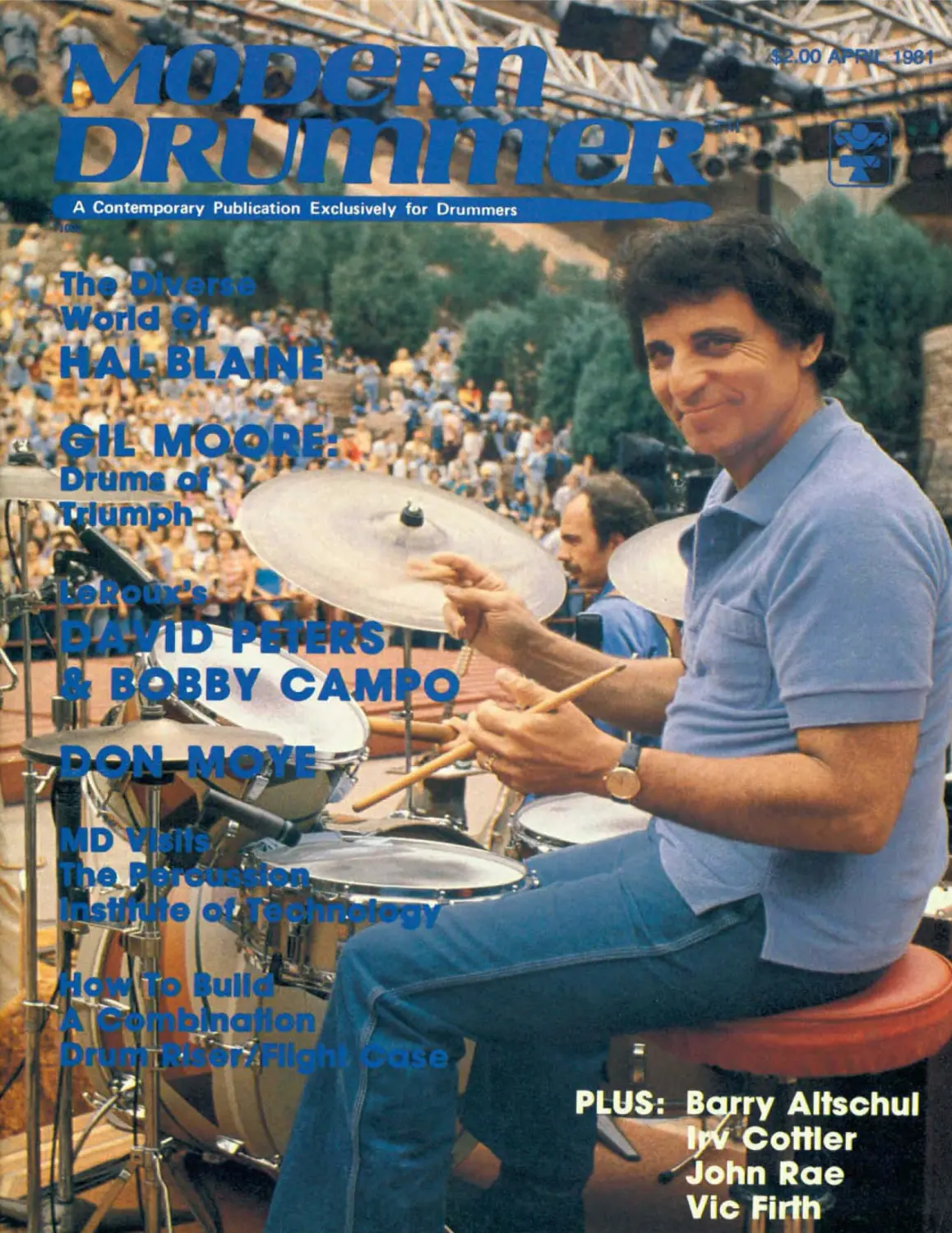


Tags: magazine modern drummer magazine modern drummer
Year: 1981


Text
                    FEATURES:

CONTENTS
HAL BLAINE

Hal Blaine is one of the most respected studio drummers on
the music scene today. For 22 years he has recorded with practically all of the major artists and is still going strong. His
longevity in the business is phenomenal. With all of that experience behind him, Blaine has much to share with up and
coming drummers, and does so both in MD's interview and in
his introductory column "Staying in Tune."
10

FAMOUDOU DON MOYE
Drawing from the tradition of African music, ancient theatre
and religion. The Art Ensemble of Chicago is truly a unique
and creative musical force. Famoudou Don Moye, the inventive drummer/percussionist with the Art Ensemble explains the
concept of their music. His own approach to the music involves
experimentation and exploration of the different percussive
sounds that can be obtained.
14

GIL MOORE
As drummer with the rock band Triumph. Gil Moore is conscientious about his art, stating that in order to expand technically, it is most beneficial to experiment with a diversity of
musical styles. Moore is also very attentive to his equipment
and knowledgeable about how to achieve the best sound from
his drums in live and recording situations.
22

PERCUSSION PIONEER: AN MD SPECIAL
REPORT ON GAUGER R.I.M.S.
MD VISITS THE PERCUSSION INSTITUTE
OF TECHNOLOGY

18

DOUBLE PLAY: DAVID PETERS AND
AND BOBBY CAMPO OF LEROUX

28

25

COLUMNS:
STRICTLY TECHNIQUE

EDITOR'S OVERVIEW

2

READERS' PLATFORM

5

Quadragrip
by Michael Welch

ASK A PRO

6

IT'S QUESTIONABLE

ROCK PERSPECTIVES

Converting Those Old Rhythms, Part I
by David Garibaldi

32

36

62

Heroes
by Roy Burns

68

MALLETS

The Music of the Drums
by Barry Altschul

42

DRUM MARKET

45

SOUTH OF THE BORDER

Introducing David Samuels
by Scott K.. Fish

74

PRODUCT CLOSE-UP

Pearl ET-Series 8-ply Maple Drums
by Bob Saydlowski, Jr.

78

SHOP TALK

46

SHOW AND STUDIO

Irv Cottler: Keeper of the Time
by Tracy Borst

Cozy Cole
by Scott K. Fish

CONCEPTS

JAZZ DRUMMERS' WORKSHOP

Getting the Latin Flavor
by John Rae

61

IN MEMORIAM

COMPLETE PERCUSSIONIST
Symphonic Tympani Head
by Vic Firth

by Cheech Iero

54

52

Upstaging
by Vince Gutman

86

INDUSTRY HAPPENINGS

96

JUST DRUMS

99

STAFF:
EDITOR-IN-CHIEF:

Ronald Spagnardi

FEATURES EDITOR:

Karen Larcombe

ASSOCIATE EDITORS: Mark Hurley
Paul Uldrich
MANAGING EDITOR: Scott K. Fish

ART DIRECTOR:
PRODUCTION

We receive literally hundreds of letters each week. I've repeatedly
asked for your thoughts and suggestions since our inception five years
ago, and I thank you all for your kind response to that request.
A great deal of the mail we receive is directed to name drummers.
Some of you have written asking if your letters do in fact get through
to the artists. We try to channel as many letters as possible through
our Ask A Pro column, however, others request a personal reply. Personal reply letters are grouped with others going to the same artist and
forwarded periodically. Often the letters are sent to a personal home
address, while in some cases they're forwarded to the management office, PR people or the drum company.
Letters to MD's columnists are also forwarded regularly. Your comments on a column, and suggestions for future ones, are appreciated
and essential. Of course, our columnists receive a great deal of mail
also, so it's wise to try to be as concise as possible. If you need a personal reply, enclose a self-addressed stamped envelope. But bear in
mind, you may not get an immediate reply. Even though our columnists are dedicated to helping young drummers, they're also extremely
busy musicians. It's often difficult to maintain a performance and
teaching schedule, write for MD, and answer personal mail quickly, as
well. Nonetheless, I know our columnists enjoy hearing from you.
Your questions and suggestions often materialize into ideas for new articles, and act as a barometer from which the writers can gauge your
needs. Send your letters to the columnists, c/o Modern Drummer Magazine. We'll see to it they receive them.
This issue leads off with an absorbing interview with studio drummer
Hal Blaine, by MD's Robyn Flans. A Grammy Award winner, Blaine
is the epitome of a well-rounded, versatile drummer. Along with his
work in TV and motion pictures, Blaine has performed and recorded
with an incredible assortment of major artists spanning three decades.
Triumph's Gil Moore has some intriguing views on a myriad of drum
topics, while Famoudou Don Moye discusses his role in the development of contemporary music with the Art Ensemble of Chicago. And
David Peters and Bobby Campo from LeRoux comment on making it
big in a Louisiana based band in Double Play.
In our travels this issue, we've visited L.A.'s Percussion Institute of
Technology, one of the most innovative new drum schools in the country; and Minnetonka, Minnesota (of all places) for an in-depth discussion with Gary Gauger, the man behind the exciting and revolutionary
Resonance Isolation Mounting Systems (RIMS) for drums.
MD is also delighted to welcome several outstanding guest columnists this issue: Barry Altschul on jazz drums, Latin insights from John
Rae, Vic Firth on timpani, and an introduction to a brand new MD
mallet percussion department by David Samuels. Plus, the ever-inventive David Garibaldi explores shuffle rhythms, and Michael Welch enlightens us on the many possibilities of Quadragrip. A close-up of
Pearl's Earthtone Series, an informal rap with Sinatra's Irv Cottier,
and how to build your own drum riser/flight case are all engrossing additions to this month's package. Enjoy.

MANAGER:
ADVERTISING
DIRECTOR:
ASSISTANT
ADVERTISING

MANAGER:

ADMINISTRATIVE

DIRECTOR:

ADMINISTRATIVE

MANAGER:

DEALER SERVICE

MANAGER:
CIRCULATION:

Tom Mandrake

Roger Elliston
Jean Mazza
Maureen Politi
Isabel Lori
Ann Lambariello

Carol Morales
Leo L. Spagnardi

Ellen Urry

MD ADVISORY BOARD:

Henry Adler
Carmine Appice
Horacee Arnold
Louie Bellson
Roy Burns
Jim Chapin
Billy Cobham
Joe Corsello
Les DeMerle
Len DiMuzio
Charlie Donnelly
Sonny Igoe
Don Lamond

Mel Lewis
Peter Magadini
Mitch Markovich
Butch Miles
Joe Morello
Charley Perry
Charli Persip
Joe Pollard
Arthur Press
Paul Price
Paul Real
Paul T. Riddle
Ed Shaughnessy
Lenny White

CONTRIBUTING EDITORS:
Susan Alexander, John Faraola, Robyn
Flans, Norbert Goldberg, Harold Howland,
Cheech Iero, Larry Kanusher. Rick Mattingly. Michael Rozek, Boh Saydlowski, Jr..
Michael Shore, T. Bruce Wittet.
MODERN DRUMMER Magazine ASSN 01944533) is published 9 limes yearly, February,
April, May, June, July, August, October,
November and December by Modern Drummer Publications, Inc., 1000 Clifton Avenue,
Clifton, N.J. 07013. Controlled Circulation

Postage paid at Clifton, N.J. 07015 and at
Richmond, Virginia 23219. Copyrighted 1981
by Modern Drummer Publications, Inc. All
rights reserved. Reproduction without the

permission of the publisher is prohibited.

SUBSCRIPTIONS: 5/5.95 per year, $28.95,

two years. Single copies $2.00. MANUSCRIPTS: Modern Drummer welcomes
manuscripts, however, cannot assume responsibility for them. Manuscripts must be
accompanied by a self-addressed stamped
envelope. CHANGE OF ADDRESS: Allow at
least six weeks for a change. Please provide
both old and new address. MUSIC DEALERS: Modern Drummer is available for resale
at bulk rates. Direct correspondence to Modern Drummer Publications, Inc., 1000 Clifton

Avenue, Clifton, N.J. 07013. (201) 778-1700
POSTMASTER: Send form 3579 to Modern
Drummer, 1000 Clifton Avenue, Clifton, N.J.

07013.

I've been reading your magazine with
interest over the last several months, and
I've especially enjoyed your column
"The Club Scene" by Rick Van Horn.
As I also work in the Southern California
area and am often in the rooms Rick
describes, I take a particular interest in

his suggestions pertaining to showmanship and professionalism.

Recently, I had an opportunity to see
Rick with his group Summerwine in San
Diego. He is a talented, exciting performer and a dynamic soloist, demonstrating the expertise he shares in his
column.
R. M. DAVIS
CHULA VISTA, CA

My omission of Max Roach's contribution in music was not a deliberate act
but, sometimes, the most obvious things
in any given interview or article are not

touched upon, unintentionally.
Needless to say, Max Roach is, by
himself, a whole novel. Max Roach was
and still is, a giant and an important
voice in the world of music.
JOE COCUZZO
LODI, NJ

The interview with Joe Cocuzzo may
well have been the best article you have
ever published. It should be required
reading not only for drummers but all
musicians.
After reading the responses to this
article (one letter probably written in
crayon) I can see why the "What kind of
equipment do you use?" type interview
is so popular. A very sad commentary on
some of the practitioners of our craft.
HAROLD RYDELL
WARWICK,NY
Ed Greene's comments on Hal Blaine
(Aug./Sept. 1980) were welcome reading
and raise the question of why so little
recognition and credit has been given to
Hal in the various music publications.
Nearly all of us have been influenced at
least indirectly by this innovative musician whose career spans the entire era of
rock oriented pop recording. I'm sure
that an interview with Hal would be most
informative and instructive.
JOHN SUMNER
VANCOUVER, BRITISH COLUMBIA
Editor's Note: Please turn to page 10 for
MD's exclusive interview with Hal
Blaine.

Modern Drummer's Oct./Nov. 1980 issue made a very commendable first attempt at a musical comedy. Having Mick
Fleetwood sandwiched between the likes
of Louie Bellson, Steve Gadd and Roy
Haynes was killer material, albeit a bit
sadistic. As usual, your magazine, keeping up its image and standards of informative journalism did teach me a couple
of things: 1. Yes Mick, it's true; "A band
is as good as its drummer." 2. By gosh
Mick, ignorance really is bliss.
M. K A N A R E K
LOS ANGELES, CA

Thank you Rick Van Horn for your
informative articles on the club scene.
Too often, most of what a drummer
discovers about this type of work is
found out on the job the hard way.
What you have written is right on the

mark and any drummer that puts your
suggestions into practice will be way

ahead of the game. Your column is a
much needed service dealing with a subject where there is not enough accurate
information available.
BENNETT McLEOD
DELAND, FL
continued on page 9

VIC FIRTH
Q: I am a timpanist, and I have difficulty
hearing intervals during performances.
Any suggestions?
Shirley O'Connell
Council Bluffs, IA

STEVE SMITH
Q: Do you have problems playing in
large arenas with bad acoustics?
James Singletary
Tulsa, OK

CHARLEY PERRY

Q: What drummer did you learn the most
from?
Peter Duncan
Hanover, NH

A: I learned from a lot of drummers;
Buddy, Jo Jones, Elvin, Max, Art Blakey,
Tony, Jack De Johnette, and Steve
Gadd, to name a few. Everytime I heard
someone who appealed to me, I'd tuck
that bit of information into the back of my
mind, and keep it there as a point of
reference for my own playing. But I found
I couldn't use it until I had assimilated it.
Ultimately it comes out in your playing, in
your own creativity. Even today I listen to
everybody, and I learn from each one,
but I don't sound like any of them. The
more confidence you have in yourself,
the less you think about playing like other
drummers. When I go to a club, sometimes I'll hear a drummer play things
that'll knock me out. Sometimes a student will play something that knocks me
out. Often I'll give them something to
build on and they come back playing it
better than I do. Then I try to get up to
their level of playing it, and that's fun!

A: Tuning while the orchestra is playing
is one of the timpanist's most difficult
problems. Solving the problem can only
be accomplished by actually doing it,
though one can accelerate this learning
process. The most valuable preparation
is the study of Solfege. The following
drills are also an aid to solving the problem.
Sit at the piano and sing a series of
consecutive intervals before checking
your pitch accuracy. Play A, then sing up
a perfect fourth to D, down a perfect fifth
to G, up a minor third to B flat, up a major
third to D, and down a perfect fourth to A.
Check your pitch with the piano to determine if you are singing sharp or flat. Put
on a recording and do the same thing
several times using different intervals
each time. The secret of success lies in
closing out what is going on around you
musically. Then you can clearly hear the
note you now have, determine the interval to be tuned, and tune the existing
note to the new pitch. Repetition leads to
complete control and confidence.

A: I still have a good drum sound to work
with in most of the halls we play with bad
acoustics due to good stage placement
and a good monitoring system. Unfortunately, some halls are so bad that whatever I try, I can't get a balance on the rest
of the band. Sometimes it's so bad, I can
barely hear my own drums. In cases like
these, I have to be careful not to overcompensate by playing too hard. What I
do is relax, play the tunes from memory,
play for the mikes, maintain good eye
contact with the other guys—and look
forward to the next gig!

Read. Plat. continued from page 5

Your recent product close-ups by Bob
Saydlowski, Jr. were marvelous. They
shed some long overdue light on that
much neglected, often overlooked piece
of drum equipment, the bass drum pedal.
It's hard to understand how such an
integral part of the drummer's equipment
gets so little recognition. One is almost
led to believe that all pedals are the
same, which is far from the truth. Mr.
Saydlowski's descriptions were excellent, leaving nothing to the imagination
and his personal opinions were welcome
also. The equipment reference chart
published in the December 1980/January
1981 issue was a great idea and will make
shopping for a new pedal a lot easier.
JOEL LITWIN
ST. CLAIR SHORES, MI
I must award you another 100 points for
your Roy Burns "Drumming and Breathing" (Oct./Nov. 1980) conceptual article.
More important than any new electronics, more important than any new
hardware, more important than the latest
technique, the exercises recommended
by Mr. Burns contain the fuel for extreme drumming. I also recommend this
natural stimulation to anyone that wishes
to take his abilities as far as possible. It
makes tremendous sense.
BONGO ST. LOUIS
WEST PALM BEACH, FL

Regarding your article on weightlifting
and drumming; I have to agree that it's
important to be physically fit, but I don't
believe weightlifting is the answer. It
does develop muscles but not energy and
stamina, which is very important to a
drummer.
I played my first gig when I was in 5th
grade and have been playing ever since.
Consequently, I've explored many different forms of exercise in an effort to
improve my playing. About four years
ago, I met a former gymnastics champion who taught me the ancient system of
exercise developed by the Chinese,
which he believed to be the best and
most complete form of exercise he ever
encountered. I've been doing it ever
since and it not only increases strength
and endurance, but will give you incredible self confidence as well.
There's only one book written about it
and it's hard to find, so I suggest ordering it directly from the publisher. It's
called The Chinese Wand Exercise by
Bruce L. Johnson. Publisher: William
Morrow, New York City. I've taught
this exercise to many other musicians
and everybody loves it. I recommend it
with no reservations.
NEAL SPEER
RENTON, WA

Drummers such as Buddy Rich, Louie
Bellson and Billy Cobham should not be
compared and judged as if they were
battling it out at the Olympic trials. We
should not be so enhanced with comparing as we should be with appreciating.
On the other hand, there are a number of
multi-talented people out there who, for
any number of reasons, may never reach
the public eye. Are they any less talented
because of it?
I am not against the MD Reader's Poll
because I believe that drummers who
have achieved greatness through creative energies and productivity deserve
some form of recognition. However,
when I read the rebuttal of a fellow
reader who is upset because, "As far as
I'm concerned your reader's poll was
way off," I am led to believe that many
of your readers have distorted the purpose behind the poll.
I feel the purpose of the poll is to pay
tribute to the drummers and percussionists that we admire, for whatever the
multitude of individual reasons. But to
compare oranges and apples and bicker
over the results is, in my opinion
counter-productive toward the mentality
of today's modern drummer.
JIMMY KOBER
QUEENS, NY

by Robyn Flans

To chronicle the career of Hal Blaine is an
almost awesome task. The office walls of his
Cover Photo by Lowell Norman Hollywood Hills home are adorned with gold
records that span the last two decades of music,
Photo courtesy R.C.A.
such memorabilia as a mounted "thank you"
letter from George Harrison and various certificates. His living room wall is reserved for his
Grammy Awards which he received six years in
a row and the overwhelming feeling was that a
list of artists for whom Blaine has not worked
would be shorter and easier to compile than a list
of those for whom he has played. In looking over
his resume, which has not been updated in the
past few years, one gets the feeling it is a

Hal
Blaine

compilation of ten men's careers, and certainly
not one. But so it is.
From his beginnings with Tommy Sands and
Patti Page, Blaine has offered his talent for the
complete spectrum of musical tastes from Frank
Sinatra to Frank Zappa. He has been the beat
from the late 50's for Elvis Presley, Frankie
Avalon and Bobby Darin, into the 60's of Jan &
Dean and the Beach Boys, through that musical
era's revolution with the likes of the Byrds,
Mamas and Papas, Simon and Garfunkel, Chad
and Jeremy, the Monkees, Paul Revere and the
Raiders and the sounds of the 70's including
Seals and Crofts, John Denver, Steely Dan,
Wings, George Harrison and John Lennon. He
has been the backbone of commercials for endless products and has provided his abilities in
countless films and T.V. shows. For any person
with a radio, stereo and T.V., it would be
impossible to chart the amount of time this
drummer is heard on a daily basis.
"Sometimes I think it's inspirational to drummers to think of a guy who has really had great
success with his instrument, and then other
times I think, to a real young guy, and I was
guilty of it when I was young, the feeling is,
'Man, I'll never be able to do that,' so it's a two
way street," he prefaced the interview. "Interviews are really weird for me because everything is 'I, I, me, me,' and it's very strange."
But Blaine admits that his drumming began as
a way to show off at 9 years old, and simply
continued. His mother had a kitchen chair with a
back rest that looked like drum sticks, which he
would take apart to beat on pots and pans.

Born in Massachusetts and raised in Hartford,
Connecticut, the son of Russian immigrants,
Blaine recalls that his father, a shoemaker,
would go to work on a Saturday and deposit him
at the State Theatre across the street.
"My dad worked from 6:00 a.m. to 6:00 p.m.
and I would just sit and watch the shows all day.
Fortunately, I was exposed to all of the vaudeville of that era and even caught the tail end of
burlesque. I got to see every name band in the
country during that time. I'm talking about 1938
and that entire big band era."
Influenced by the likes of Gene Krupa, Sonny
Greer, Buddy Rich and Baby Dodds, his older
sister Marsha bought Blaine his first drum set for
his 13th birthday.
"As I got older, my relatives would ask me
when I was going to get off my butt and get a
regular job. I'd sit in front of the radio for hours,
practicing. Then television came along, and to
this day, I can sit in front of the T.V. set for half
a day, playing with drumsticks and unconsciously practice and watch a show or carry on a
conversation. It was just one of those things that
stuck with me from the time I was a kid."
Blaine credits his tenement housing as the aid
to his success, since his life was wrapped up in a
black situation. All his friends were black musicians and he says, "I really got to learn about
what became rock & roll, which was the kind of
music we always played. It was really just blues
at the time."
A year after he moved to California with his
family at age 14, Blaine was hired for his first
professional gig to play at a dance in San Bernardino. It turned out to be a highly embarrassing
experience, however, when halfway through the
job a union man came in and kicked him out for
being underage and a non-member. The service
followed, during which Blaine played throughout, and when he was released, he flirted with
stand-up comedy and singing. Shortly thereafter, however, he realized his need for some
formal training, since he had had none previously, and he enrolled in the Roy Knapp School of
Percussion in Chicago, no longer in existence.
With the help of his parents and the G.I. Bill,
Blaine remained there for three years, then
returned to California where he played night
clubs with Vido Musso and Matt Dennis.
While working at Harvey's Wagonwheel in
Lake Tahoe with a group called the Extroverts,
Blaine found out that, while the band members
were supposed to be earning $450 to $500 per
week, they were only receiving $150 from the
bandleader. The problem turned out to be a
landmark in Blaine's career, however, because
of a series of events that followed.
"We had been through a lot with this particular guy and opening night, I walked off the job.
That was the only time in my entire career where
I did anything like that. The manager of Harvey's at the time, was a good friend of my
brother's and he told my brother how happy he
was to see that I was with such a great band and
making such good money, which is how I found
out about the problem. As I was packing my
drums that night, though, a fellow by the name
of Rocky approached me and it turned out that
he was married to Carol Simpson, a jazz pianist,

and they were doing a duet or trio thing at
Harrahs, which was then a tiny, tiny place. He
asked me if I would be interested in joining the
band, so I just moved my drums from there over
next door and went to work for Rocky and
Carol. When we closed a couple of weeks later,
we came down to the Garden of Allah on Sunset
Blvd., and it was there that I was approached to
get into some rock & roll music. At first I said,
'No, I don't want to have anything to do with
that,' but finally I was convinced that I should at
least meet these people. So I met Tommy Sands
and he was a wonderful guy, his manager and his
little band from Texas were wonderful, so I
joined the group and became his drummer, road
manager and good friend."
One event led to another and the doors began
opening wide for Blaine. His first professional
recordings were with Sands in 1958, and during
the period where he toured with him for three
years, he became associated with Patti Page as
well. It was through her husband, Charles
O'Curran, a choreographer at Paramount Studios, that Blaine hooked up with Elvis Presley.
"That's when history began," Blaine smiles.
"Because of Tommy Sands, Patti Page and
Elvis, people began calling me."
Phil Spector, the biggest producer in the industry at that time, began to call Blaine and he

began working on records for nearly everyone in
the business.
"Phil Spector, God bless him, used to let me
just go nuts on records. It was really from Phil
and the Crystals and the Ronettes and all those
wonderful records we were doing and I would go
totally bananas on the endings of those songs.
Phil has always said that he was going to take all
the fades and put them together and put out
some records of that. None of that has ever been
duplicated. People have hired the same musicians, the same studio, the same engineer to get
the same thing, but it could never be duplicated.
To this day, only Phil Spector can get that
sound."

There became a distinctive sound associated
with Blaine as well, and it was referred to as
"the Hal Blaine sound."
"You start with a musical instrument," Blaine
began to detail exactly the essence of his sound.
"Your voice is a talking instrument, your automobile is an instrument you drive, and every
instrument has ranges." Demonstrating in a high
pitched voice, he says, "There are high ranges
and," he changes to a deep voice, "the real low
ranges, and you don't talk real high all the time
or real low all the time. You talk mid-range. You
don't drive your car at 100 miles an hour all the
time, or at 2 miles an hour all the time. You drive

mid-range, cruising. Your piano is the same
way. So I came along at a time when drummers
tuned their drums real high in pitch, real tight. A
lot of that was for technique so they could play
those high notes and get a lot of bounce to the
ounce, as it were. I came along and I tuned
drums down to normal, mid-range. It was just
something I always did. I liked the sound of my
drums and I worked for many, many singers
through the years who always liked the sound of
my drums. There would be remarks like, 'Hey,
your drums don't sound all high and tinny. They
sound nice.' When I started in the studios, some
of the engineers would say, 'You'd better tighten those drums up, you've got them too loose,'
and the producers would say, 'Just let him do
what he's doing. Don't tell him what to do.
We're going for a different sound here.' I made a
lot of enemies my first six months in the studio.
A lot of engineers said, 'What the hell are you
doing? You're going to break our microphones.
You're playing too loud.' And I'd say that I was
doing what the producer had asked me to do.
The engineers wanted to keep my mikes down
and turn me up when they needed me, and I told
them I don't play like that. If it calls for quietness in a song, then I play quiet, and when it
calls for slamming, I slam, and that created a
whole new wave, as it were, in the early 60's."

He also created the circle of drums that everyone uses today, from the smallest high drum to
the biggest drum on the bottom.
"My set of drums always had 12 drums, which
no one had ever heard of, and it really was a
major change, which makes me very proud. In
those days, a drummer only used a small tom
and a big tom, and once in a while, two small
toms and two big toms, but never over four
toms. I wanted a full, bigger spectrum of sound
to be able to do more with drums."
He got together with Howard Oliver, a friend
and drum manufacturer in Hollywood to build
this large set, where he could sit comfortably
and at random, pick any tone he wanted with an
octave and a half range. He gave Ludwig the
pictures of this set-up, and they built it, calling it
the Octaplus and he has remained with Ludwig
throughout the years even though he has been
approached by most of the major companies. He
still uses the blue sparkle set, alternating between 6" and 5" metal Ludwig snares, and uses
seven toms, consisting of 6", 8", 10", 12", 13",
14", and 16" sizes. His bass drum is 22", on which
he always uses Ludwig calf heads, but on his
toms, he uses Remo Diplomats.
While in concert his drums are double-headed
to keep them "wide open," and to get a quieter
sound, but in the studio, they are single-headed
to give them a "fall off" sound.
On stage he employs no muffling techniques,
however, on his studio set, he uses Rubbermaid
bathroom appliques which he has placed on his
toms from experimenting to get the sound he
desires.
"I have about 165 gold records with Zildjian
Cymbals. Every one of them is a Zildjian record.
The set of Zildjians I use today, I bought in 1946
and that's a lot of years that I have been using
those same cymbals, except for a few extra ones
I've acquired through the years."
He uses a 16" crash to his left, a 17" sizzle to
his right, a 22" medium heavy ride, and on
occasion, he uses a 9" choke cymbal ("for old
timey type music"). Although for many years he
used 14" hi-hats, he now uses 12" hi-hats, "not
only for the disco sound, but for some of the
highs that are prevalent in a lot of the commercials I do. I have various other cymbals I use for
different sounds also, because as you know,
working in the studios, I might walk in and play
The Sting today, and tomorrow I may have to
play King Kong and the next day it will be
Donna Summer. I must say that every day is
something different and something new and it
sure keeps it interesting."
It was from the abundance of recording sessions that Blaine broke into the T.V. and film
industries.

"During the beginning years of rock & roll,
and my being in the studio and going through all
of this with the engineers and producers, it just
happened. Producers are a bunch of people who
are very superstitious. If they've had a hit, they
will only record on the same night of the week
the hit was recorded, with the same musicians,
the same studio, the same mikes, the same
engineers, and that's just the way it is. If it's a
new producer, he wants the guys who have

made the hits and movies are no different. What
happened in those early 60's is that rock & roll
had not yet infiltrated the movie business or the
commercial business, and they weren't into rock
& roll in any way. In fact, rock & roll was really
a dirty word to most people. There were a lot of
musicians locally who actually hated rock & roll
and said, 'I will not play that junk.' It's true that
a lot of the hit records of that era were kind of
what we called dumb, in the sense that there
were only three changes and they sounded out of
tune, some of the vocals and phrasing, but the
equipment was different in those days too. They
were singing in one microphone and it was in its
infancy. But even as it got better, a lot of guys
still refused to fool around with rock & roll. At
that time, though, I can remember getting calls
for Batman and the different things that were
happening on television.
"I can still remember the first time going to
20th Century Fox and looking at this antiquated
great big old building and it reeked of tradition.
You could just hear the stars and the orchestras
and the bands and all those great movies. MGM
was the same way. You could just see all those
great people doing those elaborate dance numbers. It made you feel wonderful just walking in.
But unfortunately, those same engineers were
sitting there and the same equipment from the
20's, 30's, and 40's. There was no new equipment and they were still recording on a one or
two track and in some places, a four track. I
walked into 20th Century Fox and asked the
man where my bass drum mike was and he said,
'What are you talking about kid? Bass drum
mike? Are you kidding?' They had one microphone set up about six, seven feet in front of me,
kind of aimed at my head, and that was the setup. I tried to explain this to a couple of people
and the producer kept saying, 'We're not getting
that rock & roll sound, Hal, and that's why we
hired you.' Finally I explained in a short speech
on rock & coll and what we do in the studios,
and it really hit the fan. All the 20th people
wanted to chop my head off, but in those cases,
the producer is still the boss, and he said, 'You'd
better start listening to this kid and the rest of
the people we've hired to do rock & roll.' So it,
too, started to change and then we began doing
movies at virtually every studio.
"There's a great story about the Disney Studios and the very first time I ever got a call to go
over there. There were a bunch of musicians in
those days, Tommy Tedesco, Lyle Ritz, Carol
Kaye, Al Delory, Steve Douglas and just a
whole bunch of musicians. Glen Campbell was
playing guitar and Leon Russell was playing
piano and I kind of named us the Wrecking Crew
because we were the rock & roll guys. We would
walk into these studios with all these other guys
in their sports jackets, blazers and neck ties,
who sat very stiffly, and we would come in
literally making a mess of their studios. They
were used to these quiet musicians with their
violins who sat perfectly still and quiet, never
smoked cigarettes on the set, and so forth, and
we came in with Levis, T-shirts and everybody
making $100,000 per year. Don't misunderstand,
we worked very, very hard, but tradition was
continued on page 40

"Staying in Tune"
Hal Blaine
The point of this introductory column is to tell you that
you can have a great career in
the music business! How

many times have you been
ready to quit—throw in the
towel and forget it, because
you were despondent over no
work, problems with the
folks, your girl or school?
Then something happens. A
phone call or a job! All of a
sudden you're playing your
drums and you're on top of
the world again. That's the
kind of roller coaster we all
live on. It's called life. We
have to learn to live with the

highs and the lows. The highs
from your drums can be your
happiest highs. A natural
high. I say "natural" without
reservation, because with
drugs, a false sense of high,
will eventually kill your natural high. Happiness is the secret of success for me and
almost everyone I know who
has really made it big.
What I really want to do

through this column is help
you get over some of the hurdles. I've been there, I've
seen it and been a part of it.
So, hopefully I can advise
you, and that's what I want to

do. Most of you don't realize

it, but your own John Denver

is just around the corner waiting for you! You just have to

be ready for him. When
you're happy, you're more
creative, healthier in every
way, and things will come
your way. When you walk
around mad at the world, the
world becomes mad at you.
There's no changing the world
unless you do something to
make that change. Your smile
can do that!
I receive letters from all
over the world asking for
autographs, photographs,
how do I tune this, how do I

select that or practice this!

I'm honored that people want
to use the same snare or buy
the same Zildjians that have
turned out my gold records.

But, it's not necessary to copy

and imitate. We all start by
listening to our favorite records, records the radio stations tell you to listen to, or
records that your friends tell
you to listen to. But that
doesn't mean you have to listen to it! Listen to what makes
you happy, and turns on the
juices in you!! When you listen to your favorite records
and the licks you try to imitate, remember: Chances are
that drummer came up with
that lick on his own, or is
playing a variation of another
lick! My point is, learn all of

the licks you can, and then
come up with licks of your
own. That brain of yours is
the greatest computer in the
world. It'll perform amazing
feats. Study and practice everything and don't ever kid
yourself. Practice does make
you better. But, you don't
have to copy. You study, you
practice, you feel like you're
ready but you're playing everybody's licks but your own!
If you let your imagination
take over, you'll come up with
licks that'll get you higher
than a kite! And when you're
happy, the world will happen
for you.
I might sound like a fanatic
telling you to "follow me." I
don't mean that at all. Don't
follow anybody but yourself.
Find your own direction. It'll

come eventually. We all
flounder at times; a little lost
on this roller coaster, but
eventually it'll come. You'll
be playing your own music,
your own ideas, and changing
the course of music by inventing new stuff. You are the new
musical generation. You are
the new musical leaders. Others will learn from you in their
own way. And as you will
have changed the sounds of
the world in your time, they
will do the same in their time.
That's really the story of life,
isn't it?
I can't stress enough the
continued on page 37

Famoudou Don Moye:

by Rick Mattingly

Drawing on Tradition
The Association for the Advancement
of Creative Musicians (AACM) is an
organization that was formed in Chicago
by a group of African-Americans led by
Muhal Richard Abrams. The organization was designed as an alternative to
the traditional music business institutions which placed commercial success
above artistic achievement. Members of
the AACM are required to study the
tradition of their instruments and of African-American music, to work towards
developing new instruments and techniques and, above all, to constantly
strive towards originality and creativity.
No one could possibly represent these
ideals more completely than Famoudou
Don Moye.

Born in Rochester, New York in 1946,
Moye has been involved with drums for
most of his life. Both in America and in
Europe, he has played in virtually every
type of musical situation, including radio
and T.V., movie sound tracks, concerts,
clubs, and festivals. His discography includes names such as Steve Lacy, Oliver
Lake, Hamiet Bluiett, and Chico Freeman. Since 1970 he has been the drummer/percussionist with the Art Ensemble
of Chicago. He and the other members
of the group, Lester Bowie, Joseph Jarman, Roscoe Mitchell and Malachi Favors Maghostus, have received high
critical acclaim for their inventive and
innovative music. Moye has also released a solo album which was a tour-de-

Photo by M. Khan

force of percussive ability and compositional logic. In addition to his extraordinary technique, Moye has won the
approval of many critics for his melodic
inventiveness on percussion and his ability to blend a wide range of influences
into a coherent style.
Famoudou Don Moye was in New
York recently to appear at a benefit for
Outward Visions, Inc., a non-profit organization dedicated to fostering the
growth and recognition of contemporary
creative music. Moye took time out from
his busy schedule to sit down and talk
about his music.

RM: Did you come from a musical family?
FDM: My father was a drummer, but

he was not a professional musician. He
had a regular job and played drums on
the side. Then I had some uncles who
used to play in territorial bands in upstate New York. Most of them got out of
the music business as they got older,
though. Also, I used to stay with my
grandmother who was a cook in a place
where a lot of groups would come. I
never actually met the musicians, but
being around them provided me with a
musical atmosphere in my early years.
RM: How did you become personally
involved with music?
FDM: Through my cousin who played
tenor sax, vibes and drums. He's the one
that actually got me my first pair of
sticks. He would take me around to hear
different people and let me listen to his
records.
RM: Did you take lessons?
FDM: Yes, I started taking lessons
when I was about 8. A few years later I
joined a drum and bugle corps and that's
when I really got into the technical part
of drumming. I also learned how to read
better in that situation. Eventually, I
ended up playing with the Crusaders of
Rochester, New York. They were national champions. We went all over New
York state, as well as Canada, Boston
and Washington, D.C. So that was a
good experience for travelling, working
with a group of people, and learning
about technique.
RM: What were you listening to in
those days?
FDM: I was mostly involved with drum
and bugle corps marching music, but in
our household my mother had a large
record collection. She tried to give me a
total musical background. She would listen to a lot of classics, plus Duke Ellington, rhythm and blues, and the popular
music of the time. And then I heard
whatever the people around me were
listening to, which was a wide variety of
black music. So I did not have a certain
kind of music I was listening to, in the
sense that I could say something like,
"Oh yes, I listened to Duke everyday."
It was not like that. I was just listening to
whatever was in the atmosphere. Plus I
was singing in the choir and playing in
the school band. So I had a wide variety
of experiences.
RM: At what point did you move from
drum and bugle into different things?
FDM: While I was still in high school I
had access to a set but I wasn't really
playing it that much. I was mostly learning conga and bongos at that time. But
then when I went away to college I got a
set of my own and started playing it on a
regular basis. My first college was Central State in Ohio. It was like a little
country school, which was cool at that
time, because I didn't have the distractions of a big city. I would get up and go

to my classes and the rest of the time I
would be playing and rehearsing. I was
in a percussion ensemble with two
friends named Syd Smart and DeDe Anderson. There was also a rehearsal band
and in town there were a few clubs
where we could go and sit in with the
bands. Eventually I changed schools because there was not enough happening in
Ohio. There were good teachers in the
music department and they were very
helpful but I felt I needed an urban
environment. So I went to Detroit.
RM: Were you able to find what you
were looking for?
FDM: As soon as I got there I fell right
into a good situation at a place called the
Artists' Workshop. They had music go-

Photo by Tom Copi

ing on all the time. One of the people
there that really helped me a lot was a
trumpet player named Charles Moore. I
used to go over to his house everyday
and work with him, getting into research,
studying the music, listening to records,
analyzing charts, and stuff like that. I
really started getting into the music more
and actually getting gigs. I could always
get by on my conga playing but in Detroit
I started getting into situations where I
could play drums, too.
RM: By this time, were you starting to
focus in on any particular type of music?
FDM: I was playing a lot of different
things: blues, pick-up gigs, a little rock
here and there; but mostly, I was interested in so-called jazz. That's why I

Photo by Kathy Sloane

spent as much time as I did with Charles,
because that is what he was into. All the
musicians around there were. I was trying to pick up what I could.
RM: Where did the African influence
in your playing come from?
FDM: That influence goes back to the
people I was around when I was in Ohio.
There was a guy there who had been to
Africa for a couple of years and he knew
a lot of rhythms. Syd Smart also turned
me on to a lot of things. Then when I was
in Paris, I met a drummer from the
Congo named Titos Sompa. He had a
dance company at the American Center
for Students and Artists. He used to give
classes there, so I learned quite a few
things from him about dance and movement. Then I was influenced by a drummer from Senegal named Mor Thiam. I
worked with him in 1970 when I came
back from Europe. He taught me quite a
bit about hand drum technique. One other person who was very important was a
guy named Atu Murray. He is a black
American, but he had lived in Ghana for
extended periods. I learned a lot from
him about the art of making drums, how
to cure skins and mount them on the
drums, and the functions of different
instrument in religious ceremonies and
regular entertainment. He lives in Birmingham, Alabama, and I still go down
there every now and then and spend a
couple of weeks with him, just dealing
with the drums.
RM: You mentioned Paris. How did
you happen to go to Europe?
FDM: I had been playing with a group
called Detroit Free Jazz. We had this
money we had made and the opportunity
to travel, so we decided to go to Europe
and find out what was happening. We
went over there and got work right away.
We worked in Holland, Switzerland, Italy, Germany, Austria, and Yugoslavia.
After about a year, the group dissolved,
so I went first to Copenhagen and then to
Rome. I was doing a lot of studio work in
Rome and playing conga drum with
dance companies. I also worked with
some people like Gato Barbieri and
Steve Lacy. Eventually, I decided to go
to Paris because that was the center for
the kind of music I was involved in.
Some of the people there were Archie
Shepp, Ornette Coleman, the Art Ensemble and Cecil Taylor. I had met Joseph Jarman from the Art Ensemble in
Detroit, so he was somebody I could try
to get in touch with in Paris. When I got
there I fell into a working situation right
away.
RM: How did you actually become a
member of the Art Ensemble?
FDM: The whole process took about a
year and a half. They were auditioning
drummers at the time, so they called me
up and I went out and played a couple of

gigs with them. For a while, I was working with them, as well as, with other
groups. Eventually, I was working with
them all of the time. One thing led to
another and I found myself going back to
the States as a full-time member of the
Art Ensemble.
RM: Did you have to make a lot of
adjustments?
FDM: Oh man! Whew! Talk about adjustments! You see, my range of information was kind of limited. The Art
Ensemble was involved with a lot of
areas of music that I wasn't familiar
with. Initially, I was in semi-shock because I had to go in there and try to deal
with these things. I was doing everything
I could just to do my part. My whole
thing had to be restructured because I
was not really comfortable with improvisational forms. The situation was good,
in that, it really opened me up, but it was
hard because I always felt that my inexperience was holding back the total de-

velopment of the group. But they were
patient with me and everybody was very
helpful. Apparently, they saw some potential in me that could be worked with.
We were playing a lot and rehearsing
constantly, so I was able to evolve and
develop quickly.
RM: How did you influence the other
members of the group, and what was
their influence on you?
FDM: My hand drumming and conga
playing brought a new element to the
group. It was an enhancement of an
already percussive situation because the
Art Ensemble had been working without
a drummer for about 4 years. So I was
dealing with people who had a very
percussive approach to their playing. It
made it easier for me to come in there,
because if there were sections in which I
was weak, I could get a little help from
somebody else. For instance, I could not
deal with the pure simplicity of rock that
well. But Lester is a master of that whole
continued on page 48

A few months back I spoke with Gary Gauger, the inventor of
RIMS (Resonance Isolation Mounting System) and founder of
Gauger Percussion, Inc. Modern Drummer wanted to find out
more about RIMS and so we arranged an interview with Gary.
Gauger tells about himself, where he's coming from and more
importantly where he's going: and supplies some very insightful
comments about his product.
"I first started playing drums in 1958," he began. "The first
drum set I had, I always wondered why the drums sounded
different when they were on the mount from when they were off
the mount. I always felt that somebody should do something
about it. When I played professionally for 4 years in an Air
Force big band called the Airmen of Note, we did a lot of work
with people like Carmen McRae and Joe Williams, and we were
always recording with different people as promotion for the Air
Force. That was probably the first time that I had gotten into
the studios, and it was a chance to hear my drums and hear
what they sounded like. That was the first time I started to
get very critical about a drum sound. And for the first few
months that I was in the Air Force, we used to do a lot of
recording in Los Angeles, and we did some concerts with Shelly
Manne.
"I spent some time with Shelly," Gauger continued. "He
was probably one of the first drummers to ever turn me on to
what really good drums sounded like, and how to achieve a
better drum sound. He was really into calfskin heads and he had
a lot of different theories on drums and how they could sound
better, and how the companies could make them better. I really
started to listen to him.
"When I got out of the service I moved up to Toronto and I
was doing a fair amount of recording work up there. So
whenever I worked in a studio I always wondered why some-

Percussion
Pioneer
times the drums sounded good, and other times they wouldn't

by Scott K. Fish

An MD Special
Report on Gary Gauger's
Resonance Isolation
Mounting System (RIMS)

sound too good—even in the same studio! As it turned out it
was usually the engineer. They always had to EQ the drums or
add a lot of bottom to them and that was really what made them
sound good. The drum sound was dependent on who was
recording and what engineer was working on them. I knew that
the drums basically sounded good already, if you could just get
past the problem of how they were mounted."
Gauger told me that the set he was playing at the time was "a
regular set of Gretsch drums.
"I had put the one tom on a snare drum stand like Jake Hanna
used to do when he was with Woody's band. That made
somewhat of a difference, but when we started getting into
multiple tom-toms it just became totally impossible! I rigged up
some things where I had them hanging from ropes just to see
what would happen. The sound was just unbelievable! From
that point on I really became totally obsessed with being able to
attain that sound in a practical way.
"So, I started developing something for it around 1974 and I
worked on 5 or 6 ways of doing it. I didn't really understand
what was happening on a drum when it was struck and vibrated,
so I started studying acoustics, comparing drums to other
acoustic instruments like guitars, string basses, and violins. I
spoke with a lot of people who played those instruments and I
found out that a drum is really no different than those instruments. The shell has to be free to vibrate," Gauger stressed.
"So, I approached it from that angle, mounting a drum so that
the shell could vibrate. If the drum isn't free to vibrate then you
end up choking out the fundamental pitch of the drum and all
you have are overtones."
Gauger explained that this suspension idea was not new, but
it had never been applied to the drumset. In his own experience
with symphony playing he had seen it used on tympani and
several drummers had invented suspension devices for bass
drums. "The most popular device for the bass drum was

developed by Alan Abel who was with the Philadelphia Orchestra years ago," Gauger said. "It's a big circular ring that goes
all around the drum, and rubber bands go from the circular
tubing to the drum, so the drum is essentially just hanging in
mid-air. And it's an incredible sound! You can take a regular 26"
bass drum and it sounds like a 34" drum! The device allows the
fundamental of the drum to come through without being choked
off, and it eliminates rattles and things like that. Symphony
drummers are so meticulous in everything they do.
"I started doing a lot of work with the Toronto Symphony
and they had a suspension similar to that. They had tympani
that were suspended and I thought 'Why doesn't this carry over
into the drumset?' I started to compare these different things
and I found out that the fundamental pitch of the drum is
essentially in the shell of the drum. And when you choke that
shell off, basically what you're left with are the overtones. This
is my theory why drummers have deadened their drums for
years. Drummers are always putting tape on their drums and
using thicker heads. What they're doing is, they're trying to get
rid of the overtones. If they would approach it from the other
way, and allow the fundamental pitch to come through then all
the overtones line up in accordance and your fundamental
sound is the lowest sound. It's a much richer quality and it's not
the type of sound that you want to choke off. You want to allow
it to resonate because it's a beautiful tone quality."
I asked Gary to explain the overtone series. "On a trumpet,
you push down one valve and your overtone series is basically
your octave, a third, a fourth, a fifth and so on. When you hit
that one note there's many different notes in there that sound.
When you get into drums you have basically the same thing, but
the fundamental tone requires a much wider vibration or a
longer wavelength. The fundamental is essentially the shell of
the drum, and that is what can't vibrate. That's what's choked
because of that hardware mounted right to the shell of the drum.
"I was doing a lot of studio work here in Minneapolis. It's a

studio called Studio 80 that has all of the latest equipment. They
have one of the first systems that developed the Digital Recording. I was one of the first ones to experiment with that. We'd
spend 4 or 5 hours just playing everything from the softest
sound you could play, up to the loudest type of music that we
could play, so they could check this out. And, we were able to
isolate the drums. They recorded everything from bass drum, to
snare drum, to cymbals, to tom-toms—so it was an excellent
opportunity for me to compare drums and to see exactly what
was happening when a drum was choked. It took me a long time
to understand why it worked and what the main problem was.
"As it turned out I ended up using much smaller drums when
I suspended them. They sounded so much larger than normal
that the engineers kept confusing the drums," Gauger chuckled. When I would be hitting a 13" drum they thought I was
hitting a 15" drum. It just did strange things which I hadn't
expected. So, that's really where I was able to test and see
exactly what was happening, and to really study the fundamentals of the acoustics of the instrument.
"Here's what it does. The drum starts to vibrate after you
strike it. The head vibrates first which is similar to a string on an
instrument. Then the shell of the drum is like the body of a
guitar. That projects the sound or reinforces the sound. When it
starts to vibrate, the vibration transmits right through the

mounting rod, or whatever it might be, and right down to the
floor or right into the bass drum.
"I approached it from the standpoint of not putting any strain
on the drum whatsoever. The RIMS mount divides the weight
between the flanges and the drum just sets right down in it. So,
there's absolutely no strain on the drum at all. When the drum is
struck and it vibrates the little rubber grommets that are in the
flanges isolate the resonance and keep it from traveling into that
steel band and being lost. So, that's why I call it Resonance
Isolation Mounting Systems."
I asked Gauger if he could explain any differences between

what he was doing and what two other gentlemen were seemingly doing along the same lines. "Okay. Don Sleishman, the
fellow down in Australia, his idea was that you don't put
anything on the shell of the drum. Bob Grauso is also doing that
with his new snare drum. The thing I found is that it's not
important what's on the shell—as it is that the shell be allowed
to vibrate. I had tested some drums with mounting hardware
that was on the shell. I just wanted to see what effect it would
have on the drum and it really didn't seem to have that great an
effect, as long as it could vibrate with the shell. So, I think that
might be going a little further than you might have to," Gary
concluded. "I don't think you could ever get away with not
having something attached to the shell. See, even the thing that
Don Sleishman invented, that still has to be attached someplace
on the shell, because you wouldn't have separate tension if you
didn't.
"I would be curious to hear the difference. I don't think that
you'd find that there's a great deal of difference in that, as long
as that shell is not touched. If you touch the shell just with your
hand when you hit it, you'll notice that there'll be a certain
frequency that's cut out. If it happens to touch against something like a cymbal stand, I've noticed in the studio that certain
frequencies will cut out. And another frequency may tend to be
accentuated. So, it's really a fine detail and I'm sure some
drummers could care less about getting that particular about it.
In fact, I'm working with a rubber company here in town, that
has a computer that mixes the rubber to the exact amount of
neopreen to isolate the exact frequency that you want to isolate
from the drum. It's something that we're still working on. I
hope to have these available by early Spring."
I asked Gary if there were any appreciable differences
between using RIMS on metal drums as opposed to wood
drums. He said "I haven't tried RIMS on metal drums. There
are really no tom toms that I know of that are available that are
continued on page 59

Gil
Moore:
The Drums of Triumph
by Wayne McLeod

photos by Julie Macaluso

WM: Where are you from originally?
GM: Born and raised in Toronto, Canada.
WM:

Date of birth?

GM: February 12, 1953.
WM: When and how did you first become interested in
drumming?
GM: I got interested after seeing the Beatles on television,
and I started playing during high school. I started on trumpet
but I had braces on my teeth so after I destroyed the inside of
my mouth by playing trumpet for a week, the teacher finally put
me back on drums. When it came to choosing an instrument,
there were 27 people in this 9th grade music class who wanted
to play drums. The teacher said everybody can't play drums. I
went to him and said, "Listen, I want to play drums." He said
all drummers and guitar players are idiots. But I started playing
in the ninth grade and learned how to do orchestra drumming,
and then I got interested in military drumming. There were a
couple of drummers in Toronto that were actually playing in
rock bands that had come out of De La Salle Drum Corp., and
they had really good chops because their hands were strong.

"I THINK HAVING THE ABILITY TO PLAY OTHER STYLES INFLUENCES YOUR ABILITY TO
PLAY IN ANOTHER FIELD. IF YOU'RE A ROCK
DRUMMER WHO CAN PLAY JAZZ, YOU'LL BE
A BETTER ROCK DRUMMER. DRUMMERS
WHO GET LOCKED INTO ONE STYLE ARE
LIMITING
THEMSELVES...."
WM: Did you have any other formal instruction?
GM: Only the instruction I got in high school, and that was
mainly orchestra percussion. It wasn't playing a kit. I really
worked hardest on military stuff. I worked hardest learning and
practicing the 26 rudiments for the first couple of years, and
then when I started playing on a full kit, I was mainly interested
in blues and r&b. So I played a lot of the black Chicago blues.
And I played in a lot of soul bands too.
WM: Do you remember the first kit you owned?
GM: Yes, it was a Beltone. It was a full set with a Ludwig
snare drum. I had one Zildjian ride cymbal.
WM: What kind of things were you listening to when you
were developing during this period?
GM: Well, once I got over my fascination with a couple of
local drummers that were military whizs, I listened a lot to Al
Jackson (drummer for Booker T & the MG's) records so
consistently, I couldn't help but be affected by what he was
doing. And as for most of the rock drummers, I listened to
Mitch Mitchell and John Bonham. On the other hand, I always
liked Buddy Rich and followed him ever since I first became
interested in drumming.
WM: Who were some of the first people you played with?
GM: Just a series of local groups. The first professional group
I played with was called Mondo Plus 4. That's when I got my

first set of good drums. My dad took me downtown and
cosigned for me to get a set of Rogers. Again, it was a bass
drum, tenor and floor tom, but I got my cymbals upgraded to
Avedis Zildjian and got Rogers hardware to go with the kit. I
kept the Ludwig snare drum but got a Dynasonic snare drum
shortly after, which I've still got. All the Toronto bands I played
in were basement bands that really never got a chance to play
out. The first gig I ever played was at a wedding with Mondo
Plus 4. Great place for a rock group!
Triumph started in 1975 and that's really been the group for
me that's gotten off the ground. All the other groups I played in
were too busy kicking people out and having guys quit to
become successful.
WM: Do you still find time to practice?
GM: I don't practice as much as I should, and probably the
choosier the band is able to become about how much we work,
the more I'll be able to practice, because practice takes an awful
lot of time. If you really want to practice you have to put in 45
minutes to an hour a day. A lot of top players don't practice,
they just play all the time. And if they get an idea they can't
quite master, they'll just work on it until they can.
The only practice I get on the road is before we go on every
night, I usually play on my leg for a half-hour, which is good to
loosen my hands. Plus we do a sound check every day and a
show, so I play drums an awful lot. But if we weren't touring as
extensively as we are now, then I would definitely have enough
time to practice at home. I have an identical kit (Tama Imperial
Star) at home.
WM: Do you read music?
GM: Yes, I can read percussion for orchestra.
WM: If you did have more time to practice, what would your
routine consist of?
GM: The rudiments are the backbone of playing well with
your hands. So I'd just drill with rudiments. As far as working
on feel, which is an intangible element, I'd just kind of close my
eyes and play. I like to get into different kinds of feels, which is
really important. I try to pick up on feels from records that have
interesting twists. As far as technically trying to expand into
areas of playing where I'm not particularly good, I'd work on
other styles of music. I'd be more inclined to work on some jazz
playing. I think having the ability to play other styles influences
your ability to play in another field. If you're a rock drummer
who can play jazz, you'll be a better rock drummer. Drummers
who get locked into one style are limiting themselves and any
further potential to progress.
WM: Do you do anything specific to keep in shape?
GM: Not religiously, but I jog. If the band is completely off
tour, say for two months, then jogging becomes sort of religious
to me. I'll jog every day and I'll do a lot of calisthenics. On tour
I try to do calisthenics as much as I can. When we're not
touring I play golf like a fiend. I play golf on tour to the extent of
going to driving ranges.
WM: Do you play any other instruments?
GM: Just a few chords on guitar and piano.
WM: What kind of equipment are you using?

GM: Tama Imperial Star and the 12 + I , with all Tama hardware, and all the cymbals are Avedis Zildjian. Most of the
electronics are also by Tama. They've got a drum synthesizer
and an analog delay and multi-flanger.
WM: Can you explain your set-up?
GM: On the Imperial Star set and the 12 + 1 set there are two

tom-toms, two concert toms over each bass drum, and I moved
every drum left one, so the 5" tom-tom, which is the first one,
and the 7", which is the second one, are on a concert tom stand.

Then I have another concert tom stand with the 8" drum, which
actually should be on the left bass drum. Then all the toms are
moved around once so I have three up front on stands and one

on the left bass drum, which is a 9" x 13", and the right bass

drum, a 10" x 14". Then there's a 10" x 15" and 11" x 15", and
then the last two concert toms are elevated on a stand above the
two floor toms. The floor toms are 16" x 16" and 18" x 18", and
I've got a 5 1/4" chrome metal shell snare.
WM: What do you look for in a drum set?
GM: With the hardware I look for something solid because of
the nature of playing rock music, which involves playing loud
and pretty vicious at times. In a snare drum I like to hear the
snares. Overall, the sound I like is a natural drum sound. I don't
like what I call the L.A. electronic drum sound, where everything is padded and dampened. I like thin heads, although on
stage I have to use Remo CS batters, otherwise I'd break the

heads too often. With a snare drum, I like a bright, crisp, loud

sound with a heavy crack to it. I play a lot of hard rim shots with

my left hand, so I like a heavy crack. It's a deeper sound than
the conventional snare drum sound. I tune the top head a little
looser, opposed to orchestra percussion or what I call a
conventional drum sound. On the toms, I also use the CS
batters. They give you a really strong attack, because they've
got that second piece of mylar in the center and not a lot of

sustain. Because the two pieces of mylar are bonded together,
they dampen each other. In the studio I use Ambassador heads,
on all the drums except the bass drums, where I use Emperors.

The only reason I use Emperors on the bass drums is because I

get more low frequency resonance off of the thicker head, when

you strike them hard. If I struck them quietly I'd use the
Ambassador bass drum heads as well.

WM: Do you use the P. A. to roll on any extra tone qualities?
GM:

When you play live, at least with Triumph, the sound of

the drums is important to the sound of the group. There's a lot
of E.Q. (Equalizer) on the drums. If you mix the drums flat, and
don't add any E.Q. or electronic gadgetry to them, the halls are
subject to being resonant at one frequency and not at another.
You end up with a horrible overall sound. What you end up
hearing at a concert is a really processed sound. But the guy
who mixes tries to really project the sound that I want to
project. He wants a really full tom-tom sound with a lot of
resonance from the drums, not a dead cutoff sound. That's why
I don't have any mufflers on my drums, no bits of jay cloth
stuck on. Their sound is in no way dampened. On the bass drum
he tries to get a big woof. The way I explain the sound to my
sound man is to make the bass drum sound as close to a
marching drum sound as possible.
Actually, I'm experimenting with some other Tama drums
that I've got back in Canada, where I use bottom heads on all
the drums. I like the bottom head sound, and on some concert
toms I'd like the option of being able to use them either way,
which I don't have now. I'll be able to screw the heads off and
on, depending on the particular sound I want at the time. Plus, I
invented a size that will mean thirteen tom-toms instead of
twelve in the kit.
It's hard to play a set this size. It took me awhile. When I first
got them I went from having two bass drums and just two toms

and a snare to getting two floor toms, which were the first extra
toms I added. From there, I added two timbales and two toms
over the bass drum. Then when I got these drums, which were
bigger than anything I had ever played, I'd reach around and
miss a lot of drums while I was doing fills. Even now I
occasionally miss some when I'm not playing well. I'll do a
really fast roll, and when you're going around that many drums
it's not easy to hit them all right in the center. I know anybody
with a kit this size will agree with me. When your feet are on the
bass drum pedals and your arms are cranked 90 degrees to the
left or 90 degrees to the right, your playing becomes more of a
test of your accuracy.
WM: How many cymbals do you use?
GM: A ride cymbal on my lower right and then I have three
crash cymbals on each side. I have a tiny splash cymbal
between my two bass drums. All together there are eight, plus
my hi-hats. My equipment usually takes a beating on tour. For
example, one night in Seattle my whole kit toppled over. As a
result I've got a couple of rims that are bent, and that's really a
drag because you can't tune the drums after the rims are bent. I
even bend the rims on my snare drums to get the sound I want.
What I would really like to do before our next tour is try to
invent a system that I'll call "rod lock," so when you tune your
drum, the rod can't tighten or loosen unless you do something
to release it. I've been thinking about it because for somebody
who likes to tune their drums really low and wants to hit really
hard, drums come out of tune a lot faster.
If you really want to keep your drums sounding the way they
should, you really have to take care of them while you're on the
road touring. It's hard because you usually don't have enough
time to do it yourself, so you have to let your drum roadie do it
for you. The guy I have right now is great because he's a
drummer, but on the next tour I might have someone else who's

not. It's tough when you're on tour you'll think, "I really need a
new set of heads," but you don't really get a chance to change
them as often as you should.
WM: Do you have any tuning tips?
GM: It's definitely routine to say you should be careful to
tune your drums from opposite sides, in other words, to put
even tension on the head. That's elementary, although I still see
a lot of guys who don't do that. The most important thing when
you're tuning a drum is making sure you've got a head, shell
and rim that's uniform. I didn't understand why some tom-toms

"WE'RE DOING SOME TUNES NOW THAT I'VE
BEEN PLAYING FOR FOUR YEARS, AND IT'S
EASY TO TURN YOUR MIND OFF AND PLAY
THE TUNE THE SAME WAY. YET, IF YOU REALLY LOOK INSIDE THE MUSIC THERE'S ALWAYS SOMETHING NEW TO TRY.... IT'S
JUST A MATTER OF HAVING A DESIRE TO
KEEP GROWING."
sounded good and others didn't, until I realized that just
because a rim looks round—doesn't mean it is, or because a
drum head is brand new, doesn't mean it's perfect. Even if you
tune the head down by computer with a really even rim on it,
it's gonna be looser on one side. Ideally, if you're fussy, I think
it's worth putting the extra time in to do the tuning correctly. At
times, I've had brand new heads that I've put on the drum,
taken them off and thrown them out.
WM: So have you gone through a lot of different heads before
you decided on Remos?
GM: No, I've always used Remo heads, but I've tried every
other kind of head. The worst heads I've ever seen are those
Evans hydraulic heads. Guys come up to me and say, "I just
tried Evans hydraulic heads and they sounded fantastic."
That's true, they sound great in music stores, but that's the only
place they sound good.
WM: I've heard a lot of drummers say they sound good in the
studios.
GM: I think they sound horrid in the studio. We went through
a situation where we put a whole set of them on my kit when
recording our Rock and Roll Machine album. I played for about
ten minutes and then listened to the tape and ripped them all off
the drums, and they're really expensive too. It's like a couple of
pieces of mylar with oil in between them. The combination, to
me, has a deadening sound. Everybody thinks you get a lower
tone out of them. You don't, you just get less highs. You think it
sounds lower to the ear, but it really isn't.
WM: What do you think of the trend towards large, multiple
drum set-ups?
GM: I think that it is a good trend, and will probably continue.
The more drummers get into playing more drums and percussion, the more valuable they are to music in general. And let's
face it, there are more bass players getting replaced by keyboards. Thank God there aren't any synthesizers that can
replace drums. As far as I'm concerned, the more versatile you
can be as a musician, the more you can guarantee you'll be
around in ten years, and you're not going to be extinct.
WM: Do you ever play any Brazilian or Latin percussion?
GM: I play timbales with the kit, and I've played a lot of
percussion on records. I've played tympani and various Latin
percussion devices from time to time. I'm really a pretty bad
tambourine player. Playing tambourine is an art in itself.
I also think that congas have come into their own during the
last seven or eight years, and guys are starting to become
recognized as great conga players. When I was in high school
every guy who thought he was cool had bongos and would play
them at parties. You know, beatniks always have bongos and
anyone can play them.

continued on page 63

by Susan Alexander and Paul
Jonason
Q: When did PIT (Percussion Institute
of Technology) officially open?
PH: Officially, classes began on September 29, 1980. One thing that has
happened recently is the school has received accreditation. This is excellent
for incoming students because now student financial aid programs are available.
Q: When did you come up with the idea
for the school, PIT in particular.

PH: About two years ago I talked to
Joe Porcaro—we got together. I asked

him if he would be interested in doing

something like this.
Q: You're the administrator. Are Joe
Porcaro and Ralph Humphrey the directors?
PH: Yes, they're the directors. Ralph
and Joe are the directors of the curriculum in the school and I'm the director of

the school. I run the school.
Q: How do you divide the curriculum
up time-wise?

PH: It's five days a week, five hours a
day from approximately 10:00 to 4:00.
There are classes where information is
disseminated by the instructor and then

there is a lab time afterwards.
Q: Are the labs like a jam session?

PH: No, the lab time is where the individual student goes into his own practice

MD Visits
The
Percussion
Institute of
Technology

The Percussion Institute of Technology is an innovative new drum school located in
Hollywood, California. With an impressive faculty, including Joe Porcaro and Ralph
Humphrey, the school is already gaining a fine reputation in the drum community.
Recently, MD visited P.I.T. and spoke to director Pat Hicks (above) about the school
and what it has to offer the drum student.

room and sits down and works on the
assignment that he is given.
Q: So he goes in and works on something specific?
PH: Exactly. He's working on something specific that has to do with the
curriculum.
Q: Tell me about the tachistiscope.

What is it and how does it work?

PH: A tachistiscope is a speedreading
device that was used in school to teach

you to recognize long sentences and long
numbers in a microsecond. It was also
used during the war for pilots to recognize silhouettes of enemy planes.
Q: Like a semi-radar?
PH: No, it just flashes. A tachistiscope

in plain terms is a camera shutter. When
you click it . . . .

Q: It takes a reading off something?

PH: Right. What you've got is an overhead projector and on that projector is a

transparency of a bar of music with the
notes written on it. When you flash it, it
flashes that bar of music on a screen in

maybe a hundredth of a second or a

quarter of a second.

Q: This is to get someone to recognize,

as in jazz, that certain bars are more or
less the same and they can recognize

those and put them together?
PH: Well, it enables you to recognize
groups of notes together at one time, but
more importantly, it's used to develop
the ability to concentrate.

Instructor Ralph Humphrey gives student individual attention in the group
lab.
Drummers get a chance to perform with
students from the guitar and bass
school.

Q: To make them to learn to read
quicker?
PH: Right. It's an underlying principle
of the school. That is, accelerated learning. If a guy has to really concentrate,
it'll sharpen him up. Really what it's for
is to get him to really focus.
Q: You're not using that now.
PH: Well, we aren't using it in the
drum school yet. We're using it in the
guitar and the bass school, but it's sitting
in the wings for the drum school.
Q: How do the guest instructors schedule work?
PH: Guest instructors come in approximately once a month and they are topname players, here as their schedules
permit.
Q: I've seen people walking around in
the little jam session in there.
PH: Yeah, this place has gained a reputation and some of the heaviest players
in the world come in here now. They
enjoy doing it because they get off. All
their life they've been playing but not
knowing for sure that they're getting
through. They come in here and there
are a lot of wide-eyed, hungry aspiring
drummers like big sponges out there.
Anything these guys say to them they
soak it up and they're very grateful and
appreciative. They let the artist know it.
The artist enjoys it almost as much as the
kids do.
Q: Who is lined up now as far as people
who haven't been in?
PH: Our visiting faculty consists of
Kenny Watson, Johnny Guerin, Shelly
Manne, Alex Acuna, Emil Richards,

Steve Schaeffer, Bob Zinetti, Lenny
Castro, Larry Bunker, also Jeff Porcaro
who is Joe Porcaro's son and I've been
talking to Tama drums to get Lenny
White here and Billy Cobham. Those
two guys are ones I'm working on now.
As we get new guys signed up, we'll
bring them in.
Q: How much time does each student
get to play with other musicians? I know
there's jam time.
PH: Well, we have two performance
schedules going on at the same time, so
there's always two drummers playing all
day long, five days a week in the school,
officially. So, there's always somebody,
two of the guys are always playing.
There's always going to be somebody
playing all day long. They take turns
maybe an hour each or so. Everybody
plays every day. They also have the
rehearsal rooms where they practice.
Q: The private rooms?
PH: The private rooms. They go in and
they'll rehearse a tune so that's more
playing time. Then the school's open
until midnight after we get through here
about 5:00 and the drummers and guitar
players and bass players all stick around
and get together to jam or rehearse or
whatever they want to do until midnight.
So another six hours after regular school
time. So, they get plenty of playing.
Q: How many drummers are in the
school right now?
PH: Right now there's 14. This first
class we started with 14. I think the next
group coming up here will probably be
30.

Q: When does the new class start?
PH: March. Then again we start two
classes a year. One in March and one in
September.
Q: And those each run for a year.
PH: Yes. So, they overlap.
Q: What do they do for summer vacation. They work right through it?
PH: Yes. No vacation. What they do
get is a two week break between each
quarter. We'll go eleven weeks, two off,
eleven on, two off.
Q: Do you know the dimensions of the
rehearsal rooms and the recording studios?
PH: You mean the performance hall?
Q: Yes. I noticed there's a recording
studio in there, too.
PH: Yes. That whole performance
room is probably 2,000 square feet.
Q: What about the rehearsal rooms?
PH: Those are small. They're probably
10' x 10'.
Q: Is it basically enough for one student?
PH: There's only enough for one drummer, but there is enough for a guitar and
bass player to go in there with him.
Q: Do you have any ideas for expansion?
PH: Well, our dream is for us to have
another facility, our own building. But
this place has its good points. If this
school moved into the High Sierras it
would be beautiful but we couldn't get
the players. We dropped this school right
in the middle of a bee hive, right in the
middle of where the professional musicians are working. So they can come
between gigs and between dates and it's
one of the things that make it work. You
couldn't do this school in except two or
three places in the world. I think Hollywood is the place because of the motion
picture and television industry. You
can't get the access to those guys any-

Each student has private time in the
practice rooms.
Ralph Humphrey and Joe Porcaro conducting a group lab.

where else. It's a special formula that
works. The one thing is that the students
marvel at Joe, Ralph, and myself and the
school but we marvel at them for the
guts, to come and do something like this.
There are only special kinds of people in
this school. If these guys were kicked
out of their house and sent off to college,
they'd be here because they had to be
here. Instead, half of them sold everything they had to get here because it was
important to them. They are as dedicated
to this school as the rest of us are.
Without this kind of student body, the
school couldn't exist.
Q: Are they using practice pads in
some of the rooms or is it all full kit?
PH: We've got kit.
Q: I know you like the real thing.
PH: Yes, so they're playing on full sets
of drums. Each one of those rooms has
its own drums.
Q: Do you supply all the equipment
that's at the school?
PH: Yes, everything but the cymbals.
And the only other thing that we ask is
that if the drummers break a head then
we don't want to keep running back
there with new heads all the time. They
just put a new head on. Each drummer is
assigned to a set, and they each take care
of the equipment.
Q: Are you using specific types of
equipment? Have you gotten endorsements from companies?
PH: Yes. We're getting tremendous
cooperation. I'm totally amazed at the
interest in the drum school by the drum
industry. More so than the guitar and the
bass school, originally. Now we're coming on. The guitar and bass are coming
on now. People are starting to be interested, but in the beginning, not as interested as the drum school. Pearl, Slinger-

land and Yamaha have all contributed
drumsets to the school. And we're working through Bob Yeager of Pro Drum.
He's been very helpful.
Q: What about drumhead companies?
PH: We haven't been approached by
any drumhead or stick companies. It's
just been the drums, the major drum
companies themselves. The drumsets
have been either given to us or they gave
us a good price on them to help us get
started, and we appreciate that.
Q: That's more than fair.
PH: Yes, it's very good and of course
the kids are playing on them day and
night. There's one thing I wanted to
mention that is very important. The
drum students have added a dimension
to this school that in the past was not
totally missing, but very little of it occurred and that is actual playing. Before,
we would have to hire drummers for the
guitar and bass school, and even then we
couldn't hire a hundred drummers. But,
with the drummers coming in here
they've created a whole new energy in
the school that is just great.
Q: And they're here too. A drummer
you hire might not be here all day and
then into the night. Whereas drummers
come I'm sure just to hang out for inspiration and get their schooling in the
daytime and then just jam the night

away.

PH: Yes, and their personalities are
such that they're very energetic, very
aggressive. Not negatively aggressive,
but very like "let me at it" and they're in
there. The guitar players are quiet, laid
back people. They may say, "Well, I
don't know if I'm really good enough."
But the drummer says, "Come on, let's
go, let's get going", and they're so energetic and full of enthusiasm that they

have influenced the whole school. The
level of intensity in playing and studying
has increased tremendously in the whole
school because of the drummers. I see
the results. I see the drummers really
getting better quick and I see the guitar
players and bass players also improving
much faster because there's no substitute for the real thing. I'm looking forward to keyboard players coming in.
Q: When are you planning that?
PH: I think September. There's just so
much to do. I have to consider the logistics. We also have a lot of new drummers
coming in here. The interest in the drum
school is surpassing the guitar school. I
think there has to be a limit with the setup we have now. We have to figure out
what that limit is.
Q: Could you explain the technical and
artistic philosophy of the school
PH: We are more than a technical
school. The name Percussion Institute of
Technology sounds like a technical
school. The word technique has to do
with any kind of a craftsmanship.
You've got to have a technique or the
technique. So, we are a technical school,
but we balance between the technical
aspects of being a true craftsman, a man
who can read and play anything and who
has no limitations because he's a skilled
craftsman.
Q: He has the technique down.
PH: Right. On the other hand, we deal
with the artistic nature of people. These
kids are here just to play to earn a living
because we're a vocational school, but
really, deep down inside, the real reason
they're here is because they love music
and they want to play music. And if they
get a job and make money on the side of
that, that's a bonus. The real thing is just
to express what's inside of them and we
continued on page 84

Double Play:

David Peters
Bobby Campo
of Le Roux

by Robyn Flans
While the plight of the drummer is
strenuous enough in Los Angeles and
New York, it is almost impenetrable for
those living in various other parts of the
country, which is most often the case.
While the opportunities are surely limited in the larger cities, they are nearly
nonexistent in those smaller cities.
David Peters and Bobby Campo are
two musicians who greatly sympathize
with the difficulties faced by most players, while finally managing to secure a
spot in the industry while residing in
Louisiana.

Photos by Michelle Wright LaCombe

Peters is a drummer, while Campo
lends his varied musicianship to the
trumpet, flugelhorn, flute, congas and
additional percussion instruments. They
have been playing together in different
bands for over ten years, presently together in Louisiana's LeRoux, a band
which has been recording for Capitol
Records having had some acknowledgement for their single, "New Orleans Ladies."
While in Los Angeles for three weeks
recording their third album, Peters and
Campo candidly discussed the multitude

of pros and cons of growing up and
retaining residency in south Louisiana.
Campo, whose training was primarily
in the field of symphonic trumpet playing, knows that had he pursued his original desire, he would most certainly have
had to leave Louisiana.
"The symphony route is through the
route of auditions. You read the papers
and they say 'Assistant trumpet opens
up in Cleveland' and you fly to Cleveland and audition. You fail in Cleveland
and you go back to work at your 7-11
job. You keep looking in the papers for
the openings and fly out and audition.
It's real tough."
Percussion came for him as a means to
supply the demand and open alternatives
for obtaining work.
"There's not a whole lot of work for
an individual trumpet player in anything,
so the automatic response was to percussion. Anything to keep a gig," Campo
laughed. "That's my motto. I like to
play, so regardless of whether it's trumpet, congas, stage or studio, I find pleasure in everything."
While the symphonic route would
have been impossible in New Orleans,
musicians in the contemporary music
scene have it almost as rough.
"There's no music scene there,"
Campo explained. "There are no record
dates, there's no studio scene. Either
you play a club or you do your original
material and try to get out. You grow up
and you're playing and you dig it and the
next thing you do is get into a band, so
you get into a band and you dig that and
play in that for a long time. You never
really calculate the next step there. You
just kind of keep digging it and have a
good time at it and it takes its own
course. That's probably why there's not
a big musical scene there. Everybody
just does it and there are few people with
foresight. You'll ask somebody whatever happened to so and so and someone
will say, 'Oh, he's out in L.A.' But
somehow, there's a big gap somewhere.
How did he get from here to there?"
"Out here in L.A., everybody knows
what to do if you get into a band," Peters
added. "Back home, you're just not exposed to that. There's nothing to go to
and nobody really knows what the next
step is, so it stops there. There's got to
be a connection—somebody who knows.
Management or whatever. But nobody
knows what to do. Once they get to that
point, they just keep on doing what
they've been doing. Some of them are
great players, but they just get stuck. A
lot of them keep doing it and they manage to make a living. Some of them end
up working during the day just to have
that enjoyment of playing at night. When
we say a club, we really mean a bar. It's
not like the Roxy or a nice club like that.

If you want to play music, you have
these few bars to play in and the places
are real rough."
"I remember when I was 13, I played
at a place a week before the stage was
dynamited," recalled Campo. "It was
this place where the stage surrounds the
bar, so the stage is in the middle and
there's a place for the bartender to walk
around. About a week after we played
there, there was a black guy who played
there. This is not to say that the South is
prejudiced, because there are those people everywhere, and it's not as prejudiced as everyone thinks, but this was a
particularly rough neighborhood and
they blew the stage up from under this
black guy. It wasn't enough to kill anybody, but enough to scare the heck out
of everyone. A couple of years later, the
whole front end of the building of that
same club caved in."
A series of events led up to LeRoux's
breaking out of the local scene. Several
horn bands preceded what was first
called the Levy Band, but the eventual
combination of members remained with
singer/guitarist/writer, Jeff Pollard at the
helm.
"Jeff and a bass player by the name of
Russell were doing an acoustic thing and
then Rod (Roddy) came in and added a
little piano," detailed Campo. "Then I
came in and started doing Cabasa and a
little flute. We were all like, 'Let me
come and play. You don't have to pay
me.' We were all just kicking rocks,
doing nothing. And then David came in
and played congas and all of a sudden,
Jeff was really happening. We were
packing the place. When Russell decided
to leave, we called Leon (Medica) to see
if he would do it for a couple of days. By
this time, Leon had pretty well established himself as a good bass player and
was working with lots of people who
were really into what was happening and
working out at Bogalusa, which was a
real studio. He was working with a guy
by the name of Clarence 'Gatemouth'
Brown at the time and one at a time,
Leon got everybody in Gate's band. So
we were doing the acoustic thing with
Jeff during the week, and on weekends,
we would go out with Gate and play
Monroe, Lake Charles, Lafayette and
that circuit. Then we recorded two albums with Gate and it snowballed. Since
we played a lot of festivals with him,
there were a lot of government officials
present and they thought it would be
perfect as a goodwill ambassador to send
this black guy with his white band to
Africa."
After their African tour in 1973, Gatemouth Brown and his band parted ways
and it was about this time that things
started to really come together for the
band now known as LeRoux.

"About the time we finished with
Gate, Leon got us into the studio to
record some demos. Now there's a man
with a good business sense and a little
foresight of what to do when. He had
done some sessions in Nashville and
went back to Paul Tannen and managed
to get Jeff sold to a publishing company
as a writer, at which time Screen Gems
took the demos around to record companies and that was the start."
It was back to the drawing board after
the record companies rejected the band,
but Leon's persistence finally paid off. In
1977, while the band was in Colorado to
play a scheduled performance, Leon
happened to take the completed demo to
an engineer friend of his with whom he
had worked previously. Coincidentally,

that night Bill McEuen, manager of
Steve Martin and the Dirt Band, happened to be having dinner at the engineer's house, at which time he was convinced to listen to the tape. The next
night, McEuen showed up at LeRoux's
gig, and so it began with their first manager. Two showcases in Los Angeles
followed at McEuen's instigation, after
which, LeRoux was signed by Capitol
Records. Before their first album, guitarist Tony Haselden was added, and most
recently, LeRoux signed a new management contract with the Budd Carr Agency.
With a record deal and Los Angeles
management, the members are able to
enjoy the most unusual luxury of being
recording artists while living where the

industry isn't. Now, of course, their living situation is an advantageous one.
Perhaps it is this distance from the mainstream of the musical industry that keeps
the band members down to earth. All of
LeRoux's members would agree that
they are somewhat isolated living in
Louisiana, but by the same token, the
hype with which most recording artists
must contend, is nonexistent in their
world. The strides they have made have
also given them the confidence to push
harder, Campo reveals.
"For instance, what makes a great
piano player as opposed to a really good
one, is his ability to break away from the
rules. It's a weeding out process. You go
to college and learn how to make certain
fingering because that helps you, but
when it comes to a passage that you can
play better when you make up your own
fingering for it, then you excel. You start
to leave the rules behind and start making your own rules. In Louisiana, since
there is no music scene in the recording
business or being able to make it as a
musician by yourself, you're stifled. If
you can break out of it, you're on your
way, with a little more confidence from
somebody from L.A., for instance, who
has it in his life, who has grown up with
that tough, hard-nosed competition. It's
easy to get your confidence shot right
out from under you. In Louisiana, once
you break out, then you feel there's
nothing that can keep you down. Come
hell or high water, you can maintain a
spirit. We had no idea what it felt like to
deal with that rejection because, after
all, we were the biggest thing in Pineville, Louisiana," he laughed. "When
we came out to L.A., it was like country
boy comes to town, completely."
Louisiana musicians tend to conjure
up thoughts of a very distinctive style,
which Campo and Peters agree is not far
from reality.
"The people seem to let go more in
Louisiana. You don't have to worry
about technical expertise in that everybody puts more of an emphasis on how it
feels. You kind of grow up like that and
it's not just the musical vibe, but it's in
your family, your parents—the whole
attitude. In Louisiana, it doesn't take
long for you to become family with anybody—total strangers. This is South
Louisiana, specifically, because there is
a difference in the personality of the
people. It's not like that anywhere else
I've been," claimed Campo.
"A lot of musicians from that area end
up in L.A. or N.Y. or people will listen
to the sounds that came out of that area
because they were funky and they relate
that to New Orleans and the old Mardi
Gras type meters," explained Peters.
"The meters were great. A lot of heavy,
heavy drummers out here in L.A. feel

that their favorite drummer to listen to is
one from that area because they like that
old New Orleans jazz stuff because of
the funk. We were exposed to a lot of it
growing up and even now, I still love to
play funk. I've had experience playing
all kinds of different music, but that's
mostly what I was exposed to and what I
like to do best. It's hard to pinpoint what
my style is. It's hard to listen to yourself
and be objective. The band is so versatile. The first album was almost a funk
album and the second was somewhere in
between funk and rock and now this
third album is really rock."
Peters got his first set in the seventh
grade after his earlier fascination with a
snare drum his older brother borrowed
from a friend. He still has his little Ludwig set which had a small tom and 14"
floor tom, a 22" bass drum and a small
12" ride cymbal, no hi-hat and a pair of
sticks.
From elementary school to high
school, Peters remained involved in the
offered band classes as well as majoring
in percussion for a year in college. Although he never took private lessons,
Peters says he practiced constantly
growing up, while listening to the commercial rock music on the radio and then
taking a turn to jazz and Buddy Rich,
who became a major influence.
He admits that he rarely practices
now, since last year, the band was on the
road for 43 out of the 52 weeks, opening
for such acts as the Beach Boys, Heart,
Charlie Daniels and Bob Seger.
"To me, and I think everyone would

agree, a drummer is the backbone of the
band, so he must have good time. How
you play, the touch and how you tune
are obviously important factors too.
"I like each drum to have a real distinct tone, more melodic than a percussive sound. On the old records in the old
days like with Otis Redding, I think
drums sounded like cardboard boxes.
No matter how many tom toms you had
on a set, all of them sounded the same. I
try to get as much note out of each drum.
I tune my drums very low, with the drum
heads real, real loose, and I try to get as
much volume out of the drums as possible. I spend a lot of time tuning and
trying to get all the overtones out of it,
without taping the drum down and muffling it. I think that was the problem
years ago. Drummers didn't know exactly what to do with the drum and how to
tune it and they'd get into the studio and
end up taping it so much to get all the
ring and overtones out of it, that it ended
up sounding like a cardboard box. So I
spent a lot of time thinking about it and
what kind of sound I wanted and how to
get it without putting all that junk on the
drum, so it's just a drum shell and two
heads and a note. I like two heads on the
drum so it gets a lot of resonance and
rings for a long, long time, but it's a
note—almost a Syndrum effect, where
the note drops. I think all the drummers
back in the 60's took their bottom heads
off because it was a fad. They thought it
made the drum louder, which is hogwash. I think with the bottom head, the
sound is a lot fuller."
continued on page 34

Converting Those
Old Rhythms, Part I
One of the most basic rhythms in rock. In this study, the

focus is on:

by David Garibaldi

Variations of this could include:

( 1 ) How to play a good, swinging shuffle.
(2) A practical application of the shuffle.

The Shuffle rhythm is based on 8th note triplets:

"trashy" cym.
S.D.

Playing the first and third note of each triplet produces the
shuffle rhythm:

Placing an accent on the first note of each triplet gives the
shuffle rhythm pulse and motion:

H.H.

w/L.F.

H.H.
S.D.

H.H. w/L.F.
B.D.

On the drum set:

H.H..
S.D.

B.D.

In example (D) the shuffle rhythm was played with the right
hand.
In example (E) the shuffle rhythm was played with the right
foot.
In example (F) the shuffle rhythm was played with the right
hand and left foot.
Is this dumb? No! It's foundational. Once you've trained
your ear to "hear" the consecutive 8th note triplets at various
tempos you'll have no trouble (with practice) executing them
evenly. Then while you play the shuffle rhythm and think
triplets, the shuffle sound is produced. When your "ear" is
trained and you relate that concept to your hands and feet, the
thought process (thinking triplets) becomes "second nature."
Then, except for an occasional reminder, thinking triplets is
unnecessary. At this point you're free to coordinate your hands
and feet in any way within the context of what the musical
situation requires. The primary consideration should always be
good, swinging, timekeeping.

Interpreting any 16th note pattern as 24th notes gives the
feeling of a shuffle . . . or what I call half-time, shuffle-funk:

"trashy" cymbal

H.H.

S.D.

S.D.
H.Hw/L.F.

B.D.

Applying this to the "half-time" concept, we get:

Bell
of cymbal

S.D.
S.D.

B.D.
B.D.

Taken one step further by adding a few more notes:

Bell
of cymbal.

S.D.

S.D.
B.D.
II.II.

w/L.F

We now have the shuffle rhythm with the underlying tripletfeel. Now for the free bonus . . . an Afro-Cuban rhythm called
"Nanigo. "This fits very well over the shuffle or shuffle-type
rhythms:
NANIGO

T.I ./B.D.

Cowbell
Stick across rim, T.T.

H.H.w/L.F.
C.B. or

bell cym..

(NANIGO BELL RHYTHM)
w/L.F..

Cowbell (H.H.)

S.D.

*Example (P) has the left hand moving back and forth between
the H.H. and S.D. Thanks. See you in Part II!.
copyright John David Garibaldi, 1981.

MD readers may write to David Garibaldi directly at: 33 E. South

Street, New Bremen, OH 45869.

Peters/Campo continued from page 30

He utilizes identical set-ups for recording and live performances and ecstatically endorses Slingerland. His setup includes 8", 10", 12" and 13" toms, a
16" floor tom, a 22" bass drum, although
he says he is about ready to switch to a
24" bass drum. All his drums are natural
wood because, "I like that natural

sound. I think even the drums with the

wrapping on it—the Pearl finish and that,

effects the sound of the drum and smothers it. That's the way they made them

years and years ago, and then they started painting them and putting finishes on

and all of that."

Peters uses Remo Ambassador medium heads on the tops and the thinnest
heads he can find for the bottoms.

"If I were to change to a thick on top,

I would go with a medium on the bottom

so it is all in proportion. That way you
can tune the top head to the note that
you want and no matter how loose it is,

the bottom head is real thin and it will
vibrate and pull the note out."
He uses Zildjian cymbals, laughing,
"they're the only kind." In addition to a

20" thin crash, an 18" medium thin and a
20" pang, Peters recently acquired a 22"
Earth cymbal.

"It's a new kind of cymbal," he explained. "I think what they do is pour it
into a mold. They put cymbals on lathes,
which is why you see all the ridges on the
cymbals, but with this cymbal, what they
did was take all the metals and pour them
into a mold and you can see pieces of
copper and pieces of brass there. It's a
great cymbal and really interesting looking."
He uses oak Pro-Mark 747 nylon top
drum sticks, because he finds them more
flexible than the hickory, which he says
is a little more brittle.
"I sand my sticks down to get all the
lacquer off so they don't fly out of my
hands, and I also wear sweat bands
around my wrists. They keep all the
sweat from going down and getting the
sticks all grimy which makes them fly
out of your hands. People don't realize
the bands aren't just for show—they
really work."
Spending as much time as the group
does on the road is a definite threat to the
well being and preservation of their
equipment.
"It's like a new car," Peters compared. "Once you get that first little nick
on it, it's not new anymore and you just
stop worrying about it. We've played
some jobs out in the rain with a roof that
leaked and the drums were filling up with
water. There's nothing you can do about
it. Road equipment is just abused. It just
gets thrown around everywhere and airports are notorious for beating up equipment. If I had a personal set at home,
that's the kind of thing I would take care
of, but road equipment is another story
altogether. I just try not to worry because there's nothing you can do about
it."
An endorsement with Peavey has
helped LeRoux preserve and maintain
their equipment somewhat.
"They've been absolutely great to
us," exclaimed Peters. "They have
helped us out so much. I went to the
factory and spent a whole day there and
they have a room where they work on
their new equipment and they had me set
up my drums and they custom built a
monitoring system that would equal a
P. A. system that a small band would use
in a club. Unbelievable! I have two 18"
woofers in the back, just for the bass
drum, then I have two Peavey Internationals set up on stands blowing at me on
each side at ear level. Then I have a 800
watt power amp, a 7 channel mixer and a
ten band graphic stereo equalizer, that
one side is just for the bass drum and the
other side is for the rest of the drum set
and vocals.
"I have trouble a lot of times with my
bass drum feeding back, so I told them
about it and they took readings on my
bass drum and found out where those
continued on page 82

Symphonic
Tympani Head
Vic Firth joined the Boston Symphony Orchestra in 1952 at
the age of 21, and became solo timpanist and head of the
percussion section at the age of 25. He is head of the Timpani &
Percussion Department at the New England Conservatory of
Music, and the Berkshire Music Center, Tanglewood. He has
made many recordings with the Boston Symphony Orchestra,
Boston Chamber Players, and Boston Pops Orchestra, on RCA
Victor Records. As a composer, he has several percussion
works and method books published.
On my 25" timpani, after a year of strenuous abuse, a superb
sounding head is about to be retired. The next head is carefully
put on the drum. It is identical in every way, and is put on under
exactly the same conditions. For no apparent reason, the result
is unsatisfactory. I repeat the procedure with another head and
still another. Either the pitch is still not well focused or the
reverberation ends too abruptly. Something has to be wrong!
Can't be me! Must be the head!
Not necessarily so! Suddenly the next head that I put on is
great. What happened? What did I do differently? It turns out
that I did nothing differently, but by chance I had applied the
head a certain way which does make a difference. Chances are
the previous heads would also have sounded good had they
been put on the same way.
Let me explain further. The polyester film (Mylar) used in the
production of Remo timpani heads, starts as a powder and
liquid chemical which is worked together to form a large
"glob". It is processed, worked and stretched into a sheet by
thousands of tiny fingers pulling and working the film in
different directions. As the stretching process continues, and
the Mylar is made ready for the roll, several different directions
of stretch become apparent. It is the long stretch direction that
deserves attention. The long stretch direction simulates the
back bone line on the calf skin head. The "back bone" line on a
calf skin head is the portion of the skin that rubbed the animal's
spine as he walked. Due to the friction created by his movements, the skin is thicker and harder at this point, and simulates
the long stretch direction. When a calf skin head was put on a
drum, we never played on this back bone line.

(PLAYER)
X = playing area
- = back bone

by Vic Firth

You might possibly have played closer to the back bone than
illustrated, but never right on it. If you did, the sound was thin,
rough, and lacked reverberation—the same as an improperly
mounted plastic head. The negative similarities become apparent.
Consequently, Remo has put a fine visible line on the head to
simulate the back bone line of the calf skin head. It runs parallel
with the long stretch line and you choose your playing area
accordingly.
GENERAL SUGGESTIONS FOR MOUNTING

1. Room should be warm, 75° or more. This keeps the mylar
soft and pliable.
2. Remove old head, being sure pedal mechanism is secure so
as not to damage pedal, spring, or rocker arm (depending
on what kind of timpani you are using).
3. Steel wool the lip of the bowl with very fine steel wool. Be
sure to remove all dirt, old lubricants, etc.
4. Apply a thin layer of paraffin to the lip of the bowl. A strip
of teflon tape can also be used. Naturally, all threads, rods,
and bearings should be free of dirt and grime.
5. Place the head on the drum, with the playing area farthest
from the back bone line.

6. Replace the rods, and apply tension with your fingers—not
the key. Take particular care to let the sensitivity of your
fingers determine how much tension you apply. With the
pedal in its uppermost position, I usually turn the rods as
far as the finger tips can physically apply pressure. A little
downward pressure on the counterhoop at the same point
can be useful. However, be extremely careful that you
exert the same pressure at each rod. Do this at opposing
rods.
7. With all the rods now turned as tight as possible with
fingers only, examine the head for ripples, wrinkles or soft
spots. There should be none, but make minor adjustments if
necessary.
8. The head should now have a very low but pure pitch. Now
raise the head by means of the master screw . . . if a
Dresden type instrument. If an American type instrument,
turn each rod with the key, the exact same number of turns
—again at opposing points.
9. Now bring the pedal back into play, removing the block
from the pedal or the rocker arm.

b

10. Tune your four drums to the following pitches: 32"/B , 29"/
C, 25"/F, 23"/G.

Allow the heads to set for 24 hours in a warm area, 75° or
above. This will allow the head to conform to any imperfections
in the shape of the bowl and properly set itself. After 24 hours
have lapsed, release the tension and return the heads to their
normal position (usually tuned to G, A, D, E when not being
used). Avoid any fine tuning at the individual rods for several
days. The longer you can refrain from fine tuning, and the more
you can play on the head, the better it will sound. At this point,
playing on the head is the best thing you can do to round and
mature its sound.
Correct and careful mounting of the head is of supreme
importance. A well mounted head requires very little fine tuning
adjustments—if any at all. However, if you feel that some fine
tuning is necessary, (meaning fine tuning adjustments at each
rod) adjust the pitch according to the following:
If the pitch is lower at one of the following points—3, 4, 5, 6,
7, or 8, raise it to match point 1 and 2 (don't lower point 1 or 2 at
any time, unless you are totally convinced that the head is true
and uniform at all other points).

A head tunes truer when applying tension, as opposed to
relaxing the tension. Also, the back bone tends to be somewhat
more rigid and less flexible than the outer points. Use points 1
and 2 as the basis for tuning the other points. It is reasonably
safe to lower points 3, 4, 5, 6, 7 and 8 to match points 1 and 2.
The opposite is not true, so don't try to lower point 1 or 2 to
match the other points.
It is always better to raise the pitch whenever possible, to
improve the pitch clarity within the head. As the head is
sturdier at the backbone, it will usually be the high spot, so
think and plan accordingly.
After you have allowed the head to set for 24 hours, it
produces a certain level of response. At whatever level this may
be, it improves itself by doing nothing more than playing it. I
cannot overemphasize this point. So be patient, play on it, baby
it, caress it if necessary. But your end result will be a round,
warm sound with a clear focused pitch. I know it is possible (I
do it all the time).

Continued from page 13

importance of practice, but
don't spend your life on only
one side of the roller coaster!!
Only up or only down can kill
you. I've seen it happen. You
must find a balance in your
life. That goes for anyone, a
drummer or house painter.
Drums might be your bread
and butter, but man does not
exist on bread and butter
alone. There has to be some
variety or you will crack up!
Don't fall into the trap of practice 24 hours a day to find
greatness. You'll only find
frustration in the end. I try to
mix my life with several elements that are very important
to me: health, recreation, rest
and work. Believe what I say.
Too much of any of these can
be fatal. Not only "dead" fatal, but "unhappy" fatal.
There's that word again! Happy will show up in everything

you do.
When I was doing six dates
a day and sleeping three hours

a night, I kept telling myself I
was happy. I found out I was
committing suicide! Thank
goodness someone sat me
down and explained what that
balance was all about. The
entire world is run on balance.
If we lose it we fall. Think
about it! That's w h e n I
learned to cool it. Mix all of
the elements and be a happier,
healthier person. I think of an
old saying among a bunch of
us at work: "If you smile
—you stay around awhile. If
you pout—you're out!"
Please drop me a line in
care of Modern Drummer
Magazine, 1000 Clifton Ave.,
Clifton, N.J. 07013. Let me
hear what makes you tick and
what ticks you off. Your question will appear in this column
with total anonymity. Maybe
I can help put a smile back
on your face, and bring some
happiness into your drumming. Then we'll all be happy.

Blaine continued from page 13

thrown out the window and people just couldn't understand
that. We looked like a bunch of guys who couldn't possibly read
music or know what the hell we were doing and we had to be
out of tune if we played rock & roll. I'll never forget, we were
called to Disney, and once again, you walk on that lot and you
just feel Mickey Mouse and all those wonderful characters
Disney invented. Here we were working for Bob Bruner, a well
manicured, well dressed gentleman, who had written some
great music. Our call was for about noon, and we came in as
they were dismissing a huge 60 or 70 piece orchestra that had
been playing all this movie music, and here we came. We were
coming in to do one little rock & roll scene for a film and we
were to play a whole bunch of rock & roll keystone cop kind of
music and everything was written up beautifully for us and all
these musicians looked at us with snickers as they went to
lunch. We were about an 8, 9 or 10 piece orchestra, our little
rock & roll wrecking crew, and Bob said, 'We'll turn on the
clicks and we'll play the music a lot slower so you can get used
to it before we record it.' Obviously we do a lot of music to
clicks. Well, the clicks didn't come on slow, they came on in the
tempo they were supposed to be, which was very fast, and it
was over 100 bars of music and real heavy reading. Well, we
played it perfectly from beginning to end and when we finished,
Mr. Bruner stood there with his mouth open, along with
everyone else in the place, and they just couldn't believe they
had just heard all this music played perfectly the first run
through by a bunch of creeps. Bruner said, 'My goodness, I
wish we had had the mikes on and had recorded that. It's just
amazing. How did you do it?' You must remember we used to
do three, four, five, and sometimes six sessions a day, and
Tommy Tedesco said, 'We practice a lot during the day.' Well,
everyone just hit the floor in hysterics. It was the funniest thing
we'd ever heard."
That has become Blaine's standard reply when asked if he
practices. "I walk in cold. My stock line is Tedesco's line, 'I
practice a lot during the day.' I still read and such, and keep up
with whatever I can, but as far as physical practice, I don't
think I really need that. My practice is in the studio."
To Blaine, a great session is one in which he is allowed to
create. "They may say back off here or give me a little more
here, but basically it is one in which you do your own thing. To
me, that is a fantastic session. On the opposite end of the
spectrum is where you walk into a session and they say to you,
'I want you to play what you played on your last hit. I want the
intro to be like the Beatles, I want to have Donna Summer in the
bridge, I want to wind it up with what Elvis did on "I'm All

Shook Up," and when we get to the instrumental, I want it to
sound like Melissa Manchester.' That's the old joke of something being put together by a committee. It just doesn't fit, and I
think if people made original records, they'd have a much better
chance of having a hit too. Most of the hits I have played on
were those positive sessions where I was allowed to create my
part. The biggest name producers in the world, and I have
certainly not worked for all of them, in most cases will let you
do the thing they hired you for. They know your capabilities
and what you've done in the past.
"There are a lot of differences in the situations I play. There's
a wonderful feeling working in film, where part of you gets onto
the film. Maybe that's ego, but whatever it is, it is the creativity
that makes the juices flow and you feel that sense of accomplishment, which is what life is all about. Now, when you're
working on a movie and you're looking at a piece of music that
is 100 bars long, there's an intensity and many things must be
considered. You have to be quiet and you can't so much as
cough if you have a tickle in your throat. You learn to suppress
those things. Somehow you tell your brain you're not going to
cough during this man's oboe solo while this guy is kissing this
woman on the screen. I don't want to blow this. There are 70 or
continued on page 64

The Music
of the Drums
Barry Altschul was born in New York

City where he studied with Charli Persip,
Sam Ulano, and Lee Konitz. He became
a member of The Paul Bley Trio in 1964,
and the Jazz Composer's Guild Orchestra in 1965. In 1969 he became a member
of the Cluck Corea Trio, and then the cooperative group, Circle, with Dave Holland, Chick Corea, and Anthony Braxton. After the disbanding of Circle, he
started teaching in New York City while
playing with Lee Konitz and occasionally freelancing. The years 1973-8 found
him performing with The Anthony Braxton Quartet and The Sam Rivers Trio,
exclusively.
Currently, Barry is leading his own
group as well as performing in solo,
composing, and teaching privately when
he is in New York. The Barry Altschul
Trio consists of Ray Anderson on trombone: Mark Helias on bass and Altschul.
His latest album Brahma is available on
Sackville Records. Barry plays Sonor
drums exclusively.
Most of the questions I get from drummers concern "technical" problems.
How to develop quicker hands; more
independence and/or c o o r d i n a t i o n .
Technique is important, but it is not the
most important part of playing music.
Having a concept, playing with feeling,
and making the concept musical is of
primary importance. Technique is just
the manual skill needed to accomplish an
idea. A tool that one uses to play what
one hears. In my articles I will discuss
ways to enhance concept. I'll also discuss the drummer's relationship to the
other musicians on the bandstand. That
is actually what playing is all about.
Concept stimulates technique, not the
other way around. If you hear something
you cannot play, that should stimulate
you to find and develop a technique so
that you can play what you hear. To
develop technique for techniques sake is
not musical. You may end up with great
technique but if you don't hear what to
play, then most of what you have developed cannot be used.
In a five piece band, for instance,
there is a sixth member who is most
important. That member is the music!

You are just one of the components that
make up the music. You are with other
people you must listen to, relate to and
respect. One of your most important
musical relationships is with the bass
player.
I suggest that drummers get together
with the bass player and practice together. Constructively criticize each other
and analyze how you play together. Remember that "analysis" is an after-thefact phenomenon. When you play together, just play! Your body and mind
must act as one. You shouldn't really
think about what you are playing. Just
listen to what is going on around you.
This will eventually become instinctive.
After the groove is established, it is
necessary to keep steady time. If you
sense that the time has either dragged or
rushed . . . it probably has! It's better to
rush than drag but ideally you should
keep the time steady.
"Time playing" can be broken down
into three categories: ( 1 ) In-Time Playing. (2) Implied-Time Playing. (3) NonTime Playing. (These will be discussed
further in another article.) When playing
In-Time music, it is essential to be in the
same "time" zone as the bass player.
The bass player and drummer must propel the band, set up the groove and
swing! I've noticed that all musicians
approach the beat differently. Some approach the beat on the bottom (i.e. Elvin
Jones). This gives a laid back, loose and
open feeling while maintaining the intensity and swing. Others play right on the
beat (i.e. Kenny Clarke, Max Roach and
Art Blakey). Some approach it on top of
the beat (i.e. Tony Williams and Jack
DeJohnette). This gives a feeling of propulsion or a leaning forward feeling. Realize where you approach the beat and
where the bass player approaches the
beat. Then you can really hook up. Otherwise, there will be a feeling that something's not quite right.
Notice what your own tendency is, be
aware of it, and compensate for it. I
don't like to practice with a metronome,
but for those who do, I suggest putting
the metronome in another room, start to

by Barry Altschul
play, then stop and check yourself
against the metronome. Another practice
idea is to play with records and see if you
start to rush or drag. The best thing to
do, however, is practice with the bass
player. Having good, swinging, steady
time is usually a natural tendency, but it
is possible to develop it.
A common complaint among other
musicians is that drummers play too
loud. In some cases this is true. Playing
soft with intensity and swing is difficult,
but it is part of the music. Dynamics are
very important. If you can't hear everyone in the band at all times, it might be
that you are playing too loud. A good
exercise is to play with an unamplified
acoustic bass player and play what you
want without drowning him out! This
will help develop control. If there is no
bass player available, play to records at a
soft volume. Don't try to play what the
drummer on the record is playing. Play
as if you are the drummer. Imitation is
okay when you are first learning, but it is
only a first step. You must start to think
for yourself. You form your own sentences when you speak; you must also
form your own statements when you
play.
A bass player's responsibility is
rhythm, melody and harmony—setting a
chord up just right. It is also the drummer's responsibility to know where the
chord changes fall in the tune, and the
song form. Knowing the names of the
chords isn't necessary, but you should
know where the chords change, and
when a chorus is over. Drums are a
musical instrument and melody can be
implied. Many drummers seem to get
lost within a tune. If this happens to you,
you should be able to find yourself by
listening to the bass player. But, in order
to know where he is, you must be familiar with the tune yourself.
Short of studying a melodic instrument, there are ways to achieve this
familiarity. First, you must listen! Listen
to tunes, sing them, learn the chord
changes. Listen to saxophone, piano,
and trumpet players. Learn to improvise
around the melody of the tune by singing

or whistling. Hear the chord changes
while you're improvising. A good method for accomplishing this, and one that
will also help your conception and technique, is to learn a saxophone solo. Take
a Lester Young solo, for example. Sing
the solo away from the record. (The
actual notes are not as important for the
drummer as is the contour and the
rhythms of the solo.) Tap the solo out on
the snare drum. Then play it as if you are
accompanying a band, with your right
hand playing steady time, two and four
on the hi-hat, and the solo between your
left hand and bass drum! Interpret the
sax solo as if it were a drum solo. You'll
soon start to develop a melodic approach. You'll also become familiar with
tunes and forms, and become aware of
what the melodic instrumentalists are
actually doing.
To imply melody, sit down at the drum
set and make one sound. Then make
another sound. Don't be afraid to be
unconventional in your approach to
making that sound or in the sound itself.
Any sound imagineable can be used if
it's used in a musical way. Do this again
and again until you have explored all the
sounds your set will give you. Concentrate on doing the same thing on each
part of your set. A cymbal, then your
snare drum, another cymbal, your bass

drum. Even your stands and whatever
else you use! If you want more sounds,
use percussion i n s t r u m e n t s . After
you've found your sounds, utilize them
when you are playing the saxophone solo
we talked about earlier. Play the contour
of the sax solo with your sounds to imply
the melody.
The only "notes" a drummer has are
the high, low and middle pitched sounds.
These must be related to in a melodic
way with a drummer's own conception.
Once this is achieved, melody can be
implied. Melodies are also rhythmic, so
to play in a melodic way, think that way!
Listen to the very melodic drumming of
Max Roach. His solos are melodic/rhythmic improvisations usually based on the
tune the band is playing.
A drum is just a drum. You play it, it
doesn't play you. Whatever you hear in
your head can be played. No matter
what your conception is, the emphasis
must not be on what you play, but how
you play it. No matter how complicated
or simple your approach, or whether you
play "inside" or "outside" music . . . it
must swing! It must have feeling. It must
groove. You must be hooked up with the
other musicians. This hook up is a very
deep communication on a spiritual level.
A certain kind of E.S.P. happens on the
bandstand. When everyone is in the
same groove it is an uplifting experience.
When the groove is happening, you're
effected emotionally, physically and
spiritually. What you play will effect you
intellectually, but how you play effects
the rest.
I play a little differently with each
soloist. Little adjustments must be made
to keep or set-up the groove. Listen to
everyone and be careful about being
carried away by what you are doing.
Your presence must be with the band at
all times. If you are "carried away",
your energy, or feeling of participation
leaves the band! Even when you are still
playing, it feels as if you are not there.
When you are playing and you start to
think about something that happened at
home, your energy leaves the bandstand.
You are back home! It is felt by the

others in the band. Your energy is not as
involved as it was before.
Everyday experience is used in one's
creativity but you must be "present" at
all times when you are playing. A band
can only play as good as the weakest
member at that moment. If you are not
as involved as the others, the potential of
the music will not be achieved.
So, practice intelligently, listen to the
other instruments as closely as you listen
to the drums, be aware of tradition, and
don't be afraid to be unconventional. If
creativity and musicianship are kept at a
high standard, these differences can be
used to make the music more interesting
and exciting.

Getting the
Latin Flavor
There is a vast area overlooked in playing Latin drums.
There's much more to it than working out and memorizing some
"authentic" licks. The real difference in listening to a "Latin"
Latin drummer and a "non-Latin" Latin drummer is the flavor.
This flavor, or "salsa" distinguishes real "make-you-wantto-dance" Latin music and any other substitute.
This Latin flavor consists primarily of (1) A well defined,
eighth-note-based beat. (2) A dry and articulate execution. (3)
Attention to clave.
Let's elaborate on these three points.
(1.) There are various correct beats that can be played for
each of the Latin rhythms. For example, in the case of the
mambo:

by John Rae
(2.) To maintain clear definition playing these various syncopated beats, it's necessary to play with a marcato rather than a
legato attack. Because of its very nature the ride cymbal
vibrates constantly and tends to obscure rather than define.
There is a way to play a separated beat called "dead sticking".
Many years after I had been using the technique, an old, retired
vaudeville drummer informed me that it had also been used for
muffled or soft playing in theater work.
I discovered "dead sticking" watching timbale players.
When they played "paile" (the sides of the timbales), the cow
bell or cymbal, the sticks seemed to be pushed into rather than
played off the surface. This had a muffling effect but at the same
time added a distinctive clarity.
Remember, timbale players use dowels rather than drum
sticks, so to simulate that sound, I use the shoulder of the drum
stick as the most effective way of playing the accents.
For example, the notation for cha-cha is:

Fig. 3

Either A, B, or C could be used depending on the tempo. The
A beat is usually played at slow to medium mambos. The B best
for medium to fast and the C for medium fast to very fast.
Obviously there are crossover areas in which either beat could
be used. In typical Latin playing, the A beat—even though it
could technically be played at a fast tempo has too many
consecutive eighth notes to create a relaxed feeling. The C beat
could be played at a slower tempo but would have too many
spaces for smooth continuity.

Fills and breaks should be taken into consideration. Latin
drumming on the drum set is at best, a condensation of what is
usually played by two, or more percussionists. If each percussionist played a break or fill whenever the mood struck, there
would be confusion and cacophony in the rhythm section.
Therefore, not filling in and not playing unnecessary breaks is
an added factor in traditional Latin drumming. Find a beat and
stay with it.

And is played on the cymbal this way:

NON-ACCENT
USE TIP

FIG. 4

ACCENT USE
SHOULDER

Notice that in bar #1 of the clave the second and third beats
are strongly emphasized in each of the mambo examples.
Clave—
Fig. 7

NON-ACCENTS
ACCENTS

Because of the difference in sound between these two stick
areas it is not necessary to actually play harder on the accented
notes. By allowing the stick to do the work you can save energy
for speed and stamina. Note that dead sticking is primarily a
wrist motion and all the fingers should be held firmly around the
stick.
Dead sticking can also be applied to the cow bell. Play
accents on the mouth of the cow bell with the shoulder of the
stick and the other notes an inch or two back from the mouth
with the tip of the stick.

In bar #2, only the up beat of two is emphasized in each
example. This natural emphasis (not accents) give the feeling of
an on-the-beat bar and an off-the-beat bar. This balance must be
maintained throughout the tune. Never play two successive
bars of on-the-beat or off-the-beat figures. That would be like
playing FIG. 8 as a basic ride beat for a jazz tune.
There are some beats (like the cha-cha) where the clave is not
indicted by the cow bell or cymbal beat. Either the bass or the
congo drum carries the clave inflection for these beats.

Fig. 8
ACCENTS

NON - ACCENTS

I usually mount my drum set cow bell at an angle pointing
away from me. This enables me to play the beat with a smooth
arm and wrist motion. The mouth of the bell faces the audience
for a cleaner and fuller sound.
Mambos can be played either with or without accents. When
playing without accents I find it best to play "shoulder on
mouth" for a good, solid beat.
(3.) Now to the discussion of clave. Clave is to the Latin
musician what "2 and 4" are to the jazz musician. It is a
pulsation that whether played or implied is always present.
The clave for our three previous mambo beats is:

Fig. 6

In Latin bands the clave can be played as is shown in our
illustration, or with the bars reversed (second bar then first
bar). This so called "reverse clave" is used to match the
rhythm of the melody or of some background figure. In nonLatin groups, or when playing American tunes, the clave is
played as has been indicated here. The two quarter notes on the
first bar seem to anchor the beat. Besides, there is usually no
consideration of clave in the melody of non-Latin tunes.
To sum up, you will play with a Latin flavor if you follow
these simple rules:
(1.) Stay with the beat.
(2.) Dead stick.
(3.) Clave power!
Next time we will further explore mambos; covering set
application, accents, related beats, paile double, and other
variations.
Your questions and inquiries are most welcome.
John Rae is the author of "Latin Guide for Drummers" and
"Jazz Phrasing For Mallets." He is the former drummer/
percussionist with Cal Tjader and Charlie Byrd; and vibistl
percussionist with George Shearing and Herbie Mann among
others.

Moye continued from page 16

thing, having worked with people like
Little Milton, Albert King, and the Impressions. He understood the rhythmic
structure so I got a lot of help from him
on how to do it. In his own way, each
member contributed towards my being
able to function in the group. Malachi
knows all the be-bop changes from having worked around Chicago with all
kinds of people, so I was learning the
little subtleties about bop from him.
That's why I feel like I was able to learn
quickly. I had all this help there constantly.

RM: When you returned to America
with the Art Ensemble you joined the
Association for the Advancement of Creative Musicians.
FDM:

Right.

RM: How did that affect your development?
FDM: The AACM was like the Art
Ensemble in the respect that there were
all of these different musical personalities that I could call on for different
things.

RM: What situations did you become
involved with in Chicago?

FDM: I was working with about 6 different bands plus doing things on my
own. One organization I worked with
was the Sun Drummers. The group was
founded by Atu Murray. We made all of
our own drums. We played around the
community a lot, doing workshops and
things for school children, in addition to
playing for dance troups. That was an
outlet for all of my other types of percussion. So I had a whole scene in Chicago
of playing all day, everyday. Plus, I was
travelling with the Art Ensemble.
RM: What is it about the Art Ensemble
that you find appropriate to your musical
goals?
FDM: The Art Ensemble situation is
important because of the function everybody has within the group structure.
Each person can express himself as a
soloist whenever it is musically appropriate. You don't have to be relegated to a
position of an accompanist. But it works
both ways. It is a situation of leading and
accompanying, simultaneously. Sometimes we might all be playing, but it's
about what the bass is doing. Another
time everyone might be playing about
what I'm doing. When you look at the
total picture, the accompanying and
leading functions cease to be important.
We have created a whole musical structure that is uniquely our own. We try to
deal with the total realm of great black
music. That's what we call what we do:
Great Black Music—Ancient to the Future. We try to have at our disposal the
world body of black music. It doesn't
necessarily mean that we're trying to
copy different forms. I can't even begin
to master all of the different forms, but
I've isolated certain ones and I'm working and researching and studying them as
a way of broadening my musical approach. Being in the Art Ensemble gives
me a good opportunity to use a lot of
these things because we deal with such a
wide spectrum of music.
RM: How are the members of the Art
Ensemble able to function as a group,
while maintaining strong individual identities?
FDM: The essential element of that
whole thing is respect. Everyone respects very much what everybody else is
doing as an individual. Since we have
been together for so long, we know
where everybody is at. We realize that
each person has to have a certain amount
of leeway to realize his own ambitions,
both within the Art Ensemble and on his
own. So we purposely structured our
whole thing in such a way as to allow the
maximum realization of this. That means
having the Art Ensemble work as much
as possible, but at the same time, leaving
some time open for each member to
develop his own personal career outside
continued on page 56

IRV COTTLER:

Keeper of the Time
by Tracy Borst
Irv Cottler's recording, radio, television and motion picture credits would
stagger anyone's belief. Since 1955, Irv
has done most of the drumming for
Frank Sinatra, an association which
places him among the most recorded
drummers in musical history.

TB: You've travelled all over the world
with Frank Sinatra. How do you deal
with the problem of keeping your equipment in working order. I'm sure it's not
very practical to run down to the local
drum shop for repairs.
IC: It really isn't too much of a problem. I still use the basic four piece set,
and I carry many spare parts; screws,
nuts, plus extra pedals and heads. The
problem lies in having to adjust to different stages. Each place sounds different.
There are a few stages that are great to
play on, and many that are horrible.
TB: Which are the great ones?
IC: The Sunrise Theater in Florida is
excellent. London is great, no matter
where you play. Most of the halls are old
and all wood. Festival Hall has a beautiful sound. One of the finest places is the
Opera House in Amsterdam. It's a circular theater about one hundred years old.
You don't need any microphones. People come from all over the world to
emulate the gorgeous sound of that theater.
TB: What key men travel with Frank,
and how much rehearsal time is involved?
IC: We carry a rhythm section, lead
trumpet and a conductor. The full orchestra is usually 36 players. Two rehearsals is about it. The Las Vegas and
New York bands have worked the show
before.
TB: What kind of a reception do you
get on these world trips?
IC: It's amazing. When we get off the
plane, we're met by musicians who can
tell you your life history. London is on
the schedule again and possibly the Philippines.

TB: What subjects do you deal with in
your clinics?
IC: How to play with a musical approach, with a bass player. I leave technique to the individual. Tuning the
drums, and picking cymbals that match
the sound of the band. These are so
important. I've heard drummers tune
drums, that even if they played well,
they wouldn't sound good.
Tuning is a matter of experience, and
learning from the right people. If you
don't have good ears, nothing is going to
help you.
Several years ago I was working the
Sinatra show in Vegas. The NAMM convention (National Association of Music
Merchants) was there at the same time
and I received a new batch of cymbals. I
tried the complete set that night. Just to
show you what ears Frank has, he turned
around and said, "What's wrong?" He
knew!
Personally I think cymbals made today
are far inferior to what they used to
make. I've still got cymbals I used with
Thornhill and Dorsey, and I still use
them. In those days, even if you picked a
bad cymbal, I would say it would be
superior to today's cymbals.
Like today's music, most of it is a
bunch of garbage. Music has gone back
50 years. I'm not a rock fan. I'm sure a
drummer brought up in my era would
rather play with a big band. That's the
main reason I've decided to travel with
Frank. He's bigger and better than ever.
Musically, it's just tremendous.
TB: How about recording problems?
IC: Recording techniques today are
quite different. I think recording live is
the best way, rather than recording the
rhythm section, then putting the brass on
and then adding strings. I hear the difference. I don't know if anybody else does,
but I do. It's not natural. Frank still
records mostly live. He digs it and it
sounds so much better.
Recording in so many studios in L.A.,
I found I had to use different cymbals
and drums due to the way the studios

were set up. It took quite a while to learn

which drums to use. Until I worked it
out, I used four sets for different studios.
TB: How did you get started in this
business?
IC: I auditioned for Red Norvo in 1938
at the Famous Door in New York with
about 25 other drummers. I started that
night. Red really taught me to play.
Then there was this jazz club in
Brooklyn in a black neighborhood. I
used to sit in every night with this swinging eight piece band. If you were white
and you didn't know the people, you
couldn't get in. Many nights I was the
only white kid there. The players were
capable of becoming stars, but they were
family men and they didn't want to travel. They were happy just working there.
TB: What kind of study had you done?
IC: I'd go down to Radio City Music
Hall and watch that great orchestra. Billy Gladstone played snare drum, and he
was the Heifetz of snare drummers. He
took me on as a student. When I couldn't
pay him, I'd bring him a five cent cigar.
Irving Torgman was also in the percussion section and he'd come out to my
house to give me lessons. Shelly
Manne's dad played timpani in that orchestra also. When the job at the Famous Door ended, I joined Van Alexander. I went with Claude Thornhill in
'42 and stayed until he entered the service. Raymond Scott, who had seen me
with Thornhill, called and asked me to
join the CBS Radio staff. I was 22, and
the youngest drummer to hold that job.
But after four months I couldn't stand it
any more. I wanted to have more fun.
Over the next few years I worked with
Les Brown, Tommy Dorsey, Jerry
Wald, and Thornhill again when he reorganized after World War II.
TB: What brought you to the west
coast?
IC: I got tired of the bad winters in
New York. I wanted to raise my family
in California. Fortunately, I quickly got
work with Billy May and Nelson Riddle,
and I did some trio albums with Paul

Smith and Andre Previn. Mel Torme's
California Suite album came along about

1950. Then I joined the Club 15 radio
show with Jerry Gray conducting, and
later Bob Crosby. The Dinah Shore
Chevy Show started in 1951 and that
lasted until 1964.
TB: That was a great studio band.
IC: It had to be. Billy Eckstine, Peggy
Lee, Ella Fitzgerald and just about every
other great vocalist was on that show.
We did transcriptions, records and even
a radio station logo.
TB: Does working with vocalists demand special skills from a drummer?
IC: The most difficult thing to do is to
play simply. Harry "Sweets" Edison
can play one note on trumpet and swing
the roof right off your head. I've made
hundreds of recordings with "Sweets"
and it's most gratifying to work with
him.
Davey Tough was a good example of
an exceptionally fine drummer who
wasn't a technician, but who had a beautiful feeling for drums. He never got in
anybody's way and that was his secret.
Everything he did was right.
I've gotten along with every singer I
ever worked with. I learned one very
important thing working with big bands,
and it applies to singers as well. Never
get in anybody's way. That's the secret.
Especially with a singer. The singer is
the star and you play for him.

Quadragrip

By playing straight-time on the hi-hat; 2
and 4 on the snare drum, the other hand
is free to play other patterns.

Using a stick/brush combination. Effective for ballads, bossa novas and sambas.

by Michael Welch

photos by Bill Perkins

Illustrating the "inside stick" and "outside stick" grip.

Playing a long roll using Quadragrip.

Playing patterns with each stick on a
different drum, cymbal or hi-hat.

Quadragrip is a four drumstick technique for drumset. When using four
sticks the drummer opens a new dimension to his technical facility. The drummer will be surprised by the way his
sound changes and expands, in any
musical situation, as he develops the
basics of this new concept for drumset.
By using a combination of four sticks,
mallets, or brushes, the drummer can
play different rhythms and patterns that
are impossible with two drumstick technique. With many melodic-tone drumsets in use by today's drummer, Quadragrip creates the capability of playing four
voice chords and melodies. As more
drummers are leading their own groups,
this technique can enlighten and improve
the ability of each drummer on his instrument.
To start playing with four sticks, place
the inside stick between the thumb and
first finger. The end of the drumstick will
rest at the base of the thumb. The outside stick of each hand slips between the
second and third fingers, with the end of
the stick protruding between 3/4" and 1"
out of the fourth finger.
When playing the long roll with Quadragrip you increase the volume of your
sound. You can also play various rudiments one handed by substituting the
indicated sticking for the left and right of
each hand.
Drummers can increase their sound by
using both sticks from each hand on the
ride cymbal and snare drum. When you
use separate sticks from one hand on the
hi-hat and ride cymbal, you have the
advantage of both sounds at one time.

Separate sticks on hi-hat and ride cymbal give the advantage of both sounds at

one time.

The combination of a brush on the
inside and a stick on the outside adds a
unique effect. This is particularly nice for
ballads, bosa novas, and sambas. As the
dynamics change, you can switch between sticks and brushes from the inside
to the outside of each hand. Using this
combination you always have the sticks
in hand for accents and power.
Using Quadragrip, the drummer can
play beats and rhythms with one hand
that normally would require two, which
gives the opposite hand complete freedom and independence. This allows the
drummer the opportunity to play other
percussion i n s t r u m e n t s , electronic
drums, or a keyboard instrument without
subtracting from the drumset.
With the many different styles of music and instruments of the percussion
family, the imaginative drummer of the
80's can easily use more than two sticks.
Drummers can get more information
on Quadragrip by writing to: Michael
Welch, 311 E. Amelia, Orlando, FL
32801.

Moye continued from page 48

the group. That makes the group concept
that much stronger. What happens is, I
get energy from working with the Art
Ensemble. Then I take that energy into
my own projects which, in turn, gives me
another kind of energy that I can take
back to the Art Ensemble. The two of
them constantly help each other. A lot of
groups get into dissension because the
respect element is lacking and, also because of the concept of, "I am the leader
and you are the sideman, and we are
doing it like this . . ." We don't have
these problems. Everybody is the leader
and the sideman simultaneously.
RM: It seems to me that the concepts
that make the Art Ensemble work could
be applied to a general social philosophy.
FDM: This is an aggressive society.
One of the ways we have found to get
around the negative forces in our environment is through collective mind. One
mind has a certain strength, two minds
double the strength, three minds triple
the double, and so on. We have the
strength of 5 minds focused on the music. We've encountered a lot of negative
forces, but they have never been able to
overwhelm us because if one person is
weak in some department, then another
element of the 5 minds enters and supports that weakness in a positive way. It
is a constant give-and-take support system.
RM: How do you apply these concepts
to the music?
FDM: We try to be in tune with the
universal laws, and the way to do that is
to have a spiritual approach to the music.
When the music is striving toward things
that are of the higher level, then that
eradicates a lot of the negative elements.
Everyone has a choice between positive
and negative. The spirituality and discipline of music helps us to make a better
choice. If I can isolate an element of
truth within my music, approach it spiritually, and deal with all the work that is
involved, then I'll never have to worry
about anything. This is all very abstract.
I have strong feelings about it, but it's
hard to communicate that feeling
through words.
RM: How do the make-up and costumes fit in with what the Art Ensemble
is doing?
FDM: Each person in the group is free
to do whatever he wants to reflect his
own personal thing. I deal with the colorful, African, 3rd World type of projections because that's the type of energy
I'm trying to draw on. The face painting
is from the roots of our African tradition.
So, when I incorporate these things into
what I am doing, I'm creating my own
symbolic structure. Each member of the
group has his own structure system, and
these different structures all add up to

the ritual of the Art Ensemble. I use the
ritual and symbolism to help me evolve
up to a high enough level to deal with the
music. Another thing we do is have a
moment of silence before we play, so we
can focus the energy in the room onto
what is happening on stage. Also, we
face the East for spiritual guidance. The
energy of the sun comes from the East
and a lot of other spiritual energies are
concentrated in the East, so that becomes part of our ritual. All these little
things add up to what we are trying to
do.
RM: In ancient times, music, art and
theater were all combined. The Art Ensemble seems to be carrying on that
tradition.
FDM: Right. In the ancient tradition of
art and black music, a musical presentation was not just about music. It was
about all the different elements of life.

"A LOT OF PEOPLE THINK
THAT JUST BECAUSE YOU
ARE DOING SOMETHING DIFFERENT, YOU HAVE TO BE A
STARVING ARTIST. THIS IS
NOT TRUE ... THE TRUE
STRUGGLE COMES IN THE
PRACTICE ROOM, FACING
THOSE DRUMS EVERYDAY
FOR TEN HOURS. YOU CANNOT DO THAT IF YOU ARE
WORRIED ABOUT THE NEXT
MEAL ... YOU'VE GOT TO
PSYCHE YOURSELF OUT SO
YOU DO NOT EVEN THINK
ABOUT IT."
These days, music is just considered
entertainment. But we think of it as more
than that. We think of it as an emotional,
or even religious, experience. It can be
educational, too. And then we can get
down and get funky. So it's all those
things. Then when you add the theatrical
element, you get a total projection. The
music is first for us, but all of these other
elements enhance it and help take it up to
a higher level.
RM: The Art Ensemble uses an amazing variety of instruments.
FDM: People think we're crazy. All
these years we've been carrying this
stuff around at our own expense, plus
setting it up. I was in the group for 9
years before we had a roadie. The reason
why we went to all of this trouble is that
now we've got all of these sounds there
all of the time. We can move in and out
of different situations and color them the
way we want to. It's hard work, but the
results have been worth it.
RM: It must be hard to arrange all of

your instruments in such a way that you
can still get to them easily.
FDM: I've had to invent different kinds
of stands and set-ups so that I can essentially keep playing and deal with all the
little side effects without losing the flow.
I've observed a lot of percussionists who
are really good, but they always have
one problem: they will be right up in the
height of the music and when they want
to change the color they have to stop and
reach down on the floor to pick something up. So I have been working on
trying to keep it happening constantly,
by developing independent co-ordination
and by having the correct set-up. So far,
I've been pretty successful, but now I've
got so much stuff that there's no way.
I'm going to keep working on it and
figure out some different ways. For the
last 7 or 8 years, a guy in Chicago named
Clarence Williams has been helping me
work out different ways to make everything more concentrated. Also, just from
watching different cats, I've seen things I
don't want to be doing and have been
able to eliminate them.
RM: Do you use a lot of combination
mallets?
FDM: For a long time, if I did something that needed two different things, I
would hold them both in my hand at the
same time. But one of the projects I've
been working on is putting things together. I might have a stick on one side and a
mallet or a shaker on the other side.
RM: I notice you use brushes quite a
bit.
FDM: Yeah. It's effective. There is a
whole world of color in the brushes.
RM: I also see you switching back and
forth between matched grip and traditional.
FDM: I'm more adept at traditional
grip, but I use matched grip anytime I'm
in a situation where that will be effective.
I don't even think about it. I'm just
concerned with getting the best sound.
RM: Would you describe your set-up?
FDM: I've got a set of Rosewood
Sonor drums. The bass drum is 18
inches; I've got 12 and 13-inch mounted
toms, 14 and 16-inch floor toms, and 6
and 8-inch bongos.
RM: What about heads?
FDM: I use Remo Ambassador coated
heads. I went out to their factory and
looked through everything they had. I
used skin heads for a long time, but we
have been travelling so much that they
were too much trouble. I use two heads
on all my drums. I like that fuller sound.
I've used one head sometimes but, generally, I like the roundness of the twoheaded sound.
RM: Have you ever tried Fiberskyn?
FDM: I have not had time to really
work with them, but I have had a couple
continued on page 58

Moye continued from page 56

of them on. They're okay, but there is
nothing like a skin head. I really know
about skin heads from playing conga. I
can't imagine playing a conga with a
plastic head on it.

RM:

FMD:

What kind of congas do you use?
If given a choice, I prefer to not

even use congas. I prefer hand drums
that have no metal at all on them. They
are easier on your hands, plus, the range
of sound is more flexible. For a long
time, I used fiberglass congas because

they do not break when you are travelling. But I've got the right kind of cases
now, so I don't have to worry about my
instruments anymore. Now if I find an

instrument that gets the sound I want, I
don't care what it is made of, I ' l l use it.

It's not like I'll never use a fiberglass

conga. They are okay. Obviously, the
reason that they were developed is so
that you can control the sound of the
drum more. You don't have to heat the
heads, you just turn a wrench. If I could

find a way to use my traditional instruments without cooking the heads every-

day, I would. But I can't always do that
so, then, I use the fiberglass. You have
to use whatever is best for a particular
situation.

RM: Do you use Paiste cymbals and
gongs?
FDM:

Yes. I've got a 20-inch sizzle, a

20-inch dark ride, an 18-inch dark crash,

a 20-inch Chinese cymbal, 15-inch dark
hi-hats, and a little 8-inch bell cymbal.

I've also got a whole rack of cup chimes

and gongs. I use 8 gongs, ranging from 36

inches down to 16 inches. Also, I use

sound plates, finger cymbals and things

like that.

RM: What about your miscellaneous
instruments?

FDM: I use Latin Percussion shakeres,

tambourines, agogo bells, and all that.

Then I've got all of my bird calls, whistles, bike horns, bells and stuff. Plus,
I've got all of my traditional drums,
ballophones, gourds and shakers. All of

those are hand made by me or somebody
else. They have no metal or nails or
anything like that.
RM: Do you ever use any electronic
percussion?
FDM: I never have. See, we are not an
electric group. The bass does not even
use a pick-up. So if I were to introduce
an element of electronics, it would wreck
havoc with out internal balance. Plus,
with all of our different instruments, the
Art Ensemble can create so many
sounds that we don't need synthesizers.
And then, what if the lights go out? We
were playing at a festival in Vienna and
the power went out for about 10 minutes.

We just kept playing. We didn't have
cats looking around for the switches.
Then the lights came back on and people
thought it was part of our thing. I don't

have anything against electronics per se,
it's just not my thing. The guys who do it
can have it. If you need an acoustic
player, you can call me.
RM: Ancient musicians used to make
their instruments out of things around
them, such as gourds and logs. I find it
interesting that you use some things from
your environment, such as the bike
horns and whistles.
FDM: The reason you see those things
is because we are dealing with contemporary sounds. Just like when I want a
traditional sound, I use a traditional instrument. So, when I want a contemporary sound, I have to use an instrument
that will produce that sound.
RM:Even with all the instruments you
carry, it seems like it would be hard to
cover the wide variety of sounds your
music requires.
FDM:It is a problem, and I'm still trying
to figure out ways to do it. On the drum
set for instance, I don't want to have just
that one sound. So I am experimenting
with some drums carved out of logs that
have skin heads. I'm going to try to
incorporate them into my set so that I
can get a wider range of sound. On the
last tour, we were doing some things
with funk. Now I could play the music
on my regular set, but it was not really
the correct sound. So I had an extra bass
drum, snare, cymbal and hi-hat, that
were all taped up to get the funk sound.
continued on page 69

RIMS continued from page 20

made of metal. The only drum that would be, is a snare drum. I
have worked on something for the snare drum, but I went with
the floor tom first because I felt the tom-toms were the most
crucial. I have a suspended bass drum now. I've been using an
18" bass drum that's suspended and it sounds like a 20" drum.
"The-floor tom was next, because there again you have three
bits of hardware that are mounted to the shell and that resonance tends to go right through the legs right down to the floor
and that chokes that drum out quite a bit. The floor tom system
sets on little springs that are calculated to that lowest frequency
of the drum so it won't transfer any vibration from the spring to
the RIMS mount. The drum just sounds huge! In fact, I only use
a 14" now, because when I suspend a 16" in the studio, the 16"
sounds lower than the bass drum. They're always confusing the
bass drum with the floor tom. So, I'm happy with the 14" sound.
It's a much larger sound and very compact.
"I play my drums wide open, but in the studio I ' l l occasionally
dampen them using gaffers tape. Studio drummers like Jim
Keltner and Russ Kunkel—that's usually what they do. The
amazing thing is that you can deaden them that way and you
still don't lose the balls of the drum. A lot of drummers say
'Well, I don't want my drums to sound like that. I don't want
them to ring that much.' I don't either, in some cases, but you
can deaden them up and you still don't lose that bottom or the
fundamental of the drum. Essentially what you do when you
use thicker heads or add tape, you begin to just take out the
overtones. It's like if you add mass to a vibraphone bar it will
take it down in pitch. If you scrape off metal it will go sharp. So,
when you start adding mass to the drum head it starts to drop in
pitch.
"I had spent some time in Africa on a State Department tour
back around 1966. I had a chance to look into a lot of the
African drums. I was always amazed! They'd take a little drum
and they would paste tar on either the center or the outer part of
the drum. When I asked them through an interpreter why they
did this, they would say because it makes the drum sound
deeper.
"It looked exactly like one of the Black Dot drumheads that
Remo came out with. They used to put tar in the center if they
played the drum with their hands. Now, if they played it with a

stick they put the tar on the outside of the head, just like the
Pinstriped heads. So, when I came back to the U.S. I often
thought 'Gee, that's a great idea. I wonder how somebody
could use that.' So, I was always amazed at the sound that they
got out of their drums over in Africa because they could use a
little tiny drum and it got a real deep sound, mainly because of
the tar or the pitch that they would add to it."
Gauger and I tossed a few thoughts back and forth about

drummers who have been conditioned to believe that stuffing
drums is almost a requirement. "I think that's a sound that's
going out now," Gary said. "That's been popular for years and
when I talked with Jim Keltner (who is really, in a sense, one of
the kings of that type of playing) I had mentioned it to him
because he had used a set of RIMS and he wanted them for the
Bob Dylan tour. After he had used them, I think I talked to him
about six weeks later and I asked 'Did you deaden your drums a
lot?' And Jim said, 'I don't deaden my drums at all!' I was really
amazed because that's not the way he used to play. I said
'Yeah, but usually in the studio . . .' Keltner said 'I don't like
that sound. I don't want to be associated with that sound
anymore. I have them wide open and I love them like that.' And
Gauger continued "this is essentially what Steve Gadd has told
me."
"I had sent a set to Steve. He called a few weeks ago and told
my wife 'I just want to tell Gary that I haven't had a chance to
try them yet, but I'm really anxious to try them.' I know Steve
pretty much likes his drums wide open," Gary said. "And he
gets a great drum sound to begin with! I think it can improve the
sound he's got."
As for a specific drumhead recommendation for RIMS Gary
continued on page 76

Have a problem? A question? Ask MD. Address
all questions to: Modern Drummer, c/o It's
Questionable, 1000 Clifton Ave., Clifton, NJ
07013. Questions cannot be answered personally.

by Cheech lero
Q. What is the actual thickness of thin, medium, and heavy
snare drum heads?
P.L.
Quantico. VA
A. Most leading thin models measure in at .5mm. The thin head
is most commonly used by concert drummers or players who do
a great deal of brush or light stick work. The medium snare
head is .75mm, used for general all around playing. The heavy
snare head, used by many rock drummers and drum corps, is
1.0 mm thick.

Q. Is there a way I could operate both bass pedals with the hihat closed on a double bass set up?
J.R.
Sayville, NY
A. The Dual-Matic hi-hat clutch manufactured by Rogers
enables the drummer to close the hi-hat without use of the left
foot. A flick of the clutch lever allows the top cymbal to drop.
Pressing down on the foot plate re-engages the standard
position automatically. Another alternative would be to use two
hi-hats; one for normal use, another in the closed position,
possibly located near the large tom-tom to eliminate the right
hand crossover.

Q. What is odd tension tuning?

P.Y.

Markham, Ontario, Canada
A. Odd tension tuning involves the loosening of one lug of an
evenly tensioned drum to get the note to bend slightly. The
method works best on smaller drums, as large drum heads have
a tendency to flap if the lug is too loose.

Q. I am interested in joining a drum corp in the Chicago area.
Who could I contact?
S.T.
Pensacola, FL
A. Two of the finest drum corps in that area are the Cavaliers,
(contact Jim Roussell, 7142 West Addision, Chicago, IL60634),
And the Guardsmen. (contact Ray Hardee, 20 North Roselle
Road, Schaumburg, IL 60172).

Q. Could you give me some advice on the placement of
microphones for tuned concert toms.
D.C.
Memphis, TN
A. Positioning the microphones one quarter of the way inside
the center of the open drum shell is a favorite with many
drummers and recording engineers. If you prefer more "at-

tack" in your playing, place the microphones above and over
the outside edge of the concert tom heads. Separate mikes
should be used for each tom-tom if tuning is important. Keep in
mind, the lower the pitch of the drum, the closer the mike
should be placed to the head. This helps strengthen the drum's
low end, which is sometimes needed when the snare and
cymbal's bright tonal colors are dominant.

Q. Please settle this bet. Didn't John Coltrane use another
drummer along with Elvin Jones at one point in his career?
A.O.

Wellington, NZ

A. Yes, During the end of 1965 John Coltrane added Rashied
Ali to the band. Ali and Elvin Jones can be heard together on
the album Meditations.

Q. Is it true Ginger Baker is back on the music scene?
B.B.
Hobbs, NM
A. Ginger Baker and his band "Energy" are presently touring
Europe. The band, a mixture of club and studio musicians
consists of Baker, John Mizarolli on guitar, Henry Thomas on
bass, and Mike Davies vocals,

Q. I am very interested in the music of India. Could you give me
some information on the tala beats, and a listing of the most
frequently used talas?
D.D.

Los Angeles, CA

A. The tala is a fixed number of time units having equal value.
One tala can be distinguished from another with the same
amount of beats by the way the beats are divided. For example,
Jhaptal is a rhythmic cycle of 10 beats, which can be divided 23-2-3, 3-4-3, 3-3-4, etc. In performance great emphasis is placed
on the first beat of the cycle known as the sum. The drummer,
singer and instrumentalist may explore complex independent
syncopated rhythms during the cycle while maintaining a
precise mathematical subdivision of the tala. At the end of each
improvised section they all arrive exactly on the sum. An
electrifying effect is achieved when the sum is reached after the
players prove they have kept the basic time value intact despite
their rhythmic deviations.
Here's a list of the most common talas:
Dadra: a rhythmic cycle of 6 beats divided 3-3.
Rupak: a cycle of 7 beats divided 3-2-2.
Jhaptal: a cycle of 10 beats divided 2-3-2-3.
Ektal: a cycle of 12 beats divided 4-4-4.
Ada-Chautal: a cycle of 14 beats divided 2-4-4-4.
Tin-Tal: a cycle of 16 beats divided 4-4-4-4.

COZY COLE:
1909-1981
by Scott K. Fish
Drum great Cozy Cole died on January
29, 1981 at the University Hospital of
Ohio State University, Columbus, Ohio.
He was born William Randolph Cole
in East Orange, New Jersey in 1909.
Cozy had studied music from childhood
and his career spanned the entire history
of jazz with debut records made with
Jelly Roll Morton between 1927-1930
continuing to play until the week of his
death. Primarily known as a swing drummer, Cozy Cole worked with some of the
best big bands including Benny Carter,
Stuff Smith, Cab Calloway, Benny
Goodman, Louis Armstrong, Jack Teagarden, Earl Hines, Jelly Roll Morton,
Teddy Wilson, Bunny Berigan, Bud
Freeman, Lionel Hampton, and Coleman Hawkins.
Between 1938 and 1942 Cozy was featured with the dynamic Cab Calloway
band, on three drum pieces which may
be the earliest drum feature recordings.
They were Paradiddle, Ratamacue, and
Crescendo In Drums. Cole was featured
in two Broadway musicals, Carmen
Jones (1954) and Seven Lively Arts
(1946). He was also the first black musician to work as a CBS Studio staffman.
His drumming bridged the swing to
bebop gap when he recorded with Charlie Parker and Dizzy Gillespie between
1945-1946. In fact, in a 1960 issue of
down beat, Don DeMicheal noted that
Cozy's "major addition to the jazz drummer's frame of reference was a technical
one: hand and foot independence. He
was one of the first—if not the first—to
develop and master this coordination,
which is such a necessity for today's
drummer."
Cozy was a part of the Louis Armstrong All Stars in 1947 which was Armstrong's most musically successful band
outside of the Hot Five and Hot Seven
sessions. In 1954, Cozy teamed up with
Gene Krupa and began a legendary drum
school in New York city. Both drummers were mainstays at the club Metropole and in 1958 Cozy became a Top 40
sensation with a recording of an old
Count Basie tune called Topsy; Parts I &
2.
The day after Cozy's death I received
a call from Bob Breithaupt, a percussion

instructor at Capital University in Columbus, Ohio. Bob had been a close
friend of Cozy's the last few years of his
life and told MD that Cozy had entered
Capital University in the Fall of 1976 to
pursue a music degree "which he said
was his lifetime goal. Cozy was studying
as a Jazz Performance major. Then, in
the Fall of 1978 he began formal study of
the percussion instruments, believe it or
not with me," quipped Breithaupt. Cozy
was studying tympani, xylophone. . . .
he had taken lessons in the past from
Moe Goldenberg, Saul Goodman, and
Billy Gladstone, who made a snare drum
for Cozy. In the Spring of 1979, Cozy
received an Honorary Doctorate in Humanities from Capital University of
which he was very proud.
"In November '79, Cozy went into the
hospital for the first time and came out in
January and had really been living on
borrowed time ever since. But, Cozy
bounced back over the Summer and actually started studying again this Fall! All
of a sudden he says to me, 'Well, when
we gonna start up again?" Breithaupt
said.
Besides studying at the University,
Breithaupt and many of the percussion
students would often be treated to informal lectures by Cozy. Breithaupt said
the lectures were "usually just a thrown
together studio setting. Cozy spent a lot
of time talking about how significant he
felt drummer Walter Johnson was. That
Walter was the first drummer to get rid
of the temple blocks and cowbells; the
first to play the hi-hat rhythm, and independently play some left-hand snare
drum figures in relation to the continuous hi-hat rhythm that Jo Jones popularized. Cozy said that he thought he actually remembered seeing Johnson play the
ride rhythm on an open ride cymbal,
playing 4 beat on the bass drum, 2 and 4
on the snare and the hi-hat. This would
have been in the very early '30's.
"He talked about Kaiser Marshall.
About Kaiser's hand held cymbal technique. Marshall put this gold coin on his
middle finger, stuck it underneath the
cymbal and opened and closed his hand
around the cymbal. Cozy said that this
was the sound that guys had in their ears
directly relating to the open and closed
hi-hat rhythm. Guys remembered the
sound and they could emulate the sound
on the hi-hat.

"In relation to his own solo style,
Cozy talked about how as a kid, he
learned to tap dance. But, he'd sneak off
with his book and drumsticks and go
take a drum lesson. He had to hide them
because everybody would make fun of
him. As he got older and realized he
wasn't going to get anywhere as a tapdancer, he began to incorporate some of
the tap-dancing rhythms onto the drumset. All of a sudden it just came easy to
him. What he did between his hi-hat and
bass drum were primarily tapdancing
things. Then he would just simply play
over the top of it! But, in the 1930's that
was pretty significant because no one
was doing that. Cozy said that in a
playing situation, he had no reason to do
that. That explains why his ensemble
playing was almost ragtime—certainly
swing—but his solo techniques were
really amazing. He just found that he
could superimpose these rhythms on top
of one another and get some real interesting sounds. He experimented with
this, worked it out, but it came pretty
easy for him. He obviously had some
coordination that most people don't
have. And as late as two years ago,"
Breithaupt continued, "when he did a
performance at the University with
Benny Carter, that type of playing was
just as sharp as any recording that I've
ever heard. He kept those gifts of independence really, until he died.
"Cozy was practicing until the day he
went into the hospital for the last time.
My wife and I were out at his house at
Christmas time, and we walked in his
back bedroom and there's this practice
set! Cozy said, 'Hey Bob! Dig this thing I
worked out.' It was really a moving
thing. Usually I'd call Cozy and I'd ask,
'How ya doing?' And he'd always ancontinued on page 83

Moore continued from page 24

WM: What type of sticks do you use?
GM: I use Dean Markley sticks. The Dean Markley sticks are
the toughest sticks I've used. I went out and bashed around the
recording studio with them for a couple of days and they're
brutal. For me the strength of the stick is more important than
anything else. It's even more important than consistency. I
always match my pairs on my own. They usually come wrapped
in bags of two. I take maybe a dozen to two dozen sticks at a
time, roll them on a table and any that aren't flat get chucked
and then I sort them according to weight. I match up pairs that
are perfectly balanced. The number one thing that I look for is
strength because the type of band we are, if I break a stick it
becomes dangerous. I had one break and cut my lip. When
you're swinging that hard and the stick breaks and comes flying
off, they can really hurt you. It's probably something that
drummers in other types of music never consider. When they
break a stick they're not worried about it shooting off like a rifle
shot.
WM: What are your feelings towards material other than
wood used today in drum construction?
GM: Well the shells I've got are actually a new material. It's a
man-made material that's mostly wood, but the difference is
that these shells give you more top end, more percussion and a
lot more attack. That sounds contrary to what I said earlier
about my taste in the sound of drums. Again, you have to bear
in mind the kind of music that Triumph plays and the fact that
we're a three man group. Attack and presence is extremely
important. The best way for me to explain it is that it's like the
difference between a wood shell snare drum and a metal shell
snare drum. The metal shell snare drum is somewhat brighter,
has somewhat more presence and somewhat more treble top
end. I would say that's equivalent, perhaps to a slightly lesser
degree, to the difference of the tom toms and the bass drums.
The fiberglass shells I haven't had much experience with, and I
haven't had any significant experience with some of the other
manufacturers of the Vista-lite shells or the clear shells.
WM: Are the metal sets harder to tune?
GM: I had one metal set and I liked them. That was before I
started to play Tama. I had a metal set of Ludwigs and I would
say they are harder to tune because, if you have a certain
resonation that seems to be a little too loud, you notice it more.
Because of the brightness of the drum, it sounds more obnoxious. In a slightly duller sounding drum, it doesn't rub you the
wrong way quite as much.
WM: What do you think of the electronic revolution in
drumming?
GM: To me, it kind of ties into what I was saying before about
being able to play more percussive instruments than just a drum
kit. I think it's definitely worth looking into. Just because it's
new doesn't mean it's good, and just because it's different
doesn't mean it's inventive. But I think it's worth trying. That's
the way I look at it. There are ways that you can use
electronics, both in making records and playing live shows, that
give the drums new avenues. One thing I've noticed about Billy
Cobham is that he's always getting into something new. Whether it's equipment or sounds or whatever, he's never afraid to try
something new. I think that's very important with all instruments in all phases of music.
WM: Would you attribute some of what Billy Cobham has

done to be an inspiration of your experimenting with electronic
drumming?
GM: Billy Cobham didn't really inspire me to get into electronics. He inspires me period because he's a great player, and
he inspires me creatively because he's gotten into a lot of
different drum sounds. I think he came up with the idea of the
gong tom-tom or gong bass drum. He was one of the first guys
who got people back into using swish cymbals.
WM: Would you like to do a piece exclusively on electronic
drums?

GM: I was thinking about it. Rick (lead guitarist of Triumph)
was thinking about doing a song on this album called "Guitar
Wars," which would be a takeoff on the Star Wars movie. It
would be like an intergalactic battle on guitars, which would be
two guitars fighting with each other through a lot of electronics.
That sort of gave me the idea of having drums vs. guitar. It
would sort of be the equivalent of rock and free form jazz,
complete interpretation all the way through. It would be a ball
to mix it after it had been done live. Maybe I'll try and do it on
my own. I always really liked the instrumental "Frankenstein"
(Edgar Winter group) but I'd like to take it a few steps further.
WM: What are your feelings towards drum solos?
GM: I really like them. I always play one during our shows. A
lot of people always say, "I hate drum solos, and every band
always plays drum solos, but you play one like nothing I've
ever heard." I use a lot of electronic effects during my drum
solos and one of the reasons is just to be different. So my drum
solo is a bit of both me playing through the P.A. system and
fooling around with electronics between the sound man and
myself.
WM: Can you describe your concept of a drummer's role in
the rhythm section?
GM: I think that in music, regardless of what kind of music
you're playing, the most important thing is the feel. Drums, to a
large degree, create the feel. They are the backbone of most
music. That's the ultimate measure of a good drummer, his feel,
because there are a lot of guys with good chops who are terrible
drummers.
WM: How does this apply to drummers in your particular
area?
GM: Drummers that were weaned on something that was
relatively traditional, for instance playing jazz or blues, ultimately become better players as opposed to guys who started
playing rock music. They went right into playing rock music
without having a kind of traditional set of roots. I think in the
long run that really hurts them because they don't latch on to
the concept of feel. You can't explain it to them. If they don't
have it they'll never get it. It's like the guy who doesn't have the
coordination to make a football spiral. It's the same thing with
music.
WM: Is there any one individual you could credit to be the
most influential force in drumming styles over the past twenty
years?

GM: That's really hard to say because most drummers don't
pattern themselves after a certain player, the way guitar players
all copied Eric Clapton at one time. So, I would really be hard
pressed to pick one, other than to say that Buddy Rich has been
the best drummer for the last twenty years, and I think he'll be
around for the next twenty years and still be the best. He's not a
rock player but he's so amazing as a drummer in general. I saw
him four years ago in Toronto and I stood about eight feet from
his kit and was totally blinded by his incredible dexterity. I just
can't compare anybody to him, and I've seen a lot of good
players. He's the greatest as far as I'm concerned.
WM: What other drummers do you enjoy listening to?
GM: I still really like what John Bonham did. He was vastly
underrated because a lot of guys thought he was very simplistic
in the essence of being creative. He had fantastic chops. I liked
his ideas, like the things he left out at the right times.
WM: Like "When the Levee Breaks."
GM: Yeah, I love "When the Levee Breaks" (Zepplin's 4th
L.P.). Bonham wasn't someone you'd notice as being actively
phenomenal, like you would notice Billy Cobham. Man, you
listen to any album that Cobham's on and the drums are all over
the place. I also dig listening to lan Paice (Deep Purple). I think
he's terrific.
There was a guy playing with Frank Zappa on his last tour. I
don't remember his name, but he's the best drummer I've seen
continued on page 88

Blaine continued from page 40

100 musicians sitting there and it's costing $30,000 an hour.
There are definitely different intensities. I would say that
making records is by far the hardest of situations. Generally,
not always, you're creating. It's a new piece of music that has
never been heard before, a new song, and maybe a new
songwriter, and you're trying real hard to get a hit for this
person. It might even be a new producer. There are many,
many variables that make it real hard. Plus, there can be an
endless amount of takes and yet you've got to try to be fresh
and make that fortieth take sound like that first take. They may
want an explosive fill somewhere, and you've got to explode
like it's the first time. It's kind of tough. Then there are the

jingles, where you have one hour and it's almost over before
you've started because you're working with such talented
people who know exactly what they're going to do from point A
to point Z. I've kind of fallen into the hour a day jingle call
where you work a couple of hours a day and you get residuals
for a couple of years. You can work one eighth as hard.
"I have finally learned that balance is a very important thing
in life. You cannot do what I used to do when I did four sessions
every day of my life, six, sometimes seven days a week. You

cannot do that without balancing it out with recreation. Recreation is very important in this life and as you get older, your

values change. When you're a kid, you're full of vim and vigor.
You want to play every session and you're having fun and
you're loving it, but as you get older, you start looking around
at some of your material things that you wanted in life and start
asking, 'What am I doing?' I started realizing that if I dropped
dead tomorrow, everyone would say, 'Hal Blaine was great,
what a wonderful guy, full of fun, a sweetheart of a guy who
made great records, now let's bring in the new guy so we can
get the hell out of here.' They remember you for about 16
seconds and that's it. So your values do change. Now I want to
get out on my boat (The Drummer Buoy') and start enjoying

some toys. That's another thing, there were no toys as a child,
and I find myself buying them now. People might as well know,
I've had two marriages. My first marriage ended in a death and I
couldn't be happier right now with my second marriage. I've
been married almost six years to a wonderful gal who is a nurse
and a business woman who is about to get her double masters
degree in nursing and medicine. She has also taught me to relax
a little bit from the working 24 hours a day syndrome. That's
very important and I think I'm really happy now."
One such change of pace began when Blaine accepted the
position as John Denver's drummer seven years ago. Having
initially come in contact with Denver in 1970 when he was
called upon to play on some bank commercials in the Minneapolis/St. Paul area, Denver remembered him when he recorded
his first west coast album, Back Home Again.
"I went in and worked a month and fell in love with the guy.
What a beautiful human being! During that month, he talked to
me about the possibility of doing a weekend with him once in a
while, so I did a couple and we just had a torrid love affair, as it
were. I just fell in love with the guy and he fell in love with me
and I've been with him ever since. I really hadn't wanted to go
on the road originally, though. It's tough out there and it's hard
going away and leaving all your accounts. We were doing 15 or
20 dates a year, but this is the first year that we're doing over
130 dates. We're never gone over 12 or 13 days at a time and
then we're home for 8 or 9 days, but it's still rough. We're flying
every day, on an airplane every day and it's up and down and
little fears, and it's not quiet, settled home. But I do it because I
absolutely love John Denver. We get to spend quite a bit of time
together and I've learned some of his philosophies and it rubs
off after a while. You start learning to live and start learning to
enjoy and you start thinking about some things in the world that
you've never been involved with and that you never had time
for before."
With Denver, he uses a basic small Ludwig set with each
drum painted in an Indian motif by the people who do all of
Denver's graphics and art work, but maintains his standard
cymbal set-up.
While he says he went through all sorts of sticks, he finally
settled on the Shelly Manne stick, which is an all wood, basic
7A. Presently he gets all custom made sticks with his name on
them from the Professional Drum Shop, however, and at the
close of each show, he gives his sticks to a handicapped person
in the audience as he leaves the stage. "I'll zoom in on someone
during the show and if it's someone I can see can use his hands,
I'll give him my sticks. It really gives me a nice warm feeling."
Although he was one of the first drummers to use Syndrums,
and even had the prototypes that Joe Pollard created and made
up in blue sparkle to match Blaine's custom drums, he does not
use them during the Denver gig. "I do use them a lot in the
studio, though, and I use them in a lot of jingles, which
obviously, they fit perfectly into."
He is constantly working on his own inventions, however,
and while he could not disclose that which he is presently
designing, he says he anticipates that Ludwig will manufacture
it and expects drummers throughout the world to play his
invention within another year. Inventive and resourceful, in the
early days, Blaine would put a shaker on a drum stick so he
could play maracas in the trios in which he played, as well as
putting a wood block attachment on his hi-hat so he could play a
Moroccan beat to Latin music while playing eighth notes on the

hi-hat. He claims to be the first person to take a tambourine and
attach it to the hi-hat so there was a tambourine ring on 2 and 4,

and he says, "I'm always thinking in the direction of making

things easier to do. I don't think I'm lazy at all, but I think
there's always a better, easier way to do things. I think a lot of
young people play very awkwardly today. I see them all the
time with these groups on television and that's what influences
kids today. Their cymbals are so far out that they practically
continued on page 66

Blaine continued from page

65

have to stand up in order to touch anything. Nothing is within
their reach. There are a lot of drummers out there who are
really good, but think how great they could be if they were
comfortable. When I designed my set, a major consideration
was to sit at my drum seat comfortably and carefully and to be
able to reach everything within the realm of the two circles that
my arms make. You shouldn't have to strain to reach. Another
thing is that you only have the stamina to go so long when
you're uncomfortable. How long can you hang your arm out so
far without it getting tired? You can only go so long, one set,
maybe two sets and then you're in trouble. What happens if you
have to sit an entire day in a movie studio? Impossible. You
couldn't do it."
Blaine plays some percussion in the Denver show, but
emphatically states, "I'm really only a drummer. There are
times I'm called upon to play timpani, bells, or vibes in the
studio, and if it's a simple thing, I'm happy to do it. If it's
anything that calls for any real serious playing, absolutely not. I
don't want to waste anyone's time, because time is money in
the studio."
He rarely solos, except for a 16 bar solo in a Denver bluegrass
tune, for in his opinion, the most important role a drummer can
play is to be a good accompanist.
"With the singing and comedy I was doing early on, timing
was very important. In my early days as a drummer, I worked
for Buddy Hackett and Don Rickles. They would no longer
remember me than the man in the moon, but when they were
starting out at places like the Saddle and Sirloin in Bakersfield
and the Magic Carpet in San Bernardino, I was able to play with
them because I was very educated to comedy, having done my
own. Through all that comedy and singing, I feel I had a great
feel for singers and lyrics, and lyrics do something to me and
make me play a certain way. I learned early in life that most
importantly, I wanted to be a great accompanist. In my era,
continued on page 70

HEROES
All young musicians have heroes or
people they admire. Musicians learn
from and often emulate their heroes.
This is an important part of the learning
process, especially in the early stages.
Heroes serve as a role model. They
become the standard by which we evaluate our own development. They are a
source of ideas and inspiration. We often
want to be like them. We tend to absorb
many of their attitudes. We learn from
their style and sometimes even imitate
their actions. This can be a negative or
positive process.
If our heroes are immature, musically
or personally, they set a bad example.
To emulate such personalities can lead
us into problems, especially in the long
run.
Immature players often get away with
bad behavior because they are successful. Showing up late, hung over, or unprepared to rehearse are typical examples. Forgetting music, wearing the
wrong outfit, getting drunk on the job
and being uncooperative are signs of a
lack of consideration and immaturity.
Players of this type seem to think they
play so well they can do anything they
want, even if it hurts others.
Word gets around quick in the music
business and even though such personalities survive, they usually are not too
happy. Their careers suffer because they
tend to create problems. More mature
players will try to avoid working with
them whenever possible.
On the other hand, if our heroes are
mature, musically and personally, they
set an example that is positive. To follow
this example will often help us to avoid
conflicts with others. This is very important because most bands that have problems usually break up because of personality conflicts rather than musical ones.
Musicians who are on time and ready
to rehearse become the guys you can
count on. People can hire them without
worrying. They have developed a professional reputation. They are fun to work
with, and considerate of the people they
work with.
It is difficult to play well if you do not
like the people involved. If you like the
other musicians, personally as well as
musically, it is much easier to play your
best. If you are mature and dependable

you make it easier for people to relate to
you both personally and musically.
Our heroes can sometimes unintentionally trap us into a life long struggle to
be like them. It's not their fault if we put
them on a pedestal and think of them as
godlike or perfect. To think of them as
supermen can prevent us from finding
our own way of playing and living.
For this reason, all heroes must eventually be given up. Although they help us
in the beginning, we cannot let them
stand in the way of our development. At
some point, you must become your own
person, creating your own way of doing
things.
This is not to say that we stop respecting our heroes. We just stop worshipping
them. The pedestal we put them on exists only in our minds.
Continue to respect your heroes and
those you've learned from. Then use
what you have learned and take it further. Add your own feeling to it and
develop it. Make it into something new,
unique and your own.
Respect is important because it gives
us perspective. It helps to keep our ego
in check. If you do not respect anyone it
is difficult to learn to respect yourself. If
you don't respect yourself, no one else
will either.
If you have no respect for anyone or
anything you tend to stop listening, and
stop learning. Respect keeps us balanced
and open-minded. An open-mind is essential for learning and developing.
We all know people who are a real
drag to be around because they are always acting like their hero. They effect
the same manner of speech, dress and
attitude as the person they admire. They
even expect to be treated as though they
are really great and yet they are only
acting great. The key word here is acting. No act can ever be better than the
real you.
Acting in a pleasant or positive way is
better than acting in an unpleasant way,
but it is still acting. Pretending to be
friendly or successful when you are not,
is often based on a desire for acceptance.
Even if the act is good, people see
through it sooner or later. Better just to
relax, be yourself and do the best you
can.
We have all played with people who

by Roy Burns
act as though they are really hot players.
Usually, people who behave in this manner are not hot. As soon as they begin to
play everyone knows for sure one way or
the other. People who are insecure often
try to cover up their feelings by coming
on strong and acting arrogant. They can
be a real drag to the other players.
For young drummers, sooner or later
you will hit a situation that is over your
head musically. The music may be different or more difficult than you are used
to. The other players may be more experienced. If this happens, just admit to
yourself that you weren't quite ready for
it. Don't make a string of excuses or put
down the music. Just pay attention and
do your best.
If your attitude is sincere, real pros
will recognize what you are going
through. They'll often help you or give
you some tips that will be of benefit in
future situations. If you act as though
you already know everything, they may
make things tougher for you just to teach
you a lesson. Even this is a learning
experience, but its a painful way to

learn.

Occasionally you may meet a few people who play extremely well who feel
very inadequate. No matter how much
attention and praise they receive, they
still feel inferior. This is sometimes the
result of trying to be perfect. It also can
be the result of thinking of heroes as
perfect. Heroes make mistakes too, just
like the rest of us. No one is perfect. No
matter how great your heroes seem to
be, they are all human. There's no need
to feel inferior if you make a mistake; no
need to feel superior if someone else
makes a mistake. A balanced attitude is
best.
Respect your heroes but don't make
supermen out of them. Respect others
who are sincere even if they aren't superstars. Continue to learn from everyone, heroes or not, and keep improving.
Maintain a balanced attitude and others
will respect you. And most important of
all, you will respect yourself.
Copyright 1981 Roy Burns

Moye continued from page 58

Some nights, we did not even play the
tune and the drums just sat there. But if I
needed that sound, I had it.
RM: When I saw the group play, you
did not use any microphones. Do you
ever have to use them?
FDM: Whenever possible, we play totally acoustic. Up to now the places we
have generally played in have had good
acoustics. In Europe, especially, we've
played in a lot of symphony halls and
opera houses. These are old buildings
that were designed for acoustic music.
Recently, however, we have been playing in larger places, so we have to use
mikes. Usually, I have one mike on my
right for the congas, another mike on the
left for the chimes, ballophone and all of
the little stuff, and a mike overhead for
the drums and gongs. When we do a
sound check, we tell the engineer, "Just
set the balance at a basic level and then
you can go home. If there are any volume adjustments to be made, we will
make them with the instruments." If
somebody in the group is playing too

loud, he will know it and make the

adjustment himself. He doesn't need a

sound man to "bring down mike 3" or
something.

RM: Have you ever had problems with
recording engineers, in terms of getting
the sound you want in the studio?

FDM: You would not believe the problems. It's like some of these cats hate
drummers. You try to tell the guy what
you want and then he feels like "you
can't tell me anything. This is my job and
I know what I'm doing." So, then if you
let them do it, it sounds bad. I have to be
diplomatic. I approach him in such a way

that I get what I want and he feels good

about it. ECM is a better situation. Jack

DeJohnette got Manfred (Eicher) together in a lot of ways about what drums
need to sound like on record. And
Manfred is a bass player, so he is sensitive to the relationship between percussion and bass, and how it relates to the
rest of the group. Even though we had a
little trouble with the engineer on the
first record we made for them, it was
minor, compared to the hassles we've

had with other engineers who refused to

cooperate.

RM: When you play on someone else's
session, does the leader take charge of
dealing with the engineer?
FDM: Not always. It would be a lot

easier for me if the leader would go in
and say, "I want the drums like this."
But some of the people I've recorded

with did not even know what drums were

supposed to sound like. Then I have to
step over to the side and tell him how it's
supposed to be. I feel like I'm being a
drag because I'm trying to take over
somebody's session. If that starts hap-

pening, I just say, "Hold it. You have to
get this together or get somebody else."
RM: Do you alter your drums to try
and get a live sound in the studio?
FDM: I'm still learning about that. I've
run into some engineers who know how
to do it but, generally, I'm not trying to
get the same sound in the studio that I
get live. For me, recording is recording,
and live is live, and the two don't meet.
If people can do it, more power to them.
I've never had a recorded sound that I
was totally happy with. ECM has come
close. Ralph McDonald has all the right
stuff to capture the essence of what
percussion is about and I'm sure there
are others who can do it, but I've never

been in a recording situation that had the
finances behind it to make it happen.
I've always been on a jazz budget, which
means: get the most with the least.
RM: Manufacturers of records and stereo equipment run ads that say, "This
will put you right in the concert hall."

Meanwhile, the latest thing in percussion
equipment is a drum head that "gives
you the studio sound."

FDM: Records are just a limited way of
presenting the music. The basic thing is

live music. The closer I get to that on a
recording, the better. But I'm not interested in having the recorded sound on
stage.
RM: Your solo album is entitled Sun
Percussion - Vol. I . How many volumes
will there eventually be?
FDM: Sun Percussion is the general
name for the whole series. Volume I is
the solo album. Volume II will probably
be a duo or trio. Volume III might be

with a whole lot of drummers. Then
Volume IV might be another solo. I'm

going to do different kinds of things, Sun

Percussion in all of its different representations. The concept is that we draw all
of our energy from the sun. That's what

my whole theme is about.
RM: What was involved in doing a solo
album?

FDM: I was able to get a musical statement out and at the same time, learn the

mechanical structure of producing an

album from step one to the end. Also,
that was the first album out on the Art
Ensemble's own label. Unfortunately,
the technical quality of that album is not
what I wanted it to be, but at the time, it
was the best thing I could get together.

I'll never allow the sound quality to be
like that again. The next one will have to
be as close to perfection of sound as I
can get. I'll do whatever the situation
requires. I want everything I do under
my own label to be on the same quality
level as the recordings the Art Ensemble
did on ECM. That is the standard that

I'm aiming for. You have to learn about

quality and now I know how to get it.

Basically, it takes cash.
RM: I'm interested in the titles of the
pieces on that album. What is Saba
Saba?
FDM: That is from the East African
Swahili tradition. It's the seventh day of
the seventh month. They have a big
festival every July and this piece is centered around the energy connected with
that.
RM: Att?
FDM: That is the name I have for Hen-

ry Threadgil. He's a saxophone player

and a percussionist. He invented an instrument called the hubkaphone, which

is made from differently tuned hubcaps.
RM: Oyekeye?

FDM: That was from when I was work-

ing with the Sun Drummers in Chicago.
This was one of the compositions I wrote
for a percussion trio I used to work with
all the time. One member was named
Oye and the other was Kewu. The title is
a combination of our names.
RM: N'Balimake?
FDM: That means brother in the Senegalese language. I was invoking the
spirit and feeling that I have gotten from

a percussionist I had met, who was the

spiritual drummer with the Ballet Na-

tionale from Senegal.
RM: Olosolo?
FDM: Olosolo is a derivitive of Olosodon, which is a rhythm from Mali and
Guinea. It is the strong man's rhythm. I
don't have the exact, specific informacontinued on page 72

Blaine continued from page 66

everybody wanted to be a Krupa or a Rich, and I am just so
thankful that I grew up to find my niche."
Blaine is extremely sympathetic to the obstacles young
drummers must overcome, and in fact, last year he wrote a

letter to the Musician's Union, which was reprinted in their

newsletter. The purpose of the letter was to inspire those

struggling musicians since Blaine believes firmly, "Every day is
a new direction in any business, and if you do your darndest and
knock yourself out and play your best, somebody eventually is
going to know that and enjoy that and hire you for it. I've said
for years that there are no losers in this world, only winners
who quit too soon. I get letters asking me, 'How can I do it, I've
tried for so many years?' You can't stop trying as long as

there's a ray of hope. You never know what's around the next

corner.

"I try to tell drummers that no matter what you're playing, be
it in a little club, a recreation center or an Army base, whatever
it is, you're learning something as long as you're playing. It

teaches you to cope, it teaches you music and it teaches you

ideas. Everytime you play 'Happy Birthday,' it's a good

experience. There will come times in your careers when you're
on a movie call and you have to play 'Happy Birthday.' You
immediately know the song because you've done it 100 times in
clubs. When you're called upon to do a scene or a commercial
where you have to sound like you're in a nightclub having fun. if
you've never been in a nightclub having fun, you really won't
know what it's like. When they want Mexican music or music
from India, you've heard records, you've seen bands and
you've played it. I went to school with over 500 drummers,
many of whom wouldn't think of taking a job playing Polish
dance music. I've been called upon many times in movies to
play Polka music where the arranger didn't take the time to
write out a polka because he knew the guys he hired knew that
music and could play it better than he could write it. And I've
worked with Bobby Vee and did Polish hits. Who the heck
knows when you're going to be called upon to do whatever?
I've worked in Latin bands, and you never know when you're
going to be called upon to play something Latin. You've got to
know something about it. What I try to tell drummers is to be
happy as long as they're playing music, even if they're not
playing music they love. They're going to learn something no
matter what."
One young drummer he is particularly impressed with is
Simon Phillips from Jeff Beck's group. "He plays with real
simplicity. He plays simple, but eloquently, and yet, when he's
let loose, he's just fantastic. That's another thing I've tried to
tell drummers—one shot in the right place is worth a million
16th notes. I chalk it up to impetuous youth. The average kid
sits down to play drums and he wants to play everything he's
ever heard or played in every bar of music, and it doesn't work
that way. You are in the rhythm section. You are a section and
you're supposed to work together just like any other section
and you work for the benefit of whomever you are backing.
Drummers must learn that they are accompanists until someone
puts the spotlight on them and says, 'Now do your thing—anything you want.' "
The music he enjoys playing the most is almost a George
Shearing type sound. "I used to love playing that kind of music
with just brushes. Just quiet and relaxed, and I think people had

more fun dancing to that kind of music and I think I have more
fond memories of that kind of music than any other kind of
music. Just totally relaxed, almost cocktail lounge, easy listening, middle of the road kind of music. That is one of my
favorites, yet I run the full spectrum. My buttons on the radio
are set to jazz, classics, today's rock & roll and the music of the
40's. I try to listen to a large variety of music."
And because his career has encompassed such a large variety
of music and experiences, Blaine found it difficult citing particular highlights since there have been so many.

"The first big highlight was 'A Taste of Honey' with Herb
Alpert and the Tijuana Brass. That was the record of the year
that year, 1965, and that little bass drum of mine went right
through me everytime I heard that song on the radio. That was
very exciting.
"When Mr. Sinatra walked into the studio, that was a
highlight, even though I had been personal with Frank and had
been in his home prior to that, never realizing that someday I
would make a gold record with him. Whenever Frank walked
into the studio, it exploded. The whole Sinatra thing was a
really big kick for me because when I was with Tommy Sands,
he met, fell in love with and married Nancy Sinatra, which is
when I met the family. Unfortunately, some years later, they
did divorce, but later on, I went on to be Nancy's drummer and
did 'These Boots are Made for Walking' and all those great
records with her. In fact, she was the only other person besides
John Denver that I actually went on the road with. Nancy Sr.
has always been very close to my heart as well, and I've always
felt very close to the entire family.
"A couple of movies I have been involved with were Academy Award films and it just blew my mind. 'Mrs. Robinson' from
The Graduate with Simon & Garfunkel received an Academy
Award, and I felt, by gosh, if I never did another movie, I've
done an Academy Award movie.
"I think the first time I visited Australia in 1959 and got off
the airplane and saw signs that said 'Welcome Hal Blaine,' that
was great excitement. It all just makes me feel like I've done
something jn my life.
"I'm 51 and thank goodness it's still going. I really thought it
would be over a long time ago because your professional life
span is supposed to be about seven years if you achieve, in
quotes, 'stardom.' For my first seven years, it must have been
about three gold records a year. My first 20 to 25 gold records
were during that span, I really didn't think I would go any
further, because, obviously, the door is open and there's room
for so much talent. I just figured at the end of my seven years,
I'd take the money and run. We're talking 22 or 23 years ago. It
seems like yesterday," Blaine paused before concluding. "I've
had a very fortunate career, and if it all stopped tomorrow, God
forbid, I think I could say I've fulfilled it."

Moye continued from page 69

tion about it, but this is my interpretation
of what it's about. They have a tradition
where the wrestlers come out and are
accompanied by drummers. Then there
is a marriage ritual where the strongest

man gets the woman, or something like
that. This is my interpretation of the
energy around that.
RM: Scowiefamuja?

FDM: That is from Muhal, Bowie, Favors, Jarman and Roscoe. I was calling

on the energy around them for that composition.
RM: Pioneer Song?

FDM: That was evoking the spirits of
all the pioneers of great black music who
have already gone on to the next level. I
was calling on the people I was familiar
with, like Coltrane, Duke, Billie Holiday, Louis Armstrong, and people like
that.
RM:

How much of your music is writ-

ten and how much is improvised?
FDM: Each composition has a set
framework. I try to deal with all types of
compositional form. Some of my music

has a strict structure that does not vary,

while on others I leave room for improvisation within the structure. The compo-

sition Olosolo, for instance, is a strict

rhythm with about 10 different parts. I
can play one part, and then another part,
and another part, and add another part to
that, and mix and combine parts and still
be within the formal structure of the
tune. Scowiefamuja is a drum set solo. I
have certain elements that I use inside of
the solo. I might not start with one of
them, but at some point during the solo I
will use them. Saba Saba was highly
improvised. Basically, it was sound relationships, but even the sounds were
structured. Part of the problem is that

you can't accurately notate a lot of this
stuff. I didn't write much before, but I'm
getting into it more because that is another extension of knowing your instrument. Sometimes I'll do things like shake
a rattle with one foot, step on a bike horn

with the other foot, turn a ratchet with
one hand, beat on something with the
other hand, and maybe be blowing a
whistle. So how do I notate that? I would
just have to come out and show somebody what to do.
RM: A lot of the things you play sound
very different, yet they often seem to
have a traditional structure.
FDM: That is my approach to a lot of

the stuff. Like, I can be playing a regular
time thing, but instead of a sock on 2 and
4, I might use a shaker on 2 and a little
horn on 4. It's the same rhythmic structure, but the sound varies. This is what
we do with a lot of our music in the Art
Ensemble. We do standard versions of a
lot of things, but with wierd instrumentation. That's just one way of extending
the music.
RM: What are the problems involved

in being an artist and making a living?
FDM: A lot of people think that just
because you are doing something different, you have to be a "starving artist."
That is not true. I've never had a job
outside of playing music and I've never
been hungry. I have always had a place
to stay. It has not always been the most
comfortable situation, but I've always
been able to do what I had to do. Somebody else might not be willing to accept
the things I was willing to accept, but I
never did anything that I was not comfortable with. The true struggle comes in
the practice room, facing those drums
everyday for 10 hours. You cannot do
that if you are worried about the next
meal. There was a long time in which I
did not have much money, but rather
than sitting around, being negative about
it, I tried to put positive energy into my
situation so that I could move on to the
next level. You've got to psyche yourself
out so you do not even think about it.
RM: Were you able to maintain your
instruments?
FDM: I always made sure I had the
continued on page 85

MODERN

DRUMMER

where the pro's go!

"Modern Drummer
is the best drummer
magazine on the
market. It is very
informative and
helpful to students
and professionals
alike."

Take it from a leading drumming artist like Joe Morello.
If you're serious about your drumming, you can't afford
to miss a single issue of MODERN DRUMMER.

MD is the only publication in the world dedicated exclusively to drums, drummers, and drumming. We've talked

drums with some of the greatest players in the business.
People like Buddy Rich, Alan Dawson, Lenny White, Tony
Williams; Carmine Appice, Jack DeJohnette, Ed Shaughnessy, Steve Gadd, Art Blakey, Bill Bruford, Max Roach, Phil
Collins, Billy Cobham, Elvin Jones, Danny Seraphine, Alan
White, Neil Peart, Carl Palmer, Louie Bellson, and dozens

more.

MD is an educational experience as well. A complete

column roster, written by the leading experts in the field,

covers rock drumming, jazz, big band, rudimental, show,
studio, Latin, teaching and club work. Columns which
offer our readers advice on all facets of drumming from

JOE
MORELLO

practice tips, tuning and miking, to muffling, repair,
choosing equipment and customizing.
We'll take you on tour of the nation's leading drum shops,

percussion manufacturing plants, shows and workshops
-and tell you what's happening in the drum world-and

where!

You can also analyze the licks and solos of some of your
favorite drummers, ask a pro a question, and read up on

what's new in percussion materials, equipment and pub-

lications in each and every issue.

Whatever your age, playing level or aspirations in the
everchanging and exciting world of drumming-we've

got something especially for YOU! Fill in and mail the

attached card today and join up with thousands of

drummers worldwide who go where the pro's go. MODERN DRUMMER MAGAZINE.

Send $15.95 (one year Subscription) or $28.95 for two years to: MODERN DRUMMER MAGAZINE, 1000 Clifton Avenue,
Clifton, NJ 07013.
Or Call TOLL FREE: 1-800-227-3900 (24 hrs. a day-7 days a week) Calif. residents Call: 800-632-2122

Introducing
David Samuels
David Samuels is one of the most
respected musicians playing mallet instruments today. He was asked to write
a column for MD on mallet instruments
geared towards drummers as well as
mallet players. I spoke with David in
New York City where he lives and asked
him to give MD readers a profile of
himself, and also to speak about the
column that he will be writing beginning
in our June issue.
SF: When did you first become interested in music?
DS: My first formal exposure to music
was when I started studying drums at the
age of six. I continued with drums
through high school with my major influences being Tony Williams, Joe Morello,
Max Roach, and Buddy Rich. I was
lucky growing up in Chicago because I
could go and see all these great players
everytime they came to town. After high
school I took a year off and did some
traveling before starting college. When I
started college in Chicago, I concentrated totally on playing vibes. I had a friend
who had a small chamber group of vibes,
piano, bass, and voice and we rehearsed
all the time. I think in the two years that
we played together we only performed
twice. It was a great way for me to learn
how to play vibes, since there weren't
any vibe teachers in the city at the time.
We played all original music mostly by
the piano player, Renick Ross. He would
write these difficult four mallet parts and
I would practice them for hours before I
got it together. I realize now how fortunate I was to be able to start playing
vibes in a group situation having to learn
original music rather than just sitting
home and practicing exercises without
any kind of musical outlet. During that
same period I started studying piano so
that I could get a better understanding of
harmony.
In January of 1970, I transferred to
Boston University where I finished
school. Being in Boston was a whole
new experience for me. I had never

really had a chance to play in a jazz
group before doing some of the standard
jazz tunes. Actually I had never had a
chance to play vibes in a group with a
drummer before. Well, Boston was the
ideal place for me to be. There were a lot
of good players at all the schools in the
city and we would get together as much
as possible and just play. I really got a lot
of playing experience and grew musically during those first few years in Boston.
After I graduated from school I got
offered a teaching job at Berklee. I
taught some jazz ensembles, theory
courses, percussion ensembles, and private lessons, mostly to drummers who
were required to study mallets. The
drummers who got something out of
playing mallets seemed to me to be the
most musical players in the jazz ensembles. At the time that I was teaching at
Berklee the percussion department was
probably the strongest department in the
school. Most of the teachers had not
gone to school there and some of them
had spent a lot of time on the road
performing with some well known players. This was a real advantage because
they brought with them a sense of reality
about being a professional player that
was valuable for the students.
SF: Why did you leave Berklee?
DS: I spent two and a half years teaching there and playing in all the clubs in
and around Boston. I felt that in order
for me to continue growing musically I
had to leave Boston and move to New
York. That was in the summer of 1974.
At that same time I got called by Gerry
Mulligan to play in his new sextet.
I was with Gerry for three and a half
years and really got my first taste of what
it was like going on the road with a band.
I recorded three albums with Gerry and
did four European tours, and some playing in the States. We even did a couple of
clubs with just vibes, baritone, bass, and
drums. That was really different sounding.
Towards the end of my playing with

by Scott K. Fish
Mulligan, I started up with another saxophone player, Gerry Niewood. We
played in a quartet together with Ron
Davis and Rick Laird. That was a great
experience for me because I was the only
harmonic instrument in the band and that
really kept me busy. We worked a lot on
the East and West Coasts and recorded
an album in '77. We still work together
on occasion when we're both available.
SF: Could you explain your involvement with Frank Zappa?
DS: During the same time that I was
playing with Niewood, I had a brief
encounter with Frank Zappa. He called
me to do five concerts in New York that
were to be recorded. The album that was
released from those concerts is Live in
New York 1976. I had listened to some of
Zappa's music before, but had no idea
what to expect from actually working
with him. I always liked most of his
music and really appreciated the fact that
he was so into mallet instruments. I
knew Ruth Underwood and was amazed
at what she did on some of Frank's
albums. Anyway, I was in Toronto
working when Zappa called and he sent
me a rehearsal tape and some parts. I got
back to New York in time for the sound
check before the first concert. My adrenaline was flowing. The hardest thing during the first concert was concentrating
on playing the parts since there was so
much going on—there was a light show
being projected right behind me, people
were screaming and generally going
nuts, Don Pardo (the announcer from
Saturday Night Live) was running on
and off stage, and the music was blasting
although the sound was very clean. I had
never been involved in a mixed media
event like that before and it took me a
couple of minutes to adjust. By the end
of the first concert I got my bearings and
was into playing. Those five nights were
really an experience and some great music came out of it. There was a possibility
of my joining Zappa's band after those
concerts, but he was going on tour imme-

diately and I couldn't drop everything
that I was doing to leave town.
In 1977 I started playing with Double
Image. I had done some playing and
recording with Dave Friedman, but we
had never really played with bass and
drums. This group was a whole new
sound and approach for all of us. Harvie
Swartz and Michael DiPasqua were playing bass and drums. We did a lot of work
in Europe and recorded one album on
Enja Records which was released on the
Inner City label here called Double Image and one album for ECM Records
called Dawn. We made quite an impression in Europe and our first album was
even nominated for a German Grammy
Award for "Best Jazz Album." We all
wrote for the group and spent a lot time
rehearsing. We did five European tours
and played at a lot of the big jazz festivals there. The group had a totally
unique sound and concept. The mallet
work that Friedman and I did got a lot of
attention in the states from percussionists. We're just about finished with a
book of three of our arrangements with
an accompanying play-along record. It
should be out by the summer.
The original configuration of Double
Image disbanded in 1980 and a new
equally unique group has emerged. The
new group has Michael playing drums
and percussion, Ratzo Harris on bass,
Paul McCandless playing oboe, soprano
sax, bass clarinet, and English horn, and
David Darling on cello. The sound spectrum of this combination of instruments
is amazing—we can really cover a lot of
different territory. We're planning to record at the end of March for ECM.
SF: What other situations are you involved with?
DS: Aside from working with the new
Double Image group, I'm also playing in
a trio with Andy Laverne and Mike
Richmond. It's a different kind of instrumentation (vibes, piano, and bass) and
the style of writing is different. I also
really enjoy playing with another harmonic instrument. It's a nice change for
me—Andy and I have to taper our playing so that we give each other enough
room. We've done some recording with
this combination and hope to have an
album released soon.
I've also done some playing and recording with Paul McCandless and Art
Lande. This is another trio format, but
totally different from the one with Andy
and Mike. We already recorded one album under Paul's name called All the
Mornings Bring on Electra Records.
We're planning a European tour for May
of this year and also plan to record again.
Sometimes I even play drums with this
group. This playing situation is very
open and has a lot of different emotions
being expressed. It's a great perform-

ance group because of all the divergent
elements being expressed. We even get
into some theatrical movements sometimes. It's always different.
SF: What kind of recording work do
you generally do?
DS: Aside from doing some jingles and
movie dates I also get called to play on
some albums. Most of the time you're
just playing anonymous parts which you
can barely hear after the album is mixed.
I have been fortunate in that I've done all
of Spyro Gyra's albums where I get a
chance to play and solo. They're one of
the few instrumental pop groups that still
believes in presenting solos on their albums. One of their records Morning
Dance went gold and the hit single from
that album also called "Morning Dance"
had steel drums and a featured marimba
solo. Where ever I went it seemed that I
was hearing that tune and that solo.
SF: Are you still involved with teaching?
DS: I find teaching to be valuable to
both me and the student. I have some
private students that live in the city, but I
also seem to get a lot of students from all
over the States and Europe that come for
lessons. Most of the time they come to
New York for a few weeks and take
some lessons and then go home. I do a
lot of clinics for Ludwig Industries who
manufacture the Musser vibes and marimba that I use. I generally go to a
University for a day or two and talk
about how to play the instrument. Sometimes I just give a clinic on improvisation
for any instrument. There is generally a
concert that night with a college big band
or small group along with some solo
pieces. I am also presently an artist in
residence at William Paterson College in
Wayne, New Jersey. By the summer I
hope to have a vibe book out that I've
been writing.
Teaching or doing clinics gives me the
opportunity to expose players to the
potential of the instrument. As more
mallet players start appearing on the
playing scene more opportunities for the
instrument will develop. Most mallet
players either have to lead their own
group or convince, through their playing
ability, someone else to use a mallet
instrument. I don't think that most musicians really know the potential that these
instruments have. I think that's true in
all different kinds of music.
SF: What are your thoughts on the evolution of mallet playing?
DS: The evolution of mallet playing
seems to have started as two parallel
approaches that have converged. One
approach was to play the instrument like
a horn—a single line playing style. If you
listen to Lionel Hampton, Milt Jackson,
and Bobby Hutcherson they all play with
a horn player's concept. The other ap-

proach is to play the instrument more
like a piano player. You can hear this in
the recordings of Red Norvo, Teddy
Charles, and Gary Burton. This playing
style enables the player to play chords
and melody or a combination of both.
My own approach is a combination of
both styles.
SF: What are your plans for the future?
DS: I plan to do more traveling and
performing. I hope to have my book out
by the summer and have a couple of
albums that I've already recorded released by then. I plan to continue to
perform solo both here and in Europe.
I'm interested in playing in a lot of
different musical contexts and plan on
pursuing that in the upcoming year.
SF: What approach will you take in the
column you'll be writing for Modern
Drummer?
DS: In the first article for Modern
Drummer I ' l l discuss how your drumming can improve by learning to play a
mallet instrument. Most drummers that
have come to me for lessons, and have
gotten involved in playing mallets, to
whatever degree, have always found that
their drumming improves on a totally
different level. It's not a technical improvement, it's a musical improvement.
It opens up their ears so that they relate
to what they're playing on a more musical level.
If you look at the drum books that are
out on the market, it's amazing how
much space is devoted to technique. I
can't remember the last time I saw a
drum book that talked about music.
What it really comes down to is not how
fast you can play, but how well you
blend into what's going on—that's the
musical part. So that's the basic point of
view of this column. There will also be
material for mallet players as well. It will
be a mixture for both groups.

RIMS continued from page 59

said "I've tried them with everything except the Evans heads.
For a show that requires heavy playing I really like the Remo
Pinstripe head. Fiberskins are nice. Some of the drummers in
L.A., like Steve Schaeffer like the Fiberskin head on the
bottom and maybe a regular coated head on the top. The regular
coated head that Remo makes seems to be the most general
head that'll get you through almost any situation. But, when
you suspend a drum it changes the sound of all the heads. You
can get more of a difference between the different heads. I was
out at Remo's about two months ago. They had a brand new set
of drums out there and they didn't sound too good. They were
trying everything on it, and we used the suspended mounts and

letter and said 'In case you have time to listen, I use RIMS on
Eric Carmen's, Ray Kennedy's and Joe Egan's new albums.' "
Gary Gauger is still on the drawing board with RIMS, still
looking for perfection. Not all drums can adapt to the RIMS

suspension drum mounts now on all their drums for testing their
drumheads.
"I should tell you that the person who really got me on this
project was Russ Kunkel. I called him out of the blue one day,
not knowing whether he'd hang up on me or what and I said,
'I've got this suspension system and I'd like to show it to you
and see what you think of it.' He said 'Well, send me a picture

"There's a drum shop called Drum Workshop. They're
manufacturing real fine drums and they're going to put RIMS on
all their drums as soon as they get into full production. They
just have a limited production now, and they make some really
incredible drums.
"One of the things that has taken me aback, when I first came
out with RIMS, was that I thought every drummer knew that
drums didn't sound as good as they could sound. But. a lot of
drummers aren't aware of it and I found that out when I was at
the N A M M convention. Drummers just couldn't believe the
difference when I demonstrated RIMS down there. They'd
come up and say 'I thought that was a gimmick!' Or, 'I just
thought it was a ripoff, another piece of hardware.' Until they

it just opened the drums up immeasurably. So. they're using

of it.' So, I sent him some pictures and he called me back about
three days later and he was just flipped out! He asked 'How

soon can you get me a set?' At that time I was making them by
myself in my garage, and I spent the next couple of days

building a set that Russ was using for his Pearl drum set with

Linda Ronstadt. I shipped them out to him immediately and he
used them and was just knocked out with it.
"He wanted another set for the James Taylor tour, then he
called me up and wanted another set for a movie they did called
No Nukes which was done last year. Russ was probably the
first person to encourage me to do something with it and get
moving.
"Mark Stevens is using them now, and I just got a letter from

him a couple of weeks ago. Have you heard of a drummer

named Rick Schlosser? He's a studio drummer and he sent me a

mounts. "Sonor is the only drum that I can't adapt to the

bracket because the Sonor bracket is so massive," Gauger told
me. "That whole piece of cast in there, they cut a big section of

the shell out. Now, RIMS can be used on Sonor drums, but

what you have to do is use other hardware, which is what Russ
has done. Russ uses Tama hardware with Sonor drums and he
told me he was going to try to order a set of Sonor's without any

hardware so he would have a pure shell. But. the only problem

is that it takes you about a year to get them.

hear it, they don't realize that there's about a 70% loss of

resonance there. Especially drums with massive hardware like
Rogers. Now, the only drawback is that RIMS don't make that

much of a difference on drums with thicker shells. You're not
going to hear that much of a difference, because thicker shells
are really a step backwards in my estimation.
"The shells can't resonate. The shell no longer plays that

much of a part in producing the sound of the drum. And it is a
very dull sound. Again, if you compare a drum shell to a violin
continued on next page

RIMS continued from page 76

or a guitar . . . if you were to make a guitar or a violin out of a
piece of wood a half-inch thick, you wouldn't get any sound out
of it at all!
"This is something that the drum companies have gotten into
and it's basically a thing where they say, 'Well, this company is
going to go to six ply, so we're going to go to seven ply!! I get a
feeling that the people at the drum companies are not drummers. They don't have somebody advising them. I had taken it
to one of the drum companies awhile back and the fellow that
came out that designed all their equipment and their drums,
essentially asked me, 'Why would you want to suspend a
drum?' I said 'Haven't you ever noticed that there's a tremendous difference when the drum is off the hardware?' He said
'Listen, I don't play drums. I've been with this company for 28
years. When I go out of here at night I don't have anything to do
with drums. I just design them.' That told me a lot right then
and there.
"I've got a whole bunch of other things that I'm working on.
Things that have bothered me for years about drumsets. So, if I
can get this thing off the ground the other things will follow."
Gauger had written MD prior to this interview and wrote,
'One of the biggest challenges I have had is making drummers
realize the difference that RIMS can make in the sound of their
drums.' In concluding our conversation, Gauger suggested a
test that any drummer could do to actually hear the difference
that RIMS would make on their kit without first having to buy
the RIMS. He said drummers can tune the drum the way they
like it off the stand and get used to that sound and then put it
back on. They should notice at least a 30% loss. It's almost a
different sound because what you're hearing then are overtones. The fundamental just sounds for a fraction of a second
and then disappears. So, it's not a test where they have to buy
the product to notice there's a tremendous difference."

PEARL ET-SERIES

8-Ply Maple Drums

The Pearl drum company has done it
again. They've introduced 8-ply maple
shells in addition to their existing lines of
fiberglass, phenolic, and the less-expensive 9-ply wood shelled drums.
Pearl's 8-ply maple shells are crosslaminated, finished inside with a clear
lacquer, and a single straight interior
seam. All of Pearl's maple drums are
assembled in the United States, not Japan. The G-Series kits are stained,
sealed, finished, and buffed to a highgloss. The EarthTone (ET) Series omits
the high-buff process at a slightly reduced cost. Pearl has thus made a different pricing structure for the G and ET
maple shells. The standard line of maple
drums is the EarthTone, covered in plastic or stained; the top line stained shells
are in the G-Series.
The ET-Series kit components are:
14 x 22 bass drum, 8 x 10 and 8 x 12 tomtoms, 12 x 15 and 14 x 16 floor toms, and
a 6 1/2 X 14 snare drum.
The 22" bass drum has 20 lugs with
"T"-style tensioners, cast claws, and
standard metal hoops. Each hoop is canalled on the inside and inlayed in plastic
on the outside, matching the drum's finish. A 3" wide felt strip is also included
under the batter head. I'd personally like
to see Pearl change the two bottom Thandle rods to square-head drum key
operated ones. It would make fine tuning
so much easier.
Pearl has updated their bass drum
spurs into what could be called the best
spurs on the market. The mount plate
has been beefed-up, and the telescopic
inner leg has been fattened a bit. The
inner leg is no longer threaded, but is
now smooth and slides up and down in
the spur tube, locking with a T-screw.
Lengthening the extension of this inner
leg gives a greater upward angle to the
drum. The spur is still sprung at the
plate, but has two notches corresponding
to two lips on the main tube; one to setup at a pre-set forward angle, the other
to fold the spur flush to the shell for
packing. A large T-screw against a hard
plastic disc locks the spur's angle. Once
the notch is locked in, all forward "skating" of the drum is arrested. The tips of
the spurs have threaded rubber feet with
a counterlock washer. The rubber feet
can be adjusted up to expose a spike

by Bob Saydlowski, Jr.

point similar to Sonor's spur tip concept.
The bass drum has no mounted tom
holder base plate. All toms are floorstand mounted, a sensible idea. All additional hardware on a bass drum does cut
down on its natural resonance and tone.
The drum was fitted with a Remo Pinstripe batter, and a special Black Beat
front head made by Pearl in Japan. The
22" Black Beat is available as an option
or can be had separately at $36.50.
The bass drum had good depth and
response for its size, with good tonal
resonance. Some padding behind the
batter head flattened out the sound a
little, giving extra punch, but still allowed a definite pitch to come through.

catalogued as the 727 which has a ratchet
angle adjust. The bottom of each arm is
again fitted with a Vari-Set lock memory
ring, which locates into a slot on the AX3 adaptor mounted on the tom floor
stand. The AX-3 resembles a modified
"T" having three holes all split in half
with indirect clamps. This time both
sides of the clamp are drum key-operated, one side being sprung. One hole fits
the 989 stand tube (which also has a
Vari-Set lock); the other two holes are
reserved for the tom-tom arms. More
AX-3's may be added onto the stand, or
even onto the tom arms for additional
drum mounts or cymbal holders, saving
greatly on space. Custom modular set-

does not use conventional floor toms on
legs. The basic idea is to resonate the
floor toms a little more without having
vibrations transmitted through brackets
and legs directly to the floor.
The 10" and 12" toms have 12 lugs
each; the 12 x 15 and 14x16 have 16 lugs
each. All have triple-flanged hoops, and
only two have internal dampers (15" and
16").
A silver Pearl logo is screened on a
black background, each badge now
stamped with a serial number. Above the
venthole on each drum is a tacked label
proclaiming, "Maple Shell".
All the toms are fitted with Vari-Set
receiver brackets with strengthening
plates inside. Vari-Set tom brackets are
pretty much square with a raised receiver hole, split in half with a half-section
indirect clamp—sprung and drum keyoperated on one side, a T-screw on the
other. When the tom arm passes through
the receiver, the screw is tightened,
stopping all twisting and turning of the
drum. This positive angle is aided by a
cast, drum key-operated Vari-Set lock
ring on the arm which locates into a
female slot on the bracket. The tom-tom
arms are tubular steel with cast circular
boss joints (which now have a sandblast
finish), with square-head adjust screws
at their top. The arms measure 200mm
long, 355mm arms are also available.
The angle adjustment is similar to Pearl's
cymbal tilter concept—no ratchet teeth,
but a smoothed inner "drum" that allows any angle a player could want.
Pearl also offers a less-expensive version

The entire Vari-Set holder operates
extremely well. There is no movement
anywhere once the memory locks are
fitted in and everything is tightened up. It
truly is an amazing system.
The 989 tom floor stands have doublebraced tripod legs and one adjustable
height tier. They provide for close positioning of the drums and are extremely
stable. The top tube is cut straight and

This particular kit is unique in that it

ups can be built.

capped for AX-3 mounting with a Vari-

Set lock at its height joint. All the stands
have indirect half-section clamping at the
joints, including this 989. All the drums
fitted easily on their stands except for
the 16", which fit really tight due to what
seems to have been an inaccurately installed bracket.
All the toms were fitted with Remo
PinStripe batters and clear Ambassador
bottoms. The toms sounded crisp and
clear at all tunings. They're not as loud
as fiberglass, but could hold their own in
an amplified setting. And it was possible
to get a balance of sound between the
mounted toms and floor toms. Experimenting with Evans hydraulics, the
drums had a more subdued, rounder
sound. They were not as muffled, as
other wooden drums I've tried set-up
with hydraulic heads.
I was fortunate to be able to test
Pearl's new ET3I4DC maple snare drum
with the brand new strainer. This 6 1/2"
drum has 10 double-ended lugs and diecast hoops, along with two opposite
ventholes. But the big feature of this
drum is the new S-017 strainer which is
replacing the Jupiter. It's a parallel-ac-

tion/super-sensitive type with adjustments on both ends of the drum for even
snare tension. The drum has a steel rod
passing through, connecting with the
strainer assembly to aid in even snare
drop, as well as to reinforce the shell.
The snare wires are connected by screws
in 10-strand pairs to a bar on either side
of the mechanism, allowing them to extend past the head. The bars are joined
by two parallel steel rods. Horizontal
and vertical tension is done by knobs at
the sides, and at the throw-off and butt
casings, respectively. Both casings are
fat cast blocks, which remind me of the
Hinger Touch-Tone strainer casings,
with nylon block inserts. The throw-off
operates in a side-to-side lever action,
dropping both ends evenly down their
casing blocks. And it's so quiet. The
throw-off lever works very smoothly.
This strainer is a bit less complicated
than others I've seen of this type. The
only real problem is in having to replace
the snare wires if the need arises. It
could be quite an operation as the
mounting screws are somewhat hidden
by the assembly. You'd probably have to
disassemble the entire set-up to get at the
screws.
The snare was fitted with a Pinstripe
batter and Ambassador bottom. From
my experience with die-cast hoops, most
drums have a sort of "boxy" sound, yet
this drum was crisp and alive. Response
was good all around the head. One complaint is with the internal muffler. This
one was binding up tight against the
shell, and very difficult to adjust. They
really should go towards external
dampers. This drum, at $268 list, boosts
the kit's retail to $2,008. However, Pearl
does have seven other less expensive
snare models available.
Pearl's 900 Series stands are included
with the ET kit. All joints are sandblast
finished and utilize the cast half-section
joint clamp.
The 900 hi-hat has a hinged-heel sandblasted footboard linked by a fat nylon
piece to enclosed double parallel springs.
The hi-hat operates on a double-pull system, and spring tension is adjusted conveniently at the top of each external
spring chamber. It has a single-braced
tripod base, fitted with a Vari-Set lock
on the height tube. The top rod is longer
than most, and the clutch itself is threaded only on the top and bottom, leaving
smooth metal where the cymbal would
be. I'd like it better with a nylon coating,
Pearl has engineered a unique spur system on the 900. Each leg has a rotating
tip connected to it, one end with rubber,
one with a spike point. The entire tip is
held with a square screw which may be
loosened, allowing the tip to be changed
from rubber to spike, or vice versa. Even
with the rubber tip down, the hi-hat

wouldn't slide—it remained stable. The
900's action is a lot better than the 800
model. Soft or hard tension is achieved
with a minimum of turns.
Pearl's 906 snare stand is basically the
same as the 806, with a basket clamped
with a threaded tightening nut, a single
tripod base, and swivel wing bolt angle
and adjustment. The rubber grips on the
basket arms of the 906 have been fattened up and hardened. Instead of the
wing bolt/nylon bushing joint, it has the
Vari-Set joint clamp, but without the
Vari-Set lock. The 906 works easily and
holds the drum well, at only $5.00 more
than its 806 brother. For those of you
with a deep snare drum, Pearl makes the
shorter 906D stand to accommodate
deeper depths at a comfortable height.
Two 903 cymbal stands are included
with this kit. They have single tripod
bases, and extend to a maximum height
of 62". The Pearl tilters operate on a
rotating "drum" principle. Any angle is
obtainable in a 175° radius. The tilter
stem has been elongated to allow extreme vertical cymbal angles. All 900
Series stands will lake AX-3 adaptors,
allowing one to add cymbals or drums
without wasting space on stand tripods.
It was difficult to get the 903 near the
high toms close enough, but an alternative could be to either use a boom cymbal stand, or an AX-3 adaptor on the tom
stand with Pearl's mini-boom cymbal
holder. Pearl has done away with felt and
metal washers and rubber sleeves on the
tilter, replacing it all with a two-piece
cymbal stabilizer made of hard nylon.
The base piece is disc-shaped with a
molded-in sleeve. Added on lop is a
nylon donut which fits tight with the
sleeve. Keep in mind, you should never
squeeze this top piece right down to the
cymbal. If you do, you'll soon find out
why you're cracking cymbals.
The 810S pedal is currently the top of
the line and uses a single expansion
spring stretched upwards on the right
side of the frame. Tension is adjusted by
a wing nut at the top—very convenient
when playing. The hinged-heel footboard
is sandblasted and has an adjustable/
removable toe stop. It is linked to the
beater by a nylon strap sandwiched by
two pieces of leather. The strap is easily
replaceable. Stroke is adjusted by two
drum key-operated screws which rotate
the axle and spring together. Two sprung
spurs are at the frame base. The clamping system uses a steel plate which is
raised and lowered by a T-handle screw
protruding from the bottom right of the
frame. I like this system because it's
quick and easy to get to. The overall
action of the 810S is clean and natural,
even at very loose tension, and it's pretly quick.
The kit I reviewed was finished in jet

black covering. Pearl offers 14 other
colors in plastic covering, and three lacquer finishes—blond maple, rosewood,
and walnut. The G-Series drums are not
available with covering, but with lacquer
finishes buffed to a gloss. All the finishes
are very professional looking, though I
did notice the plastic does not go right up
to the edges of the shell which could look
poorly when the bottom heads are left
off. The Japanese catalog has a great deal
of finishes not available in the USA, but
hopefully, Pearl will import some of
them, as a few are real classy.
One more comment. Some of the
shells seem to have the same mysterious
problem. There are liny holes broken
through the plys at the bearing edge
where a lack or something might have
been. Perhaps Pearl can come up with an
answer.
All in all, the drums are beautifullooking and the hardware is just what the
doctor ordered.
Pearl has released a brand new U.S.
catalog including: some new 'power tom'
sizes (increasing standard depth by 2"),
an 8x14 maple snare drum, BlackBeat
bailer heads, a Pearl line of cymbals, and
a total of 19 drum kit configurations.

DRUMMERS EQUIPMENT REFERENCE: SNARE DRUMS
(Part 1) by Bob Saydlowski, Jr.
MANUFACTURER
LUDWIG

PEARL

YAMAHA

SLINGERLAND

SHELL

MODEL

STRAINER

#OF
LUGS

SupraPhonic

metal

side-throw

10

SuperSensitive

metal

parallel

10

Rock/Concert

6ply wood

side-throw

10

Rock/Concert

6ply wood

cross-stick

10

Coliseum
Coliseum
BlackBeauty
SupraPhonic
BlackBeauty
SuperSensitive

6ply wood
6ply wood
brass

side-throw
cross-stick
side-throw

12
12
10

brass

parallel

10

Aerolite

aluminum

side-throw

Jupiter

brass

parallel

10

4514

brass

centerthrow

10

4514

Vari-Pitch

steel
phenolic

centerthrow
centerthrow

10
8

GA314DJ
G314*

maple/fiber
8ply maple

parallel
centerthrow

10
10

F314

fiberglass

centerthrow

10

ET314

8ply maple

centerthrow

10

9000 Series

steel

parallel

10

9000 Series

6ply birch

parallel

10

7000 Series

steel

side-throw

10

7000 Series

9ply wood

side-throw

10

Two-To-One

5ply wood

side-throw

*12/6

Two-To-One

brass

side-throw

12/6

TDR

5ply wood

side-throw

10

brass

side-throw

10

Spitfire

5ply wood

side-throw

12

Spitfire

brass

side-throw

12

RadioKing

maple

side-throw

10

RadioKing

maple

side-throw

12

Festival
Festival
Student
Student

steel
steel
aluminum
5ply wood

side-throw
side-throw
side-throw
side-throw

8
10

Artist
Artist
SoundKing

5ply wood
5ply wood
metal

cross-stick
cross-stick
cross-stick

10

SoundKing

metal

cross-stick

10

4

5

TDR
5

8

8
8
8
8

SIZES

5 x 14
6 1/2 x 14
5 x 14
6 1/2 x 14
5 x 14
61/2 x 14
5 x 14
6 1/2 x 14
8 x 14
8 x 14
5 x 14
6 1/2 x 14
5 x 14
6 1/2 x 14
5 x 14
5 x 14
6 1/2 x 14
5 x 14
6 1/2 x 14
5 x 14
5 x 14
6 1/2 x 14
10 x 14

6 1/2 x 14
5 x 14
6 1/2 x 14
5 x 14
6 1/2 x 14
5 x 14
6 1/2 x 14
5 x 14
5 1/2 x 14
6 1/2 x 14
5 x 14
5 1/2 x 14
6 1/2 x 14
5 x 14
5 1/2 x 14
6 1/2 x 14
5 x 14
5 1/2 x 14
6 1/2 x 14
5 1/2 x 14
6 1/2 x 14
5 x 14
6 1/2 x 14
5 1/2 x 14
6 1/2 x 14
5 x 14
6 1/2 x 14
5 1/2 x 14
6 1/2 x 14
5 x 14
6 1/2 x 14
5 1/2 x 14
6 1/2 x 14
5 1/2 x 14
6 1/2 x 14
5 x 14
5 x 14

5 x 14
5 1/2 x 14
7 x 14
5 1/2 x 14
5 1/2 x 14
5 x 14
6 1/2 x 14
5 x 14
6 1/2 x 14

RETAIL
PRICE

$212
$229
$336
$352 1
$212/$240 1
$229/$2591
$265/$2991
$289/$3271
$251/$2841
$311/$351 2
$281/($612)2
$292/($626)2
$414/($730)2
$427/($736)
$159
$2363,3, 3A
$261 3A
$1983
$2233
$1563
$220
$225
$240
$2863A
$1803,3A
$1953,3A
$1723A
$2003A
$175 3,3A
$186 3,3A

$235
$240
$250
$265
$270
$275
$170
$175
$180
$180
$185
$190
$363
$363
$363
$363
$297
$297
$297
$297
$312
$312
$312
$312
$475
$535
$490
$550
$166
$173
$154
$183
$189
$217
$226
$189
$197
$197
$208

MANUFACTURER
ROGERS

SONOR

SHELL

MODEL

LUGS

SIZES

RETAIL
PRICE

5 x 14
6 1/2 x 14
5 x 14
6 1/2 x 14

$275
$290
$210
$224

#OF

Dynasonic

steel

cross-stick

10

SuperTen

steel

cross-stick

10

500 Series

Piccolo

steel
steel

side-throw
side-throw

10

520 Series

steel

parallel

10

510 Series

rosewood

side-throw

10

Signature

12ply ebony
or bubinga wood
steel

parallel

10

parallel

10

6

Signature
Footnotes:

1. Pearl finish/wood finish.
2. Engraved shell.

3. Die-cast hoops: add $42.00.

3A.
4.
5.
6.

STRAINER

New S-017 parallel strainer: add $40.00.
Gut or wire snares.
Combination gut/wire snares optional.
Nylon snares optional.

7. Chrome finish/veneer finish.

10

3 1/2 x 14
5 3/4 x 14
6 1/2 x 14
5 3/4 x 14
6 1/2 x 14
5 3/4 x 14
6 1/2 x 14
6 1/2 x 14
8 x 14

6 1/2 x 14

$325
$385/$400
$410/$425
$525
$545
$410
$435
$570
$650
$570
7

7

Peters/Campo continued from page 34

frequencies were and they built this P.L.
can which plugs in and immediately cancels out those frequencies, so no matter
what I do, it isn't going to feed back.
"Whenever we need equipment repaired, we send it in or a lot of times
we'll be going through Meridian, Mississippi and we stop and immediately
they'll pull out the equipment and bring
it into the laboratories and plug all their
equipment into it and check it out and
repair whatever needs repairing or replacing and we go on our merry way. It's
almost as if they maintain the equipment.

They want to find out how the equipment
holds up on the road. They would almost
rather we bring in a piece of equipment
that has almost been abused so they can
find out what they need to build for road
equipment because they know that the
stuff gets beat up. It's great road equipment—it doesn't break down. And when
it does, it's real easy to get it fixed. They
have people everywhere. If we were in
Portland, Oregon and something blew,
we just have to call them up and they'll
call the closest store and tell them to
furnish us with whatever we need."

With all their traveling, however, they
would like to be able to spend more time
in Los Angeles. Aside from providing a
stronger link with the industry in which
they make their careers, L.A. also affords them the opportunity to see the
acts and hear the music with which they
are in competition, in addition to having
the chance to catch their idols and
would-be teachers.
"One day I may even be able to go out
and catch Paulina de Costa," Campo
said. "There have been things that I've
been fortunate enough to have found out
from bending other conga player's ears.
I've only met two and I've bent them
both—hard!" he laughed. "What's great
is to hear other people play. Paulina de
Costa is a fantastic player, and of course,
Ralph MacDonald. The biggest treat for
me was when we played with Santana
and getting to watch their conga player.
That's when you realize there's more to
it than what you're doing—that it's not
all natural. Yet, they're not playing anything new, they're just playing it better."
"What's funny about Bobby is that he
uses drummer's licks on congas," Peters
announced.
"It's true," Campo confirmed. "I
learned congas from David. I tried to
mimic his licks on the congas. Two licks
will get you through a year. You can
either go with him or against him.
There's no in between. If he's hitting the
snare on 2 and 4, you can hit your pop
sound on 2 and 4 or you can play I and 3
against his 2/4. If you want to bluff your
way through your first year, like I did,
you play with the drummer. Actually,
I'm starting to get a little cocky on
congas now. Percussion is easy in the
sense that it's like the difference between
tennis and racquetball. Tennis is great,
but you have to have a certain amount of
technical finesse. Racquetball you just
go out and bang around the ball. Congas
are like that. There's not a lot of technical ability you have to have. It's more a
knack that you can get. There are different spots in the drum that you learn
about after a while, but the basic thing is
to hit the thing. The only thing that
inhibits a percussionist is his speed because you have physical limitations.
Drummers too. You don't always use
that speed, but it's good to have it."
Campo and Peters do not work together at figuring their parts, but rather each
member of LeRoux works independently
and "just plays what he feels," they
revealed.
"Logically, David should have been
the first person I asked, but I never did
ask how he felt about it," Campo said,
turning to Peters. "Does it work? Do I
get in the way?"
continued on page 94

Cole continued from page 62

swer, 'Chicken one day. Feather's next.'
And just up to the very last . . . I said
'Coz', how ya doing?' He said, 'Oh man,
Bob. Chicken one day. Feather's next.'
And he could barely talk! But, he never
lost it. He was in the hospital talking
about getting out and playing. The guy
just never gave up. And when he was
here as a student and healthy, he was
practicing more than the percussion majors. He'd practice 4 hours a day. He
was talking about going back out on tour.
He and his wife were supposed to meet
Louis Bellson and Pearl Bailey in Cleveland in March, and he was talking about
it. Man, not once was Cozy down in the
dumps. Man, once he'd get around people it was always a positive outlook.
Never, never did I see Coz' in a negative
frame of mine. Not once," Breithaupt
concluded.
Last Spring, Capital University established a Cozy Cole Scholarship Fund

designed to award an endowed scholarship for a drummer who shows expertise

in jazz drumming; but who also is interested in developing all aspects of percussion in addition to jazz drumming. The
family has asked that any remembrances
be in the form of a donation to the
scholarship fund. The address is: The

Cozy Cole Scholarship Fund, c/o Conservatory of Music, Capital University,
680 College Avenue Columbus, Ohio
43209. (614)236-6411.

PIT continued from page 27

understand that. Guys like Ralph Humphrey and Joe Porcaro, that's why
they're so important because they're
technicians, but they're also artists and
they know how the kid feels in his heart.
Q: They've been there, too.
PH: You bet, so there's an equal
amount of attention, if not more attention paid to playing with feel, with heart
and not worrying so much about technique but playing the music that's within. Great musicians eventually come out
of this school.
Q: It's like you said with the guitar
player that came out with a different
style of playing on his own. I'm sure he
developed that not from technique as
much as something that he felt.
PH: Precisely. He's not doing one
thing in there that we teach.
Q: I'm sure he is indirectly, but he's
kind of going out on his own now.
PH: Well, he's in an environment.
That's the key to this place, the environment breeds excellence. It's conducive
to creativity. There's nobody saying,
"This is the way to do this and the way
to do that."
Q: Try this and see how it works for
you.
PH: Right. This isn't the Ralph Humphrey method of drums or the Joe Porcaro method of drums or the PIT method
of drums. This is a place where the
influences of great artists saturate the
walls and the kids come in and get drawn
right into that. They're immersed in it
and they're learning from Ralph, Joe,
and the guys sitting next to them.
They're learning from the guitar player
and the bass player. It's not merely
coming in and going to a class. It's a
technique. It's almost like a way of life
for a year. Randy van Home, a songwriter here in L.A. said, "If you want to
learn a foreign language, you go to that
country to live there for a year. If you
want to play music then you go there and
live there for a year." That's kind of
what's going on.
Q: I was talking to one student in the
hall who said that it's a sharing thing.
"You show me what you have and I'll
show you what I have."
PH: That's exactly right. You hit it
right on the head. That spirit of comraderie, the fact that there's always friendly competition because that's always
fun. The real truth is that each of these
kids is an individual and there's no way
he's going to end up playing like any
other kid. He's still going to be himself
no matter how many licks he steals. He's
just like everybody else. He's going to be
his own man.
Q: What about your personal background?
PH: I'm a guitar player originally. I

have to go back 20 years.

Q: These are your guitars here?
PH: Yes. I pick them up and play them
once in a while and I'll go in there and
jam with the guys just for the fun of it,
but no chops anymore. All my chops are
gone. I've still got the music, but no
chops. So, I'm a musician. I ran my own
music store and my own music school
for seven years back in the 60's. Then on
to a couple of musical instrument companies including Sunn amplifiers and Benson amplifiers and then onto Yamaha. I
worked for five years for Yamaha as
National Administrator of the Yamaha
Music Schools.
Q: So, you must know a lot of people in
the different companies as far as contacts.
PH: Yes. I've been around that end for
a long time and that's where I got most of
my heavy management training, working
with Yamaha because they're a fine
company. I went on to teach the Dale
Carnegie courses which are courses in
effective communication, human relations and self-confidence. That helped an
awful lot in helping deal with people
within the school. After that, I went to
work with Howard Roberts for three
years, producing his seminars on a national basis. He would go from city to
city and give three-day seminars on guitar playing. I was like his marketing man
so to speak. Then we teamed up to start
GIT in 1976. He wrote the curriculum
and the philosophy of the school of excellerated learning, high-level, top professional instructors, high-energy environment, the kind of principles we go by
here. And about a year after that, the
bass school was started with Ray Brown
and Jeff Berlin and then about the time
we were forming the bass school, I was
in touch with Joe and Emil Richards.
Emil is not a part of the school now,
because he's strictly a percussionist and
we started the school as a drum school.
Q: You said you were intending to
branch out into percussion after the
drums were in full flight.
PH: Yes. As soon as we get that rolling, then we will turn our attention towards percussion. We called it percussion because of the eventuality of being a
full percussion school but right now it's
primarily a drum school.
continued on page 87

Moye continued from page 72

best instruments that I could get for that
time. When it was time to budget, I
would always take care of the instruments first, and then I would cut something else out. If it was a matter of
buying a good pair of sticks or going to a
movie, I would get the sticks.
RM: I suppose it was helpful being
around other musicians who were trying
to do the same thing as you.
FDM: Once you make the commitment, you have got people to help you.
I've never had to be alone. That is where
the AACM was important. I was around
people that were doing the same thing I
was, and being successful at it. Now I'm
not talking about material success, but
the success of being able to see a thing
develop and grow. That gives you the
strength to get through and survive. We
are just like everybody else. We have
families, children, and homes we are
trying to pay for. But we made a commitment to the music and dealt with that
commitment first.
RM: I can easily imagine how the
members of the Art Ensemble must have
supported each other over the years.
Have you been in other similar situations?
FDM: That is the kind of situation I
have been involved in throughout my
whole musical career. The drum and
bugle corps was a cooperative situation
where everybody shared everything. If it
was time to get uniforms, we went out
and did a thing together. Everybody contributed and everybody got the benefits.
The Artists' Workshop in Detroit was a
cooperative venture. So are the AACM
and the Art Ensemble. Even when I've
travelled around alone doing freelance
work, I have gone by the principles I
learned in the cooperative situations.
You have to be willing to share all the
things that come in. That is the whole
secret. If one cat is selfish or greedy,
then that puts a negative influence on the
whole venture.
RM: How does the Art Ensemble balance artistic goals with the demands of
day-to-day living?
FDM: We deal on plans. We have 1year plans, 3-year plans, 5-year plans,
even 10-year plans. If you are just living
from day to day, then you might do
something, and 2 or 3 weeks later you
realize that it was a mistake. But if you
have a plan, then the day-to-day struggle
becomes easier because you do not have
to succumb to little pressures. You just
stick with the plan. I'll give you an
example. The Art Ensemble did not record for 5 years at one point. We had
previously been involved in a recording
situation with a major label, but it was
essentially fruitless for us. We were developing the reputation as some kind of
underground group. We needed a situa-

tion with a company that could put us
more in the mainstream. For a long time
that did not happen. Our offers came
from small labels who paid small bread,
had inadequate recording facilities and
little or no distribution. We would have
just been a number in their catalog. Sure
we needed the money, but we followed
our plan which basically was: just cool it
until the right situation comes along. In
the meantime, concentrate on rehearsing
and playing as much as possible. So we
got some money together and went to
California for 2 or 3 months each year to
rehearse. We went to Europe at our own
expense. We bought a bus to carry our
equipment and two dogs to guard the
bus. That gave us the independence to go
wherever we needed to go. Getting the
bus was part of a 3-year plan we had
going. Finally ECM came along with the
right concept of what they wanted to do
with the music and we took it. We had
followed our plan and we ended up in a
beneficial situation. It just happened to
take 5 years. The things we do are no
accident, we sit down and plan.
RM: What is your overall goal?
FDM: That gets back to our theme of
"Great Black Music - Ancient to the
Future." We draw on the ancient knowledge and try to transmit it into the future.
That's why I took the name Famoudou,
which comes from an ancient drum tradi-

tion. I'm trying to symbolically evoke
that energy into what I am doing.
RM: Do you think that a thousand
years from now, a young player might
take a name like Elvin?
FDM: Yeah. Or Max. It's conceivable
that they will be trying to keep that
tradition going. That is what I am doing.
I don't teach as much as I could because
we're traveling so much, but it is our
responsibility to pass the tradition on to
future generations. The energy of the
future is there, but if we don't tap into it,
we will lose it.
RM: Does all of this have anything to
do with reincarnation?
FDM: That's part of it. I've had certain
personal experiences that give me reason
to believe in these things. Sometimes
when I'm playing, I really play some
ancient stuff. I don't know where it
comes from. The only thing I can think is
that it comes from the Higher Forces.
When I was younger it shocked me, but
now I'm relaxed enough to where I can
go with it and see where it's going to take
me. We are just transmitters of the music. The only thing we can do is tune
ourselves up to the highest level possible
to be able to transmit this energy. So I
try to lose myself to the music through
complete discipline and control. I don't
know how it happens. I'm just glad it
happens to me.

UPSTAGING

by Vince Gutman

Photos by Tom Labus
Designed for drummers on the move,
when completed, this simple construction project serves as flight cases (to
protect your drums) and doubles as suitable staging for most playing situations.
In the case mode, (Illustration A) rugged travel compartments are formed by
solid 3/4" plywood construction, providing maximum security for drums while in
transit.

2 PCS. 36" x 24" 2 PCS. 36" x 36"
(Top and Bottom) (Top and Bottom)
8

—Utility Sessions* Recessed
Handles
8
—Utility Sessions* Twist
Lock Latches
16
—Utility Sessions* Corners
1 Pint —Elmer's Wood Glue
1
—Box 1 1/2 Wood Screws
1
—Box 1 1/2 Wood Screws
50 Ft. —3/4" Angle Aluminum Edging
1/2 Gallon—Outdoor Marine Grade
Enamel Paint
*"Sessions" is a brand name and can
be obtained at local music dealer supply
houses or an equivalent may be substituted.
TOOL LIST:
Hand Jigsaw.
Screwdriver.
Hacksaw.
Wood File (Large/Coarse).
ASSEMBLY INSTRUCTIONS:
1. Glue and screw sides and ends to
bottom (Figure A) using 1 1/2"
screws.

When unpacked, these cases serve as
"modular staging" platforms, accommodating drum setups within a 5' x 6'
playing area.
Depending upon market price of materials in your area, total cost of these
cases is substantially less than purchasing conventional vulcanized fibre cases,
and offer far greater protection and versatility.
MATERIAL LIST:
3/4" Plywood Cuts:
Small Case
Large Case
4 PCS. 22 1/4" x 12" 4 PCS. 34 1/2" x 12"
(Sides)
(Sides)
4 PCS. 36" x 12" 4 PCS. 36" x 12"
(Front and Back) (Front and Back)

2. Cut out areas as shown for mounting latches (Figure B), using 1/2"
screws to attach latches.

3. Round off corners with file to insure proper seating of "Sessions"
corners, using 1/2" screws to attach
them.
4. Brush on paint.
5. Cut edging with hacksaw and attach to only the outer edges of
cases.
6. (Optional/Additional plywood cuts
needed). Section off insides to accommodate your kit. Use 1/2"
wood screws to stabilize.
7. (Optional foam or carpeting needed). Line compartments with foam
or carpeting.
8. Finished cases (Illustration B) can
be packed into any standard size
station wagon.

PIT continued from page 84

Q: What about Joe Porcaro and Ralph?
Have they had to cut back on their
playing schedules as far as what they're
doing professionally to teach the school.
Has it caused any conflict?
PH: No, because the schedules work
out that they come when they can. Now,
they are backed up with Joey Barron and
a couple of other very fine local players
who are not necessarily studio players.
Or traveling players. They stay put but
they are excellent players.
Q: This is their home base.
PH: That's right. So Ralph and Joe
trade off with these people. When Ralph
has a concert or Joe has a recording date
to play, the other guys will come in. So
they trade off. And it is a little different
than the way the guitar and bass school
work, where we have one instructor stay
all the way through. These guys are very
close knit people, they communicate
with each other really well.
Q: You mean Joe and Ralph?
PH: Joe and Ralph and the guys that
they select. They hand pick their instructors, who will keep the continuity of the
school going so it isn't broken up. That
kind of goes along with the philosophy of
the school. It isn't any one person's

method. There is a synthesis of several
points of view. Because that's the way
the real world is. When a drummer goes
out there to play he's not going to be

playing one way, he's going to be playing
whatever is called for. Whatever that
leader wants is what that guy is going to
have to do. Plus it's good for the drummer as an individual not to get the "so
and so" method, because he's going to
end up sounding like that person. This
way he'll get so many different inputs
that he won't sound like one guy, he'll
sound like himself.
Q: It's almost like you kind of confuse
him and then let him select.
PH: That's right. There's a lot of contradiction here. The guy says, "No, I've
never used a metronome in my life. What
the heck's a metronome?" They look at
you and ask, "Well what's right?" We
ask, "What do you think? If you want to
use a metronome do it. If not, don't do
it." It's the exposure to these different
points of view that makes it appropriate.

For more information on P.I.T., write:
6757 Hollywood Boulevard, Hollywood,

CA 90028.

Moore continued from page 63

in a long time. He did a drum solo at the Maple Leaf Garden
that just blew me away. There's another guy from Toronto
that's playing with Santana. His name's Graham Lear and he's
phenomenal. There's so many good players, it's hard to single
out who I like listening to. I just like listening to anything that's
good.
WM: What do you listen for in a drummer?
GM: The most important thing for me, is his feel within the
context of what he's doing. There are guys who play in the heart
of the rhythm or the heart of the feel, and there are those who
don't. The guys who do are doing what drummers are supposed
to do.
WM: If you did a clinic, do you think it would be a rudimental
drum clinic?
GM: I would, but I'd really have to get back into working on
my chops. I'd have to take some time off from playing with
Triumph.
WM: Do you still feel you're growing musically?
GM: If you really like what you're doing, you discover new
avenues all the time. We're doing some tunes now that I've
been playing for four years, and it's easy to turn your mind off
and play the tune the same way. Yet, if you really look inside
the music, there's always something new to try, and that, to me,
can be a challenge unto itself. It's just a matter of having a
desire to keep growing.
WM: What direction do you think you'll be moving in in the
future?
GM: I'm going to keep experimenting with the drums and
keep experimenting with the electronic gadgetry that we use
live and in the studio. I definitely want to do a drum solo on one
of the upcoming albums. Record companies aren't particularly
into a group putting drum solos on albums. They figure it won't
get any air play and can't become a single. Regardless of that,
we're in a position now where we can call a lot of our own

shots, and I think somewhere along the way I'd like to do that.
WM: Do you have any unfulfilled musical goals?
GM: When you play in a band like Triumph that is commercially successful, we're never in a situation, like most bands,
where we are looking for more work. For us it's the other way
around. We turned down a lot of gigs. If we had clones we could
have eight bands like Triumph and fulfill our commitments 365
days a year. So what becomes unfulfilled is a lot of things you
want to do musically, because your time is completely committed to the band. You run the risk of stagnating by playing with
the same musicians all the time. However, the way the group is
set up, everybody's open minded musically and we'll try
anything in the studio. We've played a bit of jazz on albums, a
bit of blues and a bit of classical. We've never restricted
ourselves to playing a straight rock format. But I would say that
not being able to do more diverse musical projects is probably
what's a little bit unfulfilling.
WM: What words of advice would you have for a young
drummer just starting out with hopes of becoming a professional?
GM: There is no substitute for being good, and the grain
separates itself from the chaff, and cream rises to the top. I
really believe that there's an abundance of opportunity in
Canada and the United States, and if a guy doesn't make it he
doesn't have anyone to blame but himself. It's a land of
promise, so to speak, for musicians. A lot of guys get into the
business for the wrong reasons. They think it's really glamorous
and the chicks will like them, or they think musicians go around
doing dope all the time. A lot of guys get into it because they're
lazy and think "Here's an easy way out, play music." There's a
million different reasons to do it, but the only real reason should
be that you really love music and really dig playing your
instrument. And if you bust your ass doing it, you're bound to
succeed.

Peters/Campo continued from page 82

"No, not at all," Peters replied, then
joked, "I can't hear you half the time
anyway. The difference of playing with a
conga player is that he fills in all the
holes I miss," he laughed.
"I actually consider my job more visual than musical," Campo revealed.
"From an absolute technical point of
view, I am actually more of a stage
musician than a recording percussionist.
In the studio, I'm great at knick knack
things. We'll put a bell here, or a triangle
there."
"That's exactly what ends up making
it," commented Peters.
Presently, Campo plays Gon-Bops
congas, but says he would like to switch
to Slingerland as well.
"The thing about Slingerland congas is
that their lug set-up is better. Every lug
tightens from the bottom on conga drums
and theirs tighten from the top, which
makes it easier to get to. They have a
mechanism where the screw meets up
with the things that's held onto the conga
drum and the threads go in even. I'm
looking forward to trying them."
While it definitely has not been easy
and certainly not typical, LeRoux has
managed to overcome those obstacles
laid out before the typical musician outside of the industry while maintaining
certain freedoms most find they must
relinquish.
"Our purpose is not entirely artistic,
nor is it entirely industrial. There's a
marriage there between the two. A lot of
people say that rock and roll is easy, but
it's not. To get a particular attitude and

feeling onto vinyl is really tough to do.
So, therein, lies the challenge. You've
got to have a challenge in whatever you
do. The unfortunate thing, I think, is that
in this business your success against the
challenge is measured in dollars. It's
good, I suppose, in that it's a good thing

to shoot for, but it's kind of a bad way to
keep score. It's a good way to monitor
yourself too because you figure if you're
not eating, then you must be doing something wrong," Campo said, concluding,
"I'm glad to be associated with the record industry because it gives you a little
bit of a feeling of accomplishment. It
makes it really feel like a career. You're
not just beating your head up against
some club wall in Louisiana."

LENNY WHITE DRUM
CLINIC
Hundreds of d r u m m e r s
crowded the Hillside Holiday
Inn Ballroom in Illinois for a
recent Lenny White Drum
Clinic sponsored by B i l l
Crowden's Drums Ltd. and
Tama Drums.

This educational event was

open to the public but geared

to those with a desire to take a

closer look inside the world of
drums and percussion. The
clinic related to White's techniques and how they were developed.
According to Bill Crowden
of Drums Ltd., "We feel we

offered a rare opportunity to
the drummers of the area by

hosting Lenny White. It's not
often that drummers can get a
first hand demonstration from
one of the world's leading percussionists."

LUDWIG
ANNOUNCES
PERCUSSION
SYMPOSIUM
Dates and locations have
been announced recently by

Ludwig for the Central Division Percussion Symposium.
The University of Wisconsin
at Madison will host this annual event slated for August
9-15, 1981.
Five specialist tracks of instruction will be offered in
Rock, Jazz, and Commercial
Outfit Drumming, Marimba
and Vibe Mallet Percussion,
Corps Style Marching Percussion, Total Percussion and a
General Percussion track for
music educators and non-percussionists.
A variety of instruction levels will be available in all specialist tracks. Transferable
graduate and undergraduate
credits are pending approval
within the state.
For complete details, application forms, and university
food service/dormitory information, write to: Karl Dustman, Educational Director,
Ludwig I n d u s t r i e s , 1728
North Damen Avenue, Chicago, Illinois 60647.

YAMEK JOINS
GLENN MILLER
ORCHESTRA
Craig Yamek of Parma,
Ohio was recently hired as
drummer for the Glenn Miller
Orchestra. Yamek, 22, attended Bowling Green State University, becoming an instructor of percussion there in the
fall of 1980. His prior professional experience includes
drumming for various local
bands, as well as Rich Little
and the Bob Hope Show. In
1979, he received top honors
at the Elmhurst Jazz Festival.
Yamek currently endorses
Slingerland Drums.

Lenny White has been a
moving force in the world of
percussion for more than a
decade. His major contribution was to the Miles Davis
landmark recording "Bitches
Brew." Lenny now heads his
own R & B band Twennynine.
Pictured below: White (left)
and Crowden.

BILL SEVERANCE
PLAYS D. W. DRUMS
The Drum Workshop is
proud to have Bill Severance
join them as endorsee and clinician. His busy schedule currently includes the Toni Ten-

9" x 10", 10" x 12", 12" x 14",
17" x 16", 16" x 22", using
Gauger "Rims" m o u n t i n g
system.

nille T.V. Show along with

This photo of British journalist Valerie Wilmer with
drummer Rashied Ali was taken at a party to launch her
book As Serious as Your Life
in the United States. Rashied
Ali, in a different guise and a
different mood, is featured on
the cover of her book.

concert performances with
Captain and Tennille.
According to Severance,

"Doing a five day national
T.V. show put me in a position where I could become an

endorsee of anyone's drums,
but after playing D. W. Drums
and seeing how meticulously
they were made my choice
was clear. They are the best
sounding drums I have ever
played." Bill's set is: 8" x 14".

SOCIETY HONORS
BARRETT DEEMS
Recently, drummer Barrett
Deems was the honored guest
artist at the Preservation Jazz
Fest Society's Festival of Traditional Jazz held in Rosemont, Illinois.
The festival is held annually
to "Help perpetuate the music
that was born in New Orleans,
nurtured here in Chicago and
then scattered to all corners of
the world," according to
Dean F. Peaks, society president.
Over the past 45 years,
Deems, 67, has played with

U.K.'S WILMER
LAUNCHES NEW
BOOK

jazz greats Joe Venuti, Jimmy
and Tommy Dorsey, Charlie
Barnett, Woody Herman, and
Louie Armstrong. Lately,
Deems has worked in Chicago
with Roy Eldridge, Teddy
Wilson and Buddy Tate
among others, and is planning
a series of drum clinics for
Slingerland this year.
Pictured below: (1-r) Bob
Bellows, vice president of
Artists Services Corp.;
Deems; Bill Young, president
of the Slingerland Drum Company and Spencer Aloisio,
sales administration manager
for Slingerland with the
awards given to Deems at the
festival.

SAM GEATI NAMED
VP AT MUSIC
ACCESSORIES
INTERNATIONAL
Sam Geati was recently appointed to the position of Vice
President of Marketing for
Music Accessories International.
Geati comes from a broad
musical background, both as a
musician and management

DeNICOLA RECEIVES
TRENTON STATE
SERVICE AWARD
Tony DeNicola, jazz drummer and Trenton State College faculty member, has been
selected as the first recipient
of the Dean of Students Recognition Award. The newly
created award was designed
to recognize an individual's
outstanding contributions to
student life at the college.
Considered "a great asset
to the college community" by
Dean of Students Dr. Jere
Paddack, DeNicola has been a

veteran. He previously served
as Sales Manager for McCormick's Enterprises and most
recently as Marketing Manager for the Slingerland Drum
Company, where he directed
advertising and promotion. In
his new position, Geati is responsible for the development
of an international sales force,
creating advertising and sales
materials, and instituting new
products.

major force in having jazz recognized as a legitimate form of
music. During his presentation of the award, Dr. Paddack cited DeNicola as "one
of the most enthusiastic persons we have worked with."
DeNicola has been a member of the TSC music department since 1971. Previously,
he spent several years as a
professional jazz musician
playing with people such as
Charlie Shavers, Charlie Ventura and Freddie Martin, and
with the Harry James Band.
Pictured above: DeNicola
(left) and Dr. Jere Paddack.

THE RHYTHM TECH
TAMBOURINE
Designed with the player in
mind, the Rhythm Tech tambourine is constructed of a
plastic called D.R. (chosen for
its strength) and features a
molded, cushioned grip for
easier playing.
According to Richard Tannenbaum, designer and com-

AIR CHAIR—NEW
CONCEPT IN DRUM
THRONES
A new concept in drum
thrones is the Air Chair, developed by the Pneumatic
Seats Company.
The Air Chair's basic difference from conventional drum
thrones is in the seat, which
contains an internal rubber
tube that can be inflated. The

pany president: "A regular
headless rock and roll tambourine is really out of balance. To play a 15 minute
groove on it is really rough.
This tambourine is successful
because of its distinct sound
as well as ease of play."
For information on the
R h y t h m Tech tambourine,
write: Rhythm Tech, 511 Center Avenue, Mamaroneck,
NY 10543.

CB700 INTRODUCES
MARCHING
PERCUSSION

extended nozzle through the
bottom of the chair allows the
drummer to adjust inflation
for individual comfort. The
center of the seat is composed
of high density polyfoam rubber. The external covering is
made of Royal Naugahyde.
The seats are available in

two sizes: 11" and 13". For

more information, write to:
Pneumatic Seats, Air Chair, 5
South Street, St. Johnsbury,
VT05819.

tached with hinges, catches or
locks.
The company does not recommend the Titan line for air
or commercial carrier travel,
but are designed for the
"short haul." Titan cases are
available in black only, and
designed in square, round and
rectangular shapes for all
musical instruments.
For more i n f o r m a t i o n ,
write: Cases Incorporated,
California, 1745 West 134th
Street, Gardena, CA 90249.

NEW TITAN CASES
AVAILABLE
Roadrunner Cases recently
introduced their new line of
lightweight carrying cases,
The Titan.
The Titan cases are made of
a .090 thickness of fabricated
polyethylene plastic. According to the company, the Titan
is 50% thicker than fibre cases. There are two basic construction styles: Straps that
connect lid to body or lid at-

HIPERCUSSION
TRAVELER'S KIT
Caldironi Musica's latest invention is the Hipercussion
Traveler's Kit, a solution to
the problem of size and space
taken up by conventional
drum kits. Using the Chinese
"box" system, the Hipercussion Traveler's fits one drum
inside the other, to pack the
entire kit with accessories
away into two normal size

cases. Set-up and break down
time is practically the same as
a regular kit with the same
amount of drums.
Available in two versions;

the 3 in 1 with double headed
drums and the 4 in 1, featuring
single heads. The sizes: Bass
drum, 20" x 15"; Floor tom,
16" x 14"; Tom tom, 13" x 9"
and Tom tom 12" x 8".
For more information,
write: Caldironi Musica, Via
Perugino 44, 20093 Cologno
Monzese, Milano, Italy.

CB700 Percussion has announced the addition of
Marching Percussion to its
line.
The 10" x 26" Scotch bass
drum as well as the 12" x 15"
and 10" x 14" Parade drums
have Chromatex finish, tripleflanged metal hoops, individual self-aligning tension casings and special hard core 9ply wood shells.
The CB700 Marching RotoTom set is manufactured by
Remo, Inc. Each tom can be
tuned rapidly over an octaveplus range simply by rotating
it on its shaft, thus allowing

glissandos as well as individual note tuning.
For more information on
CB700 Marching Percussion
and the entire CB700 line,
contact your local CB700
dealer or write to, Coast

Wholesale Music, PO Box
1168, San Carlos, CA 94070.

EGG-HEAD
HARMONIC HOOPS
FOR DRUMS

also be used for marching
drums.
For more information,
write: Music Accessories International, 3202 West 59th
Music Accessories International is now offering Egg- Street, Chicago, IL 60629.
Head, harmonic hoops for
drums.
The Egg-Head is designed
to eliminate stray harmonic
overtones without a loss of
volume, resonance or projection. The Egg-Head is constructed of open cell-acoustic
foam laminated between two
Mylar sound barriers. The adhesive gives a permanent
bond that is guaranteed.
The Egg-Head is offered in
sizes ranging from 6" to 36",
along with the new 3 3/4" EggYoke sound discs. They can

SPECIAL COUNTRY/
ROCK ISSUE

JAIMO JOHNSON/BUTCH TRUCKS
THE ALLMAN BROS. BAND

SHAKE-IT FROM
LATIN PERCUSSION
Latin Percussion has introduced two models of shakers:
the LP440 Shake-It (8" tall)
and the Shake-It Piccolo model (2 1/2" tall). The LP 440 lists
for $7.95, while the Piccolo
model lists for $5.95.
For further information,
write: Latin Percussion, 160
Belmont Avenue, Garfield,
NJ 07026.

ROGER HAWKINS

DRAGON DRUMS
ACRYLIC TOMS
Dragon Drum Ltd. Corporation has launched their new
line of acrylic tom-toms into
the marketplace.
The six seamless toms are
of varied lengths with 6" head
diameters. The drums feature
a projecting design that allows
for easier microphone placement and better sound projection towards an audience. The
toms can be tuned to 1/2 a
chromatic scale.
All toms are held on one
stand and the mounting system permits the drummer to
reposition the drums at his
discretion.
Other products featured by
Dragon Drums Ltd. include
Dragon Dwarfs, which are
shorter in length than Dragon
Drums and offer a higher pitch
response. Dragons consist of
three drums, 8", 10" and 12"

respectively with seamless
acrylic shells mounted on one
stand, offering a deep pitch
response. Latin Dragons are
10" and 12" drums tuned to a
timbale sound.
For further information,
write: Dragon Drum Ltd.
Corp., 6804 E. 48th Street,
Suite F, Denver, CO 80216.

BUDDY HARMAN

PLUS: *INSIDE LUDWIG
*DRINKING AND DRUMMING