/


















































































Text
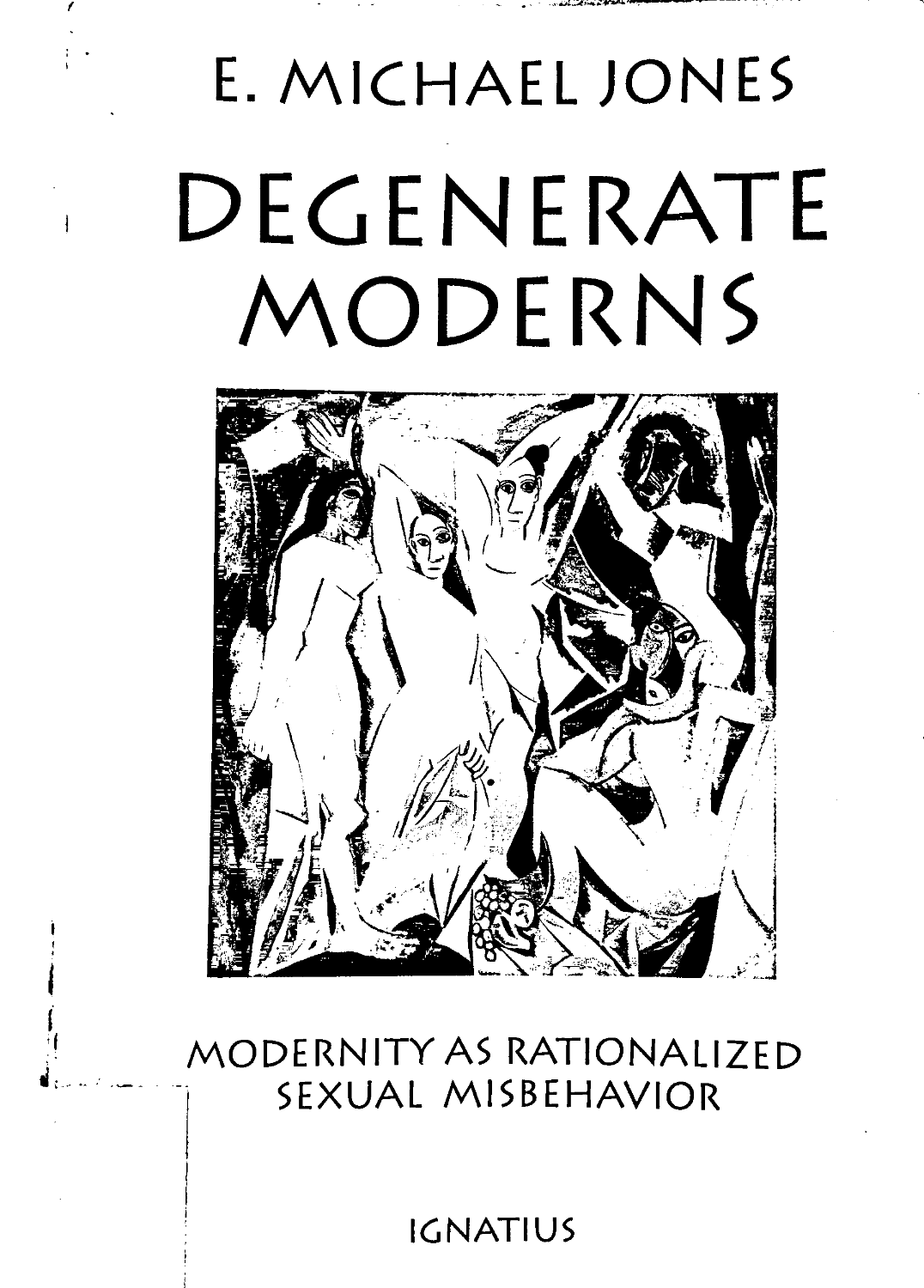
                    E. MICHAEL JONES
DEGENERATE
MODERNS
MODERNITY AS RATIONALIZED
SEXUAL MISBEHAVIOR
IONATIUS

The spiritual man... can appraise everything,
though he himself can be appraised by no one.
— 1 Corinthians 2:15

CONTENTS
Introduction:
Whv Modernity Is Rationalized Lust: Why Biography Is Destiny	9
\ Samoa Lost: Margaret Mead, Cultural Relativism,
and the Guilty Imagination	19
2	Blue Lagoon Social Studies	43
3	Homosexual as Subversive:
The Double Life of Sir Anthony Blunt	51
4	Stanley and Jane’s Excellent Adventure:
Or, Why Politically Correct Professors
Hate Western Civilization	79
5	The Case against Kinsey	87
6	Liberal Guilt Cookies	117
7	Cubism as Sexual Loathing:	The Case against Picasso	127
8	Sigmund and Minna and Carl and Sabina:
The Birth of Psychoanalysis out of the
Personal Lives of Its Founders	153
9	Luther’s Enduring Legacy	235
Epilogue:
Moral Realism: The Ultimate Deconstruction	255

INTRODUCTION
Why Modernity Is Rationalized Lust: Why Biography Is Destiny
Every cloud, they say, has a silver lining. The same thing is true of the sexual
revolution. Any attempt to place a date for its beginning would be purely
arbitrary, but if we look back over the past forty some years, the period
beginning with the first Kinsey report in 1948, it becomes evident that an
unprecedented openness about matters sexual has transformed our cultural
landscape. With the gift of hindsight, it is difficult to see that much good has
come from the “liberation”, which has meant little more than death, disease,
and wrecked lives to most people who chose to participate and profits to the
exploiters. But that would overlook the fact that we do now have hindsight at
all, specifically hindsight on sexual matters.
Fiona MacCarthy’s biography of Eric Gill1 set off a barrage of moral
outrage that is unprecedented in recent literary history. From both sides of the
Atlantic, the English stone carver and letter maker who was a friend to
eminent figures on all sides of the cultural spectrum in modern England—
from Catholic traditionalists like Chesterton and Belloc to the Woolfs and
Maynard Keynes of Bloomsbury—was so excoriated for his sexual behavior
that one might have thought a new age of moral probity had descended on
late-twentieth-century sexual mores. Unfortunately, things are not quite that
simple—although the denunciations certainly were. Barbara Grizzuti Harrison,
writing for the New York Times, calls Gill “a poseur, a fraud and a pervert
Wicked is one word for Gill’s activities.... ”2 Bernard Levin, writing in the
Times, calls Gill “a revolting criminal”. And Lucy Ellmann, writing in New
Statesman and Society, describes him as “a devout Catholic convert who
copulated and confessed in equal proportion”. With this last quote we are
beginning to get to the heart of the moral outrage. For the rage of the
reviewers and the society they represent is not so much against the sexual sins
a particular man commits; it is against his willingness to repent of them after
he has committed them. In his sexual life, Eric Gill was a typical modern—
perhaps a little more exuberant than most. In his spiritual life, however, he was
1	Fiona MacCarthy, Eric Gill: A Lover’s Quest for Art and God (New York: E. P. Dutton,
1989).
2	Book review, New York Times, May 7,1989, p. 11.
9

10
DEGENERATE MODERNS
a Catholic. And it is the conflict between the two that brings out the rage of
the reviewers.
Eric Gill was born on February 22, 1882, to a poor nonconformist parson
and a devoted mother. He was one of twelve children raised in what he
describes as the essentially wholesome but sexually repressive atmosphere of a
Victorian family. He married at the age of twenty-two, and on his thirty-first
birthday, after making a name for himself as a letter carver, he converted to
Roman Catholicism. Age thirty-one, it should be noted, is more than half a
lifetime away from the onset of puberty and time enough to acquire bad
sexual habits. That he had such bad habits, no one would deny, least of all Gill
himself. In his autobiography Gill wrote:
It is one of the difficulties of this book that I must always be appearing on a
higher plane than that to which I properly belong ... at least I must always
be omitting the evidence of my sinfulness. And it is a hateful situation. I do
not want to appear other than I am—partly because of the untruth	3
In her biography, Miss MacCarthy goes into the details that Gill omitted in his
autobiography but preserved in coded form in his diaries. She is more restrained
in condemnation than her reviewers, but for all its vehemence the condemna¬
tion strikes one as particularly hollow or, better expressed, without foundation.
In order to get to that foundation, one has to ask a few preliminary questions.
To begin with, is adulter)' wrong? What about fornication, incest, and bestiality?
If so, then Gill was wrong and a sinner, but in that case he is no different from
so many of his contemporaries in this century, and the secular organs of opinion
seem unconcerned about condemning them. If these acts are wrong, who is
saying they are wrong now? Certainly the Catholic Church, but the New York
Times? Hardly; it and the other arbiters of secular sexual morality in our day
seem to be saying the opposite. And if these sexual practices are not wrong, as
all of secular culture seems to agree, then whence all this moral outrage? The
secular reviewer, for all of his outrage, seems to be caught in a bind. If what
Gill did was wrong, then the whole culture stands condemned as well, and the
Catholic Church and Moses were right all along. If, on the other hand, the
culture is right about sexual freedom, then one can hardly criticize Gill for
putting his particular sexual orientation into practice. The key to understanding
the peculiar sort of outrage that surfaces in the case of Gill has to do with the
way he lived his life. Gill was both a Catholic and a sinner. He sinned and went
to confession and sinned again all the way up to his death, at which point he con¬
fessed for a final time, received the last rites and died. The rage against Eric
Gill that one perceives in the reviews of MacCarthy’s book has a common root:
3	Eric Gill, Autobiography (London: J. Cape, 1941), p. 247.

INTRODUCTION
11
Gill is excoriated not so much for his sexual sins but because he wasn’t modern
about them. Unlike the good moderns of then and now, he never attempted to
make wrong right. One incident from his life, I think, makes this clear.
Not quite three years after his marriage, in early 1907, Gill fell in love with
Lillian Meacham, a fellow Fabian Socialist and prime example of the “New
Woman”. Following a whirlwind romance, which included readings of Nietzsche
and meetings at the theosophical society, Gill began an affair with Meacham
that culminated in a trip to Chartres, described by MacCarthy as “a New
Woman’s holiday, free love and architecture, taking in a performance of
Wagner’s Valkyrie at the Paris Opera on the way home”.4 The significance of
the affair is best judged by what did not happen: Gill did not leave his wife
and family; he did not become the proponent of some social movement that
rationalized his misbehavior; he did not set himself up in a mode of permanent
rebellion against the moral law as a salve to his conscience. Gill did not go to
confession after his fling at Chartres because he wasn’t a Catholic at the time;
however, he was always willing—in his diary, for example—to admit that
what he did was wrong. In this regard he separates himself from the typical
modern. By going back to his wife and family after this fling in 1907, Gill was
no less a sinner, but he backed away from becoming a modern. He could have
been another Bloomsbury foot soldier, but he decided to go back home
instead. “I was”, he writes in his autobiography,
too deeply in love with the mother of my children and too deeply in love
with the Christian idea of the family and the home and parental love thus to
throw everything away.... I should have broken my own heart as well as
hers. It was shortly after this affair that we moved to Ditchling and soon
afterwards I resigned from the Fabian Society.5
There are ultimately only two alternatives in the intellectual life: either one
conforms desire to the truth or one conforms truth to desire. These two
positions represent opposite poles between which a continuum of almost
infinite gradations exists. So, to give two extremes first, we might have
St. Thomas Aquinas or, more dramatically, St. Augustine representing the
former position—desire subject to the truth—and Sigmund Freud or Martin
Luther representing the latter—truth subject to desire. Eric Gill occupies an
intermediate position on this spectrum. He was not victorious over sexual
desire in the way that St. Augustine was, but neither did he devote his life to
rationalization of his moral failures as both Luther and Freud did. In strictly
quantitative terms, Gill was much more licentious than Sigmund Freud;
however, he never went so far as to say that man had a “universal” desire to
4	MacCarthy, p. 76.
5	Gill, p. 272.

12
DEGENERATE MODERNS
sleep with his mother or sister because he himself had committed incest. Gill’s
attitude toward sexual sin was quite simple; it was, as he wrote in his diary,
“Bad, Bad, Bad’’.6 In this Gill was typically unmodern, and as a result he has
earned the rage of the reviewers of our age, who look upon making wrong
right as the primary intellectual virtue. No sin is so bad, the moderns would
say, that one can’t go on the Donahue show and claim it as a right.
Sexual sins are corrupting. No one who reads Gill’s biography will deny
that. One is confronted on almost every page with opportunities that never
reached fulfillment, of projects begun in hope and broken off in bitterness and
disgust. The most insidious corruption brought about by sexual sin, however,
is the corruption of the mind. One moves all too easily from sexual sins, which
arc probably the most common to mankind, to intellectual sins, which are the
most pernicious. Gill was certainly no stranger to rationalization; he argued
some of his theories, as MacCarthy states, “with a zeal that sometimes looked
like desperation, because it cast a blanket of righteousness over actions which
otherwise seemed dubious—the adulteries, the incest.”7 But he never goes all
the way. In the end he would always admit that what he had done was “Bad,
Bad, Bad”. Or, as he says at another point, “This must stop.”8 This, I would
submit, and not his sexual dereliction is what moderns find so enraging.
Because of the sexual revolution, we are witnessing a revolution in that
exercise in formal hindsight known as biography. The standard has changed.
Now, in keeping with the times, the sex life of the person is no longer
excluded from scrutiny. There are any number of popular paradigms that will
serve as examples, John F. Kennedy being one of the most obvious. Then there
is the case of Martin Luther King’s womanizing, documented by the FBI and
available now under the Freedom of Information Act. The fact that all this
information is now available has made for some interesting complications in
public life. Full disclosure has opened a window of vulnerability. Gary Hart
and John Tower had to find out the hard way that there are more kinds of
double standards than they had imagined. Suddenly the things that people
had gotten used to taking for granted were being held against them. Once
again the rules had been changed in the middle of the game and the players
were perplexed. “Why,” said a professor from Princeton who had been the
focus of a large sexual scandal at that school, “if I’m guilty in what I did that
night, I’ve been guilty all my life, you see. Then I’ve been terrible all along.”
For the first time in his sixty-two years, it dawns on this professor, it would
seem, that sexually molesting graduate students is not acceptable behavior.
6	MacCarthy, p. 47.
7	Ibid., p. 163.
8	Ibid., p. 156.

INTRODUCTION
13
Something was happening. The lechers were being caught with their pants
down, and the claim that all they were involved in was striking a blow for
personal freedom was not getting the response that it used to.
The foreign press was, for the most part, either perplexed or livid with out¬
rage over this alleged return of “Puritanism” to public life in America. However,
at least from a scholarly point of view, America was hardly the place to start
looking for an explanation. Beginning in the late seventies, a ground-breaking
series of biographies began to appear in England, focusing for the most part
on English figures. Michael Holroyd’s 1978 biography of Lytton Strachey was
followed a few years later by Robert Skidclsky’s biography of John Maynard
Keynes. Both, but especially the latter, dealt openly with Strachey’s and
Keynes’ homosexuality, a fact suppressed, for example, in the up-to-that-time
standard biography of Keynes. Suddenly the private lives of everyone, but
especially the key figures of the modern age, were fair game for biographers.
Before long, the reader had come to expect this sort of revelation, and, given
the lives that virtually all the moderns lived, they were right to expect it.
Paul Johnson’s book Intellectuals9 is what one might call a product of the
second generation of this revolution. It is a book that is based on the openness
that the sexual revolution has engendered, but it is also one that simultaneously
subverts that revolution and the modern age that fostered it by exposing the
intimately personal roots of modern ideology. Intellectuals is not primary
research; it is an extended reading in the biographies that his, for the most
part, English contemporaries have been producing of late. Johnson is a Catholic,
and his book is informed by a strong Catholic moral sense—there is no
attempt to make moral failure into something other than what it is. However,
it is just as much the book of an Englishman. Intellectuals is relentlessly
empirical, with all the virtues and faults that entails. As a result, one all too
often gets lost in the details and loses sight of the bigger issues involved.
The biggest issue of the book, although one not really faced directly, is the
relationship between intellectual product and private life. Because Johnson
goes pretty much from one example to another, without providing an intellec¬
tual framework that will explain the details he recounts, he opens himself to
misunderstandings from readers who might otherwise be sympathetic or who
need to be educated beyond the assumptions of their milieu. So, for example,
Joseph Sobran, the conservative columnist, did not like the book’s focus on
these intellectuals’ private, i.e., sexual lives. Patrick Buchanan, another gener¬
ally sympathetic conservative, felt that the whole enterprise came perilously
close to the ad hominem. Liberals, who were for the most part anxious to
preserve the climate of values established by modernity, were inclined to make
5 Paul Johnson, Intellectuals (New York: Harper & Row, 1988).

14
DEGENERATE MODERNS
large distinctions between the intellectual and the personal, as if they could be
separated into neat compartments that did not influence each other. Many
conservatives were simply variant liberals or lacked the intellectual where¬
withal to disagree.
This sort of controversy was not limited to Johnson’s book. Controversy
over the Huffington biography of Picasso10 raged in the pages of National
Review, and conservatism, it seems, could come to no consensus on modernity,
not even on the sexual revolution, or on the relationship between a man’s
moral life and the products of his mind. The issue could be misframed any
number of ways: for example, were Picasso’s paintings to be rejected because
of his personal life? That sounded illiberal in a way that was repugnant even to
conservative ears.
Peter Gay, recent biographer of Freud, commenting on the controversy
surrounding the missing correspondence between Freud and his sister-in-law,
Minna Bernays, gives what might be termed a classic expression of the liberal,
disjunctive view of the relation between life and work. According to Gay,
there is no connection.
“Surely”, he concedes,
we are entitled to make moral judgments about the character and conduct of
historical figures. But I insist that the greatness or failure of their work, the
validity of their ideas, however deeply influenced by their personal history,
are nevertheless independent of it. Freud might have been a spotless gentle¬
man and still developed a fatally flawed theory of mind; he might have been
a consummate villain and yet tumbled onto profound truths about human
nature. Hence the question about his possible affair with his sister-in-law has
no bearing on whether there is an Oedipus Complex or not.11
Johnson’s whole book cries out against the dualism implicit in Gay’s
formula: however, because Johnson has written so radically empirical a book,
he fails to explain why the liberal disjunctive thesis is wrong and why what he
is doing is something more than just gossiping. This is not to say that
Intellectuals doesn’t have a theory behind it. However, the theoretical skeleton
gets lost in the fleshy mass of detail and fails to support it effectively. As a
result, Johnson loses an opportunity to make a bigger point with readers who
are naturally on his side.
Intellectuals, he tells us, are
free spirits, adventurers of the mind. With the decline of clerical power in
the 18th century, a new kind of mentor emerged to fill the vacuum and
10	Arianna Stassinopoulos Huffington, Picasso: Creator and Destroyer (New York: Simon
and Schuster, 1988).
11	Letters to the Editor, New York Times, April 9,1989, sec. 7, p. 36.

INTRODUCTION
15
capture the ear of society. The secular intellectual might be a deist, sceptic or
atheist. But he was just as ready as any pontiff or presbyter to tell mankind
how to conduct its affairs.12
Evelyn Waugh, as a result, “was not an intellectual: he did not think he
could refashion the rules of his life out of his own head but submitted to the
traditional discipline of his church.”13
The intellectual, then, is a peculiarly modern invention, whose rise is
predicated upon the demise of the Church as a guide to life. It is then no
coincidence that the rise of the intellectual should coincide with something
like the French Revolution. The two things were, in effect, causally related.
The demise of the Church created the moral and intellectual vacuum in which
the intellectual needed to flourish. Just what that flourishing entails is depressingly
common and documented ad nauseam in Johnson’s book. The modern intellec¬
tual is, for the most part, a lecher and a fool. His theories are propounded for
everyone but himself. So Rousseau, the writer of Emile, the first modern book
on childrearing, sent all five of his illegitimate children to the orphanage
shortly after they were born, which, given the condition of orphanages in the
eighteenth century, meant to their deaths. Marx, the champion of the proletariat,
knew only one proletarian in his life, his maid, Lenchen, to whom he paid not
one single penny in wages. In addition to this economic exploitation, there
was also sexual exploitation. Marx fathered an illegitimate child by her and
refused to acknowledge it.
“But Lenchen”, according to Johnson,
was a stronger character than Rousseau’s mistress. She insisted on acknowl¬
edging the boy herself. He was put out to be fostered by a working-class
family called Lewis but allowed to visit the Marx household. He was,
however, forbidden to use the front door and obliged to see his mother only
in the kitchen. Marx was terrified that Freddy’s paternity would be discovered
and that this would do him fatal damage as a revolutionary.14
The conclusion to all this is inescapable: Rousseau’s theory of the state and
Marx’ theory of economics are deeply rooted in their personal lives. To return
to Peter Gay’s claim, understanding the Oedipus Complex has everything to
do with whether Freud had an affair with his sister-in-law. The Oedipus
Complex is Freud’s compulsion and his guilt projected onto humanity as a
whole. There is something deeply satisfying, if ultimately neurotic, about
projecting one’s guilt onto the world at large. It is, in fact, the all-but-constant
12	Johnson, p. 1.
13	Ibid., p. 171.
14	Ibid., p. 80.

16
DEGENERATE MODERNS
occupation of those whom Johnson denominates “intellectuals”. Johnson,
however, because of the radically empirical nature of his book, never gets
around to formulating the counterposition to Gay’s assertions explicitly.
But isn’t this a dangerous assertion, this claim that intellectual product is
just the projection of inner need? It is, and it isn’t. The claim has to be refined
so that it covers, not just “intellectuals”, but also the activity of the legitimate
scholar as well. Put more generally, the idea can be formulated thus: the
intellectual life is a function of the moral life of the thinker. In order to
apprehend truth, which is the goal of the intellectual life, one must live a
moral life. One can produce an intellectual product, but to the extent that one
prescinds from living the moral life, that product will be more a function of
internal desire—wish fulfillment, if you will—than external reality. This is
true of any intellectual field and any deeply held desire. In the intellectual life,
one either conforms desire to truth or truth to desire. In the first instance, the
importance of biography is negligible; in the second instance, it is all-important.
The steady-state theory of the origin of the universe, for example, was deeply
satisfying to those who had decided a priori that there was no God. It was
only when the evidence supporting the Big Bang became scientifically
overwhelming that the steady-state crowd abandoned positions that had long
since become scientifically untenable.
If this is true of astrophysics, it is a fortiori true of fields that impinge more
immediately on areas of human desire, and, as the modern age seems bent on
showing, the most urgent area of human desire has to do with sex. So we now
know that cultural relativism, as propounded by Margaret Mead, was nothing
more than a clever rationalization for her own adultery. What better way to
salve the conscience than to find that Samoans, the natural man, don’t take
adultery seriously.
Lust is a common enough vice, especially in this age. The crucial intellectual
event occurs, however, when vices are transmuted into theories, when the “intel¬
lectual” sets up shop in rebellion against the moral law and, therefore, in rebel¬
lion against the truth. All the modern “isms” follow as a direct result of this
rebellion. All of them entail rationalization. All of them can be best understood
in light of the moral disorder of their founders, proponents, and adherents.
So the antithesis of Peter Gay’s (and modernity’s) dualism is summed up in
the following passage from The Silence of St. Thomas by Josef Pieper:
Since we nowadays think that all a man needs for acquisition of truth is to
exert his brain more or less vigorously, and since we consider an ascetic
approach to knowledge hardly sensible, we have lost the awareness of the
close bond that links the knowledge of truth to the condition of purity.
Thomas says that unchastity’s first-born daughter is blindness of the spirit.

INTRODUCTION
17
Only lie who wants nothing for himself, who is not subjectively “interested”,
can know the truth. On the other hand, an impure selfishly corrupted will to
pleasure destroys both resoluteness of spirit and the ability of the psyche
to listen in silent attention to the language of reality.15
It is the curse of this age to have to prove on its own pulse and in the
degrading minutiae of the biographies of its prominenti the lessons that the
Catholic Church in her wisdom (which was once the collective wisdom of the
West) knew all along. Paul Johnson, reaping the harvest of the new biographi¬
cal realism, has documented the decline of the West in the personal lives of its
intellectual elite. Johnson gives the evidence but seems reluctant to come up
with the conclusion. The evidence, however, is all in, and the verdict is clear:
modernity is rationalized lust.
In the memoir she wrote about her life with the liberal Protestant theolo¬
gian Paul Tillich, Hannah Tillich describes her husband’s “inclination to
pornography”, his equally pornographic life and, most interestingly, their
connection with his intellectual pursuits. After his death, she describes open¬
ing his desk and what she discovered there, and presents the postmodern age
with one of its most apt epiphanies:
I unlocked the drawers. All the girls’ photos fell out, letters and poems,
passionate appeal and disgust. Beside the drawers, which were supposed to
contain his spiritual harvest, the books he had written and the unpublished
manuscripts, all lay in unprotected confusion. I was tempted to lay between
the sacred parts of his highly esteemed lifework those obscene signs of the
real life that he had transformed into the gold of abstraction, King Midas of
the spirit.16
So now, thanks to the frankness engendered by the sexual revolution, we
know that the best explication of the theories of modernity comes from the
biographical details of its proponents. Given the nature of the lives they led,
we also know why they were so interested in transformations into abstraction.
We also know now—and with hindsight it’s hard to imagine that so many
people took them seriously at the time—that what the Midases of modernity
produced was more fool’s gold than anything else.
The thesis of this book is simple: modernity was rationalized sexual
misbehavior. All the intellectual and cultural breakthroughs of modernity
were in some way or other linked to the sexual desires their progenitors knew
to be illicit but which they chose nonetheless. Their theories were ultimately
rationalizations of the choices they knew to be wrong. The lives of the
15Josef Pieper, The Silence of St. Thomas: Three Essays (Chicago: Henry Regnery Co.,
1965), pp. 19-20.
16 Hannah Tillich, From Time to Time (New York: Stein & Day, 1973), p. 241.

18
DEGENERATE MODERNS
modems are, then, an uncanny substantiation of the power and scope of
the moral law. “All who desert you”, St. Augustine says in his Confessions,17
“and set themselves up against you merely copy you in a perverse way.”
St. Augustine is talking about God here and those who rejected him in his age;
however, his words apply equally well to the moral law and those who reject
it in ours.
So much for the simplicity of the book’s thesis. Its form is dual, a medita¬
tion on the lives of some of the seminal modem thinkers followed by an
application of that thinking in the lives of contemporary epigoni. Critical
parlance notwithstanding, there is no postmodern age, just thinkers following
the ever-constricting ruts of sexual liberation in increasingly compulsive,
increasingly self-negating ways. If there is ever to be a postmodern era, it will
have to rise out of the negation of what went before it and not in increasingly
etiolated theories or increasingly violent forms of self-destruction.
17 St. Augustine, Confessions (London: Penguin, 1961), p. 51.

Chapter 1
SAMOA LOST:
MARGARET MEAD, CULTURAL RELATIVISM,
AND THE GUILTY IMAGINATION
Many wrongdoers have even turned evidence against themselves.
— Cicero, De finibus bonorum et malorum
For instance, pagans who never heard of the Law but are led by reason to do
what the Law commands may not actually “possess” the Law, but they can
be said to “be” the Law. They can point to the substance of the Law
engraved on their hearts—they can call a witness, that is, their own
conscience —they have accusation and defense, that is, their own inner
mental dialogue.
—	St. Paul, Romans 2:14-16
Thy law is written in the hearts of men, which iniquity itself effaces not.
—	St. Augustine, Confessions
Unnatural deeds
Do breed unnatural troubles. Infected minds
To their deaf pillows will discharge their secrets.
More needs she the divine than the physician.
— William Shakespeare, Macbeth
We impute it, therefore, solely to the disease of his own eye and heart, that
the minister, looking upward to the zenith, beheld there the appearance of
an immense letter,—the letter A,—marked out in lines of dull red light. Not
but the meteor may have shown itself at that point, burning duskily through
a veil of cloud; but with no such shape as his guilty imagination gave it; or,
at least, with so little definiteness, that another’s guilt might have seen
another symbol in it.
— Nathaniel Hawthorne, The Scarlet Letter
19

20
DEGENERATE MODERNS
As academic controversies go, it was high-powered stuff, the type of event
that explodes the normal confines of debate like a spark entering a house full
of pent-up fumes. The type of thing that is usually confined to the book-
review sections of esoteric journals that average 1.5 readers per article exploded
across the front page of the New York Times. “New Samoa Book Challenges
Margaret Mead’s Conclusions”, ran the headline on January 31, 1983.1 At
issue was the claim put forth by the Australian anthropologist Derek Freeman,
in his book Margaret Mead and Samoa: The Making and Unmaking of an
Anthropological Myth,2 that “Margaret Mead seriously misrepresented the
culture and character of Samoa.”3 Freeman was less restrained in describing
his own work than the Tunes was. “I may have written a book”, he was
quoted as saying in Smithsonian, “that will create the greatest denouement in
the history of anthropology so far, not excepting Piltdown Man.”4 “The
entire academic establishment”, Freeman said to the New York Times, “and all
the encyclopedias and all the textbooks accepted the conclusions in her book
and those conclusions are fundamentally in error. There isn’t another example
of such wholesale self-deception in the history of the behavioral sciences.”5
The reason this was a source of consternation to anyone other than anthro¬
pologists and Samoans had to do with the nature of Mead’s book. Coming of Age
in Samoa not only launched Mead’s fifty-year-long career as an anthropologist,
it made her a household word and guru on just about any area of human
endeavor on which she cared to pontificate. The book, which sold millions of
copies in sixteen languages including Urdu and Serbo-Croatian, also had a
beneficial effect on anthropology, which was now seen as a discipline that
studied cultures far away in order to have an impact on how we did things
close to home. Coming of Age in Samoa, according to Sherwood L. Washburn,
past president of the American Anthropological Association, “influenced the
way people were brought up in this country”.6 If the controversy over Mead
began within the discipline of anthropology, it was becoming increasingly
clear that more than someone’s scholarly reputation was at stake. At stake
were significant currents in the culture that a book written in the late twenties
by a graduate student at Columbia University had helped to form.
'Edwin McDowell, “New Samoa Book Challenges Margaret Mead’s Conclusions”,
New York Times, January 31,1983, p. 1.
2	Derek Freeman, Margaret Mead and Samoa: The Making and Unmaking of an Anthropologi¬
cal Myth (Cambridge, Mass.: Harvard University Press, 1983).
3	McDowell, p. 1.
4	Jane Howard, “Angry Storm over the South Seas of Margaret Mead”, Smil/isom<w H
(April 1983), p.67.
5	McDowell, p. 1.
6	Ibid., p. 1.

SAMOA LOST
21
Mead arrived in Pago Pago in American Samoa on August 31, 1925,
finding that the site of her researches into what she construed as a primitive
culture was surrounded by American battleships: “Airplanes scream overhead,
the band of some ship is constantly playing ragtime”, she was to write later.7
Mead then settled down to learn the language, and by October she felt
confident enough to move to a new site. Freeman was to maintain later that
her preparation was insufficient, which (given the differences between Samoan
and the Indo-European languages and the fact that Mead had never learned
another foreign language) seems a plausible objection. In her memoir Blackberry
Winter, published forty-seven years later, Mead herself wrote, “I myself had
never learned a foreign language; 1 had only ‘studied’ Latin and French and
German in high school.”8 Even her generally sympathetic biographer, Jane
Howard, claimed, “A flair for languages... was never one of Mead’s strong
suits; anthropologists and others who knew Samoan wondered whether she
could possibly have learned enough of the language in six weeks’ time to carry
out so delicate a task.”9
Whether she did or did not, Mead arrived on Ta’u, an island in the Manu’a
group about a hundred miles east of Pago Pago, on November 9, settling into
the household of U.S. Navy Pharmacist’s Mate Edward Holt to conduct an
investigation into the lives of adolescent girls there. Mead’s mentor, Franz
Boas, troubled by claims in a recent book by G. Stanley Hall on adolescence,
wanted to know if adolescence was universally a period of turmoil character¬
ized by what the Germans termed Sturm und Drang and Weltschmerz, or
whether these difficulties were simply a phenomenon in certain cultures. Was
adolescent rebelliousness something associated with, say, hormones and, as a
result, inevitably linked with the onset of puberty, as Flail claimed, or was it
simply the result of factors that might not exist in certain cultures and were
therefore amenable to modification? \
Mead’s attempt to answer that question was also hampered by the feet that
a tropical storm virtually levelled the island on the first day of January 1926,
disrupting the normal pattern of life as the natives attempted to rebuild their
village. In spite of all these difficulties, Mead left Samoa nine months after she
arrived, claiming that she had enough material to allow her to generalize not
only about the life of Samoan adolescents but about Samoan culture in
general and beyond that about “our humanity” as well. “One by one,” she
wrote in Coming of Age in Samoa, “aspects of behavior which we had been
accustomed to consider invariable components of our humanity were found
7Janc Howard, Margaret Mead: A Life (New York: Simon & Schuster, 1984), p. 79.
8	Margaret Mead, Blackberry Winter: My Earlier Years (New York: William Morrow &
Co., 1972), p. 139.
9	Howard, Margaret Mead, p. 79.

22
DEGENERATE MODERNS
to be merely a result of civilization, present in the inhabitants of one country,
absent in another.”10 Her mentor Franz Boas was just as willing to generalize
about what even then must have seemed the slim anthropological research of
his student. “Much of what we ascribe to human nature”, he wrote in the
preface to her book, “is no more than a reaction to the restraints put upon us
by our civilization.”11
It was a message that the progressive intellectual trendsetters of the late
twenties on both sides of the Atlantic were only too happy to applaud.
Coming of Age in Samoa was a runaway best-seller when it appeared in 1928.
Apparently the claim that our troubles were caused by restrictive cultural
conditions and that human nature was “unbelievably plastic” resonated favor¬
ably with large numbers of the people who bought books. It was all a part of
the Zeitgeist of the twenties. Freeman cites advertisements in The Nation, a
magazine that Mead later cited as part of the intellectual excitement she
savored when coming to New York as a Barnard student, which
exhorted American intellectuals to “Go to Soviet Russia”, where the world’s
most gigantic social experiment was being conducted. And those who made
the pilgrimage returned to write of having been “thrilled by the spirit of the
children ... trained under the Soviet regime”, and of never having seen a
more engaging picture of happy childhood. There were reports of human
nature having been decisively changed, as for example in the form that
jealousy took under the Soviet regime, and of “mental hygiene” being
inherent in the social organization of the new Russia.12
Jane Howard describes much the same frame of mind in her descrip¬
tion of the preparations for a field trip Mead was later to make to New
Guinea:
In the back of her own mind as she planned this expedition, Mead later
wrote, were two things: the influence of the progressive education move¬
ment and “a quick and partial interpretation of the first flush of success in
Russian education experiments”, which had caused educators and philoso¬
phers to say, “Yes, the child is malleable, he takes the form you wish him to
take; therefore, if you train him sufficiently differently from the way his
unfortunate parents were trained, in no time at all you will produce a new
generation which will build a new world.”13
Just why so many people were interested in discovering the malleability of
10	Margaret Mead, Coming of Age in Samoa: A Psychological Study of Primitive Youth for
Western Civilization (New York: Blue Ribbon Books, 1928), p. 4.
11	Ibid., p. xv.
12Freeman, p. 96.
\	13 Howard, Mead, p. 119.
L

SAMOA LOST
23
human nature became evident from the tenor of the early reviews of Coming
of Age. Writing in The Nation, Freda Kircliwcy claimed that “somewhere in
each of us, hidden among our more obscure desires and our impulses of
escape, is a palmfringcd South Sea island .... a languorous atmosphere prom¬
ising freedom and irresponsibility	Thither we run ... to find love which is
free, easy and satisfying.”14 Samuel D. Schmalhausen effused over “the inno¬
cent strangely impersonal naively mechanistic-behavioristic sexing of the
light-hearted youths and maidens of faroff Samoa” and felt that there were but
two roads of heart’s fulfillment: “Samoa or Calvary: happy-go-lucky felicity
or tragic intensity.”15 In his book, Our Changing Human Nature, published one
year after Coming of Age, Schmalhausen concluded, “Back to the South Sea
Isles!” back to “naturalness and simplicity and sexual joy”.16 It was a cry
echoed by both Bertrand Russell and Havelock Ellis, the sexologist, paramour
and associate of Margaret Sanger.
Mead’s novclistic account of life in Samoa lent itself quite easily to such
effusions. It is an account composed of equal parts of poetic description and
anthropological moralizing. So a day in Samoa begins as “lovers slip home
from trysts beneath the palm trees or in the shadow of beached canoes.”17
Although Christianity, with the premium it places on chastity, has been a
feature of Samoan life since the nineteenth century, “the Samoans regard this
attitude with reverent but complete scepticism and the concept of celibacy is
meaningless to them.”18 Samoans, Mead continues,
laugh at stories of romantic love, scoff at fidelity to a long absent wife or
mistress, believe explicitly that one love will quickly cure another,... although
having many mistresses is never out of harmony with a declaration of affection
for each—Romantic love as it occurs in our civilization, inextricably
bound up with ideas of monogamy, exclusiveness, jealousy and undeviating
fidelity, does not occur in Samoa	Adultery does not necessarily mean a
broken marriage	Divorce is a simple informal matter.... It is a very
brittle monogamy often trespassed and more often broken entirely, but
many adulteries occur... which hardly threaten the continuity of estab¬
lished relationships..., and so there are no marriages of any duration in
which either person is actively unhappy.19
In addition to this, Mead finds that “casual homosexual practices... are the
14 Freeman, p. 97.
b Ibid.
16	Ibid., p. 98.
17	Mead, Samoa, p. 14.
18Ibid., p. 98.
’’Ibid., pp. 104-8.

24
DEGENERATE MODERNS
usual manifestation of most associations between young people of the same
sex.”20
If Samoans arc polymorphous in their sexual lives, family life is similarly
diffused. Children are raised in amiable independence from their biological
parents. With one stroke of seemingly impartial research on a primitive people
living close to “nature”, Mead at once abrogates the Sixth Commandment and
the responsibilities parents have toward raising their children. “The close
relationship between parent and child,” Mead tells us in a chapter entitled
“Our Educational Problems”,
which has such a decisive influence upon so many in our civilization, that
submission to the parent or defiance of the parent may become the dominat¬
ing pattern of a lifetime, is not found in Samoa. Children reared in house¬
holds where there arc half a dozen adult women to care for them and dry
their tears, and half a dozen adult males, all of whom represent constituted
authority, do not distinguish their parents as sharply as our children do.21
As Freeman’s book points out, Mead’s claims about Samoa not only persisted
throughout her long career as an anthropologist, they became more dogmatic
and exaggerated with time, even though she never went back to confirm her
data. Indeed she refused to return, claiming at one point that her picture was
valid for all time, “forever true,” she wrote in prefaces from 1949 on, “because
no truer picture could be made of that which was gone”. So, Mead was later
to claim that in Samoa, “the child is given no sense of belonging to a small
intimate biological family.... The relationship between child and parent is
early diffused over many adults.... Children do not think of an own mother
who always protects them.... The child owes no emotional allegiance to
its father and mother.”22 And as a result, “the setting for parent fixation
vanishes.” Children in Samoa “are schooled not by an individual but by an
army of relatives into a general conformity upon which the personality of
their parents has a very slight effect. In such a setting, there is no room for
guilt.”23
Once the idiosyncrasy of our own attitudes toward sex and childrearing is
established in light of the experiences of the carefree Samoans, it is only a short
step to recommending their mores as a corrective to our own. “What are the
rewards of the tiny, ingrown, biological family,” Mead wonders in Coming oj Age,
opposing its closed circle of affection to a forbidding world of the strong
ties between parent and children, ties which imply an active personal
20	Ibid., p. 165.
21	Ibid., p. 209.
22	Freeman, p. 113.
23	Ibid., p. 86.

SAMOA LOST
25
relation from birth until death? ... Perhaps these are too heavy prices to pay
for a specialization of emotion which might be brought about in other
ways, notably through coeducation. And with such a question in our minds
it is interesting to note that a larger family community, in which there are
several adult men and women, seems to ensure the child against the develop¬
ment of the crippling attitudes which have been labelled Oedipus complexes,
Electra complexes, and so on.24
Samoans, Mead tells us, “have no preference for reserving sex activity for
important relationships”. As a result,
The Samoan girl who shrugs her shoulder over the excellent technique of
some young Lothario is nearer to the recognition of sex as an impersonal
force without any intrinsic validity, than is the sheltered American girl who
falls in love with the first man who kisses her. From their familiarity with the
reverberations which accompany sex excitement comes this recognition of
the essential impersonality of sex attraction. ...25
Imitating the attitudes and techniques of Samoan Lotharios will, according
to Mead, reduce “the possibility of neuroses”.
By discounting our category of perversion, as applied to practice, and
reserving it for the occasional psychic pervert, [Samoans] legislate a whole
field of neurotic possibility out of existence. Onanism, homosexuality,
statistically unusual forms of heterosexual activity, are neither banned nor
institutionalized. The wider range which these practices give prevents the
development of obsessions of guilt which are so frequent a cause of malad¬
justment among us.... This acceptance of a wider range as “normal” pro¬
vides a cultural atmosphere in which frigidity and psychic impotence do not
occur and in which a satisfactory sex adjustment in marriage can always be
established.26
Samoans, in short, were “without the doctrine of Original Sin”.27
To the polymorphously perverse, to the sexually liberated, to those who
felt unduly burdened by the Judeo-Christian prohibition against adultery, to
those who felt that raising their children was an intolerable restriction on their
freedom, all of what Mead was saying must have seemed too good to be true.
Fifty-five years later, it turns out that it was. In the course of Freeman’s book,
each of Mead’s assertions about Samoa as the paradise of adolescent free love
falls under the blows of his methodological research. To Mead’s claim that the
suicides of humiliation so common in parts of Polynesia do not exist in Samoa,
24	Mead, Samoa, p. 212.
25	Ibid., p. 222.
26	Ibid., p. 223.
27	Freeman, p. 91.

26
DEGENERATE MODERNS
Freeman counters with studies of twenty-two cases of suicide committed from
1925 onward. “Fourteen of these twenty-two persons (64 percent)”, Freeman
writes, “had committed suicide in a state of anger at having been scolded or
punished by a parent or some other elder”.28 “Six of the twenty-two individ¬
uals who committed suicide did so out of shame at illicit sexual liaisons (the
remaining two killed themselves after being jilted).”29 Nine of the twenty-
two were adolescents, leading Freeman to conclude that the “proportion of
adolescent suicides” in Samoa "is high in comparative terms.... [T]he inci¬
dence of adolescent suicide relative to that of older age groups is, in fact,
considerably higher in Samoa than in some other countries. This is scarcely a
confirmation of Mead’s claim that in Samoa adolescence is ‘the age of maxi¬
mum ease	’ ”30
According to Freeman, the Samoans, far from being the sexual libertines
Mead depicted, placed a premium on female virginity. This was true of the
pagan Samoans as well as the Protestant Christians Mead studied. In fact it
seems that the advent of Christianity in the islands was an instance of grace
perfecting nature. Freeman speculates that virginity is something intrinsically
valuable because it is lost only once. On the issue of virginity, Christianity
only gave an added dimension to a belief that was already strong among
pagan Samoans. “Within the traditional Samoan system of rank,” Freeman
writes, “the proof of a bride’s virginity was regarded, as Kraemer remarks, as
‘indispensable’. The public testing of her virginity was the established method
of avoiding any possibility of the bridegroom’s being shamed by some other
male who might secretly have had sexual connection with her.”31 One of the
things overlooked by the proponents of sexual liberation who were so enthusi¬
astic about Coming of Age when it first appeared was the fact that even by
Mead’s own reckoning the majority of her informants about Samoa as the
paradise of adolescent sex were still virgins.
The Samoans’ veneration of virginity is not limited to the theoretical.
According to Freeman, they guard the virginity of their daughters and sisters
with a vengeance:
It is thus customary in Samoa, as Mead quite failed to report, for the
virginity of an adolescent daughter, whatever her rank, to be safeguarded
by her brothers, who exercise an active surveillance over her comings and
goings, especially at night. Brother will upbraid, and sometimes beat, a
sister should she be found in the company of a boy suspected of having
28	Ibid., p. 221.
29	Ibid., p. 221.
30	Ibid., p.222.
31	Ibid., p. 232.

SAMOA LOST
27
designs on her virginity, while the boy involved is liable to be assaulted with
great ferocity. Gerber, from her work in Tutuila in the early 1970s, records
that many girls reported that “they were afraid of their brothers beating
both them and their boyfriends if they were found together”; while Young
(who worked in both western and eastern Samoa in the 1970s) writes that a
brother will fly into a “killing rage” at an attempt to seduce his sister. To cite
a case from my own researches, on a Sunday in June 1959, Tautalafua, aged
17, found his 18-year-old classificatory sister sitting under a breadfruit tree at
about 9:00 in the evening with Vave, a 20-year-old youth from another
family. He struck Vave with such violence as to fracture his jaw in two
places. For this attack he was later sentenced to six weeks’ imprisonment.32
Freeman also finds Mead’s claim that in Samoa “adultery was not regarded
as very serious” to be “seriously in error”.33 In pre-Christian Samoa, adultery
was a crime punishable by death. As time went on, the punishment was
ameliorated to having the adulteress’ “head fractured and bone broken or by
having her nose or an ear cut off and cast away”.34 Under the influence of
Christianity the Samoans gradually did away with such draconian measures;
however, this in no way changed their opinion of the seriousness of the
offense. In the 1920s, at the same time Mead was doing her research, adultery
was listed in the legal code of American Samoa as “an offense for which those
guilty ‘shall be fined not more than one hundred dollars, or imprisoned not
more than twelve months, or both.’”35 In 1967, as the West was plunging
ever more recklessly toward greater sexual license, the talking chiefs of
Si’ufaga informed Freeman that “the judgment of a local polity is exceedingly
severe in the case of adultery, with the land of an offender being taken from
him.”36
To substantiate his point further, Freeman cites a case occurring in February
1967 of a twenty-eight-year-old married man who was caught trying to
seduce a seventeen-year-old virgin. In addition to being denounced verbally—
the attempted seduction was “a happening frightening to both ghosts and
men”—the seducer’s “family was fined two large pigs, two large tins of
biscuits, and one hundred corms of taro, while the family of the girl he had
been with was fined half this amount.”37
In 1928 Mead claimed that “the idea of forceful rape or of any sexual act to
which the participants do not give themselves freely is completely foreign to the
32	Ibid., pp. 236-37.
33	Ibid., p. 241.
34	Ibid.
35	Ibid., p. 242.
36	Ibid.
37	Ibid.

28
DEGENERATE MODERNS
Samoan mind.” In response to that claim, Freeman examined the police
records and found that there were sixty rapes per hundred thousand females
per annum, “a rate twice as high as that of the United States and twenty times
as high as that of England”. If in addition one adds to those statistics the
Samoan custom of moetotolo, or surreptitious manual rape, the numbers climb
to 160 rapes per hundred thousand females per annum, leading Freeman to
conclude that “the Samoan rape rate is certainly one of the highest to be found
anywhere in the world.”
The effect of Freeman’s critique is quite devastating. Where the young
Mead paints a generally impressionistic novelistic account that is suspiciously
vague on sources—“When I wrote Coming of Age in Samoa," Mead was later
to say in Blackberry Winter, “I carefully disguised all the names, sometimes using
double disguises so that the actual individuals could never be identified”38—
Freeman cites public documents, his own accounts of fieldwork there (he
passed a government exam in proficiency in the language and was made a
Samoan chief), accounts of travellers and missionaries, and, most tellingly,
contradictory accounts of people who claim to agree with Mead. The result of
Freeman’s tourde force is that he all but swept the board of public opinion. The
initial articles were uniformly positively disposed toward what he had to say.
His arguments and documentation were so persuasive that virtually everyone
who read the book was convinced.
Everyone, that is, except fellow anthropologists. Once the initial wave of
publicity had subsided, the reaction among the anthropological profession set
in. It is not surprising that the anthropologists should want to mount a counter¬
attack. First of all, if (as in fact was the case) the profession had all but unani¬
mously claimed that a seriously flawed book like Coming of Age was a classic
in modern anthropology, this didn’t say much for their standards, nor did it
inspire great confidence in anthropology as a science. Freeman claimed that
Mead as the student of Boas had subordinated scientific considerations to the
ideology of cultural relativism. She had tailored her data to suit the ideology
she went there to substantiate. The initial response of the anthropological
establishment did little to allay the fears that Freeman’s book had inspired.
According to Colin Turnbull, a professor of anthropology at George Wash¬
ington University, whose review appeared in the March 28, 1983, issue of New
Republic, Freeman’s book “deserves review only because it could do harm to
anthropology and particularly to the kind of humanistic anthropology that
Margaret Mead also preferred to petty academic rivalry.”39 According to
Turnbull, “the Samoa that Margaret Mead saw in 1925 ... was an island where
38	Mead, Blackberry Winter, p. 154.
39	Colin M. Turnbull, ‘Trouble in Paradise”, New Republic 188 (March 28, 1983), p. 34.

SAMOA LOST
29
people learned to grow to maturity without the stress that besets adolescents
in the Western world even more today than when she made her study.”40
Given Mead’s claims that adolescence would be less stressful if the West
relaxed sexual mores, Turnbull’s argument makes no sense in light of develop¬
ments here over the past fifty years. If adolescent stress has increased in the
West—and I think a case can be made that it has—it is a result of following Mead’s
prescriptions based on the supposed sexual freedom of Samoan life. In addition
to making factual errors—Turnbull states categorically that Mead did not five
with an American family—Turnbull’s defense of Mead is long on the ad hominem
and short on substance. He makes veiled accusations of racism and other isms
offensive to the New Republic readership: “With a revealing show of male chau¬
vinism, Freeman even mentions how this ‘young female student’ included as
part of her field equipment some ‘cotton dresses’.”41 It was a charge that would
surface frequently in the controversy. An anonymous anthropologist quoted
in The Chronicle of Higher Education was to circumvent the whole laborious
business of refuting what Freeman said by hanging the same label on him.
“There is”, he or she hinted darkly, “one sense in which a sex angle is probably
operative. There are a lot of male anthropologists who had trouble with
Mead, who were uncomfortable that one woman should be that strong.”42 Such
accusations were a good sign that the profession was running out of ammunition.
In general, the more the profession tried to attack Freeman, the more
convincing they made him seem by contrast. Lowell Holmes, an anthropolo¬
gist at Wichita State University who was to become Mead’s prime defender in
the debate, reacted in a way that bespoke emotional loyalty in place of
scientific objectivity: “I find an element of resentment at a foreigner attacking
‘our Margaret’ ”, he told The Chronicle of Higher Education. “America loved
this woman.”43 Joy Pratt, director of publicity at Harvard University Press,
was taken aback by the vehemence of the response. ‘What shocks me about
the reaction to the book”, she said in the Chronicle article, “is the scholars who
say Mead was a great humanitarian and scholar, and it’s mean to publish a nasty
book about her. Whatever became of scholarship and looking for the truth?”44
As the Mead-Freeman controversy was to make clear, scholarship and
looking for the truth had become early victims of ideology. In fact, ideologi¬
cal considerations had so dominated the profession that Freeman found it
impossible to get a forum for his ideas while Mead was alive. In fact, ideology
40	Turnbull, p. 32.
41	Turnbull, p. 33.
42	Cheryl M. Fields, “Controversial Book Spurs Scholars’ Defense of the Legacy of
Margaret Mead”, Chronicle of Higher Education 26 (May 11,1983), p. 27.
43	Ibid., p. 28.
44	Ibid.

30
DEGENERATE MODERNS
had become such an all-pervasive element in modern anthropology that the
anthropologists themselves were for the most part blind to it. Lowell Holmes
is a good example. In the book he wrote defending Mead after the Freeman
book came out, Holmes makes it clear that for him the doctrine of cultural
relativism means little more than having an open mind. According to Holmes,
cultural relativism
requires that no single culture be held up as offering the “right” or “natural”
way of doing things or valuing things. It reminds people of all nations that
each society should be free to solve cultural problems according to their own
time-tested methods without condemnation from those who would choose
different solutions. Having been trained in such a philosophical tradition,
Mead, myself, and the bulk of American anthropologists would believe that
behavior associated with adolescence or other aspects of the life cycle must
be evaluated only in terms of the cultural context in which they occur.45
If this is so, one is forced to wonder why Mead recommended changing the
sexual mores of American adolescents in light of what she discovered during
her stay in Samoa. Holmes can’t even explain cultural relativism without
involving himself in a flagrant self-contradiction. The attraction of relativism
has always been a moral one. It had great appeal to people with troubled
consciences, and Mead’s book appealed specifically to those troubled by
sexual matters.
In general, Holmes has the unfortunate habit of undermining his case in the
very act of stating it. He debunks Mead more effectively by agreeing with her
than Freeman does by disagreeing with her. Thus lie tells us that “during the
entire residence in Samoa it was impossible to obtain details of sexual experi¬
ence from unmarried informants though several of these people were constant
companions and part of our household.” In spite of the fact that Holmes’ own
research in Samoa leads him to conclusions opposite to those that Mead herself
drew on romantic love,, married love, suicide, and emotional intensity, he
nonetheless concludes: “I find the validity of her Samoan research remarkably
high.” To top it all off, he sent Freeman a letter in 1967 in which he wrote, “I
think it is quite true that Margaret finds pretty much what she wants to
find.”46 Holmes then goes on to add in a moment of remarkable candor that “I
was forced by my faculty advisor to soften my criticisms” of Mead.47 “The
only tragedy with Margaret”, Holmes added in 1967, “is that she still refuses
45	Lowell Holmes, Quest for the Real Samoa: The MeadFrecman Controivrsy and Beyond.
(South Hadley, Mass.: Bergin & Garvey, 1987), p. 17.
44 Derek Freeman, “ ‘O Rose Thou Art Sick!’ A Rejoinder to Weiner, Schwartz, Holmes,
Shore and Silverman”, American Anthropologist 86 (1984), p. 404.
47	Ibid.

SAMOA LOST
31
to accept the idea that she might have been wrong on her first field trip.”48
Professor Holmes is to be praised for his candor, if not for his ability to draw
logical conclusions from his premises. He, more than anyone, seals the case in
Freeman’s favor.
This is not to say that there are no implausibilities in Freeman’s account.
The book ends with Freeman espousing a mechanistic philosophy that con¬
fuses human nature with biology and is full of all sorts of incantations and
evolutionary mumbo-jumbo.
Cultural adaptations, [freeman tells us] are made possible by the evolution¬
ary emergence of what Ernst Mayr has termed open programs of behavior,
resulting from a gradual opening up of a genetic program to permit the
incorporation of personally acquired information to an ever-greater extent
Within an open program of behavior, then, a choice is made by the brain or
in other parts of the nervous system between two or more responses to
produce what Bonner calls “multiple-choice behavior.”49
The appearance of culture is thus to be viewed as a “new niche that arose from
the experimentation of animals with multiple-choice behavior.... ”50 With
all due respect to Professor Freeman and the service he has done in exposing
Margaret Mead, this is simply mechanistic nonsense, little better than the
cultural determinist nonsense that Mead propagated. The brain is about as
capable of choosing as it is of playing tennis. Only the mind can make choices,
and to say that the brain and the mind are the same thing is the crudest type of
materialism. It is like saying that radios can predict the weather. Freeman’s
nosedive at the end of his book is a sad denouement to a sound piece of
anthropology. It is also a pretty good indication of the general poverty
of intellectual discourse in the twentieth century. The anthropological pendu¬
lum swings from racist mumbo-jumbo to cultural relativism and then can find
nowhere else to go but back again to a hopefully more benign form of the
type of mechanism it left in the first place.
In the midst of all this, the crucial question about human nature continues
to go unanswered. Is it a mere function of superego or culture, as Mead
claimed? Or is it to be discovered by ever more meticulous dissection of our
DNA? The answer is that it is neither. Neither alternative is anything more
than a blind alley that has already been tried more than once and found
wanting.
Beyond that, Freeman’s myopia about human nature prevents him from
answering probably the most important question of his study, a question he
48	Ibid.
49	freeman, Margaret Mead and Samoa, p. 296.
50	Ibid., pp. 298-99.

32
DEGENERATE MODERNS
himself formulated in his interview with Time, namely, “How could anyone
get things so astronomically wrong?”51 Freeman attempts to answer his own
question with two partial answers—which in effect cancel each other out.
Rejecting the notion he heard among many Samoans that “Mead lied”, he
claims instead that her adolescent informants lied to her, but at the same time
Freeman claims that Mead went to Samoa to substantiate the ideology of
cultural relativism that Boas had inculcated in her while she studied with him
in New York. The two explanations don’t add up. Moreover, the doctrine of
cultural relativism in no way explains the specific conclusions Mead drew
about adultery, rape, childrearing, etc. Beyond that, there is the question of
why the general reading public read Coming of Age so avidly. Were they also
interested in refuting biological determinism? No, there was something more
basic to human nature at play here. The general public—and Mead as well—
was only interested in cultural relativism insofar as it sanctioned a certain
attitude toward sexual mores. As Freeman himself wrote, “That Coming of Age
in Samoa so rapidly attracted attention was due more than anything else to
Mead’s alluring portrayal of Samoa as a paradise of free love.”52 Mead had
turned anthropology into a powerful engine designed to soothe the troubled
consciences of those who were interested in overthrowing the mores of
Western, i.e., Judeo-Christian, civilization. That was why she was so inter¬
ested in primitive peoples: not only because they fit so well into the Europeans’
notion of a natural paradise regained (an iconography composed of elements
as disparate as Melville’s Typee and the paintings of Gauguin) but also because
by using.an intellectual sleight of hand played on the word nature, Mead
could claim that “primitive” peoples (most notably in their sex lives) were
more in keeping with the way things were naturally meant to be.
This linking of cultural relativity and relaxed sexual norms was associated
with Mead’s career from its beginning until after its end. Indeed the real crux
of the Mead/Freeman controversy was the debate over the values Mead
espoused, values that still attracted passionate loyalty even after Mead was
dead. So, according to Mead’s daughter Catherine Bateson, “the debate
was not limited to scientific issues but became rapidly politicized, exploited as
an occasion to attack a range of liberal beliefs”, the most cherished of which
was, of course, sexual liberation. Annette B. Weiner, chairman of the anthro¬
pology department at New York University, defended the value of Mead’s
version of anthropology by claiming that to “undermine this value falsely is to
make us all members of an old myth perpetrating the claim that human
51	John Leo, “Bursting the South Sea Bubble”, Time, February 14,1983, p. 68.
52	Freeman, Margaret Mead and Samoa, p. 284.

SAMOA LOST
33
behavior is grounded in only one kind of truth and one set of values.”53
The real attraction of cultural relativism was that it condoned sexual
license, something of interest to Americans during the entire span of Mead’s
career. According to Time magazine, which weighed in with its report on
February 14,1983, “Mead became the natural ally of those who promoted free
education, relaxed sexual norms, and green light parenting intended to give
American youngsters the trouble-free adolescence enjoyed in Samoa.”54 Com¬
ing of Age in Samoa
attracted a wide audience for its implied critique of Western civilization.
The book said in effect: The West featured fidelity, competition, overheated
sexual arrangements, a tight nuclear family, guilt, stress, and adolescent
turmoil; yet here are alleged primitives leading graceful lives of cooperation,
adolescent bliss, casual family ties, and easy sex, all without any signs of
guilt or neurosis.55
At issue, then, was not so much one anthropologist’s reputation on the
academic stock market but a project dear to large segments of the American
population, namely, sexual liberation. The issue was sex, sex disconnected
from the norms of Western civilization, for the most part known as Christianity.
One of this century’s seminal disconnectors, it now seemed, was seriously in
error—a state of affairs that threatened the whole enterprise. It was, shall we
say, a story of the eighties, something from intellectual history to complement
the epidemics of venereal disease now awash in the blood of the sexually
liberated. Now it could be shown not only that sexual license led to disease
and death but that its papers had been forged as well. Coming of Age in Samoa,
the idyll of casual sex beneath the palm trees, was proving to be about as
scientific as the screenplay of Blue Lagoon. Coming of Age in Samoa was in
effect Blue Lagoon anthropology. What purported to be scientific investiga¬
tion turned out in reality to be massive rationalization. The fact that the book
proved to be a best-seller and was considered a classic in the profession only
showed that the same need for rationalization permeated large segments of the
culture it addressed. People read such books and chose such professions
because of deep-seated emotional and moral needs. The intellectual project of
cultural relativism was rooted in sexual guilt.
This hypothesis goes a long way toward explaining the question that
Freeman, notwithstanding the brilliance of his critique, fails to answer
satisfactorily, namely, how Mead “could... get things so astronomically
53	Annette B. Weiner, “Ethnographic Determinism: Samoa and the Margaret Mead
Controversy”, American Anthropologist 85 (1983), p. 918.
54John Leo, “Bursting the South Sea Bubble”, p. 68.
55 Ibid., p. 70.

34
DEGENERATE MODERNS
wrong”.56 If Samoan culture is as sexually strict as Freeman portrays —and
the counterattack of the Meadian antlrropologists has, if anything, strengthened
his case—then where exactly did a statement like “adultery was not regarded
as very serious” come from? In just about every sense of the word, it came
from Margaret Mead.
According to Jane Howard’s sympathetic biograph}' of Mead, “Preoccupation
with sex was common among Barnard undergraduates”57 in the twenties.
Howard cites one alumna who claimed, “If you went to Barnard in those days,
you were assumed to be a nymphomaniac.”58 59 Mead had come from a liberal
background (“we’re the kind of people who read Emerson”, said Emily Fogg
Mead);55 had an uncle who was expelled from the Unitarian Church for
heresy; was conscious of her father as someone with less than salutary sexual
morals; but had married young to a young Episcopalian seminarian, Luther
Cressman. Perhaps Mead became interested in anthropology because she
herself had proven so malleable to the sexually stimulating environment at
Columbia. At any rate the young lady who said of her early engagement and
marriage that “it kept me from worrying about men or dates”60 was soon
swept up into the sexual Zeitgeist at Barnard—at first theoretically, then more
intimately.
The Mead/Cressman apartment was a meeting place where Mead’s friends
could discuss their generally unhappy love affairs and the latest methods of
birth control. It was also a place where they could go beyond the theoretical
and get actual experience. One afternoon when Mead’s husband, Luther
Cressman, returned to their apartment unexpectedly, he found a condom in
the bathroom and “heard enthusiastic noises from one such couple in the
bedroom”.61
Given this type of atmosphere, anthropology became popular among
Barnard students as a way of making sense of the changes they were experienc¬
ing in their lives. As Jane Howard writes, “Anthropology seemed a new and
stirring way of sorting out the ambiguities and contradictions of a world that
lurched between what Mead would later recall as the ‘stupid underbrush of
nineteenth-century arguments based on ethnocentric superiority’—of isola¬
tionism, Victorianism, and xenophobia—and of the new currents suggested
by Freud, Marx, Havelock Ellis, and mechanization.”62
56	Ibid., p. 68.
57	Howard, Mead, p. 48.
58	Ibid.
59	Ibid., p. 21.
60	Ibid., p. 36.
61	Ibid., p. 63.
62	Ibid., p. 52.

SAMOA LOST
35
By the time she was a graduate student in anthropology, Mead had gone
from the theory to the praxis of sexual liberation herself. In the summer of 1925,
in the middle of a visit with her family in Pennsylvania, Mead travelled to New
York City, ostensibly to interview for a job with the American Museum of
Natural History. Her real purpose was to dine with the linguist Edward Sapir
and spend the night with him at a New York hotel. At the time of this adulterous
affair, Mead had been married for less than two years. In the same summer, she
set out for Samoa to do the research for the book that was to launch her career.
On the way out to San Francisco, where she was to board ship, she stopped off
to see the anthropologist Ruth Benedict, fourteen years her senior, who had
been instrumental in getting her into graduate studies under Franz Boas.
While sitting overlooking the Grand Canyon, Mead and Benedict discussed
the best way for Mead to extricate herself from the affair with Sapir. At that
point, according to a memoir written by Catherine Bateson, Mead’s daughter,
Ruth and Margaret decided that neither of them would choose further intimacy
with Sapir but rather “preferred each other”.63 It was the beginning of a
lesbian relationship that was to last until Benedict’s death in 1948. Margaret
Mead, now sexually involved with two men and a woman, then resumed her
journey to Samoa to examine the sexual mores of the adolescents there.
The strategem she had discussed with Benedict had apparently been successful.
Sapir had broken off the relationship by letter. In a passage that may have
referred to Mead, Sapir was to write in 1928, “As one emancipated young
woman once expressed it to me, it would be an insult either to her or her
husband to expect fidelity of them. Yet what is more obvious than that
jealousy can no more be weeded out of the human heart than the shadows cast
by objects be obliterated by some mechanism that would restore to them an
eternal luminosity?”64 Mead was of a different mind on the matter. “The
Samoans”, Mead was eventually to write, “laugh at stories of romantic love,
scoff at fidelity to a long absent wife or mistress, believe explicitly that one
love will quickly cure another.”65 On her return trip back to the States,
which was eventually to take her by way of Europe around the world, Mead
fell in love with the New Zealand anthropologist Reo Fortune, whom she met
on board ship. According to Jane Howard, Fortune “distracted her from
thoughts of Edward Sapir and Luther Cressman	”66 When their ship, the
Chitral, docked in Marseilles, Mead and Fortune, to the consternation of
Mead’s waiting husband, were the last two passengers off the ship. Fortune,
63	Mary Catherine Bateson, With a Daughter's Eye: A Memoir of Margaret Mead and
Gregory Bateson (New York: William Morrow and Co., 1984), p. 125.
64	Howard, Mead, pp. 74-75.
65	Mead, Samoa, p. 104.
66	Howard, Mead, p. 95.

36
DEGENERATE MODERNS
according to Howard, had almost succeeded in persuading Mead to go on
with him to England.
Unlike the Samoans, who tend to react violently when they catch their
wives with lovers, Luther Cressman proved to be unusually obliging. One
evening after going for a walk, Cressman returned to their Paris hotel room
only to find his wife in such a passionate embrace with Fortune that neither
heard him come in. Cressman then obligingly took another spin around the
block so as not to disturb the young lovers. At another point he even told
them where they could get contraceptives in England if they were so inclined.
During her stay in France, Mead went to visit Notre Dame Cathedral with
Ruth Benedict. “Isn’t it unbearable that all this”, Benedict fumed (referring to
the cathedral), “is about nothing?”67
Eventually Mead was to leave Cressman and marry Fortune, the second of
her three husbands. The parting is mentioned briefly in Blackberry Winter: “I
returned to New York to say good-bye to Luther. We spent a placid week
together, unmarred by reproaches or feelings of guilt.”68 In the summer of
1926, however, she returned (still married to her first husband) to New York
to sift through her experiences and write what was eventually to be the book
about how the Samoans don’t take adultery very seriously. Since she mentions
the absence of feelings of guilt in her last meeting with Cressman, is it fair to
assume that the guilt was there in other meetings? Neither Mead nor her
biographers have much to say on the matter.
Eventually Reo Fortune was to suffer the same fate as Luther Cressman.
Mead was to dump Fortune to marry Gregory Bateson, whom she and
Fortune met while doing fieldwork in New Guinea. The experience of dying
by the sword after having lived by it was to have a devastating effect on
Fortune. “Margaret”, said someone who knew them both, “simply ripped him
to shreds. You don’t have to do much to destroy a person, you know, if you
have that person’s affection.”69 But while Fortune may never have fulfilled his
potential as an anthropologist, he did do fieldwork with Mead and did leave
an interesting record of what he thought of her methodology.
In 1932 Mead was encamped with both Bateson and Fortune on the banks
of the Sepik River in New Guinea and felt on the verge of a great intellectual
breakthrough—she cabled Boas to expect it when they returned—in which
culture would be reduced to personality types characterized by the compass
points. It was a breakthrough that never materialized. As her daughter was to
describe the period, Mead “set the process of falling out of love with Reo and
67	Ibid., p. 100.
68	Mead, Blackberry, p. 165.
69	Howard, Mead, p. 171.

SAMOA LOST
37
into love with Gregory into the context of the anthropological work she was
doing and the theoretical questions she was involved with.”70 To put the same
thing another way, Mead’s anthropological conclusions were drawn primarily
from her own personal unresolved sexual conflicts. According to Catherine
Bateson,
This was a moment when both personal and intellectual concerns, concerns
about gender and genetic endowment, about culture and personality, reached
a critical point. The conceptual scheme that they developed seemed to
Margaret at the time a deep synthesis of all the fieldwork she had done
to date and a resolution of deep conflicts in her own identity, including the
question of how it is possible to be in love with more than one person at
the same time if they are different kinds of person. Not only were the three
of them gathered in that tiny screened room, but parents and friends and
lovers as well, above all Ruth [Benedict], whose voice was freshly present
among them, for her manuscript for Patterns of Culture had just arrived....
It is hard to visualize the kind of feverish atmosphere that must have
characterized that interval. Under other circumstances, that level of inten¬
sity might have led to an immediate affair between Margaret and Gregory,
but that seems to me unlikely, given the minimum availability of privacy
and Reo’s puritanical jealousy, and above all given Margaret’s ethic of
putting scientific work first and maximizing productivity in the field. An
explosion of love and jealousy in that room would have immediately
affected their ability to work with the community outside. Instead all
passion was channelled into ideas, and Margaret and Reo telegraphed Boas
that they were coming home with major new scientific insights.71
Needless to say, the breakthrough never came. As Bateson later wrote, “the
explanation still remains largely unintelligible”,72 causing Mead to treat it
finally “as a part of her autobiography rather than of her scientific work”.73
However, along with Coming of Age in Samoa it remains a good example of
the “passion... channelled into ideas”74 that was characteristic of Mead’s
anthropology. Mead’s anthropology was, in effect, thinly rationalized sexual
behavior. This was the thrust of a letter Fortune wrote to Mead in 1949:
You... put your private affairs first: and I am definitely not interested in
any later rationalizations of your messianic message of 1932. It was mostly
about “southern” sweetness & light & northern responsibility for power
politics, and was a dishonest way of treating your private affairs. I do not
70	Bateson, Daughter, p. 128.
71	Ibid., p. 129.	■
72	Ibid., p. 132.
73Ibid.	• - -
74 Ibid., p. 129.	-

38
DEGENERATE MODERNS
care how you have rationalized it later—It was quite recognizable for what it
was as it was. There is no question of handling that kind of thing in what
you call poetic terms—or scientific ones for that matter. It is not serious that
from any thorough point of view you have not made Arapcsh history intel¬
ligible. It is merely unfortunate that since the Arapcsh did a certain amount
of killing to try to keep marriages stable, you should have played that par¬
ticular point down. It looks like a reaction of your own personality; and not
just inadequate field work—though I know it is the latter	75
So it turns out that Ruth Benedict was right in a way after all. Her claim
about culture being personality writ large is true at least about her own
and Mead’s anthropology. Mead’s anthropology is her own personality writ
large. Mead’s anthropology is “a dishonest way of treating [her] private
affairs”. It is rationalization. The truth that she tells is one she tells in spite of
herself, and that is about the power of conscience, even conscience thwarted.
Mead went to Samoa to disprove the existence of human nature and in a sense
proved just the opposite. She was driven by the moral laws she violated,
driven to exorcise them to ease her conscience, and in doing so she merely
substantiated the universality of the very thing she was in rebellion against.
We are talking about a phenomenon more often described by literature
than by the sciences here. To use another vocabulary, we might characterize it
as the return of the repressed. How is it, for example, that only Macbeth sees
Banquo’s ghost taking his seat at the banquet? It is because of his guilty
conscience. When Macbeth, after having murdered Banquo, is unable to
“smear the sleepy grooms with blood”, Lady Macbeth chides him and deni¬
grates conscience in the same speech:
Infirm of purpose!
Give me the daggers. The sleeping and the dead
Are but as pictures. ’Tis the eye of childhood
That fears a painted devil. If he do bleed,
I’ll gild the faces of the grooms withal,
For it must seem their guilt.76
However, by the end of the play she is unable to get what is now truly
imaginary blood off her hands. The imaginary blood springing from guilty
conscience is much more difficult to eradicate. There is a thematic, almost
artistic sense to conscience, which tends to reassert the very thing the guilty
mind seeks to repress.
So, in The Scarlet Letter, the minister Dimmesdale is drawn inexorably back
to the scaffold where Hester, his partner in adultery, was condemned. The
75	Howard, Mead, p. 268.
76	William Shakespeare, Macbeth, II, ii, 52-57.

SAMOA LOST
39
minister, whose conscience is troubling him, seeks the only relief there
is—confession. Until that takes place, his guilty conscience keeps forcing him
to project the unrepented adultery onto the world around him to the point
where even neutral meteorological phenomena take on a moral meaning, as
for example when a meteor illumines the night sky above the head of the
tormented minister. "We impute it, therefore,” the narrator tells us,
solely to the disease in his own eye and heart, that the minister, looking
upward to the zenith, beheld there the appearance of an immense letter,—
the letter A,—marked out in lines of dull red light. Not but the meteor
may have shown itself at that point, burning duskily through a veil of cloud;
but with no such shape as his guilty imagination gave it; or, at least, with
so little definiteness that another’s guilt might have seen another symbol in
it.”
So, to answer the question that stumped Derek Freeman, the statements on
adultery in Coming of Age in Samoa came from the mind of Margaret Mead:
Mead’s guilty imagination projected adultery onto the puritanical Samoans
just as unerringly as Dimmesdale’s mind projected it onto the clouds above
him, and for the same reason: both were guilty of the same sin. Both had
within them—as do all men—the voice of conscience, responding to the
dictates of the natural law, which are, in the words of St. Paul, “engraved on
their hearts”. Mead’s work is a perverse tribute to the universality of the moral
law that she set out to deny. “Many wrongdoers”, Cicero writes, “have turned
evidence against themselves.” Coming of Age in Samoa manifests precisely this
phenomenon. The guilty flee when none pursueth.
One of the biggest ironies of the whole story is that Mead ended up
choosing a culture that so completely contradicted her theories. Let us assume
for a moment that she had accompanied Cortez to Aztec Mexico. She would have'
found there widespread acceptance of human sacrifice; indeed she would
have found that human sacrifice was considered a tradition honored by the
state and its official religion, but what would that have proven? That the West
was wrong in abhorring it? That our notions of the sacredness of human life
were hopelessly ethnocentric? That morals were culturally relative? Hardly.
Similarly, Mead could have found cannibals in the South Seas, but what
lessons is one to draw for our culture from their practices? The fact of the
matter is that large segments of the intelligentsia in the West in the twentieth
century were dissatisfied with the sexual mores of their culture and were
looking for some sort of rationalization to justify their violation of these
norms. Mead, with her unerring sense of what was current and popular,
provided them with this rationalization and was rewarded handsomely for it.
77	Nathaniel Hawthorne, The Scarlet Letter (New York: Signet, 1959), p. 151.

40
DEGENERATE MODERNS
The fact that her reputation went for so long undisturbed is a sad commentary
on intellectual standards in this century,
But in fact the two phenomena go hand in hand. The traditional manuals
of moral theology have always claimed that one of the results of lust was a
“darkening of the mind”. Hatred of God is another. So intellectual life in the
twentieth century is characterized by a vicious circle, oscillating between sexual
and intellectual sins: sexual sin leads to bad science as a form of rationalization,
turning one’s back on the truth in the interest of ideology or self-will, which
in turn leads to more dissolute behavior, which in turn leads to ever more
ludicrous theories, until something like the Freeman book comes along and
the bubble bursts; whereupon the world says, in effect, well, we never really
took her seriously anyway. As St. Paul said of the intellectuals of his day,
The more they called themselves philosophers, the more stupid they
grew	That is why God left them to their filthy enjoyments and the
practices with which they dishonor their own bodies, since they have given
up divine truth for a lie and have worshipped and served creatures instead of
the creator	That is why God has abandoned them to degrading passions:
why their women have turned from natural intercourse to unnatural
practices... (Rom 1:22-26).
Lesbianism was, in a sense, both the logical outcome of cultural relativism and
its driving force. The big scandal is that academe lent intellectual credibility—
the anthropology profession is still at it—to what is so manifestly a rationaliza¬
tion of unresolved personal sexual conflicts. As Reo Fortune said, Mead’s
anthropology “was a dishonest way of treating your private affairs".
Anyone who doubts that lust darkens the mind need only study the
biography of Margaret Mead. By the end of her life, Mead could advocatejust
about anything and everything, no matter how absurd or pernicious, and get
away with it. In the late forties she and her lover Geoffrey Gorer proposed the
“swaddling hypothesis” as the best way of understanding the Russian personality.
“We’ve got to pursue swaddling in every direction including metaphors or any
kind of figures of speech”, they claimed, which prompted the generally
sympathetic Jane Howard to conclude “This statement was not their finest
moment.”78
Mead had become, in Howard’s estimation, “a messenger, then a prophet,
now a high-class advice columnist”.79 In 1974 Mead declared that an ideal
society would consist of people who were homosexual in their youth and
again in their old age and heterosexual in the middle of their lives.80 In 1969
78	Howard, Mead, p. 278,
79Ibid., p. 390.

SAMOA LOST
41
she advocated the decriminalization of marijuana. Howard gives no indication «
of whether Mead smoked marijuana; however, she does mention a Dexedrine \
prescription,81 the procurement of which became part of the duties of her ]
support staff.	1
With fame Mead became more and more oracular, less easy to get along !
with, and less and less comfortable with herself when she was alone. Empty
time was something she found intolerable.
Toward the end of her life, Mead also got more and more deeply involved
in the occult. In the late thirties both Mead and Benedict were visiting a
medium in Harlem. Mead had always been favorably disposed toward the I
occult. After being diagnosed as having cancer, Mead started visiting a Chilean
psychic healer who called herself the Reverend Carmen diBarazza. At their
first meeting, Mead asked diBarazza, “Do you see more people in this room !
than we do? Do you see the tall one and the short one?”82 Mead was referring | .
to her “spirit guides—every tribe I’ve ever been to has seen them with me.”83	!
Some people found the fact that the noted social scientist was consorting with
faith healers incongruous. Howard quotes someone who knew Mead as i
saying: “Many of Margaret’s friends were most anxious lest anyone know that
she, this public essence of rationality, went to a faith healer. In that case they
were jolly lucky that the National Enquirer didn’t find out.”84 As Howard j
notes, though, “the October 31, 1978, issue of the Star carried an article \
headlined “Famed Scientist Calls Faith Healer to Bedside in Bid to Beat
Cancer”.85 Needless to say, the bid failed. Mead died at 9:20 on the morning
of November 15, 1978.
Her legacy has .proven to be shorter-lived than her eulogists led us to
believe. It ended, aside from a few pockets of self-interest in the anthropology
profession, less than five years later. We, in retrospect, are left to ponder not so
much the fate of one ambitious woman but rather the collapse of intellectual
standards that her career bespoke and the fact that what so many people
thought was an intellectual breakthrough was really only sex on the brain.
81	Ibid., p. 327.
82	Ibid., p. 412.
83	Ibid.
84	Ibid., p. 413.
85	Ibid.

Chapter 2
BLUE LAGOON SOCIAL STUDIES
As part of his attempt to understand what he terms the “liberal death wish”,
P. T. Bauer devotes an entire chapter of his book Equality, the Third World and
Economic Delusion1 to analysis of Ali Mazrui’s 1979 Reith Lectures, sub¬
sequently published under the title The African Condition.2 Professor Mazrui,
a Kenyan educated in Western-financed schools in Africa as well as universities
in England and the United States, has a point of view that is easy enough to
understand. He feels that “the decline of Western civilization might well be at
hand.”3 And furthermore that “it is in the interest of humanity that such a
decline take place, allowing the different segments of the human race to enjoy
a more equitable share not only of the resources of the planet but also of the
capacity to control the march of history.”4
Professor Mazrui’s aspirations are not difficult to understand. Controlling
the so-called “march of history” has been the ardent wish of despots and
megalomaniacs since the dawn of history. What gives Bauer problems is
trying to understand why the West is so avid to cooperate in its own self-
annihilation. And here Bauer can only pose questions without answers.
How does it come about that African rulers whose military and economic
resources are negligible are yet taken seriously and exercise such influence
as, say, President Nyerere? Why does the West abase itself before him or
Mr. Kaunda, rulers whose own resources are extremely meager and who
could not survive without large-scale Western help? One factor is the
1P. T. Bauer, Equality, the Third World, and Economic Delusion (Cambridge, Mass.:
Harvard University Press, 1981).
2	Ali Mazrui, The African Condition: A Political Diagnosis (London: Cambridge Univer¬
sity Press, 1980).
3	Bauer, p. 191.
"Ibid.	-
This chapter originally appeared in Measure, a publication of University Centers for
Rational Alternatives, 570 Seventh Ave., New York, NY 10018, and is reprinted with
permission.
■-.feSK
43

44
DEGENERATE MODERNS
unfounded but widespread and much articulated feeling of guilt in the West.
Conflict and dissension in the West is another. There are many people in the
West who have come to dislike, or even to hate, their own society and its
institutions, or who long for more money and power or for greater status.
They often look to Third World spokesmen and politicians as aliens or
instruments in a civil conflict. Mere ignorance does not explain prevailing
attitudes, because ignorance by itself is neutral and does not therefore
account for a particular slant of opinion.5
Bauer is talking about Tanzanian president Julius Nyerere here, but he
could just as easily be talking about the meteoric academic career of Professor
Ali A. Mazrui himself, who has done quite well for himself since the Reith
lectures. In 1990 Mazrui was lured away from the University of Michigan by
the State University of New York for a package that will cost the other¬
wise cash-strapped university $325,000 a year.6 Mazrui’s salary was featured
prominently in a February 12, 1990, Newsweek article as “the latest beneficiary
of a bidding war for top scholars that is escalating among the nation’s most
select private and public universities”.7 True to the form already sketched
out by Bauer, Mazrui’s first act upon taking the Albert Schweitzer Chair at
SUNY Binghamton was to denounce the Belgian doctor, scholar, and humani¬
tarian as a racist. Mazrui not only attacked Schweitzer, whose Christian faith
motivated him to become a medical missionary to Africa, he attacked Christianity
as well, claiming that “those who profess Christianity often have inflicted
punishment with fire.”
In addition to his duties as holder of the Schweitzer Chair at SUNY
Binghamton, Professor Mazrui has a post on the committee responsible for the
revision of the social studies curriculum of the state of New York. Mazrui
succeeds the notorious Leonard Jeffries, whose even more notorious "curriculum
of inclusion” had to be withdrawn after almost universal public outrage at its
racist ranting. Mazrui’s appointment in the place of the departed Jeffries
bespeaks an attempt to achieve the same ends by more diplomatic means. It is
more than anything else a triumph of style over substance, which has remained
essentially the same.
Then as now, Mr. Bauer’s question remains unanswered. Why does the
West feel obliged to promote people and curricula that call for its own demise?
Before we can answer that question we have to make clear what we mean by
the West. It is this failure to make distinctions that lies at the heart of Bauer’s
inability to answer his own questions. The West, Western culture, whatever
5	Ibid., p. 210.
6	David Rossie, “SUNY bids $500,000 for One Prof”, Press and Sun Bulletin, May 28,
1989. Rossie puts the figure at $500,000.
7	Connie Leslie, “Let’s Buy a Physicist or Two”, Newsweek, February 12,1990, p. 60.

BLUE LAGOON SOCIAL STUDIES
45
we want to term it, is essentially the absorption of the Greek philosophical
tradition and the Mosaic moral law into Christianity and the adoption
of Christianity by the nations of the former Roman empire and nations of
Europe as the basis for a culture that would emerge gradually over the next
one thousand years. The West is essentially the European enculturation of
Christianity, and that enculturation led to an outburst of creativity unprece¬
dented in the world. In his Templeton lectures, Rev. Stanley Jaki, O.S.B.,
makes the point that science arose in the West because of the Christian belief
that the world was created by God as good and therefore worthy of study, as a
predictable and ultimately understandable manifestation of the divine mind. If
the world is just Maya, the veil of illusion, then there is no compelling reason
for a culture that believes this to devote much hard work to studying it.
Portrait painting, to give another example of the interaction between culture
and religion, did not thrive in Aztec Mexico, where human beings were
expendable objects of human sacrifice. The West arose out of a Christian
matrix and created a culture that, for better or worse, conquered the world.
Ever since the rise of Western technology, however, a persistent fantasy has
arisen of taking the fruits of that culture, e.g., science and technology,
without regard to the roots, i.e., the Judeo-Christian tradition. The Faust
legend in its various permutations is just one expression of this latent desire.
Rousseau’s noble savage is another. Nazi racism is a similar fantasy, attempting
to attribute the achievement of the West to the mythical qualities inherent in
Aryan “blood”. Afrocentrism and multiculturalism, as paradoxical as this may
seem, are manifestations of the same sort of thing.
The prime anti-Western fantasy for our age, however, was expressed by
Nietzsche. Two years after hearing the piano score of Wagner’s epoch-making.
opera Tristan and Isolde, Nietzsche made a lifelong commitment to sexual
revolution by deliberately infecting himself with syphilis in a Leipzig brothel.
Thomas Mann saw in that gesture an act of “demonic consecration”. Whatever
the motivation, Nietzsche was outraged when Wagner had second thoughts.
When Wagner “prostrated himself before the cross” by writing Parsifal, Nietzsche
flew into a rage not only against Wagner but against German music and all of
Europe as well. Turning his disease-damaged eyes southward, he began to
discern what he termed the “lewd melancholy” across the Meditemneah. As
an antidote to Wagner’s prostration before the cross, Nietzsche discovered
Africa. ‘This music”, Nietzsche writes, describing his impression of Bizet’s
Carmen,
is lively, but its liveliness is neither French nor German, Its liveliness is
African. It has this destiny; its happiness is short, sudden, and .without
pardon. I envy Bizet, therefore, because he has the courage to give expresr .

46
DEGENERATE MODERNS
sion to this sensibility, a sensibility which up 'til this time had no expression
in European music, a more southern, browner, more burned sensibility
How the yellow afternoons of this happiness give us pleasure! We look out
and believe that we have never seen the sea calmer. And how this moorish
dance speaks to us so tranquilly! How even our insatiability learns satiety
from its lewd melancholy! Finally we have a love that has been transposed
back to nature. Not the love of some “higher virgin”! No Senta sentimentality!
Rather love as fate, as fatality, cynical, without guilt, cruel —and as a result
just like nature. That love which is war in its means, and at its basis the
deadly hatred of the sexes [my translation].8
The attraction here is obviously sexual. Africa was now to fulfill the
unfulfilled promise of sexual liberation that Nietzsche first heard in Tristan and
Isolde. Nietzsche was not alone in expressing this desire. Jung found himself
drawn to Africa for precisely the same reasons. Africa was “where I longed to
be: in a non-European country where no European language was spoken and
no Christian conceptions prevailed.... ”9 It was a place amenable to the
desire of certain Europeans for release from what they considered the burden
of the moral law, specifically sexual morality. Margaret Mead discovered the
same thing in Samoa. She told the liberated ladies at Barnard in the 1920s just
what they wanted to hear, namely, that in the state of nature people didn’t take
adultery seriously. For lack of a better name, we will call this intellectual
construct Blue Lagoon anthropology. It and its variants have been the deepest
aspiration of modern intellectuals.
Nietzsche had discovered Africa as the antidote for Western, i.e., Christian
culture, and we have been paying the price ever since. The whole “curriculum
of inclusion” in New York State and across die universities of this country fits
neatly into this cultural pattern. Mazrui is being paid so handsomely not so
much to attack the West as to disconnect the West from its Christian roots.
Africa, as used by the cultural revolutionaries of the West, is simply seculariza¬
tion carried to its logical conclusion. The fact that Africa positively teems
with Christians means nothing to Mazrui, who becomes the official inter¬
preter of Africa for the purposes of Western secularism.
Professor Mazrui himself makes the connection between his version of
Africa and the inexorable march of the secular ideal clear in remarks he made
at a panel discussion held on the SUNY-Binghamton campus on September 24,
1991, on the topic “The Politics of University Education in the ’90s”. Accord¬
ing to Mazrui,
8	Friedrich Nietzsche, Der Fall Wagner in Werke, 11 (Munich: Carl Hanser Verlag, 1955),
p. 906.
9	C. G. Jung, Memories, Dreams, Reflections, recorded and edited by Aniela Jaffe, trans¬
lated from the German by Richard and Clara Winston (New York: Vintage, 1961), p. 238.

BLUE LAGOON SOCIAL STUDIES
47
the history of higher education in the western world as a whole has always
been a history of a struggle to extend the cultural frontier, and each time the
struggle has been resisted by conservatives who in the end have been
vanquished.
In the old days in Europe the cultural exclusivity was religious. There
was a time at Oxford University when one had to subscribe to the articles of
the Church of England to be academically eligible. Harvard University,
named after a Puritan minister in the 1630s, was a church-sponsored institu¬
tion for two centuries. The problem at that time was not Eurocentrism, it
was Christocentrism. Harvard was culturally exclusive, but in a religious
sense.
The politics of the quota system at American universities was originally
intended to restrict the number of Jews admitted in favor of Christians—
Christocentrism gone mad. There is still a lot of Christocentrism left at
American universities, but most of the university life has been secularized.
However, as the twentieth century is coming to an end, we have reached yet
another cultural frontier. Just as Harvard once had to try and shed off
Christocentrism, all American campuses now must shed off excessive
Eurocentrism. As in the past, the conservatives are resisting, and I believe, as
in the past, the conservatives will be defeated.
Africa is once again being compelled to take up the white man’s burden in
the West’s inexorable march toward secularism. From this perspective, the
answer to Mr. Bauer’s question comes easy. The liberals’ death wish really has
to do with the death of the moral law. The liberals are willing to pay just
about any price for the freedom to act out their sexual compulsions. In this
sense Thomas Mann’s Death in Venice is still the seminal document of our age.
People whose heritage is both Christian and European, people like Nietzsche,
Jung, Margaret Mead, and presumably the committee for die revision of the
social studies curriculum in New York State, look south to tropical lands like
those in equatorial Africa and the South Pacific as a release from the burdens
of the Judeo-Christian heritage of the West. Like Jack Kerouac, the author of
the beatnik novel On the Road, the New York State education commissioner
casts a longing glance toward the black continent, “wishing I were a Negro,
feeling that the best the white world had offered was not enough ecstasy for
me, not enough life, joy, kicks, darkness, music, not enough night.”10 What
Kerouac saw in the Negro district in Denver was “spade kicks”,11 i.e., a
racially sanctioned repeal of sexual prohibition. New York State’s multicultural
social studies curriculum, with its relendess relativism and deconstructive
scepticism (“The subject matter content should be treated as socially constructed
10Jack Kerouac, On the Road (New York: Penguin, 1957, 1976), p. 180.
11 Ibid., p.252.	.

48
DEGENERATE MODERNS
and therefore tentative —as is all knowledge.”)12 is nothing more than an
updated form of ‘‘spade kicks”. It is the secularists’ use of race as the final
attempt to throw off the vestiges of the moral law, which they inevitably
associate with the Judeo-Christian West.
This is why Professor Mazrui gets paid so handsomely. He is being paid not
so much to attack the West as he is to calm the sexually' troubled consciences of
the white boys who want to be liberated front the moral law. That liberation
is the essence of secularism; and the liberals have been using race as the prime
instrument in the transvaluation of all values arguably since the Harlem
Renaissance but most certainly since the day's of the civil rights movement.
It is a fundamentally dishonest game in more way's than one. A university
press release describes Mazrui as “an Africanist” who “has devoted much of his
career to explaining Africa to the Western world and the Western world to
Africans”. In this regard Mazrui is a sort of double agent. In the United States
he gets paid to accuse the West of genocide against blacks and urge that this
point of view be implemented in New York State’s social studies curriculum.
But what does he do in Africa? In Africa he is a consultant for the World
Bank. And what does the World Bank do in Africa? It pushes for population
control policies, i.e., abortion, sterilization, and contraception. And how do
the Africans feel about these population control policies? Innocent Ugochukwu,
writing in a Nigerian weekly', called on his fellow Nigerians to defend
themselves against what he called “the genocidal programmes” of the West.13
Bishop M. O. Unegbu of Owerri criticized an AID-sponsored condom
campaign in Nigeria in similar terms. “The West”, he claimed, “is promoting
condoms and other contraceptives in Third World countries because they are
afraid of the consequences of continued increase in black populations.”14 On
September 13, 1991, the Nigerian Catholic bishops’ conference condemned
population control programs that promoted abortion, sterilization, and artifi¬
cial contraception and claimed that “the best solution for the problem of
unwanted pregnancies is a good, moral, and disciplined life.”15
It seems a safe bet that this is one manifestation of African culture that will
not make it into the newly proposed social studies curriculum in New York
12 “One Nation, Many Peoples: A Declaration of Cultural Interdependence’’, The Report
of the New York State Social Studies Review and Development Committee, June 1991, p. 3
of Executive Summary.
11 “Fight Back, Nigeria”, Glasnost, published by the Information Project for Africa, P.O.
Box 43345, Washington, D.C. 20010 (February 1992), p. 2.
14	Ibid.
15	Archbishop A. O. Okogie, President, Catholic Bishops’ Conference of Nigeria, and
Bishop F. F. Alonge, Secretary, Catholic Bishops’ Conference of Nigeria, “Communique”,
September 13, 1992, p. 4.

BLUE LAGOON SOCIAL STUDIES
49
State. Hiring Professor Mazrui as a consultant all but ensures that the old
tradition of the white man hiring a black man to act out his fantasies of sexual
liberation will continue. The Sobol-Mazrui collaboration is an updated ver¬
sion of what Carl Van Vcchten proposed in his Harlem Renaissance novel
Nigger Heaven. The white editor tells the aspiring young black writer to do
something on “the Negro fast set” or “a capital yarn about a Negro pimp” as
long as “the milieu is correct”.16 Multiculturalism is a renewed attempt to get
what the white moderns wanted out of the Harlem Renaissance; the revised
curriculum of inclusion is the 1990s version of Nigger Heaven.
So Professor Mazrui is in the enviable position of having his cake and
eating it too. He gets to extort money from the easily blackmailed conscience
of the sexually troubled secular West, which wants to use race as a tool in the
transvaluation of all values, and he gets to collect again as an advisor to
the World Bank, which is perpetrating abortion and birth control genocide
on his fellow Africans. The common denominator, both here and in Africa, is
secularism. As the spread of AIDS has shown, the real death wish of the West
is its persistent desire to engage in sexual liberation. As Professor Mazrui has
discovered, Africans of a sufficiently secular persuasion can reap impressive
financial rewards by pandering to the white desire for sexual liberation as
exhibited by the relativists on the curriculum committee and the condom-
hawkers at the World Bank. The children in New York get Blue Lagoon
Social Studies and the Nigerians get abortion, sterilization, and contraception
forced down their throats. And the liberals? Like Dean Moriarity, they get
“spade kicks” and, like Gustav Aschenbach, the fulfillment of their sexual
fantasies in death.
16	Carl Van Vechten, Nigger Heaven (New York: Harper Colophon Books, 1926), p. 226.

Chapter 3
HOMOSEXUAL AS SUBVERSIVE:
THE DOUBLE LIFE OF SIR ANTHONY BLUNT
On Thursday, November 15, 1979, Prime Minister Margaret Thatcher
announced to a hushed House of Commons that Sir Anthony Blunt, then
Surveyor of the Queen’s pictures, former director of the Courtauld Art
Institute, Knight Commander of the Yictorian Order, widely acclaimed
expert on Poussin, and during World War II member of the British in¬
telligence agency MI5, was a Soviet spy. According to the statement read
by Thatcher, Blunt “had acted as a talent spotter for Russian intelligence
before the war, when he was a don at Cambridge, and had passed informa¬
tion regularly to the Russians while he was a member of the Security Service
between 1940 and 1945.”1 In 1964, when confronted with an enclosing
net of evidence against him, Blunt confessed to British intelligence agents in
exchange for immunity from prosecution. According to Thatcher, the Queen’s
private secretary was informed of Blunt’s confession in April of 1964; how¬
ever, Blunt was not required to resign from his position in the Royal House¬
hold, because the position was not considered a security risk and because
the authorities were still interested in Blunt’s cooperation. In addition to
passing valuable but unspecified information on the Russians during World
War II, Blunt also used his connections with the Soviets to arrange for the
defection of fellow spies Donald Maclean and Guy Burgess in 1951. Thatcher
did not say whether he cooperated in the defection of the so-called ‘Third
Man”, Kim Philby, in 1963 but claimed to Commons that “the exposure and
defection of Philby in January 1963 produced nothing which implicated
Blunt.”2 At the close of her statement she reiterated the claim that the British
government had been making since 1964 when Blunt confessed; that “apart
1	Barrie Penrose and Simon Freeman, Conspiracy of Silence: The Secret Life of Anthony
Blunt (New York: Farrar Straus Giroux, 1987), p. ix.
2	Ibid.
51

82
DEGENERATE MODERNS
tvom lus own, dunning testimony, there had never been any firm evidence
against bun."'
The announcement, as might be expected, caused a sensation. Blunt was
almost immediately stripped of bis knighthood. The newspapers, who had
been on the case tor almost thirty years, discovered one more chapter in a
story whose ever-widening ramifications were implicating one English institu¬
tion after another. “TRAITOR AT THE QUEEN’S RIGHT HAND",
screamed the Daily Mail the next day. Part of the outrage was attributable to
the protection that the traitor got from many in obviously high places, not
excluding the Queen herself, who spoke glowingly of Blunt when he retired
from his royal appointment in 1978. Part of it was attributable to the fact that
other less well-placed traitors had gone to jail over espionage that had been
equally bad for the country. Part of it was due to the fact that the story of
espionage had continued for so long, but part as well was due to the fact that
the Thatcher statement raised as many questions as it answered. Most of them
centered on the relationship between intelligence services and the government
and the government and the monarchy, but there were more important
cultural questions as well. When looked at from a distance the real shock
resulting from the revelations about Blunt comes, not from the fact that
treason sprang from someone in the Queen’s household, although that is from
an Englishman’s point of view shocking enough, but that it sprang from the
heart of the English intellectual establishment. Blunt was not a foreign agent;
he was, if not impeccably, then quintessentially British. He had gone from an
elite public school (Marlborough) to one of England’s two elite universities
(Cambridge) and from there had moved just as naturally into the elite of the
wartime civil service (MI5), where he was accepted as part of the establish¬
ment and given positions of trust that he betrayed. It was his position securely
in the middle of the English establishment that allowed him to inflict maximal
damage on his country.
Part of the shock had to do with the enigma surrounding Blunt and the
incongruity of the establishment being involved in espionage. Malcolm
Muggcridge, who knew the whole spy ring because of his work with MI6
during the war, finds the Blunt case particularly perplexing:
Even... all those years after the war I still couldn’t believe that this rather
aesthetic, snobbish character should really have wanted to promote the
Soviet Union. The thing that he was most concerned about was art and yet:
the art of the Soviet Union is, to put it mildly, the most appalling that ever :
existed. I still don’t understand as a matter of fact.4	'	'
3	Ibid., p, x.
4	Ibid., pp. 256-57.

HOMOSEXUAL AS SUBVERSIVE
53
Then almost as an afterthought Muggeridge puts forth the only explanation
that makes any sense to him: “My own opinion is that the real motive is that
[Blunt] was madly, crazily in love with Burgess.”5 According to Muggeridge,
the fact that Blunt was a homosexual is the key to resolving the paradox of the
snobbish employee of the Royal Household whose real life is dedicated to the
proletarian masses and the aesthete whose real allegiance was to communism.
Upon closer examination, the contradictions in Blunt’s life resolve them¬
selves one by one through a series of interlocking propositions. The key to
understanding Blunt’s life was his education, not simply the where of
it—Marlborough and Cambridge—but the when of it as well: his was the
generation that spanned the twenties and the thirties. The key to understand¬
ing his education is what has come to be known as modernity—the great
rebellion against fixed moral norms and religious beliefs that began before the
First World War and reached its high tide—at least in certain circles—in the
1920s. In England modernity has become synonymous with a group of
writers and artists loosely known as Bloomsbury. By the 1920s, Virginia
Woolf, E. M. Forster, Lytton Strachey, John Maynard Keynes, Roger Fry,
Clive Bell—to name just the core of the group—had virtually reformed
English taste by the time Blunt arrived at Cambridge.
The connections are even closer than that. Virtually all the Bloomsberries
were associated with a secret society at Cambridge known variously as the
Cambridge Conversazione Society, or, more simply, the Apostles. Shortly
after Blunt returned to Cambridge in 1928, he was asked to join that secret
society, which because of its constitution and the fact the former members—
known as “angels”—still kept up contact with the current Apostles—allowed
him direct contact with people like E. M. Forster and the Bloomsbury ethos.
The final connection can now be made as a result of the breakthrough in
contemporary biography that is probably the only good coming out of the
sexual revolution. Now we get to know about the sex lives of the famous.
When Sir Roy Harrod wrote what was then considered the definitive biogra¬
phy of John Maynard Keynes in 1951, he did not mention the feet that Keynes
was a homosexual; Lionel Trilling’s study of Forster, which appeared in the
forties, was like Harrod’s biography in that it failed to mention Forster’s
homosexuality; unlike it in that the information was probably not deliberately
withheld.
Beginning with Michael Holroyd’s biography of Lytton Strachey, which
appeared in the late sixties, the cat gradually began to emerge from the bag. In
1983 Robert Skidelsky devoted a good deal of time in his biography to
explaining how knowledge of Keynes’ homosexuality is essential to under-
5 Ibid., p. 257.

54
DEGENERATE MODERNS
l:lll
ill i)
4111
.;.i»
!-i'|
ii
; 'i
■ 11
;!n!1
In;:
III.
standing him as a man and thinker. The cat emerging from the bag (or the
closet) gives us our third clue in understanding Blunt.
The key to understanding modernity (in England at least) is sodomy. “Love
the Beloved Republic”, writes Gertrude Himmelfarb, citing a maxim of E. M.
Forster,
—that motto is a cruel parody of Bloomsbury. Only recently have we
discovered how large a part love played among its members and what form
it took	It is now apparent that what was being suppressed was not the
fact of homosexuality itself; that was far too commonplace to qualify as a
revelation, let alone to warrant suppression. The true revelation, which first
emerged in Michael Holroyd’s two-volume biography of Lytton Strachey
in 1967-68 and which has since been confirmed in a host of memoirs
and biographies... is the compulsive and promiscuous nature of that
homosexuality.6
Himmelfarb goes on to give a fairly detailed analysis of who was doing
what and to whom, a scenario that takes up the better part of a page: “In 1907,
for example, Strachey discovered that his lover (and cousin) Duncan Grant
was also having an affair with Arthur Hobhouse, who, in turn, was having an
affair with Keynes. The following year Strachey was even more distressed to
learn that Grant was now having an affair with Keynes.”7 Then the permuta¬
tions become really complicated.
For Bloomsbury, and therefore for Blunt as well, homosexuality and
modernism were inextricably intertwined. If the river of modernity began
with the loss of faith and ended in the fen of treason, it got there by flowing
through the peculiar idealization of sodomy that characterized English public-
school and university education in the first three decades of the twentieth
century. In retrospect one could say that Blunt’s treason was a natural conse¬
quence of his education. If he found it easy to be a traitor, it was because
modernity in England, or Bloomsbury, was bound up with living a number
of double lives. There was the double life of the homosexual, the double
life of the member of a secret society like the Apostles, whose “talk would be
spiced with blasphemy and sexual innuendo, much as it had been at school”,8
and the double life of the Soviet agent. These worlds nested inside each other
like Chinese boxes. In retrospect and with the more acute hindsight provided
by the recent spate of revisionist biography, modernity turns out to have been
just what Bloomsbury has been claiming it was (privately, albeit) all along. It
6 Gertrude Himmelfarb, “From Clapham to Bloomsbury: A Genealogy of Morals”,
Commentary, February 1985, p. 43.
7Ibid.
8 Robert Skidelsky, John Maynard Keynes (New York: Viking, 1983), p. 116.

HOMOSEXUAL AS SUBVERSIVE
55
was “the Higher Sodomy”.9 “It’s madness of us”, Lytton Strachey wrote to
John Maynard Keynes in a moment of candor that characterized his letters but
not his public writings, “to dream of making dowagers understand that
feelings are good when we say in the same breath that the best ones are
sodomitical”.10 Modernity was the exoteric version of Bloomsbury biography;
it was a radically homosexual vision of the world and therefore of its very
nature subversive; treason was its logical outcome.
Blunt himself provides the connection. In his memoir A Chapter of Accidents,
published in 1972, Goronwy Rees describes a meeting with Blunt in 1951,
shortly after Maclean and Burgess had disappeared from England. (It was only
after five years’ absence that they surfaced publicly in Moscow.) According to
Rees, Blunt epitomized “the Cambridge liberal conscience at its very best,
reasonable, sensible and firm in the faith that personal relations are the highest
of all human values”.11 In arguing against Rees informing the authorities of
Burgess’ Soviet connections, Blunt cited E. M. Forster’s famous aphorism: “If I
had to choose between betraying my country and betraying my friend, I hope
I should have the guts to betray my country.”12 It was a line that Blunt had
learned at Cambridge; it bespoke a line of reasoning that Blunt was to use for
the rest of his life. In his statement to the Times on November 20,1979, Blunt
claimed that his work for the Soviets was a case of “political conscience against
loyalty to country”. “I chose conscience”, he said sanctimoniously. “When I
later realized the true facts about Russia I was prevented from taking any
action by personal loyalty; I could not denounce my friends.”13
It was clear that England had come a long way since the days when Samuel
Johnson described patriotism as the last refuge of a scoundrel. It was equally
clear, for those who took the time to learn, that Blunt was speaking from the
heart of the Bloomsbury tradition in claiming friendship and “conscience” as
his justification for treason. In a memoir written in 1938, entitled “My Early
Beliefs”, John Maynard Keynes described the influence G. E. Moore’s Principia
Ethica, which appeared in 1903, one year after Keynes entered Cambridge,
had on his fellow Apostles:
The influence was not only overwhelming; but it was the exact opposite of
what Strachey used to call funeste; it was exciting, exhilarating, the begin¬
ning of a renaissance, the opening of a new heaven on a new earth, we were
the forerunners of a new dispensation, we were not afraid of anything.... We
accepted Moore’s religion, so to speak, and discarded his morals. Indeed, in
9 Ibid., p. 128.
10Himmelfarb, p. 44.
11 Penrose and freeman, p. 355.	. \['
12 Ibid.	-res

56
DEGENERATE MODERNS
our opinion, one of the greatest advantages of his religion, was that it made
morals unnecessary.. . .Nothing mattered except states of mind, our own
and other people’s of course, but chiefly our own.... The appropriate
subjects of passionate contemplation and communion were a beloved person,
beauty and truth and one’s prime objects in life were love, the creation and
enjoyment of aesthetic experience and the pursuit of knowledge. Of these
love came a long way first.14
Keynes was referring specifically to the chapter in Moore’s Prindpia entitled
“The Ideal”, in which he wrote:
By far the most valuable things, which we know or can imagine, arc certain
states of consciousness, which may be roughly described as the pleasures of
human intercourse and the enjoyment of beautiful objects.15
Moore, who was not a homosexual, seems to have understood “the plea¬
sures of human intercourse” in a different sense than his disciples did, a fact
admitted by Keynes in his memoir. “Concentration on moments of communion”,
according to Keynes, “between a pair of lovers got thoroughly mixed up with
the, once rejected, pleasure. The pattern of life would sometimes become no
better than a succession of permutations of short sharp superficial ‘intrigues’,
as we called them.”16 In fact Moore’s value to the Bloomsbury generation
seems to have been little more than that of providing a bridge from the
Victorian world of social duty cut off from religious dogma to the Edwardian
world of self-indulgence thinly veiled as aesthetic experience. Describing his
own beliefs and those of the Bloomsbury clique, Keynes continues:
We entirely repudiated a personal liability on us to obey general rules. We
claimed the right to judge every individual case on its merits, and the
wisdom, experience and self-control to do so successfully. This was a very
important part of our faith, violently and aggressively held, and for the
outer world it was our most obvious and dangerous characteristic. We
repudiated entirely customary morals, conventions and traditional wisdom.
We were, that is to say, in the strict sense of the term, immoralists. ... In
short, we repudiated all versions of the doctrine of original sin, of there
being insane and irrational springs of wickedness in most men.17
Moore’s “religion”, at least as interpreted by his disciples, was simply an
elaborate rationalization of doing what one wanted to do, specifically in the
realm of sexual (most specifically homosexual) behavior, by construing those
,4John Maynard Keynes, “My Hariy Beliefs”, in Tu>o Memoirs: Dr. Melchior, a Defeated
Enemy, and My Early Beliefs (London: Har Davis, 1949), p. 82.
15Himmelfarb, p. 40.
16	Keynes, pp. 101—2.
17	Ibid., pp. 97-99.

HOMOSEXUAL AS SUBVERSIVE
57
“sodomitical” feelings, to use Strachey’s term, as some sort of aesthetic—and,
therefore, good—experience.
Himmelfarb makes much the same point, claiming that “Bloomsbury ...
provided no ground, either in utility or in religion, for doing anything save
what one wanted to do.”18 Himmelfarb is especially acute in sketching out
the trajectory of this intellectual, spiritual, and moral decay, from Evangelical
Christianity, specifically the Clapham sect, whose main claim to distinction is
the role they played in the abolition of slavery, to Victorian respectability
masking loss of faith, to Bloomsbury immoralism. The decline goes farther, as
the career of Anthony Blunt will show, but Himmelfarb confines herself to
Bloomsbury and its immediate antecedents:
James Stephen, a passionate Evangelical and dedicated abolitionist, moved
to Clapham to be close to the sect and married into it when he took as his
second wife Wilberforce’s widowed sister. Like the Macaulays, each genera¬
tion of Stephens witnessed a successive diminution of religious faith. Leslie
Stephen, the grandson of James and the father of four of the charter
members of Bloomsbury [including Virginia Woolf], was so far gone in
disbelief as to call himself an agnostic. But like most agnostics of that late
Victorian generation, he believed irreligion to be entirely compatible with
the most rigorous and conventional morality. His credo was simple: “I now
believe in nothing, but I do not the less believe in morality, etc. etc. I mean
to live and die like a gentleman if possible.”19
Leslie Stephen lost his faith in the 1860s as a direct result of the publication
of Darwin’s Origin of Species, which appeared in 1859. His solution to the
problems that loss entailed was to turn religion into an ethos. The Christian
who had become the Christian gentleman was henceforth to behave as simply
the gentleman, making up in propriety what he had lost in dogma. It was a
solution that many Victorians adopted. It was also a solution that was unable
to live beyond the generation that engendered it. If the divine sanctions had
been removed from human behavior, why should one behave as if they were
still there, especially if the forces the Victorian ethos sought to suppress,
specifically sexual feelings, were so insistent.
That denial of the truths one can know about God should lead to sodomy
is in some sense a mystery; however, it is a mystery that can be fairly well
documented, from Paul’s episde to the Romans to any objective view of
modem British history. Robert Graves mentions what might be called the
homoerotic ethos of the English public school in Good-bye to All That from
the point of view of one who was involved in it and later escaped from it.
18	Himmelfarb, p. 40.
19	Ibid., p. 37.

58
DEGENERATE MODERNS
Malcolm Muggeridge, writing about his own experience with the Cambridge-
educated during the war, claimed that homosexuality was “an accepted prac¬
tice that was caught up with the ethos of having been to a boarding school”.
Public schoolboys, whatever their particular school—from the most famous
like Eton, to the most obscure—had a language of their own which 1 scarcely
understood, games they played which I could neither play nor interest myself
in, ways and attitudes which they took for granted but which were foreign
to me—for instance, their acceptance of sodomy as more or less normal
behaviour	The University, when I was there, was very largely a projec¬
tion of public school life and mores, and a similar atmosphere of homosexu¬
ality tended to prevail. There was also a hangover from Wildean decadence,
with aesthetes who dressed in velvet, painted their rooms in strange colours,
hung Aubrey Beardsley prints on their walls and read Les Fleurs du Mai.
The nearest I came to being personally involved in these was when a High
Church ordinand after dinner read to me from Swinburne’s Songs before
Sunrise in a darkened room faintly smelling of incense. I emerged unscathed.20
A reading of the biographies of many eminent Edwardians, however, will
show that many did not emerge unscathed. Forster and Strachey were life¬
long homosexuals; Keynes was one for the greater part of his life, until he
married the ballerina Lydia Lopokova. The practice of homosexuality had its
effect on all of them, an effect that is only now being appreciated. In his recent
biography of Keynes, Robert Skidelsky takes the position that “no ‘life’ of
Keynes which left out such central emotional episodes as his love affair with
the painter Duncan Grant could seriously claim to be such.”21 “It was
obvious”, Skidelsky continued, “that this would be to hand ammunition to
critics of Keynesian economics. I took the view that Keynesian economics were
robust enough to survive revelations about Keynes’s private life.”22
The fact that Skidelsky feels that revelations about Keynes’ private life may
be damaging to his stature as an economist is itself indicative of a revolution in
scholarly attitude. But beyond that there is also the fact that in the age of
crushing government deficits, the economics that mortgages the future to pay
for present consumption may bespeak a vision that is radically flawed. That
this vision is characteristically homosexual is now coming to be better
appreciated. The real revelation of the revisionist biographies is that human
nature does not allow itself to be so neatly sealed off in mutually exclusive
compartments. A man confirmed in homosexual behavior will have a radi¬
cally different view of the world than someone, say, who tries to follow the
20	Penrose and Freeman, p. 47.
21	Skidelsky, p. xv.
22	Ibid.

HOMOSEXUAL AS SUBVERSIVE
59
Christian view of sexuality as being inextricably bound with procreation and
limited in expression to a partner in marriage. Economics, like sexuality, is
based upon human nature. In the classical scheme of things it was the interme¬
diary science between ethics and politics, all of which were part of practical
wisdom, the way to achieve not the true but the good in human affairs. In fact
economics taken etymologically has its roots in the Greek word oikos, meaning
household, so the classical tradition was wiser than it seemed in expressing the
connection between sexual and economic behavior, whose traditional nexus
was the household or family. The homosexual vision has a peculiar view of
human sexuality and the family, and therefore it should come as no surprise
that its view of economic exchange should bespeak a similar type of ipsation.
Skidelsky mentions the view of Sir William Rees-Mogg, who “argued that
Keynes’ rejection of ‘general rules’, which his homosexuality reinforced, led
him to reject the ‘gold standard which provided an automatic control of
monetary inflation.’ ”23 Similarly, “Ramsay MacDonald felt that the ‘homo¬
sexual culture’ in which Keynes lived his early life explained his ambivalent
attitude to authority: ‘Keynes... was not a true member of the Establishment
after all. He merely took its shilling and wore its coat. Emotionally he was
always an outsider, with outsider values and outsider loyalties.’ ”24
Attempting to establish the connection between Keynes’ life and work pro¬
vides the Skidelsky biography with some of its best moments, moments denied
the earlier Harrod biography because Sir Roy Harrod refused to admit the
existence much less the significance of Keynes’ homosexuality. The fact remains
that deficit economics bespeaks a radically “childless” vision, one in which present
pleasures are fostered over building for future generations. Unlike most of
Bloomsbury, Keynes was able to implement his vision in a unique way. The
workings of the economy were subordinated to his idea of how the fruits of the
economy might best be enjoyed by Keynes and those who shared his views.
Keynes’ economic views were a part of his views of “the good life”, a point
Skidelsky makes and yet doesn’t make as evidenced in the following passage:
No one who has read Keynes’s correspondence with Lytton Strachey or
Duncan Grant can doubt that homosexuality for him was not just a sexual
preference, but part of the “good life” as he then defined it; and while no
one would want to argue that knowlege of Keynes’s sexual and emotional
leanings gives one a better understanding of his economic theory, there are
interesting connections to be made between his economic outlook and what
Schumpeter calls his “childless vision”	25
23	Ibid.
24	Ibid., p. xvi.
25	Ibid., p. xxii.

60
!>l D1 XI RYU MODERNS
I lunnielfurh ni.iki.-s tlu- '.mu- poim more forcefully in her essay. “Thereisa
discernible connection", she w rites,
between the Bloomsbury ethos, which puts a premium on immediate and
present satisfactions, and Keynesian economics, which is based entirely on
the shortrun and precludes any long-term judgments. (Keynes’s famous
remark, “In the long run we are all dead”, also has an obvious connection
with his homosexuality — what Schumpeter delicately spoke of as his “childless
vision”.) The ethos was reflected as well in the Keynesian doctrine that
consumption rather than saving is the source of economic growth—indeed
that thrift is economically and socially harmful.26
Himmelfarb then cites a passage from Keynes’ The Economic Consequences of
the Peace, in which he attacks the idea of saving as a remnant of Puritanism:
There grew around the non-consumption of the cake all those instincts
of puritanism which in other ages has withdrawn itself from the world
and has neglected the arts of production as well as those of enjoyment. And
so the cake increased; but to what end was not clearly contemplated.
Individuals would be exhorted not so much to abstain as to defer and to
cultivate the pleasures of security and anticipation. Saving was for old age or
for your children; but this was only in theory—the virtue of the cake was
that it was never to be consumed, neither by you nor by your children after
you.27
Keynes, of course, made the connection between his economic theories and
his attitude toward religion and morals himself, even while an undergraduate.
“Sir,” he wrote to his friend Bernard Swithinbank on December 15,1903, “I
hate all priests and protectionists	Free Trade and free thought! Down with
pontiffs and tariffs. Down with those who declare we are dumped and
damned. Away with all schemes of redemption or retaliation.”28
Joseph Schumpeter, in an especially acute essay on Keynes published in
1951, adverted delicately to “the kind of Englishman’’ [his emphasis] Keynes was
and how this helped explain his economic theories and their shortcomings.
Schumpeter, whose psychology is as acute as his economics, describes Keynes as
the English intellectual, a little deracine and beholding a most uncomfortable
situation. He was childless and his philosophy of life was essentially a
short-run philosophy. So he turned resolutely to the only “parameter of
action” that seemed left to him, both as an Englishman and the kind of
Englishman he was—monetary management. Perhaps he thought that it
26	Himmelfarb, p. 41.
27	Ibid.
28	Skidelsky, p. 122.

HOMOSEXUAL AS SUBVERSIVE
61
might heal. He knew for certain that it would soothe—and the return to a
gold system at pre-war parity was more than his England could stand.29
Later in the same essay, Schumpeter explains what he means when he refers
to “his” England:
Many of the men who entered the field of teaching or research in the
twenties and thirties had renounced allegiance to the bourgeois scheme of
life, the bourgeois scheme of values. Many of them sneered at the profit
motive and at the element of personal performance in the capitalist process.
But so far as they did not embrace straight socialism, they still had to pay
respect to saving—under penalty of losing caste in their own eyes and
ranging themselves with what Keynes so tellingly called the economist’s
“underworld”. But Keynes broke their fetters: here, at last, was theoretical
doctrine that not only obliterated the personal element and was, if not
mechanistic itself, at least mechanizable, but also smashed the pillar into
dust; a doctrine that may not actually say but easily be made to say both that
“who tries to save destroys capital” and that via saving, “the unequal
distribution of income is the ultimate cause of unemployment”. This is what
the Keynsian Revolution amounts to.30
The Apostles were essentially a neo-Gnostic sect, from their penchant for
secrecy and their view that homosexuality was a superior form of sexuality to
their view that the world broke down into those who were in the society and
therefore “real” and those who were outside the society, whose existence was
therefore “phenomenal”. They were also Gnostic in their belief that knowl¬
edge could be divided up into esoteric and exoteric doctrines.
In a letter to his then lover Arthur Hobhouse, Keynes wrote: “I don’t think
one realizes how very discrete (in the mathematical sense) one’s existence is.
My doings at school don’t seem to have the remotest connection with my
doings up here: nor my life in one term with my life in any other.”31 Keynes’
life, however, took on a consistency that was as yet unapparent to the
undergraduate. It was however the consistency of the double life. Necessary to
the homosexual vision is a duality that neatly parallels the distinction between
esoteric and exoteric knowledge so congenial—nay, necessary—to the Gnostic
view of things. The Bloomsberries’ public writings—Keynes’ economic theories,
Strachey’s best-selling Eminent Victorians, etc.—were the sodomitical vision
for public consumption. Their letters comprise the true esoteric literature of
Bloomsbury, a fact that Skidelsky understands well in his biography of
29	Joseph Schumpeter, Ten Great Economists from Marx to Keynes (New York: Oxford
University Press, 1951), p. 275.
30	Ibid., p. 289.
31	Skidelsky, p. 129.

62
DEGENERATE MODERNS
Kcvnes. Sodomy, wrote Strachey in a letter to John Sheppard in 1903, "is
what all of Us—the terribly intelligent, the unhappy, the artistic, the divided
the overwhelmed —most intimately worship, and most passionately, most
vainly love.”',:
Commenting on that letter, Skidelsky writes:
It was easy to Imild on an inaptitude foi ordinary human contact an
ideology of a higher form o( love. Kevnes and Strachey had been brought
up to believe that women were inferior —in mind and body. Love of young
men, they believed, was better than love of women. They built an ethical
position—tlie “Higher Sodomy" they called it —on a sexual preference.
Keynes was fully alive to the dangers of his choice. Oscar Wilde’s conviction
and disgrace were recent memories. “So long as no one has anything to do
with the lower classes or people off the streets,” he wrote to Strachey on
20 June 1906, “and there is some discretion in letters to neutrals, there’s not a
scrap of risk—or hardly a scrap.” In their letters to each other there was less
need for discretion. Keynes and Strachey felt that later generations would
regard them as pioneers, not criminals. They carefully preserved their
correspondence and expected that one day its contents would become
public knowledge.32 33
The fact is, though, that Keynes and Strachey and Forster were criminals and
to a certain extent adopted a criminal’s attitude toward what they came to see as
the overwhelmingly heterosexual “Establishment”, which had become a short¬
hand way of describing society itself. Skidelsky claims that the election of
Arthur Hobhouse, over whose affections Strachey and Keynes had a falling out,
to the Apostles on February 18, 1903, began a whole new phase for that society.
Now the criterion for election became good looks rather than mental or
spiritual qualities. Bertrand Russell disputes the assertion, but the fact remains
that by the 1920s, when Blunt was “born” into the Apostles, it had become a pre¬
dominantly homosexual organization. As a result it was also an illegal organiza¬
tion, and the society’s secrecy and its members’ mutual loyalty to each other
took on a new meaning in light of the punishment that awaited them if the auth¬
orities found out what they were doing. By virtue of their sexual activities alone,
members of the Apostles had become a conspiracy of outlaws whose activities
required the utmost circumspection, a lesson not lost on Anthony Blunt.
However, the subversion that homosexuality entails goes deeper than simply
breaking the law. It entails a subversion of society that goes deeper than that
of, say, the person who cheats on his income tax, because it is that much more
personal. Perhaps the one Bloomsbury creation that goes farthest in bridging the
32	Ibid., p. 128.
33	Ibid.

HOMOSEXUAL AS SUBVERSIVE
63
gap between their exoteric and their esoteric writings is the long-suppressed
novel by E. M. Forster, Maurice, which according to the blurb on the latest
edition is “Now a Major Motion Picture”. Maurice, unlike the exoteric works
of Strachey, Keynes, Woolf, and the rest of Forster, tells about the homosexual
conflict with society from the inside, so to speak, from the homosexual point
of view. What is surprising about it is how shot through it is with ambivalence.
Maurice begins with the protagonist, whose father is dead and whose life at
home is dominated by his mother and two sisters, leaving public school and
going to Cambridge, where he meets another undergraduate, Clive Durham.
Gradually friendship grows into a full-blown homosexual relationship. In the
world of this novel it’s hard to tell whether declining religious faith fosters
homosexuality or whether homosexuality kills faith. At any rate Forster sees a
connection. Discussions of the inadequacy of Christianity seem to have an
aphrodisiac effect on the undergraduates Hall and Durham; they become
a—necessary, perhaps?—preliminary to sexual activity.
They talked theology again. Maurice defending the Redemption. He lost.
He realized that he had no sense of Christ’s existence or of his goodness, and
should be positively Sony' if there was such a person. His dislike of Christianity
grew and became profound. In ten days he gave up communicating, in three
weeks he cut out all the chapels he dared. Durham was puzzled by the
rapidity. They were both puzzled, and Maurice, although he had lost and
yielded all his opinions, had a queer feeling that he was really winning
and carrying on a campaign that he had begun last term.... Was there not
something else behind his new manner and furious iconoclasm? Maurice
thought there was. Outwardly in retreat, he thought that his Faith was a
pawn well lost; for in capturing it Durham had exposed his heart.34
As their involvement in sodomy increases, so also does their opposition to
Christianity. Describing Clive Durham, the narrator tells us that “He was
obliged ... to throw over Christianity. Those who base their conduct upon
what they are rather than upon what they ought to be, must always throw it
over in the end, and besides, between Clive’s temperament and that religion
there is a secular feud.”35 However, as the rebellion grows and succeeds, the
attack on Christianity is transmuted into an attack on Victorian society, which
calls itself Christian but really believes only in propriety. Home on vacation,
Maurice proclaims his atheism and then is disappointed that his attack on God
isn’t taken more seriously:
Maurice’s atheism was forgotten. He did not communicate on Easter Sunday,
and supposed the row would come then, as in Durham’s case. But no one
34	E. M. Forster, Maurice: A Novel (New York: W. W. Norton & Co., 1971,1987), p. 50.
35	Ibid., p. 70.

64
DEGENERATE MODERNS
took any notice, for the suburbs no longer exact Christianity. This disgusted
him; it made him look at society with new eyes. Did society, while professing
to be so moral and sensitive, really mind anything?36
Because religion has provided such ineffectual resistance, society will now
bear the brunt of homosexual aggression. Society becomes responsible for
the sense of isolation that ensues from the practice of sodomy. At first
Maurice lashes out at his family. After trying to talk about Durham with his
mother only to have her confuse Clive with a don named Cumberland, “a
profound irritation against his womenkind set in. His relations with them
hitherto had been trivial but stable, but it seemed iniquitous that anyone
should mispronounce the name of the man who was more to him than all
the world. Home emasculated everything.”37
As the involvement in sodomy increases, so also does the threat of aggres¬
sion against society, which is to say, against women, family, Church, and
country. Forster in a “Terminal Note” to the book claims to have created in
Maurice “a character who was completely unlike myself or what I supposed
myself to be”.38 However, in spite of superficial dissimilarities, the more
Forster talks, the more the note of aggression creeps from the voice of the
narrator to that of the author. It is clear that they both hold the same grudge
based on the same homosexual vision, which longs to perpetrate the same
type of aggression against society. “His surroundings”, Forster writes of
Maurice, “exasperate him by their very normality: mother, two sisters, a
comfortable home, a respectable job gradually turn out to be Hell; he must
either smash them or be smashed, there is no third course.”39
After a while the alienation becomes both more deeply internalized and
more readily projected. Society is responsible for their condition, and they
identify with their condition to the point of seeing themselves as being at
war with society. As Clive says to Maurice:
“I’m a bit of an outlaw, I grant, but it serves these people right. As long as
they talk of the unspeakable vice of the Greeks they can’t expect fair play. It
served my mother right when I slipped up to kiss you before dinner. She
would have no mercy if she knew, she wouldn’t attempt, wouldn’t want to
attempt to understand that I feel to you as Pippa to her fiance, only far more
nobly, far more deeply, body and soul, no starved medievalism of course,
only a—a particular harmony of body and soul that I don’t think women
have even guessed. But you know.”40
36	Ibid., p. 53.
37	Ibid., p. 52.
38	Ibid., p. 250.
39	Ibid., p. 251.
40	Ibid., p. 90.

HOMOSEXUAL AS SUBVERSIVE
65
The law proscribing homosexual behavior (eventually removed at the
recommendation of the Wolfenden Report) takes the brunt of homosexual
aggression in Forster’s terminal note; however, a close reading of the text itself
shows that the grudge against society goes much deeper than that. It goes to
the heart of that which makes society as an ongoing entity possible, namely,
sexuality, the fact that male and female uniting are the sine qua non for further
existence of the human race, of which society is the concrete manifestation.
The grudge is with nature. The rebellion that began as rejection of God
continues its rage against the natural order that God created and of which the
homosexual finds himself an unwilling and uncooperative part. Forster’s book
points out one of the paradoxes of contemporary sexual history. The more the
barriers against sodomy fall, the more the rage of the homosexual increases.
Midge Dectcr, in her brilliant essay “The Boys on the Beach” (Commentary,
September 1980), hints at a causal connection between the cessation of police
harassment of homosexuals in New York and the rise of drugs, sadomasoch¬
ism and the ultimate in self-punishment, suicide. “A homosexual friend,” she
writes,
when questioned about whether the scenes of the leather bar in Cruising,
scenes of an almost unbelievably relentless degradation, were truthful, said
they were much exaggerated. Because, he explained, while such places are
always packed with masochists, there are usually never enough sadists to go
around	Having to some extent succeeded in staying the hand of the
cops..., can it be that they feel the need to supply for themselves the
missing ration of brutality? Having to a very great extent overcome the
revulsion of common opinion, are they left with some kind of unappeased
hunger that only their own feelings of hatefulness can now satisfy?41
Behind the homosexual’s railing against what he claims to be the arbitrary
and discriminatory restrictions placed on him by an unthinking and insensi¬
tive society is his simultaneous fear and conviction that the laws against
sodomy are based on some deeper immutable configuration of the nature of
things. “Clive”, the narrator tells us, “was in full reaction against his family.”42
And the main source of the reaction is the burden he feels at the prospect of
getting married and having children.
“These children will be a nuisance”, he remarked during a canter.
“What children?”
“Mine! the need of an heir for Penge. My mother calls it marriage, but
that was all she was thinking of.”
41	Midge Dccter, “The Boys on the Beach”, Commentary September 1980, p. 48.
42	Forster, p. 96.

DEGENERATE MODERNS
Mi
Muiiicr was silent. It had not occurred to him before that neither he nor
ho ftu-nJ would leave life behind them.*-'
Thev intimations of mortality then fill Maurice with “an immense sadness”
and the realization that his homosexuality has not only placed hint at odds
with society but at odds with nature as well.
Hr and the beloved would vanish utterly —would continue neither in
Heaven nor on Earth. They had won past the conventions, but Nature still
faced them, saying with even voice, "Very well, you arc thus; I blame none
of mv children. Rut you must go the way of all sterility." The thought that
he was sterile weighed on the young man with a sudden shame. His mother
or Mrs. Durham might lack mind or heart, but they had done visible work;
thev had handed on the torch their sons would tread out.1'4
The passage indicates a turning point in the novel. Front this point on there
arc onlv two choices. The homosexual can become, to use Forster’s word,
■'normal", i.c., he can marry, or he can persevere in rebellion, rage, and
•mbversion. In Mjttricc, Clive takes the former path and Maurice the latter.
While sitting in Athens in the theatre of Dionysus, Clive writes to Maurice,
"Against my will I have become normal. I cannot help it.”45 With normality
comes marriage and with marriage a new more conciliatory attitude toward
society. Clive now joins the entity he had formerly chosen to subvert. “With
the world as it is, one must marry or decay.... All his grievances against
society had passed since his marriage.”46
Maurice, however, fails to make the transition, cither because he is unable
or unwilling. In the world of the novel, the question remains open. His
inability, however, has certain consequences. As homosexuality becomes the
norm in his life, Maurice finds himself judging nature according to it. Unlike
the first instance, where nature passed judgment on his sterility, now Maurice’s
sterility passes judgment on what he perceives as the deformity of nature. The
epiphany comes while looking half-abscntmindcdly at a hedge of dog roses:
Blossom after blossom crept past them draggled by the ungenial year: some
had cankered, others would never unfold: here and there beauty triumphed,
but desperately, flickering in a world of gloom. Maurice looked into one
after another, and though he did not care for flowers the failure irritated
him. Scarcely anything was perfect. On one spray every flower was lopsided,
the next swarmed with caterpillars, or bulged with galls. The indifference of
nature! And her incompetence!47
4 ] Ibid.
41 Ibid., p. 97.
45 Ibid., p. 126.
4,1 Ibid., p. 170.
47 Ibid., pp. 178-79.

HOMOSEXUAL AS SUBVERSIVE
67
The epiphany ends with Maurice leaning out of the window “to see
whether she couldn’t bring it off once” and finding himself confronted with
“the bright brown eyes of a young man”.48 The young man is the gardener,
with whom he eventually has an affair, and the affair eventually confirms him
in his choice of homosexuality' over being normal. It is as if the deformation he
perceives in nature allows him to feel vindicated in the eventual moral
deformation that he chooses as his way of life.
By pleasuring the body Maurice had confirmed ... his spirit in its perversion,
and cut himself off from the congregation of normal man.''1'
The consequences of this choice arc predictable—guilt followed by rage.
When he comes downstairs the morning after, he closes his eyes, “feeling
sickish. He had created something whose nature lie ignored. Had he been
theologically minded, he would have named it remorse.... ”5() But the
remorse is soon transmuted into something else. After an unsuccessful attempt
to treat his homosexuality', Maurice stops “because the King and Queen were
passing; he despised them at the moment he bared his head. It was as if the
barrier that kept him from his fellows had taken another aspect. He was not
afraid or ashamed any more. After all, the forests and the night were on his
side, not theirs; they', not he, were inside a ring fence.”51
The images of aggression are unmistakable. Maurice will wage a kind of
sexual guerilla warfare against the society that is an implicit and inescapable
reproach to what he has become. As Forster himself says, “mother, two sisters,
a comfortable home, a respectable job gradually turn out to be Hell; he must
either smash them or be smashed, there is no third course.”
The novel ends with Maurice going off to live with his erstwhile blackmailer;
“They must live outside class, without relations or money; they must work
and stick to each other till death. But England belonged to them.”52
Given the compulsively promiscuous nature of homosexuality, the ending
is hardly realistic. However, since Forster himself was to claim that “a happy
ending was imperative”,53 the only one he could possibly manufacture had to
entail a parody of heterosexual marriage. However, given subsequent revela¬
tions about the homosexual demimonde and espionage, his final line was true
in a sense he could not have known.
Or could he?
In the same Forster essay, “What I Believe”, which Blunt cited to Goronwy 18 * * * * *18 Ibid., p. 179.
49	Ibid., p. 214.
50	Ibid., p. 200.
51	Ibid., p. 214.
52	Ibid., p. 239.
53	Ibid., p. 250.

68
DEGENERATE MODERNS
Rees, not too far after the line about hoping that he would have the guts to
betray his country, Forster finally does get around to telling us what he
believes in.
I	believe in aristocracy, though —if that is the right word, and if a democrat
may use it. Not an aristocracy of power, based upon rank and influence, but
an aristocracy of the sensitive, the considerate and the plucky. Its members
are to be found in all nations and classes, and all through the ages, and there
is a secret understanding between them when they meet. They represent the
true human tradition, the one permanent victory of our queer race over
cruelty and chaos.54
Queer race, indeed! One can imagine Forster having a good laugh with
what was left of Bloomsbury over the obvious double meanings in his speech.
It was classic Bloomsbury; it was classic Gnostic homospeak, and had evi¬
dently made enough of an impression on another member of the queer race,
Anthony Blunt, to last hint his whole life. In the years between when Maurice
was written, in 1913-14, and when Forster wrote “What I Believe”, in 1938,
the subversion had become much more explicit, much more palpable, and
much more effective, and it had done so by becoming linked with the great
conspiracy of our age, Soviet communism.
Malcolm Muggeridge, writing in his memoir Chronicles of Wasted Time,
saw the “queer race” from a different point of view. Its locus classicus was Lord
Rothschild’s basement flat in Bentinck Street during World War II:
There, we found another gathering of displaced intellectuals; but more
prosperous, more socially secure and successful.. .John Strachey, J. D.
Bernal, Anthony Blunt, Guy Burgess, a whole revolutionary Who’s Who. It
was the only time 1 ever met Burgess; and he gave me a feeling such as I have
never had from anyone else, of being morally afflicted in some way. His
very physical presence was, to me, malodorous and sinister; as though he
had some consuming illness.... The impression fitted well enough with his
subsequent adventures; as did this millionaire’s nest altogether, so well set
up, providing among other amenities, special rubber bones to bite on if the
stress of the Blitz became too hard to bear. Sheltering so distinguished a
company—Cabinet Minister-to-be, honoured Guru of the Extreme Lcft-
to-he, Connoisseur Extraordinary-to-be, and other notabilities, all in a sense
grouped round Burgess; Etonian mudlark and sick toast of a sick society, as
beloved along Foreign Office corridors, in the quads and the clubs, as in the
pubs among the pimps and ponces and street pick-ups, with their high
voices and peroxide hair. A true hero of our time, who was to end his days
in Moscow; permitted even there, for services rendered, to find the male 5555	E. M. Forster, Tiiv Cheers Jor Democracy (New York; Harcourt, Brace, 1951), p. 70.

HOMOSEXUAL AS SUBVERSIVE
69
company he needed. Now gone to Stalin’s bosom; hip before hipsters,
Rolling before Stones, acid head before LSD. There was not so much a
conspiracy gathered round him as just decay and dissolution. It was the end
of a class, of a way of life; something that would be written about in history
books, like Gibbon on Heliogabalus, with wonder and perhaps hilarity, but
still tinged with sadness, as all endings are.55
Perhaps because of the sexual revolution, most certainly because of the
increased political power homosexuals have acquired over the past twenty
years, it has become unfashionable to ask, as one was wont to do in the fifties,
about the connection between homosexuality and treason. When asked in
1979 if it weren’t possible that homosexuals were more likely to become spies
because they felt rejected by society, Blunt said he thought not. It was the type
of response one had come to expect from a master of disinformation. Goronwy
Rees remembers receiving a letter from Guy Burgess, who was posted in
Washington at the time of McCarthy’s anti-communist crusade: “What aroused
Guy almost to hysteria was McCarthy’s identification of communism with
homosexuality in the United States, and especially in the State Department”—a
strange reaction coming from someone who was both a Soviet spy and a
notorious homosexual. But then again, perhaps the reaction isn’t so strange
after all.
The fact remains that during the Second World War in England both
treachery and faggotry shared the same headquarters. They were in effect two
sides of the same coin. They shared a common vision—subversion—and a
common modus operandi — the double life. In the final analysis, the interlocking
worlds were, as Muggeridge indicated, impossible to separate; both bespoke
not so much conspiracy as decay and dissolution.
The interconnections between sodomy and espionage were confirmed by
those who knew the interlocking circles from the inside, so to speak. Jack
Hewit, picked up by Burgess when he was a nineteen-year-old working-class
youth, became Burgess’ more or less permanent lover, a status that did not
preclude his being passed around as part of a deal whereby sexual favors were
exchanged for valuable bits of information. If we take Hewit as an arbitrary
center point of the World War II London homosexual scene, we begin to see
how the homosexual underground was to be found, as Forster claimed, “in all
nations and classes”.
“The London gay world”, according to Penrose and Freeman,
was an illegal one. Burgess and Blunt were both intrigued by pretty working-
class boys like Hewit, known as “rough trade”. There were certain well- 5555	Malcolm Muggeridge, Chronicles of Wasted Time (New York: William Morrow, 1974),
p. 107.

70
DEGENERATE MODERNS
known pubs, such as the Bunch of Grapes, where rough trade could be
spotted. This was fairly safe. What was definitely not safe was “cottaging”
(hanging around in a public lavatory waiting for men willing to perform
short, anonymous sexual acts in the cubicles); and both Burgess and Blunt
found the excitement of this irresistible, though it could have led to an
embarrassing appearance in a magistrate’s office.56
Hewit, perhaps because of his lower class background, found “cottaging”
not to his liking. He preferred liaisons with the more refined, people like...
E. M. Forster, for instance, was very kind to me. You have to understand
that the gay world then had style which it doesn’t now. There was a sort of
gay intellectual freemasonry which you know nothing about. It was like the
five concentric circles in the Olympic emblem. One person in one circle
knew one in another and that’s how people met. And people like me were
passed around. I wasn’t a trollop. Amoral perhaps but not a trollop.57
In addition to his literary connections (Hewit had a short affair with
Christopher Isherwood), Hewit was passed on by Burgess to people in the
diplomatic world as well, people like Baron Wolfgang zu Putlitz. According
to Penrose and Freeman, the baron
was providing the British government with vital secrets about Hitler’s
intentions and by having an affair with him he, Jack Hewit, the boy from
Gateshead, was doing his bit for Britain by calming the diplomat’s shaky
nerves. What Hewit did not know was that Burgess was also feeding
information from zu Putlitz to his Soviet controller. Hewit conceded that to
the mostly heterosexual MI5 and MI6 officers who had the job during the
post-war years of trying to investigate the Soviet infiltration of the British
establishment, the dynamics of the 1930s gay world must have seemed an
incomprehensible web of interlocking relationships. But there was a logic to
it.58
The logic is the logic of subversion, shared by homosexuals and commu¬
nists alike. In the intellectual world of England in the 1930s, homosexuality,
whose practice was rampant in public schools and universities, had established
a pool of intellectuals alienated from the goals of their own and, for that
matter, any society. With the arrival of fascism and the worldwide economic
crisis, these alienated intellectuals now saw a mechanism whereby they could
put their alienation into practice. Sodomy provided the motivation (and the
guilt—a topic we will discuss presently) and communism provided the means.
56	Penrose and Freeman, p. 204.
57	Ibid., p. 205.
58	Ibid., pp. 205-6.

HOMOSEXUAL AS SUBVERSIVE
71
Just as Victorian irroligion led inexorably to Bloomsbury immoralism, so
Bloomsbury’s theory led to Marxist praxis.
The transition is adumbrated in the lives of its protagonists. Julian Bell,
writing in the New Statesman in 1933, claimed that “Communism in England
is at present very largely a literary phenomenon, an attempt of a second
post-war generation to escape from the Waste Land.”59 Bell, who had a
homosexual affair with his fellow Apostle Anthony Blunt, found the philoso¬
phy of Bloomsbury, which is to say the philosophy of his parents Clive and
Vanessa (sister of Virginia Woolf), inadequate. Bell needed something more
potent than the religion of personal relations and aesthetic experiences to
escape from the Waste Land. He found temporary escape in communism and
permanent escape through the Spanish Civil War, where he was killed in
1936. His experiences are paradigmatic for the Blunt generation. Bloomsbury
had been overtaken by what seemed to be a more powerful vision. When
Lytton Strachey’s book Portraits in Miniature appeared in 1931, one reviewer
sniffed: “Mr. Strachey’s values seem bland and banal. It is less easy these days to
do without a conscience.”60
Now that the details of the Cambridge conspiracy are coming out in the
open, observers of the scene are increasingly willing to discuss the connections
that drove Guy Burgess to hysteria when Senator McCarthy made them in
Washington over thirty years ago. In his recent book on Cambridge, The Red
and the Blue, Andrew Sinclair has written a history of Cambridge in the
twentieth century. One of the topics he discusses is how sodomy eventuated in
treason. The first link is the educational system:
The hidden group and the exclusive club were very much part of their
education and their heritage. From the age of eight, boys were separated
from their families and herded into preparatory and public schools, which
became a substitute for the family. “The boys sought among their con¬
temporaries affections which they associated with the school”, Noel Annan
wrote of Stowe, “and reciprocated by giving their hearts to the place.”
From the self-electing “Pop” of gaudy prefects at Eton who ran the
college, through the innumerable societies at Oxford and Cambridge, of
which the Apostles and the Communist cells were secret ones, through to
the London clubs and the Masonic lodges so powerful in the world of
business, an Englishman from the privileged classes expected to achieve male
bonding exclusive of others, even of his own peers, certainly of the other
sex.6'
59	Andrew Sinclair, The Red and the Blue: Cambridge, Treason, and Intelligence (Boston:
Little, Brown, 1986), p. 34.
■'n Penrose and Freeman, p. 77.
61 Sinclair, p. 40.

DEGENERATE MODERNS
Upper-class England was honeycombed with secret societies, good, bad,
and indifferent. The rise of homosexuality in the upper classes, fostered by
public school and university education, simply added a note of urgency to the
already extant secrecy. Now insofar as secret societies like the Apostles became
homosexual organizations, they were also beyond the law, antithetical to
society, and a potential fifth column waiting to be exploited. Communism,
with its claim to a superior morality, with its claim to have the solution to the
world’s problems, with its claim to be the only force organized to be an
effective bulwark against fascism, was the superior force in the thirties that
could and did arrange the exploitation. Sinclair gives his view of the connections:
The strong homosexual element among the Apostles did buttress their oath
of secrecy and separate them more from conventional society. To be an open
homosexual was to ruin one’s career and risk legal prosecution and prison,
but unnecessary in the inner world of truth among the Apostles.
According to Sinclair, homosexuality “encouraged a double vision and a
double language”.
Those Marxists who were homosexuals were even more tightly bound to¬
gether in worlds of subterfuge and deceit. They could betray neither their party
nor their friends to their disapproving countrymen	Homosexuality, in¬
deed, reinforced the closeness of the Communist conspiracy. It was a tool of
recruitment as well as a mechanism of control, a second threat of exposure
to an alien and capitalist environment. Anthony Blunt certainly shared his
sexual preferences as well as his ideology with Guy Burgess.... The selection
process which made them Apostles was elaborate and began with their birth.
Bennett called the Cambridge traitors of the thirties “English to excess”. They
were proud of their inheritance of irony and scepticism. “To be dubious
about that inheritance was to be part of that inheritance.” To mock one’s
country was to prove one’s right to mock it. Bennett quoted W. H. Auden
saying that if he had been more clever, he would have been a criminal or a spy.62
E. M. Forster said that he was too old and didn’t have the guts. One used to
use claims like Auden’s to support the thesis that all artists were outsiders.
Now it seems more plausible to apply it to homosexuals or most especially
homosexual artists like Auden. Left to fester long enough, the self-subversion
that is implicit in every homosexual act will extend beyond itself to include an
attack on society, First as manifested in the family but then as manifested in
one’s country as well.
George Steiner in his essay on Blunt remarks on “the strongly homosexual
character of the elite in which the young Blunt flourished” but goes on to
62	Ibid.

HOMOSEXUAL AS SUBVERSIVE
73
lament that “neither sociology nor cultural history, neither political theory
nor psychology has ever begun to handle authoritatively the vast theme of the
part played by homosexuality in Western culture since the late nineteenth
century." 1 le goes on to claim that “Judaism and homosexuality (most intensely
where they overlap, as in a Proust or a Wittgenstein)” are “the two main
generators ot the entire fabric and savor of urban modernity in the West."63
Well, Steiner’s entitled to his opinion; however, in the case of the Cam¬
bridge traitors the “gay intellectual freemasonry” that sodomy had become in
England is a more than adequate explanation. Jewishness is a virtually nonexistent
factor m the equation. On a wider scale, it is more plausible to claim that there
is only one generator of urban modernity in the West and that is sexual license,
of which homosex is merely a subset, an important one albeit, but only part of
the picture. Modernity, as the recent spate of revisionist biography is starting
to reveal, is rationalized sexual license. Bloomsbury, as a subset of modernity,
was just what they were saying it was—namely, the “Higher Sodomy”. As
such, there is an internal factor in the transition from immoralism to Marxism
that needs to be explored. The classical explanations about why the intelligent¬
sia became Marxist in the 1930s all had to do with economic crisis and the
menace of fascism. With the new biographies a new explanation begins to
emerge, one that has to do with sex and religion.
“The Communists of the thirties”, Sinclair writes,
felt even more moral superiority than the non-Communists. There was no
question that they were the heirs of the puritans and the evangelicals, who
wanted a new heaven on a new earth. They supported the only society
which knew how to produce it materially, Soviet Russia, while all other
societies were crashing to economic ruin. It was only two decades later that
Bertrand Russell, in his essay “Why I Am Not a Communist”, could state
that he was at a loss to understand how some people who were both human
and intelligent could find something to admire in the vast slave camp
produced by Stalin. But at the time, it appeared to the left to be a laboratory
forging a fresh human society	64
The question raised by Russell is a valid one; unfortunately he lacks
the intellectual and spiritual discernment necessary to answer it. How is
it that the cream of the English establishment could end up in treason?
Is there some document that will explicate treason from the inside in
the same way that Maurice explicates homosexuality? Well, there is and
there isn’t. The documents are there. Philby wrote his own Apologia Pro
Defecto Suo, as Malcolm Muggeridge called it, after he arrived in Moscow,
63	George Steiner, “Cleric of Treason”, New Yorker (Dccember8,1980), p. 180.
64	Sinclair, p. 43.

74
DEGENERATE MODERNS
but since it was published with Moscow’s imprimatur it is a worthless
document.
Sir Anthony Blunt did much the same thing. In 1973 he wrote an article in
Studio International entitled “From Bloomsbury to Marxism”. Appearing six
years before he was publicly denounced as a spy, Blunt’s article tells us little
more than we already knew. “I have never had the slightest desire to write my
autobiography”/’5 he tells us, and with the gift of hindsight it’s not hard to
understand why. We learn that at school he edited a magazine called the
Heretick, whose motto was “Upon Philistia will I triumph”,66 another bit of
information that gains added significance in light of subsequent events, but for
the most part what he writes about himself could have been gleaned from any
art history book or biography of the period. He confirms, for example, the
influence of Bloomsbury in his intellectual development:
Strachev on the Victorians justified our hatred of the Establishment	Life at
Cambridge was to an extraordinary extent for me an extension of life at Marl¬
borough. The ideas that wc had been absorbing in art and literature were
really already based on Bloomsbury. ... In Cambridge a great many of the
Bloomsbury figures were regular visitors to Cambridge, particularly Forster
and the Strachevs, and of course Keynes was there all the time in residence—
They affected us through the Society of the Apostles. The Apostles had been
in the previous generation of dominant importance in Bloomsbury.67
Under their tutelage, especially that of Roger Fry and Clive Bell, Blunt and
his contemporaries were rather insularly—according to his own description-
raised on the theory of art for art’s sake. “Then, quite suddenly in the autumn
term of 1933, Marxism hit Cambridge”, and “Cambridge was literally
transformed overnight.... The undergraduates and graduate students were
swept away by it and during the next three or four years almost every
intelligent undergraduate who came up to Cambridge joined the Communist
party at some time during his first year.”68
Perhaps because of his years of leading a double life (in 1973 Blunt still had not
been exposed), Blunt’s explanation of what happened in Cambridge in the thirties
covers up more than it reveals. It is especially good at obfuscating the personal
motivation involved in the conversion to Marxism. The only time he really pulls
back the veil—and then ever so slightly—is to speak in an especially cold-blooded
way about the influence of the young John Cornford on Cambridge students:
65	Anthony Blunt, “From Bloomsbury to Marxism", Studio International, November
1973, p. 164.
66	Ibid.
67	Ibid., p. 166.
68	Ibid., p. 167.

HOMOSEXUAL AS SUBVERSIVE
75
It may sound a callous thing to sav, but it was in a way appropriate
though tragic, that he should have gone to Spain and been killed; he
was the stuff martyrs are made of, and I do not at all know what would
have happened to him if he had survived. He was a highly emotional
character, and I strongly suspect that he might have gone back on his
Marxist doctrine/' '
Blunt tells the anecdote with the same chilling nonchalance that Freeman
and Penrose note when he confides to Tar Robertson, former “Double Cross”
team chief: “It has given me great pleasure to have been able to pass the names
of every MI5 officer to the Russians.”70
But of personal motivation, there is not a word. It is simply that in 1933
Marxism hit Cambridge, and Cambridge was transformed overnight.
Vet, in a sense, what can one expect of a man whose life was based on
duplicity, a man who led any number of double lives. In such a life, every¬
thing becomes a cover for something else until shadows and realities merge
into one inextricable lived lie. Blunt did attempt to write an autobiography
after he was exposed but gave it up after thirty thousand words. Blunt’s
brother Wilfrid put the manuscript in a trust that can only be opened in fifty
years, but assured Penrose and Freeman that they were missing nothing by not
reading it.
Others, however, have been candid in Blunt’s place. In his introduction to
The Cod that Failed, a collection of stories of those who converted to commu¬
nism in the thirties and then left disillusioned, Richard Crossman, M.P.,
describes the generation that was “willing to sacrifice ‘bourgeois liberties’ in
order to defeat fascism. Their conversion ... was rooted in despair—a despair
of Western values... greatly strengthened by the Christian conscience. The
intellectual, though he may have abandoned orthodox Christianity, felt its
prickings more acutely than many.”71 Then, using a word that has gained
significance since the book first appeared in 1949, Crossman adds “you can
call the response masochistic [my emphasis] or describe it as a sincere desire to
serve mankind”,72 apparently indicating that the two motivations might be
related. Serving mankind in the English communist party certainly had a
masochistic tinge to it.
Arthur Koestler describes his own conversion to Marxism using the same
religious and moral vocabulary. “I developed”, he wrote of his days in
Germany before joining the party there,
69	Ibid.
70	Penrose and Freeman, p. 287.
71	Richard Crossman, ed., The Cod that Failed (Salem, New Hampshire: Ayer Company,
1949), p. 6.
72	Ibid.

"6
DEGENERATE MODERNS
j stioiic dislike of till' obviously rich, not because they could afford to
buy dungs... but because they were able to do so without a guilty
conscience. Thus 1 projected a personal predicament onto the structure of
society at large. It was certainly a tortuous way of acquiring a social
conscience. '
Koestler’s motivation was essentially religious. He would even base his
conversion on a passage from Scripture: “Woe for they chant to the sound of
harps and anoint themselves, but are not grieved for the affliction of the
people.” But communism had the then seemingly magic power of calling
forth large quantities of moral indignation along with a strong desire to chuck
the moral code it appealed to. It was the lure of wanting to have one’s cake and
eat it too. “The historical relativity of institutions and ideals—of family, class,
patriotism, bourgeois morality, sexual taboos—had the intoxicating effect of a
sudden liberation from the rusty chains with which a pre-1914 middle-class
childhood had cluttered one’s mind.”74 “I was ripe to be converted”, Koestler
claimed, and the “common denominator” shared by others of his generation
was “the rapid disintegration of moral values, of the pre-1914 pattern of life in
postwar Europe, and the simultaneous lure of the new revelation which had
come from the East.”'5 The main attraction of communism was spiritual and
moral. In describing his work as an agent, passing gossip from the publishing
house where he worked on to his communist control, he writes “I was already
reaping the reward of all conversions, a blissfully clean conscience.”76
Guilt, then, was the engine that pulled the communist train. If homosex¬
uals were more likely to want to subvert society, they were also more likely,
because of the activity that ruled their lives, to be more burdened with guilt
and, therefore, more in the market for a palliative for a troubled conscience.
The danger of blackmail is in a sense misplaced. With greater public accep¬
tance of homosexuality the danger wanes. However, the danger of blackmail
by one’s own conscience remains constant. In the contributions to The God
that Tailed, the role of guilt and bad conscience remains crucial if not primary.
Stephen Spender’s contribution to the same book makes much the same point,
In describing his own conversion to communism, he writes, “My arguments
were re-enforced by feelings of guilt and the suspicion that the side of me
which pitied the victims of revolution secretly supported the ills of capitalism
from which I myself benefited	For the intellectual of good will, Commu¬
nism is a struggle of conscience, To understand this explains many things.”77
3	Ibid., p. 18.
4	Ibid., p. 20.
3	Ibid.
''Ibid., p. 33.
Ibid., p. 238.

HOMOSEXUAL AS SUBVERSIVE
77
It explains many tilings indeed, most notably how the immoralism of the
twenties led to the Marxism of the thirties just as inexorably as the loss of faith
among the Victorians led to that immoralism in the first place. Communism in
the thirties provided an engine to anesthetize conscience, and because of the
way everyone had been behaving, most notably the Bloomsbury-Apostle-
Cambridge crowd, that engine was in great demand. Spender is especially
acute in explaining its attraction:
This doubly secured Communist conscience also explains the penitential,
confessional attitude which non-Communists may sometimes show toward
orthodox Communists with their conscience anchored—if not petrified—in
historic materialism. There is something overpowering about the fixed
conscience. There is a certain compulsion in the situation of the Communist
with his faith reproving the liberal whose conscience swings from example
to example, misgiving to misgiving, supporting here the freedom of some
writer outside the writer’s Syndicate, some socially-conscienceless surrealist
perhaps, here a Catholic priest, here a liberal professor in jail. What power
there is in a conscience which reproaches us not only for vices and weaknesses
but also for virtues, such as pity for the oppressed, if they happen to be the
wrong oppressed, or love for a friend if he happens not to be a Party
member! A conscience which tells us that by taking up a certain political
position today we can attain a massive, granite-like superiority over our
own whole past, without being humble or simple or guilty, but simply by
virtue of converting the whole of our personality into raw material for the
use of the Party machine!'8
That the Soviet conscience machine became the god that failed is the gist of
Spender’s and Kocstier’s testimony. However, it should be clear by now that that
conscience machine met a demand. It should be equally clear by now that private
acts have public consequences. As Anthony Blunt said in his statement to the
press in 1979: “In the conflict between political conscience and loyalty to
country, I chose conscience.” Blunt uses the word conscience as a synonym for
altruism. However, the word he chose has meaning beyond those that he intends.
The consequences of his choice of conscience may not be known for a long
time. Sinclair quotes a Lieutenant Colonel Noel Wild, who “suspected that
the Russians fed back to German intelligence details of the Allied manoeuvres
in France near the end of the war to enable Hitler to counterattack in the
Ardennes and delay the advance of the democratic armies so that the
unchallenged Red Army could swallow up all of eastern Europe.”78 79 George
Steiner feels that “by passing his findings on to his Soviet control,” Blunt
78	Ibid., p. 241.
79	Sinclair, p. 112.

tllwlNtfcAtt
^ Wipn! thr Ksmuns to plan and sam out then munieioui
***** ** ** tfcr	axintnet ot eastern ! utopr m J*>44 ,r*J
• m4 * le.	c !Ujn^ treason oxrr mote thin thtftv scats "alnxnt err
***£ ru* -*ir- V\»^f r.' H** own countrx ami nu\ well Kjvt tent other
7' _*e t m h e »tWv *-*i»ow intelligence agents to abject death "M
Kv A - had w'^ked a* Ml* ark! helped track Blunt down. tr*rtto
**-* ■ v a-Hr *■' p^** f*'' iketotKji question* "Haw you ever asked
1 *rv* fv urr 7* r ?He nvx\ that it\ in' Whv titty sears jp> 1t A
TV t>i«r -e	Hw*exi legao o the light it sheds on the prrvm. The
.v*n**wv -c . -«Mfv-rwf ?r*rair constant Those who commit evil will he
.. KJ*-^ i- n	»*v! ». thru trouble thev have only two altrrnatisrv
•s ** » *s - * »*.* -rrr rhnt aetaonx to the moral law or conform the moral
«#* t ••* r > **• *tn 7V ?-<wt cav calh lor repentance. the latter rationale*
•krf., iir ., v ini u’.tma-m. a vxul activism in which thov who feel
jmi- ur.it-- ir*.J :*i through political means to nuke wrong right, (iuilt
:: ov --np;r*e that pulls the women's movement. Forster's "queer
r* i# n-'« ?j: it* out. fvnitxa; arm. Now as then, subversion is the goal and
run tin ■.mirguriKf ruin for th*Me who choose sodomy and fail to repent
hu* r^;i ?- »f i. tr.mt Inghsh history has shown* for the country that lacks
tV *uf; i/ »uvit v> the moral law.
k«w». f ?*t
*! Xomflr?. f tN
•-	xwi pv**ft**A. ? ^

Chapter 4
STANLEY AND JANE’S EXCELLENT ADVENTURE:
OR. WHY POLITICALLY CORRECT PROFESSORS
HATE WESTERN CIVILIZATION
Stanley Fish was obviously an academic superstar. You could tell that the
moment he walked into the classroom. Instead of baggy corduroy, he wore
John Travolta-stvle suits and movie-star sunglasses, and (this was new back
then) he carried a hand-sized cassette recorder, which he placed prominently
in front of himself when he sat at the head of the table in his critical theory
seminar. When I jokingly asked him if he had our permission to record what
we said, he replied with a seriousness that bespoke either being offended or
not getting the joke that he never taped what students had to say. The tape
recorder was for the particularly copious insights that poured forth from the
mind of Stanley Fish. If I had to align Fish with a character from the movies, it
would be with the Alan Alda character in the Woody Allen film Crimes and
Misdemeanors.
The critical theory class was also a superstar class. By the mid-seventies it
wasn’t enough just to teach people how to read a poem or a play or a novel.
No, in order to feel good about yourself as a professor of literature, you had to
teach a Weltanschauung. You had to have your own personalized “critical
theory”, which explained not only how to read Hamlet or Little Women in a
particular way but also aspired to explain everything in the world as well, like
how everything was impossible to know, or how we were all imprisoned in
language or patriarchal or homophobic or Logocentric categories.
Stanley Fish’s course was also heavily teleological in its orientation. That
means it started off by demolishing critics Fish disagreed with and moved
inexorably toward the Truth, or, as Stanley would have put it, the writings of
Stanley Fish himself.
This particular brand of teleological approach had a peculiar effect on the
student, or at least on this particular student. After one particularly strenuous
session of critical demolition at the beginning of that particular semester,
79

so
DEGENERATE MODERNS
Professor lish asked nu- to see him after class. "Mr. Jones,” he said, “I just want
vou to know that what you said in class today was brilliant.” Being a young,
impressionable graduate student at the time, 1 felt a mild sort of euphoria as I
rode home on my bicycle that day. If Stanley Fish, the academic superstar,
thought that what 1 had said was brilliant, why that meant that I might
become a superstar like him one day, if I played my cards right.
But, alas, I was never very good at playing cards. Not at casinos and not at
the intellectual casino that academe has become. So as we approached the
Emerald City that was the thought ot Stanley Fish, I began to feel that the real
Wizard of Oz was just a little man hiding behind the curtains of his own
rhetoric. In an academic game in which the right card played at the right time
can land you a recommendation and perhaps a job, I made the mistake of
telling the famous Professor Fish that he wasn’t that much different from all
the people we had been criticizing. And not only that, I made the mistake of
saving so in his class. You see I had heard all these rumors about academic
freedom, not understanding, of course, that all these considerations have to
take a back seat to fostering one’s career. And the first rule in that regard is that
when a professor says you are brilliant, you reciprocate. Stanley, I learned
from other students, was interested in reciprocal relationships. He would say
you were brilliant and use his connections to get you a job, perhaps, if you
would go off to that job promoting him in your own way, by mentioning his
books in vour articles, by inviting him to speak, etc., etc. It is the way
academic reputations are made these days, but I had to learn the hard way.
After one class in which I tried to explain the similarities between Fish’s
theories and those of the critics we had just demolished, a change came over
the classroom. Not only was I not brilliant anymore, but I found that I could
not get recognized to ask questions any more. The discussion, what little there
was, had to get along without me. One day after I had held my arm up in the
air for what seemed like hours, Fish finally called on me, but he prefaced his
remarks by saying, “Mr. Jones, you’ve wasted enough of this class’ time; now,
what is it?”
I found myself remembering this incident while reading an article in a
recent issue of Newsweek on “Thought Police on Campus”. There right in the
middle of the discussion was a picture of a now-wizened (fifteen years in
the academic fast lane seem to have taken their toll) Stanley Fish telling the
Newsweek reporter that “Disagreement can be fun.”1
That’s not the way I remember it. It was not fun to disagree with Stanley
Fish, at least not when you were a student in his class.
In spite of what he says to Newsweek reporters, Fish’s attitude does little to
1	"Taking Offense?’, Nemweek, December 24, 1990, p. 48.

STANLEY AND JANE’S EXCELLENT ADVENTURE
81
foster it spirit of discussion. Fish’s theory du jour was then known as Reader
Response Criticism. Stated in its simplest form, a form Fish used to repeat ad
nauseam in class, the theory posits that “you can only read what you’ve
already read.” Now one needn’t be particularly “brilliant” to see that this
formulation is self-contradictory and just generally dumb. How did one get to
the point where one can only read Rebecca of Suimybrook Farm as opposed to
Finnegan's Ftrakc or “See Dick run”, for that matter, if you can only read what
you’ve already read? You can’t learn anything new, if that’s the case, which
means you can’t learn how to read. Or, as I said then:
How did we get the ability to see what we now see at, let us say, point B in
our lives, if at point A we could only see what we could already see at point
A? How is it possible, in other words, that things change, that yesterday’s
New Critic is today’s Reader Response Critic? Fish, it seems, has given us a
dialectical theory of reading in which change is impossible.... [T]his is not
only a flat contradiction of what he describes as the reader’s progress from
word to word through a line of poetry but a denial of all change and
therefore all possibility of learning as well.2
That passage was taken from my final paper for the course. It also became
the first article I had published; it appeared in College English in their October
1977 issue. I handed it to Professor Fish one morning at the end of the Fall
1976 semester and then went to my mailbox to see what I had gotten in the
few days I had been away. Now 1 may have met someone in the hall and
chatted a bit, but 1 didn’t spend a whole lot of time in school that day, and so
you can imagine my surprise when I found the paper in my mailbox already
graded. I received an A-minus for the paper (and the course), and at the
bottom of the paper was one comment: “I don’t believe that anymore”, Fish
had written about his own theory. Hsh, it seemed, had repudiated his own
theory just as I was in the process of criticizing it, perhaps in the very moment
after I had criticized it. I was both flattered and annoyed: flattered at having
written such a devastating critique, annoyed that he hadn’t told me that he no
longer believed all those articles he had had me read.
I mention this because Stanley Fish was described in the already-mentioned
issue of Newsweek as the creator of “an important critical theory that seeks a
text’s meaning in the reader’s response to it”. So maybe Stanley still believes in
his theory after all. Or maybe he only believes in it when the reader is dumb
enough not to see through it, as is the case with reporters from Neivsweek. It’s
hard to say. The 1990s Fish has become a sort of critical chameleon. Professors
today, he tells us in the same piece, must
2	E. M. Jones, “Fish’s Copernican Revolution”, College English 39, no. 2 (1977), p. 204.

82
DEGENERATE MODERNS
retool about every 18 months. Just as you’ve finished mastering the last set
of doctrines, another comes along. Structuralism had hardly been absorbed
before there was poststructuralism. A lot of people still haven’t come to
terms with that, but it was replaced by postmodernism, radical feminism,
new historicism, which slid into anthropological new historicism vs. cul¬
tural materialist new historicism. Now we’re getting ecological criticism.
Probably just around the corner is animal-rights criticism.3
And who knows? Maybe there will be a specific branch of animal-rights
criticism known as Chameleon Crit. Chameleons are not only adept at
changing color, their tails often break off in the grasp of those who attempt to
catch them. Instead of the thing itself, you are left with a wriggling worm-like
appendage.
Stanley, Newsweek tells us, is “a man who is accustomed to getting his own
way”.4 This is, of course, the gist of his critical theory, according to which,
Paradise Lost means pretty much what the reader, i.e., Stanley Fish, wants it to
mean. Reader Response Criticism was a quintessentially seventies phenomenon.
It was the literary hermeneutic of the Me Generation. Disagreement among
readers was resolved by appealing to what Fish called the judgment of
“interpretive communities”, which again meant people like Stanley Fish. This
critical theory coincided with books on psychology with titles like “How to
Get What You Want through Intimidation”, and things like that. Fish was
bound to attract a following by giving expression in the literary profession to
the crass pushiness that characterized so many professors of that particular
generation.
It was clear that he was attracting a following back then too. One of
them was a lady by the name of Jane Tompkins, who was then teaching
me American literature, specifically Nathaniel Hawthorne. Jane knew a super-
star when she saw one and so was auditing Stanley’s course to bathe in that
pallid glow. She was there when Stanley blew up at me for wasting the class’
time.
“You’re the only one who understands what’s going on in that class”, Jane
told me at a cocktail party once. And since she was in the class, I assume that
she was giving an accurate account of her grasp of critical theory. At the same
time she intimated to me that there was some sort of “male territorial thing”
involved in Fish’s reaction. Stanley was the chief male gorilla in the critical
theory seminar and my disagreeing with him was, I suppose, a challenge to his
right to possess all the females in the room. That a feminist would say this sort
of thing I found mildly amazing at the time, but graduate schools were full of
3	“Learning to Love the PC Canon”, Newsiveek, December 24,1990, p. 50.
4	“Taking Offense”, p. 48.

STANLEY AND JANE’S EXCELLENT ADVENTURE
83
people who would say this sort of thing. If the theory was sexually based and
materialistic, then it was okay even if it denigrated women.
Jane was a lady who had gone, as she put it, to “all the right schools”. She
was a pallid blonde with a permanently distracted air. During the mid¬
seventies, when she and I were at Temple University, she wore tweedy sport
coats and a tat watch band that looked as if it belonged to her father. “The
people who are teaching now”, Jane told Times reporter Janies Atlas, “don’t
look the way professors used to look. Frank Lentricchia doesn’t look like
Cleanth Brooks.”5
Well, maybe not, but Jane Tompkins sure did. At Temple University in
the seventies, she looked like a female T. S. Eliot impersonator. To make the
parody complete, she also smoked a pipe, which made her look a lot like
Mammy Yokum too. If being chief male gorilla meant having the right to
possess jane Tompkins, then I was willing to have my rights taken away from me.
Since Temple is in the heart of the Philadelphia ghetto, we left classes
together, and one night we all walked Jane to her motorcycle, which was
locked up with a chain that could have anchored a battleship. Being good
Germans on the sexual front, w-c left Jane to her motorcycle and walked on,
only to hear when we had gotten about a half a block away a plaintive plea for
help. Jane, it seems, couldn’t get her motorcycle off its kickstand. So switching
roles again, we big strong males went back and got her chain off and her
kickstand up, and she went wobbling off to her pied d tern in Society Hill.
Since Jane was teaching Hawthorne, she had to teach The Scarlet Letter.
One gets the impression that she would rather have not taught it, but in those
days she was just lucky to be teaching literature at all. The grunts in the
English Department made most of their money teaching remedial composition.
The class on The Scarlet Letter provided, however, the high point of the
course. For some strange reason, the topic of conversation during that class
turned to adultery, and when it did, a pall of embarrassment settled over the
class. One of the students was trying to get a fix on what the class thought
about adultery.
“But isn’t adultery wrong?”, that student asked, committing an even larger
faux pas than I had done in Stanley Fish’s class.
Jane looked intensely uncomfortable. Answering a question like this was
worse than having to jump start her motorcycle. And it’s not hard to under¬
stand why. Jane was faced with two equally repugnant alternatives. First,
there is the literary alternative. If she says, no, adultery isn’t wrong, then she
immediately trivializes The Scarlet Letter and virtually every other major piece
5	James Atlas, “On Campus: The Battle of the Books”, New York Times Magazine, June 5,
1988, p. 24.

DEGENERATE MODERNS
$4
of literature since Homer. If adultery is no big deal, then why did Hawthorne
write a book about it, and why are Hester and Dimmesdale so upset about it?
It] on the other hand, Jane says, yes, adultery is wrong, then she condemns
the mores of virtually all her colleagues and reveals herself as terminally
unhip. Instead of choosing either of those repugnant alternatives, Jane tried to
sail between Scylla and Charybdis. That adultery was wrong, she informed
the class, was “Hawthorne’s truth”. That, of course, didn’t make much sense,
but then again neither did Reader Response Criticism. Whole careers in
academe were based on saying things that didn’t make much sense. Most
importantly, this particular response was not going to damage anyone’s career.
I mention all this because Jane has showed up in the mass media recently
too. Jane is now at Duke with Stanley Fish, and like him she is a New York
77/ne.s-certified example of a “politically correct” professor. In a 1988 Netv
York Times Magazine article, she was listed as one of a
new generation of scholars,.. whose sensibilities were shaped by intellec¬
tual trends that originated in the ’60s: Marxism, feminism, deconstruction, a
scepticism about the primacy of the west. For these scholars, the effort to
widen the canon is an effort to define themselves, to validate their own
identities. In the ’80s, literature is us.6
Which is what we had always feared. Literature departments have become
the academic equivalent of Toys H Us.
But from my point of view, this was hardly the article’s most startling
revelation. Reading on, I discovered that in addition to all that stuff about
intellectual trends, it turns out that Jane is now Stanley’s wife. At the time of
our critical theory seminar, both Stanley and Jane were married but to
different people. Jane, whose maiden name was not Tompkins, had already
left her first hubby to languish in the Temple University religion department
as a distinctly non-superstar. She was, if I remember correctly, married to or
living with someone else at the time. Their menage showed up in the style
section of the local newspaper. I remember her referring to their apartment as
distinctly Philadelphian “like a uin an pays”, she said. In Philadelphia the only
vin ait pays I remember was Tiger Rose. At graduate-student wine-and-cheese
parties, we used to drink Almaden Red, which was even worse. Jane had kept
the name Tompkins, not because of any sentimental attachment to her first
husband but because it was under that moniker that she had first broken into
print. With all those articles in places like College English, she didn’t want to
lose her name recognition in the field. Besides, would anyone really want to
be called Jane Fish? One of my professors told me that when she first arrived at

STANLEY AND JANE S EXCELLENT ADVENTURE
85
Temple she didn’t have a job. Her husband had the job. But the age being
what it was and Jane being a woman and all and having gone to “all the right
schools”, that situation was quickly remedied. Jane, the same professor told
me, used to show up at faculty parties wearing red hot pants and a white
T-shirt.
“It’s a sad comment on the profession”, I sighed.
“Yep,” he added, “the world’s oldest profession.”
Jane, James Atlas tells us in his already-mentioned New York Times article, is
“an avid reader of contemporary fiction—on a shelf in her office I spotted
copies of Princess Daisy and Valley of the Dolls."1 * In addition to being a
connoisseur of trashy novels, Jane is also a fervent opponent of Western
culture —you know, things like The Scarlet Letter. (Valley of the Dolls was
evidently written in Outer Mongolia.) In a book she wrote on American
fiction, she recalls how she became aware of her position in a “male-dominated
scholarly tradition that controls both the canon of American literature and the
critical perspective that interprets that canon for society”. Jane may not be the
brightest person to grace the pages of the New York Times, but she is a quick
learner. She may not have understood anything that was going on in Stanley
Fish’s class, but she understood that Stanley Fish was a man who was going
places in the profession. What better way to make up for lost time than by
taking a quick, intensive, “hands-on” course in Reader Response Criticism. It
was a marriage made in Lit Crit heaven. If they do a movie version, they could
call it Valley of the Dolls meets PMLA.
“The writers offered up as classics didn’t speak to Tompkins”, Atlas opines.
“They didn’t address her own experience.”8
At this point, I would beg to differ. Nothing speaks to Jane’s experience
better than The Scarlet Letter. Unfortunately, every time Jane reads The Scarlet
Letter she is confronted with the fact that Hawthorne thinks that adultery is
wrong. This is why she doesn’t like Hawthorne. This is why she finds Princess
Daisy and the novels of Jacqueline Susann more congenial. They affirm her
deepest feelings. They address her experience and that of her peers. Life in
academe these days is much more like something out of Valley of the Dolls than
it is like The Scarlet Letter. Anything that reminds them of the moral code that
informs The Scarlet Letter must be banned in the interest of keeping uneasy
consciences calm.
So Reader Response Criticism is correct—to a certain extent. It is a fairly
accurate account of the sort of thing Jane and Stanley do when confronted
with great literature. Instead of learning from it, they project their own needs
i Ibid.
8 Ibid.

86
DEGENERATE MODERNS
onto it. But here is where the theory breaks down. It turns out that you don’t
just read what you’ve already read. If this were so, Jane would still be teaching
Hawthorne. No, it seems that a little of the message rubs off after all, and the
little that does rub off proves intolerable to the liberated professors. They hate
making a living by teaching that adultery is wrong, even if they have to do it
indirectly. So instead they seek to have the literary canon conform to the
contours of their own personal lives.
Just as Dimmesdale, plagued by guilt, tries to expose the A on his chest on
a darkened scaffold in the middle of night, so the politically correct professors
try to calm their own consciences by banning any book in the Western tradi¬
tion that takes adultery seriously. Which means banning the Western tradition.
Their quarrel is not specifically with culture. It is with the moral law that is
the basis of all culture. That is what is now in the process of being banned
from this country’s campuses. And that is so because of the lives that most
professors lead. The attack on Western culture is an attack on Judeo-Christian
morality; it is an attempt to revoke the Sixth Commandment. The one goes
hand in hand with the other. Culture rises with morality, and it falls with
it too.
“What they’re demanding now”, says Atlas of Stanley and Jane’s politically
correct English department at Duke, “is a literature that reflects their experience,
a literature of their own.”9
Precisely, but do we want our children taught by people determined to act
out Valley of the Dolls?
’Ibid.

Chapter 5
THE CASE AGAINST KINSEY
Alfred Charles Kinsey, the collector of four million gall wasps and eighteen
thousand sex histories, died in the mid-1950s, but the controversy surround¬
ing his work lives on after him. It is, you might say, his legacy. June Machover
Reinisch, the current director of the institute that Kinsey founded to a large
extent from proceeds from his male and female reports, is now fighting for her
job. After evaluating her performance over the past six and a half years,
Indiana University has decided to ask her to leave. They allege incompetence.
In February a former student of Reinisch claimed that she “should not have
been listed as co-author because she made no contribution to the portion of
his thesis published in the science journal Nature".1 In March the National
Institutes of Health announced that they were sending a team of investigators
to Bloomington to conduct a preliminary study of Kinsey’s grant records. In
question is how millions of federal research grant dollars were spent by
Reinisch. One of the things the funding agencies found intriguing was a joint
bank account Reinisch opened in 1980 with a Danish psychiatrist. That this
type of academic squabbling makes it into nationally syndicated news articles
is a tribute to the work that Kinsey did and the name he made for himself and
the field of sex research.
However, it is just as much an indication of the controversy that continues
to surround the field of sex education. Those within the charmed circle of the
sex industry like to explain this as having to do with the field of sexuality
itself, which, they tell us, is very “controversial”, controversial to the point of
paranoia, one suspects. When I asked for a picture of Kinsey to accompany an
article I was doing at the time, I was told by one of the functionaries at the
Kinsey Institute that they would have to wait until Dr. Reinisch returned
from Denmark to get her approval. When I expressed surprise at the institute’s
administrative style, I received a return call from that person’s superior,
1	Associated Press, “Reinisch’s Thesis Help Disputed”, South Betid Tribune, February 16,
1989.
87

88
DEGENERATE MODERNS
reminding me how “controversial” work on Kinsey was and informing me
that they “might not even have a picture to send me”. It was almost as ifl had
asked for a picture of Kinsey himself in flagrante tielicto. But it’s just part of the
curious double standard one gets used to when dealing with the Kinsey
Institute for Research on Sex, Gender, and Reproduction. They profess not to
bat an eyelash at the most hair-raising of sexual perversions but nonetheless
become positively Victorian when the conversation moves in the direction of
Kinsey himself.
“It’s safe,” said one sex educator dismissing abstinence as a way of avoiding
both pregnancy and disease, “but is it sex?” The same sort of question comes
to mind when one delves into the field of sex research. “It’s sex,” one is
inclined to admit when confronted with the sixty-four thousand volumes of
pornography, the thirty-five hundred three-dimensional objects, the twenty-
five thousand pieces of “flat art” and the hundreds of films of sexual activity
that comprise the Kinsey collection on the campus of Indiana University, “but
is it research?” A recent AP article gives some insight into the scholarly
credentials of the institute and the accuracy of its media apologists.
In an AP story dated December 11, 1988, AP news-features writer John
Barbour recounted the fifty-year history of the Kinsey reports and Institute
and the problems of the current director. In the course of the article the
enormous Kinsey pornography collection was described as “the world’s sec¬
ond largest repository of sexual publications, erotica and pornography, the
largest being in the Vatican”. The line had a sort of throw-away quality to
it—as if it were either a misprint or meant as a joke. However, when 1
contacted him, Mr. Barbour was dead serious. He stood by the claim that the
Vatican had more than sixty-four thousand volumes of pornography, etc.
Having worked at the Vatican more than once, my curiosity was aroused.
“Can you tell me where it is?” I wondered, feeling certain that someone from
one of our major news agencies certainly wouldn’t make up something like that.
“I don’t know”, Barbour replied, “It’s in some basement somewhere. 1 can’t
tell you exactly.”
When I pressed him on the issue, Barbour admitted that he hadn’t seen the
collection himself. He said he got the information from the Kinsey Institute,
“and then I think we at one time confirmed it with our Rome bureau. I don’t
recall exactly when. It’s been used for a long time.”
“In other words, the Kinsey people told you this?”
“That was the original source”, Barbour replied.
“So you’re saying that the Vatican has more than sixty-four thousand
volumes of pornography?”
“I’m saying that that’s true. Whatever the figure is, 1 can’t remember. It’s a
long time since I’ve done that story. What is your problem?”

THE CASE AGAINST KINSEY
89
“I don’t think it’s true, to be honest with you”, I said.
“Well, why don’t you call the Vatican?” Barbour wondered, a tone of
annoyance creeping into his voice.
Monsignor Thomas Herron is now head of the theology department at
St. Charles Seminary in Philadelphia. Before his return to Philadelphia in the
fall of 1988, Herron had lived in Rome and worked for the Vatican for nine
years. For the last six years of his stay in Rome, he worked as one of the staff of
six research assistants under Cardinal Ratzinger, Prefect for the Congregation
for the Doctrine of the Faith. It was a job that entailed doing research not only
in the Vatican libraries but also in archives open to no one but Vatican staff.
When I asked Msgr. Herron about the Barbour statement, his answer was
unequivocal.
“I can tell you that the statement is completely calumnious, It’s absolutely
without foundation. He cannot know it because it isn’t so. It’s a figment of his
imagination.”
“Now it seems to me”, I replied, “that a collection like that would require a
building of some size.”
“I’ve worked over there about as closely as one can for the Holy See
and in the offices of the Holy See and not only had access but the require¬
ment of doing considerable research. There is absolutely nothing of the kind
there.”
“I called Mr. Barbour today, and he told me it was in a basement somewhere.”
“It’s absolute nonsense. Absolute nonsense.”
Barbour, as I said, had never seen this collection himself, which, given its
size, should be hard to miss, especially for people at AP’s Rome bureau, so I
asked him if he had ever spoken to anyone who had seen it.
“I mentioned it to a number of Catholic friends [some of Mr. Barbour’s
best friends are Catholic, I’ll bet], and they said that they were not the least bit
surprised. And we did ask our Rome bureau to check, and it was confirmed
by them.”
By now Barbour had reached the end of his patience.
“I think you really have some axe to grind, and that you might as well take
it to some grindstone, sir. Goodbye.”
With that Barbour hung up.
However, since Barbour mentioned the Kinsey Institute as his source, I
decided to check with them. I asked to speak with Dr. Reinisch but got a
Stephanie Sanders instead. She has a Ph.D., too, probably in sex research. She
is a former student of Dr. Reinisch’s.
“Well,” she said after I read her the quote from the Barbour article, “I’ll tell
you what we usually say about that. We may have the largest. We are not
Vatican scholars, though we had always believed that we were second. That

90
DEGENERATE MODERNS
was passed down along the generations. Sonic Vatican scholars [Dr. Sanders
gave no names] have said that they believe that we have a larger collection.
And why does the Vatican have it? Well, because they have been in the
business of restricting those materials for Catholics for years. And so they have
archived those materials, but I’ve never been there so I wouldn’t be able to
speak to the Vatican collection.”
When I asked how large the Vatican collection was, Dr. Sanders responded,
"I have no idea. And I’m a Catholic. I’ve been to the Vatican. But I’m not a
scholar. I’ve never been in their libraries.”
Dr. Sanders was becoming defensive.
"I don’t even know if they have anything at this point in time. That would
still make us the larger collection.”
Which is certainly true.
She then promised to consult with Dr. Rcinisch and get back to me. After a
few minutes she called to say that Dr. Rcinisch, who “was running between
meetings”, said that “as far as she’s concerned our collection is the largest
collection.”
“So you’re saying that Barbour’s statement is false then?”
“Absolutely. He interviewed with me and I know we would have said that
we have the largest collection to our knowledge. Absolutely. Because we’ve
got a lot of stuff.”
“A monsignor who worked at the Vatican says there is no collection of
pornography there”, I responded.
“That wouldn’t surprise me”, said Dr. Sanders, leaving me to interpret that
as best I could. “And then again I don’t consider our collection to be a
pornographic collection. It has materials that have been censored over time,
um, and things like that. But they’re here for a different purpose. They’re not
here for prurient interests. And that’s a very important thing I want to convey
to you.”
So, contrary to what Mr. Barbour of the Associated Press claimed in his
article, the Kinsey Institute is not the source of the claim that the Vatican has a
huge collection of pornography, at least according to one version of what
Dr. Sanders told me. Well, if so, where did the claim come from? If Dr.
Sanders were more familiar with the history of the institute, she would have
known that the claim came from Kinsey himself.
On p. 397 of Wardell Pomeroy’s biography of Kinsey, Dr. Kinsey and the
Institute for Sex Research, Pomeroy quotes a letter from Kinsey to Dr. Arthur
L. Swift, Jr., a professor at Union Theological Seminary, in which he writes,
I find it difficult to understand why a scholar should have to justify the
accumulation of a library in the subject in which he is working. This is

THE CASE AGAINST KINSEY
91
particularly strange considering that there is no such sex library anywhere
in the United States, and probably nowhere in the world short of the
Vatican.2
On p. 458 of the same book, Pomeroy, who was Kinsey’s coworker and
coauthored the male and female volumes with him, says of the Kinsey Insti¬
tute pornography collection that “it would be outstanding as the largest
collection of erotica in the world, larger than the British Museum’s and
presumed to be more extensive than the legendary Vatican collection.”3
So the claim that the Vatican, like the Kinsey Institute, is in the business of
collecting pornography has a long history there. In fact, it goes back to the
founder of the institute itself. That the claim is baseless seems not to have
prevented Kinsey from making it over and over again in his public lectures.
When I mentioned the Barbour article to Paul Gebhard, also a Kinsey
coworker and previous director of the Kinsey Institute, he just laughed.
“Barbour ought to know better”, he said. He then gave the history of the
remark.
“The truth is that Kinsey had been fond of saying in his lectures that our
collections were second only to the Vatican, or sometimes he would say that
the Vatican was the second, but anyway he made this reference, and it always
brought a big reaction from the audience. So he liked to do it. Some would
gasp and say, ‘I didn’t know that.’ And others would laugh. Mainly I think it
was astonishment rather than laughter. But at any rate after his death, I got to
thinking about it and I said, ‘If the Vatican has such a vast collection, why am I
not in communication with them to swap duplicates perhaps or make xerox
copies?’ So I wrote the Vatican library and inquired about the collections and
in due time received back a postcard with the papal seal and all the rest.
Unfortunately it was in Italian so I had to take it over and get it translated, and
in essence it said, ‘We don’t have any such collection. Get lost.’
“So I went to one of my Jesuit friends and I said, ‘Hey, I think the Vatican’s
covering up. What should I do about this?’ And he said, ‘Well, I have friends
that have photographed and microfilmed the Vatican library. There’s a big
project located in St. Louis, where a bunch of priests microfilmed the Vatican
library. I’ll pass the word along to them that you’re a legitimate inquirer and
ask them about it.’ So I did. I got in touch with them and they said, no. They
said, if you’re talking about confessors’ manuals, yes, we’re loaded with
confessors’ manuals. And I said, well I thought it went this way, that the local
priest would snatch the dirty book from the hands of the parishioner and then
2	Warded B. Pomeroy, Dr. Kinsey and the Institute for Sex Research (New York: Harper and
Row, 1972), p. 397.
3	Ibid., p. 458.

92
DEGENERATE MODERNS
got it to the monsignor, who would give it to the bishop, and it would finally
end up at the Vatican. He said, ‘No way. No bishop wants to be sending
collections of porn to the Vatican library.’
“So then I was really baffled. So I wrote the American Library Association,
and 1 said, ‘Do you know anything about the Vatican library?’ And they said,
‘Yes, they have a big porn collection.’ So I said, ‘On what basis do you say
that?' And they said, ‘Kinsey said so.’ ”
At this point Gebhard burst out laughing again.
“All of a sudden I felt the circle close”, he said. “So then I finally found out
what happened. Many years before I joined the staff, somewhere about 1940
or so, old Dr. Robert Dickinson had just been at the Vatican and had visited
Kinsey. At that time Kinsey had a bookcase about half full of porn, and
Dickinson looked at it and said, ‘Gosh, you’ve got quite a collection. You’ve
got almost as much as the Vatican.’ At that point Kinsey started making this
remark.”
The incident is instructive for a number of reasons. First of all, it gives some
sense of the standards of scholarship that prevail in the field of sex research.
Kinsey made the statement repeatedly throughout his career as the famous sex
researcher, and no one ever challenged him on it, least of all the press. The
American Library Association took it as a fact simply on his say-so alone.
Toward the end of his life, Kinsey even visited Rome and seems to have made
no effort to contact the Vatican. So there is every reason to believe that he
continued to make the statement even knowing that it was false.
According to Gebhard, Kinsey made the statement just to get a rise out of
his audience, but the dynamics involved in the claim go deeper than that. As
Dr. Sanders said of the Kinsey Institute’s pornography, “They’re here for a
different purpose. They’re not here for prurient interest.” The implication is
clear, and it goes right to the heart of the double standard—one of the many
double standards one finds in the sex research business. If the Vatican were to
collect pornography, their interests would be clearly prurient. However,
when sex researchers do the same thing they accuse others of, they do so only
from the highest, scientific motives. The double standard bespeaks anti-
Catholic bigotry more than anything else. But here as elsewhere even bigotry
can be made to look respectable if cloaked in the mantle of science.
Beyond that, the whole incident shows how the mainstream press has run
interference for Kinsey for over forty years. Not only do they pass on his
calumnies without taking the time to check them out, they also become
involved in the Kinsey disinformation network by claiming that the untruths
have been verified. John Barbour not only passed on a little piece of anti-
Catholic bigotry; he went even farther out on a limb by claiming that AP’s
Rome bureau had checked it out. It’s an indication of the kind of forces that

THE CASE AGAINST KINSEY
93
have conspired to give sex research the air of legitimacy it has enjoyed for the
past forty years. It also is a good indication of the type of ideology masquerad¬
ing as science that has provided the perfect cover for the sort of thing that if
done in another context—say, by prelates at the Vatican—would have been
condemned as plain old prurience.
“You must know”, said Dr. James Jones, professor of history at the Univer¬
sity of Houston, who is currently writing a biography of Kinsey and someone
who has done research on him off and on for the past twenty years, “that
Kinsey had an abiding animus against Catholics”. Kinsey opposed certain
“aspects of Catholic dogma that were very repressive”, according to Jones.
Guess which aspects the sex researcher had in mind.
“Kinsey felt that the absence of birth control was responsible for some
real friction in marriages and that unwanted pregnancy was a source of
real friction. Kinsey was pretty' much of a eugenicist in his thinking and in
some instances thought that the wrong people were having too many babies.
He was very much concerned about the WASP concern about differential
fertility.”
In Kinsey’s own writings, the anti-Catholic bigotry gets portrayed as the
scientist’s struggle for the truth. In her adulatory biography, Cornelia
Christenson, another Kinsey coworker, reprints an unpublished talk he wrote
just before his death entitled “The Right to Do Sex Research”, in which
Kinsey claims that
It is probably correct to say that our knowledge of the basic anatomy
and physiology of human sexual response in the year 1940 was no better
than our knowledge of the circulation of the blood in the early 1600s
	There were centuries, not too remote, in which any attempt to
understand the structure of the universe, the nature of matter, physical
processes, and biological evolution were condemned because they were
considered an invasion of areas that should be left to philosophy and
religion. The names of Galileo, Newton, Kepler, Pascal, and most of those
who attempted to explore the physical realities of the universe appear
in indices of prohibited books dating back not more than two or three
centuries, and in some instances as recent as the last hundred years. How
many persons would venture today to condemn all further physical re¬
search? It has been the history of science throughout the ages that ig¬
norance has never brought anything but trouble to mankind, and that
every fact, well established, has ultimately added to the happiness of our
social organization	The scientist’s right to do research in these other
fields involved the basic development of our right to establish knowledge
as a source of our human capacity, and that is now a part of the written
history. There is hardly another area in human biology or in sociology
in which the scientist has had to fight for his right to do research, as

94
DEGENERATE MODERNS
he has when he attempted to acquire scientific understanding of human
sexual behavior.4
These are fine sentiments, I suppose, but they ring a bit hollow coming as
they did from the man who used to talk about an imaginary Vatican pornogra¬
phy collection just to get a rise out of the audience he addressed. The anecdote
was classic Kinsey, though, because it allowed him to push for an ideological
agenda against an institution he saw as the main impediment to enlightenment
in the area that concerned him most while at the same time posing as the
objective and unflappable scientist. It bespoke an interesting mixture of scien¬
tism and sexual ideology that was potent enough to throw two generations of
Americans off the scent. In fact the tradition of enlightened inquiry and
academic freedom always did have an Alice-in-Wonderland quality about it.
There was something bogus about sex research from the beginning, and the
tradition goes past Kinsey—to Freud, for instance—but it definitely takes a
major turn for the worse with him.
Kinsey, as I have already indicated, did not start out to be a sex researcher.
He began his scientific career as an entomologist, but he had to struggle with
his family to do even that. Kinsey’s father, according to the two biographies
we have of him, was rigid, intolerant of views differing from his own and a
strict Methodist who expected his family to attend three separate services on
Sundays. The elder Kinsey had worked his way up to a position at the Stevens
Institute in South Orange, New Jersey, and expected his son to follow in his
footsteps. Young Alfred, however, was more attracted to things outdoors.
According to Cornelia Christenson’s biography, which covers his earlier
years in greater detail, Kinsey, whom she describes as “frail”, “ranged the
countryside [around South Orange] on Saturdays to collect botanical specimens.
This hobby continued all through high school.”5 One classmate remembers
a discussion she had with Kinsey on the Darwinian theory of evolution, he
expressing a belief in it and both of them feeling daring at taking such a
“radical stance at that time”.6
Kinsey joined the then newly formed Boy Scouts in 1910 and was remem¬
bered as wearing his uniform frequently. He was also remembered as having little
to no interest in members of the opposite sex. According to Christenson, Kinsey
did not date or show any interest in girls. In fact, in his senior year the South
Orange High School year book placed under his picture a quotation from
Hamlet: “Man delights not me; no, nor woman either.” A classmate recalls
4	Cornelia Christenson, Kinsey: A Biography (Bloomington: Indiana University Press,
1971), pp. 216-17.
5	Ibid., p. 17.
6	Ibid., p. 19.

THE CASE AGAINST KINSEY
95
that he was “the shyest guy around girls you could think of”. Kinsey senior
did not approve of dating in any case, so socializing on young Alfred’s part
would have undoubtedly led to increased friction at home.7
The friction came anyway, even without the girls. Young Kinsey was,
according to his father’s wishes, to become an engineer but showed little
aptitude or inclination for that profession. After two years at the Stevens
Institute, there was a break with the family, especially the father, and Kinsey
set off for Bowdoin College in Maine to study biology.
According to Christenson, “Alfred’s family life might be described as
unduly restrictive during his boyhood and adolescent years, but he was
already reaching outside of his home into the beginning of his lifelong
romance with nature and the out-of-doors.”8 On a trip as an undergraduate to
the northern Maine woods to collect live animals for the Bowdoin Museum,
he and his friends agreed to stop their watches as a way of being more in tune
with the rhythms of nature. “This wish to be close to nature is a recurring
leitmotif throughout Kinsey’s life”, Christenson adds.9 He seems to have been
fascinated by all sorts of animals, especially snakes; however, his first professional
interest fell upon insects in general and the gall wasp in particular. Christenson
gives an interesting explanation of what Kinsey found attractive about this particu¬
lar insect:
Their curious life history sometimes includes alternating generations, a
rather rare biological phenomenon, in which offspring do not resemble
their parents. One generation may be agamic—that is, able to reproduce
without sexual union.10
After graduating from Harvard’s Bussey Institution, Kinsey was given a
Sheldon Travelling Fellowship, which allowed him pretty much to go where
he wanted throughout the United States, collecting gal] wasps and enjoying
life outdoors. “I am more and more satisfied”, the young Kinsey wrote to his
high-school biology teacher, “that no other occupation in the world could
give me the pleasure that this job of bug hunting is giving.”11
Kinsey began his academic career at Indiana University in Bloomington in
the fall of 1920. During his first year there he had his first date and married the
woman a year later. He then settled down to the business of teaching, raising a
family, and collecting gall wasps. In 1938—according to his own account,
7	Ibid.
8	Ibid., p. 20.
9	Ibid., p. 28.
10	Ibid., p. 32.
11	Ibid., p. 39.

96
DEGENERATE MODERNS
now disputed—he was asked to be one of the teachers for a noncredit marriage
course. According to the two official biographies, he was appalled by the lack
of “scientific” material on sexuality and tried to do some research on his own.
The students he taught came to him for advice, and out of these conferences
the project of accumulating sex histories was begun. Dr. Judith Reisman, who
received her Ph.D. in communication from Case Western Reserve, disputes
the official Kinsey Institute version of how Kinsey went from collecting bugs
to investigating buggery.
“Kinsey spent at least a decade preparing the groundwork getting that
course started”, Reisman said. “He planned every step of the way. There was
nothing coincidental about it.” The fact that Kinsey ended up teaching the
course was the result of “a long carefully structured strategy”.
By mid-summer of 1939 Kinsey was deeply involved in getting sex histories,
so much so that he was spending just about every weekend in Chicago, where
he had gained entry into the homosexual demi-monde. Kinsey was interested
in variation more than anything else—this was true both of wasps and sex, and
this interest was to predetermine the results he eventually got.
Many people have remarked that starting off in entomology was a curious
way to get involved in sex research, but virtually no one has commented on
the connection in any depth or detail. Kinsey, however, did just that in an
address he gave to the campus chapter of Phi Beta Kappa in 1939, one year
after he had embarked on his project of collecting sex histories. Kinsey begins
his talk by stating that for the past twenty years, he has been interested in
“individual variation as a biologic phenomenon”.12 “Variability”, he tells the
group, “is universal in the living world”,13 so much so that "the failure to
recognize this unlimited non identity [my emphasis] has... vitiated much of our
scientific work.”14 What begins as a talk on biology soon shades over into a
critique of human society, much like the allegory of the termites that one of
his professors had given him in graduate school. “The moths at one point may
be in reality not quite like moths at other points”, leading Kinsey to conclude
that “what is one caterpillar’s poison may be the next worm’s meat.”15
If biologists so often forget the most nearly universal of all biologic principles,
it is not surprising that men and women in general expect their fellows to
think and behave according to patterns which may fit the law-maker, or the
imaginary ideals for which the legislation was fashioned, but which arc
ill-shaped for all real individuals who try to live under them. Social forms,
12	Ibid., p. 3.
13	Ibid., p. 4.
,4 Ibid., p. 5.
15 Ibid., p. 6.

THE CASE AGAINST KINSEY
97
legal restrictions, and moral codes may be, as the social scientist would
contend, the codification of human experience; but like all other averages,
they are ot little significance when applied to particular individuals....
Prescriptions are merely public confessions of prescriptionists	What is
right for one individual may be wrong for the next; and what is sin and
abomination to one may be a worthwhile part of the next individual’s life.
The range of individual variation in any particular case is usually much
greater than is generally understood.1(1
“Continuous variation”, Kinsey concludes, “is the rule among men as well
as among insects.”17 He then goes on to draw sweeping conclusions about
how society should be changed according to the lessons Kinsey has learned
from studying the taxonomy of gall wasps.
Under the laws of our own society, the decision between an acquittal and a
ten-year sentence too often depends upon a theory that there are two classes
and only two classes of people: acceptable citizens and law breakers. In ethical
situations we commonly recognize right and wrong without allowance for
the endlessly varied types of behavior that are possible between the extreme
right and the extreme wrong	Our conceptions of right and wrong,
normal and abnormal, are seriously challenged by the variation studies.18
Right and wrong, according to Kinsey, are to be determined empirically. It
is a curious way of thinking, but there is no doubt that this is what Kinsey
believed. Like Alexander Pope, he could exclaim, “Whatever is is right.” Well,
not quite. Kinsey wasn’t really all that consistent. Materialists tend not to be.
So, for example, when it came to a conflict between moral laws, which have
every bit as much ontological status as insect behavior, and sexual impulse, the
latter was clearly to prove the model for changing the former.
Given this procrustean attitude, one wonders why Kinsey stopped only at
moral laws dealing with sexual behavior. Why not set out to reform moral and
legal strictures concerning human speech, for example? Kinsey, I suppose,
could have interrogated people on whether they always told the truth. He
probably would have found that lying was fairly common among the
population. It seems fairly certain that most people do it at least sometimes.
He then could have catalogued the various types of lies that people tell. And
then? Could he have argued that the prohibition against lying is unfounded
because empirical investigation shows that lying is a widespread practice?
What about laws against perjury and fraud? Should they be struck down on
the basis of people’s behavior? What about theft? People steal all the time.
16	Ibid., pp. 6-7.
17	Ibid., p. 8.
18	Ibid.

98
DEGENERATE MODERNS
They have been doing this sort of thing for thousands of years. Does that
mean that the laws against theft are “puritanical” and should be abolished? To
be consistent, Kinsey would have to argue for this as well. But it seems that the
only area where this type of thinking has any purchase on the modern mind is
in the area of sex. Sex is an appetite of unusual power, especially when it is not
properly controlled. It leads in these cases almost naturally to compulsive
behavior, and compulsive sexual behavior is the antithesis of rationality. The
human conscience is capable of recovering from almost any type of injury, but
at a certain point in people’s lives they tend to lose heart in the struggle against
a particular vice. Since the sexual vices—or, to use a contemporary term, sexual
addiction—can be particularly compulsive, people can tend to despair that they
will ever conquer them. At this point a peculiarly modern temptation enters
the picture—the temptation to make wrong right. The temptation to rationalize,
the temptation to use the intellect, or “science”, the modern’s truncated form
of rationality, as a way of delcgitimatizing the norm or, something which is
the same thing expressed differently, of making deviance the norm.
A careful reading of Kinsey’s Phi Beta Kappa speech shows that this is
precisely what he is up to. “Popular judgments of normality”, he tells us,
more often represent measures of departure from the standards of the
individual who is passing judgment—an admission that “only thee and me
are normal and thee, I fear, is a bit queer.” The psychologist’s more presump¬
tuous labeling of the abnormal is, too often, merely an attempt tojustify the
mores, a reassertion of society’s concept of what is acceptable in individual
behavior with no objective attempt to find out, by actual observation, what
the incidence of the phenomenon may be, or the extent of the real maladjust¬
ment that the behavior will introduce. Scholarly thinking as well as the
laymen’s evaluation still needs to be tempered with the realization that
individual variations shape into a continuous curve on which there are no
sharp divisions between normal and abnormal, between right and wrong.”
Once again one is tempted to ask if we are dealing with absolutes here.
Is it always true that saying something is abnormal is simply an “attempt
to justify the mores”? Is Dr. Kinsey exempt from his own injunction? Is
his attempt to label this country’s sex laws “abnormal” simply his own desire
to justify his own mores or that of a group to which he feels a particularly
close identification? If there is no right and wrong, by what right does he
claim the mandate to change sex laws? A little bit of reflection will show that
there is no consistency here and that what claims to be clear-headed empirical
thinking is nothing more than an ideology for social change based on the
prestige that science had among the common man in the late thirties. Kinsey is 1919	Ibid., p. 9.

THE CASE AGAINST KINSEY
99
attempting to use science to delegitimatize the norm and substitute deviance
in its place:
These individual differences are the materials out of which nature achieves
progress, evolution in the organic world. Standardized, interchangeable
genes in the primordial bit of protoplasm would have covered the earth
with nothing but primordial bits of protoplasm	In the differences between
men lie the hopes of a changing society.2(1
Deviance clearly takes on a metaphysical if not downright theological role
in Kinsey’s philosophy. Kinsey concludes his lecture by hoping “that our
university has not put any standard imprint on you who have gone through it.
In fact, from what I know of some of you who are the newly elected members
of Phi Beta Kappa, you are a strange assortment of queer individuals; and that
is why I respect you and believe in your future.”21
Queer individuals? Queer, as in deviant? Years later Kinsey would make
the connection between homosexuality and evolution by calling his homosex¬
ual histories “the most marvelous evolutionary scries”.22 Evolution had become
the matrix for deviance, and both had become synonymous with scientific
progress away from outmoded moral norms. Without the legitimatizing aura
of Darwin, without evolution as a scientific justification of deviance, Kinsey
would have been just one more middle-aged man obsessed with pornography.
With them as his philosophical underpinning he could collect pornography with
impunity and even flout obscenity' laws in court. The scientist’s lab coat became
a more respectable version of the flasher’s raincoat, and Kinsey could use science
as the main club in bludgeoning this country’s sexual mores into unconsciousness.
Kinsey’s philosophy was more than just moral relativism. If Lord Keynes came
up with homosexual economics, then Kinsey’s contribution to modernity is
homosexual entomology. It is an ideology—constructed with the help of
Darwin—in which deviance is the cause of all progress. Deviance is the engine
that allows new things to happen. Without deviance there would be no
human society, no human beings, no higher animals; there would be nothing
but that primordial bit of protoplasm with its standardized genes. As a result
of his immersion in Darwinian theory and the minutiae of insect taxonomy,
Kinsey came up with a theory that allowed him to undermine the concept of
the norm, both social and personal, in the area of sexual morality.
Because of Kinsey’s fixation on deviance as the engine of social and
biological progress, the outcome of Kinsey’s survey was pre-programmed
from the beginning. As previously mentioned, Kinsey’s sex research grew out
20	Ibid.
21	Ibid.
22	Ibid., p. 107.

100
DEGENERATE MODERNS
of the conferences he had with students enrolled in his marriage course. If he
had been interested in the nature of human sexuality or what most people did,
he would have tried to gather a scientifically valid demographic sample of the
population as a whole. Instead Kinsey moved in the opposite direction—
toward deviance. In June of 1939 —less than a year after he got started in the
sex business—he made his first trip to Chicago. Why Chicago? According to
Christenson, he went there
primarily for homosexual histories, but along with them was a mixture of
divorce cases made available to him by an investigator for a state committee,
and also histories of big-city prostitutes. Of the homosexual histories he
wrote that they were “the most marvelous evolutionary series [his emphasis]—
disclosing as prime factors such economic and social problems as have never
been suggested before, and a simple biologic basis that is so simple that it
sounds impossible that everyone hasn’t seen it before.”23
During his entire career as a sex researcher, Kinsey remained fascinated by
deviance: his favorite groups for information —the ones he kept returning to
again and again—were homosexuals, prostitutes, and prison inmates. From
Kinsey’s point of view as a collector of sex histories, this is not hard to
understand. Aside from any prurient interest on Kinsey’s part—something we
will take up later—the fact remains that these groups were more willing to
talk about their sex lives than the population in general. Why this should be
the case is not hard to understand. To begin with, prisoners are, if you’ll
pardon the expression, a captive audience. They have nothing else to do and,
more importantly, no social status to lose by talking about the things that
Kinsey was interested in hearing.
Similarly, sexuality for a prostitute is a business matter, and they talk about
it in this fashion, although Pomeroy makes the fascinating observation that
although prostitutes were willing to talk about their customers, they were
unwilling to talk about their husbands and loved ones. With homosexuals the
situation is even easier to understand. Homosexuals in the 1940s were, to use
their own argot, almost exclusively “in the closet”. They were part of a secret
society, engaging in criminal activity. They were in many instances part of a
criminal conspiracy. Such a life causes a great deal of psychic strain. Homosex¬
uals then, once they felt secure that their confidentiality wouldn’t be breached,
would find the type of interview Kinsey conducted deeply cathartic. In fact,
many wrote and told him exactly this. Here one could tell one’s deepest
secrets, not to a confessor who would expect that person to change his life, but
to a sympathetic, nonjudgmental scientist, whose refusal to entertain moral
concerns would in itself be deeply soothing to a troubled conscience. It is no
23	Ibid.

THE CASE AGAINST KINSEY
101
wonder then that once Kinsey penetrated their motide homosexuals would
flock to Kinsey to tell their stories. Kinsey for his part reciprocated by being
deeply interested in the homosexual world, so much so that even the deeply
sympathetic Pomeroy writes, “one of the chief complaints was that he com¬
piled too large a portion of homosexual histories. There was some truth in
this	” 24
The truth of this, however, raises troubling questions about the accuracy
of the survey. When one purports to give a broad survey of sexual mores,
the question of the nature of the sample becomes crucial. And in Kinsey’s case,
questions over the nature of the sample have plagued his research from the
beginning.
In 1954 The American Statistical Association published its own analysis of
Kinsey’s reports in Statistical Problems of the Kinsey Report on Sexual Behavior in
the Human Male, by Cochran, Mosteller, Tukey and Jenkins. They concluded
that “critics are justified in their objections that many of the most... provocative
statements in the book are not based on the data presented therein, and it is not
made clear to the readers on what evidence the statements are based.”25 The
ASA committee specifically mentioned concern about the unknown number
of homosexuals causing “bias in the sample”. When I asked Paul Gebhard
what percentage of the sample were homosexuals, he deflected the question,
saying “now we’re going to get into the nasty problem of defining what is a
homosexual.”
Lewis Terman expressed similar doubts about Kinsey’s sample in an article,
“‘Sexual Behavior in the Human Male’: Some Comments and Criticism”,
which was published in the Psychological Bulletin in 1948. Terman faults
Kinsey for “generalizing beyond the data”. He finds examples of generaliza¬
tions based on small samples and generalizations that are contradicted by the
data given:
On p. 567 Kinsey asserts in bold type, that “Not more than 62 percent of the
upper level male’s outlet is derived from marital intercourse by the age of
55.” On checking back to table 85, p. 348, we find that there were only 81
upper-level married men above the age of 45 years upon whom data on
source of outlet are given. From table 56, p. 252, we find that there were
only 109 married men in the total population (all education levels) com¬
bined of ages 51-55 and only 67 above the age of 55. Surely bold type is
hardly suitable for sweeping conclusions based on such limited data.26
24	Pomeroy, p. 138.
25	Cochran, Mosteller, Tukey, and Jenkins, Statistical Problems of the Kinsey Report on
Sexual Behavior in the Human Male (1954).
26	Lewis Terman, “Sexual Behavior in the Human Male: Some Comments and Criticism”,
Psychological Bulletin 45, no. 5 (1948), p. 455.

102
DEGENERATE MODERNS
Kinsey bases his statement that orthodox Jews arc the least sexually active
of all religious groups in the United States on a sample of “59 orthodox Jews
in the entire U.S., all of college level”.27 One of the most quoted statements in
the male volume, “Among males who remain unmarried until the age of 35,
almost exactly 50 percent have homosexual experiences between the begin¬
ning of adolescence and that age”, is based on a sample of “68 for the 0-8
educational level, less than 50 for the 9-12 level, and 71 for the 13+
level... ”, which leads Terman to conclude that Kinsey “does not hesitate to
express judgments of evaluation and interpretation for which no data, or only
inadequate data, are given.”28
According to Pomeroy, Terman’s article was “the one review that appeared
to concern Kinsey most”.29 According to Pomeroy’s reading of Kinsey,
“Terman’s review symbolized for him the moralism and prudery of so many of
his worst critics, wrapped in a blanket of professional criticism	Kinsey
remained convinced that Terman had betrayed him, through jealousy and
basic prudery.”30 So much for Kinsey’s willingness to face the facts in a
disinterested scientific manner.
More crucial, however, than how Kinsey generalized from his oftentimes
surprisingly small samples was the question of who volunteered to be surveyed.
According to Terman,
One question regarding the representativeness of Kinsey’s sampling is whether
the subjects who volunteered, and who account for about three-fourths of
his total population, tended to be of a special sort. One might suppose that
persons most willing to talk about their sex lives would be, in a dispropor¬
tionate number of cases, those least inhibited in their sexual activities. On
p. 37 Kinsey says that many who volunteered did so because they were
seeking information or help in connection with their personal problems.31
By comparing Kinsey’s volunteer sample with what he claimed were his
hundred-percent samples, Terman comes up with differences that range from
two to one for premarital intercourse to four to one for homosexual contacts;
that is, that volunteers were twice to four times as likely to have sexual activity
as nonvolunteers.
Differences of such magnitude confirm the suspicion that willingness to volun¬
teer is associated with greater than average sexual activity. And since the
volunteers account for about three-fourths of the 5,300 males reported upon in
27	Ibid.
28	Ibid., p. 456.
29	Pomeroy, p. 290.
30	Ibid.
31	Terman, p. 448.

THE CASE AGAINST KINSEY
103
this volume, it follows that Kinsey’s figures, in all probability, give an exag¬
gerated notion of the amount of sexual activity in the general population.32
Abraham Maslow, the humanist psychologist, worked briefly with Kinsey
in the forties and got him into Brooklyn College where he surveyed Maslow’s
students. In an article that appeared in The Journal of Abnormal and Social
Psychology in April 1952, Maslow and Sakoda conclude that
the bias introduced into a sex study by the use of volunteers is, in general, in
the direction of inflating the percentage reporting unconventional or
disapproved sexual behavior—such as masturbation, oral sexuality, petting
to climax, premarital and extramarital intercourse, etc. The more timid ana
retiring individuals, evidently, arc apt to be privately, as well as socially,
conforming. They are likely, it seems, to refrain from volunteering for sex
studies in which they are asked embarrassing questions. The present study
would lead us to conclude that the percentages reported are probably
inflated and that they should be discounted to some extent for volunteer-
error until reexamined.33
Kinsey, who knew of Maslow’s objections while he was still preparing his
first volume, ignored the objections. In a letter written in 1970, Maslow said
that he warned Kinsey about volunteer error, but Kinsey
disagreed with me and was sure that his random selection would be okay. I
put the heat on all my five classes at Brooklyn College and made an effort to
get them ail to sign up to be “interviewed” by Kinsey. We had my domi¬
nance test scores for all of them, and then Kinsey gave me the names of
the students who actually showed up for the interviews. As I expected, the
volunteer error was proven, and the whole basis for Kinsey’s statistics was
proven to be shaky. But then he refused to publish it and refused even to
mention it in his books, or to mention anything else that I had written. All
my work was excluded from his bibliography. So after a couple of years I
went ahead and published it myself.34
Paul Gebhard now feels that “Maslow had a point, and it should have been ana¬
lyzed.” However, at the time, according to Gebhard, Kinsey “didn’t believe that—I
think Kinsey’s feeling was I’ve got enough to do without going off on a side tangent."
Once the male volume appeared, little was heard beyond the din created by
the popular press. Kinsey had a policy of not allowing journalists to be present
when he spoke. He also had a policy of requiring journalists to submit their
32	Ibid., p. 449.
33	Abraham Maslow and James M. Sakoda, “Volunteer Error in the Kinsey Study”, The
Journal of Abnormal and Social Psychology 47, no. 2 (April 1952), p. 26.
34	Dr. Judith A. Reisman and Edward W. Eichel, Kinsey, Sex and Fraud: The Indoctrination
of a People (Lafayette, La: Huntington House, 1990), p. 221.

104
DEGENERATE MODERNS
articles to him before publication; however, in spite of all that, the relationship
between Kinsey and the press was for the most part a marriage made in
heaven. The sweeping generalizations he made about sexual mores were
guaranteed to stimulate reader interest, and if no one read the fine print, well,
the journalists for the most part weren’t going to complain. The entomologist
from Indiana provided the perfect cover for the liberation from Christian
mores and restraints, namely, science, which was probably at the height of its
prestige as the validator of things real. No one knew about the infamous
Tuskegee syphilis experiments yet, and the equally contemporaneous Nazi
experiments were simply a part of the horror of World War II that hadn’t been
sorted out yet either. Hugh Hefner, no impartial bystander when it came to
lobbying for the removal of restraints on sexual behavior, cited the Kinsey
reports as justification for creating Playboy.
But behind it all, we have two entities that have never really been exam¬
ined by anyone outside of the charmed circle of the Kinsey Institute or the sex
research establishment. I’m talking about Kinsey himself and the data upon
which his study rests. Why was Kinsey so interested in sex anyway? Are we to
believe that it was simply pure, dispassionate thirst for the truth? Or were
there other personal factors at work here? Given Kinsey’s bias in collecting
data, given his preference for deviance, is it not possible that his project, the
“grand scheme”, as Pomeroy would call it, was nothing more than the
expression of deep-seated personal need if not compulsion? This is Paul A.
Robinson’s view of Kinsey’s life as portrayed in both the Pomeroy and
Christenson biographies. Writing a review of these two books for the May
1972 Atlantic, Robinson feels that
Kinsey’s great project originated in the discovery of his own sexual ambiguities.
1 also suspect that Pomeroy holds the same opinion but that for ethical
reasons he is unable to say so. Soon after he joined the project Pomeroy
deciphered the code Kinsey used to disguise the identity of the histories. He
was thus able to read Kinsey’s own history, as well as those of his wife and
children. Furthermore, during the period of their association Pomeroy
and Kinsey took each other’s history every two years in order to test the
consistency of their recall. In composing his biography, therefore, Pomeroy
had access to all the details of Kinsey’s sexual development, but he was
bound to silence by the ground rules of the project which guaranteed
confidentiality even in death.35
Robinson intimates “that Kinsey may have discovered in himself the homo¬
sexual tendencies he would later ascribe to a large portion of the population”36
35	Paul A. Robinson, “The Case for Dr. Kinsey”, Allantic Monthly, May 1972, p. 101.
36	Ibid.

THE CASE AGAINST KINSEY
105
as a result of his reading of the relationship that Kinsey had with a graduate
student of his by the name of Ralph Voris. Voris, who died in 1940, was the
first graduate student to receive his doctorate under Kinsey. Christenson
claims that there was “a close bond between them” but doesn’t go into details.37
When I asked Paul Gebhard, who has also seen Kinsey’s sex history, if he
would like to comment on Robinson’s charges, he said, “Yeah, no comment.”
“Do you think”, I said, “that Kinsey’s sex life was influential in his research?”
“It was a motivating factor. He had such a restrained childhood. He once
said to me that he hoped that no other children would have to go through
what he went through as a child. Sexual urges were inherently sinful. Mastur¬
bation would drive you mad—stufflike that. I think that was what gave him a
little humanitarian devotion.”
Or the desire to subvert sexual norms. It all depends, it seems, on where
Kinsey himself stood. Even if Kinsey was not an active homosexual, he
certainly seemed fascinated by what they did. One homosexual wrote in a
memoir that Kinsey spent over seven hundred hours with him alone. This
certainly bespeaks something other than scholarly objectivity, especially when
Kinsey seemed so bent on collecting as many histories as possible. He could
have collected at least five hundred in the time he spent with this man alone.
The question of Kinsey’s homosexuality is a particularly tantalizing one
because we know that the answer lies in the Kinsey archives. Like Freud, with
whom he is so often compared, Kinsey liked to project the image of himself as
the scientist interested in discovering the fact of the matter. Like Freud, he was
obsessively concerned with preserving his privacy. Freud burned his private
papers, not once, but twice during his lifetime. Kinsey told his staff photog¬
rapher William Dellenback that he would destroy the institute’s files and go to
jail before he would let the FBI see them. This was to preserve their
confidentiality; however, it is not hard to see that the most valuable instance
of confidentiality is the one concerning the man whose project is at stake and
whose objectivity would be compromised by evidence of a hidden sexual
agenda.
Professor James Jones, who has seen the correspondence between Kinsey
and Voris, is as evasive as Gebhard when asked to describe their relationship.
“If you will read in Christenson’s book and in Pomeroy’s book that’s
spoken to. The research that I’ve done beyond that is basically my research
and I’m preparing a volume, and I think it’s premature for me to say at this
point what I’m going to write.”
Ironies abound here. First of all we have a man who spent his life snooping
into the private lives of thousands of people and proselytizing for the removal
37	Christenson, p. 79.

106
DEGENERATE MODERNS
of sexual prohibitions and laws, yet no one knows what this man’s own sexual
orientation was. Secondly, the institute that this man founded to disseminate
information on human sexuality is aggressive in thwarting any research into
the life of its founder. Wouldn’t it stand to reason that a man who was as
intensely interested in sexuality as Kinsey was would be motivated by his own
sexual concerns? And if so, what were those concerns? And if not, why does
the Kinsey Institute give the impression that it has something to hide? Talking
to people like Dr. Gebhard, one is confronted with an inescapable double
standard. The Kinsey Institute would claim that there is nothing wrong with
any sexual practice that one finds stimulating. Yet alongside of this boundlessly
progressive attitude toward sex in the abstract is a positively Victorian attitude
toward the sexual habits of their founder in particular. Well, if committing
sodomy is no different morally from collecting stamps or gall wasps, then tell
us about Dr. Kinsey’s sexual preferences. And if the institute can’t tell us about
their data, then they should not expect us to accept everything they or Kinsey
had to say as scientifically proven. Verifiability, after all, is the essence of
science. In the area of sex research, however, one is expected to accept things
on blind faith. It is as if Leeuwenhoek had invented the microscope but then
refused to allow anyone to look into it and claimed that whatever he saw we
would have to accept on his say-so alone. Such is the scientific status of
modern-day sex education.
In 1981 more serious charges were levelled against Kinsey. Judith Reisman,
then a professor at the University of Haifa, Israel, gave a paper in Jerusalem
that analyzed the data on child sexuality in the Kinsey report. Given the
shocking nature of the data, it is surprising that no one questioned it until
thirty-three years after it had been published. Tables thirty through thirty-
four in chapter five of Kinsey’s book Sexual Behavior in the Human Male
document the incidence of orgasm in pre-adolescents. One four-year-old was
“specifically manipulated” for twenty-four hours around the clock.38 This
child achieved twenty-six orgasms in this time period. Another eleven-month-
old infant had fourteen “orgasms”, according to the Kinseyan definition, in a
period of thirty-eight minutes, or one orgasm every 2.7 minutes. One thirteen-
year-old was observed having three orgasms in seventy seconds, or one
orgasm every twenty-three seconds.39 Table thirty-two on p. 178 of the male
volume documents “Speed of pre-adolescent orgasm”, measuring those who
took from “up to 10 sec.” to achieve “orgasm” to those who took “over 10
min.”40
38	A. C. Kinsey, W. B. Pomeroy and C. E. Martin, Sexual Behavior in the Human Male
(Philadelphia: Saunders, 1948), p. 160.
39	Ibid.
40	Ibid., p. 178.

THE CASE AGAINST KINSEY
107
In addition the Kinsey team making these observations noted various types
of reaction on the part of the children involved. One of the six types of
reaction involved:
Extreme tension with violent convulsion: Often involving the sudden
heaving and jerking of the whole body... gasping, eyes staring or tightly
closed, hands grasping, mouth distorted, sometimes with tongue protruding;
whole body or parts of it spasmodically twitching... violent jerking of the
penis... groaning, sobbing, or more violent cries, sometimes with an abun¬
dance of tears (especially among younger children).41
The children in group five manifest “extreme trembling, collapse, loss of
color and sometimes fainting....” Those in group six become “pained or
frightened at approach of orgasm”. In addition,
some males suffer excruciating pain and may scream if movement is contin¬
ued or the penis even touched. The males in the present group become
similarly hypersensitive [and] will fight away from the partner and may
make violent attempts to avoid climax, although they derive definite plea¬
sure from the situation.42	V
Reisman’s paper asked a simple question. She wanted to know where
Kinsey got the data described above. Given the data as Kinsey published it,
there seem to be only two alternatives. Either Kinsey got the material anecdotally
from pedophiles (or as Gebhard was to put it in a letter to Reisman, “parents,
mostly college educated, who observed their children and kept notes for us”)
or Kinsey and his researchers got their data from actual experiments involving
child/adult sexual contact. In the first case, the Kinsey data is hearsay and
scientifically bogus; in the second instance it was obtained by criminal activity.
Either way it doesn’t look good for sex research in general or for Kinsey and
Co. in particular.
Even sex researchers sympathetic to Kinsey have mentioned the problem¬
atic nature of the child sexuality data. John Gagnon, who was on the staff of
the Kinsey Institute for ten years, wrote in his book Human Sexualities that “a
less neutral observer than Kinsey would have described these events as sex
crimes, since they involved sexual contacts between adults and children.”43
Gagnon urges caution in interpreting this sort of data, although he also feels
that “the observations should not be ruled out simply because they emerged
from illegal or stressful situations.”44
41	Ibid., p. 161.
42	Ibid.
43John Gagnon, Human Sexualities (Glenview, 111.: Scott, Foresman, 1977), p. 84 n.
44	Ibid.

108
DEGENERATE MODERNS
The dilemma here is that much of this information conies from adults who
were in active sexual contact with these boys and who were interested in
producing orgasm in them. The aggressive seeking by the boys may be an
adult interpretation based on feelings of guilt—45
Reisman draws the analogy between rapists and their victims. The rapist
frequently claims that his victim enjoys being raped. However, he is hardly a
neutral observer in this particular sexual transaction. The same caveats then
would apply to Kinsey’s child sexuality data. If it was obtained from pedophiles,
it was scientifically worthless. If it was obtained from experiments, then the
Kinsey staff was involved in criminal activity.
On p, 315 of his biography, Wardell Pomeroy gives some indication that
Kinsey may have been involved in sexual contacts with children himself.
According to Pomeroy, Kinsey
believed that students in the field had all been “too prudish” to make an
actual investigation of sperm count in early-adolescent males. His own
research for the Male volume had produced some material, but not enough.
He could report, however, that there were mature sperm even in the first
ejaculation, although he did not yet have any actual counts.46
As Reisman was to say later, “You can only collect early adolescent ejacu¬
late by being pretty close to the adolescent. You don’t necessarily have to do
anything, but what I’m saying is that it sounds like experimental activity.
Early adolescent sperm ‘material’ is not collected by recall.”
Reisman also concluded according to the testimony of pediatricians that
the children were either forcibly restrained or restrained by drugs. She also
surmises that the children came from ghetto areas.
In 1983 Patrick Buchanan published the charges in one of his syndicated
columns. “If Dr. Reisman’s charges stand up in the storm that is coming,” he
concluded, “Kinsey will wind up on the same ethical and scientific shelf now
reserved for the German doctors who conducted live experiments on Jewish
children. And he will belong there.”47
The storm that came, if one could call it that, didn’t last long. Harriet
Pilpel, a lawyer long associated with both the institute and the ACLU, wrote a
threatening letter to Buchanan alleging that his claims were “totally without
foundation, libelous and malicious”.48 Miss Pilpel also claimed that “the
archives of the Kinsey Institute contain no films of any human sexual experi-
45	Ibid., p. 84.
46	Pomeroy, p. 315.
47	Patrick Buchanan, “Kinsey: Medical Pioneer or Criminal Fraud?" Human Emits, July 2,
1983, p. 14.
48	Ibid.

THE CASE AGAINST KINSEY
109
mows conducted by the institute.”49 The claim, of course, set her up for an
easy rebuttal by Buchanan, who simply quoted Pomeroy’s biography about
the existence of films of sexual activity made specifically at Kinsey’s direction
and paid for by funds provided by Indiana University. With the publication of
Buchanan’s column responding to Pilpel’s letter, the coming storm subsided
almost as soon as it arose. Virtually nothing has happened since Buchanan
responded to the Pilpel letter. The charges were never refuted, but then again
they were never definitely substantiated either.
When I spoke with Paul Gebhard he remembered Reisman as “very obsessed
with this matter”.
“She got the idea”, he continued, “that we were running a kind of Masters
and Johnson experiment on children, and she telephoned me—that was shortly
before I stepped down as director—and wanted to know about this. Where
did we get this data? 1 said, well we got them from a diversity of sources.
Some were from parents. We’d often ask parents about the sexual activity of
their kids. Some of it we got from nursery school attendants who would tell
us what they had observed, and some of it we got from pedophiles. We
interviewed a number of pedophiles, particularly in prison. So we lumped
that all together, and that’s where we got the data. This distressed her. She
decided that we were experimenting with children, and she’s asked for an
investigation. She has made all sorts of accusations, but nothing has ever come
of it.”
“You weren’t experimenting with children?” I asked.
“No, of course not.”
“Isn’t there a stop watch used to time these experiments?”
“One parent used a stop watch, but we never did it. No, I can assure you
we did not experiment with children.”
“Do pedophiles use stop watches?”
“Not generally, no”, Gebhard responded.
According to Dr. Jones of Houston University, both Gebhard and Reinisch
expressed “outrage” at Reisman’s charges against Kinsey.
“They felt that Kinsey had been unfairly accused and tried to figure out
how they could respond without violating the confidentiality of the records.”
Jones has had more access to the Kinsey files than anyone not in the
charmed circle of sex researchers associated with the institute. Although if he
is, as he claims to be, outside the circle, he is not far outside. Jones did his
dissertation on Kinsey at Indiana University and has been in the past a
member of the institute’s scientific board of advisors.
According to Jones, “Kinsey to my knowledge was not involved in any
49	Ibid.

110
DEGENERATE MODERNS
abuse of human subjects. Whatever else I’m working on and trying to straighten
out, I found no evidence of that. Kinsey was not doing experiments on human
subjects as far as I know.”
“What about getting people to come and perform sodomy?” I asked.
“I think there you’d have to ask other people. There are a lot of rumors now
and basically what one has to do is try to separate rumor from fact. Reisman
and Buchanan have made any biographer’s task a very demanding one now
because when you make those kinds of accusations someone is going to expect
a serious scholar to straighten them out. And it’s very hard to prove negatives.”
In this case it is particularly hard because the Kinsey Institute has absolute
control of the data. As a result, the question of Kinsey’s involvement in illegal
activities has reached a stalemate. The Kinsey Institute is in full control of the
archives that would allow scholars or journalists to resolve the issue, but they
will only let those sympathetic to the cause of sex research and sex education
in to do research. And even there, the material available is rigorously censored.
Describing his own research at the Kinsey Institute, Jones says, “No one has
impeded me.” But before long he is putting qualifications on to his own
statement. “Let’s put it this way, I don’t know what’s in the archives and
what’s not there. I’ve been permitted to see everything that I’ve asked to see. I
don’t know whether there are inner sanctum materials that I don’t know how
to ask to see. I don’t know if materials prior to Kinsey’s death were removed. I
don’t think they were, but I don’t know.”
When I asked Dr. Gebhard what Jones was allowed to see, he gave a
slightly different version. Jones, he said, “can see the stuff that’s previously
looked over. He got to see some of the correspondence, but I ran ahead ofhim
and made sure to abstract anything that was confidential.”
“Is Kinsey’s sex history going to be available to historians?”
“No”, Gebhard responded.
“Is it going to be available to Dr. Jones?”
“No.”
“Is it ever going to be available?”
“Not as far as I know.”
“Doesn’t this pose problems for historians?”
“Yeah”, Gebhard answered. “That’s tough luck.”
“All Kinsey Institute activities”, we read in a glossy, two-color brochure
put out by the institute,
derive from the belief that social policy and personal decisions about sex,
gender, and reproduction should be made on the basis of factual information
rather than on ignorance. The Kinsey Institute continues its commitment to
providing such information.

THE CASE AGAINST KINSEY
111
The ironies here are too large to ignore. The Kinsey Institute, it seems,
following in the footsteps of its founder, has mastered the art of having its cake
and eating it too. They get over $500,000 in state funds each year but have no
public accountability. They call themselves an archive and yet consider their
files as sacrosanct as the letters you wrote to your wife when you were
engaged to be married. They get to agitate for the deconstruction of sexual
mores and laws by basing their claims on “science” but refuse to let anyone
see the basis of their data. When Kinsey puts forth his claim to be the
quintessentially disinterested scientist, those of us outside the charmed circle of
the institute are expected to believe this on the blindest of blind faith. It leads
one to believe that the institute indeed has something to hide and that if free
access were given to their archives or even to Kinsey’s sex history, the whole
edifice of sex research and sex education would come tumbling down like a
house of cards. The sex researchers, like Kinsey himself, protest too much.
Beneath all the high-sounding ideals, one detects the unsavory odor of hypoc¬
risy and mendacity and, beneath that, sexual compulsion masquerading as
scientific interest.
“Did you ever ask people to give performances before camera?” 1 asked
Dr. Gebhard.
“No.”
“Did you ever ask them to have sexual intercourse in front of camera?”
“Some people”, Gebhard answered, contradicting his earlier statement.
“These people were scientists, and they were very few in number. See, if you
observe sexual activity, Kinsey pointed out, you can’t look at all parts of the
body simultaneously. The best we could do was choose a few scientists who
were willing to cooperate and film them and then we could look at the films
over and over again.”
It just so happens that one of the “scientists” who volunteered to perform
before the cameras wrote a memoir of his experiences that appeared in the
November 13,1980, number of The Advocate, a homosexual newspaper out of
Los Angeles. Samuel A. Steward, the author of the article, was “teaching
English at a second-rate sectarian university in Chicago”50 when he first met
Kinsey in 1949. He later became proprietor of his own tattoo parlor, which
I’m sure is a scientific endeavor of some sort. His partner in crime—sodomy
was and is illegal in the state of Indiana—was “a tall mean-looking sadist...
with a crew-cut and a great personality”.51 The author’s partner “was a
free-lance artist doing fashion lay-outs for Saks and other Fifth Avenue stores,
50	Samuel A. Steward, “Remembering Dr. Kinsey: Sexual Scientist and Investigator”,
The Advocate, November 13, 1980, p. 21.
51	Ibid., p. 22.

112
DEGENERATE MODERNS
and under the name of Steve Masters lie produced many homosexual ink-
drawings for the growing S/M audience.”52
Kinsey brought these two “scientists” to Bloomington to be filmed while
engaging in sado-masochism. According to Steward, Kinsey “never set up
assignations of any kind —but his interest in sado-masochism had reached a
point of intolerable tension. He knew that I experimented in that area, and he
wanted to find out more.”53
Steward, according to his own testimony, became an “unofficial collaborator"
for the Kinsey Institute from 1949 until Kinsey’s death in 1956. The relation¬
ship began with Kinsey taking Steward’s sex history, after which Kinsey
“looked at me thoughtfully and said: ‘Why don’t you give up trying to
continue your heterosexual relationships?’ ”54 It seems that the disinterested
scientist wasn’t above a little proselytizing after all. At any rate, Steward
responded immediately: “1 abandoned my phony ‘bisexuality’ that very evening”,
he said.55
Apparently Kinsey and Steward found each other fascinating. Both of
them were sexual record keepers; both kept their records in code, although
Steward concedes that Kinsey’s code was much more sophisticated than his.
Both were avid consumers of pornography. Kinsey was interested in the
pornography Steward wrote as well as his “sexual action Polaroid pictures",
which he sent to Institute photographer Bill Dellenback, who made 8 x 10
glossy reproductions. “Kinsey”, Steward wrote,
favored me in return with the most flattering kind of attention—never
coming to Chicago without writing to me and trying to arrange a meeting.
In the eight years of our friendship, I logged (as a record keeper again) about
700 hours of his pleasant company, the most fascinating in the world because
all of his shop talk was of sex....56
All of this attention—seven hundred hours is, after all, a long time to spend
on one individual, especially when Kinsey was so pressed for time collecting
sex histories that were to survey males and females in general—apparently got
Steward to wondering about Kinsey himself and his own sexual motivations.
In him I saw the ideal father—who was never shocked, who never criticized,
who always approved, who listened and sympathized. I suppose 1 fell in love
with him to a degree, even though he was a grandfather. Of course, there
was never any physical contact between us except a handshake. Many
52	Ibid.
53	Ibid.
54	Ibid., p. 21.
55	Ibid.
56	Ibid.

THE CASE AGAINST KINSEY
113
persons 1 knew would ask: “Is he queer?” I told him this. “And what do you
answer?” he asked. “Well,” I said slowly, “I always say, ‘Yes he is—but not in
the same way we are. He is a voyeur and an auditeur. He likes to look and
listen.’ ” Kinsey laughed, but a moment later 1 caught him observing me
thoughtfully. 1 may have hit closer to the truth than I realized.57
Was Kinsey queer? We may never know. Dr. Reisman claims that certain
Kinsey Institute files were destroyed shortly after her accusations were made
public. Kinsey’s own personal sex history is presumably still available, but it
would have to be decoded by either Pomeroy or Gebhard, both of whom
have a vested interest in the outcome. According to Professor Jones, part of
the reason Pilpel’s letter to Buchanan was mere bluff was because the institute
is afraid to become involved in litigation.
“No one at the institute wants to sue,” he said, “because if you get into a
court of law the issue of confidentiality on those records is joint because if the
only way you can prove something is to go into the files then the court may
order that. I don’t think the institute wants a lawsuit for that reason. But I
would not read that to mean that they couldn’t win it in terms of what’s in the
files. It’s just that if you are ordered by the courts to open those files then
you’ve got a real quandary.”
In terms of external evidence, homosexuality is the piece that completes
the jigsaw puzzle that is Kinsey’s life and legacy. It explains, for example, the
“heterophobia” that Edward Eichel, who received his degree in sex education
from New York University, has described as the “hidden agenda in sex
education”. Sex education’s primary purpose is to break down the child’s
modesty and then his natural aversion to homosexual activity.
For Kinsey, blurring of sexual identity—bisexuality (as opposed to hetero¬
sexuality)—was an essential step in opening up an unlimited range of sexual
opportunities. Kinsey supported an ideology that might be called pansexuality,
“anything goes” that provides excitement and pleasure. But in fact, it is an
ideology that frowns upon monogamy and traditional concepts of normality,
and considers intercourse between a man and a woman a limited form of
sexual expression. (Pomeroy, in his article “The Now of the Kinsey Findings”
[1972], refers to heterosexual intercourse as an “addiction”.)58
The disparity between the little one needs to know to function sexually
and the elaborate outlay of time and money involved in sex education
curriculums can best be explained by the fact that sex ed is there to educate
children away from their natural aversion to certain unnatural activities. Sex
57	Ibid.
58	Edward W. Eichel and J. Gordon Muir, Hetcrophobia: A Hidden Agenda in Sex Education?
manuscript copy, p. 19.

114
DEGENERATE MODERNS
education uses science as a legitimatizing device, just as Kinsey did in his own
sex research. The protective mantle of science allows one to become involved
in activity that everyone would otherwise condemn as depraved, activities like
voyeurism and collecting pornography, while simultaneously maintaining a
veneer of respectability. Science is the legitimator that allows sex educators to
engage in smutty talk in front of children without being either fired or arrested.
If science could serve as a permission slip for Josef Mengele, then why not
for Alfred Kinsey?
Homosexuality also explains the phenomenon of the double life one finds
all but ubiquitous in sex education curriculums. To put it simply, parents
almost never get to see what their children see in the courses they take. The
reason for this is obvious: the sex educators fear parental outrage. The Unitar¬
ian Universalist Association, publishers of About Your Sexuality, a sex ed
program that shows to fourteen-year-olds, among other things, graphic films
of anal intercourse, refused one parent permission to see the materials in the
program because he “had not demonstrated open-mindedness and good faith”.
The program was created by Deryck Calderwood, who died in 1986 of
AIDS. Calderwood was described in The New York Tribune article as
a disciple of sex pioneer Alfred Kinsey [who] believed, with Kinsey, that no
type of sexual behavior is abnormal or pathological. He crafted the ideol¬
ogy of the NYU program, which has been called by one former student,
Edward Eichel, “a gay studies program for heterosexuals”.59
The Rev. Eugene B. Navias, director of religious education for the Unitar¬
ian Universalists, “confirmed that the program forbids the children to speak to
their parents about what is said by others in the group	But this practice,
he said, protects the sense of group trust that is essential if the children are
going to be able to share honestly.”60 Which is reminiscent of what Kinsey
and his successors had to say about the files of the Kinsey Institute. Academic
freedom, it seems, is a one-way street headed in the direction of subversion.
Subversion is, of course, something Kinsey practiced with a vengeance, all the
while claiming that he had no other agenda than the pursuit of scientific truth.
In fact, the best way to achieve the former is by claiming the latter, something
recognized by Paul Robinson when he reviewed the two Kinsey biographies:
The critics were right in asserting that the Reports had been inspired by moral
as well as scientific principles. At least implicitly, both the Male and Female
volumes argued against existing sexual restrictions by showing that actual
59	Chris Corcoran, “A Church-Backed Sex-Ed Program Stirs Furor Among Parents,
Clergy”, New York City Tribune, July 18,1988, p. 5.
“Ibid.

THE CASE AGAINST KINSEY
115
sexual behaviour bore little relation to these restrictions.... Whatever their
motivation, the Reports were all the more effective polemically for their seem¬
ing disinterestedness. Instead, for example, of stating outright that premari¬
tal sex was desirable, Kinsey simply documented a high correlation between
premarital sexual experience and sexual “adjustment” in marriage, leaving
the reader free to opt against adjustment if his moral code so demanded.61
It is now fifty years since Kinsey started his sex research—time enough to
step back and have some sort of reevaluation. And the best place to start is
with the sex history of Kinsey himself. If the Kinsey Institute wants to keep his
life a dark secret, that is their right, I suppose, although I don’t see how they
can go on accepting public money if they take this stance. If they choose to
remain secretive, however, they should not be surprised if growing public
scepticism is the response to their claims. The essence of science is verifiability.
On that score sex research a la Kinsey is not immune to the verdict of history,
which threatens as of now to rank its credibility just below that of phrenology.
61 Robinson, p. 102.

Chapter 6
LIBERAL GUILT COOKIES
It was the kind of article you’ve seen a hundred times before on the women’s
page of the local newspaper. The only intriguing thing about it was its
title—something about “guilt cookies”. From the recipe that was given, they
seem just like any other type of cookie; their name derives from the effect they
are to have on the conscience of the mother, who bakes them because she is
going on a business trip, “leaving everyone at home to eat the cookies and to
wonder (you imagine) whether they will still love you after you’ve left them
in the lurch for three whole days. A few dozen chocolate chips are all that
stand between you and total abandonment.”1
The author, you may have gathered, “doesn’t like business trips”, or at least
so she says. I suspect that there’s more ambivalence here than she is willing to
admit. (In another column describing one of those business trips, she tells us,
“1 like the snap, crackle and pop of those momentary encounters. I wouldn’t
want them to become extinct	1 cheated some weeks ago on an airplane
when I struck up a casual and friendly conversation about computers with the
man across the aisle.”2 But to get back to her original column, she doesn’t
like business trips “because I have to leave my children, and when I call long
distance the older one croons, ‘Are you coming home tonight?’ which breaks
my heart.”3
Now we think that mothers staying home with their children and eschewing
the climb up the corporate ladder is a good thing. When it comes to moral
issues, we are not exactly hypoactive. However, even admitting all that, we
know of no sin involved in leaving one’s children—provided they are well
cared for—for three days. If the children are neglected as a matter of course,
that is another matter. But a three-day trip? One wonders why the guilt,
especially in an age that is so adept at rationalizing and shifting burdens and
1	Anna Quindlen, “ ‘Guilt’ Cookies Don’t Make up for Being Gone”, N.Y. Times News
Service (October 1, 1988).
2	Ibid.
3	Ibid.
117

118
DEGENERATE MODERNS
making excuses, especially among the feminists, to which class our author
belongs. When there are so many other things that are so wrong and so
routinely condoned, why feel guilty for something like this? It was the sort of
thing that is mildly puzzling and then soon forgotten amidst a welter of
seemingly more important things. But then, as if the lady were insisting to
answer a question you weren’t really interested in asking in the first place, the
answer came two weeks later in the same column.
The column this time was on abortion: “On abortion,” we are told in case
we were tending to think otherwise, “we really can’t ever go back.”4 The
occasion for writing this column was Supreme Court Justice Harry Blackmun’s
then recent statement that Roe v. Wade, the 1973 decision allowing abortion,
would probably go down the drain during the court’s next session. Needless
to say, the author is not happy with that prospect, although as with most
feminists these days, she can’t wax enthusiastic about abortion anymore either:
“Once you know the truth, you can never go back,” she writes, quoting
someone.5 The phrase tells the truth, of course, but in a way the author
doesn’t intend.
And why isn’t our author happy? After talking about how we really can’t
go back, she tells us that, “Millions of us have had them ourselves.”6 She is,
of course, referring to abortion. Finally, at the end of the column, she writes,
“I am one of a generation of women who, since the time they became sexually
active, have had access to legal abortion to change those scenarios. We have
discussed, we have agonized, we have changed our minds and changed our
minds again. But I do not believe we can ever go back.”7
Is our author—her name is Anna Quindlen—trying to tell us something?
Most of what we hear in the realm of public discussion on the abortion issue
seems curiously disconnected from personal biography. We are led to believe
the furor over abortion is about something as abstract as rights, as if all of this
were thought up in some seminar somewhere and then spread around by
people who were ravished by the cogency of the logic involved. No, it turns
out that in the real world things are different from that. People support
abortion for much more mundane and understandable reasons. One of the
main reasons is conscience. Supporters of abortion have often had abortions
themselves. Political activism becomes a synthetic pain killer for pangs of
conscience. It is to spiritual health what treating cancer with anesthesia would
be to medicine.
4	Anna Quindlen, “On Abortion: We Can’t Really Ever Go Back”, New York Tunes
News Service October 15,1988.
5	Ibid.
6	Ibid.
7	Ibid.

LIBERAL GUILT COOKIES
119
That being said, however, there were still some puzzling things about the
abortion column. Notable by its absence, for example, was any mention of
guilt. Now it seems odd that a lady who is plagued by hyperscrupulosity
when she takes a three-day business trip—so much so that she has to bake
ritual “guilt cookies” to absolve herself—should be able to bang out an article
on abortion without so much as a moral blip appearing on the screen of her
conscience. But maybe it’s not so odd at all. Maybe, I began to feel, the sort of
ingratiating supermom of column one is related in a more profound way than
we would initially think to the proabortion advocate of column two. The
connection has to do with guilt. I have no doubt that Ms. Quindlen feels
guilty. I just don’t think this guilt has to do with three-day business trips. I
know that there are people with scrupulous consciences (just as there are those
whose consciences are lax), but in general people feel guilty because they have
done something wrong.
Guilt is to the soul what pain is to the body. It is a sign that something is
wrong. It is a sign that it is time to seek help. Now just as there are those who
tty' to ignore what their body is telling them, because of fear of the doctor’s
diagnosis, there are those who want to ignore guilt, pretend that it isn’t there,
or there because of irrational psychological causes—anything, it would seem,
rather than face up to the fact that they have done something wrong.
Ms. Quindlen is involved in what has become a common phenomenon these
days—plea bargaining with her own conscience. By pleading guilty to a lesser
offense, she hopes to get off from a more serious one. Instead of facing the
source of the guilt, she tries to make people like her, figuring, I suppose, that if
enough people like her she can’t be so bad and, therefore, the things that she
has done that now trouble her conscience can’t be that bad either. The upshot
of this tortured moral logic is large doses of sentimental and desperately
ingratiating self-absolution. “In airports,” she tells us, “I make a pathetic
figure, smiling at toddlers, offering to hold babies, worrying silently about
whether children watching planes take off, their foreheads pressed against the
observation windows, could possibly break through glass two inches thick.”8
A troubled conscience is a formidable social force. It can become the hidden
engine that drives entire cultures. Like the devil himself, the more its existence
is denied, the more powerful it becomes. People plagued by guilt really have
only two choices: they can adjust their behavior to suit their morality, or they
can adjust their morality to suit their behavior.
The first option is generally known as repentance. In the history of
mankind, this option is rather new. It really only came into vogue with the
advent of a man by the name of Jesus Christ, who lived in the Middle East
8	Anna Quindlen, “ ‘Guilt’ Cookies”.

120
DEGENERATE MODERNS
some time ago. This man also claimed to be God, which is why he had the
power to put some force behind the whole notion of repentance. Jesus Christ,
according to those who knew him at the time, had a hard time convincing
people of the time that he had this power, so to show them that he did he
would produce some parallel visible sign, something like curing people of
paralysis. Christ figured, I suppose, that if people could see the undoing of
physical paralysis, they would extrapolate to the undoing of moral paralysis, a
much more serious but less visible malady. The only requirement for forgive¬
ness was belief in Jesus Christ and the admission that the person was sorry,
which entailed the oftentimes unspoken admission that what one had done
was wrong.
As the teachings of Jesus Christ caught on, this forgiveness became institu¬
tionalized in what the Church called a sacrament known as Penance or
Confession or, in its latest appellation, Reconciliation. Whatever its name,
the elements remained the same: faith in Jesus Christ as God coupled with the
admission that the action one had committed was wrong—in the context of
the sacramental arrangement of the Church—brought about the forgiveness
of that sin and the removal of guilt. A certain sense of freedom followed that
was unlike anything the world had ever known. If you want an idea of what
the world is like without this possibility of forgiveness, study any primitive
culture (as of, say, the beginning of this century), with its fears and taboos and
propitiations to implacable gods and forces constricting these cultures into a
cultural analog of the paralyzed man, before he was told to pick up his bed
and walk. The ancient Greeks, a group close to us in culture if not in time, are
a good example. They had a whole art form based on a world without
forgiveness, which is to say, an unredeemed one. It was known as tragedy, the
essence of which is that you’re damned if you do and damned if you don’t. If
you want to be an upright guy, like Pentheus in The Bacchae, or Hippolytus in
the play of the same name, and choose not to become sexually involved with,
say, your stepmother, you inevitably offend some god or goddess, who
arranges it so that you get trampled to death by your own horses or torn limb
from limb by your mother’s corybantic feminist friends. Such is life in a world
not redeemed, which is to say, without Jesus Christ and the Church that he
founded as the way to salvation for all men.
But as I was saying, repentance is not the only option, although it certainly
was attractive enough to men to spread Christianity throughout the entire
world. The primitive, pagan mode isn’t much of an option anymore either. As
Ms. Quindlen might say, “Once you know the truth, you can never go back.”
The third option is the option of the Antichrist. It is the Satanic option. It is
the option of rebellion, the attempt to turn deliberately away from the truth
and make wrong right. I use the term advisedly. “Evil be thou my good” is the

LIBERAL GUILT COOKIES
121
quintessentially Satanic attitude. Satan, if we can believe John Milton, said it
himself. “Knowing good and evil”, being “like gods” is something women
have found attractive from the beginning. It is no wonder then that the
women’s movement should fasten on these goals now. But as Ms. Quindlen’s
columns indicate, Plan B doesn’t quite work. This thing called guilt is an
elusive but persistent commodity. If we repress it in one area of our lives, it
pops up somewhere else. If we refuse to acknowledge the atoning power of
Jesus Christ and the immutability of the moral law his Church propounds, we
find ourselves, not free from guilt as the propagandists would lead us to
believe, but enslaved by it, consumed by it, succumbing like the most ignorant
and benighted savage to ritual acts of propitiation, things like baking guilt
cookies and writing columns about it, trying to convince the world and
yourself that you are a likable person.
Guilt, as Ms. Quindlen’s columns indicate, is a powerful force in the world
today. Someone, I believe, even came up with a term to describe its political
application. The term is “liberal guilt”. Just about everyone has heard of it,
but no one seems to know where it came from. Ms. Quindlen—and we can be
thankful to her for this—gives us some insight into the state of mind at its
origin. Generally, it is assumed to be some sort of free-floating psychopathology;
however, now that we know the true nature of liberalism, that explanation no
longer suffices. Take the case of Ms. Quindlen, whose columns, by the way,
have been collected into a book, Living out Loud.9 She was born in 1950
Philadelphia and raised a Catholic, but by the time she graduated from
Barnard College in 1974, she seems to have converted to the religion of the
Zeitgeist, known then as now as Liberation. Liberation in this time frame came
first as the sexual variety and then as the women’s variety. In fact, the one led
to the other.
It is my contention, backed up by evidence gleaned from Ms. Quindlen’s
columns, that the net result of any movement of this type of liberation has as
its natural concomitant an ever-increasing pool of guilt. The reasons should
be obvious, but let’s deal with them in the chronology of the generation
Ms. Quindlen represents. First of all, there is apostasy, the turning away from
God, specifically Jesus Christ and the Church he founded. Such a turning
away is the raison d’etre of education at places like Barnard.
In fact, one might say that all modernity, all the creators of the intellectual
artifice that is the modern age, were bent on nothing more than a rationaliza¬
tion of apostasy, with sexual rebellion as its vehicle. What do Margaret Mead,
and Bloomsbury, and Picasso, and Sartre and Freud, and the various forms of
socialism, and Paul Tillich, and any number of lesser lights have in common?
9	Anna Quindlen, Living out Loud (New York: Random House, 1988).

122
DEGENERATE MODERNS
Precisely that: rationalized sexual misbehavior construed as liberation. In
reality, it was nothing more than an attack on God in general and the
Christian sexual morality in particular. Like the rest of our generation,
Ms. Quindlen stepped onto the slippery decks of Catholic education at the
height of the storm. Like many of the rest of us, she was swept overboard.
Add to apostasy the sexual sin that follows almost automatically therefrom-
modernity, as I said, is nothing but rationalized sexual mis-behavior anyway—
and then add the abortion that follows naturally from the sexual revolution,
and you have after a while a pretty impressive pool of guilt, one big enough to
form the basis for a political movement. This is precisely what has happened
over the past twenty years or so. Guilt has not only become endemic; it has
become a powerful political tool. Liberalism, as currently practiced, is the
politics of guilt. Guilt is the engine that pulls the liberal train. We all know
that racism and anti-Semitism and misogyny are wrong: what we are inter¬
ested in here is the political grammar of those ostensibly involved in righting
these wrongs. All the liberal causes are orchestrations, in one way or another,
of the pool of guilt that has been building throughout this century.
The Democratic Party is a good example of how all this gets brokered. The
women blackmail the liberals, who feel guilty about the sexual revolution,
and the feminist power block comes into existence. The homosexuals black¬
mail the feminists, who feel guilty about abortion and so compensate by
allowing the homosexuals to become officially designated victims, so that the
feminists won’t have to face the real victims—their own aborted children.
Guilt becomes the power base for each of these movements. It becomes the
medium of exchange in the political marketplace. In order to play, you must
first get yourself designated as a victim. That is like “passing Go and collecting
your $200”. After that, you’re on your own. And why does it work? Well, ask
Ms. Quindlen. It works in direct proportion to the number of people in our
society who turn away from Jesus Christ, the one and only effective antidote
to guilt. It is simple enough to be reduced to an equation: the politics of guilt
and blackmail will increase in inverse proportion to the number of people
who follow Jesus Christ and—we might add, as he would—do his will. All of
this only makes sense because the need to escape from guilt remains a constant
in the life of human beings. If people deliberately turn away from Jesus Christ
and the Sacrament of Penance, they will be forced to seek release from guilt
by ritual actions like baking cookies before business trips.
Rousas J. Rushdoony, who is not a Catholic, said much the same thing in a
prophetic book published in 1970 called The Politics of Guilt and Pity:
The reality of man apart from Christ is guilt and masochism. And guilt and
masochism involve an unshakeable inner slavery which governs the total life

LIBERAL GUILT COOKIES
123
of the non-Christian. The politics of the anti-Christian will thus inescapably
be the politics of guilt. In the politics of guilt, man is perpetually drained of his
social energy and cultural activity by his overriding sense of guilt and his
masochistic activity. He will progressively demand of the state a redemptive
role. What he cannot do personally, i.e., to save himself, he demands that the
state do for him, so that the state, as man enlarged, becomes the human
savior of man. The politics of guilt, therefore, is not directed, as the
Christian politics of liberty, to the creation of godly justice and order, but to
the creation of a redeeming order, a saving state. Guilt must be projected,
therefore, on all those who oppose this new order and new age.10
In the interest of full disclosure, we add here that Ms. Quindlen is a
publicly self-professed Catholic. She has even written a column called “I Am a
Catholic”; however, the kind of Catholic she is doesn’t really change in any
significant way what I’ve already said. She is one of that kind of Catholic, the
kind that Father Andrew Greeley feels confident endorsing (on the dust-jacket
of her book, by the way). She is the kind of Catholic the New York Times
would like us all to be.
But let her speak for herself:
We are cultural Catholics.... Catholicism is to us now not so much a system
of beliefs or a set of laws but a shared history. It is not so much our faith as
our past. The tenets of the church which I learned as a child have ever since
been at war with the facts of my adult life.... I could recite parts of the
Baltimore Catechism in my sleep. Do I believe those words? I don’t know.
What I do believe are those guidelines that do not vary from faith to faith,
that are as true of Judaism or Methodism as they are of Catholicism: that
people should be kind to one another, that they should help those in need,
that they should respect others as they wish to be respected.11
So from an intellectual perspective (which is important to someone who
writes for a living, no?), Ms. Quindlen’s orientation lies somewhere to the left
of Unitarianism. “I find my religion within my heart,” she tells us in another
column, sounding a bit like George Fox, “not within the hierarchy of the
Roman Catholic Church.”12 Actually, Ms. Quindlen is a number of things, as
reading her columns will show. She is a feminist—“I would like to say that I
became a feminist to make the world better for women everywhere, but in
truth it was to make the world better for me”13—she is an employee of the
New York Times, and she is a Catholic. The simplest way to explain how these
10	Rousas J. Rushdoony, The Politics of Guilt and Pity (Fairfax, VA: Thoburn Press, 1978),
p. 9.
11	Quindlen, Living out Loud, p. 178.
12	Ibid., pp. 186-87.
13	Ibid., p. 193.

124
DEGENERATE MODERNS
parts fit together is that, whenever something crucial to the first two catego¬
ries contradicts something crucial to the third, the offending item in the third
group gets lopped off and thrown away. She is Catholic insofar as being that
remains inoffensive to the first two groups. So in “I Am a Catholic”, she
wonders,
What does it [being a Catholic] mean now? For myself, I cannot truly say.
Since the issue became material to me, I have not followed the church’s
teaching on birth control. I disagree with its stand on abortion. I believe its
resistance to the ordination of women as priests is a manifestation of misog¬
yny that has been with us much longer than the church has. Yet it would
never have occurred to my husband and me not to be married in a Catholic
church, not to have our children baptized.14
Ms. Quindlen is, in other words, a “liberal” Catholic, which means of
course that liberalism is her prime intellectual coordinate. When it comes to
issues that the world takes seriously—things like abortion, things that might
threaten her status as a Times employee or a feminist in good standing—she
sides with the world. This attitude is common enough; Jesus Christ knew
about it too. There are many words one could use to describe it. Courage,
integrity, and/or consistency are not among them, though. Ambivalence is
the word that comes most readily to mind. It comes best to the fore in her
attitude toward abortion. She tells us that, while a student at Barnard, she
helped a fellow student procure an abortion. On the other hand, describing
her own pregnancy, she writes, “I felt not that I had protoplasm inside, but,
instead, a complete human being in miniature to whom I could talk, sing,
make promises.”15 Perhaps Ms. Quindlen is of the opinion that only she
carries a human being in utero. It’s difficult to tell.
In the end, she decides that neither the prolife or proabortion view is
satisfactory. She opts for—you will be expecting this—“something in the
middle. And that is where I find myself now, in the middle—hating the idea
of abortions, hating the idea of having them outlawed. For I know it is the
right thing in some times and places.”16
In the end, liberal Catholics are no different from just plain old liberals. In
their picking and choosing what it is they will follow and what they won’t,
they become like the god that Eve wanted to be, “knowing good and evil”.
But the person who becomes his own god will have to provide his own
salvation, too, and that, as Ms. Quindlen discovered on her guilt-ridden
business trips, is a tall order. Which mortal can tell us which of the Ten
14 Ibid., p. 177.
,s Ibid., p. 210.
16 Ibid.

LIBERAL GUILT COOKIES
125
Commandments is no longer operative? And having acted on that, which of
these people can relieve his own guilt? The corollary to what we said above
should be clear by now. The society that moves away from Christ will be
guilt-ridden, masochistic and weak—in other words, liberal. Its politics will be
the machinations of blackmailers masquerading as victims.
The same thing is true of Catholic liberals, those who pick and choose.
Dissent is the politics of guilt and blackmail as pursued in the Church. The
dynamics arc the same. The liberal Catholic signs on by taking an exemption
on the one aspect of the Catholic faith that sticks in his craw, usually some¬
thing to do with the Sixth Commandment. This in turn creates a pool of guilt
ready to be tapped by any theologian who is adept at handing out permission
slips. The guilt creates a political opportunity. Guilt is the mobilizing factor
behind dissent; out of guilt theologians get to build political empires. The
transaction they arc based on is quite simple. The theologian writes a permis¬
sion slip for contraception, abortion, sodomy, etc., in exchange for the ability to
harness your guilt to his political apparatus. The theologian will be happy
to grant you a permission slip if you are willing to identify yourself as a
“liberal Catholic”, i.e., one of his followers.
The result in general is the religious equivalent of inflation; there’s lots of
religious currency out there, but it isn’t worth anything. It’s nice that a
Catholic writer gets the audience that the New York Times commands, but if
it’s only to ratify the secular, liberal agenda, what good is it? Better no
“Catholic” presence at all than one that leads people to believe that one can be
Catholic and support abortion.
So Ms. Quindlen’s writing epitomizes the triumph of guilt as a political
tool —both in the Church, where the strategy is known as “dissent”, and in
society at large, where the state promises redemptive power, while at the same
time succumbing to the machinations of those who are most adept at orches¬
trating guilt for political ends. Feminism, homosexualism, affirmative action:
these are the debased coin with which we attempt to buy off bad conscience.
Yet, as with all blackmail, payment doesn’t make the threat go away; it only
guarantees further threat. Social activism will not remove guilt; only God can
do that. The only way out of the morass of spiritual blackmail that dominates
political life in this country is by acknowledging that our sins—not our
business trips—are the source of our guilt and that the confessional, not the
Congress, is the proper place to deal with them.

h
Z,VI,4
Crayon Conte
La Corogne, 1893-1894
'H • -

Chapter 7
CUBISM AS SEXUAL LOATHING:
THE CASE AGAINST PICASSO
“I paint the way some people write their autobiography.”
—	Picasso, in Life with Picasso by Franchise Gilot
“Picasso’s life... was, in a very real sense, the twentieth century’s own
biography.”
— Arianna Stassinopoulos HufFington, Picasso: Creator and Destroyer
“ ‘Painting is something you do with your balls.’ ”
—	Picasso, in Life with Picasso by Franchise Gilot
If the twentieth century could be reduced to a representative image for which
someone had to take credit or blame, the person responsible for creating that
image would most probably be Pablo Ruiz Picasso. Born in Malaga, Spain, in
1881, Picasso, it was said, could draw before he could speak. As a child, he
learned his trade from his father—the only teacher he ever had, he claimed—so
well that, according to a legend that was partially self-propagated but also
substantiated by some impressive drawings (cf. Zervos Catalogue, hereafter Z,
VI, 4), Picasso could draw as well as Raphael by the time he was twelve years
old. Before he was thirty, Picasso had revolutionized European painting, and,
by the time he had run out of things to say, he had so mastered the modern
publicity game that whatever he did was ipso facto a work of art. By the time
he died in April of 1973, he had grown used to the sort of encomia one reads
below—something, it should be noted, that was written seven years before his
death:
Picasso’s position among artists of the twentieth century is without parallel.
By the invention of Cubism—made, of course, in collaboration with his
friend Braque—he changed the whole course of art in France, in Europe,
127

12S
DEGENERATE MODERNS
.iiul finally throughout the world, and he has made vital contributions-
though not always consciously or willingly—to other movements such as
futurism, Dadaism, and Surrealism. Moreover, the effects of the Cubist revolu¬
tion have spread far beyond the bounds of painting; through the industrial
arts it has penetrated to almost every aspect of daily life: tile decorations of
rooms, the covers of the packages in which our frozen foods arc packed, the
seats on which we sit in British Railways, the displays in shop windows at
Christmas, as well as the advertisements in shiny magazines and the scarf-
designs of fashionable couturiers, though in many cases the authors of such
designs would probably be surprised to learn that they were pupils of
Picasso.
Within the field of art, strictly speaking, Cubism has changed our whole
manner of seeing objects and of conceiving painting. Indeed it is hard to
find a parallel for this revolution in the history of the other arts in the
twentieth century	With Picasso it would hardly be an exaggeration to
say that all forms of painting in the last fifty years that have been both new
and worthwhile have been affected by the invention of Cubism.1
The author of that quote was Sir Anthony Blunt, then Director of the
Courtauld Institute of Art and keeper of the Queen’s pictures, and on his way
to becoming famous in another line of work. Shortly after he made the
statement on Picasso, Blunt was exposed as one of the twentieth century’s
most famous traitors. Blunt grew out of the Bloomsbury crowd and the
Cambridge Apostles, which was the first generation of modernity in England.
Clive Bell introduced Picasso and modern art to the English public; Lytton
Strachev’s brother translated Freud, and Sir Anthony Blunt was recruited
simultaneously into the communist and homosexual internationals. Unlike
Blunt, Picasso was a heterosexual. Like Blunt, Picasso was a communist,
although a much more public, if thereby less effective, sort. Like Blunt,
Picasso used art as a cover for subversion, although here one would have to
concede that Picasso was much more effective than Blunt. Like Picasso, Blunt
would use both art and communism as effective covers for an agenda that was
primarily sexual. Indeed, if an election were held for this century’s representa¬
tive man, one would be hard pressed to find two better candidates than
Anthony Blunt and Pablo Picasso—ideologue, subversive, artist, sexual
revolutionary. It is the century in a nutshell; the attack on life—cultural,
moral, intellectual, and physical—went by the name modernity.
The attack, of course, was not recognized as such at the time. This was
necessary for its effectiveness. During the first fifty years of its existence,
Cubism was subjected to an exegesis that was almost unrelentingly formalist
'Anthony Blunt, Picasso’s Guernica, The Whidden Lectures for 1966 (New York:
Oxford University Press, 1969), pp. 1-2.

CUBISM AS SEXUAL LOATHING
129
in its approach. It was described as the sudden emancipation from the
representational —as if the appeal of this sort of liberation were comprehen¬
sible at lace value. As of the dawn of the modern age, so the conventional
explanation went, artists were no longer “bound” by the object; now they
were “free” to dabble in the supposed purity of forms and color liberated from
the visible world. Now they could be reassembled randomly on what every¬
one now recognized as nothing more than the opaque plane of the artist’s
canvas and not some imaginary window onto mimesis of nature. “Cubism”,
Robert Rosenblum tells us in 1959, giving the classical modern explanation,
LMiierges clearly as one of the major transformations in Western art. As
revolutionary as the discoveries of Einstein or Freud, the discovery of
Cubism controverted principles that had prevailed for centuries. For the
traditional distinction between solid form and the space around it, Cubism
substituted a radically new fusion of mass and void. In place of earlier
perspective systems that determined the precise location of discrete objects
in illusory depth. Cubism offered an unstable structure of dismembered
planes in indeterminate spatial positions. Instead of assuming that the work
of art was an illusion of a reality that lay beyond it, Cubism proposed that
the work of art was itself a reality that represented the very process by
which nature is transformed into art.2
So, according to the formalist explanation, which dominated the modern
art scene from its birth well into middle age, all of the excitement was due to
“a radically new fusion of mass and void”.3 It was all those “dismembered
planes in indeterminate spatial positions”4 that swept people off their feet.
The explanation, even when current, even when it was repeated like the art
critic’s version of the Apostles* Creed, was never terribly persuasive. It was a
bit like a hormone-enhanced description of geometry class.
But if formalism was persuasive, it was because it had some epistemological
sexiness programmed into it from the beginning. There was an agenda beneath
the formalism that appealed to the modern consciousness in a way that honest
formalism would not have. Formalism was really crypto-theology, operating
as a front for anti-art. So a little later, we learn from Mr. Rosenblum that
In the new world of Cubism, no fact of vision remained absolute. A dense,
opaque shape could suddenly become a weightless transparency; a sharp,
firm outline could abruptly dissolve into a vibrant texture; a plane that
defined the remoteness of the background could be perceived simultaneously
2	Robert Rosenblum, Cubism and Twentieth-Century Art (New York: H. N. Abrams,
1966), p. 9.
3	Ibid.
4	Ibid.

130
DEGENERATE MODERNS
in the immediate foreground. Even the identity of objects was not exempt
from these visual contradictions.5
As the passage continues, formalism gradually takes on metaphysical
implications. Cubism is an attack on fundamental things, like the identity of
objects. It hopes to propose a visual alternative to the principle of non¬
contradiction. “In a Cubist work,” Roscnblum continues,
a book could be metamorphosed into a table, a hand into a musical instrument.
For a century that questioned the very concept of absolute truth or value,
Cubism created an artistic language of intentional ambiguity. In front of
a Cubist work of art, the spectator was to realize that no single interpreta¬
tion of the fluctuating shapes, textures, spaces and objects could be complete
in itself. And, in expressing this awareness of the paradoxical nature of
reality and the need for describing it in multiple and even contradictory
ways, Cubism offered a visual equivalent of a fundamental aspect of twentieth-
century experience.6
So Cubism was something more than sexy geometry. People were rushing
out to the museums to see something more than shapes and colors after all.
They were interested in something that “questioned the very concept of
absolute truth or value”. But, even here, if we consider the actual origins of
Cubism, we’re confronted with a description that seems suspiciously ex post
facto and disarmingly abstract, for the painting that virtually all the historians
concede heralds the birth of Cubism, Les Demoiselles d’Avignon (Z, II, pt. 1,
18; this and subsequent works by Picasso are listed according to their ranking
in the Zervos Catalogue, the definitive collection of his works), puts the
whole question of “absolute truth or value” in a much more specific context
than the critics—at least the formalist critics who functioned as the shock
troops of modernity—would allow.
“The Demoiselles”, according to Leo Steinberg’s description of the way it
was interpreted during the first half-century of its existence, “was a triumph of
form over content; to see the work with intelligence was to see it resolved into
abstract energies.” The Demoiselles, which has been variously characterized as
the “first painting of the twentieth century” and the beginning of modern art,
came to be seen as the paradigm of all modern art, the movement away from
“significance” towards self-referential abstraction. Even the violence of the
depicted scene was understood as an emancipation of formal energies,
energies no longer constrained by inhibiting content.7
’Ibid., p. 8.
6	Ibid., p. 9.
7	Leo Steinberg, ‘The Philosophical Brothel”, Art News 71, no. 5, p. 20.

CUBISM AS SEXUAL LOATHING
131
The formalist explanation seems determined to ignore, or at least minimize,
the clues that Picasso himself gave us, for the painting depicts, first of all,
lewdly posed young ladies, and the young ladies in the picture do not come
from the French city that was the site of the papacy for a while. Rather they
come from the Carrer tl’Arinyo, the red-light district in Barcelona. All those
“fluctuating shapes, textures, spaces and objects” turn out to be not only
women but prostitutes, a fact that prompts Leo Steinberg to wonder about
what by now seems the evasion at the heart of the formalist critique. “Those
five figures in it—”, he asks,
did they have to be whores? Could the Cubist effects in the right half of the
picture —the breakdown of mass and the equalizing of solids and voids—
have been accomplished as well with a team of card players?8
Or was there some necessary connection between modern art, born out of
Cubism, which was in turn born with Les Demoiselles, and the type of sexual
disgust portrayed in the painting? Pierre Daix, taking the biographical tack of the
most recent Picasso criticism, thinks there is.9 10 According to Daix, who knew
Picasso, the year the Demoiselles was painted, 1907, was a year of crisis
for Picasso and his mistress of the time, Fernande Olivier. Picasso, who up until
that time had had his sexual experience confined to Spanish whorehouses and
quick promiscuous encounters in the sexually easy atmosphere of turn-of-the-
ccntury Paris, became infatuated with Olivier in the summer of 1904, an infatua¬
tion that was commemorated in a number of idealized drawings of the two (Z,
I, 254) and a number of realistic portraits. According to the accounts of their
relationship, Picasso was obsessively jealous and treated Olivier like an Odalisque
in a harem, a position she found acceptable for a while since it corresponded
with her native indolence—Huffington refers to her as “naturally lazy”—but only
for a while. By 1907, she was posing for another artist resident of the Bateau-
Lavoir, a fact that ignited Picasso’s jealousy. “Picasso”, according to Daix,
who was so jealous that he forbade her to go out alone, found it difficult to
comprehend that, unlike his previous conquests, Olivier had agreed to pose
for another painter. Could this have sparked the quarrel that led to their
separation later that year? Was this one of the sources for the hostility
toward women we see so clearly in Les Demoiselles?'°
In addition to the betrayal Picasso perceived in her posing for another
artist, Daix cites the failed adoption of a thirteen-year-old girl by the name of
Raymonde, which also took place in 1907: “The step betrayed the deepening
8 Ibid.
’Pierre Daix, “Dread, Desire, and the Demoiselles”, Art News 87, no. 6 (Summer 1988).
10Ibid., p. 134.

Z,I,254
Femance Oliver. Peinture a I’lmile
Paris, 1906
Z,HI,40
Olga Picasso eti Costume
Espangnol
Barcelona, 1917
132

Z,III,36
Tele dc Femme de Profil
Barcelona, 1917
Z,III,83
Olga Picasso dans tin Fuateuil
Montrouge, 1917
Z,I3I,78
Olga Picasso
Montrouge, 1917
133

134
DEGENERATE MODERNS
trouble in [Fernande’s] relationship with Picasso, which centered around her
inability to have a child. In his sketchbooks are tender portraits of Rayniondc,
the only exceptions to the violence of Picasso’s art of this period.” Fernande, it
should be noted, could not have children as the result of a miscarriage suffered
during a previous marriage. As a result, Daix sees
remarkable chronological consistency between the unfolding of this per¬
sonal drama and the final radicalization of Les Demoiselles d’Avignon.
Remembering the violence with which Picasso deformed images of women
during the crisis in his marriage to Olga Khoklova after 1925, how can we
doubt that it was Olivier’s body he was demolishing in 1907, and her face
that he turned into inhuman masks.11
Kahnweiler, Picasso’s art dealer, also adds that Picasso gave all the figures in
Les Demoiselles names, including one he dubbed Fernande. But then, as if
reluctant to draw the conclusion that his research demands, Daix steps back
and adds that “Obviously, it would be absurd to reduce a project so important
to Picasso to the anger of a domestic quarrel.”12
Would that be so absurd, or would it only be the logical conclusion to draw
from the premises Daix himself has established? With Les Demoiselles, the art of
the West did step over a line—virtually everyone admits that—which separ¬
ated it from the art of the Impressionists, who in their way were still within
the mimetic tradition. The distortions of Les Demoiselles are a frontal assault on
that tradition. Picasso quite knowingly broke all the rules, but it has taken some
time to see that the rules he was interested in breaking were more than merely
formal. As the formalist critics implied, the rules of Western art were bound
up with larger rules—rules of metaphysics, theology, and psychology, rules
having to do with the inviolability of the person, rules that in this regard
were as sexual as the content of the picture so intent on violating them. The
fact remains that in and with the creation of Les Demoiselles, a pattern was
established that would last Picasso for the rest of his life, one that would have
a largely determinative influence on what came to be known as modern art.
Violation of the visible world was tied with violation of a particular woman.
What begins in the glow of realist love (or at the very least infatuation) ends
in the violent disgust of Cubist distortion. Picasso’s love/hate relationship
with the visible world was a visual expression of his love/hate relation¬
ship with the particular woman in his life at the time. Cubism, according to
the evidence in Picasso’s paintings, is less the abstract juggling of shapes and
colors than an index of sexual disgust. What began as overtly sexual in Les
Demoiselles was then tried out as a project for restructuring the world at
11	Ibid., p. 136.
12	Ibid.

CUBISM AS SEXUAL LOATHING
135
large—in collaboration with people like Braque and others. But no matter
what its aspirations at a particular time or what it came to mean to others,
Picasso’s Cubism was one that reverted time and time again to its sexual roots.
The cycles of Picasso’s creative life, as anyone who has taken the time to go
through the Zervos Catalogue of his works can attest, are distinctly sexual in
nature. The pattern of distortion in his work is a function of his relationship
with his particular mistress or wife of the time. Realism denotes the beginning
of the affair; Cubist distortion its end.
A striking example of this is the explosion of realism surrounding the
advent of Olga Khoklova in the midst of an otherwise dreary sea of Cubist
still lifes in 1917 (Z, III, 40). (In this instance, the Zervos Catalogue is not a
completely accurate description of the simultaneous trajectories of Picasso’s
love and creative life. We learn from Mary Mathews Gedo in her Picasso: Art as
Autobiography, for instance, that at the height of the Cubist period Picasso did
an unfinished but realistic portrait of Eva Gouel that he kept from Zervos.)13 For
the most part Picasso’s biographers have little good to say about Picasso’s first
wife. Huffington, who is generally sympathetic to anyone who goes to bed with
Picasso, refers to her as “an average ballerina of average beauty, average intel¬
ligence and average ambitions.”14 Gedo refers to the already-cited picture as
revealing “a personality apparently rigid, angry, and possessive”.15 The evidence
in the painting, however, seems to contradict this, and her assertion seems to
have more to do with Gedo’s naive Freudianism than anything else. Gedo’s book,
while full of many valuable insights, seems bent on making motherhood into
something sinister. But even given that point of view, she still has to come to
grips with the realistic portraits Picasso did of his first wife, which, if anything,
are more flattering than the photographs of Olga from the same period, some¬
thing that Gedo herself admits. “In contrast to the oblique secret references
to Eva that had appeared in Picasso’s paintings a few years earlier,” she writes,
his portraits of Olga are realistic and detailed, emphasizing her good looks
and varied hair styles (Z, III, 36, 78, 83). When one compares surviving
photographs of Olga with these painted versions, one concludes that either
she photographed badly or Picasso idealized her, creating an aura of beauty
which was never hers in reality	In his pictures of her from 1917-18 he
often seemed more preoccupied with demonstrating his own facility as a
draftsman than revealing Olga’s personality.16
13	Mary Mathews Gedo, Picasso: Art as Autobiography (Chicago: University of Chicago
Press, 1980), p. 102.
14	Arianna Stassinopoulos Huffington, Picasso: Creator and Destroyer (New York: Simon
and Schuster, 1988), p. 147.
15	Gedo, p. 114.

Z, III, 125
Olga Picasso
Montrouge, January 27, 1918
Z,IV,438
La Femme de l’Artiste
Paris, 1992
Z,XXX,265
Mere et Enfant
1921
136
Z, XXX, 360
Mere et Enfant
Dinard, 1922

Z,V,460
Femme Assise, Htiile stir Toile
1925
Z,VII,290
Monument: Tete de Femme
1929
Jeune Fitle Devant un Miroir
March 14,1932
11
H
Z,VII,358
La Lecture
January 2,1932
137

Z.vn ,395
Femme dans un Fauteuil Rouge
1932
Z,VIII, 70
Femme Tenant un Livre
1932
Z,VIII,147
Baigneuse au Bord de la Mer
1933

Z, VIII,236
Dcssins a la Mine dc Plomb
Boisgeloup
September 18, 1934
Z,VIII,339
Composition
Paris, February 10,1937
,1
139

140
DEGENERATE MODERNS
Beauty, they say, is in the eye of the beholder. In some of the photographs
of her during the period 1917-18, Olga looks very attractive, in some less so,
but how she appears to someone in a photograph seventy years after the fact is
beside the point. The crucial issue is how she appeared to Picasso in the flesh
when he met her, and the evidence in the paintings indicates that he was very
taken with her. Whether he idealized her or whether he saw in her a beauty
that others overlooked is beside the point. The fact is that he fell in love with
her, enough in love to want to marry her after a series of sexual misadventures.
Virtually all his biographers see the marriage as little more than Picasso’s
ladder into high society, but the evidence from the paintings does not support
this conclusion. At least at the beginning of their relationship, Picasso saw in
Olga a person worthy of love as a wife and mother. Given this, he portrayed
her in the only manner appropriate to such feelings, which is to say, in the
realistic manner of the classical tradition of Western art. Realism was, quite
simply, a medium more appropriate to love than the Cubist still lifes he was
producing during the same period. Realism conveyed the value of the object
of love every bit as effectively as Cubist distortion conveyed the loathing of
woman that comes from sexual disgust. That Picasso’s love was mixed,
impure, fickle, ephemeral, etc., no one would want to deny, least of all this
writer; however, to deny that it was there is just as foolish. In order to give it
expression, Picasso was quite content to submit himself to the exigencies of
the object and the rules of the Western tradition. The two in fact go hand in
hand. Even infatuation, at least at the beginning, has an element of love
attached to it that demands the realistic approach. Describing a drawing
Picasso did of himself and his infatuation of the moment, Gaby Lespinasse, in
the mid-teens, Pierre Daix, one of the most perceptive of Picasso’s critics,
writes, “The drawing says with remarkable clarity that, at the moment, it is
hell which is an abstraction, and pleasure which blossoms in a classicism barely
touched by cubism.”17
Daix here puts his finger on a pattern that will recur throughout Picasso’s
life. Realism is the visual language of love; when the affair turns sour, Picasso
turns away from the object and reverts to Cubist distortions, which convey
simultaneously lust, rage, and the desire to mutilate and destroy. Our century,
as people like Sir Anthony Blunt and virtually all the other commentators on
modern art have made clear, has taken these distortions born of lust and rage
against the visual order of the created world as its visual paradigm. This cycle
repeats itself time and time again throughout Picasso’s long career.
So the relationship that Picasso took seriously enough to formalize by
marriage was destined not to survive, succumbing to his inability to be
17	Huffington, p. 138.

CUBISM AS SEXUAL LOATHING
141
faithful and the jealous rage this inspired in his wife. Picasso, being Picasso,
traced the trajectory of this disintegration in his paintings. The difference
between the two realistic portraits of Olga (Z, III, 125, done on January 27,
1918, and Z, IV, 438) is profound. Olga, in the latter portrait described as
“The artist’s wife” (Z, IV, 438), done in 1922, shows an unmistakable sadness,
as if his wife were prescient enough to know that love, like the realism of his
portraits, was not going to survive the lust and that the consequent rage to
distort would reassert itself before too long. Beyond that, her image is begin¬
ning to fade, a prelude to the Cubist distortions that will memorialize the de
facto end of the marriage in the mid- to late twenties. In between one finds,
not just realistic, but classical portraits of mother and child (Z, XXX, 265,
360) done in 1921 and 1922, commemorating the birth of Picasso’s first child,
Paulo. The portraits are some indication of how seriously Picasso took mar¬
riage and childbearing; they are classical, because that tradition took those
things seriously as well. They recall the mother and child of 1905 that
commemorated his relationship with Fernande, the end of which was associated
with Les Demoiselles d’Avignon and Fernande’s decision to pose for another
man. The sadness on Olga’s face in Z, IV, 438, presages the end of the
marriage; it presages disappearance, and, perhaps because the fact that it
portrays a sadness he was instrumental in creating was too painful for Picasso,
it presages escape from the world of mimesis into the world of projection and
expressionistic distortion.
After its inception in the frankly sexual picture Les Demoiselles d’Avignon,
Cubism took on a life of its own. Picasso, with the collaboration of his French
contemporary Braque, projected his vision of sexual disgust in a quasi-scientific
manner on the external world. Throughout the teens one notices a bifurcation
in Picasso’s work in which portraiture becomes increasingly realistic, while
Cubism continues to work out its internal logic in a series of increasingly
uninteresting still lifes and landscapes. Eva Gouel emerges in the Cubist period
under the cryptic reference to a song, “Ma jolie", her first name, and a number
of dismembered guitars. In 1925, however, coinciding with the break-up of
Picasso’s marriage to Olga, the two streams merge in the Cubist mutilation of
the female form that characterizes Femme assise (Z, V, 460). What follows is a
series of angular, dismembered female forms in which the mouth is turned ninety
degrees into a threatening vagina dentata. In Tete d’une femme, (Z, VII, 290), done
in 1929, the woman’s head becomes a threatening monument before which
the man to the left stands in insignificance. By 1930 Picasso was portraying
women as having a female form with a preying mantis head. The face, which
in the portraits is the part of the anatomy that most clearly expresses the
individuality of the personality, has been transformed; it has undergone a
Kafka-like metamorphosis into something insect-like and full of menace.

142
DEGENERATE MODERNS
During this period of transformation from the possibilities of love and
reason inherent in the human face to the threat implicit in humanoid insect
mandibles, Picasso fell in love again—on January 8,1927, to be precise—with
a seventeen-year-old blonde girl emerging from the Metro. Her name was
Marie-Therese Walter; her birth certificate stated “Father unknown”, and now
she was being accosted by a married man thirty years her senior. “He grabbed
me by the arm and said, ‘I’m Picasso! You and I are going to do great things
together.’ ”18 “For him,” Huffington continues, “it was a moment of recogni¬
tion and of surrender to a sexual passion unfettered by the conventions of age,
matrimony, time and responsibility.”19 It was, as one has come to expect, the
beginning of a new phase in Picasso’s painting as well. Gradually the angular
and knife-like shrieking women of the twenties are replaced by the curvaceous
images of Marie-Therese. Marie-Therese, perhaps because she was underage at
the time and because Picasso was a married man, makes her appearance into
Picasso’s oeuvre incognito. Like Eva, she appears in association with a musical
instrument (something that Picasso can play?), her initials suspended over its
strings. By 1932 she has emerged as one of the images that will dominate
Picasso’s paintings for the decade of the thirties. Unlike Olga she is rounded
and full of voluptuous curves (Z, VII, 358, 379, 395; VIII, 70), but also unlike
Olga she never fully emerges from the lust-inspired distortions that one
associates with Cubism. The closest Picasso comes to realism in his treatment
of her is the portraits he did of her and their daughter Maya in the late thirties.
Marie-Therese was the kept woman. As a result, she never emerged as a
realistically portrayed person in his drawings in the way that Olga did before
her. In both his sexual behavior and his art (since the latter was always a
function of the former), Picasso was mounting what he saw as a frontal assault
on the traditions of the West. In the final analysis, the formalists were right.
There was a connection between Western art and Christian morals. Realism
could not thrive in a climate that denied the transcendent value of the human
person. Stanley Jaki made the same point with regard to Western science—
both are predicated on a belief that the world was created good, a belief
further bolstered by the fact that Christ thought enough of the goodness of
the human being to become one himself. There is, in other words, no such
thing as Aztec realism, nor could a society that was based on human sacrifice
ever come up with such a thing. Why spend as much time as Ingres did on
reproducing one likeness of a human face when that human being could be
used as fodder in some obscene sacrifice a day later. Picasso’s mutilations of the
female body bespeak the modem version of human sacrifice; they presage
18	Ibid., p. 188.
19	Ibid.

CUBISM AS SEXUAL LOATHING
143
simultaneously in a visual way the concentration camp, the abortion clinic,
and the pornographic film, and may well have helped pave the way for all
three. Picasso’s war on representation was a war on the tradition that begot it
as well, a tradition that saw the human being as possessing infinite value. In
this it was unlike the modern ideologies that the modern arts found so
congenial, which saw the human being as fodder for one sort of end or
another and treated it accordingly. Picasso’s predilection for pagan African
sculpture in a frankly sexual painting like Les Demoiselles d’Avignon had a
cultural meaning as well. It was an attempt to throw off the value that the
person had acquired as a result of the thousands of years of Western civilization,
a development that was perfected by the Christian dispensation but not
congruent with it. Erich Neumann’s profound analysis of the Amor and
Psyche myth shows clearly that the differentiation of personality is inextri¬
cably bound up with a repudiation of “the dark anonymous love that consisted
only of drunken lust and fertility”.20 Realism depends on just this individua¬
tion, and individuation depends on taking the sexual drive and making it
subservient to the demands of personhood, and not the opposite, which was
Picasso’s project in both the artistic and moral spheres. “The triumph of
Psyche’s love”, Neumann writes,
and her ascension to Olympus were an event that has profoundly affected
Western mankind for two thousand years. For two milleniums the mystery
phenomenon of love has occupied the center of psychic development and of
culture, art and religion. The mysticism of the medieval nuns, the courtly
love of the troubadours, Dante’s love for Beatrice, Faust’s Eternal Feminine-
all reflect this never-resting mystery-like development of the psyche in
woman and man. It has brought both good and evil, but in any event it has
been an essential ferment of the psychic and spiritual life of the West down
to the present day.21
By 1933, six years after Picasso met her, Marie-Therese is slipping back into
grotesquerie (Z, VIII, 147), taking on the shape of a beach ball. None of
Picasso’s biographers claims that Marie-Therese was a great intellect; she was
interested in sports and had an athlete’s body, which is what seems to have
inspired Picasso in the beginning, but this is also what inspired him to ridicule
her when he got tired of her. In 1937 Picasso portrayed her as a monster
skipping rope (Z, VIII, 236). On the same page in the Zervos Catalogue, in a
portrait done one month after the rope-skipping monster, the face of Picasso’s
20	Erich Neumann, Amor and Psyche: The Psychic Development of the Feminine, A commen¬
tary on the Tale by Apuleius, translated from the German by Ralph Manheim (Princeton:
Princeton University Press, 1956), p. 72.
21	Ibid., pp. 139-40.

144
DEGENERATE MODERNS
next lover, Dora Maar, begins to emerge from the surrounding chaos (Z, VIII,
339).
Picasso, we are told, chose Dora Maar on the rebound from Marie-Therese,
Dora was dark and intelligent; she was a part of the Surrealist circle, and
Picasso first noticed her stabbing a knife between her fingers and cutting
herself in the process. By February 1937 she emerges in a full-blown realistic
portrait (Z, VIII, 347); by October of the same year she had been reabsorbed
into Cubist distortion in one of the most famous portraits of the century,
Weeping Woman, one of the classics of Cubist distortion (Z, IX, 73). Picasso is
in his fifties now; and the cycles of infatuation/disgust are becoming shorter
and more violent. Thereafter, she was to epitomize to Picasso the suffering
woman. In between the two, Picasso did his “political” masterpiece, Guernica,
which Dora Maar dutifully photographed in its various stages. Guernica
marked the birth of Picasso the committed political artist; he would join the
Communist Party in 1944. Few of the people who found Guernica so inspiring
at the time commented on its personal dimensions. “For those whose sympathies
lay with the Spanish Government,” Sir Anthony Blunt wrote thirty years
later, “it became a symbol of all the evil which they associated with General
Franco.”22 “It is hard for anyone” Blunt continued, getting about as autobio¬
graphical as he ever got,
who was not grown-up at the time to realize the importance of the Spanish
Civil War for intellectuals in Western Europe.... The Spanish War raised
the issue of Fascism versus Democracy to a different plane; it brought it to
Western Europe, and it gave it the form of an armed conflict instead of the
persecution of a minority. Even for the most ivory tower intellectual it
meant that the time of not taking sides was past. The conflict was too near
and involved one’s personal friends.23
The conflict depicted in Guernica— purportedly the battle between the
communists and the fascists—certainly involved Picasso’s personal friends and
an equally personal iconography. The woman leaning out of the window is
Marie-Therese; the screaming woman at the left of the painting resembles the
weeping-woman portraits of Dora Maar. Beyond that there is the bull, which
in Picasso’s personal iconography, beginning especially with the minotaut
etchings of the thirties, represented Picasso himself. There are two etchings
that are virtually identical, Z, VIII, 112, done on June 24,1933, in which the
Picasso/minotaur is raping Marie-Therese, and Z, VIII, 296, done on Septem¬
ber 1,1936, in which the minotaur in virtually the identical picture is raping
Dora Maar. In one particularly famous etching (Z, IX, 97), done in Match of
22	Blunt, p. 8.
23	Ibid.

CUBISM AS SEXUAL LOATHING
145
1937, which is to say a month before Guernica, the minotaur carries Marie-
Therese off to a boat while Dora Maar watches.
In Guernica, we are led to believe that these personal concerns take on
political significance—perhaps because of the title and size of the canvas. “The
horse”, writes Blunt, paraphrasing Picasso,
... represents the people, and the bull brutality and darkness. When pressed
by his interlocutor to say whether he meant that the bull stood for Fascism,
he refused to agree and stuck to his original statement. This is important as
an example of the fact that Picasso’s symbols arc never static.24
It’s also an example of the fact that Picasso liked to deflect personal guilt
onto a cosmic stage. In Guernica, one can see from Picasso’s personal iconogra¬
phy how the political and the sexual meet. Communism, as Stephen Spender
was to say later, becomes an anodyne for a troubled conscience. Sexual
exploitation of the sort Picasso practiced is rendered palatable by being
disguised beneath a political cause. So, depending on your point of view,
Guernica is either a dishonest projection of personal sexual problems onto the
political realm or an unutterably profound (if unconscious) depiction of the
fact that war is a punishment for sin. Neither interpretation was available at
the time of the painting. Then one got explanations of the following sort,
written in Picasso’s name, probably by Paul Eluard or some other party hack,
in 1937:
I have always believed and still believe that artists who live and work
with spiritual values cannot and should not remain indifferent to a con¬
flict in which the highest values of humanity and civilization are at
stake.25
The statement was, of course, true, no matter how it was intended, no
matter how it was used as communist propaganda. Picasso was involved in a
conflict in which the highest values of humanity were at stake for his entire
life, and except for brief moments he was all but unremittingly committed to
supporting the enemies of those values. Subversion of all rules and values had
become his metier; sexual seduction his modus operandi; sexual disgust his
characteristic emotion. Cubism, born out of sexual disgust and dragging all
modern art with it in this terrible birth, would reassert itself over Picasso’s
openness to truth and beauty and the nobility of the human form time and
time again in a oft-repeated cycle of attraction, conquest, and disgust. Some of
his conquests appeared briefly—for example, a realistic portrait of Nush
Eluard (Z, XI, 122) appeared in May 1941, right about the time he had an
24	Ibid., p. 14.
25	Ibid., p. 56.

146

Z,XIV,36
Fete de Femme
July 28,1944
147

Z,XVI,326
Z XIV167	Jacqueline Les Jambres Replees
La Femme—fleur	October 5, 1954
May 5, 1946
Z,XVI,485
Jacqueline
October 21, 1955
It
148

Z,XVII,330
Tele de Femme
February 14, 1957
Z,XVII,408
Portrait de Jacqueline
December, 1957

150
DEGENERATE MODERNS
affair with her, but the infatuation didn’t last long enough to go beyond a
sketchiness that he really only transcended in rendering likenesses of his wife
Olga.
Similarly, Frangoise Gilot appears briefly in 1944 (Z, XIV, 36), to be
metamorphosed into a flower two years later (Z, XIV, 167). By the end of the
relationship she has been absorbed into a series of increasingly grotesque
mother-and-child portraits, but by that time Picasso’s new love interest,
Jacqueline Roche, the woman he eventually married, has showed up in a
number of realistic drawings. Jacqueline les jambes repliees (Z, XVI, 326) was
done on October 5, 1954. By October of the next year the familiar pattern has
reasserted itself (Z, XVI, 485), as the face gradually depersonalizes itself into a
mask, and this is in turn followed by a series of increasing depersonalized
portraits (Z, XVII, 330, done on February 14, 1957, and Z, XVII, 408, done
roughly a month later). By the end of the 1950s Jacqueline recognizable as
such has faded from view altogether to be replaced by a series of anonymous
and lasciviously posed nudes, probably the best depiction of the effects of lust
produced by Western art. At the end of his life, Picasso, much influenced
by the increasing tide of pornography that was to inundate the West, became
a master of the crotch shot. But it was porn a la Picasso. The crotches
were drawn in the minutest realistic detail, but the faces remained Cubist
masks.
Unlike Piet Mondrian, who wrote from Paris in 1914 that he was strongly
influenced by Picasso’s work, “which I admire very much”, Picasso never
made a clean break with the visible world. He set the entire world of modern
art in motion but stepped back from following it to its logical conclusion. In
describing the ideal of Cubist painting and why he never went from that into
true abstraction, Picasso told Franfoise Gilot
I want to give it a form which has some connection with the visible
world even if it is only to wage war on that world. Otherwise a painting
is just an old grab bag for everyone to reach into and pull out what
he himself has put in. I want my paintings to be able to defend them¬
selves, to resist the invader just as though there were razor blades on
all surfaces so no one could touch them without cutting his hands
I don’t want there to be three or four thousand possibilities of inter¬
preting my canvas. I want here to be only one and in that one to
some extent the possibility of recognizing nature, even distorted nature,
which is, after all, a kind of struggle between my interior life and the
external world as it exists for most people	I want that internal surge
... to propose itself to the viewer in the form of traditional painting
violated.26
26 Franfoise Gilot, Life with Picasso (New York: McGraw-Hill, 3964), p. 270.

CUHISM AS SEXUAL LOATHING
151
According to Gilot, Braque once told Picasso, “In love you still go along
with the tradition.”27 His break with the tradition was an index of his hatred
not only toward the spiritual values of the West but toward the human body
and spirit that the West prized as good. In the end, the only thing that Picasso
portrayed realistically was the woman’s crotch. Modern art had returned to its
roots, and the gaping crotch was the only thing now that could keep the aging
Picasso in touch with the real world.
27 Ibid., p. 274.

Chapter 8
SIGMUND AND MINNA AND CARL AND SABINA:
THE BIRTH OF PSYCHOANALYSIS OUT OF THE
PERSONAL LIVES OF ITS FOUNDERS
True Confessions: Bremen, 1909
“The year 1909 proved decisive for our relationship”, wrote C. G. Jung
toward the end of his life.1 The relationship in question was his with
Sigmund Freud. The year 1909 was at once the high-water mark and the
beginning of ebb tide in a relationship that has determined one of the main
currents of intellectual life in the twentieth century, namely, psychotherapy
and the revolution in the understanding of human nature that it engendered.
It is fitting, then, that the incident at the heart of the changing tide should take
place at a seaport.
In December of 1908 Sigmund Freud received an invitation from Stanley
Hall, then president of Clark University in Worcester, Massachusetts, to give a
series of lectures on the new psychology then emanating from Austria and
Switzerland on the occasion of the university’s twentieth anniversary. Hall
was a psychologist himself and was in the process of writing a book that
characterized adolescence as a period of universal Sturm und Drmtg, or storm
and stress, as American anthropologists would translate the term that origi¬
nated in German romanticism. That book would eventually send the then
graduate student in anthropology at Columbia University, Margaret Mead,
off to Samoa to write the book that would launch her career. As discussed
above (Chapter 1), Mead, for reasons of her own, wanted to show that
adolescence in the state of Nature, i.e., in Samoa, was a singularly tranquil
affair in the absence of sexual prohibition.
Freud, however, was unable to accept the invitation. The travel allowance
was inadequate. “America”, he said in the first of many statements that bespoke
a lifelong, and by some accounts neurotic, antipathy toward that country,
1 C. G. Jung, Memories, Dreams, Reflections (New York: Vintage, 1961), p. 156.
153

154
DEGENERATE MODERNS
“should bring in money, not cost money.”2 In addition, the timing of the
celebration during the first week of July meant that Freud would lose three
weeks’ consulting time and the revenues that accrued from them, something
that he, as the father of six children and the head of a family establishment that
included other dependent relatives and servants, could ill afford to do. So he
reluctantly declined.
Not to be deterred, however, Hall made Freud another offer a few months
later, one which this time he couldn’t refuse. The travel allowance had been
increased to S750, up from $400, and the celebration, if not of the university’s
twentieth anniversary, then of the arrival of psychoanalysis in the United
States, was obligingly moved to the first week in September, a time when
Freud was normally on vacation anyway. Freud not only accepted the invitation,
he found himself increasingly excited at the prospect, an excitement that finds
expression in his letters to his disciples Sandor Ferenczi, whom Freud invited
along, and the young doctor from Zurich, Carl Jung, who in June was also
invited to add his three lectures to the five that Freud was going to give.
Jung had come across the writings of Freud nine years earlier while at the
Burgholzli, the psychiatric hospital outside Zurich where he was doing his
residency. Eugen Bleuler, then director of the hospital, had given Jung a copy
of The Interpretation of Dreams, which upon first reading left the young Swiss
doctor unimpressed. Jung, however, was later to change his mind, and in 1906
the two men corresponded, and a short-lived but crucial relationship began
for both men. Jung for his part saw in Freud the older master, the father figure
in a very literal sense. Freud, on the other hand, saw in Jung the heir apparent,
as well as the man who was the son of a Swiss Protestant minister and
therefore someone who could rescue psychoanalysis from being an exclusively
Jewish affair, which it had been up until that time, and which it would
become again after the break with Jung.
So it was with a sense of excitement and anticipation that the three
men converged on the north German port city of Bremen and the offices
of Norddeutscher Lloyd for their passage to America on board the George
Washington. It looked to be the beginning of their triumphal march into
the Rome of academic respectability. Events, however, took an unexpected
turn.
Ernest Jones, Freud’s official biographer, claims that “Freud had a poor
night on the train from Munich to Bremen.”3 However, he is the only one
who mentions this and does so probably to prepare the way for the incident
2 Gerhard Wehr, Jung: A Biography, translated from the German by David M. Weeks
(Boston, Mass.: Shambhala Publications, 1987), p. 125.
i Ernest Jones, M.D., The Life and IVork of Sigmund Freud, vol. 2: Years of Maturity
!1901-1919), (New York: Basic Books, 1957), p. 55.

SIGMUND AND MINNA AND CARL AND SABINA
155
that follows. When the three gathered at the Essighaus, a restaurant in a
historic building in the town, both Ferenczi and Freud persuaded Jung to have
some wine with lunch. Jung, who had become a teetotaler with his arrival at
the Burgholzli, acceded to their wishes. In later life he was known to get
boisterous when drinking. Whether this was a factor in what followed can
only be conjectured now. At any rate, the conversation turned to the so-called
“peat bog corpses”, bodies of prehistoric men who had been found in sections
of northern Germany. According to Jung’s later account,4 the bodies were
either drowned or buried in marshes that contained humic acid, the effect of
which was simultaneously to dissolve the bones and tan the skins of the men
buried there, creating in the process slightly flattened and darkened but
otherwise perfectly preserved mummies.
Perhaps it was the wine or the intoxication of what looked to be world¬
wide acclaim, but Jung grew insistent and “a bit muddled” confusing the bog
corpses with the mummies in the lead cellars of Bremen. Either way Freud was
becoming progressively more uncomfortable. The talk of mummies and
corpses was starting to get on Freud’s nerves. “Why are you so concerned with
these corpses?” he asked Jung repeatedly.5 He became increasingly annoyed
during dinner and then, according to Jung’s description of the incident almost
fifty years later, “he suddenly fainted.”
Afterward he said to me that he was convinced that all this chatter about
corpses meant that I had death-wishes toward him. I was more than sur¬
prised by this interpretation. I was alarmed by the intensity of his fantasies—so
strong that, obviously, they could cause him to faint.6
It wasn’t the only time that Freud fainted in Jung’s presence. During the
Psychoanalytic Congress in Munich three years later, conversation turned to
the Egyptian pharoah Amenophis IV (Ikhnaton), who would later feature
prominently in Freud’s last work, Moses and Monotheism, and the alleged fact
that he had removed his father’s name from the state’s monuments. Freud saw
this as proof “that at the back of the great creation of a monotheistic religion
there lurked a father complex”.7 Jung, however, remained insistently un¬
convinced, so insistently in fact that once again “Freud slid off his chair in a
faint.” With everyone else standing helplessly around, Jung picked up the
elder Freud and carried him in to a sofa in the next room, where he could
breathe. “As I was carrying him,” Jung relates, again almost fifty years after
the fact,
4	Jung, p. 156.
5	Ibid.
6	Ibid.
7	Ibid., p. 157.

156
DEGENERATE MODERNS
he came half to, and I shall never forget the look he cast at me. In Ills
weakness he looked at me as if I were his father. Whatever other causes may
have contributed to this faint—the atmosphere was very tense—the fantasy
of father-murder was common to both cases.8
The fainting incident in Bremen on August 20, 1909, proved to be an
omen, both prophetic and inauspicious, for the sea journey that was to follow.
Neither man had prepared the lectures he was to give in Worcester, leaving
that for the leisure of the trans-Atlantic cruise. In addition, the three men were
to take advantage of long walks on the ship’s broad decks to analyze each
other’s dreams. “During the voyage,” goes the orthodox version according to
Jones, “the three companions analyzed each other’s dreams—the first example
of group analysis—and Jung told me afterward that Freud’s dreams seemed to
be mostly concerned with cares for the future of his family and of his
work”.9 Jung, writing at around the same time as Jones but no longer a
member of the Freudian sect, gives a different version of what happened
during their voyage to America. Jung described a number of dreams he
considered important to Freud, “but Freud could make nothing of them.”
Then it was Freud’s turn. He described a dream to Jung that involved
Freud’s wife and his sister-in-law, Minna Bernays. In Memories, Jung says, “I
would not think it right to air the problem it involved.” Jung attempted to
interpret it as best he could in the light of the information he had, but when he
suggested that “a great deal more could be said if he would supply me with
some additional details from his private life”, Jung ran into the psychic
equivalent of a stone wall. Freud, who had become accustomed to drawing
confidences of just this sort from his patients, became suspicious and refused
point blank to go farther with Jung. “But I cannot risk my authority!” was
Freud’s response. The effect on Jung was immediate and permanent. “At that
moment,” Jung wrote almost fifty years later, “he lost it altogether. The
sentence burned itself into my memory; and in it the end of our relationship
was already foreshadowed. Freud was placing personal authority above truth.”10
Jung rebuffed, however, did not give up. He continued their psychoana¬
lytic sessions with a dream of his own, one which featured a cave and two
skulls. Freud, he found, was chiefly interested in the two skulls. He wanted to
know whose they were and what Jung thought of them.
I knew perfectly well what he was driving at: that secret death wishes were
concealed in the dream. “But what does he really expect of me?” I thought to
myself. Toward whom would I have death wishes? I felt violent resistance
8	Ibid.
9Jones, p. 55.
10Jung, p. 158.

SIGMUND AND MINNA AND CARL AND SABINA
157
to any such interpretation. I also had some intimation of what the dream
might really mean. But I did not then trust my own judgment, and wanted
to hear Freud’s opinion. I wanted to learn from him. Therefore, I submitted
to his intention and said, “My wife and my sister-in-law.”11
In saying that the skulls represented his wife and sister-in-law, Jung told
a deliberate lie. In his memoirs he gives a number of reasons why he lied,
but none of them seems very convincing and all of them seem beside the
point.
I	did not feel up to quarreling with him, and I also feared that I might lose
his triendship if I insisted on my own point of view. On the other hand, I
wanted to know what he would make of my answer, and what his reaction
would be if I deceived him by saying something that suited his theories. And
so I told him a lie.12
“I was quite aware that my conduct was not above reproach,’’Jung continued
but <) la guerre, comme a la guerre! It would have been impossible for me to
afford him any insight into my mental world. The gulf between it and his
was too great. In fact Freud seemed greatly relieved by my reply. I saw from
this that he was completely helpless in dealing with certain kinds of dreams
and had to take refuge in his doctrine. I realized that it was up to me to find
out the real meaning of the dream.13
Jung later goes on to claim that the dream of the two skulls was his “first
inkling of a collective a priori beneath the personal psyche”,14 but it is also
clear that his response to Freud was also an Attempt to probe deeper into
Freud’s psyche and resolve unanswered questions in Jung’s mind about the
curious triangular relationship between Freud and his wife and his sister-in-law.
Jung had reasons of his own to be curious. In his first meeting with Freud at
the Freud household on the Berggasse in Vienna, Minna Bcrnays, Freud’s
sister-in-law, who had been living with the Freuds since 1896, told Jung that
she had been having an affair with Freud. The incident is not without
controversy. Jones mentions it in his book only to dismiss it as unfounded, “to
say that she in any way replaced her sister in his affections is sheer nonsense”.15
Peter Gay in his recent biography of Freud mentions Jones’ denial but finds it
suspect because of its very vehemence: “Jones is emphatic enough on the
matter to cause the suspicious to wonder whether he is not being a little
II	Ibid., p. 159.
12	Ibid., p. 160.
13	Ibid.
14	Ibid., p. 161.
15Jones, p. 387.

158
DEGENERATE MODERNS
defensive,”16 Gay’s position in his biography of Freud is ambivalent enough
to warrant further attention. In the text, he writes that “Jung, claiming to
know of an affair between Freud and his sister-in-law, linked the dream Freud
would not elucidate to his presumed infidelity.” Then in a note he waxes
sceptical: “It seems quite improbable that Minna Bernays would have confided
such an intimate matter to a total stranger”, only to waver again when he says,
“so Freud may have had an affair with Minna Bernays.”17 If psychoanalysis
has taught us anything, it is surely that the presence of so much ambivalence
on a given subject indicates that we are onto something important. Gay’s
mixed signals seem to confirm this fact.
In his note on the matter (is the fact that the discussion does not take place
in the body of Gay’s text a sign that it is being repressed?), Gay mentions the
thesis of Peter Swales (which we will discuss in detail later), which had been in
circulation for at least six years before the publication of Gay’s book. There as
elsewhere in Gay’s discussion of Freud’s relation to Minna, Gay moves toward
and away from Swales’ thesis, at one point saying, “he may of course be
right.”18 In the end he places his hope in as yet unpublished archival materials:
The Freud collection at the Library of Congress includes a packet of letters
between Freud and Minna Bernays that are being scrutinized before being
released. At this writing, they are (maddeningly) not yet available—If
dependable independent evidence (as distinct from conjecture and clever
chains of inferences) should emerge that Freud did indeed have an affair
with his sister-in-law and actually (as Swales has argued in some detail) took
her to get an abortion, I shall revise my text accordingly.19
In January 1989 just that opportunity became available. The Freud/Minna
Bernays letters were declassified by the Library of Congress, and Peter Gay,
according to his own testimony, was first in line to get to read them, only to
make a dismaying discovery. The letters covering the crucial period in Freud and
Minna’s life were missing. “There was something odd about the missing por¬
tions”, Gay wrote in an article in the New York Times describing what he found,
Someone had numbered the letters consecutively in pencil	Someone,
then, during the London years after Freud’s death had taken the trouble to
put Freud’s correspondence more or less in order. But then why this gap in
the numbering between a letter of April 27, 1893, and one of July 25,1910?
The letter of 1893 bears no number, but since it follows number 93 by a
single day it was evidently number 94 in the series, and the next number is
161. What happened to numbers 95 to 160?... The years 1893 to 1910 were
16	Peter Gay, Freud: A Life for Our Time (New York: Simon Schuster, 1988), p. 753.
17	Ibid., p. 752.
18	Ibid., p. 753.
19	Ibid.

SIGMUND AND MINNA AND CARL AND SABINA
159
the very years when an affair between Freud and his sister-in-law would
have taken place, if it did.20
Gay then concludes his article by backing away, retreating step by step
almost from the very conclusion the missing evidence seems to have led him
to. “The missing letters”, he concludes,
are like Sherlock Holmes’s famous dog that did not bark in the night.
Probably those missing letters no longer exist	Still if those letters
ever did show up, I think it exceedingly unlikely that they would sub¬
stantiate the rumor that Jung was the first to float. There are suggestive
passages in Freud’s writings about coming to terms with the thought
of incest with one’s mother or sister. But these refer to fantasies rather
than actions.21
Well, Gay is certainly right about the passages on incest. In fact, Freud spent
his entire psychoanalytic career obsessed with incest. The Oedipus Complex,
which is the foundation of the Freudian edifice, (his oedifice, if you will) is
built on incest. In his treatise “On the Universal Tendency to Debasement in
the Sphere of Love”, written in 1912, Freud writes
It has an ugly sound, and it is also paradoxical, but nevertheless it must be
said that whoever is to be really free and happy in love must have overcome
his deference for women and come to terms with the idea of incest with
mother or sister.22
Does the attitude behind this passage refer only to “fantasies rather than
actions”, as Gay claimed? Those who took the time to write letters to the
editor in response to Gay’s article seemed unconvinced. Paul Roazen, who has
himself written on Freud, finds more than one inconsistency in Gay’s account:
[Gay] tells the reader in his second paragraph that he “expected no pas¬
sionate passages” in the letters that Freud and his sister-in-law Minna exchanged.
Yet in Mr. Gay’s book “Freud” (1988) he told us that the creator of
psychoanalysis “wrote some passionate letters to Minna Bernays”. Does Mr.
Gay not remember what he just published?... Mr. Gay is such a devotee of
psychoanalytic orthodoxy that he docs not seem to realize the implication
of critical missing portions of the Frcud-Minna correspondence.23
The significance of the missing letters goes beyond any mere idle curiosity
on Gay’s part, or any presumed voyeurism, to use his word. The issue of
20	Peter Gay, “Sigmund and Minna: The Biographer as Voyeur”, New York Times,
January 29, 1989, sec. 7, p. 1.
21	Ibid., p. 44.
22	Cf. Peter Swales, “Freud, Minna, and the Conquest of Rome: New Light on the
Origins of Psychoanalysis", New American Review, I (Spring/Summcr 1982), p. 1.
23Letters, New York Times, December 21, 1988, sec. 7, p. 36.

160
DEGENERATE MODERNS
whether Freud had an affair with his sister-in-law goes to the heart of the
Freudian system. According to Roazen,
incest is a central theme in Freud’s writings, and for that reason students of
Freud have been preoccupied with his emotional involvement with Minna
Bernays. But it seems to me peculiar for a historian to be so in quest of a
scoop as to present the public with a superficial and inherently unsatisfac¬
tory account of the story.24
Other readers found Gay just as unpersuasive, especially when he gave as
his reasons for discounting the affair that Minna was “unattractive” and that
the story came from Jung. “Mr Gay”, writes Phyllis Grosskurth, a professor at
the University of Toronto, “shows contempt for the rumor because it ema¬
nated from Jung. Does the fact that Mr. Gay holds strong ideological views
opposed to Jung inevitably make Jung a suspected source? I thought scholars
were supposed to have open minds.”25
Gay’s response was doubly defensive. First of all because, in addition to re¬
sponding to his reading of the missing Minna letters, he was also defending his
own role in publishing a clearly fraudulent Freudian document—he later claimed
it was a parody, but as of the printing of his response no one was laughing. But
the more serious difficulty was that Gay was making a Freudian defense of the
proposition that it ultimately made no difference whether Freud had in fact
committed incest with his sister-in-law. To hear this coming from an orthodox
Freudian, and Gay’s biography is certainly that, is puzzling and disconcerting
to say the least. After almost an entire century of hearing from Freudians about
how important a person’s sex life is in coming to understand that person’s
motives, we find ourselves hearing from Peter Gay, the orthodox Freudian, that
Freud’s sex life is irrelevant when it comes to understanding Freud.
Did Freud commit incest with his sister-in-law Minna Bernays? Peter
Swales argues convincingly that he did. His argument is based on exhaustive
biographical research, but his most convincing evidence is drawn from Freud’s
writings themselves. In what has to be one of the most brilliant pieces of
Freudian analysis ever written, Swales argues that the passage in The Psycho¬
pathology of Everyday Life in which Freud deduces the word “aliquis" from an
incompletely remembered line from Vergil recited by “a young man of
academic background who ... was familiar with some of my psychological
publications” is nothing more than Freud talking about himself.26 The young
man tells Freud that he cannot remember a certain word and asks for Freud’s
help in remembering it. Freud, who evidently has all of the Aeneid on the tip
24	Ibid.
25	Ibid.
26	Swales, p. 4.

SIGMUND AND MINNA AND CARL AND SABINA
161
of his tongue, provides the word, “aliquis" “someone”, which the “young
man breaks down into “a-liquis”. The young man is hoping something will
liquify. A little more analysis draws in the miracle of St. Januarius and the
liquifaction of the blood each year in Naples. This in turn brings forth the fact
that the young man is having an affair with an Italian lady, whose period is
now late. Thus all of the forgetting has to do with an issue fraught with
anxiety for the young man. He is worried about the inconvenient appearance
of offspring from an unexpected quarter. The deductions are so implausible
that, in Swales’ words, “to believe Freud’s claim that there was another man
involved requires the investment and gamble of a far greater act of faith than I
now appeal for in arguing the ‘young man’ was actually Freud himself”.27
That Freud should do something like this should also not be surprising in light
of what we know he had already done; we know, for example, that he
disguised biographical material using the same technique in “Screen Memories”
and that he was willing to lead Jung’s patient Sabina Spielrein on, “Sherlock
Holmes-like”, in one of his letters to her. The logic of the case is on Swales’
side. If, as everyone now concedes, Freud made use of the DoppelgUnger in
“Screen Memories” as a way of talking about himself in 1898, why shouldn’t
he use the same device in 1900, especially in light of the fact that no evidence
indicating that there was such a man has appeared in the seven years since Swales
published his thesis? It provided Freud with a way of simultaneously exposing
and disguising something that was troubling his conscience. And if in the
process he should appear to be a brilliant investigator, then so much the better.
The figure of Minna would have been invested (or cathected, to use the
Freudian neologism) with all sorts of meaning through association with other
people. First of all, Minna, in addition to being his wife’s sister, was also the
nanny to Freud’s children. We know too that she had been employed as a
governess previously in Brno, Moravia, where Sigmund spent the first three
years of his life under the care of a Roman Catholic Czech nursemaid, whom
he considered a second mother. Some speculate that she might have been more
of a mother to him than his own biological mother, who was confined during
a good part of Freud’s early life with the birth of his younger sister, Anna.
Swales speculates that Minna probably even knew some Czech nursery rhymes.
By having sexual relations with Minna, Freud was also having relations with
his nursemaid, which meant he was also having relations with his own
mother. “Freud”, as Swales formulates the proposition, “is Oedipus. In having
taken Minna he conceives of himself as the mythical Oedipus having taken the
mother”.28
27	Ibid., p. 6.
28	Ibid., p. 18.

i6:
DEGENERATE MODERNS
Minna became in Freud’s fertile fantasv-lite a revenaitt, a reincarnation, a new
edition of his childhood nursemaid, his own second mother. In other words,
I contend that the childhood nursemaid, the second mother of the baby
Sigmund, stood during Freud’s ‘self-analysis’ primarily as a disguise—as “a
mask and a symbol”—for Minna, the second mother of his own children;
the corollary being that, in lusting after Minna’s body and in thereby
wishing to violate the incest-taboo, Freud saw himself on a par with
Oedipus desiring his second mother. Hence ... the Oedipus theory.29 *Swales published his thesis in 1982—without, it should be remembered,
any access to the Freud archives, something reserved for those safely within
the Freudian fold. In closing his article he issues a challenge to those in charge
of the documentation to prove him wrong. In the intervening years, however,
nothing has come out that would disprove his thesis and much to substantiate
it. Upon reading the Swales article, Anthony Stadlen, 1989 fellow at the
London Freud museum, attempted to find out the identity of “the young man
of academic background” that Freud ostensibly met in Croatia as described in
The Psychopathology of Everyday Life but discovered nothing. Then there was
Gay’s discovery that the letters from Freud to Minna covering the period of
the alleged affair had been deliberately removed from the file in the Library
of Congress. That fact is evidence in support of Swales’ thesis, not evidence
against it. Finally, there was the new edition of the Freud/Fliess correspondence,
which appeared in 1985, three years after Swales had published his paper. In
pinning down the time when the affair was probably consummated, Swales
relied on Jones’ biography and the expurgated version of the Freud/Fliess
letters, the only version available at the time. Jones based his account on a
letter dated September 14, 1900. The unexpurgated version of the letter,
which only became available in 1985, contains the following description of
Freud and Minna’s journey together that summer, a description omitted from
both Jones and the earlier editions of the letters: “We finally stopped for five
days at Riva, divinely accommodated and fed, luxuriating without regrets and
untroubled	’,3° The German original version of the last phrase is “eine
Schwelgerei ohne Reue und Trubung", which could be translated “a debauch
unclouded by remorse.” The subsequent evidence, in other words, is all in
Swales’ favor, a fact that Freudians like Peter Gay seem reluctant to admit.
The issue is, however, even more embarrassing than that for the Freudians, for
the controversy’ involves not only sexual activity but the morality of that sexual
activity as well. Seventy-some years after the publication of Totem and Taboo,
29	Ibid., p. 19.
^Jeffrey Moussaieff Masson, ed., The Complete Letters of Sigmund Freud to Wilhelm Fliess
(1887-1904) (Cambridge, Mass.: Harvard University Press, Belknap Press, 1985), p. 423.

SIGMUND AND MINNA AND CARL AND SABINA
163
which proved—according to the Freudians at least— that all of morality has extra¬
moral roots, we, as good moderns, now find that the Freudians are constrained
to defend the proposition, in the face of an increasing amount of evidence to
the contrary, that Freud was a moral person and that, even if he wasn’t, it doesn’t
make any difference anyway. “Surely”, Gay writes in response to his critics,
we are entitled to make moral judgments about the character and conduct of
historical figures. But I insist that the greatness or failure of their work, the
validity or invalidity of their ideas, however deeply influenced by their
personal history, are nevertheless independent of it. Freud might have been a
spotless gentleman and still developed a fatally flawed theory of mind; he
might have been a consummate villain and yet tumbled onto profound
truths about human nature. Hence the question about his possible affair
with his sister-in-law has no bearing on the question of whether there is an
Oedipus complex or not.31
Even in an age not dominated by Freudian thinking, this type of logic
would make no sense. The Oedipus Complex, remember, postulates a univer¬
sal wish in mankind to commit incest. Need we say that such a universally
generalized wish is far from self-evident? Beyond that, are we to believe that
the personal life of the person who makes such claims has no bearing on the
claims he is making? Are we to believe that the issue of whether this man
himself committed incest is irrelevant to his claim that it is a universal wish of
mankind? Suppose Bonnie and Clyde told us that mankind had a universal
compulsion to rob banks. Would we accept their verdict without inquiring
into their own compulsions? In asking us to believe such a proposition, Gay
strains his own credibility to the breaking point. But beyond that, in order to
make his point about the irrelevance of whether Freud himself committed
incest, Gay has to undermine the entire Freudian system. Gay has put himself,
unwittingly it would seem, in a no-win situation. If a man’s theories are
completely independent of his sexual life, then the Freudian system is a huge
mistake, if, on the other hand, a person’s sexual life explicates his theories, then
Freud himself cannot be exempt from what he claims is a universal law.
Rather than face up to the contradictions in his own ideology, Gay tries to
have it both ways. The Freudian system can bring about the transvaluation of
all values only if Freud himself is not exempt from his own law. If, on the
other hand, he is not exempt, then his theory itself has no value. It is as
undermined as anyone else’s. Freud, according to Gay’s basically dishonest
analysis, is to be held exempt from the sexual analysis that undermines the
credibility of everyone else. If theory is really independent of personal, i.e.,
sexual, history, as Gay claims in trying to defuse the whole issue of whether
31	Letters, New York Times, December 21, 1988, sec. 7, p. 36.

164
DEGENERATE MODERNS
Freud committed incest with his sister-in-law, then Gay has done nothing less
than undermine the significance of the whole Freudian system.
Gay’s dilemma is traceable to his predilection for the Enlightenment and
the evidently a priori decision to make Freud into, in Gay’s words, “the
modern heir of the philosophes”.32 Once again Gay mixes his metaphors to
come up with “a life for our time”, the subtitle of his book, rather than an
accurate biography. If the Enlightenment believed anything, it was that the
mind and consciousness were synonymous. How then is it possible to place
Freud, the discoverer of the unconscious, the discoverer, at least on his own
terms, of the fact that we are motivated by factors that are inaccessible to
reason, among the philosophes? “All thinking,” Gay writes in describing the
Freudian system, “including the most abstract and objective, can be shown to
have nonrational sources.”33 The assertion is central to both Gay’s thesis and
the Freudian system, and it deconstructs both. If Gay really means “all thinking”,
then he must be speaking of Freudian thinking as well, in which case he has
demolished his own ideology. If, on the other hand, all thinking has nonrational
sources, then the Enlightenment is of no value either. It has been discredited
by Freud’s discovery of unconscious motivation.
It would seem then that there is no way out of the maze of self-contradiction.
But there is a way. There is one thing that both the Enlightenment and Freud had
in common, and that was their antipathy toward religion in general and the
Catholic Church in particular. It is this mutually shared antipathy that becomes
the basis for Gay’s union of opposites. Gay, making use of the code word that has
legitimatized that antipathy since the Enlightenment, makes “Science” the
bridge between personal compulsion and intellectual respectability. Freud, we are
told with a tendentiousness that suffuses Gay’s entire biography, “sharply differ¬
entiated] the scientific style of thought from the Illusion-ridden style of religious
thinking”.34 Science, in reality the ideology of scientism, becomes the magic
formula that allows him to claim that the proponents of reason and unreason have
a common heritage, and in this he may be right. “Science”, Gay tells us,
is an organized effort to get beyond childishness. Science disdains the
pathetic effort of the believer to realize fantasies through pious waiting and
ritual performances, through sending up petitions and burning heretics.35
But here again Gay mixes his signals. “To diminish religion with psychoana¬
lytic weapon^, he writes, “then had been on Freud’s agenda for many years”.36
32	Gay, Freud, p. 534.
33	Ibid., p. 531.
34	Ibid.
35	Ibid., p. 534.
36	Ibid., p. 526.

SIGMUND AND MINNA AND CARL AND SABINA
165
But this statement again raises more questions than it answers. Is Freud the
disinterested scientist, or is he the ideologue of atheism? Gay can’t make up his
mind, and his effort to associate Freud with the philosophes is his way of
covering the differences in his again contradictory approach. “There is no
court higher than that of reason”,37 Gay continues, and “since religion has
made men neither happier nor better, irreligion can only be an improvement*.”38
The passage includes both the contradictions in Gay’s analysis and the explana¬
tion for those contradictions. The contradiction should be by now clear
enough. Freud, in Gay’s reading, is the philosophe irrationalist who believes
both that “all thinking ... can be shown to have nonrational sources” and that
“there is no court higher than that of reason.” Antipathy to religion is the only
thing that makes the contradiction in any way plausible because it is true that
this is the one thing both the philosophes and the Freudians had in common.
Antipathy to religion, then, determines the agenda in a basically hidden and
dishonest and—dare we say—neurotic way. Gay himself admits the latter
motivation but only to dismiss it in the same breath.
Freud had an inkling that atheism, too, might prove vulnerable to ideology—
Typical of the adolescent is rebellion against his father. Those who quarrel
with God may be reenacting in the sphere of religion the Oedipal battle
they had failed to win at home. But Freud had no such quarrel; he would
not fight with chimeras.39
Here again Gay’s ideology forces him to do violence to the biographical
material. Freud clearly had a quarrel with God for his entire adult life. His
attitude toward God was also deeply affected by his attitude toward a father
whom he himself described in The Interpretation of Dreams as disappointing.
Paul Vitz covers this issue at length in his book Freud’s Christian Unconscious.40
Marianne Kruell covers the same territory in a book written from a radically
different perspective.41
When Freud tells us that God is in reality an exalted father, this statement
turns out to be true in a way that Freud most probably did not intend. In fact
all the Freudian “truths” are in constant danger of transforming mysteriously
into their opposites, of subverting themselves, of deconstructing, of ending up
proving the opposite of what they ostensibly intend to prove. Freudian
biography, in this regard, becomes the key determinant in the interpretation
37	Ibid., p. 532.
38	Ibid.
39	Ibid., p. 534.
40	Paul Vitz, Sigmund Freud’s Christian Unconscious (New York: Guilford Press, 1988).
41	Marianne Kruell, Freud and His Father, translated by Arnold J. Pomerans, preface by
Helm Stierlin (New York: W. W. Norton 8c Company, 1979).

DIU.ENERATH MODERNS
l<>(>
Viomlian theory, This, then, is why the art of biographical interpretation
h.tv become so crucial to the exposition of the Freudian system. It is just as
Fiend said to Jung on their trans-Atlantic psychoanalytic cruise: “But I cannot
ush ntv authority." "11 the details of my biography were to become known”
ho seems to be telling Jung, "no one would take my theories seriously.” Freud
lumself knew this so well, it would seem, that it prompted him to burn his
lettets and papers not once blit twice during his lifetime. The orthodox
Fieudians know it as well. In the case of Jung, the discovery led him to stop
being an orthodox Freudian. In the case of the true believers—people like
Jones and C lay ■ it led to the suppression of evidence. In the case of the really
true believer, someone like Freud’s daughter Anna, the prime suspect in
the case of the missing Freud-Minna correspondence, it probably led to the
destruction of the Freud/Minna letters as a way of preserving Freud’s author¬
ity and the authority of the system he created. One needn’t be particularly
Freudian to understand the motivation here. Anna Freud may have been
inordinately attached to her father, as Gay and others maintain, but no one
who makes a living from psychotherapy is going to be prone to bite the hand
that feeds him, the hand that created the system that sustains his followers.
But it is not just any biographical material that is being suppressed. All of
the suppressed material has to do with moral dereliction, specifically sexual
morality. In fact one could go so far as to say that the entire Freudian system is
one large morality play in which the central conflict is radically and—one could
say neurotically—repressed. Since morality is so universally repressed, it returns
to haunt the Freudian system. “I could tell you more, but I cannot risk my
authority” becomes the conditio sine qua non of the Freudian system. It becomes
the motto of the Freudian. It could serve as the epigraph of both Jones’ and
Gay’s biographies. In order to believe in the Freudian system, the Freudian has
to repress what he knows about Freud just as Freud had to suppress the details
of his own life in order to gather followers around himself as well.
But life is not that simple. As Freud himself would tell us, reality cannot be
repressed—not indefinitely anyway. The truths of the moral life, just like the
principle of noncontradiction, are substantiated in the very denials of those
who seek to undermine them. Since psychoanalysis is a complex system, it has
to come to grips with this complexity. The dynamics of the psychoanalytic
system are very much like the dynamics of the guilty conscience, which has at
its heart a radical ambivalence—the simultaneous desire both to conceal and to
reveal. Confession (and oftentimes rationalization as well) sits at the heart of
what happens in psychotherapy, and therefore it is not surprising that it
should rule the lives of its founders as well.
In this regard, Jung is no exception. In fact, his initial attraction to and
ultimate alienation from the Freudian system correspond to a trajectory traced

SIGMUND AND MINNA AND CARL AND SABINA
167
by his own conscience, a fact that has only come to light as the result of recent
biographical discoveries. “At the risk of boring you,’’Jung wrote in his second
letter to Freud, which is to say at the very beginning of their relationship, “I
must abreact my most recent experience. I am currently treating an hysteric
with your method. Difficult case, a 20-year-old Russian girl student, ill for six
years”.42 Thus begins a chain of events that would also find its resolution in
the fateful meeting in Bremen three years later.
The case in question concerns a young woman by the name of Sabina
Spielrein, born in Rostov-on-Don in 1885 and who arrived at the Burghfilzli
in 1905 with a severe neurosis. By the time Jung mentioned her in his letter of
October 23, 1906, he had known Spielrein for over two years. Eventually
Spielrein would not only be cured but would also become a psychoanalyst
herself. Along the way she also became Jung’s lover. In fact in Bruno Bcttclhcim’s
reading of the correspondence between Spielrein, Jung, and Freud over the
next few years, Jung’s letter to Freud (only the second he had written to him)
corresponds with the shift in Spielrein’s relationship to Jung from patient to
lover. “At the time Jung wrote this letter,” Bettelheim writes (New York Review
of Books, June 30, 1983) in his review of the book on the Spielrein letters, A
Secret Symmetry, by Aldo Carotenuto,
he had known Spielrein for over two years, so it could not have been the nature
of her past history (which he describes) that was the reason for his need to
abreact, since it hardly constituted a recent experience. From what we know
about Jung’s intimate, probably sexual, involvement with Spielrein, it is
reasonable to assume that it found its culmination just at the time when Jung
sought a relationship with Freud by beginning his correspondence with
him, since only then could it be a recent experience that needed abreaction.43
Troubled conscience, then, was the decisive factor that brought what
would become the two leading figures in modern psychology together, just as
qualms of conscience on Freud’s part would drive them apart. Jung needed to
talk to someone about his patient-cum-lover, and Freud as the father figure in
the relationship seemed like the ideal confessor. Jung, in fact, was to make use
later on in the affair of exactly this terminology. “My action”, he wrote to
Freud in the summer of 1909, two months before their voyage to American
together, “was a piece of knavery which I very reluctantly confess to you as
my father.”44
42	Aldo Carotenuto, A Secret Symmetry (New York: Random House, Pantheon Books,
1982), p. 159.
43	Bruno Bettelheim, “Scandal in the Family”, New York Review of Books, June 30, 1983,
pp. 39-44.
44	Carotenuto, p. 173.

168
DEGENERATE MODERNS
The need to confess, however, was setting up what seemed to be a series of
conscience-inspired chain reactions that were going off in the most unex¬
pected quarters. The impetus to confess prompted Jung to take up corresponding
with Freud. According to Bettelheim, “The Jung-Freud letters, in light of
what we learn from this new material about the singular importance ofjung’s
relation to Spielrein, suggest strongly that this relation was probably what
induced Jung to open relations with Freud."45 This in turn led to Jung
meeting with Freud in Vienna in March of 1907, on which occasion Minna
Bernays, according to Jung’s account, confessed to him that she was intimate
with Freud. This admission in turn prompted Jung to push the relation¬
ship with Freud to the breaking point on their trans-Atlantic cruise, forcing
Freud to draw back, saying his authority was threatened. Thus what was
supposed to be a father/son relationship was plagued with moral ambivalence
from the very beginning. Both Jung and Freud wanted their relationship to be
on father/son lines but seemed unable to sustain it on those terms. The
incident on the George Washington was simply the culmination of a process
that had been taking place from the beginning. Jung was drawn to Freud as
the surrogate father, as the father confessor in particular. He was drawn to his
theories as a way of resolving personal guilt of a sexual nature. However, the
more he got to know Freud, the less he could consider him a father. On his
first meeting in the Freud household, Freud, the father confessor, the man who
was supposed to resolve Jung’s sexual conflicts, turns out to be having an affair
with his sister-in-law. The Freud/Jung relationship survived these initial
confessions, but it is also clear that Jung was storing the material and mulling
it over, hoping to make use of it, or at least sense of it, at some later date.
Either way it had a disconcerting way of breaking into their dealings with
each other.
So after Jung’s second meeting with Freud in March of 1909, Freud writes
to him:
it is strange that on the very same evening when I formally adopted you as
eldest son and anointed you—in partibus infidelium — as my successor and
crown prince, you should have divested me of my paternal dignity, which
divesting seems to have given you as much pleasure as I, on the contrary,
derived from the investiture of your person. Now I am afraid of falling back
into the father role with you if I tell you how I feel about the poltergeist
business.46
Freud is talking about the occult in general and a loud report in particular
that emanated inexplicably from his bookshelf during a meeting with Jung in
45	Bettelheim, p. 40.
46Wehr, p. 111.

SIGMUND AND MINNA AND CARL AND SABINA
169
his study. However, the incident did not occur in a moral vacuum. Just before
that meeting, Jung’s relation with Sabina Spielrein burst into crisis after lying
dormant since his letter to Freud of 1906. “A woman patient,” Jung wrote to
Freud, referring to Spielrein in a letter written on March 7,1909,
whom years ago I pulled out of a very sticky neurosis with greatest devotion,
has violated my confidence and my friendship in the most mortifying way
imaginable. She has kicked up a vile scandal solely because I denied myself
the pleasure of giving her a child. I have always acted the gentleman towards
her, but before the bar of my rather too sensitive conscience I nevertheless
don’t feel clean, and that is what hurts the most because my intentions were
always honourable. But you know how it is—the devil can use even the best
of things for the fabrication of filth. Meanwhile I have learnt an unspeakable
amount of marital wisdom, for until now I had a totally inadequate idea of
my polygamous components despite all self-analysis.47
Judging from the anguish of Jung’s letter, it seems almost certain that he
and Freud discussed the Spielrein affair in the meeting that has become
subsequently famous for the unexplained poltergeist in the bookshelf. Again
the pattern repeats itself. Jung turns to Freud for relief from the pangs of his
“rather too sensitive conscience”. Freud, who is interested in Jung as the heir
apparent who will carry psychoanalysis into the non-Jewish world, is only too
happy to oblige but with ambiguous results; he ends up getting divested of his
“paternal dignity”. True confessions, psychoanalytic-style, produce ambiva¬
lence in the penitent and suppressed aggression against the father confessor.
Jung on the surface is grateful for the salve to his conscience, but over the long
haul episodes of resentment of the sort we have already noted continue to
crop up. The relationship is charged with ambivalence.
Now with the publication of the Spielrein correspondence, the story can
be told from a third point of view. In her letters to Freud, who replaced Jung
as the father figure in their relationship, and in her diary entries of that period,
Spielrein describes the relationship and the ensuing crisis in the spring of 1909
from her point of view. At sometime before March of that year, someone,
most probably Emma Jung, wrote to Spielrein’s mother informing her of the
affair. Since Spielrein claims in the diary that she told no one of the affair, and
since Jung writes that the affair confirmed his “polygamous components”,48 it
is plausible to conclude that Jung told his wife himself. If so, this adds one
more confession to the psycho-moral chain reaction going offat the beginning
of psychoanalysis.
As a result of the letter, Spielrein’s mother pleaded with Jung to break off
47	Carotenuto, p. 159.
48	Ibid.

170
DEGENERATE MODERNS
the relationship, prompting him to write an unbelievably boorish letter in
response in which he argued that he had done nothing wrong in seducing his
patient because he hadn’t charged a fee. “Therefore,” he concludes,
I would suggest that if you wish me to adhere strictly to my role as doctor,
you should pay me a fee as suitable recompense for my trouble. In that way
you may be absolutely certain that I will respect my duty as doctor under all
circumstances	My fee is 10 francs per consultation.49
Spielrein, who evidently got a copy of Jung’s letter from her mother,
described the incident in her diary in an entry dated June 11, 1909. “How
terribly insulting that must have been for my mother,” she wrote,
for my parents never in their lives accepted presents, and though my mother
did not know that Dr. Jung had the right to accept private patients, she did
give him gifts in lieu of money, which were also supposed to express her
friendly disposition toward him.50
In order to resolve the issue, Spielrein wrote to Freud, but Freud, at least
initially, put her off, refusing to meet with her and keeping Jung abreast of
developments. At the same time, Jung continued to rationalize his involvement
in the affair. In a letter to Freud on June 4, he accused his former patient of
“systematically planning my seduction, which I considered inopportune. Now
she is seeking revenge. Lately she has been spreading a rumour that I shall soon
get a divorce from my wife and marry a certain girl student, which has
thrown not a few of my colleagues into a flutter.”51
Freud, for his part, tells Jung that the whole affair is part of the risks
associated with the profession. “They help us to develop the thick skin we
need and to dominate ‘countertransference’, which is after all a permanent
problem for us; they teach us to displace our own affects to best advantage.
They are a ‘Blessing in disguise’.”52 Freud wrote the last three words in the
original English. In a letter written in mid-June, Freud congratulates Jung on
his being invited to lecture at Clark University as well and speculates on how
they will spend their time on board ship. At the same time, he informs Jung of
how he is handling the Spielrein affair. “My reply was ever so wise and
penetrating; I made it appear as though the most tenuous of clues had enabled
me Sherlock Holmes-like to guess the situation (which of course was none too
49	Ibid., p. 177.
50	Ibid.
51	William McGuire, ed„ The Freud/Jung Letters: The Correspondence between Sigmund
Freud and C. G.Jung, translated by Ralph Manheim and R. F. C. Hull (Cambridge Mass.:
Harvard University Press, 1988), p. 228.
52	Ibid., p. 231.

SIGMUND AND MINNA AND CARL AND SABINA
171
difficult after your communications) and suggested a more appropriate
procedure, something endopsychic, as it were.”53 Freud’s willingness to dis¬
semble speaks volumes about a number of his earlier works, specifically the
"aliquis” episode in The Interpretation of Dreams, where he “Sherlock Holmes¬
like” deduces all sorts of conclusions from the most unlikely material.
In his return letter three days later, Jung’s facade of self-righteousness
begins to crumble. He has found out that Spielrein is not the source of the
rumor that he was about to leave his wife. Her decent behavior in the light of
his of the opposite sort has stirred up his conscience once again:
Although not succumbing to helpless remorse, I nevertheless deplore the
sins I have committed, for I am largely to blame for the high-flying hopes of
my former patient	When the situation had become so tense that the
continued preservation of the relationship could be rounded out only by
sexual acts, I defended myself in a manner that cannot be justified morally.
Caught in my delusion that I was the victim of the sexual wiles of my
patient, I wrote to her mother that I was not the gratifier of her daughter’s
sexual desires but merely her doctor, and that she should free me from her.
In view of the fact that the patient had shortly before been my friend and
enjoyed my full confidence, my action was a piece of knavery which I very
reluctantly confess to you as my father.54
Then as if to change to a more congenial topic, Jung begins the next para¬
graph by saying “I am looking forward very much to America.” The next time
the two met was in Bremen on August 20, the scene of Freud’s fainting fit and the
prelude to the dream analysis that Freud deliberately broke off because “I
cannot risk my authority.” In an interview later in his life, cited in Vitz’ book,
feud claimed that “confession is liberation and that is cure. The Catholics knew
it for centuries, but Victor Hugo had taught me that the poet too is a priest,
and thus I boldly substituted myself for the confessor.”55 But as the denoue¬
ment to their sea voyage showed, Freud was a confessor manque. The net result
of Jung’s confession was a desire to know more about his “father”, which led
feud to repress the biographical details that Jung suspected would confirm Freud
in the same type of behavior he was intent on absolving in Jung. His refusal
to give that information shattered the alliance at the heart of psychotherapy.
In his analysis of the Carotenuto book, Bettelheim concludes that the
evidence there “suggest[s] that possibly all of the central Jungian concepts
might be owed directly or indirectly to Spielrein”. Bettelheim, quoting
Carotenuto, writes:
53	Ibid., p. 235.
54	Ibid., p. 236.
55	Vitz, p. 105.

172
DEGENERATE MODERNS
“It is not hard to imagine that in a curious way, the hypotheses of persona,
shadow, and aninia represent the distillation of these old experiences” (meaning
Jung’s experiences in relation to Spiclrein). And further on: "Any attentive
reading of the phenomenological description of the anima and the shadow
takes us immediately back to those early years” (of the relation to Spielrein).
Finally he quotes from one of the last known letters ofjung to Spielrein,
dated September 1919: “The love of S. for J. made the latter aware of
something he had previously only vaguely suspected, that is, of the power
in the unconscious that shapes one’s destiny, a power which later led him to
things of the greatest importance.” Thus whatever the specific contributions
of Spiclrein or Jung to the Jungian system, Jung asserts, and Carotenuto
follows him in his opinion, that it was in their love affair that the system
itself originated.56
If we combine Bettelheim’s thesis with the events that took place following
the climax of the affair in 1909 and the subsequent journey to America and
what that revealed about Freud and his relation to his theories and the details
of his own life, we can come up with a related but even bolder thesis. At the
heart of psychotherapy, which is to say, at the heart of modern psychology,
we find nothing more than the attempt to rationalize two illicit sexual
relationships. Jung’s attraction to Gnosticism, his attempt to resurrect alchemy
in a psychological mode, his obsession with reconciling opposites as shown in
his magnum opus, Mysterium Coniunctionis, all point to a common source. All
the neo-Gnostic polarities one finds in Jung’s psychology and the attempt to
resolve them by finding the psychological equivalent of the philosopher’s
stone come about, to quote a particularly acute passage in Sabina Spielrein’s
diary, “because his soul is constantly torn between two women”.57 Spielrein
eventually returned to Russia, where she practiced psychotherapy until nazi
troops entered Rostov and rounded up that city’s Jews. She was shot along
with her two daughters in the fall of 1941. Jung, however, moved on to
another mistress, Antonia Wolff, whom he kept until her death in the mid-1950s,
two years before his eightieth birthday.
Similarly, the universal desire to murder the father and commit incest with
mother and/or sister that has come to be known as the Oedipus Complex is
nothing more than Freud’s personal history disguised and writ large. Freud’s
most important writings, those surrounding the period when he repudiated
the seduction theory and replaced it with the Oedipus Complex, are a
complicated autobiographical dance in which he simultaneously reveals and
conceals the source of his theories. It is an ambivalence worthy of the name
Freudian and describes, in a way that subsequent Freudians have learned to
56	Bettelheim, pp. 39-40.
57	Carotenuto, p. 95.

SIGMUND AND MINNA AND CARL AND SABINA
173
deny, how exquisitely the trajectories of the psychoanalytic movement and
that of the guilty conscience coincide.
The Dimtnesdale Syndrome
The Scarlet Letter is a novel built around a scaffold. The scaffold in question is a
large, raised wooden platform in the public square in Puritan Boston used to
punish malefactors of various sorts. Nathaniel Hawthorne’s classic piece of
American fiction takes place around three scaffold scenes, which structure its
plot. In the first, Hester Prynne is brought out into the daylight with her
newborn baby Pearl and made to put on the Scarlet A that signifies she has
been caught and found guilty of adultery. In the last scene, the Reverend
Arthur Dimmesdale ascends the scaffold seven years later with Hester and
Pearl at his side and, ripping open his minister’s robe, reveals that he is the
child’s father and Hester’s partner in sin. It is not clear whether his guilt is
removed, because he dies shortly after revealing his secret to the world.
However, his daughter, who had avoided him up until that point, kisses him
before he dies, and we are told “A spell was broken.” The minister also escaped
from the spell of the evil Roger Chillingworth, whose power over the
minister was in direct proportion to the latter’s repressed guilt. Chillingworth
tried to stop Dimmesdale from making his public confession but was thwarted
when Dimmesdale ascended the scaffold and “stood out from all the earth to
put in his plea of guilty at the bar of Eternal Justice”. In his tale “The Maypole
of Merrymount”, Hawthorne referred to the whipping post as the “Puritan
Maypole”. He could just as easily have described the scaffold in The Scarlet
Letter as the Puritan confessional.
What concerns us here, however, is the second scaffold scene, as described
in the chapter called “The Minister’s Vigil”. The scene occupies a middle
position in terms of both plot and character development. Unlike the first
scene, where Hester and Pearl stand alone before the crowd, Dimmesdale
takes his place on the scaffold with Hester and his daughter. However in
the pivotal middle scene, unlike the last one, Dimmesdale can only ascend the
scaffold when no one can see him. He makes his public statement of guilt
before a nonexistent public in the dead of night. His “confession” is, in other
words, a gesture full of ambivalence. “The minister went up the steps”, we are
told, but “there was no peril of discovery.”
The minister might stand there, if it so pleased him, until morning should
redden in the east, without other risk than that the dank and chill night air
would creep into his frame and stiffen his joints with rheumatism and clog

174
DEGENERATE MODERNS
his throat with catarrh and cough, thereby defrauding the expectant audi¬
ence of tomorrow’s prayer and sermon. No eye could see him, save that
ever-wakeful one which had seen him in his closet wielding the bloody
scourge. Why, then, had he come hither? Was it but the mockery of
penitence? A mockery, indeed, but in which his soul trifled with itself! A
mockery at which angels blushed and wept, while fiends rejoiced with
jeering laughter! He had been driven hither by the impulse of that Remorse
which dogged him everywhere, and whose own sister and closely linked
companion was that Cowardice which invariably drew him back with her
tremulous gripe just when the other impulse had hurried him to the verge of
a disclosure. Poor, miserable man! What right had infirmity like his to
burden itself with crime? Crime is for the iron-nerved, who have their
choice either to endure it, or, if it press too hard, to exert their fierce and
savage strength for a good purpose, and fling it off at once! This feeble and
most sensitive of spirits could do neither, yet continually did one thing or
another which intertwined, in the same inextricable knot, the agony of
heaven-defying guilt and vain repentance.58
The Scarlet Letter is a piece of fiction that is rooted in what one might call
moral realism, which is to say, the belief that guilt is a real phenomenon based
on transgression of the moral law and not some epiphenomenon arising out of
an essentially nonmoral and therefore psychologically neurotic set of precon¬
ditions. This moral realism causes any number of embarrassing moments in
the study of literature among those who are professionally involved in teach¬
ing it and just as passionately dedicated to the cause of sexual liberation. The
belief that adultery is wrong was not only “Hawthorne’s truth”. It was
Homer’s truth, and Euripedes’ and Flaubert’s and Tolstoy’s as well. In fact
without the truth that adultery is seriously wrong and not just something
on the order of getting a parking ticket or having books overdue at the
library, the literature of the West, going back as far as Homer and the book of
Genesis, e.g., the story of Joseph and Potiphar’s wife, makes no sense whatsoever.
So according to “Hawthorne’s truth”, adultery is seriously wrong, and
the commission of such acts results naturally in experiencing guilt. Such is the
ground floor, so to speak, of moral realism. But Hawthorne goes farther than
that. He understands the guilty conscience in a much more sophisticated
manner. In fact, the staying power of The Scarlet Letter is predicated upon that
sophistication. The book speaks volumes about the psychology of the guilty
imagination, and not even the demolition derby that graduate schools in
American literature have become can destroy its ability to speak to successive
generations.
58	Nathaniel Hawthorne, The Scarlet Letter (New York: New American Library, 1961),
p. 143.

SIGMUND AND MINNA AND CARL AND SABINA
175
Hawthorne’s genius, then, resides in his ability to dramatize the forces that
drive the soul that is tyrannized by guilt. The end result of these competing
forces is ambivalence. Dimmesdale longs to confess but is unable to. Ambi¬
valence, therefore, upon closer examination, resolves itself into two mutually
antagonistic but equally irreducible forces. Since neither force can win, the
only thing Dimmesdale can do is bring about compromises. The first force,
then, in this parallelogram of psychic ambivalence is the need to confess. Guilt
produces the need to confess. Dimmesdale was a pillar of the community and
was universally admired as a man of God. He had nothing to gain from
confessing his sin and yet was unable to keep himself from ascending the
scaffold. His discovery there would mean his undoing, but he goes to
the scaffold because “there might be a moment’s peace in it”, peace from his
troubled conscience.
As the pool of guilt grows in any society, the need to confess will grow
with it. One result of the sexual revolution in particular is the growing need
to make public confession. These two premises are simply corollaries of the
first principles of moral realism. Sin creates guilt, and guilt creates the need to
confess. The liberal society creates much occasion for sexual sin, so, therefore,
it will be a society full of the desire to confess. A quick survey of the
contemporary scene will show that this is so. Two common manifestations
of this genre of confessional literature are coming out of the closet for
homosexuals—closely allied to this are the various gay pride marches held
throughout the country—and the celebrity confessing her abortion story.
Mary Travers, a member of a folksinging trio that was popular in the sixties
recently climbed up onto the modern day equivalent of the Puritan scaffold
and wrote an op-ed piece in the New York Times, claiming that the killing of
her second child was “one of the pivotal decisions of my life”.59 So pivotal, in
fact, that she still feels the need, ancient-mariner-like, to tell us about it thirty
years later. The rest of the column beginning with the sentence “Having an
abortion didn’t seem to be a choice”60 is, as we can expect from that sort of
sentence, a long exercise in self-exculpation, complete with attacks on the
moral insensitivity of those who object to the slaying of children in the womb.
This, of course, leads us to force two in the parallelogram of psychic
ambivalence. Force one is, to use Hawthorne’s term, remorse. Remorse forces
the Dimmesdales of the world up onto moral scaffolds to proclaim their guilt.
Force two—in Hawthorne’s terminology, cowardice—insures that the impulse
to confess will be subverted by some form of disguise. For Dimmesdale this
59	Mary Travers, “My Abortion: Then and Now”, New York Tima, August 10, 1989, sec. A,
p. 23, col. 1.
60	Ibid.

176
DEGENERATE MODERNS
meant mounting the scaffold in the dead of night when no one was there to sec
him. For those not as gifted with imagination as Hawthorne was, the disguise
generally means rationalization. So generally we are treated to statements like
“I committed adultery, but it was a growth experience.” Or, “I aborted my child,
but it saved my career, or made us all a much more close-knit family.” In other
words, “I confess, but I really didn’t do anything wrong.” In other words, wc
have here no confession at all. What we have is, to use Hawthorne’s words, “a
mockery of penitence. A mockery, indeed, but in which his soul trifled with
itself.”6' In general the lady who goes public about her abortion doth protest
too much, if it wasn’t wrong, one might ask, why are you telling us about it?
In this mockery of penitence we have a sort of overcompensation that is
radically neurotic. In The Interpretation of Dreams, Freud tells the story of a man
who was charged by one of his neighbors with having given him back a
borrowed kettle in a damaged condition. The defendant asserted first, that
he had given it back undamaged; secondly, that the kettle had a hole in it
when he borrowed it; and thirdly, that he had never borrowed a kettle from
his neighbor at all.61 62
“True confessions” of the public, exculpatory variety manifest just this
neurotic desire to overcompensate. However, in attempting to cover all the
bases, the true confessor negates the value of what, taken separately, would
have been perfectly plausible excuses and in the process tells a story at odds
with his conscious intentions.
Will Schutz, who as the popularizer of the encounter group, is in a sense an
heir of Freud, explained in one of his books why couples would get in their
cars after a week’s hard work and drive for six hours to Esalen to take part in
the encounter groups he was staging there. It was all because of the psychic
energy that was spent repressing guilt, most commonly guilt at having
committed adultery. Situations describing adultery would appear on the
television or in a movie and the psychic tension would increase until the
situation in their marriage became unbearable. Something had to happen, and
that something was confession. It was admittedly the cheapened sort that
could only take place in sensitivity sessions, but in a world of various poisons
even junk food can be comparatively nourishing. “The pursuit of honesty”, he
writes in Here Comes Everybody,
is begun by asking the couples to think of three secrets they have never told
their mates and that would be most likely to jeopardize their relationship.
61	Hawthorne, p. 144.
62	Sigmund Freud, The Interpretation of Dreams, translated from the German and edited by
James Strachey (New York: Avon Books, 1965).

SIGMUND AND MINNA AND CARL AND SABINA
177
During the course of the workshop they tell these secrets. The dominant
secret is adultery, but the list also involves homosexual affairs.... The
husband may reveal adultery only to find that his wife has the same secret.
The outcome of this and related experiences is, in the large majority of cases,
a refreshing new beginning for the couple.63
Moral realism is predicated upon moral absolutes, and one quickly comes
to realize that one of the qualities of an absolute is that its effects are achieved
absolutely, which is to say, without regard to the intentions of those who act
on them. They are a bit like the absolute nature of the principle of noncon¬
tradiction. Those who deny it substantiate it in their denial. Absolutes have about
them that trace of the divine omnipotence that we find only in God. “Even
those who set themselves up against you”, writes St. Augustine in his Confessions,
“do but copy you in a perverse way.”64 So even the perverse copying of
confession going on in encounter groups will not be without some effect.
Similarly, Dimmesdale achieves a measure of relief from guilt from the
confession he makes in the final scaffold scene. We are told that “a spell was
broken.”65 Whether he achieves salvation is a matter that Hawthorne leaves
open, as a tribute, if to nothing else, then to his pessimism in moral matters.
He did, after all, consider himself, if not a Puritan, then at least a son of the
Puritans in such matters.
That his insights have been for the most part lost on his own cultural
descendants is a left-handed tribute to the miseducation that takes place at
virtually every institution of higher learning in this country and virtually
every high school as well. It bespeaks the voracious intellectual imperialism so
characteristic of our age. Instead of learning from Hawthorne, we have to
remake him in our own image. We have to project on him our own desires and
guilt. He becomes not the antidote to our illness but rather the anaesthesia for
our own troubled consciences. So, to give just one example of the type of
intellectual alchemy the American university system brings about, the gold of
the intellectual tradition of the West, captured in the moral realism of The
Scarlet Letter, is transmuted into the lead of modern ideology through the
efforts of literary criticism. Frederick Crews accomplishes this feat in his book
The Sins of the Fathers. Crews, who wrote Sins in the mid-sixties, has over the
course of the next two decades become a passionate anti-Freudian. Skeptical
Engagements, published in 1986, describes the trajectory of his conversion. The
Sins of the Fathers then becomes an example, to use Crews’ own words, of
63Will Schutz, Here Comes Everybody: Bodymind and Encounter Culture (New York:
Harper & Row, 1971), p. 39.
64	St. Augustine, Confessions (Hamondsworth: Penguin, 1961), p. 50.
65	Hawthorne, p. 238.

178
DEGENERATE MODERNS
“how, in the inebriate moral atmosphere of our century, we came to befuddle
ourselves with the extraordinary delusion of Freudian thought”.66
Sins, in spite of the fact that it is now repudiated by its author, was an
intellectual transaction typical of the twentieth century. This book is not only
a Freudian reading of Hawthorne; it announces before one is through reading
it that Hawthorne is a Freudian. “I hope”, the author quickly and perhaps a bit
defensively announces,
that I need not insist at length on the propriety of using psychoanalytic
terms to describe authors and works that antedate Freud. Revolutionary as
his influence has been, fireud did not alter human nature; either we are
entitled to use Freudianism retroactively or we must say that it is false.67
The claim is fair enough, I suppose. At least Crews is accepting Freud at his
own evaluation. Freud felt that he had discovered the formula—the Oedipus
Complex—that explained all of human nature or, as he put it in Totem and Taboo,
the explanation “of social organization, of moral restrictions, and of religion”.68
Modesty was not Freud’s strong suit. Nor should it be that of his followers, if
they are true followers. Freud claimed to have discovered the secret of the human
universe. And Crews is right in claiming that such a discovery is applicable
retroactively. Of course, what he is really claiming is that there is such a thing
as human nature and that man can know the truth about it—refreshing claims
these, coming from academe. If this is the case— and I believe it is, although
not in the way that either Crews or Freud believed it—then of course it is
applicable retroactively to the creation and proactively to the Second Coming.
The only problem here is that the beliefs of Freud and Hawthorne are
incompatible. Hawthorne, to state the case succinctly, was a moral realist:
Freud was not. Hawthorne believed that Dimmesdale’s guilt came from the
fact that he committed adultery. Freud had a less straightforward view.
According to the Freudian view, “everything derived from the ambivalent rela¬
tion to the father.”69 Guilt is an acquired characteristic passed on genetically—
a la Lamarck (don’t ask how this happens; no Freudian knows) —to subsequent
generations, who manifest it in the Oedipus Complex, which is the universal
desire to kill the father and commit incest with either mother or sister.
66	Frederick C. Crews, Skeptical Engagements (New York: Oxford University Press, 1986),
p. 72.
67	Frederick C. Crews, The Sins of the Fathers (New York: Oxford University Press,
1966), pp. 258-59.
68	Sigmund Freud, Totem and Taboo: Some Points of Agreement between the Mental Lives of
Savages and Neurotics, translated by James Strachey (New York: W. W. Norton & Company,
1950), p. 141.
69	Ibid., p. 160.

SIGMUND AND MINNA AND CAUL AND SABINA
179
According to Hawthorne, guilt arose from transgressions against the moral
law. According to Freud, the moral law arose out of feelings of guilt. Guilt has
nothing to do with morality, but morality has everything to do with guilt.
“One day”, Freud tells us,
the brothers who had been driven out came together, killed and devoured
their father and so made an end of the patriarchal horde. United, they had
the courage to do and succeeded in doing what would have been impossible
for them individually.... Cannibal savages as they were, it goes without
saying that they devoured their victim as well as killing him. The violent
primal father had doubtless been the feared and envied model of each one of
the company of brothers: and in the act of devouring him they accom¬
plished their identification with him, and each one of them acquired a
portion of his strength. The totem meal, which is perhaps mankind’s earliest
festival, would thus be a repetition and a commemoration of this memorable
and criminal deed, which was the beginning of so many things—of social
organization, of moral restriction and of religion	A sense of guilt made
its appearance, which in this instance coincided with the remorse felt by the
whole group.70
According to Crews, Hawthorne’s “plots depict with incredible fidelity the
results of unresolved Oedipal conflict”. Furthermore, he tells us that “this conflict
is reenacted everywhere in Hawthorne’s fiction.”71 Hawthorne, in other words,
is slain and eaten by Freud. He is subsumed into the Freudian system. The
charge against Freudians has always been that they were reductive. Crews shows
that they come by their reputation honestly. Like Ahab examining the doubloon
in Moby Dick, Crews holds up Hawthorne and exclaims, “Everything is Freud.”
In writing Totem and Taboo, Freud probably gave fullest expression to the
Oedipus Complex, something that is first mentioned only briefly thirteen
years earlier in The Interpretation of Dreams. However, in writing Totem and
Taboo Freud took another and fateful step that he hadn’t taken in his earlier
writings, which were (to his later chagrin) based predominantly on personal
experience. Freud made the mistake of locating the Oedipus Complex in a
field where it could be verified or refuted according to the scientific status he
claimed for it. In writing Totem and Taboo, Freud situated the Oedipus
Complex in the field of anthropology and thereby brought about its undoing.
In The Interpretation of Dreams (1900), when the Oedipus Complex was first
proposed, it was suggested as little more than an interesting interpretation of a
piece of Greek tragedy surely familiar to the educated audience Freud was
writing for. Notice the qualifying words in Freud’s exposition of it:
70	Ibid., p. 141.
71	Crews, The Sins of the Fathers, p. 262.

180
DEGENERATE MODERNS
It is the fate of all of us, perhaps, to direct our first sexual impulse towards
our mother and our first hatred and our first murderous wish against our
father. Our dreams convince us that that is so. King Oedipus, who slew his
father Laius and married his mother Jocasta, merely shows us the fulfillment
of our childhood wishes.72
By the time he gets around to writing Totem and Taboo, Freud’s amalgam of
literary criticism, dream analysis, and personal experience has hardened into
an evolutionary-based anthropological law, having uncanny similarities with
the Christian doctrines of the Fall and Original Sin. The Oedipus Complex is
now predicated on the actual occurrence of parricide at the dawn of human
history and the transmission of its effects to subsequent generations. As if that
were not enough, it is also based on Freud’s reading of a few notable evolution-
inspired anthropologists of the late nineteenth century and a number of
hypotheses drawn from their writings. So for example, the Oedipus Complex
in Totem and Taboo is based on claims about primitive religions, specifically in
Australia, the primacy of totemism in human development, and the connec¬
tion between primitive and neurotic-modern behavior—all of which are
claims that can be fairly easily verified both then and now. Freud, it turns out,
was wrong on all counts, and this became evident within a few years of the
publication of Totem and Taboo.
The man chiefly responsible for exposing the errors in Freud’s anthropol¬
ogy was the Rev. Wilhelm Schmidt, a Divine Word priest and colleague of
Freud at the University of Vienna. Freud mentioned Schmidt a number
of times in his correspondence but had nothing good to say about him. In a
letter cited in Jones’ biography, Freud refers to Schmidt as “my chief enemy”.
That my chief enemy P. Schmidt has just been given the Austrian Award of
Honor for Art and Science for his pious lies in ethnology I claim as my
credit. Evidently he has to be consoled for Providence having let me reach
the age of eighty.73
Vitz finds the passage peculiar, especially Freud’s vehemence in referring to
Schmidt as his “chief enemy”, which he terms “a curious overstatement”.
Furthermore, he adds, “the notion that Schmidt needed to be consoled for
Freud’s reaching 80 is ludicrous.”74 However, if one looks at the critique of
Totem and Taboo in Schmidt’s magnum opus, Der Ursprung der Gottesidee, (a
condensed version was published in English under the title, The Origin and
Growth of Religion), whose first volume appeared almost contemporaneously
72 Sigmund Freud, Interpretation of Dreams, p. 296.
73Jones, vol. 3: The Last Phase (1919-1939) (New York: Basic Books, 1957).
74 Vitz, p. 199.

SIGMUND AND MINNA AND CARL AND SABINA
181
with Totem, the cause for animosity appears clear. Schmidt quite simply
demolishes Freud’s theory. Whatever else Freud might want to claim for the
Oedipus Complex, he could not claim any anthropological or ethnological
basis for it after the appearance of Schmidt’s critique. Schmidt, who was at the
time the world’s greatest authority on native Australian cultures and languages,
who would go on to prove the existence of the austric linguistic stock, a
“discovery of genius” according to his biographer, comparable to the discov¬
ery of the interconnections between the Indo-European languages,75 would
expose Freud’s location of the Oedipus Complex in anthropology as full of holes.
To begin with, totemism is not the predominant religion at the beginning
of human culture. The oldest and ethnologically most primitive people, tribes
like the Pygmies of Asia and Africa, the southeast Australians, the Eskimos,
and the Tierra del Fuegans, know nothing whatsoever of totemism, and in fact
their religion has striking similarities to both Judaism and Christianity in that
these people tend to be monotheistic and monogamous, and even refer to God
as “Our Father”. Secondly, totemism “is not universal, nor have all peoples
passed through it. Thirdly, the ceremonial killing and eating of the totem
animal is not only not an invariable feature of totemism, it is found in only
four of the hundreds of totemic races in the world, and four of the most
modern totemic peoples at that.” Fourth, according to Schmidt,
The pre-totemic peoples know nothing of cannibalism, and parricide among
them would be a sheer impossibility, psychologically, sociologically, and
ethically. As to patricide, the authority of the father is firmly rooted among
the oldest peoples in their social organization, their morals and their affections;
and the murder of anyone, especially within their own clan, is something so
rare that the thought of murdering a father could simply never enter these
people’s heads at all.76
Finally, the sexual mores of pretotemic peoples are not as Freud describes
them either. The earliest known form of the human family was neither
promiscuity nor group marriage, “neither of which, according to the ver¬
dict of the leading modern ethnologists, ever existed at all”.77 Freud’s
description of the primal horde was drawn from Darwin’s extrapolations
from the behavior of gorillas. This horde, so eagerly adopted by Freud and
Atkinson, had no basis whatsoever in ethnological research into primitive
peoples. “On the contrary,” according to Schmidt, those people manifest “a
clear, fully developed marriage in the proper sense, which is monogamous
75	Ibid., p. 197.
76	Rev. William Schmidt, S.V.D. The Origin and Growth of Religion: Facts and Theories
(New York: L. MacVeagh, The Dial Press, 1931), p. 114.
77	Ibid., p. 115.

182
DEGENERATE MODERNS
among a large number of these peoples, moderately polygamous among
some few.”78
“All this”, Schmidt concludes with an understatement that belies the force
of his refutation, “certainly does not provide an atmosphere in which the
Oedipus complex could spring up and flourish.”79 Schmidt then takes the
direction that most significant Freud criticism has taken ever since; he wonders
about the source of the theory and suspects that its roots lie, if not with Freud
himself, then at least with his milieu.
The picture which we thus get of the earliest men is certainly very different
from that which Freud constructs in his theory. To bring such men into
connexion with modern sex-ridden neurotics, as he would have us do, and
from this connexion to deduce the alleged fact that all thought and feeling,
especially subliminal, is founded on and saturated with sex, must remain lost
labor. Thus Freud’s hypothesis loses its last shadow of hope ever to corrobo¬
rate or establish a single part of itself, for every part collapses in ruin.80
The Oedipus Complex, then, only makes sense when seen in the context of
Freud’s own life. Since it did not come out of the primitive tribes of Australia,
it had to come out of Freud. And this leads us back to the transvaluation
claimed by Crews with regard to Hawthorne in particular—namely, that
Hawthorne was a Freudian—and the transvaluation of the Western tradition,
specifically the moral tradition, that freudianism brought about. Arnold
Zweig, writing to Freud in 1930, claimed that psychoanalysis “has reversed all
values, it has conquered Christianity, disclosed the Antichrist, and liberated
the spirit of resurgent life from the ascetic ideal.”81 Freud certainly did
nothing to discourage this interpretation, and it lies at the heart of Crews’
desire to absorb Hawthorne and what he stands for—namely, the tradition of
moral realism—into the Freudian system.
But did the Freudians succeed? In a sense they did. Their kind of people are
holding down the jobs as the culture’s self-interpreters, but the holding down,
to emphasize the repressive nature of the enterprise, is becoming increasingly
costly of late. The price one pays is the psychic energy necessary to repress any
curiosity into Freud’s own life. If one reads the evidence with an open mind,
beginning with Schmidt’s critique, which appeared almost contemporaneously
with Totem and Taboo, and going right up to the disappearance of the
Freud/Minna correspondence in early 1989, a different pattern begins to
emerge. As Freud himself said to Jung, “I could tell you more, but I cannot
78	Ibid.
79	Ibid.
80	Ibid.
81	Vitz, p. 202.

SIGMUND AND MINNA AND CARL AND SABINA
183
risk my authority.” The authority of the Freudian system can be maintained
only by averting the eyes from the Freudian biography. This is so because
the system, as Schmidt proved by showing that it had nothing to do with the
anthropology of Australian primitives as Freud claimed, is based on Freud’s
biography. Freud’s system is his life and the conflicts that life embodied
projected onto mankind as a whole. Freud, like Dimmesdale,
had extended his egotism over the whole expanse of nature, until the
firmament itself should appear no more than a fitting page for his soul’s
history and fate.82
Guilty conscience culminating in projection was the common denominator
that both Freud and Dimmesdale shared. So the transvaluation of all values
continues apace, and, The Sins of the Fathers to the contrary, we find not that
Hawthorne is a Freudian but that Freud is a Hawthornean. He is absorbed
back into the tradition of moral realism he attempted to subvert. Instead of
Hawthorne manifesting the Oedipus Complex in his writings, Freud, it turns
out, manifests the Dimmesdale Syndrome in his. He climbs onto the scaffold;
he confesses his moral faults, but cowardice confounds remorse, and he ends
up disguising his faults in the very act of confessing them. When Dimmesdale
looks up from the darkened scaffold, he, not surprisingly, “beheld there the
appearance of an immense letter—the letter ‘A’—marked out in lines of dull
red light.”83 The meteor was there all right, “but with no such shape as
his guilty imagination gave it; or, at least, with so little definiteness, that
another’s guilt might have seen another symbol in it.”84 The Oedipus Com¬
plex was no more a function of primitive man or the origins of civilization
than the flaming “A” above Dimmesdale’s head was a function of the solar
system. Both were the creations of the eye that beheld them; both were
projections. Both had only that existence which the guilty imagination gave
them. Much of what Freud claims to be true of the mind in general is upon
closer examination true of the guilty conscience in particular. Freud is a master
at arguing from the particular to the general. Metonymy is his metier. The
mind in general is not condemned to project its concerns on the outside
world, but the guilty conscience is. Freud has a way of mistaking the part for
the whole in a way that speaks volumes about his own personal needs.
The autobiographical nature of Freud’s early writings has been public
knowledge for some time now. In 1946 Siegfried Bernfeld published a paper
in The American Imago that demonstrated conclusively that Freud’s purported
case history in his paper of 1898, “Screen Memories”, was in fact disguised
82	Hawthorne, p. 150.
83	Ibid., p. 151.
84	Ibid.

184
DEGENERATE MODERNS
autobiography.85 “The subject of this observation”, Freud tells us, “is a man
of university education, aged thirty-eight. Though his own profession lies in a
very different field, he has taken an interest in psychological questions ever
since I was able to relieve him of a slight phobia by means of psychoanalysis.”86
In a note now appended to the first sentence, the editors of the Standard Edition
of Freud’s works now inform us that “there can be no doubt that what follows
is autobiographical material.” In discussing the fact that the man in question is
thirty-eight while Freud was forty-three at the time, Bernfeld explains bluntly
that “here Freud resorts to outright lies	”87 At another point, Bernfeld
says that “the man of 38 is no other than Freud himself, slightly disguised	This
case history contains the first information about an important period of
Freud’s life—otherwise completely unknown.”88
The period in question lasted from 1896 to 1900. It is universally acknowl¬
edged by Freud scholars as the pivotal period in his intellectual life. During
this period he abandoned what came to be known subsequently as the
seduction theory, according to which he claimed to be able to trace the
aetiology of all neurosis to sexual trauma, and adopted in its stead the Oedipus
Complex, which was to become, in the words of one of his supporters, “the
locomotive which has drawn Freud’s triumphal car all around the globe”.89
Disguised autobiography was, in fact, Freud’s genre for virtually all the
writings of his classical period, from “Screen Memories” through The Interpre¬
tation of Dreams up to and including The Psychopathology of Everyday Life. This
continued until he became famous and the details of his life become generally
known, at which point the need for disguise overrode other considerations
and Freud began to produce books of the kind that Totem and Taboo typifies.
Bernfeld says as much in his account of “Screen Memories”.
In his Interpretation of Dreams, which appeared one year after the paper on
“Screen Memories” was published, Freud started to reveal many details
about himself and his past. And he continued to do so in later publications.
From then on, the method of slight disguise used on Mr. Y would not have
worked any more.90
That Freud was embarrassed by his early attempts at disguised autobiogra¬
phy is shown in that when he assembled his shorter writings on psychother-
85	Siegfried Bernfeld, “An Unknown Autobiographical Fragment of Freud”, American
Imago 4 (1946), pp. 3-19.
86Freud, “Screen Memories”, The Standard Edition of the Complete Psychological Works
(Hereinafter SE), vol. 3, p. 309.
87	Bernfeld, p. 16.
88	Ibid., p. 3.
89	Schmidt, pp. 112-13.
90	Bernfeld, p. 17.

SIGMUND AND MINNA AND CARL AND SABINA
185
apy into one volume in 1906, “Screen Memories” was conspicuous by its
absence. Given Freud’s penchant for mystification and disguise, this is not
surprising, for “Screen Memories”, in addition to providing us with biographi¬
cal information, provides us as well with the key as to how that information
gets transmuted into the Freudian theory. “Screen Memories” is the Rosetta
Stone for the Freud corpus in general. Since Freud was fond of seeing himself
as an archaeologist of the mind, the comparison is not inapt.
The bulk of “Screen Memories” concerns an attempt to find the signifi¬
cance of the following memory:
I see a rectangular, rather steeply sloping piece of meadow-land, green
and thickly grown; in the green there are a great number of yellow
flowers— evidently common dandelions. At the top end of the meadow
there is a cottage and in front of the cottage door two women are
standing chatting busily, a peasant-woman with a handkerchief on her
head and a children’s nurse. Three children are playing in the grass. One
of them is myself (between the age of two and three); the two others are
my boy cousin, who is a year older than me, and his sister, who is almost
exactly the same age as I am. We are picking the yellow flowers and each
of us is holding a bunch of flowers we have already picked. The little
girl has the best bunch; and, as though by mutual agreement, we—the
two boys—fall on her and snatch away her flowers. She runs up the
meadow in tears and as a consolation the peasant-woman gives her a big
piece of black bread. Hardly have we seen this than we throw the
flowers away, hurry to the cottage and ask to be given some bread too.
And we are in fact given some; the peasant woman cuts the loaf with a
long knife. In my memory the bread tastes quite delicious—and at that
point the scene breaks off.91
Now, according to Freud, the importance of a “screen memory” lies not so
much in its relation to the content of the memory “but to the relation existing
between that content and some other, which has been suppressed.”92 In a
passage extremely reminiscent of Hawthorne’s description of why Dimmesdale
ascended the scaffold in the middle of the night, Freud describes the ambiva¬
lence with which such memories are fraught:
One of these forces takes the importance of the experience as a motive for
seeking to remember it, while the other—a resistance—tries to prevent any
such preference from being shown. These two opposing forces do not
cancel each other out, nor does one of them (whether with or without loss
91	Freud, SE, vol. 3, p. 311.
92	Ibid., p. 320.

186
DEGENERATE MODERNS
to itself) overpower the other. Instead, a compromise is brought about,
somewhat on the analogy of the resultant in the parallelogram of forces.
And the compromise is this	What is recorded is another psychical ele¬
ment closely associated with the objectionable one.93
So to get to the heart of the matter, Freud first explicates the symbolism
involved: the childhood scene provides a “screen” or disguise for some suppressed
wish: “I see”, the thirty-eight-year-old patient tells Freud, “that by producing a
phantasy like this I was providing, as it were, a fulfillment of the two
suppressed wishes—for deflowering a girl and for material comfort.”94 But
since there is no thirty-eight-year-old patient, what we have here is Freud
talking about himself and his own suppressed wishes.
Vitz acknowledges the autobiographical nature of “Screen Memories” in
his study but still finds it puzzling. “What is odd”, he writes
is that Freud gave no really clear trauma or decisive event as hiding behind
the screen. The theme of “deflowering” the little girl by stealing her flowers
and the knife as a symbol of castration anxiety were mentioned, but there
was no obvious trauma for the young Sigmund.95
As a result, Vitz concludes that the memory screened was the loss of Freud’s
nanny, an old Czech woman who raised Sigmund until he was about three
and who represented the Catholic Church to Freud for the rest of his life.
(Vitz traces Freud’s ambivalence to the Church to his attitude toward this
nurturing mother substitute who suddenly and painfully disappeared from his
life. He also speculates that the nurse was a seductress and perhaps had him
secretly baptized at one of the Catholic churches in Freiburg, the Moravian
town where he was born and spent the first years of his life.)
I propose, then, that Freud’s screen memory covered or screened two things:
the loss of his nanny, and a seduction (perhaps at a later time) to masturbate
by a party unknown.96
Vitz is right in emphasizing the significance of both the loss of Freud’s
nanny and the possibility that he was seduced as a child. (In the most recent
edition of his letters to Fliess, Freud hints that the seducer may have been his
father.) However, his interpretation misses an important point: these screen
memories are screens not for events that happened before the memory but for
wishes that existed at the time the memory was remembered. No matter what
the term came to mean later, in this paper Freud was referring to a situation
93	Ibid., p. 307.
94	Ibid., p. 318.
95	Vitz, p. 134.
96	Ibid., p. 135.

SIGMUND AND MINNA AND CAUL AND SABINA
187
“where a childhood memory was accounted for by later experiences". The
editors of the Standard Edition note the same thing:
It is a curious thing that the type of screen memory mainly considered in the
present paper—one in which an early mentor)' is used as a screen for a later
event—almost disappears from later literature. What has since come to be
regarded as the regular type—one in which an early event is screened by a
later memory— is only barely alluded to here, though it was already the one
almost exclusively dealt with by Freud only two years later, in... The
Psychopathology of Everyday Life	97
Vitz, in other words, is looking for the wrong thing behind the screen.
Instead of covering up a past trauma, the screen covers present—i.e., as of
1898—desire. The suppressed wishes all have to do with earnestly held unfulfilled
desires in the present—not with painful incidents from the past, as Vitz
implies. The screen memories in question deal not so much with something
that was done to Freud in the past as something that he was planning to do in
the present.
This corresponds in fact to the way the memory was first aroused. It came
to our patient, i.e., to Freud himself, when he visited his native village as a
teenager after a long absence. During the stay, the patient, which is to say,
Freud himself, tells us “I must admit that there was something else which
excited me powerfully.”98 The young Freud fell in love with a fifteen-year-
old girl by the name of Gisela Fluss, while staying with the Fluss family on his
visit. Gisela wore a yellow dress at the time, which called up the yellow color
of the dandelions in the meadow he remembered as a child. The slice of bread
and the flow'ers point to “the influence of the two most powerful forces—
hunger and love”.99 Taking the flowers symbolized the young Freud’s desire
to deflower the then fifteen-year-old Gisela, and the slice of bread “corresponded
to your phantasy of the comfortable life you would have led if you had stayed
home and married the girl”100 as opposed to the financial hardships that forced
the Freud family to leave the idyllic Freiburg and move to the Jewish ghetto in
Vienna.
“I see”, says the grateful patient, which is to say, Freud himself,
that by producing a phantasy like this I was providing, as it were, a
fulfillment of the two suppressed wishes—for deflowering a girl and mate¬
rial comfort.101
97	Freud, SE, III, p. 302.
98	Ibid., p. 313.
99	Ibid., p. 316.
100	Ibid., p. 315.
101	Ibid., p. 318.

188
DEGENERATE MODERNS
But there is of course in the writing of this article, which is itself a kind of
remembering, a further series of displacements involved, those that proceed
from the time the article is written, a fact to which Freud himself draws
attention at the end of the article.
It may indeed be questioned whether we have any memories at all from our
childhood: memories relating to our childhood may be all that we possess.
Our childhood memories show us our earliest years not as they were but as
they appeared at the later periods when the memories were aroused. In these
periods of arousal, the childhood memories did not, as people are accus¬
tomed to say, emerge; they were formed at that time. And a number of
motives, with no concern for historical accuracy, had a part in forming
them, as well as the selection of the memories themselves.102
This passage is instructive for a number of reasons. First of all, it changes
the motivating force behind the memory from what happened to Freud to
what Freud was intending to do. Present desire and not past trauma becomes
the chief motivating force. It changes Freud from victim, as he is portrayed in
Vitz’ book, to perpetrator. It reasserts the primacy of the moral—i.e., the
realm of conscious activity—in Freud’s life and theories. This is not to deny
the reality of childhood trauma; it simply asserts that that trauma is always
represented in the light of present desire, in the light of the urgency of certain
suppressed but deeply desired unfulfilled wishes.
From what we know of Freud’s life in the late 1890s we can see how the
memory recalled in “Screen Memories” applied to his life at the time. Freud
was, first of all, “struggling for [his] daily bread”, to cite his own disguised
description of himself in “Screen Memories”. His practice had dwindled to
next to nothing. He had been ostracized by the Vienna medical community.
He had given up on the seduction theory, which was supposed to have made
him rich and famous. In addition his father had just died, an event that he
curiously described as the most difficult thing that can happen to a man. The
delicious slice of bread given to him by the woman with the kerchief on her
head corresponded to the then forty-three-year-old Freud’s financial anxieties.
The bread symbolized his desire for better material prospects.
But that is only half the story, as Freud tells us the memory symbolized two
suppressed wishes: the bread stood for material comfort, but the flowers
symbolized his ardent desire for “deflowering a girl”. As Freud himself tells us,
“It is precisely the coarsely sensual elements in the phantasy which explain
why it does not develop into a conscious phantasy but must be content to find
its way allusively and under a flowery disguise into a childhood scene.”103
102	Ibid., p. 322.
103	Ibid., p. 317.

SIGMUND AND MINNA AND CARL AND SABINA
189
Just as the slice of bread corresponded to the death in 1896 of Freud’s father,
because his father was the reason Sigmund had to move away from Freiburg
and material (i.e., maternal) comfort, so another recent event corresponds to
the flower pole of the dream. In 1896—the same year that Freud’s father
died—his sister-in-law Minna Bernays moved in with the Freuds. “I always
thought it very strange”, wrote one of the Freud children, “Auntie Minna’s
bedroom was right next to theirs. She had to pass right through to get to her
room. And at night, in her bedclothes, she would have to enter their room to
get to the bathroom.”104 The death of the father and the arrival of the
passionately desired sister-in-law both occurred in 1896, the year that marked
the beginning of Freud’s crisis, the end of which was marked by the creation
of the Oedipus Complex in The Interpretation of Dreams in 1900. The
death of the father and the incestuous desire for the sister-in-law correspond
in an uncanny way with the Oedipus Complex itself as well as fulfillment
of the two deeply desired but suppressed wishes that lay at the center of
“Screen Memories”, where “a childhood memory was accounted for by later
experiences.”105 In “Screen Memories” Freud affirms his participation in the
Dimmesdale Syndrome. He ascends the scaffold and simultaneously reveals
and disguises his guilty desires. “He who has eyes to see and ears to hear”,
Freud wrote,
becomes convinced that mortals can keep no secret. If their lips are silent,
they gossip with their fingertips; betrayal forces its way through every pore.106
Jung, Faust, and the Gnostic Tradition
The break with Freud precipitated a major crisis in Jung’s life, one that would
precipitate what he would call “a state of disorientation” that would last for
years. Looked at from a theoretical point of view, the break had to do with sex
and religion. The opposing points of view are recorded in the two books that
mark the break: Wandlungen und Symboie der Libido (1912) byjung (Psychology
of the Unconscious in English) and Freud’s Totem and Taboo (1913). In the first
book, Jung argued that libido was more than just the sex drive. In the latter,
Freud argued that religion and morality and social organization were reduc¬
ible to guilt feelings that resulted from the slaying of the primal father.
“Oppressed by their guilt,” writes Gay, “the sons established the ‘fundamental
104	Linda Donn, Freud and Jung: Years of Friendship, Years of Loss (New York: Charles
Scribner’s Sons, 1988), p. 12.
105	Freud, SE, vol. 3, p. 320.
106	Gay, Freud, p. 254.

190
DEGENERATE MODERNS
taboos of totcmism, which had to correspond precisely with the two repressed
wishes of the Oedipus Complex’—the killing of the father and the conquest
of the mother. In becoming guilty, and acknowledging their guilt, they
created civilizations.”107 Gay then goes on to give a Freudian interpreta¬
tion to the publication of Freud’s book: “The papers making up Totem
and Taboo were weapons in Freud’s competition with Jung. Freud was dis¬
playing in his own struggles an aspect of the oedipal wars often scanted—
the father’s efforts to best the son.”108 The paper that became the last chapter
of Totem and Taboo “was sweet revenge on the crown prince who had
proved so brutal to him and so treacherous to psychoanalysis”.109 It “would
serve”, in Freud’s words, “to cut off cleanly everything that is Aryan-
religious”,110 meaning anything having to do with Jung. In a letter written
in 1915 to James Putnam, Freud described Jung as “someone who was
sympathetic to me so long as he went along blindly and quietly as I did.
Then came his religious ethical crisis with its high morality, rebirth, and
Bergson, together with lies, brutality and anti-Semitic presumptions against
me.”111
One is at a loss to understand what Freud meant by brutality and anti-
Semitism. However, it is clear from documents on both sides that the break
between Freud and Jung did have to do with a “religious ethical crisis”. In fact,
Totem and Taboo retells the story in an interesting way. Morality, according to
Freud, came about as a result of the guilt the primal horde felt at slaying the
father. “Society was now based on complicity in the common crime; religion
was based on the sense of guilt and the remorse attaching to it; while morality
was based partly on the exigencies of this society and partly on the penance
demanded by the sense of guilt.”112
Upon reflection, Freud’s ruminations correspond in an uncanny way to
his break with Jung. In the split between Jung and Freud, which both men
saw as an oedipal drama, morality doesn’t arise as a result of guilt over the
slaying of the father. The father—in this case Freud—is divested of his author¬
ity when he refuses to acknowledge the transcendent nature of morality. The
idea of God, according to Freud, is an illusion, a projection of the guilty
conscience in its attempt to deal with the guilt that arose from killing the
primal father. “The psychoanalysis of individual human beings”, Freud writes
in Totem and Taboo,
107	Ibid., p. 330.
108	Ibid., p. 326.
109	Ibid.
110	Ibid.
111	Wehr, p. 160.
112	Freud, Totem and Taboo, p. 146.

SIGMUND AND MINNA AND CARL AND SABINA
191
teaches us with quite special insistence that the god of each of them is formed
in the likeness of his father, that his personal relation to God depends on his
relation to his father in the flesh and oscillates and changes along with that
relation and that at bottom God is nothing other than an exalted father.113
In Freud’s view morality arose from guilt over the slaying of the father. In
the break between Freud and Jung, the father was overthrown because of his
denial of the transcendent nature of both morality and religion. A number of
commentators have discussed Freud’s claim that “God is nothing other than an
exalted father” in the light of Freud’s relation to a father he considered weak
and “a pervert”.114 God correspondingly becomes weak and therefore not
worthy of either trust or honor. This, in effect, is a substantiation of the
importance of morality in the maintaining of authority. Just as Freud lost
respect for his father because of that man’s supposed moral weakness and
projected that loss of respect onto the exalted father, God, so he too lost his
authority by revealing but refusing to admit his moral weakness to Jung.
Psychoanalysis as the oedipal alternative to confession lost its authority when
the father of psychoanalysis refused to confess his own sins. “But I cannot risk
my authority”, said Freud. “At that moment, he lost it altogether”, was the
response from Jung, the disillusioned son and heir apparent.
At about the time of the break, Jung had a dream about “an elderly man in
the uniform of an Imperial Austrian customs official”, which took place
“in a mountainous region on the Swiss-Austrian border”.115 In analyzing the
dream, Jung
thought of the border between consciousness and the unconscious on the
one hand, and between Freud’s views and mine on the other. The extremely
rigorous customs examination at the border seemed to me an allusion to
analysis. At a border suitcases are opened and examined for contraband. In
the course of the examination, unconscious assumptions are discovered. As
for the old customs official, his work had obviously brought him so little
that was pleasurable and satisfactory that he took a sour view of the world. I
could not refuse to see the analogy with Freud.116
Freud, according to Jung, lost his authority because his neurosis prevented
him from seeing that sexuality led beyond itself to the spiritual, which Jung
would later term the collective unconscious. Freud’s neurosis, however, was
bound up with guilt and his connection with his sister-in-law, as Jung made
clear in his recounting of the break.
113	Ibid., p. 147.
114	Masson, p. 222.
115Jung, p. 163.
116 Ibid.

192
DEGENERATE MODERNS
I now realized why Freud’s personal psychology was of such burning
interest to me. I was eager to know the truth about his "reasonable solution”,
and I was prepared to sacrifice a great deal in order to obtain the answer.
Now 1 felt that I was on the track of it. Freud himself had a neurosis, no
doubt diagnosable and one with highly troublesome symptoms, as I had
discovered on our voyage to America. Of course he had taught me that
everybody is somewhat neurotic, and that we must practice tolerance. But I
was not at all inclined to content myself with that; rather, I wanted to know
how one could escape having a neurosis. Apparently neither Freud nor his
disciples could understand what it meant for the theory and practice of
psychoanalysis if not even the master could deal with his own neurosis.
When, then, Freud announced his intention of identifying theory and
method and making them into some kind of dogma, I could no longer
collaborate with him; there was no choice for me but to withdraw.117
Jung knew that the publication of Wandlmgen would destroy their friendship.
However, he seems to hint that the connection is much more personal than
previously suspected. “I knew in advance”, Jung writes, “that its publication
would cost me my friendship with Freud. For I planned to set down in it my
own conception of incest	” The immediate juxtaposition of loss of author¬
ity and the idea of incest is too obvious to overlook. Jung goes on to say
To me incest signified a personal complication only in the rarest cases.
Usually incest has a highly religious aspect, for which reason the incest
theme plays a decisive part in almost all cosmogonies and in numerous
myths. But Freud clung to the literal interpretation of it and could not grasp
the spiritual significance of incest as a symbol.118
Why did Freud cling so tenaciously to the idea that everyone had a desire to
commit incest? This was the heart of his neurosis, according to Jung, specifi¬
cally as it related to the dream he refused to explicate on their trans-Atlantic
voyage. By refusing to explain the dream, Freud, the father confessor, lost his
authority in Jung’s eyes. Religion had become the crucial issue. If Jung was
right about the transcendent character of religion, then the Oedipus Complex
referred to nothing more than Freud’s own passionately held desires. If Freud
was wrong about religion, then the Oedipus Complex could only be seen as
evidence against him, which is precisely the conclusion Jung came to as a
result of their trans-Atlantic voyage. In light of what Jung was finding out,
the evidence was pointing insistently toward Freud. Freud refused to allow his
own system to be applied to himself because of what that would in effect
reveal about the system itself. Jung was smart enough to see that the Oedipus

SIGMUND AND MINNA AND CARL AND SABINA
193
Complex was rooted in Freud’s own deepest wishes and that he clung to it
because of the exculpation that it provided. The Oedipus Complex as recounted
in Totem and Taboo is nothing more than an ingenious attempt on Freud’s part
to reassert the authority he lost because of his contact with Jung and religion.
The father’s theories about religion and morality turn out upon closer exami¬
nation by the son to be nothing more than rationalizations for personal
misbehavior. Jung saw the spiritual significance of this failing and in so doing
lost faith in the Freudian system. Freud “clung to the literal interpretation” as a
way of repressing the insight that his own grandiose theory, the oedipal
explanation of the origin of religion, had no broader a base than his own
personal behavior.
With the abandonment of the Freudian system, Jung was thrown back on
himself. The shock of the break was in fact so great that he found himself
regressing to his childhood, so literally in fact that he found himself reenacting
things he had done as an eleven-year-old child. He went down to the lake
shore and began gathering stones from which he began to build “cottages, a
castle, a whole village”.
I went on with my building game after the noon meal every day, whenever
the weather permitted. As soon as I was through eating, I began playing and
continued to do so until the patients arrived; and if I was finished with my
work early enough in the evening, I went back to building. In the course of
this activity my thoughts clarified, and I was able to grasp the fantasies
whose presence in myself I dimly felt.119
Given the insights that he had gained from his immersion in and subse¬
quent repudiation of the Freudian system, Jung was in the position to make
some serious discoveries in the realm of psychoanalysis. Given what he under¬
stood about Freud’s neurotic repression of the transcendent aspects of sexual¬
ity and morality, he could have grounded the newly developing psychology
firmly in a tradition that would link it up with philosophy and theology—
with the whole human being, in other words. Jung, however, was not a moral
tabula rasa any more than Freud was. He brought with him his own guilt and
the psychological needs that it bespoke. In spite of its apparent candor,
Memories says nothing about Jung’s own sexual life, and in retrospect it seems
that Jung was just as reticent on this matter as Freud was. Like Freud, Jung
burned his letters too. In fact the Carotenuto book on Sabina Spielrein does
not contain his response to what she wrote. His estate is just as careful as
Freud’s was to draw a veil of silence over his sexual life. But Jung’s moral life
left its imprint on his work just as indelibly as Freud’s did on his. Jung gives
119	Ibid., p. 174.

194
DEGENERATE MODERNS
the impression that he abandoned just about everything during his period of
crisis—his university position, his job at the hospital—and then gave himself
over to the forces of “the unconscious” in a veritable orgy of mystical asceticism.
However, this is not quite accurate. The one thing he did not abandon was his
extramarital affairs. In one of his letters to Freud in 1910, Jung talks about his
“polygamous components” in a way that shows he has no intention of
relinquishing them. In apologizing for not writing sooner, he complains
about being “plagued by complexes”:
this time it was not I who was duped by the devil but my wife, who lent an
ear to the evil spirit and staged a number of jealous scenes, groundlessly. At
first my objectivity got out of joint (rule 1 of psychoanalysis: principles of
Freudian psychology apply to everyone except the analyser) but afterwards
snapped back again, whereupon my wife also straightened herself out
brilliantly. Analysis of one’s spouse is one of the more difficult things unless
mutual freedom is assured. The prerequisite for a good marriage, it seems to
me, is the license to be unfaithful.120
Gerhard Wehr in his recent biography discusses the effect that Jung’s
“license to be unfaithful” had on the rest of his family and his work as
well:
Emma Jung, an extremely sensitive young wife and mother (some of her
pregnancies fell during the time of the Spielrein affair), had a double burden
to bear, especially with her knowledge of the tension that existed between
Jung and Freud, which in loyalty to her husband she wished to help reduce.
And just at this moment, when Sabina Spielrein had barely left the stage in
Kuesnacht, a new arrival came on the scene, the 23-year-old Toni Wolff of
Zurich (b. 1888), who became Jung’s patient because of a severe depression
after the sudden death of her father in 1909, and only two years later, of
course, took part in the Weimar Congress of Psychoanalysts. But in the case
of Toni Wolff it would certainly be a mistake to speak of a mere transference
and countertransference in the analytical sense, or to proceed from the
simple formula of “cherchez la femme’’. Such a superficial view is precluded
especially by the larger biographical context, although Jung did make it
extremely difficult for his biographers to shed any light on this intimate
relationship. He destroyed his letters to Toni Wolff, which were returned to
him after her death in 1953, together with those she had written to him. On
the other hand it is surely no coincidence that Emma Jung devoted a study
to the anima- and animus-problem in men and women; certainly it was an
opportunity for her to work out the difficulties in this regard which she
faced in her own marriage.121
120	McGuire, p. 289.
121	Wchr, p. 95.

SIGMUND AND MINNA AND CARL AND SABINA
195
Jung’s attempt to portray himself as the ascetic and mystic in Memories
needs to be reevaluated in light of what we now know was also going on in
his private life. The break with Freud coincided with the beginning of
another affair with another patient. This affair would last for over forty years
and would end only with Wolff’s death in 1953. Beyond that, Wolff was also
deeply involved in the type of psychic exploration that Jung’s crisis period
began. She was, to use a word that Jung appropriated from the Greek, his
hetaira, a word that means both “other” and “prostitute”. It was an expressive
cord for both the psychic and sexual aspects of their relationship.
As Wehr and Bettleheim now concede, Jung’s sexual entanglements were to
have a decisive role to play in his intellectual development. Jung’s subsequent
theories could be plotted almost mathematically as the resultant of a parallelo¬
gram of forces not unlike those proposed by Freud and Hawthorne but which
in Jung’s case was made up of a combination of his “polygamous components”
and his desire for spiritual experiences. Jung wanted to maintain his contact
with the “unconscious”, his synonym for the spirit world, and he wanted to
maintain his right to extramarital affairs. His Gnosticism, with its arcane
combination of the sexual and the spiritual, is only the logical outcome of the
combining of those two desires. Unlike Freud, who in spite of pilfering the
name for his key concept from Sophocles, considered himself sui generis, Jung
was keenly aware of himself as a part of the Gnostic tradition and saw
psychoanalysis, or analytic psychology, as he later termed it, as the incarnation
of the shadow side of a tradition in the West that went back as far as Simon
Magus, “the archetype of the heretic”.122 Gustav Richard Heyer, Jung’s former
pupil and analysand, likened his style to that of a medium, claiming that Jung
had a “power of perception that could often be called mediumistic”.123
However, the key figure in understanding the interaction between the
psychic and the sexual in both Jung and Freud was the medieval magus-cum-
scientist, Faust. More than one commentator has claimed that Freud made a
pact with the devil. As anyone who knows his writings can testify, Freud was
so impressed with Goethe’s Faust that he cites it from the beginning to the end
of his career in both his public and private writings, often building crucial
passages around quotes from it. Totem and Taboo’s use of the quote “Am
Anfang war die Tat" is just one example. Vitz covers the Faust material
extensively in his recent book, citing parallels between Freud’s life and Goethe’s
play. Faust for example drinks a magic/narcotic brew given to him by witches,
which not only seals his pact with the devil but also gives him the power he
needs to get what he wants. Shortly after drinking the magic potion, Faust
122	Cf. Gilles Quispel, Gnosis als IVeltreligion (Zurich: Origo Verlag, 1951), p. 52.
123	Wehr, p. 8.

196
DEGENERATE MODERNS
meets the virgin Margaret and eventually, with the help of Mephistopheles
and another magic potion that unfortunately kills the girl’s mother, succeeds
in seducing her. Margaret eventually has a child by Faust whom she drowns.
In addition Vitz sees a connection between Freud’s attraction to Faust and
his use of cocaine. “Freud”, he writes,
took cocaine frequently, sometimes in heavy doses. It was an antidote to his
frequent depressions, and provided increased physical strength and sexual
potency. Like Faust, Freud was enamored of the idea of a drug-induced
rejuvenation. Freud’s initial involvement with cocaine thoroughly captured
both his emotional and intellectual interests.124
According to research done by Swales, also cited by Vitz, Freud first took
cocaine on Wdlpurgisnacht, the night of April 30, 1884, in liquid form, which
Vitz claims was in clear imitation of the way Faust drank the magic potion in
Goethe’s play, which was also being performed in Vienna at the time. There is
no direct evidence that Freud made a pact with the devil, but there is as well
very little evidence from that period anyway, since Freud destroyed his papers
and letters in 1885. As Swales points out, the model for Goethe’s Mephistopheles
was the great-grandfather of Emmanuel Merck, head of the drug company in
Darmstadt from whom Freud ordered his bottle of liquid cocaine.
In a letter to Martha Bemays written on June 2, 1884, Freud referred to
himself as “a big wild man who has cocaine in his body” and later to cocaine
itself as “this magical substance”. Vitz sees a connection between Freud’s
relation to his fiancee and Faust’s relationship to Margaret:
The Faust-Margaret relationship has certain important structural similarities
to the Freud-Martha engagement period. The two adversaries with whom
Freud had real conflicts over Martha were her very jealous mother, who was
unenthusiastic about Sigmund, and Martha’s brother Eli, who functioned as
head of the house (the father having died several years earlier). Freud held
the “heartless” mother responsible for Martha’s leaving him and going to
live near Hamburg. And of course Freud, who was so conscious of name
similarities, must have been struck by phonemic parallels in the names of the
two couples: Faust-Margaret and Freud-Martha.125
There are, however, parallels here of a different sort that Vitz omits. Faust,
it should be remembered, did not go on to become an addict; he took his
magic potion only once. Once taken, it conferred on him the power—with
Mephistopheles’ help of course—to get what he really wanted, which was a
seduction. Faust is the intellectual who is sick of the intellect. As Mephistopheles
124	Vitz, p. 110.
125	Ibid.

SIGMUND AND MINNA AND CARL AND SABINA
197
tells him, playing on his deepest desires: “Grau, teurer Freud, istalle Theorie/Und
griln des Lebetts goldner Baum." Like a middle-aged professor going through
mid-life crisis, Faust gives a distinctly phallic interpretation to “life’s gold tree”.
Faust wants to deflower a virgin, which, if we remember from Freud’s
autobiographical monograph “Screen Memories”, was also a passionately held
wish of Freud at the time. Taking “this magic substance” enables Faust to
accomplish the seduction. It is a means to an end.
Interesting, then, in this regard is the fact that Freud stopped taking cocaine
in the fall of 1896. He mentions this fact to Fliess in the same letter in which he
announces his father’s death and burial. Freud’s father died during the night of
October 23, 1896. “All of it”, Freud writes describing the details of the death,
“happened in my crucial period, and I am really quite down because of it.”.126
Then, “incidentally”, he adds a line later, “the cocaine brush has been completely
put aside.”127 In his preface to that book’s second edition, Freud describes The
Interpretation of Dreams, in which he formulates the Oedipus theory for the
first time, as “a portion of my own self-analysis, my reaction to my father’s
death, that is to say, to the most important event, the most poignant loss, of a
man’s life.”128
The death of Freud’s father, however, was, as we have already shown, not
the only significant event in Freud’s life in the year 1896. During that year, his
sister-in-law Minna also came to live permanently with the family. On a daily
basis Freud was now reminded of the at times passionate attraction toward his
sister-in-law—indeed, given the living arrangements as described by Freud’s
children, on a daily and intimate (especially given Victorian standards of
modesty) basis. During this time, he like Faust had become disillusioned with
his own intellectual theories and at the same time cherished, as we know from
“Screen Memories”, a disguised and, therefore, illicit desire to achieve material
success and deflower a virgin. Thus, it seems that the more likely parallel to
the Faust-Margaret relationship is the doubly illicit Freud-Minna relationship.
Consummating that deeply held desire would involve Freud in both adultery
and incest, the latter clearly being the more serious sin.
Aquinas, who discusses incest as one of the parts of lust, finds it “unbecoming
to venereal union” primarily “because man naturally owes a certain respect to
his parents and therefore to his older blood relations, who are descended in
near degree from the same parents.”129 Incest would then be a diabolical
inversion of the respect due to a father. Committing incest would be a way of
wreaking revenge on a father for some wrong—real or imaginary—that he
126	Masson, p, 201.
127	Ibid.
128	Freud, SE> vol. 4, xxvi. Cf. Masson, p. 201.
129	St. Thomas Aquinas, Sumrn Theologica, II—II, q. 154, art. 9.

198
DEGENERATE MODERNS
had done. It would be a way of destroying the authority of the father and, by
extension, following the logic of Totem and Taboo, of destroying the authority
of God, the “exalted father”. The Oedipus Complex, which came into being
during the period of Freud’s life from 1896 to 1899, corresponds in an
uncanny way with just these aspects of Freud’s life.
Vitz, in concluding his discussion of Freud’s connection to Faust and
cocaine, cites the thesis of E. M. Thornton:
Thornton’s major claim is that Freud suffered from cocaine poisoning and
from powerful drug-induced psychological states. In particular she claims
that freud’s psychological theory was simply the natural consequence of
excessive cocaine usage. It is well known that cocaine causes hallucinations,
vivid dreams, and extensive fantasies in frequent users. Cocaine use can also
cause sexual preoccupation to become obsessive. Other reliable psychologi¬
cal effects from taking too much cocaine are periods of elation, optimism
and an almost messianic belief in having discovered the great secrets of life;
these intervals are followed by periods of deep depression often accompa¬
nied by paranoia and murderous impulses toward friends.130
Freud felt clearly that in the Oedipus Complex he had discovered the great
secret of life. The end of cocaine usage, the death of his father, the arrival of
his sister-in-law, his passionately held desire to achieve material success and
deflower a virgin, and the emergence of the Oedipus Complex out of the
ruins of the seduction theory all converge on one three-year period in Freud’s
life. Once he passed through these shoals he would be in the clear for the rest
of his life. However Freud, like Faust, in order to seize what he desired, would
have to make use, as we shall see, of something other than a chemical
substance, no matter how magic its properties.
As he makes clear in his autobiography, Jung was no stranger to the occult
either. Other sources, if anything, not only confirm Jung’s point but portray it
in a more sinister light. Jung himself never really identified the “unconscious”
with demons, although he certainly left the door open to such an interpretation.
Through the lens of Sabina Spielrein, however, the image become clearer.
“My Friend”, she writes referring to Jung, “said... that I will write an
excellent exam because at present I am in league with the devil.”131 “My
friend and I”, she continues, “had the tenderest ‘poetry’ last Wednesday.”132
“Poetry'” is Spielrein’s code word for sexual intercourse.
As a child Jung had two visions that convinced him of the reality of a
world beyond that of everyday experience: one of a large penis in a room
130	Vitz, p. 113.
131	Carotenuco, p. 37.
132	Ibid.

SIGMUND AND MINNA AND CARL AND SABINA
199
under ground, die other of a large turd tailing on the Cathedral at Basel. These
dreams had. he claimed, convinced him that “God alone was real—an annihilating
tire and an indescribable grace."133 The tact that he was remembering them as
an old man torces us to consider the possibility that these dreams may have
functioned as the early memories did for Freud in “Screen Memories”, i.e., as
disguises tor passionately held present wishes. Both, but especially the latter,
indicate a hostility toward Christianity and a connection between that hostility
and sexuality. If nothing else the dreams indicate that the God Jung sought had
tittle or nothing to do with Christianity, which he associated with his father’s
worn-out Protestant faith. His source of religious life was his mother, whom
tie described as hasting two personalities: “By day she was a loving mother,
but at night she seemed uncanny.”1-4 His mother’s family, the Preiswerks, had
been involved in the occult, and his dissertation had been written on his cousin
Helene Preiswerk’s seances. Jung identified his father and Christianity with
rationalism of the sort that was beginning to take its toll among Protestant
clergy at the time. Thus when he broke with Freud and attempted to return to
his roots, it is no coincidence that he would again become involved in the occult.
The breakthrough came on December 12, 1913. It involved “a voluntary
confrontation with the unconscious as a scientific experiment”. ‘Today”, he
added, “I might equally well say that it was an experiment which was being
conducted on me.”
1 was sitting at my desk once more, thinking over my fears. Then 1 let myself
drop. Suddenly it was as though the ground literally gave way beneath my
feet, and 1 plunged down into dark depths.’35
The culmination of Jung’s confrontation came with the arrival of his “guru”,
or spirit guide, a spirit by the name of Philemon, who “was a pagan and brought
with him an Egvpto-Hellenistic atmosphere with a Gnostic coloration”.136
Jung always leaves the reader with the possibility that Philemon is a creature of
his imagination. Wehr takes this tack in trying to spruce up the obviously occult
aspects of Jung’s personality; however, a close reading of Jung’s description
leads one to believe that in dealing with Philemon he was trafficking in spirits.
Philemon is certainly real enough. He was “an old man with the horns of a bull”,
whose picture Jung painted on the ceiling of his tower room at Bollingen.
Psychologically, Philemon represented superior insight. He was a mysteri¬
ous figure to me. At times he seemed to me quite real, as if he were a living
133Jung, p. 56.
134 Wehr, p. 18.
135Jung, p. 179.
134 Ibid., p. 182.

200
DEGENERATE MODERNS
personality. I went walking up and down the garden with him, and to me
he was what the Indians call a guru	1 could have wished for nothing
better than a real live guru, someone possessed of superior knowledge and
ability, who would have disentangled for me the involuntary creations of
my imagination. This task was undertaken by the figure of Philemon,
whom in this respect I had willy-nilly to recognize as my psychagogue. And
the fact was that he conveyed to me an illuminating idea.137
In addition to Philemon, Jung made the acquaintance of “yet another
figure, whom I called Ka.... Ka’s expression has something demonic about
it —one might also say Mephistophelean”, he wrote.138 Throughout this cru¬
cial period following the break with Freud, Jung was getting messages from
spirits that would prove to be determinative of his future writings. So one day
in 1916 when Jung “had the strange feeling that the air was filled with ghostly
entities”, he received a series of messages, eventually published as Septem
Sermones ad Mortuos ”, which began with spirits crying out in chorus, "We
have come back from Jerusalem where we found not what we sought.”139
“These conversations with the dead”, he wrote in Memories,
formed a kind of prelude to what I had to communicate to the world about
the unconscious.... All my works, all my creative activity, have come from
those initial fantasies and dreams which began in 1912, almost fifty years
ago. Everything that I accomplished in later life was already contained in
them, although at first only in the form of emotions and images.140
Jung, if anything, was more enamored of Faust than Freud. His attraction
was just as visceral, but it was more intellectual than pharmacological. Quota¬
tions from Faust are a common feature of their letters both to each other and
to others. In concluding his advice to Jung on the Spielrein affair, Freud cites
the line from Faust, “In league with the devil and yet you fear fire?”,141 as if to
say that romantic involvements with his patients were part of what Jung
should consider the price of doing business. “Your grandfather said something
like that”, Freud half-jokingly added, referring to the Jung family legend that
Jung’s grandfather, the mason, was Goethe’s illegitimate son.142 The rumor has
never been substantiated. The fact that Jung repeated it, often in the act of
denying it, shows what a hold the notion of being one of Goethe’s heirs had
on him. It’s not hard to understand why, because Faust, the magician and the
13 Ibid, p. 183.
134 Ibid., p. 185.
13’Ibid., p. 191.
149 Ibid., p. 192.
14:McGuire, pp. 210-11.
142 Ibid., p. 21 In.

SIGMUND AND MINNA AND CARL AND SABINA
201
scientist, incorporate in one penon the type of person the practitioner of
Jungian psychology had to be.
Jung read Faust for the first time while still at the Gymnasium at the
suggestion of his mother, or, as Jung puts it, at the suggestion of her “no. 2”,
or occult, personality. “You must read Goethe's Faust one of these days”, he
recounts his mother telling him in Memories.41 * 143 The experience of reading
(rocthe’s magnum opus remained with Jung for his entire life. His introduction
to Faust through his mother, who represented the uncanny and spiritualistically
adept Prciswerk family, corresponded to a simultaneous disillusionment with
his father's Christianity. Not unlike Faust, Jung turns from a depleted and
rationalistic version of the intellectual tradition represented by his father’s
hooks on Christian dogmatics:
The wrightv tome on dogmatics svas nothing but fancy drivel: worse still, it
was fraud or a specimen of uncommon stupidity whose sole aim was to
obscure the truth. I was disillusioned and even indignant, and once more
seized with pity for my father, who had fallen victim to this mumbo-jumbo.144
Faust, on the other hand, represented for Jung a simultaneous repudiation of
reason, Christianity and the father who represented both in favor of the essen¬
tially feminine “unconscious”, which is to say, anti-reason, sensuality, and the
occult. Reliving as an old man his initial experience of reading Faust, Jung says,
It poured into my soul like a miraculous balm. “Here at last”, I thought, “is
someone who takes the devil seriously and even concludes a blood pact with
him - with the adversary who has the power to frustrate God’s plan to make
a perfect world.”14'
Later, while a student at the university, Jung claimed that his “no. 2”
personality
felt himself in secret accord with the Middle Ages, as personified by Faust,
with the legacy of a past which had obviously stirred Goethe to the depths.146
“Faust”, he goes on to say,
meant more to me than my beloved Gospel according to St.John. There was
something in Faust that worked directly on my feelings. John’s Christ
was strange to me, but still stranger was the Savior of the other gospels.
Faust, on the other hand, was the living equivalent of No. 2, and I was
convinced that he was the answer which Goethe had given to his times. This
l41Jung, p. 60.
144 Ibid., p. 5<>.
144 Ibid., p. 87.
146	Ibid.

202
DEGENERATE MODERNS
insight was not only comforting to me, it also gave me an increased feeling
of inner security and a sense of belonging to the human community. I was
no longer isolated and a mere curiosity, a sport of cruel nature. My god¬
father and authority was the great Goethe himself.147
“Faust”, Jung says at another point,
struck a chord in me and pierced me through in a way that I could not but
regard as personal. Most of all, it awakened in me the problem of opposites,
of good and evil, of mind and matter, of light and darkness. Faust, the inept
purblind philosopher, encounters the dark side of his being, his sinister
shadow, Mephistopheles, who in spite of his negating disposition represents
the true spirit of life as against the arid scholar who hovers on the brink of
suicide. My own inner contradictions appeared here in dramatized form;
Goethe had written virtually a basic outline and pattern of my own conflicts
and solutions. The dichotomy of Faust-Mephistopheles came together within
myself into a single person, and I was that person. In other words, I was
directly struck, and recognized that this was my fate. Hence, all the crises of
the drama affected me personally	148
Faust, then, occupies the crossroads in Jung’s life where all its important
themes converge. Faust is first of all the alchemist, and as Jung said, “I regard
my work on alchemy as a sign of my inner relationship to Goethe.”149
Alchemy was for Jung the bridge that was to connect the religion of the
Gnostics with the science of psychoanalysis. Jung was eventually to give some
psychological meaning to all alchemy’s symbols.
The alchemists”, Jung writes in his own magnum opus, Mysterium Coniunctionis,
sought for that effect which would heal not only the disharmonies of the
physical world but inner psychic conflict as well, the “affliction of the soul”,
and they called this effect the lapis philosophorum. In order to obtain it, they
had to loosen the age-old attachment of the soul to the body and thus make
conscious the conflict between the purely natural and the spiritual man.150
The dualism here is, as others have noticed about Jung’s work in general,
purely Gnostic. Jung’s work is full of the peculiar activity of constantly
discovering polarities and then trying to resolve them. In this his Gnosticism
has a distinctly Hegelian tinge, which should come as no surprise since Hegel
was part of the same tradition. The body is separated from the self and seen as
147	Ibid.
148	Ibid., p. 235.
149	Ibid., p. 206.
I50C. G. Jung, Mysterium Coniunctionis: An Inquiry into the Separation and Synthesis oj
Psychic Opposites in Alchemy, the Collected Works of C. G.Jung, vol. 14 (Princeton: Princeton
University Press, 1963), p. 114.

SIGMUND AND MINNA AND CARL AND SABINA
203
an impediment in the achievement of “wholeness” or integrity, a goal that
Jung pursued compulsively throughout his entire life. Jung’s obsessive search
for integrity is, as we have already seen, a function of the moral life he was
living. He was obsessed with polarities, “because”, in the words of Sabina
Spielrein, “his soul is constantly torn between two women.” Because of the
duplicitous nature of his sexual life, Jung was obsessed with images of wholeness.
At various periods in his life he devoted himself to the study of mandalas and
even UFOs simply because they were round and bespoke the reconciliation
of opposites. Jung failed to see that the moral was in effect the unifier of
opposites and spent his entire life in a futile effort, not unlike that of the
alchemists of the Middle Ages, to find a nonmoral solution to what was
essentially a moral problem.
In this he was not alone. In fact, as Quispel has pointed out, the entire
countertradition of the West—i.e., Gnosticism—is involved in the same sort of
quest. Like Simon Magus, its founder, and like Jung, its best-known exponent
in the twentieth century, Gnosticism wants to have the benefits of Christianity
without paying the moral price Christianity exacts. “Give me that same power”,
Simon Magus said to St. Peter, after offering the apostles money for the power
of the Holy Spirit. In asking for power, he was only showing where his
interests lay. Simon Magus is, as Quispel maintains, the archetypal heretic. He
is also the archetypal Gnostic and like Jung wanted to have his cake and eat it
too. He wanted spiritual experiences and he wanted an unencumbered sexual
life. Tradition has it that Simon Magus travelled around with a prostitute by
the name of Helen, who was supposed to be a reincarnation of Helen of Troy.
It is Helen of Troy with whom Faust ends up in both Goethe’s and Marlowe’s
play. “One thing, good servant,” Marlowe’s Dr. Faustus tells Mephistopheles,
let me crave of thee,
To glut the longing of my heart’s desire—
That I might have unto my paramour
That heavenly Helen which I saw of late,
Whose sweet embrace may extinguish clean
Those thoughts that do dissuade me from my vow,
And keep my oath I made to Lucifer.151
“Sweet Helen,” Dr. Faustus says at another point, “make me immortal with
a kiss.”152 It was a motto worthy of Jung and the entire Gnostic tradition,
which sought salvation through art and without renunciation. Unlike Freud,
who tried to destroy religion, Jung tried to subvert it and make it submissive—
151	Christopher Marlowe, The Tragical History of Doctor Faustus (New York: Gordian
Press, 1966), p. 163.
152	Ibid.

204
DEGENERATE MODERNS
a la Simon Magus—to his own ends. “The Christian religion, he wrote in
Psychology of the Unconscious, which marked his break with Freud,
seems to have fulfilled its great biological purpose, in so far as we are able to
judge. It has led human thought to independence, and has lost its significance,
therefore, to a yet undetermined extent; in any case its dogmatic contents
have become related to Mithraism. In consideration of the fact that this
religion has rendered, nevertheless, inconceivable service to education, one
cannot reject it “eo ipso” today. It seems to me that we might still make use
in some way of its form of thought, and especially of its great wisdom of
life, which for two thousand years has proven to be particularly efficacious.
The stumbling block is the unhappy combination of religion and morality [Jung’s
emphasis]. That must be overcome.153
Psychotherapy, following in the steps of Gnosticbm and the alchemy of the
Middle Ages, was to be the final step in disconnecting religious experience from
religious morality. The goal remains a constant for Jung. He states the project
in Psychology of the Unconscious, one of his earliest works, and is still talking about
bringing the project to fruition in Mysterium Coniunctionis, hb last major work.
Whereas the Christian belief is that man is freed from sin by the redemptory
act of Christ, the alchemist was evidently of the opinion that the “restitution
to the likeness of the original end, incorrupt nature”, had still to be accom¬
plished by art, and this can only mean that Christ’s work of redemption was
regarded as incomplete. In view of the wickedness which the “Prince of this
World” undeterred goes on perpetrating as liberally as before, one cannot
withhold all sympathy from such an opinion.154
C. S. Lewis in The Abolition of Man writes a passage that b virtually
identical to Jung’s in terms of the polarities it represents but diametrically
opposed in terms of the values it puts on them;
There is something which unites magic and applied science while separating
both from the “wisdom” of earlier ages. For the wise men of old the cardinal
problem had been how to conform the soul to reality, and the solution had
been knowledge, self-discipline, and virtue. For magic and applied science
alike the problem is how to subdue reality to the wishes of men: the solution
is a technique; and both, in the practice of this technique, are ready to do
things hitherto regarded as disgusting and impious—such as digging up and
mutilating the dead.155
153	C. G. Jung, Psychology of the Unconscious (Princeton: Princeton University Press, 1991),
p. 74.
154	C. G. Jung, Mysterium Coniunctionis, p. 109.
155	C. S. Lewis, The Abolition of Man (New York: Collier Books, Macmillan Co., 1947),

SIGMUND AND MINNA AND CARL AND SABINA
205
Salvation through art became the Gnostic and psychotherapeutic alterna¬
tive to Christianity, which proposed salvation through the cross, which is to
say, through participation in Christ’s redeeming suffering. The attraction of
Gnosticism is, as a result, obvious, especially to those who find comfort in the
Christian milieu but who find Christian morality unappealing. In describing
the doctrinal disarray among Catholic clergy in the latter decades of the
twentieth century, Germain Grisez characterizes the new theology as essen¬
tially Gnostic and furthermore traceable to the sexual lives of its proponents.
In people who are drawn to the spiritual life—and Jung was such a person—
the presence of sexual sin leads the person who refuses to repent to adopt
philosophies like Gnosticism that establish a dualistic denigration of the body
in favor of a truly “spiritual” self that is unaffected by what the body does.
“Those who are trying to live a spiritual life...,” Grisez writes,
ordinarily have a strong sense of realities beyond immediate experience.
When such persons accept pseudosex [i.e., when they rationalize sexual
misbehavior] and try to integrate it into their lives, they are likely to
experience a temptation of faith. God and heavenly things begin to seem less
real. If this temptation is resisted, another arises: to develop the self-alienation
involved in pseudosex [i.e., all sexual activity not within marriage and open
to procreation] into an ideological dualism.156
If Freud succumbed to the first temptation, Jung succumbed to the second.
Instead of repudiating religion, as Freud did, Jung strove to disconnect it from
moral norms and thereby make it compatible with his own “polygamous
components”. The result was that Jung converted to Gnosticism, according to
which, in Grisez’ words,
the real self is identified with one’s spiritual self, and a new value is placed on
individual subjectivity and religious experience. Community now becomes
a source of experiences to be enjoyed by individuals rather than a reality to
be faithfully maintained and built up by its members. The bodily self is
extruded, alienated, regarded as a mere object and instrument.157
Jung as a result of the intellectual compromises he had to make in order
to maintain an illicit sexual life placed himself in the unhappy position
of forever recreating in himself the dualism that his art sought in vain
to overcome. In this he recapitulated the futility of the alchemical tradi¬
tion, which theorized ad nauseam about the philosopher’s stone but never
discovered it. Theirs is an admission that Jung himself was forced to make
156	Germain Grisez, “Turmoil in the Church”, Homiletic and Pastoral Review, November
1984, p. 13.
157	Ibid., p. 14.

206
DEGENERATE MODERNS
at the end of a long and, at least in terms of sheer volume, productive
life:
I observe myself in the stillness of Bollingcn, with the experience of almost
eight decades now, and I have to admit that I have found no plain answer to
myself. I am in doubt about myself as ever, the more I try to say something
definite. It is even as though through familiarity with oneself one became
still more alienated.158
Wehr, Jung’s biographer, comes to much the same conclusion. In describing
the effect that Toni Wolff’s unexpected death had on Jung in 1953, Wehr connects
Wolff and Jung’s life between her and his wife Emma to the intellectual products
of his old age, claiming that “it is hardly possible to comprehend the writings
that belong to this late work without reading with them the fate-runes of their
author which lie hidden as it were between the lines of these books.”159 160 But even
as sympathetic a reader as Wehr can also find only failure there. Jung, he writes,
recalled the fate of some of the alchemists. It spoke well for their honesty
that after years of continuing toil they were able to produce neither gold
nor the highly praised philosopher’s stone and openly admitted this. To
these men, failures in the popular sense, Jung compared himself. He too had
in the end been unable to solve the riddle of the mysterium comunctionis.xia
The Jungian system remained in the end a monument to the moral dis¬
integration of its author. As St. Augustine wrote, speaking of God in particu¬
lar but of absolutes in general, “Even those who set themselves up against you,
do but copy you in a perverse way.” So in Jung’s life the idea of integrity was a
vision that hovered in front of him but, like the horizon, receded before him.
He never achieved it because he failed to see that integration came precisely
through the living of a moral life, which is the only thing that integrates body
and self into one person. If integration takes place through art, then it is only
through the art of living well, which is morality. It was the tragedy of the
alchemists to think that integration could be brought about by essentially
technological means. It is an error that persisted with Jung but beyond his
efforts into the twentieth century. The desire for wholeness but the neurotic
repression of the only means to achieve it characterized Jung’s work from
beginning to end. There was no telling where it might pop up in his work.
UFOs, for example, were “spontaneously appearing circular images of unity
which represent a synthesis of the opposites within the psyche”, to which
Wehr adds solemnly, “they seemed to indicate an instance of psychic compen-
158	Wehr, p. 416.
159	Ibid., p. 407.
160	Ibid.

SIGMUND AND MINNA AND CARL AND SABINA
207
sation. Indeed, such a compensation is called for by a world marked by
powerful divisions in West and East	”161 Compensation is even more
called for when those divisions lie within one’s self.
Why Freud Abandoned the Seduction Theory
According to the orthodox view of psychotherapy, Freud entered the cocoon
of his own psychoanalysis shortly following the death of his father in 1896 and
emerged a little over three years later with the discovery of the Oedipus
Complex like a butterfly full blown. “In the summer of 1897,” Jones tells us in
his biography of Freud,
the spell began to break, and Freud undertook his most heroic feat—a psycho¬
analysis of his own unconscious. It is hard for us nowadays to imagine how
momentous this achievement was, that difficulty being the fate of most
pioneering exploits. Yet the uniqueness of the feat remains. Once done it is
done forever. For no one again can be the first to explore these depths.162
Jones goes on to describe Freud’s efforts in distinctly Promethean terms. He
was the first—from Solon to Montaigne, from Juvenal to Schopenhauer—to
have attained the self-knowledge that the oracle at Delphi advocated but
could not provide. In addition to all that, Jones tells us that Freud had been
suffering “for 10 years or so ... from a very considerable psychoneurosis”.163
So in addition to being the psychologist who “knows himself”, Freud was also
the physician who healed himself—all in one Promethean effort during the
summer of 1897. After a struggle worthy of the titans of ancient Greece,
“there emerged”, to give Jones’ account, “the serene and benign Freud, hence¬
forth free to pursue his work in imperturbable composure.”164 Freud’s “self-
analysis”, according to Jones, “proceeded simultaneously with the composition
of his magnum opus, The Interpretation of Dreams, in which he records many of
the details.”165 It was an extraordinary three years, according to the official
version of things; in addition to going where no man had dared go, Freud
went there an emotional cripple and came back a healed man. To listen to
Jones’ account, it was a bit like discovering the North Pole and performing the
first quadruple bypass operation on oneself, simultaneously.
161	Ibid., p. 413.
162Jones, vol. 1: The Formative Years and the Great Discoveries (1856-1900) (New York:
Basic Books, 1953), p. 319.
163	Ibid., p. 304.
164	Ibid., p. 320.
165	Ibid., p. 321.

208
DEGENERATE MODERNS
Others, however, have been less impressed. Writing at around the same
time as Jones, without the benefit of his biographical knowledge of Freud’s
life, Jacques Maritain distinguishes between Freud’s psychoanalytic method,
where he “shows himself to be an investigator of genius”, and Freud’s philosophy,
where “he seems almost like a man obsessed.”166 Maritain sees in Freud “an
admirable penetrating psychologist, whose ideas, inspired by his astonishing
instinct for discovery, are spoiled by a radical empiricism and an erroneous
metaphysics that is unaware of itself.”167 Freud’s main achievement, “whose
importance injustice cannot be denied”, is his discovery “that the cure of a
neurosis is brought about precisely by the translation of the unconscious to
the conscious”.168 The trauma that has been internalized in terms of an
unconscious habit only accessible through certain disguised memories or
dreams is “re-presented” through analysis in precisely the opposite way from
how a musician learns to play his instrument. There a memory becomes a
habit: “The pianist, the stenographer and the fencer are made by their
automatisms. They are lost as soon as they want to analyze them.”169 In
analysis, however, the opposite happens; a habit becomes a memory: “Cure
by analysis consists essentially in dissolving morbid habits by reducing them to
memory of the events that gave them birth.”170 By placing his emphasis where
he does, however, Maritain gives a distinctly “un-Freudian” interpretation to
the Freudian corpus. In fact, and in this he claims that Freud would agree with
him, credit for this discovery does not belong completely to Freud. “As Freud
himself maintained.... the credit for bringing to light the fundamental
therapeutic principle of analysis, namely, the disintegration of habit by
recollection, belongs to Breuer.”171 Maritain’s study is basically analytical and
not biographical or historical. However, looked at from the point of view of
Freud’s own development, virtually everything that Maritain finds praisewor¬
thy in Freud was more or less repudiated by Freud himself. The rise of
Freudian philosophy, which coincided with the creation of the Oedipus
Complex and the emergence of the “serene” and “unperturbed” Freud of
Jones’ reading, coincided with the demise of Freud the clinician. It is not, as
Maritain complains, that Freud was too empirical. After the publication of
The Interpretation of Dreams, Freud the thinker and writer wasn’t empirical at
all. Each of his subsequent works suffers from the desire to lay reality on the
166Jacques Maritain, “Freudianism and Psychoanalysis”, in Scholasticism and Politics (New
York: Macmillan, n. d.), p. 145.
167	Ibid.
168	Ibid., p. 147.
169	Ibid., p. 153.
170	Ibid.
171	Ibid., p. 154.

SIGMUND AND MINNA AND CARL AND SABINA
209
procrustian bed of the Oedipus theory. After 1900 everywhere Freud looked
lie saw Oedipus.
In a recent study, Marianne Kruell takes a view similar to Maritain’s.
Although on the surface the two studies have little in common, both agree
that the earlier Freud was the better Freud. Maritain’s study is not historical,
but Kruell’s is. In fact, like many of the later studies of Freud, Kruell became
convinced that there was a “close connection” between Freud’s theories and
his “personal conflicts”. Kruell feels that the renunciation of the seduction
theory—what the orthodox Freudians feel was his “great achievement”, which
in turn paved the way for the discovery of the Oedipus Complex and
therefore of psychoanalysis—was in fact a wrong turn. “In my view, Freud
had developed a true psychoanalytical theory with his seduction theory—all
he needed to do was rid it of its extreme fixation on sexual seduction.”!72 In
formulating the Oedipus Complex, Freud, “far from making an advance, took
a step backward toward a mechanistic, biologistic model of human behavior”.172 173
Instead of being the key that unlocked the secret of human behavior to Freud,
the Oedipus Complex “forced [Freud] to ignore many important connections
that the seduction theory would have shown up”.174
In addition, she contends that this wrong turn is traceable to factors stemming
from his personal life: “Freud’s entire scientific reorientation, whose outcome
was psychoanalysis, was connected with his father.”175 “Freud himself”, she
continues, “preferred to leave his readers completely in the dark about these
ties. He liked to keep his emotional and personal life secret, and on several
occasions destroyed private notes and letters so as to keep them from posterity.”176
According to Kruell’s thesis, Freud had been seduced by his father as a
child. The seduction had been suppressed but resurfaced as neurosis. With the
death of his father and his subsequent self-analysis, which took place one year
later, Freud was confronted with his father’s misdeeds but unaccountably was
unable to follow through in exposing them. Kruell cites a dream that Freud
recounted to Fliess in which he was asked to “close the eyes” and interprets this
as meaning that Freud is being admonished by his father not to reveal his
sexual sins. Since Freud wanted to be the model son, he acquiesced to
his father’s wishes and suppressed the seduction theory in favor of the Oedipus
Complex. In the interest of filial piety, Freud turned his theory inside out.
Now, instead of parents being guilty of seduction, it was the children who
were to blame. The Oedipus theory was an “ideal” solution, i.e., a compro¬
172	Kruell, p. 69.
173	Ibid., p. 70.
174	Ibid.
,7SIbid., p. 4.
176 Ibid.

210
DEGENERATE MODERNS
mise that kept everyone happy, including the conflicting voices and loyalties
within Freud himself.
The replacement of the seduction with the Oedipus theory thus enabled
Freud to examine his own childhood without having to blame his parents
for his neurosis. According to the new theory, that neurosis was caused by
his own forbidden desires. Nor did he have to blame himself for these
desires, for they were universal.
The Oedipus theory exonerated Freud in more than one respect. It was a
“creative solution”... by which he was able to reconcile the conflicting
missions his father had given him: on the one hand to “close his eyes” to his
father’s transgression, and on the other hand nevertheless to solve the great
enigma of [his] life. The Oedipus theory enabled him to do just that.177
Kruell’s thesis is plausible in everything but motivation. Freud was hardly a
model of piety, certainly not with regard to his father, whom he described as
disappointing in The Interpretation of Dreams and as a “pervert” in one of his
letters to Fliess. Freud’s family life was so unusual, so fraught with sexual
anomaly, that it seems unlikely to inspire any sort of loyalty. In fact the
combination of seduction and betrayal that characterize Sigmund’s early life
seems almost determined to generate the ressentiment that characterized his later
theories. Both Vitz and Kruell claim that the young Sigmund was eroticized
as a young child by his Roman Catholic nanny. In addition to that, there was
the sexually anomalous situation existing between Freud’s elder brother Philipp
and his mother Amalie, an attractive woman of about the same age. Freud
recounts memories of his brother and mother that lead both Kruell and Vitz
to believe that Freud may have caught them engaging in sexual intercourse.
Beyond that, both Kruell and Vitz theorize that the disappearance of Sigmund’s
beloved nanny may have been related to the same cause. She caught them in a
compromising situation, which led Philipp to frame her for a charge of
theft—she spent ten months in prison—as a way of getting rid of her and
protecting their secret. This would also explain the sudden removal of Philipp
to England and the Freud family to Vienna, a move that Sigmund mourned
for the rest of his life. The incident with Philipp and Amalie, his attractive
young stepmother, creates an interesting context for Freud’s subsequent inter¬
pretation of Hamlet, who “had meditated the same deed against his father
because of passion for his mother”. According to Kruell, “this situation—a son
dwelling with impotent rage on the ruthlessness of his mother and his uncle—
had parallels in Freud’s own family childhood memories	”178
Like Hamlet, Freud too had been given a task by his father that was giving
177	Ibid., p. 68.
178	Ibid., p. 63.

SIGMUND AND MINNA AND CARL AND SABINA
211
him fits of hesitation. Just as Hamlet couldn’t proceed with the killing of
Laertes, so Freud couldn’t proceed with the symbolic killing of his father that
the seduction theory entailed. It is at this point however that Kruell’s thesis
begins to lose its plausibility and her own ideological presuppositions begin to
take over. There is no evidence that Freud ever thought of himself as a model
of filial piety. Beyond that, Kruell’s feminism gives the father a sinister and
unwarrantedly numinous quality. It is true that “the premises of his Oedipus
theory forced [Freud] to ignore many important connections that the seduc¬
tion theory would have shown up”; however, the connections have more to
do with Freud himself than with his relationship to his father, a fact that
Kruell both sees and does not see, as in the following passage:
It can be shown that many of his often violent reactions to criticism by his
followers (Adler, Stekel, Jung, Tausk) occurred whenever he was asked,
directly or indirectly, to be frank about himself, to interpret his own
neurotic symptoms. Freud could not allow this to happen for to do so he
would have had to break Jacob’s taboo.179
We can readily acknowledge Freud’s reticence on its own grounds here
without any reference to his father. It is more plausible to assume that, rather
than wishing to hide his father’s sins, Freud was more interested in hiding his
own. Freud, as we have seen in our discussion of his relation with Jung, was
afflicted with a strange ambivalence about his personal life. He wanted to
confess, which implies that he wanted his sins known, and yet he wanted
his confessions to remain disguised, which implies that he simultaneously
wanted them concealed. When someone like Jung pressed him to remove the
disguise, Freud balked. The Oedipus Complex manifests precisely this ambi¬
valence. It was both confession and disguise, and, as we have seen from Freud’s
paper “Screen Memories”, which was written around the same time that the
Oedipus theory was conceived, the memories or dreams surrounding this
period are a function of present desire and not past trauma. So the abandon¬
ment of the seduction theory, like the dream in “Screen Memories”, is an index
of present desire, a deeply felt wish.
The best index of Freud’s state of mind during this crucial period of his life
is the series of letters he wrote to the Berlin ear, nose, and throat doctor,
Wilhelm Fliess. Fliess is remembered now as a quack who disfigured and
nearly killed a patient, Emma Eckstein, sent to him by Freud, by leaving half a
meter of gauze in her nasal cavity after operating on her. Worse than that,
Freud insisted throughout the episode that the bleeding that stemmed from
infection was really an instance of hysterical longing on the patient’s part.
179 Ibid., p. 70.

212
DEGENERATE MODERNS
Fliess’ theories were partly based on numerology—he alleged a male “period”
of twenty-three days, which Freud enthusiastically computed on himself and
partly on an alleged connection between the nose and the sexual organs. Fliess
was also, like Freud, an enthusiastic user and prescriber of cocaine. The letters
of Freud to Fliess, originally published in 1954 as The Origins of Psycho¬
analysis, were not available in an uncensored form until Masson’s edition of
1985. Freud had destroyed Fliess’ responses to him and wanted his letters
destroyed as well; however Princess Marie Bonaparte spent a good deal of
money and effort to insure—contrary to Freud’s wishes—that they were not.
The letters, even more than the autobiographically based writings of his
classical period, are a riddle-like combination of both revelation and concealment
in which autobiography slips into clinical discussion and vice versa, every¬
thing revolving around—at least in the early 1890s—the belief that sexual
practices other than normal intercourse led to neurosis.
According to Freud, masturbation led to neurasthenia in males, and anxi¬
ety neurosis derived from abnormal sexual practices like coitus interruptus and
the use of contraceptives. Both noxae could be avoided in men if they were
allowed unlimited sexual intercourse before marriage; however, this being
unlikely (social convention proscribed it among eligible females, and fear of
contracting disease contraindicated intercourse with prostitutes), both neuras¬
thenia and neurosis were inevitable. Freud’s theory of the sexual etiology of
neurosis is by no means exhaustive, even though he gave the impression that
he was onto something universal, referring at one point to “the key that
unlocks everything, the etiological formula”.180 He did not, for example, deal
at all with the problem of homosexuality, and this is so, according to Kruell,
because homosexuality was not a problem for Freud:
Freud’s theory of actual neurosis is thus a theory of his own neurotic
symptoms. I believe that this is the reason why he did not include any other
forms of deviation from heterosexual intercourse in this theory—he was
solely concerned with such “deviations” as affected him personally. In other
words it was for his own symptoms that he developed the sexual theory
which holds current sexual practices, not psychical causes, responsible for
various disorders.181
Freud, however, was deeply and personally concerned with the problems of
masturbation and contraception. He was the father of a large family and con¬
sidered the only methods of birth control available to him—the condom and
coitus interruptus—psychologically harmful. In fact, it is clear from his letters
to Fliess that he is suffering from those symptoms himself. This was why he
180	Masson, pp. 45-46.
181	Kruell, p. 20.

SIGMUND AND MINNA AND CARL AND SABINA
213
devoted so much time to finding a cure for them and really never changed
his opinion about them even though he abandoned the seduction theory, to
which they were related. Kruell believes that the physician in this case was
interested in healing himself. The explanation of Freud’s interest in these things
loads us inexorably to Freud’s private life. From his letters to Fliess, wc
gather that he himself suffered from the symptoms he described as neurasthe¬
nia and anxiety neurosis. His personal life was thus deeply involved in this
particular theory, since with its help lie was trying to interpret and solve his
own problems.11*2
Freud as a result finds himself in a bind. In a letter written in August of 1893
he announces that he and his wife “are now living in abstinence”182 183 as a result
of the quick succession of five pregnancies. The fact that his daughter Anna was
born two years later leads one to believe that this was not a hard-and-fast rule.
Freud’s theories may have explained the cause of his illness, but they were no
help in providing a cure: “For sexual need,” he wrote in “Sexuality and the
Aetiology of the Neuroses” (1898): “when once it has been aroused and has been
satisfied for any length of time, can no longer be silenced; it can only be dis¬
placed along another path.”184 As a result, Freud is faced with two equally unde¬
sirable alternatives. He can go on having normal sexual intercourse and therefore
children, which he doesn’t want to have. Or he can abstain, which means he
will end up making use of alternative means of sexual gratification, like mastur¬
bation, which means he will be more or less permanently subject to neurosis.
Or he can make use of the means of contraception available to him, which means
neurosis too. The only way out is an unobjectionable method of contraception,
which seemed unlikely at the time. He wrote to Fliess at one point that he
would be the most famous of men if he could come up with such a method.
Freud thus found himself in a peculiar situation as he approached middle
age during the nineties. In discovering the sexual etiology of neurosis he felt
that he had “touched upon one of the great secrets of nature”.185 However, it
was a secret without effect. The only thing he gained from it was the small
consolation that neurosis was inevitable. At another point he said that “neuroses
are entirely preventable as well as entirely incurable”;186 however, the cure was
at best theoretical; in his particular situation, the latter diagnosis applied.
Coitus interruptus leads to anxiety neurosis; masturbation to neurasthenia. Use
of the condom causes “alienation between the somatic and the psychic. It
182	Ibid., p. 14.
183	Masson, p. 54.
184Freud, SE, vol. 3, 275.
185 Masson, p. 74.
186Ibid., p. 43.

214
DEGENERATE MODERNS
would be the same as in the case of coitus interruptus. ”187 “The use of a condom
is evidence of weak potency; being somewhat analogous to masturbation, it is
a continuous causation of his [Freud’s patient’s] melancholia.’’188 Melancholia,
Freud goes on to say, “develops as an intensification of neurasthenia through
masturbation.”189
In the course of his letters to Fliess, it becomes clear that Freud was
suffering from all these symptoms himself. As the decade of the nineties
progressed, the consequences of his situation became more apparent to Freud.
He had discovered “one of the great secrets of nature”, but it was without any
effect in his own life. He, as a result, slipped more and more into the grip of
the neurosis he was able to diagnose but which he was unable to cure. In
addition Freud became convinced during the same period that he was going
to die of heart disease, another of his neurotic symptoms, although compli¬
cated no doubt by his addiction to cigars, an addiction he never overcame. By
the middle of the nineties, Freud was making regular use of cocaine to get him
out of his neurotic symptoms. On April 20, 1895, he wrote to Fliess that ‘1
pulled myself out of a miserable attack with a cocaine application.”190 Less
than a week later he writes that he has repeated the treatment. By June of the
same year he tells Fliess “I need a lot of cocaine.”191 In May of 1896 Freud
wrote that “I am as isolated as you would wish me to be. Word was given out
to abandon me, for a void is forming all around me.”192 Later he adds, “this
year for the first time my consulting room is empty, so that for weeks on end I
see no new faces.”193 On June 4, 1896, he writes that “these times have
brought me intellectually and morally, to the very point of losing my
strength.”194 Then suddenly, in a passage already cited, Freud writes to Fliess
on the occasion of his father’s death that “the cocaine brush has been completely
put aside.”195 It is as if a cure has been brought about, or if not a cure in
actuality then at least the possibility of one seems to have emerged.
In the letter immediately following the one in which Freud announces that
his father has died and that he has put the cocaine brush aside, Freud relates the
dream about “closing the eyes”, which is the central piece of evidence in
Kruell’s explanation of why Freud abandoned the seduction theory. “I must
187	Ibid., p. 93.
188	Ibid., p. 94.
189	Ibid., p. 98.
190	Ibid., p. 126.
191	Ibid., p. 132.
192	Ibid., p. 185.
193	Ibid.
194	Ibid., p. 191.
195	Ibid., p. 201.

SIGMUND AND MINNA AND CARL AND SAIIINA
215
tell you about a nice dream I had the night after the funeral", Freud writes to
Flicss on November 2, 1896 (the dream is recounted in The Interpretation oj
Dreams as well but is shifted to the night before the funeral).
I was in a place where I read a sign:
You are requested
To close the eyes
1 immediately recognized the location as the barbershop I visit every day.
On the day of the funeral, I was kept waiting and therefore arrived a little
late at the house of mourning. At that time my family was displeased with
me because I had arranged for the funeral to be quiet and simple, which they
later agreed was quite justified. They were also somewhat offended by my
lateness. The sentence on the sign has a double meaning: one should do one’s
duty to the dead (an apology as though I had not done it and were in need
of leniency), and the actual duty itself. The dream thus stems from the
inclination to self-reproach that regularly sets in among the survivors.m
According to Kruell’s analysis, Freud felt that through this dream his father
was asking him “to shut his eyes to certain facts”.
In other words, this dream must have reminded Freud of an unspoken taboo
Jacob had passed on to him in early childhood, namely, not to delve into
his, Jacob’s, past. I believe that the crisis in Freud’s life which followed his
father’s death and lasted for nearly a year was the direct result of his
wrestling with just that taboo. Several months later he found it was more
than he could cope with, and he renounced his seduction theory.196 197
Kruell’s case against Freud’s father—that he seduced the young Sigmund—is
stronger than Vitz’ denial of it, especially in light of material that has emerged
in the unexpurgated Freud/Fliess correspondence. In a letter of February 8,1897,
Freud associates “hysterical headaches” as “characteristic of the scenes where
the head is held still for the purpose of actions in the mouth— Unfortunately,
my own father was one of these perverts and is responsible for the hysteria of
my brother (all of whose symptoms are identifications) and those of several
younger sisters.” In May of 1897 Freud recounts another dream, “which shows
the fulfillment of my wish to catch a Pater as the originator of neurosis.”198
Freud, in this passage, is far from showing a desire to “close the eyes” on the
misdeeds of the father. In fact in a letter written at the end of 1896, Freud
indicated that the finding of the seducer was a possible cure for neurosis,
including by implication his own.
196	Ibid., p. 202.
197	Kruell, p. 43.
198	Masson, p. 249.

216
DEGENERATE MODERNS
It seems to me more and more that the essential point of hysteria is that it
results from perversion on the part of the seducer, and more and more that
heredity is seduction by the father. Thus an alternation emerges between
generations:
1st generation—perversion
2nd generation—hysteria, and consequent sterility.199
According to this new formulation, “hysteria is not repudiated sexuality
but rather repudiated perversion.”200 Freud then recounts the case of a patient
“in whose history her highly perverse father plays the principal role”. The
father has seduced the son, and the son has, therefore, succumbed to neurosis.
Significant for our purposes is the fact that in recounting this case Freud is
pointing to a way to cure neuroses and “compulsive impulses”. Just as the
representation of the memory is the undoing of the habit, as Breuer claimed,
so now Freud is claiming that the reenactment of the perversion is the
undoing of the neurosis. “Neuroses”, Freud claims in Three Essays on the
Theory of Sexuality, “are, so to say, the negative of perversions”.201 In order to
cure the compulsion, then, all the son has to do is reverse the charge, so to
speak, by adopting the perverse behavior of the father:
The brother abhors all perversity, whereas he suffers from compulsive
impulses. That is to say, he has repressed certain impulses which are replaced
by others with compulsions. This is, in general, the secret of compulsive
impulses. If he could be perverse, he would be healthy, like the father [my
emphasis].202
In light of the preceding passage, the term “close the eyes” takes on
another meaning. Instead of ignore, or overlook, it could also now mean
“to condone”. This is, by the way, closer to the official meaning that Freud
wants to ascribe to the incident in the version that ended up being published
in The Interpretation of Dreams, where the meaning is “to ‘wink at’ or
‘overlook’.”
But why would Freud be interested in condoning his father’s behavior as a
seducer? Not so much because he was interested in being a “model son”, as
Kruell maintains. He was not. A more plausible reason for this condoning is
that he was interested in committing this sort of behavior himself. First of all,
there is the deeply felt desire of the time, as recounted in “Screen Memories”,
to “deflower a virgin”. This wish was strong enough and illicit enough to call
199Ibid„ p. 212.
200 Ibid.
^ Sigmund Freud, Three Essays on the Theory of Sexuality (New York: Basic Books, 1962),
202 Masson, p. 213.

SIGMUND AND MINNA AND CARL AND SABINA
217
up significant memories whose purpose was simultaneously to present the
wish to the consciousness and disguise it. Beyond that, Freud the physician is
slowly coming to the belief in the fall and winter of 1896-97 that a cure for
neurosis is possible in the repetition of the perversion of the father. “If he
could be perverse,” he writes to Fliess, describing the situation of the neurotic,
“he would be healthy, like the father.” As time goes on, the two wishes
coalesce into something numinous for Freud. He becomes obsessed by the
connections that reveal themselves to him, all radiating out from that one
passionately held but unfilled wish that becomes not only his deepest desire, it
becomes as well his only hope for cure; it becomes so numinous in fact that it
takes on the nature of something religious.
In his letter to Fliess of January 24, 1897, Freud announces that he is
expanding his theory to include witches. “The broomstick they ride probably
is the great Lord Penis.” 203 In ordering a copy of the Malleus Malificarum, he
is hoping to find some historical key that will explain the link between
neurosis and perversion.
I am beginning to grasp an idea: it is as though in the perversions of which
hysteria is the negative, we have before us a remnant of a primeval sexual
cult, which once was—perhaps still is—a religion in the Semitic East (Moloch,
Astarte)	I dream, therefore, of a primeval devil religion with rites that
are carried on secretly, and understand the harsh therapy of the witches’
judges. Connecting links abound.204
In this passage, so redolent of connecting links itself, we get a first glimpse
of the components in Freud’s life that will eventually be assembled into the
Oedipus Complex. The pact with the devil, the cure of neurosis, of which
cocaine was the promise but not the fulfillment, and the solution to the sexual
difficulties he was experiencing in his marriage, as well as the fulfillment of his
deeply neurotic desire to dwell on the topography of Rome—all become
focused on one act that keeps urging itself to his consciousness as a deeply felt
but as yet unattainable wish, namely, the deflowering of a virgin. Perversion is
not just the antithesis of neurosis and, therefore, its cure; it is an opening into
the realm of religion as well. Since religion—at least Christianity and Judaism—is
the antithesis of perversion, then perversion becomes, in the numinous way
taking shape in Freud’s mind at the time, the undoing of religion as well. The
Oedipus project becomes a way of using the powers of the nether world to
overcome those of above, precisely what he described as his project in The
Interpretation of Dreams, whose epigraph is "Flectere si nequeo superos, Acheronta
movebo.”
203	Ibid., p. 227.
204	Ibid.

218
DEGENERATE MODERNS
In a short disquisition on the “Holy”, written for Fliess in June of 1897,
Freud explores just these connections:
“Holy” is something based on the fact that human beings, for the benefit of the
larger community, have sacrificed a portion of their sexual liberty and their
liberty to indulge in perversions. The horror of incest (something impious)
is based on the fact that, as a result of communal sexual life (even in childhood),
the members of a family remain together permanently and become incapable
of joining with strangers. Thus incest is antisocial—civilization consists in
this progressive renunciation. Contrariwise, the “superman”.205
Freud’s reference to the “superman” refers to the influence of the final piece
of the puzzle, namely, Nietzsche and the passage from The Birth of Tragedy
that stands as a virtual model of the Oedipus Complex that Freud, according
to the myths propagated by Jones and other hagiographers, created all on his
own. In The Birth of Tragedy, Nietzsche refers to Richard Wagner as the new
“Oedipus”, who forced the Sphinx to divulge its secrets:
with regard to the mother-wooing, riddle-solving Oedipus, an immediate
interpretation comes to mind, that where through the oracular and magic
powers the force of both present and future, the rigid law of individuation
as well as the magic of nature is broken, the preconditioning cause is that
beforehand a monstrous act against nature—something on the order of
incest—must have taken place; then how is one to force nature to reveal her
secrets other than by victoriously going against her, that is, through an act
contrary to nature. I see this recognition sketched out in that hideous trinity
of Oedipus’s fate: the same man who solves the riddle of nature—that
double-edged Sphinx—must also violate the most holy order of nature as
both parricide and spouse of his mother. Indeed the meaning of the myth
seems inescapable, that wisdom and especially dionysian wisdom is an
unnatural horror, and that the man who through his knowledge plunges
nature into the abyss of annihilation, experiences in his own being the
disintegration of nature. “The point of wisdom turns against the wise;
wisdom is a crime against nature.”206
205	Ibid., p. 252.
206	“Im Hinblick auf den ratsellosenden und seine Mutter freienden Oedipus, sofort zu
interpretieren haben, dass dort, wo durch weissagenden und magische Krifte der Bann von
Gegenwart und Zukunft, das starre Gesetz der Individuation und Qberhaupt der eigentliche
Zauber der Natur gebrochen ist, eine ungehuere Naturwidrigkeit— wie dort der Inzest—als
Ursache vorausgegangen sein muss; denn wie kdnnt man die Natur zum Preisgeben ihrer
Geheimnisse zwingen, wenn nicht dadurch, dass man ihr siegreich wiederstrebt, d.h. durch
das UnnatOrliche: Diese Erkenntnis sehe ich in jener entzetzlichen Dreiheit der Oedipusschicksale
ausgeprigt: derselbe, der das Ritsel der Natur—jener doppelgearteten Sphinx—l6st, muss
auch als MOrder des Vaters und Gatte der Mutter die heiligsten Naturordununge zerbrechen.

SIGMUND AND MINNA AND CARL AND SABINA
219
The passage is seminal to the modern age. In it we see, down to the
minutest details, where Freud got the Oedipus Complex. “Wisdom is a crime
against nature.” A crime like incest fit nicely into the Freud’s compulsions at
the time. His sexual desire for his sister-in-law dovetailed nicely with his desire
to force nature to reveal her secrets and get his stalled career moving again.
According to Nietzsche, only the man who is willing to commit some
“terrible act against nature—something like incest”—can force nature to reveal
her secrets. He who wants to know nature’s secrets must be willing through
the murder of the father and the taking of his mother as wife to smash the
holiest order of nature.
By linking incest and perversion, Freud furnishes us with the final term in
the equation. Incest becomes the perversion that will cure Freud of his
neurosis. In committing an act of incest, Freud will not only cure himself, he
will bring about the fulfillment of a whole host of other deeply desired ends.
He will also avenge himself on the father who was the cause of the neurosis in
the first place; beyond that, he will rob God, the exalted father, of his
dominion as exercised primarily through the realm of morality. As with the
Egyptian pharaohs, whom Freud mentions in Moses and Monotheismj207 com¬
mitting incest elevates the person who practices it to the level of a “god”,
which, according to the account of the Fall in Genesis, was also the aspiration
of Adam and Eve when they acquiesced to the suggestion of the devil. Freud
at this crucial period in his life conceives of a complicated religio-sexual
system that will not only provide explanations for but the fulfillment of all his
deeply held desires as well. It is a system that involves the conflation of love
and evil. Even if it does not involve a pact with the devil, as a number of
commentators have maintained, it is a system that of necessity incorporates
diabolical elements. “It is”, in Freud’s own words,
an intellectual hell, layer upon layer of it, with everything fitfully gleaming
and pulsating; and the outline of Lucifer-Amor coming into sight at the
darkest center.208
By now it should also be obvious that all the themes that we have
mentioned are also found in the Oedipus Complex. The Oedipus Complex is
Ja der Mythus scheint uns zuraunen zu wollen, dass die Weisheit und gerade die dionysiche
Weisheit ein naturwidriger Greuel sei, dass der, welcher durch sein Wissen die Natur in den
Abgrund der Vemichtung stflrzt, auch an sich selbst die Auflosung der Natur zu erfahren habe.
‘Die Spitze der Weisheit kehrt sich gegen den Weisen; Weisheit ist ein Verbrechen an der
Natur.’ ” Friedrich Nietzsche, Werke, vol. 1 (Munich: Carl Hanser Verlag, 1954), pp. 56-57.
207	Sigmund Freud, Moses and Monotheism (New York: Vintage Books, 1939), p. 154.
208	David Bakan, Sigmund Freud and the Jewish Mystical Tradition (Princeton, N.J.: Van
Nostrand, 1958), p. 229.

220
DEGENERATE MODERNS
in effect simply a ratification of all the ramifications of meaning that radiate
out from this one passionately held desire to commit incest. “The replacement
of the seduction with the Oedipus theory... ”, according to Kruell,
enabled Freud to examine his own childhood without having to blame his
parents for his neurosis. According to the new theory that neurosis was
caused by his own forbidden desires. Nor did he have to blame himself for
these desires, for they were universal.
The Oedipus theory exonerated Freud in more than one respect. It was a
"creative solution”... by which he was able to reconcile the conflicting
missions his father had given him: on the one hand to “close the eyes”
to his father’s transgression, and on the other hand nevertheless to solve
the enigma of (his) life. The Oedipus theory enabled him to do just
that.209
Again Kruell, like Vitz, transposes the desires to childhood, when, espe¬
cially in light of what Freud himself says in “Screen Memories”, they should
be read in just the opposite way, i.e., in terms of the time when the wish itself
was expressed. So the Oedipus theory would then be an expression not so
much of something Freud desired as a child but of a wish he felt at the time he
created the theory. The two, it should be noted, are by no means mutually
exclusive, as Freud himself said when he reassured his “patient” that the
memory of the field and the flowers and the bread was in fact a real memory.
It was, however, represented by present desire. So too would it be with the
Oedipus Complex. It too is an indication of present desire, fireud did not
invent his father’s seduction of him, or his nurse’s for that matter, he simply
used these incidents as a way of justifying what he knew was going to be illicit
behavior. This moral table-turning is a common psychological trait of the
guilty conscience. The memory is called up as part of the process of exonera¬
tion that will be completed with the formulation of the Oedipus theory. All
of this simply strengthens the exculpatory aspect of the Oedipus theory;
beyond that, it applies the desire for exculpation where it makes the most
sense, i.e., with Freud himself. Now Freud’s illicit desires are “universal”;
therefore, no blame can attach to them. Oedipus has, as a result, conquered
guilt. If morality is God’s hold on man’s everyday life, then the Oedipus
Complex, in severing that connection, puts man on God’s level. He becomes
the “superman”, and the sign that he is such a “god” is his willingness to break
the ultimate taboo, to commit incest.
In describing their stay in Riva in the late summer of 1900, in the same
letter in fact in which he describes their time together as a “debauch unclouded
by remorse” (eine Schwelgerei ohne Reue und Truhung), Freud refers to himself
209	Kruell, p. 68.

SIGMUND AND MINNA AND CARL AND SABINA
221
and Minna as being “divinely accommodated”, a phrase which brings out
what for Freud was the religious significance of incest. It was something that
raised him to the level of the Egyptian pharaohs, who were considered gods.
In taking his children’s nursemaid, Freud was taking the revenant of his own
nursemaid, who was also his second mother. “This is the year of revenants”,
Freud wrote on July 1, 1900,210 the same summer he “luxuriated without
remorse” with Minna in Riva. As both Vitz and Swales have pointed out,
Freud’s nursemaid represented Roman Catholicism to Freud, but a Roman
Catholicism fraught with ambivalence because the nanny, who was the beloved,
had also abandoned young Sigmund. It was as if the salvation she had
promised was too good to be true but at the same time too important to
ignore. As a result it had to be fought and conquered, disproved as an
“illusion”. This, of course, is precisely what the Oedipus Complex purports to
do. By undermining all morality and religion, Freud has in effect conquered
Rome; he has proved that he was right in withdrawing all affection for what
the nanny represented.
Both Swales and Vitz make much of Freud’s neurotic inability to travel
to Rome in this regard. From early on Freud considered himself an heir to
Hannibal, the Semitic general who almost conquered Rome. In a letter
to Fliess written on December 12,1897, Freud writes:
My longing for Rome is, by the way, deeply neurotic. It is connected with
my high school hero worship of the Semitic Hannibal, and this year in fact I
did not reach Rome any more than he did from Lake Trasimeno. Since I
have been studying the unconscious, I have become so interesting to myself.
A pity that one always keeps one’s mouth shut about the most intimate
things.
Das Beste was Du weisst,
Darfst Du den Buben doch nicht sagen
(The best of what you know
You dare not tell the boys.)211
Freud repeats the quote from Goethe’s Faust in another letter written a few
weeks later. This time in connection with a dream “which unfortunately
cannot be published because of its background.”
Its second meaning shifts back and forth between my nurse (my mother) and
my wife and one cannot really subject one’s wife to reproaches of this sort [as a
reward] for her labor and toil. Quite generally the best you know, and so on.212
210	Masson, p. 420.
211	Ibid., p. 285.
212	Ibid., p. 299.

222
DEGENERATE MODERNS
As Swales says, “Freud is an absolute master at the art of allusion and double
entendre. So, henceforth, wherever you read the word nurse read Minna. ”213 In
this respect, the dream that he refuses to discuss here with Fliess has uncanny
similarities with the dream he refused to discuss with Jung, “because I would
lose my authority”. Both concern a triangle involving his wife and Minna;
both conceal deeply held wishes that have to be kept secret and that if revealed
would jeopardize the authority of his new system because of what they reveal
about its author.
Freud eventually did reach Rome but only after the trip he spent with
Minna, “luxuriating without remorse”. Almost one year to the day after he
wrote that passage, he wrote again to Fliess describing the effect of the trip to
Rome.
It was overwhelming for me too and, as you know, the fulfillment of a
long-cherished wish. As such fulfillments are if one has waited too long for
them, this one was slightly diminished, yet a high point of my life.214
Freud goes on to say that he found both modern and ancient Rome
congenial; however, “I found I could not freely enjoy the second [medieval,
Christian] Rome; the atmosphere troubled me. I found it difficult to tolerate
the lie concerning man’s redemption, which raises its head to high heaven—
for I could not cast off the thought of my own misery and all the other misery
I know about”.215
Misery, they say, loves company, and the Oedipus theory, which claimed to
conquer Rome’s “lie concerning man’s redemption”, was to guarantee Freud
the company he craved. In a footnote to the 1911 edition of The Interpretation
of Dreams, Freud cites the “well-known” prophecy that the conquest of Rome
would fall to the man who would “kiss the mother”. Committing incest with
Minna was the key that unlocked this door for Freud. Beyond that, it became
the theoretical basis for the revolution in consciousness that he had been
preparing and which would not have been served by the seduction theory.
Kruell is right but only partially right. The Oedipus theory exonerated Freud,
not so much of his desire to murder his father or sleep with his mother in any
literal way, but of his desire to commit incest with his sister-in-law Minna, the
consummation of which brought about the symbolic fulfillment of every¬
thing involved in the Oedipal Complex. Sex with Minna would be the key
that would bring about everything else, the conquest of Rome, the overthrow¬
ing of the divine and moral order, the cure of his own neurosis, the transvalua-
215	Swales, p. 19.
214	Masson, p. 449.
215	Ibid.

SIGMUND AND MINNA AND CARL AND SABINA
223
tion of all values, revenge on the father who was the source of those neuroses,
and revenge as well on the nurse, the symbolic mother, who put into little
Sigmund’s head “the lie concerning man’s redemption”. Once perversion, i.e.,
incest, is conceived as the entry into “a primeval devil religion”,216 which
implies both cure and the power accruing from a pact with the devil, the way
has been paved away from the seduction theory and toward the Oedipus
theory', which is, in effect, that “primeval devil religion” in practice. The
seduction theory had to go because it was essentially a ratification of the moral
nature of man. Sexual sin had serious psychic consequences: this was the only
conclusion one could draw from Freud’s observations from his medical practice.
As a result the ratification of moral taboo implicit in the seduction theory, and
not any purported loyalty to his father, was the chief obstacle that prevented
Freud from achieving his increasingly and urgently desired goal. It was also
the main reason why the seduction theory had to be abandoned in favor of the
Oedipus Complex.
Significantly, when the seduction theory is abandoned, Freud’s uncon¬
scious is flooded with a series of erotic dreams from his childhood. Freud
wrote to Fliess on September 21, 1897, that “I no longer believe in my
neurotica”.217 By October 3, he is deep into his self-analysis and has recovered
the dreams and memories associated with his abrupt departure from Freiburg.
He now identifies his nanny, “an ugly, elderly, but clever woman, who told
me a great deal about God Almighty and hell and who instilled in me a high
opinion of my own capacities”, as the “prime originator” of his neurosis.218 In
the October 3 letter he also describes how “my libido toward matrem was
awakened, namely, on the occasion of a journey with her from Leipzig to
Vienna, during which we must have spent the night together and there must
have been an opportunity of seeing her nudam.”219 No one that I know of has
raised the issue, but it seems highly unlikely that Freud’s mother would take
off all her clothes during a train ride. This is not the practice now in sleeping
compartments on European trains in a much more unencumbered age and
with people who wear considerably fewer clothes, nor can one believe that it
was the case with Freud’s mother in the late 1850s. However, seeing someone
“nudam" does correspond to what we know about the living arrangements in
the Freud household. If Minna was living in such close proximity, it is more
likely that Freud saw her nudam in their apartment in the mid-nineties than he
saw his mother nudam in a train in the late fifties. These memories, I would
contend, are screen memories, i.e., disguised representations, not of past
216	Ibid., p. 227.
217	Ibid., p. 264.
218	Ibid., p. 268.
2,9 Ibid., p. 219.

224
DEGENERATE MODERNS
traumas, although they may be associated with that, but of present desires.
Freud had always been attracted to his sister-in-law. After she moved in with
the Freuds the intimacy of their contact increased and with that, we can only
assume, the intensity of his desire. Swales feels that
gradually during the course of the previous five years, in response to Freud’s
influence and almost against her will, Minna had fallen in love with the man.
I suspect it was probably then in Trent that she finally forfeited her
virginity—in the heat of the time, without any real opposition	It was
there, with its historic Council of Trent in the mid-1500s, that the Roman
Catholic Church had consolidated its doctrine in line with the precepts of
Early Fathers such as Origen and Augustine, after affirming among other
things the very sanctity of marriage. In my understanding then—being after
all Hannibal redivivus— it was precisely Freud’s nature to want to flout
Christian dogma right where it would hurt the most.220
The conflation of mother and nurse in the past are explained by Freud’s
obsession with Minna in the present. Freud’s correspondence with Fliess is a
complicated and disguised description of the barriers to the fulfillment of that
deeply held wish dropping one by one and being replaced by the philosophy
of exoneration that would eventually be formulated as the Oedipus Complex.
As Freud says in concluding Totem and Taboo, “Am Anfang war die Tat”: In the
beginning was the deed. All of the elaborate intellectual machinery surround¬
ing the Oedipus Complex is in reality nothing more than a justification, a
rationalization of that one act.
The Moral Limits of Intellectual Discourse
By the time Freud wrote Moses and Monotheism he was a famous man, famous
enough to enlist the help of the United States government in getting him out
of nazi-controlled Austria in 1938 (not famous enough, though, to ensure safe
passage for three sisters, who perished in concentration camps in the early
forties). This change in status necessitated a change in strategy in writing as
well. Freud’s major writings were autobiographical in scope—either openly
or covertly—and predicated on the fact that no one would know enough
about his life to draw the necessary connections. However, as he became more
and more famous, this approach would have to undergo some modifications.
Even the orthodox Freudians have taken note of this in their way. Gay writes
that “the Freuds’ passion for privacy [is] quite in character for the nineteenth
220 Swales, p. 15.

SIGMUND AND MINNA AND CARL AND SABINA
225
century bourgeois they were.”221 Other commentators have viewed the same
aversion differently, noting a characteristic ambivalence about disclosure: “Freud
shunned biography and autobiography, while basing his theory on it	But
Freud never denied that the sources of his theory were autobiographical	”222
Freud, because of the intimately personal nature of his theories, needed
autobiography, but by the same token, in order to present these theories as
universally valid scientific laws, he needed to disguise them as well. By the
end of his life, the I-happened-to-meet-a-young-man-who-was-familiar-with-
my-theories ploy would not work. As a result Freud did not abandon
autobiography—he couldn’t; instead, he adopted a new genre, what one
might call autobiographical allegory. Moses and Monotheism is a good example
of this type of work.
As with the earlier work on the Moses of Michelangelo, which was written
after his break with Jung and was in effect a commentary on that break, Freud
at first tried to publish his final work on Moses anonymously, then tried to
claim that he published it that way because he feared the reaction of Church
authorities in Austria, something that has struck a number of commentators as
curious since he was looking to the Catholic Church for protection from the
nazis. Then finally the whole work came out under his name while he was in
England.
Moses, we are told, “was an Egyptian whom a people needed to make into
a Jew”.223 By now we need no Rosetta Stone to interpret Freud’s meaning
here. What he really means to say is that Moses was a Jew whom Freud needed
to turn into an Egyptian. Why he should feel such a need has been analyzed by
one Jewish commentator on Freud, David Bakan, who feels “that the primary
key to the understanding of Freud is contained in his concern with Moses”.224
According to Bakan, Freud “is filled with guilt for his defection from
orthodoxy”.225 As a result, “turning Moses into a Gentile-Egyptian would
seem to be a wish-fulfillment on Freud’s part.”226 Bakan connects the wish
fulfillment and the guilt to a long and complicated discussion of false messiahs
in middle European Jewish history, which, he claims, Freud would have
known because of his connection with Jewish oral history. This may or may
not be the case; as even Bakan admits, there is no written evidence to support
such a thesis.
221 Gay, Freud, p. 614.
222RousasJ. Rushdoony, Freud (Nutley, N.J.: Presbyterian and Reformed Publishing Co.,
1965), p. 18.
223	Freud, Moses, p. 16.
224	Bakan, p. 121.
225	Ibid., p. 129.
226	Ibid.

226
DEGENERATE MODERNS
Why was Freud interested in “excommunicating” Moses? Because, accord¬
ing to Bakan, of Moses’ unique role as lawgiver. If he were simply interested in
depriving the Jews of a founder of their religion, Freud could have attempted
to prove that Abraham was a Chaldean. Instead he wanted to strike at the
ethical heart of Judaism, the law, because Judaism was the ethical heart of the
West, including Christianity. In “killing” Moses, Freud was striking out not so
much at the Jews as at the moral law that came to the West through the Jews.
Freud, according to Bakan, was trying to get out from underneath “the
burden of Mosaic morality”.227
Psychoanalysis, then, becomes the “fulfillment of the Sabbatian ethos”.228
Freud is another false Messiah preaching another specious escape from the
moral law and the guilt that comes from violating that law. It is a law that
people have found intolerable. “Modern psychoanalysis”, Bakan writes,
plays a “religious” role in people’s lives, especially with respect to their “sins”
as sins are defined by the Mosaic code. The deepest violation of the Mosaic
code—aggression, murder, sexuality, incest, etc.—are the very subject mat¬
ter of psychoanalysis.229
In place of the implacable Moses, Freud gives us the psychoanalyst, the
“nonpunishing superego”. The psychoanalyst listens to the patient’s discus¬
sions of his deepest ‘sins’ and does not blame. As a matter of fact, if there is any
blame .... it is directed against the parents of the patient in their treatment of
him when he was a child.”230
The liberation proposed by the psychoanalytic false Messiah, then, is
essentially a liberation from the Mosaic, i.e., moral, law, “particularly”, Bakan
adds, “in the prescriptions and prohibitions with respect to sexuality”.231
The figure of Moses is the link between the prevailing conditions of contem¬
porary society and history, for the moral ethos of the wholeJudeo-Christian
tradition, in its restrictive aspects at least, may be traced to the Moses image
In Freud’s avowal and acceptance of the Oedipus Complex he attempted to
rewrite the Law of Moses in a way which would be more compatible with
the prevailing spirit of liberty. He was trying to remake and rework our con¬
ception of morality. Hence it is necessary for Freud to kill Moses.232
Freud becomes a “Jewish hero” by freeing his people from guilt through
psychoanalysis. In this regard, he becomes not only a new Moses, in the sense
227	Ibid., p. 157.
228	Ibid., p. 158.
229	Ibid.
230	Ibid.
231	Ibid., p. 166.
232Ibid., pp. 166-67.

SIGMUND AND MINNA AND CARL AND SABINA
227
of being a liberator, he also becomes a new Christ, a man who has come to
abolish the old law and bring about a new dispensation. Or, looked at another
way—and Bakan, remember, is one of those who first proposed Freud’s pact
with the devil—Freud becomes simultaneously anti-Moses and Antichrist. In
commenting on Freud’s assertion that psychoanalysis could only have been
created by a Jew, Bakan adds, “If the Jews represent the authority of the Law,
only a Jew can declare the Law is dead”,233 which has a curiously Christian
ring to it. St. Paul would probably have agreed, and so would have Sigmund
Freud, but not in the same way. Freud, in bringing about the symbolic murder
of Moses, brings about the fulfillment of his deepest wishes. Just as Minna-
mother-nurse represented the sexual side of the Oedipus Complex, the desire
to have sexual relations with the mother, so Moses represented its paternal/
aggressive side, the desire to kill the father. The latter is necessary in order to
accomplish the former; however, throughout Freud’s life the two aspects of
the Oedipus Complex would take on a cyclical nature. So, "Am Anjang war die
Tat.” At the beginning there was the deed—committing incest—but in order
to do the sexual act, Freud needed justification. As a result, the “killing” of the
law was the logical outcome of intercourse with the “mother”.
At the end of Freud’s life there is no longer a sexual impulse for the killing;
however, the effects of the sin remain on his conscience. So in order to
preserve the deed, guilt has to be followed to its source and another murder,
this time of Moses, has to take place. In the end all Freud’s theories become a
touching testimonial to the ineradicable power of his conscience to disturb
him. He ends up by telling the truth in his fantastic allegories, but only the
truth about himself and his own deeply felt but ultimately unfulfilled wishes.
The irony of course is that Freud, who claimed to be Oedipus, who would
solve riddles and gaze on the truth even if it would destroy him, ends his life
by piling rationalization upon rationalization. By the time he gets around to
writing Moses and Monotheism, a particular fact is true simply because Profes¬
sor Freud wants it to be true. By the end of his life, he had enough prestige to
insist on having his own way, whether reality conformed to his wishes or not.
So over twenty years after the assumptions underlying Totem and Taboo had
been shown to be baseless, Freud can write:
I still adhere to this sequence of thought. I have often been vehemently
reproached for not changing my opinions in later editions of my book, since
more recent ethnologists have without exception discarded Robertson Smith’s
theories and have in part replaced them by others which differ extensively. I
would reply that these alleged advances in science are well known to me.
Yet I have not been convinced either of their correctness or of Robertson
233	Ibid., p. 159.

228
DEGENERATE MODERNS
Smith’s errors. Contradiction is not always refutation; a new theory does
not necessarily denote progress. Above all, however, I am not an ethnologist,
but a psychoanalyst. It was my good right to select from ethnological data
what would serve me for my analytic work. The writings of the highly
gifted Robertson Smith provided me with valuable points of contact with
the psychological material of analysis and suggestions for the use of it. I
cannot say the same of the work of his opponents.234
St. Augustine lists one of the sins against the Holy Spirit that leads to final
impenitence as “rejection of the known truth”.235 Freud, who insisted not
only on Robertson Smith’s discredited ethnology but on a Lamarckian ability
to pass on acquired characteristics like the memory of the slaying of the primal
father, which even the usually docile Jones couldn’t swallow, shows in these
beliefs his reabsorption into the tradition he claimed to subvert. The moral
absolutes that Freud felt he abolished with the symbolic slaying of Moses
proved more resilient than he knew. In attacking them he substantiated the
absolute nature of their power in an uncanny way.
Augustine also lists obduracy as another step along the moral trajectory
leading to final impenitence. According to Grisez’s account,
If there is a family member, a friend, a co-worker, a teacher, or someone else
who reminds the sinner of his or her state, the reminder is resented, and the
sinner looks for a reason to find fault with and condemn this person. This
reaction is the beginning of the sin of envy of the grace which others enjoy.
Moreover, the sinner looks to a new morality ... or to some other rational¬
ization in an effort to deny its sinful character without repenting	This
self-blinding rationalization is the beginning of the sin of rejection of the
known truth.236
Grisez is talking about no one in particular here; however, his description
fits Freud’s attitude to Moses in an uncanny way. Moses had come to represent
the moral law to Freud; the moral law in turn reminded Freud of his own
guilty conscience. In a situation like this, Freud, or anyone else for that matter,
is faced with only two alternatives; he can conform his desires to the moral
law or he can conform the moral law to his desires. Freud, as is obvious by
now, chose the latter course. He chose a frontal attack on the entire law as
personified in the figure of Moses. In succumbing so radically to the deeply
held desire to discredit the one man who reminds him most of his own
234	Freud, Moses, p. 169.
235	Germain Grisez, The Way of the Lord Jesus, vol. 1 (Chicago: Franciscan Herald Press.

SIGMUND AND MINNA AND CARL AND SABINA
229
conscience, Freud cuts his theory off from any contact with reality, so that it
becomes in the end a neurotic representation of the same wish over and over
again. Everything becomes evidence for the Oedipus Complex because the
Oedipus Complex is the neurotic defense Freud’s psyche throws up when
confronted with moral reality, which is ubiquitous. Just as moral reality is
ubiquitous, so the Oedipus Complex becomes Freud’s ubiquitous defense
against that reality. Freud’s primal sin was intellectual and not sexual. It was in
effect the creation of the Oedipus Complex as a justification for his deeply felt
wish to commit incest. In doing this he committed an act of intellectual
self-mutilation, which he was then compelled to repeat (in the absence of
repentance, of course) for his entire intellectual career. As time went on the
ante increased. He was condemned by his own impatience to find the Oedipus
Complex everywhere and, when confronted by the lack of evidence, to say
that it didn’t matter, to substitute prestige and “dogma” and demands of
loyalty from his followers for simple corroborating evidence. The sin against
the Holy Spirit that the Oedipus Complex was requires further intellectual sin
of the sort we have just discussed in order to justify it. Along the way the man
who could have made a real contribution to psychology as the creator of the
seduction theory became instead the ideologue of atheism. Atheism became,
to use Paul Vitz’ term, “Oedipal wish fulfillment”.237
If the ultimate sin here is not sexual, it has a sexual component to it, just as
the Oedipus Complex does. Only a materialist or a Manichean would main¬
tain that sexual activity per se could plague the conscience. Freud flirted with
materialism of both the sexual and the pharmacological variety throughout
his career. His flirtation with cocaine as the miracle drug during his early years
is well known. At the end of his life he still clung to the idea “that the time
might come when chemical substances would alter balances in the mind and
thus make psychoanalytic therapy, now the best available treatment for neuroses,
quite obsolete”.238 Freud similarly speculated that sexual acts per se created
reactions in both mind and body that could lead to neurosis; however, the
really subversive—at least from his point of view—insight of the seduction
theory was that the morality of the action determined the trauma, since all the
acts of seduction were per se immoral. It was precisely this insight that had to
be repressed in favor of the essentially condoning doctrine of the Oedipus
Complex. To admit that sin caused neurosis was a dangerous admission for
someone contemplating incest. It was something that would have to be
repressed in favor of something more conducive to the commission of the act:
“Am Anfang war die Tat.”
237	Cf. Vitz, pp. 166ff.
238	Gay, Freud, p. 634.

230
DEGENERATE MODERNS
The consequences of Freud’s decision to adopt the Oedipus Complex were
devastating for Freud’s intellectual growth. With it he went from being a man
who could, and in fact did, learn from reality to a man who could do nothing
but impose his intellectual schema on reality instead. In casting his lot with
ideology, Freud lost not only the psychological subtlety one can discern in
Augustine’s and Grisez’s account of the guilty conscience, he also lost the
clinical eye he had demonstrated in his earlier works. In choosing incest, Freud
performed on himself an act of intellectual castration. The father became the
reminder that Freud was intellectually sterile and, therefore, took the blame
for this self-imposed castration, just as Moses took the blame for his guilty
conscience. From the time he rejected the seduction theory, Freud the physi¬
cian became Freud the monomaniac, the psychological Ahab, according to
whom the doubloon, and the mountain, and everything else were nothing
more than Oedipus. In choosing the Oedipus Complex he chose to suppress
what he knew about the connection between the moral and the psychological,
and that suppression would return to haunt him. Morality would become the
return of the repressed. It was a ghost he would try to exorcise in vain, as
Moses and Monotheism attests, up until the very end of his life. Freud was more
like Oedipus than he knew. In choosing incest he brought about an act of
self-mutilation that resulted in intellectual blindness.
Lust and intellectual blindness are not unrelated, as Pieper shows in his
discussion of the four cardinal virtues. Pieper makes it clear that the connec¬
tion between blindness and lust is no ens per accidens; the two belong together:
This blindness is of the essence of unchastity itself, which is by its very
nature destructive. It is not its outward effect and consequence but its
immanent essential property.239
This is so because lust violates reason, and reason is of the essential nature of
man. It is only when he acts in accord with reason that man keeps himself in
himself. Abandoning reason in this crucial area of life causes a state of paralysis
in the soul.
Unchaste abandon and the self-surrender of the soul to the world of sensual¬
ity paralyzes the primordial powers of the moral person: the ability to
perceive, in silence, the call of reality, and to make, in the retreat of this
silence, the decision appropriate to the concrete situation of concrete action.
This is the meaning inherent in all those propositions which speak of the
falsification and corruption of prudence, of the blindness of the spirit, and
of the splitting of the power of decision.240
239	Josef Pieper, The Four Cardinal Virtues (Notre Dame, lnd.: Notre Dame University
Press, 1966), p. 160.
240	Ibid.

SIGMUND AND MINNA AND CARL AND SABINA
231
Picpcr goes on to emphasize the moral dimension of his thesis. It is not
sexuality per se but the improper use of sexuality that causes intellectual
blindness. Lust leaves a person “incapable of seeing objective reality”.
An unchaste man wants above all something for himself; he is distracted by
an unobjective “interest”; his constantly strained will-to-plcasure prevents
him from confronting reality with that selfless detachment which alone
makes genuine knowledge possible. St. Thomas here uses the comparison of
a lion who, at the sight of a stag, is unable to perceive anything but the
anticipated meal. In an unchaste heart, attention is not merely fixed upon a
certain track, but the “window” of the soul has lost its “transparency”, that
is, its capacity for perceiving existence, as if a selfish interest had covered it,
as it were, with a film of dust. (We cannot repeat too often: only he who is
silent hears, only the invisible is transparent.)241
Perception is distorted by craving, and eventually it is replaced altogether
by projection, projection of want, of desire—think of Freud’s description
of “Screen Memories”—or need, as in the need to escape from the pangs of
conscience. The lustful man eventually loses contact with reality. He still tells
the truth in a way, but not the truth about reality. He can only tell the truth
about himself, in spite of himself, in a way that he himself is condemned not to
understand. He can only talk about his own distorted perceptions and his own
projections. As with Dimmesdale, his conscience becomes the only thing that
is real for him.
None of these moral actions exists in a vacuum. Each is committed by a
person who is in turn the creation of what he does. We are not talking
about any Sartrean tabula rasa here. Essence does precede existence. The
realm of possibility is not infinite; in fact it is limited to two options—
one open-ended, the other not. In both cases, biography is destiny. This
is the heart of the moral realism of the West; it is in both Moses and
Aristotle. It was the heart of the tradition that Freud chose to subvert
but that only caught him in his own self-contradictions in the end. ‘The
way we think as we act depends on the kind of person we are,” writes
Ralph Mclnerny in a recent formulation of the central tenet of this ancient
tradition,
That is, the thinking that guides our choice is essentially dependent on our
moral character.
Like so many points made by Aristotle, this one is easily seen to be true.
The reason we do not expect a coward to act bravely is that his way of
assessing the circumstances in which he must act is colored by his past craven
behavior. Isn’t this what we mean by “rationalizing”? So too the sensualist
241 Ibid., p. 161.

232
DEGENERATE MODERNS
sees the arena in which he must act through the lens of his disordered
appetites.242
“The virtuous life”, he says at another point, “is a necessary but not
sufficient condition for the successful theoretical use of the mind.”243 In the
absence of virtue, the mind will not stop functioning, it will only stop
functioning in contact with reality. Living the virtuous life allows the open-
ended intellectual alternative, contact with reality leading to some explication
of the truth. The absence of virtue in the thinker predetermines the other
option. In this case the mind does nothing more than project its desires and
fears and needs onto reality. Reality becomes the raw material that is fashioned
into idols of the self. In the first instance we have wisdom, philosophy, and
science: in the second neurosis, ideology, and magic.
“Do you not know that I am the Devil?” Freud asks, revealing the psycho¬
therapist in his role as anti-Moses and Antichrist.244 C. S. Lewis was right. The
antithesis of the wise man who seeks to conform the soul to reality is Faust, the
ideologue magician, who seeks power through magic so that he can seduce a
virgin. For those who refuse to repent, for those who set themselves up in
opposition to the moral law that lies at the basis of their contact with reality,
there is only the second alternative. In choosing the latter, Freud found that
what they say about the devil is true; the gold he gives turns into excrement.
Freud in the end finds that he can no longer understand; he can only discern
Oedipus in everything he sees. There is a further irony of course; in only
projecting himself onto reality he remains forever a mystery to himself. Freud
made his bargain with the devil to gain knowledge, power, and the chance to
deflower a virgin, “a suppressed wish”, according to “Screen Memories”. But
in the end he can only ask leading questions. “Why”, he wonders as an old man,
should it be such a specially hideous crime to commit incest with a daughter
or sister, so much more so than any other sexual relations? When we ask for
an explanation we shall surely be told that all our feelings cry out against
such a crime. Yet all this means is that the prohibition is taken to be
self-evident, that we do not know how to explain it.
That such an explanation is illusory can easily be proved. What is reputed
to offend our feelings used to be a general custom—one might say, a sacred
tradition—in the ruling families of the ancient Egyptians and other peoples.
It went without saying that each Pharaoh found his first and foremost wife
in his sister, and the successors of the Pharaohs, the Greek Ptolemies, did not
242 Ralph Mclnerny, Art and Prudence: Studies in the Thought of Jacques Maritain (Notre
Dame, Ind.: Notre Dame University Press, 1988), p. 106.
242 Ibid., p. 5.
244Bakan, p. 181.

SIGMUND AND MINNA AND CARL AND SABINA
233
hesitate to follow his example. So far we seem to discern that incest—in this
case between brother and sister—was a prerogative forbidden to ordinary
mortals and reserved for kings who represented gods on earth.245
At the end of his life, Freud can only discern Freud when he looks at reality,
that and his inordinate sexual desire for his sister-in-law projected back onto
the Egyptians and transmuted into a cheap vehicle for apotheosis. Incest was
supposed to be the universal wish of mankind, and Freud the first one to
discover that fact, which was to herald a new dispensation of life without guilt
through—not repentance and forgiveness—but psychotherapy. In the end
things turned out differently though. The man who guarded his private life so
jealously will end up being known only for inadvertent self-revelation; the
man who thought he found mankind’s secret wish ended up only revealing his
own; the man who thought that by committing incest he would become like a
“god”, only managed to bring about his own Fall. In the beginning was the
deed; in the end things turn out differently than we plan.
245 Freud, Moses, pp. 154-55.

Chapter 9
LUTHER’S ENDURING LEGACY
Tlw i()hi Gospel is an inspirational book.1 You can tell that by looking
at the back ot the dust jacket. Right above the ISBN number and right below the
picture ot the author, tor the convenience of those who have to figure out
which shelf to stack it on, there is the helpful designation “Inspirational/Personal
Growth". The meaning of the term inspirational has varied with the ages. At
one time it would have been inspirational to tell an audience aspiring to piety
that “The God that holds you over the pit of hell, much as one holds a spider
or some loathsome insect over the fire, abhors you and is dreadfully provoked.”
That was Jonathan Edwards’ idea of inspiring an eighteenth-century Ameri¬
can audience as expressed in the sermon “Sinners in Hands of an Angry God”.
But nowadays people who aspire to inspire don’t use that kind of language.
Nowadays inspiration means explaining to people, not that they have been
too easy on themselves, but how they have been too hard. Suddenly in the
midst of life’s struggle, the whistle blows and we are told that everyone is a
winner and we can all go to the showers for the post-game celebration—I am
paraphrasing a passage from The Ragamuffin Gospel here. The solution to the
trials of life is to tell us that there really are no trials, that it’s all been taken care
of by God, that we have no need to worry.
There is, of course, a sense in which this is profoundly true. We do have no
need to worry about life’s vicissitudes separating us from God’s love. Nothing
can do that, not even the prince of the world and all his powers and principalities.
We should also not worry about the things of this world—money, what we
should wear, what we eat—because God provides all those things. We are told
to seek first the kingdom of God and let God take care of the rest. But in that
very admonition there is some indication that we should be concerned about
at least one thing, namely, seeking the kingdom of God. St. Paul tells us that
we work out our salvation in “fear and trembling”.
Brennan Manning’s attempt to inspire us is based on a deep-seated confu-
1	Brennan Manning, The Ragamuffin Gospel (Portland, Ore.: Multnomah Press, 1990).
235

236
DEGENERATE MODERNS
sion between just these two types of concern. “Do you live each day”, he asks
toward the end of his book,
in the blessed assurance that you have been saved by the unique grace of our
Lord Jesus Christ? After falling flat on your face are you still firmly con¬
vinced that the fundamental structure of reality is not works but grace? Are
you moody and melancholy because you are still striving for the perfection
that comes from your own efforts and not from faith in Jesus Christ? Are
you shocked and horrified when you fail? Are you really aware that you
don’t have to change, grow, or be good to be loved?2
After reading this passage, one wonders why the author didn’t finish on the
same note with which he began. God, of course, loves everything and everyone,
even the damned. But the significant fact for the damned is not so much that
God loves them—they couldn’t care less—but the fact that they have separated
themselves from that love. They are damned for all eternity. That’s a long
time, as we used to say, to think about something, especially something
unpleasant. So, yes, God loves everyone, but that love doesn’t prevent them
from exercising their free will in rejecting God’s love. So the crucial question
is whether “you don’t have to change, grow or be good” in order to be saved.
In Christianity there are two fundamentally different answers to that
question. “Freedom of the will”, St. Augustine tells us, “isn’t taken away
because you have been helped by grace, rather you have been helped because
it hasn’t been taken away.” In differentiating his own position from that of the
Pelagians, St. Augustine adds: “We too teach the freedom of the will. It’s not
because of this that you are Pelagians, but rather because you remove from
that freedom the support of grace in good and meritorious actions.” The
Catholic Church has always defended the freedom of the will against those
both ancient and modern who sought to deny it. The desire to deny free will
is, like the poor, always with us, but we will call the two alternatives the
Catholic and the Protestant, with the caveat that the term Protestant here is
being used not in its contemporary but in its original sense. There are
thousands of different Protestant denominations now with probably as many
positions and distinctions on grace and free will, but they all derive in some
sense from Martin Luther’s rebellion against the Catholic Church, and at the
heart of that rebellion was Luther’s doctrine of the enslaved will.
So according to the Catholic position, the will is free to respond to or
reject grace freely offered by God. The Catholic position is rooted in Scrip¬
ture and based on the teaching of Jesus Christ, as evidenced in the Parable of
the Wedding Feast (Mt 22:1-14). “The kingdom of God”, we are told, “may
be compared to a king who gave a feast for his son’s wedding. He sent his
2	Ibid,, p. 204.

luther’s enduring legacy
237
servants to call those who had been invited, but they would not come.”
Unlike the Pelagians, Catholics believe that salvation comes as a result of
grace. Unlike the Lutherans, Catholics believe that the will is free to accept or
reject the grace that God offers.
The position of Luther is simple. “Whatever God has made”, he writes in
De Scri'o Arbilrio, his classic attack on the idea of free will, “he moves, impels
and urges forward (mo vet, agil, rapit) with the force of his omnipotence, which
none can escape or alter; all must yield compliance and obedience according
to the power conferred on them by God.”3
Martin Luther, the one-time Augustinian priest, is resolutely at war with
the notion of free will. His rejection of free will lies at the heart of his system.
When he was asked later in life about all that he had written, he said that all
but two of his works were insignificant: those two were his Catechism and De
Servo Arbilrio. According to that latter work, either God or Satan rules
mankind. “The case is simply thus,” he writes, “if God is within us, the devil is
not there and we can only desire what is good. But if God is absent, the devil
is present, and then we can desire only what is evil.”4
In an image from De Servo Arbitrio that has become famous, Luther writes,
“The human will stands like a saddle horse between the two. If God mounts
into the saddle, man wills and goes forward as God wills.... But if the devil is
the horseman, then man wills and acts as the devil wills. He has no power to
run to one or the other of the two riders and offer himself to him, but the
riders fight to obtain possession of the animal.”5
So the Lutheran position is quite simple. It degrades man to the level of a
beast; it contradicts Scripture, which should be accounted a serious fault for a
thinker who espoused "sola scriptura” as one of his prime principles; it flies in
the face of human experience, which is faced every day with choices not only
of the mundane sort but between those involving good and evil that will have
profound and lasting effects on our lives here and in the world to come.
Lutheranism, insofar as it is true to its founder’s vision, is based not only on a
radical contradiction of Scripture and human nature but on radical self-
contradiction as well. It condemns sin and yet at the same time asserts that the
will is not free to resist sin or do virtue. Such assertion entails, as one writer
puts it, “the death of ethics”; it also contradicts the whole of civilized life. And
yet in spite of all this, the Lutheran ideology attracted and continues to attract
adherents. In this regard it is a bit like scepticism —the belief that one can be
sure that nothing is certain. Scepticism is inherently self-contradictory, and yet
3	Hartmann Grisar, S.J., Martin Luther His Life and Work (Westminster, Md: The Newman
Press, 1950), p. 300.
4	Ibid.
5	Ibid.

238
DEGENERATE MODERNS
academe is full of sceptics. Similarly, the world still contains Lutherans-
Brennan Manning is in fact one of them—but that doesn’t change the radically
self-contradictory nature of their beliefs. A Lutheran inspirational book is
something like a book on the Christian Scientist’s view of brain surgery. Just
what are we inspired to do?
Brennan Manning bumps into this contradiction early on in his book. “I
believe”, he tells us,
the Reformation actually began the day Martin Luther was praying over the
meaning of Paul’s words in Romans 1:17. “In the gospel this is what reveals
the righteousness of God to us	It shows how faith leads to faith, or as
Scripture says: the righteous shall find life through faith.” Like many Chris¬
tians today, Luther wrestled through the night with the core question: how
could the gospel of Christ be truly called “Good News” if God is a righteous
judge rewarding the good and punishing evil?6
I have been confronted by many tough questions in my life; however, this
is not one of them. The good news is compatible with a God who rewards the
good and punishes evil if it explains to us how to be good and gives us
the power to carry out those instructions. Conversely, if we are conscious of
ourselves as powerless to resist evil, well, then, maybe the gospel as Christ
taught it isn’t such good news after all. The crux of the matter seems to be our
understanding of the moral life and our ability to live according to God’s
word.
The author’s misunderstanding of the moral life and its relation to salvation
is born out by another passage in The Ragamuffin Gospel. “In Luke 18,”
Manning writes,
a rich young man comes to Jesus asking what he must do to inherit eternal
life. He wants to be in the spotlight. It is no coincidence that Luke juxta¬
poses the passage of Jesus and the children immediately preceding the verses
on the young aristocrat. Children contrast with the rich man simply because
there is no question of their having been yet able to merit anything. Jesus’
point is this: there is nothing that any of us can do to inherit the Kingdom.7
Well, this is, as they say, an interesting interpretation. And it is typically
Lutheran; however, it flies in the face of the Gospel passage it sets out to
interpret. According to Luther, what Jesus should have said was, “Do? What
must you do? Hey, you don’t have to do anything to be saved. It’s all sola fide,
baby, justification by faith alone. Don’t do anything, just believe.” (Whether
believing is an action is another matter. Faith used to be called an assent of the
6	Manning, p. 17.

LUTHER S ENDURING LEGACY
239
will, which implies that it too is an action, a work, if you will, but we will let
that pass just as Luther did.) According to Scripture, what Jesus actually said
was, “You know the commandments.” He then goes on to enumerate the
prohibitions against theft, adultery, lying, and killing, implying, of course,
that those who do not follow them will not inherit eternal life. For the
especially dull-witted, those who like their implications spelled out, there is
the passage recounting the same parable in Matthew 19, in which Jesus says,
“If you wish to enter into life, keep the commandments” (Mt 19:18).
So it turns out, according to Scripture at least, that we do have to do
something in order to be saved after all. And it turns out that the rich young
man of the parable has been doing all those things since his youth: “I have kept
all these since I was a boy”, he replies in Luke’s account. But he wants to do
more. He wants a surer way to eternal life. And Jesus, far from negating what
he has said before about the necessity of following God’s law, tells him “Sell all
you have and give it to the poor. You will have treasure in heaven. Then come
and follow me” (Lk 19:22). The rich young man, however, was very attached
to his possessions. He couldn’t give them up, and as a result “he went away
sad” (Mt 19:22).
Interestingly, the later part of the account of the encounter between Jesus
and the rich young man gets omitted from Manning’s account. It’s not hard to
understand why. The emphasis on what one has to do to gain eternal salvation
flies in the face of the message Manning and Luther are preaching. But the
omission of the second part of the passage is interesting for another reason as
well. The passage about selling all you have and giving it to the poor is
traditionally known as the evangelical counsels. According to the earliest
Christian tradition, and that continued by the Catholic Church, those who
are looking for the best way to follow Jesus should, in addition to keeping the
commandments, freely adopt the threefold renunciation involved in vows of
poverty, chastity, and obedience—the vows one takes upon entering the
religious life.
It’s easy to see why Manning the Lutheran would want to omit the passages
about keeping the commandments, but why does the author omit the evangeli¬
cal counsels as well? Well, that may be because they are relevant to his life in
the same way they were to Martin Luther’s. Brennan Manning was ordained a
Franciscan priest in May of 1963. In 1982 Father Manning got married
without being laicized, just as Father Luther did in 1525. The ideology of
justification by faith alone culminating in the enslaved will answers the same
psychic need in both men; it allows both men to rationalize their own
culpability in a losing struggle against sensuality, drunkenness, and broken
vows.
The Ragamuffin Gospel is full of anecdotes that sketch out Manning’s own

240
DEGENERATE MODERNS
personal spiritual odyssey. As a matter of fact, all his books are. So after
becoming a Franciscan priest, Manning (whose real first name is Richard; he
claims to have adopted the name Brennan from a buddy in a foxhole in Korea
after that man fell on a hand grenade and died; one source, however, says the
man in question was only wounded) went to teach at the Franciscan Univer¬
sity of Steubenville, got a graduate degree, took a leave of absence to live with
the Little Brothers of Jesus in Europe, became a Charismatic in 1970 (June 6,
to be exact, as he recounted in a tape of a retreat he gave in Virginia), woke up
in an alcoholic fog in Fort Lauderdale in 1975, went to a rehab, went to a
rehab again, met a divorced woman at a retreat in Morgan City, Louisiana,
and married her in 1982. As a result, he incurred, according to the new code
of canon law, latae sententiae, suspension and interdict. As he now puts it, the
attempted marriage made him “persona non grata in the eyes of the Church”,
and as a result he chose a career as a “vagabond evangelist”, which he is
pursuing now, giving retreats to “mainline Methodist, Lutheran, Presbyterian,
Baptist, and nondenominational churches all over the place.”
Given the tangled skein that is Manning’s personal life, is there any one
thread we can pull on to unravel it into some meaningful pattern. How does a
Franciscan priest who had achieved a modicum of fame for his preaching end
up being a “vagabond evangelist” espousing Lutheran ideology? Did all that
alcohol soften his brain? Is there something intellectually defective about the
Franciscans? Did the Charismatic Renewal, with its emphasis on ecumenical
sensitivity, provide a convenient exit from the Catholic Faith and a rationale
for breaking solemn vows? Or, least likely of all, after dispassionate study, was
he intellectually convinced of the rightness of Luther’s thinking? Or did all
the above work together in some arcane spiritual alchemy that still needs to be
explicated? Is there some negative philosopher’s stone that transformed Father
Manning from the gold of a Franciscan priest into the lead of a “vagabond
evangelist” espousing Lutheran ideology?
Those who know him seem at a loss to explain the change. Ralph Martin,
who knew Manning from the Charismatic Renewal, tried to make some link
between doctrine and marriage but without much success.
"I never heard from either of them”, he said, referring to Manning and his
wife, “any theological justification for what they were doing. It seemed that it
was always presented like they should be married. At least at the beginning
there was never any doctrinal content.”
What about, then, the Charismatic Movement as an escape hatch into
Protestantism? “Do you think the Charismatic emphasis on ecumenism helps
these people leave the Church?” I ask.
“I don’t know”, Martin answers. “It’s possible that having a first-hand
experience of a reasonably vital Christian life in places other than the Catholic

LUTHER S ENDURING LEGACY
241
Church is a factor. But that’s just kind of off-the-top-of-my-head speculation. I
think that a number of the Catholics in the Catholic Charismatic Renewal
have had their sights raised on what they felt they should be experiencing in
their parish. And because they haven’t, some of them have gone where they
feel they can experience more support in evangelical churches. They’re not
finding in their experience of local Catholicism something vital enough to get
them committed.”
In the January 1991 issue of New Covenant, the Catholic Charismatic monthly,
Julia Duin writes that “Many of America’s large nondenominational charis¬
matic churches have built their membership on disaffected Catholics, many of
them with previous involvement in the Catholic charismatic renewal.”8 She
goes on to quote the Rev. Vinson Synan as saying that “Catholics leave
because they find more spiritual nourishment elsewhere.”9
So did Manning break his vows to find spiritual nourishment? Answering
the question is complicated by the fact that Manning still considers himself a
Catholic in good standing. “I’m still a Catholic”, he hastens to add. “I attend a
Roman Catholic Church here in New Orleans. I live an active sacramental life
in the Catholic Church.” This active sacramental life includes receiving the
Holy Eucharist, which makes it not only active but sacrilegious as well, at least
according to canons 1331 and 1332.
Someone who knew Manning probably as well as anyone was the Rev.
Michael Scanlan, T.O.R., also a Franciscan and a Charismatic and now presi¬
dent of the University of Steubenville, where Manning taught in the sixties.
Scanlan met Manning in 1958 when both were seminarians. When asked if he
ever thought about how Manning got from point A to point B on his spiritual
odyssey, Scanlan responded, “Yeah, I have. It’s... ”, then the priest hesitated
as if he had come up with an explanation but decided not to share it.
“I would hope he’d talk about it”, he continued. “I think that’s just
something deep in him. He’s a great idealist and he always wanted to go for
the best, for perfection, whatever the cost to do it. I think it comes out of his
family background way at the beginning. I think a lot of people become very
strong dreamers, and I think he dreamed at a high level for achieving the
perfect life and I think he kept pursuing that.”
“In referring to the perfect life, the gospel mentions the counsels of
perfection—the vows of poverty, chastity, and obedience—but apparently he
wanted to go beyond that”, I countered.
“Well, he always believed in a more perfect Jesus-centered life than was
available within his reach. And he was very much striving to find that kind of
8Julia Duin, “Inactive Catholics”, New Covenant, January 1991, pp. 9-14.
9 Ibid., p. 10.

242
DEGENERATE MODERNS
thing. And that’s why [he joined] the house of prayer and the Little Brothers
of Jesus. He inspires a lot of other people to want to find a more perfect life
committed to Jesus as opposed to emphasizing church or ecdesiology.”
“It implies not being faithful to vows you took”, I replied.
"That’s the part 1 wouldn’t agree with.”
“So was it a flaw in his training with the Franciscans?”
“I think the training was fine”, said Scanlan, who went through the same
regimen.
Manning in his tapes and books mentions the influence of the Charis¬
matic healer Francis MacNutt, also a former priest who left to get married.
MacNutt officiated at Manning’s wedding, and Manning baptized two of
the MacNutt children.
“Is it too much to say that he followed Francis MacNutt out of the
Church?”
“Yeah, it’s too much to say that,” Scanlan responded. “He was highly
independent of Francis and never came under Francis’ tutelage. There are a lot
of people who have followed Francis, and Brennan wouldn’t be one. As a
matter of fact it’s very unusual for Brennan to follow anyone.”
As the interview progresses we gradually run out of threads to pull. “Does
the Charismatic Movement provide a way out of the Church for these
people?”
“Only if you create new associations through it”, Scanlan answered
enigmatically. “1 think that what the Charismatic Movement did for Brennan
is give him an opportunity, an opening for the kind of preaching and writing
that he wanted to do that was very much accepted. Some of the things he was
doing before the Charismatic Renewal came along fit in with Charismatic
conferences, and he was very much in demand, and so it created a lot of
opportunities.
“I definitely wouldn’t say it was that”, said Scanlan, referring to the
Charismatic Renewal. “He didn’t change that much. Anybody who knew
him would say there was nothing that you could pick up that was different
in him before and after the Charismatic Renewal. He just found a whole
group that responded to the things he had been doing before. He just found a
fit and a match. This guy used to fill the church to overflowing crowds at
midnight Mass on this campus in the late sixties because he was the most
dynamic preacher anybody could hear anywhere. And it caused the concern
of local pastors because everyone would go to hear him midnight Saturday.
They just loved it, and it was highly motivational and highly inspirational-
full of stories and all the stuff in his books. And when he went into Charis¬
matic circles he just did the exact same thing he had been doing, whereas most
other people 1 know changed. 1 think you gotta go back.”

luther’s enduring legacy
243
On Holy Saturday in the year 1523, Leonhard Koppe, a city councilman from
the nearby town of Torgau, drove an ordinary looking covered wagon of the
kind that usually transported goods in medieval Germany up to the gate of the
Ninibschen Convent. The nuns at Kloster Nimbschcn were generally sisters
who had entered the Cistercian convent near Grimma without a particular
occupation or those who had been sent there because of advanced acedia
and/or an inability to keep their vows. It was a convent that was festering for
change in a time when the Church in this particular part of Germany was
being turned upside down by the Protestant Revolt. The nuns, of course,
were as aware of the upheaval as anyone and, given their spiritual state,
probably more so than most. They had already established contact with
Martin Luther, then in nearby Wittenberg, who had requested that the nuns
be sent to him, only to run into a flat refusal from the convent’s superiors. So
as a result, he plotted their abduction with the help of Koppe and two other
citizens of the town of Torgau.
Koppe was no stranger to this sort of activity. On Ash Wednesday of the
same year (he seems to have had a penchant for “liberating” nuns on high holy
days) he and sixteen other members of the Protestant party stormed the
Franciscan convent in Torgau, throwing the few brothers who were there to
defend the convent off the walls and smashing up the place in general in the
process. The abduction from the Nimbschcn convent was a far less dramatic
affair. The covered wagon usually arrived to deliver food, and so it aroused no
suspicion when Koppe drove it up to the gate. Once inside, the twelve
apostate nuns who wanted out lost no time in getting under the wagon's
tent-like covering, and Koppe drove them out of the religious life and back to
Wittenberg, where Luther celebrated this farcical escape as analogous to the
Resurrection. Just as Jesus Christ, the man who rose from the dead was a
glorious robber who stole the possessions from the prince of this world,
Luther wrote in an open letter explaining his part in the abduction, so
Leonhard Koppe, the nun abductor, could also be termed a “holy robber”.
Then, as if to insure the good conscience of all involved, he added with a
particularly Lutheran flourish that “you should be quite certain that God
foreordained what happened and that it is not a result of your own actions or
plans.”10
Luther’s peculiar version of liberation theology, as published in the open
letter “Ursache unci Antwort, dass Jungfrauen Kloester gtittlich verlasscn m&gen",
was, like the latter-day variety, only tangentially concerned with liberation.
The real purpose behind getting the nuns out of the convent became apparent
10Hartmann Grisar, S.J., Luther (Freiburg im Brcisgau: Hcrdcrschc Verlagsliandlung),
vol. 1, p. 439 (my translation).

2-I-I
Dl-.CI'NBUATE MODERNS
In a loner written by Amsdorf to Spalatin on April 4. All twelve nuns,
Amsdorl''writes, wore “pood-looking, and all of them are aristocrats, and not
one of them is in her fifties.”11 Amsdorf praises their patience and gaiety and
then pets down to business by offering the ex-priest Spalatin one as a wife.
Amsdorf had in mind the not-so-young sister of Staupitz, Luther’s former
superior m the Aupiistinians. However, if Spalatin had a younger model in
mind, he should have tui fears on Amsdorf’s account. “If you want a younger
one." he adds, “you’ll get your pick of the best-looking ones.”12 Such
was the women’s liberation practiced by the Protestant Party in Germany in
the sixteenth century. Actually, since it involved the programmatic breaking
down of sexual restraints, it was not much different from its twentieth-century
variety.
Not too much later, three more nuns arrived at Wittcnburg from Nimbschen,
and then another sixteen arrived from Kloster Widerstett, of whom five were
taken in by Count Albrecht of Mansfeld. Trafficking in nuns had become one
of the chief ecclesial transactions of the Reformed party in Germany, and
throughout the 1520s Wittenberg became one of their favorite meeting places.
Luther spent much of his time writing to various priests and clerics urging
them to marry and thereby break the solemn vows they had made. His
motives in urging marriage on apostate nuns and priests were clear. Once that
spiritual transaction had been accomplished, the apostate priest was firmly in
the Lutheran camp, a fact that Luther exploited for its maximal political effect.
Libido culminating in broken vows was the engine that pulled the Reformation
train. It was a uniquely effective way of organizing ex-clergy in opposition to
the Church. Once they had made two contradictory sets of solemn vows,
there was no way out. Damned if you do and damned if you don’t is one way
of putting it. The marriage vows were, of course, invalid; however, in the
natural order of things, especially after children arrived, they seemed every bit
as compelling. “Within me”, one unhappy priest who succumbed to the trap
writes to a brother who is still a monk, “a constant conflict rages. I often
resolve to mend my course, but when I get home and wife and children come
to meet me, my love for them asserts itself more mightily than my love for
God, and to overcome myself becomes impossible for me.”13
“No paramour”, wrote one contemporary, “is as lascivious as our erstwhile
nuns”,1,1 and the gospel of Christian freedom and justification by faith alone
was having predictable effects among an already heavily corrupted clergy.
Sexual corruption was a large part of Catholic life in Germany at the time.
"Ibid.
12 Ibid. (“Wiltu nber cin jUngcrc haben, so soltu di Wal under den schonsten haben.’j
11 Heinrich Deniflc, Luther and Lutherdom (Somerset, Ohio: Torch Press, 1917), p. 3.
1,1 Ibid., p. 116.

luther’s enduring legacy
245
Large numbers of priests lived in concubinage. Some bishops allowed it for
the payment of a fee. Luther evolved the brilliant strategy of railing against
what he termed corruption in his opponents and rationalizing the same
behavior on the part of those who were his followers. Those followers, former
priests and nuns for the most part, were following the siren song of Lutheran
theology and coming to Wittenberg to act out the new gospel with other
like-minded Religious. The effects were predictable. “How many of the pious
runaway monks and nuns has your excellency found”, writes one German
prince to another, “who have not become common whores and rascals?” “It
was these people”, comments Denifle, “who read in their fleshly lust a God-
given sign by which they were called to marriage.”15 “Luther’s counsels”,
claimed one priest who had lived as part of the evangelical party and then
returned to the Church, “had been carried out to such a degree that there is
absolutely more chastity and honor in the married state in Turkey than among
evangelicals in Germany.”16 “For it is manifest that no one”, wrote Johann
Mensing, “(not gulled out of simplicity) takes refuge in the Lutheran sect to
become more pious and of better mind, but that he may live free and
unpunished and without reserve to do all that he pleases.”17
The longing of the renegade priests in Germany in the sixteenth century,
according to Denifle, “centered on a free life and a wife. Those, especially the
secular priests, who had already been living in immorality (which Luther and
his fellows had so often charged against them while they were still under the
papacy) went over to him not to put away their concubines, but to be able to
continue living with them with a conscience freed by Luther.”18 “Oh, what a
grand doctrine that was,” writes Wicel, explaining how the Lutheran ideol¬
ogy spread among the decadent German clergy of the time, “not to be obliged
to confess any more, nor to pray, nor to fast, nor to make offerings, nor to give
alms.”19 The Lutheran ideology unleashed libido to achieve its political and
ecclesial ends, and Luther, like Hugh Hefner, discovered that the only way to
make use of libido effectively was to create for his contemporaries an escape
from the guilt that accompanied its satisfaction. The sixteenth-century equiva¬
lent of the Playboy Philosophy was justification by faith alone, culminating in
the doctrine of the enslaved will. De Servo Arbitrio, it should be remembered,
was published in the same year that Luther married. Luther, in creating his
doctrine of the enslaved will, became the first modern man, and Lutheranism
became the first modern ideology. Its primary attraction to the hordes of
15	Ibid., p. 12.
16	Ibid., p. 298 n.
17	Ibid., p. 358.
18	Ibid., p. 364.
19	Grisar, Martin Luther, p. 224.

246
DEGENERATE MODERNS
apostate priests and nuns who flocked to Wittenberg to follow him lay in its
ability to rationalize sexual license and broken vows.
“Be a sinner and sin stoutly,” Luther preached, “but trust in Christ much
more firmly... even should you practice whoredom a thousand times a day
or deal just as many death-dealing blows.”20 Judging from contemporary
accounts, Luther’s followers were only too willing to take him up on his offer.
Luther would go farther still, claiming that “there were no difference between
the married state and whoredom, were not God willing to close his eyes to
it.”2'
Given human nature and the power of the sexual urge, it is not surprising that
his doctrines would soon have a similar effect on Dr. Martinus himself. Luther
was to write in later life that if anyone could have gotten to heaven by
monkery that he should have been the one, implying severe fasts, vigils, etc.
However, his own account of his life at the time belies later distortions. In
1516 Luther wrote to Lang at Erfurt, “I ought to have two secretaries, for I
hardly do anything the livelong day, but write letters.... Seldom does full
time remain for my reading the hours (of the divine office) and for celebrating
Mass. Besides, there are my own temptations of the flesh, the world and the
devil.”22 “I am inflamed with carnal desire,” he writes of the period in the
Wartburg, “while I ought to be fervent in spirit. I am on fire with the great
flame of my unbridled flesh and sit here in leisure and laziness neglecting
prayer.”23 Throughout the second decade of the sixteenth century. Luther
became involved in a spiritual downward spiral in which, as is the case with an
embodied spirit, spiritual laxity led to sensuality, which in turn led to intellec¬
tual rebellion against the discipline of the Church, which led to further sensual
decline and further rage against the Church that upheld the standards he soon
felt no longer capable of keeping. Luther’s ideology of justification by faith
alone culminating in his doctrine of the enslaved will was the doctrinal and
intellectual component of his moral decline. It was the rationalization that
made this spiritual decline tolerable to his conscience.
It was a spiritual decline that did not go unnoticed by Luther’s contempo¬
raries. In 1522 the Catholic Count Hoher von Mansfeld wrote to Count
Ulrich von Helfenstein, explaining that he “used to be a good Lutheran, but
found out that Luther was a first-class scoundrel [ein lauter Bube] because he
drinks like a fish [er ersaufe sich voll] as is usual in Mansfeld, likes to have
good-looking women around him, plays the lute a lot, and leads a generally
20Denifle, p. 366.
21	Ibid., p. 290.
22	Ibid., p. 35.
23	Ibid., p. 12.

luther’s enduring legacy
2-17
wanton life.’’24 As a result of Luther’s behavior, the count got disillusioned
with the evangelical party and left.
In 1522 Jacob Ziegler wrote to Erasmus relating a conversation with a
bishop in Rome in which “the opinion was expressed that Luther was given to
whoremongering and boozing.” Another account charged him with “trafficking
with prostitutes, playing dice and hanging out in bars”.25 On June 11, 1523,
Wolfgang Rychardus wrote to Johannes Magdcnbuch, another doctor who was
treating Luther at the time for a fever, saying that “if the pain of the French
disease disturbs his sleep” \ct si cum hoc dolorcs malt Frcmciac somno impedimento
jucrint], lie should apply a plaster of wine, mercury, and earth worms as a
palliative. Grisar comments on the passage by saying that “no doctor would
talk this way about a patient who didn’t have symptoms of syphilis” but adds
that this is the only document in the Lutheran corpus that mentions this disease.26
Numerous sources confinn, however, that Luther’s uninhibited relations with
the apostate nuns in Wittenberg were causing tongues to wag and that the talk
threatened to jeopardize the whole cause of the Reformation. In a letter
written on June 16, 1525, to Camerarius in Greek to evade prying eyes,
Melanchthon complains about Luther’s “buffoonery” (bomoloxia) with the
apostate nuns in Wittenberg. Luther, he continues, is too “accessible to the
nuns”, who “craftily ensnared him”.27 As a result of his intercourse with
them, Luther was “weakened and enflamcd”.28 Melanchthon said that Luther’s
behavior lacked dignity and that he and other friends often had to reproach
him for his buffoonery. Perhaps because of the delicate nature of Melanchthon’s
concern, Camerarius severely expurgated the letter, which only appeared in
its original version in 1876, over 350 years after it was written.
Luther himself confirms what others had been saying about him. “The whole
world is looking at us”, Luther said in a sermon in 1524. “The devil has his eye
on me so that he can cast suspicion on my teaching.”29 In a letter of
November 30, 1524, he writes that “it’s not as if I don’t feel my own flesh and
sexuality, because I’m not made of wood or stone; however, I don’t feel
inclined to marry.”30 In subsequent months, however, the pressure increased,
both internally in terms of his own concupiscence and externally in terms of
the impression that his traffic with the apostate nuns was having on public
opinion. On April 16, 1525, Luther wrote to Spalatin in a now famous letter:
24	Grisar, Luther, vol. 2, p. 435.
25	Ibid., p. 436.
26	Ibid., p. 462.
27	Ibid., p. 297.
“Ibid.
29 Ibid., p. 437.
30Ibid., p. 441.

248
DEGENERATE MODERNS
you shouldn’t be surprised that 1, who am such a famous lover [famosm
d/mirer], don’t get married. It is even more surprising that I who so often
write about marriage and who have such relations with women [sic misceor
/minis] haven’t become a woman myself, much less haven’t taken one as my
wife. In the meantime, if you need my example, you have the mightiest
possible; because I had three wives at the same time [ires siimd uxores Imbui],
and I loved them so fiercely that I lost two, who got married to other men.
The third one I can hardly hold onto with my left arm, and this one will
perhaps also soon be taken from me. But you, you apathetic lover, you don’t
even have the guts to marry one woman. So, in the meantime, watch out
that I don’t beat you to the altar after all, because that’s how God works,
bringing about just what you least expected.31
Luther ends his letter by saying “All joking aside, I’m telling you this in
order to force you where you want to go anyway [namely, to the altar].”32 It
leads one to believe that Luther could have had a serious point in mind when
he was joking. Just what that serious point is in relation to Luther himself
remains controversial. Is he referring to rumors about his unseemly relations
with the runaway nuns when he calls himself “famosus amator”? Is he referring
to his unfulfilled desires? Is he referring to flirtations that were not consummated?
Is he referring to affairs he had with the first two “wives”? “Later generations,
in the wake of confessional polemics”, the Protestant biographer Bornkamm
writes recently, “humourlessly took Luther’s joking to be an admission of a
lively love life.”33 Grisar admits that Luther was joking in his letter but is not
as sure that he can dismiss the subject matter of the joke. He chides Luther for
“inappropriate humor” and for the fact that in describing his relations with
the nuns he chose “an extremely ambiguous mode of expression, for misceor
/minis in the passive form and in contexts similar to the one above means as
much as to say ‘sexual intercourse with women’, and the writer does nothing
to dispute this.”34
Luther’s third “wife”, the one he could hardly hold onto with his left arm,
was an aristocrat by the name of Catherina von Bora. She was one of the
twelve nuns he had helped abduct from Kloster Nimbschen approximately
two years before. Two months after his letter to Spalatin and without consult¬
ing his friends on the matter, Luther married her, a step he described in
typically Lutheran fashion: “The Lord suddenly and while my thoughts were
elsewhere plunged me into matrimony” [Domimis me subito alique cogitantem
31	Ibid., p. 442.
32	Ibid.
33	Heinrich Bornkamm, Luther in Mid-Career 1521-1530 (Philadelphia: Fortress 19831,
p. 402.	r
33 Ibid.

LUTHERS ENDURING LEGACY
249
ini' in ('i>iii»\’ii(m].-15 Luther expresses himself in typical fashion here.
Whenever he makes a momentous decision, one that will also carry with it the
burden of culpability, he ascribes to his own will the working of God and
attempts to convey the impression that he was powerless to resist. Of his
complicity in putting down the Peasant Revolt at around the same time as
his marriage and the culmination of his thinking on the enslaved will, he
writes,
1, Martin Luther, have slain all the peasants at the time of their rebellion, for
I commanded them to be killed; their blood is upon me. But I cast it upon
our Lord God; He commanded me to speak as I did.36
With free will goes culpability'. In order to obliterate his culpability for the
death of the peasants, for the breaking of solemn vows, for the sins of the flesh,
for the fracturing of the unity of Christendom, Luther must obliterate free
will. For if in fact the will were free, he would have to answer for what he had
done before God. Luther’s doctrine of the enslaved will flows directly from
his troubled conscience. The doctrine of the enslaved will that lies at the heart
of the Lutheran ideology is at heart the admission of a man who struggled
against evil and then failed, and then tried to rationalize the failure by
claiming that there was no struggle. “1 have often attempted to become good,”
Luther said in a sermon he gave in 1524, “however the more I struggle, the less
1 succeed. Behold then, what free will is.”37
Unresisted libido, broken vows, and hatred for the Church are all individ¬
ual pieces that go into the making of the mosaic that was Luther’s doctrine of
the enslaved will. “Chastity”, writes Denifle,
was oppressing him from 1519 and his confession about the lusts of his
unbridled flesh ... dates precisely from the year 1521 in which he wrote his
treatise on the vows. Luther became the spokesman of that society whose
supreme principle it was that natural instinct cannot be resisted, that it must
be satisfied.38
By neglecting the spiritual duties appropriate to his state in life, Luther
allowed the powers of the flesh to gain the upper hand in his spiritual life, and
once he recognized his powerlessness over them, the system of the enslaved
will, which made moral effort unnecessary' because it was impossible, began to
grow in significance. Moral corruption proceeded step by step with doctrinal
innovation. The one fed on the other. Luther married, he said later, “to shut
33	Grisar, Luther, vol. 2, p. 471.
34	Grisar, Murtiu Luther, p. 284.
'• Grisar, Luther, vol. 2, p. 448.
,s Denifle, p. 73.

250
DEGENERATE MODERNS
the mouths of those who slandered me with Bora.”39 Luther felt driven to
marriage by both internal and external forces, and his capitulation took on the
trappings of his doctrine of the enslaved will as well. “I’ve been woven into
the braids of my whore” [hh bin meiner Metze in die Zopfegeflochten], he wrote
to another priest who had also married a nun.40 The term “Metze" was not
pejorative at the time; however, the theme of subjugation to the female is
evident without the pejorative meaning as well.
Luther referred to his wife, whose nickname was Kathe, as his "Kette”, the
German word for chain. It was a pun he would carry over into Latin as well,
calling her also his “Catena”. One week after his marriage Luther writes to
Wenzeslaus Link, former vicar of the Augustinians, who had also married a
woman named Catherina: “Greetings to you and your Catena (chain) from
my Catena (chain).”41 It was a joke that two fallen-away monks would find
especially funny.
It’s not difficult to see why Luther would consider his wife a chain. First of
all, his marriage was the sign of his final capitulation to libido. Melanchthon
lists the pull of nature in the already-cited letter to Camerarius. More importantly,
his marriage entailed the violation of his solemn vows as a priest. In 1518
Luther wrote, “In religious the violation of a vow is the gravest sacrilege, for
freely did they consecrate themselves to God, and now they again withdrew
themselves from him.”42 Notice the use of word freely, by the man who
would later become the author of the doctrine of the enslaved will. Seven
years later, after his marriage to the apostate nun, he concluded that the will
was not free, explaining “man necessarily entertains this or that desire, as God
gives it to him.”43 Luther’s doctrine of the enslaved will arose from a series of
increasingly serious defeats on the moral front. Luther’s wife was a “chain” not
only because she symbolized his inability to resist the temptations of the flesh
but also because, by binding himself to her, he was now destined to be in
violation of one or the other set of solemn promises he made.
Before final profession of vows, the prior in the Augustinian order in
Germany customarily said:
You have now to choose one of two things, either to depart from us or to
renounce the world and wholly consecrate yourself, first to God and then to
the Order; for, let it be well observed, once you have so offered yourself it is
no longer permitted you, on any ground, to shake off your obedience,
39	Grisar, Martin Luther, p. 295.
40	Grisar, Luther, vol. 2, cf. pp. 444ff. and pp. 469ff.
41	Ibid., p. 479.
42Deniflc, p. 92.
43	Grisar, Martin Luther, p. 300.

luther’s enduring legacy
251
which it was your desire, after so protracted deliberation freely to take upon
yourself, although you were quite free to reject it.44
The essence of the evangelical counsels has always been freedom; the vows
one takes involve a free choice above and beyond the call to obey the
commandments, which is binding on everyone. Luther took those vows
freely, and he freely violated them, and his system of the enslaved will was an
attempt to cover over the culpability that went with this violation of solemn
vows. St. Augustine, the founder of Luther’s order, “teaches that those who
have freely chosen continency have made it a necessity, so that they may no
longer part from it without condemnation".45
The Lutheran system, then, becomes a parody of Catholic religious orders.
In the first instance, the aspiring priest or nun freely binds him or herself to
renunciation of good things in order to follow Jesus Christ more perfectly. In
the Lutheran parody of the evangelical counsels, an already bound nun or
priest gives himself over to the “enslaved will” as a rationalization of sensual
indulgence and broken vows by claiming that God is author of his sensuality
and apostasy. “The doctrine of determinism,” Grisar writes, “like [Luther’s]
whole system, grew out of personal motives and was patterned after his own
abnormal mental states.”46
The doctrine of the enslaved will satisfied a deep need in assuaging Luther’s
troubled conscience. There was no free will, because Luther willed it so.
“Without this doctrine,” Luther himself writes,
I believe I would be constantly tortured by uncertainty and compelled
to expunge all my work. My conscience would never enjoy certain
ease	If free will were offered to me, I would not accept it at all.
I would not want anything to be placed within my power, so as to give
a practical proof of my salvation, because I would nevertheless fear that
I could not withstand the spiritual dangers and the attach of so many
devils.47
Given all of this, it is not hard to understand why Brennan Manning would
find Lutheran theology attractive. He, like Luther and his followers, is a priest
who has broken solemn vows by attempting marriage. Like Luther’s followers
in the sixteenth century, he needs a theological justification for what he has
done. Similarities abound.
Like Father Manning, Luther too was a heavy drinker. It would be anachro-
44	Denifle, p. 92.
45	Dcnifle, p. 93.
46	Grisar, Marlin Luther, p. 301.
47	Ibid., p. 302.

252
DEGENERATE MODERNS
nistic to call him an alcoholic, since the term originated in the twentieth
century, but he did write to a friend in 1531 saying that he hoped some of the
beer he just got would relieve the hangover he had from drinking too much
wine.
Father Manning likes to recount an experience at a rehabilitation center for
alcoholics in Hazelden, Minnesota, in 1975, in which one of his fellow inmates
“collapsed on all fours and sobbed hysterically” after his facade of respectabil¬
ity was stripped away by the group’s counselor. He likes recounting it so
much, as a matter of fact, that he did it twice. The same account is in
Manning’s 1975 book, The Gentle Revolutionaries.48 In the fact that Manning
felt compelled to repeat the story and in the account itself, one notices a
certain resentment against a life lived within the bounds of morality or, as he
puts it, in Ragamuffin, “the shell of edifying behavior”.49 One gets the
impression that prostitutes and alcoholics are the only people who live
authentically. “Something is radically wrong”, he writes at another point,
when the local church rejects a person accepted by Jesus: when a harsh,
judgmental and unforgiving sentence is passed on homosexuals; when a
divorcee is denied communion; when the child of a prostitute is refused
baptism; when an unlaicized priest is forbidden the sacraments.50
The examples Manning gives range from moral common sense, the case of
the unlaicized priest (which not coincidentally is Manning’s own case), to
bathetic fantasy, but all involve sexual sin and the unspoken assumption that
sexual sinners are the really authentic types among us and that those who hew
to the Sixth Commandment are unregenerate hypocrites and Pharisees. This
ressentiment bespeaks an ongoing grudge against sexual morality and the
Church’s desire to uphold it. “Rule-ridden perfectionism” is the way Manning
puts it at one point in Ragamuffin.51
“Prior to my encounter with Jesus,” Manning writes, describing an encoun¬
ter that evidently took place after he made solemn vows as a Franciscan priest,
“my persona] life was riddled with guilt, shame, fear, self-hatred, and [worst of
all] low self-esteem. You see, growing up Catholic in the late 1930s and 1940s
and 1950s, my central preoccupation was sin. Sin was everywhere. It consumed
us and dominated our consciousness.”52 Manning follows up this assertion
with an account of masturbating in June 1947 and then racing to confession at the
48	Brennan Manning, The Gentle Revolutionaries (Denville, NTOR Dimensions boob,
1976), p. 9.
49	Manning, Ragamuffin, p. 134.
30	Ibid., p. 26.
51	Ibid., p. 34.
52	Ibid., p. 44.

luther’s enduring legacy
253
local church. “Being a Catholic in those days”, Manning concludes, “meant a
life-long struggle to avoid sin, mortal and venial”.53
Well —let’s break this to Father Manning as gently as possible—being a
Catholic in these days means exactly the same thing. The only alternative to a
lite-long struggle against sin is capitulation to sin and the adoption of one of
the many modern ideologies that rationalize sinful behavior. The Lutheran
ideology of the enslaved will was the first among many. In fact it ushered in
the modern age. Judging from Father Manning’s book, the appeal is still
there—at least to apostate priests. “Justification by grace through faith”,
Manning writes, “means that I know myself accepted by God as I urn.”54 At
moments like this, the arrogance of the apostate breaks through all the false
humility and romanticizing of sexual sin. This is a man who identifies with his
sins and wants God to love what God abhors. Lutheran grace, which covers
over but does not eradicate sin, is the epitome of cheap grace; it is the cheapest
grace there is because all it creates is the illusion that God tolerates sin.
Yet beneath all the wallowing in embarrassing personal revelations of the sort
better confined to Alcoholics Anonymous (why do you think they stress ano¬
nymity?) meetings and the confessional is the sense that sin is not all that bad.
God doesn’t mind it nearly as much as we do. In fact, the only really authentic
people are people who consistently fail in their ability to curb their appetites.
Father Manning most probably does not feel this way about the sin of drunken¬
ness (nobody does), but our society somehow fails to extend the same feeling to
sexual sin—perhaps because it is so spectacularly unsuccessful in controlling it.
Sexual sins are not the worst sins; however, when left unchecked they invar¬
iably lead to worse sins. God is always willing to forgive, but at a certain point
in the struggle against sins of the flesh people reach a moral threshold of a dif¬
ferent sort. At a certain point they stop asking for forgiveness and start looking
for rationalizations that will allow them to continue sinning. As with syphilis,
so with the moral life: what starts between the legs often ends up infecting the
brain. Just as pride brings on sexual sin—sodomy in particular (cf. Romans 1)
as a punishment—so sexual sin leads to the pride that refuses to repent. This
spiritual trajectory is evident in Manning’s writings as much as it is in Luther’s.
In 1975, in The Gentle Revolutionaries, Father Manning the Franciscan priest
and Catholic in good standing—a man at least theoretically open to the
possibility of sacramental confession—wrote:
The woman caught in adultery was not even asked if she were sorry. He did
not demand a firm purpose of amendment. He did not lecture her on the
53	Ibid., p. 46.
54	Ibid.

254
DEGENERATE MODERNS
harsh consequences of future infidelity	He looked at the woman, loved
her, forgave her, and told her not to sin anymore.55
Fifteen years later, Manning the Lutheran recycles the same anecdote in a
slightly different fashion:
Jesus didn’t ask her if she was sorry. He didn’t demand a firm purpose of
amendment. He didn’t seem too concerned that she might dash back into
the arms of her lover. She just stood there, and Jesus gave her absolution
before she asked for it.56
Eight years after his attempted marriage, after Manning has crossed the
divide that separates those inside the ark of salvation from those placed under
interdict by it, he tells us that “forgiveness precedes repentance. The sinner is
accepted before he pleads for mercy. It is already granted. He need only
receive it. Total amnesty. Gratuitous pardon.”57
This is the language of capitulation. In the struggle against sin, this is the
white flag of cheap grace.
There is a sense, of course, in which God’s grace precedes everything,
including our repentance. However, he in no way coerces it, nor will he
violate our free will by granting forgiveness without it. But one also gets a
sense that Father Manning isn’t pleading for mercy either. In a telling footnote,
Manning informs the reader that “The law says an ordained priest cannot
marry. While I disagree with the law, I vigorously defend the church’s right to
require mandatory celibacy for ordained clergy. With equal vigor I reject the
ecclesiastical verdict that Roslyn and I are living in adultery. Once again, a
man-made law attempts to supersede divine law.”58
At the heart of all the posturing about grace, one detects in this apostate
priest the cold, hard tumor of pride that will only accept that grace on his
own terms. Not for him the means of salvation established by Christ in
his Church. His is the theology of Frank Sinatra. Father Manning does it his
way. He wants the gospel on his own terms, just as Martin Luther did. “Are
you alone wise?” was the thought that plagued Luther in his days at the
Wartburg. We can hope that Father Manning comes to a better answer and a
better end than Father Luther did so long ago.
55	Manning, Revolutionaries, p. 72.
56	Manning, Ragamuffin, p. 173.
57	Ibid., p. 188.

EPILOGUE
MORAL REALISM: THE ULTIMATE DECONSTRUCTION
“The spiritual man ... can appraise everything, though he himself can be
appraised by no one.”
I Corinthians 2:15
In his book The Flight from Woman,1 the Jewish-Catholic psychologist Karl
Stern describes the reductionism he finds characteristic of virtually all twentieth-
century social science. Those who in another age would have been representa¬
tives of what had been known as humane letters became so enamored of the
successes of the physical sciences that they decided almost en masse to imitate
their methods. “With the victories of the experimental science in full view,”
Stem writes, “the philosophers went to their laboratory benches and proceeded
to boil things down”, with the result that “all that remains is a little psychologi¬
cal or economic or sociological residuum at the bottom of the flask.”2
There is certainly an element of truth to what Stern says. The major
moderns all positively lusted after the designation of “scientist” as a way of
placing themselves in positions of power. Science, meaning the physical
sciences, was the only guarantor of authenticity in the realm of knowledge,
and anyone who wanted to have himself taken seriously had to put on the
white lab coat before he did anything else. This is true of the proto-moderns,
of people like Freud and Marx; but it is true of the epigoni as well. Kinsey and
Mead are just two examples that come to mind. In the new and reformed
scientific university, psychology took the place of theology as the queen of the
sciences. When it came to things human, the main tool in reduction to
material causes was psychology: As Stern notes,
The most striking and dramatic aspect of the psychoanalytic method is that
metaphysics seem to be reduced to psychological mechanisms. This approach
is not entirely new with Freud, and has its roots in nineteenth-century
German philosophy. Thinkers as disparate as Schopenhauer and Feuerbach,
Nietzsche and Marx, began to scrutinize things of the spiritual order as to
1	Karl Stem, The Flight from Woman (New York: Farrar, Strauss, Giroux, 1965).
2	Ibid., p. 65.
255

256
DEGENERATE MODERNS
their natural origins. Once the natural determinant, usually psychological,
was ferreted out, the spiritual was shown to be spurious. Or this, at least'
was implied.3
What gives us pause is not Stern’s description of the trajectory of modernity.
What gives us pause is the naivete with which he accepts their presuppositions,
if not their conclusions. Stern is no reductionist, but he does have a problem in
dealing with the people who are. He has this unfortunate habit of projecting
his own basically decent motives onto people whose desires were quite different
from his. So, he tells us, “those who looked into the motives ‘behind’ faiths
and philosophies were often moved by a need for purity and truthfulness...,
Their ruthlessness was the ruthlessness of the prophets.” Writing in the sixties,
at the high noon of the modern age, Stern quite simply makes a mistake here
because he knows too little about the biographies of the people whose books
he has read. One can say many things about the moderns. To claim, however,
that they were motivated by “a need for purity and truthfulness” is, in the
light of what we know from current biography, quite simply preposterous.
The people Stern describes were not motivated by truth and certainly not by
purity; they were motivated by desire.
In the intellectual life, there are two and only two basic transactions. One
can subordinate truth to desire, or one can subordinate desire to truth. The
moderns, perhaps more than any other group in the intellectual history of the
West, fell into the former category. Desire was the prime intellectual coordi¬
nate for people like Nietzsche and Freud and the hordes of epigoni who took
over virtually all our cultural institutions. Reductionism of the sort Stern
describes was simply the intellectual bulldozer that removed the obstacles
between the thinker and his desire. The main obstacle, of course, was religion’s
sanction of the moral order. Debunking of this sort was simply a palliative for
the troubled conscience, and the more troubled the conscience, the more the
dosage of the palliative had to be increased. At the beginning of the century,
Freud, following Nietzsche, began by debunking religion. The Oedipus
Complex was the anesthetic Freud applied to his own troubled conscience. It
was such a powerful intellectual drug that it narcotized Freud’s gifts as a
therapist and thinker as well. Totem and Taboo, his attempt to locate this
complex in history through anthropology, was a laughable attempt that was
refuted almost at the very moment it appeared, but one that he held onto until
the end of his life. By the end of this century, the reductionist impulse had
been extended to include all of meaning. It went by the name of deconstruction.
Like Freudianism, it too derived from Nietzsche.
But with the arrival of deconstruction as the dominant reductionist herme-
3 Ibid., p. 60.

EPILOGUE
257
neutic ot the late twentieth century in academic life, two curious things began
to happen. The hrst was that the more metaphysical the assertions of the
deconstructors became, the more they began to deconstruct themselves. This
should not be surprising. Those who set out to contradict the principle of
non-contradiction can only succeed by contradicting themselves and decon¬
structing their own premise. The second is that the biographies of the
deconstructors began to appear. First there was the Paul de Man scandal. After
attacking their opponents regularly as fascists, it turns out that one of the
prime deconstructors spent World War II writing propaganda for a pro-nazi
Belgian newspaper. Then, before the dust had settled on that scandal, the
furor over the biography of Michel Foucault began to appear on the horizon.
Foucault, it seems, was a homosexual and a sado-masochist who died of AIDS
in 1984. The supporters of deconstructionism are upset that the author of the
new biography makes connections between Foucault’s personal life and his
intellectual life. Jason Miller, the author of the book on Foucault, considers
himself a “cultural radical”, but his radicality does not go far enough to suit
people like Wendy L. Brown, associate professor of women’s studies at the
University of California at Santa Cruz, who felt that Miller’s temerity in
looking for a connection between Foucault’s sado-masochism and his decon¬
structionism was “ ‘unscholarly and irresponsible’ in light of current debates
about AIDS and gay rights”. “What does it mean,” Professor Brown wonders,
in the context of contemporary political and academic debates about homo¬
sexuality and poststructuralism, to write a book which pejoratively links
them to each other, as well as to terrorism, political street violence, fascism
and nihilism?4
What indeed? Other than that this lady is made intensely uncomfortable by
the thought that there may be a connection between what people do and
what people think, and that the connection may not be the best thing in the
world for fostering her personal and political agenda.
But the protestations of the homophilic and poststructuralist professorate
notwithstanding, we do seem to be on the verge of a breakthrough of sorts.
Modernity has exploded itself, first of all, by the intellectual overreaching of
the deconstructors who have rehabilitated metaphysics by their attacks on it.
Once the moderns extended the methodology of debunking to its ultimate
extension, to encompass metaphysics, they ended up debunking themselves.
Commenting on those who wanted proof for first principles, Aristotle
commented in the Metaphysics that
4	Scott Heller, “New Foucault Biography Creates Scholarly Stir”, Chronicle of Higher
Education, September 30, 1992, p. A13.

258
DEGENERATE MODERNS
Some, indeed, from lack of education, demand that this principle [i e t,
principle of non-contradiction] too be demonstrated, for it is a lack'f
education not to know that it is necessary to seek demonstration of som
propositions and not of others. For there cannot be a demonstration of
everything altogether. There would then be an infinite regress, and hence
there would still be no final demonstration. But if there are propositions of
which it is necessary to seek a demonstration, then those who refuse to
admit ours ought to say what principle they would rather accept.5
So it turns out that the rise of deconstruction was the result of, more than
anything else, lack of education. A similar claim could be made about modernity:
Its rise was predicated on our ignorance of the lives of its proponents. At one
point Stern claims that “it is conceivable that Newton, in demolishing ancient
physics, was under the influence of an unresolved father complex, but nobody
in his right mind would use this as an argument against Newtonian physics.”6
This is true, but the same argument cannot be made for the Oedipus Complex
or Mead’s doctrine of cultural relativism as based, as she would have it, on the
mores of teenagers in Samoa. As he did earlier, Stern misstates the case. If
Newton’s doctrine is true, then the biographical details about its development
are irrelevant. If it or any other theory is not true, then that material becomes
much more relevant. If the theory can be shown to be a deliberate falsification,
then the biographical material becomes all-important. It becomes the only
possible way to make sense of an otherwise inexplicable theory.
What we see arising from the wreckage of modernity is what we might call
the doctrine of moral realism, which specifies that guilt is the natural result of
transgression of the moral law and so has its root in the moral real world (yes,
there are psychologically conditioned exaggerations of conscience). A further
corollary of this moral law concerns the relationship between intellectual life
and moral life. Far from being two mutually exclusive compartments hermeti¬
cally sealed off from each other, the intellectual life turns out to be a function
of the moral life of the thinker. Apprehension of the truth can only take place
when the clamoring of the passions has died down. The mind is like a
window. It is transparent only when it is clean. If it, through strenuous effort,
catches some glimpse of the truth, then it is the truth that shines forth in that
system and not the personality of the thinker. If the thinker is, on the other
hand, dominated by desire, then that desire will be the surest explicator of that
person’s thought. Just as the True was the ultimate debunker of the decon¬
structor’s attack on metaphysics, so the Good, as delimited by the moral law,
becomes the ultimate deconstructor of psychological determinism. We can
5	Aristotle, Metaphysics, translated by Richard Hope (Ann Arbor, Mich.: University of
Michigan Press, 1978), pp. 68-69.
6	Stern, p. 63.

EPILOGUE
259
formulate that in the following way: We can only know what our moral lives
allow us to know. Only the pure of heart shall see God. Or as St. Paul puts it,
“The spiritual man... can appraise everything, though he himself can be
appraised by no one.” We find in St. Paul the ultimate deconstruction of the
deconstructor, the ultimate reduction of the reductionists. Those who set out
to debunk the moral and spiritual order were in the end debunked by their
own lives. Since they chose desire over truth, the explication of their desires
debunked their entire intellectual system. The residue at the bottom of the
flask was ultimately their unrepented sins, the desires that became so impor¬
tant they overwhelmed everything else, including their desire to tell the truth
and their ability’' to make sense. Unlike the moderns, the spiritual man and his
theories remain undebunkable because the mind of this sort of thinker is a
more or less (there are always imperfections) transparent window onto the
truth. The final debunking of modernity has taken place; the moderns and
their theories were debunked by their own dissolute lives.
This doctrine was known in classical philosophy as the doctrine of
connaturalitv. It is the basis of the education of children, who must first be
taught to live in a certain way before they can apprehend the truth. It flies, we
need not be reminded, in the face of all the materialisms of our culture, which
seem to talk about the intellectual life as a simple function of “intelligence”,
which can be reduced to a number that is known as our IQ. Our intelligence,
our mind, all our faculties are all at the beck and calLof the will, whicncan
choose to use~or abuse what it has_at its disposah A mind clouded by passion is
like a window covered with dirt. It is not transparent; it is aware only of itself.
Virtually all the artistic breakthroughs of the modern age (stream of conscious¬
ness comes most immediately to mind) are a function of the mind turned away
from truth and focused on its own desires instead. The turning away from the
truth at the behest of disordered passions does not mean that the mind will
stop functioning; it only means that that mind will not perceive the truth. v
And after a period"ofTaEoring in the dark, the mind can choose disorder over
order and create for itself idols that it will serve instead of the truth placed in
the universe by the Creator who is synonymous with truth. So the rebellion
with which this century began is now over, although it most certainly
continues. What is over is the pretense that some sort of intellectual break¬
through is imminent. The only breakthrough we got was the suicide of
thought brought about by people who were willing to risk anything to
gratify their illicit sexual desires. AIDS is a fitting epitaph for our century.
What started out in rebellion ended in death. The rebellion against the moral
law succeeded, and we overthrew ourselves. In the end modernity was debunked
by its own biographies.