/

















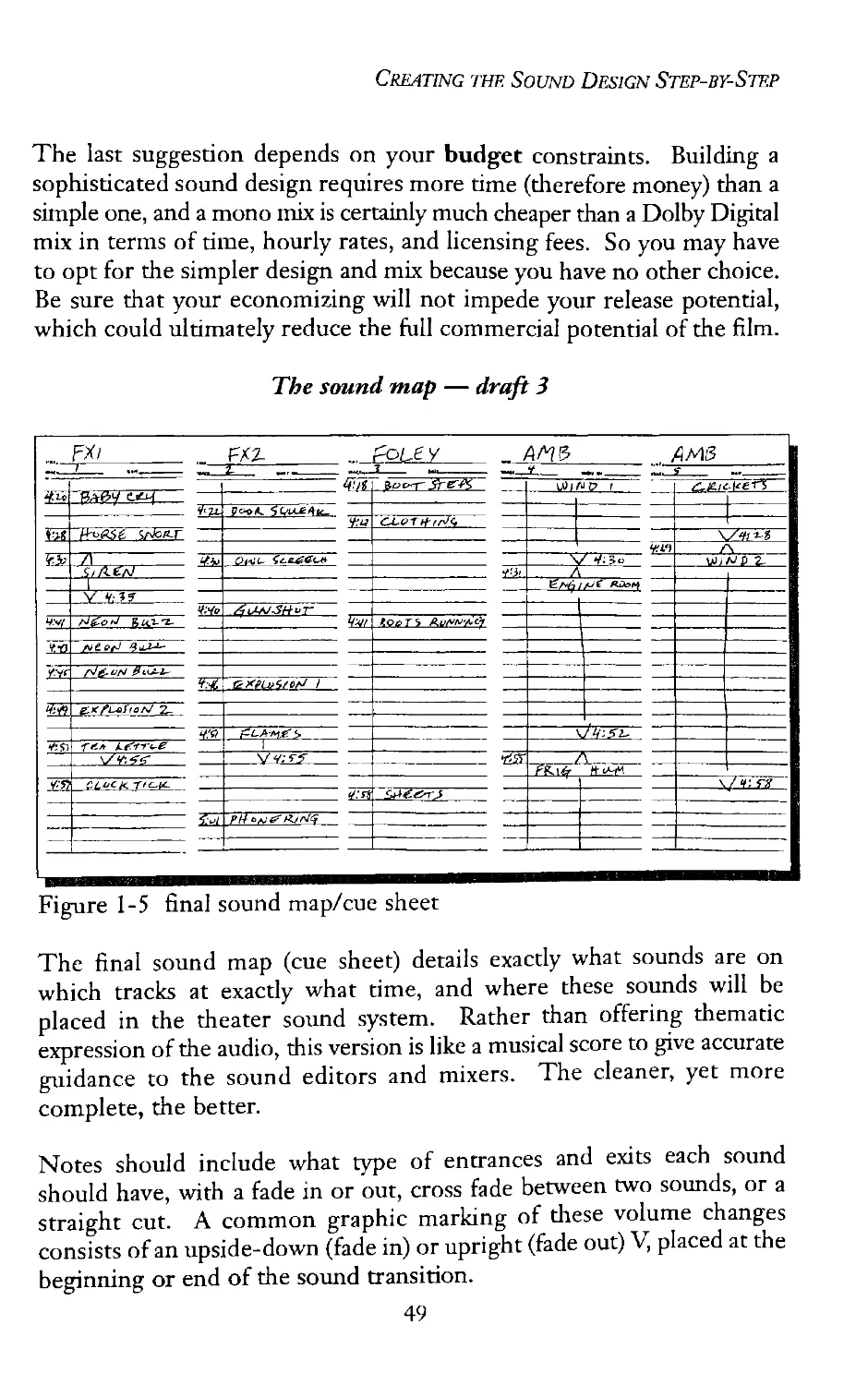


























































Text
                    The Expressive Power of Music,
Voice, and Sound Effects in Cinema
“I’m very impressed with the broad range of well-researched information and
David’s fascinating reflections about the emotional power of sound and music.
His ‘Try This’ sidebars are clever, stimulating exercises. The need for such a
book is great indeed, fulfilled in this obviously heartfelt project.”
— Gary Rydstrom
Academy Award-winning Sound Designer,
Terminator 2, Titantic, Jurassic Park,
Saving Private Ryan
“Beyond mere technical jargon, in accessible and eloquent language the author
opens creative gateways for dramatic storytelling through the potent and inventive
use of sound. Here is a book of enormous merit that should prove useful not only to
sound editors, but to all film artists and, indeed, anyone who cherishes a good movie.”
— Richard Walter
Chairman, UCLA Screenwriting Dept.,
Author, The Whole Picture: Strategies for
Screenwriting Success in the New Hollywood and
Screenwriting: The Art, Craft, and Business of
Film and Television Writing
“A comprehensive guide that any sound professional can’t live without. David’s
research is penetrating and thorough, with detailed analysis and straightforward
commentary on one of the least understood areas in filmmaking.”
— George Watters П
Supervising Sound Editor, Pearl Harbor,
The Hunt for Red October, The Rock,
Naked Gun 2
“The scope, seriousness, and depth of this book give it a unique value.
Sonnenschein has articulately assembled a great deal of thought and information
about the deeper aspects of the sound design craft.”
— Dane Davis
Academy Award-winning Sound Designer, The
Matrix, Boogie Nights, The Hand that Rocks
the Cradle
BARNSLEY COLLEGE
IlilliHIIO
00121225
t
MICHAEL WIESE PRODUCTIONS
www.mwp.com
Since 1981, Michael Wiese Productions has been dedicated to providing
novice and seasoned filmmakers with vital information on all aspects
of filmmaking and videomaking. We have published more than 50
books, used in over 500 film schools worldwide.
Our authors are successful industry professionals — they believe that
the more knowledge and experience they share with others, the more
high-quality films will be made. That’s why they spend countless
hours writing about the hard stuff: budgeting, financing, directing,
marketing, and distribution. Many of our authors, including myself,
are often invited to conduct filmmaking seminars around the world.
We truly hope that our publications, seminars, and consulting services
will empower you to create enduring films that will last for generations
to come.
We’re here to help. Let us hear from you.
Sincerely,
Michael Wiese
Publisher, Filmmaker
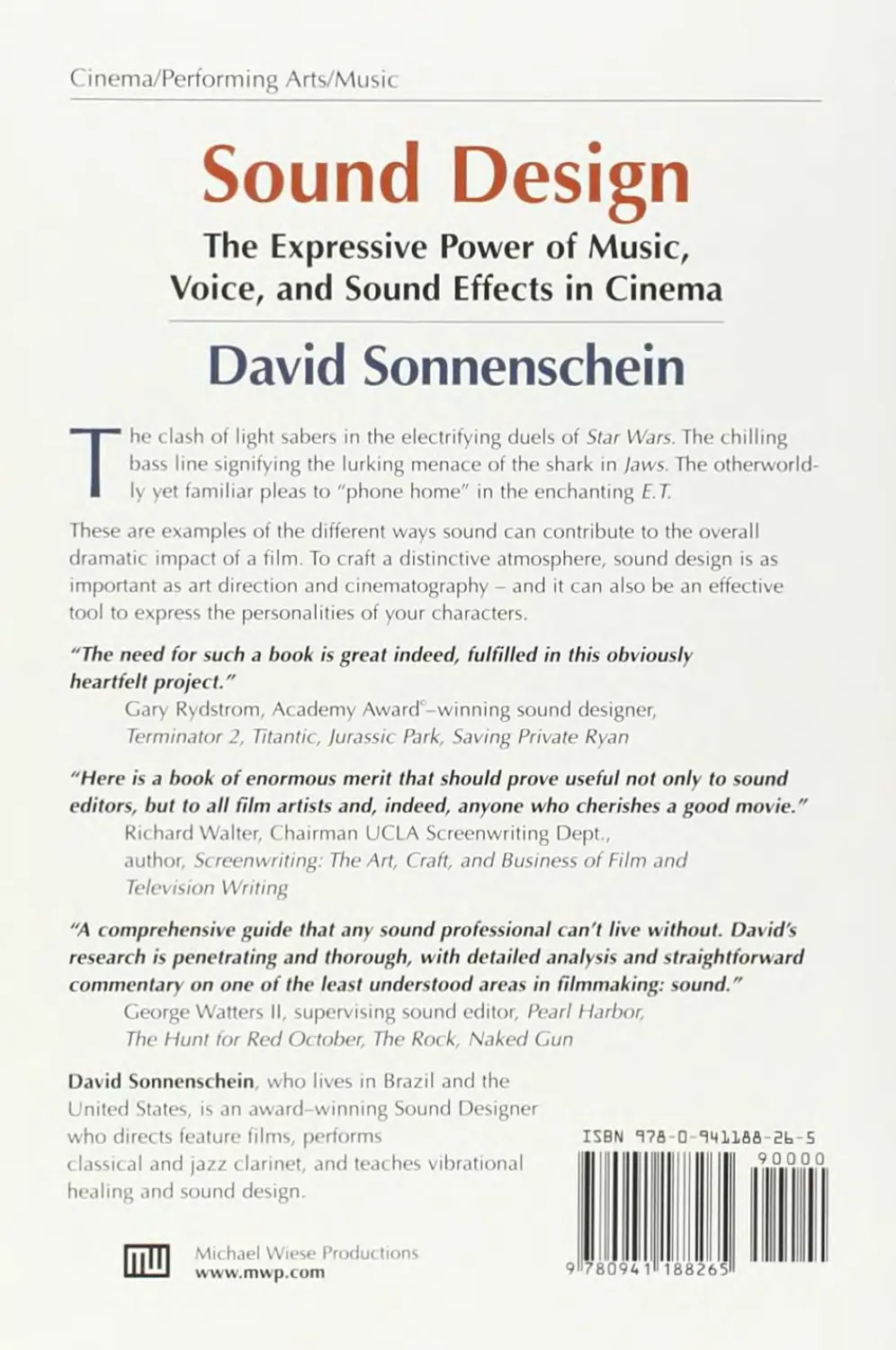
SOUND
DESIGN
The Expressive Power of Music, Voice,
and Sound Effects in Cinema
by
David Sonnenschein
SOUND DESIGN / Sonnenschein
Published by Michael Wiese Productions
11288 Ventura Blvd., Suite 621
Studio City, CA 91604
tel. (818) 379-8799
fax (818) 986-3408
miv@mivp.com
iviviv.mivp.com
Cover Design: Alexander Arkadin
Book Layout: Gina Mansfield
Printed by McNaughton & Gunn, Inc., Saline, Michigan
Manufactured in the United States of America
©2001 David Sonnenschein
All rights reserved. No part of this book may be reproduced in any form or by
any means without permission in writing from the publisher, except for the
inclusion of brief quotations in a review.
ISBN 0-941188-26-4
Library of Congress Cataloging-in-Publication Data
Sonnenschein, David
Sound design: the expressive power of music, voice, and sound effects
in cinema/ by David Sonnenschein.
p. cm.
Includes bibliographical references.
ISBN 0-941188-26-4
1. Sound motion pictures. 2. Sound—Recording and reproducing.
3. Motion pictures—Sound effects. I. Title.
TR897 .S66 2001
778.5’344—dc21	2001035804
CIP
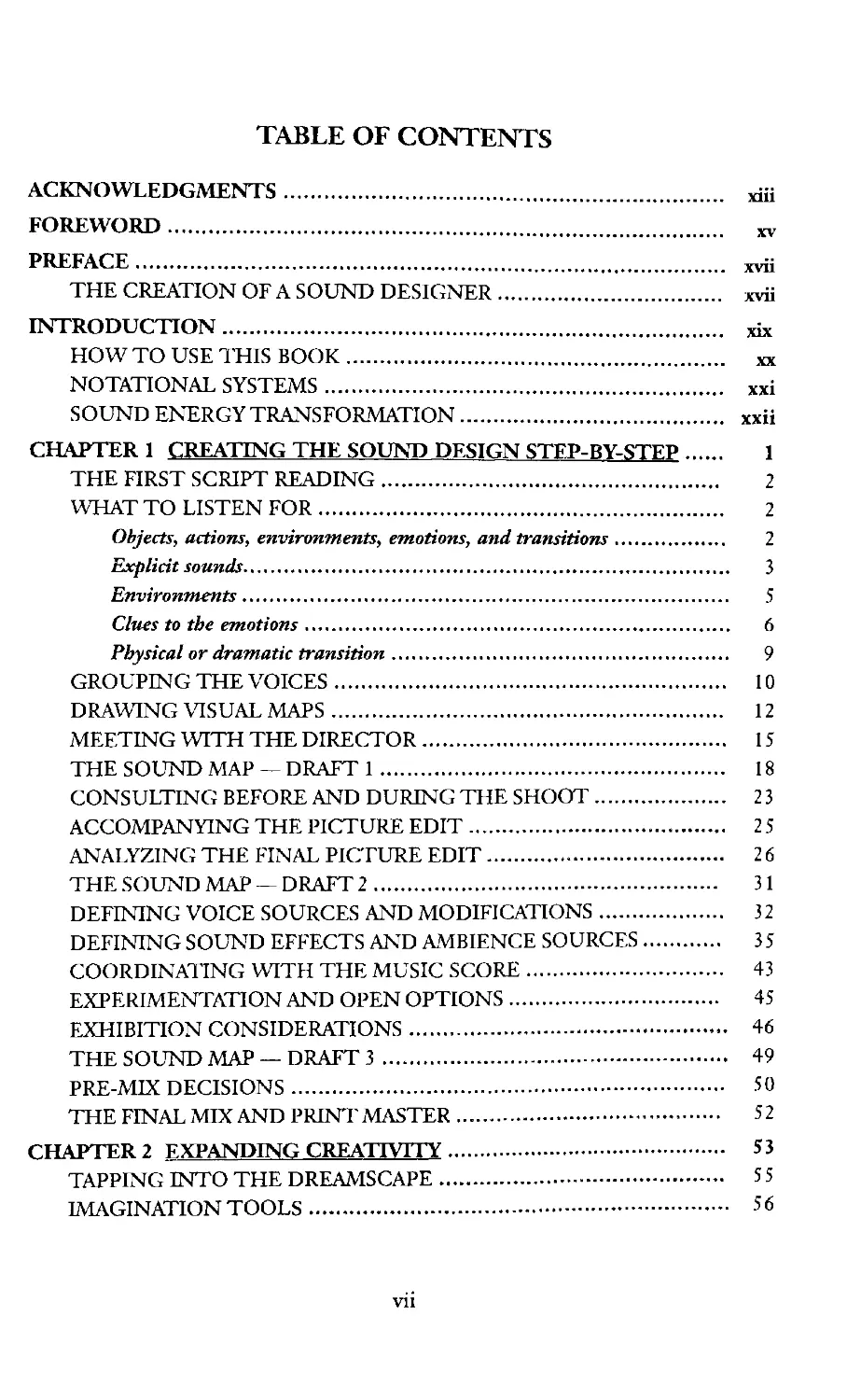
TABLE OF CONTENTS
ACKNOWLEDGMENTS............................................................... xiii
FOREWORD........................................................................ xv
PREFACE....................................................................... xvii
THE CREATION OF A SOUND DESIGNER........................................... xvii
INTRODUCTION................................................................... xix
HOW TO USE THIS BOOK......................................................... XX
NOTATIONAL SYSTEMS.......................................................... xxi
SOUND ENERGY TRANSFORMATION................................................ xxii
CHAPTER 1 CREATING THE SOUND DESIGN STEP-BY-STEP...	1
THE FIRST SCRIPT READING...................................................... 2
WHAT TO LISTEN FOR............................................................ 2
Objects, actions, environments, emotions, and transitions .................	2
Explicit sounds............................................................ 3
Environments............................................................... 5
Clues to the emotions...................................................... 6
Physical or dramatic transition............................................ 9
GROUPING THE VOICES.......................................................... 10
DRAWING VISUAL MAPS.......................................................... 12
MEETING WITH THE DIRECTOR.................................................... 15
THE SOUND MAP - DRAFT 1...................................................... 18
CONSULTING BEFORE AND DURING THE SHOOT....................................... 23
ACCOMPANYING THE PICTURE EDIT.................................................. 2	5
ANALYZING THE FINAL PICTURE EDIT............................................. 26
THE SOUND MAP — DRAFT 2...................................................... 31
DEFINING VOICE SOURCES AND MODIFICATIONS..................................... 32
DEFINING SOUND EFFECTS AND AMBIENCE SOURCES.....	35
COORDINATING WITH THE MUSIC SCORE............................................ 43
EXPERIMENTATION AND OPEN OPTIONS............................................. 45
EXHIBITION CONSIDERATIONS.................................................... 46
THE SOUND MAP — DRAFT 3...................................................... 49
PRE-MIX DECISIONS............................................................ 50
THE FINAL MIX AND PRINT MASTER............................................... 52
CHAPTER 2 EXPANDING CREATIVITY.................................................. S3
TAPPING INTO THE DREAMSCAPE.................................................. 55
IMAGINATION TOOLS............................................................ 56
vii
SOUND DESIGN / Sonnenschein
INVENTING ORIGINAL SOUNDS.................................................................... 57
Cartoon andfoley ........................................................................ 57
Musique concrete .......................................................................  58
Recording techniques..................................................................... 60
Sound shaping..........................................................................   60
Emotional impact......................................................................... 61
CHAPTER? FROM VIBRATION TO SENSATION.............................................................. 63
THE SOURCE.................................................................................   63
THE MEDIUM .................................................................................. 64
SOUND QUALITIES.............................................................................. 65
Rhythm................................................................................... 65
Intensity ...............................................................................	66
Pitch.................................................................................... 67
Timbre................................................................................... 67
Speed.................................................................................... 68
Shape.................................................................................... 68
Organization .........................................................................	70
PHYSICAL EFFECTS OF SOUND...................................................................  70
THE EAR...................................................................................... 72
Hearing development...............................................................	72
Outer ear (pinna/'ear canal)............................................................. 73
Middle ear (ear drum/ossicles)........................................................... 73
Inner ear (cochlea)...................................................................... 74
Sensitivity.............................................................................	74
Masking................................................................................ 75
CHAPTER 4 FROM SENSATION TO PERCEPTION............................................................ 77
LISTENING MODES.............................................................................. 77
Reduced.................................................................................. 77
Causal.................................................................................   78
Semantic................................................................................. 78
Referential.............................................................................. 78
Less is more............................................................................. 79
GESTALT PRINCIPLES AND ILLUSION............................................................   79
Figure and ground........................................................................ 80
Completeness, good continuation, and closure............................................. 81
Proximity and similarity................................................................. 81
Common fate and belongingness..........................................................   82
Illusion................................................................................. 83
viii
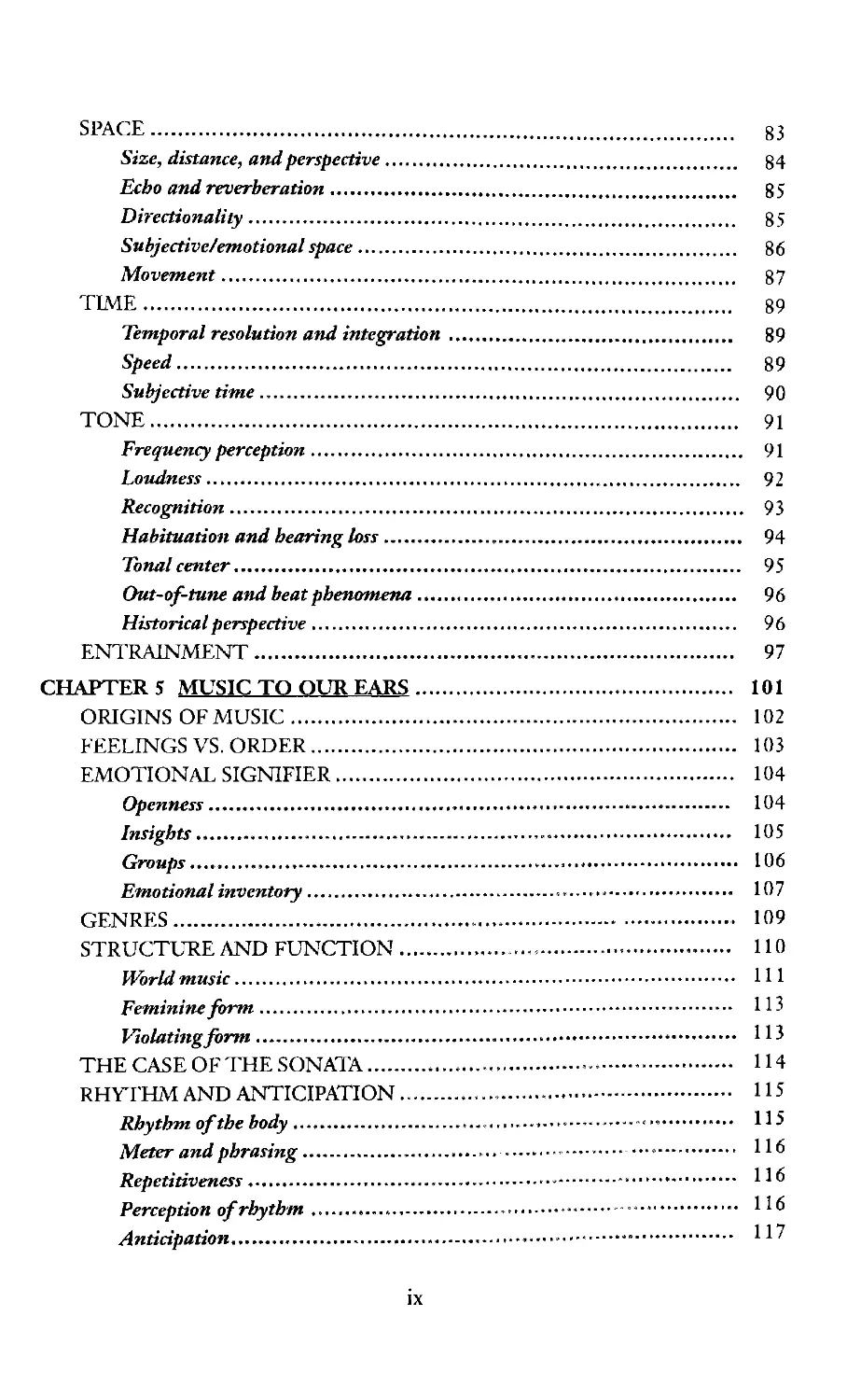
SPACE........................................................... 83
Size, distance, and perspective.............................. 84
Echo and reverberation....................................... 85
Directionality............................................... 85
Subjective/emotional space................................... 86
Movement..................................................... 87
TIME............................................................ 89
Temporal resolution and integration ......................... 89
Speed........................................................ 89
Subjective time.............................................. 90
TONE............................................................ 91
Frequency perception......................................... 91
Loudness..................................................... 92
Recognition.................................................. 93
Habituation and bearing loss...............................   94
Tonal center................................................. 95
Out-of-tune and beat phenomena............................... 96
Historical perspective....................................... 96
ENTRAINMENT...................................................   97
CHAPTERS MUSIC TO OUR EARS......................................... 101
ORIGINS OF MUSIC............................................... 102
FEELINGS VS. ORDER............................................. 103
EMOTIONAL SIGNIFIER............................................ 104
Openness.................................................... 104
Insights..................................................   105
Groups...................................................... 106
Emotional inventory ......................................   107
GENRES.......................................................    Ю9
STRUCTURE AND FUNCTION.....................................     110
World music.................................................. Hl
Feminine form................................................ H3
Violating form...........................................     43
THE CASE OF THE SONATA......................................     П4
RHYTHM AND ANTICIPATION........................................ H 5
Rhythm of the body   ...................................     115
Meter and phrasing.........................................  116
Repetitiveness .............................................
Perception of rhythm ................................. 116
Anticipation................................................  4?
IX
SOUND DESIGN / Sonnenschein
MELODY.......................................................... 119
HARMONY AND DISSONANCE........................................ 120
TONAL CENTER...............................................    123
SILENCE......................................................... 124
CONTRAST........................................................ 128
CHAPTER 6 THE HUMAN VOICE......................................... 131
THE VOCAL INSTRUMENT........................................   131
DEVELOPMENT OF SPEECH........................................... 132
SPEECH RECOGNITION AND VERBAL UNDERSTANDING..................... 134
MEANING VS. FEELING............................................. 13 7
PROSODY — VOCAL MELODY AND EMOTION............................ 138
MANTRAS, NONSENSE, AND BEYOND................................... 142
VOICE PERSONALITIES............................................. 144
ALIEN LANGUAGE.................................................. 146
CHAPTER? SOUND AND IMAGE........................................   151
EYES AND EARS................................................... 151
ON SCREEN, OFF SCREEN, AND OUTSIDE THE STORY WORLD... 152
On screen .................................................-. 153
Offscreen.................................................... 153
Nondiegetic.................................................. 154
MUSIC IN FILM................................................. 155
Emotional signifier ................................................................. 155
Continuity................................................... 155
Narrative cueing............................................. 155
Narrative unity.............................................. 155
Programmatic music......................................... 156
Anempathetic music ........................................ 156
DIALOGUE IN FILM.................................................... 156
Theatrical speech............................................ 156
Textual speech............................................... 157
Emanation speech............................................. 157
Elimination.................................................. 157
Ad libs and proliferation..............................     158
Multilingualism and foreign language......................... 158
Dialogue recording and postproduction........................ 159
SPATIAL DIMENSIONS.................................................. 159
3-D space ................................................... 160
Hi-fi vs. low-fi perspective .............................. 161
Size ........................................................162
x
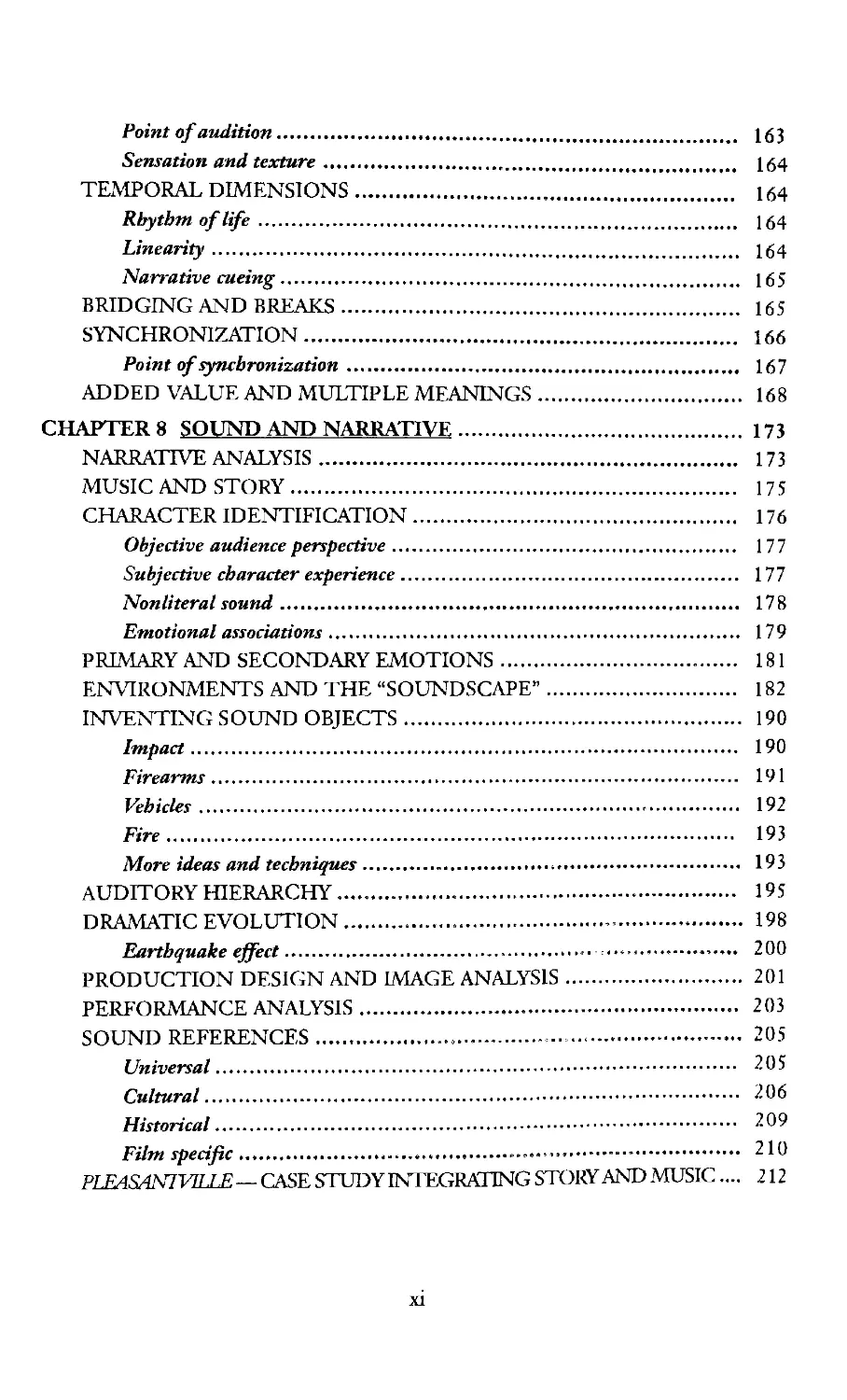
Point of audition......................................... 163
Sensation and texture..................................... 164
TEMPORAL DIMENSIONS.......................................... 164
Rhythm of life............................................ 164
Linearity................................................. 164
Narrative cueing.......................................... 165
BRIDGING AND BREAKS.......................................... 165
SYNCHRONIZATION.............................................. 166
Point of synchronization.................................. 167
ADDED VALUE AND MULTIPLE MEANINGS............................ 168
CHAPTERS SOUND AND NARRATIVE..................................... 173
NARRATIVE ANALYSIS........................................... 173
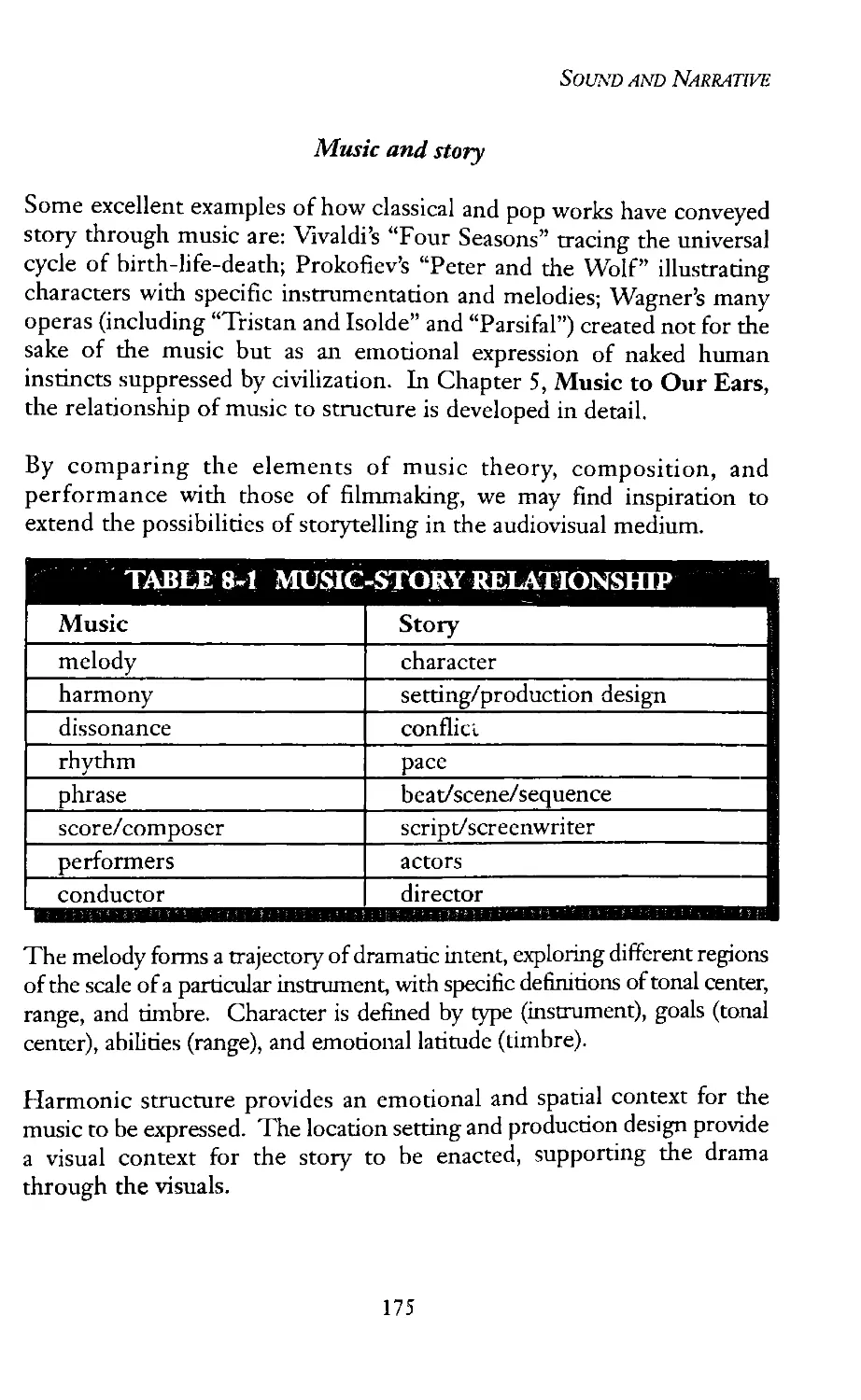
MUSIC AND STORY.............................................. 175
CHARACTER IDENTIFICATION..................................... 176
Objective audience perspective............................ 177
Subjective character experience ................................................... 177
Nonliteral sound.......................................... 178
Emotional associations.................................... 179
PRIMARY AND SECONDARY EMOTIONS.............................   181
ENVIRONMENTS AND THE “SOUNDSCAPE”............................ 182
INVENTING SOUND OBJECTS...................................... 190
Impact.................................................... 190
Firearms.................................................. 191
Vehicles................................................   192
Fire...................................................... 193
More ideas and techniques ................................ 193
AUDITORY HIERARCHY.........................................   195
DRAMATIC EVOLUTION.....................................       198
Earthquake effect......................................    200
PRODUCTION DESIGN AND IMAGE ANALYSIS......................... 201
PERFORMANCE ANALYSIS.......................................   203
SOUND REFERENCES.......................................       205
Universal................................................. 205
Cultural.................................................. 206
Historical................................................ 209
Film specific ........................................     210
PLEASAN1VILLE—CASE STUDYINTEGRATING STORYAND MUSIC.... 212
xi
CHAPTER 9 THE FUTURE OF SOUND DESIGN............. 215
A WORD ON SOUND POLITICS — WHEN CAN WE START?.. 215
INTERNET AND INTERACTIVE MEDIA................ 217
APPENDIX......................................... 219
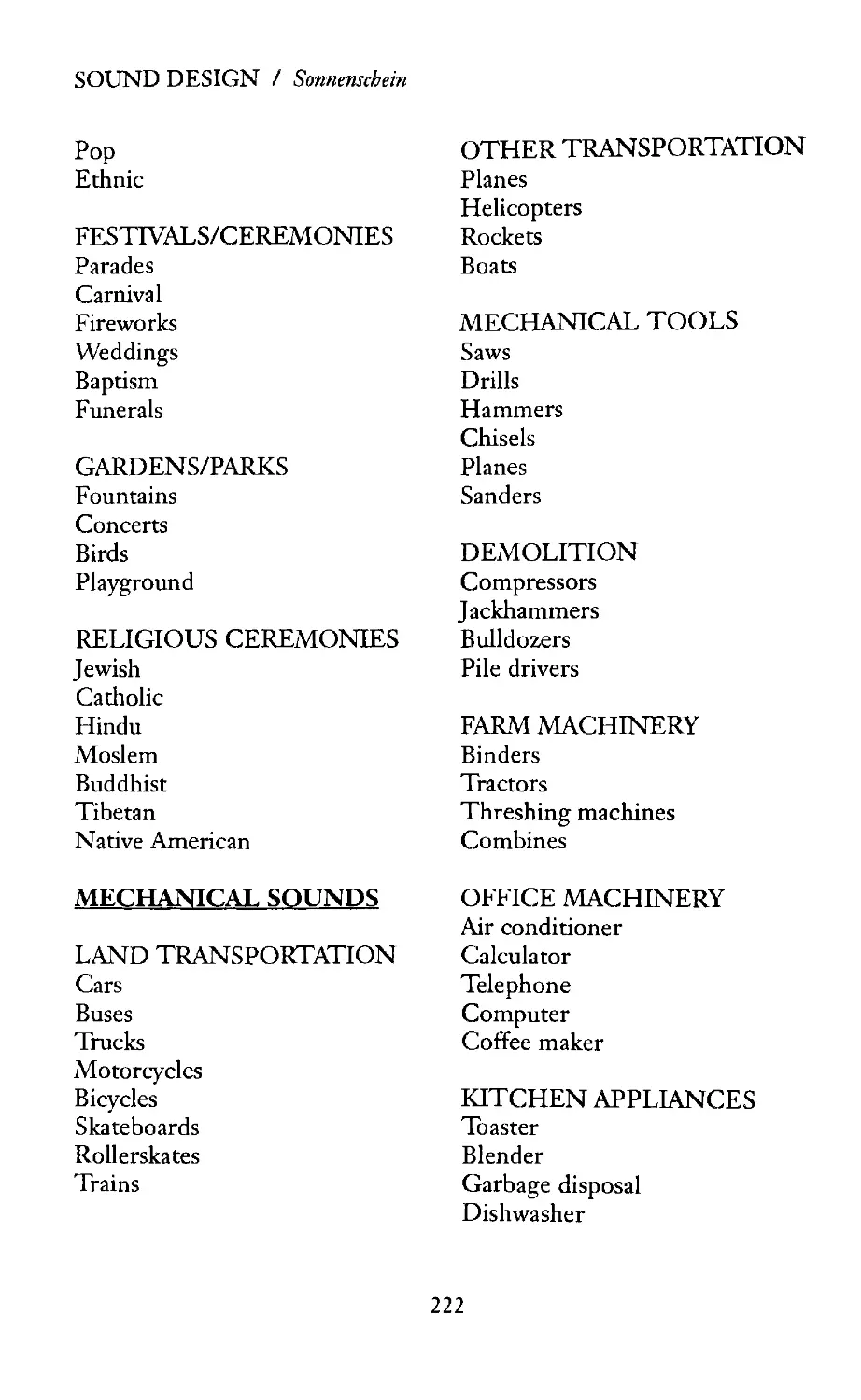
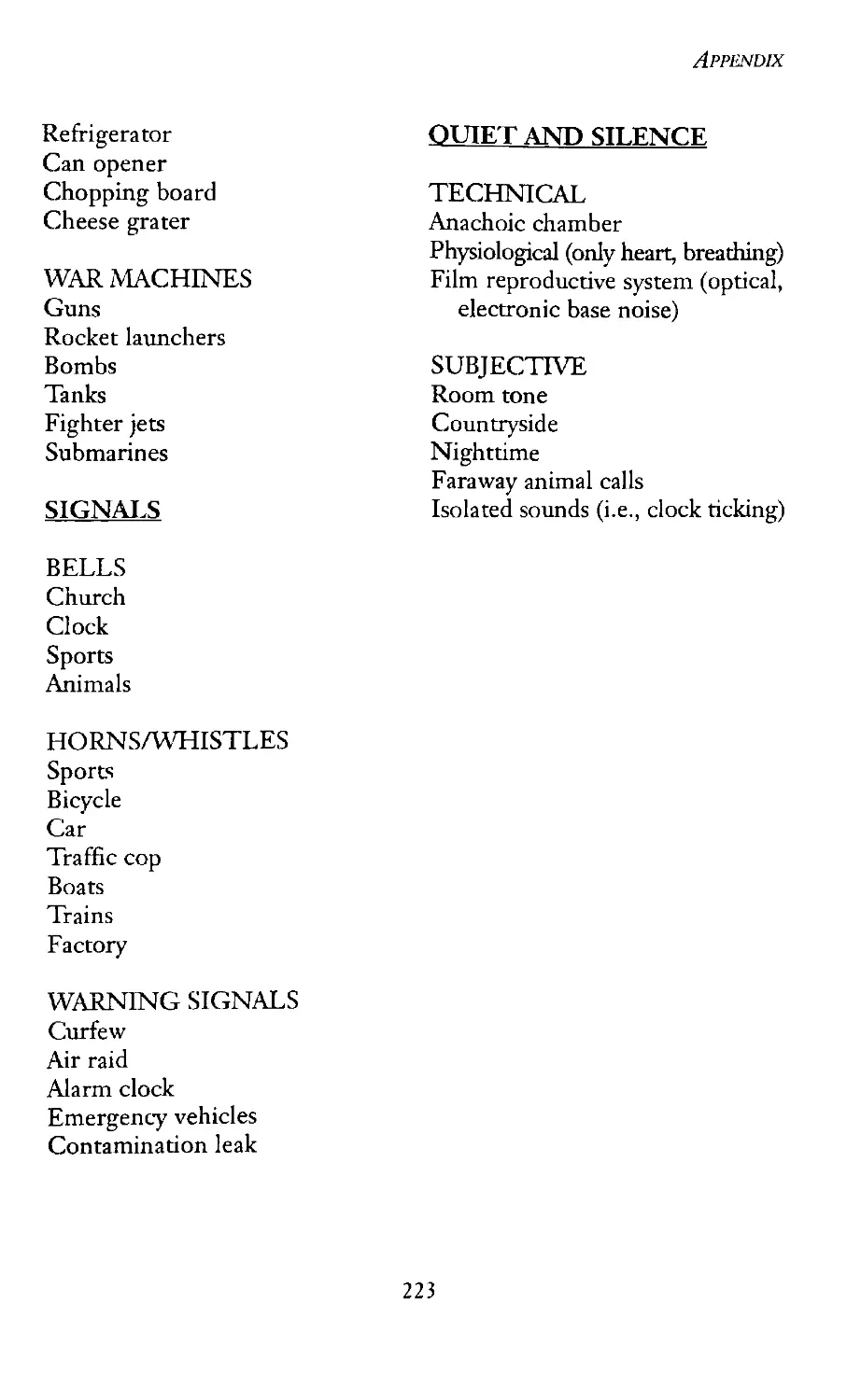
CLASSIFICATION OF SOUNDS....................... 219
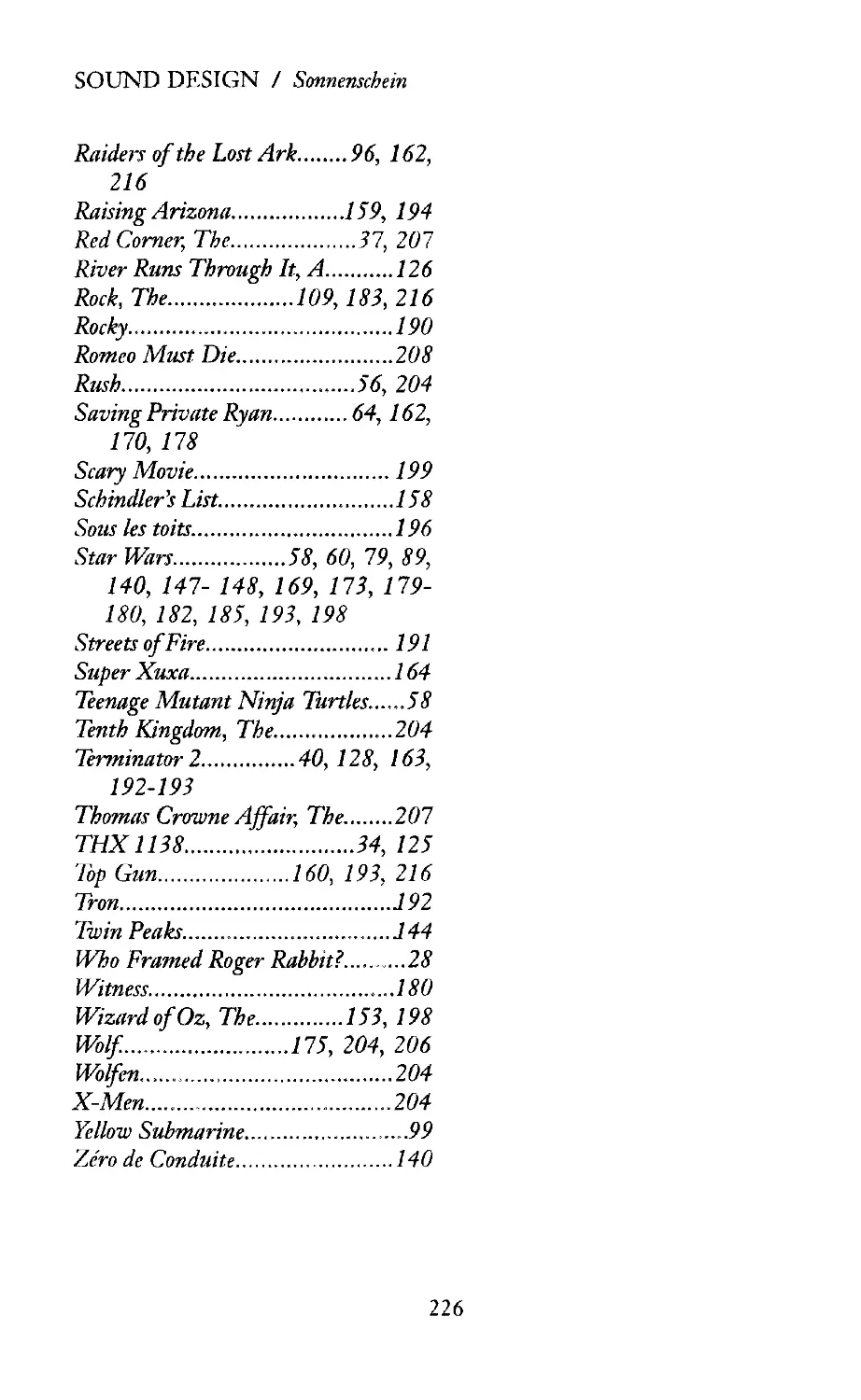
FILMOGRAPHY...................................... 225
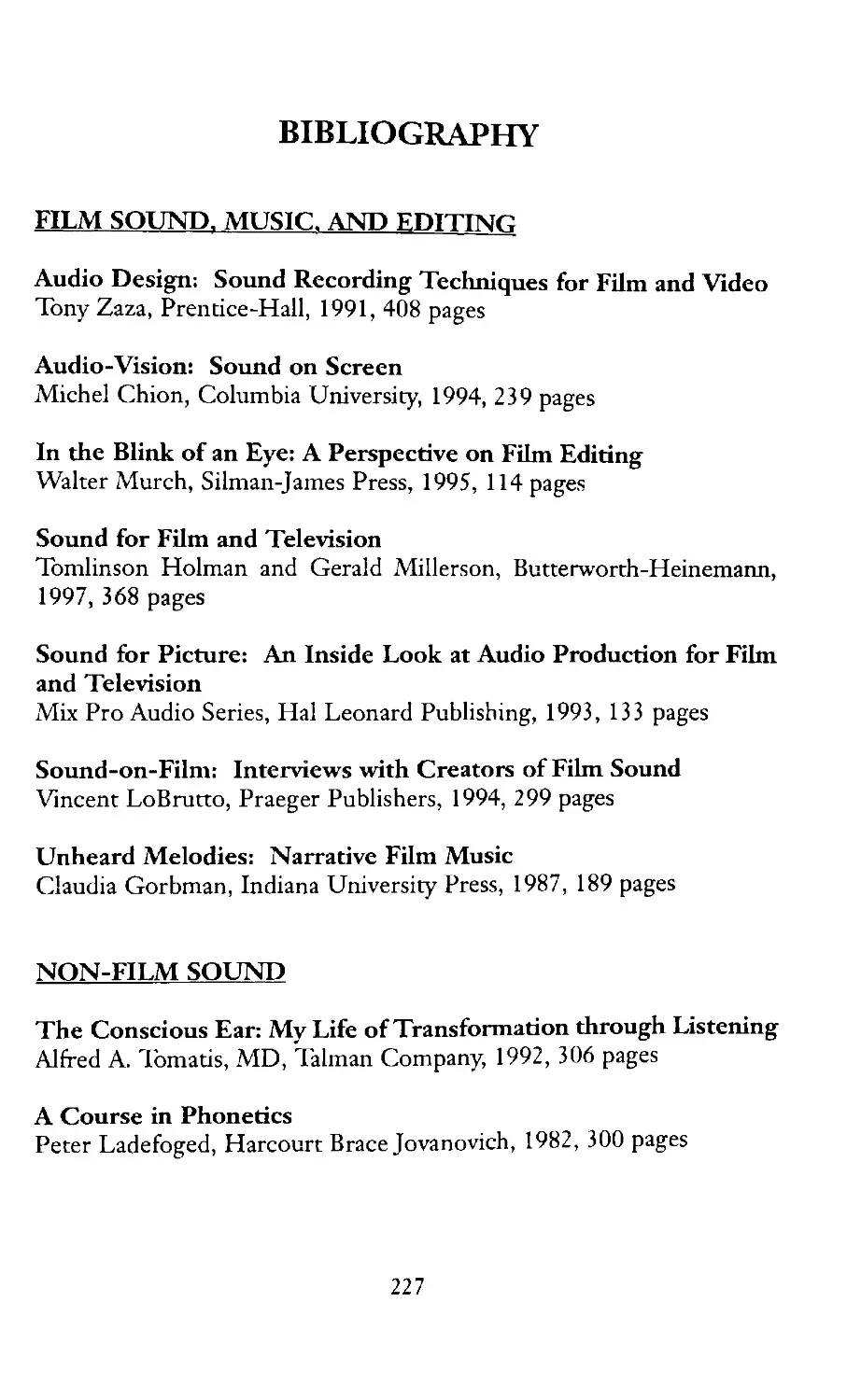
BIBLIOGRAPHY..................................... 227
INDEX........................................     233
DAVID SONNENSCHEIN............................... 245
xii
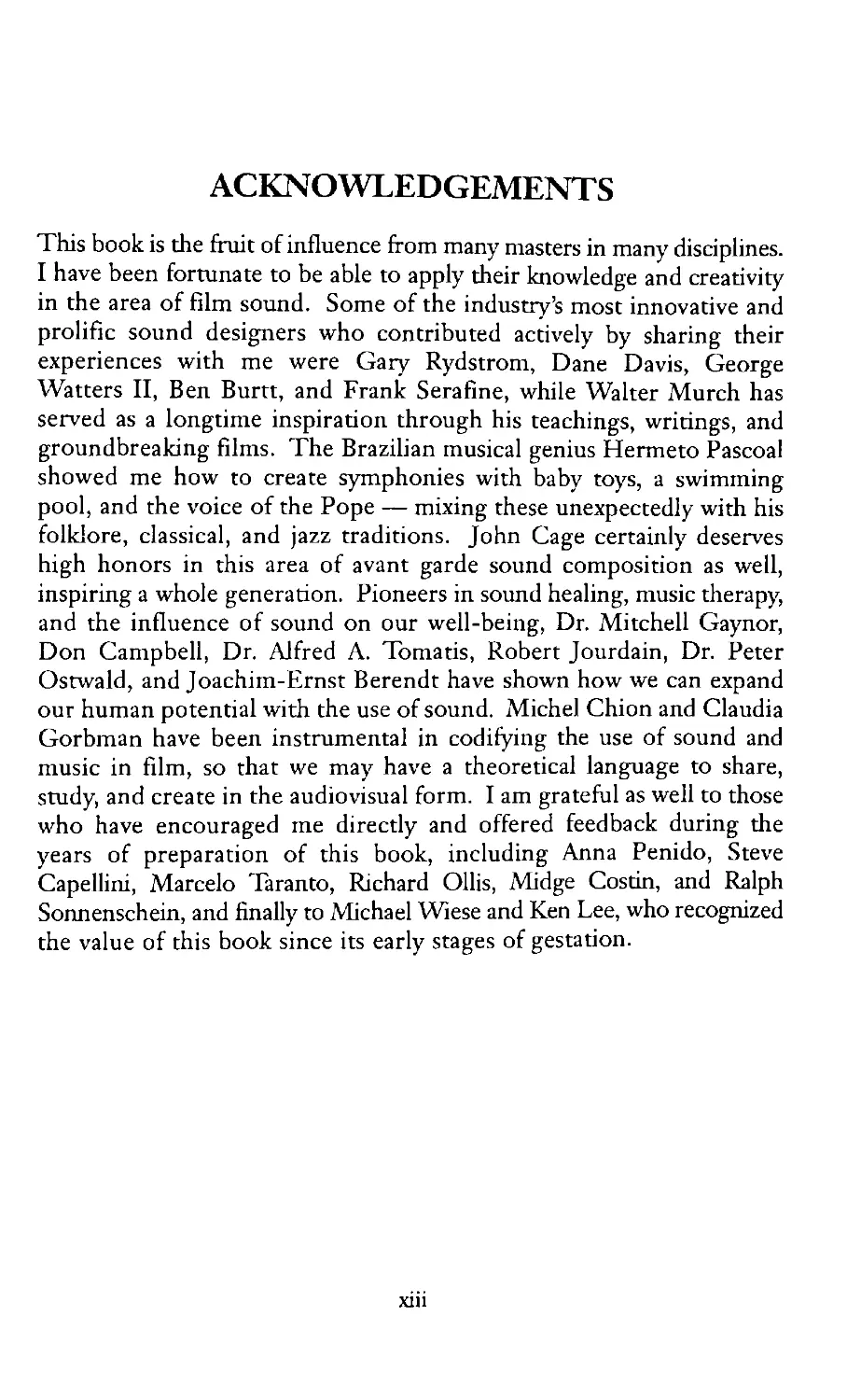
ACKNOWLEDGEMENTS
This book is the fruit of influence from many masters in many disciplines.
I have been fortunate to be able to apply their knowledge and creativity
in the area of film sound. Some of the industry’s most innovative and
prolific sound designers who contributed actively by sharing their
experiences with me were Gary Rydstrom, Dane Davis, George
Watters II, Ben Burtt, and Frank Serafine, while Walter Murch has
served as a longtime inspiration through his teachings, writings, and
groundbreaking films. The Brazilian musical genius Hermeto Pascoal
showed me how to create symphonies with baby toys, a swimming
pool, and the voice of the Pope — mixing these unexpectedly with his
folklore, classical, and jazz traditions. John Cage certainly deserves
high honors in this area of avant garde sound composition as well,
inspiring a whole generation. Pioneers in sound healing, music therapy,
and the influence of sound on our well-being, Dr. Mitchell Gaynor,
Don Campbell, Dr. Alfred A. Tomatis, Robert Jourdain, Dr. Peter
Ostwald, and Joachim-Ernst Berendt have shown how we can expand
our human potential with the use of sound. Michel Chion and Claudia
Gorbman have been instrumental in codifying the use of sound and
music in film, so that we may have a theoretical language to share,
study, and create in the audiovisual form. I am grateful as well to those
who have encouraged me directly and offered feedback during the
years of preparation of this book, including Anna Penido, Steve
Capellini, Marcelo Taranto, Richard Ollis, Midge Costin, and Ralph
Sonnenschein, and finally to Michael Wiese and Ken Lee, who recognized
the value of this book since its early stages of gestation.
xiii
FOREWORD
I first knew of David Sonnenschein when we were both graduate stu-
dents at USC School of Cinema-Television and his thesis film won the
MPSE (Motion Picture Sound Editors) Golden Reel Award for Best
Sound. It was almost twenty years later that we crossed paths and I
found myself having an enlightening and spirited discussion about the
creative potential of sound in visual media. In the intervening years,
David had developed a career as writer, producer, and director of films,
and I had become a sound editor in Hollywood (Crimson Tide, The Rock,
Armageddon) and head of the sound department at USC. I am thrilled
that David has written down his wonderfully creative practices and eclectic
theories on sound. Both the serious student and professionals alike can
benefit from David’s personal experience as musician and filmmaker, as
well as his extensive research in the areas of psychoacoustics, the human
voice, and Gestalt psychology.
As a feature film sound editor I have had the good fortune of working
on one of the best sound editing crews in Hollywood. However, my
frustration grew as I became painfully aware of how infrequently sound
is used to its full creative potential. When USC approached me to
teach, I jumped at the chance. Here was an opportunity to teach future
directors, producers, writers, etc., how to use sound well. At the School
of Cinema-Television we provide cutting-edge technology and facilities
for the students and set them on the course of “learning by doing.”
Anyone can pick up a piece of equipment or a manual to learn “how to.”
So the most important resource is in fact the faculty with their experience
in the field and their ability to tap into the students’ creative skills.
Many of the best sound designers in film today are graduates of USC:
Walter Murch, Ben Burtt, Gary Rydstrom, to mention a few. They
attribute their success to being encouraged to explore, experiment, and
create by the then faculty head, Ken Miura.
Students come to me all the time with a script or copy of their film in
hand, asking how to begin thinking about sound. This is where David’s
book comes into play. It leads the reader down the path of creativity
xv
SOUND DESIGN / Sonnenschein
and experimentation with sound in a way no other text has done before.
To me, it’s a cross between Michael Chion’s work and The Artists Way
for sound. Sound Design really leads the reader into the exploration of
sound in a narrative approach, giving a way to create a soundtrack
which is specifically designed for his or her film.
David’s step-by-step methods of creating a sound design are somewhat
outside the norm for the film industry, but that’s what makes them so
fresh and creative. One of the parts I found most enjoyable and enlightening
were the interviews of sound designers I know and respect. I discovered I
had marked the pages for most of those interviews so I could pass the
information on to my students. So dive in and start creating and designing!
Midge Costin, MPSE
Associate Professor/Head of the Sound Department
USC School of Cinema-Television
xvi
PREFACE
The creation of a sound designer
What attracts someone to become a sound designer? Musicians fascinated
by the potential of playing with images... cartoon “whiz-bangs” affecting
a tender young mind... a solitary techie finding a creative outlet.... The
routes are many, and each brings its own fertile seeds of expression.
My story may shed some light on how different experiences meld into
a synergy toward sound design. I began studying clarinet at eight,
performing in symphony orchestras and chamber groups, then took
up the flute with the conscious choice not to read music, but to jam,
developing my ear’s sensitivity and spontaneity.
As a neurobiology undergraduate at UC San Diego, my interests in
physiology, psychology, and dreams were united by research in a sleep
laboratory. Fascinated by the mind-body interface, I published several
studies relating brainwaves to mental states and biorhythms, and
developed insight into the physiological and perceptual processes that
serve as foundations for the creation of sound design.
My musical exploration continued when I lived in Indonesia and
Thailand, listening to, collecting, and playing local instruments made of
bamboo, palm fronds, and gourds. Returning to the U.S. to direct
“Little Red Riding Hood: A Balinese-Oregon Adaptation,” I mirrored
the form of the Balinese mask dance, playing bamboo instruments with
the clarinet and flute, and composing a nonverbal soundtrack by assign-
ing to each character a theme and instrument in the style of Prokofiev’s
“Peter and the Wolf.”
In the M.F.A. program at USC Cinema School I found a healthy atmos-
phere to continue exploring sound design, inspired by guest lecturers
like master sound designer Walter Murch. My thesis film The Owl’s
Flight utilized sounds of Pre-Columbian ceramic instruments, animal
calls, Tijuana marketplace atmosphere, and a variety of fire effects to
construct the right mood for a story about a Mexican Indian shaman and
xvii
SOUND DESIGN / Sonnenschein
the battle over his sacred healing mask, which garnered an award from
the Motion Picture Sound Editors (MPSE).
Relocating to Rio de Janeiro, I directed the feature Super Xuxa, a Wizard
of Oz-like fantasy starring Xuxa Meneghel, the popular kids’ TV show
host and singer. This gave me the opportunity to introduce a sound
design concept to an industry which in the past has not paid much attention
to audio quality, collaborating with Brazilian producers and directors to
develop their soundtracks while administering workshops throughout
Brazil and Cuba. Finding a gap in the literature regarding the narrative
use of the soundtrack, and recognizing that my sound design methodology
is quite unique, spurred me to write this book.
With digital technology upon us, I am also exploring the expanding
possibilities of sound design for interactive media and have formed
Sonic Strategies — a company dedicated to education, consultation, and
development in this growing arena. The concepts presented within this
book are fundamental to all audiovisual work, and so are beneficial to
New Media developers, as well as filmmakers. As you read, I hope you
become as inspired as I have.
xviii
INTRODUCTION
Giving meaning to noise, sound becomes communication. Humans
have used sound for eons to alert one another, organize activities,
exchange messages, entertain, love, and battle. Through sound we can
trace the evolution of religion, music, language, weaponry, medicine,
architecture, and psychology, not to mention cinema.
The ancients attributed acoustic phenomena to divine origins as a sort
of powerful and indestructible substance animating everything that
moves. For them the thud of a spear piercing an animal contained a
death-dealing power, and the roar of a waterfall caused the earth to
tremble. Egyptian generals excited their men with trumpet calls and
drumbeats to improve their morale and stimulate greed for combat.
During the Renaissance, sounds were devised to deceive authorities with
hidden meanings inside chromatic intervals, a secret communication of
contraband ideas and religious controversy.
Storytelling has used sound to invoke myth, suspend reality, and create
emotion since the times of fire circles in protective caves. Sound
designers in the 21st century have the same job — to combine sight and
sound for enrapturing their audiences. Both the shaman of old and the
sound designer of today must develop their perceptive ability, meaning
the two sides of creative intelligence: impression and expression.
Vocal reproduction of either sound effects (compare a shovel digging
into sand, gravel, clay, then snow) or human voices (impersonating
friends or famous people) can enhance our ability to hear what is
happening and know that it is indeed registering in the brain.
The true sound designer must be immersed in the story, characters,
emotions, environments, and genre of the film. With their contribu-
tion the audience will be led down the path in an integrated, yet most
often subconscious manner toward an experience that is authentic and
human, a metaphor for the life experience itself. Using all the tools of
music, psychology, acoustics, and drama, the art of orchestration comes
into play, selecting the right sound for the right moment. The sound
xix
SOUND DESIGN / Sonnenschein
designer performs a balancing act between making the best aesthetic
choices and the technical parameters of completing the film on time, in
budget, and with the tools and personnel at hand.
But for all the rules offered in this book or anywhere else, storytelling
should always come first. Yes, learn the basics, then you can know when
to break the rules. Mistakes can also become the genius of error, so have
no hesitation about trying things out. If it works, use it! Rather than
consistently following a formula, experimentation within form is a way
that art, energy, and drama can be created. It may seem like an exalted
goal, but the path from sound “janitor” to sound designer can evolve
from being a “techie,” to an “artiste,” and finally a storyteller.
How to use this book
This book pulls together theory and background on sound generation,
psychoacoustics, music, voice, image, and narrative. The sources are
wide and sometimes very technical or esoteric, but the purpose of this
text is to be user-friendly and practical. If you want to get more in-depth,
many resources are listed in the Appendix, and can offer you remarkable
journeys in themselves.
Screen the film examples fisted if you can, as there are usually many more
incredible moments of sound than have been cited here. Even if you’ve
seen them before, it is likely that you didn’t focus all your attention on
the sound elements. The creativity of each of those sound designers can
inspire your own ideas, so don’t be shy about saturating yourself with the
inspiration of your peers.
When I say TRY THIS, go for it! The root of all your creativity is in
having experience and sharing it. Get all that theory, file it where it
belongs; then get into doing the act of listening and making sounds.
The incubation period is necessary as you study and receive explanation
of purpose to all the structure. Then first-hand observation of the real
world is invaluable, learning to separate and distinguish elements, and you
will be able to more keenly recognize relationships both between sounds
and between environments. By sensing psychoacoustic phenomena
directly, you will be more prepared to manipulate the sonic elements
xx
Introduction
according to your personal world view of the real world of sound, not
just repeat what others have done inside films. You will discover what
you like or dislike, and how open you are to new experiences which you
can then share with the audience. You’ll also find where your personal
strengths lie (physical, psychological, creative, technical) and what you
might want to develop further to become a master sound designer.
Go listen, record, and make sounds where no one has gone before. The
suggestions in this book are the tip of the iceberg, only the beginning of
where you might venture. Experiment, explore, and report back to the
audience with your creative voice.
With the audiovisual world moving into interactivity and the Internet,
this is also the perfect medium for us to create a forum of ideas with
sound design. I encourage you to be in contact with me directly with
any questions, discoveries, or fascinating insights which can then be
shared with all through a Web site that will be developed. Keep in touch
through my email: dsonn@charter.net (if there are any changes in email,
please check with the publisher at vninv.mwp.com).
I’m looking forward to hearing from you. Have a fantastic journey.
Notational systems
The tools and language for the sound designer require notational systems
to be able to communicate to oneself and others while developing the
orchestration of the soundtrack. Some useful ones that are covered in
detail in this book include:
1)	Chronological — what activities and focus are needed to create
each stage of the sound design (see Chapter 1, Creating the Sound
Design Step-by-Step)
2)	Acoustic — the mechanical properties of sound as can be measured
(e.g., duration, frequency, intensity, rhythm, reverb, etc.) (see
Chapter 3, From Vibration to Sensation)
3)	Perceptual — how the human ear and brain absorb and interpret
sound (see Chapter 4, From Sensation to Perception)
4)	Musical — representation of any sounds that possess musical”
features (see Chapter 5, Music to Our Ears)
xxi
SOUND DESIGN / Sonnenschein
5)	Phonetic — human speech that gives meaning to vocal sounds (see
Chapter 6, The Human Voice)
6)	Audiovisual — film theory involving perception and the use of
sound with visual information (see Chapter 7, Sound and Image)
7)	Emotional — how a sound affects the interpretation of a character’s
emotional state, or the audience’s reaction (see Chapter 8, Sound
and Narrative)
8)	Descriptive — categorization of sound effects, objects, animals,
ambiences, etc. (see Appendix, Classification of sounds)
Sound energy transformation
Another perspective on how sound works is based on looking at the
relationship between the film, the theater, and the audience. In other
words, what sounds are coming from where, how are they transmitted,
and what effect do they have upon sensation and perception? (These
three sequential stages are uni-directional in the traditional movie theater,
but within the new interactive media there will be a bi-directional flow
blossoming more and more.)
Then we have the different parallel levels of what qualities the sound is
transmitting to the audience:
1)	Physical — the mechanical, electronic, technical aspects interacting
with our bodily, biological functions
2)	Emotional — story, emotional identification with the characters
and their goals, creating empathetic reactions (like laughing or crying)
3)	Intellectual — structural, aesthetic considerations that are most
often conveyed verbally in the context of human interaction
4)	Moral — ethical or spiritual perspectives and dilemmas, alerting us
to possible choices beyond our own personal fulfillment or survival
These all provide parameters to help define the function of the sound
design in telling the story of the film. As characters and the audience are
transformed, so is the sound. In this relationship, there exists a kind of
resonance that makes the film work on many levels. This book explores
all these levels throughout each chapter.
xxii
Introduction
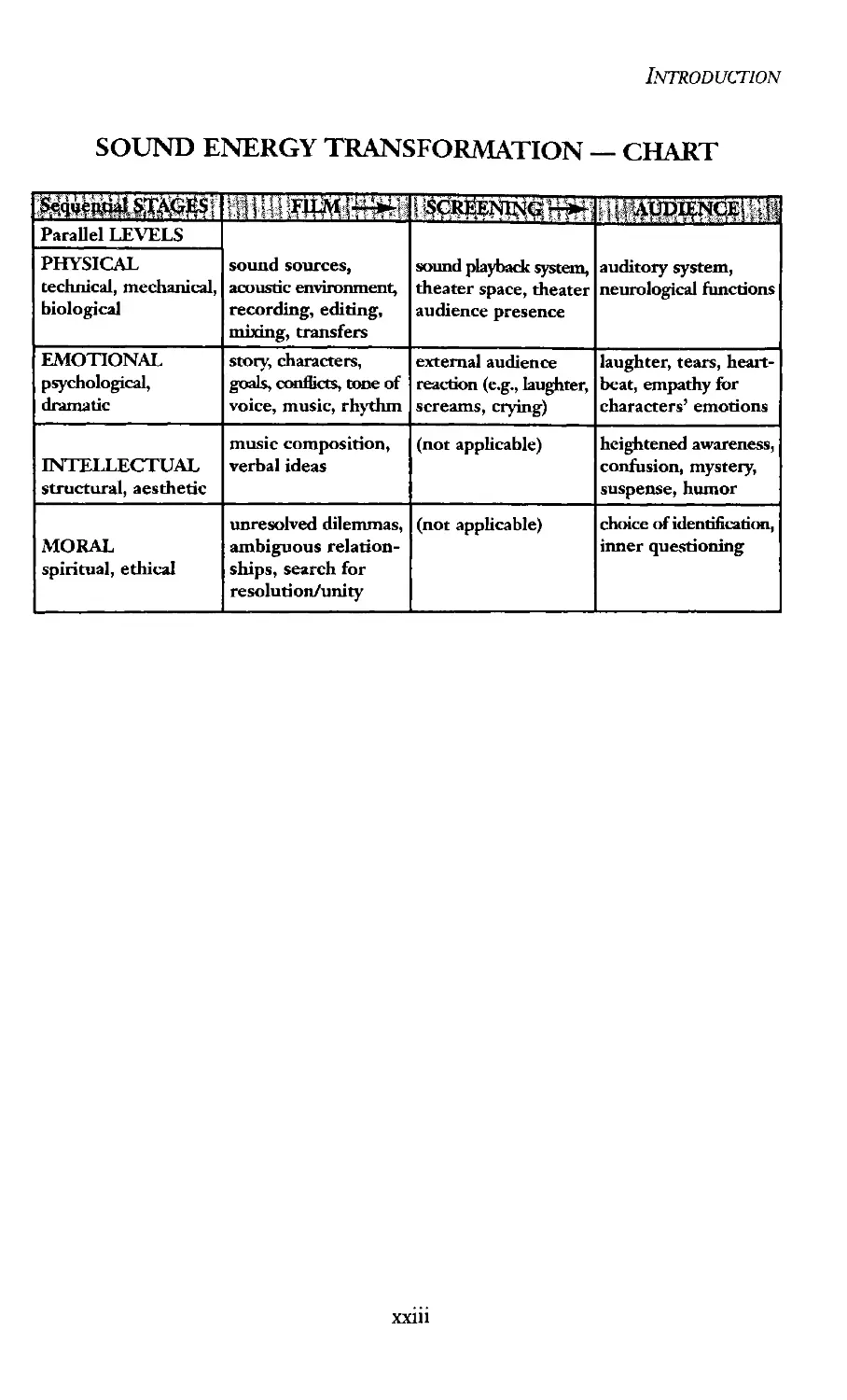
SOUND ENERGY TRANSFORMATION — CHART

Parallel LEVELS
PHYSICAL technical, mechanical, biological	sound sources, acoustic environment, recording, editing, mixing, transfers	sound playback system, theater space, theater audience presence	auditory system, neurological functions
EMOTIONAL psychological, dramatic	story, characters, goals, conflicts, tone of voice, music, rhythm	external audience reaction (e.g., laughter, screams, crying)	laughter, tears, heart- beat, empathy for characters’ emotions
INTELLECTUAL structural, aesthetic	music composition, verbal ideas	(not applicable)	heightened awareness, confusion, mystery, suspense, humor
MORAL spiritual, ethical	unresolved dilemmas, ambiguous relation- ships, search for resolution/unity	(not applicable)	choice of identification, inner questioning
xxiii
CHAPTER 1
CREATING THE SOUND DESIGN STEP-BY-STEP
With an eye and ear on practical applications, this chapter starts right
off with the nuts and bolts of developing the soundtrack from script to
final mix. These are the stages:
•	The first script reading
•	What to listen for— objects, actions, environments, emotions, transitions
•	Grouping the voices
•	Drawing visual maps
•	Meeting with the director
•	The sound map — draft 1
•	Consulting before and during the shoot
•	Accompanying the picture edit
•	Analyzing the final picture edit
•	The sound map — draft 2
•	Defining voice sources and modifications
•	Defining sound effects and ambience sources
•	Coordinating with the music score
•	Experimentation and open options
•	Exhibition considerations
•	The sound map — draft 3
•	Pre-mix decisions
•	The final mix and print master
The order of steps in the design of the soundtrack proposed here is a
likely scenario that allows your greatest participation in the creative
process, but you may not always have control of the scheduling. Each
production will have its own circumstances: the moment when you are
contracted, with whom you will be meeting, what elements you will
have at hand or what really works for your personal style, as well as
that of your principal collaborators — the director, sound editor, and
music composer.
Remember that none of these techniques, nor the order in which they may
be applied, are absolutes. Each person will have strengths in perception
1
SOUND DESIGN / Sonnenschein
and imagination (i.e., perceiving without an outside stimulus) that may
emphasize the verbal, visual, aural, logical, emotional, or kinesthetic
capacities of brain processing. So the techniques and exercises suggested
throughout this book should serve as guides for you to find and utilize
the most effective methods that tap into your own expanded awareness
and creativity.
The first script reading
The written script should be the first “listening” you will have of your
soundtrack. Even if the film has been shot, or edited, don’t let your
eagerness to jump into the visuals spoil this unique opportunity.
Regardless of the difference between the writer’s words and what has
been shot, read the script first. Your impressions of what will transmit
the story through sound will be virgin, and may very well draw more
upon your inner ear if the input is from the page rather than the filmed
image. Once you’ve seen the image, it is almost impossible to go back to
the more primary stage without being influenced by the impression that
the visual will have made.
When reading the script for the first time, you’ll get a lot more out of it
if you do this from beginning to end with no interruption, and at a pace
as close as possible to the final film pace (usually a minute per page). If
you can do this, you’ll get a more accurate feeling of the storytelling
pace and the rhythms inherent in the drama, and it will be your only
opportunity to get it like a first-time viewer. After this reading you’ll be
digging into individual elements, pulling things apart and putting them
back together while consciously searching for creative solutions. So close
the door, turn off the phone, and get into it for a few hours nonstop, as
if you were sitting in the movie theater. But leave the lights on and have
a pencil in hand. You will use the pencil like a conductor’s baton, nimbly
marking the script as your eyes dance down the lines.
What to listen for
Objects, actions, environments, emotions, and transitions
On the first reading you’ll be looking for key words and ideas that imme-
diately impress you. In subsequent readings, especially after meeting
2
Creating the Sound Design Step-by-Step
with the director and other creative colleagues, these same ideas and
more key words should be tracked down in much greater detail, while
you note the development and transformation of these sounds through-
out the story. Techniques for clarifying the developmental lines for the
sounds will be given below.
There are several different “voices” to listen for within the following
categories:
1)	sounds linked to people, objects, and actions on screen that are
explicitly described
2)	environments that can be fleshed out with sonic ambiance
3)	key words in both scene description and dialogue that give clues to
the emotions of the scene (both of the character and of the spectator)
4)	moments of physical or dramatic transition
When you notice these on the page, circle, use checkmarks or any other
rapid notation to mark the word or phrase. If you feel the urge to write
an observation, economize by using a word or two at most, just enough
to later cue the memory of your entire thought. You can invent a code
(e.g., “ew” for eerie 'wind), marking the repetition or development of a
certain sound or theme that carries throughout the film. But keep mov-
ing forward without losing the pace of the story, and don’t worry about
getting it all marked out on the first read-through.
Explicit sounds
Scriptwriting convention pays a certain homage to the power of audio
by requesting that each sound be capitalized in the body of the scene
description:
The oncoming truck's HORN BLASTS as the out-of-con-
trol car swerves violently, its WHEELS SCREECHING.
It makes for a bit more exciting reading — and a good writer can create a
visual rhythm on the page that can aid in establishing rhythm on the screen
— but the major purpose is to help the production manager identify,
schedule, and budget the production of these sounds. In fact, after the
3
SOUND DESIGN / Sonnenschein
sound designer has completed the script analysis and created the sound
map, the production manager will have a much more accurate document
for basing his budgeting.
The sound designer’s development of the audio track is more extensive
and subtle than the screenwriter’s, and for good reason. The page simply
should not and cannot hold the depth of information that will be on the
audio track, as similarly a script should not detail camera angles nor all
production design elements.
But within every character, object, and action on screen there can be
generated a potential sound that may give further dramatic impact to the
scene and story, and this sonic coloring is the challenge for you to reveal.
The little boy tiptoes along the spiky tops of the
rotten picket fence, trying in vain to ignore the
menacing bulldog chained just below him. As the
mad dog lunges against its restraints, the boy's
hands spastically flap to maintain balance, his
sneaker losing grip.
So here we see two characters, a protagonist and antagonist, the boy and
the dog. What kind of sounds would each be eliciting in this circumstance?
The boy would try to be as silent and invisible as possible, but he can’t
avoid breathing, which might very well be irregular, forced, and audible
due to his stress in holding everything else so controllably, especially
when he slips. It seems that the dog would be growling at the very least,
perhaps in a crescendo toward an aggressive bark.
The objects include a chain, which holds double intent in the scene.
The wild clinking forms part of the aural attack against the boy, but as
it clangs taut it serves as the only thing protecting him. (Notice how this
audio analysis could contribute to the storyboarding and blocking of the
action if done before the shoot.) The contact of the boy’s shoes with the
untrustworthy fence could surely generate nerve-racking, splintering
creaks, and the slip itself may be accentuated with the weakness of a
slippery rubber sole.
4
Creating the Sound Design Step-by-Step
Both characters and objects are linked to the action verbs, which create
an emotional context to the scene. Find motion, directionality, and
moments of impact. Sound qualities that might accent each of the verbs
in the above scene could be: “tiptoes” — dainty tap-tap-tapping;
“lunges” — attacking, explosive, growing closer; and “spastically flap”
— arrhythmic whooshing.
Environments
Information about the environment first appears in the scene headings,
which are as succinct as possible to help the production manager do the
breakdown, and which denote three items: EXTERIOR or INTERI-
OR, LOCATION (with perhaps HISTORICAL PERIOD) and TIME
OF DAY. Then there usually is a modest amount of detail given in the
first paragraph of scene description, appearing something like this:
EXT. CORNFIELD - NIGHT
The rows of cornstalks bathe motionlessly in the
moonlight. In the middle of the field, a single stalk
begins to shake, slowly at first, then possessed with
a nervous energy that spreads contagiously to its
neighbors.
Part of your job will be to create the reality of these explicit locations
and times, but for now you should look for the subtext that these
environments may lend to the development of the story and characters.
The above scene could belong to a terror or comedy film, and may
mix the genres to have an even greater impact at the moment of tension
and turning point in the narrative. Let’s assume this is a pure terror
film, introducing since the beginning of the script (with an appropriate
title) a supernatural, malevolent force.
The words “Night,” “motionlessly,” and “moonlight” tell us this would
be a quiet place, but what might be the type of silence that would contrast
well with the first break of that silence by the rustling of the cornstalk?
To best hear the cornstalk’s shaking, which will be a random mixture of
fairly high frequencies, the contrasting background “silence” could be
a single frog croaking in a lower register with a defined periodicity.
5
SOUND DESIGN / Sonnenschein
Attention will be heightened when the sounds of “silence” noncom-
petitively fill in the tonal and rhythmic spectrums, with our brains more
readily registering the aural contrast.
The distance or intimacy of the sounds can transmit a dramatic intent
by telling us where we are and what might be a threatening noise to be
noticed. We can decrease the frog’s immediacy by filtering out the higher
frequencies in its croak and giving a tiny reverb to lend a sense of
calmness, distance, and surrounding space. By accenting the high
frequencies of the cornstalk shaking we create a greater presence. If we
choose to make the environment claustrophobically collapse, the frog
croak can gain on the high frequencies, while we multiply the croaks to
have frogs surround us from all sides. Or we can do the opposite, as the
cornstalks’ movement spreads menacingly, by adding reverb and
increasing the volume to the point of filling up the whole environment,
and thus our subjective head space as well.
Clues to the emotions
Adjectives and adverbs give flavor to the scene descriptions, hinting to
the director, actors, production designer, DP (director of photography)
and sound designer what feeling should prevail. One can imagine a
thousand kinds of “LIVING ROOM — DAY” if no emotional detail is
given to the scene description and only blocking of the actors’ movement
is indicated (which is pretty bad screenwriting technique, since this aspect
should be left mostly for the director and actors to determine during
rehearsals). But if a word or two of colorful portrayal is interjected, it
thrusts our eyes and ears into a specific reality: abandoned, rainbmv-colored,
marble-columned, blood-stained, cold neon, etc.
You may see a word that seems so out of context with the rest of the
description that it could serve as a sound clue. Mark it for special atten-
tion. For example, the location could be a very dark alley, with sinister
tension built into the movement and dialogue. If suddenly there appears
a “luminous ethereal ball,” the contrast should be made that much
greater by characterizing the environment’s negative, antagonistic feel-
ing with a sonic ambiance that will allow the arrival of the good-guy ball
in the most opposite of sounds to those of the threatening alley. You can
most effectively use pitch, timbre, and attack in counterpoint.
6
Creating the Sound Design Step-by-Step
Description of a scene can give you a sense of energy and direction of
emotion. During a horse race, for example, bettors have gambled not
only their money but their hopes, and these can be exposed through
the action and reaction in the soundtrack. It can also give hints to the
characters’ personalities and what we can expect to accentuate in the
audio during their dramatic journey throughout the film.
The chanting crowd rises to its feet as the horses
head into the home stretch.
Hooves pound. Frank's horse Supper Time nudges
ahead of Peter's horse Zip Drive.
Frank bounces like a superball, HOOTING like a
hyena.
Peter GROWLS like a bear, punching the air in swift
hooks.
Assuming these two fellows will be competing not only at the racetrack
but throughout the story, their forms of communication and temperament
will have nuances in acting style, costume, camera angle, and sound. The
sound treatment will start with the use of voice (each actor’s interpretation),
how it is recorded (type and placement of microphone, location, or
studio recording) and postproduction sweetening (filters, multitracking).
Then the conditions of the ambient sounds and music will be added to
reflect, support, and/or contrast with each character, following the
principles of psychoacoustics (outlined in the later chapters). It all
begins with the emotion that jumps off the page.
In the above case, what the two characters are feeling at that moment is
considered a primary emotion, in contrast to a scene description that
generates a reaction from the audience (or reader), which is denoted as
a secondary emotion. An example of this is clear in a scene in which the
character is trembling with anxiety, but the audience is rolling in laughter:
Hanging over the bubbling industrial cooking pots,
Harold tries for the third time to lift the slippery
7
SOUND DESIGN / Sonnenschein
hard-boiled egg between his two big toes. As he
holds on for dear life to the drooping coat hang-
er, he manages to pinch the egg with his extra long
toenails. Slowly, slowly, he raises the egged toes to
his mouth. . . But slowly, slowly the egg begins to
crack and disintegrate...
In a scene that has a contrast between primary and secondary emotions,
we have a choice to employ the sound purely with one emotion, or to use
spatial or temporal counterpoint to heighten the tension. In the following
examples, I am taking liberty to use my own definitions for the various
types of comedy and the rules they may follow — for the sake of showing
the kinds of choices that can be made in sound design.
A satire would most likely carry us into Harold’s world as the chosen
point of view, focusing on the primary emotion by exaggerating the
seriousness of his plight. This could be done by exploiting the cliche
sounds of an action thriller, i.e., threatening low frequencies in the boiling
vats below, nerve-racking dissonant metal bending of the coat hanger,
Harold’s audible irregular breathing, and the ominous cracking of the
egg reverberating in the tiled kitchen.
In a slapstick comedy, the tone would also be exaggerated and even less
subtle, with a silliness in recognition that we are the delighted observers
participating in the secondary emotion, prodding us directly to the point
with a more cartoonish style of sounds. The bubbles would sound with
more melodic poppings, sliding the tones in a circus-organ-like clown
dance. The bending hanger would be a springy doowmg-dovwing.
Harold’s breath would probably not be heard at all, so as to help focus
us on our own laughing breath even more. The cracking of the egg
would have a stuttering but intelligent rhythm, a kind of tease to draw
out the tension to the fullest extent.
In a comedy that alternates between the primary and secondary emotions,
we have the opportunity for a sophistication of shifting point of view and
pulling the audience off-guard more than they expect from either a pure
satire or a slapstick comedy. By mixing the conventions, a new rhythm
can be established, a kind of “beat frequency” phenomenon between the
8
Creating the Sound Design Step-by-Step
two points of view, primary and secondary, that tickles the audience’s
fancy so that they feel like their own heads are being tossed around on
an emotional rollercoaster. Intersecting planes of reality conspire to
heighten the humor, and in this case the sounds can be selected from
both points of view to make this counterpoint. For example, the
threatening volcanic-like bubbles from below will contrast greatly with
the cartoonish springy hanger from above. Harold’s struggling breath
could be heard in hyper-closeness, then completely disappear when the
egg cracking is cued to enter in full attention-getting intensity.
Physical or dramatic transition
The flow of drama leads us to turning points in the story that evoke shifts
in physical space, intent, emotion, and in general a new direction for the
characters and plot. When reading the script, note where these occur, as
they will serve as signposts for changes in the soundtrack as well.
The most obvious shifts of physical space occur at the change from one
scene location to another. Certainly this is motivation to change the
ambient sounds to help orient the audience to the new space, but rarely
is this change a dramatic turning point in itself. More likely you will
have to dig for the psychological transition that can be escorted with a
shift in the audio.
Still on the physical plane, a common transition element is a door. This
can be leading the character into a new space, unknown adventure, or
surprise twist. In thrillers the cliche of an attack upon the entering
character continues to elicit anxiety, often accentuated with the low-volume
sound that suddenly is broken by the loud, contrasting thrust of the
intruder. There are also moments of a sudden, unexpected entry into a
room by a foreign element that is accompanied by a definite shift in the
ambiance. Imagine, for example, a dog kennel late at night when a cat
somehow sneaks in through a window crack, wakening the snuffling
hounds into a barking fervor. So a window, drawer, cabinet, closet,
chimney, drain, manhole, elevator, car trunk, cave, swimming pool surface,
ocean wave, and shadow can all serve as “doors” into other realities.
Ask yourself about the predominant feeling before and after this transition.
What would the characters be hearing because their attention would be
9
SOUND DESIGN / Sonnenschein
more prone to one aspect of the environment than to another? How
would the audience participate more in the world of a character with
respect to a shift of sounds? Some bipolar extremes could be:
•	closed-open
•	loud-soft
•	dry-echo
•	low pitch-high pitch
•	near-far
•	empty-full
•	harmony-dissonance
•	friendly-menacing
The choices made should be based on an analysis of the arcs and
dramatic turning points of the characters and plot, consciously
emphasizing, suggesting, or even contradicting what is occurring in
the subtext of the script.
Looking beyond the physical cues, there are usually many moments that
exhibit profound transitions indicated by either a character’s action or dia-
logue. One example in As Good As It Gets occurs in the restaurant scene
when Jack Nicholson is courting Helen Hunt in his very ungainly fashion.
As he is drawing towards a decisive revelation and shift in his character,
the natural sounds of the restaurant (murmur of other diners, silverware,
glasses, etc.) fade away, leaving a kind of magical vacuum for the two
characters to sink into with their emotional teeth and hearts. When
the scene tension is resolved with a humorous shift, the sounds of the
restaurant return to their previous levels. The magic moment has passed.
Grouping the voices
Upon completing your first reading of the script and having marked the
different “voices” that struck you as significant, take a rapid rereading
and note these words on a separate page. Find a logic to group them by
type: action, object, emotion, etc. Now skim over each group and let the
words begin to take sides. Do you find very similar words? Opposing
words? What is the opposition that is being created? Is there a similar
opposition in the different groups of words?
10
Creating the Sound Design Step-by-Step
If the film is fairly simple in structure, it may have only one bipolar
contrast. But most films have at least two levels of storytelling — the
more consciously obvious goal and conflict, and the more subconscious
subtext. Be aware that the list of bipolar pairs may need to be separated
into more than one thematic conflict.
An example of this kind of separation is illustrated with the script analysis
of a Brazilian film called Negotiate Mortal (Deadly Negotiation) for which
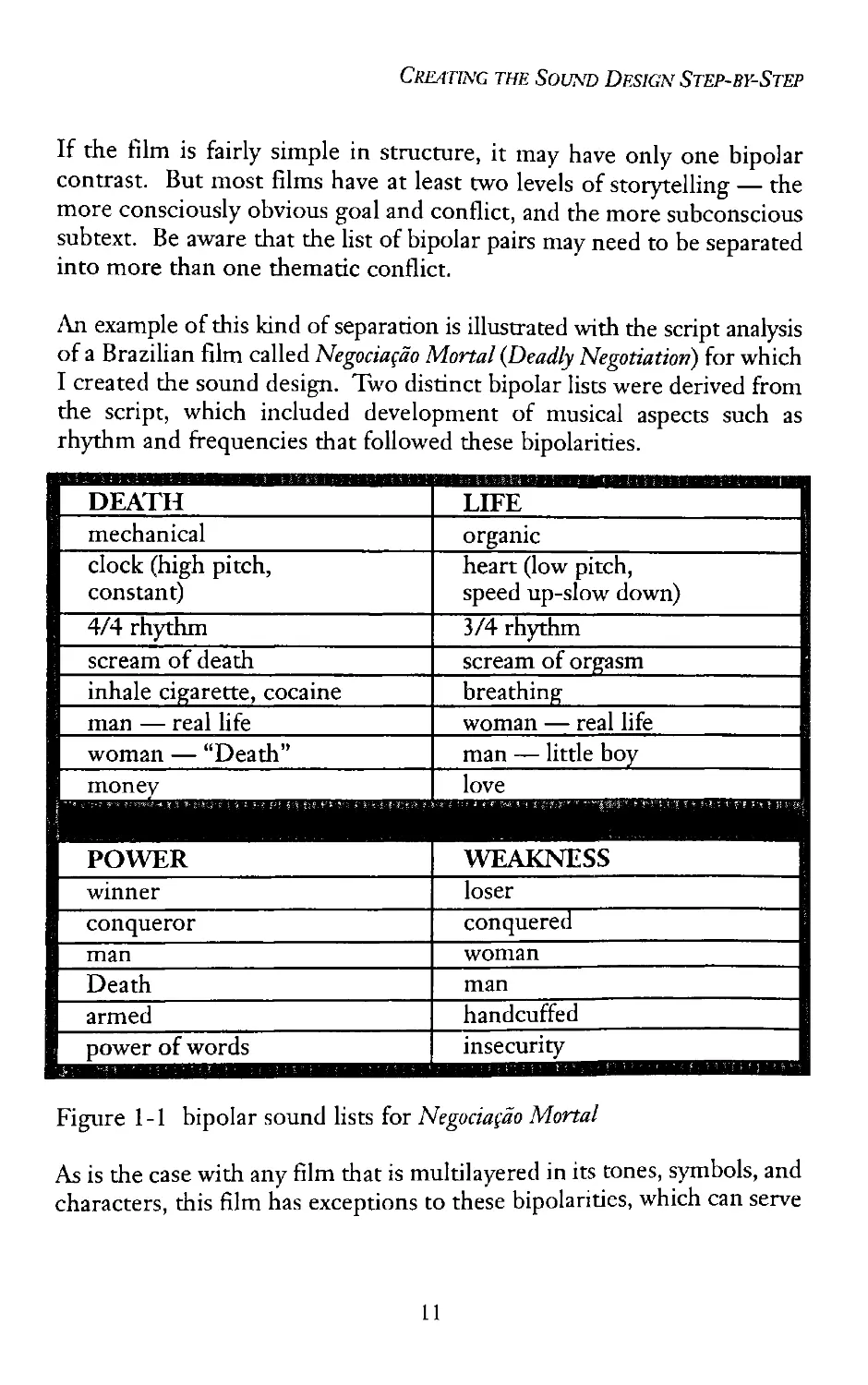
I created the sound design. Two distinct bipolar lists were derived from
the script, which included development of musical aspects such as
rhythm and frequencies that followed these bipolarities.
DEATH	LIFE
mechanical	organic
clock (high pitch, constant)	heart (low pitch, speed up-slow down)
4/4 rhythm	3/4 rhythm
scream of death	scream of orgasm
inhale cigarette, cocaine	breathing
man — real life	woman — real life
woman — “Death”	man — little boy
money	love
POWER	WEAKNESS
winner	loser
conqueror	conquered
man	woman
Death	man
armed	handcuffed
power of words	insecurity
Figure 1-1 bipolar sound lists for Negotiate Mortal
As is the case with any film that is multilayered in its tones, symbols, and
characters, this film has exceptions to these bipolarities, which can serve
11
SOUND DESIGN / Sonnenschein
for rich counterpoints and unexpected plot twists. So be aware of the
relative nature of such charts; they are guidelines, not necessarily eternal
truths (even for the two hours of the film).
There may be tripolar relationships as well. These can fall into basically
two types:
1) Left-Center-Right, a linear relationship in which the “left” and
“right” are two extremes (bipolarities) with a neutral, combination, or
half-way element that is distinct from either extreme. This usually
encompasses a smaller spectrum of all the flow possibilities than the
3-way Pie (described below) can obtain. Examples of this might be:
yellow-green-blue, child-teenager-adult, hunger-satisfaction-nausea,
nervous-attentive-bored.
2) 3-way Pie Division, a triangular relationship in which the three
elements are all equally weighted and each shares boundaries and
relationships with the other two, with a maximum of flow possibilities
encompassing a complete cycle or spectrum. Examples of this would
be: red-blue-yellow, life-death-rebirth, seed-tree-flower, intellectual-
emotional-physical.
If the screenplay you are working on begs to be supported by three
themes or elements, this can be a useful paradigm to apply to the
sound design as well, extrapolating the same tools as used with the
bipolar relationships.
Drawing visual maps
Now with this understanding of the deeper resonating elements of the
script, you can look for patterns that will give you clues for building the
sound design structure. Take a piece of paper and draw a line down the
middle in the long direction. Mark points along the line representing the
significant plot points, moments of transition and heightened conflict. If
there are certain repeated elements or scenes that are important to the
story, give them some graphic symbol where they appear along the
chronological line you have drawn. If you have drawn in pencil it would
be helpful to ink over after you’ve got everything laid out, or make a pho-
tocopy, so that when you begin the next phase of drawing you can erase
the overlaying design without disturbing the basic structure.
12
Creating the Sound Design Step-by-Step
Refer back to the bipolar charts that you made of your “voices” and
select the two most representative words for each bipolarity, e.g., death-
life, power-weakness, success-failure, male-female, rational-intuitive,
money-love, etc. Looking at the dramatically high points of the story,
ask yourself what is happening in the bipolar conflict? Most stories have
a central character who will be experiencing these conflicts, so put yourself
in that character’s shoes and see what he or she is feeling at this moment.
Let’s take the example of death-life to illustrate this technique. In
Negotiate Mortal the main character, Mario, meets a mysterious woman
who later is revealed to be Death, the grim reaper in a seductive form.
She predicts his death in seven years’ time, leaving him to invest his
energies as he wishes until then. As the story leaps forward to the fate-
ful date, Mario finds that his world of successful but ruthless business is
suddenly thrown out of his control when he is kidnapped, hooded,
handcuffed, and whisked off to an isolated cabin. The events unfold as
Death reveals herself in the cabin and begins a final seduction to climax
the film. The major bipolar contrast revolves around Mario’s attempt
to control all that is living around him and his inability to control his
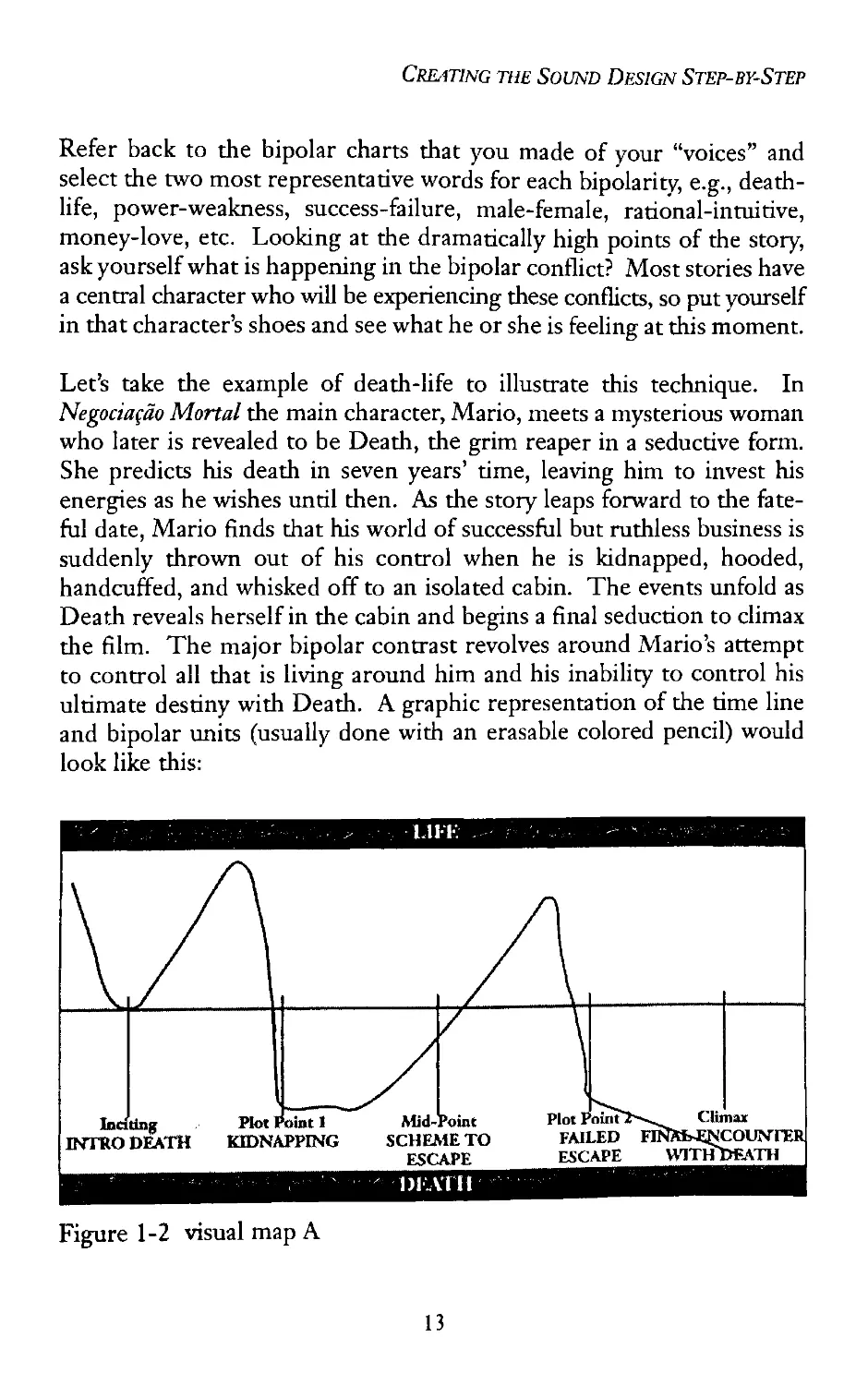
ultimate destiny with Death. A graphic representation of the time line
and bipolar units (usually done with an erasable colored pencil) would
look like this:
Figure 1-2 visual map A
13
SOUND DESIGN / Sonnenschein
A second bipolar unit of power-weakness overlaid on the same time line
will have a different curve than the first (done with a different colored
pencil), at moments crossing, counterpointing, and finally resolving to a
mutual climax, like this:
Figure 1-3 visual map В
What do these graphics reveal for the sound design? As the basic
dramatic elements are put into opposition, we can visualize a kind of
emotional scoring of the entire film. We can see when one theme emerges
and becomes dominant or suppressed, as well as how the multiple themes
bounce off one another. Each of these themes will continue to be
expanded in the treatment of voice, sound effects, ambiance, and music
(as they may have also been expressed in the production design). Any
associations with sounds in the diegesis (story world of the film) can
serve as a starting point to give direction to these themes.
In the example here, Death is linked to a clock that is described in the
script — ticking, with a high-pitched, mechanically constant 4/4 beat.
Nowhere is a heart or heartbeat described in the script, but I found it as
an intuitive opposite to the clock in the death-life bipolarity, generating
other opposites such as a low-pitched, organically varying 3/4 beat that is
sensed as the natural rhythm of the heartbeat. (In fact, the physiological
14
Creating the Sound Design Step-by-Step
beat lies between 3/4 and 4/4 rhythms.) These elements then spawn
parameters for two of the musical themes that will counterpoint
throughout the film, based on the overall graphic fine that was drawn on
the visual map.
Meeting with the director
Assuming that you are not the director doing your own sound design (in
which case you might try some of the following approaches with your
sound editor and music composer), all of what you have created up to
this point must be shared with the director. Depending on both of your
personalities and experiences, there will be a greater or lesser degree of
collaboration on the specific steps of the sound design process. But
it remains absolutely imperative that the director hears your ideas
and absorbs what you have to offer, and that you listen to the director,
who will probably be the only one to have a complete vision of the
characters and story.
Creating sounds that are best for the film requires sonic, structural,
and emotional information to flow through you in two directions, both
listening and speaking. Walter Murch refers to this as “dreaming in
pairs,” where each takes turns proposing alternate scenarios to the other
that provoke the dream imagery or subconscious creativity in the listener.
The memory or intuition of the listener rises to its own defense when it
hears itself being challenged, revealing the hidden intent and appropriate
selection of sound.
While making the visual maps, you may choose to do this side by side
with the director, and find that this process becomes more like a dance,
jam session, and/or communal art piece. Ideas flow spontaneously like
a four-handed piano improvisation. The real-time aspect can generate
unexpected rhythms on the page. For example, if one of you draws in
a more architectural blueprint style — very rhythmic, exacting, and
measured — this can create a very surprising counterpoint to another
style that is more anatomically based — with curves, ovals, branchings,
and threadings. Where do they intersect? What third forms result from
the synergy? What dialogue of ideas, links, and new insights surfaces
from your intuitive and logical processes?
15
SOUND DESIGN / Sonnenschein
If you find yourselves stuck on a particular point, try handing over the
colored pencil to the other person to do the drawing, or if you’ve both
been doing it, try exchanging colored pencils and themes.
If the director is not sure about your suggestion or just plain doesn’t like
it, explore this opportunity and ask about exactly what aspect does not
fit in. Is it that the director already has a sound in mind and can’t get
used to a different idea, or is there something intrinsically out of place
with your proposal? Finding what is out of balance can very well reveal
what is needed to put things in balance, just as a string on a guitar blares
out when it needs tuning up or down; and you should hope that your
director will have the perspective with which to judge this.
Most likely you have been hired as a sound designer because the director
understands the benefits and is eager to collaborate with you. Even so,
you may have a director who is tremendously ignorant of the full
potential, language, and process of sound designing. In this case, you
should have a little chat as to what extent you will be given the authority
and decision-making powers in creating the sound design. Some directors
may feel uncomfortable with their lack of experience in this area, and you
have to watch out for the trap of taking advantage of this by becoming a
one-man band. That is not what film production is about (unless this is
an auteur film, which means that the director would probably be doing
the sound design anyway), and you may be jeopardizing the final movie
if you don’t make the effort to become as intimate with the director’s
views as the director is with yours. You very well may have to seek
different communication techniques to become the most effective
with each individual director, just as you might with different students,
lovers, or bosses. If one analytic style or graphic exercise worked
with one director, but doesn’t seem to generate a rapport with another,
rather than being insistent, experiment with a new modality. Some will
prefer hours of dialoguing with you; others may like written words, or
charts, or diagrams; and others will want to hear the sounds themselves
before commenting. Find out what is the best language for communi-
cation with your director, and translate your own fluency and style in a way
that will resonate with the director’s.
You may receive from the director very specific indications of how to hear
the film, or a certain song or instrumental recording that the director either
wants to incorporate as is or to use as a guide for an original composition.
16
Creating the Sound Design Step-by-Step
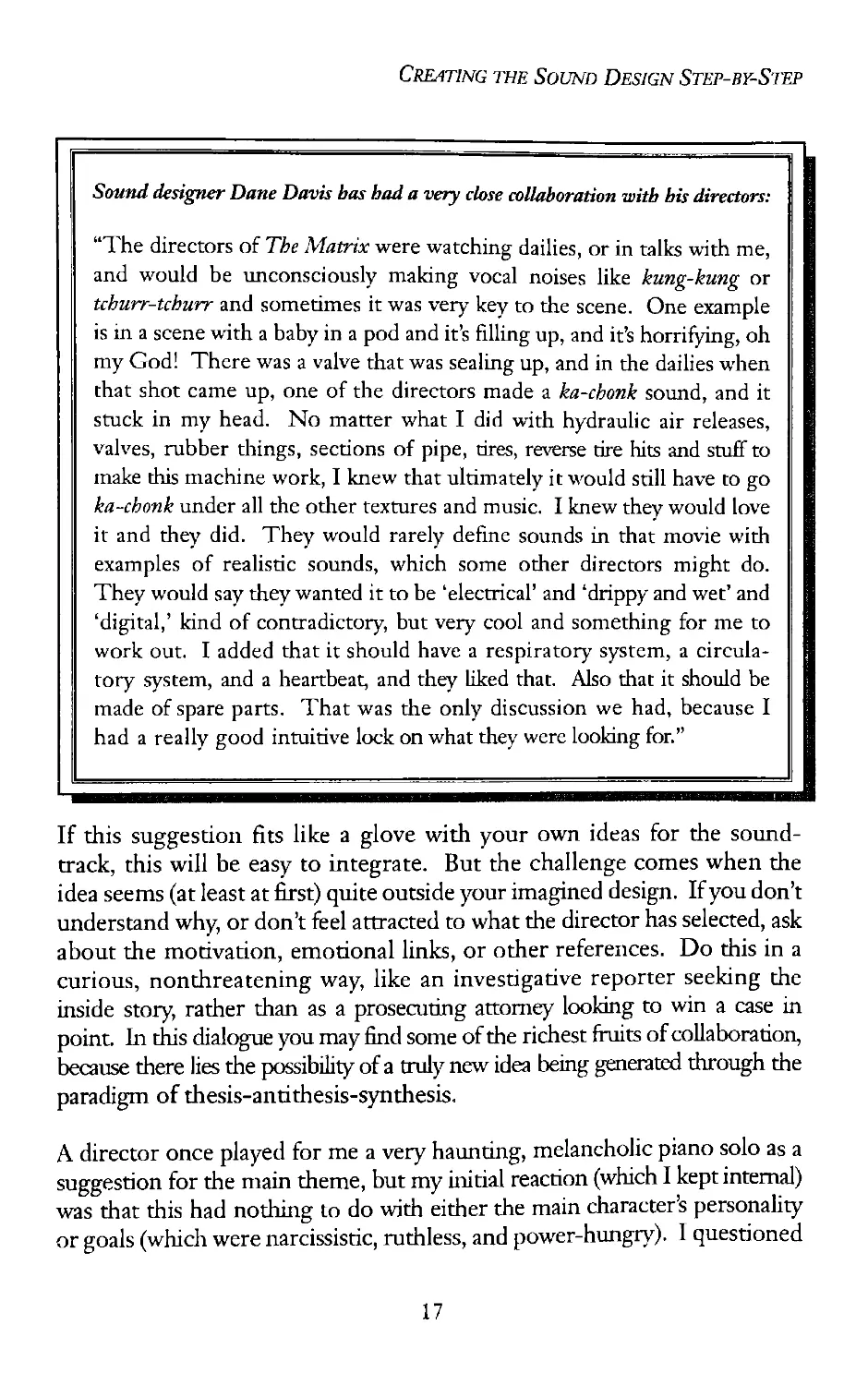
Sound designer Dane Davis has had a very close collaboration with his directors:
“The directors of The Matrix were watching dailies, or in talks with me,
and would be unconsciously making vocal noises like kung-kung or
tchurr-tchurr and sometimes it was very key to the scene. One example
is in a scene with a baby in a pod and it’s filling up, and it’s horrifying, oh
my God! There was a valve that was sealing up, and in the dailies when
that shot came up, one of the directors made a ka-chonk sound, and it
stuck in my head. No matter what I did with hydraulic air releases,
valves, rubber things, sections of pipe, tires, reverse tire hits and stuff to
make this machine work, I knew that ultimately it would still have to go
ka-chonk under all the other textures and music. I knew they would love
it and they did. They would rarely define sounds in that movie with
examples of realistic sounds, which some other directors might do.
They would say they wanted it to be ‘electrical’ and ‘drippy and wet’ and
‘digital,’ kind of contradictory, but very cool and something for me to
work out. I added that it should have a respiratory system, a circula-
tory system, and a heartbeat, and they liked that. Also that it should be
made of spare parts. That was the only discussion we had, because I
had a really good intuitive lock on what they were looking for.”
If this suggestion fits like a glove with your own ideas for the sound-
track, this will be easy to integrate. But the challenge comes when the
idea seems (at least at first) quite outside your imagined design. If you don’t
understand why, or don’t feel attracted to what the director has selected, ask
about the motivation, emotional links, or other references. Do this in a
curious, nonthreatening way, like an investigative reporter seeking the
inside story, rather than as a prosecuting attorney looking to win a case in
point. In this dialogue you may find some of the richest fruits of collaboration,
because there lies the possibility of a truly new idea being generated through the
paradigm of thesis-antithesis-synthesis.
A director once played for me a very haunting, melancholic piano solo as a
suggestion for the main theme, but my initial reaction (which I kept internal)
was that this had nothing to do with either the main character’s personality
or goals (which were narcissistic, ruthless, and power-hungry). I questioned
17
SOUND DESIGN / Sonnenschein
the director as to how he heard this music in the film and found that he
sensed an urge to pull out from the character something that was indeed
covert and really counterpoint to his external appearances. Now employing
this notion, we developed a sound design that worked specifically on the
dissonance and counterpoint between these two aspects of his character,
the overt-external and the covert-internal. The final result was much
more rewardingly ambiguous and allowed for many variations on a theme
as the film progressed through the different stages of the character’s
confrontation with his inner fears and longings.
The sound map — draft 1
Traditionally, a sound map, known as a cue sheet, is generated by the
sound editor at the end of his editing job as a guide for the rerecording
mixer to follow the different tracks of dialogue, effects, and music, indicated
along a time frame of minutes and seconds, with image landmarks and
cues for entrances, dissolves, fades, etc. What I’m referring to as the
first draft of the sound map is a rough sketch of what the editor and
mixer will eventually use, but based on a time frame of dramatic
sequences with notations of sonic elements that may enhance the story-
telling aspects of the film, with no regard for the physical or electronic track
separation of closely occurring sounds that must take place before the mix.
Although the film can always benefit from having a preliminary sound
map before shooting, in most cases the sound designer is called onto
the picture only after the film has been shot. For the sake of representing
the ideal, I will describe here the first draft of the sound map as if it were
to be done before shooting. In fact, the end result will be similar to a
map initiated after viewing either the dailies or a first cut of the film,
when the input will come also from the images shot, as well as from the
script and the director’s vision.
The sound map has two axes, vertical for time, horizontal for sound
elements. The time axis should be separated into sequences with
certain binding dramatic, physical, and temporal elements. Most often this
will be denoted by the slugline in the script, with interior or exterior, name
of location, and time of day. However, it may be more useful to join
several scenes into a sequence (e.g., EXT. PARKING LOT + INT. CAR
+ EXT. STREET + EXT. SIDEWALK) or even to separate a single long
18
Creating the Sound Design Step-by-Step
scene into more than one sequence, if several different plot twists or mood
changes occur in the same location that may require punctuation and
modulation in the soundtrack. The nomenclature of these sequences
should be coordinated by the director or producer so as to remain
consistent with the other production departments’ breakdowns.
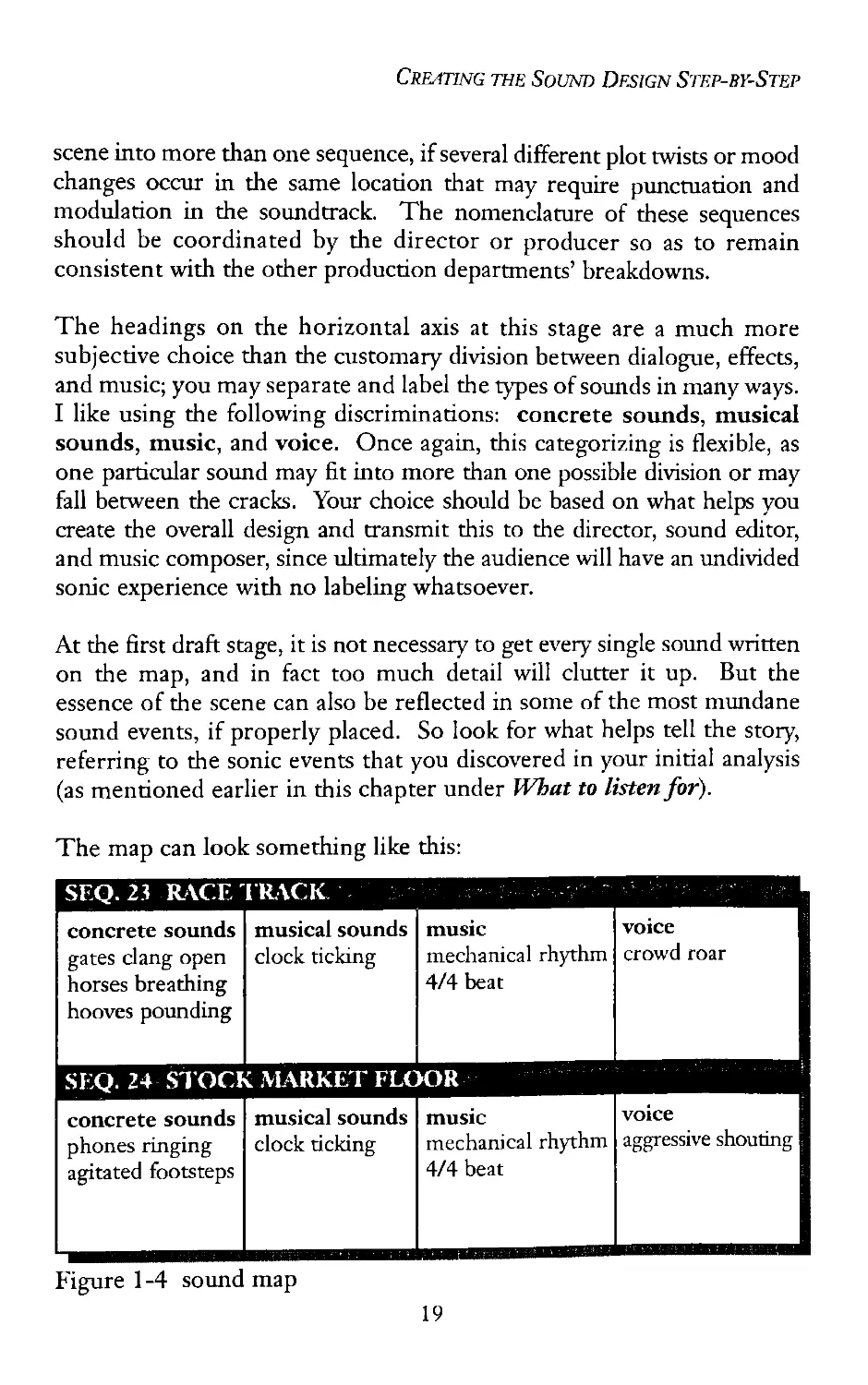
The headings on the horizontal axis at this stage are a much more
subjective choice than the customary division between dialogue, effects,
and music; you may separate and label the types of sounds in many ways.
I like using the following discriminations: concrete sounds, musical
sounds, music, and voice. Once again, this categorizing is flexible, as
one particular sound may fit into more than one possible division or may
fall between the cracks. Your choice should be based on what helps you
create the overall design and transmit this to the director, sound editor,
and music composer, since ultimately the audience will have an undivided
sonic experience with no labeling whatsoever.
At the first draff stage, it is not necessary to get every single sound written
on the map, and in fact too much detail will clutter it up. But the
essence of the scene can also be reflected in some of the most mundane
sound events, if properly placed. So look for what helps tell the story,
referring to the sonic events that you discovered in your initial analysis
(as mentioned earlier in this chapter under What to listen for).
The map can look something like this:
SEQ. 23 RACE I RACK
concrete sounds gates clang open horses breathing hooves pounding	musical sounds clock ticking	music mechanical rhythm 4/4 beat	voice crowd roar

SEQ. 24 STOCK M ARKET FLOOR
concrete sounds phones ringing agitated footsteps	musical sounds clock ticking	music mechanical rhythm 4/4 beat	voice aggressive shouting
Figure 1 -4 sound map
19
SOUND DESIGN / Sonnenschein
I have denoted concrete sounds as those that appear to be connected
with the image. In general, these would be considered to belong to the
diegesis, pertaining to the reality within the film and the environment of
the characters, whose point of view would incorporate these sounds.
More often these would fall into the category of sound effects, rather
than ambient sounds. Examples (when they appear on screen with a
corresponding image or induce a reaction from a character) would be:
door SLAM, audience APPLAUSE, telephone RING, horse
GALLOP, ax CHOP, paper TEAR, clock TICK, gun FIRE,
tire SCREECH, balloon BURST, baby CRY.
Any of the above sounds might also fall into the category of musical
sounds if they become dissociated from the diegesis and turn into a kind
of sensorial or emotional element independent from the characters’
space-time reality within the story. For example, the sound of ticking
when we see a clock in the room or on someone’s wrist remains a concrete
sound, but as soon as this same sound that is now unlinked to the image
pervades a scene with its emotional effect of urgency or relentlessness as
the underlying tone, it then falls into the area of musical sounds.
Ambient sounds can also be considered in this division, especially when
they are not creating a reaction in the characters, but rather setting a
general mood. Examples would be: WHISTLING WIND, air
conditioner HUM, distant HOWLING COYOTES, POUNDING
SURF, playground LAUGHTER, echoing SONAR BEEPS,
CRACKLING FIRE.
Any sound that might serve as inspiration for the music composer
should be noted here. For example, a rhythm like a heartbeat is broken
naturally by its valve-pumping action into triplets (almost, but not exacdy
with a real heart), with an accent on the first two beats: l-2-3-£-2-3-
1-2-3. This, along with its muffled, low-frequency pitch, can generate
the basis for a musical theme that will be linked through a dramatic
element by association with the character’s heart.
The category of music I use for both noting diegetic music (singers or
musicians on screen, radio, record player, etc.), and making suggestions
to the music composer, which include structural ideas (like the triplets
of the heartbeat), emotional parameters, orchestration possibilities, and
20
Creating the Sound Design Step-by-Step
the development of motifs. The visual map that you made earlier serves
now for inspiration to spot relationships, patterns, and macrorhythms in
the whole film to help line up the musical motifs. Taking advantage of
the psychoacoustic principle of our brain’s ability to better discern
simultaneous sounds when there exists a separation of frequencies, your
observations can indicate what range of pitch will be most appropriate
to use in conjunction with the other sounds occurring in the same scene.
I like to use the word voice rather than dialogue because this encompass-
es all sounds emitted through the mouth, including some very telling
expressions: uncontrollable YAWN, wet SNEEZE, unexpected
HICCUP, BLOWS cigarette smoke, SMACKS a kiss,
hoarse COUGH, angry BOOING, derisive LAUGH,
embarrassed GIGGLE. Dialogue may also be noted if there will be
either special treatment by the actor (whispering, drunk, foreign accent)
or some kind of postproduction manipulation (echo, increase of bass
frequencies, telephone voice). Although it will be essential to hear the
dialogue clearly in the final mix, this is not the moment to worry about
the content of the words (beyond how they serve as guideposts for your
creativity). What you should be looking for are the nonverbal elements
that can contribute to the storytelling and emotional aspects of the
soundtrack, while generating further motifs and links with the other
audio categories on the sound map.
At this stage of filling in the details of the sound map, let yourself dwell
on each sequence, saturating your consciousness with several readings if
necessary, and viewing the sequence again in your mind with all the
sounds that are suggested in the script and that emanate from your inner
ear. Write them down on a big piece of scratch paper. You can close
your eyes, if you find this helps stimulate your auditory sense. Don’t
censure any seemingly bizarre or out-of-context sound that occurs to
you. You can always cross it off later, but it may also lead to a valuable
connection that you haven’t yet perceived.
The time you’ll need to do this sequence-by-sequence development
with care will undoubtedly be longer than the running time of the film
itself, that is, more than the customary one minute per feature format-
ted screenplay page. You don’t need to do this all at one sitting; in fact
21
SOUND DESIGN / Sonnenschein
TRY THIS
A listening meditation
If your mind is wandering or it just seems very silent inside your virtual
auditorium, try listening to a piece of music that you feel has some con-
nection to the tone or genre of the story. Instrumental music has the
advantage of keeping you in a more intuitive, nonverbal state, while
lyrics may give you some cultural inspiration, or awaken a memory or
unexpected word synchrony. You can do this as a little break from your
concentration, relaxing with your eyes closed, or you can try it with the
script and sound map in front of you, allowing the story to interact
directly with the rhythms, melodies, harmonies, and emotions of the
music. If a more obvious musical genre doesn’t bring anything new to
the inner images, you may be surprised to find out how a classical piece
of Beethoven, Debussy, or Bartok may counterpoint a very urban setting
and characters, or how jazz or rock may infuse a period piece with new
sonic insights that you had never before considered.
you might find that on different days or times of day you may have
different inspirations. Be aware of your own rhythm of focus and day-
dreaming states, as there usually exists an ultradian cycle of approximately
90-120 minutes within your attention span. Let this be as saturating a
process as the production schedule will allow.
When you reach the end of the sound map, take a breather in another
environment, even if it’s for only a few minutes. You will be switching
gears into another process and it helps to make a clean break out of this
detail-oriented thinking.
Now go back to the results of your work with Grouping the voices
and Drawing visual maps and refamiliarize yourself with the pat-
terns that you discovered. Skim over them quickly and note what can
readily be superimposed over the detailed work you did on the sound
map. Line up all the pages of the sound map on a long table or the
floor so that there is a single time line from top to bottom, just as
there is in your visual maps. Take the same colored pencils that you
22
Creating the Sound Design Step-by-Step
used on the visual map, and circle or underline the sounds you have
listed on the sound map that correspond to those colored themes on
your visual map.
Look for the patterns emerging on the sound map as well. Are there
places that do not correspond between the visual and the sound maps? If
so, this may be an indication for the need to insert a sound that would not
necessarily be in the diegesis (a concrete sound in my nomenclature), but
would work very well as a subjective, nondiegetic addition to the track (a
musical sound). Or it may be a hint for the composer to return to a cer-
tain theme or variation of a theme at this point in the drama. In a more
unusual case, this lack of synchrony between the two maps may motivate
you to remove certain sounds that would normally play in the scene, using
the forced or unnatural silence as a connecting emotional fiber.
 a
To review the steps up to this point:
•	The first script reading — Immerse yourself in the written description
of the scenes and let your inner ear come alive.
•	What to listen for— objects, actions, environments, emotions,
and transitions — Key words and ideas will serve as basic elements
to construct the sound design.
•	Grouping the voices — Find the polarities between these elements to
develop balance and counterpoint.
•	Drawing visual maps — Use graphic representation of the flow
of the story with the sonic structure to reveal an overall composition
for the sound design.
•	Meeting with the director — Present your work-in-progress to
confirm the style, tone, and choices, listening carefully for feedback
and global perspective.
•	The sound map — drift 1 — Separate the script into sequences
and list the sounds in categories of concrete sounds, musical
sounds, music, and voice.
Consulting before and during the shoot
Ideas for sound that arise from the script can help the producer lower
production costs and ensure more consistency with the narrative direction
23
SOUND DESIGN / Sonnenschein
of the film. The sound designer will seldom be hired before post-
production, but if the opportunity arises early enough in preproduction,
you can offer extremely beneficial advice to the producer, director, and
production sound recordist.
Possible helpful hints and economies can be found in:
•	Reducing or removing shots that might be expensive or time-
consuming, by substituting with sounds. This requires creative
analysis of what dramatic elements are needed to move the story
forward and develop character.
•	Assisting in selection of locations by considering acoustic factors.
The most beautiful spot for a 19th-century period piece could be
totally inadequate because of unnoticed traffic sounds that cannot be
removed from the production track without costly dubbing.
•	Indicating proper equipment and materials for specific sound
recording situations. Extra microphones and an adequate mixer
might be needed for a complex dialogue sequence, or sound-
absorbent materials like foam or blankets could help eliminate
unwanted reverb in a hard-walled location.
•	Planning to record wild sounds on a location shoot can save time and
money in postproduction. Scheduling must be done conscientiously so
as not to slow down the rest of the crew, preferably recording
before or after the shooting hours.
During the shoot try to take a look at the dailies, which may raise some
creative suggestions for recording isolated wild sounds in that particular
location. Through observation of what is already happening on screen you
may imagine an additional useful close-up of a sound-making object or
action not originally planned in the shot list, but that could successfully
reinforce an aural theme. This is particularly applicable if any montage
sequence is anticipated that can break free from a stricdy linear, dialogue-
driven script. Sounds and images can have a subjective, dreamlike con-
nection to the emotional or intellectual line; frequendy the ideas echo
between sounds and images, each generating a reflection or variation in
the other. Pickup shots after principle photography are another possibly
less-expensive solution, but it might be more cost-effective to get these
newly inspired inserts immediately, before moving away from a hard-to-
get-to location.
24
Creating the Sound Design Step-by-Step
==«=^^==========^====il
George Watters, supervising sound editor on Star Trek II, III, and VI,
has some advice about set construction:
“On the sets of the Enterprise, the plywood was creaking every time
Commander Kirk walked by. That was one of my big gripes in Star
Trek VI. When sets are built, they should make sure they are solid so
there is no creaking from plywood, because we then have that noise
under all the voices on the production tracks, and you have to bring the
actors back for looping. It will cost more to get the actors back to fix it
than it would to build it right in the first place. You don’t want to
replace close-up dialogue, and many directors object as they would
rather live with the noise in order to save the original dialogue.”
Accompanying the picture edit
If you are fortunate enough to be brought onto the film before or while
the picture is being edited, you will have the opportunity to interact with
the director and picture editor in their decision-making process. Your
thematic ideas and specific suggestions can influence the style and
rhythm of the image cut in various ways.
A scene or shot may play longer if there is sufficient information in the audio
to warrant a slower pace. Off-screen sounds can help motivate the characters’
thought processes and actions. If the director or editor is concerned about a
dead moment on screen, but doesn’t want to cut away perhaps because of
lack ofcoverage or some other reason, you have an opportunity to help the
scene play by coloring with off-screen dialogue, a transformation in the
ambiance, or a motivated noise like a car horn, glass breaking or baby crying.
In The Godfather, a train that is never on screen is used very effectively in
die restaurant scene when Al Pacino shoots a man for the first time.
A scene may play shorter if you decide to overlap the dialogue or
diegetic sound effects between two scenes, compacting information.
This technique is very common, but you may have some special
insights on the alchemy of seemingly incongruent sound and image
juxtapositions, and on when this can serve to propel the audience into
the next scene with a greater sense of anxiety, curiosity, or humor.
25
SOUND DESIGN / Sonnenschein
Sometimes a sound will hold more power than an image; you might
experiment during editing to find that the scene will have more impact
or suspense by not revealing the audio source. If this style works well in
one scene, you and the editor might look for other crucial moments
where it may be applied in the film, establishing a certain structural,
emotional motif. Usually this type of image-sound dynamic is suggested
in the script, but you should be daring and imaginative at the editing
stage as well, looking for some real nuggets of audio storytelling energy
to emerge at just the right moments.
The picture editor may wish to take advantage of other techniques that
can lead to creative sound design. Try cutting without sound to get the
visual rhythm by itself, adding sound later. This can lead to discoveries
of asynchronous uses of sound and image that may convey more power
than the sync to which we are all accustomed. Also, try watching the
film at different speeds (high and low) as well as in reverse. Like a painter
looking at his work upside down or in a mirror, it frees you of the content
to look at the pure structure, which in turn can evoke new sensitivities
toward the sound.
Analyzing the final picture edit
If you have been hired after the image has been cut, you will have the
choice to watch the film in real time as your first exposure to the story
or to take advantage of the script (even if it isn’t exactly what ended up
being shot) as your first resource. If you find that your strength of audio
imagination comes more from the words on a page, read the script first,
but if you know that you will respond maximally with the image as your
first stimulus, then you may choose to disregard the script entirely, or
use it simply as a structural reference for your sound map.
Once you are ready to watch the film, try to do it in one sitting, for the
same reasons as it is best to read the script for the first time with no
interruptions. Whether you are watching it on video, computer, flatbed,
or screening room, request that there be as few comments as possible
from others present, other than brief remarks regarding scripted but
unheard audio elements that are essential to understanding the scene.
This first viewing should allow you the luxury of being the receptive
26
Creating the Sound Design Step-by-Step
audience — letting you enjoy, question, laugh, cry, and otherwise be
totally reactive and involved in the characters’ drama. You may keep a
pad and pen available for noting your first impressions, but avoid any
extensive writing that could distract from your full attention to the
unfolding story. Note key words of your initial feeling for the scenes,
like crystalline, damp, or funny, rather than literal sounds which you will
surely insert later anyway.
After this first screening, an in-depth conversation with the director
should clarify both his or her intentions with the story, characters, and
scenes, confirming whether or not your first impressions as a viewer of
the film are close to the director’s intentions. Unless you have worked
before with the director and have considerable background in common,
you might want to save up your creative ideas for sharing until after you
have had plenty of time to develop them to their full potential. This
really depends on the chemistry of your two personalities, as the
exchange might be necessary for the desires of the director to be
articulated. If the director wants some specific feedback this would be
a good starting point for dialogue. If there are aspects of the film that
you did not like or understand, try to bring these up in as constructive a
manner as possible by asking questions, probing for solutions to the
weak points you might perceive. On the other hand, if you have
positive feedback, by all means let the director feel your excitement
about the beginning of your collaboration.
Your next step is to watch the film again, with or without the director,
editor, and music composer, this time in control of the “pause” button
while you “spot” the film. As each scene goes by, you should stop to
note detailed ideas in all four areas of your sound map — concrete
sounds, musical sounds, music, and voice.
Concrete sounds associated directly with the image, and most likely
in sync with some kind of action, can be derived from visual elements
like movement, weight, size, solidity, resistance, contact, texture,
temperature, impact, release, etc. Depending on the film genre and
style, the degree of realism can vary. If the tone is dramatic, the sounds
should not be noticed as anything separate from the event, even though
they may very well be artificially inserted, replacing the production track
27
SOUND DESIGN / Sonnenschein
and sweetened in the mix. This work is invisible in the end, a mosdy unrec-
ognized craft that intends to make the diegesis seamless and believable.
On the other extreme, a film like Who Framed Roger Rabbit? depends
tremendously on the creation of a physical cartoon character plunked in
the middle of a live action set with human actors. Roger comes to life
through sounds that give him the texture and weight of an inflatable,
plastic, stretchy body that can do things that normal folks can’t manage
without being tortured to death. His believability is consummated by
the concrete sounds synced with his visual contortions.
Often an action on screen will not be able to generate the desired sound
effect that should accompany it. Replacing dirty backgrounds, wrong tim-
bre, or weak sounds recorded during production is extremely common, and
the solutions are often very surprising. (This will be explored later in this
chapter in more detail in Defining voice sources and modifications.) At this
moment, be attentive to what is needed to complete the reality on screen.
Review the areas that were mentioned earlier in this chapter in the section
What to listen for during script analysis — objects, actions, environments,
emotions, transitions — as these continue to provide directions for your
analysis of the picture as well. You will now have the choice to emphasize
specific elements on screen, depending on their importance to the diegesis,
characters’ point of view, and emotions.
Musical sounds may be insinuated from the concrete sounds and their
corresponding sync images, as the border between these categories can
be indistinct at times. For instance, if a car passes through a shot in the
background, we can suppose that the motor (a concrete sound) will
continue to be heard after it passes out of frame. But what about the
other cars, trucks, horns, sirens, etc. that might be in action off screen
interacting with the visually linked car? This will depend on the kind of
neighborhood, time of day, and most importantly the link that the
characters have to their environment. Is the city friendly, hostile,
speedy, lazy, distant, suffocating?
Look for two or three elements to personalize each environment, as
these will allow you a certain variety within the scene to accent certain
28
Creating the Sound Design Step-by-Step
moments, create transitions, or contrast different moments during the
story in the same setting. If you have several dramatic scenes between a
couple in a bedroom, for example, perhaps a clock ticking could stress
the nervousness or uncertainty, thunder from the storm outside might
accompany moments of suppressed anger, and plumbing gurgles may
anticipate lust welling up (or humor, if overplayed). Constant ambient
sounds like the clock may be laid on the track for the entire scene and the
volume modulated during the mix for emphasizing the proper tone. A sound
event like thunder or pipe gurgling needs to be selected for its specific attack,
tone, and timbre and placed appropriately to the accompanying action,
dialogue, and intent of the moment.
A single part of a multitracked ambiance may serve to carry from one
scene to the next. The sound may have been an off-screen ambiance whose
source becomes revealed with the transition to the new setting. This helps
create a sense of continuity in geography; it also glues the storytelling with
a kind of question-and-answer structure in the audiovisual framework. It
is particularly effective in comedy or drama — when the sound is indicated
to be one thing but turns out to be another upon revelation of the true
source of the image.
While watching the scene, what seems to be the predominant emotion
experienced by the characters? Is this the same emotion that you feel
while watching the scene? If there is a difference, be aware of the psy-
chological space created between the primary (character) and secondary
(audience) emotions. When designing the musical sounds for the scenes
that have these simultaneous yet distincdy different impacts, you should
usually play each audio element to support just one emotion at a time.
An exception would be with an aural double entendre, in which there
can be construed two meanings for the same sound event, one for the
character, one for the audience.
Your notations on music for the scene should include reference to pitch,
rhythm, and relationships to repeated or developing scenes, characters,
themes, and emotions. Observe what will help integrate the music with
the other audio elements of voice, effects, and ambiance. Even if you are
not musically trained, your contributions to creating the audio narrative
can serve as valuable guidelines to the composer, who has many artistic
and technical tools at hand to complete the soundtrack.
29
SOUND DESIGN / Sonnenschein
The effect of contrast in pitch can be indicated, as in the use of low musical
frequencies with high voice frequencies to help keep the dialogue clear,
or the opposite effect can be produced, i.e., making the voice purposely less
intelligible by masking with a musical pitch in the same frequency range.
Musical rhythm can establish a driving force to a scene that may be
generated by visual rhythms (e.g., windshield wipers, wings flapping,
shaking head), picture editing rhythm, or subjective pacing where
there is no apparent visual movement to motivate a beat. A musical
sound with definite periodicity like a dripping faucet or squeaky hamster
wheel may lead into a specific beat for the music, as was done with the
sound of coins clinking and cash registers opening in Pink Floyd’s
classic song “Money.”
Characters, settings, and emotional motifs are often benefited by musical
themes, so you may note appropriate moments for these various devel-
opments. Look for the transitions: When the tone shifts, the hero is
thwarted, or the treasure is found. Your insights can help the composer
create the most effective accompaniment to the drama, while orchestrating
in harmony with the overall sound design.
Besides the verbal content passed through the dialogue, what is the voice
communicating? If you couldn’t understand English (or whatever language
the film is shot in), what would you understand by the sounds emitted by the
actors? The nonverbal voice melody and rhythm (prosody) can transmit all
sorts of information — urgency, anger, nausea, snootiness, playfulness,
seduction, falseness, etc. You can hear it in the musicality of the voice, as
well as in the breathing and spaces between words.
A cough, sneeze, snore, tongue click, cigarette puff, whisde, swallow, hiccup,
or kiss can serve as part of a nonverbal vocabulary for a character,
especially if there is some recurrence or transformation of this sound
throughout the film. For example, if a character’s arc takes him or her
from being healthy to sick, a slight cough might build to a deep wheezing;
if this is not yet fully exploited in the production track, the sound design
could emphasize this in post with added sounds. They may be easily
inserted either by avoiding lip sync, putting the sound off screen, or
adding it when the character’s back is to the audience.
30
Creating the Sound Design Step-by-Step
Recognizing what tone is established by the character’s voice intonation
is a strong hint for which direction to take the sound design of a scene.
Is the speech percussive, suggesting a syncopated beat that could be
extended to the music and environmental sounds? Is it slurred and
barely intelligible so that the same might hold for an unseen, off-screen
couple arguing in the apartment down the hall? Are there pauses that
could be accented with a sonic commentary like a wolf howl, fart, or
key clacking in the door?
The voice may call for a counterpoint ambiance to help lift it into
more definition, such as a puppy barking against the miserly growl of
a gruff old man. In The Elephant Man, after the deformed main character
has been chased into a corner by a dozen pursuers, he wails in agony
“I... am... a... man...,” then slumps to the ground while an indistinct,
high-pitched animal cry is heard in the distance, as if its heart is being
ruthlessly torn out.
The sound map — draft 2
Following the format and procedures cited earlier in building the first
draft of the sound map, you now have at hand full narrative details and
the image stimulus to fill in all the sound elements with relation to the
time line of sequences. As you complete this map, refer to the visual
map (or create one now if you have not already) to check on the flow of
your aural themes. If a scene appears to be extremely congested with
sonic information, look for the dramatic purpose and dominant emotion
to help select the most important sounds. When in doubt, leave the
sounds on the map to be edited and then selected during the pre- or final
mix with the director’s feedback.
In general, the audience will be able to absorb at the most two separate
audio elements at any one moment, and these must have a good separa-
tion of pitch, timbre, and/or rhythm. If more elements are added, or if
the acoustic characteristics are too similar, the sounds will begin to
blend, creating a single information pattern for the brain to interpret.
Often the varying volume of the tracks during the mix will create a psy-
choacoustic space between potentially fusing sounds, allowing each to
command attention for its moment on stage. An extreme example of
this occurs in a sequence in Air Force One during the confrontation
31
SOUND DESIGN / Sonnenschein
between the tied-up President Harrison Ford and the Russian terrorist
Gary Oldman. In the span of a few seconds as the President cuts himself
loose and counterattacks, the focus shifts back and forth between two
musical themes (the Russian and the American), explosive dialogue, melo-
dramatic screams and groans, body slamming, machine gunning — and it
all works because of the extremely agile fingers and discriminating ears of
the rerecording mixer.
But more often when the tracks have simultaneous heavy doses of atten-
tion-getting sound, something is dumped in the final mix. You can make
the mixer’s job easier and your sound design cleaner by keeping this in
mind when creating the sound map.
Defining voice sources and modifications
As with many of the functions explored up to this point, there exists a
traditional crew position for cleaning up the voices — the dialogue
editor. Whether you do this work yourself, or coordinate a larger crew
in specialized areas, the same principles and tasks apply.
The most important point to accomplish in recording and editing the dia-
logue is to make sure that the voices are understood (unless they are inten-
tionally meant to be ambiguous or unintelligible, which will be dealt with
later in this chapter), and secondarily that the quality of the voice and
accompanying ambience should not be distracting from the intention of
the scene. What kinds of production problems may cause these faults?
•	The recording volume is too low or high, resulting in lack of
presence, tape hiss, or distortion.
•	The location background sounds remain unforgivably imposing
and are incapable of being cleaned away from the voice.
•	The performance has a problem with overlapping dialogue,
swallowed words, or incorrect pronunciation or emphasis.
Various solutions exist:
•	On-location dubbing, wild track
•	Alternative production take
•	Postproduction dubbing
32
Creating the Sound Design Step-by-Step
If the problem is detected during production but there is no chance of
shooting another take, try to record another wild audio take with the
actors close to the time, emotional state, perspective, and background
ambience of the rest of the scene. With two tape recorders available, you
can let the actors hear their recorded voices while simultaneously doing
the on-location dubbing session. This method can even be done using a
single recorder with a tape change (preferably DAT cassette) and drawing
upon the actors’ audio memory, as well as your own.
Find another production audio take that does not have the problem,
which can be synchronized with the chosen image take. You will very
likely have to expand or contract the pauses between words and phrases
to line it up for lip sync. This substitution technique is more commonly
employed when the line is off-screen, which may influence the picture
edit if this option presents itself at an early enough stage.
Postproduction dubbing (also known as looping or ADR — automated
dialogue replacement) is the most common method, done in a studio
with the original image and sound screened repeatedly so that the actor
is able to rehearse the rhythm and intonation. There are advantages
with the controlled atmosphere of the ADR room, but technical and
artistic considerations must be observed.
To avoid the feeling that the voice perspective doesn’t fit with the image
perspective, place the microphone at a distance similar to where it
would be placed during the production recording. Volume adjustments
alone will not replicate the sense of distance, since the acoustics modify
in terms of frequency range, audible voice components, and secondary
sound waves. When the voice is close, we hear effects of breathing, lip
and tongue movements, and enhanced high frequencies that give
greater presence. At a distance, these close-up effects lessen and an
increase may appear in reverb that can identify the type of space.
Filtering can accentuate these parameters, but the microphone placement
remains the most essential element in recreating the original reality.
If you will be replacing only a portion of the dialogue and inserting the
dubbed voice between production track lines, it is imperative to employ
the same kind of microphone used on location so that the sound edit
remains seamless. The quality of a studio mike might be “richer” than
33
SOUND DESIGN / Sonnenschein
the shotgun or lavaliere on the set, but it will attract attention if it jumps
back and forth, and then you’ll spend wasted time trying to equalize it
in the mix. If, on the other hand, the whole scene and all the characters’
dialogue will be replaced, there is no need for a reference, and you are
freer to use whatever mike sounds best.
Actors in the dubbing studio sometimes have difficulty returning to
the emotional framework of the scene that is being screened in a small
dark room. The fact that they are alone, wearing headphones, watching
a film of themselves over and over, and trying to remain perfectly in
sync, can stifle their naturalness and spontaneity. If they need some
help in recreating their energy level, you might offer to use a boom
operator so that the actor can move around freely, rather than be
chained to a mike on a stand.
Frank Serafine, an innovator in electronically synthesized sounds for
film, has also helped create scenes with background dialogue:
“All the time in foley I have people walk or talk off stage. I have actors
subliminally talk about stuff, heavy conversations in the loop groups.
But they are really low on the track and you have to be listening. Stuff
gets through that’s unscripted with the improv groups. They really
study, get a cassette of the film, pull books, especially with something
like a science fiction movie. Even in a normal movie like at an airport,
you’ve got stuff going on there, like in loading zones, calling taxis. You
can bring a film totally to life. People turn their heads, you add new-
lines. You’re in with the actors and it’s kind of fun for me.”
Modifying the voice in postproduction can lend a very different per-
sonality to the character. THX1138 was a forerunner in changing a voice
to make a robot-like quality, by sending the signal through a ham radio,
then rerecording the slightly out-of-tune returning voice. Today there are
many computerized filters offered, but it is worth looking for these more
unusual solutions if you want a really unique sound.
34
Creating the Sound Design Step-by-Step
If there is any dialogue that occurs off screen, you might consider
placing this portion of the dialogue on a track that is off center as
well. You have to test the effect in the whole sequence to see whether
it really works, or becomes a distraction because the voice is popping
around in space too much.
Since this book focuses primarily on the narrative aspects of sound, and
there are many details to master with respect to microphone choices and
placement, room acoustics, filtering, mixing, etc., other more technically
oriented texts on postproduction sound should be consulted. A good
complementary reference, with a comprehensive step-by-step description
of each of the processes and equipment used, is Sound for Film and
Television, by Tomlinson Holman and Gerald Millerson.
Defining sound effects and ambience sources
One of the most surprising audiovisual phenomenon allows the audience
to believe that whatever sound is synchronized to the image is the
sound being emitted by that image. Combining this with the fact that
some realistic sounds do not play nearly as dramatically as sounds created
by totally different sources than seen in the film, foley artists have made
careers by punching steaks for a boxing match and squishing cornstarch
for walking in snow. The lesson is: Listen for the sound that works, not
necessarily looking for an "authentic” source... and have fun with your
discoveries!
The sources usually available for creating the sound effects are:
•	production tracks
•	sound libraries
•	wild track recordings on location or in the studio
•	foley
•	samplers and synthesizers
During the shoot there are likely to be some useful sounds recorded on the
production tracks. Clothing movement, silverware clatter, car passes, and
such may all end up being perfect for the final mix. However, they must
all be separated completely from the dialogue track so that you will be
35
SOUND DESIGN / Sonnenschein
able to create a clean music-and-effects track for international dubbed
versions. Because so much overlap of dialogue usually occurs with these
effects, the common procedure is to replace everything with other
sources, especially foley, which also gives you the advantage of being
able to control and standardize the quality of each sound.
Ambience from the production tracks is mostly important for creating a
seamless sonic landscape, helping to create the illusion that all the cuts
of the scene are taking place in a continuum. If one angle has a louder
background than another, this can be masked in the mix by using a
continuous additional track with the room tone or location ambience,
which the sound recordist should have gathered during a couple minutes
of forced silence just after the scene is completed. If this was not
obtained for whatever reason, a louder nonproduction ambience track
using similar frequencies can be added to disguise the sound holes.
Rarely, though, does the production ambience go beyond this more
mechanical function, and it can’t really contribute the right dramatic
tone to the scene. You’ll have to create this in post with your inner ear
and the other sources available.
You can find tens of thousands of options in sound libraries, easily
searchable on catalogued CDs. Compared to the older selections on
tape which has to be wound back and forth, nowadays this process can
be extremely agile — using a digital sampler to store preliminary
options, and even testing against the image immediately, if you are
working electronically. But for all its slickness, there remains the
danger of becoming lazy with a prerecorded sound that seems “okay,”
and moving on to the next with the speed of lightning. Because time
crunches dictate so many productions, there may be no other option than
to keep moving forward, but if possible use the library sounds in a more
creative manner by:
•	adding two or more sounds together to create a new sound
•	changing the duration and/or pitch
•	looping, inverting, filtering, etc.
•	using the sound as a sketch only for creating an original recording
With the advent of the sampler and electronic editing, a recognizable sound
can now be converted into thousands of variations, from the vaguely familiar
36
Creating the Sound Design Step-by-Step
George Watters focuses on getting accurate location sounds and
authentic effects:
“In The Red Comer, to record the motorcycles, I diagrammed in detail
their movements in the street scenes. The recording was done in the
exact location prior to breaking down the set. This allowed us to get
the same reverberation from the walls of the buildings, the natural
sounds in the alleys, etc. Often these things may be artificially handled
in the mix. It is not possible to record like this during shooting because
everyone is crammed for time.
“In Gone in Sixty Seconds, we found a real ’67 Shelby 6500 GT 500 to
record, because the production cars used in shooting, while looking
great, were unsafe to drive at high speeds. We recorded the real GT
500 prior to the completion of principal photography, utilizing the
transportation crew to truck the car to a race track. For two days we
simulated the movie script from previously diagrammed moves, includ-
ing horns, door slams, hoods, even the alarms, and I did all the driving
myself. It is so much easier cutting long car sequences when you have
accurate sounds reflecting specifically what is on screen.”
to one completely obliterated from the original meaning. If you have the
fortune of time to play with an extensive sound library and the abundant
computerized tools available, this can be a rewarding experience, but
balance the focus with the play. Remember every' so often to refer to your
sound map and visual map so your journey into foreign sonic lands can
bring the treasures back into the narrative context.
The search for and creation of new sounds can be one of the most joyful,
surprising, and rewarding activities of sound design. You’ll be set for the
hunt to make original wild track recordings on location or in the studio,
with equipment minimums including a variety of high-end mikes
(directional is basic, cardiod and stereo are useful); a Nagra, portable DAT,
MD, or high-quality cassette recorder (crystal sync or time code aren’t
necessary for this process); and well-insulated, full-frequency headphones.
37
SOUND DESIGN / Sonnenschein
In seeking a constant ambience, your choices are based on finding a specific
environment at a specific time that is generating the desired sonic back-
ground for a scene. When the thousands of ambiences offered in the
sound libraries don’t quite fulfill the need, you will have to explore the
physical terrain yourself.
If the scene was shot on location, this may be a good place to return to at
different times of day to capture what may have been missed during the
production, when hopefully the recordist took a few minutes of back-
ground ambience to match the dialogue. If there are particular sounds
like birds, frogs, human movement, wind, or machines, almost certainly
the time of day will be related to how busy these elements are. Analyze
the scene first to know when the fictional world is taking place and at
what energy level, so that your ambience will enhance this reality. If there
are dramatic transitions that can be accentuated within the scenes, consider
recording the environments with several levels of activity or energy, then mix
them on separate tracks to accompany the changes of energy7 in the scene.
These variations can also be applied to several scenes in the same location,
when the dramatic arc can be enhanced with the change of energy in the
ambience track. This will almost certainly be a subliminal suggestion for
an audience caught up in a good story; like so many tools in the hands
of a sound designer, the contribution is not noticed consciously but adds
considerably to the evoked feelings.
With all ambiences there is the question of seeking what best fits the
visual; more often than not the same location will not work for both.
And if the scene is shot in the studio, you will be required to create this
ambience from other sources. Regardless whether the genre is a realistic
drama, terror, or comedy, the path to finding the best ambience needs a
keen observation of the visual elements on the screen, an understanding of the
emotional moment, and the ability to access your own inner ear to create the
best sonic landscape for the scene. In Chapter 2, Expanding Creativity,
you will find experiments to help develop these intuitive powers.
Here is a helpful hint when you are building a loop track for your ambi-
ence. Often you will need several minutes’ duration to cover the entire
scene, and you may have much less than that for an adequate background
38
Creating the Sound Design Step-by-Step
recording. The solution is to loop the sound, but the point of connection
sometimes jumps levels or timbre, making it stand out. If your ambience
is very constant with no attacks, peaks, or decay (no bird chirping, horn
blowing, etc.), then you can transfer it twice, once normal and once in
reverse. When you attach the ends of the normal to the reverse into a
loop, there will be no jump at all. (Any peak sounds might register as
strange in reverse.)
For finding, creating, and recording isolated sound effects/events,
you will also need to tap into your inner ear, but the process can be com-
pared more to modern music improvisation, whose forefathers include
tribal shamans, John Cage, and the Beatles with “Revolution 9.” Your
raw materials are unlimited, with thousands of discoveries awaiting you
as the composer/performer/editor.
If you are working with portable objects and surfaces for generating
sounds, ideally you should be in a soundproof studio to get clean
recordings. But if this is not possible for budgetary or logistical rea-
sons, find a space that has as few background sounds as possible, being
very7 attentive to seemingly invisible noises like air conditioners,
refrigerators, bird twittering, traffic hum, and so on, which might dirty
your track. Often choosing late-night hours helps avoid interruptions
of telephones ringing, conversations, and general human movement.
Be aware of any unwanted reverberation from a hard-walled space like a
bathroom or kitchen; you can always add it later in the mix if you want,
but you can’t remove it. A carpeted room will help and you can also
hang blankets. Exceptions come up when you are sure that a reverb or
echo is exactly what you’re looking for, and a particular stairwell or
storm drain adds just the right coloring to your recording.
Sometimes a sound cannot easily be created or recorded outside its home
environment, like a large factory machine that generates a peculiar
thump and whirl that fits perfectly for the movement of some robot in a
sci-fi film. If the sound is very loud in relation to the surrounding envi-
ronment, you may be able to isolate it with digital sculpting of the sound
waves in the computer. Another possibility is to request to activate the
39
SOUND DESIGN / Sonnenschein
sound-making devices you wish to record one-by-one during off-hours,
getting a clean background.
Everyday materials and objects can be recruited to create an infinite
range of timbres, tones, attacks, and decays. The kitchen, tool room,
and bathroom are fertile locations to explore. Cooking, cleaning, and
construction implements can generate sounds that become totally
disassociated from their origin, lending unusual feelings to a scene:
chopsticks clacking on a rake, pancake batter dropped slowly into sizzling
oil, clanging a pot with water swirling inside, squirting an almost-empty
suntan lotion bottle, squeezing a ripe tomato inside a plastic bag. Mix
metal, wood, plastic, glass, and organic material and surfaces. Hit,
drop, scrape, rub, twang, bounce, twirl, submerge, blow, heat — play
with earth, air, fire, water. Experimentation is the name of the game.
If your tape recorder is multispeeded, try varying the velocity to hear the
effect immediately, then modify according to what works best for the scene.
Otherwise manipulate the sound with your studio equipment to find what
speed can be most effective. Sometimes the same sound can be multilayered
with different speeds, creating a sense of reality with more weight, as was
done in Terminator 2 in the final scene of the molten metal pool.
Most often speed and frequency factors will be coupled on analogue tape
systems (slower speed induces lower pitch, and vice versa), but if you
need to work with them independently, you can do so with digital edit-
ing systems. This might be the case if the duration of an image is set
and you want to adapt a sound effect to fit exactly without changing the
frequency; or conversely, the length of the sound effect is correct, but
you must change the pitch to avoid or create a masking frequency.
Foley sounds are primarily those created to accompany the noisemaking
movement of actors in real time. Even if footsteps, coffee cup clinking,
or squeaky leather chairs were recorded during the shoot, the standard
practice is to replace them all in the foley room for the sake of uniformity
and ability to totally isolate these sounds from the dialogue, to be able
to construct not only a realistic sonic presence of the action, but also a
complete M&E (music-and-effects) track for future international releases
with foreign languages.
40
Creating the Sound Design Step-by-Step
Foley artists must have incredible observation powers and rhythm to be
able to duplicate an action through sound. Their talent is generally
applied in a totally invisible manner, seeking to make something sound
as close as possible to the expected natural sound. This belies the
necessary creativity required to find unlikely solutions. For example, in
a scene of a bicycle crashing into a series of trash cans, the foley artist
may record several tracks:
a)	a bicycle upside down with its gears spinning
b)	a screeching sound from the squeezed neck of an exhaling rubber
balloon
c)	tossing the bicycle on top of a couple of empty trash cans
d)	a ceramic platter shattering
e)	a spastic bicycle bell ringing in agony
f)	plunking on an out-of-tune kalimba (metal thumb harp) to mimic broken
spokes
(A frightened-cat meow from a wild track or library source would also
add some flavor to the wreckage.)
The style of the film (especially comedy or terror) may allow exaggera-
tion of the foley sounds. For example, clothing being ripped on camera
usually has been prepared by the costumer to release easily in a specific
manner, but it provides no usable sound. When the foley artist rips a
cotton rag close to the microphone, the effect can be drawn out much
more dramatically than it would normally happen even if the clothing
were being ripped naturally. Another illustration is the boxing punch —
how many wacks, thumps, and splatters have been created by hitting
thick beef steaks or crushing melons? Scorcese’s Raging Bull shows a
classic use of the variety of sounds that can be created by one human
being violently contacting another human being.
After the collection of raw sounds has been made, samplers and
synthesizers can be applied as a creative means to an effective narrative
end. The use of electronic and computer technology has become so
commonplace not only in film postproduction, but also in our daily
lives, that the digital sculpting of sounds can be easily embraced. The
cost of these tools has dropped drastically in the last few years, so nearly
everyone can have access, and the software has become more user-friendly
41
SOUND DESIGN / Sonnenschein
for those who are less technically oriented and more intuitive. The only
reason not to exploit this technology would be based on the philosoph-
ical position that sounds should not be manipulated in this manner
because that would distort the reality presented in the film (as stated in
the Danish genre/manifesto Dogma 95).
Sampling is a method of selecting a sound or portion of a sound and
converting it into digital memory. The sampled sounds can come from:
•	production tracks
•	wild tracks
•	studio recordings (including foley)
•	libraries (both independent collections — tape, CD, or MD —
and onboard digital selections)
•	well-known clips from popular songs, political speeches, or TV
programs (remember about acquiring the rights if you plan to
commercially exploit others’ creations)
Once the sound is digitized, it can be manipulated in a myriad of ways,
which will be discussed in more detail in the section on
Experimentation and open options.
Synthesized sounds cover a large variety of sound waves that are not orig-
inally generated by physical vibration of air molecules, but rather begin
as sounds with electronic analog or digital sources. 1950s sci-fi films
exploited the earlier analogue synthesizers’ other-worldly effects,
which worked so well because they obviously were not being produced
by anything natural on Earth. Until digital synthesizers became widely
available, electronic sounds were applied mostly to the realm of weirdness
or as a rock’n’roll cultural symbol based on popular music associations.
But the digital revolution swung open the gates for synthesizers to
become integrated with the finest-sounding acoustic musical instruments,
as well as any voice, ambience, or sound effect. Synthesizing today
includes sampling as one of its most exciting sources of electronic infor-
mation to manipulate. It is an exceptionally useful tool for integrating
the areas of sound effects, ambience, and music, and will be further
explored in the section Coordinating with the music score.
As this subject deserves an entire book (you can refer to Sound Synthesis
and Sampling by Martin Russ), the focus here is primarily on the narrative
42
Creating the Sound Design Step-by-Step
potential within the film soundtrack, rather than the technical details of
type and use of equipment or software. Asking the question of what
sound works best for the story will serve as a faithful guide during your
explorations and experimentation. Refer to the analyses of character and
emotion in Chapter 8, Sound and Narrative, as well as your visual map
and sound map, to anchor your inspirations to the dramatic line.
Coordinating with the music score
All the work you have done in designing the visual and sound maps can be
shared with the music composer to help integrate the creation with all
other sounds in the film. Depending on your own degree of familiarity
with musical theory and nomenclature, and on the experience the com-
poser has with dramatic film scores, the form of communication will vary
between the two of you. The director, as mentioned earlier, will contribute
the crucial overview for this conversation to result in the most effective
soundtrack. Without this exchange, an unfortunately huge amount of
brilliant (and sometimes costly) creativity is often thrown away in the mix,
given that the sound editor has covered 100% of the film, as has the music
composer, and only 50% of each may remain in the final track.
But besides avoiding this wastefulness of time and energy, an integration
of music with sound design can be extremely rewarding in conveying a
stronger narrative line. An example given in the section on Grouping
the voices illustrates how the two meters of 4/4 and 3/4 in the film
Negocitqao Mortal are linked to mechanical/clock and organic/heart
themes, respectively. This is a distinct indication to the composer as to
which rhythms might best be applied to certain musical themes and
where these themes can recur in the story.
The proper choice of frequencies is absolutely essential, noting where
the voice ranges are in dialogue, as well as pitches of specific ambiance or
sonic events. The music may either counterpoint in frequency, allowing
easy perceptual separation of the elements, or may blend closely in pitch
so that a musical instrument can emerge subtly from inside a sound effect
or voice. Either the music or the effect might be manipulated digitally to
prepare for the desired association. The ordered relationship of these
sounds with the music will give a sense of rightness rather than arbi-
trariness, and you and the composer will need to agree.
43
SOUND DESIGN / Smnenschein
Dane Davis worked with composer Don Davis in an exceptionally
collaborative nature:
“The directors of The Matrix laid down the edict that the sound stage
was not the place to resolve conflicts between music and sound effects.
It was a huge movie, with huge dynamics, but we wanted it to be intense
and clear. Don and I made a kind of checkerboard, switching focus
between music and sound effects, but neither went completely away. We
would separate by frequencies as well, knowing how the dynamics of the
spectrum were going to play, so that the music wouldn’t have any big bass
during a big explosion, or any high violins when there was glass break-
ing. The sound of the glass was a key thing because Neo still thought that
his world was physical, even though we knew it wasn’t and you could have
put a cat meow on the mirror and it wouldn’t have mattered. But Don
wanted to introduce a kind of glass harmonic, slightly screechy and dis-
sonant, because that was a key part of Neo being jarred perceptually.
Together we had to make it wet and digital, doing a kind of little dance
between music and effects at the beginning of the scene. By the end, it
gets all messy and overwhelming, tying into the confusion and threat for
the character when he finally screams.”
As mentioned before, samplers and synthesizers have become common
tools for the music composer, so take advantage of the language that you
have created in the rest of the soundtrack and offer suggestions for the
use of sampled sounds in the music. For example, in a documentary on
coal workers in Brazil, their shoveling of the coal created a distinct ssssh-
weeeek noise. The director requested that the music track be based on
the folk music of the region, which includes a gourd shaker with seeds
inside that has a very similar timbre to the shoveling sound. With these
two sampled sounds, an integration can be made with the visual theme
of hard labor and the cultural theme of the folk music.
The integration of on-screen sound effects with the music can also give
further depth to the nondiegetic reality. Most film music that is not seen
to be played or sung on screen relies on a purely emotional connection
44
Creating the Sound Design Step-by-Step
to the image, drawing the audience’s attention through cultural and
psychoacoustic variations with the intent to build a distinct feeling. By
linking the screen action and its synchronized sounds directly into the
musical composition, the world of the film story can more readily penetrate
into the subjective experience of the audience.
For a more theoretical analysis of narrative film music that also traces the
development and psychoanalytical functions, read Unheard Melodies by
Claudia Gorbman. Also look for the excellent documentary on video,
Music for the Movies, which illustrates how specific dramatic effects have
been achieved through many of the master composer’s film scores.
Experimentation and open options
Whether you are doing the sound editing, or working with an editor or
operator, take advantage of the time before the mix to try out the different
possibilities of sound-image you have imagined. Invite the director to
see the work in progress to make sure you’ll be providing what is hoped
for and to test his or her reactions to your inspirations. The more
agreement you have at this phase, the smoother the mix will go.
If something doesn’t work as expected, you’ll have time to search for
another sound before discovering its failure during the mix. If a sound
works yet seems incomplete, look for a complementary sound. In Backdraft
the fire effect was composed of rumblings, creakings, cracklings, whooshes,
and explosions, but it was the addition of deep-throated, wild cat growls
that gave a truly menacing quality to the blooming flames.
To avoid expensive overtime during the mixing sessions, it is wise to try
out your sound combinations during the editing phase. You may not have
the technical capacity to play them all at once, but if you are creating a
single sound event (like the bicycle crash example cited earlier), put the
essential components together to make sure they will give the desired
effect. You will need to leave the tracks separated until the pre-mix,
when you can still do some adjustments with attack/delay, filtering, and
volume, but if you are positive that a modification is needed and you
have access to the appropriate equipment and software during editing,
then you can economize time in the more costly studio mix.
45
SOUND DESIGN / Sonnenschein
During the sound editing is the time to try manipulating the speed, pitch,
timbre, and even direction of the effects. Have fun experimenting with
something you’ve never tried before. Take the ideas in the chapter on
Expanding Creativity and apply them to the sounds and technical
medium as if you are playing a musical instrument, improvising, and
getting feedback from your actions. This requires you to become a master
(or to be directing a master operator/editor/player) of the equipment and
the sound elements. Open up the circuit of energy flowing between your
fingers, eyes, ears, and the incoming information. You move it, it moves
you, and internal and external stimuli become one with your consciousness.
The moment of creation is not necessarily the moment of judgment,
since this may inhibit the adventure of discovering really new sounds.
Allow the wonderment to surface, opening up to the sparks of intuition.
You may find the judgment comes within seconds or weeks; this is a natural
cycle for any artist with a specific goal.
When you have arrived at a point of satisfaction with the modified sound,
leave the original sound available on a separate track to be able to mix at
the right balance with the new variation, in case neither works best alone.
There may be a specific flaw that must be cleaned up in the sound
wave, like crackling static or an unwanted vocal noise; this could be
done either in the edit with graphic software by projecting and modi-
fying the shape of the sound wave, or later in the pre-mix with filters
and equalizers. The decision as to when to do this depends on the
available editing and mixing equipment, software, technicians, and
your personal preferences.
Exhibition considerations
Before preparing the tracks for the mix, it is imperative to know what
kind of sound exhibition system(s) the film will employ. The current
(2001) systems in cinema theaters worldwide are:
•	Dolby SR and Ultra-stereo — 4 tracks, Left - Center - Right
- Surround (LCRS)
•	Dolby Digital and DTS — 6 tracks, (also known as 5.1 Surround)
Left - Center - Right - Left Surround — Right Surround - Subwoofer
46
Creating the Sound Design Step-by-Step
•	Sony’s SDDS — 8 tracks, Left - Left Center - Center - Right
Center - Right - Left Surround - Right Surround - Subwoofer
The technology for accomplishing the encoding and reproduction of
these different systems is delineated in detail in other texts (refer to
Tomlinson Holman’s book, Sound for Film and Television), but what
remains fundamental to the sound design is the understanding of the
potential of each of these configurations, and the necessary preparation
of the sound map to maximize the potential of this final acoustic stage.
In the LCRS system, the dialogue normally projects from the center with
effects and music coming from the left, right, and surround speakers.
Ambiance and music can take advantage of the multiple sources to create
a space within which the audience can be enveloped. Expansion and
contraction can be felt physically when the sound opens and closes in
the surround speakers, and this can parallel not only the visual context
(outdoors or large enclosed spaces with reverb vs. tight, intimate quar-
ters) but also the psychological sense of freedom vs. claustrophobia, or
public/crowded vs. private/alone.
Placement other than center for voice or effects (that are not balanced
equally between left and right) can be used for off-screen sonic events,
but interestingly it is not necessary to accompany the visual placement
of every event because of a strong relationship that occurs in our minds
with the sound-image bond. For example, if someone is walking across
the screen, the footsteps can be balanced in the center (as they have been
on mono TV sets) and we perceive the sound not only in temporal sync,
but also in correct spatial placement, as our brains create the bridge to
reestablish a normality to the situation. Rather than overstimulate the
auditory nervous system with constant unnecessary movement between
speakers, choose moments of heightened emotion or physical charge to
make this movement evident and impactful.
With the addition of other speakers beyond the basic four LCRS, the
variables increase and more discrete placement can be made with the
sounds. This can be put to fantastic use in battle scenes, flying, chases,
and any highly kinetic scene. The subwoofer offers a greater frequency
range for the whole sound design, with powerful impact on low sounds
like a buffalo stampede, volcano eruption, or rocket take-off.
47
SOUND DESIGN / Sonnenschein
One other note on preparing for reproduction in a typical movie theater.
Sometimes the intention of the sound design can be destroyed by the
physical space and acoustics of the theater. So be aware that if you
intend to have a sharp cut from a loud bass sound to immediate silence,
this might not happen in a reflective theater that allows the reverberation
of the low frequencies to rumble around long after the picture cut.
A decision must be made by the producer, director, distributor, and/or
sound designer as to the most effective exhibition sound system to
employ in the film release. Three factors will influence your decision:
•	the genre of the film
•	the system of delivery
•	the budget
The film genre that you are working in will dictate how much you can or
should exploit the multichannel systems. In an intimate drama the focus
is on the characters, their interaction and dialogue. There is little need
for expanding the space with sound, and this may even be counterpro-
ductive to creating a link with the people on screen. A documentary
relating strongly to people may also opt for less spreading of the sound,
to optimize focus on the characters. At the other extreme, an action film
is meant to drive the audience into a participatory ride with a kinesthetic
sense of sound movement, and can fully capitalize on the six- or
eight-channel systems. There may be a need in the story to build strong
contrast between an intimate, closed sequence and an expanded, dynamic
sequence, requiring an alternating use of the multichannels.
If you are working in video or 16mm, your exhibition delivery system may
be in mono, but remember to consider possible high-end home systems
(like DVD) and blow-ups to 35mm, which require at least four tracks.
If you keep your stems (pre-mixes), you can return at a later date to do
a new final mix for a different system, with a bit of reorganization on the
addressing of the tracks. This re-mix is not ideal, as you will probably
not have the same elements available in a mono mix that you would want
for a multichannel mix, so it is helpful to plan for your potentially most
sophisticated mix, then simplify if necessary.
48
Creating the Sound Design Step-by-Step
The last suggestion depends on your budget constraints. Building a
sophisticated sound design requires more time (therefore money) than a
simple one, and a mono mix is certainly much cheaper than a Dolby Digital
mix in terms of time, hourly rates, and licensing fees. So you may have
to opt for the simpler design and mix because you have no other choice.
Be sure that your economizing will not impede your release potential,
which could ultimately reduce the full commercial potential of the film.
The sound map — draft 3
 zim
, AMS
Ub/Ug f


Figure 1-5 final sound map/cue sheet
The final sound map (cue sheet) details exactly what sounds are on
which tracks at exactly what time, and where these sounds will be
placed in the theater sound system. Rather than offering thematic
expression of the audio, this version is like a musical score to give accurate
guidance to the sound editors and mixers. The cleaner, yet more
complete, the better.
Notes should include what type of entrances and exits each sound
should have, with a fade in or out, cross fade between two sounds, or a
straight cut. A common graphic marking of these volume changes
consists of an upside-down (fade in) or upright (fade out) V, placed at the
beginning or end of the sound transition.
49
SOUND DESIGN / Sonnenschein
Any anticipated effects with filters, equalization, or effects like reverb,
digital voice-manipulation, or pitch changes should also be noted, as
well as specific perspectives like telephone voice, room echo, or
underwater sounds.
This definitive sound map should group the audio elements similarly
to the earlier, more conceptual maps, in this case with respect to the
separation of each pre-mix — music, effects, and dialogue.
Pre-mix decisions
There are three basic reasons for dividing the sound elements into
pre-mixes:
•	The building blocks of individual sounds into sub-groups are
more easily handled in isolation. Often with very dense tracks
it may be necessary to pre-mix on more than one level. For
example, an effects track might be broken down into types of
sounds, first joining several wind sounds together on one track,
then animal sounds on another, and finally the variety of sounds
needed for a lance and sword battle scene. These three tracks are then
balanced in another pre-mix to form the complete effects track.
•	The origin and treatment of effects, music, and dialogue are
quite distinct (studio, library, production tracks, etc.) and the
techniques of maximizing their impact vary. For example, voice
pre-mixes generally aim at getting the most intelligibility and
reality as possible, striving to smooth out any differences in the
original recordings because of background noise, microphone
placement, perspective, and location.
•	For international sales that will be dubbed into a foreign language, the
film will be sold with an M&E track (music-and-effects), so these
must have a separate mix without the dialogue.
During the pre-mixes you will make your final decisions on the details
of filtering, equalizing, effects, and screen placement. The balance
between any original production or library sounds and manipulated
sounds is determined at this stage. Maximize the dramatic intent of each
pre-mix, keeping a clear separation of frequencies. The placement and
50
Creating the Sound Design Step-by-Step
George Watters reflects on the loudness factor in the final mix:
With all the digital formats available today, some directors want to go
for a loud mix because they think louder is better. It becomes difficult
to convince them to keep levels down. On occasion, we’ve lowered the
mix during the print master without them knowing. Another way to deal
with this is to try to get some variation in the peaks and valleys of the
sound instead of keeping it at a constant level.
“A good example of this was in the mix for Pearl Harbor. With such a con-
tinual barrage of airplane sounds, guns, explosions, crashes, etc., we were
able to give the audience some breathing room during and in between
various action sequences. We lower everything before a plane crash,
then pull it down again after, letting it up on a scrape again, then down,
so it’s not just one ear-screeching noise. You don’t want to hurt the audi-
ence’s ears with prolonged high-pitched sounds; it’s too uncomfortable
and can wear them out. Variation and contrast is key, not volume.”
movement of sounds between speakers may follow your original concept,
but once you hear it on screen you might want to adjust them by
addressing them to the channels that give the best result.
Certain decisions will be final regarding the balance of sounds within each
category. The ambiance tracks, for example, will wed all elements at this
stage to create a seamless sonic environment. A rainstorm will be mixed
with raindrops, wind, thunder, and banging shutters into its final form. The
only change in the last mix stage will be the overall volume with respect to
dialogue and music. Likewise, music and dialogue will have their own
final balancing and equalizing to complete their respective stems.
An example of how the division of tracks can even affect the dialogue
delivery occurs in Beauty and the Beast, where Gaston enters the castle
and yells for Beast in an operatic tenor. His voice bounces off the walls,
created by four separate delays plus reverb. Sending to the LCRS
tracks, the voice booms on screen, then trails around the space in the
surround channels.
51
SOUND DESIGN / Sonnenschein
The final mix and print master
With each of your pre-mixes completed, you will have the joy of sitting back
and watching your handiwork sewn together for the first time. The
mixer will give an improvised level to your tracks and you can jot down
what might be modified, or request the change immediately. If the mixing
system has a memory of the manual moves, this will facilitate your com-
munication process with the technician.
The dialogue is almost always the priority to be heard, unless your sound
design calls for an unusual moment of confusion or secrecy when the
words are not meant to be clear.
This last phase requires you to find the best focus of attention to
support the story. Hopefully the music and effects have been developed
in parallel, so that they support rather than compete with one another. If,
however, there is too much happening simultaneously, now is the time to
eliminate the least impactful element, even if it is a beautiful sound by
itself. Sometimes music composers or sound editors sitting in on the mix
will feel betrayed to see their favorite sequences reduced to near silence,
but the decision must serve the film as a balanced whole. Your job as a
sound designer has been to create this balance from the beginning of the
concept through execution, nurturing and profiting from the talents of
all your collaborators.
The final say will be with the director (or producer); hopefully your
dialogue throughout the entire process has been such that you can easily
reach an agreement on what should be heard and when. During the few
moments of diverging opinions, listen for what the director’s motivation
may be and look for other ways to support this different vision. This
may mean changing your original position — and if you have built a
good rapport so that you don’t need lots of valuable time on the sound
stage, it could be worthwhile to explore how this change may influence the
meaning of the sequence and also reflect throughout the rest of the mix.
52
CHAPTER 2
EXPANDING CREATIVITY
All the hands-on training and technological know-how in the world
are not enough to design an interesting soundtrack. This chapter
introduces a powerhouse of hints, tools, and inner journeys to help you
gain access to your own inspirational sources. The right-brain hemisphere
is generally associated with intuitive, nonverbal abilities, and will be
stimulated through various exercises throughout the book, ultimately
integrating with the logic-oriented left hemisphere to create a com-
plete application of the task. Some examples of how we can stimulate
our creativity:
•	Using guided imagery, sounds can originate from our own
minds, linking to the filmed picture.
•	Animal sounds can become powerful archetypal elements
conveying subde or intense messages when they are dissociated from
their original source.
•	The interaction of eyes with ears follows a physiological
process that can become a consciously played game, resulting in
a new perspective on the story and scene.
•	Exchanging sounds, experimenting with new combinations and
improvisation, often uncover richly rewarding results.
•	By using your own body and the environment as vast musical
instruments, inventing original sounds for the film can become a
unique, magical experience.
The mastery of technical and theoretical aspects is paramount to the full
realization of sound design, but what will allow you to truly soar as a
professional is the level of creativity you can bring forth. Of course
there is that innate talent which each of us carries and has attracted us to
make sounds in the first place. There are, however, specific approaches
that can maximize our creativity.
The principle of saturating oneself with all elements of a project (script,
image, guide tracks, director’s indications, research, etc.) allows an
internal process to be instigated. In The Act of Creation by Arthur
53
SOUND DESIGN / Sonnenschein
Koestler, the path of creativity is traced in science and art, defining
clearly how logical absorption can facilitate tapping into impressionistic,
metaphorical connections.
This exploration occurs when we are in a mental state that is other than
our normal beta brainwave waking alertness. It can be a daydream state
or at night in the hypnogogic state — just before falling asleep or waking
up. When you sleep there is an opportunity to explore every night; if
you keep a dream journal by the side of your bed, those floating fragments
may become concrete ideas to apply to the job the next day.
We are wired to perceive the changes in the world through all of our
senses. If we remain in an isolation chamber, blacked out, utter silence,
odorless, floating in body-temperature water, the only stimulus comes
from within. Besides our physiological functions like breathing,
heartbeat, digestive system, and even more subtle systems such as the
lymphatic and spinal fluid, our mental processes not only continue
operating, but generate internal imagery and imaginary sensations to
compensate for the lack of external information and change. This
phenomenon can be applied to sound design if the direction for the
internal thought processes is guided by the purpose of storytelling.
What does this mean in practice?
Without an isolation chamber available, you can enter these altered
states through meditation, listening to or creating repetitive sounds
(mantras, toning), or focusing on geometric forms (mandalas, yantras)
or on a white wall for an extended period. To receive something of value
within your sound design work, set the intention with a “post-hypnotic
suggestion” for what you are seeking before you enter into these quiet
places. It may not happen the first or second time, or every time, but by
willfully surrendering to the power of your subconscious it will eventually
reward you with its full potential.
So often we find time as our enemy to this creative potential, needing
to deliver on a deadline. The “blank page” can be very' scary and an
excuse to fall back on what has worked before. This chapter and the
other TRY THIS techniques offered in this book give the possibility
of breaking through these blocks to help find solutions beyond the
banal cliches.
54
Expanding Creativity
Tapping into the dreamscape
As the narrative in a film represents a state of being for the director,
sound designer, character, and audience, it can be explicit (conscious) or
implicit (unconscious). The poetic function of sound relates to the meaning
of this state of being through allusion, i.e., its indirect significance. Like
dreamscapes, the language of sound imagery has parallels to the figures
of speech in our verbal tradition.
LANGUAGE OF SOUND IMAGERY
simile	acoustic similarity of two sounds (scream and siren)
hyperbole	obvious and intentional exaggeration (scream with alarm clock)
metaphor	suggest comparison of an actual sound with an idea (scream with blinking red light)
allegory	representation of abstract through concrete (scream held mysteriously until climax, e.g., in The Shout)
irony	contrast of least-expected opposites (scream with smile)
paradox	apparent contradiction that may express inner truth (scream from cigarette)
vivification	manifest living traits in an inanimate object (scream from doormat)
If we happen to be besieged by the threat of chaos, sound will have a
different type of influence. For example, a conversation that is mixed
with a loud radio talk show and busy ambience can be overwhelming.
Our normal filtering process to isolate important sounds can be over-
ridden to emulate what schizophrenics experience.
Unavoidable loud noises have been used in torture prisons with assaulting
tapes of human screams, breaking glass, barking dogs, and roaring lions.
This type of prolonged auditory harassment can indeed break a person’s
spirit, and also can be used for creating harrowing passages in film. Be
aware that a certain level of habituation may occur, so the intent must
be well orchestrated.
The contrast of dream and waking experience inside a film can be
emphasized through sound. In Apocalypse Now the helicopter rhythm
55
SOUND DESIGN / Sonnenschein
was created synthetically (synchronized to the rhythm of the real heli-
copter) and presented as an abstract form in a dream, then introduced as
the real helicopter in waking reality.
Imagination tools
Beethoven’s creative thinking provides an example of nonlinear composi-
tion, which can be applied to the process of sound design. In juxtaposing
passages by content rather than by order, he escaped the conventionality
of the linear mode of creativity. His symphonies were built outward from
an abstract deep structure, which had such innovation that originality
seeped into every level of composition. The technique of utilizing the
sound map in Chapter 1 offers an opportunity to work at this level in
designing sound for film.
Jean Cocteau scored some of his films using a principle he called
“accidental synchronization,” in which he took some parts of recorded
music made specifically for his film, but applied them deliberately to the
incorrect scenes. Walter Murch has used a similar technique in editing
both picture and sound, by ordering his storyboard in columns and
discovering leaps of time, asynchronies, and juxtapositions out of
context between the columns. The shuffling of the elements opens
new possibilities in both cases, and can be applied to the different sound
elements and images of any film to reveal unforeseen modes of storytelling.
Sonic imagery can be drawn from memory within a person’s experience,
inside dreams or stimulated from a film. If a mental archetype is elicited
through a word like mother or snake, the interpretation can be shifted
with the synchronization of different images and/or sounds. The words
can take on totally different significance, for example, when accompanied
by a celestial drone, Sousa march, or heavy metal music.
In Rush, a Jimi Hendrix tune was fragmented, sampled, then strung into
little out-of-order clips as the character becomes strung out on drugs.
As the personality falls apart the music clips turn into sound effects piling
on top of themselves, playing at different speeds, pitches, and rhythms,
and finally breaking apart like a drug trip.
56
Expanding Creativity
Gary Rydstrom suggests we look to the not-so-obvious:
“There was a Seinfwld episode where the character did exactly 180°
opposite of what his instincts were and then his life actually went really
well. Sometimes in the creativity area like sound, my instincts tell me
to do one thing, but I do exactly the opposite and see what happens.
For example, if you’re designing a scary weird creature, try putting in a
high-pitched, low-level sound. Who knows, maybe that will be scarier.
Try using no sound. Try focusing on a certain detail that you normally
wouldn’t think of but might give you an interesting perspective. Both
creative processes have merit, going with your gut instinct, and going
the opposite of your gut instinct.
“You have to be open to the unexpected. In Casper I wanted to make a
wah-oo-wah-oo sound for the fat ghost and got a timpani for that. I don’t
know how we discovered this, just by goofing around, a big part of cre-
ativity; when we got the timpani I got a big rubber hose and blew into it
with the other end on the surface of the timpani, opening up the crack a
little bit, and we’d get these air flows over the surface that made whistly
ghost vibes for the Casper character himself. We didn’t expect to find
that. In the same film we found with a revolving door that if we pushed
it backwards, it would squeak against the grommet. It sounded like
groups of ghosts wailing in the distance. We just kept pushing this
revolving door in Bank of America over and over to get these great
sounds. For The Haunting we needed more realistic, scarier kinds of
ghosts. I didn’t have any idea and went to get a drink of water, had to
replace the 10-gallon bottle and blew across the top. Like blowing over
a Coke bottle, but with this deep resonance, which I turned into a whole
sound library. You have to be completely open to unexpected things.”
Inventing original sounds
Cartoon and foley
There is a rich history of the creation of original sounds since the golden
days of animation. With a kaleidoscope of sound effects, film opened up
57
SOUND DESIGN / Sonnenschein
the possibility of combining all sorts of original sounds with images.
Overlapping with the domain of the foley artists, the sound effects for cartoons
generally were done with acoustic contraptions or even simple kitchen or
tool-room paraphernalia, synchronizing to real-time images in the studio.
Whether done in the studio or post-synced, this area remains one of the
most fertile grounds for inventing new sounds, especially when combining
two or more. Some examples of these discoveries include:
•	Indiana Jones giant boulder rolling down the cave = a Honda Civic
station wagon rolling down a gravel slope with the engine off
•	Star Wars laser saber = long wires under tension, struck with
metal
•	Ninja Turtle punch = cheese grating and wet pillow noises.
Compare this to the Indiana Jones face punch = slapping a leather
jacket onto the hood of an old fire engine, along with the dropping of
overly ripe fruit on concrete
A few other techniques for sound generation that can be used:
•	fire = cellophane crumpled at different intensities, then dropping the
pitch
•	rain = salt sprinkled onto paper
•	hail = rice sprinkled onto paper
•	walking in mud = hands on soggy newspaper
•	creek = straw blowing gently into a glass of water
Experimentation is the key here, so don’t be closed to the potential of
some unexpected sound you may create. As Gary Rydstrom was seeking
fire sounds for Backdraft while blowtorching a metal pipe, he discovered
eerie musical singing sounds. He comments, “There’s no excuse for having
a mental or creative block in sound. You can just go out and collect
things in the real world — they make the sound, not you.”
Musique concrete
Parallel to the development of cartoon and foley sound has been the
purely audio experimentation by Stockhausen, John Cage, and the
musique concrete movement which incorporates any and all kinds of
sound generation (acoustic, electronic, human, etc.) in the formal settings
of concerts and studio recordings.
58
Expanding Creativity
When it conies to comedy, there are many possibilities for opening
up to the unexpected in order to get a laugh. George Hfatters relates
his experience with Naked Gun;
“I’d give the Zucker brothers three or four choices on every one of the
sounds, because you’d play one and they’d say, ‘Eh, that’s not very
good,’ or you’d go to the next and all of them would start cracking up,
‘That’s great!’ Then you know you hit a home run there. It’s really sub-
jective. What’s funny to one person is not funny to another. Remember
that if something funny works in a temp dub, you better save it for the
final, because the director will ask for it. On the other hand, if the test
audience doesn’t laugh at the sound, then the director will tell you to get
rid of it, even though they loved it the week before in the temp dub. For
comedy, I think that simpler is better. One sound can sell something or
make it funnier rather than putting lots of elements in, which may
muddy it down, making the audience think too much. An example is get-
ting hit on the head with a baseball bat. It’s funnier to not use reality.
Leslie Nielson had a dumb George Kennedy as his sidekick. If someone
hit Kennedy on the head, I’d use something hollow because I think it is
funnier than a regular clunk. The audience will think, ‘This guy’s not
too bright because he doesn’t have any brains inside.’ But I’d always
give choices, so we’d use whatever got the biggest laugh.”
Many classical musical instruments can be played with “extended
techniques” to generate a full range of emotions and surreal effects.
The violin and guitar family can create harmonics, screechy noises,
vibrato, and a resemblance to the human voice, especially with the cello.
Flutes can emulate fantastic wind sounds, and when combined with the
player’s voice can create beat frequencies. The keyed instruments like the
clarinet can perform clickety-clacking in a wide range with rhythmic precision
and bursts of energy.
Pianos can be prepared unusually with screws, coins, or any other mate-
rials fitted between the strings to radically modify the sound. Rubbing
the strings directly with a wool sock can make it sound like a howling
wind. Beating the lower strings repeatedly will sound like thunder. If
59
SOUND DESIGN / Sonnenschein
you hold the sustain pedal and sing loudly, the strings will resonate those
tones in an eerie echo.
Playing different sizes, shapes, and densities of metal, plastic, glass, or
wood with percussive mallets (wooden sticks, hammers, hard rubber), a
violin bow, or compressed air will produce innumerable types of sounds.
Recording techniques
There are obvious rules to getting clean production tracks — and most of
the time any manipulation of these you will want to do in postproduction.
However, when you are looking for something unique, try modifying the
recording circumstances as well. The land speeder in Star Wars was a
recording of a Los Angeles freeway made through a vacuum cleaner tube.
Ben Burtt was tackling the job of recreating the take-off of the space
shuttle for an IMAX film, and recounts:
“I was miking at various distances, but the sound still didn’t sound full
enough. I stuck a microphone out the window of a moving car and the
wind totally distorted the recording. I took that sound, ran it through
a subwoofer, took all the highs out of it, and when I added it to the
production sound somehow it sounded more like the real thing than
the real thing did. I can’t explain that, but sometimes you have to
experiment to get the best effect.”
Sound shaping
The electronic revolution has supplied us with incredible tools like sam-
plers, waveform modifiers, and a myriad of filters and editing techniques,
in both analog and digital formats. We can manipulate the basic qualities of
sound — such as rhythm, intensity, pitch, timbre, speed, shape, and organ-
ization (see Chapter 3, Sound qualities') — as well as build relationships
with the harmonics, and isolate different components to highlight, eliminate,
or create Doppler effects. These are the perfect tools for experimenting
with layering several sounds while still being able to manipulate each one
individually in its relative attacks, decays, volumes, etc. When to do this
shaping is discussed in Chapter 1, Experimentation and open options.
60
Expanding Creativity
TRYTHIS
Find or record an isolated familiar sound that carries a distinct meaning
or image for you. This could be an animal, a body sound, a machine, or
something in nature. Look for five different yet still familiar sounds, each
of which you will combine with the first sound in a pair. The idea is to
create a third, new sound image for each pair, observing how much die
original sound’s meaning can be modified. Play with the levels, offset the
attacks, try reversing a sound. Then give it a try with the original plus two
added sounds.
Emotional impact
No matter how strange or out of context a sound may be, our minds
tend to look for something to recognize. This happens when we are
looking at a natural rock wall and end up finding the form of a face.
These kinds of archetypal templates can work in our favor when we
discover or create nonhuman sounds that appear to have vocal charac-
teristics with an “emotional envelope.” This occurs most often when
there is some kind of air friction involved, as this is what creates the
human vocal sounds like speech, laughter, crying, burping, hiccups, or
groans. In recording we find squeals, squeaks, and hisses from compressed
air hoses; groans from old wooden doors; and a laughter-like craziness
from bending a saw. When we want to add something in post to give it
an intelligence or emotional resonance, animal sounds can be layered to
create strength (lion growl), wackiness (chimp yapping), or seductiveness
(cat purr). Human vocal sounds can do this as well, but be sure to keep
them at a level or with modifications so that their source isn’t too obvious
(unless you want exaggeration for comedy).
Another area to look out for is the potential for an out-of-context object
or source to re-create a recognizable audio icon. One example you can
perform by simply dialing 0005-8883 on any phone: Listen to the intro-
ductory tones of a very famous classical symphony
61
CHAPTER 3
FROM VIBRATION TO SENSATION
How is sound created and how does it reach our ears? Using accessible
notions of physics, anatomy, and neurophysiology, this chapter will
explore sound from its various sources of energy, how it is transferred
through different media, and how we can categorize different types of
sounds by their basic characteristics of rhythm, intensity, pitch, timbre,
speed, shape, and organization. The construction and function of the
ear as receptor to these sounds is then introduced, so that we may
understand what the effects of sound have on our physical body.
The source
Energy. Vibration. Our universe defines itself with the interaction of
masses and forces, both visible and invisible, physical and emotional.
The point of origin may be two galaxies colliding, a drop of rain in a
bucket, or a child’s wail of hunger. They all produce vibration, some
reaching our auditory sensitivities, and some able to attract our attention
more than others. They all contain motion, a dynamic seeking equilib-
rium, a goal. In the search for this equilibrium some will produce a wave
of energy that sets into motion air molecules at certain frequencies and
loudness, enabling us to perceive sound.
Friction between air molecules and solids can give rise to whistles, wind,
and sounds from woodwind instruments. With liquid, the air creates
gurgles, gargles, and busted bubbles. Water with water makes splashes
and waves, and with solids makes cannonball dives, squirt guns, and
garbage disposals. Solids against solids range from the lowest earth-
quake rumble of tectonic plates to the fizzy brush stroke on a cymbal.
Exploring the possible sources of sound-making is one of the most joyous
processes for the sound designer. Tuning into what we already hear
around us and separating the sources is the essential ability needed for
creating new sounds and combinations. The Sensitizing to sound quality
experimentation later in this chapter (see page 69, TRY THIS) will help
you pay attention to the possibilities of the world of sound and to your talent
to sense the vibrations.
63
SOUND DESIGN / Sonnenschein
The medium
Between the sound source and your ear is a space across which the vibrations
must travel. This medium can be solid, liquid, or gaseous — usually our
atmosphere transmits the sound at about 600 feet per second. (Did you
ever notice the crack of the bat at a big ball game arriving a bit delayed
from the hit, or the wait for thunder after lightning depending on how
far away it is?) Due to the varying elastic, restorative properties of the
different states, sound waves travel through water four times faster than
through air, and even faster through solids. You can sense this
phenomenon by tapping a 20-story metal stairwell with a friend on the other
end who will feel the metal vibrate before the arrival of the air-trans-
mitted sound.
While air molecules vibrate easily as sound waves pass through, water
molecules are denser and slow down with friction between each other,
allowing much less sound to be transmitted. An excellent example of
this contrast between air and water occurs in the opening sequence of
Saving Private Ryan. Sound designer Gary Rydstrom created the indelible
sensation of a gun battle raging from the cliffs of Normandy down to
where the soldiers in waist deep surf are being shot down. When the cam-
era submerges, the sound environment transforms radically with the eerie
isolation of underwater events, an illusory haven from the chaos above.
Why then would you hear a distant motorboat engine more loudly under-
water than above? The surface is reflecting the sound energy from the
propellers back into the water, with litde escaping into the air, much as an
optic fiber maintains the light beam intensity until it reaches the receptor.
Unlike light, sound can travel through solid materials like walls,
although the high frequencies are usually filtered more than in the
gaseous medium. Sound also bends around corners more easily than
light, giving less privacy than our visual world. This property lends
itself to telling much more of the film story than what is seen on the
screen (see Chapter 7, Sound and Image).
64
From Fibration to Sensation
Sound qualities
To identify, manipulate, and create audio in a system of sound-plus-listener,
it is very useful to be able to label the types of sound by their qualities,
which also facilitates communication between creative members on the
film crew. The major attributes of sound fall into the categories of
rhythm, intensity, pitch, timbre, speed, shape, and organization.
Our ability to perceive these parameters and their extremes is governed
by the physiologic limitations of the hearing apparatus, which we will
discuss later.
TABLE 3-1 CAT EGORIES OF SOUND QUALITIES
Quality	Extremes
rhythm	rhythmic-irregular
intensity	soft-loud
pitch	low-high
timbre	tonal-noisy
speed	slow-fast
shape	impulsive-reverberant
organization	ordered-chaodc
Rhythm
Rhythm, or the lack of it, characterizes sound through time, ranging
from an absolutely regular clock tick or resting heartbeat to the spastic
squeals of feeding pigs or the cacophony of a bicycle crash. Organic
sounds can be either rhythmic (breathing, brushing teeth, wood-
pecker) or irregular (conversational speech, whale songs, volleyball
game). Mechanical sound tends toward predictability, until it signals
some kind of breakdown or outside intervention. The predictability of
a sound can lend a certain tranquility and assuredness, or nagging
oppression. An irregular sound can keep you alert, frightened, confused,
or in fits of laughter.
65
SOUND DESIGN / Sonmnschein
Intensity
The loud to soft continuum is measured in energy increments called
decibels, a logarithmic scale of sound energy with each ten points
representing ten times the loudness. True silence is perhaps impossible
to attain. At the extreme of zero dB (decibels), considered the bottom
threshold of hearing, even the vibrations capable of moving the eardrum
only a fraction of the diameter of one hydrogen atom can produce a
measurable sensation. Our ear mechanism creates its own noise as well,
so absolute silence is virtually impossible. Silence therefore must be
tailored for dramatic needs, as will be discussed later. At the other
extreme, sustained loud sounds can damage hearing, as may explosive
attacks, and they cause fatigue in the listener if overused.
TABLE 3-2 INTENSITY OF SOUND
dB	Units of Energy	Examples of Sounds
0	1	threshold of hearing
10	10	rustling leaves
30	1,000	whisper
40	10,000	quiet home, city background
60	1,000,000	ordinary conversation
70	10,000,000	rush-hour traffic, average film dialogue level
80	100,000,000	loudest TV sounds
90	1,000,000,000	loudest peaks in analog theatrical films
100	10,000,000,000	shouting, jackhammers, motorcycles
110	100,000,000,000	loud rock music, loudest peaks in digital theatrical films
120	1,000,000,000,000	jet take-off
130	10,000,000,000,000	threshold of pain
Although our hearing extends over an enormous 1 to 10 trillion relative
range, the actual energy of the human voice, for example, has only the
power equivalent to one millionth of an ordinary light bulb.
According to “The Sonic Boom,” an article published by Playboy in May,
1967, the loudest continuous sound ever heard on earth was a siren at
66
From Fibration to Sensation
175dB, which could make pennies dance in a vertical position and
burst a cotton wad into flames within six seconds! Of course film
sound will never get near to this level, but the power of sound can be
awesome indeed.
Pitch
The parameters of pitch follow the gradient of low to high frequencies,
in normal hearing ranging from about 20-20,000Hz (Hertz, or cycles
per second), although older people’s upper range is often decreased.
Very low pitches (known as infrasonic) are felt bodily as rumblings more
than acoustic phenomena, since the frequency gets so slow that individ-
ual beats become distinguishable as rhythm rather than pitch.
Frequencies above hearing range (known as ultrasonic) may not be audi-
ble but can cause uneasiness if emitted loudly.
TABLE 3-3 PITCHES OF SOUNDS
Hz	Examples of Sounds
10	earthquake
20	lowest range of hearing
27	lowest note on piano
50	low range of singing voice
80	low range of male speaking voice
263	middle note on piano
400	high range of child’s or woman’s speaking voice
1,000	high range of singing voice (fundamental tone)
4,186	highest note on piano
10,000	hiss of spoken consonants (s, ch, z, f, th)
20,000	highest range of hearing
Timbre
When sound waves pulse at regular intervals (also referred to as periodic),
they create a pure or tonal sound, as opposed to a noisy sound made of
overlapping and intermingling frequencies which produce highly complex
67
SOUND DESIGN / Sonnenschein
waveforms (nonperiodic, irregular intervals). In the continuum between
a pure tone and noise lie musical instruments that emit several frequencies
known as harmonics. The harmonics for each instrument have regular
waveform patterns, defined as timbre (pronounced tam’-ber), ranging
from the simple harmonics of the flute or triangle to the complex pattern
of the bassoon, violin, or timpani. The human voice has a tonal quality
when it is singing, or more of a noisy quality when it is coughing or
sneezing. At the noisy extreme we find explosions, wind, splashing,
clapping, and what is referred to as “white noise,” which is electronically
generated with a completely mixed, noncharacteristic frequency range.
(Distinction should be made between this concept of a noisy sound
with another definition of noise that refers to any undesired sound
signal that impairs transmission of an intended message, be it musical,
verbal, or otherwise.)
Speed
When acoustic impulses are repeated, they can fall between the
extremes of slow and fast. When a sound slows down beyond our
conscious ability to perceive it as continuous, with a pause longer than
about a second, our attention becomes distracted. However, with
additional acoustic cues such as a melody or verbal context, we can
integrate information at a still lower rate. Resting cardiac pulse and the
lethargic march of a funeral procession are examples of slow forms of
soundmaking. At the upper extreme of 20 beats per second, the individual
sounds begin to blur into a steady pitch (or low frequency). When speak-
ing, the highest optimal speed for comprehension is about five syllables
per second, with frequent interruptions to give the listener time to
process the information.
Shape
Another technical term for this parameter is the envelope of sound,
defined by its attack (onset, growth), body (steady-state, duration) and
decay (fall-off, termination). The gradient of measurement of shape
ranges from more impulsive to more reverberant. An explosive gunshot
in an open area with no echoes would be termed as impulsive, beginning
rapidly, peaking, and decaying rapidly. On the opposite extreme would
be the reverberant sound of wind howling through a tunnel, gradually
68
From Vibration to Sensation
rising and falling. The listener’s perception of the sound shape depends
not only on the waveform created by the source, but also on the distance
and reverberation properties of the surrounding space. Note that an echo
differs from reverberation in that the former is a repetition or partial rep-
etition of a sound, whereas the latter has no distinguishable repetitions.
Because every natural sound has a beginning, or attack, there will never
be a mathematically pure tone or sine wave in a normal environment.
The striking of a tuning fork, for example, sets up little imperfections
called onset transient distortions, telling our ears that it is a tuning
fork as opposed to an electronic oscillator.
TRY THIS
Sensitizing to sound quality
To fluently communicate with all these variables in sound, you should be
very much in touch with the experience of hearing them. This is not a
common form of observing. Set aside a moment and sit quietly in your
home, a park, or a restaurant, and count how many different sounds make
up the sonic environment. Look for sounds with particular qualities, for
example, high-pitched, organized, or fast. What combinations do you
hear? If there are sounds that are similar, which aspects are similar and
which are different? Notice that the more the similarities, the harder it
may be to distinguish between them. How does it feel to inspect every
sound carefully during your search? This listening game hones the skills
of a good sound designer, and you might find a simple joy in these activi-
ties — especially when they lead to creative discoveries for your film work.
At another moment after you have tape-recorded some conversation or
group discussion, listen to the tape and concentrate on the sounds that
were not intended to be recorded. What background noises, interrup-
tions, or surprises appeared? How would you characterize them for
their sound qualities, and what influence do these qualities have on the
intelligibility of conversation or on the concentration of the partici-
pants? Later we will see how perception principles of the ear and brain
relate to these questions of sound quality.
69
SOUND DESIGN / Sonnenschein
Organization
This quality pertains to how orderly the acoustic signals are to the
human ear, ranging from organized to chaotic. Unlike rhythm, which
derives from physical and biological parameters, organization depends
greatly on the listener’s social and educational background as well. A
foreign language, for example, will seem utterly unintelligible and
chaotic to the unacquainted until the meaning is learned, and then it
translates into organized concepts. This can also apply to music, ambience,
or effects, where organization delights in meaningful rhythm, tone,
intensity, etc., while chaos reigns in cacophony, dissonance, and disarray.
Physical effects of sound
Sound energy can influence matter directly and be seen in physical
forms and shapes of intricate geometric figures. Vibrations that pass
through a drumhead with sand or through a basin of water can pro-
duce oscillating images of either beauty or chaos, depending on the
organizational quality of the sound. A low omm chant, for example,
produces perfect concentric circles that change to wobbly edges when a
high eee is sounded.
The force of sound can be destructive as well as creative. Through the
principles of resonance (see Entrainment, Chapter 4) a strong soprano
singer can shatter a glass with her voice and a lithotripter can break up
kidney stones by using explosions of sound at the same frequency as the
resonant frequency of the stone mass. These extremes are not often
reached in film sound, but it is useful to know where your limits and
potential lie, especially with respect to how you may be physically
affecting the human body and mind.
As a general rule, the lower frequencies up to around 65Hz will resonate
in the lower back region, pelvis, thighs, and legs. The timpani, or
orchestral kettledrums, are a prime example of a sound that activates this
region not through the ears, but directly — affecting sexual, digestive,
and deep-seated emotional centers. As the frequencies increase, effects
are felt more in the upper chest, neck, and head, influencing the higher
biological functions of the nervous system and mind.
70
From Vibration to Sensation
Sound can affect our body temperature, blood circulation, pulse rate,
breathing, and sweating. Loud music with a strong beat can raise body
heat, while soft, floating, or detached, abstract music can lower it. This
phenomenon can be used in sound design to accentuate or counterpoint
a scene with, for example, a cold winter day or a searing rocky desert.
Noises can energize, release pain, and dissipate tension, in particular
those from our own voices. Helping break through to new levels of
achievement, focused energy is emitted with the strong vocalization of a
karate punch — hat! But a sound can also bring about negative changes,
as with obnoxiously loud factories, jackhammers, or jet planes. A
buzzing saw close to the ear can bring immediate headaches and extreme
disequilibrium, and loud low frequencies can create stress and internal
pains. Drones produced by air conditioners or the last days of a fluo-
rescent light bulb that go on for hours can have an unbalancing effect,
but the drone from a richly harmonic organ or your own voice can stir
wonderful emotions and break down blockages in the body.
TRY THIS
Helen Keller, the college-educated blind and deaf woman, “heard” sound
through touch and vibration. You can gain a valuable experience in repli-
cating Helen’s heightened sensitivity by temporarily removing your sight
and hearing with a blindfold and earplugs. Select an environment that
will not make you self-conscious. Begin projecting a tone with your own
strongest voice, first in the lower registers, and place your hands on var-
ious parts of your body — abdomen, chest, throat, forehead. Notice
where the sound vibrates on your hands. Raise the tone to normal speak-
ing pitch, feel the vibrations throughout the body, then raise the pitch as
high as you can, very loud. Does the sound move up your body as well?
Try this now with a loud speaker that has a strong bass, playing a selec-
tion of music that isolates low and high frequencies at different moments.
Move your body very close to the speaker and see which tones resonate
with which areas of the body. By sensitizing to this, you will be conscious
of an effect that for the most part will be unconsciously affecting the film
audience.
.....
71
SOUND DESIGN / Sonnenschein
The ear
“Our ears are open before we are bom. Our consciousness begins with them. Is
that the real reason why we can never, ever close our ears so long as we live?”
—Joachim-Ernst Berendt
Hearing development
Hearing is the first sense that develops in the womb. By the fifth month
of pregnancy, the cochlea of the fetus’s ear is fully developed and sounds
from both inside and outside the mother’s body are perceived. Someone
asleep can accelerate their learning from instructional language tapes.
When a patient is anesthetized or in a coma, the auditory fibers continue
to transmit information to the brain that is later consciously recalled. It
is said that hearing is the last sense to leave before death, and Tibetans
believe that listening continues beyond this moment into the hereafter.
Nevertheless we often demote the ear’s role to that of an auxiliary organ,
almost a reflex in the same way that it maintains our physical equilibri-
um automatically. We become conscious of the ear’s function only when
the information provided by the eyes becomes totally inadequate. In a
way, though, this gives the sound designer great power to work behind
the scenes of the audience’s attention, directly into their subconscious.
Figure 3-1 cross-section of ear (not to scale)
72
From Vibration to Sensation
The function of the ear is intimately related to its structure, as are the sounds
entering the ear related to the sensations we perceive. The three parts of the
ear are outer (pinna/ear canal), middle (eardrum/ossicles), and inner (cochlea).
TRY THIS
Standing near a running shower, constant traffic, or radio static, gently
place your fingers over both pinnae (plural of pinna) without blocking
the entrance to the ear canals. As you alternate between covering and
uncovering your pinnae, notice how the high frequency hissing sounds
are influenced, but the bass tones remain constant. Notice also some loss
of directionality when you turn your head with your pinnae still covered.
Listening to the “ocean” in a conch shell is a related phenomenon in
which the shell amplifies certain frequencies in the ambience to create
the effect of a distant ocean roar.
Outer ear (pinna/ear canal)
The rubbery mass of folds and ridges we see on the side of our heads
and what we generally call the “ear” is in fact just part of the outer ear.
The pinna’s main job is to amplify the ambient sounds and funnel them
into the ear canal. It also accentuates middle-high frequencies between
its folds, resonating in the range of the human voice, and helps us locate
sound sources in space, giving minute clues through the varying reso-
nance qualities from different sources. The sound then travels down the
ear canal toward the middle ear.
Middle ear (ear drum/ossicles)
The sound energy next vibrates the eardrum, which is attached to three
tiny hinged bones called the ossicles. Why the complexity? The ear is
transforming sound energy from the medium of air to the medium of
water in the inner ear, and requires an amplification of this energy to
move the sluggish water molecules. Like die pinna, the ossicles boost
the middle-upper frequencies of the voice over other sorts of sound.
They also serve as a kind of pad or limiter for very loud sounds, with
tiny muscles beginning to respond within 1/100th of a second of the
73
SOUND DESIGN / Sonnenschein
onset of a dangerous sound. But these muscles can’t react quickly
enough to an explosive gunshot and will tire from constant assault, so
they are not perfect in the protection against deafness. Our own voice
sounds so different to us when we listen to it recorded, because we usu-
ally hear both by way of our ear canal and through direct vibration of
the ossicles from the bones of our skull.
Inner ear (cochlea)
Finally, as the sound vibrations enter the wet inner ear, the energy is
converted into information that the brain can use. Up until this moment
the sound has been processed, transforming from the mechanical move-
ment of air molecules to water molecules. Now the sound will be sensed
and become information, with the mechanical energy being converted
into neuronal energy in the cochlea, a kind of flesh-and-blood micro-
phone. Inside the conch-shaped cochlea the vibrations agitate tiny hair
cells like grass waving in the wind. Hair cells of different lengths corre-
spond to different sound wavelengths, longer hairs for lower sounds,
shorter for higher.
Curiously, there are a mere 14,000 sound receptor cells in an ear, com-
pared to 1 million visual receptor cells in an eye. But if you play two
pure pitches simultaneously you can distinguish them, while if you
project or mix two pure colors together, they blend into one solid color.
Sensitivity
Pitch, intensity, and speed are sound qualities that the ear, because of its
inherent physiology, will respond to differently than will an electronic
measuring device. There is constant interaction between these parameters
as far as our perception is concerned. For instance, intensity can influence
speed perceptions (a loud tone will sound longer than a soft one), pitch will
affect intensity perceptions (a high tone will sound louder than a low one
of the same measured volume), and duration will affect intensity (a tone of
the same loudness will appear to grow weaker over time).
Because of the physiology of the ear, the midrange frequencies are accen-
tuated, helping us distinguish voice information in a mixed frequency
environment. We can also sleep more soundly without the distraction
of our internal bodily noises like heartbeat and breathing. So when you
74
From Vibration to Sensation
need more bass, you have to account for the extra energy to make it be
heard, which may risk saturating the film’s optical soundtrack. An
example is the basso profundo voice of Jabba the Hut in Return of the
Jedi, needing tremendous intensity to sound normal to our ears.
At lower volumes our ears are even less sensitive to low and high frequencies,
so when music is played softly, the loudness button on the stereo will boost
these frequencies to better match the apparent level of the middle range.
When two tones are heard within a frequency critical band of approx-
imately one-third of an octave, the increase in perceived intensity is not
so much as when the two tones fall outside this critical band. So a way
to make a sound seem louder is to increase the spectrum of frequencies.
If, for example, you want a rumble to be more present, then add middle
and higher frequencies, not more lows.
The speed of the tone by itself or as a sequence can influence our
perception. When it is singular, the loudness of the tone will take about
a third of a second to register fully (called the integration time), so less
than this will lower its perceived intensity. In a sequence of loud sounds,
the later bursts will seem softer (termed aural reflex). This is funda-
mental to observe in big action movies: Avoid constant sound blasting,
because the effect will be diminished with no aural relaxation for the
audience. Contrast is essential for this and many other parameters to
work on a dramatic level.
Masking
A specific phenomenon of diminished perception of sound is explained
by masking. This can occur because of frequency or temporal causes.
In general, our ears will not be able to hear softer sounds under a louder
sound of the same pitch, which is called frequency masking. When
editing production tracks this is extremely useful to solve the problem of
background noises jumping from one cut to another. Placing over the
entire scene another ambience track of the same frequency range as the
production track, but a little bit louder, will smooth out all the cuts. For
medium frequencies, the masking occurs when the signal is at least two
and half times louder than the background noise (signal-to-noise ratio
greater than 1:2.5 or at least 4dB).
75
SOUND DESIGN / Sonnenschein
In temporal masking, a loud sound will cover up a softer sound that follows
a short time after. This happens because the auditory system has
clamped down from the initial high volume and this is termed forward
masking. But because the brain responds to loud sounds more quickly
than to soft ones, backward masking can occur in the opposite direction.
These physiological effects can help the sound editor cover up unwanted
discontinuities, but also must be accounted for to avoid unwanted loss of
auditory information.
Masking has a stronger effect when the two sounds come from the same
direction. This can be taken care of in a pre-mix so that the sounds are
on a single track, or the sounds can be kept separately and assigned to
the same track in the final mix. In the latter case, remember to note
future track assignments. Otherwise, the signals will need to have a
greater ratio to affect the masking.
Phase shifting between two signals (when their sound waves do not
strike the microphone at the same part of their cycle, therefore causing
some cancellation or interference of the sonic energy) will emphasize
their distinct sources. So if masking is desirable, the phases should be in
sync. On the other hand, two similar sounds might be played with, to
separate them intentionally using the phase-shifting technique. This is
normally more detectable when listening with headphones to isolated
sounds in each ear, so it would be more applicable to the new media on
computers than to theatrical film exhibition.
76
CHAPTER 4
FROM SENSATION TO PERCEPTION
What is the difference between hearing and listening? Once sound
has entered through our ears, we begin to perceive through various
listening modes. As our sight is influenced by psychological principles
(known as Gestalt) and forms of illusion, so is our hearing. The
perception of space, time, and tone follows certain rules laid down by
our sensory system and processed by our brain, while entrainment is
a special case of our body and mind being able to syncronize with an
external rhythm that can then induce a specific physical or psycho-
logical state. Understanding how the potential, limitations, and quirks
of our physiological and mental capacities influence our perception of
the world through sound will guide us towards concepts that can be
applied in cinema.
Listening modes
“Listening begins with being silent.”
— Joachim-Ernst Berendt
Hearing is passive and listening is active. While hearing involves receiving
auditory information through the ears, listening relies on the capacity to
filter, selectively focus, remember, and respond to sound. Our two ears
together allow us stereophonic reception, helping us perceive distance,
spatial relationships, and our place in the world.
Our ability to listen is multifocused, which means we can glean
information through several different psychological and perceptual
perspectives. Michel Chion, the French film theorist, distinguishes
between three types of listening modes: reduced, causal, and semantic.
A fourth type of listening is introduced here as referential.
Reduced
Reduced listening refers to the real-time awareness of all the sound
quality parameters mentioned in the previous chapter. It is observation
77
SOUND DESIGN / Sonnenschein
of the sound itself and not the source or its meaning — perhaps an
unnatural mindset, but one that can disrupt lazy habits and open
fruitful exploration to the sound universe. This might happen when
you have your eyes closed, listening to a sound library of effects without
needing to know what their sources are, while seeking only perhaps a
low rumble or a high squeal.
Causal
Causal listening consists of listening to a sound to be able to gather
information about its cause. This can assist in qualifying what type of
space, object, or person is creating the sound. It can be accompanied by
a synchronized visual or come from off screen, helping identify its
source. This does not mean that the sound is literally coming from that
source, but we can use its filmic logic to direct the audience’s belief sys-
tem in this mode. We usually treat a sound (other than speech) as causal,
like answering the phone when it rings.
Semantic
Semantic listening pertains to the spoken language and other code systems
that symbolize ideas, actions, and things. The study of linguistics delves
deeply into this area and points out that the variation can be great in
actual sound (gender, age, accent, grammar, even language) and still
have the same meaning. But coupled with causal listening, we can
understand so much more about a person and the message than simply
linguistic meaning.
Referential
Referential listening consists of being aware of or affected by the con-
text of the sound, linking not only to the source but principally to the
emotional and dramatic meaning. This can be on an instinctual or
universal level for all humans (e.g., a lion’s roar), culturally specific to
a certain society or period (e.g., a horse and buggy on cobblestones),
or within the confines of the sound coding of a specific film (e.g.,
Jaws’ famous dah-Dah...dah Dab). (For more, see Sound references in
Chapter 8, Sound and Narrative.)
78
From Sensation to Perception
TRY THIS
Take a piece of paper and write down quickly all the sounds that you
hear. Look at your list and see which sounds fall into which modes of
listening, or into more than one mode. Now concentrate on all the
sounds from a single mode for a couple minutes — first reduced, then
causal, semantic, and referential — and note your different subjective
experience of each mode. Adults sometimes don’t notice the same
things that children do (for example, their own body, breathing, heart-
beat, voice, and clothing sounds). Open up to everything. This can help
hone your skills in distinguishing the possible audience perception of
the sounds you will choose in your design.
Less is more
With the expansion of awareness of so many possible sounds comes the
opposing wisdom as to which — and how many — sounds will actually
be most effective. Sometimes you can get the most impact with the least
number of elements, allowing the audience to be more participatory by
letting them fill in the gaps in their minds, as opposed to handing them
a full plate.
Ben Burtt, sound designer for Star Wars, relates how the development
of Darth Vader’s sound began with many different elements of heartbeat,
breathing, and machine to create his all-powerful, evil presence. But
after testing all the combinations and manipulating many sonic elements,
it was found that the most impactful sound was centered on a single
breathing cycle with varying speed. The sinister simplicity helped
generate a cultural icon.
Gestalt principles and illusion
Gestalt psychology (the theory that a pattern or unified whole has
specific properties that cannot be derived from a summation of its com-
ponent parts) uses terms in regard to visual perception, which can find
equivalents in aural perception as well. These concepts help identify the
79
SOUND DESIGN / Sonnenschein
mechanisms that our brain employs to analyze information, giving us
further tools for creating an effective sound design.
Figure and ground
When a voice pops out of the restaurant murmur and you recognize an
old friend or a hot tip on the stock market, this voice becomes a figure
against the ground of the background ambience. Depending on your
interest in the subject or person, you can “dial in” on any number of
equally loud conversations. Your habits may also influence what you
listen to (for example, the only voice in your native language among all
foreign-speaking people).
Sound quality influences what might be noticed in a soundscape in the
reverse sense of masking. When a frequency or timbre, for instance,
pops out differently from the ground, it can become a figure. On the
other hand, physical dimensions of the sound have much less influence
on the figure-ground phenomenon than does the novelty or contrast of
elements. A soft, quirky sound like a buzzing insect inside a sterile office
will attract more attention than the loud grinding of the paper shredder.
Walter Murch, Oscar-winning sound designer of The Godfather,
Apocalypse Now, and The English Patient, has pointed out that within one
scene our attention can be focused only on a maximum of two sound ele-
ments simultaneously, because “three trees [figures] make a forest
[ground].” As two sounds can be heard distinctly at full volume, the third
can be rising or falling from our attention. This will strike a balance
between a rich density and a simple clarity for our brains to absorb.
An aural illusion of figure and ground may be generated within white
noises of constantly oscillating mixed frequencies, when in fact there
may be no figure at all, like when imaginary voices are heard in wind or
waves. Or the figure may be at such a low level as to become subliminal
(below the conscious threshold). This is used in meditation and self-help
tapes that play back almost inaudible voice information, which you may
imagine as something else like a bell or machinery, but nonetheless it
enters your mind as a complete message. Control of this phenomenon
by the sound designer requires fine-tuning of these parameters and
experimentation in the mix of the elements.
80
From Sensation to Perception
Completeness, good continuation, and closure
The mind likes to complete patterns, so if a melody, voice, or cyclic
sound has paused before completing its intended trajectory, we will feel
tension, conflict, and drama. This law of completeness can be
expressed within a scene or across the entire film. It is what draws us
toward a satisfying conclusion, whether it be a simple major scale or the
archetypal story line of boy meets girl - loses girl - gets girl back.
Good continuation relates to the principle that changes in the frequency,
intensity, location, or spectrum of a single sound source tend to be
smooth and continuous rather than abrupt. If the change is smooth,
then this indicates a single source; if abrupt, then a new source has been
activated. Natural speech employs frequency glides that help hold
together a single speaker’s voice into a single perceptual stream. If a
sentence is cut and edited from two takes, sometimes it doesn’t sound
right because there is too abrupt a change between the unnaturally
stitched words. The solution is to find a cut point with as little change
as possible between takes.
The law of closure states that the mind will tend to unite two discon-
nected lines lying along the same trajectory. This happens as well with
melodic fragments, broken sentences, or any other interrupted sonic
information. When a hole or defect occurs in a sound, say in some
dialogue, a sound editor can hide it by placing another sound over this
moment, e.g., a car horn. The result is that the audience will perceive
that the dialogue continues non-stop, even filling in the actual words
that may have been missing from the original track.
Proximity and similarity
The law of proximity explains how the brain tends to group nearby
objects, like a bunch of grapes. When this rule is applied to audio,
where proximity means nearness in time, adjacent sound elements tend
to be grouped as a single sound object. If a squeak is followed by a bang
and rattle, this could be a rusty screen door closing. A human wail mixed
with a wolf howl becomes a single sound source. If an uh-oh is followed by
a glass breaking, we can assume that someone is responsible for this
catastrophe, or at least knew that it was coming. In music, this is
illustrated when adjacent notes become a melody.
81
SOUND DESIGN / Sonnenschein
Another aspect of this concept regards the instance of large numbers of
sounds grouped together, like crowd murmur, clapping, or cicadas. The
aggregate sounds of these textures are not merely the sum of a lot of
individual sounds, but something qualitatively different to our ears. If a
ball bearing is bounced on the floor, it is totally distinct from a bucket
of ball bearings dumped at once, or the single raindrop compared to a
full downpour.
When listening to a group of musical instruments play a melody in
unison, we are able to distinguish the separate instruments because
they maintain enough separation of the onset (asynchrony) of their
voices that the proximity effect does not apply, and they do not sound
like one instrument.
The law of similarity states that similar sounds are grouped together
even when separated by time. For instance, a telephone ringing once
every five seconds, with all sorts of office sounds in between, remains a
single sound object calling attention to the growing urge to answer the
phone. A dog barking sporadically but with the same timbre in the dis-
tance will continue to represent that single dog, even if other dogs bark
in between with other timbres.
In the specific case of musical scales or melodies, these patterns can be
formed in our brain from two different instruments or ears (locations
of source) sharing parts of the pattern. Composers have long known of
this illusion, employing several instrumentalists to play two or more
executable melodic passages that add up to a completion and seem to
the listener to be a single melody that would have been excruciatingly
difficult for a single performer.
Similarities have stronger bonds with the same timbre than with the
same pitch. Two differently pitched bells struck simultaneously will
sound more like one object than a bell with a whistle at the same pitch.
If distinction is desired, it’s better to avoid similar timbre.
Common fate and belongingness
Common fate refers to the phenomenon of two or more components
in a complex sound undergoing the same kinds of changes at the same
82
From Sensation to Perception
time, which then become grouped and perceived as part of the same
source. This could be linked to the structure of the sound envelope
(onset, decay, etc.), volume changes, pitch shift, or directionality, and can
be applied to individual sound objects or entire environments. When a
scene moves from exterior to a nearby interior, the exterior sounds may
remain the same, but at a lower volume, with the high frequencies cut off.
Usually a single component of sound can only be assigned to one source
at a time, which is known as belongingness. Once it has been used in
the formation of one sound object or stream of acoustic information, it
cannot be applied to another within that incident. For example, inside
a bird shop next to a busy street, the sound of a traffic cop’s whistle will
most likely be assimilated into the twittering of the birds, unless a visual
component pulls our attention away from the shop context. On the
other hand, if the component has any level of ambiguity, the associated
stream can shift depending on the context and focus for the listener.
This can be utilized as a subtle dramatic shift of intention within a series
of scenes, or played towards comedy, where intersecting realities can be
full of double entendres.
Illusion
Have you always enjoyed magician’s tricks and optical illusions? With the
many principles outlined in this chapter, you too can produce some really
fascinating acoustic illusions. While understanding how these function is
essential to mastering them, they will remain cute, intellectual, or merely
experimental if isolated from content. The challenge is to find how they
can be integrated into filmic storytelling, using the lesson of perception to
fit the human psyche as much as any technical requirements.
Space
Visual and auditory cues are what define our perception of space and its
various aspects: size, distance, perspective, directionality, subjective/emo-
tional space, and movement. The parameters of the space that convey
these cues through sound include frequency range (pitch and timbre),
intensity, and reflections (echo and reverberation, or reverb).
83
SOUND DESIGN / Sonnenschein
Size, distance, and perspective
The size or volume of a space can be sensed acoustically by the distance
between its containing walls if they have a minimum amount of reflec-
tivity. The longer the time required for the sound to leave its primary
source and be reflected back to die listener, the farther away the reflective
walls and the bigger the enclosed space. The duration of decay of the
sound is not so much a function of the size of space, but of the degree
of reflectivity of the walls. Usually reverb characterizes enclosed spaces,
but echoes may also, in the case of a tunnel or rocky canyon.
To make a space feel larger, be cautious with the use of echo and reverb
on all elements, which may just make it muddy. One sound alone with
reverb, perhaps a distant voice or animal cry, might produce a vastly
more effective expanse. Experimentation is the key.
If there is no reverb or echo, the sense can be of open space or an
enclosed, very absorbent environment. The other sounds of the envi-
ronment will give clues to where you are, as crickets will make you feel
that you could be in an open meadow, while a ticking clock might hint
that you are in a cozy bedroom.
Distance from a sound source is indicated by both its intensity and
frequency spectrum relative to other sounds in the environment, and to
our contextual expectations. The louder a sound, obviously the closer
the source, but louder than what? When a dialogue scene transpires, the
same dog bark will appear inconsequential if low in the background or
intrusively close if louder than the voices. The contrast of volume is
what determines the distance. However, there is also a loss of high
frequencies when a sound is far away, so that this dog can seem very distant
if the highs are chopped off, or very close if the highs are accentuated,
especially relative to the other sounds in the scene and to what we have
learned as being a normal timbre for a dog. Contrast will heighten
many, many effects presented throughout this book.
To change the perspective, or relative distance between two objects in a single
scene or between two scenes, other elements can be added as well. For
example, a large crunching robot in the distance could have lots of booming
truck door slams and heavy artillery, but when in a close shot it will be hyped
with metallic clinks and clatters, chains, and knife sharpening.
84
From Sensation to Perception
Notice that when you change the timbre or intensity in the same direction
at the same time with two or more sound elements, these sounds will
appear to be joined in space and perspective, creating a uniform sense of
depth. Conversely, if the changes made are not equal to the different
sounds, these sound objects will not be bonded in the same space and
can exist as independent elements. You must choose according to the
storytelling necessity.
Echo and reverberation
There exist basic differences between an echo and a reverberation. An
echo will occur when there is a discrete reflection of the sound from a
specific direction and reflective surface, perceptibly repeating a single
sound object. Reverberation is nondirectional with no singular repetition
of a specific sound, but rather a longer decay rate that defines the overall
volume and reflectivity of the space.
Directionality
We are able to locate sounds in the horizontal plane within three degrees by
using the different signals that our two ears receive. There are two mechanisms
that give clues, temporal delay and sound shadow. With the lower frequencies
coming from one side of our head, they will take a fraction of a second longer
to reach the ear on the opposite side of the source, which our brains will inter-
pret as directionality. With the higher frequencies, the brain registers a similar
directionality but using another factor, i.e., the shorter sound waves will be
blocked by the head itself and therefore will have a differenr timbre for each ear.
This will happen natu-
rally when spreading
sounds to a multispeak-
er projection system,
but you might want to
experiment with exag-
gerating this effect by
intentionally using the
delay or dampening
the higher frequency
between the right and
left channels.
Figure 4-1 two ears help determine directionality
(top view of head)
85
SOUND DESIGN / Sonnenschein
For the up/down and front/back vectors, our pinnae help clue us in to
the finely detailed resonance that occurs differently from different direc-
tions. Because the folds are small, we can distinguish the direction of
the high frequencies better than the low. Unfortunately, theater sound
reproduction does not get the up/down vector, but with headphones
some effects are incredibly authentic. If two microphones are placed in
the well-formed ears of a sculpted life-size head and a recording is made
in a concert hall, on playback you sense you are really there. A whisper
behind your ear reproduces as if it is just there behind your ear because
the sculpted pinnae recreate the actual listening experience.
Another unwanted effect called precedence may occur in theater
reproduction because not all the audience will be able to sit in the
ideal middle spot. If the same sound comes from two loudspeakers
and the listener is much closer to one speaker, the sound may appear
to come from only that one speaker. Not much can be done about
theaters seating as many people as possible, but you might want to
test your mix from the sides of the mixing room to see how badly this
may distort the space you intend to create.
TRY THIS
Find a few sound-making objects like a rattle, a loud clock, a bell, a
radio, etc. With a friend, record in an external, non-echoing space these
sounds at different distances. Note the changes in intensity and timbre.
Go to an enclosed space with hard walls and reverberation, and repeat
the experience. Then do it in a room with soft walls and carpeted floor.
Again note the cues for distance and size that each space provides. Play
these sounds back for someone not involved in the recording and see
how accurately they can describe the space where the sounds were made.
Subjective/emotional space
The space around the sound connotes a relationship that can be heard
and felt on a narrative level. The conventional wisdom of recording is
86
From Sensation to Perception
to get the very cleanest, most isolated sound elements possible, to be
able to manipulate them in editing and mixing independently. But it is
also worth it to grab the effect that a location space will produce as well,
with two microphones in different placement (one close, one wide) onto
two channels. Thus you will be able to choose in the mix which you pre-
fer to use or manipulate electronically.
The space between the source and the listener can be likened to the
acoustics of a concert hall, where we hear direct sound for localization,
plus early reflections for intimacy, early sound for definition, strong
reverberation for a big presence, and long reverberation for warmth. In
this way, we can manipulate music and other ambiences to make the
environment feel lighter and more spacious, or denser and more
claustrophobic. These parameters can influence us to feel a space as
orderly or chaotic, active or stagnant.
A room when it is being recorded may also influence the sounds that are
being made, as when Paul Horn recorded his music in the Taj Mahal.
Along with his flute, it was the room that was the instrument being
played with its reverberations and resonance.
Consider also the very special position of where a character may be lis-
tening in a space. For example, the subjective experience of a child’s hearing
is quite different from an adult’s, because the child is much closer to the
floor; they will hear the ground reflection sooner than will an adult.
Microphone placement can be crucial in capturing these subtleties.
Movement
The sensation of movement can be objective (observing objects in
motion) or subjective (feeling like you’re moving through space). The
story and image will generally dictate which of these movements is
occurring in any given scene or shot.
Objective movement is represented by the change of the spatial parameters,
specifically distance and/or directionality. When the distance changes
(intensity, timbre, or reverberation), a sound seems to move closer or
farther away. This will usually occur only if there is a smooth change,
because if the change jumps abruptly, the ear will probably register it as
87
SOUND DESIGN / Sonnenschein
another sound object. The exception might be if visual cues indicate
that it is the same object indeed, and a cut in the image transports the
visual object as well. When the directionality (left-right balance)
changes, the sound will seem to move from side to side, following the
same rules as with distance changes.
An explosion effect in Mission to Mars uses all these cues for the move-
ment from far away to engulfing the audience. The sound begins in the
center speaker, low intensity, and both high and low frequency cut off.
It quickly expands into the left-right speakers, then into the surround,
increasing the volume and then adding high frequencies for proximity,
with low frequencies for the physical shock to the whole body.
The Doppler shift is the effect of change of pitch when a wailing vehicle
comes toward you, then drops in frequency as it passes. This is caused
by the air being pushed forward to shorter wavelengths of sound, then
being pulled apart to longer lengths with the change of pressure. In a
film, this effect can be created artificially with a frequency shifter to give
the impression of a noisy object moving by at great velocity (bullet, arrow,
car, rocket, etc.). The real sound of the moving object may be too short
or quiet or may have an inappropriate frequency for the scene, so elec-
tronic manipulation is commonly employed to create the Doppler shift.
When we are hurtling through space, the subjective sensation of motion
uses all the objective cues above, plus the immediacy of friction between
the moving elements. This is characterized by wind blasting through a
crack in the car window, screeching tires, a rocket thrust accelerating in
pitch, or a water ski slicing through a glassy lake.
Our ears also have the capacity to sense motion through balance. The
inner ear fluids give us a sense of gravity and equilibrium (or lack
thereof), which can be played with in hydraulic theme park rides, but
traditional movie theaters keep you steady in your seat so that this effect
will not contribute to movement in most motion pictures.
88
From Sensation to Perception
Time
Temporal resolution and integration
Our hearing carries constraints as to how well we can distinguish sounds
in time and how they interact with each other in sequence. These lim-
itations are an important dimension in hearing, since almost all sounds
fluctuate over time, and information in speech and music is carried
mostly in the changes rather than the stable portions of these sounds.
Temporal resolution or acuity refers to the ability to detect changes in
sounds over time, like being able to detect a brief gap or change in a
sound. The threshold for perceiving this gap increases at very low loud-
ness levels (harder to detect), although it is fairly constant at medium to
high levels.
When there are bursts of tones with repeated gaps just above the audible
level, the sound becomes a continuous tone, based on the principle of
temporal integration or summation. With increase in volume, the
tones separate and a pulsation occurs.
The interval over which this kind of fusion takes place is not the same for
all types of sounds. For single clicks, the upper limit is about .005 second,
while for a more complex sound like speech or music this interval may be
as long as .04 second.
The integration time for hearing refers to the finite amount of time for
loudness to grow to its full value. If a loud sound has only one frame
duration (about .04 second) then it will sound quieter than the same
sound lasting .33 second or more, which is when the hearing mechanism
will register the full volume.
Speed
Our neural circuitry has limits as to how quickly it can interpret acoustic
information. When things get going too fast, we don’t register individual
sounds, so time can actually seem to go slower because we are over-
whelmed and not involved. The challenge is to find those limits.
89
SOUND DESIGN / Sonnenschein
Ben Burtt comments about the challenge he had in developing
the pod race in Star Wars I:
“We had a great difficulty with this sequence because the way the
brain can process sound is slow. As the shots got shorter and
shorter, the sound bites got shorter and shorter too, but became
less distinctive even though they were different from one pod to
another, just bursts of noise: ing-onk-ook-eh. There wasn’t time
for the pitch to be heard, sometimes only nine frames, so I really
had to stretch things to develop distinctly different sounds.”
We can first sense a sound when it lasts .001 second, and we can
distinguish two sounds that are separated by .002 second. But to
perceive the different sound qualities, we need .013 second for pitch, .05
second for loudness, and .1 second for timbre and speech consonants.
This makes the speed of speech as much limited by our perceptive
abilities as by our mouth and larynx. If you electronically (or with a
speedy orator) accelerate dialogue beyond this point, there will be an
effect of exhaustion for the listener, which should normally be avoided —
or purposefully used to create a desired anxiety or comic moment.
The Gestalt principle of grouping by similarity comes into play when
sounds are sequenced so rapidly that they lose detail and individuality,
becoming texture, timbre, or pitch. With the blurring of speed, the
detail may be reduced to superficiality, leaving no sense of deeper
relations between elements. Although it is physically speeding up, it
is perceptually slowing down. However, if the sequence is too slow,
the brain will fail to observe any relationships between the sounds,
as an extremely slow melody of music disintegrates into separate,
independent long notes.
Subjective time
While objective time can be measured by the clock, dominated by the
principle of similarity and the potential for intellectual discovery, sub-
jective time is measured by the psychological disposition and attention
90
From Sensation to Perception
TRY THIS
Our perception of time may be changed by temporal illusions created by
sound. To illustrate this, you need a partner. Ask the person to sit
comfortably with eyes closed. Looking at your watch, hum a constant
tone for five seconds, then a second and a third time, totaling exactly
fifteen seconds. Let your partner open their eyes, stretch, then close
their eyes again. Now whistle or sing some popular tune you like for
exacdy fifteen seconds’ duration. Ask your partner to say whether the
first or second fifteen-second block of music seemed longer. Either might,
in fact, seem longer — since the first has more space and contemplation,
maybe even boredom, while the other has more sonic information to
process (pitch, rhythm, timbre, etc.).
of the listener. Whether listeners are bored, excited, amused, or in pain
will influence their subjective sense of time.
Music can affect the apparent passage of time by slowing down or
speeding up the scene. A brisk, repetitive march will quicken things,
while romantic or New Age music tends to soften stress, relaxing the
passage of time, even making it stand still.
Tone
Frequency perception
Upper frequencies in the range of speech consonants and higher musical
melody lines are the first level of sound attention. A telephone emphasizes
these frequencies over the lows, and we can clearly make out what the
other person is saying, whereas a muffled voice behind a wall without
the highs can be unintelligible. The high voice of a child or small animals
makes us feel curious or perhaps tender, in contrast to adult or large animal
noises. High frequencies can be soothing as well, as with the rustle of
leaves or crackle of a campfire.
When a sound goes very high (above 5,000Hz) our perception of melody
and pitch distinction breaks down, as well as our identification of a perfect
91
SOUND DESIGN / Sonnenschein
octave. What is left has to do more with presence, rhythm, or a com-
ponent of mixed-frequency sounds.
Next in importance to our attention are the bass notes, low frequencies
that project strong extensive series of overtones that set a framework for
the higher tones to be heard. The tremendous energy of the bass frames
the entire experience, as our brains are mostly concerned with defining
edges and contours. While the low frequencies carry more power, they
are less influenced by diffraction and proceed around obstacles. Because
they fill the space so uniformly, localization of the source is more diffi-
cult; this lack of direction can immerse the listener more inside the
sound. Often the bass can represent a threat, like the lurking omnidi-
rectional danger of the Jains theme.
The middle voices in a musical score are the least important for com-
manding our attention, but these are the normal voice frequencies that
are most notable at low volume. This is due to the fact that the ear is
relatively less sensitive to very low and very high frequencies at low
levels. The function of the “loudness” control on home amplifiers is to
compensate for the loss of the highs and lows at low volume.
Conversely, at high-level reproduction human voices often sound
“boomy” because the bass is too accentuated.
Loudness
Normally, perceived loudness is independent of the duration of a sound
(although it might seem to lessen somewhat after a long period because
of habituation). But when a sound is shorter than a fifth of a second, the
minimum loudness required for our ears to detect its presence increases as
the duration of the sound decreases. If you are using very crisp, staccato
sounds, they may need a boost in volume to have the same impact as the
longer sounds (see page 89, Time).
If two tones of equal amplitude and similar frequencies are played
together, they will seem to have an increase in loudness. However, if
those tones are separated in frequency beyond what is considered the
critical band, then the perceived increase in loudness will be even
greater, even though a volume meter will register them equally. This not
only relates to the pitch of the sound, but to the timbre or frequency
92
From Sensation to Perception
spectrum as well. So for a low frequency rumble to sound louder, it is
effective to add some higher frequency elements as well.
How loud we judge a tone to be is also influenced by how far away we
think it is (a low whisper in our ear may seem softer, but the objective
measure of its volume is more than that of a scream next door) and how
meaningful it may be to us (is it my baby that’s crying?).
Recognition
When we identify a particular musical instrument, voice, or other source
of sound, the attack or onset transients are essential for recognition. For
example, if a piano is recorded and played back in reverse, the timbre
will resemble an accordion. A flute needs the puff of air at the onset to
make the sound realistic.
In speech we have a perceptual categorization that allows us to distinguish
between consonants, for example “b" and “v.” There is considerable
latitude for each pronunciation based on intonation and expression, but
there exists a quantum leap between the two when the “£”-ness is left
behind and we begin hearing the “z>.” The experience of music and
speech has less to do with the raw sensation of sounds than how our
minds interpret these sounds.
Modifying sounds may influence our ability to recognize them,
depending on what type of sounds are being treated. If a pitch shift is
made to an explosion or a wind, we will not be able to tell that this is
abnormal, it will simply be this new size or velocity that we perceive.
However, a sound like a human voice or a telephone ring may lose its
normal identification, seeming less recognizable and perhaps strange.
Even stranger would be reversing the sound, losing the normal attack
and decay expected.
We have a certain limitation on how many different inputs we can pay
attention to simultaneously. If the sounds or voices are similar, only one
can truly command our attention at one time, so with two going we
usually flip back and forth, or perceive an overall pattern between the
two without getting into details. When the two are distinct, like a low
and high frequency, or speech and music, then we have more of a capacity
to follow both at once.
93
SOUND DESIGN / Sonnenschein
One special case of tone recognition occurs pathologically, called tinnitus,
which is the phenomenon of hearing sound in the absence of any
external stimulation. This is a high-pitched ringing only heard by the
affected person, but it may contribute to the sound design as a subjective
experience of one of the characters in the film.
Habituation and hearing loss
Have you ever noticed that you are no longer noticing a rather loud
sound in your environment, maybe a humming air conditioner, zooming
traffic, or roaring ocean? This effect, habituation, is due to the tiring of
the nerves, responding less as they are stimulated in a constant pattern.
If this pattern changes in any of the sound qualities (speed, loudness,
pitch, etc.) you will be much more aware of its presence. A real violin
seems much richer than one synthesized, because the minute alterations
of the bow, fingers, and strings give the brain more to respond to than a
simple machine would.
The need for contrast pervades life, as well as drama and film that rep-
resent the human condition. Our physiology is wired to perceive contrast.
We only notice our heartbeat, digestive system, or breathing when it is
in contrast to the normal rhythm. In a soundtrack, contrast can be used
in all sound qualities to keep the audience’s attention, not bore or dull
them. Thus the valleys and hills are what will keep interest.
Habituation can apply to various parameters of sound, including time as
well as intensity. A case in point: With so many technological goodies
in postproduction and such powerful theater sound systems, some
movies are just too loud for too long. They lose their impact because
the audience becomes numbed. This might happen because those
responsible for the mix level spend hours on one scene, so maybe
(ironically) are experiencing habituation and need to boost things con-
stantly higher for their own deafened tastes.
There are two different processes coming into play with habituation,
adaptation and fatigue. Adaptation occurs when a constant stimulus
seems perceptually to diminish in volume until it reaches a steady low
state, or perhaps no perception at all. Fatigue results when a constant
94
From Sensation to Perception
stimulus tires the auditory nerves in a particular frequency range such
that when the sound stops and then is introduced again, it must be at a
higher volume to be noticeable than before the first stimulus.
Hearing loss in the higher frequencies is common as people grow older.
Some specific problems may lie in the area of understanding sibilant
characters like “y” sounds, making the listener request the speaker to
repeat. When the speaker raises their voice, it is common to hear,
“Don’t shout, you’re talking loud enough, but I can’t understand what you
are saying!” This is probably not a concern for which you will modify
your film soundtrack, but it may be applicable to a special character’s
subjective experience.
Tonal center
In music the tonal center is the first note of the scale or lowest note of
a chord (see also Chapter 5, Tonal center). We sense a completion upon
hitting this fundamental note. Dramatically, this represents the place of
resolution after the conflict of so many chord changes and dissonance,
resulting in a return to the safety of home.
The sound of a continuous fundamental tone can be compared to a
drone, which in Indian music is considered to be a concentration point
from which all other sounds are perceived tangentially. The relationship
to the tonal center determines the meaning of any other sound.
When we hear the harmonics of this fundamental tone without the low
tone itself, this lower tone can be subjectively perceived. Our ears
produce this “virtual” pitch even though it is not physically present.
The mid-frequencies of 1,800-2,000Hz must be contained within the
harmonic series or we lose the virtual fundamental tone.
We can speak of a tonal center in our cultural environment as well. In
countries operating on alternating current, the 60-cycle hum is present
(or potentially so) wherever there is electricity (50Hz in Europe). It has
been found with American students that the В natural corresponding to
60Hz is the easiest pitch to retain and to recall spontaneously, as well as
the most common tone to be sung in a relaxed state. In Europe the tone
most reproduced was G sharp. The use of the “electric” tonal center can
95
SOUND DESIGN / Sonnenschein
contribute to the design of ambient sounds, allowing you to appeal to a
sense of familiarity or strangeness.
Out-of-tune and beat phenomena
Our ears like to categorize musical notes into a twelve-tone equal-tempered
scale (each note being proportionally higher than its neighbor). When
the pitch strays from the perfect scale, wavering between one note and
the next, our brains enter into a state of agony. We long to rectify this
micro-imbalance, just as we seek the tonal center, a return to home, the
tune-up to make everything run smoothly again.
When two notes played simultaneously are very close in frequency,
a beat phenomenon occurs. For example, if an A 440 on a piano has one
string out of tune at 436, at some point the sound waves will add up and
at some point they will cancel in terms of air pressure. The beat will be
at a frequency difference between 440 and 436, or 4Hz, and the audible
effect will be а ™аЬ-т»аЬ-т»аЬ-1»аЬ pulsation at 4 beats per second. This
can be used to create a powerful, low rhythm, as heard when the ominous
ark was opened in Raiders of the Lost Ark.
The beats created from two strings on a piano are considered monaural
beats because they travel through the air and reach both ears in equal pres-
sure. In fact, these beats only occur if the tones have similar intensity. When
headphones are used, however, the two slightly untuned pitches can enter
separate ears (most effective between 300-600Hz), entirely isolated from
one another to create binaural beats. The perceptual effect is similar to the
monaural beat at first glance, but it is formed by a completely different
mechanism of the brain, combining the sounds in the neural circuitry to
make us “hear” a beat. With this neuronal pulsation, the binaural beat has
the capacity to resonate and entrain the brainwaves, altering the listener’s
state of consciousness, discussed more in the section below.
Historical perspective
When making films of different periods, there should be a corresponding
difference in the characteristic frequencies coming from the environment.
For instance, in Paris of the 17 th century, reports of noise included
shouting, carts, horses, bells, artisans at work, etc. All these sounds
came from specific directions and were very impulsive, rather than long
constant tones, with few low frequencies.
96
From Sensation to Perception
In the mechanical age, big cities were introduced to the automobile and
noise became more continuous with increased low heavy traffic. This
sound is more omnidirectional and encompasses us, and we lose the
sense of humanness.
In a postmodern environment, the sound may also be omnidirectional, but
higher pitched, more electronic rather than mechanical. There is a certain
sterility and predictability to the background hum of a computer, but
humans have given character to their ever-shrinking, attention-demanding
machines — like musically ringing cell phones, for example.
Entrainment
In the 17th century a Dutch scientist, Christian Huygens, discovered
that two pendulum clocks swinging side by side would enter into a
remarkably synchronous rhythm, way beyond their mechanical accuracy.
This phenomenon, known as entrainment, has been found so ubiqui-
tous that we hardly notice it. Everything that vibrates in the universe
seems to lock in and swing together, like the vertical setting on an old
TV matching the station oscillator, women’s menstrual cycles in a col-
lege dorm, and two individual muscle cells from the heart when they
approximate one another. Even two people in an involved conversation
will have a synchrony in their brain waves, as does the enthralled audience
with a charismatic preacher.
So as we react in resonance with the vibrations and fluctuations in our
surroundings, it follows that our physiological functioning may be
altered by the impact of sound waves, from the digesting activity of our
intestines, lungs breathing, heart beating, to the rapid firing of neurons
in the brain.
Music has long been used to induce specific states of consciousness
through entrainment. Shamanic drumming in the frequency of 4—8Hz
induces the theta brain wave, which is characteristic of a deep sleep
pattern and trance states. A powerful example of this was used in the
magic mushroom sequence of Altered States, which synchronized this
intense pulsation with rapid image cuts (3-6 frames each).
97
SOUND DESIGN / Sonnenschein
The Balinese gamelan orchestra is made of many xylophone-like
instruments that are purposefully tuned at slightly different pitches so
that they create a beat phenomenon. Not coincidentally, the beats have
been found to be in the 4—8Hz range as well, inducing a theta state in
the dancers as well as in the audience watching the choreographed
drama unfold.
Entrainment can be reflected in the global environment, architecture,
and even in our physiology. An electromagnetic field vibrates between
the ionosphere and the Earth’s surface at 4-8Hz (called the Schumann
resonance), which synchronizes not only with that theta consciousness
state of “oneness” and harmony with the universe, but is also said to be
mathematically related to many sacred sites such as Stonehenge and
the Pyramids.
But we can just as likely be invaded by destructive sounds, such as a
chalk screech, that can vibrate in our brains like fragile glass on the
verge of shattering. This is an international sound phobia, excruciating
even at low volume, and the only conjecture of its cause is some form
of neurological entrainment.
Loud, low frequencies at around 12 Hz that are below hearing level
(called infrasonic or subsonic) can cause nausea, very likely due to the
resonance in different organs of our digestive system. An entrainment
can be very unhealthy for long periods in heavy industrial settings, and
a bad mood or illness can result without knowing what the source is. An
example has been cited in the literature of police crowd control utilizing
a loud 77Hz siren that would resonate with the human anal sphincter,
less harmless than tear gas, but certainly something to avoid.
At the other extreme of repetitiveness of rhythm, if entrainment goes on
too long we become bored or habituated, which will ultimately inhibit
the resonance. In music therapy, which depends upon the vital link of a
patient to musical rhythm, the iso principle has been developed to
counteract this negative effect. Through a gradual change of pace in
rhythm, speech, or emotional content, a steady entrainment is achieved
that can bring the patient/audience from one physical or emotional state
into another. In fact, this is a basic rule of good drama, that things must
98
From Sensation to Perception
grow and transform, moving from one level of intensity to another. A
classic example in orchestral music is Ravel’s “Bolero,” which builds
ever-so-slowly in speed, loudness, timbre, and general emotional expres-
siveness. Note that this must be a gradual transition to maintain the
entrainment, for any abrupt change will induce surprise and a “jump
cut” into another reality. If you bring your audience members into an
altered state, you as the sound designer must be aware of where you have
taken them, and when and how (and if — there is some responsibility
here) you are going to bring them back.
We seem to be wired for imposing order on our perceptions, as the brain
will pull out patterns from chaos even if none objectively exist. Watching
a person walk on screen and putting music to that image, it will seem that
their steps are in sync with the music, just because we tend toward
entraining sound and image. This natural tendency can be manipulated
consciously, working in conjunction or in counterpoint — by pulling our
organic system to its limits and then breaking into new realities, like with
the intentionally out-of-sync footsteps in Yellow Submarine.
99

CHAPTER 5
MUSIC TO OUR EARS
“Music creates order out of chaos, for rhythm imposes unanimity upon the
divergent, melody imposes continuity upon the disjointed, and harmony
imposes compatibility upon the incongruous.”
— Yehudi Menuhin, master violinist
How can music contribute to our appreciation of a good story? Music not
only plays the obvious role of scoring for film soundtracks, but also is a
nonverbal language that can reveal many insights to the sound designer.
By tracing the development of music we can observe the distinction
between its ability to elicit emotions and to order our universe. Various
genres provoke different responses, and structure can help define the
actual purpose of the composition. The building blocks of music —
rhythm, melody, harmony, tonal center, silence, and contrast — can be
applied to other elements of sound design as well.
The essence of all music is communication, whether it is personal expres-
sion, spiritual messages, political persuasion, or commercial appeal. The
genres can be identified with local radio station themes: classical, rock,
jazz, rap, country, world, fusion, etc. And of course, incidental music for
film scores is written specifically to help tell the story.
To fully access the potential of music within sound design, and to apply
music history and theory to the other elements of the soundtrack, it will
be useful to take a glance at the origins and structure of music. Basic
music composition concepts such as synchronization and counterpoint
can provide clear analogies as to how to manipulate the interface
between audio and visual elements, producing specific emotional and
mental states in the audience. When you work with the film composer,
this will help you understand each other’s terminology.
101
SOUND DESIGN / Sonnenschein
Origins of music
An infant will express itself with song (crying, gurgling, laughter — see
The vocal instrument in Chapter 6) long before speaking, and these
same sounds can be heard in every culture of the world. Every baby
gropes for the same sounds towards words, the mmmm often being the
first to convert to some form of mama.
Throughout the world, song marks the major events of our life cycle
of birth, rites of passage, and death. Finnish women sing to the “pain
spirit” to lessen the pain while in labor; Apaches mark the transition of
girls to women with song; and in New Guinea, songs of grief by the
tribes mourn the passing of their loved ones.
Music serves as a communal memory bank for the Australian aboriginals,
who use songs inherited from their ancestors in the same way as birds
affirm their territorial boundaries. The contour of the melody describes
the contour of the land with which it is associated, to help them find
their way about the world. In their Dreamtime, when they sing out the
name of all things that cross their path — animals, plants, rocks, and
water holes — they also sing their world into existence.
From ancient times, Hindu holy men and Vedic philosophers have used
chants and simple, single-syllable sounds called mantras to attain a state
of consciousness that will bring them into communion with “the divine
essence of the universe.” The school of Mantra Yoga is founded on the
idea that sound exists at several levels of awareness, ranging from our
ordinary, daily existence to the auditory sensation that manifests itself
only when we enter into a state of deep meditation.
To the Sufis, sound is nothing less than Ghiza-I-ruh, or “food for the
soul.” They were among the first to explore the physical basis of the
mind-body connection through music and sound, finding that both
physical and emotional healing can take place by transporting us beyond
our immediate pain and suffering to put us in touch with a spiritual real-
ity greater than ourselves. The use of horns, flutes, bells, and gongs
generates the sacred sounds, reflecting this potential to transcend the
physical realities.
102
Music to Our Ears
Tibetan overtone singing emphasizes the higher harmonics in the
monks’ chanting, so that one person is able to sing a chord by himself.
This very other-worldly sound not only touches us with its unique audio
quality, but symbolizes, as good sound design should, a greater relation-
ship between our ordinary lives and the universal truths. The vocal
capacity to elevate overtones from the normally subliminal to a focal
awareness helps point to a greater spiritual quest of experiencing life.
The overtones tell of a reality that can be sensed but not seen, heard but
not explicit. (You can hear these incredible sounds on Freedom Chants
from the Roof of the World, The Gyuto Monks, recorded by Mickey Hart,
released by Rykodisc.)
Igor Stravinsky, one of the 20th century’s musical geniuses, affirmed as
well that “the profound meaning of music and its essential aim is to
promote a communion, a union of man with his fellow man and with the
Supreme Being.”
The Greek philosopher and mathematician Pythagoras could be con-
sidered the godfather of sound medicine, composing specific melodies
to cure problems of the psyche, ranging from despondency and mental
anguish to anger and aggression. His famous phrase, “the music of the
spheres,” has alerted the world to the vibration of each atom and celes-
tial body existing in “a universal harmony in which each element, while
having its own function and character, contributes to the whole.”
At the other extreme of human nature, music has been functional in
stimulating aggression in warfare to frighten the enemy — with horns,
trumpets, and percussion in remote primitive regions of the world, as
well as in European battles and the American Civil War. Music can also
accompany rebellion and anti-government sentiments, with chanting
and song protests to generate a feeling of solidarity against oppressors.
Feelings vs. order
“Ravel’s 'Bolero’ is a myth coded in sounds instead of words; the musical work
furnishes a grid of signification, a matrix of relationships, which filters and
organizes lived experience; it substitutes for experience and produces the pleasurable
illusion that contradictions can be overcome, and difficulties resolved.”
— Claude Levi-Strauss, cultural anthropologist
103
SOUND DESIGN / Sonnenschein
Good music, that which works on the many levels of our being, allows
us a greater grasp of the world and who we really are. We respond not
just to the beauty of the sustained deep relationships that are revealed,
but also to the self-reflexive fact of our perceiving them. This is the
same wonderful satisfaction that comes when we see a good film, one
that resonates for hours or a lifetime after watching it. It encompasses
both the emotional and the intellectual — feelings and order.
These two poles can be epitomized by two Greek legends of the origins
of music, Apollo and Dionysus. Apollo is the god of order, measure,
number, control, serenity, and the subjugation of unruly instinct. The
harmony of the universe is contemplated as Apollo plays upon the
strings of a turtle-shell lyre, an external gesture. Structure is strongly
defined in Apollonian music, such as J. S. Bach and Haydn.
Dionysus, in contrast, is the god of liberation, intoxication, and orgiastic
celebration, inspired by human emotion or animal cries. His instrument
is a flute or reed oboe, both instruments of exaltation or tragedy that
conceive sound internally to break forth from the human breast.
Irrational and subjective, as in Romantic music, Dionysian expression
employs tempo fluctuations, dynamic shadings, and tonal colorings.
The physicality of music makes it immediately relevant to the ebb and
flow of our subjective, sentient life, while its mathematical order can
provide the aesthetic revelation to organizing our universe. Great art
cannot exist without human feelings, nor without means of ordering and
expressing those feelings, and in this way great music restores a link
between mind and body.
Emotional signifier
Openness
According to the psychoanalytic theory of development, our auditory
sense as infants is really a sonorous envelope without distinction
between the self and the world. This inside-outside fusion with the
mother never ceases in our psyches; thus we continue throughout our
lives with a longing to return to this melodic bath of the maternal voice.
104
Music to Our Ears
Music helps us return to this oceanic feeling and at the same time dimin-
ishes our critical faculties, allowing us to be more susceptible to sugges-
tion. In a kind of trance with music, our lowered threshold of belief is
essential to watching fdms and being immersed inside the story. As in
nonverbal therapy, music provides a suspension of judgment and a lack
of intellectual resistance that gives power to the emotions over rational
words. When scoring the emotional wave, the music can conduct the
relaxation-tension cycle, taking us on the ride.
Music can initiate us into a fantasy world, effectively hypnotizing the
spectator and bringing down defenses that might be erected against the
realm of monsters, spaceships, cyberspace, ghosts, and the irrational in
general that predominate in horror and science fiction. In the dream
world where there is a loss of control and logic, music plays an important
factor in drawing us into the illusion-reality.
Insights
When music allows the listener to relinquish control, peak experiences
are invited — moments of great insight, surrender, wisdom, or awareness
of profound human relationships. Guided Imagery and Music (GIM) is
a technique originated by music therapist Helen Bonny, acting much
like a personal movie for each person’s transformational needs of the
moment. It serves as a field of safe combat and a comfortable container
for the patient’s various subpersonalities to interact, much as the characters
of any film live out the drama of their fictitious lives.
Within these therapeutic settings, different kinds of music have been
used to stimulate different kinds of experiences. Mozart’s accessible
melody and harmony have been found to stimulate learning, clarity, and
creativity. Haydn’s orderliness can dispel irritation and depression.
Wagner’s Dionysian style can either reveal transcendent mysteries and
emotional truths, or overwhelm and repel an audience that may be fearful
of letting go into such an intense experience.
In the entertainment arena, sometimes we want to seek the negative
emotions of melancholy, bitterness, rage, and tragedy. Oscar Wilde
wrote in The Critic as Artist, “After playing Chopin, I felt as if I had been
weeping over sins that I had never committed, and mourning over
105
SOUND DESIGN / Sonnenschein
tragedies that were not my own.... Without being conscious of it, [the
soul] had passed through terrible experiences, and known fearful joys, or
wild romantic loves, or great renunciations.” Surely one of our goals
with sound design is to bring the film audience as well to such intensities.
However, there exists another extreme in serial music, which has
imposed intellectual, mathematical parameters that prevent any identifiable
rhythm, melody, harmony, or even a tonal center. With no reference for
our natural senses and no short-term memory functioning, we lose any
anchor or location sense. The music of Schoenberg and Hindemith has
been likened to a nauseating amusement park ride in which one is tossed
in every conceivable, unpredictable direction for too long. It is not
enjoyable, makes the ears hurt and the body want to escape. Indeed this
may be a desired effect at a particular moment in a film.
Then there is the kind of music that is challenging and might require
that the listener get to know it over a period of time, like characters
who do not immediately reveal themselves or who may appear to erect
barriers against intimacy. Stravinsky’s “Rite of Spring” created such a
critical uproar in its 1907 premiere that it is hard to imagine how so
many millions have watched the dinosaur sequence in Fantasia and were
utterly enthralled.
Groups
Music can intensify an emotion which issues from a particular event by
simultaneously coordinating the emotions of a group of people. In a wide
variety of human activities like marching, worship, marriages, and funerals,
music imposes an order so that the emotions aroused in the group peak at
the same moment, even if they are not identical in quality. What matters is
the general heightened sense of the importance of the moment.
The highly suggestible crowd can experience with powerful music a
loss of critical judgment, which can become a dangerous element of
mass behavior. The gigantic bands that played before Hitler entered at
the Nuremburg rally of 1936 prepared the huge gathering to believe
thoroughly in the self-made Messiah. Hitler’s speech itself was not
intended to convey information so much as raise the emotions through
a kind of incantation. Not incidentally, Wagner was Hitler’s favorite
composer, one who also overwhelmed people emotionally.
106
Music to Our Ears
In Air Force One the two ideologies in conflict are the American and the
Communist; at the peak confrontation of the President with his hijacker,
their two “anthems” play in strident confrontation. As described earlier,
the scene is masterfully mixed with gunfire, shouting, and body thuds,
but the genius comes in the cultural entanglement of the two oppos-
ing musical themes, each being cheered by their respective armies and
able to clarify the passions so necessary to political revolutions or
defenses.
Social stability or instability can be reflected in the type of music heard
within the culture. In a well-ordered age, both the music and the gov-
ernment are calm and pleasant. A people who are anxious for change
will listen to and play excited or wild music. When the state of things is
in decay, the rulers are imperiled and the music is sad.
The emotion signified by classical film music can raise the literal to the
symbolic, the ordinary to the poetic, and the particular to the universal.
We feel the sense of belonging to all of mankind as we live the lives of
those individuals on the screen.
Emotional inventory
An early attempt was made to categorize definable mood states and
emotions according to specific musical rhythms, tonal progressions, and
harmonies by Friederich Marpurg, one of the foremost students of
sound in the 18th century. His ideas have transcended into today’s lit-
erature on singing, public speaking, and other forms of soundmaking,
and can be related to much of what we experience in the soundtracks of
films. Some of his terms might be considered more personality attributes
than emotional characteristics, indicating a bias of social rules and perhaps
even cliche, but a certain universality can be gleaned from his observations.
And knowing when something is a cliche allows you to play with it, build
expectations, satirize, create irony, or surprise with something unexpected.
107
SOUND DESIGN / Sonnenschein
’	TABLE 5-1 ACOUSTIC EXPRESSION OF EMOTIONAL STATES
According to Friederich Marpurg (1718-1795)
Emotion	Expression
sorrow	slow, languid melody; sighing; caressing of single words with exquisite tonal material; prevailing dissonant harmony
happiness	fast movement; animated and triumphant melody; warm tone color; more consonant harmony
contentment	a more steady and tranquil melody than with happiness
repentance	the elements of sorrow, except that a turbulent, lamenting melody is used
hopefulness	a proud and exultant melody
fear	tumbling downward progressions, mainly in the lower register
laughter	drawn out, languid tones
fickleness	alternating expressions of fear and hope
timidity	similar to fear, but often intensified by an expression of impatience
love	consonant harmony; soft, flattering melody in broad movements
hate	rough harmony and melody
envy	growling and annoying tones
compassion	soft, smooth, lamenting melody; slow movement; repeated figures in the bass
jealousy	introduced by a soft, wavering tone; then an intense, scolding tone; finally a moving and sighing tone; alternating slow and quick movement
wrath	expression of hate combined with running notes; frequent sudden changes in the bass; sharp violent movements; shrieking dissonances
modesty	wavering, hesitating melody; short, quick stops
daring	defiant, rushing melody
innocence	a pastoral style
impatience	rapidly changing, annoying modulations
108
Music to Our Ears
Genres
Music therapy has opened up the use of various genres of music for
changing the energy of the listener. The physical, mental, and emo-
tional changes that occur can well be applied to the dramatic elements
of films as well. The comments in the table below are general, and
within each genre are certainly variety and exceptions. For example,
hot jazz will get your adrenalin pumping, while cool jazz can put you in
a relaxed mood.
TABLE 5-2	1 PHYSICAL» MENTAL, AND EMOTIONAL IMPAC T OF MUSICAL GF.NRF.S
Genre	Impact
sacred, hymns, gospel, shamanic drumming	grounding, deep peace, spiritual awareness, transcend and release pain
Gregorian chants	regular breathing, openness, lowered stress, contemplation
New Age	expansion of space and time, calm wakeful- ness, gentle detachment from the body
slower Baroque (Bach, Vivaldi)	security, precision, orderliness
Classical (Mozart, Haydn)	lightness, visionary, regal, three-dimensional perception
Romantic (Tchaikovsky, Chopin)	emotion, warmth, pride, romance, patriotism
Impressionist (Debussy, Ravel)	feelings, dream images, day dreaming
African American — jazz, blues, Dixieland, reggae	joyous, heartfelt feelings, sly, playful, ironic
Latin — salsa, rhumba, samba	sexy, heartpounding, body stimulating
big band, pop, country/westem	centered, feeling of goodness, contained movement
rock	aggressive movement, building or releasing tension
heavy metal, punk, rap, hip hop, grunge	animating the nervous system, rebellious behavior
109
SOUND DESIGN / Sonnenschein
By utilizing the contrast between genres, we can help lead the audience
from one state or level of involvement to the other. For example, the
normal waking beta brain waves can be slowed to the meditational state
of alpha with Baroque or New Age music. If shamanic drumming enters
with a 4-8Hz frequency, entrainment will cause the listener to go into a
more dreamlike theta state where perception of altered realities or
dimensions is opened.
Mozart will increase alertness and mental organization, while jazz or
Romantic music will do the opposite by loosening up mental processes.
Jazz in particular moves away from linear order to help find nonlinear
solutions to problems or conflicts, presenting chaos and then a way to
find order from chaos. Wynton Marsalis, the virtuoso trumpet player
says, “Playing jazz means learning how to reconcile differences, even
when they’re opposites.” That holds for dramatic conflict and resolution
in film as well.
Fast, loud rock’n’roll can produce shallow, fast breathing, superficial and
scattered thinking, mistakes and accidents. The opposite effect will
occur by slowing the tempo of music with a calming Gregorian chant.
But if there is an emergency, a need for action and quick thinking in a
perilous situation, New Age and ambient music might be deadly, and
jazz could even save your life (or at least that of the character on screen).
Once again entrainment functions here, with the heartbeat following
the music’s rhythm.
Robert Jourdain has made a different analogy referring to how people
use music, like drugs, for mood enhancement. “We ‘take’ a certain kind
of music to steer our central nervous systems toward a particular condi-
tion: hard rock as the frenzied rush of cocaine; easy-listening genres as
a martini; cheery supermarket Muzak as a pick-me-up cup of coffee;
cool jazz as a laid-back marijuana high; the far-flung landscapes of clas-
sical music as the fantasy realm of psychedelics.”
Structure and function
Musical patterns are reflected in the physical and mental makeup and
behavior of human beings, and vice versa. The cycles of motion and
110
Music to Our Ears
rest, excitation and release, preparation and fulfillment, are just a few of
the structures that provide an organic, sensory basis for corresponding
musical designs.
The bond that an audience has with a symphony, a sports event, or a feature
film can have a lot to do with the approximately 90- to 120-minute length,
for it has been discovered that we have what is known as ultradian
biorhythms. (The more commonly known circadian rhythm is a 24-
hour cycle; ultradian is several cycles per day.) Our muscles, hormones,
neural activity and awareness levels fluctuate at night with the rapid
eye movement (REM) 90-minute sleep cycle, and this continues
throughout the day as well. So this can be a reason why we bond with
this duration, being a kind of entrainment for our attention span.
Within this macrostructure are the interweaving tensions from disso-
nance, melodic contour, and changing rhythms, the building blocks of
emotional life. There exist specific recipes for certain musical forms
like the blues, which has three groups of four bars each following a
prescribed harmonic progression. The sonata form also reflects a very
specific dramatic structure and will be discussed later in this chapter.
These give the composer parameters within which to create, and the
audience a container to experience a complete musical “story line.”
While the repetition, interaction, and variation of musical themes can
contribute to the clarity of the dramatic story line of a film, note that
when the music remains absent in a film for more than approximately
fifteen seconds, the link is severed for any given tonal center that was
established (see this topic later in the chapter). In other words, within
this period of time our brains will retain the musical reference of the
tone and chords, lending a unifying effect to the film. The sound
designer and music composer should be aware of this constraint or
maybe intentionally break it for a jarring effect.
World music
Examining music from non-Western cultures, we can see how universal
human drama has been portrayed through sound. Although the styles
can seem at first unfamiliar to the ears of Westerners, with a little
study and immersion, the listener can enjoy many levels. The audience’s
111
SOUND DESIGN / Sonnenschein
experience of each film can be oriented by several reference points as
well (see Chapter 8 on Sound references}.
The ragas of India are musical modes that correspond to times of the
day, seasons, and moods, and are named after gods and goddesses with a
corresponding array of personalities and colors. The emotional
expression of human laughter or a sobbing trill is duplicated by both
instruments and voice. Each raga is based on one of nine sentiments:
pathetic, angry, heroic, frightening, romantic, comic, disguising, peace-
ful, and wonderment. It is a musical archetype and, as Ravi Shankar has
said, “is discovered as a zoologist may discover a new animal species or
as a geographer may discover a new island.” The intervals are related to
animals (e.g., octave = peacock, major second = bull, third = sheep, etc.)
and the individual tones to parts of human beings (e.g., soul = tonic,
head = second, arms = third, etc.) Similarly, Chinese five-note scales
represent the basic elements of their spiritual tradition: earth, water,
fire, metal, and wood.
Another Indian form, the tala, is a rhythmic sequence that can be as long
as 108 beats (as opposed to our Western norm of 4/4 or 6/8 measures).
However far apart the musicians wander during the tala, they always
return in sync at the “one” beat, which can elicit loud cheers from the
audience. The tension builds and builds, with the looming question,
“Are they going to find each other again and resolve the drama?” Even
the concept of tala signifies a cosmic as well as erotic musical union,
generating multiple storytelling levels.
Both Indian and African music work with the principle of call and
response, like conversations between musical parts. Modern music with
its roots in Africa exhibits this as well — big band, jazz, Dixieland, etc.
Musical “battles” and “chases” have been made famous between Alla
Rakha’s tabla and Ravi Shankar’s sitar, as well as between tenor sax players
Gene Ammons and Wardell Gray. In films we find a guitar showdown
in Crossroads and dueling banjos in Deliverance.
The descending scales of Native American music begin with the calling
down of the sky spirit to meet the spirit of the Earth. The immaterial
entering into the material world is a theme opposing most Western
112
Music to Our Ears
belief systems, which strive to rise from the material into the spiritual,
and therefore we have developed ascending musical scales to symbolize
this movement.
Feminine form
A very simple cyclic pattern appears in the seasons, the lunar rhythm,
the menstrual cycle, and a woman’s form of orgasm. In music, this
feminine form has a similar structure to a rondo, which states a main
theme, then contrasting theme(s), then returns to the main theme. One
example is the folksong “Oh, Susannah,” which has its middle portion
rise in pitch, then fall to the original level, conducive for singing
repetitively and in rounds.
The feminine form has the uniqueness of a contrasting middle section
that is shorter than the beginning and end sections, with a different,
intensely emotional, or transformational theme. These orgasmic
moments of personal revelation at the center, being bounded by a gradual
buildup and relaxation, put the point of tension in the middle rather than
at the end. This contrasts with the more traditional film story arc that
reaches a climax at the end with a quick resolution, mirroring the male
orgasm cycle.
Violating form
There exist opportunities to explicitly go against the expectation of a
musical form, and in so doing make a dramatic statement. This happened
at various moments in the evolution of classical music. For example,
Stravinski’s symphony “Rite of Spring” provoked a famous riot in the
concert hall when first performed in 1907 because of his audacious
breaking of the rules.
In film this can be applied to the drama. The opera montage in Citizen
Kane shows Kane creating a singing career for his girlfriend, using a
montage of music as well. In a most unorthodox way, the music is lay-
ered upon itself so that it turns into total cacophony, indicating that this
manufactured career is doomed. This manipulation of the movie music
is contrary to the customary respect we give composers and musicians, but
is exactly what has been done within the story by Kane — disrespecting
the artistic standards of the opera for the sake of his personal interest.
113
SOUND DESIGN / Sonnenschein
TRY THIS
Usually we try to find music that reflects the visuals and story when we
are designing the soundtrack. We can invert this process by letting the
music mold the space through our body. Imagine that you are a con-
ductor of a symphony orchestra and listen to one of your favorite pieces
by a classical composer. Close your eyes. As each section plays — the
strings, woodwinds, brass, percussion — let your body move, sculpting
the air to guide each sound into its evolving shape. Unlike dancing, you
should feel like controlling where the sound goes, caressing, luring it to
its full potential. It is important to conduct a piece you really enjoy, so
that you can repeat this over a several-day period. Notice how your
familiarity allows you to discover new layers, relationships, and ways to
interact with your body. This session can also help get your heart and
lungs working, oxygenating your brain, which in turn will stimulate
healthy brain wave patterns and your creative mind.
The case of the sonata
During the Classical (Haydn, Mozart, etc.) and Romantic (Beethoven,
Brahms, etc.) periods of music, the sonata form was developed with a
distinctive architecture relating to a beginning, middle, and end typical
of dramatic storytelling. Two thematic ideas are presented in the
opening section (exposition), then these are brought into tension in the
middle section (development) through key changes with transforming or
opposing themes. In the final section (recapitulation), we are brought
back to the opening themes and the “home” key, bringing the whole
piece to closure.
In emphasizing tension and release, change and resolution, the sonata form
mirrors the emotional lives of the listeners. They are able to take the non-
verbal expedition that is reflected archetypally in the “hero’s journey” myth so
well described by Joseph Campbell (and referred to in Chris Vogler’s The
Writer's Journey). In this myth the protagonist begins with a set of known
themes/virtues/goals, confronts opposition to reaching these goals with
both inner and outer conflict along the way, and finally finds a resolution and
114
Music to Our Ears
returns home with the hard-won treasure and personal transformation. The
contradictory pressures and relief of tension are experienced the same way
in life and society, and in all great storytelling.
Dane Davis comments on how musical structure is mirrored in sound
design:
“I’m consciously aware all the time of the developmental possibilities of
sound effects. I think that audiences are aware of that in an even more
subconscious way than they are of music. With the sonata, the audience
may not know exactly when the second theme comes, for example, but
you feel that it is evolving in some way. I think that the audience is
affected by sound effects in this way too, but I also know the limits of it
and I don’t pretend that it is more than it is. With the exception of
mundane sound effects (which are more than 90%), I try to have all the
sounds be associative in some way. I’m doing a Pirelli tire commercial
now and my approach is to do all the sounds from tires, really make
everything integrated in that way. It’s a creative limit like any artist sets.
If you’re going to write a fugue or a crime novel, you’ve got a set of
rules. So this keeps me from thinking of the millions of possibilities. I
could have done the whole thing with animal sounds, but because every-
one else would have cut in these lion roars and such, I chose to do it
with tire sounds. I think it really worked and that everything you’re
hearing could have happened. So in movies it’s often the same thing. If
a particular character has cat sounds integrated, I try to make sure that
character always has those cat sounds, because there is an associated
quality and people will remember the previous time you saw that
character. I don’t think they remember consciously; I hope not, because
then it’s a cartoon.”
Rhythm and anticipation
Rhythm of the body
Rhythm is rooted in the body with our breathing, walking, heartbeat,
brainwaves, and sexual ecstasy. Through entrainment it can be relaxing,
help learning, induce altered mental states, and in rare cases even
provoke an epileptic seizure.
115
SOUND DESIGN / Sonnenschein
When rhythm confuses the natural resonance of the body, for example
with the heavy rock chic-boom opposing the heartbeat, our muscles lose
control and go weak. Or if a sound engineer deletes all the tiny
moments of breathing from the recording of a flautist, listeners may be
left literally gasping for air because their own breathing rhythm cannot
synchronize with the music. These may indeed be desired effects in a
film scene, so be alert to use them intentionally.
Meter and phrasing
Mapping the flow of time in music, there are two distinct concepts to
consider: meter and phrasing. A balance of both is necessary to captivate
the audience.
Meter is the pattern of accentuated beats, instrumental in the sense that it
is created by hands, as in a drumbeat. It is repetitive, predictable, and
gives order to time. Without meter, music sounds like a Gregorian chant.
Phrasing is the rhythm of organic movement, considered vocal because
it naturally arises from the throat in song and speech. It works through
the inherent meaning of the sound it contains, the flow of ideas in
groups or musical objects. Without phrasing, music would become
mechanical and boring.
Repetitiveness
Through the repetitiveness of a phrase (for example Pachelbel’s “Canon
in D,” Ravel’s “Bolero,” or Philip Glass’ works), listeners can become
familiar with it and comfortable. In so doing, they will become more
receptive to other inputs on an emotional level. However, if the phrase
repeats identically like a mantra, this can either draw the listeners totally
inward and away from the external storytelling (even into sleep if they
are not accustomed to meditational states) or drive them away from the
music or film because of boredom and distraction. So it is essential for
dramatic storytelling that there be sufficient direction and evolution to
keep the audience alert. This may also be accomplished with interactivity
between the sound and the visuals (see Chapter 7, Sound and Image).
Perception of rhythm
Some interesting phenomena happen in our hearing system with respect
to rhythm. The pulsation threshold refers to a repeated beating sound
116
Music to Our Ears
that appears as a series of tone bursts when it is loud enough, but when
the sound drops in volume the same series of bursts is perceived as a
continuous tone. This could be used to blend or distinguish certain
sound elements, depending on the dramatic moment and context.
The subjective sense of rhythm is more influenced by the timing of the
elements and the pauses between them than by the patterning of the ele-
ments themselves. In other words, a group of notes regardless of their
pitch will be clustered together if they are separated from other groups
by a beat of silence. So sound design will be influenced more by the
placement and temporal relationship of similar sounds than by the variety
of sounds within the cluster. The controlled use of silence can help
deliver a stronger rhythmic and temporal message.
Holding information into a rhythmic pattern, this message has been
found to increase memory and learning as well. For instance, school
children are helped in their spelling when they associate sounds with
their body parts and movements. With the addition of violins pulsating
at 64 beats per minute (a slow heartbeat) with rich harmonic overtones,
learning of complex tasks such as designing dresses or machine tools has
been found to increase dramatically.
Anticipation
The foundation of listening is anticipation, seeking patterns and variations
within expectation. As Robert Jourdain so aptly puts it, “A musical
object is not so much something that strikes our brains as something
that our brains reach out and grab by anticipating it.” This principle of
music theory coincides with the dramatic storytelling structure, whether
it be a comedy, thriller, or action-adventure film. We try to figure out
what will happen next and revel in the surprising twists and turns of the
plot that ultimately bring us to some kind of climax we are all expecting,
even if we don’t know the exact outcome.
When we anticipate an event, be it musical or dramatic, we test our
hypothesis to see if it is confirmed or not, allowing for adjustments in
our next anticipations because of any mismatches. These are the deep
relationships that create not only the structure, but the emotion as well.
Imagine that you need to pay for a movie ticket and you think you have
a ten-dollar bill in your wallet. If that is correct, there is no emotion in
117
SOUND DESIGN / Sonnenschein
the act. But if you only have $5, that could make you pretty upset; or if
you find $50, you would be pleasantly surprised. Emotion bursts out in
music and storytelling when anticipation is not met.
The distance from the anticipated outcome can affect the audience as
well. If the deviations are too big, the structure becomes incoherent and
senseless. If the anticipation is always met or there is too little change,
then the result is boring or mechanical. However, the violation of
anticipation can have a rhythm in itself, ideally with a balance between
deviations of rhythm, melody, and harmony in music, or possibly
between dialogue, music, and sound effects in film.
By violating one moment, the next anticipated moment that is fulfilled
can be intensified. A classic example is in the horror film with the fake
scare of a bat screech being followed by the real threat of the monster
howl. This same mechanism of pleasure derived from the unexpected
has its basis in our neuronal makeup, and is seen by Jourdain in the
excellent sport of good lovemaking, “taking its good time satisfying
anticipations. It teases, repeatedly instigating an anticipation and hinting
at its satisfaction, sometimes swooping toward a resolution only to hold
back with a false cadence. When it finally delivers, all resources... are
brought to bear at once.”
Dane Davis refers to the difference of anticipation in drama and comedy:
“By introducing a sound a few times during a scene, it can grow and
become functional on a score level dramatically and emotionally, like the
train in The Godfather or the boat in On the Waterfront. The audience
allows it, as it sneaks up on you. The opposite happens in a comedy, like
when someone is cursing in a movie where they’re not supposed to be
cursing, and you’ll have a really loud car horn right on the spot. It’s
funny because you know why it’s there. It doesn’t matter that it’s
coming out of nowhere because it is a comedy, but if it was a drama,
you’d have to have it get louder and louder and louder. It’s either a
developmental curve or a trick, or ruse.”
118
Music то Our Ears
Melody
Out of the chaos of all the noises and pitches in the world, our ears can
distinguish over 1,300 possible tones, but our Western-cultured hearing
has conditioned us to recognize only 88 tones in the musical scale. The
perceptual mechanism quantizes the tones, allowing them to leap from
one level or tone to the next. Notice that when the tone is sliding
between pitches it tends to lose its sense of melody, with no beginning
or end, rather like swirling water. With a fixed pitch and duration to the
tones, our brain can use these anchor points to discover relationships.
As with rhythm, melody can stretch the experience, challenging the
brain to find the relationships. We tend to be more attracted to music
that has very little melodic information (lullabies), than too much,
although as we grow older the preference goes towards the more complex
(jazz, symphonic orchestra). When children sing a melody, they generally
can hold the overall contour, but the intervals between the tones might
be distorted and the effect may be like a vocal roller coaster. Applying
these age-related concepts to melody can help define film characters as
well as the appropriate music for a given target audience.
A specific effect can be drawn from melody, as in the case of the singing
of “Farinelli” for King Philip of Spain, alleviating his chronic pain,
depression, and mental illness, as portrayed in the film of the same
name. Well-known melodies can also stir the audience to associated
memories, especially for period pieces that link with a certain cultural
identity from the past.
The two phenomena of fusion (sequence perceived as a whole) and fission
(split into separate patterns) can affect our perception of melody. In
fusion, several instruments may play interleaved notes, creating the
illusion of a single melody. Fission occurs when a single instrument
plays alternate notes from very distinct frequency ranges, appearing to
be playing two themes at once. This is often heard in Bachs flute
concertos and guitar pieces. T hese concepts can be applied to dialogue
and sound effects as well, offering profound, funny, or provocative
sound design. In Close Encounters of the Third Kind, there is a wonderful
moment when Richard Dreyfuss is pleading on the phone with his wife
to believe him, and simultaneously the TV newscaster is claiming a false
119
SOUND DESIGN / Sonnenschein
disaster has occurred to help evacuate the region. The sum of the two bits
of dialogue create a fusion and a foreshadowing of the unfolding drama.
Harmony and dissonance
Harmony in music refers to the balanced proportions between the
frequency of tones, for example, the 1:2 ratio of the octave or 2:3 ratio
of a perfect fifth. But we can also find harmony in many other aspects
of the universe: planetary orbits, DNA, leaves, snowflakes, crystals, the
atomic nucleus, the Chinese I Ching, and the shape of our bodies.
A curious journey into discovering the harmonies of the heavens was
undertaken by Willie Ruff and John Rodgers of Yale University, who
programmed a synthesizer with the angular velocities of the planets.
They found the song of the six visible planets to cover the eight octaves
of the human hearing range and blended in remarkable ways, corre-
sponding with the conceptions traditionally attributed to the different
gods: Mercury as fast chirping; Mars as aggressive; Jupiter as majestic
and organ-like; Saturn as low mysterious droning.
Within the microcosm of an oxygen atom there exist twelve steps in the
nucleus and protons, the same as in a Western musical scale. In the
normal state of the nucleus, seven of these intervals are filled and five are
empty, exactly the same situation as in a major musical scale. Modulations
or filling the empty intervals occur in both the oxygen atom and the
musical scale, signaling a transition period or dissonance to be resolved.
This language of subatomic particles is mirrored on the human scale
as well. When there is an affinity recognized between people with
harmonic vibrations, we sense collaboration, love, and compassion;
harmony is expressed both figuratively and literally. The soothing effect
of harmony can also help people transcend physical pain, moving their
consciousness away from identification with the body sensation and
attachment to the pain, and into a focus upon a positive energetic state.
Certain harmonics can also generate transformation in our consciousness
and even in our physical body. A specific interval called the augmented
fourth or diminished fifth lies between being harmonic (or consonant)
120
Music to Our Ears
and dissonant. Considered by the German musicologist Wilfried
Kruger as having a “touch of freedom,” like in bebop or swing, this
corresponds to the “jumping” function of the incoming photons that
instigate cell division in living tissues, paths into new life.
The harmonic intervals have been described by various musicologists
and sound therapists to have the following characteristics:
TABLE 5-3 HARMONIC INTERVALS
Interval	Ratio	Emotional Characteristic
Unison	1:1	Strength, solidity, security, calmness
Octave	1:2	Completeness, openness, togetherness, circularity
Perfect fifth	2:3	Power, centering, comfortable, completeness, feeling of home
Perfect fourth	3:4	Serenity, clarity, openness, light, angelie
Major third	4:5	Hopeful, friendly, resolved, comfortable, square, characterless
Minor sixth	5:8	Soothing, but delicate and sad
Minor third	5:6	Elated, uplifting
Major second Minor seventh	8:9 4:7	Happiness, openness, lightness, though irritating Suspenseful, expectant, rich but unbalanced
Major seventh	5:9	Strange, discordant, eerie
Major second	9:10	Anticipatory, unsettled
Minor second	15:16	Tense, uneasy, mysterious
Diminished fifth	5:7	Malevolent, demonic, horror
At the time of publication, a Web site has available the sounds of these
intervals at Ttnirw.fortunecity.com/tinpan/lennon/23/sec2.himl.
The lack of harmony, i.e., dissonance, that we hear in certain musical
relationships or chords is reflected on a physical and physiological level.
In the study of cymatics and Chladni forms, patterns are created when
sounds vibrate on drumheads or cymbals that have a layer of sand on the
surface. When the sounds are harmonious, the patterns are balanced,
121
SOUND DESIGN / Sonnmschein
mandala-like, and steady. But when they are dissonant, the forms are in
constant flux, turbulent and eruptive, like waves crashing or the Earth
coming into existence.
This is what happens at the neurological and cellular level as well. Our
bodies are perturbed, especially when the dissonance is emphasized by
rhythmic accentuation (for example, on the down beat, when we expect
a musical resolution). The equivalent moment in drama and film occurs
when a plot twist takes us by surprise, evoking an unexpected emotion
through conflict and increasing our engagement in the drama. The
delicate balance between harmony and dissonance creates a sensation
of real life, of human imperfection, with the deviations from precise
proportions necessary for true beauty.
Joaquim-Ernst Berendt finds parallels in the difference between the
proportions found in male and female bodies, and the corresponding
difference of the harmonics created by these proportions. For example,
the triangle formed between a woman’s breasts and thighs generates
minor sixths, or “soothing, gentle, sad,” while a man’s proportions form
major intervals, or “power, centering, square.” These certainly are
stereotypes, but knowing that there is this relationship between the
sound and the sexes can help steer the sound design toward clarity.
And just as opposite sexes attract (and repel and attract, etc.), so do both
music and storytelling rely on the balance between harmony and disso-
nance. Without conflict, there is no climax and resolution, no growth,
nothing to be learned or surmounted. Too much dissonance leaves us
with a lack of order, no relationship, a barrage of static and unpleasant
noise, loo much harmony leaves us lulled into complacency, boredom,
a pleasant death. Harmony requires dissonance just like a good story
needs suspense.
The acceptance of what is harmony or dissonance depends on our
environmental conditioning, as well as on the human ear and brain, since
different cultures use different languages (ordering words), religions
(ordering spiritual beliefs), political systems (ordering society), and
musical scales (ordering sounds). All cultures tend to create order out
of chaos, and this happens in our soundtracks as well, depending on the
122
Music то Our Ears
conditioning of the audience members through their culture and the
film’s specific audio language.
Tonal center
In drama the resonating theme or question sought to be answered by the
protagonist’s journey always drives the audience back to homeplate. It
wanders off into the woods, sneaks behind the house, and comes up with
a million variations, but always (in good drama) returns to an established
reference point. Each time we return, there is new light thrown on the
situation, so this reference becomes more profound and multilayered.
In music, this reference point is called the tonal center (see also
Chapter 4, Tone), which establishes the root of melodic and harmonic
movement. When the structure moves away, the listener maintains
anticipation as to how and when we return to the tonal center. The
stronger this center, as with the use of a drone, the farther the music
can wander, leaving the composer freer for harmonic adventure. In
more complex music, there can exist a hierarchy of tonal centers,
shifting the expectations as the piece moves along. One classic example
is the blues progression, a 1-1-1-1-4-4-1-1-5-4-1-4 sequence of tonal
centers on the keyboard. Each bar moves its center between the 1, 4,
and 5 notes on the scale, but the overall progression uses the 1 as its
master tonal center.
The underlying emotional principle in utilizing the tonal center concerns
our need to return home harmonically, allegorically, or literally. As in
real life, we can be reminded about this return by melodies that hint at
this without actually making the full return. Men may be attracted to
a woman’s voice that has some aspect of their mother (or vice versa), an
ice cream truck jingle can remind you of your pleasant childhood summers,
or a popular song may throw you back to a very comfortable sensation.
But we need new stimulation, new desires; it is this seesaw of voyaging and
returning to the tonal center that alleviates boredom and drives us
onward, yet implies that there exists a place for us to return.
Heightening expectation and postponing resolution, like in the blues
which uses the dominant seventh, offers us this excruciating pleasure,
123
SOUND DESIGN / Sonnenschein
the sexual tease, the wafting smell of freshly baked bread to the beggar
on the street.
Musical or dramatic meaning arises when these expectations are contra-
dicted. If there is a conflict between the “background” (conventional
genre, expected structure) and the “foreground” (specific harmonic
structure, story), then the tension becomes the clearest, most pungent to
the audience when there is a maximum of contradiction and maximum
of unity between the elements. A filmic example would be the spoof
Airplane, which uses the tonal center and convention of the disaster
movie as its home base. The comedy arises from the conflict between
the convention and the specific treatment, creating an absurd juxtaposition
of background and foreground.
A tonal center may also be implied, as with the missing fundamental in
an overtone series, which you might hear when a guitar is strummed
with stops to produce only these shimmering overtones. This “under-
tone” is a kind of acoustic illusion, an “unstruck” note that we feel must
be there to produce the upper harmonics that are sounding together.
This phantom or virtual tone may be utilized in parallel with a dramatic
element that is implied as well, for example a character or event in
someone’s memory, or an emotion below the surface.
The high art of working with the tonal center requires a fine balance
between reinforcing and violating it, to allow us the sense of adventure
and journey before finally making the return home.
Silence
John Cage says, “There is no such thing as silence.” Put yourself in an
anechoic chamber with absolutely no external sounds and you will still
hear your own blood pumping and the high pitch of your nervous system.
So silence is always relative to some sound that is louder than the
“silence” of which we are aware. In a movie theater, silence on the
soundtrack will have some electronic background of the projection
system (much greater on 16mm optical tracks than on 35mm Dolby or
the equivalent) and audience noises.
124
Music to Our Ears
So some sound is usually designated on the track as the baseline
silence for any given scene. This can have the color of room tone,
silence in the country, or a nighttime quietness, each with actual sound
registering on the track. Walter Murch used the tone of the vast
Exploratorium museum in San Francisco for the huge emptiness of the
white void in THX 1138.
A synonym for silence may be used, such as faraway animal calls, clocks
in the next room or leaves rustling. If reverberation is present with an
isolated sound like a drip in a well, this helps indicate a surrounding
silence, because we would normally not be able to perceive this low-level
reverberation if there were any other masking sounds present (e.g., the
hum of daytime traffic, TV background). More subjective uses of created
sounds to represent silence include those in Marooned, a space sci-fi film
that utilized the stroking of piano strings, looping and reversing the
recording, then adding echoes and filtering.
Silence can also be present inside the scene with no ambience, effects, or
dialogue, but still with an off-screen, nondiegetic (i.e., from outside the
world of the film story) music track, for example. This silence differs from
nondiegetic silence, when the film is completely without sound. Working
with this fact that a certain sound was present in a given scene, or associ-
ated with a certain character, the lack of this same sound in a similar scene
later in the film will create an expectation and make the audience aware of
the previous sound’s absence. This can create a striking shift in the emo-
tional language. An example would be if the earlier scene(s) had music
bouncing in the background lending a happy feeling, then the withdraw-
al of this music could lend a loss of frivolity and a sense of more reality to
the new scene, or even emotional disinterest between the characters.
Psychologically, humans like to make sounds and surround themselves
with them to nourish the concept of perpetual life, so that silence can
represent aspects of negative attitudes such as oppression or solemnity.
Silence can remind people that they are alone, that they have been
rejected, or that there is no hope. The absence of sound can evoke the
fear of the absence of life.
But silence can also take on different meanings, depending upon the context.
In Alien, silence is portrayed with a tiny clock-like sound fading into the
125
SOUND DESIGN / Sonnenschein
oblivion of the space void, a sinister external menace. In Bergman’s Face
to Face, a profoundly depressed woman lies down next to her ticking
clock, which becomes the only sound heard, growing so loud that we are
left with a horrible anxiety of being alone — exuding from the silence
around this indifferent mechanical beating.
Other examples of the diversity of film silence are:
The Blair Witch Project — The night silence, elimination of all natural
sounds of the woods, creates the forum for strange, indistinguishable
sounds to attack the sanity of the lost kids.
The Conversation — While looking towards the insignificant wall of a
hotel room, trying to understand muted scuffling and voices in the next-
door apartment, the protagonist is suddenly confronted with the
silence of only distant traffic. The double indirection forces him and
the audience to create an imagined scene in their own minds.
All That Jazz — As the protagonist is having a heart attack while reading
a script, all the sounds subjectively drop away, leaving only the tapping
of a pencil on the table as an extraordinary exaggeration of what would
be normally a minor element, suddenly breaking the pencil against a
blanket of silence.
Gary Rydstrom used different styles as he moved from sound to silence
in two very different films. In A River Runs Through It he drops out the
constant burbling water sounds very gradually, so that the audience does
not notice the change as the whip of the flycasting sings clearly over the
softened background. But in Backdraft, the jumpcut from the hectic roar
of a fierce fire to silence creates a shock and imbalance that contributes
to the dramatic impact. The timing of when to go loud or soft, and how
fast the change should be, is dictated by the storytelling and genre.
Robert Redford loves to have family dinner scenes that are all about
communication and noncommunication. Often there are awkward
silences that occur; as a sound designer, Rydstrom had to be careful not
to fill them up with too much sound, so as to let them play with their
intended pregnant emptiness.
126
Music то Our Ears
The selective elimination of sound, called suspension, occurs when the
sounds that we would naturally expect in a situation disappear.
Kurasawa s Dreams has a howling snowstorm sequence in which the wind
sound slowly dies away, even though the long hair of the woman contin-
ues to whirl in the gusts. Several films of the great French comedian
Jacques Tati take this creative courage to remove all sound in certain
scenes, emphasizing the comedic or absurd aspect of the situation. In
Aladdin, the evil Jafar slides across the floor without any footstep sounds,
a lurking menace. With this technique, the spectators feel the effect but
usually are not consciously aware of what is causing this sensation.
Conversely, they are drawn into examining the image more carefully and
actively, seeking something to explain the strangeness of the silence.
Silence may or may not work for a film. Armageddon uses enormous
sounds to portray the power of the spaceship, even though reality would
dictate that nothing is audible in space without air to transmit the sound
waves. It plays for the drama, and the audience would feel something were
wrong if there were no sound. In contrast, Apollo 13 is more reality-based
and takes this interpretation of space literally by having the ship move
silently. This also contributes to the drama of these astronauts who in
fact were in a very fragile position so far away from home. The choice in
both cases is dictated by the story, whether it is “authentic” or not.
TRY THIS
Silence is a pocket of possibility, which can be broken by anything imag-
inable. It is like the blank piece of paper waiting for the first word, the
white canvas open to the first brush stroke. As a sound designer, your
own mind and awareness must be able to reach that state of nothingness,
so that you can allow the most perfect sound to begin to color that
emptiness. There are all sorts of Zen meditation techniques that can be
practiced to acquire this internal silence, but one of the simplest is just
to stop speaking and focus on listening. Declare a moratorium on
speech for a full day. See what fills up the aural space in the environ-
ment, as well as in your inner thoughts. What sounds are you suddenly
aware of for the first time? What might you want to hear that you don’t?
Can you find a pocket of absolute silence? Relative silence? Do these
silences have any significance? How do these silences make you feel?
127
SOUND DESIGN / Sonnenschein
Contrast
All of our senses work on the concept of contrast: sight (light-dark), touch
(hot-cold), taste (sweet-sour), smell (fresh-musty), and sound (loud-soft).
If we stay in any one position or mode, after a certain period we become
habituated and the environmental effect becomes neutral or has no effect.
At the other extreme, if changes occur rapidly, repeatedly, and at the same
intensities, we can either become insensitive or hypersensitive and
exhausted, even to the point of that particular sense failing to function.
Every dissonance demands its resolution in a consonance. Every
consonance demands a dissonance to disturb its boring life. The two
are like intimate enemies, ying-yang, night and day. Changes occur
over longer periods as well, so that we can evolve with the seasons
(spring, summer, fall, winter), life (birth, adventure, marriage,
death), and story (beginning, middle, end).
All these principles hold within the realm of sound design: adaptation,
habituation, and contrast. Combining the neurological factors with
the storytelling necessities, contrast becomes an indispensable item in
the strategy of capturing the audience’s attention. High frequencies lead
to low, loud volume to soft — increasing the impact of, for example, an
explosion which could be preceeded by a moment of silence or soft
sucking-in of air, then BOOM\ Terminator 2 is full of such scenes, rising
to the challenge of making everything seem loud when there are so
many impacts one after the other. Contrast in pitch, loudness, timbre,
rhythm — anything that can avoid numbing repetition — will accentuate
the impression of aural force.
Gary Rydstrom applies contrast to much of his work:
“You might have a rat-a-tat-tat kind of dialogue, and want to orchestrate
it like a piece of music, using it as one element on top of another kind of
element to help it stand out. I’m always looking at how a sound might
stand out not just with level, but frequency range. I think of it as arrang-
ing your knickknacks in your cabinet so things look good, the short next
to the tall, using contrast most of the time to make things stand out.”
128
Music то Our Ears
An interesting phenomenon in sound can occur because of habituation,
rather like what happens when you stare at a green circle on a white wall,
then move your eyes away to see a phantom red, or complementary circle,
floating on the white. If a white noise is heard in isolation, it is normally
considered a colorless, neutral timbre. However, if a tone is played
previous to the white noise that has a notch, or dropout, in a certain
frequency range, then when the white noise is played it will sound as if
it is centering on exactly the frequency that is absent in the previous
tone, that is, the inverse sound spectrum. This phenomenon can happen
with speech as well by creating a harmonic complex that is the inverse
of speech sound, e.g., a vowel, then playing white noise which will
accentuate the inverse of the previous tone, making the white noise
sound like a voice. This illusion of voice harmonics will last for a short
while, then disappear as the habituation effect wears off. Normally a
change in these elements helps us distinguish a new source or sonic
environment, but it can also be a manipulation to emphasize dramatic
movement in the film.
Clapping represents a very specific breaking of concert music that can
destroy the solemn, joyous, or exciting mood with a tidal wave of noise.
Or it can signify an entry into an altered state of meditation, dispelling
illusions and purifying the atmosphere. This is a very old shamanistic
technique used to set boundaries between two states of mind, shifting
the focus radically and instantly. Like a doorway into another world, the
contrast of sound serves as the key for transformation.
129
CHAPTER 6
THE HUMAN VOICE
Besides vocalizing the dialogue in a film, how can the voice contribute
to affecting an audience? We have been making sounds and expressing
ourselves since the time we were born. The ability to do this is based on
the anatomy of our vocal instrument. As speech develops, along with
verbal understanding, we continue to receive nonverbal messages
through voice inflection. Personality is often communicated by types of
voice patterns, while alien languages that we might want to create for
films can be formulated based on elements of speech, nonverbal
expressions, and animal sounds.
The vocal instrument
The human voice is like a little orchestra of wind instruments: The
vocal cords are like the reeds of an oboe, and the vocal cavities in the
throat, mouth, and sinuses are like the muted whistles of an ocarina.
When the vocal cords do not vibrate but air passes through the vocal
cavities, we hear a whisper and can distinguish the resonance of an indi-
vidual’s voice pattern.
Vowels were probably the first sounds to be developed by humans, as
they resemble animal calls in a mid-frequency range that carry enough
energy to carry a good distance for communication in the wilderness.
By themselves, however, they make indistinct language, needing the
consonants for separation of the sounds.
We create and perceive harmonics through the vowels. The vibration of
the vocal chords resonates in the vocal cavities to create specific frequency
spectrums or formants. As the vowels represent the harmonics, we are
speaking or singing the mathematics of the physical world. A trained
listener can perceive this as numbers made audible and can actually focus
on this for a patient’s benefit in various therapeutic situations.
131
SOUND DESIGN / Sonnenschein
These formants not only allow us to hear vowel sounds, but also to inter-
pret emotional states (e.g., calm, happy, angry; see Voice personalities
later in this chapter) and identify who the speakers are or their type. For
example, a young boy and a woman might have the same fundamental
frequency voice range, but because the woman’s skull is usually larger,
her formants will register in lower frequency ranges, giving a more
“mellow” tone.
In the highest formants, the upper frequencies are heard as consonants.
The position and movement of the tongue generates the consonants by
narrowing or constricting the vocal tract, creating fricatives (f, z, J),
stops (t, d, k), nasals (m, n, ng), and approximants (/, r, wh). Some
frequencies go above the highest notes of a piano (like the wr sound).
One of the main functions of these high frequencies is to separate the
vowels from each other, producing intelligible words.
From the 6,500 modern languages, UCLA linguist Peter Ladefoged has
distinguished 200 possible vowel sounds and 600 possible consonants.
Commenting on this diversity, he points out that according to Genesis,
God created Earth’s many languages to confound those who had grown
too powerful by speaking a single tongue. And in a contrasting legend,
latiku, the mother goddess of the Acoma tribe of New Mexico, caused
people to speak different languages so that it would not be so easy for
them to quarrel.
Beyond the language distinctions, we are endowed with the ability to
recognize individual voice patterns from not only a word or two, but a
cough or even a characteristic intake of breath. This imprinting comes
as part of our natural makeup, the fine-tuning of the ear to the utterances
of significant others in our lives.
Development of speech
With hisses, whistles, barks, squawks, and roars, communication by
sound is a basic trait of most animals, alerting for an approaching enemy,
attracting a mate or locating food. Some animal sounds can resemble
the abnormalities of human speech, like the cricket’s chirping similar to
stuttering or echolalia (the uncontrollable and immediate repetition of
words spoken by another person). They can transmit emotion as well,
clearly expressed in an angry growl versus a happy purr of a cat.
132
The Human Voice
TRY THIS
To perceive how your own mouth and tongue create different overtone
series for the different vowels, speak the word “why” very, very slowly,
exaggerating the changes. Try holding your nostrils shut and hear what
happens when that cavity is closed. Say the word in a very low tone,
then in a very high tone. Each time listen (and feel) where the resonance
is occurring. What happens to your mouth and the vowel overtones if
you try imitating someone else’s voice (John Wayne, Donald Duck, Mae
West, Homer Simpson, or someone you know personally)?
What distinguishes most animal sounds from human vocal expression is
not the air coming from the lungs or the vibration of the vocal cords, but
the changes in the mouth that transmute the sounds into words, music
into meaning.
However, before we are capable of the creation of words, we are infants
with a tremendous range of communication, able to cry, scream, burp,
vomit, gulp, sneeze, cough, hiccup, gargle, whine, mutter, squeak,
whimper, and, considering no barriers to social decorum, fart. After the
first year, we can add to that laughter, humming, and babbling, on the
way to recognizable speech.
Adults are capable of making all the above sounds, but a social regula-
tion comes into play telling us what is appropriate for “grown-up”
behavior — no farting around, please. There are certain conditions
when this is appropriate, like applause, laughter, or whistling in the the-
ater, or in response to a speaker. But for the most part, these behaviors
are literally outlawed as a disturbance of the peace. So these sounds
occur usually in the following circumstances:
a)	When the person is mentally ill or emotionally disturbed. A brain
lesion can impair inhibition against the creation of any imaginable
inappropriate sound (sucking, babbling, humming, chewing, biting,
licking, spitting, swallowing, breathing, laughing, crying, etc.).
133
SOUND DESIGN / Sonnenschein
b)	When people are physically ill they may be unable to control their
soundmaking (burping, vomiting, hiccups, sneezing, or some other
protective process against intoxication or infection).
c)	When the intent is to provoke anxiety or humor with out-of-context
human noises. (This can he a very effective tool in film sound design.)
The development of verbal speech patterns is gradual, as a child moves
through adolescence to adulthood. A compromise usually takes place
between reflexive, more infantile sounds and coherent, meaningful sen-
tence structure. The typical teen-speak mixes all levels of soundmaking,
and some people never do become fully “adult” in their vocal behavior.
Recognizing these characteristics in the voices of the actors in the film
for which you are creating the sound design will enrich your possibilities
of supporting or counterpointing the emotions and relationships of the
personalities on screen (see Performance analysis in Chapter 8).
Speech recognition and verbal understanding
For a film audience, speech recognition is even more important than
speech reproduction. What we pull out of our aural environment as
symbolic meaning ties us into powerful possibilities. “In the beginning,
there was the word.”
Within our mother’s uterus, we heard her internal rumblings of digestion,
heart, and breathing, while her voice vibrated through these embryonic
sounds. If a child has difficulties in either listening or speaking, the
French physician Alfred Tomatis discovered that these sounds can
reproduce an emotional nourishment and unconscious primal return to
a sonic birth. After hearing accompanying recordings of their mothers’
voices with a low pass filter to recreate a fetus’ hearing, the children had
incredible breakthroughs in their communication development.
Speech stimulates different areas of the brain distinctive from other
sounds. When measuring the capacity of the brain to recognize
phonemes, the smallest building blocks in speech, a maximum of 30
phonemes per second can be distinguished, but only 10 musical notes
per second can be recognized. This brain specialty allows us to separate
sound objects that have no meaning by themselves but which can
combine into a subjective, abstract entity with meaning.
134
The Human Voice
Take for example the phonemes of r and t and insert different vowel
sounds between them: site, sat, set, sit, seat, sought, soot. Another
example of changing a single phoneme in three different places is with
the word “bit”: pit, bet, bid. A slight change of the harmonics in the
vowels, or timbre, changes dramatically the perceived meaning of the
sound.
However, these changes are not gradual, but categorical. They make
quantum leaps in meaning when they change enough, or no leap at all if
the change is too small. Our brains require the words to fit into our
known vocabularies, so no ambiguity exists. If the sound lies in the
middle of two meanings, people may disagree over each other’s inter-
pretations, which can then create interesting material for subtle drama.
Phonemes join into bigger blocks as syllables, which build into words,
then phrases. Another cue for meaning can be the pauses or silence, or
the accents, between the syllables or words, as in the distinction between
“lighthouse keeper” and “light housekeeper.” When an electronic voice
recognition machine receives these acoustically similar sounds, it usually
cannot compete with the human brain for understanding the correct
meaning. This can also be related to the context of the conversation,
which the machine may not be programmed to perceive, as in comparing
“recognize speech” and “wreck a nice beach.”
A very creative application of this emphasis on changing meaning with
a tiny shift occurs in The Conversation, for which Walter Murch designed
the sound. Throughout the film an audio tape plays the line, “He’d kill
us if he got the chance,” implying the couple is in danger. Finally at the
end, the reading shifts from an emphasis on the word “kill” to the word
“us,” inverting the whole context of who is truly in danger, and revealing
that they are really the killers, not the victims. The filter of the mind of
the protagonist who has recorded and listened over and over to this line
is finally revealed as well. This sound design was not in the original script,
but a found element in postproduction that illuminated a crucial plot
point.
To be able to distinguish between speakers, several qualities may come into
play, including the fundamental frequency, timbre, rhythm, and variation
of tones. Following die Gestalt concept of good continuation (see
135
SOUND DESIGN / Sonnenschein
Chapter 4, Gestalt principles and illusion), if there is a smooth continuum
between the speech styles, rather than a sharp or abrupt contrast, this will
more likely appear to be a change from a single source indicating that one
individual is talking with some variation. A ventriloquist takes advantage of
this phenomenon by creating the illusion of a dialogue between two
“people” with drastically different voices and sudden changes.
Another application of this principle occurs if there is a break in speech.
It may be covered with a cough, for example, making the separation in
the dialogue unnoticed, with the illusion of continuity. This can be a
tool in sound editing to cover up a hole in the production track, or the
joining of two different takes.
The intelligibility of words in popular song lyrics (rock’n’roll, country,
folk) depends greatly on the consonants to distinguish and infuse the
sound with meaning, as opposed to more classically oriented song
(opera, kabuki theater, Gregorian chanting) that relies on vowels,
subordinating the symbology to the overall harmonic good. Audiences
for music as art will listen more to songs in languages they cannot
understand, appreciating the pure sounds beyond meaning.
Retention of meaning in speech can be greatly influenced by having
more than one voice present, or by having interactivity with other kinds
of sounds or images. A saturation point may be reached where the
information overload prevents any understanding. The variables and
outcomes of this kind of interaction are sometimes unpredictable and
need experimentation.
Notice in an airport at what distance you must be from the entrance gate
to be able to understand the amplified voice announcing which rows are
to be seated. As you get further away, the voice is heard but no longer
comprehensible, being masked by the other sounds and distorted by
reverberation, so that another sound may take your attention, or you
may be able to take a snooze without the interruption of a verbal message
demanding your attention. (See also Chapter 7, Dialogue in film,
Emanation speech.)
136
The Human Voice
TRY THIS
Record your voice for about two minutes on one track reading an exciting
story that relates to a video tape you can show, and on another track an
instruction booklet for some electronic appliance. Play this back in stereo
headphones to your friend and see what your friend remembers hearing.
Could your friend focus on anything? Is it dependent on content?
Do this again while your friend watches the video image. Is it easier for
your friend to follow the voice track that relates to the image?
Select one dialogue sequence and experiment with various kinds of
music or environmental sounds as a second track to see which distract
from focus and retention of the verbal meaning.
Meaning vs. feeling
JABBERWOCKY
“’Twas brillig, and the slithy toves
Did gyre and girnble in the wahe:
All mimsy were the borogroves,
And the mome raths outgrabe, ”
— Through the Looking Glass
Lewis Carroll
It is practically impossible to listen to someone speak in your native
tongue, even with the most esoteric or nonsensical of words, and be able
to hear only the pure acoustical characteristics of their voice, the hisses,
whistles, and buzzes. This involuntary urge for understanding is triggered
when we think we should be understanding. In contrast, if a foreigner
speaks or if a computer is producing a poor voice synthesis, we tune out
significance. But if instructed to listen to the computer’s speech, then
we suddenly are able to recognize the meaning.
Meaning versus feeling is paralleled in language versus music. Words
divide up our reality into things, whereas tone unites the things into a
137
SOUND DESIGN / Sonnenschein
continuum. Language can translate from one idiom to another (e.g.,
English to Spanish), but music is usually untranslatable (e.g., Mozart to
Indian raga). Overlapping tones create harmony, but overlapping voices
create confusion. Words represent the contents of the world beyond
our skin, while music represents the experience within our body.
Disconnecting words from semantic meaning (as in the poem
“Jabberwocky”) creates a code switching and the possibility of increased
emotional communication. Archaic words, nonsense sounds, technical
jargon, baby talk, or foreign accents are a few of the speech tricks to
release the analytic mindset into a more feeling mode.
Prosody — vocal melody and emotion
When a mother calls out to the playground for her child with “A-lex-
ANNNN-der,” this sing-song of her voice is reminiscent of a bird call.
The tonal inflections are as important to transmit the message as the
symbolic meaning of the words. This vocal melody is known as
prosody. Expressing shades of emotion and intention, another example
of prosody is found in comparing the following sentences:
“I always wanted to do it.” The martial, staccato insistent rhythm
shows determination in the sound. The consonants are decisive and
attention-getting. With the accent on the word “do,” it is likely that
a major key is struck with the tonal intervals between words, eliciting
the sense of triumph.
“I don’ wanna.” This slow, lazy phrase reflects the feeling of procrasti-
nation. The whiny, slurred manner of speech lacks a tonal center and
definition of purpose. There is likely to be a minor key created between
the syllables in the “wanna,” which contributes to the pessimistic attitude.
As speech carries two meanings, one verbal that describes the speaker’s
experience, the other intonational that reflects the speaker’s feelings, our
brain hemispheres have developed to specialize in these distinctions.
Much study has been done on how the left hemisphere (in the majority
of the population) performs verbal tasks, while the right hemisphere
performs spatial and nonverbal tasks; but the essence for our purposes as
138
The Human Voice
sound designers is to distinguish the type of communication available
with the voice.
As mentioned earlier in this chapter, a nonverbal expression is the only type
available to infants, but we continue to communicate — with cackling
laughter, shouts of anger, and the sexy breathiness of a lover’s whisper. By
manipulating the rhythm, intensity, pitch, speed, shape, or orderliness of
our voices, we can increase or decrease the emotional range of speech.
Tension can be released through the voice, as when a weight lifter grunts
under the irons or a karate cry sounds before a strike. With this escape
valve for pent-up energy or pain, new life is brought forth through a
type of inner sonic stimulation.
Grief and sorrow are released through wailing, combining a moan and cry
in unison with others who share a similar emotional state. By focusing
with this sound, hysteria is avoided and true social bonding accomplished,
as in political protests against the war policies of the Pentagon in 1982,
as described by Garfield in Sound Medicine. The end of suffering or
release of pain can be accelerated by the sounds we make — and these
sounds, in turn, can bring pain to empathic listeners.
A baby’s cry demands attention, evoking a variety of reactions, from
“Oh, what’s wrong with that poor child” to “That damn brat won’t ever
shut up.” In fact, this sound is usually 20 decibels louder than normal
speech, assuring priority to the situation, and is mimicked in the siren of
an ambulance and its tonal glides, or the insistent ringing of a telephone
cutting through any other interaction.
Peter Oswald describes an experiment with the sound of babies crying
that could have interesting applications in film sound design. When
listeners are presented with this sound under a masking white noise,
they perceive a variety of sources: cry of an animal (bird, hawk, coyote),
dog barking, people shouting to each other, a trumpet, somebody
hammering. For a short film I directed called Electric Night, I was
recording a washing machine in a laundromat when fortuitously a baby
began crying in the background. This generated one of the most powerful
audio images I have encountered: a helpless growing wail inside of a
139
SOUND DESIGN / Sonnenschein
rumbling, relentless ocean, mixed with a cold voice track spoken
through a clarinet that develops into hysteria — all describing a terrifying
sleep laboratory experiment. A different application of baby sounds
occurs when the recording is slowed down by an octave or so; the modified
voice resembles that of a woman in sexual ecstasy. In contrast, an adult’s
voice that is pitch-raised becomes more childish, to the extreme of the
animated chipmunk characters’ squeaky voices.
The speech pattern of an autistic child holds little if any verbal meaning,
appearing as an acoustic game. Sounds are produced because they
rhyme or are onomatopoeic (sounding like the thing it means, e.g., hic-
cup, oink, splash, crunch}, and perhaps just because they are fun to mouth.
This can create a double bind situation for the listener, who is invited to
pay attention, then frustrated by meaningless utterances, leading to
conflict and tension while trying to understand and ignore simultaneously.
A conscious use of this language absurdity has been employed by
comedians like Danny Kaye by mimicking foreigners with intonations
characteristic of those idioms without actually using words of that lan-
guage. Ben Burtt created fantastic new languages for Star Wars and E. T. based
on these concepts of prosody (see page 146, Alien language}.
Elements of music (rhythm, pitch, volume, timbre, etc.) can be applied
to emotional expression in the human voice. When we are in a heightened
emotional state, the range of intonation increases, giving our declarations
an arresting, spectacular quality. Even animals like chicks express distress
or sadness with descending frequencies and pleasure with ascending
tones.
In her analysis of Zero de Conduite, Claudia Gorbman points out a
dialogue that happens between the characters and the steam locomotive.
Purely through the rhythm of human speech and that of the machine,
an acoustic exchange occurs and there is a bonding between the boys
and their environment.
Mirroring this interplay of human dialogue, Beethoven sets up a musical
inquiry with an unresolved melody and harmony, like “Please, please...
I implore you...,” stretching out the urge through his composition until
an answer is finally offered, which often returns with another question.
140
The Human Voice
Similarly, the talking drums of East Africa imitate the human voice and
its emotional communication using a recognizable phrasing.
Peter Ostwald in Soundmaking: The Acoustic Communication of Emotion
cites a curious 18th-century article that relates each orchestral instrument
to a personality type:
TABLE 6-1	’ MUSICAL INSTRUMENT VS. PERSONALITY TYPE
Instrument	Personality Type
Drums	Blusterers, loud laughter and a torrent of noise to domineer in public assemblies and stun their companions.
Lute	Exquisitely sweet and very low, easily drowned in the multitude, men of fine genius, uncommon reflection, good taste.
Trumpet	Capable of exquisite turns and modulations, fashionable education and refined breeding, but have shallow parts, weak judgments.
Violin	Lively, flourishes of imagination, sharpness of repartee, glances of satire.
Bass	Grumbles, tempers the sweetness, rough and unpolished, do not love to hear themselves talk, but with agreeable bluntness.
Bagpipe	Repetition of a few notes, perpetual humming of a drone, tedious storytellers.
Engaging musical improvisation has similarities to the prosody (as well as
the meaning) of stimulating conversation. 1 he quality of both depends
on the depth and flexibility in the hierarchy of tonal, rhythmic, and con-
trapuntal ideas. Both run in real time, with spontaneous exchange and
acute listening.
141
SOUND DESIGN / Sonnenschein
In more formal storytelling, the prosody (and plot line) can follow a
more structured pattern, with a formula for repeating and developing
themes (see examples in Chapter 5, Structure and function). Folk tales
have very marked melodies (characters), themes (subplots), and har-
monic progressions (mood and transformation).
Poetry works with meter, rhyme, and tone as powerfully as with the
meaning of the words, giving the speaking of a poem an entirely different
experience than that of reading only. One example that goes to an
extreme is Gertrude Stein’s “A rose is a rose is a rose is a rose is a rose...”
By pronouncing this for a few minutes, the words begin to lose their
meaning, becoming only sound with no external reference, intensifying
the structural elements and possibly eliciting unexpected emotional
properties.
Mantras, nonsense, and beyond
Untranslatable sounds called vocables are used by Native Americans to
evoke the sounds of nature and call upon spiritual guides and powers.
The Tibetans call this the language of the dakini, which cannot be
interpreted by the rational left hemisphere of the brain. Like a short
musical phrase being repeated over and over, these sounds have an
intoxicating effect (narcotic or stimulant) and an affinity for magic and
trance. (Philip Glass and Steve Reich have composed music with simi-
lar structure and effect.)
Mantras from India and Tibet are repeated sequences of sounds that
transcend their verbal meaning, kneading the flesh of the body and
emptying the mind to nurture feelings rather than thoughts. In
America we have the equivalent in the world of sports with the energizing
mantras of “Hold that Line!” and “Go team, go!” This primordial,
prelinguistic chanting transcends ordinary reality yet binds people into
a shared experience.
The effects of mantras and ragas (see Chapter 5, Structure and junction,
World music) sung by advanced yogis with complete control of their
minds and bodies, have been said to light fires, bring rain, cause flowers
to bloom, and attract wild animals, as well as heal. According to legend,
some of the world’s great stone monuments were constructed by the use
142
The Human Voice
of sound. These powers certainly go beyond our normal use of the
human voice, bordering on the supernatural, but are worthy of our study
to maximize the potential of sound in our films.
Glossolalia, speaking in tongues, i.e., in a language usually not under-
stood by the listeners or by the speaker (who is often in some kind of
trance state in a religious ceremony), creates an extraordinary acoustic
space that transcends verbal expression. Between singing and speaking,
the intent can be powerful and held within the emotional impact of the
voice.
TRY THIS
To discover the power of such nonverbal, but vocally significant sound-
making, get together with a partner. The listener gives the speaker three
(and only three) distinct nonverbal sounds which the speaker is allowed
to utter, as they describe a particularly stressful incident or situation
in life. The listener simply listens, while the speaker invokes a kind of
secular glossolalia of nonsense sounds that tap into the nonverbal right
brain hemisphere and the emotional midbrain. With access to this style
of communication, as a sound designer you will be able to play more
with the prosody of the voice and the voice-like elements that con-
tribute to the emotional message underlying the sound.
As mentioned above, onomatopoeia describes the category of words
that actually sound like what they mean: bang, hiss, clap, swish, bark,
thump, etc. This kind of soundmaking is like pointing, a direct way to
indicate the meaning, with listening to the sound more important than
thinking about a symbol. The possibilities of fun acoustical games and
playful mimicking invite children to participate and can be greatly
helpful elements for comedy films. Dane Davis, Oscar-winning sound
designer for The Matrix, describes how during the dailies the directors
accompanied the images with a full-out onomatopoeic vocal rendition of
the kind of sound effects they imagined. This gave Davis a tangible handle
to be able to provide a totally integrated soundtrack with the image.
143
SOUND DESIGN / Sonnenschein
Reversal of speech will reduce it to a meaningless noise, but there are
certain fascinating things that can be done with this technique. In Twin
Peaks, the actors in a dream sequence performed their motions and
spoke their lines backwards, then the film was shown in reverse so that
the actors were moving and speaking in a “normal” direction. This
effect is often used for certain visual effects, but coupling with sound
creates a truly bizarre experience.
Voice personalities
Stereotypes are rampant in the media, so we can certainly find many
historical examples of voices that transmit a peculiar character type:
John Wayne’s cowboy, James Cagney’s gangster, Mae West’s seductress,
Cary Grant’s gentleman. More contemporary types include the surfer
dude, valley girl, and ghetto rapper. These voices are identified through
their rhythm, melody, timbre, and vocabulary, usually appearing in a
specific social context, but they can create wonderful comedy when
taken out of the normal context.
When analyzing the voice as a form of noise (ignoring the phonemic
variability and construction of syllables, words, and meaning), different
frequency bands, or formants (discussed earlier in this chapter), can help
define several aspects of the speaker’s identity and personality. Peter
Ostwald’s studies suggest that by running recorded voices in reverse, the
energy peaks of the formants can be analyzed without the distraction of
the verbal context. In analyzing the dialogue on production tracks,
these concepts can be applied to sound design as well (see Chapter 8,
Performance analysis').
The fundamental Formant 1 allows us to judge whether the person is
speaking (or singing) as a bass, baritone, tenor, alto, or soprano.
Formant 2, made of middle-range frequencies, produces the resonant
energy of the voice, exhibiting the level of power or enthusiasm present.
Located between 1,000-2,000Hz, Formant 3 peaks give a kind of
whiney or infantile sound to the voice. Formant 4 is composed of the
sibilance and friction sound at the front of the mouth, and is very weak
with poorly articulated speech, but very strong with giggling, whispers,
or other displays of emotion.
144
The Human Voice
Ostwald identifies four voice acoustic stereotypes: sharp, flat, hollow, and
robust. The sharp voice has a “twin peaks” effect in the formants,
meaning that Formants 1 and 2 are strong and exactly one octave apart.
This creates a strengthening of the sound, a technique often used by
singers to enrich a musical structure; for sharp-voiced speakers, this helps
them to be heard better. On the psychological level, this stereotype defines
a kind of sound which nonverbally carries the message “help me,” an under-
lying distress call no matter how calming the words may appear to indicate.
With a flat voice, Formant 2 is literally flattened on the spectral graph.
The sound is weak, without energy, and is heard from people who are
listless, tentative, resigned, or depressed, regardless of what they say
they are feeling. Often accompanying this stereotype are speech errors,
mispronunciations, sighs, pauses, “uhs” and other nonverbal sounds,
with the voice trailing off before the end of phrases.
The hollow voice carries almost no energy in any frequency band but
Formant 1. This precipitous drop-off creates an empty sound and is
found in people with severe chronic illness, and accompanies the states
of general debility, depression, or profound fatigue related to brain damage.
The physical appearance of someone in this state is that of a person with
ashen skin, eyes fixed and sunken, like someone who has recently
witnessed a catastrophe.
The robust voice is characterized by symmetric formants with evenly
spread out energy. The acoustic stereotype is of a booming, successful-
sounding voice, emitted by people who are extroverted, aggressive, and
confident. Public speakers will use this voice to influence others in sales,
lectures, or dramatization.
Alternating these voice stereotypes is typical of someone with insecuri-
ties and overcompensation. For example, a shift from a high-pitched
loud voice projecting resentment, rage, or provocation to a low soft
voice of defeat, hypochondria, and helplessness can exhibit a kind of
schizophrenic personality.
Repetition of words or phrases can indicate insecurities as well, or may
be used as emphasis and showing confidence, depending on the acoustic
energy delivered.
145
SOUND DESIGN / Sonnenschein
In a psychologically healthy individual who is integrated with their
thoughts, emotions, and relationships to others, there is less need for an
unconscious acoustic expression. Only one mode of communication is
needed, as the words and subtext of feelings are unified. This, however,
is not the case with most interesting characters in film and television;
and it is exactly the subtleties and conflicts between the obvious and hid-
den agendas that make for good drama.
Another approach to the link of voice with personality derives from the
use and study of the vowel sounds and how they differ both physically
and psychologically. Joscelyn Godwin identifies the vowels to resonate
in different parts of the body, each inducing a characteristic state of
mind in the speaker. (This is perhaps less so in the listener, but may be
useful in designing sounds to support a certain atmosphere.)
	TABLE 6-2 THE EFFECT OF VOWELS ON THE BODY AND xMIND
Vowel	Body Region	Effect
A	Top of thorax, esophagus	Calm, peace, serenity
E	Neck, incisors, thyroid glands	Self-confidence
I	Bridge of nose, crown of head	Laughter, humor, gaiety
О	Lower thorax, upper abdomen	Seriousness, completion, perfection
U	Lower abdomen	Gravity, sweetness
Alien language
In the specific case of creating a new language for nonhumans, the
search consists of a mix between intelligible and unrecognizable sounds.
146
The Human Voice
Three sound designers have done extraordinary work in this area: Mark
Mangini, Gary Rydstrom, and Ben Burtt.
Adding nonhuman sounds to dialogue can give specific characterization to a
voice. In Disney’s Beauty and the Beast, Mangini took the lead voice of Robby
Benson and augmented it with growls from tigers, bears and camels, both
before and after the dialogue, giving the Beast a ferocious animal-human
quality. (Conversely, in The Bear, with all real animal characters, a human
voice was added to the baby bear’s to help emotionalize its utterances.)
Rydstrom designed the sounds of the beautiful aliens in Cocoon, giving them
a friendly, smooth feeling. He combined cymbals, hisses, ringing champagne
glasses, and a wispy flute with a human quality. An emotional envelope was
created with real-life sounds that held some organic characteristics so that
the audience could more easily empathize. Experimenting in several films
with squeals, squeaks, and air hisses, he has found and isolated those that gave
a hint of human communication.
In Star Wars and E.T., Burtt broke neiv ground for creating alien
languages, as he describes here:
(Wookie, Star Wars) “We needed a voice for the Wookie Chewbakka
before we started filming so we’d know how he would sound and relate
to other characters, very important for the director and actors. George
Lucas said, ‘I think it should be some animal sound, like a dog or bear.’
I initially went to the zoo, but all I got were animals sleeping and flies
buzzing around. So I found an animal trainer with a bear who was
docile enough to work and loved bread soaked with milk. I could take
little snippets of sound, like little word bits, that sounded angry, or cute,
or like a question. Then I processed and edited, changed the pitch and
slowed it down, and out of all these I built a whole library of sounds,
then taped them together into phrases which ultimately became the
voice. There were some other things added, parts of a walrus, some
lions, and dogs to balance it out.
147
SOUND DESIGN / Sonnenschein
(R2D2, Star Wars) “Probably the most difficult assignment in all the Star
Wars movies was to create the voice of R2D2. The script just said R2
whistles or beeps, but didn’t say what he sounded like. We were trying
to create a voice that didn’t use words but had a personality, acting with
Alec Guinness. George figured it would be some kind of electronic lan-
guage, which was a challenge to give personality, and we did a lot of trial
and error. Synthesizers and electronic circuits were very cold, and play-
ing around with voice speeds and processing was always recognizable as
a person. So one day I was talking to George and asked him what did he
really think it sounded like and he said something like, ‘Maybe it’s a kind
of beep-beep-beep-beep.’ I go, ’lohoop-'whoop-'whoop-'whoop.’ And we started
making sound effects and we realized that’s what we want — baby talk,
with the intonation but not the words. So I start making baby talk, then
copying it with a circuit on a primitive synthesizer. I recorded my own
voice at a lower pitch, then speeded it up when I was done. I made a few
hundred different components of sound, which I put together different
ways to build up sentences, a very slow process working part of every day
over a six-month period. I actually wrote out R2D2’s dialogue in English,
like ‘C’mon, let’s go this way!’ just to give me a guide. I did this for about
half the movie, reading the lines, then cutting them in, and I tried to
build something that rhythmically related to the literal lines. This got
me comfortable with R2, what elements gave an emotional and informa-
tional impression, and from that point I stopped with the literal lines and
proceeded from what I understood of R2’s character, more intuitive like
a puppeteer.
(Hutese, Star Wars ) “There was a bounty hunter’s dialogue that became
Hutese, kind of based on Zulu. My approach is to find samples of real
languages that are exotic and interesting, because a real language has all
the cultural evolution attached to it. By extracting interesting parts you
can basically create a kind of double talk. [Another example was Danny
Kaye speaking fake Italian.]
(E.T.) “There were about eighteen different animal and human sound
sources for E.T.’s voice, as E.T evolved from a kind of animalistic-sounding
alien to an English-speaking alien. I heard a woman speaking in a store and
asked her if she’d like to be an alien. Her voice was very neutral in gender
and age. Spielberg would send some cut scenes and I would put a voice in
without telling him how it was done or who it was, whether it was a person
or a sea otter, so he would have an unbiased judgment. It made a big
difference if it was heard out of context.”
148
The Human Voice
TRY THIS
This area of sound design is one of the most fiin to play with. Here are
two simple techniques that can open a whole dimension of interactivity
between sounds.
1) Record three different nonverbal voice sounds (e.g., blow, snort,
burp, tongue click, hum, laugh, cry, sigh, groan, whistle, etc.).
Record or select one short, expressive nonhuman sound effect (e.g.,
gun shot, animal sound, water, kitchen appliance, etc.). Make three
different mixes, each with one of the three nonverbal voice sounds
together with the single sound effect you selected. Notice how the
combined effect creates a synergy beyond the individual sounds.
2) Record one nonverbal effect and mix it three times with three different
nonhuman effects. Again note the third sound event you have
formed from the two original sounds.
149

CHAPTER?
SOUND AND IMAGE
How does the interaction between our eyes and ears produce a whole that
is greater than the sum of its parts? When we dive into the storytelling of
the film, the sound tells us what is happening within or outside the
character’s world, using music, effects, and dialogue coupled (or not) with
image. Space and time are determined by the audiovisual combination, as are
the bridging and breaking of scenes. We usually expect the sound and image
to be synchronized, but this too can be manipulated in service of the story,
while there may be more than one meaning to a scene when these audiovisual
elements are juxtaposed in purposeful ways.
Eyes and ears
As we work in the audiovisual media, this implies the use of both our
sight and hearing for receiving and processing information. Comparing
these two senses clarifies the capacities and limitations of each.
TABLE 7-1 EYES VS. EARS
Quality/Ability	Eyes	Ears
frequency sensitivity	(4 to 7.2) x lO’TIz	20 to 2 0,000Hz
wavelength sensitivity	(4 to 7.6) x 10 7 meters	16.5 mm to 16.5 meters
speed of light/sound	300,000,000 meters/sec	331 meters/sec
can distinguish ratios	no	yes
primary brain processing	intellectual/reason	emotional/intuition
focus	narrow/pointed	broa d/omnidi recti onal
open or closed	either	only open
habitat	space	time
transmission	time	space
151
SOUND DESIGN / Sonnenschein
A very broad electromagnetic spectrum certainly exists in nature
(x-rays, radio waves, etc.), but for whatever reason our eyes have nar-
rowed down what is functional light for our visual perception. In
comparison, the ears have an enormous range of perception with
regard to frequency sensitivity.
The eye does not abstract numbers from light as the ear does from
sound, nor does it perceive mixtures of light in separate tones as the ear
hears separate notes creating a chord together. The ability to distinguish
ratios allows the ear to hear whether two notes are exactly an octave apart
or not (a 1:2 ratio; see Chapter 5, Harmony and dissonance). We sense
the mathematical nature of the universe through the ears, music being
the beauty of numbers manifested in energy.
The intuitive nature of sound, unlike the obvious, categorical presence
of sight, allows our minds to create more internal images and relation-
ships. When we are at the height of lovemaking, our eyes will often be
closed, but our ears will be wide open, gulping in the volumes of senso-
ry excitement as we bridge to another person.
While the eye trains itself on an object, a word, or a face, then scans to
another point to focus on a different aspect of the visual field, the ear is
sensitive to all sounds from all directions at the same time (although
spatially distinguished; see Chapter 4, Space). We can shut our eyes or
turn our head to avoid a sight, but our ears will not close on their own,
but only with a forceful hand or earplug to artificially stop the vibra-
tions from entering.
Our ears and eyes inhabit different, complementary regions. In the arts,
drawings and sculptures inhabit space in a gallery, but are transmitted
through time as they remain in one spot for us to observe them. Music,
on the other hand, inhabits time as it begins, continues, and ends, while
being transmitted through space, moving the air molecules along the way.
On screen, offscreen, and outside the story world
As I’ve mentioned, the word diegesis refers to the world of the characters
and story within the film. Everything that happens to those people and in
152
Sound and Image
the environment portrayed on screen is considered diegetic. The opposite
is nondiegetic, or elements that are not of the characters’ story world, for
example in the film image this would be titles, dissolves, scratches, out of
focus, etc.
The origin of sound that is heard in a film can be from an object, person,
or event that is either diegetic (on screen or off screen) or nondiegetic.
On screen
The sound comes from a source we can see on the screen. Typical types of
sounds are dialogue with lip sync, door slams, footsteps, cars, ocean waves,
children playing, etc. These may occur without the visual accompaniment
as well, but to be defined in this category a synchronization of image and
sound is needed.
Off screen
We hear the sound without seeing the source, although this source is
implied by a reference to what we do see or know about the film scene. If
the characters are reacting to a sound of an unknown origin, then this too is
a diegetic off-screen sound. Examples are ambient backgrounds (traffic outside
a room, birds in a meadow, wind), thunder, an off-screen character calling to
an on-screen character, music from an unseen radio, etc.
Another distinction in the off-screen sounds is whether they are active or
passive. Active sounds raise questions and curiosity to see what is making
the noise: What is it? What’s happening? What does the monster look
like? Passive sounds create atmosphere and environment, enveloping
and stabilizing the image across edit cuts to make them seamless.
Michel Chion has coined the term acousmatic to mean listening for the
sounds one hears without seeing their originating cause. In the specific
case where the source of the unseen sound is revealed, this effect is
known as de-acousmatizing. The classic example occurs when
Dorothy pulls back the curtain to reveal the little man making the big
voice in the smoke in The Wizard of Oz. The dramatic impact of this is
to disempower the previously unidentified sound, taming and draining it
of its mystery.
153
SOUND DESIGN / Sonnenschein
Nondiegetic
Any sound that would not be heard by a character or is not emitted from
a sound event in the story is considered nondiegetic. Typical examples
include a voiceover narration and incidental music. More recent cre-
ative sound design has incorporated stylized ambiences and unexpected
sound effects that are charged with emotional content. A wolf howl
might pierce the downtown redlight district or an exaggerated clock
ticking can loom over an office worker under a heavy deadline. In
general, the nondiegetic sound functions as an interpretive element,
guiding the listener towards a certain feeling, subjectively beyond the
visual elements.
Sometimes what happens inside the film story contrasts with how the
audience perceives the filmmaking process itself, and may provoke a
question of acceptability. Dane Davis speaks of this challenge in The
Matrix:
“I wanted the sound to help define the limits of the system (of the
Matrix) itself. When things happened quickly, I wanted the resolution
to drop down as if the system wasn’t quite up to it, which you see when-
ever you work with any computer or video. The more automation, the
less dependable it is, so I assumed that the processors that the Matrix
used were also limited. I wanted certain rules to be broken, to seem like
hack sound-effects editors were using the same car horn every time. The
footsteps would all sound exactly the same, sounds looping in the back-
ground or going out of sync. You could notice if you were paying atten-
tion, giving subde clues to the character, //’he was conscious enough, and
[to] the audience too, that this wasn’t really real. But we ran into this
dangerous line about what would be perceived as limitations of the
Matrix and what would be perceived as limitations of the filmmakers —
like bad filmmaking. In the end, we did almost none of that, just in the
Construct, which was like their little laptop model of reality.”
The three types of sound discussed above are all on track, meaning that
we actually hear them on the soundtrack. There can be off-track
sounds as well, which the diegesis leads us to believe exist but are not
154
Sound and Image
audible. When someone speaks into a telephone and the audience hears
only one side of the conversation, the unheard other telephone speaker
is implied to exist, and perhaps we can even imagine what that person is
saying. Another case occurs when a masking sound obliterates a certain
assumed sound; for example, when a character is seen shouting some-
thing we may or may not understand from watching the lip movements,
but a roaring jet overwhelms the soundtrack.
Music in film
Classical film scores or incidental music serve specific functions in the
technical, aesthetic, and emotional aspects of the film: emotional signifier,
continuity, narrative cueing, and unity.
Emotional signifier
Music helps to hypnotize us into the make-believe world of the film,
making plausible all that constitutes such genres as fantasy, horror, and
science fiction. In all types of films, rather than supporting the realistic
image on screen, the music allows us to sense the invisible and inaudible,
the spiritual and emotional processes of the characters portrayed.
Continuity
When a gap occurs in either the image or sound, music serves to fill in
this hole. By smoothing over these rough areas, music hides the techno-
logical basis of the medium and prevents this from being a distraction
for the audience. A sense of continuity is maintained when music is
played over spatially discontinuous shots.
Narrative cueing
Music helps the audience orient to the setting, characters, and narrative
events, providing a particular point of view. By giving an emotional
interpretation to the image it can cue the narrative to give, for example,
advance knowledge of a threat or a setup for a joke.
Narrative unity
Just as music composition has its own structure (see Chapter 5,
Structure and junction}, it can aid in the formal unity of the film by
employing repetition, variation, and counterpoint, thus supporting the
narrative as well.
155
SOUND DESIGN / Sonnenschein
The irony of a good musical score is that it is not meant to be heard, at
least not consciously, normally remaining subordinate to the dialogue
and the visuals as the primary narrative vehicles. If the music is so bad
or so incredible as to attract our attention, then it most likely is dis-
tracting from the narrative action. If it is too complex or decorative, it
may lose its emotional appeal rather than intensifying the psychological
aspects of the story. The intent is to guide the audience towards an unam-
biguous identification with the feeling of the scene.
Programmatic music
This particular style represents some action or event in the world, and
when coupled with exacdy the same visual is nicknamed “mickey-mousing.”
An example explored in great detail by Robert Jourdain is the “Pink
Panther” theme, as the cat stealthily climbs, then falls down, and climbs
back up again. The rhythm replicates the animal motion, modulating
the harmony for bodily stresses and releases, as the melody follows the
physical action. In general, this style is considered old-fashioned for
dramatic films, but can be very effective in comedy.
Anempathetic music
While most film music rides with the emotions of the on-screen characters,
anempathetic music deliberately takes an indifferent stand to the drama
and feelings taking place. When the music does not care what is hap-
pening, irony can build a strong counterpoint for the spectator to seek
more actively what is really happening. This involvement can be
heightened when there is a great tragedy or catastrophe depicted, using
the juxtaposition of happy music that simply challenges us to identify
more closely with the victims, as in A Clock-work Orange.
Dialogue in film
Theorist Michel Chion has made useful distinctions on how dialogue
can function, contribute, and be modified in film. The three types of
speech possible are theatrical, textual, and emanation.
Theatrical speech
Characters in the scene are generating the voices, serving to inform and
affect one another on dramatic and psychological levels. Their words
156
Sound and Image
have no specific power on the structure and form of the film image itself
beyond what they can create within the story. The action contributes to
focusing on the content of the dialogue, generally in a unified direction
to create an audiovisual integration. Watching the lip movements can
influence the actual understanding of some words. (E.g., if someone
utters “tata” which is synced with the sound “mama,” the perception
may be that the person is saying “nana.”) When there is an impasse in
the theatrical speech of a romantic scene, a kiss can release the pent-up,
unspoken energy.
Textual speech
This is generally produced as voiceover commentary to change a setting
or call upon a memory, characters, or place, at any moment. The
diegetic sound and images are at its mercy, as this voiceover status is
reserved for certain privileged characters for a specific moment of entry.
One film that has taken this to comedic extremes is Annie Hall, which
accentuates the difference between theatrical and textual speech, creating
contradictions, conflicts, and gags that make fun of the rules.
Emanation speech
When speech is not heard or understood completely, or not tied directly
to the narrative line, then it can be termed emanation. It is verbally
unintelligible, avoiding emphasis on the meaning of the text, yet serves
as a kind of silhouette or emanation of the characters.
Manipulating the dialogue beyond the conventional use of communicating
information between the characters can be a very powerful, yet subtle,
storytelling device. Techniques of elimination, ad lib, and foreign idiom
are a few that can aid in the construction of the sound design.
Elimination
Certain moments can be striking if the characters are speaking on
screen, but the audience cannot hear what they are saying. This is similar
to emanation speech, except that there is no sound at all relating to their
mouth movement. This could happen if the characters are seen behind
a window, in a distance, or in a noisy crowd. It demands participation
by the audience to imagine what is being said, and can serve to build
mystery or anxiety in the plot.
157
SOUND DESIGN / Sonnenschein
Ad libs and proliferation
Words can cancel out one another if they are accumulated through
proliferation or overlapping, either in the production track or when
superimposing several tracks in the editing. As several characters talk
at the same time, overlapping or speaking “superfluous” lines like in large
meal scenes, they have the effect of becoming an ambient background.
ADR (automated dialogue replacement) groups specialize in creating
these atmospheres, ad libbing dialogue that may never be listened to but
contributes to the feeling of the scene.
Multilingualism and foreign language
With an English-speaking audience, for example, the use of any other
language in a scene can create specific responses. The intention may be
to conceal or reveal information, either to other characters or to the
audience, or to create an ambience of a foreign locale. There are several
variations on the use of a foreign language by the on-screen characters:
a)	None of the characters, other than the speaker, understands. This
would be setting the foreigner isolated from others, most likely “a
stranger in a strange land,” as in Dances with Wolves. If there are
subtitles, the audience would tend to identify with the plight and
point of view of this foreigner more so than without subtitles, which
would generate the point of view of the other non-understanding
characters in the scene.
b)	Some of the characters understand, but not others. This can lead to
intrigue, comedy, or multiple meanings, as when the Africans fail to
communicate to the Americans in Amistad and also leave the audience
perplexed when there is no translation. If some of the characters are
translating for others, this sets up a certain complexity of interaction.
If there are subtides as well, there can even be clever play with incor-
rect translations, lending rich subtext to the characters’ intentions, as is
seen in the barracks scene in Life is Beautiful.
c)	All the characters understand each other, as in any foreign language
subtitled film seen in the U.S. A film like Schindler’s List has
German characters speaking English as if it is their native tongue,
but there are some scenes where minor characters are speaking
German with no subtitles. This gives an added sense of the ambi-
ence of being in Germany, but used more as emanation speech
rather than theatrical speech.
158
Sound and Image
Dialogue recording and postproduction
Some interesting techniques of recording dialogue can be applied to
develop the theoretical concepts mentioned above. If there is a desire to
use only emanation speech in the scene (the director “barely wants to
hear it”), it is a good idea to get that quality with a boom mike at a dis-
tance from the actor, but also to mike another channel close up for pro-
tection so that the final choice can be made in the mix.
Distortions of dialogue can be accomplished in the recording, or in rerecord-
ing a reproduction of the original track through speakers that might even be
in movement or in unusual acoustic environments (known as worldizing) or
through a bam radio signal that lends delightful perturbations.
The delivery style of dialogue and the manner in which it is recorded
can also create different acoustic effects. In Apocalypse Now the narration
was recorded in a whisper with the microphone very close, then spread
to all three speakers behind the screen, creating a massive, unfocused
presence. This contrasts with the normal dialogue in the film, which
only emits from the central speaker.
The energy and realism of ADR work can be judged in the final film by
the performance, pitch, tempo, and emotional intensity synchrony with
the image and original track. What can help recreate this dynamic is to
keep the looping actors in movement, perhaps even getting a boom
operator on the sound stage to follow them around.
Serendipity can play a role in designing the dialogue track, so listen to
all your material to see where it might go into something unexpected.
Skip Lievsay discovered, in the many minutes of wild track recordings of
babies in a nursery he had made for Raising Arizona, a tiny voice snippet
sounding like “I’m Larry.” He synced it up with a baby that Nicolas Cage
picks up who has a name tag of Larry, creating a hilariously realistic scene.
Spatial dimensions
Sound can help induce the sensation of space, volume, and texture in a
film. The dimensionality and distance is coded by our own body’s ability
to process the acoustic information (see Chapter 4, Space), so that with
159
SOUND DESIGN / Sonnenschein
the addition of visual information we can be immersed in a more com-
plete virtual reality.
3-D space
When sight and sound combine to define space and movement, sight
generally has an overwhelming priority in our orientation. For example,
when the jet fighters zoom off screen in Top Gun, we hear the sound follow
them over the exit signs at the side of the theater, when in fact the sound
may not have literally flown in that direction.
With the use of surround channels (see Chapter 1, Pre-mix decisions),
a tremendous variety of aural movement can accompany images that
come and go on the screen. Any such occupation of the real 3-D space
of the theater helps break through the 2-D film image to create a 3-D
visual space as well.
The representation of rooms, walls, caves, cathedrals, or any other space
that has the possibility of reflecting sound can be extremely enhanced by
treating the sound elements with appropriate reverb, echo, or filtering. A
pitch black space can be made to feel like a giant hall, a sewer, or an
interstellar space void depending on the ambience and reverb used.
Layers of the space can be distinguished by their respective sound qualities
and the proportion of direct to indirect signals. If characters are close,
their voice will have more high frequencies and less reverb from the
ground and walls; as they retreat these qualities invert. In this manner,
the space and distance can actually be implied by the sound, even if we
don’t see the character or source of the sound event.
If different sounds have the same reverb or filtering, then their associated
sources are all perceived to be at the same distance or in the same space.
If they have different reverb settings, then they will appear to be in
different visual planes, helping to design the audio space.
A curious experiment cited by Brian Moore was performed to illustrate
how visual and auditory inputs can influence our perception of space.
The subjects’ heads were fixed inside of a rotating cylindrical screen
which was covered with vertical stripes. After watching the movement
160
Sound and Image
for a few moments, the subjects would perceive themselves in rotation
and the screen at rest. Then a stationary sound source was placed
directly in front of their heads — but the perception was that the source
lay either directly above or below their heads. So this shows how the
integration of image and sound can create a new perception of space,
something to experiment with in sound design.
The acoustic size and shape of a space represented by the reverb level
and echo can also contribute to a more narrative aspect of the scene. For
example, the sound of a very large single room with hard walls will evoke
the spiritual sense of being in a cathedral. Or a multirhythmic echo will
denote a labyrinth-like space, confusing and complex. Conversely, the
type of space that generates these sound reflections will also induce a
certain tempo of activity. Church music is slow, chamber music faster,
and the high-speed conversations and electronic beeps of a contemporary
office building with small dry cubicles is even faster still. As mentioned
before, when Paul Horn played in the Taj Mahal, he was in a dialogue,
playing the room more than the flute.
Hi-fi vs. low-fi perspective
In the countryside, in the wee hours of the morning, or in times long past,
the sparseness of the sounds allows us to sense from where they are coming
and how far away their source is. The relationship between the silence
and recorded sound levels is distinct (a high signal-to-noise ratio) and is
labeled in this context as hi-fi (high fidelity). When we are surrounded by
the unrelenting noise of the city, there is no sense of distance, only
presence. The ambience lacks perspective and seems like an acoustic wall,
and is considered low-fi. This relationship between fidelity and space helps
define how we perceive the image and ambience of the scene.
Landscape design focuses on sound as well. An important analysis of the
natural environment comes before the creation of the manmade space,
including what sounds will be disguised or enhanced. A film sound
designer can listen for what is on the synchronized production track and
the ambience tracks taken in that location, then build upon those to see
what may be eliminated or increased. Keeping the fidelity in mind helps
portray the space more appropriately for the narrative.
161
SOUND DESIGN / Sonnenschein
Once a space is defined acoustically, the change of space from one scene
to the next can be more clearly announced with the change of ambient
sound. In Raiders of the Lost Ark, the shift of the very present rumbling
ambience in the collapsing cave to a more distant rumble looking from
outside the cave, marks a dramatic cut when Indy must escape disaster.
It is not a realistic sound change, but helps the audience perceive the
potential safety outside.
Gary Rydstrom discusses how he shifts the point of focus with sound:
“Like with the camera going in for close-up shots sometimes, the sound
can be decided like all the visual elements. What do you hear? You
don’t just follow along blindly with what’s going on screen. You might
be on two people in a room, starting with sounds of traffic from outside,
then focusing closer and closer with your sound, choosing your sound
‘angles,’ so to speak. In Saving Private Ryan, there is a scene where the
two snipers are facing off in this courtyard in the rain. You hear people
in the town, artillery in the distance, sound of war going on all around
us. At the climax when the two snipers see each other in their scopes,
we focused on the water drips only. The German’s drip was a drum-like
rhythm on the window where he’s hiding, and then the metallic drip
where the American is hiding. We cut to that drip, then that drip, in
this case following the visuals. You don’t always have to, because you
can choose what you hear. Think like a director or a DP, staging a scene
with equivalent techniques like depth of field, and choose what the
audience’s ears are focused on.”
Size
The degree of expansiveness of a scene can be suggested by sounds,
ranging from the extremes of null (e.g., a single character with an internal
voice) to vast (e.g., from a full range of close-ups of popping a beer bottle,
through nearby layers of urban sounds, to the siren in the great distance).
This can be regulated by the number of spatial layers present, whether
the sounds are off screen or not. A film can use the degree of expansiveness
to contrast between scenes (e.g., All That Jazz, 2001: A Space Odyssey), or
162
Sound and Image
it can adopt a specific degree for the whole film as a style (e.g., Blade
Runner, My Dinner With Andre).
The apparent size of a sound-making source can be manipulated by
changing the speed of the original recording. In Terminator 2 the bub-
bling mud sounds recorded in post were slowed down to create the sense
of a much larger tank than was on the screen. In order not to lose sync
with the speed of liquid movement, the original sounds were mixed
together with the decelerated recording.
Other techniques for inducing a sense of size include the setting of die
volume level in the mix compared to other surrounding sounds and the
placement in the center speaker (far, small) vs. the side or surround
speakers (close, large). Contrasting with other sounds spatially and
temporally is always a factor in making the size apparent.
Point of audition
In the same way that a camera can have a point of view, the perspective
of sound can have a point of audition. This can be purely spatial; for
example, listening to an orchestra from far in the balcony with the
reverberation of the hall, versus from the intimacy of the conductor’s
podium. Or this can be a more subjective sense, relating to which char-
acter in a certain scene or place in the story is associated with what the
audience is hearing. An example is the audible sound of a filtered tele-
phone voice; this would be the subjective point of audition of the tele-
phone listener, not the realistic sound heard in the space where the
camera sees the listener with the phone to the ear.
Another distinction of this perspective is between the type of sound
made when a person is facing towards or away from a microphone
(which may or may not coincide with the image on screen). The voice
will have tone color fluctuations, diminishing the higher frequencies
when the person’s back is towards the mike. This can help create a sense
of reality in the space, but it must be balanced with the momentary loss
of intelligibility. On the contrary, a lapel mike will pick up everything
clearly and consistently, but will not offer a feeling of perspective.
163
SOUND DESIGN / Sonnenschein
Sensation and texture
The feeling of what an object sounds like can give it elements of weight,
speed, resistance, solidity, and texture. Types of matter are characterized
by their acoustic qualities: glass, fire, metal, water, wood, tar, mud, plastic,
compressed air, rubber, stone, or flesh. These different materials can
interact as well: rubber against glass, metal into flesh, compressed air in
mud. They can move and transform with resistance, explosion, scraping,
puncture, brushing, popping, or hissing.
In special cases, objects are created for a new reality that does not exist
outside the film world. Animation employs the ultimate invention of
sound for the make-believe world. In Who Framed Roger Rabbit? the car-
toon bodies make noises of friction and contact that give an impression
of being a balloon-like material — thin, hollow, and elastic. In the
Brazilian fantasy film Super Xuxa, I created the sound for a caterpil-
lar puppet, but the very deflated balloon I used in foley work was
filled with water and a little bit of air, giving a much more squishy
feeling rather than hollowness.
Temporal dimensions
Rhythm of life
The sound of a 19th-century scene will be different from a 21st-century
scene because our environments have changed, and we have changed in
the rhythm of our lives. In the past, the sounds were based more on the
movement of our human bodies doing manual labor such as pumping
water, sawing, knitting, etc. Our conversations and thought patterns are
now interrupted by phone calls, TV sound bites, and electronic beeps as
we dodge the acoustic shrapnel of modern life. The pace has changed
and should be reflected in the story setting, with both the types of sounds
and their rhythm or lack of such (see Chapter 8, Sound references).
Linearity
An image, particularly a still image that does not give reference to passage
of time, can be coupled with sounds that imbue the scene with temporality.
The use of diegetic sound (as opposed to nonstory audio like a music
track) will create a sense of duration. For example, a quiet neighbor-
hood with no movement will sit like a historical record in silence, but if
164
Sound and Image
a dog barks off screen we know there is life there, and that soon some-
one will wake up, feed the dog, open the garage, and get on with daily
life. The routine of living is implied through the sound.
Narrative cueing
To help set up expectations for narrative events to unfold throughout
the film, an acoustic theme may be stated that will be heard repeatedly.
An example might be the beating of a heart, which could identify the
subjective sensations or emotions of a character throughout the story.
Another possibility for sound to define time would be in the slowing or
acceleration of a rhythm that produces the effect of a change of motion
on the screen. An example might be in a train sequence that does not
necessarily show the change of motion with the image of the train, but
through slowing down the beat of the tracks or the accompanying
music, the illusion of deceleration will hold.
Dane Davis discovered the power of sound to transform the rhythm ofa scene:
“Very early on in post with The Matrix, the picture editor had gotten
feedback from the producers and studio people on the first cut of the
fight scene in the subway, that it was long. Then I put in some of the
sound effects with the hits and the wooshes. They cut it into the Avid and
presented it again, and everybody said it worked so much better and
told the picture editor that it was great the way he had tightened it up,
cutting out all the dead time. And he hadn’t done anything, just added
the sound effects. This made us decide that we had to put sound to any pic-
ture before we present it to anybody else, so that it will look better. If
you have time, it really pays off.”
Bridging and breaks
An ambience track can provide a unified space for the action to play in
that may not have been there at all during the shooting. When there is
a continuation of the sound across a picture cut, we sense the illusion of
165
SOUND DESIGN / Sonnenschein
continuity in the image as well. With ambience or a background music
track it can be useful to have available fairly neutral sounds that can be
stretched or trimmed since the final cut of the image may be lengthened or
shortened. In music, pauses and sustained notes can provide this as well.
On the other hand, sound can introduce or terminate a scene with an
abrupt shift in such parameters as rhythm, volume, or timbre. We know
we have shifted to another moment in the story world when, although the
same character may be on screen, the ambient sounds are no longer the
same, helping create an ellipsis in time that may be essential to moving the
story along.
Sudden cessation of sound can also give rise to a feeling of aesthetic per-
plexity or emotional anxiety. The power of silence at an unexpected
moment can be deafening (see Chapter 5, Silence).
An entry or exit by an actor or object, or a specific sound event like a
doorbell or phone, can trigger a shift in the ambience or music, lending
a greater emotional significance to the event. This newly introduced,
more subjective sound goes less noticed because our attention is on the
more commanding element.
To aid transitions, sound can overlap from one scene to the next, either
lingering or anticipating. This can occur in dialogue, effects, or ambience,
and may create some intriguing tension between the dual temporal realities
of sound and image.
Synchronization
To fortify the illusion of the diegesis, sound is most often synchronized
with its normal visual partner to create the virtual reality. The dictum
“See a dog, hear a dog” refers to hearing exactly what we are seeing,
forming a redundancy that is normally part of our daily lives.
Releasing from this image-sound constraint allows the dog to bark off
screen to create an atmospheric mood, say a neighborhood under siege.
This flexibility permits the sound designer a freedom to interpret the
scene and offer the audience more insight than would be possible with
only the pure synchronization.
166
Sound and Image
A more radical step would be to synchronize the dog’s bark with an
unexpected image. If a character is complaining with exaggerated
mouth movements but we hear the barking instead of any words syn-
chronized with his Ups, this will produce a very strange, perhaps funny,
perhaps threatening effect. Jacques Tati uses this freedom in Mon Oncle,
replacing the sound of ping-pong balls with footsteps.
Point of synchronization
The specific point of synchronization can be made in several ways:
a)	An unexpected double break in both the audio and visual tracks may
occur, jolting the audience with the shock of transition into an entirely
new scene.
b)	Separate tracks can converge after being on their own course, then
gradually or suddenly fall into sync, at which moment a greater
relatedness occurs between the two sound sources. This can happen
within certain audio elements, as well as between effects, music,
dialogue, or ambience.
c)	When the image cuts to a close-up and the sound grows louder, or
when the grand orchestra theme accompanies the epic landscape wide
shot, the physical punctuation creates an emphasis.
d)	The meaning of a word, a particularly emotional musical chord, or
a sound effect imbued with storytelling meaning all can lend
strength to the meaning of an image that synchronizes with a
particular sound.
There may also be a false sync point, where the anticipation of image
and sound match is not fulfilled. This can happen when, for example, a
gun is pointed at someone’s head and there is a cut to another image with
the sound of the shot. We fill in with our minds this synchronism that
doesn’t exist on the screen, which can make our involvement even more
intimate because we are participating internally in the action.
Consider that the speed of sound is much slower than that of light, so
thunder reaches us much later than lightning or a crack of a baseball bat
will sound in the outfield bleachers a while after the ball is hit.
Convention tells us to put all sounds in exact sync with image, but filmic
reality can sometimes be better served by recognizing the physics of
light and sound. The decision to follow convention or physics depends
167
SOUND DESIGN / Sonnenschein
mostly on what the story calls for or what effect has more emotional
impact in the scene.
The lack of a normally expected synchronization, either in terms of phys-
ical events on screen or emotional shifts in the story line, can create a
sense of irony. This indifference to the human condition and events can
actually provoke an emotional response in the audience that might
normally not be elicited with the realistic treatment. Perhaps having
become jaded by the media’s saturation of sound-synced video coverage,
the intense events on the evening news do not affect us so personally.
Using the disassociation of sound and image at the right moment can
stun the audience into an internal realization.
TRY THIS
With some mixing and matching, you can discover how synchronization
of sound and image can manipulate the meaning of the scene. Select a
single recorded visual event with some explicit moment that may or may
not normally generate a sound (e.g., a punch, fall, explosion, contact,
body movement, facial gesture, etc.).
a)	Sync up with three different sound effects.
b)	Sync with a verbal text, a sound effect, and a clip of music.
c)	Experiment with different mix selection and levels of all three of the
sounds used in b.
What different emotional, storytelling, or character shading can be felt
through the various sounds you synced to image? How realistic, sub-
jective, or absurd are they?
Added value and multiple meanings
When sound works well with image, the impression is that the sound is
already contained in the image itself. This can derive from the interaction
between the natural world and our physiological responses (see Chapter
3, From Vibration to Sensation), and how our muscles and nerves tell
168
Sound and Image
us what’s happening “out there.” If there is a lot of energy and motion,
the sound is usually loud; if relaxed, usually soft. If there is tension
building, whether it be a teapot whistling or a violin string tightening,
the sound rises in pitch.
But in fact, the combining of sound with image in the filmmaking
process has nothing to do with our physiological mechanisms, unless we
choose to imitate them consciously. The sound designer has freedom to
create added value to the scene through the unlimited possibilities of
juxtaposition of image and sound — whether it be text, music, or effects.
Inserting text (narration, off-screen dialogue, etc.) over an image will
direct the viewer to interpret the scene through the symbolic construct
of the words. “In the beginning, there was the word,” and we continue
to give it priority, as the mind will seek a meaning based more on the
text before it begins to interpret any other kind of sound. Of course, the
aesthetics must be considered as to how much a voice over should be
used to manipulate the scene. It may alleviate confusion, help the story
line, and allow us into the mind of one of the characters, but it may also
be intrusive and at worst redundant, preventing the audience members
from participating fully and coming to their own conclusions.
The addition of music to a scene can add empathetic value, reinforcing
the filmmaker’s intended emotion for either the character or spectator
(see Chapter 5, Emotional signifier). The shifts of intention can be
extreme, depending on the type of music used (see Chapter 5, Genres)
and the relation it has to the other sounds in the mix. If the music does
not relate to the action or the character’s emotion, it is considered
anempathetic, producing an irony or distance to the event, which may
serve the story line just as well.
Sound effects will give added value to a scene any time they venture from
the “see dog, hear dog” realism. An example in Star Wars shows how
sound can create the illusion of movement, when a psssht accompanies a
straight cut from a closed door to an open door.
A single sound can have different meanings, depending on the visual
context in which it is placed. A sigh might be someone’s last breath on
169
SOUND DESIGN / Sonnenschein
Gary Rydstrom talks about the synergy between sound and image:
“Some of the most horrific images in Saving Private Ryan are in the
hearing loss scene, but they have this tableau feeling to them, like we’re
not experiencing them in reality anymore, more like a slide show. We
take them in a different way, focusing on them more with the sound so
simplified. We see the guy carrying his severed arm, not knowing what
to do with his own arm, people going up in flames. The thing to think
about is this interplay between sound and picture. In unimaginative
filmmaking we use the sound and picture to tell the same part of the
story, and we don’t make use of these two major halves to do two dif-
ferent things to add up to something even better. The good filmmak-
ers like Cameron and Spielberg are going to use the camera and visual
to tell you one thing and the sound to tell you something maybe com-
pletely different, like the off-screen world.”
their deathbed or a pleasant recognition of a cute little baby. A car horn
can indicate imminent danger or celebration of a hometown victory. A
hiss might be that of a rattlesnake or a kettle boiling. This ambiguity is
not only a function of added value, but also extremely fertile ground for
creating sound effects from sources other than what would be the norm.
Another level of sophistication in storytelling can be aimed for by developing a
“sound arc” with a single type of sound as it progresses through the entire
film. Each time it occurs, the context may shift according to the emo-
tional or character development, such that the added value actually repre-
sents a flow in the drama. The intention of the sound of a clock ticking,
for example, might range from control, to anxiety, to danger, to horror.
A shift may also take place over the course of the film with the amount of
added value that the sound contributes. In The Blair Witch Project, the
sounds are quite realistic and linked to the characters’ identifiable physical
environment, until the evening brings in unknown noises from the dark
woods. Furthermore, at the end when they reach the house, the ambi-
ence tracks go completely wild and subjectively overwhelming, adding
to the full-blown fear of the experience.
170
Sound and Image
TRYTHIS
Michel Chion’s educational experiments with sound and image, called
forced marriage, are wonderful illustrations that you can experience in
a group. Someone selects a film scene that is unfamiliar to the others,
and shows this without any sound. Then replay the scene three to five
times, each time with a different piece of music, as varied as possible.
Look for moments of synchronism, and whether they create drama,
comedy, or surprise. What music is awkward or fits like a glove?
Finally, show the scene with the original sound and look for a sound
element that may not have occurred in any previous sound/image
combination. Observe the fundamental artificiality of this relationship.
Another variation in this experiment of observation is to take a single
scene and show it five times. The first two times show sound and image
together, getting familiar with the event and the details of audiovisual
interactivity. Then show the image with no sound, followed by the
sound with no image, and finally sound and image together again. Based
on observations made during each of the five replays, look for the added
values, where illusions of time and space may be occurring, and how
memory may be playing tricks from the interplay of sound and image.
Focus on the descriptive factual elements that compose the scene, as
opposed to the psychoanalytic interpretation which may result from this
interaction.
171
CHAPTER 8
SOUND AND NARRATIVE
What story is being told? And how can sound help convey the narrative?
Through analysis of the script and characters, the primary (characters’)
and secondary (audience’s) emotions can be identified. Environments
and sound objects can be created that enhance the dramatic evolution,
paralleling the production design in support of the story. Performance
by the actors is also analyzed to complement their talent. References on the
soundtrack can be formulated within the archetypal human psyche, a spe-
cific culture, a historical period, or a specific film, which is examined in the
case study of Pleasantville at the end of this chapter.
Narrative analysis
The first audiovisual presentations were around the campfire, with long
shadows cast upon cave walls, throbbing drumbeats, and shivering
rattles, while the primitive storyteller’s reverberating voice recounted
tales of the hunt, their ancestors, their gods, providing sense and wonder
to the listeners’ existence. Joseph Campbell’s in-depth study of world
mythology, in particular Hero with a Thousand Faces, identified common
dramatic elements and story structures of the Hero’s Journey that appear
from the dawn of man to the modern saga of Star Wars. Lajos Egri’s The
Art of Dramatic Writing develops a fine analysis of character; the books
by screenwriting teachers Syd Field, Bob McKee, Chris Vogler, and
Richard Walter, among others, offer rich analyses of story structure and
show how to weave the various elements into an effective script. See the
Bibliography for more ideas.
To discover the full potential of sound, an understanding of the dramatic
principles behind storytelling and script analysis must also take place. In
its most noble and satisfying execution, sound will reveal something that
the image does not or cannot, be it the unconscious intent of a character,
a hidden emotion, or a sudden surprise. But to know that this is indeed
serving the whole film, rather than simply calling attention to itself, the
173
SOUND DESIGN / Sonnenschein
sound designer must have a thorough understanding of the story, theme,
and subtext.
Whether beginning your sound design work with a script or an edited
image, the process of narrative analysis requires the identification of the
goals, conflicts, confrontations, and resolutions. Over the course of a
two-hour feature, these dramatic ingredients (if the script is well written)
will vary, repeat, mutate, and rise to higher orders and bigger risks for the
characters and the audience. Your task is to identify these movements,
separate the distinct elements, and begin associating the obvious and
not-so-obvious sounds with the image.
What makes a great story? Plot, character, and emotional bonding for
the audience must be present with a strong sense of beginning, middle,
and end. Although most obvious in plot, this structure is just as essen-
tial in the transformational arcs of the character growth and empathetic
reaction of the viewer. In the Hero’s Journey model, for example, the
main character is dissatisfied with something in everyday life and ven-
tures outside the known world (sometimes involuntarily) on a quest for
a treasure. Along the way there are all sorts of guardians, mentors,
rascals, and dragons, and finally after winning the treasure, the hero
brings it back to the home community. More importantly, the hero has
also vanquished certain inner demons along with the outer ones; it is this
story structure that must be clearly perceived so that the sound design
will support all the twists and turns, ups and downs.
When reading or viewing the film for the first time, take it in like any
moviegoer, letting yourself merge with the experience, enjoying the
drama, comedy, or surprises (see Chapter 1, The first script reading).
After you have had that unique first-time opportunity, you will auto-
matically slide into an analytic viewpoint and begin to perceive this
structure. It will consist of specific turning points in the drama that will
shift from one scene, emotion, or act to the next. As the structure begins
to unfold, use the techniques in Chapter 1 to develop the sound design
to support this narrative.
174
Sound and Narrative
Music and story
Some excellent examples of how classical and pop works have conveyed
story through music are: Vivaldi’s “Four Seasons” tracing the universal
cycle of birth-life-death; Prokofiev’s “Peter and the Wolf” illustrating
characters with specific instrumentation and melodies; Wagner’s many
operas (including “Tristan and Isolde” and “Parsifal”) created not for the
sake of the music but as an emotional expression of naked human
instincts suppressed by civilization. In Chapter 5, Music to Our Ears,
the relationship of music to structure is developed in detail.
By comparing the elements of music theory, composition, and
performance with those of filmmaking, we may find inspiration to
extend the possibilities of storytelling in the audiovisual medium.
TABLE 8-1 MUSIC-STORY RELATIONSHIP
Music	Story
melody	character
harmony	setting/production design
dissonance	conflict
rhythm	pace
phrase	beat/scene/sequence
score/composer	script/screenwriter
performers	actors
conductor	director
The melody forms a trajectory of dramatic intent, exploring different regions
of the scale of a particular instrument, with specific definitions of tonal center,
range, and timbre. Character is defined by type (instrument), goals (tonal
center), abilities (range), and emotional latitude (timbre).
Harmonic structure provides an emotional and spatial context for the
music to be expressed. The location setting and production design provide
a visual context for the story to be enacted, supporting the drama
through the visuals.
175
SOUND DESIGN / Sonnenschein
When dissonance occurs, two sounds clash to our ears, the opposite of
harmony. In the story, this happens when two characters or ideologies
conflict. In both cases, these elements are necessary to build tension and
drama, which create a yearning in the audience for resolution.
Both music and film are art forms that work with time (as opposed to
painting or sculpture), and the passage of time can be both objective and
subjective for the audience. Rhythm or pace is perceived by the literal
frequency of events occurring, how much information is transmitted
within a period of time, and how involved we are viscerally, intellectual-
ly, or emotionally (see Chapter 4, Time).
A musical phrase consists of a complete idea made of melody, harmony,
rhythm, and intention, serving as a building block for the entire com-
position. Similarly, a script or film will have building blocks of a beat
within a scene that focuses on a single idea, a complete scene within one
setting with the purpose of joining individual ideas into a physical flow,
and a sequence of scenes whose joint purpose is to move the story into
a new dramatic direction.
The blueprint of both music and film is in the written form, not dis-
counting improvisation that can provide essential creative juice to the
process. The musical composer uses nomenclature that translates
through the score; the screenwriter uses the word to communicate
through the script. Then the score or script is performed by musicians
or actors, guided by the overview of the conductor or director.
The obvious and major difference between music and film is that the latter
works with image and in fact incorporates the former into its expression.
Chapter 7, Sound and Image, delineates some of these differences.
Character identification
What does the character sound like to the audience? What does the
character hear? How does a nonliteral sound affect the way we perceive
the character? These questions raise the distinctions between objective
and subjective points of view that sound can have in the film.
176
Sound and Narrative
Objective audience perspective
When actors perform with complete visceral involvement, their sounds
extend beyond the dialogue to the musicality of the voice (see Chapter
6, Prosody — vocal melody and emotion) and other nonverbal body
sounds. The natural communication of the voice range — coughs and
sighs, finger tapping and punches, tiptoeing and stomping — all convey
something about who that character is at that moment in the scene.
Some of these may be recorded during production, others added in
postproduction, but the common factor is that they create an identity
for us to listen to from an outside viewpoint.
A character may also be an object or an ambience. George Watters
discusses how a submarine can take on different characteristics in the
hands of two different directors:
u Hunt for Red October and Crimson Tide both featured submarines, which
were treated quite differently. The directors, John McTiernan and
Tony Scott, had different concepts of what they wanted. The sound in
Red October contained many sonar pings and a large variety of torpedo
sounds. John always used musical terms to describe what he wanted. It
was evident to me that real sonar pings and torpedo sounds was not
what John was going for. Subsequently we ended up making new pings
with partial musical tones and torpedoes with strong piston motors.
Whereas, in Crimson Tide, Tony did not care so much where the origin
of the sound pings and torpedoes were derived from, but wanted them
strong sounding and loud enough to cut through the musical score.
Tony wanted to surround the audience with the feeling of being in a metal
structure, to increase the feeling of claustrophobia and what it was like to
be on a submarine. He likes sounds to be big and aggressive. A director’s
feel for both the sound and the film is individual and key to the process.”
Subjective character experience
By getting inside a character’s head, hearing what he or she is hearing,
the audience can have a strong bond with that experience, especially if
it is shown to be distinct from other sections of the film in which the
177
SOUND DESIGN / Sonnenschein
viewpoint is contrastingly objective. Focusing on something away
from the obvious allows distinction of the character’s point of view
from what everyone else might notice. Having the character in the
scene, intercutting the image with what the character is seeing,
strengthens this association. This also provides the possibility, in a
later scene without the character’s presence, for the sound to continue
in order to evoke this subjectivity.
In A Civil Action, a man must decide whether he is going to give informa-
tion to the lawyers about the toxic water quality, and he is watching his own
children drinking water. We hear the isolated sounds of the kids drinking
to realize what he is focusing on, rather than seeing a visual close-up on the
lips of the kids, making for a psychologically powerful scene.
Gary Rydstrom relates how he accomplished subjective character
experience in Saving Private Ryan:
“When Tom Hanks is suffering a momentary hearing loss from shell
shock, the visuals don’t change much, but we did a radical thing with the
sound by shutting down the outside world. You get distorted bits and
pieces of the outside, but mostly just this seashell roar as if you’re inside
his head. There is a wonderful shock coming out of the hearing loss
when one of his men is screaming at him and he can’t hear a thing, then
we use another explosion for him to snap to, and now we can hear the
guy. There’s also a rising tone, like a teakettle boiling up to that point,
then it snaps back to reality. When you are in intense experiences, you
have this sense of closing down, almost more aware of your own sounds
than the sounds around you. The blood in your ears is going so fast,
you’re more self-aware than outside aware. Those moments are simple,
but work remarkably well to help the audience identify with the char-
acter even more, because they feel like they’ve been in his head for a
short period of time.”
Nonliteral sound
The most common nonliteral sound to accentuate character personality
or emotion is music, while more and more use is being made of sound
effects and ambience to support this area as well. The “right” or literal sound
178
Sound and Narrative
Dane Davis also speaks about the objective vs. subjective experience
in films:
With the director we define: whose movie is it, whose scene is it, and
where is the audience — and this is usually defined by the script. What
does the audience know that the main character knows, and what does it
not know that the character knows, which defines the subjectivity.
When the movie is about drug experiences or hallucinations, it can go
really far by taking the audience all the way inside the character’s head.
Matrix played with all these rules and we had to structure very carefully
about what was real and what wasn’t. In Drugstore Cowboy, the charac-
ters were breaking into hospitals to steal pharmaceuticals and their world
was completely defined by how high they were or how much they were
integrated into their reality. You hear more and more of the real world,
trucks, trains, a trumpet playing, all the parts of a scene independent of
the characters. Then they would do the drugs, all that stuff would dis-
appear and you would hear specific sounds they would focus on, like the
spoon bubbling or hypodermic going in, all exaggerated sounds. This
was about the degree of focus, the space collapsing.”
may actually not be the best sound for the expression of the character, and in
fact if this is avoided, the richness of the film and storytelling is multiplied
with infinite possibilities. The task of the sound designer is to find the
best of such myriad possibilities and build a consistency with the genre,
plot, and character’s transformational arc. It must be the right sound for
the script and for what the director is trying to say on the screen.
Emotional associations
Characters will also be defined by the things and environment in which
they act. The associated sounds of the wildest, most dramatic scenes
may be very familiar things from everyday life (e.g., a cat purring with a
vivid sexual fantasy sequence), or just the opposite, with a mundane
scene using extraordinary audio references (e.g., knotting a dress tie to
the sound of a strangling shriek). In Star Wars, Darth Vader’s laser
sword electronic drone is pitched to a foreboding minor key, while
Obiwan Kenobi’s is pitched to valiant C major. When they are in bat-
tle, the two sounds waver dissonantly in conflict.
179
SOUND DESIGN / Sonnenschein
The character of a whole society can be colored by sound, as in Witness,
which contrasts the rural Amish using old-fashioned, hand-worked devices
against the city police scenes of hyper-violence and jarring telephone rings.
In The Hunt for Red October three submarine sonic ambiences (American,
good Russian, bad Russian) each exhibit their peculiarities with familiar vs.
unfamiliar effects and languages to emphasize the dramatic distinctions.
The personality of a crowd can be sculpted by the kinds of sounds accom-
panying the image. If there is a whispering quiet or low murmur, this
produces a totally different sense than a hooting, whistling, catcalling
crowd. A feeling of bigness can be accentuated by mixing in foreground
voices, either verbally identifiable or with nondistinguishable vocal
sounds, applying a dynamic to the presence and depth of the crowd.
Footsteps can lend an identity to the walker, even if they do not appear
on camera. Literature has described many: felt boots screeching angri-
ly in the snow (Doctor Zhivago)-, the slap, slap of Gran’s carpet slippers
(Emily Carr); the impish echoes of footsteps in the cloisters of Oxford
(Thomas Hardy); booming floor timbers under strong rough feet
(Beowulf).
Even dead bodies can have a sonic character, not simply silence. In
Remarque’s classic war novel All Quiet on the Western Front, he describes
the unburied corpses lying in the heat with “their bellies swollen up like
balloons. They hiss, belch, and make movements. The gases in them
make noises.” William Faulkner also writes of the noise of the dead as
“little trickling bursts of secret and murmurous bubbling.”
Animal sounds produce a particularly rich territory to explore for
enhancing audio character traits. We respond so primally to a snake hiss
or gorilla roar, that these sonic events can symbolically infuse an associated
character with a sense of deadliness or ferociousness. In Jungle Fever the
world of the drug addicts careens into a zoo of wild sounds with walrus
grunting, lion growls, and bats flying (see also comments on Beauty and
the Beast, Star Wars, and E.T. in Chapter 6, Alien language).
180
Sound and Narrative
In House on Haunted Hill Dane Davis created a character personality
and growth for an object, which was essentially a principal of the film:
“The house had to go from just a building to a monster. I wanted it to
have life, like a heart beating and respiratory level, but also on a
mechanical level with all these machines and torture chambers. At the
beginning it’s quite subtle. We could have started full-on horror movie
sounds at the beginning, but the director and I wanted it to grow. It
started with the slow pulse, very low, and grows during the movie with
these contrapuntal rhythms of these machines, as the house comes into
its own and becomes alive. The respiratory level goes from almost stat-
ic air to roaring wind sounds. Everything had to keep growing without
ever becoming obvious to the audience. As things got more noticeable,
it was still in the arc that the audience would buy. If I ever did anything
too extreme, people would look at it and think, ‘Where are all those
noises coming from?’ But it kept you engaged with the life of the house
without making you forget what the actors were saying.”
TRY THIS
Find an animal that represents the emotions of the main character.
Imagine the sounds. What would the other characters be as animals? How
would these animals interact? What kind of jungle chorus would result?
Primary and secondary emotions
When Laurel “accidentally” bangs Hardy on the head with a ladder,
we may have a laughter reaction, but certainly Hardy isn’t laughing.
This distinction is made between the primary (character’s) emotions,
and the secondary (audience) reactions. Sound can induce either pri-
mary or secondary emotions, so it is useful to analyze the intention of
each scene from both of these perspectives. Ask, “Which character are
181
SOUND DESIGN / Sonnenschein
we identifying with and what is the character feeling?” and “What
should the spectator be feeling? ”
An example of this distinction in sound would be in a suspense film
where a woman is walking by herself in the woods. Suddenly we hear
the cracking of twigs. If the woman turns in curiosity to see what it is,
this is a primary emotion sound. But if she doesn’t hear it (and perhaps
it is reinforced with a visual close-up of a boot) and it is for the ears of
the audience only, to heighten their anxiety in contrast to the woman’s
ignorance, then it would be a secondary emotion sound.
Music can serve for either primary or secondary emotions as well. Claudia
Gorbman refers to these styles as identification or spectacle bonding
traits for music. Identification music acts as a psychological container
for a melodramatic dialogue scene, for example by underscoring, delay-
ing, amplifying, or otherwise nudging the audience to feel empathy for
the character’s emotional state. It provides a depth above and beyond
the literal spatial depth into a nonverbal psychological human depth.
Spectacle music lends a sense of epic scale to a scene, like the theme
from Star Wars or Platoon. Rather than involving the audience inside the
narrative, the larger-than-life spectacle dimension places us in contem-
plation of the moment in order to externalize and make commentary.
Environments and the “soundscape”
Stories happen in a time and place, and these parameters are characterized
by their acoustic environments or soundscapes, a term coined by the
Canadian composer R. Murray Schafer. His work has traced the historical
development of soundscapes from primordial nature to the ever more
complex and mechanized world of modern man, helping us to listen,
analyze, and make distinctions. As sound designers, we can take this
information and creatively apply it to the film narrative.
The soundscape is composed of several types of sounds: keynote
sounds, signals, soundmarks, and archetypal sounds. The keynote is
equivalent to the tonal center in music (see Chapter 5, Tonal center) in
that it represents the anchor and reference point to all other sounds. As
a constant, it may be listened to unconsciously, but its omnipresence
182
Sound and Narpatiue
suggests the deep influence it may have on the characters’ behavior and
moods. Indispensable to the environment, it serves as the ground for
the figure (see Chapter 4, Gestalt principles and illusion).
The signal is considered the figure or foreground sound to be con-
sciously heard. These include sounds that demand attention, like sirens,
whistles, and horns, which can also transmit more complex messages like
the number of bell chimes of a clock tower.
A soundmark establishes a particular place, as does a landmark, possessing
some unique quality for only that location. It might be a foghorn, an
unusual birdcall, or a consistently irritating water pipe screech.
George Watters comments on being able to experience the reality of
Alcatraz in The Rock and being on a real World War II airplane in
Pearl Harbor:
“Authentic location recording is invaluable. It provides the opportunity
to do as much field recording as possible, while you experience firsthand
what you are trying to convey to the audience when you are putting the
soundtrack together. Spending two days on Alcatraz Island for The Rock
brought home the eerie, lonely feel to the sound. Anyone who spent any
time there and heard the soundtrack would be instantly transported to
this place, which has its own unique sound signature. It is very windy, so
you have lots of wind whisdes setting the mood, combined with seagulls
and a lighthouse electric horn, interior jail cell ambiences, and the jail
door sounds. These individually common elements, when combined,
became quite distinctive in this particular location.
“Riding on a B25 and a P40 during recording sessions on Pearl Harbor
gave me the chance to hear not only the sound, but also experience what
a pilot feels. This direct experience made it possible to recreate an
authentic and accurate soundmark for this film. Sometimes in life,
there’s no substitute for the real thing. Direct experience is best if
you’re striving for authenticity or nostalgia.”
183
SOUND DESIGN / Sonnenschein
Archetypal sounds stir our ancestral memories, bringing us into an envi-
ronment through a universal emotional reaction. Light wind blowing
through the grass, birds twittering, and a babbling brook elicit a sense of
peace in the world. Thunder, cracking branches, and pelting rain tell us
that we had better look for shelter.
The natural soundscape can create not only a wide range of emotional
spaces, it can also link with our human environments through analogy or
simply because of our tendency to seek meaning in all stimuli. Birdcalls
can mark territory (like car horns), sound an alarm of a predator (like air
raid or police sirens), or express pleasure (like music on die radio).
With the very broad-band noises like the wind, the sea, or a waterfall,
our brain will pick out specific frequencies and imagine hearing voices
or animal calls within. In designing the intention of the scene, actual
voices or animal sounds can be mixed in very low, almost subliminally,
to accentuate the desire we have to identify the unknown.
Man coming into the natural environment introduces sounds like foot-
steps, hunting (bow and arrow, gunshots, traps), and homesteading
(digging, chopping, construction). Once the farm is established, the
common sonic symbols appear — the dairy cow mooing to be milked, the
alarm clock cockle-doodle-doo, and the defending watchdog bark.
The sounds of war have evolved over the eons, from hand-to-hand
combat, clanking of metal, grunts, and battle cries. Drumming can
serve to electrify an army, terrify the enemy, or instill terror (as in
Bravehearf). The introduction of gunpowder added explosions to the 14th
century, and from that point the blasts gained in amplitude and dropped in
frequency range until 20th-century bombings. Air flight added the dimen-
sion of whining dogfights that ultimately mutated into lethal jet fighters.
A curious note on the root of the word “bellicose,” meaning “warlike,”
is that this word also is reflected in “bell” or “to make a loud noise”
in Old English, perhaps because at that time the metal cannons were
being melted into church bells, and vice versa. Bells symbolize the
passage of time, reminding man of his mortality and fragility in the
universe, just as war does.
184
Sound and Narrative
As cities evolved in Europe and America throughout the 19th century, a
distinction developed in the sounds due to the natural resources available
for construction of roads and buildings. Europe had long since demolished
its forests so the principal material was stone, creating the keynote of the
chipping, scraping, and banging of rocks. America was carved out of vast
virgin forests, so wood became the keynote element in so many walkways
and planks, allowing each board to sound its own pitch and resonance
under heel and wheel. But in the 20th century, all sounds became uni-
form between the continents and within the cities themselves when con-
crete and asphalt overtook all other materials.
As labor changed from the human rhythm of manual farming, iron-
smithing, and handmade construction to the mechanization of all types
of work, man and machine got out of sync. Singing ceased to create the
pace, which instead became orchestrated by revolutions per minute. The
sounds turned into hums and clatters of unchanging, uninterrupted flat
lines, away from the melody of life. With the desire for speed came a
keynote pitch of more than 20Hz, a level just audible to the human ear and
practically impossible for the human body to create through its own move-
ment. The drone ultimately creates an anti-inte.llectual narcotic for the
human senses; if it becomes jerky and funky (like Han Solo’s beat-up ship in
Star Wars), it usually means the machine won’t last much longer.
The level of noise has risen over the centuries, but more important has
been the use (and abuse) of the loudest level of noise by those with author-
ity. Descending from God (thunder) to the priest (church reverberation
and bells) to the industrialist (factories, machines) to the rock’n’roll stars,
the association of noise with power has never been broken in the human
imagination. Within the context of a film, the louder environments usu-
ally will be associated with the seat of those in power as well. This is often
challenged by a protagonist seeking transformation from an internal
moral stand (in contrast very quiet) and/or an external physical action
(which can become louder than the status quo power, as in Braveheart
when the hero screams his refusal to submit under torture).
Locations can be distinguished through such subtleties as the kind of
train whistles (Canadian, American, and British are all quite different in
tone and timbre), police sirens, car horns, and even electrical hums
(50Hz in Europe, 60Hz in America).
185
SOUND DESIGN / Sonnenschein
Within one location there can be variation of the soundscape as signals
according to weather, time of day, or season. The acoustic activities of
a town will change as people wake up, go to work, take a lunch break,
setde at home, and go to sleep. A dry and wet period or hot and cold
season will emphasize different environmental sounds like rain, wind,
frogs, or cicadas. In a certain French fishing village on the tip of a
peninsula, the wind shifts all day long so that, like a clock, the sounds
that enter the village from afar rotate from north (church bells and farm
sounds) to east (buoys off the coast) to south (boat motors at sea) to west
(a blowhole), and finally back to the northern bells. Foggy weather calls
for the signal of the distant foghorn, and so on.
Very special conditions can create what Schafer refers to as the
“soniferous garden,” in particular through water and wind sounds. In
the Italian gardens of the Renaissance era, an extremely romantic
relationship developed with water in endless fountains, streams, pools,
and jets to form moving, organic sculptures that produced bird whisdes,
dragon roars, and fantastic rhythms. Bali’s ingenious irrigation system
of bamboo tubes tipping water into various rice fields creates a delicate
symphony of bubbling and gurgling water sounds. Rain falling on all
types of resonant objects like wood, metal, stones, glass, and shells will
create extremely rich soundscapes as well.
The natural force of wind can put manmade chimes into motion;
whether they are made of bamboo, metal, glass, or shells, their clatter or
ethereal harmonies allow us to sense the invisible forces in the air. This
energy can also activate what is known as an Aeolian or weather harp,
which has strings that vibrate from the passing wind. As the atmosphere
of a gale force plays lustily on the harp, it can howl like a giant harmonica,
or drop to a breeze that murmurs like a somber distant bell. Even
streaming through a crack in a door or window, the eerie howl can give
life to the unseen strength of die wind.
The human voice is always raised outdoors, with no reverberation to
augment the vocal energy. In a public place there is more of a tendency
to be demonstrative, and people who live out of doors in hot climates
tend to speak more loudly than those who live indoors in colder climates;
the latter are more disturbed by loud noise. Inside an enclosure there
186
Sound and Narrative
can be a sense of privacy between lovers, family, boardroom scheming,
or political plotting. So the type of human communication occurring
will influence and be influenced by the environmental setting (see also
Chapter 7, Spatial dimensions).
The size of an indoor space will also influence the speed of information
that can be conveyed. With a Gothic church, the music must play slowly
to allow for the long reverberation time. As chamber music became
more popular, the tempo accelerated along with clarity, until the 20th-
century recording studios, which provide, if desired, no reverb at all.
Contemporary office spaces are usually small, dry spaces suited for the
frenzy of modern business and rapid communication.
The sounds of the spaces themselves can be characteristic of their era,
function, and style. An older apartment building will have creaking wooden
floors, cracking radiators, and groaning furnaces, while a modem building
will have gusts of central heating or cooling, humming elevators, and
electronic beeps and buzzes assuring that all is under some invisible
cyber-control.
The fundamental resonance of a room, or Eigentone, will give emphasis
to certain frequencies because of the reflection of sound waves between
parallel surfaces. This can actually create a space conducive to a more
male or female voice range, a bit like the sense of singing in a shower at
certain pitches that sound wonderfully full. The notion of room tone
as a basic level of sound below all specific voices or effects is related to
this, although there can be other contributing factors, like electronic or
mechanical hums, traffic background, or weather sounds.
Another form of orienting the audience to a specific geographical or
cultural space is through the music style accompanying the scene.
Historically, the influence of transportation has given different slants on
the predominant music of the period. Examples include the clippity-
clop of the horse for the hoe-down country square dance, the syncopation
of the railroad for jazz, and the automobile with the surge of electronic,
loud, driving contemporary music like rock’and’roll.
187
SOUND DESIGN / Sonnenschein
TRY THIS
Getting in touch with the soundscape can be both a passive and active
pursuit. If you simply open your ears to what is happening as the audi-
ence, isolating as many separate sounds as you can within a given
environment, you become more capable of creating rich ambiences for
your soundtracks. Notice the changes as you move slightly in the space,
then as you move more into an entirely different space, and whether
these changes are abrupt or gradual.
A more active “soundwalk” involves paying attention to specific sounds
and interacting with them as composer-performer. For example, compare
the pitches of similar sounds like car motors or voices, or the duration
of telephone rings or weight lifters’ clanking iron. Then begin to interact
with these sounds, like an improvisational musician. Beat out your own
rhythm in sync or counterpoint to the soundscape. Sing in harmony
with the refrigerator hum. Go into a store and listen to the variety of
tones you can get by tapping on the different size jam jars and canned
vegetables. Find a wooden bridge or pier and play it like a marimba with
your feet. (Remember Tom Hanks in Big dancing on the huge key-
board?) With the sophistication of samplers, you can capture and play
anything in rhythm, melody, or harmony on your soundtrack, but
discovering this with your own body in a real environment can be one
of the richest ways to liberate the essence of that location’s soul and how
it can be expressed in a filmic scene. You can get inside the skin of the
actor/character through this interactivity, directly expressing the
relationship and conflict in this way.
Convention has developed certain stock characterizations of time and place,
seen in specific orchestrations and arrangements. Many of these themes are
so overused that they serve more for comedy or historical references, yet
their continued force on our subconscious cannot be denied.
188
Sound and Narrative
TABLE 8-2 MUSICAL REFERENCES TO CULTURE/GEGGRAPHY
Geographic Location	Music Style
Middle Eastern	Minor key melody with much ornamentation
Indian territory	4/4 allegretto drumbeat with first beat accented, woodwinds with simple minor-modal tune
Latin America	Rumba rhythm and major melody with trumpet or marimba
Japan or China	Xylophones and woodblocks widt simple minor melodies in 4/4, pentatonic scales
Turn-of-the-century Vienna	Strauss-like waltzes with strings
Rome and Paris	Accordions, harmonicas
Medieval, Renaissance	Harps, flutes
New York, big city	Jazzy or slighdy discordant major theme with brass or strings
Pastoral location	Woodwinds in major key
While transitions between one environment and another can be marked
by the change in sound, even a single soundscape may be composed of
several elements that are mixed at different levels according to the
dramatic moment. In The Hunt for Red October recordings were made
above and below water on two tracks. By sound sculpting these per-
spectives with equalizing highs and lows, adding air elements, and
recreating the rhythm with a synthesizer which could modify the attack-
decay-sustain-release phases, a tremendous variety of sounds were created
for the different dramatic needs of the scenes.
In the special circumstance of using reversed sounds, no natural
reverberation is heard, but rather an expansion backwards to a bursting,
echoless explosion. An anechoic chamber (the opposite of an echo
chamber) gives this disconcerting effect as well, implying a world
without boundaries, without air, without life. This deathlike acoustic
experience can provide a soundscape for dream sequences or other
non-ordinary states of reality.
189
SOUND DESIGN / Sonnenschein
Inventing sound objects
When creating sound effects for an event, movement, or impact on
screen, very often a single realistic sound will not have the foil effect
necessary. Thus a sound object can be constructed from one or more
elements, many of which may have nothing to do with the visual object
they will be accompanying.
Some of the most inventive sounds have their history in Warner Bros,
and Disney animation with masters Treg Brown and Jimmy
MacDonald, while others came from Jack Foley’s pioneering work that
initiated the whole art based on his name. These men were geniuses at
finding the emotional content of a sound, taking it out of context, and
assigning it to a new one. An example is the sound of bowling pins
crashing when people fall over in a cartoon.
While the composition of each sound object can be extremely expressive,
keep in mind how these objects relate to one another throughout the
story by building, contrasting, and transforming character and emotion.
TRY THIS
Free association and dream imagery can be keys to liberating new contexts
of sound and image. By relaxing with a scene, closing your eyes and
reviewing it in your mind, let the ideas link with the images. They may
come in sounds, other images, verbal associations, or puns. They may be
wild and wacky or subtle and mysterious. What does the story and
emotion call for? Play with a sound library, mixing not-so-obvious audio
files with the scene at hand.
Impact
A sock to the chin by John Wayne always carried a great sonic punch
beyond any realism, accenting the fight scenes with visceral flesh-to-
flesh experiences by using raw meat slaps and punches. Films like Rocky
190
Sound and Narrative
established new levels of impressionism by using different combinations of
sounds to compose a music-like score of pounding rhythms and timbres.
Raging Bull fights start with the beef hits, then move into ripping, tearing,
and stabbing. As the flesh gives way, water sounds are introduced to
render the splatter sensation. Then animal sounds are woven in — and
finally at the impactful climax, airplanes, jets, and slowed-down arrows
are choreographed with the stunning action. In Streets of Fire, a pig carcass
destined to become bacon was hit on the foley stage with everything
imaginable — fists, rubber-gloved hands, two-by-fours, hammers, and a
sedge hammer; and then they were added to sounds of crushed water-
melons, green peppers, and wood. The alternating and mixing of the
more cracky or thuddy sounds align with the different parts of the body
being hit on screen.
Dane Davis describes how he creates fight sounds:
“We developed a whole library of sounds with a tight low-end compo-
nent, like when you hit yourself you can hear, not so much of the rever-
beration, but defining the depth of penetration into the other person’s
body, whether it’s playful or hurtful. I’d smash a pear with my bare
hands to be more realistic, or use 2-inch diameter fire hose, wacking as
hard as I can against a denim dummy we built out of sand, kitty litter,
apples, and potatoes, giving a hard, painful kind of quality. There’s
always a combination of things, layers.”
Firearms
The sound of a gunshot will often begin with the actual recorded
firearm, but then much can be added to enhance the effect of the shot
itself, the impact of the bullets and the ambience reverb. Sometimes the
high timbre of a handgun may need to be reinforced with a bassier
sound like slapping two-by-fours or a pitched-down version of the same
gunshot. With larger weapons like torpedoes in The Hunt for Red
October, the layering of animal growls and shrieks, a Ferrari engine, and
191
SOUND DESIGN / Sonnenschein
a screeching screen door spring helps imbue the weapon with a venge-
ful purpose of its own.
There exists much more variation regarding how and where a bullet will
hit, than for the shot itself. If it slams into metal, wood, concrete, glass,
hollow, solid, or liquid, this will determine the timbre and resonance.
The rhythm can also be played with (watch for other important sounds
and build around them), since it is not necessary to see every firing or
impact, especially when there are more than two or three guns in the
scene, and if there are any automatic weapons with repeat firings. When
a bullet hits a person, consider what kind of emotional involvement the
scene calls for and how the sound can amplify that. For example, if it is
a cold, silent assassination, there could be very subtle sounds of air
stopping, a dry thwack, and a quiet sliding of the body down the wall. If
it is a violent, raging murder, then we might hear bones being hit and
splintered and blood splattering explosively against the wall.
Counterpoint can be also used, as in Terminator 2 with its massively
destructive grenade launcher sweetened with cute little pipe sounds on
loading, which contrasts image and sound. The aftermath of a shot can
be dramatically descriptive of the environment, through ricochet, echo,
or deadly muffled silence. If a gunshot occurs in a sacred church, the
reverb could reach the denigrated corners of the saints’ souls; in a rocky
valley, the animals and nature spirits may be alerted to the hunter.
In the case of Malcom X, the sounds of gunshots are introduced gradually
as a political statement; this is a perfect example of a sound object trans-
forming with the development of the story line. The main character’s
social activism begins as a burst of fame, denoted by the popping photo
flashes; as this fame grows it becomes more dangerous to the status
quo. The sounds of flashes then become layered with more and more
present gunshots, portending his assassination, a tragic result of his
provocative politics.
Vehicles
Motorcycles can have a whole edge beyond just their typical sounds. In
Tron the animated “lightcycles” used saw blades to turn the sharp corners,
synthesized video-game-style sounds, and hundreds of types of recordings
from the tops of the bikes. The Doppler effect was recorded as the bikes
192
Sound and Narrati^
passed by, starting with high tones and dropping low as the machine
zoomed close, then far away, at great speed.
Train sounds, even when they don’t appear on screen, often lend an
atmosphere of danger or tension to a scene, like in American Graffiti
(hooking the cop car’s axle), The Godfather (restaurant assassination), and
Bugsy (Beatty shoots Gould). In the seduction scene of The Hot Spot, the
sound of train cars hitting each other and brakes squealing accentuate
the power play between the two characters. A long train is the kind of
sound object that can be extended over several minutes, if need be, con-
ducting the flow of a series of dramatic moments.
Jet fighters from Star Wars to Top Gun have benefited from intuitive
sound designers who incorporated lion and tiger roars, monkey screams,
and elephant blasts. The tracks of real jets have been combined or
reversed, and the pitch manipulated to give a life to this dynamic sound
object. Following a creative hunch, Walter Murch invited a group of
women to scream in a resonant bathroom, overmodulated the recording,
then took the resulting low-frequency pulsing from the distorted loudness
and added a Doppler shift to give movement to the raging jets.
Conversely, jet sounds have been employed by Cecelia Hall for wacky
little pieces of machinery in a bakery scene.
Fire
Giving intelligence, mystery, and threat to fire, Backdraft uses an array
of animal sounds like coyote howls to sweeten the visual moments of air
being sucked out, with cougar growls and monkey screeches added to
the fireball explosions. In a lighter moment for fire, the candelabra
character in Beauty and the Beast gesticulates his arms and whips the candle
flames with sound created by blowing on a lavahere mike in a foley session.
More ideas and techniques
When an image goes beyond our everyday experience, the associated
sounds often come from very familiar places, both because of their
accessibility (kitchen, backyard, garage, playground) and their resonance
in our subconscious. A case in point with Terminator 2: Sound designer
Gary Rydstrom looked for a combination of liquid, metal, and gas
sounds to portray the sci-fi morphing effects. He recorded dog food
193
SOUND DESIGN / Sonnenschein
sliding out of cans, then injected compressed air into a flour-and-water
goop. Together they form a sound object which has a beginning and an
end, fitting perfectly with the visual transformation effects. At another
moment in this film, a molten pit uses several tracks to give heat and
density to the lava-like pool, including compressed air in mud modulated
at various pitches, along with a high sizzle.
Rydstrom attributes a fresh and open approach to listening as an
important part of creativity:
“Listening is certainly important because the world is full of opportu-
nities for exotic sounds in very nonexotic locations, and you can make
great sounds with things right around you. But I think the biggest tal-
ent you need if you’re going to do sound design, is to be able to sepa-
rate what the sound is from what it is being made by. It’s a bit of a mind
trick, and this makes it hard sometimes for me to remember where I got
certain sounds from. But in an odd way, I don’t care where they came
from, because now the sound exists as an element for a T Rex roar or
an interior tone for an isolation booth in a quiz show. I have no idea
where I made that sound in Quiz Show because it doesn’t matter any-
more; I’m taking it from the real world and then splitting it from what
it really is.”
Moments of exaggeration of the sound object can be effective either
explicitly to generate comedy or irony, or implicidy to focus our attention
on an otherwise subtle event. In the black comedy Raising Arizona when
a fly is tossed against the wall, we hear heightened sounds of a leather
belt, chain, and block. In Close Encounters of the Third Kind when the
aliens are unscrewing the basement vent, the sound that worked was
much bigger than would be expected from die tiny screws; it was created
by a string tied to a nail and pulled in a large circle.
194
Sound and Narrative
TRY THIS
1) 'Го become aware of the character distinctions between universally
present sounds, place yourself next to a hard-surfaced stairway, close
your eyes, and listen to the different footsteps. Can you tell the
persons age, sex, dress style, urgency, or any abnormality like a
limp, cane, or childlike hopping? The same exercise can be done on
a street corner listening to vehicle engines, in a kennel listening to
dog talk, in a video arcade, or next to a babbling creek. What does
each isolated sound provoke in your visual imagination?
2) Discover how speed and pitch changes can affect normal sounds,
creating totally different sound objects than the original source.
For example, slowing down the recording of your breath will sound
like an enormous steam engine, or biting into an apple will turn into
a large tree falling in a reverberant forest. What can you find in
your everyday soundscape that can be converted into different sound
objects?
Auditory hierarchy
The way sound commands our attention in film can be described in
three levels: 1) the immediate presence of something we are consciously
listening to; 2) the support sounds for the event or environment that are
heard but do not command direct attention; and 3) background sounds
that we don’t notice but that constitute the created reality and can
influence our subconscious. This auditory hierarchy is founded upon
Gestalt principles (described in Chapter 4, Gestalt principles and illusion'),
specifically with the first level as figure and the second two levels as
background. Focusing and unfocusing on different sounds at different
moments allows them to make transitions between levels, jumping from
figure to background and vice versa.
The distinction between levels and what is most appropriate at any given
moment for any given sound (dialogue, effects, ambience, or music) is
195
SOUND DESIGN / Sonnenschein
often handled in the mix, pulling up or dropping down (or out) the
tracks as they play with the visuals. However, there are certain universal
principles that can usually be applied effectively; preparing the sound
design with these in mind can save time, money, and most importantly
expand the creative use of multitrack sound.
Although exceptions exist, dialogue is usually the most significant
sound, so all other tracks will work around the verbal information.
Music typically lies low until the last word, then rises at a moment of
decisive rhythmic or emotional change in the scene. To avoid conflict
with simultaneous dialogue, music rarely uses woodwinds or pitches in
the same voice range, unless an indistinguishable tone color is desirable
for some reason.
Action also competes for attention with dialogue, so if a film musical
calls for singing, this can stop the dramatic flow as well, becoming like
a Greek chorus that comments on the temporarily frozen narrative.
The entrance of music, action, or a specific sound effect can drown out
the voice and detract from the understanding of dialogue. Conversely,
the shifts in scenes, entrances and exits, or sound events (like a doorbell
or phone) can be the introduction for a new ambience or the beginning
of a nondiegetic musical accompaniment.
Gorbman analyzes Rene Clair’s Sous les toits for its distinctive use of
auditory hierarchy and how this can contribute to the narrative. This
film establishes music as its primary audio level, then speech, and lastly
effects. However, at its dramatic peak in a street fight, the hierarchy is
toppled by dropping all music and allowing indistinguishable noise to
predominate, consisting of shouts and gang mutterings. Nowhere else
does the film allow stray voices, the very opposite of clarity — so this
scene coincides with the transformation of the normally passive main
character into an action fighter. At the climax of the fight, the sound of
an approaching train and finally its consuming whistle in the auditory
foreground serve to mask all other sounds, along with the visual mask-
ing of smoke in the visual foreground. Tension is displaced until the
scene clears and music returns to restore narrative order.
196
Sound and Narrative
Ben Burtt comments on the potential conflicts between dialogue, sound
effects, and music, and how to be selective.
“I think of the sound as being literal and nonliteral. The literal side is
like dialogue, when you see someone talking. On the other hand, you
have music as the nonliteral — a very abstract thing, an artificiality, a
style. Somewhere in between the two are the sound effects. Sometimes
you want the effects to gravitate toward the literal side, but you’ve got
to be very selective because you can’t hear everything that’s on the
screen. You’ve got to help tell your story and enhance the drama. The
most important factor for the sound designers is their choices, what
they decide to put in and what they leave out. Looking at the equation,
is it literal or nonliteral, what’s the right direction to go? Do you want
to hear any footsteps because you see it, or maybe no footsteps and just
some kind of other sound that might be more interesting? Don’t close
your mind to making radical selections.
“It’s important to always recognize this idea of orchestration, the loud
and quiet, slow and fast contrasts. In Always we had to work with two
steady-state sounds, one on the ground, one in the air, and with two
people talking in the airplane. So we had to orchestrate by building
with tension, suspense; and we made the drama build by raising the
pitch of the airplane. The motors were used as transitional elements to
get from one pitch up to the higher pitch, not too quickly, and letting
the dialogue build.
“I think about how sound effects are the action and music is the reaction.
For example, suddenly a spear flies out and hits the wall next to the
character. Instead of scoring the spear with a tah-dah\ let the sound
effect do it, and then [the] emotional reaction is accompanied by music.
With that you have a much better blend of things. There’s no rule, but
this has helped me orchestrate.”
Within the context of auditory hierarchy, masking can be considered a
tool for establishing levels. Noise in a bar may mask background music;
conversely, the music may rise to mask the background noise. The
197
SOUND DESIGN / Sonnenschein
determining factor should be what element plays the most important
role in the narrative. Avoid the ambiguity of two or more levels
collapsing and losing the dramatic impact because of lack of clarity.
Dramatic evolution
At the heart of storytelling is the classic structure of goal-conflict-
resolution. In its most contributive form, sound design supports this
dramatic evolution by developing themes and rhythms that underscore
this narrative structure. Some examples in myth, music, and film will
illustrate how this structure works. In Chapter 1 the techniques of
creating visual and sound maps of a film offer practical applications.
As mentioned before, the great mythologist Joseph Campbell
researched ancient stories of world cultures and found a universal blue-
print for human transformation, calling it “The Hero’s Journey.” This
is not the only narrative structure he found, but certainly it is one that
remains valid in today’s society and in our storytelling. We see it in films
like The Wizard of Oz, Star Wars, and Gandhi (Chris Vogler’s book The
Writer’s Journey splendidly elaborates this point), and it continues to give
us hope against all odds that we will succeed in our quests. The structure
consists of three basic acts: 1) discontentment or imbalance with the
home community; 2) journey into the unknown in search of a treasure
or solution, with many battles along the way; 3) return to the community
with something of value, as well as an internal transformation of character
and story resolution.
This three-act structure is also found in classical music, in particular
the sonata form (see Chapter 5, The case of the sonata), which has an
equivalent to dramatic action using a beginning, middle, and end: a
first theme which is countered by a second theme, development, and
finally synthesis. The polarity created by the two contrasting themes can
be seen as a reflection of life and society — with its contradictory
emotional pressures and tensions that strive and struggle and ultimately
reach a resolution.
198
Sound and Narrative
On a more detailed level, music arouses expectation and heightens emotion
using chord structures such as a minor seventh (see Chapter 5,
Harmony and dissonance) that demand resolution to the tonal center.
This dynamic corresponds to the story development of a conflict
demanding resolution.
Meaning in music, story, and film arises when expectation is contradicted.
Setting up a joke with a 1-2-3 punch line is a classic twist of expectation,
as with the satire of films like Airplane or Scary Movie. Similarly,
Beethoven would develop his themes toward a logical point, then flip it
toward a new direction, drawing the audience all the way to the end of
a movement before resolving the structure. The contradiction occurs
between the conventional expected structure based on genre (also con-
sidered the Gestalt background for the audience) and the individual
story or musical structure that actually appears (the Gestalt foreground).
The clearest tension is that which combines a maximum of contradiction
with a maximum of unification between these background and foreground
elements. In other words, arousing unfulfilled expectations, heightening
suspense, and postponing resolution are all essential to build this tension
so that the “all is well” ending has emotional value.
The pattern of arousal followed by relaxation is found in music, movies,
sex, and competitive sports. In fact, this ubiquitous rhythm is found in
all areas of human life, causing intense emotional sensations, followed
by feelings of peace and satisfaction . This simple rise and fall of tension,
when combined with the three-part synergy of thesis-antithesis-synthesis
(and also modeled in chaos theory as the combining of two incompatible
energies to make a new emerging form), provides the richness and stimu-
lation that we hope for in a two-hour feature film.
When a sound element is repeated and associated with narrative themes
at characters’ transformational stages, they will be escorted with an
accumulation of meanings that support the dramatic evolution. This is
the creative process that occurs when the script or film is being analyzed
and the sound designer discovers the perfect audio elements to convey
the story as it unfolds (see Chapter 1, Creating the Sound Design
Step-by-Step).
199
SOUND DESIGN / Sonnenschein
Dane Davis developed a distinct dramatic evolution through the fight
sequences in The Matrix:
“In that movie there are a bunch of fight scenes, all completely dramat-
ically different in terms of what they mean. We didn’t want them to
sound the same — they had to evolve. And one of my goals was that I
didn’t want to use any sounds that had been used before for anything.
So I had to create a completely new library for body punches, wooshes,
etc. The first battle with Trinity could break certain rules of what peo-
ple expect humans could do, like her jump in slow motion, but not with
her karate hits. It couldn’t be so outrageous that it would be question-
able, because at that point people think they are in the real world. Then
later when you realize you’re not in the real world, all the usual hits
could be exaggerated, augmented, an expanded reality, power that was
not just derived from muscle structure. We did the very last scene in
the subway and defined that that was where we were going to go, and it
took weeks to figure out how powerful to make these guys, both Neo
and Agent Smith. Then everything had to be between the first battle
with Trinity and that last battle. For example, I really pictured that
scene in the bathroom between Smith and Morpheus like two buffaloes
ramming. From a craft point of view, we could do anything we wanted,
but it had to be completely within those assumptions that the story led
you to. We pushed the line of believability until Neo himself was see-
' ing everything in code, breaking all the rules about what’s real and
what’s not, but always maintaining a clear evolution of conflict between
the good guys and the bad guys.”
Earthquake effect
An earthquake is an example of a series of sound events that adds up to
a dramatic narrative sequence rather than a simple boom and crash.
One possibility is to portray it in four separate parts, with a few seconds’
pause between each. First comes a low rumble, shuddering and growing
for a second or two. Then make a couple of crashes of pottery mixed with
a little louder rumbling. Next introduce a sudden sliding, crashing
sound (which can be achieved by dropping a quantity of small stones on
the sloping lid of a cardboard box with a glass jam jar at the bottom, and
200
Sound and Narrative
dropping the pitch an octave or two). And finally, bring in the rumbling
noises again, then fade out to zero. An effective brooding sensation can
be obtained in between the earthquake sounds with very faint distant
voices, while panic noises like screaming and shouting can be laid
behind the third “falling debris” section.
Production design and image analysis
Some people have a rare condition called synesthesia: they live in a
world where one sensation (such as sound) conjures up one or more others
(such as color). It is suggested in Dr. Richard Cytowic’s book, The Man
Who Tasted Shapes, that we may all have been synesthetic at one time
during development. Our brains seem to be wired to be capable of per-
ceiving the same elementary features in several of our sensory modalities.
What this implies is that production design and image can influence
sound design, and generally in this direction because of standard
scheduling of these tasks. However, in Chapter 1, Creating the Sound
Design Step-by-Step, suggestions are made to have the sound design
influence the production design as well, if there is time allotted for this
fertile exchange.
The distinction in this chapter between production design and image
analysis is based on the former being a planned strategy for the visual
storytelling before the film is shot, and the latter being the actual result
attained. Both will have the same relationship to the sound design with
respect to their synesthetic influence.
The task of the production designer is to tell the story visually, as does
the sound designer acoustically. The elements of image (brightness,
hue, contrast, shape, space, texture, movement, framing) are different
from those of sound (rhythm, intensity, pitch, timbre, speed, shape,
organization) and music (melody, harmony, dissonance, tonal center),
but they are related through the Gestalt principles. In both image and
sound, the polarities or contrasts are what we perceive.
The choice of any of the image or sound elements, or their combination,
should come from a master plan, namely the story and characters. If, for
example, the protagonist starts off with the emotions shut down and life
201
SOUND DESIGN / Sonnenschein
TRY THIS
Our brains will easily make parallels between the contrasts in sound and
image. For example, the polarity of light-dark brightness can be equated
to loud-soft intensity, or rough-smooth texture with white noise-pure
sine wave timbre. Innumerable comparisons can be drawn, but the most
important step in doing so is that it be established within the context of
the specific film on which you are working. Make a list of possible
polarities in image, then see what you might come up with for corre-
sponding sound polarities. Try switching around the sound-image pairs
and look for unexpected alchemy.
possibilities seemingly stunted (think about American Beauty, The Fight
Club, Being John Malkovich, The Matrix), it would be appropriate to show
that character in an enclosed environment, framed into a colorless, static
space. The sounds that would accompany such production design
would have little perspective, directionality, or movement, and be
unchanging (e.g., mechanical or electronic hums). At another moment
in the story, when the protagonist explodes into new discoveries and
ways of being, the production design would create spatial openings,
depth, contrast, and dynamic movement. The sound design could
mirror this with perspective in sound (near, middle, distant) and a
variety of frequencies, timbre, and volume.
As music can have counterpoint between different instruments, so can
production design and sound design. If the image shows constraint, like
in the protagonist’s stunted phase as described above, then perhaps
another subconscious or fantasy level could begin to seep through on
the audio track, indicating the desire to escape that particular reality. In
this case, the image holds a certain dominance over the physicality of the
scene, but the audio allows a subjective release. It could be the opposite
in a carnival scene that explodes with visual activity, where the protagonist
is hounded by a killer and the internal state is of complete paranoia and
claustrophobia. In this case, the sound could contrast to the expected
loud, joyful music by cutting out the music altogether and exaggerating
the hoarse panting and frantic footsteps.
202
Sound and Narrator.
Performance analysis
For all the script structure, production design, and technical preparation
to express the story on screen, nothing can really substitute for the spon-
taneity and authenticity of an actor’s interpretation. This raw human
energy is what binds the audience to the film more than any other ele-
ment; it also can guide the sound design in new and subtle directions.
Walter Murch’s book In the Blink of an Eye describes how he uses exactly
that moment of an actor’s eye blink to determine when to make a picture
cut, because in fact this is usually a natural break point in the rhythm of
the scene. By sensitizing to the actor’s rhythm, the editor has choices of
branch points in the storytelling. For example, the sequence of surprise,
then recognition, can be extended or compressed by intercutting with a
POV (point of view) shot, or the recognition component can be eliminated
altogether to give the scene an entirely different meaning. The editor
must identify these options and the meaning inherent in each, then
decide which serves best for the film. The levels of anticipation, desire,
excitement, and naturalness can be manipulated by minute adjustments of
the in and out points of the cut. Good editing ultimately reflects the
audience’s own thoughts and feelings.
The performer’s voice can give clues to the text and subtext of the scene,
which can then be supported through other sounds. The prosody (see
Chapter 6, Prosody — vocal melody and emotion) can stimulate ideas
for creating associated environmental sounds or subjective interior ele-
ments, either through reinforcement or counterpoint. For example, if
the actor expresses a sentence broken by coughing and exudes a feeling
of hesitation or timidity, then at the appropriate moment this could be
paralleled by an off-screen sound of a car having difficulty in starting up,
sputtering and backfiring.
Voice analysis can also be made on the level of identifying the formants
and how these give clues to the character’s inner emotional states (see
Chapter 6, Voice personalities). Knowing that a voice is lacking certain
frequency bands or emphasizing others can provide clues as how best to
modulate the frequencies of other sounds or music in the scene. For
example, if the character has a hollow voice (nothing but the fundamental
203
SOUND DESIGN / Sonnenschein
frequency) that contributes to the characteristic of depression or debility,
then contrast and emphasis can be made with surrounding sounds that
exhibit the higher frequencies. This is best done sequentially rather than
simultaneously, otherwise the higher surrounding sounds might mask the
voice’s lack of higher formants. Using a different approach, the environ-
mental sounds might resonate the same formants as the actor’s voice,
making the whole scene project the tone of the voice personality.
The actor’s body and movement can also give stimulus for sound design.
If the actor is aggressive and takes over the screen, then it is likely that
the sounds will flow towards the character’s presence as well. There may
be an identifying piece of clinking jewelry or a swishing nylon jacket that
will normally be foleyed in postproduction, which can also serve to
identify the character’s presence off screen or in the subjective memory
or fantasy of another character. The movement of an actor might be
languid, rigid, rhythmic, or spastic, which can lend a hint as to how the
character’s identifying sounds or musical themes might help emphasize
a state of being. Furthermore, when the character undergoes a change
in state of being as exhibited through movement or clothing (e.g.,
relaxed to tense, rigid to collapsed, fast to slow), this can be accompanied
with the soundtrack elements as well.
Gary Rydstrom describes how his sound design is influenced by an
actor's voice:
“There are times in movies that I love, when you go inside the mind of
a character. In that case you could use the sound quality of their voice,
the rhythm, as to how they are perceiving the world. In Rush., the cop
character of Jennifer Jason Leigh starts doing drugs herself and has a
bad trip, with her voice becoming very interior and slurred. We broke
the soundtrack down as though it was losing coherence, even the Jimi
Hendrix song was dropping away and turned into this point of view of
mush. Some of these ideas came from her acting and the way her voice
sounded, losing control.”
204
Sound and Narrative
If the film allows the extension of relating the characters with animal
types, the actors’ facial expression and body language can stimulate ideas
in this area. This was used very explicitly for the wolf characters in
Wolfen, Wolf, The Tenth Kingdom, and X-Men, but it can also be applied
more subtly with straighter dramatic pieces. For example, a very sensual
woman rubbing up to her partner affectionately might have a low-level
cat purr mixed under her sigh. Or a glutton stuffing his dinner down
might be accompanied by a few gleeful pig snuffles.
Sound references
Sounds have meanings to individuals or audiences depending on their
context, and are considered symbolic when they stir in us emotions or
thoughts beyond mechanical sensations or signaling functions. A sig-
nificance or reverberation rings through the deeper recesses of the
psyche with this type of sound event.
The acoustic symbol can come from four reference levels: universal,
cultural, historical, or film specific. These levels also apply to musical
meaning as pure musical structure/codes, cultural/social context, or
cinematic relationships.
Universal
We are affected by sound since before birth; all cultures have a relationship
to the universal aspects of our environment. Certain sounds resonate on
an archetypal level for all people, like a lion growl, screeching fingernails
on a blackboard, or a heartbeat. The more ancient portions of our brain
respond to sound by helping us survive, provoking the flight-or-fight
response, attraction to mother/food, sexual delights, or simply relaxation
and a sense of wellbeing. Environmental sounds like water can produce a
feeling of cleansing, change, and reawakening, while wind can provoke a
sense of lack of direction, perhaps a place or moment not to be trusted.
When glass is broken, it can tear at the heart like the sob of a woman, a
forever-lost love.
These are potent types of sounds that transcend culture, yet by themselves
can appear as cliches if not managed skillfully and in the right dosage.
205
SOUND DESIGN / Sonnenschein
Horror films play upon these physiological and archetypal references to
the point of becoming genre stereotypes (see page 210, Film specific) and
risking a laugh factor at the wrong place if not well choreographed.
Pure music originates with the percussive sounds of rain pelting on hollow
logs, song birds, waves lapping on the shore, whistling wind, animal cries,
stone and metallic tools, and human vocal sounds. As music becomes
composed and performed it reflects the environment, eliciting the sense
of being in a forest with a myriad of noises, or out on a barren desert with
only a single drum. The mountains give opportunity to discover the very
high and the very low frequencies, echoing the peaks and valleys.
Orchestral conventions play between universal and cultural references,
having both a physiological and stereotypical aspect to the instrument
sounds and musical genres (see Chapter 5, Emotional signifier and
Genres). Prokofiev’s “Peter and the Wolf” played with this interface,
portraying the duck with a quacky oboe, the hunters with courageous
French horns, and the grandfather with the limping bassoon.
Cultural
Musical coding developed from our environmental background into cul-
turally specific sounds. For example, ragas (see Chapter 5, Structure
and function, World music) reflect the sounds of nature, society at
work, and the spiritual philosophy of the Indian people. For a Western
ear though, it might be associated with “exotic,” “India,” or maybe even
the Beatles, who were fundamental in introducing this type of music to
the masses. The fact that twenty-two semitones exist in the Indian scale,
recognizable to their ears but not to Westerners, points to a specific cul-
tural learning of sound. On the other hand, a slinky saxophone solo
might conjure up the image of a sexy blonde in a bar for American audi-
ences, but the Indian audience might just hear “Western” music.
Each culture carries its soundmark through the environment, religion,
work ethic, social life, language, and musical expression. The social
symbolism of classical music (Haydn and Mozart in particular) becomes
associated with the aristocracy, while rock’n’roll is for the masses, in
defiance of the status quo and the older generation.
206
Sound and Narrative
George Watters speaks of the importance of location sounds to establish
an authentic cultural context:
The Thomas Crowne Affair and The Red Corner were challenging in a
different way than the big action films, which need lots and lots of
sounds. These were filmed in New York and China. I enjoyed them
because you focus somewhat on reality, contrasted with a film like
Armageddon where nobody knows what an asteroid sounds like. They
can’t come to you and say, ‘Hey, when I was on that asteroid it sounded
this way.’ As long as the audience believes what it hears in the film, you
have done your job. For example, on The Thomas Crowne Affair, since
people recognize what New York sounds like, it has to be recorded
there. The film is shot on a sound stage, so you have to put in the traf-
fic, horns, metallic brake squeals of taxicabs, etc. It is not like the sound
of Los Angeles; people know the difference. In The Red Comer there
were really small cars, higher pitched horn honks, which were totally
different from the New York equivalents. I listed all the locations in this
film and used wild track recordings from each Chinese city because of
the different dialects in each region which contribute to the authentic-
ity. You wouldn’t be able to record in Chinatown in San Francisco, it
wouldn’t make sense or be believable.”
If the name of the baseball team “Dodgers” is spoken, imagine how
differently the context and relationship will be to listeners from Los
Angeles (current home town), New York (Brooklyn, past home town),
Tokyo (a foreign baseball legend), London (maybe heard about some
American sports team), or Rio (no idea, no connection). The word travels
from being an icon to nonsense, depending on the cultural association.
Technological sounds are generally disliked in industrial countries and often
associated in film with bad guys or bad feelings, but are considered novel
and amusing in places where they have never been heard. It was found
that the whizzing of a dentist drill creates a phobic reaction in all
countries polled except Jamaica, where there existed little if no dental
care to create that cultural acoustic symbol.
207
SOUND DESIGN / Sonnenschein
Taboo sounds appear absurd to those outside their cultural context, but
can be followed by banishment, destruction, and death if made inappro-
priately. Some tribes will not utter the names of enemies or dead ances-
tors out of sheer fright. Noises associated with the day, like the pound-
ing of grain, are forbidden at night, lest they disturb the sleeping spirits
in the depths of the forest near the village. The Christian habit of
observing silence on the Sabbath exhibits similar social/religious pre-
cautions. In our contemporary world, the civil defense siren is reserved
in silence for that fatal day when it might be sounded once and followed
by disaster; but in a rock’n’roll concert or rave this same siren might
elicit ecstatic cheers and trance dancing from the audience.
Another example of culturally based reactions to sounds is the expletives
that surface for their shock value. Swearing by the names of “Christ,”
“God,” and “Jesus” found its way into public conversation in 1960s
North American lingo, converting previously sacred words into harshly
spoken blasphemous slang.
Ultimately fear and intolerance of deviation from culturally defined
standard ways to make sounds can cause a breakdown in communication
across national boundaries. In real fife, this is being shifted increasingly
to a shared language (verbal and nonverbal) because of globalization
through the media, especially in the upcoming years with the Internet
streaming audio to all corners of the world. For now, this breakdown can
be harnessed by the sound designer as a dramatic element in storytelling.
In African Queen, the opening sequences explicitly contrast the white and
African cultures through the counterpoint of sounds and music. As the
missionary’s church organ pumps out Christian hymns accompanied by the
overtly out-of-tune singing of the villagers, the scene is interrupted by the
boisterous toot of Bogart’s boat along with a playful kalimba (African
thumb harp).
Once again the climax of Air Force One is a prime example of such a vivid
cultural contrast: the American President and the Russian terrorists
duke it out in a kind of battle of the bands. Piping over the plane’s radio
is the proud nationalistic Russian theme as their political leader is freed
from maximum security. Slicing into this pomp and circumstance
208
Sound and Narrahue
during the President’s bold escape is a very American-style orchestral
theme. This sequence is really a gem of mixing dialogue, screaming,
rattling machine guns, and vivid foley, but the deepest current of
emotion is carried by the two contrasting musical themes in a fight to
the end. A similar situation occurs with the singing of the Nazi and
French national anthems in Casablanca.
A special case applies to the genre of comedy, where references are inten-
tionally broken in an unexpected way. Dane Davis compares his work
гм fight scenes like The Matrix with more light-hearted fare:
‘There are completely different sets of rules for comedy than for drama. It
makes it like a cartoon, like in the football scenes in Romeo Must Die, when
everyone knows that you don’t make those kinds of sounds playing football, and
you get away with it because the audience is involved, rooting. Both the
rules of film and the rules of football are being broken at the same time.”
Historical
It is quite clear when you see a film with historical costumes, customs,
transportation, and architecture that it is a historical piece. Less obvious,
but as powerful in conveying this impression, are the appropriate sounds
for that era.
As mentioned, within the Western culture the acceleration of change has
reflected on the acoustic environment as well. Certain ideas expressed in
sound have migrated from nature, to small town, to industrial city, to the
information age. The “sacred noise” of thunder, the power of Zeus, was
brought into the church, which became the sanctuary of the loudest sounds
created by man (bells, reverberating pastors’ sermons). Factories then
took up the deafening roar of progress, materialism, and the sacredness
of the big bucks, until this was grasped as a tool by the artists of the rock
era and bumped up to ear-damaging levels on powered amplifiers.
209
SOUND DESIGN / Sonnenschein
Another migration occurred when the bird song was incorporated into
thematic unity with the medieval garden and water sculptures (see page
182, Environments and the “soundscape,”), an orchestration of romantic
desires. In the 20th century, this was replaced by the radio and the Top
20 hits of love songs.
As touched upon earlier, the sounds of transportation in different epochs
contributed to the musical expression of the times. Horse carriages with
their clippity-clopping and horsemen’s calls paralleled the development
of opera. The clatter of mechanized industry introduced an element of
percussion and multiphonic orchestration. The smooth rhythm and
syncopation of modern trains laid the tracks for jazz.
Time also opens the way for extinction of certain sounds, which become
historical artifacts, only appropriate for a period film or a memory
device for a character’s youth. Amongst the vanishing sound objects of
our culture are the clanging of an ironsmith, an ice cream truck jingle,
and a dial telephone ringing.
Music from another time can also jog the memory of a character and the
audience toward the losses or joys of the past, propelling the story with
powerful cultural currents (see page 212, Pleasantville — case study inte-
grating story and music). But also be cautious with the use of pre-existing
music, as this association may provoke a loss of control in the storytelling
process exactly because of the outside influence. Each audience member
may bring a separate emotional memory with that music, and this may be
contrary to what is desired by the film’s narrative.
Film specific
Languages, metaphors, and cliches exist in the soundtrack of each film
genre: the eerie whistle of the wind and echoing chain clanking in a
horror film; the slide whistle and spring bonging in animation; the enor-
mous rumble of a giant space ship in sci-fi; screeching tires and gunshots
in cop movies. These serve as handles for the sound designer and audience
to enter easily into known territory.
However, the inventive use of these genre sounds can push the experience
into new and heightened directions. In 2001: A Space Odyssey Kubrick
210
Sound and Narrative
took a Strauss waltz with its built-in lyrical, aristocratic qualities and
juxtaposed this cultural reference with the space ships in a magnifi-
cent, memorable experience. To this day, many who hear this waltz
automatically visualize those elegant floating architectures in the stars.
For movie space ships, both the icons of subsonic force typical of the
sci-fi genre (even if caricatured) and the brilliant inspiration of classical
music can work. The decision should be based on what best serves the
story and the emotions intended.
Within the realm of animated films, the references can take drastically
different approaches. Beauty and the Beast strives to make the world as if
you were there, using realistic effects and sweetening with precise
ambient reverb for a naturalistic presence. Aladdin goes to the other
extreme, with cartoon effects like a vaudeville slapstick act. The free-
dom is much greater and even Robin Williams’ genie is full of adlib fun
that became inspirational for sound designer Mark Mangini (who did
both of these Disney films).
Once a sound is established within a film as a reference for that image-
sound object or ambience, this should be adhered to unless a purposeful
change takes place within the story. The ear is very keen on association,
even when it is fabricated for the particular film, so something will feel
different, maybe wrong, if it is shifted arbitrarily or unconsciously. On
the other hand, if a sound is put in for convenience from the audio
library at hand, this might upset a segment of the audience attuned to
the accurate image-sound link. For example, in the 1970s TV series
Chips a canned motorcycle noise was synced with a Harley-Davidson
and drew the ire of many aficionado fans, persuading the producers to
use the authentic sound.
The diegetic or nondiegetic source of the sound is another factor for
referencing. If a character hears this sound inside the story, he or she may
react viscerally to it, interpret it, respond to it, or try to ignore it. If it was
a previously unheard sound, the reaction might be wonder, fear, or con-
fusion, but if the sound has meaning and context, the reaction can be more
subtle and integrated into the story line and character growth. If the
sound was heard before but now has some modification or added element,
then this change can well signify a direct change in the character’s
211
SOUND DESIGN / Sonnenschein
circumstances. When a sound is nondiegetic and not heard by any
character in the story, then it falls upon the audience alone to register
these references (see page 181, Primary and secondary emotions).
Sound can serve as an emotional dictionary for any given film. As the
audiovisual links are created in the story, they can be broken apart,
recombined, amplified, and counterpointed. Once the film lexicon is
established, the image and sound have the potential to stand alone and
carry subliminal messages. Both the character’s and the audience’s
memories can extract meaning in these fragments that is reinforced
through the emotional context of the story. In The English Patient, for
example, flashbacks are created using transitions of aural memory to
fling us from the character’s subjective experiences to the objective
action on screen.
Pleasantville — case study integrating story and music
“The times they are а-changin’.” Good drama is about change, con-
frontation of old and new — exposing the growing pains of a child, a
relationship, a society. Pleasantville skewers all these levels and integrates
the story with the evolving popular music of the ’50s and ’60s. The setting
is a ’50s black-and-white TV family drama (like The Donna Reed Show,
referred to in the opening soundtrack) that is being viewed by a ’90s teen
(“Bud” in the TV show) who gets sucked into the TV world with his
sexually precocious sister (“Muffy”). While the two participate in a
sometimes hilarious, sometimes disturbing, emancipation, of this “perfect”
society, the soundtrack begins with a happy, bustling “modern” city with
strings and trombone orchestration as gallant firemen save Kitty in a
tree — and everything’s “gee, really keen.” A bright post-WWII military
anthem ushers the kids into school under the waving flag. (Muffy
grimaces, “Stuck in Nerdville.”) The fairytale romantic Pat Boone
(Mom asks, “What’s ‘sex’?”) croons as the kids hang out at Lover’s Lane,
inching up to holding hands.
Muffy introduces the handsome but naive basketball captain to what sex
really is, and as the colors begin to appear in their blossoming black-
and-white world, the music turns toward the hip-swiveling rock’n’roll of
Elvis the Pelvis. The cultural gap begins forming both in the story and
in the music, and Puritanical ethics are out the window.
212
Sound and Narrative
When Bud is honored as a hero for getting the firemen to spray water
over a burning tree (ignited by his mother’s own sexual awakening), all
the kids want to know where he learned about that. Wide-eyed with
innocence, they hear him explain that outside of Pleasantville, “There
are some places where the road doesn’t go in a circle, some places where
the road keeps going.” The insidiously well-selected jazz tune of Dave
Brubeck, “Take Five,” beats in an edgy, non-Puritanical 5/4 rhythm,
bursting the boundaries of these kids’ traditional, cyclic 4/4 thoughts
and lives.
But things go to yet another level when they find that the books, which
up to now have been blank-paged props for the TV show, suddenly have
text appearing. While Pleasantville teens find out about their new
young hero Holden Caulfield, who discovers sexuality and more in the
classic The Catcher in the Rye, Miles Davis’ horn accompanies with sonic
revelations from smoky jazz clubs, half-seen and half-thought bodies
and shadows. And more and more kids transform into their full-color
selves.
This is too far out for the establishment, and a grim crackdown results
in book burning and outlawing lewd music. But Bud won’t have it and
plugs the juke box back in with that rockin’ rebellious “...crazy feeling, I
know it’s got me reeling.”
By now, the dam has burst and even the Gestapo-type mayor finds him-
self turning into Technicolor when he explodes with atypical, honest
emotion. In the grand finale, the Beatles’ lyrics of “Across the
Universe” bring us solidly into the embattled, glorious, ironic ’60s of
change: “Pools of sorrow, waves of joy are drifting through my open
mind, possessing and caressing me. Nothing’s gonna change my world,
nothing’s gonna change my world...”
213
CHAPTER 9
THE FUTURE OF SOUND DESIGN
Where is sound design heading? The ability to make the finest, most
supporting soundtrack possible depends to a large degree upon how
soon the sound design work can begin in the production process. This
important decision immerses the sound designer in a political and
economic situation that is undergoing transformation in the world of
cinema today. Other areas that can maximize sound design, such as
Internet and interactive media, are developing new rules, thus offering
brave new frontiers for structural and thematic exploration.
A -word on sound politics — when can we start?
Traditionally the sound designer or supervising sound editor comes on
board the production after the film has been shot, and often only after
the picture has been edited. This unfortunately does not allow for much
interactivity between the processes of editing image and sound. The
music composer may not have much communication with the sound
designer, and this too creates a gap between the elements, with a huge
amount of energy and creativity wasted when it comes to the final mix.
My personal opinion is that the cost benefit of bringing on the sound
designer early for consultation is greatly positive for the producer and
the bottom line on the budget. If a consultation can be made before the
film is shot, the sound designer can simultaneously help save money and
increase the creativity in two major areas:
•	Script analysis — Where can sound replace image to economize on
costly shooting time? What image might open up a new possibility
for the sound in order to increase its impact?
•	Preproduction planning — In selecting locations and equipment,
what might improve the production track to avoid having to “fix it
in the mix,” while taking maximum advantage of the sound crew?
215
SOUND DESIGN / Sonnenschein
Even the top sound designers in the industry have similar struggles to
get on the production early and to have enough time to accomplish
their creative tasks. Ben Burtt comments:
“A lot of what ends up in the mix depends on the personalities of the
people involved and what their opinions arc. As sound designer, I’m
rarely given the opportunity to have final say. I can present alterna-
tives, and if I can get the music before the final mix and I can play our
material with it, we can make adjustments, and a big difference. That’s
only happened in one film I did, Raiders of the Lost Ark; just by a quirk
in the schedule the music was recorded before I did a pre-mix of the
sound effects. So I could adjust things so they orchestrated better. It just
doesn’t happen on a normal schedule. Usually everything arrives
together and there’s a collision at the mix. Then it’s a matter of sorting
things out, rather than polishing as it should be. You need to get your
director, sound editor, and composer together to talk about these
things, and obviously the best thing is if you can do some experiments. I
think the key difference is a matter of scheduling and communication.
The sound designer should get in there early with the director and com-
poser, and experiment.”
And George Watters adds:
“Films have become more complex both visually and in sound. This is a
challenge creatively, which can be positive, except for the fact that the
budgets and time schedules are decreasing. The average studio now
spends a lot more money for what is seen on screen, but the budgets for
sound have not increased. Personally, I wish this would change, because
currently we have to basically beg, borrow, and steal for everything to do
the job right. It is up to us to convince the director and/or producer to
intervene, to enlarge a sound budget or to get us enough time in a sched-
ule to give a film the detail it should have. For example, on a big-budget,
action visual effects film, a studio will spend $30 million for visual effects
which are seen in limited areas of the film. Sound, on the other hand,
enhances the entire movie and we are given a tiny percentage of the
resources at hand to do our work. Sound exists and supports the film from
the opening to the end credits. We really take care of the whole movie.”
216
The Future of Sound Design
It is not standard procedure for the production to hire a sound consultant
in preproduction, so I suggest that you offer to read the script and give
initial feedback free of charge. If you can prove your worth with this
short investment of your time, then you have a better chance of getting
contracted with a reasonable fee for the rest of the production.
Consider the movie’s whole budget as a parameter for determining how
much you should charge for your services.
The bottom line is that sound has tremendous possibilities for expression
and growth in the industry. As Gary Rydstrom says, “Sound is sometimes
neglected, but I think it’s a neglected powerhouse. People who are thinking
of going into sound for film ask me, and I recommend it highly now,
because of all the aspects of film I think it has the greatest possibility for
improvement. So if you want to do something exciting and really shape
how things are done, I think sound is an area to go in.”
Internet and interactive media
The evolution of the computer industry and its market is so incredible
that almost any comment in a book like this will be old news or maybe
even inaccurate speculation by the time it reaches the reader’s hands.
Ideally this text would be accessible on a Web site with complete audio-
visual accompaniment, interactive teaching tools, and constant updating
for technological advances. But for now, let’s consider a glimpse of the
potential that this new media offers for the sound designer.
The development of both audio and video over the Internet and on
CD-ROM and DVD to date (2001) has been constrained by the speed
limits of the hardware. Short download times, lower resolution, small
memory, little screens, repetitive loops, and basic simplicity have been
the rules to follow in this area, but technical and market considerations
will soon open up the field. This transitional phase will evolve so that
no creative or technical boundaries will exist between conventional and
“new” media.
There are indeed some aspects of the new media that go beyond what
can be expected in cinema. For example, the separation of channels
using headphones on the computer, rather than listening to sound
217
SOUND DESIGN / Sonnenschein
through theater speakers, allows binaural effects to be used to their full
potential. One example is binaural beating, which is similar to the beats
created by close frequencies (see Chapter 4, Tone, Out of tune and
beat phenomena) but is occurring inside the brain in the absence of air
molecules. The neurological connections create the beats, and in so
doing also create an entrainment of brainwaves at the resonant beat
frequency. For example, if the two tones are 400 and 408Hz, they create
a beat of 8Hz, which will provoke an 8Hz brainwave, or alpha state.
This does not occur readily in a theater because the pulse of the beat
reaches both ears equally from the speakers.
The most profound difference between film and the new media is interac-
tivity, the greatest leap that can be experienced by users (we used to call
them the “audience,” but that is too passive a position) and designers.
Sound can either be streaming in a constant flow and often looped, or can
be in the form of an event as a single audio object that is activated by some
user control Eke pushing a button icon with the chck of a mouse. The user
has both the discovery and the decision to repeat or go forward along a
variety of paths. Interactivity wiE take on unforeseen permutations and
possibiEties, a truly golden opportunity for sound designers to investigate.
Explore and share your discoveries!
218
APPENDIX
Classification of sounds
The purpose of classifying information is to discover similarities,
contrasts, and patterns in the vast array of possibilities, to ultimately
improve our perception, judgment, and creativity in designing the most
impactful soundtrack we can imagine. Throughout this book different
types of classifications of sounds have been made using characteristics of
the physical (acoustics), subjective (psychoacoustics), meaning (verbal),
emotional/aesthetic (music and storytelling), and technological (film
processes).
Following is a classification of sounds based on their referential sources
and functions. This is certainly not an all-inclusive listing, but is intended
to serve as a further stimulus for perceiving relationships between
sounds and their potential to help communicate in the audiovisual
media.
NATURAL SOUNDS
WATER
Rain
Rivers
Oceans and lakes
Ice and snow
Fountains
Faucets
Steam
AIR
Wind (leaves, sand, window)
Storms and hurricanes
Thunder and lightning
EARTH
Rocks
Trees
Grass
Earthquakes
Landslides and avalanches
Mines, caves, and tunnels
FIRE
Forest fire
Building fire
Volcanoes
Camp fire
Matches and lighters
Gas lamps
Torches
Ritual fires
219
SOUND DESIGN / Sonnenschein
BIRDS	Fall
Hen	Winter
Rooster
Owl	HUMAN SOUNDS
Duck
Dove	VOICE
Pigeon	Speaking
Sparrow	Calling
Hawk	Whispering
	Crying
ANIMALS	Screaming
Dogs	Coughing
Cats	Grunting
Horses	Groaning
Cattle	Singing
Sheep	Humming
Wolves	Laughing
Lions and other big cats
Bears	BODY
Monkeys	Breathing
Gorillas and other apes	Footsteps
Frogs	Hands (clapping, rubbing, etc.)
	Eating
INSECTS	Drinking
Bees	Evacuating
Flies	Lovemaking
Mosquitoes	Heartbeat
Crickets
Cicadas	CLOTHING
	Natural fibers
FISH AND SEA CREATURES	Leather
Whales	Synthetics
Dolphins	Shoes
Fish	Jewelry
SEASONS
Spring
Summer
220
Appendix
CULTURAL SOUNDS
RURAL ENVIRONMENT
North America
Central and South America
Europe
Middle East
Africa
Central Asia
Far East
Arctic and Antarctic
CITY ENVIRONMENT
North America
Central and South America
Europe
Middle East
Africa
Central Asia
Far East
MARITIME ENVIRONMENT
Ships
Boats
Ports
Buoys
Beach
Seagulls
DOMESTIC ENVIRONMENT
Kitchen
Living room and fireplace
Dining room
Bedroom
Bathroom
Doors
Windows and shutters
Garage
Yard
PROFESSIONS
Computer programmer
Lab technician
Surgeon
Garbage collector
Butcher
Fisher
Teacher
Police officer
Tailor
Carpenter
Cook
Sculptor
FACTORIES AND OFFICES
Bakery
Stock market
Shipyard
Sawmill
Steel mill
Bank
Newspaper
ENTERTAINMENT
Movies
Television
Radio
Theater
Sports
Street performers
MUSIC
Singing
Acoustic instruments
Electric instruments
Electronic
Folk
Orchestra
Band
221
SOUND DESIGN / Sonnenschein
Pop
Ethnic
FESTIVALS/CEREMONIES
Parades
Carnival
Fireworks
Weddings
Baptism
Funerals
GARDENS/PARKS
Fountains
Concerts
Birds
Playground
RELIGIOUS CEREMONIES
Jewish
Catholic
Hindu
Moslem
Buddhist
Tibetan
Native American
MECHANICAL SOUNDS
LAND TRANSPORTATION
Cars
Buses
Trucks
Motorcycles
Bicycles
Skateboards
Rollerskates
Trains
OTHER TRANSPORTATION
Planes
Helicopters
Rockets
Boats
MECHANICAL TOOLS
Saws
Drills
Hammers
Chisels
Planes
Sanders
DEMOLITION
Compressors
Jackhammers
Bulldozers
Pile drivers
FARM MACHINERY
Binders
Tractors
Threshing machines
Combines
OFFICE MACHINERY
Air conditioner
Calculator
Telephone
Computer
Coffee maker
KITCHEN APPLIANCES
Toaster
Blender
Garbage disposal
Dishwasher
222
Appendix
Refrigerator
Can opener
Chopping board
Cheese grater
WAR MACHINES
Guns
Rocket launchers
Bombs
Tanks
Fighter jets
Submarines
SIGNALS
BELLS
Church
Clock
Sports
Animals
HORNS/WHISTLES
Sports
Bicycle
Car
Traffic cop
Boats
Trains
Factory
WARNING SIGNALS
Curfew
Air raid
Alarm clock
Emergency vehicles
Contamination leak
QUIET AND SILENCE
TECHNICAL
Anachoic chamber
Physiological (only heart, breathing)
Film reproductive system (optical,
electronic base noise)
SUBJECTIVE
Room tone
Countryside
Nighttime
Faraway animal calls
Isolated sounds (i.e., clock ticking)
223
FILMOGRAPHY
2001: A Space Odyssey.......162, 210
African Queen................208,	227
Air Force One.......31, 107, 208, 227
Airplane...............124, 199, 227
Alien...........125, 140, 146, 180, 227
All That Jazz................162,	227
Alladin.................................127
Altered States...........................97
American Beauty.........................201
American Graffiti.......................193
Amistad.................................158
Annie Hall.......................  157
Apocalypse Now..............56, 80, 159
Apollo 13.........................127
Armageddon...................127,	216
As Good as It Gets.  .............10
Backdraft............45,	58, 126, 193
Bear, The....................................147
Beauty and the Beast..... 51, 147, 180,
193, 210
Being John Malkovich.........201
Blade Runner.................163
Blair Witch Project, The.....126,	170
Braveheart.........................184,	185
Bugsy........................193
Casablanca...................208
Casper.............................. 57
Citizen Kane.................113
Civil Action, A.........................178
Clockwork Orange, A..............156
Close Encounters of the Third Kind
19, 194
Cocoon................................  147
Conversation, The....... ......126, 135
Crimson Tide............................177
Crossroads..............................112
Dances with Wolves..................158
Deliverance.........................112
Doctor Zhivago......................180
Dreams..............................127
Drugstore Cowboy....................179
Elephant Man, The....................31
English Patient, The...........80, 211
E.T. .......................... 140, 147-148,
180
Face to Face........................126
Farinelli...........................119
Fight Club, The.....................201
Gandhi..............................198
Godfather, The........25, 80, 118, 193
Gone in Sixty Seconds................37
Haunting, The........................57
HotSpot, The........................193
House on Haunted Hill...............181
Hunt for Red October, The..........177,
180, 189, 191
Jaws..............................78,	92
Jungle Fever......................  180
Life is Beautiful....................158
Malcom X.  ..........................192
Matrix, The................17,	44, 143,
154, 179, 200, 201, 208
Mission to Mars......................88
Mon Oncle...................................167
My Dinner With Andre................163
Naked Gun............................59
On the Waterfront....................... 118
Pearl Harbor........................183
Platoon..............................182
Pleasantville.............173,	210, 212
Quiz Show.........................  194
Raging Bull.... ...............41, 191
225
SOUND DESIGN / Sonnenschein
Raiders of the Lost Ark......96, 162,
216
Raising Arizona.................159,	194
Red Corner, The..................31,	201
River Runs Through It, A.............126
Rock, The...................109,183,	216
Rocky............190
Romeo Must Die.......................208
Rush.............................56,	204
Saving Private Ryan..............64,162,
110, 118
Scary Movie..........................199
Schindler's List...................  158
Sous les toits................................196
Star Wars...............58,	60, 19, 89,
140, 141- 148, 169, 113, 179-
180, 182, 185, 193, 198
Streets of Fire......................191
Super Xuxa.........................164
Teenage Mutant Ninja Turtles......58
Tenth Kingdom, The...................204
Terminator 2...............40,128, 163,
192-193
Thomas Crowne Affair, The..........201
THX1138..........................34,	125
Top Gun.................160, 193, 216
Tron...............................J 92
Twin Peaks..........................J44
Who Framed Roger Rabbit?..... ...28
Witness..............................180
Wizard of Oz, The............153, 198
Wolf...........................115, 204, 206
Wblfen...............................204
X-Men.......................................204
..99
140
Yellow Submarine.
7.cro de Conduite..
226
BIBLIOGRAPHY
FILM SOUND, MUSIC, AND EDITING
Audio Design: Sound Recording Techniques for Film and Video
Tony Zaza, Prentice-Hall, 1991, 408 pages
Audio-Vision: Sound on Screen
Michel Chion, Columbia University, 1994, 239 pages
In the Blink of an Eye: A Perspective on Film Editing
Walter Murch, Silman-James Press, 1995, 114 pages
Sound for Film and Television
Tomlinson Holman and Gerald Millerson, Butterworth-Heinemann,
1997, 368 pages
Sound for Picture: An Inside Look at Audio Production for Film
and Television
Mix Pro Audio Series, Hal Leonard Publishing, 1993, 133 pages
Sound-on-Film: Interviews with Creators of Film Sound
Vincent LoBrutto, Praeger Publishers, 1994, 299 pages
Unheard Melodies: Narrative Film Music
Claudia Gorbman, Indiana University Press, 1987, 189 pages
NON-FILM SOUND
The Conscious Ear: My Life of Transformation through Listening
Alfred A. Tomatis, MD, Talman Company, 1992, 306 pages
A Course in Phonetics
Peter Ladefoged, Harcourt Brace Jovanovich, 1982, 300 pages
227
SOUND DESIGN / Sonnenschein
Ear Cleaning: Notes for an Experimental Music Course
R. Murray Schafer, BMI Canada Limited, 1967, 46 pages
An Introduction to the Psychology of Hearing
Brian C. J. Moore, Academic Press, 1997, 373 pages
The Mystery of the Seven Vowels: In Theory and Practice
Joscelyn Godwin, Phanes Press, 1991, 107 pages
The New Soundscape: A Handbook for the Modem Music
Teacher
R. Murray Schafer, BMI Canada Limited, 1969, 71 pages
Sacred Sounds: Transformation through Music and Words
Ted Andrews, Llewellyn Publications, 1992, 232 pages
Soundmaking: The Acoustic Communication of Emotion
Peter F. Ostwald, MD, Charles C. Thomas Publisher, 1963, 185 pages
The Soundscape: Our Sonic Environment and the Tuning of the
World
R. Murray Schafer, Inner Traditions Inti. Ltd., 1993, 301 pages
Sound Synthesis and Sampling
Martin Russ, Focal Press, 1996, 400 pages
Subliminal Communication: Emperor’s Clothes of Panacea
Eldon Taylor, Just Another Reality, 1990, 131 pages
3-D Sound for Virtual Reality
Durand Begault, AP Professional, 1994, 293 pages
MUSIC
The Mozart Effect: Tapping the Power of Music to Heal the Body,
Strengthen the Mind, and Unlock the Creative Spirit
Don Campbell, Avon Books, 1997, 332 pages
228
Bibliography
Music and the Mind
Anthony Storr, Ballantine Books, 1992, 212 pages
Music, Sound and Sensation: A Modem Exposition
Fritz Winckel, Dover Publications, 1967, 189 pages
Music, the Brain, and Ecstasy: How Music Captures Our
Imagination
Robert Jourdain, Avon Books, 1997, 377 pages
Sound Medicine: Healing with Music, Voice, and Song
Leah Maggie Garfield, Ten Speed Press, 1987, 192 pages
Sounding the Inner Landscape: Music As Medicine
Kay Gardner, Elemente Books, 1997, 272 pages
The Sounds of Healing: A Physician Reveals the Therapeutic
Power of Sound, Voice and Music
Mitchell L. Gaynor, Broadway Books, 1999, 288 pages
The Tao of Music: Sound Psychology
John M. Ortiz, PhD, Samuel Weiser, 1997, 390 pages
The World Is Sound: Nada Brahma Music and the Landscape of
Consciousness
Joachim-Ernst Berendt, Inner Traditions Inti. Ltd., 1991, 258 pages
CREATIVITY
The Act of Creation: A Study of the Conscious and Unconscious
in Science and Art
Arthur Koestler, Dell Publishing, 1967, 751 pages
The Artist’s Way: A Spiritual Path to Higher Creativity
Julia Cameron, Jeremy P. Tarcher, 1992, 222 pages
Educating Psyche: Emotion, Imagination and the Unconscious in
Learning
Bernie Neville, HarperCollins, 1989, 302 pages
229
SOUND DESIGN / Sonnenschein
Free Play: The Power of Improvisation in Life and the Arts
Stephen Nachmanovitch, Jeremy P. Tarcher, 1990, 208 pages
Go See the Movie in Your Head: Imagery — The Key to Awareness
Joseph E. Shorr, Ross-Erikson Publishers, 1983, 233 pages
The Man Who Tasted Shapes
Richard E. Cytowic, MD, A Bradford Book/Putnam, 1993, 234 pages
Personal Mythology: The Psychology of Your Evolving Self
David Feinstein and Stanley Krippner, Jeremy P. Tarcher, 1988, 268
pages
The Possible Human: A Course in Enhancing Your Physical,
Mental and Creative Abilities
Jean Houston, Jeremy P. Tarcher, 1997, 256 pages
STORYTELLING AND SCREENPLAY STRUCTURE
The Art of Dramatic Writing
Lajos Egri, Simon & Schuster, 1977, 305 pages
Hamlet on the Holodeck: The Future of Narrative in Cyberspace
Janet Horowitz Murray, Free Press, 1997, 304 pages
Hero with a Thousand Faces
Joseph Campbell, Princeton University Press, 1972, 464 pages
Screenplay: The Foundations of Screenwriting
Syd Field, Dell, 1982, 272 pages
Screenwriting: The Art, Craft, and Business of Film and Television
Richard Walter, New American Library Trade, 1992, 240 pages
Story: Substance, Structure, Style, and the Principles of Screenwriting
Robert McKee, HarperCollins, 1997, 480 pages
230
Bibliography
The Writer’s Journey: Mythic Structure for Storytellers and
Screenwriters
Christopher Vogler, Michael Wiese Productions, 1992, 289 pages
MISCELLANEOUS
Freedom Chants from the Roof of the World, The Gyuto Monks
Rykodisc/Mickey Hart, Audio CD, 1989
Music for the Movies
Bernard Herrmann (Primary Contributor), Dir. Joshua Waletzky, VHS
Tape, 1992
231
INDEX
3D space...................... 160
accordion..................... 189
acousmatic................29, 153
Across the Universe........... 213
actions................... 1, 2-3,
23, 25, 28, 37, 45, 78
actor’s body, interpretation... 7, 202,
204
acuity......................... 89
ad lib......................... 157
adaptation................ 94, 128
added value.................... 168
ADR (automated dialogue
replacement)......... 33, 158, 159
Aeolian harp  ..............   186
alarm...................... 55, 184
Alcatraz...................... 183
alien............... 131,	147, 148
All Quiet on the Western Front.. 180
alpha brainwaves..........110, 218
ambience............. 1, 3, 6, 9, 14,
25, 29, 31- 33, 35-38, 42-43,
50, 55, 70, 73, 75, 80, 125,
158, 160-162, 165-167, 170,
177-178, 191, 195-196, 211
Ammons, Gene.................  112
anechoic chamber.......... 124, 189
anempathetic music........ 156, 169
animal(s)............ 31,50,53,61,
84, 91, 102 104, 112, 115, 125,
131-133, 139-140, 142, 147-
149, 156, 180- 181, 184, 191-
193, 204-205
animation............ 57, 190, 210
anticipation......... 115, 117-118,
123, 167, 203
Apollo...................104,	127
approximants................ 132
archetypal sounds........182, 184
attacks............. 39, 60-61, 66
auditory hierarchy.......... 195
aural reflex................. 75
Australian aboriginals...... 102
Bach................ 104, 109, 119
background....... 5, 27-28, 32-34,
36-39, 50, 66, 69-70, 75, 80,
84, 97, 124-126, 139, 154,158,
166, 187, 195-196, 199, 206
bagpipe..................... 141
Bali......................97,	186
balloon..  ......... 20,40, 164
banjo....................... 112
Baroque..................... 109
bassoon.................. 68,	206
beat frequency, phenomena... 8,95,
218
Beatles.............. 39,206,213
Beethoven........... 22, 56, 114,
140, 199
bell(s)............. 41,80, 82, 86,
96, 102,183-186, 209
belongingness............. 82, 83
Berendt, Joaquim-Ernst.......122
beta brainwaves........... 54,110
big band.................... 109
binaural beats............96, 218
bipolar(ity).............. 10-14
birds..........	38, 83, 102,
153,183-184, 205
blues............Ю9,	111, 123-124
body temperature.......... 54, 71
Bonny, Helen..............   105
233
SOUND DESIGN / Sonnenschein
Boone, Pat................. 212
brain hemispheres.......... 138
brainwave(s)..... 54, 96-97, 110,
114- 115,218
breathing........ 4, 8, 11, 19, 30,
33, 54- 65, 71, 74, 79, 94, 97,
109-110, 115, 116, 133-134
bridging................... 165
Brown, Treg................ 190
Brubeck, Dave...............212
budget...........4, 48, 215, 217
bullet.................. 88,192
Burtt, Ben.......60,79, 89, 140,
146, 197,216
Cage, John........... 39,58,124
Cage, Nicolas.............. 159
call and response.......... 112
Cameron, James............. 170
Campbell, Joseph.... 114, 173,198
Carroll, Lewis............. 137
cartoon(s)....... 28, 57-58, 115,
164, 190, 208, 210
cat................. 9, 41, 44-45, 61,
115, 133, 156, 179, 204
Catcher in the Rye, The........ 213
cathedral...................... 161
Caulfield, Holden.............. 212
causal....................... 77-79
CD-ROM......................... 217
cello........................... 59
chalk screech................... 98
chamber music...............161,	187
chaos theory................... 199
Chewbakka...................... 147
chimes.................... 183, 186
China...................... 189,207
Chion, Michel.... 77, 153,156, 171
Chips....................................... 211
Chladni forms.................. 121
Chopin...................Ю5,	109
church..... 184-187, 192, 208-209
circadian rhythm........... Ill
city(ies).... 28,66,96,161, 180,
185, 189, 207, 209, 212
Clair, Rene................ 196
clapping................... 129
clarinet.................59,	140
cliche..... 8-9, 55, 107, 205, 210
clock...... 11, 14, 19-20, 29, 43,
55, 65, 84, 86, 90, 125-126,
154, 170,183-186
closure................. 81,	114
cochlea.................  72-74
Cocteau, Jean............. 56
comedy....... 5, 8, 29, 38, 41, 59,
61, 83, 117-118, 124, 143-144,
156, 158, 171, 174, 188, 194, 208
common fate................. 82
completeness............ 81,	121
composer..... 1, 15, 19-20, 23, 27,
29, 30, 39, 42-44, 101, 106,
111, 114, 123, 175-176, 182,
188, 215-216
computer.......... 26, 39, 41, 97,
137, 154, 217
concrete sounds........ 19-20, 23,
27-28
conflict.... 11, 12-13, 44, 81, 95,
107, 110, 114, 122, 124, 140,
146, 157, 174-176, 179, 188,
196-198, 200
consonants......... 67, 90-91, 93,
131-132, 136, 138
continuity.......... 29,	101, 136,
155-166
contrast(s)............. 55, 75, 84,
113, 128 154, 159, 180, 197,
201-202
234
Index
counterpoint.......... 6,	8-9, 15,
17-18, 22- 23,31,43, 71,99,
101, 155-156, 188, 202-203,208
country western............. 109
creativity...2,15,21,38,40,43,45,
53-54, 56, 57, 105, 194, 215
critical band..............75,92
crowd................. 7,19,82, 98,
106, 157, 180
cry(ing).......... 25,27,31,61,84,
92, 102, 133, 139, 149
cue sheet..................18,49
cymatics.....................121
Cytowic, Richard.............201
dakini...................... 142
Davis, Dane.......17,44, 115,118,
143,154,165, 179,181, 191, 200
Davis, Don................... 44
Davis, Miles.................. 213
de-acousmatizing.............. 153
dead bodies................... 180
Debussy...................22, 109
decays....................39, 60
decibels  ..............  66,139
degree of expansiveness...... 162
dialogue..............3, 6, 10, 15,
17-19, 21, 24-25, 27, 29-30,
32-35, 38, 40, 43,47-48, 50-
52, 66, 81, 84, 90, 118-120,
125, 128, 131, 136, 137, 140,
144, 147-148, 151, 153, 156,
157-159, 161, 166-167, 169,
177, 182, 195-197, 208
dialogue recording.......... 159
diegesis.............. 14, 20, 23,
28, 152, 154, 166
diegetic........ 20, 25, 153-154,
157, 164, 211
Dionysus.................... 104
5, 73, 83, 85,
directionality....
87- 88, 201
director........... 1, 3, 6, 15-19,
23-25, 27,31,43,45,47,51-
52, 54, 55, 59, 147, 159, 162,
175-177, 179, 181, 216
Disney............. 147,190, 210
dissonance......... 10, 18, 70, 95,
111, 120-122, 128, 152,
175-176, 198,201
distance.............. 6,31,33,57,
69, 77, 82-86, 87-88, 118, 131,
136, 157, 159, 160-162, 169
distortion..................... 32
distributor.................... 47
dixieland................ 109, 112
documentary..............43-44, 48
Dodgers....................... 206
Dolby....................46, 48, 124
Donna Reed Show,The............. 212
doorbell................. 166, 196
Doppler............60, 88, 192-193
dramatic evolution............ 198
dream....... 15, 54-56, 105, 109,
144, 189, 190
Dreyfuss, Richard............. 119
drone.............. 56, 71, 95, 123,
141, 179, 185
drum(ming)............... 141, 184
dubbing.................. 24, 32-34
DVD........................ 48,217
Е.Т. ........... 140,147, 148, 180
ear canal....................72-73
eardrum.....................66, 72-73
earthquake......... 63, 67, 199-200
echo........ 10,21,24,39,49, 59,
69, 83-85, 160-161, 189, 192
echolalia...................   132
Egri, Lajos........-.........  173
Eigentone..................... 187
235
SOUND DESIGN / Sonnenschein
Electric Night............... 139
elimination......... 126, 127, 157
ellipsis..................... 166
Elvis the Pelvis............. 212
emanation speech............. 157
emotion....... 7-10, 29, 31, 42, 47,
104- 106,107, 117, 122,124,
133,138,144,169, 173-174, 178,
182, 190,198, 203,208,213
emotional signifier....104, 155,
169, 206
emotions...... 1-3, 8, 22-23, 28-29,
59, 71, 101, 105-107, 134,
146, 156, 165, 173, 181-182,
201, 205, 210- 211
empathetic............... 169,174
entrainment............ 77, 97-98,
110-111, 115,218
envelope......61, 68, 83, 104, 147
environments.... 1-3, 5, 23, 28, 38,
83, 159, 164,182, 184-185
exaggeration...41, 55, 61, 126, 194
exhibition................. 1, 46
explosion....... 44, 88, 93, 128,
164, 168, 178, 184, 189
eye(s)...... 1-2,6,21-22,45,53,
72,74,78,91, 114, 129, 145,
151, 152, 190, 195, 203
factories.......
false sync point.
fantasy.........
155, 164, 179, 202, 204
Farinelli.................... 119
fatigue................. 66, 94,145
Faulkner, William............ 180
feminine form................ 113
Field, Syd................    173
fight.........	165, 190-191, 196,
200,205,208,216
........ 209
........ 167
105, 110, 125,
....... 191
........ 119
....... 145
59, 102, 189
34-36, 40-41,
figure....... 80, 117, 183, 195, 200
fire.............. 45,	58, 112, 126,
164, 191, 193
firearms...........
fission............
flat voice.........
flutes.............
foley..............
57-58, 164, 208
folk music.................43, 136
folk tales...................... 142
football.................. 208, 209
footsteps....................... 180
forced marriage................. 171
foreground......... 124, 180, 183,
196, 199
foreign language........... 40, 158
formants...........131-132, 144-145,
203-204
Four Seasons.................... 175
ffequency(ies).....5-6, 8, 11, 21,
30, 33, 36, 43-44, 47, 50, 59,
63-64, 67-68, 70, 71-75, 80,
83-86, 88, 91-92, 94-96, 98,
128, 132, 140, 144, 160, 163,
184, 187, 202-203, 205, 218
fricatives...................    132
fundamental tone........... 67, 95
fusion..... 89, 101, 104, 119, 120
genre(s)........... 5, 22, 27, 38, 41,
48, 101, 109-110, 124, 126, 155,
179, 199,205-206, 208,210
Gestalt................. 77, 79,136,
183,195,199,201
Ghiza-I-ruh................ 102
Glass, Philip............... 116,142
glossolalia................ 143
goals.... 17, 106, 114, 174-175,	200
Godwin, Joscelyn........... 146
236
Index
gongs.......................... 102
good continuation........81, 136
Gorbman, Claudia....44, 140, 182
gorilla........................ 180
gospel.......................   109
Gray, Wardell.................. 112
Greek chorus................... 196
Gregorian chants  109-110, 116
ground........ 31, 37, 80, 87, 147,
160, 169, 183,197
grunge......................... 109
Guided Imagery and Music (GIM)...
53, 105
guitar........ 16, 59, 112, 119, 124
gun(shots).... 63, 184, 192, 208, 210
habituation........ 51, 55, 92, 94,
128-129
Hall, Cecelia.................. 193
Hanks, Tom................. 178,188
harmonic progressions....... 142
harmonic structure............  175
harmonicas...................   189
harmonics...... 59-60, 68, 95, 103,
120, 122, 124, 129, 131, 135
harmony............ 10, 30, 98, 101,
103-106, 108, 118, 120-122,
138, 140, 152, 156, 175-176,
188, 198, 201
harp............. 41, 186, 189, 208
Haydn  104-105, 109, 114,206
headphones......... 37, 76, 86,96,
137, 217
hearing loss....... 94, 170, 178
heartbeat...... 14, 17, 20, 54, 65,
74, 79, 94, 110, 115-117, 205
heavy metal................ 109
Hendrix, Jimi....... ....... 56,204
Hero with a Thousand Faces. 173
Hero’s Journey...	114,	173-174,	198
hertz......................... 67
hi-fi......................... 161
Hindemith..................... 106
hip hop....................... 109
historical.......... 144,	164, 173,
182, 188, 205, 209
Hitler....................... 106
hollow voice................. 145
Hom, Paul................. 87,161
horns............ 28,	37, 102-103,
183-185, 206-207
horror........ 105,118,121,155,
170, 181, 210
horse carriages.............. 209
Hunt, Helen................... 10
Hutese....................... 148
Huygens, Christian.............. 97
hypnogogic state................ 54
identification music........... 182
impact..................... 109,	190
Indian..... 95, 112, 138, 189, 206
infants............. 104,	133, 139
infrasonic.................. 67,	98
inner ear.............. 2,21,23,36,
38-39, 73, 88
integration time............ 75, 89
interactive media......... 215,217
interactivity....... 116, 136, 149,
171, 188, 215, 218
internet............... 208,215,217
intonation..... 31, 33, 93, 140, 148
inverse sound spectrum........ 129
ironsmith...................... 209
iso principle................    98
Jabba the Hut................... 74
Jabberwocky.............................. 137
Jamaica......................   207
Japan.............................  189
jazz............. 22, 101, 109-110,
112, 119, 187, 209, 212-213
237
SOUND DESIGN / Sonnenschein
jet fighters............... 193
Jourdain, Robert... 110,117,156
kabuki theater............  136
kalimba.................. 41, 208
Kaye, Danny............140,148
Kenobi, Obiwan..............179
keynote sounds............. 182
Kruger, Wilfried........... 121
Kurasawa................... 127
labyrinth.................. 161
Ladefoged, Peter........... 132
language.......... 16,	30, 43, 50,
55, 70, 72, 78, 80, 101, 120,
123, 125, 131-132, 137, 140,
142-143, 146, 148, 158, 204,
206, 208, 210
Latin America.............. 189
laughter........... 7,	61, 65, 102,
112, 133, 139, 141, 181
Lee, Jennifer Jason......... 204
Levi-Strauss, Claude.........103
Lievsay, Skip................159
lion... 61,78,115,180,193,205
listening modes.............. 77
loop track.................   38
loudness........ 51, 63, 66, 74-75,
89-90, 92, 94, 98, 128, 193
love songs................ 209
low-fi.......................   161
Lucas, George............. 147
lullabies................. 119
lute.....................  141
MacD onald, J immy............  190
Man Who Tasted Shapes,The...	201
Mangini, Mark............ 146,	210
mantra(s).......	54, 102, 116,	142
Marpurg, Friederich..... 107,108
Marsalis, Wynton............... 110
masking........ 30, 40, 75-76, 80,
125, 139, 155, 196
McKee, Bob..................173
McTiernan, John............ 177
meditation... 54, 80, 102, 127, 129
melody...... 30, 68, 81-82, 90-91,
101-102, 105-106, 108, 118-119,
138,140, 144, 156, 175-176,
185,188- 189, 201, 203
Menuhin, Yehudi............. 101
metaphors.................. 210
meter............... 92,	116, 142
mickey-mousing............. 156
microphone..... 7, 33, 35, 37, 41,
50, 60, 74, 76, 159, 163
Middle Eastern............. 189
mix........... 1,5,18,21,28-29,
31-32,34-36,38-39, 43,45-46,
48, 50-52, 74, 76, 80, 86-87,
94, 146, 149, 159-160, 163,
168-169, 195,215- 216
monaural beats.............. 96
mood........... 18, 20, 98, 107,
109-110, 129, 142, 166, 183
Moore, Brian................160
Morpheus................... 200
motifs.................   21,30
motorcycle............  192,211
movement..............   87,	111
Mozart......... 105,109-110,114,
138, 206
multilingualism............. 158
multiple meanings...... 158, 168
Murch, Walter.......... 15, 56,80,
125, 135, 193, 203
238
Index
music........... 1,7, 14-15, 17-20,
22-23,27,29-31,39-40, 42-44,
47, 50-52,56, 66, 70-71,74,
81, 87, 89, 90-91, 93, 95, 98-99,
101-107, 109-120, 122-123,
125, 128-129, 133, 136-138,
140, 142, 151-156,161,164-169,
171, 175-178, 182, 184, 187,
191,195-199, 201-203, 205-206,
208,210,212-213,215-216
M&E (music and effects).,.. 40, 50
musical instruments..... 42, 53,
59, 68, 82
musical scale............ 119-120
musique concrete.............. 58
Muzak......................   110
narrative analysis........... 173
narrative cueing........ 155, 165
narrative unity.............. 155
nasals....................... 132
Native Americans.......	112,142
Neo....................... 44,200
new age............. 90, 109, 110
Nicholson, J ack.............. 10
non-diegetic......... 23, 153-154,
196,211
non-literal sound............ 178
object.......... 1, 3, 4, 10, 23-24,
28, 39, 55, 61, 78, 81-88,
116-117, 135, 152-153, 164,
166, 173, 177, 181, 186, 190,
192-195,209,211,218
objective time.............. 90
oboe............... 104,131,206
ocarina...............      131
octave...................   121
offscreen...... 28,30-31,33,47,
125, 152-153, 160, 162, 166,
169-170
offtrack..................... 154
on screen...... 3-4,20,24-25,28,
44,48,50-51,99,110, 134, 153,
155-158, 162-163, 166, 168,
190-191, 193, 202, 211, 216
onomatopoeic............. 140, 143
onset transient distortions.	69
on track..................... 154
opera.......... 113,136,175,209
orchestra........... 97,	114, 119,
131, 163, 167
organization........ 60, 63, 65, 70,
110, 201
orgasm................... 11, 113
ossicles................. 72, 73
Ostwald, Peter...... 139,141,144
out of tune................... 95
overtone............ 103, 124, 133
overtone singing............. 103
oxygen atom.................. 120
Pachelbel’s Canon in D....... 116
Parsifal..................... 175
percussion.......... 103,114,209
performance......... 32, 159, 175
perspective.... 16, 23, 33, 50, 53,
57, 83-85, 96, 161, 163, 177,
201, 202
Peter and the Wolf.............. 175,206
phase shifting................ 76
phone.......... 2, 61, 78, 82, 119,
163-166, 196
phonemes................ 134-135
phrasing................. 116,141
pianos.......................  59
pig...................... 191,204
Pink Panther theme........	156
pinna...................  -	72-73
239
SOUND DESIGN / Sonnenschein
pitch..... 6,10-11,20-21,29-31,
36, 40, 43, 45, 49, 58, 60, 63,
65,67-68,71,74-75, 82-83,
88, 90-95, 113, 117, 119, 124,
128, 139- 140, 147-148, 159-
160, 168, 185, 193, 195, 197,
200-201
planets...................... 120
Pleasantville.......... 173, 210, 212
plot............. 9-10,	12, 18, 117,
122, 135, 142, 157, 174, 179
poetry.....................   142
point of audition............ 163
point of synchronization..... 167
polarity............ 198,	201, 202
pop..................... 109,	175
precedence...................  86
pre-production planning...... 215
primary emotion.............. 182
print master................ 1,51
producer........... 19,	23-24, 47,
51-52, 215,216
production design...... 4, 14, 173,
175, 201-202
programmatic music.
Prokofiev...............
proliferation..........
prosody....
Proximity.
psychoacoustics........
pulsation threshold
punches...
punk......
Pythagoras.
R2D2......
radio
. 156
175,206
... 158
30, 138, 140-143,203
............... 81
.......	7
....... 116
177, 190, 200
........ 109
........ 103
....................... 148
20, 34, 55, 73, 86, 101,
152- 153, 159, 184, 208-209
ragas............. 112,142,206
Rakha, Alla...................112
rap...............-...... 101,	109
Rapid Eye Movement (REM)... Ill
Ravel.......... 98, 103, 109, 116
recognition.................. 93
Redford, Robert  ............. 126
reduced............ 52,	77, 79, 90
referential............... 77,	79
reggae....................   109
Reich, Steve................ 142
Renaissance.............. 186,	189
resolutions...............   174
reverb(eration)....	6, 24, 33, 37,
39, 47,49, 51, 69, 83-84, 125,
136, 160-161, 163, 185-187,
189, 191-192, 205, 210
reverse........... 17, 26, 38, 80,
93, 144, 189
rhumba..................... 109
rhythm........	3,8,11,14,19-20,
22,25-26, 29-31, 33,40, 56,
60, 63, 65, 67, 70, 77, 91, 94,
96, 97-98, 101, 106, 110-111,
113, 116-119, 128, 136, 138-
140, 144, 156, 162, 164-166,
175-176, 185, 188-189, 192,
199,201,203-204, 209,212
robust voice.............   145
rock’n’roll......... 42, 109-110,
136, 185, 187, 206-207, 212
Rodgers, John.............. 120
rondo...................... 113
Ruff, Willie..............  120
Rydstrom, Gary...., 57-58, 64, 126,
128, 146-147, 162, 170, 193,
194, 204, 217
salsa......................... Ю9
samba........................ 109
240
Index
samplers.......... 41, 43, 60, 188
satire................ 8, 141, 199
sax(ophone)............. 112, 2 06
Schoenberg................... 106
Schumann resonance............ 98
sci-fi (science fiction)..... 34,39,42,
105, 125, 155, 193,210
Scott, Tony.................. 177
scream....... 11,55,92,133,193
script....... 1, 2, 4-5, 9-12, 14, 18,
21-24,26,28,37, 54,126,135,
148, 173-176, 179, 199, 202,217
script analysis.............. 215
secondary emotions........... 181
semantic.............. 77, 79, 138
semitones.................... 206
separation of channels....... 217
Serafine, Frank............... 34
serial music................. 106
shamanic drumming....... 109,110
Shankar, Ravi................ 112
shape........ 46, 60, 63, 65, 68, 69,
114, 120, 139, 161, 201, 217
sharp voice.................. 145
signals............ 65,	70, 76, 85,
160, 182, 186
silence......... 5-6, 23, 36,47, 52,
54- 66, 101, 117, 124-128, 135,
161, 164, 166, 180, 192, 207
similarity..........	55, 81-82, 90
sirens.............. 28, 183-185
sitar......................   112
size............. 27,83-84,86,93,
161-163, 187-188
slang.......................  208
slapstick.................  8,210
snake....................	56, 180
Solo, Han...................  185
sonata......... 111,114-115,198
song....... 16,30,102-103,116,
120,123,136,138, 204-205, 209
soniferous garden........... 186
sound arc................... 170
sound editor........ 1, 15, 18-19,
25,43, 75, 81, 215, 216
sound effects... 1, 14, 20, 25, 28,
35, 39,42,44, 56-57, 115, 118-
119, 143, 148, 154, 164-165,
168- 169, 178, 190, 197,216
sound libraries........... 36-37
sound map....... 1,18-19,21-23,
26-27,31-32,37,42,46,
49-50, 56
sound object................ 190
sound politics.............. 215
sound recordist........... 24,	36
sound shadow................. 85
soundmark(s)............ 182-183
soundscape.......... 80, 182, 184,
186, 188, 189, 195, 209
spaceships................   210
spatial dimensions..... 159,187
spectacle music............. 182
speech recognition.......... 134
speed...... 11,36,40,45,60,63,
65, 68, 74-75, 79, 89-90, 94, 98,
139, 151, 161, 163-164, 167,
185, 187, 193, 195, 201,217
Spielberg, Steven....... 148, 170
Stein, Gertrud.................. . 142
Stockhausen.................. 58
story............ 2-5,7,9,12-15,
17,19-20, 22-24, 26-27, 29, 38,
42-44, 48, 52-53,64, 87,101,105,
113-114,122,124-125, 127-128,
137,141,151-154, 156-157,
163-166,168, 170,173-176,190,
197-202,210-212
241
SOUND DESIGN / Sonnenschein
storytelling..... 2, 11, 18, 21, 26,
29, 56, 83, 85, 112, 114-118,
122, 126, 128, 142, 151, 157,
167-168, 170, 173, 175, 179,
198, 201, 203, 208, 210
Strauss.................   189,	210
Stravinski, Igor.  103, 106, 113
streaming............ 186,208,218
stuttering................ 8, 132
subjective time............... 90
subliminal....... 38, 80, 103, 211
subplots..................... 142
subsonic.................. 98,210
subwoofer.................. 47,	60
summation.................. 79,	89
suspension................ 105,	127
synchrony..... 22-23, 97, 159, 166
synesthesia.................. 201
synthesizers............... 41-43
taboo sounds................. 207
Taj Mahal................. 87, 161
‘Take Five”.................. 213
tala......................... 112
Tati, Jacques............ 127,167
Tchaikovsky.................. 109
telephone.......... 20, 21, 39, 49,
82,91, 93, 139, 154-155, 163,
180, 188, 209
temporal delay................ 85
temporal dimensions.......... 164
temporal integration.........	89
temporal resolution........... 89
terror.................   5,	38, 41
textual speech............... 157
texture............ 27-28,90,159,
164, 201- 202
theatrical speech............ 156
thesis-antithesis-synthesis.. 199
theta brainwaves.......... 97, 110
thunder.......... 29,51,59,64,
153, 167, 185, 209
Tibetans................ 72, 142
timbre...... 6,28-29,31, 38,43,
45, 60, 63, 65, 68, 80, 82-87,
90-93, 98, 128-129, 135-136,
140, 144, 166, 175, 185, 191-
192, 201-202
tires........ 17,88,94,115,210
Tbmatis, Alfred............ 134
tonal center...... 95-96,101,106,
111, 123-124, 138, 175, 182,
198, 201
tones........ 8,11,39,59,61,71,
73, 75, 89, 91-92, 96, 108,
112, 119- 120, 136, 138, 140,
152,188,192,218
torpedoes.............. 177, 191
train(s)..... 25, 118, 152, 165,
179, 185, 193, 196, 207, 209
transformation.... 3, 25, 30, 115,
120, 129, 142, 185, 194, 196,
198, 215
transition(s)....... 1-3, 9-10, 12,
23,28-30,38,49, 98, 102, 120,
166-167,189,195,211
transportation...... 37, 187, 209
Trinity........................ 200
triplets........................ 20
tripolar........................ 12
Tristan and Isolde............. 175
trumpet.............. 103,	110, 139,
141, 179, 189
tuning fork..................... 69
ultradian................... 22,	111
ultrasonic...................... 67
undertone...................... 124
underwater................... 49,	64
Vader, Darth................ 79,179
242
Index
vaudeville.................. 210
vehicles.................... 192
violin.... 59-60, 68, 94, 141, 168
visual maps... 1, 3, 12, 15, 22, 23
Vivaldi................. 109,175
vocables........................ . 142
vocal......... 17,46,61,102-103,
116, 119, 131-134, 138, 143,
147, 180, 186, 205
vocal chords................ 131
Vogler, Chris   114,173,198
voice(s)...... 1, 3, 7, 10, 13-14,
19,21,23,25,27,29-35, 42-43,
47, 49-51, 59,66-68,70-71,
73-74, 79-82, 84, 91-93, 95,
104, 112, 123, 126, 129, 131-
141, 143-149, 153-154, 156,
159-160, 162-163, 169, 173,
177, 180, 184-186, 187-188,
196, 200, 203, 204
voice acoustic stereotypes.... 145
voice personalities..... 144, 203
volume........ 6,9,29,31-32,45,
49, 51, 74-75, 80, 83-85, 88-
89, 92, 94, 98, 117, 128, 140,
159, 163, 166, 202
vowels.... 131-133, 135-136, 146
Wagner.............. 105-106,	175
wailing.............. 57, 88, 139
walrus  ................ 147,	180
Walters, Richard............ 173
waltz................... 189,210
war(fare)......... 103, 139, 162,
180,184
Warner Bros...............   190
water..... 40, 54, 57-58, 63-64,
70, 73-74,88,102,112,119,
126,149,162,164,178, 183,
186,189,191, 194,205, 209,212
Watters, George....... 25,37,51,
59, 177, 183,207,216
Wayne, John........ 133,144,190
weather harp.............. 186
Website................... 217
Western culture........... 209
whistles........ 63,131-132,137,
148,183,185-186
Wilde, Oscar.............. 105
Williams, Robin........... 211
wind...... 3,38,50-51,59-60,63,
68, 74, 80, 88, 93, 127, 131,
153, 181, 183-186, 205, 210
wolf............ 31,81,154,204
woodwinds.......... 114, 189, 196
world music................   Ill
worldizing................... 159
Writer's Journey,The......... 114, 198
xylophones.................   189
Zeus....................      209
243
DAVID SONNENSCHEIN
SOUND DESIGNER
Photo by: Richard Ollis
David Sonnenschein offers seminars, lectures, and consultation in
sound design for film, TV, and interactive media. He is со-founder and
president of Sonic Strategies, a company specializing in Bonification for
interactive media and emerging technologies. His interests also focus
upon the research and creation of sound for therapeutic uses.
For more information please contact:
Sonic Strategies
18212 Kingsport Drive
Malibu, CA 90265
Tel./fax: (310)454-4377
E-mail: dsonn@charter.net
Web sites: www.webpages.charter.net/sounddesign
www.sonicstrategies com
When you get some interesting results from the TRY THIS suggestions
in the book, I’d like to hear from you about this, with the intention of
expanding our creativity and understanding of how sound can affect
ourselves and our world. E-mail me!
245
С । nema/Pertorm i ng Arts/Music
Sound Design
The Expressive Power of Music,
Voice, and Sound Effects in Cinema
David Sonnenschein
The clash of light sabers in the electrifying duels of Star Wars. The chilling
bass line signifying the lurking menace of the shark in laws. The otherworld-
ly yet familiar pleas to "phone home" in the enchanting E.T
These are examples of the different ways sound can contribute to the overall
dramatic impact of a film. To craft a distinctive atmosphere, sound design is as
important as art direction and cinematography - and it can also be an effective
tool to express the personalities of your characters.
"The need for such a hook is great indeed, fulfilled in this obviously
heartfelt project/'
Gary Rydstrom, Academy Award -winning sound designer,
Terminator 2, Titantic, Jurassic Park, Saving Private Ryan
"Here is a book of enormous merit that should prove useful not only to sound
editors, but to all film artists and, indeed, anyone who cherishes a good movie,"
Richard Walter, Chairman UCLA Screenwriting Dept.,
author. Screenwriting: The Art, Craft, and business of Film and
Television Writing
"A comprehensive guide that any sound professional can't live without. David's
research is penetrating and thorough, with detailed analysis and straightforward
commentary on one of the least understood areas in filmmaking: sound."
George Watters II, supervising sound editor, Pearl Harbor,
The Hunt for Red October, The Rock, Naked Gun
David Sonnenschein, who lives in Brazil and the
United Stales, is an award-winning Sound Designer
who directs feature films, performs
classical and jazz clarinet, and teaches vibrational
healing and sound design.
mu
Michael Wiese Productions
www.mwp.com
ISBN