/


















































































Text
                    "A BOMBSHELL...
ORIGINAL,
ABRASIVE,
HERETICAL"
- CAMILLE PAGLIA
A
A »
% \
N
\
1
1
4
1
i
■ • • :
V
■ 4.'*.

THE
MYTH
OF
MALE
POWER

THE
MYTH
OF
MALE
POWER
WHY MEN ARE THE
DISPOSABLE SEX
Warren Farrell
Fourth Estate • London

First published by Simon & Schuster Inc. in the USA in 1993
This revised edition first published in Great Britain in 1994 by
Fourth Estate Limited, 289 Westbourne Grove, London Wll 2QA
Copyright © 1993,1994 by Warren Farrell
The right of Warren Farrell to be identified as the author of this work has been
asserted by him in accordance with the Copyright, Designs and Patents Act 1988.
A catalogue record for this book is available from the British Library.
ISBN 1-85702-211^*
All rights reserved. No part of this publication may be reproduced, transmitted, or
stored in a retrieval system, in any form or by any means, without permission in
writing from Fourth Estate Limited.
Typeset by York House Typographic Ltd
Printed in Great Britain by Cox & Wyman Ltd, Reading
Grateful acknowledgement is given to the following for permission to quote from
previously published material:
"Do You Love Me" from Fiddler on the Roof by Joseph Stein (New York, Crown,
1964); music by Jerry Bock, lyrics by Sheldon Harnick.

To Dad, Morn, Lee,
Gail, and Wayne

Contents
Acknowledgments ix
Introduction to the British Edition xi
Introduction 1
PART I THE MYTH OF MALE POWER
1. Is Male Power Really a Myth? A First Glance 13
2. Stage I to Stage II: How Successful Men Freed Women (But
Forgot to Free Themselves) 25
3. Are Power, Patriarchy, Dominance, and Sexism Actually Code
Words for Male Disposability? 43
PART II THE GLASS CELLARS OF THE DISPOSABLE SEX
4. The Death Professions: "My Body, Not My Choice" 73
5. War Hero or War Slave?: The Armed Prostitute 85
6. The Suicide Sex: If Men Have the Power, Why Do They
Commit Suicide More? 114
7. Why Do Women Live Longer? 126
8. The Insanity Track 141
9. Violence against Whom? 152
10. If We Cared As Much about Saving Males As Saving Whales,
Then... 162
PART III GOVERNMENT AS SUBSTITUTE HUSBAND
An Overview 169
11. How the System Protects Women, Or . . . Two Different Laws
We Live In 172

viii THE MYTH OF MALE POWER
12. Women Who Kill Too Much and the Courts That Free Them:
The Twelve Female-Only Defenses 183
13. The Politics of Sex 207
14. The Politics of Rape 224
PART IV WHERE DO WE GO FROM HERE?
Conclusion 253
Notes 267
Bibliography 315
Index 317

Acknowledgments
My father (Tom), "new" mother (of twenty-four years, Lee), and sister, Gail,
offer a base of love and stability from which all my writing flows. Watching
my father traverse his eighties with skis and tennis racquets offers me hope;
seeing him support my mother through bouts of cancer teaches me love;
feeling us grow closer as we grow older brings me peace. Watching my
mother go from a hospital bed to a church organ strengthens my own faith
and courage; experiencing the way she listens has modeled for me the glue
that unites a family while allowing each member to feel heard. Knowing that
my sister has patience and compassion for the children whose lives she
touches through teaching lightens my worry for our future.
Joyce McHugh has managed my in-home offices, computers, and
speaking engagements, and served as a closet editor - weaving precision, clarity,
and flow through every page of this book during its dozen or so drafts over
the past four years. Marilyn Abraham, my editor, has the soul of an earth
mother and the editorial axe of a warrior, and seems to know exactly when
to use each. Her faith in this book remained steadfast even as it became its
own child.
Every chapter of this book has haunted me as I saw how my observations
confliaed with what is considered politically correa (PC). The support of
three people - Nathaniel Branden, Jeremy Tarcher, and Elizabeth Brookins
- helped me past the political cowardice that is PC. Nathaniel's intellectual
strength, Jeremy's creative social consciousness, and the balanced insight
and love of Liz combined to remind me that although I beat a different
drum, it brings balance to the orchestra.
The letters from hundreds of men who wrote that Why Men Are the Way
They Are put their feelings into words assured me that the direaion I was
taking was helping men open up; and letters from hundreds of women who
wrote that WhyMenArethe Way They Are allowed them to feel closer to men
reassured me that I was deepening love rather than dividing families.
Lisa Broidy and Dayna Miller searched thousands of publications and
double-checked the accuracy of the more than 1,000 sources in this book.
When in the future / read their writings, I will trust what I read. Thanks also
go to Maria Robb and Mary Colette Plum for their research assistance, as

x THE MYTH OF MALE POWER
well as to Julianna Badagliacca, Monika Chandler, Melissa Rosenstock, Karen
Wilson, and to Richard Doyle for his careful legal research in his publication
The Liberator.
Special thanks are due Steve (Goss) Asher for his daily supply of
clippings; to Steve Collins for thoughtful commentary and tireless double-
checking of data; to Eugene August for his balanced commentary to most
every chapter; to Donna Morgan and Spring Whitbeck for bringing their
gifts of gentle peace to office management; and to Keith Polan for
introducing me to the computer.
This book was greatly enhanced by the insights of thirty additional
readers, including the in-depth commentary of Suzanne Frayser, Ron
Henry, Natasha Josefowitz, Aaron Kipnis, Judy Kuriansky, and Sari Locker, as
well as to the chapter reviews of Rob Becker, Randy Burns, Tom Chad-
bourne, Ferrel Christensen, Deborah Corley, Greg Dennis, Sam Downing,
David Gilmore, Herb Goldberg, Bruce Hubbard, Rikki Klieman, Ziva Kwit-
ney, Alex Landon,John Macchietto, Roman Mathiowetz, R. L McNeely, Becky
and Tony Robbins, Chris Ruff, Jim Sniechowski, and Bill Stephens.
Consultants such as Devors Branden, Helen Fisher, Maurice Friedman,
Fred Hayward, John Hoover, Joseph Kinney, Michael Mills, Marilyn Milos,
Jim Novak, Joe Pleck, Jon Ryan, Murray Straus, Ivan Strauss, Robert Wade,
and Richard Woods have all added to both my knowledge and the book.
Finally, in addition to Marilyn Abraham, I wish to acknowledge the
dedicated efforts of these other "Simon & Schuster Women": Dawn Marie
Daniels, Joann DiGennaro, Marie Florio, Eve Metz, Victoria Meyer, Carolyn
Reidy, Isolde C. Sauer, and Jennifer Weidman.

Introduction to the British Edition
In The Myth of Male Power, I propose a paradigm shift in our assumption
that we have lived in a male-dominated, patriarchal, sexist world. I am
proposing that, in Britain as in the United States, we have lived in a world
that has been in various ways both male- and female-dominated, both
patriarchal and matriarchal, and more bi-sexist than sexist.
Why in virtually every country in which there is an increase in the divorce
rate is there also an increase in the tendency of the government to become
a substitute husband? Why can a female Prime Minister increase her
popularity by sending only males to their deaths while a male Prime
Minister would never even think of increasing his popularity by sending
only females to their deaths? In each case the propensity to protect women -
no matter what the cost to men - runs so deep it is invisible, and thus as a
form of sexism it is invisible.
Each chapter in The Myth of Male Power is based on patterns in the male-
female dance that are applicable worldwide. Each time I give an American
example, readers will readily be able to think of a British parallel. For
example, in Britain as in the United States, beauty and success may be
defined differently but as in almost all countries, the sex object (female) and
the success object (male) are each others first choice.
I find what I call a "Stage I versus Stage II" continuum to be a more useful
paradigm in understanding the relationship between the sexes than the
paradigm of patriarchy versus matriarchy. In Chapter 2 I explain how, in
Stage I cultures, both sexes are preoccupied with survival, and when
survival-needs dominate, neither sex has power, but roles (her role: raise
the children; his role raise the money). In both America and Britain, the first
large group of people to be free from preoccupation with survival were
women married to men who were successful enough to free their wives
from having to focus on survival needs, so that they could focus instead on
the goals of self-fulfillment - Stage II goals. Ironically the income that freed
the Stage I woman to become a Stage II woman was provided by men so
preoccupied with producing that income that they freed their wives without
ever freeing themselves.

xii THE MYTH OF MALE POWER
The Myth of Male Power explains how it was this female freedom from
oppression that led to women having the time to fight for more options, and
how this led in turn, in both Britain and the United States, to the era of the
Multi-Option Woman and the No-Option Man. For example, the British
Equal Opportunities Commission publication Women and Men in Britain:
1993 points out that, during the child-rearing years of their thirties, over 30
percent of women (against 5 percent of men) do not work at all outside the
home.1 Of the 69 percent of women who do, more than half work only part-
time.2 Of course, the woman does more work inside the home, so the
distinction is not in the amount of work they do but in the options open to
them. When a successful woman marries a successful man and they plan to
have children, she generally contemplates three options:
1) work full time
2) children full time
3) some combination of work and children
He, however, considers three "slightly different" options:
1) work full time
2) work full time
3) work full time
While these multiple options are most enjoyed by women who have
children, the Equal Opportunities Commission also notes that among
women who have no dependent children, approximately one-third of those
who work do so only part-time.3 (Overall, 44 percent of all British women
who work do so part-time. In comparison to men, British women are over
seven times as likely to be part-time workers.4
It is this male-female gap - between women's options and men's
obligations - that creates the male-female power gap of the nineties. A
woman's more varied options allow her to tailor her lifestyle to both her
personality and her values; a man's more rigid options do not allow him to
take his personality, his values or his feelings into account - so how can we
expect him to be in touch with his feelings? In The Myth of Male Power I call
for a paradigm shift in our understanding of power, explaining that power is
control over one's life - not the obligation to earn money so that someone
else can spend it.
The female options and the male obligations, while operating in favour of
women on the one hand, operate against women on the other. For example,
personnel managers tell us that most people dislike working with statistics
but like working with people, which is one reason why we are forced to pay
engineers more than language teachers. So a boy who begins to understand
that he will have the obligation (not the option) to support a family may

Introduction to the British Edition xiii
prepare himself for a career he likes less but that pays more, such as
engineering. He becomes, in Britain, eight times as likely as a woman to
enter into a career in engineering or technology; a woman, conversely, is
twice as likely to major in languages.5 Now here's how this backfires against
women: by not preparing women to share financial obligations, we
encourage them to take a job they like more but that pays less, making mothers
even more likely to be the parents who will leave their jobs when children
come, and leaving them economically more dependent on men. It also
hurts men because while his salary pays her to love, no one pays him to love.
Thus in both Britain and the U.S., no one pays men to love.
By not understanding how the expectation to earn more is actually a form
of social discrimination against men, the Equal Opportunities Commission
sees men's tendency to choose engineering as a reflection of discrimination
against women rather than as a way of also discriminating against men.6 And
this larger blindness to discrimination against men also allows the
Commission to deem it discrimination when men dominate a given field, but not
when women do.
In both Britain and America, our denial of the right of men to equal
options blinds us to numerous legal inequities, such as the fact that in
Britain widowers with children are deprived of state benefits while widows
with children are entitled to state benefits; or that a woman can receive
social security benefits as a dependent, while a man cannot; or that the
700,000 men who become fathers each year have no legal right to time off
from work, while mothers do; or that a man who applies for joint custody of
his children has an 80 per cent chance of being denied it.7
Similarly, it is only the male parent who has no legal say in whether or not
a fetus is aborted. Thus 200,000 fetuses are aborted in Great Britain each
year without the father having any right to be informed of the woman's
pregnancy.
In both the U.S. and Britain, another belief- in woman-as-victim - has led
us to assume that women are always innocent and men are always
perpetrators, which has led us to make our statistics conform to our belief. For
example, in the U.S. the most common male style of murdering a spouse is
to use a gun to shoot her by himself whilst the most common female style
is to hire a contract killer or to poison the husband. However, the male style is
recorded as "a husband killing his wife"; the female style is, to begin with,
less likely to be discovered (the professional specializes in not being
caught) and, if it is discovered, is recorded statistically as a "multiple-
offender killing" - there is no record of it as a woman killing a man.
Similarly, the belief that women are by nature innocent allowed a woman to
poison her husband, have him die of a heart attack, not be suspected, and
the corpse not be checked for traces of poison. In England and Wales, the
greatest number of murder victims are children under the age of one year,

xiv THE MYTH OF MALE POWER
most of whom are murdered by their mothers. Yet rather than women
becoming part of the murder statistics, these murders are listed in a
separate statistical category called "infanticide."8
The political correctness I discuss in The Myth of Male Power permeates
the culture, especially in the universities, in both America and in Britain. In
the date rape cases of William Kennedy Smith in the U.S. and Austen
Donnellan in Britain, the tabloids ran amok with the man's name while
protecting the anonymity of the accusing woman. In virtually no other
criminal investigation is the accuser's name legally prevented from being
revealed even as the name of the accused is revealed. The exception is
children - and that, of course, shows up the underlying assumption behind
proteaing only the woman: she has the same lack of responsibility as a
child. Yet she has the right to accuse and the right to be protected by
anonymity. We will see in The Myth of Male Power how early feminists
(myself included) originally opposed protective legislation for women
because we understood that such legislation worked on the concept of
woman-as-child.
The belief in the need to protect the woman's name and expose the man's
name in rape cases is based on the false assumption that a woman could
have no motivation for a false accusation of rape, and that therefore
exposing her name would be exposing the victim to double victimization.
However, as I discuss in The Myth of Male Power with respect to the U.S. Air
Force study that found between 27 percent and 60 percent of the
accusations of rape to be false, in a culture that makes a woman feel guilty about
being sexual there are many motivations for false accusations. Given that,
the problem with a law revealing only the man's name is that it can also ruin
an innocent man's life. And the very purpose of a trial is to not assume ahead
of time who is innocent and who is guilty, and therefore not assume ahead
of time who needs protection.
The Donnellan case reveals yet another U.S./British problem: the
tendency of the university to become a substitute father for women. Thus the
woman who accused Austen Donnellan secured a promise from the college
to remove Austen from the college prior to their hearing his account or
even corroborating her account. The college became a substitute father to
her, turning her into the protected sex and Donnellan into the disposable
sex. In The Myth of Male Power I explain why this protection of women
deprives women of training for equal responsibility in business and in life.
Recently, the feminist establishment has had the power to obtain rights for
women when it is to a woman's advantage and to obtain special protection
for women if it is to women's advantage. Equality has taken a back seat.
The subscript of political correctness is woman-as-innocent, man-as-
perpetrator, and both rely on the underlying belief that men have all the
power, as a justification for men and men alone assuming new burdens,

Introduction to the British Edition xv
while only women receive new options - even sexually. Thus with date rape
and sexual harassment on the agenda many men now feel that there is no
such thing as safe sex: they're still expected to take the sexual initiatives, but
if they do it too slowly, they're a wimp; if they do it too quickly, or with the
wrong person, or at the wrong time or place, they're a date rapist or sexual
harasser. Today, a man who puts his penis in a woman's body puts his life in
a woman's hands. Little did any of us realize that Orwell's biggest mistake
would be his sexism: his portrayal in 1984 of Big Brother, not Big Sister.
In The Myth of Male Power I look at how we have taken women's
traditional area of sacrifice - raising children - and called it "sacrifice,"
while we have taken men's area of sacrifice - raising money - and called it
"power." This blindness to male obligations has led to a corresponding
blindness to the stress men accumulate in their fear of failing to provide
enough money to feed their family - stress that leads to higher rates of heart
attacks and shorter life spans, more alcoholism, poorer listening skills, fear
of therapy and commitment, divorces and suicides. My attempt, in The Myth
of Male Power, is to help both sexes understand how, as long as only one
sex wins, both sexes lose.

Introduction
In the quarter century that I have worked on women's and men's issues,
there has never been a moment when I have seen men feeling more
gagged, and more ready to remove their gags, than now. I see men
searching for ways to explore the only space men have been unwilling to
explore - their inner space. The next quarter century will provide an
opportunity for thousands of men and women to be pioneers in this
exploration. The discoveries will assist men out of isolation - and,
therefore, out of the drugs, divorce, depression, suicide, and the early deaths that
are isolation's legacy.
Male anguish is not the concern of men alone. A man's suicide affects his
wife, children, parents, colleagues, friends. So does his early death, his
alcoholism, his addiction to beautiful young women . . . Each affects
corporate profits and national productivity. When men are victims, we are
all victims.
The Myth of Male Power is not a return to the 1950s man; it is a leap
forward to the 2050s man. And the 2050s woman. It is about why male-
female roles that were functional for the species for millions of years have
become dysfunctional in an evolutionary instant.
What does it take to speak up for men?
For three years I served on the board of directors of the National
Organization for Women in New York City. As I explained women's perspectives to
men, I often noticed a woman elbow the man she was with, as if to say, "See,
even an expert says what a jerk you are." I slowly became good at saying
what women wanted to hear. I enjoyed the standing ovations that followed.
The fact that my audiences were about 90 percent women and 10 percent
men (most of whom had been dragged there by the women) only
reinforced my assumption that women were enlightened and men were
Neanderthals; that women were, after all, smart women stuck with foolish
choices. I secretly loved this perspective - it allowed me to see myself as one
of America's sensitive new age men. A new Top Gun. Feminists who asked
me, "How can we clone you?" or "What in your background made you so
secure?" reinforced that secret pride. And the three or four invitations for

2 THE MYTH OF MALE POWER
new engagements following each speech allowed for some financial
security.
Years passed. As most of the women who were my strongest supporters
got divorced, I could only assume the problem was their husbands. The
women agreed. But I observed something my feminist women friends had
in common: an increasing anger toward men, a restlessness in their eyes
that did not reflect a deeper inner peace.
Then one day (in one of those rare moments of internal security) I asked
myself whether whatever impact I might have had was a positive one; I
wondered if the reason so many more women than men listened to me was
because I had been listening to women but not listening to men. I reviewed
some of the tapes from among the hundreds of women's and men's groups I
had started. I heard myself. When women criticized men, I called it "insight,"
"assertiveness," "women's liberation," "independence," or "high self-
esteem." When men criticized women, I called it "sexism," "male
chauvinism," "defensiveness," "rationalizing," and "backlash." I did it politely-but
the men got the point. Soon the men were no longer expressing their
feelings. Then I criticized the men for not expressing their feelings!
I decided to experiment with ways of getting men to express feelings. I
noticed men were often most open about their feelings on the first date. On
the first date, the woman often used what I came to call' 'awe training" - those
looks of "Wow, that's fascinating" in her eyes (if not in her words). The men
felt secure and opened up.
So when men in my men's groups spoke, I exercised some awe training.
It worked. I heard things I had never heard before - things that forced me to
reexamine my own life and motives. The combination created a new
dilemma. . .
Now when women asked, "Why are men afraid of commitment?" or
feminists said, "Men have the power," my answers incorporated both sexes
perspectives. Almost overnight my standing ovations disintegrated. After
each speaking engagement, I was no longer receiving three or four new
requests to speak. My financial security was drying up.
I would not be honest if I denied that this tempted me to return to being a
spokesperson only for women's perspectives. I liked writing, speaking, and
doing television shows. Now it seemed that all three were in jeopardy. I
quickly discovered it took far more internal security to speak on behalf of
men than to speak on behalf of women. Or, more accurately, to speak on
behalf of both sexes rather than on behalf of only women.
Fortunately there is another side. Although it was women's standing
ovations that had tapered off, it was also mostly women who wrote me that
these new perspectives were helping them feel much more loving toward
their husbands or fathers, their sons, or a man at work. And it was mostly

Introduction 3
women who said it would help them if these new perspectives were in
writing.
How to cherish feminism's baby, but not its bathwater
I will be saddened if this book is misused to attack the legitimate issues of
the women's movement - issues for which I spent a decade of my life
fighting. The challenge is both to go beyond feminism and to cherish its
contributions. And feminism's contributions are many.
Without feminism, fewer companies would have experimented with part-
time workers, flexible schedules, child-care options, and improved safety
standards. Without women in police work, few police forces would have
discovered that 95 percent of conflicts are not resolved by physical strength;
without women doctors, few hospitals would be cutting back ninety-hour
work weeks for doctors; without women therapists, short-term counseling
and couple counseling would be much less available . . . The feminist
movement has allowed thousands of workplace assumptions to be
reexamined; feminism brought into the workplace not only females but
female energy.
When I see girls playing baseball, my eyes well up with tears of happiness
for what I know they are learning about teamwork, and tears of sadness for
what the girls I grew up with missed. Without the feminist movement, those
girls would be on the sidelines. Without the feminist movement, millions of
girls would see only one dimension of their mothers and, therefore, of
themselves. They would have to marry more for money than for love. They
would be even more fearful of aging.
I am often asked what made me so empathetic with the early feminist
movement. It was often assumed my mother or former wife must have been
an active feminist, but neither was. That is, my mother wasn't a "movement
feminist," but I can recall coming home after being elected seventh-grade
class president, proudly announcing it to my mother, and saying, "Our class
meetings are on Fridays ... I was wondering if maybe I could have an
ironed shirt just on Fridays when I have to preside in front of the class." She
said "sure" and without missing a beat, took out the ironing board and
showed me how to iron my shirts.
At the time, my mother's response seemed consistent only with her oft-
repeated statement, "I'm your mother, not your slave." But as I get older I
refrained those experiences both as preparation for my comfort with
feminism in its initial egalitarian form and as one of my mother's ways of
expressing love - not by doing/or me but by teaching me to do for myself.
Predictably, I have grown up seeing that my way of expressing love is to
endorse that part of the feminist movement that empowers women to
support themselves and to withdraw from that part that blames and plays
victim.

4 THE MYTH OF MALE POWER
The Myth of Male Power is not designed to create popularity. Unlike most
self-improvement books, it is not a female self-assurance book; it loves
women in a different way.
Why do we need to study men - isn't history one big study of
men?
The most common justification for studying women without studying men
is that history is men's studies . . . women's studies is just an attempt to give
women something equivalent to what men already have. True? No.
Women's studies questions the female role; nothing questions the male
role. History books sell to boys the traditional male role of hero and
performer. Each history book is 500 pages of advertisements for the
performer role. Each lesson tells him, "If you perform, you will get love and
respect; if you fail, you will be a nothing." To a boy, history is pressure to
perform, not relief from that pressure. Feminism is relief from the pressure
to be confined to only the traditional female role. To a boy, then, history is
not the equivalent of women's studies; it is the opposite of women's studies.
Women's studies does more than question the female role - it tells
women they have rights to what was the traditional male role. Nothing
tells men they have rights to what was the traditional female role - rights to
stay home full time or part time with the children while his wife supports
him . . .
Just as, from a girl's perspective, history books are filled with men, from a
boy's perspective, school itself is filled with women. It is women teaching
him how to be a boy by conforming to what women tell him to do after he's
been trained to conform to what his mother tells him to do. On the one
hand, history books show him that his role is to be a hero who takes risks
and, on the other, his male teacher is telling him not to take risks - to not
roughhouse, not shout out an answer spontaneously, not use swear words,
not refer to sex, not get his hair mussed, his clothes dirty. . .Just as women's
studies helped women see they have a right to female teachers in business
school, so men's studies will help men see they have a right to male teachers
in grade school.
Why feminism has intensified the need for studying men
Feminism suggested that God might be a she but not that the devil might
also be a she. Feminism articulated the shadow side of men and the light
side of women. It negleaed the shadow side of women and the light side of
men. And negleaed to acknowledge that each sex has both sides within
each individual. When the issue of sexual harassment surfaced, then, we
were told men don't "get it" when, in faa, neither sex "gets" it. Men don't get
women's fears of harassment that stem from the passive role; women don't
get men's fears of sexual rejeaion that stem from the initiating role. Each

Introduction 5
sex is so preoccupied with its own vulnerability that neither sex "gets" the
others vulnerability.
The difference? Feminism has taught women to sue men for sexual
harassment or date rape when men initiate with the wrong person or with
the wrong timing; no one has taught men to sue women for sexual trauma
for saying "yes," then "no," then "yes," then "no." Feminism left women
with three sexual options - their old role, the male role, and the victim role.
Men were left with less than one option - they were still expected to initiate,
but now, if they did it badly, they could go to jail. For an adolescent boy who
barely knows what sex is, this is a scary half-option.
Feminism justified female "victim power" by convincing the world that
we lived in a sexist, male-dominated, and patriarchal world. The Myth of
Male Power explains why the world was fo-sexist, both male- and female-
dominated, both patriarchal and matriarchal - each in different ways. It
explains why patriarchy and male dominance doubled as code words for
male disposability.
By the 1980s and 90s, feminism's ability to articulate women's light side
and men's shadow side led to women's magazines, talk shows, self-
improvement books, and TV specials all equating "progressive" with
women as viaims and men as viaimizers but rarely with men as viaims (of
false accusations, emotional abuse, visitation deprivation . . . ) and women
as viaimizers. It was soon considered progressive to critique male
legislators for making war but not to credit them for making democracy. We saw
TV specials titled Does the Man Next Door Molest Girls? but not Does the
Man Next Door Save Girls? In our everyday lives we might see six fire
fighters saving women, but no TV special titled Men as Saviors points out
that all six were men - or that firemen who save women's lives are far more
ubiquitous than men who jeopardize women's lives.
To acknowledge the full truth was no longer considered progressive, but
regressive. Women bought the books and the publishers pandered to
women the way politicians pander to interest groups. Women became
Women Who Love . . . and men became Men Who Hate. . . (women's light
side, men's dark side). The pandering transformed a female strength -
understanding relationships - into a female weakness: misunderstanding
men.
In the past quarter century, feminism has been to the daily news what
bacteria is to water - we consumed it without knowing it, both the good and
the bad. From the male point of view, feminism turned the "battle of the
sexes" into a "war in which only one side showed up."1
Men have not been perfea listeners during the last quarter century as
Women articulated what they wanted, but men did listen enough to absorb
dozens of new concepts (sex objea, glass ceiling, palimony, the battered
woman syndrome, deadbeat dads, the feminization of poverty), heard

6 THE MYTH OF MALE POWER
dozens of slogans focused on female concerns (a woman's right to choose,
equal pay for equal work, our bodies, our business), and to see their
sexuality blamed for most everything (sexual harassment, sexual
molestation, pornography, incest, rape, date rape).
Men not only listened but accepted as truth dozens of assumptions of
discrimination against women (women are the victims of most violence;
women's health is neglected more than men's; women are paid less for the
same work; husbands batter wives more; men have more power; we've
lived in a patriarchal, sexist, male-dominated world). Many men
condemned these discriminations against women even as they accepted the
necessity for discrimination against men (affirmative action for women;
government-subsidized women's commissions in almost every state and
county; women's studies; women-only clubs; government programs for
women, infants, and children . . .).
The courage to confront: women cannot hear what men do
not say
Have we been misled by feminists? Yes. Is it feminists' fault? No. Why not?
Men have not spoken up. Simply stated, women cannot hear what men do
not say. Now men must take responsibility to say what they want - to turn a
war in which only one side shows up into a dialogue in which both sexes
speak up.
I am often astonished at how men collude in turning relationship issues
into women's issues. When a book like The Myth of Male Power arrives in a
newsroom, male journalists often reflexively say, "This is for Mary over at
the Family Page - she specializes in women's issues." It is time for men to
take responsibility to end the era of relationship-issues-as-women's-issues.
Looking at relationships as if women were the center is like looking at the
solar system as if Earth were in the center. But as Galileo discovered, only
half the job is in the discovery; the other half is in the courage to present the
findings. Most men are still invested in getting women's love by protecting
women. And many women are still invested in receiving the special
protection we accord the victim.
Adjusting our relationship assumptions almost always rubs like
sandpaper on our psyches. But just as the key to real estate is "location, location,
location," the key to relationships is "listen, listen, listen." How well we
listen to men will determine whether the result is a civil dialogue or a civil
war.
If women listen in the future better than men did in the past, men will not
need to speak for a quarter of a century; if women withdraw emotionally,
interrupt with "yes, buts," respond with personal accusations ("You must
hate women"), or tell men, "I'm receptive, you just chose the wrong time to
speak," men will clam up and it will take more than a quarter of a century for

Introduction 7
them to gain an equal hearing. It never feels like the right time to listen to
what we might be afraid to hear (it always feels like sandpaper on our
psyches).
Women have contributed a tone. Men must contribute theirs before we
are ready for a synthesis.
Is The Myth of Male Power the flip side of feminism?
It will be tempting to see The Myth of Male Power as the flip side of
feminism. It is not. Feminism says, "The world is patriarchal and male-
dominated." The flip side is, "The world is matriarchal and
female-dominated." I explain why it is both patriarchal and matriarchal, both male- and
female-dominated. The book explains male disposability without denying
female disposability (e.g., when a man trades in his wife of 40 for two 20-
year-olds). That is an integrated approach.
How has feminism gotten us to see a one-sided approach as integrated?
By telling us not that women see the world as patriarchal, sexist, and male-
dominated but rather that the world is patriarchal, sexist, and
male-dominated. Whenever feminism portrays itself as the whole piaure, it is a form of
sexism - in the same way a "masculist" approach would be sexist if it
portrayed itself as the whole piaure.
Am I a men's liberationist? A feminist? Both? Or neither?
Like everyone else, I prefer to be listened to rather than labeled. But labels
do give us a foothold in a complex world. And any movement that has
impaa develops an identity - or label - in the public mind. So . . .
I am a men's liberationist (or "masculist") when mens liberation is
defined as equal opportunity and equal responsibility for both sexes. I am a
feminist when feminism favors equal opportunities and responsibilities for
both sexes. I oppose both movements when either says our sex is the
oppressed sex, therefore we deserve rights. That's not gender liberation but
gender entitlement.
Ultimately I am in favor of neither a women's movement nor a men's
movement but a gender transition movement. However, I oppose skipping
past a men's movement until men have equally articulated their perspeaive.
Then we will be ready for a synthesis.
A message to men ... mostly
It will be tempting to discuss this book with a feminist because that's
probably the person you know who's most interested in sex roles. But this is
like a man bringing a book that questions the Bible to a born-again Christian
because that's the person you know who's most interested in religion. The
person who studies their Bible daily is the least likely to question their Bible
fairly.

8 THE MYTH OF MALE POWER
If your "family" has many feminists, you will have to confront yourself
about the degree to which you need their approval. This book will put you
in touch with a lot of new feelings. You will have to be secure enough to
handle the possibility that perhaps it wasn't your feelings that were desired
but rather your agreement.
Start a support group of other men with whom you can explore these
feelings.* As men, we tend to place all our emotional eggs in the basket of
the woman we love and then become fearful of saying anything that might
crack those eggs. A group allows an alternate source of emotional support.
And a place to sort out feelings worth discussing before you say what you
later wish you hadn't.
Exactly what do men discover when they share their feelings with other
men? Here's an example. In the past few years, I have asked more than
10,000 American and Canadian men from all walks of life if they would
prefer to take off work for six months to a year after each child was born to
be involved with the child/w// time. More than 80percent of the men said
that full-time involvement with their children would be their preference -
but only if their wives approved and they weren't hurting their families
economically. (About 17 percent of the men prefer part-time involvement;
about 3 percent prefer to remain working full time.)
But notice that the men I surveyed had to have this question asked of
them. And even then, many felt inhibited about raising their hands. As men
express feelings with other men, they begin to ask questions like this of
themselves. They are shocked to discover that so many of them want
something for which they have never asked. Which stimulates them to
wonder why they never asked.
Why? Unconsciously, men feel it is a waste to be in touch with feelings
because, well, "If I tell my wife I want to take off from work to care for the
children while she pays the bills, it would just create an argument, I'll lose,
and she'll withdraw; so what's the use?" Why was the "courageous sex" so
afraid of their wives' withdrawal? Exactly because all their emotional eggs
were invested in one basket - a problem a support group helps solve.
This book will create growth. But growth is a personal challenge. It can be
in conflict with love - a relationship challenge. Your next challenge is
getting the women you love to feel receptive to your genuine feelings. The
trick is in learning to grow without turning those who love us into the
enemy. Start by reading to her excerpts from this book that reflect the values
you both share. (Don't introduce The Myth of Male Power to a woman by
saying, "You need to read this.") Be sure your tone reflects your
understanding that almost everything in this book will ultimately empower her and
deepen your love.
*See Part III of my The Liberated Man (New York, Berkley, 1993 edition).

Introduction 9
A message to women ... mostly
The challenge to women will be to be as open to the man's experience of
powerlessness as you would to the woman's - to care as much about a man
who joins the army for money as about a woman who has sex for money.
Men will compound that challenge because they have not had a lifetime of
practice in knowing how or when to express those feelings to you. So when
they read a book that makes them start wanting to create changes, they
might express themselves in an angry tone of voice or choose the wrong
time. The trick is in knowing that even if the anger is direaed partly at you, if
it is heard and acknowledged (rather than argued with and discounted with
"yes, buts") he will quickly see you as his ally rather than his enemy. When
he knows he has a safe environment for his feelings, his anger toward you
will be short-lived and his love for you will be deepened.
Women tell me these new perspectives on men help them soften their
attitudes toward men if they keep reminding themselves, "This is his
perspective - not necessarily mine ... I have to think of myself as reading
about a foreign culture." Almost everything in this book has passed the
"rings true" test with men; despite the statistics, the book reflects men's
feelings. The data are there only to help you know he's not crazy.
The professional woman - or a powerful woman - often has the most
difficulty understanding male powerlessness. Why? The powerful woman
tends to connect with a powerful man. (The less powerful man - like the
garbageman - is invisible to her.) And what she sees of the powerful man is
deceptive: the powerful man is best at repressing his fears.
The professional woman is more likely to know the name of her secretary
than of her garbageman. And therefore more likely to know how her
secretary experiences men than how her garbageman experiences women.
Because a less powerful woman tends to work in the office and a less
powerful man tends to work outside the office (e.g., in hazardous jobs), she
is more conscious of the dilemmas of the less powerful woman around
whom she works.
The powerful woman doesn't feel the effect of her secretary's miniskirt
power, cleavage power, and flirtation power. Men do. The powerful woman
tends to use these forms of power much more cautiously in the workplace
because she has other forms of power.
Taken together, all of this blinds the professional woman to the
powerlessness of the great majority of men - who are not at the tip of the pyramid
but at its base. And without the sexual power of many of the females at its
base.
Some women, when they get a glimpse of the degree to which they have
misjudged men, feel a bit overwhelmed, as in "What can I do?" Fortunately,
most of the solution is fairly simple. Most men want little more than to feel

10 THE MYTH OF MALE POWER
appreciated and understood - from the male perspeaive (not the
Cosmopolitan or Glamour version of the male perspeaive). So just allow time for
him to reveal his version of himself by providing a safe environment (not
withdrawing) even when those feelings involve criticism of you. I have
never had a man come up to me and say, "I want a divorce; my partner
understands me."
I have repeatedly heard from women that when they are, for example, at a
party and they share these perspeaives with men, they soon find themselves
surrounded by men who are pouring out their feelings to them! Thus they
begin to see men in a new way. It is at that point the woman begins really
loving men. Prior to that, she was loving an image of men. (Or maybe not
loving men.) It was not her fault she loved only that image - that was all he
showed; it was not his fault he showed that image - that was what he thought
she would love.
The more a man is deprived of expressing feelings, the more he feels
loved when he finally does feel heard. The woman who experiences this
new view of men becomes special, in part, exaaly because so few women
do.
To both sexes ...
The Myth of Male Power violates both sexes biologically inherited instina to
protea the female. Proteaing the female implied listening to her needs and
repressing his own - even to the point of dying. It will therefore literally be
natural to find flaws as a defense against hearing the male world-view.
There are flaws enough to find, but / will ask you not to make your ability to
hear men dependent on my perfection.
When a statistic seems unbelievable, check out the endnote. I have
eliminated more than a hundred statistics from my initial drafts that
illustrated my point but did not prove reliable under scrutiny. However, if I
missed something, don't let my oversights allow you to miss the deeper
understanding. And if you notice an oversight, or have another insight,
share it with me so I can grow from you and return that growth in my next
book.
Warren Farrell, PhD.
103 North Highway 101
Box 220
Encinitas (San Diego), CA 92024

PARTI
THE MYTH
OF MALE POWER

CHAPTER I
Is Male Power Really a Myth?
A First Glance
The weakness of men is the facade of strength; the strength of women is the facade of
weakness.1
There are many ways in which a woman experiences a greater sense of
powerlessness than her male counterpart: the fears of pregnancy, aging,
rape, date rape, and being physically overpowered; less socialization to take
a career that pays enough to support a husband and children; less exposure
to team sports and its blend of competitiveness and cooperation that is so
helpful to career preparation; greater parental pressure to marry and
interrupt career for children without regard for her own wishes; not being
part of an "old boys" network; having less freedom to walk into a bar
without being bothered . . .
Fortunately, almost all industrialized nations have acknowledged these
female experiences. Unfortunately, they have acknowledged only the
female experiences - and concluded that women have the problem, men
are the problem. Men, though, have a different experience. A man who has
seen his marriage become alimony payments, his home become his wife's
home, and his children become child-support payments for those who have
been turned against him psychologically feels he is spending his life
working for people who hate him. He feels desperate for someone to love
but fears that another marriage might ultimately leave him with another
mortgage payment, another set of children turned against him, and a deeper
desperation. When he is called commitment-phobic he doesn't feel
understood. When a man tries to keep up with payments by working overtime and
is told he is insensitive, or tries to handle the stress by drinking and is told
he is a drunkard, he doesn't feel powerful, but powerless. When he fears a
cry for help will be met with "stop whining," or that a plea to be heard will
be met with "yes, buts," he skips past attempting suicide as a cry for help,
and just commits suicide. Thus men have remained the silent sex and
increasingly become the suicide sex.
Since this chapter is only an overview, it will generate more of those "yes,
buts" than any other. The rest of the book is about answering those "yes,

14 THE MYTH OF MALE POWER
buts." So this chapter is offered with the trust that you will go beyond it. This
chapter is a case of "a little knowledge is a dangerous thing." But staying
with the book until the end will leave us more balanced in our view of the
sexes - not because this book is balanced, but because the book balances
what tue now know. Here goes . . .
A man's gotta do what a man's gotta do
ITEM Imagine: Music is playing on your car radio. An announcer's voice
interrupts: "We have a special bulletin from the president." (For some reason,
you decide not to switch stations.) The president announces, "Since 1.2 million
American men have been killed in war, as part of my new program for equality,
we will draft only women until 1.2 million American women have been killed in
war."
In post offices throughout the United States, Selective Service posters
remind men that only they must register for the draft: "A Mans Gotta Do
What a Mans Gotta Do." If the post office had a poster saying "A Jew's Gotta
Do What a Jew's Gotta Do". . . Or if "A Woman's Gotta Do... " were written
across the body of a pregnant woman . . .
The question is this: How is it that if any other group were singled out to
register for the draft based merely on its characteristics at birth - be that
group blacks, Jews, women, or gays - we would immediately recognize it as
genocide, but when men are singled out based on their sex at birth, men
call it power?
The single biggest barrier to getting men to look within is that what any
other group would call powerlessness, men have been taught to call power.
We don't call male-killing sexism; we call it glory. We don't call the one
million men who were killed or maimed in one battle in World War I (the
Battle of the Somme2) a holocaust, we call it serving the country. We don't
call those who selected men to die murderers. We call them voters.
Our slogan for women is "A Woman's Body, A Woman's Choice"; our
slogan for men is "A Man's Gotta Do What a Man's Gotta Do."
The power of life
ITEM In 1920 women in the United States lived one year longer than men.3
Today women live seven years longer.4 The male-female life-span gap
increased 600 percent.
We acknowledge that blacks dying six years sooner than whites reflects the
powerlessness of blacks in American society.5 Yet men dying seven years

Is Male Power Really a Myth? A First Glance 15
sooner than women is rarely seen as a reflection of the powerlessness of
men in American society.
Is the seven-year gap biological? If it is, it wouldn't have been just a one-
year gap in 1920.
If men lived seven years longer than women, feminists would have
helped us understand that life expectancy was the best measure of who had
the power. And they would be right. Power is the ability to control ones life.
Death tends to reduce control. Life expectancy is the bottom line - the ratio
of our life's stresses to our life's rewards.
If power means having control over one's own life, then perhaps there is
no better ranking of the impact of sex roles and racism on power over our
lives than life expectancy. Here is the ranking:
Ufe expectancy6
as a way of seeing
who has the power
Females (white) 79
Females (black) 74
Males (white) 72
Males (black) 65
The white female outlives the black male by almost fourteen years. Imagine
the support for affirmative action if a 49-year-old woman were expected to
die sooner than a 62-year-old man.
Suicide as powerlessness
Just as life expectancy is one of the best indicators of power, suicide is one of
the best indicators of powerlessness.
ITEM Until boys and girls are 9, their suicide rates are identical;
- from 10 to 14, the boys' rate is twice as high as the girls';
- from 15 to 19, four times as high; and
- from 20 to 24, six times as high.7
ITEM As boys experience the pressures of the male role, their suicide rate
increases 25,000 percent8
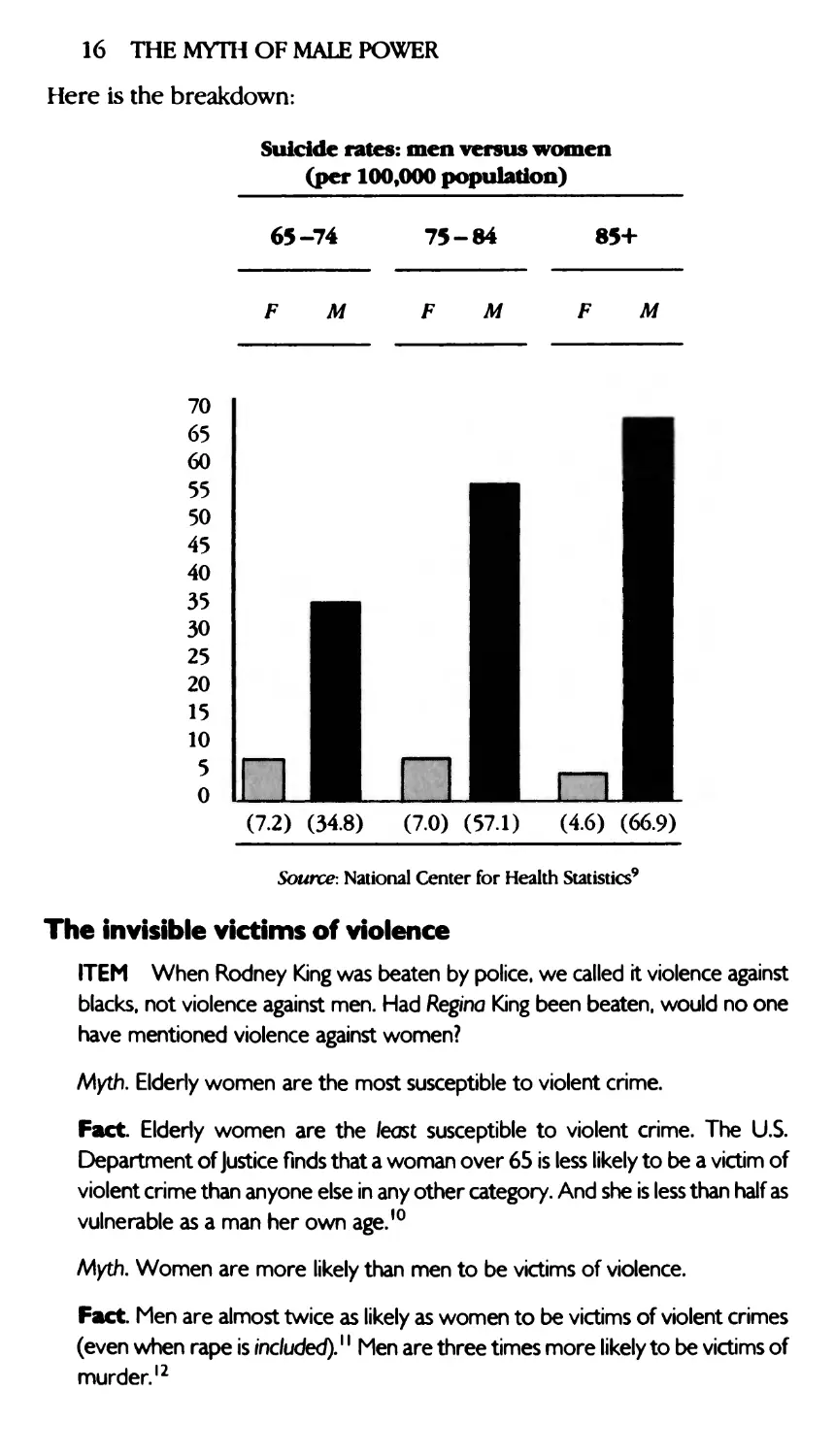
ITEM The suicide rate for men over 85 is 1,350 percent higher than for
women of the same age group.

16 THE MYTH OF MALE POWER
Here is the breakdown:
70
65
60
55
50
45
40
35
30
25 |
20
15
10
5
0
Suicide fates:
men versus women
(per 100,000 population)
65-74 75-84 85+
F M F M F M
§■■ ^H
■ ■
■ ■
■ ■
M H ■
■ HI
H m ■
■ ■ ■
■ HI
■ ■ ■
■ mm
(7.2) (34.8) (7.0) (57.1) (4.6) (66.9)
Source: National Center for Health Statistics9
The invisible victims of violence
ITEM When Rodney King was beaten by police, we called it violence against
blacks, not violence against men. Had Regina King been beaten, would no one
have mentioned violence against women?
Myth. Elderly women are the most susceptible to violent crime.
Fact. Elderly women are the least susceptible to violent crime. The U.S.
Department of Justice finds that a woman over 65 is less likely to be a victim of
violent crime than anyone else in any other category. And she is less than half as
vulnerable as a man her own age.10
Myth. Women are more likely than men to be victims of violence.
Fact. Men are almost twice as likely as women to be victims of violent crimes
(even when rape is included).'' Men are three times more likely to be victims of
murder.12

Is Male Power Really a Myth? A First Glance 17
When Time magazine ran a cover story of each of the 464 people shot in a
single week, it concluded: "The viaims were frequently those most
vulnerable in society: the poor, the young, the abandoned, the ill, and the
elderly."13 When you read that, did you think of men? One had to count the
pictures to discover that 84 percent of the faces behind the statistics were
those of men and boys. In fact, the victims were mostly poor men, young
men, abandoned men, ill men, and elderly men. Yet a woman - and only a
woman - was featured on the cover. Men are the invisible viaims of
America's violence.
Net worth power
ITEM The U.S. Census Bureau finds that women who are heads of
households have a net worth that is 141 percent of the net worth of men who are
heads of households.14
(The value of the net worth statistic is that it allows us to see what he and she
have left when their different liabilities are subtracted from the different assets.
The women's average net worth is $13,885; the men's is $9,883. This is
because although male heads of households have higher gross incomes and
assets, they have much higher spending obligations. They are much more likely
to support wives (or ex-wives) than wives are to support them and thus their
income is divided among themselves, a wife, and children - not only for food
and housing but for tuition, insurance, vacations. Divorces often mean
the woman receives the home the man pays for and also gets custody of the
children the man pays for. A woman's obligation to spend more time with the
children leaves her earning less and the man earning more but paying out
more.)
ITEM Among the wealthiest 1.6 percent of the U.S. population (those with
assets of $500,000 or more), women's net worth is more than men's.15
How can so many of the wealthiest people be women when women hold
none of the top corporate jobs? In part, by selecting the men who do and
outliving them. And in part by having greater spending power and lower
spending power obligations . . .
Spending power
In my own examination of large shopping malls (including men's shops and
sporting goods stores) I found that approximately seven times as much
floor space is devoted to women's personal items as to men's. Both sexes
buy more for women. The key to wealth is not in what someone earns; it is
In what is spent on ourselves, at our discretion - or in what is spent on us, at
our hint.

18 THE MYTH OF MALE POWER
Overall, women control consumer spending by a wide margin in virtually
every consumer category.16 With spending power come other forms of
power. Women's control over spending gives them control of TV programs
because TV is dependent on sponsors. When this is combined with the fact
that women watch more TV in every time slot,17 shows can't afford to bite
the hand that feeds them. Women are to TV what bosses are to employees.
The result? Half of the 250 made-for-TV movies in 1991 depicted women as
victims - subjected to "some form of physical or psychological
mistreatment."18
The spending obligation gap
In restaurants, men pay for women about ten times as frequently as women
pay for men - the more expensive the restaurant, the more often the man
pays.19 Women often say, "Well, men earn more." But when two women go
to a restaurant, they don't assume that the woman who earns more will pay
the bill. The expectation on men to spend more on women creates the
"spending obligation gap."
I got a sense of this spending obligation gap as soon as I thought about my
first date. As a teenager, I loved baby-sitting. (I genuinely loved kids, but it
was also the only way I could get paid for raiding the refrigerator!) But then I
got to the dating age. Alas, baby-sitting paid only fifty cents an hour. Lawn
mowing, though, paid two dollars an hour. I hated lawn mowing. (I lived in
New Jersey, where bugs, humidity, and noonday sun made mowing a lawn
less pleasant than raiding a refrigerator.) But as soon as I started dating, I
started mowing lawns.
For boys, lawn mowing is a metaphor for the way we soon learn to take
jobs we like less because they pay more. Around junior year of high school,
boys begin to repress their interest in foreign languages, literature, art
history, sociology, and anthropology because they know an art history
major will make less than an engineer. Partially as a result of his different
spending expectation (the possibility he might have to support a woman but
cannot expect a woman to support him), more than 85 percent of students
who take engineering as a college major are men; more than 80 percent of
the art history majors are women.20
The difference in the earnings of the female art historian versus the male
engineer appears to be a measure of discrimination, when in fact both sexes
knew ahead of time that engineering would pay more. In fact, the woman
who enters engineering with the same lack of experience as the man
averages $571 per year more than her male counterpart.21
In brief, the spending obligation that leads a man to choose a career he
likes less that pays more is a sign of powerlessness, not power. But when he
takes that job, women often assume he will pay because, after all, he earns
more. Thus both sexes expectations reinforce his powerlessness.

Is Male Power Really a Myth? A First Glance 19
Influence power
The Catholic church is often quoted as acknowledging, "Give us a child the
first five years and we will shape its life." We acknowledge the influence
power of the church over its youth; we often ignore the influence power of a
mother over her children - including her sons. But it is the mother who can
make a child's bedtime earlier, take away desserts, or ground the child if it
doesn't obey. It is the hand that rocks the cradle that creates the child's
everyday heaven or hell.
Few men have a comparable amount of influence. While theoretically the
man was "the master of the house," most men felt they were visitors in their
wives' castle in the same way a woman would have felt like a visitor had she
entered her husband's place of work. From a woman's perspective, a man's
home is his castle; from a man's perspective, a woman's home is his
mortgage.
Almost every woman had a primary role in the "female-dominated"
family structure; only a small percentage of men had a primary role in the
"male-dominated" governmental and religious structures. Many mothers
were, in a sense, the chair of the board of a small company - their family.
Even in Japan, women are in charge of the family finances - a fact that was
revealed to the average American only after the Japanese stock market
crashed in 1992 and thousands of women lost billions of dollars that their
husbands never knew they had invested.22 Conversely, most men were on
their company's assembly line - either its physical assembly line or its
psychological assembly line.
Control-over-life power
Influence power, though, is not real power. If we told mothers, "The more
children you have, the more power you will have," they would laugh. If we
then said, "The more children you have, the more everyone will love you
and respect you," the mother would feel pressured, not empowered. But
when we tell men, "The more people you supervise, the more power you
will have," they buy it. Real power does not come from caving in to pressure
to expand obligations, it comes from controlling our own life.
Historically, a husband spent the bulk of his day under the eye of his boss
- his source of income; a wife did not spend the bulk of her day under the
eye of her husband - her source of income. She had more control over her
work life than he had over his.
Security power
The prohibition against divorce gave a woman security in her workplace.
Nothing gave a man security in his workplace. His source of income could
fire him; her source of income could not fire her. Even today, if he quits his

20 THE MYTH OF MALE POWER
job, he doesn't get severance pay; if she initiates divorce, she takes half the
"corporate stock."
"My body, my choice" power
In the 1990s, if a woman and man make love and she says she is using birth
control but is not, she has the right to raise the child without his knowing he
even has a child, and then to sue him for retroactive child support even ten
to twenty years later (depending on the state). This forces him to take a job
with more pay and more stress and therefore earlier death. Although it's his
body, he has no choice. He has the option of being a slave (working for
another without pay or choice) or being a criminal. Roe v. Wade, in which an
abortion was approved because the woman alleged she had been raped,
gave women the vote over their bodies. Men still don't have the vote over
theirs - whether in love or war.
The power of appreciation
ITEM The Mike Tyson trial. The hotel in which the jury is sequestered goes
ablaze. Two fire fighters die in saving its occupants.
The trial of Mike Tyson made us increasingly aware of men-as-rapists. The
fire fighters' deaths did not make us increasingly aware of men-as-saviors.
We were more aware of one man doing harm than of two men saving; of one
man threatening one woman who is still physically alive than of dozens of
men saving hundreds of people and two of those men being dead. In the
United States, almost one million municipal fire fighters volunteer to risk
their lives to save strangers. Ninety-nine percent of them are men.23 In
exchange they ask only for appreciation. In exchange they are ignored.
The work obligation gap
The media popularizes studies reporting women's greater amount of time
spent on housework and child care, concluding: women work two jobs;
men work one. But this is misleading. Women do work more hours inside
the home, but men work more hours outside the home. And the average
man commutes farther and spends more time doing yardwork, repairs,
painting . . . What happens when all of these are combined? The University
of Michigan's study (reported in the Journal of Economic Literature in
1991) found the average man worked sixty-one hours per week, the average
woman fifty-six.24
Is this just a recent change in men? No. In 1975, the largest nationwide
probability sampling of households found that when all child care, all
housework, all work outside the home, commuting, and gardening were

Is Male Power Really a Myth? A First Glance 21
added together, husbands did 53 percent of the total work, wives 47
percent.25
The unpaid bodyguard
ITEM Steve Petrix was a journalist who lived near me in San Diego. Every day
he returned home to have lunch with his wife. Recently, as he got near his door,
he heard his wife screaming. She was being attacked with a knife. Steve fought
the assailant off his wife. His wife ran to call the police. The intruder killed Steve.
Steve was 31.26
A friend of mine put it this way: "What would you pay someone who agreed
that, if he was ever with you when you were attacked, he would intervene
and try to get himself killed slowly enough to give you time to escape? What
is the hourly wage for a bodyguard? You know that is your job as a man -
every time you are with a woman . . . any woman, not just your wife."27
What do men as women's personal bodyguards and men as volunteer fire
fighters have in common besides being men? They are both unpaid. Men
have not yet begun to investigate their unpaid roles . . .
Man as "nigger"?
In the early years of the women's movement, an article in Psychology Today
called "Women as Nigger" quickly led to feminist activists (myself included)
making parallels between the oppression of women and blacks.28 Men were
charaaerized as the oppressors, the "master," the "slaveholders". Black
congresswoman Shirley Chisholm's statement that she faced far more
discrimination as a woman than as a black was widely quoted.
The parallel allowed the hard-earned rights of the civil rights movement
to be applied to women. The parallels themselves had more than a germ of
truth. But what none of us realized was how each sex was the other's slave in
different ways and therefore neither sex was the other's "nigger" ("nigger"
implies a one-sided oppressiveness).
If masculists had made such a comparison, they would have had every bit
as strong a case as feminists. The comparison is useful because it is not until
we understand how men were also women's servants that we get a clear
picture of the sexual division of labor and therefore the fallacy of comparing
either sex to "nigger." For starters . . .
Blacks were forced, via slavery, to risk their lives in cotton fields so that
whites might benefit economically while blacks died prematurely. Men
were forced, via the draft, to risk their lives on battlefields so that everyone
else might benefit economically while men died prematurely. The
disproportionate numbers of blacks and males in war increases both blacks' and
males' likelihood of experiencing posttraumatic stress, of becoming killers

22 THE MYTH OF MALE POWER
in postwar civilian life as well, and of dying earlier. Both slaves and men
died to make the world safe for freedom - someone else's.
Slaves had their own children involuntarily taken away from them; men
have their own children involuntarily taken away from them. We tell women
they have the right to children and tell men they have to fight for children.
Blacks were forced, via slavery, into society's most hazardous jobs; men
are forced, via socialization, into society's most hazardous jobs. Both slaves
and men constituted almost 100 percent of the "death professions." Men
still do.
When slaves gave up their seats for whites, we called it subservience;
when men give up their seats for women, we call it politeness. Similarly, we
called it a symbol of subservience when slaves stood up as their masters
entered a room; but a symbol of politeness when men stand up as a woman
enters the room. Slaves bowed before their masters; in traditional cultures,
men still bow before women.29 The slave helped the master put on his coat;
the man helped the woman put on her coat. He still does. These symbols of
deference and subservience are common with slaves to masters and with
men to women.
Blacks are more likely than whites to be homeless; men are more likely
than women to be homeless. Blacks are more likely than whites to be in prison;
men are about twenty times more likely than women to be in prison. Blacks
die earlier than whites; men die earlier than women. Blacks are less likely
than whites to attend college or graduate from college. Men are less likely
than women to attend college (46 percent versus 54 percent) and less
likely to graduate from college (45 percent versus 55 percent).30
Apartheid forced blacks to mine diamonds for whites; socialization
expected men to work in different mines to pay for diamonds for women.
Nowhere in history has there been a ruling class working to afford
diamonds they could give to the oppressed in hopes the oppressed would
love them more.
Blacks are more likely than whites to volunteer for war in the hopes of
earning money and gaining skills; men are more likely than women to
volunteer for war for the same reasons. Blacks are more likely than whites
to subject themselves to the child abuse of boxing and football in the hopes
of earning money, respect, and love; men are more likely than women to
subject themselves to the child abuse of boxing and football, with the same
hopes.
Women are the only "oppressed" group to systematically grow up having
their own private member of an "oppressor" class (called fathers) in the
field, working for them. Traditionally, the ruling class had people in the field
working for them - called slaves.
Among slaves, the field slave was considered the second-class slave; the
house slave, the first-class slave. The male role (out in the field) is akin to the

Is Male Power Really a Myth? A First Glance 23
field slave - or the second-class slave; the traditional female role (home-
maker) is akin to the house slave - the first-class slave.
Blacks who are heads of households have a net worth much lower than
the heads of households who are white; men who are heads of households
have a net worth much lower than heads of households who are women.31
No oppressed group has ever had a net worth higher than the oppressor.
It would be hard to find a single example in history in which a group that
cast more than 50 percent of the vote got away with calling itself the victim.
Or an example of an oppressed group which chooses to vote for their
oppressors more than it chooses to have its own members take
responsibility for running. Women are the only minority group that is a majority, the
only group that calls itself oppressed that is able to control who is eleaed to
every office in virtually every community in the country. Power is not in who
holds the office, power is in who chooses who holds the office. Blacks, Irish,
and Jews never had more than 50 percent of America's vote.
Women are the only "oppressed" group to share the same parents as the
"oppressor"; to be born into the middle class and upper class as frequently
as the "oppressor"; to own more of the culture's luxury items than the
"oppressor"; the only "oppressed" group whose "unpaid labor" enables
them to buy most of the fifty billion dollars' worth of cosmetics sold each
year; the only "oppressed" group that spends more on high fashion, brand-
name clothing than their "oppressors"; the only "oppressed" group that
watches more TV during every time category than their "oppressors."32
Feminists often compare marriage to slavery - with the female as slave. It
seems like an insult to women's intelligence to suggest that marriage is
female slavery when we know it is 25 million American females33 who read
an average of twenty romance novels per month,54 often with the fantasy of
marriage. Are feminists suggesting that 25 million American women have
enslavement fantasies because they fantasize marriage? Is this the reason
Danielle Steel is the best-selling author in the world?
Never has there been a slave class that has spent a lot of time dreaming
about being a slave and purchasing books and magazines that told them
"How to Get a Slavemaster to Commit." Either marriage is something
different from slavery for women or feminists are suggesting that women
are not very intelligent.
The difference between slaves and males is that African-American blacks
rarely thought of their slavery as "power," but men were taught to think of
their slavery as "power." If men were, in fact, slavemasters, and women
slaves, then why did men spend a lifetime supporting the slaves and the
slaves' children? Why weren't the women supporting the men instead, the
way kings were supported by their subjects? Our understanding of blacks'
powerlessness has allowed us to call what we did to blacks immoral, yet we
still call what we do to males patriotism and heroism when they kill on our

24 THE MYTH OF MALE POWER
behalf, but violence, murder, and greed when they kill the wrong people
the wrong way at the wrong time.
By understanding what we did to blacks was immoral, we were willing to
assuage our guilt via affirmative aaion programs and welfare. By thinking of
men as the dominant oppressors who do what they do for power and greed,
we feel little guilt when they die early in the process. By believing that
women were an oppressed slavelike class, we extended privileges and
advantage to women that had originally been designed to compensate for
our immorality to blacks. For women - and only women - to take advantage
of this slavery compensation was its own brand of immorality. For men to
cooperate was its own brand of ignorance.
Did men do all this because they were more altruistic, loving, and less
power hungry than women? No. Both sexes made themselves slaves to the
other sex in different ways. Let's look at why both sexes did that; at why
neither sex can accurately be called oppressed; at why we should be
celebrating rather than blaming; and at why institutions that don't
understand their new opportunities are adapting divisively because they don't
understand how to adapt lovingly.

CHAPTER 2
Stage I to Stage II: How Successful
Men Freed Women
(But Forgot to Free Themselves)
From role mate to soul mate
For thousands of years, most marriages were in Stage I - survival-focused.
After World War II, marriages increasingly flirted with Stage II - a self-
fulfillment focus. In Stage I, most couples were role mates: the woman
raised the children and the man raised the money. In Stage II, couples
increasingly desired to be soul mates. Why? As couples met their survival
needs, they upped the ante and redefined love.
In Stage I, a woman called it love if she found a man who was a good
provider and proteaor; he called it love if she was beautiful and could take
care of a home and children. Love meant a division of labor which led to a
division of female and male interests. In Stage II, love means common
interests and common values. Love's definition is in transition.
Even before World War II, some parents began to redefine love. But they
could usually afford to do that only after their last child was married off, as
with Tevye and Golde of Fiddler on the Roof}
Tevye: Golde ... Do you love me?
Golde: Do I love you?
For twenty-five years I've washed your clothes,
Cooked your meals, cleaned your house,
Given you children, milked the cow.
After twenty-five years, why talk about
Love right now?. . .
Tevye: But my father and my mother
Said we'd learn to love each other . . .
Do you love me?
Golde: For twenty-five years I've lived with him
Fought with him, starved with him
Twenty-five years my bed is his.
If that's not love, what is?
The people with the most freedom to redefine love were women who had
married the most successful men. These women began asking Stage II
questions, such as "Why should I be married to a man who can show me his

26 THE MYTH OF MALE POWER
wallet but not show me his love?"; "Why am I called Mrs. John Doe - who
am /?"; "Why am / always serving him, deferring to his opinions?"; "When
the children are grown, will my life have meaning?" She feared her own
husband didn't really respea her; then she chastised herself for being so
preoccupied with what he thought, anyway. She expressed her concerns
aloud. Her concerns were institutionalized: the women's liberation
movement.
His concerns were repressed. He kept to himself his hurt that his wife
seemed more interested in the children, in shopping, and in herself than in
him. That he felt criticized for working late rather than appreciated for
working late. To him, his wife seemed to define communication as her
expressing her negative feelings but not him expressing his. She seemed to
avoid sex more than enjoy it. He felt hurt that soon after marriage his wife
paid less attention to keeping weight off and started dressing sloppily unless
she was meeting other people.
Turned off and unappreciated, he rumbled internally, "What am /getting
from this marriage? Restaurants cook food better and give me a whole menu
to choose from; housekeepers don't ask for half of my income; and my
secretary is more attractive, has more respea for me, and is more in tune
with my work. And besides, selling Product X is hardly what / call 'identity.' "
Unlike her, though, he failed to express his concerns. His concerns became
ulcers, heart attacks, cancer, and alcoholism.
When he did express his concerns, they were dismissed as his male
midlife crisis. Essentially, though, women's liberation and the male midlife
crisis were the same search - for personal fulfillment, common values,
mutual respect, love. But while women's liberation was thought of as
promoting identity, the male midlife crisis was thought of as an identity
crisis. Similarly, women's liberation was called insight, self-discovery, and
self-improvement - akin to maturity; the male midlife crisis was called
"playboy time" and selfishness - akin to immaturity. His crisis got the bad
rap.
Was Stage II love unconditional or more conditional?
My mom used to say, "When the money stops coming in the door, the
love starts going out the window."
Brian, 41, discussing the
unwritten rule of Stage I love
It is tempting to think of Stage II love as unconditional love. In praaice, it is
more conditional. Couples now expect communication skills, joint
parenting, shared housework, sexual fulfillment, joint decision-making, a spiritual
conneaion, mutual attraaion, and mutual respea. They want both stability

Stage I to Stage II: How Successful Men Freed Women 27
and change; both interdependence and a partner who is independent. They
want time to grow and time to discover each other s growth. In Stage I, these
pursuits would have taken time away from raising the children, raising the
crops, and raising the money. "Discovering each other" was Stage Ys Trivial
Pursuit. It threatened survival.
Why divorce was the trade-off to relationship progress
Couples who pursued Stage II values created a new set of problems: the
very qualities that made a perfect couple in a Stage I marriage made them
perfect for divorce in a Stage II marriage - she was seen as preoccupied with
the home and b-o-r-i-n-g. . .; he was seen as preoccupied with work - and
afraid of intimacy. The contrast between Stage I roles and Stage II goals and
the resultant setup for divorce becomes apparent in this table:
Stage I Roles
Stage II Goals*
MARRIAGE
Survival
Role mates: women and men married
to create a "whole"
Division of roles
Woman raises children; man raises
money
Children obligatory
Women expected to risk life in
childbirth; men expected to risk life in
war
Till Death Do Us Part
Neither party can end contract
Women-as-property; men-as-less-than-
property (expected to die before
property was lost)
Both sexes subservient to needs of
family
Love emanates from mutual
dependence
MARRIAGE
(OR LONG TERM RELATIONSHIP)
Fulfillment
Soul mates: "whole" persons married
to create synergy
Commonality of roles
Both sexes raise children; both sexes
raise money
Children a choice
Childbirth ideally risk-free; war ideally
eliminated
Till Unhappiness Do We Stay Together
Either party can end contract
Sexes equally responsible for self and
other
Both sexes balance needs of family
with needs of self
Love emanates from choice

28 THE MYTH OF MALE POWER
Stage I Roles Stage II Goals*
Love less conditional Love more conditional (no verbal or
physical abuse; expectations of mutual
respect, common values . ..)
CHOICE OF PARTNERS CHOICE OF PARTNERS
Parental influence is primary Parental influence is secondary
Women expected to marry their source Neither sex expected to provide more
of income ("marry up") than half the income
PREMARITAL CONDITIONS PREMARITAL CONDITIONS
Men deprived of female sex and beauty Neither sex deprived more than the
until they supply security other
*Stage II goals are the ideal; most of these goals are not yet reality for most couples.
Many marriages consummated in Stage I, then, were suddenly held up to
Stage II standards. They failed. Marriages failed not only because the
standards were higher, but because the standards were also contradictory.
For a Stage I woman, a lawyer was an ideal candidate for husband. For a
Stage II woman, the lawyer, often trained to argue more than to listen, was
an ideal candidate for divorce. The very qualities that led to success at work
often led to failure at home. Sex role training had always been divorce
training, but without the option to divorce. Stage II brought with it the
option. Thus the divorces of the 1960s—90s.
How divorces led women to redefine discrimination and
equality
Practically speaking, when more than 90 percent of women got married and
divorce was rare, discrimination in favor of men at work meant
discrimination in favor of their wives at home.
When workplace discrimination worked in favor of women at home, no
one called it sexism. Why? It was working for women. Only when
discrimination switched from working for women to working against women
(because more women were working) did it get called sexism. For
example:
During the years I was on the board of directors of the National
Organization for Women in New York City, the most resistant audiences I

Stage I to Stage II: How Successful Men Freed Women 29
ever faced in the process of doing corporate workshops on equality in the
workplace were not male executives - they were the wives of male
executives. As long as her income came from her husband, she was not
feeling generous when affirmative action let another woman have a head
start vying for her husband's (her) income. To her, that seemed like sexism.
To her, my seminars on Equal Opportunity for Women at Work read
Lfaequal Opportunity for Wives at Home. And, to the executive's wife, they
still do.
Why still? Almost 70 percent of the wives of male executives (vice-
presidents and above) do not hold paid jobs outside the home - not even
part time.2 They still get their incomes completely from their husbands. An
executive's wife often opposes a woman at work having an advantage over
her husband, not only because it hurts her income but also because it
discounts her contribution: she usually works hard to support her husband
to support the company - that's her job. She feels her efforts - her job - have
been discounted.
As soon as discrimination began to work against women, it led to
measures to protect women. Immediately - in 1963 - the Federal Equal Pay
Aa was passed.3 Interestingly, the Equal Pay Aa preceded the women's
movement. The U.S. Census Bureau found that as early as I960, never-
married women over 45 earned more in the workplace than never-married
men over 454 Data like these - which implied a much different view from
woman-as-viaim - never reached the public's awareness because only
women's groups organized.
Taking what had worked for most women and seeing it as a plot against
them led us to see men as "owing" women. This created Stage II
entitlement: women being entitled to compensation for past oppression. This
prevented us from seeing the need to make a transition from Stage I to Stage
II together-, the need not for a women's movement or a men's movement,
but for a gender transition movement.
In this book, I define power as having control over one's own life. The
male obligation to earn more money than a woman before she would love
him was not control over his life; in Stage I, neither sex had control over her
or his life. And, as we saw in the opening chapter, both sexes had what was
the traditional definition of power (influence over others and access to
scarce resources) via different means.
Sexism? Or blsexfcm?
Am I suggesting that sexism was a two-way street? Yes. We think of sexism as
having kept women less powerful than men for centuries. In faa, for
centuries neither sex had power. Each had roles. Her role: create a family.
His role: protea a family. Her role: gather the food. His role: hunt the food.

30 THE MYTH OF MALE POWER
If both sexes were restricted to roles, it is not accurate to call it sexism, but
sex roles. We have lived not in a sexist world, but in a bisexist world.
How successful men freed women but forgot to free
themselves
Abigail, a typical 1890s woman, had eight children. She almost died twice in
childbirth. By the time her last child left the house, she was dead.
Cindy, a typical 1990s woman, was single until she was 25. After she
married, she bore two children. When her last child left the house, she had
another quarter century to live.
Abigail never heard of a freezer. Cindy could pull a whole meal out of
one. It took Abigail all day to shop and cook for her family of ten. Cindy
often picked up gourmet food, put it in the microwave, and was eating
twenty minutes later. (She often joked, "I don't cook dinner, I heat it.") On
other evenings, she and her husband, Jeremy, took the kids to McDonald's,
or had pizza delivered, or Jeremy barbecued, or made Cindy's favorite thing
for dinner - a reservation. Both Cindy and Jeremy, though, did face
expectations Abigail never faced (e.g., to play chauffeur, to provide a college
education).
Abigail shopped by horse and buggy or by foot. Cindy or Jeremy shopped
by car or by phone. Abigail got groceries between nine and five - what she
forgot she never got. Cindy or Jeremy got groceries round the clock.
Abigail had to wash dishes after every meal. Cindy gave the dishes to a
dishwasher. (Sometimes she didn't touch the dishes at all -Jeremy or her
older son did.) Abigail washed clothing by pumping water, building a fire to
heat the water, and then using her own hands to scrub every inch. If it was
raining or snowing, she hung the clothes around the house a clothespin at a
time in corners she could find. Cindy set the right wash and dry cycles.
(Sometimes she didn't touch the wash at all -Jeremy or her older son did.)
Abigail sewed by calloused hand in a cold house by candlelight. Cindy
and Jeremy picked up wrinkle-free blends from discount clothing stores. It
took Abigail two days to sew a shirt for one child, times a family of ten. It
took Cindy or Jeremy twenty minutes at the discount clothing store to pick
up shirts for both children.
Abigail had eight children's needs focused on her. Cindy had two
children's needs focused partially on a TV. And Cindy had one other thing: a
husband who knew how to nurture as well as discipline.
In 1990, Cindy could still choose to bake bread in the oven or sew a shirt
by hand - but now it was by option, not obligation; now it was occasionally,
not daily; now it was for part of her adult life, not 100 percent of her adult
life.
Did Cindy face pressures that Abigail never had? Absolutely. But those
new pressures were rarely additions, but substitutes for her old burden. Had

Stage I to Stage II: How Successful Men Freed Women 31
they been additions, women's life span would not have increased by almost
50 percent since 1920.5
Why, then, did men's life expectancy go from one year less than women's
in 1920 to seven years less today? Because men's performances - inventing,
manufacturing, selling, and distributing - saved women, but no one saved
men from the pressure to perform. She went from being a baby machine,
cooking machine, and cleaning machine, to having time for love. He went
from being a performing machine near the home to being a performing
machine away from home. And having less time for love.
Men did a better job creating better homes and gardens for their wives
than they did creating safer coal mines and construction sites for
themselves. Few cared that only men died by thousands clearing paths through
mountains to lay roads for cars and tracks for trains that allowed the rest of
civilization to be served in a dining car.
The location of a man's work disconnected him from the people he loved,
thus depriving his life of meaning. . . creating little deaths every day. And if
he succeeded in all this, he became a male machine; if he failed, he suffered
humiliation. Either way, the more he saved her, the sooner he died
compared to her, leaving what he made to her and the children to spend. In
these ways, successful men freed women but forgot to free themselves.
Despite this, feminists labeled "male technology" - and especially "male
medical technology" - as a tool of the patriarchy designed to oppress
women.6 So our entrance into Stage II was marked by criticizing men for the
destruction to the environment created by a dam, but not acknowledging
men for the electricity created by the dam, or asking women to take
responsibility for the female consumption that also led to the demand for
electricity that required more dams.
As for male medical technology, it was probably the single factor most
responsible for women's life expectancy increasing by almost 50 percent. It
prevented women from dying in childbirth and developed vaccines for
almost all the contagious diseases (polio, diphtheria, typhoid fever, measles,
chickenpox, bubonic plague, smallpox, tuberculosis).
During wartime, experimental drugs were often tried on men. If a drug
failed, the man died. But if a drug succeeded, it was used to save both
women and men, but without women dying to develop it. Men were
similarly used as guinea pigs in the development of emergency procedures,
microwave ovens (a man was inadvertently "cooked" during the testing
process7), and other advances that served both sexes. Later it was labeled
sexism that physicians studied men more than women. No one labeled it
sexism because men were used as guinea pigs more than women.
Feminists felt patriarchy and male technology conspired to restrict
women's reproductive freedom - women's right to choose. But male
technology created women's right to choose - it created birth control. And it

32 THE MYTH OF MALE POWER
created safe abortions. The male technology of birth control did more than
any other single thing to reduce women's work load; to move women from
one-option sex to the only multi-option sex. Overall, technology led to the
male role saving women more than the female role saved men. Ironically,
some of the feminists who complained of male technology would have died
in childbirth or via abortions without it. (They literally owed their lives to
what they complained controlled their lives.)
Male technology did not create for men the equivalent right to choose.
Thus, each time a man had sex with a woman who said she was using birth
control, he had to trust that she was, in fact, using it. If she wasn't, he could
be responsible for supporting a child for eighteen years. If a man used a
condom but the woman later said she had nevertheless conceived, the Stage
II unmarried woman now had the right to inform the man or not to inform
him; to abort the fetus unilaterally or secretly put the child up for adoption;
to raise it herself and make him pay the bills; or even raise it for ten years by
herself without telling him it was his child and then sue him for child
support retroactively. All this is legal.
Every woman knows that if there was only male birth control, she would
not feel in control, she would feel out of control. "Trust me" from a man is
laughable; "trust me" from a woman is the law. Birth control created the
right of women to choose and the expectation of men to trust. Today, every
man who puts a penis in a woman's body also puts his life in a woman's
hands.
In brief, male technology and male laws freed women from female
biology as female destiny and created/ema/e biology as male destiny.
The emergence of the multi-option woman and the no-
option man
Today, when the successful single woman meets the successful single man,
they appear to be equals. But should they marry and consider children, she
almost invariably considers three options:
Option #1; Work frill time
Option #2: Mother full time
Option #3: Some combination of working and mothering
He considers three slightly different options:
Option #1; Work frill time
Option #2: Work frill time
Option #3: Work frill time
Mothers are still forty-three times more likely than fathers to leave the
workplace for six months or longer for family reasons.8 In most cases, this

Stage I to Stage II: How Successful Men Freed Women 33
leaves him not just working full time but working overtime or working two
jobs.
Ironically, then, it is his success that makes her more than equal to him -
that gives her three options while he has none. Of course, a woman's choice
to mother may hurt her career, but she can choose maternal opportunity or
career continuity. In contrast, men who choose paternal opportunity- to be
pioneer househusbands - soon learned that many reporters wanted them
for an interview but few women wanted them for a marriage.
Women did even more than speak up for new options. They articulated
the problems the new options created. So we heard about her "juggling
act." Fathers did not articulate their pressure to intensify their commitment
to the workplace when children arrived. We didn't hear about his
"intensifying act." Nor did men discuss how hurt they felt being left out of their
families.
The first time I asked a group of men whether they would choose to
parent full time for six months to a year if they could (as mentioned above)
and more than 80 percent said that being full time with their newborn child
would be their preference if they were not hurting the family economically
and their wife approved, I assumed I was either dealing with a group of liars
or a self-selected sample. When I received only a slightly smaller percentage
from an association of construction subcontractors,91 began to understand
the degree to which men had not even thought about their options.
We often say, "In today's economy, women need to work outside the
home - it's not an option." We forget that women who work outside the
home are usually exercising the option of paying for the technology that
reduced women's burden inside the home.
Most multi-option women had one thing in common: a successful
husband. But divorces eliminated many women's successful husbands -
leaving us with six basic classes of women . . .
The six classes of women
1. The Stage I married woman. She never gave herself permission to
work, or she felt "My husband won't let me." Psychologically, she was
a no-option woman.
2. The three-options woman with a poor marriage. She remained
married, but unhappily, often to avoid having to work.
3. The single mother married to the government. The government
played substitute husband, providing her with three options but only
if she remained at a subsistence level.

34 THE MYTH OF MALE POWER
4. The Stage I single working woman. This woman worked to prevent
herself or her family from starving. If she had children from a
previous marriage, she usually did not receive child support.
5. The Stage II single working woman. She was neither supported by a
man nor supporting a man. If she had children from a previous
marriage, she was likely to be in Stage II only if she received child
support.
6. The have-itall woman. This woman was married to a man who
provided an economic safety net (a financial womb) from which she
could choose among her three options. The have-it-all woman was
happily married. This created a class of people who had never before
existed. In a sense, the have-it-all woman was the "new royalty."
Virtually no man was in the equivalent position.
The political genius of the feminist movement was its intuitive sense that it
could appeal to all six classes only by emphasizing expansion of rights and
avoiding expansion of responsibilities. Had the National Organization for
Women (NOW) fought to register 18-year-old girls for the draft, it might
have lost a few members. Had feminism emphasized women's
responsibilities for risking sexual rejection, or paying for men's dinners, or choosing
careers they like less to support the family more, or marrying down, its
impact would have been more egalitarian but less politically successful.
What made women so angry at men?
Women became angry at men in part because they compared themselves to
the successful heterosexual white man - not to the plight of the black and
native American man, or to the ostracism of the gay man, or the invisibility of
the poor man. But this was only part of it. . .
Women as the disposable sex
Divorces threw millions of women out of the have-it-all class. But the
woman who got divorced, more often 40 than 20, was tossed into the
marketplace of men more addicted to two 20s than to one 40.
Understandably she became angry.
In Stage I, reinforcing men's addiction to the 20-year-old woman worked
for her - the addiction made him agree to support her for a lifetime; the
taboo on divorce made him stick to his agreement. When the taboo on
divorce weakened and she was 40, his addiction to two 20s worked against
her. She felt disposable. Divorce had altered the psychological relationship
between men and women.

Stage I to Stage II: How Successful Men Freed Women 35
The more beautiful the woman was when she was younger, the more she
had been treated like a celebrity - what I call a genetic celebrity - and
therefore the more she felt like a has-been. It's harder to lose something
you've had than never to have it to begin with. As she became increasingly
invisible, she felt increasingly disposable and increasingly angry.
Simultaneously, women who had never made it into the have-it-all class -
the new royalty - also felt like failures. In different ways, both groups of
women felt rejected - by men. And therefore angry - at men.
The divorced woman with children felt doubly disposable. She was not
just a woman, she was a package deal: a woman-with-children. I recall a
male friend of mine coming back ecstatic from his date with Carol. A week
later, he went to Carol's home and she introduced him to her three
children. When they all went on a ski weekend, he spent over $1,000 on the
children. He knew he didn't have to, but, "I didn't want to be stingy so I paid
for their ski-lift tickets, rooms for them separate from us, some of their
meals, treats..."
My friend was already supporting his former wife and two children. He
feared becoming both a father of two families and a financial womb for two
families. He feared becoming a man with four jobs. More precisely he
feared doing each job inadequately. He soon backed off from the
relationship. Carol felt hurt and never really spoke with him again. He felt
disposable as a friend just because he couldn't commit to be a wallet; she felt
disposable as a marriage partner. In fact they were both victims of the post-
divorce phenomenon I call "woman-as-a-package-deal" (she was not just a
woman but a woman-and-three-children). Had they understood how they
were both victims of a setup, they could more easily have remained friends.
Divorce forced the middle-class woman who used to be able to take a job
she liked more that paid less to have to take a job she liked less that paid
more. When feminism explained that women were segregated into the
lower-paying and meaningless jobs, she felt devalued. Feminism was so
powerful it blinded her to the men around her who were also segregated
into different types of lower-paying, meaningless jobs: the short-order cook
and the dishwasher in her local coffee shop-, the migrant workers who
picked the vegetables for her table; the custodians and carwashers, the
busboys and gas station attendants ... By being blinded to the whole
picture - that when either sex had minimal skills they commanded minimal
wages in different types of meaningless jobs - women became increasingly
angry.
Women interpreted men's tendency to earn more for different work as an
outcome of male dominance rather than male subservience; they did not
see it as an outcome of male obligation - obligation to go where the money
was, not where fulfillment was. For him, following money was primary;
following fulfillment, secondary. For him, divorce also created a change: he

36 THE MYTH OF MALE POWER
still followed money to support a family economically but without a family
to support him emotionally.
Simultaneously, feminists focused on the fact that women as a whole
earned less without focusing on any of the thirteen major reasons why
women earned less (e.g., full-time working men work nine hours per week
more (in the workplace) than full-time working women10; men are more
willing to relocate to undesirable locations, to work the less desirable
hours,11 etc.). By calling the difference in pay discrimination and not
explaining the reasons for the difference, women were left angry rather
than empowered (had they known the reason for the difference, they would
have been empowered to make up the difference).
As female hurt and anger created an atmosphere that made it less safe for
men to express their feelings, men became more passive-aggressive. Men
increasingly felt that their only form of relationship power was not getting
into one. Women labeled this a fear of commitment, accused men of a fear
of intimacy, and began making masculinity virtually synonymous with evil:
"father knows best" became "fathers molest." Women became "women
who loved too much"; men became "men who harassed too much." Women
were labeled superwomen and men were labeled super-spoiled.
The politics of housework
It soon appeared to most women that women had two jobs and men had
one - that only her labor was increasing. In reality, she had less obligation
inside the home, more obligation outside the home: we were really dealing
with a division of the locations of her labor. A nationwide study made this
clear.
In 1991, the Journal of Economic Literature reported that while women
still do about seventeen more hours of work inside the home per week,
men do about twenty-two more hours of work outside the home per week
(including commuting time).12 What happens when we compare the hours
of the average woman to the hours of the average man both inside and
outside the home? Hers amount to fifty-six hours; his amount to sixty-one
hours. By the same measure. Why? The average woman works twenty-six
hours per week outside the home, the average man forty-eight hours.13
Studies of working wives that say that wives do two jobs while their
husbands do just one and slough off on the second tell but half the truth.
They are so misleading as to be a form of lying: they are women-as-victim
studies. More importantly, they make women angry and increase the
divorce rate, which deepens the anger, which . . .
Women's anger was intensified by the sense that women were changing
and men were not. It was assumed this was because of male complacency. It
was not. . .

Stage I to Stage II: How Successful Men Freed Women 37
Why didn't men change?
Divorces also led to women changing because divorces changed women's
source of income. Divorces did not change the pressure on men to focus on
income in order to receive women's love. Millions of divorced men took on
five payments rarely assessed to women:
► Child support
► Mortgage payments on a home no longer lived in
► Apartment rental
► Alimony
► Dating
Men faced more of the same old pressure to earn - just intensified. So
instead of changing, they found themselves becoming more of the same.
Unfortunately, the one feminist study that found men benefiting and
women hurting after divorce completely ignored most of the five male
payments and ignored much of female income, therefore not only ignoring
men's burden but leaving men unappreciated (it was the only study with
those findings and the only one to receive media attention).14
How the government played substitute husband while no
one played substitute wife
When divorce occurred, women's greatest fear was of economic
deprivation. Men's was of emotional deprivation. Stage II divorce laws helped Alice
make a transition from economic dependence to economic independence.
No Stage II laws helped Jack make a transition from emotional dependence
to emotional independence. (Which is why Alice rushed to a court for
economic support and Jack rushed to a woman for emotional support.)
When divorces meant that husbands no longer guaranteed women
economic security, the government became the substitute husband. It
guaranteed women equality in pay and an advantage in hiring (affirmative
action). It gave women Aid to Families with Dependent Children (AFDC); it
provided special programs for Women, Infants, and Children (WIC); it gave
women the preference for keeping children and then garnisheed men's
wages if child support was not paid; it gave special opportunities for women
in college, women in the armed services, women artists, women in small
businesses; it severed him from future services from her.
Alice used to have only one option for economic security and Jack only
one option for emotional security. Now Alice has multiple options for
economic security (income via career, husband, or government) while Jack
has fewer than one: income via career minus child support, minus alimony,
and minus higher taxes to pay for the government as substitute husband. All
of this kept him a prisoner of money, barred from exploring his inner self.

38 THE MYTH OF MALE POWER
Why Stage I institutions were oppressive and how Stage II
institutions can be freeing
Part of women's anger at men comes from the belief that men made the
rules, and made them to oppress women and benefit men. Since most
institutions are headed by men, when these institutions don't meet our
needs, we tend to blame men. The challenge is twofold: first, to recognize
that these institutions helped women to get to Stage II even before men;
second, to understand how institutions that were functional in Stage I can
now make a transition to become functional in Stage II.
How the functional family became the dysfunctional family
Just as we held up Stage I marriages to Stage II standards and labeled them a
failure, we currently hold up Stage I families to Stage II standards and label
them dysfunctional. As many as 97 percent of our families of origin are said
to be dysfunctional. So while in Stage I, "spare the rod, spoil the child"
implied if you did not use the rod, you've abused the child, in Stage II, if you
do use the rod, you've abused the child. Why?
In Stage I, using the rod was considered functional - it taught children
that not obeying would create pain. Which was true - rules were designed
to prevent starvation. But in Stage II, goals of self-fulfillment required being
in touch with one's feelings. Using the rod disconnects children from their
feelings and is therefore more likely to be dysfunctional.
In Stage I, mutual dependence was the cement in a family's foundation. So
there could hardly be too much of it. Codependence was Stage I functional.
But when divorces forced us to prepare ourselves for independence, then
codependence often became over-dependence and therefore
dysfunctional. So the functional Stage I family became the dysfunctional Stage II
family.
I would like to see us stop describing our families of origin as
dysfunctional and begin describing them as Stage I functional. This gives them
credit for the contribution they made to taking care of our survival needs so
that we have the freedom to decide what is functional in Stage II. It also
allows them to rejoice in the opportunity to pursue that freedom them
selves rather than feel blamed and guilty for screwing up.
Marriage
Feminists assume that marital traditions such as the father giving the bride
away were a reflection of patriarchy. But the father gave away the bride
because it was the father giving away his responsibility to protect. (No one
gave the man away because no one would protect a man. The job of the
parents was to turn the son into a protector, not give him away to a
protector.)

Stage I to Stage II: How Successful Men Freed Women 39
Our parents were often criticized for discouraging a son from "doing his
own thing." But because a Vincent van Gogh could barely support himself
(much less a family often), it was the job of parents to make sure their son
didn't become an artist, and to teach their daughters that being courted by
such a man was courting disaster. Children often heard those instruaions as
parents exercising power. In fact, it was not parental power, it was
postponement of parental power - the postponement of Tevye's and Golde's ability to
seek self-fulfillment and search for a deeper love. Thus Tevye was able to ask
Golde Stage II questions only after their daughter was about to be married
off.
Because happiness was secondary, drinking, frustration, and abuse were
rampant. But in Stage I, it was not functional to permit divorce: with eight
children at home and no ability to support two homes, walking out was not
an option. So we tolerated drinking and abuse rather than divorce and
starvation.
In brief, the generations will learn to love each other more quickly if we
see their socialization as Stage I functional rather than labeling them
dysfunctional; if we acknowledge that the children best able to pursue Stage
II values today often can do so exactly because their parents had Stage I
values. Discussions of family values without distinctions between Stage I and
Stage II families are thus setups for deprecation rather than appreciation.
Religion In transition
In Stage I, the church provided rigid rules and rituals designed to get
people to make sacrifices for the next generation without questioning. In
Stage II, questioning is needed to deal with life's options, and rigidity is
poor training for life's ambiguities.
Stage I religions had to restrict premarital sex because premarital sex led
to children without a guarantee for the children's and woman's protection.
In Stage II, birth control allowed sex to become more associated with
fulfillment, communication, and spiritual connection - goals of the Stage II
relationship. So Stage II religions can focus less on restricting the sexes
from access to each other's bodies and more on assisting the sexes to have
access to each other's souls.
Stage II churches are now freer to teach how sexual inhibition often
become spiritual inhibition. For example, teaching women to keep sex
artificially repressed teaches men to tell women what they think women
want to hear rather than what they are really feeling. Dishonesty inhibits
spirituality. Women then begin to use their sexuality to get told what they
want to hear rather than learn to enjoy their sexuality. They often contrast
Sexuality with spirituality rather than see how a sexual bond contributes to a
spiritual bond. Women's sexual repression is an effective way of giving
Women control over men, but it keeps men less than genuine. Many women

40 THE MYTH OF MALE POWER
are beginning to prefer men who are genuine to men whom they can
control. In brief, Stage I religions emphasis on rigid rules prepared a
couple to be enduring role mates. Stage II religion's emphasis on
communication prepares a couple to be soul mates.
Stage I churches will continue to seek men to lead as a symbol of mens
responsibility to be a problem solver and savior. These churches will attract
mostly Stage I female followers and Stage I male leaders. Stage II churches
will seek both sexes to lead, not by blaming men for leading in the past but
by helping both sexes make a transition into a different future.
Stage / versus Stage // sexual politics
Worldwide, politicians trained in Stage I sexual ethics were suddenly
judged by Stage II ethics. John Kennedy 's affairs were kept secret but Ted
Kennedy and Bill Clinton were seen as womanizers. Stage I Japanese prime
ministers had geishas but Stage II prime minister Uno was toppled as soon
as it was discovered he had had a geisha.
Why this change? In Stage I, divorces were not allowed, so mens affairs
did not put women's economic security in jeopardy; in Stage II, affairs could
lead to divorce, so men's affairs did place women's economic security in
jeopardy. We did not want political leaders who would be role models for
behavior that would put women's economic security in jeopardy.
Doesn't our supposed concern about women conflict with the sexual
double standard that seems to have served only men? No. There were two
double standards: (1) a man could have affairs, a woman couldn't; and (2) a
married woman could force her husband to support the children from her
affairs; a married man could not force his wife to support the children from
his affairs. (Rather, he was ostracized if he refused to take care of a child that
resulted from his affairs.15) It is the second double standard that we never
hear about.
Both double standards, though, protected women. How? Had married
men felt their wives were having affairs to create children they had to
support, few men would commit to marriage and few women and children
would receive protection.
Nevertheless, Stage I societies had a dilemma: marriage guaranteed
women economic security for a lifetime but failed to guarantee men sexual
gratification for a lifetime. So Stage I societies created a marital deal: what I
call the "marital triangle."
The marital triangle was the husband, wife, and mistress (or, depending
on the culture, the geisha, prostitute, second wife, or a harem). The deal was
this: Husband, your first obligation is to take care of your wife's and
children's needs economically. If you're still doing this but you're not
getting the sex, youth, beauty, attention, and passion that made you agree to
do this for a lifetime to begin with, then you can take care of some of your

Stage I to Stage II: How Successful Men Freed Women 41
needs, too, but under two conditions: you must continue to provide for
your family (no divorce is allowed even if your needs aren't met); and you
must also provide for some of the economic needs of this younger,
attractive woman (geisha, mistress, prostitute) whose need for money
otherwise might not be met.
In Stage I, no one group got their intimacy needs met - not husband, wife,
mistress, or children. Of course, some individuals did, but that wasn't the
primary worry of a Stage I marriage: it was stability, and the marital triangle
was the "great stability compromise."
By Stage II standards, politicians who declared they were moral but were
having affairs were clearly hypocrites. But that missed the underlying spirit
of morality that was bred into Stage I culture: morality meant taking care of
your family. For most men, affairs would undermine that goal. But the man
who could do both discreetly was not ostracized because on some level it
was understood he was providing an incentive for a man to be successful
and a better protector. All this changed when affairs signaled divorces and
dumped millions of women into the workplace without workplace skills.
Then politicians who had affairs soon also had no workplace.
By calling these changed standards a higher morality, women again
appeared to have the higher morality. Women, though, did not have a
higher morality. Why not? Every affair involved both sexes.
The difference? In the 1980s and 90s, Gary Harts Donna Rice got
commercial and TV roles, Bill Clinton's Gennifer Flowers got paid an
estimated $100,000 to reveal her story. . . both sexes participated, but men
were seen as perpetrators and women as victims even though the men's
careers were being hurt while women's careers were being jump-started.
Stage // politics
When we think of political bosses, bribes, and patronage, we tend to think of
male power, male corruption, the "good ol' boys" network, male
chauvinism, and male dominance. The unraveling of this process is associated with
the unraveling of these symbols of male dominance. However, in Stage I,
political bosses, bribes, and patronage were acceptable not because they
served men but because they served families - including women and
children. The boss remained in power only as long as he created jobs to
feed those families. He built his "machine" from the economic underclass,
so these jobs fed the poor. The fact that they were jobs, not welfare, allowed
the families respect.
When a man became the boss it was often the first symbol of an economic
underclass - Irish or Italians or Jews or blacks - breaking into the economic
niainstream. One could call it Stage I welfare or corruption or job training,
depending on one's point of view, but it benefited families, not just men. In

42 THE MYTH OF MALE POWER
its extreme forms (e.g., the Mafia), it not only provided for families but it
disposed of men much more often than women.
Creating gender transition
In brief, our genetic heritage is in conflict with our genetic future. For the
first time in human history, the qualities it takes to survive as a species are
compatible with the qualities it takes to love. To love the other sex, to love
our children - by a Stage II definition of love. The challenge for a woman is
to create enough economic independence that she doesn't compromise
love for an economic safety net. The challenge for a man is understanding
how preparation for Stage I protection is really preparation for
disconnection - from children, wife, and life. The Stage I man had a role that was more
disconnected from intimacy than the Stage I female role of nurturer. Which
is why the challenge for men to enter Stage II is even greater than the
challenge for women.
T T T
To conclude that men did not have the power, though, we must be more
secure that the male role in the past has not, after all, been just a way of
keeping women in their place. We must deal with denying women the vote;
treating women as property and second-class citizens; objectifying them as
concubines, harems, and prostitutes; stoning them as witches; not writing
them into constitutions; denying them access to roles of leadership, jobs
outside the home, and so on. We must see if power, patriarchy, dominance,
and sexism were code words for male privilege or male disposability.

CHAPTER 3
Are Power, Patriarchy, Dominance,
and Sexism Actually Code Words
for Male Disposability?
Patriarchy is "the universal political structure which privileges men at the expense of
women."
Encyclopedia of Feminism'
I. A SLAVE BY ANY OTHER NAME ... IS STILL A SLAVE
If power is defined as having control over ones life, then myths, legends,
and Bible stories were often ways of getting both sexes to forfeit power. . .
The hero as slave
Once upon a time, a mother who wanted to see the beautiful statue of Hera
had no horses or oxen to carry her there. But she did have two sons. And the
sons wanted more than anything to make their mothers wish come true.
They volunteered to yoke themselves to a cart and take her over the
mountains in the scorching heat to the faraway village of Argos, the home of
the statue of Hera.2
Upon their arrival in Argos, the sons were cheered and statues (that can
be found to this day) were built in their honor.3 Their mother prayed that
Hera give her sons the best gift in her power. Hera did that. The boys died.
The traditional interpretation? The best thing that can happen to a man is
to die at the height of his glory and power. Yet had this been a myth of two
daughters who had substituted themselves for oxen to carry their father
somewhere, would we have interpreted the daughters' deaths as proof that
the best thing that can happen to a woman is to die at the height of her glory
and power?
The statues and cheers can be seen as bribes for the sons to value their
Hves less than their mother's request to view a statue. The fact that the statue
was of Hera, the queen of the Olympian gods and the protector of married
women,4 is symbolic. The sons' sacrifice symbolized the mandate for men
to become strong enough to serve the needs of mothers and marriage, and
to be willing to call it glory if they died in the process. Which is why the
name Hercules means "for the glory of Hera."5

44 THE MYTH OF MALE POWER
Was a hero a servant? Yes. The very word "hero" comes from the Greek
ser-owy from which comes our word "servant," as well as "slave" and
"protector."6 A hero was basically a slave whose purpose was to serve and
protect. To protect the community in general, women and children in
particular. In exchange, heroes received the respect and love of those they
protected. Just as the appreciation we gave our mothers cooking kept her
cooking and gave her an ego bribe to be a slave to her role in the kitchen, so
statues and tales of glory are ego bribes for males to be slaves to their roles
as heroes. Appreciation keeps the slave a slave.
None of this denies the female contribution to protection. The female
who protected in her way was Hera; the male who proteaed in his way was a
hero.
Were men less than property?
Men were not thought of as property or animals, they were just used that
way. The fifteenth-century Incas did not have horses to speed messages over
the long distances up and down mountain paths. The men were given coca
leaves (cocaine), which allowed them to run farther and faster. . . until they
burned out.7 The good died young. Unlike women-as-property, men were
not to be protected - they were to be used and be disposable.
During the bubonic plagues in Europe (fourteenth century), men who
carried the corpses were subject to catching the plague. Poor peasant men
(gavoti) volunteered to do this, though, for the money it gave them. Many
died. But their families were supported.8
On the surface, it would appear that the gavoti corpse carriers had money
and that the Inca runners had physical strength and power. But both knew
they would be dying so their families could live. If these were the rules
made by men, what does it say about men that they made rules to sacrifice
themselves for their families?
Why were men so focused on winning?
When I was a boy and went to a museum I can remember seeing a head cut
off from its body and being told by the curator that it was thought to be the
head of the captain of the winning team in a Mayan ball court game (rough ly
a Mayan and Aztec equivalent of-football). Other times, the losing teams
captain - or the entire team - was killed.9 Why? It depended on who the
society felt would best protect them: the able-bodied winners, in which case
the losers were sacrificed; or the gods, who might be more pleased by a
sacrifice of the winners.
If winning per se were important, the winner would never have been
sacrificed. The sacrifice of the winners taught the society that both men's
lives and winning were secondary to society's protection. Mens focus on

Are Power, Patriarchy, Dominance, and Sexism Actually Code Words? 45
winning was, historically, a focus on protection - even at the expense of
themselves.
The Civil War: men as second-class citizens
During the Civil War in the United States, two groups were able to avoid the
draft: females and upper-class males. Any female was the equivalent of an
upper-class male in this respect. Except that even the upper-class men had
to buy their way out of death. They did this by paying three hundred
dollars10 (roughly $5,400 today11) to a poor man. This allowed the poor
man's family to survive while he risked death. The poor mans self-concept -
that he was worth nothing if he remained poor - was literal. Being cannon
fodder at least made him worth something to someone.
Why could the upper-class male buy his way out of the Civil War? Because
he had the ability to save the community in other ways - producing
munitions or food supplies in factories, producing harvests via the property
and slaves he owned (which might go unproductive were he to go off to
war; and which might never again be produaive if he was killed). The
upper-class male did not have the privilege to avoid the savior role - only
the privilege to play the role in various ways. He still inherited the
obligation to save, not the option to be free from saving. Nor did he inherit
the option to have a woman save him.
During the Civil War, the government passed a Conscription Act12
allowing, in essence, for an all-male slave trade. More than a half million men
(623,026) were killed in the Civil War13 - the equivalent of eleven Vietnam
Wars. Try to imagine eleven Vietnam Wars in a row in which only females
were drafted, in which 620,000 female soldiers - your sister, your mother,
your daughter - arrived home in body bags.
Was this war stuff, though, a "men's thing"? Hardly. Women "hissed and
groaned" at men who didn't fight.14 In the South, men rarely ran ads for
substitutes because, as the award-winning PBS series on the Civil War
explained, "women wouldn't permit it."15 Few women wanted to marry a
man who was afraid to fight.
There is yet another lesson here. If men loved war so much, why did men
riot, protesting the draft of men in the 1860s? Why did many Northern men
risk ostracism by running ads in newspapers for substitutes so they could
buy their way out? Today men still get hissed and booed when they succeed
at avoiding war. Ask Dan Quayle, Bill Clinton . . .
Some boys, of course, willingly go into war. If girls from disadvantaged
backgrounds willingly had their limbs torn off so their families could have
an extra $5,000 a year, we would call these girls saints. We call the boys
macho.
In the Civil War, as in most wars, both sexes believed in the principles for
which their side was fighting. One of those principles was freeing black

46 THE MYTH OF MALE POWER
slaves. In essence, white male slaves fought to free black slaves. We have
long acknowledged the slavery of blacks. We have yet to acknowledge the
slavery of males.
In these respects, no man was equal to a woman: no man, of any class,
could expect a woman to save him from attack. Or from starvation. And in
Stage I, starvation and attack were the primary fears. In these ways, men
were the second-class citizens. Boys died before the age of consent - before
they had the right to vote.
If girls willingly risked their lives in the Civil War in exchange for a few
medals, we would immediately recognize low self-esteem as a woman's
issue. Yet boys do this and a best-selling feminist book in the 1990s, Gloria
Steinem's Revolution from Within, claims that low self-esteem is a woman's
issue.16 Low self-esteem is also a man's issue - an issue deriving from the
male version of being a second-class citizen. Our ability to address it is a
Stage II privilege; our addressing it for only one sex is Stage II sexism.
When feminist historians call this slave class a warrior class and an elite
class,17 they miss this perspeaive: warriors were not so much an elite class
as a dead class.
The hazards of heroism
Heroism had its hazards: teaching a boy to kill and then expecting him to kill
only to protect; instructing him to kill males, but not females or children.
The tragedy of the warrior is that the more he fights the enemy, the more he
begins to be like the enemy; the more he kills beasts, the more he becomes
like a beast. (The myth of the Centaur - half man and half beast - symbolizes
the resultant male schizophrenia.)
A parable from the Cherokee describes these hazards beautifully.18
Chief of the Pond
Once upon a time there was a gentle pond abundant with God's
creatures: fish, snakes, and frogs. All day these creatures did as they
pleased. In the pond was a log. The creatures thought of the log as
their shelter, a podium for food, almost a chief of the pond. One day,
though, an elegant heron with long legs poised its graceful body
upon the pond's edge. All the creatures took its arrival as a sign that
they were meant to be led to greater things. The held a powwow.
They agreed that the log did nothing but sleep all day. So, they
proudly elected the elegant heron their chief. Within a week or two,
the heron had eaten all the fish, all the snakes, and all the frogs.
When females ask males to protea them with their strength, the risk is
having the very strength that protects them in one instance to be used
against them in another. Thus the athletes for whom females cheer are also

Are Power, Patriarchy, Dominance, and Sexism Actually Code Words? 47
involved in one third of campus sexual assaults.19 On a broader level, when
people allow kings divine rights, the upside is the potential for greater
protection; the downside, the potential for greater misuse. When
individuals empower their drugs, religions, kings, or males, they risk
being disempowered. The log, by doing nothing, forced the creatures
to take responsibility. The temptation in choosing a hero is to relinquish
responsibility - to blame the hero, the patriarchy, the politician. But ultimately
it was the creatures who had the power. They rejected the log - or self-
responsibility - and they opted for the hero... for the heron. Just as genius
walks a thin line with destructiveness, so heroism walks a thin line with both
the destruction of others and self-destruction.
Don't leaders often manipulate their way into power? Yes. And people
manipulate their leaders by choosing leaders who tell them what they want
to hear. The Aryans were willing to make someone chancellor in exchange
for being told they weren't doing as well as the Jews because the Jews were
oppressing them. A young man named Adolf spoke to the Aryan fear of
taking personal responsibility. He was soon rewarded. If the pay is good
enough, the prostitute will appear.
II. SOCIALIZATION FOR SLAVERY
Scars as male eligibility
Women's scars and rituals involved beauty (piercing ears and noses,
binding feet, and wearing corsets); men's involved protecting women. In
cultures in which physical strength is still the best way to protect women, as
among the Dodos in Uganda, each time a man kills a man, he is awarded a
ritual scar; the more scars, the more he is considered eligible.20 In the Old
South, the more duels a man won, the more he was considered eligible. The
single ladies spoke of a single man's viaories just as the single men spoke of
the single woman's beauty.21
During the seventeenth and eighteenth centuries in many European
countries, to be called a gentleman, a man had to don a sword. A gentleman
would use his sword to defend a woman's honor, to prove himself worthy of
a woman, or to defend his own reputation. Gentleman was a term of the
highest honor.
Why was a man with a sword called a gentleman? Because the sword was
to be used only against men ... to women he was to be gentle.
Think of the implications: calling a man gentle is he wore something with
which to kill. Imagine requiring a woman to wear a sword before we called
her a lady. Imagine expecting her to kill any woman who insulted a man.
How many women would we have left?

48 THE MYTH OF MALE POWER
This tradition - of men killing a man who insults a woman - is still with us
in places like Sicily, and the verbal remnants of it are with us in men's
hesitancy to talk behind women's backs, even in an era when calling men
jerks behind their backs is virtually institutionalized.*
Scars, mens teeth being knocked out, and circumcisions were all
symbolic wounds - symbols of the necessity for a boy to endure pain in
subordination to his male role as warrior and protector.22 In societies in
which circumcision is commonplace, it is usually a prerequisite to
marriage. (The prayer at the end of the bris, the Jewish circumcision ceremony
which takes place on the eighth day of a boy's life, goes, "As he has been
initiated into the covenant, so may he enter into matrimony . . . "23)
Today, scars that reflect a risking of life in sports still bring a man love
when he is young, but when he is older, only if they translate into money.
Thus, a high school dropout like Mike Tyson could find love with a beautiful
Sarah Lawrence graduate like Robin Givens only if his scars translated into
money.
Engagement rings as scars
An engagement ring is one modern equivalent of a ritual scar: the scar
symbolized the physical risk taken only by the man to bring physical security
to the woman; the engagement ring symbolizes the financial risk taken only
by the man to bring fiscal security to the woman. Both symbolize the man's
willingness to protect a woman. The bigger the diamond, like the bigger the
scar, the greater the protection.
The officer and the gentleman: modern versions of the duel
Today, when a man makes money killing and protecting, we still call him,
well. . . An Officer and a Gentleman. The officer was, after all, a trained
killer, but, as Richard Gere swept Deborah Winger off her feet, he became a
gentleman. And in the theater in which I saw the film, the women burst into
applause. We still call the trained killer a gentleman if he uses his money
from killing to protect a woman.
Dying for God
The Christian Soldier
As He died to make men holy,
Let us die to make men free . . .
"Battle Hymn of the Republic"
*Men's hesitancy is documented in Why Men Are the Way They Are, in the section called The
Worst Infidelity. Male-bashing is in the chapter called The New Sexism.

Are Power, Patriarchy, Dominance, and Sexism Actually Code Words? 49
A man who died to save was said to be loved. For the Christian male, Jesus
was love. Jesus saves. But Jesus also saved others by dying himself The
military was the secular form of Jesus. Jesus in uniform. For many boys, the
bribe of military rank, the faith in Gods support, and the power of music
felt, in combination like a personal call to put his life on the line: "Onward,
Christian Soldiers."
Pressure on a man to become a savior or protector is part of every
religion. Hindu men see the male images of Vishnu, Shiva, Krishna;
Buddhist men see Guatama Buddha; Christians see the male Christ;
Moslems see Allah . . . Priests, rabbis, and ministers are mostly men . . . always
protectors.
The message of religion for boys is that there really is no choice but to
save. In the Garden of Gethsemane, Jesus begged God to take from him the
cup that represented his role as savior. The Lord Jesus was so distraught he
sweated blood. God would not grant him permission to forfeit the cup -
God said nothing. When, ultimately, Christ was to die, he felt betrayed ("My
God, my God, why hast thou forsaken me?").
Theologians have debated whether or not Christ had a choice in playing
his savior role: could he really have refused? Theoretically, of course, he
could have; but Gods approval symbolizes the approval of everything that is
meaningful and, when everything that is meaningful is saying, "You have a
role: to save," sure, you can turn it down, but. . .
Today, men are returning to their Gardens of Gethsemane, asking an old
question, seeking the courage to find an answer for our times.
Gladiators and their virgins
During Roman times, the highlight of the religious holidays was the
gladiatorial combats. Essentially these were slaughters of men - ranging
from slaves (who hoped to be freed) to knights and nobles (who hoped to
be heroes).24 The slaughters were presided over by female deities: the
Great Mother, Ceres, and Flora.25 Solemn religious processions kicked off
the games as our national anthem might introduce a football game. While
males were the ones subject to death, the vestal virgins (who, you might
guess, were not males) occupied seats of honor at the games.26 The vestal
virgins were to the gladiator what the cheerleader is to the football player:
female support for male violence. Both were socialized to play their roles
before what we would call the age of consent.
Why did female deities bless violence against men? Because the deeper
purpose of violence against men was to prevent violence against women.
Both sexes wanted the protection that came when potential invaders, upon
seeing the strength of their potential victims, chose another village to
pillage.

50 THE MYTH OF MALE POWER
Are we still preparing men to be disposable?
Today, violence against women is rightly abhorred. But we call violence
against men entertainment. Think of football, boxing, wrestling; or ice
hockey, rodeos, and auto racing. All are games used to sugarcoat violence
against men, originally in need of sugarcoating so our team - or our society
- could bribe its best protectors to sacrifice themselves. Yet even today the
violence against men in sports is still financed by our public education
system; and by public subsidies of the stadiums in which sports teams play.
Violence against men is not just called entertainment, it is also called
education. We all support it. Every day.
The celebration of that violence can be seen in our naming of school
teams after violent societies (Vikings, Aztecs, Trojans) or fierce animals
(Tigers, Bears, Panthers). Even our cars are called Jaguar, Cherokee, Cougar,
Fury, and Stealth. Imagine your daughter being picked up by a guy driving a
Ford Fairy, a Dodge Daisy, or a Plymouth Pansy... Or (if you're getting into
this), imagine a grown man rooting for a team named not the Giants but the
Munchkins; not the Atlanta Braves but the Atlanta Sensitives.
It is not coincidental that a professional football team is named after the
Vikings. The Vikings used to enter competitions to see who could best split
their male victim's body from head to groin. In cheering for the Vikings, we
honor the process that educates men to sacrifice one another's bodies for
appreciation. We keep the slave a slave.
Imagine how we would feel if I began this section saying, "Today,
violence against women is rightly applauded!' We would know I favored
the death of women; when we applaud for violence against men, we favor
the death of men. We do it because we have learned that the more
effectively we prepare men to sacrifice themselves, the more we are
protected. The unconscious translation of "our team winning" is "our
society protected." We applaud violence against men and abhor violence
against women because part of the purpose of violence against men is to
protect women.
III. WHY WERE MEN SO VIOLENT AND WOMEN SO
LOVING?
Are men inherently violent?
Men often become wowviolent in societies that (1) have adequate amounts
of food, (2) have adequate amounts of water, and (3) perceive themselves as
isolated from attack. For example, the Tahitian men, the Minoan men on
Crete, and the Central Malaysian Semai were nonviolent during the period
in their history when all three of these conditions prevailed.27

Are Power, Patriarchy, Dominance, and Sexism Actually Code Words? 51
When men were not needed to kill, women were less likely to select men
who killed and men were less likely to kill. (Choosing men who killed was
no more women's fault than killing was men's fault - both were necessary to
survive.)
The beautiful princess rarely married the conscientious objector. Why?
Few societies could afford to give their highest reward to a man who
wouldn't kill. If men were inherently violent, there would be no need to
create a social structure bribing men to be violent.
The ability to kill always required the vulnerability of being exposed to
being killed. Male eligibility was created by vulnerability masked as
invulnerability. Men have been both violent and vulnerable, but they are neither
inherently violent nor inherently vulnerable. For the first time in human
history a "family man" no longer has to be a "killer man."
Were matriarchies more peaceful?
Some historians are now suggesting that matriarchal societies were
superior because men and women worked more in partnership and that the
society tended to be more peaceful.28 But that missed the point; the reason
partnership models were developed in societies like Tahiti was not because
the societies were patriarchal or matriarchal, but because they were un-
threatened and self-sufficient.
Some historians are labeling these societies matriarchal because, for
example, female gods were primary, not male gods. But male gods were the
primary gods when protection was the primary need (the gods that
protected were male, not female, because protection via killing was the
male role). The sad part of this matriarchal labeling is that it makes male
sacrifice look like male dominance and makes peace and partnership look
like the responsibility of women rather than the outcome of adequate food
and water and a good defense.
Are women inherently less warlike than men?
Throughout history, women in power have used a rationale similar to men's
to send men to death with similar frequency and in similar numbers. For
example, the drink Bloody Mary was named after Mary Tudor (Queen Mary
I), who burned 300 Protestants at the stake; when Henry VIII's daughter,
Elizabeth I, ascended to the throne, she mercilessly raped, burned and
pillaged Ireland at a time when Ireland was called the Isle of Saints and
Scholars. When a Roman king died, his widow sent 80,000 men to their
deaths.29 If Columbus was an exploiter, we must remember that Queen
Isabella helped to send him.
In recent years, the so-called Iron Ladies - Indira Gandhi, Golda Meir, and
Margaret Thatcher - have all sent men to their deaths at rates not dissimilar

52 THE MYTH OF MALE POWER
to those of the average male leader, and in wars as wasteful to male life as
Thatcher's involvement in the Falkland Islands War.
What has remained consistent throughout history is that whether or not
the leaders were female or male, almost 100 percent of the troops they
sacrificed in battle were male.* When women led, it was still men left dead.
Equality was at the top - not at the bottom.
Why did men create empires?
Empires are often considered the quintessential example of men's desire
for power and conquest. It is ironic that we blame men for creating empires
while we all live in the empires men create. But why did men create empires?
Empires were to countries what insurance policies are to individuals: a
source of security. For example, as European countries saw themselves as
vulnerable to attack, empires became buffer zones - a good offense became
the best defense. Similarly, if famine hit their country food could be
obtained from the empire more easily than from the enemy.
Why did people invade countries that weren't a threat to them? Think of
why Europeans invaded the native American Indians - who were never a
threat to the Europeans. When a group within a country felt oppressed, it
frequently fled, found another territory, and killed those gentler people
who dared resist. The people who did the killing - and the people who
were killed - were men, but the people who benefited were men and
women.
The accumulated wars that eventually led to the United States are another
example of men being less important than property. Men died for property;
women lived on the property that was often their husband's grave.
Put another way, major powers have become major powers via the deaths
of boys. Because boys died, empires can be seen as a male form of
subservience; because others lived, empires can also be seen as the male
contribution to survival.
How long does it take male violence to change?
How long does it take a firmly embedded male killer mentality to change?
The Vikings (the head-through-groin choppers) are considered as ruthless
as any. But after the Vikings conquered England, Englishwomen found the
men who killed with axes attractive; soon wedding bells were ringing.
Within two generations, instead of razing villages, they were raising
children; instead of destroying the property of foreigners, they were planting
*Even in Israel, the combat role for women is optional, but obligatory for males; and the
woman who volunteers for combat is, in practice, rare. See chapter 5, War Hero or War
Slave?

Are Power, Patriarchy, Dominance, and Sexism Actually Code Words? 53
on their own property. Within two generations, the Vikings had turned
swords into plowshares.
More recently, Japan has taken less than two generations to turn swords
into stock shares. The males are still performers, but not via violence. Why
not? Both cultures reinterpreted what it would take to survive - and the
males adapted accordingly. What is consistent among men is not violence
but men's willingness to protect. When they can protect by killing enemies,
they kill enemies; when men can protect by making a killing on Wall Street,
they do that. Men's underlying motivator is neither swords nor plowshares
. . . it's adapting to love and adapting to approval.
Are women nature's civilizing balance?
It is often said that women are a civilizing balance to the innately warlike
male. By taking care of the killing for women it could be said that men
civilized women. When survival was the issue, men killing to protect what
women bore was the male form of nurturance.30 It was men's contribution
to the civilizing balance. (Later, as money was required for survival, the
raising of money was the male financial womb. Whether killing in war or
making a killing on Wall Street, "making a killing" was men protecting what
women bore.)
When a woman says she wants male sensitivity and then falls in love with
the football player, surgeon, or rock star, she gives the male the message that
he'll get the most love when he is most unbalanced - most focused on his
work, most focused on becoming a hero. Had she fallen in love with a
sensitive nurse, an altruistic artist, or an empathetic cabdriver, she would
have provided a real vote for civilizing men. She would have put her love
where her mouth is.
Societies in which the man who "makes a killing" is most lovable create
the male tragedy; they disconnect men from love to earn love . . .
IV. DISCONNECTING FROM LOVE TO EARN LOVE: THE
MALE TRAGEDY
Self-esteem and masculinity
In Sparta, boys were moved into barracks at the age of seven.31 They would
be forced to play "games" like "steal the cheese from the altar." To get the
cheese, they had to run through a gauntlet and endure flogging so fierce
that some died shortly afterward from concussions and blood gushing out
of open wounds.32
This stealing of cheese was a perfect metaphor: the constant plagues and
famines forced the military to defend what little food citizens had and to
steal what it did not have. Stealing required the courage to risk death.

54 THE MYTH OF MALE POWER
Why were the boys removed from home at age 7? The less a boy valued
intimacy, life, and loving, the more he would allow himself to be disposable.
We bribed him to do this by offering him respea - actually, conditional
respect that we called love when he met the conditions. The Catch-22 was
that the process it took to get love disconnected him from love.
Disposability training started at birth. With the penis. Studies of male
circumcision find that the more a society needed hunters and warriors in
order to survive, the harsher were its procedures for circumcision of boy
babies.33
The problem for the women these men married was that death training
rarely included courses on intimacy in marriage.
And the problem for fathers?. . .
Did fathers who disconnected from their sons really love
their sons?: the story of Theseus
When King Aegeus of Athens was about to become a father, he said he did
not want to see his son until Theseus was stronger than all others.34 Why?
King Aegeus feared that a pampered prince could not protect his people. So
Aegeus deprived himself of seeing Theseus until Theseus could lift a
massive boulder that no one else could lift and then risk his life by slaying
the Minotaur that threatened to destroy the people of his kingdom.
What was the importance of Theseus's having to risk his life - as in slaying
dragons? It demonstrated the purpose of power - the subservience of the
life of the king to the life of those served by the king. A good father was
expected to prepare his son to be disposable.
A good Stage I dad was to prepare his son not to feel loved until his son
could protect and save. He demonstrated this by not showing his son his
own love until he had adequately trained the son to replace him as a savior.
Is it possible that all my words are just rationalizations for King Aegeus
being a truly uncaring dad? Well, after Theseus had slain the Minotaur, he
forgot to put up a white flag as a signal that he was still alive. Aegeus thought
that his son had perished. His grief was so deep that he killed himself.35
"When you comin' home, Dad?"
To experience the male tragedy in its present form, listen to Harry Chapin's
song "Cat's in the Cradle." The son asks, "When you comin' home, Dad?"
The dad responds, "I don't know when." Yet the father's yearning for his son
is so deep that the moment the dad was no longer preoccupied with
providing for his son, he reached out for his son's companionship.
Unfortunately, the pressure on the dad is relieved only when the son has a job of his
own. So the son responds, "My new job's a hassle and the kids have the flu."
Historically, the obligations of dads deprive dads of love while the
obligations of moms provide moms with love. Deprived of genuine love,

Are Power, Patriarchy, Dominance, and Sexism Actually Code Words? 55
dads are deprived of genuine power. Ironically, the son had ached for
connection with his dad so intensely that he vowed, "Some day I'm gonna
be like him ..."
Dead Poets Society
Not understanding the Stage I father's obligation to prepare his son to
replace him (to "kill" him) creates a deep father-son wound. If we review a
video of the film Dead Poets Society, we can see how the son hated his Stage
I dad and loved his Stage II teacher (Robin Williams) because he did not
understand three things: first, how his dad's sacrifices had created the
freedom for him to explore Stage II values; second, how the discipline his
dad instilled was part of what the son would need to have the strength and
security from which to pursue a Stage II life; third, that his dad's discipline
was not only his dad's way of loving him but also his dad's way of preparing
him to find a woman's love in the best way his dad knew how.
The father, of course, did not understand that he was discouraging his son
from pursuing the very freedom he had created for his son. But the son can
never be at peace with his father - and therefore himself - until he
understands that his dad's best intent was to teach his son how to give and
receive love.
The male tragedy, then, is that showing our love by providing takes us
away from showing our love by connecting. Thus, loving our sons has taken
us away from loving our sons.
V. MALE SUBSERVIENCE TO FEMALE BEAUTY
The woman is life, and the man is the servant of life . . .
Joseph Campbell, explaining why
women are in the center of a
tribal dance, why they control
the dance, and why men dance
around the women.56
Beauty power: the .biblical story of Rachel and Jacob*
Jacob lived with his uncle Labjin. Uncle Laban had two daughters: Leah, who
was homely, and Rachel, who was beautiful. Jacob fell in love with - guess
who? But when Jacob asked for his beautiful cousin Rachel's hand in
marriage, his uncle required that he work seven years for him to earn
Rachel as his wife.
*The biblical quotes are all from Genesis. See endnotes.

56 THE MYTH OF MALE POWER
When Jacob completed the seven years, the wedding took place. But
when Jacob's bride removed her veil, Jacob realized his uncle had tricked
him by substituting his homely cousin, Leah. Jacob was told he must work
yet another seven years to earn the beautiful Rachel. Must he remain
married to the homely Leah? Yes. And she will remain his first, the most-
honored, wife. So it cost Jacob fourteen years of working for Uncle Laban to
earn the right to continue supporting both Rachel and Leah.
Rachel, however, could not have sons, so she told Jacob to have sex with
her maidservant so she could have sons whom Rachel would raise as her
own.27 Leah then got Jacob to create two more sons with her maidservant.
When the process ended, Jacob was supporting four women, twelve sons,
and a daughter.38
Why is God blessing bigamy, sex with maidservants, and first-cousin
incest? Because, in each case, what God blessed created offspring who were
protected. Morality was not the issue. Immorality was. As a result of the first-
cousin incest, for example, instead of Uncle Laban's family line dying out,
twelve sons were born, from whom came the twelve tribes of the Jewish
people.39
How did God get Jacob to support four women and thirteen children?
The answer tells us a lot about the purposes of female beauty. Rachel's
beauty served as a magnet to get Jacob to create offspring with three women
who might otherwise be left out of the process of passing on their genes:
one woman who was homely, and two of lower-class status. By having sex
with a reliable man of a higher class, the maidservants were creating
offspring who were likely to be protected.
God did not bless Rachel and Jacob with sons right away because that
would have given Jacob little incentive to have children with the
maidservants, thus Rachel's beauty would have stopped short of getting many
different women involved in the process of raising children with a man who
was hardworking and successful enough to support all of them.
Beauty was God's gift - or the gift to the species - to Rachel; it was meant
to be used by Rachel to serve God - or serve the species. When a person
served God, then, he or she was serving humans. When God gave a blessing,
that was God's way (or society's way) of instructing humans as to how to
continue surviving: by having children. This is why the first of 613
commandments (mitzvoth) in the Torah is "Be fruitful and multiply."40 What I
began to see as I researched this chapter was how biology and the Bible
shared the same first commandment: "Be fruitful and multiply."41
Beauty and the Beast as the modern-day version of Rachel and
Jacob
Beauty and the Beast is to fable what Rachel and Jacob are to the Bible. Both
Rachel's beauty and Beauty's beauty are used to attract a man who will save

Are Power, Patriarchy, Dominance, and Sexism Actually Code Words? 57
her family from starvation. The man who does this might be a beast to the
world, but to the woman, he becomes a prince.
Before Jacob could become a husband or a beast could become a prince,
they had to be willing to give the fruits of their labor to the beautiful
woman's family with no guarantee the beautiful woman would marry them,
or that they would get along, or that she would still be beautiful when they
had completed the process.
Are there modern-day remnants of this? Yes. The man buying the woman
dinners, drinks, movie tickets, flowers, and an engagement ring which the
woman is not required to return if they do not get married. Both historically
and currently, the woman learned to ask for guarantees, the man learned to
take risks.
This was not the woman's fault. In Stage I, she needed guarantees -
guarantees were functional for her children to survive. But in Stage II, she
needs preparation for risk-taking to survive. In Stage I, the beast became a
prince by offering the beautiful woman guarantees; the Stage II prince is the
man who does not seduce the woman with guarantees. He is secure enough
to be the prince within; she is free to find a man who is a prince inside
exactly because he did not become a prince of bribes.
Why was a beautiful young woman such a big deal?
Beauty was a sign of health and reproductive capability; thus, a beautiful
woman historically had wide hips (for childbearing), body symmetry
(indicating no deformities), hair and teeth that weren't falling out
(indicating health). And she was young - at the beginning of her fertile years.
Society needed to reinforce men's biological dependency on female
beauty for the same reason it needed to make women dependent on male
income: dependence created an incentive to marry. A man who was
addicted to a woman's beauty, youth and sex would temporarily "lose his
mind" - he would make the irrational decision to support her for the rest of
his life. Female beauty, then, can be thought of as nature's marketing tool:
the way of marketing a woman for the survival of her genes.42 Which is why
female beauty is the world's most potent drug.
The ideal beauty varied . . . but there was always an ideal of beauty.
Throughout history, the only constant about female beauty and female sex
was that they were more valued than male beauty and male sex. Especially
in Stage I cultures. We have selected women who consciously or
unconsciously learned that their beauty and their sex were worth a man's labor,
money, life. No, many men's lives. Beauty power and sex power are parts of
the female collective unconscious. Not every woman wants to give up these
powers.

58 THE MYTH OF MALE POWER
VI. IMMORALITY . .. OR.. . IMMORTALITY?
Were sexual freedom and premarital sex condemned because they
sacrificed morality or sacrificed immortality? The Bible contains some
astonishing answers. . .
Was religion concerned with immorality ... or ...
immortality?
DAUGHTERS RAPE
DRUNK DAD,
SAY GOD APPROVES
Why would the above "headline" make William Randolph Hearst and
Rupert Murdoch blush and yet lead to Lot and his daughters receiving God's
blessing? The Bible explains, "One day the older daughter said to the
younger, 'Our father is old, and there is no man around who will lie with us
. . . Let's get our father to drink wine and then lie with him and preserve our
family line through our father.' "43 So, on two consecutive nights, both
daughters got their father drunk, waited until he fell asleep, and had sex
with him without his being aware of it ("He was not aware of it when she lay
down or when she got up"44). They each became pregnant.
Were Lot and his daughters punished for incest or rape? (If a father had
sex with his daughter while she was asleep, we'd call it rape.) No. They were
blessed. By God. So blessed that both their sons became leaders of a people.
Rather than feeling ashamed about the incest, not only was the first of the
sons, Moab, named after the incest (Moab comes from the Hebrew meaning
"from father"45), but so were the peoples of which he was the father: the
Moabites. Why? The drunkenness, rape, and father-daughter incest led to
the preservation of a family line.*
Why premarital sex, sexual freedom, and homosexuality
were condemned
Premarital sex and sexual freedom were condemned because the children
they led to had no way of being protected. Masturbation, homosexuality,
and sodomy (as in anal s^x, oral sex, or sex with animals) were also
condemned because none of them even led to children.
•Scholars who contend the daughters were hopeless sinners do so on the argument that
the daughters could have found other men with whom to continue the family line. Even
these scholars seem willing to ignore the "immorality" if the immortality of the family line
is guaranteed. See The Pentateuch andHaftorahs, Second Edition (London, Soncino Press,
1979), edited by Dr. J. H. Hertz, C. H., Late Chief Rabbi of the British Empire, p. 69, note 31.

Are Power, Patriarchy, Dominance, and Sexism Actually Code Words? 59
In contrast, affairs, polygyny, sex with maidservants, and even incest
could be sanctioned - #*they led to protected offspring; if they did not, they
were also condemned. Principles of immortality were clothed in the garb of
immorality. This might be called the immortality rule.
Giving permission to homosexuality in Stage I involved the same
problem as giving permission to masturbation: it was permission for sexual
pleasure without a price. Think about it. A homosexual experience might
mean two hours of sexual pleasure. The consequences? - two hours of
sexual pleasure. A heterosexual experience might also mean two hours of
sexual pleasure. But the consequences? - eighteen years of responsibility.
In brief, heterosexuality was a bad deal!
Homophobia was a Stage I society's way of not allowing men to even
think about having sex with anyone other than a woman. Homophobia
reflected an unconscious societal fear that homosexuality was a better deal
than heterosexuality for the individual. Homophobia was like OPEC calling
nations wimps if they bought oil from a more reasonably priced source. It
was the society's way of giving men no option but to pay full price for sex.
Homosexual relationships promised more than sex for free; they
promised relationships for free, companionship for free, love for free. All free of
the cost of feeding offspring. Since homosexuality was the greatest
temptation to avoid reproduction and, therefore, threaten survival, it was the
primary candidate for the death penalty. (When death wasn't exacted
literally, it was often exacted via ostracism.) So the Old Testament
demanded the death penalty for male homosexuals. As did many Roman
emperors, Spanish inquisitors, English monarchs, and some American
colonists. Thus, homophobia.
The fear that homosexuality would tempt people away from
heterosexuality seems to have left us with a more intense fear of homosexuality today
than of other forms of sex without offspring. For example, if we discover
someone has masturbated, we don't say, as soon as their back is turned,
"He's a masturbator." But when a man has sex with another man, we say,
"He's a homosexual." The taboo against homosexuality tends to make the
person secondary to his or her sexual expression, just as racism makes the
person secondary to his or her race.
All of these fears might have been functional for survival in Stage I, but
they are dysfunctional for love in Stage II. And homophobia is also
dysfunctional for Stage II survival - it teaches the objectification of a human,
a prerequisite for killing humans, which, with nuclear technology, threatens
survival. One trademark of a Stage II society, then, is the degree to which it
frees itself from the Stage I fear of homosexuality, from the discrimination
against homosexuals that is its consequence, and from the fear of loving our
neighbor as ourself.

60 THE MYTH OF MALE POWER
Wasn't polygyny an example of women as men's property?
In no country at no period of time, were women safe from ... the
insistence that their bodies existed only in relation to man, for his
pleasure and progeny.
The Women's History of the
World46
Academic feminism often equates mistresses, concubines, and polygyny* (a
man having more than one wife) with male dominance. Once we
understand the immortality rule, though, we can move to a deeper understanding
of why God blessed the many wives and concubines of David - as in David
and Goliath. As a king, David had enough wealth and power to support
more than one woman - so why should other women miss out? Polygyny
did not mean any man could have many wives - it meant a poor man would
be deprived of a wife so a woman could have a rich man. No one took pity
on the man who was poor for being deprived of love.
Polygyny, then, was a system by which the rich man, by having more than
one wife, prevented a woman from being stuck with a poor man. Polygyny
was a form of socialism for the poor woman: the rich man was taxed to help
the poor woman. Polygyny was to some Mormon women what the
government is to some modern women - a substitute husband.
Polygyny was man-made religious rules saving poor women at the
expense of poor men. But polygyny was not a conspiracy against men. It was
an outgrowth of Stage I survival needs. It was not designed to help anyone
get their intimacy needs met.
Polygyny and Christianity: Christ and his nuns
The Christian sanaioning of polygyny takes the form of nuns actually
marrying Christ - down to the taking of vows and the wearing of a wedding
ring to symbolize the union. The polygynous marriage between Christ and
nuns is ideal from the nuns' perspective because, while Christ assumes the
protection of millions of women, the nuns take vows of celibacy. Christ's
wives would not have been celibate if polygyny's primary purpose was the
satisfaction of male sexual desires. Polygyny's primary purpose was female
protection by the best male saviors.
Christ, then, is the superhuman male role model: protection, but no
sexual demands; the ability to be a breadwinner - or bread multiplier -
should that be needed in times of famine; a willingness to die to save us
*?o\ygamy is often inaccurately used to mean a man having more than one wife, but it
actually means either sex having more than one spouse; only polygywy means a man having
more than one wife.

Are Power, Patriarchy, Dominance, and Sexism Actually Code Words? 61
from our transgressions. Priests were the human manifestation - protection
without sexual demands, listening without needing to burden the woman
with his problems. The problem for the everyday man was that if he listened
to women all day he would have left his family starving and, if he offered
celibacy, the species would not have survived. The everyday man's sexual
energy was stimulated from everywhere before marriage, and then
channeled into monogamy after marriage.
The church patriarchy, then, did what patriarchies did best - protect
women and help men protect women. Which is one reason more women
than men attend church. And why the more traditional the church, the more
it expects men to play its savior roles. In these senses, patriarchy served
women more than men.
Why was divorce considered immoral and illegal?
As a rule, when women had enough food, water, and shelter so that they
could live independently of men without starving, divorce was made legal
and considered moral.47 And therefore it was common. This was the case
among middle-class Americans since the 1960s, the !Kung Bushmen of
southern Africa's Kalahari Desert, the Yoruba of West Africa, the Hadza of
Tanzania, and the Tamang of Nepal. Even in societies that married off every
woman possible and prevented divorces for the masses, women who had
economic security often ignored marriage - from Cleopatra to the empress
Wa of the Wei dynasty of China to Elizabeth I in the sixteenth century or
Catherine of Russia in the eighteenth century.48
The laws and religious rules, both made by men, almost always gave
women the primary protection even when a man might have wanted a
divorce. Calling the taboo against divorce God's will ("What God has joined
together, let no man put asunder") was society's way of making that
guarantee iron-clad for women. Marriage-as-sacrament was the female's
divine right. At least for as long as women needed it to prevent starvation.
The lesson? If men and women want the freedom to divorce, the
socialization process must require women to take care of themselves from
as early an age as it requires that of its men.
Why was sex so free in Tahiti, so repressed in the Middle
East, and so mixed up in America?
Sex In free supply, Tahiti style
What happened to sex when there was plenty of food and water and no
invaders - so women didn't need to keep sex in short supply until they
found a protector? The Tahitians possessed these conditions of abundance
from the moment humans settled there. Tahitian parents actually taught
their children sex at an early age, as did other elders.49 When they became

62 THE MYTH OF MALE POWER
teenagers, the parents encouraged the children to enjoy sex with anyone
they happened to meet and be attracted to. Even group sex was fine. The
more lovers the children had, the more the parents were pleased.90 Because
children were easily cared for, pregnancy before a marriage was celebrated
as a sign of fertility. Tahitian religion had no rules suggesting sex was sinful.
Sex was considered a combination of pleasure, skill, and sport.
Within a century of Cook's discovery of these islands, though, Westerners
imposed their concepts of morality, repressing sexuality. The Westerners,
by not understanding why they considered sex immoral, sapped the spirit of
the Tahitians. As Ian Campbell wrote in Lost Paradise, "Those who have
nothing to live for, die. Within three generations, the population of Tahiti
plummeted from more than 140,000 to less than 5,000."51
Sex In short supply, OPEC style
We often think of countries that require women to wear a veil as keeping
women powerless. In Muslim countries, the purdah keeps female beauty
hidden, only to be shown to the selected few - who were invariably good
providers. This prevented the average man from even looking at the
average woman until he promised to protect and provide for her and her
children for life (i.e., marriage). And until the man does this, he is deprived
of her (and she of him) while traveling, eating, worshiping, etc. Her love,
her nurturance, her affection, her cheers, even her smile, were made
conditional - until he demonstrated willingness to provide, protect, and
risk death for her. This got almost all women, not just the beautiful ones,
protected by someone.
In the Middle East, female sex and beauty are to Middle Eastern men what
oil and gas are to Americans: the shorter the supply, the higher the price.
The more women "gave" sex away for free, or for a small payment, the more
the value of every woman's prize would be undermined . . . which is why
anger toward prostitution, purdah violation (removing the veil), and
pornography runs so deep, especially among women. It is also why parents told
daughters, "Don't be cheap." "Cheap" sex floods the market.
Think of this in reverse form: if women had to promise to provide for a
man for a lifetime before he removed his veil and showed her his smile,
would we think of this as a system of female privilege?
To this day, when we talk about someone giving sexual favors, we never
speak of the man's sexual favor; therefore only women expect something in
return. Billions of dollars are spent by men every year to uncover women's
bodies, while men who expose theirs are put in prison. We call her
exposure a centerfold, his is exhibitionism; we give her money, him a
prison sentence. Her sexual power meant sexual payments. He learned to
earn more to pay more; so he was surprised when he was told his need to
earn more was a reflection of his greater power.

Are Power, Patriarchy, Dominance, and Sexism Actually Code Words? 63
Sex in alternating supply, American style
In the United States, when feminists in the late 1960s believed women's
economic freedom would lead to women's economic abundance, they
advocated sexual freedom. When it was discovered that divorces led to
economic obligation, feminists, fundamentalists, and women's magazines
all moved toward closing off sexual freedom. Headlines in Cosmopolitan
read "Sex: Make Him Earn It"52 even before the herpes scare. A careful
analysis of the sexual revolution's decline helps us see why, if it hadn't been
herpes and AIDS, it would have been something else.53
This need for economic security preceding female sexual openness is
probably unconsciously reinforced by our tradition of a man taking a
woman out for dinner and drinksfirst. The more traditional the woman, the
more dinners, the more drinks, and the less she feels sexually open until
she receives a commitment - in essence, a commitment from him providing
for life.
VII. DID MEN OPPRESS WOMEN?
Did men treat women as property?
It is only the understanding that men's lives were subservient to property
that allows us to reconcile women's combined status as equal to property
and on a pedestal. When we hear that men treated women as property, we
rarely hear that men were expected to die before their property got hurt -
that men's lives were, in essence, subservient to property. Even in
nineteenth-century America, federal law required that if a wife committed a
crime, the husband would be tried for her crime and he would be put in
prison if she was found guilty.54 Similarly, if the family went in debt, only he
went to debtor's prison.
Throughout history, both sexes were property in various ways. Mayan
boys indentured themselves to their father-in-law; in biblical times, Jacob
indentured himself to Uncle Laban; in America, Johnny indentured himself
to Uncle Sam ... In almost every society that had to defend its land, boys
died defending it and, before they were old enough to know better, were
socialized to be proud to die.
In America, tens of thousands of immigrants earned passage as
indentured servants. More than 90 percent of the indentured servants were men.
The men initially assumed slavelike status for a seven-year period.55 Some
were single men who hoped to earn enough money to become eligible for
marriage. Others had wives still in Europe. Think about this. What could be
greater demonstration of love than a man enslaving himself for a woman

64 THE MYTH OF MALE POWER
without any of the benefits of her cooking, cleaning, or companionship?
Many of these men didn't do this just on Mother's Day - they did it every day
for between seven years and life. Only men - the "unromantic sex" - did
this unilaterally for women. But. . .
Many indentured men eventually extended their indenture to fourteen
years or a lifetime to bring their families over. These men became, in
essence, male slaves.
In Europe, between the time of the Roman Empire and the Middle Ages, it
was common for men to need financial proteaion - so they sold themselves
to lords. A ceremony developed involving the vassal taking vows, the count
asking if the vassal wished to be his man, and both kissing to seal their vows.
The vassal, though, was required to do one thing for the owner that women
rarely do for their husbands: consider it an honor to die to protect him.56
If men didn't have the power, why was property often passed down
through men? Because men were responsible to provide property. Property
was one of men's contributions to eligibility just as fertility and children
were among women's contribution to eligibility. Men had property rights to
take care of property responsibilities. Social pressure got most men to
provide a wife with as much property as he himself had; and the taboo on
divorce prevented a woman from losing the property before her husband
did.
Women, then, were both equal to property and more than equal to men -
and, therefore, on a pedestal.
If females were so valued, why did mothers kill baby girls
and not baby boys?
Parents - and especially single mothers - sometimes killed female infants
but not males. Why not? When starvation threatened, families had more
need for boys to plow fields and produce food than for girls to produce
more children who would consume more food. If boys were needed for
war, the society sometimes disposed of the girls as infants and disposed of
the boys in war. Why dispose of the girls at all? If the war wiped out women's
economic support system of men, sometimes girl infants were "aborted"
until women could get supported.
The issue was not female versus male. It was whether the female or male
role was more needed at a given time. The solution? Socializing both sexes
to play both roles.
Didn't men oppress women by developing male-only
clubs?
Both sexes had single-sex clubs in the area of that sexs responsibility.

Are Power, Patriarchy, Dominance, and Sexism Actually Code Words? 65
Female-only clubs
All known societies are ruled by men, who control and profit by
women's reproductive capabilities.
Encyclopedia of Feminism57
In most cultures the birthing process was a female-only club. Men were
completely excluded.58 Even women who were strangers were included
while the husband who was the dad was excluded.
Both sexes, then, had single-sex clubs - each in their area of dominance.
Or their area of responsibility. Each sex's area of responsibility was its area
of business: women had women-only business clubs; men had men-only
business clubs. The difference? We said male-only clubs were proof of male
bonding, male dominance, and male chauvinism. And the female-only
clubs? We said they were proof of women's nurturing instinct and men's
failure to be involved with their children.
The first men admitted to the female-only clubs were . . .
The first men admitted to the female-only birthing clubs were not the dads,
but the doctors. The male doctors were admitted only in the nineteenth
century after they had developed anesthesia to reduce women's pain and
breech-birth techniques to save women's lives. Husbands, who could offer
only love and support to their wives, were still excluded. The choice to
include the doctor and exclude the husband was a powerful message to
men as to the female desire for a savior over the female desire for her
husband's love and psychological support. The practice of including even
female strangers before the husband deepens our understanding of the
discounting of men-as-loved-ones, of men-as-dads.
If husbands had the power, how could they be excluded at all? If women
were men's property, why were men not allowed even to be near their
property? If male institutions offered male privilege, why did hospitals
("male institutions") exclude husbands from delivery rooms until the
1970s? If patriarchy were a male conspiracy to control women's
reproductive processes, female-only birthing clubs that excluded men were an odd
way of orchestrating a male conspiracy.
Did men want to be admitted? Well, on the one hand, once women said,
"Men, get involved," millions of fathers immediately joined, many
discovering the happiest moments of their lives. On the other hand, if men had really
wanted to be admitted before that they could have made it an issue - and
they didn't. Why not? The division of labor led to a division of roles and a
division of interests. Which is why all this male-only club, female-only club
stuff is not a result of a conspiracy by either sex, but a result of the division of
roles.

66 THE MYTH OF MALE POWER
Both sexes were resistant to change when their traditional area of
responsibility - or dominance - was threatened (even when the help might
save their lives).
Today, women are often credited with being the creators of life, men
labeled as being destroyers of life. I believe it is more accurate and
compassionate to understand that both sexes were working to promote life
- women risked death to create life; men risked death to protect life.
Wasn't witch burning proof that we cared less about women
than about men?
When we think of burning witches at the stake, we often think of the Salem
witch trials and men burning women. In fact, the Salem witch trials were a
direct result of two girls who experienced epileptic convulsions and
blamed their convulsions on the witchcraft of several women in Salem.59
The Salem witch trials were a result of the community believing the girls
without question and trying to save the girls.
When a community condemned a woman as a witch, they did not believe
they were condemning a woman: they believed this woman was a non-
woman - that she was supernatural. The very purpose of the trial was to
discover whether she was in fact a nonwoman. She increased her chances of
becoming a nonwoman if she did not play the contribute-to-survival game:
if she had never been married, was a midwife who had attended bad births
or given birth herself to deformed children, was a heretic, or practiced
forms of healing that led to deaths.60 She multiplied her chances if she
became an outspoken advocate of any of these practices.
Ten to 20 percent of witches were men61 (often called warlocks62). Men
who were Quakers - who refused to sacrifice themselves in war - were
burned at the stake. As were homosexual men.63 A "faggot" was literally a
bunch of sticks that people tossed into the fire; it was less literally a heretic
that people burned at the stake.64 Often that "heretic" was a homosexual.65
Witches (females who wouldn't reproduce) and homosexuals (males who
wouldn't reproduce) were both burned.
Why were artists and writers often condemned? In part, because writing
and art got people to question all this. But more importantly, artists,
sculptors, and writers were also condemned because they often gained this
freedom to create by not supporting a family. And because many
homosexuals did not have to support a family to begin with, they could become
writers and artists - thus putting homosexuals in double jeopardy.
Being an artist or being gay was not in itself the problem. When a gay man
added to an institution's ability to protect its citizens - for example, by
becoming a priest, minister, or rabbi, or otherwise adding to the grandeur
of religion as Michelangelo did by painting the Sistine Chapel66 - he could
hope to be accepted. Similarly, in the old Soviet Union, the artist had to add

Are Power, Patriarchy, Dominance, and Sexism Actually Code Words? 67
to the grandeur of the state. Even shamans, witch doctors, or oracles were
permitted as long as they were perceived as adding an additional layer to
the community's protection.
VIII. SO, WAS IT A MALE-DOMINATED, PATRIARCHAL,
AND SEXIST WORLD?
I govern the Athenians, my wife governs me.
Themistocles, 528 to 462 ac67
Patriarchy versus matriarchy: government structure versus
family structure
You can cut off a mans head if a man be a bachelor, sir; but if he be a
married man, no; for a married man is a woman's; for to cut off a
married man's head is to cut ofFa woman's head, and I cannot cut ofFa
woman's head.
Shakespeare in Measure for
Measure
When we say we lived in a patriarchy, we think of living under a male-
dominated government or power structure. We forget that a family had at
least as much power as the government in people's everyday life, and that
the family was female dominated. We forget that it too was a power
struaure. As we have seen, though, almost every woman had a primary role
in the female-dominated family structure; only a small percentage of men
had a primary role in the male-dominated governmental and religious
structures.
Although a man's home was more likely to be his mortgage than his
castle, it has always been a characteristic of men that they give lip service to
their dominance even as another part of them is aware of their
subservience . . .
If taking on a wife for life in an institution called marriage were a sign of
male privilege, why did "husband" derive from the Germanic "house" and
the Old Norse for "bound" or "bondage"?68 Why did it also come from
words meaning "a male kept for breeding," "one who tills the soil," and "the
male of the pair of lower animals."69 Conversely, if marriage were as awful
for women as many feminists claim, why is it the centerpiece of female
fantasies in myths and legends of the past, or romance novels and soap
operas of the present?

68 THE MYTH OF MALE POWER
Spartan boys who were deprived of their families were deprived, not
privileged. Boys deprived of women's love until they risked their lives at
work or war were also deprived - or dead. Training boys to kill boys was
considered moral when it led to survival, immoral only when it threatened
survival. In these respects, patriarchy created male deprivation and male
death, not male privilege.
In any way that is meaningful, though, we have never lived solely in a
patriarchy or a matriarchy but in a combined patriarchy and matriarchy
within each society. There was not male dominance but male and female
dominance - a division of dominance that reflected the division of roles -
each sex dominant in the area in which they had responsibilities and risked
death - dominant where they were also subservient.
Like male privileges, female privileges (e.g., to be protected without
killing or being killed) were the rewards of a role well followed. Both sexes
were rewarded with identity when they followed well, punished with
invisibility when they failed, death if they protested. The paradox of
masculinity was that the men who followed best were called leaders. In fact,
they were not really leaders, but followers - of a program called leadership.
All of this can no more be called only patriarchy or male dominance than
matriarchy or female dominance. In fact, it was neither. And both.
How can patriarchy and matriarchy be defined?
How, then, can patriarchy be defined? Perhaps it can best be defined as the
male area of dominance, responsibility, and subservience in a culture,
reinforced by both sexes for the purpose of serving both sexes survival
needs.
How can matriarchy be defined? As the female area of dominance,
responsibility, and subservience in a culture, reinforced by both sexes for
the purpose of serving both sexes' survival needs.
But patriarchy is now too associated with defining men as evil to ever be
used without that connotation. My suggestion: eliminate its use. When
describing a society explain the roles of both sexes played to keep its
members alive. Then we uncover diversity rather than impose a conspiracy.
A flaw of feminism is the assumption that dominance and sexism was a
one-way street. Feminism, in this sense, was a very traditional movement: it
retained the underlying belief that men were responsible, knew what was
going on, women were not. Which, aside from being untrue, implies
women are inherently inferior or stupid. An ironic position for the feminist
movement. Perhaps as important, though, the belief that men were
responsible for women's bondage was the flip side of the belief that her prince
would come to rescue her. In fact, both sexes were bound to do that which
kept the next generation alive.

Are Power, Patriarchy, Dominance, and Sexism Actually Code Words? 69
IX. OUR GENETIC HERITAGE VERSUS OUR GENETIC
FUTURE
"Genetics be damned for the curse which remains, and praised for
the fact that we, as human beings, also remain."70
Our genetic heritage is in conflict with our genetic future. In the past,
choosing the killer male could be said to have led to the survival of the
fittest. In the future, with nuclear technology, choosing the killer male leads
to the potential destruction of everyone. In the past, survival, marriage, and
the family all required the killer male. In the future, survival, marriage, and
the family will require the communicative male. For the first time in human
history, what it takes to survive as a species is compatible with what it takes
to love.
However, is it wise to violate what has been natural for millions of years?
If it is wise, is it possible? And if it is possible, how do we do it?
The important question is not "Is it natural?" but "Is it
functional?"
We tend to consider it helpful to reinforce what is natural. However, if a
baby is born with a handicap, it might not be helpful to say, "Your handicap
is natural, so we'll teach you how to increase it!" Yet, that's what we do with
men's aggressiveness and women's passivity. We teach both sexes how to
increase their handicaps.
If it is biologically proven that women are born with more passivity than
are men, then the only relevant question is, "Will that be functional for the
type of future we desire?" If it is not functional, then the greater the
biological propensity, the greater the need for change. If female passivity is
proven innate, then that increases the need for female assertiveness
training. If male aggressiveness is ingrained, that increases our need for male
assertiveness training (not aggressiveness training).
Biology is only the best hint as to what was functional in the past but not
necessarily about what will be in the future. The most empowering question
we can ask about the future is not "What is the future and how do we adapt?"
but "How do we want our future to be and how do we adapt?"
Is there hope?
If even chimpanzees - with genes almost identical to humans' - have more
aggressive males than females, is there hope for humans changing
ourselves before we kill ourselves? Yes. Our hope lies in the instinct to adapt.
Within all of us, males and females, is the potential for killer-protector
and the potential for nurturer-connector.71 When Vikings got approval for
being nurturer-connectors rather than killer-protectors, they soon adapted

70 THE MYTH OF MALE POWER
and became nurturer-connectors. The change was not impossible because
killing to protect was just their method of adapting to what gave them
approval.
Conversely, within each female is the potential for aggressiveness:
females competing to see a rock star are more aggressive than males
competing to see a rock star. What runs deeper than our propensity for
aggressiveness or passivity is our ability to adapt to what makes us survive:
to live in Beverly Hills or a concentration camp. . . to be an ambassador one
day or a hostage the next. . .
How do we adapt?
When we select certain types of men and women to have children with, each
child becomes a vote for the type of man and woman we want. The type of
man or woman we select is the most important vote any human casts. It is a
vote that begins with the type of men and women we cheer for and ogle. . .
continues with the type we marry . . . ends with the type with whom we
create children. (Next to that, all our parenting skills are secondary.)
How do we get males to develop the nurturer-connector within them?
When cheerleaders cheer for the men who listen rather than the men who
play "smash face" . . . when men protest being selected for their ability to
win more than their ability to nurture.
Women will continue choosing the updated version of the killer male -
men who make a killing in their profession - until men protest. Men will not
protest until they see the connection between that obligation and their
earlier deaths from heart attacks, cancer, suicide, and all fifteen leading
causes of death. In brief, men will not protest until they see how continuing
to play their Stage I role is making them the disposable sex. Here's how. . .

PART II
THE GLASS CELLARS OF
THE DISPOSABLE SEX

CHAPTER 4
The Death Professions: "My Body,
Not My Choice"
Men are not human beings, they are human doings.'
We frequently hear that women are segregated into low-paying, dead-end
jobs in poor work environments such as faaories. But when The Jobs Rated
Almanac2 ranked 250 jobs from best to worst based on a combination of
salary, stress, work environment, outlook, security, and physical demands,
they found that twenty-four of the twenty-five worst jobs were almost-all-
male jobs.* Some examples: truck driver, sheet-metal worker, roofer,
boilermaker, lumberjack, carpenter, construction worker or foreman,
construction machinery operator, football player, welder, millwright,
ironworker. All of these worst jobs have one thing in common: 95 to 100 percent
men.3
Every day, almost as many men are killed at work as were killed during
the average day in Vietnam.4 For men, there are, in essence, three male-only
drafts: the draft of men to all the wars; the draft of everyman to unpaid
bodyguard; the draft of men to all the hazardous jobs - or "death
professions." When men are not legally drafted, they feel psychologically
drafted.
Just as women provide a womb to create the children, men often provide
a financial womb to support the children. Many men are motivated to enter
the death professions to provide this financial womb. The unspoken motto
of the death professions is "My body, not my choice."
The death professions: men's biggest glass cellar
ITEM 94 percent of occupational deaths occur to men.5
ITEM The United States has a worker death rate three to four times higher
than Japan's.6 If the U.S. had the same rate, we would save the lives of
approximately 6,000 men and 400 women each year.7
*The twenty-fifth job, the one job with about half women, was professional dancing, which,
like professional football, doubtless earned low ranking due to the combination of poor
job security, poor long-term outlook, high injury rate, and high stress level.

74 THE MYTH OF MALE POWER
ITEM The United States has only one job safety inspector for every six fish
and game inspectors.8
ITEM Work safety is yet to become a course requirement for even one MBA
program in the United States.9
ITEM Every workday hour, one construction worker in the United States
loses his life.10
ITEM The more hazardous the job, the greater the percentage of men. Some
examples:"
Hazardous occupations
Fire fighting 99% male
Logging 98% male
Trucking (heavy) 98% male
Construction 98% male
Coal mining 97% male
Safe occupations
Secretary 99% female
Receptionist 97% female
One reason the jobs men hold pay more is because they are more
hazardous. The additional pay might be called the "death profession
bonus." And within a given death profession, the more dangerous the
assignment, the more likely it is to be assigned to a man.12
Both sexes contribute to the invisible barriers that both sexes experience.
Just as the glass ceiling describes the invisible barrier that keeps women out
of jobs with the most pay, the glass cellar describes the invisible barrier that
keeps men in jobs with the most hazards.
Members of the glass cellar are all around us. Bvjt because they are our
second-choice men, we make them invisible. (We hear women say, "I met
this doctor . . .," not "I met this garbageman . . . ")
The men all around us: the second-choice man
Let me tell you a little story.
I had just completed the research for this chapter and wanted to clear my
mind. I thought an errands morning might do the trick.

The Death Professions: "My Body, Not My Choice" 75
Well, if you've read the first few chapters you're suspicious. You know
there are no little stories without little morals. Chalk it up to Farrell's Fables,
but you're right, all around me the men I had been researching I now began
to see.
As I prepared to leave the house, I heard the roar of the garbage truck.
Usually that just triggers an "Oh yeah, it's Monday." This time it also
triggered my memory . . . that the garbageman was two and a half times
more likely to be killed than a police officer. And that 70 percent of the
collection crew for the City of San Diego (where I live) suffered job-related
injuries in the last year alone.13 Now, as I saw the garbageman pull up to my
garbage, I connected the 70 percent figure to this man; to his
disproportionate chances of back injuries, hernias, rectal cancer, cirrhosis of the liver, or
just being hit by a passing automobile. I saw some things I hadn't seen
before . . . first, just the lumbar support belt one of the men was wearing;
then, eye contact; then, a name I had never bothered to ask. Ride with me for
a moment on one of these men's trucks.
On Terry Hennesey's route (real person, true story) is a dental office.14
When he recently compacted the trash, several plastic bags of human blood
burst and splattered into his face. Just a few weeks later, he found a World
War II hand grenade with the pin still in it* and about two dozen nine-
millimeter, hollow-point bullets. Some months later he picked up a load of
low-level radioactive waste. His colleagues tell stories of battery acid
splattering on their clothes and faces; of the compacting process forcing
chlorine to shoot out of a container, hitting a man in the back and setting
him afire; of hot fireplace ashes being dumped in the trash and igniting the
back of the truck; of a container of liquid cyanide . . .
Why was I so unaware of these dangers? In part, because these men never
speak up - instead they turn each other's misfortunes into humor, calling
each other the "Cyanide Man," the "Radioactive Man," and so on. And in
part, we are more conscious of the injuries of the football players, for
example, because the absence of the football players has an impact on our
egos: it makes our team lose. If our garbageman dies, he is replaced, like any
part on the garbage truck.
I was more likely to think of it as sexism to call garbage collectors
garbagemen than to understand that the real sexism is the pressure felt by
uneducated, unskilled men to take more than 96 percent of the garbage
collector jobs so they can get paid $9 to $15 an hour to support their
families.15 Or that the real sexism was in hiding something dangerous in our
garbage.
Once I saw the garbagemen in a different light, I registered how
differently I looked at a garbageman as opposed to, say, a pregnant woman.
*Of course, it's hard to find a hand grenade without the pin in it!

76 THE MYTH OF MALE POWER
When I see a pregnant woman, I automatically smile a smile that expresses
appreciation for her joy, her adventure, her contribution. But I had never
supported the garbageman with a smile that expressed appreciation for his
contribution (although he supports what the pregnant woman creates, and
carries a different load). Nor had I felt empathy for his lack of joy. . .1 never
expected him to be joyful. For all practical purposes he had been invisible.
As were so many men in the death professions.
As with any new opening, new information flies in that would previously
have flown by - like this letter to Ann Landers:
Dear Ann,
I'm fed up with people using the garbage collector as an example of
an easy job for morons. I'm married to a garbageman and this is what
life is like:
He leaves for work at 4.30 a.m., six days a week. . . One day it was
fifty below zero. My husband was out in that miserable weather for
ten hours ... His route consists of 2,500 homes... If he spent just a
few extra minutes at each stop, he would be out there an additional
two to three hours a day... He works on commission, 17.5 cents per
house.16
Of course, it's his wife who's writing. The garbageman remains silent. . .
T T T
On my way to the Lucky supermarket in Encinitas, I picked up some cash
from an automatic cash dispenser. At about the same time, an armed courier
picked up cash from another automatic cash dispenser. He was the second
armed courier to be fatally shot in the head that week.17 Every time I cash a
check, an armed courier helps. Such couriers transport virtually every cent
of cash that flows through the American economy. One of these couriers, a
veteran of three combat tours in Vietnam and whose delivery area in south-
central Los Angeles is gang-infested, says, "As soon as you open the door,
you're meat on the table."18 So why do they do it? Well, as David Troy Nelson
puts it, "I am a single parent with two preschool children." He is willing to
be "meat on the table" so his two children might have meat on their table.
Which brings me to the meat and vegetables. Sorting through chicken
breasts, I used to be more aware of the crimes committed against chickens
than those committed against the workers preparing the chicken. Of 2,000
workers at the Morrell meat packing plant, 800 had become disabled in one
year.19 Some of these workers were chopping and carving at a rate of 1,000
movements per hour. With 40 percent per year being disabled, each
worker's hands were essentially a time bomb. Almost 90 percent of the
workers in the fifty-seven highest-risk jobs at Morrell were men.20 Dozens

The Death Professions: "My Body, Not My Choice" 77
who had to undergo surgery requiring one to two months to heal were
instead required to return to work immediately after the surgery.
As I picked out the best-looking vegetables, I took for granted that I would
be washing off parathion and other poisons that allowed the best-looking
vegetables to get that way. Now I found myself thinking of the men who
spent their lives inhaling the parathion as it blew back into their faces from
the planes and tractors from which they did their job of spraying.
I had always thought of farming as a reasonably safe profession in which
men and women worked side by side. I was wrong. With the exception of
mining, the agricultural industry has the highest death rate of any industry.21
Young men are twenty-four times as likely to be killed in farm labor as are
young women.22 They are also a lot more likely to suffer the amputation of
an arm, leg, or finger. In reality, men and women do not work side by side.
Men work where there's greater potential for death; women, where there is
greater potential for safety. As I picked up a microwave dinner, I felt thankful
for the many who prepared that dinner - who plowed, lifted, sprayed, and
risked amputations so I could heat and eat a meal.
As I exited from Lucky's down Encinitas Boulevard, I counted about thirty
migrant workers in fewer than six blocks, each looking soulfully into the
eyes of every passerby, each hoping to be picked to do a days work in
someone's fields. I saw a driver go by, look over the men, choose two, and
leave the others behind. In the ten years I have lived in the town of Encinitas
near San Diego, I have seen perhaps a thousand of these migrant workers
waiting on these street corners. All of them have been men. Being rejected
all day didn't mean returning to a warm home at night; it meant sleeping in
the cold hills. In San Diego, these men are everywhere:
The field labor leaves the men permanently stooped over (after seven to
ten years' work) and rips up their hands. The pesticides sprayed on the
fields two or three times daily gradually soak into the men's skin, especially
through open cuts on their hands. The poisons eventually deplete the men's
brains or cause cancers. Those who make it back into the United States year
after year to work in the fields thus face brain damage or early death
(typically by age 40).
Most of these men are sending their wages back to their wives and
children in Mexico, whom they see only once or twice a year before once
again risking imprisonment by illegally crossing the U.S. border. This might
be thought of as the migrant worker draft. Another all-male draft.
This "sacrifice-to-feed" is the male form of nurturance. In every class,
men with families provide their own womb, the family's financial womb.
They provide their bodies. But the psychology of disposability leaves them
without placards reading My Body, My Choice. No movement calls these
men oppressed for providing money for women from whom they are
receiving neither cooking nor cleaning; for providing their wives with

78 THE MYTH OF MALE POWER
homes while they sleep on the ground. When a field worker is radicalized,
he is taught to see the classism but remains blind to the sexism. Yet we call
Mexican men patriarchs - as if the rules of their society served them at the
expense of women.
As I stopped by a Von's supermarket for some grapefruit juice, I waited for
a huge truck to back into a narrow delivery space. It was a familiar scene, but
it was only as I had become aware of how truckers' scheduling demands
sometimes led to their falling asleep at the wheel (making their death rate
among the highest of any profession23) that I registered the cup of coffee he
was slugging down. In the process I saw more than a truck blocking my
entrance into the parking lot, I saw a man in the truck. I visualized a trucker
on his eighth cup of coffee at 4 a.m., stretching his limits so I can eat to my
limit without paying to my limit.
I thought how I had been more likely to associate trucking with
"teamsters" and the deaths caused by a truck accident rather than the deaths
caused to the truckers. The difference in my feeling toward him turned a
moments wait into a moment's appreciation. I smiled at him with a warmth
that must have been different because he returned the smile as if he felt the
appreciation.
The impact was with me months later. As I saw Thelma and Louise and felt
the audience's thunderous applause as they set a trucker's truck afire, I
didn't miss what the audience felt, but I felt sad at what the audience was
missing.
Before I returned home, I couldn't resist stopping by my fantasy house. It
was being built on the bluffs over the ocean. As I watched the men putting
nails through the lumber, I imagined the truckers navigating their semis
through city traffic and the loggers navigating logs through half-frozen
rivers (making logging one of the most dangerous of the death professions).
I thought of logging lingo like "deadman" and "widowmaker" that referred
to the various ways trees and branches could kill a man and make a widow. I
realized my fantasy house would result not just from the risks taken by the
construction workers but also by the truckers and loggers.
As some colder winds made me ready to leave, I saw one worker on the
second story almost miss the beam he grabbed to keep himself from joining
the ocean. Until that second I had forgotten about a friend of mine who had
been hit by a crane boom almost a decade ago. Although he has recovered
some, he will never be the same again - nor will the life of his wife. I
wondered why almost no s.tate hired enough safety investigators to do
anything but investigate an accident site after a death.
The trip was taking longer than I expected, so I stepped on the gas a bit. A
second later, I heard a siren. My heart skipped a few beats until my rearview
mirror calmed me with the sight of a fire truck. As soon as I saw it wasn't
heading toward my house (my real one!), I was free to recall the MGM

The Death Professions: "My Body, Not My Choice" 79
Grand Hc^el fire in Las Vegas - how it had left seventy-six people lying dead
in almost sterile rooms, untouched by fire, unclouded by smoke.24 It was my
first awareness that fire fighters now face more danger from toxic emissions
in fumes than from fire or smoke - not always immediately, but
cumulatively. Why?
Plastics. Since World War II, plastics such as polyvinylchloride (PVC) have
increasingly become part of our telephones, furniture, carpets, wallpaper,
waste baskets, plumbing, and televisions. When they burn, they produce
deadly chemical by-products such as chlorine, hydrogen chloride, and
phosgene gas (deadly enough to have been used in World War I as a weapon
for chemical warfare). When a.fire fighter enters a home, he might see
neither smoke nor flames, but the invisible fumes contain a literal bomb of
poisonous gas. Toxic emissions become toxic munitions. The result?
Death from cancer has increased 400 percent more for fire fighters than
for the population at large.25 The average age for cancer deaths among fire
fighters is 52.26 Line-of-duty injuries such as back injuries, and occupational
diseases such as heart attacks, force one out of every three fire fighters into
early retirement.27 One out of every twenty-one fire fighters is exposed to
communicable diseases (a quarter of these to AIDS).28
Why don't more fire fighters use breathing equipment more often?
Breathing equipment adds about 35 pounds to the 100 to 150 pounds fire
fighters already carry in ladders, axes, hoses, and turnout coats. Handling a
fire requires an organized attack with good communication; wearing masks
prevents the fire fighters from talking.
The fire fighters know that every time they protect themselves, others
might die. A flame might be moving as fast as eighteen feet per second, as
was true in the 1980 fire that roared through the MGM Grand Hotel in Las
Vegas. In a matter of minutes, eighty-five people were killed. The oxygen
tanks take about a minute to put on. In that minute, a flame could move
more than a thousand feet. In brief, many fire fighters choose to forfeit their
own lives to save others'.
Why do volunteer firemen risk their lives? In part, to be appreciated.
Some firemen feel a little unappreciated, though, when homeowners seem
to resent the firemen's boots muddying their carpets.
As I pulled into my driveway, I spotted a removal van in front of a new
home in the neighborhood. I was in time to see the movers slip their bodies
under a large couch, angle the couch through the doorway, and juggle/
balance it up a curving stairway. I could hear the father warn the son, "Watch
the way you lift or you'll end up with a lower back like mine."
I looked around my home with a different appreciation for how the
refrigerator and file cabinets were moved . . . appreciating the men who
make my life convenient while they remain invisible.

80 THE MYTH OF MALE POWER
When I showed a first draft of this chapter to a friend in the coal industry
he said, "You've left out the most dangerous of all industries - mining." I
responded that I guess I didn't see the evidence of that around me every
day. He corrected me, "It's the miner you don't see around you, but you see
the evidence of mining all around you."29 I was intrigued.
"First," he said, "mining isn't just coal mining, but metal mining and oil
and gas extraction as well. Now look in the shaving mirror and check out
your teeth - the fillings contain gold, silver, mercury, and composite
[petroleum]. Your eyeglasses contain not only metal but plastic, which is
made with both petroleum and coal. And you doubtless have the light on,
which is shining through glass bulbs containing tungsten, mercury, and
phosphorus. The electricity to produce the light comes through copper and
aluminum wires from generators also made of copper, spun by tungsten
turbines, powered by steam produced from uranium, coal, or oil." I was
impressed.
"Then, assuming you get dressed," he said, laughing, "your clothes
usually contain iron, made from iron ore, limestone, coal. And as for your
computers, they are made of plastic, glass, phosphorus, and dozens of
metals that have to be mined. The chapters of the manuscript you sent me
are currently bound together by binder clips made of steel [iron ore,
limestone, coal]. By the time your readers get the book, they'll be reading
these words on paper manufaaured with sulfuric acid, a by-produa of
refining petroleum and sulfide metal ores. If the paper is acid free, it
probably incorporates calcium carbonate [limestone] to neutralize the acid.
Even the adhesives that hold the book together are made, in part, with
petroleum. If the dust jacket turns out to be shiny, it will be that way by
adding clay to the paper."
What makes mining so dangerous? Each week, rocks falling from mine
ceilings cause concussions or deaths among miners; dangling electrical
wires elearocute them, and moving equipment maims them. If an office
had ceilings falling and killing secretaries, or elearical wires dangling from
the walls onto desks and electrocuting them, or moving equipment
crushing them, how many women would agree to work there (for any price)?
How long would the employer remain free of a lawsuit?
That was enough thinking for the night. I turned on the TV to relax.
Despite myself, I chose the news over a sitcom. It featured the war on drugs;
and, of course, the next morning, I couldn't help but do a little checking.
From 1921 until 1992, every Drug Enforcement Administration (DEA)
agent killed has been a man.30 The war on drugs, then, is a war with a sex-
segregated army: the women are in the safe positions; the men, in the
combat zone.
Agents of the DEA used to go from induction to retirement without ever
firing their weapons.31 Now, says the training direaor at a DEA academy,

The Death Professions: "My Body, Not My Choice" 81
"the DEA agent who graduates today probably will have to draw his gun
within the first week."32 Today the DEA has the highest assault rate of any
federal law enforcement agency.33
I had never thought of the war on drugs as another virtually all-male war.
The saving professions
Complete these sentences with your first, gut-level thought:
► Shortly after they heard the alarm, a crew of rescued some
women from a blazing apartment.
► Two attacked a woman jogger in Central Park.
Most people think of the woman as being saved by "firemen" or "fire
fighters." It is now considered sexist for TV announcers to use "fireman"
rather than "fire fighter." But when a woman is attacked, the TV announcer
says, "Two men attacked a woman." When men save a woman, we
emphasize their function {fire fighters, doctors). When men hurt women, we think
primarily of their sex (men), not some mens behavior (violence). Which
creates in our subconscious an anger toward men that, in turn, allows us to
feel more comfortable with their disposability.
We call women who are nurses "helping professionals"; we call men who
are police officers "cops" (or "pigs"), not "saving professionals." Thus we
associate men's physical strength with how men use it to hurt women, but
not how they use it to save women - not only as police officers and fire
fighters but as women's personal bodyguards, ready to die before a woman
they love is raped, robbed, or murdered.
The male propensity to save can be found even in places that we normally
associate with the male propensity to destroy. When the white-hot core of
the Chernobyl reactor had been about to drop into a pool of radioactive
water, which would have set off steam explosions, spreading radioactive
contamination and leaving hundreds of other families exposed to early
deaths via cancer, three men voluntarily dove into the radioactive water to
open valves to drain the water, thus preventing a steam explosion. Although
the plant supervisor had given the workers permission not to enter the
contaminated water, one of the men responded, "How could I refuse when
I was the only person on the shift who knew where the valves were
located?"
Chernobyl reflects, then, not only men's propensity for destruction but
men's propensity to save.
The death professions9 double standard
When mining, construction, and other death professions are discussed in
feminist publications, they are portrayed as examples of the male power
system, as "male-only clubs." However, when Ms. magazine profiled female

82 THE MYTH OF MALE POWER
miners, the emphasis was on how the woman was forced to take a job in the
mines because it paid the best, and how taking such a job was the only way
she could support her family.34
Ms. could never acknowledge that the male-only clubs of hazardous
occupations paid best because of their hazards and had been male-only
exactly because men risked their lives for the extra pay to support their
loved ones. They could not acknowledge that almost no woman worked in a
mine to support a husband. Or that, if the woman they were profiling had a
husband, he would have gone to the mines - not her. This double standard -
of the death professions being a privilege when men did them and an
oppression when women did them - has made two generations of men feel
a bit unappreciated.
Women are segregated into the worst jobs, aren't they?
While we have seen that twenty-four out of the twenty-five tvorst jobs are
male jobs35 and that many men also have low-pay jobs (busboy, doorman,
dishwasher, gas station attendant, etc.), many of the lowest-paid jobs are
predominantly occupied by women. Why the distinction between the worst
and low-paid jobs? Because many of the low-paid jobs are low-paid because
they are safer, have higher fulfillment, more flexible hours, and other
desirable characteristics that make them more in demand and therefore
lower in pay. When either sex chooses jobs with these desirable
characteristics, they can expect low pay. Women are much more likely to choose jobs
with seven of these eight characteristics - what might be called the "female
occupations formula."
The female occupations formula
Women now constitute 15-30 percent of a few of the high-pressure, highly
skilled, and highly paid professions such as law and medicine. But
occupations which employ more than 90 percent women almost always have in
common at least seven of the following eight characteristics. The
combination of all seven characteristics makes the job high in desirability - so high
that an employer has more than enough qualified applicants and, therefore,
does not need to pay as much.
► Ability to psychologically "check out" at the end of day (department
store clerk versus lawyer)
► Physical safety (receptionist versus fire fighter)
► Indoors (secretary versus garbage collector)
► Low risk (file clerk versus venture capitalist)
► Desirable or flexible hours (nurse versus medical doctor)

The Death Professions: "My Body, Not My Choice" 83
► No demands to move out of town or else i.e. to "move it or lose it"
(corporate secretary versus corporate executive)
► High fulfillment relative to training (child-care professional versus
coal miner)
► Contact with people in a pleasant environment (restaurant hostess
versus long-distance trucker)
Note how this female occupations formula applies to the more than 90
percent female professions of receptionist, secretary, child-care
professional, nurse, and department-store clerk or salesperson.
The exposure professions
After exposure to death, exposure to the elements is the most common
hazard of male jobs. The hole in the ozone layer makes daily exposure to
sun the equivalent of exposure to cancer. Just as the fire fighter's newest
hazard is invisible, so the construction worker's newest hazard is invisible.
And as for the road worker or garbage collector, well, not only does he take
in ultraviolet rays through his skin but car fumes through his nose. All of
which add the exposure professions to our list of death professions.
The more a worker's beat requires exposure to the sleet and the heat, the
more likely is the worker to be a man: ditch digging, previously the work of
chain gangs of prisoners, was protested as exploitive of prisoners.36 It is not
protested as exploitive of men. The gas station attendant who pumps gas in
the rain is most likely male (whereas the one collecting money indoors can
be of either sex). Be it roofing or welding, if it is an exposure profession, it is
a male profession.
T T T
In brief, then, it is a myth that women are segregated into the worst jobs.
Jobs that require few skills and few hazards pay less and jobs that have high
fulfillment pay less - to either sex. The worst jobs are almost all male jobs,
which men take more because they have, on average, more mouths to feed.
What is our investment in making men the disposable sex?
Letting men die is a money-saving device. Safety costs money. When
contractors bid low to get a job, they need to pressure men to complete
work lest they go bankrupt. As one safety official put it, "When everything is
hurry, hurry, hurry, when you start pressuring people and taking shortcuts,
things can go wrong. And then people die."37 No. And then men die. How
many of us work in an office building in which a man's life or limbs were
lost?
The solution? Strict enforcement of safety standards. Why the emphasis
on enforcement? The safety standards are good; it is the enforcement that is

84 THE MYTH OF MALE POWER
bad. It is only when government enforces safety standards that the
companies which incur safety costs do not saddle themselves with a burden that
undermines their ability to compete. The alternative is what we are doing
now: "seleaing for" the survival of those companies that take shortcuts with
men's lives.

CHAPTER 5
War Hero or War Slave?:
The Armed Prostitute
Every society rests on the death of men.
Oliver Wendell Holmes
ITEM Almost one out of three American men is a veteran.'
ITEM In one World War I battle alone (the Battle of the Somme), more than
one million men were killed or maimed.2
Understanding men requires understanding men's relationship to the three
Ws: women, work, and war. Only 18-year-old boys are legally required to
register for future wars. Both sexes have the option of joining the armed
services in peacetime, but only men in the services are required to be
available for combat in wartime. Should a major war break out, it is only our
sons who will be notified within forty-eight hours to report to boot camp.
Before men can vote, they have the obligation to protect that right; women
receive the right to vote without the obligation to protect that right.
I. THE PSYCHOLOGY AND POUTICS OF THE DOUBLE
STANDARD
The psychological draft
The psychological draft of boys begins before, and continues after, the legal
draft of boys. It begins with unconsciously teaching infant boys to endure
pain when we cut an infant boys penis without anesthesia but not an infant
girls clitoris; with taking longer to pick up our boy children than our girl
children when they cry3 (thus signaling to only our sons that complaining
won't solve their problem); with violent sports for boys but not girls . . .
Combined, these might be called the psychological draft. It starts with
boyhood and continues throughout adulthood.
The double standard of electablllty
When Margaret Thatcher's belief in a strong defense was coupled with her
sending hundreds of men - but not one woman - to their deaths in the

86 THE MYTH OF MALE POWER
Falkland Islands War, she experienced such a huge surge in popularity from
both sexes that polls which had just predicted her a sure loser in the
upcoming election were soon predicting her a sure winner. No headline
stated 'Woman Remains in Office by Killing Men." Or, "Thatcher Called
Hypocrite for Belief in Strong Defense While Using Her Gender as Excuse
to Escape Fighting." When Thatcher used men to kill for her, she was not
called a wimp, she was called stronger-, she did not become less eligible to
serve her country, she became more eligible.
In contrast, even though Dan Quayle did serve his country in the National
Guard, just not in Vietnam, he became a laughing stock; and when Clinton
objected to the Vietnam War and pursued legal means not to participate, he
experienced an initial 20 percent drop in the polls that would have knocked
any other candidate out of the primaries. We can say it was because of the
way Quayle or Clinton handled the situation, but why did no one even ask
Geraldine Ferraro for her war record - and then criticize the way she
handled evading the draft? How did she evade the draft? Via the sexism of
exploiting female privilege.
When a man who served in the Reserve Officers' Training Corps (ROTC)
and followed his conscience is identified more as a draft evader than as a
Rhodes scholar while a woman who took advantage of traditional sexism is
seen more as a pioneer than as a sexist, we have some rethinking to do.
Specifically, why do we blame our male politicians for causing war, then
blame them for not wanting to participate in war?
Throughout the world, our basic message is: if you are born male, then a
willingness to serve your country (e.g., as vice-president or president) is not
good enough. Only men must be willing to die before they may serve in
another way.
As mentioned above, Indira Gandhi, Golda Meir, and Margaret Thatcher
all sent men to their deaths at rates not dissimilar to those of the average
male leader; that when women led, it was still men left dead; that equality
was at the top - not at the bottom. Wars will not end via female leaders. Wars
will end when any country that has significantly more men dying in combat
than women is held in violation of international law as it would if it drafted
only black men, only Jews, only women, or only gays. War will end when,
worldwide, mens lives are no more disposable than women's.
Combat for the disposable sex versus combat for the
protected sex
... I think women are too valuable to be in combat.
Caspar Weinberger,
U.S. Secretary of Defense (under
Reagan/

War Hero or War Slave?: The Armed Prostitute 87
It is not appropriate for women to engage in combat ... to be
captured or to be shot, as opposed to pushing a button someplace in
a missile silo.
Sandra Day O'Connor,
Supreme Court Justice5
Men get killed in wars all the time. But she's my daughter.
Frank Mitchell,
Retired Chief Master Sergeant
If there's a fire at sea and you have to slam down a hatch to save the
ship, you might do it on a man. But on a woman . . .
Larry K. Kenavan,
Master Chief Petty Officer,
U.S. Navy7
Combat positions in the armed services are now divided into dangerous
versus less-dangerous combat positions.8 In wartime, only men can be
forced into the dangerous combat positions. Restricting women from even
volunteering for the most dangerous combat positions is clearly
discrimination against women. But it also discriminates against the men who must
fill these dangerous positions.
The service is often called the college for the poor, yet these dangerous
positions are poor preparation for civilian life. The New York Times has few
"help wanted" ads for cannon artillery positions, armored tank specialists,
and infantry positions in civilian life. Poor men hope to be trained in jobs
such as computer specialties, office jobs, food preparation, teaching,
nursing, social work, flight controller, or jet mechanic. When only men are
forced to fill the dangerous combat jobs, only men lose the opportunities
for these civilian preparation positions.
In addition, cannon artillery and infantry positions are also more likely to
reinforce the killer mentality, create the most psychological disturbances
and the most difficulty adjusting psychologically to civilian life. The
restriction on women, then, makes men more disposable in military life and more
disposable in civilian life.
Combat: the pro-choice woman and the no-choice man
I predict that women will increasingly be allowed to volunteer for any
combat situation. But, by giving women more options in combat while still
requiring only men to go to combat should a war erupt, we will be
increasingly reinforcing the era of the pro-choice woman and the no-choice
man. It will mean that during wartime:

88 THE MYTH OF MALE POWER
The woman in the armed services will have the choice to:
1. Enter combat
2. Not enter combat
The man in the armed services will have two slightly different choices:
1. Enter combat
2. Enter combat
This increase in women's military combat options will be hailed as an
advance in equality, but in fact it will not be. A true advance in equality
would be to require women to enter combat to the degree men are required
to enter combat. Equality involves equal options and equal obligations.
How to achieve equality without damaging military
strength
The fear of the services is that if women and men are held to equal standards
in combat training that either the standards will have to be lowered or,
conversely, the standards kept the same and about 80 percent of women
won't be able to hack it. Fortunately, though, there is a way of making all
combat an equal-opportunity option that still preserves combat readiness.
The combat incentive plan: supply and demand
The plan? The military increases its pay for the jobs it finds the toughest to
fill and lowers its pay for the jobs it is easiest to fill. For example, if few
recruits want assignments like infantry combat, the pay and benefits are
raised until they obtain all the qualified recruits they need; if everyone
wants to be a pilot and plenty of recruits are qualified, the pay for pilots is
lowered. The result is that women pursuing real equality- sharing the least-
desired assignments - would get higher pay. Neither sex is discriminated
against; no standards are lowered for any specialty. The psychological result
is respect for women because they are earning it, rather than resentment
toward women getting equal pay for the safest and most glamorous of the
combat jobs (pilot).
Didn't women in the Persian Gulf share equal combat risks
without equal combat pay?
During the U.S. invasion of Panama, front-page headlines heralded the first
woman leading soldiers into combat.9 Although The New York Times made
it clear the woman thought she was approaching an wwguarded dog
kennel,10 Congresswoman Schroeder used this incident to develop three
myths - myths that were reinforced during the war in the Persian Gulf:

War Hero or War Slave?: The Armed Prostitute 89
1. Women and men shared equal risks
2. Women were being denied combat positions in order to deny them
equal opportunity as officers
3. Women were being denied combat positions in order to deny them
equal pay
These myths were reinforced by the cover stories of our news weeklies. But
the facts give a different picture.
1. Equal risks. If women shared equal risks, Panama would not have
resulted in the deaths of 23 men and 0 women (also 0 women injured)11;
and the Persian Gulf practice operations and war would not have led to the
deaths of 375 men versus 15 women.12 For both wars combined, 27 men
died for each woman13; but since there are only 9 men in the armed services
for each woman, then any given mans risk of dying was three times greater
than any given woman's.
If men accounted for less than 4 percent of the total deaths and any given
man had only one fourth the risk of dying, would Congresswoman
Schroeder have said men equally shared the risks? Equality is not making
women vulnerable by chance when men are made vulnerable by design.
Were women being denied combat positions in order to deny them equal
opportunity as officers? Or to deny them equal pay?
2. Equal opportunity as officers. Women constitute 11.7 percent of the
total military, but 12 percent of the officers.14 Women receive more-than-
equal promotions in the services despite less-than-equal time in the services
(the first females graduated from West Point in 1980).
3. Equal pay. Both sexes in the Persian Gulf received $110 per month
extra combat pay.15 The sexes received equal pay despite unequal risks.
In brief, men get fewer promotions and, therefore, less pay for longer
periods of service and a threefold greater risk of death, yet we read about
discrimination against women, not discrimination against men. When men
do 30 percent of the housework, we criticize men for not sharing the
housework; when any given woman receiving 100 percent of male combat
pay takes 25 percent of the combat risks of any given man, we call her a
warrior and credit her with sharing the danger.
My body, my business?
ITEM If a fetus has a "right to life," but eighteen years later has an "obligation
to death," which sex is it?
Registering all our 18-year-old sons for the draft in the event the country

90 THE MYTH OF MALE POWER
needs more soldiers is as sexist as registering all our 18-year-old daughters
for child-bearing in the event the country needs more children.
At this moment, fifteen million American boys are in the data bank of
draft-eligible men.16 How realistic is it that the boys will, in fact, be drafted?
We know only that in twenty-four to seventy-two hours the first induaion
orders can be in the mail.17 That's how fast your son's life could change.
National Guard and Reserve units are prepared to fill boot camps with
100,000 boys in four weeks.18 The units practice one weekend a month on
the finer points of setting up and operating headquarters and field offices,
and giving refresher courses to draft boards. If there's a war, there's a way.19
Ironically, Selective Service officials are proud of their "equal
opportunity" system - no longer biased in favor of class, race, student status, or job
status. It is a metaphor for our times that something can be called equal
opportunity that registers only men for potential death.
The Selective Service does legally what the death professions do
psychologically. For women, it's "our bodies, our business"; for men, it's "our
bodies, government business." A woman has the "right to choose"; a draftee
has the choice of being "mined, mortared, shot, grenaded, blown up . . .
you could fly apart so that your pieces would never be gathered, you could
take one neat round in the lung and go out hearing only the bubble of the
last few breaths, you could die in the last stage of malaria with that faint
tapping in your ears."20
G.I. still means government issue; someday G.I. will be M.I. - a mens
issue.
His army versus her army
Combat training strips you of your self-image so you can be rebuilt to
fit the Army mold.
Bruce Gilkin, Vietnam Veteran21
When every man in the armed services is required to enter combat upon
command and every woman either has the option of combat or is protected
from combat, we produce two distinct mentalities. Combat training
requires the men to devalue their lives; training for technical jobs that can
be used in civilian life is compatible with valuing one's life. The result?
Harassment and hazing are preparation for devaluation - which is why
men haze and harass one another: they are amputating each other's
individuality because the war machine works best with standardized parts.
Harassment and hazing are therefore a prerequisite to combat training in
the "men's army"; but in the "women's army," harassment and hazing can
be protested - they conflict with valuing one's life.

War Hero or War Slave?: The Armed Prostitute 91
If the men's and women's armies were physically separate, these
differences would be less of a problem. However, when the men are told that the
women are equals but if they harass and haze the women as equals they'll
have their careers ruined (and often family life destroyed), this only
reinforces the men's belief that women want to have their cake and eat it,
too.
The pregnant-navy syndrome
It isn't politically correct to even discuss this in the services, but... a
large percentage of women soldiers are electively aborting their
fetuses after they've served their purpose of enabling them to avoid
their tour of duty in Operation Desert Storm ... It is wrong to use a
fetus to shirk the responsibility for which you have signed up, and
then to kill that fetus.
Name Withheld, Army Physician,
Kuwait22
The mentality of valuing self also produces the "pregnant-navy syndrome";
the phenomenon of a woman benefiting from the technical training and
then, just prior to her ship's being deployed, becoming pregnant so as to
qualify for shore leave and not being deployed; or becoming pregnant
immediately after her ship is deployed, thus allowing her increasingly to
shirk responsibilities, forcing her shipmates to pick up the slack. This is all
compatible with valuing self, but in a military situation - when more than 40
percent of the women on ships like the USS Acadia become pregnant
during workup for deployment23 - this bailing out puts men's lives in
danger. Why?
The navy trains teams. Each person on the team is trained to interact with
the others in situations where a split second can save or lose a life. When
part of that team is suddenly missing, they cannot just be replaced because
part of what made them valuable is the way they learned to interact with the
particular personalities who are part of their team. In essence, when even
one woman is lost, the entire team is lost. The consequences? Imagine if
Lieutenant Conklin were a pregnant woman when the two Iraqi missiles
tore a fifteen-foot hole in the side of the USS Stark. . .
The missile attack caused a rapidly spreading fire that threatened to blow
the ship and its 200 men to pieces.24 Twenty-seven-year-old Lieutenant
Conklin (real person, true story) was severely burned and wounded in both
feet, both hands, and both arms. Yet he knew that crawling through the
burning, mangled wreckage to the crew cabin to shut off the firemain valves
might possibly save the ship from exploding.

92 THE MYTH OF MALE POWER
The path to the crew cabin was pitch black and about 400 degrees (paper
bursts into flame at about 451 degrees, hence Fahrenheit 451). Yet he
entered, protecting himself only with a T-shirt doused in salt water, keeping
his eyes closed so that his eyelids would burn away rather than his eyes.
Feeling his way through the piping system, each time he touched a searing
pipe the skin was stripped off his fingers and hands - he described it as like
walking into a blazing pizza oven and putting his hands on the hot griddles.
He persisted until he closed off the firemain valves, worked his way back
out, and then, discovering the ship was now in clanger of sinking and still in
clanger of exploding, he continued his acts of protection.
While Conklin was doing this, Seaman Mark Caouette, whose leg had
been blasted off and was bleeding profusely, refused his shipmates' efforts
to drag him to safety. He chose instead to shut off other firemain valves. His
charred, dead body was later found over one of those valves.
Simultaneously Electronics Technician Wayne Weaver pulled between six and twelve
men to safety before his own body was found clutching the body of another
man he was trying to rescue.
These men, ages 19 to 36, saved the lives of 163 men as 37 died. To them,
being a team meant being able to count on each member's willingness to
make her or his life secondary to others. It did not mean receiving the
benefits of training and finding a way to get shore leave just before
deployment.
In the past decade or two, we have viewed it as sexism against women
when men like this reacted defensively to the idea of women being on
board such a ship (or joining a crew of volunteer firemen). One serviceman
explained it to me like this: "We don't wait until an emergency to discover
who's gonna risk his life and who's gonna walk away. When a new recruit
arrives, we set up hazing situations, making it appear that someone's life is at
risk. We wanna see if the new guy's gonna save the guy in trouble or save his
own skin. But when we do this to women, they shout 'Discrimination.' Not
all women, of course. But if a woman's wearing nail polish, well, I've never
seen a woman with nail polish who didn't want to be saved."
The pregnant-navy syndrome is only the outward sign of a problem
reflected in almost every armed forces study - from the U.S. Signal Corps25
to the U.S. Army.26 Each study found that the men felt the women received
easier assignments or undeserved promotions, often by offering sexual
"favors." They felt resentment when these women nevertheless drew equal
pay.
Questions about the seriousness of women in the military were
reinforced by studies rinding that only 21 percent of the women were
considering a military career, compared with 51 percent of the men.27 The
men felt this attitude was reflected by female soldiers using skin cream,

War Hero or War Slave?: The Armed Prostitute 93
putting up their hair, and wearing makeup - even under simulated combat
conditions.28
The service academies have responded to differences such as women at
West Point going on sick call four times as often as men29 not by making
women's standards equal to men's, but by making a double set of standards.
For example, a marine boot camp had to excuse women altogether from the
infantry field training and all the obstacle courses.30 The result? In the Gulf
War, men were often expected to pick up the slack when women couldn't
change truck tires, push a vehicle out of the sand, move heavy fuel cans,
move a wounded soldier.31 More importantly, though, the men could
severely hurt their careers by complaining about this discrimination.32
Ironically, complaining about discrimination would make them vulnerable
to charges of discrimination.
The larger picture is two different mentalities: the combat-if-necessary
mentality of "his army" and the combat-if-desired mentality of "her army";
an army of men who devalue their lives and an army of women who value
their lives. It reinforces the feeling that women are bluffing in their demand
for equality. It splits the armed services in two.
The multi-option woman and the no-option man
In many U.S. states, an 18-year-old boy who has not registered for the draft
cannot attend a state school.33 He cannot receive even a loan for a private
school.
Male-only draft registration leaves a woman who doesn't register for the
draft able to:
1. Go to a state school
2. Go to a private school with federal aid or
3 Get married and work; be single and work; have children . . .
It leaves a man who doesn't register able to go to:
1. Jail
Our different standard for women frees a woman from moral dilemmas,
allowing her to see herself and other women as more innocent and moral
than men. This is reinforced in wartime, when women aren't even required
to leave their normal jobs and manufacture armaments for two years.
In brief, the problem with the Selective Service is that it is selective.
What are the two most unconstitutional laws in America?
Why will male-only draft registration and combat requirements ultimately
be recognized as the most unconstitutional laws in America? They are a
breach of Americas most inalienable right: the right to life.

94 THE MYTH OF MALE POWER
Depriving our fathers and sons of their right to live because of their sex is
the greatest possible violation of the Fourteenth Amendment's guarantee of
equal protection under the law. That guarantee was the basis of almost all
civil rights legislation.34
The more male chauvinist the country, the more it...
The more chauvinist the country, the more it protects women. And
therefore the more it limits women. Italy and Spain protect women completely
from military service by not permitting them to join. Denmark gives women
more options (to join and to be in combat) but still protects women from
the draft.35 Like the United States, it gives women options without
obligations. These countries are, therefore, still male chauvinist and female
chauvinist, not emancipated. The degree to which a country is emancipated
is the degree to which it frees men from the obligation to protect women
and socializes women to equally protect men. No country is very
emancipated.
Aren't women equal to men In the Israeli and Soviet armies?
ITEM The Women's Corps of the Israeli Defense Forces is called CHEN,
Hebrew for "charm."36
We often think of the Soviet and Israeli armies as having equality of
obligation between women and men. Not true. Less than 1 percent of the
Soviet armed forces is female. No females are sent into combat.37 In Israel,
both sexes are subject to the draft, but combat duty is required only of the
men. For women, combat duty is an option that is nowadays almost never
pursued.
Soviet and Israeli women, like American women, are able to choose jobs
that create opportunities after military service (flight controller, cook,
teacher, technician).38 Taxpayer's money, then, trains Soviet and Israeli
women in jobs that are profitable to them in civilian life while Soviet and
Israeli men are trained to kill and be killed. The men who escape death
return to civilian life with training to be destruaive - not construaive. (And
then we blame men for being destruaive.)
Aren't Israeli men and women required, though, to serve an equal
number of years? In theory, almost: Israeli men, three; Israeli women, two.39
In praaice, though, the Israeli man serves an average of thirteen years
before his eligibility ends at age 54; the woman, fewer than two.40 Why?
First, because only 50 percent of the women are called to serve (versus 90
percent of the men).41 Second, an Israeli mother cannot be forced to serve
beyond her two years; Israeli fathers can.42 Third, even in peacetime, the

War Hero or War Slave?: The Armed Prostitute 95
Israeli man - whether father or not - is still required to serve two months
per year (after his three-year minimum) until he is 54.43 The mother has no
requirement, and women without children need only be on call.44 Fourth,
in wartime, only the man serves as much as he is needed.
II. THE ULTIMATE GLASS CELLAR
The elite class or the dead class: is the military an outgrowth
of male competition and power?
My policy? Sir, I am a soldier. I do not have a policy.
French general Henri Giraud45
We think of top military brass as the bastion of male power. In the United
States, as in France, the policy to create war is determined by the legislature,
the policy of when to fight or negotiate is determined by the president, and
both the president and the legislature are determined by the voters. The
general is just the chauffeur. His job is to get us where we tell him to go.
The individual soldier is trained not in dominance but in subservience.
Only after he proves his ability to take orders can he give orders. In fact, his
training to give orders is created by his ability to take orders; his training in
dominance is created by his subservience.
We think of the Japanese male as being the quintessential example of the
dominant male. Yet Japanese males in World War II were trained in the way
of the warrior. The way of the warrior was the way of subservience: the
Japanese warrior was willing to die for the emperor and his ancestors; he
was trained to believe there was no acceptable alternative to victory except
death. The kamikaze fighter is but an outgrowth of the way of the warrior -
the way of total slavery to "the Other."
We often open our mouths about men's competitiveness and close our
eyes to men's altruism. But in the military, a man sacrifices himself to a state
and to the freedom of people he doesn't know. Pretty altruistic. Yet the
military is also competitive. Men compete to serve. Or compete to be
altruistic. In men's lives, competition is often the pathway to altruism.
The "kill-a-boy" fund
In the recent Iran-Iraq War, Iran - and later Iraq - put "human waves" of
boys as young as 6 in the front lines. The boys were throwing grenades and

96 THE MYTH OF MALE POWER
shooting, which ultimately forced the Iraqis to fire back and kill the young
boys. However, many Iraqi soldiers reported that the moment they killed a
6- or 8-year-old boy they "could not let it go." They suffered nervous
breakdowns, nightmares, cold sweats, and haunting memories for years.46
The Iranian boys were, of course, used for exactly that purpose: to wear
down the Iraqi morale.
The use of young boys was so widely supported in Iran that if a city was
being attacked, families reportedly encouraged their young sons to go to
war, believing it was better to be martyred in battle and assured of paradise
than to die in an air raid, not fighting at all. With paradise as the bribe to die,
the boys "volunteered." Before the age of consent.
War is sold to boys not only by the bribe of paradise but by the ignorance
of its hell. No one warned the Soviet soldier he would be left with the
memory of separating a baby from its dead mother in Afghanistan and
having the tiny body come apart in his hands ... Or, for another
Soviet soldier, the memory of an Afghan rebel making an incision around
his buddy's waist, then pulling the skin up over his head like an
undershirt.47
As we come to care about people dying, we give them warnings, not
bribes. We put warning labels on cigarette ads but not on recruitment ads.
But with boys, well, if we paid taxes in the late seventies, we helped pay for
arms that were sold to Iran; we made our contribution to the human wave;
we contributed to the "kill-a-boy" fund.
III. THE PSYCHOLOGY OF MAKING MEN DISPOSABLE
ITEM The Defense Department gave $2 million to Louisiana State University
to study how to return brain-injured soldiers to battle (rather than help them
adjust to civilian life). The Physicians' Committee for Responsible Medicine
protested. But wait. . . The protest was not over the recycling of brain-injured
men, it was over the subjection of cats to brain injury to determine how the men
could best be reused. Even the headlines read "Doctors Assail Project in Which
Cats Are Shot."48
Why do we care so little about men's lives?
We have seen that it was the sacrifice of mens lives that historically led to
everyone's survival. So societies unconsciously taught themselves not to
care too much about men's lives. Notice how this greater caring about a
woman's survival is unconsciously highlighted in headlines:

War Hero or War Slave?: The Armed Prostitute 97
EbeNeUrjjork Stone*
6 Americans, Including Woman,
Among 10 Released by Baghdad
MARCH 5, 1991
If we don't care about men's lives, why did married men with children
receive draft deferments? Because we began to care about men's lives when
men helped women and children survive.
Innocent women, guilty men
Both conservatives and liberals passively accept phrases like "innocent
women and children." When foreign hostages are captured and only
women and children are released, neither ideology protests the sexism:
Cos Anflrtcs (Times
t—wt.Mwirniw ^^ Mara*
Foreign Women and Children
Can Leave Iraq, Hussein Says
Imagine a law requiring our daughters to enter a jungle and risk being shot
through their heads. If you heard a news report lamenting that innocent
men and children were being shot, would you want to shout, "Wait a
minute, my daughter is innocent too!"? We would all know the news reports
were blaming the victim.
When a country goes to war, all the citizens of that country are equally
innocent and equally guilty. When the United States attacked Iraq, 76
percent of women approved, as did 87 percent of men.49
Who is guilty? Who causes war? War is caused by our primal fear of not
surviving. This is a two-sex fear. And because the fear is so primal, we are
easily seduced into exaggerating the evil intent of anyone we become
convinced might threaten our survival. Why? One mistake of
underestimating a threat could leave everyone wiped out; many mistakes of
overestimating would just leave men wiped out. Because our fear of not surviving was
so primal, it led to the distortions of nationalism and our willingness to
make men's humanity secondary to their disposability. It is time to stop
blaming men for this two-sex fear.
When conservatives and liberals passively accept phrases like "innocent

98 THE MYTH OF MALE POWER
women and children," few understand how phrases like this actually keep
women in their place: the more the woman accepts the innocent role, the
more she requires a protector, thus reinforcing her innocence and
justifying more protection. It's actually a powerful place, but it comes with a price
tag: the more she needs protection, the more she seeks male chauvinists
who protect her but don't respect her. Why?
Why do men love women more than themselves, but respect
themselves more than women?
Remember how we protected our children before we respected their ability
to protect themselves? The ability to protect generates respect. But the
process of protecting comes by coping with the shadow side of the world.
And with that coping comes a loss of innocence. When the man who has
mastered protecting meets the innocent woman, he "falls in love" because
her innocence allows a reunion with the self that got lost in the process of
coping with complexity. Although he appears to have fallen in love with her,
he really falls in love with his own lost innocence. He loved that innocent
self because his innocence allowed him to see his soul directly, the way we
see mountains in a land without smog.
The more innocent - or traditional - the woman, the more she seeks the
man who can handle complexity. It is exactly his ability to handle
complexity that allows her to retain her innocence. (The protector literally
protects her innocence.) But in the process of dealing with the shadow side
of life, he distances himself from his own spirituality, thus decreasing her
love for him even as she increases her dependence on him.
Conversely he becomes spiritually dependent on her and loves her more
even as he respects her less. He respects the part of himself that can master
complexity but hates the part of himself that had to compromise.
When women are seen as the innocent ones, they become worshiped by
men almost religiously. Which is not coincidental. The appeal of religion, as
with the "innocent" woman, lies in part in how it allows us to be in touch
with our simpler spirit - or spirituality. In how it gives us temporary relief
from life's complexities.
But don't women fall in love with men they respect? We call it love. But
she has not really "fallen in love," she has "fallen in respect" A man with an
ounce of introspection is often uncertain whether it is love that his football
or military uniform has generated, or respect. Thus the crisis in the film An
Officer and a Gentleman, when the woman "in love" suddenly falls out of
love when the pilot-to-be decides to be true to himself and not become a
pilot. The film became a female fantasy because of the one officer who
carried the woman away, not because of his friend who looked inside
himself and decided not to become an officer. Audiences ignored the man
who would value self and applauded the man who would sacrifice himself.

War Hero or War Slave?: The Armed Prostitute 99
The choice was a pension over introspection. Most men follow the
applause. And they see few women applauding A Dropout and a
Gentleman.
Men will not love themselves nor will women love men as long as the
killer-protector role is disproportionately the role of the male.
The solution? Both sexes developing their own spiritual integration by
integrating the need for protection with the need to be in touch with our
innocence. The integration gives us inner peace. It doesn't make spirituality
dependent upon denying reality.
Aren't war stories evidence of how much men love war?
Our association of war stories with bragging leaves us with the impression
that men love war - that war is a male "toy." This is the dark side. The light
side is the celebration of self that compensates for the tearing down of self
that prepared him to be disposable.
War stories are the male way of processing feelings. War stories are what
men tell to reframe their fear. When Bruce returned from Vietnam, he told
this story.
We shared our hooches with rats that weren't afraid to come at you
while you were awake, much less asleep. I'll never forget the time a
rat ran across my face. Its tail dragged for what seemed like a mile.
Bruce Gilkin, Vietnam Veteran50
It is doubtful that Bruce enjoyed the rat running across his face. But telling
his story was therapy. It is like being in a relationship and having a big fight
that later becomes our favorite story. War stories are to war what the War of
the Roses is to relationships. It is our way of reframing the horror - of
turning a negative experience into a bonding experience. It doesn't mean
we wanted to fight.
Soldiers returning from Vietnam and Afghanistan returned to countries
which didn't want to hear their war stories. Deprived of war stories to
reframe their fears and affirm themselves, they were, instead, overwhelmed
by their fears and overwhelmed by self-doubt. The Soviet soldiers went
into sanatoriums,51 the American soldiers went into drugs, prisons, and
suicide.
War stories create two war-story dilemmas. The first is that war stories can
be healthy for the storyteller to tell but might be unhealthy for the son to
hear. It unconsciously teaches the son that he can get his attention the way
dad gets his attention - by doing things that will put his life at risk. The
second dilemma is that these stories tend to lull the storyteller into
forgetting that he also needs help to release deeper, uglier fears.
The solution? Make counselling mandatory for anyone who has
experienced combat or combat training. And educate the dad to help his son (or

100 THE MYTH OF MALE POWER
daughter) understand that he risked his life to free his child to do
something other than fight; then ask the child what his or her interests are,
thereby actually giving attention to the child for exploring alternatives to
war.
IV. THE POLITICS OF MAKING MEN DISPOSABLE
ITEM Parade magazine announces that 40 million Soviet men were killed
between 1914 and I945.52 The magazine's headline reads "Short End of the
Stick." Because men died? No. The women were seen as getting the short end
of the stick because they were stuck with factory and street-cleaner positions
the men weren't around to do.
After the world wars, our concern for veterans resulted in veterans' benefits.
But during the 1970s and 80s, our lack of concern for veterans led to
veterans' neglect. . .
Forget-me-not? - The legacy of posttraumatic stress
disorder
I got killed in Vietnam. I just didn't know it at the time.
Paul Reutershan, Agent Orange
victim55
ITEM More Vietnam veterans have committed suicide since the war ended
than were killed in the Vietnam War itself.54
ITEM It is conservatively estimated that 20 percent of all Vietnam veterans,
and 60 percent of combat veterans, were psychiatric casualties.55
ITEM A presidential review found over 400,000 Vietnam veterans to be
either in prison, on parole, on probation, or awaiting trial.56
ITEM In Los Angeles alone, an estimated 20,000 homeless veterans walk the
streets. The Veterans Administration Center has fewer than 300 beds in
service for them.57
If we are to understand the psychological responsibility of being born male,
it might start with understanding the disease suffered by 60 percent of the
combat veterans.58 After the Civil War, the disease was called soldier's heart
- heart palpitations, chest pains, dizziness. After World War I, shell shock.59
After Vietnam, posttraumatic stress disorder (PTSD).

War Hero or War Slave?: The Armed Prostitute 101
What does posttraumatic stress disorder feel like?
To many men, here's what posttraumatic stress disorder actually felt like:
The headaches started a couple of years after I came home from
Vietnam . . . Then one night not long afterwards, my wife, Loretta,
found me in the hallway of our apartment, wearing army fatigues and
holding my bayonet... It took me another twelve years to find out
that when I returned from Vietnam, not all of me came home.
. . . sometimes even in broad daylight, faces of the dead come to
life.
A story like mine can be told by thousands of Vietnam veterans. The
problem is, many vets just can't talk about what went wrong. Hell, I
had to almost die before I found that the only way to live was to talk it
out.60
What is a flashback like?
I'd be driving down an open road and a commercial jet flying
overhead would become an F-4 taking off from the air strip in 'Nam
... A hill in front of me would turn into a hot spot about to be strafed
. . . The thoughts switched back and forth ... I'm home; I'm in 'Nam
. . . Don't look at broken white lines on the black road - they're tracer
bullets in the dark night.
If you could read that last paragraph 100 times faster, with 1,000
times the intensity, you'd have an idea of what a flashback is like.61
A friend of mine wrote, "My ex-father-in-law, who strafed and bombed a
trainfiil of Nazi troops, woke up in a cold sweat and in terror night after
night for years after having to kill."62 As one military historian put it, "The
fear of killing rather than the fear of being killed was the most common
cause of battle fatigue in World War II."63
Why is it we seem to hear more about disabled vets and stress disorder
after Vietnam than after other wars? Does this signal increased sensitivity?
Not quite. Vietnam produced totally disabled servicemen at three times the
rate of World War II.64 Why? Ironically, because medical evacuation
procedures were more efficient - men whose legs were blown off were eventually
saved. In World War II, these men would have died.
So the death rate in Vietnam tells us less about the real toll than in other
wars. The physical and psychological aftermath - the 50,000 who are blind,
the 60,000 who committed suicide (that are detectable), the abnormally
large number dying in car accidents, the 33,000 paralyzed - tells us more.65
On a theoretical level, we have recognized that the real trauma of Vietnam
is lack of appreciation; on a practical level, we have not translated that
appreciation into adequate help for Vietnam veterans facing homelessness,
unemployment, recurrent substance abuse, Agent Orange poisoning,

102 THE MYTH OF MALE POWER
delayed stress syndrome, incarceration, homicide, suicide, amputations,
and chemical poisoning.
When a study published by the New England Journal of Medicine
revealed that wounded Vietnam combat veterans suffered more from PTSD
than victims of rape and muggings,66 it received little publicity. And little
action was taken. For example, we have only four social service
organizations in all of New York City dealing with veterans.67 Compare this with
more than fifty such agencies dealing with women's issues, almost all
publicly funded - either directly (by the government) or indirectly (by tax-
exempt status).
Why has the U.S. government refused to release documents
on prisoners of war?
ITEM June 1992. America sees Boris Yeltsin acknowledge in a television
interview that American POWs from the Vietnam War, World War II, and the
Korean War had been transferred to Soviet labor camps and that some might
still be alive.68
Within two days, the news media were explaining that Boris Yeltsin had
probably just misspoken. In fact, his acknowledgment had first been made
in writing to the U.S. Senates Select Committee on POW-MIA Affairs.69 And
the U.S. government had long been in possession of some 11,700 reports
about the more than 2,000 American men still missing in action from the
Vietnam War - including 1,400 firsthand live sightings.70 In Korea, more
than 8,000 men were missing in action and another 559 were unaccounted
for as prisoners of war.71 Secretary of State John Foster Dulles was aware of
numerous reports of American prisoners of war from Korea in Soviet
custody as early as 1954.72
Was there a cover-up? Was it just by the media? And if so, why? There does
appear to be a cover-up, but not by the media alone. Just months before,
army colonel Millard A. Peck, originally put in charge of investigating such
findings after his stance that there was no cover-up,73 came to the
conclusion that there was. He found that officials in the National Security Council,
State and Defense departments were taking each lead and, instead of
pursuing it, "finding fault with the source . . . The mind-set to debunk is
alive and well."74 He was so frustrated he resigned, protesting that his office
was being used as a "toxic waste dump to bury the whole mess out of sight
and mind in a facility with limited access to public scrutiny."75
Colonel Peck knew the risk he was taking. He asked immediately for
permission to retire from the army "so as to avoid the annoyance of being
shipped off to some remote corner, out of sight and out of the way."76

War Hero or War Slave?: The Armed Prostitute 103
Why this cover-up? Closing the case on POWs and MIAs helps Americans
to return to peaceful lives after the war. After World War II, the Korean War,
and the Vietnam War, the U.S. government declared all prisoners of war and
men missing in action dead. It refused to release documents on POWs and
MIAs. We can understand the desire for this, but it reflects a greater
willingness to make our own lives peaceful than to make sure that the men
who preserved our freedom and peace are alive.
Now consider this: had these MIAs and POWs been 10,000 of our mothers,
daughters, and sisters would we not have intuitively known it would be
impossible for the country to heal until every last lead was pursued? It
would have been such a political issue in World War II that we would never
have considered a cover-up following the Korean or Vietnam wars.
Our caring so little about mens lives always hurts more than men:
children have grown up recalling their dads only from pictures on night
tables in their mothers' bedrooms, and women have not known whether to
bury their husbands psychologically or await the next phone call.
The politics of Agent Orange
The United States sprayed Vietnam with roughly 11 million gallons of Agent
Orange, a chemical defoliant that contains dioxin. Laboratory tests on
animals link dioxin to birth defects, cancer, infertility, and miscarriage as
well as to damage to the liver and to the nervous and immune systems.77
Admiral Elmo Zumwalt was responsible for the decision to use Agent
Orange. Perhaps no other decision of the war cut deeper scars on the
nation's postwar nerves. Was it motivated by the insensitivity of male power?
Let's look.
Zumwalt was opposed to the Vietnam War. He was nevertheless put in
charge of the in-country naval forces in Vietnam. After sending off hundreds
of boys who were ambushed by Vietnamese soldiers hiding in the intense
jungle cover, and seeing only their forms return in body bags, he learned
that Agent Orange could destroy the jungle cover and reduce deaths from
ambushes.78 At the time, the negative effects of Agent Orange were not
revealed to him, but to this day, Zumwalt feels the decision saved more lives
than it cost - despite what happened later.
Soon after Zumwalt's decision, his own son, Elmo, Jr., was exposed to the
Agent Orange and contracted cancer. (A generation later, his grandson was
born with multiple birth defects.) Elmo Jr.'s reaction? He bought insurance
policies and struggled to stay alive for the three years it would take for the
insurance benefits to kick in for his family.79 He then arranged to have his
wife's brother pull the plug once the three years were up. He wanted to give
his wife his insurance benefits yet spare his wife the agony of pulling the
plug. So he arranged for another man to live with that agony.

104 THE MYTH OF MALE POWER
Did he blame his dad? No. He said, "Certainly thousands, including me,
are alive today because of his decision to use Agent Orange."80
When we think of the top military brass, we think of power; we rarely
consider the internal hell experienced by the Zumwalts of the world who
find themselves making decisions that cripple their sons and grandsons for
a cause they oppose.
Throughout history we have assigned men to live with the hell of making
decisions that killed one man so two could live. Few men consider it a
feeling of power to explain that to the parents of the dead boy. And yet, just
as God asked Abraham to sacrifice his only son to prove his love for God, so
Zumwalt experienced the powerlessness of sacrificing his son as he proved
his love of country.
Isn't part of being a man having the courage to voice opposition? Part.
Elmo did speak up. But having done so and lost, he, like all the military,
knew his obligation was to serve others - not to have power. He could
become a hero, but only within a framework - the framework of serving.81
Today, Admiral Zumwalt is the special advisor to the secretary for
veterans affairs, specializing in the issue of Agent Orange. After reviewing
every study done on Agent Orange, Zumwalt listed twenty-seven illnesses
for which Vietnam vets should be compensated because of the likelihood
they were caused by Agent Orange.82 However, only three have received
approval. Why?
Zumwalt explains that chemical companies are fearful of acknowledging
dioxin as a cancer-producing agent in humans because it is present not only
in Agent Orange but in many commercial products as well, and they are
afraid of civilian lawsuits. There's astonishing evidence, though, that the
resistance runs much deeper than chemical companies.
In 1987, when the Center for Disease Control was conducting a study of
the link between Agent Orange and various diseases, the study was
suddenly cancelled, reportedly as a result of the White House strategy to deny
federal liability. This was part of a decade-long struggle in which veterans
groups claimed everyone was trying to deny the conneaion for fear of
liability. The government and chemical companies denied that was the
reason. Who's right? Here is a clue.
Almost overnight the decade of deadlock was broken. A bill was signed
into law to compensate Vietnam veterans exposed to Agent Orange.83
Stunningly, the vote in the House was 412 to 0.84 Why? Saddam Hussein was
threatening to use chemical or biological substances against U.S. troops.
Suddenly the United States wanted to link Agent Orange to cancer and
wanted to establish a precedent for guaranteed compensation because
Saddam Hussein would be paying the bill. So the bill provided for new
studies and guaranteed compensation.85 This reasoning was not kept a
secret.

War Hero or War Slave?: The Armed Prostitute 105
In brief, when it appeared that American companies or the American
government might have to pay the bill, everything was done to avoid the
connection between Agent Orange and cancer and thus avoid payments.
When it appeared that Saddam Hussein might pay the bill, everything was
done to make the connection and establish a precedent for guaranteed
payments. Perhaps there is a no more poignant statement about our attitude
toward mens lives. (The turnabout was blatant enough to make a cynic
blush.)
Who's to blame? In the final analysis, the U.S. is us. When women request
to use a chemical and it does damage (as with Thalidomide), we create the
political atmosphere.to guarantee that women win their lawsuits. When
men have no option but to be exposed to chemicals, we hesitate to
compensate.
The women's movement has tagged the military as the "warrior elite."86
The warrior elite, though, is less an elite class than a servant class; less an
elite class than a dead class.
When Zumwalt wrote a book about his experience, he said, "There was
one universal aspea of being a Vietnam veteran that I shared with all the
others: our silence about serving in that war."87
My purpose in writing this book is, similarly, to bring men out of isolation
- and, therefore, out of the drugs, divorce, depression, and suicide that are
isolation's false alternatives. Talk about learned helplessness. To this day,
the military elite has done little to help itself.
V. THE CONSEQUENCES OF CREATING A KILLER
CLASS
Why are men so cruel? Why do they need to prove their
manhood?: The consequences of training our men to fight
When John Beverly returned from Vietnam with posttraumatic stress
disorder, the men at work reinforced his suffering. They popped milk cartons,
broke beer bottles, and even set off fireworks to see his reaction. He
became so anxious he could no longer hold a job.88
Why do some men do this? Men who taunt each other are instinctively
training each other to become protectors. How? No one wants a protector
who could be scared away by taunting; so, over the centuries, young males
went on search and destroy missions to discover each other's weaknesses.
Once they found a weakness, they would try to destroy the boy by taunting
him - picking at his weakness until the boy either sank or swam. If he sank,
he had failed to prove himself a man. What does "fail to prove himself a
man" really mean? It means he couldn't protect women and children

106 THE MYTH OF MALE POWER
because he'd be too worried about protecting his own weaknesses. Women
who sensed this wouldn't marry him.
Our desire for men to be our protectors has left us with police brutality,
the military mentality, and the Mafia - all associated with men. How can we
wonder why men are not tender when we use them as tenderizer (that
which makes something else lovable and tender)?
When men play the protector role in wartime, their wives usually become
more balanced while the men usually become more out of balance. When
World War II produced Rosie the Riveter, for example, "Rosie" symbolized
the female energy, the "riveter" the male energy. The jobs women took gave
many women the opportunity to balance their female and male sides. Their
husbands, however, were forced to intensify the male side of themselves.
For many women, then, war created a psychological balance while pushing
men psychologically out of balance.
War itself might lead to a physically amputated leg, but many a vet would
suffer that in a minute to recover the intimacy his psychological amputation
has cost him with his wife and children. One reason we have books like Men
Who Hate Women and the Women Who Love Them is because our taxes pay
men to hate and men's income pays women to love. The piper plays the
tune we pay the piper to play.
Warriors of peace
Men are likely to be not only the warriors of war but also the warriors of
peace. Almost all those who risk their lives, are put in jail, or are killed for
peace are men. While some of the peace warriors - Nelson Mandela, Martin
Luther King, Gandhi, Dag Hammarskjold - are remembered, most are
forgotten. Remember Norm Morrison?
After years of protesting the Vietnam War, Norm doused himself with
gasoline and set himself on fire on the steps of the Pentagon. The incident
fueled the opposition to the war and focused energy on what protesters felt
was the enemy within: the Pentagon.89 But Norm Morrison is forgotten. As is
Brian Wilson, who repeatedly lay on railroad tracks to stop navy trains from
supplying munitions to bomb the people in Central America. One train
went right over him.
It's a legitimate debate whether Norm Morrisons preserve peace or
undermine the military strength needed to preserve peace; whether the
military preserves peace or creates a military mentality with a propensity to
create war; whether Japan's recent methods of economic and family
strength or Switzerland's historic method of staying neutral makes a nation
happier than either war warriors or peace warriors. But we tend to accuse
men of being warriors of war and forget that men are also warriors of peace.
No one gives the Brian Wilsons or the Norm Morrisons Purple Hearts for
peace.

War Hero or War Slave?: The Armed Prostitute 107
VI. THE DILEMMA OF THE SOLDIER IN TRANSITION
Stage I soldiers free women to be Stage II women
Ninety-five percent of women's experiences are about being a victim.
Or about being an underdog, or having to survive . . . women didn't
go to Vietnam and blow things up. They are not Rambo.
Jodie Foster, The New York Times
Magazine90
Muhammad Ali's refusal to participate in what he felt was the criminal
nature of the Vietnam War forced him into prison during the height of his
career and deprived him of four years that could never be recovered. At the
same time Jodie Foster was safe at home, becoming wealthy and famous and
cashing in on her sex appeal. What would Jodie Faster have said if a sexist
law kept her in prison when she was 24, 25, 26, and 27? Or if her body was
valued so minimally that the only way she felt she could make millions was
to subject herself to batterings that could eventually lead to brain damage
and Parkinson's disease?
Just as first-generation college students had been freed by Stage I fathers
to think of themselves as intelleaually superior to their parents, so the Jodie
Fosters were freed by Stage I men to think of themselves as morally
superior to men who freed them from the dirty work of war.
To many men, it doesn't feel good to hear the Jodie Fosters ignore men's
victimization, then blame the victim, then claim herself to be the victim -
especially a Jodie Foster who grew up in an era in which women had the
fantasy of "a room of my own" while their brothers had the reality of "a body
bag of my own." It saddened men who watched women their age get a head
start on their careers while they fought in a war that tore apart their souls, to
return from that war to hear a woman call herself the only victim of sexism
because she was being asked to make coffee at a job that no law required
her to take.
By the 1970s, the American woman was being called "liberated" or
"superwoman" while the American man was being called "baby killer" if he
fought in Vietnam, "traitor" if he protested, or "apathetic" if he did neither.
Even men who came home paraplegics were literally spit on.
This was happening not only in America. Soviet women living safely at
home were called "liberated" and "overworked" while a million Soviet
men, after facing death in Afghanistan, returned home not to be called
"heroes" but "dupes." We heard about Soviet housewives standing in lines
to shop; we heard little about Soviet husbands sweltering in Afghan deserts,
suffering from the poisonous stings of scorpions or contracting malaria,
jaundice, typhus, hepatitis, and dysentery.91 When they returned home, the

108 THE MYTH OF MALE POWER
Soviet government would acknowledge only that they were wowcombatant
aides. The denial and dishonor led to alcoholism, hospitalization, and
suicide. But we heard only of the overworked Soviet women.
The adults of the 1990s are a generation of men criticized for what they
were obligated to do by a generation of women privileged enough to
escape the obligation; they are a generation of unacknowledged men
coexisting with a generation of acknowledged women.
This "acknowledgment gap" was widened by another media
phenomenon . . .
Trading places?
With the war in the Gulf came hundreds of newspaper stories about women
leaving for war and of men trading places with the women. The stories
almost always focused on how men discovered the difficulties of the
woman's role.92 However, women with children married to male soldiers
rarely hold down full-time professional careers; men home with children
married to female soldiers almost always had full-time professional
careers.93 For example, a chief petty officer who had been home only
seventeen months of the past five years was now taking full responsibility
for his four children: ages 2, 4, 6, and 13.
The result of the media acknowledging only her new role, though, was
the chief petty officer feeling guilty: "I am scared about my wife getting hurt.
She wouldn't be there if I made enough money to be able to live on one
income."94 He felt guilty about not being able to financially support six
people, even though he had 100 percent responsibility for four children's
care and all the housework.
The soldier in transition
When the Chinese soldier in Tiananmen Square hesitated to kill people his
own age who were offering him food, and when he set fire to his own tank
yet remained in uniform, we can only imagine his internal conflict. We like
to frame this as a conflict between immorality and morality, but to the
soldier it was a conflict between two methods of being moral, or two
methods of being immoral.
What made life torturous for soldiers from Afghanistan to Vietnam to
Tiananmen was facing both the old expectation of external conflict and the
new introspection that created internal conflict - and then returning home
to face not appreciation but isolation. Caring about our sons means creating
a support network for our veterans to deal with this extraordinary range of
fears.
As our veterans returned to their mirrors at home and saw two faces, they
wondered if they have been the hired murderers of innocent women,
children, and men - and even, sometimes, the unwitting murderers of a

War Hero or War Slave?: The Armed Prostitute 109
buddy, a la Ron Kovic of Born on the Fourth of July fame. We have a
responsibility to help them know their fears and know themselves. It is
difficult for them to talk about their fears and nightmares when they are
either seen as a traitor or never acknowledged as having been in combat.
We must also do this for female veterans, but without forgetting that it is
combat veterans who face the most severe posttraumatic stress.
VII. TOWARD SOLUTIONS
Is there a way out of making men into our war slaves?
From Rambo to reality
To this day, his legs still Missing in Action.
Leroy V. Quintana95
Political shifts often begin with actions that don't just raise consciousness
but shock consciousness. For example, if a Rambo doll shows the ideal of
violence, perhaps a "reality doll" can show the realities of violence.
The reality doll might feature a variety of models ... a paraplegic model
with a wheelchair and accessories like racially diverse arms and legs that are
interchangeable and miniature prostheses; a corpse model with body bags,
caskets, and urns - the quality level depending on the poverty level; a POW
model with a bamboo cage and extra stationery; an Agent Orange model
with deformed children; an MIA model that gets lost in shipping . . .
The posttraumatic stress models all come with straitjackets, pills, and a
fifth of Jack Daniel's (made from caramel water). The posttraumatic Tom
model features a built-in noise sensor. When a door is slammed, Tom
experiences a flashback. He releases his rage on a battered Barbie. The best-
selling accessory for the battered Barbie model is a phone with an easy-
access 911 for reporting posttraumatic Tom to the police.
The real consciousness shocker is that using dolls to prevent violence
sounds more violent than using dolls to promote violence.
The "males-per-gallon" war
World War II is often thought of as a war that brought America from
depression to prosperity. The war in the Gulf would never have been fought
if Kuwait were known for carrots, not oil. In the Gulf War men were still 96
percent of those killed; it was just the most recent exchange of men for
money. It was the "Males-Per-Gallon" War. Until we protest, it won't end.

110 THE MYTH OF MALE POWER
How can we employ men in peacetime whom we deployed
in wartime?
If war requires the willingness to sacrifice life, peace requires the skills to
live life. Because wartime requires the sacrifice of individuality, boot camp
became the lobotomy of individuality. Because peacetime requires the
rebirth of individuality, reentry programs must help the veteran take his
individuality out of hibernation.
In war, mistrust and paranoia are functional; at home, they are
dysfunctional. Reentry programs must train to trust.
In war, a soldier's crying and asking for help is virtually prohibited
because attending to self would slow down his unit; in peace, the veteran
must learn how crying creates not weakness, but strength - it strengthens
his immune system by cleansing impurities; it strengthens his children by
giving them permission to strengthen their immune systems by crying; it
strengthens his family by making them feel part of the team rather than
dependent on one person. In peace, the veteran can be taught the
compatibility between self-help and the strength of his new unit - the family unit.
In wartime, family therapy and marital counseling distract from a nation 's
survival; in peace, they're necessary to reunite that which war tore asunder.
Exactly why? Some examples . . .
One of the unrecognized problems of a soldier reentering his family is
that a soldier has been learning he has no rights while his wife has been
learning she has all the rights. That is, his wife created all her own orders
and listened to her children only as she saw fit. Admiral Zumwalt was
commanding in a war he opposed because even an admiral takes orders
from superiors who take them from policymakers who themselves are
supervised by voters' votes and opinion polls' updates. The soldier has been
trapped in a constant fluctuation between the dichotomy of subservience
and the appearance of dominance while his wife-as-mother, although she
might have been called "just a housewife," was nevertheless her own
commander in chief, her own policymaker, the only vote that counted, and
the only opinion poll that had to be tended to.
At the same time, training that is functional for being a soldier is
dysfunctional for being a parent. The soldier learns first to take orders
without questioning, and then to give orders without being questioned
while still taking orders without questioning. A father who trains his child to
act without questioning trains the child well for wartime, but poorly for
peacetime. In brief, family therapy and marital counseling are necessary to
create family love instead of family war.
The job of the warrior is to sacrifice his own rights to preserve the rights
of others; to sacrifice his own ability to question authority so he might
preserve the right of others to question authority. It is tempting, when war
ends, to keep this cadre of self-sacrificers on hand. The society that cares

War Hero or War Slave?: The Armed Prostitute 111
about men, though, rebirths the individuality within each veteran. When we
don't, we are unconsciously caring more about our own security than a
soldier's life.
We become more secure, though, by training veterans to uncork
emotions rather than liquor bottles, to prepare them for a home life rather than a
prison life, to create fathers in families rather than fatherless families. A
nation that cares retrains its veterans to disassociate war from career
advancement; it does this by retraining the veteran so he has a better future
if there is peace than if there is war.
Should we give help to men who refuse to be killers?
We can't end war by telling men that if they don't fight, we won't respea
them in the morning. (Then we wonder why men fight to gain respea.) If
women are eventually drafted, I predia women who resist will be
acknowledged, and the resistance will be seen as evidence of women's more peace-
loving nature. In contrast, when a friend of mine refused to go to Vietnam
and claimed conscientious objeaor status but without a religion, he spent
the next four years in court, fighting the FBI, losing his job... in living hell.
Those of us who saw his life being ruined, his hair falling out, the anger in
his eyes, and ulcers in his stomach knew there was no true escape from the
combat zone. Or from the posttraumatic stress.
There were no organizations to help my friend, nor the men who went to
Canada rather than kill, nor the Bill Clintons - all torn between two
definitions of conscience and courage. There are also no organizations that
see the 18-year-old boy as a victim if he joins the army based on deceptive
ads. By the time he sees reality, his choice is the army or prison and a label
of AWOL that will follow him for a lifetime. (Try getting a meaningful job
with a dishonorable discharge.)
We gave presidential pardons to women who were traitors - such as
Tokyo Rose - but not to these men, without whose draft resistance the
Vietnam War might have expanded and consumed the conscience of yet
another generation of men. Maybe the wisest of draft resisters should
receive medals of wisdom for seeing a different way of saving others' lives -
and sacrificing career, health, and relationships to do it.
Is equality in the military really a political possibility?
When civil rights leaders asked John Kennedy to prioritize civil rights, he
answered, "Make it politically possible." Although no laws can be more
unconstitutional than male-only draft registration and combat
requirements, both are living proof that the unconstitutionality of a law is not
enough to change it if the political climate does not support that change.
What is the forecast for tomorrow's political climate (for equality of
responsibility)? Partly sunny, partly cloudy. The sunny part: 75 percent of

112 THE MYTH OF MALE POWER
men and 69 percent of women already favor drafting both sexes (if anyone
has to be drafted).96 The cloudy part: 57 percent of draft-age women said
they would be unwilling to serve if drafted, versus only 24 percent of draft-
age men.97 And as for requiring combat roles for women, only 12 percent of
men and 9 percent of women are in favor.98 In brief, neither sex is in favor of
real equality; women are less in favor than men; about 7 million more
women than men vote in each presidential election.99
None of this will change until we confront anti-male sexism just as we
confronted anti-Semitism. We call the annihilation of the Jews a " holocaust,"
but the annihilation of men a "battle." When Jews were slaughtered, we
were horrified; when men are slaughtered, the battle is glorified. Hitler
called Jewish death camps "work camps." We call male-only draft
registration "male power." The Germans who smelled the flesh from the nearby
ovens and chose to buy the explanation of "work camps" are now judged
just as guilty as those who ran the ovens. Are the voters who support male-
only draft registration and buy the explanation of "male power" just as guilty
as those who make the laws to register only men? Yes. The voters elect the
lawmakers.
In brief, attitudes create politics and politics precedes equality. The
biggest hope comes with asking parents whether they want their sons to be
more disposable than their daughters . . . with asking sons to value their
own lives equally to their girlfriends' . . . with helping draft-age women
understand the connection not only between responsibilities and rights but
between responsibilities and respect . . . with helping draft-age women
think of whether they want to bring up their own sons with the feeling that
merely because they are boys they have to be prepared to kill . . . with
helping everyone understand it is time now for an evolutionary shift that we
all have an opportunity to pioneer.
Political shifts come from reframing the fundamentals: by demanding, for
example, that whatever killing both sexes vote for, both sexes do; by
explaining why we will never get rid of the "innocent woman/guilty man" if
we keep women innocent and keep men killing; by understanding that men
will continue to be perpetrators of violence as long as we give men unequal
responsibility for violence.
What can each of us do while we are waiting for this paradigm shift to
occur - while twenty-seven men are still being killed for each woman? We
can express our appreciation. Kay Schwartz and her son chose something
very simple.
On the tenth anniversary of the end of the war, my son made a banner
on the computer, which we put across the front of the garage. The
banner said "Vietnam - ten years - We Remember. To Those Who
Died - Thank You. To Those Who Returned - Welcome Home." ... I

War Hero or War Slave?: The Armed Prostitute 113
was sitting on the front porch having coffee and a young man came by
delivering telephone books. He went up to the garage and read the
banner. He came over to my porch and put the telephone books
down, and stood there crying.
He said, "Lady, I love your sign."
I started crying and said, "I'm sorry it's ten years late."
We were both crying and then he said, "Lady, it's never too late."
Kay Schwartz, Addison,
Illinois100

CHAPTER 6
The Suicide Sex: If Men Have the
Power, Why Do They Commit
Suicide More?
ITEM A husband whose wife dies is about ten times more likely to commit
suicide than a wife whose husband dies.1
ITEM Unemployed men commit suicide at twice the rate of employed men.
Among women, there is no difference in the rate of suicide based on whether
or not the woman is employed.2
ITEM In the middle of the Great Depression, men were 650 percent more
likely to commit suicide than women.3
ITEM The suicide rate of adolescent boys has recently increased three times
as quickly as the girls'.4
ITEM Just twenty years ago, young men (between 25 and 34) committed
suicide at only twice the rate of young women; today, it is four times the rate.
(Men's rate increased 26 percent; women's rate decreased 33 percent.)5
The Items stimulate a range of questions: why has boys' suicide rate been
increasing so much more than girls' more recently? Why is the loss of love
so devastating for men? If unemployment among men leads to suicide, is it
at all comparable to rape for a woman? Is female depression the equivalent
of male suicide? Why do women attempt suicide more often while men
succeed four times as often?6 Why is the "suicide class" also the "successful
class"? Is there any possibility that men commit suicide more because we
care less - that the "suicide class" is the "unloved class"?
Let's start with adolescent boys. Why does boys' suicide rate, but not girls',
increase 25,000 percent as their sex roles become apparent?7
Why boys commit more suicide as their sex roles become
apparent
ITEM When a Trukese boy (in the western Pacific islands) has a troubled
relationship, he is expected to respond by displaying amwunumwun, a kind of
emotional withdrawal. Trukese males commit suicide 25 times more often than
their American male counterparts.8

The Suicide Sex: If Men Have the Power ... 115
Pneadolescent boys and girls express emotions equally and commit suicide
at about the same rate. It is adolescence that also pressures American boys
(as it does the Trukese boys) to withdraw emotionally. And it is adolescence
during which boys' suicide rate goes from slightly less than girls' to four
times as great as girls'.9
For both sexes, adolescence sharpens sex-role anxiety like a pencil
sharpener sharpens a pencil; the fear of rejection creates an emotional state
as fragile as the sharpened pencil's point. Less attractive girls feel especially
vulnerable... as vulnerable as they feel invisible. As for the more attractive
girl, she eventually senses her dependency on a power that will fade, and as
boys compete for her attention as if she were a celebrity, she becomes, in
essence, a genetic celebrity - and genetic celebrities become entitlement
dependent. As difficult as this is for girls, I believe that something is
happening to boys during this time that makes suicide a greater probability.
By addicting boys more to girls' bodies than vice versa, we make boys feel
less than equal to girls. This reinforces boys performing for girls, pursuing
girls, and paying for girls to compensate for their inequality. When they
perform and pursue inadequately - or feel they will never be able to earn
enough to afford what they are addiaed to - this creates anxiety which, in its
extreme form, leads to suicide. Performing, pursuing, and paying - the
three Ps - are so anxiety provoking because the boy senses these are
metaphors for adult versions of performing, pursuing, and paying. (So if he
can't hack it when he's a kid ... )
The adolescent boy notices that the boys who get the "love" of the genetic
celebrity are best able to:
► Perform. Become a leader (jock, student-body president), have
potential, or have a car.
► Pursue. She has the option to pursue, he has the expectation. He is
supposed to understand female cues when he doesn't even
understand himself. To the degree the girl doesn't understand herself, his
fear of misreading what can't be read becomes overwhelming. His
hormones prepare him to reach out for sex but not for the rejection.
He is supposed to initiate sex perfectly before he knows what sex is.
He knows he wants to be sexual with girls; he's not sure if they want to
be sexual with him (and the girls he's most interested in reject him the
most). And nowadays if he misinterprets a cue, he could be in jail. Not
true for her. This creates some anxiety.
► Pay. The greater her beauty, the more he will have to pay - and
therefore earn.
These three Ps are what boys learn they must do to earn their way to equality
with girls' love. The teenage female has her own set of anxieties but has, on

116 THE MYTH OF MALE POWER
average, less demand to perform and more resources to attract love. Her
body and mind are more genetic gifts. Thus, a popular girl is more a genetic
celebrity, a popular boy more an earned celebrity. The more he is addicted
to the genetic celebrity, the more he must become the earned celebrity.
The demand to perform without the resources to perform
What makes a teenage boy's anxiety so overwhelming is that a teenage boys
socialization is the demand to perform without the resources to perform. As
a result, not only are his risks many, but his failures many- and so apparent.
Almost every boy feels like a silent member of the Frequent Failures Club.
Second, the biggest winners - the football players - are receiving love via
self-abuse. For some boys, receiving love via self-abuse creates anxiety. But
losing love creates even more anxiety. So he is caught between the anxiety
of abuse by boys and the anxiety of rejection by girls.
The boy who performs mentally but not physically (the "nerd") is having
his identity formed during years when the boys he least respects are getting
the "love" of the girls he most desires. On the other hand, the boy who
performs physically but not mentally often fears his hero days will end with
the last day of high school.
Neither the short-term winners nor the short-term losers have the
meaning of all this sorted out. Nor do you hear them talk about it.
The anxiety tightens the stomach, is numbed by alcohol, and vented behind
the wheel of a car. When a teenage male is fifteen times more likely than the
average driver to unwittingly kill someone with his car,10 male socialization
has combined with technology to transform the protector as killer of the
enemy into protector as random access killer. It is tantamount to the
random release of killers.
As a boy sees no alternative to performing, as each ritual highlights his
inadequacy amid his search for identity, as he is without permission to
speak with his peers of his fears, his isolation and self-doubt become his
suicide. Thus boys' suicide rate goes from less than girls' to four times
greater than girls'.11
Why has boys9 rate of suicide been increasing so much more
quickly than girls9 recently?
Girls are preparing for a world that increasingly allows them to be whatever
they wish to be - homemakers, mothers, secretaries, executives. Girls can
perform outside the home, nurture inside the home, or do some
combination, depending on their personalities. Boys must still perform outside the
home, no matter what their personalities. For some boys, life is still a round
peg in a square hole, as it used to be for both sexes. This is especially true
for gay boys, who still have little permission to be "feminine,'' versus gay
girls, who now have much more permission to be "masculine." And

The Suicide Sex: If Men Have the Power ... 117
perhaps as a result, gay teenage boys commit suicide three times more often
than gay teenage girls.12
Previously, both sexes followed a narrow path of expectations to love -
she: attract, resist; he: pursue, persist. Now she has the new option to
pursue; he has the old expectation to pursue and no new options (if he
expects to find love). In the past, both sexes were anxious about sex and
pregnancy. Now the pill minimizes her anxiety and condoms increase his.
Now the pimple-faced boy must still risk rejection while also overcoming
his own fear of herpes and AIDS and reassuring her there is nothing to fear.
He must still do the sexual risk taking, but now he can be put in jail if he
takes risks too quickly or be called a wimp if he doesn't take them quickly
enough.
A girl now has the option to take the pill or not; a boy's option does not
include knowing if she is taking the pill or not. Previously, pregnancy meant
trouble to both the boy and the girl, but even more to the girl. Currently,
pregnancy for a girl means the option of a quick abortion (no matter how
the boy feels) or of suing the boy for eighteen years' worth of child support
(no matter how the boy feels). In brief, today her feelings matter, his don't.
Each time she has sex, she has an option; each time he has sex, he risks
being the prisoner of her decision for the rest of his life.
Throughout the industrialized world, because boys have not found relief
from performing, their adolescent games still prepare them for performing.
Boys still dare each other to jump in front of moving trains, speeding cars,
out of trees, or steal13 in an almost ritual reenactment of their genetic
heritage of proving their willingness to sacrifice their lives to protect.
Why is "the sex who can't love" so devastated when they
lose love?
The most respected feminist therapists, such as Carol Gilligan and Jean
Baker Miller, claim that a relationship loss is more pervasive for women
than for men.14 If it is, though, why do husbands whose wives die commit
suicide ten times more often than wives whose husbands die?15 A woman-
friend of mine speculated that "it must be because widowers are mostly
retired and they can't bury themselves in their jobs" So I checked. I
discovered that even a 30-year-old man whose wife dies is eleven times
more likely to commit suicide than a 30-year-old man whose wife is living.16
At age 30, when men can bury themselves in their jobs and are physically
and financially attractive to women, the loss of the one woman a man loves
is so devastating it is often not softened even by the opportunity for many
women. Men might bury themselves in their jobs, or even in another
woman, but they don't bury the pain. In brief, it is the loss of love that
devastates men.

118 THE MYTH OF MALE POWER
The military man: the roughest, toughest cream puff
ITEM In the 1980s, more men in the military committed suicide than were
killed in Lebanon, Grenada, and Panama combined.17 And for each suicide,
there were an estimated eight attempts.18
We often think of the military man as being focused more on power and sex
than on sensitivity and love; but the military man seems most likely to
commit suicide not when he's lost a promotion or been rejected in sex but
when he's been rejected in love.19 The second biggest reason? Lack of
friends.20 Third? Lack of respect from family (e.g., a family still not
respecting him after they've seen him on graduation day).21 The common
denominators? The absence of love and family respect.
Why is "the sex who can't love" so devastated when they lose love? Why
are men such "rough, tough cream puffs"? Here's why.
Suppose you lost all your relationships in one fell swoop and couldn't
discuss the loss with anyone for more than three minutes at a time? That's
what divorce or the death of a wife can feel like to a man: his wife is often all
his relationships - his total connection to intimacy. (He feels he has about a
three-minute window of time to discuss a divorce with a colleague at work -
often his best friend.)
Feminist therapists telling the therapeutic community that women are
more relationship focused and therefore hurt more from relationship loss
is like saying a man is more financially focused and therefore should receive
a better monetary settlement after divorce. This takes an advantage of
female socialization and uses it as an excuse to get her another advantage -
under the guise of victim. The result? We care for grieving women and
isolate grieving men, reinforcing the atmosphere for male suicide. As a
woman friend of mine put it, "When my grandfather died, grandma
immediately joined the Greeley Widows' Society . . . I've never heard of a
Greeley Widowers' Society." We don't even think of support systems for
widowed men, let alone fund them.
Do women refuse to commit suicide because it is a selfish
act?
ITEM Jimmy Stewart's film character considers killing himself for his $5,000
insurance policy for his wife. The film is called It's a Wonderful Life. (Wonder
what he would do if it were a horrible life!)
ITEM When the farming crisis led to foreclosures and bankruptcies in the
upper midwestern states in the early 1980s, the suicide rate among male
farmers tripled.22

The Suicide Sex. If Men Have the Power ... 119
When I discuss the male suicide rate in workshops, a woman will often ask,
"But isn't suicide a selfish act? It leaves behind people who need you and
love you." That's correct - but much more correct for women. Here's why.
When a woman is divorced, she has physical custody of the children 90
percent of the time. She feels an everyday connection to her loved ones, to
her feeling of being needed. In my listening to thousands of women and
men whose relatives or friends have committed suicide, I observed that
people who feel genuinely loved and needed rarely commit suicide. Since
the woman is more likely to be leaving behind people she knows need her
and love her, she is less likely to commit suicide.
In contrast, men commit suicide more often when they are unemployed
or lose their life savings in a depression because then the man feels that by
killing himself, he is killing the burden. For him, then, committing suicide is
not a selfish act, but an act of love - relieving his loved ones of a burden. (At
least that's the way he sees it at that moment.) However, if he thinks he'll be
able to earn more money again - and not be a burden - he stays alive. Or if
someone really convinces him he's not a burden even if he does remain
unemployed, he'll live.
When a woman gets angry at a man for committing suicide, she is usually
assuming selfishness on his part because that's what it would have been for
her, given her situation. But it isn't usually his.
The single biggest solution to male suicide is making men feel needed as
humans. Not just as wallets. When men feel needed primarily as wallets, they
are more likely to commit suicide when their wallets are empty.
Why do women attempt suicide more often than men?
Why is a woman three times more likely than a man to attempt suicide? We
often hear it is because she wants attention, but that doesn't leave us with an
understanding of what she wants the attention to accomplish: she wants to
become the priority of those she loves rather than always prioritizing them.
She is tired of love being defined as her being there for others rather than
others being there for her. That is accomplished by an "attempted'' suicide -
which is really not an attempted suicide but a warning signal, just as an
orange traffic light is not an attempted red light but a warning signal.
Many men have a deep need to send warning signals, but their belief that
they have no right to ask others to rescue them from a disaster they feel they
must have brought upon themselves keeps them from even letting
themselves know they have that need. They also know that the admission of some
failure can in reality lead to more failure, because when colleagues and
friends see some failure, the result is fewer referrals, fewer promotions, and
therefore a greater likelihood of financial failure. This gives men but a tiny
opening in which to experiment with asking others for help. So they tough
it out in isolation. If they succeed, fine; if they don't, well, no one will love

120 THE MYTH OF MALE POWER
them, they're a nothing, no, they're worse than a nothing - they are a
burden.
I believe men who commit suicide, then, do it when they feel either that
(1) no one loves them or needs them (and therefore it is not selfish) or,
worse, (2) that they are a burden on those they love.
Why is the suicide class the successful class?
The suicide class is 91 percent white,23 usually well educated, and at least
middle class. They are the success class. Or at least they were - until they lost
their job or their savings. But why suicide when I've been saying it's feeling
not loved or needed that's the catalyst? Because the men who are successful
have become the most dependent on success to attract love. When this man
loses his success, he often fears he will lose love. Is this true? Well, it's
usually about two parts fact, one part fear. It's usually a fact that his wife
might not have considered him eligible had he been a supermarket
checkout clerk, and it might be a fact that the success it took to attract love
made him a specialist more in success than love; but he might also be
underestimating his wife's or woman friend's real love. Nevertheless, the
fact and fear are both real for him, thus the connection between men, love,
success, and suicide. Or, should we say, the disconneaion between men
and life.
Is unemployment to a man the psychological equivalent of
rape to a woman?
What do you call a Texas oilman?. . . Oh, waiter!
JayLeno, "Tonight" show
ITEM Once upon a time a woman met a talking frog. The frog said it was
under a wicked spell... it was really a Texas oilman.
"If you'll kiss me, you'll break the spell," the frog explained. "Then I'll love you
and take care of you the rest of your life." But the woman did nothing.
"What's the matter?" asked the talking frog.
"You must be kidding!" the woman said, laughing. "You can get a whole lot
more for a talking frog!"
ITEM George Reeves, television's Superman, had gone a long period without
being able to find other acting jobs. He was now 45. His fiancee watched him
walk upstairs and heard him pull open a drawer. She announced to friends,
"He's going to kill himself." A few seconds later a shot rang out. Superman was
dead. Superman had been unemployed.24
Many women report that rape leaves them feeling humiliated, violated,
helpless, angry, guilty, self-blaming, depressive, lower in self-esteem, and

The Suicide Sex: If Men Have the Power ... 121
suicidal. Their vulnerability leaves them feeling powerless, as if the whole
world were an elephant and they are an ant. Similarly, men who are fired or
experience any of the three unemployments - underemployment,
unemployment, and the fear of unemployment25 - often feel humiliated, violated,
helpless, angry, guilty, self-blaming, depressive, lower in self-esteem, and
suicidal. Their vulnerability leaves them feeling powerless, as if the whole
world were an elephant and they are an ant.
Unemployment deprives men of that which has given many men the
respect and love of women; rape violates the body that has given many
women the appreciation and love of men. Few men feel they chose
unemployment, just as few women feel they chose to be raped.
Of course, unemployment affects women and rape also affects men. But
the unemployed man is the subject of ridicule. The unemployed woman is
not (no Texas oilwoman jokes abound). The attractive, unemployed woman
with the potential for being a homemaker is sought after by many men; the
attractive, unemployed man with the potential for being a homemaker is not
sought after by many women.
Despite the similarity between the unemployment of men and the rape of
women, no one would dare joke about the worthlessness of a raped woman.
When men are valued according to net worth, men begin to confuse net
worth with self-worth. No hope for work means no hope for love means no
hope for life . . . means suicide. We will help men more when
unemployment hotlines are as common as rape hotlines, when jokes about the
unemployed man are as wwcommon as jokes about the raped woman.
Why forced early retirement can lead men to suicide and
depression
When a man is forced into early retirement, he is often being "given up for a
younger man." Being forced into early retirement can be to a man what
being "given up for a young woman" is for a woman. When that is
compounded by forced unemployment, feeling to men like rape feels to a
woman, it becomes easy to understand why men who are retired or fired
are soon expired.
Why do many men get more upset by retirement than women do from
the empty nest i.e. when their children leave home? When females retire
from children, they can try a career; when a man retires from a career, his
children are gone. Often they only grudgingly return (a la "Cats in the
Cradle"). We empathize with the new woman who has grown up and
"forgotten to have children,"26 but not with the man who has always (due to
the responsibility of providing the family's financial womb), in essence,
"forgotten to have children." But no mens movement explains a mans
feelings of powerlessness for being his child's wallet while feeling deprived
of his child's love.

122 THE MYTH OF MALE POWER
When it comes to male suicide, do we know the half of it?
When a teacher I know asked her class, "If you were going to commit
suicide, how would you do it?" most of the girls said, "By overdosing on
pills or drugs." But half the boys said they would get drunk and either drive
off a cliff or into a telephone pole.
The method the girls chose - overdosing - becomes a statistic called
attempted suicide or suicide (a la Marilyn Monroe). The method the boys
chose gets recorded as a drunk-driving accident. Is it possible that we would
have a more realistic picture of the numbers of male suicide attempts if we
studied the frustrations of boys prior to drunk-driving accidents? If we did,
perhaps we would be adding to the number of male suicides about half the
number of deaths from drunk-driving "accidents," giving us a more
accurate estimate of the number of actual male suicides.
The suicide rate of elderly men is also underreported. Just as elderly men
commit suicide directly at a rate 14.5 times that of elderly women,27 nurses
note they seem to be more likely to just fail to take their medicine. But these
deaths are not recorded as suicide.
When do men stop taking medicine? When there is no woman around.
Because men cant live without being served? No. Because men cant live
without being loved.
Perhaps the greatest cover-up of mens suicides emanates from the fact
that if an insurance policy is less than two years old and a spouse commits
suicide, the policy will not pay.28 Therefore it is likely that thousands of
suicides get covered up as accidents each year. Practically speaking, since
elderly men are far more likely to commit suicide, when it comes to our
fathers and grandfathers committing suicide, we might not know the half of
it.
When a man commits suicide, a woman Is wounded
When either sex is hurt, so are the ones they love. A friend of mine walked in
on her dad hanging from a rope. There has hardly been a day of her life she
has not had to deal with the consequences. Similarly, many women in my
workshops have shared with me their fear that if they left their alcoholic
husband, he might commit suicide. These fears are well founded, as recent
studies prove.29 That dilemma traps many women.
The solution? Until we do a better job of reaching out to men to be
involved in mens groups"and other support systems, hundreds of
thousands of women will feel guilty leaving husbands. Were suicide a women's
issue, would not special women's suicide units in hospitals be federally
funded? Would not every church and community group have women's
suicide support groups? Would there not be corporate seminars that were
federally financed to help women who were unemployed or fired? None of

The Suicide Sex: If Men Have the Power ... 123
this will happen for men (and, therefore, for women) until we have the
same compassion for men's powerlessness as we do for women's.
Is female depression the equivalent of male suicide?
Myth. Women experience more depression.
Fact. Women do not experience more depression, they report more
depression. New studies find that clinicians fail to recognize
depression in two thirds of men versus half of women. Women are also
more likely than men to be diagnosed as suffering from depression
even when it was later discovered they were not.30 It is only when we
actively solicit men and women that we discover that equal numbers
of men and women experience depression.51
Myth. Female depression is the equivalent of male suicide.
Perspective. Female depression is not the equivalent of male
suicide. Reporting depression empowers women; suicide does not
empower men. Reporting depression allows the woman to get help;
suicide leaves everyone helpless. Reporting depression is part of the
solution. Suicide is the only symptom without a chance of solution.
Women report depression more because they seek out doctors more, have
more of their problems identified (e.g., anorexia, bulimia, burnout,
depression, spouse abuse), and have a support system making it safer to report
depression. The expression of depression is better than the repression of
depression. The expression of depression is the single best hope for
preventing the common cold of depression from becoming the pneumonia
of suicide. It is, therefore, part of the solution.
What makes it safe for women to report depression? Woman friends
listen, women's centers listen, and women's shelters both listen and protect.
For example, women's crisis lines are there to listen to the 12 percent of
American wives who suffer spousal abuse, or to stories of a daughter being
sexually abused by Dad. (But who listens to the 12 percent of American
husbands who suffer spousal abuse,32 or to stories of a son being sexually
abused by Mom?)
Her problems are given names by women's books and feminist
psychologists, and then popularized in every women's magazine. There are
doaors for women's problems, but it is hard to name the male equivalent of
a gynecologist. In all these ways, when it comes to expressing problems,
when women speak, everyone listens.

124 THE MYTH OF MALE POWER
Isn't depression more a woman's Issue because It Is associated with
women's dependency on men?
The reporting of depression is often associated with the dependency of
women on men.33 But it is dependency on men successful enough to allow
a woman the time to think about more than survival. Which is why, when we
think about women who report depression, we think of middle-class
women, not working-class women. The working-class woman is too
worried about survival to report depression. Depression is a diagnosis that
tends to increase among those with the luxury of worrying about something
other than survival. The more a person is in Stage II, the more that person
can afford to focus on depression.
In contrast, the more successful the man is in the workplace, the more his
depression must be repressed, not expressed. And what gets repressed in
one place comes up in another - via alcoholism or suicide.
The solution? The woman who shares economic responsibilities feels
more focused and challenged, less unfocused and depressed; her
workplace gives her sources of approval besides her husband. She develops, in
brief, the skills to control her own life: a major antidepressant.
If the expression of depression Is part of the solution, who Is helping
men express depression?
Are men taking responsibility to help themselves express their depression?
Hardly. Men are still most likely to buy adventure books, financial journals,
and sports magazines that teach men to solve problems, overcome barriers,
or repress feelings. There are few men's shelters, masculist psychologists,
men's crisis lines, or men's centers. The biggest "men's center" is San
Quentin prison.
Are psychologists helping men? Once sought out, yes. But when the
American Psychological Association first discovered that people born in the
last thirty years report depression more, most agreed it was due to young
people being more psychology minded and more willing to report
depression.34 They saw the reporting of depression as a sign of people being
empowered. However, when it was later found that women report
depression more, a task force was formed to explore the problem, and the head of
the task force immediately announced that women doubtless reported
depression more because they were the greater victims of recent social
change. The moment depression was associated more with women, the
reporting of it went from being seen as evidence of progress to being seen
as evidence of victimization.35 And by the American Psychological
Association!
Similarly, Dan Kiley (of Peter Pan Syndrome fame) estimates that
between 10 and 20 million women live with a man and still feel alone.36 Why
only women} Here's his explanation: "The vast majority of these sufferers

The Suicide Sex: If Men Have the Power ... 125
are females (males typically do not let lonely feelings manifest
themselves)."
In fact, people who suffer but cannot express it are suffering more deeply.
They need more help, not less.
Isn't it bad therapy to identify only the woman as a victim? Yes. But it's
good politics. Why? Singling out the woman allows us to make her feel
special. But special as what? Special as a victim.
The solution? Focus on the couple. Or on the issue - for both sexes. But
this would require us to tell the woman equally as often, "Your husband is
also feeling lonely with you, perhaps because he is also involved in a
dysfunctional relationship." It is a sign of our respect for women when we
are equally willing to ask a woman to look at the ways she might also be
contributing to a dysfunctional relationship.
The woman-as-victim approach results in self-improvement books telling
their female readers they take too much responsibility for the happiness
and welfare of others. What is fairer is that both sexes do this in different
ways. For example, when women cry, men take too much responsibility for
trying to solve their problems.
The typical husband of this woman is characterized as critical,
demanding, and uncommunicative. But how can a man be critical and demanding if
he's not communicating? Well, it is possible, but when his criticism is heard
rather than labeled, it is often the first step to real communication.
We need to hear when men communicate rather than deny they are
communicating because they do it imperfealy, and then deny they suffer
because they don't communicate. Until we do, men will not report their
depression to therapists - or to anyone. They will be rough, tough cream
puffs: the suicide class.

CHAPTER 7
Why Do Women Live Longer?
Is it biology?
ITEM In Bangladesh today, men live longer than women. In Harlem today,
women live longer than men. Correction. In Harlem, women live much longer
than men.1 If biology is the only variable, why these differences?
What our life span tells us about who has the power
When we learn that nonwhites have about 80 percent of the chance of
whites to reach 85,2 we know that it is because of the relative powerlessness
of nonwhites. But. . .
ITEM A boy infant is only half as likely as a girl infant to live to age 85.3
ITEM When a man is about 25, his anxiety about "making it" is at its height.
Here are the odds of a person living out that year:
Odds of living out this year
(25-year-olds)4
Females (white) 1,754 to 1
Females (black) 943 to 1
Males (white) 561 to 1
Males (black) 311 to 1

Why Do Women Live Longer? 127
In grapli form, this looks like:
Odds of living out this year
(25-year-olds)5
Odds
1800:1
1500:1
1200:1
900:1
600:1
300:1
0
Females
Males
White Black
White Black
I
1754:1 943:1
561:1 311:1
ITEM Blacks die earlier than whites from twelve of the fifteen leading causes
of death. Men die earlier than women from all fifteen of the leading causes of
death.6
The industrialization factor
ITEM The more industrialized a society becomes, the more both sexes' life
expectancies increase. But industrialization increases women's life expectancy
roughly twice as much as men's.7
In preindustrialized societies (e.g., Italy and Ireland in the nineteenth
century), a gap of only one to two years between the life spans of women
and men was common.8 When Robert Kennedy, Jr., examined his heritage,
he found that rural Irishwomen around the turn of the century had a life
expectancy that was actually lower than men's.10 Women who lived in the
countryside died more than men from tuberculosis, diphtheria,
pneumonia, measles, heart disease, burns, and scalds.11 When women moved to the

128 THE MYTH OF MALE POWER
Male-female ratio of age-adjusted death rates for the fifteen leading causes
of death9*
Rank** Cause Male to Female
1. Heart disease 1.9 to 1
2. Cancerous cysts 1.5 to 1
3. Cerebrovascular diseases 1.2 to 1
4. Accidents and adverse effects 2.7 to 1
5. Obstructive lung disease 2.0 to 1
6. Pneumonia and influenza 1.8 to 1
7. Diabetes mellitus 1.1 to 1
8. Suicide 3.9 to 1
9. Chronic liver disease and cirrhosis 2.3 to 1
10. Hardening of the arteries 1.3 to 1
11. Inflammation of the kidneys 1.5 to 1
12. Homicide 2.0 to 1
13. Blood infections 1.4 to 1
14. Deaths around the time of birth*** 1.3 to 1
15. AIDS 9.1 to 1
The original chart with the technical names of the diseases is in the endnote.
**Rank based on number of deaths.
***Inasmuch as deaths from this cause occur among infants, ratios are based on infant mortality
rates rather than on age-adjusted death rates.
cities, as they did in England in the early 1800s, their death rate declined by
more than a third.12 What happened?
When women and men have approximately equal life expectancies, it
seems to be because women die not only in childbirth (fewer than thought)
but about equally from contagious, parasitic diseases; poor sanitation and
water; inadequate health care; and diseases of malnutrition. In
industrialized societies, early deaths are caused more by diseases triggered by stress,
which breaks down the immune system. It is since stress has become the
key factor that men have died so much sooner than women.
Industrialization's double standard
Industrialization pulled men away from the farm and family and into the
factory, alienating millions of men from their source of love.
Industrialization allowed women to be conneaed with the family and, as we discussed
above, increasingly surrounded with fewer children and more
conveniences to handle those children, more control over whether or not to have
children, less likelihood of dying in childbirth, and less likelihood of dying
from almost all diseases. It was this combination that led to women living

Why Do Women Live Longer? 129
almost 50 percent longer in 1990 than in 1920.13 What we have come to call
male power, then, actually produced female power. It literally gave women
life. It was an almost all-female club that took the first bus from the industrial
revolution to the fulfillment revolution.
Men's new role - performing away from home - is enough to lead either
sex to drugs, suicide, and accidents. The result is refleaed in the song title
"Only the Good Die Young." What two things do those who died young have
in common? Think of Jim Morrison, Jim Croce, Jimi Hendrix, John Belushi,
Janis Joplin, Buddy Holly, Charlie Parker, Patsy Cline, Elvis Presley, Martin
Luther King, and the Kennedys. They were all good performers; and they all
spent most of their lives away from borne - disconneaed from their center,
from their source of love. And in one way or another, it killed them.
Industrialization made performing away from home the male role. The
faa that members of both sexes who performed away from home were
vulnerable gives us a clue as to the impaa of role over biology.
Don't women today perform away from home? Yes, but when the first
child comes, two thirds of working women do not return to the workforce
for at least a year.14 Husbands suddenly support three people rather than
one. Overall, women are forty-three times more likely than men to leave the
workforce for six months or longer for family reasons.15 It is the options that
allow a woman to tailor her role to her personality, whereas the male
mandate - to work full time - does not allow him flexibility to suit his
personality. If he expects to provide well, he expects to wear a suit, not to
wear what suits him.
Why has the gap between women's and men's life span been reduced
slightly (from eight to seven years) between 1975 and 1990? In part because
men's health habits are becoming more construaive, women's more
destruaive. Thus women are dying more from what the Chinese call "the
disease of affluence" - breast cancer. But women are also working more
away from home and suffering the stress-related diseases that go with the
territory.
On the other hand, why has the gap not decreased even more? Because
the husband of even the full-time working woman still works nine hours
more per week outside the home and commutes yet another two hours
more per week.16 Her equal work burden still provides more balance
between work and home. If her husband is reasonably successful, she can
tailor this balance not only to her personality but also to her stage in life. Her
greater options, greater balance, and greater conneaion to the family still
keep her alive seven years longer.
Industrialization, then, has broadened women's options and deepened
men's mold. Her juggling aa allows her conneaion to everything; his
intensifying aa creates disconneaion from love. Both are better off than
they were, but her conneaion creates life, his disconneaion creates death.

130 THE MYTH OF MALE POWER
Making a killing on Wall Street thus became the updated version of the
killer-protector: he still gets killed; she still gets protected. Or, more
accurately, he protects both of them better, but protects her much better
than he protects himself.
The genetic factor
If men had genetically superior immune systems, this would be our
rationale for paying more attention to female health, women are fragile;
women need proteaion. However, women's double-X chromosomes give
them a kind of genetic backup system.17 That is, if a woman has a defective
gene along one thread of her X chromosome, the odds are very high that the
matching gene on the other X will be perfect.18 Men don't have that backup
system.
So while women have that initial advantage, it is not an all-encompassing
advantage. In birds, butterflies, and moths, it is the males who have this
genetic backup system and the males still die sooner.19 And in humans,
almost all premature deaths after the first year are related to stress-induced
diseases and pressures related to men's role - from suicides to heart attacks,
from cancer to murder.
More powerfully, the vulnerability of men because of their social role
cannot be separated from their vulnerability because of their biology. For
example, when men reflexively rescue women, they are not only more
likely to get physically stabbed, shot, or punched but these rescuing
behaviors generate "emergency hormones." For examples, testosterone is
generated, but testosterone weakens his immune system;20 adrenaline (or
epinephrine) is generated, but adrenaline also causes his blood to be more
likely to clot, making him more vulnerable to heart failure.
Just as countries build missiles "just in case" and then find the cost of
those missiles has taxed their ability to strengthen themselves in other ways,
men similarly pay a biological price for their external role as women's
constantly available, unpaid bodyguards.
Why the male role is so life depleting
When boys and girls are young (1 to 4), boys die only slightly more
frequently than girls. Once adult sex roles are experienced - between ages
15 and 24 - men die at a rate more than three times that of women.21 The
male role, then, might be thought of as being about three times as life
depleting for men as is the female role for women.22 We discussed above
how the need of boys to perform, pay, and pursue to be equal to girls' love
led boys to anxiety that sometimes resulted in suicide. It also leads to a
series of coping mechanisms that prepare boys to die more quietly even as
they are succeeding more overtly. Two examples:

Why Do Women Live Longer? 131
Male pattern flaw finding
If you've ever had an adolescent son (or been one), you know a boy's best
friend is the one with whom he trades wit-covered put-downs. Why is the
put-down trade the commerce of male adolescence? And why is this male
pattern flaw finding so damaging?
The put-down trade is our adolescent sons rehearsal for taking criticism
as an adult. Taking criticism is a prerequisite to success. The upside is that it
prepares men to handle criticism at work and in their personal
relationships without taking it personally. The downside is the "hidden tax."
The hidden tax? The New England Journal of Medicine has recently
reported that speaking about ones faults creates abnormalities in the
pulsations of our heart. Tiny abnormalities? No. Abnormalities as great as
those produced by riding a bicycle to the point of either exhaustion or chest
pain.23 Perhaps the criticism, then, contributes to men being four times
more likely than women to suffer heart disease before age fifty.24 In essence,
our sons might be practicing heart-disease training.
While men are bonding by giving each other criticism, women are
bonding by giving each other support. The price men pay is the feeling of
isolation and loneliness. Only now we are discovering that loneliness is a
strong prediaor of heart disease.25 Heart disease, then, is the hidden tax of
the put-down trade. Male pattern flaw finding becomes male pattern heart
attacks.
Male nurturance
In almost every men's group I have formed, men discuss problems they face
at work - especially feelings of being unappreciated or criticized by bosses
and colleagues. If we ask a man whether he has discussed this with his wife
or woman friend, he usually says he has, but only superficially. Why? He says
he doesn't want to worry her.
Not worrying his wife about work fears is one of many male forms of
nurturance - protecting the woman he loves from insecurity. So he puts on
a facade of security that prevents him from asking for help through his
deepest insecurities.
It is this male dilemma that creates the stress that silently damages men's
immune systems. He might seek temporary satisfaction from a substitute
wife (a second woman, second job, second rink, or second needle) . . .
which is one reason he is three times more likely than a woman to have a
drinking problem.26 If he doesn't turn to an escape, an escape turns to him.
cancer, a heart attack . . .
Killing him softly
These coping mechanisms - or defense mechanisms - kill men a lot more
softly than in the past. Fewer men die in coal mines, more die inside when a

132 THE MYTH OF MALE POWER
lifetime of doing everything he could to support a family leads to his income
becoming an incentive for his wife to leave him. When he sees his children
walk out the door and be turned against him, his spirit burns out as quickly
as the flame of brandy on a cherries jubilee.
When the demands to perform outpace the resources to perform, men
become the disposable sex:
The disposable sex
Homeless27
Deaths from AIDS28
Names on Vietnam veterans
memorial in Washington, D.C29
Americans still missing in action
in southeast Asia30
People in prison
Men
165,000-231,000
69,929
58,183
2,267
758,294
Women
32,000-45,000
7,421
8
0
46,230
Percentage
of men
83
90
9999
100
94
No group of men is more a victim of the demands to perform without the
resources to perform than the black boy and his dad.
The black male: not-so-benign neglect
The only group that can expect to live shorter lives in 1990 than in 1980 is
black men.32 Why? For starters, it is black men who experience the greatest
gap between the Stage I expectation to survive by being a physical slave and
the Stage II need to be a master of technology. Thus the black male now
lives nine years fewer than the black female.33 Nevertheless, we hear more
about the double jeopardy of racism and sexism encountered by the black
female.
More black males in the United States are in the prison system than are in
the college system.34 That is, an incredible one out of four black males is
either in jail, prison, on probation, or on parole.35 That's almost 50 percent
greater than the number in college.36 This does not even come close to
being true of black women. If it were, imagine the number of job training,
education, and rehabilitation programs we'd be sponsoring for black
women. The black male does not face double jeopardy, he faces quadruple
jeopardy: racism, sexism, antagonism, and neglect.
For different reasons, few whites or blacks are willing even to discuss
how the use of the black male as a field slave required a greater dependency

Why Do Women Live Longer? 133
on physical strength for most black men than it did for most black women -
and that it is physical strength that current technology makes increasingly
irrelevant. Similarly, when white females or males worked hard, their
families benefited. But when black females or males worked hard, someone
else benefited. So for the white person, hard work meant survival; for the
black slave, hard work meant the survival of someone else - at the expense
of self. Our unwillingness to discuss this has prevented us from developing
affirmative-action programs encouraging, for example black father-black
son businesses (rather than giving the black mother money to keep the
father away from the son).
The black man is sometimes called an endangered species but receives
little of the protection an endangered species is normally accorded. In
regions where the owl is endangered, we wouldn't think of depriving the
male owl of its children or the owl's children of their dad. Yet the U.S.
government has a huge program that creates exactly that outcome for the
male human who is poor, and especially for the male human who is black
and poor. It is called Aid to Families with Dependent Children; it deprives a
family of aid if the dad is present, thus depriving the father of the two most
important incentives for living: love and feeling needed.
Doesn't medical research neglect women?
The belief that sexism has led to a focus on men's health at the expense of
women's has led both the federal government and private industry to focus
on women's health at the expense of men's. Thus the government has
recently established an Office of Research on Women's Health but no Office
of Research on Men's Health.37 It has also established an Office of Minority
Health that defines women as a minority,38 but no Office of Minority Health
that defines men as a minority (due to only men dying at a younger age from
all fifteen of the major causes of death). The belief in women's neglect has
led private hospitals and health-care companies to start women's
healthcare centers but almost no men's health-care centers.39 So let's look at the
myths versus the realities.
Overall Myth. Less money and attention are given to female health
than male health.
Supporting Myth #1. "Less than 20 percent of the research budget of
the National Institutes of Health [NIH] is spent on women's health."40
Fact. No governmental agency focusing on health spends as much
on men's health as on women's health The reason less than 20
percent of the research budget of the NIH is spent on women's health
is because 85 percent of the research budget is spent on wowgender-
specific health issues (or basic science); 10 percent is spent on

134 THE MYTH OF MALE POWER
women's health; 5 percent is spent on men's health. (This is the
analysis of the NIH's Office of Research on Women's Health.41)
Supporting Myth #2 Sexism is the reason that more studies have
been done on men in almost all areas of medical research.
Fact. In a search of more than three thousand medical journals listed
in Index Medicus, twenty-three articles were written on women's
health for each one written on men's.42
Fact/Perspective. With that larger picture in mind, it is true new
products and potentially dangerous drugs were often tested on
prisoners. But this is because we care less about prisoners; and they
were often tried on men because we care less about men. Similarly,
sulfa drugs, LSD, and other experimental research was often conducted
by making guinea pigs of military men. Did the men in the military get
anything in return? Yes. Time off from time which only men were
required to serve. In brief, we do more research on men in prison,
men in the military, and men in general than we do on women for the
same reason we do more research on rats than we do on humans.
Supporting Myth #3. If diseases were killing men as fast as breast cancer
is killing women, men would get the funding to solve the problem.
Fact. A woman is 14 percent more likely to die from breast cancer
than a man is from prostate cancer,43 yet funding for breast cancer
research is 660 percent greater than funding for prostate cancer
research.44 The death-to-funding ratio is 47 to 1 in women's favor.
Fact. The death rate for prostate cancer has grown at almost twice the
rate of breast cancer in the last five years.45
Fact. Black men in the United States have the highest incidence in the
world of cancer of the prostate.46
Supporting Myth #4. Virtually all of women's health has been
neglected - from ovarian cancer to menopause. The neglect comes in
both research and treatment.
Fact. There is a neglect in research for women's health such as
ovarian cancer and menopause that is now being remedied by the
new Office of Research on Women's Health of the NIH; there is also a
neglect in research in the following seventeen areas of men's health
that is not being adequately remedied by anyone:
► A men's birth control pill
► Suicide
► Posttraumatic stress syndrome

Why Do Women Live Longer? 135
► Circumcision as a possible trauma-producing experience
► The male midlife crisis
► Dyslexia
► The causes of male violence
► Criminal recidivism
► Homelessness
► Steroid abuse
► Color blindness
► Testicular cancer
► Prostate cancer
► Hearing loss over age 30
► Sexual impotence
► Nonspecific urethritis
► Epididymitis (a disease of the tubes that transmit sperm)
► Klinefelter s disease, AID, and other male-only inherited diseases
Fact. Men are more likely to suffer from mental illness; women are
almost twice as likely to be treated for mental illness.47
Yes, there is a need for more research on women's health - as there is a
need for more basic research and more research on men's health. Yet all of
these needs for specific research must not be diaated so much by gender
politics that the basic research (DNA, cellular, transplant, etc.) gets
neglected - research which can help both sexes live longer. So how can we do it
all? We can start by funding medical researchers more than missile
researchers.
Supporting Myth #5. Women are now as vulnerable as men to death
from heart attacks, but sexism is why only men have been studied.
First, the vulnerability to death from heart attacks . . .
Fact. Compared to other diseases, heart attacks have now become the
number one killer of women. But men are still far more vulnerable to
death from heart attacks than women: before the age of 65, men still
die from heart attacks at a ratio of almost 3 to 1 vis-a-vis women.48
Even after the age of 85, men's death rate is still slightly higher.49

136 THE MYTH OF MALE POWER
Put another way, almost three quarters of women who die of heart
attacks are 75 or older.50 By this time, the average man has been dead
for three years.51
Second, concerning the cause celebre of medical sexism - that only men
had been studied related to the effects of aspirin on heart attacks . . .
Fact. Yes, there was a study on only male physicians on the effects of
aspirin on heart attacks.52 And there was a simultaneous study
conducted only on female nurses (also on the effects of aspirin on
heart attacks).53 The press touted only the male study as sexism. Yet
the women's study was longer in duration and there were four
women studied for each man.54
Would more research on why men die of heart disease so much earlier
serve any real purpose? Yes. For example, when men with heart attacks
were randomly put into two groups, one group experiencing group
therapy, the other group not, the men in therapy reversed coronary artery
blockage; the men not in therapy experienced an increase.55 If heart attacks
are induced by stress and reduced by stress control, we need to know more
about the types of stress that induce it and the types of therapy that reduce it.
The answers will help both sexes.
Nevertheless, one-sex studies - whether with the intent of preventing
heart attacks or preventing spouse abuse - should be rare. The rule of
thumb for funding a one-sex study should be to requireproqfthat the other
sex doesn't need studying rather than accepting the assumption that the
other sex doesn't need studying.
Supporting Myth #6. Sexism is the reason men with heart attack
symptoms are more likely to receive the most advanced tests and
most effective operations: coronary bypass and angioplasty.
Fact. Coronary bypass operations are more than twice as likely to
lead to death for women than for men.56 Why? In part, because
women as a group have smaller coronary arteries which are more
likely to close after the operation.57 And in part because almost three
quarters of women who have heart disease are over 75 and are also
much more likely to have-cancer of the breast or other complications
that make the demands of surgery far more likely to lead to death.58
As a result, a woman is more likely than a 60-year-old man to refuse a
coronary bypass or angioplasty operation. Which is why she is also
less likely to ask for a costly and somewhat demanding diagnostic test.
The policy of informed consent means the final decision is not the
doctor's, but the patient's - and these are the circumstances the patient

Why Do Women Live Longer? 137
considers that lead to fewer tests and less surgery. To call the female
patient's decision sexism is to call her stupid for saving her own life.
Fact. When age and other complicating factors (e.g., diabetes,
hypertension, obesity) are controlled for, there is no difference between
the treatment of men versus women with heart attacks.59
In brief, medical research has been perhaps the single biggest contributor
to women's life span increasing almost 50 percent since 1920. Medical
research was responsible for a female pill (but no male pill), fewer female
deaths in childbirth, and research on the diseases women once died of in
equal numbers to men (TB, diphtheria, polio). It is ironic that feminists are
calling it sexism against women when it is women's lives that have gone
from one year longer than men's to seven years longer than men's. What
would feminists be calling the medical community if men lived longer? Or if
women died at a younger age of every one of the fifteen major causes of
death?
The politics of the breast versus the politics of the prostate
Why does breast cancer receive over 600 percent more funding than
prostate cancer despite men being almost as likely to die from prostate
cancer? Is it possible that we pretty much know what we need to know about
prostate problems? Let's look.
ITEM In the 1920s, a new operation for enlarged prostates replaced an old
one. For sixty years no one studied the records to determine whether the new
operation was as beneficial as the old one. When these studies were done, they
found the new operation resulted in a 45 percent greater chance of dying in the
five years after surgery. Finally, in 1989, seventy years later, the data were
published in the New England Journal of Medicine.60
From prostate cancer research we know that a man with a vasectomy might
be four times more likely to have prostate cancer than a man without a
vasectomy.61 A similar connection has been found in mice. Despite these
findings, the shortage of research funds has not allowed scientists to
explore whether prostate cancer is caused by vasectomies or by something
correlated with the vasectomy (e.g., testosterone level).
Similarly, testicular cancer is one of the most common cancers in men
aged 15 to 34. When detected early, it has an 87 percent survival rate.62 But it
is only women whom we educate to do early detection of their cancer.63
If we educated men to go for routine rectal exams for prostate cancer
prevention and to do routine testicular self-exams - the way we educate

138 THE MYTH OF MALE POWER
women to do routine breast self-exams - we would keep tens of thousands
of men alive just as we are now keeping tens of thousands of women alive.
Wasn't the lack of research on the pill an example of not
caring about women?
When birth control pills were available in Europe but not in the United
States, American women created an uproar about how the unwillingness to
make the pill available showed a contempt for the lives of women who
might die in childbirth or via abortions. But when the Food and Drug
Administration (FDA) released birth control pills with dosages of hormones
that were later found to be unnecessarily high, they were attacked for not
caring about women enough to do the necessary tests to make the dosage
level as low as possible.64
In brief, when women's lives were at stake we stumbled all over ourselves
until we were caught between a rock and a hard place. When men's lives
were at stake, even readily available data sat dormant for more than half a
century without a single person studying it.
Don't male doctors treat men's symptoms more seriously?
The feeling that male doctors treat men more seriously seemed to have
been respectably documented when the Journal of the American Medical
Association (JAMA) reported on such a study conducted by Lawrence
Schneiderman.65 But when I spoke with Dr. Schneiderman, he explained
that he had, in fact, done two studies: one found that men were treated
slightly more seriously; the second found no difference. The first study not
only made the prestigious JAMA but also received wide media attention.66
The second was published in a small, nonprestigious journal and was
ignored by the media.67 In the first study, though, the female patients had
visited the doctor 150 percent more often than the male patients; in the second
study, the female and male patients had visited the doctor equally as often.
Is it necessarily sexism that a doctor will treat a man more seriously? Not if
men are more likely to end up in the hospital,68 more likely to die sooner of
all fifteen major causes of death, and less likely to seek help until the
symptoms have reached an advanced stage. Given that, the second study
suggests that men get equal treatment for worse problems. Which is really
sexism against men.
None of this denies that many doctors are more sensitive to efficiency
than to their patients. Insensitivity is the shadow side of dealing daily with
death. And there is no doubt that patients feel more condescension than
attention. Gondescension is the shadow side of protection. Do women get

Why Do Women Live Longer? 139
more condescension than men? Probably. Women get more protection than
men. And condescension is the shadow side of protection . . .
Toward solutions
Although a government study found that men's health was much worse than
women's health or the health of any minority group, headlines around the
country read: "Minorities Face Large Health Care Gap."69 They did not say:
"Men Face Large Health Care Gap." Why? Because we associate the sacrifice
of men's lives with the saving of the rest of us, and this association leads us to
carry in our unconscious an incentive not to care about men living longer.
When that changes, the government will be initiating searches for our
POWs, not stonewalling searches. But nothing will really change until we
effect a disassociation.
If we care enough to start an Office of Men's Health, will it really make any
difference? Yes. An Office of Men's Health can introduce us to men's
problems we haven't even heard of. Remember the boy in grammar school
or high school with enlarged breasts and speech problems? In my school,
the kids called a boy like this "Blubber" and "Baby Huey." But if he had
Klinefelter's disease, he had a chromosomal condition (47 chromosomes
instead of 46) that affects only boys (1 out of every 400) and that also made
him sterile. If this boy had Klinefelter's, his parents probably didn't know it;
neither did his teachers; neither did he. He needed those who loved him to
know how to love him, not to tell him to eat less or speak more clearly. He
needed a support group giving him love, not a peer group calling him
"Blubber." I am sure he was left with a lifetime of psychological damage that
each of us could have helped him avoid. An Office of Men's Health could
have helped us help him.
A good education program could keep more men from dying of prostate
cancer each year than were killed each year in the Vietnam War.70 And good
research can help us know to what degree the vasectomies that are linked to
prostate cancer in mice are also linked to prostate cancer in men.71
Although cancer of the testes is about ten times more likely to develop
among men whose testes descended into the scrotum after age 6,1 have yet
to meet a man who knows at what age his testes had descended into his
scrotum. Few men know that it is relevant to know. And few mothers or
fathers know enough to let their sons know. An Office of Men's Health could
provide this type of education, but not without asking a few questions - such
as, "Why do we show on TV a real woman's breasts and not even a pencil
outline of a man's penis and testicles?"
An Office of Men's Health could pioneer suicide crisis hotlines
nationwide, create support networks for elderly men who are 1,350 percent more
likely to commit suicide than women their age, and education programs for

140 THE MYTH OF MALE POWER
high school guidance counselors on the connections between adolescent
male stress and adolescent male suicide.
An Office of Men's Health could educate men about why men are seven
times more likely than women to be arrested for drunk driving72 while only
three times more likely than women to be hospitalized for alcoholism.73
We often interpret women's increased drinking and smoking as
reflections of women's increased stress level (which it often is) but rarely
interpret the facts that men are three times more likely to be alcoholics and
more likely to die of lung cancer as reflections of men's continuing higher
stress level. In brief, we keep ourselves open to new ways of understanding
(and helping) women, which is wonderful, but fail to use the same mind-set
to better understand (and help) men.
We have a choice. We can continue socializing our sons to fight our fires
and be amazed when they fight their feelings. Or we can reach out to
counter boys' socialization and the socialization of girls to love the boys
who pay, perform, and pursue; to stop subsidizing male child abuse in the
form of football and calling it education; to develop programs to prevent
men from being 95 percent of the prisoners and 85 percent of the homeless;
to do for men what we would be doing for women if women used to live
one year less but now live seven years less, used to be equal viaims of the
fifteen major causes of death and were suddenly the first viaims of every
one of the fifteen major causes of death.

CHAPTER 8
The Insanity Track
A male said to me once after years of standing on the platform of the subway, "I die a
little bit down there every day, but I know I am doing so for my family."
bill Moyers, coauthor, The Power of Myth1
I've never done a single thing I've wanted to in my whole life.
Sinclair Lewis, Babbitt
What distinguishes the married male executive from the married female
executive? The higher up the married male executive goes, the less likely is
his wife to work outside the home. (Eighty-seven percent of wives of top
executives (vice-president and above) work inside the home, not outside
the home.2) Conversely, almost all the husbands of female executives work
full time outside the home. So the married male executive has a wife who is
a financial burden. A married female executive has a husband who is a
financial buffer. The married male executive has more home support from
his wife, but he pays for that by treating his profession more as an
obligation; she has less home support, but she can treat her profession
more as an opportunity.
A man in one of my workshops put it this way: "When I was fired, the
mortgage payment became the mortgage nightmare. When my wife got sick
and I hesitated - just for a moment - to find the best and most expensive
doctor, I felt guilty. And when I saw my children say good-bye to their best
friends because we had to move, it broke my heart. Just days after I had
watched them cry saying good-bye, I got a heart attack."
When we hear a female executive say, "What I need is a wife," everyone
says, "Yeah!"; no one says, "Take on the financial burden of a husband and
you'll find a wife.' " Or, "Just ask a man to be a househusband and you'll find
one." In my workshops, I have met thousands of men willing to parent,
cook, manage the home, and arrange the social life in exchange for t$ie
income of an executive woman he loves. I meet few executive women
volunteering to financially support these men. And I see few ads in the
personals saying, "Successful woman wants handsome househusband."
It is exactly, then, the tendency of a family to mean financial burden to an
executive man and financial buffer to an executive woman that leads to men

142 THE MYTH OF MALE POWER
being more likely to fall into the lawyer trap, the doctor-as-slave-trap, and
the paper warrior incinerator . . .
The lawyer trap
ITEM Forty-one percent of lawyers would enter another profession if they
had to do it ail over again.3
ITEM The alcoholism rate among lawyers is almost twice as high as among
the general population.4
Many lawyers enter law with the fantasy of becoming a Perry Mason. Instead
they become a paper mason. They expect to work with people. They
become isolated from people. They desire to be a legal pioneer. They
become a legal prostitute.
Both male and female lawyers are much more likely to feel like
prostitutes when they work for corporations. One woman who quit being a
corporate lawyer to become a mountain trail guide put it like this: "Lawyers
are trained to separate their feelings from the position the client wants them
to take, which serves you well as a lawyer, but it is lousy for you as a human
being."5
While both sexes are disillusioned by this pioneer ideal and prostitute
feel and often face an $80,000 or so debt when they have completed law
school, I've heard only the younger male lawyers say what a friend of mine
said: 'Tve always wanted to enter public service law, but it pays so little;
unless I go into corporate law, I'll never be able to get married and have
kids."
It has been my men friends, then, who have been most likely to succumb
to the bribe of big salaries and least likely to quit when they hated what they
were doing. When corporate law did not fit their personalities, the men
were more likely to change their personalities than to change their careers.
This made them more vulnerable to the lawyer trap: To earn the big salary,
he has to bill clients for sixty to eighty hours of work per week. But since
many staff meetings and administrative tasks are not billable to clients, the
attorney's real work week becomes seventy-five to ninety hours.6 Thus, the
lawyer trap.
The trap is also a setup for corruption. For example, when Anita Hill
worked at a private firm, she was suspeaed of falsifying time sheets and
billing clients for work she had not done. Why? A former colleague feels
"she couldn't meet the demands placed on young associates at the firm."7
She left to work for the government and then a university - she was not
supporting a man and children.

The Insanity Track 143
In their search for pay and respect, many lawyers find instead chest pains,
hypertension, arthritis, and insomnia - in their thirties. It is just this greater
willingness by men to prostitute themselves for the pay-and-respea bribe
that makes us think of a man when we hear a lawyer joke.
Doctor a$ slave
ITEM First-year residents in pediatrics and obstetrics averaged 90 hours per
week, with one in ten surgical residents exceeding 122 hours per week.8
ITEM Medical residents in New York who are on call average 2.4 hours of
sleep per night.9
When a young woman's death in a New York hospital was attributed to
mistakes made by exhausted doctors, a state committee was appointed to
determine whether doctors' long hours were jeopardizing patients.10 The
result after one female died? New York became the first state in the nation to
recommend limits for doctors' hours: "no more than 24-hour shifts and 80-
hour weeks."11 In two lengthy New York Times articles on the committee's
work, though, there was not one mention of how the doctors' long hours
damaged the doctors' lives, hurt their marriages, deprived them of time
with their children, or turned them into slaves.
A Central African legend illustrates the universality of the understanding
that training to be a medical doctor is done at the risk of one's life. The
legend goes . . .
Once upon a time there was a half-man: one-legged, one-armed, so
one-sided that, if viewed from the off-side, he was invisible. If he
encountered you, he would challenge you to a fight. You did not have
to accept. And if you did accept and lost, you would die. But if you
accepted and won, he would show you how to use so many
medicines that you could become a proficient doctor.12
When I taught at the School of Medicine at the University of California in San
Diego a few years ago, I saw young, fresh, bright, first-year med students
enter medical school "on top of the world." A few years later, most of the
men were drained, distant, and preoccupied. They had become half-men.
Most of the women, however, had become "three-quarter-women." Why the
difference?
First, with a few exceptions, most of the women in my classes, usually
first-year students, knew by the end of the first year that they would choose a
field which (1) created the fewest demands at odd hours and (2) gave them
more contact with human life than human death. Nationwide, this
propensity leads female doctors to choose fields such as child psychiatry or adult
Psychiatry; to avoid all surgical specializations and all cardiovascular and

144 THE MYTH OF MALE POWER
pulmonary disease specializations.13 In brief, the women avoided
becoming half-women by avoiding the fields that would put them in constant
contact with death or make them prisoners of other people's schedules. The
men could learn from these women.
The male students were more likely to compete for the long-term, ideal
position - one giving them control over their lives as doctors. Since the
competition for the ideal positions was fierce, many men compromised,
chose the contact-with-death specialities, and worked 100-hour weeks,
earning money that only their families would have time to spend. In the
process of gaining control of their lives as doctors, they lost control over
their lives as people.
Unfortunately, the process of gaining money in his life usually meant
alienating the wife in his life. Sometimes this leads to a legal divorce, but
more often to a psychological divorce. Which is why a survey of doctors'
wives reported in Medical/Mrs found the doctors' wives harboring hostility
that was "stunning to behold."14 Yet the wives remained married to the
doctors. Why? More than anything else, the wives said, they wanted security
from marriage. Apparently their husbands picked up their wives' desire for
security more than their wives' hostility toward the persons who provided
it. The men, then, were often prostitutes to an illusion of emotional security.
At least their wives had the reality of economic security.
The paper warrior15
ITEM The Japanese call it karoshi - death from overwork. In the past twenty
years in Japan, sudden deaths among top executives have increased 1,400
percent.16
A survey by the Japanese government found that executives average seventy
hours per week: twelve-hour workdays, six days per week.17 It is not
unusual for these executives to go without a single vacation day.18
When I was in Japan, I discovered that the workday was only part of the
work assignment. The office-to-home commute usually exceeded an hour
each way - adding another ten hours to the seventy-hour week. More than
95 percent of the people boarding commuter trains during rush hour and
later were men. Dinner meetings-with clients, while on one level pleasant,
rarely proved to be stress free since a good impression could create a deal
and a bad impression could break a deal.
How do Japanese executives prepare for this corporate subservience? A
typical Japanese executive training program is called "hell camp."19 The
executives are asked to do things such as stand on their heads and shout a
fifteen-page speech backward. The executive does not graduate from hell

The Insanity Track 145
camp until he passes through a structure. Passing each step requires him to
encounter a new set of humiliations.
Why does executive training look so much like subservience training? Is
this really big men playing little boys' games? Does it have its equivalent in
the United States?
First, the purpose. Rent a video of Full Metal Jacket -a portrayal of life in
the U.S. Army, especially in boot camp. The sergeant humiliates the men,
kicks them, puts their lives at risk. Why? "Your purpose is not to be
individuals - but to be a machine." A killing machine. A prerequisite is the
devaluation of self: the man who values himself will not risk death on the
front line. Military boot camp is Americas hell camp.
On a gut level, we have less trouble associating this subservience with
army privates than with Japanese executives. Yet the similarity between hell
camp and boot camp is that they both turn men into efficient machines by
devaluing them as humans, thus making the male-as-individual subservient
to either the corporate goal or the military goal.
What strikes us about the differences between the men in boot camp and
the top male executives, though, are the perks, status, and income. These
are really bribes for the individual to sacrifice individuality. The more the
corporation or the army trusts an individual to serve its end consistently and
intelligently, the more it gives that person perks, status, and income. Many
men interpret this as standing out as an individual when, in fact, they stand
out for their superior performance as a piece of the machinery.
The irony is that he is being honored as an individual for conformity to a
group. The army uniform, the corporate uniform, the academic uniform, all
represent his conformity. Whether a promotion or a Purple Heart, each
represents individual recognition for a superior level of conformity - a
superior subservience to a larger machine. Within this framework he might
make effective decisions, take total responsibility, and lead well, but he
leads well because he knows the rules for leadership, and those he leads
know the rules to follow. But the rigidity of the framework is what makes his
individuality more akin to subservience. And in the process, men who reach
high levels are often "high-level mediocres."
Playing boys' games is preparation for making their lives secondary to
their roles. Put-downs, hazing, and daring each other to take risks - even of
life - are preparation for the devaluation of self necessary to make a boy
regard his life as less important than his role. First, his role in sports
(basketball and ice hockey players are injured even more than football
players), then in an army, a company, an academic institution. . . And gangs?
Just poorly financed football teams. Male adolescence is a universal male
boot camp.
Is it, then, men playing boys' games or . . . boys playing men's games?

146 THE MYTH OF MALE POWER
Saving the paper warrior from himself
The paper warrior is a prisoner of approval. He rarely changes until his
marriage fails or his career fails. The moment his career fails, he is dumped
back out into a job market which demands he work even harder to prove
himself again (after all, he has just failed). The moment his marriage fails, he
gets dumped back out into the meat market where he finds himself valued
more if he's a top corporate lawyer than if he's a kindergarten teacher. His
periods of self-determination are short-lived. He is vulnerable to hints to
remain "driven."
And do we give those hints! Try to find a couch in a men's room. (Only
once in my life have I seen so much as a chair in a men's room - even at
exclusive hotels.) Try to find a national leader who admits he takes naps.
Why? We ridiculed Ronald Reagan for taking naps rather than applauding
him. Ironically, Nancy Reagan explained in her memoirs that he did not take
naps and that it was a struggle just to get him to stretch out on a couch and
rest even during long flights. She said, "I could never understand where this
idea came from, because the press received a copy of his schedule every
day, and knew he didn't come back for a nap."20
Didn't Reagan gain his reputation in part from nodding off in public
meetings? Yes, in part. But Nancy Reagan explains, "It is true that Ronnie
once nodded off during a public meeting with the Pope in 1982 ... He got
almost no sleep that night, and early the next morning we flew to Rome,
where we drove straight to the Vatican for the meeting with the Pope."21
The point? We don't subject housewives to national ridicule for taking
naps during the day. Why not encourage the "executive nap" and the
"employee nap." The one-minute manager could use a five-minute nap. Or
a meditation room next to the exercise room. Some Japanese companies
provide workers with glass-enclosed capsules that surround them with
darkness and soothing music. "When time is up, the worker's face is blasted
with cold air and he is sent back to work."22 (The cold air I can do without,
but the nap . . .)
Ultimately, though, only the paper warrior can save himself from the
"insanity track." Women can help by altering their system of approval - by
"marrying down" as often as they "marry up." But realistically few women
will change if men are too weak to ask.
What happens when men "just say no" to providing a
financial womb?
ITEM Black men, Indian men, and gay men have the toughest time among
American males. And they ail have something in common: they do not provide
an economic security blanket for women.

The Insanity Track 147
The men who couldn't protect her: the black and American Indian
man
Indian men could not adequately protect their food, water, and land from
white invaders. Despite legends and myths that trained the Indian man to
sacrifice himself, when legends, bows, and arrows could not keep up with
technology, guns, and bullets, his family was confined to the reservations of
their defeat. Unable to protect by killing buffalo or by making a killing on
Wall Street, the Indian man became disposable. He received little love and,
with little love, found much liquor.
Similarly, as those black men with a slave heritage entered an
industrialized era without adequate training to protect their families, they were also
rejected by women. Only the black male performers - usually physical
performers such as the Wilt Chamberlains and Magic Johnsons - found
thousands of women. Black men who could not perform were subject to
ridicule in novels and films (e.g., The Color Purple, The Women of Brewster
Place).
As a result of this inadequate preparation to protect, many African-
American men often chose aberrant, quick fix, lottery-type attempts to
"make it" - via drug dealing, gambling, or the lottery itself. When these
methods failed to bring them the money to protect, they, as with Indian
men, found themselves inadequate for women's love, gambling for a last
hope of love, and, if they failed, drugging themselves to death.
The men who wouldn't protect her: the gay man
Ttie ostracism incurred for being a gay man runs deeper than it does for
being black or Indian. Black men and Indian men who could not provide
adequate protection for women at least wanted to protect women - they just
didn't do it well enough. Gays, though, weren't even trying to take care of
women. So we called their unwillingness to protect women "immorality."
And we ostracized them - as in cutting them off from survival. Like witches,
we called them heretics. The very word "faggot" means a bundle of sticks
that were burned in the fire. When homosexuals were burned at the stake as
heretics, they were called faggots.23
Why? Well, think about it. Gay sex meant two hours of sexual pleasure in
exchange for two hours of sexual pleasure. Heterosexual sex meant two
hours of sexual pleasure in exchange for a lifetime of responsibility.
Heterosexuality was a bad deal! The fear behind homophobia was that no
one would be providing for the next generation. Everybody would be
having fun. Thus "fun" became a sign of immaturity; hedonism in many
forms became illegal. Most cultures, then, tolerated homosexuality only
when they were no longer •worried about survival (e.g., the United States
middle class after World War II and the Greeks and Romans once they had
the security of an empire).

148 THE MYTH OF MALE POWER
Do we actually care less about the lives of men who are unwilling to
reproduce and to protect? Our initial lack of attention to AIDS - until it
became apparent that heterosexuals were also at risk - makes our attitude
quite transparent.
The men who fall to protect her: the homeless man
ITEM Ninety-six percent of the adult homeless in San Francisco are men.24 In
other cities it is less - a median of 85 percent men.25
ITEM There are three times as many homeless men living on the streets by
themselves as there are homeless children, adolescents, and adult women
combined who are living on the streets by themselves.26
Single individual homeless living on the streets by themselves
Children or adolescents (19 or younger) 6%
Adult women 20%
Adult men 74%
When we think of the homeless, we often think of a woman and her
children. In faa, nationwide, only 16 percent of the homeless are in a family
group of any type.27 And even when family groupings are counted, there are
still more single men among the homeless than there are children, single
women, married women, or married men combined28
We also tend to think of homeless families being the worst off, but studies
of the homeless find that they are treated the best - the most likely to be
sheltered, fed, and reemployed. By far the worst off are the single individual
homeless.29
When I have delivered food and clothing to the homeless, I was struck by
the degree to which the street homeless - the wwsheltered homeless - were
men and boys. I can still remember one of these men shivering and
cuddling his four children on a filthy mattress. His one coat was used to
cover his two youngest children. When I lived in New York, I can remember
a man competing with a rat for garbage, his freezing hand sorting out wilted
lettuce from baby diapers and tampons.

The Insanity Track 149
Almost every report on the homeless has a sentence like this one (from
an official report on California's homeless): "While women are a small part
of the homeless (estimated at 10 percent in California), they face special
problems."30 Which is fine. But there was no section on the problems men
face.
Homeless men are not just without a home, they are without love and
virtually without hope of finding love as long as they are homeless. Many
once had homes, children, and a wife, but when they lost their ability to
protect, they also lost everyone they loved. On the street, they joined an
almost all-male club.
Why do we resist giving help to homeless men? In part because we don't
understand how our pressure on men to support families often forces men
to take transient jobs that are but a step away from homelessness (the
"death-of-a-salesman" jobs, the migrant worker jobs, the merchant marine
jobs, the trucker, the road and railroad builders . . . ). And in part because
we respond differently to men who fail. . .
Do we react differently when a man and a woman fall to protect?
Remember when almost all the homeless were men? We called them bums.
Ttien some women appeared. We called the women bag ladies. When about
15 percent were women, we called them all homeless and we suddenly
began to care. This distinction - between bums and bag ladies - is only a
metaphor for the difference in our attitude toward men who fail versus
women who fail.
ITEM When a male captain failed to control his ship and the resultant oil spill
destroyed wildlife, the names Exxon Valdez and Captain Joseph Hazelwood
became infamous. Captain Hazelwood was put on trial, fined, and imprisoned.
He became the pitiful butt of jokes by Johnny Carson and Jay Leno. His drinking
was highlighted. The fact that a sudden schedule change had pushed an
exhausted captain and crew back to sea and into a ruined career was ignored.
ITEM When a female air traffic controller failed at her job and the resultant
air crash killed thirty-four humans (not wildlife), her colleagues took her to a
hotel to shield her from publicity. They spent days comforting her. Instead of
being the butt of jokes, she received humor therapy, paid for by taxes.31 Rather
than sue her, the Federal Aviation Administration provided her with a
counselor. Instead of publicizing her name, the National Transportation Safety
Board cooperated in keeping her identity secret from the public.32 To this day,
her name remains virtually unknown.

150 THE MYTH OF MALE POWER
Headlines in papers from the Los Angeles Times to The New York Times
focused on her grief, not the grief of the families of those killed or the
ruined lives of those injured.
Qm Anaefetf Stat*
Controller Was Stricken
by Grief, Tears After Crash
■ Disaster: Co-workers spent hours after the accident
counseling her and hid her from publicity for days.
To this day, I have yet to see an article focusing on Captain Hazelwood's
grief. I am a strong supporter of the humor therapy the government
supplied the woman, but I can also imagine the public's response had the
government trained Captain Hazelwood to laugh after Exxon Valdez. When
a man fails to protect, we persecute the man; when a woman fails to protect,
we protect the woman. We care, in brief, about female grief.
If men experience being fired as being raped, do they
experience the boss who fires as a rapist?
If being fired or involuntarily unemployed is the male version of rape,* then
the boss who fires an employee is unconsciously experienced as a type of
rapist. Because this boss is usually a man, millions of men who fire a few to
save the jobs of many feel they are one part rapist and one part savior.
Because few people understand the manager's internal conflict, the
manager feels isolated, lonely, even alienated from parts of himself. A setup for
alcoholism.
His drinking usually leads to others attacking him for his drunkenness.
Friends often try to hear his problem but, because he can't articulate what
he doesn't understand, both he and his friends feel helpless.
In most areas of life, we can turn to education to deepen understanding.
But most executives discover the academic community also views the
executive who fires as a type of rapist, although the academic's anger is
disguised in ideas. Thus Marxist ideology - lamenting, in essence, the rape
of the working class - might be the academic's way of disguising his anger
toward the executive who fires.
*See chapter 6, section titled Is Unemployment to a Man the Psychological Equivalent of
Rape to a Woman?

The Insanity Track 151
Some solutions? First, understand that the manager who fires is usually
just playing out the downside of the savior role - saving the jobs of many by
keeping the company competitive and therefore alive. Second, develop
employee transition programs to assist the employee in his or her
retraining for a new career opportunity. Third, develop industry-wide manager
transition programs to help these managers feel as valuable to a sick
company as surgeons feel to a sick person.
Toward the sanity track
The warrior of love versus the warrior of money
Men's immediate path from the "insanity track" to the "sanity track"33 is in
demanding that both sexes have the freedom to strike a balance between
homeplace and workplace. Men must expect their wives to financially
support them to be fathers as much as they now financially support their
wives to be mothers. Women must have our approval to marry the warrior
of love rather than the warrior of money. This means that men must be
strong enough to speak up to women who refer to a man primarily as a
financial identity. For example, when a woman says, "I just met this
wonderful lawyer. . . ,M men must have the guts to ask, "How often have you
said I just met this wonderful father'?" or "How would you feel if I said I just
met this wonderful, large-breasted woman'?"

CHAPTER 9
Violence against Whom?
ITEM For every woman who is murdered, three men are murdered.'
ITEM With the exception of rape, the more violent the crime, the more likely
the victim is a man.2
ITEM Males are the primary victims of all violent crimes except rape. These
violent crimes (excluding rape) have increased by 36 percent.3 Rape, the one
violent crime in which females are the primary victims, has decreased by 33
percent.4
ITEM Forcible rape constitutes less than 6 percent of all violent crimes;
violent crimes of which men are the primary victims constitute the remaining
94 percent.5
ITEM The average American has I chance in 153 of being murdered; a black
man has I chance in 28 of being murdered.6
ITEM When the Department of Justice conducted a nationwide survey, it
found that Americans rated a wife stabbing her husband to death as 41 percent
less severe than a husband stabbing his wife to death.7
ITEM Wives report that they were more likely to assault their husbands than
their husbands were to assault them. (This according to the National Family
Violence Survey's nationwide random sampling of households.8)
ITEM Blacks are six times more likely than whites to be victims of homicides.9
Forty-five percent of black males will become victims of violent crime three or
more times.10
Aren't men the perpetrators of this violence, and isn't this
violence a reflection of male power?
We have no problem seeing this last Item as a refleaion of black
powerlessness; but we rarely see men's greater likelihood of being viaims of violence
as a refleaion of male powerlessness. When we hear men are the greater
viaims of crime, we tend to say, "Well, it's men hurting other men." When

Violence against Whom? 153
we hear that blacks are the greater victims, we consider it racist to say, "Well,
its blacks hurting blacks." The victim is a victim no matter who the
perpetrator was.
But why do men commit most of the violent crime? Is it a reflection of
male power? Hardly. Blacks do not commit proportionately more crimes
than whites because blacks have more power. Flint, Michigan, gives us a
clue.
In the mid-1980s, Flint was faced with the closing of a number of General
Motors plants, forcing 30,000 auto workers to leave the area and leaving
numerous others unemployed.11 By 1985, a town formerly low in its crime
rate reported huge increases not only in suicides and alcoholism, but in
spouse abuse, rape, and murder. Flint soon had a higher rate of violent
crime than New York City. And it reported 285 rapes in 1985, a staggering
figure for a city of 150,000.
What does this tell us? It gives us a hint that murder, rape, and spouse
abuse, like suicide and alcoholism, are but a minute's worth of superficial
power to compensate for years of underlying powerlessness. They are
manifestations of hopelessness committed by the powerless, which is why
they are acts committed disproportionately by blacks and by men.
Crime, especially crime involving money, reflects the gap between the
expectation to provide and the ability to provide.12 Thus women who work
and earn enough to meet their expectations rarely commit crimes. But
women who are working and not meeting expectations do commit more
crime.
If we really want men to commit crime as infrequently as women, we can
start by not expecting men to provide for women more than we expect
women to provide for men.
Our most invisible domestic violence
ITEM A man entered a classroom at the University of Montreal and killed
female students. The incident made headlines throughout the world as an
example of woman-hating. The Canadian government spent millions
reeducating men in their attitudes toward women. At about the same time, a Chicago
woman (Laurie Dann) shot five elementary school boys, poisoned food at two
fraternities, burned down the Young Men's Jewish Council, burned two other
boys in their basement,13 shot her own son, and justified her murder of an 8-
year-old boy by claiming he was a rapist. Not a single headline or article
summary in the index to the Chicago Tribune pointed out that every person
killed or wounded by the Chicago woman was a boy.14 No government spent
millions reeducating women on their attitudes toward men.

154 THE MYTH OF MALE POWER
ITEM In the riots resulting after the Rodney King verdict, police officers killed
ten people. All ten were men.15 Had all ten been blacks or Hispanics or
women, would it have gone unnoticed?
Why was the man as victim invisible? In part because the social expectation
that the man - not the woman - loots the store is also invisible. Did fewer
women steal because women are more moral? Not quite. First, thousands of
women also looted - but none were killed by police. Second, few men
bring home a stolen TV if they know their wife won't watch it. Third, when
blacks and Hispanics looted after the Rodney King verdict, both political
parties sensed it was at least in part because the poor felt less hope and had
less power. But the fact that men did most of the looting led no one to
conclude that men felt less hope and had less power.
Choking the teacher
A 17-year-old Michigan high school student attempted to choke a male
teacher.16 Afterward, teachers got no additional protection. Two months
later, a 14-year-old attempted to choke a female teacher - in the same
school. The school immediately withdrew all female teachers from the
school, reducing the staff from twenty-one to nine. Now here's the rub. The
male teachers were still expected to remain but now they had to handle
classes that were more than twice the size. The larger the class size, the
greater the chance of violence. Protecting every woman put every man in
jeopardy - without the men's consent.
Corporal punishment as boy punishment
Corporal punishment in schools is still legal in twenty-nine states.17 But in
most school districts practicing corporal punishment, a teacher who slaps a
girl with a ruler fears a parent will slap the teacher with a lawsuit. And a male
teacher who spanks a girl with his hand can forget about tenure or
retirement pay. In practice, corporal punishment is boy punishment. Many
schools protest the propensity to hit black boys more than white boys, but
no schools protest the propensity to hit exclusively boys. We don't protest
violence against boys because it is invisible.
The Invisible sexual abuse
When we think of sexual abuse of children, most of us think of girl children
as the victim about nine out often times. In reality, it is one boy to 1.7 girls.18
We usually think of the sexual abuser as a man. In reality, girls' abusers are
usually men, boys' abusers are usually women - mothers, older sisters,
female babysitters, and older female relatives.19 We cannot discover this by
polling child-abuse centers. Polling child-abuse centers will always uncover
more girls because, when girls are abused, we offer them help. It is only

Violence against Whom? 155
when we poll both sexes equally as adults and ask them parallel questions
about their childhood that the abuse against both sexes becomes visible.
Why do we overlook men who need help - be they the victims of sexual
abuse, spouse abuse, PTSD, or prostate cancer, or the 85 percent male
homeless? Historically, woman-as-victim attracts men; man-as-victim
repulses women. Even today, when a woman's tire goes flat, she will
suddenly allow a strange man off the highway an opportunity to help her. If
his tire goes flat, she rarely stops to help a man, despite the opportunity
she's had to look him over first.
Men will make progress to the degree society understands that the
attraction to woman-as-victim is a reflection of male low self-concept: a
feeling that man is worthy of a woman only if he can do something for her -
that he is conditionally visible.
When violence against men does become visible, do we still
ignore it?
ITEM When a female jogger in Central Park in 1989 was raped and
brutalized,20 "Take Back the Night" demonstrations were nationwide. The
solution? A headline in an Ellen Goodman column read "Safety for Women?
Try Removing Men."21
ITEM When a male jogger in Central Park in 1989 was hospitalized after
being brutally beaten on the head with a club, he reported the incident to the
police.22 Coincidentally, he had witnessed two similar incidents of men being
kicked, punched, or beaten in Central Park within the previous month. He had
also reported both of those incidents to the police. He later called the police to
see how many such attacks had occurred in the previous two months. He was
told there had been none at all.
Our anger toward men as victimizers blinds us to men as victims. The
attacks the male jogger reported - all attacks on men - were never
acknowledged as even having occurred. If a woman had reported three
separate rapes to the police and not a single one was even acknowledged as
having been reported - much less investigated - it would be hard to
imagine the degree of outrage. When crimes against women are more
readily recorded, crimes against women become more readily visible.
Violent crimes against innocent women create distrust toward innocent
men. Every man who invites a woman back to his home has to risk rejection
not only because he is expected to do the asking but because the rape she
just read about or heard about adds to her likelihood of rejecting him. He is
tainted with suspicion even if he himself has also been victimized by other
men or been injured while protecting women.

156 THE MYTH OF MALE POWER
What do we call violence against an infant boy?
I saw them strap my son spread-eagle and put this steel thing on his
penis. As soon as I heard my boy scream, I knew it was very wrong.
I've never heard a kid cry like that before. I'll never forget it.23
When we commit violence against an infant girl, we call it child abuse; when
we commit violence against an infant boy, we call it circumcision.
Circumcision is American's most common surgical procedure.24 The need to
remove the foreskin on an infant boy's penis has been rejected by almost all
other medically advanced countries: Norway, France, Sweden, England,
Denmark, Japan, and Finland. The circumcision rate in Britain has
plummeted from 50 percent in 1950 to less than 0.5 percent today.25
Circumcision in the United States is routinely performed without
anesthesia.26 Yet, as the New England Journal of Medicine reports, when
newborns receive anesthesia to protect them from pain during surgery, it
dramatically improves their chances of surviving.27 The anesthesia reduces
the infant's stress and prevents infection and blood clots.
Do babies who are being circumcised actually feel the pain? According to
the Journal of the American Medical Association, babies being circumcised
cry vigorously and experience "dramatic changes in heart and respiratory
rates, and in transcutaneous oxygen and plasma Cortisol levels."28
If babies make it through this initial period of trauma, what is the long-
term impact? Unstudied. We also don't have clear enough data on the
conditions under which circumcision might help prevent or cause cancer,
and prevent or cause infection. As a result, we have to rely on indirect data,
such as our knowledge that other newborn traumas, such as incubator
isolation, do seem to affect later development and behavior.29 Or the fact
that the lack of circumcision has not seemed to lead to infection, hygiene
problems, or cancer in Canadian and Australian men.30 But the lack of
information leaves us less than certain, and this ignorance persists despite
the fact that a nationwide study on the long-term impact of male
circumcision could be conducted for less than it cost us to conduct any two
minutes of the Persian Gulf War.31
Perhaps the biggest setback to the questioning of circumcision occurred
when a study found that wives of uncircumcised men had more cervical
cancer than wives of circumcised men.32 This study received enormous
publicity.33 When two follow-up studies refuted the female-as-victim
perspective, both received almost no publicity.34
The most frequent reason given for circumcision relates to health and
sanitation. It is definitely true that circumcision reduces the necessity for
cleaning; an intact penis will have more smegma appearing on the outside
of the penis, requiring a gentle soap and water washing. But the smegma is a

Violence against Whom? 157
natural lubricant, like body and hair oils. In countries where an intact penis
is the norm, a boy learns to clean his penis just like he learns to wash his
hair, take a bath, or clean under his fingernails. No one suggests removing
the fingernails so cleaning will not have to be done.
Edward Wallerstein, probably the country's most knowledgeable
urologist on circumcision issues, explains that almost every reason used for
circumcision could also be used to justify removing a girl's clitoral hood.35
Females produce smegma identical to males' under their clitoral hood, the
female equivalent of the tip of the penis. As a result, dirt and germs, as well
as odor and infection, can occur if it is not cleaned. But we do not
circumcise the female's clitoral hood to prevent smegma secretion.
When circumcision of the clitoral hood is done in some African tribes, we
see it as a barbaric example of our disregard for women. Yet in the United
States, when the same surgery is performed on boy infants, we call it
healthy. Rabbis often justify continuing the tradition of circumcision on the
eighth day for health reasons. But if a boy dies before the eighth day,
circumcision is performed before he is buried - after he is dead. Obviously
it is not for health reasons. Something else is going on.
Were we to still be circumcising the hood of the female clitoris, we would
not have difficulty considering this a continuation of our tradition to keep
girls sexually repressed. America's reflexive continuation of circumcision
without research reflects the continuation of our tradition to desensitize
boys to feelings of pain, to prepare them to question the disposability of
their bodies no more than they would question the disposability of their
foreskins.
Violence against male adults by any other name is ...
ITEM A Coke ad shows a man willing to "go for the Coke" at the risk of a
shark's fin slicing through his testicles as it simulates a buzz saw.
Coca-Cola knew that only a man's life was worth, well, a little bit less than a
Coke!
The average American child watches more than 40,000 people killed on
TV prior to high school graduation - before the age of consent.36 Of those
killed on TV entertainment programs, about 97 percent are men.37 Yet the
feminist slogan is "There is never an excuse for violence against ivomen."
Why does the percentage of men killed seem a little exaggerated? In part,
because when almost 100 percent men are killed in westerns and war
movies, we don't call westerns violence against men - we call them
entertainment. And in part because entire programs often focus on a
woman's life being in jeopardy, leaving us with the emotional impression of
violence against her.

158 THE MYTH OF MALE POWER
When a woman is so much as wounded, as in the 1992 western Unfor-
given, the entire film focuses on punishing those who hurt her. About a
dozen men are killed in the process of teaching two men that a woman had
better not be hurt. (Notice I said 'about a dozen" - the men who died were
less visible than the one woman hurt.) In woman-in-jeopardy films, the
woman is typically saved while many men die saving her. A man who puts a
woman in jeopardy is Unforgiven. Because a woman in jeopardy is unfor-
gotten. The men dead from attempting to save her are forgotten. So the 97
percent of men killed are invisible.
Do American films exploit violence against women?
It is tempting to answer, "No, American films exploit violence against both
sexes," but that's not quite fair. What is fair is that while our attention has
been called to violence against women in film, approximately 95 percent of
those killed in movies are men.38 As with TV, not only are the westerns and
war movies virtually orgies of men killing other men, but so are murder
mysteries and women-in-jeopardy films. And think of who gets killed in
Goodfellas, West Side Story, Boyz 'n the Hood, Hqffa, or in any film on the
mob or on gangs. All six of these film types persist because we repeatedly
pay to watch men murder men - and even boys murder boys.
In contrast, the unwritten, unconscious rule of thumb in the movie
industry is that innocent women don't get killed after their third
appearance. Here's how the rule works. (But beware; once you read this, you will
be able to predict the outcome of almost any fictional woman-in-jeopardy
movie.)
As a rule, a woman will not be killed unless:
► It is a horror movie (killing a man is not horrible enough to make it a
horror movie).
► She is shown to not be a "real woman," thereby undoing her special
right as a woman to protection. That is, she is an alien (e.g., Aliens,
Bladerunner), she has all the negative characteristics of a man
{Aliens); or she is an out-and-out protagonist who is clearly crazy and
a murderer (e.g., Misery, Fatal Attraction).
► She threatens the life of an innocent woman (Shining Through, Fatal
Attraction, and Total Recall).
► She has been seen in no more than three scenes (we have not gotten
to know her - she is not a "real woman" to us).
► The rest of the movie is focused on avenging her death (Death Wish),
making it, in essence, a morality film showing us that a woman killed
leads to a man killed.

Violence against Whom? 159
In contrast, in the woman-in-jeopardy movie, it is not just the life of the man
who puts the woman in jeopardy that is expendable, it is also the lives of
innocent men. For example, in Silence of the Lambs, the fact that a man had
killed women off screen and there was the possibility of a woman being
killed on screen created the excuse to have us watch on screen the murder
of many innocent men (the prison guards), but no women.
The innocent prison guards were not just mutilated heartlessly and
thoroughly, they were murdered incidentally. Their mutilation was a plot
additive - as invisible as salt, serving only as spice for the main dish of
concern for Jodie Foster. Were innocent women prison guards murdered, it
would never have been as a plot additive. Only the murder of men can be as
invisible as salt. Had this unspoken rule been broken and innocent women
been killed as an additive, we can predict that the outrage would have made
the film so politically incorrect as to prevent it from making a sweep of the
Academy Awards.
Overall, then, women-in-jeopardy movies are often an excuse for kill-the-
man movies.
What happens if a novel violates the "innocent women don't get killed
after their third appearance" rule of thumb? We can predict two things: (1)
the novel will not be made into a film and (2) if any violence is protested,
only the violence against women will be protested. For example, the novel
American Psycho involved the graphic murder of men, women, and a boy (it
featured the deaths of eight men and a little boy, including the actual
murder of three of those men and the little boy).39 Hundreds of nationwide
protests and articles focused only on its violence against women. We can
predict the novel will not be made into a major American film, much less be
eligible for Academy Awards.
Women-in-jeopardy movies are, in essence, the updated versions of men
dying to save the princess from the dragon to earn her love. They are
modern-day training films for teaching women to select the best protectors
while weeding out the rest. And then we call the woman "victim" and the
man "powerful."
Violence against men as women's liberation
Thelma and Louise was widely touted as a film of women's liberation. (It
was, for example the only film celebrated by the National Organization for
Women at its twenty-fifth convention.) Never in American history have two
men been celebrated as heroes of men's liberation after they deserted their
wives, met one female jerk after another, and then killed one woman and
left another woman stuffed in a trunk in 120-degree desert heat. Male serial
killers are condemned - not celebrated - at men's liberation conventions.
"The moment a men's movement calls it a sign of empowerment or

160 THE MYTH OF MALE POWER
brotherhood when men kill women is the moment I will protest it as
fascism.
When men protested, the common reaction was, "Isn't it interesting that
when men kill, no one protests, but now that women kill, there's a protest?"
Which, of course, missed the point of the protest. Men kill men in gang
movies, cop movies, mob films, westerns, murder mysteries, and war
movies; if a man kills a woman, he is killed by other men. Men frequently die
protecting women; women almost never die to protect a man. In contrast,
Thelma and Louise did not show any women trying to apprehend the two
women who killed the men; it did not show any women trying to kill any
other women; it did not show any woman dying to protect a man.
The "shoot a man, find a human" school of film
In the 1990s, the killing of men in films reached a new level: it is not called
violence against men, it is called male self-help.
In Regarding Henry, brain damage from bullet wounds "kills" an
arrogant attorney and transforms him into a caring attorney; in Doctor, cancer
"kills" the arrogant doctor and transforms him into a caring doctor; in Doc
Hollywood, a car accident "kills" Doc Hollywood and transforms him into
Doc Sensitive; in Defending Your Life and Switch, it took death itself to
transform insensitive executive-type men into caring executive types; in
Robin Hood, it takes war and a mutilated dad hanging from a rope to "kill"
Robin's spoiled-nobleman past and transform him into a hero of the poor.
Taken together, two doctors, a lawyer, an executive, and a nobleman
symbolize the feeling that the only man worth preserving is the man who
emerges as he is dying. If a spate of films suggested that when a black, a
woman, or a Jew is dying, something worth preserving finally emerges. . .
Death at the top; the one-shot plebiscite
In real life, unlike in the movies, the more z man is a hero, the more likely he
is to die or be killed. A quarter of American presidents have died in office,
many by assassination. Almost every liberal, charismatic male leader of the
1960s through the 80s was assassinated or mysteriously killed. Not just the
Kennedys, King, and Malcolm X of the United States, but Salvador Allende of
Chile, Patrice Lumumba of the Belgian Congo, Olaf Palme of Sweden, Anwar
Sadat of Egypt, and Dag Hammarskjold of the United Nations. They were all
"done away with" when someone perceived that the role they were playing
was no longer protecting their interests. Assassination, the modern-day
equivalent of regicide, has left many male leaders giving their lives for their
country in politics just as men do in the military. Thus today the male
leaders are buried, their wives are alive.
With the exception of Indira Gandhi, female leaders have not been
assassinated in recent history. It is much more common for a woman to

Violence against Whom? 161
come to power after her husband's assassination than to herself be
assassinated. Corazon Aquino became president of the Philippines after her
husband was assassinated; Violeta Chamorro was eleaed president of
Nicaragua after her husband was similarly slain; and Benazir Bhutto was
eleaed prime minister of Pakistan after the assassination of her father (only
a slightly different twist).
What are we doing to stop this violence against men?
The sexist perception that violence by anyone against only women is anti-
woman while violence by a woman against only men is just generic violence
creates a political demand for laws that are even more proteaive of women.
For example, when we publicized studies of battered women but ignored a
dozen studies pointing to equal numbers of battered men,40 we felt justified
in legislating a battered woman syndrome, but didn't even think of a
battered man syndrome. Soon, the battered woman syndrome became but
one of twelve defenses potentially available for a woman who killed, but not
available for a man who killed. Now, if the media even simulates violence
against women, we might call it a civil rights violation while real-life
violence against men in football and wrestling is called education.
Although men are more likely than women to be viaims of all violent
crime except rape, the U.S. Senate is sponsoring a Violence against Women
Aa - an act which makes violence against women a hate crime and a
violation of women's civil rights, but not violence against men a hate crime
and an act against men's civil rights. In brief, it legislates sexual wequality.
Tlie only way such an aa could be constitutional is if women were subjea to
much more violence than men. Because it is men who are subjea to much
more violence, not only is a Violence against Women Aa unconstitutional,
but a Violence against Men Aa might well be constitutional.
The Violence against Women Aa provides $300 million for the proteaion
of women against violent crimes, but nothing to protea men; $75 million
for women's shelters, but none for men's shelters. Its subtitles tell the story:
Safe Streets/or Women, Safe Homes/or Wbmen (emphasis supplied). . .
By law, all governmental acts are molded and modified based on
testimony before the relevant congressional committee. The testimony is
supposed to reflea all sides of an issue. But in this case, only women
testified - fifteen women and no men - before the Committee on the
Judiciary.41 No man who requested permission to testify was permitted.
What can we do to stop violence against both sexes? We can start by
decreasing the expectation on men to be our killers and proteaors - from
our personal bodyguards to our nation's bodyguards. And we can stop
eleaing legislators who feel they must protea women and forget men. The
process starts with remembering that legislators cannot hear what we do
not say.

CHAPTER 10
If We Cared As Much about Saving
Males As Saving Whales, Then . . .
In the preceding chapters, we saw how survival historically depended on a
woman choosing a man who would die to protea her. We also saw why
choosing male killers to protea us now threatens survival. But what are
some of the most important gut-level internal responses we must confront if
we are to stop dividing the sexes into the disposable sex versus the
protected sex? And how is our tendency to do that already affeaing our
ecology and preparing us for two legal systems - one to prosecute the
"perpetrator" sex and one to protea the "viaim" sex? The best
confrontation starts with self, so I'll start by confronting myself.
A few years ago, I was walking in the woods with a woman friend when a
man jumped out in front of us. Within a second, my woman friend had
jumped back and I had jumped forward. Whether we did it because of
differences in our size or differences in our socialization made little
difference. Like most men, I unconsciously bring to my relationships with a
woman an unspoken understanding: my body, not my choice.
I wish this happened only in the woods. But when I have been with a
woman in my home and a suspicious noise scared us, it took a long time
before I no longer felt guilty asking her to accompany me as we checked it
out. (The first time a woman volunteered to go with me, my respea for her
increased enormously.)
Most men are not only women's unpaid bodyguards, they actually pay to
be a woman's bodyguard: when they pay for the date, pay for the weekend,
and therefore pay for the walk, they are really paying to be her bodyguard. It
is one of many male forms of indirea nurturance. By calling it power, we
have made the nurturance invisible.
Don't many women today protea themselves, and protea children too?
Yes, and yes. Women often protea themselves and risk their lives to protect
children, but a woman will rarely risk her life to protea an adult man. We
have all read of a mother lifting a car to save a child, but not to save an adult
man.
In Stage II societies, confronting the desire to save the female first starts
with the propensity to save girls first.

If We Cared As Much about Saving Males As Saving Whales, Then... 163
Save-a-girl fund
ITEM When Children International seeks sponsors for children, seventeen
out of eighteen of the children it shows are female.1 The viewer is told, "When
you adopt a child, she will write, she will have food, she ..."
In another ad, poverty itself is defined as "hunger and a little girl growing
old too fast."
Why this focus on the suffering girl? The organizations are trying to raise
money. Their experience has taught them that we care more about saving
girls.
How ignoring male ecology destroys global ecology
At Three Mile Island, where 80 percent of the workers were men,2 sleep loss
and exhaustion led to a failure to recognize the loss of coolant water.3 By
morning, the lack of coolant water caused the near meltdown of the reactor.
Workers' sleep loss was also found to be the common denominator for the
explosion of the space shuttle Challenger and the catastrophe at
Chernobyl.4 And as we saw above, when the Exxon Valdez spilled oil, although
the captain was blamed, investigators later conceded that the underlying
culprit was the decision to send the exhausted crew back to sea after
skipping their scheduled day's rest.5
Had workers been rested, some of the worst ecological disasters in our
history might have been prevented. In a karmic sense, our world's ecology
was being punished for not caring about male ecology.
Shouldn't a future mother be more protected than a future
father?
Our desire to give special proteaion to working women who are of
childbearing years seems especially understandable. Geneticists are now
finding, though, that exposing men of child-creating years to chemical
toxins might hurt the children just as much. Why? All the eggs a woman has
are present and whole before birth. But to create sperm, cells have to
divide.6 And it is when the cells are dividing and their borders are newly
forming that they are especially vulnerable to toxins and therefore to
genetic damage. A safe sperm gathers no defects.
The causes of 60 to 80 percent of birth defects are still not known;
scientists have discovered approximately 30 of an estimated 900 chemicals
that are toxic to human development. When we consider that it is men who
are primarily exposed to toxic chemicals, we get a sense of the degree to
which caring for our children's safety also means caring for men's safety.
Elmo Zumwalt, Jr., was just the tip of the iceberg.

164 THE MYTH OF MALE POWER
The fallacy of the workplace as a source of fulfillment
One of the biggest fallacies of the women's movement was expecting work
to mean power and self-fulfillment. Employers wouldn't have to pay people
if they were giving away power and self-fulfillment. For those employees
able to feel freedom and fulfillment on the job - well, more power to 'em.
But the average man knows the employer is paying to use his body during
work in exchange for freeing his body after work. Additional benefits from
the employer come from creating additional benefits for the employer.
They are not expected, they are earned. At least that's the way the average
man sees it.
But how does understanding this translate into the way we interact with
men every day?
Does an awareness of men's problems make any difference
in our everyday experience of men?
While on a flight to Houston recently, I met an aerospace worker employed
at Boeing. My old tendency would have been to ask him - maybe debate
with him - about the Stealth bomber that Boeing helps produce; but instead
I asked him about his working conditions. I discovered that he was working
with chemicals which could cause memory loss, fatigue, and possibly
hepatitis. He told me that he couldn't be specific about the names of those
chemicals - they were confidential. When I asked him why he didn't see a
doctor, he told me the chemicals were so confidential that they couldn't be
disclosed to a doctor. When I pressed, "Isn't your life more important than
confidentiality?" he answered, "It's not just my life. . . If I lose my job, it's my
wife and my two kids who suffer." With a tad of encouragement, he then
showed me a picture of his wife and two children in front of their Christmas
tree.
Why don't men seem to be that concerned about women as
prostitutes?
I am often asked why men don't get as worked up as they might about
women - particularly poor women - having to use their bodies as
prostitutes. Because most men unconsciously experience themselves as
prostitutes every day - the miner, the firefighter, the construction worker, the
logger, the soldier, the meatpacker - these men are prostitutes in the direct
sense: they sacrifice their bodies for money and for their families.
The middle-class man is a prostitute of a different sort: he recalls that
when his children were born, he gave up his dreams of becoming a novelist
and began the nightmare of writing ad copy for a product he didn't believe
in - something he would have to do every workday for the rest of his life.
The poorer the man, the more he feels this. To men, prostitution is not a
female-only occupation.

If We Cared As Much about Saving Males As Saving Whales, Then ... 165
Most men barely allow themselves even to think about the freedom to
look within until after their families are as economically secure as they
desire. But many a man finds that just as his goal is within reach, his family is
wishing for a nicer home, a better car, a private college. If he is one of the
rare men able to satisfy his family enough to look within, he fears
discovering the prostitute he has become in the process of providing for others. This
is men's version of subservience - of wife and children first, husband last.
How conservatives and liberals both reinforce male
disposability
Both conservatives and liberals reinforce the protection of women and the
disposability of men. Conservatives justify it - they call it sex roles. Liberals
call it sexism if it hurts women, but blame men if it hurts men. For example,
male-only clubs hurt women and therefore liberals call it sexism; male-only
draft registration hurts men so liberals blame men for causing the wars
they've just required only men to fight. Both parties rationalize biology as
destiny if it helps women or hurts only men. Similarly, almost all protective
legislation is supported by liberals if it protects women.* When it comes to
protecting women and disposing of men, both parties are conservative -
both are Stage I parties. The underlying justification is the unquestioned
assumption of woman as victim.
Female victim power a.k.a. Gulf of Tonkin power
Victim power is to relationships what Gulf of Tonkin power is to warfare.
Lyndon Johnson could get away with falsely accusing the Communists of
attacking an American ship in the Gulf of Tonkin because he knew the
assumption of Americans as innocents and Communists as perpetrators
would make Congress afraid to question the accuracy of his accusation. In
America today, women have Gulf of Tonkin power: the assumption of their
innocence gives them the power to make an accusation without being cross-
examined in the same way a man would be. The degree to which the
government has substituted protecting women for questioning women
creates the most shocking part of this book: Government as Substitute
Husband.
•Liberal support for legislation making violence against women (but not violence against
men) a "hate crime"; support for protection of mostly women from sexual harassment
hazards, but not protection of mostly men from death profession hazards; support for
easing requirements for aid to mothers with dependent children, but not to fathers; and
support for nearly all of the female-only legal protections (the focus of Part III).

PART III
GOVERNMENT AS SUBSTITUTE
HUSBAND

An Overview
When only one sex wins, both sexes lose.
Warren Farrell
When a woman committed a crime in the United States in the 1800s, it was
her husband who served time.1 Similarly, under English law, when a family
went into debt, it was the husband who went to debtor's prison. When it
comes to male-female issues, men's unconscious lawmaking was
programmed to protect women. Laws were almost always made by men, but not
for men.
The discoveries of this chapter are that in an era of alleged female
independence, one law after another came to be made with such attention
to protecting women that if a man's constitutional rights conflict with a
woman's protection, most of his rights disintegrate before most of her
protection disintegrates.
That is what is happening legally. But what is happening legally almost
always reflects what is happening on a deeper level psychologically. We will
see that when divorces left women without husband-as-savior, many
women looked for substitute saviors; and when divorces left men without a
source of love, men competed to obtain women's love by finding new ways
of saving women.
The search for saviors and the competition to save appeared in various
garbs. New Age women went from father to husband to guru; men
competed to be their guru. Traditional women went from father to husband
to "God the Father"; men competed to be their "fathers" (priests, ministers,
and rabbis). Feminist women went from father to husband to options: the
option to save themselves or to turn to the biggest savior of all - government
as substitute husband; men competed to turn the government into a
substitute husband.
Divorces led to bodies of men (called legislatures) protecting women
collectively as other men (called husbands) failed to protect women
individually. This meant raising taxes mostly on other men to provide
money mostly for women. When divorces deprive women of husbands to
protect them, then, our collective unconscious still wants to protect women.
And women's collective unconscious still wants the protection. For
example, a San Diego police officer is now serving a fifty-six-year sentence

170 THE MYTH OF MALE POWER
for raping women on local beaches; his wife is suing the police department
for the income that he cannot now provide her . . . she expects the
government to be her substitute husband. She is also suing the department
for having hired him to begin with . . . she expects the government to be a
better judge of her husband's character than she was able to be.2 The more
things change . . .
Do these man-made laws reflect male values? In part. Part of men's values
is to protect women even more than themselves. Are these laws made in
men's self-interest? Sort of. Men who want female love learn to look out for
women's interests more than their own.
Doesn't the fact that almost all legislators are men prove that men are in
charge and can choose when to and when not to look out for women's
interests? Theoretically, yes. But practically speaking, the American legal
system cannot be separated from the voter. And in the 1992 presidential
election, 54 percent of the voters were female, 46 percent male.3 (Women's
votes outnumber men's by more than 7 million.)
Overall, a legislator is to the voter what a chauffeur is to the employer -
both look like they're in charge but both can be fired if they don't go where
they're told. When legislators do not appear to be proteaing women, it is
almost always because women differ on what constitutes protection. (For
example, women voted almost equally for Republicans and Democrats
during the combination of the four presidential elections prior to Clinton.)
We will see how the legal bias for special protection for women has
begun to wreak havoc with the Constitution's guarantee of equal protection.
How the 1980s, for example, witnessed two definitions of self-defense: one
for men and one for women, and two definitions of first-degree murder -
depending on your sex. We will see how, by the 90s, there were twelve
defenses that were potentially available for a woman who killed but not for a
man who killed. How, at many colleges, a woman could have a man kicked
out of school for date rape - even after she had chosen to drink and chosen
to say "yes" while drinking.
These chapters will give us a view of why sexual harassment and date rape
legislation are now occurring; the dilemmas they will create for business,
government, the law, and ultimately women themselves in the twenty-first
century; and the steps we can take before we paint ourselves into a corner.
We will look at how the original feminist stance against legal
discrimination based on biological differences has changed to one of favoring the
use of biological differences if they expand women's rights - such as
the right both to bear a child despite the father's objection and then to sue
the father for eighteen years of support.
We will look at the dilemma for employers of granting women special
rights while being required to treat women with equal respect. For

An Overview 171
example, feminist support for a pregnant woman's special rights to
disability pay soon made pregnancy the only workplace "disability" that did not
occur in the workplace, and the only disability that the employee purposely
created.
These "protect women" laws have already been put into place in what has
been, perhaps, the quietest legal revolution in history. In 1970, feminist
legal scholarship was virtually unheard of. Today, most of the books and
articles in a recent seventy-one page bibliography on women and legal
scholarship are written by feminist legal scholars.4 No scholar of
prominence has criticized feminism in the law journals. When asked why, Yale
Law School professor Geoffrey Hazard explained that in the "politically
correa" atmosphere of the universities, any dissent would leave a scholar
labeled as anti-woman.5
But we still haven't proven that the system does protect women. Or that
there really are two laws - a male law and a female law.

CHAPTER 11
How the System Protects Women, Or
. . . Two Different Laws We Live In
Unequal time for equal crime
ITEM A man convicted of murder is twenty times more likely than a woman
convicted of murder to receive the death penalty.1
ITEM No woman who has killed only men has been executed in the United
States since I954.2
ITEM Since the 1976 reinstatement of the death penalty, 120 men - and only
I woman - have actually been executed.3 The woman, from North Carolina,
said she preferred to be executed.
ITEM In North Carolina, a man who commits second-degree murder
receives a sentence an average of 12.6 years longer than a woman who
commits second-degree murder.4
ITEM The U.S. Department of Justice records the following sentence
differences nationwide:
Number of months to which females versus males were sentenced for the
same offense5
Offense
Rape
Aggravated assault
Burglary
Larceny
Female
117
49
46
36
Male
159
83
66
48
Percent of added
time males serve
74
59
70
75
ITEM Being male contributes to a longer sentence more than race or any
other factor - legal or extralegal.6 Yet sentencing guidelines were introduced
largely to end racial discrimination.

How the System Protects Women, Or 173
Do sentencing guidelines reduce discrimination against men? Sort of. . .
ITEM The sentencing guidelines of the state of Washington are among the
strictest. Overall sentences of men, however, are still 23 percent longer than
those of women.7 Even when offense histories are the same and the
seriousness of crime is the same, women are 57 percent more likely to receive
treatment sentences than prison sentences.8 Women are also more likely to be
made eligible for early departure from prison; and once made eligible, are
another 59 percent more likely to actually be released early. Here are some
examples from 1991:
Percentage of first-time offenders eligible for early departure who were in
fact released early, by sex9
Female Male
Residential burglary
Assault 3
Burglary 2
Theft 2
Theft 1
Forgery
Bail jump/Class B or C
ITEM Prosecutors consistently note that women almost always receive
lower bail for equal crimes.10
In essence, there are two bails: the male bail and the female bail. Women are
also more likely to be released on their own recognizance. But the real
sexism begins before the bail. . .
Partners in crime, not in doing time
P/eo bargain as female bargain
In plea bargaining with a married couple, often we say, "Well, let's get
the man." We're satisfied with getting the husband to plead guilty and
dropping the charges against the woman. Of course, then he has a
63
20
40
38
17
48
36
35
13
32
25
9
35
15

174 THE MYTH OF MALE POWER
criminal record, she doesn't. If they both repeat the crime, he can
"legitimately" receive a longer sentence.
Assistant Prosecutor J. Dennis
Kohler11
ITEM A husband and wife run an illegal drug business out of their home -
both of them packaging drugs on their kitchen table. After their trial, the
husband is labeled the kingpin and put in prison. The wife goes free on
probation. A defense lawyer for drug dealers calls this double standard the
"drug dealer pattern."12
The drug dealer pattern and the plea bargain as female bargain violate the
Fourteenth Amendment's guarantee against discrimination according to
sex. If prosecutors systematically told only the white man that charges
would be dropped against him if he testified against the black man, we
would have a racial crisis.
In the case of a man and a woman, both will often agree to the man taking
the rap - despite the man being more likely to receive a longer sentence
and more likely to be raped in prison. If blacks were agreeing to do that for
whites, the black community would be smart enough to call that "learned
subservience."
When men are in charge, men do more time; when women are in
charge, men do more time. . . how's that?
When a man and woman jointly commit a crime, but the man is in charge,
the woman gets a much shorter sentence or no sentence because she is said
to be brainwashed, powerless, and an unwilling follower. When a woman is
in charge and a man works for her, does his claim to be brainwashed carry
any weight? In the McMartin Preschool case, Peggy McMartin was the
school's director and had hired her 19-year-old grandson - a college
dropout.13 After working for five years under his grandmother's direction,
he and his grandmother were both indicted on fifty-two counts of child
molestation. His grandmouier's bail was one third of his14 and he spent
nearly five years in jail before the jury finally ruled uiat die two were not
guilty. She - uie director - spent less uian two years in jail.
Had a male school director hired his 19-year-old granddaughter, would
the granddaughter have been put in jail for five years prior to the verdict?
Would we have tolerated the longest trial in U.S. criminal history while a girl
found not guilty nevertheless spent half her twenties in prison for allegedly
touching children?

How the System Protects Women, Or . . . 175
Capital punishment: the male-only death penalty
[The executioner] found it difficult to reconcile himself to the task of
destroying the life of a member of the sex which his whole
upbringing had taught him was deserving of respect and tenderness as the
giver of life.15
ITEM Twenty-three Americans have been executed and later found
innocent. All twenty-three were men.16
ITEM Approximately 1,900 women commit homicide in the United States
each year.17
ITEM When women commit homicide, almost 90 percent of their victims are
men.18
Since 1954, then, approximately 70,000 women have murdered; their
viaims include about 60,000 men, but, as we saw in the second Item of this
chapter, not one woman has been executed after killing only a man.19
For nearly four decades now, we have become increasingly proteaive of
women and ^Increasingly proteaive of men - even if that man is a boy and a
legal minor, as was Heath Wilkins. Here's how this happens.
ITEM Marjorie Filipiak and 16-year-old Heath Wilkins both pled guilty to
being coconspirators in a murder. Neither was a hardened criminal. Heath
Wilkins got the death sentence; Marjorie Filipiak went free.20
ITEM When Heath Wilkins was found to have been a victim of child sexual
abuse, it did not deter the judge from giving him the death sentence.21 When
Josephine Mesa was found to have been the victim of child abuse, the jury freed
her.22 Josephine Mesa had killed her 23-month-old son with a toilet plunger.
Inside prison, U.S.A.
Women felons go to a former school a few miles east of the state
capitol. The men's institutions are prisons, plain and hard. They offer
cells, guards, cell block gangs . . . The women's institution feels like
the school it was built to be, and its staff encourages reform and
rehabilitation.
Attorney David D. Butler,2*
describing differences in Iowa
ITEM Any given man in prison is still 1,000 percent as likely as any given
woman to die via suicide, homicide, or execution.24

176 THE MYTH OF MALE POWER
Although women's prisons are safer than men's prisons and designed more
for rehabilitation, virtually all the recent press coverage has focused on the
plight of the female prisoner - as if that plight were unique to the female
prisoner. The result? States such as California are now financing the study of
only female prisoner health issues.25 And states like Wisconsin are spending
$2,000 per month for female prisoners against $1,000 per month for male
prisoners.26
Women's prisons, as a rule, do suffer one area of discrimination - job
training. Men are more likely to be trained in skills for higher-paying jobs
such as welder or mechanic while many women's facilities focus more on
skills for lower-paying jobs such as beautician or launderer.27 This needs to
be changed.
Nevertheless, now that the female prison population has increased so that
6 percent of the country's inmates are female,28 many states are developing
programs that offer women special privileges. Mothers in Lancaster,
Massachusetts, have special facilities in which to see their children; fathers do
not.29 In New York's Bedford Hills Corrections Facility, mothers have a live-
in nursery; fathers do not. In Minnesota, women's prisons are built in
residential communities alongside schools; hard-core female prisoners are
placed in battered women's shelters to do community service. No
equivalent exists for men.
Once in prison, women tend to be dependent prisoners: they lean more
heavily than their male counterparts on the prison staff, on drug
rehabilitation programs, and on counselors.30 They also tend to make more use of the
prison medical facilities for headaches, upset stomachs, and other
complaints.
How the inequality is rationalized
Sentence compounding
When the state gives the female the first option to plea bargain and receives
extra evidence about a man in exchange for repressing evidence about a
woman, this leads the press to report the evidence against the man, which
leads the public to reinforce its stereotype of man-as-criminal, woman-as-
innocent. Thus the initial belief that women are more innocent becomes a
self-fulfilling prophecy which becomes the rationalization for continuing to
allow the woman the first option to plea bargain.
Should they both commit a second crime, not only is the man the only
one with a prison record, which justifies his getting a longer sentence, but
his longer time in prison is also more likely to harden him, something a jury
will pick up on and something that contributes to his higher recidivism rate.
In these respects, men's criminal records are multiplied, women's
minimized. And so, discrimination begets discrimination begets discrimination.

How the System Protects Women, Or . . . 177
How the commissions on gender bias rationalize gender bias
Recently, state commissions on gender bias have reported that it is women
who are victims of discrimination. For example:
ITEM When women go free on probation while men get prison sentences,
the state commissions on gender bias say women are victims of discrimination
because women receive longer periods of probation?*
The commissions also mention that women are discriminated against
because there are fewer women's institutions, forcing relatives to go farther
to visit them. Not mentioned is the reason: There is rarely any need for more
than one women's prison near a city because of all the discrimination in
favor of women. Were women to receive equal charges, equal bail, and
equal sentencing, there would be more women's prisons.
For women to have the privilege of avoiding prison by going free on
probation, doing less time when sentenced, or receiving treatment
sentences rather than prison sentences - and then to complain about there
being fewer prisons, well . . . there could hardly be a better example of
chutzpa. Yet The New York Times reports these conclusions without
questioning them.32
Why wouldn't a government commission on gender bias see through this
gender bias? Because these "government" commissions are not really
government commissions - they are feminist commissions. That is, the
government relies upon recommendations of organizations such as the
feminist National Organization for Women and the mosdy feminist National
Association of Women Judges in choosing which issues to research and
which to ignore.33 They are government commissions only in the sense that
they are paid for by the government - meaning us. Even the key staff
members are more likely to be women than men - frequently feminist
activists, almost never a men's movement activist.34
Thus the commissions were able to see the overcrowding in women's
prisons while ignoring the more intense overcrowding in men's prisons;
they were able to see how women's prisons need to pay attention to
problems unique to women, but not how men's prisons also need to pay
more attention to problems .more common among men, such as male-to-
male rape.
A feminist government commission on gender bias is the equivalent of a
Republican government commission on political party bias. Imagine having
a government commission on political party bias sponsored by one political
party, staffed by the same party, systematically having the other party
excluded, its findings unquestioned in The New York Times, and having
taxes increased to pay the bill. If a political party did this, we'd call it a

178 THE MYTH OF MALE POWER
scandal; when feminists do this, it's called official. Feminism has become
gender politics' one-party system.
Is it fust the feminists who rationalize sex bias?
While it is understandable how a feminist-sponsored commission on sex
bias would be a commission with sex bias, similar bias is also common in
reports from male-dominated government agencies such as the U.S.
Department of Justice. For example:
The U.S. Department of Justice reports that men have longer sentences
than women.35 They rationalize the longer sentences by pointing out that
men are more likely to be sent to prison than women and prison sentences
tend to be longer.36 (Jail is for shorter sentences, so naturally the sex with
the longer sentences would go to prison.) Here's the sexism: why are men
more likely to be given longer sentences for the same crime and equivalent
criminal histories to begin with?
Imagine reading a government report saying a sister and brother stole
bubble gum, and the boy was sent to prison while the girl was confined to
her room. If it then explained that the boy was kept in prison longer simply
because prison sentences tend to be longer than room confinement,
wouldn't we be asking, "Wait, that misses the point: why was the boy put in
prison and the girl put in her room for the same crime to begin with?"
The need to deny sexism when it cuts against men then, runs much
deeper than feminism: it is part of our colleaive unconscious process of
using government-as-protector to substitute for male-as-protector.
The Chivalry Factor37
White middle-class people in the criminal justice system basically
look at women as incapable of committing some of the crimes they
are charged with. They therefore try to find rationales as to why the
woman wasn't really involved. But the women who are being dealt
with sympathetically are the white, middle-class women, not the poor
and minorities.
Barbara Swartz, Director,
Women's Prison Project*6
The Chivalry Factor works this way. The courts are designed to give equal
proteaion. The more a judge (or jury) sees women as the weaker sex, the
more the judge reasons (usually unconsciously) that the court needs to give
a woman extra proteaion (to compensate for her being the weaker sex) in
order for the result to be equal proteaion. This is the reasoning process of
the judges we call chauvinistic, chivalrous, or patriarchal. It is also the
reasoning process of the adolescent feminist. The chauvinist and feminist

How the System Protects Women, Or . . . 179
are both female proteaive. Many female judges, though, are less female
proteaive than either chauvinists or feminists. As one attorney put it, "If
there were more women judges, more women would go to jail."39
Chivalry's integrated circuit: judge, jury, lawyers, and female client
I tell women what to wear, how to dress, how to make up their hair.
They must have a great deal of sex appeal to the men on the jury - and
to the judge, too. But at the same time she can't antagonize the
women on the jury by being too flashy-looking. If she cries softly
while the case is going on, that's wonderful.
Attorney Frank P. Lucianna40
"It's difficult for a prosecutor to harshly cross-examine a woman, or he'll
alienate the jury. He has to walk on eggshells," New Jersey lawyer Michael
Breslin explains.41 He finds the protective instina operates for everyone but
is especially prevalent among older jurors. So if he is defending a woman,
he tries to selea older jurors. A criminal attorney specializing in civil rights
put it bluntly: "I always prefer to represent a female client; the system is
clearly biased in her favor."42
Judge, jury, lawyer, female clients, and police, then, all contribute to
chivalry's integrated circuit. Lawyers in many cities report that a jury is so
unlikely to convict a woman of drunk driving that police do not even bother
to arrest her.43 It's true that it's a male system with male chauvinist judges -
and it's unfair. The men who receive longer sentences find it quite unfair.
This protect-the-woman instina penetrates not only criminal law but
family law. It is fairly obvious in the area of fathers versus mothers: we tell
women they have the right to children but tell men they have to fight for
children. It is less obvious in the double standard of community property.
The double standard of community property: her rights, his
responsibility
When Tammy Faye Bakker divorced Jim, community property laws
guaranteed Tammy Faye rights to half of the profits of their ministry. Why? Marriage
makes a couple legal equals. How a couple divides roles is private business,
but community property laws were supposed to make equal rights and
responsibilities for the couple's profits or debts public business. But do
they?
Although Jim and Tammy Faye had equal rights to profits no matter what
role she played, when the business got into trouble, Jim got forty years in
prison and Tammy Faye got none. Tammy Faye did not have to even appear
in court.

180 THE MYTH OF MALE POWER
On the surface, this appears justifiable if she didn't know what was going
on. But if equality means a woman shares legal rights to the profits of a
marriage no matter what role she plays or how illegally those profits were
accrued, then equality also means a woman shares legal responsibility for
any illegalities in creating those profits - no matter what role she plays. If
community property is "couple profit" regardless of role, it must become
"couple responsibility" regardless of role.
But shouldn't we hold a man more responsible if the financial operations
for which he was assigned role responsibility get into legal trouble? Sure, if
he systematically falsifies information despite his wife's questioning. But if
the married man is held more responsible for finances that go legally awry,
then the married woman should be held more responsible for children
who go awry. No one even suggests we make only the mother financially
responsible for damage caused by the minor "since the father was unaware
of what was going on." We would say his lack of awareness was part of what
created the delinquency. An unaware father is considered negligent, not
innocent.
When a child goes awry, not only are both parents equally responsible
but, practically speaking, the man usually earns the additional money
required to pay damages. No one tells the mother, "You yelled at your
husband for criticizing your mothering, so he backed off- so now you are
responsible for the half million dollars of liability incurred from your son
driving without insurance. You, mother, can either pay or spend forty years
in prison." So the man pays when there's a mess up in the male role or in the
female role.
Community property without community responsibility reinforces
traditional sex roles: it encourages women to assign their husbands all the
financial risks. By saying You sign that legal document" or You sign the
check," she can avoid the downside of prison but receive the upside of
profits. If he makes a fortune through tax evasion, inside trading, drug
dealing, or a Ponzi scheme and gets away with it, she shares the profits. If he
gets caught, only he goes to prison. In its present version, community
property is equal rights without equal responsibilities. Which is not
equality.
When a woman senses her financial innocence will allow her to share a
profit margin but not a prison cell, she is usually unaware how her
innocence makes him more likely to become guilty than he would had she
been involved in the finances. The greater her financial innocence, the
more the financial burden falls on him and the more likely he is to handle
that burden by flirting with the boundaries of the law. Just as, if he never
paid any attention to the children, his "innocence" would make her feel
more overburdened and abusive to the children. Few judges have looked at
this connection between her financial innocence and his financial guilt.

How the System Protects Women, Or . . . 181
When a wife's financial innocence is accompanied by financial pressure, a
husband is an accident waiting to happen. As he feels the psychological
pressure for a larger home, he first tries something marginally legal. If it
works, expectations rise and he soon feels a new pressure (to send the kids
to a better college), so he tries something //legal. If he gets caught, he
doesn't tell the court: "I felt this psychological pressure from my wife, Your
Honor. I had this feeling of learned helplessness.' " If he did, he would be
laughed out of court.
Both sexes sharing community property but with male-only
responsibility returns us to an era of woman-as-child. It makes family teamwork
dependent on female innocence rather than female equality. It returns us to
the Stage I family in which the division of labor led to a division of interests.
When both sexes share property and share responsibility, we have an
integration of labor and an integration of interests - a Stage II family with
Stage II teamwork. A Stage II family unit. And a Stage II united family.
How community property without community responsibility hurts
women
Community property without community responsibility ultimately
boomerangs against women. When ignorance allows her to share a fortune but not
share a jail cell, then ignorance pays in the short run. But in the long run, it
creates the most ubiquitous form of female "learned helplessness" -
financial learned helplessness. Thus if she has doubts about her marriage
and knows her financial ignorance is not her best postdivorce survival tool,
she fears expressing her feelings and begins to feel like a marital prostitute.
The feeling of being a marital prostitute is part of the female morality
dilemma. We cannot really consider ourselves moral until we know what
compromises we are willing to make to provide financially for our family.
But being financially ignorant allows many women the luxury of focusing
on spirituality or on the family rather than having to dirty their hands with
finances. It teaches a woman who ignores the moral responsibilities of
financial responsibility to consider herself morally superior. Yet exactly as
she is feeling this moral superiority, she is also feeling like a marital
prostitute. Thus creating the female morality dilemma.
The collective unconscious that supports shared community property
with male-only financial responsibility is the same collective unconscious
that retains its need to see woman as child. In a Stage I world, this division
was understandable. But by the year 2020, it is likely that a woman will
become president of the United States (probably one who is first elected
vice-president). To see this woman as a child is to predict that a child will
soon run the country. Is that an exaggeration? Well, think of how Geraldine
Ferraro was treated as a child: when her husband's money financed her run
for Congress, it was thought of as family money - at least half hers; yet as

182 THE MYTH OF MALE POWER
soon as the money was thought to have been produced illegally, only her
husband risked a possible prison sentence, and her husband was seen as
having dragged Geraldine Ferraro down. Ms. Ferraro was not treated as if
she were equally responsible. Did we unconsciously think of her as a child?
Let's look.
Had a househusband run for office on money produced by his wife, we
would have thought he was "using" her. We would have questioned
whether a man who could not financially support his family could
financially lead a country, And if his wife earned the money illegally, we would
say, "If he can't keep corruption out of his home, how can he keep it out of
government?... If he can't share responsibility for corruption with the one
person he loves, how can he share it with the thousand strangers he
appoints?"
Yet when a feminist who was a potential U.S. president used money
produced by her husband, no one questioned it. Nor was her right to share
the money while avoiding responsibility for illegalities incurred in its
creation questioned. No one asked, "If they were a team Tor better,' why
weren't they a team Tor worse'?" We saw the attack on him as sexism against
her, rather than as sexism against him. (When a man is a candidate and a
woman a spouse, the man gets investigated; when the reverse is true, the
man still gets investigated. That's sexism against men.)
Encouraging women to run for high political office cannot be separated
from simultaneously treating women like full adults - not as adults when it
comes to rights and children when it comes to responsibilities. The
alternative? Having a country run by a child. The solution? Sharing
community property and sharing community responsibility - creating a Stage II
family for a Stage II country.
\

CHAPTER 12
Women Who Kill Too Much and the
Courts That Free Them: The Twelve
Female-Only Defenses
Neither men nor women are exempt from killing loved ones. The
difference is in what happens to them when they do. Twelve distinct female-only
defenses allow a woman who commits a premeditated murder to have the
charges dropped or significantly reduced. No man has successfully used any
of these defenses in similar circumstances. Nor do men have any equivalent
male-only defenses. Each of these defenses therefore violates the
Fourteenth Amendment's guarantee of equal protection to both sexes under the
law. And all twelve defenses combined create overwhelming evidence of a
double standard of self-defense that will be wreaking havoc in the legal
system for decades and be affeaing for a lifetime our children's decisions as
to whether to marry.
I* The innocent woman defense
I am starting with the "innocent woman" defense because it underlies all
twelve defenses. At first I had called this the "female credibility principle"
because of the tendency to see women as more credible than men because
of being thought more innocent. However, even when women admitted
making false allegations that they were raped or that their husbands abused
them, for example, their admission that they lied was often not believed.
Therefore the belief in the innocent woman ran even deeper than the
tendency to believe women. Bessie Reese, for example . . .
Bessie Reese's husband went on a trip and decided not to return to
Bessie. Since her husband had gone with James Richardson, Bessie decided
to retaliate by poisoning the lunches of the seven Richardson children. All
seven children died.1
Bessie Reese never became a suspect. She was never given a polygraph
test. Was she deserving of such credibility? Not exactly. She had gone to trial
for the poisoning of her first husband. (She was set free.2) And she was
found guilty of shooting her second husband. (She did a short stint in jail.)
James Richardson got the death sentence. Yet James and his wife were
eight miles away working in a citrus grove in Arcadia, Florida, when Bessie
was serving the children lunch. Richardson was falsely accused of failing a

184 THE MYTH OF MALE POWER
polygraph test - yet the prosecutor who handled the Richardson appeal
acknowledges that no one during the original trial ever saw the test.3
James Richardson literally watched his own coffin being built. But... the
death sentence was temporarily commuted in 1972. And then, after James
spent two decades in prison, Bessie Reese finally confessed to poisoning the
children. But the belief in "the innocent woman" and "the guilty man" was
strong enough that even a second signed affidavit by Bessie did not lead to a
new trial for James. Which illustrates the basis of the innocent woman
defense - the innocent woman principle: women are believed when they
say they are innocent of violence and most easily doubted when they say
they are guilty of violence.
It took political protests over the racism (James was black; Bessie was
white) to lead to a new trial and Richardson's release (after twenty-one years
in prison).
The visibility of racism versus the invisibility of sexism
This case became known only as an example of racism. But were it only
racism, then Mrs. Richardson, who is black, would also have been
investigated. Although Mrs. Richardson was at the same place as her husband when
the poisonings occurred, neither she nor Bessie ever became a serious
suspect. In essence, neither woman became a serious suspect - only the
man.
Sexism permeated the Bessie Reese case. It was inherent in the entire
community's unwillingness to create the political pressure necessary for
Bessie to become a suspect despite her history of husband killing.
The cost of protecting women who kill is the same as the cost of
protecting men who kill: the killer continues to kill - not just disposable
men but precious children.
To this day, Bessie Reese has not been charged with the murders to which
she confessed.4
What it takes to doubt a woman's innocence
Tawana Brawley
ITEM Black 15-year-old Tawana Brawley claimed she'd been gang-raped by
white racists, stuffed into a plastic garbage bag, and covered with excrement.5
But a doctor testified that there was no evidence of either rape or assault And
a woman testified that she had seen Tawana climb into the plastic garbage bag
of her own accord. Then cotton wads were found in Tawana's nose so she
wouldn't have to smell the excrement. Nevertheless, Governor Mario Cuomo
of New York said, "You can't tell me she did it to herself unless you give me
some motive."

Women Who Kill Too Much and the Courts That Free Them ... 185
In fact, Governor Cuomo was given a motive: Tawana and her mother were
trying to provide an excuse to the mother's live-in companion for Tawana's
failure to return home. But perhaps the governor's need to see a woman as
innocent and his fear of being called racist and sexist did not allow him even
to acknowledge hearing what turned out to be the motive.
The country recognized only the racism behind Tawana Brawley's hoax,
not the sexism of two women conspiring to concoct a story of multiple male
perpetrators/single female victim. No one confronted her for perpetrating
the stereotype of male as rapist. Or men as gang rapists. Or of playing into
females' fears of men; or of forcing every man to have to prove himself even
more before he becomes worthy of a female's trust. The racism was visible;
the sexism, invisible.
The Arsenic and Old Lace case
When Blanche Taylor Moore and her husband went on a honeymoon and
he suddenly had to be taken to the hospital, the doctor discovered he had
been poisoned by arsenic. The dose wasn't enough to kill him, so Blanche
gave him a couple of extra poisoned milk shakes. When the story got out,
some people recalled that Blanche's first husband had died from arsenic
poisoning. Others remembered a boyfriend had died of a heart attack. But
now the police became suspicious. They dug up her boyfriend's body and
discovered his corpse retained a toxic dose of arsenic. Her father's body was
then exhumed; it also contained arsenic.6
As Blanche's activities became public, people began calling the police
saying they had reason to believe that Blanche had killed their relatives as
well. Blanche had remained innocent for a quarter century. To my
knowledge, no man in American history has ever been assumed innocent while
his mother, first wife, and a woman friend died of poisoning and a second
wife almost died of poisoning. Especially when all this happened in one
community, as it did with Blanche.
Is it possible that by not subjecting Blanche to the type of investigation to
which a man would have been subjected she was able to kill people for a
quarter of a century?
The Excedrin poisonings: "Take two and I'll bury you in the morning"
For five years Stella Nickell studied library books on how to poison, and
even experimented on her husband, Bruce.7 Finally she got it right: she
laced Excedrin with cyanide and waited for Bruce to get his final headache.
The coroner's report did not detect the cyanide and therefore recorded
Bruce as dying from pulmonary emphysema. But this angered Stella. She
wanted the cyanide to be discovered so the death could be listed as
accidental and blamed on the altered Excedrin. Why? If he died of an
accident, she would collect $176,000 in insurance money (versus $71,000 if

186 THE MYTH OF MALE POWER
he died of a heart attack). So to prove it was an accident, she put cyanide in
the Excedrin in local supermarkets. A beautiful woman named Sue Snow
bought some Excedrin and was killed.8 Immediately eighty-five FBI agents
and police officers got into the act. Ultimately Stella was convicted But only
Stella's greed led to her conviction.
As with Blanche Taylor Moore, when we work from the unconscious
assumption "she's a woman, she's innocent, don't investigate" we risk the
lives of other innocent women and men. The initial refusal even to
investigate Stella and Blanche left us with female killers roaming free - free
to mother, collect insurance, remarry- but instead of being called criminals
on probation, they were called a mother who was widowed. In this
sheepskin their serial killing female style snatched yet another body.
What It takes to believe a man
When Delissa Carter stabbed her mother to death, she said her husband,
Nathaniel, had done it - that she saw him do it.9 Two witnesses testified to
Nathaniel's presence in Peekskill, New York, at the time of the slaying (a
considerable distance from the murder scene). Although Delissa was at the
scene of the crime, the New York State Supreme Court took her word over a
man's and two witnesses. Nathaniel was sentenced to twenty-five years to
life in prison. Had three unusual events not occurred, Nathaniel would
never have been found innocent.10 By that time, though, Nathaniel had
already served more than a year in prison.
When a woman and man are each trying to persuade a judge and jury to
believe them - when their credibility is pitted against each other - she is
unconsciously assumed innocent unless proven guilty; he is presumed
guilty unless proven innocent. The innocent woman principle underlies not
only the innocent woman defense, but almost all the others as well.
II. The PMS defense ("my Body, no choice")
In 1970, when Dr. Edgar Berman said women's hormones during
menstruation and menopause could have a detrimental influence on women's
decision making, feminists were outraged. He was soon served up as the
quintessential example of medical male chauvinism.11
But by the 1980s, some feminists were saying that PMS (premenstrual
syndrome) was the reason a woman who deliberately killed a man should
go free. In England, the PMS defense freed Christine English after she
confessed to killing her boyfriend by deliberately ramming him into a utility
pole with her car; and, after killing a coworker, Sandie Smith was put on
probation - with one condition: she must report monthly for injeaions of
progesterone to control symptoms of PMS.12
By the 1990s, the PMS defense paved the way for other hormonal
defenses. Sheryl Lynn Massip could place her 6-month-old son under a car,

Women Who Kill Too Much and the Courts That Free Them ... 187
run over him repeatedly, and then, uncertain he was dead, do it again, then
claim postpartum depression and be given ow/patient medical help.13 No
feminist protested.
In the 1970s, then, feminists were saying "My body, my choice." By the 80s
and 90s, they were saying, "My body, my choice if that increases my freedom
to kill," and "My body, no choice if that increases my freedom to kill."
Ms. magazine justified these contradictions with, "Well, each woman is
different"14 True. But PMS as a legal defense for murder is sexism against
women waiting to happen. Why? If a woman could murder while under the
influence of PMS, couldn't she be a reckless driver while under the
influence . . . and if she doesn't know when she is under the influence,
doesn't this become a reason not to let women drive? We are back to
women as children.
The "hormones affect some women more than others" excuse allows one
woman to apply for an executive position and say, "Hire me - PMS doesn't
affect me," while another murders and says, "Free me - PMS affects me." It
also allows a woman to get a job as an executive, murder later, and say, with
legal clout, "Free me - PMS just started affecting me." If raging hormones
continue to be a legal defense for females who murder, it will soon be a
legitimate question for female employment. Discrimination for women
begets discrimination against women.
The PMS defense also paves the way for the TP defense - the testosterone
poisoning defense. If women can murder and claim PMS, why can't men
rape and claim testosterone poisoning? The solution? Punish the crime -
with female or male hormones as only a minor mitigating factor.
Ill* The husband defense
The film / Love You to Death was based on the true story of a woman who
tried to kill her husband when she discovered he had been unfaithful. She
and her mom tried to poison him, then hired muggers to beat him and
shoot him through the head. A fluke led to their being caught and sent to jail.
Miraculously, the husband survived.
The husband's first response? Soon after he recovered, he informed the
authorities that he would not press charges. His second response? He
defended his wife's attempts to kill him. He felt so guilty being sexually
unfaithful that he thanked his wife! He then reproposed to her. She verbally
abused him, then accepted.
/ Love You to Death was a true story produced as a comedy. Imagine the
protests if a true story of a husband attempting to murder his wife was
produced as a comedy.
Is this husband defense an isolated example? No. You won't believe this
one. . . The headline summarizes it: "Woman Who Shot Mate 5 Times Gets
Probation."15

188 THE MYTH OF MALE POWER
When Jennifer Eidenschink and her husband, Steven, separated, Jennifer
bought a gun. She invited Steven over to remove a deer head from the wall,
and then, while his hands were occupied, she unloaded all eight shots from
her .22-caliber semiautomatic pistol.16 Five shots entered him - three in the
abdomen.
Steven, an athlete, suffered irreparable nerve damage and a permanent
limp that would prevent him from playing the sports that meant so much to
him. Jennifer said he had abused her. But because Steven survived, he was
able to present evidence that made her acknowledge she was lying.17 The
Dane County Court of Wisconsin did not sentence her to a single day in jail
or prison. . . just counseling and two and a half weeks of voluntary service.
For attempted murder. The judge was influenced by two things: the
children's needs for their mother, and Steven's testimony on his wife's
behalf}* But that's only the beginning . . .
When Steven recovered, he moved back in with his wife - just like in the
movie! Oh yes, the state did order Jennifer to pay $22,000 for her husbands
medical bills. But Jennifer was not working. Guess who paid his wife's bill for
shooting him?
It's easy to think, "Oh, my God, they deserve each other!" But something
else is going on here. I call this the husband defense because I have yet to
hear of a wife providing the legal defense for a husband who premeditated
her murder.
The husband defense is quintessential learned helplessness. When
women display even a fraaion of this learned helplessness, we recognize
it not only as a disease but as a disease that overpowers her to such a
degree that it can now be used as a defense to kill a man and go free. When a
man experiences this learned helplessness, he can never use it to get away
with trying to kill her, only to defend her for trying to kill him. It works like
this . . .
IV* The battered woman syndrome defense, a.k.a. learned
helplessness
ITEM December 1990. The governor of Ohio releases from prison twenty-
five women who had been convicted of killing or assaulting their husbands or
companions.19 Each woman claimed the man had abused her. Within months,
other governors had followed suit.20
Until 1982, anyone who called a premeditated murder self-defense would
have been laughed out of court. But in 1982, Lenore Walker won the first
legal victory for her women-only theory of learned helplessness, which
suggests that a woman whose husband or boyfriend batters her becomes

Women Who Kill Too Much and the Courts That Free Them ... 189
fearful for her life and helpless to leave him so if she kills him, it is really
self-defense - even if she had premeditated his murder.21
The woman is said to be a victim of the battered woman syndrome. Is it
possible a woman could kill, let's say, for insurance money? Lenore Walker
says no: she claims, "Women don't kill men unless they've been pushed to a
point of desperation."22 Ironically, feminists had often said, "There's never
an excuse for violence against a woman." Now they were saying, "But
there's always an excuse for violence against a man. . . if a woman does it."
That sexism is now called the law in fifteen states.
By the 1990s, states such as California and Ohio allowed a woman to kill
her sleeping husband and claim self-defense because she "felt helpless."23
Allowing a woman to claim self-defense after killing a man who was asleep
gave these states a female-only definition of self-defense. For the first time in
American history, premeditated murder, normally called first-degree
murder (the worst kind), was called self-defense - but only if a woman was
accused; and only if a man was murdered. Which leaves us with a battered
woman syndrome but no battered man syndrome - as if women were the
only victims of learned helplessness.
Do both sexes suffer from feelings of learned helplessness? Yes. For
example. . .
What happens when a man has battered man syndrome?
Tom Hayhurst grew up watching his mother throw phones and dishes at his
dad. His dad never returned the beatings2* and was too emotionally
dependent to leave. Finally, his dad fatally shot himself in the head.
Tom's mom abused each of the children as well. The children eventually
moved away, except for Tom's sister, who was developmentally disabled.
But then Tom's mother was seriously injured in a car accident. She asked
Tom to return home to help her and his disabled sister. Tom left his job in
Arizona and took care of his mom without pay. This left him with too little
money to afford an apartment. Because he knew he couldn't handle living
with his mother, he lived in a van in the driveway. However, as the court
report reads, "She began verbal and physical abuse of him, brandishing a
knife, and throwing objects at him."25 "Finally," Tom explains, "I just blew it.
1 grabbed a crowbar and hit her." The blow from the crowbar killed her.
Tom a slight-built man, was evaluated by the psychologist as "driven by a
sense of duty and altruism . . . passive and nonaggressive . . . one who
appreciates life's aesthetics." Tom was given fifteen years to life in prison -
meaning he would be subjected to convicts who typically seek slight-built
men to rape. Unlike mothers who kill husbands and are freed on probation
to care for their children, Tom was not freed to continue the care he had
been giving his disabled sister.

190 THE MYTH OF MALE POWER
Few humans could claim a more impeccable history of learned
helplessness than a son who watched his dad kill himself rather than walk away or
fight back. Few humans could feel more trapped than a son who was living
in poverty so he could help a disabled mom and sister. And few people who
kill can say that every family member was so severely abused prior to one
defending himself.
What type of sentence would have been given had Tom been a Theresa - a
daughter quitting her job to respond to the desperate call of an abusive dad
and disabled brother? If Theresa's dad had continued abusing her and she
finally responded by hitting him and accidentally killing him, would she
have gotten any sentence? Or been put on probation, given counseling,
become a feminist hero, and had a TV movie made about her devotion in
the face of abuse - a movie ending happily with her fighting back and
breaking the cycle of dependence, with her freeing herself to take care of
her developmentally disabled brother without the abusive dad around?
The Burning Bed murders
In 1984, Farrah Fawcett starred in an NBC-TV movie called The Burning Bed\
based on a true incident in which an abused wife murdered her husband by
burning him to death while he slept. The courts freed her because she had
been abused.26 The TV movie's Nielsen rating exceeded that of the World
Series, making it "one of the highest-rated TV movies of all time"27 In Why
Men Are the Way They Are, I expressed fear that the movie's popularity
reflected a willingness to hear the message that if a woman feels she is
abused, she can choose to kill her husband rather than leave him.
Ultimately, this had to lead either to a sex-biased system of self-defense or to
also allowing men who are abused by women to kill women rather than
leave women.
Since the mid-1980s Burning Bed murders have abounded. Judy Norman
of North Carolina murdered her husband by shooting him in the head while
he slept. She claimed self-defense because she had been abused. The state
supreme court held that self-defense was applicable only to cases in which
one is in imminent danger of being killed, and that, although she had been
abused, she could have walked out while he was sleeping. When the
supreme court failed to rescue her, the governor stepped in. He commuted
her sentence. Judy served only two months, during which she worked on
her high school diploma.28
By 1990, Ohio became the fifteenth state29 to allow women to murder
their sleeping husbands and possibly get away with the murder by claiming
past abuse (their husbands were not in a position to argue the claim). They
were not required to prove they were in imminent danger of being killed
without any possible physical escape. On this basis, the governor of Ohio
released from prison the Ohio Twenty-five.30

Women Who Kill Too Much and the Courts That Free Them ... 191
What are the rationales behind freeing these women?
RATIONALE #1: When a woman is repeatedly physically abused, the
emotional consequences are with her for years, making the attack on
her abuser a form of emotional self-defense.
Fact. The emotional consequences of physical abuse are with many
women for years. And the emotional consequences are also with men
who have been battered for many years. The only two-sex studies that
have ever been done find women and men to be equally likely to
initiate domestic violence at every level of severity}1* The emotional
consequences of being stabbed or having one's face cut with a frying
pan are severe enough to men that they are ashamed to even report it.
Similarly, veterans of every war suffer battered man syndrome in
the form of posttraumatic stress disorder. The emotional
consequences are also with them for years. But if a sufferer killed Admiral
Zumwalt for ordering the spraying of Agent Orange, he would be
convicted for murder. Men who suffer battered man syndrome are
not allowed to attack their abuser and call it self-defense. They cannot
do that even though the law required them to subject themselves to
battering and gave them no way to escape.
RATIONALE #2: It's physical self-defense.
Fact. Of women imprisoned for murdering their husbands, almost
one third murdered men who were incapacitated (e.g., asleep, in
wheelchairs, drunk to the point of incapacitation). Approximately 60
percent premeditated the murder.32 Yet, more than half of the
women who battered even the incapacitated men later claimed self-
defense (as in immediate danger).33
RATIONALE #3: Women don't kill men unless they've been abused
and pushed to the point of desperation.
Fact Thirty percent of women in prison for killing men had histories
of violent offenses.34
Fact Some women in prison for killing their husbands have been
abused by them. However, when Dr. Coramae Richey Mann did a
study of hundreds of women imprisoned in six major cities for
murdering their husbands or lovers, not one woman was found to
have been battered by a man.55 Some women, then, do kill without
first being abused.
*The fourteen studies are described in my forthcoming book. A couple of these are in the
endnotes.

192 THE MYTH OF MALE POWER
Fact. When a woman kills a man, it is most frequently a man whose
insurance policy exceeds his immediate ability to provide for her.36
(She seldom kills her source of income.)
RATIONALE #4: Women are more afraid than men to report their
abusers to the authorities.
Fact. Despite fourteen separate two-sex studies finding that women
and men are equally as likely to batter,37 more than 90 percent of
police reports are made by women about men, and more than 90
percent of temporary restraining orders in the United States are initiated
by women against men.38 Women, then, are about nine times as likely as
men to report their abusers to authorities. Male socialization to "take it
like a man" makes men the sex more fearful of reporting their abusers.
RATIONALE #5: The woman says she has nowhere to turn for help.
Fact. Ironically, during the 1980s, women's paths for escaping their
husbands became perfected via hotlines, shelters, and women's
centers. TV ads give women the numbers to call. Almost every
community has shelters for battered women but no shelters for
battered men; most communities have women's centers; their only
"mens centers" are prisons. A woman has much more closely
developed networks of women friends who are likely to be
sympathetic to her being abused than a man does of men friends who are
likely to be sympathetic to his being abused. Only abused women
have government-subsidized paths of escape from their abusers, yet
only abused women are freed when they kill their abusers.
RATIONALE #6: No matter how hard a woman tries to escape, the
man can still track her down and "get her" (as in the film Sleeping
with the Enemy).
Fact. Both sexes have this problem. Kevin Svoboda's wife had been
put in jail for hiring a hit man. Nevertheless, this did not prevent her
from trying again. While awaiting sentencing, she again hired hit men
to murder Kevin.39 She was caught only because one of her hit men
turned out to be an undercover police officer. Kevin has concluded,
"I will never feel safe." He feels she might have wanted him dead to
collect his $130,000 life insurance policy. Should we allow Kevin to
kill his wife in self-defense?
Similarly, Daniel Broderick tried to escape the abuse of his ex-wife,
Elizabeth Broderick. Even after Elizabeth had driven a truck through the
front door of their home, burglarized his home in defiance of a
restraining order, destroyed valuable artwork, and left repeated
messages threatening to kill him, Dan Broderick knew that, despite being

Women Who Kill Too Much and the Courts That Free Them ... 193
one of San Diego's best attorneys, there was no way he could kill her
first without being convicted of first-degree murder. No battered man
syndrome would lighten his sentence. Was he, though, really in
danger? Well, Elizabeth bought a gun, walked into the bedroom
where Dan and his new wife, Linda, were sleeping, and emptied her
gun into both of them. Both are dead.
RATIONALE #7: The police will not take a woman seriously for
complaining about abuse, so reporting it to the police is useless.
Fact. When a woman complains in any of twelve states and many
cities in America, the police now have a mandatory policy of arresting
a man, even when there is no evidence of abuse, and even when the
woman refuses to press charges.40 Which means that the woman is taken
extremely seriously when she complaias; she Is ignored only when she
refuses to press charges. It is part of the innocent woman principle.
Although many mandatory arrest laws are written in gender-
neutral language, in practice they are not used to protect a man
against a woman or to protect a gay man against his possible abuser.
When gay men who are battered call the police, a common practice is
to arrest both parties.41
In communities without mandatory arrest policies, only the woman is
encouraged to press charges immediately, while she is angry, even if the
police see no evidence of abuse; she is generally not told that if she later
drops those charges, the man can be put on trial anyway; that is, he can be
put on trial against her will-by the government. Again, she is treated overly
seriously when she complains, but treated like a child when she says, "Let
me take responsibility." The belief in her innocence outweighs the belief in
her.
How the bettered woman syndrome works in real life
Marlene Wagshall waited until her husband, Joshua, was asleep. She then
stood beside their bed, assumed a crouched, combat position that she had
trained for, pointed a .357 Magnum at his chest, and squeezed the trigger.42
Their daughter watched, terror stricken, as her dad struggled to close the
door so she would not see him die. That was the last time she saw her dad.
After eighteen hours on the operating table and the removal of his spleen,
parts of his liver, his pancreas, and upper intestine, Joshua survived, in part.
His children, though, were gone- Marlene had kidnapped them.
The grand jury found Marlene indictable not only for attempted murder
but for numerous other counts. However, feminist district attorney
Elizabeth Holtzman reduced the attempted murder charge to second-degree
assault and accepted a plea for Marlene to spend one day in jail. After one
day, Marlene could be free on five years' probation.43

194 THE MYTH OF MALE POWER
Why? Marlene claimed she was a victim of the battered wife syndrome.
However, there was no corroborative evidence - no children as witnesses,
no hospital records, no accounts of neighbors. Newspaper accounts
suggested she had found photographs of her husband with a nude woman and
that she took her gun to him in a rage. Josh testified, however, that the
confrontation was systematic and methodical.
Think about it. If every wife has permission to kill a husband who has an
extramarital sexual relationship, and we use the Fourteenth Amendment to
protect men equally, we would have to give husbands permission to kill
each wife who has an extramarital relationship. The result of this equality?
We'd all be investing in funeral parlors.
Does freedom for women who shoot men have the potential for
becoming even more commonplace? Elizabeth Holtzman, the district attorney who
plea bargained murder and kidnapping down to one day in jail, is now, as
comptroller of the city of New York, one of the country's highest female
officials - a potential future candidate for president of the United States or a
Supreme Court appointment.
Is the bettered woman syndrome defense really a political defense?
Delia Alaniz paid a destitute young man $200 to kill her husband. But when
she was caught and found guilty, Hispanic and feminist groups inundated
the governor's office with telephone calls; they staged vigils and organized
marches. They wanted her claim of having been abused to be enough to
release her from prison.44 The pressure on the governor increased when 60
Minutes responded with a piece that neglected the perspeaive of the dead
husband (or his family and friends) but was sympathetic only to her plight.45
(Only at the end of "60 Minutes" did Harry Reasoner mention as an aside
that the woman had a lover at the time of her hiring the hit man.)
Governor Gardner of Washington felt the pressure.46 He freed Alaniz
after a year and ten months. The young man she hired - from a
disadvantaged background - is still serving a thirty-year prison term.47 (No one asks if
he is also a victim of abuse, as was Alaniz. And if he was, could he also kill his
abusive parents and then receive a governor's pardon?)
When Governor Gardner freed Delia Alaniz, he explained, "Violence
against women and children is all too common in our society."48 Now
notice this: she kills him, and violence against women is the only problem.
She exploits a disadvantaged youth, and violence against women is still the
only issue. . . When a woman kills a man, the only thing we know is that the
woman is violent and the man is dead. The message the learned
helplessness defense and the battered woman syndrome sends to women is: A dead
husband is better than a live witness. The best defense is a dead offense.
Do feminists express the same concern when a wife has repeatedly
abused her husband? Betty King of Florida had thrown acid on her husband,

Women Who Kill Too Much and the Courts That Free Them ... 195
Eddie, slashed his face with a carpet knife, left him in a parking lot with a
knife in his back, and shot him with a gun - all on separate occasions. Eddie
King reported none of these incidents. The only two for which Betty was
reported and arrested were those seen by witnesses in public (one of the
stabbings took place in a bar).49
Finally, during a shouting match at a friend's house, Betty King once again
reached into her purse to shoot Eddie. Fearing for his life, he pulled out a
gun and shot her first. An investigation confirmed his life was, in fact,
imminently threatened. Yet feminists and the media led an outcry of
opposition to the verdict of self-defense for Eddie - an abused husband.
How the learned helplessness defense perpetuates the abuse of
women
The learned helplessness defense wreaks the most havoc when it is applied
to mothers. Studies find that mothers who murder bring up children who
murder.50 Mothers who kill are characterized by their "simmering
resentment of others for the wrongs they have suffered, the belief they are the only
ones who are so afflicted and that the world is conspiring against them."51
Obviously the children pick up this attitude. Especially the girl children
whose role models are their mothers. Do we want these mothers, then, to
bring up another generation of children?
Ideological feminists also often see the world as a conspiracy. Even Gloria
Steinem still speaks in terms of "us" versus "the enemy."52 They see others
as being responsible for the wrongs they have suffered. These
characteristics are almost identical to those found by Kirkpatrick and Humphrey53 in
their studies of women who murder. The learned helplessness defense
turns a dangerous personality problem into a legal defense. It reinforces
some women's beliefs that they can solve a problem by murdering the
problem.
To free this woman to be a mother is to transfer the psychology of
helplessness to the next generation of children. When mothers who kill are
returned to their daughters, we are training daughters who will kill. Which
is why fathers who are murderers are not set free to bring up their children.
And it is why creating the new "any mother can kill and go free" legal
defenses wreaks havoc on the children these mothers raise.
V, The depressed mother defense: baby blues and terrible
twos
The baby blues
Remember Sheryl Lynn Massip, a mother in her mid-twenties who
murdered her 6-month-old son by crushing his head under the wheel of the
family car? Massip systematically covered up the murder until she was

196 THE MYTH OF MALE POWER
discovered. Then she testified that she suffered from postpartum
depression - or baby blues. Her sentence? Treatment.54
Do dads get the baby blues?
Mothers do, of course, get the baby blues. As do dads. A dad often feels like
the mother has left him for another lover. Husbands often say, "It's she and
the baby cuddling on the couch and me looking on," or, "Now I know the
meaning of two's company, three's a crowd," or, "My wife and I used to
spend lots of time together but now we don't"; or, "We've barely made love
for two years - since the baby was born." Were the husband to kill his baby,
as Sheryl Lynn did, it is unlikely we would just treat him for baby blues or
save the marriage syndrome. Why does her version of baby blues allow her
to receive treatment for child murder while he would receive life in prison
for child murder with or without baby blues?
The terrible twos
Josephine Mesa beat her 2-year-old son to death with the wooden handle of
a toilet plunger.55 She then buried the battered baby in a trash bin. When
scavengers found the baby outside her Oceanside, California, apartment,
she denied she knew him. When the evidence became overwhelming, she
confessed. The excuse? She was depressed. The child was going through the
terrible twos. The punishment? Counseling, probation, and antidepressants.
She never spent a day behind bars.56 (Even her own probation officer had
recommended at least thirty days in jail after Mesa had repeatedly been
delinquent in showing up for appointments.)
Hot Angclt* font*
Woman Who Killed Child Remains Free
Judge Says He Hopes Treatment Will Improve Her Mental Health
By TOM GORMAN. Tima Stall WriUr
VI. The mothers don't kill defense
ITEM Illinois. Paula Sims reported that her first daughter, Loralei, was
abducted by a masked gunman. In fact, she murdered Loralei. But she got
away with it.57 So when her next daughter, Heather Lee, disappointed her, she
suffocated her, threw her in the trash barrel, and said another masked gunman

Women Who Kill Too Much and the Courts That Free Them ... 197
had abddcted her daughter. It wasn't until the second masked man abduction
that a serious search was conducted. Only the serious search led to evidence.
Might Heather Lee be alive today if mothers did not have special immunity
from serious investigation?
VII. The children need their mother defense
ITEM Colorado. Lory Foster's husband had returned from Vietnam and was
going through mood swings both from posttraumatic stress syndrome and
from diabetes.58 They had gotten into a fight and he had abused her. So she
killed him. Yet, even the prosecutor did not ask for a jail term. Why not? So
Lory could care for the children . . .
Lory was given counseling and vocational training at state expense. In
essence, then, the state paid for her to get the help she needed after she
broke the law but didn't pay to give him the help he needed after he obeyed
the law.
Whet's really going on here?
Josephine Mesa, Paula Sims, and Lory Foster were all mothers who killed
and who were freed. The most frequent justification for freeing mothers
who kill children is that their children need them. But Josephine Mesa was
freed even though she killed her only son. And when Paula Sims killed her
first child, her freedom allowed her to kill her next child. Moreover, if
mothers were freed because children were the first priority, then fathers
would be freed just as often. But they are not. Even when no mother is
available. Is the children need their mother defense a rationalization to free
women, not a prioritization to love children?
Should a man be allowed to kill an abusive wife and be freed because he's a
dad?
To my knowledge, no man has ever gone free after the premeditated
murder of his wife because the "children need their father." Even if he had
proof she intended to kill him. Remember Dan Broderick (above), who had
plenty of evidence that his ex-wife, Elizabeth, intended to kill him but could
do nothing legal to stop her (although he was one of San Diego's best
attorneys)? Even after Elizabeth drove a pickup truck through the front of
his house and endangered both his own life and his children's lives (Dan
had sole custody of the children), Dan could not use a father defense to kill
Elizabeth. Nor could he use self-defense. Why not? Because when courts
consider the application of self-defense/or a man, they require that he be
responding to an immediate and imminent danger to his life with no

198 THE MYTH OF MALE POWER
method of escape,59 and Dan couldn't prove his life was in immediate
physical danger until he was dead.
Should Dan Broderick have been allowed to legally kill Elizabeth based
on her threats to both his and the children's lives? No. The law can only
encourage people like Dan to prosecute for breaking and entering, child
endangerment, and attempted murder. Similarly, it must encourage a
woman who is abused to report the abuse. Neither sex should be allowed to
kill first and report later.
VIII. The blame-the-father, understand-the-mother
defense
ITEM Ramiro Rodriguez was driving back from the supermarket. His
daughter was sitting on his wife's lap.60 As Ramiro made a left turn, a van
crashed into the car and his daughter was killed. Ramiro was charged with
homicide. The reason? His daughter was not placed in a safety seat.
Ramiro explained that his daughter was sick and wanted to be held so his
wife decided to hold her. Yet only Ramiro was charged.
Although it was the mother's decision to hold Veronica (rather than put her in
a safety seat), only the father was charged with homicide. The mother was
charged with nothing. Ramiro was eventually acquitted after protests over the
racism.61 No one saw the sexism.
The larger picture? Both parents made a decision to have the mother do the
holding and father do the driving. Either both should be charged with
vehicular homicide - or neither. Ramiro and his wife shared parenting, but
only Ramiro was accused of homicide. How can Ramiro be accused of
homicide when Sheryl Lynn Massip deliberately crushed her baby's head
with her car and is freed?
IX. The my child, my right to abuse it defense
ITEM Kimberly Hardy used crack cocaine just hours before her son was born.
When the son was born crack addicted, she was convicted (of delivering
cocaine to her son through the umbilical cord). This decision was reversed by
the Michigan Supreme Court.62
ITEM A million crack-addicted children have been born since 1987, but only
sixty of the mothers have faced criminal charges. One was convicted.63
ITEM In the United States, 11 percent of all babies are born to drug-abusing
mothers.64 This happens predominantly in mother-only homes65 (although
only 21 percent of children live in mother-only homes66). ("Mother's Day," in

Women Who Kill Too Much and the Courts That Free Them ... 199
drug dealer terminology, is the day mothers get welfare checks and line up at
crack houses.67)
When a mother aborts a fetus, it is debatable whether that fetus was a human
life. But when a mother feeds crack to a fetus hours before it's born and it is
born as a crack-addiaed child, it is clearly an abused child. If the child dies
immediately, it is manslaughter. Does the right to choose mean the right to
abuse?
What is really going on here? Is the issue whether or not the fetus has
legal rights? No. We already know the answer to that. For example, if a crack-
addicted mother got into a car accident and she killed the fetus of another
woman, the crack-addicted mother would be held legally responsible. A
woman does not have the right to abuse the fetus of another mother, she has
the right to abuse just her own. Which is why this defense is called the my
child, my right to abuse it defense. What is really going on here is not fetal
rights, not children's rights, but mother's rights. In the case of the 3 percent
of Washington, D.C., infants who die from cocaine addiction while no
mothers go to prison, the right to choose means the right to kill - not a fetus
but a child.
If we hold a drunk driver responsible for injury, why shouldn't we hold a
crack-addiaed mother responsible for injury? In reality, the drunk driver
injures a human being only occasionally; the crack-addiaed mother injures
a human being almost 100 percent of the time. Should the mother who
addicts her child to crack have any more rights than another child abuser or
drug dealer? How can we give a normal drug dealer a life sentence but claim
that a mother who deals drugs to her own child should not so much as stand
trial? If we feel compassion for the circumstances that drove her to drugs,
where is our compassion for the circumstances that drove the drug dealer
to drugs, the child abuser to abuse, the murderer . . .
The mother who addicts her child to crack cocaine is not just a drug
dealer and child abuser. In 1991 the first large wave of children prenatally
exposed to crack entered the nation's schools. Some of these children are
prone to mental retardation, mild speech impairment and cerebral palsy.
Others acquire language slowly, offer a jumble of markings as their names,
do not understand numbers, or find it impossible just to line up quietly.
These children are driving fhe best teachers to quit, therefore these
mothers are not just abusers of their own child, they are abusers of their
community's children.
When the crack children are separated out into special classrooms, the
yearly cost of educating them averages $15,000 per year, versus the normal
$3,500 per year.69 It is one of the reasons public schools cost so much more

200 THE MYTH OF MALE POWER
than private schools. In this respect, average taxpayers are paying to have
their own children's education undermined; they are subsidizing their own
children's abuse.
X. The plea bargain defense
Once a woman is seen as more innocent, her testimony is more valued,
which leads to prosecutors offering the woman the plea bargain in crimes
committed jointly by a woman and a man. And if a distria attorney is up for
reelection, the chivalry factor allows him to look like a hero when his office
prosecutes a man, or a bully if he should put a woman behind bars.
Moreover, he soon discovers it is easy to portray the man as the mastermind,
whereas if he prosecutes the woman, her attorney can use the Svengali
defense. . .
XI. The Svengali defense
ITEM A beautiful woman - dubbed the Miss America Bandit - conducted
an armed robbery of a bank. Federal sentencing guidelines called for a
minimum of four and a half to five years in federal prison. The federal judge
gave her two years because she told the judge she was in love with her
hairdresser and he had wanted her to rob the bank. The judge concluded,
"Men have always exercised malevolent influence over women, and women
seem to be soft touches for it, particularly if sex is involved ... It seems to me
the Svengali-Trilby relationship is the motivating force behind this lady*... the
main thing is sex."70
Imagine a judge reducing a mans sentence because he was in love and
"women have always exercised malevolent influence over men"? If justice is
not the issue, what is? The Miss America Bandit was beautiful. And judges,
like most men, instinctively protect beautiful women. If such an "angel"
breaks the law, the judge must do a devil hunt. (And the devil, of course, is a
male.) For exactly this reason, it was important that The Burning Bed be
played by the woman considered the most beautiful at the time: Farrah
Fawcett.
Which sex is best able to persuade a sexual partner to do something
immoral? Lets look.
•Svengali is a fictional character said to have hypnotic qualities of persuasion over the
innocent Trilby. (Guess which is the woman!)

Women Who Kill Too Much and the Courts That Free Them ... 201
XII. The contract killing defense . . . defend self by hiring
someone else
Is contract killing the female method of choice?
When I did the first review of my files in preparation for this section on
contract killing, I was struck by some fascinating patterns. First, all of these
women hired boys or men. Second, their targets were usually husbands, ex-
husbands, or fathers - men they once loved. Third, the targeted man usually
had an insurance policy significantly larger than the man's next few years'
income.71 Fourth, the women often were never serious suspects until some
coincidence exposed their plot. Fifth, the woman usually chose one of three
methods by which to kill: she (1) persuaded her boyfriend to do the killing
(in reverse Svengali style); (2) hired some young boys from a disadvantaged
background to do it for a small amount of money; or (3) hired a professional
killer, thus usually using the money her husband had earned to kill her
husband.
ITEM Dixie Dyson tucked in her husband for his last night's sleep. She had
arranged to have a lifelong friend and a boyfriend pretend to "break and enter,"
then "rape" her, kill her husband, then "escape." She would collect the insurance
money.72
At the last moment, the lifelong friend backed out, but the boyfriend and
Dixie managed to kill Dixie's husband after twenty-seven stabbings. They were
caught. Dixie "cut a deal" to reduce her sentence by reporting the boyfriend
and his friend. The friend who backed out got twenty-five years to life for
consp/racy.73
ITEM Deborah Ann Werner was due one third of her dad's estate. She
asked her daughter to find some boys to murder him by plunging a knife through
his neck.74
ITEM Diana Bogdanoff arranged to be with her husband at a secluded
portion of a nudist beach. Her husband didn't mind, but then again, Diana hadn't
mentioned that she had hired two young men to kill him while she watched.
After he was shot through the head, she reported the killers75 but produced no
motive for the murder - no money was stolen and she was not sexually
molested.76
Diana did not become a suspect until an anonymous caller contacted a
nationwide crime hotline. The caller coincidentally heard about the murder on
the radio and remembered a friend describing just such a murder he had
refused to do ... on an isolated nude beach while a woman named Diana
watched. Without this tip, Diana would never have become even a suspect.77
ITEM Roberta Pearce, a teacher's aide, offered two of her 15-year-old
students $50,000 each, sex, and a car if they would do just one thing- kill her

202 THE MYTH OF MALE POWER
husband.78 Roberta would get the home she and her husband were fighting
over and $200,000 in life insurance money.
ITEM Mary Kay Cassidy and her teenage lover killed Mary Kay's husband.79
Although the husband had told friends that he feared his wife might be trying to
kill him, his wife never became more than a routine suspect. She and her
teenage lover "mourned" the husband's death and continued to be lovers for
months as they received sympathy from the townsfolk of Monongahela,
Pennsylvania.
By coincidence, the husband's relatives were cleaning out the house and
discovered a wiretap apparatus with a tape of a conversation between Mary
Kay and her teenage lover as they plotted to kill her husband. The husband had
apparently begun tapping his phone just hours before he was killed. He had
never heard the tape himself. Only when confronted with the tape did Mary
Kay confess.
ITEM Pamela Smart, a New Hampshire schoolteacher, convinced her teenage
boyfriend to kill her husband.80 Pamela and her boyfriend tried to get a teenage
girl involved in the murder. When the teenage girl gave the police a taped
conversation of Pamela Smart planning the murder, Pamela allegedly hired a hit
man to kill her.81 Pamela never accused her husband of abusing her. Her
motive? Her husband was an insurance salesman. Yet not one of 500
newspaper articles acknowledged the possible motive of insurance money.82
The reaction? She is supported by a worldwide fan club called Friends of
Pamela Smart. When they held a vigil outside her prison, prison officials
allowed her to address a crowd of over 400 via a telephone hook-up over
stereo speakers.83
I know of no example of a fan club for a man killing a woman - especially a
woman who had never abused him.
▼ ▼ ▼
Perhaps the most appalling dimension of the nonprofessional contract
killings is the use by many of these women of teenage boys to conduct the
murder - usually boys from disadvantaged backgrounds. These women
have committed both murder and the psychological rape of a boy. Any adult
man hiring a 15-year-old girl to kill his wife would be on death row.
Especially if he had had sex with the girl.
When professionals are hired to do contract killing, the ability to pay the
money to hire a professional implies a middle-class background. Women
who hire professionals are often middle-class women who kill their
husbands with money that their husbands earned. Thus Constantina Branco
took money out of her husband's bank account to hire a man to kill her
husband.84

Women Who Kill Too Much and the Courts That Free Them ... 203
What does the poor woman have in common with the middle-class
woman? Neither is likely to kill a man whose salary is currently protecting
her unless his potential insurance money exceeds his next few years'
salary.85 In essence, these women do not kill their source of income, but
they do kill to create income.
Contract killing offers potential for insight into the difference between
the female and male style of murdering the people they had once loved. The
man does the killing himself. The woman hires another man. Generally,
when a man kills a woman, he does it in a fit of rage. He is "out of control."
Contract killing is premeditated. When a man does premeditate a murder,
he often kills his wife, his children, and then himself. The woman rarely kills
herself.
Do men sometimes contract-kill women? Some men do hire contract
killers to kill women, but something happens on the way to the killing. The
hit man cant stomach killing a woman; he turns the man who hired him in
to the police!86 (Even a hired killer has a protective instinct when it comes to
killing a woman.) So it is not that men are completely exempt from using
the contract-killing method, but that when they do, it almost invariably, shall
we say, backfires.
If there were male-only defenses, what would they be?
There is no male-only defense for killing a woman. Nor should there be. But
if there were, the male equivalent of the female PMS defense would be the
testosterone defense; the equivalent of the innocent woman defense would
be the rational man defense - the equally sexist assumption that a man
would not commit a crime unless he had a rational reason to do it; there
would be father defenses, battered man syndromes, and special defenses
tailored for the burdens of the male role . . . such as a bodyguard defense.
The bodyguard defense
Remember when Marlon Brandos son Christian was so furious that his half-
sister Cheyenne had been slapped around by her boyfriend that he pulled a
gun on him and then, in a struggle, shot him?87 He said it was by mistake.
Should Brando have claimed the bodyguard defense? The rationale? If a
woman can kill a man who abuses her and then go free, why cant another
man also kill a man who is abusing a woman and also go free?
How individual women are given more power to kill than
the entire U.S. government
Taken together, the twelve female-only defenses allow almost any woman to
take it upon herself to exercise the death penalty. Ironically, we now
consider it liberal to favor a woman exercising the death penalty and to
oppose the government exercising the death penalty. The government is not

204 THE MYTH OF MALE POWER
allowed to kill someone first and declare him or her an abuser later - only a
woman can do that to a man. But perhaps most amazing is that denial of due
process is called liberal if a woman denies it to a man; totalitarian if anyone
denies due process to a woman.
Do men kill women more than women kill men?: the six
blinders
The Department of Justice tells us that men kill women twice as often as
women kill men.88 But lets look more closely. Certainly men are more
likely to be serial killers of women. Almost always these killings follow a
pattern and the man is found. Therefore the Justice Department statistics can
reflect this reality. Other killings by men of women also provide easy
evidence - the man spontaneously shoots his wife or woman friend and
then takes a gun to his own head. The evidence is lying on the floor.
Six blinders, though, prevent us from seeing the female methods of
killing. First, a woman is more likely to poison a man than shoot him, and
poisoning is often recorded as a heart attack or accident. Thus Blanche
Taylor Moore (the Arsenic and Old Lace case) murdered men for a quarter
century before she was discovered. And Stella Nickells Excedrin murders
were blamed on vandals.
Contract killing is also less detectable because it is premeditated and
often hired out to a professional. When it is discovered, the Department of
Justice registers it as a multiple offender killing - it never gets recorded as a
woman killing a man.89 This creates a second blinder.
While men who murder women generally come from lower
socioeconomic backgrounds, women who murder husbands or boyfriends
are more likely to come from middle-class backgrounds. Thus the third
blinder: the money factor. For example, Jean Harris (who killed the
author of The Scarsdale Diet) was at one time a private school
headmistress90; Elizabeth Broderick had gone from elementary schoolteacher
to high society wife; Pamela Smart was a schoolteacher in New Hampshire.91
The money allows the best lawyers, more acquittals, and therefore fewer
female murderers to become Justice Department statistics.
Probably the most important blinders are the chivalry factor and the
innocent woman factor, which prevent many women from becoming
serious suspects to begin with. In addition, the plea bargain defense
sometimes leads to the dismissal of charges. When, for example, a woman
hires a boy who is a minor or a man who is a boyfriend or professional.
When the six blinders - the poisoning disguise, contract killings
disguised as accidents and registered as multiple offender killings, the money
factor, the chivalry factor, the innocent woman factor, and the plea bargain
defense - are combined, we can see how we have consciously and
unconsciously kept ourselves blind to seeing women who murder men.

Women Who Kill Too Much and the Courts That Free Them ... 205
A distortion of statistics is created by the six blinders. But a distortion of
perception is created by the media's tendency to make it international news
when men murder women (the University of Montreal murderer, the
Hillside and Boston stranglers) and, unless the man is famous, to make it
local news when a woman murders only a man.
In brief, it is impossible to know the degree to which the sexes kill each
other. The only thing we know for certain is that both sexes kill men more
than they kill women.
Toward a solution
No one makes a commitment to a disadvantage
Laws that make one sex more powerful than the other boomerang against
both sexes - no one makes a commitment to a disadvantage. And when one
sex doesn't commit, both sexes lose love. We can see this happening in
Australia, for example, where domestic violence is now defined to include a
man raising his voice to his wife - the domestic decibel rule. However, the
opposite, a woman raising her voice to her husband, is considered an
understandable defense to male dominance.92 These double standards have
made men in Australia very fearful of getting married. However, Australian
feminists are pressing for legislation to make all laws that apply to marriage
also apply to couples living together. Laws like these have the effea of
separating the sexes.
How con we decrease abuse and murder in the future?
If a woman murders her husband because she feels helpless, then perhaps
the man also batters his wife because he too feels helpless. For both sexes,
abuse derives not from power but powerlessness. Abuse is a temporary
display of power that usually emerges from feelings of powerlessness and
defeat.
The solution to abuse, then, does not come with creating artificial
divisions between physical and emotional abuse. It comes with resocializ-
ing both sexes to listen in new ways - ways most of our parents never had
the luxury to learn; it comes with resocializing both sexes to select partners
who are secure enough to listen before they attack, and secure enough to
leave if repeatedly attacked - either verbally or physically.
There are no guarantees of safety to one's life, but the solution has more
to do with avoiding the dangerous parts of town than selecting the
dangerous parts of town and shooting the people who make us fear for our
life.
The solution comes with requiring communication in school, not
excusing murder in marriage. It comes with becoming as sensitive to the 20:1

206 THE MYTH OF MALE POWER
ratio at which schoolgirls hit schoolboys as we are to the 1:20 times in which
schoolboys hit schoolgirls.93 In brief, solutions to abuse start with
counseling, not killing; with both sexes knowing how to protea themselves rather
than permitting only one sex to use the government as a protector.

CHAPTER 13
The Politics of Sex
Why sexual harassment is such a big issue for women
If a woman at work caressed a man on his rear, he'd thank her, not sue her.
So how can a man understand why sexual harassment is such a big issue for
women?
Men, imagine growing up always receiving compliments from women on
your mechanical abilities (as many women receive from men on their
bodies). But suddenly a social worker is responsible for evaluating you as a
dad, and if she doesn't take you seriously, you risk losing your child.
Imagine that as you're changing diapers, the social worker tells you how the
traces of grease under your fingernails are a real turn-on. You observe that
she's not focused on your parenting skills. Does it feel you're being told that
a man's place is under the car? If the stakes were that your child might be
taken from you if you are not taken seriously (just as a female junior
executive might lose her job if she is not taken seriously), might you find
yourself feeling ambivalent about what would, in another context, feel like a
compliment?
Now suppose the social worker's compliments about mechanical abilities
were directed at the other men, not you. Would you be relieved? On one
level, yes. But if you found out she got these other men to give her free car
repairs and afterward evaluated these men as the best dads (!), might you
become hypersensitive to compliments given to other men about their
mechanical abilities? Especially if only one dad could get the child (just as
sometimes only one woman can get the promotion)?
It's hard for men to "get" this because most boys got their adolescent
attention from performing and pursuing, and the workplace is just an
extension of performing and pursuing. And in the workplace, performing
and pursuing mean pay and promotions. But the adolescent girls who got
the most attention got it from physical attractiveness. For an engineer,
though, physical attractiveness is not supposed to lead to pay and
promotion. So the workplace feels more alien to many women - the workplace is
not an easy extension of female adolescence.
How can a man understand this on a gut level? Think of every woman as
in a beauty contest every day of her life. (Whether attractive or unattractive,

208 THE MYTH OF MALE POWER
she is evaluated by parents, relatives, boys, and other women.) In my
workshops - especially corporate workshops - I ask men to actually
experience the "female beauty contest of everyday life." As he's being
evaluated for his body, I ask him to pretend the judges are mostly female
executives who must decide whether to promote him to the executive level.
The men chosen as finalists are feeling complimented but frustrated that
maybe they're being appreciated for the wrong reasons. They experience
the love/hate relationship that so many women feel toward their bodies. On
the other hand, the men not chosen as finalists feel rejected. In different
ways, each of the men feels like he is in a hostile work environment. I have
seen some men walk away in tears. These men have walked a mile in
women's moccasins.
Why do some women get so upset about pinups at work?
A pinup at work symbolizes to many women that the man cares more about
a woman's body than about a woman's work. The woman who is serious
about work feels she has to deal with a man who wants to combine the two -
without regard for her desire. Combining the two doesn't seem any more
appropriate to her than it would seem appropriate to man to take a woman
to her bedroom and see a bowl of hundred-dollar bills on her night table.
Many women respond to pinups of women by bringing in pinups of men:
"This'U show em." But it has the opposite effect. It signals to men that the
woman is so interested in men's bodies and sex that she can't stop thinking
of it while she's working. Which is fine with him.
How can a woman get a man to understand how she might feel about
pinups? I ask women to bring in pictures of men who are "success objects" -
especially men who become successful in their field at a young age. If she's
into computers, she might frame a picture of Steven Jobs; or a picture of the
owner of the company she works for; or of her manager's boss; if she's in
college, of Bon Jovi or Axl Rose... Or just frame a list of Forbes* Wealthiest
One Hundred. Why? This helps men feel the inadequacy many women feel
looking at a pinup. Both types of pinups make our colleagues feel
inadequate - like a second choice. This feeling of rejection in the very area for
which one is usually the most valued contributes to a hostile environment.
Why sexual harassment legislation feels unfair to men
ITEM 1991. The University of Toronto finds a chemical engineering
professor guilty of sexual harassment for "prolonged" staring at a female student at
the university swimming pool.' He was guilty of creating a hostile environment
for her.

The Politics of Sex 209
ITEM 1991-2. Graffiti in a high school men's room which the school
neglected to remove resulted in the school being accused of sexual harassment
and paying $ 15,000 for "mental anguish" to the girl mentioned in the graffiti.2
ITEM 1992. Six-year-old Cheltzie claimed the boys on her bus used nasty
language and teased her. So her mom filed a sexual harassment lawsuit on
Cheltzie's behalf. The school superintendent responded, "In the future, we're
going to have to consider language 'sexual harassment' rather than a cause for
discipline."3
In the 1960s, the term "sexual harassment" was unheard of. As women who
were divorced in the 60s and 70s began to receive income from the
workplace, they began to demand the protection from the workplace that
they once had in the home. Almost overnight, workplace rules changed.
Previously, few men even thought of using a lawsuit to protect themselves
from an offensive joke. A Polish man who heard a Polish joke was expected
to laugh, not sue. But men did have ways of defending themselves. If a
colleague was offensive, they avoided him. If he couldn't be trusted, they
gave him a bad reputation. If a boss was authoritarian or overloaded them
with work, some became passive-aggressive - saying "yes, sir" and doing
half the job; others worked overtime; others took the boss aside and talked
with him; others complained in a written evaluation. And if nothing worked,
they applied for a transfer or got another job.
Men never thought of suing the mouth that fed them. Why not? The
mouth that fed them also fed their families. The fights that men fought
almost all helped them better feed their families - either via higher salaries
and workers' compensation when they were alive or via insurance or
widows' benefits when they were dead. In essence, he fought for what
protected his family more than for what protected him.
In the early 1970s, we began to hear of sexual harassment, but it most
often meant a woman being told that if she didn't have sex with the boss,
she'd lose her job. Most everyone agreed that was harassment. Harassment
soon came to include a boss promising a quicker-than-earned promotion in
exchange for sex. Almost all men were opposed to this because it was mostly
men who lost the work favor and whose sexual favors were worth nothing.
But because most men felt it was in the company's interest to fire a boss who
exploited the company for personal pleasure, they didn't feel the necessity
for government interference.
While men went about their business, so to speak, the federal
government expanded the legal definition of sexual harassment to anything a
woman defined as a "hostile work environment."4 Men were oblivious until
the Clarence Thomas hearings pulled their heads out of the sand: they saw
that the definition of harassment had expanded to include discussing

210 THE MYTH OF MALE POWER
pornography, telling a dirty joke, calling an employee "honey," or taking a
longer look at a shorter skirt.
Does the federal government actually make a dirty joke potentially
illegal? Yes.5 And a look? Yes. And calling an employee "honey"? Yes. All
these things are illegal if a woman decides she doesn't like it, and if a man
committed the "offense."
Aren't these guidelines gender neutral? Sometimes, yes; often, no. For
example, the sexual harassment guidelines mandate employers to consider
it their affirmative duty to eliminate behavior that women consider hostile
or intimidating - behavior such as unwanted sexual advances6 or dirty
jokes. The Department of Labor's guidelines are explained in a publication
entitled "A Working Woman s Guide to Her Job Rights" (emphasis added)
not "A Worker's Guide to Job Rights."7 Practically speaking, any man who
sued a woman for discussing pornography or for asking him out (a la Hill-
Thomas) would be laughed out of the company before the ink on the
lawsuit dried.
Who defines "hostile environment"? The woman. Not even the man's
intent makes a legal difference In all other criminal behavior, intent makes
all the difference. Even in homicide. Sexual harassment legislation in its
present form makes all men unequal to all women. It is in blatant violation
of the Fourteenth Amendment's guarantee of equal protection without
regard of sex. Thus the political will to protect only women prevails over the
constitutional mandate to protect both sexes equally.
Suppose it is her word against his? When the guidelines of the Equal
Employment Opportunity Commission (EEOC) were first formed, a bare
assertion of sexual harassment - a woman's word against a man's - could
not lead to conviction without factual support. Ironically, when Clarence
Thomas was chairman of that commission, he was responsible for reversing
that decision - now, if it's her word against his, a bare assertion of sexual
harassment can stand without factual support!8 Clarence Thomas now
knows why it is important for lawmakers to have to live by the laws they
create.
But it's worse than that: a woman doesn't even have to tell the man that
he's bothering her. She can now complain to a girlfriend at work. The
EEOC's decision number 84-1 allows complaining to a girlfriend at work to
be "sufficient to support a finding, of harassment."9 That used to be called
gossip. Now it's called evidence.
All this led to the filing of 50,000 sexual harassment lawsuits between
1980 and 1990 alone,10 scaring about three quarters of America's major
companies into developing programs designed to fulfill the EEOC
guidelines. In one decade, women had gotten more protection against offensive
jokes in the workplace than men had gotten in centuries against being killed
in the workplace. As women entered the workplace and government

The Politics of Sex 211
became a substitute husband, many men felt it was becoming more
profitable to be a victim than an entrepreneur; that this was creating a shift
in the nations work ethic: from a nation of entrepreneurs to a nation of
victims.
"/our lips tell me 'no, no/ but there's 'yes, yes' in your eyes": the
politics of indirect initiatives
Believe it or not, this is still not the core of what bothers most men. What is?
First, men still see women playing their old sexual games. And second, men
do not see sexual harassment legislation requiring women to take
responsibility for their games. For example, the magazine read by the largest
number of single working women - Cosmopolitan - instructs women on
how to take indirea initiatives at work to which men unconsciously
respond.11 What if the wrong man responds? Other articles tell her how to
file a sexual harassment lawsuit should these indirect initiatives elicit direct
initiatives from the wrong man!12
Here are a few indirea initiatives Cosmopolitan tells women to take in
the workplace-}5
"As you pass his desk, drop a pile of papers or a purse, then stoop
down to gather them up. Hell help. Lean close to him, put your hand
on his shoulder to steady your balance
"If you have good legs, wear a very tight, short skirt and very high
heels. Bend over with your back to a man (to pick something up or
look in a file drawer, etc.)
"Brush up against somebody in the elevator ..."
"Say something slightly inappropriate during a business lunch or
dinner, such as, You look great in blue.' This should be done while
you are talking about something else - for example, I was working on
the Apex campaign, and did you know you look great in blue?' "
The power of the woman's indirea initiative is that it puts neither her ego
nor her career on the line. For example, Cosmopolitan advises
"immediately after you meet him - within seconds - touch him in some way, even if
its just to pick off imaginary lint."14 Now, if he responds by asking her out
but later calls off the relationship, he's subject to a harassment suit. (He
"initiated.") Once in court, few men would feel comfortable telling a judge,
"Your Honor, I asked her out because of the way she picked imaginary lint
off my jacket."
What happens if he misses the lint hint? Cosmopolitan advises: "Look
down at his crotch . . . with a playful look or smile."15 And if he misses the

212 THE MYTH OF MALE POWER
crotch cue? She can "wear gorgeous red underwear, and show it
'accidentally' - your blouse is open a bit, so a man gets a peek of red lace bra. . . You
cross your legs and your skirt rides up . . . "
It doesn't stop with Cosmopolitan. As women's workforce participation
increased, Harlequin Romances discovered a formula that appealed to the
working woman. It involves a successful man pursuing a working woman,
the working woman resisting, the man overcoming her resistance\ and her
being "swept away.'' It was the age-old formula - he: pursue, persist; she:
attract, resist. But now it was also the definition of sexual harassment.
Were women buying this new formula? Hardly. The average woman who
reads romance novels now reads twenty books per month, about twice as
many as in 198316 And the Harlequin Romance working-woman formula
transformed Harlequin from a company on the verge of bankruptcy in the
early 1970s to a company that now accounts for 80 percent of the romance
market.17 And the romance market itself has soared - now accounting for 46
percent of all United States mass market paperback sales.18
Being swept away is her fantasy, not his. He is as much victim as
perpetrator. A feeling reinforced when he sees a woman reading books
called Love at Work. Using Your Job to Find a Mate}9 with the author's list of
the top ten high-powered professions among men and, under each
profession, the ten best jobs a woman can get to "target your man."20
What's the big deal with a miniskirt?
Many women ask, "What's the big deal with a miniskirt, perfume, and a little
flirting in the workplace?'' It would not be a big deal for most men if no one
were making a big deal of the man's response.
It is a big deal, though, for the woman - if her goal is to be treated
seriously at work. Here's why. Her wdirect initiatives signal to the man her
tendency to avoid direct responsibility, /wdirect initiatives signal to him that
he is dealing with a woman who is traditional. And traditionally, indirect
initiatives were designed to lead to marriage and the end of her
involvement in the workplace. So the miniskirt, perfume, and flirting
unconsciously tell the man that this woman wants an end to her involvement in the
workplace - or, at least, an end to her involvement by obligation. If you were
a boss who had to choose between promoting someone who had the option
to work versus someone with the obligation to work (e.g., to support a
spouse and three children), whom would you take more seriously?
None of this female behavior is any more inherently wrong than the male
form of direct initiative taking. In almost all cultures throughout human
history, women's wdirect initiatives were their way of signaling their desire
for men to take direct initiatives. A flirtation was an invitation. In some
cultures, lipstick was a woman's way of signaling her willingness to perform

The Politics of Sex 213
fellatio. In the South Sea islands, a fresh flower in a woman's hair signaled
availability. The purpose of the flower, lipstick, or the miniskirt is to put the
signal out strongly enough to stimulate every mans interest. It is only when
she has every mans interest that she has real choice - the choice of the best
men.
What has been the historical importance of her barriers - her "no, noes"?
It was her way of selecting a man who could handle life's rejections and
survive, who cared enough for her to take risks, and who would assume
total responsibility should anything go awry. In a sense, sexual harassment
lawsuits are just the latest version of the female selection process - allowing
her to select for men who care enough for her to put their career at risk;
who have enough finesse to initiate without becoming a jerk and enough
guts to initiate despite a potential lawsuit. During this process, she gets a
sense of his trustworthiness, his commitment, his ability to overcome
barriers, the way he handles rejection. It allows her to select for men
who will perform, who will assume total responsibility. The more things
change. . .
In the past, though, the process of his overcoming her barriers was called
courtship. Now it is called either courtship or sexual harassment. Here's
how gray the boundary is . . .
When it works, It's colled courtship; when it doesn't, ifs called
harassment
When I ask women in my audiences who had entered the workplace when
single and later gotten married to "raise your hand if you married a man you
met at work (or through a workplace contact - a client, or someone to
whom you were a client)," almost two thirds raised their hands.21 Another
15 percent of these women lived with or had a long relationship with a man
they met while on the job, but never married him. Now here's the dilemma.
The majority of the men these working women married were above them
at work; additionally, almost all of these men took the first initiative. Sexual
initiatives by men toward women below them at work is the most frequent
definition of sexual harassment. When it works, it's called courtship. When it
doesn't work, it's called harassment.
Isn't it harassment only when he persists? Not legally. For some women,
any initiative - even one - could make her feel uncomfortable and therefore
create a hostile environment. And that is all she needs to have her lawsuit
upheld.
Many women acknowledge being married to men to whom they had at
first said no. By today's standards, they are married to sexual harassers; but
some of these women are glad these men pursued.

214 THE MYTH OF MALE POWER
Should coworkers be lovers?
Women especially say it is important to get to know someone before having
sex with them. The workplace gives a woman the opportunity to observe a
man - how he handles people above him and below him, his competence,
his temper, his ethics, values, habits. For most women, it works a lot better
than bars. Overall, 35 million Americans report some kind of social-sexual
experience on their jobs each week}2 More than 80 percent of all workers
say they've had such an experience on their job.23 When it works, we call it a
wedding and the woman's picture is in the paper; when it doesn't, we call it
a lawsuit and the man's picture is in the paper.
Why do men tell dirty jokes?
First, both sexes tell dirty jokes. Even as the mostly male Congress had
passed legislation to allow dirty jokes to constitute a hostile environment,
female members of Congress were circulating male-bashing humor.24
Example? "What's the difference between government bonds and men?''
"Bonds mature.'' This was permitted. But had the men asked, "What's the
difference between government bonds and women?" and answered,
"Bonds are worth more when they mature,'' they could be sued. Similarly,
the women were joking, "Why is it a good thing there are female
astronauts?'' and answering, "So someone will ask directions if the crew gets lost
in space." Apparently the male congressmen were afraid to ask, "Who
answered when the female astronaut asked for directions?"
Although both sexes have their own styles of humor, we often heard
during the Thomas-Hill confrontation that dirty jokes were the way male
bosses exert their power over women. Hardly. Men share dirty jokes with
peers, buddies, and with anyone with whom they feel comfortable. A dirty
joke is often a male boss's unconscious way of getting his staff to not take
him so seriously and therefore not be intimidated; his way of creating an
atmosphere of easier feedback, of getting his staff to bond. Men get confused
when women say they feel left out when they're not included, then sue
when they are included!
Ironically, at the same time millions of dollars are being spent learning
about the health benefits of humor, we are spending millions of dollars to
censor a form of humor.25 Like "clean" jokes, dirty jokes that produce
laughter stimulate our system with oxygen. Dirty jokes are really no dirtier
than clean jokes - they just play to our hypocrisy: the hypocrisy that makes
us call sex dirty and then go out and have sex with someone we love.
When a man is attracted to a woman, being expected to take the sexual
initiative does not increase his power, it increases his paralysis. The
possibility of a lawsuit just intensifies the paralysis. Ironically, the more
dangerous the waters, the more joking serves as a way of testing the waters:
if she laughs, maybe she's interested; if she looks disgusted, maybe she's

The Politics of Sex 215
not. He would feel much more powerful if she took responsibility for testing
the waters.
Sexual-harassment consultants are now encouraging women to keep
private journal notes about hostile-environment behavior such as dirty
jokes. Most bosses don't think their employees are intimidated by dirty
jokes, but if they are, would like to be told privately rather than discover a
woman has kept journal notes and complained to girlfriends on office time,
and is now suing them. If a woman is offended, he would like her to tell him,
not sue him.
What women see as harassment, men see as hazing
A female navy psychologist tells her female plebes that the question "Why
did you come to the U.S. Naval Academy?" is a classic example of sexual
harassment when a man asks it.26 Psychology Today applauded this
approach.27 Yet one has to ask whether this level of sensitivity contributes to
the 50 percent higher attrition rate among women in the services.28 Why? It
didn't help the new women plebes understand that every male and female
plebe would be hazed for some reason - the form a woman's hazing took
might be called sexism, but a short man would be subject to "shortism"
("Which is higher, your IQ or your size?"); a stutterer, to guys imitating his
stutter; a man from the rural South to "ruralism" (guys imitating his accent);
a Jewish plebe might be called "Captain Hooknose"; a plebe who got the
praise of superiors, "ass kisser" . . .
The underlying assumption behind hazing is that everyone has an area of
vulnerability. The function of hazing is to train the novice (or the plebe) to
survive attacks to vulnerable areas, to subordinate self to the team. The
plebe learns to laugh and toss off criticism, to use criticism as grist for
improvement, not to cave in. If a woman isn't being hazed, she's not being
tested; therefore, she is not being trusted.
Equality includes equal hazing - or equal training in survival skills. Which
is why hazing is most severe in professions in which survival is most at stake:
fire fighting, crime fighting, the military, logging. Ironically, the Naval
Academy's course that failed to connect harassment and hazing with survival
was called "Survival Skills."29.Yet, if a job is survival based, someone who is
not hazed is not trusted.
Does the navy plebe or corporate rookie learn to not take the attack
personally? No. The attack often is personal. The rookie learns to take it
despite the fact that the criticism might indeed be a personal attack. The
purpose of the personal attack is to either make us a stronger link in the
chain or to get rid of us should we choose to remain a weak link. It is
personal because only a personal attack can answer the key question: "Are
you willing to make your personhood subservient to the machine?" Or, "Do
you understand that you are a replaceable part?" Women protest criticism

216 THE MYTH OF MALE POWER
and hazing more because fewer women have been trained to think of
themselves as such replaceable parts.
Is this system of institutionalized harassment, though, a system we want to
continue? It has trade-offs. One contribution women will make will be to
curb its excesses. Sensitive artists don't kill dragons. But men's defenses are
the armor that allows others not to have to wear armor. Without men's
armor, the United States would have been helping Hitler stuff Jews into gas
chambers. Harassment is not a system that creates male power - it is a
system that deflates male power. And then promotes him to the degree he
understands the larger picture - that he is irrelevant.
The female navy psychologist, while not understanding how hazing
helped develop the characteristics needed to make sacrifices, expected only
men to make all these sacrifices. Perhaps the saddest commentary is that
Psychology Today applauded her view of hazing as sexism as if hazing were
a plot against women30 rather than understanding that hazing was actually a
plot against men that was finally being protested because it was hurting
women.
Can sexual harassment legislation hurt women who want
real equality?
Sexual harassment legislation increases the price of hiring women and
therefore gives employers a legitimate reason to discriminate against
women. A friend of mine who ran one of the largest research firms in
California let go a woman who was unable to get along with most of the
employees. A few weeks later, she sued him for sexual harassment. He had
no interest in her, had never had a complaint against him for such behavior,
nor had anyone in his company ever had a complaint against him for sexual
harassment. Well, there was one exception: the woman who filed the
complaint had herself been the subject of complaints that she had sexually
harassed two different men and discriminated against them when they were
unresponsive. Nevertheless, the legal hassle that resulted diverted the firm
from its function and catalyzed a decline that eventually led (in conjunction
with the recession) to the company's extinction.
My friend ielt as though he had been raped. At first he tried talking about
it with friends, but he could see them looking at him suspiciously. So now
he keeps quiet. But at a price. The same price women paid when they felt
they had been raped but got only looks of suspicion from friends, family,
and police.
The more men a company employs, the more each woman hired forces
the company to protect itself from potential lawsuits against these men. It
leaves almost every male executive vulnerable to having his career ruined
and almost every company with male executives vulnerable to having a
finely honed management team broken up, its morale destroyed, and the

The Politics of Sex 217
remaining executives walking on eggshells. All this is an invitation to
executive hypocrisy - in which all the rules of affirmative action are
followed but everyone shuts his mouth when a woman comes into the
room, thus creating genuine discrimination and a thick-glassed ceiling.
The woman who wants real equality pays a big price. Sexual harassment
legislation often creates a hostile environment: an environment of female-
as-child, one that makes even female employers more desirous of hiring
men. As the men walk on eggshells, a formerly fluid work environment
becomes a paralyzed environment.
In a global sense, if the government forces companies to protect women
more and promote women equally regardless of whether they perform
equally, it damages the ability of the nation's industries to compete globally,
thus reducing both the jobs and promotions available to American women.
Some companies found it ironic that just as the Soviet Union was
disowning Big Brother, the United States was adopting Big Brother. (And,
even more ironically, it was feminists demanding Big Brother!)
The solution? Find out how to protect people without paralyzing the
workplace - find out who is really being hurt. This becomes clearer when
we see that there are really seven different sexual interactions occurring in
the workplace.
The seven hidden levels of on-the-job sex
Sexual blackmail A boss threatens to fire an employee unless she or he
is sexual.
If, for example, a male vice-president threatens to fire a female secretary
unless she has sex with him, it is in the company's best interest to get rid of
him. Why? If a vice-president is willing to get rid of someone who is helping
the company make a profit, he's betraying the company for sex. Almost
every vice-president knows she or he would be fired if even the slightest
evidence of sexual blackmail were proven. Which is why sexual blackmail
so rarely happens in major companies.
Sexual bribery An executive promises ^promotion in exchange for sex.
This can be explicit or implicit.
The company stands to lose a fortune if less competent employees are
promoted by an executive in exchange for sex. It is, therefore, in the
company's self-interest to fire that executive. The employee who accepts sex
in exchange for a promotion, though, should not be allowed to sue if things
don't turn out well later. Rather, she or he might be sued by the person
losing the promotion.

218 THE MYTH OF MALE POWER
Workplace prostitution An employee is sexual in exchange for a
promotion; a salesperson is sexual to win a sale. The sex can be given or just
promised.
For example, if a female employee promises sex to get a promotion and a
man accepts, both might legitimately be subject to class-action suits from all
employees - male and female - for discrimination against them, they lost
equal opportunity to get the promotion through legitimate means.
Similarly, if a woman promises sex to win a sale from a potential
customer and succeeds, then, first, the customer's employer shoulder? him
- especially if, just to enhance his sex life, he bought a product he would not
otherwise have bought. Second, the woman should be sued. By whom? By
the companies competing against her. They were competing against the
illegal sale of a female body - not exactly fair competition.
Workplace incest Consensual sex among employees. The workplace,
like the family, has lines of authority which sexual bonding tends to blur.
Workplace incest occurs in two basic forms:
Employer-employee sex. When it is consensual, employer-employee
sex has one of the same problems of parent-child incest: it
undermines the ability of the employer to establish boundaries because the
employer often feels needy of the employee. It is this same problem
that is at the core of parent-child incest: parental authority becomes
undermined because the child senses it has leverage over the parent.
When only one employee has this leverage, it is also a setup for
workplace jealousy and resentment.
Peer sex. Peer sex is to the workplace family what sibling incest is to
the family in the home.
The sexual bond often leaves other employees feeling excluded. If
the sexual relationship is kept secret, it can be crazy making. It is best
revealed, with the feelings it creates discussed openly.
Workplace incest makes the company and other employees vulnerable.
Sexual harassment Repeated sexual advances at work after an
employee has said no.
For legal action to be successful, the "no" would probably need to be in
writing, otherwise it cannot be distinguished from the courtship-in-the-
workplace process participated in by almost all single male and female
employees (and many who are less than single!). Why this distinction
between a verbal "no" and a written "no"? This is explained below.*
*See chapter 14, The Politics of Rape.

The Politics of Sex 219
Workplace flirtation Suggestive dress, flirtatious eye contact, a
combination of touching and eye signals ... the types of -indirect initiatives
Cosmopolitan encourages working women to take at work. A workplace
flirtation is a workplace invitation to think of or do something other than
work.
Flirtation can be to the workplace what a virus is to a computer: both
screw up the intended program. It leads to less than honest feedback for
fear of undermining a potential romance. It leads many male executives to
hire for reasons that undermine the company's goals.
Workplace porn Pinups, lewd jokes, and sexual innuendos made in
groups (without flirtatious eye contact directed at a particular person).
Workplace porn - such as lewd, sexist jokes and pinups - is largely a male
style of testing the waters, and also part of what the EEOC has defined as
sexual harassment. It can cost a man career advancement. Workplace
flirtation - more a female style of indirect initiative-taking (see
Cosmopolitan examples) - has been totally ignored by the EEOC and, therefore, can
be done by women, free of risk. Here's the twisted result. . .
Guy wrote to me that he had taken a picture of a woman at work who was
sitting seductively in a miniskirt with her blouse unbuttoned enough to
expose her bra (and some breast). He pinned the picture up on a file
cabinet. The woman's face was turned away so she wasn't immediately
recognizable.
Guy's boss immediately called him in to his office and ordered him to
remove the pornography from the file cabinet. When Guy explained,
tongue-in-cheek, that it was "just a real-life picture of our work
environment," the boss caught the joke and laughed, but still ordered him to
remove the picture. The woman, however, whose picture was the
"pornography," was not asked to dress in a less pornographic manner. The
workplace reality created by some females is, when photographed, the
workplace pornography protested by other females.
Months later, Guy was called in to the office again. His boss told him he
was being fired from work because of complaints that he was too interested
in men's issues. None of these complaints documented any interference
with his otherwise exemplary work history. And Guy worked in a male-
dominated profession under a male boss.
Guys workplace porn was not expected to get the woman sexually
turned on, yet Guy was fired despite the fact that a purpose of female
flirtatious dress is to sexually activate men like Guy. Workplace porn (the
male style that bothers only some females) is condemned while flirtatious
dress (the female style that actively disturbs the great majority of the males)
is protected.

220 THE MYTH OF MALE POWER
Educator sex: the oppressor professor versus the prudent
student
ITEM While I was working on Why Men Are the Way They Are at a University
of California library in San Diego, I heard some panting from a nearby office. Of
course, I refrained from looking (!), but it just so happened that the curtain was
left slightly open (ah, for the slippage of spontaneity), exposing a professor and
a student who were . . . well. . .
Had I reported them, who should have been punished? (You can choose
more than one.)
1. No one - they were two consenting adults.
2. If she was 17, the professor - for statutory rape.
3. If she was 18, the professor - for sexual harassment.
4. Because of their roles, both - for a type of incest ("educator incest,"
which gives her potential academic advantage over other students).
5. The female student should at least be tried for the possibilities of
sexual bribery, student prostitution, and educator incest.
All these are possible approaches to educator sex. But as of now, whether
she or I report the incident, she is helped and he is ruined.
Educator sex does create some of the same problems as workplace sex.
But lawsuits are not the solution. The legal system is adversarial; sex
between men and women can be consensual. The law sees mostly black and
white; males and females see nuance - and they don't just see.- they smell,
hear, feel, and change their mind.
Now here's the deeper dilemma. A professor told me of a female student
who was failing and came to him near semester's end, all upset and down on
herself. They went to the campus pub to talk. Crying, she confessed to
feeling stupid. He took her hand for a minute as he tried to reassure her she
was bright and could make it.
At semester's end, though, she didn't make it. Shortly after, she sued him
for harassment with the testimony of a student who had seen them in the
pub when the professor was "holding her hand and she didn't appear too
happy about it"! First thing next semester, he was tried and convicted in the
campus headlines.
Three quarters of Harvard women prefer faculty who "get to know me
personally."31 Which inevitably leads to a breakdown in objectivity. Are the
women asking professors to give them academic favors while the university
protects them from "sexual favors"?

The Politics of Sex 221
Part of the contribution of a university is the training to understand
problems beyond the good guy/bad guy level or, in the case of educator sex,
beyond the false dichotomy of oppressor professor/prudent student.
What women see as blaming the victim, men see as taking
responsibility
If a man touches a cocktail waitress on the rear, he can expect a lawsuit -
even though she's making tips from getting him drunk. But had fans
touched Elvis Presley on the rear while he was walking down the street at
night in his stage outfit and Elvis had sued the fans, he would have been told
to take responsibility for provoking it (because of what he was wearing).
Some might even have accused him of using his position to lure young girls.
When a female genetic celebrity uses her position, we protea her; when a
male celebrity uses his, we protea her. The sex that is responsible is
reversed, but the sex we blame is the same.
We apply a similar double standard to educator sex. When a police officer
stops a driver, the driver feels vulnerable. When a professor tests a student,
the student feels vulnerable. But if the driver flashes a hundred-dollar bill,
she or he can get charged with bribery. When a female student flashes a
"come hither" look to a professor, is that sexual bribery? If she then turns
around and sues the professor for responding to her come hither look, is
that sexual entrapment?
Sexual flirtation and come hither looks are the equivalent of flashing
hundred-dollar bills to a police officer. Perhaps even a woman charming
her way into permission to turn in an exam late (the "charm" being a hint
of sex) is as much a form of sexual bribery as is a "prolonged" look from
the professor a form of sexual harassment. If both the police officer and
the driver are held responsible for a monetary exchange, shouldn't both the
professor and student be held responsible for a mutual sexual exchange?
Otherwise sexual harassment legislation is a male-only chastity belt. With
women holding the key.
Sexual harassment's potential for abuse
One woman's accusation of sexual .harassment can stop the government in
its tracks (a la Anita Hill), can ruin a corporation (my friend's research firm),
or ruin a man's career (Senator Brock Adams). Women can use sexual
harassment against the government, corporations, or men. But the
government and corporations can also use it against men. A government that can
label sexual language it considers incorrea as sexual harassment has more
Potential for abuse than a government that can label political language it
considers incorrea as a threat to national security. And a corporation that

222 THE MYTH OF MALE POWER
can do the same has the potential to turn every American male employee
into the new "yes-man."
ITEM Gordon Hamel was a respected employee with a virtually impeccable
record. When he saw his company doing something dishonest, he became a
whistle-blower. The company felt powerless to retaliate until it remembered it
could charge him with sexual harassment. Since sexual harassment could be
defined as something as minimal as a leer or a dirty joke - anything that created
a hostile atmosphere for a woman - the company could virtually ruin him.
Gordon Hamel lost his home defending himself and acknowledges that if he
had known what would happen, he would never have been honest.32
Some solutions?
If a woman feels sexually harassed, encourage her to tell the man directly.
How do I know this will work? Well, when two feminists compiled the
sexual harassment stories of 100 women, every single man who was told by
a woman directly that she felt his behavior was harassing her stopped
immediately.33 All of the men apologized, some brought in flowers. When
women do not understand mens vulnerability, they miss the degree to
which men want to please women, not anger women. Thus the authors who
compiled these hundred stories never noticed how each of the men who
was informed immediately stopped!
Second, give both sexes an understanding of the other sex's best intent.
How, for example, both sexes are doing what we are doing because that was
functional for millions of years (men: pursue, persist; women: attract,
resist), but how it is no longer functional in an age of equality.
Third, socialize both sexes to share responsibility for taking sexual
initiatives. Without shared responsibility, sexual harassment legislation will
be just another hoop through which men at work must jump to prove
themselves worthy of loving women at work.
Fourth, the adult feminist - as opposed to the adolescent feminist - will
encourage women to share the expectation of risking the first kiss on the
lips, the first caress on the genitals. Only the adolescent feminist fails to
place as much emphasis on resocializing women to take direct initiatives
and resorts instead to encouraging women to sue the men who do it badly
and marry the men who do it right (//they are the right men initiating it at
the right moment). The adult feminist is willing to exchange the power of
wdirect initiative taking for the responsibility of direct initiative taking. She
is willing to exchange victim power for adulthood.
Fifth, instead of articulating sexual harassment via the perspectives of the
women's movement, raise the level of discussion to sexual contact via the
perspective of a gender transition movement.

The Politics of Sex 223
All forms of sexual contact at work and at school are best dealt with by the
institution's improving communication rather than the governments
mandating legislation. The potential damage to the institution gives the
institution an incentive to correa it. This is not a perfea solution. It is only more
perfea than having government legislation of sexual nuance with its
potential for annihilating anyone we dislike via a false accusation.
Conclusion
Sexual harassment is a perfect metaphor for some of the most important
challenges of the twenty-first century: the challenge to our genetic heritage
of protecting women; the challenge to the stereotype of innocent woman/
guilty man; the challenge to keep our workplace flexible and fluid rather
than petrified and paralyzed; the challenge to respond to sexual nuance
more with communication and less with legislation - understanding that
communication at least responds to nuance with nuance, while legislation
responds to nuance with rigidity. When we respond to the nuance of the
male-female dance with the rigidity of Stage I regulations, we are going
backward, not forward.
If we desire to protect people from being hurt, we also have to make laws
against love. And against marriage. And automobiles. And gossip. If we
desire to protect men from hurt, we would have to outlaw women's sexual
rejection of men. Most of us, though, would rather live in a country in which
we are free to make our mistakes rather than in one in which we are subject
to litigation for each mistake we make.
Early feminists sensed this: they were strong opponents of proteaive
legislation. They knew that as long as the princess was proteaed from the
pea, women would be deprived of equality. The modern-day woman's pea
under the mattress is the rough spots in the workplace. When today's
feminists are proponents of protective legislation, they oppose equality.
Sexual harassment legislation is sexist because it makes only the man
responsible for the male role in the sexual dance. It protects the woman
who is sexual without protecting coworkers from a woman who would use
her sexuality for unearned advancement; nor does it protea the company
from this woman. Ultimately, it ignores women's role and therefore ignores
women. Except as viaim.

CHAPTER 14
The Politics of Rape
All men are rapists and that's all they are.
Marilyn French, author of The Women's Room1
Men who are unjustly accused of rape can sometimes gain from the experience.
Vassar College Assistant Dean of Students2
Imagine your son dating a woman from Vassar who feels that a man could
gain from being falsely accused of rape. When he comes home for the
holidays and tells you he might be spending next semester in prison -
where he will be considered "fresh meat" by the prisoners - do you tell him
that men who are unjustly accused of rape can sometimes gain from the
experience? Do you feel good about paying taxpayer dollars to support
colleges that are that callous toward your son because he was born male? If
your son entered the armed services rather than college, how would you
feel about the U.S. Air Force study that is being kept quiet because it
discovered that 60 percent of the rape accusations turned out to be false -
not unfounded, but false?3*
On the other hand, imagine your daughter. You know that date rape is 2.
legitimate issue. You want your daughter to experience dating in a way that
contributes to love, not hate. You also sense that if your daughter is raped by
a man she is dating, her ability to trust will also be raped. So the big question
is. how do we make dating the most positive experience possible for both
our daughters and our sons? Do we do that by not interfering? By
criminalization (e.g., putting all men in jail who pursue a woman after she says no)?
By resocialization? And if it's by resocialization, does that mean teaching
children what we learned or what they should learn? And exactly what
should they learn?
So far in the 1980s and 90s, we've focused on criminalization. And the
criminalization has been focused on criminalizing only the male role. I
believe we need resocialization more than criminalization; and that both
roles need revamping, not just the male role. We need to make a transition
from Stage I dating to Stage II dating - together. We can start by clearing up
the false assumptions that have led to our current focus on criminalization.
*See below for details.

The Politics of Rape 225
Is rape an outgrowth of male power?
Myth. Rape is a manifestation of male political and economic power.
Fact. Any given black man is three times as likely to be reported a
rapist as a white man.4
Do blacks suddenly have more political and economic power? Maybe rape
does not derive from power, but rather from powerlessness. More on that
below.
Is rape an outgrowth of male violence?
Myth. Rape has nothing to do with sexual attraction - it is just an act of
violence.5 This is "proven" by the fact that women of every age are
raped.
Fact. Being at the age of greatest sexual attraction makes the chances
of being raped at least 8,400 percent greater than being over age 50.6
When a woman is between the ages 16 and 19, her chances of being raped
are 84 in 20,000; when she is between 50 and 64, her chances are less than
one in 20,000.7 Sexual attraction, then, does have something to do with who
is raped.
If rape were just an act of violence, then it should not be distinguished
from any other violent crime. Other violent crimes are not distinguished by
the body parts involved. And if they were, the vulnerability of the testicles
would make assault to the testicles an especially violent crime; and the
importance of the head would make assault to the head a crime deserving of
extreme punishment. Unless feminists are saying that a woman's vagina is
more important than a woman's head, rape must be acknowledged as
something more than violence toward a body part in order to give it its
special treatment.
What are we really doing when we ignore the role of sexual attraction?
We are ignoring our responsibility as a culture for reinforcing men's
addiction to female sexual beauty and then depriving men of what we've
helped addict them to. We will not be willing to stop reinforcing men's
addiction to beautiful women until we are willing to stop the benefits that
beautiful women receive when men's addiction gets men to perform for
women, pay for women, and pursue women.
I* date rape a crime or a misunderstanding?
Prevailing perspective. Date rape is a crime, not a misunderstanding.

226 THE MYTH OF MALE POWER
Another perspective. Anyone who works with both sexes knows it is
possible for a man to feel he's just made love and for a woman to feel
she's been raped. It's also possible for a woman to feel she's made love in
the evening when she's high, and feel raped in the morning when she's
sober - without the man being a rapist. Or for a woman to feel she's been
made love to one evening if the man said, "I love you," but feel raped the
next evening if he hasn't called back. But again, that doesn't mean the
man raped her.
It is also possible for a woman to go back to a man's room, tell him she
doesn't want to have intercourse, mean it, start kissing, have intercourse,
and then wish she hadn't in the morning. How? Kissing is like eating
potato chips. Before we know it, we've gone further than we said we
would.
The woman who says "I just want to talk" when she goes to the room
but is then responsive to a shoulder rub, a caressed hand, and a first kiss
has not verbally said, "I've changed my mind," but she has said it
wowverbally. Therefore her last words were "no" to anything physical. If
he is asked to take responsibility because her last words were "no," we
are then making him more responsible for her than she is for herself. To
make him into a criminal for not taking responsibility for her is to make
him into a criminal for not being her parent. Which is not equality, but
woman-as-child.
All of this together leaves some men uncertain whether "read my lips"
means reading what her lips are saying or reading what her lips are
doing.
The problem with every judgment of sexual behavior is that it is made
by people who aren't being stimulated as they are making the judgment.
A jury that sees a woman in a sterile courtroom, asks her what she
wanted, and then assumes that anything else she did was the
responsibility of the man is insulting not only the woman but the power of sex. A
man being sued after a woman has more sex than intended is like Lay's
being sued after someone has more potato chips than intended. In brief,
date rape can be a crime, a misunderstanding, or buyer's remorse.
Isn't it the male role that needs changing because it is men
who rape?
Prevailing perspective. The problem in dating is the male role because it
is men who rape, not women.
My perspective. The problem is both sexes' roles: both sexes' roles lead
to both sexes' problems - the problem for women of date rape; and

The Politics of Rape 227
problems for men such as date robbery, unequal date rejection, unequal
date responsibility, date fraud, and date lying.
Dote rape
Here is how the male-female roles combine with thousands of years of
sexual selection to lead to the problem of date rape for women.
The social role:8
► Reinforces boys' addiction to sex with girls even as it warns girls
against sex with boys. It tells everyone sex is dirty and dangerous
(herpes, AIDS) and then . . .
► It tells boys, "You take responsibility to get all this dirty' stuff," which
leads to boys being mistrusted and rejeaed.
► Rather than take rejections personally, a young man learns to turn a
woman into a sex object - it hurts him less to be rejeaed by an objea.
► Being objectified makes her feel alienated and being rejeaed makes
him feel hurt, angry, and powerless. When rejeaion and sexual
identity go hand in hand, we sow the seeds of violence - especially
among boys who have no source of power. His violence and
objectifying reinforce the starting assumptions, sex is dirty and dangerous, and
men can't be trusted.
All this leads to the male sexual Catch-22: A man is sexually rejeaed until he
proves himself worthy of trust by not going after sex, but sexually ignored
until he goes after sex.
Note that this is a two-sex process, not a one-sex process. If we want to
stop date rape by men, we have to also stop "date passivity" by women. Thus
far, women retain the old option to be passive and take indirea initiatives,
yet gain the new option to take direa initiatives. Women, though, are not
expected to initiate. Nor are they told there is something wrong with them if
they don't. So women gain new options without new expectations. Men
retain old expectations without new options. Except the option of prison if
they do their old role badly.
While the label "date rape" has helped women articulate the most
traumatic aspect of dating from women's perspeaive, men have no labels to
help them articulate the most traumatic aspects of dating from their
perspective. Now, of course, the most traumatic aspect is the possibility of
being accused of date rape by a woman to whom he thought he was making
love. If men did label the worst aspects of the traditional male role, though,
they might label them "date robbery," "date rejeaion" "date responsibility,"
"date fraud," and "date lying."

228 THE MYTH OF MALE POWER
Dote robbery, dote rejection, and dote responsibility
The worst aspect of dating from the perspective of many men is how dating
can feel to a man like robbery by social custom - the social custom of him
taking money out of his pocket, giving it to her, and calling it a date. To a
young man, the worst dates feel like being robbed and rejected. Boys risk
death to avoid rejection (e.g., by joining the army). Evenings of paying to be
rejected can feel like the male version of date rape.
Many men are beginning to object to the unquestioned dating
expectation on men to assume unequal date responsibility and receive unequal
date rejection. They still find that when the check appears on the table
women disappear to the ladies' room. Men have not explained to the world
how the expectation to pay pressures him to take jobs he likes less only
because they pay more; how this leads to stress, heart attacks, and suicides
that are the male version of "my body, not my choice." They know only that
women have the option to ask and the option to pay, that men are still
expected to ask and expected to pay.
Dote fraud and date lying
If a man ignoring a woman's verbal "no" is committing date rape, then a
woman who says "no" with her verbal language but "yes" with her body
language is committing date fraud. And a woman who continues to be
sexual even after she says "no" is committing date lying.
Do women still do this? Two feminists found the answer is yes. Nearly 40
percent of college women acknowledged they had said "no" to sex even
"when they meant yes."9 In my own work with over 150,000 women and
men - about half of whom are single - the answer is also yes. Almost all
single women acknowledge they have agreed to go back to a guy's place
"just to talk" but were nevertheless responsive to his first kiss. And almost all
acknowledge they've recently said something like, "That's far enough for
now," even as her lips are still kissing and her tongue is still touching his.
We have forgotten that before we began calling this date rape and date
fraud, we called it exciting. Somehow, women's romance novels are not
titled He Stopped When I Said No. They are, though, titled Sweet Savage
Love,10 in which the woman rejects the hand of her gentler lover who saves
her from the rapist and marries the man who repeatedly and savagely rapes
her. It is this "marry the rapist" theme that not only turned Sweet Savage
Love into a best-seller but also into one of the most enduring of women's
romance novels. And it is Rhett Butler, carrying the kicking and screaming
Scarlett O'Hara to bed, who is a hero to females - not to males - in Gone
with the Wind (the best-selling romance novel of all time - to women). It is
important that a woman's "noes" be respected and that her "yeses" be
respected. And it is also important when nonverbal "yeses" (tongues still
touching) conflict with those verbal "noes" that the man not be put in jail for

The Politics of Rape 229
choosing the "yes" over the "no." He might just be trying to become her
fantasy. The danger is in the fine line between fantasy and nightmare.
The differences in each sex's experiences are so enormous emotionally
that I can create understanding only by conducting role-reversal dates:
having the women ask the men out and discover which of the men's noes
mean no forever, which mean no for the rest of the date, which for a few
minutes, and which just mean slow down . . . and having the men feel what
it's like to have their noes ignored.
What's the difference between stranger rape, acquaintance
rape, and date rape?
We often hear, "Rape is rape, right?" No. A stranger forcing himself on a
woman at knife point is different from a man and woman having sex while
drunk and having regrets in the morning. What is different? When a woman
agrees to a date, she does not make a choice to be sexual, but she does make
a choice to explore sexual possibilities. The woman makes no such choice
with a stranger or an acquaintance. In this respea, date rape is really quite
different from acquaintance rape and the terms should not be used
interchangeably, as they often are.
Why have all these complications arisen in the last decade or so? Let's
look. . .
The politics of making date rape an epidemic and making
only men responsible
Almost half of all women are raped or victims of attempted rape at
least once in their lives.11. . . Under conditions of male dominance, if
sex is normally something men do to women, viewing "yes" as a sign
of consent is misguided.12
Catharine MacKinnon, NBC's
only choice to analyze the entire
Clarence Thomas hearings as
Tom Brokaw moderated
The country's leading feminist legal expert on date rape, Catharine
MacKinnon, says that a woman's "yes" cannot be considered genuine. Why not?
Because she is forced to say yes in order to survive.15 If a woman can be
considered raped even if she says yes, it is understandable how MacKinnon
concluded that half of all women are subject to rape or attempted rape in
their lifetime.
A Ms. -sponsored study which the mass media widely quoted14 as saying
that 25 percent of all women were raped by the time they were in college
used this question to reach the 25 percent figure:15

230 THE MYTH OF MALE POWER
Have you given in to sexual intercourse when you didn't want to
because you were overwhelmed by a man's continual arguments and
pressure?16
Notice that these women did not define themselves as raped, just as
"overwhelmed.'' She might have felt overwhelmed exaaly because she was
afraid of losing the guy if she said no. So she might have said yes to keep
him. It is only when we broaden the definition of rape in this way - to
include women who might have said yes - that we discover an "increase" in
rape.
How do I know these women did not necessarily define themselves as
raped? Because 42 percent of these women said they had sex with these men
one or more times after this (the mean was 2.02 times)}1
None of this, of course, empathizes with the male date rape Catch-22: We
are still requiring men to be the sexual salespersons but now defining them
as rapists when they do it well.
The truth is that both sexes participate in unwanted sexual activity. A
feminist who was brave enough to ask these broad-based questions of both
sexes astonished herself to discover that 94 percent of the men (as well as 98
percent of the women) said they had had wmvanted sexual activity by the
time they were in college.18 But even more surprising was her finding,
reported in the Journal of Sex Research, that 63 percent of the men and 46
percent of the women said they had experienced unwanted intercourse}9
By feminist definitions of rape as unwanted sex, virtually everyone has been
raped. And that's how rape begins to look like an epidemic. It's also how
rape gets trivialized.
A woman friend of mine read this and said, "I have difficulty thinking of
concrete examples of why a man might not want to have sex with a woman."
Why not? A college man sometimes fears intercourse when he feels a
woman will read into it more of a commitment than he wants. But he has it
anyway because he was the one pressing for it before she made it clear it
meant a commitment to her, and in the heat of passion he doesn't know how
to say no despite the strings that are attached. In faa, it is exaaly that
scenario - with the man not calling the next day for fear of further
misleading her and the woman feeling rejeaed because he didn't call after
sex - that leads to the woman feeling "raped," and sometimes even
reporting it as rape.
Men, like women, often don't want to have sex for the first time when they
are drunk or exhausted but sometimes do it because they fear rejeaing the
other one. Men, like women, feel torn between passions of the moment and
the desire, the following morning, to have an excuse for not being home
when their loved one called for the fourth time at 3 a.m.

The Politics of Rape 231
Exactly how frequent is rape, then? The best answer comes from the
national survey of households in which women are asked anonymously
whether they've ever been raped and also asked whether or not they had
reported it to the police. As it turns out about a third of women did not
report completed rapes to the police; about half did not report attempted
rapes.20 When we add these women to the women who did report, we
discover that about one in twenty-five women is a victim of a completed
rape in a lifetime, about one in twenty-three women is a victim of an
attempted rape in a lifetime.21
Do the ever-broadening definitions of rape affect the outcome of the
more objective government studies? It's possible. For example, prior to the
William Kennedy Smith and Mike Tyson date rape trials, the Justice
Department found that the rate of rapes and attempted rapes decreased from 1973
to 1988 by 33 percent (from 1.8 per 1,000 women to 1.2 per 1,000
women).22 After the trials, when women started considering themselves
raped if they felt forced, the Justice Department found its first recent
increase in rapes and attempted rapes.23
Laws against date rape with broad definitions are like fifty-five-mile-per-
hour speed limits - by making everyone a violator, they trivialize those who
are real violators. But at least the anyone-who-drives-is-a-violator laws for
speed limits are applicable to both sexes. Any-man-who-dates-can-be-a-
rapist laws are applicable to only one sex. They are sexist laws. Laws with
broad definitions of rape are like laws making fifty-five-mile-per-hour speed
limits for men and no speed limits for women.
Every exaggerated claim of the increase in rapes magnifies every
woman's fears as she walks down the street at night. And it magnifies her
distrust of men. In brief, exaggerated claims hurt women. Exaggerated
claims of rape rates might be good for politics, but they are bad for women
who want to love men. To exploit women for the sake of politics is not my
definition of liberation.
Can a man be legally accused of rape if he has sex with a
woman who says yes?
ITEM Wisconsin, 1990. Mark Peterson is found guilty of sexually assaulting a
woman who, doctors say, has forty-six personalities.24 She claimed that one of
her personalities, a girl the age of 6, informed her afterward that she had been
having sex. She then accused Mark Peterson of having sexually assaulted her.
Six of the woman's different personalities were summoned to the witness
stand; four were individually sworn in. She acknowledged that the personality
that had sex - the "fun-loving" personality - did not object

23i THE MYTH OF MALE POWER
To add insult to injury, Mark made the national press as a criminal. He will
always be known in his community as a man convicted of rape. His criminal
record will surface in any investigation, requiring him to explain himself.
Meanwhile, the woman's name did not make the papers. Men in Wisconsin
don't know whether the woman they are about to have sex with might be
she. Or one like her.
It is one thing to expect men to find out which "no" means no; now
we're expecting men to know which "yes" means yes. No, we're not just
expecting him to know - we're convicting him as a criminal if he doesn't
know.
This story of a woman with the multiple personalities whose yes could
mean no could be an old Indian legend told by an Indian elder to boys
coming of age as a metaphor to warn boys of their helplessness before the
mixed messages of the female. But instead, it is a 1990s legal case in a state
considered legally progressive. Instead it is a present-day metaphor for the
degree to which the legal system is willing to protect women and prosecute
men. If a woman swears on the Bible in a court of law that she said one
thing, then swears she said something else, and we convia him because he
didn't know more about what she meant than she did, isn't this the perfect
metaphor for telling men that women have only rights, that men have only
respoasibilities?
/s the multiple personality case a metaphor for a new reality? Yes. Across
the country, campuses now considered progressive - from Berkeley to
Harvard and Swarthmore - already allow a woman who is drunk to claim
the next morning that she was raped even if she said yes the evening
before!25 Put simply, your son can be with a woman who has a few drinks,
has sex with him all she wants and, in the morning, claims your son raped
her because the evening before, she was under the influence of alcohol and
it was a different personality that said yes.
Now MacKinnon, the National Clearinghouse on Marital and Date Rape,
and other feminists plan to extend this beyond the campus - to criminal
law.26 Is this possible legally? Yes. Many states already have laws saying a
person cannot be considered to have consented to something if they are
"under the influence" - if they have diminished mental capacity.
Once a woman can claim her "yes," didn't really mean yes because she
was under the influence; this opens the floodgates. We have already seen
how Sheryl Lynn Massip's baby blues became the legal excuse for her
crushing her son's head under her car. So it opens the floodgates for a
woman declaring she felt raped because she was under the influence of a
traumatic divorce, a child dying, or just extreme stress. Even a man's hint of
a long-term relationship the night before can be said to have put her "under
the influence." ("When he didn't call the next morning I knew then he was
lying -1 would never have gone to bed with him if I didn't think he wanted a

The Politics of Rape 233
commitment; I was under the influence of him saying he loved me last
night. He lied - he raped me.")
In an era of equality, we are making her not responsible because she is
drunk and making him responsible even though he is also drunk. It is ironic
that feminism is pioneering this new /wequality.
Sexually, of course, the sexes aren't equal. It is exactly a woman's greater
sexual power that often makes a man so fearful of being rejected by her that
he buys himself drinks to reduce his fear. In essence, her sexual power
often leads to him drinking; his sexual power rarely leads to her drinking. If
anything is evidence of her power over him, it is his being expected to
spend his money to buy her drinks without her reciprocating. In brief, many
men feel under the influence the moment they see a beautiful woman.
Under the influence legislation - or multiple personality legislation - has
enormous potential for backfiring against women. Women buy perfumes
that promise to put men under the influence. Women laugh at how a man
with a hard penis has a soft brain. We have seen how almost every culture
reinforced men's addiction to beautiful and young women exactly so a man
would make an irrational decision when he was under the influence. It is
men - far more than women - whose mental capacities are diminished
when they are under the influence of a beautiful woman.
It is ironic that in an era in which we are increasingly holding people
more responsible if they drink and drive, we are holding women less
responsible if they drink and have sex. Of course, if she drinks and just has
sex, that's her business. But if she drinks and claims the man raped her, she
is injuring a man. Sometimes for life. And so she is as responsible for
drinking and declaring rape as a driver is for drinking and causing an
accident.27
The difference between a woman saying "yes" and "no" is all important
when it comes to drinking. A man should be held responsible when a
woman drinks and still says "no" with both her verbal language and all her
body language. If anything, he should be held more responsible if she says
"no" after drinking.
As long as society tells men to be the salespersons of sex, it is sexist for
society to put only men in jail if they sell well. We don't put other
salespersons in jail for buying clients drinks and successfully transforming a
"no" into a "maybe" into a "yes." If the client makes a choice to drink too
nuich and the "yes" turns out to be a bad decision, it is the client who gets
fired, not the salesperson. We expect adults to take responsibility.
I* a falsely accused man a raped man?
When a woman says she is raped, it is important to listen, support her,
believe her, and help her make a transition back to a life of maximum trust.

234 THE MYTH OF MALE POWER
Every human being, when hurting, needs listening and love more than
anything else - including having their problem solved.
When a man says he has been falsely accused of rape, he is also telling us
he has been raped. He is being accused of being one of life's most
despicable persons. Even if the accusation is made by an adolescent girl
who acknowledges she's lying before there's a trial, a man's life can be
ruined. As with Grover Gale.
A 13-year-old North Carolina girl accused Grover Gale II of raping her
four times.28 By the time Grover spent thirty-six days in jail, he had lost his
construction job, fallen into debt, couldn't pay his rent for his family at
home, and was on the verge of divorce. Then the girl, whose name still
didn't make the papers, admitted she made the whole thing up, saying she
was just trying to get her 17-year-old boyfriend's attention.29
But when Grover returned from jail, his own son was afraid to hug him.
Wherever he went in town, people pointed to him and called him names
like child molester and rapist. At the mall someone spit on him. Although in
debt, the family felt forced to move. They moved out of state to a small town
where no one knew him. Two years later, the charges still plague him. He's
still $15,000 in debt because of bail fees, trial costs, and back rent he's never
been able to catch up on.
Grover doesn't know whether to sue or forget. When he tries to forget,
the anger builds up inside. Sometimes he storms out of his apartment,
jumps into his car, and tears down a country road, heading for nowhere. He
pulls over and kicks the car until he has calmed down. He says, "I've been
lost ever since." His wife can't speak about the accusations - or hear him
speak about them - without crying.30
Grover has lost his life and his wife. He has been raped. Yet he cannot
afford counseling and the state won't pay for him to be counseled. The
psychologists themselves fear a liability suit: "If you treat him as a nonrapist
and he later rapes, you can be sued for not treating him as a rapist - as a
psychologist you supposedly should have known."31
Once accused, no trial can erase the shadow that follows a man wherever
he goes. Dr. William Kennedy Smith is still rarely referred to as "doctor."
When he was accused of date rape, his residency in internal medicine at the
University of New Mexico Hospital was put on hold. Understandable. But
after he was found not guilty, the university could not decide whether or not
it should rescind the offer.32 The shadow followed him after the trial.
But is Grover Gale an exception? Aren't false accusations of rape rare?

The Politics of Rape 235
Aren't false accusations of rape rare?
To my considerable chagrin, we found that at least 60 percent of all
the rape allegations were false.
Dr Charles P. McDowell,
Supervisory Special Agent, U.S.
Air Force, Office of Special
Investigations55
When the U.S. Air Force investigated 556 cases of alleged rape, 27 percent of
the women eventually admitted they had lied (either just before they took a
lie-detector test or after they failed it).34 Because other cases were less/a
certain, the air force asked three independent reviewers to review these
cases. They used twenty-five criteria that were common to the women who
had acknowledged they lied. If all three reviewers agreed that the rape
allegation was false, it was ranked as false. (There were no convictions of
these women - it was just a study.) Their conclusion? A total of 60 percent of
the original rape allegations were false.
Dr. McDowell, the supervisory special agent, had already distinguished
himself by being among the first to predict that Cathleen Crowell Webbs
false accusation of Gary Dotson was, in fact, false. Webb was so impressed
with his analysis that she published it as an appendix in her book Forgive
A/e35 Dr. McDowell nevertheless feared publishing the air force findings,
thinking they might be representative of findings only in military situations
and that publishing them might therefore be misleading, so he examined
the police files from a major midwestern and a southwestern city. The
findings of 60 percent false accusations held, but the cities requested
anonymity for fear of political repercussions.
Most counties and cities do not open their files to the public. Those that
do usually categorize false reports - in which the woman admits she lied -
as "unfounded" (not false), the same as reports in which there is no
evidence, or not enough to warrant a trial. When The Washington Post got
some counties in the Washington area to open their files, two of the largest
counties, Prince George in Maryland and Fairfax in Virginia, had recorded
30 and 40 percent false or unfounded, respectively.36 (In contrast, false
claims of burglaries, robberies, and auto thefts range between 1 and 5
percent.37)
Aren't these findings in conflict with the FBI's Uniform Crime Reports
which the media has popularized as saying that only 9 percent of rape
accusations are false or unfounded?38 No. The FBI knows the number of
women who reported they were raped, but not whether the rapist was
found guilty or innocent. In 47 percent of the cases, the alleged rapist has
not even been identified or found, or if he has been found, there was

236 THE MYTH OF MALE POWER
insufficient evidence to arrest him.39 The remaining 53 percent were
arrested, but the FBI doesn 't receive data as to whether they mere eventually
found guilty or innocent.40 In brief, as far as the FBI knows, the percentage
of false accusations overall could be anywhere from zero to 100 percent.
While every man who is falsely accused is, in essence, emotionally raped,
a false accusation often also creates an economic rape. In 1993, when a
woman lied about being raped in Nordstrom 's, Nordstrom's had changed
their security system in seventy-two stores in ten states prior to laboratory
tests uncovering evidence in direct contradiction to the woman's story
(which led to the woman acknowledging she lied).41 The reputation of the
victim (Nordstrom's) was damaged for two weeks in the national media
while the name of the victimizer was kept confidential. The district
attorney's office refused to prosecute the woman. No one compensated
Nordstrom's. Nor does anyone compensate everyone who shops at Nordstrom's.
Nor does anyone compensate everyone who shops at Nordstrom's who is
paying for that false accusation.
The only things we know for sure, then, are that false accusations are not a
rarity, that they are themselves a form of rape, and that they are a political
hot potato. It will doubtless take a female politician of enormous integrity to
confront the issue. But the exaa percentage of false accusations is of
secondary importance. Of primary importance is that the judge and jury
realize that either sex could be the victim; that in the case of date rape, there
could be, in fact, a misunderstanding; that a woman can feel intimidated
about making a genuine accusation; and that a man's life can be ruined
(losing job, wife, and children) even if he is found not guilty; that both
parties must therefore receive due process (as opposed to having rape
shield laws protecting the female more than the male).
Why would a woman make a false accusation of rape?
When I first heard of date rape allegations and the possibility of false
accusations, my personal response was, "Lots of guys don't know when to
take no for an answer, and besides, what would motivate a woman to make a
false accusation if there wasn't at least some truth to it?" But when the
governor of New York was fooled by Tawana Brawley s convincing claim of
gang rape (which turned out to be a hoax) and the governor of Illinois
refused Gary Dotson a retrial years after DNA tests virtually proved him
innocent, I felt I had to open my mind. Which led to my wondering what
motivated false accusations.
The Washington Post investigation found a wide range of motivations.42
Anger toward former boyfriends was common. Kathryn Tucci's former
boyfriend spent thirteen months in jail before Kathryn acknowledged she
lied. (Kathryn's punishment was community service.) Perhaps most common

The Politics of Rape 237
was the need of younger girls to give excuses to their parents for arriving
home late, staying out all night, or being pregnant.
One woman accused her newspaper delivery man of raping her at
gunpoint because she needed an excuse to be late to work. This was her
second false report in a year. The first time no charges were brought against
her so she thought there would be no consequences the second time. The
second time there were consequences: she received counseling.43
The air force study has the only systematic reporting of motivations:
Motivations given by the women who acknowledged they had made false
accusations of rape44
Reason Percent
Spite or revenge 20
To compensate for feelings of guilt or shame 20
Thought she might be pregnant 13
To conceal an affair 12
To test husband's love 9
Mental/emotional disorder 9
To avoid personal responsibility 4
Failure to pay, or extortion 4
Thought she might have caught VD 3
Other 6
TOTAL 100
Dr. McDowell found that most false accusations are "instrumental" - they
serve a purpose. If the purpose isn't avoiding guilt or getting revenge, it
might be to allow her to tell her parents, "I did not purposely go out and get
pregnant -1 was raped"; or tell her husband, "I did not have an affair; it was
not my fault ... I was raped."45
When society lays judgments on women who have sex before it thinks
fhey should, it sets women up to make false accusations to avoid those
judgments. One of the cases from the air force study illustrates this:
A 22-year-old enlistee attended a party and while there had
intercourse with her companion. She admitted to being intoxicated at the
time and subsequendy began to feel ashamed because others at the

238 THE MYTH OF MALE POWER
party knew what she had done, so she decided to claim that she had
been raped.46
In the past, the woman would have had to take responsibility for being
sexual too quickly. Now the date rape accusation gives her a way out. She
can transfer the burden of guilt and shame to the man. What the society
needs to confront is whether it is really necessary to create the guilt and
therefore to have to find someone to blame.
There is, though, a time to accept blame - when we break a commitment.
When accusing a man of date rape holds so much power that the entire U.S.
Navy is intimidated into not investigating whether the woman is using that
accusation to avoid blame for a broken commitment, then we are creating
an incentive for false accusations to be used by the least responsible
women.
Kermit Cain, a friend of mine who had been chosen Sailor of the Year in
1980, found his career a victim of just such a motivation when he and a
female service member returned to his place after a date and, Kermit
explains . . .
I told her I was going upstairs to my room. She followed me and as
soon as the door closed, she took off most of her clothes and got up
onto my bed. The next morning we went back to her place.
Weeks later, I was ordered into my Department Head's office
where I was informed I was going to prison, no explanation given as
to the charges, only that "anything else you do will only add time to
your sentence." After that the command's Internal Affairs officer
began questioning every female that I'd come in contact with, stating
that I was a rapist and implying they'd be helping to protect women if
they gave a statement against me. In two cases, they were able to get
further false statements against me by making the women think they
were doing the right thing.
No lawyer would take my case. So my dad and I conducted our own
research for three years and found that the girl had gone AWOL to
avoid a drug test, having already failed a previous test and knowing
that a second conviction would give her a Bad Conduct Discharge.
When she returned home and her parents asked her why she had left
the base, she said she'd been raped. The mother called the
congressman who called the Office of Legislative Affairs who called the
Commanding Officer who called the Captain . . .
I discovered part of this when one of the girl's three roommates,
seeing what had happened to me (I had lost 50 pounds and was on
the verge of suicide), took pity on me and told me that she had
overheard my accuser planning the whole scenario with her
roommate - who was also her lover - as an excuse to be off base at the time

The Politics of Rape 239
of the drug test. She reported she heard them laughing and joking
about it.
By the time I completed my research, my evidence was so
overwhelming that I was able to get an attorney. When we went to the
Naval Investigative Service, we found they already had enough
statements to prove my innocence - but they would not give them
directly to my attorney; we had to discover them on our own. Only
after this process was I eventually cleared of all charges and
reinstated. But obviously my career as it otherwise would have been
was ruined. I don't know that I would be alive today had I not met
Susan [the woman he now lives with], or if my accuser's roommate
had not overheard the planning, or if my dad had not helped me
when I most needed it.47
Kermit's experience allowed me to see how one or two women could set
into motion the machinery of male protectors who were so fearful of not
protecting a woman that they steamrolled over the most basic rights of
humans, and in so doing trapped themselves into covering up even more of
the woman's lies for fear of looking like fools. Male chauvinism is about
protecting women. Male chauvinism and feminism have this in common.
Protecting women from assuming responsibility is not limited to
conservatives in the armed services. At universities from Berkeley to Harvard to
Swarthmore, a woman can now have sex while drunk on the drinks the men
paid for at night and claim in the morning she was raped because she was
drunk and therefore she couldn't really consent.48 The man's social
expectation to pay for the drinks is now seen as evidence he was plying the woman
with drinks and luring the woman to bed. Now, especially on liberal
campuses, this is viewed as evidence of man as oppressor and woman as
innocent.
One would think that the universities with the best and brightest women
would pioneer the effort to socialize women to ask men out, take initiatives,
pay for men's drinks ... in preparation for running their own businesses
(and their own lives). Instead, they are simultaneously treating these
women as children who cannot take responsibility while socializing men to
take all the responsibility. These universities then blame businesses for
discriminating when these women are less successful in business.
The social incentives for false accusations
We are now making false accusations of rape more than a method by which
women can avoid guilt, avoid blame for broken responsibilities, and exact
revenge. We are also creating positive, proactive incentives for false
accusations. As when women who accuse men of rape are turned into feminist
heroines even before there is a trial (as with Tawana Brawley and the
accusers of Mike Tyson and William Kennedy Smith).

240 THE MYTH OF MALE POWER
Three less visible social incentives are now adding even more to the
temptation for false accusations: (1) monetary incentives; (2) abortion laws;
and (3) TV.
Monetary incentives
ITEM Eleven women from the Miss Black America Pageant all claimed Mike
Tyson touched them on their rears. So the founder of the pageant filed a $607
million lawsuit against Mike Tyson. Several of the contestants eventually
admitted they had lied in the hope of getting publicity and cashing in on the
award money.49
Think about it. If each woman had the potential for being awarded $20 to
$30 million, aren't we really bribing women to make false accusations? And
the Miss Black America Pageant itself got more publicity than it had received
in its history. The lawsuit made tabloid headlines; the dropping of the
lawsuit was buried in the back pages.
When we fail to give as much attention to an accusation being false as to
the original accusation, the accused is left with an image problem. When this
image problem was added to Tyson's already tarnished image, Tyson was
doubtless more likely to be found guilty when one of the Miss Black
America contestants (Desiree Washington) accused him of date rape than he
would have if tabloid headlines had recently been saying "Black Beauties
Bribed by Big Bucks."
We often hear that women are hesitant about bringing up sexual
harassment suits and date rape charges because they won't be believed, their
personal lives are invaded, their identities known, etc. This is true. For most
women. But it is not true for some women. And from the man's perspective,
it takes only a few women to make dating feel like a minefield - not only of
rejection but of life-ruining lawsuits. When dating is a minefield for men,
both sexes suffer the loneliness.
Abortion iaws
ITEM In order to get an abortion, Norma McCorvey, the "Jane Roe" of Roe v.
Wade, claimed she was raped. Fourteen years later, she acknowledged she had
lied.50
If a teenage girl cannot get an abortion unless she says she was raped, she
will feel pressure to claim she was raped. The next question is: who was the
rapist? Next, there's a lineup of men. Which often pits the future of an unwed
teenage girl against "some boy out there." Next, the media has convicted

The Politics of Rape 241
him. If the boy tries to defend himself by suing for libel, he only gives the
girl an incentive never to confess that her accusation is false. If he doesn't
sue for libel, he's left defenseless. He loses if he defends himself, and loses if
he doesn't.
Is it possible to allow the woman just to say, "I need an abortion -1 was
raped," without trying to find the rapist? No. This is the same as abortion on
demand with the downside of making the woman a liar and the rape
statistics soar.
When abortion is made illegal except in the case of incest, a woman will
feel pressure to report a family member - usually her father, stepfather,
uncle, or brother - in order to get an abortion. This does not encourage
family unity.
Meanwhile, the falsely accused man loses his job and his reputation -
even if the woman later reveals, as did Jane Roe, that she had to claim rape
just to get an abortion. By accusing a man to free a woman, have we really
come any further than when we accused blacks to free whites? What used to
make both races paranoid now makes both sexes paranoid. When it
happens to blacks, we call it racism; when it happens to men, we call it
women's liberation.
Now here's the rub: Every false report makes police and judges doubt
women who genuinely have been raped.
TV
ITEM Florida. A 9-year-old girl said her mom's boyfriend, Ivie Cornell Norris,
had raped her. Norris spent 513 days in Pinellas County Jail in Florida and could
have been there for life. Why was he released? When the girl turned 11, she
convinced enough people that she had lied.51
Why did she lie? Her mom and Mr. Norris often argued, and she wanted to
get Norris "out of the way.'' How was she so convincing at age 9? She based
her testimony on an episode of the television drama "21 Jump Street'' that
depicted a rape case.
Similarly, at least one of the false accusations among the air force women
was an exaa replica of the television rape drama she had seen earlier in the
evening.52 It was only when the inconsistencies of her story were uncovered
that the woman volunteered she had patterned her story on the TV rape
drama. The woman's motivation? She wanted to get her husband to pay
attention to her.
The double standard of rape shield laws
Rape shield laws shield a woman's sexual past from being used against her
*n court. They do not shield a man's sexual past from being used against him

242 THE MYTH OF MALE POWER
in court. When first suggested by feminists, the laws were assumed to be a
flagrant violation of our constitutional right to due process (because they
shielded one party more than the other in the trial and therefore denied
one party a fair trial). They were also assumed to violate the equal
protection clause of the Fourteenth Amendment because they protected
men less than women.
However, as people were increasingly convinced that women had no
motivation to lie about rape, the political atmosphere changed. Women
who claimed they were raped were virtually assumed to have already been
victimized, and therefore dragging out her sexual past in court appeared
only to be double victimization. As courts began to buy this assumption,
they began to reason that women needed extra protection in order to have
equal protection. By the early 1990s, the Supreme Court upheld this as the
law of the land.53
We have seen, though, that not only are there numerous motivations to lie
about rape, there are a half dozen or so social incentives to lie about rape.
Just as importantly, we have also seen that a false accusation is its own form
of rape. Once we know this, we know that it is a violation of due process and
equal protection to shield a woman's sexual past during a trial more than a
mans. The purpose of a trial is to determine whether or not there has been
a rape, not to assume who needs the shielding during the trial. The job of a
lawyer is to convince the judge that the past is relevant; it is not the job of the
law to assume the female's sexual past cannot be used against her but the
male's can.
Practically speaking, then, when a woman accuses a man of rape, the FBI
or police seek out women from the man's sexual past, tell them that he's
been accused of rape, ask them if they too had ever felt raped by him, and if
they say, "Well perhaps once when . . . " they are encouraged to testify to
"stop this from happening to other women.'' In contrast, as of the most
recent Supreme Court decision, he cannot even present evidence of her
having a previous sexual relationship with him unless he first notifies the
court in time for her to prepare her defense.54
And practically speaking, as the trial is occurring, feminists are brought
on TV to tell us that rape is the only crime for which the victim is
disbelieved. This is an incredible statement because thus far we do not yet
know who the victim is. In criminal law, the person claiming to be the
victim is always legally disbelieved and the evidence always cross-examined
until the person being accused is proven guilty beyond a reasonable doubt.
This is what distinguishes freedom from a dictatorship. When we ignore this
constitutional protection of the accused, we have McCarthyism, fascism, and
witch-hunts.
Rape shield laws have been declared constitutional because, in our heart
of hearts, no one wants to be suspicious of a woman who claims she was

The Politics of Rape 243
raped. And conversely, no one wants to defend a potential rapist unless he's
someone we love. The rape of a woman places the Most-Evil Male against
the Most-Innocent Woman - in archetypal fashion. None of our initial
instincts is to defend the Most-Evil Male.
The unconstitutionality of protecting the identity of the
accuser and exploiting the identity of the accused
The day after William Kennedy Smith was accused, he was in every tabloid
and on every TV screen; he came into supermarkets and bedrooms - most
people saw more of him than of their families. But the identity of his accuser
was kept so secret that few men would recognize her if they met her in a bar
tonight. The assumption is that the victim needs protection. But that's
assuming she's the viaim before the trial. If we know that, why have a trial? If
a man is falsely accused, it is he who is victimized. Why are we protecting
only her identity if the very purpose of a trial is to determine who is
victimized, not to assume who is victimized?
In no other situation is the accuser's identity protected. If a man accused
Jackie Kennedy Onassis of trying to murder him, would his identity be
protected? To protect a woman and make millions of dollars of profit
exposing the man leaves a man damaged for life even if he is found not
guilty. Is this true? Well, before the Kennedy Smith trial, how would you
have felt if your daughter called you and said she was dating a Kennedy -
William Kennedy Smith? How would you feel now?
Does the law protect the man who is raped by a woman?
ITEM A female child-care worker acknowledges having a six-month sexual
relationship with a 12-year-old boy under her care. She receives no prison
term - not a single day. She is allowed to go free on probation, having to pay
only $500 for the boy's counseling.55
The release of this female statutory rapist caused no uproar. This was in
1992 - the same year that Mike Tyson received a six-year prison sentence.
Can an adult man be raped by a woman?
We have already seen how when we allow men to define rape as unwanted
sex - as women are allowed to do - that 94 percent of men said they had had
unwanted sexual activity by the time they were in college.56 But aside from
the false accusation, there are other ways adult men can be raped by
*omen.
Technical rope
^e often say a man cant be raped by a woman because a man needs an
srection to have intercourse, and "any man who has an erection obviously

244 THE MYTH OF MALE POWER
wants it,' therefore that's not rape." The female equivalent of having an
ereaion is being vaginally lubricated, but a man cannot defend against a
rape charge by saying, "Yes, Your Honor, she did say no, but she was
lubricated, so obviously she wanted it and therefore it isn't rape."
Being erect - or being lubricated - is often a sign that a person is sexually
excited. But not always. A man can have an ereaion in the middle of the
night but be too exhausted to want sex. Should we allow sex with a baby
because he has an erection?
Birth control rape
Perhaps the most frequent way men are raped by adult women might be
called "birth control rape." If a man is considered a date rapist by a woman
who consents at night but feels raped in the morning, then a man can feel
raped by a woman who says she is on birth control at night and says she feels
pregnant the next week. And if she says, "I'm going to have the child, like it
or not," this rape of him imprisons him for a lifetime. The big difference is
that the rape of him is sanaioned by law. To pay for the child, he is forced to
take a job he likes less, often leading to greater stress and earlier death. A
decision by her that involves him also involves his body. If it involves his
body, it is also his business. If it violates his body without consent, it is rape.
When men rape men, there's still a victim, but. ..
Most rapes of men occur in prison. But even outside of prison, about 9
percent of reported rapes are against men (probably mostly by men, but no
one knows for sure).57 Even rape outside of prison, then, is about as
significant an issue for men as AIDS is for women - about 10 percent of the
people dying of AIDS are women.58 Do we hear more about men being
raped or about women getting AIDS?
The real area of neglea, though, is the rape of men in prison. In part
because of the trauma he experiences, and in part because a man raped in
prison by another man is more likely to rape a woman when he gets out of
prison.59 The connection is depiaed graphically in the film American Me
(based on a true story). If we care about women being raped, then, we must
know what happens to men in prison.
From the moment they are put in jail to await trial, innocent men,
considered "fresh meat" by other inmates, are subjea to rape. We tend to
say to ourselves, "Well, it's men doing it to other men and, after all, they are
in prison." But it doesn't make the man who is a rape victim feel better
because he is raped by another man; or feel sexually secure after years of
being labeled "gay" or "queer" by the men who raped him. Many of these
men become "punks" - prison lingo for a sexual slave who is rented to
other prisoners by the first person who raped him in exchange for drugs or

The Politics of Rape 245
other goods; many are gang-raped; and many are raped by a convict's fist or
a broom handle being thrust into his anus until his anus is ripped apart.60
It appears that as many males might be raped in jails and prisons each
year as females who are raped outside of prison.61 We have not cared
enough to study male rape in prison the way we have female rape outside
prison, so we can project only from the most recent prison study of male
rape - a 1982 study of a California prison. If the 14 percent projection is
close to accurate, approximately one million males are raped each year in
jails and prisons.62 In contrast, approximately 120,000 women are subjected
to rape or attempted rape outside of prison each year.63
If female prisoners were being raped with such frequency by female
inmates,64 we would quickly cite it as a violation of the Eighth Amendment
to the Constitution forbidding cruel and unusual punishment and of the
Thirteenth Amendment forbidding slavery ("punks"). We would demand a
separate cell for each inmate, stria punishment for the perpetrators, the
hiring of more prison guards, and the firing of prison guards who turned
their backs on a raped female. Instead in many states, we spend twice as
much on each woman in prison as on each man.65 As more and more
women are being sent to prison, we see more and more TV specials on the
plight of women in prison. We do not yet understand that when we neglect
men, we rape women.
Spousal rape
ITEM A husband and wife in Australia were making love (or so he thought)
and she asked him to stop. The following morning she called the police and
reported him as a rapist, claiming it took him thirty seconds to stop. He claims
he stopped right away. He received four years in prison.66
Australian men responded by a typical burying of feelings (jokes about "the
thirty-second rapist"), while Australian women's magazines continued their
articles criticizing men for their fear of commitment.
ITEM In the United States, William Hetherington puts it this way in a flyer
appealing for a retrial:67
MY NAME IS WILLIAM HETHERINGTON. I am a man falsely accused,
convicted, and IMPRISONED FOR 15 TO 30 YEARS for spousal rape. All I ask
is a chance to be fairly heard in court. . .
I WAS FALSELY ACCUSED AND CONVICTED OF RAPING MY WIFE
after having normal marital relations. Neither force nor coercion was used or
ever proved. Nor did personal injury occur. Her accusation was all that was
needed to convict me and send me to prison.
MOTIVATION FOR THE RAPE ACCUSATION was to gain an advantage in
a pending divorce action and to gain custody of our three children. They had

246 THE MYTH OF MALE POWER
been in my care for the previous three months as my wife had deserted our
family.
This was the fourth time my wife had made this allegation. All other cases
were dropped.
I COULD NOT HIRE A LAWYER OR INVESTIGATOR of my choice
because my wife obtained an order in the divorce case freezing my assets. The
criminal court judge refused to appoint a criminal defense attorney for me,
stating I had assets even if I could not use them. I never even had an appeal
because I must be found indigent to get a transcript*
MY LIFE IS A NIGHTMARE. I have served 4 years in jail for the "crime" of
having marital relations with my wife of 16 years and afterward accused of
rape.
I ask for the right to legal counsel.
I ask for access to my assets to pay for legal fees.
I ask for regular visitation with my children.
What the flyer did not mention was:
Hetherington's wife made all four of the rape charges during times
the couple was fighting over child custody.68
The political dynamics: Hetherington's wife wanted to drop the case,
but the prosecutor was running for reelection and the ACLU and
feminist groups were pressing for conviction.69
Because Hetherington had no prior convictions, state guidelines
recommended a sentence of no more than ten years. The judge gave
Hetherington fifteen to thirty.70
What has allowed spousal rape to become such an issue almost overnight
after thousands of years of marriage? Spousal rape accusations are rife in
countries in which divorce is rife - countries like Australia and Canada.
Spousal rape legislation gives the woman a nuclear bomb. Most husbands
realize that their careers could be ruined merely by having the accusation
made public and their employer being afraid of headlines saying, "Pleasant-
ville Teacher Accused of Rape."
As we have seen, both sexes have sex when they don't want to - even on
the first date. But in a relationship this is especially true: both sexes engage
in mercy sex. And that's the difference between having a relationship and
not having a relationship - all good relationships require giving in,
especially when our partner feels strongly. The Ms. survey can call it a rape; a
relationships counselor will call it a relationship.
*A transcript is needed to prove a mishandling of the trial and is thus a prerequisite for the
appeal.

The Politics of Rape 247
Spousal rape legislation is blackmail waiting to happen. If a man feels he
needs to file for divorce, his wife can say, "If you do, I'll accuse you of
spousal rape." Spousal rape legislation is worse than government-as-substi-
tute-husband; it's government in the bedroom.
What, though, can be done? Should the law have any role?
Toward a solution
Criminalization
Can the law prevent date rape?
The law can prevent some date rapes. If a mart can be put in jail for exerting
emotional pressure, men will exert less of it; if a woman who is under the
influence can yell rape the following morning, fewer men will buy women
drinks, so there will be less sex, so there will be less unwanted sex. And a
strict law will also prevent millions of men from asking women on dates to
begin with for fear that a romantic evening might become a ruined life.
Which will also prevent date rape: there can be no date rape if there is no
date.
The law can prevent most anything - the question is, at what cost?
To go from Stage I's "male pursue/female resist" to the feminist "male
pursue/female sue" is not a progression but a regression. Big Sister will
leave America as impoverished emotionally as Big Brother left Soviet
citizens impoverished economically.
A law can give us security - but the hope of a date is love. Love requires
risks. As does the life in which we hope to share that love. A law that
prevents risks prevents love.
If we choose to retain laws against date rape, the punishment must be
made suitable to the crime, creating degrees for rape as we have for murder.
If intercourse with a woman who made a choice to date, made a choice to
drink, and made a choice to have oral sex (which both Tyson and Kennedy
Smith claimed) is put in the same category as sex at knife point, we both
trivialize rape and criminalize only the male portion of the male-female
role.
And if we choose to retain laws against date rape, then a false accusation
of rape must subject the accuser to the same imprisonment a convicted
rapist would receive. In China false accusations of any crime are rare - if the
accusation proves false, the accuser receives the punishment.
Finally, if we retain laws against date rape, then we must use DNA tests
and lie-detector tests whenever possible; they must be monitored by a
neutral party and given a second time when in doubt. Lie-detector tests are
n<H perfect, but it usually takes special training to fool them - training few
allege students and date rape litigants have had. To eliminate them as one

248 THE MYTH OF MALE POWER
admissible piece of evidence is to eliminate the single biggest protection
men have against their own lives being raped.
Ultimately, though, criminalization reflects the failure of prevention. So
let's look at prevention.
Resocialization
The solution to all this is not criminalization but resocialization. The law
cannot compete with nuance. Body language is more powerful than verbal
language; and eyes that say yes speak louder than words that say no. If the
law tries to legislate our yeses and noes it will produce the straitjacket
generation - a generation afraid to flirt, fearful of finding its love notes in a
court suit. Date rape legislation will force suitors and courting to give way to
courts and suing.
The empowerment of women lies not in the protection of females from
date rape, but in resocializing both sexes to share date initiative taking and
date paying so that both date rape and date fraud are minimized. We cannot
end date rape by calling men "wimps" when they don't initiate quickly
enough, "rapists" when they do it too quickly, and "jerks" when they do it
badly. If we increase the performance pressure only for men, we will
reinforce men's need to objectify women - which will lead to more rape.
Men will be our rapists as long as men are our initiators. Increasing only
men's responsibility does not create female equality, it perpetuates female
entitlement.
Laws on date rape create a climate of date hate. Only communication will
lead to love. So how do we replace criminalization with resocialization and
legislation with communication? By teaching a new relationship language
From rape language to relationship language: Stage I to
Stage II
Just as schools introduce students to Stage II technology by teaching
computer language, schools must now introduce Stage II communication
by teaching relationship language - teaching males and females to take
responsibility for their verbal and nonverbal cues (including dress and
makeup), what they attract, and how to change these cues to attract a better
relationship. Let's look at how this might have prevented the date rape
portrayed in the film Thelma and Louise.
Thelma wants to connect with a guy. So Stage II relationship language
training would have her make a decision about the type of guy she wants
and the type of experience she wants to have with him. We find out in the
film that while she definitely doesn't want to have her noes ignored, she is
definitely open to having intercourse. So if she wants a reasonably sensitive
but exciting lover, she might start by trying to find him at a supermarket
squeezing cantaloupes rather than at a bar squeezing women.

The Politics of Rape 249
Nevertheless, even in a bar, relationship language training would teach
Thelma to look around for a man who was listening to a woman, not
ignoring women's noes. And if she didn't find such a man, to leave the bar
(or stay, but just drink).
If she spotted such a man, Stage II relationship language training
resocializes Thelma to approach the man, start a conversation, and use her
body language in such a way as to let him know she wasn't a game player or
teaser. How? For example, by buying him a drink and asking him to dance.
This communicates to him thaxshe makes decisions. If he can't handle it, she
weeds him out - why get involved with a man who can't handle a secure
woman?
Contrast this to what Thelma actually did. She got drunk and approached
no one. Instead she ultimately danced, kissed and necked with the one man
whom she and Louise had rejected about seven times - including Louise
blowing smoke in his face and telling him to get lost. She selected from the
worst possible environment the worst possible man - the only man who
had proven he couldn't and wouldn't take no for an answer. Then, when she
joins him in a dark parking lot and he persists after she says no to
intercourse, we viewers are left with the image that men - as a group - are
insensitive rapists. Rather than showing Thelma and Louise use relationship
language training to control their own lives, they are portrayed as feminist
heroines for their willingness to murder and commit suicide. To me this is
both anti-male and anti-female. To me it is more empowering to give
women the tools to control their own lives rather than applaud them for
killing men and committing suicide.
The most important part of Stage II relationship language training is the
training to take initiatives and therefore have "original choice power"
rather than "veto power" - the more typical female power. But if a woman is
still vetoing, she will at least learn to understand the subliminal messages
different vetoes send. For example, when a man asks a woman for a drink
and she says no, then he risks rejection a second time and she says no again,
but the third time she says yes, we have the beginning of their relationship
language: the message she sends is that he must risk rejection three times
before her no becomes a yes. If this language remains consistent between
them, why should it change just prior to intercourse?
Relationship language training must also teach men to understand that
0) women who take initiatives are much less likely to be victims and
Warners than women who do not initiate, (2) women who initiate are
billing to take responsibility and risk rejection, and (3) these women are
therefore the most likely to empathize with men since they share the male
experience.
Boys must also be taught their investment in change. Which is
considerate: most guys would love a woman to ask him out, caress his body, and

250 THE MYTH OF MALE POWER
pick up the check. Reinforcing men's addiction to women's bodies and then
depriving men of what they are addicted to only makes men feel less than
equal to women. (Could that be why feminists are not suggesting a role
reversal?)
Boys must learn that constantly risking rejection forces them to cut off
their feelings. Parents must support programs to resocialize our daughters
to share that responsibility with our sons. Which means parents must
resocialize themselves so their children have good role models.
If we want to reduce rape, our laws need to require high school and
college courses in gender transition and understanding the other sex.
Genderwise, the human race is in its adolescence. It is in an awkward
transition between Stage I and Stage II. And as in the normal male-female
adolescence, the females have matured and the males still have pimples.
Resocialization requires teacher training to train the more mature female
students to ask out the boys via in-class role playing and follow-up
discussions. And to train the boys to appreciate what the less attractive girls have to
offer, thus reducing boys' addiction to beauty and increasing boys' interest
in girls' substance. In brief, we would train teachers to do role-reversal
exercises so that even if the old roles remain, at least both sexes have
learned to walk a mile in the other sex's moccasins.
If we give driving violators the option of retaking driver training, we can
give first-time dating violators the option of taking courses on relationship
training - courses they never had. When we resocialize women to share
responsibility to risk the entire gamut of 150 risks of rejection (from eye
contact to intercourse) as often as men do, we will be minimizing the male
anger and powerlessness that lead to date rape and the female anger and
powerlessness that lead to false accusations; they are the flip sides of the
same coin.
Stage II relationship language training must teach both sexes to say yes to
sex and both sexes to say no. (Men have less permission to say no than
women do: we don't question a woman's femininity when she doesn't want
to be sexual; we do wonder about a man when he doesn't want to be sexual.
We don't make her a sexual deviant; we do make him a sexual deviant.) Men
will learn the importance of "no" to the degree that women learn to ask
men who might not be interested in them.
There are no easy answers, but the answers we do develop cannot
emerge from feminism-in-isolation but from both sexes helping each other
reweave the tapestry that has been passed from one generation to the next
over the centuries for purposes that were functional then but dysfunctional
now.

PART IV
WHERE DO WE GO FROM HERE?

Conclusion
The wound that unifies all men is the wound of their disposability. Their
disposability as soldiers, workers, dads. The wound of believing that they
are lovable if they kill and die so others might be saved and survive.
Stage II technology has reversed what humans need to do to survive. Stage
II societies created the technology for our species to survive without killing
but also created the technology to end our species if we do kill. We have
responded by changing only what women do to survive. While we have
used birth control, population growth, and technology to free women from
female biology as female destiny, we have also used birth control and
technology to create female biology as male destiny: she can choose to
abort or to sue for support.
The freedom of women from biology as destiny has not freed men from
male biology as male destiny. We have not demanded that both sexes
equally share the hazardous jobs and the risks of dying. We are still
socializing men to be our killers, and therefore unlovable. . . and therefore
disposable.
Changing millions of years of genetic heritage will play many tricks on
both sexes. Women will think that being divorced means they are
independent even as they seek dependence on the government as substitute
husband; men will think that they are helping to make women equal even as
they are passing laws to protect women from a dirty joke rather than passing
laws to protect themselves from dying on a construction site.
Ideally there should not be a men's movement but a gender transition
niovement; only the power of the women's movement necessitates the
temporary corrective of a men's movement. And this creates a special
challenge for men: there are few political movements filled with healthy
People, yet few healthy changes have occurred without political
'Movements.
Whether or not a men's movement makes a genuine contribution will
depend on its ability to communicate that all the world's evils are not men's
resPonsibility. the origin of war was not men, it was survival. That men have
Ilever been their own commanders; the commander of men is the
command to protect. That had men not protected, no one would be here asking

254 THE MYTH OF MALE POWER
for more rights. But that in the future, we cannot socialize a sex to be more
willing to kill/or us without producing a sex able to kill us; that we cannot
socialize a sex to be more willing to die without producing a sex in denial -
in denial of its self-esteem and its feelings. (We reinforce low male self-
esteem by telling men they are the oppressors who cause war and therefore
they deserve to be the only sex sent to war.)
With nuclear technology, the survival of the species is finally compatible
with men demanding the socialization to love and be lovable. But men will
not demand this until men see how the influences that make them
disposable surround them in every direction from the outside and have
infiltrated every cell of their insides - and how, by calling that disposability
power, they have accepted bribes to blind themselves to their
powerlessness.
The clearest sign of powerlessness
Subjection of a group of people to violence based on their membership in
that group is a clear indicator of that group's powerlessness, be it Christians
to lions or the underclass to war.
In the United States, we subjea men to violence via law (the draft), via
religion and custom (circumcision), via socialization and incentive (telling
men who are best at bashing their heads against eleven other men that they
have scholarship potential), via approval of beautiful women (cheerleaders
cheering for men who play "smash face"), via parental approval and love
(the parents who attend the Thanksgiving games at which their sons are
battering each other), via taxpayer money (high school wrestling and
football, ROTC, and the military), and via our entertainment dollar (boxing,
football, ice hockey, rodeos, car racing, westerns, war movies . . . ). But
North Americans do refrain from subjecting men to violence via bullfights -
we feel it's cruel to the bull. After we subjea only our sons to this violence
(before the age of consent), we blame them for growing into the more
violent sex.
But here's the rub. When other groups are subjeaed to violence, we
acknowledge their powertesness. What are the implications of calling men
powerful when we subjea men to violence? When we acknowledge a
group's powerlessness, we acknowledge our obligation to help that group.
With men, we blame the viaim. We blame men because we have
camouflaged men's viaimization by teaching men to also be the viaimizer. Mens
viaimizer status camouflages men's viaim status.
With women, then, we often hear that the 50 percent of the population
that is female lives in fear of the other 50 percent that is male because, for
example, "We never know which man will be the rapist." We forget that men
are statistically in much greater jeopardy of homicide and violence and,

Conclusion 255
therefore, the 50 percent of the population that is male also fears most men
because men are equally ignorant of which men will commit that violence.
Our understanding of only women's fears leads to public monies for
female-only shelters and female-only psychological support. The higher
taxes mean that mostly white males take jobs they like less to earn more and
die sooner to keep women alive longer.
The practical result is not only that women live longer, but that white
women live the longest, black women second, white men third, black men
fourth. In the industrialized world, men are the new "niggers"; black men
are "niggers' niggers." This result helps us see a different relationship
between the civil rights movement and the women's movement. . .
The false parallel between the civil rights movement and the
women's movement
One of the underlying mistakes of the past quarter century was taking the
gains of the civil rights movement and passing them on to women as if
women had served as men's slaves and were now entitled to those rights
just as blacks had served as whites' slaves and were now entitled to those
rights. This both encouraged an ideology of female-as-victim and blinded us
to how the underlying issue between men and women was not the
dominance of one sex over the other, but the subservience of both sexes to
the real master - the survival needs of the next generation.
In race relationships, one race's gain was often another's loss. In male-
female relationships, when either sex wins, both sexes lose. When an
individual woman benefits from affirmative action for a promotion, the wife
and children of the man she defeats lose the benefits of that promotion.
Which is why one sex having privileged opportunity is an inferior solution
to equal opportunity.
The old belief that men have the power and women are powerless leads
predictably to a battle between the sexes. How? The perception of women
as powerless makes us fear limiting the expansion of women's power. Fear
of limiting the power of the sex with the greater spending power, the
greater beauty power, the greater sexual power, the greater net worth
among its heads of households, and the greater options in marriage,
children, work, and life creates the corruptness of absolute power which
will ultimately lead to a much bloodier battle between the sexes.
In contrast, the new Stage I—II framework leads to understanding
between the sexes - to understanding how just as the number of children a
mother raised was a sign of the amount of obligation a woman undertook
(not the amount of power she had), so the number of dollars a father raised
w*s a sign of the amount of obligation he undertook to feed those children.
It leads us to understanding how each sex had more rights and more power
in the area in which it had more responsibilities; how each sex dominated

256 THE MYTH OF MALE POWER
in the area in which it was most likely to die; how each sex paid the other for
performing its role; how both sexes paid a price for the price they mere paid
The Stage I—II framework, by not denying either sex's power or burdens,
frees us to move from a battle between the sexes to love between the sexes;
from a women's movement to a gender transition movement.
How do we make that transition?
The Stage II journey
We start by questioning even the best of what was functional in Stage I. For
example, the hero's journey described so eloquently by Joseph Campbell
was, nevertheless, a Stage I journey. And its rituals were Stage I rituals. Both
the journey and the rituals were the Stage I man's boot camp for male
disposability. The label "hero" was the bribe of appreciation given by the
protected to get the protector to risk his life. Appreciation kept the slave a
slave. Thus, as we saw, the very word "hero" derived from the words
"servant", "slave" and "protector."
In Stage I, we needed rituals of structure to prepare for the rigid roles that
were necessary for survival; in Stage II, we need rituals of choice to prepare
for changing roles that are now necessary for survival. In Stage I, it was
dysfunctional for men to be in touch with their feelings; in Stage II, it is
dysfunctional for men to not be in touch with their feelings. In Stage I, we
claimed that men or women who made their own needs secondary to role
expectations had high self-esteem; in Stage II, self-esteem involves knowing
how to negotiate a balance between the needs of others and the needs of
self. In Stage I, superman detected the external earthquake and prevented it
from destroying the life of the woman he loved; the Stage II superman
detects the earthquake inside himself and uses his findings to communicate
with the woman (or man) he loves. In Stage I, sacrificing for survival was
both a means and an end; in Stage II, sacrificing for survival is a means to a
different end - the end that Joseph Campbell called "following one's bliss."
Men have the next layer of work to do because, as we have seen, the
process of succeeding enough so a woman had time to make her Stage II
journey was exactly the process that kept men Stage I men. His income gave
her the luxury to contemplate what she didn't like about herself and him.
But he felt in a Catch-22: he feared that if he lost the success that freed her,
she'd leave him; yet he also feared that if he stayed focused on being
successful, she'd leave him.
The implication? Unless both sexes take the Stage II journey
simultaneously, we will tend to produce Stage II individuals (usually women), but
not Stage II relationships. We will suffer another lonely "me" generation. A
Stage II woman and man, then, must first discover who they want to be, and
then negotiate a transition with their family.

Conclusion 257
A Stage II journey cannot toss out survival skills with the bathwater.
Instead it gives both sexes survival skills and self-actualization skills. Is the
current men's movement the beginning of men developing both sets of
skills, as women have already begun to do?
Is the mythopoetic men's movement making a positive
contribution?
The men's movement that has caught the public eye (the mythopoetic
movement led by Robert Bly) has helped men enter the Stage II journey by
discovering what men never gave themselves permission to have in Stage I:
vulnerability, intimacy, self-determination and, therefore, real power.
Beginning this exploration with drumming is appropriate because it helps
men to emote. Beginning it in the woods is useful because men need to
begin by looking within (not blaming) and in isolation from females,
children, parents, work - all those to whose expectations men conformed
before giving themselves permission to ask whom they really wanted to
become and how they wanted to get there.
Men's gatherings are an important conduit into Stage II because Stage I
men never learned to share their fears with those who share their fears.
Which is why men at these gatherings have developed rituals using a
"talking stick" - a stick wrapped in a vine similar to the caduceus, the
ancient medical symbol - to symbolize healing. Why? Talking about feelings
is healing; and feeling heard heals even more.
The talking stick symbolizes men's intuitive sense that for a man to ask
women and children to listen to his doubts about being their wallets is like
IBM expecting its employees to listen lovingly while it decides whether it
should continue producing computers. Men are learning that putting all
their emotional eggs in the basket of women and children helps neither
women nor men.
Many women worry that when men get away for weekends by
themselves, the men will gather together and blame women. Not to worry. Men
were socialized to save women, not blame women. All-male sports did not
teach a losing team to blame the other - or even to try to get the other team
to change. To men, self-improvement and strength do not imply blaming
men or women, but especially not blaming women.
The Stage II journey begins for men by appreciating the Stage I hero's
journey - how its structure, discipline, and ritual helped the man overcome
obstacles, protect Women, and sustain survival. Calling the weekends Wild
Man and Warrior is part of that acknowledgment.
Why is the acknowledgment necessary? Perhaps it isn't, but humans tend
to start the process of change by acknowledging themselves - thus blacks
asserted black pride and black is beautiful; women declared "I am woman, I

258 THE MYTH OF MALE POWER
am strong"; men are saying "I am man, I am okay." After a quarter of a
century of male bashing, that's not a bad start.
Why has the male sacrifice been more structured, disciplined, and
ritualized? Since a social role is more optional than a biological role, male
socialization had to be especially strong to transform a self-centred male
infant into a self-sacrificing male adult who would die so others could live.
Stage II male socialization therefore requires an especially strong
confrontation of men's propensity to protect women - it requires
confronting the four incentives to protect women that are used in Stage I societies to
get men to call it "glory" to die. The four incentives men must confront are:
1. The social reinforcement to men's addiction to female beauty and sex
2. Deprivation of the beautiful woman and sex with her until the man
guarantees economic security in return
3. Status, praise, and other "bribes" in exchange for proteaing women,
especially if he risks his life or dies doing it, and
4. The combination of ritual and religion (e.g., circumcision) that
desensitizes men to pain, and music and religion (e.g., "The Battle
Hymn of the Republic") to stimulate men to endure pain
How do we prepare the next generation to negotiate these changes? The top
priority is modeling these changes ourselves. But a second priority is
working with the school system . . .
Resocializing the Stage II child
The male teacher
The Stage II elementary school needs to have more male teachers than
female teachers in districts in which the preschool children are exposed
more to mothers than fathers.
The male teachers need to be men who understand the value of risk
taking, even if the child fails or gets hurt and humiliated once in a while;
who understands the value of a child being held on his lap and is willing to
stand up for that value to a community over-anxious to call him a molester;
who can take a drug dealer and help him or her understand how to translate
the entrepreneurial skills of drug dealing into the entrepreneurial skills
needed to run a business; who understands that we protect our children
more in life by not overprotecting them in school; who understands that
when we protect our children in school we are usually just proteaing
ourselves from accusations by one or two parents which we fear will
threaten our job.

Conclusion 259
The journey of the Stage II adolescent
At all ages, the Stage II journey involves rituals of options.
Imagine a Stage II video game for adolescents called "The First Date."
Sometimes an identical choice ("kiss her") creates one outcome (passion),
sometimes another (rejection). The game allows both sexes to experiment
with new roles before they try them out in the real world.
At Stage II school balances messages of sexual caution with messages of
sexual joy. It doesn't turn sex into discussions of only safe sex, AIDS, herpes,
rubbers, sexual abuse, date rape, stranger rape, harassment, power, and
violence and then tell the boy to take all the initiatives. Discussion of sex in
school has become like buying a cheap hamburger: where's the joy?
Courtship rituals might include an adolescent boy being his girlfriend's
servant one weekend and being served by his girlfriend the next; cooking
for her the first Saturday of each month, having her cook for him the third;
taking her to a restaurant for a candlelit dinner, being taken by her. . . When
they are older, they might choose more traditional roles, but at least it will
be out of choice, not out of fear of peer disapproval or not knowing how to
cook.
A Stage II school not only requires team sports for both sexes but uses the
period after the game to understand the learning experiences of the game
("How does my unwillingness to pass the ball off relate to my larger life?").
Alternative sports like flag football and rotation baseball (each player at a
different position each inning) are part of the school curriculum. This does
not mean that football, even in its one-sex, smash-face form, cannot be
financed privately; it does imply not financing it publicly. Male child abuse
might be fun to watch, but taxpayers should not be required to pay for it.
Stage I sports were designed to build defenses against the outside world,
so "our team good, their team bad" was understandable. Stage II sports are
designed to prepare us for trade with the outside world - for a global
economy in which we are all part of the same team. Stage II sports help us to
rejoice in someone else's special competence rather than be jealous of it.
The Stage II school system will help the student understand why
individual sports and team sports lead to different life journeys. If Jane focuses
exclusively on gymnastics, she learns little about how to negotiate with her
peers. And if Dick focuses only on team sports, he has not necessarily
prepared himself to be a good self-starter or a good creative thinker - skills
needed to start one's own business, be a writer, artist, or an intellectual who
thinks for her- or himself (rather than worrying about being politically
correct).
The Stage II male-female journey involves both sexes learning from the
n^ale heritage of risk taking and the female heritage of caution; from the
toale heritage of learning not to limit oneself for fear of a broken bone and
the female heritage of not having to prove oneself by breaking one's bones.

260 THE MYTH OF MALE POWER
The journey of the Stage II family
Because Stage II individuals can live without each other, their union is one
of choice, not survival. Choice is a more fragile unifier than the need to
survive. Yet most everyone wants both choice and stability. So Stage II
rituals must celebrate both choice and continuity. For example, as a child
moves out of the house, the family might conduct a remarriage ritual to
recognize its new family form, celebrating both the change and the
continuity.
These changes require changes in consciousness, which implies activism
and politics.
Will the men's movement become political and activist?
The men's movement is a misnomer. It is neither political like the
civil rights movement nor activist like the women's movement.
Time, July 8,19911
Within the next ten years, Time magazine will doubtless eat those words.
Why? First, political structures are formed and forming. Second, the political
agendas are concrete. Third, men's emotional and economic pain is
significant enough to motivate change.
First, the political structures. The National Congress for Men and
Children and the National Coalition of Free Men have for years been consciously
focusing on issues like fathers having access to their children after divorce
and joint custody. The media often portrays these men as focusing on
father's rights, but these dads could just as easily be portrayed as focusing on
loving children. The pain among these men emanates from dealing with the
law when they want to be dealing with love.
The mythopoetic men's movement is just on the verge of developing
political consciousness. Its political consciousness is evolving more
unconsciously, from the men's personal discoveries. During the men's weekends,
many men explore what might be called the two Fs - fathering and feelings.
But as men discover they have been deprived of their fathers, they start
asking if they are also being deprived of being fathers. And as men start
seeing that other men have shared their personal experience, they slowly
discover that the personal is political. This leads to fathers discovering their
first right.
A father's first right - fathering (sharing child care while his wife does her
financial share) - requires renegotiating. Renegotiating requires men to
speak up. That's where the search for the second F - feelings - comes in.
Until now, men invested all of their emotional eggs in the basket of the
women they loved. So they feared speaking up for fear of losing their only
source of emotional support. As men's weekends provide an alternate

Conclusion 261
source of emotional support, men gain the courage to say what they feel
without fear of emotional isolation. Although some women find this new
male courage threatening, others find it appealing. Many couples find it
breathes life into a relationship dying of boredom.
But do men really want a change - do they want more time with their
children? We have seen that almost 90 percent of men say that full-time
involvement with their children would be their preference for between six
months and a year if they knew they wouldn't be hurting their family
economically and they knew their wife approved.
What are the implications of men becoming more fully invested in their
children? Fathers and children who feel more loved and loving. And this has
political implications: fathers will protest when judges assume a child is its
mother's first, its father's second. Politically, fathers will seek to remove
judges who award more than 60 percent of contested custody cases to either
sex.
Once a man allows himself to love a child deeply, he wants the right to
love equally. He realizes that when a woman and he have created a
pregnancy, the issue is not the rights of the female versus the fetus, but the
rights of the female, the fetus, and the father. He realizes that a woman who
says, "It's my body, it's my business," and then chooses to have a child that
she makes him pay for forces him to take a job he might like less just
because it pays more; forces him to stress himself out and die early - and
forces him to use his body for eighteen years. If it's his body being used for
eighteen years, and his body dying sooner, shouldn't it be his business, too?
Isn't two decades of a man's life worth nine months of a woman's?
The issues of fathering and feelings are emerging from one portion of the
political structure. But nothing affects men's powerlessness more than the
issues of disposability. Here is a concrete agenda for dealing with male
disposability.
The ten glass cellars of male disposability
Just as women identified the glass ceilings which they believed prevented
equality of opportunity, ten glass cellars might be thought of as creating
men's inequality of disposability. Instead of addressing these issues with the
help of an Equal Employment Opportunity Commission (EEOC), men need
to be developing an Equal Life Opportunity Commission (ELOC). Men's
issues are issues of life and death. The concrete agenda of an ELOC? For
starters, to eradicate these ten glass cellars:
Suicide If a man is ten times as likely to commit suicide after the death of
a spouse,2 then the ELOC has a mission to develop special outreach
Programs when a man's spouse dies. On a deeper level, if boys commit

262 THE MYTH OF MALE POWER
suicide 25,000 percent more as their sex roles become apparent,3 maybe we
should be changing the male role before it becomes apparent.
Prisoners If an ELOC stops the rapes of men and boys in prison, fewer
men will rape when out of prison. If imprisoned mothers are softened by
contact with their children, would imprisoned fathers be?
Homelessness An ELOC would discover what leads to men becoming
about 85 percent of our street homeless,4 and develop intervention
programs before male hopelessness becomes male homelessness.
Death professions Socialization for the death professions starts at an
early age. An ELOC can provide grants to train mentor teachers to resocial-
ize boys to not have to pay for girls at an early age in preparation for taking
hazardous jobs that earn more at a later age.
Disease The ELOC's mandate would include research and early detection
education to prevent men from dying earlier of all fifteen of the major
diseases and causes of accidents.
Assassinations and hostage-taking An Equal Life Amendment implies
foreign policy considerations. How should the United States respond to
Saddam Hussein's releasing only women and children? Or to our taxpayer
money financing the assassination of foreign leaders? Would we have
allowed our government to make repeated attempts to kill Castro were
Castro a woman?
Executions We give women the death penalty but in the final analysis, we
execute only men. If we executed only women, would there be a protest?
Draft An Equal Life Amendment would acknowledge male-only draft
registration as slave registration. An Office of Equal Male Life might organize
a class-action suit on behalf of men who were drafted and are now
psychologically handicapped. It would pressure the government to end the
cover-up concerning MIAs and POWs - all members of the disposable sex.
Combat An ELOC would be certain that both sexes were about equally
subjected to direct combat obligations and that failure to be so exposed
would result in decreased benefits.
Early deaths An ELOC s mandate would also include discovering non-
disease factors that lead to mens early death - the pressure to perform, pay,
and pursue, the loneliness, risks of rejection, lack of support.

Conclusion 263
V^e can think of every boy as being assessed at birth a 10 percent male
disposability tax - symbolizing his 10 percent shorter life expectancy. Were
men to create the equivalent of an Equal Rights Amendment to symbolically
confront their disposability, it might be called an Equal Life Amendment. In
reality, it would be nothing more than an Equal Rights and Responsibilities
Amendment, since if men and women had equal rights and responsibilities,
they would approach a much more equal life expectancy.*
The Equal Rights and Responsibilities Amendment
An Equal Rights and Responsibilities Amendment (ERRA) would outlaw
male-only responsibility for draft registration; it would prevent men in the
armed services from being required to enter combat (if needed) unless
women were also required to enter combat (if needed); it would permit
community property only in conjunction with community responsibility; it
would give incentives to schools to educate females to be equally
responsible for taking sexual initiatives and risking sexual rejection rather than
lecturing only males on how not to do it wrong; it would replace
discussions of sexual harassment in the workplace with discussions of how both
sexes make sexual contact in the workplace.
An ERRA would allow affirmative action programs for recruitment and
training of the underrepresented sex in a given profession, but not for the
hiring of less qualified members of that sex; it would deprive congressional
districts of AFDC funding if judges assigned the children to women more
than 60 percent of the time in cases of contested custody; it would deprive
universities of public monies as long as there were significantly more
women's studies courses than men's studies courses; it would deprive TV
stations of federal licensing if the FCC found a consistent pattern of male-
bashing or consistent attention to women's issues and neglect of men's
issues. The ERRA would mean a new era - an era of shared rights and shared
responsibilities, meaning shared perspectives rather than opposite sexes.
But are men (and ideally women) motivated to make this happen?
What exactly does it take to make a movement?
Major movements have two core stimuli: (1) emotional refection; and (2)
economic hurt. When a large number of people feel emotionally rejected
and economically hurt at the same moment in history, a revolution is in the
making.
If we adhere to the equal protection clause of the Fourteenth Amendment, then the
constitutional equivalent of an Equal Rights Amendment already exists: inequality of rights
Protects the sexes unequally and is therefore unconstitutional. Although the ERA does have
symbolic value, if it is to symbolize genuine equality, it needs to be an Equal Rights and
Responsibilities Amendment.

264 THE MYTH OF MALE POWER
For example, when blacks were told to sit in the back of the bus, they
experienced emotional rejection; when they also faced job discrimination,
they experienced economic hurt. When it happened to large numbers, it
created political possibilities. We then had the bases for the civil rights
movement.
Similarly, when millions of women simultaneously experienced divorce
(emotional rejection) and job discrimination (economic hurt), we had the
political, emotional, and economic bases on which to build the women's
movement.
Like women, men experience emotional rejection if they divorce; but
unlike women, men are much more likely to be involuntarily deprived of
their children, thus experiencing a double dose of emotional rejection.
Many men feel unloved and unneeded by anyone after divorce, which is
why men commit suicide more than women after they divorce. When, on
top of this, men are told to pay money for what they're deprived of (children
and wife), they simultaneously experience economic hurt.
Fathers today are often being taxed for their children without equal
representation in their children's lives. They are experiencing their version
of "taxation without representation." It is the simultaneous experience of
this by millions of fathers that creates the men's movement's political base; it
is their emotional rejection that creates its emotional base; their economic
hurt that creates its economic base. Which is why the next stage of the mens
movement will be both political and activist.
If we ignore these men's activists or dismiss them as crazy, angry, or
bitter, we miss the life experience of millions of other fathers who are either
too afraid to speak up or so busy producing money to support their "ex"
and their children that they don't have time to speak up. If we force these
activists to become strident to be heard in the process of achieving equity,
many of these men will be wasted, their children damaged, and upcoming
generations will be provided with another distorted version of love. If, on
the other hand, we hear men, we can minimize gender war and maximize
gender love.
If this seems scary, don't worry; it won't happen overnight. We're not
talking about just a priority shift but an evolutionary shift.
The men's movement as evolutionary shift
The men's movement will be the longest of all movements because it is not
proposing merely to integrate blacks or Hispanics into a system that already
exists, it is proposing an evolutionary shift in the system itself - an end to
woman the protected and man the protector. This division is rooted in our
biology; it exists among animals.
The men's movement will be the most incremental of movements
because it is hard to confront the feelings we've learned to repress and hard

Conclusion 265
to confront the women we've learned to protect. And it is especially hard to
risk alienating our only source of love.
^rfoat will be the men's movement's greatest day-to-day challenge?
Getting men to ask for help for themselves. Movements make gains by asking for
help for themselves. Men were always able to ask for help on behalf of
others - for a congregation, their wives, children, or a cause - but not for
themselves. Why not? For thousands of years, complaining was functional for
women - it attracted a proteaor; complaining was dysflinaional for men - it
attracted nobody. Women avoided men who complained and selected men
who were responsive to women's pleas for help. So asking for help for
themselves will be the biggest challenge and the catalyst to any evolutionary
shift.
Part of the women's movement has already initiated that evolutionary
shift - the part that says, "I, woman, must take responsibility for what occurs
in my life"; that says, "Don't kill your husband if he's abusing you, walk
away"; the part that encourages women, "Pick up his dinner check as often
as he picks up yours"; the part that says, "Don't 'marry up,' depend on
yourself"; the part that empowers women to the point of being willing to
consider a loving man "eligible" even if he expects her to financially support
him while he nurtures her. This part of the women's movement is the
division of adult feminism.
Another part of the women's movement reinforces age-old patterns - the
part that wants combat rights but not combat obligations; that speaks of the
glass ceiling, but not the glass cellar; that wants government protection for
battered women but denies even the existence of battered men; the part that
neglects to encourage women to feel as comfortable "marrying down" and
financially supporting a man to be the dad as "marrying up" and having a
man support her to be the mom. This part only reinforces women's genetic
heritage - find a hero, marry him, depend on him; or divorce him and get
the government to play substitute husband. It reinforces women
discovering a variety of ways to be victim in order to find a variety of ways to be
saved. This part of the women's movement is the division of adolescent
feminism.
For women, complaining and asking to be saved was a necessary part of
their Stage I role of proteaing children. For men, asking for help is useful
only in Stage II. Complaining and asking for help, then, are not evolutionary
shifts for women; complaining and asking for help are evolutionary shifts
for men.
Men will learn to ask for help when we help men understand it is the
lability to ask for help that is weakness. Men must gather a new strength -
toe strength to fight the only world war in which the fodder is feelings, be
strong enough to find these feelings and courageous enough to risk the loss
°f superficial love to create deeper love.

266 THE MYTH OF MALE POWER
If a men's movement really does create an evolutionary shift, though, it
must go beyond being gifted of the mouth and retarded of the ear. We must
help both sexes tune each other in as we would the Discovery Channel
rather than tune each other out as we would in a "battle of the sexes"; to
respect that our socialization is as difficult to remove as is syrup from a
pancake, and that sometimes the best way we can show our caring is not by
solving someone's problem but by acknowledging and sharing.
Our Stage II challenge
The challenge of The Myth of Male Power, then, is to care enough about men
to spend as much of the next quarter century helping men become Stage II
men as we did the last quarter century helping women become Stage II
women; to move toward equality of obligation for the death professions and
combat roles, not just the pick-and-choose liberation of female opportunity
when desired; to cease expecting men to earn more money than a woman
before they are "eligible" and then calling the expectation "power,"
"patriarchy," "dominance," or "sexism" rather than "pressure" and
"obligation"; to develop affirmative action-type outreach programs for men until
men and women have the same life expectancy; to give men special outlets
and special incentives to express their feelings and perspectives until men
commit suicide no more frequently than women; to confront our monetary
incentives to keep men disposable rather than pay, for example, what it
would cost to have a house built half by female construction workers; to
monitor media sexism that defines relationship issues disproportionately
from the female perspective in books, magazines, newspapers, talk shows,
and sit-coms; to care as much about battered husbands as battered wives; to
acknowledge the working dad as much as we acknowledge the working
mom; to give fathers as much right to their children as we do mothers; to not
stop merely with caring as much about saving males as saving whales, but to
stop only when we care as much about saving males as saving females; to go
beyond woman as sex objects and men as success objects to both sexes as
objects of love.

Notes
Introduction to the British Edition
1. Women and Men in Britain: 1993, Equal Opportunities Commission, 1993, p. 1.
2. Ibid, p. 10, Table 51.
3. Ibid, p. 10, Table 5.2.
4. Ibid, p. 9.
5. Ibid,p. 6,Table 33.
6. Ibid, p. 6.
7. Neil Lyndon, Afo More Sex War (London, Mandarin, 1993) pp. 4-5.
8. Ibid, p. 37.
Introduction
1. Phrase credited to attorney Ronald K. Henry.
CHAPTER 1
I* Male Power Really a Myth? A First Glance
1. Lawrence Diggs, Transitions, Nov./Dec. 1990, p. 10.
2. The Battle of the Somme was in 1916. British casualties were 420,000; French
were 195,000; German were 650,000. See John Laffin, Brassey's Battles: 3,500
Years of Conflict, Campaigns, and Wars from A-Z (London, A. Wheaton & Co.,
1986), p. 399.
3. 1920 statistics from the National Center for Health Statistics, Monthly Vital
Statistics Report, vol. 38, no. 5, supplement, September 26,1989, p. 4. In 1920, the
life expectancy for men was 536 years; for women, 54.6 years.
4. Ibid., vol. 39, no. 13, August 28, 1991, p. 17. In 1990, women's average length of
life was 78.8 years; mens, 72.0
5. Ibid., vol. 38, no. 5, op. cit.
6. Ibid. The exact life span difference is 6.9 years between men and women. The life
span for white females is 78.9; for black females, 73 6; for white males, 72.2; and
for black males, 652.
7. U.S. Bureau of Health and Human Services, National Center for Health Statistics
(hereinafter USBH&HS/NCHS), Vital Statistics for the United States (Washington,
D.C., USGPO, 1991), vol. 2, part A, "Mortality," p. 51, tables 1-9, "Death Rates for
72 Selected Causes by 5-Year Age Groups, Race, and Sex: U.S., 1988." The exact
rates are:
Suicide rates by age and sex per 100,000 population
Age Male Female
5-9 0.1 0.0
10-14 2.1 0.8
15-19 18.0 4.4
20-24 25.8 4.1

268 THE MYTH OF MALE POWER
8. The 25,000 percent figure is derived by comparing the 0.1 suicides per 100,000
boys under the age of nine to the 25.8 suicides per 100,000 boys between ages
20-24 in the table in the endnote above, from ibid.
9. Latest data available as of 1992. From USBH&HS/NCHS, Vital statistics of the
United States, vol. 2, "Mortality," part A, 1987.
10. Among those over the age of 65,2.7 women per 1,000 and 6.2 men per 1,000 are
victims of crimes of violence. U.S. Bureau of Justice Statistics, Office of Justice
Programs, Bureau of Justice Statistics, Criminal Victimization in the United States,
1988, National Crime Survey Report NCJ-122024, December 1990, p. 18, table 5.
11. Ibid., 1987, publication NCJ-115524, June, 1989, p. 16, table 3, "Personal Crimes,
1987."
12. Ibid.
13. "7 Deadly Days," Time July 17, 1989, p. 31.
14. These are the latest data available (as of 1992). It is from U.S. Department of
Commerce, Bureau of the Census, Statistical Abstracts of the US, 1989, 109th
edition, p. 459, table 747 - "Household Net Worth - Median Value of Holdings:
1984." Their source is U.S. Department of Commerce, Bureau of the Census,
Current Population Reports, ser. P-70, no. 7. Since women's income has
increased relative to men's since 1985, the gap is likely to be even greater when the
next data are released. The Census Bureau defines head of household (or
householder) as any person in whose name a home is owned or rented. Prior to
1980, this used to be the husband in married couple households. Now it is either
the husband or wife, doubtless more often still the husband in homes where the
man is earning more.
15. The wealthiest women's net worth averages $1.17 million; the wealthiest mens
averages £1.11 million. Based on the latest data available from the Internal
Revenue Service as of 1990. See the Los Angeles Times, August 23, 1990.
16. See Diane Crispell, "The Brave New World," American Demographic, January
1992, p. 38. The article concludes that women dominate consumer spending in
personal items, cleaning supplies and housewares, and food. In the category of
furniture/cars, it is close to even - men have only a technical dominance.
17. A. C. Nielsen ratings, 1984.
18. Harry F Waters, "Whip Me, Beat Me, and Give Me Great Ratings," Newsweek,
November 11,1991.
19. This is based on my own informal discussions with waiters in restaurants around
the country in cities where I speak.
20. Also, 86 percent of engineering graduates are men; 83 percent of art history
graduates are women. Unpublished information, U.S. Department of Education,
Office of Educational Research and Improvement, National Center for Education
Statistics, "IPEDS Completions Study," 1989,1990. Interview on June 1,1992, with
Norman Brandt of the U.S. Office of Education.
21. The starting salary for a female engineer exceeds that for a man by $571 per year.
See the Engineering Manpower Commission's Women in Engineering (Wash
ington, D.C., American Association of Engineering Society [AAES]), EMC Bulletin
no. 99, December 1989, table 5.
22. Sonni Efron, "Honey, I Shrunk the Nest Egg," Los Angeles Times, June 20, 1992,
front page.

Notes to chapter 1 269
23. In an interview on February 11,1992, John Oddison of the government's United
States Fire Administration reported that 99 percent of volunteer municipal fire
fighters are men. Of all municipal fire fighters, 964,000 are volunteers and
240,000 are career.
24. F. Thomas Juster and Frank P. Stafford, "The Allocation of Time: Empirical
Findings, Behavioral Models, and Problems of Measurement," Journal of
Economic Literature, vol. 29, June 1991, p. 477. Her average hours both inside and
outside the home add up to fifty-six, his, to sixty-one.
25. Martha Hill, Patterns of Time Use in Time, Goods, and Well Being (Ann Arbor,
Institute for Social Research, University of Michigan, 1985), ed. F Thomas Juster
and Frank P. Stafford. See also Joseph H. Pleck, Working Wives/Working
Husbands (Beverly Hills, Sage Publications, 1985), p. 41, table 2.3.
26. Carol J. Castaneda, San Diego Union, May 21,1988.
27. Frederic Hayward, "The Male's Unpaid Role: Bodyguard and Proteaor," as
reprinted in Francis Baumli, Ph.D., Men Freeing Men (Jersey City, N.J., New
Atlantis Press, 1985), p. 238.
28. Naomi Weisstein, "Women as Nigger," Psychology Today, vol. 3, no. 5, October,
1969, p. 20. This article is considered a classic of feminist literature. See, for
example, Wendy Martin, The American Sisterhood: Writings of the Feminist
Movement from Colonial Times to the Present (New York, Harper & Row, 1972),
pp. 292-98.
29. Credit to Lawrence Diggs for some of these ideas related to symbols of deference,
contained in his audiotape called "Introduction to Men's Issues" (P.O. Box 41,
Roslyn.SD 57261).
30. U.S. Department of Education, National Center for Education Statistics, Digest of
Education Statistics 1991, p. 167, table 161, "Total Enrollment in Institutions of
Higher Education" shows that women are 54 percent of those enrolled in
college; p. 234, table 228, "Earned Degrees Conferred by Institutions of Higher
Education," shows that women are 55 percent of those receiving bachelors'
degrees from college.
31. Women who are heads of households have a net worth 141 percent greater than
that of men who are heads of households. This is the latest data available from the
Bureau of the Census as of 1992. See U.S. Department of Commerce, Bureau of
the Census, Statistical Abstracts of the US, 1989, op. cit.
32. A. C. Nielsen ratings, 1984.
33. Interview, February 18, 1985, with John Markert, independent researcher and
contributor to Romantic Times and author of "Marketing Love," dissertation in
progress.
34. Forbes reports that the average romance novel buyer spent $1,200 in 1991. The
average romance costs about $5 in 1991, leading to the purchase of
approximately 240 books a year, or 20 books per month. For women who also read their
friends' books, the number of books they read is more than 20 per month; for
women who do not do this but buy some hardcovers, the figure is less than 20
per month. See Dana Wechsler Linden and Matt Rees, "I'm hungry. But not for
food," Forbes, July 6,1992, pp. 70-75.

270 THE MYTH OF MALE POWER
CHAPTER 2
Stage I to Stage II: How Successful Men Freed Women (But Forgot to Free
Themselves)
1. Joseph Stein, Fiddler on the Roof (New York, Crown, 1964), based on stories by
Sholom Aleichem. Musical score by Jerry Bock; lyrics by Sheldon Harnick.
2. Herbert Hildebrandt, Edwin Miller, and Dee Edington, "The Newly Promoted
Executive" (monograph, University of Michigan, Graduate School of Business
Administration, Ann Arbor, 1987).
3. The Equal Pay Act of 1963 is part of U.S. Code, Title XXDC. Also, Title VII of the Civil
Rights Act of 1964 forbids discrimination in employment on the basis of sex.
4. See Jessie Bernard, The Future of Marriage (New York, World Publishing, 1972),
table 20, "Some Selected Socio-Economic Variables Among Never-Married White
Men and Women 45-54 Years of Age." Bernard cites the U.S. Department of
Commerce, Bureau of the Census, I960: Marital Status, tables 4, 5, and 6.
5. In 1920, life expectancy for women was 54.6 years. In 1990, it was 78.8 years. This
is an increase of 44.3 percent. In 1920, the life expectancy for men was 53.6 years.
In 1990, the life expectancy for men was 72.0 years. This is an increase of 34.3
percent. The 1920 statistics are from the National Center for Health Statistics,
Monthly Vital Statistics Report, vol. 38, no. 5, supplement, September 26, 1989,
p. 4. The 1990 statistics are from the National Center for Health Statistics, Monthly
Vital Statistics Report, vol. 39, no. 13, August 28,1991, p. 17.
6. This view is frequently aired by feminist historians like Bonnie S. Anderson and
Judith P. Zinsser in their A History of Their Own (New York, Perennial Library,
1989), p. 413, by feminist politicians like Congresswoman Patricia Schroeder, and
by feminist leaders like Gloria Steinem.
7. Paul Brodeur, Zapping of America (New York, W. W. Norton, 1977), p. 177.
8. Sixty-four percent of working women leave the workforce for six months or
longer to take care of the family; 1.5 percent of men do. U.S. Department of
Commerce, Bureau of the Census, Current Population Reports, ser. P-23, no. 136,
"Life-time Work Experience and Its Effect on Earnings," 1984, p. 6, table A, "Work
Interruption History, by Race, Spanish Origin and Selected Characteristics:
Males," and p. 7, table B, "Work Interruption History, by Race, Spanish Origin and
Selected Characteristics: Females." As of 1992, these are the latest available data
on workplace leave. Interview with Jack McNeil, Bureau of the Census, July 22,
1992.
9. I polled a meeting of the American Subcontraaors Association in San Diego on
May 1, 1992.
10. See table 7.3 of Martha Hill, Patterns of Time Use in Time, Goods, and Well-Being
(Ann Arbor, University of Michigan, Institute for Social Research, 1985), ed. by F.
Thomas Juster and Frank P. Stafford. The University of Michigan's Survey
Research Center data incorporated the second job into the "hours worked"
statistics and found a more than nine-hour difference. (The Bureau of Labor
Statistics data do not incorporate the second job data and come up with a just-
over-four-hour difference for the first job.) i/wmarried men also work nine hours
more in the workplace than unmarried women, but this sample grouped full-
time, part-time, and nonworkers together. Interview with Martha Hill, May 13,
1991.

Notes to chapters 2-3 271
11 I have completed the research on these variables, and they are being prepared for
my next book, on women's versus men's desire for equality.
12. F. Thomas Juster and Frank P. Stafford, "The Allocation of Time: Empirical
Findings, Behavioral Models, and Problems Measurement," Journal ofEconomic
Literature, vol. 29, no. 2, June 1991, p. 477.
13. Ibid.
14. The study was by Lenore J. Weitzman, The Divorce Revolution (New York, The
Free Press, 1985). Weitzman looked only at the first year after divorce - when
women earned less and men earned more - rather than at the second year after
divorce and beyond during which the average woman's income is equal to or
greater than her income at the time of divorce. See Greg J. Duncan and Saul D.
Hoffman, "Economic Consequences of Marital Instability," figure 14.3 and table
14.A.8 in Horizontal Equity, Uncertainty, and Economic Well-Being (Chicago,
University of Chicago Press, 1985), ed. by Martin David and Timothy Smeeding.
See also Susan Faludi, Backlash: The Undeclared War Against American Woman
(New York, Crown, 1991), pp. 19-25, 26.
15. While this practice was common around the world, it is depicted beautifully in
the Irish film Playboys (1992).
CHAPTER 3
Are Power, Patriarchy, Dominance, and Sexism Actually Code Words for
Male Disposability?
1. Lisa Tuttle, Encyclopedia of Feminism (New York, Facts on File Publications,
1986), p. 242.
2. See Edith Hamilton, Mythology (New York, little Brown, 1940), p. 290. These
myths grew out of rituals in which males were sacrificed to the moon goddess;
see Robert Graves, The Greek Myths, vol. 1 (New York, George Braziller, 1959),
p. 285.
3. The sons were Cleobis and Biton.
4. Hera was married to Zeus, the king of the gods. See Thomas Bullfinch, Bullfinch s
Mythology (New York, Avenal Books, 1978), p. 6; and Edith Hamilton, op. cit.,
p. 28.
5. Related by Robert Bly during a breakfast discussion on February 16, 1992, in
Minneapolis.
6. The root of the word "hero" isser-ow. In Greek, the connotation was "protector."
The Latin root word for "protector" is servare. From the same root word family
comes the word servire, meaning "slave," from which we get our word "serve."
See Julius Pokorny, Indogermanisches Etymologisches Worterbuch (Bern,
Francke, 1959); or, for slightly easier reading, The American Heritage Dictionary
of the English Language (New York, American Heritage Publishing Co. and
Houghton Mifflin, 1969), p. 1538.
"7. Encyclopaedia Britannica, Macropaedia, vol. 18, 15th ed. (Chicago,
Encyclopaedia Britannica, 1980), p. 650.
& Marjorie Rowling, Everyday Life in Medieval Times (New York, Dorsett Press,
1968), p. 186.
9 Daniel Ediger, The Well of Sacrifice (Garden City, N.Y, Doubleday, 1971), p. 22.

272 THE MYTH OF MALE POWER
10. Joseph R. Conlin, The American Past (New York, Harcourt, Brace, Jovanovich,
1984), p. 367.
11. Gold was $20 per ounce in 1860 and approximately $360 per ounce today.
12. Albert Burton Moore, Ph.D., Conscription and Conflict in the Confederacy (New
York, Hillary House Publishers, 1963).
13. The minimum estimate of the number wounded is 471,427, for a minimum total
casualty figure of 1,094,453. See E. B. Long, The Civil War: Day by Day (New York,
Doubleday, 1971), pp. 710-11.
14. Moore, op. cit., p. 32.
15. Ken Burns, The Civil War (Alexandria, Va., PBS Video, 1990), a video recording
produced by Florentine Films. The series aired on PBS in 1990 and 1991.
16. Gloria Steinem's best-selling Revolution from Within (New York, Little, Brown,
1991) claims that low self-esteem is much more a woman's problem than a mans
17. Two such examples in English are Klaus Theweleit, Male Fantasies (Minneapolis,
Minn., University of Minnesota Press, 1987), vol. 1; and Barbara Ehrenreich,
"Iranscam: The Real Meaning of Oliver North," Ms., May 1987.
18. This is an eastern Cherokee parable. The chief can also be thought of as the
center of the pond, worshiped because it provided shelter and a podium for
food. Credit to Dr. Glenn Solomon of the University of Oklahoma for telling me
of its origin.
19. Study conducted for the National Institute of Mental Health by Dr. Mary P. Koss,
University of Arizona. Cited in Gerald Eskenazi, "When Athletic Agression Turns
into Sexual Assault," The New York Times, June 3, 1990, p. 30.
20. Colin Tbrnbull, Mountain People (New York, Simon & Schuster, 1972), p. 105
21. Conlin, op. cit., pp. 244-45.
22. Joseph Campbell, The Power of Myth (New York, Doubleday, 1988), p. 8.
23. Rosemary Romberg, Circumcision: The Painful Dilemma (South Hadley, Mass,
Bergin & Garvey Publishers, 1985), p. 43.
24. Will Durant, The Story of Civilization III: Caesar and Christ (New York, Simon &
Schuster, 1939), pp. 385-86.
25. Ibid., p. 381.
26. Ibid., p. 388.
27. See David D. Gilmore, Manhood in the Making (New Haven, Yale University
Press, 1990), p. 206 (Tahitians) and pp. 209-10 (Semai). Concerning the Minoans
on Crete, their peaceful period came during that period in which they were both
isolated from attack and politically unified (around 2000 BC). In a small
geographical area, political unification is necessary for peace, otherwise there is
fear of attack from neighboring tribes. "Isolation from attack" can also occur from
being able to run fast enough to escape it. For example, forest nomads such as the
Akuriyo, discovered in the late 1960s in southeastern Surinam, and the Heta,
discovered in the 1950s in southern Brazil, were peaceful. Information concern
ing the Minoans and the forest nomads comes from an interview on November
10, 1992, with Robert Carneiro, curator of anthropology, American Museum of
Natural History.
28. Riane Eisler, The Chalice and the Blade (Cambridge, Mass., Harper & Row, 1987).
p. xvi.

Notes to chapter 3 273
20. The Roman king was Prasutagus, whose widow sent the men to their deaths
during the first-century Roman invasion of Iceni. See Antonia Fraser, Boadicea's
Chariot: The Warrior Queens (London, Weidenfeld & Nicolson, 1988). For many
additional examples, see Jean Bethke Elshtain, Women andWar (NewYork, Basic
Books, 1987).
30. If creating and protecting children were so important, why did some societies
like the Spartans give children no rights (e.g., leaving the weak on a lonely
mountain to perish from exposure) while other societies, such as the Jews,
focused almost all their laws and traditions around respect for the child? The
Spartans believed that strength required selecting the strong by weeding out the
weak, whereas the Jews saw in children "the Messiahs of mankind," the
"perennial regenerative force," and an opportunity to make good the mistakes of the
past because "in the child, God continually gives mankind a chance to make good
its mistakes." Cited in The Pentateuch and Haftorahs, 2d ed. (London, Soncino
Press, 1979), ed. by Dr. J. H. Hertz, C.H., Late Chief Rabbi of the British Empire, p.
54.
31. J. T. Hooker, The Ancient Spartans (London, J. M. Dent, 1980), p. 137; and L F.
Fitzhardinge, The Spartans (London, Thames & Hudson, 1980), p. 9 and p. 162.
Sparta had "a constitution, a military organization, and a set of social institutions
enforced by a system of education which controlled every male from seven to
sixty" (Fitzhardinge, p. 9). The rigid system is called "the agoge" (Fitzhardinge,
p. 162).
32. The altar was the altar of Artemis Orthia. See Plutarch Lycurgus 18 as cited in
Arnold Hugh Martinjones (L.L.D., D.D.), Sparta (Oxford, Blackwell & Mott, 1967),
p. 35.
33. James D. DeMeo, Ph.D., "The Geography of Female Genital Mutilations (part 3:
Desertification and the Origins of Armoring: The Saharasian Connection),"
Journal ofOrgonomy, vol. 24, no. 2,1990, pp. 233-39.
34. Anne G. Ward, et al., The Quest for Theseus (New York, Praeger, 1970), pp. 7-9.
35. Bullfinch, op. cit., pp. 152-53.
36. Campbell, Joseph, and Bill Movers, The Power of Myth (New York, Doubleday,
1988).
37. Genesis 30:3, The Holy Bible, New International Version (Grand Rapids, Mich.,
Zondervan Bible Publishers, 1978).
38. Ibid., Genesis 30:28-29.
39. First-cousin incest was not a violation of ancient Jewish law, only of modern law.
40. The Pentateuch and Haftorahs, op. cit, p. 5. "This is the first precept (mitzvah)
given to man. The duty of building a home and rearing a family figures in the
rabbinic Codes as the first of 613 Mitzvoth (Commandments) of the Torah."
41. Ibid.
42. Credit to Lionel Tiger for the thought about genes being nature's marketing tool.
*3- Genesis 19:31, Holy Bible, op. cit.
44- Ibid., Genesis 19:33.
**k The name Moab "is explained as though it were the equivalent of me-ab, from
father.'" See The Pentateuch and Haftorahs, op. cit., p. 69.
^ Rosalind Miles, The Women's History of the World (New York, Perennial Library,
*»». p. 94.

274 THE MYTH OF MALE POWER
47. Helen E. Fisher, "The Four-Year Itch: Do Divorce Patterns Reflect Our
Evolutionary Heritage?" Natural History, October 1987, p. 22.
48. See Joan Haslip, Catherine the Great: A Biography (New York, Putnam, 1977); and
Michael Grant, Cleopatra (New York, Simon & Schuster, 1972).
49. David Howarth, Tahiti (New York, Viking Press, 1983), pp. 32-33.
50. Ibid.
51. Ian Campbell, Lost Paradise (London, Century Hutchinson, 1987), p. 36.
52. "Preserve the Mystery. . . Make Love the Old-Fashioned Way. Make Him Earn It,
Cosmopolitan, September 1984, front cover.
53. I document this sequence in chapter 8 ("Why Did the Sexual Revolution Come
and Go So Quickly?") of Why Men Are the Way They Are (New York, Berkley,
1988).
54. Concerning the man going to prison for the woman's crime, see Calvin Bradley v
the State, 156, Mississippi, 1824, in R. J. Walker, Reports of Case Adjudged in the
Supreme Court of Mississippi (St. Paul, Minn., West Publishing, 1910), p. 73,
section 157. Concerning the man going to prison for the family's debt, see Nicole
Hahn Rafter, Partial Justice: Women in State Prisons, 1800-1935 (Boston,
Northeastern University Press, 1985), p. 10. In 1830, only ninety-seven women
were imprisoned for all crimes put together in the seven most populous states of
the United States.
55. Bernard Bailyn, Voyagers to the West: A Passage in the Peopling of America on the
Eve of the Revolution (New York, Knopf, 1986), p. 177. The study was based on
the most common group of indentured servants - the English.
56. Rowling, op. cit., p. 33.
57. Tbttle, op. cit., p. 242.
58. Karen L. Michaelson and contributors, Childbirth in America: Anthropological
Perspectives (South Hadley, Mass., Bergin & Garvey Publishers, 1988), p. 2.
59. Encyclopedia Americana (Danbury, Conn., Grolier, 1989), vol. 24, p. 146.
60. Sally Smith Booth, The Witches of Early America (New York, Hastings House,
1975), pp. 87-107.
61. Ibid.
62. Philip W. Sergeant, Witches and Warlocks (London, Hutchinson & Co., 1974),
p. 12.
63. Arno Karlen, Sexuality and Homosexuality (NY, W. W. Norton, 1971), p. 128.
64. Oxford English Dictionary (Oxford, Clarendon Press, 1989), 2d ed., pp. 663-64
65. Karlen, op. cit., p. 128.
66. See A. L. Rowse, Homosexuals in History (New York, Dorset Press, 1983).
67. The Concise Columbia Dictionary of Quotations (New York, Columbia Univer
sity Press, 1987), p. 113.
68. See "bheu" (root word of "husband") - from Pokorny, op. cit., p. 126. Cited in
The American Heritage Dictionary, op. cit., p. 643 (word definition) and p. 1509
(root definition).
69. "Husband" derives from ON "bondi," meaning "the male of the pair of lower
animals; a male kept for breeding" or "one who tills and cultivates the soil." See
The Compact Edition of the Oxford English Dictionary (London, Oxford Univer
sity Press, 1971), p. 1352.
70. Jim Kohl, unpublished manuscript "Human Sexuality: Past, Present, and Future

Notes to chapters 3-4 275
71. This understanding is compatible with the modifications of Darwinian theory
developed by selection theorists. See discussions of Theodosius Dobzhansky,
Ernst Mayr, G. G. Simpson, and G. L. Stebbins in Jacques Ruffle, The Population
Alternative (New York, Pantheon, 1986).
CHAPTER4
Itie Death Professions: "My Body, Not My Choice"
1. I think the source here is yours truly. (In the late 1960s, when I began speaking in
this area, I used to say this. Although I've checked a dozen books of quotations
and I believe I created this, I wouldn't bet my life on it!)
2. Les Krantz, editor, The Jobs Related Almanac (New York, Ballantine Books, 1989).
3. U.S. Department of Labor, Bureau of Labor Statistics (hereinafter USBLS),
Employment and Earnings, 1988 Annual Averages, January 1989, p. 187, table
22, "Employed Civilians by Detailed Occupation, Sex, Race, and Hispanic
Origin.''
4. The Vietnam comparison comes from the eight plus years of the Vietnam War
divided into the 58,000 deaths, or 7,250 men killed each year, versus 6,600 deaths
of men each year in the workplace. Source: U.S. Department of Health and
Human Services, The National Institute for Occupational Safety and Health
(NIOSH), 1989 data (latest available as of 1992).
5. This figure relates to deaths from job-related injuries, not dying of a disease that
may or may not be related to work. Source: U.S. Department of Health and
Human Services, NIOSH (Morgantown, West Va), on-line database titled "Basic
Information on Workplace Safety and Health in the U.S.," latest information
available as of July 1992.
6. The fatality rate for U.S. workers is .105 per 1,000,000 "man-hours" worked. The
equivalent Japanese rate is .030. See 1988 Yearbook of Labour Statistics,
International Labour Office, Geneva, Switzerland.
7. NIOSH estimates the annual U.S. workplace fatality rate at between 7,000 and
11,000 lives lost. The National Safe Workplace Institute estimates that if the U.S.
had the same job fatality rate as Japan, it would have lost only 2,565 lives rather
than an estimated 9,000. Since 94 percent are men, 6,049 men and 386 women
unnecessarily lose their lives each year. The National Safe Workplace Institute
data are from Basic Information on Workplace Safety and Health in the U.S.,
1992 (Chicago, National Safe Workplace Institute, 1992), p. 6, table 1-8, "Lives
Saved if the U.S. had the Same Occupational Fatality Rate as Other Industrialized
Nations."
8. The number of job safety inspectors, both state and federal, is 2,000, according to
the Occupation Safety and Hazards Administration (OSHA); the number of fish
and wildlife inspectors, both state and federal, is 12,000, according to the Wildlife
Management Institute in Washington, DC. See Basic Information, ibid., p. 17,
tables 3-5.
On the federal level, OSHA has only 1,100 inspectors for 6 million work places.
See A. V. Westin, executive producer, "Working in America: Hazardous Duty,"
ABC News, airdate April 20,1989. (Transcript #Burn 6 from Journal Graphics, 267
Broadway, New York, NY 10007.)
9- See Westin, ibid.

276 THE MYTH OF MALE POWER
10. Ibid.
11. USBLS, Employment andEarnings. January 1991, p. 185, table 22. Within each of
the hazardous occupations the safer, nonproduction jobs have higher percent
ages of women. The media will sometimes report a higher percentage of women
in any given industry, but their figures often include secretaries and executives,
which would account for the difference.
12. In coal mining, for example, there are 11.6 percent women in the safer,
nonproduction jobs (secretaries, executives), but only 2.8 percent women in the
less safe, production jobs (like mining itself). See the Coal Chronicle, "Coal
Miner Statistics," vol. 2, no. 9, January 1992, p. 22.
13. The data on the garbage collectors is from H. G. Reza, "Hidden Dangers Are a
Daily Part of Job for Trash Collectors," Los Angeles Times, April 3,1989.
14. Ibid.
15. USBLS, Employment and Earnings, p. 187, table 22, "Employed Civilians by
Detailed Occupation, Sex, Race, and Hispanic Origin."
16. Ann Landers, Los Angeles Times, May 5,1989.
17. See Bob Sipchen, "Hazardous Duty," Los Angeles Times, March 7,1989.
18. Ibid.
19. May 1987 to May 1988. For the disability, movement, and 40 percent figures, see
the Associated Press description of the OSHA suit against John Morrell and Co as
reported in the San Diego Union, November 24,1988. See also U.S. Department
of Health, NIOSH, "Hazard Evaluation and Technical Assistance (HETA) Report
#88-180," Evaluation of John Morrell and Co., South Dakota (Ohio, NIOSH, April
1989).
20. An interview with Dan Haybes of NIOSH revealed that almost 90 percent of the
highest-risk jobs were held by men. In recent studies focusing more on the
hazards to women, as in NIOSH's 1991 study of Shop Right Supermarkets (where
there were a higher percentage of women), none of the jobs was ranked "high
risk."
21. In 1991, 14,000 agricultural workers were killed on the job, a rate of 44 per
100,000. Unpublished data, made available in interview with Alan Hoskin,
Department of Statistics, National Safety Council, June 26,1992.
22. Jill A Swanson, M.D., et al., "Accidental Farm Injuries in Children," American
Journal of Diseases of Children, December 1987, vol. 141, p. 1277.
23. USBLS, Employment and Earnings, 1988 Annual Averages, op. cit. (Derived
from percentages of heavy and light'truckers).
24. Maria Cone and Chuck Cook, "Deadly Smoke: A Special Report," Orange County
Register, December 1983.
25. National Bureau of Health Statistics, "Mortality and Incidence Studies of Fire
fighters in Los Angeles, Toronto, and Boston," 1983. See also ibid. Interestingly
despite the seriousness of the problem, there has not been a more recent study
done (as of 1992).
26. International Association of Fire Fighters, 1987 Death and Injury Survey (Wash
ington, DC, IAFF, 1987).
27. International Association of Fire Fighters, 1990 Death and Injury Survey (Wash
ington, D.C., IAFF, 1990), p. 8.
28. Ibid., p. 7.

Notes to chapters 4-5 277
My friend is Steve Collins, Ph.D., a geologist who also is to be credited for all the
examples of the uses of coal and petroleum in everyday life.
Interview on June 30,1992, with Con Dougherty, public information officer, Drug
Enforcement Administration, Washington, DC. Since 1921, thirty-nine agents
have been killed - all men. The injury data are available only up to 1989. The
distribution of injuries between 1985 and 1989 between women and men in the
past five years is as follows:
Year
1985
1986
1987
1988
1989
Men
145
184
425
414
193
Women
1
0
8
14
7
31. Paul Dean, "A Shadow World of Life and Death," Los Angeles Times, February 23,
1988.
32. Ibid. In his article, Paul Dean cites Robert Bryden, training direaor, DEA
Academy, Quantico, Virginia, who is quoted in Insight magazine, January 1988.
33. Dean, op. cit.
34. See Jacqueline Bernard, "A Meeting of the (Women) Miners," gazette section,
Ms., November 1979, p. 33. See also Ms., June 1981, p. 55.
35. Jobs Related Almanac, op. cit.
36. Paul Munis 1932 movie / Am a Fugitive from a Chain Gang sparked some of
these protests.
37. Gordon Terroux, acting area direaor for OSHA, as quoted in Mike Anton in the
Rocky Mountain News, September 27,1987.
CHAPTER 5
^far Hero or War Slave?: The Armed Prostitute
1- See U.S. Department of Commerce, Bureau of the Census, Statistical Abstract
of United States: 1991,111th ed., p. 348, table 571, "Living Veterans - States and
Other Areas: 1980 to 1988"; and p. 342, table 555, "Summary of Aaive and
Reserve Military Personnel and Forces. 1989 to 1991." As of 1991, 27,279,000
American men are veterans. Since the male population of the United States is
92,840,000, more than 29 percent of all men are veterans. There are an
additional 2,130,000 full-time, aaive-duty military personnel, 88.3 percent of whom
1 »e men (1,880,790 men). Male veterans and active-duty military personnel total
29,159,790, or 31.4 percent of all American men over 18.
*• The Battle of the Somme River was from June 24 to November 18,1916. On July 1
^one, Britain suffered 57,450 casualties, including 20,000 dead. Overall, British
casualties were 420,000; French were 195,000; German were 650,000. See John

278 THE MYTH OF MALE POWER
Laffin, Brassey's Battles: 3,500 Years of Conflict, Campaigns, and Wars from A-z
(London, A. Wheaton & Co., 1986), p. 399.
3. Susan Goldberg and Michael Lewis, "Play Behavior in the Year-Old Infant: Early
Sex Differences," Child Development, vol. 40, no. 1, March 1969, p. 29.
4. Statement made in 1986 before the Defense Advisory Committee on Women in
the Services. Quote was confirmed in an interview May 26,1992, with Kay Leisz,
Weinberger's executive assistant.
5. U.S. Congress, Senate, Committee on the Judiciary United States Senate, Nomina
tion of Sandra Day O'Connor, Report no. J-97-51, 97th Cong., 1st sess., 1982,
pp. 127-28.
6. Scott Harris, "In Service Family, a Woman Dies," Los Angeles Times, March 1,
1991. Comments of Adrienne Lynette Mitchells father, after her death in the
Persian Gulf War.
7. Richard Halloran, "Military Women: Increasingly Indispensable," The New York
Times, March 13,1988, p. E-5.
8. The army and the navy have divided their combat positions into dangerous
versus less dangerous positions, with women eligible only for the less dangerous
positions. For example, in the army, P-l positions are positions requiring
offensive attack, the ones most likely to result in death and injury, P-2 positions
place people in a generalized combat zone, not the offensive, and therefore leave
them much less vulnerable.
The air force is by far the safest of the services. Virtually all of the air force
positions are the equivalent of P-2 in terms of vulnerability and therefore women
are allowed in all of the air force combat positions. Information obtained from
interviews on July 14 and 17,1992, with Maggie Waleland, head of the Presidential
Commission on the Assignment of Women in the Armed Forces, and Capt. Jeff
Smith, a Fellow of the Presidential Commission, considered the expert on these
matters.
9. Michael Gordon, "Woman Leads GIs in Combat in Panama, in a First' for Army,
The New York Times, January 4,1990, front page.
10. Ibid.
11. As chair of the House Armed Services Subcommittee on military installations,
Congresswoman Schroeder knew women served in Military Police Units, which
meant that women, as a rule, performed support functions (e.g., directing traffic)
Although vulnerable to being shot, they were kept away from dangerous areas us
much as possible.
The breakdown of men versus women killed is from Harold Heilsnis, Office of
Assistant Secretary of Defense, Public Affairs.
12. Interview July 17,1992, with Janna Simms, public affairs officer, U.S. Department
of Defense, Office of Public Affairs.
13. "Desert Shield/Desert Storm," Fact Sheet, Department of Defense, Office of
Public Affairs, December 19,1991. Of the 536 people killed in the Persian Gulf, 15
were women (4 killed in action, 11 killed in accidents) and 521 were men (14-
killed in action, 379 killed in accidents).
14. "Women in the Military," Fact Sheet, Department of Defense, Office of Public
Affairs, January 30,1991.

Notes to chapter 5 279
15. "Questions and Answers on Women Supporting Desert Shield," Department of
Defense, Office of Public Affairs, January 30,1991.
16. Bob Secter, "The Draft: If There's a War, There's a Way," Los Angeles Times,
January 3,1991, pp. El & E-5.
17. The estimate is that of the deputy director of the Selective Service System's
Regional Headquarters in Illinois, U.S. Air Force Lieutenant Colonel Ronald
Meilstrup.
18. Secter, op cit.
19. Credit for "If there's a war, there's a way" to Bob Secter, op. cit.
20. Michael Herr, Dispatches (New York, First Vintage International, 1991), p 134.
21. Bruce Gilkin, "To Hell and (Almost) Back: A Vietnam Veteran's Struggle with
Posttraumatic Stress," Men's Health, summer 1988, p. 44.
22. Letters to the Editor, Transitions, May/June 1991, p. 2. The physician explained in
the full letter that he or she needed to withhold his or her name because it was so
politically incorrect to discuss these issues.
23. Lieutenant Roberta Spillane, USN, "Women in Ships: Can We Survive?"
Proceedings (of the U.S. Naval Institute), July 1987, p. 44. The exact quote concerning the
Acadia is: "One West Coast based tender reported that more than 40 percent of
her female nonrated seamen became pregnant during workup for deployment
[emphasis supplied] - and no replacements were authorized."
24. Account based on story by David Fairbank White, "The Men Who Saved the
Stark," Parade, February 12,1989.
25. From a 1978 study, "The Khaki-Collared Women of Company C," by Michael
Rustad, Wellesley College Center for Women, unpublished. It concerns problems
of sex integration in the U.S. Signal Corps. Cited in Virginia Adams, "Jane Crow in
the Army - Obstacles to Sexual Integration," Psychology Today, October 1980.
26. "Evaluation of Women in the Army" (1977) is a study done by the Army
Administration Center at Fort Benjamin Harrison, Indiana. Army personnel,
following a research design by psychologist James Sampson, sent questionnaires
to 7,751 soldiers and confirmed the prevalence of negative attitudes. Cited in
Psychology Today, op. cit.
27. From Rustad, op. cit., as cited in Psychology Today, op. cit.
28. Psychology Today, op. cit.
29. "Women reported for sick call an average of 6.8 times per female cadet,
compared to the male average of 1.7 times." Brian Mitchell, Weak Link: The
Feminization of the American Military (Washington, DC, Regnery Gateway,
1989), p. 69.
30. The marine boot camp was in Parris Island, South Carolina. See Melinda Beck,
"Women in the Armed Forces," Newsweek, February 18,1980, p. 36.
31. Stanley K. Ridglej, "The Mythical Military Woman," The (Raleigh, N.C.) News &
Observer, July 28, 1991, p. 7-J. Both Stanley Ridgley and his wife served as U.S.
Army officers.
32. Ibid.
33. Massachusetts, Illinois, North Carolina, Florida, Tennessee, Louisiana, Mississippi,
and Georgia are among the states to require a man to register for the draft before
he can attend a state school. Cited in Jim Schwartz, College Press Service, 1986.

280 THE MYTH OF MALE POWER
34. The Supreme Court ruled that drafting only men was constitutional as long as
only men were being prepared for combat. But it has never been confronted with
a challenge as to the constitutionality of giving men combat obligations while
women get combat options. Justice William Rehnquist explained for the majority :
"The purpose of registration was to prepare for a draft of combat troops. Since
women are excluded from combat, Congress concluded that they would not he
needed in the event of a draft and, therefore, decided not to register them." The
case is Rostker v. Goldherg,)une 25,1981, UnitedStates Reports, vol. 453, Henry C
Lind, Reporter of Decisions (Washington, D.C., USGPO, 1983).
Statutes prohibit the navy from putting females into direct (as opposed to
indirect (P-21) combat, while service regulations preclude the army and Marine
Corps from using them in direct capacity.
35. Julian Isherwood, Armed Forces Journal July 1988.
36. The editors of The Israel Defense Forces Spokesman define CHEN (the Hebrew
acronym for the Women's Corps of the Israel Defense Forces) to mean "charm."
See Adams, op. cit.
37. Marlene Cimons, staff writer, "Women in Combat: Panama Stirs Debate," Los
Angeles Times, January 11, 1990, front page.
38. Halloran, op. cit.; and Adams, op. cit., p. 50.
39. Europa World Year Book (London, Europa Publishers, 1992), vol. 1, p. 1475
40. Helen Shapin, Islam: A Country Study (Washington, DC, USGPO, 1990), p. 290
41. John Keegan, ed., World Armies (Detroit, Gale Research Co., 1983), 2d ed., p. 308
42. Shapin, op. cit.
43. Shapin, op. cit.
44. Shapin, op. cit.
45. Philip Knightley, The First Casualty (New York, Harcourt, Brace, Jovanovich,
1975), p. 357.
46. Interview with Iraqi soldier, June 14,1987. He requested anonymity.
47. Story by Artyom Borovik, a journalist for Ogonyok (a popular Russian weekly
magazine), as cited in Bill Keller, "Russia's Divisive War - Home from Afghanis
tan," The New York Times Magazine, February 14,1988.
48. Associated Press, "Doctors Assail Projea in Which Cats Are Shot," Los Angeles
Times, August 19,1989.
49. Ronald Brownstein, "Americans Back Bush Decision Overwhelmingly," Las
Angeles Times, January 19, 1991, p. A-l.
50. Bruce Gilkin, Vietnam veteran, "To Hell and (Almost) Back: A Vietnam Veteran's
Struggle with Posttraumatic Stress," Men's Health, summer 1988, pp. 43-44
51. Keller, op. cit.
52. Lloyd Shearer, "Short End of the Stick," Parade, June 10,1990, p. 20
53. As quoted in Admiral Elmo Zumwalt, Jr., and Lieutenant Elmo Zumwalt II, with
John Pekkanen, My Father, My Son (New York, Macmillan, 1986), p. 162. Reuter
shan, an ex-helicopter pilot, is founder of Agent Orange Victims International
(1978). When he was 28, he learned he had terminal stomach cancer.
54. Joel Osier Brende and Erwin Randolph Parson, Vietnam Veterans: The Road to
Recovery (New York, Plenum Press, 1985), p. 75.

Notes to chapter 5 281
55. Arthur Egendorf, Charles Kadushin, Robert S. Laufer, Georgie Rothbart, and Lee
Sloan, Legacies of Vietnam: Comparative Readjustment of Veterans and Their
Peers (Washington, D.C., USGPO, 1981).
56. U.S. 96th Cong., 1st sess., House of Representatives Committee on Veterans
Affairs, Presidential Review Memorandum on Vietnam Era Veterans (Washington,
D.C., House Committee Print no. 38, 1979), released October 10, 1978. The
report listed 29,000 veterans in state or federal prisons; 37,500 on parole; 250,000
under probation supervision; and 87,000 awaiting trial.
57. Louis Sahagun, "VA Hospital Assailed on Care for Homeless Vets," Los Angeles
Times, May 26,1989.
58. Brende and Parson, op. cit., p. xvi.
59. Mike Lafavore, "Soldiers Heart," Men's Health, summer 1988, p. 45. Mike
Lafavore is the executive editor of Men's Health.
60. Gilkin, op. cit.
61. Gilkin, op. cit., p. 45.
62. Credit to Jim Novak.
63. The military historian is S. L. A. Marshall. Cited in Jean Elshtain, Women and War
(New York, Harper & Row/Basic Books, 1987).
64. John Helmer, Bringing the>War Home: The American Soldier in Vietnam & After
(New York, The Free Press, 1974), pp. 225-26.
65. Brende and Paron, op. cit., p. 75.
66. John E. Helzer, Lee N. Robins, and Larry McEvoy, "Post-Traumatic Stress Disorder
in the General Population: Findings of the Epidemiologic Catchment Area
Survey," New England Journal of Medicine, vol. 317, no. 26, December 24,1987,
p. 1631.
67. Interview with Mike Dister, February 27, 1990, Bronx, New York, who did this
research.
68. The statement was made on June 15, 1992, in an interview with NBC News.
69. Barbara Crossette, "Gulag Held MlAs, Yeltsin Suggests," The New York Times,
June 16, 1992, p. A-l.
70. The report is an Interim Report on the POW/MIA issue by the Republican staff of
the U.S. Senate Committee on Foreign Relations. The Department of Defense,
POW-M/A Fact Book, July 1991, p. 3, lists 2,273 Americans as missing in action or
unaccounted for. The information in the sentence in the text is in Karen Tumulty,
"Pentagon Official Resigns, Alleges Cover-up on MIAs,' Los Angeles Times, May 21,
1991, p. A-l.
71. Martin Hirshfield, Los Angeles Timesjune 22, 1991.
72. See Jill Stewart, "U.S. Families Claim Some Korea POWs May Be Alive," Los
Angeles 7Yme>, July 8, 1990, p. A-19.
73. Karen Tbmulty, "POWs May Still Be Held in Southeast Asia, Ex-Pentagon Official
Says," Los Angeles Times, May 31,1991, p. A-8.
74. Karen Tumulty, "Pentagon Official Resigns, Alleges Cover-up on MIAs," Los
Angeles Times, May 21,1991, p. A-l.
75. Ibid.
7& Ibid.
*7- Nora Zamichow, "News from All Over,' Ms., August 1986.
'*• Zumwalts, op. cit.

282 THE MYTH OF MALE POWER
79. Zumwalts, op. cit., p. 162.
80. Zumwalts, op. cit., p. 162.
81. Zumwalts, op. cit.
82. Laura Palmer, "Vets Lose Not Only Lives, but Immortality as Well," Los Angeles
Times, November 11, 1990.
83. The law is 38 USC 316. See U.S. Representative Montgomery (D-Miss.), Bill
Tracking Report HR 556,102d Cong., 1st sess., "Agent Orange Act of 1991"
84. See U.S. Representative Montgomery (D-Miss.), Bill Tracking Report HR 556,102d
Cong., 1st sess., "Agent Orange Act of 1991"
85. The National Academy of Sciences was direaed to condua comprehensive
reviews of any evidence that Agent Orange or other toxic chemicals used in
Vietnam caused cancer or other diseases in veterans.
86. Barbara Ehrenreich, "Iranscam: The Real Meaning of Oliver North," Ms., May
1987, p. 26.
87. Zumwalts, op. cit, p. 126-27.
88. "No Peace for a Veteran," Labor section, Time, July 3,1989.
89. Pierre Blais, "Hot Coals," Colorado Daily, September 11-13,1987.
90. Jonathan Van Meter, "Child of the Movies," The New York Times Magazine,
January 6,1991, p. 19.
91 • Keller, op. cit.
92. Nora Zamichow, "Trading Places," Los Angeles Times, January 13,1991, p. B-l.
93 Ibid. For example, every man featured in the Los Angeles Times article as "Trading
Places" was either an attorney or a career officer who was taking on the children
in addition to his continuing his career.
94. Ibid.
95. The quote is from "Hancock," a poem by Leroy Quintana in Interrogations
(Chevy Chase, Md., Vietnam Generation, and Burning Cities Press, 1990), p. 95
Quoted with permission of Leroy Quintana.
96. NBC News/7fo» Wall Street Journal poll, December 8-11, 1990. Poll of 1,002
voters nationwide.
97. Ibid.
98. Gallup Poll, January 31 and February 1, 1980, as published in "Battle and the
Sexes. A Newsweek Poll," Newsweek, February 18,1980.
99. Voter Research and Surveys, New York City, provided the information to Rich
Morrin at The Washington Post, who I interviewed on November 17,1992.
100. See Bob Greene, Homecoming: When the Soldiers Return from Vietnam (New
York, Ballantine Books, 1989).
CHAPTER 6
The Suicide Sex: If Men Have the Power, Why Do They Commit Suicide
More?
1. Jack C. Smith, James A. Mercy, and Judith M. Conn, "Marital Status and the Risk ot
Suicide," American Journal of Public Health, vol. 78, no. 1, January 1988, p 79
figure 3.
2. U.S. Department of Health and Human Services, National Institute of Health
Eugene Rogat, et. al., A Mortality Study of 1.3 Million Persons by Demography

Notes to chapter 6 283
Social & Economic Factors: 1979-1985 Follow-up Survey (Washington, DC,
USGPO, 1992), p. 335.
3. U.S. Department of Commerce, Bureau of the Census, Historical Statistics of the
United States. Colonial Times-1970, Bicentennial Edition, Part 2, ser. A24-25
and H981-982. Women's suicides increased by 2 per 100,000, from 2 to 4; mens
increased by 14 per 100,000, from 12 to 26.
4. Between 1950 and 1980, suicide rates for males 15 to 24 increased more than
three times as much as the rates for females the same age. The male rate
increased 211 percent; the female rate, 65 percent. See Mark L. Rosenberg, Jack C.
Smith, Lucy E. Davidson, and Judith M. Conn, "The Emergence of Youth Suicide.
An Epidemiologic Analysis and Public Health Perspective," American Review of
Public Health, 1987, vol. 8, p. 424.
5. U.S. Department of Health and Human Services, National Center for Health
Statistics (hereinafter USDH&HS/NCHS), Division of Vital Statistics, unpublished
data for 1970, 1980, and 1988. These are the most recent data available:
Suicide rates per 100,000 population
(Age 25-34)
Year
1970
1988
Males
198
25.0
Females
8.6
5.7
6. For all races, men commit suicide at the rate of 199 per 100,000 population;
women at 4.8 per 100,000 population. Based on the most recent statistics
available (1989) from the USDH&HS/NCHS, Center for Disease Control, Division
of Vital Statistics, Office of Mortality Statistics, Monthly Vital Statistics Report, vol.
40, no. 8, supplement 2, January 7,1992.
7. Prior to the age of 5, boys' suicide rate is slightly less than girls'. The 25,000
percent figure is derived by comparing the 0.1 to the 2 58 in the following chart
from the USDH&HS/NCHS, Center for Disease Control, Statistical Resources,
Vital Statistics of the United States (Washington, DC, USGPO, 1991), vol. 2, part A,
Mortality, p. 51, tables 1-9, "Death Rates for 72 Selected Causes by 5-Year Age
Groups, Race, and Sex. U.S., 1988.''
Suicide rates by age and sex per 100,000 population
(1988 - latest available as of 1991)
Age Male Female
5-9 0.1 0.0
10-14 2.1 0.8
15-19 18.0 4.4
20-24 25.8 4.1
* Julian Weiss, "Trouble in Paradise,'' Psychology Today, August 1984. The Truks
toe on approximately 100 tropical islands and atolls in the western Pacific. A
study by anthropologists Geoff White and Donald Rubenstein of the East-West

284 THE MYTH OF MALE POWER
Center in Hawaii, and their collaborator, historian Francis Hezel, found that %
out of 126 suicides could be traced to amwunumwuri. The Truk males who
commit suicide at twenty-five times the rate of the average American males are in
the 15- to 24-year age range, the same years for which the comparisons to the
Americans are made.
9. USDH&HS/NCHS, Center for Disease Control, Statistical Resources, Vital Statist
ics of the United States (Washington, D.C., USGPO, 1987), vol. 2, Mortality, pan A.
10. Robert Fresco, New York Newsday, October 9,1982.
11. USDH&HS/NCHS, Center for Disease Control, op. cit.
12. Shira Maguen, "Teen Suicide. The Government Coverup and America's Lost
Children," The Advocate, September 24,1991, p. 47. Nationally, gay teenage boys
commit suicide eight to nine times more than straight teenage boys; gay teenage
girls commit suicide two to three times more than straight teenage girls. And as
we have seen, straight teenage boys commit suicide much more frequently than
straight teenage girls.
13. Joel Brinkley, "Lethal Game of Chicken' Emerges for Israeli Boys,'' The New York
Times, April 3,1989.
14. Carol Gilligan, In a Different Voice (Cambridge, Mass., Harvard University Press,
1982), and Jean Baker Miller, Toward a New Psychology of Women (Boston,
Beacon Press, 1976), 2d ed., 1986, p. 83. In Psychology Today, Phyllis Silverman,
the codirector of the Child Bereavement Study at Massachusetts General Hospi
tal, explains that Gilligan's and Miller's work demonstrates that loss is more
pervasive for women. Cited in Diane Cole, "Grief's Lessons. His and Hers,'
Psychology Today, December 1988, p. 60.
15. Jack C. Smith, James A. Mercy, and Judith M. Conn, op. cit.
16. Ibid., p. 78.
17. Pat Kelley, public affairs officer for the Naval Medical Command, Southwest
Region, as cited in Ed Jahn, "Marines Investigate Suicides," San Diego Union,
December 3,1988.
18. Meyer Moldevan, consultant to the Inspeaor General's Office at McClellan Air
Force Base, estimates there might be as many as 9,000 suicide attempts among
active-duty personnel, members of their immediate families, and retired military.
Cited in Jahn, ibid.
19. This assessment is that of Pat Kelley, public affairs officer, Naval Medical Com
mand, Southwest Region. Cited in Jahn, ibid. Judgments as to causes are usually
based on discussions with friends as to suicide notes or what was getting the man
down.
20. Pat Kelley, public affairs officer, Naval Medical Command, Southwest Region
Cited in Jahn, ibid.
21. Ibid.
22. Nationwide, men commit suicide at the rate of 199 per 100,000. In 1982, upper
midwestern farmers' rates of suicide went to 58 suicides per 100,000. The 19-9
figure is from the USDH&HS/NCHS, Center for Disease Control, Division of Vital
Statistics, Office of Mortality Statistics, Monthly Vital Statistics Report, vol. 40, no. H
supplement 2, January 7, 1992. The 58 per 100,000 figure was reached in 19B-
according to a study released October 14, 1991, by the National Farm Medicine
Center in Wausau, Wisconsin.

Notes to chapters 6-7 285
23. USDH&HS/NCHS, Center for Disease Control, Division of Vital Statistics, Office of
Mortality Statistics, Monthly Vital Statistics Report, vol. 38, no. 5, September 26,
1989, p. 25, table 10, "Deaths from 72 Selected Causes by Race and Sex: United
States, 1987."
24. Associated Press, "George Reeves, TV Superman, Commits Suicide at Coast
Home," The New York Times, June 17, 1959, p. 40.
25. Tom Williamson, "Male Helplessness," as reprinted in Francis Baumli, Ph.D., Afew
Freeing Men (Jersey City, N.J., New Atlantis Press, 1985), pp. 129-30.
26. Sentiment exemplified on greeting card by Flying Fish, 6547 West Boulevard,
Inglewood, CA 90302.
27. USDH&HS/NCHS, Center for Disease Control, Statistical Resources, Vital
Statistics of the United States (Washington, DC: 1987), vol. 2, Mortality, part A. Here is the
breakdown:
Suicide rates by age and sex per 100,000 population
Age
85+
All Races/Both Sexes
22.1
Male
66.9
Female
4.6
28. States require insurance companies to pay after the first two years that a client has
had the policy, but not before the first two years (during which only premiums
must be returned to the client). Interview on July 9, 1992, with Tim Kime,
manager, Metropolitan Life Insurance.
29. Dr. Richard C. Fowler, Dr. Charles L Rich, Dr. Deborah Young, "San Diego
Suicide Study," Archives of General Psychiatry, 1986; 43:962-95. See also related
article by Allan Parachini, "Youth, Drugs, Suicide: Statistics Tell a New Story," Los
Angeles Times, June 1, 1988, part 5.
30. Marilyn K. Potts, et al., "Gender Differences in Depression Detection: A
Comparison of Clinical Diagnosis and Standardized Assessment," Psychological
Assessment, vol. 3, no. 4, December 1991, pp. 609-15.
31. David C. Clark, Ph.D., and Peter B. Zeldow, Ph.D., "Vicissitudes of Depressed
Mood During Four Years of Medical School," Journal of the American Medical
Association, vol. 260, no. 17, November 4, 1988, pp. 2521-28.
32. Murray Straus and Richard Gelles, "Societal Change and Change in Family
Violence from 1975 to 1985 as Revealed by Two National Surveys," Journal of
Marriage and the Family, vol. 48, 1986.
33. Maggie Scarf, "The More-Sorrowful Sex," Psychology Today, April 1979, p. 45.
34. Janny Scott, "Studies Find Depression Epidemic in Young Adults," Los Angeles
Times, October 9,1988.
35. Ibid.
36. Dan Kiley, Living Together, Feeling Alone (New York, Prentice Hall, 1989).
C*UPTER7
*hy Do Women Live Longer?
'*• In Bangladesh, 55 percent of men and 50 percent of women live to be 65. In
Harlem, 40 percent of men and 65 percent of women reach 65 years of age. See
Colin McCord, M.D., and Harold P. Freeman, M.D., "Excess Mortality in Harlem,"

286 THE MYTH OF MALE POWER
New England Journal of Medicine, volume 322, no. 3, January 18, 1990, pp.
173-77.
2. See the University of California at Berkeley Wellness Letter, vol. 8, issue l,
October 1991, p. 1. It is published by the University of California at Berkeley in
association with the School of Public Health. The "Fascinating Facts" section
reads: "An estimated 409 out of 1,000 white girls born in 1989 can expect to reach
age 85, but only half as many boys - 224 per 1,000. For nonwhites, the chances of
reaching age 85 are lower: 348 girls and 174 boys per 1,000."
3. Forty percent of girls who are born live to 85; 21 percent of boys who are born
live to 85. See ibid.
4. Almanac of the American People, Tom and Nancy Biracree, Facts on File, 1988
5. Ibid.
6. U.S. Department of Health and Human Services, National Center for Health
Statistics (hereinafter USDH&HS/NCHS), Centers for Disease Control, Monthly
Vital Statistics Report, vol. 38, no. 5, supplement, September 26,1989, "Advance
Report of Final Mortality Statistics, 1987," p. 6, table D, "Ratio of Age-Adjusted
Death Rates for the 15 Leading Causes of Death by Sex and Race: United States,
1987."
7. See U.S. Department of Commerce, Bureau of the Census, Statistical Abstract of
the United States: 1987,107th ed, p. 820, table 1439, "Urban Population, Growth,
Birth, and Death Rates and Life Expectancy - Selected Countries"; p. 824, table
1445, "Gross National Product in Current and Constant (1982) Dollars and Per
Capita: 1975 to 1983"
8. United Nations Demographic Yearbook, 1967 (New York, United Nations Pub
lishing Service, 1968), p. 730. As cited in Sheila Ryan Johansson, "Sex and Death in
Victorian England. An Examination of Age-Specific Death Rates, 1840-1910," in ,4
Widening Sphere: Changing Roles of Victorian Women, ed. Martha Vicinus
(Bloomington, Ind., University of Indiana Press, 1977), pp. 163 and 166.
9. Ibid. In the official document, the technical names are used more than I use them
in the text. They are:
1. Diseases of heart
2. Malignant neoplasms (including neoplasms of lymphatic and hematopoietic
tissues
3. Cerebrovascular diseases
4. Accidents and adverse effects
5. Chronic obstructive pulmonary diseases and allied conditions
6. Pneumonia and influenza
7. Diabetes mellitus
8. Suicide
9. Chronic liver disease and cirrhosis
10. Atherosclerosis
11. Nephritis, nephrotic syndrome, and nephrosis
12. Homicide and legal intervention
13. Septicemia
14. Certain conditions originating in the perinatal period
15. Human Immunodeficiency Virus infection

Notes to chapter 7 287
10. Robert Kennedy, Jr., "The Social Status of the Sexes and Their Relative Mortality
Rates in Ireland," in Readings in Population, ed. William Petersen (New York,
Macmillan, 1972), pp. 121-35.
11. Johansson, op. cit., pp. 163 and 166.
12. See Thomas A. Weiton, Esq., "The Effea of Migrations upon Death Raxes" Journal
of the Statistical Society of London, vol. 38,1875. (For a summary of the data and
their interpretations, see pp. 323-27.)
13. In 1920, life expectancy for women was 54.6 years. In 1990, it was 78.8 years. This
is an increase of 44.3 percent. In 1920, the life expectancy for men was 53.6 years.
In 1990, the life expectancy for men was 72.0 years. This is an increase of 34.3
percent. 1920 statistics from the USDH&HS/NCHS, Monthly Vital Statistics Report,
vol. 38, op. cit., p.4. The 1990 statistics are from the USDH&HS/NCHS, Monthly
Vital Statistics Report, vol. 39, no. 13, August 28,1991, p. 17.
14. Laurie B. Lande, "First-Time Mothers Return to the Workforce," Monthly Labor
Review, vol. 113, no. 10, October 1990, pp. 38-39.
15. Sixty-four percent of working women leave the workforce for six months or
longer to take care of the family; 1.5 percent of men do. U.S. Department of
Commerce, Bureau of the Census, Current Population Reports (Washington,
DC, USGPO, 1984), ser. P-23, no. 136, "Life-Time Work Experience and Its Effea
on Earnings," p. 6, table A, "Work Interruption History, by Race, Spanish Origin
and Seleaed Charaaeristics: Males"; p. 7, table B, "Work Interruption History, by
Race, Spanish Origin and Seleaed Charaaeristics: Females." As of 1992, these are
the latest available data on workplace leaves of absence. Interview on July 22,
1992, with Jack McNeil, Bureau of the Census, Housing and Household Economic
Statistics Division.
16. See Table 7.3 of Martha Hill in Patterns of Time Use in Time, Goods, and Weil-
Being (Ann Arbor, University of Michigan, Institute for Social Research, 1985), ed.
F Thomas Juster and Frank P. Stafford. The University of Michigan's Survey
Research Center data incorporated the second job into the "hours worked"
statistics and found a more than nine-hour difference. (The Bureau of Labor
Statistics data do not incorporate the second job data and come up with a just-
over-four-hour difference.) i/wmarried men also work nine hours more in the
workplace than unmarried women, but this sample grouped full-time, part-time,
and non-workers together. Interview with Martha Hill, May 13,1991.
Men commute four hours per week to women's two hours per week. See John
Robinson, "Americans on the Road,'.' 'American Demographics, September 1989,
p. 10.
17. Kenneth Wetcher, Art Barker, and P. Rex McCaughtry, Save the Males: Why Men
Are Mistreated, Misdiagnosed, and Misunderstood (Summit, N.J., The Psychiatric
Institutes of America Press, 1991).
** Ibid.
*9. Edward Dolnick, "Super Women," In Health, July/August 1991, p. 45.
2°- Wetcher, Barker, and McCaughtry, op. cit.
**• USDH&HS/NCHS, Public Health Service, Annual Summary of Births, Marriages,
divorces, and Deaths. 1990, p. 13, table 4. The male-female ratio is 31 to 1.
?*• Ibid. Similarly, while boys and girls under age 15 rarely die from heart attacks,
*ey nevertheless die at the same rate. But as soon as adolescence is experienced,

288 THE MYTH OF MALE POWER
boys are twice as likely to die from heart attacks. On this last point, see the
USDH&HS/NCHS, Vital Statistics of the United States (Washington, DC, USGPO,
1991), section 1 - "General Mortality," p. 44, tables 1-10, "Death Rates for 72
Selected Causes, by 10-Year Age Groups, Race, and Sex: United States,
1987-Con."
23. Alan Rozanski, M.D., "Mental Stress and the Induaion of Silent Ischmia in Patients
with Coronary Artery Disease," New England Journal of Medicine, vol. 318, no
16, April 21, 1988, pp. 1005-12.
24. USDH&HS/NCHS, Centers for Disease Control, Vital Statistics of the United States
(Washington, D.C., USGPO, 1990), part A, section 1 - "General Mortality," p. 44,
tables 1-10, "Death Rates for 72 Selected Causes, by 10-Year Age Groups, Race,
and Sex: United States, 1987-Con."
25. Robert Suro, "Hearts and Minds," The New York Times, December 29, 1991,
section 6, p. 18, col. 1. See also Dr. Dean Ornish, M.D., Dr. Dean Ornish's
Program for Preventing Heart Disease (New York, Random House, 1990).
26. Unpublished data, USDH&HS/NCHS, Centers for Disease Control, National
Hospital Discharge Survey, "Number of All Listed Diagnosis from Short-Stay
Hospitals, By Age, and Sex: 1987." Cited by Jill Braden, Survey Branch of the
National Center for Health Statistics via telephone interview March 15,1990.
Inpatients discharged for alcohol-related syndrome
Total: 842,000
Male
631,000
Female
211,000
15-44
349,000
15-44
121,000
45-64
200,000
45-64
65,000
65+
79,000
65+
23,000
Note that after children are grown and men's money problems are less severe on
average - ages 45 and above - male alcoholism decreases, yet still exceeds
women's by a ratio of more than 3 to 1.
27. Latest HUD estimate (other estimates on homeless men run as high as 2a
million), as cited in Don Johnson, "The Loneliness of the Male Body," American
Health, January/February 1989, pp. 63-64. See also Martha Burt and Barbara
Cohen, America's Homeless: Numbers, Characteristics, and Programs that Serrc
Them (Washington, D.C., Urban Institute Press, 1985).
28. U.S. Department of Commerce, Bureau of the Census, Statistical Abstracts of the
United States: 1991, 111th ed., p. 83, table 120, "Acquired Immunodeficiency
Syndrome Deaths."
Men
Women
69,929
7,421
(90.4%)
(9.6%)

Notes to chapter 7 289
29. From an interview on February 18, 1992, with Jerry Graf, National Park Service,
Department of Veterans Memorials.
30. Interview on January 29,1992, with Jerry Taylor, Department of Defense.
31. U.S. Department of Justice, Bureau of Justice Statistics, Midyear Prisoners 1991,
June 30,1991, p. 6.
32. Marc Lacey, "Solving the Ills of Black Men," Los Angeles Times, August 1, 1992,
p.A-1.
33. USDH&HS/NCHS,A/ow/fc/>> Vital Statistics Report, vol. 38, op. cit., pp. 1-4. The life
span for white females is 789, for black females, 736; for white males, 72.2; and
for black males, 652.
34. 436,000 black males of all ages are in college; 609,690 young black men (50
percent more) are under the control of the criminal justice system. (White males,
on the other hand, are more than four times as likely to be in college as in the
criminal justice system.) See Marc Mauer, Young Black Men in the Criminal
Justice System (Washington, D.C., The Sentencing Project, 1990), p. 3.
35. Interview on September 10, 1990, with Marc Mauer, author of ibid.
36. Mauer, op. cit.
37. The Office of Research on Women's Health is part of the Department of Health
and Human Services' National Institutes of Health in Bethesda, Maryland.
38. The Office of Minority Health is part of the Department of Health and Human
Services' National Institutes of Health in Bethesda, Maryland.
39. Lynette Lamb, "Is There a Doctor (of Women's Health) in the House?" Utne
Reader, no. 5, March/April 1992, pp. 26-28.
40. Marianne J. Legato, M.D., and Carol Colman, The Female Heart. The Truth About
Women and Coronary Artery Disease (New York, Simon & Schuster, 1991),
p. xiii.
41. Interview July 14, 1992, with Vivian W. Pinn, M.D., direaor of the Office of
Research on Women's Health, National Institutes of Health. These figures were
being prepared to be sent to Congress in late 1992.
42. The Index Medicus search was for 1989. It was a subject search, which is
important because it is possible, for example, for an article on prostate cancer not
to have "men" in the title and therefore not come up in a word search of article
titles but nevertheless really be an article on men. The subject search minimizes
that possibility for both sexes. See Steven L Collins, "Proportion of Gender-
Specific Scientific Research Relevant to Men and Women," unpublished
manuscript, July 21, 1990, p. 4.
43- Cancer Facts and Figures. 1991 (Atlanta, Ga., American Cancer Society, 1991).
The death rate for males of all ages due to prostate cancer is 24.1/100,000; for
females of all ages due to breast cancer it is 27.4/100,000, a difference of 137
percent. In absolute numbers, prostate cancer killed about 32,000 men in 1991;
and breast cancer killed about 44,500 women. Looked at from this perspective,
breast cancer killed 39 percent more women and received 660 percent more
funding. I did not use the absolute number comparison because what really
^ counts is how vulnerable any given woman or man is.
**.■ 1991 funding for breast cancer was $92 million; for prostate cancer, $14 million.
'■; ■;.' Projected 1992 funding for breast cancer is $132 million; for prostate cancer, $20
,-f /million. Unpublished data, internal documents of the Reports Analysis and

290 THE MYTH OF MALE POWER
Evaluation Branch of the National Cancer Institute, Financial Division. From
February 25,1992, interview with budget analyst William DiGioia.
45. In 1986,27,262 men died of prostate cancer versus 32,000 in 1991, an increase of
17.4 percent. In 1986,40,539 women died of breast cancer versus 44,500 in 1991,
an increase of 98 percent. The source for the 1986 data is USDH&HS/NCHS, Vital
Statistics of the United States (Washington, D.C., USGPO, 1989), tables titled
"Mortality for the Five Leading Cancer Sites for Males by Age Group, United
States, 1986" and "Mortality for the Five Leading Cancer Sites for Females by Age
Group, United States, 1986." The source for the 1991 figures is Cancer Facts and
Figures: 1991, op. cit., pp. 8-9
46. USDH&HS, Cancer Rates and Risks, April 1985, p. 110.
47. At some time in their lives, 36 percent of men and 30 percent of women will be
mentally ill. Twenty-two percent of mentally ill women receive treatment, but
only 12 percent of mentally ill men do. See Sam Shapiro, et al., "Utilization of
Health and Mental Health Services," Archives of General Psychiatry, vol. 41,
October 1984, p. 954, table 2; p. 976, table 5.
48. As of 1992, the most recent data available are from the USDH&HS/NCHS, Vital
Statistics of the United States (Washington, DC, USGPO, 1991), section 1 -
"General Mortality," p. 44, tables 1-10, "Death Rates for 72 Selected Causes, by
10-Year Age Groups, Race, and Sex: United States, 1987-Con." The National
Center for Health Statistics put all heart attacks in the category of "Major
Cardiovascular Diseases." They are as follows:
Major cardiovascular diseases
Ages 25-34
Ages 35-44
Ages 45-54
Ages 55-64
Ages 65-74
Ages 75-84
85+
Male
Female
Male
Female
Male
Female
Male
Female
Male
Female
Male
Female
Male
Female
Number of Deaths/Year
14.4
7.6
81.8
24.1
227.4
88.0
872.9
3030
1,528.1
863.4
4,084.2
2,790.1
10,135.4
9,153.0

Notes to chapter 7 291
The other major category of heart problems, "Diseases of the Heart," follows the
same basic ratios of male-female deaths at various ages.
49. Over the age of 85, men die at a rate of 10,135.4 per 100,000 and women at the
rate of 91530 per 100,000. See ibid. These are the most recent data available as of
1992.
50. See Lawrence E. Lamb, M.D., "Men, Women, and Heart Attacks: Can Aspirin
Prevent Heart Attacks in Women?" The Health Letter, vol. 39, no. 1, January 1992,
p. 2. Dr. Lamb, medical columnist for North America Syndicate, Inc., is a former
professor of medicine at Baylor College of Medicine and chief of the Clinical
Sciences at the USAF School of Aerospace Medicine.
51. The average man lives to 72.
52. A study of 22,071 male physicians was published in the New England Journal of
Medicine July 28,1989.
53. The study of 87,678 women who were registered nurses was reported in the
Journal of the American Medical Association, July 24/31,1991.
54. The study of the men was five years; the study of the women, six years. The study
of the men included 22,071 men; the study of the women included 87,678
women. See the New England Journal of Medicine, op. cit., for the men's study;
ibid., for the women's study.
55. The work was done by Dean Ornish at the Pacific Presbyterian Medical Center.
See Pamela King, "The Pretended Self," Psychology Today, May 1989, p. 60.
56. The hospital death rate for men in a study of New England hospitals was 3.2
percent versus 7.3 percent for women. See the Journal of the American Medical
Association, August 14,1991.
57. See Lamb, op. cit.
5& Ibid., p. 3.
59- Dr. Vivek Varma, Journal of American College of Cardiology, "Are Women
Treated Differently than Men with Acute Myocardial Infarction?" vol. 19, no. 5,
April 1992. Interview with Dr. Varma on July 23,1992, confirms text.
60. The increased risk of death was found in data from New England, Denmark, and
Canada. See N. P. Roos, "Mortality and Recuperation after Open and Transurethral
Resection of the Prostate for Benign Prostatic Hyperplasia," New England
Journal of Medicine, vol. 320, no. 17, April 27,1989, pp. 1120-24.
New surgical and pharmaceutical developments have improved mens potency
and life expectancy prognoses. The only advocacy group for men with prostate
cancer is Patient Advocates for Advanced Cancer Treatments (PAACT) at 1143
Parmelee NW, Grand Rapids, MI 49504 at 616-453-1477.
61. American Journal of Epidemiology, December 1990. Cited in "Vasectomies
and Prostate Cancer: A Link?" The New York Times, January 1, 1991, p. A-16.
Dr. Lynn Rosenberg of the Boston University School of Medicine, along with
;; five colleagues, found that 10 percent of men with prostate cancer had
^^ad vasectomies, while only 2.4 percent of men without cancer had had
■ I Vasectomies.
^ Confirmed August 17, 1992, through the American Cancer Society's Cancer
•^Response System at 800-ACS-2345. See "For Men Only," a publication of the
Jp^erican Cancer Society. Call 800-ACS-2345.

292 THE MYTH OF MALE POWER
63. The print ad ran in Time, Newsweek, Fortune, Forbes, Smithsonian, Washington
Monthly, Scientific American and a black version with a black model ran in
Essence, Ebony, and Black Enterprise. A parallel TV ad ran during network news
and sports. Note that the target audience is not only women but men and women
who are potential investors. The rationale? A company that protects women will
do well: invest in DuPont. The publications in which the ad ran are from an
interview on March 18, 1991, with Dick Woodward, Corporate Advertising
Division of DuPont.
64. Verified in an interview on August 4, 1992, with Enid Gaiiiers of the Oral
Contraceptives Division of the Food and Drug Administration.
65. Lawrence Schneidermanjowratf/ of the American Medical Association, vol. 241,
May 18,1979.
66. Interview with Dr. Lawrence Schneiderman, December 9,1991.
67. Lawrence Schneiderman, Journal of Family Practice, vol. 23, no. 1, 1986,
pp. 49-53.
68. Women constitute 61 percent of office visits; men constitute 60 percent of
hospital admissions. These figures do not include veterans' hospitals, in which, of
course, almost 100 percent of patients would be men. See USDH&HS/NCHS,
"National Ambulatory Medical Care Survey: 1990 Summary," 1992, p. 1.
69. This was true even in religious publications. For example, see Lori Durso,
"Minorities Face Large Health-Care Gap," Catholic Telegraph, January 13,1989,
p. 6. Lori Durso is a reporter for Maturity News Service.
70. Approximately 7,200 boys died each year of the eight years of the Vietnam War. In
1991, for example, 32,000 men died of prostate cancer. Since prostate cancer is
highly curable with early detection, it is probable that well over 7,200 of their
lives would be saved with better education programs.
71. American Journal of Epidemiology, op. cit.
72. From the U.S. Department of Justice, Federal Bureau of Investigation, Uniform
Crime Reports for the United States: 1988.
National arrests for driving under the influence
Men
1,139,227
88.1%
Women
154,289
11.9%
73. Unpublished data, USDH&HS/NCHS, Centers for Disease Control, National
Hospital Discharge Survey, op. cit.
CHAPTER 8
The Insanity Track
1. Joseph Campbell and Bill Movers, The Power of Myth (New York, Doubleday,
1988).
2. Herbert Hildebrandt and Edwin Miller, "The Newly Promoted Executive," mono
graph, University of Michigan, Graduate School of Business Administration, Ann
Arbor, 1984. This is the most recent data I was able to track down on this subject

Notes to chapter 8 293
3. American Bar Association Journal, February 1984, as reported by Paul Ciotti,
"Unhappy Lawyers," Los Angeles Times, August 25,1988.
4. "The alcoholism rate among lawyers is an estimated 15%-20%, almost twice as
high as the general population." Cited in Ciotti, op. cit.
5. Mary Kay Barbieri, 45, as quoted in "Leaving Behind the Sharks of Seattle, Two
Legal Eagles Find Happiness Hiking with Llamas," Starting Over section, People,
October 31,1988, p. 111.
6. Lujuana Treadwell, placement director, UC Berkeley Law Schools Boalt Hall, as
reported by Ciotti, op. cit.
7. The firm was Wald, Harkrader, and Ross. See David Brock, "The Real Anita Hill,"
The American Spectator, March 1992, pp. 21-22. "One Wald attorney. . . says that
Hill was caught falsifying times sheets used to bill clients, because she couldn't
meet the demands placed on young associates at the firm."
8. James Barron, "Making Sure Doctors Get Enough Sleep," The New York Times,
May 22, 1988.
9. Ibid.
10. Ibid.
11. Suzanne Daley, "Hospital Interns' Long Hours to Be Reduced in New York," The
New York Times, June 9, 1988.
12. As adapted from David Clement Scott, A Cyclopaedic Dictionary of the Man-
g'anja Language Spoken in British Central Africa (Edinburgh, 1892), p. 97.
13. American Medical Association, Division of Survey and Data Resources, "Federal
and Non-Federal Physicians by Speciality and Corresponding Board
Certification," Physician Characteristics and Distribution in the United States, 1988, tables
B-13andB-14.
14. See Colette Dowling, The Cinderella Complex (New York, Pocket Books, 1981),
p. 41.
15. Term used by Mike Driver, professor of management and organization at the USC
business school, as reported in Ciotti, op. cit.
16. Dr. Kiyoyasu Arikawa found that sudden deaths among top executives
skyrocketed from 10 in 1969 to about 150 in 1987, and most recently, the number of such
deaths has grown fastest among those in their 40s and 50s - men who could
normally live to almost 80. Cited by Elaine Kurtenbach, "Death from Overwork
Growing Problem in Japan," The Sunday Camera, July 16,1989.
17. Government-affiliated Leisure Development Center survey, 1987. Cited in
Kurtenbach, ibid.
18. Leslie Helm, "The Rule of Work in Japan," Los Angeles Times, March 17, 1991,
p.A-1.
19. Helm, ibid., p. A-25. The Japanese "hell camp" was also featured on "60 Minutes"
in early 1991.
20- Nancy Reagan, with William Novak, My Turn: The Memoirs of Nancy Reagan
(New York, Random House, 1989), as excerpted in "Close-Up on Ronnie,"
Newsweek, October 23,1989.
*). Ibid.
*2. Leslie Helm, op. cit., p. A-l.
23. Oxford English Dictionary (Oxford, Clarendon Press, 1989), 2d ed., pp. 437-39
and 663-64. The definition of "faggot" (pp. 663-64) includes, "with special

294 THE MYTH OF MALE POWER
reference to the practice of burning heretics alive... a bundle of sticks, twigs or
small branches bound together to be used as fuel." Also the definition of "witch"
(pp. 437-39) includes a reference to heretics being burned alive. As Arno Karlen
discusses on p. 128 of Sexuality and Homosexuality (New York, W. W. Norton,
1971), between one fourth and one fifth of the records from Plymouth Colony
dealing with sexual offense punished homosexuals. In non-Puritan colonies (like
New York) there were a number of homosexual punishments, including burning
at the stake.
24 Richard H. Ropers, "The Rise of the New Urban Homeless," Public Affairs Report
(Berkeley, University of California/Berkeley, Institute of Governmental Studies,
1985), October- December 1985, vol. 26, nos. 5 and 6, p. 4, table 1, "Comparisons
of Homeless Samples from Select Cities."
25. Ibid.
26. James D. Wright, Address Unknown: The Homeless in America (New York, Aldine
De Gruyter, 1989), p. 59. Wright explains: "To arrive at these results, I simply
dropped from the data base all HCH clients known to be members of homeless
family groups, and then calculated the age and sex distributions for those who
remained. The sample size for the calculations is 17,633"
27. James Wright conducted a nationwide study of 17,633 homeless. See ibid., p. 57.
28. See Wright, op. cit.
29. See ibid., pp. 58-59. Wright explains: "The adult family members also suffer
fewer chronic physical disorders, are more likely to be short-term (or situatio-
nally) homeless, and are rated as having better housing and employment
prospects than the lone homeless are. In general, their prospects for the future
are much brighter."
30. State of California, Department of Housing & Community Development, "A Study
of the Issues and Characteristics of the Homeless Population in California," April
1985, p. 7.
31. Associated Press, "Co-Workers Comforted Controller after Her Fatal Error, Paper
Says," The New York Times, February 11,1991, p. A-12.
32. Ibid. The air traffic controllers name (Robin Lee Wascher) was eventually leaked.
33. The term "sanity track" was coined by Harvard Business School Professor
Leonard Schlesinger. Reported by Carol Hymowitz, "Stepping Off the Fast Track,"
The Wall Street Journal, June 13,1989, p. B-l.
CHAPTER 9
Violence against Whom?
1. The latest data available in 1991 are that 74.6 percent of all murder victims are
male (13,632 males versus 4,611 females). U.S. Department of Justice, Federal
Bureau of Investigations, Crime in the United States, 1988, p. 11, table titled "Age,
Sex, and Race of Murder Victims, 1988."
2. U.S. Department of Justice, Office of Justice Programs, Bureau of Justice Statistics,
Criminal Victimization in the United States, 1987, publication #NQ-115524, June
1989, table 3, "Personal Crimes, 1987," p. 16. Per 1,000 population, males are 1.7
times more likely than females to be victims of violent crimes. This statistic
includes rape, but excludes murder, of which males are 3 times more likely to be
victims.

Notes to chapter 9 295
3. U.S. Department of Justice, Federal Bureau of Investigation, Uniform Crime
Reports, Crime in the United States: 1990, pp. 15 and 51. Excluding forcible rape,
the numbers of violent crimes are:
1981 1990
1,267,316 1,718,575
4. The rape rate decreasedfrom 1.8per 1,000 in 1973 to 1.2per 1,000 in 1988. See
the U.S. Bureau of Justice, Bureau of Justice Statistics, National Crime Survey
Report, Criminal Victimization in the United States, Annual (1973 -1988), p. 15.
This figure comes from a national sampling of households. It is considered a
more reliable comparison of rates than reports of rapes to the police, since
reports of rape to the police have increased as public awareness of rape has
increased and as the definition of rape has broadened (e.g., to include ignoring a
verbal "no") in the last decade. But even here there has been a 9 percent increase
in rapes reported to the police between 1981 and 1990 versus a 36 percent
increase in violent crimes of which men are the primary victims that were
reported to the police between 1981 to 1990. For the source of the 9 percent
increase, see ibid.
5. Crime in the United States: 1990, op. cit. The exact figures are 102,555 forcible
rapes and 1,757,572 violent crimes (murder, robbery, and aggravated assault,
excluding forcible rapes).
6. U.S. Department of Justice, Crime in the United States, 1981. As cited in Mark L.
Rosenberg, M.D., M.P.P., and James A. Mercy, Ph.D., "Homicide: Epidemiologic
Analysis at the National Level," Bulletin of the New York Academy of Medicine,
1986, vol. 62, no. 5, p. 389.
7. U.S. Department of Justice, Federal Bureau of Investigation, Bureau of Justice
Statistics, National Sun>ey of Crime Severity (Washington, D.C., US-GPO, 1985),
#NCJ-96017; conducted by Marvin E. Wolfgang, Robert M. Figlio, Paul E. Tracy,
and Simon I. Singer from the Center for Studies in Criminology and Criminal
Law, the Wharton School, University of Pennsylvania.
8. Murray A. Straus and Richard J. Gelles, "Societal Change and Change in Family
Violence from 1975 to 1985 as Revealed by Two National Surveys," Journal of
Marriage and the Family, vol. 48, August 1986, pp. 465-79.
9. U.S. Department of Health and Human Services, National Center for Health
Statistics, Monthly Vital Statistics Report, vol. 38, no. 5, supplement, September 26,
1989, p. 6, table D, "Ratio of Age-Adjusted Death Rates for the 15 Leading Causes
of Death by Sex and Race: United States, 1987."
10. Criminal Victimization in the United States, 1987, op. cit., p. 1.
U. David Zeman, Knight-Ridder Newspapers, "Father, Martyr, Fraud?" Detroit Free
Press, May 25, 1990, p. IF
l£. Robert Gramling, Craig Forsyth, and Jeff Fewell, University of Southwestern
> Louisiana, "Crime and Economic Activity: A Research Note," Sociological Spec-
/ trum, vol. 8, no. 2, 1988, pp. 187-95.
13. Todd Sioane, "Laurie Dann: Anatomy of a Killer," Winnetka Talk, May 26, 1988,
p. D-2.
K Chicago Tribune Annual Index, 1988, pp. 407-8.

296 THE MYTH OF MALE POWER
15. Paul Feldman, et al., "Faces of Death: 10 Men Slain by Officers in Riots," Los
Angeles Times, May 24,1992, front page.
16. Vivian S. Toy, Violence by Boys Forces Removal of Women Teachers," Detroit
News, November 17, 1988.
17. Florida, Illinois, Maryland, Ohio, Pennsylvania, and Texas are just a few of the
twenty-nine states still allowing teachers and administrators to employ corporal
punishment in disciplining students. From a telephone interview February 28,
1991, with Jordan Riak of Parents and Teachers against Violence in Education, a
national organization based in Danville, California.
18. Kathleen Doheny, "Sexual Abuse: When Men Are the Victim," Los Angeles Times,
January 10, 1989, part V, p. 1. The ratio of 1 boy to 1.7 girls is also based on an
increasingly broad definition of sexual abuse. For example, a boy who is touched
on the rear is far less likely to mention it to anyone, therefore not becoming pan
of the 16 percent of boys and 27 percent of girls said to be subject to sexual abuse.
The definition of sexual abuse has gotten so broad as to make many teachers fear
helping elementary school children on or off with their clothes, cuddling them,
or play-wrestling with them.
19 Ibid.
20. Editorial: "The Jogger and the Wolfpack," The New York Times, April 26,1989.
21. Ellen Goodman, "Safety for Women? Try Removing Men," Santa Barbara News-
Press, Tuesday, January 9,1990.
22. Gerald Galison, Letter-to-the-Editor, The New York Times, May 7, 1989.
23. No Circ Newsletter, vol. 3, no. 1, fall 1988, p. 1.
24. Edward Wallerstein, Circumcision: An American Health Fallacy (New York;
Springer Publishing Co., 1980). Wallerstein is a New York-based urologist.
25. Ibid.
26. Ibid.
27. Anesthesia reduced stress by reducing the level of stress hormones. It prevented
infection indirectly by minimizing the suppresion of the immune system. It also
made newborns less prone to the acid buildup in muscles. See M. C. Rogers,
M.D., "Do the Right Thing - Pain Relief in Infants and Children," New England
Journal of Medicine, January 2,1992, p. 55.
28. Howard J. Stang, M. R. Gunnar, L Sneilman, L M. Condon, and R. Kestenbaum,
"Local Anesthesia for Neonatal Circumcision: Effects on Distress and Cortisol
Response," Journal of the American Medical Association, vol. 259, no. 10, March
1988, pp. 1507-11. Dr. Stang is with the University of Minnesota.
29. Edward Wallerstein, op. cit.
30. Ibid.
31. A nationwide study of circumcision could be conduaed for under $1 million. The
cost of the Persian Gulf War was half a million dollars a minute. See " The Cost of a
Day of War," Los Angeles Times, February 9,1991, p. A-5. The newspapers sources
were the Congressional Budget Office and Forecast International, 1990.
32. E. L Wynder, et. al., "A Study of Environmental Faaors in Carcinoma of the
Cervix," American Journal of Obstetrics and Gynecology, vol. 68, no. 4, April
1954, p. 96.
33. "Circumcision and Cancer," Time, vol. 63, no. 14, April 5,1954, p. 96.

Notes to chapters 9-10 297
34. M. Terris, et. al., "Relation of Circumcision to Cancer of the Cervix," American
journal of Obstetrics and Gynecology, vol. 177, no. 8, December 15, 1973,
pp. 1056-62; and A. Lilienfeld and Saxon Graham, "Validity of Determining
Circumcision Status by Questionnaire as Related to Epidemiological Studies of
Cancer of the Cervix," Journal National Cancer Institute, vol. 21, no. 4, October
1958, pp. 713-20.
35. Edward Wallerstein, op. cit., p. 72.
36. The average child watches 3,024 people killed each year. See Tom and Nancy
Bincree, Almanac ofthe American People (New York; Facts on File, 1988), p. 241.
37. From my own calculations based on daytime and prime-time TV monitoring and
movie monitoring. Percentages are approximate because in westerns and war
movies, all the people killed were men, but it couldn't always be determined how
many, and at other times I was just watching the movie (!).
38. This is my own approximate calculation based on watching approximately 1,500
to 2,000 movies (just under two movies per week over the last twenty plus years,
the time period during which I have been conscious of these differences in
violence). I usually just enjoy the film and do a mental calculation later, so this is
not a perfect tabulation.
39. Bret Easton Ellis, American Psycho (New York, Vintage Books, 1991). The three
men murdered are on pages 131,165, and 217; the murder of the little boy is on
page 298. Credit to Robert Keith Smith for this observation.
40. For example, two nationwide studies of both sexes that are among the 14 two-sex
studies are reported in Straus and Gelles, op. cit.
41. U.S. Senate, "Women and Violence Hearing before the Commission on the
Judiciary, U.S. Senate," part I, June 20, 1990, and part II, August 29, 1990, and
December 11, 1990 (Order #J-101-80). Almost all of the fifteen women were
feminist oriented (NOW, etc.). Jon Ryan and other men were refused permission
to testify.
CHAPTER 10
If We Cared As Much about Saving Males As Saving Whales, Then ...
1. Television commercials showing during 1991.
2. The 80 percent figure is the estimate of Ralph DeSantis (717-948-8196), of
Pennsylvania's General Public Utilities (which runs Three Mile Island).
3. Merrill M. Mitler, Mary A. Carskadon, Charles A. Czeisler, William C. Dement,
David F. Dinges, and R. Curtis Graeber, "Catastrophes, Sleep and Public Policy:
Consensus Report," Association of Professional Sleep Societies, Committee on
Catastrophes, Sleep, and Public Policy, Sleep, vol. 11, no. 1 (New York, Raven
... Press, 1988), pp. 100-109.
i Ibid.
5. Documentation that the crew were exhausted and skipped a days rest was
confirmed in an interview on June 29,1992, by Leon Katcharian, coauthor of the
National Transportation Safety Boards official report. See Leon Katcharian, et al.,
Grounding of the U.S. Tankship Exxon Valdez on Bligh Reef Prince Williams
k- Sound, Near Valdez, Alaska, March 24, 1989 (Washington D.C., NTSB/MAR-90/
V 04), pp. 166-67.

298 THE MYTH OF MALE POWER
6. Dr. Marvin Legator, genetic toxicologist, University of Texas Health Sciences
Center, Galveston. Cited in Sandra Blakeslee, "Research on Birth Defects Turns to
Flaws in Sperm," Medical Science section, The New York Times, p. A-l.
PART III
Government as Substitute Husband:
An Overview
1. Caliin Bradley>v. theState, 156, Mississippi, 1824. See R. J. Walker, Reports of Case
Adjudged in the Supreme Court of Mississippi (St. Paul, Minn., West Publishing,
1910), p. 73, section 157.
2. Associated Press, "Wife of Convicted Cop Files Claim against City," North County
Blade-Citizen (San Diego), October 1,1992.
3. Voter Research and Surveys, New York City, provided the information to Rich
Morrin at The Washington Post, whom I interviewed on November 17,1992.
4. Terry Pristin, "Feminists Make Their Legal Case," Los Angeles Times, March 15,
1991, p. A-l.
5. Ibid.
CHAPTER 11
How the System Protects Women, Or... Two Different Laws We Live In
1. National Judicial Reporting Program data indicate that "an estimated 2 percent of
men convicted of murder or non-negligent manslaughter received a death
sentence compared to one-tenth of 1 percent of women." Quote from US
Department of Justice, Bureau of Justice Statistics (hereinafter US-BJS), Profile of
Felons convicted in State Courts, January 1990, publication #NCJ-120021 by
Patrick A. Largan, Ph.D., and John M. Dawson (BJS statisticians), p. 9.
2. On January 15,1954, Dovie Smarr Dean was executed in Ohio for the murder of
her husband. In an analysis of executions since 1954 by Victor Streib, the
American considered most knowledgeable about capital punishment, it is appar-
ent no woman who has killed only men has been executed - the few women who
have been executed have killed at least one woman. See Professor Victor L. Streib,
American Executions of Female Offenders: A Preliminary Inventory of Names,
Dates, and Other Information, 1988, Cleveland-Marshall College of Law,
Cleveland State University, Cleveland, Ohio.
3. "Execution Update" (NAACP Legal Defense and Educational Fund, Inc.), January
18, 1990. NAACP Legal Defense and Educational Fund, 1275 K Street NW, Suite
301, Washington, DC 20005.
4. Matthew Zingraff and RandairThompson, "Differential Sentencing of Women and
Men in the USA," International Journal of the Sociology of Law, 1984, no. 12,
pp. 401-13. The 12.6-year difference is on p. 408. The journal is published
by Academic Press, a subsidiary of Harcourt, Brace, Jovanovich publishers.
5. USBJS, Sentencing Outcomes m 28 Felony Courts: 1985, July 1987, publication
#NCJ-105743, table 55, "Average Prison Term (in Months) Imposed, by Sex of
Offender and Conviction Offense, 1985"
6. For the smaller impact of racial differences, see USBJS, Profile of Felons, op. cit.,
p. 1, col. 2. For the smaller impact of other differences, see Zingraff and
Thompson, op. cit.

Notes to chapter 11 299
7. State of Washington, Sentencing Guidelines Commission, Sentencing Practices
Under the Sentencing Reform Act. Fiscal Year 1987 by Dr. David L Fallen,
research director, p. 72, table 37, "Average Sentence Length by Gender."
Women's average sentence length was 35 months; mens was 8.3 months.
g. From Dr. David L. Fallen, research director, state of Washington, "Sentencing
Practices under the Sentencing Reform Act: Fiscal Year 1991," in unpublished
written correspondence to author, March 15,1992.
9. Washington, Sentencing Practices . . . 1987, op. cit., p. 74, table 39- Nineteen
percent of women versus 14 percent of men were eligible for early departure.
10. See Howie Kurtz, "Courts Easier on Women," The Sunday Record (Bergen
County, N.J.), October 5,1975.
11. Ibid.
12. Attorney David D. Butler, "Males Get Longer Sentences," Transitions, vol. 10,
no. 1, January/February 1990, front page.
13. Seth Mydans, "With One Trial Just Ended, McMartin Figures Face 2d," The New
York Times, March 5,1990, p. All.
14. Ann Hagedorn, "Child Molestation Trial Ends in Acquittals," The Wall Street
Journal, January 19,1990, p. B-8.
15. Justin Atholl, The Reluctant Hangman: The Story of James Berry, Executioner,
1884-1892 (New York, J. Long, 1956). This characterization is of James Berry,
executioner in London, England, from 1884 to 1892.
16. Hugo Adam Bedau and Michael L. Radelet, "Miscarriages of Justice in Potentially
Capital Cases," Stanford Law Review, vol. 40, no. 1, November 1987, pp. 21-179.
This study covered 350 cases from 1900 to 1984 in which defendants convicted of
capital or potentially capital crimes were later found to be innocent. Twenty-
three defendants (all men) executed were later found innocent and eight (all
men) died while serving their sentences.
17. USBJS, Sourcebook of Criminal Justice Statistics, 1991, p. 442, table 4.7.
18. John T Kirkpatrick and John A. Humphrey, "Stress in the Lives of Female Criminal
Homicide Offenders in North Carolina," Human Stress. Current Selected
Research, vol. 3, ed. James H. Humphrey (New York, AMS Press, 1989).
19. Streib, American Executions, op. cit. See previous citation for detailed
explanation.
20. Ron Rosenbaum, "Too Young to Die?" The New York Times Magazine, March 12,
1989.
21. Ibid.
22. Tom Gorman, "Woman Who Kills Child Remains Free," Los Angeles Times, April
26,1989.
23. Butler, op. cit.
24. Figures for 1987 (the latest figures available) show that 96 male inmates
committed suicide and 91 died by execution or at the hands of another - 187
total. With 555,371 men in prison, these deaths amount to 3367 men per 100,000
men in prison. This compares to 1 woman out of 29,064 women in prison in 1987,
or 344 per 100,000 women in prison. When the 33.67 is divided by 344 and
multiplied by 100 (for the percent), the difference is 978.8 percent. Suicide,
execution, and homicide data for 1987 are from USBJS, Correctional Populations

300 THE MYTH OF MALE POWER
in the United States, publication #NCJ-118762, December 1989, p. 105, table 5.17,
"Deaths among Sentenced Prisoners Under State or Federal Jurisdiction, by Sex
and Cause of Death, 1987." Prison statistics for 1987 are from the U.S. Department
of Commerce, Bureau of the Census, Statistical Abstracts of the United States:
1991,111th ed., p. 195, table 338, which sources the annual reports of the USBJS,
Prisoners in 1987.
25. The California State task force mandate to study only female prisoner health
issues was established in 1992 by Assembly Bill 900, sponsored by
Assemblywoman Lucille Roybal-Allard (D), Los Angeles.
26. The average monthly cost per capita from 1988-89 for male prisoners in
Wisconsin was $1,120; for female prisoners, $2,100. See the Summary of
Distribution Per Capita Costs for the Year Ended fune 30, 1989: Section E,
published by the Madison, Wisconsin, Department of Health and Social Services,
Division of Corrections, Office of Policy, Planning and Budget. (Contributed by
Jim Novak.)
27. George J. Church, "The View from behind Bars," Time, special fall issue 1990,
p. 20.
28. USBJS, Midyear Prisoners 1991, June 30, 1991, p. 6. The most recent figures
available are: 758,294 men; 46,230 women.
29. Fred Strasser and Mary C. Hickey, "Running Out of Room for Women in Prison,"
Updates section, Governing, October 1989, p. 70. (Other examples of special
privileges for women are also from above source.)
30. Ibid.
31. Allan R Gold, "Sex Bias Is Found Pervading Courts," The New York Times, July 2,
1989.
32. Ibid.
33. Speech by Norma Juliet Wikler, founding director of the National Judicial
Education Projea, on its origination in 1979 and its decision to be sponsored by
the NOW Legal Defense and Education Fund and the National Association of
Women Judges. See Wikler, "Water on Stone: A Perspective of the Movement to
Eliminate Gender Bias in the Courts," keynote address, National Conference on
Gender Bias in the Courts, Williamsburg, Virginia, May 18,1989.
34. Most have a ratio of about three or four women to one man. They usually include
no mens activists and approximately half women's activists. See, for example,
Bruce Hight, "Male Group Says Too Many Women on Panel," Austin American-
Statesman, January 31,1992.
35. USBJS, Profile of Felons, op. cit., p. 5, table 3.
36. Ibid., p. 5.
37. Howie Kurtz, op. cit. Ms. Barbara Swartz is credited with this term.
38. Ibid. The Women's Prison Projea is a New York-based program to teach law to
female inmates.
39. Ibid. Article quotes Bergen County (NJ.) Assistant Prosecutor Ronald Schwartz.
40. Ibid.
41. Ibid.
42. Interview with Alex Landon, San Diego, July 16, 1991.
43. Attorney David D. Butler, op. cit.

Notes to chapter 12 301
CHAPTER 12
Women Who Kill Too Much and the Courts That Free Them: The Twelve
Female-Only Defenses
1. Associated Press, "After 21 Years, Man Is Freed in Poison Case," The New York
Times, April 27, 1989. See also Mark Lane, Arcadia (New York, Holt, Rinehart,
Winston, 1970).
2. Ibid. (both).
3. Interview on May 15, 1990, with Don Horn, the prosecutor who handled the
Richardson appeal.
4. Times Wire Services, "Father in Prison for Poisonings Is Freed," Los Angeles
Times, April 26, 1989. While Bessie Reese's confession is inadmissible due to
"mental incompetence," the state could still bring charges against her on
independent evidence collected and most likely used to release Richardson. This
the state has not done, leading one to wonder whether categorizing her as
"mentally incompetent" was a method the state used to avoid the expense and
complications of trying her.
5. See Robert D. McFadden, Ralph Blumenthal, M. A Farber, E. R. Shipp, Charles
Strum, and Craig Wolff, Outrage: The Story behind the Tawana Brawley Hoax
(New York, Bantam Books, 1990).
6. Eloise Salholz with Andrew Murr, "Arsenic and Old Lace," Newsweek, August 14,
1989.
7. Joyce Wadler, "Killing Her Husband Wasn't Enough for Stella Nickell; To Make
Her Point, She Poisoned a Stranger," People, vol. 30, no. 1 July 4,1988, pp. 87-92.
8. Donald Dale Jackson, "Who Killed Sue Snow?" Reader's Digest, vol. 138, no. 826,
February 1991, pp. 149-54.
9. Associated Press, "Wife Admits 1981 Slaying; Husband Freed," Daily Camera
(Boulder, Colo),January 1984; and Edward Frost, "Ex-Wife's Confession Frees
Conviaed Killer," Reporter Dispatch (NY), January 18, 1984, p. A-l.
10. First, Nathaniel's attorneys pursued the case on their own even after Nathaniel's
conviction. Second, they turned up enough new evidence to get a new trial.
Third, when detectives located Delissa to tell her of the new hearing, she thought
they were there to arrest her and she spontaneously decided to confess.
11. Mary Brown Parlee, "New Findings: Menstrual Cycles and Behavior," Ms.,
September 1982, p. 126.
12. Ibid.
13. Andrea Ford, "Woman Who Killed Infant Son Allowed to Get Mental Help on
Outpatient Basis," Los Angeles Times, March 11,1989.
14. Parlee, op. cit.
15. Marv Balousek, Woman Who Shot Mate 5 Times Gets Probation," Wisconsin
State Journal, August 19, 1988, p. IB.
16. Ibid.
17. Interview April 19,1990, with Assistant Distria Attorney Judy Schwaemie of Dane
County, Wisconsin, who handled the case.
18. Ibid.
19. Isabel Wilkerson, "Clemency Granted to 25 Women Conviaed for Assault or
Murder," The New York Times, December 22,1990, p. A-l.

302 THE MYTH OF MALE POWER
20. For example, Governor Schaeffer of Maryland and Governor Gardner of
Washington.
21. Nancy Ray, "Judge Allows Battered Woman' Defense," Los Angeles Times,
September 21, 1982.
22. Wilkerson, op. cit.
23. See, e.g., California Assembly Bill 785 by Assemblyman Gerald R. Eaves, D-Rialto,
which took effect on January 1, 1992.
24. Tom Gorman, "Court Told How Son Was Driven to Kill Spiteful Mother," Los
Angeles Times, December 19, 1989, p. B-l.
25. Ibid.
26. The story was based on Francine Hughes. See Susan Paterno, "A Legacy of
Violence," Los Angeles Times, April 14, 1991, pp. El and El 4.
27. Leonard Maltin, TV Movies and Video Guide: 1991 Edition (New York, Signet/
Penguin, 1990).
28. The sentence was commuted by Governor James G. Martin of North Carolina.
Jane Ruffin, "Battered Wife Released from Prison," The News and Observer
(Raleigh, N.C.), July 8, 1989, front page.
29. Howard Schneider, "Meeting Battered Women Face to Face," The Washington
Post, January 15, 1991, p. B-7.
30. Wilkerson, op. cit.
31. For example, two nationwide studies of both sexes that are among the 14 two-sex
studies are reported in Murray A. Straus and Richard J. Gelles, "Societal Change
and Change in Family Violence from 1975 to 1985 as Revealed by Two National
Surveys,''/owm**/ of Marriage and the Family, vol. 48, August 1986, pp. 465-79.
32. Coramae Richey Mann, "Getting Even? Women Who Kill in Domestic
Encounters, "Justice Quarterly (Academy of Criminal Justice Sciences, 1988), vol.
5, no. 1, March 1988, p. 49.
33. Ibid.
34. Ibid.
35. Ibid., pp. 33-51. I couldn't quite believe this, so I telephoned Coramae Richey
Mann at the Department of Criminal Justice at Indiana University on April 23,
1990. She verified the findings. I asked how she obtained the information. She
explained that no woman's files included a single indication of the woman having
been abused by the husband or lover she killed. It was obvious to her that many
women are battered, and some who are battered kill their batterers, but
apparently either their prison terms are short enough that at the point in time she
did her study none of the battered women were in prison or, on the other hand,
some never went to prison to begin with. This study was done years after 1982
(when the battered woman syndrome was first used as a legal defense). The value
of her findings is that, contrary to Rationale #3, some women do kill without first
being abused. Additionally, 41 percent of the women did not even claim self-
defense as a motive, and of the 59 percent who did, Dr. Mann could not find any
whose definition of self-defense matched the legal definition of "imminent
physical threat to one's life with no means of escape."
36. Ibid., p. 49, footnote 10 - interview of Lieutenant Harvey Wyche of the New York
City Police Department. See also Mike Clary, "Fast-Lane Saga Over: Widow Guilty
in Murder of Husband," Los Angeles Times, November 17,1989.

Notes to chapter 12 303
37. Straus and Gelles, op. cit.
38. Fred Hayward, Westworld, September 5,1989, concerning restraining orders.
39. Kevin Svoboda lives about forty miles from the Lancaster County jail where his
wife was imprisoned. See Wire Dispatches and Staff Reports, "Jailed Wife Plots to
Kill Husband," Washington Times, January 23,1992, and Chicago Tribune Wires,
"Wife Sentenced in Plot to Kill Spouse," Chicago Tribune, February 12, 1992.
40. The states are: Delaware, Maine, Minnesota, Nevada, Oregon, Utah, Connecticut,
Virginia, Washington, New Jersey, Wisconsin, Rhode Island. Among the cities are:
Washington, D.C., and Los Angeles. From Karyl Spriggs at the National Coalition
against Domestic Violence (NCADV), 1991.
41. Craig Anderson, a gay counselor at Family and Children Services in Minneapolis,
quoted in Julio Ojeda-Zapata, St. Paul Pioneer Press, October 21, 1990, p. IB.
42. Steve Metzger, "The Shooting of Josh Wagshaii," Transitions, vol. 8, no. 2, March/
April 1988, p.2.
43. Verified in telephone interview with Nancy Young of Elizabeth Holtzman's press
office, February 7, 1991.
44. "Battered Woman Is Freed in Slaying of Husband," The New York Times, October
29,1989.
45- The 60 Minutes story aired in October 1989.
46. The governor was Booth Gardner.
47. "Battered Woman is Freed," The New York Times, op. cit.
48. Ibid.
49. Paul Dean, Husbands Too Ashamed to Admit Abuse by Wives," New York
Afeiuofcry, January 20,1981.
50. John T. Kirkpatrick and John A. Humphrey studied seventy-six female murderers
at the North Carolina Correctional Center in Raleigh. See John T. Kirkpatrick and
John A. Humphrey, "Stress in the Lives of Female Criminal Homicide Offenders
in North Carolina," Human Stress: Current Selected Research, vol. 3, ed. James H.
Humphrey (New York, AMS Press, 1989), pp. 109-20.
51. John T. Kirkpatrick as cited by Glen Collins, The New York Times News Service,
July 18, 1986.
52. Nancy Gibbs and Jeanne McDowell, "How to Revive a Revolution," Time, March 4,
1992, p. 57.
53. Kirkpatrick and Humphrey, op. cit.
54. Ford, op. cit.
55. Tom Gorman, "Woman Who Killed Child Remains Free," Los Angeles Times, April
26,1989.
56. While free on probation, Mesa hid another pregnancy from her probation officer
and repeatedly missed appointments. Even her own probation officer
recommended a thirty-day sentence. Once again, she was let go. Was it because she
needed to take care of the new baby? No. The new baby was put in the custody of
the father.
57. "Illinois - Two Times, Too Much," American Notes section, Time, July 24, 1989,
p. 25; and Associated Press, "Mother Found Guilty in Death of Stolen' Baby," Los
Angeles Times, January 31,1990.
58. Bruce Langer, "Ward Woman Gets Probation for Killing Abusive Husband," Daily
Camera (Boulder, Colo.), December 15,1989.

304 THE MYTH OF MALE POWER
59. As taken from U.S. Department of Justice, Federal Bureau of Investigation, Report
to the Nation on Crime and Justice, publication #NQ-105506, 2d ed., March
1988, p. 31:
In all States, citizens may use deadly force if they reasonably believe their
life is in clanger. However, the danger must be imminent and immediate.
For example, if an intruder in a dwelling pulls a gun, a confronted person
has reason to assume he or she is in imminent and immediate clanger of
losing his or her life. If the same person encounters the intruder
peacefully, several hours after leaving home, no imminent and immediate
danger would exist, so deadly force at that time would not be justified. In
most States, if the assailant is provoked, the use of deadly force is not
justified.
60. David Margolick, "A Father Is Charged in Crash after Unbelted Daughter Dies,"
The New York Times, December 29, 1990, front page.
61. Ibid.
62. Isabel Wilkerson, "Court Backs Woman in Pregnancy Drug Case," The New York
Times, April 3, 1991, p. A-13-
63. Ibid.
64. Dianne Klein, "A Coroner's-Eye View of Drug Babies," LosAngeies Times, March
3, 1991. The 11 percent figure was confirmed in an interview on April 30,1992,
with Mona Brown of the National Institute for Drug Abuse at the U.S. Department
of Health and Human Services.
65. Judith A. Stein, et al., "An 8-Year Study of Multiple Influences on Drug Use and
Drug Use Consequences," Journal of Personality and Social Psychology, vol. 53,
no. 6, December 1987, pp. 1094-1105.
66. U.S. Department of Commerce, Bureau of the Census, Statistical Abstract of the
United States, 1990, p. 53, table 69, "Children Under 18 Years Old by Presence of
Parents 1970-1988."
67. Newsweek, September 18, 1989, "Overheard" seaion, which highlighted the
quote from The New York Times.
68. Suzanne Daley, "Born on Crack, and Coping with Kindergarten," The New York
Times, February 7,1991, pp. A-l and A-16.
69. The New York Times, May 25, 1990. Based on costs incurred in the Los Angeles
school system.
70. The federal judge was U.S. District Judge A. Andrew Hauk, one of the federal
bench's most senior members. See Gale Holland, San Diego Union, May 10,
1989.
71. Interview of Lieutenant Harvey Wyche of the New York City Police Department, in
Coramae Richey Mann, op. cit. See also Mike Clary, op. cit.
72. See Jerry Hicks, "Jury Will Decide If Suspect Was Killer for Hire," Los Angeles
Times, October 11,1989. Details confirmed in an interview on May 15,1990, with
Sergeant Peterson, Huntington Beach (Calif.) Police Department.
73. Greg Zoroya, "Murder-Conspiracy Convict Gets Maximum Term Despite Jury
Pleas," Orange County Register, June 6,1990.

Notes to chapter 12 305
74. Steven Emmons, "Daughter, 3 Others Held in Killing of Man," Los Angeles Times,
April 23, 1989, p. 18.
75. Miles Corwin, "Murder of Beach-Goer Shocks Santa Barbara," Los Angeles Times,
September 23, 1989, p. 1-25.
76. "Woman Is Charged in Death of Husband on Nudist Beach," The New York Times,
October 11,1989, p. A-27 (no author cited).
77. I. P. Weston, "Money, Revenge Motives Claimed in Beach Slaying," Santa Barbara
News Press, January 3, 1990.
78. Eric Bailey, "Teen Sentenced for Helping Kill Wayne Pearce," Los Angeles Times,
May 25, 1989; and Rocky Rushing, "Pearce Admits Having Sex with High
Schooler," North County Blade-Citizen (Oceanside/San Diego, Calif), March 2,
1990, p. A-l.
79. CBS, "Hard Copy," March 1991; Associated Press, "Dead Spouses Recording Trips
Up Wife, Teen Lover," Chicago Tribune, March 26,1991.
80. Bob Hohler, "Further Smart Charges Dropped," The Boston Globe, April 2,1991.
81. Ibid.
82. Newsweek, vol. 117, no. 13, April 1,1991, p. 26.
83. Barbara Carton, "Pamela Smart's Booster Club," The Boston Globe, June 29,1992.
84. Branco took $1,000 out of the bank account of her millionaire husband, George
Archer Mueller, to give to Ronald Tellez to kill George. See Matt O'Connor, "Ex-
Blue Island Cop Convicted in Murder of Indian Bar Owner," Chicago Tribune,
April 29, 1992.
85. Interview of Lieutenant Harvey Wyche of the New York Police Department, in
Coramae Richey Mann, op. cit. See also Mike Clary, op. cit.
86. David Brown hired a hit man to kill his wife, in part to gain $835,000 from her
insurance policies, including several that he took out on her life just before her
murder. The hit man turned Brown in. He cooperated with police to obtain a
tape-recorded conversation in which Brown stated he would pay $21,700 to have
his wife killed. The hit man also testified against Brown in court. Unlike Pamela
Smart, Brown has no fan club. He is more often described as despicable. See Eric
Lightblau, "Prosecutor Portrays the Husband of a Slain Woman as a Despicable
Manipulator who Designed His Wife's Death," Los Angeles Times, June 13,1990.
87. Eric Malnic and Scott Harris, "Marlon Brando's Son Held in Fatal Shooting," Los
Angeles Times, May 18,1990, p. A-l.
88. From 1985 through 1988,4,986 men were killed by women; 10,190 women were
killed by men. This is from the U.S. Department of Justice, Federal Bureau of
Investigation, Crime in the United States for the years 1985,1986,1987, and 1988
(four different editions), table titled 'Victim Offender Relationship by Race and
Sex."
89. U.S. Department of Justice, Federal Bureau of Investigations, Crime in the United
States (Washington, D.C., USGPO, 1990), p. 11, table titled Victim Offender
Relationship by Race and Sex." The notes adjoining the tables state that "multiple
offender" killings are not broken down into gender categories. Only "single
victim & single offender" crimes are broken down into gender categories.
90. Wendy Cole, People section, Time, May 20,1991.
'W. Lucy Howard and Gregory Cerio with bureau reports, "Reversal of Fortune?"
Justice section, Newsweek, June 10,1991.

306 THE MYTH OF MALE POWER
92. April 11,1990, interview with Frank Brennan, Australian psychologist, author, and
university professor. Brennan can be reached for comment at 95 Clydesdale
Street, Como, Perth, Western Australia 6152.
93. Based on a three-year observation (1989-92) of high school students by
Elizabeth Brookins, chair of the Department of Mathematics, El Camino High School,
Oceanside, California.
CHAPTER 13
The Politics of Sex
1. John Leo, "A Milestone in Sexual Harassment," US News & World Report, January
27, 1992. The chemical engineering professors name is Richard Hummel; the
student is Beverly Torfason.
2. Jane Gross, "Schools Are Newest Arenas for Sex-Harassment Issues," The New
York Times, Education seaion, March 11, 1992, p. B-8. The high school was
Duluth Central High School in Minnesota.
3. Scripps-Howard News Service, "Second-Grader Files Sex Harass Lawsuit," North
County Blade-Citizen (San Diego), September 30,1992.
4. Gretchen Morgenson, "Watch That Leer, Stifle That Joke," Forbes, May 15, 1989,
pp. 69-72.
5. U.S. Department of Labor, "A Working Woman's Guide to Her Job Rights," leaflet
no. 55, June 1988.
6. Ibid.
7. Ibid.
8. Clarence Thomas gave his signed approval to these modifications on October 25,
1988. The modifications are explained in a footnote on page 12 of the sexual
harassment guidelines of 1988. Cited in Richard Pollak, "Presumed Innocent?"
The Nation, vol. 253, no. 16, November 11,1991, pp. 573 and 593- In an interview
on April 6, 1992, the EEOC verified that what I said in the text is still accurate
under the guidelines as revised in 1990.
9. Pollak, ibid., p. 593.
10. Morgenson, op. cit.
11. "How to Make an Impaa on a Man," featured in special seaion "How to Attract
Men Like Crazy," Cosmopolitan, February 1989, p. 177. See discussion of
women's magazines in Why Men Are The Way They Are (New York, Berkley,
1988), pp. 18-23.
12. Ronnie Snadroff, "Sexual Harassment in the Fortune 500," Working Woman,
December 1988.
13. Cosmopolitan, op. cit.
14. Ibid.
15. Ibid.
16. Forbes reports that the romance novel buyer spent an average of $1,200 in 1991
Since the price of the average romance novel was about $5 in 1991, an average of
approximately 240 books a year, or 20 books per month, were purchased. For
women who also read their friends' books, the number of books they read is
more than 20 per month; for women who do not do this but buy some
hardcovers, the figure is less than 20 per month. See Dana Wechsler Linden and
Matt Rees, "I'm hungry. But not for food," Forbes, July 6, 1992, pp. 70-75. The

Notes to chapters 13-14 307
1983 figure comes from an interview on February 18, 1985, with John Markert,
independent researcher and author of "Romancing the Reader: A Demographic
Profile," Romantic Times, no. 18, September 1984 (based on his doctoral
dissertation).
17. Ibid.
18. Ibid.
19. There are chapters called "Using Your Job to Meet Men," but no chapters called
"Using Your Job to Meet Women." See Margaret Kent and Robert Feinschreiber,
Love at Work: Using Your Job to Find a Mate (New York, Warner Books, 1988).
20. Ibid., p. 54.
21. I asked this of about 2,000 U.S. and Canadian women between the ages of 25 and
80, from all walks of life, from 1989 to 1992.
22. See James Martin and Sheila Murphy, "The Romantically Charged 80s Office," Los
Angeles Times, September 11,1988.
23 Barbara A. Gutek, Sex and the Workplace (San Francisco, Jossey-Bass, 1985),
p. ix.
24. "Just Desserts," Periscope section, Newsweek, August 10,1992, p. 4.
25. Sexual harassment legislation does much more than censor a form of humor, but
it is also doing that.
26. Virginia Adams, "Psychic Combat at Annapolis," Psychology Today, October 1980,
pp. 56-57.
27. Ibid.
28. From Richard Halloran, "Military Academies Are Becoming Even Tougher on
Body and Mind," The New York Times, May 22, 1988. "In the eight classes with
women who have graduated from the Naval Academy, for instance, 35 percent of
the women left before graduation, compared with 23 percent of the men."
29. Adams, op. cit.
30. Ibid.
31. The study, directed by Professor Richard J. Light of the Graduate School of
Education and the Kennedy School of Government at Harvard University, is "The
Harvard Assessment Seminars: Explorations with Students and Faculty about
Teaching, Learning, and Student Life." The first summary was made public on
March 4, 1990. As reported in Edward B. Fiske, "Of Learning and College: How
Small Groups Thrive," The New York Times, March 5,1990.
32. See Jack Anderson and Dale Van Atta, "White House Board under Scrutiny," The
Washington Post, March 18, 1991, p. B-8; and Bill McAllister, "Presidential
Commission on Carpet," The Washington Post, December 11,1990, p. A-21. Also
see "Hard Copy," January 23, 1991.
33. Amber Coverdale Sumrall and Dena Taylor, Sexual Harassment: Women Speak
Out (Freedom, Calif., The Crossing Press, 1992).
CHAPTER 14
?be Politics of Rape
1. Gail Jennes, "Out of the Pages," People, February 20,1983-
2. Attributed to Vassar College Assistant Dean of Student Life Catherine Comins, in
Nancy Gibbs, "When Is It Rape?" Time, June 3, 1991, p. 52. I called Catherine

308 THE MYTH OF MALE POWER
Comins and then faxed a letter to her at Vassar to be certain she was not
misquoted. She did not respond.
3- Written correspondence to me from Charles P. McDowell, Ph.D., M.P.A, M.L.S.,
supervisory special agent of the U.S. Air Force Office of Special Investigations,
March 20, 1992. This is based on an air force study of 556 rape allegations, the
methodology and details of which are explained just below in this chapter.
4. Thirty-two percent of the alleged rapists were perceived by the victim as being
black males; approximately 10 percent of the male population is black. See U.S.
Department of Justice, Bureau of Justice Statistics (hereinafter USBJS), Criminal
Victimization in the United States: 1987, publication #NCJ 115524, June 1989,
p. 47, table 41, "Percent Distribution of Single Offender Victimizations by Type of
Crime and Perceived Race of Offender."
5. This myth was popularized by Susan Brownmiller in Against Our Will: Men,
Women, and Rape (New York, Bantam, 1976).
6. USBJS, Criminal Victimization in the United States: 1987, op. cit., pp. 18-19,
table 5.
7. Ibid.
8. For a more detailed explanation of how the male socialization process leads
predictably to rape, see Warren Farrell, Why Men Are the Way They Are (New York,
Berkley, 1986), pp. 242-52; pp. 110-38, and pp. 57-66 (in that order).
9. Charlene L. Muehlenhard and Lisa C. Hollabaugh, "Do Women Sometimes Say
No When They Mean Yes? The Prevalence and Correlates of Women's Token
Resistance to Sex," Journal of Personality and Social Psychology, 1988, vol. 54,
no. 5, p. 874.
10. Rosemary Rogers, Sweet Savage Love (New York, Avon Books, 1974).
11. Catharine MacKinnon, Toward a Feminist Theory of the State (Cambridge, Mass.,
Harvard University Press, 1989), p 176.
12. See Neil Gilbert, "The Phantom Epidemic of Sexual Assault," The Public Interest,
no. 103, spring 1991, p. 61. In her own words, MacKinnon puts it this way: "Under
conditions of male dominance ... if sex is something men normally do to
women, the issue is less whether there was force than whether consent is a
meaningful concept." See ibid., pp. 177-78. MacKinnon also credits Carol
Pateman with this idea. Pateman says: "Consent as ideology cannot be
distinguished from habitual acquiescence, assent, silent dissent, submission, or
even enforced submission. Unless refusal of consent or withdrawal of consent
are real possibilities, we can no longer speak of 'consent' in any genuine sense."
See Carol Pateman, "Women and Consent," Political Theory, vol. 8, May 1980, pp.
149-68.
13- MacKinnon's exact words are, "Women, as a survival strategy, must ignore or
devalue or mute desires, particularly lack of them, to convey the impression that
the man will get what he wants regardless of what they want. In this context, to
measure the genuineness of consent from the individual assailant's point of view
is to adopt as law the point of view which creates the problem." See MacKinnon,
op. cit., p. 181.
14. The study is by Mary Koss, Christine A Gidycz, and Nadine Wisniewski, "The
Scope of Rape: Incidence and Prevalence of Sexual Aggression and Victimization
in a National Sample of Higher Education Students,"/OMra«/ of Consulting and

Notes to chapter 14 309
Clinical Psychology, vol. 55, no. 2,1987, pp. 162-70. Among its publicity outlets
were The New York Times, April 21,1987, and Peter Jennings's ABC special "Rape
Forum," following the documentary "Men, Sex, and Rape," May 5,1992.
15. Koss et al., ibid., p. 167.
16. Ibid., p. 167, table 3-
17. See Robin Warshaw, / Never Called It Rape: The Ms. Report on Recognizing,
Fighting, and Surviving Date and Acquaintance Rape (New York, Harper & Row,
1988), p. 63. This book is based on Mary Ross's survey.
18. Charlene L. Muehlenhard and Stephen W. Cook, "Men's Self Reports of Unwanted
Sexual Activity," Journal of Sex Research, 1988, vol. 24, pp. 58-72.
19. Ibid.
20. Of the 62,830 women who were viaims of completed rapes, 37 percent said they
had not reported it to the police; of the 67,430 women who were viaims of
attempted rape, 54 percent had not reported it to the police. See USBJS, Criminal
Victimization in the United States (Washington, D.C., USGPO, 1991), p. 102, table
101, "Percent Distribution of Viaimizations by Type of Crime and Whether or Not
Reported to Police."
21. The rape rate is 1.2 per 1,000 per year based on the most recent year of the
National Crime Survey Report. See USBJS, National Crime Survey Report,
Criminal Victimization in the United States, Annual (1973-1988), p. 15. This means
women have more than 80 chances in 1,000 of being raped in a lifetime - or
about 1 in 12. Since 62,830 women per year are viaims of completed rapes versus
67,430 per year who are viaims of attempted rapes, about 1 in 25 are viaims of
completed rapes in a lifetime, about 1 in 23 are viaims of attempted rapes in a
lifetime. For the breakdown between completed and attempted rapes, see
Criminal Victimization. . .: 1990, ibid.
22. The rape rate decreased from 1.8 per 1,000 in 1973 to 1.2 per 1,000 in 1988.
USBJS, Criminal Victimization. . . (1973-1988), ibid. This figure comes from a
national sampling of households. It is considered a more reliable comparison of
rates than reports of rapes to the police, since reports of rape to the police have
increased as public awareness of rape has increased in the last decade. But even
here there has been a 9 percent increase in rapes reported to the police between
1981 and 1990 versus a 36 percent increase in those violent crimes of which men
are the primary viaims that were reported to the police between 1981 and 1990.
For the 9 percent increase, see U.S. Department of Justice, Federal Bureau of
Investigations, Uniform Crime Reports, Crime in the United States (Washington,
D.C., USGPO, 1991), pp. 15 and 51.
23. USBJS, Bureau of Justice Statistics Bulletin, "Crime Viaimization, 1991,"
forthcoming, spring 1993. This survey was taken during and after the Mike Tyson and
William Kennedy Smith rape trials. Although it is based on such a small sample of
women who were viaims of rape or attempted rape and therefore within the
sample's margin of error, it is nevertheless statistically significant and represents
a 59 percent increase in rapes and attempted rapes among women, as well as an
increase in the rate among both sexes combined (from 0.6 per 1,000 in 1990 to a
1991 rate of 1.0 per 1,000).
24. Associated Press, "Man Guilty in Sex Assault on Woman with 46 Identities," Los
Angeles Times, November 9,1990, p. A-20.

310 THE MYTH OF MALE POWER
25. For example, see Ira Michael Heyman, Office of the Chancellor, University of
California at Berkeley, "Acquaintance Rape," January 20, 1987. He explains it is
campus policy that "rape occurs when ... the victim is prevented from resisting
by the use of alcohol or drugs." In an interview on May 18,1992, Jessica White at
Berkeley's Rape Prevention Education Program directly verified that her program
interprets date rape as defined in the text Concerning Swarthmore, see John
Wiener, "Rape by Innuendo at Swarthmore, Date Rape," The Nation, vol. 254, no.
2, January 20, 1992, p. 54. Concerning Harvard, the Washington Post reported
that Harvard's date rape task force recommended that the university policy define
rape to include a woman who was impaired by "intake of alcohol or drugs." See
Cathy Young, "What Rape Is and Isn't," the Washington Post (national weekly ed.),
June 29-July 5, 1992, p. 25.
26. National Clearinghouse on Marital and Date Rape is in Berkeley, California.
27. If we pass laws allowing women who are drinking to injure men, then we have to
make women as guilty for having sex when drinking as we make drivers guilty for
driving when drinking.
28. Charles Salter, Jr., "A Lasting Shadow," The News & Observer (Raleigh, N.C.),
February 17,1992, p. 1-C.
29. Ibid.
30. Ibid., p. 2-C.
31. Interview on May 13, 1992, with psychologist Michael Teague, North Carolina
State Department of Crime Control and Public Safety.
32. Salter, op. cit., p. 1-C. The University of New Mexico hospital did eventually
reinstate his job offer.
33. Written correspondence to me from Charles P. McDowell, Ph.D., M.PA, M.L.S.,
supervisory special agent of the U.S. Air Force Office of Special Investigations,
March 20,1992.
34. Charles P. McDowell, Ph.D., M.PA, M.L.S., "False Allegations," Forensic Science
Digest, vol. 11, no. 4, December 1985, p. 64. The Digest is a publication of the U.S.
Air Force Office of Special Investigations, Washington, D.C.
35. Cathleen Crowell Webb and Marie Chapian, Forgive Me (Old Tappan, N.J.,
Fleming H. Revell Co., 1985), appendix B.
36. Stephen Buckley, "Unfounded Rape Reports Baffle Investigators," the
Washington Post, June 27,1992, pp. B-l and B-7.
37. Ibid.
38. The 9 percent are part of the 47 percent (as described in the text), but as is
pointed out, they are not necessarily false allegations - they are merely
"unfounded." This unfounded category probably has the highest percentage of
false accusations, but as far as the FBI knows, the percentage of false accusations
overall could be anywhere from zero to 100 percent. The unfounded category
consists of 8.6 percent or 8,818 out of 102,655 reported or alleged offenses. This
is from U.S. Department of Justice, Federal Bureau of Investigations, Uniform
Crime Reports Section, Crime in the United States (Washington, D.C, USGPO,
1990), p. 16. Confirmed in telephone interview on April 29 and May 11,1992, with
Harper Wilson, chief of Uniform Crime Reporting, FBI.
39. Ibid.

Notes to chapter 14 311
40. This 53 percent is categorized as "cleared by arrest or exceptional means." The
alleged rapist was arrested, but the FBI has no information as to whether he was
found guilty or innocent. Ibid, (both sources).
41. Associated Press, "San Diego Police Woman Lied About Nordstrom Rape," Blade-
Citizen, January 16,1993, p. A-10.
42. Buckley, op. cit.
43- Ibid.
44. Charles P. McDowell, Ph.D., M.PA, M.LS., "The False Rape Allegation in the
Military Community," unpublished paper, Washington, D.C., U.S. Air Force Office
of Special Investigations, March 1983. A total of seventy-five women who
acknowledged they had made false accusations also volunteered their
motivations.
45. McDowell, "False Allegations," op. cit., pp. 68-71.
46. McDowell, "The False Rape Allegation in the Military Community,' op. cit.
47. From Kermit Cains written correspondence to me, September 1991, and
interviews with Kermit in June and July 1991, and June 1992.
48. For example, see Heyman, "Acquaintance Rape," op. cit.; Wiener, "... Swarth-
more . . .," op. cit.-, and Young, op. cit.
49. "Beauty Pageant Official Drops Tyson Lawsuit," Newswire section, Los Angeles
Times, December 2,1991.
50. Kenneth B. Noble, "Key Abortion Plaintiff Now Denies She Was Raped," The New
York Times, September 9, 1987, p. A-23.
51. Associated Press, "Girl Admits Rape Lie; Man Free After 513 Days," Dayton Daily
News, January 18,1990, p. 2-A.
52. McDowell, "The False Rape Allegation in the Military Community," op. cit.
53. See Michigan v. Lucas, 111 S. Ct. 1743, May 1991. The Supreme Court ruled that a
woman might be shielded from having her sexual past used against her - the
"rape shield" law.
54. Ibid. The Supreme Court ruled that an accused rapist cannot present evidence of
the "victim" having a previous sexual relationship even with him unless he
notifies the court ahead of time.
55. Associated Press, "Pedophile Fined, Given Probation," Blade-Citizen (San
Diego), March 3,1992. The woman, Ram Mouer, was forty-five. Note that although
she committed statutory rape, she is not called a rapist - only a pedophile. Note
that the headline says "Pedophile Fined, Given Probation," not c*Woman Rapes
Boy." The headline ignores the fact that a woman committed a sexual crime.
56. Muehlenhard and Cook, op. cit.
57. USBJS, Criminal Victimization. . . (1973-1988), op. cit.
58. U.S. Department of Commerce, Bureau of the Census, Statistical Abstracts of the
United States: 1991\ 111th ed, p. 83, table 120, "Acquired Immuno-deficiency
Syndrome Deaths."
1 Men
Women
69,929
7,421
(90.4%)]
(9.6%)

312 THE MYTH OF MALE POWER
59. Deryck Calderwood, Ph.D., "The Male Rape Victim," Medical Aspects of Human
Sexuality, May 1987, pp. 53-55.
60. Ibid.
61. This issue has received little coverage in the mainstream press, with the
exception of "Overflowing Problems in U.S. Prisons," Christian Science Monitor,
August 21, 1990, p. 20, which stated that "more men are raped in Americas
prisons than women anywhere in the country." This type of statement is a
"guesstimate" and projection. See Wayne S. Wooden and Jay Parker, Men behind
Bars (New York, Plenum Press, 1982). The penal institution studied was located
in California, with a prison population of more than 2,500 men. Eighty percent of
the population was heterosexual, 10 percent bisexual, and 10 percent
homosexual. Fourteen percent of the prison population had been pressured to have sex
against their will - they had either been raped or sexually assaulted. Since every
prison has its anomalies, no reliable projection can be made until a sampling of
prisons nationwide - especially including maximum security institutions (which
this was not) - is made.
62. The figure of one million or more males being raped or sexually assaulted in jails
and prisons comes from the fact that 8,643,525 males pass through a combination
of state and federal prisons and local jails each year (see Sourcebook of Criminal
Justice Statistics, 1990, table 6.33 for 1987-88 data on jails, the same Sourcebook,
table 6.63 for 1985 data on state prisons; and the same Sourcebook, tables 6.89
and 6.90 for the numbers in federal prisons calculated from figures for 1988 and
1990). Fourteen percent saying they had been raped or sexually assaulted at any
given moment in time leads to a total of 1,210,094. However, dozens of factors
make this figure little more than guesswork.
63. The 120,000 figure (119,780) is higher than the reported number because it
includes the 55 percent of rapes that the Justice Department found were not
reported when it asked women nationwide who had been raped whether or not
they had originally reported it. See USBJS, Office of Justice Programs, National
Crime Survey Report, Criminal Victimization in the United States: 1973-88
Trends, July 1991, publication #NCJ 129392, p. 15, table 6, "Rape: Victimization
Levels and Rates." For the 55 percent figure, see USBJS, Office of Justice Programs,
National Crime Survey Report, Criminal Victimization in the United States, 1989,
June 1991, publication #NQ129391, p. 89, table 103, "Personal Crimes, 1989:
Percent of Victimizations Reported to Police, by Type of Crime, Victim-Offender
Relationship, and Sex of Victim."
64. In a July 1992 nationwide computer search on Lexis/Nexis of more than 700
different newspapers, magazines, and journals during the 1980s until June 1992,
there were no stories of women being raped (e.g., via broomsticks, fists, or
forced oral sex) by women inmates. There were, however, forty-one stories of
various types of sexual encounters between guards and prisoners, some of which
clearly appeared to be rape, others of which appeared to be the woman being
sexual with the guard in exchange for cigarettes, drugs, privileges, etc.
65. For example, the Department of Correaions in the state of Washington shows
that the average daily cost per male prisoner is $37.62; per female prisoner,
$80.62. In Wisconsin, the average monthly cost per capita, 1988-89, for male
prisoners was $1,120; for female prisoners, $2,100. See "Summary of Distribution

Notes to chapter 14-Conclusion 313
Per Capita Costs for the Year Ended June 30, 1989: Section E," Department of
Health and Social Services, Division of Corrections, Office of Policy, Planning,
and Budget, Madison, Wisconsin.
66. April 11,1990, interview with Frank Brennan, Australian psychologist, author, and
university professor. Brennan can be reached for comment at 95 Clydesdale
Street, Como, Perth, Western Australia 6152.
67. From a flyer prepared by the National Coalition of Free Men for the William
Hetherington Defense Fund, c/o William Lasley Law Offices, PA, 215 North Olice
Avenue, #130, West Palm Beach, FL 33401. In an interview on May 1, 1992,
William Lasley explained that Hetherington's assets were frozen in his civil case,
thus preventing him from using them for his criminal defense or from being
declared indigent so he could get a public defender.
68. David Zeman, Knight-Ridder Newspapers, "Father, Martyr, Fraud?" Detroit Free
Press, May 25,1990.
69. Interview, October 26,1990, with Fran Hovey, Ohio reporter covering the case.
70. Zeman, op. cit. An interview with Hetherington's attorney, David Wright, on
March 17, 1992, verified that the judge did give Hetherington fifteen to thirty
years and that this did exceed the sentencing guidelines for the case.
Conclusion
1. Richard Stengel, review of Fire in the Belly by Sam Keen, "Bang the Drum
Quickly," Time, July 8, 1991, p. 58.
2. For documentation, see the AJPH, January 1988 endnote in chapter 6, The Suicide
Sex.
3. For documentation, see the National Center for Health Statistics, Vital Statistics:
1988, endnote in chapter 1, Is Male Power Really a Myth?
4. For documentation, see the Public Affairs Report, October-December 1985,
cited in chapter 10,. . . Saving Males As Saving Whales . . .

Bibliography
Allen, Marvin, In the Company of Men (New York, Random House, 1993).
Amneus, Daniel, The Garbage Generation (Alhambra, Calif, Primrose Press, 1990).
August, Eugene R., The New Men s Studies. A Selected and Annotated Bibliography
(Englewood, Colo., Libraries Unlimited, 1993).
Baber, Asa, Naked at Gender Gap (New York, Carol Publishing Group, 1992).
Berkowitz, Robert, What Men Won't Tell You But Women Need to Know (New York,
Morrow, 1990).
Bloom, Allan, The Closing of the American Mind (New York, Simon & Schuster, 1988).
Bloomfield, Harold, Making Peace with Your Parents (New York, Random House,
1983).
Bly, Robert, Iron John (New York, Addison-Wesley, 1990).
Branden, Nathaniel, The Six Pillars of Self Esteem (New York, Bantam, 1994).
Cassell, Carol, The Tender Bargaining (Los Angeles, Lowell, 1993).
Davidson, Nicholas, The Failure of Feminism (Buffalo, Prometheus, 1988).
DeAngelis, Barbara, Are You the One For Me? (New York, Delacorte, 1992).
Diamond, Jed, Inside Out (San Raphael, Calif, Fifth Wave Press, 1983).
Dowling, Colette, Cinderella Complex (New York, Pocket Books, 1981).
Ellis, Albert, Sex and the Liberated Man (Secaucus, N.J., Lyle Stuart, 1976).
Farrell, Warren, The Liberated Man (New York, Random House, 1974; New York:
Berkley Books, revised 1993).
, Why Men Are the Way They Are (New York, Berkley Books, 1988).
Fisher, Helen, The Anatomy of Love (New York, W. W. Norton, 1992).
Friday, Nancy, Men in Love (New York, Delacorte, 1980).
Friedan, Betty, The Second State (New York, Summit Books, 1981).
Fumento, Michael, The Myth of Heterosexual AIDS (New York, Basic Books, 1990).
Gerzon, Mark, A Choice of Heroes (Boston, Houghton Mifflin, revised 1992).
Gilder, George, Men and Marriage (Gretna, La., Pelican, 1987).
Gilmore, David D.yManhoodin the Making (New Haven, Yale University Press, 1990).
Goldberg, Herb, The Hazards of Being Male (New York, Signet, 1977).
Gordon, John, The Myth of the Monstrous Male (New York, Playboy Press, 1982).
Gurian, Michael, The Prince and the King (Los Angeles, Tarcher, 1992).
Halpern, Howard, Finally Getting It Right (New York, Bantam, 1994).
Harding, Christopher, Wingspan (New York, St. Martins, 1992).
fcauth, Bill, A Circle of Men (New York, St. Martins, 1992).
Keen, Sam, Fire in the Belly (New York, Bantam, 1991).
jKNey, Dan, Living Together/Feeling Alone (New York, Prentice Hall, 1989).

316 THE MYTH OF MALE POWER
Kinder, Melvyn, Going Nowhere Fast (New York, Prentice Hall, 1991).
Kipnis, Aaron R., Knights without Armor (Los Angeles, Tarcher, 1991).
Leonard, George, The Ultimate Athlete (Berkeley, Calif., North Atlantic Books, 1990).
Levin, Michael, Feminism & Freedom (New Brunswick, N.J., Transaction, 1988).
Mitchell, Brian, Weak Link (Washington, D.C., Regnery Gateway, 1989).
Money, John, Gay, Straight, and In Between (New York, Oxford University Press,
1988).
Paglia, Camille, Sexual Personae (New York, Vintage Books, 1991).
Pleck, Joseph H., The Myth of Masculinity (Cambridge, Mass., The MIT Press, 1981).
Pruett, Kyle, The Nurturing Father (New York, Warner Books, 1987).
Remoff, Heather Trexler, Sexual Choice (New York, Dutton, 1984).
Robbins, Anthony, The Giant Within (New York, Simon & Schuster, 1992).
Osherson, Samuel, Finding Our Fathers (New York, The Free Press, 1986).
Schenk, Roy, The Other Side of the Coin (Madison, Wise., Bioenergetics Press, 1982).
Steele, Betty, The Feminist Takeover (Gaithersburg, Md., Human Life International,
1990).
Sykes, Charles J., A Nation of Victims (New York, St. Martins Press, 1992).
Symons, Donald, The Evolution of Human Sexuality (New York, Oxford University
Press, 1981).
Tiger, Lionel, The Pursuit of Pleasure (New York, Little, Brown, 1992).
Wetcher, Ken; Art Barker; and Rex McCaughtry, Save the Males (Washington, DC, PIA,
1991).
Audiotapes
Diggs, Lawrence, Introduction to Men's Issues (P.O. Box 41, Roslyn, S.D. 57261).
Farrell, Warren, The Myth of Male Power (New York, Simon & Schuster, 1993).
, Understanding Each Other (Boulder, Colo., Sounds True, 1992).
, Why Men Are the Way They Are, abridged (Auburn, Calif., Audio Partners, 1993)
, Why Men Are the Way They Are, unabridged (Costa Mesa, Calif., Books-on-Tape,
1988).

Index
abortion, 32,91,117,199, 240-1
Abraham, 104
Academy Awards, 159
Acadia, USS, 91
acknowledgment gap, 108
Adams, Senator Brock, 221
adolescents, male
homelessness, 148
put-down trade, 131
Stage II journey, 259
subservience training, 145
suicide, 114-17, 140
see also boys
adrenaline, 130
Aegeus, King of Athens, 54
affairs, 40-1, 59
affirmative action, 6, 29,37,133, 217,
255, 263
Afghanistan, 96, 99,108
Africa, 61,143, 157
Agent Orange, 101,103-5,191
aggressiveness, 69, 70
agriculture, 77, 118
Aid to Families with Dependent
Children (AFDC), 37,133
AIDS, 63, 79, 117, 132, 148, 227, 244,
259
Air Force, U.S., 224, 235, 237, 241
Alaniz, Delia, 194
alcohol
alcoholism, 26,131,140,142,150,153
and date rape, 232-3, 239
drunk driving, 122, 140,179,199, 233
AID, 135
;Ali, Muhammad, 106
Miens, 158
alimony, 37
Allah, 49
Wlende, Salvador, 160
jMtruism, military service, 95
pneriean Me, 244
^American Medical Association, 138,156
$**erican Psycho, 159
American Psychological Association,
124
anal sex, 58, 244
anesthesia, 65
anger, female, 34-6
angioplasty, 136
animals, sex with, 58
anti-Semitism, 112
apartheid, 22
appreciation, lack of, 20
Aquino, Corazon, 161
Army, U.S., 92, 145
arsenic poisoning, 185, 204
art history, 18
artists, 66-7
Aryans, 47
aspirin, 136
assassinations, 160-1, 262
assertiveness training, 69
athletes, 46-7
Australia, 205, 245, 246
auto racing, 50
"awe training", 2
Aztecs, 50
baby blues, 195-6
bag ladies, 149
bail, 173
Bakkerjim, 179
Bakker, Tammy Fay, 179
Bangladesh, 126
basketball, 145
battered man syndrome, 189-90,191,
193, 203
battered woman syndrome, 161,
188-95
"The Battle Hymn of the Republic", 48,
258
beauty
male addiction to, 207-8
male subservience to female, 55-7
purdah, 62
scars and rituals, 47
Beauty and the Beast, 56-7

318 THE MYTH OF MALE POWER
Bedford Hills Correaion Facility, New
York, 176
Belgian Congo, 160
Belushijohn, 129
Berman, Dr. Edgar, 186
Beverly, John, 105
Bhutto, Benazir, 161
Bible, 55-6, 58
biology
as destiny, 253
genetics, 69
and life expectancy, 126, 130
birth control, 20, 31-2, 39, 117,134,
138, 244
birth defects, 163
birthing clubs, 65
bisexism, 29-30
see also sexism
blackmail, sexual, 217
blacks
accused of rape, 225
civil rights movement, 264
Civil War, 45-6
inability to protect women, 147
life expectancy, 14, 15, 126-7, 132-3
oppression, 21-4
prostate cancer, 134
racism, 59, 132, 184, 185
and violence, 16, 153
Bladerunner, 158
Bloody Mary, 51
Bly, Robert, 257
body language, 228, 248
bodyguards, 21, 81, 130,161,162, 203
Boeing, 164
Bogdanoff, Diana, 201
bonding, 131
Born on the Fourth of July, 109
Boston strangler, 205
boxing, 50
boys
circumcision, 156-7
as contract killers, 202
corporal punishment, 154
death of, 68
fathers disconnection from love for,
54-5
and infanticide, 64
life expectancy, 126,130
military service, 90, 95-6
mothers influence power, 19
psychological draft, 85
sexual abuse, 154-5
in Sparta, 53-4
war stories, 99-100
see also adolescents; children
Boyz 'n the Hood, 158
Branco, Constantina, 202
Brando, Cheyenne, 203
Brando, Christian, 203
Brawley, Tawana, 184-5, 236, 239
breast cancer, 129, 134,136,137-8
Breslin, Michael, 179
bribery
ego bribes, 44
sexual, 217
Britain, 156
Broderick, Daniel, 192-3, 197-8
Broderick, Elizabeth, 192-3, 197-8,
204
Brokaw, Tom, 229
bubonic plague, 44
Buddhism, 49
bums, 149
The Burning Bed, 190, 200
business clubs, 65
Butler, David D., 175
Cain, Kermit, 238-9
California, 149, 176, 245
California, University of, 220
Campbell, Ian, 62
Campbell, Joseph, 55, 256
Canada, 111, 153, 246
cancer, 26,70,130,156
Agent Orange and, 103-5
breast, 129,134,136,137-8
cervical, 156
hazardous jobs and, 77, 79, 81, 83
lung, 140
ovarian, 134
prostate, 134,135, 137-8,139
testicular, 135, 137-8,139
Caouette, Mark, 92
capital punishment, 175, 262
careers, choice of, 18
cars, 50
Carson, Johnny, 149
Carter, Delissa, 186
Carter, Nathaniel, 186
Cassidy, Mary Kay, 202
Castro, Fidel, 262
Catherine II, Empress of Russia, 61
Catholic church, 19

Index 319
"Cats in the Cradle", 54, 121
celebrity, genetic, 35,115,116
celibacy, nuns, 60
Census Bureau (U.S.), 17, 29
Centaur myth, 46
Center for Disease Control, 104
Central America, 106
Central Park, New York, 155
Ceres, 49
cervical cancer, 156
Challenger (space shuttle), 163
Chamberlain, Wilt, 147
Chamorro, Violeta, 161
Chapin, Harry, 54
chauvinism, 41, 65, 94, 98,178-9,186,
239
Chernobyl reactor, 81,163
Cherokee, 46
Chicago Tribune, 153
Chief of the Pond parable, 46-7
childbirth, 32, 65,128, 136
children
abuse, 38,154-5
child support payments, 20, 32, 34,
37, 117
children need their mother defense,
197-8
crack-addicted, 198-200
divorce and, 35
double standard in sexual politics, 40
full-time fathers, 33
homelessness, 148
mens movement and, 261, 264
mother's influence power, 19
murder of, 195-6
my child, my right to abuse it
defense, 198-200
protection of, 98
Children International, 163
Chile, 160
chimpanzees, 69
China, 61, 108,247
Chisholm, Shirley, 21
chivalry factor, 178-9, 200, 204
Christ, 49, 60
Christianity, 48-9, 60-1
chromosomes, 130,139
church see religion
circumcision, 48, 54,85,135,156-7
clitoral, 157
civil rights, 21, 94, 111, 161, 255-6, 264
Civil War (American), 45-6,100
civilizing balance, women as, 53
Cleopatra, 61
Cline, Patsy, 129
Clinton, Bill, 40, 41, 45, 86, 111
clitoris, 85, 157
clubs
male-only, 82, 165
single-sex, 64-6
coal mining, 80
Coca-Cola, 157
cocaine, 44,198-200
codependence, 38
collective unconscious, 181
color blindness, 135
The Color Purple, 147
Columbus, Christopher, 51
combat service see military service
commitment, fear of, 36
Committee on the Judiciary (U.S.), 161
Communists, 165
community property, 179-82
condescension, 138-9
condoms, 32,117
Congress (U.S.), 165, 214
Conklin, Lieutenant, 91-2
conscientious objectors, 111
conscription, 45
Conscription Act (U.S.), 45
conservatives, 165
Constitution, 170
Eighth Amendment, 245
Thirteenth Amendment, 245
Fourteenth Amendment, 94,174,183,
194, 210, 242, 263n.
consumer spending, 17-18
contraception, 20
contract killing defense, 201-3, 204
control-over-life power, 19
Cook, Captain, 62
coronary bypass surgery, 136
corporal punishment, 154
corsets, 47
Cosmopolitan, 63, 211-12, 219
counseling, military veterans, 99,
110-11
couriers, 76
courtship, 213-14, 218,259
crack cocaine, 198-200
Crete, 50
crime, 135
husband's responsibility for wife's,
63,169

320 THE MYTH OF MALE POWER
crime, contd.
unequal time for equal crime, 172-6
violent, 152-3
see also murder; rape
criminalization, rape, 224, 247
crisis hotlines, 123, 139
criticism, put-down trade and, 131
Crocejim, 129
cruelty, 105-6
Cuomo, Mario, 184-5
cyanide poisoning, 185-6
Dane County Court, Wisconsin, 188
Dann, Laurie, 153
date rape, 5, 224, 225-31, 236, 237-9,
247
David, King of Israel, 60
Dead Poets Society, 55
death
capital punishment, 175, 262
early death factors, 262
executives, 144
heroes, 43-4
leading causes of, 70,128
men as property, 44
in military service, 45, 87, 89, 92, 101
oppression of men, 22
protection of women, 47-8
sacrifices, 44
at work, 73-80
see also life span; suicide
death professions see hazardous jobs;
military service
Death Wish, 158
debtors' prisons, 63,169
Defending Your Life, 160
Defense Department (U.S.), 96,102
defenses, female-only, 183-204
battered woman syndrome, 188-95
blame-the-father, understand-the-
mother, 198
children need their mother, 197-8
contract killing, 201-3, 204
depressed mother, 195-6
husband, 187-8
innocent woman, 183-6, 203
mothers don't kill, 196-7
my child, my right to abuse it,
198-200
plea bargain, 200,204
PMS, 186-7, 203
Svengali, 200
defenses, male-only, 203
Democratic Party, 170
Denmark, 94,156
Department of Justice (U.S.), 16, 152,
172, 178, 204
Department of Labor (U.S.), 210
depression
depressed mother defense, 195-6
in men, 124-5
postpartum, 187,196
in women, 114,123-5
Depression, Great, 114
devil, 4
diamonds, 22, 48
dioxin, 103,104
dirty jokes, 210, 214-15, 219
discrimination
affirmative action, 6, 29, 37,133, 217,
255, 263
against women, 6
divorce and redefinition of, 28-9
work, 36
diseases, 31,127-8, 130, 262
ditch digging, 83
divorce, 169, 264
discrimination and equality
redefined, 28-9
doctors' wives, 144
immorality and illegality of, 61
male loss of emotional support in,
36
and men's net worth, 17
security power, 19-20
in Stage I, 39, 40
and Stage II values, 27-8
women as disposable sex, 34-6
women's anger and, 34-6
see also marriage
Doc Hollywood, 160
Doctor, 160
doctors, 65,138-9,143-4
Dodos, 47
Dotson, Gary, 235, 236
double standard
community property, 179-82
domestic violence, 205
hazardous jobs, 81-2
industrialization, 128-30
legal system and, 173-4
military service, 85-95
rape shield laws, 241-3
sexual politics, 40

Index 321
draft, military
evasion, 45, 86
registration, 165, 263
resistance, 111, 112
Drug Enforcement Administration
(DEA),80-1
drugs
abuse, 198-200
testing, 31,134
drunk driving, 122,140,179,199, 233
duels, 47
Dulles, John Foster, 102
dysfunctional families, 38-9
dyslexia, 135
Dyson, Dixie, 201
ear piercing, 47
early retirement, 121
earnings, divorce and, 37
ecological disasters, 163
education see schools; universities
educator sex, 220-1
ego bribes, 44
Egypt, 160
Eidenschink, Jennifer, 188
Eidenschink, Steven, 188
Eighth Amendment, 245
eiectabiiity, double standard of, 85-6
elections, presidential, 170
Elizabeth I, Queen of England, 51, 61
empires, 52
Encinitas, 77
engagement rings, 48, 57
engineering, 18
English, Christine, 186
entertainment, violence as, 50, 157-8
epididymitis, 135
epinephrine, 130
Equal Employment Opportunity
Commission (EEOC), 210, 219, 261
Equal Life Opportunity Commission
(proposed), 261-3
Equal Rights and Responsibilities
Amendment (proposed), 263
equality
divorce and redefinition of, 28-9
legal system, 172-6
in military service, 88-9
sexual harassment legislation,
208-11
evolutionary shift, men's movement,
264-6
Excedrin, 185-6, 204
executions, 175, 262
executives, female, 141-2
executives
male, 141-51
lawyer trap, 142-3
as paper warrior, 144-6
wives, 29,141
exhibitionism, 62
Exxon Valdez, 149,150,163
"faggots", 66,147
Falkland Islands War, 52, 86
families
community property, 179-82
dysfunctional, 38-9
government versus, 67-8
homelessness, 148
male prostitution and, 164-5
Stage II journey, 260
see also marriage
fantasies, of marriage, 23
farming, 77,118
Fatal Attraction, 158
fathers
blame-the-father, understand-the-
mother defense, 198
men's movement, 260, 261
Fawcett, Farrah, 190, 200
FBI, 186, 235, 242
Federal Aviation Administration, 149
Federal Pay Act (1963), 29
feelings, 8-9
feet, binding, 47
female occupations formula, 82-3
feminism, 1 -8, 264
achievements, 3
civil rights movement compared
with, 255-6
as evolutionary shift, 265
gender bias, 177-8
limitations of, 35,68
and male midlife crisis, 26
and need for men's studies, 4-6
women's responsibilities avoided by,
34
Ferraro, Geraldine, 86,181-2
Fiddler on the Roof, 25
Filipiak, Marjorie, 175
films, 18, 157-60
see also individual films
Finland, 156

. 322 THE MYTH OF MALE POWER
fire fighters, 20, 21, 78-9, 81
Flint, Michigan, 153
flirtation, 212-13, 219, 221
Flora, 49
Flowers, Gennifer, 41
Food and Drug Administration (FDA),
138
football, 49, 50, 75,116,161, 259
Foster, Jodie, 106,159
Foster, Lory, 197
Fourteenth Amendment, 94, 174,183,
194, 210, 242, 263n.
France, 95,156
French, Marilyn, 224
Full Metal Jacket, 145
gladiators, 49
glass ceiling, 74, 217, 261, 265
glass cellars, 71-84, 261-3, 265
hazardous jobs, 73-84
insanity track, 141-51
life span and, 126-40
military service, 85-113
suicide and, 114-25
violence and, 152-61
God, 4, 48-9, 56, 58, 61,104
gods, 51
Gogh, Vincent van, 39
Gone with the Wind, 228
Goodfellas, 158
Goodman, Ellen, 155
government
divorce and, 169
legal system and, 172-9
medical research, 133-4
rape and, 224-50
sexual harassment and, 207-23
and single mothers, 33
as substitute husband, 37,169-250
versus family structure, 67-8
Great Depression, 114
Great Mother, 49
Greece, Ancient, 147
Greeley Widowers' Society, 118
Grenada, 118
group sex, 62
guinea pigs, men as, 31, 134
Gulf War, 89,93,108,109,156
Hadza, 61
Hamel, Gordon, 222
Hammarskjold, Dag, 106,160
harassment, in military service, 90-1
see also sexual harassment
Hardy, Kimberly, 198
harems, 40
Harlem, 126
Harlequin Romances, 212
Harris, Jean, 204
Hart, Gary, 41
Harvard University, 220
have-it-all woman, 34, 35
Hayhurst, Tom, 189-90
Hazard, Geoffrey, 171
hazardous jobs, 262
death rate, 73-80
double standards, 81-2
exposure to the elements, 83
Gale, Grover II, 234
Gandhi, Indira, 51-2, 86,160
Gandhi, Mahatma, 106
gang rape, 184-5
garbagemen, 74, 75-6, 83
Gardner, Governor, 194
gavoti corpse carriers, 44
gays see homosexuality
geishas, 40-1
gender bias, 177-8
gender neutrality, sexual harassment,
210
gender transition movement, 7, 29, 42,
253
General Motors, 153
genetics
evolution, 69-70
female beauty and, 57
genetic celebrity, 35,115,116
heritage versus future, 42
and life span, 130
gentlemen, 47
Gere, Richard, 48
Gethsemane, Garden of, 49
Gilkin, Bruce, 90, 99
Gilligan, Carol, 117
Giraud, Henri, 95
girls
infanticide, 64
life expectancy, 126, 130
mothers who murder, 195
sexual abuse, 154-5
sponsors, 163
suicide, 114,117
see also children
Givens, Robin, 48

Index 323
invisibility, 76
and male socialization, 22
safety issues, 83-4
as saving professions, 81
second-choice men and, 74-81
see also fire fighters; military service
Hazelwood, Captain Joseph, 149,150
hazing, 90-1,92,145, 215-16
hearing loss, 135
Hearst, William Randolph, 58
heart attacks, 26,70, 79,130,131,
135-7, 141
helplessness, learned, 181,188-90, 195
Hendrixjimi, 129
Hennesey, Terry, 75
Hera statue, myth about, 43-4
Hercules, 43
heretics, 66,147
heroes and heroism, 23-4,43-4,46-7,
160
herpes, 63,117, 227, 259
Hetherington, William, 245-6
Hill, Anita, 142, 210, 214, 221
Hillside strangler, 205
Hinduism, 49
history books, 4
Hitler, Adolf, 47,112,216
Hoffa, 158
Holly, Buddy, 129
Holmes, Oliver Wendell, 85
Holtzman, Elizabeth, 193-4
homelessness, 22,135,148-9, 262
homophobia, 59,147
homosexuality, 58, 59,66,116-17,
147-8,193
hormones, 130,138,186-7
horror movies, 158
hospitals, 65
hostages, 97, 262
househusbands, 33,141
housework, 20-1,36
Humphrey, John A., 195
husband defence, 187-8
tfiissein, Saddam, 104-5, 262
Move You to Death, 187
;<fce hockey, 50, 145
^morality versus immortality, 58-63
vfoimune system, 128,130,131
impotence, 135
|focas,44
Incest, 56, 58, 59, 218, 220, 241
incomes see earnings
indentures, 63-4
IndexMedicus, 134
Indians, American, 52,147, 232
indirect initiatives, sexual harassment,
211-12
industrialization factor, life span,
127-30
infanticide, 64
influence power, 19
inhibition, 39
innocence, 97-8
financial, 180-1
innocent woman defense, 183-6, 203
loss of, 98
insanity track, 141-51
executives and, 141-3
and men who fail to protect women,
146-50
sanity track versus, 151
and saving the paper warrior, 144-6
institutions, oppressive, 38-42
insurance, 122, 185-6,189, 192, 201,
203
Iran-Iraq War, 95-6
Iraq, 97
Ireland, 51, 127
Iron Ladies, 51-2
Isabella, Queen of Spain, 51
Israel, 52n., 94-5
Italy, 94,127
It's a Wonderful Life, 118
Jacob, 55-7, 63
Japan, 40, 53, 73,95,106,144-5,156
Jesus Christ, 49, 60
Jews, 47, 48, 112, 157
Jobs, Steven, 208
Johnson, Lyndon, 165
Johnson, Magic, 147
jokes, dirty, 210, 214-15, 219
Joplinjanis, 129
Journal of the American Medical
Association (JAMA), 138,156
Journal of Economic Literature, 36
Journal of Sex Research, 230
judges, 179
juries, 179
Justice Department (U.S.), 231
kamikaze fighters, 95
Kenavan, Larry K., 87
Kennedy, John, 40, 111, 129,160

324 THE MYTH OF MALE POWER
Kennedy, Robert Sr., 129, 160
Kennedy, Robert Jr., 127
Kennedy, Ted, 40
Kiley, Dan, 124
killer class, 105-6
killer male, 69-70
King, Betty, 194-5
King, Eddie, 195
King, Martin Luther, 106, 129,160
King, Rodney, 16, 154
KirkpatrickJohnT, 195
Klinefelters disease, 135,139
KohlerJ. Dennis, 174
Korean War, 102,103
Krishna, 49
!Kung Bushmen, 61
Kuwait, 109
male nurturance and, 131
male pattern flaw finding and, 131
medical research, 133-7
power and, 126-7
stress and, 128, 129
listening, 5-7
loggers, 78
loneliness, and heart disease, 131
looting, 154
Los Angeles, 76, 100
Los Angeles Times, 97,150,196
Lot, 58
Louisiana State University, 96
love
men disconnected from, 53-5
Stage I, 25, 27-8
Stage II, 25-8, 42
suicide and, 117-18,119
versus respect, 98-9
ways of showing, 3
Lucianna, Frank P., 179
Lumumba, Patrice, 160
lung cancer, 140
McCorvey, Norma, 240
McDowell, Dr. Charles P., 235, 237
MacKinnon, Catharine, 229, 232
McMartin, Peggy, 174
Mafia, 42,106
Malaysia, 50
Malcolm X, 160
male power myth, overview of, 13-24
Mandela, Nelson, 106
Mann, Dr. Coramae Richey, 191
marriage
community property, 179-82
dysfunctional families, 38-9
marital triangle, 40-1
monogamy, 61
multi-option woman, 32-4
parents' role in, 38-9
polygyny, 60-1
as slavery, 23
spousal rape, 245-6
Stage I, 25, 27-8, 33, 34, 40-1
Stage II, 25-8, 34
see also divorce
Marxism, 150
Mary I, Queen of England, 51
masculinists see men's movement
Massip, Sheryl Lynn, 186-7,195-6,198,
232
Laban, 55-6, 63
Lancaster, Mass., 176
Landers, Ann, 76
language
body, 228, 248
relationship, 248-50
Las Vegas, 79
lawn mowing, 18
lawyers, 142-3
leaders, 47, 68
Leah, 55-6
learned helplessness, 181, 188-90, 195
Lebanon,118
legal system, 172-82
chivalry factor and, 178-9, 200, 204
community property, 179-82
death penalty, 175
female-only defenses, 183-203
gender bias, 177-8
sexual harassment legislation, 208-
11,216-17
unequal time for equal crime, 172-6
Lenojay, 120, 149
Lewis, Sinclair, 141
liberals, 165
lie-detector tests, 247
life, right to, 93-4
life span (life expectancy), 14-15,31,
126-40
biology and, 126, 130
of blacks, 126-7,132-3
genetic factors, 130
health care and, 138-9
industrialization factor, 127-30

Index 325
masturbation, 58, 59
matriarchy, 7, 51,67-8
Mayan culture, 44, 63
medical research, and life expectancy,
133-7
medical technology, 31
Medical/Mrs, 144
Meir.Golda, 51-2,86
menopause, 134,186
men's movement ("masculinists",
mens liberationists), 7
as evolutionary shift, 264-6
mythopoetic, 257-8, 260
politicization, 260-3, 264
men's studies, 4-6
menstruation, 186
mental illness, 135
Mesa, Josephine, 175, 196, 197
Mexico, 77-8
MGM Grand Hotel, 78-9
Michelangelo, 66
Michigan, 154
Michigan Supreme Court, 198
Michigan University, 20
microwave ovens, 30, 31
Middle East, 62
midlife crisis, 26,135
migrant workers, 77-8, 149
military service, 14, 85-113, 262
Agent Orange and, 101,103-5
blacks in, 22
combat incentive plan, 88
conscription, 45
and creation of killer class, 105-6
deaths in, 14, 23-4,87, 89,92
and double standard of electability,
85-6
draft evasion, 45, 86
draft registration, 93
draft resistance, 111, 112
equality and, 88-9
medical research, 134
posttraumatic stress disorder, 100-2,
105,109
pregnant-navy syndrome, 91-3
prisoners of war, 102-3
psychological draft, 85-6
psychology and politics of double
standard, 85-95
psychology of making men
disposable, 96-100
soldier-in-transition dilemma, 107-9
solutions, 109-13
subservience training, 145
suicide and, 118
as ultimate glass cellar, 95-6
veterans, 100-2
women in, 86-9,91-5
Miller, Jean Baker, 117
mining, 80, 81-2
miniskirts, 212-13
Minnesota, 176
Minoan civilization, 50
Minotaur, 54
Misery, 158
Miss American Bandit, 200
Miss Black America Pageant, 240
mistresses, 40-1
Mitchell, Frank, 87
Moab, 58
Moabites, 58
money factor
divorce, 37
false accusations of rape, 240
female-only defenses, 204
net worth, 17, 23
spending power, 17-18
monogamy, 61
Montreal University, 153, 205
Moore, Blanche Taylor, 185,186, 204
morality, Stage I culture, 41
Mormons, 60
Morrell meat packing plant, 76-7
Morrison, Jim, 129
Morrison, Norm, 106
mortgages, 37, 67,141
mothers
blame-the-father, understand-the-
mother defense, 198
children need their mother defense,
197-8
depressed mother defense, 195-6
influence of, 19
mothers don't kill defense, 196-7
my child, my right to abuse it
defense, 198-200
movies, 157-60
Movers, Bill, 141
Ms. magazine, 81-2,187, 229-30, 246
multi-option women, 32-4
multiple personalities, 231-2
murder, 24,130, 152
female-only defenses, 183-203
infanticide, 64

326 THE MYTH OF MALE POWER
murder, contd.
in movies, 157-60
sentences for, 172-3, 175
Murdoch, Rupert, 58
Muslims, 49, 62
mutual dependence, 38
"my body, my choice", 20, 187
mythopoetic men's movement, 257-8,
260
myths
Centaur, 46
Hera statue, 43-4
naps, 146
National Association of Women Judges,
177
National Clearinghouse on Marital and
Date Rape, 232
National Coalition of Free Men, 260
National Congress for Men and
Children, 260
National Family Violence Survey, 152
National Guard, 86, 90
National Institutes of Health, 133-4
National Organization for Women
(NOW), 1,28-9,34, 159,177
National Security Council (U.S.), 102
National Transportation Safety Board
(U.S.), 149
nationalism, 97
Naval Academy, U.S., 215
Navy, U.S., 91-3, 238-9
NBC-TV, 190
Nelson, David Troy, 76
Nepal, 61
net worth, 17, 23
New England Journal of Medicine, 102,
131, 137,156
New York City, :02, 148
New York State, 143
New York State Supreme Court, 186
The New York Times, 87, 88-9,97, 143,
150, 177
Nicaragua, 161
Nickell, Bruce, 185-6
Nickell, Stella, 185-6, 204
"nigger", man as, 21-2
no-option men, 32-3
nonspecific urethritis, 135
nonviolence, 50-1
Nordstrom's, 236
Norman, Judy, 190
Norris, Ivie Cornell, 241
Norway, 156
novels, 23, 67,159,212,228
nuns, 60
nurturance, 131
nurturer-connectors, 69-70
see also bodyguards; protection of
women
obligation, male, 35
O'Connor, Sandra Day, 87
Office of Men's Health (proposed),
139-40
Office of Minority Health (U.S.), 133
Office of Research on Women's Health
(U.S.), 133,134
An Officer and a Gentleman, 48,98-9
Ohio, 188, 190
The Ohio Twenty-five, 190
old boys networks, 41
Old Testament, 59
Onassis, Jackie Kennedy, 243
oppression
of blacks, 21-4
by institutions, 38-42
of women, 21,23, 63-7
oracles, 67
oral sex, 58
ovarian cancer, 134
ozone layer, 83
Pakistan, 161
Palme, Olaf, 160
Panama, 88-9,118
paper warriors, 144-6
Parade magazine, 100
parental power, 38-9
Parker, Charlie, 129
passivity, female, 69
patriarchy, 7, 38, 67-8
patriotism, 23-4
patronage, 41
paying, 115
PBS, 45
peace warriors, 106
Pearce, Roberta, 201-2
Peck, Colonel Millard A, 102
peer sex, 218
penis, circumcision, 48, 54, 85,135,
156-7
Pentagon, 106
performing, 115-16,117, 129, 207
pesticides, 77

Index 327
Peterson, Mark, 231-2
Petrix, Steve, 21
Philippines, 161
Physicians' Committee for Responsible
Medicine, 96
pinups, 208, 219
plague, 44
plastics, clanger to fire fighters, 79
plea bargaining, 173-4,176, 200, 204
PMS (premenstrual syndrome), 186-7,
203
poisons, 77, 79, 163, 185-6, 204
police, 106, 154,169-70, 193
politeness, 22
politics
of housework, 36
politicization of men's movement,
260-3, 264
and sexuality, 40-1
Stage II, 41-2
polygamy, 60n.
polygyny, 59,60-1
pornography, 62, 210, 219
posttraumatic stress disorder (PTSD),
100-2, 105, 109,134, 191, 197
poverty, 163
power
beauty as, 57
control-over-life power, 19
influence power, 19
and life expectancy, 126-7
"my body, my choice", 20
net worth, 17
parental, 39
rape and, 225
security power, 19-20
slavery and, 23
spending power, 17-18
"victim power", 5
powerlessness, 9-10, 254-5
and abuse, 205
life expectancy, 14-15
and suicide, 13,15-16
and violence, 16-17, 152-3
pregnancy, 75-6, 117
pregnant-navy syndrome, 91-3
premarital sex, 39, 58
presidents
deaths, 160
elections, 170
Presley, Elvis, 129, 221
priests, 61
prisoners of war (POWs), 102-3, 139
prisons, 22, 106, 132
debtors' prisons, 63,169
drug tests, 134
male rape, 244-5, 262
unequal sentences for men and
women, 173
women in, 175-6, 177
probation, 177
professional women, male
powerlessnes and, 9
property
men as, 44
women as, 63-4
prostate cancer, 134,135,137-8,139
prostitution, 47
anger towards, 62
female, 40-1, 164
marital, 181
male, 164-5
workplace, 218
protection of women, 10, 98, 138-9
and divorce, 169-70
by gentlemen, 47
heroes and heroism, 23-4, 43-4,
46-7, 160
men's scars and, 47-8
and violence against men, 53
in wartime, 106
psychological problems, military
service, 85-6
psychological rape, 202
Psychology Today, 21, 215,216
purdah, 62
pursuing, 115, 117, 207
put-down trade, 131
Quakers, 66
Quayle, Dan, 45, 86
Quintana, Leroy V, 109
Rachel, 55-6
racism, 59, 132,184,185
raft registration, 262
Rambo, 109
rape, 152, 153, 155,224-50
acquaintance, 229
as act of violence, 225
birth control and, 244
date, 5, 224, 225-31, 236, 237-9, 247
double standard, 241-3
false accusations of, 224, 233-41
of fathers, 58

328 THE MYTH OF MALE POWER
rape, contd.
gang, 184-5
identity protection versus
exploitation, 243
of males, 243-5, 262
power and, 225
psychological, 202
solutions, 247-50
spousal, 245-6
by strangers, 229
unemployment compared with,
120-1, 150-1
rational man defense, 203
Reagan, Nancy, 146
Reagan, Ronald, 87, 146
reality doll, 109
Reasoner, Harry, 194
Reese, Bessie, 183-4
Reeves, George, 120
Regarding Henry, 160
relationships
language, 248-50
woman-centred, 6
religion, 39-40
immorality and immortality, 58
polygyny and, 60-1
savior role, 48-9, 61
Republican Party, 170
research, and life expectancy, 133-7
Reserve Officers' Training Corps
(ROTC), 86
resocialization
rape and, 248, 250
Stage II children, 257-60
respect, love versus, 98-9
retirement, suicide and early, 121
Reutershan, Paul, 100
Rice, Donna, 41
Richardson, James, 183-4
rings, engagement, 48, 57
ritual scars, 47-8
Robin Hood, 160
rodeos, 50
Rodriguez, Ramiro, 198
Roew. Wade, 20, 240-1
Roman Empire, 49, 51,147
romance novels, 23, 67, 212, 228
Rosie the Riveter, 106
sacrifice, 44, 96-7
Sadat, Anwar, 160
safety, hazardous jobs, 83-4
saints, 45
Salem witch trials* 66
San Diego, 75, 77,169-70
San Francisco, 148
San Quentin prison, 124
sanity track, 151
saving professions, 81
savior role, 49,61,151
see also government
scars, as male eligibility, 47-8
Schneiderman, Lawrence, 138
schools, 4
corporal punishment, 154
crack-addicted children, 199-200
and draft registration, 93
resocializing children, 257-60
Stage II adolescents' journey, 259
Schroeder, Congresswoman, 88
Schwartz, Kay, 112-13
second-choice men, 74-81
security power, 19-20
Selea Committee on POW-MIA Affairs
(U.S. Senate), 102
Selective Service (U.S.), 90, 93
self-defense, 189,190-1,197-8
self-esteem, 46, 53-4, 254, 256
self-fulfillment, 38
Semai tribe, 50
Senate, U.S., 161
servants, indentured, 63-4
sex
homosexual, 58, 59,147
premarital, 39, 58
repression of sexuality, 39-40
restrictions on, 62
in Tahiti, 61-2
sexism, 7
blacks and, 132
hazardous jobs, 75
innocent woman defense, 184,185
and life expectancy, 133,134,135-7,
138
pregnant-navy syndrome, 92
in Stage II, 46
as two-way street, 29-30
workplace discrimination and, 28-9
sexual abuse, 123,154, 175
sexual assaults, 47
see also rape
sexual freedom, 58-9,61-2, 63
sexual harassment, 4-5, 207-23
conclusions, 223

Index 329
courtship versus, 213-14, 218
dirty jokes, 210, 214-15, 219
educator sex and, 220-1
equality and, 216-17
gender neutrality issue, 210
hazing versus, 215-16
indirect initiatives, 211-12
miniskirts and, 212-13
pinups, 208, 219
potential for abuse, 221-2
seven hidden levels of, 217-19
solutions, 222-3
and unfairness of legislation, 208-11
sexual politics, 40-1
Shakespeare, William, 67
shamans, 67
shelters, battered women's, 192
Shining Through, 158
Shiva, 49
shopping, 17-18
Sicily, 48
Signal Corps, U.S., 92
Silence of the Lambs, 159
Sims, Heather Lee, 196-7
Sims, Loralei, 196-7
Sims, Paula, 196-7
single mothers, 33-4, 64
single-sex clubs, 64-5
Sistine Chapel, 66
60 Minutes, 194
slavery
blacks, 21-4
Civil War, 46
hero as slave, 43-4
indentured servants, 64
socialization for, 47-50
Sleeping with the Enemy, 192
Smart, Pamela, 202
Smart, Paula, 204
smegma, 156-7
Smith, Sandie, 186
Smith, Dr. William Kennedy, 231, 234,
239, 243, 247
Snow, Sue, 186
soap operas, 67
socialization
families, 39
hazardous jobs and, 22
and man as "nigger", 21-2
for slavery, 47-50
sodomy, 58
soldier in transition dilemma, 106-9
Somme, Battle of the, 14
South Sea islands, 213
Soviet Union, 217, 247
Afghanistan war, 99
American prisoners of war in, 102
artists, 66-7
military service, 94, 96,106-7
women in, 106-7
Spain, 94
Sparta, 53-4,68
spending obligation gap, 18
spending power, 17-18
sperm, 163
spirituality, 39, 98-9
sports, 50,145, 259
spousal rape, 245-6
Stage I
and divorce, 34, 39,40
dysfunctional families, 38-9
fathers, 55
homophobia, 59
love and marriage, 25, 27-8, 33, 34,
40-1
religion, 39, 40
sexual politics, 40-1
Stage II
community property, 181
definition of love, 42
and depression, 124
divorce, 37
dysfunctional families, 38
fathers, 55
homophobia, 59
journey in, 256-7, 258-9
love and marriage, 25-8, 34
male entrance into, 31
politics, 41-2
relationship language, 248-50
religion, 39, 40
resocializing children, 257-60
sexism, 46
sexual politics, 40-1
technology, 253
Skirt?, USS, 91-2
State Department (U.S.), 102
Steel, Danielle, 23
Steinem, Gloria, 46,195
steroid abuse, 135
Stewart, Jimmy, 118
stress, and life span, 128,129,130,136
subservience
to beauty, 55-7

330 THE MYTH OF MALE POWER
subservience contd.
executive training, 145
men as prostitutes, 165
military service, 95
slavery, 22
successful men
as no-option men, 32-3
and suicide, 120
women freed by, 25-42
see also executives, male
suicide, 13, 70,114-25,130,134
as act of love, 119
of boys and adolescents, 114-17,140
early retirement and, 121
of elderly, 121,139
female depression compared with,
123-5
method of, 122
of military men, 118
after military service, 100,101
as powerlessness, 15-16
prevention, 261-2
selfishness and, 118-20
of successful men, 120
unemployment and, 119,120-1,153
women's attempted, 114,119-20,122
wounded women and, 122-3
support, refusal to provide economic,
146-50
support groups, 8, 118,122,139
Supreme Court (U.S.), 242
Svengali defense, 200
Svoboda, Kevin, 192
Swartz, Barbara, 178
Sweden, 156, 160
Sweet Savage Love, 228
Switch, 160
Switzerland, 106
swords, 47
Tahiti, 50, 51,61-2
"talking stick", 257
Tamang, 61
Tanzania, 61
teachers
resocializing children, 257-60
violence against, 154
see also schools; universities
technology, male, 31-2
television, 18,157, 263
testicles, 225
cancer of, 135,137-8,139
testosterone, 130,137,187, 203
thalidomide, 105
Thatcher, Margaret, 51-2, 85-6
Thelma and Louise, 78,159-60, 248-9
Themistocles, 67
Theseus, 54
Thirteenth Amendment, 245
Thomas, Clarence, 209-10, 214, 229
Three Mile Island, 163
Time magazine, 17, 260
Tokyo Rose, 111
Tonkin, Gulf of, 165
Torah, 56
Toronto University, 208
Total Recall, 158
triangle, marital, 40-1
Trojans, 50
truckers, 78
Trukese people, 114-15
1\icci, Kathryn, 236
Tyson, Mike, 20, 48, 231, 239, 240, 243,
247
Uganda, 47
ulcers, 26
underclass, economic, 41-2
unemployment, 114,119,120-1,150-
1,153
Unforgiven, 158
uniforms, 145
United Nations, 160
universities, 22, 220-1, 239
vasectomy, 137,139
vassals, 64
Vassar College, 224
veils, 62
vestal virgins, 49
veterans, military, 100-2,104,108-^9,
110-11,132,191
Veterans Administration Center, 100
victims
men as, 155
"victim power", 5
of violence, 16-17,152-4
women as, 106,125
women in films, 18
Vietnam War, 45, 73,86,99,100-2,
103-5,106,108,112-13
Vikings, 50, 52-3, 69-70
violence, 24,135,152-61
assassination, 160-1
circumcision as, 156-7

Index 331
corporal punishment as, 154
as entertainment, 50
gladiators, 49
ignoring, 155
invisible domestic, 153-5
male powerlessness and, 16-17,
152-3
movies and, 157-60
and protection of women, 157-9
sexual abuse, 154-5
social structure and, 50-1, 52-3
stopping, 161
against women, 161
in women, 51-2
as women's liberation, 159-60
see also military service; murder;
rape
Violence against Women Act, 161
Vishnu, 49
Wa, Empress of China, 61
Wagshall, Joshua, 193-4
Wagshall, Marlene, 193-4
Walker, Lenore, 188-9
Wall Street, 53,130
Wallerstein, Edward, 157
war stories, 99-100
warlocks, 66
warriors, 46, 48, 95,105
see also military service
Washington, Desiree, 240
Washington Post, 235, 236
Washington State, 173
wealth
net worth, 17, 23
spending power, 17-18
Weaver, Wayne, 92
Webb, Cathleen Crowell, 235
Wei dynasty, 61
Weinberger, Caspar, 86
Werner, Deborah Ann, 201
West Africa, 61
West Point, 89, 93
West Side Story, 158
Wilkins, Heath, 175
Williams, Robin, 55
Wilson, Brian, 106
Winger, Deborah, 48
winning, focus on, 44-5
Wisconsin, 176
witch doctors, 67
witches, 66
women-as-a-package deal, 35
women-as-sacrament, 61
Women, Infants and Children programs
(WIC), 37
Women of Brewster Place, The, 147
women's movement see feminism
women's studies, 4
work
discrimination, 36
female occupations formula, 82-3
hours spent in, 20-1
housework, 36
low-paid, 35, 36, 82
multi-option woman, 32-4
as source of fulfillment, 164
Stage II politics, 41-2
unemployment, 114,119,120-1,
150-1, 153
worst jobs, 73, 82,83
see also hazardous jobs
World War 1,14,100
World War II, 95, 101,102,103,106,
109
wrestling, 50,161
writers, 66
Yeltsin, Boris, 102
Yoruba, 61
Zumwalt, Admiral Elmo, 103-4,105,
110,191
Zumwalt, Elmo Jr., 103-4,163

Also available in paperback from Fourth Estate
Bernard Asbell and Karen Wynn
Look Yourself Up
This book allows you to stand in front of the mirror of
human behaviour and iook yourself up. With surveys on
every conceivable aspect of human behaviour, from body
language to stress to erotic responses, you can discover
how your behaviour fits into the normative pattern.
With amazing facts on sex and salaries, creativity and
criminality, this book is as intriguing and entertaining as
human behaviour itself.
ISBN: 1-85702-061-8 £5.99
Joyce Vedral
Get Rid of Him!
Nothing is more depressing than the realisation that you
made the wrong choice or that you are bogged down in a
relationship that's going nowhere. Joyce Vedral shines a
beam of good sense through the fog of confusion and
doubt and shows exactly what's going on.
'The book is good for those women who either know or
have a nagging suspicion that they're not doing
themselves justice when it comes to their relationship.'
- Women Only
ISBN: 1-85702-118-5
£5.99

Fourth Estate now offers in paperback an exciting range of quality titles by new
and established authors, which can be obtained from the following address:
Fourth Estate Limited
P.O. Box 11
Falmouth
Cornwall TRIO 9EN
Alternatively you may fax your order to the above address.
Fax number: 0326 376423
Payments can be made as follows: cheque, postal order (payable to Fourth Estate
Limited) or by Visa or Access credit cards. Do not send cash or currency. UK
customers and B.F.P.O. please allow £1.00 for postage and packing for the first
book, plus 50p for the second book, plus 30p for each additional book up to a
maximum charge of £3.00 (7 books or more).
Overseas customers including Ireland please allow £2.00 for the first book, plus
£1.00 for the second, plus 50p for each additional book.
Name (block letters)
Address
□ I enclose my remittance for
I wish to pay by Access/Visa Card
Number
Card expiry dare

The Myth of Male Power will do for men what The Female Eunuch
did for women: it articulates, in the most persuasive terms, what
millions of men feel but have been unable to express. Warren Farrell
insists that, in spite of decades of feminist rhetoric to the contrary, it
is men who are the subjugated sex.
Dr Farrell confronts the double standards which have led to us
calling women's traditional role of child-raising "sacrifice" and
men's traditional role of money-raising "power": earning money
that someone else spends while you die sooner is not power. It has
been overwhelmingly men who have died for their country - and
they have largely had no choice in the matter. Men do the worst
jobs; they also dominate the suicide figures. Yet the belief that men
have the power continues to keep women from understanding men
and men from understanding themselves.
Gathering incontrovertible evidence to support his argument, Farrell
pleads a powerful case for "gender liberation". He doesn't want to
dismantle feminism, but craves recognition of the fact that, in
different ways, men too have been oppressed and damaged by
gender roles.
With a new introduction specially written for the British edition,
The Myth of Male Power will shatter every assumption about
masculinity and lay the foundations of a truly new equality.
"Impressive and important. A long overdue rejoinder to women's
cries of 'victim' and 'backlash'." - Nancy Friday
A Paperback Original
Gender Studies
£6.99 net
ISBN 1-85702-211-4
Cover photograph by Moggy
Designed by Instinct
9I,781857M022117I