/





Text
OLYMPIC SPIRIT HANDEL’S WATER MUSIC ANDREW DAVIS
How music inspired the Games
George I’s right royal river party on the Thames
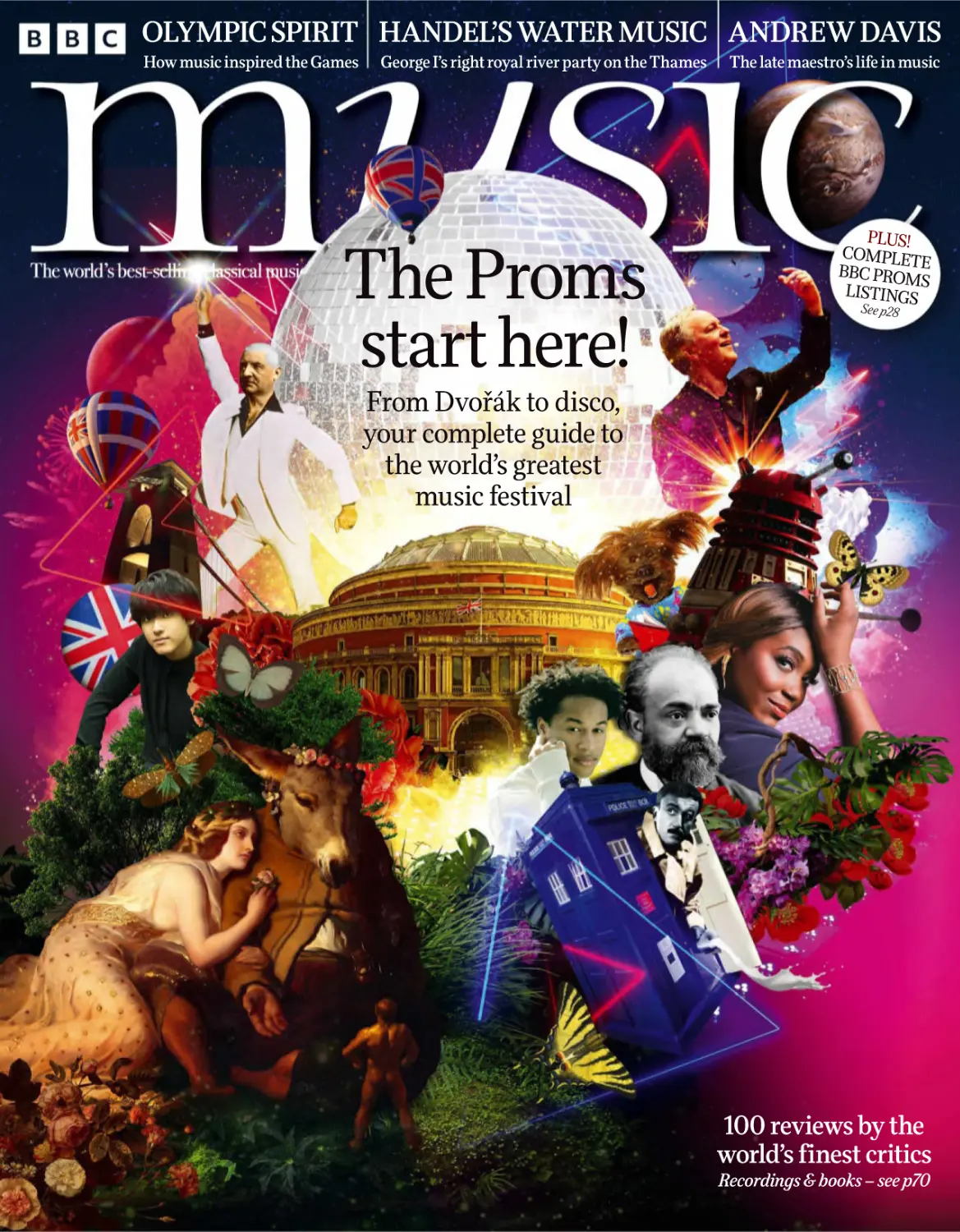
The Proms
start here!
The late maestro’s life in music
PLUS!
COMPLET
BBC PROME
S
LISTINGS
See p28
From Dvořák to disco,
your complete guide to
the world’s greatest
music festival
100 reviews by the
world’s finest critics
Recordings & books – see p70
EDITORIAL ENQUIRIES
Tel: +44 (0)117 300 8752
Email: music@classical-music.com
Post: The editor, BBC Music Magazine,
Eagle House, Bristol BS1 4ST
SUBSCRIPTIONS
& BACK ISSUES
Tel: 03330 162 118
Web: buysubscriptions.com/contactus
Post: BBC Music Magazine, PO Box 3320,
3 Queensbridge, Northampton
Follow us on Twitter
@musicmagazine
Like us on Facebook
facebook.com/
classicalmagazine
Find us online
classical-music.com
Subscribe to our podcast
Subscribe today to
BBC Music Magazine
Save money on newsstand prices!
See p10 for our fantastic offer
Welcome
When Sir Andrew Davis died
on 20 April, the outpouring of
affection from the musical world
spoke for itself. Davis was not
only a gifted and charismatic
conductor, but a witty and warm
human being, whose dozen
turns leading the Last Night of
the Proms were distinguished
by memorably sparky addresses
from the podium. That he died less than a week before
the launch of the 2024 Proms season seemed somehow
grossly unfair – especially as the pre-printed programme
poignantly listed his intended appearance as conductor
laureate of the BBC Symphony Orchestra in Stravinsky,
Schumann and Steve Reich on 30 August.
Shortly before he died, Sir Andrew spoke to Amanda
Holloway about the works that shaped his life and career
for our Music That Changed Me feature; read his typically
engaging and humane responses on page 106.
Elsewhere in this special Proms issue, current BBC
Symphony chief conductor Sakari Oramo speaks to
John Allison about his decade at the helm of an orchestra
indelibly associated with the world’s greatest classical
music festival on page 34, while on page 56, Clare Stevens
catches up with former Proms director Roger Wright. Plus,
Richard Morrison shares his favourite moments from
60 years of Proms attendance on page 27, and there are
complete Proms listings on page 28.
Charlotte Smith Editor
THIS MONTH’S CONTRIBUTORS
John Allison
Clare Stevens
Leah Broad
Editor, Opera magazine
Writer and editor
Academic and author
‘Though we meet just across
from the Albert Hall, where he
conducts four Proms this summer,
conversation with Sakari Oramo is
far from South Ken-centric: the Finnish maestro has
a stimulatingly wide view of the world.’ Page 34
‘Full disclosure: I’ve known Roger
Wright since he and my husband
used to lob Maltesers to each other
over the bookshelves when working
at the British Music Information Centre. It was a joy
to reflect on his contributions since then.’ Page 56
‘Elizabeth Maconchy’s works
deserve so much more recognition
than they currently enjoy. It was a
joy to explore her life, especially
her friendships with fellow composers Vaughan
Williams and Grace Williams!’ Page 62
BBC MUSIC MAGAZINE
3
Visit Classical-Music.com for the
very latest from the music world
July Radio 3
highlights
Contents
See p100
JULY 2024
FEATURES
28 Cover: Welcome to The Proms!
Your complete guide to this summer’s concerts,
including the BBC Music team’s personal highlights
34 Perfect Finnish
Sakari Oramo, conductor of this year’s Last Night of
the Proms, shares his love of the job with John Allison
44 Olympic dreams
From Strauss having a sulk to an Elgar-inspired horse,
Jeremy Pound charts a history of music at the Olympics
50 Pride and joy
Oliver Zeffman, founder of the Classical Pride festival,
tells Claire Jackson about this summer’s colourful event
56 Roger and out…
As he says farewell to Aldeburgh, chief executive Roger
Wright assesses his handiwork with Clare Stevens
EVERY MONTH
8 Letters
12 The Full Score
The latest news and interviews from the music world
27 Richard Morrison
38 The BBC Music Magazine Interview
28 The BBC Proms
Cellist Laura van der Heijden on the pressures of
recording and the joy of friends, with Ariane Todes
Charlotte Smith heads to Newport, Rhode Island, US
62 Composer of the Month
Rated and respected but still somehow neglected,
Elizabeth Maconchy is explored by Leah Broad
66 Building a Library
Terry Williams on the best recordings of Dvořák’s Fifth
Symphony, a work of sunny spirits and good humour
100 Radio & TV
104 Crossword and Quiz
106 Music that Changed Me
Conductor Sir Andrew Davis
4
BBC MUSIC MAGAZINE
COVER: STEVE RAWLINGS/DEBUT ART THIS PAGE: GETTY, MARK ALLAN, FRANCES MARSHALL
60 Musical Destinations
Subscriptions £64.87 (UK); £65 (Europe);
£74 (Rest of World) ABC Reg No. 3122
EDITORIAL
Plus the national anthem we’d most like to
hear played at the Olympics (see p44)
Editor Charlotte Smith
Austria: ‘Land der Berge, Land am Strome’
Deputy editor Jeremy Pound
Poland: ‘Dąbrowski Mazurka’
Reviews editor Michael Beek
Brazil: ‘Hino Nacional Brasileiro’
Multi-platform content producer
Steve Wright
Kenya : ‘Ee Mungu Nguvu Yetu’
Cover CD editor Alice Pearson
France: ‘La Marseillaise’
Art editor Dav Ludford
Italy: ‘Il Canto degli Italiani’
Thanks to
Jenny Price, Hannah Nepilova,
Freya Parr
MARKETING
Subscriptions director
Jacky Perales-Morris
Direct marketing manager Kellie Lane
Subscriptions marketing coordinator
Dennis Awdziejczyk
ADVERTISING
Advertisement manager
Rebecca Janyshiwskyj
+44 (0)117 300 8547
Commercial brand leads
Rebecca Yirrell +44 (0)117 300 8811
Rebecca O’Connell +44 (0)117 300 8814
Client solutions manager
Tom Houlden +44 (0)117 300 8203
July reviews
Your guide to the best new recordings and books
Paul McCreesh conducts
Elgar’s Dream of Gerontius
34 Sakari Oramo
70 Recording of the Month
44 Music at
the Olympics
Brand sales executives
Willem Curran +44 (0)117 300 8534
James Phillips +44 (0)117 300 8224
Inserts
Laurence Robertson +353 876 902208
SYNDICATION & LICENSING
Tim Hudson +44 (0)20 7150 5170
Richard Bentley +44 (0)20 7150 5168
PRODUCTION
Production director Sarah Powell
Production coordinator
Emily Mounter
Ad coordinator Molly Websdell
Ad designers
Cee Pike, Andrew Hobson
Reprographics
Tony Hunt, Chris Sutch
PUBLISHING
Brand leader
Rosa Sherwood
Managing director
Andrew Davies
Group managing director
Andy Marshall
BBC STUDIOS, UK PUBLISHING
Chair, editorial review boards
Nicholas Brett
Managing director, consumer
products and licensing
Stephen Davies
Global director, magazines
Mandy Thwaites
Compliance manager
Cameron McEwan
EDITORIAL ADVISORY BOARD
Janet Tuppen,
Adam Barker,
Philip Raperport
This magazine is published by Our Media Company
Bristol Limited under licence from BBC Studios
Elgar
The Dream of Gerontius
‘This is unquestionably a great
recording of The Dream of Gerontius,
one that every Elgarian should have’
72 Orchestral 77 Concerto 80 Opera
82 Choral & Song 86 Chamber 90 Instrumental
93 Jazz 94 Brief Notes 96 Books 97 Audio
98 From the Archive 99 Reviews Index
Subscribe today to
BBC Music Magazine
Save money on
newsstand prices!
See p10 for our
fantastic offer
BBC MUSIC MAGAZINE
5
Letters
Have your say…
Write to: The editor, BBC Music Magazine, Eagle House, Bristol, BS1 4ST
Email: music@classical-music.com Social media: contact us on Facebook and Twitter
ER
L ET T
of the
MONTH
A great Elgarian
Star player:
Henryk Szeryng
enjoyed life’s perks
The haves and have-nots
GETTY
Bryan Lewis’s letter regarding Neville Marriner’s
adventure with his Trio (May) brought back memories of
a TV documentary presented some 50 years ago by Alan
Whicker. He contrasted the lifestyles of a jet-set soloist, the
Polish violinist Henryk Szeryng, and an artist just setting
out on his career, British pianist Allan Schiller. Szeryng was
shown arriving at Heathrow Airport with his retinue and
making his way to his suite at Claridges prior to a recital
at the Royal Festival Hall, while Schiller was making his
way up north to a Music Club recital in his trusty Morris
1000 Estate. We saw Szeryng playing the Brahms D minor
Sonata; then cut to Schiller
WIN! £50 VOUCHER having broken down in his
FOR PRESTO MUSIC Morris with his hands in
the engine only a couple
Every month we will award
of hours before his recital.
the best letter with a £50
The adulation surrounding
voucher for Presto Music,
Szeryng was contrasted
the UK’s leading e-commerce
with Schiller – having
site for classical and jazz
finally surmounted all his
recordings, printed music,
music books and musical
obstacles and then staying
instruments. Please note: the
overnight with the ultraeditor reserves the right to
enthusiastic secretary of the
shorten letters for publication.
Music Club, who insisted on
playing piano duets.
Hywel Jenkins, Glastonbury
8
BBC MUSIC MAGAZINE
I was lucky enough to meet the
Elgar scholar Jerrold Northrop
Moore (see Obituaries, p23)
more than 15 years ago, at a
study weekend on Elgar and
the Great War near his home
in Broadway, Worcestershire.
I had known of his work for
years prior to that, thanks
to 20 years of voluntary
work in the archives of The
Elgar Birthplace Museum.
Researchers will be forever
grateful to him for his
scholarship, which often
helped me out when I couldn’t
read one of the composer’s
original letters! I was lucky to
have had afternoon tea with
‘Jerry’, as his friends knew him,
and we went on to have some
correspondence. I spoke to him
on the telephone earlier this
year, to congratulate him on
reaching the age of 90. I trust
that his work will continue to
be an inspiration to all ages in
the future.
Ian Morgan, Malvern Link
Desirable discs
While I can’t quite compete
with Peter Draper’s complete
collection of BBC Music cover
CDs (Letters, June), I have
managed to be a subscriber
since the first issue. The cover
CDs have been a mixed bag,
and of course there have been
some duds: a lumpen Berlioz
Symphonie Fantastique in
the early days sticks in the
mind, as does an unbelievably
kitsch performance by the
Vienna Boys Choir. However,
my top five of the 400 are
as follows: a truly amazing
Handel Messiah from Harry
Christophers and the Sixteen
(over two issues at the end
of 1997); Schubert’s String
Quintet (1998); Baltic Voyage
– music from Estonia (2010);
Brahms’s German Requiem
(2013); Rachmaninov’s Third
Symphony and The Isle of the
Dead (2023).
Patrick Hoyte, Minehead
The editor replies:
We are always keen to hear
which cover CDs our readers
have enjoyed and, of course,
disliked too. Do let us know!
Delius on death
It was a shame that Jeremy
Pound in his review of
Requiems (May) did not
include one of the most original
and unusual: the Requiem
by Delius. Delius’s original
title for the work was ‘A Pagan
Requiem’ and the libretto,
thought to be mostly by the
composer himself and heavily
influenced by Nietzsche, is an
uncompromising statement
of Delius’s own contempt for
conventional religion and
his embrace of pantheism.
The bleak message in the
early sections of the work –
that death is extinction – is
mitigated by the glorious final
section, a hymn to eternally
renewing Nature that, as Eric
Fenby put it, ‘wins Delius
lovers all over the globe’. Surely
it is time for reappraisal of this
fascinating masterpiece?
Stephen Cox, Norwich
King of the low notes:
Polish composer
Krzysztof Penderecki
Covid lingers on
Though I enjoyed your article
celebrating BBC Music’s 400th
issue (May), I despaired at your
reference to ‘socially distanced
audiences – remember those?’
This is still all too real for some.
It is estimated that 1.2 million
people are still shielding to
various extents, and unless
companies/venues recognise
this, many of us are denied
one of our greatest joys in
life, i.e. live music. I seem to
remember Richard Morrison
also suggesting that digital
access would become much
more mainstream after the
pandemic, and it is such a
shame this doesn’t seem to
have happened. The irony is,
giving distanced performances
or streaming live concerts to
be paid for online would bring
more revenue for struggling
companies, but it just seems to
be too much effort. I have not
been able to attend a live music
event for almost four years, and
I am certainly not the only one.
Name and address withheld
How low can you go?
In your online article ‘What’s
the lowest note ever sung?’
(classical-music.com), you
wrote that before Paul Mealor’s
De Profundis, the B flat in
Rachmaninov’s Vespers was
the lowest note in the choral
repertoire. This is incorrect.
Just to give you a few examples:
in Grechaninov’s setting of
the same Vespers (All Night
Vigil) text as Rachmaninov,
his Op. 59, there is a low A two
octaves below middle C at the
end of ‘Ot yunosti moyeya’ as
well as at the end of ‘Velikoye
slavosloviye’; Chesnokov, also
in his All Night Vigil, wrote low
Bs, As and a low G at the end of
‘Lord now lettest thou’, and his
other works also feature very
low notes, such as in his Op. 27
Tebe poem (low A); Penderecki’s
Song of the Cherubim,
meanwhile, contains a low F
two octaves below middle C at
the end. There are more low As,
Bs and Gs in orthodox music;
it’s just that Rachmaninov’s
piece is the most well-known
one in western choral circles.
Marius Imholz, Switzerland
LONDON PIANO
FESTIVAL
9 Oct
4 - 6 Oct
SOUNDBITES
WITH PIATTI QUARTET
Glass and Company
Philip Glass, Caroline Shaw,
John Adams & more
28 Nov
Love and Loss
Mendelssohn & Hensel
13 Feb
In Pursuit of Love
Tchaikovsky & Borodin
20 Mar
Cinematic Quartets
Johnny Greenwood, Samuel
Barber & more
BACH, THE UNIVERSE
AND EVERYTHING
Sunday morning concerts
with a difference
Orchestra of the Age of
Enlightenment & guest
scientific speakers
27 Oct, 24 Nov, 15 Dec,
19 Jan, 16 Feb, 16 Mar
Photo: Rachel Podger © Theresa Pewal
An hour of music to unwind to
Messiaen’s Vingt Regards,
Fauré 100, Mozart piano
concerti & more
Feat Katya Apekisheva,
Charles Owen & guests
Photo: Piatti Quartet © Venetia Jollands
Book tickets at kingsplace.co.uk
90 York Way, King’s Cross, London N1
The cultural pulse
of King’s Cross
FREE ONE MONTH TRIAL
to the digital edition
Available from
BBC Music Magazine is a must-read for anyone with a
passion for classical music. Every issue brings the world
of classical music to life, from interviews with the greatest
artists and features on fascinating subjects, to all the latest
news and opinions from around the music world.
Have BBC Music Magazine delivered
straight to your device
when you take out a one month FREE trial* subscription to the digital edition.
Simply return to the home page to subscribe.
*After your one month trial your subscription will continue at £2.99 per month
Thefullscore
Our pick of the month’s news, views and interviews
The BBC Music Magazine Awards 2024
Some highlights from this year’s sparkling ceremony at Kings Place in London
A night to remember:
(above) Chamber
winners the Calidore
Quartet give a heartfelt
performance of
the ‘Cavatina’ from
Beethoven’s String
Quartet No 13; (right)
Newcomer of the Year
George Xiaoyuan Fu
dazzles in Ravel; cellist
Julian Lloyd Webber
shares his thoughts
on the evening
12
BBC MUSIC MAGAZINE
Thefullscore
JOHN MILLAR
Smiles all round:
(clockwise from above)
Clive Myrie presents
Recording of the Year
to the Sinfonia of
London’s Rosenna East;
Errollyn Wallen and
Chi-chi Nwanoku share
a private joke; Rebeca
Omordia, Adam Binks,
Martin Jones, Wallen
and John Andrews
with their Premiere
award; presenters
Linton Stephens and
Katie Derham from
Radio 3; Tasmin Little
with Concerto winners
Bomsori Kim and
Christina Åstrand; the
colourful Nicky Spence
BBC MUSIC MAGAZINE
13
NEW RELEASES FROM AVIE RECORDS
AV2684 | 1CD | DOWNLOAD | STREAM
AV2691 | 1CD | DOWNLOAD | STREAM
AV2678 | 1CD | DOWNLOAD | STREAM
DONALD BERMAN
CHRISTOPH CROISÉ
THE ORCHESTRA NOW
Pianist and leading Ives scholar Donald
Berman celebrates the 150th anniversary
of the composer’s birth with a revelatory
recording of the “Concord Sonata” in his
own new edition, alongside the elegiac
“The St. Gaudens (Black March)”.
Cellist Christoph Croisé, together
with violinist Andrey Baranov and
pianist Alexander Panfilov, revel in
Rachmaninoff ’s two early piano trios
alongside arrangements of some of
the composer’s romantic songs.
The Orchestra Now, with their founder
and conductor Leon Botstein, present
“The Lost Generation”, bringing to light
works by three 20th-century Germanspeaking composers – Hugo Kauder,
Hans Erich Apostel and Adolph Busch.
avie-records.com
Distributed in the UK by Proper Music Distribution Ltd
and in North America by Naxos of America, Inc.
Thefullscore
Doomed prophetess:
Sarah Connolly
appears as Zarqa al
Yamama in Riyadh
Connolly stars in
Saudi opera first
Musicians set the right tone for Downing Street future
A moment of sweet harmony occurred at the
heart of British government recently, as the
first concert in a new series called ‘Notes
from Downing Street’ filled No. 11 with the
music of Samuel Coleridge-Taylor, Gershwin
and David Schiff. Performed by players
from the London Philharmonic Orchestra,
the concert was enjoyed by an audience
in the State Room of the Chancellor of
the Exchequer’s residence – including,
we hope, Larry the Downing Street cat –
and on Classic FM too. Details of further
instalments in the series have yet to be
announced, but we will be watching the
comings and goings at the famous address
with a keen interest in months to come.
Crunchy Apple leaves a very bitter taste
GETTY, APPLE/YOUTUBE ILLUSTRATION: JONTY CLARK
Crushing blow:
Apple’s destructive ad
has caused uproar
Apple has apologetically withdrawn an
advert for the latest edition of its iPad that
showed objects including a trumpet, a piano
and a bust of Beethoven being crushed.
Described as ‘the destruction of the human
experience, courtesy of Silicon Valley’ by
actor Hugh Grant, the disturbing ad was not
intended to be interpreted thus, said the tech
giants. ‘Our goal is to always celebrate the
myriad of [sic] ways users express themselves
and bring their ideas to life through iPad,’
explained Tor Myhren, Apple’s VP of
marketing communications. ‘We missed the
mark with this video, and we’re sorry.’
Saudi Arabia has dipped its toe into the opera
water with the staging of its first ever homegrown production. With mezzo Sarah Connolly
in the title role, the two-act Zarqa al Yamama
brought together European, Australian and
Saudi performers in a score by composer Lee
Bradshaw that mixed Western tradition and
orchestration with a strong Arabic flavour.
Far from easing the Riyadh audience in gently,
however, Saudi librettist Saleh Zamana’s
plot drew on a grisly ancient folk tale about a
Cassandra-like figure whose dark forebodings
are ignored, resulting in bloody slaughter. Plans
are now in place for a permanent opera house to
be built in the Diriyah area of the Saudi capital.
CBSO phone move
gets patchy reception
Sir Stephen Hough
is one of several
musicians who
have raised an
eyebrow at the City
of Birmingham
Symphony Orchestra’s
decision to welcome
phones at its concerts.
‘I’m really excited to
be playing Brahms 1
next season with one of my favourite orchestras,
the CBSO,’ wrote the pianist on X. ‘I’m happy
to be filmed on phones by the audience except
for the following bars when I really need
to concentrate and could be distracted: 1st
movement: 91-118; 123-176; 185-199; 226-341;
352 to end; 2nd movement: 14-19; 21-27; 29-30;
33-58; 71 to end; 3rd movement: 1-36; 46-98;
122-167; 188-238; 275-333; 337-368; 376-410;
418-426; 434-442; 448 to end.’ The CBSO has
since clarified that it supports the use of phones
‘at appropriate moments during concerts in a
way that is considerate to those around them’.
BBC MUSIC MAGAZINE
15
Thefullscore
RisingStars
TIMEPIECE This month in history
Three to look out for…
Olivia Warburton Soprano
Born: Lincolnshire, UK
Career highlight:
Performing the title role
in a new production
of Frid’s Das Tagebuch
der Anne Frank for solo
soprano and orchestra
– undoubtedly my most
challenging yet rewarding role to date.
Musical heroes: I have always been inspired
by mezzo Anne Sofie von Otter’s ability to
adapt to so many different roles and styles
while staying true to herself. I’m also a huge
fan of singer and songwriter Jacob Collier,
who shows such uninhibited freedom in his
music making.
Dream concert: I would love to have a role
written for my voice by a contemporary
opera composer. Being involved in creating
something brand new would be so exciting.
Cruise control:
Handel meets King
George I on the Thames;
(right) George I (top)
knew Handel (below)
from his Hanover days
Curtis Stewart Violinist/composer
Born: Helsinki, Finland
Career highlight:
Premiering a movement
from my new Violin
Concerto with the Chicago
Symphony Orchestra in
Symphony Center. It is the
first work of its kind for
me, and the venue is so storied and gorgeous.
This experience inches above performing at
the Grammys!
Musical heroes: My mum, Elektra Kurtis,
was a Greek/Polish/American violinist and
I get my sense of constant experimentation
from her. My dad, Bob Stewart, is a virtuoso
tuba player and has played with jazz greats
from Dizzy Gillespie to McCoy Tyner.
Dream concert: I’ve always dreamed of
playing at the BBC Proms!
Alexandra Whittingham
Guitarist
Born: Manchester, UK
Career highlight: Last
year I was invited to
play at the Cayman Arts
Festival in the Cayman
Islands, an incredibly
beautiful place to perform.
Musical heroes: Julian
Bream was always my reference for the kind
of sound I wanted to create. Elsewhere, the
bands that made me want to play the guitar
when I was younger were Def Leppard and
Scorpions (these were also the first live gigs I
ever went to!).
Dream concert: Basically, anywhere
warm – my hands are always cold! – with a
great acoustic and, ideally, playing with an
orchestra. Nothing beats this feeling!
16
BBC MUSIC MAGAZINE
JULY 1717
Handel’s Water Music floats
a troubled monarch’s boat
E
xactly what triggered King
George I’s decision to mount
a royal boat trip on the River
Thames in the summer of 1717 is
uncertain. Was it a desire to upstage
his son, the Prince of Wales, a more
charismatic and popular figure with
whom he frequently argued? Or
an attempt to bolster his social and
constitutional standing at a period of
considerable political unrest in the
country? Perhaps he simply hankered
for a pleasant evening on the river,
accompanied by his two mistresses and
assorted ‘Persons of Quality’.
Whatever his precise motivation,
on the evening of Wednesday 17 July
a grand flotilla of boats assembled at
Whitehall, headed by the King ‘in an
open barge’. Beside him, in another
barge, was clustered an orchestra of
some 50 musicians, tuned and ready
to play. Presiding over them was the
32-year-old German composer George
Frideric Handel, who for the previous
five years had lived in England. A
sequence of instrumental movements
by Handel, later entitled the Water
Music, was scheduled to provide the
entertainment for the evening.
Thefullscore
of the movements. Two trumpets were
also present, adding their gleaming
triumphal brightness to the mix. A
dazzling sequence of dance movements
– minuets, bourrées, riguadons, gigues
– kept the energy levels high. And, as
a cap-doff to his country of residence,
Handel even slotted in a pair of perky
English hornpipes.
Quite what order the 22 movements
were played in is not recorded, though
they were subsequently arranged into
three key-related suites for publishing
purposes. What we do know for certain
is that King George was thoroughly
enraptured by the music he was
hearing, as the royal barge headed the
three miles upstream on a rising tide
to Chelsea. ‘His Majesty’s approval
of it was so great that he caused it to
be played three times in all,’ wrote
GETTY, TITILAYO AYANGADE, NAT MICHELE
‘His Majesty’s approval of it
was so great that he caused
it to be played three times’
It was not the King’s first encounter
with Handel’s music. Seven years
previously Handel had briefly served
as George’s kapellmeister (director of
music) at his electoral court in Hanover,
and so the monarch’s undiminished
enthusiasm for his former employee’s
music made the composer a natural
choice for the boat trip commission. In
the event, Handel produced a total of
22 movements to be performed on the
evening – ‘the finest Symphonies’, as a
contemporary news report put it. Most
of them are assumed to have been newly
written by the composer, though some
may have been recycled from earlier
pieces, a regular practice.
To match the splendour of the
occasion, Handel truly pushed the boat
out in terms of orchestral colouring and
spectacle. A pair of horns was included
– a novelty at that period in England –
and they ring out imperiously in several
Friedrich Bonet, a contemporary
observer, ‘even though each
performance lasted an hour’.
For the musicians, it was a long, long
evening. The royal barge left Whitehall
at 8pm, and two complete performances
of the Water Music were given before the
King disembarked for ‘a choice supper’
at Chelsea. Another run-through was
demanded on the journey home, which
began as late as two or three o’clock in
the morning – ‘the Musick continuing
to play’ until the King landed, as one
newspaper reported.
The players were, it seems, decently
remunerated for their efforts. £150 in
total was spent on paying them, which
is the equivalent of roughly £500 for
each player in today’s money. What
Handel himself was paid for composing
the Water Music is not known, although
the PR value of such a high-profile and
well attended occasion as a whole was
undoubted. ‘The evening was as fine
as could be desired,’ noted Bonet, ‘and
the number of barges and boats full of
people wanting to listen was beyond
counting.’ Terry Blain
Trouble at sea:
the Battle of
Matapan rages
Also in July 1717…
1st: Robert Harley, Earl of Oxford, is
acquitted of high treason. Lord high treasurer
during the rule of Queen Anne, Harley had
been impeached by the House of Commons
in 1715 for his role in negotiating the Treaty of
Utrecht which, while bringing an end to the War
of Spanish Succession, was condemned by
many Whigs for being pro-French.
13th: The Italian composer Domenico
Zipoli and a group of 53 Society of Jesus
missionaries arrive in Buenos Aires in Spanish
Colonial America. From there, Zipoli travels to
Córdoba, where he completes his training as a
priest and serves as music director in the local
Jesuit church. His choral music soon spreads
further afield, gaining popularity among the
Chiquitos Indians in Bolivia.
15th: The Indemnity Act 1717 is given royal
assent. Also known as the Act of Grace and
Free Pardon, it frees hundreds of prisoners
incarcerated after the Jacobite rising of 1715
and allows them to settle either at home or
abroad. Well-known figures benefitting from
the Act include the Earl of Carnwath and
Lord Nairne, though all members of the Clan
MacGregor are specifically excluded.
19th: Venice’s Armada Grossa and a fleet
from Portugal, Malta and the Papal States are
attacked by the Ottoman fleet at the Battle of
Matapan off the south coast of Greece. Three
hours of bloody fighting result in significant
losses for both sides, including two Venetian
ships and hundreds of lives, before the Turks
eventually withdraw. The battle itself proves
indecisive, however.
28th: Among various sweeping reforms aimed
at encouraging industry and manufacture,
Frederick Wilhelm I of Prussia orders that
education is to be made compulsory for all
children from ages five to 12. The king, whose
other enlightened measures will include
liberating the serfs on his own properties,
reasons that no state can function efficiently if
its people are illiterate.
BBC MUSIC MAGAZINE
17
WITH
THE ROYAL PHILHARMONIC ORCHESTRA
CONDUCTED BY
MICHELE SPOTTI
PERFORMANCES BY
CHOIR
CROUCH END
FESTIVAL CHORUS
NADINE SIERRA
ISABEL LEONARD
COMPERE
MYLEENE KLASS
LUCA MICHELETTI
HYDE PARK LONDON
RESERVED SEATING AND VIP PACKAGES AVAILABLE
Thefullscore
MEET THE COMPOSER
Three works to discover
Serenity 2.0 (2021)
Written for Manchester Collective’s Heavy
Metal tour, this RPS Award-winning work
for string quartet and electronics is a
sonic rollercoaster that takes the listener
on a constantly interrupted meditation, its
sounds and samples turning on a dime.
Sol (2022)
Based on fragments of overheard
conversations, this Ivors Award-winning
work is a playful celebration of sun
gods for eight voices, commissioned
by the National Youth Choir.
Break-Up Mantras (2023)
Premiered at Italy’s Anghiari Festival
and commissioned by the Southbank
Sinfonia, this ‘love song’ for six players
and electronics is dreamily euphoric.
Ben Nobuto
Lost in translation:
‘I like singing in
Japanese, because
you have that layer
of ambiguity’
Born in Japan but brought up in the UK, Ben Nobuto is an awardwinning young composer with a thrillingly individual voice. His
music defies categorisation, leaping across stylistic boundaries and
creating exhilarating sonic juxtapositions. Nobuto’s Hallelujah Sim
receives its world premiere at the First Night of the Proms on 19 July.
MANCHESTER COLLECTIVE/PHIL SHARP
I was always curious about music, but maybe
slightly in denial. I remember my friends
saw music as the doss subject at school and
wouldn’t take it seriously. But secretly I thought
it was really enjoyable! At age 13 or 14 I was
improvising a lot on the piano, but didn’t know
it was called composition.
At university I wrote a lot of music for
myself to play on piano with electronic
parts. That felt like a really intuitive way of
making music, as it was all based in my body
and what I know. I studied classical music,
composition and the basics of theory, so I’ve
had that grounding, but once you have that
knowledge it’s about being able to turn it into
something that feels natural and authentic.
I was listening to a lot of Coltrane, free
jazz and electronic producers. I had quite
a segregated view of those things, like they
were separate things that I wasn’t allowed to
mix. But gradually I let myself do whatever I
wanted, and it felt more natural. It’s like I was
allowing myself to lean in to all those sides of
me that I felt I had to surpress. It was a nice
process to go through.
After finishing university, Manchester
Collective offered me a commission out of
the blue. I wrote a piece called Serenity 2.0,
which is for string quartet, electronics and
percussion. They took that on tour and it was
quite a big thing for me; I felt like a composer
then, but I still feel weird about calling myself a
composer, because the word feels quite loaded.
A lot of my writing method is based around
my fingers and what feels good. Sometimes
it’s nice to start off by improvising and lock
into a groove that feels right, and then that’s
the basis for something you refine later. I
prefer to go from moment to moment and ask
myself, ‘Is this interesting to listen to?’ So it’s a
moment-to-moment feeling, deciding whether
it’s enjoyable to listen to, as if I was an audience
member, not knowing anything about it but
experiencing it on a purely sensory level.
I have this weird insecurity about the
Japanese side of my identity, but it’s
interesting to use in music. Japanese words
sound more like sound objects to me; I really
like singing in Japanese, because you have that
layer of ambiguity – you’re saying something,
but it’s not clear what you’re saying. Japanese
Pop is an aesthetic I got interested in and lean
into – that kind of sparkly, flashy, hyperconsumerist landscape of internet memes and
saturation and the dazzling quality of it all.
Having my music in the First Night of
the Proms is a bit surreal. They asked if I
wanted to write a short-ish piece for the BBC
Symphony Chorus and said I could add other
elements, like electronics, percussion or
strings if I wanted. I like the idea of applying
structures from videogames or films, narrative
ideas, onto the music. So in Hallelujah Sim
there’s a voice in the electronics part, sort of
like a narrator, telling the chorus to do certain
things, like stages of a videogame, and they can
only progress through the piece once they’ve
completed that task. There are different types
of ‘Hallelujah’ and each one is like a different
level in the game.
I’ve been working on my debut album for
quite a while. It’s a mix of lots of different
instruments and electronics. I like the idea
of applying a producer mentality to classical
recordings, so if I can I’ll try to record each
person individually and then put it together in
Logic, the way pop music is recorded, so you get
a really clean, nice-sounding result.
BBC MUSIC MAGAZINE
19
Thefullscore
Music to my ears
Proms ahead: violinist Braimah Kanneh-Mason
The BBC Music Magazine
team’s current favourites...
Charlotte Smith Editor
This year’s Proms launch took place in the
impressively renovated Royal College of
Music. I was taken with my alma mater’s new
look – including a beautiful glass-fronted
museum to house its once overlooked musical
instrument collection. In the elegant, highceilinged Performance Hall we were treated to
energetic, tango-infused performances from
violinist Braimah Kanneh-Mason, guitarist
Plínio Fernandes and members of the Fantasia
Orchestra – due to appear in two Proms.
Jeremy Pound Deputy editor
Chabrier’s España is always a good moodlifter. And that feel-good factor only increases
when it is followed by similarly sunny works by
Debussy, Ravel and Ibert on John Wilson and
the Sinfonia of London’s 2020 Escales album of
French orchestral classics. For me the highlight,
however, is Duruflé’s Trois Danses, Op. 6, a
veritable flurry of Gallic colour with a spledidly
sensuous saxophone solo in ‘Tambourin’.
Michael Beek Reviews editor
I hoofed it along to the Royal Windsor Horse
Show where, for the first time, they had a
‘Performance Hub’. In a marquee in the shadow
of Windsor Castle, we enjoyed music by Debbie
Wiseman – the composer on piano, with
eloquent string support by cellist Justin Pearson
and violinist Sam Staples, words by Alan
Titchmarsh, and the premiere of a new song
performed by soprano Grace Davidson. A treat.
Steve Wright Content producer
I’m just back from a press trip to Ostrava, Czech
Republic, where I was treated to a superb
performance of Smetana’s The Bartered Bride –
joyous, witty, and stuffed with rustic Bohemian
flavour. There were some great comic turns,
memorably from Martin Gurbaľ as the pompous
matchmaker, Kecal. The folk dances call to
mind those delicious furiants from Dvořák’s
symphonic scherzos, and Smetana’s music
bubbles over with melody, invention and energy.
20
BBC MUSIC MAGAZINE
REWIND
Great artists talk about their past recordings
BARBARA HANNIGAN Soprano and conductor
MY FINEST MOMENT
La Passione
LUDWIG Orchestra/Barbara Hannigan
(soprano) Alpha Classics ALPHA586 (2020)
La Passione was truly a collaborative
effort and is
particularly
special to me. I
chose three works
which were linked
by themes of loss,
grief and rebirth:
Nono’s Djamila Boupacha for solo voice,
Haydn’s Symphony No. 49 and Grisey’s
Quatre chants pour franchir le seuil. Each
work makes intense demands both
technically and emotionally; everyone
has to dig deep. The Grisey is perhaps
one of the most heartbreaking and
powerful works I have ever encountered,
a journey through death and beyond.
And the Nono stretches the soaring vocal
line from oppression towards hope.
I was surrounded by a trusted team
with whom I had worked for years,
beginning with the musicians of the
Dutch collective LUDWIG. We recorded
the album in Holland at the end of
several months of intense touring – we
were a tight-knit group by then and
working together was joyful. This was
my third album with Alpha Classics,
who have supported and understood
my repertoire combinations and
choices. Recording engineer Guido
Tichelman was at my side not only
for the recording, but travelled to my
home, where we spent days editing and
Thefullscore
Close partners:
Barbara Hannigan
performs Satie with
Reinbert de Leeuw
Socrate. The album was planned quickly,
at the moment when Reinbert’s health
began to fail (he passed away in early
2020), and we knew we only had limited
years left to work together.
Sometimes
during the sessions
I had to pinch
myself, flooded
with memories
of listening to
Reinbert’s famous
Satie records when I was a student in
Canada, with no clue that he and I would
become such close musical partners.
Photographer Elmer de Haas captured
probably my all-time favourite album
cover with this shot through a window
during a break – of Reinbert smoking his
usual hand-rolled shag cigarette, with me
in the background.
I’D LIKE ANOTHER GO AT…
Berg Lulu
Barbara Hannigan (soprano) et al;
Orchestre symphonique de la Monnaie/
Paul Daniel Bel Air Classiques BAC109 (2014)
mixing the album. We’ve been friends
and colleagues for over two decades and
the ease and joy with which we work is
precious to me. The cover image was
from an unforgettable underwater photo
shoot I did with Elmer de Haas.
MY FONDEST MEMORY
Satie Socrate
ELMER DE HAAS, GETTY, MARCO BORGGREVE, ROY COX, JOHN DAVIS
Barbara Hannigan (soprano), Reinbert de
Leeuw (piano) Winter & Winter 9102342 (2015)
Whenever I think of Reinbert de Leeuw,
the pianist, conductor, composer and
champion of contemporary music, I
think of space and time, because his
feeling for both is unlike anything
I’ve ever encountered. He has been a
mentor and friend to me, and I still feel
his presence strongly. This recording
created a beautiful, delicate world and I
think it helped me to find a very delicate
vocal sound in the recording studio
which I had not explored before.
I had been working with Reinbert
since 1999, but finally in 2015 we
recorded our first album together for
voice and piano, with very early songs of
Satie combined with his last major work,
Don’t get me wrong, I have a lot of
wonderful memories of this recording.
It was the first time I’d worked with
director Krzysztof Warlikowski, and
more than ten years later my feet are
still recovering from being on pointe
shoes for more than half the opera (but
would I do it again? Oh yeah.) He and I
have gone on to do another three operas
together, plus two stagings of Socrate
with Reinbert de
Leeuw. My first Lulu
happened during
a decade when I
had the fortune to
be a part of several
powerful operatic
productions (Written
on Skin, Die Soldaten,
Matsukaze, Hamlet and Pelléas et
Mélisande). I was on a constant learning
curve and every director I was working
with opened up new possibilities.
As everyone who has sung Lulu knows,
she does not let you go easily. I sang my
most recent performances in 2021, and I
don’t expect to sing her again (never say
never). The next time I will rekindle this
love affair will be from the podium in
the pit. I can’t wait.
Hannigan’s new Messiaen album (Alpha
Classics) is reviewed on p83
Perfect poise:
American gymnast
Simone Biles
MyHero
Conductor Gemma
New salutes the focus,
positivity and grace
under pressure of artistic
gymnast Simone Biles
It is an impossible task for me to choose
just one of my many heroes from our
musical community. Thus, and especially
given it being an Olympic year, I am taking
this opportunity to highlight a heroine in
a sport from which musicians can draw
many parallels.
As with musicians, for artistic gymnasts
the ratio between preparation and
performance falls heavily in favour of
the former. When the intense moment of
performance finally comes, gymnasts and
musicians both need to find a mental calm,
inner breath and focused mind. They need
to muster confidence, posture, balance,
strength and poise, as the timing and intent
of their movements need to be absolutely
perfectly on point. Listening to their body,
sensitivity, awareness and concentration
are all paramount.
As with conductors, while constantly
working with others, a gymnast’s path
is a uniquely individual one. They need
to be open to self-criticism if they are to
grow in their careers. It is for all these
reasons that I find gymnastics an incredibly
inspiring sport. At the Paris Olympics I will
be cheering for Simone Biles, who time
and time again has excelled in all of the
above. Beyond that, as a leader in her field
she has instilled a positive, warm, fun,
supportive working atmosphere for her
colleagues. It reminds me of the healthy
working environment we aim to encourage
onstage as conductors.
Bravo, Simone – and the best of luck
for the Paris Olympics!
Gemma New conducts music by Mozart,
Mendelssohn and Mel Bonis at the BBC
Proms (Prom 36, Fri 16 Aug).
BBC MUSIC MAGAZINE
21
Thefullscore
THE LISTENING SERVICE
Whistle that tune...
According to Sondheim
Anyone Can Whistle, but
this precious musical skill
– integral to all of us – is
endangered in the modern
world, says Tom Service
ILLUSTRATION: MARIA CORTE MAIDAGAN
I
t’s the instrument that we all carry
around with us throughout our
lives. It’s more reliable and constant
than our changing voices, a sound we
can make as efficiently as children as we
can when we’re nonagenarians, and it
used to be a ubiquitous accompaniment
to our routines, a cheery self-made
soundtrack while we worked and when
we played: the joyful sound of whistling.
And yet whistling is now endangered
– and not only because in our private
worlds of personal audio, on phones
and laptops, we have access to the
music of our entire species at the
click of a button, so we don’t need to
purse our lips to make any tune we
might want to hear.
It’s also because whistling as a
linguistic phenomenon is under
threat. The whistling languages of
communities from Papua New Guinea
to the Amazon, from the Canary
Islands to France and Morocco, are
under threat, thanks to a predictable
combination of urbanisation and a loss
of cultural memory. These astounding
languages – fully semantic, but made
of seemingly musical, non-verbal
sound – use the acoustic power of
whistling to travel distances that speech
can’t, allowing communication across
valleys and mountaintops: there’s no
need to walk over to the next village if
you can whistle them instead.
They are also a treasure trove for
linguists and neuroscientists, because
whistling makes language systems
that light up parts of the brain that our
speech on its own doesn’t. There are
22
BBC MUSIC MAGAZINE
records of them going back to Ancient
Greece and China, and the preservation
of these whistling languages is a now
matter of some urgency, because they
are a unique part of the history and
richness of how we communicate
through sound as a species.
Whistling is threatened as
a linguistic phenomenon by
DbORVVRIFXOWXUDOPHPRU\
Someone who is bringing back
whistling to culture is the professional
whistler Molly Lewis, who was inspired
to take up her career when she watched
a documentary – called Pucker Up – on
the Louisburg International Whistlers
Convention which, sadly, had its last
edition in 2013. Molly is now a whistler
who uses her gifts to find an expressive
world that only whistling can conjure
on her albums and in her performances.
Her music is an ethereal throw-back to a
world of loungey, laid-back melancholy.
The reverberating halo of her whistling
is the sound of a new-minted nostalgia,
with resonances of the era of the most
famous recorded whistles of all, when
Alessandro Alessandroni gave Ennio
Morricone’s soundtrack for The Good,
the Bad and the Ugly its signature
sound of disturbing wistfulness,
captured in his unforgettable whistle
across the desert.
Today, Molly Lewis’s albums sound
out a musical place where you just want
to join her; and return to the world in
which we make our own soundtracks
to our lives, thanks to the certainty that
anyone can whistle – and we should!
Tom Service plays the best
music to start your weekend
in Saturday Morning at 9am
FAREWELL TO…
Divine Art: DDX 21119
Multi-faceted:
saxophonist
David Sanborn
James Gilchrist, tenor
Nathan Williamson, piano
Divine Art: DDX 21124
Métier: MEX 77105
David Sanborn Born 1945 Saxophonist
Divine Art: DDX 21104
GET T Y
Divine Art: DDX 21245
Before music called, the Academy Award-winning Polish composer
almost had a very different career. Trained in law, Jan Kaczmarek
originally imagined himself as a diplomat, but the 1970s saw him
embrace experimental music-making, as both composer and
performer. He wrote music for theatre in Poznan and founded the
Orchestra of the Eighth Day, earning critical and popular acclaim. The
US stage beckoned in the late 1980s, with stints writing for theatre
companies in Los Angeles and Chicago, and by the mid-’90s film
became his creative arena – he would go on to write over 50 scores for
film and TV. He won a 2004 Oscar for his score for Finding Neverland.
Divine Art: DDX 21131
Jan AP Kaczmarek Born 1953 Composer
Ekkozone: Ekkozone04
Published in 1984, Jerrold Northrop Moore’s Edward Elgar: A Creative
Life is considered a definitive biography, its creation aided by the
author’s personal close ties with Elgar’s family and friends. Moore
wrote several other guides to Elgar, plus authoritative books about
subjects including Vaughan Williams, conductor Adrian Boult and
the history of the gramophone. Born in New Jersey, US, Moore first
visited England in 1954, when a meeting with Elgar’s daughter Clarice
proved the spark for his research into the composer. In 1970, he moved
permanently to Britain, making his home in the Cotswolds. As well
as giving regular lectures on British music, he wrote for a number of
publications, including for BBC Music Magazine’s 150th-anniversary
celebration of Elgar in 2007.
Divine Art: 21131
Jerrold Northrop Moore Born 1934 Elgar scholar
Métier: MEX 77103
The winner of six Grammy awards, David Sanborn excelled as both a
jazz and pop saxophonist, who over a 65-year career performed and
recorded with the likes of BB King, David Bowie and Stevie Wonder,
among many others. His solo discs, including Taking Off (1975) and
Voyeur (1981) saw him spend many weeks in the US Billboard charts,
while his playing – of both the alto saxophone and the horn – can also
be heard on well-known albums such as Bruce Springsteen’s Born to
Run, Bowie’s Young Americans and Oleta Adams’s Evolution. Born in
Tampa, Florida, Sanborn took up the saxophone as a boy when a doctor
suggested it to build up his chest muscles which had been weakened
by polio. At just 14, he began a performing career that would see him
work with the likes of The Paul Butterfield Blues Band, the Brecker
Brothers and singer/songwriter Al Jarreau. He also hosted jazz-related
programmes on radio and TV.
Over 700 titles of critically
acclaimed, re-discovered
masterpieces, rare and new music.
Scan to order
Find us on Facebook, Twitter,
Instagram and YouTube. Available
on CD, Hi-Def, FLAC & MP3
www.divineartrecords.com
Thefullscore
THE MAGNIFICENT SEVEN
Pick a theme… and name your seven favourite examples
Glyndebourne’s music director Robin Ticciati
enthuses about the finest depictions of love in opera
B
orn in London, Robin Ticciati
trained as a violinist, pianist and
percussionist before taking up
conducting aged 15 under the guidance
of Sir Colin Davis and Sir Simon Rattle.
Awarded an OBE in 2019, he marks his
tenth anniversary as Glyndebourne’s
music director in 2024. There, he leads
a new production of Bizet’s Carmen this
summer, and on 29 July will conduct
Nikolaus Lehnhoff’s production of
Wagner’s Tristan und Isolde.
Richard Wagner
Tristan und Isolde – Act II
Like the changing of seasons, my operatic
preferences are constantly in motion.
Today, soon after the birth of my daughter,
these are some portrayals of love that
spring to mind… Wagner’s writing in
Tristan und Isolde is intoxicating, but it was
only when I conducted it at Glyndebourne
that it began to course through my veins.
What strikes me is the balance between the
world of carnal passion and the ephemeral
world of the numinous. The Schopenhauerinspired philosophy of their love is played
out in Act II – only realised in death.
BEN EALOVEGA, GETTY
Hector Berlioz
Roméo et Juliette – ‘Scène d’amour’
My first memories of Berlioz go back to
lessons with Colin Davis when I was 13.
He read me passages of Shakespeare, and
spoke to me about how to ‘set up’ a piece.
Berlioz’s music is all in the imagination.
His feelings were almost too much for
an interpreter to capture! In Roméo et
Juliette’s love scene is a heart-breaking duet
for cor anglais and flute – for Berlioz an
instrument of innocence, the church, his
father... The melody captures love in its
purest form and foreshadows great loss.
24
BBC MUSIC MAGAZINE
Wolfgang Amadeus Mozart
Le nozze di Figaro – Act IV finale
So often the striking moments in opera are
made manifest by the dialogue between
conductor, director and singer – what goes
on between the Count and the Countess
at the end? How pure? How broken? How
cynical? On days when I need comforting,
or when life seems to be rolling well, I
believe that the countess’s ‘yes’ is a ‘yes’. All
is forgiven. Mozart seems to offer us in his
music the possibility of what we could be as
humans; a utopian world filled with love.
Francis Poulenc
Dialogues des Carmélites –
‘Salve regina’
Working with Barrie Kosky on the
Carmélites in 2023 showed me how a
director can push singers to their
limits and find a clarity on stage
that hits the audience in the
solar plexus. The final scene,
‘Salve Regina’, is an example of
extreme love in faith: searing
strings, the inescapable thud
of the basses and the shock of
the unexpected guillotine, culminating in a
moment of stillness when Soeur Constance
holds the hand of Blanche and goes to her
death. When conducting this music I can’t
but help, in that moment, to believe.
Richard Strauss
Der Rosenkavalier – Final Trio
On its own, the trio in Rosenkavalier’s
Act III is beautiful music, but in context
the complex relationship between the
Marschallin, Octavian and Sophie really
presents itself. It is the love of letting go, of
detachment, of guilt, of the new shoots of
hope. Through it, Strauss spins together
heavenly lines, culminating in one of the
greatest climaxes in all music. Octavian
and Sophie are left to themselves as Strauss
returns to the simplicity of a classical dance
tinged with fin de siècle harmony.
Antonín Dvořák
Rusalka – ‘Líbej mne, líbej,
mír mi přej’
The first time I conducted Rusalka, I met
my wife. At my core I am a romantic, but
what a balance it is (in music) to find true
pathos and not leak all too easily into
kitsch. With our cast and LPO in the pit
at Glyndebourne, I will always have in
my heart the Prince’s words in Act
III, ‘Kiss me, so I may die’ – a
sentiment rising from the lowest
part of the tenor tessitura and
soaring to a top A. I’m thankful
that art can open up worlds
of such emotional depth,
however sad or traumatic.
Claude Debussy
Pelléas et Mélisande – ‘C’est
le dernier soir’
The more I travel through opera, the more
I analyse the hierarchy between text,
melody, harmony and orchestration. In
Debussy the play is the thing: the rhythm of
text, punctuation and speed are integral to
the drama. In Act IV, Mélisande confesses
to Pelléas that she has loved him from the
first moment… their kiss is immediately
interrupted by Goloud. Debussy gives us a
smallest glimpse of a cosmic, supernatural
love and then cuts it down. The music
curdles, twists, screams… it turns bloody so
quickly. A miracle in dramatic pacing.
Thefullscore
All you need is love:
Robin Ticciati picks his
favourite moments of
operatic passion; (opposite)
Mannes Opera’s Dialogues
des Carmélites; and Peter
Seiffert and Nina Stemme
as Tristan and Isolde
BBC MUSIC MAGAZINE
25
THE SOU N D OF CL AS SI CAL
CHAN 20281
CHAN 20272
jULY Releases
Neave Trio
STRING QUARTETS, VOL. 4
The Neave Trio’s latest album presents a
programme of works variously inspired
E\IRONPXVLF7ULRVE\%HGěLFK6PHWDQD
and Josef Suk carry strong Bohemian
resonances, Samuel Coleridge-Taylor
explores his African heritage, whilst Frank
Martin bases his Trio on Irish folk melodies.
Arcadia Quartet
The Arcadia Quartet’s acclaimed survey of
Weinberg’s string quartets continues with
this fourth volume containing Quartets
Nos 6, 13, and 15. The sixth quartet
was banned by the Soviet authorities,
leading to a break of over a decade before
Weinberg returned to the genre.
RECORDING OF THE MONTH
Orchestral Works, Vol. 4
John Wilson’s survey of the music of Eric Coates continues
with this album featuring the orchestral suites Four Centuries
and From Meadow to Mayfair, alongside The Three Bears
Phantasy. Under the Stars, I Sing to You, Footlights, and Music
Everywhere complete the programme.
CHAN 20292
CHAN 20318
BBC Philharmonic | John Wilson
FRENCH OPERA
OVERTURES
Estonian National Symphony Orchestra
Neeme Järvi
Neeme Järvi leads his Estonian forces in this
vibrant celebration of nineteenth-century
French opera overtures. Music by Daniel
Auber and Jean Planquette is coupled
with a suite from Alexandre Lecocq’s La
Fille de Madame Angot, in Gordon Jacob’s
arrangement for Léonide Massine’s ballet
Mam’zelle Angot, which closely follows the
action of the opera.
CHSA 5346
ERIC COATES
SURROUND-SOUND HYBRID SACD
ALREADY AVAILABLE
DOLBY ATMOS SPATIAL AUDIO
BRITISH MUSIC FOR
CELLO AND ORCHESTRA
Laura van der Heijden
BBC SSO
Ryan Wigglesworth
Laura van der Heijden’s début
concerto recording features Walton’s
Cello Concerto, Frank Bridge’s Oration
and a captivating new concerto by
Cheryl Frances-Hoad: Earth, Sea, Air.
W W W. C H A N D O S . N E T
[mP3 * lossless * studio * surround]
[SACD * CD * USB]
Chandos
Way, Colchester,
Colchester,Essex
EssexCO2
CO28HX.
8HX.Tel:
Tel:01206
01206225200
225200
ChandosRecords,
Records,Chandos
ChandosHouse,
House, 11 Commerce
Commerce Park, Commerce
Commerce Way,
S TAY I N T H E K N O W
Opinion
Richard Morrison
I’ve attended the Proms for 60 years
– here are ten memorable moments
I
t’s 60 years since I attended my first
BBC Prom. I was, I hasten to add,
barely a toddler at the time. And
since then? Probably 40 every year since
my teens, so around 2,000 concerts
in all. I’m not claiming a record. Some
dedicated prommers must be way ahead
of my tally. But my 60th anniversary
does prompt me to ponder which of
those 2,000 evenings have been most
memorable. I don’t mean the best
musically, though many have been that
too. I mean the ones that live vividly in
my memory, even though a lifetime and
several marriages have slipped by...
Last Night, 1967
Incredibly, my first Last Night (I was
treated to a ticket by a rich aunt) was
Malcolm Sargent’s last. Ravaged by
cancer, he hadn’t conducted all season,
but he suddenly appeared, pumped full
of painkillers, to give a speech. Opinions
of Sargent differ, but he dominated the
Proms for years and was greeted with
a tremendous roar. He announced he
would reappear for the 1968 season.
Everyone, including him, knew he
wouldn’t. He died two weeks later.
Rostropovich’s Dvořák, 1968
Soviet tanks had rolled into Prague
on the very day I saw Mstislav
Rostropovich, the dissident Russian
cellist, at the Proms playing Czech music
– Dvořák’s Cello Concerto – with a
Russian orchestra. He delivered a heartbreaking performance, then held up the
composer’s score as a sign of where his
sympathies lay. Brave and moving.
Max walkout, 1969
Everyone remembers how angry viewers
jammed the BBC switchboard in 1995
when Harrison Birtwistle’s Panic was
played at the Last Night. But I witnessed
just as big a rumpus 26 years earlier
when Peter Maxwell Davies’s Worldes
Blis caused a noisy walkout by hundreds
of people. Doesn’t happen these days. Is
that because the Proms audiences have
got more polite, or the music has?
Bernstein’s Mahler, 1987
Astonishingly, Leonard Bernstein – a
man who revelled in being the centre of
vast occasions – never conducted at the
Proms until three years before he died.
When he did appear, with the Vienna
Phil in Mahler Five, the atmosphere was
electrifying. His personality infused the
players, the audience, the very hall itself.
Alone in the darkness,
Yo-Yo Ma performed
150 minutes of Bach
almost without a break
Rattle rattled, 1998
Simon Rattle has had many Proms
triumphs, but he was decidedly annoyed
– and we in the audience decidedly
startled – when someone set off an
alarm and showered the audience
with leaflets during a piece by Oliver
Knussen. The leaflets spoke of a ‘cabal’
controlling who got Proms premieres.
The perpetrator was alleged to be a
disgruntled composer. Rattle responded
by conducting the Knussen again.
Barenboim’s peace orchestra, 2003
Founded by the idealistic Daniel
Barenboim to bring together young
Israelis and Arabs, the West-Eastern
Divan Orchestra first appeared at the
Proms in 2003. The atmosphere was
incredible: such hope, joy and, not least,
impassioned music-making. How tragic
that the Middle East’s politicians haven’t
followed where its musicians led.
Abbado’s Mahler, 2007
A universe away from Bernstein,
Claudio Abbado, by then looking
desperately thin and ill, conducted a
transcendental performance of Mahler’s
Third Symphony with his hand-picked
Lucerne Festival Orchestra. It felt like
a celebration of love and life by a man
whose time was running out.
Arrival of the Bolívars, 2007
For their encore alone – the ‘Mambo’
from Bernstein’s West Side Story, danced
as much as played in an explosion of
red, blue and yellow jackets – Gustavo
Dudamel and the Simón Bolívar
National Youth Orchestra will go down
in Proms history. For those in the hall
it seemed, briefly, as if the symphony
orchestra had been reinvented.
Yo-Yo’s Bach, 2015
Alone in the darkness, Yo-Yo Ma
performed the 150 minutes of Bach’s
Six Cello Suites almost without break,
entirely from memory and with a
grace, suppleness, delicacy and natural
lyricism that transfixed a vast crowd.
It was the finest solo performance
I’ve ever heard at the Proms.
Aurora’s Rite of Spring, 2023
Even by the Aurora Orchestra’s feats of
memory, this extraordinary dramatised
version of Stravinsky’s The Rite of
Spring was astonishing. Under Nicholas
Collon’s direction, the players inhabited
the violent, complex score so thoroughly
that the music seemed to flash like
electric shocks from their very bones
and sinews. Six decades on from my
first Prom, I was like a small child again:
dazzled and awestruck.
Richard Morrison is chief music critic
and a columnist of The Times
BBC MUSIC MAGAZINE
27
WELCOME TO
THE PROMS
It’s time again for a sensational summer of music!
Explore the world’s greatest classical music festival
with our complete guide to the 2024 programme
Details of Proms to be broadcast on BBC TV, either
live or later in the season, are included below. All
Proms will also be broadcast on BBC Radio 3,
many of them live; check schedules for details.
For detailed ticket prices and booking fees,
visit bbc.co.uk/promstickets
Note: booking fee is not included in ticket prices.
FRIDAY 19 JULY
PROM 1
Live on BBC Two
6.30pm Royal Albert Hall
£15-£64
First Night of the Proms 2024
Handel Music for the Royal
Fireworks: Overture Bruckner
Psalm 150 Clara Schumann
Piano Concerto Ben Nobuto
Hallelujah Sim (world premiere)
Beethoven Symphony No. 5.
Sophie Bevan (sop), Isata
Kanneh-Mason (pf); BBC
Singers, BBC Symphony Chorus
& Orchestra/Elim Chan
SATURDAY 20 JULY
GETTY
PROM 2
Recorded for broadcast
on BBC Two
7.30pm Royal Albert Hall
£15-£64
28
BBC MUSIC MAGAZINE
Everybody Dance! The Sound
of Disco
BBC Concert Orchestra/Daniel
Bartholomew-Poyser
SUNDAY 21 JULY
PROM 3
11am Royal Albert Hall
£11-£54
Programme to include Bob
Chilcott High Flight Melissa
Dunphy Totality Ēriks Ešenvalds
Stars Holst The Evening Watch
Van Heusen/B. Howard, arr. A
L’Estrange Come Fly With Me.
The King’s Singers, VOCES8
PROM 4
Live on BBC Four
7.30pm Royal Albert Hall
£11-£54
James MacMillan Timotheus,
Bacchus and Cecilia Mahler
Symphony No. 5. Hallé
Children’s Choir, Youth Choir &
Choir, Hallé/Sir Mark Elder
MONDAY 22 JULY
PROM 5
7.30pm Royal Albert Hall
£10-£44
Schoenberg Pelleas and
Melisande Zemlinsky The
Mermaid. BBC National Orch of
Wales/Ryan Bancroft
TUESDAY 23 JULY
PROM 6
Recorded for broadcast
on BBC Four
7pm Royal Albert Hall £15-£64
Verdi Requiem. Latonia Moore
(sop), Karen Cargill (mez),
SeokJong Baek (ten), Solomon
Howard (bass); BBC National
Chorus of Wales, Crouch End
Festival Chorus, BBC National
Orch of Wales/Ryan Bancroft
PROM 7
10.15pm Royal Albert Hall
£10-£28
Programme to include Caccini
Le nuove musiche – ‘Amarilli,
mia bella’ Cavalli Pompeo
Magno – ‘Incomprensibil nume’
Frescobaldi Arie musicali,
Book I – ‘Così mi disprezzate’
Monteverdi L’incoronazione di
Poppea – ‘E pur io torno qui’,
plus vocal and instrumental
works by Jarzębski, Kerll,
Marini, Netti, Pallavicino and
Sartorio. Jakub Józef Orliński
(countertenor); Il Pomo d’Oro
WEDNESDAY 24 JULY
PROM 8
7.30pm Royal Albert Hall
£11–£54
Nick Drake: An Orchestral
Celebration. BBC Symphony
Orchestra/Jules Buckley
THURSDAY 25 JULY
PROM 9
7.30pm Royal Albert Hall
£10–£44
Brahms Symphony No. 3
Schoenberg Verklärte Nacht
Mahler Kindertotenlieder. Alice
Coote (mez); BBC Scottish
Symphony/Ryan Wigglesworth
FRIDAY 26 JULY
PROM 10
7.30pm Royal Albert Hall
£10–£44
Britten Gloriana – symphonic
suite Cheryl Frances-Hoad
Cello Concerto, ‘Earth, Sea, Air’
Elgar Symphony No. 2. Laura
van der Heijden (cello); BBC
Scottish Symphony Orchestra/
Ryan Wigglesworth
SATURDAY 27 JULY
PROM 11
Recorded for broadcast on
CBeebies
11am Royal Albert Hall
£10-£27
CBeebies Prom: Wildlife
Jamboree. Featuring Andy Day
(Andy’s Adventures), Dodge
T. Dog (CBeebies House),
Ashley Joseph (Jojo & Gran
Gran), Maddie Moate (Do You
Know?), Puja Panchkoty (Andy’s
Adventures), Rhys Stephenson
(CBeebies House); BBC Singers,
CBeebies East London Schools’
The Proms 2024
All rise for the First Night:
Elim Chan opens the
Proms with the BBC
Symphony Orchestra
SUNDAY 4 AUGUST
PROM 20
Recorded for broadcast on
BBC Four
11am Royal Albert Hall
£11–£54
Programme to include:
Bacharach I Say a Little
Prayer Bartók Romanian Folk
Dances Brahms Hungarian
Dances – Nos. 1, 2 & 5 Marley
Redemption Song Laura
Mvula Sing to the Moon Trad.
Scarborough Fair. Braimah
Kanneh-Mason (violin), Sheku
Kanneh-Mason (cello), Plínio
Fernandes (guitar); Fantasia
Orchestra/Tom Fetherstonhaugh
PROM 21
Live on BBC Four
7pm Royal Albert Hall
£15–£64
Wynton Marsalis Herald, Holler
and Hallelujah! (UK premiere)
Copland Billy the Kid – suite
Barber Adagio for strings
Gershwin Rhapsody in Blue Ives
The Unanswered Question John
Adams Harmonielehre. Steven
Osborne (piano); Sinfonia of
London/John Wilson
MONDAY 5 AUGUST
PROM 22 (Relaxed Prom)
11.15am Royal Albert Hall
£10–£27
Selected works from Prom 20
Braimah Kanneh-Mason (violin),
Sheku Kanneh-Mason (cello),
Plínio Fernandes (guitar), Jess
Gillam (presenter); Fantasia
Orchestra/Tom Fetherstonhaugh
PROM 23
Choir, Southbank Sinfonia/
Kwamé Ryan
PROM 12
3pm Royal Albert Hall
£10-£27
See Prom 11.
SUNDAY 28 JULY
PROM 13
Live on BBC Four
7.30pm Royal Albert Hall
£11–£54
Sarah Vaughan: If You Could
See Me Now
BBC Concert Orch/Guy Barker
MONDAY 29 JULY
PROM 14
7.30pm Royal Albert Hall
£10–£44
Erkki-Sven Tüür Aditus
Beethoven Piano Concerto
No. 5, ‘Emperor’ Bruckner
Symphony No. 1 (1877 Linz
version). Yunchan Lim (piano),
BBC Symphony Orch/Paavo Järvi
TUESDAY 30 JULY
PROM 15
Recorded for broadcast
on BBC Four
7.30pm Royal Albert Hall
£10–£44
Anna Clyne The Gorgeous
Nothings (world premiere)
Messiaen Turangalîla Symph.
The Swingles, Steven Osborne
(pf), Cynthia Millar (ondes
Martenot); BBC Phil/Collon
WEDNESDAY 31 JULY
PROM 16
7.30pm Royal Albert Hall
£10–£44
Cassandra Miller I cannot
love without trembling (Viola
Concerto) Shostakovich
Symphony No. 4. Lawrence
Power (viola); BBC Philharmonic/
John Storgårds
THURSDAY 1 AUGUST
FRIDAY 2 AUGUST
PROM 18
Recorded for broadcast
on BBC Two
8pm Royal Albert Hall
£26–£80
Sam Smith: In the Lonely Hour
Sam Smith; BBC Concert
Orchestra/Simon Hale
SATURDAY 3 AUGUST
PROM 17
PROM 19
7.30pm Royal Albert Hall
£11–£54
Ives Three Places in New
England Ravel Piano Concerto
in G major Debussy Nocturnes
Tchaikovsky Francesca da
Rimini. Denis Kozhukhin (piano);
Royal Philharmonic Orchestra &
Chorus/Vasily Petrenko
7.30pm Royal Albert Hall
£10–£44
Harvey Tranquil Abiding Elgar
Cello Concerto Holst The
Cloud Messenger. Jess Dandy
(contralto), Senja Rummukainen
(cello); BBC Symphony Chorus,
BBC Symphony Orchestra/
Sakari Oramo
7.30pm Royal Albert Hall
£11–£54
Rachmaninov Symphonic
Dances Busoni Piano Concerto.
Benjamin Grosvenor (piano);
Rodolfus Choir, London
Philharmonic Choir & Orchestra/
Edward Gardner
TUESDAY 6 AUGUST
PROM 24
7pm Royal Albert Hall
£11–£54
Purcell The Fairy Queen
(semi-staged; sung and spoken
in English). Paulina Francisco
(soprano), Georgia Burashko
(mezzo-soprano), Rebecca
Leggett (mezzo-soprano),
Juliette Mey (mezzo-soprano),
Rodrigo Carreto (tenor), Ilja
Aksionov (tenor), Hugo HermanWilson (baritone), Benjamin
Schilperoort (bass-baritone);
Compagnie Käfig, Les Arts
Florissants/Paul Agnew/dir.
Mourad Merzouki
BBC MUSIC MAGAZINE
29
United by music:
Daniel Barenboim
and his West-Eastern
Divan Orchestra
Sax in the city:
Jess Gillam performs Karl
Jenkins’s Stravaganza
OUR PROMS PICKS
Prom 31 Sunday 11 August
West-Eastern Divan Orch and Anne-Sophie Mutter
When Daniel Barenboim launched his groundbreaking West-Eastern Divan Orchestra in 1999 to
bring together young Arab and Israeli musicians, he
could hardly have anticipated that this experiment
in intercultural dialogue would have such timely
significance a quarter of a century later.
The ensemble brings its harmonic vision to the
Proms 2024 with performances of Brahms’s Violin
Concerto – featuring the wonderful Anne-Sophie
Mutter – and Schubert’s ‘Great’ Symphony No 9, in
what promises to be an evening of glorious music and
sober reflection, conducted by Barenboim himself.
Charlotte Smith Editor
work (world premiere) Mahler
Symphony No. 1.Musicians from
NYO Inspire, The National Youth
Orchestra/Nathalie Stutzmann
SUNDAY 11 AUGUST
WEDNESDAY 7 AUGUST
PROM 25
7.30pm Royal Albert Hall
£10–£44
R Schumann Genoveva –
overture Sibelius Pohjola’s
Daughter Hans Abrahamsen
Horn Concerto (UK premiere)
Tchaikovsky Symphony No.
4. Stefan Dohr (horn), BBC
Philharmonic/John Storgårds
THURSDAY 8 AUGUST
PROM 26
7.30pm Royal Albert Hall
£10–£44
Beethoven Violin Concerto
Sarah Gibson beyond the
beyond (world premiere)
Brahms Symphony No. 4.
Tobias Feldmann (violin); BBC
Philharmonic/Anja Bihlmaier
FRIDAY 9 AUGUST
GETTY, ROBIN CLEWLEY
PROM 27
6pm Royal Albert Hall
£11–£54
Saariaho Mirage Mozart Piano
Concerto No. 9, ‘Jeunehomme’
Strauss An Alpine Symphony.
Silja Aalto (soprano), Anssi
Karttunen (cello), Seong-Jin
30
BBC MUSIC MAGAZINE
Cho (piano); BBC Symphony
Orchestra/Sakari Oramo
PROM 28
10.30pm Royal Albert Hall
£10–£28
Heiner Goebbels Songs of
Wars I Have Seen. London
Sinfonietta, Orchestra of the Age
of Enlightenment/Chloe Rooke
SATURDAY 10 AUGUST
PROM 31
Recorded for broadcast
on BBC Four
7.30pm Royal Albert Hall
£26–£80
Brahms Violin Concerto
Schubert Symphony No. 9,
‘Great’. Anne-Sophie Mutter
(violin), West–Eastern Divan
Orchestra/Daniel Barenboim
MONDAY 12 AUGUST
PROM 29
PROM 32
11am Royal Albert Hall
£10–£44
Wagner Tannhäuser – overture
JS Bach Fantasia and Fugue,
BWV 542 Chaminade Six
Concert Études, Op. 35 –
Autumn Grison Toccata in
F major Ives Variations on
‘America’ Tchaikovsky 1812
Overture. Jonathan Scott (organ)
7.30pm Royal Albert Hall
£11–£54
Grace Williams Concert
Overture Karl Jenkins
Stravaganza Farrenc Overture
No. 1 Beethoven Symphony
No. 7. Jess Gillam (soprano
saxophone), BBC National
Orchestra of Wales/Nil Venditti
PROM 30
Recorded for broadcast
on BBC Four
7.30pm Royal Albert Hall
£10–£44
Wagner The Flying Dutchman –
overture Missy Mazzoli Orpheus
Undone Dani Howard new
TUESDAY 13 AUGUST
PROM 33
7.30pm Royal Albert Hall
£11–£54
Elgar Overture ‘Cockaigne’ Holst
Hammersmith Stanford Songs
of Faith – ‘To the Soul’; ‘Tears’;
‘Joy, shipmate, joy!’; ‘The Fairy
Lough’ Vaughan Williams
A London Symphony.
Christopher Maltman (baritone);
BBC Symphony Orchestra/
Martyn Brabbins
WEDNESDAY 14 AUGUST
PROM 34
7.30pm Royal Albert Hall
£15–£64
Reel Change: Soundtracks at
the Cutting Edge Including:
Volker Bertelmann All Quiet
on the Western Front The
Echo Society Postcard from
Earth Hildur Guðnadóttir Tár
Anna Meredith The End We
Start From Son Lux Everything
Everywhere All at Once Colin
Stetson The Menu Tamar-kali
Shirley. London Contemporary
Orchestra/Robert Ames
THURSDAY 15 AUGUST
PROM 35
7.30pm Royal Albert Hall
£10–£44
Ellington Solitude; Mood Indigo;
Sophisticated Lady; Caravan
Mary Lou Williams Zodiac
Suite (European premiere)
Anthony Braxton Composition
No. 27 (+46, 151, LM). Anthony
Braxton (saxophone), James
Fei (saxophone/conductor),
Katherine Young (bassoon/
conductor); Aaron Diehl Trio,
BBC Scottish Symphony
Orchestra/Ilan Volkov
FRIDAY 16 AUGUST
PROM 36
7.30pm Royal Albert Hall
£11–£54
Bonis Salomé Mozart
Clarinet Concerto in A major
Mendelssohn A Midsummer
Night’s Dream – incidental
music. Anthony McGill (clarinet);
NYCOS Chamber Choir, BBC
Scottish Symphony Orchestra/
Gemma New
SATURDAY 17 AUGUST
PROM 37
Recorded for broadcast on
BBC Four
7.30pm Royal Albert Hall
£15–£64
Britten War Requiem. Natalya
Romaniw (soprano), Allan
Clayton (tenor), Will Liverman
(baritone); Tiffin Boys’ Choir,
BBC Symphony Chorus, London
Symphony Chorus, London
Symphony Orchestra/Sir
Antonio Pappano
SUNDAY 18 AUGUST
PROM 38
11am Royal Albert Hall
£10–£44
Dukas The Sorcerer’s
Apprentice Francisco Coll Cello
Concerto (UK premiere), Puccini
Preludio sinfonico Stravinsky
The Firebird – suite (1945
version). Sol Gabetta (vc); BBC
The Proms 2024
7.30pm Royal Albert Hall
£15–£64
Beethoven’s Ninth by Heart
A musical and dramatic
exploration of Beethoven’s
Symphony No. 9 followed by
Beethoven Symphony No. 9.
Masabane Cecilia Rangwanasha
(soprano), Marta FontanalsSimmons (mezzo-soprano),
Brenden Gunnell (tenor),
Christopher Purves (baritone);
BBC Singers, National Youth
Choir, Aurora Orchestra/
Nicholas Collon
THURSDAY 22 AUGUST
PROM 43
7.30pm Royal Albert Hall
£11–£54
Ravel Mother Goose – suite
Mozart Piano Concerto No. 27
Holmès Ludus pro patria – ‘La
nuit et l’amour’ Mussorgsky,
orch. Wood Pictures at an
Exhibition. Paul Lewis (piano);
City of Birmingham Symphony
Orchestra/Kazuki Yamada
FRIDAY 23 AUGUST
PROM 44
Symphony Orchestra/Tianyi Lu
PROM 39
7.30pm Royal Albert Hall
£11-£54
Busoni Comedy Overture
Beethoven Piano Concerto No. 4
A Coleridge-Taylor A Sussex
Landscape Dvořák Symphony
No. 7. Francesco Piemontesi
(piano); Ulster Orchestra/
Daniele Rustioni
MONDAY 19 AUGUST
PROM 40
7.30pm Royal Albert Hall
£15–£64
JS Bach St John Passion.
Benjamin Bruns (Evangelist),
Christian Immler (Jesus),
Yusuke Watanabe (Pilate);
Bach Collegium Japan/
Masaaki Suzuki
TUESDAY 20 AUGUST
PROM 41
7.30pm Royal Albert Hall
£11–£54
Mozart The Marriage of
Figaro – overture; Sinfonia
concertante; Don Giovanni –
overture; Symphony No. 41,
‘Jupiter’. Clara-Jumi Kang (violin),
Timothy Ridout (viola); Ensemble
Resonanz/Riccardo Minasi
WEDNESDAY 21 AUGUST
PROM 42
7.30pm Royal Albert Hall
£11–£54
Lili Boulanger D’un soir triste
Debussy La mer Prokofiev
Piano Concerto No. 3 in C major
Ravel La valse. Rotterdam
Philharmonic Orchestra/Lahav
Shani (piano)
SATURDAY 24 AUGUST
PROM 45
7.30pm Royal Albert Hall
£11–£54
Eastman Symphony No. 2,
‘The Faithful Friend: The Lover
Friend’s Love for the Beloved’
(UK premiere) Mahler RückertLieder Sibelius Symphony
No. 5 in E flat major. Jamie
Barton (mezzo-soprano);
BBC Symphony Orchestra/
Dalia Stasevska
SUNDAY 25 AUGUST
PROM 46
7.30pm Royal Albert Hall
£11–£54
Lara Poe Laulut maaseudulta
(‘Songs from the Countryside’)
(BBC commission: world
premiere) Sibelius The Wood
Nymph Holst The Planets.
Anu Komsi (soprano); Royal
College of Music Chamber
Choir, Royal College of Music
Symphony Orchestra, Sibelius
Academy Symphony Orchestra/
Sakari Oramo
MONDAY 26 AUGUST
PROM 47
2.30pm Royal Albert Hall
£15–£64
Doctor Who Prom
BBC National Orchestra of
Wales/Alastair King
Audio-described and British
Sign Language interpreted
Sounds of cinema:
Volker Bertelmann
with his Oscar for
All Quiet on the
Western Front
PROM 48
7pm Royal Albert Hall
£15–£64
See Prom 47.
Audio-described
TUESDAY 27 AUGUST
PROM 49
7.30pm Royal Albert Hall
£11–£54
Dvořák Cello Concerto in B
minor Suk Symphony No. 2,
‘Asrael’. Anastasia Kobekina
(cello); Czech Philharmonic/
Jakub Hrůša
WEDNESDAY 28 AUGUST
PROM 50
6.30pm Royal Albert Hall
£11–£54
Kaprálová Military Sinfonietta
Dvořák Piano Concerto in G
minor Janáček Glagolitic Mass.
Mao Fujita (piano), Corinne
Winters (soprano), Bella
Adamova (mezzo-soprano),
David Butt Philip (tenor), Brindley
Sherratt (bass), Christian
Schmitt (organ); City of Prague
Philharmonic Choir, Czech
Philharmonic/Jakub Hrůša
OUR PROMS PICKS
Prom 34 Wednesday 14 August
Reel Change: Soundtracks at the Cutting Edge
It’s a brave and occasionally brilliant new world for
film music, so I’m particularly looking forward to this
deep dive into the sonic worlds of some of modern
cinema’s most interesting new voices. Hearing the
intense and brilliantly overbearing broad strokes of
Volker Bertelmann’s Oscar-winning music for All
Quiet on the Western Front ought to be a highlight,
and I can’t wait to be drenched in the disorienting
dread of Hildur Guðnadottir’s sublime score for Tár.
Their soundworlds will be brought to vivid life by
the London Contemporary Orchestra, in the deft and
energetic hands of conductor Robert Ames.
Michael Beek Reviews Editor
PROM 51
SATURDAY 31 AUGUST
10.15pm Royal Albert Hall
£10–£28
Tinariwen – The Desert Blues
PROM 54
THURSDAY 29 AUGUST
PROM 52
6.30pm Royal Albert Hall
£26–£80
Bizet Carmen (semi-staged;
sung in French with English
surtitles). Rihab Chaieb
(Carmen), Evan LeRoy Johnson
(Don José), Łukasz Goliński
(Escamillo) Janai Brugger
(Micaëla) et al; Glyndebourne
Festival Opera, London
Philharmonic Orchestra/
Anja Bihlmaier
FRIDAY 30 AUGUST
PROM 53
7.30pm Royal Albert Hall
£10–£44
Stravinsky Symphony in Three
Movements Steve Reich
Jacob’s Ladder (UK premiere)
Tippett The Midsummer
Marriage – Ritual Dances
Elgar Enigma Variations.
Synergy Vocals, BBC Symphony
Orchestra/Martyn Brabbins
Recorded for broadcast on
BBC Four
4pm Royal Albert Hall
£26–£80
Beethoven for Three
Beethoven Piano Trio in D major,
Op. 70 No. 1, ‘Ghost’; Symphony
No. 1 in C major (arr. Wosner);
Piano Trio in E flat major, Op.
70 No. 2. Emanuel Ax (piano),
Leonidas Kavakos (violin),
Yo-Yo Ma (cello)
PROM 55
8pm Royal Albert Hall
£26–£80
R Schumann Piano Concerto
in A minor Smetana Má vlast.
Víkingur Ólafsson (piano);
Berliner Philharmoniker/
Kirill Petrenko
SUNDAY 1 SEPTEMBER
PROM 56
7.30pm Royal Albert Hall
£26–£80
Bruckner Os justi; Locus iste;
Christus factus est; Symphony
No. 5 in B flat major. BBC
Singers/Owain Park; Berliner
Philharmoniker/Kirill Petrenko
MONDAY 2 SEPTEMBER
PROM 57
7.30pm Royal Albert Hall
£15–£64
Ultra Lounge: Henry Mancini
and Beyond BBC Concert
Orchestra/Edwin Outwater
TUESDAY 3 SEPTEMBER
PROM 58
7.30pm Royal Albert Hall
£15–£64
Debussy Prélude à l’aprèsmidi d’un faune Stravinsky
Petrushka (1947 version)
Berlioz Symphonie fantastique.
Jean-Baptiste Doulcet
(piano); Orchestre de Paris/
Klaus Mäkelä
WEDNESDAY 4 SEPTEMBER
PROM 59
6.30pm Royal Albert Hall
£11–£54
Lili Boulanger Pie Jesu; Vieille
prière bouddhique Fauré
Requiem; Pelleas and Melisande
– suite Ravel Daphnis and Chloé
– Suite No. 2. Golda Schultz
(soprano), Laurence Kilsby
BBC MUSIC MAGAZINE
31
Eyes on the prize:
Benjamin Grosvenor
takes on Busoni’s
Piano Concerto
OUR PROMS PICKS
Prom 23 Monday 5 August
Benjamin Grosvenor and the LPO
‘It’s got five movements and a male voice choir in it,
you know!’ I can still picture Neil Evans, my editor
at Classic CD, scarcely able to contain his excitement
as he introduced Busoni’s Piano Concerto to me. His
enthusiasm did the trick: I was immediately smitten
with the work and, 25 years later, still am. Due to
its considerable demands – it clocks in at around
70 minutes and is ferociously virtuosic – it is rarely
performed live, so seeing Benjamin Grosvenor square
up to this most monumental task will be a privilege
indeed. It’s prefaced by the London Philharmonic
Orchestra and conductor Edward Gardner performing
Rachmaninov’s Symphonic Dances, for me the most
thrillingly colourful of the Russian’s orchestral works.
Jeremy Pound Deputy Editor
(tenor), Thomas Mole (baritone);
BBC Symphony Chorus,
BBC Symphony Orchestra/
Stéphane Denève
PROM 60
10.30pm Royal Albert Hall
£11–£37
Eric Whitacre Eternity in an
Hour (BBC co-commission:
world premiere). BBC Singers,
12 Ensemble; Christopher
Glynn (piano), Eric Whitacre
(conductor/electronics)
THURSDAY 5 SEPTEMBER
MARCO BORGGREVE, CAMILLA BLAKE, PHILIP GATWARD
PROM 61
7.30pm Royal Albert Hall
£26-£80
Thomas Adès Aquifer (UK
premiere) Bruckner Symphony
No. 4 in E flat major, ‘Romantic’.
Bavarian Radio Symphony
Orchestra/Sir Simon Rattle
FRIDAY 6 SEPTEMBER
PROM 62
8pm Royal Albert Hall
£26-£80
Mahler Symphony No. 6 in A
minor
Bavarian Radio Symphony
32
BBC MUSIC MAGAZINE
Orchestra/Sir Simon Rattle
SATURDAY 7 SEPTEMBER
PROM 63
10.30am Royal Albert Hall
£10–£44
Choral Day – 1
Parry Coronation Anthem ‘I was
glad’ Stanford Three Motets
Op. 38 Gardiner Evening Hymn
Harris Faire is the heaven
Ireland Greater love hath no
man Stanford Eight Partsongs,
Op. 127 – ‘The Guest’; ‘When
Mary thro’ the garden went’; ‘To
a Tree’ Elgar Give unto the Lord.
Simon Johnson (organ); The
Sixteen/Harry Christophers
PROM 64
2pm Royal Albert Hall
£10–£44
Choral Day – 2
Programme to include: Jacob
Collier World O World Garner
arr. J. Stoddart Misty Guthrie,
arr. B. Morgan This Land Is Your
Land J. Rosamond Johnson,
arr. R. Carter Lift every voice
and sing Trad., arr. C. Dent He’s
Got the Whole World in His Arms
Trad., arr. D. E. Dillard Didn’
Music in motion:
Patricia Kopatchinskaja
is back at the Proms, this
time in Schoenberg
it rain. John Stoddart (piano);
Jason Max Ferdinand Singers/
Jason Max Ferdinand
PROM 65
7pm Royal Albert Hall
£15–£64
Choral Day – 3
Handel, arr. Mozart Messiah
(sung in English). Nardus
Williams (soprano), Helen
Charlston (mezzo-soprano),
Benjamin Hulett (tenor), Ashley
Riches (bass); Fourth Choir,
Jason Max Ferdinand Singers,
LYC Chamber Choir, Bath
Minerva Choir, Philharmonia
Chorus, Voices of the River’s
Edge, Academy of St Martin in
the Fields/John Butt
SUNDAY 8 SEPTEMBER
PROM 66
7.30pm Royal Albert Hall
£11–£54
Tchaikovsky, arr. Ellington &
Strayhorn, arr. and adapted
J. Tyzik The Nutcracker Suite
Stewart Goodyear Callaloo
– Caribbean Suite for piano
and orchestra Tchaikovsky
Symphony No. 6 in B minor,
‘Pathétique’. Stewart Goodyear
(piano); Chineke!/Andrew Grams
MONDAY 9 SEPTEMBER
PROM 67
7.30pm Royal Albert Hall
£11–£54
Vaughan Williams Fantasia
on ‘Greensleeves’ Schoenberg
Violin Concerto Shostakovich
Symphony No. 5 in D minor.
Patricia Kopatchinskaja (violin);
BBC Symphony Orchestra/
Tarmo Peltokoski
TUESDAY 10 SEPTEMBER
of Wales/Jaime Martín
PROM 71
10.15pm Royal Albert Hall
£11–£37
JS Bach The Art of Fugue
Sir András Schiff (piano)
FRIDAY 13 SEPTEMBER
PROM 68
PROM 72
7pm Royal Albert Hall
£11–£54
Britten A Midsummer Night’s
Dream (semi-staged; sung in
English, with English surtitles).
Iestyn Davies (Oberon), Lucy
Crowe (Tytania), Richard
Burkhard (Bottom), Caspar
Singh (Lysander) et al;
Garsington Opera, Philharmonia
Orchestra/Douglas Boyd
7.30pm Royal Albert Hall
£11–£54
Mozart Symphony No. 1 in E
flat major Farrenc Symphony
No. 3 in G minor Beethoven
Symphony No. 3 in E flat major,
‘Eroica’. Orchestra of the Age
of Enlightenment/Antonello
Manacorda
WEDNESDAY 11 SEPTEMBER
PROM 69
8pm Royal Albert Hall
£26–£80
Symphony of Lungs
Florence + The Machine, Jules
Buckley Orchestra/Jules Buckley
THURSDAY 12 SEPTEMBER
PROM 70
6.30pm Royal Albert Hall
£11–£54
Bacewicz Overture Tchaikovsky
Violin Concerto in D major
Prokofiev Romeo and Juliet –
excerpts. Nemanja Radulović
(violin); BBC National Orchestra
SATURDAY 14 SEPTEMBER
PROM 73
7pm Royal Albert Hall
£50-£150
Last Night of the Proms 2024
Programme to include: Chapí
Las hijas del Zebedeo – ‘Al
pensar en el dueño de mis
amores’ (Carceleras) Fauré
Pavane Ives Yale–Princeton
Football Game Puccini Gianni
Schicchi – ‘O mio babbino caro’;
Madam Butterfly – ‘Humming
Chorus’ Saint-Saëns Piano
Concerto No. 5 in F major,
‘Egyptian’ – Andante Carlos
Simon Hellfighters’ Blues
(BBC co-commission: world
premiere), Trad. arr. Wood
The Proms 2024
Local hero:
city native Clare
Hammond performs
in Nottingham
Pianistic poise:
Francesco Piemontesi
plays Beethoven’s
Fourth Concerto
OUR PROMS PICKS
Prom 39 Sunday 18 August
Fantasia on British Sea-Songs
Arne, arr. Sargent Rule,
Britannia! Elgar Pomp and
Circumstance March No. 1 in D
major (‘Land of Hope and Glory’)
Parry, orch. Elgar Jerusalem
Anon. arr. Britten The National
Anthem Trad., arr. P. Campbell
Auld lang syne.
Angel Blue (soprano), Sir
Stephen Hough (piano); BBC
Singers, BBC Symphony Chorus,
BBC Symphony Orchestra/
Sakari Oramo
2024 BBC PROMS:
GATESHEAD EVENTS
FRIDAY 26 JULY
7.30pm The Glasshouse
International Centre for Music,
Sage One
Tailleferre Little Suite for
Orchestra Sibelius Violin
Concerto in D minor Dvořák
Symphony No. 8 in G major.
Alena Baeva (violin); Royal
Northern Sinfonia/
Dinis Sousa
11pm The Glasshouse
International Centre for Music,
Sage One
Night Tracks
Hania Rani (piano/synthesiser/
vocals), Beibei Wang
(percussion), Hannah Peel
(presenter/synthesisers),
Sara Mohr-Pietsch (presenter)
SATURDAY 27 JULY
7.30pm The Glasshouse
International Centre for Music,
Sage One
Jordan Rakei Jordan Rakei;
Royal Northern Sinfonia/
Robert Ames
10pm The Glasshouse
International Centre for Music,
Sage Two
BBC Music Introducing: Live at
the Proms
A concert featuring musicians
from the BBC Music Introducing
scheme
SUNDAY 28 JULY
2.30pm The Glasshouse
International Centre for Music,
Sage One
Fantasy, Myths & Legends
Voices of the River’s Edge, Royal
Northern Sinfonia/Ellie Slorach
3pm The Glasshouse
International Centre for Music,
Sage Two
Flow, My Tears – Elegies and
Atonement
Daniel Pioro (violin), Ruby
Hughes (soprano), Clare
O’Connell (cello), David Gordon
(harpsichord)
2024 BBC PROMS:
BRISTOL EVENTS
SATURDAY 24 AUGUST
6pm & 8.30pm Beacon Hall,
Bristol Beacon
The Virtuous Circle
Mozart Symphony No. 40 in G
minor (performed from memory)
interspersed with Oliver Vibrans
new work (BBC co-commission:
world premiere). Paraorchestra/
Charles Hazlewood (conductor/
co-director), Kyla Goodey (codirector), Tom Jackson Greaves
(choreographer)
SUNDAY 25 AUGUST
3pm The Lantern, Bristol
Beacon
BBC Singers at 100
Programme to include: Tavener
Song for Athene John Pickard
Mass in Troubled Times Britten
A Shepherd’s Carol. BBC
Singers/Sofi Jeannin
5pm Beacon Hall, Bristol
Beacon
Akimenko Angel (PoèmeNocturne) Jennifer Higdon
Percussion Concerto Niloufar
Nourbakhsh Knell Tchaikovsky
Symphony No. 5 in E minor.
Evelyn Glennie (percussion);
Bournemouth Symphony
Orchestra/Kirill Karabits
MONDAY 26 AUGUST
2pm & 4pm Beacon Hall,
Bristol Beacon
CBeebies Prom: Ocean
Adventure. Dani Howard
Argentum – excerpt Dominique
Le Gendre Dolphin Dance
Telemann Water Music – excerpt
Ravel Mother Goose – The
Fairy Garden Britten Four Sea
Interludes from Peter Grimes –
Storm Mason Bates Whalesong
Eleanor Alberga Snow White
and the Seven Dwarfs –
Celebration Dance. Andy Day
and Puja Panchkoty; Southbank
Sinfonia/Kwamé Ryan
2024 BBC PROMS:
NEWPORT EVENTS
SUNDAY 4 AUGUST
3pm The Riverfront, Newport
Including Bloch Two Psalms –
Franceso Piemontesi and the Ulster Orchestra
I’ll travel far to hear a performance of Dvořák’s
Seventh – by a whisker, my favourite of all his
symphonies. The Allegro is Dvořák at his most tragic
and noble, while the Poco adagio features a horn
melody of heartbreaking eloquence. Then follows the
most delicious in the composer’s string of irresistible,
folk-infused symphonic scherzos. Elsewhere on the
bill, Avril Coleridge-Taylor’s A Sussex Landscape
renders that county in gripping colours: stormy one
moment, wistful the next. And Beethoven’s Fourth
Piano Concerto! From the opening movement’s
indefinable alloy of joy and melancholy right through
to the feverish finale, it’s always a gripping ride.
Steve Wright Multi-Platform Content Producer
Prelude Dvořák String Quartet
No. 13 in G major, Op. 106.
Mahan Mirarab (guitar), vision
string quartet
2024 BBC PROMS:
BELFAST EVENTS
SUNDAY 11 AUGUST
3pm Ulster Hall, Belfast
Holmès Les heures Debussy
String Quartet in G minor Fauré
La bonne chanson. James
Atkinson (baritone), Michael
Pandya (piano); Quatuor
Van Kuijk
2024 BBC PROMS:
ABERDEEN EVENTS
SUNDAY 1 SEPTEMBER
3pm Cowdray Hall, Aberdeen
‘I never laid eyes on Aeneas
…’: Women’s Stories from the
Ancient World
A sequence of songs and arias
for voice and lute, to include
music by Blow, F Caccini,
Handel and Purcell
Nardus Williams (soprano),
Elizabeth Kenny (lute);
Dame Mary Beard (presenter)
2024 BBC PROMS:
NOTTINGHAM EVENTS
SATURDAY 7 SEPTEMBER
5pm Albert Hall, Nottingham
BBC Young Composer
New works by winners of last
year’s BBC Young Composer
competition, including Pascal
Bachmann, Atharv Gupta,
Avram Harris, Advaith
Jagannath, Reese Carly
Manglicmot, Jamie Smith.
Jess Gillam (presenter); BBC
Concert Orchestra/Hugh Brunt
SUNDAY 8 SEPTEMBER
4pm Royal Concert Hall,
Nottingham
Carwithen, arr. P Lane The
Men of Sherwood Forest –
overture Elizabeth Kelly Lace
Machine (BBC commission:
world premiere) Rachmaninov
Rhapsody on a Theme of
Paganini Korngold The
Adventures of Robin Hood
– suite Sibelius Symphony
No. 3 in C major.
Clare Hammond (piano);
BBC Concert Orchestra/
Anna-Maria Helsing
BBC MUSIC MAGAZINE
33
Perfect Finnish
As Sakari Oramo prepares to conduct four BBC Proms
concerts this season – including The Last Night – he
speaks to -RKQb$OOLVRQabout his long and successful
role as chief conductor of the BBC Symphony Orchestra
F
ew of the world’s major maestros can
boast of a light carbon footprint. It’s
hardly compatible with orchestrahopping, yet some conductors manage
better than others. Despite his busy
international schedule, Sakari Oramo succeeds
at least on a local level: whether in Helsinki or
London, I’ve never known him not to turn up for an
interview on a bicycle, and he still has his helmet in
hand when we meet in the foyer of the Royal College
of Music (RCM) before a preliminary rehearsal
premiere of a newly commissioned song cycle by
Lara Poe (Songs from the Countryside).
Oramo has been a professor at the Sibelius
Academy since 2020, but Finland’s foremost
musical training institution has always been a part
of his life. ‘I studied violin there, and conducting
later on,’ though he points out that because of a
fast-rising career he never actually graduated. ‘I
was getting too busy. But both my parents were
professors there — my mother a professor of
piano for decades, and my father a professor of
MARK ALLAN
‘It should be possible to combine an international
career with teaching – that’s for everyone’s good’
there for one of his 2024 BBC Proms programmes.
It helps that the Finnish conductor has in recent
years focused the most substantial part of his work
in Helsinki, his home when not travelling, and
London, where for the last decade he has been chief
conductor of the BBC Symphony Orchestra (BBC
SO). These two bases come together in the third
(25 Aug) of his four Proms this summer, when he
conducts the combined orchestras of the Royal
College of Music and Sibelius Academy, a groundbreaking collaboration that represents a Proms
debut for both institutions with a programme
mixing well-known Holst (The Planets) with littleknown Sibelius (The Wood Nymph) and the world
34
BBC MUSIC MAGAZINE
musicology. It kind of goes in the family. Now I
conduct about two or three concerts per academic
year with the orchestra of the Academy. Also, I’m
supervising the whole orchestral programme,
seeing that it’s balanced. It’s a big task. I thought
when I embarked on it that it should be possible to
combine an international career with teaching, as
that’s for everyone’s good. But it’s not so easy…’
All of Oramo’s other Proms this year are with the
BBC SO, and an emphasis on English and Finnish
music – specialities of the conductor – makes
them look quite personal (less so the Last Night on
14 Sept, which of course has its formula). Add in
his lengthy tenure at the BBC SO, his lifelong
Sakari Oramo
Right at home:
Oramo conducts
the BBC Symphony
Orchestra at Barbican,
London, October 2023
BBC MUSIC MAGAZINE
35
A musical journey: (clockwise from right) Oramo
brings his personal stamp to the Proms; Saariaho’s
Mirage features; as does a premiere by Lara Poe;
and Sibelius, in a 1913 portrait by Antti Favén
connection with the Sibelius Academy
and the fact that one of the soloists
is his wife, the soprano Anu Komsi,
and these concerts appear positively
autobiographical. ‘Yes, I’m sort of able to
write my name under these programmes.
I think that’s the whole point of being
involved somewhere for the long term.
When I started as chief conductor, the
BBC SO and [the then general manager]
Paul Hughes put it very beautifully —
saying they wanted me to take them on a
musical journey. Ideally, that’s what a long
relationship with a conductor is all about.’
That musical journey has, unforgettably,
included such events as Busoni’s Piano
Concerto (with Garrick Ohlsson) and
performances of the pioneering Croatian
composer Dora Pejačević, but Oramo
prefers to leave some mainstream
favourites such as Bruckner and Wagner
to others. ‘One of my nightmares is doing
Bruckner at the Barbican, because it’s
just not suited to that space. At the Proms
I’ve done the Fifth Symphony. But I don’t
do a lot of Bruckner – I just don’t feel I’m
at my best with his music.’
He reveals that at present he’s not
conducting any Russian music. ‘It’s a
personal choice. For me, we should not
be ignoring the fact that the Russian
propaganda machine is using this fantastic
heritage of Russian music for a set of
purposes that are not really legitimate.
That’s why I think that at the moment
we need to stay away from routinely
programming Tchaikovsky or RimskyKorsakov, for example – notwithstanding
what the composers’ ideas were or that
maybe they had nothing to do with the sort
of behaviour we see from Russia. But they
are all part of one cultural realm, and as a
Finn I feel particularly strongly about it.’
The long border Finland shares with
Russia shaped his awareness early on – not
always negatively. ‘I worked with Soviet
violin teachers, and of course with Ilya
Musin, the great conducting teacher who
came from Leningrad/St Petersburg to the
Sibelius Academy to teach. I studied the
violin in Holland with Viktor Liberman,
who had been leader of the Leningrad
Philharmonic in Yevgeny Mravinsky’s
time. So, I have nothing against Russian
people or Russian culture. Maybe I
sometimes feel a bit nostalgic about
36
BBC MUSIC MAGAZINE
‘I’ve experienced such professionalism,
warmth and community at the BBC SO’
missing Russian music, but I think it’s
better to stay away from it at this stage.’
Oramo was still a relatively unknown
conductor when he so successfully
succeeded Simon Rattle at the helm
of the City of Birmingham Symphony
Orchestra in 1998, and he subsequently
enjoyed distinguished tenures at the Royal
Stockholm Philharmonic and Finnish
Radio Symphony Orchestra (where he
had earlier been concertmaster). Yet he
singles out his work with the BBC SO as
the highlight of his career so far. ‘Nowhere
have I experienced such a warmth, such
a great professional attitude, such a great
feeling of community — and a feeling of
musicianship, of willingness to improve
and do better, despite them already being
very good. All my long-term orchestral
relationships have been great in their
way. But the BBC SO is the highlight – the
sort of thing to which I’ve always aspired.
When I started, I didn’t expect it to grow
into what it has. Every programme I
choose to do with the orchestra has its own
kind of identity, its own personality.’
Earlier in his career, Oramo championed
the neglected English and Finnish
composers John Foulds and Armas Launis,
and now he is turning his attention to their
contemporary Gustav Holst, conducting
him twice at the Proms (3 & 25 Aug) and
putting him in the context of the European
mainstream. This context also shapes
BEN EALOVEGA, GETTY
Sakari Oramo
his view of another of his favourites,
Elgar, whose Cello Concerto features in
the 3 August Prom alongside Harvey’s
Tranquil Abiding and Holst’s The Cloud
Messenger. ‘I love Holst’s way of writing so
precisely. It’s not easy to conduct; it doesn’t
play itself. It’s meticulous music – a little
like Ravel in that sense.’
Contemporary music is another of
Oramo’s preoccupations, and this will
be the first time he has conducted the
Finnish-American composer Lara Poe.
‘She grew up in both the US and Finland;
and she studied here in London at the
RCM, and also with George Benjamin
– a good pedigree!’ Songs From the
Countryside has been composed for, and
in collaboration with, Anu Komsi. ‘The
words come from Lara’s grandmother and
aunt, telling of their childhoods in remote
Finland. Lara is interested in this kind of
past and in our relationship to nature and
the creatures we should be looking after.’
In tribute to the late Kaija Saariaho,
Oramo will also conduct Mirage for
soprano, cello and orchestra (with
soloists Silja Aalto and Anssi Karttunen,
a longstanding friend and collaborator
of the composer) on 9 August. ‘Both Anu
and I were close to Kaija. And Anu even
more so because she commissioned both
the Leino Songs and Saarikoski Songs and
is their dedicatee. We go back such a long
way, but this homage is not just personal
or sentimental — the music is so good and
deserves to be heard, not neglected as can
happen when composers die.’
Looking back over his decade with
the BBC SO, Oramo cites a recent
Sibelius symphony cycle they toured in
Switzerland as a personal highlight. ‘I
couldn’t live without Sibelius,’ he reflects.
‘I’ve been exposed to his music all my life
in one way or another, yet I’m constantly
finding new things in his works. I feel
very inspired by Sibelius as a person.
Not necessarily because he was a Finn –
simply because he was a thinker of music.’
Although there was another factor that
made those Swiss concerts special – ‘We
were in great halls’ – he’s philosophical
about the shortcomings of London’s
venues and doesn’t allow himself to sound
too envious even of Helsinki’s remarkable
Musiikkitalo. ‘Sure, this is something
every London orchestra feels, and there
doesn’t seem to be any solution to the
problem. There’s a lack of caring about the
arts and for music here. I’m saying this a bit
reluctantly because I still think London’s
musical life is great. And it’s not to say
there aren’t threats to the position of music
in Helsinki. Just recently the Finnish
ministry of culture proposed sweeping
cuts over several years to the arts budget.’
Indeed, cuts both threatened and carried
out at Finland’s national broadcaster,
Yle, proved good practice for Oramo
when the BBC dangled the sword last
year, and he was reportedly tough and
uncompromising in the BBC negotiations
that followed. ‘There was no other way.
I’m very insistent that the unique qualities
of the BBC SO need to be recognised.
But it was still a shock – I happened to be
in Cologne for a concert on the day the
threat was announced, and it came out of
the blue, almost destroying my concert.
Now the discussions have gained a more
positive tone, and we are working with
the new director, Bill Chandler, to be seen
as the best orchestra in London, to prove
ourselves through quality. In fact, we need
to be the best radio orchestra in the world.
Maybe we’re not yet, but we will be. I’m
pretty sure about that.’
BBC MUSIC MAGAZINE
37
38
BBC MUSIC MAGAZINE
Laura van der Heijden
My whole life, I’ve
wanted to do things
differently. Otherwise,
I’d find it difficult
to stay myself
THE BBC MUSIC MAGAZINE INTERVIEW
Laura van der Heijden
and BBC Scottish Symphony Orchestra,
alongside Bridge’s Oration and a concerto
written for her by Cheryl Frances-Hoad,
which she performs in her BBC Proms
debut this month. What did it feel like
returning to the Walton? ‘I was definitely
most nervous for that piece. We started the
PHOTOGRAPHY: STEPHANE CRAYTON
recording sessions with it, and because it’s
my first concerto recording, it was a very
ou may know Laura van der
different experience to making chamber
Heijden from the Walton Cello
recordings. And obviously, I put quite a lot
Concerto that won her BBC Young of pressure on myself.’
Musician of the Year in 2012, aged only
It is indeed obvious that van der Heijden
15 – a performance of preternatural poise, puts quite a lot of pressure on herself – it’s a
intelligence and intensity. Since then, she’s recurring theme in our conversation. When
kept a low profile, eschewing the exposure I ask how she thinks she’s changed as a
of other Young Musician winners, some of player since then, she reveals, ‘Sometimes
whom are now first-name brands. She has I look back and think, “Was I better then?”
trodden her own path resolutely, studying
But I think lots of people do that. At
Music at Cambridge University rather
different times in your life, you look back
than going to conservatoire, pursuing
and sometimes it’ll be, “I was better then”,
chamber music and recitals more than
or sometimes you’ll have improved. It has
the international concerto career she
so much to do with your mental state while
undoubtedly merits, and recently having
you’re comparing yourself. Hopefully,
gone back to study – with a violin professor. I’ve found my own voice more, although
Only now, 12 years on from her BBC win, to some extent that final was before I’d
has she finally put the Walton on record
become self-aware. I was still very open to
(for Chandos), with Ryan Wigglesworth
the world and maybe slightly naïve. I felt
With her recording of Walton’s
Concerto, the cellist is returning
to the repertoire of her BBC
Young Musician win – but she’s
bringing a new, mature focus,
as she tells Ariane Todes
Y
BBC MUSIC MAGAZINE
39
Laura van der Heijden
quite honestly myself
and wasn’t afraid.
Pretty much instantly
after the final I felt a lot
of pressure from myself
– not necessarily from
people around me. I felt I had something
to live up to. That’s been a long process and
I feel I’m just getting started trying to find
out who I am as a musician, and to be that
as honestly and truthfully as possible.’
She has been open about the challenges
of stage fright, one of the taboo subjects
of classical music, and recording the
Walton brought back sometimes painful
memories. ‘With pieces I’ve played
since I was that age, I often have more
embedded stage fright, whereas I have a
different relationship to concertos that
I’ve learnt later on. With the Walton, it
took approaching it as “adult me” to get
past some of those worries. On one hand,
physically, it lies in my fingers more, so
that’s good, but it’s quite hard to undo some
of the fears that come with it.’
Alongside Walton and Bridge sits
Frances-Hoad’s new Cello Concerto,
‘Earth, Sea, Air’, of which van der Heijden
gave the premiere last year. She was
already a fan of Frances-Hoad, her teacher
Leonid Gorokhov having recorded the
composer’s Invocation, so the two started
talking, looking for a concept based
around nature. ‘We exchanged lots of
pictures, images and stories about swifts.
Maybe that explains why I’m so high up –
it’s stratospheric. There were textures I said
I loved – brass stabs, soft tremolo strings
– and she added those in. There was some
back and forth about cello technique, but
quite minimal because she’s a great writer.’
Working like this with composers
offers surprising revelations: ‘It shows
elements of how they perceive you that
40
BBC MUSIC MAGAZINE
‘I’m just starting to
find out who I am as
a musician, and to be
as honest as possible’
you hadn’t realised. This has happened
before: a friend of mine, Lara Weaver,
wrote me a couple of pieces. I expected
both composers to see long, gentle melodic
lines as my thing, but their pieces were
much stronger than I expected. I thought,
“Okay, you’re seeing me as a feisty person,
and I think I’m just melodic lines.” The
concerto is also intense and muscular. It’s
as much about the composer’s language as
the person they’re writing for, but I found
that an interesting process.’
The intensity and muscle are evident
in her Walton, and in the Prokofiev Cello
Sonata from her 2018 album 1948, but so
is the gentleness and melody. She does it
all – from fragility to power, introversion
to extroversion. Her playing – just as
her conversation – is deeply thoughtful,
personal and sincere. Not enough for her,
though, which is why she signed up to
the class of violinist Antje Weithaas in
Berlin: ‘I went and played to her, and she
said exactly the kinds of things that I felt
I needed to hear, like, “You’re not being
yourself”, or “There’s a wall between
your feelings and the instrument.” That’s
something I’m still trying to work on.
People probably wouldn’t say that if they
MONIKA S JAKUBOWSKA, MATTHEW JOHNSON, STEPHANE CRAYTON, THORSTEN SCHERZ
All together now: (left to right) Cheryl Frances-Hoad
worked with van der Heijden on concepts for her
Cello Concerto; the new disc; rehearsing at Kings
Place, 2023; with chamber partner Jâms Coleman
saw me as a musician, but when you’re
too self-critical you end up putting a wall
between what wants to come out and
what comes out.’
The work they’re doing together is as
much physical as mental, she explains:
‘Sometimes, if you connect to your body
more, your brain quietens down, so it’s a lot
about connecting to the core and freeing
up the body so there isn’t tension that stops
the flow of sound. But then the mental
side is, “What do you want to say? How
do you want to say it?” She is helping me
to connect in that way. My whole life, I’ve
wanted to do things slightly differently,
partly because it’s exciting and interesting,
but also because I sometimes fear that if
I’m in the normal environment, I might
find it difficult to stay myself.’
Perhaps as respite from this extreme
self-scrutiny, one of her favourite musical
relationships is with Kaleidoscope, the
chamber collective that performs unusual
and neglected repertoire. ‘A huge part of
Kaleidoscope is to perform pieces that
haven’t been played very much and that’s
an absolute light in my life,’ she explains.
‘They’re my dear friends and we do
exciting musical projects together.’
She seems fairly ambivalent about her
academic studies (‘It turns out, having
gone to Cambridge, that I’m a deeply
instinctive musician, and I don’t want to
know names and definitions’) but credits
a course on ‘Decolonising the Ear’ with
changing her outlook about repertoire: ‘I
hadn’t been exposed to anything about
colonialism and it was mind-blowing, and
has changed my perspective on my role in
programming. When you’re in it so deeply,
you’re not aware of the context: how the
canon has emerged and that it doesn’t need
to be that way. It’s also more interesting
to programme pieces that haven’t been
played as much. There’s a pressure with
Beethoven and Mozart to be a certain way:
with pieces that haven’t been played so
often, there’s less performance history, so
the performer is freer to interpret.’
Typically thoughtful, she sees both
sides of the debate, though, and finds
herself somewhere in the middle, as she
explains: ‘It’s a strange thing to be playing
old music and knowing how to reinvent
your relationship to it. The classical music
world has a reputation for being a bit elitist
and insular, but it can be very inviting,
and lots of people feel very deeply about
the music that’s played. I haven’t found my
place along that spectrum. Some people
have a clear voice and want to be musical
activists, and programme more daringly
than I do and be very vocal. I’ve found a
sort of middle ground.’
Despite this uncertainty, or maybe
because of it, her repertoire choices
are relatively diverse and beautifully
conceived. Her most recent recital disc, the
lunar-themed Path to the Moon with Jâms
Coleman, ranged from Korngold to Walker
via Price and Britten, and their previous
Pohádka: Tales from Prague to Budapest
included works by Kaprálová and Mihály
alongside Kodály, Janáček and Dvořák.
She’s started singing in performances
(‘It’s a way of accessing something for
me that feels important, and it’s an easy
way to make a programme more varied’)
and has moved beyond the standard
concertos, working on Barber, Martinů
and Kabalevsky. The mix of everything
suits her: ‘I’ve figured out that I want
and need variety. If I only do one thing,
I get very stuck.’
At one point in our interview, van der
Heijden admits, ‘You’ve caught me at a
time when I’m trying to figure everything
out.’ I suspect she’s the type of person who
is always trying to figure everything out –
it’s an uncomfortable truth that the finest
musicians are often the ones who question
themselves most unrelentingly. I hope that
she finds the answers she’s looking for,
and that we get to the enjoy the fruits of
her discoveries along the way.
Wise words: drawing on personal experience
Youthful impressions
Advice for musical children
Natural talent
will only get
you so far, so
finding the right
teacher to guide
a musical child
is of paramount
importance.
‘The really
crucial thing is
finding a teacher whom the child
feels understands them and who
wants the same things as they do,’
says Laura van der Heijden. ‘When I
first went to see my teacher Leonid
Gorokhov (above), I felt he got me
and said the right thing at the right
time in the right way. Sometimes
there is a communication barrier,
where you hear something but you
don’t understand what’s being
communicated, so that’s very
important. He helped me a lot with
technique and being able to play the
things that were in my mind.
‘I did a lot of practice when I was
younger, and one thing the pianist
Alison Rhind always said to me was
that “practice makes permanent
– not perfect”. Repetition makes it
permanent and if you’re practising
in a way that is inefficient and bad,
you’re not helping yourself at all. It’s
better to practise less but in a more
concentrated, efficient, targeted and
goal-orientated way than to practise
hours and hours. There’s a feeling that
as a musician you need to practise
for hours, and sometimes that is
true physically, to build up those tiny
muscles, but most of all it’s about your
intention when you’re practising.’
BBC MUSIC MAGAZINE
41
Advertisement feature
Trio Silhouette (Piano, Cello and
Movement), winners of 2022 under
the theme ‘Fish’
Music meets art
Artist agency Goodmesh hosts a unique
art competition in November with a
bold, inspirational theme
G
oodmesh Concours is a
music competition like
no other. This unique
annual interdisciplinary
event challenges participants to
integrate a variety of art forms into
performance. The result? A dynamic
exploration of the relationship
between music and art.
Goodmesh Concours is designed
to stimulate inclusive and diverse
collaborations. By bringing together
EVXMWXWJVSQHMǺIVIRXHMWGMTPMRIWMX
EMQWƵXSVIHIǻRIXLIPERHWGETI
of contemporary art, inspiring
innovation and exploration’ under
the banner of its ethos, ‘Arts Unite –
Art Unites’.
‘While conventional contests
often focus solely on musical
TIVJSVQERGIERHVIUYMVIWTIGMǻG
repertoire, Goodmesh encourages
participants to integrate music with
various art forms, such as dance,
visual art or theatre,’ explains
Goodmesh’s artistic director Janina
Lorenci. ‘This innovative approach
allows for artistic freedom and
exploration, resulting in a rich
tapestry of multidisciplinary
performances.’
The project was launched
amid the challenges of Covid-19
in a bid to provide inspiration,
encouragement and a platform
to keep creating. ‘This initiative
ǼSYVMWLIHƶWE]W,SSHQIWLƶWFVERH
manager, Aliaksandra Pirazhenka
ƵEǽVQMRKXLIMQTSVXERGISJ
multidisciplinary collaboration in
fostering creativity and resilience in
the face of adversity.’
Each year Goodmesh Concours
provides a theme for inspiration. In
2020, musicians and artists were
EWOIHXSǻRHGVIEXMZIMQTIXYWMR
the title ‘Body Respect’, which saw
more than 200 interdisciplinary
artists from more than 30 countries
entering performances. In 2023, the
title ‘Full Moon’ provided inspiration,
while AI will stimulate creativity for
[MXLXLIXLIQIƵ&78MǻGMEPƶ
Man and machine
The role of AI in music and art is a
hotly debated topic. While we wait
to see how the relationship between
data and creativity develops,
,SSHQIWL(SRGSYVWHMZIWLIEHǻVWX
into the melee with what the team
says is its ‘most ambitious theme to
date’. Celebrate the role of AI in the
arts or argue against it: however it
provides inspiration, musicians and
artists are being asked to use AI as a
GEXEP]WXJSVGVIEXMZMX][MXLƵ&78MǻGMEPƶ
Entrants to this year’s competition
are being asked to consider
Ensemble
Emergenz
(Recorders,
Video and
Artistic
Swimming), for
the theme of
‘Fish’
Advertisement feature
Smackgirls
(Saxophone and
Dance), winners
of 2023 under the
theme ‘Full Moon’
Goodmesh Team: Janina Lorenci, Jacques Goddijn, Aliaksandra Pirazhenka
questions in their performances,
MRGPYHMRKƵ-S[HSIW&.MRǼYIRGI
artistic expression?’ and ‘Is AI a
disruptor of artistic norms?’. ‘The
choice of AI and the arts as the
theme for the 2024 competition
stems from the profound impact of
AI across diverse sectors,’ Jacques
Goddijn, founder of Goodmesh
Concours, explains. ‘We aim
to explore how artists interpret
XLMWXLIQIERHSǺIVYRMUYI
perspectives on the complex
relationship between humanity and
XIGLRSPSK]8LVSYKLXLIƵ&78MǻGMEPƶ
theme, we invite participants to
delve into the emotional, ethical,
and creative dimensions of AI,
fostering critical discourse and
innovation within the artistic
community.’
Conform to create
There are two main rules to enter
Goodmesh Concours 2024. Firstly,
to combine music with another
art form; secondly, to create a
performance based on this year’s
XLIQIƵ&78MǻGMEPƶ*RXVERXWQYWXFI
over 18 and all music genres are
eligible, including chamber music
with up to six members.
Submissions will be judged by
a panel of specialists from diverse
artistic disciplines. The judges
include the Goodmesh team:
Jacques Goddijn, Aliaksandra
Pirazhenka and Janina Lorenci.
Sitting alongside this trio will
be Bulgarian percussionist and
founder of the award-winning
Youth Percussion Pool, Tatiana
Koleva. Dutch gallery founder Nina
Hama, conductor, pianist and music
director of the Philharmonia Baroque
Orchestra, Richard Egarr, and AI/
abstract artist Noëlle Van Dijk.
The deadline for submission is
ITXIQFIV[MXLXLIǻREPIZIRX
taking place on 25 November 2024
at Amsterdam’s prestigious concert
hall, The Royal Concertgebouw.
There are cash prizes worth up to
€25,000, plus winners will enjoy
press coverage, professional
photoshoots and videos.
The team at Goodmesh say
they are particularly excited to
GIPIFVEXIǻZI]IEVWSJƵGVIEXMZMX]ERH
collaboration’ and are expecting
a range of diverse and unique
applications from contestants
around the world.
‘With each passing year, we
strive to elevate the competition
F]SǺIVMRKQSVIZEPYEFPITVM^IW
assembling a diverse panel of
judges, and facilitating networking
opportunities for participants,’ says
Janina Lorenci, who also informs
us that the Goodmesh Concours
team is looking to expand. ‘We’ve
received expressions of interest
from foreign countries to host similar
contests, indicating a promising
future of expansion and international
collaboration for Goodmesh.’
To enter this year’s Goodmesh
Concours competition or for
more details on how to enter,
visit www.goodmesh.nl
Olympic dreams
As the Olympic Games come to Paris, Jeremy Pound explores how
music has played its part in shaping this greatest of sporting events
T
GETTY, WWW.METMUSEUM.ORG
he Ancient Greeks loved the arts,
and they loved sport. What’s more,
they liked putting the two together
– the Pythian, Nemean, Isthmian
and Panathenaic games all featured contests
for poetry and music alongside the likes of
wrestling, running and chariot racing. Not
so the original Olympic Games. For its first
four centuries from 776 BC, this quadrennial
event was strictly reserved for young men
to strip naked, oil up and run faster, throw
further, punch harder and ride better than each
other. But then, in 396 BC, even the Olympics
succumbed to the allure of the arts, as a contest
for heralds and trumpeters was introduced.
44
BBC MUSIC MAGAZINE
Fast forward another 23 centuries, and Baron
Pierre de Coubertin, founder of the modern
Olympic Games, dreamed of a similar marriage
of sport and arts. A true renaissance man who
was equally at home in the opera house as on a
rugby field, de Coubertin had already overseen
the first two outings of his new Olympics – in
Athens (1896 ) and Paris (1900) – when he
started to moot that they should embrace
cultural activities too, setting out his ideas in
an article in Le Figaro in 1904 and then at a
conference in Paris two years later. His plans
for an accompanying pan-artistic celebration
of sport effectively paved the way for the
increasingly spectacular opening and closing
Music at the Olympics
Running commentary: (above) sprinter Harold Abrahams,
a fan of Gilbert and Sullivan’s Yeomen of the Guard (above
left), chats to the Prince of Wales after his 100m heat
in Paris, 1924; (below left) composer Charles Villiers
Stanford championed choral singing as an Olympic event
composition event but soon realised, as did his
colleagues in charge of the other four disciplines,
that he had an impossible job on his hands.
Instead, suggested the composer, why not have
a choral competition? This might be a more
practical option, not least as singing had been
strongly advocated at the 1906 Paris conference
as an important aid to physical health. His idea
was, alas, rejected and London 1908 went ahead
arts competition-free, but by the time of the
Stockholm Games in 2012, all five events were
ready to take their place in the schedule.
Faster, higher, stronger:
pianists Lang Lang and Muzi Li
take centre stage in the Bird’s
Nest stadium at the opening
of the Beijing Olympics, 2008;
(below left) an Athenian pelike,
c510 BC, depicts boxers fighting
to the sound of the aulos
1924 Fired up by G&S
ceremonies that would be a feature of Games
to come, but he also wanted more – namely to
integrate the arts into the competition itself.
From a musical point of view his wish has, to
some extent, been fulfilled over the years, though
not always in ways that he might have expected…
1908 Win when you’re singing
The run-up to the 1908 Olympics was a chaotic
affair. That year’s Games should have been in
Rome but, following a catastrophic eruption of
Mount Vesuvius in 1906, the Italian government
decided to direct its resources elsewhere. And
so, as London stepped in with just two years to
prepare, the introduction and organisation of
five new competitive arts events – architecture,
painting, sculpture, literature and music
composition – was always going to be a battle
against the clock. Charles Villiers Stanford
was put in charge of formatting the music
Put in charge
of the music
composition
event in London
1908, Charles
Villiers Stanford
soon realised
that he had an
impossible job on
his hands
For the 1924 Olympics in Paris, the playing of
national anthems as winners collected their
medals was introduced. The stipulation that
no anthem could be longer than 80 seconds,
however, meant that for a number of countries
some nifty editing had to be done first. The nine
Brits to enjoy a gold medal-earned ‘God save the
King’ included 100m sprinter Harold Abrahams,
though perhaps he might have preferred a little
Gilbert and Sullivan as he stood on the podium?
When, 57 years later, Abrahams’s exploits
were celebrated in the film Chariots of Fire, his
portrayed infatuation with G&S was by no
means a case of artistic licence – in real life, he’d
go on to marry the D’Oyly Carte Opera Company
singer Sybil Evers, and in 1959 chose The Yeomen
of the Guard Overture as his favourite track on
BBC Radio’s Desert Island Discs.
1932 A major blow for Suk
Though launched with the best intentions, the
musical composition event at the Olympics
BBC MUSIC MAGAZINE
45
Olympic record: (right) Olga Fikotová spins to gold in
Melbourne, 1956; (below) Torvill and Dean put Ravel on
ice at the 1984 Winter Olympics; (below right) Richard
Strauss sulks, 1936; (opposite) Gershwin is played on 84
pianos at the 1984 opening ceremony in Los Angeles
was hardly a roaring success. Faced with a patchy
level of entries, the judges rarely elected to award
all three medals, and in 1924 left the podium
totally empty. Of those who did win medals over
the years, only one was a well-known name,
when Josef Suk took silver at Los Angeles in 1932
(no gold or bronze was awarded that year). And
even then, the Czech composer’s Towards a New
Life was not written specially for the occasion,
but was simply a rehash of a patriotic march
composed for the Czech army back in 1919. In
1936, the music composition event was split
into three categories – orchestral, instrumental
and vocal/choral – with the whole lot being
jettisoned just one Olympics later, in 1948.
1956 A revolutionary approach
1936 Strauss’s podium odium
‘I am whiling away the boredom of the advent
season by composing an Olympic Hymn for the
plebs – I of all people, who hate and despise
sports.’ These were the words of Richard Strauss,
the least likely of all composers to have had a
connection with the Olympics. Perhaps even
more surprising was that he was there in person
to conduct the work at the Olympics opening
ceremony in Berlin on 1 August 1936, as only
the year before he had been unceremoniously
sacked as president of the Reich Chamber of
Musicians for criticising the Nazi regime. One
suspects he was deemed simply too prestigious a
part of Hitler’s notorious Olympic showcase to be
omitted. He certainly gave himself plenty to play
with, scoring his Olympic Hymn for huge choral
and orchestral forces including ‘four trumpets,
multiplied by four if possible…’.
46
BBC MUSIC MAGAZINE
I am whiling
away the boredom
of the advent
season by
composing an
Olympic Hymn
for the plebs
A different Strauss – Johann II – was partly
to thank for bringing a little Olympic glory to
Czechoslovakia in Melbourne in 1956. When,
only two years earlier, Olga Fikotová took up the
discus at university in Prague, veteran coach
Otakar Jandera not only saw the potential of the
5'11" athlete but also worked out a canny way of
helping her develop the sense of rhythm needed
to spin effectively in the circle before throwing.
‘He started off by playing the Blue Danube over
and over again on the stadium loudspeakers and
had me making turns,’ remembered Fikotová
later. Masterful, though surely not even Jandera
could have possibly foreseen his rookie athlete
winning the gold medal with a new Olympic
record within such a short space of time.
1984 Ravel, and the art of timing
Jayne Torvill and Christopher Dean were also
quite handy at moving in time to music. When,
at the Sarajevo Winter Olympics in 1984, the
British ice dancers racked up high scores for their
Rimsky-Korsakov Capriccio espagnol-inspired
original set piece routine, a gold medal already
looked likely. And the best was yet to come: the
free dance, skated to Ravel’s Boléro. But when the
big moment arrived, the millions of Brits tuning
Music at the Olympics
and Theme. Williams would go on to write music
for three further Olympics: Olympic Spirit for
Seoul, 1988; Summon the Heroes for Atlanta,
1996; and Call of the Champions for the Winter
Olympics at Salt Lake City, 2002. With the
Olympics heading back to Los Angeles in 2028,
don’t bet on him having finished yet.
2008 Heard but not seen
in to watch on TV were surprised to see the pair
spend the first few seconds of the music kneeling
on the ice, swaying to and fro. What was going
on? Answer: rules stated that a free dance routine
was not allowed to be more than 4 minutes 10
seconds long, but distilling Ravel’s 15-minute
masterpiece down to less than 4 minutes 18
seconds had proved impossible; therefore, as a
routine doesn’t officially start until the blade of
a skate touches the ice, there was only one thing
for it… The judges’ approval was revealed by a
row of perfect sixes, as Torvill and Dean glided to
gold and Ravel’s Boléro soared to unprecedented
popularity in the UK.
GETTY
1984 Summon John Williams
Los Angeles rolled out the big guns for the
opening ceremony of the 1984 Summer
Olympics. Proceedings began with a new
‘Welcome’ song by film composer Marvin
Hamlisch and the entry of the Olympic torch
was accompanied by Philip Glass conducting
his own The Olympian. No fewer than 84 grand
pianos, meanwhile, were wheeled out for
Gershwin’s Rhapsody in Blue. This was also the
moment when John Williams began to make his
indelible mark on the Olympics, as the nations
paraded into the stadium to his Olympic Fanfare
Haydn to nothing
Of the national anthems
you will hear played at the
2024 Olympics, only one
will have been written by a
really well known composer
– Germany’s ‘Deutschland
über Alles’, with music
by Haydn (above). Of the
others, Italy’s jaunty ‘Il
Canto degli Italiani’ sounds
as though it could be by
Verdi but is in fact the work
of one Michele Novaro,
while the attribution of
Austria’s ‘Land der Berge,
Land am Strome’ to Mozart
is very doubtful. Admittedly,
the Vatican City’s ‘Inno e
Marcia Pontificale’ does
have a famous composer
in the form of Charles
Gounod, but unless a worldclass shotputter, kayaker or
weightlifter has been found
amongst the ranks of the
cardinals, we are unlikely to
hear it at the Olympics.
Los Angeles marked 1984 with 84 pianos; 24
years later, Beijing went for a similar numerical
trick, with 2008 drummers beating in time
at its dazzling opening ceremony at the Bird’s
Nest stadium. Lang Lang was another of the
evening’s star turns, the 26-year-old pianist
looking entirely unfazed by playing in front of
a TV audience of 2.3 billion people. And sevenyear-old Yang Peiyi also grabbed the headlines,
albeit in a less fortunate manner – chosen to
sing ‘Ode to the Motherland’, the sweet-voiced
Peiyi was deemed not pretty enough for TV by
the authorities, who replaced her on stage with a
more camera-friendly, lip-synching Lin Miaoke.
Confidence mercifully still intact, Peiyi went on
to release her debut album the following year.
2012 Rattle passes the baton
Why have just one world-famous conductor
when you can have two? First up at the London
2012 opening ceremony was Sir Simon Rattle
who, five years ahead of becoming music
director of the London Symphony Orchestra, led
his future charges in Vangelis’s Chariots of Fire –
a rendition adorned by the comic turn of Rowan
Atkinson, in Mr Bean mode, on the synthesiser.
And then, at the more serious end of the
ceremony, came the appearance of the great
Daniel Barenboim as one of the eight notables
carrying the Olympic Flag into position. With
each of the eight having been chosen as the
BBC MUSIC MAGAZINE
47
Music at the Olympics
Dancing to Elgar:
Charlotte Dujardin and
Valegro land their moment
of glory in London, 2012;
(below) Vanessa-Mae
makes it down in one piece
Setting the Seine
GETTY
The cultural Olympiad
Paris 2024 will see the
French capital richly adorned
with music. From May to the
final day of the Paralympics
in September, the Cultural
Olympiad will feature nine
high-profile events, each
themed to highlight the city
and its big sporting occasion.
One of these is Vivaldi’s
L’Olimpiade, staged at the
Théâtre des Champs-Elysées
from 20-23 June. Set near
the site of Olympia at the
time of the Games, Vivaldi’s
tale of love and betrayal stars
Baroque music’s own vaulting
Pole, the breakdancing
countertenor Jakub Józef
Orliński (above). At the Opéra
Bastille on 1 July, meanwhile,
David Lang’s Crowd Out will
feature 1,000 untrained
singers as the American
composer conjures up the
thrill of a stadium in full voice.
Concerts at either end of
the Cultural Olympiad mark
the transition of this year’s
games in Paris to 2028’s in
Los Angeles. By the time you
read this, the Los Angeles
Philharmonic and conductor
Gustavo Dudamel will have
already launched proceedings
with a performance at the
Philharmonie de Paris (31
May), and on 7 & 8 Sept, the
Théâtre du Chatelet hosts
Let Us Dance, with music by
Ravel and Gershwin. And for
those who like the really big
picture, Abel Gance’s epic
1927 film Napoléon will be
shown at Grand Rex on 4 & 5
July, complete with live choir
and orchestra.
48
BBC MUSIC MAGAZINE
representative of an Olympic
value, Barenboim, founder of the
West-Eastern Divan Orchestra
to promote peaceful co-existence
between Israeli and Arab
musicians, was there as a symbol
of ‘harmony in place of discord’.
It had been a busy evening for the
maestro, who had hotfooted it from,
appropriately, west to east London
after conducting his orchestra in
Beethoven’s Ninth Symphony at the BBC Proms.
2012 Elgar’s introduction and Valegro
Elgar’s keen interest in horses revolved largely
around whether or not they were winning him
a few bob in the 3.30 at Worcester. Nonetheless,
one likes to think that he’d have been mighty
proud to know that, 78 years after his death, one
would be ridden to Olympic gold to the sound of
his music. The winner of that gold was Charlotte
Dujardin who, at London’s Greenwich Park,
partnered Valegro to victory in the Individual
Dressage – the ‘dancing horse’ event – to a
medley that included Vaughan Williams,
Holst, The Great Escape, ‘Live and Let Die’ and,
rounding it all off, ‘Land of Hope and Glory’.
‘I was lucky to be able to work with composer
Tom Hunt,’ Dujardin tells BBC Music. ‘It always
starts with working out a routine to suit the
horse and what I feel would work best, but I
knew that competing in front of a home crowd
at the Olympics would be a once-in-a-lifetime
experience, so it felt only natural to be as
patriotic and sentimental as possible! We worked
hard to adapt both routine and music to what I
had in my mind, but it is thanks
to Tom’s talent that we could pull
everything seamlessly together.’
And did Valegro himself like
the music? ‘Horses are incredibly
sensitive souls, and I do believe
they understand what’s being
asked of them, whether that be
music, rhythm and also when
the big moments come around.
Blueberry [the stable name for
Valegro] is such a performer and he absolutely
blossomed under the atmosphere.’
2014 From bow to snow
Skier Vanessa Vanakorn could only ever dream
of grabbing a medal in the giant slalom at the
2014 Winter Olympics in Sochi, Russia. As it
was, she came 67th, last out of all those who
successfully made it down the course twice
and some 50 seconds behind the winner.
Nonetheless, even that was no little achievement
for Vanakorn, whom most people knew better as
the British-Singaporean violinist Vanessa-Mae.
Having racked up a fortune from a young
age with recordings ranging from Beethoven to
Donna Summer, Mae revealed in her 30s that
her next big ambition was to represent Thailand,
her father’s birth country, on the snowy slopes
– with Olympic rules allowing every country
to enter at least one competitor into the giant
slalom, Thailand’s lack of skiers of note afforded
her a clear path to doing so. ‘With my limited
experience at my age I’m happy I made it down,’
she reflected afterwards. ‘It was kind of rock and
roll because I nearly crashed out three times.’
Classical Pride
Pride and joy
As the second Classical Pride festival
takes over the Barbican, Claire Jackson
speaks to founder Oliver Zeffman about
supporting the LGBTQ+ community
MATTHEW JOHNSON, SEBASTIAN NEVOLS, SIMON PEPPER
T
he pianists – partners both on
and off stage – pirouetted through
Poulenc’s Concerto for Two Pianos,
the instruments nestled together
among the City of Birmingham Symphony
Orchestra. Pavel Kolesnikov’s off-beat staccato
phrases melded with Samson Tsoy’s ascending
motif; acerbic interjections shifted into poignant
lyricism. It followed on from the catchy overture
to Bernstein’s Candide, which featured alongside
the premiere of Julian Anderson’s Echoes, with
bass-baritone Davóne Tines as the soloist. ‘It
was a classic Barbican concert in many ways,’
recalls conductor Oliver Zeffman of last year’s
performance. Indeed it was – except there were
rainbow-coloured drapes behind the ensemble,
the stage lights winked a bright shade of pink,
and there was a greater proliferation of glitter.
This was Classical Pride, the first event of its
kind in the UK – and, remarkably, Europe.
Given the popularity of Pride – now an annual
summer celebration of LGBTQ+ culture, having
developed from the first rally held in London in
1972 – it came as a surprise to learn that there
wasn’t obvious classical music representation.
Even Sainsbury’s and Marmite have rainbowcoloured logos. Zeffman seized the opportunity,
curating a concert and recording a new version of
Caroline Shaw’s Is a Rose – the three-piece song
cycle, originally composed for mezzo-soprano
Anne Sofie von Otter is reimagined on the
recording for baritone, soprano and tenor, sung
by Tines, Ella Taylor and Nicky Spence.
50
BBC MUSIC MAGAZINE
A lot of the
drag queens have
backgrounds in
classical music.
There’s a huge
amount of shared
DNA between
drag and opera
‘I wanted the different voice types to represent
the diversity of Pride,’ says Zeffman. There’ll be
an even broader range of styles on display this
year: the first Classical Pride was so successful
that it is now expanding to five shows held
across five days (3-7 July). At a time where arts
funding is more challenging than ever, Zeffman
has achieved the unachievable: sponsors have
quadrupled their commitment to the project.
Zeffman is keen to continue his series of firsts.
The festival opens with Classical Drag, an event
that combines drag queens and opera. ‘A lot of
the drag queens have backgrounds in classical
music,’ says Zeffman, referring to saxophoneplaying Snow White Trash, self-styled as ‘the
UK’s saxiest drag queen’ and Thorgy Thor,
‘Queen of Classical Music’ on reality TV show
RuPaul’s Drag Race. From the opera side, lyric
soprano Pumeza Matshikiza and Is a Rose soloist
Rainbow celebration:
(clockwise from main) Pavel
Kolesnikov and partner Samson
Tsoy perform Poulenc at last year’s
Classical Pride; Thorgy Thor; Snow
White Trash; Caroline Shaw’s Is
a Rose album; conductor and
founder Oliver Zeffman
Spence will be making
special appearances, and
the lip-sync showdown
– where drag queens
mime to recordings
– will be operatically
themed. ‘There’s a huge amount of shared DNA
between drag and opera,’ says Zeffman. Travesti
roles, such as Cherubino in Mozart’s Marriage
of Figaro and Octavian in Richard Strauss’s Der
Rosenkavalier have long seen women dressed
as men, and castrati or countertenor roles are
often gender fluid. Historically, part of the thrill
of a trouser role was the forbidden love between
same-sex couples, expressed in powerful music
such as the love scenes between Octavian and
Marschallin (and Sophie) in Der Rosenkavalier.
Voice types are no longer inextricably linked
with gender. ‘Mixed voice’ choirs rather than
BBC MUSIC MAGAZINE
51
ON A PREMIUM V
THE BEST V
LUE CRUISE
LU E AT S E A
S A Y H E L L O AT
ambassadorcruiseline.com
Call 0808 102 8320
Discover our
ȋóķơľŃƖ
Ambience
4.7/5
Service Rating 1,846 Reviews
Best Value for
Money (Ocean)
Best UK Mid-Size
Cruises Overall
Classical Pride
MATTHEW JOHNSON, JEROME FAVRE
Feel-good factor:
the stars of last year’s
Pride (below) Isobel
Waller-Bridge has written
a new work for Pride
SATB are encouraged in schools, as it’s more
inclusive for boys whose voices are changing,
people who may not identify with the sex they
were assigned at birth and those who don’t have
an ‘appropriate’ voice for their appearance. It’s a
frontier being explored on stage by transgender
singers like baritone Lucia Lucas, who recently
sung the lead in Tom W Green’s 2017 The World’s
Wife based on Carol Ann Duffy’s collection of
poems under the same title (1999). The theme
is also covered by Laura Kaminsky in her opera
As One, which splits voices as ‘Hannah Before’
(baritone) and ‘Hannah After’ (mezzo-soprano).
LGBT+ History Month was set up in the UK
in 2004, with a clear objective to ensure that
institutions ‘do not lie about LGBT people
by omission’ (‘Queer Talk: Homosexuality in
Britten’s Britain’). Since then, listicles such as ‘15
LGBTQ+ composers in classical music history
that you probably already know’ or ‘top ten gay
composers’ are commonplace. But is identifying
musicians in this way helpful? Music is clearly
more than the composer or performer’s sexual
orientation and/or gender identity, and there’s
an argument against outing those who were
notoriously private about their personal lives.
Finally, with February dedicated to LGBT+
History and June to Pride, surely we’re... OK?
The Western
classical music
industry is largely
welcoming.
%XWbWKDWłVQRW
WUXHbHYHU\ZKHUH
LQWKHbZRUOG
‘Yes, if you are a gay man living in the West,
life is, generally speaking, fine,’ agrees Zeffman,
‘You can hold your partner’s hand in public,
you can get married, you can have a baby. In
terms of classical music, the industry is largely
welcoming. But that’s not true around the
world; and in some places gay rights are even
regressing.’ One example is Uganda, where the
Anti-Homosexuality Act passed in 2023 restricts
freedom of speech on LGBTQ+ rights and
enforces life imprisonment, and even the death
penalty, for engaging in same-sex relationships.
It’s one of several countries where Rainbow
Railroad operates, helping refugees escape state
persecution. The charity is among Classical
Pride’s partner organisations (all net proceeds
are donated to Rainbow Road, Amplifund and
the Terrence Higgins Trust) and one recipient
of its support has written a text that has been
set by Isobel Waller-Bridge, to be premiered at
the festival. Back in the UK, the rate of progress
is not universal for all within the LGBTQ+
community: trans rights are currently in flux.
At last year’s Classical Pride, I witnessed one
member of the team being misgendered on
multiple occasions during rehearsals. It hit hard:
if we can’t get this right at an event with LGBTQ+
culture at its heart, imagine the experiences
BBC MUSIC MAGAZINE
53
Classical Pride
Singing out:
Davóne Tines and
Zeffman in Julian
Anderson’s Echoes;
(below) soprano
Pumeza Matshikiza
performs this year
Standing up for equality:
Jamie Barton at the Proms
Flying the flag
MATTHEW JOHNSON, BBC/CHRIS CHRISTODOULOU
Pride at the Proms
Flag-waving and the Proms
go together like a horse and
carriage. Traditionally, it was
a Union flag that most people
clutched, raising colours to
the air for the now-contested
‘Rule, Britannia!’ sing-a-long,
a tradition born out of the
Second World War.
Then, as the festival
became more international,
other flags began to appear,
decorating the red, blue
and white with splodges
of yellow, black and green,
among others. The red,
blue and white fractured
into its original component
parts: white and blue; red
and white, and, especially
when Bryn Terfel sung in
2008, there be dragons too.
The yellow-starred blue has
featured more prominently
in recent years, particularly
since 2016, with certain
factions even handing
out their preferred flag to
audience members to sway
the overall colourway.
But it wasn’t until 2019
that the Pride flag was used
on stage – unfurled by Jamie
Barton during the usual
Last Night festivities. The
US mezzo-soprano made a
historic moment for Pride in
classical music when she
starred as the soloist in the
closing Prom. At one point
dressed in purple and pink
– matching the bisexual flag
of the same colours – Barton
sung Bizet, Saint-Saëns and,
fittingly, ‘Over the Rainbow’.
54
BBC MUSIC MAGAZINE
in more conservative settings. ‘To
be frank, it’s naïve to think that
this issue doesn’t affect classical
music,’ says Zeffman. ‘Pride has
always been a protest movement,
and while Classical Pride is a
celebration, we want to emphasise
the importance of LGBTQ+ rights.’
It’s worth remembering that
it was as recently as 1967 that
‘homosexual acts in private
between men over the age of 21’
was decriminalised in England
and Wales; Scotland would have
to wait until 1980, and a further
two years for Northern Ireland. It wasn’t until
2000 that you could ‘officially’ be gay in the
armed forces. That’s before we’ve got to what
was deemed domestically acceptable: same
sex marriage only became legal in 2014 in
England, Wales and Scotland, progressing on
from the 2004 Civil Partnership Act. Many of
the composers featured in this year’s Classical
Pride have reflected the impact of this inequality
in their work, such as Britten, whose Canticle I
with the subtitle ‘My beloved is mine and I am
his’ was quietly radical in 1947. ‘My Beloved
Man’, performed by the Fourth Choir, uses the
letters between Britten and Pears (read by Petroc
Trelawny) interspersed with music by Purcell,
Barber, Tippett, Imogen Holst and others, to
track the couple’s life together. More explicit is
Julius Eastman’s Gay Guerilla, one of the more
printable titles that reference the composer’s
struggles and satisfaction in being a black gay
composer. (In an interview
with Buffalo News, Eastman
explained his mission: ‘What
I am trying to achieve is to be
what I am to the fullest – black
to the fullest, a musician to the
fullest, a homosexual to the
fullest’.) A new arrangement of
the piece by Jessie Montgomery
will be performed at the
Barbican foyer (7 July, free).
Nearly a year before the City
of Birmingham Symphony
Orchestra sanctioned phone
use in its concerts, Classical
Pride had already – unintentionally, perhaps
– endorsed a more relaxed approach to the
usual concert etiquette. The rainbow light
projections behind performers appeared on
screens dotted around the Barbican. News
spread, and so too are similar events, such as
Pride Classical, which took place (3 June) at the
Blackpool Tower Ballroom, hosted by Radio
1 DJ Danny Beard. The event featured a new
Pride anthem created by members of Stockport
LGBT+ PLUS Spectrum, alongside orchestral
versions of disco hits – also the premise of the
upcoming Everybody Dance! The Sound of
Disco Prom which, while not openly a LGBTQ+
celebration, uses music closely associated with
the movement: Gloria Gaynor, Diana Ross et
al. ‘Queer culture is increasingly important in
mainstream culture,’ concludes Zeffman. ‘We’re
engaging new audiences – supporting LGBT+ is
good for classical music.’
BEST OF EUROPE
DISCOVER
THE VERY
ON A FULLY ESCORTED COACH HOLIDAY
Everything is taken care of when you choose a holiday with Leger, with 100s of tours to choose from
and prices from only £399pp.
EXPERIENCED
LUXURY COACH
EXPERTLY PLANNED
KNOWLEDGEABLE
It starts with a local
pick-up – there are hundreds
of points across the UK.
Your experienced driver takes
it from there and will be with
you every step of the way.
Sharing tips and advice, there’s
always someone on hand!
You’re never alone on a
Leger holiday...
Travel by luxury coach with
state-of-the-art Luxuria.
Exclusive to Leger Holidays and
the business class of coaches,
sink into your deluxe, armchairstyle seat, unwind with a vast
choice of entertainment on your
personal touch-screen TV, and
enjoy more space around you
with only 31 seats.
We’ll cross the best Europe
has to offer, so don’t forget the
cameras! Travelling by coach
means you’ll take in sights
along the way that you wouldn’t
otherwise see… the rolling
countryside, the spectacular
landscapes, the traditional
towns along the way – this is
what the others miss!
From start to finish, we’ve got
you covered… food, drinks,
hotels, itineraries: sorted.
Once there, our specially
selected, knowledgeable
guides ensure you won’t miss
a thing! Every trip, every
historic detail… and by the end
of your holiday, you’ll be an
expert too.
DRIVERS
TRAVEL
ITINERARIES
THE GOOD
GUIDES
“ A combination of a first-rate tour guide, well organised coach crew, very full and informative itinerary,
and great company made this tour one to remember.” – Geoff Mould
COMPANY
Travelling in the comfort
of a group of like-minded
people, you’re in good
company with Leger.
Soak up the relaxing,
sociable atmopshere, enjoy
new experiences, share
stories, create unforgettable
memories, and you may even
make friends for life!
Rated ‘Excellent’
COMBINING STATE-OF-THE-ART COACH TRAVEL WITH SOME OF EUROPE’S MOST FASCINATINGLY
UNIQUE HOTELS, THESE HOLIDAYS OFFER A TRULY SPECTACULAR EXPERIENCE.
MULTI-AWARD WINNING
T I-A WA R
UL
D
EUROPE
& WORLDWIDE
FULLY ESCORTED HOLIDAYS
FEB
NG C O MP
A
SCAN ME
018093
Y
CURRENT
N
NI
I
N
T&Cs apply.
NOV
2024 2025
2023
W
01709 914 880
leger.co.uk/signature
M
EXCELLENT
Roger Wright
Roger and out...
As he prepares for his final season heading
Britten Pears Arts, Roger Wright speaks to
Clare Stevens about a career dedicated to
bringing artists and audiences together
H
You are only
as good as the
work you do,
WKHbSHRSOH\RX
work with, and
the audiences
\RXbVHUYH
56
BBC MUSIC MAGAZINE
ow to sum up Roger Wright CBE’s
10 years at the helm of what is
now Britten Pears Arts (BPA), the
Suffolk-based charity that embraces
Aldeburgh Festival, Snape Maltings Concert Hall
and the Red House, former home of composer
Benjamin Britten and singer Peter Pears? One of
Wright’s senior colleagues responds succinctly:
‘Roger kicked open the doors’.
A local conductor concurs, explaining that
over the past decade, but particularly in response
to the pandemic, BPA has made it possible for
regional choral societies and youth music groups
to use the world-class facilities at Snape in a way
that they couldn’t before, through favourable
hire charges and sometimes free access to
rehearsal spaces. More locally based contractors
have been engaged, whether as music leaders
or as suppliers for the site’s many retail outlets.
When East Anglia’s only professional chamber
orchestra, the Britten Sinfonia, suddenly lost all
its Arts Council England funding, BPA stepped
in to discuss ways to increase its work with them.
Attending a Celebration 24 young musicians’
showcase at the Maltings in Wright’s company, I
saw for myself his rapport with colleagues, from
members of the organisation’s management
team to volunteer stewards. He admits himself
that his ability to make people laugh at a bad joke
has been an asset in his distinguished career;
but his flippant sense of humour disguises a
vast knowledge of classical music and a deep
seriousness about the importance of enabling
everyone to access great art, whether that be
on the doorstep or via the airwaves listening to
broadcast concerts and recordings on Radio 3, of
which he was controller from 1998-2014.
For the final seven of those years Wright was
also director of the BBC Proms, and previous
senior roles included artistic administrator of the
Cleveland Orchestra and five years in Hamburg
with Deutsche Grammophon. When he was
appointed as chief executive of what was then
called Aldeburgh Music, he imagined it would
be his last big job before retirement; little did
he know quite how big it would turn out to be.
Within a week of his arrival, the Gooderham
family, original owners of the Snape Maltings
site, announced their decision to put their
remaining share of the sprawling complex up for
sale. Aldeburgh Music negotiated to purchase
it, with the help of Arts Council England. So, the
chief executive’s remit now extended beyond the
creative campus, which hosts performances and
courses year-round as well as the famous festival,
plus shops and residential accommodation.
DAN NICKELLS, PHILIP VILE, GETTY
Man of the people: (left) Britten Pears Arts head Roger
Wright; (far left) Britten in Aldeburgh with librettist Eric
Crozier in 1949; (below) Britten Studio at Snape Maltings
Then in 2020, Snape Maltings merged with
the Britten-Pears Foundation, which looked
after the two musicians’ estate, bringing the Red
House and the hugely important Britten Pears
Archive in its sophisticated new building under
the same umbrella as the concert hall and the
Young Artist Programme which they founded,
inspired by the examples of Dartington in
England and Tanglewood in the US.
‘The opportunity to put the two bits of
the Britten-Pears legacy back together was
something that we thought would probably
happen eventually, but not in our lifetimes,’
Wright says, adding that together with the
purchase of the additional buildings on
the Maltings site, it has transformed the
organisation in a way that he certainly didn’t
think was possible back in 2014. Asked if the
responsibilities of negotiating these changes
meant that he wasn’t able to devote as much
time to planning the festival and concert hall
programme, however, he is quick to credit his
board and senior team for ensuring that he never
had to take his eye off the artistic ball.
‘You are only ever as good as the work you do,
the things you put on, the people with whom you
do the work and the people you serve,’ he asserts,
‘and that comes back to Benjamin Britten’s vision
of music being useful to society. That vision
is the thing, ultimately, against which we test
ourselves. We are constantly asking, “What’s
the need?”, “How useful is this?”, and checking
that we always give music the opportunity to
transform people’s lives – whether that’s live
chamber music at Jubilee Hall in Aldeburgh
town centre by one of our young ensembles in
residence; or in our work in the community with
people suffering from dementia or Parkinson’s;
the work we do at our local prison; or our schools
music week that has seen 1,200 kids and their
families coming through the doors.’
Each of those school concerts, he adds,
culminated in a performance by all the
participants of a specially commissioned song
by composer Jessie Maryon Davies, ‘We are here’,
written in collaboration with four schools and
two music groups across Suffolk. Although they
all ended up singing the same song, it sounded
different every night, because each group
of performers was different, ‘a sort of Noye’s
Fludde, but fit for purpose now, made for the
community in which we live, [but still reflecting]
what Britten and Pears knew music could do in
bringing communities together.’
Listening to Wright enthusing about the
variety of musical activity that goes on in and
BBC MUSIC MAGAZINE
57
Roger Wright
One more for the road: Wright’s final Aldeburgh Festival
features works and performances by (far left) Judith Weir
and Alban Gerhardt; (left) retirement is not on the cards just
yet – though a first summer off in decades has an appeal
Aldeburgh Festival
BEN EALOVEGA, DAN NICKELS, SIM CANETTY-CLARKE
7-23 June 2024
The festival
celebrates its
75th birthday
with a focus
on its rich
heritage.
Co-founders
Benjamin Britten and Peter
Pears are celebrated in a new
exhibition, ‘The Composer’s
Place’, at their Red House.
Four musicians – violinist
Daniel Pioro, cellist Alban
Gerhardt and composers
Unsuk Chin and Judith
Weir – form a backbone of
the performance calendar.
It opens with Weir’s opera
Blond Eckbert staged by
English Touring Opera, and
her music features in ten
other concerts. Gerhardt
recreates – with pianist
Steven Osborne – the
recital given by Rostropovich
and Britten in 1961, and
performs concertos by Elgar
and Unsuk Chin. The first
Aldeburgh Festival concert
from 5 June 1948 is also
recreated in a performance
by Britten Sinfonia. Pioro
features in seven concerts,
including a collaboration
with The Marian Consort and
a performance of Britten’s
Violin Concerto.
Among the other highlights
is a new staging of Britten’s
church parable Curlew
River, 60 years after its first
performance, as well as a
chance to see Sumidagawa,
the Japanese Noh play that
inspired it, performed by
leading Japanese artists.
Full info: brittenpearsarts.org
58
BBC MUSIC MAGAZINE
around Aldeburgh, I’m reminded of how he took
a similar approach, albeit on a much smaller
scale, to his first full-time job after graduating
from Royal Holloway College, University of
London, as librarian/manager and then director
of the British Music Information Centre (BMIC)
in London, opening the doors of a rather dour
building in a cul-de-sac off Oxford Street and
turning its elegant drawing room into a concert
‘If the audience knows
that you care, you
can take them to so
many different places’
space where contemporary music could be
showcased, and forging mutually beneficial
relationships with composers and performers.
Did Wright imagine then that he would go on
to the artistic leadership of so many prestigious
organisations? ‘No,’ he replies emphatically. ‘I
always imagined that I would be doing any job
that I was doing, either until the day after, or for
the rest of my life – or anything in between. The
one thing that has connected all of the things
that I’ve been lucky enough to do is that I’ve been
passionate about them all, I’ve enjoyed them all,
and feel privileged to do them all.’
He counts himself lucky to have worked with
inspirational figures, including the trustees and
administrators who gave him opportunities, as
well as so many of the world’s leading musicians,
in particular the composer-conductors Oliver
Knussen and Pierre Boulez. ‘They’ve been real
friendships and I miss them as much now as I
did when they passed. You learn so much from
spending time with people like them.
‘The other thing I’ve noticed in all my
roles,’ he adds, ‘is that we should be glad when
audiences and communities feel close enough
to an organisation to feel a sense of ownership
– and quite properly, at Radio 3 and the Proms
as licence-fee payers they should feel a sense
of ownership.’ Wright’s press cuttings file is
full of accounts of listeners’ discontent when
he programmed the music of Frank Zappa,
or moved Composer of the Week from 9am to
noon… exactly the sort of criticism that current
controller Sam Jackson is facing for daring to
rearrange the scheduling furniture.
There’s a similar loyalty in Aldeburgh where,
Wright explains, ‘people feel completely tied to
this world and the heritage. But if you can show
them that you care about the same things, and
they feel close to you, you can take an audience
to different places. You can ask them to get up
at four o’clock in the morning to hear PierreLaurent Aimard play the complete Messiaen
Catalogue d’Oiseaux at a series of locations, the
last performance taking place at 11 at night; or
say, “We’re going to play you all the Helmut
Lachenmann string quartets in one day. Are
you up for it?” And the audience goes, “Yes of
course, fine.” Sure, they’ll fall lovingly into the
arms of Messiaen’s Quartet for the End of Time
in Blythburgh Church, or the Mozart Clarinet
Quintet, or Britten’s Curlew River, because this
audience is no different in its love of familiar
repertoire… but when they trust you, you can
take them somewhere new. That’s where it comes
back to brand health; they trust the brand of the
Aldeburgh Festival. We’re presenting more than
25 first performances again this year, and our
ticket sales are stronger than they’ve ever been.’
Typically considerate, Wright gave BPA a
year’s notice of his intention to step down at the
end of this year’s festival. His successor, Andrew
Comben, comes from a similar role in Brighton,
so the transition should be smooth. When he
finally hands over his keys to all those beautiful
Suffolk buildings in July, Wright says he plans to
enjoy his first summer off for many decades; but
he insists that he is not heading for retirement
yet. He admits he has already turned down some
job offers, but says, ‘At some point I will start
saying yes to things.
‘What those are, where they might be, who
knows, but there are still things to be fought for,
sadly, and let’s paraphrase Britten: wherever I
can be useful, genuinely useful, as opposed to
just thinking that I might be, then that’s what I
want to be engaged with, and I hope that I’m still
on the endless journey of discovery.’
OUT NOW ON NONESUCH RECORDS
JOHN ADAMS & LOS
ANGELES PHILHARMONIC
Girls of the Golden West
‘Adams stands as arguably the
foremost opera composer of his
generation.’ – Financial Times
‘A rich and energetic mix. Girls
of the Golden West now has a
definitive recording.’– Guardian
TIMO ANDRES
The Blind Banister
‘A beautifully recorded
introduction to Andres’s pianistic
voice – both as the composer and
performer. I cannot recommend
this album highly enough.’
– Gramophone, Editor’s Choice
‘Original, arresting and eclectic.
A highly accomplished disc all
round.’ – Guardian
ALSO AVAILABLE
ADAM GUETTEL
BRAD MEHLDAU
Days of Wine and Roses
After Bach II
BRAD MEHLDAU
CAROLINE SHAW &
SO PERCUSSION
Après Fauré
Rectangles and Circumstance
NONESUCH.COM
MUSICAL DESTINATIONS
Newport, Rhode Island US
Despite its reputation for outlandish wealth, Newport today is home
to bold premieres and community concerts, finds Charlotte Smith
Smiling line-up:
Newport’s 2023 Festival
Artists take a bow
T
he sun hangs low over the ocean
as the sky turns a delicate shade of
peach. Walking over a sumptuous,
immaculately kept lawn down to the
water’s edge, I look back at what can only
be described as the stateliest of mansions
– with its Greek-style pillars, expansive
veranda and Juliet balconies. Inside the
ostentatious marble entrance, a deep-red
carpet lines an enormous staircase and
heavy chandeliers hang from gargantuan
brass chains. This is The Breakers in
Newport, Rhode Island – improbably
60
BBC MUSIC MAGAZINE
termed a ‘cottage’ by its original owners,
the New York Vanderbilt family.
Newport is chock full of such ‘cottages’,
built by America’s wealthiest families as
summer homes during the Gilded Age
of the late-19th century. The beautiful
seaside destination was the perfect spot for
New York’s Fifth Avenue set to escape from
the sweltering inland heat, and although
these families spent just a few months each
year in Newport, their summer homes
were equipped with every mod con and
luxury. Think Edith Wharton’s novel The
Age of Innocence, whose high society cast of
characters inhabits this world.
These days, Newport is still very much
a holiday destination. Its harbours are
lined with elegant yachts and sailboats,
throngs of tourists walk among its
generous range of shop, and any number
of restaurants offer the region’s delicious
lobster roll – though for freshly caught
fare you can’t get better than the Newport
Lobster Shack, whose unassuming
exterior belies the quality of its food. For
those with an interest in sport, the town
MUSICAL DESTINATIONS
Whale of a time:
JFK with John Jr.
in Newport, 1963
Political connections
GETTY, LISETTE ROONEY
Lap of luxury: (above) The Breakers ‘cottage’; (right) lobster roll in
Newport harbour; (below) pianist Hélène Grimaud performs in 2023
has also hosted the International Tennis
Hall of Fame since 1954, and the National
Sailing Hall of Fame since 2019 – and the
Newport Country Club was the site of
golf’s first US Open in 1895.
Thanks to the Newport Preservation
Society, 11 of the town’s cottages and
gardens have been preserved as museums,
complete with original furniture and
finishings. These mansions also host
year-round events staged by Newport
Classical, founded in 1969 as the Rhode
Island Arts Foundation – including
an annual Music Festival in July,
a year-long Chamber Series, free
community concerts and an extensive
Education and Engagement programme
involving local schoolchildren.
Under the relatively recent leadership
of executive director Gillian Friedman
Fox, former director of Contemporary
Programs for the Dallas Symphony
Orchestra, the Music Festival now
commissions new music annually, while
also honouring its more than 50-year
legacy. Thus far, Fox has been very
successful in commissioning works with
ties to the community – a case in point
was 2023’s world premiere, a piano quintet
titled ‘The Gilded Age’ by Grammynominated violinist and composer Curtis
Stewart, who coincidentally spent some
years growing up in Newport and whose
piece draws on the stories of those who
worked at The Breakers.
‘We want to commission new works,
support living composers and to be a part
of the narrative of the future of classical
music,’ Fox told me. ‘That’s something
that is incredibly important to me and I
think should be important to all classical
music organisations. We can’t just look
backwards but instead should embrace
the future of the artform.’
The 2023 edition, which I attended in
July, was exciting and dynamic. On my
first evening at The Breakers, former
Tchaikovsky Competition winner
Zlatomir Fung treated us to fleet-footed
accounts of the complete Bach Cello
‘We can’t just look
backwards, but
should embrace the
future of the artform’
Suites, performed from memory with
spoken introductions. The next morning,
I headed to another cottage, The Elms,
for ‘Classical Rivalries’, a highly energetic
performed and spoken account of the
‘famous feud’ between Brahms and Liszt,
featuring 2023’s Festival Artists – young
musicians at the outset of their careers
brought together annually by Newport
Fit for a president
Newport’s first presidential visit took
place in August 1790, when George
Washington was accompanied by
secretary of state Thomas Jefferson to
celebrate Rhode Island’s ratification
of the US Constitution.
Jacqueline Kennedy Onassis spent
her childhood summers at Newport’s
Hammersmith Farm and married
then-senator John F Kennedy at
nearby St Mary’s Church in 1953. The
Kennedys were prominent members
of Newport Society and frequently
attended balls on Bellevue Avenue.
Both Presidents Kennedy and
Eisenhower made Newport their
Summer White Houses. Eisenhower’s
Fort Adams home from 1957-60 is
now called Eisenhower House.
Classical for an intense three-week period
of music-making. But it wasn’t all about
the youngsters: there were also headline
performances by pianist Hélène Grimaud
in Brahms and Bach/Busoni – treading
an astonishing line between passion
and elegance – and by violinist Eldbjørg
Hemsing in enchanting Norwegian trifles
alongside Ravel’s epic Tzigane.
It all pointed to a thriving musical
community, generously supported by
locals whose love of the arts equals their
pride in the town’s elegant past. And
with Fox’s bold new refresh, the next 50
years of Newport Classical look set to
equal the success of the last.
The 2024 Newport Classical Music
Festival runs from 4-21 July, and features
Sphinx Virtuosi, Chanticleer, pianist
Joyce Yang, violinist Anne Akiko Meyers,
the Lincoln Trio, PUBLIQuartet, and
Sō Percussion with Caroline Shaw.
Further info: newportclassical.org
BBC MUSIC MAGAZINE
61
Composer of the month
Elizabeth Maconchy
Composer of the Week
is broadcast on Radio 3
at 4pm, Monday to
Friday. Programmes in July are:
1-5 July Richard Strauss
8-12 July Thomas Linley the Younger
15-19 July Revueltas
22-26 July Robert Schumann
29 July – 2 Aug Ethel Smyth
Though admired by her peers and feted in her
younger years, Maconchy faced an uphill battle
for wider recognition, as Leah Broad explains
ILLUSTRATION: MATT HERRING
‘F
or me,’ Elizabeth Maconchy
confessed, ‘a musical argument
must always be an impassioned
one.’ Passion, debate, argumentation,
‘sensitive and moving musical logic’ –
these were the elements that Maconchy
believed made ‘true music’. Every single
one of her works is alive with what she
called ‘intellectual passion’, from the
thundering rhythms of her 1929 orchestral
work The Land to the taught, concise
abstraction of her last string quartet, the
‘Quartetto Corto’ of 1982-3.
Born in 1907 to Irish parents, Maconchy
was one of the most significant composers
working in Britain and Ireland during
Maconchy’s style
62
BBC MUSIC MAGAZINE
Every single one of Maconchy’s works is alive
with what she called ‘intellectual passion’
GETTY
Impassioned argument Maconchy
said that ‘passionately intellectual and
intellectually passionate discourse is
what I seek, however inadequately, to
express in music’.
Rhythm The vitality of Maconchy’s
music comes partly from her rhythmic
innovation. She was particularly
influenced in this respect by Bartók
(above). She viewed his work as ‘a
revelation — it seems to open up a new
world of rhythm, harmony, everything;
and to release a sort of spring inside
me that had not been touched before.’
Concision Maconchy was a ruthless
perfectionist, constantly revising
her works and withdrawing those
she considered not to meet her high
standards. Those that passed scrutiny
are remarkable for their succinct
means of expression. There is no
melodrama in Maconchy’s music.
Strings ‘Writing for strings,’ Maconchy
professed, ‘has always been what I
have most enjoyed’, and many of her
most striking works are for strings.
She said of string quartets that ‘one is
dealing with the very bones of music
… so everything extraneous to the
pursuit of the central idea must be
excluded – scrapped.’
all, and even at the peak of her career her
BBC presence was paltry when compared
to composers of a similar stature. In the
1960s, she had around six works broadcast
a year – Britten had 152 in 1961 alone.
Undoubtedly, much of this sidelining
had to do with gender. Maconchy battled
prejudice throughout her career, whether
in the form of overtly sexist criticism
(one of her detractors, Constant Lambert,
complained about her being ‘determined
not to allow feminine charm’ into her
music), or the more insidious problem
of being passed over for opportunities
because she was a woman. On missing out
on a scholarship to study abroad in 1929,
the 20th century. Her works include
operas, ballets, concertos, choral works,
orchestral pieces, chamber works, songs
and a monumental series of 13 string
quartets, earning her relatively consistent
recognition as one of the foremost
composers of the day. She was elected chair
of the Composers’ Guild in 1959, served as
president of the Society for the Promotion
of New Music and was awarded first a CBE
in 1977 and then a DBE in 1987, making her
only the second woman after Ethel Smyth
to become a Dame for composition.
Yet her career is a story of two halves.
Despite these laurels, her music was never
quite given the recognition it deserved.
Throughout her life she was frustrated
by a lack of performances, particularly
on the BBC which was so important for
building composers’ reputations. In the
1950s she received very few broadcasts at
for example, she was told that had they
given it to her she would ‘have only got
married and never written another note’.
Besides this, though, Maconchy’s
style sat uncomfortably in the shifting
landscape of 20th-century music. In
the 1930s, her uncompromising sound
that pushed at the boundaries of tonality
placed her at the forefront of British
modernism. Her technically challenging
music made significant demands of
performers, meaning that when her
pieces did get performed, the results
were extremely variable, especially when
there was insufficient rehearsal time.
She earned an off-putting reputation
as a ‘difficult modern’, as one of her
contemporaries put it – not helped by her
dedicating particular attention to chamber
music, considered one of the more cerebral
and inaccessible genres.
COMPOSER OF THE MONTH
BBC MUSIC MAGAZINE
63
COMPOSER OF THE MONTH
GETTY, CLIVE BARDA/ARENA PAL
Family and friends: (far left)
Maconchy in 1987 with her
daughter Nicola LeFanu,
also a composer; (left) Grace
Williams, a lifelong support
Maconchy may have been avant-garde
in the 1930s, but by the ’60s her style
sounded old-fashioned against the serial
and electronic music dominating the
contemporary music scene. Neither of
these avenues held much interest for her.
Electronic music she found ‘depressing on
the whole’, and although she experimented
with 12-tone composition, she felt sure
that it was not ‘the answer to the music
of the future’. She continued to forge her
own path, even if it meant being seen as
unpopular or unfashionable.
Like so many women who had
successful compositional careers in
20th-century Britain, Maconchy studied
at the Royal College of Music. She had the
good fortune to be in the same cohort as
fellow composers Grace Williams, Dorothy
Gow, Imogen Holst and Elisabeth Lutyens,
among whom she found a supportive
and stimulating creative community.
Williams, in particular, would become
one of Maconchy’s closest lifelong friends.
The two valued one another for their
honesty and their unfailing belief in each
other’s music. Always self-critical and
exacting, Maconchy turned to Williams
both for encouragement and for critical
feedback. Williams proved the perfect
sounding board, unafraid to say when
64
BBC MUSIC MAGAZINE
‘Push on,’ Vaughan
Williams wrote to
her. ‘One day the key
might turn in the lock’
a movement sounded too ‘abrupt and
unprepared’, but ready to congratulate her
on works she thought ‘brilliant’. Williams
also advocated for Maconchy’s music
behind the scenes, fighting for it to be
played by BBC orchestras because ‘there
is more sense of beauty in her little finger
than there is in lots & lots of contemporary
composers put together’.
Maconchy’s composition teacher,
Vaughan Williams, was another
prominent champion. His tuition had
been transformative for her. ‘It was a whole
new world when I became a pupil of his,’
she later reflected. ‘He was a tremendously
inspiring person.’ Vaughan Williams
believed wholeheartedly in her abilities,
recommended her music whenever he
could, and when she became disillusioned
by the lack of attention to her music, he
was there to reassure. ‘Push on,’ he wrote.
‘One day perhaps the key will turn in
the lock.’ It was also
on his suggestion that
Maconchy travelled to
Prague to further her
studies in 1929. Her
Piano Concerto was
premiered there to great
acclaim in 1930, hailed by the Czech press
as a work of ‘remarkable creative genius’.
Success abroad helped Maconchy to
get a foothold in Britain too. Her fourmovement orchestral suite The Land,
based on Vita Sackville-West’s poem of
the same name, premiered at the 1930
BBC Proms. Each movement depicts a
season, opening with an ominous rumble
in the bass strings to evoke the sparseness
of winter and closing with a raucous,
energetic, almost aggressive paean to
autumn, full of virtuosic brass writing and
pulsing rhythms that harbour echoes of
Stravinsky’s The Rite of Spring. The Daily
Telegraph considered it ‘by far the most
important and interesting work’ in the
season. Her ‘really outstanding’ String
Quartet No. 1 followed in 1933, ‘full of
vigour, soundly and clearly constructed,
and possessing a kind of burning
originality’, according to Music Lover, while
her String Quartet No. 2 (1936) was ‘taut
and passionate’ (Daily Telegraph) and ‘alive
with imagination’ (Musical Times). By the
end of the 1930s, when The Star surveyed
Britain’s leading composers, they decided
that ‘pride of place goes to a girl’, placing
Maconchy ahead of her peers Lennox
Berkeley, Britten and Lutyens.
World War II, however, halted
Maconchy’s ascent. Not only were
musical resources drastically reduced
and ensembles gutted by men enlisting,
but what few resources remained were
channelled into familiar repertoire
that needed little rehearsal, and that
audiences already knew and loved.
Only the most famous and established
modern composers could rely on wartime
performances. Maconchy continued
composing throughout the war, with her
most notable wartime works including
the ballet Puck Fair (1939-40) premiered
in Dublin, her Dialogue for Piano and
Orchestra (1939-41), String Quartet
No. 4 (1939-41), Divertimento for Cello
and Piano (1941-43), Violin Sonata
MACONCHY Life&Times
(1943), and Concertino for Clarinet and
String Orchestra (1945). Nonetheless,
performances were scarce. ‘I get depressed
about my work pretty often,’ she admitted
to Grace Williams in 1943, continuously
frustrated by ‘lack of stimulus – lack of
time – hearing no music’.
The drought continued in the postwar years, but in 1953 her overture
Proud Thames won a competition to
commemorate Queen Elizabeth II’s
coronation, and Sir Adrian Boult
conducted the premiere at the Royal
Festival Hall. This marked something of
a turning point. She still had to endure
articles expressing amazement that she
could ‘cook and … sew and do all that
women and a mother of two can find to
do about a house – and yet go ahead and
carve herself a place in contemporary
British music’. But from 1953 the BBC
placed her on a list of composers whose
works would be accepted for broadcast
without first being vetted by a reading
panel, and besides her official recognitions
she received an increasing number of
important commissions.
The masterpieces of Maconchy’s later
years reflect the full spectrum of her
compositional personality. The Symphony
for Double String Orchestra (1952-3)
recalls some of The Land’s ferocity, while
the comic opera The Sofa (1956-9) shows
Maconchy’s more mischievous side. With
a libretto by Ursula Vaughan Williams,
the opera’s central character is a man who
is transformed into a sofa – and only a
couple having sex on the sofa will lift the
curse (a scenario that scandalised the first
performance’s audience). The Music for
Strings (1981-82) ranges from the ‘sombre’
to the ‘extrovert’ and ‘happy-go-lucky’,
in Maconchy’s own words, and her opera
The Departure (1959-61) offers a searing,
intense reflection on ‘the emotional
history of a woman’s life’ from youth
through to death.
The expressive power of Maconchy’s
music is extraordinary. No matter
what medium she wrote in, her voice
is distinctive, unique and compelling.
Perhaps it is only now, with some
distance from the polarised debates about
modernism that dominated the 20th
century, that her remarkable music can
truly be appreciated on its own terms.
1907
LIFE: Elizabeth Maconchy is born on
19 March in Broxbourne, Hertfordshire.
Her parents are both Irish, and the family
later move to Howth, close to Dublin on
the east coast of Ireland.
TIMES: Edward VII opens the new Old
Bailey criminal court building in London,
its dome adorned by Lady Justice, a
bronze sword-wielding sculpture.
1930
LIFE: In the same year that her
Piano Concerto receives its
world premiere in Prague, her
orchestral suite The Land
enjoys great acclaim when
Sir Henry Wood conducts
it at the BBC Proms.
TIMES: At London’s Queen’s
Hall, Adrian Boult conducts
the recently founded BBC
Symphony Orchestra in its first
ever concert, featuring works
by Wagner, Saint-Saëns,
Brahms and Ravel.
1968
LIFE: Her Aristophanesinspired opera The Birds,
one of a number of pieces
that she composes for
children, is performed for the
first time at Bishop’s Stortford
College for Boys.
TIMES: After his controversial
‘Rivers of Blood’ speech about
immigration, MP Enoch Powell
is removed from the Shadow
Cabinet by Conservative leader
Edward Heath.
1947
LIFE: Married since
1930 to William
LeFanu, a librarian at
the Royal College of
Surgeons, she gives
birth to their second
daughter, Nicola LeFanu, who will also go
on to enjoy a career as a composer.
TIMES: An exceptionally harsh winter
results firstly in power cuts due to
difficulties in transporting coal and then,
as the snow melts in March, the most
catastrophic flooding of the River Thames
for more than 100 years.
1983
LIFE: She composes ‘Quartetto Corto’,
the 13th and last of her string quartets,
a series that, begun some half-a-century
earlier, she describes as ‘my best and
most deeply felt works’.
TIMES: Jenny Pitman becomes the first
woman to train a winner of the Grand
National when Corbiere, ridden by Ben De
Haan, finishes three-quarters of a length
ahead of Greasepaint at Aintree.
1994
LIFE: Seven years after receiving a
Damehood for services to music, she
dies in Norwich, aged 87. She is buried
in Eaton Parish Church in Norfolk.
TIMES: At a ceremony in Calais on
6 May, Queen Elizabeth II and French
president François Mitterrand officially
open the Channel Tunnel, six years
after tunnelling began.
BBC MUSIC MAGAZINE
65
Building a library
Antonín Dvořák
Symphony No. 5
Terry Williams names the best recordings of a symphony packed with
the feel-good factor of a composer for whom life was firmly on the up
The work
It never hurts to have friends in high
places, and in the case of Antonín Dvořák
that friend was Johannes Brahms. It
was on the older German composer’s
advice that, in early 1878, Dvořák sent his
Moravian Duets for soprano and piano
to Brahms’s influential, and financially
canny, Berlin publisher Fritz Simrock.
Knowing a good thing when he saw it,
Simrock promptly asked Dvořák to write
two books of dances for piano duet in
the style of Brahms’s Hungarian Dances.
Within two months, eight pieces for
four hands were on the publisher’s desk,
followed soon after by orchestrated
The composer
Dvořák described himself as ‘just a
plain Czech musician’ while conductor
Hans von Bülow called him ‘a peasant
in a frock coat’. Both underplayed the
genius of a composer who, by the time
of his death aged 62 in 1904, enjoyed
huge popularity on both sides of the
Atlantic, thanks not least to works
such his Cello Concerto, the opera
Rusalka and Symphony No. 9 ‘From
the New World’. After a slow start, a
career propelled by the publication of
his Slavonic Dances (see right) would
see him move to a highly paid job in
the US in 1892, returning three years
later to his Bohemian homeland,
where he remained thereafter.
Building a Library
is broadcast on Radio 3
at 3.30pm each Saturday
as part of Record Review. A highlights
podcast is available on BBC Sounds.
66
BBC MUSIC MAGAZINE
Earning a meagre living at the time as an
organist at the church of St Adalbert in
Prague, and now the recently married
parent of a young son, Dvořák was greatly
boosted by the 400 gulden that resulted
from his successful application, and a
flurry of works soon followed. These
included his tragic opera Vanda, the Piano
Trio in B flat major, String Quintet in G
major, Serenade for Strings and, perhaps
most significantly, his Symphony No. 5,
composed in just a couple of months over
the summer of 1875.
Dvořák’s Fifth has been dubbed his
‘Pastoral Symphony’, and his early
The consummate tunesmith comes to the fore
in the Fifth’s Scherzo, which radiates sunshine
versions of both. In this latter form, the
Slavonic Dances would become a staple
diet of orchestras all over the world while
– latching onto the boom in popularity of
upright pianos in people’s homes – sales of
the sheet music for the piano original filled
Simrock’s coffers nicely and made Dvořák
a household name.
This was by no means the first
time Brahms had helped to propel
the Czech composer’s career. Three
years earlier, he had been a new
member of the jury that decided
which young creative talents
would be the beneficiaries
of the annual Austrian State
Stipendium, a grant from
the Austrian Ministry of
Education, to help encourage
their artistic endeavours.
biographer Otakar Šourek memorably
described its first movement as ‘the voice
of the rustling woods, the song of the
birds, the fragrance of the fields, the strong
breath of nature rejoicing and the sense of
mortal wellbeing’. However, the symphony
is not a paean to nature as is Beethoven’s
Sixth. There is nothing hymn-like in
Dvořák’s score, no song of thanks-giving
after the storm. Nor is it the equivalent
of an epiphany on the road to Damascus.
Dvořák’s attempt to escape from the
powerful influence of the NeoGermanic school was already
apparent in, for example, the
Serenade for Strings and much
of the Third and Fourth
Symphonies, where his deeprooted nationalist colours are
firmly nailed to the mast.
GETTY
BUILDING A LIBRARY
An Allegro ma non troppo opens the Fifth
with a chirpy clarinet theme, promising a
dawn chorus which never arrives. Instead,
a stomping bucolic theme muscles its way
in, brushing aside – pace Šourek – any hint
of birdsong. Dvořák apologises for this
rude intrusion by supplying a contrasting
third theme, heard first on violins, which
is so inviting that he is loath to part with
it. The frequent brassy outbursts are
ebullient, the mood generally upbeat until
Dvořák calls time, bringing proceedings to
a calm resolution.
Often within a Dvořák slow movement
we find a work’s dark side – a sudden
downpour is possible even on a sunny day
– and the Andante of the Fifth Symphony
is similar to the Adagio of the Eighth in this
respect. The main theme is melancholic
on first appearance, lightens on repetition.
The movement’s middle section takes the
form of a ‘Dumka’, a Dvořák speciality,
when elegiac and lively tempos alternate.
Once calm is restored, the Andante
comes to rest, followed by a 16-bar bridge
passage, virtually a repeat of the Andante’s
closing pages, before it segues into the
Out in the open: (above) Dvořák’s Fifth Symphony
displays ‘the strong breath of nature rejoicing and
the sense of mortal wellbeing’, wrote his biographer;
(left) Brahms, who persuaded Dvořák to send his
Morvaian Duets to the highly influential and astute
German publisher Fritz Simrock (opposite)
Scherzo, a rustic dance radiating sunshine.
It’s an augury of the Ninth Symphony’s
third movement, complete with triangle
embellishment. Dvořák the consummate
tunesmith comes to the fore in the Trio
section, which luxuriates in a stream of
melody. After what seems a reluctant
return to the Scherzo proper, it’s polished
off with two dismissive wallops.
The Finale is an extended Slavonic
dance. Like Haydn before him, Dvořák
plays with our expectations, appearing
not to know when or even how to stop. In
the Coda, the symphony’s opening motif
confidently rings out, bringing Dvořák’s
Fifth to a jubilant close.
The work enjoyed its first performance
in March 1879 at Prague’s Zofín concert
hall, was revised by the composer in 1887,
and published by Simrock the following
year. At that point, and against Dvořák’s
wishes, Simrock gave the Fifth an Opus
number of 76 (it should be Op. 24). Ever the
savvy marketing man, the publisher knew
the value of making something appear
brand new, even if it really wasn’t…
Turn the page to discover our
recommended recordings of
Dvořák’s Symphony No. 5
BBC MUSIC MAGAZINE
67
Three other
great recordings
Witold Rowicki
(conductor)
Conductors Witold
Rowicki and István
Kertész recorded
complete sets of the
Dvořák symphonies with the London
Symphony Orchestra that are roughly
contemporaneous and both admirable.
However, in the Fifth Symphony,
Kertész’s pioneering 1965 stereo
recording just yields to Rowicki’s 1967
account, which finds more poetry in
the Andante, an extra lilt in the Scherzo
and wins hands down in the Finale, a
whirlwind of virtuosic orchestral playing.
Recorded in pretty good sound quality, it
is the highlight of the Pole’s Dvořák cycle.
(Decca 478 2296)
Bohemian blood:
conductor Karel Šejna
had Czech music running
through his veins
The best
g
recordin
A winningly natural approach
Frustratingly, Charles Mackerras, one of
the greatest champions of Czech music of
the late-20th century, never got round to
recording Dvořák’s Fifth. Nor, surprisingly,
did the great Karel Ančerl, chief conductor
of the Czech Philharmonic Orchestra from
1950-68 (beware of what might appear to
Karel Šejna (conductor)
Czech Philharmonic Orchestra
Supraphon SU 1917-2 001
A number of conductors have recorded all
nine of Dvořák’s symphonies, and several
fine Fifths lurk within those complete
cycles: the likes of Otmar Suitner, Rafael
Kubelík, István Kertész, Witold Rowicki,
Libor Pešek and Jiří Bělohlávek are all
highly recommendable. And should you
be up for a little detective work, Zdeněk
Mácal’s recordings from his time at
the helm of the Milwaukee Symphony
Orchestra (1986-95) are difficult to track
down but they, too, have a strong following
among die-hard collectors.
68
BBC MUSIC MAGAZINE
Šejna’s characteristic Czech
woodwinds are a happy
reminder of a bygone era
be a recording of the Fifth with the Vienna
Symphony from 1962 – this is actually the
Ninth, using the old numbering system).
However, we do at least have the 1952
recording by Ancerl’s immediate Czech
Philharmonic predecessor, Karel Šejna –
and not only has it stood the test of time,
but for many it remains peerless.
Šejna had the orchestra and its tradition
running through his veins – he had played
in it as principal double bassist, joining
Otmar Suitner
(conductor)
The Swiss conductor
Otmar Suitner and
the Staatskapelle
Berlin began their
splendid Dvořák cycle with the Fifth
Symphony in 1979. Suitner’s love of the
score is obvious – perfectly sculpted,
warmly phrased, gloriously played and
with first and second violins divided
either side of the conductor (to give
that all-important antiphonal effect),
his outstanding performance is a
revelation. If Karel Šejna’s mono sound
is an insurmountable drawback for
some listeners, this beautifully recorded
it in 1921 when only 25 years old – and
while his international profile was never
as high as that of Václav Talich, Kubelík
and Ančerl, he left over 70 recordings,
at present mostly unavailable. Those he
made in the studio for the Supraphon label
are now gold dust, none more so than his
complete set of the Slavonic Dances and
this exceptional Dvořák Fifth.
There is a heartfelt honesty which
permeates every bar of the Czech
Philharmonic’s performance under Šejna.
Tempos feel perfectly natural, phrasing is
exquisite, and those characteristic Czech
winds are a happy reminder of a bygone
BUILDING A LIBRARY
A spring in his step:
Jakub Hrůša trips
lightly in Dvořák and
Janáček; (below)
Leos Janáček himself
account could quite happily take top
spot. (Brilliant Classics 96043)
Neeme Järvi
(conductor)
Neeme Järvi, the
amazingly versatile
Estonian conductor
whose recordings
cover a huge range of repertoire, rarely
disappoints. Here, he digs deep into his
Slavic inner self in a wholly idiomatic
realisation of Dvořák’s Fifth Symphony.
With superb playing from his Royal
Scottish National Orchestra forces, Järvi
provides plenty of physical excitement
while also finding time to relish the
symphony’s lyricism and local colour. The
sound quality of this 1987 recording is
rich, deep and wide in typical Chandos
Records fashion. (Chandos CHAN 8552)
And one to avoid…
When the fledgling
Naxos label took off in
the 1980s, it bravely
decided to tackle the
Dvořák symphonies
– a laudable but
risky move, given the strength of the
competition already in the catalogue.
With the Slovak Philharmonic Orchestra
under Stephen Gunzenhauser, the
results are perfectly acceptable when it
comes to the Fifth – you won’t find much
wrong. But, when other recordings offer
such character, colour, individuality and
sheer visceral thrill, this needs to be more
than just acceptable. Look elsewhere for
a Fifth that really takes wing.
age when the sound of this wonderful
orchestra was immediately recognisable.
Šejna’s opening Allegro ma non troppo
breathes in the spring air like no other
and his Scherzo frolics with admirable
lightness. Nor is he found wanting when
the score calls for gloomier shades or a
touch of orchestral oomph.
The music of Dvořák has always
been the beating heart of the Czech
Philharmonic, and this fabulous recording
is ample proof. The mono sound won’t
impress audiophiles, admittedly, but it
possesses enough clarity and warmth to
satisfy lovers of great music-making.
NEEDS TO CHANGE
Continue the journey…
We suggest five further works to try after Dvořák’s Fifth Symphony
T
he largely sunny temperament
with a natty little fugue in the middle, the
of Dvořák’s Fifth Symphony
work celebrates the beauty of the Czech
is carried on into his Sixth,
landscape before inviting us to a joyful
composed in the early autumn
village celebration. (Czech Philharmonic/
of 1880. By this stage, however, Dvořák’s Semyon Bychkov Pentatone PTC5187203)
name was rapidly spreading across
One can hear Dvořák’s influence,
Europe thanks to the popularity of his
meanwhile, on the earlier music of his
first set of Slavonic Dances (Op. 46) and
pupil Vitĕzslav Novák, a composer who
enjoyed nothing more than to get out
that work’s rhythmic drive can aso be
into the great outdoors of his Czech
enjoyed in the furiant of the Sixth’s thirdhomeland. A briefly
movement Scherzo.
ominous opening to
(Bamberg Symphony
While you’re up on your
the third movement
Orchestra/Jakub Hrůša
feet,
have
a
whirl
to
aside, Novák’s
Tudor TUD1741)
Janáček’s Lachian Dances Serenade in F major
A summer spent at
for small orchestra
the Austrian holiday
(1895) radiates a feeling of sun-blessed
resort of Pörtschach in 1877 resulted in
Brahms’s Second Symphony. In contrast
contentment throughout, occasionally
to the First’s years-long, tortured genesis, breaking into a light-footed dance.
the Second was whittled off in no time at
(Ukranian Chamber Orchestra/
all, and a sense of serenity flows through
Andrew Mogrelia Marco Polo 8223649)
it, right from the horn calls that introduce
And while you’re up on your feet…
the opening Allegro non troppo.
have a whirl to Janáček’s Lachian
Dances of 1888. One of Janáček’s
Though Brahms himself described it
earliest compositions – he
– probably mischievously
was a comparatively late
– as ‘mournful’, its regular
starter – the set is made up
nickname of ‘The Pastoral’
of six dances, one of which,
seems entirely appropriate.
‘Dymák’, depicts the work
(London Philharmonic Orch/
of a blacksmith, complete
Vladimir Jurowski LPO LPO0043)
with hammer blows, while
Dating from the same year
the last, ‘Pilky’, is about a
as Dvořák’s Fifth is ‘From
peasant sawing wood in
Bohemia’s Woods and Fields’,
readiness for winter. (Brno
the fourth of Smetana’s
famous Má vlast set of six
Philharmonic Orchestra/Jakub
symphonic poems. Complete
Hrůša Supraphon SU39232)
BBC MUSIC MAGAZINE
69
Reviews
Recordings and books rated by expert critics
Welcome
There’s something
magical about that
shared moment
between performing
musicians, coming
together to make music.
Paul McCreesh’s Dream
of Gerontius (see our ‘Recording of the
Month’, right) is a lovingly produced
group effort, and a wonderful example of
happy communion in music-making.
Another example, though on a much
more intimate scale, is Alexandre
Tharaud’s album Four Hands (see
Instrumental Choice, p90), which sees
the French pianist invite a plethora of
talented friends to share his piano stool
for a delightful duo programme. Then
there’s violinist Rachel Podger, who
reunites with longtime friends from
Brecon Baroque for a selection of early
English chamber works (see Chamber
Choice, p86). A friendly selection indeed!
Michael Beek Reviews editor
This month’s critics
John Allison, Nicholas Anderson, Terry Blain,
Kate Bolton-Porciatti, Geoff Brown, Michael
Church, Christopher Cook, Martin Cotton,
Christopher Dingle, Misha Donat, Jessica
Duchen, Rebecca Franks, Andrew Green, George
Hall, Claire Jackson, Michael Jameson, Stephen
Johnson, Berta Joncus, John-Pierre Joyce,
Nicholas Kenyon, Ashutosh Khandekar, Erik
Levi, Andrew McGregor, David Nice, Amelia
Parker, Freya Parr, Anthony Pryer, Paul Riley, Jan
Smaczny, Anne Templer, Jo Talbot, Sarah Urwin
Jones, Kate Wakeling, Barry Witherden
KEY TO STAR RATINGS
+++++
++++
+++
++
+
70
Outstanding
Excellent
Good
Disappointing
Poor
BBC MUSIC MAGAZINE
RECORDING OF THE MONTH
This Dream comes to
spectacular fruition
Paul McCreesh realises a long-held wish to
record Elgar’s Dream of Gerontius and does
so with an army of talent, says Terry Blain
Elgar
The Dream of Gerontius
Nicky Spence (tenor), Anna
Stéphany (mezzo-soprano),
Andrew Foster-Williams (bassbaritone); Polish National Youth
Choir; Gabrieli Consort, Roar
and Players/Paul McCreesh
Signum Classics SIGCD785
95:14 mins (2CD)
This Gerontius sounds different
from the start, as conductor
Paul McCreesh intends it
to. The mainly gut strings
and delicately toned French
woodwind of the Gabrieli
orchestra, playing instruments
of Elgar’s own period, have a
less plushly upholstered, more
vulnerable sound than usual
in the Prelude, with a rawer
edge in tutti.
This suits Nicky Spence’s
Gerontius well. His is an
anxious, existentially
fearful account of the dying
protagonist, tremulous and
trepidatious at his first entry.
Spence can, though, make a
searing impact when needed –
his ‘Take me away,’ as The Soul
ecstatically enters Purgatory,
is a moment of gripping
intensity. There’s not a line of
Newman’s text that Spence
hasn’t considered carefully, and
a combination of gleaming tenor
tone and spiritual insight makes
his a deeply satisfying account.
Bass-baritone Andrew
Foster-Williams finds just the
right combination of awe and
empathy intoning the Priest’s
‘Proficiscere, anima Christiana’,
his proclamation sharpened
by the rasp of period brass. In
Part Two he is an appropriately
solemn, firm-toned Angel of the
Agony, his delivery prayerful
and heartfelt rather than
brashly declamatory.
That sense of realistically
playing a character in a
drama translates also to Anna
Stéphany’s Angel, whose
explanations to the Soul of
Gerontius are empathetic
and confidential, shorn of the
matronly quality some mezzos
Recording of the Month Reviews
CHO
ICE
Vocal heft and happy horns:
Nicky Spence takes the lead;
(left) good vibes in the studio
FRANCES MARSHALL, BEN WRIGHT
A Dream team: Gabrieli
Consort and Gabrieli Roar;
(right) Paul McCreesh and
producer Nicholas Parker
deliver. At ‘Softly and gently’
Stéphany performs the almost
impossible task of distilling
a moving sense of enfolding
tenderness, without resorting to
either tonal plumminess or an
inappropriate sensuality.
The choir deserves a special
mention. One hundred-andfifty strong, it combines the
regular Gabrieli Consort
with both the Polish National
Youth Choir and Gabrieli
Roar, Gabrieli’s own training
programme for young British
singers. It’s a tribute to the
scrupulous preparation for this
recording that the three source
choirs combine seamlessly
in matters of phrasing and
articulation. Their contribution
is outstandingly articulate,
as cuttingly malevolent in
the Demons’ chorus – where
the period orchestra spits
fiery textures – as they are
overwhelmingly radiant in the
climactic statements of ‘Praise
to the Holiest in the height’.
As conductor, McCreesh is
both unobtrusive and highly
effective, unfussily setting
The three choirs
combine seamlessly
in matters of phrasing
and articulation
appropriate tempos and
masterfully binding his large
forces together in a common
purpose. Above all, though,
he takes Gerontius seriously
as music drama. Elgar himself
disliked it being described as
an ‘oratorio’, and large sections
of McCreesh’s performance
feel more like an extended
operatic scena, entirely stripped
of sanctimony or a trumpedup aura of religiosity. The
cumulative impact is all the
more moving for that.
Excellent essays by Stephen
Hough and Mahan Esfahani,
plus a fascinating discourse
by McCreesh on the period
instruments his players use,
add further to the attractions
of this release. The sound,
especially in high-resolution
format, is excellent. This
is unquestionably a great
recording of Gerontius, one that
every Elgarian should have, and
ranks high among the many
important projects Gabrieli has
so far undertaken in its four
decades of existence.
PERFORMANCE
RECORDING
+++++
+++++
Performer’s notes
Paul McCreesh
This project has been a long time
coming, hasn’t it?
It’s one I’d wanted to do for many
years and in fact we scheduled
it twice and cancelled it twice.
So this is third time lucky! It has
been a labour of love; I knew I
had something I wanted to say.
Having said that, you’re very
aware of the dozen-or-so great
British conductors who’ve already
recorded it in the most amazing
ways over the years, and that
weighs heavily on your shoulders.
Why was it important to use
period instruments for this?
Why would you not? If you
feel that a Baroque oboe
works better for Bach then
there’s a pretty good chance a
beautiful 19th-century or early20th-century oboe will work
better for Elgar. And I think that’s
something we’ve proved in this
recording. We know Elgar was a
fantastic orchestrator, but I think
you hear things and feel that
amazing orchestration even more
with these instruments.
It’s an incredible performance by
the soloists and choirs too...
I worked hard with the choirs to
get them to really feel the colours
of every chorus as something
very different. And I was lucky
to be working with three artists
who are great lieder singers. We
talked a lot about expression
of words and texts, and also
ways to find the emotional truth
behind some quite complicated
theological concepts. Gerontius
is a notoriously tricky role to cast,
and has been sung historically by
some very light tenors, through to
heavyweight opera stars. Nicky
has the operatic heft when you
need it, but he also understands
words with tremendous subtelty
in his artistry. He was a joy.
BBC MUSIC MAGAZINE
71
Orchestral
a
Britten
ORCHESTRAL CHOICE
An Enescu symphonic
survey worth celebrating
It’s a while since a major label has shone a light on this
repertoire, and now John Allison couldn’t be happier
Dynamic approach:
Cristian Mǎcelaru
captures Enescu’s
vision perfectly
Enescu
freshly inspired here. Predominantly slow and gentle,
No. 2 is full of folk inflections – an exoticism and
modality marvellously showcased in the orchestral
Orchestre National de France/Cristian Mǎcelaru
playing and DG’s vivid recorded sound.
Deutsche Grammophon 486 5505 160:21 mins (3CD)
Other parts of Enescu’s output remain underThis first recording of George Enescu’s music on DG
appreciated, not least the three completed
is something to celebrate. It’s indeed a long time since
symphonies, which give a good overview of his
a major label has paid comprehensive attention to
development as a composer,
Enescu’s large-scale works – we
This is an unquestionably moving from the early
have to go back to Lawrence
influences of German
Foster’s series for EMI – even
important addition to the
Romanticism to his later
though there have always been
composer’s discography
affinity with such voices as
such testimonies as that of
Scriabin and Szymanowski.
Pablo Casals, who held Enescu
to be ‘the greatest musical phenomenon since Mozart’. It’s quite a journey, as the languorous finale of the
Third Symphony demonstrates (its huge forces
A towering violinist, pianist, conductor and teacher,
include organ and chorus), and Mǎcelaru captures the
Enescu spent much of his life in Paris, dying there
visionary aspects of the score in an unquestionably
in exile in 1955; now that the Orchestre National de
France is under the music directorship of the dynamic important addition to the composer’s discography.
PERFORMANCE
+++++
Romanian conductor Cristian Mǎcelaru, it’s a good
RECORDING
+++++
moment for the French to be reconnecting with him.
Though premiered in Bucharest, Enescu’s two
You can access thousands of reviews from our
early Romanian Rhapsodies were composed in Paris.
extensive archive on the BBC Music Magazine
They are deservedly popular, with No. 1 particularly
website at www.classical-music.com
steeped in Romanian dance rhythms that sound
Symphonies Nos 1-3
Spring Symphony; Sinfonia da
Requiem; Young Person’s Guide
to the Orchestra
London Symphony Orchestra/
Simon Rattle et al
LSO Live LSO0830 79:31 mins
There are infinite
possibilities in
choice of Britten
orchestral/
choral works on
a single album,
and none could be better played and
sung, or a better choice to introduce
someone to his genius (unless you
insist on the Four Sea Interludes).
The emotional gamut runs from
the sombre openings of the two
masterpieces which remind us that
Britten was a great symphonist –
though the Spring Symphony is more
akin to Mahler’s Das Lied von der
Erde in form – to the joyous finale
marrying with ‘Sumer is icumen
in’ and the high jinks of the Young
Person’s Guide, aka Variations
and Fugue on a Theme of Purcell,
as perfect an orchestral tour de
force as any in the repertoire. I well
remember the special exhilaration
of this performance when lockdown
was finally lifted in mid-May 2021,
and re-acquaintance proves it wasn’t
just the circumstances; Rattle’s lift
and continuity are utterly bracing,
and the LSO acquit themselves with
tremendous character.
The same goes for the addition
of three perfect soloists and two
lusty choirs at the end of the Spring
Symphony: you sense that this could
only be a live performance. Allan
Clayton is to our age what Philip
Langridge was in the previous era
– both more complete than Pears,
and the haunting reflection of nearinaudible violin rain in ‘Waters
above’ is unique. Alice Coote proves
an ideal successor to Janet Baker,
Previn’s mezzo in the previous
LSO interpretation (EMI). Thanks
to the superbly captured high and
low frequencies, this Sinfonia da
Requiem just has the edge on Rattle’s
CBSO recording.
David Nice
PERFORMANCE
+++++
RECORDING
+++++
Bruckner
Symphony No. 9
Bamberg Symphony Orchestra/
Jakub Hrůša
Accentus ACC30605 60:04 mins
72
BBC MUSIC MAGAZINE
Orchestral Reviews
If there is such a
thing as the ideal
Bruckner sound,
the Bamberg
Symphony must
come very close
to it. Warm, deep-toned, burnished
without being pointlessly luxurious,
the orchestra’s way with the lyrical
second-subject group in the Ninth
Symphony’s opening movement
perfectly balances both the
sensual and intellectual appeal of
Bruckner’s music.
Earlier, in the opening paragraph,
Jakub Hrůša and the players allow
a touch more prominence than
usual to the angular woodwind
writing, sowing early indications of
perils on the path ahead. Strikingly,
Hrůša keeps power aplenty in his
pocket for the major climaxes – the
movement’s tidal-wave conclusion
is thrilling – without underplaying
lesser peaks of dynamic along the
way. There are no cheap thrills
in this performance: one is never
simply waiting for a bigger, better
tutti to blow the previous one away.
The Scherzo has bite and
crunch while avoiding undue
aggression, and the fleet-footed
Trio again sports tantalising levels
of woodwind detail. The finale
may divide Brucknerians to some
extent. By the apocalyptic standards
of a Furtwängler or Jochum it
might seem to lack an existentially
anguished dimension.
But Hrůša and his wonderfully
expressive players discover in the
music a calm and compensating
certainty that belief in the ‘dear
God’ to whom Bruckner dedicated
the Ninth is firmly founded. In the
closing bars a quiet sense of joy
and assurance predominate. The
recorded sound is rich and deep,
fully encompassing Hrůša’s and the
Bamberg Symphony’s movingly
humane account of this great
symphony. Terry Blain
PERFORMANCE
++++
RECORDING
+++++
Foss
Symphony No. 1 etc
Buffalo Philharmonic/JoAnn Falletta
BEN KNABE, CHERYL GORSKI
Naxos 8.559938 74:55 mins
Lukas Foss, born
Lukas Fuchs in
Berlin, arrived in
the United States
in 1937 when he
was 15. Judging by
the music he wrote, he very rapidly
became an American. Hindemith-
style workmanship gave way to the
wide open skies of Copland country,
the urban rhythms of jazz, and
vocal settings swinging between
bright Americana and sensuous
treatments of biblical texts. Further
on, in the 1960s and beyond,
improvisation and chance elements
became his thing, as did raiding the
past for inspiration, delightfully so
in the 1985 Renaissance Concerto
(for flute), marvellous dispatched
here by soloist Amy Porter.
The rest of this welcome album
concentrates on the polystylist’s
prolific days in the mid-1940s, when
one hymn to America tumbled out
after another. The biggest is the
Symphony from 1944, a half-hour
piece whose structure might wobble
but with plenty of compensation
from rhythmic verve, playful
decorations, and the sense of a gifted
22 year-old flexing his muscles and
having a good time. The Ode, from
the same year, honouring America’s
war dead, doesn’t escape the hot air
of bombast; but you can’t make that
complaint about the chiselled and
spry Three American Pieces, written
soon after for violin and piano, later
lightly orchestrated.
Crisply recorded, the Buffalo
Philharmonic (a body rejuvenated
by Foss himself during his tenure
as its music director in the 1960s)
plays with the passion and precision
expected of any ensemble fortunate
to be conducted by JoAnn Falletta,
the orchestra’s director since
1998. As for the ultimate worth of
Foss’s music, his fellow composer
Virgil Thomson winningly put
it in a nutshell: ‘Perhaps more
accomplished than convincing, but
highly ingenious and venturesome
all the same.’ Geoff Brown
PERFORMANCE
++++
RECORDING
++++
Glazunov
Raymonda
English National Ballet
Philharmonic/Gavin Sutherland
Opus Arte OACD9051D 118:76 mins (2CD)
Before she
stood down as
artistic director
of English
National Ballet,
Tamara Rojo’s
last major project was a revamp of
the great choreographer Marius
Petipa’s rarely seen Raymonda. This
extravaganza for Imperial Russia
had a lavish score by Glazunov,
but a politically incorrect plot.
Passion and precision:
conductor JoAnn
Falletta gets the best
out of the Buffalo Phil
ENB’s revision turned it into a
19th-century love quadrangle: an
English nurse in the Crimean war is
torn between a nice English suitor,
a maddeningly attractive Turkish
one and a vocation. This is not the
place to ponder the awkwardness
of applying a new narrative to
music and choreography designed
for a totally different one. Instead,
we have the ENB Philharmonic’s
affectionate rendition of Glazunov’s
music – and the booklet doesn’t
even tell us what the story is, so
google them and take your pick.
This score is not going to
eclipse Tchaikovsky any time
soon, nor is it up to the level of
Glazunov’s own gorgeous ballet The
Seasons. But it has its moments: a
sensational dream sequence in Act
1 called ‘Lanterns’, atmospheric
orchestration, some Rhinemaideny
clarinet passages and a smattering of
challenging violin solos. There’s also
a Hungarian divertissement, full of
czardases etc, in the third act.
Conducted by Gavin Sutherland,
the English National Ballet
Philharmonic – which probably
knows it better than anyone else
– plays mostly well, though the
string sound does not have the kind
of opulence that could realise the
music’s full potential. Recorded
sound quality is reasonable, but
perhaps does not add enough bloom.
The whole, if not exactly lacklustre,
lacks the extra lustre it needs in
order to create true ballet magic.
Jessica Duchen
PERFORMANCE
+++
RECORDING
+++
Haydn
Haydn 2032, Vol. 15: La Reine –
Symphonies Nos 50, 62 & 85
Kammerorchester Basel/
Giovanni Antonini
Alpha Classics ALPHA696 66:29 mins
These three
symphonies are
all associated
with 18th-century
royalty – hence
the title Giovanni
Antonini has given to this latest
instalment in his complete Haydn
cycle. No. 85 belongs to the series
of six works composed for Paris
in the 1780s, and its nickname of
‘La Reine de France’ arose because
Marie-Antoinette was one of its
early admirers. Much less familiar
than this piece, with its slow
movement based on a French folk
song, are the other two symphonies
recorded here. No. 50 seems to have
been assembled out of an operatic
prologue called Der Götterrath (The
Counsel of the Gods) which was
performed when the Empress Maria
Theresa visited the Esterháza palace
in 1773. Its distinctly old-fashioned
slow movement has its melodic
line played by the combined muted
violins doubled by the cellos an
octave lower. Here, Antonini might
advantageously have fleshed
out the thin texture by adding
a keyboard part. On the other
hand, the minuet is astonishingly
forward-looking. Its trio begins by
reiterating the minuet’s imperious
theme (though minus the trumpets
and drums), before it dissolves
BBC MUSIC MAGAZINE
73
Orchestral Reviews
into an ingratiating oboe melody
in a new key. Moreover, the trio’s
second half is cut short, leaving the
music suspended in mid-air until
the reprise of the minuet comes
crashing in.
The D major Symphony No. 62
was again probably associated
with festivities for Maria Theresa
at Esterháza. Its most impressive
movement is the finale, which
begins quietly and subtly with
the music not yet firmly in the
home key, and has some intricate
counterpoint in its latter half.
Antonini’s performances are as
lively as ever, keeping the players of
the Kammerorchester Basel on their
toes throughout. Followers of this
series needn’t hesitate. Misha Donat
PERFORMANCE
+++++
RECORDING
++++
the symphony doesn’t feel quite as
impetuous or close to the edge as it
can. Stephen Johnson
PERFORMANCE
+++
RECORDING
++++
Sibelius
Symphonies Nos 2 & 5
Orchestre Metropolitain de
Montréal/Yannick Nézet-Séguin
ATMA Classique ACD22453 75 mins
Mining Mozart’s riches:
Michael Collins digs
deep as a conductor
Mozart
Symphonies Nos 34-36
Philharmonia Orchestra/
Michael Collins
BENJAMIN EALOVEGA
BIS BIS-2757 80 mins
Over-subscribed
as it may well
be, there’s
always room
in the Mozart
discography for
new recordings of this stature. These
offerings, from the Philharmonia
Orchestra under Michael Collins,
prove immensely satisfying.
Like its earlier C major siblings
(Nos 9, 16, 22 and 28) the Symphony
No. 34, K338, Mozart’s last
composed in Salzburg (1780), is
popularly eclipsed by the ‘Linz’
(also heard here) and ‘Jupiter’
Symphonies, Nos 36 and 41.
But Michael Collins’s idiomatic
and emphatic direction assures
vigorously crafted, freshly-minted
result here. Originally conceived
with an additional movement, left
incomplete and later excised, the
authoritative Neue Mozart-Ausgabe
score and orchestral parts which
Collins employs helpfully restores
the delectable K409 Minuet, known
from autographed manuscripts
from 1786. It makes a welcome
addition to this release.
Widely respected as a Mozartian
of uncommon distinction and
discernment, Michael Collins’s
reading of Symphony No. 35
(‘Haffner’) seemed unlikely to
disappoint, but in the event, it
proves altogether superb. Delivered
with striking technical verve
and unerring attention to fine
74
BBC MUSIC MAGAZINE
orchestral detailing, Collins’s keenly
sprung rhythms impart quickfire
drama and abundant incident
to his wholly absorbing account,
often reminiscent of Nikolaus
Harnoncourt’s groundbreaking 1981
Teldec recording with the Royal
Concertgebouw Orchestra, the
first historically-informed
recording of this symphony on
modern instruments.
Mozart famously completed his
‘Linz’ Symphony, No. 36 in C, in
just four days during the autumn
of 1783. Michael Collins capitalises
on its overwhelmingly celebratory
mood, the pomp of the opening
Adagio introduction counterpoised
effectively by the vitality of the
main first movement Allegro, while
the mercurial Presto finale affords
a brilliant concluding flourish
to this outstanding issue. Astute
performances, rigorous musical
integrity and exceptional sound
– unreservedly recommended!
Michael Jameson
PERFORMANCE
+++++
RECORDING
+++++
R Schumann
Complete Symphonies
Dresden Philharmonic/
Marek Janowski
Pentatone PTC 5186 989 130:17 mins (2CD)
Strikingly, it’s the
two most upbeat,
prevailingly
good-natured
symphonies – the
‘Spring’ (No. 1)
and the ‘Rhenish’ (No. 3) – that
come off best here. Right from that
wonderful opening fanfare, the
‘Spring’ has a sense of confident,
intelligent, loving engagement
with the music, well served by the
recording team, which carried
me right through even the one
questionable moment. I realise
there’s some ambiguity about the
tempo of the Scherzo’s second Trio
section (is it the first Trio or both
that’s Molto più vivace?), but I miss
the bounce into forward-racing
dance energy in Marek Janowski’s
slower, steadier reading. Otherwise
though it’s a delight, exhilarating
with contained but warm expression
– and the quietly ardent Dresden
horns at the heart of the finale are a
highlight. Much the same could be
said about the ‘Rhenish’, especially
the Ländler second and aria third
movements, though I did miss the
rising elemental tide of excitement
as the finale builds – this is two
cheers rather than three. It’s not
very surprising that, despite
a beautiful start, the knotty,
complicated, sometimes elusive
Second Symphony doesn’t quite
come off nearly so well here.
Without the sense of urgent,
fragile, nervously strained conflict
John Eliot Gardiner brings out
so persuasively, it does tend to
feel over-repetitive. As for the
Fourth, the Romanze and Scherzo
come across well, but in the
outer movements Schumann’s
obsessiveness again becomes
problematic – and it can be a virtue
in the right hands. There certainly
wasn’t much of a sense of lift for me
at the end of the finale, and overall
Predictably,
Yannick NézetSéguin gets
the pacing and
the frissons
absolutely right
in Sibelius’s two biggest and bestknown symphonic adventures. The
peak of Sibelius’s masterly revision
to fuse the first two movements of
the Fifth is the perfect sun-frombehind-the-clouds moment; as the
scherzo gathers propulsion, you hear
extra details in the articulation of
the lower strings. As a whole, the
Montréal Metropolitain strings are
a bit too soft grained to manage the
cragginess, especially in the first
collective violin proclamation of
the Second, but the big statements
of that concise opening movement
are all perfectly profiled. The
winds are personable and human,
from flutes onward; the bassoons
deliver the opening melody in
the lugubrious sequel, allegedly
inspired by the meeting of Don Juan
and the Stone Guest, with bardic
vocals, though there isn’t quite the
electric charge in what follows that
we get from Paavo Järvi or Klaus
Mäkelä. Turbulence is excitingly
done, though, in the development of
the Finale, its climaxes are delivered
with romantic breadth rather than
Nordic directness.
The Fifth is mixed too, though
it starts with the finest horn tone.
There isn’t quite the atmosphere
other recent versions find in the
two first-movement wanderings
through the wood. The deceptively
simple-seeming, intermezzo-like
centrepiece is beautifully nuanced,
though, down to the last oboe note.
Balances are admirable, though I
would have liked more space around
the orchestra.
If not the most startling of recent
interpretations, this is fine enough
for anyone who wants a relatively
infrequent pairing of the two most
celebrated Sibelius symphonies.
David Nice
PERFORMANCE
++++
RECORDING
++++
SIGCD907
SIGCD905
SIGCD775
SIGCD797
SIGCD858
www.signumrecords.com
Distributed by [PIAS] in the UK &
Naxos of America in the USA
Concerto
CONCERTO CHOICE
Expressive Beethoven from a stellar trio
Nicholas Kenyon enjoys the energy of Kanneh-Mason, Benedetti and Grosvenor
between them with luminous playing
and little rhythmic hesitations that
map out the shape of the piece.
Beethoven
The Largo is perhaps a couple of
notches too slow, but Kanneh-Mason
Triple Concerto; Folk Songs*
Sheku Kanneh-Mason (cello),
sweeps aside doubts with the main
Nicola Benedetti (violin), Benjamin
theme; his cello is often called upon
Grosvenor (piano), *Gerald Finley
to sing at the very top of its register
(bass-baritone); Philharmonia
and does so with yearning eloquence.
Orchestra/Santtu-Matias Rouvali
The Rondo finale scurries along
Decca 485 4624 56:12 mins
with crisp virtuosity and youthful
There are surely no more charismatic exuberance; accompanying, the
Philharmonia Orchestra sounds
young performers in this country
rather large for the purpose, but
today than violinist Nicola
Santtu-Matias
Benedetti, cellist
Rouvali keeps it
Sheku KannehSanttu-Matias
leashed.
Mason and
Rouvali keeps things firmly
The album adds
pianist Benjamin
on a tight leash
a selection from
Grosvenor, and
Beethoven’s many
together they make
arrangements of Scottish, Welsh
a stellar team, bursting with energy
and Irish folk songs, sung with an
and expressive precision.
admirable lack of sentimentality
Kanneh-Mason launches the
by bass-baritone Gerald Finley.
opening movement wistfully, with a
gentle portamento in the first phrase, These are honestly not especially
interesting arrangements: could we
while Benedetti answers with a
steely, shining tone and not a hint of a have hoped for a violin sonata or a
cello sonata? There is a deliciously
slide. But they match perfectly in the
kitsch encore, however, in Kriesler’s
energetic passagework that can be so
arrangement of the Londonderry Air.
often clouded in live performance
PERFORMANCE
+++++
but is super-clear in this recording,
RECORDING
+++++
while Grosvenor mediates perfectly
Bartók
Violin Concerto No. 1; Viola
Concerto etc
Yuri Zhislin (violin/viola); State
Symphony Capella of Russia/
Valery Poliansky
CHRIS O’DONOVAN
Orchid Classics ORC100304 52:08 mins
Recorded in
Moscow in
2021, this is
a technically
superb
performance
of three of Bartók’s masterpieces,
or nearly. The Viola Concerto was
left unfinished on the composer’s
death in 1945; its orchestration was
completed by Tibor Serly. This work,
commissioned by William Primrose
from the struggling Bartók in the
US, has a special, introspective aura,
as if the composer is perhaps coming
to terms through its pages with the
spectres of his exile and worsening
leukaemia. The Violin Concerto
No. 1, in contrast, dates from 1908
and is haunted by a different ghost:
that of ‘half happiness’ in his former
relationship with the violinist Stefi
Geyer. The Romanian Folk Dances
make, as ever, the perfect filler.
Yuri Zhislin, in a relatively
unusual move, is soloist on viola
and violin – and proves equally
mesmerising on both. He is blessed
with a smooth, luminous sound,
eloquently alive and expressive,
and navigates Bartók’s plentiful
technical challenges as if it is second
nature. The State Symphony Capella
Perfect partners:
Benjamin Grosvenor,
Nicola Benedetti and
Sheku Kanneh-Mason
You can access thousands of reviews from our extensive archive on
the BBC Music Magazine website at www.classical-music.com
of Russia under Valery Poliansky
matches him for fullness of tone
and precision.
Two major problems stand
out. The first is the acoustic, as
cavernous and gloopy as a local
swimming pool. The second –
perhaps exacerbated by the first
– is the lack of defined character
between the two very different
concertos. Even the Romanian
Dances, despite plenty of verve,
suffer from this: excellence of sound
seems to become all-important,
while excavating the music’s
deeper personality, complete
with folk influences and personal
associations, takes rather a back
seat. The recorded sound makes
the most of the tonal glow, but
the excessive resonance remains
unwelcome. Jessica Duchen
PERFORMANCE
++++
RECORDING
+++
Bronsart • Henselt
Piano Concertos
Paul Wee (piano); Swedish Chamber
Orchestra/Michael Collins
BIS BIS-2715 59:28 mins
No, the artist’s
biography doesn’t
begin with an
extended typo.
Paul Wee is
indeed a barrister
at Essex Court Chambers in London,
specialising in commercial law and
investor-state arbitration. But he
is also a superb pianist who makes
BBC MUSIC MAGAZINE
77
Concerto Reviews
recordings exploring the byways of
the Romantic virtuoso repertoire,
first as a solo artist and now for the
first time as a concerto soloist.
Once again he’s chosen pieces
that would score highly in ‘Rare
Romantic Piano Concerto’ Top
Trumps (and no surprises to
hear that both already appear in
Hyperion’s long-running series
exploring this very genre). The F
minor Piano Concerto by Adolph
von Henselt (1814-89) was ‘the
Rachmaninov Second of its day’,
according to Jeremy Nicholas – and
it has an absolute beauty of a slow
movement. Think Chopin meets
Rachmaninov – and Wee finds an
excellent balance between cantabile
lyricism and passion. He relishes
the turbulent first movement too,
and flies with astonishing virtuosity
through the finale, the sort of thing
that’d go down a storm at the Proms.
(It was played there once, in 1906.
Wee is about to make his Wigmore
Hall debut, but in fact rarely gives
public concerts.)
It’s undoubtedly the better of the
two works on the album, but the
Bronsart Concerto in F sharp minor
has its considerable moments,
though in the first movement there’s
some rather pedestrian orchestral
writing and at times it sounds too
much like second-hand Schumann,
Brahms and Liszt. The central
slow movement has some lovely
string writing and Wee brings a real
heartfelt quality to his playing, but
it’s the fiery tarantella finale that’s
the best of this piece. Wee’s fingers
dance with clarity and delight
around the keyboard and here,
as elsewhere, he and the Swedish
Chamber Orchestra, conducted by
Michael Collins, have an excellent
rapport. Rebecca Franks
PERFORMANCE
++++
RECORDING
+++++
Danny Elfman
Percussion Concerto*;
Wunderkammer
*Colin Currie; RLPO/JoAnn Falletta
ANNA MEUER, FABRIZIO MALTESE
Sony Classical 196588898426 54:21 mins
Whilst it is
tempting to
reference the
film-like qualities
of Danny
Elfman’s music,
this album featuring his percussion
concerto and the orchestral piece
Wunderkammer delivers what
Elfman says he wants to achieve;
namely ‘a room of mystery… which
78
BBC MUSIC MAGAZINE
Andreas Spering, match her in their
fleet-footedness.
There’s another zippy Rondo
Allegro in K495 – so well known,
and yet so fresh here. Mahni
is superb in the lower range,
technically extremely astute. Her
playing here and elsewhere is neat,
always responsive to Mozart’s
elegant phrasing, and nuanced. If
there is a quibble, and it is perhaps
an unfair one, it is that it is very
occasionally a little too contained
– perhaps overthought. In the
K412, the opening Allegro is taken
at a fair lick, with the Brandenburg
nimble in support of Mahni. But the
somewhat ponderous pacing and
phrasing of the second movement
Rondo sounds as if it is labouring
some unknown point. That aside,
overall this is a joyous recording,
played with clarity and infectious
élan. Sarah Urwin Jones
PERFORMANCE
++++
RECORDING
+++++
Mozart with mettle:
Sibylle Mahni’s
take on the horn
concertos is joyful
can be fun or scary, intriguing or
instructive.’ The movements of
this orchestral bonanza contain
qualities that Elfman savours;
drama, mystery and sudden changes
of mood. He clearly loves percussion
and is fond of the metal timbres;
combinations of glockenspiel,
vibraphone and tubular bell –
leading to a glassy quality in the
sound. He also exploits the range of
techniques within the percussion
section; glissando on the timpani,
brushes, hard and soft sticks
liberally used. The workout for the
full orchestra is evident, however,
and woodwind, brass and strings
are tested, individually creating
vibrancy and depth.
Percussion nevertheless
continues to be the main star of
the album, and Colin Currie’s
performance in the concerto, along
with percussionists of the orchestra,
excites and enthrals. The huge
range of instruments here explores
lovely qualities on gongs, crotales
and an assortment of unpitched
drums. Hints of inspiration
by Shostakovich and Janáček,
characterisations and fantastical
soundscapes jump out of the
recording and exchanges between
marimba and piano, strings and
vibraphone, snare drum and
tambourine produce a cacophony
of ideas.
It is this cacophony of ideas
however that spills out in all
directions, occasionally leaving the
listener needing a slow intake of
breath. Elfman, though, ought to be
pleased; he wants his music to be
‘never boring’. Anne Templer
PERFORMANCE
+++
RECORDING
++++
Mozart
Horn Concertos
Sibylle Mahni (horn); Brandenburg
Symphony/Andreas Spering
Prospero PROSP0083 52 mins
There is certainly
no shortage of
recordings of
Mozart’s ebullient
horn concertos,
given their
place as a cornerstone of the horn
repertoire. Written for Mozart’s
friend, the horn virtuoso Joseph
Ignaz Leutgeb, the works are full
of lyrical, elegantly phrased and
at times witty writing for natural
horn, the infectious spirit of which
the soloist in this Brandenburger
Symphoniker recording, Sibylle
Mahni, approaches in rigorously
sensitive fashion. A soloist and
chamber musician, Mahni is also
horn professor at the Hanns Eisler
Hochschule für Musik Berlin
and former principal horn at the
Frankfurt Opera.
It’s the Rondo Allegro third
movement of K417 which shows
Mahni’s mettle. It is gloriously
buoyant, skillfully articulated
and thoroughly joyful. Mahni’s
dynamics, here as elsewhere, are
nuanced and expressive, and the
Brandenburg, under conductor
Mozart • Poulenc
Mozart: Piano Concerto No. 7 for 3
Pianos in F major, K242 ‘Lodron’*;
Piano Concerto No. 10 for 2 Pianos
in E flat major, K365; Poulenc:
Concerto for 2 Pianos and Orchestra
in D minor
Mari Kodama, Momo Kodama,
*Karin Kei Nagano (piano); Orchestre
de la Suisse Romande/Kent Nagano
Pentatone PTC 5187 202 64:42 mins
‘Making music
with family
members is
always something
very special,’
say these
players in a foreword. ‘The level of
intimacy is incomparably higher,
the shared understanding often
deeper, the tension more exciting
and gruelling… magic unfolds,
which in turn affects our personal
relationships deeply.’
Their producer Job Maarse was
inspired to propose this line-up
by hearing Robert Casadesus, his
wife and his son Jean play these
Mozart works, and the example
of the orginal historical line-up
was an additional spur. Countess
Antonia Lodron had commissioned
the three-piano piece for herself
and her daughters Maria Aloisa
and Maria Josepha to play. And
while Maria Aloisa and her mother
had advanced pianistic skills,
the 11-year-old Maria Josepha’s
limitations meant that the third
piano part had to be more modest.
Concerto Reviews
Meanwhile Mozart composed K365
to be played with his sister Nannerl,
who also performed his two-piano
reduction of K242 with him.
The first thing to say about
this performance of K242 is that
one has absolutely no sense of the
third piano being a weak link: the
cumulative effect is smooth and
seamless, and the work has an easy
charm. But it feels like an early
piece, in contrast to K365. The latter
work radiates the refinement of
maturity, with richer textures and
adventurous key changes which this
trio exploit to the full.
The Mozartian link between
Mozart’s concertos and Poulenc’s
one may be tenuous, but his work is
the main attraction of this album.
Starting off with the composer
in bad boy mode, it has spoofMozartian and gamelan sections,
plus a rich mix of other echoes (of
Rachmaninov, Stravinsky and
Prokofiev), and it investigates the
effects which can be achieved by
proceeding in two simultaneously
clashing keys. Michael Church
PERFORMANCE
++++
RECORDING
++++
Valentin Silvestrov
Symphony for Violin and
Orchestra*; Postludium for
Piano and Orchestra**
*Janusz Wawrowski (violin); **Jurgis
Karnavičius (piano); Lithuanian
National Symphony Orchestra/
Christopher Lyndon-Gee
pacing – and creating further
interest in the variety of orchestral
colour and texture. Wawrowski is
an eloquent exponent of the many
lyrical passages, although not quite
as secure in the disjointed leaping
phrases in the third movement, but
leads the Symphony surely to its
peaceful resolution.
Postludium is an earlier work,
which Lyndon-Gee describes
as the first which embodies
Silvestrov’s mature style, where
memories of past musics, some
tonal, some not, create a tapestry
of allusion without quotation.
Starting in a similar manner to the
Violin Symphony, but even more
dissonantly, it soon turns toward
a veiled tonality, which at first
rarely settles to a specific key, nor
to rhythmic predictability. But the
cells gradually join up, creating an
ostinato for Karnavičius’s cadenza,
which is the only really soloistic
music he has, before sinking back
into the orchestral texture. It’s all
strangely beautiful, and, at the same
time, disconcertingly haunting.
Martin Cotton
PERFORMANCE
++++
RECORDING
+++++
In Evening Light
Pēteris Vasks: Violin Concerto No.
2 ‘In Evening Light’; Lonely Angel –
Adagio; Schubert: Rondeau brillant
Sebastian Bohren (violin); Munich
Chamber Orchestra/
Sergej Bolkhovets
Naxos 8.574413 63:09 mins
Avie AV2662 67:05 mins
It’s hard to
disentangle
Silvestrov’s
music from his
circumstances as
a Ukrainian, first
in the Soviet Union, where he was
twice expelled from the Composers’
Union for his ‘confrontational style’;
as one of the leading composers
in an independent Ukraine; and
currently in exile in Berlin. The
Symphony for Violin dates from the
last years of Soviet hegemony, and
it’s a fundamentally elegiac work,
where Silvestrov’s characteristic
referential style is set up with
gestures that recall the opening
of the second movement of Berg’s
Concerto. Ghosts of Mahler,
Schubert, Britten and others peer
through the curtains, but Silvestrov
keeps a grip on the structure, never
allowing any musical event to
outstay its welcome – helped no
end by Lyndon-Gee’s controlled
The album takes
its name from
the subtitle of
the Concerto,
which fulfils first
expectations in its
reflective demeanour, starting with
plangent descending phrases in the
orchestra, and the long lines spun
by the soloist in a gently swaying
triple metre – like a sarabande, as
the sleeve note suggests – backed by
lush string textures, in a firmly tonal
language. It’s very beautiful, and
beautifully played all round, so the
lengthy cadenza, with more attack
in its double stops, and the first use
of pizzicato comes as a complete
change of gear. The crepuscular
mood is restored in the linked
second movement, another Andante,
but the music struggles to break
away with greater dynamic variety,
more angular melodies, agonised
harmonies and unsettled rhythms
which find full expression in
another cadenza, although the heart
of it, marked Con Amore, anticipates
the final movement, where the
peaceful mood takes over again,
rises to an anguished climax, and
then settles to a quiet resolution.
Lonely Angel sees Bohren play
against a background of muted
strings, with a high sustained line
which lasts for most of the work’s
13 minutes, interrupted only by
some arpeggiated figures, which
slightly disturb the ecstatic feel
of the piece, not helped by a little
unevenness of attack.
The Schubert comes between
the two Vasks works, and, although
it’s skilfully done, both as an
arrangement and a performance,
with its sometimes quirky changes
of tempo finely judged, it seems
to have strayed in from a different
album altogether. Martin Cotton
PERFORMANCE
++++
RECORDING
+++++
Seasons Interrupted
Works by Schubert, Piazzolla
and Kirmo Lintinen
Trey Lee (cello); English Chamber
Orchestra/Emilia Hoving et al
Signum Classics SIGCD791 61:15 mins
We are dancing
ever nearer
to the edge of
climate abyss – a
justification
for Trey Lee
using his recording platform to
raise awareness of impending
catastrophe. All the material
featured here is therefore connected
to seasons, including the opening
transcriptions of Schubert Lieder,
where Lee brings an exquisite
delivery of the melody with subtle
piano accompaniment from
Georgy Tchaidze. Using his own
arrangements, he succeeds in
creating an intoxicating intimacy
that is in sharp contrast to the street
music of Piazzolla’s Four Seasons
which deploys an edgy tango style.
Lee’s sharply idiomatic versions are
perhaps the highlight of the album,
the catchy and highly charged
music sounding simply captivating
thanks to sizzling performances and
brilliant playing from the English
Chamber Orchestra.
The album focuses on three
different eras, the contemporary
element provided by Finnish
composer Kirmo Lintinen’s Cello
Concerto. Dedicated to Lee, it
continues the theme of climate
change. Lintinen’s style is accessible,
with an enlarged tonal language, the
opening Inizio Dystopia, a reflection
of weather chaos. Here the cello
solo line fights to rise above the
darkly dissonant orchestral timbres,
which offer hues of Messiaen and
Mahler before the palette clears
and the clarity of Baroque harmony
restores equilibrium with a pastiche
Gavotte. The more stable invention
is meant to reflect the predictable
seasons of that time. Timbral and
technical diversity of the cello is
highlighted in the Cadenza, before
the work concludes with a slightly
faux up-beat Finale. As always,
Lee is consummately skilled in his
delivery, and brings real intensity to
the solo part. But Lintinen’s eclectic
mix of musical styles is perhaps less
convincing. Jo Talbot
PERFORMANCE
++++
RECORDING
++++
Assured in Silvestrov
violinist Janusz
Wawrowski gives an
eloquent performance
BBC MUSIC MAGAZINE
79
Opera & Stage
OPERA CHOICE
What a rush! John Adams strikes gold...
The composer’s latest opera dazzles with great solo turns, says Claire Jackson
to create characters that represent
those propping up some people’s
new-found wealth: care-worn minors
John Adams
Joe Cannon and Clarence, Ned
Peters, a formerly enslaved man on
Girls of the Golden West
Julia Bullock (soprano), Davóne Tines
the run, and Josefa Segovia, Ah Sing
(bass-baritone), Paul Appleby (tenor)
and Dame Shirley, the three real-life
et al; Los Angeles Philharmonic/
women from the opera’s title.
John Adams
The spiky rhythms of the opening
Nonesuch 7559790049 123:26 mins (2CD)
suggest horses’ hooves, machinery,
pick axes plunging into the soil, or,
Like The Death of Klinghoffer,
at the end of Act I, something more
Nixon in China and Doctor Atomic,
ominous – a musical emblem that
John Adams’s new opera Girls
appears throughout. The influence
of the Golden West considers a
of Ives can be heard
critical moment
in American
The influence of Ives in the shifting
once a
history: the gold
can be heard in the layers;
funeral march,
rush that inspired
shifting layers
now a Fourth of
the California
July celebration.
Dream – and all
As Dame Shirley, Julia Bullock is on
the dazzling inequality that went
scintillating form, particularly as she
with it. The timing is interesting.
acts out the part of Lady MacBeth in
Since the 2008 financial crash
Act II. Davóne Tines, who came to UK
there has been renewed interest
prominence at last year’s Classical
in gold, a fascination that plays
Pride, has a rounded bass-baritone
out in reality TV shows such as
that is perfect as the gruff Ned Peters.
Aussie Gold Hunters that follow
The male voices of the Los Angeles
enterprising – and often eccentric
Master Chorale brilliantly create the
– metal detectorists attempting
brooding mob of minors.
to find nuggets left behind by the
PERFORMANCE
+++++
first mining wave. Librettist Peter
RECORDING
++++
Sellars draws from original sources
Cimarosa
L’Olimpiade
Josh Lovell; Rocío Pérez; Marie
Lys; Maite Beaumont; Mathilde
Ortscheidt; Alex Banfield; Les Talens
Lyriques/Christophe Rousset
Château de Versailles Spectacles CVS143
146:04 mins (2CD)
Christophe
Rousset wins
the palm with
L’Olimpiade,
Domenico
Cimarosa’s
previously unrecorded 1784 opera
whose vocal acrobatics, as well as
title, link this French label release to
the summer games in Paris. In the
opera, Sicyon ruler Clistene offers
his daughter Aristea in marriage
80
BBC MUSIC MAGAZINE
to the victor of his games. Aristea
loves and is beloved by Megacle,
who is bound by oath to his friend
Licida, who – ignorant of their
feelings, and mistakenly believing
his own fiancée Argene to be lost
to him – has also fallen for Aristea
and compels Megacle to compete as
Licida to procure Aristea on Licida’s
behalf. That Cimarosa’s score
renders this action at all credible
attests to its power.
Young Spanish coloratura Rocío
Pérez (Aristea) is the standout singer
in Rousset’s excellent cast, with a
bell-like core, easy lyricism, searing
emotionalism, leaping staccato
proficiency and registral command
up a top G. The plummy earnestness
and slow-burn build of line by
Golden girl:
soprano Julia
Bullock is on
scintillating form
as Dame Shirley
You can access thousands of reviews from our extensive archive on
the BBC Music Magazine website at www.classical-music.com
mezzo-soprano Maite Beaumont
(Megacle) are the foil to Pérez, and
super-charge her central aria ‘Se
cerca, se dice’. Tenor Josh Lovell
(Clistene) smashes his bravura
before pivoting to convincing
soulfulness in the second act with
‘Non so donde viene’. Another
second-act conversion is envoiced
by soprano Marie Lys (Argene), the
icy precision of whose first-act anger
yields to hot self-reproach. Mezzosoprano Mathilde Ortscheidt
(Licida) is riveting when upset, but
disrupts serene melodies by pressing
too hard on individual pitches.
Rousset’s keyboard
accompaniment shapes recitative
into arresting exchanges. A veteran
conductor of operas by Neapolitan
composers like Cimarosa, Rousset
makes of Les Talens Lyriques a
feverish, clattering force, whose
frantic allegros and sudden
interjections by solo woodwinds
and other instruments constitute
their own dramatis personae. With
this recording, the listeners are the
ultimate winners. Berta Joncus
PERFORMANCE
++++
RECORDING
+++++
Meyerbeer
L’Africaine – Vasco da Gama
Kirsten MacKinnon (soprano)
et al; Chor der Oper Frankfurt;
Frankfurter Opern- und
Museumsorchester/
Antonello Manacorda
Naxos 8.660558-60 200:44 mins (3CD)
Opera & Stage Reviews
Meyerbeer was
dead before
the first night
of L’Africaine
in 1865. So the
composer’s last
Parisian Grand Opéra was prepared
for performance by Francois-Joseph
Fétis. This new recording from
the Frankfurt Opera, we are told,
‘reflects his original intentions.’
Whilst the music is among
some of the most accomplished
that Meyerbeer composed,
characterisation is decidedly
perfunctory and the drama often
pedestrian. What the first audience
came for was spectacle delivered
in spades by Meyerbeer and his
librettist Scribe.
What has kept the piece in the
repertoire is singing and it’s the
cast that make this new recording,
with Michael Spyres every inch
the heroic explorer Vasco de Gama
frustrated in his search for an
empire beyond the Cape of Good
Hope. He dominates the Act 1 finale
with a ringing top that could launch
an expeditionary fleet singlehanded
as the Portuguese Council of State
pours cold water on his plans; while
the legato in ‘O Paradis’, perhaps the
best-known number in the opera,
is seemingly effortless with Spyres
rising to an arching top note before
the angry locals burst into this
earthly paradise.
Brian Mulligan makes an
anguished villain out of Queen
Sélika’s advisor Nélusko; and
Claudia Mahnke, desired by de
Gama as well as Nélusko, is almost
that rarity, a Falcon soprano. The
Chorus, of whom so much is asked
in Meyerbeer, are magnificent
throughout – the sailors rounding
the Cape and the women who sing
off stage for Sélika as she dies under
the poisonous Mancenillier tree. All
credit too to conductor Antonello
Manacorda for steering so straight
a course through all five acts.
Christopher Cook
PERFORMANCE
++++
RECORDING
+++++
Dramatic Déjanire:
Kate Aldrich is great
as Saint-Saëns’s
titular heorine
Saint-Saëns
Déjanire
Kate Aldrich, Anaïs Constans et al;
Orchestre Philharmonique de
Monte-Carlo, Chœr de l’Opéra de
Monte-Carlo/Kazuki Yamada
Bru Zane BZ1055 104:47 mins (2CD)
Saint-Saëns’s
final opera has an
unusual history.
It began as
incidental music
for an open-air
performance in Béziers in 1898 of a
play by Louis Gallet describing how
Hercules’s wife Déjanire becomes
jealous of his love for the conquered
princess Iole and is the cause of her
husband’s death when a poisoned
tunic she possesses is worn by him.
Following the success of this
version, Saint-Saëns later decided
to turn the result into a full-scale
opera; though since Gallet died in
the year of the play’s premiere the
composer had to adapt the text as an
all-sung libretto himself – and made
a fine job of it.
Unveiled at Monte Carlo in 1911,
the full-blown opera may not have
enjoyed long-term success but this
exemplary recording makes the best
possible case for it.
The polymath composer was
steeped in the ancient world and
well qualified to create an operatic
drama out of a Greek myth.
Suffused with a fatalistic sadness,
the result is impressively serious and
unfailingly skilful, dignified but
never ostentatious: every character
is carefully and memorably drawn,
as are the many high-flown
situations called for in the libretto.
Here the principals are well up to its
vocal and dramatic demands.
Kate Aldrich’s Déjanire is a great
performance equalled in dramatic
emphasis by Julien Dran’s Hercule.
Anaïs Constans is ideally cast as
Iole, while both Jérôme Boutillier
and Anna Dowsley flesh out the
secondary roles of Iole’s beloved
Philoctète and Déjanire’s confidante
Phénice, respectively.
The austere tragedy is
perceptively explored by conductor
Kazuki Yamada in charge of
Monte Carlo forces. A significant
rediscovery. George Hall
PERFORMANCE
+++++
RECORDING
+++++
Rachel Baptist
– Ireland’s Black Syren
Arias etc by Geminiani, Handel,
Pasquali and Purcell
BACKGROUND TO…
ALLISON MICHAEL ORENSTEIN, GETTY
Saint-Saëns’s Déjanire
It was Prince Albert I of Monaco who instigated
the first performance of Saint-Saëns’s opera,
which premiered at the Théatre de Monte-Carlo
in March 1911. It was well received by critics
and audiences, who revelled in the composer’s
four-act lyric tragedy. The opera finds its musical
roots in the composer’s incidental music for
Louis Gallet’s 1898 tragic play (itself based on
Sophocles’s Herculean tale), the choruses from which are preserved here.
While he also brought in music from his 1877 work La Jeunesse d’Hercule,
Saint-Saëns was at pains to assure that this opera was no mere re-hash.
Rachel Redmond (soprano); Irish
Baroque Orchestra/Peter Whelan
Linn Records CKD740 55:13 mins
In the 18th
century Dublin
was no musical
backwater. It was
a teeming city
which, despite the
prosaic-sounding names of its music
venues – the Smock Alley Theatre,
Mrs Neale’s Music Hall in Fishamble
Street, and the like – attracted
regular visits, and even residencies,
from the European musical elite.
Geminiani and Dubourg lived there
and Handel, Pasquali, Tenducci
and others became regular visitors.
Rachel Baptist(e) was a local singer
of African descent who delighted the
audiences and ‘always appeared in a
yellow silk gown’. Her champion on
this recording is the accomplished
soprano Rachel Redmond who
began her career with William
Christie’s Jardin des Voix and is here
celebrating her own mixed heritage.
We do not have detailed
knowledge of Baptist’s specific
repertoire but all of the items here
were certainly performed in Dublin
in her era. The Irish Baroque
Orchestra opens with a deft and
stylish account of the overture
from Handel’s Samson which
was premiered there. Redmond’s
soprano voice makes an immediate
impression. Her bright tones
produce a quite spectacular duet
with the trumpet in the da capo aria
‘Foriera la tromba’, and although in
‘Softly Sweet in Lydian Measures’
from Alexander’s Feast the approach
is more subdued, the phrases
unfurl with impressive control. In
Purcell’s ‘Fairest Isle’ she perhaps
gets a little too anchored in the two
bar phrasing, and the fluttering
decorations of her partly French
style of singing slightly diminish
the commanding aura of the words
bestowed by Venus on these lands.
That said, this is an adventurous
album and a timely reminder of our
multicultural musical past.
Anthony Pryer
PERFORMANCE
++++
RECORDING
++++
BBC MUSIC MAGAZINE
81
Choral & Song
a
CHORAL & SONG CHOICE
An appealing exhibition
of neglected Schoenberg
Claire Booth and Christopher Glynn present songs by
the composer in a vivid new light, says Erik Levi
Expressionist view:
Christopher Glynn
and Claire Booth
create a vivid display
Schoenberg
that respond vividly to all the twists and turns in
Schoenberg’s complex and ever-changing musical
armoury. Thus, post-Wagnerian songs from the
earlier part of Schoenberg’s career rub shoulders
Claire Booth (soprano), Christopher Glynn (piano)
with settings which operate on the borderlines of
Orchid Classics ORC100306 60:50 mins
conventional tonality and those, such as the BrettlThe neglect of Schoenberg’s substantial output of
Lieder and Folksong arrangements, that are simpler or
lieder, in the recital room and on recordings, remains
more ironic in character.
something of a mystery. Perhaps
Such startling juxtapositions
Booth and Glynn maximise
the composer’s reputation as an
make a far more powerful
uncompromising modernist
the variety of Schoenberg’s impression than adopting a
has much to do with it.
musical expression
conventional chronological
Although openly
survey. They also serve to
acknowledging Schoenberg’s
problematic reputation, Claire Booth and Christopher highlight some particularly powerful works such as
the Nietzsche setting ‘Der Wanderer’, or Heinrich
Glynn have come up with an ingenious way of
Ammann’s ‘Jane Grey’. In addition, Glynn provides
presenting his music in the most accessible and vivid
further contrast with two of the Six Pieces for Piano,
manner. Their solution is to create a kind of songbook
the last of which is a moving conclusion to the album.
focused around eight central themes that are directly
PERFORMANCE
+++++
related to some of the composer’s paintings. To make
RECORDING
+++++
the link seem more tangible, illustrations of the
relevant works are reproduced in the booklet.
You can access thousands of reviews from our
Adopting this approach enables Booth and Glynn
extensive archive on the BBC Music Magazine
to maximise the variety of musical expression
website at www.classical-music.com
explored in each of the themes with performances
Expressionist Music – Erwartung, Op. 2 No. 1;
Madchenlied, Op. 6 No. 3 etc
82
BBC MUSIC MAGAZINE
Dodgson
Canticle of the Sun –
Choral Works
Sonoro/Neil Ferris et al
SOMM Recordings SOMMCD0686
70:11 mins
This very
accomplished and
enjoyable album
brings together
choral works of
British composer
Stephen Dodgson. Born in 1924,
Dodgson composed some 250 works
across his lifetime, and while his
music didn’t necessarily accord with
the prevailing wind of 20th-century
European composition, his deft,
beautiful scores nonetheless stand
the test of time. His music is broadly
tonal but often only obliquely, and
his rich body of choral music reveals
a perceptive approach to text.
The album opens with one
of Dodgson’s last choral pieces,
Canticle of the Sun (2008). The piece
features a florid and declamatory
text, written in the voice of the sun
itself, by the English poet John
Heath-Stubbs, and vocal ensemble
Sonoro deliver an astute and vibrant
account of this celebratory work.
The album’s standout work
though is Dodgson’s Four Poems
of Mary Coleridge (1987), scored
for choir and solo flute. There is a
darker edge to this piece which is
well-matched by flautist Katherine
Bicknell, whose gorgeous velvety
tone and sinuous phrasing meet
the score’s every twist from light to
shade. Jon Stainsby also deserves
special mention for his powerful
bass solo in ‘Nocturne I (The Fire,
the Lamp and I)’, bringing a terrific
depth of sound and feeling to this
eerie fairytale of a song.
Other works include ’Tis Almost
One (1984), a dynamic cantata for
mixed voices and organ which
features some of the album’s zingiest
harmonies, and Lines from Hal
Summers (1997) which finds Sonoro
on marvellously pliant and virtuosic
form, particularly in the tricky
‘Riotous Voices’ that snakes and
swells at breakneck speed.
Performed with real commitment
throughout, this is altogether a
commendable selection that shines
a welcome light on Dodgson’s
appealing and engaging music.
Kate Wakeling
PERFORMANCE
++++
RECORDING
++++
Choral & Song Reviews
Fauré
La Bonne Chanson: L’Horizon
chimérique; Ballade; Mélodies
Stéphane Degout (baritone),
Alain Planès (piano)
Harmonia Mundi HMM902382
81:06 mins
This programme
comprises a
wide selection
of Fauré’s
song cycles or
collections, from
the Poème d’un jour of 1878 to his
final work in the genre, L’horizon
chimérique of 1921.
Baritone Stéphane Degout may be
better known for his work in opera,
but his performances of song and
especially the French mélodie have
been widely admired. Nevertheless,
at times his impetuous vocal
approach can be a little too forceful:
there’s variety and nuance in the
Poème d’un jour, with a mix of
delicacy and heartiness, but the
final note of the last song loses focus.
Once again, though the music’s
sweep is finely conveyed in
the composer’s more complex
response to the Verlaine texts of
La Bonne Chanson, Degout can be
overbearing, though he captures the
mystery of the visionary ‘La lune
blanche luit dans les bois’.
In the 1914 Le jardin clos, Degout
deploys fine legato and some
magnificently rich tone – though
occasionally a bit too much of it.
Throughout, Alain Planès’s
playing is both carefully measured
and finely controlled, his textures
internally well balanced. A period
instrument – a Pleyel of 1892 – is
used, its tone more brittle than ideal.
Planès includes the substantial
Ballade in F sharp major, Op. 19, in
its initial piano solo version dating
from the time of the earliest songs on
the album. (Fauré later produced a
version for piano and orchestra.)
As far as the recording is
concerned, the voice is too far
forward and less than ideally
integrated with the piano.
George Hall
PERFORMANCE
+++
RECORDING
+++
Messiaen
NICK RUTTER
Poèmes pour mi; Chants de terre
et de ciel; La Mort du nombre*
Barbara Hannigan (soprano),
*Charles Sy (tenor), *Vilde Frang
(violin), Bertrand Chamayou (piano)
Alpha Classics ALPHA1033 58:41 mins
Canticle spectacle:
Sonoro are on
virtuosic form in
Stephen Dodgson
This is personal.
It is also special.
Messiaen’s song
cycles are his
most intimate
music, exploring
facets of his intense love for his first
wife, Claire Delbos. Poèmes pour
Mi (1936) celebrates their marriage,
expanded in Chants de terre et de
ciel (1938) to encompass the delight
and fears of being a parent to baby
‘Pilule’, their son Pascal. Being
Messiaen, love is viewed through
the lens of orthodox Catholicism,
though there is nothing prim
or prudish. Vivid, sometimes
disturbing, surrealist imagery
and fervent emotion entwine with
unabashed sharing of moments
such as waking to Claire’s arms
draped around his neck.
Remarkably, Barbara Hannigan
had not previously sung these cycles
when she started collaborating with
pianist Bertrand Chamayou a few
years ago. His exceptionally strong
pedigree in Messiaen is apparent
throughout and, as might be
expected, this music fits Hannigan’s
superlative talents like a glove.
She floats seemingly effortlessly
above Chamayou’s delicately
dusted curlicues in ‘Bail avec Mi’, is
fearsome in ‘Épouvante’ and soars
with burnished radiance in ‘Action
de grâces’. Hannigan negotiates
the virtuosic twists and turns in
the parental nightmare that opens
‘Minuit pile ou face’ with ease,
while her vulnerability in its closing
pages is heartbreaking. The rarely
heard early scena La mort du nombre
(1930) is a significant bonus, young
tenor Charles Sy impressing with
his combination of lyricism and
ardency as the distressed ‘first soul’,
assuaged by Hannigan as the angelic
‘second soul’, then violinist Vilde
Frang’s luminous ascent to conclude
a heavenly album.
Christopher Dingle
PERFORMANCE
+++++
RECORDING
+++++
Mozart • R Strauss
Lieder
Sabine Devieilhe (soprano), Mathieu
Pordoy (piano)
Erato 5419794886 66:37 mins
Strauss and
Mozart blend like
oil and melted
butter in Sabine
Devieilhe’s
new recording,
sharing a teasing eroticism and the
headlong rush of desire. A century
may separate these two composers
but both relish the challenge of
turning words on a page into drama.
Devieilhe, who has been
compared to the ineffable Natalie
Dessay, has a natural instinct
for such drama, transforming
the history of a trampled violet
in Mozart’s’ setting of Goethe’s
‘Das Veilchen’ into a miniature
opera; while Strauss’s ‘Allerseelen’
is a staged lament for a woman
mourning a lover, with a heart
stopping postlude from the pianist
Mathieu Pordoy. And there is
something almost theatrical about
the stretched tempos Devieilhe and
Pordoy choose for ‘Waldseligkeit’.
Devieilhe decorates Strauss’s
‘Amor’ with diamond bright
coloratura and spins a seamless
legato throughout. Yet this is preeminently a partnership between
pianist and singer. Strauss’s settings
of Felix Dahn’s Mädchenblumen
have often raised eyebrows in the
recital room with their patronising
attitudes towards women, but
Devieilhe and Pordoy make a good
case for them with ivy tendrils
climbing through the piano part in
‘Epheu’ and a poppy bursting into a
summer blaze in ‘Mohnblumen’.
Not everything goes well. There
is an uncomfortably intrusive violin
in ‘Morgen’ that might have been
better balanced. And Pordoy is often
tempted to hold a final note a tad too
long. But such blemishes are soon
forgiven. The piano gently probing
a woman’s feelings in Mozart’s ‘An
die Einsamkeit’ and Devieilhe’s
final soft trill brook no criticism.
Christopher Cook
PERFORMANCE
++++
RECORDING
++++
Poulenc
Le Gendarme incompris;
Cocardes; Le Bestiaire; Quatre
poèmes de Max Jacob etc
Soraya Mafi (soprano), Julien van
Mellaerts (baritone) et al; Manchester
Camerata/John Andrews
Resonus RES10333 62:31 mins
This collection
of youthful
chamber works
reveals Francis
Poulenc to have
been a more
experimental and avant-garde
composer than listeners familiar
with his mature works might
BBC MUSIC MAGAZINE
83
Choral & Song Reviews
Terrific Tippett:
bass Ashley Riches is a
commanding narrator
in A Child of Our Time
otherwise realise. Most of the pieces
date from the end of the First World
War and the early 1920s, when
Poulenc was already mixing with
modernists of the French artistic
scene, including Eric Satie, Pablo
Picasso and Jean Cocteau.
The music Poulenc wrote
for Jean Cocteau and Raymond
Radiguet’s 1920 play Le Gendarme
incompris (based on a risqué poem
by Stéphane Mallarmé) accounts
for very little playing time, with
most of the nine tracks consisting of
spoken dialogue between the actor
Sam Alexander and countertenor
Lawrence Zazzo, whose musical
talents are rather wasted. Much
more engaging are the song cycles:
the three Cocardes mélodies, the six
animal miniatures of Le Bestiaire
and the Cubist-inspired Quatre
poèmes de Max Jacob, whose author
was to perish in 1944. Soprano
Soraya Mafi and baritone Julien Van
Mellaerts negotiate the deceptively
simple-seeming vocal lines with wit
and flair, and in good French too.
The remainder of the programme
is made up of instrumental works
scored for unconventional forces.
They include the three early
Mouvements perpétuels and the
later Suite Française, which uses
themes from the 16th-century
composer Claude Gervaise in
incidental music for a play about
Marguerite de Valois. The players
of the Manchester Camerata and
conductor John Andrews approach
each work with vigour and more
than a touch of irony. In the more
BACKGROUND TO…
Tippett’s A Child of Our Time
Perhaps the British composer’s defining work,
this secular oratorio was premiered at the Adelphi
Theatre in March 1944. Its wartime unveiling
was pertinent, given how events in Germany had
influenced its creation. Tippett’s work is a visceral
and very personal response to Nazi oppression
and an anthem for oppressed peoples in general.
He was encouraged by TS Eliot to write the libretto
himself (he had approached the poet for advice)
and while he sticks to a familiar oratorio form, he chose to draw on AfricanAmerican Spirituals instead of more traditional chorale movements.
84
BBC MUSIC MAGAZINE
wistful passages they also show that
during the années folles of the 1920s,
memories of the Great War were
never far away. John-Pierre Joyce
PERFORMANCE
+++
RECORDING
+++
Tippett
A Child of Our Time
Pumeza Matshikiza (soprano),Sarah
Connolly (mezzo-soprano), Ashley
Riches (bass-baritone) et al; BBC
Symphony Chorus, BBC Symphony
Orchestra/Andrew Davis
Chandos CHSA 5341 63:46 mins
Tippett began
work on A Child
of Our Time in
September 1939,
shortly after
Britain declared
war on Germany. A lifelong pacifist,
Tippett initially planned to write an
opera, before realising an oratorio
would be a more subtle medium for
his reflections on the horrors of war.
Handel’s Messiah formed Tippett’s
principal model, but the composer
was also drawn to the chorales that
punctuate the Bach Passions and
eventually settled on including
arrangements of five AfricanAmerican spirituals which form the
emotional heart of the work.
Released to mark the 80th
anniversary of the premiere, this
new recording from Chandos
arrives at a moment when the
horrors of war and injustice feel as
sharp as ever; movements like ‘the
Chorus of the Self-righteous’ (‘We
cannot have them in our Empire’)
could not feel more chillingly
prescient. This is a polished and
resonant account of the work, with a
stellar line-up of performers under
the direction of long-term Tippett
collaborator Andrew Davis. Bass
Ashley Riches shines particularly
as the narrator, bringing a terrific
clarity and command to the role.
At times, the diction of soprano
Pumeza Matshikiza feels somewhat
woolly in her solo movements, but
her voice soars with shimmering
beauty across choir and orchestra
in ‘Steal Away’. The BBC Symphony
Orchestra give a fine performance,
but the real star of the show is the
BBC Symphony Chorus. They tackle
the fiendish fugue in Part One with
total assurance, and their expressive
range and delivery of Tippett’s
urgent text is, from start to finish,
outstanding. Kate Wakeling
RECORDING
++++
PERFORMANCE
++++
SS Wesley
Sacred Choral Music
Choir of the National Musicians’
Church/Toby Ward
Delphian DCD34268 74:18 mins
The choral
works of Samuel
Sebastian
Wesley seem so
intrinsic to the
ecclesiastical
traditions of Victorian England
that it’s hard to imagine them as
innovative and even controversial.
Yet his verse anthem (or rather minioratorio) The Wilderness bewildered
Wesley’s employers at Hereford
Cathedral, where the 22 year-old
held the post of organist in 1832.
Conductor Toby Ward captures a
sense of freshness and drama in
the big-boned verse anthems that
lie at the heart of this recording,
underlining the quasi-operatic
qualities that so discombobulated
his more conservative parishioners.
SS Wesley’s compositional style
continues in the tradition of his
father Samuel in his reverence for
Bach, Handel and Mozart. But he is
also alert to his contemporaries such
as Spohr, Mendelssohn and Weber,
while synthesising a sound that
seems effortlessly English, perfectly
suited to the nation’s cathedrals
and churches where his music has
become a mainstay.
The re-evaluation of Victoriana
has been a significant development
Choral & Song Reviews
in British cultural life in recent
years, and this new release takes a
refreshingly clean, clear-eyed view
of a composer we tend to take for
granted. The choir of the Church
of the Holy Sepulchre in the City
of London (dubbed the National
Musicians’ Church) is bright, well
balanced and animated, with
fulsome solo contributions from its
members. The soprano soloists are
accomplished in the verse passages
(though personally, I prefer the
simplicity and innocence of the boy
treble sound here). Wesley took an
active interest in organ design, and
organist Richard Gowers makes the
most of the brilliant articulation
of the Holy Sepulchre’s pipe organ.
Ashutosh Khandekar
PERFORMANCE
++++
RECORDING
+++++
Peace I leave with you
Works by Parry, Tavener,
Sheppard, Joanna Marsh et al
The Choir of Magdalen College,
Oxford/Mark Williams
CORO COR16205 72:27 mins
DEBBIE SCANLON, GETTY, MAGDALENCOLLEGECHOIR.COM
Peace I leave
with you marks
the Magdalen
Choir’s debut on
the CORO label,
and Amy Beach’s
plush, velvety responsory setting
of 1891 sets the tone for 70-plus
minutes of mellow contemplation
mining an eclectic seam of music for
evening prayer stretching back some
500 years. Supplicatory, sometimes
valedictory, Mark Williams’s
anthologising isn’t without risk as
one beguilingly executed meditative
piece follows another, but the range
of composers helps to ameliorate
any sameness of mood. Not entirely
perhaps. A little judicious rationing
with the pause button will forestall
any potential overkill.
The ultimate destination is
an attentive, lovingly-shaped
performance of the last of Parry’s
Songs of Farewell; completed shortly
before his death, ‘Lord, let me know
mine end’ enrobes Psalm 39 in
eight sumptuous parts (prefigured
earlier on the album with Wood’s
celebrated double choir ‘Hail,
gladdening light’). Separated by
almost half a millennium, two
of Williams’s predecessors as
Informator Choristarum are also
featured – John Sheppard’s early
16th-century Matins antiphon
given a stately reading as the choir
prepares to celebrate its 525th
anniversary next year. The early
music often registers particularly
powerfully. Purcell’s achingly
imploratory ‘Hear my prayer’ is
at once measured and sensitively
sculpted, slowly unfolding like a
sorrowful bud that flowers into a
heart-rending climax. Gibbons’s
funeral verse anthem meanwhile
injects the welcome diversion of
organ accompaniment into an
otherwise acappella landscape.
Among the contemporary
offerings, the always responsive,
well-integrated choral forces bring
a serene, reverential simplicity to
John Tavener’s setting of The Lord’s
Prayer and in Roxanna Panufnik’s
‘O Hearken cultivate’ a fluttery
restraint. Captured on home ground
in the college chapel, the recorded
sound is intimate and beautifully
balanced. Paul Riley
PERFORMANCE
++++
RECORDING
+++++
From Purcell to Panufnik:
Mark Williams directs a
contemplative programme
from Magdalen College
All the right notes
The new BBC Music
Magazine podcast
Each week, we explore the world of
classical music through lively panel
discussions and interviews with
leading artists, musicians, broadcasters
and writers. Want to know what a
conductor actually does? Or how to
write an effective soundtrack?
Then this is the podcast for you!
Available on all the usual
streaming platforms.
Chamber
a
Haydn
CHAMBER CHOICE
A captivating programme
of sparkling English gems
Kate Bolton-Porciatti enjoys Rachel Podger and
Brecon Baroque’s congenial take on these early works
Eloquent dialogue:
Rachel Podger (centre)
and Brecon Baroque
The Muses Restor’d
virtuosic passagework prefigures the Baroque style.
Indeed, the album makes a chain of interesting
connections between genres, styles and periods.
Rachel Podger (violin); Brecon Baroque
Among the Baroque works are two violin sonatas
Channel Classics CCS46324 80:42 mins
by Purcell and Handel. Podger and her continuo
This is a captivating programme offering proof, if it
players capture the pathos and quasi-operatic quality
were needed, that England is far from ‘a land without
of Purcell’s G minor work and they give a radiant
music’. In a generous album, violinist Rachel Podger
account of Handel’s D major
and her period ensemble
Sonata in which harpsichordist
These are friends who
Brecon Baroque journey
Świątkiewicz’s
through 17th-century English
evidently relish the art of Marcin
inventive realisations shine.
consorts to virtuosic solo music
musical conversation
The programme also unveils
from the early Georgian period.
less familiar pieces: Johann
The ensemble is a coterie
Schop’s wistful Lachrimae, recalling Dowland’s
of some of the finest early musicians on the scene
celebrated ‘Tears’, and a work by the shadowy but
today – friends who evidently relish the art of musical
brilliant composer Richard Jones, man of the theatre
conversation, the guiding ethos of the English consort
and demon violinist, to whose luscious Chamber Airs
tradition. Matthew Locke’s Little Consort ‘for several
in A minor the musicians bring passion and rhetoric.
friends’ encapsulates the essence of this congenial
PERFORMANCE
+++++
idiom, with its fleeting musical dialogues, light and
RECORDING
+++++
transparent as sparkling crystals, all eloquently
rendered. Lovely, too, is the discreet give and take
You can access thousands of reviews from our
between the instrumentalists in Lawes’s Fantasiaextensive archive on the BBC Music Magazine
Suite No. 8. They weave a more intricate discourse in
website at www.classical-music.com
the A minor Fantasia-Suite by John Jenkins, whose
Works by Blow, Handel, Locke, Purcell et al
Piano Trios Nos 12, 19, 25 & 43
etc (Complete Trios, Vol. 3)
Trio Gaspard
Chandos CHAN 20279 65:55 mins
As in the previous
volumes of their
Haydn cycle,
Trio Gaspard has
commissioned
a short piece
to complement the works, and
this time they’ve turned to Kit
Armstrong. Besides being a
composer he’s an accomplished
pianist, and he’s come up trumps
with the dazzling Revêtements,
whose swirling sounds contain
fleeting references to the finale of
Haydn’s C major Trio H.27 – one of
the works he wrote in London in the
mid-1790s to show off the virtuoso
talents of Therese Jansen Bartolozzi,
who was a pupil of Clementi. The
first and last movements of Haydn’s
piece suit the ensemble well, and
they handle the gentle siciliano-like
outer sections of the slow movement
attractively, too. However, there’s an
aggressive side to their performance
style that comes to the fore in the
Andante’s middle section, where the
sudden fortes sound like pistol shots;
and a similar dryness of approach
mars the opening Allegro of the
E minor Trio H.12.
The remaining two works here
are earlier and somewhat less
ambitious, though they’re not
without arresting moments. The
first movement of the F major Trio
H.6, in particular, has a central
section that unfolds entirely in the
minor, and features a passage in
which the cello has an independent
part in dialogue with the violin. (In
the large majority of Haydn’s trios
the cello and the pianist’s left-hand
part follow essentially the same line,
though with subtle variations.) All
in all, the liveliness and spontaneity
of Trio Gaspard’s performances
are admirable throughout, though
there are times when it’s possible to
feel that the music-making lacks an
element of warmth. Misha Donat
PERFORMANCE
++++
RECORDING
++++
Mozart
Violin Sonatas transcribed for
flute (Mozart Stories)
Emmanuel Pahud (flute),
Eric Le Sage (piano)
Warner Classics 5419789352 73 mins
86
BBC MUSIC MAGAZINE
Chamber Reviews
While
transcribing the
Mozart violin
sonatas for flute
may be a stab
in the back to a
composer who did not always get on
with the instrument (although his
distain is often over-stated – he did
write The Magic Flute after all), they
are a triumph for those who wished
there were more solo woodwind
works in his oeuvre. Transcriptions
of Mozart’s music appeared almost
immediately; here, Emmanuel
Pahud plays from a collection
published in 1781, later arranged
by piano-maker Pleyel in 1799.
During the Allegro moderato from
the Sonata in B flat (K378) and the
Allegro vivace in Sonata in C (K296)
the dialogue between flautist and
pianist is like a chirpy chat between
colleagues in a cafe, which moves on
to something more intimate in the
Andantino cantabile of Sonata in G
(K379). Transcriptions from string
to woodwind are notoriously tricky
(perhaps the most extreme recent
example being Ferio Saxophone
Quartet’s Baroque arrangements
on Chandos, CHAN10999),
particularly recreating intervalbased accompaniment melodies.
Of course, being the superstar
flautist he is, Pahud turns bowing
to breathing with no issues: the
Rondo in the K378 is springy, the
Allegro in the Sonata in E minor
(K304) is boldly declamatory. There
are moments when, as in Patrick
Gallois’s Naxos recording of K378,
some may prefer more definition – it
is possible that this blurring effect
is a nod to violin legato. For that,
I’d stick with Alina Ibragimova
and pianist Cédric Tiberghien’s
series (on Hyperion), but otherwise
Pahud’s persuasive account holds its
own. Claire Jackson
PERFORMANCE
++++
RECORDING
++++
THERESA PEWAL, GREEN ROOM CREATIVES YURI ANDRIES
Tchaikovsky
String Quartets Nos 1 & 2;
Eugene Onegin – Lensky’s Aria
(String Quartets Vol. 1)
Dudok Quartet Amsterdam
Rubicon RCD1103 71:53 mins
Even if you think
Tchaikovsky’s
string quartets
are staple fare – in
fact only the First
is a regular visitor
to concert halls – you’ll find them
transfigured by the Dudok Quartet
Brahms and
Contemporaries, Vol. 1
delivers a compelling and totally
committed interpretation,
creating a tremendous sense of
forward momentum in the outer
movements and inflecting the
slow movement with warmth and
tenderness. Their performance
of the Brahms is also extremely
fine with a particularly sensitive
response to the darkly-hued
harmonies of the slow movement
and the high-spirted exuberance
in the Finale. I’m somewhat less
convinced by the approach to the
first movement, in particular a
tendency to linger too much over
the rests in the opening motif which
unduly chops up the phrasing and
robs the music of its necessary
sense of continuity.
Erik Levi
PERFORMANCE
++++
RECORDING
++++
Brahms: Piano Quartet No. 2 in A
major; Le Beau: Piano Quartet in
F minor
– Anthems for Viola
Intensely moving:
Dudok Quartet Amsterdam
shines in Tchaikovsky
Amsterdam. The biggest shift is
in the surface-simple D major
Quartet, not exactly moved behind
a gauze but far more personal and
introspective than usual. At first I
wondered if the opening pulsings
needed more grace and vibrato, but
the Dudoks are soon shifting the
perspectives, with subtle rubato
and unpredictable turns. This is
an intensely moving performance
of the famous Andante Cantabile,
almost hesitant at times, smiling
with a sigh and making use of
pregnant silences. The speeding in
the Finale absolutely works.
The Second Quartet gives us
the riven composer, with a gutty,
anguished, mid-air start and
frenetic topplings from the heights
of more ecstatic melody. The tragic
utterance of the Andante ma non
tanto, one of Tchaikovsky’s most
impassioned inspirations but not
often enough recognised as such,
has transfixing intensity. There’s
danger, too, in the tension and
release of the finale, by no means as
cheerful as previous performances
have made it. The Fourth Symphony
was not too far in the future when
Tchaikovsky composed this, and
the contrast of peasant liveliness
with personal angst anticipates
its finale. The transcription of
Lensky’s Aria from Eugene Onegin
doesn’t entirely work for me, but it’s
fascinating nonetheless, and the
quartets are the thing.
I can hardly wait for the Third
Quartet, and can we hope for a
Souvenir de Florence with two more
equally remarkable string players?
David Nice
PERFORMANCE
+++++
RECORDING
+++++
Kaleidoscope Chamber Collective
Chandos CHAN 20297 72:47 mins
Over the past
few years, the
Kaleidoscope
Chamber
Collective have
established
an estimable reputation for
imaginative programme planning,
as well as an uncanny ability to
unearth substantial works that have
remained grievously neglected.
Their latest discovery is the 1883
Piano Quartet in F minor by Luise
Adolpha Le Beau (1850–1927) which
makes an admirable partner for
Brahms’s Second Piano Quartet in
this warmly recorded release.
Despite her French-sounding
surname, Le Beau was in fact a
German composer. A pupil of Clara
Schumann and Josef Rheinberger,
she rose to prominence in the early
1880s. Yet mainly because of the
German musical establishment’s
implacable prejudice against female
composers, Le Beau was ultimately
unable to sustain a longterm
career. Nevertheless, this Piano
Quartet, premiered with great
success at the Leipzig Gewandhaus,
provides ample evidence of her
gifts, demonstrating both a skilful
handling of the medium and some
instantly memorable ideas. The
rich harmony of the slow movement
is particularly attractive, as is the
ensuing vividly scored Mazurka.
I need hardly add that the
Kaleidoscope Chamber Collective
Cantabile
Works by Bax, Britten, Vaughan
Williams, Jonathan Harvey,
Augusta Read Thomas and
Bright Sheng
Jordan Bak (viola),
Richard Uttley (piano)
Delphian DCD34317 67:21 mins
If jollification is
what you desire,
the viola is not the
ideal instrument.
Its darkly
honeyed tone
better conveys loss, nostalgia and
the sense of someone crying: that’s
certainly the impression left by the
recorded performances of Lionel
Tertis and William Primrose, the
viola’s most famous 20th-century
exponents. However, the opening
track from the young and gifted
Jordan Bak (Jamaican-American)
tells us that the instrument’s range
is much wider. Piquant melodic
fragments one second, furious
double-stopping the next, the roughvoiced mixed up with the ethereal:
that’s the arresting substance of
Jonathan Harvey’s Chant.
Happily, Bak’s command of
his instrument isn’t remotely
diminished when the musical
language is more conventional.
Vaughan Williams’s early Romance
might be pallid at first, but the
height of passion is still reached;
while the 27 minutes of Arnold
Bax’s Sonata, premiered by Tertis
in 1922, inexorably lead us from
Celtic melancholy to bumptious
vigour and back again, with extra
BBC MUSIC MAGAZINE
87
Chamber Reviews
energy deriving from the constant
interplay between Baks’s viola and
Richard Uttley’s incisive piano. The
two make a wonderful team, and
are further blessed by the warm
acoustic afforded by Edinburgh’s
Greyfriars Kirk.
The rest of the ‘anthems’ in this
collection traditionally showcase
the viola’s gifts for projecting the
plaintive and rueful. Two fairly
passive contemporary pieces,
Augusta Read Thomas’s Song
Without Words and Bright Sheng’s
The Stream Flows, pleasantly tickle
the ears. But it’s left to Britten’s
Dowland-inspired Lachrymae,
written for Primrose, to shower us
with magic, right from the opening
bars of limpid arpeggios, shivery
tremblings and John Dowland’s
solemn melody crawling along at
the piano’s lower end. With musicmaking as succulent as this, who
needs jollification anyway?
Geoff Brown
PERFORMANCE
++++
RECORDING
++++
Home
Works by Arlen, Barber, Kevin
Puts, Caroline Shaw and
George Walker
Miró Quartet
MICHAEL THAD CARTER
Pentatone PTC 5187 227 66:22 mins
One of the giants
of US chamber
music, the Miró
Quartet formed
in 1995 in Austin,
Texas. With
their recent discography spanning
Schubert and a complete Beethoven
cycle, their latest album represents
a conscious artistic homecoming,
with an all-American line-up from
Pulitzer Prize-winning composers
past and present.
In the liner notes to Home they
reflect on their conceptual starting
point as something central to our
identities: ‘our home can, for better
or worse, shape and define us’. A
place to belong, to leave, but never to
take for granted.
The title work is by Kevin
Puts, whose Home was written
in response to images of Syrian
refugees fleeing to Europe. From a
safe, resolute C major curtain-raiser
we are increasingly yanked further
away from our familiar soundworld
as Puts confronts the idea of
how forced migration might feel.
Caroline Shaw’s Microfictions is a
set of six miniatures inspired by the
surrealist paintings of the quartet’s
88
BBC MUSIC MAGAZINE
The PreRaphaelite Cello
Works by Becker, Grainger,
Knorr, Quilter and Scott
Adrian Bradbury (cello);
Andrew West (piano)
SOMM SOMMCD 0685 73:18 mins
A fine homecoming:
Miró Quartet performs an
American programme
namesake, as well as the bitesized
sci-fi published on Twitter by TR
Darling. Described as ‘an invitation
to imagination’, Shaw’s stimulating
tonal canvas shows off the quartet’s
colouristic dexterity, although our
imaginative potential is left slightly
short-changed by the duration
of the pieces.
From the 20th century, we’re
treated to Samuel Barber’s highly
charged Quartet, with its agonising
central Adagio linking to the
lesser-known Molto Adagio by
contemporary George Walker – a
real lyrical highlight of the album
which leaves you wanting more.
The valedictory track brings fresh,
if nostalgic, air – a charming
arrangement of Harold Arlen’s ‘Over
the Rainbow’. Altogether, this is a
thoroughly compelling and thoughtprovoking collection of works,
delivered with strong emotional
commitment and finesse.
Amelia Parker
PERFORMANCE
++++
RECORDING
++++
Music for Flute by
Women Composers
Works by Gipps, Harrison,
Spain-Dunk et al
Anna Noakes (flute) et al
Dutton Epoch CDLX7409
Many of us sigh
when we see a
press release
promoting a new
album of women
composers: is
their gender all that unites them?
Is it simply a desperate plea from
the performer to perform lesser-
recorded works, which actually
don’t have any kind of musical
cohesion? It’s a relief, therefore,
when you find a recording like this,
which brings together late 19th
and early 20th-century works by
female composers that truly work
together in a thoughtful, considered
manner. Flautist Anna Noakes has
selected works – many of which
are world-premiere recordings –
whose tonalities and sonorities
build perfectly from one to another,
showcasing the flute in conversation
with its piano counterpart.
There is a clear British identity
throughout. Works by Susan SpainDunk and Pamela Harrison call
to mind the composers’ shared
birthplace of Kent, while Ruth
Gipps’s The St Francis Window for
the deep, full sound of the alto flute
is based on a scene at an East Sussex
church, near where she grew up.
This is a musical chocolate box:
short, whimsical works like Gipps’s
Pixie Caravan sit comfortably
alongside Spain-Dunk’s more
dramatic, shimmering The Water
Lily Pool overture.
While Noakes’s sound is fullbodied and rich, there are moments
the music calls for a lighter touch
and for the musicians to lean into
the witty, sparkling writing of some
of these more lyrical works. That
said, the bold, crisp playing captures
the listener’s attention and doesn’t
let it go right until the playful tango
in Madeleine Dring’s dynamic Three
Pieces, the final flourish in this
wide-reaching collection. Freya Parr
PERFORMANCE
+++
RECORDING
++++
As titles go The
Pre-Raphaelite
Cello exudes an
undeniable allure.
But is it a bit of
a red herring?
Percy Grainger applied the painterly
epithet to a bunch of mostly English
composers associated with the
Frankfurt Conservatory, and
included himself in the so-called
‘Frankfurt Gang’, but the parallels
were left somewhat nebulous, even
if Cyril Scott declared his goal was
to invent ‘a new species of PreRaphaelite music’. Ardent champion
of the group, cellist Beatrice
Harrison provides the glue in this
adroitly-interwoven programme
that both celebrates their music and
marks the centenary of the cellist’s
BBC broadcast from her garden
duetting with a nightingale – a radio
landmark that, it seems, was not
everything it purported to be!
Setting the scene are works by
two members of the Frankfurt
teaching staff. Iwan Knorr’s
Variations are perfectly well-made
if compositionally under-seasoned,
while Harrison’s cello professor,
Hugo Becker, is represented by a
couple of tender if inconsequential
billets-doux. Repurposed by
several arrangers, the charm is
compounded by Roger Quilter
whose reworking of L’Amour de
moy serendipitously addresses the
nightingale anniversary.
For all Adrian Bradbury’s richly
seductive tone, stylistic sensitivity
and evident affection for the music
(not to mention pianist Andrew
West’s illuminating rapport), it’s
with the Cyril Scott tracks that the
album comes most vividly to life.
Pierrot amoureux ups the ambition;
exotic pizzicatos and troubled
arabesques launch the largely
unaccompanied Pastoral and Reel;
and the duo modulates effortlessly
between the introspection and
muscular rousings of the Ballade.
Grainger bags the last word with a
languorous dry run for Handel in the
Strand, and an unexpectedly noble
nod to Christmas. Paul Riley
PERFORMANCE
++++
RECORDING
+++++
s
˙ +((! 0%+*)
.'%*#
..5ˏ$.%/0+,$!./ȍȅ0$
%.0$
5
* "!
01.%*#0.
'/,!./+*
((5 $+/!*
50$! +* 1 0+.
˒˒˒ेʰʦɔ˗ʰɷʦʁ े ʁ
5HOHDVHGWRPDUNWKH
FRPSRVHUŴVFHQWHQDU\\HDUWKLVDOEXPRI
6WDQIRUGŴV2UFKHVWUDO6RQJVIHDWXUHVD
ZLGHVHOHFWLRQRIFRORXUIXODQGLQYHQWLYH
RUFKHVWUDWLRQVKHPDGHRIKLVRZQVRQJV
DQGDUUDQJHPHQWVRI,ULVKIRONPHORGLHVIRU
WKHFRQFHUWKDOO
)HDWXULQJWKH%%&&RQFHUW2UFKHVWUD
FRQGXFWRU-RKQ$QGUHZVOHDGVWKH
HQVHPEOHDQGVRORLVWV6KDURQ&DUW\DQG
0RUJDQ3HDUVHLQWKLVLGLRPZLWKZKLFK
6WDQIRUGIHOWDVSHFLDODIƶQLW\
*DEULHO)DXU«
&RPSOHWH:RUNVIRU&HOOR 3LDQR
5RELQ0LFKDHO FHOOR 'DQLHO7RQJ SLDQR
5HOHDVHG-XO\ų
resonus classics
)UDQFLV3RXOHQF
/HVĕXYUHVGHVDMHXQHVVH
6DP$OH[DQGHU DFWRU 6RUD\D0Dƶ VRSUDQR
-XOLHQ9DQ0HOODHUWV EDULWRQH /DZUHQFH
=D]]R FRXQWHUWHQRU 0DQFKHVWHU&DPHUDWD
-RKQ$QGUHZV FRQGXFWRU
www.resonusclassics.com
,QQRFHQFH
(FKR9RFDO(QVHPEOH6DUDK/DWWR GLUHFWRU
5HOHDVHG-XO\ų
7KH0DGULJDO5HLPDJLQHG
0RQWHYHUGL6WULQJ%DQG+DQQDK(O\ VRSUDQR
7RE\&DUU OXWH 2OLYHU:HEEHU YLROLQ GLUHFWRU
-RKDQQ/XGZLJ.UHEV
.H\ERDUG:RUNV9RO
6WHYHQ'HYLQH KDUSVLFKRUG
5HOHDVHG-XO\ų
05&RHOKR
)ORUHVGHPXVLFD9RO
$QD0DIDOGD&DVWUR KDUSVLFKRUG
)ROORZXVRQ
#UHVRQXVFODVVLFVUHVRQXVFODVVLFV
Instrumental
a
INSTRUMENTAL CHOICE
A joyful collection of lost
four-hand piano treasures
Michael Church is charmed by this rich selection
performed by Alexandre Tharaud and 22 friends
Piano pals:
Vanessa Wagner and
Alexandre Tharaud
perform Philip Glass
Four Hands
Philippe Jaroussky). Some are young stars, and a few
hide coyly behind pseudonyms (‘Mr Nobody’). But all
play with professional polish.
Alexandre Tharaud & Friends (piano)
One of Tharaud’s aims is to reveal repertoire
Erato 5419793352 63:31 mins
which has been largely lost, and in this respect he is
In this charming box of surprises, Alexandre Tharaud
ropes in 22 friends to showcase the marvels of the four- resoundingly successful. Piano teachers, and pairs
of soloists looking for suitable encore material, will
hand piano repertoire. Its heyday was the mid-19th
find riches here. Kurtág’s
century, when middle class
arrangement of a Bach chorale
Some of the players are
families played music at home:
one notable trouvaille,
for most it was the only way
young stars, and a few hide isand
Bizet’s arrangement of
they would ever hear orchestral
coyly behind pseudonyms Schumann’s Étude en forme
works – recording hadn’t been
de canon in A flat is another;
invented. Four-hand pianism
Rachmaninov’s take on Tchaikovsky’s Waltz from
today survives mostly in music schools, or in families
The Sleeping Beauty, and Philip Glass’s darkly-driven
when piano-playing siblings are induced to show off.
Stokes are two more. Everything here has charm, and
Yet as Tharaud points out in his liner note, this
radiates what should always be the mainspring for
is the most intimate form of chamber music: there’s
something very sensual, he says, about your proximity, chamber music: sheer joy in making it.
PERFORMANCE
+++++
which allows you to experience the most secret, and
RECORDING
+++++
most profound aspects of your partner’s character.
He’s brought together many generations, and many
You can access thousands of reviews from our
long-standing friends from his time at the Paris
extensive archive on the BBC Music Magazine
Conservatoire, and he’s even included some who are
website at www.classical-music.com
not professional pianists at all (Gautier Capuçon and
Works by Brahms, Ravel, Fauré et al
Albéniz • Granados
Granados: Goyescas, Book 1;
Albéniz: Iberia, Books 1 & 2
Peter Donohoe (piano)
Chandos CHAN 20293 73:50 mins
For French
musicians in
the early 20th
century – not
least Debussy –
Albéniz’s music
captured the essence of his native
Spain. Already a celebrated piano
virtuoso, his credentials as one of
Paris’s most exciting composers
of the 1900s was established with
the four books of Iberia composed
between 1905 and 1909 in which
Spain and Spanish life are glimpsed
through a seductive haze of
Impressionist texture. Alongside the
native accent, astringent modernist
harmony adds spice to the dance
and folk-inspired numbers like
‘Rondeña’ and ‘Triana’ which open
and close book two. The Goyescas
by Albéniz’s good friend Granados
are, if anything, more overtly
picturesque evoking Goya’s 1790s
portrait paintings coloured further
by grief over the death of Albéniz
and a distressing episode of civil
unrest in Barcelona.
Peter Donohoe may, by his
own admission, have come to
this repertoire relatively late, but
informed by his experience as a
player of Debussy and Ravel, these
fine renditions are convincingly
idiomatic throughout. His
performance of ‘Evocación’ is a
perfect introduction, drawing the
listener into the narrative with
magical control of timing and
rubato. As impressive is his
approach in the more outgoing,
dance-based pieces such as
Albéniz’s breezy ‘Triana’ and
Granados’s ‘El Fandango del Candil’.
Best of all is the way he captures
the multi-dimensional character
of Albéniz’s ‘Fête-dieu à Séville’, a
celebration of a religious procession
and all the excitement surrounding
it. The recording might have been a
little more resonant, but this
barely detracts from a splendid
account of this captivating music.
Jan Smaczny
PERFORMANCE
+++++
RECORDING
++++
JS Bach
The Art of Fugue
Aapo Häkkinen (harpsichord)
Ondine ODE 1437-2 80:49 mins
90
BBC MUSIC MAGAZINE
Instrumental Reviews
Bach’s so-called
The Art of Fugue
is both a mystery
and a triumph.
Composed during
the last decade
of his life, this group of fugues was
the climax of his fascination with
complex counterpoint. The mystery
derives from the fact that Bach died
as the work was being prepared for
publication resulting in a somewhat
unsatisfactory miscellany including
an unfinished final fugue and a
chorale prelude. Nevertheless, even
in its incomplete state, it is one of the
18th century’s greatest musical and
intellectual landmarks.
Aapo Häkkinen provides a
rational new ordering of movements
and takes the entirely sensible
decision to arrange Contrapunctus
12, beyond realistic keyboard
performance, for viol consort and
Contrapunctus 13 for violin and
harpsichord. His expressive use of
rhythmic nuance and persuasive
phrasing, aided by the judicious
spreading of chords, results in
an approach that is consistently
illuminating while avoiding any
hint of dry academicism. The
pacing is beautiful, notably in the
highly expressive Contrapunctus
4 and in No. 8 where he balances
the brilliance of French Overture
style with contrapuntal clarity. The
two movements for instruments
are hugely enjoyable with poised,
stylish playing from the viol consort
and an almost rollicking rendition
of Contrapunctus 13. Recorded
in a generous acoustic, Häkkinen
plays on a fine-sounding, slightly
expanded Flemish harpsichord.
While not the final word on this
extraordinary work, this engaging
performance communicates a
huge amount of enjoyment while
respecting the rigorous integrity of
Bach’s masterpiece. Jan Smaczny
PERFORMANCE
+++++
RECORDING
++++
JS Bach
LISA MARIE MAZZUCCO
Cello Suites
(Six Shades of Bach )
Bach’s masterworks and forging
a new path seems like an exciting
project, particularly given that his
music is a blank canvas which can
accommodate many treatments.
Here Lilja adds electronic echoes,
whispers or drones to the invention,
in a soundworld that travels in
tandem with the score.
The opening Prelude to
the First Suite is a harmonic
composition rather than melodic.
Thus, underpinning this aspect
is crucial, though much of Lilja’s
drone seems to counter the logic
of Bach’s keys. An annoying belllike sound with disconnected
held pitches adorns the ensuing
Allemande, while the opening of
the Second Suite opts for echoes,
before a higher pitch sound cloys
its way into the texture. The second
Minuet in this Suite offers random
electronic blips while the 4th Suite
Prelude is given over to pizzicato
accompanied by a ‘sea-world’
like static chord accompanying-a
timbre which persists throughout
other movements. Lilja labels the
Fifth Suite ‘Death’, and the gasping
depiction of the opening is quite
effective. However, the Giga dance
in the middle of this movement
is treated to interjected arbitrary
notes before the invention becomes
submerged – an effect that continues
into the Sixth Suite.
Described as being designed to
be an ‘immersive experience’, Lilja’s
conception misses connection
and ‘raison d’être’ within Bach’s
compositional process for this to
have currency. But what of the
cello performance? Missing much
characterisation, his interpretation
seems two dimensional. There
is far too much disconnected
détaché bowing, little observation
of phrase contouring, or pointing
of the harmonic shifts. Rather
disappointingly, this experience
seems profoundly flawed. Jo Talbot
PERFORMANCE
++
RECORDING
++++
Chopin
Études, Opp 10 & 25
Max Lilja (cello; electronics)
Yunchan Lim (piano)
Pentatone PTC 5187 204 81:05 mins
Decca 487 0122 57 mins
Max Lilja,
founding member
of Finnish
rock band
Apocalyptica,
has created an
electronic score to go alongside
Bach’s Cello Suites. Revisiting
Hiding behind
a curiously dark
cover is the
dazzling pianism
of Yunchan
Lim’s studio
debut. Aged just 18 when he won
the Van Cliburn Competition in
Daring debut:
pianist Yunchan
Lim dazzles with his
Chopin album
2022, the South Korean pianist
has lost no time in making another
big statement with this release
of the complete Chopin Études.
Some extremely daring speeds
guarantee excitement, pushing
the technical limits in what are, of
course, despite their generic title
(Études, or Studies), so much more
than technical exercises, yet he
also finds great poetry. A feeling for
the transitions from one piece to
another suggests that he is aware of
them collectively, not as individual
miniatures. And though he clearly
knows all about this music’s greatest
interpreters, he doesn’t mimic them.
Indeed, the imagery he suggests in
the liner notes is original and maybe
sometimes fanciful. Conjuring up
‘the world’s tiniest moth’ in Op. 10
No. 2 is uncontroversial, but
connecting Op. 10 No. 12 to the rage
of the Greeks over the abduction
of Helen changes the usual
‘Revolutionary’ slant. He plays the
final pieces of Op. 25 as he describes
them: ‘songs heading towards the
end of the world’.
Yunchan Lim is not the only
exciting young competition winner
to have recorded the Études early
on — Maurizio Pollini was also 18
when he hot-footed it from Warsaw’s
1960 Chopin Competition to the
recording studio for the Études (now
on Testament). Next to Pollini’s
classical restraint, some of Yunchan
Lim’s interpretations may be too
subjective for everyone’s taste,
yet this is a remarkable feat that
demands to be heard. John Allison
PERFORMANCE
+++++
RECORDING
+++++
Liszt
Années de pèlerinage – excerpt;
Harmonies poétiques et
religieuses – excerpt; Piano
Sonata in B minor;
Emmanuel Despax (piano)
Signum Classics SIGCD798
90:51 mins (2CD)
Sunlight and
shadows play
across the cover
of this album,
with Emmanuel
Despax cutting
quite the Lisztian dash as he
mimics a famous oil painting of
the Romantic virtuoso, wearing
dark clothes with crossed arms and
direct stare. And we’re straight into
deep, serious waters with ‘Après une
lecture de Dante’, dramatic tritones
sending us into a hellish realm, later
countered by passages of heavenly
beauty. Despax weaves its magic
with powerful, velvety touch.
After such drama, the
‘Bénédiction de Dieu dans la solitude’
is a welcome contrast, especially
when its line is spun out with such
serene beauty as here, its interest
sustained across its 20-minute
span with playing of poetry and
tenderness. But we’re soon back
with the darkness in ‘Funérailles’,
written in memory of three of Liszt’s
late friends and Chopin, and Despax
summons up the demons.
BBC MUSIC MAGAZINE
91
Instrumental Reviews
If the uneasy spirits were
unleashed in ‘Funérailles’, they
wander lost through the unsettling
‘Nuages gris’, an experiment in
augmented intervals and spare
textures from Liszt’s later years. This
is music that has often been said
to point to the future and Despax
taps into its untethered, questing
nature. But the album culminates
with his masterpiece from 30
years earlier, the Piano Sonata in
B minor. Across its unbroken halfhour stretch, thickets of notes and
thematic transformations, he proves
an unerring guide. And as elsewhere
in this programme, it’s all about the
balance and contrast between the
light and dark, angels and devils,
heaven and hell. Rebecca Franks
PERFORMANCE
++++
RECORDING
+++++
Messiaen
Virtuoso
Harpsichord Music
Works by JS Bach, Byrd et al
Melody Lin (harpsichord)
CRD CRD3546 51:30 mins
Works to discover:
Fabio Biondi makes a
case for Johann Helmich
Roman’s violin music
Livre du Saint Sacrement
Loïc Mallié (organ)
ALAN GELATI
Edition Hortus 234-235 117:27 mins (2CD)
Livre du Saint
Sacrement was
intentionally
Messiaen’s final
statement for the
organ. Written in
1984, this 18-movement exploration
of the Eucharist ranges from
narrative and pictorial scenes to
explorations of abstruse theological
concepts as well as straightforward
moments of devotion. Messiaen
threw everything into this organ
summa resulting in a vast work
that is, by turns, gentle, powerful,
strange, charming, exhilarating,
meditative and dazzling.
This is the third recording of
the Livre made on the magnificent
Cavaillé-Coll instrument at
Messiaen’s own church of Sainte
Trinité, Paris, the first being Jennifer
Bate’s iconic version overseen by
the composer. Loïc Mallié has
his own strong pedigree, having
been a Messiaen student, one of
his successors at the Trinité, and
a fine composer in his own right.
His approach to the Livre is also
distinctive, underlined by his taking
around half-an-hour less than Bate.
Not that there is a lack of poise.
‘L’institution de l’Eucharistie’, for
instance, is beautifully reverent
bathed in the Trinité organ’s
sonorities, while the formidable
forces of ‘Les deux murailles d’eau’
are suitably imposing. A little more
space would be welcome at times,
especially in the long extended
92
BBC MUSIC MAGAZINE
lines of melody, such as in the
glowing calm of ‘Prière après la
Communion’, but the numerous
instances of birdsong are
wonderfully agile.
There is a substantial bonus in the
form of an 18-minute improvisation
by Mallié himself. Gradually
building from the most delicate
murmurings to an impressive
climax, it is compelling, but would
surely have been better placed
before the Livre rather than within
a few seconds of its conclusion.
Nonetheless, this set demands the
attention of anyone interested in
Messiaen’s organ music.
Christopher Dingle
PERFORMANCE
++++
RECORDING
++++
Roman
Assaggi Per Violino Solo
Fabio Biondi (violin)
Naïve V8209 70 mins
Justifiably
dubbed the
father of Swedish
music, Johann
Helmich Roman
was the leading
figure in Sweden’s early musical
history. During two visits to London
he met Handel whose music had a
decisive influence on his vocal and
instrumental style. Roman also
travelled to France, Italy, Austria
and Germany numbering Tartini,
Telemann and Pisendel among
his acquaintances. It was these
composers, rather than Handel
who probably triggered Roman’s
Assaggi for unaccompanied violin.
The essays featured here are best
understood as fantasias in three or
four short movements, rather in the
manner of Telemann’s pieces for
solo violin.
Readers familiar with Roman’s
music will only infrequently discern
that blend of Baroque and Early
Classical idiom which characterises
his sinfonias, concertos and
orchestral anthologies. Indeed,
any distinctive prototype is hard
to discern, the linear conception of
Bach feeling especially distant. Fabio
Biondi realises both the technical
and expressive potential of his
chosen selection of Assaggi with
assurance. Several of the movements
require double-stopping and a
degree of virtuosity which often
exceeds Telemann’s requirements,
while more closely matching some
of Tartini’s sonatas. Both composers
perhaps provided Roman with
vital stimulus. Biondi makes a
strong case for affording this music
greater prominence than it has so far
enjoyed, communicating its melodic
charm with affection and stylistic
aplomb. His light bowing and gently
inflected phrasing are a delight and
serve the music well, as we can hear
in the attractive opening movement
of the C major Assaggio and
throughout the substantial A major
one where Tartini readily comes to
mind. Nicholas Anderson
PERFORMANCE
+++++
RECORDING
+++++
As a musical
box of tricks,
the Fitzwilliam
Virginal Book
is hard to beat,
with a hoard
of almost 300 Elizabethan and
Jacobean keyboard pieces which
are still yielding surprises. Some
of these surprises come courtesy of
the pianist-turned-harpsichordist
Melody Lin, in a debut containing
some of the most technically
difficult pieces in the repertoire.
Lin prefaces her liner notes with
an account of two key relationships
– with the harpsichord, and with
her tutor at Claremont Graduate
University, Robert Zappulla, who has
been the producer of this recording.
She had begun as a pianist, but had
been enchanted by the harpsichord’s
‘special sound’, and in particular
with the sound of the instrument
on which this album was recorded.
It was made by William Dowd in
1982, based on the design of an
instrument made by the celebrated
instrument-builders Nicolas and
Francois Étienne Blanchet in Paris in
1730, and its sound does indeed have
a wonderfully warm resonance.
The first piece is by Giles
Farnaby, a joiner by trade whose
specialism lay in his sets of
variations on folk tunes, of which
those on ‘Woodycock’ were the most
imposing. This work is apparently
often set as a competition piece
because of its difficulty, but Lin sails
through it with easy aplomb.
Then, with sweeping grandeur,
comes William Byrd’s Fantasia
in A minor, to be followed by JS
Bach’s Toccata in D major, and one
can imagine the master gloating
over the technical challenges of
that exuberantly fantastical piece.
The rest of the programme dwells
in France, first with Rameau’s
‘Les Cyclopes’, then with a series
of character pieces conceived
for the viol then arranged for
the harpsichord by their prolific
composer Antoine Forqueray.
So, two discoveries: a clutch of
refreshingly unfamiliar works, and
an impressive new contender on the
instrument. Michael Church
PERFORMANCE
+++++
RECORDING
+++++
Jazz
Barry Witherden’s selection features classic live sets and nature-inspired music
GETTY
July round-up
Arguably John Coltrane is revered
as much as a spiritual mentor
as a musician. His widow, Alice
Coltrane
followed a
similar path. Not
long after The
Carnegie Hall
Concert 1971 she
began to gradually withdraw from
the jazz scene, setting up a Vedantic
Centre in California. For me, this
is one of her most enthralling
performances, with fine support
from an all-star band, including
Archie Shepp, Pharoah Sanders,
Jimmy Garrison and Ed Blackwell.
The first disc offers pieces from
her post-John repertoire, while
the second features tunes that he
recorded, and which are given
intense, almost intimidating workouts. (Impulse! 4588286) +++++
A fan of Charles Lloyd
since the mid-’60s, I have
enjoyed following his work as
it continuously developed and
refined. As demonstrated at last
year’s London Jazz Festival, his
playing remains intensely personal
while maintaining essential roots
referencing John Coltrane and
the blues. The Sky Will Still Be
There Tomorrow had its genesis
in 2020 when Lloyd was distressed
by Covid-dictated isolation and
the widespread
rise of violence,
but against
this ugliness
he created a
rich, beautiful
programme of inspiring music in
sensitive empathy with pianist
Jason Moran, bassist Larry
Grenadier and drummer Brian
Blade. (Blue Note 4581679) +++++
I once made Maridalen’s
2022 album Bortenfor my pick
of the month, and the latest,
Gressholmen, came close to
joining it. The basic trio is again
augmented by Emil Brattested
(pedal steel) plus Erland Dahlen
(percussion, saw, dulcimer)
without any disturbance to its
customary hermetic soundworld.
All the tracks, whatever their mood,
subject or inspiration, exhibit a
delicacy, grace and a captivating
atmosphere underpinned by an
essential strength.
Comparisons
with Norwegian
landscapes may
be facile but,
having previously
recorded in the wooden church
at Maridalen, the group moved to
Gressholmen island for this album.
One track, ‘Innront’, references an
offshore wind but the word can
also mean ‘something from within’,
characterising their music pretty
well. (Jazzland 3779618) +++++
Nature Is A Mother by the
Charlie Pyne Quartet is bassistsinger-composer Pyne’s admirable
second album as leader, although
she has recorded with other bands
and worked with such luminaries
as Zoe Rahman, Brigitte Beraha,
Nikki Iles and Martin France. Here
she is joined by
saxophonist Luke
Pinkstone, pianist
Liam Dunachie
and drummer
Katie Patterson
for a set of her consistently engaging
and engrossing compositions,
mostly designed with Pinkstone in
mind but prompting excellent work
by everyone, not least herself. They
vividly evoke some of the varied
qualities of Mother Nature, from
nurturing to disquieting but always
meriting respect, as does this music.
(33 Records 33JAZZ302) +++++
A Night at the Village
Vanguard dates from around 17
months after the legendary album
Saxophone Colossus, when Sonny
Rollins had no need to prove
anything, but
went ahead and
proved it anyway.
On Colossus he
demonstrated
a mastery of
musical architecture and elegant
design but here cuts loose and
flaunts his virtuosity and ability
to stir up excitement. A colossal
genius indeed. This release includes
everything Rollins recorded on 3
November 1957, the first time all
the performances have been issued.
(Blue Note 6512251) +++++
JAZZ CHOICE
Orchestral jazz delights
Bill Frisell works on a broader canvas for this
elegant selection with a symphonic palette
Stylish presentation:
guitarist Bill Frisell is
on great form here
Bill Frisell
Orchestras
Bill Frisell (electric guitar); Thomas Morgan
(bass); Rudy Royston (drums); Brussels
Philharmonic Orchestra; Umbria Jazz Orchestra
Blue Note 4588374
Over the years Bill Frisell has convincingly
embraced styles and genres as diverse
as thrash-metal (with John Zorn’s Naked City) and country music,
creating his own brand of Americana along the way. His core work
in more-or-less-mainstream jazz has also pushed at boundaries –
including with a wonderful quartet led by Paul Bley – yet has been
consistently characterised by a pellucid, liquid tone and languid yet
sinewy phrasing. It is a sound that has called on electronic effects
but always exhibits a thoroughly human quality. On this stylishlypackaged two-LP release he presents a programme of excellent
compositions (mostly arranged by Michael Gibbs) by Billy Strayhorn,
Ron Carter and Stephen Foster as well as originals by Gibbs and
Frisell themselves, plus a lovely version of ‘We Shall Overcome’.
Always elegant, never effete, Frisell is on great form and is well-served
by the arrangements and by the performances of his trio and the
orchestras. The album is an utter delight from the start of the first
track (Gibbs’s mysterious ‘Nocturne Vulgaire’ – almost symphonic
despite its brevity) to the end of track 16 (that heartfelt reading of ‘We
Shall Overcome’.) +++++
BBC MUSIC MAGAZINE
93
Brief notes
This month’s choices include crossover works, choral heft and a dazzling debut
Bartók The Wooden Prince,
Divertimento and Romanian
Folk Dances
BBC Scottish Symphony Orchestra/
Thomas Dausgaard
Onyx ONYX4233
Though The Wooden
Prince is generally
performed in its fulllength version, this
recording reflects the
composer’s desire to lose much of
the music relating to specific stage
cues. It’s a good decision that makes
for a tighter, more potent experience.
The orchestra conveys a satisfyingly
dark heft – and the Romanian
Dances are also a joy. (CS) ++++
Brahms • Cherubini • Mozart
Requiems
Klassische Philharmonie Stuttgart
et al/Frieder Bernius
Carus CAR83054
Three big hitters
of the requiem
repertoire, varying
markedly in style,
in one set. All are
performed with considerable polish,
though the strict mathematical
precision of Frieder Bernius’s
approach sometimes comes at the
cost of sheer visceral thrill. Of the
three, the Cherubini comes off the
strongest. (JP) +++
Damase Symphonie; Piano
Concerto No. 2; Flute Concerto
Ashley Wass (piano), Anna Noakes
(flute); BBC Concert Orchestra/
Martin Yates
Dutton Epoch CDLX7309
With a spread of
more than 50 years
– from the 1948
Rhapsody for oboe
and strings to 1999’s
Double Concerto for trumpet, piano
and strings – this is a fine way to get
to know a French composer who
could combine winsome charm
with dark intensity in the space of a
few bars. The agile soloists all do the
music proud. (JP) ++++
With the King’s
Singers’ 1972
recording now hard
to get hold of, this is
a welcome release.
Baritone Roderick Williams does a
fine job as narrator and God, though
judging by the po-faced delivery,
Michael Flanders’s witty words
appear to have fallen flat with the
singers of the City of London Choir.
Yes, it’s about rain – but it should
still be fun. (JP) +++
Bill Laurance Bloom
Bill Laurance (keyboards);
Untold Orchestra
ACT ACT 9059-2 CD
Laurance deftly
walks the line
between jazz and
classical idioms in
this breezy set of
works for piano/keyboards and
the strings of Manchester’s Untold
Orchestra. There’s a pop sensibility
to the arrangements and a keen
rhythmic drive from the strings.
Hugely enjoyable. (MB) ++++
Frederick Laurence
Piano and Chamber Works
Jack Liebeck (violin),
Anna Tilbrook (piano)
Orchid Classics ORC100284
Frederick Laurence
was a British
composer of
German heritage
writing in the early
20th century who, at the end of
the First World War, changed his
name from Kessler. Liebeck and
Tilbrook are sensitive advocates
for works regarded at the time
as harmonically ‘experimental’,
but which demonstrate a lovely,
impressionistic lushness and
commitment to exploration.
(CS) ++++
Dan Locklair From East to West
and Other Choral Works
Choir of Royal Holloway/David Goode;
Onyx Brass/Rupert Gough
Convivium CR094
Joseph Horovitz Captain Noah
and his Floating Zoo
Roderick Williams (baritone); City of
London Choir/Hilary Davan Wetton
Orchid Classics ORC100293
94
BBC MUSIC MAGAZINE
There’s a
breathtaking heft
to the works which
bookend this
selection – the title
Spellbinding sounds:
Viktor Orri Árnason
conducts Gabríel Ólafs
work and the closing The Texture of
Creation, thanks to the addition of
the brilliant Onyx Brass. American
composer Locklair really knows
how to pack a punch, even without
such adornments; the Royal
Holloway singers shine in what is a
largely cappella programme. Divine.
(MB) ++++
Gabríel Ólafs Orchestral Works
Reykjavík Orkestra/
Viktor Orri Árnason
Decca 487 6248
At 25, Icelandic
composer Ólafs is
still something of
a wunderkind and
here cements his
place as one of the most talented
of the post-classical generation. If
you’re already a fan of his chamber
works, or the original Solon
Islandus, these iterations for larger
symphonic canvas will leave you
spellbound. The opening Melodia
Suite is a particular highlight.
(MB) +++++
Rachmaninov
Piano Concertos Nos 2 & 3
Recorded in 2014,
at a relatively early
stage in Ukrainian
pianist Fedorova’s
career, these
assured performances of two
concerto greats demonstrate her
considerable technical skill and
undoubted affinity with this lush
and passionate repertoire. Her
playing is bold and flexible, but also
hushed and gentle where required
– and she’s well supported by the
Nordwestdeutsche orchestral forces.
(CS) ++++
Ten Holt Canto Ostinato
Aart Bergwerff (organ), Eric Vloeimans
(trumpet) Brilliant Classics 97409
Talk about hypnotic.
This 2023 live take
on Simeon Ten Holt’s
modern masterpiece
sees Eric Vloeimans’s
lilting solo trumpet float atop
the thrillingly incessant organ
undulations of Aart Bergwerff. It’s
a work that has been reimagined
endlessly over the years, and this
version is surely up there with the
most enthralling. (MB) ++++
Anna Fedorova (piano);
Nordwestdeutsche Philharmonie/
Laërcio Diniz, Gerard Oskamp
Turina Works for strings
Brilliant Classics 97298
Naxos 8.573391
Concerto Málaga/Gil de Gálvez
Brief notes Reviews
Stairway to Bach Rock Classics
with a Hint of Bach (arr. SvenIngvart Mikkelsen)
Confidence and class:
Ensemble Altera’s
debut is superb
Sven-Ingvart Mikkelsen (organ)
OUR Recordings 8.22692
With the likes
of ‘Bohemian
Rhapsody’ and
‘Stairway to Heaven’
on the pipe organ,
it’s safe to say this album is a little
bit of a gimmick; but there’s no
doubting the success of the majority
of these intuitive arrangements and
performances by Mikkelsen, who
occasionally dazzles on the organ
of the Royal Danish Academy of
Music. Rock on. (MB) +++
Turina’s desire
to champion the
culture of his
Spanish homeland is
strongly in evidence
in an engaging programme that
includes The Bullfighter’s Prayer
and movements from La musas de
Andalucía and Seville among others.
Concerto Málaga’s earthy style suits
the music’s rusticity well, though
the more beatific ‘Aparición del
Arcángel’ is also lovely. (JP) ++++
Ysaÿe Six Sonatas for solo violin
Sergey Khachatryan (violin)
Naïve V5451
Performed on Ysaÿe’s
own Guarneri del
Gesù, this recording
by multi-prizewinning Armenian
violinist Khachatryan certainly has
pedigree. Intended as a homage to
Bach’s Solo Violin Sonatas, Ysaÿe’s
works traverse a staggering range
of violin techniques – a virtuosic
challenge which Khachatryan meets
in interpretations of grit and flair.
Throughout, there’s a feeling of
grown-on-the-vine naturalness. A
triumph. (CS) +++++
Charlotte Harding, the album fuses
pop by the likes of Depeche Mode
and Echo and the Bunnymen with a
classical sensibility, and showcases
delightfully surprising instrumental
voices in a haze of warm reverb.
(CS) +++
The Lamb’s Journey
A Choral Narrative from Gibbons
to Barber
Ensemble Altera/Christopher Lowrey
Alpha Classics ALPHA1029
With music
ranging from the
Renaissance to
the present and
from across several
countries, the American Ensemble
Altera’s debut album is a superb
showcase. Clean as a whistle and
confident in exposed moments
such as in Poulenc’s Agnus Dei, and
immaculately balanced in richly
scored textures elsewhere, the
singing is terrific throughout.
(JP) +++++
Sea of Stars Works by JS Bach,
Ravel, Grace-Evangeline Mason,
Lauren Scott et al
Walking the Dog
Works by Gershwin, Prokofiev,
Milhaud et al
Andreas Mader (saxophone),
Joseph Moog (piano)
Lauren Scott (harp)
Naïve V8453
Avie AV2675
A heartily
enthusiastic ‘woof’
for this one. After a
deft arrangement
of Gershwin’s
Rhapsody in Blue, Mader and Moog
take us on an enjoyable early-20thcentury amble in the company of
Lili Boulanger, Milhaud, Prokofiev,
Françaix and Ravel, with agile
playing that feels generally at ease
but always up for a quick scamper
into the undergrowth. (JP) ++++
Michael Beek (MB), Jeremy Pound
(JP), Charlotte Smith (CS)
Think you know
the harp? Think
again. Scott uses
both pedal and lever
harps for this set of
works, including standout ones she
composed herself. She is joined by
three other harpsists for The Sun
and Her Flowers, while the likes of
Monika Stadler’s No One Can Stop
Me Now features prepared pedal
harp. The results are somewhat
revelatory; beautiful, raw and
rhythmic. (MB) +++++
Triumphant Ysaÿe:
Sergey Khachatryan
performs solo works
with grit and flair
Metamorphosis Works by
Strauss, Vivier, Oliver Leith and
Edmund Finnis
Eloisa-Fleur Thom (violin);12 Ensemble
Platoon Music STUDIOXII-01DS1
JANET MOSCARELLO, V&A, MARCO BORGGREVE
Death Song Book Reimagined
works by Bowie, Brel, Suede et al
Brett Anderson et al; Paraorchestra/
Charles Hazlewood
BMG/World Circuit 5053897804
This collaboration
between Suede
frontman Brett
Anderson and
Charles Hazlewood’s
Paraorchestra tackles themes of
death, loss and anxiety. Featuring
orchestral arrangements by
Paradoxically, at
the centre of this
thoroughly modern
album is Strauss’s
epic Metamorphosen,
composed at the close of the Second
World War – but certainly, Strauss
was pushing harmonic boundaries.
The digitised sheen to 12 Ensemble’s
conductorless string sound works
well for the more recent works, but
I miss raw and gritty emotion in the
Strauss. (CS) ++++
BBC MUSIC MAGAZINE
95
Books
Our critics cast their eyes over the latest selection of books on all things music
Cecil Sharp and the Quest for
Folk Song and Dance
David Sutcliffe
There are reflections on stagings
that worked – a Wozzeck in which
a singer was underwater – and
those that didn’t, like the William
Tell featuring mounds of soil that
screwed the acoustics. Throughout
this dive into the pensieve, Pappano
is unwaveringly modest, seemingly
the antithesis of the Tár maestro
caricature. It all bodes very well for
the London Symphony Orchestra,
where Pappano will be soon be chief
conductor. Claire Jackson ++++
Ballad Partners 497pp (pb) £20
At the centenary of Cecil Sharp’s
death, here’s a long overdue modern
assessment of the
legendary folk
music collector’s
life and work.
David Sutcliffe,
a folk singer
himself, does an
immaculate job
of showcasing
someone who’s languished
as some kind of ‘unknown
known’. Yet Sharp, as Sutcliffe
demonstrates, was the very
opposite of monochrome. His
boundless enthusiasm for the tasks
he set himself made him the most
prolific of all British folk music
collectors and champions. As
well as making reference to how
classical composers have borrowed
Sharp-harvested tunes, Sutcliffe
also shows how the act of gathering
and publishing this material was
underpinned by Sharp’s classical
music training. Indeed, Sutcliffe
travelled to Australia to research
the formative years his subject
spent there as a pianist, violinist
and conductor. This is no purely
adulatory exercise, though, and
Sutcliffe assesses brickbats that have
been hurled at Sharp’s method and
working mindset. A pity there’s no
examination of his ongoing legacy,
but there should be no disincentive
to sampling this engagingly told tale.
Andrew Green +++++
The Gothic Imagination in the
Music of Franz Schubert
Joe Davies
GETTY
Boydell Press 196pp (hb) £70
This forensic study of Schubert’s
‘gothic necropoetics’ – artistic
contemplations of death and its
associations of eeriness, night and
the supernatural – is a thoughtprovoking read that sheds light upon
the darkest side of the composer’s
work. Listening to or playing works
such as the C minor Impromptu,
the Klavierstücke, D946 or the final
sonatas, besides Schwanengesang
or Erlkönig, we might often sense
96
BBC MUSIC MAGAZINE
The Performer –
Art, Life, Politics
Richard Sennett
Allen Lane 246pp (hb) £25
Folk-finding mission: Cecil Sharp (left) travelled near and far to collect folk tunes
a bridge between worlds real and
ghostly, or the ‘grotesque’ element
of violent contrast in the C major
String Quintet or the ‘Wanderer’
Fantasy, but
Joe Davies
illuminates
exactly what
Schubert is
doing, and how
he does it, with
considerable
eloquence.
It is a masterclass in Schubert’s
affinity for this cultural movement,
an awareness of which could benefit
many a musician’s interpretations.
Relating Schubert to literary
figures of the early Romantic era
like Goethe, Schiller and Jean
Paul provides essential context,
and nowadays it is refreshing to
find a book that overflows with
music examples (if also with spaceguzzling footnotes). The exploration
is very much about the music itself,
along with its cultural hinterland;
a little bit more on why Schubert
chose to immerse himself in this
aesthetic would also have been
welcome. Jessica Duchen ++++
My Life in Music
Antonio Pappano
Faber 289pp (hb) £25
It was portentous that, as a child,
Antonio Pappano used to take the
number 88 bus to the rehearsal
studios where his father taught
singing. There, the young Pappano
would play the piano, learning
the tools for what would go on to
become his trade.
In My Life in
Music, Pappano,
best-known for
his decades-long
role as music
director of the
Royal Opera,
covers his journey
to Covent Garden via stints as a
répétiteur, prompter and Daniel
Barenboim’s assistant. The focus
is strictly musical, although there
are breadcrumbs of autobiography:
a complex relationship with his
family (his father never understood
Pappano’s interest beyond Italian
greats) and the revelation that he was
treated for stomach ulcers shortly
after conducting Tristan and Isolde
(perhaps his father had a point).
In the first in a trilogy of books on
performing, narrating and imaging,
Richard Sennett explores the theory
and history of performance and
how the rituals of ordinary life
mirror – or stray from – the art of
performance in concert halls or
theatres. The concept is as broad as
the term ‘performance’ can be (and
often broader still), with Sennett
oscillating between personal
anecdotes of seeing patients perform
Shakespeare
on AIDS wards
to a forensic
dissection of the
cult of personality
seen in history’s
great performers,
and the shift that
took place from
audiences basing their concertgoing choices on the artist rather
than the repertoire.
Across six chapters, Sennett
breaks down performance as a
social construct, the way it has
evolved throughout history and
what has influenced those changes.
As much as he looks into the
performer, he also examines the
spectator and the interaction of
the two. We touch on the aesthetic
of performance: how Liszt would
barely acknowledge his audience,
while Wagner covered the orchestral
pit with a leather hood to hide the
music from the audience in his
operas. From ancient Greece to the
Covid era, the frame is large and the
content intricate and enlightening.
Freya Parr ++++
Audio choice
Chris Haslam, plus his nine-year-old daughter, test out the best hi-fi equipment
THIS MONTH: HEADPHONES FOR CHILDREN
Child’s play:
Belkin’s Mini model
Mature sound: the PuroQuiet Plus boasts advanced audio in a smaller fit
BEST IN TEST
Puro Sound Labs PuroQuiet Plus £80
Puro Sound Labs sells an impressive range
of child-specific headphones that look
and feel more grown-up than the rest.
The PuroQuiet Plus is a proper wireless
headphone – boasting good audio and
Active Noise Cancellation (ANC) – that just happens to fit smaller
heads. The black sample we tested looked great, and with a robust
metal casing felt very solid without being bulky.
They are an expensive option, especially if you’re shopping for
more than one child, but with 82 per cent noise isolation they are
ideal for car journeys, planes and, in our case, the rumble of the
London Underground. By blocking out background noise, the volume
needed to listen comfortably can be reduced (limited to 85dB for
safety), but remember, it also means your children can’t hear you. The
battery life is solid – 16 hours using ANC and 200 hours on standby.
Sound quality from the 40mm drivers is good, and they’re an
enjoyable listen whatever age you are. Both the narration and
orchestration of Prokofiev’s Peter and the Wolf were well balanced
and engaging – a relief, as most kids will be watching content as
much as listening to music with them. Our one slight gripe, however,
was the lack of skip/play controls on the earcups, something you’ll
typically find on similarly priced adult designs. purosound.com
BEST BUY
BUDDING LISTENERS
myFirst CareBuds £59
The myFirst Carebuds are extremely light,
with a generous selection of child-sized ear
tips that make finding a secure fit quick and
easy. The sound is limited for safety, and
they have an IPX4 rating that can survive a
soaking in the rain. There’s no active noise
cancellation, but the buds do still block out a
lot of sound. Touch controls make skipping
tracks easy, and the Smart Transparency
Mode is a sensible safety feature that kicks
in when walking around, letting in outside
noise. Battery life is six hours continuous,
and 25 hours from the case. myfirst.tech
NEED TO KNOW
Why choose child-specific headphones?
Children and teenagers have more delicate ears
than grown-ups – the World Health Organisation
recommends 85dB as a safe maximum noise
level for up to eight hours. All the tested models
have a limiter that maintains a safe volume.
What features are available?
You can find wired and wireless versions, on-ear,
over-ear, earbuds and even bone-conduction
designs. Active Noise Cancellation is useful if
you travel a lot as a family. Audio quality isn’t as
important, however, with robust build, comfort
and bright colours taking precedence.
How much should you spend?
At £80, the PuroQuiet Plus headphones are
expensive, especially if you’re buying multiples
for siblings, but they do boast the best features
and a more tween- and teen-friendly aesthetic.
That said, in most instances, you don’t need
to spend more than £25-30.
BBC MUSIC MAGAZINE
97
From the archives
Andrew McGregor looks over this month’s reissued and live archive recordings
July round-up
ARCHIVE CHOICE
Tribute to a craftsman
The orchestral music of the late Anthony
Payne is brought to life in impressive readings
Heartfelt handling:
Martyn Brabbins
conducts two of Payne’s
imaginative works
Payne
Visions and Journeys*; The Seeds Long
Hidden; Half-Heard in Stillness
BBC Symphony Orchestra/ Martyn Brabbins;
*Andrew Davis
NMC NMC D281 62:15 mins
The piece that springs to mind when you
hear the name Anthony Payne is probably a
symphony by someone else. Payne was disconcerted by the popular
success of his completion of Elgar’s Third Symphony, but it’s a
testament to his strengths, and paradoxically, his individuality as a
British composer born in the 1930s, building on the music he loved.
The Seeds Long Hidden is a set of orchestral variations from the
’90s, transfixed as a child by music on the radio (Brahms) and drawn
into a magical landscape. This is Payne’s musical biography, he tells
us, ending as inexplicably as it began. Half-Heard in the Stillness
is Payne’s response to Elgar’s Memorial Chimes, drawing out a
haunting phrase and crafting a short tone poem that encompasses
landscape, Elgarian nostalgia, and airborne vibrations. Visions
and Journeys from 2002 evokes travels to the Scilly Isles; steam
engines, boats and the ocean swell, plane journeys animated by
the rushing strings of Holst’s ‘Mercury’, interspersed with rapt
contemplation and haunting shadows. Impressive playing from
the BBC Symphony Orchestra for conductors Martyn Brabbins
and Andrew Davis, and a heartfelt tribute to a craftsman whose
orchestral imagination transfixes from beginning to end. +++++
98
BBC MUSIC MAGAZINE
George Lloyd’s music is
unashamedly romantic, derided
in the late 20th century for its
conservatism,
but I hope we’ve
got over that and
can appreciate the
expressive beauty
and emotional
power of these major choral works
from the 1990s. A Litany is a setting
of the poem by John Donne, with
glorious solos from Janice Watson,
and the composer conducting
Guildford Choral Society and the
Philharmonia. A Symphonic Mass
is fiercely exhilarating, warmly
enveloping and hugely impressive.
This is timeless music, whose time
has surely come in these reissues of
the Albany Records originals. (Lyrita
SRCD2419) ++++
When Maurice Abravanel and
the Utah Symphony Orchestra
made their recordings of Grieg’s
orchestral music in the 1970s, there
weren’t many other options, and
they made friends for Grieg’s music
outside of the all-pervasive Piano
Concerto and
Peer Gynt. There
are engaging
performances of
the Symphonic
Dances, and a
properly folksy Bridal Procession,
but the rest of the album refuses to
take flight, ending with a Lyric Suite
that could be so much more feisty.
The excellent remastering makes
it impossible to ignore some sour
string sounds and acidic oboe. (Vox
VOX-NX-3038CD) ++
Born in 1901, violinist René
Benedetti was a child prodigy
in Paris, had music written for
him by the composers of ‘Les Six’
and was the first Frenchman
to play the complete Paganini
Caprices and solo Bach in concert.
He mentored Neville Marriner,
Christian Ferras and Jean-Jacques
Kantorow – who calls Benedetti
one of the best players of all time,
with the technique of Heifetz, the
charm of Thibaud and nothing to
prove to the world. And here he is,
in recordings from the ’20s to the
’40s; exhilarating
Wieniawski and
Sarasate, poetic
Kreisler, Milhaud,
De Falla and a
performance of
Paganini’s First Violin Concerto that
cuts through the hiss with flair and
fire. (Biddulph 85046-2) ++++
Shelley’s gruesome play The
Cenci was made opera by Havergal
Brian in the early 1950s, but only
premiered 25 years after his death in
this Queen Elizabeth Hall concert.
The darkness of the story is framed
by a performance that reveals the
shortcomings of the drama, despite
the commitment of a quality cast led
by Helen Field and David WilsonJohnson, and conductor James
Kelleher. Episodic, densely scored,
uninspired text-setting with little
sense of emotional
narrative, it
falls flat despite
the lurid
fascination of
this 16th-century
tale of Roman depravity, and
a touchingly effective ending.
Decent recording and excellent
presentation. (Toccata Classics
TOCC0094) +++
Soprano Leontyne Price was
inspired to sing as a nine-year-old,
taken to hear Marian Anderson in
concert, and made with her mother
to sit in a ‘blacks only’ section of the
audience to listen to a black woman
sing. Despite discrimination,
Price’s spine-tingling voice could
not be silenced, and this ‘Personal
Choice’ (presumably not hers) offers
bleeding chunks
and highlights,
ranging from Aida
with Solti and
Turandot with
Karajan, to Porgy
and Bess, spirituals and a radiant ‘O
Holy Night’. There’s some audible
electronic processing, but nothing
that affects the emotional impact.
A bargain introduction at budget
price. (Alto ALC1482) ++++
Andrew McGregor is the presenter of Radio 3’s Record Review,
broadcast each Saturday afternoon from 2pm-4pm
Hey Mr Producer:
John Culshaw was
behind some legendary
classical recordings
Unboxed
GETTY
This month’s round-up serves up Rattle’s Berlin
years, BBC archive classics and a great producer
While Simon Rattle is now focused on the Bavarian Radio
Symphony Orchestra, his remarkable 18-year tenure
(1994-2012) with the Berlin Philharmonic still lingers in the
memory. The Berlin Years (Warner Classics 5419768589) is a
35-disc celebration of that period, which saw Rattle bring his
trademark fastidiousness and flair for forward-thinking to the
mightly Berliners, resulting in some truly sizzling symphonic
moments and more than a few surprises along the way. This
set is packed with classic takes on well-trodden repertoire,
from Brahms’s symphonies, Stravinsky’s Rite and a stunning
Carmen, while a complete Nutcracker, the 2006 commission
Asteroids (featuring new works by the late Kaija Saariaho
and Mark-Anthony Turnage) and a rare foray into film scoring
(Tom Tykwer’s effervescent 2006 score for Perfume) provide
further delights. A ravishing set.
Leopold Stokowski is another conductor who needs little
introduction, with a stellar career on the podium spanning
some 60 years. Great Recordings from the BBC Legends
Archive (ICA Classics ICAB 5180) takes in live recordings from the
last years of those six decades. Across six discs we’re taken
from the 1963 BBC Proms – including the festival’s first airing
of Mahler 2, with the LSO – to a 1974 concert of works by
Vaughan Williams, Ravel and Brahms, performed by the then
‘New’ Philharmonia Orchestra. Like everything ICA dust off
from this collection, it’s a cherishable set of recordings and the
whole lot is newly remastered in line with the conductor’s own
recording preferences.
From legendary conductors to a legendary producer. John
Culshaw – The Art of the Producer (Decca 485 4973) is a
fascinating collection of recordings from early in the British
producer’s career. Best known perhaps for bringing us Decca’s
Solti Ring Cycle and Britten’s War Requiem, Culshaw started
out as a writer and found himself drawn to the recording
studio. This 12-disc selection presents rarities from 194855, including the first studio recording of Barber’s Adagio for
Strings, an album of Copland played by the composer himself
on piano, a recording of Clifford Curzon long thought lost and
Georg Solti’s 1954 recording of Brahms’s Requiem. Unique
and brilliant. Michael Beek
Reviews Index
John Adams
Girls of the Golden West
80
Albéniz Iberia, Books 1 & 2
90
JS Bach The Art of Fugue
90
Cello Suites
91
Bartók Romanian Folk Dances 77
Viola Concerto
77
Violin Concerto
77
The Wooden Prince etc
94
Beethoven Folk Songs
77
Triple Concerto
77
Brahms
Piano Quartet No. 2 in A major
87
Requiem
94
Brian The Cenci
98
Britten Sinfonia da Requiem
72
Spring Symphony
72
Young Person’s Guide
to the Orchestra
72
Bronsart Piano Concerto
77
Bruckner Symphony No. 9
72
Cherubini Requiem
94
Chopin Études, Opp 10 & 25
91
Cimarosa L’Olimpiade
80
Damase Concertos
94
Symphonie
94
Dodgson
Canticle of the Sun etc
82
Danny Elfman
Percussion Concerto
78
Wunderkammer
78
Elgar The Dream of Gerontius
70
Enescu Symphonies Nos 1-3
72
Fauré Ballade
83
La Bonne Chanson
83
L’Horizon chimérique
83
Mélodies
83
Foss Symphony No. 1 etc
73
Glazunov Raymonda
73
Granados Goyescas, Book 1
90
Grieg Bridal Procession
98
Lyric Suite
98
Symphonic Dances etc
98
Haydn
Piano Trios Nos 12, 19, 25 & 43 etc 86
Symphonies Nos 50, 62 & 85
73
Henselt Piano Concerto
77
Horovitz Captain Noah and His
Floating Zoo
94
Bill Laurance Bloom
94
Laurence
Piano & Chamber Works
94
Le Beau Piano Quartet in F minor 87
Liszt Piano Sonata in B minor etc 91
G Lloyd A Litany
98
A Symphonic Mass
98
94
Dan Locklair Choral Works
Messiaen
Chants de terre et de ciel
83
Livre du Saint Sacrement
92
La Mort du nombre
83
Poèmes pour mi
83
Meyerbeer
L’Africaine – Vasco da Gama
80
Mozart Horn Concertos
78
Piano Concertos K242 & K365
78
Requiem
94
Symphonies Nos 34-36
74
Violin Sonatas (Trans. Flute)
86
Gabriel Olafs Orchestral Works 94
Payne Half-Heard in Stillness
98
The Seeds Long Hidden
98
Visions and Journeys
98
Poulenc Le Bestiaire
83
Cocardes
83
Concerto for Two Pianos and
Orchestra in D minor
78
Le Gendarme incompris
83
Quatre poèmes de Max Jacob
83
Rachmaninov
Piano Concertos Nos 2 & 3
94
Roman Assaggi Per Violino Solo 92
Saint-Saëns Déjanire
81
Schoenberg Lieder/Song
82
Schubert Rondeau brillant
79
R Schumann
Complete Symphonies
74
Sibelius Symphonies Nos 2 & 5 74
Valentin Silvestrov
Postludium for Piano
and Orchestra
79
Symphony for Violin
and Orchestra
79
Tchaikovsky
String Quartets Nos 1 & 2 etc
87
Ten Holt Canto Ostinato
94
Tippett A Child of Our Time
84
Turina Works for Strings
95
Pēteris Vasks Violin Concerto No. 2
‘In Evening Light’ etc
79
SS Wesley Sacred Choral Music 84
Ysaÿe Six Sonatas for Solo Violin 95
COLLECTIONS
Alice Coltrane – The Carnegie Hall
Concert 1971 Alice Coltrane et al 93
Cantabile – Anthems for Viola
Jordan Bak; Richard Uttley
87
Death Song Book
Paraorchestra et al
95
Four Hands
Alexandre Tharaud & Friends
90
Home Miró Quartet
88
John Culshaw – The Art of the
Producer Various Artists
99
The Lamb’s Journey
Ensemble Altera
95
Leontyne Price – Personal Choice
Leontyne Price et al
98
Leopold Stokowski – Great
Recordings from the BBC Legends
Archive Various Artists
99
Metamorphosis
12 Ensemble; Eloisa-Fleur Thom 95
The Muses Restor’d
Rachel Podger; Brecon Baroque 86
Music for Flute by Women
Composers Anna Noakes et al 88
Nature is a Mother
Charlie Pyne Quartet
93
A Night at The Village Vanguard
Sonny Rollins
9
Orchestras Bill Frisell et al
93
Peace I leave with you Choir of
Magdalen College, Oxford
85
The Pre-Raphaelite Cello
Adrian Bradbury; Andrew West 88
Rachel Baptist – Ireland’s Black
Syren Rachel Redmond et al
81
Rene Benedetti
Rene Benedetti et al
98
Sea of Stars Lauren Scott
95
Seasons Interrupted
Trey Lee; English Chamber Orch. 79
Simon Rattle – The Berlin Years
Berlin Philharmonic
99
The Sky Will Still Be There
Tomorrow Charles Lloyd et al
93
Stairway to Bach
Sven-Ingvart Mikkelsen
95
Virtuoso Harpsichord Music
Melody Lin
92
Walking the Dog
Andreas Mader; Joseph Moog
95
BBC MUSIC MAGAZINE
99
Call of the wild:
Petroc Trelawny
goes on a musical
journey, beginning at
Lindisfarne Castle
TV&Radio
Your guide to what’s on BBC Radio 3 this month, plus TV highlights
JULY’S RADIO 3 LISTINGS
Schedules may be subject to alteration. For up-to-date listings see BBC Sounds and iPlayer
Three to look out for
On the front line:
Clive Myrie talks
music and war
Sam Jackson, the controller of
BBC Radio 3, selects three
programme highlights for
the month of July
Scores to Wars
Clive Myrie talks with fellow journalists John
Simpson, Lyse Doucet and Paul Conroy about
the music they’ve been accompanied, comforted
and confronted by while reporting from conflicts
around the world.
Music Matters: Music on the Frontline,
6, 13 & 20 July, 1pm
Così fan tutte
From the Royal Opera House, Mozart’s four-way
comedy of pranks and mistaken identity contains
some of his greatest and most memorable music,
and reveals much about being human: not only
the joy but also the pain that so often comes
with being in love.
Opera on 3, 13 July, 6pm
Road Trip
Petroc Trelawny explores the rich history, culture,
nature and landscape of the north east of England,
starting on the island of Lindisfarne, heading
inland along Hadrian’s Wall, and ending the week
at Tynemouth Priory, downstream from the former
industrial, now cultural centres of Newcastle
and Gateshead.
Breakfast, 22-26 July, 6.30am
100
BBC MUSIC MAGAZINE
1 MONDAY
6.30-9.30am Breakfast
9.30am-1pm Essential Classics
1-2pm Live from Wigmore Hall
2-4pm Classical Live
4-5pm Composer of the Week
Richard Strauss
5-7pm In Tune
7-7.30pm Classical Mixtape
7.30-9.45pm Radio 3 In
Concert from Barbican, London.
Dallapiccola Three Questions
with Two Answers, Nono Canti de
vita e d’amore, Bruno Maderna
Oboe Concerto No. 3, Berio
Sequenza IXc, Sinfonia. Nicholas
Daniel (oboe), Thomas Lessels
(bass clarinet), Anna Dennis
(sop), BBC SO/Martyn Brabbins
9.45-10pm The Essay Song
Diary of a Dying Man
10-11.30pm Night Tracks
11.30pm-12.30am ‘Round
Midnight
2 TUESDAY
6.30-9.30am Breakfast
9.30am-1pm Essential Classics
1-4pm Classical Live
4-5pm Composer of the Week
Richard Strauss
5-7pm In Tune
7-7.30pm Classical Mixtape
7.30-9.45pm Radio 3 In
Concert from Philharmonie,
Berlin. Brahms Tragic Overture,
Szymanowski Violin Concerto
No.1, Strauss Symphonia
Domestica. Lisa Batiashvili (vn),
Berlin Phil/Kirill Petrenko
9.45-10pm The Essay Song
Diary of a Dying Man
10-11.30pm Night Tracks
11.30pm-12.30am ‘Round
Midnight
3 WEDNESDAY
6.30-9.30am Breakfast
9.30am-1pm Essential Classics
1-3pm Classical Live
3-4pm Choral Evensong
4-5pm Composer of the Week
Richard Strauss
5-7pm In Tune
7-7.30pm Classical Mixtape
7.30-9.45pm In Concert from
Bridgewater Hall, Manchester.
Messiaen Un sourire, Wagner
Wesendonck Lieder, Berlioz
Symphonie Fantastique.
Dorothea Röschmann (sop), BBC
Phil/Mark Wigglesworth
9.45-10pm The Essay Song
Diary of a Dying Man
10-11.30pm Night Tracks
11.30pm-12.30am ‘Round
Midnight
4 THURSDAY
6.30-9.30am Breakfast
9.30am-1pm Essential Classics
1-4pm Classical Live
4-5pm Composer of the Week
Richard Strauss
5-7pm In Tune
7-7.30pm Classical Mixtape
7.30-9.45pm In Concert
9.45-10pm The Essay Song
Diary of a Dying Man
10-11.30pm Night Tracks
11.30pm-12.30am ‘Round
Midnight
5 FRIDAY
6.30-9.30am Breakfast
9.30am-1pm Essential Classics
1-4pm Classical Live
4-5pm Composer of the Week
Richard Strauss
5-7pm In Tune
7-7.30pm Classical Mixtape
7.30-9.45pm Friday Night is
Music Night
9.45-10pm The Essay Song
Diary of a Dying Man
10-11.30pm Late Junction
11.30pm-12.30am ‘Round
Midnight
6 SATURDAY
6.30-9am Saturday Breakfast
9am-12noon Saturday Morning
12-1pm Earlier…with Jools
Holland
CHOICE 1-2pm
Music Matters
Music on the Front Line
2-4pm Record Review
4-5pm Sound of Cinema
5-6pm This Classical Life
6-9.30pm Opera on 3
9.30-10.30pm Music Planet
10.30pm-12.30am New
Music Show
7 SUNDAY
6.30-9am Sunday Breakfast
9am-12pm Sunday Morning
12-1.30pm Private Passions
1.30-3pm Sunday Afternoon
3-4pm Choral Evensong
4-5pm Jazz Record Requests
5-6pm The Early Music Show
6-7.15pm Words and Music
7.15-8pm Sunday Feature
Undine Smith Moore
8-10pm Drama on 3
Beowulf Retold
10-11.30pm Night Tracks
11.30pm-12.30am
Unclassified
8 MONDAY
6.30-9.30am Breakfast
9.30am-1pm Essential Classics
1-2pm Live from Wigmore Hall
2-4pm Classical Live
4-5pm Composer of the Week
Thomas Linley the Younger
5-7pm In Tune
7-7.30pm Classical Mixtape
7.30-9.45pm Radio 3 In
July TV&Radio
1.30-3pm Sunday Afternoon
3-4pm Choral Evensong
4-5pm Jazz Record Requests
5-6pm The Early Music Show
6-7.15pm Words and Music
7.15-8pm Sunday Feature
Music of the Vikings
8-10pm Drama on 3 Love and
Information
10-11.30pm Night Tracks
11.30pm-12.30am
Unclassified
15 MONDAY
6.30-9.30am Breakfast
9.30am-1pm Essential Classics
1-2pm Live from Wigmore Hall
2-4pm Classical Live
4-5pm Composer of the Week
Silvestre Revueltas
5-7pm In Tune
7-7.30pm Classical Mixtape
7.30-9.45pm Radio 3 In
Concert from Pittville Pump
Room, Cheltenham. Debussy
Images: Book 2, Clara Schumann
Romance Op. 21 No. 1, Chopin
12 Études Op. 25, Dowland
Lachrimae antiquae, Purcell
Fantasia No. 7 a 4, In Nomine
a 7, Geminiani The Last Time I
Came O’er the Moor, MacMillan
From Galloway, David Fennessy
Excerpts from Rosewoods,
Linda Catlin Smith Sinfonia,
Cassandra Miller ‘Chanter’. Alim
Beisembayev (pf), Sean Shibe
(gtr), Dunedin Consort/John Butt
9.45-10pm The Essay Songs of
Bialowieza
10-11.30pm Night Tracks
11.30pm-12.30am ‘Round
Midnight
16 TUESDAY
Concert from Hoddinott
Hall, Cardiff. Fauré Pelléas et
Mélisande Suite, McNeff The
Celestial Stranger, Schoenberg
Verklärte Nacht. Gavan Ring
(ten), BBC NOW/Joana Carneiro
9.45-10pm The Essay Michael
Longley’s Life of Poetry
10-11.30pm Night Tracks
11.30pm-12.30am ‘Round
Midnight
GETTY
9 TUESDAY
6.30-9.30am Breakfast
9.30am-1pm Essential Classics
1-4pm Classical Live
4-5pm Composer of the Week
Thomas Linley the Younger
5-7pm In Tune
7-7.30pm Classical Mixtape
7.30-9.45pm In Concert
from Rudolfinum, Prague.
Shostakovich Symphony No. 7.
Czech Philh/Semyon Bychkov
9.45-10pm The Essay Michael
Longley’s Life of Poetry
10-11.30pm Night Tracks
11.30pm-12.30am ‘Round
Midnight
10 WEDNESDAY
6.30-9.30am Breakfast
9.30am-1pm Essential Classics
1-3pm Classical Live
3-4pm Choral Evensong
4-5pm Composer of the Week
Thomas Linley the Younger
5-7pm In Tune
7-7.30pm Classical Mixtape
7.30-9.45pm Radio 3 In
Concert from City Halls,
Glasgow. Vaughan Williams
The Lark Ascending, Concerto
Grosso, Symphony No. 5.
Stephanie Gonley (vn), Scottish
Chamber Orch/Andrew Manze
9.45-10pm The Essay Michael
Longley’s Life of Poetry
10-11.30pm Night Tracks
11.30pm-12.30am ‘Round
Midnight
11 THURSDAY
6.30-9.30am Breakfast
9.30am-1pm Essential Classics
1-4pm Classical Live
4-5pm Composer of the Week
Thomas Linley the Younger
5-7pm In Tune
7-9.45pm Radio 3 In Concert
live from Norwich Cathedral.
David Dunnett (organ), BBC
Singers/Ashley Grote
9.45-10pm The Essay Michael
Longley’s Life of Poetry
10-11.30pm Night Tracks
11.30pm-12.30am ‘Round
Midnight
12 FRIDAY
6.30-9.30am Breakfast
9.30am-1pm Essential Classics
1-4pm Classical Live
4-5pm Composer of the Week
Thomas Linley the Younger
5-7pm In Tune
7-7.30pm Classical Mixtape
7.30-9.45pm Friday Night is
Music Night
9.45-10pm The Essay Michael
Longley’s Life of Poetry
10-11.30pm Late Junction
11.30pm-12.30am ‘Round
Midnight
13 SATURDAY
6.30-9am Saturday Breakfast
9am-12noon Saturday Morning
12-1pm Earlier…with Jools
Holland
CHOICE 1-2pm
Music Matters
Music on the Front Line
2-4pm Record Review
4-5pm Sound of Cinema
5-6pm This Classical Life
Neil Tennant
CHOICE 6-9.30pm
Opera on 3 from
ROH. Mozart Così fan tutte
9.30-10.30pm Music Planet
10.30pm-12.30am New Music
Show
14 SUNDAY
6.30-9am Sunday Breakfast
9am-12pm Sunday Morning
12-1.30pm Private Passions
6.30-9.30am Breakfast
9.30am-1pm Essential Classics
1-4pm Classical Live
4-5pm Composer of the Week
Silvestre Revueltas
5-7pm In Tune
7-7.30pm Classical Mixtape
7.30-9.45pm Radio 3 In
Concert from Norwich
Cathedral. Arakelyan Star
Fantasy, Zimmer arr. Lapwood
Interstellar & Inception excerpts,
Glass Mad Rush, Britten arr.
Lapwood Four Sea Interludes,
Price Elf on a Moonbeam,
Debussy arr. Lapwood Clair de
Lune. Anna Lapwood (organ)
9.45-10pm The Essay Songs of
Bialowieza
10-11.30pm Night Tracks
11.30pm-12.30am ‘Round
Midnight
17 WEDNESDAY
6.30-9.30am Breakfast
9.30am-1pm Essential Classics
1-3pm Classical Live
3-4pm Choral Evensong
4-5pm Composer of the Week
Silvestre Revueltas
5-7pm In Tune
BBC MUSIC MAGAZINE
101
July TV&Radio
6.30-9.30am Breakfast
9.30am-1pm Essential Classics
1-4pm Classical Live
4-5pm Composer of the Week
Silvestre Revueltas
5-6.15pm In Tune
6.15-9pm Prom 1 See p28
9-9.45pm TBC
9.45-10pm The Essay Songs of
Bialowieza
10-11.30pm Late Junction
11.30pm-12.30am ‘Round
Midnight
20 SATURDAY
Sounds al fresco: a Summer Night at Schönbrunn Palace
TV CHOICE
Summer Night Concert
from Vienna
Let yourself be carried away to a balmy evening in
the spectacular grounds of Schönbrunn Palace for
a highlight of the classical calendar. 2024 marks
20 years since the first annual open-air concert,
broadcast to over 80 countries worldwide and free
to attend for its local audience of 100,000. Against
this majestic backdrop, the Vienna Philharmonic
is joined by conductor Andris Nelsons for a
programme celebrating Europe’s rich musical
heritage from the 19th and 20th centuries – and the
bicentenary of Czech composer Bedřich Smetana.
Soprano Lise Davidsen presents arias from operas
such as Wagner’s Tannhäuser and Verdi’s La
forza del destino. With other repertoire including
Augusta Holmès’s exquisite La nuit et l’amour and
Khachaturian’s catchy Sabre Dance, this event
promises to be a treat for the the eyes and the ears.
14 July, time TBC, BBC Four
7-7.30pm Classical Mixtape
7.30-9.45pm Radio 3 In
Concert live from Ampleforth
Abbey. Holst The Evening Watch,
Cecilia McDowall Standing as I
do before God, Francis Pott The
Souls of the Righteous, Caroline
Shaw and the swallow, Richard
Rodney Bennett A Good-Night,
Vaughan Williams Rest, Valiant
for Truth, Joel Thompson A Prayer
for Deliverance, Tavener Song for
Athene, Pearsall Lay a Garland,
Sullivan The Long Day Closes,
Howells Requiem, William Harris
Bring us, O Lord God. Tenebrae/
Nigel Short
9.45-10pm The Essay Songs of
Bialowieza
10-11.30pm Night Tracks
11.30pm-12.30am ‘Round
Midnight
18 THURSDAY
6.30-9.30am Breakfast
9.30am-1pm Essential Classics
1-4pm Classical Live
4-5pm Composer of the Week
Silvestre Revueltas
5-7pm In Tune
7-7.30pm Classical Mixtape
7.30-9.45pm Radio 3 In
Concert live from Gateshead.
Dvořák Cello Concerto, Kristine
Tjøgersen Between Trees,
Schumann Symphony No.1.
Steven Isserlis (vc), Royal
Northern Sinfonia/Dinis Souza
9.45-10pm The Essay Songs of
Bialowieza
6.30-9am Saturday Breakfast
9am-12noon Saturday Morning
12-1pm Earlier…with Jools
Holland
CHOICE 1-2pm
Music Matters
Music on the Front Line
2-4pm Record Review
4-5pm Sound of Cinema
5-6pm This Classical Life
6-7pm Music Planet
7-7.30pm New Gen Artists
7.30-10pm Prom 2 See p28
10-10.30pm Between the Ears
10.30pm-12.30am New Music
Show
21 SUNDAY
6.30-9am Sunday Breakfast
9-11am Sunday Morning
11am-1pm Prom 3. See p28
1-2.30pm Music Map
2.30-3pm New Gen Artists
3-4pm Choral Evensong
4-5pm Jazz Record Requests
5-6pm The Early Music Show
6-7.30pm Words and Music
7.30-10pm Prom 4. See p28
10-11.30pm Night Tracks
11.30pm-12.30am
Unclassified
22 MONDAY
CHOICE 6.309.30am Breakfast
9.30am-1pm Essential Classics
1-4pm Prom 1 rpt
4-5pm Composer of the Week
Robert Schumann
5-7pm In Tune
7-7.30pm Classical Mixtape
7.30-10pm Prom 5. See p28
10-11.30pm Night Tracks
11.30pm-12.30am ‘Round
Midnight
23 TUESDAY
CHOICE 6.309.30am Breakfast
9.30am-1pm Essential Classics
1-4pm Prom 4 rpt
4-5pm Composer of the Week
24 WEDNESDAY
CHOICE 6.309.30am Breakfast
9.30am-1pm Essential Classics
1-4pm Prom 5 rpt
4-5pm Composer of the Week
Robert Schumann
5-7pm In Tune
7-10pm Prom 8 See p28
10-11.30pm Night Tracks
11.30pm-12.30am ‘Round
Midnight
25 THURSDAY
CHOICE 6.309.30am Breakfast
9.30am-1pm Essential Classics
1-4pm Prom 6 rpt
4-5pm Composer of the Week
Robert Schumann
5-7pm In Tune
7-7.30pm Classical Mixtape
7.30-10pm Prom 9. See p28
10-11.30pm Night Tracks
11.30pm-12.30am ‘Round
Midnight
26 FRIDAY
CHOICE 6.309.30am Breakfast
9.30am-1pm Essential Classics
1-4pm Prom 9 rpt
4-5pm Composer of the Week
Robert Schumann
5-7pm In Tune
7-7.30pm Classical Mixtape
7.30-10.15pm Prom 10. See p28
10.15-11pm New Gen Artists
11pm-12.30am Night Tracks
Prom at Glasshouse
27 SATURDAY
6.30-9am Saturday Breakfast
9am-12noon Saturday Morning
12-1pm Earlier…with Jools
Holland
1-3pm Record Review
3-4.30pm Prom 12 See p28
4.30-5.30pm Sound of Cinema
5.30-6.30pm Classical Life
6.30-7.30pm Music Planet
7.30-9.15pm Prom at
Glasshouse. See p33
9.15-10pm New Gen Artists
10-11.45pm Prom at
Glasshouse BBC Introducing
11.45pm-12.30am New Music
Show
28 SUNDAY
6.30-9am Sunday Breakfast
9am-12pm Sunday Morning
12-1.30pm Private Passions rpt
1.30-3pm Music Map
3-4.30pm Proms Chamber 1 at
Glasshouse: Daniel Pioro
4.30-5.30pm Choral Evensong
5.30-6.30pm Jazz Record
Requests
6.30-7.30pm Early Music Show
7.30-10pm Prom 13 See p29
10-11.30pm Night Tracks
11.30pm-12.30am Unclassified
29 MONDAY
6.30-9.30am Breakfast
9.30am-1pm Essential Classics
1-4pm Prom 10 rpt
4-5pm Composer of the Week
Ethel Smyth
5-7pm In Tune
7-7.30pm Classical Mixtape
7.30-10.15pm Prom 14. See p29
10.15-11.30pm Night Tracks
11.30pm-12.30am ‘Round
Midnight
30 TUESDAY
6.30-9.30am Breakfast
9.30am-1pm Essential Classics
1-4pm Prom 14 rpt
4-5pm Composer of the Week
Ethel Smyth
5-7pm In Tune
7-7.30pm Classical Mixtape
7.30-10.15pm Prom 15.
See p29
10.15-11.30pm Night Tracks
11.30pm-12.30am ‘Round
Midnight
31 WEDNESDAY
6.30-9.30am Breakfast
9.30am-1pm Essential Classics
1-3pm Prom 7 rpt
3-4pm Choral Evensong
4-5pm Composer of the Week
Ethel Smyth
5-7pm In Tune
7-7.30pm The Classical
Mixtape
7.30-9.45pm Prom 16. See p29
9.45-10pm The Essay
Dig Where You Stand
10-11.30pm Night Tracks
11.30pm-12.30am ‘Round
Midnight
QUIZ ANSWERS from p 104
19 FRIDAY
Robert Schumann
5-7pm In Tune
7-9pm Prom 6 See p28
9-10.15pm New Gen Artists
10.15-11.45pm Prom 7. See p28
11.45pm-12.30am ‘Round
Midnight
1. John Dowland
2. Joseph Haydn
3. Saint-Saëns’s Piano
Concerto No. 5, ‘Egyptian’
4. Erik Satie
5. Aristophanes
6. Beatrice Rana – who hails
from Lecce in Italy
7. The ‘frog’ is a part of a bow
– where the hairs are attached
and tightened or loosened
8. Platée
9. Edvard Grieg – you can buy a
replica of it at Troldhaugen, his
house in Bergen, Norway
10. Brian Kay
10-11.30pm Night Tracks
11.30pm-12.30am ‘Round
Midnight
GETTY
VISIT WWW.CLASSICAL-MUSIC.COM FOR THE VERY LATEST FROM THE MUSIC WORLD
102
BBC MUSIC MAGAZINE
*
When you subscribe to
BBC Sky at Night Magazine today!
3 ISSU
ES
FOR
£5!
)5HFHLYH\RXUƅUVW3 issues for only £5*
)$IWHU\RXUWULDOFRQWLQXHWRsave over 30% on the shop price
ZKHQ\RXSD\E\'LUHFW'HELW
) Expert advice WRKHOS\RXJHWWKHPRVWIURPWKHQLJKWVN\
HYHU\PRQWK
) In-depth IHDWXUHVVWDUJD]LQJJXLGHVDQGHTXLSPHQWUHYLHZV
Subscribe online at www.ourmedia.com/SKYHA24
Or call 03330 162119† and quote SKYHA24
$OOVDYLQJVDUHFDOFXODWHGDVDSHUFHQWDJHRI%DVLF$QQXDO5DWH7KH8.%DVLF$QQXDO5DWHLVdZKLFKLQFOXGHVHYHQWLVVXHV LVVXHVFKDUJHGKLJKHUWKDQVWDQGDUGFRYHUSULFH SXEOLVKHGLQDPRQWKSHULRG7KLVVSHFLDO
LQWURGXFWRU\RIIHULVDYDLODEOHWRQHZ8.VXEVFULEHUVYLD'LUHFW'HELWRQO\DQGLVVXEMHFWWRDYDLODELOLW\2IIHUHQGV-DQXDU\7KHPDJD]LQHVVKRZQKHUHDUHIRULOOXVWUDWLYHSXUSRVHVRQO\<RXUVXEVFULSWLRQZLOOVWDUWZLWKWKHQH[W
DYDLODEOHLVVXH$IWHU\RXUILUVWLVVXHV\RXUVXEVFULSWLRQZLOOFRQWLQXHDWd
HYHU\LVVXHVWKHUHDIWHUVDYLQJRYHURIIWKHVKRSSULFH)XOOGHWDLOVRIWKH'LUHFW'HELWJXDUDQWHHDUHDYDLODEOHXSRQUHTXHVW
Ţ8.FDOOVZLOOFRVWWKHVDPHDVRWKHUVWDQGDUGIL[HGOLQHQXPEHUV VWDUWLQJRU DQGDUHLQFOXGHGDVSDUWRIDQ\LQFOXVLYHRUIUHHPLQXWHVDOORZDQFHV LIRIIHUHGE\\RXUSKRQHWDULII
2XWVLGHRIIUHHFDOOSDFNDJHVFDOOFKDUJHVIURPPRELOHSKRQHVZLOOFRVWEHWZHHQSDQGSSHUPLQXWH/LQHVDUHRSHQ0RQWR)UL
DPŚSP
The BBC Music Magazine
PRIZE CROSSWORD NO. 400
Crossword set by Paul Henderson
The first correct solution of our crossword
picked at random will win a copy of
The Oxford Companion to Music. A
runner-up will win Who Knew? Answers
to Questions about Classical Music (see
oup.co.uk). Send answers to: BBC Music
Magazine, Crossword 400/July 2024,
PO Box 501, Leicester, LE94 0AA to arrive
by 9 July 2024 (solution in Oct 2024 issue).
THE QUIZ
Are you all clued up? Or
haven’t the froggiest idea…?
1. Which British composer
published his Frog Galliard for solo
lute in c1597?
2. Composed in 1787, whose String
Quartet Op. 50 No. 6 is nicknamed
‘The Frog’?
3. The sound of frogs croaking by
the River Nile is depicted in which
piano concerto of 1896?
4. Setting words by the absurdist
poet Léon-Paul Fargue, ‘La
grenouille américaine’ is the third
song in Ludions (‘Let’s play), a 1923
song cycle by which composer
(whose 1916 song ‘La statue de
bronze’ is also about a frog)?
5. Sondheim’s 1974 musical The
Frogs is based on the comedy of
the same name by which Greek
playwright?
Your name & address
6. The pianist pictured above has
a surname that means ‘Frog’ in her
own language. Who is she?
7. Why are certain string players
particularly adept at handling
frogs?
8. The title character of which
comic opera by Rameau arrives
at her mock wedding in a chariot
drawn by two frogs?
9. Which composer used to keep a
figurine of a frog in his pocket to
bring him good luck when playing
in a concert?
10. Which conductor and former
King’s Singer was bass frog in Paul
McCartney And The Frog Chorus’s
1984 hit ‘We all stand together’?
See p102 for answers
104
BBC MUSIC MAGAZINE
APRIL SOLUTION
No. 397
APRIL WINNER
Irene Hicks, Inverclyde
Our Media, publisher of BBC Music
Magazine, may contact you with details
of our products and/or to undertake
research. Please write ‘Do Not Contact’ if
you prefer not to receive such information
by post or phone. Please write your email
address on your postcard if you prefer to
receive such information by e-mail.
We abide by IPSO’s rules and regulations.
To give feedback about our magazines,
please visit ourmedia.co.uk/policies or
write to the editor at the address above
(opposite, top right)
ACROSS
1/12/14 Piece by 22 celebrating its
400th anniversary (2,13,2,8,1,8)
9 Comedy character I ignored during
retuning of piano (tonal) (9)
10 Wagner heroine’s ecstatic
end to aria (5)
11 Stringed instrument that’s really
real in part (4)
12 See 1 across
14 See 1 across
16 Experimental area provided by an
expert in choreography (5)
18 Plays horn, also trumpets
heartlessly (5)
19 Part of score cut leading to rage in
home of Norwegian orchestra (9)
22 Composer excited by
movie trend (10)
24 Perform start of serenade in G (4)
26 Cheers singular feature of
Beethoven sonata? (5)
27 Promoter: ‘Bar allowed to bring
in soprano’ (9)
28 You agree tuning is wrong with new
Broadway musical (5,3,4,3)
DOWN
1 Jazzy Miles internally turned
up beat (7)
2 Singer to study sources of this
repertoire a lot, possibly (9)
3 Openings for music even at
nuclear base (4)
4 Fix old English cantata’s conclusion
with an inversion in Ancient
Greek mode (7)
5 Horn-call beat a scoundrel
reversed (7)
6 Bowed instrument? Odd claim
about American was upheld (7,3)
7 Granny that is seen in Brahms
choral piece (5)
8 Bridge concerto’s ornamental effect
missing first three notes (7)
13 Beethoven piece in good place of
shelter housing old pair of
sopranos (6,4)
15 Spot heroine of Sondheim
musical (3)
17 Secure very hot performance
in Scotland? (9)
18 Many apt to misrepresent
this drum? (7)
19 Pop singer Tommy concealing piano
in part of church (7)
20 First of ukuleles I badly played
with sufficient volume? (7)
21 Bass quitting seaside resort?
Absolutely (5,2)
23 Song among numbers in
Scottish town (5)
25 Turning up, welcoming excellent
French soprano (4)
Please note: Because of BBC Music
Magazine’s limited office access, there
may be a delay in receiving your prize. We
apologise for any inconvenience caused.
Volume 32 No.10 BBC Music Magazine
(ISSN 0966-7180) (USPS 018-168) is
published 13 times a year by Our Media Ltd
under licence from BBC Worldwide, Eagle
House, Bristol BS1 4ST, UK.
© Our Media Ltd, 2024
Printed by William Gibbons & Sons Ltd,
Willenhall, West Midlands, WV13 3XT. Not
for resale. All rights reserved. Unauthorised
reproduction in whole or part is prohibited
without written permission. Every effort
has been made to secure permission for
copyright material. In the event of any
material being used inadvertently, or where
it proved impossible to trace the copyright
owner, acknowledgement will be made
in a future issue. MSS, photographs and
artwork are accepted on the basis that
BBC Music Magazine and its agents do not
accept liability for loss or damage to same.
Views expressed are not necessarily those
of t he publisher. ISSN 0966-7180. GST
Registration No. 898993548RT
NEXT MONTH on sale from 9 July (UK)
Distributed in the US by Circulation
Specialists, Inc., 2 Corporate Drive, Suite
945, Shelton CT 06484-6238. Periodicals
postage paid at Shelton, CT and additional
mailing offices. POSTMASTER: Send
address changes to BBC MUSIC, Immediate
Media PO Box 401 Williamsport, PA 17703
Our Media Company is working to ensure
that all of its paper comes from wellmanaged, FSC®-certified forests and
other controlled sources. This magazine is
printed on Forest Stewardship Council®
(FSC®) certified paper. This magazine
can be recycled, for use in newspapers
and packaging. Please remove any gifts,
samples or wrapping and dispose of them
at your local collection point.
The Sixteen
We celebrate the renowned choral ensemble’s 45th birthday – and speak
to artistic director Harry Christophers as he marks his 70th
JOHN MILLAR, GETTY, SIMON FOWLER, MATTHEW HOLLER
ur
On yo CD
F R EE
Brilliant in Bartók: BBC New Generation Artist Geneva Lewis
Bartók Violin Sonata No. 1
Waxman Carmen Fantasie
Performed by Radio 3 New Generation
Artists: violinist Geneva Lewis, pianist
Evren Ozel & accordionist Ryan Corbetta
PLUS! Michael Church interviews pianist
Federico Colli; Andrew Green delves into
the history of seaside orchestras; Ariane
Todes asks how age affects musicians;
Meurig Bowen celebrates 50 glorious
years of prog rock; the finest recordings
of Philip Glass’s Etudes; and Bohuslav
Martinů is our Composer of the Month
Competition terms and conditions Winners will be the senders of the first correct entries drawn at random. All entrants are deemed to have accepted the rules
(see opposite) and agreed to be bound by them. The prizes shall be as stated and no cash alternatives will be offered. Competitions are open to UK residents only,
except employees of Our Media Company Limited, the promoter and their agents. No purchase necessary. Only one entry per competition per person.
Proof of postage is not proof of entry. Our Media Company Limited accepts no responsibility for entries lost or damaged in the post. Entrants agree to
take part in any publicity related to these competitions. The judge’s decision is final and no correspondence will be entered into. Entrants’ personal details
will not be used by Our Media Company Limited, publisher of BBC Music Magazine, for any other purpose than for contacting competition winners.
Subscriptions and back
numbers. Faulty CDs
Online subscriptions
classical-music.com
Subscription prices for one year (13 issues):
UK £77.87 Europe/Eire £82.99 US $99
Canada $131.40 Rest of World £84.99
UK, Europe, Rest of World
BBC Music Magazine, 3 Queensbridge,
Northampton, NN4 7BF, UK
Orders/enquiries/back issues
Tel: 03330 162 119
Tel (Europe): +44 1604 973 721
Web: ourmediashop.com/contactus
US/Canada, Online subscriptions
Orders/enquiries/back issues
Immediate Media PO Box 401 Williamsport,
PA 17703
Toll-free order line: 1-888-941-5623
Web: ourmediashop.com/contactus
South Africa
BBC Music Service, Jacklin Enterprises,
Private Bag 6, CENTURION, 0046
For sales prices:
Tel (+27) 011 265 4303;
Fax (+27) 011 314 2984;
Web: ourmediashop.com/contactus
Jan-Dec 2020 – 25,734
BBC MUSIC MAGAZINE
105
Music that changed me
Andrew Davis
Conductor
British conductor Sir Andrew Davis,
who died on 20 April 2024, was a
national treasure, popular with soloists,
orchestras and audiences everywhere.
As conductor of the BBC Symphony
Orchestra, his inspiring performances
and humorous speeches at a dozen
Last Nights of the Proms were beamed
round the world. He led orchestras
from Glasgow to Toronto, was music
director at Glyndebourne and Chicago
Lyric Opera, and in the year of his
80th birthday had a full calendar,
including a performance of Richard
Strauss’s Capriccio at the Edinburgh
Festival, due in August 2024. He gave
this interview to BBC Music Magazine
two weeks before he died.
GETTY
A
s a boy, I studied the piano at the
Royal Academy on Saturday
mornings and played the organ
for the parish choir in Watford. I used to
go to Peter Hurford at St Albans Cathedral
for lessons on a Wednesday afternoon,
which got me out of games! He was a
wonderful teacher and a great player. One
day after evensong he played BACH’s big
E flat Prelude and Fugue, ‘St Anne’ and I
was absolutely blown away by it. Hearing
that piece made me decide that’s what I
wanted to do in the next part of my life. I
still play a huge amount of Bach and the
magisterial ‘St Anne’ remains my favourite
of his organ pieces.
I started to conduct at Cambridge and
studied in Rome for a year in 1967 before
coming back to London. I applied to be
assistant conductor at the BBC Scottish
Symphony and was offered the job, but
before I took it, Sir William Glock, who
had been on the audition panel, asked me
at four days’ notice to conduct the BBC
Symphony Orchestra at the Royal Festival
Hall, including JANÁČEK’s Glagolitic
Mass, which I’d never conducted. It’s a
big piece, but I’m a quick learner and I
was pretty confident when it came to the
106
BBC MUSIC MAGAZINE
The choices
Bach Prelude and Fugue, ‘St Anne’
Peter Hurford (organ)
Decca 443 4852
Janáček Glagolitic Mass
Czech Philharmonic/Karel Ancerl
Supraphon SU36672
R Strauss Capriccio
R Fleming et al; Vienna State Opera/
Christoph Eschenbach C Major 715908
Elgar The Dream of Gerontius
Skelton, Connolly et al; BBC Symphony
Orchestra/Davis Chandos CHSA5140(2)
Tippett Symphony No. 4
BBC SO/Tippett NMC NMCD104
concert. I was asked to conduct it again,
in May 1974 with the Toronto Symohony,
whose distinguished chief conductor,
Karel Ančerl, had just died. It must have
gone well, as a month later I was offered the
post of chief conductor.
In summer 1972, Sir John Pritchard,
music director at Glyndebourne, invited
me to be his assistant on a new production
of STRAUSS’s Capriccio. I said, honestly,
that I had no experience of conducting
opera. ‘Yes, we know that,’ he said firmly.
He remarked that more things could go
wrong in opera than in any other field
of human endeavour, ‘but when it goes
right, there’s nothing like it’. I conducted
Capriccio at Glyndebourne three times
while I was music director there, with
wonderful casts, including soprano
Elisabeth Söderström. It has stayed very
fresh with me, and if you said to me now,
‘You have to conduct it in 15 minutes,’ I
could definitely do it!
I wasn’t a huge ELGAR fan in my
student days, but I have since performed
his music many times, especially The
Dream of Gerontius, which means a
great deal to me. It’s an extraordinarily
moving work – you don’t have to be a
practising Catholic to get its message.
I first conducted it in Liverpool with
the RLPO and renowned British tenor
Richard Lewis; it was almost the last time
he ever sang Gerontius and he and I were
both very moved. I’ve conducted Janet
Baker as the Angel, and given a televised
performance from St Paul’s Cathedral.
It’s been a huge part of my life.
My exposure to MICHAEL TIPPETT
started at the Royal Academy Saturday
school. Our tutor Graham Treacher pressganged us into playing in Tippett’s Crown
of the Year with his Hampstead children’s
choir. I played piano and Tippett came and
was very nice. I became an apostle for his
music and slightly anti-Britten, which was
very childish! I did some of his pieces with
the BBC Scottish SO and I got to know him
very well. The Fourth Symphony is one of
his greatest works. Everything about it is
so right – the timing, the clear structure
– but it’s extremely difficult. I must have
done it about four times with the BBC SO
and when we toured it in Vienna, I was
nervous about its reception. But they went
crazy for it, and I think this is a symphony
that will stand the test of time.
Interview by Amanda Holloway
DISCOVER A WORLD
OF ENTERTAINMENT
With exclusive interviews and features, plus expert
Call 03330 162128 and quote code RTNOW24
Visit buysubscriptions.com/RTNOW24
EXCLUSIVE SUBSCRIBER BENEFITS
Unlimited access to
RT Puzzles online,
worth £30 p/a
Pause your
subscription
at any time
A 10% discount
on products at the
RT Shop online
Digital edition
access on your
smartphone or tablet
Free delivery
to your home
every week
Cancel at any time
with our moneyback
guarantee
ÏÝÞèäĚÚçÞèÛäçãÚìÐÆèê×èØçÞ×ÚçèäãáîåÖîÞãÜ×îÖçÚØêççÞãÜåÖîâÚãéâÚéÝäÙäãáî¼ÛéÚçîäêçÞãéçäÙêØéäçîäĚÚçäÛ
ÞèèêÚèÛäç
îäêìÞááåÖî!
ÚëÚçî"âäãéÝèèéÞááèÖëÞãÜ"
YäãéÝÚ½ÖèÞؼããêÖá
ÍÖéÚÊĚÚçÚíåÞçÚèÖé
!%åâäãÒÚÙãÚèÙÖî
èéÅêáî
ÄÛÖçÚÜÞäãÞèãäéèÚáÚØéÚÙèê×èØçÞ×ÚçèìÞááÖêéäâÖéÞØÖááîçÚØÚÞëÚéÝÚÇäãÙäã¼ãÜáÞÖÖãÙÈÞÙáÖãÙèçÚÜÞäãÏÝÚ½ÖèÞؼããêÖáÍÖéÚäÛÍÏÞè
"!
åÚçÖããêâÞãØáêÙÞãÜéÝÚ¾ÝçÞèéâÖèÙäê×áÚÞèèêÚÖãÙÖØäãéçÞ×êéÞäãéäìÖçÙèåäèéÖÜÚ¼ááèÖëÞãÜèÖçÚØÖáØêáÖéÚÙÖèÖåÚçØÚãéÖÜÚäÛéÝÞè½ÖèÞؼããêÖáÍÖéÚÔäêâÖîØÖãØÚáÖéÖãîéÞâÚÖãÙçÚØÚÞëÚÖÛêáá
çÚÛêãÙäãÖãîäêéèéÖãÙÞãÜÞèèêÚèÔäêâÖîØäãéÖØéØêèéäâÚçèÚçëÞØÚèäã
"
$ÐÆØÖááèØäèééÝÚèÖâÚÖèäéÝÚçèéÖãÙÖçÙěíÚÙáÞãÚãêâ×ÚçèèéÖçéÞãÜ
äç
ÖãÙÖçÚÞãØáêÙÚÙÞãÞãØáêèÞëÚäçÛçÚÚ
âÞãêéÚèÖááäìÖãØÚèÞÛäĚÚçÚÙ×îîäêçåÝäãÚéÖçÞĚÊêéèÞÙÚäÛÛçÚÚØÖááåÖØàÖÜÚèØÖááØÝÖçÜÚèÛçäââä×ÞáÚåÝäãÚèìÞááØäèé×ÚéìÚÚã åÖãÙ"!ååÚçâÞãêéÚ
ÇÞãÚèÖçÚäåÚãÈäãÙÖîéäÁçÞÙÖî%!åâ¼ááÞãÛäçâÖéÞäãÞèØäççÚØéÖééÞâÚäÛÜäÞãÜéäåçÞãé
Where would you like to see your next opera?
Let Aria Tours take you there.
BaYReuth
niagaRa & toRonto
salzBuRg & Vienna
July 24-August 4
October 3-14
Dec 22/24-Jan 2/25
saRasota
BeRlin & PRague
MahleR in aMsteRdaM
March 17-23, 2025
April 17-28, 2025
May 7-19, 2025
new YoRk
Vienna ‘Ring’
Rossini & Puccini
May 22-29, 2025
June 18-29, 2025
August, 2025
Luxury Opera Tours Around the Globe
Since 2006
Web: ariatours.com / Email: info@ariatours.com
Phone: +1.613.461.1222 / Toll-Free: +1.800.725.4260