/





Text
THE NORMANS’ NEMESIS
6JG TGDGN YJQ FG GF 9KNNKCO VJG %QPSWGTQT
MAGAZINE
BRITAIN’S BESTSELLING HISTORY MAGAZINE
December 2021 / www.historyextra.com
THE
HISTORIANS’
VIEW
The roots of the
Afghanistan
crisis
Alexander
the Great
How the ancient
tyrant became
a global hero
Spades, soil
and sisterhood
Pioneering female
archaeologists
The bloody
story of Irish
Partition
s
s
e
c
n
i
r
p
s
’
e
l
p
o
e
p
n
a
i
g
r
o
e
G
e
Th
-century Britain
th
9
1
d
te
a
v
ti
p
a
c
e
tt
o
rl
a
h
C
s
How Princes
Product of the
environment
christopherward.com
DSWF registered Charity No:1106893
When polar ice melts, it harms habitats as far away as
Asia and Africa. In 2022, conservationist (and Christopher
Ward Challenger) Tom Hicks will lead an expedition to
the North Pole to measure ice melt rates for the David
Shepherd Wildlife Foundation (DSWF). On his wrist will
be the C60 Anthropocene GMT. Able to monitor two time
zones at once, waterproof to 600m and with a sapphire
dial that recalls polar ice, it can withstand whatever the
Arctic throws at it. And with five percent from the sale of
each watch going to DSWF, it’s playing its own part in the
fight against climate change.
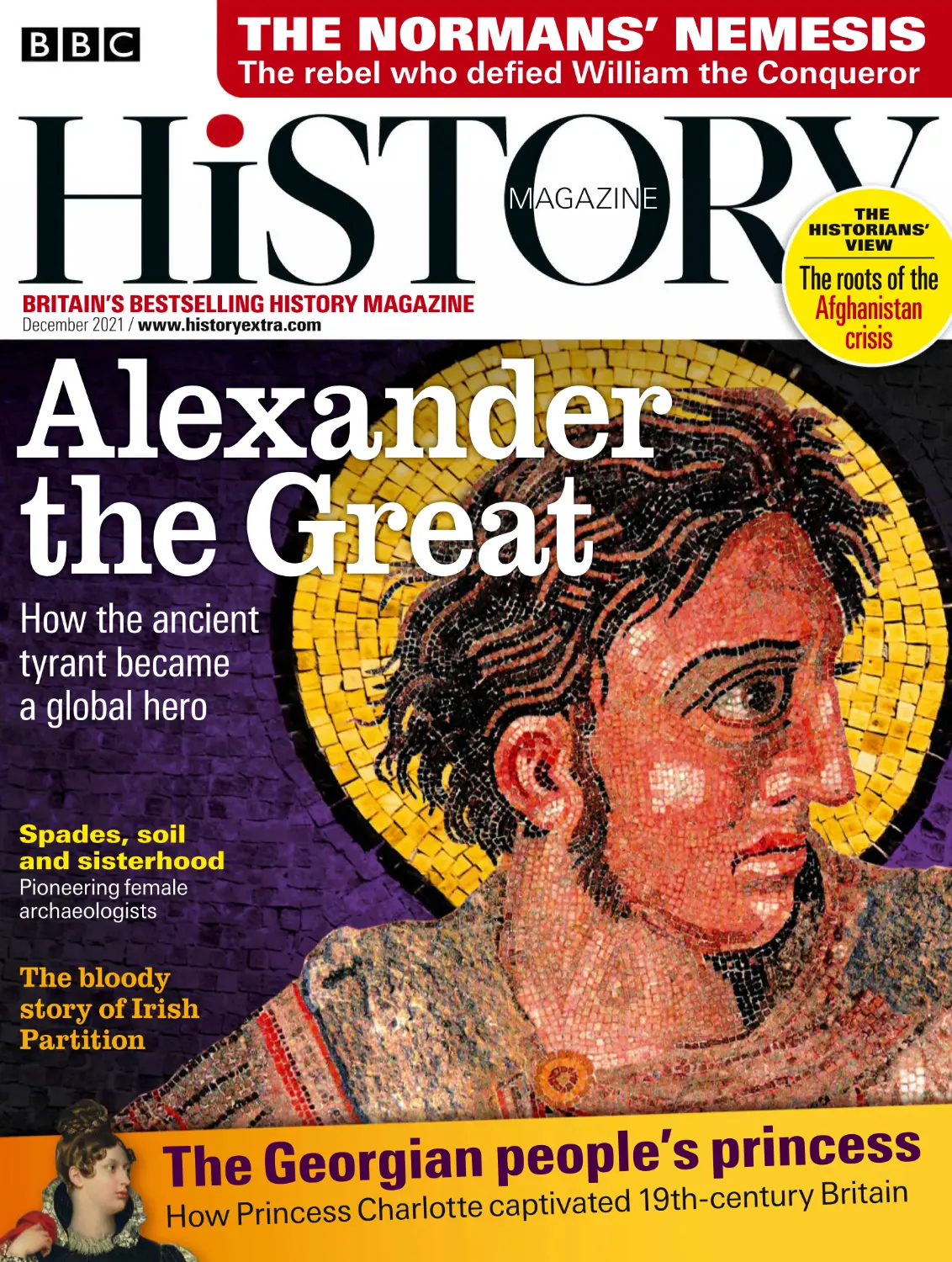
ON THE COVER: FRAGMENT FROM THE “ALEXANDER MOSAIC” SHOWING ALEXANDER THE GREAT IN BATTLE AGAINST PERSIAN KING DARIUS III, ROMAN COPY OF A HELLENISTIC PAINTING,
CIRCA 1ST-3RD CENTURY AD: GETTY IMAGES. BACKGROUND: DREAMSTIME. PRINCESS CHARLOTTE: ALAMY. THIS PAGE: YEPOKA YEEBO/STEVE SAYERS/GETTY IMAGES/ALAMY
WELCOME
DECEMBER 2021
There are more worlds in the sky than anyone could count –
and I have not yet conquered one of them.” So said Alexander
the Great (at least, according to the Greek author Plutarch) on
discovering the true size of the universe. And while Alexander’s
conquests were limited in their reach, his legend was not – soaring far
further than his armies ever could. As Edmund Richardson relates in
this month’s cover feature, Alexander’s story took on a life of its own in
the centuries after his death until he became the world’s first global
icon. Head to page 18 to find out more.
The outer limits of Alexander’s empire included what is now
Afghanistan, a country that has dominated the news recently following
the US withdrawal and the return of the Taliban to power. We assembled
a panel of expert historians to explore the history of the country and
consider how its past has shaped its modern tribulations. You’ll find
that on page 27.
There’s a whole lot more to get your teeth into this month as well,
from the legendary rebellions of Hereward the Wake (page 44) to
the historical challenges faced by women in archaeology (page 64)
and the story of a Georgian princess whose untimely death
plunged Britain into mourning. Plus, as we approach the
centenary of the signing of the Anglo-Irish treaty,
Charles Townshend charts the key events in the
run-up to the partition of Ireland (page 50).
I hope you enjoy the issue.
Rob Attar
Editor
THREE THINGS I’VE
LEARNED THIS MONTH
1. (KPP VQQM [GCTU VQ PKUJ
Huckleberry Finn was one of the books that
I most enjoyed in English classes at
school, but I wasn’t aware at the time
that it had taken Mark Twain
close to a decade to complete
it (page 15).
2. #TEJCGQNQI[
NGF VJG YC[
In Rebecca Wragg Sykes’
piece, I was intrigued to
discover that, in 1939,
archaeologist Dorothy
)CTTQF DGECOG VJG TUV
female Oxbridge professor
in any subject (page 66).
3. Servicemen
YGTG FGOQD JCRR[
I was interested to learn, in
our Q&A section, that the
“demob suits” given to
ex-servicemen after the Second
World War, were exempt from austerity
measures and so contained features
unavailable in civilian clothing (page 43).
Contact us
THIS ISSUE’S CONTRIBUTORS
PHONE
Subscriptions & back issues
03330 162115
Editorial 0117 300 8699
EMAIL
Subscriptions & back issues
www.buysubscriptions.com/
contactus
Editorial historymagazine@
historyextra.com
POST
Rebecca Wragg Sykes
Edmund Richardson
Mary Ann Lund
Irving Finkel
“Creating the TrowelBlazers project has been so
powerful; not only
discovering and sharing
stories connecting past
women pioneers, but also
forging new networks, by
working alongside the
three other brilliant
women co-founders.”
4GDGEEC TGXGCNU YJ[ VJG
1930s was a golden age for
women in archaeology
on page 64
“Two thousand years ago,
the Greek historian Arrian
asked: ‘Why does the
world need another book
about Alexander?’ The
answer: from Iceland to
Ethiopia, from antiquity to
VQFC[ GXGT[QPG PFU C
FK GTGPV #NGZCPFGT q
Edmund explores how
FK GTGPV EWNVWTGU JCXG
portrayed the ancient
conqueror on page 18
“Robert Burton’s The
Anatomy of Melancholy
is both a literary masterpiece of the Renaissance,
and an acute exploration
into just how fragile the
human mind can be.”
/CT[ TGXKUKVU $WTVQPoU
masterpiece, and the
condition it sought to
understand on page 58
“If you’re interested in the
history of ghosts, which
I’ve always been, the marvellous thing is that the
oldest writing we have –
cuneiform clay tablets
from ancient Mesopotamia – tells us all about
what people believed
on this very subject.”
+TXKPI LQWTPG[U VJTQWIJ VJG
murky Mesopotamian
underworld on page 72
Subscriptions & back issues
BBC History Magazine,
PO Box 3320, 3 Queensbridge,
Northampton, NN4 7BF. Basic
annual subscription rates:
UK: £48, Eire/Europe: £67,
ROW: £69
In the US/Canada
you can contact us at:
PO Box 37495, Boone,
IA 50037, BHIcustserv@
EFUHWN NNOGPV EQO
britsubs.com/history,
Toll-free 800-342-3592
3
CONTENTS
FEATURES
DECEMBER 2021
EVERY MONTH
36
6JG /CEGFQPKCP NGCFGT EQPSWGTGF
UYCVJGU QH VJG CPEKGPV YQTNF s DWV
as Edmund Richardson TGXGCNU JKU
TGCEJ GZVGPFGF HCTVJGT UVKNN CHVGT FGCVJ
27 Lessons from
Afghanistan’s past
Can revisiting misrepresented or
WPVQNF CURGEVU QH JKUVQT[ JGNR WU DGVVGT
understand the situation today? An
GZRGTV RCPGN FGDCVGU MG[ VQRKEU
36 A people’s princess
.QPI DGHQTG &KCPC VJG $TKVKUJ RWDNKE
CFQTGF CPQVJGT KNN HCVGF RTKPEGUU
Tracy Borman VGNNU VJG VTCIKE VCNG QH
VJG RTKPEG TGIGPVoU FCWIJVGT %JCTNQVVG
44 Hereward the Wake
Matt Lewis VGCUGU HCEV HTQO O[VJ KP
VJG UVQT[ QH VJG QWVNCY YJQ FG GF
William the Conqueror
50 Ireland divided
Charles Townshend KFGPVK GU VJG
key episodes that led to the partition
of Ireland into north and south
58 Making melancholy
fashionable
Mary Ann Lund FKUEWUUGU
JQY VJG EQPFKVKQP ECRVWTGF VJG
KOCIKPCVKQP QH 4GPCKUUCPEG $TKVCKP
64 Queens of spades
Rebecca Wragg Sykes
KPVTQFWEGU VJG ITQWPFDTGCMKPI
HGOCNG CTEJCGQNQIKUVU QH VJG
U YJQ FWI HQT UWEEGUU
KP VJG HCEG QH UGZKUO
58
4
This month in history
7 History news
10 Michael Wood on pioneering
photojournalist John Thomson
12 Anniversaries
16 Letters
42 Q&A Your history questions
answered
Books
72 Interview: Irving Finkel explains
JQY C DGNKGH KP IJQUVU KP WGPEGF
VJG FCKN[ NKXGU QH RGQRNG KP CPEKGPV
Mesopotamia
76 New history books reviewed
Encounters
84 Diary: What to see and do
this month
90 Explore: The Imperial War
Museum in London
94 Prize crossword
98 My history hero
/KEJCGN 4QUGP EJQQUGU YTKVGT
CPF CEVKXKUV ¥OKNG <QNC
27
#.#/; 4'76'45 ';'8+0' )'66; +/#)'5 .#74+' #810
18 Alexander’s afterlife
MORE FROM US
72
SUBSCRIBE
SAVE WHEN YOU
SUBSCRIBE TODAY
5GG RCIG
HQT FGVCKNU
ENGAGE
18 “Over the centuries following
his death, Alexander’s global
celebrity would surpass anything
he had achieved in life”
historyextra.com
The website of BBC History Magazine KU NNGF YKVJ
GZEKVKPI EQPVGPV QP $TKVKUJ CPF YQTNF JKUVQT[ CPF
KPENWFGU CP GZVGPUKXG CTEJKXG QH OCIC\KPG EQPVGPV
Social Media
"JKUVQT[GZVTC
JKUVQT[GZVTC
"JKUVQT[GZVTC
LISTEN
PODCAST
1WT CYCTF YKPPKPI RQFECUV KU TGNGCUGF UKZ VKOGU C
YGGM 9J[ PQV EJGEM KV QWV VQFC[ CPF GZRNQTG QWT
CTEJKXG QH OQTG VJCP
RTGXKQWU GRKUQFGU
&QYPNQCF GRKUQFGU HQT HTGG HTQO K6WPGU CPF QVJGT
RTQXKFGTU QT XKC JKUVQT[GZVTC EQO RQFECUV
44
50
7525 +FGPVK ECVKQP 5VCVGOGPV BBC HISTORY (ISSN 1469-8552)
(USPS 024-177) December 2021 is published 13 times a year under licence from
BBC Studios by Immediate Media Company London Limited, Vineyard House,
44 Brook Green, Hammersmith, London W6 7BT, UK. Distributed in the US by
NPS Media Group, 2 Enterprise Drive, Suite 420, Shelton, CT 06484. Periodicals
RQUVCIG RCKF CV 5JGNVQP %6 CPF CFFKVKQPCN OCKNKPI Q EGU 2156/#56'4
5GPF CFFTGUU EJCPIGU VQ $$% *+5614; /#)#<+0' 21|$QZ
$QQPG +#
50037-0495.
5
ONLINE
EVENTS
LIVE
Tickets
£12
Autumn talks 2021
1WT PGY UGCUQP QH XKTVWCN GXGPVU Q GTU VJG EJCPEG VQ JGCT JKUVQTKCPU
FKUEWUU C YKFG TCPIG QH VQRKEU s CNN HTQO VJG EQOHQTV QH [QWT QYP JQOG
Expert speakers
Join leading historians live as they
discuss their thought-provoking new
books, spanning everything from the
experiences of a Second World War
tank regiment to the real George III
Q&A sessions
Each 45-minute lecture is followed
by a dedicated Q&A session, allowing
you to put your historical queries
direct to the experts
Clare Jackson
0QXGODGT
Malcolm Gaskill
0QXGODGT
Tickets cost £12 and provide remote
access from anywhere in the world.
Sign up to our newsletter to get
advanced notice about our upcoming
events: historyextra.com/newsletters
James Holland
0QXGODGT
#O[ ,G U
&GEGODGT
Book now at
historyextra.com/
events/virtual-lecture
Fatima Manji
0QXGODGT
Andrew Roberts
&GEGODGT
Signed books
Easy access
6
ALASTAIR MCCORMICK/WILY WILKINSON/SOPHIE DAVIDSON/HELEN ATKINSON
Pre-order each of the featured
books, signed by the author or with
a signed bookplate, via independent
bookseller Fox Lane Books
NEWS
COMMENT
ANNIVERSARIES
THIS MONTH IN HISTORY
EYE-OPENER
SHUTTERSTOCK
The next chapter
Chronicling the mythic adventures
of a Sumerian king and dating
back to the second millennium BC,
the Epic of Gilgamesh is thought
to be the world’s oldest work of
literature. Now one of the tablets
used to record a version of the
story – the 3,500-year-old artefact
pictured right – has returned to the
region in which it was created.
The section is written in the
Akkadian language of ancient
Mesopotamia – a region
of western Asia that included
what’s now Iraq. It tells the story
of the titular king relating his
dreams to his mother, who
interprets them as foretelling
the arrival of a new companion.
The tablet’s location was
unknown for more than a decade
after it was looted from a museum
in Iraq in 1991. After being
smuggled around the world
and sold several times, it was
eventually seized in the United
States in 2019 for being illegally
imported into the country. It’s now
set to be displayed at the National
Museum in Baghdad after being
ceremonially handed over by US
Q EKCNU KP 5GRVGODGT
Have a story? Please email Matt Elton at matt.elton@immediate.co.uk
�
7
THIS MONTH IN HISTORY NEWS
TALKING POINTS
Not much going on
Calls for the world to enter a “decisive decade” prompted Twitter
users to look back at particularly indecisive periods in global
history. ANNA WHITELOCK chose to follow the discussion
I
6TC E QP 4GIGPV 5VTGGV KP .QPFQP
E
9CU VJG GPUWKPI FGECFG
TGCNN[ CU QPG 6YKVVGT WUGT RWV
KV pKPUKRKF CPF DQTKPIq!
and I’m sure things were
Join the
decided but mostly it was –
debate at
just a decade.”
twitter.com/
University of Cambridge
historyextra
PhD student Nick Wise
(@nickwizzo) offered
a fascinating response, drawing on a tool used
in the fields of computational linguistics and
probability known as “n-grams”, which look
for repeated words and phrases in a sample
of text or speech. He tweeted: “‘According to
n-grams, the 1990s were the most decisive
decade, while no decades before the 1940s
were decisive. Decisiveness has been
increasing over the past decade since a low
in the mid-2000s.” Adam Tyndall (@Adam
Tyndall) came to a similar conclusion, albeit
for different reasons: “Surely the least decisive
decade in the past 2,000 years is the most
recent one? All of the others have had a
decisive impact on it, but it has impacted
no other decade (yet). [Spot the philosophy
graduate amongst the historians.]”
But D Allen History (@dallen_history)
wasn’t sure. “True,” he replied, “but could you
not argue that it has had a major impact as
time in the previous decade would have been
spent planning for it, and thus major ‘decisive’
decisions have been made because of it?
Or is that going too far?” And so it went on.
Maybe next time we might ask which was the
most decisive decade? Although,
as Bill Tompson (@william_
tompson) put it: “All decades are
decisive, but some decades are
more decisive than others”!
Anna Whitelock is chair in history
at City, University of London
I always feel
that 1900 to 1910
YCU VJG DQKNGF GII
white of historical
decades
8
An artist’s impression of the clothes that may have
been worn thousands of years ago. New research
suggests they were fashioned using animal bones
ARCHAEOLOGY
Humans “wore clothes
120,000 years ago”
Fashions may come and go, but new
analysis of animal bones found in
a cave in Morocco suggests that
clothes have been part of human life
for tens of thousands of years.
Experts examined bones from
Contrebandiers Cave, on the country’s
Atlantic coast, which is known to have
contained the remains of early humans.
Some are thought to have been used
as tools to transform animal skins into
clothing. The rounded ends of one
device, known as a spatulate, could
have been employed to scrape
connective tissues from pelts without
damaging the skins themselves, while
other tools may have been used for
working leather or fur. Bones from
animals including jackals, wildcats and
sand foxes, meanwhile, appear to bear
patterns of marks where the fur was
removed, pointing to their use for
clothing rather than for meat.
The study, published in the journal
iScience, analysed 62 bones dating
from between 90,000 and 120,000
[GCTU CIQ +VU PFKPIU CTG RCTVKEWNCTN[
important because skins and furs
are unlikely to be preserved over such
a long period of time, meaning that
researchers have to turn to other
evidence to gain a picture of the kind
of clothing worn by our distant
ancestors. The location of the bones
is also intriguing: the region’s climate
would have been temperate during
this period, suggesting that the clothes
may have been used at least partly for
ornamental, rather than strictly
practical, purposes.
SCIENCE PHOTO LIBRARY/BOURNEMOUTH UNIVERSITY/SHUTTERSTOCK/GREATER ANGLIA
n his first address to the United Nations in
September, US president Joe Biden urged
global co-operation through “a decisive
decade for our world”. In response, University
of Oxford historian Peter Frankopan
(@peterfrankopan) asked: “Which was the
‘least decisive decade’ in the past 2,000 years?”
As you’d expect, the answers were suitably
imaginative and wide-ranging.
Rich (@pibasedlifeform) replied: “‘It must
be 1430 to 1440. According to the history I
was taught at school, nothing happened from
Agincourt to the start of the Wars of the Roses
– certainly nothing worth talking about.”
Priya Kale (@priya_kale) commented:
“I always feel that 1900 to 1910 was the boiled
egg white of historical decades – insipid,
boring, and frankly, no one pays it any
attention unless one has no other choice.”
Historian and author Rebecca Rideal
(@RebeccaRideal) was similarly forthright:
“Controversial one, but the 1650s in England.
Loads happened but, in the end, a lot
remained the same.”
Looking further afield, Rutger K
(@AnotherAspirin) tweeted: “In the
Carolingian corner [the dynasty that ruled
western Europe from the eighth to tenth
century]? The years 780 to 790… lots of (in-)
fighting, but little by way of decisions. I’m sure
some stuff happened and they wrote a bunch,
HISTORY IN THE NEWS
A selection of the stories hitting the history headlines
Anne Lister statue unveiled
in Yorkshire hometown
The human footprints were found on Alkali Flat in New Mexico, around 200 miles south of Albuquerque
Footprints are “oldest evidence of humans in the Americas”
6JG SWGUVKQP QH YJGP JWOCPU TUV CTTKXGF KP
VJG #OGTKECU JCU NQPI URCTMGF FGDCVG YKVJ
C UGTKGU QH PFU OCFG QXGT VJG RCUV
[GCTU
RWUJKPI VJCV FCVG HWTVJGT CPF HWTVJGT DCEM
0QY UGVU QH HQQVRTKPVU FKUEQXGTGF PGCT VJG
GFIG QH C NCMG KP 0GY /GZKEQ CRRGCT VQ
RQKPV VQ C JWOCP RTGUGPEG
[GCTU
GCTNKGT VJCP JCU YKFGN[ DGGP CEEGRVGF
6JG OCTMKPIU KP #NMCNK (NCV NCMGDGF FCVG
VQ DGVYGGP
CPF
[GCTU CIQ
6JG[ UGGO VQ JCXG DGGP NCTIGN[ OCFG D[
VGGPCIGTU CPF EJKNFTGP YKVJ QEECUKQPCN
CFWNV CEEQORCPKOGPV CPF CRRGCT VQ JGCF
DCEMYCTFU CPF HQTYCTFU s RQUUKDN[
KPFKECVKPI C JWPVKPI RCTV[
#U YGNN CU UWIIGUVKPI VJG GZKUVGPEG CPF
OKITCVKQP QH RTGXKQWUN[ WPMPQYP GCTNKGT
ITQWRU YJKEJ VJGP DGECOG GZVKPEV VJG PF
KU CNUQ KPVGTGUVKPI DGECWUG QH KVU NQECVKQP KP
YJCVoU PQY VJG UQWVJ YGUVGTP 75 6JCVoU
C NQPI YC[ HTQO VJG $GTKPI 5VTCKV s VJG NCPF
DTKFIG VJCV NKPMGF 5KDGTKC CPF #NCUMC KP VJG
NCUV +EG #IG s YJKEJ EQWNF KPFKECVG VJCV
JWOCPU UGV QWV QP VJCV LQWTPG[ UQQPGT
CPF VJCV VJG[ OQXGF OQTG SWKEMN[ CETQUU
VJG EQPVKPGPV VJCP YCU RTGXKQWUN[ VJQWIJV
# UEWNRVWTG QH VJ EGPVWT[ FKCTKUV CPF
NCPFQYPGT #PPG .KUVGT JCU DGGP KPUVCNNGF
KP *CNKHCZ VJG YGUV ;QTMUJKTG VQYP KP
YJKEJ UJG NKXGF 1HVGP FGUETKDGF CU VJG
p TUV OQFGTP NGUDKCPq .KUVGT MGRV EQFGF
FKCTKGU EJTQPKENKPI JGT TGNCVKQPUJKRU YKVJ
YQOGP s KPENWFKPI #PP 9CNMGT YKVJ
YJQO UJG URGPV VJG PCN [GCTU QH JGT NKHG
6JG UVCVWG KP VJG EQWTV[CTF QH VJG VQYPoU
2KGEG *CNN YCU WPXGKNGF D[ 5WTCPPG
,QPGU YJQ RQTVTC[U VJG FKCTKUV KP $$%
FTCOC )GPVNGOCP ,CEM CPF KVU ETGCVQT
5CNN[ 9CKPYTKIJV YJQ WUGF VJG FKCTKGU
GZVGPUKXGN[ VQ TGUGCTEJ VJG UGTKGU
Gentleman Jack actor Suranne Jones with the
statue of Anne Lister, newly erected in Halifax
Pencil drawing of old man
KFGPVK GF CU XCP )QIJ YQTM
Victorian luggage ledger falls
through station ceiling
'ZRGTVU JCXG EQP TOGF VJCV C UMGVEJ JGNF
KP C RTKXCVG EQNNGEVKQP KP VJG 0GVJGTNCPFU
HQT OQTG VJCP C EGPVWT[ KU C YQTM D[
TGPQYPGF VJ EGPVWT[ &WVEJ CTVKUV
8KPEGPV XCP )QIJ
6JG FTCYKPI RKEVWTGF TKIJV YCU OCFG
WUKPI VJKEM RGPEKN CPF YCVGTEQNQWT RCRGT
CPF FGRKEVU CP GNFGTN[ OCP YKVJ JKU JGCF
KP JKU JCPFU +V YCU ETGCVGF GCTN[ KP XCP
)QIJoU ECTGGT KP 0QXGODGT
YJGP
JG YCU NKXKPI KP 6JG *CIWG &WTKPI VJCV
RGTKQF VJG CTVKUV FTGY PWOGTQWU UVWFKGU
QH RGQRNG CPF VJG UWDLGEV QH VJKU KOCIG
NCDQWTGT #FTKCPWU ,CEQDWU <W[FGTNCPF
CRRGCTU KP FQ\GPU QH FTCYKPIU s KPENWFKPI
CPQVJGT XGT[ UKOKNCT KOCIG 9QTP 1WV
ETGCVGF KP VJG UCOG OQPVJ +PFGGF VJG
PGYN[ CWVJGPVKECVGF UMGVEJ VVKPIN[ VKVNGF
5VWF[ HQT 9QTP 1WV CRRGCTU VQ JCXG DGGP
WUGF CU VJG FKTGEV DCUKU HQT VJCV YQTM
6JG 8CP )QIJ /WUGWO KP #OUVGTFCO
YJQUG TGUGCTEJGTU CWVJGPVKECVGF VJG
FTCYKPI KU UGV VQ FKURNC[ VJG UMGVEJ WPVKN KV
KU TGVWTPGF VQ KVU QYPGT QP ,CPWCT[
%QPVTCEVQTU YQTMKPI VQ TGRCKT VJG TQVVKPI
EGKNKPI QH C UOCNN %CODTKFIGUJKTG TCKNYC[
UVCVKQP KPCFXGTVGPVN[ WPEQXGTGF C VJ
EGPVWT[ NGFIGT YJGP KV HGNN HTQO VJG CVVKE
6JG JCPFYTKVVGP pFC[ DQQMq RKEVWTGF
TKIJV YJKEJ FCVGU HTQO #RTKN
CPF
FGVCKNU RCUUGPIGT NWIICIG CPF QWVIQKPI
RCTEGNU YCU HQWPF
CV /CTEJ TCKNYC[
UVCVKQP UKVWCVGF QP
VJG NKPG DGVYGGP
CPF 2GVGTDQTQWIJ
6JG TGPQXCVKQP
YQTM CNUQ TGXGCNGF
C ECEJG QH QVJGT
FQEWOGPVU
KPENWFKPI PQVGU
QP VJG IQQFU VTCKPU
RCUUKPI VJTQWIJ VJG
UVCVKQP CPF TGEQTFU
QH IQQFU UGPV XKC 4GF 5VCT 2CTEGNU
VJG $TKVKUJ 4CKNoU EQPUKIPOGPV UGTXKEG
YJKEJ QRGTCVGF HQT OQTG VJCP
[GCTU
DGVYGGP
CPF
6JG PGYN[ KFGPVK GF UMGVEJ OGCUWTGU EO D[ EO
CPF YCU EQCVGF YKVJ C ZCVKXG QH OKNM CPF YCVGT
�
9
MICHAEL WOOD ON…
A PIONEER OF PHOTOJOURNALISM
Photography has changed our world.
And this autumn sees the hundredth
anniversary of the death of perhaps the
greatest photographer: John Thomson,
Michael Wood
is professor of
public history at
the University of
Manchester. He
has presented
numerous BBC
series, and his
books include
The Story of
China (Simon &
Schuster, 2021).
His Twitter handle
is @mayavision
A Manchu woman
has her headdress
arranged in an image
taken by the pioneering
photographer John
Thomson in c1869
pioneer of social documentary, and founding father
of photojournalism. Thomson’s towering achievements
in the 1860s include not only producing one of the most
important early photographic records of China and the far
east, but also creating some of the most famous images of
the Victorian poor.
Thomson was born in Edinburgh in 1837, the eighth
of nine children. After apprenticing to an optical and
scientific instrument manufacturer, in 1862, aged 24, he
travelled to Singapore, where he opened a photographic
studio, taking portraits of British colonists and merchants.
But there he became fascinated by the “Other”, and over
the next 10 years – travelling in places such as Burma,
Cambodia and, especially, China – he produced what is in
my estimation the greatest photographic record of indigenous cultures of the east in the 19th century. Exploring
mountains and jungles, he was the first to document the
stupendous temples of Angkor Wat in Cambodia.
In the late 1860s Thomson arrived in China in the wake
of the Taiping Rebellion in which at least 20 million people
had died from war, famine and disease. His journeys there
included a 3,000-mile trek up the Yangzi river carrying a
camera, plates and chemicals with him. Thomson was the
first ever photographer to access the deep countryside,
taking pictures of all levels of society, from beggars to
mandarins. Amazingly, this included intimate and affecting
portraits of Chinese women both high and low – pictures
that reveal an artist of profound insight and humanity.
Thomson’s travels in China were often perilous. Along
with local helpers (and his dog, Spot, as a companion), he
visited remote, almost unpopulated regions far inland.
Most of the people he encountered had never seen a
westerner or a camera before.
At the time it was believed that having one’s photograph
taken resulted in the life-threatening loss of vital essence.
A photographer, therefore, was frequently looked on as a
forerunner of death. There were occasions when Thomson
witnessed Chinese people so terrified that they begged him
not to approach with his fatal lens. On one occasion, when
he was taking a photo of a tower not far from Guangdong
in the south-east of the country, Thomson was assaulted
on the riverbank by a mob that drove him into the river.
Luckily he was hauled out of the water by two women in a
boat. But he spent time explaining and reassuring through
his interpreters, and his pictures show an uncanny rapport
between subject and camera. Some of his Chinese portraits
are spellbinding in their intimacy.
In 1872, Thomson returned to England, bringing with
him an unsurpassed portrait of late imperial China on the
eve of the modern age. He opened a studio in Brixton and
continued to innovate and explore, achieving international
fame through his writings, books, lectures and teaching.
He was among the first to combine photography with the
printed word, playing a key role in the evolution of the
kind of photojournalism we know worldwide today. He
produced a monthly magazine, Street Life, in which he
documented the lives of the people of London’s East End
– a truly remarkable portrait of the poor in the Victorian
age. He also developed the technical processes to reproduce photographs in books: his eight volumes of photographs were bestsellers.
Thomson was so in demand that he opened a studio in
Buckingham Palace Road and became a photographer of
high society in Mayfair: he received the Royal Warrant in
1881 when Queen Victoria made him official photographer
to the royal family. In 1886 he also began instructing
explorers at the Royal Geographical Society in the use of
photography to document their own travels.
Nearly 700 of Thomson’s glass plates survive (now chiefly in London’s Wellcome Institute) and recent exhibitions
of his photographs in cities such as Shanghai have attracted huge and fascinated crowds, intrigued by his unrivalled
portrait of late imperial China and its people, rich and poor.
One of the outstanding geniuses in the history of photography, Thomson deserves to be known better. Time for the
BBC and the National Museum of Scotland to step up?
VISIT
The exhibition China – Through the Lens of John
Thomson is running at Heriot-Watt University, Edinburgh until
22 March 2022. Booking is essential. bit.ly/2YkamCH
10
GETTY IMAGES
THIS MONTH IN HISTORY COMMENT
We should salute a towering
figure in the history of photography
Advertisement feature
Journeys
through
history
See Rome –and four other
beautiful Italian cities – in
a different light while on
a Cultural Odysseys
Shakespeare’s Italy tour
Four Cultural Odysseys
Historic Journey through Sicily
Immerse yourself in Sicily’s rich
mixture of Arab, Norman and
Byzantine history and trace
the rise and fall of civilisations
from the Romans and
Greeks back to the
prehistoric Siculan people, in
the company of archaeologist
Dr Jamie Sewell.
Shakespeare’s Italy
Explore where Shylock demands his
pound of flesh in Venice and travel from
‘fair Verona’ via the beautiful medieval
towns of Padua and Mantua to Rome
with Royal Shakespeare Company and
Globe Theatre actress Sarah Finch.
A new collection of expert-led cultural tours from
Saga promises to transport you into the past in style
S
ome places simply exude history.
Think of Istanbul, the city of minarets
and mosques that’s been at the very
heart of empires for two millennia. Or the
medieval cities of Italy, like Venice and
Verona, inspiration to Shakespeare. Or the
unique culture of Sicily, shaped by waves of
invaders and seafarers. Walk these streets in
the company of an expert guide, someone
who can bring the stories of the place to life
– and you gain memories and knowledge that
will remain with you.
That is the thinking behind a new
collection of Cultural Odyssey Tours from
the award-winning tour operator Saga. These
small-group, luxury tours are the perfect
fusion of stunning destinations and cultural
immersion, offering a deep dive into history,
art, literature, ballet and music. And all are
accompanied by genuine experts –
academics, authors and specialist guides who
have devoted their lives to the subject. Skilled
at bringing their subjects to life, they give a
fascinating perspective on new places as well
as cities you may already know and love.
VIP ALL THE WAY
Saga takes care of you every step of the
way, as you’d expect from a company
that has garnered seven decades’
experience organising award-winning
holidays for the over-50s. Each Cultural
Odyssey Tour includes the services of a Saga
tour manager, and the stress of getting to the
airport is removed thanks to a chauffeured
VIP car service to your UK departure point.
The overall price includes basics such as
flights and transfers and porterage, as well as
thoughtful extras such as travel insurance to
cover Covid cancellation.
These meticulously planned ABTA- and
ATOL-protected trips offer peace of mind
and the knowledge that Saga has thought of
everything – so that you don’t have to.
Istanbul:
City of Empires
Explore Ottoman
and Byzantine worlds
in the company of
award-winning
narrative historian
Roger Crowley, view
mosques and minarets
from a private boat on
the Bosphorus, and enjoy a
private visit to the Ecumenical
Patriarchate of Constantinople.
Modernism in Catalonia
Writer and curator Dr Jeremy Roe,
an authority on visionary
architect Antoni Gaudí, will
guide you through Barcelona’s
masterpieces before travel to
the resort of Sitges and the
mountain stronghold of Montserrat.
BOOK NOW
To take advantage of a 5% discount on
Saga Cultural Odyssey Tours, simply quote
‘BHCT5’ when booking. To find out more
or request a brochure, visit the Escorted
Tours section at saga.co.uk/cthistory
ANNIVERSARIES
20 DECEMBER AD 69
Vitellius is pelted
with dung and
murdered
The Roman emperor’s corpse
is then dumped in the Tiber
he Roman emperor Vitellius was a very
fat man. “His besetting sins,” wrote
the historian Suetonius, “were luxury
and cruelty. He divided his feasts into three,
sometimes into four a day: breakfast,
luncheon, dinner and a drinking bout; and he
was readily able to do justice to all of them
through his habit of taking vomiting agents.”
On the road he would “snatch bits of meat
and cakes amid the altars, almost from the
XGT[ TG CPF FGXQWT VJGO QP VJG URQVq
Vitellius became emperor in April AD 69,
10 months after the death of Nero. But after
only three months he learned that a rival
general, Vespasian, had been proclaimed in
the east and was marching on Rome. Vitellius’s loyalists organised dogged resistance,
but by mid-December the eastern legions
YGTG IJVKPI VJGKT YC[ KPVQ VJG ECRKVCN
The end of Vitellius’s gourmandising
career came on 20 December. He had taken
refuge in the palace door-keeper’s house, but
Vespasian’s soldiers soon tracked him down.
“They bound his arms behind his back, put a
noose about his neck, and dragged him with
rent garments and half-naked to the Forum,”
wrote Suetonius. “All along the Sacred Way
he was greeted with mockery and abuse,
his head held back by the hair, as
is common with criminals…
Some pelted him with dung
and ordure, others called him
incendiary and glutton.” Then
they drew their swords, killed
him and threw the body into
the Tiber. Vitellius’s last words,
apparently, were: “Yet I was
once your emperor!”
A second-century
bust of Vitellius, whose
cruelty and gluttony made
him a target of abuse
12
BRIDGEMAN/ALAMY/GETTY IMAGES
T
DOMINIC SANDBROOK highlights
events that took place in December in history
THIS MONTH IN HISTORY ANNIVERSARIES
An engraved portrait
of the pioneering
African-American
politician Joseph Rainey
12 DECEMBER 1870
In Washington, DC, the formerly
enslaved Joseph Rainey is sworn in
as congressman from South Carolina,
becoming VJG TUV DNCEM #OGTKECP
to sit in the House of Representatives.
10 DECEMBER 1520
Martin Luther sets
fire to a papal bull
The religious reformer treats
Pope Leo X’s demand that he
recant with public contempt
xsurge, Domine! “Arise, O Lord!” So
began the papal bull promulgated by
Leo X on 15 June 1520, written in
response to the Ninety-Five Theses by the
German church reformer Martin Luther. With
Luther’s ideas spreading across Germany, the
pope and his allies were desperate to stamp
their authority onto the debate.
$[ UQOG CEEQWPVU .GQ YCU IKXGP VJG TUV
draft of the bull when he was at his hunting
lodge, relaxing after pursuing wild boar. That
YCU QFFN[ VVKPI UKPEG VJG VGZV ECNNGF HQT )QF
to strike back against “the foxes and wild boar
who are destroying the vineyard of the Lord,
who had bestowed jurisdiction over it to Peter
and his successor”. It rejected Luther’s ideas
CU pJGTGVKECN UECPFCNQWU HCNUG =CPF? Q GPsive”, and made it illegal for any Christian man
or woman “to read, assert, preach, praise,
print, publish, or defend them”. As for Luther
himself, he and his “accomplices” were given
60 days to recant his views – or face the direst
penalties in the church’s arsenal.
$WV .WVJGT YCU C IJVGT 9JGP EQRKGU
of the bull were posted in German towns,
students tore them down. And Luther himself
treated it with utter contempt. “Whoever
wrote this bull, he is Antichrist,” he declared.
“I protest before God, our Lord Jesus, his
sacred angels and the whole world that with
my whole heart I dissent from the damnation
of this bull, that I curse and execrate it as
sacrilege and blasphemy.”
That was pretty strong. Even stronger,
though, was Luther’s performance on
10 December 1520, 60 days after he had
received his copy and been told to recant.
Having summoned the students of Wittenberg to a public meeting near the town’s
'NUVGT )CVG JG NKV C DQP TG CPF DGICP VQUUKPI
papal publications into it. Then he held the
DWNN KVUGNH CDQXG VJG COGU p$GECWUG [QW
have confounded the truth of God,” he yelled,
pVQFC[ VJG .QTF EQPHQWPFU [QW +PVQ VJG TG
with you!”
E
ILLUSTRATION BY $'%%# 6*140'
�
13
THIS MONTH IN HISTORY ANNIVERSARIES
7 DECEMBER 1732
Having made a fortune from John Gay’s
6JG $GIICToU 1RGTC, the actor-manager John Rich
opens a new theatre in a former convent garden
in London’s Bedford Estate on the site of what’s
now the Royal Opera House.
GETTY IMAGES
# RNC[ CV %QXGPV )CTFGPoU
6JGCVTG 4Q[CN KP
6JG
VJGCVTG YCU QRGPGF D[
,QJP 4KEJ KP
5WRRQTVGTU QH VJG 2CMKUVCP 2GQRNGU 2CTV[ NKIJV ECPFNGU KP &GEGODGT
27 DECEMBER 2007
Benazir Bhutto is
assassinated
The death of Pakistan’s former
prime minister triggers violent
riots across the country
fter eight years in exile, the former
prime minister of Pakistan, Benazir
Bhutto, returned to her native land in
the autumn of 2007, determined to meet the
people before a possible power-sharing deal
with her old enemy General Pervez Musharraf. On the day of her return, 18 October, her
A
14
QP VJG GKIJVJ CPPKXGTUCT[ QH HQTOGT RTKOG OKPKUVGT $GPC\KT $JWVVQoU FGCVJ
motorcade was attacked by suspected
al-Qaeda suicide bombers outside Karachi
airport, killing at least 150 people. But Bhutto
herself was unhurt, and she vowed not to be
deterred – although she did ask for protection
VQ DG RTQXKFGF D[ VJG HQTGKIP UGEWTKV[ TOU
Blackwater and ArmorGroup.
.CVG KP VJG CHVGTPQQP QH
&GEGODGT
Bhutto had just addressed a rally of her
Pakistan Peoples Party at the Liaquat National
Park, Rawalpindi, and was waving to the
crowd, when the cheers were interrupted by
shots and screams. Even now, exactly what
happened remains uncertain. Some witnessGU UCKF VJG[ UCY C IWPOCP TKPI KPVQ $JWVVQoU
YJKVG .CPF %TWKUGT CU KV DGICP VQ OQXG Q
others thought she had been hit by shrapnel
as a suicide bomber detonated his vest. Still
others suggested that all the bullets had
missed Bhutto, and that she fell backwards
into her car to avoid the shots, was rocked
further backwards by the suicide blast and
then fractured her skull on the sunroof catch
of the car.
Either way, Bhutto was rushed to hospital,
reaching the Rawalpindi General at 5.35pm.
By an extraordinary coincidence, the doctor
operating on her was the son of the doctor
who had operated on another prime ministerial assassination victim, Liaquat Ali Khan
– after whom the park had been named – in
1951. The doctor’s father had been unable to
save Liaquat; and he, tragically, was unable to
save Bhutto.
She was pronounced dead at 6.16pm,
triggering riots across Pakistan. Some of her
supporters attacked the hospital itself; others
attacked police stations, government buildKPIU UJQRU CPF Q EGU *WPFTGFU QH DCPMU
were destroyed, and the entire national
railway system ground to a halt. In all, more
than 100 people were killed.
WHY WE SHOULD REMEMBER…
The Statute of Westminster, a
cornerstone of the Commonwealth
BY ASHLEY JACKSON #0& ANDREW STEWART
An illustration of Huckleberry Finn, 1884. It took
/CTM 6YCKP CNOQUV C FGECFG VQ PKUJ VJG PQXGN
10 DECEMBER 1884
Huckleberry Finn
comes to Britain
Mark Twain’s masterpiece is
branded “trash” in the States,
but still flies off the shelves
M
ALAMY
CTM 6YCKP JCF PQ UQQPGT PKUJGF
6JG #FXGPVWTGU QH 6QO|5CY[GT
than he thought of a sequel. It
would be based on Tom’s friend Huckleberry
Finn, and in the course of 1876 he set to work,
scribbling on sheets of notepaper. The trick,
he realised, would be to capture Huck’s
vernacular dialect, a new departure in
American writing. The opening line, for
example, began as “You will not know about
me,” but only after several drafts did Twain
PF *WEMoU KPKOKVCDNG XQKEG p;QW FQPoV MPQY
about me, without you have read a book by
the name of 6JG #FXGPVWTGU QH 6QO 5CY[GT;
but that ain’t no matter.”
The novel’s gestation, however, was slow
and painful. For some years, Twain was stuck
CPF RWV KV Q *G QPN[ OCPCIGF VQ PKUJ
it after he had written another book,
a memoir of his days as a steamship pilot on
the Mississippi. At last, at the end of 1884, the
#FXGPVWTGU QH *WEMNGDGTT[ (KPP YCU PKUJGF
CPF YCU RWDNKUJGF KP $TKVCKP QP |&GEGODGT
by Chatto & Windus – though American
publication, oddly, had to wait a few
more weeks.
Alas, not everybody liked it. In New England, one library committee called it “the
veriest trash”, adding that it was “more suited
to the slums than to intelligent, respectable,
people”. Twain thought that was hilarious.
“This will sell us another 25,000 copies for
sure!” he wrote. And he was right.
Dominic Sandbrook is a historian, author and
broadcaster. His new series of history books for
children, Adventures in Time (Particular Books),
is available now
What was the Statute of Westminster,
and when was it enshrined?
The Statute of Westminster was a key
moment in the journey of Britain’s
dominions towards independence. It
passed through parliament in December
1931 – 90 years ago this month – enshrining in law the 1926 Balfour Declaration’s
recognition that Australia, Canada, the
Irish Free State, Newfoundland, New
Zealand and South Africa were equal,
not subordinate, to Britain, freely
associating as members of a “Commonwealth of Nations”.
The statute removed Westminster’s
right to legislate for the dominions,
thereby establishing their legislative
independence. They could now legislate
beyond as well as within their own
borders, join the League of Nations
(except Newfoundland), conclude
treaties with other states, declare war
on their own behalf and develop
diplomatic representation abroad.
New Zealand was the last to ratify the
statute, in 1947.
What impact did it have on Britain’s
relations with the dominions?
In the short term, not much of one; in
many ways, there was a hollowness to
the document, and it was more about
status than substance. The dominions
# 5GEQPF 9QTNF 9CT RQUVGT UJQYU
$TKVKUJ GORKTG OKNKVCT[ RGTUQPPGN 6JG
5VCVWVG QH 9GUVOKPUVGT YCU RCTV QH VJG
NQPI RTQEGUU QH FKUOCPVNKPI VJG GORKTG
were not yet independent, and were still
reliant on Britain for trade, investment
and security. The statute was a clever
expression of the relationship between
Britain and the fully self-governing
units of the empire, acknowledging
their mature stature but not removing
the established links.
Over the longer term, however, these
ties loosened. The statute provided the
dominions with the legal apparatus
necessary to develop their own
nationhood and pursue their own
regional and international agendas.
Britain could no longer automatically
speak on their behalf in the councils of
the world – and this created fault lines
at the heart of the empire. Although
(with the exception of Ireland, which
left the Commonwealth in 1949) the
dominions’ outlook tended towards
them operating as a unit, they were free
to make their own way in the world.
Why should we remember the
Statute of Westminster today?
As Britain’s power contracted in the
mid-20th century, the dominions took
advantage of the freedoms the statute
granted them. As such, it provided the
basis for their full independence.
What’s more, in expressing the idea
of an association of politically equal
states, the statute was a cornerstone of
the modern Commonwealth. Britain
originally hoped to exercise leadership
through the Commonwealth but, as
former colonies gained independence
and became members, it evolved into
a genuinely free and equal association
of nations. With 54 members, it is
today one of the world’s most prominent inter-state organisations, its
purpose “to promote prosperity,
democracy and peace, amplify the
voice of small states, and protect
the environment”.
Ashley Jackson (left) is
professor of imperial and
military history at King’s
College, London. Andrew
Stewart is professor of war
studies at the Australian
National University
15
LETTERS
Fighting prejudice
As an ex-amateur boxer, I was interested
in the reference to black American world
heavyweight champion Jack Johnson in
Prejudice on the Pitch (October). My great
uncle Alan fought Johnson in Portsmouth
on 11 June 1908. Because of Home Office
interference, only a “demonstration” bout
was permitted – so although a huge crowd
attended, the gate money was modest.
Johnson took the lot. Ex-mercenary Alan
was satisfied to enter the record books.
Perhaps of equal interest is George
Dixon, the first black boxer to be awarded a
world title in 1890. He arrived in Britain
claiming to be the
19-year-old Dixon,
standing 5ft 3ins,
squared up to the
scowling Wallace.
After 18 relentless rounds the unthinkable
happened: Wallace was beaten.
Dixon went on to fight an estimated
700 bouts. He died at the age of 37 on
the streets of New York, an anonymous,
alcoholic wreck. Africville, Nova Scotia,
the town of his birth, has crafted a stunning mural in his honour.
Terry McNamara, 5JG GNF
Pottery and plantations
Tristram Hunt’s fascinating article on Josiah
Wedgwood (The Radical Father of English
Pottery, October) mentions that Wedgwood’s
famous “Am I Not a Man and a Brother?”
cameo was known as “the Emancipation
Medallion or Badge”. In 1787, however, when
Wedgwood’s ceramic medallion became
available, emancipation was not the immediate goal of the early campaign against slavery.
Wary of being seen to threaten plantation
“property”, in an era when pickpockets
and sheep-stealers were hanged, the London
Committee of the Society Instituted for the
Purpose of Effecting the Abolition of the
Slave Trade felt obliged to assure MPs and
the public that their objective was limited
to abolition of the slave trade and did not
extend to slave emancipation – contrary
to the allegations of the West Indian planters
and merchants. In August 1788, it issued
a statement emphasising that “however
acceptable a temperate and gradual abolition
of Slavery might be to the wishes of Individuals it never formed any part of the Plan of
this Society”.
In his 1808 abolition history, Thomas
Clarkson recorded his belief that, by focusing
on the slave trade, the committee “would not
incur the objection, that they were meddling
with the property of the planters, and letting
loose an irritated race of beings, who, in
consequence of all the vices and infirmities,
which a state of slavery entails upon those
who undergo it, were unfit for their freedom”. Of the other 11 original members of
the committee, only chairman Granville
Sharp insisted that it was his Christian duty
to oppose “the toleration of slavery itself”.
Tim May, .QPFQP
Caught in the middle
Your feature in the October issue on
The (Surprisingly) Modern Middle Ages
brought back memories of my tutor,
Dr Lynette Muir, in the Graduate Centre
for Medieval Studies, Leeds University.
Even 40 years later, I still remember her
announcing with a flourish, at the beginning
of a lecture: “What you have to remember
about the Middle Ages is that they didn’t
know they were Middle!”
we should study history. To say that it
has transferable skills, or teaches empathy,
or is good preparation for leadership roles,
is just not good enough to justify history as
a university subject. The same is true of many
other subjects such as English literature or
sociology. The one that resonated most with
me was Richard Partington’s suggestion
that it is good from a “leisure perspective”,
but that is hardly a justification from an
academic point of view.
Bob Bass, Nuneaton
A haunting legacy
In reference to your Q&A article on the
Greenbrier Ghost (September), your readers
might enjoy knowing that The Unquiet
Grave by Sharyn McCrumb tells the full
story of Zona Heaster Shue, whose mother
ensured that there was justice for the
murder of her daughter in 1897, as noted
in the article. McCrumb, of English and
Scots descent, writes stories set in the
Appalachian Mountains of Virginia and
North Carolina. Her ancestors are among
the early settlers to this region of the US.
Janet Daulton, Virginia
Great Scott
I was delighted to read your article marking
the 250th anniversary of the birth of
Sir Walter Scott (September). I recently
had the good fortune to visit his home at
Abbotsford, near Melrose. The museum
and house are fascinating, and show that
Sir Walter was more than a novelist and
poet. He was also a historian of Scotland,
a collector of artefacts and a patron of the
Scots Baronial style of architecture.
Having grown up in Ayrshire in the
1960s, my literary education revolved around
Robert Burns, and the life and works of
Sir Walter Scott were hardly touched upon.
I hope that today the curriculum in Scottish
)'66; +/#)'5 ).'0 /%$'6*
LETTER OF THE MONTH
Josiah Wedgwood as depicted in
a c1770 engraving. Reader Tim May
TG GEVU QP JKU EQPVTKDWVKQP VQ VJG
campaign against the slave trade
Fenella Barnes, Essex
We reward the Letter of the
Month writer with a copy of
a new history book. This issue,
that is The Dissolution of the
Monasteries: A New History by
James Clark. You can read our
review of the book on page 76
16
Missed lessons
In the feature on history education (What’s
the Future of Studying the Past?, October),
I was disappointed to see that the noted
historians had failed, in my view, to come
up with convincing arguments about why
Glen McBeth’s illustration of the Greenbrier Ghost, whose
story elicited a response from reader Janet Daulton
EDITORIAL
Editor Rob Attar robertattar@historyextra.com
Deputy editor /CVV 'NVQP mattelton@historyextra.com
Production editor Spencer Mizen
Podcast editor 'NNKG %CYVJQTPG
Section editor Rhiannon Davies
Picture editor Samantha Nott samnott@historyextra.com
Group art editor Susanne Frank
Senior deputy art editor 4CEJGN &KEMGPU
Content director &T &CXKF /WUITQXG
Acting digital editor 'NKPQT 'XCPU
Digital section editors 4CEJGN &KPPKPI -GX .QEJWP
Fact-checkers: &T 4QDGTV $NCEMOQTG ,QJP 'XCPU &T (C[ )NKPKUVGT
,QUGVVG 4GGXGU &CPKGN #FCOUQP &CPKGN 9CVMKPU 4QYGPC %QEMGVV
Picture consultant: Everett Sharp
ADVERTISING & MARKETING
Advertising manager
Sam Jones 0117 300 8145
Sam.Jones@immediate.co.uk
Senior brand sales executive
Sam Evanson 0117 300 8544
Brand sales executive
Sarah Luscombe 0117 300 8530
Sarah.Luscombe@immediate.co.uk
Group direct marketing manager
Laurence Robertson 00353 5787 57444
Subscriptions director Jacky Perales-Morris
Subscriptions marketing manager
Kevin Slaughter
US representative Kate Buckley
buckley@buckleypell.com
PRESS AND PUBLIC RELATIONS
PR manager Emma Cooney 0117 300 8507
Emma.Cooney@immediate.co.uk
One of the richly
decorated rooms in
Abbotsford, the house
built for Sir Walter Scott
in the 19th century.
Reader Bryan Turner
highlights the Scottish
novelist’s love of history
SYNDICATION
Director of licensing & syndication Tim Hudson
International partners’ manager Anna Brown
schools includes study of the rich legacy
and inspiring talents of Sir Walter.
Bryan Turner, Worthing
Corrections
A number of readers have contacted us
about the image of Walt Disney World Resort
in October’s Why We Should Remember.
Though it was captioned as showing “Goldilocks and the three bears”, it was actually a
photograph of the Country Bear Jamboree.
As reader Gordon Campbell has pointed out,
in Windows on to History (November), we gave
the incorrect title to a Victorian hymn. It should
have been ‘Oft in the Stilly Night’ rather than
‘Oft in the Silly Night’ as printed. Apologies
for this stilly error, which was introduced
during the editing process.
ALAMY
WRITE TO US
We welcome your letters, while reserving the right to edit them. We may publish
your letters on our website. Please include a daytime phone number and, if emailing,
a postal address (not for publication). Letters should be no longer than 250 words.
Email: letters@historyextra.com Post: 1WT Q EG KU EWTTGPVN[ ENQUGF UQ WPHQTVWPCVGN[
we can only receive email communication at this time
HISTORYEXTRA PODCAST
Head of podcasts Ben Youatt
Podcast producer Jack Bateman
Podcast assistant Brittany Collie
Podcast editorial assistant 'OKN[ $TK GVV
Podcast coordinator Emily Thorne
PRODUCTION
Production director Sarah Powell
Senior production co-ordinator Lizzie Ayre
Ad co-ordinator Lucy Dearn
Ad designer Julia Young
IMMEDIATE MEDIA COMPANY
Commercial director Jemima Dixon
Group managing director Chris Kerwin
CEO Sean Cornwell
CFO & COO Dan Constanda
Executive chairman Tom Bureau
BBC HISTORY MAGAZINE
Founding editor Greg Neale
BBC STUDIOS, UK PUBLISHING
Managing Director, Consumer Products and
Licensing Stephen Davies
Director, Magazines and Consumer Products
Mandy Thwaites
Compliance manager Cameron McEwan
Chair, Editorial Review Boards Nicholas Brett
UK publishing coordinator Eva Abramik
(uk.publishing@bbc.com)
Vol 22 No 12 – December 2021
BBC History Magazine is published by
Immediate Media Company London Limited
under licence from BBC Studios who help fund
new BBC programmes.
BBC History Magazine was established to
publish authoritative history, written by
leading experts, in an accessible and attractive
format. We seek to maintain the high
journalistic standards traditionally associated
with the BBC.
© Immediate Media Company London
Limited, 2021 – ISSN: 1469 8552
Not for resale. All rights reserved. Unauthorised
reproduction in whole or part is prohibited
YKVJQWV YTKVVGP RGTOKUUKQP 'XGT[ G QTV JCU
been made to secure permission for copyright
material. In the event of any material being used
inadvertently, or where it proved impossible to
trace the copyright owner, acknowledgement
will be made in a future issue. MSS,
photographs and artwork are accepted on the
basis that BBC History Magazine and its
agents do not accept liability for loss or
damage to same. Views expressed are not
necessarily those of the publisher.
We abide by IPSO’s rules and regulations.
To give feedback about our magazines, please
visit immediate.co.uk, email
editorialcomplaints@immediate.co.uk
or write to Katherine Conlon,
Immediate Media Co., Vineyard House,
44 Brook Green, London W6 7BT.
Immediate Media Company is working to
ensure that all of its paper is sourced from
well-managed forests. This magazine can be
recycled, for use in newspapers and packaging.
Please remove any gifts, samples or wrapping
and dispose of it at your local collection point.
Jan–Dec
2020
89,865
SAVE WHEN YOU
SUBSCRIBE TODAY
Page 34
The opinions expressed by our commentators are their own and may not represent
the views of BBC History Magazine or Immediate Media Company
17
When Alexander the Great died at the age of 32, his
transformation into multicultural icon was only just beginning.
Edmund Richardson chronicles the Macedonian king’s
remarkable afterlife as the original global A-lister
18
BRIDGEMAN/ALAMY/
GETTY IMAGES
6JG YQTNFoU TUV
superhero
Universal appeal
Alexander the Great depicted
(from left to right): in the Roman
Alexander Mosaic; on horseback
in a c1445 adaptation of
the Alexander Romance; as
pharaoh in a fourth-century BC
Egyptian relief; dressed as a
Byzantine emperor in a
14th-century manuscript; and
battling a dragon in the epic
Persian poem the Shahnameh
19
Cover story / Alexander the Great
+x
n 321 BC, a very strange procession set
out from Babylon. Alexander the Great
was on the move. He had died two years
earlier, in 323 BC, at the age of 32.
Over the course of a few brief years,
this astonishing soldier and statesman
had transformed the ancient world.
He marched his army from Macedon
through Asia Minor to Egypt. He
defeated the Great King of Persia, Darius III,
in two enormous battles. The cities of the
Persian empire – Babylon, Susa and Persepolis – fell before him. By his mid-20s, he had
more wealth and power than any European
in history. But it was not enough.
Alexander marched his army further and
further east, across the heart of Asia and the
mountains of Afghanistan, into battle with
elephants and into lands where even the gods
of Greece had never set foot.
He was never defeated in battle, but after
many long years of campaigning, his soldiers
laid down their arms on the banks of an
Indian river, and would march no further.
Alexander reluctantly led his army back to
20
Babylon, where he died under mysterious
circumstances (though some thought he had
been poisoned).
So ended one of the most extraordinary
lives in ancient history. But, in many respects,
the story was only just beginning, for over the
following centuries, Alexander’s global
celebrity would surpass anything he had
achieved in life.
The body-snatcher
Alexander’s death set off one of history’s most
brutal power-struggles, exacerbated by the
fact that there was no obvious successor. One
of his generals, Perdiccas, was named regent
of the empire, but every ambitious commander began to grab as much wealth and
power as possible.
In the chaos, Alexander himself was
forgotten. For a while, his body was kept in a
vat of honey to preserve it. Two years passed.
Then, at last, he began his final journey back
to Macedon, to be buried with his ancestors.
He never made it home. In Syria, Alexander’s enormous, lumbering funeral carriage
– a golden temple on wheels – was intercepted
by one of his oldest friends, Ptolemy, the
governor of Egypt. Ptolemy wanted Alexander’s body for himself. He intended to take
the body back to Egypt and claim the power
that came with Alexander’s legacy.
Ptolemy knew, though, that as soon as
news of his body-snatching reached Perdiccas, he would become the most wanted man
in the world. So, according to the Varia Historia (by the Roman author Aelian), Ptolemy
“made an Alexander mannequin, dressed
it like a king, and draped it in a gorgeous
shroud. He laid it on one of the funeral
carriages, and heaped it with gold, silver
and ivory.”
Alexander’s actual body, Aelian also
claims, “was sent to Egypt discreetly, in the
least ostentatious way, along hidden and
unused roads. Once Perdiccas captured the
mannequin, with its magnificent carriage, he
ordered his troops to halt. He was sure that
Alexander was now his. He only realised that
he had been tricked when it was too late.”
Ptolemy’s trick worked. Alexander’s
ALAMY
A lethal diet
This 15th-century illustration shows
Alexander and his queen sat at a table
and (in the foreground) with a feather in
his throat after being poisoned.
6JG OGFKGXCN #NGZCPFGT UW GTU
bleeds and makes mistakes
Son of god
A relief showing Alexander
being blessed by Amun-Ra. The
Macedonian leader was happy to
allow rumours to spread that he
was the son of the Egyptian deity
ALAMY/GETTY IMAGES
Raising the dead
A bust of Pharaoh Ptolemy I.
His appropriation of Alexander’s
corpse in 321 BC supercharged
his rise from ordinary
Macedonian to ruler of Egypt
soldiers rallied round him. His power grew,
and kept on growing. Born an ordinary
Macedonian, Ptolemy died a pharaoh,
halfway between a man and a god. He
founded the last pharaonic dynasty, which
endured 275 years, until Cleopatra VII.
Ptolemy was not the first, and he would
not be the last, to claim Alexander for
himself. While he appropriated Alexander’s
body, countless others appropriated Alexander’s story. For more than 2,000 years, Greek
and Roman historians, Egyptian storytellers,
Persian poets, Ethiopian monks, Jewish
scholars, Icelandic bards and many more
have made Alexander their own as ruthlessly
as Ptolemy did. Alexander has become a
Persian king, an Islamic holy man and a
Christian saint, and ultimately the world’s
first multicultural hero.
Divine intervention
The stories emerged soon after Alexander’s
death. Like many of the ancient world’s best
tales, they started in Egypt. “Many people
think that Alexander was the son of King
Over the past 2,000
years, Alexander has
become a Persian king,
an Islamic holy man
and a Christian saint
Philip of Macedon, but they are mistaken,”
declared one chronicle of his life. “The wisest
of the Egyptians know that Alexander was
not the son of Philip, but of Nectanebo.”
Nectanebo II, pharaoh of Egypt, had fled
before an invading Persian army – or so the
story went. He sought refuge in Macedon,
where he crept into the bed of Alexander’s
mother, disguised as the Egyptian god
Amun. Alexander was an Egyptian all along.
It was an outrageous idea. But, during his
lifetime, Alexander had encouraged an even
more outrageous one. After he visited the
oracle of Amun, hidden in the middle of
Egypt’s western desert, Alexander allowed
rumours to spread that the god had
recognised him as his son. Alexander’s
cartouche, or hieroglyphic pharaonic symbol,
proclaims him “Son of Amun” and “Son of
Ra”. On coins minted soon after his death, he
wears the ram’s horns of Amun (see picture
on page 23).
As time passed, the stories about Alexander kept getting taller. The Egyptian legend
gave birth to dozens of other tales, each one
21
Cover story / Alexander the Great
the edges of the Earth, and built two enormous gates there, to protect the world.
“Alexander shut 22 kings and nations behind
the gates he called the Caspian,” the story
ran, including two old enemies from the Old
Testament: Gog and Magog. In an Ethiopian
version of the Alexander Romance, Alexander
arrives at the Citadel of Adamant, an abandoned city in the desert. There, he and his
men battle traps, hidden pits and a dancing
clockwork automaton. All seems to be lost,
but then God speaks to Alexander, and helps
him to understand the forgotten language of
the city, and to solve its mysteries.
But, for a long time, there was one place
where Alexander’s story was almost impossible to tell: Persia. Alexander’s conquest was,
after all, a time of destruction and of profound national humiliation. Then, around
1000 AD, the great Persian poet Firdausi
composed his Shahnameh, or Book of Kings.
In it, he told the story of Alexander, or
Sikandar. And, drawing on the Romances, he
transformed it. In the Shahnameh, Alexander
is not the son of Philip of Macedon, but the
secret son of Darab, king of Persia (in Firdausi’s poem) before Darius. In other words,
Alexander was Darius’s elder brother, and the
rightful heir to the Persian throne. He was, it
turns out, a Persian all along.
The fatherless barbarian
The medieval Alexander is very different to
the blood-soaked conqueror of the ancient
historians. Alexander does not want to rule
the world, he wants to understand it. He is
obsessed with learning everything that can
be learned, and seeing everything that can be
seen. He is not just a warrior: he is a sage, a
philosopher and an instrument of God.
But he is far from infallible. In fact,
Alexander is intensely human. He suffers,
Show of respect
Jewish writers popularised the
tale of Alexander honouring
their faith during a visit to
Jerusalem, as depicted in this
painting from c1736
bleeds, makes mistakes and loses his way, far
more than the historical Alexander ever did.
In the Darab Nama, a 12th-century Persian
tale, he falls in love with Buran Dokht, the
daughter of the king of Persia. Buran Dokht
can’t believe that Alexander has the nerve to
propose to her. “I am descended from seven
generations of kings,” she tells her suitor.
‘“Why should I marry a fatherless barbarian?” She meets Alexander in battle, wielding
a huge club, and puts his armies to flight.
Only after he has been humbled does she
agree to make peace.
This Alexander stumbles and falls. He
reaches the gates of the Garden of Eden, but
is refused admittance. He goes in search of
TIMELINE Alexander the Great’s extraordinary life
•
•
•
•
•
333 BC
332 BC
Alexander is born in
Pella to King Philip II
of Macedon and
Olympias of Epirus.
Aristotle travels to
Macedon to become
Alexander’s tutor.
Philip is assassinated,
and Alexander succeeds
to the throne. He is
EQP TOGF CU NGCFGT QH C
pan-Hellenic expedition
to Persia.
After crossing into Asia
Minor, Alexander’s army
defeats a Persian force
at the battle of the
Granicus.
Alexander vanquishes
&CTKWU|+++ MKPI QH 2GTUKC
at the battle of Issus.
The Greek army captures
Tyre and Gaza, and
reaches Egypt.
356 BC
343 BC
336 BC
334 BC
King Philip entrusts his son
Alexander the Great to the
tutorship of Aristotle in a
13th-century manuscript
22
•
GETTY IMAGES
wilder and more magical than the last. They
came to be known as the Alexander Romances. The Romances have travelled further
than Alexander himself ever did. There is an
Icelandic Alexanders Saga and an Armenian
Romance. Alexander fights dragons, journeys
to the stars in a cage carried by griffins, and
travels to the depths of the sea. He goes to
stranger places, and sees stranger things,
than anyone ever has before. The Alexander
Romances are some of the most wondrous
stories in history: they hover between dream
and reality, the everyday and the fantastical,
as artfully as Alexander himself.
One such tale, which circulated widely in
the Middle Ages among Jewish writers of the
diaspora, described Alexander’s visit to
Jerusalem. It was said that he marched on the
city, prepared for battle. But when the high
priest and the people of Jerusalem left the city
to greet him, something unexpected happened. Alexander prostrated himself before
the high priest – whom, he told his army, he
had seen in a dream in Macedonia. The priest
had “told me not to delay, but to cross the sea,
for he would lead my army, and would grant
me victory over the Persians”. Alexander
honoured the people of Jerusalem, and
sacrificed to God in the temple.
Only, he did not. Alexander never went to
Jerusalem. The story was an invention. But,
for Jewish audiences, it was a necessary
invention. It began to circulate hundreds of
years after Alexander’s expedition, in the
wake of the sack of Jerusalem by Roman
armies. Jewish communities – scattered,
exiled and constantly persecuted – needed a
story of how Alexander, the greatest conqueror of them all, had honoured their faith.
Medieval Christian authors had their own
Alexander: a holy man who spoke to God,
and whom God watched over. He travelled to
ALAMY/AKG-IMAGES
Divine intervention
A coin shows Alexander wearing the ram horns
of the god Amun. It is in this guise that he makes
a shadowy appearance in the Qur’an
This Alexander stumbles
and falls. He is abducted
by fairies, chased by
crabs and turned away
from the Garden of Eden
the Water of Life, but his cook finds it instead.
He is abducted by fairies, chased by giant
crabs, and is perpetually on the brink of
losing everything.
Alexander longs for immortality but can
never achieve it. Only at the end of his story,
on his death-bed, does he make peace with
his own mortality. “If weapons and soldiers
could fight off death, all the world’s armies
are here,” he says, sadly. “If prayers and
rosaries could fight off death, all the world’s
wise and holy men are here. If wealth and
treasure could buy off death, all the treasures
of the world are here.” In spite of all his
power, Alexander knows that he must die.
Alexander even makes a shadowy appearance in the Qur’an. It relates the legend of
•
•
•
Alexander visits the
oracle of Amun.
Alexandria is founded in
Egypt. In the autumn,
Alexander defeats Darius
again, at the battle of
Gaugamela, and
captures Babylon.
Persepolis (modern-day
Iran) is captured and
looted. Alexander then
UGVU Q KP RWTUWKV QH
Darius, and catches up
with him in July. Darius is
assassinated by two of
his courtiers before
Alexander reaches him.
331 BC
330 BC
Alexander defeats Darius III of
Persia in battle in this scene from
the c100 BC Alexander Mosaic
Dhu al-Qarnayn, or “the two-horned one”,
who travels to the ends of the Earth to build a
wall to protect the world. The enemies behind
the wall are familiar from the Christian story
of Alexander’s magical gates: Gog and
Magog. The two horns of Dhu al-Qarnayn
echo the ram’s horns of Amun. Alexander’s
story weaves through the world, a common
root-system uniting cultures and religions.
Heroic sacrifice
Everyone has a story about Alexander. And
everyone’s story is different. That is as true
today as it was during the medieval period,
and indeed during Alexander’s own lifetime.
The first – and the best – teller of Alexander’s story was Alexander himself. And he
never told just one story. To the Greeks, he
was a Homeric hero: sacrificing at the tomb of
Achilles at Troy. To the Egyptians, he was son
of Ra, and son of Amun. To the Persians, he
was King of Kings: dressed like a Persian
327 BC
•
326 BC
•
Alexander’s rule
becomes increasingly
brutal. Many of his
closest companions,
including his court
historian Callisthenes, are
executed. Alexander’s
invasion of India begins.
The Indian ruler Porus is
defeated in the battle of
the Hydaspes (in
modern-day Pakistan).
In the summer,
Alexander’s troops
mutiny and he is
seriously
wounded.
In June, Alexander falls
ill in Babylon, and dies.
A late fourth-century BC
coin shows a Macedonian on
horseback charging an elephant
during the battle of the Hydaspes
323 BC
�
23
Cover story / Alexander the Great
Alexander’s global afterlife
English union
How the Macedonian leader’s
posthumous impact outstripped even
his epoch-shaping empire-building
The Alexander Romances featured
prominently in the Talbot Shrewsbury
Book, which was famously presented
to Margaret of Anjou on her betrothal
to English king Henry VI.
MAP BY PAUL HEWITT –
BATTLEFIELD DESIGN
Icelandic sagas
Norse bards saluted Alexander’s
achievements in Alexanders Saga.
Dating to as early as c1280, this
translation of a Latin poem is
considered one of Iceland’s most
important works of medieval literature.
God of Egypt
It was in Egypt that Alexander’s
journey to posthumous superstardom
DGICP EJKG [ VJCPMU VQ VJG TWOQWTU
(fanned by Alexander himself) that
he was not the son of King Philip
of Macedon but of the deity Amun.
Ethiopian battles
Over time, the escapades attributed
to Alexander became ever more
fanciful. In an Ethiopian version of
the Alexander Romances, the hero
Alexander in an 18th-century Ethiopian scroll
24
BRIDGEMAN/AKG-IMAGES
A detail of a
fourth-century BC
shrine to Alexander
in Luxor, Egypt
Alexander wore many
masks, and he told many
stories about himself.
He turned himself into
a multicultural hero
Adventures
in Armenia
The Alexander Romances were a literary
phenomenon across Europe and western
Asia, with translations being produced
in languages including Coptic, Latin,
Syriac, Arabic and Armenian.
Alexander talks with soldiers in a
14th-century Armenian version of
the Alexander Romances
The heir to Persia
The author Firdausi transformed
perceptions of Alexander among the
people of Persia by casting him as the
rightful heir to the Persian throne in his
epic poem the Shahnameh.
Indian impact
Such was the range of Alexander’s
cultural impact that rulers on the Indian
subcontinent (which marked the eastern
limits of his enormous empire) were still
discussing Greek philosophy years after
his death.
AKG/ALAMY/GETTY IMAGES
Shrinking the world
After Alexander’s death, the destructiveness
of his campaigns began to fade into history,
but the stories he told remained. In Egypt,
Ptolemy and his successors ruled from
their hybrid, Greek-Egyptian capital of
Alexandria. In Persia, Greeks learned the
elaborate rituals of the Persian court. Indian
kings discussed Greek philosophy. The
Greeks who settled in Afghanistan built
theatres and temples, and produced dazzling
works of art, which would shape the earliest
depictions of the Buddha. Slowly, the world
grew closer together.
But is this really so surprising? The idea
that we can draw clear boundaries between
cultures is arguably more a modern concept
than an ancient one. Years before Alexander
reached Egypt, Greeks were living and
working there. Years before Alexander’s
treasures made it back to Macedon, knowledge and ideas from across Asia were shaping
Greek thought. The world has always been
connected – through ideas, through heroes
and through stories.
Edmund Richardson is professor of classics at
Durham University. His latest book, Alexandria:
The Quest for the Lost City, is published by
Bloomsbury. He discussed the book on a recent
episode of our podcast: historyextra.com/podcast
The art of
Afghanistan
Following Alexander’s conquests,
modern-day Afghanistan became
home to theatres, temples and
impressive artworks produced by
Greeks who settled there in his
armies’ wake.
king, and married to a Persian princess.
Some scholars have wondered, wistfully, if
Alexander dreamed of uniting the world in a
“brotherhood of man”. He did not. Alexander
was a brutal conqueror. If a city resisted, he
would often wipe it off the face of the Earth,
killing all the men and enslaving the women
and children. But he was also a pragmatic
conqueror. Alexander knew that fear alone
would not hold his empire together. So he
wore many masks, and he told many stories.
He turned himself into a multicultural hero.
Alexander on an
early 20th-century
textile label
featuring
Gujarati script
LISTEN
Melvyn Bragg and guests covered
Alexander the Great in an episode
of In Our Time. To listen, go to
bbc.co.uk/sounds/play/b06d9bkx
25
Advertisement feature
ABOVE: A Supermarine Spitfire Mk.I takes to the skies on the museum's live airfield
BELOW: Visitors can enjoy many exhibits at Imperial War Museum Duxford, including
a crash-landed Messerschmitt (centre) and a British Hurricane (right)
Bringing the Battle of Britain to life
Follow in the footsteps of fighter pilots at Imperial War Museum Duxford
I
n the summer of 1940 fighter planes
careered over Britain’s skyline, with British
Spitfires and Hurricanes exchanging
gunfire with German Luftwaffe, miles above
people’s heads. This dramatic episode in
British history is brought to life once more by
IWM Duxford in Cambridgeshire.
IWM Duxford is renowned as one of the
world’s leading aviation museums, housing
an extraordinary collection of historic aircraft.
It’s a place where propellers still turn, and
chocks are still pulled away: you can stand
within a few yards of vintage aircraft as they
take off, and then watch them swoop and
soar above you.
But it is also much more than that. IWM
Duxford stands apart from other aviation
museums because the site itself is an
exhibit. The airfield has a fascinating history
that stretches back to the First World War,
and it played a key role in the Battle of
Britain. From 10 July to 31 October 1940,
RAF Duxford was a Sector Station, meaning
it was responsible for directing squadrons
into battle.
Get closer to the action
You can retrace the footsteps of “The Few”
who flew for the nation, as the hangar that
was used by Duxford’s fighter squadrons
has now been turned into IWM Duxford’s
Battle of Britain exhibition. Here, you can
discover more about how the Battle of
Britain was fought, getting up close to
aircraft that flew in the aerial conflict –
including two Hurricanes, a Spitfire and
a crash-landed Messerschmitt. And to
delve into the lives of the men and women
who worked at RAF Duxford during the
Battle of Britain, go to the Ops Block, a
building that was also used in the war.
Experience the atmosphere inside this critical
room with an audio-visual recreation of the
day that the battle reached its climax:
15 September 1940.
As well as the Battle of Britain displays,
there’s plenty more to discover in this
mile-long historic site. Explore seven hangars
and historic buildings filled with enormous
aircraft, objects and personal stories from
over 100 years of aviation history.
To plan your visit, go to iwm.org.uk/iwm-duxford
IWM Duxford want you to book a great day out at the museum without worry. If you, or any member of your party, test positive for Covid-19,
experience symptoms or are asked to self-isolate by NHS test and trace, IWM Duxford will be happy to rebook your tickets for another time.
PANEL / AFGHANISTAN IN CRISIS
People shop at a street market
in Afghanistan’s capital, Kabul,
in 2009. Many in the west
see the nation as an outlier
to the international system,
argues Elisabeth Leake
Instability is
a problem that has
recurred throughout
the history of
Afghanistan
ON THE
In August, Taliban forces regained control of Afghanistan
as US forces withdrew after two decades in the
country. How can history help make sense of this
seismic moment? We asked a panel of experts
REUTERS
INTERVIEW BY MATT ELTON
�
27
Panel / Afghanistan in crisis
Matt Elton: How important is it to
understand the history of Afghanistan
to make sense of recent events?
Bijan Omrani: It’s vital. Afghanistan’s long
history, and the way in which that history is
a result of its geography and ethnic make-up,
plays a crucial role in the forces acting on
the nation today. The fact that neighbouring
regions have frequently tried to treat Afghanistan as a frontier territory, despite its geography not really offering easy territory for it to
be a frontier, has been a real motor for the
way in which the region has developed.
William Dalrymple: The history of foreign
Elisabeth Leake: It is, without question,
important to think about Afghanistan’s
history to understand the current moment.
But we also need to be very careful and
nuanced in the way in which we engage with
that history, and recognise its vibrancy and
texture. A key problem in 21st-century
western media coverage of Afghanistan is
a focus on a set of key tropes that people
often assume define its past. One is to see the
nation as an “outlier”, instead of thinking
about the political and social dynamics that
have emerged as a result of international
relations and its relationship with its neighbours. Only by taking a more expansive view
of Afghanistan and its people can we thoroughly understand what’s going on now.
Rabia Latif Khan: I think we should also
use the plural histories when we talk about
Afghanistan. There are, of course, dominant
official state narratives of the past, but my
research and work with historical, marginal
communities such as the Hazaras [a Persianspeaking group native to central Afghanistan] reveals that the same historical events
may be understood in very different ways
by different communities. We need to
understand who is writing that history,
who that history is being written about,
and who is being overlooked.
28
Members of the Pashtun
community pictured in the 1930s.
The group was among those
displaced by British imperial
intervention in the 19th century
ME: What are the key, or indeed overlooked, events that help make sense of
what’s now happening in the country?
BO: An aspect which perhaps hasn’t been
looked at sufficiently is Afghanistan’s efforts
to develop a coherent and functional centralised state. You can see several incarnations
of Afghan government since the foundation
of the first Afghan empire in 1747, which
was beset by a range of problems – not least
that it struggled to generate governance or get
people to pay taxes across a complex region.
That led to instability, which is a problem you
can see recurring throughout Afghanistan’s
history. In the 1880s and 1890s, its emir
[ruler], Abdur Rahman Khan, killed tens
of thousands of people in an attempt to use
terror to generate strong governance. But it
all fell apart because he could not integrate
a wider infrastructure. I think it’s possible to
look back to that period as one in which some
of the problems we see now started to arise.
WD: There have been far more periods
in which Afghanistan has not had strong
central control than periods in which it has.
The Afghans are rather proud of the idea that
there are tribal, village and local governments
with just as much weight as central government. People who pledge their allegiance to
central government won’t necessarily obey it,
and that’s been a feature of its history from
the very start. The first Brit to study Afghanistan, Mountstuart Elphinstone, wrote in
1815: “The internal government of the tribes
answers its ends so well that the utmost disorders of the royal government never derange
its operations, nor disturb the lives of the
THE PANEL
William Dalrymple
is a writer and historian whose
books include The Anarchy: The
Relentless Rise of the East India
Company (Bloomsbury, 2019).
Rabia Latif Khan
is studying for a PhD at SOAS
University in London, exploring
the construction of ethnic
identities within Afghanistan.
Elisabeth Leake
is associate professor at the
University of Leeds and author
of Afghan Crucible: The Soviet
Invasion and the Making
of Modern Afghanistan, to be
published by OUP in 2022.
Bijan Omrani
is an honorary associate
research fellow at the
University of Exeter and author
of Afghanistan: A Companion
and Guide (Odyssey, 2005).
BRIDGEMAN
interventions in Afghanistan haunts its
former invaders, who came to a variety of
unsatisfactory ends – whether withdrawal,
bankruptcy, or outright defeat – and the
Afghans themselves, who have a rich historiography of remembering those interventions.
They look on the defeat of the East India
Company in 1842, for example, as people
in Britain look on the battle of Trafalgar:
as a foundational narrative of the state.
TIMELINE AFGHANISTAN:
10 KEY MOMENTS
O Seventh century AD The start of the
Muslim conquests of Afghanistan, which replaced
a range of faiths including Buddhism and Hinduism
CPF ITGCVN[ KP WGPEGF VJG EWNVWTG CPF TGNKIKQP QH
the country over the following centuries.
O 1747
the modern state of Afghanistan,
is appointed king. He reigns for
|[GCTU FWTKPI YJKEJ JG GZVGPFU
his rule throughout the region.
O 1839 The British empire and East India
Afghan soldiers with a Sovietmade cannon outside Kabul,
1989. The era and its legacy in
Afghanistan needs to be better
understood, says Elisabeth Leake
Company intervene in a succession dispute
between Shah Shujah, who they had installed
in Kabul, and Dost Mohammad, sparking the
First Anglo-Afghan War.
O 1842 The war ends in defeat for the British
people.” Periods in which strong central
control has kept the nation together, whether
in a colonial or domestic form, are very rare.
EL: We need to pay better attention to events
and developments from the 1960s through
to the 1980s, and particularly to the civil
war that emerged in Afghanistan in the
late 1970s. I frame it as a civil war, not just
a Soviet invasion, because there were so many
other dynamics at play. What’s really stood
out recently is the number of comparisons
between the United States’ recent withdrawal
from Afghanistan and its withdrawal from
Vietnam in the 1970s, when a better and
more nuanced comparison is to those events
of the 1980s and the ways in which they
shaped dynamics into the 21st century.
Beyond a key group of scholars doing fantastic and important work on Afghanistan’s
history from the mid-20th century onward,
I don’t feel that it’s a period that has been
adequately explored or acknowledged.
ME: Afghanistan has been labelled
the “graveyard of empires”. Is that true,
and, if so, what are the factors behind it?
REUTERS/GETTY IMAGES
WD: If you go back far enough, you can
find evidence of many empires that ruled
Afghanistan, or parts of it, perfectly successfully. The Kushan empire had its capital
under what’s now Bagram airbase [in the
centre of the country], from where it ruled
deep into India. There were various medieval
and early modern dynasties, of which the
most famous are the Lodis and the Mughals.
So it’s not that empires have not succeeded in
Afghanistan, but that recent western colonial
empires have struggled.
This ties in to Bijan’s point about taxes: the
real problem is that it’s really difficult to fund
the colonisation of Afghanistan. Despite the
fact the East India Company was making a
massive profit out of its operations in Bengal
and Bihar, it suddenly went into the red when
it invaded Afghanistan. Having to support
a distant army, and build roads to transport
food and weapons over vast distances with
the entire Sikh army between you and your
base, was an extremely expensive business.
Famously, the continual fighting in
Afghanistan later also helped break the
Soviet economy. And, bringing us up to the
present, it wasn’t that the Americans had
been militarily defeated or couldn’t carry
on resisting the Taliban, but rather that the
cost in money and body bags was deemed too
high. So it’s that expense, and difficulties in
maintaining finances, that seems to cause
these empires to come to grief rather than
outright military impossibility.
It’s not the case
that empires have
not succeeded in
Afghanistan, but
that recent western
colonial empires
have struggled
empire CPF VJG 'CUV +PFKC %QORCP[ +V KU VJG TUV
skirmish in the “Great Game”, Britain and Russia’s
struggle for control of central Asia.
O 1878 The Second Anglo-Afghan War begins.
#U C TGUWNV QH VJG EQP KEV $TKVCKP KU CDNG VQ VCMG
control of the nation’s foreign policy and create a
DW GT \QPG DGVYGGP VJG $TKVKUJ GORKTG CPF 4WUUKC
O 1880 British-backed Abdur Rahman Khan
becomes emir. Although he unites Afghanistan,
his rule is marked by despotism and violence,
and as many as 100,000 people are executed on
his command.
O 1919 The Third Anglo-Afghan War
sees Afghanistan invade British India, ending in
CP CTOKUVKEG QP #WIWUV 6JG EQP KEV NGCFU VJG
Afghan people to gain independence and regain
EQPVTQN QH VJGKT HQTGKIP C CKTU HTQO $TKVCKP
O 1979 Soviet forces invade Afghanistan
to support its communist government, which
had come to power the previous year. The
resulting guerrilla war with insurgent
nine years and forces millions of
Afghan people to leave their homes.
O 1989 The withdrawal of Soviet
forces sparks a series of civil wars
which run until 2001. The Taliban –
a political, religious and military organisation –
extends its control over almost three-quarters
of Afghanistan.
O 2001 Following the 9/11 attacks on the United
States, a US-led coalition launches a bombing
Q GPUKXG KP #HIJCPKUVCP.
WILLIAM DALRYMPLE
29
Panel / Afghanistan in crisis
ME: Do we need to have
a greater understanding
of the British empire’s
involvement in this story?
BO: One of the long-term
impacts that still has a huge
presence today is the frontiers
on Afghanistan in the late 19th
for the drawing of the northern
frontier with the then-Russian
empire, along the Amu Darya
RLK: Those tensions still regularly impact
upon people and their livelihoods on both
sides of the border. It’s a key example of how
the legacy of the British empire continues to
have severe implications for people today.
30
Women wearing burqas in a Kabul street market, 2009.
Although regimes such as the Taliban have restricted
women’s rights, Elisabeth Leake argues that it’s crucial
not to overlook their role in Afghanistan’s history
EL: The legacy of British colonial framing of
Afghan politics and society also meant that
the word “tribe” was expanded beyond its
original meaning of a certain type of kinship
to have an increasingly pejorative association
with a kind of backwards society incapable of
governance or “civilisation”. Indeed, the
British imperial engagement with Afghanistan is one of the key reasons that we continue
to talk about Afghanistan as “tribal” today.
Another aspect of this is that, because
colonial officials placed so much emphasis
on the ethnic Pashtuns they encountered,
a great deal of historical narratives still focus
on them. That’s perhaps why both scholarship and popular discourse hasn’t caught
up to recognise the nation’s fundamental
diversity, and the multiple experiences and
histories of other communities within it.
ME: Are there groups of people in
Afghanistan whose stories are either
not told or which have been mistold?
RLK: There are definitely issues with how
the dominant narratives of Afghanistan
are discussed, and the place of the Hazara
community within them. Abdur Rahman
instigated a holy war against the Hazara
BO: Another way in which these power
dynamics were felt is that, from the First
Afghan War on, there was a sense in Afghanistan that it was hemmed in by western
empires. There was the British empire –
a non-Muslim empire – to the south and east;
and the Russian empire – another non-Muslim empire – to the north. There was also a
Shia Persian polity to the west, which was
seen by the predominantly Sunni Afghans as
being heretical, and which was under growing European influence in the late 19th
century. So there was a feeling in Afghanistan, propagated by Abdur Rahman, that
Afghanistan was the last true unconquered
Islamic territory in the region. The response
It’s been very
hard for Afghanistan
to get over the idea
that development
necessarily equates
to a threat to its
sovereignty
BIJAN OMRANI
REUTERS
Britain as the Oxus. But more
famously, the Durand Line – the 1,640-milelong frontier between Pakistan and Afghanistan – was drawn up in 1893 with the very
grudging co-operation of Abdur Rahman.
He recognised that it would be good to have a
clearly demarcated frontier between Afghanistan and the British empire, because he
could then say: “I’m going to try and control
my side of this with all of my might.”
That frontier was drawn up to be convenient to British India’s defence and, because
it split groups of people in half, it has been
a bone of contention between Afghanistan
and its neighbour – British India, and then
Pakistan – ever since. One of those groups is
the Pashtun people, who see themselves as
Afghanistan’s foundational tribe because they
had used their military power to conquer
their neighbours and develop the state. They
continue to feel that they need to be reunited.
People in Pakistan, meanwhile, have an
existential fear of their nation being lost, or
of Pashtun areas being reincorporated back
into Afghanistan. That’s always led to a very
hostile attitude between the two nations.
When Pakistan shut down that frontier in
the 1960s, it left Afghanistan unable to export
its goods and threw it into the arms of the
Soviet Union – and it was from that period
that Soviet influence began to develop very
strongly in the country. So that lingering
footprint of imperial impact – when Britain
developed a frontier that was good militarily
for its defence but no good for the surrounding nations – led to the events of the Soviet
invasion and civil war of the 1980s.
to that feeling was a developing
isolation, and a fear of engaging
with the technologies of the
surrounding empires. That went
on for a long time. Abdur Rahman
didn’t want to develop road or rail
links because he thought they
would make Afghanistan more
attractive to invaders. He was
similarly hesitant about bringing
in new educational ideas, because
he thought they would destabilise
the order he’d managed to develop
and the interpretation of Islam he
was using to hold the nation together.
Of course, the isolation had also been
developing partly due to the collapse of longdistance overland trade routes linking the
nation to the wider world. This, again, was
a consequence of growing western imperial
networks directly linking India, China,
Russia and Europe and missing out Afghanistan. But it all came together at a vital moment, and left Afghanistan feeling behind in
terms of material development. It’s been
difficult to get over the idea that development
necessarily equates to a threat to sovereignty.
Two children from
Afghanistan’s Hazara
community travel to
their village in Bamiyan
province, 2009. Rabia
Latif Khan stresses
the ways in which
historical narratives
still shape views of
the community today
community that resulted in them being
labelled as unruly, rebellious and disloyal –
and that’s a portrayal that’s still common in
accounts of Afghan history. When you dig
deeper, you find that his soldiers had been
raping Hazara women, and that there had
been multiple engagements with the emir in
an attempt to bring that to an end. But much
of that story is ignored in dominant accounts,
which portray the Hazara as a troublesome
community unwilling to listen to their ruler.
This has implications today, because when
Hazara people talk about historic and current
grievances they are often labelled as being
insincere to the state.
Describing the
ideologies of local
Afghan leaders as
“fundamentalism”
is problematic and
misleading
ELISABETH LEAKE
ME: Is it reductive to see religious
fundamentalism as a key and recurring
part of Afghanistan’s history?
BO: The Hazaras are a leading example of
a group that has been oppressed as part of
the Afghan state’s attempts to centralise and
portray itself as more ethnically and culturally coherent than it actually is. There are many
others, too, such as the people of what’s called
Nuristan [a province in eastern Afghanistan].
WD: The deeper you go into any event in
Afghan history, the more you find it has
a completely different complexion when you
look at it on a regional basis. British accounts
of the First Anglo-Afghan War give an
impression of a united Afghan resistance:
an undifferentiated mass of “fanatics”. But
Afghan accounts of the uprising give completely different versions of what’s happening
and who’s leading it, depending on who’s
writing, in which part of the country.
REUTERS
RLK: Something that often comes up in my
discussions is the use of the terms “majorities” and “minorities”. Most of the literature
of Afghanistan’s ethnic communities labels
proposed reforms, although they had less
success putting them into practice. Other
groups have been more resistant to changing
local social and gender dynamics.
A key thing to emphasise is the agency of
Afghan women. Groups such as the Revolutionary Association of the Women of Afghanistan have often led the conversation about
different forms of female empowerment, and
it’s vital not just to think about Afghan women
as the recipients or targets of government
policy, but also as active negotiators in these
processes. This continues to be the case today.
the Hazaras as making up 10 per cent of the
country’s population, when they themselves
will say they make up 20 to 25 per cent – and
groups perceived as “minorities” have less
representation in governmental institutions.
The recently announced Taliban cabinet,
for instance, doesn’t include a single Hazara.
That also means there’s no representation of
followers of Shia Islam. It’s a key example of
how historical narratives have a direct impact
on communities in Afghanistan today.
EL: Extremely. It provides a simplistic trope
with which to dismiss religious, social and
political dynamics within Afghanistan.
Religion and Islam have played an important
role in Afghan history, but not in any singular form. We should think about how local
leaders used Islam to assert their standing
within their communities, but to describe
their ideologies and aspirations as “fundamentalism” is problematic and misleading.
WD: I agree, and that’s true of much of the
ME: Under the Taliban, women’s rights
have been greatly curtailed. How much
of an outlier is this in Afghanistan’s past?
EL: Women have often been at the centre of
debates about modernisation and development in Afghanistan. Some political organisations, including the People’s Democratic
Party of Afghanistan in the 1970s and 1980s,
placed women’s rights high on their list of
region. Western eyes often misinterpret a
whole ragbag of different things as “religious
fundamentalism”. Many people in Afghanistan have felt, in recent years, that a small
elite in Kabul was devouring the resources
pouring in, and Taliban supporters now
repeatedly talk about “justice” – the idea
that there was no justice in the old regime
other than that which could be bought.
Whether or not one accepts that rhetoric,
�
31
Panel / Afghanistan in crisis
there’s no question that Islamic fundamentalism, as perceived from the west, is a small
part of a much more complicated picture
of grievances and motivating factors.
ME: When people read headlines about
Afghanistan, what stories from its history
would you like them to keep in mind?
EL: There are so many histories of Afghani-
interlocking factors that make up people’s
identities and which they turn to in times of
stress. You might have a local identity and an
ethnic identity, with Islam on top as something you can draw on if you feel threatened
– and which can be used as a unifying factor
to motivate people to take up a cause.
RLK: It’s important to stress that the Taliban
are only one segment of society, and don’t
represent the whole of Afghan society or
thinking. We need to understand that Islam
in Afghanistan is not a monolith, but that
there are various Muslim communities – and
also to acknowledge the country’s pre-Islamic
history, of which a lot of people aren’t aware.
ME: Does the recent withdrawal of US
troops, and the Taliban takeover, signal
the end of the American century?
WD: It certainly adds to the impression that
American influence is diminishing. China
has been very active with the Taliban, which
has now made three TV announcements
describing the country as its best friend.
China is talking about including Afghanistan
in its Belt and Road project [to create overland and sea routes through central Asia and
to the Middle East and Africa], too.
It’s early days yet, and things may not
work out as planned – as is often the case in
Afghanistan. But there’s a strong feeling that
US influence over Afghanistan, and maybe
Pakistan as well, is diminishing fast, and that
China is replacing it as the principal ally of
different model to the US system of installing a puppet and trying to puppeteer a
liberal democracy. They are offering
infrastructure, and to become a major
extraction. The Mes Aynak mine
[Afghanistan’s largest copper deposit]
a deal that the Afghans can live with.
There’s no question that the rise of
China’s economy and influence is the
principal global geopolitical change
in our lifetime. The impression is that
the past few weeks have sped up that
process, reflected by news of a defensive
32
Babur presides over his court in this 16th-century
depiction. The Mughal emperor’s love of wine and
poetry is “a great illustration of the richness and
variety of Afghan history”, says Bijan Omrani
We need to
understand that
Islam in Afghanistan
is not a monolith,
but that there are
various Muslim
communities
RABIA LATIF KHAN
from a monastery in
Paitava, near what’s
now Bagram.
Afghanistan’s pre-
stan yet to be told. I’m keen to re-emphasise
the fact that Afghanistan, particularly in the
20th century, has a fundamentally global
history. I don’t mean that in terms of a socalled “graveyard of empires”, but in the fact
that Afghan political elites and intellectuals
have always thought and acted globally.
Afghanistan was a member of the League
of Nations, an early joiner of the United
Nations, and an active member of other
major international political organisations.
It’s important to recognise that, especially
in the 20th century, Afghanistan was not
an outlier to the international system. It sat
alongside other Afro-Asian countries, both
in the fight against colonialism and in
international discourses about human and
national rights. The fundamentally modern
aspirations of many Afghan people and
communities have also been overlooked,
which serves to re-emphasise instead narratives of Afghanistan as somehow exceptional.
We need to question that exceptionalism,
and further reintegrate Afghanistan’s past
into our modern thinking and wider histories of both the 20th century and the region.
BO: Until the 1980s, Afghanistan was a wine-
producing country – and perhaps the greatest
fan of Afghan wine was Babur, who founded
the Mughal empire in the 16th century. The
image of him sitting in his beloved gardens
in Kabul, drinking wine and improvising
poetry, is a great illustration of the richness
and variety of Afghan history. So, too, is the
fact that one of Afghanistan’s biggest Islamic
colleges was founded [in the 15th century]
by a woman, Gawhar Shad, and it was under
female patronage that Islamic scholarship
flourished. Together, those vignettes show us
that Islam in Afghanistan isn’t bearded men
telling people to stop doing things, but that it
has long been creative, artistic and spiritual,
full of dance and music and philosophy.
That’s something that needs to be remembered as much by the Taliban and in Afghanistan as it does outside of the country.
LISTEN
Afghans discuss their country’s future
in the recent BBC World Service
series: A Wish for Afghanistan
bbc.co.uk/sounds/brand/w13xtvl0
GETTY IMAGES
BO: Islam is part of a complex matrix of
Save when you subscribe
to the digital edition
Available from
BBC History Magazine is Britain’s bestselling
history magazine. We feature leading historians
writing lively and thought-provoking new takes
on the great events of the past.
OF THE
Matt Lewis tells the story of Hereward the
Wake, a shadowy rebel whose uprising
against William the Conqueror in 1070
earned him a reputation as the
CTEJGV[RCN 'PINKUJ HTGGFQO IJVGT
ILLUSTRATION BY LAURIE AVON
44
Enjoy our Premium App experience now available from
$GNQXGF IWTG
A portrait of Princess
Charlotte, c1816–18. Unlike
her father, the playboy prince
regent who was crowned
George IV, she enjoyed
immense popularity
36
Princess
Georgian Britain declared Princess Charlotte of Wales to be the
country’s glory and Europe’s hope – so her untimely death
JQTTK GF VJG PCVKQP RTQORVKPI HGCTU VJG OQPCTEJ[ YQWNF
collapse. Tracy Borman TG GEVU QP JGT VTCIKE NKHG
hen news broke
that the beautiful,
charismatic and
wildly popular
princess had
tragically died, it
sparked an outpouring of public anguish on a scale never
seen before in Britain. The nation was
plunged into mourning as people tried to
come to terms with the shock of losing a
princess who had captured their hearts from
the moment she had appeared on the royal
scene. But grief soon turned to retribution,
and the monarchy’s public image plummeted.
Suddenly, this centuries-old institution
looked as if it was at risk of losing all support
from its subjects.
Sound familiar? To anyone born in the
1980s or earlier, it will be. But the princess in
question wasn’t Diana, the late, estranged wife
of Prince Charles, who died in a car accident
in Paris in 1997. She was Charlotte of Wales,
the only child of the debauched prince regent,
later George IV, and she died in 1817 at the age
ALAMY/BRIDGEMAN
W
of just 21. Although her passing shook the
nation and brought the crown to its knees,
during the intervening two centuries Charlotte has largely been forgotten. Yet her death
would prove a pivotal moment in the history
of the British monarchy.
Playboy prince
Charlotte Augusta was born at Carlton
House, her father Prince George’s lavish
London home, on 7 January 1796. George was
the eldest of King George III’s 15 children,
and his daughter Charlotte was his only child,
which made her second in line to the throne.
The young princess soon came to be seen as a
bright hope for the future, in stark contrast to
her profligate and licentious father.
“Prinny”, as he was known to his friends,
was the ultimate playboy prince. Described
by one contemporary as “a libertine over
head and ears in debt and disgrace”, he
himself admitted to being “rather too fond
of wine and women”. King George III
complained bitterly about the “unruly
passions” of his eldest son and grimly
predicted that “every absurdity and impropriety may be expected”.
He was right. By 1795, Prince George’s
debts had spiralled to a staggering £630,000
(equivalent to perhaps £48m). At a time when
Britain was fighting a cripplingly expensive
war with Napoleonic France, the prospect of
a government bailout was slim. Instead, in a
deliberate side-swipe at the profligate prince,
the government introduced a new tax on hair
powder, knowing it would hit George and his
foppish friends where it hurt.
To resolve the gathering crisis, the Prince
of Wales reluctantly admitted that there was
nothing else for it but to break with his secret
wife, Maria Fitzherbert (whom the king had
barred him from marrying because she was
a Roman Catholic, so their “marriage” was
never legal) and marry a wealthy princess.
The unfortunate candidate was his cousin,
a German princess named Caroline of
Brunswick. They hated each other on sight
but were married in April 1795 and conceived
a child on their wedding night – possibly
their only conjugal encounter.
37
Princess Charlotte
Family ties
2TKPEGUU %JCTNQVVG CPF JGT OQVJGT 2TKPEGUU
%CTQNKPG KP C
KOCIG 6JG[ GPLQ[GF C XGT[
close bond, unlike Charlotte and her father
When Charlotte was only a day old her
father vowed to separate her from her mother
forever. Just four months later, her parents
split and their ongoing animosity would
dominate her childhood. The tiny princess
was established in a household of her own,
although she visited her parents every week at
their respective homes. She also spent time
with her grandparents, King George and
Queen Charlotte, and the latter praised her
young namesake as being “blessed with an
uncommon share of good sense”.
Hanoverian hostility
38
Unruly pupil 2TKPEGUU %JCTNQVVG GGU HTQO JGT VWVQT KP VJKU E
GPITCXKPI #NVJQWIJ UJG FKF PQV CNYC[U
EQOOKV JGTUGNH VQ JGT UVWFKGU UJG GZEGNNGF KP UWDLGEVU UJG YCU RCUUKQPCVG CDQWV UWEJ CU OWUKE CPF JQTUG TKFKPI
introduced an extensive curriculum that
included Latin, history, drawing and music.
The princess was not always a model pupil.
“We had a few sour grapes between us,”
Charlotte admitted after one quarrel, “but
before we had finished our contest, I made her
swallow them all.” She did, though, excel in
the subjects she enjoyed, becoming an
accomplished pianist and horsewoman.
As she entered her teenage years, the
princess’s rebellious streak grew more pronounced. Lady De Clifford complained about
her charge’s tendency to let her ankle-length
underdrawers show under her dresses, and
one of her mother’s ladies-in-waiting observed that Charlotte rarely chose to “put on
dignity”. It was said that she identified with
Marianne, the headstrong and wayward
heroine of Jane Austen’s Sense and Sensibility.
Yet the princess enjoyed immense popularity
with the public – a lively, personable and
apparently virtuous young woman, providing
a welcome contrast to her “mad” grandfather,
George III, and her profligate father, the
prince regent – and was met with cheering
crowds wherever she went.
This stoked her father’s jealousy, and when
he was appointed prince regent in 1811 upon
his father’s final descent into “madness”, he
used his new powers to impose harsh restrictions on his daughter’s lifestyle. This included
a paltry clothing allowance and obliging her
to spend most of her time with maiden aunts
at Windsor.
GETTY IMAGES
Charlotte grew into a warm-hearted and
affectionate girl, capable of forming strong
attachments to those who treated her kindly.
Pretty, fair-haired and high-spirited, she
captured hearts wherever she went – although
her own father’s wasn’t one of them. Perhaps
she reminded Prince George too much of his
estranged wife, or perhaps he was upholding
the Hanoverian tradition of hostility between
a future monarch and their heir.
As a result, Charlotte grew much closer to
her mother, who showered her daughter with
the affection that she craved. Caroline was
hardly a perfect maternal figure, however.
There were rumours that she had taken
various lovers and had even had a child by
one of them. “My mother was wicked,”
Charlotte later reflected, “but she would not
have turned so wicked had not my father
been much more wicked still.”
Increasingly concerned for his only
legitimate grandchild, with whom he had
formed a close bond, from 1804 George III
began to play a greater role in his granddaughter’s upbringing. He appointed Lady De
Clifford as Charlotte’s governess, and she
Power couple
Princess Charlotte sits
with her husband, Prince
Leopold of Saxe-CoburgSaalfeld. Ardently in love,
their union saw the
princess’s popularity soar
to even greater heights
The prince also limited Charlotte’s contact
with his estranged wife. Caroline’s behaviour
had grown ever more shocking since their
separation. In one particularly infamous
episode in 1813, she locked their 16-year-old
daughter in a bedroom with a suitor and told
the pair to amuse themselves.
BRIDGEMAN
Inappropriate infatuations
Charlotte needed little encouragement: her
head was filled with romance, and she became
infatuated with a number of inappropriate
suitors, including the illegitimate sons of two
of her uncles. Although he was hardly a
shining example of morality himself, the
prince regent appreciated the need to find a
suitable husband for his daughter. He was also
motivated by a desire to secure Britain an ally
in the war against Napoleon.
His first choice was Prince William of
Orange. But the Dutch suitor made a poor
first impression when introduced to his
prospective bride in August 1813 by getting
drunk. Charlotte hated the idea of living in
Holland after the marriage and argued that
a future British queen should not marry a
foreigner – something that chimed with the
views of her father’s subjects. To the prince
regent’s fury, she eventually broke off the
engagement. “No arguments, no threats, shall
ever bend me to marry this detested Dutchman,” she declared.
Prince George retaliated by dismissing all
of his daughter’s servants and confining her
to a life of isolation at Cranbourne Lodge in
Windsor Forest. Her mother was forbidden
from visiting and, to Charlotte’s deep distress,
she left the country soon afterwards, never to
see her daughter again.
But Caroline’s absence eased relations
between the princess and her father, and in
August 1814 he allowed her a visit to Weymouth. By now, public sympathy with the
persecuted princess had reached fever pitch.
Wherever her coach stopped along the way,
huge crowds turned out to cheer her. Upon
her arrival in Weymouth, she was greeted
with spectacular illuminations with a
centrepiece declaring: “Hail Princess Charlotte, Europe’s Hope and Britain’s Glory.”
In early 1815, Charlotte turned her
thoughts to a new suitor. Prince Leopold
of Saxe-Coburg-Saalfeld (“the Leo”, as she
called him) was five years her senior and,
as a dashing soldier in the Napoleonic Wars,
fulfilled her romantic ideals perfectly. With
the help of intermediaries, she made contact
with Leopold and found him amenable. Her
father was a good deal less keen, however, and
it took months of earnest persuasions before
he agreed to invite the prince to Britain.
In February 1816, the prince regent hosted
a dinner for Leopold and his daughter at
Brighton, after which a rapturous Charlotte
enthused: “I find him [Leopold] charming,
and go to bed happier than I have ever done
yet in my life… I am certainly a very fortunate
creature, & have to bless God. A Princess
never, I believe, set out in life (or married)
with such prospects of happiness, real domestic ones like other people.” The prince regent
was no less impressed and told his daughter
that her suitor “had every qualification to
make a woman happy”.
The couple’s engagement was announced
to great rejoicing in the House of Commons
on 14 March 1816. Enormous crowds gathered
Wherever Charlotte’s
coach stopped, huge
crowds cheered for
her. She was declared
Europe’s hope and
Britain’s glory
to celebrate their wedding at Carlton House
on 2 May that year. They were dazzled by the
sight of Princess Charlotte’s sumptuous
wedding dress, made from cloth of silver and
costing £10,000 (the gown still survives today
and is part of the Royal Ceremonial Dress
Collection at Hampton Court Palace). The
only mishap during the ceremony occurred
when Charlotte was heard to giggle at her
impoverished groom’s promise to endow her
with all his worldly goods.
Princess Charlotte was delighted with her
new husband, whom she declared to be “the
perfection of a lover”. Leopold was equally
besotted. “Except when I went out to shoot,
we were together always,” he recalled, “and
we could be together, we did not tire.” The
prince proved a steadying influence on his
young wife, and when she became too excited
he would quietly urge: “Doucement, chérie”
(“Gently, my love”). The Coburgs, as they
were known, became a popular fixture on the
London social scene. Their public appearances prompted wild applause and the singing of
‘God Save the King’.
Public interest in the couple reached fever
pitch when Charlotte’s pregnancy was
announced in April 1817. Although she had
suffered an earlier miscarriage, Leopold told
his father-in-law that this time there was
every hope that she would carry the baby to
full term. Economists predicted that the birth
of a princess would raise the stock market by
2.5 per cent and a prince by 6 per cent.
Calamitous labour
The baby was due on 19 October, but it was
not until 3 November that Charlotte’s labour
pains began. Sir Richard Croft superintended
the birth. He encouraged her to exercise but
would not let her eat. Two days later, the
princess had still not given birth and fears
were expressed that she would not be able to
do so naturally. An obstetrician was sent for,
but Croft refused to allow him entry; neither
did he consent to the use of forceps – both of
which had tragic repercussions.
Finally, at nine o’clock on the evening of
5 November, 50 hours after her labour had
begun, Charlotte gave birth to a large stillborn
boy. Efforts to resuscitate him were in vain.
The exhausted princess received the news
calmly, stating that it was the will of God.
Her distraught husband, who had been in
attendance throughout, took an opiate and
collapsed into bed.
But soon after midnight, Charlotte began
complaining of pains in her abdomen and
vomited violently. By the time Croft arrived,
he found his patient bleeding heavily and cold
to the touch, her breathing laboured. Before
her husband Leopold could be roused from
his sleep, the princess was dead.
39
Princess Charlotte
Parallel lives Tracy Borman reveals the similarities between Princess Charlotte and Princess Diana
CHILDHOOD
Warring parents led to years of misery
Charlotte: Charlotte’s parents’ marriage was one of
EQPXGPKGPEG 6JG TGNCVKQPUJKR IQV Q VQ C FKUCUVTQWU UVCTV
7RQP OGGVKPI %CTQNKPG )GQTIG GF HTQO VJG TQQO KP
JQTTQT NGCXKPI JKU RTQURGEVKXG DTKFG VQ TG GEV p+ VJKPM JGoU
very fat, and he’s nothing as handsome as his portrait.”
They separated almost immediately, but not before
George had got his new wife pregnant. Charlotte’s birth
drove a further wedge between the couple, and the very
public spats between the “warring Waleses” blighted the
princess’s childhood.
PUBLIC OPINION
Charlotte: From a young age, Charlotte captured the
nation’s hearts. Her innocence provided a welcome
contrast to her petulant father and to her scandalous
OQVJGT .KMG &KCPC UJG FKF PQV V VJG OQWNF QH C V[RKECN
princess, and as she grew to maturity, she won even
greater popularity for her informality and spontaneity.
Huge crowds gathered to witness her every public
appearance, and her marriage served to intensify the level
of interest in her. In common with the later princess of
Wales, Charlotte seemed to represent a bright new future
for the monarchy.
DEATH
40
Diana: (TQO VJG OQOGPV .CF[ &KCPC 5RGPEGT YCU TUV
mooted as a potential bride for Prince Charles, she beECOG C IWTG QH KPVGPUG RWDNKE KPVGTGUV 5QQP UJG YCU VJG
most photographed woman in the world – the royal
family’s own global superstar.
After their wedding in 1981, the Prince and Princess
of Wales were hailed by Time magazine as “the most
glamorous couple on Earth”, but Diana’s popularity far
exceeded that of her husband. Her glamour, charm and
KPHQTOCNKV[ UJQPG CP WP CVVGTKPI NKIJV QP VJG 9KPFUQTU
YJQ CRRGCTGF UVK [ HQTOCN CPF UVCKF D[ EQORCTKUQP
Intense public mourning boiled over into outrage
Charlotte: Princess Charlotte’s death prompted an
unprecedented wave of public grief. “England, that great
country, has lost everything in losing my ever beloved
daughter,” lamented her mother, Caroline. Tributes poured
in from across the globe. Charlotte was buried in
5V|)GQTIGoU %JCRGN 9KPFUQT CPF C OQPWOGPV
was erected at her tomb, by public subscription.
But grief soon turned to retribution. The prince regent
was accused of showing inadequate sorrow at the loss of
his daughter and was even held responsible for her death.
And the backlash against Sir Richard Croft, who had
superintended the princess’s ill-fated labour, led to his
suicide a few months later.
LEGACY
brooch for Princess
Charlotte. Although she
was hugely popular, she
was soon eclipsed by
Queen Victoria
Their popularity soared above the other royals
Diana: Few events in British history have prompted the
scale of national dismay that followed the death of Princess Diana in a car crash in Paris on 31 August 1997.
#P GUVKOCVGF
OKNNKQP QTCN VTKDWVGU YGTG RNCEGF CV
the gates of Buckingham and Kensington palaces.
Diana’s funeral eclipsed her wedding in the level of
public interest it generated. Held in Westminster Abbey, it
was attended by around 2,000 guests, with an estimated
2.5 billion worldwide watching the television broadcasts.
Grief turned to anger, most of which was directed against
VJG TQ[CN HCOKN[ s HQT HCKNKPI VQ NQYGT VJG CI CV $WEMKPIham Palace to half mast, and at the Queen’s decision to
remain at Balmoral rather than returning to London.
Predictions the monarchy would crumble proved false
Charlotte: The deaths of both princesses sparked
predictions that the monarchy would fall. This was perhaps more valid in Charlotte’s case, given that she had
been George III’s only legitimate grandchild. In fact, her
death would save the monarchy by prompting her “wicked” uncles, George III’s younger sons, to make respectable marriages in order to produce an heir to the throne.
The one who succeeded was the fourth son, Edward,
Duke of Kent, whose new wife, Victoria, gave birth to “a
pretty little princess” in May 1819. Christened Alexandrina
Victoria, but known by her second name, she rescued the
monarchy from the abyss and ruled over an empire “on
which the sun never set”.
Diana: “I for one believe that there are lessons to be
drawn from her life and from the extraordinary and moving reaction to her death,” the Queen declared during a
broadcast to the nation a week after Diana’s demise.
#NVJQWIJ VJGTG YCU UQOG G QTV QP VJG RCTV QH VJG
Windsors to mirror the late princess’s example – tea in
a Glasgow housing association bungalow, and so on – it
was far from the seismic shift that some had predicted.
Instead, Diana might be compared to other estranged
royals who shook the monarchy to its core during their
lifetime, but whose long-term impact proved minimal. But
JGT NGICE[ FK GTU HTQO VJGKTU KP QPG ETWEKCN TGURGEV UJG
left behind progeny who will one day inherit the throne.
GETTY IMAGES/ALAMY/BRIDGEMAN
Princess Charlotte in
1807. Her childhood was
marred by her parents’
frequent public rows,
but from a young age
she was a hit with the
British people
Diana: Diana was the third daughter of John Spencer,
Viscount Althorp and Frances née Roche. Her parents had
hoped for a boy, and the increasingly pressing desire for
an heir added strain to their relationship. The birth of their
son, Charles, in 1964 failed to save the Spencers’ marriage, and they divorced in 1969.
Diana’s parents both remarried, and Earl Spencer won
EWUVQF[ QH VJG EJKNFTGP &KCPC JCF C FK EWNV TGNCVKQPUJKR
with her stepmother, Raine, Countess of Dartmouth and
TG GEVGF VJCV JGT EJKNFJQQF JCF DGGP pXGT[ WPJCRR[q
Princess Diana, pictured three days before
her wedding to Prince Charles in 1981. Her
husband may have been the heir to the
throne, but Diana was more popular than him
Mourners grieve for Princess Diana outside
Buckingham Palace. Both her and Princess
Charlotte’s deaths devastated Britons
National tragedy An 1817 illustration shows Leopold comforting Princess Charlotte shortly before her
death. Her demise following the delivery of her stillborn son threw Britain into mourning
“Two generations gone… in a moment!”
lamented Charlotte’s grief-stricken widower.
“My Charlotte is gone from the country – it
has lost her.” His devastation was mirrored by
people at all levels of society. Never before in
the history of the British monarchy had there
been such heartfelt and widespread mourning
for the death of one of its members. “It really
was as though every household throughout
Great Britain had lost a favourite child,”
reflected the statesman Henry Brougham.
The entire kingdom went into deep
mourning for several weeks. Linen drapers
ran out of black cloth, and even the homeless
went about wearing black armbands. Eventually, the makers of ribbons and other fancy
goods (which could not be worn during the
period of mourning) petitioned the government to shorten the period, fearing they
would go out of business. It was as if normal
life had suddenly ground to a halt. Every shop
in Britain closed its doors for two weeks, as
did the Royal Exchange, the Law Courts and
the docks. Even the gambling dens were
closed on the day of Charlotte’s funeral. The
prince regent was so prostrate with grief that
he was unable to attend.
While the public continued to mourn their
beloved princess, Charlotte’s death sparked a
competition among George III’s younger sons
to produce an heir. Thus far, none of them had
shown much inclination to marry, preferring
the company of their mistresses. Quickest off
the mark was the king’s fourth son, Edward,
Duke of Kent, who wed a German princess,
Victoria of Saxe-Coburg-Saalfeld, in May
1818, when he was 50 years old. A year later,
Normal life suddenly
ground to a halt: every
shop closed its doors,
and even the gambling
dens shut on the day of
Charlotte’s funeral
she gave birth to a princess at Kensington
Palace: the future Queen Victoria. As she
grew to maturity, Princess Victoria enjoyed
as much popularity as Charlotte had in her
heyday, and by the time she became queen in
1837, memories of her tragic cousin had all but
faded from public memory. It seems that in
the story of the Hanoverian monarchy, there
was only room for one heroine.
Tracy Borman’s book, Crown & Sceptre: A New
History of the British Monarchy from William the
Conqueror to Elizabeth II, will be published by
Hodder & Stoughton on 4 November. In January
she’ll be presenting a HistoryExtra masterclass on
the monarchy: historyextra.com/events
MORE FROM US
Royal newsletter
To receive the latest news and features about the
monarchy, sign up to our royal newsletter at
historyextra.com/newsletters
41
Q&A
A selection of
historical conundrums
answered by experts
Where was Doggerland?
Neanderthals left Doggerland and never
returned. Modern humans did. As the
climate warmed, our ancestors lived well
in forests, wetlands and coastal areas that
provided abundant resources. But over
time Doggerland slowly drowned again,
and was lost beneath the waves some
8,000 years ago.
Amazingly, fossils and artefacts from
Doggerland can still be found beneath the
North Sea, in fish nets and washed up on
the English and Dutch coasts. Avid citizen
scientists comb these beaches, collecting
everything from flint handaxes made by
Neanderthals, to mammoth teeth, to
hundreds of bone and antler arrowheads
used by modern humans – giving us
tantalising glimpses into this lost world.
Dr Sasja van der Vaart-Verschoof,
historian and writer who works as the Overdressed Archeologist and is associated with
the Dutch National Museum of Antiquities
The Australian government’s decision to
employ machine-gun-toting troops to cull its
GOW RQRWNCVKQP DCEM TGF URGEVCEWNCTN[
What was the
Great Emu War?
During the Depression,
farmers in Western Australia were
hit by falling prices, and by emus
devouring their crops.
The Australian government had
failed to deliver promised farm
subsidies and feared Western
Australia might demand independence. Under pressure to do something – and be seen to be doing
something – it followed suggestions
from First World War veterans and
in 1932 sent troops to resolve the
emu problem with machine guns.
The birds, alas, failed to comply
with their anticipated extermination.
Scattering and running when the
soldiers appeared, they were difficult
targets and relatively few were killed.
While the emus’ feasting continued, furious farmers were presented
with bills for soldiers’ food and
accommodation, and for thousands
of rounds of uselessly expended
ammo. What the press dubbed “The
(Great) Emu War” did, however, give
everyone else a laugh.
A later system – a bounty paid for
each dead bird – worked. Aimed
single shots from half-competent
marksmen trumped inexperienced
young soldiers with Lewis guns.
Eugene Byrne, author and journalist
specialising in history
ILLUSTRATION BY @GLENMCILLUSTRATION
42
ALAMY
Where there is now the North Sea,
for much of the past million years there
was dry land: Doggerland. For almost
950,000 years, it was a rich land at the
heart of Europe and home to our distant
ancestors – early hominids such as
Homo antecessor and Neanderthals –
and eventually people like us. Today it is
one of the largest and most important
archaeological sites in the world.
Due to natural climate-change cycles,
Doggerland repeatedly emerged from
the sea as land ice formed, only to flood
again as the Earth warmed up. During
ice ages, people could walk from the
continent to England across a vast
steppe where massive rivers flowed,
home to woolly mammoths, herds of
reindeer and horses, and also cave lions
and hyenas. In warmer periods, people
would move away as the ice caps melted
and Doggerland flooded.
During the last glacial period,
DID YOU KNOW…?
Bottled up
In January 1749, an advertisement
appeared in London newspapers
announcing that a performer at the
Haymarket Theatre would insert
himself into a standard-sized wine
bottle, and “any person may handle
it”. Many turned up to witness this
spectacle – but the so-called “Bottle
Conjuror” trumpeted by the
advertisement didn’t.
Robbed of their
entertainment, the
audience rioted,
ripping up the
seating and lighting
C DQP TG QWVUKFG
the theatre.
A 1749 illustration of the
“Bottle Conjuror” (left), who
ENCKOGF JG EQWNF V KPVQ C YKPG DQVVNG
Horrible hang-over
Men from the Royal Army Ordnance
Corps look at demob suits, June 1945.
6JGUG ICTOGPVU YGTG VJG TUV UWKVU
many ex-servicemen had ever owned
What constituted a “demob suit”?
GETTY IMAGES/BRIDGEMAN/LIBRARY OF CONGRESS
Robin Howell, Essex
When British servicemen completed their military service at the end of the
Second World War, they went to a
demobilisation centre to be “demobbed”. Part of that process involved
exchanging their uniforms for a set of
civilian clothes, which included two
shirts, a hat, a tie, a pair of shoes and the
famous “demob suit”, which could
either be a double-breasted pinstripe
three-piece suit or a single-breasted
jacket with flannel trousers. Most of
these suits were manufactured by Leeds
clothiers, with the Burtons company
alone making about a third of all the
suits to be produced.
There was no female version.
Servicewomen were instead given a cash
sum, and – because clothing was
still rationed – extra ration
coupons to enable them to buy
the clothes of their choice.
While some servicemen commented
that they were simply exchanging one
uniform for another, a large selection of
fabric choices was in fact available, with
suits in shades of brown and blue and a
variety of pinstripe colours.
Reactions to the suits were mixed:
some thought the styling old fashioned,
while those used to bespoke tailoring
disliked the fact that the suits came
ready to wear. But for many ex-servicemen, the demob suit was the first suit
they had ever owned. One thing the
suits did have in their favour was that
they were exempt from wartime austerity measures which, for example, restricted the number of pockets and banned
turn-ups. As JB Priestley commented,
the man in a demob suit was quite
literally “a cut above the rest of us”.
Julian Humphrys, military historian and
battlefield guide
A duellist takes aim in 1909.
Pistol duelling never became
an accepted Olympic sport
A 19th-century hangman was once
UQ KPGDTKCVGF QP VJG UEC QNF VJCV JG
fell through the trapdoor alongside
those he was executing. William
Curry was York’s hangman for three
decades. In September 1821 he was
UEJGFWNGF VQ JCPI XG OGP CV VJG
same time. According to a local
newspaper, he was staggering with
FTKPM CPF pPQV MGGRKPI UW EKGPVN[
clear of the drop, when the bolt
was pulled, he fell along with the
malefactors”. Curry survived, albeit
with severe bruises.
5JQV FQYP KP COGU
In the early 20th century, pistol
duelling was demonstrated as a
sport during the Olympic Games.
This was not as life-threatening as
one might think. At the so-called
Intercalated Games of 1906 (not
PQY TGEQIPKUGF CU CP Q EKCN
Olympic event), competitors shot at
plaster dummies dressed in frock
coats. In a demonstration staged
during the 1908 Games in London,
they donned special protective
ENQVJKPI CPF TGF YCZ DWNNGVU CV QPG
another. Unsurprisingly, pistol
duelling never became an acknowledged Olympic sport.
Nick Rennison,
writer and journalist
specialising in history
43
44
NEMESIS
OF THE
NORMANS
Matt Lewis tells the story of Hereward the
Wake, a shadowy rebel whose uprising
against William the Conqueror in 1070
earned him a reputation as the
CTEJGV[RCN 'PINKUJ HTGGFQO IJVGT
ILLUSTRATION BY LAURIE AVON
�
45
Hereward the Wake’s rebellion
.
|
Rebel, exile, outlaw
Hereward is most popularly known as “the Wake”,
an epithet that emerged in the 13th century. “Wake”
might have meant “the Watchful”, or it may be a mark of
attempts by the Wake family of Lincolnshire to claim
Hereward as a figure in their family history.
Hereward appears in several sources, including the
Crowland Chronicle (hailing from the abbey of Crowland
in Lincolnshire), the Anglo-Saxon Chronicle and the
Liber Eliensis. There’s also a biography, the Gesta Herewardi (The Exploits of Hereward), believed to date from
the 12th century and probably compiled
from various sources.
Why was Hereward deemed worthy of
a biography? Why might the Wake family
As William rode
have been so eager to tether their name to
his? The answer is that he was a rebel, an
away from Ely,
exile, an outlaw – and a thorn in the side
of King William. His is an astonishing
one man must
tale of a young man who would defy the
have haunted
Norman conquerors of England. These
acts of defiance in the face of a deterhis thoughts:
mined and ruthless enemy made Hereward an Anglo-Saxon hero, celebrated by
Hereward
46
Hero for the ages #P GCTN[ VJ EGPVWT[ FGRKEVKQP QH
*GTGYCTF VJG 9CMG FWTKPI JKU CVVCEM QP 2GVGTDQTQWIJ *KU GUECRCFGU
GPEJCPVGF IGPGTCVKQPU QH 'PINKUJ YTKVGTU CPF CTVKUVU
generations of medieval chroniclers as a fierce warrior, a
gifted tactician, the archetypal English freedom fighter.
Sometimes the tale is a little too astonishing – and
attempting to tease the fact from the fiction in the various
sources that relate his escapades is an exercise in frustration. After all, such chronicles often include flights of
artistic (and, indeed, diplomatic and political) licence.
However, the fact that Hereward existed, and that he
played a role in one of the most celebrated acts of resistance against William the Conqueror, is in little doubt.
Hereward was in exile when the Conquest of 1066 took
place, as the result of a bust-up with his own father.
Hereward was, we’re told, a poor loser in local wrestling
matches and, as the Crowland Chronicle grumbles,
would “very often obtain with the sword that which by
the mere strength of his arm he was unable”. By the time
he was 18, Hereward’s father was fed up with his son’s
“acts of excessive violence against his neighbours”. So he
took the drastic step of asking Edward the Confessor to
banish Hereward – and the king obliged.
The Gesta Herewardi details the young man’s exploits
as an exile in some detail. It tells us how Hereward
travelled to Cornwall, where he saved a princess from a
forced marriage to the local tyrant, Ulcus Ferreus – “Iron
Sore” – and killed the would-be groom in a duel. Fleeing
to Ireland, he joined the king’s forces in a war against a
rival the Gesta named only as the Duke of Munster.
“Hereward drew up the lines and led them”, ploughing
into “the midst of the enemy’s wedges, killing to the right
and left”, finally dispatching the Duke of Munster and
effectively winning the battle. He then, the Gesta tells us,
again saved the Cornish princess from a local lord,
disguising himself by dying his blond hair black and his
beard red to sneak into the lord’s lair, free the princess
and carry her to the prince to whom she was betrothed.
Hereward’s escapades continued when, blown off
course while attempting to sail back to Cornwall, he was
shipwrecked in Flanders where, according to the Gesta,
he became embroiled in yet another local conflict. Joining
the army of Robert, son of the Count of Flanders, he took
part in an assault on a place named as Scaldemariland
(the exact location of which is unknown), whose inhabitants refused to pay the tribute they owed to Flanders. As
“the master of the soldiers” in Robert’s army, according to
GETTY IMAGES
ooming over the land from her perch atop
Norman siegeworks, a witch chanted an
evil spell. Employed by supporters of
William the Conqueror, she had been
charged with helping to smoke out a band
of rebels secreted nearby on the Isle of Ely
– at the time, a spit of land surrounded by
swampy fens in what’s now Cambridgeshire – in an
attempt to quell an English uprising.
Cursing the inhabitants of the isle, she turned her back
before repeating her incantation twice more. Suddenly a
deafening crack rang out – not, though, the result of the
witch’s spell taking effect but instead the sound of a fire
set by the rebels, hidden in the marshes surrounding the
Norman troops. As the heat and noise intensified, panic
spread among the besiegers and the witch tumbled to her
death: “smitten by fear as if by a whirlwind, she fell from
on high”, reported a 12th-century English chronicle, the
Liber Eliensis. “And thus she who had come for the
infliction of death upon other people, herself perished
first, dead from a broken neck.”
The Liber Eliensis’s version of this particular episode in
the English rebellion of 1070–71 is, no doubt, heavily
embellished. But there’s one fact that’s beyond dispute:
such a setback was an unfamiliar experience for William
the Conqueror. Just a few years earlier, the Norman duke
had won the crown of England in battle. He had then
brutally put down a revolt in the north, scarring the
region for generations. “Never,” complained the monk
Orderic Vitalis, “did William commit so much cruelty; to
his lasting disgrace, he yielded to his worst impulse, and
set no bounds to his fury, condemning the innocent and
the guilty to a common fate.”
Despite several rebellions, the Conqueror seemed
unstoppable. Yet here was an uprising successfully defying
the new king, led by an effective and belligerent opponent.
As William rode away from the siege of Ely in frustration,
one man must have haunted his thoughts: Hereward.
REBEL NATION 6JG DCVVNGU CPF WRTKUKPIU VJCV FG PGF CPF FG GF VJG 0QTOCP EQPSWGUV
The Bayeux Tapestry shows
William the Conqueror
exhorting his troops at
the battle of Hastings
6 1069 Eadric the Wild returns and burns
Shrewsbury but is defeated in battle by William’s
HQTEGU CV 5VC QTF UWDOKVVKPI VQ VJG MKPI VJG
HQNNQYKPI [GCT
7 1069 Godwin and Edmund, two sons of
King Harold II, raid the south-west coast from
VJGKT DCUG KP +TGNCPF #V VJG DCVVNG QH 0QTVJCO KP
&GXQP VJG[ CTG FGHGCVGF D[ $TKCP QH $TKVVCP[ 'CTN
QH %QTPYCNN 4GHWUGF OQTG UWRRQTV KP +TGNCPF VJG
DTQVJGTU UCKN VQ &GPOCTM DWV FKUCRRGCT HTQO JKUVQT[
8 1069–70 Edgar Ætheling VJG NCUV OCNG JGKT
QH VJG *QWUG QH 9GUUGZ JGCFU C TGDGNNKQP KP
PQTVJGTP 'PINCPF DCEMGF D[ UQPU QH -KPI 5YG[P ++
QH &GPOCTM CPF VJGKT HQTEGU 6JG TGDGNU VCMG ;QTM
CPF VJGKT CEVKQPU RTQXQMG C XKEKQWU 0QTOCP
TGURQPUG MPQYP CU VJG Harrying of the North
1 14 October 1066 #V VJG
DCVVNG QH *CUVKPIU William the
Conqueror defeats King Harold II
VQ YKP VJG VJTQPG QH 'PINCPF
2 1067 Eadric the Wild CP
#PINQ 5CZQP OCIPCVG QH 5JTQRUJKTG CPF
*GTGHQTFUJKTG NCWPEJGU C rebellion in
Herefordshire CKFGF D[ VJG 9GNUJ RTKPEG
QH )Y[PGFF CPF 2QY[U 6JG[ CVVCEM VJG
0QTOCP DCUG CV *GTGHQTF DWV FGHGCVGF
TGVTGCV VQ 9CNGU VQ RNQV HWTVJGT WPTGUV
9 1070 King Sweyn II arrives in England on
VJG *WODGT GUVWCT[ 4GEQIPKUKPI VJG VJTGCV
9KNNKCO RC[U 5YG[P VQ NGCXG 'PINCPF KP RGCEG
A cast of the head
of Danish king
Sweyn II, who was a
thorn in the
Normans’ side
A Norman
gatehouse at Exeter
Castle, built in the
wake of an English
rebellion in 1068
8 York
9
Humber
5VC QTF 6
Lincolnshire 4
Mercia 5
Hereford 2
Peterborough 10
Ely
11
12
Norwich
7
Peterborough Abbey, burning the town.
*KU WPENG #DDQV $TCPF JCF FKGF CPF DGGP
TGRNCEGF D[ VJG 0QTOCP 6JQTQNF *GTGYCTF
ENCKOU JG KU RTQVGEVKPI VJG CDDG[oU VTGCUWTGU
HTQO 0QTOCP RNWPFGTKPI
Northam
BRIDGEMAN/ALAMY/WIKI
3 Exeter
3 1068 Exeter rebels
against William’s rule. )[VJC
OQVJGT QH -KPI *CTQNF ++ YCU
RTGUGPV CPF OC[ JCXG KPURKTGF
VJG TGUKUVCPEG #HVGT CP FC[
UKGIG VJG MKPI VCMGU VJG EKV[ CPF
DWKNFU C PGY ECUVNG VJGTG
Hastings
4 1068 Hereward the Wake
returns to England HTQO GZKNG VQ
PF JKU HCVJGT CPF DTQVJGT FGCF
RTQDCDN[ KP .KPEQNPUJKTG CPF JKU
NCPFU VCMGP D[ 0QTOCPU *G MKNNU
VJQUG YKVJKP JKU JQWUG CPF GGU
VQ VJG +UNG QH 'N[ CU CP QWVNCY
10 1070 Hereward plunders
1
11 1071 The Siege of Ely ends CU *GTGYCTF KU
DGVTC[GF D[ VJG OQPMU CPF HQTEGF VQ GG 9KNNKCO
OCMGU VYQ CVVGORVU VQ CUUCWNV VJG +UNG QH 'N[ DQVJ
JCORGTGF D[ VJG VTGCEJGTQWU OCTUJGU CPF
*GTGYCTFoU EWPPKPI
5 1068 Edwin, Earl of Mercia and
his brother Morcar, Earl of Northumbria
spark rebellion 9KNNKCO SWKEMN[ OCTEJGU
KPVQ /GTEKC CPF RCEK GU VJG CTGC DGHQTG
OQXKPI KPVQ 0QTVJWODTKC
12 1075 4CNRJ 'CTN QH 'CUV #PINKC 4QIGT 'CTN QH
*GTGHQTF CPF 9CNVJGQH 'CTN QH 0QTVJWODGTNCPF try
to co-ordinate a revolt but fail 4CNRJoU EQWPVGUU
JQNFU 0QTYKEJ %CUVNG NQPI GPQWIJ VQ QDVCKP VGTOU
VJCV UCXG VJG NKXGU QH JGT CPF VJG ICTTKUQP The Revolt
of the Earls is the last major insurrection CICKPUV
9KNNKCO VJG %QPSWGTQT
�
47
Hereward the Wake’s rebellion
Pots and plans
the Gesta, Hereward turned the tide of the clash, leading
300 men into the enemy camp, slaughtering those he
found there and securing double tribute from Scaldemariland. His tactics were, the Gesta writes, “a complete
surprise and as far as the enemy was concerned, beyond
all their experience in warfare”.
Unhappy returns
Around 1068, soon after his Scaldemariland triumph,
Hereward returned to England. It was not a happy homecoming. In his absence the country, the Gesta complains,
had become “subject to the rule of foreigners and almost
ruined by the exactions of many” – and his family had
suffered from these exactions. Hereward’s father was dead,
and his brother had been killed the day before his return.
Normans had taken the family lands. Stung by guilt and
rage, Hereward crept into his home under cover of
darkness and slaughtered all the Normans within.
Soon, says the Gesta, Hereward was leading ranks of
“fugitives, and condemned men as well as those that had
been disinherited”. He went to his uncle Brand, the abbot
of Peterborough, to be knighted. Even
this was positioned as an act of defiance,
because Normans believed knighting
by a clergyman was improper.
Worse still for the Normans, they were
Hereward
now assailed by a Danish invasion army
returned to
led by the sons of King Sweyn II (who
sponsored the invasion). The Danes,
'PINCPF VQ PF
we’re told, made plans to join forces
with Hereward’s rebels – a threat that was
his father and
only averted by William the Conqueror’s
brother dead, and decision to buy off the invaders.
By this time, Hereward’s outlaws were
his lands stolen
based on the Isle of Ely, surrounded by an
impenetrable marshland. From there they
by the Normans
48
As William mulled over his options, Hereward is recorded as pulling off another extraordinary escapade – sneaking off the isle disguised as a potter, infiltrating the
Norman camp and obtaining intelligence that ultimately
led to the failure of the plan to defeat him using witchcraft. Still in disguise, Hereward lodged with a widow at
Brampton (William had moved the royal court to the
town after the failed assault on Ely), where the Norman
nobleman Ivo Taillebois was hatching a plot with the
witch he had recruited. Sitting anonymously in a corner,
Hereward overheard the whole plan.
Later, while he wandered through the town pretending
to sell pots, an observer identified him as Hereward.
Taken to the king’s hall, he was relieved when those
gathered came to agree that, though the likeness was
striking, this man was significantly shorter than the
mighty Hereward. He was sent to the kitchens where the
royal servants made fun of him; scattering his pots
around the floor, they tried to blindfold him, hoping he
would smash his wares as he stumbled about. When the
potter resisted, one man punched him – and Hereward’s
temper snapped, knocking out the man and grabbing a
fire iron to fend off the others. A guard rushed in but
Hereward disarmed him, making his escape as soldiers
pursued him into the night. News of this incident reached
King William who told his men, perhaps unconvincingly,
that he admired the rebel as “a man of noble soul and a
most distinguished warrior”.
William soon returned to Ely, ordering palisades to be
built and a new, sturdier causeway to be constructed. The
king called in local fishermen to transport supplies, and
Hereward slipped in among them, having shaved his head
and beard. He watched the work throughout the day,
pretending to help. When evening fell, though, he set fire
to it all and crept back to Ely. When the Normans finally
managed to complete their construction, Ivo Taillebois
BRIDGEMAN
Royal irritant
William the
Conqueror shown
in a 14th-century
manuscript. The
king’s attempts to
prise Hereward out of
his rebel base on Ely
ended in repeated
frustration
struck out at Norman authority, vanishing into the mist
after each sortie. The Liber Eliensis records Hereward and
his band “carrying out pillaging-raids and depredations
far and wide, a hundred men at a time, or more than that,
being often killed by them”. One of their targets was
Peterborough – in an attempt, so Hereward claimed, to
protect the abbey’s treasures from the Normans’ greed.
William was advised by some to make peace, on the
basis that it was “for the sake of the heritage bequeathed
to them by their fathers that they have been making these
attacks on us”. Others, though, counselled the king not to
give in to rebels. William, it seems, found the latter advice
more persuasive. In 1071, the king went on the attack.
Assembling an army, William found the narrowest
point of the marshes around Ely and ordered the construction of a causeway. Trees were felled and lashed
together to form a series of platforms. Sheepskins were
sewn up and inflated to provide buoyancy. Their work
complete, the enthusiastic Normans charged across the
causeway – only for it to collapse beneath them, drowning
most of the army. Only one knight, named Dada, made it
across; he was captured, but well treated. Hereward, we’re
told, showed him his rebels’ impressive defences and then
released him so he could warn William of the futility of
trying to attack them.
Self-serving? Hereward shown in an engraving from 1909
for The Pageant of British History. Despite such heroic depictions,
the Wake’s motives might not have been entirely altruistic
BRIDGEMAN
Who was Hereward?
The “Wake” was, it’s been suggested by some
later writers searching for his true identity, the
son of Leofric, Earl of Mercia and his wife Godgifu, better known as Lady Godiva. That couple
did have a wayward son named Ælfgar, who was
exiled in 1055 and returned to harass Edward the
Confessor until he was pardoned. Ælfgar may have
provided a model for the adventures of Hereward,
leading to confusion over his parentage. Others
have claimed that he was the son of one Leofric of
Bourne, but this potential father cannot be traced
in any source.
The most helpful clue to Hereward’s background comes from the Crowland Chronicle,
which describes Abbot Brand of Peterborough
as Hereward’s patruus – paternal uncle. Brand is
UW EKGPVN[ YGNN TGEQTFGF HQT JKU HQWT DTQVJGTU VQ
be documented: Asketil, Siric, Siworth and Godric.
The likely ages of these brothers, as well as the
fact that Hereward was considered heir to the family’s lands, suggest that the eldest, Asketil, was
Hereward’s father.
Brand and his brothers were the sons of Toki
of Lincoln, son of Auti, a wealthy man also from
Lincoln. This family, as perhaps demonstrated by
their names, were of Danish descent, part of an
Anglo-Danish community that settled in the north
and east after various Viking incursions. Only the
youngest, Godric, has a name that sounds English,
JKPVKPI GKVJGT VJCV VJG HCOKN[ YCU D[ VJGP TON[
established in the local community or that Toki had
taken an English wife.
The writer of The Anglo-Saxon Chronicle is conFGPV VJCV *GTGYCTF YCU CNNKGF VQ VJG &CPKUJ CTO[
of King Sweyn II, and that the attachment was part
QH VJG TGCUQP 9KNNKCO YCU UQ MGGP VQ DW[ Q VJG
Danes. Asketil, according to Domesday Book, held
26 carucates, the Danelaw equivalent of a hide –
VJG OGCUWTG QH NCPF FGGOGF UW EKGPV VQ UWRRQTV
one family. His holdings were, therefore, large
GPQWIJ VQ DG YQTVJ IJVKPI VQ TGICKP s YJKEJ WNVKmately may have been Hereward’s aim all along.
set his witch to work. As recounted at the start of this
MORE FROM US
article, she completed her incantation – just at the
Medieval
moment when Hereward’s men, hidden in the waters of
newsletter
the marsh, set fire to the willows and brushwood and
For more Middle Ages
burned the Norman siegeworks.
content – including news,
Once again confounded by this elusive foe, William
podcasts and features –
had no choice but to change tactics. Aiming at another
sign up to the HistoryExtra
target, he seized all of the lands held by the monastery at
medieval newsletter
Ely. At this the monks panicked, offering to show the
at historyextra.com/
Normans a safe route onto the isle and to hand over the
newsletters
town. However, one monk, Alwinus, was disgusted at his
brothers’ behaviour and warned Hereward; the rebel and
his men were thus able to escape, reversing their horses’
shoes to disguise the direction of their retreat. Hereward
then took up residence in the Brunneswald, an ancient
forest in Northamptonshire. When William sent a huge
Norman army against them, Hereward used the cover of
the trees to strike at the attackers’ flanks and vanish until
the terrified and demoralised army withdrew.
Suddenly, and for reasons that the sources do not make
clear, Hereward decided to seek peace with the king. He
visited the court, but frustrated Norman knights had
other ideas, orchestrating a fight between him and a man
named Ogger. Hereward defeated the Normans’ champion, only to be arrested for breaching the king’s peace.
Months after the cat-and-mouse contest with his
Norman pursuers had begun, Hereward found himself in
the custody of Robert de Horpool at Bedford Castle. Here
he remained for a year before the king ordered him
transferred to less sympathetic jailers. Over the previous few
months, though, Robert had grown fond of his captive and
alerted Hereward’s men. The handover was ambushed,
and Hereward was freed. When Robert went to King
William to explain himself, he delivered a message from
Hereward: he would pay homage to William if his father’s
lands were returned. William agreed, stipulating only that
“henceforth he must be willing to cultivate peace, not folly,
if he wished hereafter to retain the king’s friendship”.
The famous rebel lived in peace for years afterwards,
enjoying his family’s inheritance and the respect of
William the Conqueror. Over the centuries that followed,
Hereward became a figure of heroic English resistance to
the weight of the Norman yoke. Yet all was not quite as it
has been recalled. It is clear from Hereward’s homage to
William that his rebellion wasn’t entirely fuelled by
altruism or patriotism. He did not, it seems, seek to
overturn the Conquest, or to free others from the tyranny
of the king. He wanted his own lands back, and when he
got them, he submitted peacefully.
Nor, the evidence suggests, was Hereward
exactly an Englishman. Charles Kingsley’s
Matt Lewis is a historian with a
1866 novel Hereward the Wake: Last of the
particular interest in medieval
English raised Hereward up as a nationalist
England. His latest book, Rebellion
hero, but Hereward – considered for centuries in the Middle Ages: Fight Against the
a quintessentially English protagonist – was
Crown, was published by Pen &
probably of Danish extraction, a man of
Sword in October
possibly mixed heritage absorbed into the
complex web of English society in the 11th
LISTEN
century (see sidebar, left). Yet, whatever his
aims and however his name was used in later
An episode of BBC Radio 4’s The Penny
centuries, Hereward’s lasting legacy is a
Dreadfuls focused on
thrilling story of daring adventures in
Hereward: bbc.co.uk/
defiance of a king.
sounds/play/b01pg3r6
49
Divided Ireland
The road to partition
6JG FKXKUKQP QH +TGNCPF KP
YCU EQP TOGF
D[ C VTGCV[ VJCV CKOGF VQ TGUQNXG VJG UQ ECNNGF
p+TKUJ 3WGUVKQPq # EGPVWT[ QP HTQO VJCV RKXQVCN
event, Charles Townshend GZRNQTGU XG MG[
GRKUQFGU KP VJG RTQEGUU QH RCTVKVKQP
Politics and war
Irish republican leader Éamon de Valera
(right) salutes IRA men, December
&GOCPFU HQT JQOG TWNG EQP KEVGF
with unionist sentiment, leading to
violence and division
50
GETTY IMAGES
Complements
the BBC Radio 4 series
Breakup, which is due to
air from 22 November
51
Divided Ireland
Northern resistance
Unionist leader Edward Carson (centre)
and colleagues visit Derry/Londonderry,
September 1912 – the month when nearly
half a million people signed a “Solemn
League and Covenant” to resist home rule
1 Unionists oppose
home rule
British government attempts
to solve the “Irish question”
trigger a backlash in the north
D
Unionists threatened
to declare their own
independence rather
than be placed under
“Catholic” rule
52
Irish Party at Westminster, then led by
Charles Stewart Parnell, but was rejected by
republican separatists who demanded full
independence. Meanwhile, defenders of the
union, centred in the historical northern
province of Ulster, argued that home rule
would prove to be merely a halfway house to
a republic. Gladstone’s bill split his party and
was defeated in the House of Commons.
It was the mobilisation of unionist
opposition that turned the effort to pass
a home rule bill, and two subsequent
attempts, into a major constitutional crisis
carrying the threat of civil war. That threat
reached a new level after the Third Home
Rule bill was introduced in April 1912 by the
Liberal government under prime minister
HH Asquith. The Conservative party
responded by denouncing home rule as
undemocratic, because it was not supported
by British public opinion, and charged that
the cabinet had “seized despotic power by
fraud”. In the north of Ireland, the language
became even more inflammatory.
On 28 September 1912 – declared “Ulster
Day” by unionist opponents of Irish home
rule – nearly half a million people signed
Ulster’s Solemn League and Covenant,
vowing to resist home rule “using all means
which may be found necessary”. Over the
next few months, 100,000 men joined the
Ulster Volunteer Force, a citizen militia
that drilled openly and imported arms
more secretly. Unionists in Ulster, where
they represented a majority of the population, were, in effect, threatening to declare
their own independence rather than be
placed under “Catholic” rule. Their leader,
Edward Carson, was mocked as “King
Carson” by nationalists – who dismissed
the Ulster threat as bluff – but his followers
were deadly serious.
Eventually, following a quasi-mutiny at
the British Army’s main Irish base at the
Curragh in March 1914, Asquith accepted
that there could be no Irish settlement that
involved the “coercion of Ulster”. He offered
to exclude from home rule several northeastern counties for six years, during which
time a general election would be held.
Unionists, though, demanded permanent
exclusion. Then war broke out in Europe,
GETTY IMAGES/ALAMY
uring the years after prime minister
WE Gladstone launched a policy of
home rule for Ireland in 1885,
British politics was repeatedly convulsed by
disputes on the issue. The policy was his
attempt to resolve the “Irish question” – how
to respond to demands by Irish nationalists
that Ireland should be self-governing. Since
the 1801 Act of Union had yoked together
the two kingdoms, Irish discontent had
produced repeated violence. Gladstone’s aim
was to concede enough power to a Dublin
parliament to satisfy Irish nationalists, while
keeping the framework of the union intact.
It was hoped that this would overcome the
objections to home rule already voiced by
unionists throughout the UK and particularly by the Protestant community in
north-eastern Ireland. For them, Irish
nationalism was a Catholic cause, and
Catholicism a primitive and oppressive
religion; home rule would be “Rome rule”,
threatening their way of life.
Whether home rule – essentially, the
devolution of domestic administration –
would have satisfied Irish nationalists will
never be known. It was accepted by the
majority who formed the nationalist
2 Nationalists launch a guerrilla war
Irish Volunteers and IRA members attack police, sparking bloody reprisals
y the end of the war in Europe in
1918, Irish nationalism had been
transformed. The Irish Party was
almost wiped out by the separatist Sinn Féin,
which had spoken out against recruitment to
the British Army and rejected the British
political system. Its triumph in the December 1918 general election was followed in
January by its declaration of Irish independence and the establishment of a revolutionary republican government in Dublin.
As the Irish Volunteer organisation
established in 1913 was rebuilt after the
military failure of the 1916 rebellion, local
groups gradually began guerrilla operations.
Tipperary Volunteers carried out the first
lethal attack on the police on 21 January
1919, the same day as the declaration of
independence – partly to make sure that
GETTY IMAGES/BRIDGEMAN
B
Sinn Féin politicians could not go back on
their commitment to the republic.
This potential tension persisted as the
republican campaign developed through
the winter of 1919–20. The Irish Republican
Army (IRA, which evolved from the Irish
Volunteers) gathered weapons, launched
attacks on police barracks and assassinated
detectives of the Dublin special branch.
The British authorities were slow to react;
recruitment of “Black and Tans” – mostly
British reinforcements for the Royal Irish
Constabulary – began in January 1920, but it
wasn’t till spring that the ineffective administration in Dublin was overhauled.
The British government tried to balance
repression with conciliation, launching
another home rule bill late in 1919 that
separated six Protestant-majority counties
in the north of Ireland from the other 26.
This was effectively partition, albeit with a
kind of federal structure: both Irish parliaments had equal powers, and a law-making
Council of Ireland was established to
provide a framework of unity.
Crown forces – police and army – were
always hampered by the difficulty of getting
information about the IRA. Only in mid1920 was an attempt made to build an
intelligence system. How effective this was
may be debated – the army took a dim view
of the intelligence chief – but it did enough
to rattle the IRA’s own director of intelligence, Michael Collins (pictured above), who
planned a violent response.
Early in the morning of 21 November
1920, small groups of IRA men entered eight
hotels and lodging houses in Dublin on an
assassination mission, shooting dead 12
men; three more later died of their injuries,
and several others were wounded. Most were
British Army officers, claimed to be members of a secret intelligence outfit labelled the
“Cairo Gang” operating against the IRA.
Later that day, in the hope of finding some of
the attackers, British troops and auxiliary
police surrounded the Gaelic football
stadium at Croke Park during a match; firing
broke out and 12 more people (including
a Tipperary football player and a number
of young boys) were shot dead, with another
two dying in the ensuing crush. In the
evening of what was quickly christened
“Bloody Sunday”, three prisoners – including the commander of the IRA Dublin
brigade – were killed “attempting to escape”.
This spate of killings was unusual even in
1920, but it highlighted the crisis of governance in Ireland. The damage done to British
intelligence was far outweighed by the shock
effect on public opinion. When a major
ambush in west Cork annihilated a police
patrol, there was a sense that the IRA was becoming a more formidable military force.
Bloody Sunday
A contemporary illustration depicts the violence
of 21 November 1920, which began with IRA
assassinations followed by the shooting dead of
|RGQRNG CV C )CGNKE HQQVDCNN OCVEJ
53
Divided Ireland
3 Northern Ireland stands apart
After the riots
Belfast residents gather at the
VGNGITCRJ Q EGU VQ EJGEM NKUVU QH VJQUG
MKNNGF FWTKPI TKQVU KP UWOOGT
8KQNGPEG KP VJG PQTVJ YCU RCTVN[
C TGCEVKQP KP 7NUVGT VQ VJG RGTEGKXGF TKUM
VJCV RCTVKVKQP OKIJV PQV QEEWT
Elections demonstrate the strength of Ulster unionism
T
Royal arrival
-KPI )GQTIG 8 CPF 3WGGP /CT[ TKFG VJTQWIJ $GNHCUV
HQT VJG QRGPKPI QH VJG 0QTVJGTP +TGNCPF RCTNKCOGPV
KP ,WPG
6JG MKPI WUGF VJG QRRQTVWPKV[ VQ
CRRGCN VQ p+TKUJOGPq VQ pHQTIKXG CPF HQTIGVq
54
British military commander in Ireland
frankly told the government that IRA
intimidation would ensure that the parliament of the south would (apart from Dublin
University) consist entirely of Sinn Féiners
– who, of course, would refuse to attend it.
It was at this point that Lloyd George
made up his mind to negotiate with the
republicans. The northern parliamentary
elections, on the other hand, showed the
solidity of Ulster unionism and revealed
differences between Sinn Féin and the old
nationalist party, which retained some of its
strength in the north. The election result –
returning 40 Unionists, six Irish Party and
six Sinn Féin, on a turnout of 88 per cent –
led the unionist Impartial Reporter to declare
that “the North is now independent”.
The first meeting of the Northern Ireland
parliament in Belfast City Hall in June 1921
was an epochal moment. King George V
caused a sensation, arriving with Queen
Mary for the opening. Vast crowds celebrated
his presence – though, with a political
engagement rare in the modern monarchy,
he refused to deliver the speech prepared by
Craig, a sort of Ulster manifesto. Instead, he
made a resonant appeal to “Irishmen” to
“forgive and forget”, and “stretch out the
hand of forbearance and conciliation”.
GETTY IMAGES
hough there were relatively few IRA
attacks in Ulster, the republican
campaign was seen there as a direct
threat. Many Ulster Protestants believed that
Catholics were all republican sympathisers,
if not active rebels.
When the government began to lose faith
in the home rule bill in the summer of 1920,
Ulster Unionist leader James Craig urged
that the bill be pushed through to secure
Northern Ireland. That summer was a torrid
period in the north, with destructive riots in
Belfast and elsewhere; Catholic dock workers
were attacked and their families were driven
from their homes. In the autumn, even
before the bill became law, a six-county
administration was established and a new
police force, the Ulster Special Constabulary,
was launched.
When a fourth home rule bill became the
Government of Ireland Act in December
1920, intended to partition the island into
north and south, it was clear that only one of
the two parliaments it proposed was likely to
come into existence – in the north. The first
elections were to be held in May 1921, but the
4 A truce is agreed
Praying for peace
+TKUJ RGQRNG JQNF C RTC[GT XKIKN KP
.QPFQP FWTKPI RGCEG PGIQVKCVKQPU
DGVYGGP VJG $TKVKUJ IQXGTPOGPV CPF
+TKUJ TGRWDNKECP NGCFGTU KP ,WN[
The government and nationalists negotiate to end a stalemate
t the time of the elections, the
military situation had been rather
finely balanced. The IRA, especially
in Dublin, was reeling from a series of major
arms seizures in the preceding months. And
in May 1921, the British commander-in-chief
in Ireland, General Nevil Macready, produced a pessimistic report warning that his
troops were at the end of their endurance
and that, unless the situation had been
wrapped up by October, the entire garrison
would have to be replaced. As the British
government knew, this was impossible, due
to the speed of postwar demobilisation.
On the republican side, there were also
doubts: though the most active armed units
in the south-east thought they could keep the
field indefinitely, the Dublin command – notably Michael Collins – was more conscious
of the limits of arms supply and the wide variations in the effectiveness of the IRA
nationally. Following the king’s speech in
June, the British government proposed a
conference to discuss a truce.
As late as 6 July, the British cabinet had
not decided whether a truce – if there were
to be one – should be formal or, as the police
commander wanted, “tacit”. Macready, not
an admirer of the police, favoured the former.
On 8 July 1921, Dawson Street was
ALAMY/ GETTY IMAGES
A
thronged with Dubliners who had got wind
of a big event: the British prime minister’s
intermediary, the Earl of Midleton, was
meeting Sinn Féin leaders Arthur Griffith
and Éamon de Valera at the Mansion House
in Dublin for negotiations. Then Macready
arrived, a pistol bulging conspicuously in his
Truth to power
)GPGTCN 0GXKN /CETGCF[ RKEVWTGF TKIJV YKVJ 9KPUVQP
%JWTEJKNN YJQUG YCTPKPI VJCV VTQQRU KP +TGNCPF YGTG
GZJCWUVGF JGNRGF FTKXG VTWEG PGIQVKCVKQPU
tunic pocket; to his surprise, the crowd went
wild with delight. After a few hours, a
suspension of hostilities was agreed.
Though the truce was signed, and came
into effect on 11 July, there was never an
agreed published version of its terms; instead
it was a fudge, with each side understanding
its terms somewhat differently. Its net effect,
though, was that while the British army
halted all its operations, on which its limited
control of the country depended, the IRA
continued to import weapons and stepped
up recruitment and training.
The army’s sense of betrayal by the
government was important in setting the
tone for the extended Anglo-Irish talks that
followed, pointing up the military pessimism that inclined Britain to compromise.
The talks took weeks to get going, and then
stuttered on for months – but both sides had
a lot to lose if they failed.
There was never an
agreed published
version of the terms
of the truce – instead,
it was a fudge
55
Divided Ireland
5 The treaty is signed
Delegation for division
Nationalist delegates, including Sinn Féin deputy
NGCFGT #TVJWT )TK VJ HCT NGHV CPF /KEJCGN %QNNKPU
UGCVGF EGPVTG CV VJG UKIPKPI QH VJG #PINQ +TKUJ
6TGCV[ YJKEJ YCU FTCHVGF D[ $TKVKUJ RTKOG OKPKUVGT
&CXKF .NQ[F )GQTIG KPUGV QP &GEGODGT
fter a shaky start, negotiations got
under way on the basis of Lloyd
George’s formula – summing up, in
a sense, the whole “Irish question” – to find a
way of reconciling Ireland’s “association
with the British empire” with “Irish national
aspirations”. This project still looked to
many like squaring a circle. The British
believed that they were conceding a limited
freedom to Ireland, while Sinn Féin claimed
that Ireland was already free but might
“go back into” the British empire. Financial
and defence issues were also complicated,
but never as intractable as the questions of
sovereignty and the unity of Ireland.
It appeared to many nationalists that
Britain turned to negotiation only once
partition had been wrapped up. But if it now
looks as if there was no going back on it, it
did not seem like that to loyalists in Ulster.
There, fears of a sell-out were deeply embedded, and the open-ended process was
potentially disastrous. The negotiations
clearly meant that the devolved powers
defined in the 1920 Government of
Ireland Act (rejected by Sinn Féin) would
be expanded, and the whole two-parliament framework might also be revised.
Indeed, the Sinn Féin delegates went into
talks planning to force a breakdown on the
A
Ulster anxieties
#P CPVK JQOG TWNG RQUVECTF
TGXGCNU UQOG QH VJG EQPEGTPU
QH 7NUVGT 2TQVGUVCPVU
56
issue of Ulster, believing (with good reason)
that British public opinion would not support
“unreasonable” unionist intransigence.
Sinn Féin deputy leader Arthur Griffith,
though, realised that Britain would not try
to “coerce” Ulster into the new Irish Free
State directly; at best it would do so
indirectly, by threatening revision of the
Northern Ireland border. The idea of a
boundary commission, which had appeared
when the 1920 Act was introduced,
resurfaced when the talks were at a critical
stage in mid-October. Griffith believed that
Lloyd George would use it to bring the
Northern government into line, and he
undertook not to “queer” the prime minister’s position on it. However, this promise
remained unknown to the other plenipotentiaries until the last moment.
The night of 5 December 1921, following
nearly six months of tortuous negotiations,
was a moment of intense political drama in
London. Irish delegates headed by Griffith
were confronted by Lloyd George’s theatrical
statement that unless they signed his draft
treaty that evening, and it was received by
the Northern Ireland government next day,
“immediate and terrible war” would follow
within three days. Lloyd George had a
courier waiting, and a destroyer with steam
up at Holyhead to take him to Belfast.
Tension within the Irish delegation was
still high as they battled over the two key
issues of sovereignty and unity. Without the
revelation that night of Griffith’s conviction
– shared by Collins – that large transfers of
territory from the north would follow,
making the northern state unviable, the
treaty might well not have been agreed. But,
after an agonised discussion, the delegation
signed the Anglo-Irish Treaty. According to
the treaty, all 32 counties would be part of
the Irish Free State, but the six counties
of Northern Ireland were given the right
to opt out. And when the Free State came
into legal existence a year later, Northern
Ireland immediately did so. Partition
was complete.
Charles Townshend is professor emeritus of
international history at Keele University. His
latest book is The Partition: Ireland Divided,
1885–1925 (Allen Lane, 2021)
LISTEN
6JG XG RCTV $$% 4CFKQ
series Breakup GZRNQTKPI VJG
+TKUJ $QWPFCT[ %QOOKUUKQP DGIKPU
QP /QPFC[ 0QXGODGT
GETTY IMAGES
Nationalists agree to partition – believing that the north would eventually join the south
THE AFTERMATH OF PARTITION
6JG GXGPVU QH C EGPVWT[ CIQ JCF C VTCPUHQTOCVKXG KORCEV QP +TKUJ RQNKVKEU CPF UQEKGV[ s
CPF VJGKT NGICE[ KU UVKNN DGKPI HGNV VQFC[ YTKVGU %JCTNGU 6QYPUJGPF
ears after partition, veteran nationalist JJ Horgan provocatively
insisted that it was not the 1920
Government of Ireland Act that truly
divided the island but the 1921 Anglo-Irish Treaty, which created two very
different entities by making southern
Ireland a dominion. As time would show,
dominion status delivered – as Collins
argued during the debate on the treaty –
the capacity to break the crown link
altogether. Yet republican irreconcilables
refused to accept this; for them, the treaty
was no more and no less than a betrayal of
the republic. This moral take dominated
the debate, pushing partition – even the
key issue of border revision – to the
sidelines. The republican view, as voiced
by Sinn Féin politician Kathleen O’Callaghan, was that this was simply “a matter
of right and wrong”.
Sinn Féin deputy leader Arthur Griffith, though, argued against this position,
claiming that fighting on endlessly for an
impossible ideal would destroy the actual
“living Irish nation”. And Michael Collins,
who had accepted that the IRA campaign
could not physically expel the British from
Ireland or compel them to recognise the
republic, held that, though the treaty did
not offer outright freedom, it did provide
“the freedom to achieve it”. This division
in opinion split Sinn Féin; that, and the
disintegration of the IRA, led to a chaotic
civil war in which local feuds were fought
out alongside national ones.
At that point in the early 1920s the
long-term future and composition of the
north (and, therefore, the south) was still
in question, and a leaked map published in
the London Morning Post on 7 November
1925 triggered an Irish political crisis. It
showed the border changes planned by the
boundary commission, which had been
meeting for the past year. Though there
were to be transfers to the Irish Free State
(including south Armagh), nationalist
hopes of large-scale transfers were dashed.
Worse, there were to be one or two small
transfers from the Free State to Northern
Ireland. The Dublin government, fearing a
catastrophic public reaction, quickly
abandoned the idea of border revision. The
anomalous borderline stayed in place for
the next century.
Despite the conflict in the south that
ALAMY
Y
followed partition, within a decade the Irish
Free State was a functional democracy. In
1932, Éamon de Valera’s quasi-republican
Fianna Fáil party formed a government that
in 1937 proceeded to write the crown out of
the Irish constitution. Shortly before the
Second World War, Britain abandoned the
garrisons it had retained in the Free State
under the treaty, demonstrating how irrelevant that old policy – of holding Ireland to
guarantee Britain’s security – had become.
The eventual declaration of an Irish
republic was made not by de Valera – who
refused to do this while Ireland was divided
– but in 1949 by a coalition of his opponents
The long-term future
and composition
of the north was
still in question
(ironically, descendants of the pro-treaty
party). The British response codified the
triangular relationship that has existed
since the treaty: the 1949 Ireland Act
affirmed that the north would not cease to
be part of the UK “without the consent of
the Parliament of Northern Ireland”.
This principle had been implicit in the
whole partition process from 1912 but now
became explicit, and was reaffirmed in the
joint Downing Street Declaration by the
British and Irish governments in 1993.
At the time, though, this negative constant
was sidelined by the declaration’s emphasis on the all-Irish dimension. This paved
the way for the “peace process”, culminating in the 1998 Belfast Agreement. Over
the following two decades, this made
the border increasingly invisible, and the
“border poll” – a vote on unification
offered in the agreement – looked increasingly irrelevant. However, the 2016 Brexit
referendum, in which Northern Ireland
voted conclusively to remain in the EU,
changed that – and now a new border
row is brewing.
A new dawn? # [QWPI OQVJGT CPF UQP YCNM RCUV CP 7NUVGT &GHGPEG #UUQEKCVKQP OWTCN KP YGUV $GNHCUV
+P VJG [GCTU HQNNQYKPI VJG
$GNHCUV #ITGGOGPV VJG +TKUJ DQTFGT DGECOG pKPETGCUKPIN[ KPXKUKDNGq
CEEQTFKPI VQ %JCTNGU 6QYPUJGPF DWV VJKPIU JCXG EJCPIGF HQNNQYKPI VJG $TGZKV TGHGTGPFWO
57
Mixed emotions
Seventeenth-century paintings
showing the “Crying Philosopher”
and the “Laughing Philosopher”.
Renaissance physicians viewed
OGNCPEJQN[ CU CP KP PKVGN[ XCTKGF
condition, encompassing terror and
delusion, exuberance and despair
58
GETTY IMAGES
Tales of a
mind
Four centuries ago, Renaissance
scholar Robert Burton devoted much
of his life to the study of melancholy.
The result, writes Mary Ann Lund,
was a masterful account of the
fragility of the human psyche
59
Renaissance melancholy
he casebooks of Renaisnowadays we associate the term with a state
sance physicians contain
of dejection, pensiveness, or even depression.
many strange stories of
Certainly those meanings have long been
melancholy, and few
attached to it, but for more than 2,000 years,
stranger than the case of
melancholy has encompassed much more.
the Italian gentleman who
During the 16th and 17th centuries – the
could not urinate. The
cultural high-water mark of melancholy – the
16th-century writer André du Laurens,
condition was seen as slippery, infinitely
physician to King Henri IV of France, records varied in its manifestations, and nearly
what happened: the patient told his doctors
impossible to categorise. Burton says of
that he would rather die than go to the toilet
sufferers that there are “scarce two of two
because, if he relieved himself, he would
thousand that concur in the same symptoms.
drown his home city of Siena.
The tower of Babel never yielded such
At first the patient’s physicians tried to
confusion of tongues, as the chaos of
reason with him. They pointed out that the
melancholy doth variety of symptoms.”
cubic capacity of his bladder was hardly
While one patient feared urinating, another
equal to the task of submerging a whole city.
was convinced he was made of glass; one
Even 10,000 people, they said, would not be
thought he had a giant head; another that
able to flood a single house. But the gentlehe was a cockerel.
man would not be convinced.
Some melancholics succumbed to despair
Seeing that his life was now in danger,
and met a violent end; others simply wasted
the doctors hit on a novel treatment – if an
away with shame or embarrassment. Burton
extreme one. Rather than trying to persuade
doggedly attempted to document all the cases
him through logic, instead they entered into
he read, comparing himself to a “ranging
his delusory state. They started a fire in the
spaniel” who picked up a scent and pursued it
house next door and triggered Siena’s fire
to its end.
alarm system – the ringing of church bells.
The servants became bit-part actors in the
Scratching the itch
drama, shouting out: “To the fire, to the fire!” Why did Burton devote himself to chroniThen the civic worthies came to visit the
cling this condition? He observed that he
patient. They pleaded with him for help: there suffered from melancholy himself and was
was only one way to save the town, and that
driven to write about it as a form of self-therwas if he urinated and put out the fire.
apy, or even as a symptom: “One must scratch
So this melancholic man realised the
where it itcheth,” he said. That claim is borne
danger and stepped up to the challenge of
out by the history of his book. After the
being Siena’s first human fire hose. As he
Anatomy was first published in 1621, five
relieved his bladder, he was instantly cured.
more editions appeared, each enlarged with
The doctors’ unusual treatment sucnew stories of melancholy he had found
ceeded, its elaborate and even
through his omnivorous reading
theatrical method enabling their
from the shelves of Renaissance
patient to live out his false
learning: medicine, history,
belief and – quite literally –
philosophy, theology and
flush it out of his system.
literature. In 1651, 11 years
The story is one of many
after Burton’s death, his
that caught the eye of
publishers printed the
Robert Burton, an Oxford
sixth edition of the
scholar who dedicated
Anatomy, now grown
most of his life to writing
to more than half a
The Anatomy of Melanmillion words.
choly (1621). First printed
The Anatomy clearly
400 years ago, it is a vast
captured the imagination
compendium of melanof English Renaissance
choly that is also a literary
readers. But what was it that
masterpiece.
made its subject so appealBurton defined melancholy
ing? A major reason is that
as a type of “dotage” or mental
melancholy was seen as a
instability typically accompanied
fashionable ailment. From
by sorrow and fear. To us,
ancient Greece onwards,
it might be surprising that
Dark glamour
the condition was
he included the story of the
This miniature by the Elizabethan
associated not only with
non-urinating Italian man
portrait artist Isaac Oliver hints at the
sadness and fear, but also
in his discussion of
vogue for melancholy among gentlemen
with intellectual and
melancholy, since
in the 16th century
creative genius. The
60
Gentlemen presented
themselves as lone,
pensive figures,
dressed in black. Put
simply, it looked good
to be melancholic
ALAMY
T
GETTY IMAGES
Black humour
LEFT: The four temperament types
(clockwise from top left: phlegmatic,
sanguine, choleric and melancholic)
are shown in a 17th-century print.
Renaissance scholars were heavily
KP WGPEGF D[ CPEKGPV )TGGM VJGQTKGU
on the mind and body
RIGHT: A 1628 frontispiece of Robert
Burton’s Anatomy of Melancholy.
The author regarded his writings
as a form of self-therapy
pseudo-Aristotelian Problems asked the
question: “Why is it that all those men who
have become extraordinary in philosophy,
politics, poetry or the arts are obviously
melancholic…?”
In the late 15th century, the Italian
Neoplatonist scholar Marsilio Ficino argued
that melancholy was the companion of
scholarly introspection. Drawing on astrological theory, he claimed that Saturn cast
its influence over deep thinkers, bringing
contemplative wisdom but also a kind of holy
madness. This brand of melancholy gave a
dark glamour to the condition: it was a source
of inspiration to artists and writers, while
young gentlemen of the Tudor period
fashioned themselves – like Hamlet – as lone,
pensive figures, wearing black. Put simply,
it looked good to be melancholy.
Bewitching thoughts
Yet being melancholy was far from a safe
occupation, as Burton knew all too well.
He describes it as like a Siren, that mythical
creature who lured sailors to their watery
deaths through her sweet singing. Melancholy can start out pleasantly enough: a
person might want to spend time in solitary
contemplation, wandering alone in woods or
down by the river. “A most incomparable
delight it is so to melancholise, and build
castles in the air,” he comments. Though
seemingly innocent, this behaviour starts
to intrude on everything, until the person
experiencing it can no longer control it:
“These fantastical and bewitching thoughts
so covertly, so feelingly, so urgently, so
continually set upon, creep in, insinuate,
possess, overcome, distract, and detain them,
they cannot, I say, go about their more
necessary business, stave off or extricate
themselves, but are ever musing, melancholising, and carried along.” Burton’s
language hints at the experience he is
describing: each word spills into the next
one, just as “bewitching thoughts” crowd
into the sufferer’s mind.
Pleasurable or “sweet” melancholy is only
61
Renaissance melancholy
BRIDGEMAN/ALAMY
Moments of melancholy
RIGHT: A melancholic woman in
an early 17th-century painting.
Melancholic thoughts, Burton
EQWPUGNNGF EQWNF UVCTV Q RNGCUCPVN[
enough but would soon crowd
VJG UW GTGToU OKPF
BELOW: Melancholics were advised
against eating hare, as they were
known as solitary animals
62
one side of the coin. On the other is anguish,
desperation, inescapable sorrow and terror.
Burton charts the many variations of this
dangerous illness in his book, through the
stories of those who suffered from it as well as
the prescriptions given by Renaissance
physicians. The Anatomy of Melancholy takes
its subject seriously: Burton ambitiously
attempts to delineate the wide contours of
mental suffering, as they had been understood from antiquity up to the 17th century.
Melancholy is a mental disorder that,
writes Burton, is rooted in the body. The term
literally means “black bile”, one of the four
humours of the human body, according to
ancient Greek physiology. In humoral theory,
blood is hot and wet, yellow bile (or choler) is
hot and dry, phlegm is cold and wet, and
black bile (or melancholy) is cold and dry.
These four humours are essential for living,
and a healthy person maintains them in a
perfect balance. But most people have a
predominance of one humour, which influences not only their physical health but also
their personality. As people get older, they
lose some of their natural heat and moisture.
This means that, while young people might
be prone to the anger and passionate moods
triggered by choler, older people are less
hot-tempered but also tend to be more
melancholic: sad, solitary and timorous.
It is not simply an excess of black bile
that causes melancholy: all of the humours,
on their own or in combination, can cause
the condition. As Galenic medical theory
(so named after the ancient Greek physician
Aelius Galenus) explains it, this is because the
humours can become corrupted or burnt
through sickness or bad living, producing
vapours that travel to the brain and affect
the imagination. This can then produce
different varieties of melancholy, corresponding to the original humour. For example,
while a sanguine person – someone whose
humoral complexion is dominated by blood
– is characteristically cheerful, a sanguine
melancholic is unable to restrain his hilarity.
Such was the case of a man called Brunsellius, who, Burton tells us, was sitting at
church one day when a woman fell asleep
during a sermon and fell off a bench. While
most of the people who saw it laughed, the
sanguine melancholic Brunsellius was so
overcome that “for three whole days after he
did nothing but laugh, by which means he
was much weakened”.
ALAMY
Too much “chamber-work”
Behaviour and habits could alter the “complexion” or balance of humours in the body,
especially anything that used up the body’s
heat and moisture – such as through sweating
or riotous living. In extreme cases, this could
Older people were,
Burton believed,
less hot-tempered
but more prone to
melancholy: sad,
solitary and timorous
lead not just to melancholy but to outright
madness. For instance, Burton charts the
case of a man in Italy who “married a young
wife in a hot summer, and so dried himself
with chamber-work, that he became in short
space from melancholy, mad”. The older
man’s lust affected not only his body, but also
his state of mind.
Just as too much sex could cause melancholy, so could other kinds of excess. Burton
tells the cautionary tale of a group of young
men in Agrigento in Sicily who spent a long
session drinking in a tavern, until they
became convinced they were in a ship during
a storm. To prevent shipwreck, they started to
throw the furniture out of the tavern’s
windows into “the sea”. Hauled before the
magistrate, they knelt before him as a sea
god, beseeching him to be merciful to them
in return for which they would build him an
altar when they reached land.
And it was not simply the quantity of
what you drank or ate that might put you at
risk of melancholy. Burton gathers a long list
of food and drink that provoke excessive
black bile. Dark meats such as venison, beef
and goat are notorious for causing melancholy, he notes, as is hare: “a black meat,
melancholy, and hard of digestion”, which
breeds nightmares. The fact that hares are
typically solitary animals is significant, too,
since melancholics tend to prefer their own
company to that of others.
Other, less obvious things would also be
off the menu if you wanted to avoid melancholy, among them cheese, melons, fish, root
vegetables, pigeons, salad, cider and sherry.
By the time Burton’s catalogue is finished, it
seems that there is little left that is safe to eat.
However, Burton does give an exception that
he calls “Cardan’s rule”, after the 16th-century Italian polymath Girolamo Cardano: “To
follow our disposition and appetite in some
things is not amiss; to eat sometimes of a dish
that is hurtful, if we have an extraordinary
liking to it.” In other words, a little bit of what
you fancy does you good.
Good company
Among the reasons why The Anatomy of
Melancholy has proven popular is that
Burton’s advice for dealing with this pervasive condition is often wise and humane. He
may be distilling hundreds of years’ worth of
learned medical theory, but he also tells his
readers simple things like “hope the best”
and – his very last piece of advice in the book
– “be not solitary, be not idle”. While the
Anatomy is a huge and unwieldy self-help
book, it is also practical. Burton wants
his readers to get better, not to be gripped by
the sufferings of a condition that he himself
knows well.
In the 400 years since the Anatomy’s first
appearance, readers have been puzzled,
entertained, frustrated and absorbed by
Burton’s book and the disease at its centre.
It has provided inspiration for Romantic
poets, source material for novelists from
Laurence Sterne to George Eliot to Philip
Pullman, and a rich diversion for many.
The Anatomy’s subject may have slipped
from official diagnoses of mental health
conditions, but melancholy still resonates in
our own time. Perhaps what we can learn
most from the way Burton and his Renaissance contemporaries treated this condition
is its all-encompassing nature. Ranging
through so many different symptoms –
from sadness and terror to delusion, from
despondency to wild exuberance – melancholy stands as a marker for the breadth of
human fragility to which everyone was
and is susceptible.
For Burton and his Renaissance contemporaries, melancholy revealed how people’s
bodies, minds and spirits were intimately
interlinked, so much so that grief could show
itself in a skin rash, or a physical sickness in
an unshakeable low mood. As Burton
concludes – though far from hopelessly –
melancholy touches us all, for it is no more or
less than “the character of mortality”.
Dr Mary Ann Lund is associate professor of
Renaissance English literature at the University
of Leicester. She is the author of A User’s Guide to
Melancholy (Cambridge, February 2021)
LISTEN
To listen to the BBC Radio 4 series
The New Anatomy of Melancholy, inspired
by Robert Burton’s book, go to
bbc.co.uk/programmes/m000j1jq/
episodes/player
63
Spades, soil
and sisterhood
The 1930s was a golden age of female archaeologists, with
networks of accomplished excavators and academics stretching
across the globe. Rebecca Wragg Sykes introduces a cadre
of pioneering “trowelblazers” who, in the face of widespread
UGZKUO CEJKGXGF JWIG UWEEGUU KP VJG GNF
5
64
GETTY IMAGES/PITT RIVERS MUSEUM/BRIDGEMAN/ST ALBANS MUSEUM/MANCHESTER MUSEUM,
PART OF THE UNIVERSITY OF MANCHESTER/THE INSTITUTE OF ARCHAEOLOGY OXFORD
1
2
3
4
WOMEN AT WORK
Margaret Murray (second left) supervises the
unwrapping of an Egyptian mummy in 1908
1
Peggy Preston (portrayed as Peggy Piggott in
TGEGPV NO The Dig) examines pieces unearthed at
Whitehawk Camp, East Sussex in 1935
2
Tessa Verney Wheeler at work on the excavations
of the Roman city of Verulamium, on the outskirts
of St Albans, in the 1930s
3
Gertrude Caton Thompson (left) with fellow
archaeologist Elinor Gardner and explorer Freya Stark
(centre) in the Hadhramaut region of Arabia
4
&QTQVJ[ )CTTQF TKIJV YKVJ NQECN GNF CUUKUVCPV
Yusra in Palestine, 1932. Garrod regarded Yusra as
expert at sorting artefacts from debris
5
Kathleen Kenyon at the Roman Verulamium site (in
1934), where she initially trained with Verney
Wheeler, and later published on the amphitheatre
6
Mary Leakey and her husband, Louis, study skull
fragments from early human ancestors in Kenya, 1959
7
6
7
�
65
Women in archaeology
he Dig, a cinematic retelling
of the story of the 1939
Sutton Hoo excavation,
was among this year’s
cultural highlights for
history fans – indeed, for
anyone who loves a great
true story. The film focuses on the work that
unearthed one of Britain’s most breathtaking
archaeological finds: an ancient ship burial
that had lain beneath a huge mound in
Suffolk for 13 centuries. The Dig captures the
excitement of excavation, and features
impressively accurate depictions of both the
ship and the tools used by those involved. Yet
it fails dismally in one key aspect: its depiction of pioneering archaeologist Peggy
Piggott, better known today by her later
married name, Margaret Guido.
In the film, she is the only woman shown
on the dig team at Sutton Hoo, and is portrayed as a bumbling sidekick to her more
senior colleagues. In reality, though not yet
30 at the time, she was already highly experienced, with a brace of digs and even an
excavation directorship under her belt.
That misjudgment matters – not just for
the sake of accuracy about one individual
but, by extension, for the representation of
female archaeologists in the 1930s. Everyone
excavating at Sutton Hoo alongside Peggy that
summer would, for example, have been aware
that a woman had just been appointed Disney
professor of archaeology at the University of
Cambridge: Dorothy Garrod – the first
female Oxbridge professor in any subject.
T
In fact, neither Garrod nor Piggott were
exceptions in the field at that time. Because
the period was something of a golden age for
“trowelblazers”, whose success was rooted in
the efforts of predecessors working more
than a century earlier.
Born in Scotland in 1811, Christian
Maclagan can justifiably be called
Britain’s first female archaeologist.
An independent character, she
undertook her own research and
excavation, wrote multiple papers
and in 1871 was one of the first
two “Lady Associates” of the
Society of Antiquaries of Scotland – decades before that
organisation began electing
women as fellows. She apparently
expressed her opinion on that
situation thus: “If I am not good
enough to sit down at your table,
I am too good to stand in the hall.”
The other female “associate” of
1871 was an actual lady. No mere
collector of antiquities, Lady Alicia
66
Despite expertise
and success,
women faced the
belittling of their
qualifications
and status
Peggy Piggott (later Margaret
Guido), played by Lily James in
VJG NO The Dig, in which she
is erroneously portrayed as
a bumbling sidekick
Scott directed her own excavations and published her findings. Things were slower south
of the border. It wasn’t until 1920 that the
Society of Antiquaries of London admitted
any women, one of the first female fellows being
the respected excavator and poet Nina Layard.
More pioneers followed. The first female
archaeology lecturer was the diminutive yet
indomitable Margaret Murray, who studied
– then, from 1898, taught – Egyptology at
University College London. She also trained
and provided inspiration for the cohort of
women who came next. One such was
Gertrude Caton Thompson, who became
so well regarded professionally that she was
reputedly considered for the Cambridge
professorship to which her good friend
Dorothy Garrod was appointed in 1939.
Another studying at UCL between 1911
and 1914 was Tessa Verney Wheeler. Following her degree, she initially became keeper
of archaeology in the National Museum of
Wales, later gaining a reputation as an
accomplished excavator. In 1928 she
returned to London as a lecturer at the
then-called London Museum where, with
her husband Mortimer, she co-founded the
NETFLIX/THE TRUSTEES OF THE BRITISH MUSEUM
Past masters
Margaret Guido (centre) – then
MPQYP CU 2GII[ 2KIIQVV s CV VJG
5WVVQP *QQ GZECXCVKQP $[ VJCV VKOG
she had already garnered much
experience and skill
continue working independently; others kept
a toehold through collaborations with men.
One woman who inhabited a marginal
space in professional terms, yet who nevertheless was central to key archaeological
research, was Mary Boyle. Born in Scotland
in 1881, she came to archaeology relatively
late in life after a chance 1912 meeting with
Miles Burkitt, later the first British lecturer in
prehistoric archaeology. She then worked as
his “literary secretary” – though, as he noted,
this involved editing as well as typing.
Through him, Boyle encountered one of
Europe’s foremost prehistorians, the Abbé
Breuil, who in 1920 apparently asked her:
“Why [did] you come to Cambridge to learn
prehistory from my pupil when you might
come to Paris and learn it from me?’’
Within a few years she did just that,
initially editing and translating but soon
becoming a field assistant. Her arms would
have ached as she stood holding paper and
light in dark and silent caves while Breuil
traced depictions of animals painted long ago
on walls of rock.
Boyle and Breuil collaborated closely for
almost four decades, and some of her poetry
clearly references these experiences:
BRIDGEMAN
Hilda Petrie works on a dig in Egypt
KP VJG PCN [GCTU QH VJG VJ EGPVWT[
Though her husband, Flinders, was
PQOKPCNN[ KP EJCTIG QH OCP[ UWEJ
projects, she achieved success directing
excavations in the region
celebrated Institute of Archaeology.
Verney Wheeler’s own proteges were
legion. Among them was Mary Leakey, who
transferred the excavation skills she learned
first from Tessa – and, additionally, from
another woman, Dorothy Liddell – to early
hominin sites in Africa, where she made a
number of pivotal discoveries.
Then there was the young woman who
went on to find the first gold at Sutton Hoo.
Born Margaret Preston, she married fellow
archaeologist Stuart Piggott in 1936, and later became Margaret Guido. In the 1930s she
studied for a diploma at Cambridge – which
didn’t offer full degrees to women till 1948 –
then trained with Verney Wheeler in London. This relationship was clearly important:
decades after Verney Wheeler’s early death in
1936, Guido dedicated her massive work on
ancient glass beads to her memory.
What happened to that young archaeologist after Sutton Hoo? During the Second
World War she excavated extensively for the
Ministry of Works, she was elected a fellow of
both Societies of Antiquaries, and in 1946
moved to Edinburgh, where her first husband
was appointed professor. Even without an
A world of mammoth, reindeer, bison, horse,
Drawn one on other, each pursues its course
Enchanted in the subterranean halls.
Standing I listen, will the shadow’s edge
Tremble and footsteps pad on rocky floor?
academic position of her own, she continued
excavating and made an enormous contribution to British prehistory during this period.
When her marriage ended in the 1950s,
she was left without a professional framework
and moved to Sicily, where she met her
second husband, Luigi Guido. Yet she didn’t
give up archaeology, and went on to further
great achievements – though she was never
accorded the same honours as Stuart Piggott,
who’d been at her side back at Sutton Hoo.
Systemic sexism
Margaret Guido’s difficulties were personal
but also systemic. The archaeologist
Dr Rachel Pope has observed how in the
postwar decades a slew of lectureships,
chairs and other senior academic roles
became ever more skewed towards men,
even those relatively recently graduated.
This echoed a wider societal pushback
against the professional liberties women had
come to enjoy – a trend to usher women back
towards more domestic roles. Careers
increasingly became seen as incompatible
with marriage. Some women active in
archaeology, such as Guido, did manage to
Boyle possibly met Garrod, who was 11 years
her junior, in Cambridge while the latter was
reading history, but they must certainly have
encountered each other later in France
through their common work with Breuil.
Nonetheless, whereas Garrod was officially
the Abbé’s pupil, and Breuil referred to her as
“his righthand man”, Boyle was categorised
differently by others – and even by herself –
as his “secretary”. She described her time
with Breuil as a “close companionship…
serene comradeship”, though at the same
time she was careful to emphasise the
collaborative nature of their endeavours.
Despite often hard-won expertise and
many successes, female archaeologists in the
decades around the 1930s still routinely faced
the belittling of their qualifications and
status. Even with her professorship at Cambridge, for almost a decade Garrod was not
granted full membership of the university,
denied the right to speak or vote on institutional matters.
Sexism is also clear in newspaper reporting of the time. Discussing a parking offence,
of all things, a newspaper referred to Garrod
– the “new Cambridge woman professor of
archaeology” – as “Miss”, despite her two
67
Women in archaeology
o tt) 1 9
12
–1 936
893
le
Whee
y
ne
La
a
a
1
yle 18
Bo
81
y
r
n
to
Tho mp
Murray taught
Caton Thompson
k
L e a e y 19
ry
s
Ve r o ni c
a
Seton-Williams
secured a place on
Petrie’s Sinai dig
1935–37 thanks to
Verney Wheeler
La
G a ya
UR rr o r d a
ar QP d c nd
te FG or
fa F re
c t CD si Q
n WV
19
2 3 KP V
G a rro d 1
8
hy
e
to
e
S
Fr
co ien
lla ds
bo an
ra d
to
rs
H a w ke
tta
u
ia
Jac
q
ld
t
Hi
re
38
L i d d e ll 1 8
y
h
t
C
M u rray
a
9
19
–
0
D or
o
rtr u d e
8
963
96
–
3
M
Ge
1
–1
3
6
4
Liddell mentored Leakey
and introduced
her to Caton
Thompson
l
s
Le
a
ar t key
e
C a f ac t illus t
ton s f
rat
ed
T h or
om
ps
on
a
5
–
7
19
M
t
1888–198
n
to e d
a
C ork
d
an on w
e
i
tr ps r at 921
e
P om he in 1
Th get os
to byd
A
Pe
M trie
to ur r a an
Eg geth y w d
yp er or
k
t,
19 in ed
02
–0
3
68
D or
o
on
9
19
2–
e
yl
Bo ith
d w
an d
d r ke n
r r o wo r ia l
G a th is to eui
bo eh Br
Pr bbé
A
n - Will
n
31
Ke
C a nyon
G r e ton T wor
a t h o m ke d
Zim p
w
ba son ith
bw at
ei
n1
92
9
56
9
1
ri e 1 8
Pe t
71
a
35
Ni
Ha
w i w ke s
Mo th G a wor
un r r o ke d
tC da
ar m t
el
in
19
M ar
g
a
Based on research
by Victoria Herridge,
trowelblazers.com
68
9
–1
r
e
96
Te s s a V
e
K at
h
0–
91
G
Ke ar r
ny o d
on su
’s pp
c a or
re te
er d
ya rd 1 85
3
Ke n y o n
n
e
Verney Wheeler
trained Kenyon
9 10–9 2
1
s
–
Men behaving badly
r
1
Gu
Ve i d o
rn tra
ey in
Wh ed
ee wit
ler h
M a rg aret
–78
6
0
honorary doctorates. “GIRL EXCAVATORS”
honked a 1930 Daily Mail headline for a story
featuring the then 37-year-old Tessa Verney
Wheeler. And the caption of a photograph
showing the later Margaret Guido directing
her own dig in 1937 listed her merely as
“Mrs Stuart Piggott”.
Such attitudes were shared by some of these
women’s male colleagues, too. As an example,
consider the anthropologist Henry Field; he
knew Garrod well, having undertaken
training alongside her in Spain with Breuil
before he became curator of the Field Museum in Chicago. Yet his memoir refers to her
as one of “the girls”, even though Garrod was
a decade older and considerably more
experienced than him at the time. An even
more unsavoury window into attitudes at the
time is revealed by his comments about the
“tight-fitting breeches” of the other woman
on the same field trip, a Mrs Milton.
This kind of chauvinism is perhaps one
reason why so many women in archaeology
worked together so often during this period,
whether collaborating, training or mentoring.
The existence of dense, wide-reaching female
networks is one of the most striking aspects to
have emerged from the TrowelBlazers project
(trowelblazers.com), co-founded by myself
and three other women, Victoria Herridge,
Brenna Hassett and Suzanne Pilaar Birch.
As our illustration of one network (left)
shows, it’s fascinating to play a kind of “six
degrees of separation” game tracing connections between female archaeologists of the era.
As an example, consider Margaret Murray. In
the early 1900s she worked in Egypt alongside
Hilda Petrie, who was directing an excavation
of the Osireion temple. (Petrie’s husband,
Flinders, was nominally in charge of the
wider project, but a number of women took
part in and collaborated on the dig.)
Murray also knew Verney Wheeler and
worked with Caton Thompson who, in 1929,
selected two young women to accompany her
for a major fieldwork project at the medieval
site of Great Zimbabwe in southern Africa.
One of the trainees was Kathleen Kenyon,
another protege of Verney Wheeler; Kenyon
went on to become director of the Institute of
Archaeology, trained generations more women on her own digs, and is connected to present-day archaeologists through these webs of
mentoring and research.
As one looks deeper, other patterns
become clear. Social privilege played a key role
in determining which women had the opportunity to pursue an interest in archaeology.
Wealth was especially crucial: Christian
Maclagan, for example, received a significant
inheritance that allowed her to remain
ALAMY/GETTY IMAGES/ST ALBANS MUSEUM/EGYPT EXPLORATION SOCIETY/UNIVERSITY OF BRADFORD
do
ui
G
( Pe g
In the early 20th century, many
women in archaeology formed
extensive networks. This
diagram shows links between
LWUV C HGY MG[ IWTGU KP VJG GNF
1
m
4
WORLD WIDE WEBS
19
–9
gy
gg
Pi
Mary Leakey with her husband, Louis,
at the site where she discovered the
skull of Zinjanthropus, an early
hominin, in 1959
independent (and a “Miss” – rather than
marrying, she chose to live with another
woman, Jessie Colvin). The child-free Lady
Scott also developed her archaeological
interest on being left a rich widow. And
though Margaret Murray was employed in
social work before becoming a lecturer, her
wealthy background kept her secure and
meant she had no need to marry. Similarly,
Dorothy Garrod was from a well-to-do,
intellectual family, and remained single after
her fiancé was killed in the First World War.
In contrast, Tessa Verney Wheeler came
from a less high-status background. Born in
South Africa in 1893, little is known about her
early life, though an interest in the past is clear
– it was while studying history that she met
her husband, Mortimer Wheeler. However,
regardless of her obvious talent as a field
director and lecturer, her wider career
remained tethered and subordinate to his.
Like Verney Wheeler, Margaret Guido met
her first husband, Stuart Piggott, while both
were students, and went on to collaborate with
him; however, her family were of “independent means”, which probably helped her to
maintain control over her research activity.
ALAMY
Political context
When thinking about archaeology in the
1930s, it’s vital to also consider the wider
political context. Opportunities existed for
British women that were out of the reach of
Social privilege
played a key role
in determining
which women could
pursue an interest
in archaeology
those living under colonial rule, even when
they were working on the same excavations.
A striking example is the work at Mount
Carmel, in British-mandated Palestine (now
in northern Israel), directed by Garrod from
1929. Apparently by chance, the first season
featured an all-women team of westerners,
who seem to have revelled in the collegiate
atmosphere and freedom of digging together.
Then, in 1932, Garrod invited her most
promising young student, Jacquetta Hawkes,
to the site. Archive photographs show the pair
with that year’s star discovery: the skeleton of
a female Neanderthal. Like Boyle, Hawkes
expressed this experience through poetry.
In fact, though, it was neither Hawkes nor
Garrod who had found the skeleton but
another woman – and we know only her first
name: Yusra. That’s because she was one of
the local Palestinian women employed for the
fine work of sorting artefacts from debris.
Garrod regarded her as the most expert in
this work, and in total they worked together
for six years at multiple sites. A photograph
(see page 64)shows obvious friendliness
between them, and it seems Yusra wished to
further pursue archaeology. Yet in contrast to
Hawkes, who became a celebrated author,
Yusra’s fate is unknown beyond the fact that
her village was one of those destroyed in 1948
during the war that ravaged the region.
The sheer number of women working
during the 1930s, their connections to each
other and their contributions to archaeology
are undeniable. Yet it’s just as important to
recognise those who were unable to pursue
– or even discover – an interest in the past.
That dual legacy of achievement and exclusion is still evident today in terms of representation within the discipline – so it’s
crucial that the stories of trowelblazers from
all backgrounds are shared.
Rebecca Wragg Sykes is an archaeologist, author
and co-founder of TrowelBlazers, which highlights women in archaeology, geology and
palaeontology (trowelblazers.com). She has
recently appeared on our HistoryExtra podcast
to discuss Mary Anning, and the Neanderthals.
historyextra.com/podcast
69
TUDORS
“The ramifications were
probably greater for local
communities than for
national elites”
*WIJ 9KNNOQVV RTCKUGU C PGY
CEEQWPV QH VJG FKUUQNWVKQP QH
the monasteries page 76
BOOKS
MEDIEVAL
This is a highly
engaging account
of what we do,
and don’t, know
about sexual
culture in the
Middle Ages
ALAMY/BRIDGEMAN/CAROLINE MARDON
Alicia Spencer-Hall reviews an intimate
look at the medieval era page 81
INDUSTRY
CULTURAL
“Jeremy Paxman weaves
the story of coal into that
of the two world wars and
the rise of the unions”
“Each chapter focuses
on a colour with a claim
to being fundamental
to human experience”
'OOC )TK P QP VJG CWVJQT CPF DTQCFECUVGToU
take on how coal powered Britain page 78
,QCF 4C[OQPF QP C UVWF[ QH UGXGP UJCFGU
that shaped history page 79
INTERVIEW
Irving Finkel
discusses his
new history
of ghosts
page 72
71
INTERVIEW / IRVING FINKEL
BOOKS INTERVIEW
“Ghosts were taken for granted as
part of everyday Mesopotamian life”
IRVING FINKEL speaks to Ellie Cawthorne about his new book, which transports us
to ancient Mesopotamia to uncover the earliest written evidence of a belief in ghosts
Ellie Cawthorne: You argue that “most, possibly even all,
human beings everywhere truly believe in ghosts”. Why do you
think humans are inclined to believe that the dead might return
to exist among us?
Irving Finkel: In the modern world, ghosts have a funny status.
Most people don’t wear their ghosts on their sleeves, because there’s
a good chance they’d be branded idiots for believing in such things.
But when you look into the matter historically, we have plenty of
testimonies concerning ghosts, coming from all over the world and
covering a huge span of time. They date right back to the very first
written material that we have – cuneiform tablets from ancient
Mesopotamia, in what is now Iraq, developed before 3000 BC.
And this earliest written evidence is what I focus on in my book.
Arguably, you can trace this ghost business back even farther than
the beginning of writing. I would posit that the concept of something
hanging around after death goes back to the very dawn of mankind.
Take as an example a Neanderthal burial in which the body is laid out
in a prepared grave, in a particular position, alongside special bits and
pieces. The point here is this: if you bury somebody in the ground to
get rid of them because they’re smelly and dangerous, that’s one thing.
But burying them in a special way with goods implies that your
expectation is that, once the horrible bodily chemicals have disappeared, something – most likely the essence of the person – comes out
of the body and goes on to some kind of afterlife. And my idea is this:
if you’re willing to accept that someone’s spirit can disappear over
there, it’s a short step to believing that it can come back again.
I think we’re hardwired to believe in
ghosts. The most austere, clever scientist in
two white coats might look at you as if you’re
crazy – but if you make them jump, they
will shiver just like everybody else. It’s
beneath the skin.
;QWT DQQM HQEWUGU QP VJG XGT[ TUV
writings on ghosts, on ancient Mesopotamian cuneiform tablets. Why are they so
illuminating to study?
The First Ghosts:
Most Ancient
of Legacies
by Irving Finkel
(Hodder & Stoughton,
368 pages, £25)
72
One of the reasons I wrote this book is that
there is a general feeling that ghosts were
invented in the 19th century, or perhaps in
the Middle Ages. Not many writers even talk
about the marvellous stuff on ghosts from
Greece and Rome, let alone Mesopotamia
[which included Babylonian, Sumerian and
Assyrian cultures]. So I thought that I would
ON THE
put the Mesopotamians back on the ghost map to show that these
beliefs are truly old and unchanging.
If you learn to read Babylonian – it’ll only take you 20 years – and
you translate these messages written on cuneiform tablets, you’ll find
it extraordinary just how familiar the world of ghosts that emerges
from them is. The underlying story is still fairly recognisable to us
today: if a ghost is unhappy in the underworld – perhaps if they had
a miserable death, or didn’t get the offerings they were due – they
could come back. And they could make living people jump or pull
their hair, follow them around or make them ill – all kinds of things.
You state that ghosts were “not symbols or metaphors, but
literal realities” in Mesopotamia. How so?
From the king on the throne to the beggar in the street, the whole
population didn’t just believe in ghosts – they took them for granted as
a fact of life. Ghosts were just part of the everyday scenario, alongside
all the other things you had to worry about, like children, housing,
warfare and disease.
And since ghosts were an everyday reality, they also called for the
undertaking of everyday chores. A household’s oldest son was responsible for making offerings of food and drink to his dead family, who
were often buried under the courtyard of the family home. They needed water and food because there was an understanding that the underworld wasn’t very hospitable. Arriving there was a bit like arriving at
an Airbnb with no towels or electricity. People had a responsibility to
look after the ghosts of their relatives in the sense of reciting prayers in
their honour, remembering them, talking about them.
The explanations provided for ghosts returning were not metaphorical but literal – there’s a big difference. The Mesopotamians
didn’t speak about them in elusive poetics but as something grounded
in reality. In many parts of the world, this attitude survives unchanged. In villages in India, you can ask people about local ghosts
and they’ll have 100 stories to share immediately.
How did belief in ghosts connect to the wider religious system
in ancient Mesopotamia?
When we talk about deities in the ancient world, “religion” isn’t
necessarily the best word for the system. The Mesopotamians didn’t
have a word for “religion”, because their system of gods and goddesses
was more than that – it was all-pervading. They had a huge pantheon
of deities, and in some ways interactions with ghosts did trade on this
system. If someone returned from the dead, a priest or exorcist would
be recruited to drive the ghost back. These priests would call on the
power of the gods, invoking names such as Ishtar the Goddess of Love
to help them to deal with ghosts. On the whole, though, dealing with
SARAH LEE-EYEVINE
PROFILE
Irving Finkel is curator of
ancient Mesopotamian script,
languages and cultures at the
British Museum. His research
specialities include the study
of cuneiform script and the
history of board games, and
among his previous books
is The Ark Before Noah:
Decoding the Story of the Flood
(Hodder & Stoughton, 2014)
73
9GTG IJQUVU CNYC[U IWTGU VQ DG HTKIJVGPGF QH!
Another jolly good question, because in the later tradition we think of
ghosts mainly as clanking ghouls in hotel rooms, bearing frightening
messages. In Mesopotamia, people could be startled and sometimes
made unhappy by ghosts; if you saw a ghost, on the whole it wasn’t
good news – it generally meant that there was a danger that you
needed to do something about.
However, because people tended to live in extended families, with
their relatives and ancestors buried directly under the family home, so
quite often you were dealing with a familial ghost. And I feel that the
basic position towards a ghost from your own stock was a kind of
sympathy. Of course, if that sympathy didn’t work, you could always
pay an exorcist to get rid of them with more heavy-duty tools.
In addition, there were also lots of unknown ghosts floating about
who were nothing to do with your family, and who might be very
dangerous indeed. They could go into your ear, torment you and
make you very ill. Imagine that after a battle, for example, there’d
be thousands of dead soldiers who hadn’t been buried properly,
floating about. And the first thing they might do is head to Babylon
and make life hell for anybody still living there.
One gets the impression of all
the ghosts lurking in the gloomy
underworld in ever-increasing
numbers, swaying with their shoulders
together like dusty penguins
9JCV ECP [QW VGNN WU CDQWV VJG WPFGTYQTNF!
One of the main sources of information on this is a marvellous series
of literary texts describing the descent of the beautiful goddess Inanna
into the underworld. On a quest to rescue her lover, who is imprisoned there, she passes through seven gates, each manned by ferocious gatekeepers. Inanna journeys all the way down to the underworld, where her sister is queen, in order to sort out this problem.
When she gets there, it’s very gloomy indeed – there’s no real light.
All of the ghosts are lurking, their numbers increasing every minute
as more people die. We’re told in the Akkadian Gilgamesh Epic that
“dust is their sustenance, clay their food. They see no light, dwelling
in darkness. They are clad like birds, with wings as garments.” One
gets the impression of them all swaying with their shoulders together
%CP [QW IKXG UQOG GZCORNGU QH VJG V[RGU QH IJQUV URGNNU HQWPF
like dusty penguins. The lack of food and drink explains the evoluQP EWPGKHQTO VCDNGVU!
tion of a ritual of pouring out drinks and offering food for the dead
Babylonian scribes described a whole slew of simple spells and
– it theoretically went down to sustain them in the underworld.
complicated rituals to get rid of ghosts. Some of these rely on lists of
This wasn’t hell in the sense of a burning pit with pitchforks and
all of the different kinds of ghosts – a ghost who died in a fire, say, or
laughing devils pulling your nose. It was more a kind of interregnum
a ghost who was run over by a chariot or drowned in a well or died in – a kind of dreadful waiting place in which nobody’s quite certain what
childbirth. Part of the spell to get rid of them would involve reading
they’re waiting for. Understanding this adds a whole different dimenout this list, essentially saying: “Whether you are this type of ghost,
sion to the idea that ghosts want to return. If you were trapped down
or that type of ghost, we know who you are. Go back where you
there, wouldn’t you want to go back to the sunny world of ancient Iraq?
belong!” Identification of a troublesome ghost
Another crucial point to understand is
Demons and deities
was a means of gaining power over it.
that the Mesopotamian afterlife didn’t have
A relief from Babylonia, c19th–18th century BC,
Another tablet contains a list detailing what
a moral dimension: there was no concept
UJQYKPI C HGOCNG IWTG YKVJ YKPIU CPF TGRVKNKCP HGGV s
it meant if you saw a ghost. For example, if
that bad behaviour in this life meant a
UKOKNCT VQ VJG DCD[ GCVKPI FGOQPGUU .COCUJVW
you saw a ghost in the bedroom, it could mean
terrible time to come in the next. In my
that your uncle was going to die, or you were
opinion, that connection was a disastrous
about to lose all your money. Those are grim
invention because it dislocated responsiportents, but there were specialists who
bility – everybody spent the whole of
could use concomitant forms of magic to
their lives fretting about the consequencdispel the threat. And an omen wasn’t a
es of their actions after death. The
fixed fate but more like something in the air.
Mesopotamians didn’t have that trouble.
One of my favourite spells is designed
;QWoXG HQWPF URGNNU HQT PGETQOCPE[
to help someone who keeps seeing a ghost.
*QY s CPF YJ[ s YQWNF CP[QPG DTKPI
They have to recite a spell that essentially
RGQRNG DCEM HTQO VJG FGCF!
says: “You, who keep persecuting me, leave
Necromancy wasn’t about bringing
me alone – I’m not going to Kutha.” That
people permanently back to life so much
was a city in Babylonia, the location of the
as summoning them temporarily to get
entrance to the underworld. It had a big
some answers.
temple through which gods and ghosts
The Mesopotamians believed, as
came up. You can imagine ghosts beckonmany people do today, that ghosts were
ing with a bony finger, saying to a living
in possession of a knowledge of the
person: “Come with us.” The person who
future. It was understood that if a ghost
has been seeing a ghost then calls on all
appeared and didn’t say anything, they
these goddesses to back them up. It’s
wanted to communicate something. So
fantastic, because it demonstrates that,
there were spells to try to encourage a
though the gods are very busy, they will
ghost to answer questions. Sometimes
come over and thwack a ghost if needed.
this would require a full-blown ritual in
It’s basically a way of telling the ghost:
which you procured the skull of the
“Piss off back to your underworld gloom!”
74
ALAMY
BOOKS INTERVIEW
the dead was slightly unrelated to the prevailing main religion. It
wasn’t centrally what we would call a religious matter but more of a
traditional matter.
Adventures in the underworld
#P #MMCFKCP E[NKPFGT UGCN RQTVTC[KPI
/GUQRQVCOKCP FGKVKGU KPENWFKPI VJG YKPIGF
IQFFGUU +PCPPC #EEQTFKPI VQ O[VJ UJG
LQWTPG[GF FQYP VQ VJG WPFGTYQTNF YJKEJ
YCU TWNGF D[ JGT UKUVGT VQ TGUEWG JGT NQXGT
person you wanted to interrogate – who might well be a family
member, retrieved from under the floor. The skull was plonked on the
table and covered in oil, while the exorcist burnt incense and called
upon the Sun God to bring the person back up from the underworld.
They would then enter the skull, and you could ask it questions. This
ritual was probably terribly frightening, so I don’t think you would do
it in a flippant way. However cool and callous a person you might be,
I think that staring at a skull until it began to speak would make you
pretty jumpy.
After the ritual was over, and you’d hopefully got the answers you
were after, you’d want to send the ghost back to the underworld jolly
quickly. A safety clause was built in to the necromancy manual to
help with this: underneath the spell to bring back a ghost, the scribe
provided a whole load of spells to then get rid of them as soon as
possible. The last thing you would want would be to bring up a ghost
for a chat and then let them go off round the world causing mischief.
+P VJG DQQM [QW FKUEWUU JQY FKUTGURGEVKPI VJG FGCF EQWNF DG C
RQNKVKECN FGXKEG %CP [QW IKXG WU CP GZCORNG QH VJCV!
AKG-IMAGES
It’s very interesting to see what you might call political ghost-work at
play. Take, for example, the Assyrian king Ashurbanipal, one of the
great rulers of antiquity. He had ongoing military trouble with the
Elamites, in what is now Iran. In a particularly regrettable state of
military fury, his troops ravaged the tombs of the old Elamite kings
and scattered their bones, thereby condemning the dead rulers of
Ashurbanipal’s hated enemy to a state of eternal unrest. That intention – to impose eternal unrest on the Elamites – is expressly stated
in the official Assyrian annals. This was not a metaphor or a clever
use of language – it was jolly well what happened.
#U YGNN CU IJQUVU VJG /GUQRQVCOKCPU CNUQ DGNKGXGF KP FGOQPU
9JCV ECP [QW VGNN WU CDQWV VJGO!
The big difference between a demon and a ghost was that, whereas
a ghost was a dead human being, a demon had an alien component.
Demons were immortal: you could not kill one. If you were lucky,
a ghost was not generally malevolent and wicked, more likely just
miserable. I don’t think you’d find a miserable demon. Demons had
no heart – they were horribly evil.
Most demons were either a bit dragony or anthropomorphic –
basically like human beings with other nasty characteristics thrown
in. One of the worst of all was the demoness Lamashtu, the “baby
snatcher”, who liked consuming newborns. At first sight she looked
like a woman, but get closer and she had wings, talons and reptilian
feet – a very frightening mixture.
9JCV ECP NQQMKPI CV VJGUG CPEKGPV /GUQRQVCOKCP DGNKGHU
VGNN WU CDQWV JWOCPKV[oU TGNCVKQPUJKR YKVJ VJG KFGC QH FGCVJ
OQTG IGPGTCNN[!
Ghosts are a persistent reality in human thinking, and it’s always
interesting to try to uncover when such long-running ideas started.
I would argue that ghost beliefs are very difficult to expunge from our
mindset because they’ve been there since the beginning, built into the
human psyche. The idea of not being able to rest in peace if your life is
lacking in resolution, or you met an unhappy or awkward end, is to be
found absolutely all over the world.
One of the most exciting things about working on these texts was
the empathy I felt with the Mesopotamians, for whom ghosts were
a problem. I thought that the only way to write about this was with
empathy – in other words, there was no point debating whether or not
ghosts really existed, because for the Mesopotamians that was not a
question worth asking. Instead I focused on
looking at what Mesopotamians did because
MORE FROM US
ghosts existed. That doesn’t mean to say that
.KUVGP VQ CP GZVGPFGF
I believe in ghosts personally; it’s more of
XGTUKQP QH VJKU KPVGTXKGY
a way of finding a voice that you can recogYKVJ +TXKPI (KPMGN QP QWT
nise in these texts. And the voice that is
podcast at historyextra.
distilled from these sources is still, I think,
com/podcast
very vibrant.
75
BOOKS REVIEWS
Religious schisms Tintern Abbey
in Monmouthshire, which fell into ruin
following the dissolution of the monasteries.
James Clark charts the impact of that
seismic event on families and communities
TUDOR
Faith and family
HUGH WILLMOTT recommends an authoritative re-examination of the dissolution of
The Dissolution
of the Monasteries:
A New History
by James Clark
Yale, 704 pages, £25
In choosing the title
The Dissolution of the
Monasteries: A New
History, James Clark
clearly states his aim:
to revisit a topic that has largely fallen out of
fashion in historical and Reformation studies.
Some readers may wonder what new aspects
of this seemingly well-known episode might
justify such a sizeable treatment. They will be
quickly disabused of the notion that there is
nothing more to be said about the subject.
76
The introduction to Clark’s book presents
a comprehensive background to the Dissolution, rightly drawing attention to its European setting and marking it as distinct in scale
and implementation. The author also highlights changing attitudes to the Dissolution,
from the angered consternation of churchman and historian John Bale in the 1540s
to the later indifference of the Elizabethan
era and, ultimately, through to more recent
academic treatment.
Discussion of the Dissolution has always
been polarised among academic circles.
Historian Geoffrey Baskerville characterised
this division in 1937 as being between the socalled “scavenging party”, whose members
believed in the necessary and inevitable
march of historical progress, and “merry
Englanders”, who portrayed a sentimental
(and often ill-informed) view of the monasteries. This new work falls into neither camp,
to its considerable merit.
The first part of the book sets the scene.
Many accounts of the Dissolution largely
overlook, or choose to ignore, the fact that
monasteries had been an established part of
Tudor life. Yet, as Clark highlights, understanding the extent to which they had become embedded in all levels of Tudor society
is essential to appreciating the process by
which they were then closed. After all, former
gentry patrons of monasteries often became
commissioners responsible for assessing the
very same houses. And the longer-term
ramifications of resulting closures were
probably far greater for local communities
than they were for the national elites.
Part two delves more deeply into the
ALAMY
the monasteries that promises to become the standard reference work on the subject
CUNDILL HISTORY PRIZE/LIBI PEDER
AUTHORS ON THE PODCAST
politics of the Dissolution and the rapidly
changing fortunes of the monasteries, some
of which may have viewed the early reforms
quite favourably. We are left with a clear
picture of government policy being developed
on the hoof; though the author wisely avoids
drawing unhelpful analogies with modern
times, the reader may see some similarities.
What is conveyed well is the fact that on its
initiation in the 1530s, no one – not even the
king himself – could have predicted the final
outcome of the Dissolution.
Perhaps the most important and original
contribution can be found in the third and
final part of the book, which explores the
unexpected consequences of the Dissolution.
The closures had far-reaching and long-term
impacts not only on the social and political
landscape but also on the physical one. Clark
notes wryly that, upon the death of Elizabeth
in 1603, maybe as many as half a dozen of the
former religious houses were still functioning
– so, in some sense, the monasteries outlived
the extinction of the Tudor dynasty.
The one disappointment here is that the
wealth of archaeological and architectural
evidence for the Dissolution’s aftermath is
not given as much attention as it might.
Frequent references are made in passing to
specific sites or excavations, but such examples are used to reaffirm points rather than
inform the debate. In particular, short consideration is given to the immediate impact
of materials from ruined monasteries being
recycled in other forms of architecture. Yet
most monastic ruins surviving today are preserved only because they were converted into
country houses, farms, company halls and
even industrial complexes.
The author adopts an accessible (if at times
florid) style that should appeal to a broad
readership. For example, the oft-quoted
account of Italian military engineer
Giovanni Portinari’s demolition of Lewes
Priory using gunpowder is given almost
novelistic treatment.
“Perhaps the sound of the blast was muffled
by the walls of the chancel which the military
engineer who laid charges of gunpowder
had calculated to be at least five feet thick,
although there was surely some reverberation
in Southover [just to the north-west],” Clark
writes. The reality was probably somewhat
different. Archaeological excavations have
revealed that most of Lewes’s buildings, as was
typical elsewhere, were brought down by the
much more efficient method of undermining,
albeit with equally devastating consequences.
However, Clark’s rendering does serve to
make a more metaphorical point: that the
sheer drama of the Dissolution resounded
not only across Tudor England – its vibrations can also be felt in academic scholarship
and popular culture today.
Overall, Clark’s work is forensic in its
investigation and presents original insight.
In particular, although the lives and deaths
of the usual suspects – the king, Thomas
Cromwell, commissioners and greedy
speculators – are still intertwined with the
narrative, he moves the focus away to
consider usually anonymous devout
individuals and their relatives.
The results are revealing. We hear, for
On its initiation in the
1530s, no one – not even the
king himself – could have
RTGFKEVGF VJG PCN QWVEQOG
of the Dissolution
instance, one William Martyn bemoaning
the lot of his daughter Alice, a former nun
and head of her house. Not only did he have
to supplement her pittance of a pension, but
her life chances were also now so curtailed
that he was moved to note regretfully: “I
wode have my daughter more surely served
[as a nun] for term of her lyfe.” The Dissolution’s harsh realities are brought home far
more sharply by such accounts than by more
traditional musings of, as Shakespeare notably put it, “bare ruined choirs”.
At a little more than 700 pages, this is
not only an academically rigorous work
but also an expansive one. It will deservedly
become the standard textbook for the next
generation of scholars and, by moving the focus more clearly onto the ordinary people of
Tudor England, it makes a most valuable contribution. It avoids many of the rather tired
polemics of past historical studies, although
one can still glimpse Clark’s feelings at
particular moments.
With such a study now on the shelves,
it might be tempting to suggest that there
is little scope for further analysis of the
Dissolution – yet I suspect that, in keeping
with the events it describes, this book will
provoke considerable discussion and debate
for many years to come. And for that, too, it
should be welcomed.
Hugh Willmott is senior lecturer in European
historical archaeology at the University of
Sheffield and the author of The Dissolution
of the Monasteries in England and Wales
(Equinox Publishing, 2020)
Marie Favereau on the legacy
of the Mongol empire
“This was a moment of
globalisation that we
have completely
forgotten. We
cannot understand
the development of
the world from the
16th century up to
today, if we don’t understand the
Mongol period. This is really the
beginning of something completely
new. They put together communities,
and they created new roads, they also
created new trade rules.”
Tyler Stovall on the links
between freedom and racism
“Time and time
again I came
across a basic
contradiction:
nations that
grounded
themselves in the
idea of freedom also
frequently practised racist practices.
The US, for example, championed
its revolution against the British
as a revolution for freedom, while at
the same time practising slavery.
And I decided that freedom had to
be seen as a racialised idea – it was
not available to everybody, that
freedom was dependent on who
you were.”
Helen Batten on a Victorian
performer and entrepreneur
“When I was little, my
nanna always used
to tell us about a
famous actress in
our family. When I
began to research
her, I was blown
away. From a very
ordinary background, Emily managed
to become not only a leading singer in
music halls, but also a producer and
director and then an impresario. And
to cap it all, she wrote
her memoir, and it
ON THE
was one of the
bestselling
books of 1898.”
77
INDUSTRIAL
BOOKS REVIEWS
Buried treasure
EMMA GRIFFIN enjoys a new examination of the role of coal in shaping centuries
of Britain’s history, by one of the nation’s most popular writers and presenters
Black Gold:
The History of How
Coal Made Britain
by Jeremy Paxman
William Collins,
320 pages, £25
78
Deeper underground Miners in Tilmanstone Colliery in Kent, 1930. Jeremy Paxman’s book “invites us
VQ VJKPM OQTG ECTGHWNN[ CDQWV VJG EJCPIKPI RNCEG QH EQCN KP VJG NKXGU QH QTFKPCT[ $TKVQPUq UC[U 'OOC )TK P
wars and drove the rise of the labour movement – though it also created unsightly and
unhealthy smog. Indeed, its pernicious
impact upon the environment was becoming
increasingly evident. Pit closures and the
move towards cleaner fuels in the second
half of the century are all covered, too.
Paxman provides sensitive accounts of the
impact of these developments on the communities that depended on mining for their
Coal drove the British
industrial revolution,
transforming a small island
into an industrial powerhouse at the head of the
global economy
wealth and wellbeing – not to mention
their sense of purpose and identity.
Black Gold is lightly footnoted and
provides references for those who want to
explore the topic further. This is not, though,
a book for the serious historian. Scholars will
continue to pick over the relative importance
of coal in the making of Britain’s industrial
revolution and of its place in the deindustrialisation of the northern towns of 20th-century
Britain. Paxman is not seeking to contribute
to these debates. Instead, this is emphatically
a book for the general reader, inviting us to
think more carefully about the changing
place of coal in the lives of ordinary Britons.
In this it succeeds, with all the aplomb that
we have come to expect from one of the
nation’s most beloved popular writers.
Emma Griffin is professor of modern British
history at the University of East Anglia, and
the author of Bread Winner: An Intimate History
of the Victorian Economy (Yale, 2020)
GETTY IMAGES
In a grand historical
sweep from the 16th
century to the present
day, Jeremy Paxman’s
latest book provides a new account of coal’s
role in the rise and (in some respects) fall of
modern Britain. In his customary sharp,
crisp prose, and with a particular focus on
the past 250 years, he charts the way in which
coal drove the British industrial revolution,
transforming a small island into an industrial
powerhouse at the head of the global economy.
As he heads through the 20th century,
Paxman weaves this history into that of the
two world wars, the rise of the trade unions
and the labour movement, and waves of
social unrest and economic decline. Black
Gold covers it all – and in the process takes
a topic too often confined to the earnest pages
of economic historians and turns it into a
rich, colourful and highly readable narrative.
From an eclectic mix of official and
personal records, Paxman describes the
arduous task of extracting coal from the
ground, and sheds light on the men – and the
women and children, too – who did the work.
He dips into the 19th-century parliamentary
commissions that sought, for the first time, to
regulate the working conditions of all those
labouring underground, to provide rich
details of the lives of some of the poorest in
society. Yet he also keeps a keen eye throughout on the myriad uses to which coal was put
and the new technologies – steam engines,
iron-making, railways – that helped to alter
the very fabric of the economy and provided
Britain with its economic edge through most
of the 19th century. The rise of the steam
ships, he reveals, not only enabled faster and
cheaper shipping but also provided the
foundation for a stronger navy and a stronger
nation, and helped catapult Britain to
world-power status.
In the 20th century, coal played its part in
fortifying Britain’s participation in two world
FROM FACT TO FICTION
CULTURAL
Shades of meaning
JOAD RAYMOND on a look at the ways in which
The Red Monarch
Bella Ellis on the latest in her
series that casts the Brontë
sisters as detectives
humanity has used colour to make sense of the world
The World
According to Colour
by James Fox
ALAMY
Allen Lane, 320 pages, £25
Human culture
attaches meaning
to colours, then
uses those colours to
articulate and explore
new meanings. In this
brief, compelling book, James Fox shows that
the meanings connected to particular colours
aren’t arbitrary but are instead materially, socially and culturally determined. Once black
became equated with darkness (though in
some ways it’s anything but), its association
with fear became cemented. In blue – hard to
detach from the beauty of lapis lazuli in rings
and Renaissance painting – lies discovery:
of precious stones from the east, and of the
Earth itself, viewed from space.
Purple is most striking for its rarity and
evasiveness, the improbability of red encountering blue in the natural world. The powerful
and astonishingly costly Tyrian purple,
manufactured by crushing molluscs, disappeared with the fall of Constantinople in 1453,
but the manufacture of synthetic purple
pigments in the late 19th century revived the
colour’s lost power. As well as exemplifying
the shift from natural to chemical, modern
production of synthetic dyes also brought
about a dialogue between ancient associations
and contemporary industry.
Purple was long considered symbolic of
power and privilege. Yet when industrial
production – based on the ingenuity of British
chemist William Henry Perkin, among others
– introduced purple (plus mauve, lilac,
magenta) to the masses it also brought
pollution, and that hue acquired apocalyptic
associations in literature and art.
Colours are – and have always been –
embedded in such webs of meaning.
The ways in which these meanings extend
from nature through culture to politics are
perhaps most visible in the colour green.
Fox’s essay on the shade begins with chlorophyll, passes through Mesoamerican agriculture and Islamic art before arriving at the
colour’s near-ubiquitous association with
environmental politics.
The resonance of the word “green” hardly
needs explanation today. But the response to
pre-Raphaelite and, especially, Impressionist
paintings provides evidence of how cultural
and moral norms have always been attached
to colours. When the artists of those movements pushed hues away from the prevailing
cultural norms, they were accused of having
nervous disorders, and condemned for supposedly rejecting not only the reality of the
world around them but also aesthetic traditions. They were, of course, merely finding
new ways of articulating contrast and tonal
variation, and experimenting with the pigments and oils available to them.
One of a flurry of recent books on colour,
Fox’s is distinguished by his broad historical
approach and by the diversity of perspectives
and sources. Each of his seven chapters
focuses on a colour with a claim to being fundamental in some way to human experience,
taking readers through material physics and
chemistry as well as fine arts, poetry, politics, philosophy and economics. The greatest
pleasure of this book is the way Fox’s essays
move fluently between the material, moral
and historical, from marble and chromium to
racism, from Egyptian monotheism through
saffron robes to JMW Turner. This is a book
that makes you want to paint.
Joad Raymond is professor of Renaissance studies
at Queen Mary University of London
Rossetti’s 1873
La Ghirlandata. James Fox
explores how the use of colour
in such pre-Raphaelite
paintings sparked controversy
What’s the key idea
behind your Brontë
Mysteries books?
I was writing a novel
set in the West
Yorkshire village of
Haworth, and considered including a cameo
from the Brontë sisters
[who wrote most of their
novels in the village] exploring the
same mystery as my heroine. At once
I realised that the idea deserved its own
platform, and the Brontë Mysteries were
born. These bright, curious, determined
women would have made brilliant sleuths!
At what point do we catch up with the
Brontës in your latest novel?
It’s summer 1846, and the sisters have
just had their book of poetry published.
They receive a letter from Anne’s former
pupil Lydia, who in my story is asking
for help after her husband is abducted.
Secretly, the siblings travel to London
and unravel a network of organised evil
stretching from the very top of society,
entrapping the very lowest in its web.
How much did you draw on historical
sources to capture their personalities
and the times in which they lived?
I drew on extensive research, including
Charlotte’s letters and contemporary
accounts. For example, Emily really was
C ETCEM UJQV YKVJ C KPVNQEM RKUVQN (TQO
VJCV DGIKPPKPI + YQXG HCEV CPF EVKQP
together to create a story that takes the
sisters into Dickensian London and the
alluring world of theatre.
What particularly appeals to you
about this time and place?
The landscape of 19th-century history
is fascinating. It was a time of great
discovery and enlightenment, but also of
huge inequality and injustice. It was the
TUV GTC KP YJKEJ VJTGG pQTFKPCT[q YQOGP
could break boundaries to write revoluVKQPCT[ EVKQP VJCV UVKNN KPURKTGU WU VQFC[
And I’ll never get bored of exploring those
dark corners and forbidding moors.
The Red Monarch
by Bella Ellis
Hodder & Stoughton, 352 pages, £14.99
79
AFRICA
BOOKS REVIEWS
Continental divide
MARTIN MEREDITH considers a book that chronicles the stories of African nations on
the cusp of independence – and the role of foreign actors in determining their futures
White Malice:
The CIA and the
Neocolonisation
of Africa
by Susan Williams
C Hurst & Co, 688 pages, £25
80
International intervention King Baudouin of Belgium takes part in independence celebrations in
Congo, 1960. A new study of the nation’s postcolonial experiences explores the central role played by the CIA
Patrice Lumumba’s
GZGEWVKQP D[ C TKPI USWCF
KP ,CPWCT[
OCFG
him one of the most
famous political martyrs
QH OQFGTP VKOGU
included prominent opponents.
Within a few days, unrest erupted and
an army mutiny spread across the country.
Lumumba accused Belgian officers of
fomenting rebellion, and removed the entire
officer corps. Internal security collapsed and
an exodus of white expatriates left Congo
bereft of expertise. Belgian troops intervened,
infuriating Lumumba. The state began to
disintegrate. With the connivance of Belgium
and the support of its mining and commercial firms, Katanga – the country’s richest
province, with giant copper and uranium
mines – declared its own independence. The
diamond province of South Kasai followed.
In a bid to restore order, the United
Nations organised a major airlift of foreign
troops, mainly from African nations, and
installing a civilian task force. But in an
increasingly volatile mood, Lumumba
demanded that UN forces be used to end
Katanga’s secession. When the UN refused,
he turned to the Soviet Union and, with its
support, dispatched a military expedition to
crush secession in Kasai and then in Katanga.
The resulting massacres were described by
UN secretary-general Dag Hammarskjöld as
having “the characteristics of genocide”.
Schemes to remove Lumumba were soon
launched. President Eisenhower authorised
the CIA to “eliminate” him, but a poisoning
plot failed. With the encouragement of the
CIA and the connivance of UN officials,
Joseph Mobutu, Lumumba’s army chief of
staff and former friend, deposed him.
Lumumba knew his life was in grave danger.
“If I die, tant pis [too bad],” he told a friend.
“The Congo needs martyrs.”
Martin Meredith is the author of books including
The State of Africa: A History of the Continent
Since Independence (Simon & Schuster, 2011)
GETTY IMAGES
As African states
gained independence
from colonial rule
during the 1950s and
1960s, the world’s rival power blocs jostled
to secure influence and control. While the
Cold War reached a peak elsewhere, it also
spread into African arenas. With its vast mineral resources, the continent was considered
too valuable a prize to lose, and the position
that each newly independent government
adopted towards the west or the Soviet bloc
was seen as key. Intelligence agencies on all
sides were hard at work, bribing and plotting.
Susan Williams’ main focus is on the chaos
that erupted in Congo after its independence
from Belgian rule in June 1960, and the fate
of its first leader, Patrice Lumumba, ousted in
a western-backed military coup after only 77
days in office. His execution by a firing squad
in January 1961 made him one of the most
famous political martyrs of modern times.
Williams provides a wealth of detail about
the network of agents, informants, collaborators, front companies, cultural organisations,
publications and money that the CIA used to
further its objectives in Congo and elsewhere.
But, to my mind, she fails to produce a
convincing narrative of complex events in
which many other players were involved.
The difficulties Lumumba faced at independence were immense. No Congolese
person had any experience of government
or parliamentary life beyond the local level.
There were no Congolese doctors, secondary
school teachers or army officers. Fearing
the possibility of an insurrection, Belgium
had decided to grant independence in
a matter of months, calculating that it
would continue to run the country much as
before. But elections left Congo fragmented
by rival factions; Lumumba’s party won
only a quarter of parliamentary seats, and
the coalition he managed to patch together
MEDIEVAL
An intimate history
The Fires of Lust:
Sex in the
Middle Ages
by Katherine Harvey
Reaktion Books,
296 pages, £20
For a book about the
medieval era, The Fires
of Lust is surprisingly
timely. In September 2021, the US state of
Texas signed a bill into law that severely
restricts abortion. Some commentators
have lambasted the legislation, which bans
abortion at around six weeks, as “medieval”.
Yet, as Katherine Harvey demonstrates in
her meticulously researched book, such
legislation is a very modern phenomenon.
The medieval church was actually rather
lenient about terminations performed before
what was termed the “quickening” – foetal
movement that becomes detectable at
between 15 and 20 weeks of pregnancy.
Well-meaning critique of so-called “medieval”
legislation belongs, in Harvey’s words, to
“a long tradition of associating the Middle
Ages with all the vices… that we like to think
we have subsequently become too good for”.
The Fires of Lust challenges this
“tradition” head on, providing an expansive,
accessible and highly engaging account of
what we do – and don’t – know about west-
GENERAL
Any questions?
Ask a Historian
by Greg Jenner
BRIDGEMAN
W&N, 352 pages, £16.99
This rewarding romp
through the highways and
byways of the past comes
from the pen of a master
communicator of public
history: Greg Jenner, host of BBC podcasts
You’re Dead to Me and Homeschool History.
The concept is imaginative: to answer
some of the burning questions you’ve always
had about history, but didn’t know who to
ask. Organised thematically, the book
Prying eyes A couple lie in bed, oblivious to onlookers, in this illustration. Katherine Harvey’s new book
pQ GTU KPUKIJVU KPVQ VJG TGCNKVKGU QH OGFKGXCN UGZ HTQO OWNVKRNG CPINGUq
ern European sexual culture in the Middle
#IGU 6JG DQQM Q GTU multiple insights into
the realities of medieval sex: from having the
“right kind” of sex – reproductive intercourse
between Christian spouses in approved
positions – to the “right kind” of not having
sex, including clerical celibacy and muchprized female virginity.
After establishing the sociocultural norms
in play, Harvey traces with nuance the sexual
practices and sexual subjects deemed
undesirable, immoral and even outright
unacceptable. We learn, for instance, about
the ambiguous role of sex work in medieval
society, the hostility experienced by people in
interfaith and interracial unions, the violent
marginalisation of men who pursued sexual
encounters with other men, and much else
besides. In its impressive breadth, The Fires
of Lust PGEGUUCTKN[ UCETK EGU FGRVJ +VoU
unsurprising that the reader is often left
YCPVKPI OQTG s TCVJGT VVKPIN[ RGTJCRU
for a book that lets us peek through the
keyhole of the medieval bedroom.
responds to 50 questions submitted by
members of the public on topics ranging from
the quirky to the serious, the intriguing to the
historiographical, and even, occasionally, the
irreverent. They include “Who gives historical
periods their names?”, “What conditions did
members of the Windrush generation meet
when they arrived in the UK?” and “What
did The Flintstones get right about the Stone
Age?” Each question is unpacked in its own
dedicated chapter in a clear and comprehensive way – a process that also often serves to
illuminate the histories of seemingly unrelated
subjects, such as high heels, curry and the
reasons why the devil is so frequently
depicted as a goat.
This is an immensely enjoyable book,
written in a lively, engaging style accessible
to a broad audience of all ages. Jenner’s
chatty prose makes it feel as if you’re having
a conversation directly with the fascinating,
knowledgeable and hugely likeable host,
guiding you down wormholes into the past.
As you’d expect from the self-proclaimed
“chief nerd” from the BBC’s tremendous
Horrible Histories series, the book is both
very funny and underpinned by a core of
rigorous research.
One of Jenner’s real achievements in
this book, as in his other projects, is the
creation of a genre of public history that
fuses scholarly research with humour,
and is intended to entertain as much as it
is to educate. For this he is to be
congratulated.
Alicia Spencer-Hall, honorary senior research
fellow at Queen Mary University of London
and co-editor, with Blake Gutt, of Trans and
Genderqueer Subjects in Medieval Hagiography
(Amsterdam University Press, 2021)
James Daybell, professor of early modern
British history at the University of Plymouth
and co-author, with Sam Willis, of the Histories
of the Unexpected series (Atlantic)
81
Advertisement feature
The 70-year reign of Queen
Elizabeth II has seen global and
widespread changes, including in
societal infrastructure, industry,
rural life, the environment and
ideas. Which changes of the last
70 years have affected your local
area the most?
Join the Great Debate, the
public speaking competition for
students in Years 10–13, and put
your argument to the judges in
no more than five minutes!
Tetra Images, LLC / Alamy Stock Photo, Howard west / Alamy Stock Photo, Heritage Image Partnership Ltd / Alamy Stock Photo, Shutterstock
To celebrate the Platinum Jubilee of
Historical Association patron Her Majesty
the Queen, the Historical Association are
dedicating our annual public speaking
competition to a review of her long reign.
Students should research, contemplate and
prepare a talk about how the world has
changed through events or alterations in
their local area. They can choose to look at
the whole period or just an aspect of it.
Students may want to consider topics
around: different types of employment; the
houses or accommodation in which people
live; the technology in people’s lives; the
different types of communities that are in
their area; food and eating choices; leisure
activities; and what they think is important
about the area in which they live.
• The Great Debate is a public
speaking competition for students
in Years 10, 11, 12 and 13.
• Heats are running across the UK
from November 2021 through
January 2022, and the winner
of each heat will go forward to
the final.
• The final will be held at Windsor
Castle on 26 March 2022.
To find out more visit:
www.history.org.uk/go/greatdebate
SPONSORED BY
The Burgundians:
A Vanished Empire
by Bart Van Loo
*GCF QH <GWU
RCIGU
The Wordhord:
Daily Life in Old English
by Hana Videen
WORDS BY MATT ELTON
ALSO ON THE BOOKSHELF
RCIGU
Fabric: The Hidden History
of the Material World
by Victoria Finlay
RCIGU
Evensong: Lives, Finds
CPF 4G GEVKQPU QP VJG
Church in England
by Richard Morris
RCIGU
The Science of Life and
Death in Frankenstein
by Sharon Ruston
RCIGU
CHILDREN
Adventures in Time:
Alexander the Great
by Dominic Sandbrook
(Particular Books,
RCIGU
CULTURAL
Five Straight Lines:
A History of Music
by Andrew Gant
2TQ NG
It can sometimes be regarded as an institution out of time but, as
this intimate, idiosyncratic account notes, the Church of England
EQPVKPWGU VQ KP WGPEG RWDNKE NKHG CPF RTKXCVG OQTCNKV[ YGNN KPVQ VJG
21st century. Centred around a series of reminiscences of the author’s
relationship with the church’s practices, places and people, the
book also has much to say about issues of community and identity.
Creature feature
SCIENCE
$QFNGKCP .KDTCT[
This look at the role of cloth throughout history opens on a surprising
note: with twin meditations on Russia’s 1917 October Revolution and
VJG TGEGPV FGCVJU QH VJG CWVJQToU RCTGPVU 6JKU GZGORNK GU DQVJ VJG
DTGCFVJ CPF VJG UGTKQWUPGUU QH YJCV UQOG OKIJV FKUOKUU CU KOU[
lightweight fare, as Victoria Finlay charts how materials including cotton and wool have served practical, cultural and symbolic purposes.
Faith and fellowship
RELIGION
9 0
All of the surviving texts written in Old English, the language brought
VQ $TKVCKP D[ #PINQ 5CZQP UGVVNGTU KP VJG HVJ EGPVWT[ VQVCN LWUV QXGT
|OKNNKQP YQTFU 6JGUG EQODKPG VJG HCOKNKCT QT CV NGCUV VTCPUNCVCDNG
(winter, spring, sumer, hærfest) mixed with the alien (OCPP FT CO, joy;
GCTHQÚ JY N, hardship). This lively linguistic history explores their origins
and the world in which they were used.
Material wealth
SOCIAL
2TQ NG
By the end of the 15th century, Burgundy had reached its day of
reckoning, undone by poor military and marital decisions and dynastic
wrangling. Yet for over 1,000 years, the kingdom – then duchy – had
FQOKPCVGF 'WTQRG KP WGPEKPI KVU RQNKVKEU CPF RJKNQUQRJ[ VTCFG CPF
traditions. This suitably epic account of Burgundy’s rise and fall has
RTQXGF C JWIG UWEEGUU UKPEG KV YCU TUV RWDNKUJGF KP $GNIKWO KP
Root words
LANGUAGE
2TQ NG
BOOKS ALSO ON THE BOOKSHELF
European superstate
EUROPE
RCIGU
20TH CENTURY
The Hidden Case
of Ewan Forbes
by Zoë Playdon
(Bloomsbury, 416 pages, £20)
Mary Shelley’s 1818 novel Frankenstein was famously born from
a writing contest between authors on a stormy Swiss holiday. But
it also drew on ideas and innovations of the age, including revelations
about electricity and oxygen, and new techniques for reviving people
on the brink of death. Sharon Ruston charts the fascination and
unease they provoked, and the reasons they still enthral us today.
Ancient hero, new adventures
If our feature on Alexander the Great (page 18) has sparked your
interest in the ancient king, this vibrant biography would make a great
follow-up. Although it’s aimed at children not much younger than the
p/CEGFQPKCP DQ[q YJGP JG HQWIJV KP JKU TUV OKNKVCT[ ECORCKIPU VJG
exciting, evocative style of broadcaster and BBC History Magazine
contributor Dominic Sandbrook will appeal to readers of all ages.
Notes from the past
From ancient melodies conjured using lyre and pipe to the vast
array of songs now available at the mere touch of a screen, this
fascinating book chronicles the ways in which music has provided the
soundtrack to centuries of history. It’s a vast subject, but composer
and writer Andrew Gant is a masterful guide, introducing readers
to the major players and key themes of an entrancing topic.
The personal and the political
Born in 1912 to a wealthy Scottish family, Ewan Forbes was assigned
female at birth before transitioning and living as a man. In 1965,
though, a cousin contested his inheritance on the basis of gender –
leading to a court case shrouded in secrecy. This book tells that
remarkable story and explores what it reveals about views of identity
and the experiences of transgender people in the 20th century.
83
VISIT
Master painter
From the depraved squalor depicted
in Gin Lane to the wickedly satirical
Marriage A-la Mode, a set of prints
espousing the dangers of arranged
marriages among the upper class,
William Hogarth’s artworks shocked –
and enthralled – 18th-century England.
But his works weren’t produced in
C ETGCVKXG XCEWWO (QT VJG TUV VKOG
Tate Britain are displaying more than
60 of Hogarth’s masterpieces alongside
18th-century European works. The
exhibition considers how societal shifts
impacted art at the time, in Hogarth’s
native Britain and on the continent.
For instance, the pleasures of
18th-century Europe as well as its stark
inequalities were brought to life by
Hogarth and a slew of European artists,
who invented a new way of painting
modern life. Hogarth’s 1734 A Rake’s
Progress – showing the rise and fall
of a young man consumed by vice –
is displayed alongside Italian artist
Guiseppe Crespi’s The Flea (1707–09),
another example of urban storytelling.
Hogarth and Europe
TATE
Tate Britain, London / Opens 3 November / Booking
required / tate.org.uk
84
ENCOUNTERS
DIARY: VISIT / WATCH / LISTEN / TASTE
By Jonathan Wright, Samantha Nott and Rhiannon Davies
90 EXPLORE… Imperial War Museum London
Unhappily ever after
The second print of Hogarth’s Marriage A-la Mode
series, c1743, shows a young husband (with a
syphilis spot on his neck) and his wife. She may have
C NQXGT YJQ MPQEMGF QXGT VJG TGF EJCKT CU JG GF
�
85
VISIT
ENCOUNTERS DIARY
Ancient cultures
Sathnam Sanghera
(pictured) explores how
Britain’s age of empire is
perceived today
WATCH
Imperial ghosts
We live in a time when the question of how we should look back
at the British empire is, to say the
very least, contested. Here was an
empire that, in 1913, held sway
over more than 410 million people,
close to a quarter of the world’s
population. And here is a history
that, as writer Sathnam Sanghera
explored in his book Empireland:
How Imperialism has Shaped
Modern Britain, still helps to shape
our culture and politics.
It’s an idea Sanghera picks up
again for a two-part documentary
that sees him travelling across
Britain and meeting people from
a variety of walks of life. How do
they view Britain’s age of empire?
There’s a personal element, too.
Sanghera’s family arrived in the
UK in 1968, a time of overt racism.
An MP for his home town was
Enoch Powell, who that year gave
his “Rivers of Blood” speech.
A key question underpins the
series: might Britons be able to
look back at the most troubling
aspects of the country’s imperial
past, see them clearly, and truly
come to terms with this history?
With its majestic mountain ranges and lush
tropical jungle, Peru has been home to various
vibrant civilisations over the millennia, from
the Chavín, a society famed for their intricate
VGORNGU CPF YJQ TUV QWTKUJGF KP VJG TGIKQP
in around 1200 BC, to the Incas, whose
culture thrived until the 16th century.
These South American societies, and four
more, are the focus of a new British Museum
exhibition. As part of the display, more than
40 objects have been brought to the UK from
2GTW HQT VJG TUV VKOG KPENWFKPI C UVWPPKPI
2,500-year-old gold headdress
embossed with designs of human
faces with
feline fangs.
Peru: A Journey
in Time
$TKVKUJ /WUGWO
.QPFQP
0QXGODGT–
(GDTWCT[
$QQMKPI CFXKUGF
britishmuseum.org
Empire State of Mind
%JCPPGN
5CVWTFC[
0QXGODGT
is part of the display
WATCH
Police inspector Antoine Jouin
investigates gruesome crimes in
Paris Police 1900, a gritty drama
set at the turn of the 20th century
It wasn’t all La Belle Époque frivolity
in Paris at the turn of the 19th and
20th centuries. As an expensive new
French drama reminds us, this was
also a time of overt anti-Semitism
CPF QH VJG &TG[HWU # CKT C VWOWNVWous time politically.
Beginning with the demise of
Félix Faure, president of the French
Republic, shown as dying while
spending some quality time with his
mistress, Paris Police 1900 Q GTU C
gritty, even cynical take on the era.
Driving the plot is the discovery of a
woman’s torso, found in a suitcase
QCVKPI KP VJG 5GKPG +PURGEVQT
Antoine Jouin (Jérémie Laheurte)
volunteers to investigate, only to
PF UVKNN ITGCVGT JQTTQTU
Paris Police 1900
$$% K2NC[GT 5VTGCOKPI PQY
86
CHANNEL 4/BRITISH MUSEUM/BBC
Paris noir
HISTORY ON THE AIRWAVES
p,CPG )QQFCNN FKFPoV UGG EJKORCP\GGU
CU PWODGTGF GZRGTKOGPVU s UJG
KPFKXKFWCNKUGF VJG CPKOCN YQTNFq
Playwright SARAH WOODS (left) tells us about her new
radio drama that charts ethologist Dr Jane Goodall’s early
years in Africa, where her pioneering work revolutionised
the way researchers viewed the animal kingdom
A female worker at Tredegar in
the late 19th century. Many
women found employment in
the Welsh coal industry
VISIT
BIG PIT NATIONAL COAL MUSEUM/THE JANE GOODALL INSTITUTE
Back-breaking work
Although coal mining is typically seen
as a male trade, women worked in the
Welsh collieries for centuries. In fact, in
early mining, whole families were often
involved, with husbands, wives and their
EJKNFTGP CNN PFKPI GORNQ[OGPV KP VJG
industry, be it toiling away down in the
pit or sorting materials up above.
Although women typically accounted
for a small proportion of the mining
workforce, and some collieries had
a male-only policy, women still played
C UKIPK ECPV TQNG QHVGP VCMKPI QP VJG
jobs that the men found demeaning.
Now Big Pit National Coal Museum is
shining a light on these forgotten female
mine workers in a groundbreaking new
display. The exhibition delves into how
women worked in the pits – both underground and on the surface – and examines
the key roles they later took on in the
Q EGU CPF OGFKECN EGPVTGU
of Peace] moved out of the forest because
she realised that if she didn’t do something,
chimpanzees were not necessarily going to
survive at all.
Can you tell us a little about your new
drama, In the Shadow of Man?
It’s a dramatisation of Jane Goodall’s 1971
book, which documents the first 10 years
she spent studying chimpanzees in
Gombe, Tanzania. It starts in 1960, but it’s
also interwoven with a present-day interview I conducted with Jane, which brings
the story up to date in the sense that we’re
looking at it through the lens of now.
+U UJG C JKUVQTKECNN[ UKIPK ECPV IWTG!
Was a woman going to Africa an
unusual thing to do in the sixties?
From the age of 10, she had this dream of
going to Africa and working with animals
– and an opportunity arose. But for a
young woman at that time, it was a really
unusual thing to do. Women perhaps went
out and worked as missionaries, but they
didn’t go out and study in the way she did.
What was Jane’s approach to her work?
Her approach was very much what she
learned as a child living in Bournemouth,
spending time with birds in the garden and
encouraging the birds to trust her just
through patience, curiosity and determination. In 1960 she hadn’t been to university or college – she took out what she’d
learned herself throughout her life
and applied that in the field.
Yes, she is. And that’s a lot to do with not
coming from a place of received knowledge. We’ve been very good, particularly
over the past 50 years, at specialising more
and more and, in doing so, perhaps
becoming less connected with a broader
picture of the world. What Jane has done is
start from what she instinctively felt was
important in the world and pursued that
instinct – and that’s unusual.
She says in the programme: “I think a
lot of what’s wrong today is due to ignorance, due to us becoming separated from
the natural world to a large extent. When
you understand nature, then you’ve come
to love it. And when you love it, then you
want to care for it.” That encapsulates the
journey we hope listeners will make.
In the Shadow of Man will air on
BBC Radio 4 on Sunday 7 November. You can find out more about
Jane’s work at janegoodall.org.uk
Tip Girls
Big Pit National Coal Museum, Torfaen, Wales / Until
|5GRVGODGT
(TGG GPVT[ $QQMKPI TGSWKTGF
museum.wales/bigpit
the idea that only humans use tools
on its head. She discovered that
chimpanzees eat meat, too. She
also pioneered an approach that saw
seeing them merely as numbered
WEEKLY TV & RADIO
Visit historyextra.com for
weekly updates on upcoming
television and radio programmes
Later, as a campaigner [Goodall,
DBE, founded the Jane Goodall
Institute and she is a UN Messenger
# RJQVQ QH &CXKF )TG[DGCTF YJQ YCU VJG TUV EJKORCP\GG
that Jane Goodall observed using tools and eating meat
87
HISTORY COOKBOOK
WATCH
Scenes from a
doomed marriage
TASTE
Oysters Rockefeller
Created in 1889 at Antoine’s, a famous
family-run eatery in New Orleans, this
decadent dish was supposedly named
after millionaire John D Rockefeller.
INGREDIENTS
75g unsalted butter, divided
1 small shallot, minced
1 garlic clove, minced
60g fresh spinach, chopped
2 tbsp Vermouth
25g grated Parmesan
UNKEGU EQQMGF CPF PGN[ EJQRRGF
bacon (optional)
50g Panko breadcrumbs
24 raw oysters, shucked (we used
12 large oysters, which also works)
4 lemon wedges
METHOD
Preheat the oven to 200ºC. Heat a
frying pan over medium heat. Add
55g of the butter and, when its
melted, add the shallot. Sauté for 3–4
minutes, stirring frequently. Add the
garlic and sauté for one more minute,
continuing to stir frequently. Then add
the chopped spinach and Vermouth
and cook until the spinach is wilted,
which should take about 2 minutes.
Stir in the Parmesan cheese (and
bacon, if using). Melt the remaining
butter and mix it with the breadcrumbs. Place the oysters in their half
shell on a baking sheet. Top the
oysters with the spinach mixture, then
sprinkle the breadcrumbs on the top.
Bake for about 8–10 minutes, or
until the breadcrumbs are golden
DTQYP CPF VJG NNKPI KU JQV 5GTXG
immediately, with the lemon wedges
on the side.
Recipe adapted from The Wicked
Noodle: thewickednoodle.com
88
Spencer
In cinemas from Friday 5 November
Kristen Stewart’s Princess
Diana endures a terrible
Christmas at Sandringham, in
the upcoming biopic Spencer
VISIT
Creation stories
For centuries indigenous Australians have
shared the Seven Sisters Dreaming stories
– ancient creation myths of Australia. In
these tales, seven ancestral beings, known
as the sisters, are being chased by the
lecherous shape-shifter Wati Nyiru or
Yurla, who takes on various forms to try
to trick the sisters. Their encounters are
etched into the country’s landscape and
mirrored in the stars, as the Orion constellation pursues the Pleiades star cluster
through the night sky.
The Box is hosting an exhibition on
these stories that was originally staged in
Australia, and which has been wholly
designed and curated by a team of
indigenous Australians. Combining
cutting-edge exhibition technologies
with artworks, songs and dances,
it explores fascinating sagas
from the world’s oldest
continuing culture.
Songlines: Tracking
the Seven Sisters
The Box, Plymouth / Until
27 February 2022 /
Booking required /
theboxplymouth.com
Kungkarangkalpa – Seven
Sisters, created in 2015. This
representation of the Seven
Sisters Dreaming stories is one of
many indigenous artworks included
in an exhibition at The Box
NATIONAL MUSEUM OF AUSTRALIA/ALAMY/SAMANTHA NOTT
Featuring Vermouth,
this baked seafood
treat is a luxury
Sandringham, December 1991. The
relationship between Diana and Charles
Windsor is deeply troubled, but the
Princess of Wales is still expected to
attend Christmas festivities with the
royal family. What follows, as imagined
by scriptwriter Steven Knight (Peaky
Blinders) and Chilean director Pablo
Larraín, is far from festive.
As with Larraín’s Jackie, which
focused on the life of Jacqueline Kennedy in the wake of her husband’s
assassination, Spencer is a drama that
deals with a woman trapped in the
spotlight. But where Jackie at least
holds out hope of Kennedy being able
to move on, Diana is shown as someone hemmed in wherever she turns.
Perhaps worse, she’s also constantly
watched and judged, not least by
domineering equerry Major Gregory
(Timothy Spall).
You could of course argue this is all
just a fairy tale, but that’s precisely the
RQKPV CU YGoTG Q GTGF C )QVJKE VKPIGF
and chilly counterpoint to the frothy
spectacle of Charles and Diana’s sunlit
wedding day. At the centre of the
drama, Kristen Stewart captures not
just Diana’s mannerisms, but the princess’s brittle quality.
Triumph against
the odds
Police arrest a protester at the battle of Cable Street on
4 October 1936 – the focus of a new radio drama
LISTEN
Blood on the streets
+P
VJG KP WGPEG QH 1UYCNF /QUNG[ CPF
his British Union of Fascists (BUF) was on the
wane. Party membership was declining, in
part because of disquiet at the party’s
increasingly anti-Semitic stance. Yet Mosley
could still get boots on the ground at protests,
as a BUF march into London’s East End,
which had a large Jewish population, proved.
Writer Martin McNamara’s drama looks
back at what came to be known as the battle
of Cable Street, when anti-fascist protesters
attempted to stop the BUF marchers, who
were guarded by a police escort. It’s a
CUJRQKPV /E0COCTC FGUETKDGU VJTQWIJ
the experiences of two brothers.
Mosley Must Fall
BBC Radio 4 / Monday 15 November
The Royal British Legion Festival
QH 4GOGODTCPEG YJKEJ YCU TUV
held in 1923
The life of Margaret Beaufort (picVWTGF DGNQY CNOQUV FG GU DGNKGH 5JG
became a widow in her young teens
– her husband, Edmund Tudor, was a
victim of plague, contracted when he
was imprisoned in Carmarthen Castle
– and a mother. Her only child would
grow up to defeat Richard III at the
battle of Bosworth Field (1485) and,
despite having an at best contested
claim to the throne, be crowned
*GPT[ 8++ VJG TUV 6WFQT OQPCTEJ
A new series charts Beaufort’s
story in docudrama style and
GUEJGYU DQTKPI DQ[U VQ Q GT C
refreshingly female-centric take
on the latter years of the
Wars of the Roses.
Royal Bastards:
Rise of the Tudors
Sky History / Monday
22 November
WATCH
Never forgotten
ENCOUNTERS DIARY
WATCH
A century ago, in 1921, the Royal British
.GIKQP TUV DGICP UGNNKPI RQRRKGU VQ TCKUG
funds for former servicemen. This was an
era when, with the horror of mechanised
warfare on the western front still vivid,
many of the now familiar rituals around
marking Remembrance Sunday were in
the process of being invented.
This is certainly true of the Festival of
4GOGODTCPEG YJKEJ YCU TUV JGNF QP
11 November 1923 when John Foulds’
composition A World Requiem:
A Cenotaph in Sound – a memorial to
the dead of all nations, performed to an
audience that included the Prince of
Wales – received its debut. Today, the
event remains a centrepiece of the
remembrance calender, and this year will
feature a potent mix of pageantry, choral
works and prayers. Hopefully it will be far
less disrupted by Covid-19 than last year.
1P 5WPFC[ |0QXGODGT CVVGPVKQP
will focus on the Cenotaph in Whitehall,
and the annual National Service of
Remembrance marking “the contribution
of British and Commonwealth military
and civilian servicemen and women in
VJG VYQ YQTNF YCTU CPF NCVGT EQP KEVUq
This service of remembrance will also be
covered across the BBC.
The Royal British Legion Festival
of Remembrance
GETTY IMAGES/ALAMY
BBC One / Saturday 13 November
89
EXPLORE… IMPERIAL WAR MUSEUM LONDON
War of the world
hat makes the Imperial War
Museum in London different from
other, similar institutions around
the world? Recently the museum’s curators
have been given a once-in-a-generation
opportunity to answer exactly this question.
In 2014 they unveiled a brand-new atrium,
along with a new, permanent First World
War gallery. Since then they have designed
and built two other new galleries devoted
to the Second World War and the Holocaust,
which opened to the public on 20 October
this year. With their opening, IWM London
became probably the only major museum
in the world to boast dedicated, permanent
exhibitions to all three events under the
same roof.
The new galleries are not without their
surprises. When visitors first enter the new
Second World War exhibition, for example,
they will not see a display about Britain and
Germany, but one about Italy and Japan. In
the 1930s, we are reminded, it was not only
the Nazis who expressed a desire for Lebensraum: Italy and Japan’s imperial expansion
was every bit as rapacious.
Pride of place in this room is given to two
extraordinary objects, both of them new
acquisitions. The first is an antelope hide
painted by an Ethiopian artist depicting the
Italian invasion of his country in 1935. The
second is a child’s jacket from Japan, covered
in militaristic symbols and images. These
objects are symbolic of a new kind of “total”
war that was already beginning to involve
every aspect of society, and civilians of all
kinds – including artists, and even children.
By beginning the exhibition in this way,
the museum is sending a clear message to its
visitors: this was not merely a British war, nor
even a European one, but a vast conflict with
origins far from these shores which would
eventually engulf the entire globe.
But along the way, the curators also get to
highlight another aspect of IWM London
that makes it unique. Unlike other museums,
this is not only a “national” institution but a
W
90
self-consciously “imperial” one. It has an
obligation to take into account multiple
different points of view from around the
world, and to place them alongside the
accepted British narrative of the war. And
rather than shying away from some of the
problematic aspects of imperialism, it tackles
them head-on.
Stalin and Swastikas
The items on display in the Second World
War gallery are impressive in a whole variety
of ways. In one room we get to admire Stalin’s
epaulettes; in another, we see a jigsaw puzzle
of Europe entirely made out of Swastika-shaped pieces. Later, we are shown a sick
bag issued to one of the men who was tasked
with landing on the D-Day beaches. Each of
these objects tells a particular story
in a way that mere words cannot.
Dotted throughout the rooms are the
photographs and stories of around 100
individuals who lived through the war. This
is partly an attempt to bring the war more
vividly to life, but according to one of the
curators, Vikki Hawkins, it is also in response to the changing nature of the sort of
visitors who come to the museum.
“In the past,” she told me, “IWM has relied
upon what we affectionately refer to as our
‘granddad tour guides’ – visitors who lived
through the war and who can introduce their
own families to objects and stories that were
familiar to them. Unfortunately the number
of people with living memory of the conflict
has significantly reduced in recent years. So
we use a range of techniques to bridge that
gap, especially through individual stories.”
It must be said that these vignettes are
often far too short and lacking in detail to
pack the same emotional punch that a story
from “granddad” might once have had.
However, they do give a good cumulative
snapshot of the sheer variety of people of all
nationalities who were affected by the war.
There are other criticisms one could make.
Ever since the 1980s the museum has been
Troubled view
This forest scene and rock-studded
beach, displayed in the Holocaust
gallery, were the sites of Nazi
atrocities. The juxtaposition of
seemingly peaceful vistas with
human tragedy is, writes Keith Lowe,
“deliberately disturbing”
moving away from stories about hardware
and towards stories about people, and this is
just the latest example. Human stories will
always be more engaging than mere items of
machinery. But there is something undeniably impressive about standing beside a Tiger
tank or a Lancaster bomber. IWM London
can’t compete with its sister institution at
Duxford or the tank museum at Bovington,
and neither does it try to – there simply isn’t
enough space here. So be warned: if you are
expecting big, impressive displays of machinery, you are bound to be disappointed.
This lack of space manifests itself in other
ways, too. One of the disadvantages of including several different exhibitions under one
roof is that it is impossible to produce the
same level of detail that you can find in, for
example, America’s National World War II
Museum in New Orleans, or the Museum of
the War of Chinese People’s Resistance
IMPERIAL WAR MUSEUM
ENCOUNTERS EXPLORE
Imperial War Museum London has opened new galleries dedicated to
two of the most traumatic events in human history – the Second World
War and the Holocaust. We sent the historian KEITH LOWE along
ON THE
to explore the two exhibitions before they opened to the public
Part of the display on the Blitz.
The galleries explore the war
from both a British and a
global perspective
MORE FROM US
Rather than beginning the Second World War gallery with objects relating to Britain
and Germany, IWM has instead chosen a display about Italy and Japan. An antelope
hide depicting the Italian invasion of Ethiopia in 1935 is a particular highlight
Listen to
Keith Lowe’s interview
with three of the
exhibitions’ curators on
our podcast soon at
historyextra.com/
podcast
�
91
Shining through the darkness
If the Second World War gallery is refreshing,
the Holocaust gallery is a positive revelation.
Most Holocaust museums around the world
follow a similar style. As you enter the United
States Holocaust Memorial Museum in
Washington, for example, or the museum at
Yad Vashem in Jerusalem, you are almost
immediately plunged into darkness. The
atmosphere is uniformly sombre, and one
emerges at the end feeling utterly exhausted
by all the horror one has witnessed. IWM
London has taken a completely different
approach, which is both brave and brilliant.
The first few rooms of this exhibition are
not dark spaces at all: on the contrary, they
are bright, fresh and full of hope. These
The Holocaust did not
happen in some alien place,
but in a world we should
recognise as our own
92
rooms depict Jewish life before the war, the
history of anti-Semitism, and the growth of
the various other ideas that also underpinned
the Holocaust – imperial expansion, political
extremism, eugenics and so on. But as the
exhibition is at pains to show, none of this
made the Holocaust inevitable. Jewish people
at the time had no idea they were going to die,
and they had ordinary hopes and anxieties in
their daily lives just like anyone else.
One suspects that there are also moral
reasons for keeping these rooms bright. The
killing that came later, the exhibition seems
to say, did not take place in darkness, but in
broad daylight. Neither are visitors allowed
the luxury of hiding themselves in the
darkness as they peruse the displays: we are
obliged to approach this subject with our eyes
wide open.
There are all kinds of objects and ideas
here that will shock visitors, but also help
them to see the Holocaust with new eyes. For
example, Nazi SD uniforms are displayed
alongside Communist Party ones – because
in the 1920s and 30s political extremism in
Germany swung both ways. Books by Jewish
authors that were burned by the Nazis are not
displayed on the floor as they are in some
Holocaust museums, but on the shelves
where they rightly belong.
There are some objects that students of the
Holocaust might be familiar with, such as a
wall tile from the gas chambers at Treblinka,
and one of the many shoes stolen from those
who were about to be killed. But there are
also other objects that might surprise them.
In one display case there is an astonishingly
anti-Semitic board game called “Juden Raus!”
(“Jews Out!”), in which players get to round
up Jews for deportation – the first to expel six
Jews is the winner.
The attention to detail in this exhibition is
really quite impressive. When quotes from
Jewish people are displayed on the wall, they
are written in a typeface that was designed by
a Jewish typographer, Jan van Krimpen.
Quotes from Nazis, by contrast, are rendered
in a font taken from the typewriter used by
Arthur Seyss-Inquart, the notorious Nazi
reichskommissar (commissioner) of the
occupied Netherlands who organised the
deportation of Jews from there. Visitors have
no way of knowing any of this, but the
curators have done it anyway in order to
create a subconscious distinction between the
words of the perpetrators and those of the
victims. Seyss-Inquart’s typewriter, incidentally, is also one of the objects on display.
The point of this exhibition is not to stun
you into silence, but to make you ask questions. In some of the rooms, huge screens
show films of waves lapping on a beach, the
branches of a forest swaying gently in the
breeze, and other seemingly peaceful scenes.
They are not there to soothe you, but quite the
opposite: there is something deliberately
disturbing about them. These films all depict
places where atrocities took place, but they
were filmed, in colour, in 2020. The idea is to
show that the events of the Holocaust did not
happen in some distant, alien place, but in a
world we should recognise as our own.
The Holocaust, along with the Second
World War, may have ended in 1945, but the
dark human impulses that led to both events
are eternal.
Keith Lowe is a Second World War historian and
the author of Prisoners of History: What Monuments to the Second World War Tell Us About Our
History and Ourselves (HarperCollins, 2020)
VISIT
Imperial War Museum London’s new Second
World War and Holocaust galleries opened on
20 October. To plan your visit go to iwm.org.uk
IMPERIAL WAR MUSEUM
ENCOUNTERS EXPLORE
Against Japanese Aggression in Beijing.
Neither is one treated to the vast chambers
and monumental war scenes that can be
witnessed at the Museum of the Great
Patriotic War in Moscow.
What IWM’s exhibition lacks in grandeur,
however, it makes up for in superior historiography. There is no “us” and “them” here,
and no judgment of the past with the benefits
of hindsight. Nor is there the same naked
nationalism that can be found in some other
museums around the world. Britain does
occupy centre stage at many points in the
narrative, but only in appropriate places –
during the Battle of Britain and the Blitz, for
example. I can think of no other museum in
the world – except perhaps the Museum of
the Second World War in Gdansk – that takes
such an impressively global approach to a war
that was, after all, a truly global event.
One of the good things about having
separate exhibitions about the Second World
War and the Holocaust under one roof is that
it invites visitors to compare the two events,
and explore how they influenced one another.
The Holocaust is mentioned at appropriate
points in the Second World War gallery, and
vice versa. There is even one double-height
room where the two galleries intersect. Hanging between the two spaces is a V1 flying
bomb suspended from the ceiling. Visitors to
the war gallery down below are told how this
bomb terrorised the people of London, while
visitors to the Holocaust gallery up above are
shown how Jewish slave labour was employed
in building the bombs.
The stories of around 100
people who lived through the
EQP KEV KPENWFKPI UGCOCP
Thomas Andi, are included in
the Second World War gallery
Quotes from Jews, such as
the text pictured below, are
displayed in a typeface designed
by a Jewish typographer,
Jan van Krimpen
A section of the Second World
War gallery. Although some
military hardware is included,
human stories dominate the
new displays
The typewriter used by the notorious
Arthur Seyss-Inquart, who rounded up
thousands of Jews, is displayed in the
exhibition. The font from this machine
is used for quotes from Nazis shown
in the Holocaust gallery
A display showing the
number of ships lost each
month in the Battle of the
Atlantic between
1940 and 1943
Part of the Holocaust gallery. Keith Lowe describes IWM London’s
approach to documenting the genocide as both “brave and brilliant”
93
Book
PRIZE CROSSWORD
YQTVJ
£25
HQT YKPPGTU
Across
Down
1 'ORGTQT YJQUG TGKIP KU PQVGF HQT VJG NCUV
ITGCV RGTUGEWVKQP QH %JTKUVKCPU D[ VJG 4QOCPU
KP VJG GCTN[ HQWTVJ EGPVWT[
2 # VGTO WUGF KP $WFFJKUO HQT VJG WNVKOCVG
QDLGEVKXG QH C HQNNQYGT NKVGTCNN[ VTCPUNCVGF CU
pDNQYKPI QWVq QT pDGEQOKPI GZVKPIWKUJGFq
3 # DQF[ QH YCTTKQTU HQTOGF WPFGT VJG <WNW
OKNKVCT[ U[UVGO
What’s the name of this site in Turkey,
believed to be a royal tomb? (29 across)
94
Storyland
A New Mythology
of Britain
$[ #O[ ,G U
$TGCVJKPI PGY NKHG KPVQ VJG
HQNM VCNGU QH $TKVCKP VJKU
KOCIKPCVKXG PGY DQQM D[
#O[ ,G U KU TQQVGF KP VJG
QNFGUV NGIGPFU CPF YKNFGUV
NCPFUECRGU +NNWUVTCVGF YKVJ
,G Uo QTKIKPCN NKPQEWVU
Storyland NGCFU TGCFGTU QP
C LQWTPG[ CETQUU $TKVCKP KP VJG
HQQVUVGRU QH .GCT CPF %QTFGNKC
#TVJWT /GTNKP CPF OQTG
4 *CORUJKTG VQYP YKVJ C ECUVNG DWKNV D[ -KPI
,QJP KP VJG GCTN[
U CV C NQECVKQP JCNHYC[
DGVYGGP 9KPEJGUVGT CPF 9KPFUQT
5 (KTUV PCOG QH C OCLQT (TGPEJ YTKVGT NGCFGT
QH VJG 4QOCPVKE OQXGOGPV YJQ YGPV KPVQ
RQNKVKECN GZKNG KP
6 (KTUV RQGV VQ DG DWTKGF KP 2QGVUo %QTPGT
9GUVOKPUVGT #DDG[ DGKPI JQPQWTGF VJGTG
CU VJG ENGTM QH VJG MKPIoU YQTMU
7 5VCVG QYPGF UGTHU QH VJG 5RCTVCPU VJQWIJV
VQ DG VJG TGIKQPoU QTKIKPCN KPJCDKVCPVU
9 )TGGM OKNKVCT[ NGCFGT DGUV MPQYP HQT JKU
XKEVQT[ KP VJG PCXCN DCVVNG QH #GIQURQVCOK
KP
$%
14 4GPCKUUCPEG 2QNKUJ CUVTQPQOGT YJQUG
JGNKQEGPVTKE OQFGN QH VJG WPKXGTUG OCTMGF
C OCLQT CFXCPEG KP CUVTQPQO[
15 #PINQ 5CZQP MKPI HCVJGT QH #NHTGF VJG
)TGCV CNVGTPCVKXG URGNNKPI
18 0CVKQPCN 6TWUV QYPGF 8KEVQTKCP OCPUKQP
KP 0QTVJWODGTNCPF s VJG YQTNFoU TUV JQWUG
VQ DG NKV D[ J[FTQ GNGEVTKE RQYGT
19 #TIWCDN[ VJG ITGCVGUV $TKVKUJ YTKVGT QH
8KEVQTKCP VKOGU UCKF VQ JCXG KPXGPVGF VJG
IGPTG QH p%JTKUVOCU DQQMUq
20 .CTIG UECNG PCVWTCN FKUCUVGT V[RKECNN[
IGPGTCVGF D[ CP GCTVJSWCMG CU YCU VJG QPG
VJCV UYGRV CETQUU VJG +PFKCP 1EGCP KP
22 /GFKGXCN VQNN NGXKGF VQ RC[ HQT VJG DWKNFKPI
CPF WRMGGR QH VQYP YCNNU
24 /QTCNG DQQUVKPI YCTVKOG IGUVWTG
CUUQEKCVGF YKVJ 9KPUVQP %JWTEJKNN
26 /CLQT EKXKNKUCVKQP QH YJCVoU PQY UQWVJGTP
/GZKEQ )WCVGOCNC CPF $GNK\G +VU pENCUUKE
RGTKQFq NCUVGF HTQO CTQWPF #&
VQ
%QORKNGF D[ 'FFKG ,COGU
HOW TO ENTER
O Open to residents of the UK (& Channel Islands). Post entries to BBC History Magazine,
December 2021 Crossword, PO Box 501, Leicester LE94 0AA or email them to december2021@
historycomps.co.uk D[ RO QP 24 November 2021. O Entrants must supply full name, address and
RJQPG PWODGT 6JG YKPPGTU YKNN DG VJG TUV EQTTGEV GPVTKGU FTCYP CV TCPFQO CHVGT VJG ENQUKPI VKOG
9KPPGTUo PCOGU YKNN CRRGCT KP VJG ,CPWCT[
issue. By entering, participants agree to be bound
by the terms and conditions shown in full in the box below. Immediate Media Company Ltd
(publishers of BBC History Magazine) will use personal details in accordance with the Immediate
Privacy Policy at https://policies.immediate.co.uk/privacy O Immediate Media Company Ltd
(publishers of BBC History Magazine YQWNF NQXG VQ UGPF [QW PGYUNGVVGTU VQIGVJGT YKVJ URGEKCN Q GTU
and other promotions. If you would not like to receive these, please write ‘NO INFO’ on your entry.
O Branded BBC titles are licensed from or published jointly with BBC Studios (the commercial arm of
the BBC). Please tick here T KH [QWoF NKMG VQ TGEGKXG TGIWNCT PGYUNGVVGTU URGEKCN Q GTU CPF
promotions from BBC Studios by email. Your information will be handled in accordance with the BBC
Studios privacy policy: bbcstudios.com/privacy. – bbc.com/editorialguidelines/guidance/code-of-conduct
Solution to our October 2021 crossword
#ETQUU #WTGNKWU #PMCTC 0GHGTVKVK #TFGP #NVQP
4Q[CN /CKN -CKUGT 6GFFGT 9KVEJ JWPV 4KRQP -QTCP
)CKVUMGNN 5VQRGU 5CTCLGXQ
Down #TCHCV (NQTGPEG .WOKÄTG #PVCNN 4CGFYCNF %CGP
#PPG #UMGY .KD[C .QTF 0GNUQP +PVGTRQN 'VTWUECP
2WTIG 5V #KFCP *GPIGU 2GGNGT -WUJ
(KXG YKPPGTU QH What is History, Now?
, 2CZVQP 9JKVG 9GUV ;QTMUJKTG # )KNDGTV 6[PG CPF 9GCT
*, 5JWVG >D[UJKTG # *WFUQP %WODTKC & %WVNGT 9KODQTPG
CROSSWORD COMPETITION TERMS & CONDITIONS
O The crossword competition is open to all residents of the UK (& Channel Islands), aged 18 or over, except
Immediate Media Company London Limited employees or contractors, and anyone connected with the competition
or their direct family members. By entering, participants agree to be bound by these terms and conditions and that
their name and county may be released if they win. Only one entry permitted per person. O The closing date and
time is as shown under How to Enter, above. Entries received after that will not be considered. Entries cannot be
returned. Entrants must supply full name, address and daytime phone number. Immediate Media Company
(publishers of BBC History Magazine) will not publish your personal details or provide them to anyone without
permission. Read more about the Immediate Privacy Policy at immediatemedia.co.uk/privacy-policy/ O The winning
GPVTCPVU YKNN DG VJG TUV EQTTGEV GPVTKGU FTCYP CV TCPFQO CHVGT VJG ENQUKPI VKOG 6JG RTK\G CPF PWODGT QH YKPPGTU YKNN
DG CU UJQYP QP VJG %TQUUYQTF RCIG 6JGTG KU PQ ECUJ CNVGTPCVKXG CPF VJG RTK\G YKNN PQV DG VTCPUHGTCDNG +OOGFKCVG
/GFKC %QORCP[ .QPFQP .KOKVGFoU FGEKUKQP KU PCN CPF PQ EQTTGURQPFGPEG TGNCVKPI VQ VJG EQORGVKVKQP YKNN DG
GPVGTGF KPVQ 6JG YKPPGTU YKNN DG PQVK GF D[ RQUV YKVJKP |FC[U QH VJG ENQUG QH VJG EQORGVKVKQP 6JG PCOG CPF
EQWPV[ QH TGUKFGPEG QH VJG YKPPGTU YKNN DG RWDNKUJGF KP VJG OCIC\KPG YKVJKP VYQ OQPVJU QH VJG ENQUKPI FCVG +H VJG
winner is unable to be contacted within one month of the closing date, Immediate Media Company London Limited
TGUGTXGU VJG TKIJV VQ Q GT VJG RTK\G VQ C TWPPGT WR O Immediate Media Company London Limited reserves the right
to amend these terms and conditions, or to cancel, alter or amend the promotion at any stage, if deemed necessary
in its opinion, or if circumstances arise outside of its control. The promotion is subject to the laws of England.
GETTY IMAGES
5 1PG QH VJG OQUV KP WGPVKCN EQOOWPKUV
NGCFGTU QH VJG VJ EGPVWT[ YJQUG PCOG
OGCPU pVJG $TKPIGT QH .KIJVq
YQP
8 6JG 0GY AAAA #TO[ HQTOGF KP
the %KXKN 9CT HQT VJG 2CTNKCOGPVCTKCPU
10 +PFKCP UVCVG VJCV YCU WPFGT 2QTVWIWGUG
EQPVTQN HQT OQTG VJCP HQWT EGPVWTKGU WPVKN
DGKPI CPPGZGF D[ +PFKC KP VJG
U
11 2TQVGUVU CV FKUETKOKPCVKQP CICKPUV
#HTKECP #OGTKECPU CPF TGUKUVCPEG VQ
#RCTVJGKF KP 5QWVJ #HTKEC CTG LWUV VYQ QH
VJG OQXGOGPVU VQ UGEWTG VJGUG
12 4WNGT QH 6JGDGU KP VJG 1GFKRWU NGIGPF
13 $CTDCTC
VJ EGPVWT[ #OGTKECP
2WNKV\GT RTK\G YKPPKPI RQRWNCT JKUVQTKCP
16 5WTPCOG QH C OWEJ TQOCPVKEKUGF 'PINKUJ
JKIJYC[OCP JCPIGF PGCT ;QTM KP
17 6JG NCUV QH VJG YCTU DGVYGGP VJKU RGQRNG
CPF VJG 75 CTO[ G GEVKXGN[ GPFGF YKVJ VJG
UWTTGPFGT QH )GTQPKOQ KP
21 -KPI QH VJG 'PINKUJ YJQ KP JKU UJQTV TGKIP
VQQM VJG /KFNCPFU CPF 0QTVJWODTKC HTQO
0QTUG TWNGTU
23 %QWPVT[ VJCV LQKPGF YKVJ 'I[RV VQ HQTO
VJG 7PKVGF #TCD 4GRWDNKE
s
25 /CQTK EJKGH YJQUG QRRQUKVKQP VQ VJG
EQNQPKCN IQXGTPOGPVoU RWTEJCUG QH VTKDCN NCPFU
NGF VQ VJG TUV 6CTCPCMK 9CT
s
27 #DDTGXKCVGF PCOG QH VJG GNKVG $TKVKUJ
FKUDCPFGF
OKNKVCT[ HQTEG GUVCDNKUJGF KP
KP
CPF TGXKXGF KP
28 # DCVVNG JGTG KP
CICKPUV VJG 2TWUUKCPU
RTQXGF VQ DG 0CRQNGQPoU NCUV XKEVQT[ JKU PGZV
OKNKVCT[ GPICIGOGPV DGKPI 9CVGTNQQ
29 6GORNG VQOD UWTTQWPFGF D[ UVCVWGU QP
KVU PCOGUCMG OQWPVCKP KP UQWVJ GCUV 6WTMG[ s
C 7PGUEQ 9QTNF *GTKVCIG 5KVG
SPECIAL INTRODUCTORY OFFER
TRY 3 ISSUES FOR £5
when you subscribe to
today!
E
E Free UK delivery direct to your door, at no extra charge!
E Never miss an issue of this action packed magazine, suitable for all members of the family
SUBSCRIBE ONLINE OR CALL US
www.buysubscriptions.com/HRHA21
†
03330 162 116 Quote code HRHA21
†
UK calls will cost the same as other standard fixed line numbers (starting 01 or 02) and are included as part of any inclusive or free minutes allowances (if offered by your phone tariff.
Outside of free call packages calls charges from mobile phones will cost between 3p and 55p per minute. Lines are open Mon-Fri 9am-5pm. Overseas readers call +44 1604 973 723.
*3 issues for £5 is available for UK customers only paying by Direct Debit. After your first 3 issues, your subscription will continue at £19.99 every 6 issues, saving 39% off the shop price thereafter.
You may cancel your subscription at any time. Your subscription will start with the next available issue. Offer ends 31st December 2021.
Here’s a selection of the exciting
content that’s coming up on our
website historyextra.com
NEXT MONTH
Christmas issue on sale 25 November 2021
Vikings Week on HistoryExtra
Invaders, predators, barbarians – the Vikings are sometimes
portrayed as one-dimensional warriors whose achievements
include little more than plundering and raiding, but they were so
much more. Join us for Vikings Week on HistoryExtra from
15–19 November as we explore the Viking Age, from the famous
warlords and kings, to the lives of the “ordinary” Norse.
historyextra.com/vikings
The history behind
The North Water
Hitler’s global war
To accompany BBC drama The
North Water, which is set against
the backdrop of a 19th-century
whaling vessel, Kate Jamieson
examines the whaling industry and
the risks that hunting these
behemoths posed to sailors’ lives.
historyextra.com/
whaling-history
Klaus Schmider on why the Nazi leader chose to join Japan’s
battle with the US following the attack on Pearl Harbor
BRIDGEMAN/BBC PICTURES/GETTY IMAGES
How much do you know
about ancient Greece?
It was the birthplace of
democracy, and produced
TAKE
epic poets and fearsome
OUR
QUIZ
warriors. But how much do
you really know about the
ancient civilisation? Test your
knowledge with our new quiz.
historyextra.com/
ancient-greece-quiz
Newsletters
We’ve recently launched several
themed newsletters bringing you
the latest developments in some
of the most popular periods of the
past. Sign up to receive regular
updates of historical news, as well
as details of the new articles,
podcasts and videos that are
available on our website.
historyextra.com/newsletters
Beatlemania
Dominic Sandbrook
highlights the social
EJCPIGU TG GEVGF KP VJG
Fab Four’s music
Books of the year
A selection of Britain’s
best-loved historians pick
their favourite reads of 2021
Festive food
Annie Gray describes the
contents of Christmas dinners
in centuries past
97
MY HISTORY HERO
Children’s author and broadcaster Michael Rosen chooses
¥OKNG <QNC
1840–1902
9JGP FKF [QW TUV JGCT
CDQWV <QNC! In my school sixth
Michael Rosen is a children’s
author, poet and broadcaster. His
latest book is /CP[ &K GTGPV
-KPFU QH .QXG # 5VQT[ QH .KHG
&GCVJ CPF VJG 0*5 (Ebury, 2021)
form, when we read short stories
in French. I had a wonderful
French teacher, who introduced us
to Zola’s L’Attaque du Moulin. One
of the joys of studying a foreign language is the pleasure you get
when you suddenly discover that you can read an adult story by a
foreign writer in their own tongue. It’s like discovering a new set
of clothes that you never knew you had!
9JCV MKPF QH OCP YCU <QNC! His family had Italian origins,
so he felt rather despised as an outsider – at this time the French
had a kind of racist word for people from the southern Mediterranean: “méteque”. And I think it was this that made him so
desperate to get France’s highest award, the Legion of Honour.
You get a sense of him thinking: “Aren’t I the most popular writer
in France – don’t I deserve this?” He was also a man with a social
conscience, advocating workers’ control of industry.
9JCV OCFG JKO C JGTQ! The stance he took during the
IN PROFILE
Émile Zola was a French novelist,
playwright and journalist. He also
played a key role in the exoneration of Alfred Dreyfus, a Jewish
CTO[ Q EGT YTQPIN[ EQPXKEVGF
of treason. Zola won acclaim for
his 20-volume Les Rougon-Macquart series of novels about the
history of a family during the
reign of Napoleon III. He died
in Paris, aged 62, from carbon
monoxide poisoning, thought
to have been caused by an
improperly vented chimney.
By accusing the French army and
government of obstruction of justice
and anti-Semitism, Zola endangered
his career, and indeed his life
98
9JCV YCU <QNCoU
PGUV JQWT! The famous “J’Accuse” letter
he wrote – published on the front page of a prominent Paris
newspaper in 1898 – in which he accused the French army and
government of obstruction of justice and anti-Semitism. Doing
so endangered his career, and indeed his life. Zola exposed the
conspiracy between the government and the military, incurring
the wrath of many powerful people. He was found guilty of libel,
removed from the Legion of Honour, and forced to flee to England, staying in London for nearly a year (where, incidentally, he
was appalled by the food). In the end, he returned to France and
was pardoned after it emerged that Dreyfus was indeed innocent.
+U VJGTG CP[VJKPI VJCV [QW FQPoV RCTVKEWNCTN[ CFOKTG
CDQWV JKO! Some might see him as a bigamist because he was
in effect married to two women: his wife and his mistress, the
mother of his children. But the trio tried
to resolve an irresolvable situation in a
LISTEN
modern way.
In Radio 4’s Great Lives,
9JCV YQWNF [QW CUM <QNC KH [QW
guests choose inspirational
EQWNF OGGV JKO! I’d ask him if he was
IWTGU bbc.co.uk/
really prepared to go to prison over his
RTQITCOOGU D SZUD
J’Accuse letter.
Michael Rosen was talking to York Membery
GETTY IMAGES/ALAMY
Émile Zola shown in an
Édouard Manet portrait,
1868. The novelist was forced
VQ GG VQ 'PINCPF HQNNQYKPI
his very public declaration of
support for Alfred Dreyfus
Dreyfus Affair in the 1890s. At this moment of high crisis in
France, Zola was a resolute supporter of Alfred Dreyfus, a French
army officer of Jewish descent who was imprisoned on Devil’s
Island after being wrongly convicted of treason. The affair split
France down the middle and a lot of French people proudly called
themselves anti-Semites – newspapers even carried the words
“the anti-Semitic newspaper” on their mastheads.
+
+
+
+
+
+
+
+
+
+
+
+
+
+
+
+
+
+
+
+
+
+
+
+
+
+
+
+
+
+
+
+
+
+
+
+
+
+
+
+
+
+
+
+
+
+
+
+
+
+
+
+
+
+
+
+
+
+
+
+
+
+
+
+
+