/



Text
COONE
Introduction
I.
2.
3.
4.
5.
6.
7.
8.
9.
I 0.
I I.
12.
13.
14.
15.
16.
17.
18.
Introduction
Pronu nciat ion Pronunciation Pronunciation vowels
Pronunciation aspirated stops
Pronunciation stops
Pronunciation stops
Pronunciation stops
Pronunciation Pronunciation Pronunciation Pronunciation Pronunciation Pronunciation Pronunciation Pronunciation Pronunciation Pronunciation -
oral vowels
nasalized vowels
oral and nasalized
unvoiced (un/)
voiced (un/) aspirated
(un/) voiced aspirated
retroflex and dental
uvular and velar stops
fricatives vs. stops
r, R and Rh
nasal consonants
other consonants
dictionary order
listening exercise I
listening exercise 2
listening exercise 3
listening exercise 4
Unit I
19.
20.
21.
22.
23.
24.
Dialogue I
Dialogue 2
Dialogue 3
Exercise I
Exercise 4
Exercise 5
Unit 2
25.
26.
27.
28.
29.
30.
3 I.
Dialogue I.
Dialogue 2
Dialogue 3
Dialogue 4
Exercise 3
Exercise 4
Exercise 5
Unit 3
32.
33.
34.
35.
36.
Dialogue I
Dialogue 2
Dialogue 3
Dialogue 4
Exercise I
Unit 4
37.
38.
39.
40.
41..
42.
Dialogue I
Dialogue 2
Dialogue 3
Dialogue 4
Exercise I
Exercise 3
l
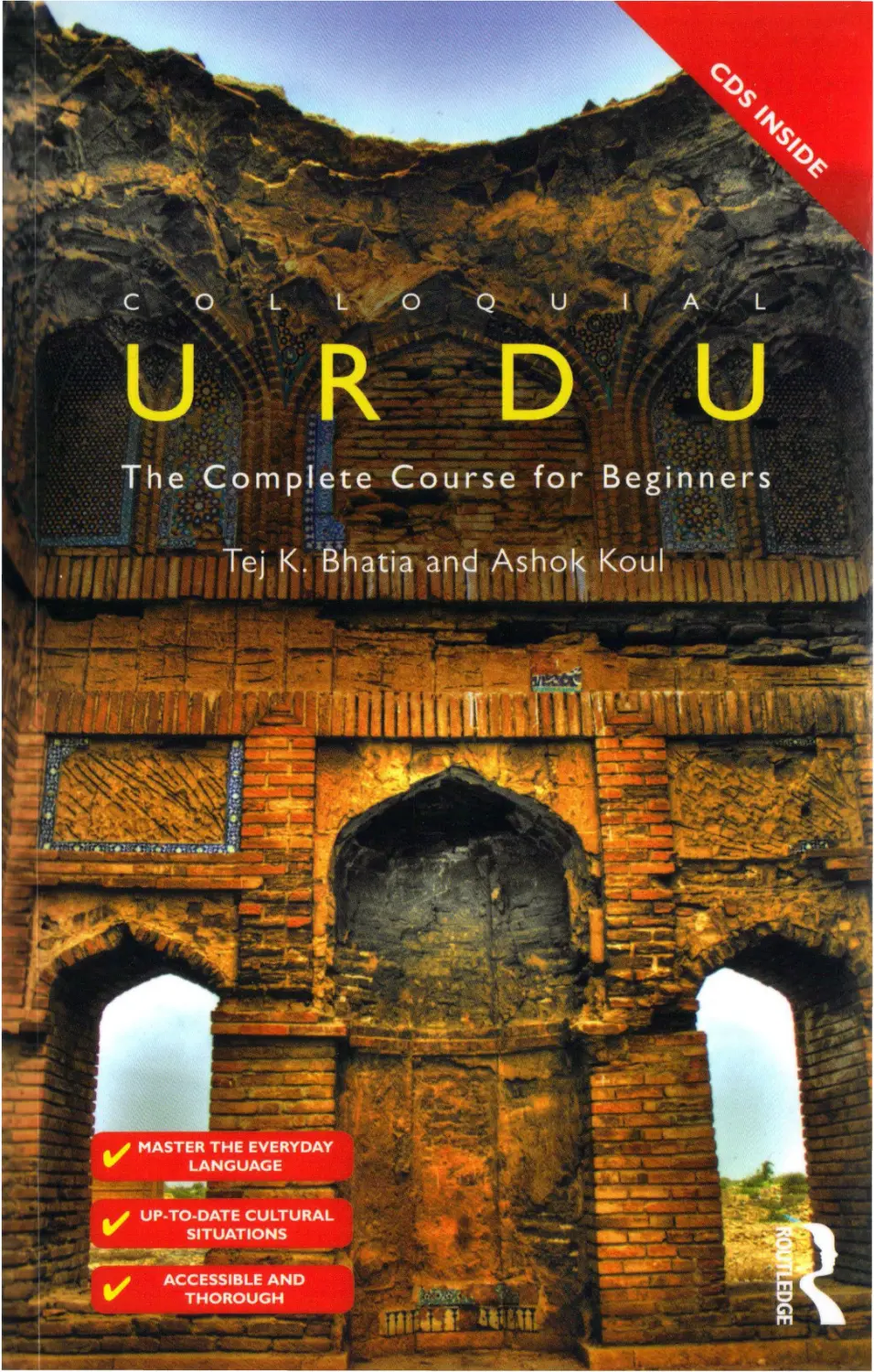
Colloquial
Colloquial Urdu provides a step-by-step course in Urdu as it is written
and spoken today. Combining a user-friendly approach with a thorough
treatment of the language, it equips learners with the essential skills
needed to communicate confidently and effectively in Urdu in a broad
range of situations. No prior knowledge of the language is required.
Key features include:
•
•
•
•
progressive coverage of speaking, listening, reading and writing skills
structured, jargon-free explanations of grammar
an extensive range of focused and stimulating exercises
realistic and entertaining dialogues covering a broad variety of
•
scenarios
• useful vocabulary lists throughout the text
• additional resources available at the back of the book, including
a full answer key, a grammar summary, bilingual glossaries and
English translations of dialogues.
This second edition has been extensively updated and revised throughout,
with particular attention to the Urdu script - coverage is now integrated
throughout the book and the script font has been enlarged and improved.
Balanced, comprehensive and rewarding, Colloquial Urdu will be
an indispensable resource both for independent learners and for students taking courses in Urdu.
Accompanying audio material is available to purchase separately
on two CDs or in MP3 format, or comes included in the great value
Colloquial Urdu pack. Recorded by native speakers, the audio material complements the book and will help enhance learners' listening
and speaking skills.
By the end of this course, you will be at Level 82 of the Common
European Framework for Languages and at the Intermediate-High
level on the ACTFL proficiency scales.
Tej K. Bhatia is a Professor of Linguistics and Director of South Asian
Languages at Syracuse University, USA.
Ashok Koul is Senior Lecturer in Language Studies at Brown University, USA.
our
•
-J
•
I
Second edition published 2013
by Routledge
2 Park Square, Milton Park, Abingdon, Oxen OX14 4RN
Simultaneously published in the USA and Canada
by Routledge
711 Third Avenue, New York, NY 10017
Routledge is an imprint of the Taylor & Francis Group, an informa business
© 2013 Tej K. Bhatia and Ashok Kaul
The right of Tej K. Bhatia and Ashok Koul to be identified as authors of this work has been
asserted by them in accordance with sections 77 and 78 of the Copyright, Designs and
Patents Act 1988.
All rights reserved. No part of this book may be reprinted or reproduced or utilised in any
form or by any electronic, mechanical, or other means, now known or hereafter invented,
including photocopying and recording, or in any information storage or retrieval system,
without permission in writing from the publishers.
Trademark notice: Product or corporate names may be trademarks or registered
trademarks, and are used only for identification and explanation without intent to infringe.
First edition published by Routledge 2000
British Library Cataloguing in Publication Data
A catalogue record for this book is available from the British Library
Library of Congress Cataloging in Publication Data
Bhatia, Tej K.
Colloquial Urdu : the complete course for beginners I Tej K Bhatia and Ashok Koul.
- 2nd ed.
p. cm. - (Colloquial series)
Includes bibliographical references and index.
1. Urdu language-Textbooks for foreign speakers-English. 2. Urdu language-Spoken
Urdu. 3. Urdu language-Self-instruction. 4. Urdu language-Sound recordings for
English speakers. I. Koul, Ashok. II. Title.
PK1975.B47 2013
491.4'3982421-dc21
2012032236
ISBN:
ISBN:
ISBN:
ISBN:
ISBN:
978-0-415-58695-5
978-0-415-58696-2
978-0-415-58698-6
978-0-415-58699-3
978-0-203-84726-8
(pbk)
(audio CDs)
(pack)
(MP3s)
(ebk)
Typeset in Avant Garde and Helvetica
by Graphicraft Limited, Hong Kong
MIX
Paper from
~~~
reaponalbla sources
FSC- C013056
Printed and bound in Great Britain by
TJ International Ltd, Padstow, Cornwall
x
Acknowledgements
Abbreviations
XI
Introduction
The Urdu writing system and pronunciation
1
6
Part I
•
Urdu script
25
27
Script unit 1
In this unit you will learn about:
• non-connector vowels
• non-connector consonants
31
Script unit 2
In this unit you will learn about:
• variants of connective consonants ( ~ jim- and
sin-group letters)
• combining ~ jim- and
sin-group letters with
non-connector vowels and consonants
V
V
• V• sin vs. V svad
• V zvad - another z sound
37
Script unit 3
In this unit you will learn about:
• connector consonants
lam,
mim,
&
and
gaf
• Arabic origin sounds
• gemination
J
"
fe and
tJ qaf
kaf,
•
Contents
VI
Script unit 4
42
In this unit you will learn about:
•
b.,,/
•
•
b . . "'
be-group consonants
se - one more s sound
• nasalization
T, ~ e, and
& vowels
• semi-vowel y
• f hamza (vowel cluster symbol)
•U
I
Script unit 5
50
In this unit you will learn about:
• variants of choTi he o
• aspirated consonants
• to'e .b vs. te
L . ." '
• zo'e J; - another z sound
~
• the sign ' tanvil}
• &n {; and G&n C,;
Part II
Units
59
61
Greetings and social etiquette
By the end of this unit you should be able to:
•
•
•
•
•
•
•
use simple greetings
understand expressions of social etiquette
use expressions for leave-taking
ask simple questions
make simple requests
form the plural
use personal pronouns (e.g. 'I', 'we', 'you') and
the verb 'to be'
• use some nouns and adjectives
I I
Contents
2
VJ~fLUV.:1
:_,_,L.#~
•
VII
80
Where are you from?
By the end of this unit you should be able to:
• introduce yourself and others
• say and ask what you and others do
• say and ask where you and others live
• talk about you and your family
• · ask someone's address
• make tag questions
• use· very frequent adjectives
• form the present and past habitual tense
3
~4~lf,(
.:l:d.
#L
., .. e:
I••
100
What would you like?
By the end of this unit you should be able to:
• tell someone what you wish to have
• describe locations
• use some negotiation skills
• make reservations
• refer to possessions (transferable)
• understand verb agreement with subjects and objects
• express physical states (fever, headache)
• use the present progressive tense
•
r..
",
I""
..
4 ~'-'1'vJP'-L
.. ..
.,. . f :.JIP•
., ....-L
120
What are your hobbies?
By the end of this unit you should be able to:
• talk about hobbies and interests
• talk about likes and dislikes
• use some more expressions concerning health and ailments
• use expressions with 'generally'
• form derived adjectives
• note asymmetry between English and Urdu expressions
• express physical states (cold, hungry)
I I I
Contents
VIII
5
~Lv.:fVv! U~L ..• #1 :~hL:J~
•
143
What are you going to do during the holidays?
By the end of this unit you should be able to:
• talk about your own and others' plans
• compare people and objects
• use paraphrasing skills
• express desires
• use the future tense
• express ability/capability
• use the reflexive pronoun apna
6
~V,VJL\ .•. 1:AfL
...
~
•
165
What did you do yesterday?
By the end of this unit you should be able to:
• talk about past events/actions
• use time adverbials with full clauses
• talk about topics dealing with 'lost and found'
• express sequential actions
• employ some more commonly used expressions
7
~~~Ji
...#~L • L•
..
• jJ.11 v#1 l/:
..
..
L
188
Can you speak Urdu?
By the end of this unit you should be able to:
• talk about your skills
• give advice
• express obligation
• observe compound verbs
• use emphatic and persuasive forms
~
"
a v.rL1,fJ,k.-.4£.i:.Ji'..d~
I need to get cheques cashed
By the end of this unit you should be able to:
• use causative verbs
• use the present participial forms
• use more advanced compound verbs, subjunctives
and obligatives
• understand auxiliary verb deletion with negation
• use conditionals
• highlight contrast
212
I
Contents
9
IX
~~~lfv!~~-'~
:A
~L
' ..
..
235
What's written in the fortune cookie?
By the end of this unit you should be able to:
• use past participles
• know how to say 'no' in socially sensitive situations
• use the participial forms as adverbials
• use the construction 'neither ... nor'
• understand hidden assumptions
• form purpose clauses
• speak about Indian/Pakistani and Chinese food
(particularly curries)
• use the passive construction
• understand more about reduplication
• use idiomatic expressions
I
10
..
.1fJ(
:'~r')L
..;L
257
Festivals
By the end of this unit you should be able to:
• use various types of relative clause
• form complex sentences
• understand more about Urdu passives
• speak about Muslim festivals
• understand some of the culture of the Indian
subcontinent
• identify Perso-Arabic components in Urdu
• distinguish between the formal and non-formal style
Reference grammar
Key to exercises
Translations of dialogues and readings
Urdu-English glossary
English-Urdu glossary
Index
275
304
326
334
359
381
emens
We are especially indebted to Gary King, editor of the Colloquial series,
for agreeing to consider and produce this new and revised version
of this book and to Ms Isabelle Cheng for her commendable patience
and encouragement. We are equally indebted to three anonymous
reviewers and to Professor Afroz Taj for their constructive and insightful input.
Tej Bhatia: I owe special gratitude to my wife, Shobha, for her
encouragement and support and to Krish, Kevin, Kanika, and Ankit,
who inspired me to write this book. No words can express my deepest
appreciation to my brothers in India for their constant support during
my entire career.
Ashok Koul: I would like to thank my colleagues at the Center for
Language Studies, Brown University, for their encouragement and my
students for providing useful feedback for designing the script units.
I would like to express my deep gratitude to my wife, Malini, and my
son, Rahi, for constant support and encouragement.
Our heartfelt thanks are also due to Professor Omkar N. Koul for
his technical assistance in the preparation of the manuscript and his
perceptive comments. Thanks also to Mr Rinko Koul for his patient
care with the Urdu typesetting for the book.
•
•
rev1a ions
adj.
adv.
ag.
aux.
emp.
excl.
f.
fam.
hon.
•
1mper.
inf.
interj.
intr.
lit.
m.
n.
obj.
obl.
part.
pl.
pp.
ppl.
pres.
rel.
sg.
tr.
v.
adjective
adverb
agent
auxiliary
emphatic
exclamation
feminine
familiar
honorific
imperative
infinitive
interjection
intransitive
literally
masculine
noun
object
oblique
particle
plural
postposition
participle
present
relative
singular
transitive
verb
About the language
Urdu is a modern lndo-Aryan language spoken in South Asian countries
(India and Pakistan) and also in other countries outside Asia (Mauritius,
Trinidad, Fiji, Surinam, Guyana, South Africa among others). Approximately eight hundred million people speak Urdu as either a first or a
second language. Hindi-Urdu is among the top five spoken languages
of the world. Urdu is the national language of Pakistan and is spoken
widely in cities such as Islamabad and Karachi. It is one of the 22
regional languages recognized ,by the constitution of India and is the
state language of Jammu and Kashmir. It is widely spoken in the Indian
states of Delhi, Uttar Pradesh, Himachal Pradesh, Madhya Pradesh,
Haryana, Rajasthan, and Bihar. Besides, there are millions of Urdu
speakers who live in Maharashtra, Andhra Pradesh and Karnataka.
Urdu is a Turkish loan word meaning 'army' or 'camp'. It was nursed
in the camps and capitals of the Muslim rulers in India. Since Delhi was
its first major centre of development, it is also called Zaban-e-Dehlvi 'The
Language of Delhi'. Another term for this language is Urdu-e-mu'alla
'The Exalted Camp'. Historically, it was synonymous with Hindui,
Hindawi, Rexta, and KhaRi Boli. The terms Hindi and Hindustani are
also employed to refer to this language. All these labels denote a mixed
speech spoken around the area of Delhi, North India, which gained currency during the twelfth and thirteenth centuries as a contact language
between native residents and the Arabs, Afghans, Persians and Turks.
Urdu is written in a modified form of the Arabic script. Like Arabic,
Persian and Hebrew it is written and read from right to left. It is written
in a cursive style. For more details see the chapter on Urdu writing
system and pronunciation.
The literary history of Urdu goes back to approximately the
thirteenth century. Its first poet was Amir Khusro (1253-1325), who
2
Introduction
termed the language 'Zaban-e-Dehlvi' or 'Hindi' (see Beg 1988). The
Deccan played an important role in the early stages of its development (see Haq n.d.; Shackle and Snell 1990). Later it found its impetus
in North India (Delhi and Lucknow) when British rulers declared it
as a court language and also as the medium of instruction in certain
parts of the country. Urdu is particularly well known for its romantic
literature. The two most famous genres of Urdu are the masnawi
and Gazal, which are the gift of the mixing of the two great cultures
- Hindu and Persian-Muslim. Some notable literary figures of Urdu
literature are lnshah Alla Khan, Malik Muhammad Jaysi, Kabir, Mir,
Mir Hasan, Daya Shankar Nasim, Bahadur Shah Zafar, Faiz Ahmad
Faiz, Sirdar Jafari, Sadat Hasan Manto, Premchand, Iqbal and Mirza
Galib. For more details see Dimock et al. (1978).
The two notable linguistic features of the language are as follows:
(1) Urdu still retains the original Inda-European (1500 sc) distinction
between aspirated and unaspirated consonants which results in a
four-way contrast as shown by the following examples: kal 'time',
khal 'skin', girna 'to fall' and ghirna, 'be surrounded'. (2) It has the
feature of retroflexion in its consonant inventory, cf. Tai 'to put off'
and tal 'pond'. The retroflex consonant is transcribed as T. For more
details see the section on Urdu writing system and pronunciation.
Urdu has an approximately three-century old, well-attested and
rich grammatical tradition of its own. It is a by-product of the colonial ·
era and was born shortly after the arrival of Europeans in India. For
a detailed treatment of this topic in general and the grammatical
tradition in particular, see Bhatia (1987).
Because of their common Inda-European origin, you will still find
some striking similarities between Urdu and English. For example, the
Urdu word for English 'name' is nam. The list goes on and on. The
important thing to know is that Urdu belongs to the Inda-European
language family and is similar to English in a number of ways. Learning
to observe these similarities will make the process of learning this
language full of pleasant surprises.
About this book
This book is designed as a complete first-year language course,
keeping in mind the proficiency guidelines of the American Council
Introduction
on the Teaching of Foreign Languages (ACTFL) and the European
Language Community. Every attempt is made to optimize this goal
by integrating the linguistic content with the culture of South Asia in
general and India and Pakistan in particular.
The book is grounded in the current theories of language acquisition, learnability and language use. Unlike other books (even some
recent ones), it never loses sight of the social-psychological aspects
of language use. In this book, we have not attempted to act like a
protector or saviour of a language by engaging in linguistically prescriptivist and puritan tendencies. What you will find in this book is
the way the Urdu speakers use Urdu to communicate with each other
in meaningful ways. No attempt is made to translate artificially an
English word into Urdu if Urdu speakers treat the English word like
any other Urdu word. We noticed that in a wid~ly circulated course
on Urdu/Hindi in which the waiter asks his customers for their order,
the word 'order' is translated by the word meaning 'obey my order!'
How this book is organized
We have attempted to accommodate two types of learners: (1) those
who want to learn the language through the Urdu (Perso-Arabic) script;
and (2) those who wish to learn the language in a relatively short
period of time without the aid of the Urdu script. Such pragmatic
considerations are an important feature of this book.
The book begins with Urdu pronunciation and the Urdu script. The
main body of the book deals with ten conversational units which
consist of the following parts: (1) dialogues; (2) vocabulary with English
translation; (3) language points detailing pronunciation, grammar and
usage involved in the unit; and (4) exercises. The dialogues together
with the language points explicitly deal with those aspects of Indian
and Pakistani culture about which the authors have frequently been
asked. The vocabulary or the new words used in the dialogues are
given in English and Urdu script.
The reference grammar gives an overview of Urdu grammar with
complete paradigms. This section complements the language points
given in each unit. The Urdu-English glossary gives all the words used
in the dialogues, listed alphabetically in both Urdu and English. The
English-Urdu glossary classifies Urdu words into different semantic
3
4
Introduction
groups. Answers to the exercises can be found in the key and there
is a section containing translations of the readings and dialogues
used in Units 7-10.
How to use this book
This book offers two courses to follow: (1) for those learners who
want to adopt the English script path; and (2) for those who want to
learn the Urdu script. Although the learning of the Urdu script is highly
recommended, if you decide to choose the first track, you can bypass
the script units. For every learner, whether on the first or the second
track, the chapter on the Urdu writing system and pronunciation is a
must and familiarity with the salient phonetic features of Urdu together
with the notes on transcription is imperative. Examples dealing with
pronunciation are recorded. The exercises with the audio icon are
also recorded, so they require you to listen to the recording.
If you want to follow the Urdu script track, you will first have to
study the five script units given at the beginning of the book.
Naturally, the vocabulary will involve memorization. You may also
wish to consult the vocabulary sections while doing exercises. The
language points give you details of pronunciation, grammar and usage.
Where to go from here
Obviously, we do not pretend to offer you everything that needs to
be known about Urdu. Language learning can be a lifelong venture.
Your next step is to look for books or materials dealing with intermediate and advanced Urdu courses. There is no shortage of material
including web-based material at the levels in question. The only difficulty you might face is that this material will invariably be in the
Urdu script. If that poses a problem for you, there are still many ways
to continue to sharpen your linguistic skills, the most important of
which is Hindi/Urdu films and Inda-Pakistani Urdu plays. India is the
world's largest producer of films. Hindi/Urdu film videos are widely
accessible in the East and the West. A taste for Hindi/Urdu films
is also crucial for taking yourself to the advanced stages of Urdu
language learning.
5
Introduction
Readers will find the following web resources useful. Please remember, however, the links may not always be active and content is also
subject to change. At the writing of this book, these links were active.
http ://taj. chass. ncsu .ed u/u rd u/
http://urduathome.com
www.urduresources.org.uk
www.languageshome.com/English-Urdu.htm
www.urduword.com
Tej Bhatia, Syracuse, NY
Ashok Kaul, Providence, RI
References
Barker, Muhammad, Abd-al-Rahman, Hasan Jahangir Hamdani, Khwaja
Muhammad Shafi Dihlavi and Shafiqur Rahman. 1975. A Course in Urdu.
Vais 11-111. Ithaca, New York: Spoken Language Services.
Beg, M.K.A. 1988. Urdu Grammar: History and Structure. New Delhi: Bahri.
Bhatia, Tej K. 1987. A History of the Hindi Grammatica/ Tradition. Leiden: E.J.
Brill.
Dimock, Edward C., Edwin Gerow, C.M. Nairn, A.K. Ramanujan, Gordon
Roadarmel and J.A.B. van Buitenen. 1978. The Literatures of India: an
Introduction. Chicago: Chicago University Press.
Haq, Abul (Maulavi). n.d. Quaid-e-Urdu. New Delhi: Naz.
Nairn, C.M. 1965. Readings in Urdu: Prose and Poetry. Honolulu: East West
Press.
Narang, Gopi Chand. 1968. Readings in Literary Prose. Madison, WI: University
of Wisconsin, South Asia Center.
Taj, Afroz. Darvazah: A Comprehensive Multimedia Elementary Urdu Course
Online. University of North Carolina at Chapel Hill.
Shackle, Christopher and Rupert Snell. 1990. Hindi and Urdu since 1800:
a Common Reader. New Delhi: Heritage.
• •
e r u wr11n
•
•
ronunc1a ion
Introduction
This chapter briefly outlines the salient properties of Urdu (PersoArabic) script and Urdu pronunciation. Even if you are not learning
the script, this chapter is indispensable because you need to know
the pronunciation value of the Roman/English letters used in the
conversation units. Furthermore, one or two unfamiliar symbols are
drawn from the International Phonetic Alphabet (IPA). The transcription
scheme followed here is used widely in the teaching of Urdu and in
works on Urdu language and linguistics. We would strongly recommend
you learn the Urdu script; however, if it is not possible due to constraints of time, you still will need to refer to the vowel and consonant
charts until you have mastered the letters and their pronunciation.
Listen to and repeat the pronunciation of Urdu vowels and consonants
together with their minimal pairs, recorded on the CD accompanying
this book.
The Urdu script
Like Urdu, a number of languages are written in Perso-Arabic script.
Kashmiri, Punjabi and Sindhi are also written in a modified form of
this script. Urdu is written and read from right to left, unlike Roman
script; however, Urdu numerals are written from left to right. It is written in a cursive style, that is, most of the letters are joined together
in a word. There are two common styles of calligraphy: (1) nasx
and (2) nasta'liq. The first style is employed for the Quran and all
Arabic publications are printed in this style. The second style is most
commonly used in Urdu publications. Apart from some differences in
shapes, the two styles are quite similar.
The Urdu writing system and pronunciation
Many of the letters in Urdu script have differing forms depending,
broadly, on whether or not they are joined to another letter. The letters
which are joined to a following letter in the same word are referred to
as connectors, and those which are not connected to a following letter
and may be joined only to a preceding letter, are called non-connectors.
It is important to note that the shape of a letter may differ according to its position in the word and also depends upon the letter which
precedes or follows it. A connector may have four possible variants.
These shapes are:
1.
2.
3.
4.
Initial shape, which is connected to the following letter.
Medial shape, which is connected on both sides.
Final shape, which is connected to a preceding letter.
Independent (detached) shape, which is not connected to another
letter on either side.
These shapes will be detailed in the script units.
Below you will find the Urdu vowels and consonants charts.
Urdu vowels
There are ten vowels in Urdu. These vowels are indicated by four
letters:
al if
vav
choTi ye
baRi ye
,
j
tJ
(
These letters are further supplemented, where necessary, by the following vowel signs.
Short vowel signs
The following vowel signs are introduced:
called zabar
It is written above the letter alif to indicate the short vowel a. Above
a consonant it indicates a following a. (This sign is rarely used in Urdu.)
7
8
The Urdu writing system and pronunciation
called zer
It is written below the letter alif to indicate the short vowel i. Below
a consonant it indicates a following i.
called pesh
It is written above the letter alif to indicate the short vowel u. Above
a consonant it indicates a following u.
Long vowel signs
called madd
This sign is only written above the letter alif in the initial position and
gives the sound of the long vowel a.
'
called ulTa pesh
This sign is written over the letter vao to indicate a long
u.
Vowel chart
Base forms:
Vowels:
alif
a
I
vav
-a .1
-I
-u
u
e
baRi ye ..._<_
&
o
au
Positional variants
vowel
a
•
I
u
e
0
initial
,,
medial
final
,
,I
,,..
,,
.I
.>
.>
,
,_,t
..
Jf
..
vowel
initial
medial
final
-a
~
,
I
,
-I
-u
,-'
J
au
..
~'
I
,-'
..
J
' ,,
J
jl
J
~
~
,
..
,,
,,
JI
..
....
J
'
L
....
J
Notes on Urdu vowels
alif is always written when a word starts with a vowel, combined with
some vowel signs or letters to indicate various vowels. Urdu vowels
9
The Urdu writing system and pronunciation
do not distinguish between the capital and non-capital form. However,
it is important to note that the two vowel letters
U
choTiye
baRiye
and
are connectors and may vary in appearance in a word. For more
details see the script units.
Nasalization
In the production of a nasal vowel, the vowel is pronounced through
the mouth and the nose at the same time. To indicate nasalization at
initial and/or medial position, the symbol " called ulTa jazam may be
written above the variants of the letter: nun tJ.
However, in final position niin-i-gunah U (the letter nun without a
dot) is used to indicate nasalization. Usually long vowels are nasalized
in Urdu. In our transcription, the symbol tilde - is used to indicate
vowel nasalization, as in
kaha
uV
Diphthongs
and au are pronounced as a + i and a + u in the Eastern variety of
Urdu, but are pronounced as single vowels in the Standard Urdu
speaking area (e.g. pEsa 'money', kauva 'crow').
&
Urdu consonants
Consonant chart
voiceless
unaspirated
k-group
J
k
c-group
voiceless
aspirated
kh
voiced
unaspirated
voiced
aspirated
nasal
J
r
tJ
g
gh
I]
•
·h
~
c
J
J
10
The Urdu writing system and pronunciation
voiceless
unaspirated
T-group
j,
L
voiceless
aspirated
voiced
unaspirated
~
J
D
t-group
J
n
d
t
q-group
nasal
.b
T
p-group
voiced
aspirated
b
b . . ,.,
•
•
p
b
(
rt'
m
..tJ
q
Others
y
r
:.
J
J
I
w/v
•
L:.,.,1v It..!
LI
[.;lo
J;ILf ljlJ
s
sh
h
z
._,
•
•
•
f
i
G
[.;
x
..•
)
.....
z
J,
)
R
'En (see Script unit 5)
Notes on Urdu consonants
The first six groups of consonants are called stops because they are
pronounced by stopping the air which is going out of the mouth. The
fifth column on the chart is called nasal because the air is released
through the nose during the stopping phase in the mouth.
Place of articulation
All consonants arranged within each of the five groups share the same
place of articulation, as described below:
The Urdu writing system and pronunciation
k-group
These consonants are also called 'velar' because the back of the
tongue touches the rear of the soft palate, called the velum. They are
similar to the English 'k' and 'g'.
J
J
k
g
c-group
The body of the tongue touches the hard palate in the articulation of
these sounds. eh is similar to the first sound of English 'eh' in 'church'.
j is like English 'j', while jh has a noticeable aspirate .
c
•
J
T-group (the 'capital T group')
.b
J
T
D
These consonants represent the distinctive features of the languages
of the Indian subcontinent. They are also called 'retroflex' consonants.
These sounds do not occur in standard English, but are a noteworthy
feature of English spoken by people from the subcontinent. In the
articulation of these sounds, the tip of the tongue is curled back
and the underside of the tongue touches the hard palate. The following diagram can be of further assistance in the production of these
sounds.
A
Also note that R and Rh are pronounced with the same point of
articulation.
11
12
The Urdu writing system and pronunciation
t-group
The tip of the tongue touches the back of the teeth, and not the gum
ridge behind the teeth as is the case in the pronunciation of the
English 't' or 'd'.
. . . vr'
)
t
d
n
Study the following diagrams carefully in order to distinguish the Urdu
t-group of sounds from the English 't'-group of sounds.
/\
A.
English
Urdu
p-group
These sounds are similar to the English 'p', 'b' and 'm' sounds.
They are pronounced by means of the closure or near closure of the
lips.
b
..•
-rl
p
b
•
-I
b
(
m
q-group
This sound is called the uvular stop and is pronounced further back
in the throat than velar k. In pronouncing this sound, the back of the
tongue is raised to make firm contact with the uvula. This sound has
been borrowed from Arabic .
..
tJ
q
Manner of articulation
All columns in the six groups involve the same manner of articulation.
The Urdu writing system and pronunciation
Voiceless unaspirated
J
~
k
c
L
.b .J
.... .J
T,
L
..
..
,J
•
p
t
tJ
q
These sounds are like the English 'k' (as in 'skin' but not as in 'kin')
and 'p' (as in 'spin' but not as in 'pin'). In 'kin' and 'pin', the English
sounds 'k' and 'p' are slightly aspirated, i.e. they are followed by a
slight 'puff of air'. In order to pronounce the corresponding Urdu k
and p, you need to reduce the stream of breath.
Voiceless aspirated
_p£
•
The superscript h means that these sounds are pronounced with
the strong 'puff of air'. All you have to do is to slightly increase the
air stream in the pronunciation of the English 'k' and 'p' sounds.
Voiced unaspirated
J
g
b
•
J
J
J
L
D
d
b
,I
•
In the production of these sounds the vocal cords vibrate. You should
not encounter any difficulty in the production of these sounds as they
are like the English 'g', 'j', 'd' and 'b'.
Voiced aspirated (or breathy voiced)
If you pronounce the voiced unaspirated consonants with a 'puff
of air', you will produce voiced aspirated sounds. The superscript h
indicates the presence of the 'puff of air'. If you have difficulties with
these sounds, try pronouncing the voiced unaspirated consonants
with an h (as in 'dog-house'). If you pronounce the words fast enough,
you will obtain the voiced aspirate gh at the end of the first boundary
between the two words.
~
·h
J
13
14
The Urdu writing system and pronunciation
Nasals
These sounds are called nasals because the air is released through
the nose during the stopping phase in the mouth. In Urdu script, there
are two nasal consonants: (;,I and (. While ( simply represents ~m', d
stands not only for n but also for I].
(
n
m
These sounds are similar to the English nasal consonants 'n' and 'm'.
I] is similar to the nasal consonant in the English word 'king'.
Other consonqnts (miscellaneous)
The following consonants listed under the group 'others' are very
similar to the English sounds, so they do not call for detailed phonetic
description. The English transcription is sufficient to give you information about their pronunciation.
y
r
:.
J
j
LI
I
w/v
sh
s
h
The following two consonants are retroflex and so pronounced with
a curled tongue, as explained earlier. However, the underside of the
tongue is flapped quickly forward, thus touching the hard palate
slightly, instead of making the stop articulation with the hard palate.
11J j Rh is the aspirated· counterpart of j R.
Borrowed Perso-Arabic fricatives
The following five consonants are from Persian and Arabic. They exist
in a number of words borrowed from these languages.
•
•
j
..J
j,;
i
i
z
f
z
x
G
•
•
z
The consonants [;, i, ), ..J are used quite frequently in Urdu. j is
a voiced palato-alveolar fricative. This sound is very rare in Urdu, and
is found only in Persian loan words. It is similar to 's' in 'measure' .
•
._J and ) are similar to the English sounds 'f' and 'z'. The last two
consonants are not found in English and call for detailed phonetic
description. x is the final sound of the Scottish English 'loch' or the
The Urdu writing system and pronunciation
15
composer Bach and G is the same sound but voiced. In pronouncing
these sounds the back of the tongue is raised towards the soft palate
and the air escapes with friction.
[; This consonant has various pronunciatons in Urdu. See Script
unit 5 for details.
Certain letters represent the same sound
As you must have noticed in the chart of Urdu consonants, some
letters represent the same sound in Urdu, although in their original
languages they have different sounds. These letters are:
~
b . .,,,
....• _,
)
v•
•
tJ
J;
J
i
•
v
represent t
all represent s
all represent z
represent h
It should be noted that English alveolar sounds 't' and 'd' are perceived
and written as T and D, respectively. So the t and d in the proper name
'Todd' will be written with the letters J, T and 1 D, respectively.
L
,J
Pronunciation practice
Vowels
Oral vowels (CD1; 2)
vowels
pronunciation cues
(English near-equivalent)
"I
a
about
,.,,
-a
father
sit
seat
book
boot, loot
late, date (without
a glide)
bet
boat (without a glide)
bought
•
I
I
"
-I
()1
.J
I
jf
~,
,,
~
JI.,,.
JI
,
u
-u
e
&
0
au
Urdu words
kal
J~
~J
kal
t.:f..~J
din
din
fu
kul
kul
he
'
,,
yesterday/
tomorrow
time
day
religion
total
shore
hey
•
fu
h&
IS
jJf.,,.
or
aur
side, towards
and
'
)JI
16
The Urdu writing system and pronunciation
. ·· ~. Nasalized vowels (CD1; 3)
;
'
vowels (long)
U'
-a-
Uil
-I
~
UL
-u-
l,)jl
v!
&
0-
'-'"'
L)JI
"'
-au
"'
l,)JI
"'
u.tt
e-
~,
..,,,
l
Urdu words
ma
mother
kahi
somewhere
hu
am
me-
•
1n
-
~
m&
I
~1
god
gum
J"'~
cauk
be startled
·· . Minimal pair practice: words with oral and
M: nasalized vowels (CD1; 4)
oral vowels
a
-I
-u
fff
.. ~y
•
L
nasalized vowels
kaha said (m. sg.)
-a-
kaha
where
kahi
--I
kahi
somewhere
-u- .a(t
puch
a tail
e-
said (f. sg.)
v
puch
•
ask
'
le
take
c
h&
•
IS
0
_,/
god
the lap
au
J~
e
&
,,
'
J
- vr..
&
10
take (optative}
h&
are
- ~1
god
gum
-au
cauk be startled
0
•
cauk a crossing
Jx
?
17
The Urdu writing system and pronunciation
Consonants
Listen to the recording and repeat the words. Remember, the contrasts
shown below are critical in Urdu. Try to make the distinctions because,
as these examples show, sometimes they represent the only difference between two unrelated words. If you want to request food, t~
khana, failure to produce aspiration will result in t ( kana and you will
end up asking for a one-eyed person. Similarly, if you do not distinguish the T-group of consonants from the t-group, rather than asking
J,
JJ..1
roTi 'bread', you will end up reporting that a girl is crying (i.e .
..
JJ.1 roti).
for
Minimal pair practice: words with unvoiced unaspirated
stops and unvoiced aspirated stops (CD1; 5)
unvoiced aspirated
unvoiced unaspirated
J
k
~
c t~ cuna lime
• J, ,J
t'
L ..
L
..•
rt'
kali
T l.J,¥~ TaT
bud
J,
(;,) ~ tan
tune
p
J;
moment
khali
eh t~
chuna to touch
J,
Lj,dlP1
.lb Th
_p{ th
(;,)~
..a( ph
sackcloth
t
pal
..•
.of
kh
..
•
oil cake
ThaT
splendour
than
roll of cloth
phal
fruit
~
Minimal pair practice: words with voiced unaspirated
stops and voiced aspirated stops (CD1; 6)
voiced unaspirated
voiced aspirated
J
r
gh
Di;
·h
J
JL?
jhal
soldering of
metals
/PJ
Dh
J1;
Dhal
shield
a piece
/PJ
dh .)~)
dhar
hair
.o{.
bh
JlP!
bhal
sharpness
of wood
point of an
arrow
[:;
J,
J
g
t.f
J
J~•
D
J1;
•
d ..1IJ
J
L
•
,,J
b
JL•
girna to fall
jal
Dai
dar
bal
net
a branch
•
J,
ghirna be surrounded
·. · I
18
.
"
The Urdu writing system and pronunciation
Minimal pair practice: words with unvoiced aspirated
stops and voiced aspirated stops (CD1; 7)
·,, .,
·... I
unvoiced aspirated
t~
kh
voiced aspirated
r
khan a food
gh
t~
ghana
Ghana, the name of a country
~
j,
_pf
..
_pf
~•
',·
~
eh
Ji'
Chai
Pi; J
cheat
~
Thak
tapping sound
/);))
th
d~
than
roll of cloth
J);J)
ph
J~
phu1
flower
A
Th
~ jhal
Dh ~j Dhak
·h
.J,
fan
cover
dh d~J dhan
bh
bhu1
paddy
Jja
mistake
Minimal pair practice: words with T-group (retroflex)
M stops and t-group (dental) stops (CD1; 8)
T-group
Lb .I
;,
.JJ5'
.J,
)
.J,
/);))
t-group
Th
J~
~
D
J1;
Dh
~j Dhak
T
tapping sound
..
.JJ5'
t
th
J~
~
branch
)
d
J1)
dal
cover
J);J)
dh
~)
dhak palpitation
Tai
postpone
Thak
Dai
L . . ,,,
tal
pond
thak
be tired
lentil
, · - Minimal pair practice: words with q-group (uvular)
l i' and k-group (velar) stops (CD1; 9)
q-group
q
k-group
J~
qash a piece of fruit
J
k
J(
kash
may it happen
.
\ M Minimal
pair practice: fricatives vs. stops (CD1; 10)
fricatives
•
[; x (~
•
[;
•
i•
i•
x
G
G
•
,)
Gul
noise
Garib
poor
J~
fani
mortal
J
J
J..
v
..
d
fan
art
.of..•
. ; l?:.,,,
.
J
b
•
,,,
z
xam
raw
xitab
title
•
•
r .. /
I
•
-.J f
•
-.J f
stops
~
._t-•
)
zal)g
rust
+
#
•
~
k
((
k
L
g
q
.
...
kam
l;(
kitab
,,,
~
.,
,,,
L
, ;.'. )
•
flower
qarib
near
water
the hood
p
J~
ph
J'v
phan
•
J
~
book
gul
pan1
~
work
of a snake
•
Jal)g
war
19
The Urdu writing system and pronunciation
Minimal pair practice: words with r, R and Rh (CD1; 11)
consonants
Urdu words
/
r
.{
"'
~...
/
JP!t....
par
paR
pa Rh
on, at
lie down, fall
read, study
Nasal consonants (CD1; 12)
'
Listen to the following nasal consonants:
nasal consonants
Urdu words
(;)
I]
(:/
d
(
n
m
dt
•
(.)L
ga11ga
nan
maz1
Ganges
bread
past
Other consonants (CD1; 13)
. lti!
••
Listen to the following words:
consonants
Urdu words
y
.) L
yar
.)
r
Jl.J
raz
secret
J
I
Jv
1a1
red
j
w/v
.JJIJ
valid
father
shal
shawl
sal
year
hal
condition, state
:.
tJ
tJ
sa
oli
h
sh
..
/
J~
J~
J~
friend
Punctuation marks
'
'•
~
•
full stop
comma
semicolon
question mark
Other punctuation marks are the same as in English. See the script
units for special abbreviations and other symbols used in Urdu.
20
The Urdu writing system and pronunciation
Numerals
1
2
I
r
3
4
5
6
7
8
9
q
0
•
The dictionary order of the Urdu script is given below, working vertically down the columns. Each letter is given in its independent shape.
The name of the letter is given in the second column and in the third
column its sound. It is very important that you learn the names of
these letters, as the name of the letter will be used when its variants
are discussed.
letter
name
sound
I
alif
a
be
b
pe
p
te
t
Te
T
se
s
·J Im
•
J
ce
c
he
h
i
xe
x
J
dal
d
J
Dai
D
•
J
zal
z
re
r
Re
R
ze
z
L
.f
•
L
..
d
•
•
J,
•
.)
The Urdu writing system and pronunciation
name
sound
....
ze
....
z
Sin
s
tJ
shin
sh
v
v
svad
s
zvad
z
J,
toe
t
J;
zoe
z
letter
...
•
i
•
i
__,•
G&n
G
fe
f
tJ
qaf
q
J
J
J
kaf
k
gaf
g
lam
I
(
m1m
m
l:)
nun
n
vao
v/w, o, Li, au
choTi he
h
do cashmi he
(aspiration)
choTi ye
y, I
baRTye
e, &
..
' (see Script unit 5)
Listening exercises
If you do not have the CD, either skip this section or seek the assistance of a native speaker.
21
22
The Urdu writing system and pronunciation
Exercise 1 (CD1; 15)
Listen to the three words and circle the one that is different.
A
B
c
)
Example: you hear
Answer:
1. A
2. A
3. A
4. A
5. A
6. A
7. A
8. A
B
B
B
B
c
B
c
c
c
B
B
B
kar
kar
B
c
c
c
c
Exercise 2 (co1; 16)
Listen to the four words and circle the aspirated ones.
A
B
c
D
l
Example: you hear
Answer:
1.
2.
3.
4.
5.
6.
7.
8.
A
A
A
A
A
A
A
A
B
8
B
B
B
B
B
B
c
c
c
c
c
c
c
c
gar
D
D
D
D
D
D
D
D
Exercise 3 (co1; 11)
..
\
Listen to the pair of words dealing with the contrast between the T-group
.. · (retroflex) of consonants and the t-group (dental) of consonants.
23
The Urdu writing system and pronunciation
B
A
J
.I'
~
Tik
.I'
tik
After each pair below is pronounced, you will hear either 'A' or 'B' again.
Underline the word that you hear the third time.
Example: you hear
A
1. tak
2. thak
3. dag
4. dhak
Tik
Ji;
JJ
Ji)
7. kari
8. thik
.I'
~J
-4
J~
Tak
Thak
J)
Dag
Jij
Dhak
~j
.I'
~v
paR
/
tJ)
saR
y
kaRhi
f..l
Thik
OJ
..
.I'
6. sar
.I'
B
.I'
5. par
J, so underline Tik J .
.I'
j,
I
I
Exercise 4 (CD1; 1a)
Listen to the pair of words which contrast in terms of their vowel.
A
din
(;JJ
B
din '.:f;J
After each pair below is pronounced, you will hear either 'A' or 'B'.
Underline the word that you hear the third time.
din '.:f;J, so underline din cf;J_
Example: you hear
A
B
1. kam
((
kam
2. din
~J
din
cf;J
~
3. mil
J;
4. cuk
~v
cuk
J~
5. mel
6. ser
J:
mEI
J-
7. bic
8. bal
/.
~
J~
mil
.I'
SEr
bic
bal
/:'
~
' .I'
•
•
•
•
cr1
•
uni
• non-connector vowels
• non-connector consonants
The vowel signs zabar ( " ), zer ( ,, ) and pesh ( J ) are used to indicate
the short vowels a, i, and u, respectively. However, we should mention
here that these signs are not always written or printed and the vowel is
determined by the context. The use of these signs is limited to children's
books. However, we will make use of these signs in the script units
and also in the text to make learning of the Perso-Arabic script and
the Urdu language faster and more convenient for beginners. It should
be noted that the Perso-Arabic script uses a modified version of the
Arabic alphabet and so consists of letters, not characters.
In the script units, an attempt has been made to use Urdu words
as much as possible. However, some archaic Perso-Arabic words are
also employed whenever deemed necessary to introduce the finer
points of the writing system.
This unit has two sections: Section 1 deals with non-connector
vowels and Section 2 deals with non-connector consonants.
Section 1: Non-connector vowels
The first letter of the alphabet alif
I
Alif I is a non-connector and its initial, medial and final shapes are
the same as its detached (independent) shape. If a word begins with
elif I, this indicates that the word begins with a vowel. The vowel
signs zabar, zer and pesh are employed to indicate a, i and u,
28
Part I: Urdu script
respectively only when alif
chart below:
Letter
I appears
in its initial form. Look at the
Sound
Name
Variants
Detached
(independent)
,
-a
al if
Final
Initial
,
l
I
Look at the following combinations of vowel signs with the letter alif
f:
/
I
=a
' = i
/
,;
, = u
The superscript madd ~ is used above alif I only at the initial position
to indicate the long vowel a.
,-I
l=a
After a consonant, alif I represents the a sound.
/
_,
Look at the following combinations with the vowels f a, I i, I u and
I a and try to read them aloud.
Remember that Urdu is written and read from right to left.
~
/
pronunciation
word
letters
/
a+ b
•
I
+S
=
ab
•
=IS
= un
a+ b = ab
u+ n
The letter vao
,; I
/
I
-
L
J'j
--
J' + !
di
--
L
•
,;
,-I
I,
c'
•
•
,., +
I --
d
+I
,-I
L
•
¥+1
~
vao j is a non-connector and has no separate positional shapes. In
its initial form and after the vowel a it represents only a v/w sound.
It may represent three vowels: o, u and au. But to distinguish the
vowel 0 from au, it may occur with the sign ulTa pesh ' or zabar ".
See the chart below:
29
Script unit 7
Letter
Name
Variants
Sound
Detached
Final
Initial
(independent)
vao
v/w
J
0
J
J
~
_,1
_;,
jl
u-
J
,,'
au
J
~
',,..
The combinations of vao J with other non-connector letters are given
In the next section.
Section 2: Non-connector consonants
The following letters do not have separate initial and medial variants.
Their final shape is different from the independent shape when they
are connected to a preceding consonant. We will call the first four
letters re-group letters and the last three dal-group letters. Refer to
the chart below:
Letter
Name
Variants
Sound
Detached
Final
Initial
/
.)
(independent)
)
re
r
.)
R
.b
.)
J,
)
•
)
Re
..•
ze
z
.)
....
ze
....
z
)
dal
d
J,
J
•
J
Dai
D
zal
z
•
.)
•
..
.b
/
•
/
.)
7
J
.b
J
•
J
J
J,
)t
•
,;
.b
.)
•
.)
•••
.)
J
.b
J
•
)
Part I: Urdu script
30
Pronunciation
The letters ze ) and zal j are both pronounced as z. ze J occurs in
most Urdu words representing the sound z, whereas zal j occurs only
in a few Arabic loan words.
Formation of words using non-connector letters
a+d+a
d+a+v+a
r+a+z
z+a+r+a
a+z+a+d
,) /., = , + J + r
,_,j =' +-' +J
ada
dava
raz
zara
azad
)l.J
=)+I + .J
~
~
I.))
='
+.l+)
.,-I
•
,-I
,
J.JI =J+f +.J+ I
Consonant cluster sign jazm
A
The sign A is written above and between two consonants to indicate
a consonant cluster, e.g.:
....
•
J
....
z+a+r+d
d+a+r+d
v+a+r+D
A •
zard
dard
varD
J .)J =
"'
J .))
=
j )IJ =
+ .) +
J +.) + J
+ .J + I + _,
~
/
J
Exercise l
Read aloud the following words.
(a) .J
'
/
,..
j, ,-I
I
(d) .J-' I
(c) J.J
..P
(e) JJ.J I
(i) ) l.J j
•
(f) .)j.)
(g)
(j) .) J,
•
(k) .)j.)
'
•
,-I
j.).) '
'....
(h) .) j)
(I) .JJ J
Exercise 2
Write the following words in Urdu script:
(a) zar
(e) daraz
(i} avara
(b) azar
(f) arvaRa
(j) arzo
(c) dada
(g) doRo
(k) uRa
(d) urdO
(h} zaz
(I) ada
•
•
uni
cr1
• variants of connective consonants ( ~ jim- and
group letters)
V sin-
V
• combining ~ jim- and
sin-group letters with
non-connector vowels and consonants
• V• sin vs. V svad
• V zvad - another z sound
Section l : jim-group letters
All the letters in this section are connectors which look alike. They
differ in the number and position of accompanying diacritical marks.
We will call them ~ jim-group letters. These letters have similar initial
and medial variants. Learn how these letters are joined with other
letters. They take the full form in the final position. Let us look at the
chart given below:
Letter
Name
Variants
Sound
Detached
Final
Medial
Initial
i
~
7.
~
-<.•
7
~
---»
(independent)
~
~
v•
v
·Jim
J
c1m
.c
he
h(H)
xe
x
•
~
~
v•
v
~
~
..•
,,
-
Part I: Urdu script
32
Script and transcription
Connectors are linked to other letters by ligatures (i.e. the tails which
connect to the subsequent letter). The letters he i (he is also called
•
baRT he) and xe i are sounds of Perso-Arabic origin. There are two
letters for the h sound, he i and choTT he o. The use of he [; is
limited to some Perso-Arabic loan words and will be transcribed in
our script units as H.
Let us learn to combine these letters with the letters from Script
unit 1. Some of the words given below are meaningless. These words
are used for the purpose of practising writing and pronunciation.
Initial variants
One-syllable words:
·JS
~
•
=l+V
•
•
xa
(;
cau
£..•
car
=f +~
ea
JO
~ ='
~
+~
?. =-' +~
=J+~
Hu
y' = _; + v
.J~=.J+I+~
..
cor
.)_£• = .J + -' + ~
•
.
Medial variants
Two-syllable words:
raja
cauRa
~1.1 = f + ~ + f + .J
•
i.
f.J,,~ = f + .J + -' + ~
;, /
~
xacar
v
.
b
.
= .J + ~ + V
/
Final variants
•
•
J3J
-·
SJ
haj
caca
.J8C8-
33
Script unit 2
Notes
J
1 When dal-group letters (j J) are connected to a preceding letter,
their form changes and they look similar to re-group letters. However, they are distinguished by diacritic marks. Examples:
;
/
had
juda
_.;./; = J +
,
V
;
.
= t+ J +V
;
xuda
f..;g
vaHid
GfJ = J + 7
,P
~ = f+J +~
·+I+
J
~
/
•
• .b
2 When re-group letters (J ..I ..I../) are connected to a preceding letter
their form also changes to ( ./). Examples:
/
j,
/
/
!:?. = ..1 + ~
jaD
.
.
l;~ = I + V + ..I + ~
carxa
J
xar
:
=..I +V
/
/
Pronunciation
1 Note that in some Persian loan words, when the letter vav J follows
xe
•
i
it is not pronounced. Examples:
.
J j> = J + J + V
,,,P
~
xud
...
...
.
t.Jj> = t.J + J + V
~
......
xush
;
2 In a few words, vav J is not pronounced when followed by alif
I.
Examples:
darxast
~l},)J =
•
t.J + t + J + V + J + J
•
"'+ t + J + V
•
L . ."'
+
/
xab
L
•
~I}
=
L
Section 2: sin-group letters
The following four letters are connectors. We will call them the
sin group of letters.
'
tJ'
34
Part I: Urdu script
Letter
Name
Sound
Variants
Detached
(independent)
Sin
tJ:.
'91
shin
sh
v.
v
svad
s
zvad
tJ..•
tJ
s
Medial
,,
if
-:._,
•
111
Initial
d
0 I
'?
-' A
~
_,,.
~
v
v.
v
z
Final
~
~
,;-'
•
~
•
~
Pronunciation and transcription
u
V
u
Note that both sin
and svad
have an s sound. sin
is more
frequent in Urdu, whereas svad V and Perso-Arabic letter se L:. .1
(given in Script unit 4) which also represents another sibilant sound
s, are restricted in their use in Urdu. The letters svad V and se L:.#
occur only in some Perso-Arabic loan words. In our transcription,
s will represent the letter sin
S will be used for svad
and S
•
will be used to transcribe se L:. ". z will represent the letter zva~ './.
Have you noticed that the first two letters sin tJ and shin tJ have
two variants each at the initial and the medial position? The first
variant has three hooks called shoshah and is more frequent in Urdu.
The second variant is rather restricted in use and may be used when
the preceding letter is choti ye tJ or baRi ye < .
Let us learn to combine the four sin '91 group letters with the nonconnector letters discussed in Script unit 1.
u,
V,
..
Initial variants
One-syllable words:
sa
V =l+'-1
•
za
~=t+V
35
Script unit 2
Medial variants
Two-syllable words:
/
,,,,
;!'!_
= J + V + [;
J ~.?> = .J + j + J7 + t,.,
Hasad V
HuzUr
/
=V
aHsas V~ f
/
+f+V +V+ t
Final variants
The following are some examples of these letters used in their final
position:
,,
••
shaxS
sas
·- -
J3SUS
.
suraJ
dozax
•
•
=V +V+J
V~ =V +l+V
V}-"'• = V + .; + V + ' + [:;
7... . . . ,
'+,;,1.lY =
.
7...
,.-
'
V' +..I+-'+ V
I
.
= v +; +-' +)
r'
,,...
.....
[;JJJ
Exercise l
Read the following Urdu words aloud.
(a) ..JJ ~
~
.b /
(f)
l..1 ~
(b)
(c)
y
:.
(g)tJ}J
/
(k)
(p)
»'-'
•/
JJ~
•
(I)
(q) y
(v)
..•
tJ]..1J
{d)
'
(h) JY
(i)
(m) [:;J~
•
/
/
(u) J~
•
17
,;;1
(r)
(w)
l..1 L.--
.
[:;Jj
•
•
(j)
1(.;?
tJ?.
(o)
~'..I
•
:.
(n)
YL--
..1£.•
,P
/'
(s) ' ,A,,tlJ
,,...
1{.; JJJ
(e)
/
(x) /
(t)
tJ'
/
(y) ,)'J/
36
Part I: Urdu script
Exercise 2
Write the following words in Urdu script:
(a) joRo
(f) carxa
(k) Hashr
(p) sard
{b}
(g)
(I)
(q)
~Exercise
3
juda
jis
us
Hazir
{c)
{h)
(m)
(r)
xarij
shad
sazish
das
(d)
(i)
(n)
(s)
joDa
care
Harj
rOs
(e)
(j)
(o)
(t)
rivaj
zarOr
xaS
sara
Identify the letters used in the words given below and write them using
the following model:
/:.
/
tJV =
=Jg/
Example:
~/
J
/
(a)
.b
(c)
= j.f:
(e)
= J ~~,
/
/
(b)
= Jl.?1
(d)
=
{f)
=J~
~
!/J)
•
Exercise 4
Form the words of the letters given below:
(a)
(c)
(e)
=)VJ'
•
=V')V
=)Vl
(b)
(d)
(f)
. ,.
=VVJ
=IJt./
=)VJ'
•
•
cr1
•
uni
connector consonants
lam,
• Arabic origin sounds___; fe and
• gemination
Letters IClm
m1m,
kaf, and
..
gat
tJ qaf
and mim
The chart given below provides the variants of the consonant letters
lam and ( mim.
J
Letter
Name
Sound
Variants
Final
Detached
(independent)
lam
I
m1m
m
Initial variants: lam
lo
1a1
mal
=-'
1) ---
+
,_
and
m1m
-
lam
+I+
+(
Medial
•
mauJ
-
(+I+
Initial
38
Part I: Urdu script
~
Medial variants: lam
J
4'
/
/
camar
and mim
l7~
= J
+f+
+~
malmal
shimal
Final variants: lam J and mim
/
/
•
+~
--
1am
sil
/ =
+V
/
/
+~
--
cal
daldal
,.,!
-am
--
+I
+, + J
dal
..
Letters fe -.J and qOf U
Both letters have similar initial and medial variants but differ in their
final shape.
Letter
•
,....,,,,
..
(.)
Name
fe
qaf
Variants
Sound
f
q
Detached
(independent)
Final
Medial
•
,....,,,,
•
~
.J2,
(.)
'-'
..
-
..
••
>V
Let us learn to form words using the letters __; fe and
initial, medial and final positions.
Initial
..
tJ qaf in
the
39
Script unit 3
Initial variants: fe _; and qaf ~
/
•
+~
•
qash
,,11) =
.. .
iJ) =
:.
Vl; =
, 1 +I+ , 1
..
iJ + , 1 + ~
:.
..
V + I + iJ
vafa
~j
I+ ~ + j
farar
/
faraq
=
Medial variants: fe .a. and qaf
7t
safar
sifar
Final variants: fe ~ and qof Ci
xaliq
.
/
alif
firaq
varaq
-...:aJ I
= --'
.....
/
+ ..... + I
.. . ..
.
iJIJ = iJ +I+ + ~
..
..
iJ) j = iJ + ) + j
.
/
,.1
;
.;
uf
--' I
saf
~~=~+l+V
= --'
+I
Letters kOf __.. . and gOf __.. .
Letter
Name
Sound
Variants
Detached
(independent)
J
J
kaf
k
gaf
g
Final
Medial
Initial
40
Part I: Urdu script
Both these letters have two initial/medial variants. The first variant
(ff{') is used before al if I and lam letters. The other variant is used
elsewhere. Examples of initial, medial and final variants are given
below:
J
Initial variants
='+__...
kar
ga '(=I+__...
gol
ka
(
/
Medial variants
shikar
.J
...
~ = .J + I +
+
•
L/
•
,,..,
+ '--'
fikr
••
J•gar
Final variants
...
+V
/
shak
-/j
&
•
Jag
-ag
/
--
•
b~
'=
--
shakal
log
b
~
/
+~
~
+I
/.
+
+U'
b
-
+-'+
41
Script unit 3
Gemination
To indicate gemination in Urdu, the symbol "' called tashdid is placed
over the letter.
w
.b
j,/
.b
aRRa
, .J I = I + .i + .i +
rassa
~..I
=
/
sajjad
J
/
I
I + \./ + \./ + ..I
~
= J +I+ ~ + ~ + J
......
kacca
=
I+ ~ + ~ + /
Exercise 1
Write in Urdu.
(a) kamra
(g) fasad
(m) harf
(b) agar
(h) farsh
(n) afsar
(c) cako
(i) adrak
(o) cOk
(d) camca
(j) qad
(p) mulk
(e) salam
(k) mukka
(q) kaka
(f) afsos
(I) kam
(r) kamar
Exercise 2
Conjoin the following letters to form words:
..
= + / + ()
=
~+ /
=
(a)
+I+
(b)
J+I+
(c)
..
= .) + j + ()
.
..
= tJ +..I+()
=
+, + + u
•
=V +; +~
(d)
(e)
.....
(f)
(g)
(h)
(i)
•
•
uni
cr1
•
•
•
be-group consonants
L:., se - one more s sound
nasalization
i, < e, and
E vowels
semi-vowel y
i' hamza (vowel cluster symbol)
L •
"
• tJ
•
•
i
All the letters in this unit are connectors.
The following letters look alike; they differ mainly in the number and
position of dots. We will call these be-group letters. They have three
initial and two medial variants. Look at the chart given below:
Letter
Name
Variants
Sound
Detached
(independent)
L
,,,/
•
~
..•
J
b . . ,,,/
L
:.
cl
be
b
pe
p
te
t
Te
T
se
nun
S(S)
n
L
•
b
..•
I
,,,/
b .. ,
Final
b
•
L
#
.,
I'
~
Medial
.
""' .,
•
..,,., ......
,,.
•
_, a
,,
~
µ
Initial
"•
~
~
...,
J
• •
_J
~
.. - ..
"
_J
.-.,, .
• r'
~
,)
b ..
•
~
>•
.
.,
.,..
tllf
•
••
•
•
•
~ .J .,,
Script unit 4
43
Script and pronunciation
•
The letter se ., .. r1 gives the sound s in Urdu. It occurs in Arabic loan
words only.
Let us learn to combine these letters with alif f and vao J.
Above consonants + alif
Ta
~
= f+
.. ;,
na
t
= f+
l:J
~· =J+
' l:)
= f +., .. "
•
r='+b .. ,
ta
Consonants + vao J:
/j,
Tau ! =J+.,;,.1
nu
..l•
pa
,.I
f:
' ..
pu !'y =J+b
.
..
to
i
ba
l•
sa
t;. =
=I+.,
= J + +, ",;
•
I + ., :. "'
.i•
bo
t'
,,..,.
sau
r1
!
L
=J+ •
t'
.
=J+L ..
,,...
,I
Following are combinations of the above letters with non-connector
consonants .
•
re/ze .) I.J:
j,
h=.J++j,,;
Tir
,,...
•
n1z
baz
•
• l:)
:t=.J+ /
/
•
~
....
..
..
=.J+L
•
daal/Daal/zaal
•
,P
puz
taR
t'
TiR
~
y
.
=.J+L
/
;
..
t'
../
j,
,•. .
!I=.)+., .. ,,,
j,
j,
Z=.J+Lj,,I
....
bar
sur
,,,,( =.J+L,,...#'
,P
•
:.
p
. / =.)
+ L:.,I
nar
J,
JIJIJ:
Tid
puD
nad
bad
taz
saD
/
_.A..
•
j,~
,,...
=)+b,;
•
j,
-;
..& = ) +., .. ,;
As mentioned earlier, the letters in the preceding chart have three
variants at the initial position and two at the medial position.
Initial and medial variants
"' This shape is used before all non-connector letters except vav J,
before the l."' be-grouR letters given above and before the following
letters: kaf
gaf
and lam
J,
J
J.
44
Part I: Urdu script
Examples:
Initial position:
but
L ..
=+ ..
f.
;
ti+b
ti
•
bal
/
par
+
bakra
,,,,.
b
,,/
•
Medial position:
xabar
sabab
/
/f"
+ b ,,,,. ,,/ + v
•
•
/
I
+ -..~ = +
•
pi
sitara
cappal
V
group con•
.
sona~ts and the following letters: toi .b, zoi J;, En C;. G&n C;. fe -3,
qaf V, choTi ye J, and baRi ye <' . However, at the medial position
J This initial variant is used before the letter
vav
j,
sin
this variant is not used and the first initial variant J is used instead .
•
Examples:
Initial position:
I.
"'Ii =
savab
L
Top
., ,,/ i
..
•
~
L
•
,,/
= , ,,
~
/
+ I + j + ~"'
L
+ -' +
L . . "'
V + ..••
+ V + L:,.,
bas
=
bashar
=.)
L ,,,,. , ,
"' This variant is used before jim ~' mim (, do chashmi he lb.
Examples:
/
•
,,,,.
nam
=
+ l:)
;
buxar .) lr-
...
= .) + ' + ~ +
.
A/
taxt
~
A•
xatm
.
= ...,., +
L ",,
•
~ + L;;"'
/
•
=(+b ..,,+~
45
Script unit 4
Nasalization
U
nun-i-Gunnah
(nun ~ without a dot) indicates nasalization
at the end of a word. To indicate nasalization initially and medially,
the variant of nun
is written with the symbol"' called ulTa jazm.
U
Examples:
kaTa
~((v = t +
L
J,,
+ U + 1 + .....,
•
l• = V + U + I +
bas
ma
asa
pac
b
•
.,
UL.., = U +I+
y·r
=j+V
+U+I
..,
•
Connector vowels
choTi ye
0 and
baRi ye'--
In this section two letters choTi ye Uand baRi ye ' - are introduced,
which represent three vowels i, e, £ and a semi-vowel y.
Both these letters are connectors and, like the L. _, be-group letters,
they have the same initial and medial variants.
O
choTi ye
gives the i sound and may represent y in word initial and
medial positions. In final position it represents only i. When a word
begins with the vowel i, it is written with the letter alif I + the initial
variant of choTi ye lf.
When choTi ye
is used for i in the initial and medial positions,
the sign khaRa zer ;: is used.
o
Part I: Urdu script
46
baRi ye --<'baRi ye ~ represents the vowel e or &. When baRi ye ~ is used
for the & vowel, it takes zabar ,,. When a word begins with the vowel
e or &, they are written with alif I + initial variants of baRi ye < .
Letter
Name
Variants
Sound
Detached
Final
Medial
Initial
(independent)
u
u
choTi ye
y
choTi ye
-I
baRi ye
"
u
u
1..
(.)
L'.
~
I
•
I
J -'••
••
>
t.. ••
..,,,,,,
f
/
....
~
,
~
..6f
••
•--'•
••
....
,,,,,,
<'
baRi ye
..
>
••
(.)
(_,
<'
e
,
'
I
•--'•
••
,,,,.
-! •
/
..J..
Initial and medial variants
As mentioned before, choTi ye tJ and baRi ye ~ have identical
initial and medial variants similar to the be-group letters given at the
beginning of this unit.
chyo 1 ye • •'bRe 1 ye ••I
yar
=t+U
..1L..
yad JL.. =J+l+U
..
tin
~,
choTi ye
d
yom
jyo
~..
=t.:J+LJ +L..
baRi ye
tera
¥
+ <'
..
ek
, ..
~
,
=l+~+b ..
.I
jeb
d
= +J+U
UJff = U + J + LJ + r;;
esa
wr
..
devar ..I J..J
=
'+ v + ~,
= ..I + j + ~J
47
Script unit 4
choTi ye ~ baRi ye .."'
yax
Tjad
n1c
pee
J
~jf
= J + I + ~ + lf I
•
=
ff
~ + '-...... + ".."'
•
Final variants
Following are some examples of vowels i, e and
-ar1-
nadi
de
PI
<'
•
<'
roze
='-......+)
)
.)J.)
= '--
•
+ .) + J + .)
U).J) = U+ ; + ..1 + )
l).J J = U+ .J + J
darzi
Dari
E
at the final position:
UA
dadi
zare
<'
·JI
J.
=
U+ J + 0
=U+J+t+J
,,...
,,...
•
•
.)J=<'
+.J+J
=U+~
Vowel clusters and long i
Use of hamza f
In Urdu hamza , is written to indicate a vowel cluster and does not
represent any sound of its own. It is always placed on the second
vowel. Hamza , is written over the initial variant of L.,., be-group letters.
Note that hamza , is placed directly over vav ~ and baRi ye -<
without any variant.
Examples:
-al
/~
, =U +I
/~
ao
J
I
/
~
=J + I
; is called khaRa zer. This is written below the letter choTi
Indicate a long i in initial and medial position, e.g.:
TT
"
., J,~~
,
I
We should mention here that this symbol is very rarely written.
ye
to
48
Part I: Urdu script
Exercise 1
Read the following Urdu words aloud.
•
(d)
..
•
(i)
(j)
(m)
.J~
(n)
(u)
~
.,
(p) ~~
y
'-.1 I
..,
(q)
(h) L:. ,,/' I'
y
•
(I) ~ L
/
u~I
•
lf
,,
y
V1.1t
(t) ..11 i ..J
(s)
•
A
'
(x)~
l)iJJ
Exercise 2
Write the following words in Urdu script.
(a)
(f)
(k)
(p)
(u)
(b)
(g)
(I)
(q)
{v)
tir
On
bTn
roz
yOnani
ret
bO
pina
Tab
bap
(c) tin
(h) adab
(m) tali
(r) doR
{w) nas ·
(d) bati
(i) buniyad
(n) naz
{s) pota
(e)
(j)
(o)
(t)
apna
jesa
mera
TopT
. Exercise 3
Identify the letters used in the words given below and write them using
the following model.
Example:
(a)
(c)
(e)
L
"+
7.
·+I+
J
=.,
,~f
J
. ~
.
/
.
•"'
= .1L3- I
• /
=+ ~IJ
•
--
..
y'
(b)
= /.,/.
(d)
='-.1~
(f)
/
=
/ ,,,. JI
b ..
,_4).J
49
Script unit 4
Exercise 4
Conjoin the following letters to form words.
=J
+'+
~ +· J'
=I+~+~+~+
L.
I
{a)
(b)
=I+~+ L +
(c)
=~+~+J +~
{d)
J + I + -' + j
= v + L: ef + d
=
= ~ + I+
A
v
(e)
(f)
+ ~ + ) + L:ef (g)
•
A
=
=
'
'
J + J + I + V'
J +~+j +
b . . ,,
+ I+
b . ,.,
(h)
(il
•
•
uni
cr1
•
•
•
variants of choTT he o
aspirated consonants
to'e j, vs. te ., ..
•
•
•
zo'e
tl
J; -
1'
another z sound
.
the sign I tanvi~
&n [;and G&n [;
and do-cashmi he
The letter choTT he o introduced here is a connector. It has different
variants in initial, medial and final positions.
Letter
Name
Variants
Sound
Detached
(independent)
Medial
Initial
J
group
,...
h
do-cashmi he
Final
aspiration
Initial variants
t
This variant is used with alif
and lam
J.
I,
dal J and re
.J
group, kaf
51
Script unit 5
Examples:
hal
har
..J
L= ..J + I + o
'
~ This variant is used with all other letters.
Examples:
/
/
hava
Iyr = I + -' + o
ham
/
+o
Medial variants
nahar
pahaR
bah an
Final variants
,..m This variant is used when the preceding letter is a connector.
Examples:
jag ah
rishtah
.
:.
,:';! = o + •..-' + V + !
0 This variant is written in the final position when the preceding letter
Is a non-connector. Most of these words are pronounced with final a
In Urdu.
Examples:
pardah
bandah
isharah
Note choTi he o in the final position of some words gives the sound
of a as in na ~' and e as in ke f.
52
Part I: Urdu script
Aspiration: do-cash mi he °'
do-cashmi he lb is used with a letter to indicate aspiration in Urdu.
Non-connectors with do-cashmi he
Connectors with do-cashmi he
lb
Learn how the preceding letters are joined to it:
bh
th
.or. = lb +
L
•
~
jh
t'
.d' =lb+
kh
L . . f'
.b
Th
.d'
= lb
+
L
J,,.,
Examples:
/
andha
~~I
/
=
I + lb + J + ~ + I
) =~+lb+J
•
_.I's =
+ -' + lb + J
~J(.1 =l+lb+J+l+..1
,/'
.....,.tpf =l.S+f+lb+L
/
•
#
~
..•
+lb+L ,.,
+l.5 +lb+b"',.,
..
l
.. /. y
,P
=
b..
,.,+ lb+~~
=lb+~+
,P
+~
of. =lb+~
j; = °' + ___.,
eh
..
= lb
lb
53
Script unit 5
The letters to'e .b and zo'e
J;
Both the letters given below are connectors. They look alike and are
differentiated by a dot. Their forms never change in any position
except for a minor difference, i.e. medial/final forms have a preceding
ligature (...h- and J; ).
Letter
Sound
Name
Variants
Detached
(independent)
to'e
zo'e
Final
Medial
Initial
t(t)
b
z(z)
J;
Both these letters have no variants. In other words their forms never
change in any position.
Examples:
/
taqat
L ..
!j lb
=
L . . r!
..
+ a + I + .b .
/
vatan
j = ~ + .b + j
•
zalim
•
xatir
/~ = ) + k +I+ V
/
faqat
J,i;
xat
J;
//
nazar
lafaz
••
J;aJ
=)+);+~
/.
=J;+~+ /
Note that in Urdu to'e J, and zo'e J; give t and z sounds respectively,
and occur only in some Arabic loan words.
54
Part I: Urdu script
Letters &n
•
and G&n
•
i
i,
In this section you will learn about the letters &n
and G&n
which
are connectors. Also, note that there is a significant difference between
the final and the detached (independent) forms.
Letter
Name
Variants
Sound
Final
Detached
Medial
Initial
(independent)
en
•
Gen
'
•
i
G
The variants of these letters are different in initial, medial and final
positions.
Initial variants
am ('am)
Gam
;.
Gulam
~=
+I+ .... +
Medial variants
bad (b'ad)
~
=)+i+b
/
•
--
baGal
malum (m'aliim)
p&Gam
~=
~
..":
=
+
'
+-'+
•
+L
_j
......
_j
•
+
+
•
+l+i+~+b ttt
_j
55
Script unit 5
Final variants
/
l
•= l
mana (mana')
• =
+ (.;) + "'
/
jama (jama')
g
teG
= •
•
;ll
=
..,,, .
baliG
•
/
+~
+
+ < + ~ ...1
+ I+
+
L
.
rtl
Note En l is a glottal fricative in Arabic. However, in Urdu it is not
pronounced as such, and it can give the sound of any vowel. It
generally merges with the sound of a preceding or a following vowel.
In initial position it indicates long a, i, E and au when followed by
elif I, choTi ye
baRi ye < and vao J respectively.
J,
Examples:
....
=L .. "+J+f+
ad at
id
=J+U+~
v..
'
ESh
..•
=tJ +~+~
..
/
aurat
L ..
";~
/
=b ..
"+;+ J + l_;
Again, in initial position, followed by any other letter, it indicates the
short vowels a, i and u.
arab
.1raq
ilm
umr
When it occurs in medial position between vowels, it is pronounced
as a glottal stop by some educated Urdu speakers who have some
knowledge of Arabic. Such words are pronounced with a vowel cluster by most speakers.
maf (mu'af)
/
jamat (jam'at)
L ..
!Y L7. =
L .. "
+
l
/
+ I+
+~
56
Part I: Urdu script
.
In final position, after a consonant, it gives the sound of the long
vowel a, but loses the pronunciation when it occurs after a long vowel.
shuru (shuru')
..
..
+J+J+
--
mauqa (mauqa')
i,,. ;
7•.1 =
ruju (ruju')
'
7....
;
+-'+~+.)
tanvin i
~
The letter alif I with two zabar gives the sound an. tanvin is used to
make adverbs in Arabic, and some of these loan words are commonly
used in Urdu.
Examples:
fauran
~
=l+~+L:.,,/+
masIan
qanunan
~
. ..
tiG
~
""
'
..
=l+(;)+J+(;)+l+J
jabran
majburan
Exercise 1
Write in Urdu.
(a) 'arab
(f) jam'at
(k) 'Esh
(b) 'ilm
(g) mauq'a
{I) baG
(c) 'ajTb
(h) shurO'
(m) daG
(d) 'izzat
(i) 'isa
(n) zil'a
(e) 'imarat
(j) 'arzT
57
Script unit 5
Exercise 2
Conjoin the following letters to form words.
'+
='
+ I + OJ +
b
•
~ (a)
(g)
(i)
+~+U+
(j)
(k)
•
•
I
n1--•
•
Greetings and social etiquette
•
•
•
•
•
•
•
•
use simple greetings
understand expressions of social etiquette
use expressions for leave-taking
ask simple questions
make simple requests
form the plural
use personal pronouns (e.g. 'I', 'we', 'you') and the verb 'to be'
use some nouns and adjectives
Muslim greetings and social etiquette (CD1; 19)
Urdu greetings vary according to the religion of the speaker, but not
according to the time of day. In some cases, the speaker may choose
to greet someone according to the religion of his/her listener.
Tahsin Siddiqui and Razia Arif run into each other in Hyde Park
in London.
..
. ....
....
...
~.)
....
~.)
Unit 1:
62
L
¥,_,r
:.....Cl.
J~
. .. ..
(The conversation continues for some time.)
..
TAHSIN
RAZIA
TAHSIN
RAZIA
TAHSIN
RAZIA
TAHSIN
RAZIA
TAHSIN
RAZIA
TAHSIN
RAZIA
as-salam 'alekum, razia.
va-'alekum as-salam. sab xeriyat he?
meharbanT he, aur ap ka mizaj kesa he?
allah ka shukr he.
accha, allah hafiz.
allah hafiz.
Greetings Razia.
Greetings. How are you?
Fine. And how are you?
I am fine.
Okay. Goodbye.
Goodbye.
Note: It is a standard convention to transliterate Urdu words in lower case.
This convention is used here. Therefore, the first letter of the first word ·in a
sentence is not capitalized. The only exceptions are upper case T and D,
which represent the retroflex sounds, R, which represents the flap sound, and
. G, which represents the velar fricative sound .
.. (JJ)i
. (JJ)I .. J
,,
L
•
',,MJI
as-salam 'al&kum
hello (Muslim greeting)
va-'al&kum as-salam
hello (reply to the greeting)
sab
all
x&riyat (f.)
safety, welfare
meharbani (f.)
kindness
ap ka
your
mizaj (m.)
temperament, nature
k&sa
how
h&
•
IS
allah ka shukr
fine
allah hafiz
goodbye
63
Unit l: Greetings and social etiqueffe
Language points
Muslim greetings and leave taking
/
.. (Lir' 1 as-salam 'alekum
'hello', an Arabic greeting which literally
means 'may peace be upon you', is a common greeting among
/
.......w
Muslims. The proper reply to the greeting would be (L1r' 1 .. -' va'al&kum as-salam, which literally means 'may peace also be on you'.
/
/
salam (an abbreviated form of .. (Lir' 1 as-salam 'al&kum) is
also used for 'hello' mostly in informal settings. It is expressed by
raising the right hand to the forehead. The expression for 'goodbye'
is .Ji.;1;}4;1 /, .,J xuda/allah hafiz 'God, the protector'.
( !P'
/
'How are you?'
The preferred way of saying 'How are you?' is 'Is everything fine?' or
'Is all well (with you)?' The expression for this is:
c
sab xeriyat h&?
all
welfare is
How are you? (lit. 'Is everything fine with you?')
.
/
L . . ,,.r'..
'
;7
L
/..
/
.
/
'61
which is followed by the answer:
•
1
J~,;t
meharbani h&.
kindness
is
(It is your) kindness (i.e. because of your kindness, everything is
fine with me).
Another way of asking 'How are you?' is something like 'How is your
temperament/nature?', as in the following sentence:
~c
ap
you
ka
of
mizaj
nature
k&sa
how
h&?
is
'
This question is followed by the answer 'With God's grace, everything
is fine.' The Urdu expression for this is:
64
-C
allah
God
ka
of
shukr
thank
he.
is
,,,,.
~,
'
The above exchange is used in formal situations.
What to do when speakers of different
religions meet
When speakers of different religions greet each other, it is considered
polite for the person who speaks first to greet the listener in the listener's religion. Respecting others' religious feelings is the rule of
politeness. Nowadays the English word 'hello' can be used to stress
neutrality and modernity at the same time.
·
!
Other forms of greeting (CD1; 20)
Mohan goes to see Shahid in his office in Southall, London.
They know each other but are not close friends.
MOHAN
SHAHID
MOHAN
SHAHID
adab arz he, janab.
adab, kya hal he mohan sahab?
ThTk he, aur ap?
bhT ThTk
hukam kTjie.
me
hu.
Unit 1: Greetings and social etiquette
hukam nahl, guzarish he.
accha, xuda hafiz.
xuda hafiz.
MOHAN
MOHAN
SHAHID
Hello, (lit. '(my) respects are presented) sir.
Hello. How are you Mr Mohan? (lit. 'what is (your)
condition Mr Mohan?)
Fine. And you?
I am fine too. What can I do for you? (lit. 'please order)
(It is) not an order, (but) a request.
Okay. Goodbye.
Goodbye.
MOHAN
SHAHID
MOHAN
SHAHID
MOHAN
MOHAN
SHAHID
•
'
b
,-I
V,rb
.-fJI
/I.
c
L
"'
,,,
adab arz he
greetings
z'~
janab
Sir
>~
•
sahab
sir, gentleman
kya
what
hal (m.)
condition
he
•
IS
T'1k
fine; OK
aur
and
ap
you (hon.)
•
..
v..
J~
I
I
hfi
also, too
am
hukam (m.)
order
klji[y]e
please do
nahi
guzarish (f.)
not
request
65
66
Pronunciation
In the eastern and southern regions of the Urdu-speaking area of
India (e.g. in Hyderabad), the vowel E in the words mf and hE is
pronounced as a diphthong, a combination of two vowels, [ai = a+ i].
However, in the western Urdu-speaking area (e.g. in Delhi), it is pronounced as the vowel [e], as in the English word 'bet'. Since this vowel
pronunciation is considered standard, it is given on the recording.
The verb form [kTjie] can also be pronounced as [kTjiye]. The semivowel [y] can intervene between the last two vowels. This word can
be written with the semivowel too .
., Language points
Other forms of greeting
,,
,,.
;:::!' namaste (lit.
'I bow in your respect') is the most common greeting used by Hindus. It is expressed with the hands folded in front of
the chest. It may be optionally followed by ji to show respect and
politeness.
A ,al
more formal alternative to namaste is namaskar.
•
,,
'f /b.~,,, t adab arz hE is used both for 'hello' and 'goodbye'.
This polite form of greeting is commonly used between a Muslim and
a non-Muslim, mainly in areas influenced by Muslim culture, e.g.
Kashmir,
Lucknow,
Hyderabad,
etc.
,,
~ janab 'sir' is used as a term of address .
•
b.,;~ sahab 'sir': the original meaning of Urdu ". ,:)~ sahab is
'master' or 'lord'. This word is more formal than English 'sir'. It can
be used in several ways:
V
b
,..,
,,
1. after proper names, e.g. b. ,:>L.r(.:('Y mohan sahab 'Mr Mohan',
,;~d(;. xan sahab 'Mr Khan'. However the word ~~ sahiba
•
'lady' is commonly used after female names, e.g. ~L.r((;. xanam
sahiba Ms/Miss Khanam.
b.
"I -
2. as a term of address, e.g. b.,>~?:.. f aiye sahab 'Please come, sir.'
,,
,,
3. after titles, e.g. ;~ 1' fj DakTar sahab 'Doctor' .
b
,al
•
~L.r ... begam sahiba 'Madam', b.,;~ .. mem sahab 'Mrs' (the former
term is commonly used for upper-class Indian and Pakistani Muslim
women and the latter is usually used for western women only).
67
Unit l: Greetings and social etiquette
>~ sahab is also used as a word for 'boss', e.g.
vo mere sahab h& 'He is my boss.'
b ••
v1
L •
.->~< faoJ
Other ways of saying 'How are you?'
Where an Urdu expression differs literally from its English translational
equivalent, we will show this by giving a word-for-word translation.
Observe the word-for-word translation of the Urdu equivalent of
English, 'How are you?'
~c
kya
what
hal
condition
'
he?
is
J~
V
..
and its reply:
..
-C
'
fine
I
•
IS
Honorific pronoun
..,!
The honorific pronoun
refers to one person.
b
~
1'
ap 'you' is grammatically plural, even if it
Politeness
If the speaker is being very polite, the listener is obliged to either
match or outperform the speaker. The expression
hukam kijiye.
order
please do
Please (give me an) order.
....
I
is a very formal and cultured way of asking 'What can I do for you?'
The listener appropriately uses an equally polite expression
68
_<:
nahi
hukam
guzarish h&.
order
not
request
is
{It is) not an order (but) a request.
used in place of
~
'
hukam kijiye.
....
I
Word order
Note the difference between the word order of Urdu and English.
In Urdu, the verb (e.g. 'is', 'am', 'are', etc.) usually appears at the
end of the sentence. The object (e.g. 'order') appears before the
verb.
The order of words in an Urdu sentence is not as rigidly fixed as
it is thought to be by traditional grammarians. Although usually (but
not invariably) an Urdu sentence begins with a subject and ends with
a verb, if the sentence has an object, it is sandwiched between
the subject and the verb. That is why Urdu is often called an SOV
(subject-object-verb) language. However, Urdu speakers or writers
enjoy considerable freedom in placing words in an utterance to achieve
stylistic effects. In Dialogue 2 Shahid asks:
LI
..
1c
kya
hal
what condition
How are you?
'
h&?
is
V'
Usually the question word
kya 'what' does not appear in sentence
initial position. The usual form of the sentence is as follows:
LI
' ..
1c
hal
kya
condition what
How are you?
h&?
is
V'
J~
The question word
kya 'what' is placed at the beginning of the
sentence to give special emphasis to it. Also, you may have noticed
the deletion of the possessive adjective 'your' in the conversation.
69
Unit l : Greetings and social etiquette
Such deletions also affect Urdu word order. For example, in the
same dialogue, Mohan responds to Shahid's question in the following way:
fl
..
-C
'
Thik h&.
fine is
I am fine.
I
The reply by Mohan has no subject because the subject phrase is
implied. The full version of the sentence is as follows:
-t::....
mera hal
Thik h&.
my
condition fine is
I am fine. (lit. 'My condition is fine.')
The implied subject
reply.
(J ~ ~ mera
'
hal) is rarely spelled out in the
'Yes/no' questions
'Yes/no' questions expect either an affirmative or a negative answer.
In spoken Urdu, 'yes/no' questions are much simpler than in English.
They are usually formed by changing the intonation, i.e. with a rising
tone of voice at the end of the sentence. You do not need to place
any form of the verb before the subject as you do in English. In
Dialogue 1 Razia asks:
1c
sab xeriyat hE?
all
welfare is
Is all well? or Is everything fine?
'
L ..
.. ,,.
rl"
.
~
/..
L
.
,,.
'""'
simply by 'yes/no' question intonation, i.e. raising the pitch of voice
at the end of the sentence. The same sentence with a statement
intonation (pitch falling at the end), as in English, would mean 'All is
well' = 'I am fine.'
Another way of making a 'yes/no' question is by placing the question word kya right before a statement.
70
•
kya
sab
what all
Is all well?
x&riyat
well
"'
f rl""
L
lf
..
h&?
•
IS
Personal and demonstrative pronouns
The Urdu personal pronouns are
-
(.)!
m&
I
r,..
!
.."
ham
we
tu
you (sg.)
tum
you (pl.)
ap
you (hon.)
VO
she, he, it; that, they
ye
this, these
(
'a
..•
,.;
..,,
I
There is no gender distinction in Urdu pronouns.
~.. tu is either intimate or very rude. We advise you not to use ~.. tu
unless you are absolutely sure about your intimate relationship with
the listener and your listener has already been using this pronoun in
his/her exchanges with you. In short, you will not get much of a
chance to hear and use ~.. tu. In the case of an emerging familiar
..
rela~onship the only pronoun you will need is ( tum.
.I
( tum can be used with one or more than one person. However,
like the English 'you', it never takes a singular verb form.
,.;
I ap is used to show respect and politeness. Most often you
~
,.;
will use this pronoun in exchanges with elders and strangers. 's ,., I ap
~
always takes a plural verb regardless of the number of speakers
addressed.
b
,,,
71
Unit l : Greetings and social etiquette
(CD1; 21)
Javed, an American, meets his friend Hamid's sisters in Karachi.
, .·
.
.J..J~
..
-<:
'
.
.J..J~
..
LJt
......
(The conversation continues for some time.)
I ,..
.
.. .
,..
_.Ji;~
,.. ,;JI ,. ,>(..i >J~ ~I
_.Ji;~
/
JAVED
SHAZIA
JAVED
SHAZIA
JAVED
NAZIA
JAVED
SHAZIA
JAVED
'
,;JI
/
..
>J~
...
~jv
....
as-salam 'alekum.
va-'alekum as-salam. ap kaun he?
me Javed hu. hamid ka dost. kya ap shazia h€?
jT ha mera nam shazia he, aur ye merT choTT behen nazia he?
salam. tum kesT ho?
me ThTk hu. shukriya javed sahab, ap pakistanT he?
jT nahl, me amrTkT hu. mere validen pakistanT he.
acha javed sahab, allah hafiz.
allah hafiz.
Greetings.
SHAZIA Greetings. Who are you?
JAVED I'm Javed. Hamid's friend. Are you Shazia?
SHAZIA Yes. My name is Shazia, and this is my little sister Nazia.
JAVED Greetings. How are you?
I'm fine. Thank you. A~e you a Pakistani Mr Javed?
NAZIA
JAVED No. I am an American. My parents are Pakistanis.
SHAZIA Okay, Mr Javed, goodbye.
JAVED Goodbye.
JAVED
•
I
Unit 1:
72
tj/
.(
..
: l(__v~
'
.'
.
who
ka
of, belonging to
hamid ka
Ham id's
dost
friend
mera/meri
my
nam (m.)
name
choTi
younger, small
b&h&n
sister
shukriya
thank you
valid&n
parents
. fJJ : ...(I.
.. .... ~
..
A
L ..
•"'JJ
, iJfi/lfo
: (t
.
kaun
L
),
JJ(
.c/. .
')
...
. r.:/_ .A),,
..
:
'
. /.I
'
/
/
The verb 'to be'
There is a striking resemblance between the verb 'to be' in English
and Urdu. Just as in English, you would not say 'you am', 'I is', 'he
am', or 'they is', neither would you in Urdu. Different forms are used
depending upon the person and number of the subject. The Urdu
counterparts of the English verb 'to be' are given below.
first person
second person
third person
singular
plural
honorific
u~hu
(I} am
vr.. h&
-
~hE
-""' ho
(you pl.) are
' sg.) are
(you
hE
'
(he/she/it)
is
<:
(we) are
vr.. h&
vr.. h&
(you hon.) are
-
(they) are
It is possible to say 'you is' in Urdu, provided the Urdu singular 'you'
'!~ tli is selected. Of course, the second person honorific pronoun "-:'1
ap always takes a plural form.
73
Unit 1: Greetings and social etiquette
Number and gender (plural formation of
unmarked nouns)
Urdu nouns (like Spanish, Italian and French) are marked for both
number and gender. There are two numbers (singular and plural) and
two genders (masculine and feminine). Adjectives and verbs agree
with nouns in number and gender.
masculine
feminine
singular
plural
-a
-e
·-la
-
-I
(nouns)
(adjectives; verbs)
-
-I
Here are some examples of nouns and adjectives. Verbs will be
exemplified in Unit 2. You will find slight changes in the feminine
plural forms of verbs, which are discussed in Unit 6.
masculine
plural
singular
~,,,
..
beTa
son
~
~
bacca
child (male)
.P
f..t
?.
J~
sons
bcce
children
bure
bad
;
bura
bad
~./.
feminine
plural
singular
J...
J
£:_
y
beTe
beTi
daughter
bacci
child (female)
ulf:.
..,,,, beTiya
daughters
u~
..v
bacciya
children
buri
bad
,P
buri
U./.
bad
Nouns have gender too. Male human beings receive masculine gender, whereas females receive feminine gender. However, inanimate
•
and abstract nouns can be either masculine or feminine. '(:;} foj 'army',
which (in India and Pakistan) does not admit women, is feminine; in
addition, tJJIJ daRi 'beard' is also feminine. Some animate nouns
(species of animals, birds, insects, etc.) are either masculine or feminine. For example,
y
macchar 'mosquito',
~
khaTmal 'bug', ~
I
cita 'leopard' and ~1 ullCi 'owl'
,, are masculine in gender, and nouns
such as
"' ,,
makkhi 'fly',
"'
y
macchli 'fish' are feminine. However,
Unit l · ·
74
I
•
,,fJf
:....{lb ,,~
..
••
do not worry about gender in the case of inanimate and abstract
nouns. The following are some guidelines for you.
Look at the following representative list of Urdu nouns and see if
you can guess the gender rules:
feminine
masculine
(.J
laRka
boy
LJ
laRki
girl
1;/
ghoRa
horse
iJJ/
ghoRi
mare
room
f
v..1
kursi
chair
'
kamra
oJIJ.JJ darvaza door
I("
khiRki window
landan
London
di Iii
Delhi
ghar
house
kitab
book
.o?~
-.,(;
namak
salt
mire
pepper
LJJf
ad mi
man
au rat
woman
~}.
juta
shoe
hath
hand
nazar
•
•
v1s1on
;
•
ma
mother
Most Urdu nouns ending in -a are masculine and those ending in -i
are feminine. There are exceptions
though:
(.)Jt
admi
'man'
ends
in
-i
,.,,
and is masculine and ~ I apa 'sister' ends in -a and is feminine. But
~
you have probably guessed that the meaning takes precedence
over the form of the word. After all, how could the word for 'mother'
be other than feminine in gender, and the word 'man' be other than
masculine?
Agreement: adjectives and possessive
adjectives
;
You have already come across one adjective, ~I accha 'good/fine'
which ends in -a. It is an inflecting adjective. By substituting the suffixes -a, -i and -e, we can produce other forms. For example:
accha laRka
good boy
acche laRke
good boys
acchi laRki
good girl
acchi laRkiya
good girls
75
Unit 1: Greetings and social etiquette
.
The question word
ending in -a.
(.Jk(
k(
kesa 'how' also behaves like an adjective
kesa laRka
what kind of boy
JJ ..
LJL
..
kese laRke
what kind of boys
kesi laRki
kESi laRkiya
what kind of girl
what kind of girls
The Urdu equivalents of the English possessive adjectives ('my', 'our',
etc.) are:
mera
my
'jk
hamara
our
~;
IJV
tera
your (sg., most intimate/non-honorific)
tum hara
your (pl., fam.)
ap ka
your (pl., hon.)
((.[1
us ka
his/her (further away)
(~1
un ka
their (further away)
((.[!
is ka
his/her (near)
(~f
in ka
their (near)
,,
, ..
~
..
"
-dr
~
The Urdu possessive pronouns listed above follow the pattern of
adjectives which end in -a.
(J!,4
JJU,,.-t
mera laRka
LJ'-fa
mere laRke
my boy
my boys
meri laRki
meri laRkiya
my girl
u!fJU,,.-t
my girls
From the above examples, it is clear that adjectives ending in -a agree
with the nouns that follow them. Therefore, they behave like inflecting
adjectives.
In English, it is the gender of the possessor in third person singular
pronouns (i.e. 'his girl', 'her girl') that is marked on the possessive adjectives. Such a distinction is not made in Urdu. Notice, however, that
because possessive adjectives agree with their following nouns, the form
of a possessive adjective changes in accordance with the number of the
possessed noun. Thus, the following phrases are ambiguous in Urdu:
76
uska laRka
uske laRke
his/her boy
his/her boys
us ki laRki
us ki laRkiya
his/her girl
his/her girls
(;} 1(,,1
uska laRka means both 'his boy' and 'her boy'. Since (;}
laRka 'boy' is masculine, the possessive adjective !(,,I uska 'his/her'
,,P
takes the masculine form, regardless of whether the boy in question
/.
Ji 1
belongs to a man or a woman. Similarly,
uski laRki can mean
both 'his girl' and 'her girl'. It is the feminine gender of the word i}
laRki 'girl' which assigns gender to the possessive pronoun.
~
Exercise l
/.
(CD1; 22)
How would you reply to someone who said this to you?
_Jj ..• IJf
17 J!i. v
''
(a)
(b)
,,P.
_ " (~I
17 i,/
[:.,l_y, (d)
_Ji;~ 1_t/)J1 , ~r
/
I
~
..
-v~~
.
L ..
.
.. ..
/~
/
-J.
(b) kya hal he?
(c) as-salam 'alekum.
(d) mizaj kesa he?
(e) accha, allah/xuda hafiz.
(f)
sab xeriyat he.
(g) namaste jT.
(h) hukam kTjie/farmaiye.
(i)
salam.
(e)
" (f)
~
"•
~ (g)
b
.
,,,
)
'~
- ( ir
(a) adab arz.
(c)
(i)
77
Unit l : Greetings and social etiquette
Exercise 2
Match the replies in column B with the greetings or questions in column A.
,.,.
b # IJ I
(a)
•
~'f- J~ ~
~'f- (./l;tly, ~ ...-1
(b)
(c)
f "
- Jij~ ~I (d)
/
,;.
n
- (JJ)I • -'
-'f(a)
(b)
(c)
(d)
(e)
(f)
~~
'
J~;
•
.. /.. .
b . . _,
..P.
•
,,,
(e)
I'..
_ • (JJ)I (f)
A
B
a.dab.
ThTk h€.
allah ka shukr he.
adab.
al lah hafiz.
va-'alekum as-salam.'
meharbanT he.
kya hal he?
ap ka mizaj kesa he?
allah hafiz.
sab xeriyat h€?
as-salam 'alekum.
~
,.
Exercise 3
Fill in the gaps in the two conversations given below:
Conversation 1
B
A
-------~JI
A
as-salam 'alekum.
8
------·
B
sab xeriyat he?
he, aur ap ka _ _ _ kesa he?
allah ka - - - - - -.
A
8
B
78
Conversation 2
- -------
A
.Ml
_
b
,,,
•
~c
'
~
•
..1Jf
8
ll
8
~
cc
A
'
-
IJ I
lfv..
/
-
,~,
A
1.-J,
8
J1.Y
(a)
-.W'-7
/
A
B
8
8
•
adab.
kya
A
he?
he, aur
?•
B
m€ btir
•
A
accha,
•
B
xuda hafiz.
Exercise 4 (co1; 23)
Answer the following questions.
J"7
lf
'
..
~c
/
L
•
_,I y.
J1.Y
/
L
•
,,,ly.
J1.Y
(a)
QUESTION
kya hal he?
ANSWER
QUESTION
aur ap?
ANSWER
(b)
QUESTION
ANSWER
ap kese h€?
(b)
79
Unit l : Greetings and social etiquette
Exercise 5 (CD1; 24)
1
Fill in the gaps with 'to be verbs:
"1r hf,
..
~ h£, J1 ho, (.) .'1 hu.
'
/
____ (_¥~OJ (a)\
~
L ! (b)
·~vf
- ---
.. (
J'J:
(c)
•
___ J~~ (.)!
~ - - L.. LJ
·
"t
{d}
(e)
1- - - . ,;~ v,.1(.; .j1
l/
(f)
.
.
.
•
b
-
L
- - '-""""'"".. b
I
if- (.)!
(g)
= (h)
---~l?y ( (i)
----
~
/
(a)
(b)
(c)
(d)
(e)
(f)
(g)
(h)
(i)
vo mera laRka
•
?•
tum kese
ye laRkT acchT
•
pakistanT
•
?•
laRke kese
kya ap khan sahab
bhT ThTk
•
ye mera kamra
•
tum panjabT
•
me
me
?•
.I
I
n1 ... WO
I
Where are you from?
•
•
•
•
•
•
•
•
.
·. .
.
,.
introduce yourself and others
say and ask what you and others do
say and ask where you and others live
talk about you and your family
ask someone's address
make tag questions
use very frequent adjectives
form the present and past habitual tense
.Small talk (CD1; 25)
.
A young musician, Bashir Ahmad, meets Dr Zakir Khan in
a restaurant.
(extending his hand to shake hands)
\'7 lf (t
l.1
t
I(
-'Z )! (t 'fo
'-:"1 _J ~ t]} ();: / J;
~i;
;.i.
i
fj
81
Unit 2: Where are you from?
~~
~
J,
fj
~
l!}(;j, fj
BASHIR
DR KHAN
BASHIR
DR KHAN
BASHIR
DR KHAN
BASHIR
DR KHAN
BASHIR
DR KHAN
BASHIR
DR KHAN
BASHIR
DR KHAN
BASHIR
DR KHAN
w
¥
(!
me
me
Excuse me, you are Dr Zakir Khan, aren't you?
(lit. 'Your noble name is Dr Zakir Khan, isn't it?')
Yes, my name is Zakir Khan.
My name is Bashir.
Pleased to meet (you). (lit. 'Having met (you) big
happiness happened.') What is your full name?
My name is Bashir Ahmad.
What (work) do you do?
I am a musician. Are you a medical doctor?
No, I am not a medical doctor. (/) am the other (kind of)
doctor (i.e. I am a Ph.D).
kEhna (+ne)
to say
kahiye
excuse me!
ism (m.)
noun
sharif
noble, honourable
ism-e-sharif (m .)
name (lit. 'distinguished
;'
:.
., ·a11 /
I.
L
kahiye, apka ism-e-sharTf Doctor zakir khan he na?
jT ha, mera nam zakir khan he.
mera nam bashTr he.
mil kar baRT xushT huT. ap ka pOra nam kya ·he?
bashir ahmad he.
ap kya karte he?
gayak hu. ap tibbT Doctor he?
jT nahl,
tibbT Doctor nahl hu. ek aur qism ka
Doctor hu.
.O!;/(!
appellation')
(C
nam (m.)
name
82
na-
ha
isn't it?
yes
mil kar baRi xushi hui pleased to meet you
•
•
gayak (m.)
mus1c1an
tibbi (adj.)
medical
pura (m., adj.)
full, complete
karna (+ne)
to do
ek aur
another
•
q1sm
type
Language points
The -e (called izafat) in ism-e-shanf 'noble name' is a common
grammatical feature borrowed from Persian and its meaning is
explained in the Reference grammar. However, in writing it is indicated by adding subscript zer to the last letter- of the first compound
word. The word
ism means 'noun' and not 'name' when used
independently. The polite form of asking 'What is your name?'
(!
/
~
(b
1
ap ka nam kya he?) is c l/. ·"' /:. ,_. , l(L 1 ap ka ism(c' ifr(
..
~
' .. r , , :. ~
J
J
e-sharTf kya he?
Attention-getters
The Urdu literal equivalent of the English expression 'Excuse me!' is
/;
..J
IP
•
maf kijiye. However, the Urdu expression actually means
I
'I apologize' or 'I beg your pardon.' It is not appropriate where the
real intent of 'Excuse me' is to get attention. Although some Englishspeaking Indians and Pakistanis tend to translate directly from English,
it is not the natural tendency of native speakers. The expression
'Excuse me' is best paraphrased by native Urdu speakers either as
._,
kahiye) or 'Please listen' (~ suniye).
'Please say' (..
Do not use
J
lr
maf
kljiye
if
you
do
not
intend
to
apologize
.
....
.
.
--'~ maf is written as--'~ mu'af.
)
83
Unit 2: Where are you from?
Set phrases
Every language employs some expressions which are often fixed and
invariable. In some respects, expressions such as 'Pleased to meet
you' belong to this category in Urdu. For the time being, you should
memorize them without going further into their composition. Also,
learn their appropriate usage. They are usually used in introductions.
The mystery of what the correct subject of 'Pleased to meet you'
is will become clear later when the concept of
ko subjects (called
'dative subjects' or 'experiential subjects') is introduced. For the time
being, use the expression as if it were a subjectless sentence.
f
Word-for-word translation
The Urdu expression for 'I am pleased to meet you' is:
mil
met
kar
baRi xushi
having
big
happiness
hui.
happened
In the above expression, the object 'you' is implied; however, for
emphasis the object can be inserted .
.t,,
-apse
you with
mil
met
kar
having
~~
,;
r
/,;
t....
IJ,;
-~ J1' \,fJ> 0~
baRi xushi
hui.
big
happiness happened
,.;
c
--
b
..• #,
Notice the Urdu equivalent of the English 'I am pleased to meet
you' is 'I am pleased to meet with you.'
Word order with the ·question word 'what'
Observe the place of the question word
ing sentences.
ap ka
plira
nam
kya
your
full
name what
What is your full name?
hE?
is
lf
.. kya?
'what' in the follow-
84
ap
kya
kam karte hf?
you what work do
are
What do you do (for a living)?
When one compares these sentences with the expression 'f J~V
kya hal he, one might be tempted to conclude that 'anything goes'
kya in a sentence. The following
regarding the placement of
sentences strengthen this belief further because one can say the
above two sentences in the following way:
lf
..
ap kam kya
karte hf?
you work what do
are
What do you do (for a living)?
V
The placement of
kya at the beginning or at the end of the
sentence, or between the two verbal elements, will lead to some
problems. Such placements will change the meaning of the sentences and may even sound abrupt and impolite. Therefore, the rule
of thumb is to keep the question word closer to the word which
kya is placed before the
is the subject of the enquiry. Usually,
noun or the verb it modifies. If the noun phrase is modified, as the
noun (C nam is in the following sentence by the two modifiers 'your'
and 'full', rather than breaking the bond between the noun and the
modifier, as in
V
..
ap
ka
kya
pura
nam
he?
the question word is placed after the noun:
ap
ka
pura
nam
kya
he?
In the following sentence, the noun kam is, however, not modified
further; thus, it is better to say
ap kya kam karte hf?
i.e. literally, 'What work do you do?'
Unit 2: Where are you from?
instead of
ap kam
kya
karte
h&?
which has some negative connotations, as does the English sentence
'Tell me, what do you actually do with your life?'
Where are you from? (CD1; 26)
Two female college students on their way to Banaras from Delhi
engage in a dialogue.
FATIMA
SAHIRA
FATIMA
SAHIRA
FATIMA
SAHIRA
FATIMA
SAHIRA
ap kaha kT he?
dillT kT hu. aur ap?
banaras me rehtT hu.
ap ke kitne bhaT-behen he?
ham car bhaT aur do behene he?
mera ek bhaT aur ek behen he.
kya ap ke bhaT ke bacce he?
mere bhaT kT ek beTT he. vo bahut xObsOrat he.
me
me
ha.
85
86
Where are you from? (lit. 'Of where (= of what place) are
you??
SAHIRA I am from Delhi. (lit. '/ am of Delhi.) And you?
FATIMA I live in Banaras.
SAHIRA How many brothers and sisters do you have?
(lit. 'How many your brothers and sisters are?')
FATIMA We are four brothers and two sisters.
SAHIRA I have one brother and a sister.
FATIMA Does your brother have kids?
SAHIRA Yes. My brother has a daughter. She is very pretty.
FATIMA
kaha
me-
where
.Ji
di Iii (f.)
Delhi (the capital city)
(
ka (f.)
of
vr;t;
banaras
Banaras (one of the oldest cities in India)
l:.z;
r&hna (-ne)
to live
t(
e(
,,
kitna (m.)
how many
kitne
how many
bhai (m.)
brother/brothers
b&h&n, apa (f.)
sister (LI apa is an affectionate term tor
~
elder sister)
uV
v!
w
. JJ
~
..
'~..
•
In
car
four
do
two
ek
one
beTi
daughter
bahut
very
xubsurat
beautiful
87
Unit 2: Where are you from?
Language points
Word-for-word translation: 'Where are
you from?'
The Urdu equivalent of the English 'Where are you from?' is:
~vr
-ap
kaha
ki h-?
&.
you
where
of
..
uL/
L
,,.,
..I
"•
are
The response to the English question in Urdu is
mf
I
dilli
Delhi
ki
hu.
of
am
- U.tt'
Like other possessive pronouns (as we saw in Unit 1),
ki agrees
with the number and the gender of its possessed noun. In the above
two sentences the subject pronoun is the possessed noun. Since
the subjects are feminine, the feminine form
ki is used. It is not
difficult to guess what would happen if the subjects were masculine.
If these sentences are spoken by males, the sentences are:
J
ap
kaha
you
where
mf
I
dilli
Delhi
hf?
ke
of
are
ka
hu.
of
am
Remember the honorfic pronoun ap always takes the plural form.
Don't be surprised if you hear someone using c se 'from' instead
of ( ka,
ke or
ki:
L
ap
kaha
you
where
J
se
from
hf?
are
88
mf
I
dilli
Delhi
se
from
hu.
am
However, c - se is invariable whereas ( ka is variable. Also, notice
the placement of the English 'from' in the Urdu sentence.
Postpositions
The Urdu equivalents of English 'in Banaras' and 'from Delhi' are:
c
banaras
Banaras
me
1n
I
clilli
Delhi
se
from
Notice the English prepositions placed after the noun of the prepositional phrase. In other words, the word order of the English prepositional phrase is reversed in Urdu. Since the prepositional elements
always follow the noun they modify, they are called postpositions in
Urdu grammar.
Question words: 'where' and
'how many/much'
From the Urdu sentence 'Where are you from?' it should be obvious
/
uV
that the Urdu word for 'where' is
kaha. Like the English question
word, Urdu UL( kaha does not change its shape. Also, it is not placed
at the beginning of the sentence. Its usual place is before the verb;
however, this word is rather mobile within a sentence.
The Urdu equivalent of 'how many/much' is~ kitna. This question
word agrees with its following noun in number and gender.
kitna kam
how much work
kitne bhai
how many brothers
kitni bEhEne
how many sisters
This question word is like an inflecting possessive adjective.
89
Unit 2: Where are you from?
A train journey: exchanging addresses (CD1; 27)
.,
'
.
.
During the train journey, Fatima and Sahira become friends; they are
ready to exchange addresses.
(Both laugh.}
_L_ .. / ft ~I
_L_ " / ft cJ.
ye mera pata he.
FATIMA ye pata bahut lamba he.
SAHIRA ha, baRa sheher, lamba pata.
FATIMA lekin, choTa sheher, choTa pata.
SAHIRA accha, phir milege.
FATIMA jT, phir milege.
SAHIRA
This is my address.
FATIMA This is a very long address.
SAHIRA Yes, a big city, a long address.
FATIMA But, a small city, a short address.
SAHIRA OK, (we) will meet again.
FATIMA OK, until then (lit. '(we) will meet').
SAHIRA
oiv
J~
,
.
.
.
90
pate, patah (m.)
address
bahut
very
lambs (m., adj.)
long
sheher (m.)
city
le kin
but
choTa (m., adj.)
small, short
phir
again, then
~j
accha (m., adj.)
good, OK
~
milna (-ne)
to meet
L~
milege
(we) will meet
~ ~~
ft,,
Pronunciation
,,,
The Urdu word for 'address' is written as ..:; patah but is pronounced
as~ pata.
Language points
Word-for-word translation
ye
this
pata
address
bahut
very
lamba
long
h&?
-~J
' .
•
IS
Notice the Urdu sentence ends with a verb and not with an adjective
unlike the English 'This address is very long.'
Subject omission
The Urdu expression for 'we will meet again' is:
phir
again
milege.
will meet
Unit 2: Where are you from?
The subject 'we' is implied; it is rarely spelled out. Normally such subjectless expressions are considered ungrammatical in many languages,
including English; however, they are quite normal in Urdu.
Past neighbours meet again at a bookstore
in Lahore (CD1; 28)
(The conversation continues for some time; they exchange
addresses.)
SAHIRA
FATIMA
SAHIRA
FATIMA
SAHIRA
FATIMA
SAHIRA
FATIMA
ap fatima he na?
jT ha. are sahira! ap yaha lahore me?
me lahore university me paRhtT hu. mere validen bhT
yaha rehte he. mera choTa bhaT yaha rehta tha, ab vo
karacT me naukrT karta he. me jantT hu ki ap axbar navTs
he. apke mazmon me roz paRhtT hu. ap bahut accha
likhtT he.
shukriya. mere bhfil-behen bhT karacT me rethe he.
ye mera pata he. accha phir milege.
jT, milege.
You are Fatima, aren't you?
Yes. Oh Sahira! You are in Lahore?
91
SAHIRA I study at Lahore University. My parents live here.
My younger brother used to live here. Now he works
in Karachi. I know that you are a journalist. I read your
articles every day. You are a good writer (lit. 'you write
well').
FATIMA Thank you. My brothers and sisters also live in Karachi.
SAHIRA This is my address. See you later (lit. '(we) will meet
again').
FATIMA OK, until then.
are (interj.)
oh! (expressing astonishment)
me (pp.)
in, at
paRhna (+ne)
to study, to read
validEn (m.)
parents
yaha
here
rehna (-ne)
to live, to stay
ab
now
JfJ
naukri (f.)
job, service
~)
karna (+ne)
to do
t/Jfi
naukri karna (+ne)
to serve, to work
b="'•
janna {-ne)
to know
axbar (m.)
newspaper
axbar navis (m.)
journalist, newspaper editor
mazmiin (m.)
an article, an essay
likhna (+ne)
to write
shukriya
thank you
mera
my
pata (m.)
address
accha (m., adj.)
good, OK
phir
again, then
milna (-ne)
to meet
milege
(we) will meet
,,,
+• ,, '
...•
93
Unit 2: Where are you from?
Language points
Tag question
A tag question is usually 'tagged' to a statement. The Urdu equivalent
of
You are Fatima, aren't you?
is very simple - just add ~ na at the end of the statement. It will take
care of both the positive tags (e.g. is it?, will you?, do you?, etc.) and
the negative ones (e.g. isn't it?, won't you?, don't you?, etc.) which
are attached to statements in English. The only difference is that
English speakers will pause at the point where a comma is placed in
the English sentence whereas Urdu speakers will not. Therefore, no
comma is placed between the statement and the tag. However, the
tag question will receive rising intonation.
Present habitual actions: the simple
present tense
The Urdu sentences
ap
you
mEI
kya
what
karte
do
banaras
Banaras
me•
1n
hf?
are
rEhti
hu.
live
am
are equivalent to the English 'What do you do?' and 'I live in Banaras',
which refer to habitual or regularly repeated acts. Look at the verb
form/phrase, and you will readily observe that there are two main
parts to the Urdu verb form. The first one, usually called the 'main verb',
is composed of three elements:
kar
stem 'do'
t
+ aspect marker
+
e
+ gender-number marker (m. pl.)
+
94
r&h
stem 'live'
+ t
+ i
+ aspect marker + gender-number marker {f. sg.)
The first element of the first part is the verb stem. The second element is the aspect marker. The aspect marker simply shows whether
the act is completed or ongoing. It is important to understand the
difference between tense and aspect. Aspect is concerned with the
ongoing, repeated or completed state of the action whereas tense
(present, past or future) provides information as to what point in
time the action takes place. The third element of the main verb is
the same masculine plural ending discussed in Unit 1 .
The second part of the verb is called the 'auxiliary verb'. In the
two sentences, the auxiliary verb is the same form of the verb 'to
be' discussed in Unit 1.
This verb form is referred to by various technical names. We will
call it the simple present tense. The complete paradigm is given in
the Reference grammar.
Past habitual actions
,I'
JlP!
The Urdu sentence ~ l;;J U~
~~ ~ mera choTa bhai yaha
rahta tha is equivalent to the English 'My younger brother used
to live here', referring to past habitual or regularly repeated past
acts.
Past tense forms of the verb \to be'
The past tense forms of the verb 'to be' in Urdu are:
(m. sg.)
{m. pl.)
(f. pl.)
Here are some examples:
mf paRhta
tha
I
read {pres.)
I used to read.
was {m. sg.)
95
Unit 2: Where are you from?
ham paRhte
we
read (pres.)
We used to read.
the
was (m. pl.)
tum paRhti
thi
you read (pres.) was (f. sg.)
You (fam.) used to read.
..
thl
VO
paRhti
they read (pres.) was (f. pl.)
They used to read.
The verb 'to have'
The Urdu expression for 'how many brothers and sisters do you
have?' is:
ap ke kitne
your
how many
brothers-sisters are
Notice the Urdu sentence contains neither an equivalent of the English
verb 'have' nor the subject 'you'. In Urdu, the subject takes a possessive form and the verb 'have' becomes the verb 'to be'. As we proceed
further, it will become clear that many languages of the world do not
have the exact equivalent of English 'have'. In Urdu such a construction is used to express inseparable or non-transferable possessions
(body parts, relationships or dearly held possessions such as a job,
house or shop). Transferable possessions will be dealt •with later on .
(Note that it is also possible to use the plural form ..'· behene in
the above expression.)
96
Number and gender (plural formation of
marked nouns)
Now do some detective work and work out patterns for the following
nouns.
masculine
plural
singular
/
/
JlP!
bhai
brother
ghar
house
.o?L
hath
hand
J/
(.)Jt
mard
man
ad mi
man
""'
t:ff.
b&h&n
sister
.
kitab
book
au rat
woman
,.,
l;(
""
.... ""
., ..")r
C)~J
•
bhai
brothers
ghar
houses
.o?~
hath
hands
J/
(.)J1
mard
men
ad mi
men
b&h&ne
sisters
kitabe
books
t..t;I
au rate
women
~~j
•
zabane
languages
'""
feminine
plural
singular
b
JlP!
zaban
~
U.:t(
..
language
•
If you think that the masculine nouns which do not end in a remain
un~hanged and the feminine nouns which do not end in i take e to
form plurals, you are right. The masculine nouns which depart from
the normal trend, i.e. those which do not end in a and the feminine
nouns which do not end in i, are called marked nouns.
masculine
feminine
singular
plural
non-a
(zero = unchanged)
non-1-
-I
97
Unit 2: Where are you from?
Exercise 1
The computer has swallowed either some parts of a word or a whole
word. Supply what is missing where you see the blanks.
~~ ~
~
-
JlP!
w
.J~
JJv!
fa -LJ}t
/
!( jJ
_
~
!.:)~rt y.:
Ji-1 v!-
~-- ~Jt1. ;(
~Ur
b . ." " '
~ur z.._;
.. - M
' )
z.._;
-_
'
~1
-ur
v....
d.411,,,,
+
M
- - L __ ,
~
me dillT - - - hu. mer - - - car bhaT - - -. mera
c hoTa bhaT Chicago me kam kar - - - he. mer - - - do
baR
bhaT inglistan me reht _ _ _ . mera nam salman
_ _ _ . me ischool ja
hu. mer
do behene
bhT _ _ _ . mer
valid sahab bhT kam kar
he.
ap kaha
rehte he? ap
kitne bhaT-behen
_ _ _ ? ap
validen kya
kar
he?
Exercise 2
Pair the words on the right with those on the left.
/
~.,{
J'~
...
.....
~I
/
l!Y.
/
,,,,.)~
.I
f~
•
~
(J
~
JlP!
(]J r
u~
accha
choTa
baRa
be hen
la Aka
admT
ha
laRkT
au rat
bura
nahT
bhaT
-
98
Exercise 3 (co1; 29)
Respond in Urdu and then translate into English:
'
,:
,.,,
~vr
J'J/2:....; ulf Jr
L
(a)
(b)
f7 if'~ v if~
OJ
"Y.12..i. "1~J ·,. ."~1
.,
fJ1 Jr/Lr -:f,.(
f7 "" v 1:) OJ
(c)
(d)
~
(e)
(f)
(a) ap kaha rehte/rehtT he?
(b) tum kya karte/kartT ho?
(c) vo laRkT kya paRhtT he?
(d) ap kitnT zabane bolte/boltT he?
(e) tum kab sote/sotT ho?
(f) vo laRkT kya kheltT he?
·~
IJ
kitna
how much
kab
when
: t;l{
khelna
to play
•
'~i• bolna to speak
ty sona- to sleep
Exercise 4 (co1; 30)
Read the following passage. Translate into English.
,
'
.
""/~ 1,}f ,;JI .121JJJ J! -Uk Jflt-/ ~t J! fi -Uk Ji.i/t-1;
}J,;1 ,;JI'~-'!:" ,():;.fr J! -Uk j~/t-~ · ( J..lG J! i. J -Uk
"" /O:f t..r -'J' cUk Jflt-/ ,*, j" v! f.. h
-Uk J1r/i:-1r
-U'
J1r/t-1r ~i;
,. J!
fi-Uk
me subah sat baje jagta/jagtT hu. phir me axbar paRhta/paRhtT hu.
aThbaje me nahata/nahatT hu. phir me nashta karta/kartT hu. me
dOdh aur aNDa leta/letT hu. nau baje me pedal college jata/jatT
99
Unit 2: Where are you from?
hu. me angrezT, tarTx, aur urdu paRhtafpaRhtT hu. ek baje me
thoRa aram karta/kartT hu. tTn baje me kutubxana jata/jatT hu.
che baje me kasrat karta/kartT hu, aur tennis khelta/kheltT hu.
phir me ghar jata/jatT hu .
.I
.e
•
subah
morning
bajna (-ne)
to strike
sat baje
seven o'clock
jagna (-ne)
to wake up
nahana (-ne)
to have a bath
nashta (m.)
breakfast
/bJJJ
dudh (m.)
milk
,~,
anDa (m.)
egg
~
lena (+ne)
to take, to eat
J~
pedal (adj., adv.)
walking, on foot
tl.?
jana (-ne)
to go
o:c/I
angrezi (f.)
English language
B.1t-
tarix (f.)
history
thoRa (adv.)
a little
aram karna (+ne)
to relax
kutubxana (m.)
library
kasrat karna (+ne)
to exercise
khelna (-ne)
to play
ghar (m.)
home
'
• rt.
Exercise 5 tco1; 31)
Read aloud the following Urdu numbers 1-10
JI
....
t.:J:
I
~L
~
+ . ., , , " '
~
J
ek
tin
pac
one
JJ
do
two
three
JL?
car four
five
h.
Che
SIX
J, ,
.J){ ,
aTh
eight
tJ)
das ten
sat seven
•
nau nine
~
•
•
ree
What would you like?
•
•
•
•
•
•
•
•
tell someone what you wish to have
describe locations
use some negotiation skills
make reservations
refer to possessions (transferable)
understand verb agreement with subjects and objects
express physical states (fever, headache}
use the present progressive tense
·. Buying a shalvar qamiz (CD1; 32)
'
Susan Brown and Maha Ahmad shop at 'Habib's fabrics' in
Liverpool. Maha Ahmad tells the shopkeeper, Javed Malik, that
Susan is visiting from America and she wants a shalvar qamiz .
.1tr
4:.- J! ~ 1,;J
.),_r ~ (jf
101
Unit 3: What would you like?
(Javed shows a number of shalvar qamiz. Maha asks Susan
about her choice.)
..
(turning to Javed to ask the price)
~c
'
lf d
..
-~i
/
_,V.!rr V..
·~ 1c
~
•
-
1L
/'.
t::._
'
d
_f
~
~
.. .. ....
..I ~
I•('
I
~
'
JAVED
MAHA
JAVED
MAHA
SUSAN
MAHA
JAVED
MAHA
JAVED
MAHA
J,
~L
~J~
~L
!-'
-C
MAHA
Vi
•
),/
_ j;j 0.JL:I, ~, ...
f
( I r'f
l) V,,
,,
..
I
J,
7•. ,
J.tj~
..
~,
.
~L
~
zara naye feshan ke shalvar qamTz dikhaiye.
kaun sT shalvar qamTz cahiye? reshmT ya sOtT?
reshmT.
ye dekhiye. aj-kal is ka bahut rivaj he. dekhiye, resham kitna
accha he!
susan, apko kaun sT shalvar qamTz pasand he?
ye zard.
is kT qTmat kya he?
bTs paunD.
ThTk bataiye, ye bahar se ayl he.
aj-kal itnT qTmat he ... accha aTharah paunD.
accha ThTk he.
Please show me a shalvar qamiz that is in fashion.
(lit. 'Please show me a little bit of a new fashion
shalvar qamTz. ?
JAVED What kind of shalvar qamiz (do you) want? Silk or cotton?
MAHA Silk.
JAVED Look at this. Nowadays it is very much in fashion.
(lit. 'Nowadays it very much custom is.? See, how good
the silk is! (lit. 'How much good the silk is!}
MAHA Susan, which shalvar qamiz do you want?
SUSAN (/) want this yellow (one).
MAHA What is its price?
JAVED Twenty pounds.
MAHA
.
102
Please tell (me) the right (price); she has come from abroad.
(lit. 'She has come from outside. ?
JAVED This is the price nowadays ... OK, eighteen pounds.
MAHA OK, (that) is fine.
MAHA
...
.
" t '-2G.....
.
-;
..
)))
'~
I
:. Vi
1
!'
>t
J,
..
;k
..
/
c
little, somewhat
naya (m., adj.)
new
shalvar (f.)
loose trousers (worn by women)
qamiz (f.)
shirt
dikhana
to show
dikhaiye
please show
kaun si (f., adj.)
which one
cahiye
desire, want
resham (m.)
silk
reshmi (adj.)
silk
-
..
A
zara-
"'
~
~
'
ya
or
slit (m.)
cotton
suti (adj.)
cotton
dekhna
to see
dekhiye
have a look
aj-kal
nowadays
rivaj (m.)
custom
apko
to you
pasand (f.)
choice, liking
zard (adj.)
yellow
•
qimat (f.)
price
bis
twenty
paunD
pound (British currency)
bataiye
please tell
bahar
outside
- ay1
(she) came
itna
this much
aTharah
eighteen
103
Unit 3: What would you like?
Language points
Politeness
As we showed in Unit 1, Urdu is a very rich language as regards
politeness. When l..1] zara 'little, somewhat' is used at the beginning
of a request, its main function is politeness. It is almost like the English,
'I. do not want to impose on you but ... ' By adding l..1] zara, Urdu
speakers convey the meaning, 'I want to put as little burden as possible on you by my request.' l..1 J zara remains invariable.
{;,z ..l.? cahna \want' vs. d.l.?
cahiye
\desire/want'
..
•
../
•
As the English expression 'what do you want?' would be considered
less polite than 'what would you like to have?', similarly in Urdu
..
/
~vr
-ap
you
..
J1~
kaun si
shalvar qamiz
what kind of shalvar qamiz
would be considered less polite than
/
..11~
~
t.f
~I
L
..•
,.I
_,
I
E.
cahti h-?
want are
..
..,,, ..•
apko kaun si
shalvar qamiz cahiye?
you to what kind of shalvar qamTz
desire
(lit. 'what kind of shalvar qamiz is desirable to you?')
,.I
In the first sentence the subject
I ap indicates a deliberate subject
whereas in the second sentence-:
.,1
apko is an experiencer one .
•
Sometimes politeness is achieved in Urdu by means of experiencer
subjects. In other words, the verb 4~ cahiye is the relatively polite
•
counterpart of English 'want' (and Urdu l;..z ~ cahna 'to want') because
•
it always selects an experiencer subject. Hereafter the Urdu verb 4~
•
cahiye will be glossed as 'want' because 'desire' is not its best
translation.
For more information, see the discussion on the experiencer subject in Unit 4.
L
,,,
f. ..
104
Word-for-word translation
The Urdu equivalent of English 'it is very much in fashion' is
-C
iska
its
bahut
very
rivaj
custom
'
he.
is
(:;IJ/ ~
(Lf[
Similarly, the English expression 'This (she) is a visitor' is realized in
Urdu as:
,,,.. ,.t
ye
she (hon.)
bahar
se
outside from
-ay1-
- vr.. '-'-.. ,
h&.
•
came 1s
In other words, the Urdu expression is literally 'she has come from
outside'. The past tense will be dealt with later on; for the time being
memorize this sentence and learn to make number and gender
changes
ayi (~1 aya t9r masculine singular subjects, L.1 aye for
masculine plural, and '-'- 1 ayl for feminine plural) and person and
number changes in the verb 'to be'.
Jl
Polite commands
The Urdu equivalent of English 'please show' and 'please see' are:
t;. lJJ'
dikha-iye
/ .. J
dekh-iye.
/
show (imper. polite)
see (imper. polite)
The other examples of polite commands you encountered earlier
are:
.......
kah-iye
say (imper. polite)
g.,.
sun-iye.
listen (imper. polite)
In short, -iye is added to a verbal stem to form polite commands. It
is called the 'polite imperative' in grammatical literature.
105
Unit 3: What would you like?
No 'please'
There is really no exact equivalent of the English word 'please'. The
most important way of expressing polite requests is by means of a
polite verb form, i.e. by adding -iye to a verb stem. Even if one uses
/
.
the word-for-word Urdu equivalent of 'please', which is L)J~ft
meharbani kar ke, the verbal form with -iye has to be retained.
/
.
L)J~/ meharbani kar ke
means 'kindly' in Urdu.
Context
Note the change in meaning of Urdu
the following two contexts: (1) when
yet to be shown by the shopkeeper:
tfd /'.. kaun si 'which one' in
.
a 1 Jf P shalvar qamiz has
/
..
..•
1~~
/
kaun si
shalvar qamiz cahiye?
what kind of shalvar qamiz
want
What kind of shalvar qamiz do (you) want?
and (2) in the context of choosing a shalvar qamiz from a set of suits
which are shown to the customer.
..
'i'7 ~
apko
kaun si
shalvar qamiz
you to which one shalvar qamiz
Which shalvar qamiz do (you) like?
.1
.JI~ tf
pasand
choice/liking
14~
•
kaun si
shalvar qamiz cahiye?
what kind of shalvar qamiz
want
What kind of shalvar qamTz do (you) want?
i,j / '
f.-:.1
h£?
is
..
.r Jf~
di'
106
Subject omission
~ 4!r
•
..
.1
.JI~ i.f
i:) / '
kaun si
shalvar qamiz cahiye?
what kind of shalvar qamiz
want
What kind of shalvar qamiz do (you) want?
.
.
:
,,
Booking a flight (CD1; 33)
John Smith goes to the airline booking office to make a reservation
for Lahore. He talks with the agent.
d"7•
-:;f..I
d"7•
-:;f..I
~~
•
d.I
•
d"7•
d.I
•
~~•
-:;f..I
JOHN
AGENT
JOHN
AGENT
JOHN
AGENT
JOHN
AGENT
JOHN
AGENT
lahor ka ek TikaT cahiye.
kaun se din ke liye?
kal ke liye.
kampyuTar par dekhta hu, he ya nahl.
subah kT parvaz cahiye.
mere pas TikaT he.
to dTjiye, jahaz kab calta he?
subah das baje.
ha mere pas zar-e-naqd nahl he.
to kreDiT karD dTjiye.
107
Unit 3: What would you like?
JOHN
AGENT
JOHN
AGENT
(/) want one ticket for Lahore.
For which day?
For tomorrow.
I'll check on the computer to see if one is available.
(lit. '(It) is or not'.)
JOHN (I) need a morning flight.
AGENT I have a ticket.
JOHN Then (please) give (it to me). When does the (aero-)
plane leave?
AGENT 10 o'clock in the morning.
JOHN I do not have cash.
AGENT Then use a credit card. (lit. 'give a credit card'.)
•
din (m.)
day
ke liye
for
kal
yesterday, tomorrow
par
on
dekhna (+ne)
to see
•
subah
morning
;1,~
parvaz
flight
ji
to
then
..
~J
..
dena (+ne)
to give
dijiye
please give
Jlf.
jahaz
aeroplane
J•
kab
when (question word)
calna (-ne)
to leave, to walk
das
ten
baje
o'clock
I'
~J
pas
near, possession
zar-e-naqd
cash
•
108
Pronunciation
In words borrowed from English, such as 'computer' and 'ticket', the
English 't' is pronounced with the retroflex T.
;.,.,.:· Language points
, .
Word-for-word translation
lahor
ka
TikaT
Lahore of (m.) ticket (m.)
a ticket for Lahore (lit. 'Lahore's ticket')
The borrowed words 'ticket' and 'computer' are assimilated into Urdu
and, consequently, are assigned masculine gender.
..i to 'then'
~
'then' is i to (short form of
/
b
•
;
tab), as in:
~)
..
dTjiye
please give
to
then
ji
Compound and oblique postpositions
Observe the order of the English preposition in Urdu:
(noun)
~
kal
tomorrow
postposition
postposition
L
L
ke
of
/
liye
for
As we proceed further we will introduce the concept of the 'oblique'
case in Urdu. You will notice, as we go on, that compound postpositions begin with either
ke or
kT, but never with ( ka. In the
above expression ~ liye changes ka~ke. That is, the postposition
ending a becomes e.
L
tf
109
Unit 3: What would you like?
The oblique effect is not confined to the preceding postposition
but extends to the phrase as a whole.
kaun sa
which
din
day (m.)
v
Notice that the
sa part of the question word 'which' agrees in
number and gender with the following noun, i.e. din dJ 'day' which
is masculine singular. Now, if we expand this phrase by adding the
Urdu compound postposition
ke liye, we get:
i:.!_L
/
kaun se din
which
day (m.)
ke
of
liye
for
ke but all the
Now the influence of ~ liye not only extends to
way to c - se. The way ( ka gives in to the influence of ~ liye is
similar to the way sa gives in to c .. se. However, if we replace the
marked noun with the unmarked noun (;l laRka 'boy', you will see
a clear change.
L
v
/
i:.!_ L LJ
/
kaun se
laRke
which one boy
for which boy
ke
of
c.
(;)i
liye
for
/
/
L:J
Although (:) laRka 'boy' changes to
laRke, its meaning does
not change. It still keeps its singular identity.
Separable or transferable possessions
In Unit 2 we dealt with non-transferable and inseparable possessions,
i.e. expressions such as 'I have four brothers.' Let us turn our attention to separable possessions, as in:
mere pas zar-e-naqd
my
near cash
I do not have cash.
nahi he.
not
•
IS
110
Similarly, in Urdu the expression 'you have a ticket' will be
~
fc
apke
pas
'
TikaT he?
your near ticket
You have a ticket.
Vh.
is
In the case of separable possessions the subject receives the v~
ke pas compound postposition and the following changes take place.
ke makes the subject oblique masculine possessive:
Notice
L
L
v!
l
_,f
-:
mf + Vh
ke pas ~
ap +
L ke pas ~
uL
L
~
vh < ..fo
mere pas
vr[ L+ -: _,f ap
~
I have
ke pas
you have
'. A visit to a doctor (CD1; 34)
\ M Iqbal Malik is under the weather with a cold.
He visits his doctor,
Mushtaq Mir, at his clinic.
-C
J~!
-C
'
'
kj,
I
~~
J )J
v!)
-~~ Lf
•
'
(putting the thermometer in lqbal's mouth)
- ~ ~ )CL/
/
JIJJ~ · · · 'f
.I
.J
k
I
k
I
..
fj
J~t
J,
'j
J~!
J,
Ij
I
~IJ/ (after taking the thermometer from lqbal's mouth)
..
- ..
.)~
JJ
v!
t)J
I
IOBAL
DR MIR
1asAL
DR MIR
IQBAL
DR MIR
DakTar sahab, mujhe kuch buxar he. zukam aur khasT bhT he.
kab se he?
kal rat se.
sar me dard btrr he?
jT
thermometer lagaiye.
thoRa buxar he .... ye dava din me do bar ITjiye.
ha.
111
Unit 3: What would you like?
Doctor sir, I have a slight fever. (lit. 'some fever)
I have a cold and cough too.
DR MIR Since when? (lit. 'Since when is it??
IQBAL
Since last night.
DR MIR (Do you have a) headache too?
IQBAL
Yes.
DR MIR Please put this thermometer in your mouth. (You) have
a little fever . .. Please take this medicine twice a day.
(lit. 'Please take this medicine two times in a day.?
IQBAL
Y,5
~l,..,
DakTar
doctor
•
sahab
Sir
mujhe
to me
kuch
some
)~
buxar (m.)
fever
(~J
zukam (m.)
a cold
~t;
xasi (f.)
a cough
J
kab
when
kal
yesterday, tomorrow
rat (f.)
night
sar (m.)
head
L
•
. ,,
j
" ....
JjJ
•
jj)v:;
dard (m.)
pain
sar me dard
headache (lit. 'pain in head')
~~
lagana (+ne)
to fix, put into, stick
lagaiye
please fix, put into, stick
thoRa (m., adj.)
little
dava (f.)
medicine
do
two
bar (f.)
time, turn
lena (+ne)
to take
lijiye
please take
..
-"-
?"
1P1
QJ
112
Pronunciation
The word
informal
L
•
L.
7" ( , . .
,~(... sahib has other variants:
sab .
>(... sahab and more
L ••
'Since'
The Urdu equivalent of 'since' is the postposition
c.J
•
kab
se
kal
when since
since when
c
.
se 'from', e.g.:
se
rat
yesterday night
since last night
from
.· ·· . Guests are coming (CD1; 35)
'
'j'
~fu
(;)
'
_
c
-/
;
L
•01
...!.l Uk
1/
,..
1'
-~-'~Uk~
~
C.. I _ LJ.J
~
b
•m_
...~
(.)
,'/
j.L
fa j~
...
uLf..,.1 U~L-J~ Lf ~L b. ~(.,g ~J~ ,Jlf(c .Ji)
~vr
;t
.. '
fv.t iJ'J/ lfh1
Jfafv.tulf
...hi
•..
:_u~
~;1
c. ,,, ~
.
~;~ tll' ~ J,.-; Jlf .Ji' ·v.t i.j;J ..J(.,g (;,I~ ui.::1
7•. 1 -~
~t .V.!1' fu, ; r V,.,w
'
V'
,
fu
~
/
~.tt
fu
'
;~
•
uLf
/
' I
,,P
.
b
_,,
•
,~,
-'1r.. i.j;fr ~~. U~'
~
b
•a., I
,/
113
Unit 3: What would you like?
ASIF
JAVED
ASIF
JAVED
ASIF
JAVED
ASIF
JAVED
kaun he?
m€ hu, javed.
javed mamo, tashnf laiye. aiye yaha tashrif rakhiye. (naukar
se) kamal, javed sahab ke liye cay banao. mamo, ap kaha
sea rahe h€?
m€ ghar se a raha hu. sab log kaha h€? merT apa kya kar
rahT h€?
ammajan ghar sat kar rahT h€, aur kamal rasoT me khana
bana raha he. aj mehman a rahe h€ na?
accha, ab tum kaha ja rahe ho?
ammajan bula rehT h€.
accha jao.
Who is there?
JAVED I'm Javed.
ASIF
Uncle Javed, please come in. (lit. 'bring your honour').
Come, please have a seat here.
(calling his servant) Kamal, make some tea for Mr Javed. Where
have you come from (lit. 'are you coming from'), uncle?
JAVED I've come (lit. 'I'm coming') from home. Where is
everybody? What is my sister doing?
ASIF
My (dear) mother is cleaning the house, and Kamal is
cooking in the kitchen. Today guests are coming, right?
JAVED OK. Now, where are you going?
ASIF
My mother is calling me.
JAVED OK. Go.
ASIF
(;)!'
kaun
who
LL
mamu, mama (m.)
maternal uncle
tashrif (f.)
honour
lana (-ne)
to bring
tashrif lana (-ne)
to come (in), to honour with one's presence
ana (-ne)
to come
rakhna (+ne)
to keep, to put
tashrif rakhna
to be seated
Unit 3: ~~
..,...,~lf,( .,f:c.f, .,L
..
114
,
'
..
L~
•
naukar (m.)
a servant
cay (f.)
tea
banana (+ne)
to make
ammajan (f.)
mother-dear
ghar (m.)
home
sab
everybody, al I
apa (t.)
sister
saf karna (+ne)
to clean
rasoi (f.)
kitchen
khana (m.)
food
banana (+ne)
to make
mehman (m.)
a guest
ab
now
bulana (+ne)
to call
..
~
Language points
Politeness
/
/
Note the use of
,-I
t V• •at. ;r tashrif 1ana and ~ · •at./ tashr'ff rakhna
~
f
I
instead of { f aiye 'please come' and~.: beThiye 'please sit' respectively. It's more polite and much warmer to use tashrif lana, which literally means 'to grace or honour with one's presence', and~
tashrif rakhna, which means 'to place one's honour'.
4~
•
/
l
·a!./
..
,
cahiye and verb agreement
u.t!f• cahiye, which
In standard Urdu, 4~ cahiye has a plural form
•
is used when the object of the sentence is plural.
apko
qamize
you to shirts (f. pl.)
Do you want shirts?
cahiye?
desire/want
..
115
Unit 3: What would you like?
Simple present tense: subject-verb agreement
As pointed out earlier, the verb agrees with the subject in person,
number and gender. The first part of the verb (called the 'main verb'
i.e. ~
., calta) agrees in number and gender and the second part of
the verb (called the 'auxiliary verb') agrees in person and number with
the subject:
J•
~<'
jahaz
aeroplane (m.)
When does the
(lit. 'when does
'
kab
calta
he?
when move/walk is
aeroplane leave?
the aeroplane walk/move?')
Object in English, subject in Urdu
..,,
..•
apko
qamiz
pasand
he?
you to shirt (f.) likeable/pleasing is
Do you like the shirt?
Notice that 'Do you like ... ?' is phrased in Urdu as 'ls/are ... pleasing
to you?' So the object of the English sentence appears as the subject
of the Urdu sentence: 'Do you like the shirt?' becomes 'Is the shirt
pleasing to you?' Recall the 'have' construction:
mere car bhai
my
four brothers (m. pl.)
I have four brothers.
-~
hf.
are
~
JlP! .)f ' fa
In the above sentence, the verb form is not L)}? hu, indicating that the
Vftrb does not agree with the English subject. The verb agrees with
bhai 'brothers' and takes the plural ending, because 'brothers' is
the subject in the Urdu construction.
,,
JlP!
•
, mere pas qamize
my
near shirts
I do not have shirts.
nahi
not
-ut v:r
..
hf.
are
I
..
116
•
1
Similarly, the verb agrees with
qamize, which is plural. How
about the expression 'I have a slight fever'?
~
11
mujh ko kuch buxar
me
to some fever
I have a slight fever
(lit. 'I have some fever.')
h&.
is
Once again the subjects differ in the English and Urdu sentences.
When does the subject take a postposition?
,,,
Urdu verbs such as t11 k~ pasand hona 'to like' and 4~ cahiye
'want' use the
ko postposition with their subject. You wiil have to
remember which verb takes which postposition with the subject. For
example, the English verb 'to have' takes two different postpositions
with the Urdu subject:
f
•
subject postposition
possession
VLL
ke pas
separable, transferable
ka, ke, ki
inseparable
ko
physical states (such as fever, headache)
~
,£_,(
f
Present progressive
meri apa
kya
kar rahi h&?
my
sister what do -ing is
What is my sister doing?
The Urdu equivalent of English 'is doing' is c t,j;./ kar rahi h&. The
Urdu verb is broken into three units: 'verb 'stem' (./ kar), '-ing' (~J
raha), 'is' ('f h&). The only difference between Urdu and English is
that in Urdu '-ing' is a separate word and the auxiliary 'is' ends the
verbal string. The tense used above is called either present progressive or present continuous. We will call it the present progressive.
117
Unit 3: What would you like?
Like an adjective ending in 1 -a, ~; raha has three variants: ~; raha
(m. sg.), c ; rahe (m. pl.) and '5'; rahi (f.).
' to form the past progressive, as in English, the auxiliary
In order
'is' is replaced by past forms such as 'was', 'were'. The same is true
in Urdu. Just substitute the past 'to be' forms
..
and
(li tha, L
..
the,
if thi,
.. thl) and you will get the past progressive. For instance:
meri apa
kya
kar
rahi thi?
my
sister what do
-ing
What was my sister doing?
Exercise l
was
(co1; 36)
Respond orally in Urdu and then translate your answers into English.
~c
'
(a)
(b)
(c)
(d)
apke pas gaRT he?
apko kya cahiye?
tumko merT shalvar qamTz pasand he?
apke kitne bhaT behen he?
(e) tum kaha ja rahe ho?
(f) vo laRka kya paRh raha he?
(g) laRkT kya kar rahT he?
(h} apa kya bana rahT he?
118
Exercise 2
Fill in the blanks by making an appropriate choice from the following
Urdu subjects:
~
.P
mera, < .fo mere,
Ufa meri, V'ht-fa
mere pas,/~ mujhko
•
-C
'
(;ff. ...£i
-~
-~
' ..
)' y
~
(a)
..
JlP! JJ
...£i
..
(b)
(c)
-1 r J~
-1 tJJ( ._ff
(d)
i
(e)
-4f ((
(a)
(b)
(c)
(d)
(e)
(f)
(f)
ek behen he.
do bhaT he.
ek computer he.
hal ThTk he.
ek gaRT he.
kam cahiye.
Exercise 3
Match the parts of the sentences given on the right with the parts on
the left to make complete sentences.
.P
/~
Llh '-fa
L jr
L
~
~
J;,..,,
-vt.....
G' J JJ
ghar
mere pas
ap ke
mera
ye xat
iskT qTmat
me kitne admT he?
kya he?
buxar he
ap ke liye he
sheher bahut xObsOrat he
do rupaye he.
~J'Ji
Unit 3: What would you like?
Exercise 4
Give the correct present progressive forms of each verb given in
parentheses:
(a)
{b)
{c)
(d)
(e)
laRkiya
(nacna, 'to dance')
mere validen ghar
(jana, 'to go')
vo xObsOrat aurat
(gana, 'to sing')
mera bhaT khana
(pakana, 'to cook')
VO laRke cay
(pTna, 'to drink')
Exercise 5
Translate into Urdu.
(a)
(b)
(c)
(d)
(e)
Do you want a book?
I want a big home.
I want this beautiful shirt.
Do you have a ticket?
Are they going to Pakistan?
(f) My sister is writing a book.
(g) Who is dancing here?
119
our
~
•
..
What are your hobbies?
•
•
•
•
•
•
•
talk about hobbies and interests
talk about likes and dislikes
use some more expressions concerning health and ailments
use expressions with 'generally'
form derived adjectives
note asymmetry between English and Urdu expressions
express physical states (cold, hungry)
· . What are your ·hobbies? (CD1; 37)
Professor James Jones is being profiled in a newspaper called
'Asian Eye', published in London. After talking about his research,
the interviewer, Yaseen Malik, wants to report Professor James's
interests to his readers.
-C
'
121
Unit 4: What are your hobbies?
.P
L?. /~
~if- ( L'f
Jj(
• iP
L~ <
' '
fo '.i'/
-"'' '"''
MALIK
PROF. JONES
MALIK
PROF. JONES
MALIK
PROF. JONES
MALIK
PROF. JONES
MALIK
MALIK
PROF. JONES
kya ap hindustan jate he?
jT ha, kaT bar.
apko hindustanT khana pasand he?
jT ha, tandOrT murGT. dosa ... vese samosa bhT bahut
-
pasand he.
ap ke shauq kya kya he?
muj hko terne ka shauq he, iske alavah hindustanT
mausTqT ka bhT shauq he.
gane ka bhT?
zarOr, mere gane se mere bacce kan band karte he.
vah, vah.
Do you visit India (quite frequently)?
Yes, quite often (lit. 'several times').
Do you like Indian food?
Yes, tandoori chicken, dosas.... In addition (/)like
samosas very much.
What are your hobbies?
I am fond of swimming, besides this, (/) am fond of
Indian music.
(Fond) of singing too?
Of course, my children close their ears (because of)
•
•
my s1ng1ng.
Excellent! (i.e. what an excellent sense of humour!)
'
MALIK
PROF. JONES
MALIK
PROF. JONES
MALIK
PROF. JONES
MALIK
jana (-ne)
to go
kai
several
khana (m.), (v.) (+ne)
food (n.), to eat (v.)
tandur (m.)
oven
tanduri (adj.)
oven-baked
122
dosa
Indian-style
savoury pancake
•
. '1}
.·.
murGi
chicken
V&Se
otherwise, in addition
shauq (m.)
hobby, fondness, interest
t&rna (-ne)
to swim
•
mausiqi (f.)
music
ke alavah
besides, in addition to
gana (m.), (v.) (+ne)
song (n.), to sing (v.)
zarur
of course, certainly
kan (m.)
ear
band karna (+ne)
to close
vah
Ah! Excellent! Bravo! Super!
Language points
~<
'
The experiencer subject
The Urdu equivalent of the English 'I am fond of swimming' is:
_7
me to
•
•
sw1mm1ng
ka shauq
h&.
of
•
fondness
J)
IS"
L~
.P
I A
IS
In English 'I' is the subject _,of the sentence; however, in Urdu the equi-
/.rf
valent of English 'I' is
mujhko 'to me'. The nominative subjects
(e.g. 'I') denote volitional/deliberate subjects as in English 'I met him.'
The experiencer / ko subjects are non-volitional/non-deliberate agents,
as in English 'I ran into him.' In other words sentences like the following are expressed in a slightly different fashion:
English
Urdu
I am fond of swimming.
You want a ticket.
I have a fever.
She likes this book.
The fondness of swimming is to me.
The desire of a ticket is to you.
A fever is to me.
The choice of this book is (i.e.
experienced by) to her.
123
Unit 4: What are your hobbies?
In Urdu the verb 'to be' does not agree with the experiencer subject.
"'
For agreement purposes, iJ Y shauq 'fondness' becomes the element
of agreement.
There are two terms for
ko subjects in Urdu: dative subjects
and experiencer subjects. We will call them experiencer subjects in
this book.
..
~
f
Verbal nouns (infinitive verbs)
Now observe the status of the word 'swimming' in the English sentence:
I am fond of swimming.
The word 'swimming' functions like a noun in the above sentence.
As a matter of fact, one can replace it with a noun, e.g. 'I am fond
of chocolate.' The only difference is that 'chocolate' is a noun to begin
with and 'swimming' is derived from the verb 'swim' by adding '-ing'
to it. Such nouns are called verbal nouns or gerunds. We will call them
verbal nouns throughout this book.
Urdu does not differentiate between verbal nouns and infinitive
forms. Examples of Urdu verbal nouns or infinitive forms are given
below:
verb stems
verbal nouns/infinitive verbs
j
kar
do
j
-a
come
tf karna
,., - tl
ana
~
·Ja
go
t~
dekh
see
bata
tell
,.,
:£
..
ti...
;:
~
'
A
J)
..
to do/doing
to come/coming
·Jana
to go/going
dekhna
to see/seeing
t&r
swim
tli
t;;:..
kha
ga
eat
t~
khan a
to eat/eating
sing
t(
gana
to sing/singing
likh
write
likhna
to write/writing
•
•
~
batana
to tell/telling
t&rna
to swim/swimming
You will have discovered by now that the only counterpart of the
English infinitive 'to' (as in 'to leave') and the verbal noun maker '-ing'
(as in 'leaving') in Urdu is t -na. It is like English '-ing' in the sense
124
that it follows a verbal stem rather than the English infinitive marker
'to', which precedes a verbal stem.
Oblique verbal nouns
Remember the influence of a postposition on the words in a phrase.
See the section on 'compound and oblique postpositions' in Unit 3,
in case you have forgotten it.
Now consider the Urdu counterpart of the English 'of swimming'
as in 'I am fond of swimming':
. ..
L~
terne
swimming
ka
of
Under the influence of the postposition ( ka, the Urdu verbal noun
t,£ terna 'swimming' undergoes a change exactly like that of the
/.
noun (;' laRka. Thus it becomes L,£ terne. Study the following
sentences carefully. Do you see the same change?
-~
mujhko gane
ka
me to
singing of
I am fond of singing.
mujhko khane ka
me to
eating of
I am fond of eating.
he.
is
shauq
fondness
shauq
fondness
'
JJ:
he.
is
..v 'y"
~
_<
I
'shauq
apko
filme dekhne ka
you to films seeing of fondness
You are fond of watching films.
apko
khane ka shauq
you to eating of fondness
You are fond of eating.
he.
is
hE.
is
l(
125
Unit 4: What are your hobbies?
'Yes/no' questions with (/
kyO
..
In Unit 1 we showed you how to change a statement into a 'yes/no'
question with merely a change in intonation. Optionally, one can place
kya in front of a statement and form a 'yes/no' question out of it.
(Yes, it is the same word
kya which means 'what'!) Even if
kya
is placed at the beginning of a sentence, rising question intonation is
imperative. Since it is difficult to show intonation in writing,
kya is
more prevalent in writing and its omission is common in speaking.
The statement
lf'
V
V
V
..
ap
hindustan
you India
You go to India.
jate
go
hf
are
becomes a 'yes/no' question with the mere addition of kya in front
of it:
~IV.!rt L~•
ap hindustan
Q
you India
Do you go to India?
kya
jate
go
1
•'VJM/
V
L
..
•
~1
v
..
hf?
are
You do not need any verb forms at the beginning of a 'yes/no' question
in Urdu.
Repetition of question words
The repetition of a question word is quite common in Urdu. In many
languages of South East Asia repetition indicates plurality. Almost the
same is true in Urdu.
~vr..
apke shauq
kya
kya
your interest/hobbies what what
What are your interests/hobbies?
V
.. V
.. Jf L
hf?
are?
In English you cannot repeat the question word 'what' even if you
know that the person in question has many interests. However, the
.. ..
I ("..
"~
~
(""
..
Unit 4: Yv:fVJJP'-· ,, f :)IP·
., ,,L
126
~
V"
repetition of
kya has a 'listing' function and, thus, asks the person
to give a list of interests which are more than one according to the
speaker.
Similarly, if someone asks in Urdu
kaha
kaha
ap
jate hf?
you where where go
are
What places do you go to?
the speaker has reason to believe that the listener goes to more than
one place .
.. · · · . Indian films (CD1; 38)
.
·.'
.
India is the largest producer of films in the world. More films
are produced by the Mumbai film industry than by Hollywood.
Therefore, it is no wonder that Urdu/Hindi films are often the topic
of social conversation and are an excellent source of learning
agreement/disagreement, likes and dislikes and social and political
thoughts. In this dialogue, the topic of discussion is Indian films.
The participants are Akbar Ali and Sajid Rahim. Sajid has seen
the film lagan (land revenue). He is ready to express his
enthusiasm for it.
127
Unit 4: What are your hobbies?
.
..
u:t J.-<: JJ1 UJ~
I
'
"'
"'
-~ ..1JI Jttl
-
~ ~·
J'.
/.
'
(Mushtaq Ahmad patiently listens to this discussion and intervenes
by saying)
SAJID
AKBAR
SAJID
AKBAR
SAJID
AKBAR
SAJID
AKBAR
MUSHTAQ
SAJID
AKBAR
SAJID
AKBAR
SAJID
AKBAR
SAJID
lagan merT pasanddTdah film he.
vo kese?
gane bahut acche he. kahanT aur adakarT bhT shandar he.
hindustani filme to mujhko bilkul pasand nahl. sab
hindustanT filme ek sT hotT h€, laRka laRkT se milta he,
don6 me ishq hota he. phir bad mash ata he ....
aur don6 kT shadT hotT he. jf nahl, ye esT film nahl he,
iska andaz aur he.
to maGrib kT naqal hogT.
to apke xayal me acchT sirf maGribT filme hT hotT h€?
m€ ye nahl keh raha hu. puranT hindustanT filme acchT
hotT h€.
film kT bat par jhagRa ky6?
Lagan is my favourite film.
How come?
(The) songs are very good; (the) plot and acting are
great too.
I dislike Indian films. All Indian films are alike - a boy
meets a girl, both fall in Jove (I it. 'love happens in both~
then a villain comes....
And, both get married. This is not such a film, its style
is different.
Then it must be an imitation of Western (films)
(lit. 'of the West').
(Do) you think only Western films are (generally) good?
(lit. 'In your opinion only Western films are generally good?.
Unit 4: ~~l/J}L.
128
""
T
#r:.1"'b ~L
T
•
/'m not saying that (lit. 'this?. The old Indian films are
good.
MUSHTAQ Why argue over the topic of films?
AKBAR
..
.
"
,,.
,,
.. ~.).,));..!.
ZoJ
..
•
pasanddida
VO
kEse
kahani (f.)
story
.. .1(IJf
adakar (m./f.)
an actor/actress
adakari
acting
shandar
splendid, great
pasand hona (+ko)
to be liked
ek-si
alike
ishq (m.)
love
badmash (m.)
villain
. .11.:C~
,
L
•"'
'P
• 4
./
•
shadi (f.)
marriage
hona (-ne)
to be
hota hE? (sg.)
generally happens, generally takes place
hoti hf (pl.)
generally happens, generally takes place
hogi
will be
-
~
how come?
.. Jl(
u.1(1)1
:
favourite
£SI
such
aur
and, more, other, else
andaz (m.)
style
maGrib (m.)
west; the West
maGribi
western; Western
naql (f.)
copy, fake, imitation
•
•
•
xayal (m.)
op1n1on, view
sirf
only
kEhna (+ne)
to say
purani (m., adj.)
old (inanimate)
bat (f.)
matter, conversation, topic
jhagRa (m.)
a quarrel, battle
kyo
why
•
129
Unit 4: What are your hobbies?
Pronunciation
J!?.
The Urdu word for 'opinion' can be pronounced in two ways: ...... xy81
and
xayal. The Urdu word for 'copy' is pronounced as '-' naqal
J!?.
or cP naql. The word for 'villain' is written as Vlr ~ badm'ash, but
~
~
~
is pronounced as V~ ~ badmash. (Remember the discussion of ...J ~
mu'af and ...J ~ maf?)
Language points
filmi
The English word 'film' is assimilated into Urdu. It is no longer treated
as a foreign word in the language; therefore, it has gender. From the
plural ending e, you can predict its gender. It is of course feminine.
/
•
Negative markers;
vf nahi, c na
/
•
The short version of
•
vf nahl is Cna. With polite orders t na is used
vf
instead of
nahl. However, observe the use of
orders ('polite imperatives'):
t na with polite
z:J c
/
na
dijiye
not please give
Please don't give (me/any etc.).
/
It is also used with the word .k{ t napasand 'dislike'. However, with
nouns it is not as productive as with polite commands. For example,
you cannot make the word 'dissatisfaction' using t na with the Urdu
equivalent of 'satisfaction'.
/
JJ I
aur as an adjective or adverb
is ka
its
andaz
style
aur
different
h£
is
'
", ("" ~
Unit 4: ~~~v?'"-b
,
':.J~L
,L
.. ..
T
T • •
130
("..
The conjunction 'and' in Urdu expresses a range of meanings when
used either as predicate as in the above sentence or as an adjective,
as below:
aur
cay
dijiye.
more tea please give
Please give me (some) more tea.
ek
aur
saRT
dikhaiye.
one other saree please show
Please show (me) another saree.
,,
aur is the equivalent of English 'different',
'more',
'else'.
Observe
,,
another frequent expression with ..1J I aur:
..1J I
aur
kuch
cahiye?
else some want
(Do you) want something else?
Note the difference in word order.
~I ek-sa 'same' 'alike'
"
'
..
sab
hindustani filme
-vt..
J-'1 u -ii..
ek
si
all
Indian
films one -ish
Generally all Indian films are alike.
•
J~,k1
hoti
h&.
(generic)
are
L. ,;
The ~ -sa is like the English '-ish' (e.g. 'boyish'), therefore the Urdu
sentence is the literal equivalent of the English 'Generally all Indian
films are one-ish.'
'Generally' and the verb 'to be'
There is no separate e..xact word equivalent to English 'generally' in
Urdu. It is the verb
hoti which contributes to this meaning.
Compare the last sentence above with the following:
U-'1
131
Unit 4: What are your hobbies?
•
-Vl.. t.f ~
..
sab hindustani filme
all
Indian
films
All Indian films are alike.
ek
one
-
hf.
are
SI
-ish
Notice the slight difference in two conjugations of
•
+
CJ1 hona
'to be':
•
generic
J1 ho
J~~~ +. '~
non-generic
L . . .I
t +
tJ i
be + aspect + number, gender
VJ.. h-£
VJ.. h-E
are
are
It is the generic conjugation which expresses the English word 'generally'
in Urdu. The verb agrees with the subject. N_ow observe two other
examples of the generic BE in Urdu:
dono me ishq
hota
hE.
both
in
love (m.) generic BE is
Generally love blossoms (lit. 'happens') between the two.
-&
'
dona ki shadi
hoti
hE.
both
of marriage generic BE is
Generally, their marriage (lit. 'the marriage of both') takes place.
ty; hota agrees ..with
Cf>: ishq 'love', which is masculine singular in
Urdu, whereas LJ.M hoti agrees with tJJt; shadi 'marriage'. Similarly,
1 hE agrees with its respective subjects.
Direct object
ko or
c
~
se
The English expression 'boy meets girl' in Urdu is:
-&
laRka laRki se
boy
girl
with
Boy meets girl.
milta
meet
hE.
is
'
132
-C
laRka laRki ko
boy
girl
object
The boy sees the girl.
'
•
see
1s
Notice the English animate object 'girl' is followed by a postposition,
either c
f
. se or f ko. Usually, the most frequent object postposition is
ko. But some verbs such as 'meet' and the verbs of communication
(e.g. 'ask'' 'say'' 'speak'' even 'love') are exceptions - they take c
f
se instead of
ko.
Remember only animate objects take
not take an object marker.
f
r
ko. Inanimate objects do
-<=
'
laRka ghar
dekhta he.
boy
house see
is
The boy sees the house.
Word-for-word translation
-
maGrib ki naql hogi.
West
of copy be-will
(The film) will be an imitation of the West.
The verb formation is as follows:
..t1 ho
be
+
Jg
+ future tense
u1
+
+ number gender
J1
b
.I
."'
~
• -?
Unit 4: What are your hobbies?
133
I don't feel cold at all! (CD1; 39)
Rafiq, who lives in America, visits his close friend in Delhi.
~1
;
/
ea i,,f ~l;:--J #; /
,J Ii
(
/
-C
&
41'!
.
~ , ~; .I1
,-ff'
~
I~"'
;
LP'vj ~
'
,
~v.r
L/..;; '5 ~ /',
-1 ea i.;;l~til (u~ .1Jr, •• 1;;1' u~,...h'L u~ /.of
~ur- .. • ./iJ ~ /·~o
t:Ji
~J1
..v
M
.,,
J'
L
~
~
~ -C c:d' o.:ct.. ..; -C i:-1 ~ ~ L}! ~J -C "
JJ i.)! ~) c " ,;} (~ i.)!~ '5!-ea vt JJ i.)! l)J;;
""
'
'
I
"'
~
ASLAM
RAFIQ
ASLAM
RAFIQ
ASLAM
RAFIQ
'" v;i
•
'
-U}r r1
11 u~ I "
;
yar rafiq, ye batao, tum ko hindustan kEsa lagta hE?
bahut accha lagta hE.
kaun sT cTze acchT lagtT he?
mujhko yaha ke log, yaha kT tEhzTb, aur yaha ka khana
bahut accha lagta hE.
aur, kaun sT cTz xarab lagtT hE?
yaha kT garmT, mujhe garmiyo me bhOk nahl lagtT, sirf pyas
lagtT hE. mujhe din me bahut pasTna ata hE, sab ganda
lagta hE. bahut cTzo me dil nahT lagta. isTliye
am tor se
sarma me dillT ata hu.
tumko yaha ThanD nahl lagtT?
bilkul nahl.
me
ASLAM
RAFIQ
ASLAM
RAFIQ
Rafiq (lit. 'pal Rafiq') tell me, how do you like India?
(lit. 'how does India strike you'?)
I like it very much.
•
' ~.. .... I""
.. ..
/llf
..
Unit 4: ~"'1v~P'"-L.,_. f :.J~L
., ef~
134
ASLAM
RAFIQ
ASLAM
RAFIQ
ASLAM
RAFIQ
..
yar (m./f.)
pal, friend
batana (+ne)
to tell
lagna (+ko)
to seem, be applied
accha lagna (+ko)
to like
ciz (f.)
a thing
log (m., f., pl.)
people
t&hzib (f.)
culture
khana (m.)
food
xarab (adj.)
bad
t-0: _,,j
xarab lagna (+ko)
to dislike
oJ
garmi (f.)
heat, the hot weather
bhuk (f.)
hunger
bhuk lagna (+ko)
to be hungry
sirf (adv.)
only
pyas (f.)
thirst
pyas lagna (+ko)
to be thirsty
pasina (m.)
sweat
pasina ana (+ko)
to sweat
ganda (adj.)
dirty
ganda lagna (+ko)
to look dirty
dil (m.)
heart
...
::
,r.._M
L
.:
;:
•
I
'
t~
...
L
'
.-If
....
:- J~
I J'Jja
.JJ
~
What things do you like here? (lit. 'what things are pleasing
to you'?)
I like the people (here), the culture (here) and the food.
And what don't you like here?
Summer over here. I don't feel hungry in the summer,
(/) only feel thirsty. I sweat a lot during the day. Everything
seems dirty. I don't feel like doing many things. That is why
I generally come to Delhi in the winter.
You don't feel cold here?
Not at all.
_,
Unit 4: What are your hobbies?
135
~Ji
dil lagna (+ko)
to be attentive, to feel at home
4-ut
isiliye (adv.)
for this very reason
am tor se (adv.)
usually, generally
sarma (m.)
winter
ThanD (f.)
cold
ThanD lagna (+ko)
to feel cold
-,.
c
.J}("
L)
Language points
The verb ·
lagna
;'
The verb ~ lagna is used with different grammatical structures with
different meanings. It is used to express physical feelings, sensations
and perceptions. It means 'to strike' in describing experience or reaction. The experiencer subject takes the postposition
f
'ko'.
JI
I(
tumko hindustan k&sa
you to India
how
How do you like India?
-
lagta
strike
..
h&?
is
~
I
JI
Jja(
garmiyo me mujhko bhuk nahl
summers in
to me
hunger (f.) no
I don't get hungry in the summers.
I~
lagti.
feel
Repetition and pluralization
The repetition of the adverb
'sometimes'.
kabhi gives the plural meaning
"'~
Unit 4: ~V!v(.)P'-L
,,f :.J~L
J~
.. ..
4:
., • •
I
136
("..
""'
,el
.· · · .. What do you eat for breakfast? (CD1; 40)
lrshad Ali visits his doctor in London. He complains about his
stomach problems. Apparently, he is suffering from indigestion ..
The doctor begins by enquiring about his eating habits.
f v.t
z...11' lf ,_,r
~ et t , .. .>(..g Ji;..1 1
.
;'
_c ..
~
f V,!
y i,J'J
<:.. lf .IJt
'
..
.,, ~ z ~
-U}r ~? ~ ~ e -C
.:
'
vi
l5.1k·
J;
:
I
t.JL., L ~JWv
#1
d..
v1
,c
..
..,,, ,, '
,I
~
;'
~
~
L
;'
~
~
I
I
L
~
~1
_f...~
oocToR
IRSHAD
DOCTOR
IRS HAD
DOCTOR
DOCTOR
IRSHAD
DOCTOR
IRS HAD
DOCTOR
lrshad sahab, nashte me ap kya khate he?
das samose.
aur, kya pTte he?
mujhe cay bahut acchT lagtT he. subah cay bahut pTta hu.
apko jism kT bTmarT nahi he, dimaG kT bTmarT he, is liye ap
psychiatrist ke pas jaiye.
lrshad sahab, what do you eat for breakfast? (lit. 'what do
you eat in breakfast?')
Ten samosas.
And what (do you) drink?
I like tea a lot. In the morning (/) drink a lot of tea (lit. 'to
me a lot of tea feels good').
You do not have (any) physical illness, (you) have a mental
illness. Therefore you (should) go to the psychiatrist.
137
Unit 4: What are your hobbies?
•
..
~~
nashta (m.)
breakfast
~
.,..
pina (+ne)
to drink
d ,.~
cay (f.)
tea
mujhe
to me
lagna (+ko)
to seem, to be applied
accha lagna (+ko)
to like
,i."
'
~
~~!
e
. tJ.1k·
•
I
iLJ
'i!-vt
.,,.
•
subah (f.)
morning
jism (m.)
body
bimari (f.)
illness
dimaG (m.)
brain
is liye
therefore, because of this
Language points
""
~
""
· ~t accha lagna 'to like'
You have already learned expressions such as:
.P
-1
mujhko
to me
.&{
Lf I~
cay pasand he .
tea
liking
•
IS
Another common way of saying this is:
mujhko cay
acchi lagti he.
me to
tea (f.) good feel
is
I like tea. (lit. 'Tea feels good to me.')
Word formation: derived adjectives
Do some detective work and see how English adjectives such as 'silk'
are formed in Urdu:
138
nouns
adjectives
resham
silk
reshmi
silk
sut
cotton (crop)
suti
cotton (as in
cotton clothes)
naql
copy/imitation
naqli
fake
asl
fact
asli
real, genuine
pakistan Pakistan
pakistani Pakistani
kashmir Kashmir
kashmiri Kashmiri
tJ
If you think that the addition of i at the end of the word makes it
an adjective, you are right. Notice that all the nouns (and place names)
in the list above end in a consonant. You cannot derive an adjective by
adding i to a noun ending in a vowel. For example, the expressions
'from Delhi' or 'from Agra' cannot be reduced to one-word adjectives
by the addition of
i. Only the postposition c - se can rescue the
•
expression.
Now, observe how words such as 'physical' and 'mental' are formed
in Urdu:
tJ
tJ
J
u~ l-i;•
A
)
jism ki bimari
body of illness (f.)
physical/body illness
tJ~ l-i;· J i~J
dimaG ki bimari
brain
of illness (f.)
mental illness
The possessive construction is used instead. Is it possible to reduce
•
'jism ki and
t..LJ dimaG ki to the i type of adjectives? Yes,
of course!
U
•
U.J L-i;·J Vj jismani bimari
physical/body illness
•
U.Jk·J'~J dimaGi bimari
'
mental illness
Always remember, though, that word formation can be quite tricky.
139
Unit 4: What are your hobbies?
'Go to the doctor'
f
You have observed that English 'to' is usually
ko in Urdu. However,
the English expression 'Go to the psychiatrist' is:
-<::.. ~. VL L
~
psychiatrist
ke
psychiatrist
of
·-·
pas 1a1ye.
near please go
~JWv
/
In other words, the Urdu expression is phrased as 'please go near the
psychiatrist'. The compound postposition
/
vL L ke pas is used instead
~
ko. Similarly, the Urdu sentence 'Please go to the doctor' will be:
doctor ke pas jaiye.
Constructive e pronoun forms
;
~
mujhe is the short form
off.J mujhko.
Oblique plural nouns
Notice the influence of a postposition on a plural noun:
feminine
masculine
singular
~t
plural
• t
....
c:
nashte
nashta
breakfast
breakfasts
z CIZv.:z c1ze
l
l
thing
things
The plural nouns yield to the pressure of the postposition and take
the ending 6.
~u.?t
nashto
~u,z
CIZO
me
I
me
- -
in breakfasts
in things
.. ..
I
('..
,.t
"", (""
..
Unit 4: ~~viJ?'-L ~ 1:.J~L ~L
140
~
~
Exercise 1 (CD1; 41)
Respond in Urdu:
/
.
;
(a)
,.
~v.r " " " : jt;:--,N1 £ 1
~'f o1 ~i ....Q; L-- t.:J 1' £ 1
(b)
/
~
(c)
;
~v.r zR: 4 I i..,' ~fa f(
}T- ~ ti/ V V f (
~fu
"
?[ uL' ~"~Jf OJ £ f
'
~v.r ~ uL'ul(~ f(
(d}
;
(e)
(f)
;
(g)
(tehvar, 'festival')
(a)
apko kaun sa tehvar accha lagta he?
(b)
apko hindustanT filme kesT lagtT h€?
(c)
apko kaun sa mulk accha lagta he?
(mulk, 'country')
(d)
(e)
tumko mere kapRe kese lagte h€?
tumko kya kya khana pasand he?
(kapRe, 'clothes')
(f)
apko vo aurat kyo acchT lagtT he?
(g)
tumko miThaiya kyo pasand h€?
(aurat, 'woman')
(miThai, 'sweets')
Exercise 2
/
Fill in the gaps with the appropriate verb:
..
hona, CJ1J? shauq hona.
(;ff
lagna,
t.tZ ~ pasand
~
;
(a)
----
....
____ V~f
---~ JJ!A f .,,r ll
_ _ _ ( ~~ V.:t( f ~·
LI
ll
ll
...
..
..
---___ t,,e f ._;;r
-·__( ." f '~'
----~ tfJ OJ f (jlJ
/
~,
L
I
"
.. /
(b)
(c)
(d}
(e)
(t)
(g)
(h)
141
Unit 4: What are your hobbies?
(a)
(b)
(c)
(d)
(e)
mujhko kam karna _ __
aslam ko bahut ThanD _ __
kya apko bhOk nahl _ __
shabnam ko kitabe paRhne ka _ __
apa ko kya kya _ __
ashraf ko terna - - abida ko khelne ka - - rahT ko VO laRkT bahut - - -
(f)
(g)
(h)
Exercise 3 (co1; 42)
Here is what I like to do, what do you like to do?
~
'~
J:; ~ ,f ,~i ,Z J~ ,;_! ,f ( !?) ',Llf A~ ,;_if uf ~
-7 J; ~ ( L),;,:: ..a?V L u~jJ
.1JI
mujhe tabla bajane, bahar khane, duniya ka safar karne, pahaR
par caRhne, maGribT mausTqT sunne, aur dosto ke sath ser karne
ka bahut shauq he.
""
fJf
tabla
tabla (a small drum)
;t~
bahar
out
tfr
safar karna
to travel
~~
caRhna
to climb
maus1q1
.
music
dost
a friend
ser karna
to go for a walk
bajana
to play (an instrument)
duniya
world
pahaR
mountain
maGribi
Western
sunna (+ne)
to listen
""
'
t]:;
•
with
.. ..
~..
...
Unit 4: ~urv J ;'--..,~':.;IPL
., .. L
I
142
;"t " "
/flt!
Exercise 4
Read the following statements and then answer the question about each
statement. Your answer should be in Urdu.
(a)
Statement:
Question:
John is fond of dancing and singing. (hint:
dancing = l;; t nacna)
f7~Vf~~o_,IJ'LL(
gane ke alavah john
ko kya pasand h&?
Answer:
{b)
Statement:
Judy loves to write
(hint: poem =
Question:
Answer:
(c)
Statement:
A
•~
stori~s
and poems.
nazm(f.))
fu.tJ) VVf JJ.?.
Judy ke kya kya shauq h&?
Sanjida's likes and dislikes are given below:
likes
dislikes
eating Pakistani food
reading books
stories
Indian music
eating Pakistani sweets
writing letters
poetry (hint: poetry = /,t::- shairi (f.))
Western music
Question:
f~' ;c..Ltlf
lf.fo~
• ..
..
"i
tJ
Sanjida ko kya kya
napasand h&?
Answer:
(d)
Question:
Answer:
Sanjida ko kya kya
I
n1
I
1ve
..
..
•
•
•
What are you going to do during
the holidays?
•
•
•
•
•
•
•
talk about your own and others' plans
compare people and objects
use paraphrasing skills
express desires
use the future tense
express ability/capability
use the reflexive pronoun apna
I want to go to India (CD1; 43)
Shabir Khan is planning to spend his Christmas holidays in India.
He goes to an Indian travel agent in London to make his travel
plans.
~Iv I~
-4!:
cC:/ )
L ..
,;~/ lh
.. v r!..
~ ~ L t,i~JN1
.l • , ,
•
-~ <; ~/:
_d..,
L
..
~I);(;
/
/
~
I
144
,
,
"'
~T-
,
- [:_ j) ,)j,
v
c -
,
<
~
!:t
,
•
j) '.)
'-7
~
JL--- o;~ /if u(
~
I
,
~
~vr Z:.-'-7
t~
'
..
~
-u! U)J L
AGENT
SHABIR
AGENT
SHABIR
AGENT
SHABIR
AGENT
SHABIR
AGENT
SHABIR
AGENT
SHABIR
AGENT
SHABIR
AGENT
SHABIR
AGENT
SHABIR
AGENT
SHABIR
AGENT
SHABIR
AGENT
SHABIR
.
'
J.
')
,
~
me kya xidmat kar sakta hu?
hindustan ke liye TikaT cahiye.
sirf apne liye?
xandan ke liye.
kitne log he?
car-do baRe aur do bacce.
bacco kT umr barah sal se kam he?
laRkT kT umr barah sal he aur laRke kT che sal.
kab jana cahte he?
Christmas ke dino me.
is vaqt bahut rush hota he, TikaT mehege hate he.
koT bat nahl.
What can I do (for you)? (lit. 'what service can I do??
I need a ticket for India.
Only for yourself?
For the family.
How many people are (there in the family)?
Four: two adults and two children.
Is the age of the children less than twelve?
The girl is twelve and the boy (is) six. (lit. 'the age of the
girl is twelve years and (the age) of the boy (is) six years?
When do (you) want to go?
During Christmas. (lit. 'during Christmas days?
It's a very busy time. (lit. 'there's a rush this time? The
tickets are expensive.
It does not matter.
'
Unit 5: What are you going to do during the holidays?
C.
.;
•
xidmat (f.)
service
sakna
apna
can, be able to
xandan (m.)
family
umr (f.)
age
sal (m.)
se
year
than, from, by
kam
less
cahna
to want
one's own
-
.. ,...
..::,,J J
me
in, during
vaqt (m.)
time, season
~
m&hfga (m., adj.)
expensive
JI
koi
someone, any, anyone
'
•
•
Pronunciation
.I
The word for 'age' is written as /
umar but is pronounced umr.
Language points
·~
·
sakna 'can'
'What can I do {for you)?' is expressed as:
~l)tr ~)
m&
I (f. sg.)
kya
what
xidmat kar
service do
sakta
can
hu?
•
am
Notice that the placement of~ sakna 'can/to be able to' is like any
other verb in Urdu. It is conjugated in different tenses.
Consider one more example.
m&
bol
I (m. sg.) talk
I can talk.
sakta
can
hu.
am
145
Unit 5: ~L~ JiJ'u!
,&
146
.. ..
,,
~:?
uJv-,L
.. ..#1
?
:c.¥~L
....#~
The form U .fr~ sakta hu agrees with the subject and the main verb
Ji. bol precedes U ~~ sakta hu.
/
~,
apna 'one's own'
•
,,
~I
apna
is
a
possessive
pronoun
which
means
'one's
own'.
English
•
possessive adjectives
can
be
translated
either
as
regular
possessives
,,
or with the l;..v f apna form. Observe the distinction Urdu makes in this
regard:
mera nam john
my
name John
My name is John.
mf apna nam
I
own
name
I write my name.
hE.
is
likhta
write
hu.
am
In other
words,
English
'my'
can
be
said
in
two
ways
in
Urdu:~
mera
,,
or ~I apna. The possessive pronoun does,, not show any relationship
to the subject of the sentence, whereas ~I apna shows this relation•
ship. In the second sentence, the possessed thing (t ~ mera nam
belongs
to the subject of the sentence; therefore ~ mera changes
,,
to ~I apna. In other words in the English combinations
,, such as 'I ...
my', 'we ... our', the possessive pronoun becomes ~• f apna in Urdu .
.
.
•
subject
possessive
~
mE-
r,..
J;..
,fo,,
mera
ham
l.1k
hamara
tu
!£ ;..
tera
(~
t.
~
" ,
tum
-ap
OJ
VO
OJ
VO
l.1V tum hara
"
b}t
~
(pl.}
apka
~1
uska
~1
unka
possessive changes to
,,
l;.. I apna• ,,
l;.. I apna• ,,
l;..v I apna,,
l;.., apna• ,,
~I
..• ,, apna
l;.. , apna
..
..
..
;
vo ... ~I uska
must refer to the same person)
,,
l;..v I apna (oJ vo ... l?11 unka
v
(oJ
must have the same referent)
147
Unit 5: What are you going to do during the holidays?
v!
Prediction: In Urdu the
m£ ... ~ mera type of combination cannot,,
be used in a simple sentence. In the third person, the oJ vo ... ~I
uska (oJ vo ... ~1 unka) combination cannot be used if the possessed
thing and the possessor subject refer to the same person:
-7-
17/ (( t:;I
DJ
vo apna kam karta he.
he own
job
do
is
He (i.e. John} does his (i.e. John's) work.
However, if in the English sentence 'he' refers to John and 'his' refers
to Bill, then ~f
apna
will
not
be
used.
When
the
subject
possessor
•
and the possessed thing are not identical, possessive pronouns are
used.
/
vo uska kam karta he.
he his
job
do
is
He (i.e. John) does his (i.e. Bill's) work.
/
~I apna is masculine singular. Its two other number-gender variants
are <: I apne (m. pl.) and ~I apna (m.). In Dialogue 1, in
.
/
/
.
~
<: 1 ...J/!
..
d_
,,,
sirf
only
apne
own
~
liye
for
,.,!
the subject b..~ I ap is implied. Because of the following postposition,
~'
apna
becomes
oblique
.
•
/
.
Comparative/superlative
c
-
se 'than'
While learning Urdu you do not need to memorize different comparative forms such as 'good, better, best'. Only the postposition se
is used to make a comparison:
-<
'kam
bacco
ki umr barah se
children of age twelve than less
The children's age is less than twelve.
Cr
he.
are
0)~
)
S ui
148
se is used after the standard/object of comparison which is
'twelve'. Also, the adjective follows the postposition. Similarly:
c ..
.
)J J
/
-7 LZI
John firoz se
John Firoz than
John is better than Firoz.
c
-
~~
hE.
•
IS
Thus, the word order of the comparative phrase 'better than Firoz' is
just reversed in Urdu, i.e. 'Firoz than good'.
Superlatives are expressed by choosing b.·" sab 'all' as the object
of comparison. The English sentence 'John is best' will be expressed
as 'John all than good is' as in:
/
-c
'
John sab se
John all
than
John is the best.
accha
good
~
/
lP{.,
.
/
C
r
L
.
,,-
I•
f~
v.
hE.
•
IS
Again, notice the Urdu word order 'all than good'. The sense of this
construction is: 'From (c . se) all (the others) John is (the) good (one).'
The adjective can be further modified by words indicating degree,
such as oJLJ zyada 'more':
..
/
-C
'
John Firoz se
zyada accha
John Firoz than more
good
John is much better than Firoz.
~I
.
hE.
•
IS
~ ~ cahna 'to want'
~
Notice the word order of the English sentence 'you want to go':
ap jana cahte
you to go want
You want to go.
hf.
are
The infinitive form 'to go' precedes the verb ~ ~ cahna 'to want'. The
~
verb ~ ~ cahna is conjugated. Study one more example:
~
149
Unit 5: What are you going to do during the holidays?
vo
nacna
cahta
h&.
she to dance want
She wants to dance.
is
Thinking about India (CD1; 44)
On the same day Shabir Khan runs into his colleague Al Nasiri.
They start talking about the Christmas break. Al Nasiri has caught
Shabir off guard, lost in his own world, and attracts Shabir's
attention by saying:
//
fyi
ll
fyi u! L;)'
'
..
..
-~ ~; [vY' u! " .J~ L ~~-'.k;
c ; [vY'
ft c ~
-U~ ~;~
l;Jt:--J.k1
u! U~
'i..i~
_..afv L
~1;;t;.
L
'
.. .
b
,:.,
/
~
I
JI
·U~
~
di;;(; ....
L L,
JI
/)
/
'--.J
JI
1. . • .. , e_
,
(
r.
., v ..
/
I
/
~
I
JI
'
,&
w
-.Ji. 'i .)JI o.f1 ,JJ
<iL J~. L.. o.11
•
,&
/
~
I
Jr
/
~
I
JI
/
~
I
JI
bhaT, kis duniya me ho? kya soc rahe ho?
SHABIR
hindustan ke bare me soc raha tha.
AL NASIRI sab ThTk he na?
SHABIR
ha, Christmas kf chuTTiyo me hindustan ja raha hu.
AL NASJRI
150
AL NASIRI
SHABIR
AL NASIRI
SHABIR
AL NASIRI
SHABIR
AL NASIRI
SHABIR
AL NASIRI
AL NASIRI
SHABIR
AL NASIRI
SHABIR
AL NASIRI
SHABIR
AL NASIRI
SHABIR
AL NASIRI
SHABIR
AL NASIRI
SHABIR
AL NASIR!
akele ya xandan ke sath?
bTvT bacce, yanT pore xandan ke sath.
ha bhaT, akele jaoge nahl to bTvT talaq de degT. kaha kaha
jaoge?
dillT, agra aur jaipur.
agra kese jaoge?
havaT jahaz se.
havaT jahaz se jana bekar he.
kya?
havaT jahaz se rel gaRT me kam vaqt lagta he.
Well, in what world are you? What are you thinking?
I was thinking about India.
Why, everything is all right, isn't it?
Yes (everything is fine); (we) are going to India during the
Christmas holidays.
Alone or with the family?
Wife, children, that is, with the whole family.
Yes, brother; otherwise, (your) wife will divorce you.
Where will (you) go?
Delhi, Agra and Jaipur.
How will (you) go to Agra?
By plane.
(It is) useless to go to Agra by plane.
Why?
(It) takes less time (to go to Agra) by train than by plane.
-~
.
~;
,.' (> y
':
(.,)!1,. .JLL
•
..."'
(,,.,
'
J,
-JVI
..
'
bhai
hey, well (excl.)
kis
which
duniya (f.)
world
socna (+ne)
to think
ke bare
me
about, concerning
sab
all
chuTTi
holiday, leave
akela (m., adj.)
alone
151
Unit 5: What are you going to do during the holidays?
~l;c~
xandan (m.)
family
JiivL
ke sath
with, together
u~
bivi (f.)
wife
~/•
- yan1
that is, in other words
I
i~
nahi to
JJ
talaq (m.)
divorce
~)JJ
talaq dena (+ne)
to divorce
j ,1
hava (f.)
air, wind
Jlf
jahaz (m.)
a ship, vessel, plane
)~
bekar
useless
()J(
gaRi (f.)
train, vehicle, cart
LSJ(J_)
..
" .....
~J
rel gaRi (f.)
(railway) train
vaqt (m.)
time
J
lagna (-ne)
to take, to cost
otherwise
/
..
.
Language points
The short vs. long vowel can make a considerable
difference
in
mean/ ,,,
,/'
ing. A case in point is the contrast between
bhai and J~ bhai.
The former is used as an exclamatory marker to express surprise,
,/'
happiness, etc. The latter (J~ bhai) is a kinship term and you will
recall that it means 'brother'. However, in Urdu, it can be used as an
address for a friend, stranger or shopkeeper both for young and old.
Sometimes in very informal circumstances, it can even be used for
women who are familiar to the speaker. Our advice is not to use it
for women.
/ kis
'what, who'
kis is the oblique singular counterpart of both
kaun 'who'.
V' kya 'what' and (;) /'
152
kya duniya
what world
kis duniya me
in what world
For details see the Reference grammar.
Compound postpositions
You have come across postpositions of one and two elements. Here
is a compound postposition consisting of three elements. Remember
not to use compound postpositions with (( ka.
v=~J~L ke bare me
'about, concerning' (lit. 'in regard to')
Observe the usage of this postposition:
v:~.1~L~~_,~ hindustan ke bare me
v:'-~~LjL(
v!< ~~LuM
about India
kahani ke bare me
about the story
laRko ke bare me
about the boys
(tJM
laRko =
boys, obl. pl.)
The future tense
The English future tense consists of two verbal units, whereas it is
only one in Urdu. You came across an example of an Urdu future
tense in Unit 2:
ham
phir
milege.
we
again meet-will
We will meet again.
..
.I
tum
kaha
(
jaoge?
you where go-will
Where will you go?
The Urdu verb forms can be broken up in the following manner:
153
Unit 5: What are you going to do during the holidays?
mil
stem
·Ja
stem
·Ja
stem
+e
+ g
+e
+ person (b ..• ,J' ap) + future 'will' + number-gender {m. pl.)
,el
+o
:.
+g
+e
+ person (( tum) +future 'will' +number-gender (m. pl.)
+U
+I
+9
(u! m&)
+ person
The postposition
+ future 'will' + number-gender (f. sg./pl.)
ko 'to' with locations
ap Christmas ki chuTTiyo me hindustan ja rahe h&?
•
you Christmas of holidays in
India
go -1ng are
You are going to India in the Christmas holidays?
f
The postposition
'to India'.
ko is dropped in Urdu in expressions such as
A train to Agra (CD1; 45)
Al Nasiri and Shabir Khan continue to discuss the best ways of getting
to Agra. Finally, Al Nasiri persuades Shabir Khan to take a train.
-'f ~ y .. 1 r;.,t- tJJ(
&
~
~c
ift' c
.
-~
..
_1 ~r
...tr
-~ L,JJ
/
' w
.. ,
b .._,.1
.I
b ..
~~
..,,,
y .. '
,Jv
L L'T
JJ (f
/
,,,
v{1, .1JI
..
L.._,f.1 ~t 'U~
&
....
y____.tfv tJ t:- -'-'' if r;.,c- ,....1.1 J ~!:>
- ... o
"I
I
JI
/
~
I
JI
/
/
I
J> u · .1JI
•
,c __
'-"'" I ri;; tJJ~ (jj
,. -J1[
¥1b
#,. L o.fr
ulf, ~ r;.,c-
.,, c ... .:-
J..1
•
,;
/.;I
JI
/
~
I
JI
/
~
I
JI
154
AL NASIRI
SHABIR
AL NASIRI
SHABIR
AL NASIRI
SHABIR
AL NASIRI
SHABIR
AL NASIRI
AL NASIRI
SHABIR
AL NASIRI
SHABIR
AL NASIRI
SHABIR
AL NASIRI
SHABIR
AL NASIRI
agra ke liye sab se acchT rel gaRT taj express he.
taj express kaha se caltT he?
nayT dillT se, subah sat baje.
aur vapas ane ke liye?
vohT gaRT sham ko vapas atT he.
lekin ham log rat ko taj mehel dekhna cahte he.
ha, taj rat ko aur bhT xObsOrat lagta he.
ham to ek rat agra rukege, agle din dillT vapas aege.
candnT rat, taj mehel aur bTvT sath ... maza kTjiye.
The best train for Agra is the Taj Express.
Where does the Taj Express leave from?
From New Delhi, at seven o'clock in the morning.
And for the return journey? (lit. 'and to come(back)?')
The same train comes back (to New Delhij in the evening.
But we (lit. 'we people} want to see the Taj Mahal at
night.
Yes, the Taj looks even more beautiful at night.
Then we will stay (for a) night (in) Agra; the next day (we)
will return to Delhi.
A moonlit night, the Taj Mahal and (your) wife by your
side ... (do) enjoy yourselves!
naya (m., adj.)
new
•
subah (f.)
morning
sat baje
seven o'clock
vapas
back
vapas ana (-ne)
to come back
VO
that, he, she, they
vohi (voh+hi)
same, that very
•
sham (f.)
evening
rat (f.)
night
taj (m.)
crown
m£hEI
palace
155
Unit 5: What are you going to do during the holidays?
/
J1(:;r
taj m&h&I
the Taj Mahal
~jf
aur bhi
even more
~
lagna (+ko)
to seem, to appear
l;J)
rukna (-ne)
to stop
agla (m., adj.)
next
din (m.)
...
cad (m.)
day
,,
t.:JJ
..•
~~
•
moon
...
J~~
cadni
moonlit
~;;;
maza karna (+ne)
to enjoy
~
Pronunciation
/
/
if mehel is also pronounced as Jf mehl.
Language points
Time expressions
.J
'--!YIC
subah/savere
in the morning
~JJ
dop£h£r ko
at noon
sham ko
in the evening
rat ko
at night
f ~
£....;,.)
,I
e
I
With the exception of '--!YI
subah/savere, the postposition
ko is used with time adverbs.
Further information on time and other number expressions can be
found in the English-Urdu glossary.
Emphatic particle,
U" hi 'only,
right, very'
The particle of exclusion is '-5' hi 'only'. The English word 'same' is
equivalent to 'that very' in Urdu. It can be used with nouns, pronouns
and adverbs. It is usually used as a separate word except with those
pronouns and adverbs which end in -h. The pronouns and adverbs
undergo contraction before tS" hi:
156
pronoun
particle
emphatic pronoun
vo he/she/that
~ye this
+ iJ' hi
+ iJ' hi
=
iJ'; vahi that very,
=
tJ{.. yahi
adverb
particle
emphatic adverb
LJ~j vaha there
,,,
u~ yaha here
+ ()' hi
+ iJ' hi
=
oJ
=
same
this very
tJ1'J vahl right there
~ yahl right there
Irregular commands
Recall that polite commands are formed by adding -iye to a stem.
The following four stems are irregular because they undergo a change
with -iye.
stem
)
irregular stem
kar
•
~)
de
give
L
le
take
~•
PI
kij
do
drink
(3)
dij
lij
~
polite command
..
J
~
..
....
4:
....
I
-·
PIJ
kij-iye
please do
dij-iye
please give
lij-iye
please take
-·
.
p11-1ye
please drink
I
., , Invitation to an engagement (CD1; 46)
invites him to an engagement ceremony for his sister.
,,,
:1..f
I
"'
~
I
157
Unit 5: What are you going to do during the holidays?
/.,et
~I
C
r
.JJ1U
~-'
~~,J ~,
I
"'
I'
~JJ
)J,
f
•
UfJL-'J -~J1
C
/ ~
V..
'° , fa oJ~
_L,_f r if )1Jct 1 tJ-r j
~L J~
. ,.At
L1 ::L
~ L_,~ v! ~ tif
.b
JJ1
..
/
~
I
/
,&
Ju)~
,.:.
)JI
,L
~
:1..f
•
I
_J lL i;; u~~ '° v!
~(J1 V V )JI dJ v!
~ ·~ (i;J ~
L .. ; )JI L:J~) L1J L~ ~x
_L v_J ~ if t,)~
~)v 0L< J,) v'
.. ; v!
&
~
-;.
..
/
~
I
/
:1..f
I
.I
b ..
_L .. ;
AZIZ
u~ ur~ ~-4
-.J/!
ye lo merT bEhan kT magnT ka davat nama, aur tum apne
xandan ke sath us din zaror ana.
merT bTvT aur bacce nahl a sakege. vo kal vapas London
jayege.
zarOr auga. ye batao magnT kab hogT?
AZIZ
magnT kT rasm agle mahTne das tanx ko hogT.
SHABIR mar)gnT kT rasm kaha hogT, aur kaun kaun ayega?
mere ghar me hogT. honevala dOlha aur uske validen
AZIZ
Lahore se ayege. unke ilavah mere kuch qanbT rishtedar
bhT ayege.
SHABIR
me
SHABIR
AZIZ
khana ghar me banaoge ya hotel se magaoge?
zyadatar khana pas vale hotel se magayege, aur merT
ammajan ghar me kuch miThaiya banayegT.
is din aur kya kya hoga?
AZIZ
buzurg honevale dOlha aur dulhan ke liye dua magege, aur
shadT kT tarTx bhT tE karege.
SHABIR us rat mehman tumhare ghar me rukege, ya vapas jayege?
AZIZ
sirf mere mama yaha rukege.
SHABIR
AZIZ
SHABIR
AZIZ
Here is my sister's engagement invitation, and come with
your family.
My wife and kids won't be able to come. They'll be going
to London tomorrow. I'll certainly come. Tell me when is
the engagement?
The 10th of next month.
Where is the engagement ceremony taking place and who
is (lit. 'all are) coming?
AZIZ
The ceremony will take place at my home. The would-be
groom and his parents are coming from Lahore. Besides
them, my close relatives will come.
SHABIR Are you cooking at home, or ordering (food) from the
hotel?
AZIZ
We will order most food from the nearby hotel, and my
mother will make some sweets at home.
SHABIR What else will happen that day?
AZIZ
Elders will bless the would-be bride and groom, and the
wedding date is set.
SHABIR Will the guests stay at your home that night, or (they willj
go back?
AZIZ
Only my uncle will stay.
SHABIR
magni (f.)
engagement
davat nama (m.)
invitation (card)
zarur (adv.)
certainly
batana (+ne)
to tell
kab
when
t~
hona (-ne)
to be, to happen
(J
rasm (f.)
ceremony
1'1
agla
next
~
I
mahina (m.)
a month
D.)~
tarix (f.)
date
kaun kaun
who all
cl-l
khana (m.)
food
c~
banana (+ne)
to cook, to make
hone vala
would be, going to be
dulha (m.)
groom
'
.
. .JJ/
:· cli
J•
. I.:)
/'I.:) /'
159
Unit 5: What are you going to do during the holidays?
'1... .;jf_,
valid&n (m.)
parents
oJ~L
ke ilavah (pp.)
besides
1J1j
qaribi
close
.1IJc d
rishtedar (m.)
relative
t~
magana (+ne)
to order
zyadatar (adv.)
most
t.:J~Uvl
•
ammajan (f.)
mother (dear)
J~
miThai (f.)
sweets
J;:;
J;
buzurg (m.)
elder
dulhan (f.)
bride
lf'L~)
dua magna (+ne)
to pray (for), to bless
OJ~
shadi (f.)
wedding
tf~
t& karna (+ne)
to set
dW
mehman (m.)
a guest
(;.(} ,,
rukna (-ne)
to stay
t~~,_,
•
vapas jana (-ne)
to go back
;
;
•
,,
.
YoJLj
,,
~
Exercise 1 (CD1; 47)
You land at Karachi airport and while going through immigration, the officer
asks you the following questions in Urdu. First, translate the questions . ·
into English and then answer the questions in Urdu.
\
\'(t I( '-:'1
?1
?l..
\'L '-'!:~ ut/ ut/
?1..
~~
lf
~
v!
(;)~L
' .. .
?1..
~
,&
;
~L '-'!:~ ~ v{IJ
?l..
JI
?1..
\'7 l:JLL,.- j J·i; )
(
I'
160
OFFICER
ap ka nam?
YOU
OFFICER
ap pakistan me kitne din rahege?
YOU
oFF1cER
kaha kaha jaege?
YOU
OFFICER
pakistan me pata kya hE?
YOU
OFFICER
vapas kab jaege?
YOU
OFFICER
koT Ge:r qanOnT (illegal) saman he:?
YOU
Exercise 2 (CD1; 48)
Here are some answers. What were the questions? (Wherever needed
. the object of enquiry is in italics.)
_( u;.z; ~i
b ..
~~
u!
u~
L
_,,,
J1.t
-U ~ ~; ) (( ~I
u!
#, j
L
J1.t
.I
/.
I
~
,?
-<= k{. ~ ~~ -U ~·
A
'
/
.
L
•
SAVAL
JAVAB
SAVAL
me Chicago ja raha hu.
JAVAB
SAVAL
yaha me sat din rahuga.
JAVAB
me apna kam kar raha hu.
SAVAL
ha. cay bahut pasand he:.
JAVAB
SAVAL
jT
JAVAB
mere car bhaT he.
,J, j
161
Unit 5: What are you going to do during the holidays?
Exercise 3
If you won a million pounds, what would you do? Use the following
words or phrases in your answer in Urdu.
ILJ(..fj
das lakh
million
badsha
king
malika
queen
nav
boat
rols rayas
Rolls-Royce
xaridna
to buy
duniya
world
safar karna
to travel
hira
diamond
xushi se
with happiness
pagal hojana
to become crazy
naukri karne jana
to return to the job
Exercise 4
Fill the gap with an appropriate future form of the verb given in parentheses .
(ti/') ~
1_ _ uJ~~JlP!
.I
(m.) (
vj ti/' (:i1 (f.) i.)!
v;iuJ~ Jvvi i:/.J,,,.c
.1JI , _ _
1.1V .J-'' ,
(to marry
(a)
(b)
tfuJ~)
(tl) 1_ __
(C~)~-.I
i..1V .),, ,___ iJ \.:,,_,) ~
(t~}) ~--~ (m.) ~-'''
JJ(tJ.. JvLi,-,;fo_,
'
(t (~t lf.) ~
Jo_,
l£
'
.J ~ (J OJ
•
1_ _if.o.JJ).,J.1'v/ V ,
,_t L/f;; '· ->(..., JlP! t:.....fa
(to go to Mecca to perform a pilgrimage t~ ~ L/&)
•
(~) ~---~!_,,,)
b
(e)
.I
(f)
(g)
(h)
162
.J
, (m.)
~J''--~ ~L--Ld1.;;i;~ IJL--V!
(t~)
(t.)
r
u!
(i)
~~
.J
~--uif (m.) ~J,,_ _;VU:.ivtr:.-1u!
;'
0)
;'
(to say one's prayers ~~; lJ)
(a)
(b)
(c)
(d)
(e)
(f)
(g)
(h)
(i)
(j)
me (f.) aj khan a nahl
, aur tum (m.)
? (khana)
merT behen is sal shadT nahl
, aur tumhara bhaT kab
shadT
? (shadi karna 'to marry')
mere validen agle hafte yaha
, aur apkT ma
kab
? (ana)
me (m.) is sal chuTTT me Pakistan
, aur tum (f.)
kaha
? (jana)
mera dost Doctor_ _ _ , aur tumhara dost kya_ _ _?
(banana)
vo aurat agle sal nayT gaRT_ _ _ , aur tum (m.) kab _ _ _ ?
(xaridna)
vo laRka sitar
, kya vo laRkT
? (bajana; gana)
mere bhaT sahab haj karne makka
, kya tumharT validah
bhT
? {haj karne makka jana 'to go to Mecca to
perform a pilgrimage')
me (f.} is sal apne xandan ke sath Td
, aur tum (m.) kis
? (manana 'to celebrate')
ke sath
me (f.) aj is masjid me namaz
, aur tum (m.)
kaha
? (namaz paRhna 'to say one's prayers')
Exercise 5
Respond in Urdu.
~
&
&
vi..,1Lt.li..,vf u,( /.L
.. •
.. •
I
~.Al'J < lb
~
..
-:
#r
(a)
{b)
~
~ ? 11(L1 di' u~
I
(~ r:,,1 (CJ
(d)
(e)
I
I
163
Unit 5: What are you going to do during the holidays?
(a)
(b)
(c)
(d)
(e)
ap apne vaf id en ke ghar kyo nahl jaege/jaegT?
tum sardT kT chuTTT me kya kya karoge/karogT?
aj sham ko yaha kaun ayega/ayegT?
ap apnT salgirah (anniversary) par kya karege/karegT?
tum bazar se kya xarTdoge/xarTdogT?
Exercise 6 (co1; 49)
Transform the following sentences as directed. Then translate.
;'
""
""
~
-Llr.. c' ; .. v..
<: I L. oJ
-T ~; J (( t;i ·~·--JJ ~
-C 1; .at[ k:. f (;.I~ ~ z;. i (J oJ
' r
•
.
;'
~
. :.
-1 1..5'; -"' v;r w ~ (:;,
..
-~ t..f'J ~~ ~~r v:;;
-C.... ~; J ,..; 'A, JJ1 ey OJ
-J1 1 ; ~ V u~ (
~·V.!rt c' ; J .1UZ:·1" ((
(a)
(bl
(c)
~
'
Example:
(a)
(b)
(c)
(d)
(e)
(f)
(g)
(h)
vo urdu sikh raha h&
He is learning Urdu.
(d)
(e)
(f)
.I
-7
vo urdu sikhega.
He will learn Urdu.
vo bacce apne ghar me khel rahe he?
mera dost apna kam kar raha he.
vo laRka apne abba jan (father) ko xat likh raha he.
aj barish (rain) nahl ho rahT he.
aurate axbar paRh rahT he.
vo moTa (fat) admT kasrat (exercise) kar raha he.
tum yaha kya dekh rahe ho?
ap kiska intzar kar rahe he?
(gl
164
;: :,. . Exercise 7 (CD1; so)
Transform the following sentences as directed. Then translate them.
~
Example:
-U'1 ~ ~• /.
u!
f- -U'1
t~
l;z!f•
u!
/.
l;zf ~ ·•.-!;( u!
~.:'.'. 1;z Jr t .! lf ~ L 1_,,1 ,~ !fo
' .
. ,,,
~T J'f · f !fo ~ oJ lf
-U}&
·-"'JJ
MJ
~c'
l;z!f.
t~
~
/. ~
.,,
L
mf ghar jana cahta
I want to go home.
(a)
(b)
(c)
{d)
(e)
(f)
Jlf ~I.
hu.
(b)
(c)
/
J~ (d)
-lA'.. 2:~ t1 ,1 ;cl
' ~
-v.t ?-f
Example:
~
b
(a)
"'
/t
I "'
(e)
u! J 'i 1 (' (f)
mf ghar ja sakta hu.
1;,z;
I can go home.
me kitab likhna cahta hu.
mera dost apke liye kya karna cahta he?
kya vo laRkT mera kamra dekhna cahtT he?
bhaT apnT choTT behen ke liye ghar banana cahta he.
ham andar ana cahte he.
ham apne shehar me rahna cahte he.
I
n1
~
•
.. ,, ..
What did you do yesterday?
•
•
•
•
•
talk about past events/actions
use time adverbials with full clauses
talk about topics dealing with 'lost and found'
express sequential actions
employ some more commonly used expressions
(CD2; 1)
Nadia Ali is on her way to Edinburgh to take up graduate studies.
She lands at Heathrow airport in London. She has the horrifying
feeling that her passport and traveller's cheques have been stolen.
She gets in touch with her father, Haider Ali, in Lahore.
_};..
-U}r(.)'JJi.
=Jtvr! 'l!J~µ -h
~ }r 0'J J.r. c ~ ulf
-C - '-!J~
.I
_ ·.• iJ.i' 1,;J,1 if.I ,tJ£
y
/•· ..
_t.f.i'
166
1t c,
Jtl fl
1
L
.:,,_y;
"J
J,.11;;
/
v·
v .. ~
•
I
~L...v
-C,
L ..
tJ)f.} .1,1 ,~ ~,,tt ,,..,.t .f' !;( • ;- -U ~ -.(} i
•
I
_£,/
; fc
'
HAIDER
NADIA
HAIDER
NADIA
HAIDER
NADIA
HAIDER
NADIA
HAIDER
NADIA
HAIDER
NADIA
u!
~
!l/'
..
cU l,11..
!~
-UL
'
JJt>
Jt
..
~--
J~
..
)~
~--
hEllO.
hEllo, abba jan, me Nadia bol rahT hu.
kaha se bol rahT ho?
landan se.
kyo abhT eDinbaro nahi pahOcT?
nahi.
kya bat hE? pareshan lag rahT ho. sab ThTk Thak hE na?
me to ThTk hu, lekin mera safar namah, mere pEse, aur
TrEvlarz cheques kho gaye.
kya!
Esa lagta hE kisT ne merT jeb kaT IT.
sac!
ha.
Hello.
NADIA
Hello, Dad, it's Nadia. (lit. '/am Nadia speaking')
HAIDER Where are you calling from?
NADIA
From London.
HAIDER Hey, haven't you reached Edinburgh yet? (lit. 'Why, you did
not reach Edinburgh yet?')
NADIA
No.
HAIDER What is the matter? (You) seem to be upset. Everything is
fine, isn't it?
NADIA
I'm fine, but my passport, money and traveller's cheques
are lost.
HAIDER What! (lit. '/ do not believe it!')
NADIA
It appears that somebody picked my pocket.
HAIDER Really? (lit. 'truth')
NADIA
Yes.
HAIDER
Unit 6: What did you do yesterday?
h"
hello
hello
jan (f.)
darling, life
(;,I~ ~'
abba jan
father
if.I
abhi
right now
~
,,
pahucna (-ne)
to reach, to arrive
bat (f.)
matter
kya bat h&?
What is the matter?
pareshan (adj.)
troubled, worried, upset
sab
all
Thik Thak
fine
ji
to (part.)
then, as regards
~tr
safar namah (m.)
passport, an account of a journey
khona (+ne)
to lose
kho jana (-ne)
to be lost
gaye (m., pl.)
went
kya!
what! I do not believe it!
kisi
someone
ne
agent marker in the past tense
jeb (f.)
pocket
kaTna (+ne)
to cut
jeb kaTna
to pick pocket
&Sa
such, it
sac!
It can't be true! Really?
(;,I~
• ,,
yl
~c
'
L ....
(;,I~~•
,,
l
,,,
•
t/
t"'/
•
•
L
L(/
."
Language points
The perfective form (the simple past)
We have introduced· the simple past tense forms of the verb 'to be'.
Now, observe the Urdu equivalent of English 'Haven't you reached
Edinburgh yet?':
167
168
tum
you
eDinbaro
Edinburgh
nahi
not
pahuci.
reached (f. pl.)
•
Although the Urdu verb 'v pahucl is translated as 'reached', it has
v
~
no intrinsic tense reference like words such as c he 'is' and ~ tha
'was'. It simply shows that the action or situation' is completed. The
act may be completed in the present, past or future tense. Usually
adverbs such as 'yesterday' and 'tomorrow' and the verb form of the
verb 'to be' provide the tense information.
verb stem
y;
perfective form
,,.
~
pahCic
reach
pahuca
masculine singular
pahuce
masculine plural
pahuci
feminine singular
pahuci
feminine plural
..,;
i5
v;
..,
The feminine plural forms for the first time compete with masculine
forms and have a distinct plural identity. The Urdu pronoun ( tum
always takes the plural form.
Now observe another perfective form from Dialogue 1:
..
.P
j,
_J(
~
tJfl L
kisi
ne
meri jeb
kaTi
someone (agent) my
pocket (f.) cut (f. sg.)
Someone picked my pocket. (lit. 'someone cut my pocket')
You will notice two things that are different from the previous sentences .
•
(1) The use of the postposition L ne, and (2) the verb agreement. The
•
postposition L ne occurs with those subjects which have transitive
verbs in the perfective form. Notice that verbs such as 'come', 'go'
and 'reach' are intransitive whereas verbs such as 'cut', 'write', 'do'
and 'buy' are transitive.
Unit 6: What did you do yesterday?
169
Can you figure out the difference between
transitive and intransitive verbs?
Simply put, transitive verbs will be associated with an additional word,
an object, either stated explicitly or implied, while intransitive verbs
will not be.
A simple test one can use to categorize transitive versus intransitive
kya 'what' or (;)/ kaun 'who'
verbs is by asking the question
receives the action of the verb. If this question can be answered, then
the verb is transitive. For example:
V
•
(;)~
•
L
john ne bill ko dekha.
John saw Bill. or
•
-
john ne kitab dekhi.
John saw a book.
By asking the question ~bf'J f
,L
L
(;)~
•
(;.!~ john ne kisko dekha 'John
saw who?' or
L
tj~
john
ne
kya
dekha
'John
saw
what?',
..
one will get the answer
bill 'Bill' or l. ~ l:=( kitab 'a book'. That means
the verb
J dekhna 'to see' is a transitive verb, as it contains an
object (i.e. Bill or a book). ,.,
However, when we say Lt (;)~ john aya 'John came', asking the
question about what or who (i.e. John came what/who) does
,., not
provide any answer. The reason for this is that verbs such as t t ana
'come' and C~ jana 'go' are intransitive verbs since they lack an
object. In some instances intransitive verbs can resemble transitive
verbs in sentences such as
fbf'J lf
l:af..
J
.
.. .
_l/
..
john ghar gaya.
John went home.
There is an additional word following the verb in this phrase, but one
can only get an answer to the question ~
~~ john kaha gaya
'John
went where?', not
kaun 'who' or lf kya 'what'. The word
&
tj/
uLf
H
/. ghar 'home' in this sentence may look as though it is an object
following the verb, however it is in fact a locational adverb in this
case and not an object. Therefore the definitive rule in differentiating
170
transitive versus intransitive verbs is determining whether the question
of who/what receives the verb can be answered.
•
koi 'someone' with the postposition L- ne
The Urdu word for English 'someone' is,
J/
J/ koi. Because of the post-
position L ne the subject pronoun
koi becomes , , kisi {oblique).
Also, remember verbs do not agree with those subjects that are followed
by a postposition. Instead of agreeing with the subject, the verb agrees
with the object ~ jeb 'pocket', which is feminine singular in Urdu.
For details on perfective forms see the Reference grammar.
Because perfectives mark a situation or action as completed, they
are usually associated with the past tense.
'Went': an irregular verb
The past tense of the English verb 'to go' is irregular - 'went' rather
than 'goed'. It is also irregular in Urdu in the perfective form. Here
are the Urdu equivalents of the English 'went':
verb stem
~
•
·Ja
perfective form
if
go
£
,&.
f
gaya
went
(m. sg.)
gaye
gay1
went
(m. pl.)
went
(f. sg.)
gay1 went (f. pl.)
Because Urdu and English belong to the same language family, what
is remarkable is that the English 'g' of the verb stem 'go' shows up in
the Urdu irregular form and then it takes the Urdu perfective suffixes.
The sound 'y' intervenes in the two vowels.
The other three important verbs which are irregular in the past are
the following:
lena 'to take', t;:J dena 'to give' and ~ plna 'to drink'.
cd
masculine
singular plural
stem
feminine
singular plural
L
le take
~ liya
~
liye
J
Ii
i..,..,J
de give
~J diya
? J
diye
lSJ
di
Q
•
pi drink
h,
piya
/
~
v
/
•
p1ye
Q• PI-
I
Ii
'-J.:J di
Vi
pi
171
Unit 6: What did you do yesterday?
Word-for-word translation
mere p&se
aur Tr&vlarz cheques kho
my
money and traveller's cheques lost
My money and traveller's cheques (are) lost.
gaye.
went
£.
Notice the clustering of the two verbs / kho 'be lost' and
gaye
'went' (m. pl.). This clustering of the real verbs is a special property
of Urdu. They are called 'compound verbs'. We will deal with this
class of verbs later on in the book. For the time being observe such
verb clustering and memorize the sentence given above.
Echo words
.b
You have already come across the word
~.b
J,
..
I
Thik 'fine, correct'. In
~),
the phrase ~ ~ .. Thik Thak the second word ~ ~ Thak does not
I
have any meaning of its own. It just echoes the first word by making
a slight vowel change in it. The meaning added by the echo word is
'etc.', 'and all that' or 'other related things/properties'. Therefore,
~ .b
....; ~
.b
..I
Thik Thak means 'fine, etc.'. Very often
the
first
consonant
.
is changed in the Urdu echo word, e.g.('-' (( kam vam 'work, etc.',
('-' (C nam vam 'name, etc.'. The preferred consonant change is by
means of v.
.,'
My passport is lost (CD2; 2)
Nadia Ali informs her father that she has filed a report at the
airport. She urgently needs some money to be sent to her, and
in the meantime she goes to the Pakistani High Commission
in London. At the High Commission, she talks to an officer.
172
-4f ~erli-T-V /~er!/-'
~v/
J.
..
v
1 (~I '-:/1
\'V / ui.f f
• ,-I
,r! I
_..z < Jf Jf-'1 J / J cl.)~ J.
~L
..
J' y.;1
J1v
-~
v~
,
/j Jr Ji~ c ·"~fi jJ •. ~
.
..
'v
)1{ ""
r (;.>
~
j, v
i,• _,
i/
""
.. .
~• / J'9'JD·.~-l.W''-'·L.;,
i,
'
V""/i-/JJ~ ..
_e;...v:f i.t ~}. .,vJ.tJ ~J, ~•
""
)IJ.{
,~ ,~e,r,i.£)
\'~J ~!<- I
"i•
- / .. J ~ ,u~ J.
_,J;./."/1
~er
Ii
i.t
¥.
JJ ..ff-<: ;A ~1;11r = ~'
•
\'c:C J; v:f Jk c -VJ
~er 01 PI L J~~J, (z ~~b.(~~!<- ~ vi u.
-C
'
• ,-I
,r! I
• ,-I
,r! I
~J;
.I.
-~ft
.. ""
• ,-I
,r! I
NADIA
OFFICER
NADIA
OFFICER
NADIA
OFFICER
NADIA
OFFICER
mera safar namah kho gaya he. naya safar namah cahiye.
kab kho gaya he?
aj, taqrTban pac ghanTe pehle.
ap ko malom he ki kaha kho gaya?
ja ha, Heathrow havaT aDDe par.
kese?
jab daftar-e-hijrat se bahar ayT, to mere pas tha. phir,
eDinbaro kT parvaz ke liye dOsre Tarminal gayT, tab bhT tha.
jab kaunTar par pahOcT, to dekha, safar namah, TikaT,
pese, aur Trevlarz cheques baTve me nahl the.
police ko bayan diya?
Unit 6: What did you do yesterday?
NADIA
OFFICER
NADIA
OFFICER
NADIA
OFFICER
NADIA
OFFICER
NADIA
OFFICER
NADIA
OFFICER
NADIA
OFFICER
NADIA
OFFICER
NADIA
OFFICER
NADIA
OFFICER
jT ha, ye dekhiye.
accha saval namah bhariye, ek do mahTne me naya saval
namah ap ko milega.
is se jaldT nahl mil sakta?
jT nahl, pehle bayan pakistan jayega aur safaT ke bad hT
safar namah mil sakta he.
shukriya.
koT bat nahl.
I have lost my passport. (I) need a new passport.
When was (it) lost?
About five hours ago today.
Do you know where (it) was lost?
Yes, at Heathrow airport.
How?
When I came out of immigration, I had (it) (lit. 'then (it)
was near me?. Then (I) went to the other terminal (to
catch) the flight for Edinburgh; even then I had (it.) When I
reached the counter; then (/) noticed (my) passport, ticket,
money and traveller's cheques were not in (my purse).
(Did you) report (this) to the police?
Yes, look at this.
OK. Fill out this form. In one or two months you will
receive a new passport.
Can't (/) get (it) earlier than that? (lit. 'can't (I) get it before
than this??
No, first the report will go to Pakistan and only after
clearance, can (you) get (it).
Thanks.
You are welcome. (lit. '(It) is no matter.?
safar namah (m.)
passport
taqriban
about, approximately
ghanTa (m.)
hour
173
Unit 6: ~v
Vil.)'4((L
.. ,, ..
174
•...,f :.ar.
~L
.. ••
•
~ ui
p&hla (m., adj.)
first
,:
p&hle
(at) first, ago, previously
malum hona (+ko)
to know, to be known
havai aDDa (m.)
airport
jab (rel. pronoun)
when
daftar-e-hijrat (m.)
immigration office
parvaz (f. sg.)
flight
saval namah
form, questionnaire
bahar
out, outside
ana (-ne)
to come
ai (f., sg.)
came
dusra (m., adj.)
second, other, another
to
then
dekhna (+ne)
to see, to look at, to notice
dekhiye
please see, look at, notice
bharna (+ne)
to fill
bhariye (+ne)
please fill, please fill out
ek do
one or two
mahina
month
milna (-ne, +ko)
to meet, to get, to be available
-~
,y
·, t-'1 (~
:
~
•
w,, /
1;, Jl-'1
to receive
milega (m., sg.)
will get
jaldi
quickly
bayan (m., sg.)
report
bayan dena (+ne)
to report
ke bad
after, later
safai (f.)
clearance, (legal) defence
shukriya
thanks
Pronunciation
The word for 'to be known' in Urdu is written as (~ m'alCim but is
pronounced as (~L malCim.
175
Unit 6: What did you do yesterday?
Language points
CJ1 (~ maliim hona
vs. t=~ janna 'to know'
Consider the word-for-word translation of the Urdu equivalent of the
English expression 'Do you know ... ?' in Dialogue 2.
~c
ko malum
you to know
Do you know ... ?
'
ap
(~
f
•
IS
The Urdu sentence is similar to the English 'Is it known to you ... ?'
The only difference is that Urdu /.M;f ap ko is still the subject.
•
Remember the discussion in Unit 3 of how Urdu verbs distinguish
between non-volitional and volitional verbs. The verb t~ ( ~ malum
hona points to that type of knowing or knowledge which is nonvolitional or unintentional in nature. The verb ~ ~ janna can also be
•
translated as 'to know' but the difference is that b=li7 janna refers
•
to the act of knowing which is volitional and some effort or research
has gone into that knowledge. As pointed out earlier, volitional verbs
do not take the dative f ko marking with their subjects. Observe the
following volitional counterpart of tJ1 ( ~ malum hona.
..
~Lit
ap
janti
hf?
you {f.) know are
Do you know ... ?
~
Notice that the verb agrees with the subject
I ap, which is feminine
in Dialogue 2. In the first sentence
ap
is the subject and the
•
verb does not agree with it; it agrees with the object ~ ye 'this', which
is masculine singular, and that is why the verb takes the singular form
L . . rl
f . ..rlr
~
'
ko
hE.
'
Similarly, you have already come across two different usages of
the verb ~ milna 'to meet' and ~ milna 'to get, to obtain'.
ham mile- ge.
we
meet will
We will meet.
176
The understood subject in Urdu for 'you will get the passport' is
supplied below:
I. -• ~r
ko safar namah mile- ga.
ap
you to passport
get
You will get the passport.
will
English verbs such as 'to get' or 'to obtain' are treated as unintentional
acts in Urdu. That explains why the Urdu subject is followed by the
postposition
ko. Can you predict the element which the verb ( ~
milega agrees with? No more suspense; it agrees with the object
"'
.J t j" safar namah 'passport', which is masculine singular in Urdu .
f
•
The "- construction
If we add the understood subjects to the following two expressions
la[) i
to
then
police
police
dekha
saw
ko
to
bayan
report
diya
give
the complete sentences will be
to
mf ne
then I (agent)
Then I saw.
dekha.
saw
~11 dk:
ap ne
police ko bayan
you (agent) police to report (m.)
Did you report to the police?
•
I
diya?
gave (m. sg.)
The postposition L ne is attached to the subject. Without the postposition the sentences would be ungrammatical. However, observe
the following sentences:
177
Unit 6: What did you do yesterday?
_J,
/,.,;
-
fi~
jab
m&
daftar-e-hij rat se
when I (f. sg.) immigration
from
When I came out of immigration.
bahar
out
ai.
came (f. sg.)
-
gay1.
mf
dusre Tarminal
I (f. sg.) other terminal
went (f. sg.)
I went to the other terminal.
The above two sentences do not require the postposition L ne
because verbs such as 'come' and 'go' are intransitive.
The postposition L ne is restricted to transitive verbs in the perfective form. In the first example above, the verbs 'to see' and 'to
report' are transitive and are used in the perfective form: therefore
the postposition L ne is required with the subject.
The pronominal forms with the L ne postposition are as follows:
nominative pronouns
ne pronouns
-
OJ
(pl.)
~
~
(pl.)
m&
mf ne
I
ham
ham ne
we
tii
tii ne
you (sg.)
tum
tum ne
you (pl.)
-ap
ap ne
you (hon.)
VO
us ne
she, he, it; that
VO
unhone
they; those
ye
is ne
this
ye
inhone
these
•
Notice that the third person pronouns change as a result of L
•
•
The L ne forms of the question pronouns are: L
kinhone 'who' (pl.).
'who' (sg.) and
Lu/
,
ne.
/ kis ne
Unit 6: ~VVi
.. , .. v4~L
178
L
r:.ar.
~~.
.....
•
•
...
Complex verbs
As in English, in Urdu a noun can be turned into a verb. The only
tf
difference is that the noun has to be anchored in verbs such as
karna 'to do' and CJ1 hona 'to be'. This is a very productive process
which allows Urdu to take nouns from languages such as Sanskrit
and Persian and turn them into verbs. English has not been spared
either, so you can take English nouns such as the following and turn
them into verbs:
English noun
Urdu verb
complex verb
fax
tf
telephone
tf
tft ...
tf(;.) *
karna to do
fax karna to fax
Telifon
karna
to telephone
As a matter of fact, even English adjectives and verbs can be used
to generate Urdu complex verbs:
English adjective/verb
Urdu verb
complex verb
recover
tJ1 hona
CJ1 recover hona to recover
choose
tf
tf
karna
choose karna to choose
This construction can be extremely useful in those situations where
one fails to recall the Urdu verb. For example, if you fail to recall the
Urdu verb l;_a,} paRhna 'to read/study', do not give up that easily;
you can custo~-make the verb study t) karna from English 'study'.
We will call Urdu anchor verbs such as tf karna and t..n hona
'transformers'.
The omission of 'to'
Remember that we
expressions such as
position is used with
to substitute Urdu
f
pointed out earlier the English preposition in
'I went to the other terminal.' In Urdu no postthe destination. Therefore, it is not appropriate
ko for English 'to'.
179
Unit 6: What did you do yesterday?
Buying handicrafts (CD2; 3)
John Kearney loves Indian handicrafts. He wants to buy
a few decorative pieces for his new house. An international fair
Is being held in London. He visits the Indian pavilion and there
he speaks to Nazir Ahmad, who is in charge of the handicrafts
section.
;
"'
,•;Jlf .,
u! 2::::1 "7- '1J ~~ ~ ._fi u! LS' J~ L u!
-U~ !;;If t~} ~z J'
'
L ..
,.
#..l~J>
LS'
;
'
,_
.
I';
•
'
'
•
1/
"'
~LI~ '1.-..l'i' '-"' -....J..1Y. ~ L~.7 d~ ~
-
u! G ,/~ L J4( l""'.1~i J' Ui1~) J " .. L v!
.I.
I
,
:.
tJ
•>(.., / J ~ _..Jj/ cL)l.r
~<: Ji; ( 0 OJ V-~1 ~LS'~ £:; -: !<:, z v
- •.. lr
I
'
OJ
_if Ji;
I
H
L
f
~t~L
..~ ..
•
.,
I
c
..
-~
L
·(,LL#1!c
Jlf
~,
"•
'
:et ._(I t:....fa ~f,;j
..1jJ
•
LS' 0:1 LfL
..
.!.,.,JJ
1
I
..
~
~f
~
(;;I~
1
-"=' •";L.
JOHN
J' vY1 t:....Y. ,..,..
me ne hal hT me ek naya makan xarTda he, isliye me kuch
sajavaT kT cTze xarTdna cahta hu.
NAZIR naya makan xarTdne par mubarak ho, hamare pas bahut hT
xObsOrat dastkariya he, ummTd he ki apko koT cTz pasand
-ayeg1.JOHN
ne kashmTrT dastkariy6 kT xObsOrat karTgarT ke bare me
bahut sunna he. ap mujhe kuch cTze dikha sakte he?
NAZIR ha zaror, ye dekhiye sahab kashmTrT qalTn.
me
',
•
kya cTz he! ye to mujhe bahut hT pasand aya. kya vo
pashmTne ka shal he?
NAZIR kamal he! ap ne itnT dOr se kese pahcana?
JOHN darasal mere ek azTz dost ke pas esT hT shal thT. vo pichle
mahTne ek gaRT ke hadise me guzar gaye.
NAZIR ye baRe afsos kT bat he.
JOHN
JOHN
NAZIR
JOHN
NAZIR
JOHN
NAZIR
JOHN
NAZIR
I have recently bought a new house, so I want to buy a few
decorative (lit. 'decoration? pieces.
Congratulations on buying a new house. We have beautiful
handicrafts here and I hope you find something you like.
I have heard a lot about the beautiful artistic quality of
Kashmiri handicrafts. Could you please show me a few
things.
Certainly. Take a look, at this Kashmiri carpet (lit. 'please see
(sir) this Kashmiri carpet?.
What a beautiful (thing) carpet! I like it very much. Is that
a pashmina (woollen) shawl (over there)?
Amazing! How did you recognize it from so far away?
Actually, one of my very good friends had such a shawl.
Last month, he died in a car accident.
I am very sorry (to hear) that. (lit. 'This is a matter of great
sorrow.?
; J~
hal (m.)
state, present time
. '8)! J~
hal me
recently
(;
..
naya-
new
cJ lG
makan (m.)
house
xaridna (+ne)
to buy
is liye
therefore
kuch
some
sajavaT
decoration
ciz (f.)
thing
•
..
Lu-t
.L
~~.?
\9
L
j, . I
J '7'
~
f
•
~~
•
mubarak
•
•
ausp1c1ous
Unit 6: What did you do yesterday?
mubarak ho
congratulations
hamara
our
ke pas
have
xubsurat (adj.)
beautiful
dastkari
handicrafts
ummid (m.)
hope
pasand ana (+ko)
to like
karigar (m.)
an artisan
karigari (f.)
artistic work
ke bare me (pp.)
about
bahut
a lot, very
sunna (+ne)
to hear
dikhana (+ne)
to show
sikhna (-ne)
to be able to, can
zarur (adv.)
certainly
sahab
Mr, sir
qalin (f.)
a woollen carpet
pashmina (adj.)
woollen (made of a specific
variety of Kashmir wool which
is very light)
shal (f.)
a shawl
kamal (m.)
perfection
itni (adj.)
this much
dur (adj.)
far
pahcanna (+ne)
to recognize
darasal (adv.)
actually
aziz (adj.)
dear
ES a
like this
pi eh la
last
mahina (m.)
month
hadsah (m.)
accident
guzarna (-ne)
to pass
guzar jana (-ne)
to pass away, to die
afsos (m.)
sorrow
181
182
r
Language point
Very frequent expressions: word-for-word
translation
Consider how the following four very frequent English expressions
are phrased in idiomatic Urdu:
English
Urdu
congratulations
_y[J,;~
•
mubarak
ho
blessed/happy
(You) be happy. be (subjunctive)
That's really something!
c
- '
.~lf
/j'., ..
ciz h&.
kya
what thing (f.) is
What a thing!
That's amazing.
-C
Jlf
'
kamal
he
•
•
amazing 1s
(It) is amazing.
I am sorry to hear that.
-C
'
J
vJJ,,41
.
..
,.,L
L ..
ye afsos ki bat h&.
this sorrow of matter (f.) is
This is a matter of sorrow.
Exercise 1
Circle the correct form of the subject and the verb in the following sentences.
Hint: the gender of the Urdu word \.!)~ bayan 'report' is masculine.
_(%..
11 ..LI)
183
Unit 6: What did you do yesterday?
v.I
v.I
_(~1
~)c
~
y
-C{ Jl~Jl()J)(;)~ f
,&
-
..
CL l/1()
(d)
ii• CLu/11LoJloJ)
(e)
r
/J
..
.I
_(~I J:; I I};) -:f '·"' ';( ::: (L ._,,11 f,._,,1 ;._,,1) (f)
•
(a)
(b)
(c)
(d)
(e)
(f)
•
•
(me ne/me) vaha (gaye/gayT).
(vo/us ne) mujh ko (bataya/bataye).
(ham/ham ne) ghar (aya/aye).
(tum/tum ne) ghar der se (pahCice/pahCica).
(vo/vone/unhone) police ko bayan (dT/diya/diye).
(ap/apko/apne) ye kitab kab (mila/mile/milT).
Exercise 2
Activity: asking about your family histories
First talk about your family history, making use of the cues to form
questions.
Examples:
(.:)f.t(.;. xandan (family)/ c --
~~rc
.
uif(.:)(tt; ( .....• r
Uif kaha se I
t
a (come)
apka xandan kaha se aya?
.,/
v! ~IJ validEn (parents)/ J't_~ pedaish (birth)/
Yt ho (be, happen)
_JnuifJi~ s v!..J1,L ._,,1 Spke valid&n ki
pedaish kaha hui?
arranged marriage = ()Ji;. J' .A;{ J' v! ~IJ valid&n ki
•
Hints:
pasand ki shadi.
the verb 'to be married' = marriage to take place/happen
younger/older = small/big
(a)
(b)
(c)
(d)
(e)
(f)
(g)
parents/where/born
parents/when/born
rich or poor
marriage/when/happen
how old marriage
arranged marriage/love marriage
mother younger than your father
184
(CD2; 4)
·, M Read the passage and answer the questions which follow.
me
me
mera nam Asif he.
talib-e-ilm hu.
das disambar ko havaT jahaz
se New York se dillT ravana hua, aur dOsre din sham ko dillT pahOca.
jab
havaT jahaz se bahar aya, to
ne apne caca jan ko fon kiya.
unh6 ne kaha ke vo havaT aDDe ke bahar mera intzar kar rahe he.
jab bahar nikla to caca jan vaha khaRe the. vo mujhe apnT gaRT me
sTdhe ghar le gaye. sab se pehle
nahaya, aur phir
ne khana
khaya, ky6ki mujhe kafii bhOk lagT thT. cacT jan ne merT pasand ka khana
me
me
me
me
me
me
kaff
banaya tha. bahut maza aya. pandrah ghaNTe kT uRan ke bad
thaka tha. mujhe nld a rahT thT. cacT jan ne mujhe apna kamra dikhaya.
me aram
me
me
se so gaya. nld acchT kT.
subah aTh baje jaga.
ser
karne nikla. ghar vapas aya, axbar paRha, aur phir nashta kiya. nashte
dillT me
ke bad qarTb das baje ham dillT me ghOmne ke liye nikle.
sab tavarTxT jaghe dekhna cahta tha, isT liye mere caca jan ne mujhe
qutub mTnar, jamah masjid, lal qilah, vaGerah dikhaya. rat ko ham
vapas ghar aye. dOsre din ham taj mahal dekhne Agra gaye.
me
Unit 6: What did you do yesterday?
"-..Jlb
,, ....
Jlf. J111
t.M ,.;1_,;
.I
~
~
•
~t
..
CJ1JL
talib-e-ilm
a student
havai jahaz (m.)
aeroplane
ravana hona {-ne)
to depart
pahucna (-ne)
to arrive
caca (m.)
uncle (father's brother)
havai aDDa (m.)
airport
intzar karna (+ne)
to wait
khaRa hona {-ne)
be standing
sidhe
directly, straight
pEhla
first
nahana (-ne)
to bathe
kyoki
because
kafi (adj., adv.)
quite a lot
bhuk lagna (+ko)
be hungry
pasand (f.)
choice
maza ana (+ko)
to enjoy
ghanTa (m.)
an hour
uRan (f.)
flight
thakna (-ne)
be tired
nld ana (+ko)
feel sleepy
dikhana (+ne)
to show
aram se (adv.)
comfortably
so jana (-ne)
to sleep
•
subah (f.)
morning
ser karna (+ne)
go for a walk
vapas ana (-ne)
to return
nashta (m.)
breakfast
qarlb (adv.)
approximately, about
ghumna (-ne)
to travel, to wander
tavarixi (adj.)
historical
jagah (f.)
place
yad hona (+ko)
be remembered
185
186
.J
..1~J
" .
qutub minar
Qutub Minar (a tower)
jamah masjid
Jama Masjid (a mosque)
lal qilah
Red Fort
vaGerah (adv.)
and so on, etc.
I "
'
•
•
~/!j
f
1 Jk
:Jly
0 .,I
~~
~
Lf'l
·
(a)
'
..
,,
~jf ../· ··~1 (b)
"'"
~
~ '--j I Jf..n ·"~I (c)
v JJ 4:
/
c
r
,,
•
kf t if /. ·"~' (d)
1vv v v: L ~f~• L ·"~' (e)
f!J.:'J VV v! JJ L. ··~1 (tl
&
1~
l
l
(a)
(b)
(c)
(d)
(e)
(f)
Asif
Asif
Asif
Asif
Asif
Asif
kya karta he?
kab aur kese dillT gaya?
havaT aDDe par kis se mila?
ko khana kesa laga?
ne caca jan ke ghar me kya kya kiya?
ne dillT me kya kya dekha?
Exercise 3 (co2; s)
Respond in Urdu.
(a)
(b)
(c)
{d)
(e)
(f)
ap ne kal sham ko kya kya kiya?
tum ne is hafte kT chuTT par kya kya kiya?
ap ke dost ko kya hua?
apne kal kaunsT hindustanT film dekhT?
tumharT behen yaha kyo ayT?
ap apne validen ke ghar kyo gaye?
187
Unit 6: What did you do yesterday?
Exercise 4 (CD2; 6)
Change as directed.
Example:
-LJ~ L."t( l5~ L '911 f- ( L~b.m1t( Jfa
(to help:
oJ
uj) J.:V J'._,,1 (.,!!
th.:V) _'(
_L v._J vi' .11i·t ( :_r1 ._,,1
.
(to worry: tfJf) -L v._) Jf iJfa •. ~!,.. Jliif' ~fa
(to understand: if.) _'( e;rJ.i' .-.. ~ iJfa, ·0 ~1
(a)
(b)
~
&
-
'
,,
~ JJ.J'
r
;
....J)~ OJ
(c)
(d)
(e)
L/ u.£ l)IJ.1) l.1 Li .:
(to trave1: tfr) _'{ u ;J r .a?tr- L b! ....,J ~ 1u!
(g)
j/ Y oJ
(h)
(to open:
1;.1/) _'(
(f)
J
~
&
(to be successful:
Example:
(a)
(b}
(c}
(d)
(e)
(f)
(g)
(h)
t11 ·• ,Jk-" () -
vo meri kitab paRhega
He will read my book.
me ap kT madad karuga.
ap us ka intzar nahl karege.
mere bhaT sahab merT fikr karege.
Asif merT bat nahl samjhega.
vo aurat urdO sTI<hegT.
kabTr tumhara darvaza kyo kholega?
apne dost ke sath safar karuga.
vo laRkT zaror kamyab hogT.
me
J1
b.r1k-"(
.J
us ne meri kitab paRhi.
He read my book.
"""'even
~
•
Can you speak Urdu?
•
•
•
•
•
talk about your skills
give advice
express obligation
observe compound verbs
use emphatic and persuasive forms
You can speak Urdu (CD2; 7)
lmran Khan takes a bus from Southall to the centre of London, the
West End. He pays his fare to the bus driver. The bus driver, who is
English, utters something and lmran Khan understands it as 'West
End eh', and he replies 'yes' and sits down. As he settles down, he
thinks that what he heard was not English but Urdu. A bit puzzled,
he does not want to rule out that what he actually heard was the
Urdu language. In fact, the driver had asked, west end jana he?
So lmran Khan asks:
~c
'
/,
j,
..J.Y; ,) )
/
!~..JI
189
Unit 7: Can you speak Urdu?
,/'
I
J,
.)~.) J
~
•
I~
i'
I~
I
v,
,!Ill'
•
L
L
"•
.I ,
.P
J).),
-
,/' '
.)~.)
Jj,
"
-C
'
Jt
,!Ill
'
.,P
JJ..11
•
t5..1~) J~~
--fl u~
_J Ja v.i J).)f
L~ J~ jJ.1f i.f J~JN:;l)~ Jv.i -'[ l4f ~i ::
-Lit..
IMRAN
DRIVER
IMRAN
DRIVER
IMRAN
DRIVER
·IMRAN
DRIVER
IMRAN
DRIVER
ji
.I' ,
.)~ .))
~I/
maf kTjiye apne kya kaha?
me ne pOcha ke ap ko west end jana he?
are! ap to bahut acchT urdO bol sakte he.
ha, ThoRT ThoRT urdo bol leta hu.
urdO apne kaha sTkhT?
bahut sal pahle me hindustan gaya tha. us vaqt vaha
hT sTkhT.
abhT bhT acchT urdO atT he.
yaha ek hindustanT dastakrT kT dukan me kam kar raha hu,
isliye urdO nahl bhOIT.
ye to bahut accha he, nahl to yaha hindustanT bhT urdO bhOI
jate he.
ye bat to sac he.
to
as regards (particle)
thoRa
little, few
bolna (+/-ne)
to speak
bol lena (+ne)
to speak for one's benefit
bol leta hii
sikhna (+ne)
(I can) speak/manage/get by
to learn
j,
190
I UJ~J
: ttttr
dastakri
handicrafts
abhi bhi
even now
~
bhulna (+/-ne)
to forget
n
f.
I
l;J ja(
v.t
j .:
..
•
,()~
nahi to
otherwise
yaha
here
Language points
Formulaic expression /.. ..Jlr maf kijiye
'forgive/excuse me' '
The English expression 'excuse me' has a number of uses. We pointed
out in Unit 2 that when the main function of 'excuse me' is to get
attention, then it is paraphrased as 'please say' or 'please listen'. In
this dialogue, lmran did not hear the driver at first and then asked
him to repeat his statement; therefore, this calls for an apology. Thus,
lmran appropriately uses ". ~ lr maf kijiye. The first part of the
..
expression ~~ maf 'pardoned' is the short adjectival form of the
Jtr
t/
mafi 'forgiveness', which is used with the verb
karna
noun
'to do' (remember Unit 6) so this expression is like other conjunct
verbs you have encountered in earlier dialogues:
noun
verb
t/ J lr
pasand
karna
t/ 4
The polite imperative form of c/-.J lP maf karna is "... J lr maf kijiye .
The subject ..._,f ap and the object / .J mujh ko '~e' are implied .
•
maf
karna
,I
tf / _£ 'I
The internal obligative: 7
have to go'
The Urdu counterpart of the English expression 'you have to go to
the West End' is:
-<:
ap
ko west end jana he.
you to West End to go is
You have to go to the West End.
'
t~. ~I
.. ~,,
..
I
191
Unit 7: Can you speak Urdu?
Obligation is expressed by the infinitive form followed by the verb
'to be'. The subject is always the experiencer subject with the
f
ko
postposition. In the above sentence the verb 'to be' is in the present
tense. This gives the following structure:
subject
infinitive
+ ko
·Jana
I
t~
•
verb
h&
c
'
verb 'to be'
c
•
'Li
h&
IS
tha
was
'(y;
hog a will be
Examples:
-C
'
ap
ko west end jana h&.
You have to go to the West End.
ap
ko west end jana tha.
You had to go to the West End.
_Li c~. ~'.. ~J
..
I ...• ,1
ap
ko _west end jana hoga.
You will have to go to the West End.
In the case of an intransitive verb, the verb always stays masculine
singular. The reason for this is that the verb cannot agree with a
ko and
subject because it has to be followed by the postposition
there is no object to agree with either.
f
Three ways to say you can ...
In Dialogue 1, you will have noticed three different ways of saying
'can speak Urdu':
'JJ,)'"
ap
urdu acchi bol
sakte
you Urdu good speak can (pres.)
You can speak good Urdu.
L
..
r.I
,,.,,
I
•
hf.
are
Notice the placement of t;..C sakna .in the Urdu sentence. The subject
is nominative as in English. The verb agrees with a subject. It is
t;..C
192
sakna which receives the tense conjugation and it is preceded by
the stem of the verb.
The second way is:
-U "'
mf thoRi thoRi urdii
I
little
little
Urdu
I can speak a little Urdu.
c::1
..
Ji.
j))
1 (.) JJ"
bol
leta
speak take (pres.)
hii.
am
This type of phrase is used to express 'partial competence' and it
..
usually has quantifiers such as ,;_,i1 thoRa 'a little/few' with it. Notice
the clustering of the two verbs Ji. bol 'to speak' and cd lena 'to
take'. It is the second verb which carries the tense/aspect. These
types of verb are called 'compound' verbs. We will discuss these verbs
in detail later. For the time being just memorize this expression.
The third way is like saying 'Urdu comes to you', as in
.. , .; '
J , J).),
-<:
ap
I ..• ,1
.I
'
urdii
L
ko abhi bhi
ati
you to now even Urdu come (pres.)
Even now you know Urdu, or
Even now you know (how to speak) Urdu.
(lit. 'Urdu even now comes to you'.)
h&.
is
,,.;
In this construction the verb is ~ I ana 'to come' and the subject is
an experiencer subject. Remember that· experiencer subjects are
f
marked with the postposition
ko. The verb agrees with 'Urdu',
which is feminine singular. Unless otherwise modified with a quantifier
denoting meagreness, this construction expresses 'full' or 'near complete' competence in a skill.
This construction - 'Urdu comes to you' - is restricted to skills
such as swimming or playing a musical instrument. It cannot be used
in expressions such as 'I know John.'
Compare the following two sentences:
_7
us
ko t&rna ata
h&.
he/she to swim come (pres.) is
(S/)he knows (how to) swim.
(lit. 'Swimming/to swim comes to him/her.')
rr t,Z I v1
193
Unit 7: Can you speak Urdu?
The verb agrees with
mE-
t_L terna,
·jan
ko
John (object)
I
I know John.
which is masculine singular.
janta
know (pres.)
~~• j
-tJ.Y&'
hu.
(;)~•
am
However, one cannot say 'John knows to me.'
Focus, emphasis and word order
In Dialogue 1, lmran asks the driver:
kaha
urdu ap
ne
Urdu you (agent) where
Where did you learn Urdu?
~
•
uLf
L
b
..
J
,.,I JJ,)
' ,,I
•
sikhi?
learned
The normal word order is as follows.
kaha
ap
ne
urdu
you (agent) Urdu where
Where did you learn Urdu?
sikhi?
learned
Since the Urdu language is the centre of the discussion, 'Urdu', which
is the object of the sentence, is moved to the beginning of the sentence. If you have the recording of Dialogue 1, you will hear a slight
emphasis on the word 'Urdu'. In other words, an element of a sentence
can be taken out of its normal position and placed at the beginning
of the sentence to express focus or emphasis .
..
The particle i to 'as regards' /'as far as ( ...)
is concerned'
..
We have come across the use of i to in the sense of 'then' ..in Dialogue
1. However, observe that in the following two examples, I to follows
a constituent rather than appearing in clause-initial position in a 'whenthen' type of sentence:
194
..i
-vt..
,.,.
b
~1
ap to
bahut ace hi urdu bol
sakte hf.
you as regards very
good Urdu speak can
are
As far as you're concerned, you can speak very good Urdu.
..
;e;
ye
to
bahut accha he.
this as regards very
good is
As far as this is concerned, it is very good.
..
..
The particle I to is another way of expressing emphasis but I to can
also imply some sense of exclusion. The first sentence says, 'as far
as you're concerned, you can speak very good Urdu' and implies that
'others (from your group) cannot speak very good Urdu'.
Compound verb: t~
.if bhUI jOna 'to forget'
Observe another example of a compound verb in Dia.rogue 1:
...
-1.J.t L~ J ¥-' j)~1 if
yaha hindustani bhi urdu bhul
here Indians
also Urdu forget
Here even Indians forget their Urdu.
ji;-Jk1
jate
go (pres.)
U~
hf.
are
J
The two verbs are clustered together:
;as: bhul and t~ jana; they
share the job of expressing meaning. ;as: bhul, which is the ·first verb,
is in the form of a stem and conveys the main meaning, whereas
t ~ jana carries the tense but does not convey the literal meaning of
'going' .
J
. Can you write Urdu? (CD2; B)
'· '· · lmran Khan and the driver continue to talk with each other. The
topic of the discussion is still the Urdu language ...
195
Unit 7: Can you speak Urdu?
/I
.b
.)~ '.) J
~~ ~}
~
. / u£ v!
j).)1
v!~'~' -~ L .1J.11L1,L~ fu,J.11'Li.:Ji;--~
/
•
.J
~~((
'
.
;
~
-UJ~ U~J J; f ~r j J: .::/) i;,1, ~ cd ., c .1IJ~
-<=
#~'
1'1.
r!
~'-C
VIJ
LI
.JIJl
OJ i
' ~ ,,
v .. v
'
.
b
.I
/
-li'~ '~ ~'
/
.J
_Ji;~,~
/
IMRAN
DRIVER
IMRAN
DRIVER
IMRAN
DRIVER
IMRAN
DRIVER
kya apko urdo likhnT atT he?
zyada nahl. hindustan me kabhT kabhT likhnT paRtT thT, lekin
ab koT zarOrat nahl.
urdo me kyo likhna paRta tha?
hindustan ke karTgar6 ko jane vale aDar ke liye. West end
me kuch kam he?
bazar se kuch lena tha. aj fursat milT, to soca ke xud vaha
·-JaU.
to vo bazar ane vala he. asal me agla istop he.
accha xuda hafiz.
xuda hafiz.
likhna (+ne)
to write
zyada (invariable)
more
kabhi
ever
kabhi kabhi
sometimes
paRna
to fall, to lie down (in compound
verbs 'to have to')
196
zariirat (f.)
need, necessity
karigar (m.)
craftsman
aDar
order
jane vale
'the ones' or 'those who are going'
kam hona (+ko)
to have work
bazar (m.)
market, bazaar
fursat (f.)
free time, spare time, leisure
xud
oneself
jana (-ne)
to go
·-JBU
(I) should go
daftar (m.)
office
anevala
'the one who is about to come'
asal me
in fact, in reality
agla (m., adj.)
next
Language points
In the standard Urdu-speaking area, the verb and the preceding
infinitive form agree with the object in number and gender, whereas
in the eastern Urdu-speaking areas both remain invariable, i.e. masculine singular.
Standard Urdu
c
..
JI. "jJ)1/.dr
Eastern Urdu
..t
'
.I
..t
(
'apko urdli likhni~ati hE.
c l; I • .- JJ) Ii .. d I
'apko urdu likhna~ ata he.
You know how to write Urdu.
You know how to write Urdu.
-vt.
..
'~ (
_,j,~JL
..•
..t
di
ap ko xatut likhne hf.
apko xatut likhna hf.
you to letters to write are (m. pl.) you to letters to write are (m. pl.}
However, the following sentence in Dialogue 1,
197
Unit 7: Can you speak Urdu?
bazar
se
kuch
lena
tha.
bazaar from something to take was
(I) need to buy something from the market.
remains the same in both dialects because, in standard Urdu, agreement is with kuch, which is masculine singular.
mujh ko jana paRta h&.
I have to go.
When the obligation to do something is felt to be an external compulsion rather than an internal need, the infinitive is followed by the
verb t~ paRna instead of the verb t11 hona. The literal meaning of
•
~}~ paRna is 'to fall'; however, one of the translations of this word is
'to have to'.
internal
-C
ap
ko
'
he.
likhni
urdu
you to Urdu (f. sg.) write (f. sg.)
You need to write Urdu.
is
..
external
J~
-C
ap ko
likhni
urdu
'
.
;'
,J)..), I
~
L
..•
~
# ,
paRti
h&.
you to Urdu (f. sg.) to write (f. sg.) has to (lit. 'fall') (f. sg.) is
You have to write Urdu.
In eastern Urdu the infinitive and the verb form will be in the masculine
singular form, i.e. <: ~ likhna hE and ~ t"'l ~ likhna paRta hE,
~
respectively.
Now take a look at the use of the external obligative in Dialogue 1:
'
-
'
hindustan
me
kabhi kabhi likhni
India
•
sometimes
paRti
In
to write (f. sg.)
thi.
has to (lit. 'fall') (f. sg.) was
I had to write (it) sometimes in India.
(i.e. I had to write Urdu sometimes in India.)
198
f
,,
The omitted subject .rf. mujh ko 'to me' is experiential, the object
is 'Urdu' and the tense is the past habitual. If the act of compelled
writing was carried out only once, the verb ~ ~ paRhna ~oyld have
•
been in the simple past, i.e. ~ paRhi, and the adverb
kabhi•
kabhi would have to be dropped.
Be careful not to confuse~~ paRna 'to lie down' and l;.P'~ paRhna
•
•
'to read/study'.
tf
Negative words: 'nobody', 'nowhere',
'never', etc.
Have a look at the Urdu expression 'I no longer need to write Urdu':
ab
koi
....
zarurat
nahi.
now some need
not
(I) no longer need (to write Urdu).
Negative words such as 'nobody', 'nowhere', 'never' are simply derived
/
•
from their positive counterparts and the negative particle
placed in its original position, i.e. right before the verb:
,'if
u
koi
someone
kahi
somewhere
kabhi
nahi
nahi
....
ever
nahi
v;t nahl is
no one, nobody
nowhere
never
The immediate future: the iJfJ vala construction
The iJIJ vala construction conveys a range of meanings when used
with nouns, adjectives, verbs and adverbs. Here we will examine the
cases in which ii 1_, vala follows an infinitive verbal form and thus marks
the 'immediate future' tense:
.L
-<:
vo
bazar
ane
vala
'
that market (m. sg.) to come about
That market is about to come up.
(i.e. We are about to reach that market.)
h&.
is
,-'
f
.JIJL
•
Unit 7: Can you speak Urdu?
199
The many faces of 111, vala become evident from the following two
facts: (1) it acts like a postposition and (2) it agrees with the subject
In number and gender in the fashion which is typical of an adjective
ending in -a. Now observe one more example of such usage:
_if Ji,
L~. iJJ(
J'.,;
..
rel gaRT
jane vali
thi.
train (f. sg.) to go about was
The train was about to go/leave.
It might be puzzling to see how lJI, vala can still be considered as an
example of 'immediate future'. However, in this example, 1)1, vala still
renders 'immediate future' with reference to the past. In short, the
'immediate future' construction in Urdu is as follows:
subject (nominative) + stem +
L ne + 1)1,
J1,
L1,
The JJfJ
vala
vala + verb 'to be'
vali
vale
construction
In comparison with the examples above, observe the position of lJIJ
vala in the following phrase. Here its best literal translation is the
English agentive suffix - 'er':
-~ L ,;J,;1 Li, L~ I u,fr,;( L c.JV-~
hindustan ke kargar6
ko jane vale
India
of craftsmen to go
-er
for orders going to Indian craftsmen
(lit. 'for the Indian craftsman go-er orders')
aDar ke liye.
order for
Can you predict the meaning of the following phrases?
khelne vala
paRhne vali
The meaning is 'player' and 'reader', respectively. In the former a masculine singular head (e.g. boy) is implied, whereas a feminine singular
head (e.g. girl) is implied in the latter.
The meaning of the !JI, vala phrase is often clear from the context.
For example, the phrase
200
dilli
Delhi
vala
-er
means 'the person who lives in Delhi'. However, if the phrase is used
in the context of a train or vehicle, it can mean either 'the train which
goes/is going to Delhi' or a vehicle 'which is made in Delhi'.
'I have some work' and 'Are you free?'
lf
..
~c
' west end
kya
ap
ko
me kuch
kam he?
what you to
West End
in
some work is
Do you have some work (i.e. chores or tasks to carry out)
in the West End?
aj
mujh ko
today me
to
Today I was free.
fursat
free/spare time (f.)
mili.
got
English expressions such as 'I am busy' and 'I am free' are paraphrased
as 'to me the work is' and 'to me the free/leisure/spare time is'.
Similarly, the best way to ask, 'Are you free?' is:
~c
'
apko fursat he?
and for 'Are you busy?'
~~((.f. ¥1
'
or
":
ap ko kam he?
or
ap masruf hf?
The subjunctive
The subjunctive expresses the idea of a possibility. Expressions with
words like 'perhaps', suggestions (e.g. shall we go?) or permission
(e.g. May I come in?) usually employ the subjunctive.
201
Unit 7: Can you speak Urdu?
•
vaha
me ne
soca
ke
xud
I
(agent) thought that self there
I thought that (I) would go there myself.
·-jau.
L
go (subjunctive)
Verbs such as ~!r cahna 'to want', ~Y socna 'to think' (which are
•
•
called non-factive verbs) and b=~ janna 'to know' (which belongs to
the class of factive verbs) use a subjunctive verb form in their subordinate clause, e.g. UJ~ jau.
Subjunctives are very simple to form. Take any future form and just
L
drop the future ending, i.e. o ga,
I~
ge and
&
gi. For instance, the
L " , (i ham mnege ·we wm
will go' and '( (.)~~ J.: m& jaUga
..
corresponding ,;;ubjunctive forms of
meet',
L
J~ (
tum jaoge 'you
'I will go' are .. ,, (i ham mile 'we might meet', j ~ ( tum jao 'you
(should) go', and UJ~
mf jau (with rising intonation) 'may I go?',
J.:
respectively. Note that the precise meaning of the subjunctive will
depend on the context and intonation .
.,.
J J> xud 'oneself'
;.
The emphatic pronoun J !> xud is very similar to the English emphatic
pronouns
'myself', 'yourself', etc. with the difference that the Urdu form
.,.
J J> xud remains invariable whereas the English emphatic pronouns
vary according to their subject. In
-UJ~ U~J );
J.: f
~_,,, L
J,:
mf ne soca ke me xud vaha jau.
the emphatic form will always remain unchanged even if the subject
of the subordinate clause changes.
I am ill (CD2; 9)
Professor John Ryder has gone on his second research trip to rural India.
Although he has taken all precautions and injections before leaving
202
for India, he is troubled one night with a high fever and diarrhoea. He
calls Dr Naim's residence. Dr Naim's wife picks up the phone .
•
-VJ t:.. . MJ I ~-r/ ._ff
/'
'lL ~ 1 ~,,, v! tJ ·-:
J _;.,,;JI,) ~».! ~i ...._ _L J! ~ 1i.5k v! Jh> '-fa
..P
,
JOHN
MRS NAIM
JOHN
MRS NAIM
JOHN
hello, kya DakTar naTm he?
jT nahl, koT zarOrT bat hE?
merT tabTyat bahut xarab hE.
ek marTz ko dekhne gaye he.
MRS NAIM
kitnT der me vapas aege?
mere xayal me jaldT a jaege. mujhe apna TelTfon number
aur pata dTjiye. ate hT unhe bhej dugT.
JOHN
bahut bahut shukriya.
zarur1
important, urgent, necessary
tabiyat (f.)
health, disposition
xarab
bad
mariz (m.)
patient
der (f.)
delay, time (period of, slot of)
vapas ana (-ne)
to return
vapas
aege
(pi.)
will return
xayal (m.)
opinion, thought
jaldi
quickly
203
Unit 7: Can you speak Urdu?
a jana (-ne)
-
to come (compound verb}
__ ,,__
aJaege
will come (compound verb)
mujhe
to me
pata (m.)
address
de dena (+ne)
to give (compound verb)
de dijiye
please give (compound verb)
ate
hi
as soon as (he) comes
unhe (obl.)
him
bhejna (+ne)
to send
bhej dena (+ne)
to send (compound verb)
bhej dugi
(I) will send (compound verb)
shukriya
thank you, thanks
Language points
The present and past perfect forms
-ur..
~.. J
vo ek
mariz ko
dekhne
he one patient (obj.) to see {obj.)
He has gone to see a patient.
gaye
went
I
~r/
..
OJ
,1
LI
lf
u!
..
UL'
hf.
are
•
b
"t
..
kya
ap kabhi agra gaye hf?
What you ever
Agra went are
Have you ever been (lit. 'gone') to Agra?
ha
-U~
hu.
mf gaya
yes I
went am
Yes, I have been (there). (lit. 'Yes, I have gone (there).')
-~
ha do sal
pEhle mf gaya tha.
yes two years ago
I
went was
Yes, I went (there) two years ago.
(lit. 'Yes, two years ago, I had gone {there).')
204
By adding 'to be' in its present forms (U}: hu 'am', <"' he 'is',
..
'
..
'are' and J1 ho 'are' (you)), and past forms (lP? tha 'was', L
v1' h&
the 'were',
if thi 'was' and vf thl 'were') to the perfect for~. one can get present
I
and past perfect forms, respectively. The present perfect indicates
completed action which has relevance for the present situation and
the past perfect indicates relevance to the past. Note that in the first
and last sentences given above English will use the simple perfect
but Urdu will use the present and past perfect, respectively. The past
perfect in English is used with reference to an event in the past, as
in 'When I was in Agra, he had already come.'
Compound verbs
We have already remarked on compound verbs in Urdu. Observe
another example from Dialogue 3.
...
mere xayal
me vo
jaldi
my
opinion in
he (hon.) soon
I think he will come (back) soon.
a
come
-
J~
..
·Jayege.
go-will
Notice the two verbs f a 'come' and ~ ja 'go' are clustered in the
verb phrase. However, the sentence does not mean 'He will come and
go.' a describes the action of coming and ~ jana 'to go' carries
the tense.
~
r.~
~
The compound verb ~ ~ I a jayege is composed of two units:
the main verb a 'come' is in the stem form and is totally dependent on the second unit, i.e. the helping verb ~ ja 'go' for the tense
information. The other roles the helping verb plays are described
below:
r
c
r
1. C~ jana as a helping verb
As we already know, the literal meaning of C~ jana is 'to go'. As
a helping verb, it refers to the transformation of a state or action
into completeness or finality.
205
Unit 7: Can you speak Urdu?
compound verbs
simple verbs
-ana-
~
~
a jana
CI
to come
t~
tif
t ~• if
to come back, arrive
khana
~
p1na
t~• ..
p1 Jana
•
to drink up
samajhna
t~ / .
J
?
to drink
J
kha jana
to eat up
to eat
r••.
1
"'
- ·- -
•
samajh jana
to understand
to understand fully
tJ1
C~J1
•
hona
ho jana
to be
to become
l;J Jas: bhulna
t ~• J Jas: bhul jana
to forget
to forget completely
2. ~J dena as a helping verb
The literal meaning of ~J dena is 'to give'. As a helping verb, ~J
dena conveys that the action is done for the benefit of someone
other than the subject of a sentence. In Dialogue 3, Mrs Nairn first
asks for John's address and telephone number. The expression
she uses is the following sentence:
,,
_
~J
'-..J
~
.JJI
_).
(;)
*
~i
_£
mujhe apna telifon number
aur pata
de dijiye.
me
your telephone number and address give give (imper.)
Give me your telephone number and address.
Then she says:
-
'
\)JJ
ate hi
unhe
bhej
come - as soon as him (hon.) send
As soon as he comes, I will send him.
duga.
•,,
.. f
give-will
The compound verbs ~J < J de dena and ~J .... bhej dena are
used to highlight the beneficiary of the action. The simple correbhejna 'to send' are
sponding verbs ~J dena 'to give' and
unable to emphasize the beneficiary. In the first sentence, the direct
beneficiary of the action is Mrs Nairn herself and in the second
ttf.
206
sentence John is the beneficiary of Mrs Naim's action of sending
Dr Nairn to his house.
3.
cd lena as a helping verb
The verb cd lena means 'to take'. You can now predict its meaning
as a helping verb. It conveys 'doing for oneself', i.e. for the benefit
of the subject. For example, in answer to the request for the telephone number and address, John could have answered:
..
I
accha likh
lijiye.
ok
write take (imper.)
Please, write (it) down {for your benefit).
cd A
The compound verb
likh lena stresses Mrs Nairn as being
the direct beneficiary of the action of writing down the address
and telephone number.
In Dialogue 2, we saw the other meaning (i.e. partial competence)
of
lena when used as a helping verb with verbs denoting skills.
cd
U' L te hi 'as soon as'
..
The addition of (.)' L
te hi to the verbal stem gives the meaning of
'as soon as', as in:
(,
-
l,)JJ
•.I
~
..
I (.)'
ate hi
unhe
bhej dugi.
come - as soon as him (hon.) send give-will
I will send him as soon as (he) comes (back).
Pitfalls
Compare and contrast the Urdu phrase with its English translation .
.. . ~ J~~fa mere xayal
me I think ...
The Urdu equivalent is either ~ J~ ~fa mere xayal me 'in my
opinion' or c J~ < fa mere xayal se 'with my opinion'. The Urdu
r
207
Unit 7: Can you speak Urdu?
verb ~.Y socna 'to think' is not acceptable in this context, as in the
•
following sentence:
mf
I
socta
think (pres.)
hu.
am
The English verb 'to think' has two meanings: (1) it refers to the process of thinking as in 'I will think of something'; and (2) it expresses
an opinion, as in 'I think he is a nice man.' In the latter sense, it is
paraphrased as 'In my opinion he is a nice man.' The failure to distinguish between the two types of 'think' is the source of many common
errors by English learners of Urdu as a second language.
Compound verbs
It is important to understand the shades in meaning conveyed by
compound verbs. For example, if a student goes to a professor and
requests a letter of recommendation (i.e. a reference) it makes a
significant difference which of the sentences below the student uses.
~
A letter of recommendation in Urdu is .b.> W~ sifarshi xat.
sifarshi xat
likhiye.
sifarshi xat
likh dijiye.
sifarshi xat
likh lijiye.
Even if the polite forms are used in all three expressions, the only
appropriate choice is the second. The first and last ones have the
potential to offend the professor. The first one is polite, but still a
command and the last one claims the professor to be the direct
beneficiary of the act of writing a letter of recommendation. Similarly,
be gentle and sensitive with the use of 'must'/'need' and 'can'.
Coping skills
If you are unsure which form to use, compound or simple verb, the
'-fa mere
best thing you can do is to spell out the beneficiary
liye 'for me' with simple verbs.
4
208
. Exercise 1
Circle the appropriate choice of the subject in the following sentences
and then translate the sentence into English.
.P
-'f t-1 ,) b-; (L i./..1f;.1i./..)
~ v.t ;;f L CL .",11.f.",111",,1)
V'
•
•
•
~'f t~ uL((LJ'110J1fJ'1)
f i J. J;y-(/d11Lu.1110J)
,
-'f t-~ t~ Ji~(oJ1L(.f11fJ'f)_'f- lf,;~'J oJ
-'f ~~)Jf(LV11/vf10J)4V!-'f (( .:::.:/ d~
(a)
{b)
(c)
(d)
(a)
(bl
(c)
{d)
(e)
(t)
(me/mujhko/mene) sitar ata he.
kya (ap/apko/apne) ter sakte he?
(usko/vo/usne) kaha jana he?
(vo/unhone/unko) mausiqT kab sTkhT?
(e) vo bevparT he. (usko/usne/vo) bahar jana paRta he.
(f) john ko bahut kam he. is liye (vo/usko/usne) koT fursat nahl he .
. Exercise 2
Complete the following sentences by supplying the missing parts of the
verb. Then translate.
____ 1 ,;',/ { 1".-/J lffo '.(1
f
L)Y&l;zf
i./..
(a)
(b)
----
-V,t LIJ _ _ ~ dl.< 4 L l)'J~
-lJ}r _ _ 1v.f L 1",,1 i./..,--" ..Jlr
•
(c)
,&
•
(a) me cahta hu ke ap merT davat par zaror a_ _ _ .
(b) yaha koT kam nahl he, ham ghar ja_ _ _ .
(c) shadT ke liye mehman pahOc_ _ _ vale he.
(d) mat kTjiye, me apke ghar nahl a
hu.
I
(dl
209
Unit 7: Can you speak Urdu?
Exercise 3
Circle the appropriate helping verb in the following sentences.
(a) kya ap mere liye sifarshT xat likh (lege/dege)?
(b) rat aT aur andhera ho (gaya/aya) tha.
(c)
urdO nahl paRh sakta, ap ye xat paRh (ITjiye/dTjiye).
(d) vo ThoRa ThoRa ter (sakta/leta/ata) he.
me
(e) us ko bahut accha nacna (sakta/leta/ata) he.
(f)
ap kT bat bilkul bhOI (aya/gaya).
me
Exercise 4 (Co2; 10)
Translate the following into English and respond to the questions in Urdu.
i.:u1f V ·.¥! u!
i.:u1f u.t rr 1.1L{ i.t
u~Lil til fi~
1I.[ ~ uI/ (' '. #,
i.:u~~; u.t c
<:• I I ~ ··~' u!
f7 J1_, • , (;,I() lf (;,I/ Ul(~~
t.:JI
ifl;; J1j uiL d. 0-'
'
..
\'T- t.f v v 2i V! I '.('
1
M ...
&
L ..
(a)
(b)
me ab kya karu?
me tumhara kam ky6 karu?
(c) bahar khana khane kyo cale?
(d) ab ham kaha jae?
(e)
me Asif ko apne ghar se kyo nikalu?
(a)
(b)
(c)
(d)
(eJ
(t)
(g)
(h)
210
(f) yaha kau see dukan khulne valT he?
(g) vo lambe bal5 valT aurat kon he?
(h) apko is hafte kya kya karna he?
Exercise 5 (CD2; 11)
Translate the following passage into English:
.I
..
&
.
'
J,
.J,
.I
..
f'
•
.J,
/
J.1~ J.1~ ft-'~ thlt!'.'.·t ~...fi ._M ..ffvt'~L ....;,/.""~ ...>i... 11_1~
!
~v..r! . >.-IY~ t~~(;
J1,,)2L
JfJJL..k-"
L
.
..
j
+
1
c
~ /..;,)L
fj_'=:,_~
tft1J1/
'
~
J.1
.J,
.I
'
L .:..,,,) <- 1~f,L1JL J; ·..,1 ~
v v!-'1,fJ1 !J .•_,i_(i tir 1JI J1J1? lt.:Jil0iJ) ('.1JI ,e:. LIJ L1c ~ J'(; .. _,I}f JJi, OJ ,~1t.:)j (,:.,,,,JJ'-_fo v! / !-Ii ~J 1Jiv! of,(.} j)
t.:J..di;t)1,L
vi_li
t1i>
i...",[,,..
•
•
~
..
.... ,.t
-C'
'"'J lc .. ../J
\.I"
-
v
.&
..
v
.J, .I
'•tl:)f.Jlc ..
~j
kal acanak mere beTe kT tabTyat xarab ho gayT, to mujhe us ko
DakTar sahab ke pas le jana paRa. DakTar sahab bahut masrOf
the. hame lag bhag ek ghanTa intzar karna paRa. phir hamarT barT
aT. DakTar ne us kT jac kT, aur kuch davaT likh ke de dT. DakTar
sahab ne kaha ke us ko aram karna cahiye. DakTar ke daftar
se mujhe sTdhe davaT lene davaT xana jana paRa. jab
ghar
pahOca/pahOcT to mujhe yad aya ke, mujhe apne dost ke ghar
sat baje jana tha. us ke validen landan se ane vale the, aur ham
dona ko unko lene havar aDDa jana tha. ab der ho gayT thT. me
kya karu, samajh nahl a raha tha. itne me mere dost ka fan aya,
vo bola ke xarab mausam kT vajah se uRan tTn ghanTe der se
me
a rahT he.
211
Unit 7: Can you speak Urdu?
'
'
..£~1
.,
acanak (adv.)
suddenly
., #1..?
xarab (adj.)
bad
~v
masruf (adj.)
busy
~J
•
lagbhag (adj.)
approximately
())~"
bari (f.)
turn
tf 'iv•
jac karna (+ne)
to examine
aram karna (+ne)
to rest
~(; JIJJ
davai xana (m.)
pharmacy
t1JL..
tJ1/J
..
yad ana (+ko)
to remember
der hona (-ne)
be late
•
•
t.!r1)1
,,,
itne
me
in the meantime
mausam (m.)
weather
ki vajah se
because of
Exercise 6
Write five sentences about the things you hated doing during your childhood, but which you had to do. The following sentence can serve as
a model.
Model
bacpan me mujhe palak khani paRti thi.
During my childhood, I had (lit. 'used') to eat spinach.
•
I need to get cheques cashed
• use causative verbs
• use the present participial forms
• use more advanced compound verbs, subjunctives and
obligatives
• understand auxiliary verb deletion with negation
• use conditionals
• highlight contrast
·.~
Be careful what you eat (CD2; 12)
Finally, Dr Nairn reaches John Ryder's house. It is about eleven
o'clock at night.
•
f.)
~
L LfI-
.
/
L
!,.
~
.)
~
,
.
)
f
J1
.
.. .
L
¥
lKi -~ ~; .f .11!£!! Ui (
..
..... cL'4
I
•
213
Unit 8: I need to get cheques cashed
-l:2J~
/.._;1/ .-,l,1 J! ji vf' ,vf' •I ji - 1•
~~l;:(
.)ii
,j
_.c Jj '~ i ,.; ~<: lf J~ J ~·~
'
/
'
'/..
..
' ..
•
i
oA JJ r ...ff ji ·~~ XL) L~ 4;. !£
...ff \ <>.
,,
.
..
·- I
•
•
b ..
/
--"' oJLJ
..
_j
v ..tl;i
..
~ x~J
'z
• -'I
-ll
/v ,.JJ ,l41
•
(after taking John's pulse and temperature)
•
~~•
•
~~•
•
JOHN
DR NAIM
JOHN
DR NAIM
JOHN
DR NAIM
JOHN
DR NAIM
DR NAIM
JOHN
adab arz he, Dr Nairn.
adab, Ryder sahab. is bar kaT sal ke bad mulaqat huT.
jT ha, koT pac sal bad.
tashrTf rakhiye ... accha, pehle bataiye, tabTyat kesT he?
tabTyat to acchT nahl, nahl to itnT rat ko apko taklTf
na deta.
taklTf kT bat kya he. ye to mera farz he. xer, buxar
kitna he?
jab ek ghanTe pehle mene thermometer lagaya, to ek sau
do degree tha ab shayad kuch zyada ho.
accha, zara phir thermometer lagaiye.
buxar thoRa baRh gaya he. dast bhT he?
jT ha, do ghanTe me sat-aTh bar Gusal xane gaya.
J
214
Unit 8:
DR NAIM
JOHN
DR NAIM
J
l./.t L1J.f#.~ £ i :.)1.. -~
pichli bar apne bahut samose khaye the, aur is bar?
sham ko kuch am khaye.
meri salah maniye. ek-do mahine tak ap kuch parhez
ek Tika lagata hu aur ye
kijiye, samose aur am band.
davai ITjiye. do goliya har do ghanTe. to kal subah apni
tabTyat ke bare me bataiye accha ab aram kljiye.
apke
Telifon ka intzar karuga. xuda hafiz.
bahut bahut shukriya, Doctor sahib, xuda hafiz .
me
me
JOHN
..1~lf!
is bar
this time
J~
sal (m.)
year
mulaqat hona (-ne)
to meet
tashrif lana (-ne)
to grace one's place,
welcome, come
itna (m., adj.)
so much/many, this much/many
taklif (f.)
trouble, bother
taklif dena (+ne)
to bother
farz (m.)
duty
lagana (+ne)
to fix, apply
shayad
perhaps
baRhna (-ne)
to increase, advance
Gusal xanah
bathroom
dast (m.)
diarrhoea
salah (f.)
advice
. t=Lv~
salah manna (+ne)
to accept/take advice
. c.:!i~
salah lena (+ne)
to seek/take advice
-~
mahina (m.)
month
parhez (m.)
abstinence
x se parhez karna (+ne)
to abstain from x, avoid x
band
closed
band karna (+ne)
to close
.
· tJ1L ..r/lf ~
...
t V ·QJ;/
b
i~
.
I
,,
: k.
215
Unit 8: I need to get cheques cashed
,,
t."2' ...v.
t~»
i
band hona (-ne)
to be closed
Tika lagana (+ne)
to give an injection/a shot
fJJ/J,JJ
davai/dava (f.)
medicine
JI
goli (f.)
tablet, pill; bullet
.I V:V,,
intzar (m./f.)
wait
thu;;·t
intzar karna (+ne)
to wait for x
('.1,
aram (m.)
comfort, rest
tJ(1.17
aram karna (+ne)
to rest
/
11~... ,
~
Language points
'We meet again after several years'
Another way of saying 'we meet again after several years' in Urdu is
something like 'our meeting took place after several years'.
kai
several
sal
years
(ke) bad
after
hamari mulaqat
our
meeting (f.)
hui.
happened
Politeness bug
..
·01/ tashrif rakhiye instead of ~·
/_~
Note the use of ..,, .J
beThiye
'please sit'. In English, when receiving a guest, we usually say 'Please
have a seat', or 'Please be seated', rather than 'please sit'. Similarly
L
it is more polite
and
much
warmer
to
use
J,
..
..,,
.J ..
·oi., ' /~ tashrif rakhiye
rather than ?·~ beThiye, particularly if the listener is a Muslim. In
English if the verb 'sit' is used, it is modified in some form, e.g. 'Please
sit down for a while'; the same is true of the Urdu verb ~ beTh 'sit'.
If it is used, it needs to be preceded by the polite form of the verb
1a
'come' (e.g.
_,.
~
4"{
,,.;
I aiye, beThiye 'Please come (and) sit', or
followed by a tag question (e.g.
won't you?').
t ?ft bsThiye na
'Please sit down,
J
.I
216
V,tLIJf~~_[.£:.JI,.,~
Unit 8:
The Urdu equivalent of the English 'I was waiting for you' is:
-li
mf apka intzar
kar
I
your wait (m.) do
lit. 'I was doing your wait.'
raha
•
1ng
h-
t a.
was
The conditional
One Urdu sentence in Dialogue 1 is as follows:
,..
-~J
itni
so much
rat
night
ko
at
mf
I
. . .. I #1 u! I
..
L
;w'
I
taklif
bother
ap-ko
you-to
•
na
not
b ..
J,~
cft
deta.
give-would have
The above sentence is a part of the 'if' clause which is implied.
..
. . .i JJ1
agar tabiyat
Thik
if
disposition fine
If I were feeling fine ...
hoti
were
to .. .
then .. .
..
I
J1
Notice the simple present form without the auxiliary verb is used in such
conditional sentences. The 'if' clause implies that the condition has
not been fulfilled; therefore, the action expressed by the 'then' clause
did not take place. Consider two more examples of the conditional:
..i
agar VO ata,
to
mf
if
he come (pres.) then I
If he had come, I would have gone.
-LYt
agar vo
if
she
kitabe
books
Jf;
jata.
go (pres.)
~
(' j
likhti,
write (pres.)
to
ham bahut xush hote.
then we
very
happy be (pres.)
Had she written books, we would have been very happy.
217
Unit 8: I need to get cheques cashed
Thus the English verb forms such as 'had come' and 'would have
gone' are translated not as a past tense form, but with the present
imperfective without an auxiliary verb.
Formulaic expression
The Urdu expression
..
•
I
taklif
bother
ki
of
bat
matter
kya
what
he
is
is not a question sentence, it is a rhetorical question. It is equivalent
to the English expressions 'don't bother' or 'don't mention it'. Thus
the Urdu question word
kya is like 'not' in the expression in question. The verb form is always the simple present rather than the
imperative as in English.
k"
Negative particle:
~
na
•
vf
We have already come across
nahl 'not'. Another Urdu negative
particle is~ na, which occurs in constructions such as 'neither ... nor',
conditionals and polite imperatives. (See Unit 9, Dialogue 1 for more
details.)
The subjunctive
-Yt
ab
buxar
kuch zyada
now fever (m. sg.) some more
The fever might be slightly higher.
ho.
be (subjunctive)
Since the context is the probable increase in fever, the verb; 'to be'
is in the subjunctive form in Urdu. The verb agrees with ) ~ buxar
'fever'. Although the verb form J1 ho .Pmight appear to be in the
simple present tense, it is not, since ( tum is not the subject in
the above sentence.
Unit 8: V,t L11.fJ,#.~
218
.P.
,,
£.£ :.)1.•.. ~
Compound verb with the helping verb
~~
jana
In the expression
-C
buxar thoRa
baRh
gaya
h&.
'
fever
Iittle
increase went is
The fever has increased slightly.
the compound verb C~ /JJX baRh jana is employed for the reasons
explained in Unit 7.
'Accept my advice'
In Urdu the English expression 'Take my advice' is paraphrased as
'Accept my advice.'
meri salah
.
man1ye.
my
advice (f.) accept (im per.)
Please accept my advice.
The use of the verb
in Urdu.
w! lena 'take' would produce an odd sentence
. Lost in Delhi (CD2; 13)
•
,.
somewhere in the vicinity there is a Thomas Cook office where he
could cash some traveller's cheques. In fact, he visited that office
just two days ago, but he cannot remember its address. He asks
a stranger where it is.
219
Unit 8: I need to get cheques cashed
ut' *
l:J1 ''
~ ~,. jJ (-ff' ~~JI .. r'j} u~
-t; J; u.1 (;,1 • ;+ '~ v
~c (~~f L,,r
'
~
~
_if
..
"'
&
V~-{
&,
;
Jja ji '-" ~. ~
Jy r ~JJ? '-/- (pointing to the street)
f'~
I c--1 ._;y
-<;
• ..
L ..
.
.
·
-C ? J
'
/,
•
~'
•
~i
1/ ~
O.....U
,,,;~?i ._;/oJ(seeminglypuzzled}
~v.r
;/ uL' Jy
•
-C
.,
~1
..
' J,
'
(Philip goes to the cashier's window at the Thomas Cook office)
.J
-v.t L.1,.fJ;~ ~
~vr.. ~
,J)t_)
y
.J
~
uk c-rlj/
~,.
vi; if ,J,~"; -~? J}lb.1.
-'f ( '? '~ 7 ~{ J}lb.i ...fi
(Philip signs the cheques and the cashier gives him the equivalent
amount in rupees)
PHILIP
STRANGER
PHILIP
STRANGER
me
yaha qarTb koT Thomas Cook ka daftar he.
do
din pehle vaha gaya tha, lekin aj nahl mil raha.
apko pata malOm he?
pata to bhOI gaya.
mere xyal me aglT saRak par Thomas Cook ka
daftar he.
me
""
220
Unit 8:
PHILIP
STRANGER
PHILIP
PHILIP
CASHIER
PHILIP
CASHIER
CASHIER
PHILIP
..
LJ.t.L.11/~~.{i:J-1..-~
vo saRak to sundar he, log use aglT saRak kyo
kehte he?
aglT Urdu ka lafz he, angrezT ka nahl. 'aglT' ka matlab
angrezT me 'next' he.
bahut xOb.
mujhe kuch traveller's cheques tabdTI karvane he.
kaun se sikko me he?
bartanvT paunDz. zar-e-mubadilah kT sharah kya he?
ek bartanvT paunD sattar rupaye ka he.
kul do sau paunDz. ye rahe apke caudah hazar rupaye.
gin ITjiye.
ThTk he. shukriya.
;
qarib (adv.)
nearby
agla (m., adj.)
next
lafz (m.)
word
angrezi (f.)
the English language
bahut xub
great! splendid!
tabdil karna (+ne)
to cash
tabdil karvana (+ne)
to get someone to cash
sikkah (m.)
currency
zar-e-mubadilah
foreign exchange
sharah (f.)
rate
kul
total
sau
hundred
..1lp
hazar
thousand
l;l(
ginna (+ne)
to count
gin lena (+ne)
to count (for one's benefit)
b ,,.,.. )
•
I
tfJ;k.
: t1.,fJ;k.
':c.
;
y
;
.
;
;cdJ
,,
221
Unit 8: I need to get cheques cashed
Language points
~ milna 'I cannot find it' f--~.J~vim.r
In the preceding units we came across three important uses of the
verb ~,,,, milna, namely 'to meet', 'to run into', and 'to be available'.
Now observe another use of this verb in the following sentence from
Dialogue 2. Also, note its word-for-word translation:
nahi
lekin aj
mil raha.
but
today not
find ing
But today (I) cannot find (it). (lit. 'But today I am not finding it.')
When the verb~ milna is used to express the meaning 'find', it uses
/ ko. If we insert the implied subject in the above sentence, the Urdu
.I
.I
subject will not be nominative
u! m&, but /.J mujhko or i, mujhe:
.P
-~; ~ v.i j; i
lekin aj mujhe daftar (m.) nahl mil raha.
Notice that the verb does not agree with the subject. Instead, it agrees
•
with an obj~ct, which is
daftar 'office' in the above sentence. The
daftar is masculine. Did you notice the missing element
gender of
of the verb phrase?
?J
?J
Negation and auxiliary verb deletion
Notice the element of the verb that is missing from the above
sentence:
-~ L; ~ J: 1·)
' raha
' he.
lekin aj mujhe daftar nahl mil
The auxiliary verb c he can be optionally deleted in negative sen'
tences. Only the auxiliary
verbs of the simple present and present
progressive tenses are subject to this optional deletion. Observe some
examples:
222
positive sentences
negative sentences
mf jata hu
L)
I (m.) go
I (m.) do not go
Yr~~vivr!
•
mf nahi jata hu
t;~v:fvr!
•
mf nahi jata
I (m.) do not go
L) Yr~~~vr!
mf ja raha hii
u }i~.J~vivr!
-
I (m.) am going
I (m.) am not going
mf nahi ja raha hu
~.J~viv!m& nahi ja raha
..
I (m.) am not going
,,
YlJ~(
tum jati ho
you (f.) go
tum nahi jati ho
you (f.) do not go
..
. ,,
J~v.1(_
tum nahi jati
you (f.) do not go
,,..
J1(j'J~(
tum ja rahi ho
you (f.) are going
. ,,
Yl()'J~v.1(
tum nahi ja rahi ho
you (f.) are not going
. ,,
(j.1~v.1(
tum nahi ja rahi
you (f.) are not going
Unit 8: I need to get cheques cashed
Causative verbs
We came across some related verbs such as the following in the
previous dialogues. Note the slight change in form and meaning.
verb
causative-/
causative-JI
/JJ~ paRh
~} paRha
f.I'~ paRhva
study, read
teach
have someone teach
)
-
1_,) karva
~
•
kar
•
have someone do
do
J
g)
lag
seem
laga
attach
t/ lagva
cause to be attached
You might already have observed the same base stem in the three
verb forms. At first glance it becomes clear that the verb forms in
the two right columns share the verb stem in the leftmost column,
adding either the suffix 1 a or '-' va, as in:
+
1
-
+
-a
-cause someone to read, teach
--
+
+
va
=
paRhva
to have x teach y
The two suffixes 1 -a and IJ -va form causative verbs. The meaning
expressed by them can be translated as follows: 1 -a expresses 'make
someone do something', whereas '-' -va means 'have x make y do
something'. The English verb 'teach' is a causative verb in Urdu, but
in most cases causative verbs cannot be translated into English that
easily. Observe the following examples:
mf
kahani paRhta
I
story
read (pres.)
I read a story.
hu.
am
223
~
224
Unit 8:
u.t L1,/J.:k.~ £ ,!,. :..J-1•• ,~
m& john ko kahani paRhata
I
John to story
read (caus. a-pres.)
I read John a story, or I teach John a story.
mf john ko islam se kahani
I
John to Islam by story
I make Islam read a story to John.
,,P
hu.
am
paRhvata
read (caus. va-pres.)
hCi.
am
Notice that causative verbs with '-' -va always have an indirect agent
(e.g. c - (!Jr'! islam se 'by Islam').
Did you notice the use of the causative verb in Dialogue 2? The
following sentence contains a causative verb:
-v't L1,)
..
mujhe
me
kuch
traveller's
some traveller's
cheques
cheques
J.k.
J
"
~ i.f),J
d,.
...
tabdil
cash
karvane
h&.
do-caus. va-inf are
I need to {have someone) cash some traveller's cheques.
In this sentence the indirect agent (someone) is implied by the causative verb with the suffix '-' -va.
cd 'lenCI' as a
helping verb
When the cashier hands over the rupees to Philip, he says:
..
J
gin
lijiye.
count take (imper.)
Please (you) count (it) (for your own benefit).
Had he used the simple verb form instead of the compound verb (i.e.
J:
giniye), the beneficiary of the action of counting would have
remained unspecified. The helping verb L le indicates the subject
as the beneficiary.
225
Unit 8: I need to get cheques cashed
..
ek log dastan 'a folk tale' (CD2; 14)
Indian and Pakistani folk tales are rich in conventional wisdom and
cultural values. Here is a sample of a folk tale from one region.
-'
_r
_r'
_r'
_o
- 'f
-'-
_/\
_q
_,.
-' t
1.
2.
3.
4.
5.
6.
7.
8.
9.
1o.
11.
ek gav me ek cor xed xane se bhag gaya.
pulls vala usko pakaRne ke llye dauRa.
itne me gav valo ne bhagte cor ko pakaR liya.
pulls vala zor zor se cilia raha tha, 'pakRo, mat jane do'.
ye sunte hi gav valo ne cor ko choR diya.
jab pulTs vala gav valo ke pas pahOca
to usko bahut Gussa aya.
Gusse me usne gav val6 se pOcha,
'tumne cor ko kyo choR diya?'
gav valo ne javab diya,
ap ne hi kaha, 'pakRo mat, jane do'.
.J
226
Unit 8:
u.t L1_,./Af~JL :.Jt ... ~
log
people
dastan (f.)
story
log dastan (f.)
folk tale
: UJ(
gav (m.)
village
.Ji?.•
cor (m.)
thief
x&d xana (m.)
jail
bhagna (-ne)
to run
bhag gaya
to run away
pulis vala (m.)
policeman
pakaRna (+ne)
to catch
dauRna (-ne)
to run
.~ l:)~IJ
l:)~IJJ,J
itne
me
gav vala (m.)
C
.
'
J.)
r.,/
•
.: JJL..~
.J
•
U'~
J
in the meantime
villager
•
bhagte (pres. participle)
running
pakaR liya (compound verb)
to be caught (for one's
benefit)
zor se
loudly
cillana (-ne)
to scream, to shout
mat
not
jane do (compound verb)
let (someone) go
sunte hi (sun + te hi participle)
as soon as (someone) heard
choRna (+ne)
to leave
choR diya (compound verb)
left (for someone else's
sake)
Gussa (m.)
anger
puchna (-ne)
to ask
javab (m.)
answer
javab dena (+ne)
to answer, to reply
'
: tJ~
• ~JJ~
;.
~
~
L
•
t
¥1?.
~ ~JL.JI?.
227
Unit 8: I need to get cheques cashed
Pronunciation
Compare the pronunciation of the stem
lowing three verbal forms:
J' pakaR, 'catch' in the fol-
pakaRne ke liye
2.LL:f
in order to catch
pakaR liya
~)(
caught (for their own benefit)
pakRo
_,;(
catch!
Language points
Present participle
In the third line of the folk tale we came across the expression
itne
this much
me
in
gav
village
vale
-er (pl. obl.)
ne
ag.
•
running
cor
thief
ko pakaR liya.
to catch
took
In the meantime (lit. 'in this much (time)'), the villagers caught
the running thief.
£?..
The phrase
;f
lP!
bhagte cor ko is the oblique form of the simple
•
present participial phrase.
bhagta
(hua)
cor
run + pres. participle happened thief (m. sg.)
the running thief, or the thief who is/was/will be running
The composition of the first element is as follows
+
+
+
d
b ..
t
present
+
,
+
+
masculine singular
-a
.P.
228
Unit 8:
,P
v.r L1,.f~,f~J£ :.)1._d~
You have probably guessed by now that this is the same form that
we came across in the simple present tense formation. The only
difference is that the auxiliary verb is absent.
The second element is the same form as the simple past tense
;'
form of the verb t..rt hona. Recall the forms l..rt hua,
Lyi
/
vt'
hue,
/
Jyi hui,
vt'
and
yi hul. The last form (i.e. the feminine plural
yi hul) does
not appear in the participial construction. Why does it fail to appear?
Because it is optional.
Now compare the participial form with the present tense form.
present participle
simple present tense
.1.eif
lP!
•
...f'.
fu V1
bhagta cor
the running thief
lP!).e
.
cor bhagta hE.
'
The thief runs.
In the present participial form the verb form ceases to function like
a real verb and begins to behave like an adjective. Verbal adjectives
which are formed from the simple present tense are called present
participles. They are like adjectives ending in -a (i.e. participial adjectives), but they are derived from verbs.
Like adjectives ending in -a, these forms agree in number and
gender with the following noun. For example:
bhagta laRka
the running boy
bhagti laRki
the running girl
bhagte laRke
the running boys
bhagti laRkiya
the running girls
The main function of the present participial clause is to denote action
•
1n progress.
Notice that, like adjectives, present participles do not have any
inherent tense reference to time, as is clear from the English translation. The tense is usually supplied by the main verb form in the
sentence. If in the third line the verb 'caught' is changed to the
present or the future tense, the tense reference of the participial form
'running' will change to present or future, respectively. That is why
the alternative English translations of )~iflP! bhagta cor contain
three possible tense references.
229
Unit 8: I need to get cheques cashed
Ambiguity and pausing
j
-JJ
pakRo
catch
mat jane
not go (obl. inf.)
I
---~
•
do
give
•
The translation of the verb phrase JJLl.? jane do is 'to allow to go'
or 'to let go'. The familiar imperative
for~ of the verb t.i' pakaRna
is _,;( pakRo, which means 'catch'. Depending upon the pause, the
meaning changes. The pause is indicated by the comma.
-JJ
j
I
---~
•
pakRo mat, jane
do.
catch
not,
go (obl. inf.) give
Don't catch (him), let (him) go.
J;(
But if the pause is immediately after
pakRo, then the negative
particle ,~ mat negates the second verb, as in
b ..
-JJ
j
I
---~
•
pakRo, mat jane
do.
catch,
not go (obl. inf.) give
Catch (him), don't let {him) go.
The negative particle mat .... ~
•
We have encountered two negative particles - nahl ~ and na ~ - in
earlier dialogues. A third negative marker, ·... ; mat, is primarily restricted
to familiar and impolite imperatives. In prohibitives, the use of
mat is particularly noteworthy.
/
b . . ,...
Word order and contrastive negation
We mentioned earlier that the negative particle is usually placed before
the verb. Thus, normally the Urdu equivalent of English 'Do not catch'
will be
L("
~J~
mat pakRo.
not catch (imper.) (fam.)
Don't catch.
/
\ .. ,.
Unit 8: V,! L1J.fJ,~~
230
I_
)
j i. :.)1.. ,~
However, the contrastive function is highlighted by placing the negative particle after the verb. This is the reason why
mat is placed
L .. , ;
after
J;( pakRo in the expression
'
j I.
---~
-JJ
•
pakRo mat, jane do.
Don't catch (him), let (him) go.
'L.. '~
""
J,~
J...i;
With the other reading, 'Catch (him), do not let (him) go', there is
no contrast. Therefore, the negative particle appears in its normal
position before the verb.
..
ek sher 'A couplet' (CD2; 15)
Here is a sample of the opening lines of an old Urdu romantic
song. In the song, the lover is imploring his beloved to never forget
him. However, the approach is an indirect one. Therefore, rather
than saying directly not to forget him, he says:
tl4 'l4 ..
;el
t~ ~
'
.. !
ye rate, ye mausam, ye hasna, hasana
mujhe bhul jana, inhe na bhulana.
rat (f.)
night
mausam (m.)
weather
,,
:: tl,.t
hasna (-ne)
to laugh
hasana (+ne)
to make someone laugh
: J joJ:
bhiil (-ne)
to forget
(~
.
..
t~J
joJ:
•
bhul jana (-ne)
to forget fully
t~
bhulana (+ne)
to make someone forget
'
..
.. 'v: , ..
'~~ J¥!
,,..
;el
,I ,_,
231
Unit 8: I need to get cheques cashed
Exercise 1
Match the words or phrases given in the following three columns to
make appropriate Urdu sentences.
Column Ill
/
"'
~
J1
OJ~)
..
'
((
~
'
lf IJ'J /
-·
a1ye
taklTf
shayad
VO
adab
Column I
Column II
~
..
;~s
.. .
/
..
..,
<
...
·ai;/
..
(
..,
..I uz;· 1
L
..
Jj
v! 7~J /..•..• ;,~
,.
L
~~
# ,
kT bat kya
tashrTf
ap ka intazar
arz
ap ko daftar me
..,,
OJ
..,
b
•
~IJ f
rakhiye
he
kam zyada ho
he
kar rahT thT
Exercise 2
Circle the appropriate form of the verbs.
-C1JJ¥'1VJ¥'1\?J¥') tr.: ~ v! ,"_, ..Jlr (al
-C1J(/;1~i/;i?li)
tll
L
v!
(bl
•
-Cf;. IJ~JI" _) 0~ (.;/¥> lffa '-:'1
I
(a)
(b)
(c)
(d)
(e)
maf kTjiye, ms cheque bhejna (bhOI liya/bhOI gaya/bhOI diya).
msne khana (kha liya/kha paRa/kha diya).
apka buxar (baRh liya/baRh gaya/baRh diya).
apne kuch javab nahT (liya/diya/aya/gaya).
ap merT salah man (ITjiye/dTjiye/aiye).
(e)
.I
.P
232
Unit 8:
i.J.! L.1.,)J,:.;f~ _{.£ :.)1. .;~
Exercise 3
Which job description matches the job?
.I
J~I
J,
(a)
Ij (b)
(c)
()J.1) (d)
L~(;)t; (e)
/
.I~.I J
(f)
1·tJ~
(g)
•
(a)
(b)
(c)
(d)
(e)
(f)
(g)
ustad
DakTar
cashier
darzi (tailor)
xansama (cook)
driver
civil engineer
J,
imarate banvata he.
kapRe banata he.
khana banata he.
Tika lagata he.
cheque tabdil karta he.
shagirdo ko paRhata he.
gaRT calata he.
Exercise 4
Akram and Sajid are brothers. Akram believes in self-help and does
everything on his own. Sajid, on the other hand, gets someone to do
his work. Write about Sajid according to the model given below:
akram ne apna kam kiya.
Akram did his work.
-i1,/ (( l;;I
sajid ne akram se apna kam karvaya.
Sajid had Akram do his work.
(a)
AKRAM
SAJID
akram ne apnT gaRT calaT.
c.
(/I L
.Aev
233
Unit 8: I need to get cheques cashed
(;;I (.II
(.II
kV
.....
-~ ~; (p,~ JLf r.11
r.11
_(
(b)
AKRAM
, M
akram apna xat likhega.
SAJID
(c)
AKRAM
akram apna ghar bana raha he.
SAJID
(d)
AKRAM
.»v
.....
akram kahanT paRha raha tha.
SAJID
_7 r~
(e)
AKRAM
I J: r.!1
r.!1
..417(r.....
akram beTT ko jagata he.
SAJID
Exercise 5
Select the correct alternatives.
_(JiJ,~;J';) JJ( L ~ (al
-CV!f1V~)
•
_:;~;
Uk
J!.
•
f
'f fa ( 1..J (b)
''f ~; Cl(-10) tJ} (cl
&
&
Uf1 J.) JJ~ (d)
OJ
J,
_(
f
f
_(JJUfIJJJ':)
e-
_(k1Ji1V:i . t)JJ ~
-CV&1V~) dLv
L •• ;
(a)
(b)
(c)
(d)
bacce ne gaRT (rukT/rok dT).
xuda ka shukr he ki vo (bac gaya/baca gaya).
fan (baj/baja) raha he, jaldT uThao.
roTT (jal gayT/jala gayT).
(e)
(f)
(g)
J
.P.
234
Unit 8:
v.t L1J.f~~ .{i :.Jt. ,~
(e) shamah (jal do/jala do). (shamah = light))
(f) mera dil (TOT gaya/toR gaya).
(g) sab saman (bik gaya/bec gaya).
Exercise 6
Fill out the appropriate present participial form according to the model
given below:
~ (a)
~
(b)
t( (c)
-C
'-
-L~
..
»1 f
,~
; ,t,M/1
---
tlf.1 ~
(d)
f u. . . v _ _
tL
(e)
t::_
___
L
v
tJ.1
(t)
~v
.. J
.,.
~~J
J,
IJ
me caltT gaRT me caRha.
mene bhagte kutte ko dekha.
(a) . HASNA
(b) KHELNA
(c) GANA
mujhe vo
laRkT bahut pasand he.
_ _ _ bacce bahut xObsOrat lag rahe the.
_ _ _ ciRiya uR rahl thT.
(d) SITAR BAJANA
- - - admT bahut accha he.
(e)
TERNA
_ _ _ machaliyo ko dekho.
(f)
RONA
Doctor ne
bacce ko TTka lagaya.
I
I
n1
1ne
/
..
..
•
•
~
:1~L
• •
What's written in the fortune cookie?
•
•
•
•
•
•
•
use past participles
know how to say 'no' in socially sensitive situations
use the participial forms as adverbials
use the construction 'neither ... nor'
understand hidden assumptions
form purpose clauses
speak about Indian/Pakistani and Chinese food (particularly
curries)
• use the passive construction
• understand more about reduplication
• use idiomatic expressions
Money will come soon (CD2; 16)
236
:. 7
L.1 ~ Jk' :7 ~ _o
-C
,,~
J
Jf>
tJ:t.
i
~
'1
'
.
..
JJfJ
L ..
-C
'
~fJ./ ~·
&
(
>J ~,
..." ' v~
..· - /\
1. ek din do dost khana khane ek cTnT ta'am xane gaye.
2. khane ke bad bera fortune cookies laya.
3. dona ne apnT-apnT fortune cookie ko khola aur apni apni qismat
ke bare me paRha.
4. phir ek dost ne dOsre se pOcha, 'kaGaz par kya likha he?'
5. likha he-'jaldT pesa ane vala he.'
6. ye to baRT xushT ki bat he.
7. to koT laTrT xarTdT he?
8. nahT, lekin kal apnT zindagT ka bTma karvaya he.
-
dost (m.)
friend
khana (m.)
food
khana (+ne)
to eat
khane (ke liye)
(in order) to eat
c1n
-c1n1
China
Chinese
( ,..:. t; ( brb
ta'am xana
restaurant
. !M
bera (m.)
waiter
. tV
lana (-ne)
to bring
do
; <"'
.
'
~
no
both
kholna (+ne)
to open
qismat (f.)
fortune, fate
kaGaz (m.)
paper
likhna (+ne)
to write
likha hE
is written
jaldi
quickly, hurry
237
Unit 9: What's written in the fortune cookie?
....-;.-;
•
"'"L
,-I
f
Jfa;
,
~·
pesa (m.)
money
ane vala
about to come
zindagi (f.)
life
bima (m.)
•
insurance
Language points
Purpose clauses and deletion
In Unit 8, we came across the following expression:
pulis vala
usko pakaRne
police one/man him
to catch-(obl.)
The policeman ran to catch him.
ke liye
for
dauRa.
ran
Now compare it with the opening line of the reading:
_£
ek
one
L~ (btb
din do
day two
dost
friends
w, ...{I.. Lll tll
khana
food
k!'ane
to eat (obl.)
L:.'~JJ
ek
one
c1n1
Chinese
ta'am xane gaye.
restaurant
went
One day two friends went to a Chinese restaurant to eat food.
Note that the italicized infinitive phrases in the English translations,
t;f
'to catch' and 'to eat', are not simple infinitives in Urdu like
pakaRna and tlf khana. The ·simple infinitive phrase would give an
ungrammatical sentence in Urdu. As is clear from the Urdu expression
~LL;( pakaRne
ke liye 'to catch', the Urdu equivalent of the
English purpose clause 'to catch' is paraphrased as 'in order to catch'
and therefore the postposition
~ ke liye 'for, in order to' follows
L
the infinitive phrase
t.;( pakaRna.
Remember the influence of the
postposition on the noun, which makes
•
J,('
t;f
pakaRna, change to
L....t; pakaRne.
What determines the retention or deletion of the postposition? The
answer lies in the main verb of the sentence, here f)_,j dauRa, 'ran'
and
gaye 'went'. If the main verb is a motion verb, it is possible
£
238
Unit 9:
to drop the postposition, here ~
read:
L
~~lJ!lfv!~~.1~
:J.
.JL
' ..
..
ke liye. The first sentence could
pulis vala usko pakaRne dauRa.
If we replace the main verb in the above sentence by a static (nonmotion) verb, the postposition must be retained, as in
2L
L;(
I
i..11
"'
"
'
'
-C
/
pulis vala usko pakaRne ke liye h&.
The police are (there) to catch him.
The deletion of the postposition would be ungrammatical. Therefore,
the following sentence would be unacceptable:
-C
pulis vala us ko pakaRne he.
'
J:I apni apni 'both'
~
In Unit 4, we demonstrated that repetition expresses intensity. In line
3 of the reading the feminine form of the reflexive pronoun ~I
apna
•
is repeated:
/
_v/ I
.
d~.1~'
dona ne
apni apni fortune cookie
both (agent) self
self
fortune cookie
Both opened their fortune cookie.
Ltl Ltr L UJJJ
~
ko
(obj.)
~
khola.
opened
/
(.£ I apni is repeated to convey that both opened their respective cookies.
~
Past participle (expressing states): adjectival
and adverbial use
In Unit 8 we introduced
Z--lP!
bhagte cor ko
•
cor ko. The latter form is
translated into English as
£x.
present participles. Compare the phrase
'the running thief' with .1Y..
lP!
/
bhage
•
called the past participial form and can be
'the escaped thief'.
L
239
Unit 9: What's written in the fortune cookie?
Now compare the present forms and their corresponding past
participial forms and the difference in meaning conveyed by the two
forms:
present participle
past participle
.)£.er
lP!
•
.1£.'6lP!
bhaga
•
bhagta cor
cor
the escaped thief
the running thief
J'Ji ..~ bolti laRki
-'~Ji. boli bat
b ..
the speaking girl
the spoken matter
L_y.. " likhte laRke
J;lPJI
the writing boys (boys who
are/were/will be writing)
the written words
~ likhe alfaz
Notice the composition of the past participial form:
stem
Jltz!
J.r.
A
+
past participial marker
bhag
run
+
,
bol
speak
+
(.$1
-a past, masculine singular
-I past, feminine singular
likh
write
+
<
e
~
'
past, masculine plural
You have probably guessed by now that past participles are formed
in the same way as the simple past tense. The only difference is that
the feminine singular form is used for both singular and plural forms
for past participles.
The second element (optional) remains the same in,, both present
and past participial forms, i.e. I~ hua, ~ ~ hue and ~ hui.
As stated earlier, in participles the verb form ceases to function
like a real verb and begins to behave like an adjective. Therefore,
verbal adjectives which are drawn from the simple past tense are
called 'past participles'. They are like adjectives ending in a but they
are derived from verbs. Like adjectives ending in a, they agree in
number and gender with the following noun. Note the gender-number
agreement in the above examples.
Unlike the present participle, which denotes action in progress, the
past participle indicates a state. Note the difference in meaning
between the present participle and its corresponding past participial
form:
J
240
Unit 9:
~<' lJ!lf
v!~~.1~
:J.
.
L
..
..
present participle
past participle
(j~~ bEThta laRka
(j~ bETha laRka
The boy who is
(in the process of) sitting .
The seated boy.
..
UV,j Jy soti laRkiya
..
/
uV,YJr soi laRkiya
The girls who are in
(the process of) sleeping.
The sleeping girls. (state)
Adverbials
So far we have discussed the adjectival use of participles. When
placed before a verb, participial forms mark adverbial usage. Note
the translation of the sentence given in quotation marks in line 4 of
the reading.
-~
kaGaz par kya
likha
hE?
paper on what written is
What is written on the paper?
Superficially it appears as if <:
form of the verb
A
~
'
likha hE is the present perfect
'
likh which should be translated as
'has written',
but that is not the case. The main verb is c hE, while ~ likha is the
'
past
participial
form
used
as
an
adverb
without
the
optional
element
,,
IJ1 hua. In short:
= <: (f~)~
'
= likha (hua) hE
In other words, <: ~ likha hE here is understood as -<: '~ ~
'
'
likha hua h&. Since the main verb is 7 h& and IA' likha is the past
participle, the translation is 'is written' rather than 'has written'. The
insertion of the optional element distinguishes it from the present
A.
By contrast, the verb phrase in line 7
perfect form of the verb likh
•
•
1 ~/
xaridi he is a real present perfect form of the verb ~/ xarid
I
I
'buy'; therefore, its literal translation is 'has bought'.
tJ
241
Unit 9: What's written in the fortune cookie?
T-~ll~Lv! I am full. (CD2; 17)
Mr and Mrs Bill Hassett, who are visiting India for the first time, are
invited by Bill's Indian partner for dinner. Bill's partner's wife, Fatima
Ahmad, asks her guests about the type of food they would prefer.
Bill suggests to his wife they spice up their lives and and try some
spicy food. So he tells Fatima Ahmad:
_Ji/ if./' L (i ._f if.I JJ J~,~
~JJ ~ 7 k{ ti/ .JIJL~ I ..,,1
..J:ij
~~
J
. -uiff/~=' i.t ~~'Pt · ;-•7 (t
J
lf
Jj
i.t
i.))J)
' ....
(Li/L ;._ff JJ'i.t ,.{/I
..):ij
-7 'ti/ J~,Pt ...JIJL~ JI~ I( JJu~ '--.Jin
J
v!dV'Jfa1 '5' ~ .1Jf c JJ1 .1IJL~ ..~ JJ'i ~ v!dV'Jfa.-z
..):~
~
.. '
•J/. ,,:..;,f; .J,I 'f Jy; J1, ()) :. I JJ'..-'f cf :. I .JJtJJ'
.
-r Jy; J: S ~ ~
_i; ~ vi' . L r 1 =' -uJ ,dl L L~ ,, .)1
J
<:~kl,(, I~ ,.1/ /
,11
,I,
i
..):~
y\.)
v v
~ ~
•
-0-z (~ . . i.t '--.i~ L JJ -(IJ L u ff,~ (1 L (1 J
L~ ft 1 r ~:i _, Llf J: or,.;;,,. , 2fi u:1 1.),,
-C k{ ~JJ' s ~/ JIJ
'
(They laugh at the unexpected turn of the conversation;
L
,J_
b
'
the proverb added a lighter touch and they continue to talk ... )
,J_
\' t
ff
.),1 _t:_
J!II i.f ~t
., ~
L v._.I tJ i.J ~ ''--.i'
,.;,~
I
(Even after Bill eats a couple of snacks, and he is full, she insists
on giving more snacks. Bill puts his hands over his plate.)
242
•
v.t
BILL
FATIMA
BILL
FATIMA
BILL
FATIMA
BILL
FATIMA
BILL
FATIMA
BILL
FATIMA
BILL
~
I
.. ...
hindustanT curry abhT tak ham ne nahl khayT.
apko masaledar khana pasand he ya curry?
dona me farq kya he?
amrTka me curry ek qism ke khane ka nam he, lekin
hindOstan me ye bat nahl.
hamare yaha curry ka matlab 'koT masaledar hindOstanT
khana he.
hindOstan me na to curry hamesha masaledar hotT he aur
na hT hindOstan me curry powder aksar bikta he. curry
aksar tarT valT hotT he aur ye gosht, sabzT, macchlT ya phal
ki banT hotT he.
are! masale ke baGer curry. ye to hamne kabhT nahl
suna tha.
to ab apko kaun sT curry pasand he?
am ke am aur guThliyo ke dam. curry ke bare me kuch
malOm ho gaya aur aslT curry cakhne ka mauqa bhT mil
jayega. accha, hamko tez masaledar gost kT curry bahut
pasand he.
are, bate hT karege ya kuch nashta bhT khayege. aur ITjiye na?
mera peT bhar gaya he. ap ne to pehle hT bahut de diya he.
bas, aur nahl kha sakuga, bilkul nahl.
shayad ap ko mera khana accha nahl laga?
khana to bahut accha he. lekin merT tabTyat ThTk nahl he.
aur lu ga to me bTmar ho jauga.
u:f
)~
!
J,
curry (f.)
masalah (m.)
curry (see Language points)
•
spice
..1fJL~
masaledar (adj.)
spicy
l
ya-
or
farq (m.)
difference
hamare yaha
•
at our place (house, country, etc.)
243
Unit 9: What's written in the fortune cookie?
,..,• ... ,..,•
L
•
.Uz~
../ "
... ',,,,,,{
" A
~·
na ••• na
neither ... nor
•
matlab (m.)
meaning
hamesha
always
aksar
often, usually
tar
wet
tarT (f.)
liquid
gosht (m.)
meat
sabzi (f.)
vegetable
macchli (f.)
fish
phal (m.)
fruit
banna (-ne)
to be made
bani
made
ke baGer
without
kabhi
ever
kabhi nahl
never
am (m.)
mango
guThli (f.)
stone (of a fruit)
•
dam (m.)
price
am ke am aur
earth's joy and heaven's combined
guThilyo ke dam
asli
real, genuine
cakhna (+ne)
to taste
mauqa (m.)
opportunity
tez
fast·, quick, sharp, strong
nashta (m.)
snacks
bas
enough
sakna
to be able to, can
Pronunciation
The English word 'curry' is a derivative of the Urdu word
Note the presence of the retroflex Rh in the Urdu word.
OJ kaRhi.
244
'!'.'.
Language points
Eating etiquette: how to say 'no'
Indians/Pakistanis are very hospitable. One of the signs of their hospitality is to insist on giving more food to their guests. This results in one of
the most embarrassing situations that guests can encounter. In addition
to the linguistic strategies given in the dialogue, here are some other
important expressions for refusing food. Don't keep on eating more!
ap ne to p£hle hi bahut de diya hE.
You have already given so much food.
_c
.
'
~J
~ .. ...
-;
l5' 6'
'/..
'c'
/
~I
.I
..
~ i
khana to bahut accha hE, lekin meri tabiyat Thik nahi hE.
The food is very good, but I am not feeling well.
Curry powder I curry
In Urdu the English word 'curry' simply does not exist. It is part of
tfJ
the vocabulary of English-educated bilinguals. The Urdu word
kaRhi is restricted to a vegetarian curry which is made from gram
flower. Urdu speakers are unlikely to use the term 'curry' to refer to
a particular dish. Therefore, do not be surprised if this term is not
understood in the native Indian/Pakistani context. Urdu speakers will
specify the degree of spiciness and qualify a dish with words such
/
JL---
tJ;:
tJ;
tJ;
as
salan or
J1_,
tari vali sabzi or
L!,;/v1_, tari vala
gosht. Curry is actually a blend of ground herbs and spices adapted
by British settlers in India from the traditional spice mixtures of Indian
• •
cu1s1ne.
Focus and word order
•
The normal word order of the opening sentence of Dialogue 1 1s as
follows:
245
Unit 9: What"'s written in the fortune cookie?
ham ne
hindustani curry abhi tak
we (agen_t) Indian curry
yet
We have not eaten Indian curry yet.
nahi
not
The time adverb and the object are placed at the beginning of the
sentence because they are being singled out for emphasis.
hindustani curry abhi tak ham ne
nahl khai.
Indian curry
yet
we (agent) not
ate
As yet, it is Indian curry (that) we have not eaten.
'Neither ... nor' na ... na
particles
~ ... ~
and emphatic
Note the use of emphatic particles with ~ · · · ~ na ... na 'neither ...
nor'. Also observe the placement of the phrase
~V-'k; hindustan
me in the 'neither' and 'nor' clause:
u!
-C
hindustan
India
masaledar
•
spicy
me'
in
to
na
not
curry hamesha
(emp. part.) curry always
hoti
be (pres.)
,..(
-C
aur
and
'
~
na hi
not (emp. part.)
hE.
is (aux.)
•
/
j,
I JJi
~
hindustan
India
..
uJ u!
me
in
~l;/J~ iJ' ~
curry powder
curry powder
aksar bikta
hE.
often
be sold (pres.) is
As regards curry in India, neither is it always spicy nor is curry
powder often sold.
.JJf
246
..
The emphatic particles i to
and lJ' hi are more intimately tied to
'curry' and 'curry powder', respectively, as shown:
..
-C
hindustan
India
masaledar
•
spicy
aur
and
na
not
aksar
often
me '
in
J..ri
~IJ L~ ,.~ j
na curry
not curry
hoti
be (pres.)
hindustan
India
bikta
be sold (pres.)
to
(emp. part.)
tJ J ,.; u!
d (;/Jfa-z
hamesha
always
hE.
is (aux.)
me- curry powder hi
•
rn
curry powder (emp. part.)
hE.
is
Past participles: adverbial
Can you find the past participle in the following sentence?
. f
'~~
-C
ye
this
gost
meat
sabzi,
vegetable
bani
make (past. ppl.)
Yes,
•
'
LJ. bani is the
macchli ya
fish
or
hoti
be (pres.)
phal
fruit
ki
of
h&.
is (aux.)
past participial form of the verb
made'. It can be followed by the optional element
in the following sentence:
bf banna
'to be
JJ1 hui. However,
/
,P
•
. L
ham-ne
kabhi nahl suna
we (agent) ever
not
heard
We had never heard of (it).
,P
..
,.I
('
tha.
was
..
~ suna is not a past participle. In combination with the auxiliary ~
tha, it is the past perfect form of the verb ~ sunna 'to hear/listen
to'.
247
Unit 9: What's written in the fortune cookie?
Compound verbs with
ttr jana 'to go'
As explained in Unit 7, the helping verb t~ jana expresses 'transfer•
mation' and 'completeness or finality'. Both semantic shades can be
witnessed in the following conjunct sentence:
_(L~ ~lf'.,;;yl(
curry
curry
ke bare
about
me
. J f; , ,1,I V'J1 ( ~ u: ,I~ L J J
?
malum
known
ho gaya
be went
aur
and
asli
genuine
curry cakhne ka mauqa
bhi mil jayega.
curry taste
of opportunity also get go-will
(I) have come to know about curry and will get an opportunity to
taste genuine curry.
The verbs t11 ( ~ malum hona 'to come to know' and ~ milna 'to
get' are subjected to the compound verb construction, and the helping verb t ~ jana 'to go' loses its literal meaning.
'The opportunity to ...' bJ.:~y(
ka
mauqa milna
Note the word-for-word translation of the English expression 'We will
get the chance to taste a genuine curry.'
ham-ko
We-to
curry cakhne
asli
genuine curry taste
ka
of
mauqa
opportunity
.
mil Jayega.
get
go-will
The expression 'to get the opportunity to do x' requires the experiencer
subject; therefore, the subject
ham 'we' is followed by the post-
f
r
ko. Since an Urdu verb never agrees with a subject which
position
is followed by a postposition, the verb in the above sentence agrees
with ~Y mauqa 'opportunity', which is masculine singular. Also, the
genitive ( ka agrees with ~Y mauqa.
..
248
.
,
,
J""
. · · . !J !
ag! ag!
1
., I
'Fire! Fire!' (CD2; 18)
1
The next week, Mr and Mrs Bill Hassett come to the Ahmads'
residence for dinner. They converse with each other on a wide
variety of subjects. Finally, the delicious smell of the food begins to
overpower their conversation. In the meantime, the hostess,
Fatima, announces that the dinner is served.
-<"',
,,:.;
t/ .1 uz;·1, .1JI '<"°,
-di,.-(J) UIJ($./, ;i-kl.J:.,/1 <{
:-Z
f> .11 A~ !olJ !olJ
'v·"'.11 'y/:
~!f,t,.j) ti.fi '{ 1
v.-~
J,~
(Bill takes a lot of curry. After taking the first substantial bite)
!J1 ... !J1 !oJf (fanning his mouth)
~1.tt
V ,u,[
.. v.f' t.f ~L~
J
J,~
-LiJ
- ~ .. lj')
~..
,, i
v1
l)';
f:.
~
.._uv..~fa
;
~
f,-
./ '-1
v•
f'/lfl
:~L~ D~V». ._) '
1 ;.
~I~
~..,
J
(After a while Bill's mouth cools down.)
-1:°-'1
~
v.f' ;i i;:! ti.f ,1IJL~ ;i J: ,.(/i ,&,
J
~ Ji t-1 ';i ~' .
( ';i' IJ~-1 ~l;--Jfai ;; :'IJt
_;;E.i.{v.f' ti.f ;i j;:! Ji if. J:, ~l;--Jfai • r v1 Li.f.;i
-c ~ Jt)>')!:JlfL.,i J:-:f'(.H,1::J,LL/ ,1jJ i.}!~
'
.
,
J
J,~
J
vah! vah! shandar xushbO a rahT he, aur intazar karna
mushkil he.
FATIMA aiye, to khana shurO kiya jae. ye he, apkT pasand - tez mire
vala murGT ka salan.
BILL
Ohhh ... ag! ... ag!
FATIMA kyo, kya hua?
BILL
ye to curry nahl he! ye to atash fisha he! aur me apna ag
bujhane ka saman bhT nahi laya.
FATIMA ag bujhane ka saman ye he - agar bahut mirce lag rahT he
to kuch dahT ITjiye.
BILL
249
Unit 9: What's written in the fortune cookie?
sac, amrTka me tez masaledar khana itna tez nahl hota.
FATIMA ha, ye to hindOstan he. yaha 'tez' ka matlab 'bahut tez' he.
ham log bahut tez khate he lekin hindOstan me sabhT log
itna tez khana nahl kha sakte.
BILL
Galat-fahamT dOr karne ke liye shukriya.
ab samajh
gaya ki 'tez' xatarnak lafz he.
BILL
me
!ofJ !ofJ
vah! vah!
Wow! Wow! bravo!
, "I"'~
shandar
grand, splendid
xushbu (f.)
fragrance (lit. 'happy smell'}
shuru karna (+ne)
to begin
)~V
-'.
1"i
,,
tfij)
.I
L~V,ij) shuru kiya jaye
should be started
~fa
mire (f.)
chilli peppers
murGi (f.)
chicken
J~
,,
salan (m.)
curry (authentic)
oJf
oh!
exclamation of pain/sorrow
ag (f.)
fire
atash (m.)
fire
J)
Jr
dr
u~dr
atash fisha
~l,f
•
bujhana (+ne)
to extinguish
. ~L~
saman (m.)
baggage, goods, stuff, tools
t 1J
O'J
t;
lana (-ne)
to bring
dahi (m./f .)
yogurt
sac (m.)
truth, true
~,,,,
itna
this/so much/many
~
Galat
wrong
J~
Galat-fahami (f.)
misunderstanding
'
thjJ
dur
far, distant
dur karna (+ne)
to dispel, to eliminate
o}>
J~
xatrah (m.)
danger
xatarnak
dangerous
taJ
lafz (m.)
word
)J)
volcano
250
Language points
Ambiguity
The following expression in the opening line _of Dialogue 2 is
ambiguous.
-~
,
'
aur intazar karna mushkil he.
and wait
to do difficult
is
(It) is difficult to wait any longer, or And, (it) is difficult to wait.
,
In other words, )JI aur can be interpreted as either a conjunction
marker or a modifier of )~·t intazar.
..
The passive construction
The English expression 'Let's begin eating' is paraphrased as 'eating
should be done':
khana
eating
shuru
begin
kiya
did
jaye.
go (subjunctive)
The verb phrase is in the passive subjunctive form. The passive is
formed by using the main verb in the past form with the helping verb
~ ~ jana 'to go', which undergoes tense conjugation.
main verb
(past form)
k(
kiya
Passive
helping verb
(t·IP ja na + tense)
•
L~
•
<' '7~
·Jaye
should be done
jata he
is read
..
gaya
was read
~·
Vi.
-:
paRha
(? ~
·- Jayega
will be read
bola
<' '·.I~
ja raha he
is being spoken/told
•
' r •
251
Unit 9: What's written in the fortune cookie?
Just as the agent in a passive construction in English is indicated
with 'by' (e.g. 'the man was bitten by the dog'), in Urdu it is indicated
with the postposition c - se 'from, by'. Here is a list of pronouns with
the postposition c - se.
jJ
/
c --~=c.+ L)!
crr=c.+r
mf + se = mujhse by me
ham + se = hamse
..
{.
jJ
c . .tf=c-+!
..
•
= tujhse
tu + se
/
jJ
crr(=cr+(
by you
tum + se = tum se
c ..
L
..•
,.,I
ml, =
c
+
l
-ap + se =apse
-
c . v,
..
by us
..•
by you
,.,I
_.I,
by you (hon.)
jJ
jJ
= c .
+
vo + se = us se
~J
c
c .. ~, =
by him/her vo (pl.) + se
+
= un
~J
se by them
Since the passive subject is always followed by the postposition c se, the passive verb can never agree with it; instead it agrees with
the object, as in:
jJ
Left:( c_. ~
paRhi
mujhse kitab
me by book (f.) read (past f .sg.)
The book was read by me.
gay1.
.
/
.
(passive) go + past f.sg.
If the feminine object b.#~ kitab 'book' is replaced by the masculine
object .b> xat 'letter,' the passive verb form will be in the masculine
singular form:
mujhse xat
paRha
me-by letter (m.) read (past m.sg.)
The letter was read by me.
gaya.
(passive) go + past f.sg.
One important difference between Urdu and English is that transitive
as well as intransitive verbs can be made passive in Urdu, while only
transitive verbs can be made passive in English. See the Reference
grammar for more details.
252
The omitted subject
- ..
(j'j
y
b
J
..
~
..
vr..
¥, i
•
J
(.)',)
agar (ap-ko} bahut m1rce
•
If
(you-to)
very
kuch
some
dahi
yogurt
lijiye.
take
lag
pepper strike
ifi/-
I .. ~f JI
.P
~
rahi h&
•
-1ng are
L
•
to
then
(ap)
(you)
The omitted subject of the first clause is experiencer, while it is
nominative in the second clause.
The past participle and the passive
construction
You will have realized by now that there is no neat correspondence
between passives in English and Urdu. The English passive construction can be paraphrased in one of the following three ways:
1.
those instances where English and Urdu both use the passive
construction to express the idea. For example, English expressions such as 'it is said' and 'it is heard' will be translated by
means of the Urdu passive, as in:
-<:
kaha
jata
say (past) (passive) go (pres.)
(It) is said.
suna
hear (past)
(It) is heard.
2.
~~
•
~
•
IS
-&
jata
(passive) go (pres.)
t/
•
'
hE.
(; l.7
'
hE.
•
IS
English passives are sometimes translated as past participial
forms in Urdu. Consider sentence 4 in the reading:
~fu
kaGaz par kya
likha
paper on
what written (past. ppl.)
What is written on the paper?
'
hE?
is
~ LI./~(
..
~
253
Unit 9: What's written in the fortune cookie?
· Compare the English sentence with its corresponding Urdu
sentence. The Urdu sentence does not use the passive construction. The past participial form of the verb ~ likhna is used
instead.
Some Urdu intransitive verbs are translated as passive in English:
3.
transitive
intransitive
~
bikna
t-;
banna
be made
khulna
be opened
be sold
been a
to sell
t~
banana
to make
l;J/
kholna
to open
~
\t
Since English does not have intransitive verbs corresponding to
those in Urdu, Urdu intransitive verbs are best translated by means
of the English passive. For example, a common billboard sign in
India is:
yaha
kitabe bikti
here books be sold (pres.)
Books are sold here.
h&.
are
-Vf..
In Urdu, the intransitive verb ~ bikna is conjugated in the simple
present tense. Thus, the Urdu sentence is in its active form as
opposed to the passive form in English.
Negation and auxiliary deletion
The present auxiliary verb is dropped with negative sentences as in
the following two sentences:
amrika
America
me tez
in
sharp
masaledar
spicy
nahi hota
(hE).
not
be (pres.) is (aux.)
In America hot food is not so hot.
and
itna
so much
tez
sharp
254
_(V,t)
lekin
but
::f Lf i..ti' ti.f ~ i.:1 J} if. u: 0C:--J~
hindustan
India
me
in
sabhi
log
all + hi people
itna
so much
tez
sharp
khan a nahi kha sakte
(hf ).
food
not
eat can (pres.) are
But in India not everybody can eat such hot food.
Exercise 1
Match the places with the purposes for which people visit them. Then
complete sentences according to the model presented below:
place
,.;(; J•
purpose
-'
~~~t( to read books
library
•
Example:
log kutubxana kitabe paRhne jate hf.
People go to the library to read books.
Do not attempt to translate the English place names into Urdu.
place
(a) laundromat
purpose
~ (i.e.
•
L.#!? sharab 'alcoholic drinks')
(b) restaurant
(c) movie
terne
theatre/cinema
..
(d} college
~}
(e) swimming pool
LLfti.f
khana khane
(f)
~JIJJ
..
davaT lene
bar
•
•
(g) pharmacy
paRhne
•
j,
LfPJL ..•
kapRe dhone
255
Unit 9: What's written in the fortune cookie?
Exercise 2 (CD2; 19)
Change the present participial phrase into its corresponding past participial form in the following sentences.
(a) vo beThte hue bola.
(b) John sote hue has raha tha.
(c) ye sheher sota sa lagta he.
(d) laRkT pTtT huT ghar ayT.
(e) aurat ne bistar par leTte hue kaha.
Exercise 3
Which participial forms modify/match the nouns?
lJ!
L
likha
., . .#
sun1
J;
xat
~
hasta
(j
laRka
J-'#
caltT
_;}
log
lP!
bhagtT
ljj'{
gaRi
L:,a
bhOle
,I
(.).,,
.&
•
"'
J,,
bat
bi IIT
Exercise 4 (CD2; 20)
Change the following sentences into their corresponding passive form.
(a) _: .
(b)
'
;
,
.·
256
(a) John ne ek kahanT paRhT.
(b) ham log khana kha rahe he.
(c) tum kya karoge?
(d) mene murGT ka salan banaya.
(e) Bill hindOstan me paRhega.
(f)
kya apne gana gaya?
Exercise 5
Underline the appropriate form of the subject, verb etc. given in the
brackets in the following sentences:
,;'
,;'
,;'
_(~1t>-;),..Jy ( L~ U~J ((vL("1/f") (al
' ,.;;y ( ( L ~I~~)
(;,)
V'Jh
(
(;,)
"71/(;,1
"71
L
(;,)
"7)
(b)
. .
.. . .
.
_(if;~) ,..Jy l~ ~ (c)
~((~; ~)~ ,..Jy ( . / .• _,t((,_,,7/,(_,,1) (d)
,&
•
•
~f- ( /!A') lf { ~( U'!
"'
J /JJJ JJ oJ JJI ( i}:1 ~) ,..J y / J;
-
(e)
(f)
~
-&
'
... jL
.
(L_y ~11,..Jy~I)~ ~ (g)
.,
..
(a) (hamko/ham/ham ne) vaha jane ka mauqa (mila/mile).
(b) (John ne/John ko/John) hindOstan (jana/jane) ka mauqa aksar
milta he.
(c) ye sunhera mauqa (th.a/thT).
(d) (apko/ap) kitab likhne ka mauqa kab (milegT/milega).
(e) is kaGaz me kya (likha/likhT} he?
(f) billT ko mauqa (mila/milT} aur vo dOdh pT gayT.
(g) ye bahut (accha mauqa/acche mauqe) kT bat he.
I
en
~n1....
..
.) , '
•
•
Festivals
•
•
•
•
•
•
•
use various types of relative clause
form complex sentences
understand more about Urdu passives
speak about Muslim festivals
understand some of the culture of the Indian subcontinent
identify Perso-Arabic components in Urdu
distinguish between the formal and non-formal style
In this unit we will describe some festivals and other customs and
traditions which underlie the colourful mosaic of South Asian culture.
You will notice a slight shift in the style of the Urdu, which is more
Persianized now. This style is preferred in formal, literary, scholarly
and cultural endeavours.
id·Ul·fitar (CD2; 21)
.JIJ{ l(~ l( lJ) ~ ~
-~
'
_<:
'
Jr ~ .P1 L
_,
I
UJJJ..1
vf L
t,11.U;
_r
I
_r'
..
Unit 10: .1fJf
258
:Lf.Jb• ,,~•
4-L uJW V.. ~ L 0LU.1 _,.,.
Lb
#l),
az
#l), OJ Lit Z!..,; i...,..)J.) '-.:) ~.?. 'c ,..,, uY
.
. .
..
' ..
-1./.t ~ii
.1Ji v.r ~ Q
u~.1J L <=. _;;
~
2-,_,
,vr
L~
c ~ J.r. ....hJ " .)~ ~ L t;;
J
~
_o
r
..
..
..
..
-C J~ J~
~
+".,#
.
r!
ufo
~J~
~if'
•
1
v ..
b" V!-7 J) l;JJ
.b
. . . ,tel
JJ.1
... ,tel
.)JI
L
1
.PI
.. /
L
L.
;
;
y
,;
y
,;
•
c
,. m.,
~
.,. , , /,.Y-1./.! ~,..
j,
I
-:
t
•
,
)J
f1 L
L~ ./ .d'I i..-fY' ._)J't}J
~
..
I
~
(' b
.P
•
-vt.. L~• (.)!f tJY. ..L o'6A?'
£:}_,£
1
,.
I
- '1
;Li ....hJ
--(I ~.P! L ;L}
~
a}
~
lfr}% i %i(.}!P! .1Jl•l.J.t ~ Le /jJ
_t.
-1./.t L.f L-,ij .1Ji•i.J.t L~ ~ ~ "" L urj) UJ.11JP 1
c -u~ 01 ?:--v.r <:. J o~ v.. JJ: J'~ fur~ r i:.!~'j
-"
.1
I
I
I
•
Li) i)
&
~
L ufl ...;
..
_q
-vt.. J~.
0W ~. IJL-:f, )j1.mC:,j~ ~. i.:JJ ._C~ V! v.. i.:Jl;:--1-'1
J; V! J' 01 .1JI iJ.t L(r 4-L ~ J ._C~~ V.. UJ :C
-1./.t L(r_,,; ._(} V:
urj)
_,.
I
-7
· JJ(
(;~ ~lr. b:.'""JJ '-'.
I
:.
_,
·
,
.
L
L)?"'J .. , l:JJ
~,
,tel
_,,
_,,.,
1. Td musalmano ka muqaddas tehvar he.
2. ramzan ke tTs roz6 ke bad Td atT he.
3. jis rat Td ka cad dekha jata he, us ke dOsre din Td manaT
jatT he.
4. ramazan ke mahTne me musalmano ke liye raze rakhna farz he.
iska matlab ye he, jo musalman raze rakhte he vo aftab caRhne
aur aftab DObne ke darmiyan na kuch pT sakte he aur na kuch
kha sakte he.
5. jese Christmas duniya ke bahut sare log josh se manate he,
vese Td bhT bahut sare mulk6 me aqTdat se manaT jatT he.
259
Unit l 0: Festivals
6. Td ke din log savere uThkar nahate aur naye kapRe pahante he. phir
sab log namaz paRhne ke liye Td-gah ya baRT masjid me jate he.
7. namaz ke bad sab ek dOsre se gale milte he, aur bad me apne
apne qarTbT rishtedar6 aur dost6 ke ghar Td milne jate he aur
xgrat karte he.
8. validen apne bacco ko Td kT xushT me TdT dete he. bacce in
peso se tarah tarah ke khilone aur miThaiya xarTdte he.
9. sab logo ke gharo me ace~ davat hotT he. is din sivaiya pakaT jatT he.
10. hindustan me is mubarak din par hindO, sikh aur TsaT apne
musalman dosto ke gharo me Td mubarak dene ke liye jate he
aur unkT is xushT me sharTk ho jate he.
11 . kuch log ek dOsre ko Td mubarak ke peGam aur nazrane bhejte he.
12. aj ke din aksar dushmano ko dost banaya jata he.
v..
id (f.)
Id
musalman (m.)
Muslim
muqaddas
sacred
tehvar (m.)
festival
ramzan (m.)
Ramzan (Ramadan), the ninth
month of the Muslim calendar
VT
tis
thirty
•
O)J)
rozah (m.)
fast
tJJ
rakhna (+ne)
to keep, to put
~o)J)
rozah rakhna
to keep a fast
farz (m.)
duty
I
..
•
•
..
~.z.
~D1
• •
•
matlab
meaning
aftab (m.)
sun
•
aftab caRhna
sunrise
aftab Dubna
sunset
na ••• kuch
nothing (na is a negative particle)
ke bad
after
cad (m.)
moon
Unit l 0:
260
..
.;IJ(
:(./3· • .. L
•
dekhna (+ne)
to see
dekha jata h&
•
1s seen
j&se
just like
duniya (f.)
world
josh (m.)
excitement, joy
V&Se
like that, similarly
,I~
aqidat (f.)
faith, devotion
I .
. '.JV
sara
whole
' l.;(r-~
bahut sara
many, a lot
manana (+ne)
to celebrate
:~ t~L~
- - Jana
·- manaya
be celebrated
. f/y'
savers (m.)
early morning
uThna (-ne)
to get up
uThkar
having got up
nahana (-ne)
to have a bath
pahanna (+ne)
to wear
namaz (f.)
Muslim prayers
namaz paRhna (+ne)
to offer Muslim prayers
id-gah/gah (f.)
an open space where Id prayers
are offered
masjid (f.)
mosque
ek dusre se
with one another
gala (m.)
throat, neck
gale milna (-ne)
to embrace
bad me
afterwards, later
qarib
close, near
rishtedar (m.)
relative
id milna
to embrace each other cordially
on the occasion of Id
x&rat (f.)
alms
x&rat karna (+ne)
to give alms
xushi me
in happiness of
u~
~v)v)
idi
money given to children at Id
tarah tarah
various
; \, ..r.11.J
davat (f.)
feast, invitation
.
L ..
:
,, .
. f
..'
It~
'
..
.;
~
L
...
..
.r..
. ,'/Jt.
,, .JJC
I ..
<
l
.J
....
•
; ...r.11_,Z
tJ:..r.1!,l
t. , _
:' v!of
li
•
261
Unit l 0: Festivals
sivaiya (f.)
name of dessert
isai (m.)
Christians
mubarak (adj.)
blessed, auspicious
id mubarak
happy Id!
sharik (m.)
partner
sharik ho jana
to take part in
p&Gam (m.)
message
nazrana (m.)
gift
dushman (m.)
enemy
..
bakra id
VI
.
..
or
'
'
The Muslim festival of sacrifices (CD2; 22)
~ ~ -vt
i
..
..
z£
'
~ 1f.
i
~
I
-C
"'
'
c
.. '
~ .1JI .111f JI (u;~
..
/
J~ J~
)J.J
•
"'
_,
d v! ~ L &
I "'
.. ,
&-v.t L~ ,.t 4L L)[, 0~ L ~; _r
-v.r L~ ~ ~A 4 L ,*,,.J!J
'--)J.J L
,.t 4L L)[, 0~ c . ~~c. ,,,0~Jfe1 .1JI 0~L _rc,Jf .JJf (.,ff.. LLif J.(g OJ'(./f.. L.1 L) i Ji ?.-Vf.. L(g.
;:!; hi i,G
c.
"'
I
~
'Jt'-t)~/ -:: .JJ''v.r
r"'. V
J~t
((.:,11
.o?L-L
J,J
J
.. .
z_.f j~j J }f. !'--f.0~0J J'!
-c...
'
-"'
-'f- t-~ i;:~ v! L)J.11Jc!° d .1JI Jil.A ,L)ft.-JJ
..
-7
t/ oJC- f
J!
.
.,,,
' . '
j~} J' 01 ~ ( 0J J'! .1Jf -'f
.2
-v.t z_) 1JI ;i) J Li.fa)~ o(~ 0~ "':-""
I
-'f- .111( lj IJr'!
(;,I lftJI
- '1
•
;
b ..
;.:~
:
-'-
..
Unit i o: .1fJf =v3L • .. L
•
262
1.
musalman6 ka ek tehvar aur bhT hai jis ko bakra Td kahte he. ye
Td haj ke mahTne me tTn roz manaT jatT he.
duniya ke musalman haj karne ke liye makke jate he. haj se fariG
ho kar peGambar ke raze kT ziyarat ke liye madTne bhT jate he.
pakistan aur hindustan se bhT bahut se musalman haj karne ke
liye makke jate he. jo haj karke ate he, vo hajT kahlate he, aur
unkT bahut izzat kT jatT he. jab ye hajT apne apne ghar pahOcte
he, tab josh-o-xarosh ke sath unka isteqbal kiya jata he.
is din musalman bakre ya bheR kT qurbanT karte he, aur ye gost
GarTb5, dosto, hamsayo aur rishtedaro me baTa jata he.
kaha jata he ke qurbanT ka aGaz hazrat ibrahim alayhiassalam
ke vaqat se hua he, aur is din ka maqsad unkT qurbanT kT yad
ko tazah karna he.
sab musalman Td-gah ja kar shukrane kT namaz ada karte he.
ye nihayat azTm-ul-shan islamT tehvar he.
2.
3.
4.
5.
6.
7.
bakra (m.)
male goat
bakra id (f.)
the Muslim festival of sacrifice in
commemoration of the Prophet
lbrahim's (Abraham's) offering
haj (m.)
pilgrimage to Mecca
manaya jana (-ne)
to be celebrated
makka (m.)
Mecca, the holy city of Muslims
duniya {m.)
world
fariG (adj.)
free, at leisure
fariG hona (-ne)
to be free, to have done with
p&Gambar (m.)
prophet (lit. 'messenger')
ziyarat (f.)
(religious) visit
madina (m.)
the city of Medina in Saudi Arabia
·, u.~
haji (m.)
i~w
someone who has performed a
pilgrimage to Mecca
kahlana (-ne)
be called or named
izzat (f.)
respect
pahucna (+ne)
to reach
..
~
I /
[»
&
, c~~~
...
b . ._,,
//
.I
.
..
. ._y
.
~y
~·y
y
263
Unit 10: Festivals
..• . ..
•
ifi/JJ'?.
josh-o-xarosh
excitement
J~!
ti'J~!
isteqbal
welcome
isteqbal karna (+ne)
to welcome
bheR (f.)
a sheep
qurbani (f.)
sacrifice
qurbani karna (+ne)
to sacrifice
Garib (m.)
the poor
hamsaya
neighbour
rishtedar
relative
.,._ ""
baTna (+ne)
to divide
.) ~,
aGaz (m.)
beginning, origin
t11J~ ""f
aGaz hona (-ne)
to be started
hazrat (m.)
a title given to a prophet, e.g. hazrat
,,
•
L
, ;.'. /
•
I
•
....
,
.) JC' .)
_,.
•
.
isa (Jesus Christ)
ibrahim (m.)
the Prophet Ibrahim (Abraham)
maqsad (m.)
purpose
yad (f.)
remembrance, memory
tazah (adj.)
fresh
tazah karna (+ne)
to refresh
shukrana
thanksgiving
nihayat (f.)
the extreme
azim-ul-shan
magnificent
islami
Islamic
Language points
Perso-Arabic style
Style differences in Urdu primarily involve vocabulary. High or formal
literary style is often equated with borrowing from Arabic and Persian.
informal
formal
..• .
~_)1_,
L
_,~L)L
(~
tp,; .t
..
'z
·m..I /
t.(t
~;
:I.
,,,
,;
parents
name
old
Unit l 0:
264
..
.JIJ(
:(./)L • #~•
Agentless passives
The Urdu equivalent of the English sentence 'this festival is celebrated'
•
IS:
L~
..
.JIJ(
jata
(passive) go (pres.)
he.
is
-C
'
manaya
ye
tehvar
this festival (m.) celebrate (past)
This festival is celebrated.
~~
. ..
Urdu tends to omit the agent. The opening clause of line 5 (Reading
2) further exemplifies this point. Notice the omission of the agent
('by x') in the following sentence:
jata
kaha
say (past) (passive) go (pres.)
(It) is said.
he.
is
An implied agent such as 'by people' is understood in these sentences.,
Relative clauses
A relative clause joins two clauses. It contains a relative pronoun,
which begins with the sound j- in Urdu, while in English a relative
pronoun begins with wh-. For example, the English sentence 'The
Muslims who live in this world celebrate Id' is paraphrased as 'which/
who Muslims live in this world, those Muslims celebrate Id'. So the
Urdu sentence would be:
-ut..
jo
who
z....~
musalman
Muslims
v1
.J
(d~)
is
this
oJ
duniya
world
vr.. ?.) u! ~; (./!
me
in
r&hte
live (pres.)
.
.J
~~?.
hf
are
vo
(musalman) Id manate
hf.
those Muslims
Id celebrate (pres.) are
The Muslims who live in this world celebrate Id.
The jo- ?. clause is called the relative clause and is linked to the mal~.
or correlative clause. The second repeated noun (musalman ~~
'Muslim') can be dropped, and the result is as follows:
265
Unit l 0: Festivals
L~ V'
.. ""
-Ul..
I
is
jo musalman
manate hf.
duniya
ur..
-
2;_;
'
'..)! t;; LI!
..
hf
rehte
me
vo id
A list of relative and correlative pronouns is given below:
oblique
singular plural
simple
singular plural
•
relative
?. JO
correlative
?. JO
~jis
OJ VO
"
i,JI us
•
OJ VO
~jin
"
di un
who/which
this/those
The correlative pronouns are the same as the third person pronouns.
Observe one more example of Urdu relative clauses:
_/"
.)
'?
"J
/"
'
tehvar
ka
nam
id'
JIS
which (obl.) festival of name Id
The festival called Id is famous.
••
(t (
..
V'
I
he,
•
IS
VO
that
..
~IJ(
mashhur
famous
~
he.
•
IS
Other types of relative clause found in Urdu and their markers are as
follows:
place
time
relative
correlative
ULr.
U~-' vaha
jaha
where, in which place
b
there, in that place
,>. jab when
b;
tab then
•
..
•
manner
~ j£se
as, in which manner
2-.J
..
direction
/A::
jidhar
in which direction
/JI" udhar
in that direction
kind
~
L.d-'
quantity
j£sa
as/which kind
~ jitna
as much/many as
V£Se
in that manner
..(;: f
VESS
that kind
~
utna
that much/many
Relative clauses of kind and quantity behave like 'a' types of
rtdjective, which agree with their following noun in number and
gender.
An example of a time relative clause can be found in line 3 of
lleading 2:
266
i ._<;_ i 0. "'
jab . . .
when
tab
then
haji apne apne
haji own
josh-o-xarosh
excitement
ghar
home
ke sath
with
pahucte
reach
unka
their
L
•>.
•
hf
are
isteqbal
welcome
kiya
do
jata
hE.
(passive) go (pres.) is
When hajis return to their homes, they are greeted with great joy
and enthusiasm.
Line 5 of Reading 1 exemplifies the manner relative clause.
jEse
as
Christmas duniya
Christmas world
manate hf
celebrate (pres.)
ke
of
bahut sare log
many people
v£se
id
in that manner Id
bhi
also
josh se
joy with
bahut sare mulko
many countries
me
aqidat ke sath manai
jati hE.
in
faith
with
celebrate (past) (passive) go (pres.)
Just as many people in the world celebrate Christmas with
enthusiasm, similarly Id is celebrated with devotion in many
countries.
muharram 'The first Muslim month' (CD2; 23)
.I
-vt
l:JJ I(
(L ::;,L
-1 ~ ~ I( ~;J J!Y! (f _I
u}~ ~ ,J. 'f- ui' ,;I,( I( J;-: _r
Unit l 0: Festivals
267
-~
-~
"'
~
L (;)1 JJI ." c .I} :(./ L J~
J t;,; ~ v: ui~ uiJ (;)! Jr )1 •"·~'J -:
V-¥
I
l,)JJIJ
'
..
-~ t-~..t1 1~
"'
c!' d
_(Y
_o
v! )1 if UJ¥ (;)~ ~ I •"•'J if bjt- } if ¥. V! - '1
-V.f 2:'_~; v! l,)JJI)~ <';. ;
-V.t L/ J) v! Jh• J LI ut} (;)!Ji-: (;}J /JJ -'1
1. muharram islamT taqvTm ka pahla mahTna hE.
2. ye xushT manane ka tehvar nahl hE, balki shiya musalmano ke
liye ma.tarn ke din he.
3. kyoki muharram hT ke mahTne me damishq ke hakim yazTd kT foj
ne hazrat Muhammad (sa'la'laho-alay-he-wassa'lam) ke 'azTz
navase HussEn aur unke rishtedaro ko shahTd kiya tha.
4. ye vaqi'at yad kar, in dino musalmano me bahut ranj-o-Gam pEda
ho jata hE.
5. log shahTdo kT rOho ko savab pahOcane ke liye faqTro ko khana
khilate he.
6. is mahTne kT nau tarTx kT rat ko, shi'a musalman shahTdo kT yad
me ta'ziye bazaro me nikalte he.
7. dOsre din ye log in taziy6 ko le kar panT me Garaq karte he.
,,
'!
11
1,I
.
'
muharram (m.)
the first month of the Muslim
calendar, held sacred on account
of the death of Imam Hussain
taqvim (f.)
calendar
Muhammad (m.)
the Prophet Muhammad
sa'la'laho-alayhe wassa'lam
peace be upon him
kyoki
because
bad
me
afterwards
268
Unit 1O:
1
;
L~L
.
..
(L
' ~~J1
•
'
,
~
.
--~
....
!:;· )II:/
ke bajae (pp.)
..
.JfJ(
:l.f3L • .. L
•
instead
•
matam (m.)
mourning
ho jana (-ne)
to become
damishq
Damascus
hakim (m.)
ruler
yazid (m.)
Yazid (a name)
foj (f.)
an army
aziz (adj.)
dear, respected
navasa (m.)
grandson
Huss£n (m.)
Hussain, a name (the Prophet
Muhammad's grandson)
shahid (m.)
martyr
shahid karna (+ne)
to kill (i.e. to make a martyr of)
vaqi'at (m. pl.)
events
ranj-o-Gam
sorrow
peda hona (-ne)
to arise, to be born
ruh (f.)
sole, spirit
savab (m.)
a virtuous action
faqir (m. sg.)
beggar, ascetic
khilana (+ne)
to feed (causative verb)
shi'a
Shia (Muslims)
•
ta'ziya
tazia (replica of Hussain's tomb)
.,,. . Language point
,'
The Perso-Arabic component in Urdu
The Arabic component
It is important to note that the plurals of Perso-Arabic loan words are
generally formed according to the rules of Urdu grammar, e.g.
"'
\...-. 1 ~ au rat
qalam
women
pen
v!..1 ..;- aurte
..
qalme
women
pens
269
Unit l 0: Festivals
but certain Arabic nouns in Urdu form their plurals according to the
rules of Arabic grammar. So it is important for you to know these
rules. Arabic plurals are classified into two groups:
1. Sound plurals are formed by adding -in and -at to the endings of
singular forms, e.g.
believer
.
mom1n1n
believers
vaqi'a
incident
vaqi'at
incidents
axbar
newspaper
axbarat
newspapers
•
mom1n
2. Broken plurals are formed by altering the vowel patterns of singular
nouns, e.g.
b
l'. "'
,J
o~lr
"'
;
J•
kita b
book
shaxs
person
qa'ida
rule
.
"'
v~,
..
~lj
"'
lf_,~ shCldi ki rasm
kutub
books
ashxas
persons
qava'id
rules
Marriage ceremony
(CD2; 24)
Bill Hackman has received an invitation to attend the marriage
ceremony of his Pakistani friend. Before he attends the ceremony,
he wants to learn about the customs and traditions of Pakistani
society. Javed Ahmad is from Pakistan and teaches Urdu at the
University of Manchester. They live in the same area and one day
Bill visits Javed's home. After Javed has greeted Bill, they begin
to talk.
)L)~
C:C:-
/V
~L '-:'1 u! f;. ~j-~; , .DJr/7
-U~ t:z~ ~t J1Y. .,c. '-:'1 u!' .1~ L (J if
-~1
'
u!
J/ fa.. J (.,..
J/ •./f·! J; ( ;;,i; ':. 1 SY V
~
)c
,tJ!
()Ji;
y
.JL•
L ..
·.
1·
..
Unit 10: .1IJ(
270
b
:(./3· • ~L•
•
(Lf jJ; • .; .::;._LLJ.:1~
<; I:. I ~~IJ v! ~}~ J~~
,)} (~ ~~'J v! L~ L LJ)i; /. L V!-u.t LA.di-'!
-'f if. . , JtYI :: -6'.t;-u.t Lf~~ ~) tf J!J1LJ c
· ft i -'f rr ki ti (( ~/jJ --ff I ui1.t(; uiJJ •..~
-'f J.t1 bf (; tf
~c
V
l( ••
'
..
,)JI 'f J.t1 IJI v! LtfJ (J tf~ 7" ~ •:-(:. ,Jb,-. I( • •
~J~
J.t1 IJI ~ ,)JI u'f (J tf (jJ(;
J.t1 IJI (j~ LtfJ if. (J ::
J
&
&
&
-
·~
&
•
f7
,*,,,,)~ LIJ LJ i:JJ 4.11_1
L:.,MIJJ .)Jf
&
&
.)IJ?t d'5;},~1.tl; (
J
~J~
~J~
?j) v!~-~ L~1 f1 L
ft-u.t Lf c .i:Ji; J~! (( 01 L1JtfJ-u.t L~.t1 J;i;
-u.t LlP>~ v~~t ·..~(..., LJJy_7 J~ tf IJI (; tf v~
~~ ~~ L~}
'
2LL
..
.;;~1
..
• ,;
i~· J
JJ../,J v ~ >J~
...
•
~
..
L
..
.P
,,
tf i~·,, c v-1 f~vL
L
tfy
c
•
,)~cl{ c ?j) ·.>(..., LJJy 2-.V L uH (Ii ft-~
,)1}1 (( vi ~J •• ·>-_Ji 11 J.P v~: I v1 f u.r ~t
-u.t LfJj )~ ....C~ I ·.; ,)J1 Lf jJ ../,J ~,)v ..;. 1 tl
~
ft Ji,)~ _7
?jJ
J~
J,
•"d!J
'~
I ui'1,)~ .. .:. P! Lv~:
-"'1t L~ ~IJ
.P
j
("
-~,,
,p ,.,.
oo
f
c
Ji j/
L)J~
~o
I
..
&
•
L
A
•
~ L
L .....
•
,.,.
f
1'4.
.P
.P
-~?'
~
~
.. ,,
1/
o
,.,.
·s:.¥'
•
tashrTf rakhiye. farmaiye me ap ke liye kya kar sakta hu?
BILL
Pakistani rasm aur rivaj ke bare me kuch janna cahta hu,
xas tor se me shacIT kT rasm ke bare me ap se kuch sav.al
pochna cahta hu.
JAVED koT bat nahl pOchiye.
JAVED
me
BILL
kya laRkT apna xavind xud intixab kartT hE?
Unit l 0: Festivals
271
pakistani mu'ashre me validen aksar apne beTe/beTT ke
liye dulhan/dOlha ka intixab karte he. is ke baraks, shadi ke
mu'amle me validen am tor se laRke/laRki kT marzi hasil
karte he, cuki ye islami hukum bhi he. jab dono xandan ko
ek dOsre ka gharana pasand ata he to phir mal')gni ki rasm
ada hoti he.
BILL
mar]gnT ka kya matlab he?
JAVED maf')gnT ka matlab engagement he, jiskT rasm laRkT ke ghar
me ada hotT he, aur laRkevale laRkT ko af')gOThi pahnate he,
phir shadT kT tarTx t~ hotT he.
BILL
shadT kT rasm kaha aur kese ada hotT he?
JAVED ye rasm bhi laRkT ke ghar par hi aoa hotT he. us din laRke
vale barat le kar a jate he, jis me dOlhe ka xandan, qarTbT
rishtedar aur dost shamil ho jate he. laRkT vale unka isteqbal
shan se karte he. phir nikah kT rasm ada kT jatr he. maulvT
sahab nikah paRhate he.
BILL
nikah kese paRhaya jata he?
JAVED pehle kuch log alag se laRkT ke pas ja kar us se nikah
kT ijazat lete he. phir tamam logo ke samne maulvT sahab
dOlhe se tin bar pOchte he ke us ko nikah qabOI he ya
nahi. jab vo iska iqrar karta he tab sare log dOlha aur
dulhan ko mubarakbad pesh karte he. nikah ke bad sab
baratiyo ko davat khilayT jatf he. baratT phir dOlhe ke ghar
vapas jate he.
BILL
apka bahut bahut shukriya. apne mujhe kafi cTzo se agah
kiya.
JAVED
•..
.'
•at./
I
tashrif (f.)
honouring
;: t;/; ...J7
rakhna (+ne)
to keep
tashrif rakhna
sit down
· : tL j
farmana (+ne)
to say, to speak
:t. (J
rasm (f.)
custom, order
~ ~'Jd
rivaj (m.)
custom, usage
i ~'-.)~L
ke bare me (pp.)
about
: L
:w
:
.!
.)L
OJ
'
I
;
,.~
272
Unit lo:
.1}'.f'.;
..
.1IJf =v-'L • . L
•
xas tor se (adv.)
especially
wedding
~ J1.Y
shadi (f.)
saval (m.)
question
. .tJI.;
....
xavind (m.)
husband
xud (adj.)
self
intixab karna (+ne)
to choose, to elect
mu'ashra
culture, society
:· L! jJ
dulha (m.)
groom
J;
dulhan (f.)
bride
is ke baraks (adv.)
opposite, on the other hand
mu'amla (m.)
matter
am tor se
usually
marzi (f.)
consent
hasil karna (+ne)
to obtain
cuki (adv.)
because
hukum (m.)
order
gharana (m.)
household
mal)gni (f.)
engagement
mal)gni hona (-ne)
be engaged
nikah (m.)
matrimony
I
c
: OJ~
{
Jj>
tf.:.J~'
,,
•
'
..
..I
, o/~
i
j,~
"c
~
.
.1Jir~
: if)
; tf~~
»
i
&
tJ1
••
v~·
ii
I~ iffl~
j,
•
al)guThi (f.)
ring
barat (f.)
a wedding procession
· ~~
shamil (adj.)
included
't~J1~~
•
shamil ho jana (-ne)
to participate, be included
isteqbal (m.)
reception, welcome
isteqbal karna (+ne)
to welcome
shan (f.)
pomp, splendour
barati (m.)
guests at a wedding
maulvi (m.)
Muslim preacher
:· 2-vL
ke samne (pp.)
in front of
'' l;.PJ )' ~ ~·
nikah paRhna (+ne)
to read the wedding service
.
.
~,)~
b ..
'
.
'
: J~t
.
/
'
'tfJ~!
Y.
·d~
:· J1.1~
..
•
(.$}~
~
/
•
•
ijazat
perm1ss1on
qabul (m.)
assent, acknowledgement
273
Unit 10: Festivals
qabul honaa (+ko)
to be accepted
.1qrar
-
agreement
iqrar karna (+ne)
to accept
a lag
separate
mubarakbad
congratulations
pesh karna (+ne)
to present
vapas jana (-ne)
to return
agah karna (+ne)
inform someone
Pronunciation
•
The Urdu for 'society' is written as ~; ~ m'ashra, but is pronounced
•
•
in two ways: oJ~ mu'ashra and
mashra.
oJL
Exercise 1
Match the passive statements in one column with the two festivals in
the other column.
Td-ul-fitr
Td-ul-azha
haj ke mahTne me tTn roz manaT jatT he.
is din siveya pakaT jatT h€.
goshat dosto aur rishtedaro me baTa jata he.
dushmano ko bhT dost banaya jata he.
Unit lo:
274
..
.1tJf
:v-:;L • ,.L•
Exercise 2
Make the passive form of the following sentences.
,I
-~ L~ ~ d~ L.,; (a)
I
f7 Lliz>~
-'[
(a)
{b)
(c)
(d)
4: V~
(b)
•
-1 ~ tJ;:
~; A J.> OJ
(c)
(d)
sab musalman Td manate he.
nikah kese paRhate he?
sabif bantT he.
vo xat likh raha he .
. Exercise 3
Read the following relative clause statements and identify the festival
associated with each statement.
~r
v!
~
..,
(a)
t.:J{ ?. .JIJ( oJ
-~ L.f (L 0~ A v! ~JI?. oJ
-~ L.f j~j J' )!. 1 ,_,( J,J 0J ~ )1?. OJ
-~ 2- l(i: f;. ?~ L U'-~ J,J 0J ~ JI?. oJ
(b)
'
-1
(a)
(b)
(c)
(d)
(e)
vo
vo
vo
vo
vo
tehvar
tehvar
tehvar
tehvar
tehvar
L
(;)~;
;: .)1?. 01
-fu
l(
)J.J
jo ramzan ke mahTne me ata he.
jo tTn roz ka he.
jis me shiya musalman matam karte he.
jis din log bakre ya bheR kT qurbanT karte he.
jis din shahTd6 ke t'aziye nikalte he.
(c)
(d)
(e)
ram mar
e erence
Nouns
Nouns are inflected for gender, number and case.
Gender
There are two genders in Urdu, masculine and feminine. The gender
system is partly semantically based and partly phonologically based.
The rule of thumb is that inflected nouns ending in -a are usually
assigned masculine gender whereas nouns ending in -i are feminine.
The semantic criterion (logical sex) takes precedence over the phonological criterion. Overall, gender is unpredictable: .b> xat 'letter' is
masculine but
t(
kitab 'book' is feminine;
)IJ daRhi 'beard' is
•
feminine but 'S' ~ sipahi 'soldier' is masculine. Although tjJ1 admi
ends in -i, it is masculine, and Iyr hava ends with -a but is feminine.
People of the male sex receive masculine gender while those of
the female sex are assigned feminine gender. Therefore, nouns such
b
tf
,,,
/
J'J
as (jl laRka 'boy' and (.)J1 adml 'man' are masculine whereas
laRki 'girl' and ,,,J/ aurat 'woman' are feminine. The same is true
of some non-human animate nouns. Nouns such as 'et kutta 'dog',
L ..
1;/ ghoRa 'horse', Jk. bandar 'monkey', and JJ bail 'ox' are masculine and ..~
kutiya 'bitch', tJJ/ ghoRI 'mare', ,.,.1k.
,,,
.. bandariya
~
'female monkey', and
L '( gay
'cow' are feminine. Nouns denoting
/
Jt
professions are usually masculine, as
nai 'barber'.
Some animate nouns (species of animals, birds, insects, etc.) exhibit
unigender properties in the sense that they are either masculine or
fiJ.
...
feminine. For example, y macchar 'mosquito', I~.. kiRa 'insect', ~
cita 'leopard'' and
ullu 'owl' are masculine in 'gender and nouns
1'
276
Reference grammar
such as
~ ~ ciRiya
'bird',
~/
koyal 'cuckoo',
tfl- titIT 'butterfly',
makkhi 'fly',
~ machli 'fish' are feminine. To specify the sex of
animate nouns, words such as ) nar 'male', oJL mada 'female' are
prefixed to yield compound nouns such as ., oJL mada-macchar
'female-mosquito', ~; nar-ciRiya 'male-bird'.
In the case of inanimate nouns, abstract, collective and material
nouns, gender is partly determined by form and partly by semantics.
On many occasions both criteria fail to predict the gender. The names
of the following classes of nouns are usually masculine:
i
trees -
J;; plpal (the name of a tree}, .JIJ-!J devdar 'cedar', ~ clR
'pine', (
1 am
'mango' (however,
! imll 'tamarind'
is feminine);
minerals and jewels - ~Y sona 'gold',
koyala 'coal',
'diamond' (however, ~~ cadi 'silver' is feminine);
l5 ..•
J!
liquids tel 'oil', /bJ ;J dudh 'milk',
sharab 'wine/liquor' is feminine);
J.h/
•
Jh• pani 'water' (however, !?
L •
7
bahar-e-
countries - (.:)~~ hindustan 'India',(.:) ~L pakistan 'Pakistan',
~
amrika 'America';
Gods, demons, and heavenly bodies - (;) lbP, sh&tan 'devil',
'sun';
body parts - )
.-
maTar 'pea';
.-J L1 himalaya 'Himalayas', k; /
days and months (Islamic calendar) 'Ramzan';
hlra
•
crops - (;J{p,J dhan 'rice', I.?.~ bajra 'millet',
mountains and oceans hind 'Indian Ocean';
'.fi('
...(/I
I
b. "01 aftab
4' pir 'Monday', (;)u;_,....1 ramzan
sar 'head', (;) ( kan 'ear', ..a?~ hath 'hand' (however,
~r akh 'eye'' (.:) ~j zaban 'tongue' are feminine); and
...,!:>:
~
~
abstract nouns - v , ishq 'love', ~ Gussa 'anger', (l..1 I aram
'comfort' {however, some abstract nouns, including a synonym of
(j>: ishq 'love', i.e., ~ mohabbat, are feminine).
Number
Like English, Urdu has two numbers: singular and plural. However,
some differences can be seen in the Urdu and the English way of
277
Reference grammar
looking at singularity and plurality of objects. Words such as ~"' ~
A..
•
•
~
pajamah 'pyjamas', and .. kaici 'scissors' are singular in Urdu but
plural in English. Similarly,.,
caval 'rice' is singular in English but
~
it is both singular and plural in Urdu.
Masculine nouns which end in -a change to -e in their plural form.
Masculine nouns which do not end in -a remain unchanged. Therefore,
they fall into the following two patterns:
J_,"'
Masculine nouns
pattern I
ending in
~
beTa
..
a~ e
son
a.
...
beTe
sons
laRka
boy
pattern II
L:l laRke boys
not ending in a ~ remain unchanged
(.)J1
ad mi
man
(.)J1
ad mi
men
~l(
kaGaz
paper
~l(
kaGaz
papers
:,J
guru
:,J
guru
teachers
teacher
Similarly, feminine nouns also exhibit patterns. Those singular feminine
nouns ending in
-i change to (.)~! -iya in their plural forms, while
those feminine nouns not ending in
-i add < e in the plural.
l5
l5
Feminine nouns
pattern I
~..
ending in I ~ iya
beTi
daughter
laRki
girl
~~
ciRiya
bird
pattern II
not ending in I
j
'
..
~
beTiya
u~
uV:J laRkiya
u~~ ciRiya
add
;&
CIZ
~
bahu
bride
.
.I
I
l;(
"'
kitab
-
book
I
..
LI~
girls
birds
e
~t( kitabe books
thing U.:;& c1ze
things
L
daughters
-
bahue
brides
Note that feminine nouns ending in long Li shorten the vowel before
the plural ending.
278
Reference grammar
Perso-Arabic nouns
The plurals of Perso-Arabic loan words are generally formed according to the rules of Urdu grammar, e.g.
..
au rat
woman
qalam
pen
..
~; r
..
/
..
aurate
women
qalme
pens
However, certain Arabic nouns in Urdu form their plurals according
to the rules of Arabic grammar. Arabic plurals are classified into the
following two groups.
Sound plurals
These are formed by adding -in and -at to the ending of the singular
form. Examples:
/
)L>I
•
./
axbar
Jty saval
~y
•
mom1n
newspaper
L ..
question
L ..
.1f.)L5f
axbarat
newspapers
~tJly
savalat
questions
.
mom1n1n
believers
•
~y
believer
'
Broken plurals
These are formed by altering the vowel pattern of the singular noun.
Examples:
/~
o~lr
/~
hakim
ruler
(~
hukam
rulers
shaxs
person
ashxas
people
qaida
rule
Vlfl
..
qavaid
rules
alim
scholar
ulama
scholars
_kl}
~
"
~
Direct and oblique case
Some nouns or noun phrases show 'peer pressure' under the influence
of a postposition, i.e. they change their shape before a postposition.
The form of the noun which occurs before a postposition is called
the oblique case. The regular non-oblique forms are called the direct
form as shown below.
Masculine singular nouns which follow pattern I change under the
influence of postpositions. The word-final vowel a changes to e in
279
Reference grammar
the oblique case. However, all plural nouns change and end in 6 before
postpositions. The following examples illustrate these rules.
Masculine nouns
Pattern I: nouns ending in a
direct
oblique
singular
~
..
beTa
son
f~
...
plural
2:...
beTe
sons
fuh
Pattern II: nouns not ending in
direct
(before postpositions)
beTe ko to the son
(i.e. a --? e)
beT6 se by the sons
(i.e. e --7 6)
a
oblique
(before postpositions)
singular
(.)Jt
ad mi
man
v! LJJ,
plural
LJJt
ad mi
man·
v!u~)r admiyo me in the men
admi me
in the man
(i.e. no change)
(i.e. 6 added; slight
change in the vowel i
which becomes i and the
semivowel y intervenes)
Feminine nouns
Pattern I: nouns ending in i
direct
singular
plural
oblique
(before postpositions)
J,
J...
beTI
daughter
u~
;'
beTiya
daughters
/t.f..
beTi par
on the daughter
(i.e. no change)
~
..
J,
/l)~
..,,,
•
beTiyo par
on the daughters
(i.e. a changes to 6)
-
280
Reference grammar
Pattern II: nouns not ending in i
direct
singular
L
._,t(,,,
kitab
oblique
(before postpositions)
v! .. , t(
kitab me
in the book
(i.e. no change)
v! tJi. t(
kitabo me in the books
(i.e. e changes to o)
book
v.: l;(
plural
kitabe
books
Articles
Urdu has no articles equivalent to English 'a', 'an' and 'the'. This gap
is filled by means of indirect devices such as the use of the numeral
ek for the indefinite article, and the use of the postposition
ko
with an object to fulfil the function of the definite article.
f
--Cl
..
Pronouns
Although the case system of pronouns is essentially the same as that
of nouns, pronouns have more case forms in the oblique case than
nouns, as exemplified below by the difference in pronominal form
with different postpositions.
Personal: singular
direct
general oblique+ ko
oblique (e.g. 'me')
oblique
oblique+ ka oblique+ ne
(agentive past)
(e.g. 'my')
vr!
-
m& I
J..
tu
mene
tujh ko = tujhe
you
c
vo
ye
he/she us
this
•
IS
~1 = lv1
us ko =use
c ~',,. = f,,,.
is ko = ise
'~..
.Li,.. .
tera
tune
(J'1
us ka
•
.P
L(.)'I
us ne
•
1s ne
281
Reference grammar
Personal: plural
dffect
oblique
general oblique + ko
oblique + ka oblique + ne
oblique
ham we
ham
..
..
(
tum
you
II"
ap
you
ap
apko
apka
f
.I
OJ
VO
ye
they
tumne
•
Lb
•
..
II"
.JI
•
-apne
•
• .I
~,
ut1 = fl:)1
(l:)1
LU-'fl
un
un ko = unhe
unka
unhone
•
1n
these
L(
l..1V
"
tumko = tumhe tum hara
•
ii
.I
.I
(. ..#1
h
..
..
.I
£.#1
..•
..-
t' ,
II"
hamne
hamara
=I(
(
tum
..-•
..
.I
.I
b
hamko = hame
v.11 = l~t
LU-'f!
in ko = inhe
in hone
•
•
Other pronouns: singular
direct
general
oblique
oblique
oblique + ko oblique + ka
~I
kaun
who?
•
JO
•
kis
••
JIS
who
kisko = kise
(to) whom?
kiska
whose?
~=I~
'~
jisko = jise
(to) whom
jiska
whose
kis
kis ko = kise
(to) whom
kiska
whose
••
11sne
who
L
kisne
who
•
JI
koi
someone
L
kisne
who?
•
..
kya
what
oblique + ne
kisi
kisiko
(to) someone
kiska
someone's
L
kisne
someone
282
Reference grammar
Other pronouns: plural
direct
general
oblique
oblique
oblique + ko
oblique + ka
Lu/:
t.:JI
kaun
who?
•
JO
who
oblique + ne
kin ko = kinhe
(to) whom?
kin
''=I~
••
jinko = jinhe
(to) whom
Jin
kinka
whose?
kin hone
who?
(~
Lu~
jinka
whose
jinhone
who
Possessive pronouns
See oblique + I( ka forms of
~
kya and
tJf kaun.
Adjectives
Adjectives can be classified into two groups - the 'inflecting' and the
'non-inflecting' type. Like masculine nouns which end in a, inflecting
adjectives also end in a. They change their form, or agree, with the
following nouns in terms of number and gender. Non-inflecting adjectives which do not end in -a remain invariable. The following endings
are used with inflecting adjectives when they are inflected for number,
gender and case.
Pattern I: The inflecting type
masculine
feminine
direct
singular plural
oblique
singular plural
-a
-e
-e
-I
-I
-
-
-I-
-e
-
-I
283
Reference grammar
Example:
Pattern I: inflecting adjective
oblique
direct
(j~I
by a1the good boy
ru/:)LIv
by good boys
c
.,
acche laRke se
good boys
c
accha laRka
LY LI.,
rLYLI
good boy
acche laRke
acche laRko se
.ii.
J'J •"i
good girl
acchi laRki
/;,I .,/I
acchi laRki se
:""'
~ .-
~
b y a/th e goo d g1r
.I
~
tJ V, j vJ
good girls
c
rurf;J .,,
by good girls
acchi laRkiyo se
acchi laRkiya
Pattern II: non-inflecting adjectives
oblique
direct
by a/the clever boy
clever boy
calak laRka
calak laRke se
by clever boys
clever boys
calak laRke
calak laRko se
by a/the clever girl
clever girl
calak laRki
uV,YJv~•
calak laRkiya
calak laRki se
clever girls
c -tJ£JJv~
•
by clever girls
calak laRkiyo se
Possessive pronouns (listed under oblique pronouns + ( ka), the
,.
reflexive pronoun ~I
apna
'self'
and
participles
behave
like
inflecting
•
adjectives; therefore, they are inflected in number, gender and case.
Adverbs
J
Ulf
kab
when
kaha
where
284
Reference grammar
t.J,{
kyo
why
LI
kesa
how, of what kind
~
kitna
how much, how many
LI
The last two adverbs,
kesa and
behave like inflecting adjectives.
~
kitna, are changeable and
Postpositions
The Urdu equivalent of the English prepositions such as 'to', 'in', 'at',
'on', etc., are called postpositions because they follow nouns and
pronouns rather than precede them as in English.
Simple postpositions
Simple postpositions consist of one word. Here is a list of some
important simple postpositions.
•
L
ka
of (i.e. possessive marker)
ko
to; also object marker
tak
up to, as far as
ne
agent marker for transitive verbs in simple past,
present perfect and past perfect tenses
par
on, at
me-
•
1n
c
se
from, by, object marker for some verbs
UIJ
vala
-er (and wide range of meanings)
The two postpositions ( ka and LJIJ vala also change like inflecting
adjectives; all others act like non-inflecting adjectives.
Compound postpositions
Compound postpositions consist of more than one word. They behave
in exactly the same way as simple postpositions, and thus require
nouns or pronouns to be in the oblique case. Examples of some very
common compound postpositions are given below:
285
Reference grammar
L
ki-type
ke-type
v!~.J~L
•
ke bare
about
me
LrL
-.J)
towards
ki taraf
in front of
ke age
>•
instead of
ki jagah
2-L--L
facing
ke samne
kL
ke p£hle
~L
like
ki tarah
before
'~
i)J
:1
~
,,....
~·
•
exceptfor
ki bajae
after
ke bad
LL
..
below
~
I
ke nice
/... ,;1L
above
ke upar
Notice that most of the compound postpositions begin with either
L ke or ki but never with ( ka.
Question words
In English, question words such as 'who', 'when' and 'why' begin with
'wh-' (except 'how'); Urdu question words begin with the sound k.
Some of the most common question words are listed below:
'
kya
what
see pronouns section for oblique forms
kaun
who
see pronouns section for oblique forms
kaun sa
which
(.;) /' kaun remains invariable but sa
changes like inflecting adjectives
L--
Question words and word order
In Urdu it is not common to move question words such as 'what',
'how' and 'where' to the beginning of a sentence. Question words
286
Reference grammar
usually stay in their original position, i.e. somewhere in the middle
of the sentence. The only exception is 'yes/no' questions, where the
Urdu question word V kya is placed at the beginning of the sentence .
..
Verbs
The concept of time is quite different in Urdu from the 'unilinear' concept of time found in English. In other words, time is not viewed as
smoothly flowing from the past through the present into the future. It is
possible to find instances of the present or future with past time. For
example, the English expression 'He said that he was going' will be
'He said that he is going' in Urdu. Similarly, the concept of habituality
is also different in Urdu. It is possible to say in English 'I always went
there'; however, in Urdu one has to use the past habitual instead of
the simple past to indicate a habitual act. Therefore, the translational
equivalent of the English sentence 'I always went there' will be 'I
always used to go there' in Urdu.
Infinitive, gerundive or verbal nouns
t na is suffixed to the verbal stem to form the infinitive (or gerundive
or verbal noun) form of the verb.
than preceding it.
t
na follows the stem in Urdu rather
Simple infinitive
stem
stem+ t na
~
- .,.. p1na
to drink, drinking
J.•
f
pi
kar
t/
karna
to do, doing
~
ja
t~
jana
to go, going
I
The infinitive marker 1 a becomes ~ e in the oblique case.
Causative verbs
Intransitive and transitive verbs are made causative by adding suffixes.
Two suffixes 1 a (called the 'first causative' suffix) and IJ va (termed
287
Reference grammar
'second causative' suffix) are attached to the stem of a verb, and are
placed before the infinitive marker t na. The process of forming causative verbs brings about some changes in some stems (as in '-.-J de
'give'). Here are examples of some causative verb types.
Type l
No changes occur in the verbal stem.
intransitive
.I
transitive
.I
causative
.I
tJI
tlJ,
t '-'JI
uRna
to fly
uRana
to fly X
uRvana
to cause Y to fly X
tit
pa kn a
be cooked
pakana
to cook X
pakvana
to cause Y to cook X
Type 2
The stem-vowel of the intransitive verb undergoes changes in its
corresponding transitive and causative forms.
intransitive
transitive
causative
tifo.
·Jagna
.Jagana
- -
.Jagvana
- -
to wake
to awaken x
to cause Y to awaken X
t1d
t l;J,,
tll
leTna
to lie down
liTana
to lay down
liTvana
to cause Y to lay down X
l;.J ~
t~
tl#?.
jhulna
to swing
jhufana
to swing X
jhulvana
to cause Y to swing X
Type 3
The stem-vowel of the intransitive verb undergoes changes in its corresponding transitive and causative forms. Also, notice that a causative
verb of this type can be formed by adding either 1 -a or the IJ -va suffix.
288
Reference grammar
Type 3a
intransitive
t}
transitive
marna
marna
to die
be ground
~
to grind X
be opened
1;1/
to open X kholna
pisna
transitive (with -a)/causative
ty/tlJ/
to cause Y to kill
marvana/marana
t~jtl~
to cause Y to grind X
pisvana/pisana
to cause Y to open X
khulvana/khulana
ft.
tf
?
/t
~
Type 3b
Observe the English translation of the transitive verbs with or without
a in Set A.
Set A
transitive
transitive (with -a)
~}
tV,}
~
causative
~
bolna
to speak
paRhana
to teach
paRhvana
to cause Y to teach X
tu:
tf ,!;
bulana
to call
bulvana
to cause Y to call X
Set B
The causative marker 1_, -va occurs in free variation with V-la. The
verbal stem undergoes vowel changes, as in:
transitive
transitive (with
l:-iJ
..
tl}J/t
... VJ...
dena
to give
dilana/dilvana
a)/causative
to cause Y to give X
tl ~J/t fJ.P'J
t.l'J
dhona
-i
to wash
dhulana/dhulvana
to cause Y to wash X
289
Reference grammar
Type 4
Some verbs show both consonant and vowel changes in their corresponding transitive forms. The consonant alternations are as follows:
the intransitive stem-final k becomes c, and intransitive stem-final T
becomes retroflex R.
transitive
in transitive
i;(
bikna
be sold
v- .7
TuTna
be broken
,.j, 1
~
...
tJi
becna
to sell X
toRna
to break X
causative
bikvana
.P
to cause Y to sell X
.P
tl9/t1_,9 tuRvana/tuRana to cause Y to break X
Auxiliary /main verb 'to be'
Present
The present tense of the auxiliary verb 'to be' agrees in number and
person with its subject.
t11 hona to be
plural
singular
first person
l) Yr hu
second person
c
third person
'
c
'
(I) am
hE (you) are
h& he, she, it
vr..
J1
vr..
ur..
h&
ho
h&
h&
(we) are
(you, fam.) are
(you, hon.) are
(they) are
Past
The past tense of the auxiliary verb agrees in number and gender
with its subject.
290
Reference grammar
t11 hona 'to be'
singular
...
lP'..
masculine
if
feminine
tha
was
thi
was
..
Another conjugation of ~-"' hona is as follows:
singular
h ua
~
I ,,~
masculine
,/'
.P
Ln
happened
.P
J.tt
feminine
plural
.P
v1n
hui
hue
-
hui
Future
The future tense of the auxiliary verb agrees in number, gender and
person with its subject.
t11 hona 'to be': masculine
first person
second person
(u}r
huga
(I} will be
'hog
-"' a
(you) will be
L
U'1 (we) will be
hoge
L-"'
(you, fam.) will be
hoge
!Yt
(you, hon.) will be
hoge
'hog
-"' a
third person
(he/she/it) will be
<~ Yt
(they) will be
hoge
tJ1 hona 'to be': feminine
For the feminine forms, replace the word-final vowel of the masculine
forms with
i.
U
Subjunctive
For the subjunctive forms of
L
(i.e. '6,
,
~
.&
t11 hona,
simply drop the final syllable
ga, ge, gi) from the future tense forms.
291
Reference grammar
Main verbs
Simple present/imperfective/present habitual
The simple present is formed by adding the following suffixes to the
·main verbal stem.
singular
masculine
~
-ta
feminine
J
-ti
..
plural
..L
..
J
-te
-ti
The main verb is followed by the present auxiliary forms.
Example: verb stem
A likh 'write'
Masculine
singular
/v!
L) }r ..
me likhta hu
c
~ ~-
' likhta h&
tu
plural
I write
vJ .. /('
we write
ham likhte he
you write
Yt..
.."
/(
you (fam.) write
tum likhte ho
iJJ-;:!,.
.1
..
you (hon.) write
vr..
/,,,,
..
they write
":
ap likhte he
~
'
VO
.. /,,_,
likhta h&
he writes
VO
likhte hf
Feminine
Replace ~ -ta and
L
..
-te in the masculine paradigm with
J -ti.
Past habitual
The past habitual is derived by substituting the past auxiliary form
for the present auxiliary form in the simple present tense.
292
Reference grammar
Example: verb stem
A likh 'write'
Masculine
plural
singular
~
..L
.. ,u!
I used to write
mf likhta tha
'r"
..
we used to write
ham likhte the
;
i:..." -(
you (fam.) used to write
tum likhte the
you used to write
tu likhta tha
..
L .. ,L
..
,,.t
.1
you (hon.) used to write
I
•
ap likhte the
..L..
he used to write
they used to write
'OJ
vo likhte the
Feminine
Replace ~ -ta and
L
..
..
-te in.. the masculine paradigm with
substitute the auxiliaries
respectively.
i.f thi and
thi for
1
~
J -ti. Also
tha and
.i:..
the,
Simple past/perfective
The simple past is formed by adding the following suffixes to the verb
stem. No auxiliary verb follows the main verb.
masculine
feminine
singular
plural
-a
-I-
-e
-I
Example: verb stem~ b£Th 'sit'
Masculine
singular
plural
ttt-u!
L}: ,..
mf beTha I sat
~('.
..
ham beThe we sat
tu beTha
~(
tum bEThe
you (fam.) sat
ap beThe
you (hon.) sat
.. '
..
L}:oJ
you sat
;
~
VO
bETha
he sat
....•
~OJ
..
b
rt' ,,.t
,
VO
bEThe
they sat
293
Reference grammar
-·
Feminine
The verb-final a and e are replaced by i and i, respectively.
Transitive verb and the agentive postposition: L ne
•
•
Transitive verbs take the agentive postposition L ne with the subject
and the verb agreeing with the object instead of the subject. Observe the
likh 'write'.
paradigm of the simple past tense with the transitive verb
A
Example: verb stem
A likh 'write'
Masculine
plural
singular
,,
b
. .lli'L·
, , v r!..
,,,b
,..,l;(LA
• ,,
I
we wrote a book
ham ne kitab likhi
I wrote a book
m& ne kitab likhi
.I
,,,
L
1/ j
~..
#Lr',,,. ~7
,,,
.
L
.
,..("" j ( ..
#Lr',,,. ~
you (tarn.) wrote a book
tum ne kitab likhi
you wrote a book
tii ne kitab likhi
,,,b
1/.
rt' Lr' .. L
,,,
.
b
..
,-I
I ,
•
you (hon.) wrote a book
ap ne kitab likhi
"'b
.
.I
1/.
LrJ.,,, L
1/.
~ • ,,/ Lr'., , L
tJ.II
•.I
v 'J( I
they wrote a book
unhone kitab likhi
he wrote a book
us ne kitab likhi
I
The verb agrees with
~
kitab 'book' which is a feminine singular
•
noun. Therefore, the verb stays the same regardless of the change
in the subject.
•
Important transitive verbs which do not take the L ne postposition
are: ~ milna 'to meet', ~ V lana 'to bring', and l;J.f. bolna 'to speak'.
The rule of thumb is that the verb does not agree with a constituent
which is followed by a postposition. For example, if the object marker
ko is used with
~
kitab, the verb will agree neither with the
•
subject nor with the object. In such situations, the verb will stay in
the masculine singular form.
L
f
L
,,,
,..,
294
Reference grammar
Present perfect
The present perfect is formed by adding the present tense auxiliary
forms to the simple past tense. Transitive verbs take the postposition
•
L ne with their subjects.
Example: verb stem ~ b£Th 'sit'
Masculine
singular
U .tt~ v!
mf b&Tha
plural
I have sat (down)
hu
V,t )"; ('
we have sat (down)
ham b&The h&
,J
you have sat (down)
Yt!J (
you (tarn.) have sat (down)
tum b&The ho
~
,.;
V,t ~. v"" I
you (hon.) have sat (down}
h
ap b&The h&
c ~oJ
' ..
VO
he has sat (down}
b&Tha h&
vr.. ~..
VO
they have sat (down)
f)J
b&The h&
Past perfect
The past pertect is formed by adding the past tense auxi Iiary forms to
•
the simple past tense. Transitive verbs take the postposition L ne
with their subjects.
Example: verb stem~ b&Th 'sit'
Masculine
singular
plural
li~v! I had sat (down)
we had sat (down)
me b&Tha tha
li~:. 'j.
tu
you had sat (down)
you (fam.) had sat (down)
b&Tha tha
..~lPt-oJ
),
he had sat (down)
vo beTha tha
they had sat (down)
295
Reference grammar
.
Future
The following person-number-gender suffixes with a stem form the
future tense:
pronouns
singular
masculine feminine
first person
": jf
-uga-
second person
~I
..
-ega
plural
masculine feminine
-ug1-
-ege
,
L_,1
-
-eg1
-oge
-
..,
-eg1-
-091
v
•
~,
-
-ege
~I
..
third person
I
-ega-
Example: verb stem
-
-eg1
-ege
..,
--eg1
..,
-egi
.JJ; likh 'write'
Masculine
singular
fu~~
plural
I will write
mf likhuga
L
r
'r"
we wi 11 write
ham likhege
you (fam.) will write
you wi 11 write
L
, .;
.. "L ,,, I
~
you (hon.) will write
ap likhege
'('.
~oJ
he wi 11 write
vo likhega
L ..
"oJ
they will write
vo likhege
Feminine
Replace the last syllable
-gi.
with
J
'6 -ga and L
-ge in the masculine paradigm
296
Reference grammar
..
Subjunctive
The subjunctive is used to express suggestion, possibility, doubt,
uncertainty, apprehension, wish, desire, encouragement, demand,
requirement or potential. Subjunctive forms do not differ for gender.
IP
t
Drop the c ,
and u (ga, ge, gi) endings from the future form, and
the remainder will be the subjunctive form.
L
&
Imperative
The imperative is formed by adding the following endings to the stem:
intimate/impolite
no suffix
(stem)
familiar
polite
_,,_
L..f,,,
•
-1ye
..
-o
intimate/impolite
~ !"
•
..
~
familiar
j~(
polite
.. ...• ,.,,
(;-?:.. ~. ..
•
.. •
~
extra polite
l.?L
,.,,
#
j
.!
j
extra polite
future
~1-,,,
t-
...
-1yega
tu ja
Go
tum jao
Go
-ap Ja1ye
·-·
-ap Ja1yega
·-· -
-na
Please go
Please go
~
t~(
future
tum jana
Please go
(some time
in the future)
Negative particles and imperative
•
uf
b . . . .;
~
nahl is not used with imperatives.
mat
is usually used with intimate, familiar and future
na
imperatives.
is usually used with polite, extra polite and future
imperatives.
Present progressive/continuous
The progressive aspect is expressed by means of the independent
word oJ rah, which sounds identical to the stem of the verb
rahna
'to live'. The progressive marker agrees with the number and gender
of the subject; therefore, it can appear in one of the following three
t-z;
forms:
297
Reference grammar
Progressive marker:
o.J
rah '-ing'
masculine
singular
plural
~; raha
'f ;
Example: verb stem
feminine
singular
plural
tJ";
rahe
rahi
tJ";
rahi
.A likh 'write'
Masculine
singular
plural
U~L;_A(.)!
, ~c ;AA
"I
ham likh rahe h&
we are writing
V.! '
m& 'likh raha hu
I am writing
,I
c 1.;A~..
~f-;_A(
he
you are writing
tum likh rahe ho
you (fam.) are writing
' r ,,
tu likh raha
·~c;AL~r
v.: '
,, -:
ap likh rahe h&
you (hon.) are writing
'f ~;_AoJ
vr~;.AoJ
vo likh raha he
he is writing
they are writing
..
'
vo likh rahe h&
Feminine
Replace
rahi.
L; raha
'
and c ; rahe in the masculine paradigm with
'
tJ"J
Past progressive/continuous
The present auxiliary verb in the present progressive construction is
replaced by the past auxiliary verb (li tha was; L the were; feminine
..
tf';
..
~ thi, thl) in the past progressive forms.
'
Irregular verbs
Here is a list of five Urdu irregular verbs:
298
Reference grammar
..
~J
simple past
·Jana
karna
lena
den a
p1na
to go
to do
to take
to give
to drink
if
..
..v
~J
......
kiya
liya
diya
..,k.
(m. sg.)
(m. sg.)
(m. sg.)
(m. sg.)
(m. sg.)
L..
L......
~
......
LJ
......
liye
diye
c..v
•
p1ye
gaya
p1ya
gaye
'
kiye
(m. pl.)
(m. pl.)
(m. pl.)
(m. pl.)
(m. pl.)
s
J
UJ
~•
ki
Ii
di
(f. sg.)
(f. sg.)
(f. sg.)
pi
(f. sg.)
iJrJ
U$
;I
&
gay1
(f. sg.)
6
-
gay1
ki
-Ii
(f. pl.)
(f. pl.)
(f. pl.)
(f. pl.}
(f. pi.)
imperative
(polite)
-
....
....
~J
..
4:..
kijiye
lijiye
dijiye
imperative
(familiar)
-
I
I
di
I
-
'
pi
I
JJ
lo
do
•
.p1yo
future
lena
luga
(L
loge
lega
lege
to take (I) will take (you, fam.) will take will take (m. sg.) will take (m. pl.)
~J
dena
fu-'J
duga
L,,J
f~J
L~J
doge
dega
dege
to give (I) will give (you, fam.) will give will give (m. sg.) will give (m. pl.)
Participles
Present /imperfective participle
The present participial marker is
-t-, which immediately follows the
verbal stem and is, in turn, followed by a number and gender marker,
as shown below:
299
Reference grammar
masculine
singular plural
feminine
singular plural
stem-t-a
stem-t-i
stem-t-e
stem-t-i
The present participle may be used as either adjective or adverb. The
optional past participial form of the verb tJ1 hona 'to be' may immediately follow the present participial form. The forms of the optional
element are as follows:
feminine
singular plural
masculine
singular plural
.P
l.tt hua
.I'.
/
/
.P
~.tt hue
J_tt hui J_tt hui
Examples:
(j (In) (le
calta (hua) laRka
walking boy
tf;J cJ/r) .. ~
calti (hui) laRki
walking girl
•
The present participial form and the optional 'to be' form agree in
number and gender with the following head noun. The retention of
the optional form makes the participial phrase emphatic in nature.
The present participle indicates an ongoing action.
Past/perfective participle
The past participial form is derived by adding the following suffixes,
declined for number and gender, to the verbal stem. Like the present
participle, the optional past participial form of the verb t11 hona 'to
be' may immediately follow the past participial form.
masculine
singular plural
feminine
singular plural
stem-a
stem-i
stem-e
stem-i
The past participle may be used as either adjective or adverb. The
past participial form and the optional 'to be' form agree in number
and gender with the following head noun. The retention of the optional
form makes the participial phrase emphatic. The past participle indicates a state, as in:
300
Reference grammar
b&Tha (hua) laRka
a seated boy
b&Thi (hui) laRki
a seated girl
The irregular past participle is formed in the same way as the past
tense form.
Absolutive I conjunctive participle
The absolutive/conjunctive participle is formed by adding the invariable ) kar to the verbal stem, as in:
conjunctive participle
stem
A
likh
write
,
-a
come
~•
PI
drink
,el
JA likh kar
Jr a kar
)J-:
pi kar
having written
having come
having drunk
!J'L -te hi participle 'as soon as'
This participle is formed by adding the invariable U' L -te hi 'as soon
as' to the verbal stem.
'as soon as' participle
stem
A
likh
-a
PI
write
i.5'.. ,,
likhte hi as soon as (s/he) wrote
come
ate hi
as soon as (s/he) came
drink
pite hi
as soon as (s/he) drank
Agentive participle
The agentive participle is formed by adding the marker LllJ vala to the
oblique infinitive form of the verb. VIJ vala agrees in number and
gender with the following noun.
masculine
singular plural
111_, va1a
Lt,, vale
feminine
singular plural
J1, vali J1, vali
301
Reference grammar
Examples:
stem
oblique infinitive
agentive participle
A
• ,, likhne
(Jv1_, · ,
likh write
the boy who writes
likhne vala laRka
LJL1_, · , the boys who write
likhne vale laRke
;JJ,_, · ,
the girl who writes
likhne vali laRki
V, jJ,_, · '
L)
the girls who write
likhne vali laRkiya
The Perso-Arabic component
Persian prefixes
Most of these prefixes convert a noun into an adjective. Some frequent
Persian prefixes used in Urdu are given below:
..
bab-
bad
:/,
tamiz (f.)
manners
L
be-
without
kar (m.)
work
ba-
with
qa'ida (m.)
rule
•
L
•
o~lr
,;'
na-
·a!f_,
acquainted
(
kam-
less
•
.)J.)
zor (m.)
strength
xub-
good
surat (f.)
form
G&r-
strange
qanun1
legal
L
.y"I
L ..
'y.
'
,,.J-,.,
..
rude
bekar
unemployed
baqa'ida
regularly
navaqif
unacquainted
kamzor
weak
xubsurat
beautiful
Gerqanuni
illegal
not (negative
prefix)
vaqif (adj.)
L
.)~
badtamiz
•
.)J.)
.
' ,, y'
b.. ,,.) ¥'b
•
302
Reference grammar
Persian suffixes
The following suffixes are added to adjectives to form abstract nouns.
lJ
yl
L
•
.
y'
•
-
-I
xub
(/
narm
s
-91
"'
ok.
band a
.
O.NJ
....
"'
J~
•
well
quality
narm1
softness
"'k
bandgi
slavery
.NJ
....
zindagi life
tJJ
soft
&
slave
&
zinda
xubi
alive
.
"' .
The following suffixes are commonly used in Urdu. Most of them are
added for deriving adjectives from nouns.
R
-mand
aql (f.)
wisdom
R~
aqalmand
intellectual
/
wealth
~~J)
daulatmand
wealthy
dost (m.)
friend
~~J)
dostana ·
friendly
shair (m.)
poet
~'~~
shairana
poetical
-dan (m.),
container
qalamdan
pen holder
caydani
tea pot
daulat (f.)
-ana
A
L ..
•,J)
~~
•
JtJc\.:)IJ
..
-dani (f.)
(
qalam (m./f.)
L"'.,
cay (f.)
.JIJ
-dar (this suffix is also used with lndic words)
t:J:;
zamin (f.)
I
,.,• -'""
u..
\.:)IJ
pen
•
.,"'
LJIJ?
tea
.JIJ
land
t:J:;
I
zamindar
landlord
subah (m.)
province
.JIJ,., ~
subedar
governor
Theka (m.)
contract
.),)2
..
Thekedar
contractor
•
•
-abad (this suffix is added to nouns to form place names)
..P
murad {f.)
Murad
J~IJI/
Gazi (m .)
Gazi
J
~ fUJ ~
muradabad
Muradabad
Gaziabad
Gaziabad
303
Reference grammar
•
d~,d~!
-istan/-stan
home of
JL..•
pak (adj.)
pure
~~~
pakistan
Pakistan
'·
-k1
hindu (m.)
Hindu
d~J~
hindustan
India
._t)l
..
;"'
)
.. ..
ret/reg (f.)
sand
d~)
registan
desert
;'
;'
~
Adjectives
In Persian, comparative and superlative degrees are formed by adding
the suffixes /-tar and dr/-tarin respectively to the adjectives. How~
ever, these forms are only used with adjectives of Persian origin.
Following are some examples:
..
../ ~
ft
..
bad-tar worse
..
(;/;/ ~
bad-tarin
worst
beh-tar
dr/f.
beh-tarin
best
better
lzafat (-e)
The following two types of izafat phrases are commonly used in Urdu.
The izafat -e (Persian izafa 'increase') indicates the possessive relationship between two nouns. Examples:
. l;(1,,,, N.I
u~,,'-!J~;
,, .
•
~f7/)j
..
L
#
,,-"
Game-e-ishq
pathos of love
ibtida-e-kitab
beginning of the book
zaban-e-Dehlvi
language of Delhi
vaz1r-e-xazana
minister of finance
,,1
When an adjective follows a noun, izafat indicates that the adjective
qualifies the noun. Examples:
zulf-e-siya
black tresses
ism-e-sharif
distinguished appellation
zar-e-mubadila
foreign exchange
Urdu writing system and pronunciation
Exercise 1
1 C, 2 A, 3 C, 4 8, 5 B, 6 A, 7 B, 8 B
Exercise 2
1 A, D, 2 B, D, 3 A, 8, 4 8, C, 5 8, D, 6 8, D, 7 A, D, 8 8, D
Exercise 3
J~
2~
1
Tak
i.e. B
Thak
i.e. B
3-.fij Dag
i.e. B
4~J
,,
dhak
i.e. A
5~ ,,
paR
i.e. B
6/
sar
i.e. A
7
kaRhT
i.e. B
ThTk
i.e. B
if/
afl
I
Exercise 4
1 (((
2 C)J
kam
i.e. A
din
i.e. A
3J:
mil
i.e. A
4J~
,, v
cOk
i.e. B
sJ:
mel
i.e. B
6~
ser
i.e. A
bTc
i.e. B
bal
i.e. A
7~..,
a JL•
305
Key to exercises
Script unit 1
Exercise 2
(a) .1fj (b) ..1l)f (c) IJIJ (d) jJ..1f (e) Jl..1) (f) IJIJ..1f (g) JJJ) (h) jlj (i) l..1IJf
'
,.
j,.I
"
(j) J)..1 I {k} I.1 I (I} IJ I
Script unit 2
Exercise 2
I~ (c} r:,,;t; (d) IJ?. (e} r:,,fJ; (f} (;}. (g) ~ (h) Jt; (i) ~}.
{a) JJ?. (b)
(j)
.J
j) (k) ;> (I) i.ff (m) J;i..- (n) '(:;} (o) J'(; (p) J) (q) /,~ (r) i.flJ
{s) i.Jj.,1 (t) I) lr-
Exercise 3
(a}
i
"
J
.1
J
(b)
.1
I ~ I (c) ..1
"
j,
J [:;
{d) I
.1
i./
'
J J
•
(e)
J
I
i./ .1 ! (f) J
..
I [:;
J
Exercise 4
.I
•
"
(c)
.I
v'/ {d) f.A,.0 {e) ~ (f) J
Script unit 3
Exercise l
/.
(a) 1
(j)
/
./I (c) 1Jr
(b)
.
~ (t) i.J_,)f (g) JL,J (h) J j
"
(d) / • (e) (
..J (k) ~(I) (( (m) ~j (n) /i
(o)
J~ (p) ~ (q) ((
/
(i)
(r) ,'
Exercise 2
/
(a)
/
/.
..
•
{b) .,. V (c)
/
JU (d).Ji (e) J'j
•
{f)
•
(Li (g) J'}
/.
(h)
Jlf (i)
~
Q
J;Jr
306
Key to exercises
Script unit 4
Exercise 2
4 {b) -c..1 (c) d, (d) J· (e) (;;1 (f) ~ jl (g) ~ (h) L. Jjf (i) J kt (j) L.:f
(k) i.:$, (I) ~ (m) Ji; (n) Jt (o) !,4 (p) JJ~ (q) •• J (r) JJJ (s) I;{ (t) J..)
. ..
,,,
.
(u) Jt J.. (v) b:~ (w) ~
•
(a)
L ..
I
•
Exercise 3
.
,,,
(a) ..1 I
L. , y
(f)
di;
LMJ
I (b) ..1
I
":#
b: , (c) L•_,
..1
I
.
i (d) -<
..1
..1
I
l.. t..f (e) tJ ".., j tJ
J
Exercise 4
(a)
J~rl (b) l:ffi
(c) ~ (d) ?. (e) JrJJ (f)
.
..
• (g)
01.?! .{ (h) U'J ~ (i) j J"~
I
Script unit 5
Exercise l
..
,,,
,,,
·",y; (e) •",;Lt (f) ·"J>L7. (g) (!,;.
(i) L.f (j) if) (k) J! (I) i~ (m) ir., (n) ~
(a)·."') (b)
, (c) ·./. (d)
(h)
C,;J)
Exercise 2
/.
(a) ~lP! (b)
(j)
b
~
(c) ~ (d) ~ (e)
~ (k) .(~
L ..
I
Unit 1
Exercise 1
n
/.
~
b
;
~~
(f) ~ ~ Y (g) (
.
;
U' {h)
,,,
,,
P ~ (i) lW
307
Key to exercises
(a) adab. (b) ThTk he. (c) va'alekum as-salam. (d) allah ka shukr he.
(e) (accha), allah/xuda hafiz. (f) meharbanT he or (allah ka) shukr he.
(g) namaste jT. (h) hukam nahl, guzarish he. (i) salam.
Exercise 2
,el
,el
(a)
(b)
(c)
L
adab.
adab.
•
~c
J"7lf
'
..
kya hal he?
kf [:;I·~ ~
~c'
/~
-C
;
ThTk he.
'
~
j1
~
-<:
'
farj1
ap ka mizaj kesa he?
allah ka shukr he.
-~~~,
allah hafiz.
allah hafiz.
,
(d)
;fJ ,
L.¥fJI
jL
;
' . /"
-<:
sab xeriyat he?
.P.
(f)
- - ( 1,()1
as-salam 'alekum.
meharbanT he .
;.
-(L()I -
J
va'alekum as-salam.
Exercise 3
Conversation 1
A
as-salam 'alekum.
s
va'alekum as-salam.
s
sab xeriyat he?
A
meharbanT he, aur ap ka mizaj kesa he?
s
allah ka shukr he.
308
Key to exercises
Conversation 2
A
s
s
A
B
A
s
adab arz he.
adab.
kya hal he?
ThTk he, aur ap?
me bhT Thik hu.
accha, xuda hafiz.
xuda hafiz.
Exercise 4
J1Y:
J"7 lf
..
' ~ \ ,,f y.,,.
-C
..
•
' ..,
~c
(a)
I
~L
J1Y:
I ..1JI
-U }r ___() if- '..)!
,,
•
,,,~
b
I
I
•
/
d
.
,
~vt ..
r'' J1Y:
L ..
•
-U.'1--(}
I
(a)
QUESTION
ANSWER
QUESTION
ANSWER
(b}
QUESTION
ANSWER
kya hal he?
ThTk he.
aur ap?
me bhT ThTk hu.
ap kese he?
ThTk hu.
,,.
L
•
_,f ft
(b)
309
Key to exercises
Exercise 5
/.
(a)
-'f ( ;)!.!-"
(e) ~
v1
oJ
(b}
~..tT ~
!
(
-1
0
(c)
-'f- 'II
-"/.
.
Y: (d) -U }rJ ~~ v!
/. "(""' ,1
/.
• _..;
J.. JI(_ ""'
.. ~!'/ (f) ~""1 ~. ,,,>~, (;)~b ..• .J' ~ (g) -Un ~()
·v
..
I
I
('
'
(""'
..
~
/
(h)
~
~
=(i) --" ~ l?.,(
(a) vo mera laRka he. (b) tum kese ho? (c) ye laRkT acchT he. (d)
pakistanT hu. (e) laRke kese he? (f) kya ap khan sahab he? (g)
me
me
ThTk hu. (h} ye mera kamra he. (i) tum panjabT ho.
Unit 2
Exercise l
me
dillT ka hu. mere car bhaT he. mera choTa bhaT Chicago me kam
karta he. mere do baRe bhaT inglistan me rehte he. mera nam salman
he.
me ischool jata hu.
merT do behene bhT he. mere valid sahab bhT
kam karte he. ap kaha rehte he? apke kitne bhaT-behen he. apke
validen kya kam karte he?
Exercise 2
,,
~I
,J
bura
l..t
,,
choTa
baRa
I!(
_,
~_,{,,
behen
bhaT
Jll.
~
laRka
laRkT
accha
.
(J
J
/
admT
ha
au rat
nahT
b ..
.,;~
•
u:1'
I
JJ1
u~
310
Key to exercises
Exercise 3
(a)
I live in Karachi.
{b)
I am a lawyer.
(c)
That boy reads/studies Urdu.
{d)
I speak three languages.
(e)
I go to bed at 10 o'clock.
(f)
That girl plays cricket.
(a)
(b)
(c)
(d)
(e)
(f)
me karacT me rehta/rehtT hu.
me vakTI hu.
vo laRka urdu paRhta he.
me tTn zabane bolta/boltT hu.
me das baje sota/sotT hu.
vo laRkT cricket kheltT he.
-Uj.z J1;/'Vz;J..J.,t/J..
(a)
-U-'1 iJJ,.
~~JJ.Jf (JoJ
(b)
-<:
(c)
'
-Uj.z *J!/Oi.~~Ju{J..
(d)
-U j.z Jr/'r:r f;_t.JJJ..
(e)
(f)
Exercise 4
-
I wake up at 7 o'clock in the morning. Then I read a newspaper. I
take a bath at 8 o'clock. Then I have breakfast. I take milk and egg.
I walk to college at 9 o'clock. I study English, history and Urdu. At
1 o'clock I relax a bit. I go to the library at 3 o'clock. I exercise at
6 o'clock and play tennis. Then I go home.
Unit 3
Exercise 1
-<j
(a)
No. I have a scooter.
(b)
I need/want money. -
{c)
Yes, I like your shalvar
qamiz very much.
(d)
I have two brothers and
two sisters.
(e)
I am going home.
(f)
That boy is reading a letter.
-<:
'
j i-t t./~ '--fa-u;/
J.,
-4~ ~ I, .i
(a)
{b)
(c)
'
'
311
Key to exercises
(g)
The girl is exercising.
(h)
The sister is drawing a picture.
(a)
(b)
(c)
(d)
(e)
(f)
(g)
(h)
jT nahl. mere pas iscOTar (scooter) he.
mujh ko pesa cahiye.
jT ha mujhe apka shalvar qamTz bahut pasand he.
mere do bhaT aur do behene he.
me ghar ja raha/rahT hu.
vo laRka xat pa Rh raha he.
laRkT kasrat kar rahT he.
apa tasvTr bana rahT he.
Exercise 2
/
(a)
/
-7 ~...flt.Sfa {b) -v.f JlP!'J'--fa (c) -7
/
}"-:...fl
'-1~4--fl
(a) merT ek behen he. (b) mere do bhaT he. (c) mere pas ek computer
he. (d} mera hal ThTk he. (e) mere pas ek gaRT he. (f) mujhko kam
cahiye.
Exercise 3
.P
fJ.
v~ ~fa
Lb..;r
•
~
; ; I-'
4J V!
mere pas
apke
mera
ye xat
is kT qTmat
buxar he.
do rupaye he.
ghar me kitne admi he?
shehar bahut xObsOrat he.
ap ke liye he.
kya he?
312
Key to exercises
Exercise 4
/
&
Jf , ~ ~IJ '-fi
(a)
-l.J.t '.f'J (stt Uk(7' (b) -l.J.t 'f
(C)
-'f i.jJ '( ,•,Jf ,•,J~.• ,,j> OJ (d) -'f ~J ~ ti/
J(,,! lfo
/
(e)
-ut.. ~;
J
L"7
L:)
'
.,
~
oj
(a) laRkiya nac rahT he. (b) mere validen ghar ja rahe he. (c) vo xObsOrat aurat
ga rahT he. (d) mera bhar i khana paka raha he. (e) vo laRke cay pT rahe he.
Exercise 5
(a)
~4!!>. ~ ... l?,
I
\•"'1
(b)
-4!!>
,
1:t
...fl
~
.. .
_,.
d"7
·;
L
..
.J;
¥1L
..,
j,7
l'W' £ (d) )c J. · r'L L L .1f
. . ..•
.
.. .
'
. . v..•
..•
'"; ~"
.• ~ f.)/
<~
(e) )vt
.. c' J'-7• d~L., . oJ
. lf
.. (f)-<:' v·
. . • .1~
.. ~
..
(c) -
1
•Y
(g)
~1 ~; {stt i:Jf u~
(a) apko kitab cahiye? (b) mujhe ek baRa ghar cahiye. (c) mujhe ye
xObsOrat qamTz cahiye. (d) apke pas Tikat he? (e) kya vo pakistan ja
rahe he? (f) merT behen kitab likh rahT he. (g) yaha kaun nac raha he?
Unit 4
Exercise 1
(a)
-'f ~ ,111{ o~4 lfo (b) I
,..
I
....
.P
'
.,
.P
11_
,. .JY., OY
(C) -C );-! ~
~
•
/
._.....
j~~ L ._,,f
L
•
.I
(f)
-'f t:/.'fJ ~ ,•,,Jf OJ ,.(J(
'
J,
.I
•
(a) mera pasanddTdah tehvar Td he. (b} mujhe hindustanT filme acchT
nahl lagtT. (c) mujhe sir]gapur bahut pasand he. (d) mujhe apke hindustanT
kapRe bahut acche lagte he. (e) mujhe biryanT aur qTma bahut pasand
he. (f} kyoki vo aurat bahut zahTn (smart) he. (g) malOm nahl. mujhe
mTThT cTze bahut pasand he.
313
Key to exercises
•
(a) mujh ko/mujhe kam karna pasand he. (b) aslam ko bahut ThaND lagtT
he. (c) kya apko bhOk nahl lagtT he? (d) shabnam ko kitabe paRhne ka
shauq he. (e) apa ko kya kya pasand he? (f) ashraf ko terna pasand he.
(g) abida ko khelne ka shauq he. (h) rahT ko vo laRkT bahut pasand he.
Exercise 3
Passi ble answer:
,J
,J
,J
J)~
(~t#.-c
J)~
(L~~.o?L--Luft.-JJ%
I#.
_JJ(
~
'
/
•
,,
.. c ~
-1 J?~ u· ( ~~ ;iJI L_z,.L/f _7J? ( ~) ~ 'J~~
i-<'
mujhko apne dosto ke sath bahar khane ka bahut shauq he. mujhko
nacne ka bahut shauq he. mujhe hindustanT films dekhne ka shauq
he. safar karne, terne aur paRhne ka bhT bahut shauq he.
Exercise 4
-~k{
~c
'
.
~~. "-'~
f
L
L(
-1 k{t ti/ l.)!f,~ jb:-(h f
o_f
.
,
;;
O~
, ,,
o4
, ,,
o4
,,,
o4
~
I•
-V.£ k{~
I
,,
•
f
" JP
I;
-1 k{t OJ:~ f
-~k{c
if:;.
Jr
f
'
.·,,
-7.k{ ti/ Jb-(h f
I
,,
-v.t k{ u~l/ f o4
..
-C
'
k{
•
I ,,
u;;. J~~ f o4
J
,,
b
.,,
•
y.
(d)
314
Key to exercises
(a)
(b)
(c)
JAVAB
(d)
JAVAB
JAVAB
JAVAB
gane ke alavah john ko nacna pasand he.
judy ko khaniya aur nazme likhne ka shauq he.
sanjida ko pakistani miThaiya khana napasand he.
sanjida ko xat likhne napasand he.
sanjida ko shairT napasand he.
sanjida ko maGribT mausiqT napasand he.
sanjida ko pakistanT khana pasand he.
sanjida ko kitabe paRhna pasand he.
sanjida ko kahaniya pasand he.
sanjida ko hindustanT mausiqT pasand he.
Unit 5
Exercise 1
Note: If you are female, the final vowel of verb forms given needs to
be replaced by the vowel i, e.g. ga ~ gi.
OFFICER
YOU
OFFICER
YOU
Your name (please)?
mera nam bashir he.
How long will you stay in Pakistan?
me pakistan me das din rahuga.
-'uY:; ~J tJ)
OFFICER
YOU
~~~h~
•
Where will you go (during your stay)?
..,
me islamabad aur karachT jaOga.
_(uJ~ ~1.l .1Jf J~r(wt ~
OFFICER
YOU
OFFICER
YOU
OFFICER
YOU
What is your address in Pakistan?
ye mera pata he.
When will you go back?
me Che disambar ko vapas jauga.
,,.
_ fuJ~u{1J I/; 4:~
•
Are you carrying any illegal baggage?
jT nahl.
315
Key to exercises
Exercise 2
Ji;
JtY:
J1.Y
Ji;
J1Y:
SAVAL
SAVAL
SAVAL
SAVAL
sAVAL
ap kaha ja rahe h€?
ap vaha kitne din rahege?
ap kya kar rahe h€?
apko cay pasand hE?
apke kitne bhaT he?
Exercise 3
me
agar mujhko das lakh pauND milege, to
duniya ka safar karuga/
karugT. badshah/malkah kT tarah rahuga/rahu gT. apne liye ek nav aur
Rolls-Royce xarTdu ga/xarTdugT. apnT bTvT/apne xavind ke liye hTre
xarTdu ga/xarTdugT. lekin xushT se pagal nahl ho jauga/jaugT, kuch der
ke bad apnT naukrT karne zaror jauga/jaugT.
Exercise 4
316
Key to exercises
(g) ~
(h)
~
.1
,j
? '{
&
,('
v.. ''( L
!Y oJ
/
.1
~ ,) ~ ( !Y oJ
.
1
/
/
J! f i.f 0~1_, (),;'v( 0L J! f
,.t L/~ ·. ->L..>JlP!'--fa
~
;
(j)
,j
-L .f'~ uLf ( ,;_,f, u¥>~;Li t.J. ~ V! r:,,1 t.J.
me
(a)
aj khana nahl kahuga, aur tum khaoge? (b) merT behen is sal
shac:ff nahl karegT, aur tumhara bhaT kab shadT karega? (c) mere validen
is sal chuTTI
agle hafte yaha ayege, aur apkT ma kab aegT? (d)
me pakistan jauga, aur tum kaha jaoge? (e) mera dost DakTar banega,
aur tumhara dost kya banega? (f) vo aurat agle sal nayT gaRT xarTdegT,
aur tum kab xarTdoge? (g) vo laRka sitar bajaega, kya vo laRkT gaegT?
(h) mere bhaT sahab haj karne makah jaege, kya tumharT validah bhT jaegl?
(i)
is sal apne xandan ke sath Td manaugT, aur tum kis ke sath
manaoge? (j)
aj is masjid me namaz paRhugT, aur tum kaha paRoge?
me
me
me
Exercise 5
.
'
~J~ ~
(b) _( ujf _f- .riv L uJ:,--_,J <:. 1t.f.
(c) ~ 1 u~ ~ J4 Ufa I r~ r:,,1
{d) _( uJf t.f. ·"-IJ ~ ~ olv di t.f.
•
(e) _'{ l,)J~ J ~
JI)~ t.J.
'
(a) -U'1
;
/
~
b
,j
/
/
J.v
me
•
c
me
(a} kyoki
ajkal bahut masrOf hu. (b)
sardT ki chuTTT me apne
dost6 ke sath safar karuga. (c) aj sham ko merT choTT behen yaha
aegT. {d)
apnT salgirah par ek davat me jauga. (e)
bazar se
kapRe xarTduga.
me
Exercise 6
(a)-L
me
317
Key to exercises
(a) vo bacce apne ghar me khelege. (b) mera dost apna kam karega.
(c) vo laRka apne abba jan ko xat likhega. (d) aj barish nahl hogT.
(e) aurate axbar paRhegT. (f) vo moTa admT kasrat karega. (g) tum
yaha kya dekhoge? (h} ap kis ka intzar karege?
Translation
(a) Those boys will play at their house. (b) My friend will do his work.
(c) That boy will write to his father. (d) It will not rain today. (e) The
women will read a newspaper. (f) That fat man will exercise. (g) What
will you see here? (h) Who will you wait for?
Exercise 7
(a)-'v I~
c:e- ~b, , . #l;(·,, v..'! (b) ~fu'
&
(d)
-'f c:C- l{ , ~L ~
(f)-VJ
b
ce-Jv
d..L
.
.Jf~!,~J)
I<
.. ..,,
":
'/..
~
J4'
'
4
1
JIP{
,,,
(e)-VJ
::f-1 ,);;f ('
::f o; u!) '; r r
(a) me kitab likh sakta hu. (b) mera dost apke liye kya kar sakta he?
(c) kya vo laRkT mera kamra dekh saktT he? (d) bhaT apnT choTT behen
ke liye ghar bana sakta he. (e) ham andar a sakte he. (f) ham apne
shehar me rah sakte he.
Translation
(a) I can write a book. (b) What can my brother do for you? (c) Can
that girl see my room? (d) The brother can make a house for his little
sister. (e) We can come in. (f) We can live in our city.
Unit 6
Exercise l
~
(a) - ,. U~J
,,
y;
;
,,,
u! (b) -~li f.tf.L u-1 (c) _z._1 , ('
&
;
(d)
-~c. tJ , (
(f} f
J; ~ ·.; (;( ~ f ,",,1
•
me
&
(e)
-~J (;,Ii; I
r{
L uJ(1
(a)
vaha gayT. (b) us ne mujh ko bataya. (c) ham ghar aye. (d) tum ghar
der se pahOce. (e) unhone polis ko bayan diya. (f) apko ye kitab kab milT?
318
Key to exercises
Exercise 2
(a) fJ~
uVJ[1..fy if ~~IJ L ,",1
(b) fL~ 1.-fy -:f ~..JIJ L
•
(c) f,.;-1 } J: ~_,ff C)LC(; I( C)1 V (d) fJ~ ~ (,5J~ if C)1
..
(e) fJ~L5J~ c.J1 •• ~if' ·";/ L c.J1
/
•
/
;
.
J
;
/
~
(f) ~c -k{. ~I JY ~ J1 c ~k{.
~~fJ ~Jl;
~I k'
(g) ~0 J_,ef --~'j L+ .. .Jr o~IJ
.Jrv
•
l",1
•
;
/
I
(
•
,I I
.b
c
L ..
•
(a) ap ke validen kT pedaish kaha huT? (b) ap ke validen kab peda hue?
(c) kya un ka xandan amTr tha ya Garib? (d) un kT shadT kab huT? (e) un kT
umar kitnT thj° jab unkT shadT huT? (f) kya un kT shadT validen kT pasand se
huT ya xud apnT pasand se? (g) kya apkT validah ap ke valid se choTT he?
Reading
(a) Asif talib-e-ilm he. (b) Asif das dasambar ko havaT jahaz se dillT
gaya. (c) Asif havaT aDDe par apne caeca jan se mila. (d) Asif ko khana
bahut accha laga. (e) Asif ne aram kiya. us ne axbar paRha, aur nashta
kiya. (f) us ne dillT me qutub mTnar, jamah masjid, aur lal qilah dekha.
Exercise 3
(a)
-tf~
L •
.J t( .1JI '
L ..
.J~ c
oA!IJ
Ltl L u!
&
(b)
(d) -
-!/
"J
~ L +-.J~
UL
•
c
-JJ :
<:• I u! (c) -' ~ .1~ oJ
c.Ji;
t,; o~ L u!
(a) me ne apnT validah se bat kT, aur kitab paRhT. (b) me apne ma bap ke
ghar gaya. (c) vo bTmar hua. (d) me ne shahrux xan kT film dil se dekhT.
(e) kyoki mere ma bap kT salgirah thT. (f) kyoki merT tTn din kT chuTT thT.
319
Key to exercises
Exercise 4
me
(a)
ne ap kT madad kT. (b) ap ne uska intzar nahl kiya. (c) mere
bhaT sahab ne merT fikir kT. (d) Asif ne merT bat nahl samjhT. (e) us aurat
ne apne
ne urdO sTkhT. (f) kabTr ne tumhara darvaza kyo khola? (g)
dost ke sath safar kiya. (h) vo laRkT zaror kamyab huT.
me
Unit 7
Exercise 1
.P
c-1 .1~ I .I (b) f u.t ;£- L
(d) f
r -?J:;,. L u¥.1 (e) -7
(t) _ 7 uj.".;.) JI I v1 ~ vi
(a) _ 7
·-:;1 V (c) f 7 t~ ul/ I v1
t-~ t~ ;~ I v'-1 J.1~-t: OJ
- 1 r( ~I 0~
(a) mujhko sitar atT he. (b) kya ap ter sakte he? (c) usko kaha jana he?
(d) unhone mausqT kab sTkhT? (e) vo bevparT he. usko bahar jana paRta
he. (f) John ko bahut kam he. isliye usko kuch fursat nahl he.
Translation
(a) I know sitar (to play). (b) Can you swim? (c) Where does he have
to go? (d) When did he learn music? (e) He is a businessman. He has
to travel/go out often. (f) John has a lot of work. That's why he doesn't
have time.
Exercise 2
320
Key to exercises
(a) m€ cahta hu ke ap merT davat par zaror ae. (b) yaha koT kam nahl
he, ham ghar jae? (c) shadf ke liye mehman pahOcne vale h€. {d) mat
kTjiye, m€ apke ghar nahl a sakta hu.
Translation
(a) I certainly want you to come to my party. (b) There is no work
here. Should we go home? (c) Guests are about to arrive for the
wedding. (d) Forgive me, I can't come to your home.
Exercise 3
A~ J~ ~' fa \,,1 lf (b)_i;! J!J1 ~>I .Jj' J1 .MA.1
(C) - Z;J ~ ~
1 <~ ~ iJ.f' 1v! (d) _.:::_ i:d ,i f; ; f; ; OJ
(e) -'f t-1 ~t i.;s;I~ /4.11 (f) _J! Jja(
~ 1M_,~ if ._,1
v!
•
(a)-L V.:J
/2>
,_, 1 _,
,,,
..
/2>
":
j))
J!
'
(a) kya ap mere liye sifarshT xat likh dege? (b) rat aT aur andhera ho
gaya tha. (c) m€ urdO nahl paRh sakta, ap ye xat paRh dTjiye. (d) vo
thoRa thoRa tair leta he. (e) usko bahut accha nacna ata he. (f) m€ ap
kT bat bilkul bhOI gaya.
Exercise 4
!
,,,
;
v! < <; I ( (b) -~ V, o~J ( l:-f (( ~ L ( ,.f£
(c) -'f t-1 o;/ v! Lif _fi~
(d) _L ~ ~
·.#1
(a)
-J~
·M
('
. . . . . J,J
;
(g)
-'-4 J~ I tJ_,,,tt
OJ
;
(a) tum apne kamre me jao. (b) kyoki tum ne mera kam karne ka vada
kiya tha. (c) mujhe bahar khane me maza ata he. (d) ab ham khelne
jaege. (e) kyoki vo badtamTz laRka he. (f) yaha phOlo kT dukan khulne
valT he. (g) vo merT ustad h€. (h) mujhe apna kamra sat karna, khana
banana, aur apne dost ke sath khelna he.
(a) What should I do now? (b) Why should I do your work? (c) Why
should we go out to eat? (d) Where should we go now? (e) Why should
I throw Asif out of my home? (f) What shop is coming here? (g) Who
is that woman with long hair? (h) What do you have to do this week?
321
Key to exercises
Exercise 5
Yesterday, my son's health deteriorated suddenly, so I had to take
him to the doctor. The doctor was very busy. We had to wait about
an hour. Then came our turn, the doctor examined him, and gave him
a prescription. The doctor said that he should take rest. From the
doctor's office I had to go to the pharmacy to buy the medicine. When
I reached home, I remembered that I had to visit my friend's house
at 7 o'clock. His parents were coming from London, and both of us
had to pick them up at the airport. It was late, and I didn't know what
to do. In the meantime, my friend called me and said that due to bad
weather the flight was delayed by three hours.
Exercise 6
Possible answer:
~
-~ !:'~ t~
? ~
-~ ~~ til -4
~
~
u! · ~. -~ !:'~ ~ 47JJJ J_ u!
u! . ~ .·_1 J~ ~ J1JJ "- u!
-~ !:'~ 't~ L+.} U.:.:& .o?ir- L 11-~'J Lu!
i,/L
fj;
I
I
bacpan me mujhe dOdh pTna paRta tha. bacpan me mujhe doctor ke
pas jana paRta tha. bacpan me mujhe davai pini paRtT hhi. bacpan me
mujhe Tika lagvana paRta tha. bacpan me mujhe validEn ke sath cize
xaridne jana paRta tha.
Unit 8
Exercise l
(a) aiye, tashrif rakhiye. (b) taklif kT bat kya he. (c) shayad ap ko daftar
me kam zyada ho. (d) vo apka intzar kar rahi thT. (e) adab arz he.
322
Key to exercises
Exercise 2
(a) mat kTjiye, me cheque bhejna bhOI gaya. (b) m8ne khana kha liya.
(c) apka buxar baRh gaya. (d) apne kuch javab nahl diya. (e) ap merT
salah man ITjiye.
Exercise 3
(a) _
(c)
i:-1.iv~
I
7
-7
(e) _c
(g)
'
uj)/i.; J ~1 (b) -7
r/ J;~ ~ M~M
(d)
~b;' t~ L~ dt; (f) -C
-u.r z....1;. ~,1V; %!J~
'
i:-'1
,f • ,;
-T ~ ~i.,
(;LJi Jj( .1i.1J
(jJ,1)
(a) ustad shagirdo ko paRhata he. (b) DakTar TTka lagata he. (c) cashier
cheque tabdTI karta he. (d) darzT kapRe banata he. (e) xansama
khana banata he. (f) driver gaRT calata he. (g) civil engineer imarate
banvate he.
Exercise 4
_J1~ 1.5;(
'41 c
~,/.
-c' 1.;
r
-~ ~; I!'~
~v L (Ji
SAJID
SAJID
SAJID
SAJID
SAJID
akram
akram
akram
akram
akram
ne sajid
sajid se
sajid se
sajid se
sajid se
(JI
rJI
~v rJ1
~ ~1 c. »v
":
...
JL/ '41 c ~v
_7 r1fl. I J.: '41 c
(a)
(b)
(c)
(d)
(e)
....
/.....
1i.
»~
.....
se apnT gaRT calvayT.
apna xat likhvayega.
apna ghar banva raha he.
apnT kahanT paRhva raha tha.
apnT beTI ko jagvata he.
(a)
·(b)
.
k~
.....
(c)
(d)
»~
.....
(e)
323
Key to exercises
Exercise 5
~
;
.f..
(b) -!/' ~ oJ f <: fa'( 1..J
...
'
(c) _J(i}1 J.JJ,f 'f ~; &01 (d) - / if. JJJ (e) -JJ #. er
(f) -!l I.; t JJ !JC (g) -!l ...£' (;)~V •.. ~
(a)
-JJ J;J JJ( L
6;
;
j,
•
(a) bacce ne gaRT rok dT. (b) xuda ka shukr he ki vo bac gaya. (c) fan
baj raha he, jaldT uThao. (d) roTT jal gayT. (e) shamah jala do. (f) mera
dil TOT gaya. (g) sab saman bik gaya.
Exercise 6
../
lr1'
(a)
(b)
,.
~( (c)
.
(a)
(b)
(c)
(d)
(e)
(f)
HASNA
GANA
SITAR BAJANA
TERNA
RONA
tl?'~~;
(d}
t ..
~
(e)
tJ..1
(f)
mujhe vo hastT laRkT bahut pasand he.
khelte bacce bahut xObsOrat lag rahe the.
gatT ciRiya uR rahT thT.
sitar bajata admT bahut accha he.
tertT machaliyo ko dekho.
Doctor ne rote bacce ko TTka lagaya.
Unit 9
Exercise 1
(a)
-vt..
•
L~ IL-f"J "
.
-LJJ L~ ~ L
(c) -LJJ L~ ~ L
(d) -LJJ L~ ~ L
(e) -UJ L~ ~ L
(t) -UJ L~ ~ L
(b}
/.
h
... ~ ..1.;:V
j,
fj
-...)J'
Li/ ti/ .•.;1J}!.J Ji
· ~) : ~Ji
~:4 · ( Ji
L~ J t ...t,r Ji
.2i-.. J~ Ji (g) -LJJ L~ ?
I
J1JJ
~J~ Ji
324
Key to exercises
(a) log laundrymaT kapRe dhone jate he. (b) log restaurant khana
khane jate he. (c) log cinema film dekhne jate he. (d) log college paRhne
jate he. (e) log swimming pool terne jate he. (f) log bar pTne jate he.
(g) log pharmacy davaT lene jate he.
Exercise 2
(a)
-Vi. L~ ~
/
(c)
oJ
..
-7 ~ !,-- ir )
• f'
.I
J,,,
(e) -'1 LY'~
/
-~ L; u1 L~ LY d~
~ (d) _J1 " J~ J:v ,J
(b)
'
•
~
-4;
.&
~L
•
/
L ..
,I;~
(a) vo beThe hue bola. (b) John so(y)e hue has raha tha. (c) ye sheher soya
sa lagta he. {d) laRkT royT huT ghar ayT. (e) aurat ne bistar par leTe hue kaha.
Exercise 3
sun1
. bat
likha
xat
hasta
laRka
caltT
gaRT
bhagtT
bi IIT
bhOle
log
L ..
_,/L
•
..
Exercise 4
(a) John se ek kahanT paRhT gayT. (b) ham logo se khana khaya ja raha
he. (c) tumse kya kiya jayega? (d) mujh se murGT ka salan banaya gaya.
(e) Bill se hindustan me paRha jayega. (f) kya apse gana gaya gaya?
Exercise 5
..
/
C)J. I( L(r U~J f ['
(b) -<:' l;:V /. I ~;. ( L~
d~JM
/
d~
(c)
-~
~;.
'?
.
.
..
..
(d) ~'( ~ ~ C)J. I( · / •./t;;; f .-:. 1 (e) ~'f ~ lf ~~I( U'!
(a) _IJ-;
..
..
.I
;W
/
325
Key to exercises
~
(f) _ /
J /2'JjJ OJ )J,
..
e; 1 J
~
(a) hamko vaha jane ka mauqa mila. (b) John ko hindustan jane ka
mauqa aksar milta he. (c) ye sunhera mauqa tha. (d) apko kitab likhne
ka mauqa kab milega? (e) is kagaz me kya likha he? (f) billT ko mauqa
milla aur vo dOdh pT gayT. (g) ye bahut acche mauqe kT bat he.
Unit 10
Exercise l
' . ,,
..
VI~
I
Td-ul-fitr
is din sivaiya pakaT jatT he.
dushmano ko bhT dost banaya jata he.
haj ke mahTne me tTn roz manaT jatT he.
gosht dosto aur rishtedaro me bata jata he.
Td-ul-azha
;
Exercise 2
..
,,
;"
(a)-<;
(c) -'[
J~ Ji:; t,)y
(d) -'[
t"~ lA' J; c - v1
(a) sab musalmano se Td manaT jatT he. (b) nikah kese paRhya jata he.
(c) sabzT banaT jatT he. (d) us se xat likha jata he.
Exercise 3
(a)
Td-ul-fitr
,,
•
,,I~
..
•
' 1)1~
,, ..
I
;
(b) Td-ul-azha
I
(c)
muharram
(f
•
' VI~
..
;
(d) Td-ul-azha
;
(e)
muharram
rf
'
•
rans a ions o
This section contains the translations of dialogues and readings used
in Units 7 to 10.
Unit 7
Dialogue l
IMRAN
DRIVER
IMRAN
DRIVER
IMRAN
DRIVER
IMRAN
DRIVER
IMRAN
DRIVER
Excuse me, what did you say?
I asked if you have to go to the West End. (lit. 'I asked that
you have to go to the West End. ?
Hey, you speak Urdu very well. (lit. 'you can speak very
good Urdu.?
Yes, (I) speak a little Urdu. (lit. 'I take speak little Urdu.?
Where did you learn Urdu?
Many years ago I went to India. (I) learned (it) there at that
time.
Even now you know Urdu well. (lit. 'even now good Urdu
comes (to you). )
I have been working in an Indian handicrafts store here, so
(I) haven't forgotten Urdu.
This is very good; otherwise even Indians forget Urdu here.
This is true.
Dialogue 2
Do you know (how to) write Urdu? (lit. 'Does to write Urdu
come to you??
DRIVER Not much. In India I had to write (it) occasionally (lit.
'sometimes) but now (there) is no need (to write in Urdu).
IMRAN
Translations of dialogues and readings
DRIVER
Why did (you) have to write in Urdu?
For orders going to Indian craftsmen. Do (you) have work?
IMRAN
(i.e. chores or tasks to carry out) in the West End?
(/) need to buy something from the market. (/) have (some)
IMRAN
free time today. So I thought I would go myself (i.e.
in person).
DRIVER
Well (in that case), the market is about to come up
(i.e. we are about to reach the market) . .. In fact, (it) is
IMRAN
the next stop.
OK. Goodbye.
DRIVER
Bye.
Dialogue 3
JOHN
JOHN
Hello, is Dr Naim (there)?
No, is (it) something urgent?
(/) am very ill. (lit. 'My condition/health is very bad.?
He has gone to see a patient.
When will he be back? (lit. 'In how much period of time
MRS NAIM
will he return?')
I think (he) will come (back) soon. (lit. 'In my opinion (he)
MRS NAIM
JOHN
MRS NAIM
will come back soon.? Please give me your address and
phone number. As soon as he returns (/) will send him
JOHN
(to see you).
Thank you very much.
Unit 8
Dialogue 1
JOHN
Greetings, Dr Nairn.
DR NAIM Greetings, Mr Ryder, (we) meet again after several years.
JOHN
Yes, after about five years.
DR NAIM Please be seated ... OK. First, tell (me), how are you
feeling? (lit. 'how is (your) disposition?')
JOHN
As regards my disposition, I am not feeling well; otherwise
I would not have bothered you so late at night.
DR NAIM Why talk about trouble. This is my duty. Well, how high is
the fever?
327
328
Translations of dialogues and readings
JOHN
DR NAIM
DR NAIM
JOHN:
DR NAIM
JOHN
DR NAIM
JOHN
An hour ago when I took my temperature, it was one
hundred and two degrees. Now it might be slightly
higher.
OK, (let's) take (your) temperature again.
The fever has increased slightly; (do you) have diarrhoea
too?
Yes, (/) went to the bathroom about seven or eight times
in the past two hours.
The last time you ate many samosas and this time?
In the evening (I) ate some mangoes.
Please take my advice. For about one or two months
exercise some caution (lit. 'do some abstinence'). No
more samosas and mangoes (lit. 'samosas and mangoes
closed'). I (will) give you an injection and (you) take this
medicine. Two pills every two hours. Then tell me
tomorrow morning how you feel. I will wait for your call.
OK. Now get some rest. Goodbye.
Many many thanks, doctor. Goodbye.
Dialogue 2
PHILIP
STRANGER
PHILIP
STRANGER
PHILIP
STRANGER
PHILIP
PHILIP
CASHIER
PHILIP
CASHIER
CASHIER
PHILIP
(There) is a Thomas Cook office nearby. Two days ago
I went there. But today I cannot find (it).
Do you know the address?
I have forgotten the address.
I think the Thomas Cook office is on the next (i.e. agll)
street.
That street is a beautiful one. Why do people call it
'ugly?'
'agli' is an Urdu word, not English. In English the
meaning of 'agli' is 'next'.
(That's) great!
I need to get some traveller's cheques cashed.
In which currency are they?
In British pounds. What is the exchange rate?
One British pound to seventy rupees.
A total of two hundred pounds. Here are your fourteen
thousand rupees. Please count it (for your own sake).
That's fine. (lit. 'they are fine'). Thanks.
Translations of dialogues and readings
Reading 1
1. In a (lit. 'one} village, a thief ran away (i. e. escaped) from jail.
2. A policeman ran to catch him. (lit. 'ran for catching}
3. In the meantime the villagers caught the escaping (lit. 'running? thief.
4. The policeman was shouting very loudly, 'catch (him), do not let
(him) go'.
5. As soon as the villagers heard this, they let the thief go (lit. 'left
the thief}.
6. When the policeman reached the villagers (lit. 'reached near the
villagers}
7. he became very angry.
8. Angrily (lit. 'in anger} he asked the villagers (lit. 'asked from the
villagers}
9. 'Why did you leave the thief?' (i.e. Why did you let the thief go?)
10. The villagers answered,
11. You yourself said, 'Don't catch (him), let (him) go.'
Reading 2
These nights, this ambience (lit. 'weather or season'), this laughter
and making (each other) laugh,
(You can) forget me, but never make them forget.
Unit 9
Reading
1.
2.
3.
4.
5.
6.
7.
8.
One day two friends went to eat in a Chinese restaurant.
After eating (i.e. after they finished eating), the waiter brought
(them) fortune cookies.
(They) both opened their fortune cookie(s) and read about their
fortune(s).
Then one friend asked the other friend, 'What is written on the
paper?'
(It) is written 'Money is about to come soon.'
This is a matter of great happiness.
Did (you) buy a lottery ticket?
No, but yesterday I bought life insurance.
(lit. '/have caused the life insurance to be done.}
329
330
Translations of dialogues and readings
Dialogue 1
BILL
FATIMA
BILL
FATIMA
BILL
FATIMA
BILL
FATIMA
BILL
FATIMA
BILL
FATIMA
BILL
So far, in India, we have not eaten any curry.
Do you like spicy food or curry?
What is the difference between the two?
In America, curry is the name of a dish but this is not
the case in India.
In our place (i.e. in America) curry is (called) a spicy Indian
dish.
In India, neither is curry always spicy nor is curry powder
usually sold (commercially). Curry is usually liquid and (it) is
made of meat, vegetables, fish or fruit.
Wow! Curry without spices. We have (lit. 'had} never heard
of that (before).
So, which curry do you like?
(This is) the best of both worlds (lit. 'Mango to mango,
stone's price.'). (Now) I have come to know about curry
and will get an opportunity to taste a genuine curry. Well,
we very much like very spicy meat curry.
Hey, will you continue to talk or will you eat some (more)
snacks? Please take some more.
I am full. (lit. 'My stomach is full'.) You have already given
me so much food. Enough. (I) won't be able to eat any
more. Absolutely no more.
Perhaps you didn't like my food?
The food is very good. I am not feeling well. If I take more
I will get sick.
Dialogue 2
BILL
FATIMA
BILL
FATIMA
BILL
Wow! Wow! There is a splendid fragrance (of food);
I can't wait. (lit. '(It) is difficult to wait any longer'.)
Please come, let's start eating. (lit. 'eating should be
started} This is your favourite: hot chicken curry (lit. 'sharp
pepper one chicken curry}.
Ohhh! Fire! Fire!
Why? What happened?
This is not curry! This is a volcano! and I did not bring my
fire extinguisher.
Translations of dialogues and readings
FATIMA
BILL
FATIMA
BILL
This is (your) fire extinguisher - If (it) is very hot, then take
some yogurt (lit. 'if very much pepper striking (you)).
Truly, in America spicy food is not so spicy.
Yes, this is India. Here, 'hot' means 'very hot'. We eat
very hot food, but not all people can eat such hot (food)
in India.
Thanks for dispelling (my) misunderstanding. Now I (fully)
understand that 'tez' is a dangerous word.
Unit 10
Reading 1
1. Id is an Islamic sacred festival (lit. 'a sacred' festival for the
Muslims).
2. Id comes after the thirty-day period of fasting during the month
of Ramzan.
3. Id is celebrated the day after the (new) moon is seen.
4. It is the duty of Muslims to fast during the month of Ramzan. It
means that Muslims who fast neither drink nor eat anything
between sunrise and sunset.
5. Just as many people in the world celebrate Christmas with
enthusiasm, similarly Id is celebrated with devotion in many
countries.
6. On the day of Id, people get up early in the morning, take a bath
and put on new clothes. Then everybody goes to an ld-gah or to
a big mosque to offer prayers.
7. After prayers people embrace each other and later they visit the
homes of close relatives and friends to offer Id greetings and they
(also) give alms (to the poor).
8. Parents give money to their children on the occasion (lit. 'in the
happiness') of Id. Children buy various toys and sweets with this
money.
9. There is feasting in every home. On this day Sivayan (a sweet
dessert) is cooked.
10. On this auspicious day in India, Hindus, Sikhs and Christians visit
the homes of their Muslim friends to exchange greetings and they
participate together in this joyous occasion.
331
332
Translations of dialogues and readings
11. Some people send Happy Id messages and gifts to each other.
12. On this day even enemies often become (lit. 'are often made?
friends.
Reading 2
1.
2.
3.
4.
5.
6.
7.
There is another Muslim festival, which is called baqra Id. This is
celebrated for three days in the month of Haj (the pilgrimage to
Mecca).
Muslims from all over the world go to Mecca to perform Haj.
After performing Haj, people go on a holy pilgrimage to
Medina too.
Many Muslims from India and Pakistan also go to Mecca to perform
Haj. Those (the people) who perform Haj are called Hajis and they
are highly respected. When Hajis return to their homes, they are
greeted with great joy and enthusiasm.
On this day Muslims sacrifice a sheep or lamb and the meat is
distributed amongst the poor, friends, neighbours and relatives.
(It) is said that such sacrifices began in the Prophet lbrahim's
(Abraham's) time (peace be upon him) and the purpose of this Id
is to refresh the memory of his (the Prophet's) sacrifice.
All Muslims go to an ld-gah to offer prayers of thanksgiving.
This is a very (important) and splendid Islamic festival.
Reading 3
1.
2.
3.
4.
5.
6.
7.
Muharram is the first month of the Muslim calendar.
It is not an occasion for celebration; instead it is a period of
mourning for Shia Muslims.
It was during the month of muharram that Yazid, the ruler of Damascus,
killed Hazrat Muhammad's (peace be upon him) nephew, Hussain,
and his relatives (lit. 'Yazid's army killed . .. J.
In remembrance of this incident, Muslims are in deep mourning
during this period. (lit. 'In these days sadness grows among the
Muslims'.)
To offer solace to the souls of the martyrs, Muslims feed the poor.
On the ninth of this month, Shia Muslims hold processions carrying
replicas of the martyrs' tombs.
The next day these replicas are immersed in water.
Translations of dialogues and readings
Dialogue
.
JAVED
BILL
JAVED
BILL
JAVED
BILL
JAVED
BILL
JAVED
BILL
JAVED
BILL
Please have a seat. What can I do for you?
I would like to know about the customs and traditions of
Pakistan. I would especially like to ask you some questions
about marriage customs.
All right. (lit. 'doesn't matter'), please ask.
Does a woman choose her own husband?
In Pakistani culture parents quite often choose the bride/
groom for their son/daughter. Nevertheless (lit. 'on other
hand'), in matters of marriage, the parents usually obtain
their son's/daughter's consent, since this is in accordance
with Islamic law (lit. 'orders'). When both households are
happy with their choice (lit. 'when both families like each
other's household'), then the engagement ceremony is
performed.
What do you mean by ma11gni?
The meaning of mar]gni is 'engagement', which is
performed at the girl's house. The boy's side presents her
with the ring (lit. 'have the girl put on (her) ring'). Then the
wedding dates are fixed.
How and where is the wedding ceremony performed?
This ceremony is also performed at the girl's place. On
that day the boy's side forms a wedding procession
accompanied by the bridegroom's family, close relatives
and friends. The girl's family prepares an impressive
welcome for the guests (lit. 'welcome the guests with
pomp'). Then the wedding ceremony is performed. The
priest reads the wedding service.
How is the service performed?
First, some people go and obtain the girl's consent in order
to proceed with the service. Then, in front of all the people
the groom is asked three times by the Maulvi whether or
not he accepts the terms of marriage. When he consents
then the people congratulate both the bride and the groom.
After the wedding ceremony a meal is served to the guests,
after which all the guests return to the groom's house.
Thank you very much. You have given me information about
lots of things.
333
•
ossar
IS
The Urdu vocabulary items used in the dialogues are presented below
in roman alphabetical order. However, it should be pointed out that
the vowel symbol & follows u and the nasalized vowels (with -) precede
their corresponding oral vowels. Adjectives are given in the masculine
singular forms and verbs are given in their infinitive forms. See Script
unit 5 for the pronunciation of the letter en (li).
ab
"'
now (adv.)
'-•"''
abba (m.)
father
abhi
right now
abhi bhi
even now
acanak (adv.)
suddenly
accha
~I
acchai (f.)
J~l
good (n.), quality, ideal
accha lagna (+ko)
to like
ada
~~I
""
IJI
ada karna (+ne)
~JIJI
adakar (m.)
,I'
good, OK
"'
(IJf
(),)(IJl
fulfilment, grace
to perform
.J
actor
sorrow
agla
.
vf'Y"I
,,
acting
ajib (adj.)
J.
strange
adakari (f.)
afsos (m.)
""
a lag
J1
... ""
.. I
Jr
alfaz (m. pl.)
J;LPJI
akela
aksar
next
alone
often, usually
separate
words
335
Urdu-English glossary
allah (m.)
God
allah hafiz
goodbye
amal (m.)
action
am1r
andaz (m.)
,,
~I
I
rich
,,
Jttt
style
andha (m.)
blind
andhera (m.)
darkness
a11grez (m.)
the English
a11grezi (f.)
the English language
apna-
one's own
aqidat (f.)
faith, devotion
aql (f.)
wisdom
arsa
,,
~/
time, period
arz (f.)
Jj
request
asal me
v= ~r
in fact, in reality
asli
as-salam 'alekum
~r
"(~,
real, genuine
Hello (a common greeting among
Muslims)
and, more, other, else
even more
aurat (f.)
woman
axbar navis
journalist, reporter
azim-ul-shan (adj.)
magnificent, spectacular
aziz (adj.)
dear
akh
eye
ab (m.)
water
a dab
salutation, greetings
adi
habituated, addicted
ad mi
man
aftab (m.)
sun
•
aftab caRhna
sunrise
aftab Dubna
sunset
ag (f.)
fire
agah karna (+ne)
to inform someone
336
Urdu-English glossary
aGaz (m.)
;~I
beginning
aGaz hona (-ne)
t-'1';~1
to begin
aj-kal
J~r
nowadays
alim (m.)
--~
learned man, learned (adj.)
~
am (m.)
('
mango
am (adj.)
(~
common, general
am tor se
c .. )}(~
usually, generally
ana (-ne)
t,
to come
ane vala
~
.
JJIJ~ I
~
about to come
ap
you (honorific)
ap ka
your
ap ko
/-.;I
to you
•
,1-1
aram (m.)
('-',
comfort, rest
aram karna (+ne)
tJ(1)r
to rest
•
arzi (adj.)
~~
temporary
aTa (m.)
~1
flour
u~Yr
volcano
atish fisha
avarah
a vagabond
"
bacana (+ne)
tlr
to save
bacca (m.)
$...
child
•
I'
bacna (-ne)
l;f
bacpan (m.)
~
bahar (m., adj.)
)((.
...
to survive, be saved
I'
childhood
•
spring
bahut
bahut xub
very
' •
.I
-._;f'~
•I'
baje
great! splendid!
o'clock
I'
bajna (-ne)
·~
to strike
banana (+ne)
to make
banaras
Banaras (one of the oldest cities
of India)
band
closed
bandah (m.)
servant, individual
band hona (-ne)
to be closed
337
Urdu-English glossary
band karna (+ne)
to close
banns (-ne)
to be made
baqrid (f.)
,,
~J.
I
the Muslim festival of sacrifices
/
baRa
,~
big
baRhna (-ne)
to increase, advance
bartaniya
bartanvi (f.)
.
,,
u.r~.t
Britain
bayan
~~
report
batana (+ne)
~bi
to tell
baTna (+ne)
British
to distribute
•
bad me
afterwards, later
badshah
king
badshahat (m.)
kingdom, reign
baG (m.)
•
iL•
garden, park
bahar
outside, out
bar (f.)
time
barah
twelve
barat (f.)
a wedding procession
bat (f.)
~L
•
becna (+ne)
matter, conversation, topic
to sell
. ...
beg am sahibs (f.)
~~
,,
madam
bekar
.J~
..
useless
beTa (m.)
son
daughter
bhai
~..
Jaf
bharna (+ne)
~,,!!
to fill
bhagna (-ne)
~LP!
2CLP!
to run
beTT (f.)
bhagte (pres. ppl.)
hey, well (excl.)
•
running
bhai (m.)
brother/brothers
bhej dena (+ne)
to send (compound verb)
bhejna (+ne)
to send
bheR (f.)
a sheep
bhi
also
338
Urdu-English glossary
bhuk (t.)
Jja(
hunger
bhulna (+/-ne)
l;J ja(
to forget
bijli (f.)
Jfl
electricity, lightning
bimari (f.)
tJ)k·
bima (m.)
,..C·
insurance
bivi (f.)
tJ~
wife
bolna (+/-ne)
l;JJ!•
to speak
bujhana (+ne)
bulbul (f.)
I
I
I
J.:
JJ
illness
•
to extinguish
nightingale
bura
bad
burai (f.)
evil
buxar (m.)
fever
buzurg
elder
b&h&n (f.)
t:Jf.
sister
b&ra (m.)
!M
waiter
cakhna (+ne)
tA
to taste
calana (+ne)
~~
to drive, to manage {business),
•
to light/play firecrackers
calna (-ne)
walk
caRhna (-ne)
to climb
cauda
fourteen
cad (m.)
moon
cadni
moonlit
cahiye (+ko)
..,,, ..•
desire, want
cahna (+ne)
~~
' ..•
to want
car
four
cay (f.)
tea
chatri (f.)
umbrella
choRna (+ne)
to leave
choTa
small
chupa kar
secretly
chuTTi (f.)
vacation
cillana (-ne)
to scream
ciraG (m.)
a lamp
339
Urdu-English glossary
ciRiya (f.)
a bird
cin (m.)
(;)$
China
-c1n1
Jf
Chinese, sugar
cixna (-ne)
~
to scream
cor (m.)
Ji?.•
thief
cori karna (+ne)
tfu)r..•
to steal
,.!,£
because
cuki
I
I
I
~
daftar (m.)
office
....
daftar-e-hijrat (m.)
-.:,., :f.; J3
immigration office
dahi (m./f.)
(j)
yogurt
damishq
Cf:;
Damascus
darasl (adv.)
~lJ)
actually
dard (m.)
)))
...
"
pain, ache
darvaza (m.)
door
das
ten
dast (m.)
diarrhoea
dastkari (f.)
handicrafts
dauRna (-ne)
to run
davai/dava (f.)
,,.
IJ)cLJIJJ
dava xana
,.;(;IJ)
medicine
pharmacy
•
daG (m.)
C,;IJ
stain, mark
DakTar (m.)
jflj
doctor
Daina (+ne)
~Jj
to put in, throw, pour
davat (f.)
-.:..-IJ
invitation, feast
davat namah (m.)
~t-.:..-JFJ
invitation
de dena (+ne)
~)~)
to give (for someone else's
benefit)
de jana (-ne)
tl.?~J
to give
dekhna (+ne)
l;f)
..
to see, to look at, to notice
der (f.)
../J
delay, time (period of, slot of)
•
der honaa (+ko)
be late
r(lll'J(~J
dhum dham se
C
dikhana (+ne)
tlPG...
to show
dil lagna (+ko)
J°Ji
to feel at home
with gusto
340
Urdu-English glossary
•
dimaG (m.)
iLJ
brain
din (m.)
~J
day
do
JJ
two
dona
•
L)iJJ
both
dost (m.)
friend
dozax (m.)
hell
dulhan (f.)
bride
duniya (f.)
world
dushman (m.)
enemy
dushmani (f.)
enmity, hostility
duva (f.)
prayer
duva karna (+ne)
to pray
dulha (m.)
groom
'
dur
)J)
far, distant
dur karna (+ne)
t.hjJ
to dispel, to eliminate
dusra
y,;)
second, other, another
ehsas (m.)
"'
uL..>1
feeling
ek
~
one
ek-do
JJ~
..
..
one or two
ek diisre se
with one another, each other
ek-sa
alike
faqat (adv.)
simply
faqir (m.)
beggar, ascetic
"'
farq (m.)
~j
....,,,
I))
difference
farz (m.)
j)
duty
fasal (f.)
~
crop
J l,.J
brawl, riot
farishta (m.)
fasad (m.)
fauran (adv.)
...
~
angel
immediately
•
fariG (adj.)
id~
free, leisure
fikr (f.)
~
worry
fikr karna (+ne)
t.f~
to worry
firaq (m.)
..iJIJ.
separation
341
Urdu-English glossary
foj (f.)
an army
fursat (f.)
free time, spare time, leisure
Gal at
~
wrong
Galat-fahami (f.)
J~
misconception, misunderstanding
gale lagana (+ne)
J°L
to embrace
gaye
L..
went
gao (m.)
r.J'i(
village
l)f_, r.J)(
villager
gaRi (f.)
(jj(
train, vehicle, cart
ghanTa (m.)
~
hour
gao vala
(m.)
.&
ghar (m.)
house
ghoRa (m.)
1J/
horse
ghumna (-ne)
~~
to travel, to wander
ginna (+ne)
l;:4(,,
to count
gila
~
wet
goli (f.)
J/
tablet, pill; bullet
gosht (m.)
'
~1
meat
Gulam (m.)
slave
gulshan (m.)
garden
gulukar (m.)
singer (performer)
gumna (-ne)
to be lost
Gusal xana (m.)
bathroom
Gussa (m.)
anger
guThli (f.)
stone (of a fruit)
~
t~.1!'
•
to pass away, to die
guzarna (-ne)
l;.1:/
to pass by
guzarish (f.)
~,J
request
guzar jana (-ne)
~
•
GEr (m.)
/!
stranger
GEr qanuni
j~·trj
illegal
GErvatni (m.)
~)
foreigner
gyarah
,,
..
eleven
haj (m.)
pilgrimage to Mecca
halal (adj.)
lawful
342
Urdu-English glossary
halal karna (+ne)
t.IJ#
to slaughter
hamara
our
hamare yaha
at our place (house, country, etc.)
hamesha
always
hamla karna (+ne)
to attack
hammam (m.)
hot bath
hamsaya ·(m.)
neighbour
haqlqatan (adv.)
in reality
harana (+ne)
to defeat
hasad (f.)
envy, jealousy
hava (f.)
air, wind
havaT aDDa (m.)
airport
hazar
thousand
hazrat (m.)
a title applied to a great man
ha
yes
hadisa
accident
haji (m.)
a person who has performed
a pilgrimage to Mecca
hakim (m.)
ruler
hal (m.)
condition
hal me (adv.)
recently
ha lake
although
hath (m.)
hand
hindu
j
' ""1
,.
a Hindu
hindustan (m.)
~~J.kj
India
•
hindustani
Jv-j~
Indian
hona (-ne)
to be
hukam (m.)
order
hussEn (m.)
a name (the Prophet
Muhammad's grandson)
huzur (m.)
-
'
• .J
.J ;.a>
presence, your majesty!
hu
am
hf
are
hE
•
IS
343
Urdu-English glossary
•
•
ijazat
perm1ss1on
ilm (m.)
knowledge
imarat (f.)
building
il)glistan (m.)
~~·!
England
intixab karna (+ne)
tf~~'
. "
to choose, to elect
intzar (m./f .)
,
,~-·1
) 't/V"
wait
iqrar karna (+ne)
thUC·t
thlj!
to accept
iradah (m.)
o)IJI
intention
isharah (m.)
f))
intzar karna (+ne)
to wait
"
t;.1
gesture, sign
"
ishq karna (+ne)
(T;
tf(T;
to love
islami
JLlr'!
Islamic
isliye
~u!
.,,.
therefore, so, thus, because,
ishq (m.)
love
of this
ism-e-sharif
:.(
~-/
L
I
,
"
"
name (lit. 'distinguished
appellation')
istaqbal (m.)
reception, welcome (a guest)
itna (m., adj.)
so much/many, this much/many
itne me
in the meantime
izhar (m.)
disclosure
izzat (f.)
respect
id (f.)
v
a Muslim festival
j
id-gah (t.)
a place or a mosque where
Muslims assemble for prayers
on Id day
..
Iv
id-ul-azha (f.)
the Muslim festival of sacrifices
I
id-ul-fitr (f.)
the Muslim festival celebrated at
the end of Ramadan
ijad (f.)
) l,?'if
•
-1sa1
--
an invitation
a Christian
-ISVI-
'
century of Christian calendar
,I
jab (rel. pronoun)
L
:>
• •
when
jab ki
,.G.
••
while
344
Urdu-English glossary
jabran (adv.)
by force
jahaz (m.)
Jlf.
a ship, vessel, plane
jalana (+ne)
t#.
to light, to burn; to kindle
jaldi (f.)
u.AJ;
,, .
quickly, hurry
jama (f.)
e
collection, total
jamat (f.)
an assembly, a class
•
janab
Sir
.1a11g-e-az1m
.
-
World War
javab (m.)
answer
javab dena (+ne)
to answer, reply
jac karna (+ne)
to examine
jamah masjid (f.)
Jamah Masjid (mosque)
jan (f.)
life
jana (-ne)
to go
jane do
•
JJL..~
let (someone) go
•
going; about to go
jane vale
janvar (m.)
•
.1i i.?•
animal
jeb (f.)
pocket
jeb kaTna (+ne)
to pick someone's pocket
jhagRa (m.)
quarrel, dispute
jism (m.)
body
·J1
honorific word
jit (m.)
josh (m.)
-=-?.
victory
I
.
,,
.
excitement, passion
josh-o-xarosh
ij,fJJ?.
excitement
.JESa-
~
as
jese (ki)
6
kab
J.
-·
..
as, as if
,,
when
kabhi
ever
kabhi kabhi
sometimes
kabhi nahl
never
kacca
raw
kaha
where
kahani (f.)
story
345
Urdu-English glossary
kai
several
kal
yesterday, tomorrow
kam
less
kamal (m.)
perfection
kamra (m.)
room
ka11ga (m.)
comb
kapRa (m.)
cloth
karna (+ne)
to do
karoR
ten million
kasrat karna (+ne)
tJ:..~/
to exercise
kaun sa
v~I
which one
ka
(
of
•
kafi
()(
enough, sufficient
kaGaz (m.)
~(
paper
kam hona (+ko)
C.YZ"((
to have work
kamyab hona (-ne)
tJ1._.,~(
. ..
be successful
karigar (m.)
J.~(
an artisan
karigari (f.)
u-4~(
artistic work
kaTna (+ne)
()(
to cut
ke alavah
OJ~L
besides, in addition to
ke baG&r
~L,,
without
'
ke bajae
L~L
•
instead
ke bad
PLL
after, later
ke bare
me
ke liye
v!' ~~L
id-L
,,
about, concerning
for
ke pas
have, near
ke sath
with, together
khaRa hona (-ne)
to stand
khana (m.), v. (+ne)
food (n.), to eat (v.)
khelna (+/-ne)
to play
khilana (+ne)
to feed
khilona (m.)
a toy
khiRki (f.)
window
kho jana (-ne)
be lost
346
Urdu-English glossary
kholna (+ne)
to open
kis
which
kisi
someone
kitab (f.)
book
kitna
how much/many?
kijie
please do
koi
some, any, someone, anyone
koshish (f.)
try
kuch
some
kul
total
kursi (f.)
chair
kutta (m.)
dog
kutub xana (m.)
library
kehlana (-ne)
to be called/named
kehna (+ne)
to say
kehte hf
is called, is said
kese
how
kya
what
kya!
What! I do not believe it!
kyo
why
..
/
lafz (m.)
~
word
lagam (f.)
(~
bridle
lagana (+ne)
~~
to attach, to stick, to apply
lagbhag
JJ,:J
about, approximately, almost
lagna (+ko)
J
lagna (-ne)
J
to cost, to take (time)
landan
~j;f
London
,/'
to seem, to be applied,
to appear
/
laRai (f.)
J1~
fight, battle, war
laRka (m.)
(J
boy
laRki (f.)
J~
girl
lassi (f.)
t?
yoghurt drink
lauTna (-ne)
l)j
.to return, to come
lal qillah (m.)
JiJv
,.,.
red fort
347
Urdu-English glossary
lalac (m.)
&v
greed
lana (-ne)
t tJ
to bring
le kin
~
but
likhna (+ne)
w1
~
log (m.)
Ji
log dastan (f.)
d~')
macchar (m .)
J,
mosquito
machli (f.)
~
fish
lena (+ne)
madad karna (+ne)
to take
to write
people
Ji
th,,,:,:.
folk tale
to help
maGrib (m.)
west, the West
maGribi
western, Western
mahak
fragrance
mahina (m.)
~
I
month
/
majburan
i.1 p.
under pressure, being forced
~
muslin
malmal (f.)
mana
e
forbidden
manana (+ne)
t~
to celebrate (festival, holiday),
/
persuade
marigana (+ne)
to order
marigni (f.)
engagement
marigni hona (-ne)
to be engaged
maqsad (m.)
aim, purpose, intention
mard (m.)
man
mariz (m.)
patient
marna (-ne)
to die
martaba (m.)
time
•
masala (m.)
spice
•
masaledar
spicy
mashhiir
famous
masjid {f.)
mosque
maslan
for example
masriif (adj.)
mat
.'
/
~J~
busy
not
348
Urdu-English glossary
matlab (m.)
•
meaning
•
maulvi (m.)
mauqa (m.)
.."
e;."
mausam (m.)
(;.
mausiqi (f.)
J;;.
I
Muslim priest, cleric or one
learned in Muslim law
opportunity
season, weather
•
music
to enjoy
mazmun (m.)
th;
."
(;;I~
ma (f.)
L)L
mother
malum hona (+ko)
CJ1(~
to know, to be known
mamu (m.)
rL..
"
uncle, mother's brother
maza karna (+ne)
an article, composition
(L
mourning
meharbani (f.)
J~/
kindness
mehman (m.)
(;;llt
a guest
milna (+ko)
~
to find, to receive, to get
milna (-ne)
~
to meet, to be available
matam (m.)
•
•
A
mire (f.)
~fa
chilli peppers
miThai (f.)
J~
sweets
mizaj (m.)
~'~
temperament, nature
forgiven
muaf/maf
muamla (m.)
j,~
matter
mu'ashra/mashra
~}lP
culture, society
muavzah (m.)
,,.;j~
compensation
mubarak
J;~
•
auspicious, blessed
mubarak ho
congratulations
mug al
the Moguls
muharram (m.)
muharram (the first month of
the Muslim calendar)
mujhe
(to) me
mulaqat (f.)
~lr~
meeting
mulaqat hona (-ne)
t.tt-:.- lr iY
to meet
muqaddas
iJ~
sacred
murGa (m.)
~;
chicken
musalman (m.)
(;;I~
Muslim
349
Urdu-English glossary
musannif (m.)
writer
mushkil (f.)
difficult, difficulty
m£
I
•
m&hfga
expensive
m&h&I (m.)
palace
•
nadi (f.)
river
nafa (m.)
profit
nafrat (f.)
hate
nahi
nahi to
not
otherwise
namak (m.)
,,.,,
salt
namaste
;:::!
namaz (f.)
,,
Jl)
Muslim prayers
namaz paRhna (+ne)
"' ,,
~y~l)
to say (one's) prayers
Hindu greetings and reply to
greetings
copy, fake, imitation
naya
J
Ji
..v
new
nazar (f.)
J
nami (f.)
naqal (f.)
nazranah (m.)
humidity
•
•
v1s1on
gift
na?
t
isn't it?
- ••• nana
t ... t
neither . . . nor
nam (m.)
(t
name
napasand (f.)
.i-It
•
dislike
nashta (m.)
ne
breakfast
•
L
agent marker in the perfective
tenses
nihayat (f.)
extreme
nikah (m.)
matrimony
nikah paRhna (+ne)
to perform the marriage service
nisbatan
nid ana (+ko)
.
~
..,
~
"'
I• "' ,.
~,~
ratio
to feel sleepy
nokri (f.)
a job
oh
oh, excl. of pain
350
Urdu-English glossary
pahcanna (+ne)
to recognize
pahucna (-ne)
to reach, arrive
pakaRna (+ne)
to catch
par
on, at
pareshan
troubled
,,
parhez (m.)
j:Z.{
abstinence
parhez karna (+ne)
tfj:Z--'
to abstain, avoid
paRhna (+ne)
to study, to read
paRna (-ne)
to fall, to lie down, to occur
parvana (m.)
moth
parvaz (f.)
flight
pasand (f.)
choice, liking
pasanddidah (adj.)
favourite
pashmina (adj.)
woollen (made from a specific
variety of Kashmiri wool which
is very light)
,
pasTna ana (+ko)
,,
..I ..,
t'~
to sweat
pata (m.)
address
pata lagna (+ko)
to come to know
palna (-ne)
to bring up (a child)
pana (+ne)
to find, obtain
pani (m.)
water
pas
near
phal (m.)
fruit
phir
again, then
pichla
last
pina (+ne)
to drink
pulis vala (m.)
policeman
purana
old (inanimate)
pura karna (+ne)
~t
l. 1 t
tfi..1.¥.,
to complete
pedal (adj., adv.)
J~
walking, on foot
puchna (-ne)
-pura
to ask
complete, whole, full
351
Urdu-English glossary
peGambar (m.)
prophet
pEGam (m.)
message
pehla
first
pehle
(at) first, ago, previously
pesa (m.)
money; one hundredth of
a rupee
pyar (m.)
love
pyas (f.)
U'k.
...,,
thirst
qabul (m.)
J.P
assent, acknowledgement
qabul hona (+ko) ·
tJ1
qabul karna (+ne)
qadr (f.)
,,
Jp
,,
Jp
,,
..
.) .JJ
to be accepted
to accept
dignity, value
qafas (m.)
cage, network
qahat (m.)
famine
qamiz (f.)
shirt
qarib {adj.)
.'
..,,
i.,.;'.. )
close
qarz (m.)
debt, loan
qalin (f.)
a woollen carpet
qanun (m.)
law
- qanunan
by law
•
q1sm
(
..
type
qismat (f.)
luck, fate
qudrat (f.)
nature, universe
qurbani (f.)
sacrifice
qurbani karna (+ne)
to sacrifice
qutub minar (m.)
Qutub Minar (a tower)
qed xana (m.)
jail, prison
ramzan (m.)
Ramadan (the ninth month of
,,
the Muslim calendar)
ra11g (m.)
(,~;
.:[;
colour
rasm (f.)
(J
custom, order
raiij-o-Gam
sorrow
rasoi (f.)
kitchen
ravana hona (-ne)
to depart
352
Urdu-English glossary
rat (f.)
night
raz (m.)
)f.)
relgaRi (f.)
()J(J,)
resham (m.)
reshmi
rishtedar
secret
"
(",)
J:.,)
, ....
•
.J JC
..
train
silk
silken
,J
.....
relatives
rivaj (m.)
custom
roshni (f.)
light
roz
•
daily
,)J,)
rozah (m.)
a fast
rozah rakhna (+ne)
to keep a fast
rukna (-ne)
to stop
rupaya (m.)
~
...
,,.;:. ,)
rupee
rux (m.)
direction, face
ruh (f.)
soul
r&hna (-ne)
live
sab
sabaq (m.)
l
•
"
'"'
er
all
lesson, moral
sac (m.)
qy
t;,.
truth, true
sac!
t;
Truth! It can't be true!
sabzi (f.)
vegetable
safar (m.)
travel
safar karna (+ne)
to travel
safar namah (m.)
an account of one's
travel/passport
sahara (m.)
support
sajavaT (f.)
decoration
sakna (-ne)
~
can, be able to
salah (f.)
v~
advice
salah lena (+ne)
c.:lv~
to seek/take advice
salah manna (+ne)
l:=~v~
to accept/take advice
salam (m.)
(~
Muslim greetings and replies to
the greetings
353
Urdu-English glossary
samajhna (+/-ne)
sar (m.)
sarma
to understand
,,,
/
L)
head
winter
sau
hundred
saval (m.)
question
saval nama
questionnaire
savera (m.)
..
•
morning
sad a
simple
saf
clean, clear
sahab (m.)
•
Sir
•
sal (m.)
year
saman (m.)
baggage, goods, stuff, tools
saqi (m.)
one who serves a drink
- sara
whole, full
saRi (f.)
saree
sas (f.)
mother-in-law
sat baje
seven o'clock
se
from, with, by, than
c
shabnam (f.)
dew
shahid (m.)
a martyr
shahid karna (+ne)
to kill (i.e. to make a martyr of)
shalvar (f.)
loose native trousers
shamah
light
sharah
law/rate
sharif
noble
sharik (m.)
partner
sharlk hona (-ne)
to participate
..
,,,
shauq (m.)
tJ?
shadi (f.)
UJ~
marriage
shadi-shuda
o~u)~
married
shal (f.)
J~
a shawl
sham (f.)
(~
shamil (adj.)
~~
hobby, fondness, interest
•
•
evening
•
•
compr1s1ng
354
Urdu-English glossary
shamil ho jana (-ne)
be included
shandar
splendid, great
shayad
perhaps
shia
Shia (Muslim)
•
shor (m.)
noise
shukrana
thanksgiving
shukriya (m.)
..
thanks
,;
shurfi karna (+ne)
to begin
shEhEr (m.)
city
sifar (m.)
zero
sifarish
recommendation
•
sikka (m.)
a coin, currency
sipahi (m.)
soldier
sirf
only
.
.
s1va1ya
name of a dessert
sikhna (+ne)
to learn
socna (+ne)
to think
•
subah (f.)
morning
sultan (m.)
a Sultan, king emperor
sunte hi
as soon as (someone) heard
sfikha (m., adj.)
dry
suraj (m.)
sun
sut (m.)
.,;;,,,, y'
cotton
suti (adj.)
Jr
cotton
ser karna (+ne)
t«
to go for a walk, to travel
ta'am xana (m.)
,.;(;( l,rb
restaurant
tabdil (f.)
J~
change, transformation
..
I
•
tabiyat (f.)
health, disposition
tab tak
by then
taklif dena (+ne)
...
~..
..
~)~
.. ..
to bother
talaq (m.)
Job
divorce
tahzib (f.)
~.kl,
•
I
culture
,;
taklif (f.)
tamam (adj.)
I
,;
I
trouble, bother
whole, entire
355
Urdu-English glossary
taqriban (adv.)
approximately, roughly, about
taqvim (f.)
calendar
tar
wet
•
tarah tarah
various
tari (f.)
liquid
tarlqa (m.)
manner, method
tashrif (f.)
(a term signifying respect)
tashrif Ian a (-ne)
to grace one's place, welcome,
come
tashrif rakhna (+ne)
to be seated
tavarixi (adj.)
historical
taxt (m.)
throne
taj (m.)
~t:
crown
taj m&h&I (m.)
J!~r
the Taj Mahal
talib-e-ilm
~~lb
a student
talim (f.)
tariq (f.)
~
education
~.1t-
date, history
taza
fresh
taziya
tazia (replica of Hussain's tomb)
tehvar
festival
tez
fast, quick, sharp, strong
tha
was
Thik
fine; okay
Thik-Thak
fine, hale and hearty
thoRa
..
I)/
tibbi (adj.)
J
medical
Tika lagana (+ne)
t'1 _o..
to give an injection/a shot
little, few
to (part.)
..I
tohfa
~
gift
tota (m.)
lb}
a parrot
I
..
to, then, as regards
TuTna (-ne)
be broken
t& hona (-ne)
be settled
t&rna (-ne)
to swim
umar (f.)
age
356
Urdu-English glossary
,I
umda
ummid (f.)
,,,A/
,,.,,
fine, excellent
..
~,
hope
I
uThna (-ne)
to get up
Eb (m.)
fault, disgrace
enak (f.)
spectacles
esa
l)'t
..
such
ESh
J! ~
luxury, pleasure
va-'alekum as-salam
hello (reply to Muslim greeting)
vahi
( IY11 .. '
LJ'j
validen (m.)
d_ .A)I,
,.
vaqt (m.)
..
A
. . _..
~J
same, that very
parents
time
varq (m.)
page of a book
vada (m.)
'
promise
vada karna (+ne)
to promise
vah
ah! excellent! bravo!
vah! vah!
Wow! Wow! bravo!
valid (m.)
father
validah (f.)
mother
vapas
back
vapas ana (-ne)
to come back
vaqiat (m. pl.)
events
VO
that, he, she
vo kese
how come?
VE Se
otherwise, in addition, like that,
similarly
xabar {f.)
news
xaccar (m.)
mule
xalil (m.)
a true friend
xarab
bad
xarab lagna (+ko)
to dislike
•,.
xarc (m.)
~j
xaridna (+ne)
t.A..J
..
to buy
t
ended, concluded
xatam
,.I
,.
expenditure
357
Urdu-English glossary
xatarnak
dangerous
xatra (m.)
danger
•
•
•
xayal
op1n1on, view
xazanah (m.)
a treasury, treasure
.,.
xab {xvab} (m.)
L
xaliq (m.)
~(;
the creator
xandan (m.)
family
xansama (m.)
L:Jf );(;
,.....l)t;
xaskar
fv(;
especially, particularly
xas tor se
c .
xatir (f.)
}(;
hospitality, favour
xavind (m.)
);J(;
....
husband
•
dream
.1fj>
..1Jbv(;
cook
especially, particularly
•
xidmat (f.}
service
xitab (m.)
title
xud
oneself
xuda
1,.J.
God
.1
xuda hafiz
Jj;~f
,,, .A.?
goodbye
xush-hali (f.)
J~J;
prosperity
xushbii
fragrance (lit. 'happy smell')
xushi
happiness
xiibsurat
beautiful, pretty, handsome
xiini (m.)
a murderer
xErat karna (+ne)
to give alms
x&riyat (f.)
safety, welfare
yaha
yaha tak ki
yaum (m.)
ya-
(.) l(.."'
here
f ~(.)~
(i
to the point, to the extent that
..L
or
day
yad (f.)
memory
yad dilana (+ne)
to remind
- yan1
that is, in other words
yar (m.)
..1L
..
pal, friend, lover
zaban (f.)
L:JLJ
•
language, tongue
zalil
~j
I
disgraced, mean
358
Urdu-English glossary
zamana (m.)
time(s), period
zara
little, somewhat
zard
~
A
yellow
)))
zar-e-mubadila
foreign exchange
........
,,
' .
/..
zar-e-naqad
~J)
cash
zarur
.IJ/
of course, certainly
zarurat (f.)
need, necessity
-zarur1
important, urgent, necessary
zahir
apparent, evident
zalim (m.)
a tyrant, cruel (adj.)
zinda
~
zindagi (f.)
A
•
.J:j
...
alive
(.).i:J
r" .
life
ziyarat (f.)
..:,,./LJ
.....
pilgrimage
zor se
C
zor dena (+ne)
•
... )J)
loudly
to emphasize
•
zulm (m.)
oppression
zyada
more
•
ossar
IS
A set of vocabulary useful for everyday communication is given below.
This vocabulary is classified according to the following semantic
groups:
•
•
•
•
•
•
•
body, health and ailments
colours
family and relations
food and drink
numbers
time
important verbs
The gender of the nouns is specified as masculine (m.) and feminine
(f.). Adjectives are given in their base masculine singular form. Since
the plural forms of the nouns are predictable from the gender, only
the singular forms are listed. Verbs taking the agentive (+/- L ne) in
perfective tenses, or experiencer subjects (+ ko) rather than regular
nominative subjects are so indicated. Also, if the object of a verb takes
a specific postposition instead of the regular/ ko postposition, it is
specified in the following way:
I
to wait for x
X ka intzar karna
This shows that the verb thUZ.:·! 'to wait' takes the postposition ( ka
'of' instead of
ko or the equivalent of the English 'for'. Verbs are
listed in the infinitive form.
I
360
English-Urdu glossary
Body, health and ailments
Parts of the body
ankle
back
Taxna (m.)
pusht (f.), piTh
.
J,
~,b
Ji
... ~.,
I.)
bald
gaiija (m.)
~
•
beard
daRhi {f.)
tfJIJ
blood
xun (m.)
0¥
body
jism (m.)
('
..
chest
chati (f.)
J~•
ear
kan (m.)
0(
elbow
kohni {f.)
Jf
eye
akh (t.)
~r
face
cehra (m.)
finger
Ul]gli (f.)
foot
p&r (m.)
forehead
matha (m.), peshani (f.)
J~,~L
hair
bal (m.)
J~
hand
hath (m.)
.o?~
head
sar (m.)
/
"
heart
dil (m.)
Ji
•
kidney
gurda (m.)
f
fJ)./
knee
ghuTna (m.)
~
leg
lat (f.), Tag
lip
hoTh (m.)
moustache
much (f.)
mouth
muh (m.)
.,,,
F
.&
neck
gardan (f.)
(j)f
nose
nak (f.)
Jt
shoulder
kandha (m.)
lP..cl
stomach
peT (m.), shikam (m.)
throat
gala (m.)
1'
thumb
a11guTha (m.)
l)fl
toe
p&r ki Ul)gli (f.)
!rJ,6
tongue
zaban (f.)
~~j
•
361
English-Urdu glossary
Health and ailments
,.
....
ache, pain
dard (m.)
ailment, sickness
bimari (f.)
appetite, hunger
bhuk (f.)
blind
andha (m.)
tp, .:Cl"'
blister
chala (m.)
tJ lP!'
boil
phoRa (m.)
breath
sas (f.)
IJJ'!.•
•
iflr-
burning sensation
jalan (f.)
cholera
heza (m.)
common cold
zukam (m.)
cough
khasi (t.)
deaf
behra (m.)
dumb
guga (m.)
dysentry
pecish (f.)
feel breath less
sas caRhna (+ka)
feeling dizzy
sar cakrana (+ka)
health
sehat (f.)
tl~)
d
healthy
tandrust
" "")#
"
....
ill
bimar (m.)
indigestion
bad-hazmi (f.)
•
1n1ury
coT (f.)
itch
khujli (f.)
lame
lal]gRa (m.)
malaria
maleriya buxar (m.)
•
)))
J!
>;
..
..•
~Ziflr•
,,
...
chik (f.)
sneeze
•
sprain
moc (f.)
swelling
sujan (f.)
temperature
buxar (m.)
)~
thirst
pyas (f.)
vk...
tuberculosis
tap-e-diq (m.)
typhoid
miyadi buxar (m.)
ulcer
nasur (m.)
•
unconscious
,,
:.
behosh
i../YtL
•
362
English-Urdu glossary
Colours
black
kala
V(
blue
nil a
~
brown
bhura
I.; ;A
colour
ral)g (m.)
J;
green
sabz
y"
orange
sal)gtari, nararigi
pink
gulabi
purple (dark)
bfgni
purple (light)
·- Jamn1
tftt;•
red
lal, surx
i,;,Jv
saffron
kesari
sky blue
- - asman1
'
u~
JJ
~
u~
..
•
white
safed
~
white (skin)
gora
t.;f
pila/zard
.J.))-;
yellow
Family and relations
aunt
father's sister
phuphi
if:: jaf.,
father's brother's wife
cac1
mother's brother's wife
- muman1
J·•.,
JLY
mother's sister
xala
,.J(;
~
bhai
JiP!
husband's older brother
jeTh
~
husband's sister's husband
nandoi
husband's younger brother
devar
wife's brother
sala
wife's sister's husband
hamzulf, saRhu
brother
brother-in-law
child
bacca (m.),
bacci (f.)
..
363
English-Urdu glossary
daughter
beTi
daughter-in-law
bahu
father
abba, valid
father-in-law
sasur
J...
granddaughter
daughter's daughter
-navas1
son's daughter
poti
..
Ji.,
dad a
- anan
tt
'-
(f If
grandfather
father's father
mother's fat her
grandmother
father's mother
dadi
mother's mother
-nan1
UJ'
J
•
Jt
grandson
daughter's son
- navasa
,...,.,, J
son's son
pota
t-1.,
xavind
.tJt;
...
husband
~
mother
ammi, validah
o...JIJ,
,,,
mother-in-law
sas
vrtr-
ur
"'
nephew
brother's son
bhatija
sister's son
bhaja
•
niece
brother's daughter
bhatiji
sister's daughter
bhajT
relative
rishtedar
sister
b&h&n
hamshira, apa
•
, .... ...
•
))fu"')
~fco
~
.. fa
•
sister-in-law
brother's wife
bhabhi
·wife's sister
sali
husband's sister
nanad
son
beTa
~
..
I
364
English-Urdu glossary
son-in-law
damad
uncle
father's sister's husband
phupha
..
~ jafy
~
father's brother
caca
~.,
mother's brother
mamu/mama
Ur~
mother's sister's husband
xalu
~~
bivi
iJ~
wife
\0
I
Food and drink
Food grains and flours
black beans
lobhiya (m.)
0}
chickpea flour
besan (m.)
~
chick peas
chole (m. pl.)
Llf
corn
makai (f.)
(f
flour
aTa (m.)
~1
flour (refined, all purpose)
m&da (m.)
o.V
kidney beans
rajmah (f.)
olzlJ
lentils
dal (f.)
mung beans/lentils
mug dal (f.)
•
rice
-
caval (m.)
..
J1)
J1JJr
J_,"7-:
gehu (m.)
ud
almond
badam (m.)
('-'~
apple
seb (m.)
~
apricot
xubani (f.)
JL}
•
banana
kela (m.)
!{
cashew nuts
kaju (m.)
~(
fruit; dry fruit
phal (m.)
~
grapes
ar]glir (m.)
)
amrud (m.)
'
JJ/l
nibli (m.)
.P
...
wheat
Fruits and nuts
guava
lemon
...
•
f'I
/
I
365
English-Urdu glossary
mango
am (m.)
melon
xarbuza (m.)
orange
santara, sa11gtara (m.)
•
,,; l..?
,,?.,,7
..
'},
peach
aRu (m.)
J..1 I
peanuts
mugphali (f.)
~J~
..
pear
nashpati (f.)
pistachio
pista (m.)
plum
alubuxara (m.)
tangerine
nara11gi (f.)
walnut
axroT (m.)
watermelon
tarbuz (m.)
J~t
~
."J../
' ..
..I
Vegetables
,I
beetroot
cuqandar (m.)
..I ~.,
bitter gourd
karela (m.)
!}.)
cabbage
bandgobhi (f.)
courgette
tori (f.)
if./k.
u.11
cucumber
khira (m.)
1/
fenugreek
methi (f.)
~
garlic
lehsun (m.)
ginger (fresh)
adrak (f.)
mustard
sarso (m.)
J;Jr
"'
Ur/
okra
bhiNDi (f.)
o~
pyaz (m.)
;~
•
onion
I
~
},
"'
peas
maTar (m.)
/
potatoes
alu (m.)
}j
pumpkin
kaddu (m.)
.;,.J'
radish
muli (f.)
J~
spinach
palak (f.)
~~
tomato
TamaTar (m.)
}L)
vegetable
sabzi (f.)
u:I'
~
366
English-Urdu glossary
Herbs and spices
aniseed
sauf (m.)
asafoetida
hlg (f.)
bay leaves
tez patta (m.)
~
..
,,
'
~~
"'"
black cardamom
baRi ilayaei (f.)
J;V!u!Y.
black pepper
kali mire (f.)
~/,J(
"'"
cardamom
ilayei (f.)
J;V!
chilli
mire (f.)
~/,
cinnamon
daleini (f.)
JfJIJ
cloves
laug (m.)
J~
coriander
dhaniya (m.)
~)
cumin
zira (m.)
I/)
ginger (dry)
sauTh (f.)
.tbY'
mango powder
ameur (m.)
)~
mint
paudina (m.)
~JI
mixed spices
garam masala (m.)
,J~(J
•
•
1y
~·
....
I
•
,/'
mustard seeds
rai (f.)
JI)
nutmeg
jayphal (m.)
~~•
saffron
zafran (m.)
cJ!)"J
salt
namak (m.)
__o
spices
masala (m.)
,J~
tamarind
imli (f.)
J!
turmeric
haldi (f.)
'54
•
Food items (dishes), etc.
alcoholic drinks
sharab (f.)
betel leaf
pan (m.)
betel nut
supari (f.)
bread (Indian)
roTi (f.), capati (f.)
phulka (m.), nan (m.)
purl (f.), paraTha (m.}
qulca (m.), bhaTaura (m.)
bread (Western)
Cabal roTi (f.)
367
English-Urdu glossary
butter
makkhan (m.)
buttermilk
lassi (f.)
cheese
panir (m.)
coffee
kafi (f.)
curry (Indian)
kaRhi (f.)
egg
anDa (m.)
food
khana (m.)
•
JUICe
ras (m.)
lentils
dal (f.)
meat
gosht (m.)
milk
dudh (m.)
oil
tel (m.)
purified butter
ghi (m.)
sugar (brown)
shakkar (f.)
sugar (white)
cini (f.)
•
p
I
" ,,.
,.11
'
lb) j)
JE
if
>
u;
I
,/'
sweets
miThai (f.)
tea
cay (f.)
tobacco
tambaku (m.)
•
vinegar
sirka (m.)
water
pani (m.), ab (m.)
yoghurt
dahi (m./f.)
Cooking processes
baked (cooked in
a large earthen
oven called tandur)
tandi.iri
J~
u. ,,. ..
.)j_k
.I
boil
ubalna (+ne)
l;J ~,
cook
pakana (+ne)
tl(Jy
cut
kaTna (+ne)
l)(
fry
talna (+ne)
~.,
grill
sekna (+ne)
~
grind
pisna (+ne)
k..
gudhna (+ne)
~if
milana (+ne)
t~
knead
•
mix
•
I
368
English-Urdu glossary
peel
chilna (+ne)
~
roast
bhunna (+ne)
!:=~
roll
belna (+ne)
~
season
baghar dena (+ne)
~).Ila{
•
sieve
channa (+ne)
slit
cirna (+ne)
I
..
t:lP?•
t,,&
...
I
Tastes
bitter
kaRva
delicious/tasty
mazedar
savoury/salty
namkin
sour
khaTTa
•
spicy
masaledar, mircvala
caTpaTa
sweet
miTha
~
I
taste
-· za1qa
,.:aJ Ij
tasteless
phika, bezaiqa
v;,,.:zj
I
jL.
..
.
,.
'
Numbers
Cardinal
1
3
5
....
ek
~
2
do
JJ
tin
t:;;•
4
car
.I~
-:
6
Che
Ji'
pac
e;~
..
7
sat
9
nau
"i
11
gyarah
o.1v
13
15
terah
pandrah
-::,.. L.-•
....
/
o.1M.
•
"'
sattrah
oJ"'
19
unn1s
v:~I
21
ikkis
23
teis
17
•
J, ,.,;
8
a Th
.J1( I
10
das
tJj
12
barah
o.1L•
/
"-'"
"
..
"'
I
..
v1
14
caudah
OJ~
16
sol ah
,Jy
J, /
18
aTharah
0.1~1
20
bis
u1,,
22
bais
~~
24
caubis
v=r;.,
369
English-Urdu glossary
25
pacc1s
4·
26
chabbis
28
aThais
30
tis
vf..l)I
(.)1
32
battis
~
34
cautis
36
chattis
/
27
sattais
(.)1~
•
v=r1"'
...
"JI
29
untis
31
ikattis
33
tftis
35
pftis
uff•
R
37
sftis
~
38
aRatis
39
untalis
40
calis
41
iktalis
v1e:1
v10!
42
byalis
43
t&talis
44
cavalis
45
pftalis
46
chiyalis
47
sftalis
v1~
v1~~
v1~
48
aRtalis
49
uncas
vli1.,
50
pacas
v1k..
v111:,
v1~
v1rJI
v~
., .
51
ikyavan
c,IJ(!
52
bavan
c,IJL•
53
tare pan
55
pacpan
57
sattavan
•
JI
d.:J!
d!:
..•
c,IJ~
•
.."'
..
v=rP.,
• ,;
..
(.}1JI
,;
VI~
,;
54
cauvan
~~
56
chappan
...
~
J, ,;
58
aTThavan
~j~f
59
unsaTh
?1
60
saTh
.J~
61
iksaTh
o}'i
62
basaTh
J-'L•
63
tirsaTh
"
..
~ /,;
•
"
J, ,; •
64
causaTh
ff:,
65
pfsaTh
~•
66
chiyasaTh
J-'~
67
sarsaTh
J--'}
68
aRsaTh
~;I
unhattar
/1
70
ikhattar
}I!
"' ..
72
69
71
sattar
bahattar
73
tihattar
/<"
74
cauhattar
75
pa ehattar
j!•
...
.."'
76
chihattar
77
satattar
79
unas1
81
ikasi
r
,;
"'
7
"'
7f.
"'
/'Y...
,;
~
,;
J,
I
Y"
..,
78
aThattar
if~I
80
ass1-
Lf(t
82
bayasi
84
cauras1
Lfl.1 Y.,
JI
,;
if'I
u~
,;
83
tirasi
lfl.Z
85
- pacas1
ulr'·
...
86
chiyasi
u~
87
sattasi
u~
88
aTThasi
ul)I
89
navas1
•
lfll
90
nab be
"'•
4-
370
English-Urdu glossary
91
ikyanve
..
~}Vf,,
•
il.2
}L
92
banve
94
cauranve
<'
ii)~"'
(
•
•
93
tiranve
95
pacanve
~i~
96
chiyanve
<'
}~
97
satanve
<'
}~
98
aTThanve
<'
}l)I
99
n1nyanve
100
sau
y"'
•
<'
•
~·
•
I l;!
'
"'
0
sifar
150
ek sau pacas
1,000
hazar
)!i;
10,000
das hazar
)!i;U'3
100,000 (a hundred thousand)
ek lakh
ilJJI
..
1,000,000 (a million)
das lakh
10,000,000 (ten million)
ek karoR
100, 000,000 (a hundred million)
das karoR
1,000,000,000 (a thousand million;
US: a billion)
arab
10,000,000,000 (ten thousand
million; US: ten billion)
das arab
100,000,000,000 (a billion; US:
a hundred billion)
Ordinal numbers
first
pehla
Ur;
second
dusra
'/'J'
third
tisra
..
'A
fourth
cautha
li~
fifth
pacva
y
•
ut.€L
y .,
(Afterwards just add the suffix
-va u'', to the cardinal numbers.)
371
English-Urdu glossary
Fractions
1/4
(a quarter)
(ek) chauthai
1/2
{half)
adha
3/4
(three quarters)
pauna
~t
1114
(one and a quarter)
sava (ek)
J,:.
1 12
(one and a half)
De Rh
13/4
(one and three quarters)
paune do
(i.e. the next number)
1
sava do
Dhai
(the numeral two is
incorporated in the word)
paune tin
(i.e. the next number)
..
~ly
..
~L.1l-.
.J~L.(.
/
sava tin
saRhe tin
paune car
I
~
1
/
•
Then follow the pattern given below to derive the other fractional
numbers.
number+
1
/4
sava + number
number+
1
/2
saRhe + number
number+
3
/4
.L.(."'
paune + next number
Decimal point
decimal
ashariya
Example: 1 .5
ek ashariya pac
Percentages
percentage
fisadi, fisad
Example: 50%
pacas fisad
372
English-Urdu glossary
Time
Hours
o'clock
baje
1 :15
sava (ek)
1:30
De Rh
1 :45
paune do
(i.e. the next number)
2:15
sava do
2:30
Dhai
..
J,; J,
4Jj J
(the numeral two is incorporated in the word)
2:45
paune tin
(i.e. the next number)
3:15
sava tin
3:30
saRhe tin
3:45
paune car
Examples:
a: ~vrLZ
.. ..
or
kitne
baje
how many o'clock
What time is it?
;
A:
ek baja he.
or
hf
are
' .
,.
vaqt
time
..
kya
what
he?
is
It is 1 o'clock.
de Rh baje hf.
It is 1:30.
paune tin baje hf.
It is 2:45.
.I
9:00 a.m.
savere/subah ke nau
JL-'CL,,;
;,. (""
9:00 p.m.
rat ke nau
4:20
car bajkar bis minaT
6:50
sat bajne me das minaT
year
sal (m.)
Jv
month
mahina (m.)
~
I
day
din (m.)
hour
ghanTa (m.)
minute
minaT (m.)
second
sekinD (m.), pal (m.)
J~+
,
..,; .,)
~v;J!..,)~-:
~Lfj '..)! 2:...::,, v
•
373
English-Urdu glossary
Days of the week
Monday
p1r
h
Tuesday
mal)gal
~
Wednesday
budh
I
.P
lb,,,).,,
•
.P
Thursday
jumerat
~,r
Friday
ju mah
"
~
Saturday
hafta
,;A-1
Sunday
itvar
."
..
..1lil
/
Months
Although distinct Hindu and Muslim calendars are used in particular
contexts, the Christian calendar is officially used throughout South
Asia. The Urdu pronunciation of the months is given below:
January
Janvar1
•
/
u..1 ;>.
"
February
farvari
'.)..1jj
March
mare
~..1 L
April
apr&I
J:/1
.....
May
ma1-
~
June
·JUO
~}.
July
julai
JV?.
August
agasta
September
sitambar
vr
7
October
akTubar
/. ;Y"'I
_,
•
November
navambar
/.i
December
disambar
/.'J
Years
When used as part of a date the word 'year' is translated as san
e.g.:
1995 (the year)
san unn1s sau pacanve
but one cannot say
ek hazar nau sau pacanve
~
374
English-Urdu glossary
Important verbs
Urdu verbs are listed in the infinitive form.
Abbreviations
(intr.)
intransitive verb; does not take the ne
L
postposition in the perfect tenses
(tr.)
•
transitive verb; takes the ne L
postposition in the
perfect tenses
(+ne L)
(-ne L)
•
takes the ne L
postposition in the perfect tenses
•
does not take the ne L
postposition in the perfect
tenses
(+/-ne L)
•
may or may not take the ne L
postposition in the
perfect tenses
(+ko /)
takes ko /
with its subject; indicates non-volitional
action
accept, agree
- manna
(+ne L)
ache
dard hona
(+ko /)
afraid
Dar lagna
(+ko /)
(be) angry
Gussa hona
tJ1,.:V."'
(+ko /)
Gussa karna
(+ne L)
•
become angry
Gussa ana
t/::ai
tl ~
appear
lagna, nazar ana
t~ll
"a
(+ko /)
(+ko /)
•
be
hona
CJ1
(-ne L)
be able to/can
sakna
~
(-ne L)
,,
•
be born
paida hona
C/
beat
marna
t.'11~
...
(+ne L)
begin, start
shuru hona (intr.)
t.ttl,,-'/
(-ne L)
shuru karna (tr.)
t.fi.;;
(+ne L)
break
toRna
tJji
(+ne L)
bring
lana
burn
jalna (intr.)
jalana (tr.)
(-ne L..)
•
(-ne L)
•
(-ne L..)
•
(+ne L..)
•
buy
xaridna
(+ne L..)
call
bulana
(+ne L)
375
English-Urdu glossary
catch
pakaRna
t.i
(+ne
L)
•
celebrate
manana
t~
(+ne L)
change
badalna
l;.l ~•
(+/-ne
choose
intixab karna
tf__,~!
•
climb
caRhna
(-ne L)
collide
x se Takrana
(+ne
,.,,,
L)
•
(+ne L)
L)
come
- ana
tl
(-ne L)
compare
x ki y se muqabla karna
tfLL~c
•
(+ne L)
complain
x se y ki shikayat karna
complete
pura karna
converse
x se bat karna
tf~~J
,,
tfi,; t
tf..::..-l• fu' .
cost
x (amount) lagna
l;!
count
ginna
(+ne
L)
•
(+ne L)
(-ne L)
(+ne
L)
•
~
(+ne L)
•
cover
Dhakna
VJ
(+ne L)
cry
rona, cillana
t ~,t_,,;
(-ne
cut
kaTna (intr.)
~
(-ne L)
L)
•
kaTna (tr.)
~
dance
- nacna
l>t
.,
(+ne L)
desire
x ki xavahish hona
t.ttJ11;J
(-ne
die
marna
C/
(-ne L)
disappear
Gayab hona (intr.)
t.tt~~
•
(-ne
dislike
(+ne L)
•
L)
L)
Gayab karna (tr.)
(+ne L)
napasand hona
(+ko /)
napasand karna
(+ne L)
•
do
karna
(+ne L)
drink
- p1na
(+ne
drink (alcohol)
L)
•
(+ne L)
sharab pina
•
drive
(gaRi) calana
t O!?
.,
(+ne L)
earn
kamana
tlf
(+ne L)
eat/dine
khana khana
t1'ft1'f
(+ne
eat breakfast
nashta karna
tf~t
'
en1oy
maza hona (intr.)
t.ttoy
(-ne L)
maza karna (tr.)
th;
(+ne
maza lena (tr.)
,,
~oy
L)
•
(+ne L)
L)
•
(+ne L)
376
English-Urdu glossary
enter
daxil hona
tJ1~1)
(-ne L)
fall
.
g1rna
t/
(-ne L)
feed
khilana
feel happy
xush hona
t~
(+ne L)
:. -'.
tJ1vr.
(-ne L)
.d
•
feel sad
Gamgin hona
t11 .
feel sick
x ki tabiyat xarab hona
t11~,j~J (-ne L)
fight
finish
fix, recover
laRna
(-ne L.)
~,
•
tJ
(-ne L.)
~
xatam hona (intr.)
t11(:
(-ne L)
xatam karna (tr.)
tf(
(+ne L)
Thik hona (intr.)
t11fl
..
(-ne L)
tffl
j
(+ne L)
I
Thik karna (tr.)
.P
.P
fly
uRna (intr.), uRana (tr.)
t1J1,tJ1
forgive, pardon
maf karna
tf-.J~
get down
utarna
•
(+ne L)
(-ne L)
•
give
den a
(+ne L.)
go
·1ana
(-ne L)
go back
·- vapas1ana
grind
- p1sna
(+ne L.)
hate
x se nafrat karna
(+ne L)
hear
sunna·
(+ne L.)
sunai dena
(+ko /)
hire
kiraye par dena
(+ne L)
hope
x ki ummid hona
(-ne L)
(get) hot
garmi paRna
(-ne L)
(get) hurt
coTlagna
(+ko /)
•
•
1nqu1re
puchtach karna
•
(-ne L)
•
•
t~~.t! t
(+ne L.)
ti/L
(-ne L)
• .&
invite
x ke gh ar ana
•
JUmp
kudna
rv..J~nl
tJY
kill
marna
t..1~
khaTkhaTana
t~
x ko davat dena
•
knock at
dastak dena
..
•
l:--J~J
•
(+ne L.)
(-ne L)
(+ne L)
•
(+ne L.)
•
(+ne L.)
377
English-Urdu glossary
·- Janna
(+ne L.)
malum hona
(+ko /)
pata hona
(+ko /)
(come to) know
pata lagna
(+ko /)
laugh
hasna
(-ne
know
learn
•
L)
•
sikhna
(+ne L.)
;
like
pasand hona
pasand karna
tJ1 k{.
t.I~.,
(+ko /)
(+ne L)
rEhna
~ltZI
l:-z;
look
dekhna
l:f)
..
(+ne L)
love
x se ishq hona
tJ1
(+ko /)
x se mahobbat karna
t./~c
accha lagna
live
(+ko /)
(-ne
L)
•
cr-:c
__
•
(+ne L.)
make
banana
(+ne L)
meet
mi Ina
(-ne L)
melt
pighalna
(-ne
•
mix
milana
need, want
cahiye
•
(+ne L)
.. ..•
,,,
(be) nervous
ghabrana
(+ko /)
•
(+ne L.)
cahna
x ki zarurat hona
L)
tJ1~;j/J
t~
t.lv'-7'~
(+ko /)
•
(-ne L)
•
object
x par etraz karna
open
khulna (intr.), kholna (tr.)
l;J;:'~
hukam karna
th;
(+ne L.)
chi Ina
~
(+ne
order (someone
(+ne L.)
•
but not
something)
peel
I
L)
•
permit
ijazat dena
(+ne L)
persuade
- manana
(+ne
L)
place
rakhna
(+ne
L)
•
play
khelna
(+ne L.)
play (instrument)
bajana
(+ne
pour
•
praise
Daina
x ki tarif karna
L)
•
(+ne L.)
•
(+ne L)
378
English-Urdu glossary
prepare
press
•
t&yar hona (i ntr.)
(-ne L.)
t&yar karna (tr.)
(+ne
•
dabana
push
(+ne L)
•
dhakelna
put
put off
(+ne L)
•
rakhna
(+ne L)
Daina
(+ne
Taina
quarrel
laRna
rain
barish hona
reach
L)
L]
•
l;.1 ~
(+ne L)
t~
tJ1J;~
•
(-ne '-...)
(-ne
L)
•
pahOcna
(-ne '-...)
•
read
paRhna
(+ne '-...)
recognize
p&hcanna
(+ne
refuse, prohibit
x se mana karna
(+ne L)
remember
yad hona (intr.)
(+ko /)
remember,
yad karna
(+ne L)
L)
•
memorize
respect
x ki izzat karna
L)
•
(+ne L.)
vapas ana
ttv{IJ
(-ne
lauTna
l)_,J
(-ne L)
vapas karna
t.f
aram karna
return
(something)
(+ne
tJ(1.1I
,,
rest
return
tJ:.., y;J
,,
J.,_,
L)
•
(+ne. L)
•
lauTana
t~}
(+ne '-)
•
pakna
\;(.,
(-ne
•
uThna
ripen
rise
run
(;.PJ~
(-ne L)
dauRna
tJ)J
(-ne
bhagna
iflP!
(-ne L)
k&hna
seem
lagna
bhejna
show
dikhana
•
sing
if
l:ff
L)
•
(+ne '-...)
(+ko /)
•
been a
send
(take) shower
(-ne L)
caRhna
say
sell
,,
L)
(+ne '-)
te.
...
•
(+ne L)
(+ne
L)
•
nahana
(+/-ne L)
gana
(+ne
L)
379
English-Urdu glossary
(-ne L)
sit
sleep
son a
tr
(-ne L)
slip
phisalna
~
(-ne L)
"
sneeze
chlkna
~
(+/-ne L)
snow
barf girna
t/, -.J.t
(-ne L)
I
•
speak
bolna
~I.
(+/-ne L)
spend (money)
xarc karna
t.f~j
(+ne L)
spend (time)
bitana
t~,.
(+ne L)
kaTna
()(
(+ne L)
spill
.
g1rana
spread
bichana
stand
khaRa hona
tt/,
tlPf
tJ1~
t/.t.z;
t.fu).e•
•
(+ne L)
(+ne L)
(-ne L)
J,
(-ne L)
stay
rehna, Thehrna
steal
cori karna
stop
rukna (intr.), rokna (tr.)
study
paRhna
~~
(+ne L)
be surprised
heran hona
tJ1c)t,2
t ..
'.k
(-ne L)
cd
t.IJlP!f.,
..
(+ne L)
•
swim
tern a
take
lena
take care of
dekh-bhal karna
taste
cakhna
(+ne L)
,.
~
,.
(-ne L)
(+ne L)
(+ne L)
•
teach
paRhana
t(p,~
(+ne L)
telephone
Telifon karna
t.fc)*
(+ne L)
•
tell, mention
batana
tii
(+ne L)
think
x ka xayal hona
tJ1Jl_.;.(
..
(-ne L)
socna
•
(+ne L)
throw
phekna
(+ne L)
tired
thakna
(-ne L)
touch
chuna
(+ne L)
•
try
x ki koshish karna
turn
muRna (intr.), moRna (tr.)
turn over
palaTna
(+/-ne L)
understand
samajhna
(+/-ne L)
(+ne L.)
tJy,t f
380
English-Urdu glossary
uproot
use
wait
wake up
ukhaRna
t)~1
x ka istemal karna
t/J~!(
x ka intizar karna
uThna
t.hUC·t(
I;)~
(+ne L)
•
(+ne L)
•
(+ne L)
(-ne L)
walk
eaIna
'
~
want, need
cahiye
'i-~
(+ko L)
l:,z ~
(+ne L)
~
•
(-ne L)
I
cahna
wash
waste
dhona
-- gavana
~
t~J
t17
"'
•
(+ne L)
•
(+ne L)
wear
pehenna
~
(+ne L)
weep
rona
CJ.J
(-ne L)
jitna
We
•
Win
...
f
(+/-ne L)
•
worry
x ki fikr karna
tfAJ'
(+ne L)
worship
x ki paristish karna
t/~J'
(+ne L)
write
likhna
~·
(+ne L)
adjectives 74-6, 282-3
comparative 147 -8
derived 137-8
izafat (-e} 303
superlative 147 -8
adverbials 240, 246, 283
agentive: vala 199, 300
agreement
adjectives/possessive 87, 96
object-verb 115, 293
verb agreement 114, 190
ambiguity 105, 250
and pausing 229
articles 280
attention getters 82, 190
bhai vs. bhai 151
aur: conjunction and modifier 129
echo words 171
English: nativization of 129
experiential and volitional verbs
122, 175
formulaic expressions 190
gender 73, 275
greetings 64
Hindu 66
Muslim 63, 66
honorific pronouns 70
Indian curry 244
inseparable or non-transferable
•
•
possessions see possessions
case 278
capabilitatives: three types of 191-3
commands
leave taking 63
locations: postposition omission 153
irregular 156
polite 104
conditionals: counter factives 216
context 105
constructions
negation
deletion 221 , 253
desirative 103, 114, 148
ergative (the ne construction) 176
generic 130
direct object markers 131
contrastive 229
particles 129, 217, 229
incorporated words 198
negotiation: rules of 103
'neither ... nor' 245
nouns 279
oblique plurals 139
number and gender 73, 96
382
Index
number
broken plural 269
marked nouns 276
unmarked nouns 96
sound plural 269
object-verb agreement 293
obligatives
internal 190
external 197
participles
'as soon as' 206, 300
past 238, 299
past and passives 252
past as adverbial 246
present 227, 298
particles
emphatic hi 155
negative 129, 217, 229
to 193
•
passive
agentless 250, 264
and past participle 250
'please' 105, 114
politeness 67, 103, 114, 215
•
possessions
inseparable or non-transferable
95
separable or transferable 109-10,
200
postposition 284
compound 152, 284
compound and oblique 108
deletion in purpose clauses 237
omission 153
simple 284
pronouns 70, 280-1
contractive 139
honorific 70, 281
personal 70
reflexive 146, 201
the ne forms 177
question words 151
oblique 87
movement 168, 83
where, how many 88
word order 83
questions 285-6
information 83
tag 93
yes-no 69, 125
reduplication 125
distributive meaning 125, 238
pluralization 135
question 125
relative clauses 264-6
sakna 'can' 145
separable or transferable
•
•
possessions see possessions
'since' 112
social rituals 83
style: Perso-Arabic 263, 268
subject
and verb agreement 115
dative/experiencer 115-16, 122, 135
marking 116, 177
omission 90, 106
tag questions 93
tenses
future 152, 295
immediate future 198
irregular past forms 170, 293, 297
past (verb 'to be') 289
past perfective 203, 294
past habitual 94
present habitual/simple present
93, 291
present perfective 203
progressives 116, 297
simple past 167, 292
subjunctive 200
time expressions 155
383
Index
variation: regional 196
verbs
agreement 103, 114
cahna VS. cahiye 103, 148
causative 223, 286
complex 178
compound 194, 204, 218, 224, 247
deletion and negation 221, 253
experiencerI dative [ko-su bjects]
115, 122-3
generic construction 130
lagna 135, 137
milna 'to find' 221
of knowledge 175
simple past (transitive) 169
'to be' 72, 289
'to have' 95, 109, 200
transitive vs. intransitive 168-70
volitional 293
verbal nouns/infinitives 123, 286
oblique 124
ways of expressing
advice 218
capability 145, 191-3, 196
'go to the doctor' 139
opinion 206
'opportunity of/to' 247
politeness 244
'same' or 'alike' 130
'to meet' 293
'to wait' 206
'want' vs. 'desire' 103, 114, 148
word compounding/echo words
171
word formation
Persian prefixes 301
Persian suffixes 302-3
word order 68, 83, 193, 244
focus or emphasis 193, 244
question words 285-6
yes-no questions 69, 125
CD TWO
Unit 6
I.
2.
3.
4.
5.
6.
Dialogue I
Dialogue 2
Dialogt,1e 3
Reading
<
Exercise 3
Exercise 4
I
Unit 7
7.
8.
9.
I 0.
I I.
Dialogue I
Dialogue 2
Dialogue 3
Exercise 4
Exercise 5
Unit 8
12.
13.
14.
15.
Dialogue I
Dialogue 2
Reading I
Reading 2
Unit 9
16.
r 7.
18.
19.
20.
Reading I
Dialogue I
Dialogue 2
Exercise 2
Exercise 4
,'
Unit I 0
21.
22.
23 .
24.
25.
I
[
Reading I
Reading 2
Reading 3
Dialogue I
Goodbye
,,
.
,.
c
L
0
Q
u
'
C©EEOQUIAL ,URDU provides a step-bf-step FOUrse in Urdu as it Is written and
spoken today. Combining a user-friendly approach with a thorough treatment .o f the "..,· .._ ,.,
language, it equips learners with th~ essential skills needed to communicate confidently
and effectively in Urdu in a broad range of situations. No prior knowledge of the
language is required.
Key features include:
progressive coverage of speaking, listening, reading and writing .skills
structured, jargon-free expfanations of grammar
an extensive range of focused and stimulating exercises
•
realistic and entertaining dialogues covering a broad variety of scenarios
•
•
useful vocabulary lists throughout the text
additional resources available at the bacl< of the book·, incfuding a fu11 answer,. _,._..._
key, a grammar summary, bilingual glossaries and English translations of
·.,
dialogues.
-~~~~
· This second edition has been extensively updated and revised througfiout, with
particular attention to the Urdu script - coverage is now integrated throughout the
book and the script font has been enlarged and improved.
.
..
.
.
.
Balanced, comprehensive and rewarding, COLLOQUIAL URDU will be an
indispensable resource both for independent learners and for students taking courses
in Urd.u. , ..._.--.. .
This version of the paperback also contains two CDs of audio material, providi_ng the
complete COLLOQUIAL URDU course. Recorded by native speakers, the audio · · ·
material complements the book and will help enhance learners' listening and speaking ·.
skills.
By the end of this course,. you will be at Level B2 of the Common European
Framework for Languages and at the Intermediate High level on the A CTFL proficiency
scales. ,
Cover photograph: Makli Necropolis © Ali raza Khatri's Photography/Getty Images
Routledge
ISBN 97 8-0-415-5 8 698-6 c:ID
Taylor & Francis Group
www.routledge.com
Routledge titles are available as eBook editions in a range of digital formats
9 78041 5 586986