/


Author: Usselmann R.
Tags: programming languages programming computer science microprocessors reverse engineering
Year: 2001
Similar



Text
                    OpenCores
SoC Bus Review
Author: Rudolf Usselmann

Rev. 1.0
January 9, 2001

OpenCores

SoC Bus Review

January 9, 2001

Revision History
Rev.

Date

Author

0.5

29/12/00

Rudolf
Usselmann

Initial Release

0.6

2/1/01

Rudolf
Usselmann

Added a lot more technical information about the busses.

1.0

9/1/01

Rudolf
Usselmann

Final Release
Added References, updated WISHBONE development

www.opencores.org

Description

Rev. 1.0

1 of 12

OpenCores

SoC Bus Review

January 9, 2001

1. Introduction
I have read three SoC interconnect specification: IBM CoreConnect, ARM AMBA
and Silicore Corp. Wishbone.
All of these address the same basic goal: connecting IP cores. They all provide
basic handshaking and variable data bus sizes. None specifies a clock frequency,
which could be a problem when connecting cores from different vendors.
The purpose of this review is to choose a SoC bus for OpenCores, that we would
adopt and use in any core development. Standardizing on a common SoC will help
us as a community to produce cores that can be easily integrated. Bridges to other
SoC standards could be developed and would allow for our cores to be used with
other SoC standards as well.

www.opencores.org

Rev. 1.0

2 of 12

OpenCores

SoC Bus Review

January 9, 2001

2. CoreConnect
It appeared to be the most complete set of documentation and technically very
well though through. IBM has provided specs for each possible building block
PLB, OPB, DCR1, Arbiter and 64+ bit extensions. IBM also provides a testsuite
(could not find any information if they actually charge for it or not).
2.1. Logical Bus Structure
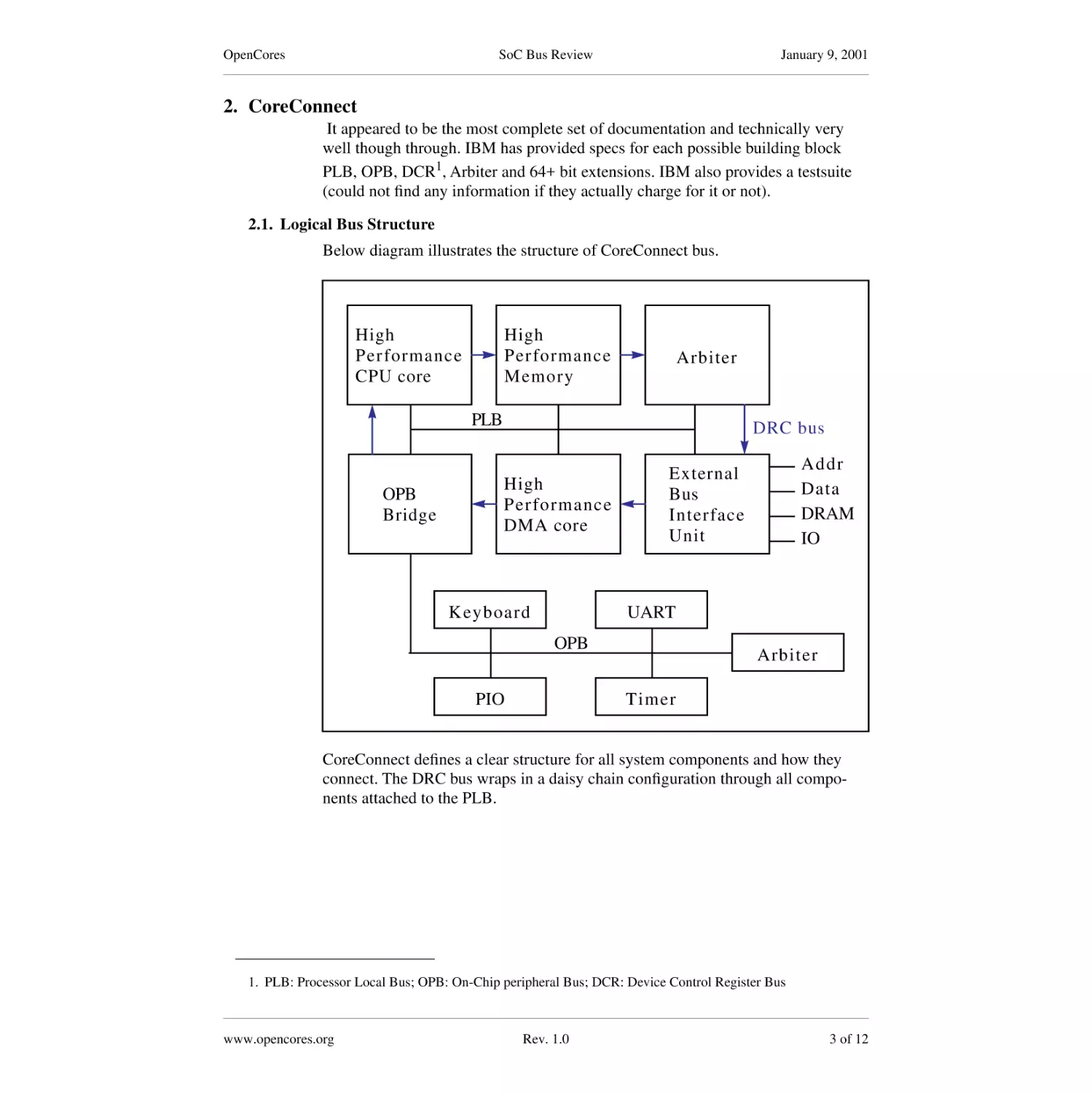
Below diagram illustrates the structure of CoreConnect bus.

High
Performance
CPU core

High
Performance
Memory

Arbiter

PLB

OPB
Bridge

DRC bus
High
Performance
DMA core

Keyboard

Addr
Data
DRAM
IO

External
Bus
Interface
Unit

UART
OPB

PIO

Arbiter
Timer

CoreConnect defines a clear structure for all system components and how they
connect. The DRC bus wraps in a daisy chain configuration through all components attached to the PLB.

1. PLB: Processor Local Bus; OPB: On-Chip peripheral Bus; DCR: Device Control Register Bus

www.opencores.org

Rev. 1.0

3 of 12

OpenCores

SoC Bus Review

January 9, 2001

2.2. Technical Details
Below is a summary of main features of each CoreConnect bus.
2.2.1.

2.2.2.

2.2.3.

PLB
•
•
•
•
•
•
•
•
•
•
•
•
•
•
•

High Performance bus (Processor Local Bus)
Overlapped read and write (up to two transfers per cycle)
Split transfer support
Address pipelining (reduces latency)
Separate read and write data
32-64+ bit data bus with
32 bit address space
support for 16-64 byte bursts
supports byte enabling (unaligned and 3 byte transfers)
Arbitration support, REQ, GNT and LOCK
Late and hidden arbitration (reduces latency)
4 levels of arbitration priority
Special DMA modes, such a flyby and memory to memory
Address and data phase throttling
Latency timer (ensures latency is kept to a desired level)

•
•
•
•
•
•
•
•
•
•
•
•
•

On-Chip Peripheral Bus
multiple masters
32 bit address space
separate read and write data bus
8-32 bit data bus
dynamic bus sizing
retry support
Burst support
DAM support
devices may be memory mapped (DMA support)
bus time out function (in arbiter)
Arbitration support, REQ, GNT and LOCK
Bus parking support

OPB

DCR
The device control register (DCR) bus is designed to transfer data between the
CPU’s general purpose registers (GPRs) and the DCR slave logic’s device control
registers (DCRs). The DCR bus removes configuration registers from the memory
address map, reduces loading and improves bandwidth of the processor local bus.
• 10 bit address
• 32 bit data
• Synchronous and asynchronous transfers
• Distributed architecture

www.opencores.org

Rev. 1.0

4 of 12

OpenCores

SoC Bus Review

January 9, 2001

2.3. Applications
I can see CoreConnect to be an important part of a true high performance system,
like a workstation. My feeling is that CoreConnect might be to complicated and
offer to many features that will be unused in simple embedded applications.
2.4. Cost & License
Free! No Fee, No Royalty! Licensing required.
IBM currently lists 36 companies on their web site who have licensed and might be
using CoreConnect.
2.5. Summary
CoreConnect is a complete and versatile solution. It is well thought through and
architected. IBM didn’t leave out anything to wish for.
On the other hand, however, CoreConnect might be an overkill for simple applications.

www.opencores.org

Rev. 1.0

5 of 12

OpenCores

SoC Bus Review

January 9, 2001

3. AMBA
AMBA is very similar to CoreConnect. ARM includes specifications for AHB,
ASP, and APB1. The “A” in the abbreviations stands for “Advanced”. However, I
could not see anything advanced about this buses at all! Descriptions of arbitration
and 64+ bit extensions are integrated in to the main specifications.
On the Silicore Web site (Wishbone), I found a note that AMBA might protected
under at least one patent (US 5,525,971).
3.1. Logical Bus Structure
Below diagram illustrates the structure of AMBA bus.

High
Performance
CPU core

High
Performance
Memory
AHB/ASP

Arbiter
High
Performance
DMA core

APB
Bridge

Keyboard

UART
APB

PIO

Timer

The high performance bus can be either AHB or ASP. Both service the same goal:
High Performance System Interconnect. A bridge from AHB or ASP is required to
interface to APB.
3.1.1.

APB Bridge
It is not clear what the advantage of the APB and the associated bridge to the high
performance busses is. According to the AMBA specification, the only function the

1. AHP: Advanced High Speed Bus; ASP: Advanced System Bus; APB: Advanced Peripheral Bus

www.opencores.org

Rev. 1.0

6 of 12

OpenCores

SoC Bus Review

January 9, 2001

bridge provides is a simpler interface. Any latencies presented by low performance
peripherals are reflected by the bridge to the high performance (AHB/ASP) busses.
The bridge itself appears to be a simple APB bus master that addresses the attached
slaves and controls them through a subset of the control signals available on the
high performance busses.
3.2. Technical Details
Below is a summary of main features of each AMBA bus.
3.2.1.

AHB
The AHB is the advanced system bus. It’s main purpose if for interconnecting high
performance, high through put devices, such as CPU, DMA and DSP. It’s main
features are:
• High Performance Bus (New Generation Bus)
• Multi Master
• Split transfers
• Single cycle bus master handover
• Non tristate implementation
• 32 - 128+ bit bus width
• Includes a access protection mechanism, to distinguish between such
access as privileged and non privileged modes, instruction and data
fetch, etc.
• Bursts limited to 16 ‘beats’ max
• Address space limited to 32 bits
• Throttling of data for slower devices provided
• Arbitration support, REQ, GNT and LOCK
• Supports transfers of bytes, half-word and word

3.2.2.

ASP
The ASP is the general purpose system bus. It is a high performance interconnect
for micro controller and system peripherals. The main features are:
• First Generation System Bus
• Multiple Masters
• Burst Transfers
• Pipeline Transfers
• 32 - 128+ bit bus width
• Includes a access protection mechanism, to distinguish between such
access as privileged and non privileged modes, instruction and data
fetch, etc.
• Bidirectional data bus
• Address space limited to 32 bits
• Throttling of data for slower devices provided
• Arbitration support, REQ, GNT and LOCK
• Supports transfers of bytes, half-word and word

www.opencores.org

Rev. 1.0

7 of 12

OpenCores

3.2.3.

SoC Bus Review

January 9, 2001

APB
The APB is the peripheral interconnect bus. Focus here was minimal power consumption and ease of use. The main features include:
• Low performance, low power peripheral bus
• Single Master
• Very Simple, only 4 control signals (plus clock and reset)
• 32 bit address space
• up to 32 bit data bus
• separate read and write data bus

3.3. Applications
Because of the obvious uncertainties of AMBA, my guess is that it would mostly
benefit to complete solution providers rather than the general public. Technically I
can see it as sufficient architecture for small embedded systems, that are not necessarily performance driven.
3.4. Cost & License
Unknown, waiting for reply from ARM. Presumably free of charge.
3.5. Summary
AMBA is a basic SoC bus divided into three different sub busses. Depending on
requirements, the system designer has to chose which of the three busses he will
interface to. A high performance device has the choice of the AHB and ASP bus,
which makes it very difficult for core integrators since both busses try to address
the same type of devices. There is no clear path of integrating devices with AHB
and ASP busses.
The bridge appears not to provide any intelligence, and might throttle the attached
high performance bus to a crawl. Kind of defeating the purpose of having a bridge
and different performance busses.
All three busses consist of a address and one or multiple data phases.
Update: Since the last release of this document (Rev. 0.6), I have received a note,
saying that AHB is actually meant to replace ASB. However, I could not find any
such statement in the specification. May be this is an unofficial path ARM want it’s
users to take?

www.opencores.org

Rev. 1.0

8 of 12

OpenCores

SoC Bus Review

January 9, 2001

4. Wishbone
The Wishbone spec takes some getting used to. It is comprised of RULES, SUGGESTIONS, PERMISSIONS, OBSERVATION etc. (I wish the PDF version of the
specification would come with a proper table of contest and ‘clickable’ cross references!) Not having implemented a interface bus, it is hard to say how complete it
might be and whether the bus will cover all needs or not. This is especially true for
wishbone.
Update: Since the last release of this document (Rev. 0.6), a new WISHBONE SoC
specification has been release (Rev. B). The PDF file, now has very nice clickable
table of context! The new specification adds a lot of more detail, clarifications and
examples. As I expected, WHISHBONE is becoming to a solid and powerful SoC.
4.1. Logical Bus Structure
Below diagram illustrates the structure of wishbone bus.

High
Performance
CPU core

High
Performance
Memory
WISHBONE

High
Performance
DMA core

Arbiter

Wishbone architecture is as simple as one can imagine. High though put does not
always have to be complex. A single bus, addressing almost every need. A system
with many components, might want to include two wishbone interfaces: one for
high performance blocks; and one for low performance peripherals.
4.2. Technical Details
•
•
•
•
•
•
•
•
•
•

www.opencores.org

One Bus Architecture for all applications
Simple, compact architecture
Multi master support
64 bit address space
8 - 64 bit data bus (expandable)
Single read and write cycles
RMW cycles
Event cycles
Supports retry
Supports memory mapped, FIFO and crossbar interface

Rev. 1.0

9 of 12

OpenCores

SoC Bus Review

•
•
•

January 9, 2001

Throttling of data for slower devices provided
User defined TAGs for identifying data transfer types
Arbitration defined by the end user

4.3. Applications
Because of the simplicity and flexibility of wishbone, it’s application areas are
truly limitless. It can be easily utilized in simple embedded controllers and high
performance systems. It might leave a few things to wish for, when implementing
high performance systems, but it will definitely not stop one from implementing
them.
4.4. Cost & License
Wishbone is absolutely free!
4.5. Summary
It appears the simplest of the three busses I have reviewed. It defines only one bus a high speed bus. I don't see a problem with that, as in a system that needs both a
high speed and a slower low performance peripheral bus, two wishbone interface
could be provided, which should be simpler, than designing two different bus interfaces.
Users of wishbone might have to create their own substandard of wishbone, specifying data ordering (Little/Big endian) and the meaning of TAGs. Additional features and functionality might also has to be added.

www.opencores.org

Rev. 1.0

10 of 12

OpenCores

SoC Bus Review

January 9, 2001

5. The Last Word
As much as I wished to leave political motivation out of this report, I feel it is
impossible in today world of patients and lawsuits. Both AMBA and CoreConnect
are controlled by large, major corporations (ARM and IBM). Even though they
claim that customer comments and suggestions are considered, the final decision
of evolution lies with those corporations.
Wishbone appears to be in a state in-between: The authors, have currently full control of wishbone, but are promising to transfer it to a “standards organization” (no
time frame is provided). I presume they are talking about IEEE, which will then
control the spec. This is not necessarily an advantage for us. I have personally
worked on several IEEE standards a voting member, and know that this process is
very lengthy, expensive and might produce an useless interface, due to all the
changes they could make.
Update: Since the last Release of this Document (Rev. 0.6), the authors of wishbone (Silicore Corp.) have release the WISHBONE specification to the public
domain. Negotiations are underway with OpenCores to act as a maintenance body
for WISHBONE SoC specification. Silicore Corp., would continue to be available
as technical resource and assist OpenCores to continuously improve and enhance
WISHBONE SoC specification.
All three busses are fully Synchrounous, using the rising edge of the clock to drive
and sample all signals. There is almost no difference in basic operations between
the busses. The most differences are in the feature set provided and completeness/
relaxation of the specification.
Both CoreConnect and AMBA, offer a choice of system busses to the designer. A
integrator, might face a problem, when he tries to connect a devices designed for
the different portions of those interconnects. Bridges might be required to build a
complete system. With wishbone, all cores connect to the same standard interface.
A system designer may choose to implement two wishbone interfaces in a micro
controller core, one for high speed low latency devices and one for low speed, low
performance devices.
At the end I feel it would be a wise choice to adopt wishbone as a primary interface
to our cores. It's signaling appears to be very intuitive and should be easily adopted
to the other interfaces when needed.

www.opencores.org

Rev. 1.0

11 of 12

OpenCores

SoC Bus Review

January 9, 2001

6. References
ARM Corp, AMBA
http://www.arm.com/sitearchitek/armtech.ns4/html/amba?OpenDocument&style=SoC_Customization

IBM Corp, CoreConnect
http://www.chips.ibm.com/products/coreconnect/

Silicore Corp, WISHBONE
http://www.silicore.net/pdfiles/wishbone.pdf

Silicore Corp, press release, releasing WISHBONE to public domain
http://www.silicore.net/pr010801.htm

OpenCores
http://www.opencores.org

www.opencores.org

Rev. 1.0

12 of 12