/

































Author: Woodcock A.
Tags: military news news independent journal war in ukraine russia war crimes
Year: 2022



Text
                    MONDAY 21 MARCH 2022
www.independent.co.uk
The
Rob Merrick
Tories urge PM on
EU defence pact
Mariupol residents ‘deported’ to Russia
A man is stopped and searched by armed pro-Russian separatists at a checkpoint in the southern port city
Sunak rewrites budget as
cost of living crisis grows
Chancellor under pressure to act on hikes in energy and fuel bills
EXCLUSIVE
ANDREW WOODCOCK
POLITICAL EDITOR
Rishi Sunak has ordered last-
minute changes to
Wednesday’s mini-Budget
after being warned he faces a
Zoe Tidman
Adverts exaggerate
green credentials
Caroline Bullock
Coffee shops are
bad value for money
“moment of truth” this week
on the cost-of-living crisis. The
Office for Budget
Responsibility has been told to
recalculate fiscal forecasts to
take into account amended
Treasury plans, an unusual
move, The Independent has
Mark Critchley
Liverpool to face
City in cup semi
learnt. The chancellor
signalled yesterday that he is
preparing to offer relief to
families and businesses which
face soaring prices, possibly
with a cut to fuel duty. He said
“Where we can make a
difference, of course we will.”
MONDAY 21 MARCH 2022
News
targe TING

Editorials
The challenge confronting
Sunak this week is not one
to be shirked
Expectations management appeared to be the name of the game
for the chancellor, Rishi Sunak, as he made his way around the
weekend political television shows. “I can’t solve every
problem,” said Mr Sunak as he urged people not to be scared by
the rising cost of living.
“Where we can make a difference of course we will,” he added,
while acknowledging that things are “not going to be easy” and
that whatever he announces in this week’s spring statement will
not be enough to “fully protect” people from the financial pain
of rises in the cost of petrol, heating and other essentials. Mr
Sunak, as a number of other government ministers have done
recently, admitted that sanctions imposed against Russia are
“not cost-free” and will have an impact.
Anybody that has watched events in the Ukrainian city of
Mariupol, which the country’s president, Volodymyr Zelensky,
labelled “a terror that will be remembered for centuries to
come”, is unlikely to begrudge the sanctions regime that is being
imposed.
However, it also cannot be used by the government as a blanket
excuse for issues that were in motion long before Russia invaded
its neighbour. Businesses and unions have told The Independent
that the chancellor is facing “a moment of truth” in the cost of
living crisis, and it is difficult to argue against that.
The government cannot stick its head in the sand: there is a real
need for action, not excuses. We have also reported that Mr
Sunak has ordered last-minute changes to Wednesday’s mini-
Budget, with the Office for Budget Responsibility told - in a
highly unusual move - to recalculate its fiscal forecasts to take
into account amended Treasury plans.
Pressure is building on the chancellor, with dozens of Tory MPs
calling for a cut in fuel duty to reduce the cost of a tank or petrol
or diesel. The shadow chancellor, Rachel Reeves, has said that
Labour would support such a cut but that such a move does not
“rise to the scale of the challenge we face”.
Labour wants to reverse next month’s 1.25 per cent hike in
national insurance contributions on employers and employees,
while the British Chambers of Commerce says the measure
should be delayed for at least a year. However, there appears
little sign that Mr Sunak is ready to back down on the planned
rise.
The chancellor has said that “people can judge me by my actions
over the past two years”. In a singular aspect at least - increasing
spending to deal with the Covid-19 pandemic - Mr Sunak and
the government acted the way they needed to.
But it is clear that further action has to be taken. Yes, the
capacity to spend is not endless - but given all the political
capital the government has tried to build over promises of a
“levelling up” agenda across the country, it cannot let the many
that need help now fall by the wayside. Mr Sunak should not
shirk the challenge when he lays out his plans this week.
Want your views to be included in The Independent Daily Edition
letters page? Email us by tapping here letters@independent.co.uk.
Please include your address
BACK TO top л
MONDAY 21 MARCH 2022
News/ Exclusive
Urgent action demanded as
cost of living crisis deepens
‘He’s going to have to pick sides’: Sunak’s mini-Budget is to be revealed on Wednesday (PA)
ANDREW WOODCOCK
POLITICAL EDITOR
Rishi Sunak has ordered last-minute changes to Wednesday’s
mini-Budget after being warned he faces a “moment of truth”
this week on the cost-of-living crisis.
The Independent has learnt that the Office for Budget
Responsibility has been told to recalculate fiscal forecasts to take
into account amended Treasury plans, a highly unusual move.
The chancellor signalled yesterday that he is preparing to offer
relief to families and businesses faced with soaring prices,
declaring: “Where we can make a difference, of course we will.”
There was speculation that help may come in the form of cuts in
fuel duties, after he said he did not want prices at the pump to
be “prohibitively expensive”.
But there are fears among businesses and unions, and on the
Conservative backbenches, that any package will fail to match
the urgency of the crisis, with the chancellor suspected to be
holding back big measures for the autumn Budget or squirrelling
away cash for pre-election tax cuts.
Mr Sunak himself appeared to concede in advance that his
intervention will fall short of what is needed, saying that he
“can’t solve every problem” and that surging inflation was “out
of my control”.
British Chambers of Commerce (BCC) director general Shevaun
Haviland told The Independent that the next few weeks are
“crunch time” for businesses and that Wednesday’s
announcements will make the difference for some between
thriving and going under.
The gas and electricity price spike is now a threat to all small
businesses, not just those with energy-intensive activities, she
said, pointing to one Cambridgeshire company whose annual
bill had risen from £14,000 to £46,000. Many are being moved
off fixed tariffs onto variable rates, making it impossible for them
to plan for the future, she said.
For the first time since its inception in 1989, she said that small
businesses interviewed for the BCC’s quarterly economic survey
have named inflation as their biggest concern for three quarters
in succession.
The BCC is calling for next month’s 1.25 per cent hike in
national insurance on employers and employees to be delayed
for at least a year, as well as the imposition of an energy price
cap for small and medium-sized enterprises (SMEs).
“We have told the chancellor that this isn’t business as usual any
more,” said Ms Haviland. “This isn’t just a cost-of-living crisis,
it’s a cost of doing business crisis.
“It is essential to delay the national insurance increase. It’s not
too late. The autumn is absolutely too late. We need action now.”
Frances O’Grady, general secretary of the TUG, said that
Wednesday’s spring statement was a “moment of truth” when
the credibility of government claims to be levelling up and
delivering a high-wage economy was at stake.
Calling on the chancellor to use a windfall tax on North Sea oil
and gas companies to fund a generous package of support for
families and businesses, Ms O’Grady said: “We have got a
government that’s in danger of being accused of being all mouth
and no trousers.
“It promised a high-wage economy and what we have got is
working families under intolerable pressure after years of pay
stagnation and cuts to social security. Half-measures aren’t
going to cut it.
“The chancellor is going to have to pick sides. Is he for the
ordinary people or the oil and gas company profits?”
Influential Tory backbencher Robert Halfon, who has gathered
50 MPs’ signatures in a letter asking the chancellor to cut fuel
duty rates, agreed that action was needed immediately to
mitigate the impact of spiralling prices.
Mr Halfon said that voters are “living in fear” as they see eye-
watering rises in the cost of everything from gas and electricity
to council tax, filling their cars, TV subscriptions and the weekly
shop.
“I always get letters and emails from people who are not happy
about one issue or another,” he said. “The big difference now is
that people are absolutely terrified because of the bills they are
getting.
“People are living in genuine fear. If we are not careful we could
go back into a de facto lockdown because people won’t be able to
afford to take their kids to school, they won’t be able to afford to
go to work, they won’t be able to afford to go out to see friends.”
War in Ukraine has fuelled an inflationary spiral already under
way as a result of supply chain disruption and shortages of labour
and commodities in the wake of the Covid pandemic, as well as
- in the UK - the impact of Brexit red tape.
An average <£700 rise in domestic gas and electricity bills in
April is now expected to be followed by a further hike of as much
as £1,000 in the autumn, bringing typical annual charges close
to £3,000.
Already above 5 per cent, there were warnings this week from
the Bank of England that the crucial Consumer Prices Index
(CPI) measure of inflation could reach double figures for the first
time in 40 years, at a time when the cost of borrowing is also
rising.
And Ms O’Grady said that ordinary working families were
bearing the brunt of the crisis.
“Over the last 14 years we have had the longest squeeze on
wages for 200 years,” she said. “We are now seeing energy bills
rising at 14 times the pace of wages.
“Working families have sacrificed through the crash, through
austerity, through the pandemic. We are absolutely determined
that working people are not going to pay the price yet again.”
Immediate measures the chancellor could announce on
Wednesday to alleviate financial woes include a £10 national
minimum wage and a pay rise for public sector workers to match
or beat inflation, she said. And she called on ministers to
convene talks between unions and bosses in key sectors like
social care to thrash out a fair reward for long-underpaid staff.
“This is a really important moment, the moment of truth for this
government,” said Ms O’Grady.
“We’ve heard the rhetoric, let’s see what you are actually going
to do. If you really believe in levelling up, if you really believe in
a high-wage economy, the time for action is now.”
CBI director general Tony Danker said Mr Sunak must put
green energy and insulation at the heart of any support package,
to drive investment and growth in the key sectors needed to end
the UK’s reliance on fossil fuels.
“The time for action is now to not only mitigate as best we can,
but also set the UK on a higher trajectory of economic growth,”
said Mr Danker.
“The chancellor may have wanted to delay taking decisive moves
on the economy but that no longer makes sense.
“This is a chance for the chancellor to signal that the UK can
continue to grow independent of Mr Putin’s actions.
“We need to now go full throttle in pursuit of green growth. It
was always good for humanity but it’s now essential for national
security. It’s also the greatest economic opportunity for
businesses to thrive and to level up the United Kingdom.”
Want your views to be included in The Independent Daily Edition
letters page? Email us by tapping here letters@independent.co.uk.
Please include your address
BACK to top л
MONDAY 21 MARCH 2022
News
Thousands fleeing Mariupol
forced to travel to Russia
Residents of the southern port city prepare to leave yesterday (Reuters)
KIERAN GUILBERT
Russia has been accused of bombing an art school providing
shelter to hundreds of civilians in the besieged city of Mariupol
and of deporting thousands of residents to an unknown fate
inside Russian territory as Ukrainian president Volodymyr
Zelensky warns of a third world war if talks with Vladimir Putin
fail.
The southeastern port city has suffered the most brutal siege of
Russia’s invasion, and many of its 400,000 residents have been
trapped for more than two weeks with scant food, water and
power as Mr Putin seeks to establish a land corridor to the
Crimea peninsula it annexed from Ukraine in 2014.
Last night Russia urged residents to lay down their arms in
Mariupol, promising safe passage out of the city if they agree,
giving them hours to respond. Russia's Ministry of Defence
called for surrender by 05:00 local time (03:00 GMT) this
morning, a proposal that Ukraine rejected.
Irina Vereshchuk, the Ukrainian deputy prime minister, said:
“There can be no talk of any surrender, laying down of arms. We
have already informed the Russian side about this,” she told the
news outlet Ukrainian Pravda.
Local officials said “several thousand” residents have been taken
to Russia in the past week.
The apparent attack on the art school - where some 400 people
were thought to be sheltering - came just days after Ukrainian
officials reported a strike on a theatre in Mariupol, and more
than 1,000 people were said to still be trapped in a bomb shelter
under the building as of Friday.
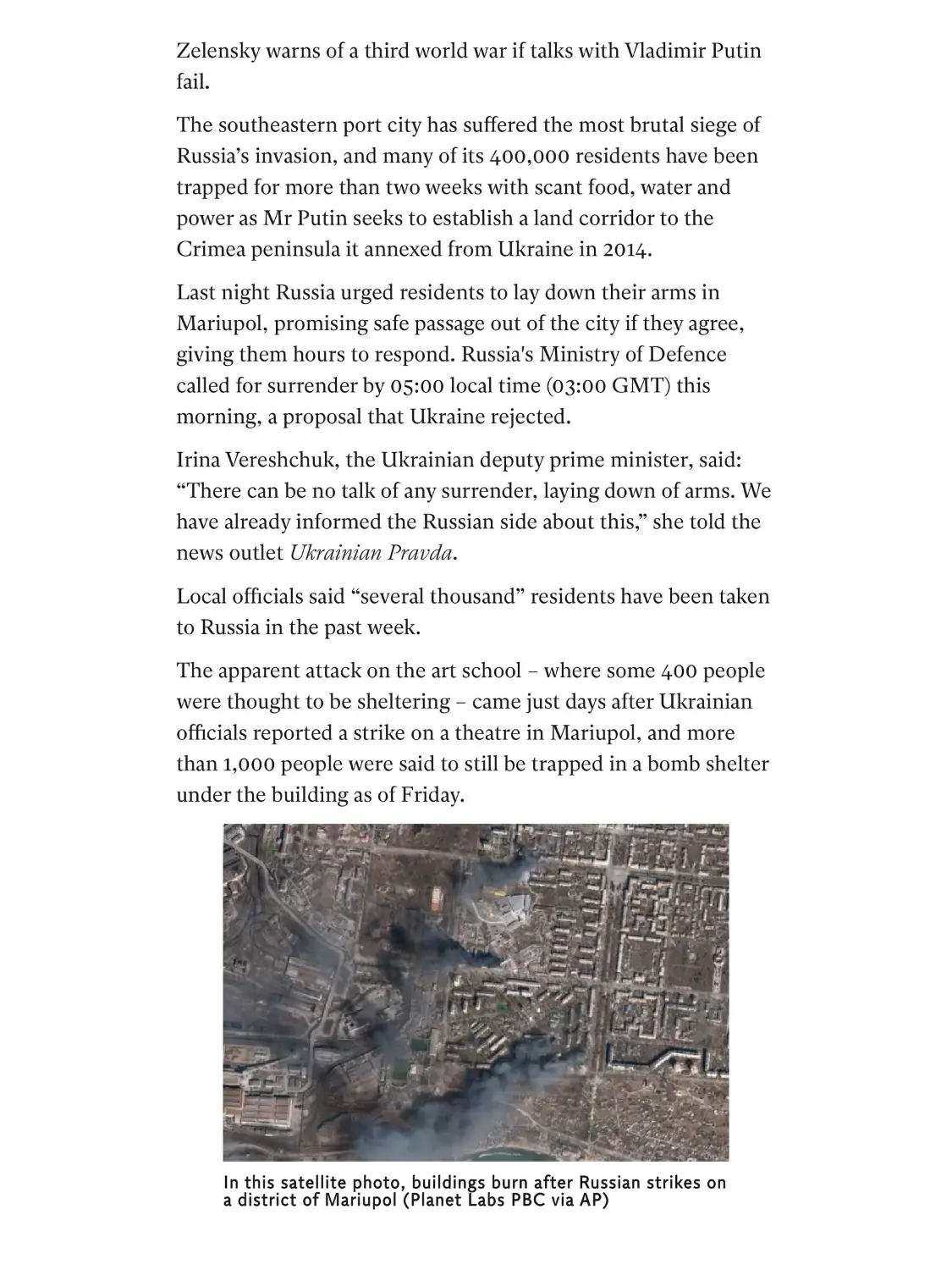
In this satellite photo, buildings burn after Russian strikes on
a district of Mariupol (Planet Labs PBC via AP)
At least 2,300 people have died in Mariupol, some of whom had
to be buried in mass graves, according to local officials, while Mr
Zelensky called the bombardment of the city a war crime.
"To do this to a peaceful city ... is a terror that will be
remembered for centuries to come," the Ukrainian leader said in
his nightly address to the nation on Saturday. "The more Russia
uses terror against Ukraine, the worse the consequences for it."
Nevertheless, he said peace talks with Moscow were necessary,
and warned that there would be severe consequences if they
failed.
“I think that we have to use any format, any chance in order to
have the possibility of negotiating, the possibility of talking to
Putin,” Mr Zelensky told CNN yesterday. “But if these attempts
fail, that would mean that this is a third world war.”
Russian invasion of Ukraine
LITHUANIA -
• Minsk
BELARUS
RUSSIA
Donetsk & Luhansk
(part-occupied by
pro-Russian rebels
B > since 2014)
POLAND

Wa rsaw
Lviv
Ukrainian territory
believed controlled
by Russia, at
end of Mar 17
Areas of Ukraine in
which Russia has
launched attacks
but does not
control, as of Mar 17
Nato member
Chernobyl
_JT •	9
Kharkiv
Kyiv
UKRAINE
• Myrhorod
Dnipro ♦
Mykolaiv»
MOLDOVA Г A
ROMANIA
Bucharest
FA graphic. Source: Institute for the Study of War
♦Mariupol
«Melitopol
Kherson
Odesa
Crimea
(annexed by
Russia in 2014)
Black Sea


This map shows the extent of Russia’s invasion of Ukraine
(PA)
Turkey, which is attempting to mediate a ceasefire, said Russia
and Ukraine were getting closer to agreement on "critical"
issues.
Kyiv is willing to drop its bid to join Nato but wants certain
security guarantees from Russia. Moscow is pressing for
Ukraine’s complete demilitarisation.
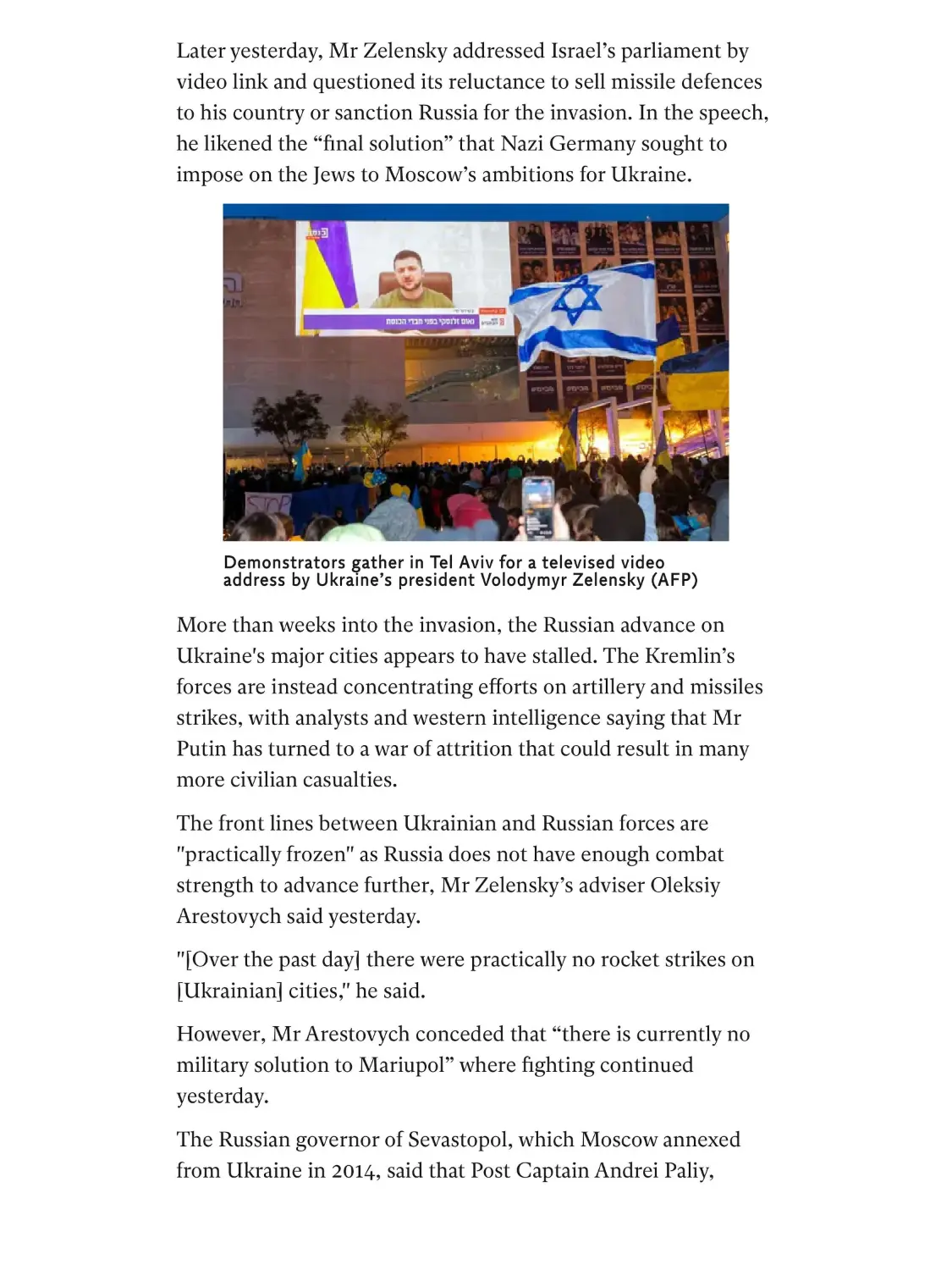
Later yesterday, Mr Zelensky addressed Israel’s parliament by
video link and questioned its reluctance to sell missile defences
to his country or sanction Russia for the invasion. In the speech,
he likened the “final solution” that Nazi Germany sought to
impose on the Jews to Moscow’s ambitions for Ukraine.
Demonstrators gather in Tel Aviv for a televised video
address by Ukraine’s president Volodymyr Zelensky (AFP)
More than weeks into the invasion, the Russian advance on
Ukraine's major cities appears to have stalled. The Kremlin’s
forces are instead concentrating efforts on artillery and missiles
strikes, with analysts and western intelligence saying that Mr
Putin has turned to a war of attrition that could result in many
more civilian casualties.
The front lines between Ukrainian and Russian forces are
"practically frozen" as Russia does not have enough combat
strength to advance further, Mr Zelensky’s adviser Oleksiy
Arestovych said yesterday.
"[Over the past day] there were practically no rocket strikes on
[Ukrainian] cities," he said.
However, Mr Arestovych conceded that “there is currently no
military solution to Mariupol” where fighting continued
yesterday.
The Russian governor of Sevastopol, which Moscow annexed
from Ukraine in 2014, said that Post Captain Andrei Paliy,
deputy commander of Russia’s Black Sea Fleet, had been killed
in battle in Mariupol.
A block of destroyed flats in Mariupol (Reuters)
Mariupol’s city council issued a statement late on Saturday
claiming that thousands of its residents had been “deported” to
Russia in the last week. The US envoy to the UN, Linda
Thomas-Greenfield, called the reports "disturbing" and
"unconscionable" if true. Russian news agencies said buses had
carried hundreds of people Moscow calls refugees from
Mariupol to Russia in recent days.
Liz Truss, the foreign secretary, tweeted that she is “appalled” at
reports some residents had been forcibly taken to Russia and
said Putin would be “held to account” for “Russian atrocities”.
Nearly 40,000 people have left the city - of their own will - in
recent days despite the bombardment, according to local
authorities. That amounts to nearly a tenth of the city’s pre-war
population of 430,000.
“There is no city anymore,” Marina Galla told the Associated
Press after escaping Mariupol, weeping in the doorway of a
crowded train compartment that was pulling into the western
city of Lviv near the Polish border.
Ukrainians in Lviv display solidarity with the residents of
Mariupol (Getty Images)
Elsewhere in Ukraine, authorities in Kharkiv said five people,
including a nine-year-old boy, were killed in overnight shelling,
while the country’s human rights ombudswoman Lyudmyla
Denisova claimed that more than 50 elderly people were killed
in Luhansk region after a Russian tank fired at a care home.
Russia’s defence ministry said cruise missiles were launched
from ships in the Black Sea and Caspian Sea, as well as
hypersonic missiles from Crimean airspace.
The Kremlin said the nuclear capable Kinzhal missile hit a
Ukrainian fuel depot in Kostiantynivka, a city near Mykolaiv,
yesterday, a day after it reported using the weapon for the first
time to destroy an ammunition depot in Ivano-Frankivsk,
western Ukraine.
Meanwhile, the UN has confirmed at least 902 civilian deaths in
the war, and said that more than 10 million people had now been
displaced across Ukraine, including some 3.4 million who have
fled to neighbouring countries such as Poland.
Want your views to be included in The Independent Daily Edition
letters page? Email us by tapping here letters@independent.co.uk.
Please include your address
BACK to top л
MONDAY 21 MARCH 2022
News
Sunak rejects PM’s Brexit
and Ukraine comparison
The chancellor made the comments during an interview yesterday (Sky News)
ANDREW WOODCOCK
POLITICAL EDITOR
Rishi Sunak has distanced himself from Boris Johnson’s
comparison of the Ukraine war with Brexit, saying the two
situations are “not directly analogous”.
Mr Johnson’s comments in a speech to the Conservative spring
conference in Blackpool sparked fury, with one European
statesmen branding it “disgraceful” and another describing it as
offensive to those fighting the Russian invasion.
There were calls for the prime minister to be excluded from this
week’s European Council meeting, where Mr Johnson is hoping
to join EU leaders to discuss the Ukraine crisis with US
president Joe Biden.
In an awkward exchange on Sky News’s Sophy Ridge on Sunday,
the chancellor declined to repeat the parallel made by the prime
minister, insisting that Mr Johnson himself had not intended to
draw a direct comparison.
“I don’t think those two situations are directly analogous,” said
Mr Sunak. “Clearly they are not directly analogous and I don’t
think the prime minister was saying they are directly analogous.”
Mr Sunak was shown footage of Mr Johnson’s speech, in which
the PM said that the world faced a moment of choice between
“freedom and oppression” and criticised those who believe it is
necessary to “make accommodations with tyranny”.
He continued: "I know that it’s the instinct of the people of this
country, like the people of Ukraine, to choose freedom every
time.
“When the British people voted for Brexit in such large, large
numbers, I don’t believe it was because they were remotely
hostile to foreigners. It’s because they wanted to be free to do
things differently and for this country to be able to run itself."
His comments - apparently drawing a parallel between
membership of the EU and Russian “tyranny” - came just days
after Ukraine officially applied for EU membership.
Asked whether he would have used the prime minister’s words,
Mr Sunak indicated he would not, adding: “I don’t think the
prime minister did either.”
Rachel Reeves, the shadow chancellor, called on Mr Johnson to
apologise for his “crass” remarks.
Ms Reeves told Ridge on Sunday: “It is utterly distasteful and
insulting to compare the fight for freedom against the aggression
of the Russian state to the decision to leave the EU.
“It is insulting to the Ukrainian people, who are fighting for
their very freedom and their very lives, and it is insulting to the
British people as well.
“If the prime minister didn’t mean that analogy, he shouldn’t
have made it and he should take those words back and apologise
to the Ukrainian people and the British people for those crass
remarks.”
Want your views to be included in The Independent Daily Edition
letters page? Email us by tapping here letters@independent.co.uk.
Please include your address
BACK TO top л
MONDAY 21 MARCH 2022
News/ Exclusive
War pushing Britain’s aid
budget to ‘breaking point’
Campaigners say Foreign Office cuts leave UK unable to meet all international obligations (AP)
ANDREW WOODCOCK
Anti-poverty campaigners have warned that war in Ukraine is
stretching the UK’s overseas aid budget “to breaking point”.
Researchers from the ONE Campaign said the Russian invasion
has destroyed the government’s rationale for cutting aid
spending from the level of 0.7 per cent to 0.5 per cent of gross
national income in 2020.
The non-profit group has called on chancellor Rishi Sunak to
bring forward the planned restoration of the 0.7 per cent figure,
warning that failure to do so will mean life-saving programmes
will be withdrawn from some of the world’s poorest nations. The
Ukraine war means that the UK will no longer be able to meet
its strategic priorities and international obligations within the
reduced budget, it added.
Some £220m of UK aid money has been diverted so far to meet
immediate humanitarian needs in Ukraine. Meanwhile, the
disruption to Ukrainian wheat exports, which make up 10 per
cent of global supply, has sent food prices soaring around the
world, including in developing countries. ONE UK director
Romilly Greenhill said it was “absolutely the case” that refugees
fleeing Vladimir Putin’s war in Ukraine need to be supported as
much as people facing famine in east Africa do.
But she said “by keeping our aid budget unnecessarily reduced,
the UK is not in a position to do both; it’s forcing itself into a
situation where it has to choose between people in crisis,”
adding that “we’re seeing a convergence of crises that mean you
can’t just pick and choose which problem to deal with in a
vacuum”.
The aid cut - equivalent to <£4.5bn a year - was described as a
“temporary” measure. Mr Sunak has said he hopes to restore
spending to its previous level in 2024-25, but Ms Greenhill said
this timetable needs to be accelerated.
A report by ONE found that a series of humanitarian disasters,
including the Ukraine refugee crisis and the controversial
decision to include Covid vaccines in the aid budget, had made
the argument for the cut increasingly “out of date”. The group’s
report comes days before Mr Sunak’s mini-budget statement on
Wednesday and ahead of the expected publication of the Foreign
Office’s international development strategy.
"We’re in a different place to when the aid budget was first cut,”
said Ms Greenhill. “Since the chancellor announced the cut in
2020, circumstances have changed, and the justification that
was used then no longer holds. The government cannot deliver
on its own agenda at the current budget, and with more and
more spend being added, UK aid is being stretched to breaking
point. It’s pushing existing anti-poverty work out.”
ONE’S analysis, carried out before the invasion of Ukraine,
found that the decision to cut UK aid meant 4 million fewer girls
will have access to a decent education and that 1 million women
and children under five will be at risk of malnutrition.
It also found that aid to low-income countries like Ethiopia,
Somalia, South Sudan and Yemen had been slashed, while some
middle-income countries like China and Brazil saw a rise in
funds received. UK overseas development aid to Ethiopia fell by
55 per cent from =£240.5m in 2020-21 to =£107.5m in 2021-22,
while China’s funding rose from £2.2m to ^13.7m in the same
period, the report found.
The Independent has approached the Foreign Office for
comment.
Want your views to be included in The Independent Daily Edition
letters page? Email us by tapping here letters@independent.co.uk.
Please include your address
BACK to top л
MONDAY 21 MARCH 2022
News
Temporary measures: Ukrainians at a sports stadium in the Polish village of Medyka (AP)
ZAINA ALIBHAI
The war in Ukraine has seen millions of people forced to flee
their homes for safety in neighbouring countries.
However, at the Polish border with Ukraine reports are
emerging of many, including women and children, returning to
Ukraine despite the risks.
One couple had been on holiday when the invasion happened
and were returning to be with family who had stayed put, Sky
News reports.
Another woman, Valentina Puzanova, said she travelled to
Poland to take her elderly mother and young son to safety, and
was heading back to be with her husband.
And the Bilechenko family, including a mother, father and their
four children, said they are heading back after two weeks in
Poland as the draw to be home “outweighs the risk”.
The United Nations estimates that since Russian troops first
entered Ukraine on 24 February, 3,270,662 have left the
country, the majority of whom have gone to Poland. Ninety per
cent of them are women and children.
The Kyiv Independent estimates more than 320,000 Ukrainians
have returned since the beginning of the war, most of whom
were men who wanted to defend their country.
The UN has warned that humanitarian needs are becoming
ever-more urgent, with 200,000 people now without access to
water across Donetsk and 100,000 people with no electricity in
Luhansk, due to heavy shelling.
Poland has welcomed more than 2 million Ukrainian refugees
so far (AP)
Residents in Mariupol and Sumy are facing a critical shortage of
food, water and medicine, while in Odesa authorities have
appealed for support for the 450,000 people in the city.
Ukraine’s deputy prime minister Iryna Vereshchuk said seven
humanitarian corridors would open on Sunday to enable
civilians to leave frontline areas.
The UN estimates at least 847 civilians have been killed and
1,399 wounded as of Friday, with the Ukrainian prosecutor
general’s office claiming 112 children to have been killed.
The Independent has a proud history of campaigning for the rights
of the most vulnerable, and we first ran our Refugees Welcome
campaign during the war in Syria in 201g. Now, as we renew our
campaign and launch this petition in the wake of the unfolding
Ukrainian crisis, we are calling on the government to go further
and faster to ensure help is delivered. To find out more about our
Refugees Welcome campaign, click here. To sign the petition click
here. If you would like to donate then please click here for our
GoFundMe page
Want your views to be included in The Independent Daily Edition
letters page? Email us by tapping here letters@independent.co.uk.
Please include your address
BACK to top л
MONDAY 21 MARCH 2022
News
Tory group urges Johnson
to rejoin EU defence pact
The Conservative European Forum calls for closer military cooperation (Anadolu Agency/Getty)
ROB MERRICK
DEPUTY POLITICAL EDITOR
The Ukraine crisis shows Boris Johnson must drop his
opposition to a defence pact with the EU to allow the UK to
quickly deploy forces around Europe, a Tory group says.
The Conservative European Forum (CEF) wants Britain to join
projects run by an EU body called Permanent Structured
Cooperation in Defence (PESCO) - a bid to create a common
defence policy.
As a first step, it argues that the prime minister should sign up
to its Military Mobility project, to ease bureaucracy preventing
the quick movement of military personnel and assets.
The call comes after the UK rejected a defence and security pact
in the Christmas 2020 Brexit deal - and a few days before the
prime minister heads to a crucial Nato summit.
The Conservatives have long opposed the UK aligning with
anything that resembles an “EU army”, a controversy that
helped fuel support for leaving the EU.
But the CEF said Russia’s invasion of Ukraine had underlined
the need to “effectively respond to existential threats” and
dismissed any fears that integration will “infringe UK
sovereignty”.
Its report, entitled Keep Calm and Defend Europe, pushes for a
Framework Participation Agreement with the EU and a separate
tie-up with the European Defence Agency.
The forum’s chair, former deputy prime minister David
Lidington, said: “The report today highlights the changing
nature of the EU’s more collective approach to security and
defence.
“The UK needs to understand these changes and seize on the
opportunities that they present.”
Johnson is being urged to change tack on defence (PA)
The report’s author, Dr Garvan Walshe, a former security policy
adviser to the Conservative Party, said it was time to grasp
“previously missed opportunities”.
“The recent invasion of Ukraine has demonstrated the
importance of logistical coordination and military mobility
between allies,” he said.
“Without delay, the UK should seek to join the EU’s Permanent
Structured Cooperation in Defence projects that benefit UK
security.
“Signing up to the Military Mobility project, like the US,
Canada and Norway did last year, would be an important first
step.”
The UK’s decision not to pursue a defence and security arm to
the Brexit deal also shut down access to vital criminal databases,
including records of stolen identities and wanted people.
The prime minister will head to the Nato summit in Brussels on
Thursday, which will be dominated by the Ukraine crisis and
efforts to thwart Russia’s war on the country.
His priority is thought to be securing a one-to-one meeting with
the US president Joe Biden - although an invitation to attend
the European Council meeting in the same city is also possible.
The move would symbolise a warming of relations with the EU,
brought about by cooperation after Russia’s invasion of Ukraine,
after years of spats over Brexit and Covid vaccines.
Want your views to be included in The Independent Daily Edition
letters page? Email us by tapping here letters@independent.co.uk.
Please include your address
BACK TO top л
MONDAY 21 MARCH 2022
News
Lviv vegan restaurant feeds
hundreds of refugees a day
Vega Room staff are cooking free meals like falafel and Stroganoff (Vega Room/Vitaly Savchuk)
GINO SPOCCHIA
It has never been busier for 26-year-old Vitaly and his Vega
Room restaurant in Lviv, western Ukraine. The numbers at Vega
Room have risen tenfold since Russia invaded on 24 February,
which forced a wave of women, children and older people to
attempt to leave the country.
Around 200 people will arrive at his restaurant’s door daily for a
hot meal, which Vitaly admits is more than Vega Room has ever
had. On the menu? Buckwheat, grains and simple food, he said.
“It’s just regular soups, or we’ll do some cereals like buckwheat,
rice, and some meat substitution; we just use tofu, falafel, which
are very useful, actually. And people are very satisfied with
them,” Vitaly told The Independent. “But on the other hand,
there is actually a problem with those products, especially with
tofu and with some meat substitution, because it’s difficult to
find them right now.”
Vitaly said his Ukrainian supplier in Kharkiv has been effectively
shuttered by the war. “Nothing works now, so yeah, we cannot
get all the needed products from Ukraine. And now I am asking
my friends to send me some products.” A month ago, Vega Room
would see about 30 or 40 customers come and go in a single day,
with people enjoying plant-based pierogi, cabbage rolls and even
a vegan Stroganoff.
“It’s not really big,” Vitaly said from his home in Lviv, where he
has taken in two families from Ukraine’s east. “It has six tables,
so at the same time there could be 20 people maximum. Now
it’s something like 200 a day, so for us, it’s a huge amount of
people.”
The cafe used to serve around 40 customers per day - but now it is
feeding around 200 people fleeing Ukraine (Vega Room/Vitaly Savchuk)
The only difference now is that these people aren’t paying. Vega
Room has become a vital part of the humanitarian effort
underway in Lviv and elsewhere in Ukraine. “Maybe not all of
them are refugees but we don’t ask them to show passports,”
said Vitaly of the Monday-to-Sunday restaurant operation. “I
don’t think people are trying to take advantage here - we just
feed everyone.”
About a month ago, Vitaly had announced the closure of his
Vega Room business because of the threat of Covid and a war
with Russia. “We were hearing, like almost every day, that
Russia is going to attack us. But we didn’t take this seriously. No
one actually expected that,” he said. “And after the war started ...
I didn’t know what to do, or what the future with the restaurant
is going to be because I was really surprised.”
That was when he was approached by Vegan Ukraine, a charity
that wanted to turn Vega Room into a kitchen for refugees
fleeing Russia’s assault. He said it was spearheaded by two
sisters who were regular customers of his restaurant, and who
organised funding for his refugee vegan kitchen. It has provided
Vega Room and now thousands of refugees with a lifeline.
“When the war started we lost our workers because some of
them went to Poland. We had a waitress and she went to Poland
... they were scared of the war and so we didn’t have any choice.
We decided to close it. But then this initiative came up,” said
Vitaly, who has signed up to be a Ukrainian army volunteer.
And his rent has been suspended by Lviv’s authorities too,
which has been bracing itself for a Russian assault on one of
Ukraine’s westernmost cities after an attack on a nearby military
base last week. The bombing just miles from the Polish border
sent shockwaves through Lviv, which has seen little of the war
waged by Russia. “It was horrible,” said Vitaly, “because many
people didn’t expect that, you know. Until today, we live here in
a peaceful place. We didn’t expect something like this to
happen.”
Like all businesses in Lviv, Vega Room has been forced to adapt
to the vast number of people fleeing war, with estimates
suggesting some 200,000 people have settled temporarily in
Ukraine’s seventh biggest city. Lviv normally has a population of
about 740,000, with close ties to nearby Poland and Hungary.
Some 200,000 people have settled temporarily in Ukraine’s seventh
biggest city, Lviv, near the Polish border (EPA)
“There is a huge problem with humanitarian problems in the
east,” explained Vitaly. “People are dying because of hunger
there and the worst part is you’re totally helpless. You know, I
want to contribute to those people.” Describing himself as
“cosmopolitan”, the long-time vegan and business owner said
while he couldn’t imagine fighting five years ago, this war is
“already the second conflict because the war started in 2014
when Russia occupied Crimea”.
He added some comforting words: “But to be honest, in 2014,
people weren’t as united as they are now.” And he said that the
Ukrainian president, Volodymyr Zelensky, has “inspired”
people. “I think if it was our previous president or the previous
president like Petro Poroshenko, for example, no one would
fight that strongly for the country.”
As for the future, Vitaly said he hopes to fully reopen Vega Room
when the war ends and that his customers - new and old - will
return. “Actually I want to open as soon as possible. But right
now I think we can have two conditions; the place can be closed
and give some taxes, or the place can be open and feed refugees
and I think this is what is most appropriate for us right now.” He
added: “I hope when the war will finish, of course, we will
reopen this as a normal business place.”
Anybody wanting to contribute funds to Vega Ryoms refugee
kitchen can contribute with donation details here
Want your views to be included in The Independent Daily Edition
letters page? Email us by tapping here letters@independent.co.uk.
Please include your address
BACK TO top л
MONDAY 21 MARCH 2022
News
Labour force motion to ban
‘fire and rehire’ tactics and
reinstate sacked P&O staff
г
Sacked P&.O staff protest at Larne Port in Northern Ireland on Friday (PA)
ANDREW WOODCOCK
Labour is to force a vote in the Commons today to demand that
ferry company P&O reinstate 800 workers sacked with no
notice on Thursday.
The TUC called on MPs of all parties to back the emergency
motion, which would also ban the controversial practice of “fire
and rehire”.
Chancellor Rishi Sunak has confirmed that a review is underway
into all government contracts with the company, whose decision
to replace long-serving personnel with cheaper agency staff he
described as “appalling”.
Unions, who will stage a protest outside parliament today, said
that new crew on board ships are likely to end up on “poverty
pay” well below the minimum wage.
Shadow transport secretary Louise Haigh said the incident
should be “a line in the sand” for workers’ rights. Her motion
calls on the government to:
•	Outlaw fire and rehire and bring forward an urgent bill to
strengthen workers rights
•	Suspend the contracts of P&O owners DP World until the
current row is resolved
•	Remove DP World from the government’s Transport
Advisory Group
Ms Haigh said: “This scandalous action must be a line in the
sand. If P&O Ferries can get away with this, it will give the
green light to other exploitative employers. It is the
consequence of the Tory assault on workers’ rights. A Labour
government will strengthen employee protections and ban fire
and rehire to give people the security they deserve for an honest
day’s work.
“No more excuses, [today] Tory MPs must join with Labour and
vote to ban cruel fire and rehire for good. They must decide
which side they are on - loyal workers in Britain or billionaires
riding roughshod over rights.”
TUC general secretary Frances O’Grady said: “No matter where
their party loyalties lie, MPs should do the right thing and back
Labour’s motion to end fire and rehire and demand the
immediate reinstatement of all sacked staff. Ministers have
spent the last few days condemning P&O’s actions - now they
have a chance to prove they mean it.”
The RMT transport union said P&O ships on the Liverpool-
Dublin route have now been crewed with Filipino ratings on
contracts that pay below the minimum wage. Shipping
companies that are registered in other countries and operating
routes from UK ports to Europe can pay below the minimum
wage because they are exempt from legislation.
RMT general secretary Mick Lynch said: “P&O may pay more
than the minimum wage at Erst to agency staff but they will
eventually move to rates below this simply because there is
nothing to stop them from doing so. We fear poverty pay will be
accompanied by seafarers being chained to 12-hour-day, seven-
day-week contracts that operate continuously for six months,
with no pension.”
A spokesperson for P&O Ferries said: “We know that for our
staff this redundancy came without warning or prior
consultation, and we fully understand that this has caused
distress for them and their families.
“We took this difficult decision as a last resort and only after full
consideration of all other options, but, ultimately, we concluded
that the business wouldn’t survive without fundamentally
changed crewing arrangements, which in turn would inevitably
result in redundancies.”
Want your views to be included in The Independent Daily Edition
letters page? Email us by tapping here letters@independent.co.uk.
Please include your address
BACK TO top л
MONDAY 21 MARCH 2022
News
Man arrested on suspicion
of murder after woman, 19,
found dead in student halls
Police made the arrest yesterday, hours after naming the victim as Sabita Thanwani (Family
Handout/SWNS)
HOLLY BANCROFT
A man has been arrested on suspicion of murder after a 19-year-
old woman was found dead in student halls in London.
Sabita Thanwani was named by the Met Police yesterday
morning after the tragic discovery in Clerkenwell on Saturday.
Officers were called at around 5.10am to a report of a woman
“seriously injured” at the student block.
Despite emergency workers’ best efforts, Ms Thanwani was
pronounced dead at the scene.
Police arrested a man in connection with her death yesterday
afternoon in the Clerkenwell area. He remains in police custody
on suspicion of murder and assault.
Detective Chief Inspector Linda Bradley, who leads the
investigation, said: “Sabita’s family have been updated with this
development and continue to be supported by specially trained
officers. Our deepest condolences are with them. I would ask
everyone to respect their privacy at this indescribably
devastating time.”
Fellow students living in the block shared their fears over the
teenager’s death after Ms Thanwani’s body was found, and
raised concerns about security in the building.
Unite Students, which runs the block, said: “Our priority at this
time is the safety and wellbeing of students at Arbour House”,
adding that it was working with the Met and City, University of
London.
A spokesperson for the university said: “We will do everything
we can to support our students and staff and we will continue to
fully support the police with their investigation.”
Want your views to be included in The Independent Daily Edition
letters page? Email us by tapping here letters@independent.co.uk.
Please include your address
BACK TO top л
MONDAY 21 MARCH 2022
News
Father’s ‘unbearable pain’
after son dies playing rugby
David Hill, pictured right with Scotland rugby coach Gregor Townsend, died playing for Holyrood
RFC in Dublin on Saturday (Scottish Parliament RFC/Twitter)
KATRINE BUSSEY
The father of a man who died while playing rugby for the
Scottish parliament team said the “pain is unbearable”.
Rodger Hill said his family is “broken” after the sudden death of
David Hill on Saturday.
He said on Twitter: “I can’t believe I’m writing this. My amazing
son David passed away today playing rugby in Dublin for the
Scottish parliament. He was the best and the pain is unbearable.
We are broken.”
David Hill, who was described as “rugby daft”, worked as the
head of office for Scottish Tory MSP and Holyrood justice
spokesperson Jamie Greene. He was playing for the cross-party
Holyrood team in a match against the Dail and Seanad XV when
he died.
Mr Greene described him as a “friend, colleague and confidant
for so many in the Scottish parliament over the years”. He said
Mr Hill “loved his politics, but he loved his rugby more”, and
added: “The whole parliament, my party and the whole rugby
community is deeply saddened by this awful news today, and our
condolences lie entirely with his family, friends and colleagues.”
Mr Hill’s death prompted tributes from across Holyrood, with
Scottish first minister Nicola Sturgeon tweeting: “This is so
terribly sad. My deepest condolences to David’s family, friends
and colleagues.” She said Mr Hill’s teammates are “all deeply
shocked and heartbroken”.
Scottish Conservative leader Douglas Ross said: “Our whole
party is shocked and saddened by David’s tragic passing. He was
a kind, generous, well-liked and highly respected part of our
team. We will all miss him dearly. All our thoughts are with his
family and friends.”
Holyrood presiding officer Alison Johnstone said: “Words can’t
express how shocked and saddened all at the Scottish parliament
feel on learning of David’s sudden death. My thoughts and those
of all @ScotParl are with David’s family, friends and colleagues
at this difficult time.”
In a statement, Scottish Rugby said: “We are shocked and
saddened by David’s passing today. Described as ‘rugby daft’ by
his family, David played for Dumfries Saints and was a regular at
Scotland internationals. The condolences of everyone at
Scottish Rugby go out to his family and friends at this time.”
Want your views to be included in The Independent Daily Edition
letters page? Email us by tapping here letters@independent.co.uk.
Please include your address
BACK TO top л
MONDAY 21 MARCH 2022
News/ Exclusive
Ad bans expose the dirty
business of greenwashing
Not so innocent: an Innocent Drinks advert was ruled as misleading by the ASA (Innocent Drinks)
ZOE TIDMAN
The number of adverts banned for “greenwashing” has tripled in
a year, The Independent can reveal.
Over the past 12 months, 16 advertising campaigns exaggerated
their company’s green credentials or made environmental
claims that could not be backed up, according to analysis of
thousands of rulings by the UK advertising watchdog.
These ads - by Innocent Drinks, Alpro and Oatly among others
- were banned from appearing again in the same form.
Analysis of Advertising Standards Authority (ASA) rulings by
The Independent found there had been a sharp rise in the
number of adverts found to have greenwashed - both in recent
months and compared to the year before.
Eleven out of the 16 adverts to be banned between mid-March
2021 and March 2022 were from the first few months of this
year, while the total over the past 12 months was triple the
number banned during the same period the year before.
Toby King, a spokesperson for the ASA, said he thought people
were “more concerned” and “educated” over the climate crisis
and greenwashing, which could be driving the increase in
adverts being banned.
“We have done a lot of work to let people know, when you see an
ad for green claims, we are the guys you come to if you think it is
inaccurate or may not be telling the truth,” he told The
Independent.
He added: “I think we are seeing a sea change in public
understanding of green claims, and people want to buy ethically
in a green way. We all want to do our bit.”
The 16 greenwashing rulings included reprimands for multiple
adverts across different platforms, such as Twitter and Facebook,
as well as newspaper and TV. Innocent Drinks was one such
company that had its TV, YouTube and video-on-demand adverts
banned last month.
The ASA said the adverts, which included cartoon characters
singing about “fixing up the planet” and recycling while
drinking its products, implied buying Innocent products would
have a “positive environmental impact when that was not the
case” and were therefore misleading. Innocent said it was
“disappointed” with the ruling and that the advert intended to
“highlight important global environmental issues and the need
for collective action”.
Adverts for Lipton Ice Tea and Aqua Рига water were also
banned for misleadingly claiming their bottles were made from
fully recycled materials when, in fact, the cap and label were not.
A Pepsi Lipton International spokesperson claimed the advert
did not “intend to mislead” but was “simply celebrating that the
plastic bottle is now made from 100 per cent recycled PET”.
The ASA also banned adverts from Oatly, a plant-based milk
substitute company, over misleading environmental claims,
including: “Oatly generates 73 per cent less CO2e (carbon
dioxide equivalent) vs milk, calculated from grower to grocer”.
Following the ruling, the company said it could have been “more
specific” in how it presented scientific data.
Andrew Simms from the Badvertising campaign told The
Independent: “More pressure on companies due to awareness of
the climate emergency means some major polluters take the
easy option of trying to change their image rather than change
their business. That leads to greenwash.”
But he claimed that the ASA seemed to “be letting many of the
big polluting fish off the hook” such as oil companies and
airlines, and was instead “picking up other, smaller and
relatively innocuous examples”.
“More greenwashing does need investigating, but it will be
perverse if the new scrutiny fails to tackle the worst polluters,
and is exploited to target others trying to make a positive
difference.”
However, the ASA denied Simms’ accusation that it only dealt
with “small fry”, saying it has also ruled against airlines and car
companies.
In 2020, it said three adverts by RyanAir were misleading over
claims it was the “lowest emissions airline”. Following the
ruling, RyanAir remained defiant, insisting it had the lowest
emissions per passenger than any other carrier in Europe.
Harriet Lamb, chief executive of climate charity Ashden, told
The Independent'. “Greenwashing confuses the public, minimises
the severity of the global climate crisis and so ultimately pushes
us closer to climate catastrophe.
“The strict implementation of tight advertising regulations is
vital. But we also need to go much further - advertising should
be banned for companies that are highly polluting.”
Want your views to be included in The Independent Daily Edition
letters page? Email us by tapping here letters@independent.co.uk.
Please include your address
BACK TO top л
MONDAY 21 MARCH 2022
News
Warm and sunny weather
forecast for most of UK
Temperatures are likely to be in the mid-to-high teens for most of next week (PA)
WILLIAM JANES
Much of the UK can expect to see more warm weather and
sunshine this week after the hottest day of the year so far.
Temperatures reached 20C in some parts on Saturday for the
first time since October, the Met Office said. Forecasters said
there are “plenty of sunny spells to come and temperatures will
rise a little bit” in the week ahead, after a cooler day yesterday.
The mercury is likely to sit at 15C-16C today but forecasters are
predicting highs of 19C tomorrow, before temperatures hold
steady in most of England at around 17C or 18C through the rest
of the week and into the weekend - warmer than the average for
March.
The vast majority of the UK is set to see continued sunny spells
and dry conditions, with the exception of some localised
showers in the Midlands today and the north of England
tomorrow.
The east coast of Scotland could also see some low cloud during
the week and temperatures could be cooler in coastal areas due
to low sea temperatures and breezes. The north of the UK is
expected to see highs of between 9C and 12C.
Warmest UK March temperatures
2021
Warmest in
2010-20
Warmest on
record
2022
(so far)
Kinlochewe,
n orth -west
Scotland,
Mar 19
Aboynein
Aberdeenshire,
Mar 27 2012
Kew Gardens
in London,
Mar 30
Mepai In
Cambridgeshire.
Mar 291968
PA graphic. Source: Met Office
The pleasant conditions are due to the jet stream tracking well
to the north of the UK, letting high pressure dominate from the
east.
Met Office meteorologist Greg Dewhurst said: “This week is
going to be very similar. We’re going to keep high pressure just
to the east of the UK and that means it will be largely dry and
settled with plenty of sunny spells.
“There is the odd exception, there could just be an isolated
shower across the Midlands on Monday, perhaps northern
England on Tuesday, but they’re going to be very isolated and
most places will be dry and sunny.”
Mr Dewhurst added sheltered areas “will continue to be on the
pleasant and warm side”.
The temperature is expected to remain above average into next
weekend but will then drop slightly into the following week.
Want your views to be included in The Independent Daily Edition
letters page? Email us by tapping here letters@independent.co.uk.
Please include your address
BACK TO top л
MONDAY 21 MARCH 2022
News
It’s wrong to smack a child,
most adults in England say
KATE NG
The majority of adults in England believe it is wrong for parents
or carers to physically discipline their child, a study has revealed.
More than two-thirds (68 per cent) of nearly 3,000 adults polled
by YouGov said they felt that it was unacceptable to physically
punish a child, for example by smacking them.
The poll, commissioned by the National Society for the
Prevention of Cruelty to Children (NSPCC), revealed that the
public largely support changing the law in England to abolish
“reasonable chastisement” as a defence for hitting children.
From today, all types of physical punishment becomes illegal in
Wales and the defence of “reasonable punishment” is no longer
available to parents or caretakers.
According to the study, 64 per cent of adults in England states
that the law should be changed so that children have the same
legal protections against assault as adults.
The polling also revealed that there was a lack of clarity about
the law on physical punishment. More than half (50 per cent)
think it is illegal to smack your child, while 20 per cent knew it
was still legal and 22 per cent did not know either way.
Scotland became the first UK nation to outlaw physical
punishment in 2019, joining 57 countries other countries that
have done the same.
The NSPCC said that Childline delivered more than 500
counselling sessions last year where children and young people
reported they were smacked or hit by parents and carers.
Some children reported that the physical punishment became
more severe as they got older. One 16-year-old girl told
Childline that when she was younger, she would receive a
warning from her mother and be “put on the naughty step”.
The punishment evolved into a “tap or a little smack” between
the ages of five and 12 years old. However, the child said that
“now it can be a proper smack”. She also detailed an occasion on
which she said her mother “pulled my hair and I fell to the floor
and she continuously hit me”.
“I don’t want to get mum in trouble, but I can’t continue being
afraid of her,” she added.
The study comes after University College London (UCL)
analysed 20 years of research on the topic of physical
punishment alongside a team of international experts and
concluded that it was harmful to children and had no benefit.
The research showed that it did not improve children’s
behaviour and, in fact, increased behavioural difficulties, such as
aggression and anti-social behaviour.
The NSPCC is calling on the government to follow in Wales’s
footsteps to abolish the defence of “reasonable punishment” for
hitting a child.
Sir Peter Wanless, chief executive of the charity, said: “Today is a
landmark moment for children in Wales. They are some of the
most vulnerable members of our society and deserve more, not
less, protection from violence than adults.
“The NSPCC has long campaigned to remove this outdated
defence and we are pleased that children in Wales, Scotland and
Jersey now have equal protection from assault. Public attitudes
to physical punishment are changing and the law needs to follow
suit. Westminster now needs to follow its neighbours and tackle
this legal anomaly,” he added.
Dr Anja Heilmann, of the UCL Department of Epidemiology
and Public Health, said that the research made it “unequivocally
clear” that “physical punishment is harmful to children’s
development and wellbeing”.
“There is no evidence that it has any positive outcomes
whatsoever,” she said. “We also know that in countries where it
is no longer legal, support for physical punishment has declined
dramatically, and its use is much less common.
“The legislative change coming into force in Wales today sends a
clear signal that physically hurting children is never acceptable.
Children in England deserve the same - we hope that the law
reforms in Scotland and Wales will be a catalyst for change
happening there too.”
Want your views to be included in The Independent Daily Edition
letters page? Email us by tapping here letters@independent.co.uk.
Please include your address
BACK to top л
MONDAY 21 MARCH 2022
News
Pictures of the Day
Don’t be a dummy
A puppet of French president Emmanuel Macron is thrown in
the air during a campaign rally in Paris by far-left candidate Jean-
Luc Melenchon. AP
I guess that’s why they call it the blues
Dexter the Pomeranian models a design inspired Sir Elton John,
during the Hollywood (A day at the Oscar’s) themed Furbabies
Dog Pageant at Collingham Memorial Hall, Leeds. PA
Final journey
Thousands of ultra-orthodox Jews escort the body of leading
Israeli ultra-orthodox Rabbi Chaim Kanievsky during his mass
funeral in Bnei Brak, Israel. EPA
Happiness is the best medicine
Milana, 6, plays with a person dressed as a clown, who has been
visiting children at the Ohmatdyt hospital in Kyiv. Milana was
injured and her mother Diana was killed on 28 February, after
Russian shelling near Hostomel. EPA
Sand flies
The Portuguese triple-jumper Patricia Mamona at the World
Athletics Indoor Championships in Belgrade, Serbia. AP
Want your views to be included in The Independent Daily Edition
letters page? Email us by tapping here letters@independent.co.uk.
Please include your address
BACK TO TOP л
MONDAY 21 MARCH 2022
News
Home news in brief
Fire engines rushed to the nature reserve in Parkgate after suspected arson (ilovetolifti3/PA)
Suspected arson attack on marshland ‘devastates’ nature reserve
A huge fire on marshland which may have been started
deliberately has “devastated” parts of a nature reserve,
conservationists say. Firefighters rushed to the scene at
Parkgate, near Neston on the Wirral, at around 6.20pm on
Saturday. They found a square kilometre of marshes were in
flames. Six engines were deployed with crews initially battling
two areas. Later in the evening, fire breaks were set up to
protect nearby properties after the blaze was left to burn due to
unstable ground. It was eventually extinguished shortly before
7am yesterday. Police have been informed it is suspected that
the fire was started deliberately.
A spokesperson for the RSPB, which manages the reserve, said:
“We’re shocked and saddened by the fire that has devastated the
Neston Reedbed part of our reserve. The reserve is home to a
vast array of significant wildlife, including bearded tits, Cetti’s
warblers and bitterns. Marsh harriers were also beginning to
build their nests on the marshland which has sadly been lost to
fire. The full extent of the damage is currently being assessed,
and we’ll share further details once more information emerges.
We’d like to take this opportunity to thank the emergency
services for all they’ve done so far in helping to tackle and
investigate the fire.”
Actor Cumming recalls ‘very violent’ abuse from his father
Alan Cumming has told how he felt “powerless” as he suffered
abuse as a child at the hands of his father. The Spy Kids star
opened up about his difficult childhood in Aberfeldy, Perthshire,
during a recent appearance on Desert Island Discs. The actor
told host Lauren Laverne that coping with the abuse helped him
develop his skills for acting. “My dad didn’t break my spirit. I
feel that the qualities you need to deal with someone who is an
adult who is abusing you, and you are powerless, are good
qualities for being an actor,” he said. “Listening, pretending you
are not feeling what you are feeling, not showing fear.” He
continued: “I always knew that I was going to get out and I was
going to live the life I wanted to lead.”
Cumming added that the abuse was “very violent”. He said that
“you just couldn’t tell” when his father would become violent.
“That’s the thing with a tyrant - constantly on edge. I could tell
by the clack of his boots, the way he opened the door,” said
Cumming. “Often it would be to do with my appearance or my
hair. He was obsessed with my hair. When I would go to get my
hair cut as an adult I would vomit.” He lost touch with his father
until shortly before recording his episode of the BBC’s
genealogy series Who Do You Think You Are? nearly 20 years
later in 2010. Ahead of filming, the actor discovered his father
believed he was not his biological son. Cumming disproved the
claim with a DNA test. His father died of cancer later that year.
Woman charged with murder after body found buried in garden
A woman has been charged with murder after a man’s body was
found buried in a back garden. Fiona Beal was arrested at a hotel
in Cumbria shortly after midnight on Wednesday after
Northamptonshire Police launched a homicide investigation.
The force said the body, believed to be that of a 42-year-old
missing man, was found in the garden of a house in
Northampton on Saturday afternoon after they were called to an
address in the Kingsley area. Forensic officers and specialist
search teams, including a cadaver dog, were deployed and the
discovery was made after an extensive search, police added.
Yesterday, two officers were guarding the front door of the
property, with a forensics team going in and out of the house.
Police said the remains are expected be taken to Leicester where
they will be forensically examined by a Home Office pathologist.
Det Ch Insp Adam Pendlebury, from the major crime team of
the East Midlands Special Operations Unit, said: “Regrettably, I
can confirm that a body has been found in the rear garden of the
address. We believe it to be that of a missing 42-year-old male,
but formal identification has yet to take place. Police officers
have been conducting house-to-house enquiries in the area over
the past couple of days. This remains a complex and challenging
investigation and we are appealing for anyone with any
information to contact Northamptonshire Police.” Ms Beal, aged
48, is due to appear at Northampton Magistrates Court this
morning.
BA passengers suffer fresh baggage chaos at Heathrow airport
Thousands of passengers have been hit by another British
Airways operations glitch at London Heathrow airport with bags
not being delivered and many flights stuck on the tarmac
waiting to disembark. The airline told those waiting to collect
luggage on Saturday evening that no more bags would be
delivered for the rest of the day. Hundreds of passengers were
left waiting in the baggage hall for hours before being told to go
home without their luggage. At least 25 flights were affected,
with many more also hit by delays caused by an apparent
shortage of ground crew. It comes after the airline was crippled
by a string of IT systems failures that caused widespread
cancellations and travel misery.
British Airways said in a statement: “We’ve apologised to
customers whose bags have been delayed due to operational
constraints. We know how frustrating this is and our teams are
working incredibly hard to return luggage as soon as possible.”
Lo Partridge-Smith, who arrived from Jersey, spent more than
two hours waiting for her bags before being told to go home.
“Took off late, landed late, waited on the tarmac for ages as no
gate, pilot was baffled and apologetic, finally got gate then no
one to operate jetway so waited again,” she tweeted. Last month,
BA passengers criticised the “absolute chaos” after all short-haul
flights were cancelled due to a major IT outage. The glitch left
many other flights stuck on the tarmac for hours awaiting
paperwork.
Want your views to be included in The Independent Daily Edition
letters page? Email us by tapping here letters@independent.co.uk.
Please include your address
BACK TO top л
v INDEPENDENT
•5- PREMIUM I EVENT
Exploring the
government’s pursuit of
Brexit opportunities
Examining the potential prospects
now the UK has left the EU, with chief
political commentator John Rentoul
Wednesday 6 April, 6.30pm-7.45pm
To book your place today:
1.	Log in to independent.co.uk
2,	Click on the ffed 'My Account’ icon in the top right-hand corner of the homepage
3.	Click on the 'My Independent Premium’ tab to view the event
4,	Click the ‘Book tickets’ button to reserve your place
MONDAY 21 MARCH 2022
World
Somalia’s worst drought in
years raises fears of famine
In political turmoil and short on cash, the country struggles
to save its starving children, reports Fred Harter in Jubaland
In crisis: after her daughter died from hunger, Juhara worries for the rest of her family (Supplied)
On the far edge of a camp for displaced people in southern
Somalia, a small grave has been dug into a patch of dusty
ground. It is for four-year-old Ubah Ali, whose frail body lies a
few feet away, wrapped in an orange and blue sleeping mat.
The day before, Ubah’s pregnant mother, Juhara, had taken her
to a mobile health clinic on the camp. The girl had been sick for
two months, so wasted by malnutrition that she could not eat
solid food without vomiting.
The doctors’ visit came too late. That night, Ubah had a severe
bout of diarrhoea. By morning she had stopped breathing. Juhara
now fears for the lives of her three other children and unborn
baby. The weight of the youngest, 14-month-old Abdifatah,
swings between 6kg and 10kg despite several trips to a clinic in
the nearby town of Kismayo.
“I am pregnant, but I do not worry for myself,” Juhara told The
Independent. “I worry only for my children.” Like the thousands
of others in this camp, located near the settlement of Luglow in
Somalia’s Jubaland state, the family were uprooted from their
home by a drought that experts believe was caused by climate
change.
A mourner attends the burial of four-year-old Ubah, who
died from malnourishment (Fred Harter)
Three successive dry seasons turned Juhara’s farmland to dust
and killed her animals, leaving her penniless. She reached the
camp two weeks ago after travelling for seven days, carrying her
children on her back. Some residents of the camp made journeys
of up to 300km. Most brought only what they could carry. “The
children were better when they were back home,” said Juhara.
“When they had milk to drink, they were healthy ... in this
camp, their health worsened.”
In total, the UN estimates that the drought threatens the
livelihoods of 13 million people in the Horn of Africa, a fragile
region already wracked by conflict and increasingly prone to
extreme weather events. Current conditions are the driest for
more than 40 years.
The impact has been particularly extreme in Somalia, where half
a million people have been forced from their homes in search of
aid and pasture for their animals. One-third of the 15 million-
strong population is affected, with a recent assessment by Save
the Children finding that 700,000 animals died in just two
months last year.
So far only 2.3 per cent of the UN’s humanitarian appeal of
$1.46bn (ofl.llbn) for Somalia has been met. Charities have said
they may have to suspend emergency relief programmes due to a
lack of funding while Unicef has warned that some regions are in
“near-famine”.
Women collect water dispensed by a truck at Luglow camp in
southern Somalia’s Jubaland region (Fred Harter)
“Somalia is facing a climate disaster, and it is unfolding already
in the displacement of massive populations, fleeing their homes
in search of life-saving assistance,” Mohamed Ahmed,
operations director at Save the Children, told The Independent.
“If there is not an urgent response, it means more and more
people are going to die.”
Things have been made worse by a political crisis sparked last
year when the country’s president Mohamed Abdullahi
Mohamed - better known by his nickname Farmaajo - delayed
elections initially scheduled for February 2021. His dispute with
prime minister Mohamed Hussein Roble led to men armed with
rocket-propelled grenades surrounding the presidential palace
in December.
The US has threatened visa restrictions over the instability and
donors are reluctant to keep funnelling money in the stricken
country. Last month, the International Monetary Fund (IMF)
warned it could shut off funding for Somalia if there are further
delays to the election.
Starved of cash and caught up in political squabbles, the
response of Somalia’s dysfunctional government to the drought
has been sluggish. “What’s really missing here is government
leadership,” said Abdiqani Jama, an economic adviser to the
prime minister. “The diaspora and the international community
need to be mobilised to address the drought, but everyone is
distracted by the election. If we don’t act, it will be a
catastrophe.”
Children stand between makeshift tents at a camp for
internally displaced persons (AFP via Getty)
At Abdirahman Abdi Ahmed’s office in Kismayo, surrounded by
high walls dressed in barbed wire to thwart suicide bombers
from the Islamist group al-Shabaab, Jubaland’s minister for
humanitarian affairs said his office did not have enough money
for drought relief, beyond occasional water trucking and food
distribution. Instead, his ministry is relying on charitable
donations from the Somali diaspora and local business owners,
as well donation boxes in schools and mosques, while it waits for
international donors to release funds.
“Children are dying from malnourishment and the situation is
getting worse every day,” said Mr Ahmed. “The government
does not have enough resources and since the election delay,
donors and the international community are hesitant to act.”
Many of the people living in the ministry’s jurisdiction are cut
off, living in areas controlled by al-Shabaab. Officials have no
plans to reach them. In some places the Islamist group has been
mounting its own relief operations, distributing food and water.
They operate checkpoints just six miles from the displacement
camp in Luglow.
At Kismayo’s main health centre, more than 50 children are
being treated for malnourishment. One of those children is 10-
year-old Maido, who lies motionless under the web of a
mosquito net, and is suffering from diarrhoea and frequent
vomiting. She has been unable to eat solid food for days.
Her mother, Qarto Aden Abdi, explained that they left their
home district under al-Shabaab control after the drought killed
their animals. They used to be a prosperous family, owning 300
head of cattle. But now only 20 remain, all of them starved and
ridden by disease, making them worthless. “We have no health
services there because the government cannot access the area,”
said Qarto. “Even the rivers have dried up, and the animals grew
weak because they had no pasture or water to drink.”
Hundreds of thousands of animals have been killed by the
drought in Somalia, destroying livelihoods (Fred Harter)
Abshir Adan Mohammed, a doctor at the hospital, said 70 per
cent of the children admitted to the clinic come back at least
once after being discharged because of deteriorating conditions
and a lack of health services in the displacement camps. Ubah’s
mother brought her to a clinic in the town before the child died.
“It annoys me”, said Mr Mohammed. “It is very painful. Some of
my patients, when I discharge them, they cannot afford to pay
for transportation to come back, or there are no health facilities
where they are, and they die from a lack of treatment.” In the
area surrounding Kismayo town, at least 15 children died of
starvation in the first week of March, according to local officials.
But things could still get worse.
There is a worry that rain may not fall for a fourth consecutive
season in April. Meanwhile, the attention of donors already
reluctant to fund projects in Somalia is now focused on the war
in Ukraine, which has led to vital shipments of grain from
Ukraine to Somalia being delayed or suspended.
Mothers wait for high-nutrition food to eat (AFP via Getty)
Some humanitarians fear the situation could spiral into one
resembling the 2011-12 famine, which was by some distance the
worst hunger crisis of the 21st century so far. An estimated
260,000 people died of starvation in Somalia during the famine.
Half were less than five years old.
The main causes of the famine were severe drought exacerbated
by political fighting, donors being slow to fund the response and
the presence of al-Shabaab in several regions. The same factors
are present in Somalia today.
Ahmed from Save the Children said funding needs to be
urgently scaled up to avert a disaster on a similar scale. “It all
depends on how fast the response happens, and on whether we
can maintain life-saving humanitarian activities,” he said. “It is
not too late; there is still time to act.”
Want your views to be included in The Independent Daily Edition
letters page? Email us by tapping here letters@independent.co.uk.
Please include your address
BACK TO top л
MONDAY 21 MARCH 2022
World
Six killed as car crashes into
carnival crowd in Belgium
Police and witnesses stand outside a sports hall that was turned into an emergency centre (AFP)
ZAINA ALIBHAI
Six people were killed and 10 others seriously injured yesterday
when a car crashed into carnival performers in a small town in
southern Belgium. A crowd of around 150 were gathered at
dawn for an annual parade in Strepy-Bracquegnies, some 30
miles south of Brussels.
The incident is not being treated as terror-related, prosecutor
Damien Verheyen said, as he also denied reports that the crash
involved a car being chased by police. “A speeding car drove into
the crowd. The driver then continued on his way,” said Jacques
Gobert, mayor of the neighbouring town of La Louviere
After crashing into the crowd, the motorist attempted to drive
off but was intercepted by police. The two people inside the car,
locals in their 30s, were detained.
Police near the crash scene in Strepy-Bracquegnies (AFP)
Reporter Fabrice Collignon, who witnessed the incident, said:
“We were in a long straight line and there was more or less 150
people. We heard a huge noise coming from behind the
company and the car literally drove into the group of people. It’s
a scene I never thought I’d see in my life. Everyone was on the
ground. People were screaming. There was music and smiles
and, three seconds later, it was screaming. It was horrible.”
Interior minister Annelies Verlinden said the situation was being
closely monitored. “Deepest condolences to the families and
friends of those killed and injured in the incident this morning,”
she wrote on Twitter. “What was supposed to be a great party
turned into a tragedy.” King Philippe and prime minister
Alexander De Croo were expected to visit the scene yesterday
afternoon.
Want your views to be included in The Independent Daily Edition
letters page? Email us by tapping here letters@independent.co.uk.
Please include your address
BACK to top л
MONDAY 21 MARCH 2022
World/ Politics Explained
What can we expect from
Biden’s trip to Europe?
Diplomatic moves: the president will attend a Nato meeting in Brussels on Thursday (AP)
CHRIS STEVENSON
When Ukrainian president Volodymyr Zelensky addressed the
US Congress on Wednesday he called on Joe Biden do all he can
for Kyiv and Ukraine.
“Today, it is not enough to be the leader of the nation,” Zelensky
said. “Today it takes to be the leader of the world. Being the
leader of the world means to be the leader of peace.”
The pressure will grow on Biden this week as he heads to
Europe to take part in a Nato summit in Brussels on Thursday,
as well as a meeting of the European Council - although he
won’t be the only western leader in that regard. So what will
happen?
A show of western unity is a given, and the easiest thing to
achieve. Meanwhile, officials will already be discussing the
possible announcements that could be made at the Nato
summit. However, any chance of a no-fly zone or Nato-led
troops on the ground in Ukraine appears remote, thanks to the
White House and a number of other nations wary that such an
intervention could cause an escalation to world war. More
defensive weaponry could be sent to Ukraine, and it is likely
there will be some kind of announcement around increased
sanctions on the Russian banking sector or on more oligarchs.
Biden could also agree to scale up US troop deployments to
Nato members that make up the eastern edge of the alliance -
with a number of nations pushing for the US to reaffirm its
commitment to collective defence in a meaningful way at the
summit. The White House will want to offer allies something,
but has left the form this will take open-ended for now.
In a letter sent to Biden on Friday, seen by Politico, members of
both the Democrats and Republicans who form the Senate Nato
Observer Group have called on the president to commend those
nations who have committed to increasing defence spending in
the wake of the Ukraine crisis, and asked that Nato consider “all
options” in helping Ukraine, and also called for the alliance to
“bolster” its eastern flank.
Will these measures stop the bloodshed? However unlikely, it is
that question that Biden and the rest of Nato will have to find an
answer to at some point.
Want your views to be included in The Independent Daily Edition
letters page? Email us by tapping here letters@independent.co.uk.
Please include your address
BACK to top л

MONDAY 21 MARCH 2022
World/ Profile
The Nato chief seeking to
prevent a third world war
Diplomacy runs in the veins of Jens Stoltenberg’s family, but
there is much more to him than that, writes Chris Stevenson
Nato’s secretary general will need all of his nous to deal with Russia’s invasion of Ukraine (PA)
“We have to see that Russia changes its behaviour and its actions
and returns to compliance with international law and its
obligations.”
Those are the words of Jens Stoltenberg, the secretary-general of
Nato - but not about Russia’s current invasion of Ukraine.
Instead, this is one of Stoltenberg’s first speeches after taking
over the Nato near the end of 2014, and he is talking about
Vladimir Putin’s annexation of Crimea earlier that year.
The political strategies used by Moscow have actually studded
the life of Stoltenberg, the first-ever Nato chief appointed from a
country that shares a border with Russia. Although the language
he has used in recent weeks has certainly been stronger, the
thread of there being value in international cooperation has also
been a constant of Stoltenberg’s world view. He said earlier this
week: “President Putin must stop this war. Immediately.
Withdraw his forces - now. And engage in diplomacy in good
faith.”
Stoltenberg, 63, has gained a reputation in diplomatic circles for
his willingness to listen and openness to ideas - and this goes
back to his upbringing. Politics and public service runs in the
family - in fact, a Stoltenberg being head of Nato would seem
quite natural, but most would have probably said it would have
been lens’s father, Thorvald, a Norwegian diplomat and former
defence and foreign minister who was tipped for the post back in
the 1990s.
So far so by the numbers for a person of Jens’s position - and the
CV reads in a similar fashion. An early career that included a
degree in economics at Oslo University, a stint as leader of the
Norwegian Labour Youth - affiliated with the country’s Labour
Party, which Stoltenberg joined relatively early - a job at
Statistics Norway (after a dalliance with journalism) and some
teaching at Oslo University.
But if you look closer at Stoltenberg’s family life, it is clear there
is plenty there that helped shape a man strong in his ideals.
Alongside the movements of his father - the family spent some
time in Belgrade when lens was young - his mother was a
geneticist and civil servant who went into government too.
Speaking about her on BBC Radio 4’s Desert Island Discs a
couple of years ago, Jens said: “My mother was a very strong
feminist... She was one of the first to formulate what we call
modern family policy in Norway.”
Born in 1959, Jens was the second of three children, either side
of two sisters. Jen’s younger sister, Nini, become a TV
personality and was also known for being a drug addict. She died
in 2014, a few months before Jens took up his role at Nato.
Speaking about Nini’s death later, Stoltenberg said: “It is
something I will never be able to explain... why in a family of
three children - my little sister growing up in the same room
that I did - she becomes a drug addict and passes away far too
early.”
The pair married in 1987, and now have two grown-
up children, but Ingrid was wary of the effect on
their family if both were in international
diplomacy/politics
Stoltenberg’s older sister, Camilla - the current director-general
of the Norwegian Institute of Public Health - was a big influence
in his youth. She took him to anti-Vietnam war demonstrations
where anti-Nato songs were sung. Speaking to the BBC Camilla
said that her brother was a “very sweet boy - he was kind and
curious”. In his own words Stoltenberg said that he “struggled to
read ... struggled to write” in his youth. Camilla remembers him
conquering that around the age of 10 and that the first book she
recalls him reading completely was about the siege of Leningrad.
With their parents active in the Labour movement, politicians
and leaders would be invited around the Stoltenberg’s breakfast
table - not least Nelson Mandela. (In his appearance on Desert
Island Discs Stoltenberg would make “Free Nelson Mandela” by
The Special AKA one of his choices - as well as “So Long
Marianne” by Leonard Cohen, “Hungry Heart” by American
rocker Bruce Springsteen, and “No Harm” by Norwegian
electronic music duo Smerz, an act that includes his daughter.)
“They were interested in all kinds of people - African freedom
fighters and Russian - I don’t know - spies,” Camilla later told
the BBC of her and Jens’s parents. Oddly, Stoltenberg was
actually given a code name of “Steklov” by the KGB after he had
contact with a Russian diplomat in Oslo at the end of the 1980s.
Stoltenberg would eventually enter the Norwegian parliament as
an MP in the early 1990s, not that his wife Ingrid Schulerud - a
diplomat herself who is the current Norwegian ambassador to
Belgium - was best pleased. The pair married in 1987, and now
have two grown-up children, but Ingrid was wary of the effect on
their family if both were in international diplomacy/politics.
By 2000, Stoltenberg was in the upper echelons of his party and
was offered the chance to form a government from opposition
when the then prime minister Kjell Magne Bondevik stepped
down. However, even Stoltenberg admits that he tried to move
too quickly in his first stint as prime minister, particularly over
reforms to the welfare state. The Labour Party paid for it at the
ballot box in 2001, with the party gaining just 24 per cent in
national elections - its worst results since the first quarter of the
20th century. As a result, Bondevik replaced Stoltenberg in
office.
During the volatile previous US administration, Stoltenberg
was labelled by some as the ‘Trump whisperer’ (Reuters)
In 2005, Stoltenberg led a centre-left coalition of the Labour
Party, Socialist Left Party, and Centre Party to government -
albeit narrowly, repeating the trick in 2009. His time in office
included increasing the defence spending and reforming the
Norwegian armed forces - something Stoltenberg’s Nato
biographies are at pains to point out. Norway also provided
troops for the Nato military mission in Afghanistan and aircraft
to patrol a Nato-led no-fly zone over Libya.
In another example of his stance towards dealing with Moscow,
in 2010, Stoltenberg and Russia’s then president Dmitry
Medvedev announced the end of a bitter dispute over the
maritime borders of the two nations in the Barents Sea, that had
been festering for 40 years. “This is a historic day,” Stoltenberg
said at the time. “We have reached a breakthrough in the most
important outstanding issue between Norway and the Russian
Federation.” At a Nato summit in Lisbon that year Stoltenberg
called for cooperation with Moscow, saying, “We will make a
fresh start in our relations with Russia, with the aim of building a
strategic partnership.”
Stoltenberg’s biggest test in his homeland came a year later on
22 July 2011 with a terrible twin attack - a bombing in the
government district of Oslo and a gun attack at a youth camp
being held by the country’s Labour Party on the island of Utoya.
Eight were killed in the bombing and 69 in the gun attack, most
of them teenagers. Anders Breivik was convicted of the attacks.
Stoltenberg would later describe how Utoya - which he said had
been his “childhood paradise” - had been “transformed into
hell”.
Stoltenberg was at his official residence at the time of the
bombing - he was due to be in his office in the government
district but decided to stay at home to write a speech to be given
on Utoya the next day as he could “concentrate better”. The pain
that Stoltenberg felt appeared clear when he meet with relatives
of those killed the next day. “My job was to comfort people, to
support them. I only first started crying later,” he told Der
Spiegel. “I was reading the headline of the country’s biggest daily
newspaper, which read: ‘Today, We Are All Members of the
Young Socialists’. That’s when I suddenly had to start crying.
That gave me an idea of how unexpectedly people behave in an
extreme situation.”
I think if you had asked 30 or 40 years ago when we
met whether he would become secretary-general of
Nato, I think I would absolutely told you that is not
possible... life is unpredictable
The prime minister made a deep impression, both with his own
people and globally, with his vow that Norway’s response to the
bloodbath would be “more democracy, more openness and more
humanity, but never naivety”. It was a message that Stoltenberg
would repeat many times over the years.
In 2013, Stoltenberg’s red-green coalition was defeated in
national elections by a centre-right coalition (although the
Labour Party won the most seats of any individual party). That is
despite some election gimmicks from Stoltenberg including
videos of him becoming a taxi driver and discussing the state of
the country with his fares. Stoltenberg became parliamentarian
leader for the Labour Party and was later appointed a special
envoy on climate change by the United Nations - another policy
area that was close to his heart.
Then came the Nato job, which came as a surprise to many,
including Stoltenberg’s wife, Ingrid. “I think if you had asked 30
or 40 years ago when we met whether he would become
secretary-general of Nato, I think I would absolutely told you
that is not possible ... life is unpredictable,” she said. He was
Angela Merkel’s pick for the job and gained a reputation as a safe
pair of hands. During the volatile US presidency of Donald
Trump, when Nato funding was a constant issue, he was labelled
by some as the “Trump whisperer”.
Stoltenberg will need all of that nous to deal with Russia’s
invasion of Ukraine, having to walk a fine line that ensues this
conflict does not become a full-blown world war. Stoltenberg has
ruled out using troops in Ukraine, but will deploy extra forces to
the borders of Nato nations. “Nato should not deploy forces on
the ground or in the air space over Ukraine because we have a
responsibility to ensure that this conflict, this war, doesn’t
escalate beyond Ukraine,” he said on Wednesday.
It has already been announced that Stoltenberg will become
Norway’s next central bank governor when his tenure as Nato
secretary-general ends later this year, but he will want to do all
he can to help resolve the situation before then, starting with an
extraordinary meeting of Nato members in Brussels this week.
As his wife Ingrid told the BBC, what has happened throughout
Stoltenberg’s life has given him “a lot of confidence in the fact
that you can make a difference - you can change the world”.
Want your views to be included in The Independent Daily Edition
letters page? Email us by tapping here letters@independent.co.uk.
Please include your address
BACK to top л
MONDAY 21 MARCH 2022
World
Pixar restores same-sex kiss
after ‘don’t say gay’ backlash
‘Lightyear’ tells the origin story of the popular ‘Toy Story’ character (Pixar Animation Studios)
INGA PARKEL
Pixar has reportedly restored a same-sex kiss shared between
two characters in the forthcoming Lightyear, after staff released
an open letter criticising Disney’s response to Florida’s “don’t
say gay” bill. The new animated him features Chris Evans as the
voice of Buzz Lightyear and seeks to tell the origin story of the
beloved Toy Story character and his journey to infinity and
beyond.
In an exclusive report by Variety, a source close to the
production confirmed that a kiss between prominent female
character Hawthorne - voiced by Uzo Aduba - and her female
partner was reinstated last week. While the nature of the
characters’ relationship had not been questioned, their kiss had
reportedly been cut.
The news follows the release of an open letter on 9 March by
Pixar staff and LGBT+ allies criticising Disney for having same-
sex representation in its films “shaved down to crumbs”.
In the letter, staff further called on Disney to “immediately
withdraw all financial support from the legislators behind the
‘don’t say gay’ bill”, which seeks to ban discussion of sexual
orientation or gender identity in early-grade education.
Only a handful of LGBT+ characters have been incorporated in
Pixar’s feature films. Notably, in 2020 him Onward, the main
character Specter makes a reference to her girlfriend. The same
year, the studio released short him Out, about a gay man’s
struggle to come out to his parents.
In response to the Pixar staff letter, Out director Steven Hunt
told Variety: “I stand by my colleagues. I’m really proud of those
folks for speaking up.” He added: “We can’t assume that these
laws that they’re trying to put in place aren’t hurtful and bigoted
and, frankly, evil. We are not going away. We’re not going back
in the closet.” Lightyear is scheduled to be released in cinemas
on 17 June.
Want your views to be included in The Independent Daily Edition
letters page? Email us by tapping here letters@independent.co.uk.
Please include your address
BACK TO top л
MONDAY 21 MARCH 2022
World
World news in brief
Police at the scene of the shooting in the early hours of yesterday in Austin (KXAN/YouTube)
Arrest after four injured in shooting near Texas festival venue
A gunman left four people injured after opening fire at the South
by Southwest (SXSW) festival in Austin, Texas in the early hours
of yesterday. The shooting took place at around 2.50am near the
Alamo Ritz theatre, one of the 10 venues for this year’s festival.
The incident occurred in a busy downtown area packed with
bars and restaurants. The four people injured were taken to a
nearby hospital by emergency responders. Their injuries were
not thought to be life threatening. Police secured the area and
warned members of the public to avoid the scene while the
suspect was on the run.
The suspect, who was believed to be alone, was arrested around
two hours after the shooting. SXSW, a popular event which
attracts tens of thousands of people, had made its return to
Austin this year after a two-year absence due to the Covid
pandemic. The festival combines arts and entertainment with
film, talks and music from both up-and-coming artists and well-
known acts. It was first established in Austin in 1987. Austin’s
police department had promised to ensure higher levels of
security after multiple shootings occurred during its final
weekend three years ago. Five people were taken to hospital
after shootings in 2019.
Rapper Kanye West ‘removed from Grammy Awards line-up’
Kanye West has reportedly been barred from performing at the
Grammy Awards due to his “concerning online behaviour”. The
rapper - who is up for five awards this year - had not been
confirmed as a performer at the forthcoming ceremony, which
will take place on 4 April. A representative of West confirmed
reports from The Blast that he was axed from the awards show,
according to Variety. The report in The Blast posted on Friday
night claimed that West’s team had received a phone call
informing them that he had “unfortunately” been removed from
the line-up of performers. West’s representative sent Variety a
link to the story, adding only: “This is confirmed.” They did not
respond to requests for further information.
The report claimed that the decision was made in part due to
West’s recent outburst against Trevor Noah, who will be hosting
next month’s ceremony. Noah is also the writing partner of Kim
Kardashian’s boyfriend Pete Davidson. West used a racial slur
against Noah in an Instagram post after the Daily Show host said
that the situation between the rapper, his ex-wife and Davidson
was “terrifying to watch”. The musician had his account
suspended, with Instagram’s parent company Meta confirming
to The Independent that it had deleted content from West’s
account and temporarily restricted the account from posting,
commenting and sending direct messages. The Independent has
contacted representatives of the Grammys and West for
comment.
Man wielding an axe is restrained by worshippers at mosque
Worshippers at a mosque in Canada tackled an assailant who
attacked them with bear spray and an axe, police say. The man
walked into the Dar Al-Tawheed Islamic Centre in Mississauga,
Ontario, and “discharged bear spray towards people in the
mosque while brandishing a hatchet" just before 7am on
Saturday, police say. Some of the worshippers suffered minor
injuries from the bear spray, according to regional police, but
were otherwise unharmed. The mosque’s imam, Ibrahim Hindy,
tweeted that the individual came wielding an axe and
“numerous other sharp-edged weapons”, as well as the spray.
“Before he could inflict harm on any worshippers, several
congregants bravely were able to stop him in his tracks,” the
centre said in a statement.
“People are obviously quite shaken up and are recovering. For
the most part, folks are still processing what’s happened and are
trying to kind of see how they can ensure that their communities
remain secure,” Nadia Hasan of the National Council of
Canadian Muslims told the Associated Press on behalf of the
mosque. Police have charged a suspect - identified as 24-year-
old Mohammad Moiz Omar - with administering a noxious
substance with intent to endanger life or cause bodily harm,
possession of a weapon for a dangerous purpose, assault with a
weapon, uttering threats, carrying a concealed weapon, and
mischief to religious property. They said the incident was hate-
motivated.
President-elect to leave South Korea’s ‘unlucky’ Blue House
South Korea’s president-elect Yoon Suk-yeol has announced his
decision to abandon the current presidential office of the Blue
House and set up his new workplace in central Seoul, in a move
that has divided the Korean public. Mr Yoon, dubbed the “South
Korean Donald Trump” before his election earlier this month,
starts his five-year term on to May, and had earlier said as part
of his campaign pledges that he would be relocating the
presidential office. The Blue House - Cheong Wa Dae - is on a
secluded compound in the foothills of a mountain north of
Gwanghwamun. The conservative former top prosecutor said its
location and design was a symbol of “imperial” presidency that
cut the nation’s leader off from the public.
But the opposition Democratic Party has accused Mr Yoon of
making the move - which has been budgeted to cost the public
purse around 50bn won (=£31.3m) - after being influenced by
masters of feng shui. Believers have linked the “inauspicious”
nature of the Blue House to the fact that four out of six
presidents in the past 25 years have either ended up in jail or
taken their own lives after leaving office. Mr Yoon argued in his
televised press conference announcing the move yesterday that
it was motivated by practical concerns such as ease of working
with his administration. “I’ve made this decision for the future
of the country,” he said.
Want your views to be included in The Independent Daily Edition
letters page? Email us by tapping here letters@independent.co.uk.
Please include your address
BACK TO top л
INDEPENDENT
PREMIUM I EVENT
Exploring the pressures of fertility
and the notion of the “ticking biological clock’*,
with lifestyle editor Harriet Hall
Wednesday 23 March, 6.30pm - 7.30pm
To book your place today:
1» Log in to independentco.uk
2. Click on the red ‘My Account* icon in the top right-hand corner of the homepage
З* Click on the ‘My Independent Premium’ tab to view the event
4. Click the ‘Book tickets* button to reserve your place
MONDAY 21 MARCH 2022
Voices
Aids activists have become
"universal warriors of good"
100% Life’s response to the war has been a totemic example of crisis management in the most
difficult of circumstances (100% Life)
BORZOU DARAGAHI
Several weeks before Russia invaded Ukraine,
Dima Sherembei began holding a series of
meetings and drawing up plans just in case war
came to his country. From his office in Kyiv, Sherembei oversees
a sprawling charity that provides essential healthcare services to
tens of thousands of Ukrainians with HIV across the country.
The group held training sessions about what to do if men with
guns swarmed Ukrainian cities, patients or staff were forcibly
displaced or enemy invaders occupied their neighbourhoods.
They planned out how to deliver medicines to the most
vulnerable, in case the worst-case scenario came to pass.
On 24 February, the worst did come to pass. Russia invaded, and
the weeks of preparation gave a head start to Sherembei’s
organisation, 100% Life, or the All-Ukrainian Network of People
Living with HIV.
The group’s response to the war has been a totemic example of
crisis management in the most difficult of circumstances. It also
shows the important role of Ukraine’s colourful array of civil
society groups, which have blossomed since the 2013-14 Maidan
uprising against a pro-Kremlin leadership.
Those who fought to advance Ukrainian democracy have now
become warriors in the effort to protect their countrymen
sheltering in their homes and bunkers at a time of war. Their
work merits attention, acclaim and support.
“Our daily routines have given way to emergency hospital runs,
ferrying much-needed medicine and supplies to support the
wounded,” Oleksander Sushko, head of the International
Renaissance Foundation, a democracy and human rights
advocacy group in Ukraine, wrote in an essay.
“Some assist in the delivery of materials to Ukraine’s armed
forces, and help our neighbours build fortifications to protect
our cities,” he continued. “Others work with local business
associations to help build supply chains. An army of volunteers
help the elderly, the disabled, women, and children with the
many challenges of relocation, from funding the gas to move
them to providing the food they need to survive.”
Sherembei’s work is particularly sensitive and crucial. People
with HIV typically need regular and sometimes complex
treatments at clinics under the supervision of physicians and
nurses. Missing just one dose might trigger drug-resistant
strains of the virus, leading to grave illness or death. More than
240,000 Ukrainians rely on 100% Life’s services to keep them
from getting sick or dying.
An aid worker in Ukraine prepares crucial medicine to
distribute to patients in Mykolaiv (100% Life)
As the airstrikes and ground invasion commenced, 100% Life’s
network of 3,000 employees, scattered across 25 branch offices
nationwide, had marching orders on what to do in case violence
disrupted their essential work. They had stored vital patient data
on cloud servers accessible across Ukraine or even abroad.
They had stocked up on key antiretroviral medicines and
dispersed them in veritable safehouses in case supply lines were
severed. And once the conflict began, they relocated important
infrastructure and supplies to the country’s western frontier,
encouraging the most vulnerable patients to relocate away from
front lines in eastern and southern Ukraine.
“The idea was to minimise the harm that could be caused by any
emotional response,” Sherembei says in an interview conducted
over Zoom. “No matter how fearful or anxious they are about the
situation, they still have instructions.”
The group, which was once blessed by Sir Elton John and
receives support from the European Union, USAid, the World
Health Organisation, Bill Gates’s Global Fund and private
donations, created what it calls “chains of life”: networks of
communication and distribution to allow patients to continue to
receive treatments regardless of circumstances.
Sometimes that has meant packing equipment and drugs into
vehicles and taking them to the homes of patients who would
otherwise have to walk hours to reach a clinic. Sometimes that
has meant giving patients lifts to makeshift clinics. And
sometimes it has amounted to helping people relocate altogether
from dangerous areas into safer parts of the country.
In Kyiv, the group formed in 2001 operates 10 accredited
vehicles that allow its social workers and healthcare workers to
move relatively freely around the city, despite martial law
severely restricting the movement of people. The group serves
12,000 people in the capital.
“Kyiv is a big metropolis that is closed for cars and
transportation; everything is stopped,” says Sherembei. “But we
continue to provide services no matter how difficult.”
All of our workers become aid workers, regardless of
whether they are drivers, cooks, or clinical staff. They
can all provide a bed for people to sleep at night
Sheremebi is a stocky, animated father-of-two in his mid-forties
whom I met in Kyiv during calmer days for a feature about
healthcare reform in eastern Europe. Nowadays he has
redirected his considerable energies toward helping his
countrymen at a time of war, sometimes going for days without
sleep.
He describes one patient infected with HIV, who would have
had to walk several hours to reach her clinic. They relocated her
closer to another facility, and also set up a system to deliver
some medicines to her home.
Other vital services include collecting, packaging and delivering
meals to patients too weak or frightened to venture out on their
own, as well as checking in with patients at hospitals. They have
reached out internationally for support, appealing for cash
donations, as well as blood transfusion equipment, medical kits,
blankets, mattresses, generators, tents, and fuel.
Since the conflict began the group has also helped others in
need, including many outside of its network, providing food and
shelter, anything they can, really, to any Ukrainian in need.
Hundreds of Ukrainians have come to them seeking help or
services, and helping disperse the lingering stigma on those
infected with HIV.
“The war erased the boundary between those we normally help
and those that need help on the spot,” says Sherembei. “All of
our workers become aid workers, regardless of whether they are
drivers, cooks, or clinical staff. They can all provide a bed for
people to sleep at night. They all become universal warriors of
good.”
Sherembei says his organisation, which he co-founded after he
himself tested positive for HIV two decades ago, has
contingency plans in case Russian invaders enter the city and set
up a quisling government, which appears to have been one of
President Vladimir Putin’s goals.
“Our patients are not soldiers,” he says. “It means for them it’s
not about fighting; it’s about applying maximum effort to
protect their own lives and to evacuate the occupied zone
without provoking or angering the occupiers, without getting
into arguments with them.”
Still, he vows that he will do everything in his power to make
sure that day will not come.
“Myself, I will fight,” he says. “I will defend Ukraine so that the
enemy does not enter Kyiv, so that Ukraine prevails.”
Want your views to be included in The Independent Daily Edition
letters page? Email us by tapping here letters@independent.co.uk.
Please include your address
BACK TO top л
MONDAY 21 MARCH 2022
Voices
Traditional conservatism is
subverted by Ukraine crisis
The prime minister acts like your pal who gets that ‘you’re’ not one of the scroungers (Getty)
PHIL MCDUFF
Recent weeks have seen an upsurge in sympathy
for the plight of displaced Ukrainians in the
wake of Putin’s shock invasion of the country.
The Home Office is suddenly under fire for being slow to offer
aid to those in need, even from the right-wing opinion formers
who until a few weeks ago would incessantly demand the exact
opposite.
There are several plausible explanations for why Ukrainians have
received such a markedly different response to, say, Iraqis or
Libyans over the years. For a start, as has been demonstrated by
various unguarded remarks by certain sections of the media,
Ukrainians seem to have become racialised as white, “blue-
eyed” Europeans, in contrast both to the dark-skinned, Muslim
populations of the Middle East, or indeed to the populations of
Romania or Poland, who have been subjected to demonisation
and stereotyping in the British press under the generic banner
of “Eastern European”.
Secondly, many of the conflicts that have triggered previous
waves of refugees are the result of our own foreign policy, or
those of our allies. We cannot afford to be too concerned with
what they are fleeing from, lest we implicate ourselves. In
contrast, Putin’s actions in Ukraine have propelled Russia back
up to its Cold War position as our favourite official enemy
nation. There is no conflict between condemning Russia as the
instigator of a brutal invasion and drawing attention to the
predicament of the Ukrainians fleeing the war zone.
Whatever the reason, Ukrainian refugees seem to be seen as
more “genuine” - both in sectors of the press and by the public
- unlike “bogus asylum seekers” taking advantage of us, and we
are therefore more inclined to accept them.
Whatever the cause of the sharp change in sentiment, it has run
afoul of a major issue. The UK has spent several decades making
the process of migrating here more difficult, time-consuming
and costly. From the opening of migrant detention centres
under the New Labour government in the early 2000s to the
Nationality and Borders Bill currently before parliament, the
trend has been towards tightening, restricting and preventing
immigration, with concessions towards ensuring the safe and
humane treatment of refugees being little more than lip service
in practice.
As a result, Ukrainians trying to come to the UK have faced a
system described as “humiliating”. The UK’s insistence on
requiring visas, in contrast to other European countries, has
introduced many Ukrainians to a system which is both
byzantine and Kafkaesque by design, its very complexity and
inaccessibility a part of the system of deterrence.
Responding to the change in public sentiment, the government
launched a new “Homes for Ukraine” scheme. Under this,
people in the UK can offer to sponsor visas and provide rooms
or homes for Ukrainians fleeing the conflict.
The UK has introduced many Ukrainians to a system
which is both byzantine and Kafkaesque by design
But as Enver Solomon, chief executive of the Refugee Council,
has said, the government is still insisting on visas. “The
government is relying on what is effectively a managed
migration route to respond to a humanitarian crisis,” he writes.
“This inevitably means paperwork and bureaucracy are being
put before people’s urgent needs.” Even in the face of
overwhelming public support for accepting Ukrainian refugees,
the government finds itself incapable of simply doing the right
thing.
Daniel Trilling, author of Lights in the Distance: Exile and Refuge
at the borders of Europe, said: “It looks like the government
wants to pick and choose which groups of refugees it offers help
to.” As Trilling points out, “this threatens to undermine a key
principle of the international system for refugee protection,
which is that everyone has the right to seek asylum regardless of
where they’re from. If every country behaved like the UK, that
international system would quickly disintegrate.”
But is such a cherry-picking approach to humanitarianism even
possible? There are deeper issues being revealed here. The
institutions through which state power is expressed have an
inertia to them. They are lumbering behemoths - as you would
expect from organisations tasked with the management of
millions of people.
The ideological underpinnings of the UK’s asylum system are
deeply conservative. Like the benefits system, it is designed
with the assumption that everyone applying should be first
assumed to be a fraudster or scrounger, and that they must prove
that they are not. However, there is a caveat to this: we don’t
mean me or my friends or other people that we like.
The nature of Johnsonism, in particular, has brought this
undercurrent to the surface. The exceptions to the rule were
definitely going to include you and yours, because the prime
minister acts like your pal who gets that you ’re not one of the
scroungers. At last, the British state would be making sure the
right kind of people were getting special treatment and those
“others” would be suffering at its hand.
We are seeing in real time that this myth cannot hold up. If you
design a border system to exclude as many people as possible, to
punish before it helps, then that is exactly what it will do, even if
you try to carve exclusions into it. Large, lumbering beasts of
bureaucracy will not read the mind of Dave in Essex and ask if
he really meant these refugees when he voted for a party which
promised to tighten the system. It will simply respond to the
rules and practices that were put in place because millions of
people voted for them.
There is a hard lesson to be learned here: to have a system
capable of helping the most vulnerable, it must help everyone. If
we do not err on the side of too much compassion, we will
instead err on the side of cruelty. There is no point, in 2022,
asking why the Home Office is behaving this way towards
Ukrainians who clearly deserve better, when it is simply doing
exactly what we have asked it to do.
Want your views to be included in The Independent Daily Edition
letters page? Email us by tapping here letters@independent.co.uk.
Please include your address
BACK TO top л
MONDAY 21 MARCH 2022
Voices
The things we can all do to
survive the inflationary surge
Going up: chancellor Ricki Sunak delivers his spring statement this week (BBC/AFP/Getty)
HAMISH MCRAE
Inflation is sweeping across the world and
everyone is caught up by it. This Wednesday the
chancellor, Rishi Sunak, will have used his
spring statement to revise his tax plans in last October’s Budget.
He will probably cut taxes on energy and fuel, perhaps delay the
increase in National Insurance contributions, and make some
adjustment to the freeze in tax allowances in recognition that
inflation is higher than expected.
But what about us? What governments do about taxes is not
within our control, but what we do with our own finances is. The
Bank of England expects inflation to reach 8 per cent this
summer. That is on the Consumer Price Index.
I would expect the older measure, the Retail Price Index, to go
above 10 per cent, as it is already 7.8 per cent. You have to go
back to 1990 for the RPI to be in double digits, so for most
people in the workforce this will be a new experience. How
should we cope?
This first thing to say is that not all prices will go up by 10 per
cent. That is just an average. Some will go up by more, notably
energy, and some by less. So one task is to focus on the goods
and services that have really shot up and figure out how to spend
less on them, while worrying less on the things that have
remained more stable.
We change our spending habits, insofar as we can, to cut our
personal inflation rate. However, there is a huge social problem
in that people on lower incomes are likely to face higher
inflation than those who are better off, because they spend a
higher proportion of their income on food and heating. But we
all have to try.
The second thing is that companies at every level are very aware
of the squeeze. Some will take advantage of inflation, using it as
an excuse to up their charges. For example, mobile phone
companies are putting out notices that they will link an increase
to the RPI rather than the CPI.
But others, notably supermarkets, are responding by stressing
value lines of produce. We are not used to worrying so much
about food prices, because they account for only 11 per cent of a
typical family budget. But it they really ramp up, as I fear they
will, we should all think about changes to what we buy and
where we buy it. Last year, Aldi was ranked by Which? as the
cheapest supermarket chain in the UK.
What is happening to inflation should be a wake-up
call for everyone to do a general sort-out of their
finances
Third, it is the small regular payments that add up. The
experience of working from home, for that proportion of the
workforce that is able to do so, will have taught people about the
incidental costs of commuting and working from an office. It
should also have taught us how to save on those costs, though I
am intrigued to see how Pret a Manger coffee and sandwich
sales have pretty much recovered to pre-pandemic levels, in
London at least. Bloomberg does a Pret Index, which gives an
indication as to how much office life has returned to normal.
Four, think about savings. What has happened has been a
catastrophe for anyone with much money in a bank account, but
given the huge uncertainties, it is hard to advise people to race
out and invest in the stock market, or crypto-currencies, or
indeed anything.
This is not the place for personal finance advice, but what is
worth saying is that what is happening to inflation should be a
wake-up call for everyone to do a general sort-out of their
finances. Are we saving enough? Are we saving in a tax-efficient
way? Are we paying excessive interest on loans? And so on.
Finally, we need to be aware of two things about inflation. First,
while inflation will come back down, it may well settle at a
higher base than it has been over the past 15 or so years. It may
settle at 2 per cent or thereabouts, and that is the central banks’
target. But I think it more likely that we will see it at 3 per cent
or more for several years. We must stay cautious.
The other is that even low levels of inflation eat away at the real
value of money over time. This century, inflation in the UK has
averaged 2.8 per cent a year. That does not sound too bad, but
ask how much money would you need now to buy goods that
cost £100 in 2000? The Bank of England has a nifty calculator
that will tell you. It would be <£179.10, and that was in
December. Come the end of this year it will be the thick end of
£200.
It is an insidious thing, inflation. If this dreadful experience we
are having right now teaches us to be more aware of the damage
it does, maybe that will be a small silver lining to a dark and
dangerous cloud.
Want your views to be included in The Independent Daily Edition
letters page? Email us by tapping here letters@independent.co.uk.
Please include your address
BACK TO top л
MONDAY 21 MARCH 2022
Voices
HTzp we should embrace the
influence TV has on our lives
Career starter: ‘University Challenge’ inspired me to become a science journalist (BBC/Lifted
Entertainment/ITV Studios)
HAFSA KHALIL
“How did you go from neuroscience to
journalism?” If I got a pound for every time
someone asked me this, I would be a millionaire.
The story starts with why I studied neuroscience, and it comes
down to a TV show I watched during my А-levels. Perception
starred Eric McCormack (Will of Will & Grace fame) as the
eccentric Dr Daniel Pierce, a schizophrenic university professor
who uses his unique skills to help the FBI solve their more
curious criminal cases. As soon as I saw it, I was hooked.
I already wanted to become a doctor so being a neurologist
suited me; I was obsessed with the brain and its unknown parts
(when I think about it now, it may have been the sci-fi geek in
me that found it attractive). But Perception got me thinking. I
wanted to study what Dr Pierce taught - neuroscience. If I
hadn’t seen Perception, I wouldn’t have gone on to study a
subject I love. I wouldn’t have even known it existed. It was a
case of the right TV show, right time.
Neuroscience was a labour of love: I was passionate about it but
didn’t have a specific career in mind. I wasn’t keen on the idea of
research because of the admin work (data entry is boring and
tedious) but even so, I spent my placement year as a research
assistant. While I enjoyed working on groundbreaking autism
research, it wasn’t for me.
I’ll admit I was stuck. I had no idea what I wanted after my
degree. And then it happened again. I was watching an alumni
episode of University Challenge. One of the teams had two
science journalists and the first thing that went through my
mind was: why don’t I become a science journalist? I already
loved writing (and was writing my own novel) so it just clicked
for me. I never looked back.
If off the back of watching ‘MasterChef’ or ‘Bake Off’
someone goes, ‘you know what? Pm going to cook
food for a living’, then that is what they should do
99
We should embrace the influence of TV on our lives. When I had
a mock interview with my university careers team and was asked
why I was studying neuroscience, I told them about Perception.
Their response? “Don’t mention TV in your interview or they
won’t take you seriously.” But why shouldn’t they take me
seriously? Everything we see and hear influences us, so it makes
perfect sense that TV would do the same. It’s about being in the
right place, watching the right show at the right time.
I studied neuroscience, did a journalism master’s and am
currently working for an international news organisation. I write
science articles because it’s my first love, and I write lifestyle
and travel stories because it’s fun. And that is all off the back of
TV shows and the influence they had on my life.
If a kid watches Call the Midwife or sees Hugh Laurie in House
and wants to become a midwife or doctor, why shouldn’t they? If
an episode of Doctor Who inspires the next Professor Brian Cox
or Stephen Hawking, they should go for it. Heck, if off the back
of watching MasterChef or Bake O//someone goes, “you know
what? I’m going to cook food for a living”, then that is what they
should do. So how did a neuroscientist become a journalist? It’s
a tale of two TV shows.
Want your views to be included in The Independent Daily Edition
letters page? Email us by tapping here letters@independent.co.uk.
Please include your address
BACK TO top л
0\е^°


Whenever it’s sunny up here in Manchester, which let’s be
honest, isn’t very often, I whip out the old ones, bought in the
sale in a small American mall. You know the kind. The metal has
got wet too many times, so there’s that weird green rust on the
frames, the arms fall in on themselves and there’s now an extra
bend around the nose piece so they’re not even symmetrical on
my face.
I’m telling you all this in painstaking detail because for reasons
unknown, I’ve decided that the new ones are for special
occasions. You know how you’ve got a pair of “best” jeans that
you haven’t needed to wear for two years because we’ve all lived
in joggers? Yeah, like that. Only here’s the thing - I don’t really
know what I’m waiting for.
I’ve hit that magical age of 35, so maybe it’s some kind of mid-
life crisis, just without the Aston Martin, because I can’t afford
one. There are women I could have gone out with who are now
engaged or happily married, and either pregnant or with young
children. I’m just knocking about, trying to work out what to do
with my life and seemingly waiting for some kind of divine
intervention.
Over the last five years, I’ve thought about mortality - both my
own and relating to the people that I love - more than I probably
should have. Am I a good person? Could I do better? What’ll be
my legacy? What will I do without my mum? Is marrying
Jennifer Aniston merely a pipe dream?
All of those big existential questions have obviously been
accelerated somewhat by a global pandemic and now a heinous
war in Europe that I can’t really begin to comprehend. More
than 2.5 million people have fled their homes in Ukraine,
described by the UN as the fastest-growing refugee crisis since
the Second World War, and yet here I am, writing about my
sunglasses. I understand the absurdity of that.
The outrageous insignificance of everything right now isn’t lost
on me. In fact, more than ever, I’m realising that our time here
is short. Yet, there’s also a sense of the most important things in
life being lost. We stress. We work. We worry. We sweat the
small stuff. We overcomplicate. We seek instant gratification.
We compare ourselves. We value the wrong things.
I had a little moment of celebration, a mini fist-pump
and then (not unlike him), realised the significance of
that moment, was overcome with emotion and cried
proper tears
There’s poverty, hunger, illness, death, social injustice, and
environmental annihilation. Life is brutal and horrific. It’s
magical and beautiful. It’s that stark contrast and dichotomy all
the time - and everything at the moment feels like it can’t
possibly be happening. Soon we’re all going to wake up and
realise that this was all some kind of dystopian nightmare of
epic, biblical proportions.
It turns out that politicians can be trusted; corruption doesn’t
run deep into every crack of society; money isn’t dirty;
kindness, peace and humanity are valued above money and
power. I know, I know. lust like the bit about lennifer Aniston,
I’m delusional.
I’m also more emotional than ever before. Yes, even more than
in my university emo days. I was listening to West Ham on the
radio last weekend when Andriy Yarmolenko, the Ukrainian
international, came off the bench to score a pearler and put the
Hammers 1-0 up against Aston Villa.
I had a little moment of celebration, a mini fist-pump and then
(not unlike him), realised the significance of that moment, was
overcome with emotion and cried proper tears. Horror and
beauty - again.
Biffy Clyro once sang that “Living Is a Problem Because
Everything Dies”. Simon Neil sings, “I pray to God that you’re
right before my eyes/ Bathed in white light, with halos in your
eyes” - and I reckon those Scottish rockers were on to
something.
There’s a fine line between normality and tragedy. The
distinction between black and white is blurred and it all turns to
grey. What’s this all about? Why do bad things happen and how
can those so deeply affected carry on? They have to. Life doesn’t
slow down; it just rattles on undeterred. Unmoved.
Life is precious. It’s overwhelming and uncertain. It’s not
assured. It’s here and then it’s not. So, when I’m fortunate
enough to pack my things at the end of the month and take my
first holiday for more than two and a half years, guess what’s
going in the bag first? Yep. Those new sunglasses.
Want your views to be included in The Independent Daily Edition
letters page? Email us by tapping here letters@independent.co.uk.
Please include your address
BACK to top л
MONDAY 21 MARCH 2022
Voices/ Editor’s Letter
On the opinion desk, news
has never been more diverse
Our small team always tries its best under extreme pressure
- but we don’t always get things right, says Victoria Richards
We’ve covered everything from the Ukraine war to Covid and rising inflation recently (Reuters)
What a week. We’ve seen intensifying horror in
Ukraine, with news that a theatre was destroyed
despite a sign bearing the word “children”
outside to warn Russian forces. We also saw that an art school in
Mariupol, sheltering some 400 Ukrainians, had been bombed.
Meanwhile, the Voices team has been juggling coverage of the
war and Covid with analysis of and lookaheads to Rishi Sunak’s
spring statement on Wednesday. We have also been
endeavouring to bring you more cutting-edge cultural
commentary, in the form of weekend long-reads - such as
CBeebies presenter Ben Cajee’s piece about seizing the day.
As editors on the opinion desk, all we can try to do is our best -
and we don’t always get it right. Nobody does. But I am proud of
the work we do at Voices. We strive to do good and help the
disenfranchised. And, when and where people feel we have
fallen short, rest assured that we do read your thoughts and
comments, and hate to hear that people are upset or hurt, or
disagree with an editorial decision we have made. We all feel it.
We don’t take the burden of responsibility lightly - we are often
working fast and are under extreme pressure to reflect on the
breaking news agenda, offer analysis and thoughtful reflection,
and move the conversation forward.
We are a small team: just three people working full-time to bring
you the latest in-house political commentary and analysis on
subjects as diverse as the war in Ukraine to inflation, while also
commissioning “deep dives” into subjects like love, dating,
relationships and mental health.
Our aim is to encourage respectful discourse. We will always
offer space for a right of reply, or to examine an opposing view
people feel passionate about, and we try to take the utmost care
when it is one that affects people’s lives. We may not always get
it right, but we will strive to learn and be better. It is essential
that we continue to amplify a range of diverse voices. We want
to hear yours.
Yours,
Victoria Richards
Voices Editor
Want your views to be included in The Independent Daily Edition
letters page? Email us by tapping here letters@independent.co.uk.
Please include your address
BACK to top л
MONDAY 21 MARCH 2022
Voices/ Letters
Britain lags behind when it
comes to resettling refugees
Britain’s security services need to be vigilant, as
always, but this should not prevent desperate
refugees from gaining temporary respite from
Vladimir Putin’s evil war on Ukraine.
Again, Priti Patel misses what refugees need in this crisis. They
ought to be allowed into Britain and then be vetted in the
normal way. Those with family already residing here is an ideal
way of tracking refugees - they probably need less
administrative and financial help, and their history can be
vouched for by relatives. While here, let them work to support
themselves, which will contribute to the economy and
community.
Foreign countries wanting to attack Britain from within, as
Russia has done, would easily find ways of doing so without
having to use the cover of a crisis. Ms Patel and the government
ought to help people in desperate need, not prolong the terror
and uncertainty in their lives.
As with other refugees, women and children are the worst
affected and least responsible for the situation, and it is those
whom we ought to be aiding as urgently as possible. The UK lags
far behind other countries in settling Ukraine refugees which
has further tarnished Britain’s name.
Keith Poole Basingstoke
Johnson and Putin are both traitors
Boris Johnson has compared the fight against the slaughter of
Ukrainian women and children in their hundreds by Russian
forces to people voting for the campaign of lies, deception and
self-harm called Brexit.
He has drawn the wrong parallel. The similarity is that, in both
cases, the leaders of the UK and Russia have betrayed their own
people by pursuing policies of lies, economic and social harm,
immorality and long-term destruction of opportunities for young
people. Boris and Putin are both traitors.
Richard Whitton Hadley Wood
The PM’s incompetence is an insult to
Ukrainians
Mr Johnson’s latest demonstration of his unsuitability for the
role of prime minister is a triple insult to Ukrainians. Not only is
he oblivious or ignoring their stated wish of joining the EU, but,
having commented a few years ago that he made a mistake in
supporting the Leave campaign, presumably he is advocating the
proletariat’s right to be free to be duped by self-serving
politicians.
Mr Putin also seems to have felt “free” to enact his perverse
landgrab, emboldened no doubt by a perceived weakening of the
EU, created by the UK’s selfish and hastily conceived departure.
Nigel Plevin Somerset
Rees-Mogg’s ‘war on woke’ is a joke
In his “war on woke” the insufferable Jacob Rees-Mogg wants to
call Beijing Peking once again. I suggest he starts closer to home
and gives London its original name of Londinium. After all, he
likes Latin so much he had a Catholic mass conducted in Latin
at his wedding.
Patrick Cleary Gloucestershire
Who is right about badger culling?
Does licensed badger-killing aid the eradication of bovine ТВ?
The answer depends on who you ask. According to the study
published last week, no, it doesn’t. And yet according to the
chief vet, farmers and cattle veterinarians, it does. Who is right?
In my experience, once effective controls are in place and after
an initial lag, the effect of a successful disease control strategy is
obvious. The incidence falls precipitately until the tail of the
epidemic withers away. Epidemic curves of BSE and foot-and-
mouth disease illustrate this well. Yet, despite almost 10 years of
licensed badger-killing and enhanced controls on cattle, there is
scant evidence of a similar turnaround in bovine ТВ incidence.
In Wales, where there is no licensed badger-killing, incidence is
falling quicker than in England. Infection is spreading to new
areas of England necessitating badger-killing in areas that have
been low-risk for decades.
A cloak of secrecy surrounds the programme. This has two main
drawbacks: first, access to data is severely constrained meaning
independent scrutiny is almost impossible; second, local
residents - unless you occupy sufficient land - are told nothing.
Where and when the killing takes place is confidential despite it
appearing to take place just over my hedge.
We deserve better. Trust us: in the absence of independent
analysis demonstrating that badger killing is effective, the cull
appears to be another front in the government’s and landowners’
war on our wildlife. And while you are at it, have a little respect
for the residents caught up in the killing zones - tell us what is
going on and when.
Alick Simmons UK government deputy chief veterinary officer,
2007-16, Somerset
Want your views to be included in The Independent Daily Edition
letters page? Email us by tapping here letters@independent.co.uk.
Please include your address
BACK to top л
MONDAY 21 MARCH 2022
Section 2/ The Big Read
A graceful retirement?
The country might forgive the Queen if she opted to put her
feet up after many decades of honourable service. But it isn’t
in her nature to take the easy way out, writes Sean O’Grady
In 2026 Queen Elizabeth will be one of the country’s 16,000 or so centenarians (Getty/PA)
The extreme longevity of Elizabeth II presents the country with
the delicate question of how a monarch who is inevitably
growing more frail can best deal with the duties of office, even if
they are confined to the “light” sort. This applies most obviously
to some constitutionally irrelevant ones, such as visits, and to
those with greater significance, if only ceremonial, such as
attending the Remembrance Day service, but also to those with
modest political ramifications, such as advising her prime
minister.
She is 95, and by far the longest-lived monarch in British
history. Her father, a lifelong heavy smoker, died at the age of
56. Her great-grandfather and grandfather, also smokers, passed
at 68 and 70 respectively, and Queen Victoria, who we think of
as impossibly old, went to that great empire in the sky aged 81,
just beating George Ill’s record. Victoria was old for her era, but
would have been considered no great age these days.
In her way, Elizabeth II is a symbol of the greying of Britain. If
she lives as long as her mother, in 2026 she will be one of the
country’s 16,000 or so centenarians, who are mostly female and
were part of a baby boom that came after the end of the First
World War (though some of her contemporaries will have died
before their time because of Covid). She’ll be able to send
herself the famous telegram.
Elizabeth II has beaten the records set by George III, Queen
Victoria and George VI (PA)
Such extreme old age, then, raises an especially delicate
question, because the Queen is, so far as can be seen, as
mentally sharp as ever, though physically not as active. She is
not “incapacitated” and has even managed to get through Covid,
albeit with missed engagements and little sign of her at the races
or even at church.
However, there are mobility issues after her mysterious “bad
back” incident last year, when the palace made the cardinal error
of upsetting the press by covering up her spell in hospital (even
flying the royal standard at Windsor to complete the
unsuccessful subterfuge). Her most recent audience with Boris
Johnson was over the phone, and ambassadors to the Court of St
James’s present their credentials at a table next to a video link to
the Queen.
It is some years, for example, since she went abroad, and most of
her remaining “dominions beyond the seas” are now well out of
reach. Such expeditions are now delegated to the heir to the
throne, Charles, and his heir; William and Kate will be off for a
tour of the Caribbean shortly. As the next Prince and Princess of
Wales, they’ve just made their first St David’s Day visit to the
country.
The Duke and Duchess of Cambridge at Abergavenny market
to mark St David’s Day (PA)
It must be in some doubt, for example, whether the Queen
might be able to open a new session of parliament in the
traditional manner. She has one major public appearance
coming up, this being the memorial service for Prince Philip at
Westminster Abbey, and then a slimmed-down list of functions
for her platinum jubilee, which would be tiring, to say the least,
for anyone in their nineties.
A grateful nation might forgive the Queen if she decided to put
her feet up at long last, as her late husband did, but everyone
knows it’s out of the question. Or at least, abdication is, and you
suspect that any courtier or member of the family who
mentioned “the A-word” would be treated to a withering glare.
She isn’t going to quit, because she’s made solemn declarations
not to, and she famously takes her promises seriously, unlike
some others in public life.
For the record, she said at her coming of age (21) on 21 April
1947: “I declare before you all that my whole life, whether it be
long or short, shall be devoted to your service and the service of
our great imperial family to which we all belong.”
As far as the Queen is concerned, abdication is not
in the nature of the British monarchy, where it has
been rare and, frankly, shameful
It’s dated, but it’s up there on the Buckingham Palace website,
and it remains a personal pledge. Still more solemn were the
coronation vows she took in 1953, at a serene religious service
before God. Here is the official account of these sacred
moments, in all their medieval, imperial and other-worldly
glory, from the Order of Service:
The Archbishop standing before her shall administer the
Coronation Oath, first asking the Queen,
Madam, is your Majesty willing to take the Oath?
And the Queen answering, I am willing.
The Archbishop shall minister these questions; and The Queen,
having a book in her hands, shall answer each question as follows:
Archbishop. Will you solemnly promise and swear to govern the
Peoples of the United Kingdom of Great Britain and Northern
Ireland, Canada, Australia, New Zealand, the Union of South
Africa, Pakistan, and Ceylon, and of your Possessions and the
other Territories to any of them belonging or pertaining, according
to their respective laws and customs?
ueen. I solemnly promise so to do.
Archbishop. Will you to your power cause Law and Justice, in
Mercy, to be executed in all your judgements?
Queen. I will.
Elizabeth just before her
2ist birthday in 1947 (PA)
Archbishop. Will you to the utmost of
your power maintain the Laws of God
and the true profession of the Gospel?
Will you to the utmost of your power
maintain in the United Kingdom the
Protestant Reformed Religion
established by law? Will you maintain
and preserve inviolably the settlement of
the Church of England, and the
doctrine, worship, discipline, and
government thereof, as by law
established in England? And will you
preserve unto the Bishops and Clergy of
England, and to the Churches there committed to their charge, all
such rights and privileges, as by law do or shall appertain to them
or any of them?
ueen. All this I promise to do.
Then the Queen arising out of her Chair, supported as before, the
Sword of State being carried before her, shall go to the Altar, and
make her solemn Oath in the sight of all the people to observe the
premisses: laying her right hand upon the Holy Gospel in the great
Bible (which was before carried in the procession and is now
brought from the Altar bp the Arch-bishop, and tendered to her as
she kneels upon the steps), and saping these words:
The things which I have here before promised, I will perform and
keep. So help me God.
Then the Queen shall kiss the Book and sign the Oath.
So, not something to be dropped lightly. As far as the Queen is
concerned, abdication is not the nature of the British monarchy,
where it has been rare and, frankly, shameful, though her uncle
Edward VIII’s renunciation of the throne is how she became
Queen.
Another option might be a ‘soft regency’, where the
Prince of Wales takes on more of the Queen’s
familiar duties, plus some, but not all, of the most
important ones
Difficult as it may be to credit now, in the 1980s, in the heyday
of the popularity of Charles and Diana, there was serious talk
about pensioning off the Queen and letting the glamorous
Prince and Princess of Wales take over. The Queen, perhaps
knowing more about their private lives than the public did,
remained unpersuaded and on the throne. Just as well.
Of course, the Queen doesn’t need to abdicate to allow other
members of the family to take on patronages and military
honorffics, and the Prince of Wales and others can bestow
honours and accompany her at engagements, as has been the
case since the Duke of Edinburgh retired from public life in
2017 (aged 96, as it happens).
But Prince Charles cannot legally, say, sign acts of parliament,
appoint prime ministers or dissolve parliament, merely formal as
these functions are. For that we would need the constitutional
fix known as a regency - where all the powers and prerogatives
of the monarch can be transferred to someone else. So the
Queen would still be Queen, as per the coronation oath, but
Prince Charles would perform all her constitutional functions as
Prince Regent.
Fortunately, most of the arrangements for a regency were
prepared as far back as 1953, building on a template set in 1937,
when the Queen’s father had become George VI and his heir
presumptive, the then Princess Elizabeth, was 11.
The Queen with Charles at the opening session of parliament
in May 2021 (PA)
A regency is thus ready to be implemented at any time, though it
would be in rather different circumstances from those
pertaining to the early part of the Queen’s reign. In the event of
her passing, or other incapacitation, the crown couldn’t have
passed to her children, because Prince Charles was five years
old, and Princess Anne was three.
Even in a traditional country such as Britain, it would be difficult
to justify having a toddler refuse to give the royal assent to bills
passed by parliament, or to sack the prime minister - at the time
Winston Churchill - because they were afraid of him. The age of
infant monarchs, with or without “protectors”, had long since
passed.
The surprising thing about the Regency Act 1953 is that it wasn’t
the next in line to the throne - the queen’s younger sister,
Princess Margaret - who would become regent, but Prince
Philip: a rule that would apply until the children came of age
(18). Perhaps it was plain sexism, or that the courtiers perceived
some flaw in the fun-loving princess’s personality, but she was
locked out of the role.
There were precedents. George V’s nominated regent was his
wife, Queen Mary; and George II vetoed his son and heir from
becoming regent because he didn’t like him.
In the decades since, the procedure has been refined and
adjusted, and it now stipulates that certain named individuals,
presumably on medical advice, must be “satisfied by evidence,
which shall include the evidence of physicians, that the
sovereign is by reason of infirmity of mind or body incapable for
the time being of performing the royal functions, or that they are
satisfied by evidence that the sovereign is for some definite
cause not available for the performance of those functions, then
... as the case may be, those functions shall be performed in the
name and on behalf of the sovereign by a regent”.
The Prince Regent gave his name to an era, and left
behind a fine architectural legacy, plus a personal
reputation for defying his parents, meddling in
politics and being unkind to his wife
The individuals charged with this momentous decision are at
least three of the following: the lord chancellor (effectively now
the minister of justice, Dominic Raab); the speaker of the House
of Commons (Sir Lindsay Hoyle); the lord chief justice of
England and Wales (Lord Burnett of Maldon); and the master of
the rolls (Sir Geoffrey Vos). Prince Charles would then become
Prince Regent.
It would be a curious business: if it were being proposed because
of the weight of public opinion - a feeling that the Queen was
pushing herself too hard - and the Queen resisted, then it would
be a rare example of the Queen defying public opinion.
On the other hand, by its nature, the Regency Act doesn’t need
the sovereign’s consent because that cannot be properly given.
The last time a regency was set up was during the periodic
madness of George III. In that case, the then Prince of Wales
was made Prince Regent without the King’s assent to the
relevant act of parliament, which had to be passed hurriedly and
with little legal preparation.
If nothing else, it was evident that even in those days of some
monarchical power, the constitution was flexible enough and
democratically driven enough to have the politicians making the
key decisions.
The Prince Regent gave his name to an era, and left behind a
fine architectural legacy, plus a personal reputation for defying
his parents, meddling in politics, being unkind to his wife, and
marrying his mistress. So nothing like the present Prince of
Wales, and prospective next Prince Regent.
The royal family on holiday at Balmoral in 1951 (PA)
Another option might be a “soft regency”, where the Prince of
Wales takes on more of the Queen’s familiar duties, plus some,
but not all, of the most important (and less tiring) constitutional
functions, until such time as she is no longer able to fulfil the
rest. It would be a practical, pragmatic and respectful answer to
a conundrum that can only become more pressing as time
passes. The 1937 and 1953 acts could even be amended to “lose
the bar” concerning “infirmity of mind or body incapable ...
the Queen could then formally grant her assent to the change.
One thing that would need to change, though, in order to gain
political and popular consent for a regency of any shape, is the
convention that the Commons never discusses the monarch, or
at least avoids doing so.
You may recall a few weeks ago that Sir Keir Starmer mentioned
the commonly made contrast between the conduct of the Queen
at her husband’s funeral and the riotous parties in Downing
Street the evening before. The speaker quickly shut the leader of
the opposition up, in line with the usual practice of not
discussing the Queen’s behaviour. But if the nation is to be ruled
by Prince Charles as Prince Regent, it would seem only right to
have such a proposal granted fresh democratic legitimacy.
The Abdication Act of 1936 was given a full Commons debate,
complete with a full account by the prime minister of his
dealings with the (soon-to-be-ex-) King. So the prohibition is not
absolute, and it cannot be, where the constitution is affected. It
ought to all go very smoothly. Provided she went along with it.
Want your views to be included in The Independent Daily Edition
letters page? Email us by tapping here letters@independent.co.uk.
Please include your address
BACK TO top л
MONDAY 21 MARCH 2022
Section 2/ Ask Simon Calder
Are rule-free cruise holidays
finally on the cards again?
Journeys that take in more than two or three countries are not plain sailing (Getty)
Ql’ve not heard much about the cruise industry recently and I
wondered if the abolition of masks on board and getting off a
ship at a port of call without an organised tour are now
possibilities?
David G
A Cruise continues to be the problem child of the tourism
industry. The Department for Transport (DfT) says: “Although
operators have taken steps to improve infection control, cruise
ships continue to experience Covid-19 outbreaks, affecting
passengers and seafarers.
“The confined setting on board and combination of multiple
households enables Covid-19 to spread faster than it is able to
elsewhere. Cruises with confirmed or suspected Covid-19 cases
have previously been denied permission to dock or to disembark
passengers. This can have serious implications for passengers
and seafarers on board. You should check the protocols of the
cruise operator to ensure you are comfortable with safety
measures.”
In terms of those safety measures, many cruise lines are now
allowing independent excursions at ports of call, rather than
signing up for expensive and confined ship-run outings. Local
rules may still prevent passengers from wandering off wherever
they wish. The Dominica government, for example, says: “Only
passengers that have pre-sold or organised tours will be able to
go beyond the health checkpoint.”
I am not recommending any cruises that take in more than two
or three countries: the higher the number of nations involved,
the more the risk of some kind of misfortune affecting the
voyage. A trip around the Greek islands, or the coast and isles of
Italy, would be fine - except that in both those cases, there are
inexpensive and fun alternatives, notably ferries (and, for Italian
journeys on the mainland) trains. I have taken only one cruise
since they were allowed from UK ports again, and the mask-
wearing was slightly annoying but bearable.
Email your question to s@hols.tv or tweet @simoncalder
Want your views to be included in The Independent Daily Edition
letters page? Email us by tapping here letters@independent.co.uk.
Please include your address
BACK to top л
MONDAY 21 MARCH 2022
Section 2
BIRTHDAYS
Actor and director Gary Oldman is 64 today (Getty)
Nick Baines, keyboardist (Kaiser Chiefs), 44; Matthew
Broderick, actor, 60; Peter Brook, theatre and film director and
producer, 97; Jane Bruton, deputy editor, The Daily Telegraph,
and former editor-in-chief, Grazia, 55; Guy Chadwick, singer-
songwriter and guitarist (The House of Love), 66; Adrian Chiles,
radio and television broadcaster, 55; Timothy Dalton, actor, 76;
Jamie Delgado, coach and former tennis player, 45; Ray Dorset,
singer and guitarist (Mungo Jerry), 76; leuan Evans, pundit and
former rugby union player, 58; Michael Foreman, writer and
illustrator, 84; Lord Grabiner, lawyer and president, University
of Law, 77; Sir John Hall, property developer and life president,
Newcastle United FC, 89; Lord Heseltine, founder, Haymarket
Publishing Group, and former government minister, 89;
Karolina Hrdlidkovi (Karolina PliSkovA), tennis player, 30;
Rochelle Humes, singer (The Saturdays) and television
presenter, 33; General Sir Mike Jackson, former chief of the
General Staff, British Army, 78; Carwyn Jones, professor of law,
Aberystwyth University, and former first minister of Wales, 55;
Jade Jones, taekwondo athlete, 29; Lothar Matthaus, former
footballer, 61; Matthew Maynard, coach and former cricketer,
56; Jonathan Mills, composer and former director, Edinburgh
International Festival, 59; Sarah Jane Morris, singer, 63;
Amanda Nevill, former chief executive, British Film Institute,
65; Professor Anne Neville, engineer and research chair in
emerging technologies, University of Leeds, 52;
Gary Oldman, actor and director, 64; Professor JD Pickard,
emeritus professor of neurosurgery, University of Cambridge,
76; Ronaldinho (Ronaldo de Assis Moreira), former footballer,
42; Rose Stone (Rosemary Stewart), singer and keyboardist (Sly
and the Family), 77; Professor Stephen Weatherill, emeritus
professor of European law, University of Oxford, 61; Mike
Westbrook, jazz composer, pianist and bandleader, 86; Mark
Williams, snooker player, 47; Slavoj Zizek, philosopher and
international director, The Birkbeck Institute for the
Humanities, University of London, 73.
Want your views to be included in The Independent Daily Edition
letters page? Email us by tapping here letters@independent.co.uk.
Please include your address
BACK TO top л
MONDAY 21 MARCH 2022
Section 2/ Women
Asking the right questions
Laura Hampson gets up close and personal with the female
anatomy in the Vagina Museum’s new east London location
The world’s first institution dedicated to vulvas and labia means business (iStock)
There’s one with a pierced clitoris, another with a tampon string
hanging out. One’s completely hairless, another is encased in a
ginger halo. Some have longer labia than others, and some labia
are tucked away. I’m looking at a wall of vulvas - 56 vulvas to be
exact, all photographed in colour. Each vulva was handpicked
from a pool of 500 by the Vagina Museum’s founder, Florence
Schechter.
It’s a striking sight, this sea of vulvas, and, as Schechter explains,
it was the “top requested thing” by past visitors ahead of the
Vagina Museum’s reopening this weekend. The Vagina Museum,
the world’s first of its kind, initially opened in the London
borough of Camden in 2019, but its origin dates back to 2017.
After its lease in Camden was not renewed, it relocated to a new
location: Bethnal Green, where it opened again to the public on
Saturday.
The vulva wall takes pride of place in the museum’s permanent
exhibit, alongside felt depictions of the female anatomy and
discharge-bleached underwear. A video about female genital
mutilation plays in one of the cabinets. The shelf with the
“virgin soap” had to be encased in glass as it was stolen at the
last exhibit.
The wall gets me thinking about my own vagina. I’m lucky in the
sense that it’s never been a source of insecurity for me - to me,
it is what it is - but not everyone with a vagina feels the same. A
2015 study found that 36 per cent of Britons between the ages of
18 to 30 said they worried their genitals weren’t “normal”.
Almost three quarters (73 per cent) of those who said this were
women.
Of course, the reason for this is that we’ve been so conditioned
by porn to think that one type of vagina is “normal” when, in
fact, there is no “normal” when it comes to vulvas and labia -
and this is exactly what the Vagina Museum hopes its visitors
take away from it. “Gynaecological anatomy is nothing shameful,
we want to get rid of that stigma,” Schechter explains. “We want
people to know that there’s nothing to be ashamed of, there’s
nothing to be embarrassed about. You can ask any question you
want, that’s the overarching message in everything we do.”
‘We want people to know that there’s nothing to be
embarrassed about,’ the founder says (Vagina Museum)
Schechter was working as a science communicator making
YouTube videos before she launched this unique project. It was
when she realised that, while there is a penis museum in Iceland
- the Icelandic Phallological Museum, which opened in 1997 -
there wasn’t a vaginal equivalent. She took this knowledge to the
hivemind that is Twitter and “decided there and then” she was
going to open the museum herself. “I have always loved
vaginas,” she says as we sit near the entrance of the museum
following a show and tell of the permanent exhibit and the
temporary one, Periods: A Brief History. “Being a bisexual
woman, it’s a passion of mine,” she laughs. “I come from a family
where it was always very open, we felt like we could ask
questions and debate and question things, so that’s given me a
really good outlook on life.”
In its Camden location, the museum’s first temporary exhibition
was Muff Busters: Vagina Myths and How to Fight Them. “We felt
like before we got going we needed to smash a few things,”
Schechter says. At its Bethnal Green location, minutes from the
Underground station and down Sugar Loaf Walk, the Vagina
Museum is set in ENTER, a collective building and creative
hub. It’s an industrial setting: think concrete floors, bright lights
and white walls. Entrance to the museum is free, but donations
are welcome and there’s a gift shop filled with fun souvenirs.
The temporary exhibition will be live for the next six months
and allows visitors to walk through the history of periods, from
prehistoric cave art to the issues facing periods today, like period
poverty and period shame. “We looked at the national and
international conversation,” Schechter says of the decision to
make periods the museum’s next temporary exhibition.
“Everyone is talking about periods at the moment. But what was
interesting is that people weren’t talking about the history of
periods and a lot of people were wondering, ‘where did this
come from? Why are we ashamed of periods?’ Because I feel like
if you know where you’ve come from you’ll know where you’re
going.”
Period drama: the menstrual cycle was considered to be
‘divine’ before the patriarchy started (Vagina Museum)
Looking over at the giant menstrual cups and tampons
decorated with red sequins, Schechter explains that periods
were once considered powerful “because periods are when
people bleed and don’t die, that’s insane,” she laughs. “So they
were like ‘oh my god, you must be a goddess. There’s no other
way to explain it, you must be divine’. And then the patriarchy
started. It turned this thing that was really powerful and shifted
the framing slightly to make it ‘dangerous and disgusting’.”
If you’re east London-based, it’s been hard to miss the Vagina
Museum’s new campaign. Designed by creative agency The Or,
the campaign has slogans like “be the first to come”, “mind the
wap” and “like the clit, not hard to find if you know where to
look”. First visitors will also notice two empty spaces at the
museum: one is set to be an education centre for school groups
who visit and the other a community art gallery.
The word “empowered” has become overused, but it’s hard to
feel anything but as you walk around the museum. It’s
immediately clear that the space is a passion project run by a
collective group of charismatic women who care that we get
more in tune with our vaginas. And it’s not just for women. As
Schecter notes, when the museum first opened it saw women
“dragging” their boyfriends to show them the clitoris exhibit.
We can’t possibly imagine why. So, it seems, there’s something
there for everyone.
Periods: A Brief History is on at the Vagina Museum for six months
beginning 19 March. Entry is free
Want your views to be included in The Independent Daily Edition
letters page? Email us by tapping here letters@independent.co.uk.
Please include your address
BACK to top л
MONDAY 21 MARCH 2022
Section 2/ Women
CRASH, BANG, WALLOP
As Apple TV launches ‘WeCrashed’ about the dramatic rise
and fall of the WeWork empire, Laura Hampson asks, where
did everything go wrong for Adam and Rebekah Neumann?
Jared Leto and Anne Hathaway, left, as WeWork’s Adam and Rebekah Neumann, right (Apple
TV/Getty/Reuters)
It’s the season for scammers. Well, for television viewers in any
case. Following the drop of Inventing Anna and The Tinder
Swindler on Netflix in February, Disney+ saw the tale of
Elizabeth Holmes and the swift crash of her biotech company
Theranos relayed in The Dropout. And now we’ve got another
“scam” to sink our teeth into: WeCrashed.
WeCrashed, which launched on Apple TV+ on 18 March, takes a
dramatised look at WeWork, the co-working giant that went
from being one of the world’s most valuable start-ups to having
its stock plummet in 2019.
At its height, the company had locations globally and a valuation
of $4bn (<£36bn). It was looking to expand into gyms and
schools before it faced looming bankruptcy at the end of 2019.
In WeCrashed, Jared Leto and Anne Hathaway play WeWork co-
founder Adam Neumann and his wife, WeWork’s chief brand
and impact officer, Rebekah (nee Paltrow, yes that Paltrow.
Rebekah is the first cousin of Gwyneth).
It charts the rise and fall of one of the biggest unicorn
companies of the past two decades - but what happened to the
tech company that had such a promising future? And what
happened to its leader who was often accused of running a “cult-
like” and “toxic” work environment?
2008: Green Desk is established, the Neumanns marry
In 2008, Adam Neumann and architect Miguel McKelvey
started Green Desk, an “eco-friendly co-working space” which
was based out of Brooklyn in New York.
WeWork’s Adam and Rebekah Neumann (Getty/Time)
Neumann and McKelvey sold Green Desk 2010.
This was the same year that Adam and Rebekah Neumann got
married, just months after they met. Later, Rebekah told
Coveteur: “From the second I met Adam there was an energy
between us that felt like it was larger than just the two of us.”
It was Rebekah’s investment, a reported $lm (<£763,000) that
helped WeWork get off the ground. Over the years she held
several roles at the company, including chief brand officer and
co-founder, although the latter has been debated. “I’m
responsible for all of the messaging, the mission, the values, and,
most importantly, staying true to the DNA and mission of what
we initially set out to do at WeWork,” she told Coveteur.
2010: WeWork is founded
Neumann and McKelvey began WeWork with its first location in
Manhattan’s S0H0 district.
WeWork billed itself as a real estate company that provided
shared workspaces for start-ups, freelancers and other
companies.
Its spaces were revered for being modern and “Instagrammable”
(even before Instagram was a thing), with sleek wooden floors,
community lounges, ping pong tables and neon signs carrying
slogans like “Hustle Harder” and “Make It Happen”.
2011: WeWork launches WeWork Labs
The first WeWork Labs opened in SoHo in 2011. The labs
functioned as a “start-up incubator” and provided a workspace
for those looking to develop a start-up company but who “don’t
have their business ideas fully cooked”.
Still functioning today, WeWork Labs says it “fosters meaningful
connections between start-ups and the educational, mentorship
and financial resources needed to drive their businesses
forward”.
2012: WeWork opens its first Los Angeles and San Francisco
outposts and begins hosting its Summer Camp
Two years after its launch, WeWork went bicoastal and opened
its first office space in Los Angeles.
By the end of 2012, WeWork had four offices in New York City,
one in Los Angeles and one in San Francisco.
This was also the first year WeWork hosted its first annual
Summer Camp, which was mandatory for employees - a three-
day “networking and music” event which saw WeWorkers
descend on a wooded property owned by Rebekah’s family in
upstate New York.
Employees were also said to be expected to attend the
company’s weekly Thank God It’s Monday parties, which often
went to the early hours of the morning.
2013: WeWork continues its US expansion
By the end of 2013, WeWork had two new offices in Washington
DC and another in Seattle.
This was the year the Neumanns purchased a $10.5m (£8m)
Greenwich Village townhouse, which they renovated for $6.4m
(£4-9m), as well as a “modest” home in the Hamptons.
The Wall Street Journal reports that their real estate portfolio
continued to grow over the next five years, converting four
condos in New York’s Gramercy Park to a single penthouse,
which they later listed for $37.5m (£28.7m); a $15m (£11.4m)
estate in Bedford, a mansion in Amagansett that backed onto
one of Gwyneth Paltrow’s homes, and a $21m (.£16m) mansion
in California.
At 2013’s Summer Camp, Neumann said on stage: “Every one of
us is here because it has meaning, because we want to do
something that actually makes the world a better place. And we
want to make money doing it!”
Neumann became an almost shamanic figure at WeWork, which
employees would later reflect on as being “cult-like”. “When
you’re in a room with Adam, he can almost convince you of
anything,” one former employee told Vanity Fair.
A senior executive added: “So many of the people were young
and had never worked in a real company. They bought all of it. I
realised after I got there it was a cult.”
2014: WeWork begins its international expansion
By 2014, WeWork had seen quick and exponential growth. It had
200 employees, 1.5m sq ft of space and 10,000 members.
In 2014 it looked to London to open its first international office,
on the Southbank. Today, there are 49 WeWork spaces located in
the capital.
A WeWork location in London in 2021 (Getty)
2015: WeWork is valued at $10bn (<£7.65bn)
In 2015 WeWork employed more than 800 people, had 35,000
members and was valued at $10bn (=£7.6bn).
By the end of 2015, WeWork had 56 co-working spaces in New
York City, Boston, Los Angeles, Philadelphia, Washington DC,
Austin, Miami, Berkeley, Chicago, Portland, Seattle and San
Francisco, as well as international locations in London,
Amsterdam and Israel.
The growth, however, took a toll on WeWork employees. One
former employee told Vanity Fair. “We would joke that we
worked like slaves. Adam would have meetings on Sunday, and
you could never miss those. And sometimes it wouldn’t happen,
or it’d happen hours late and you’d be there all night. You’d cry
in the bathroom all the time.”
2016: WeWork launches WeLive
Having dominated the co-working sector, WeWork set its sights
on со-living with its WeLive launch.
The initial WeLive outpost was in the same building as
WeWork’s Wall Street location in Manhattan, and the concept
saw fully furnished units with amenities such as a laundry room,
yoga studio, espresso bar and happy hours. The concept
intended to create a community.
In a 2016 interview with Fast Company, Rebekah revealed just
how intertwined the Neumanns were with WeWork. She said:
“We don’t have a line at all between work and life. It’s not even a
blurred line. There is no line.”
2017: International expansion continues and WeGrow
announced
According to Vanity Fair, when Rebekah returned from
maternity leave in 2017 she reportedly decided she wanted to
become the company’s chief brand officer, a role that SoulCycle
co-founder fulie Rice had been recruited for. Rice quit the
company soon afterwards.
Hot off the heels of WeLive, Rebekah announced plans for
WeGrow in November 2017, a private school for children from
the age of three until grade four. Children between five and
eight would take classes on sales techniques, brand building and
supply and demand.
“We couldn’t find the school that we felt would nurture growth,”
Rebekah told Fast Company/ at the time. “These children come
into the world, they are very evolved, they are very special.
They’re spiritual. They’re all natural entrepreneurs, natural
humanitarians, and then it seems like we squash it all out of
them in the education system.”
After opening locations in South Korea in 2016, WeWork
opened a 2,200-seater community workspace in India’s
Bangalore in 2017, followed by several workspaces in Japan’s
capital of Tokyo.
This year also saw WeWork partner with Airbnb with the aim to
allow business travellers to stay in Airbnbs and book a desk at a
WeWork.
The company also opened its first permanent gym in
Manhattan, Rise by We.
According to Bustle, as the company grew, “Adam expected
deputies to show up for Kabbalah meditation classes and tequila-
addled midnight meetings, and their children opened up
lemonade stands in the office”.
Another report from Business Insider claimed that Rebekah’s
preference for white-only technology once led staff to buy a can
of white paint and paint her desktop phone.
2018: WeWork faces sexual assault lawsuit and Rebekah makes
‘anti-feminist’ statement at Summer Camp
In 2018, the same year Neumann reportedly purchases a $60m
(£45-9m) private jet, the Financial Times reported WeWork lost
$219,000 (<£167,600) every hour of every day between March
2018 and March 2019. It added that its losses and revenue both
doubled.
Executives told Vanity Fair that this was the same year that
Rebekah fired a mechanic who worked on the company’s
Gulfstream because she “didn’t like his energy”.
It was at this year’s Summer Camp — which saw 8,000 people,
mostly WeWork employees, gather at Eridge Park in East Sussex
— that Rebekah made a statement some saw as “anti-feminist”.
According to Property Week, Rebekah pointed at Adam’s sister,
Adi Neumann, in the front row of their talk and said: “I’m so
grateful you took care of Adam.”
Rebekah added, speaking of WeWork: “You helped him create
the biggest family in the world. A big part of being a woman is to
help men [like Adam] manifest their calling in life.”
The festival that year also featured a panel event where the
Neumanns spoke about the success of their relationship. One
attendee told The New Yorker'. “I was kind of grossed out by this
whole religious, heteronormative undertone to everything.”
In October of 2018, a complaint was filed in the Manhattan
Supreme Court which detailed former employee Ruby Anaya’s
allegations against the company. Anaya began working at
WeWork in 2014 and claimed she had been groped by two
different employees at two company events where “attendance
was mandatory and alcohol was readily available”.
Anaya said she immediately reported both incidents to HR but
claimed that WeWork “didn’t take action” and managers began
to “shut her out of work projects” before her contract was
terminated in August 2018. At the time she said the company
was emblematic of an “entitled, frat-boy culture that permeates
[it] from the top down”.
WeWork’s response was that Anaya was fired due to poor
performance. It told Vox the claims were “meritless” and said
“WeWork investigated this employee’s complaints, took
appropriate action, and this employee was terminated solely
because of her poor performance”.
Jared Leto and Anne Hathaway in ‘WeCrashed’ (Apple
TV+/AP)
2019: WeWork rebrands to We Company, is valued at $47bn
(<£35bn) and IPO fails
In January of 2019, WeWork decided to rebrand as We
Company, comprising three business units: WeWork, WeLive
and WeGrow.
In August 2019 it filed paperwork detailing its intent to go
public. At this point it had been valued at $4bn (<£3bn) and had
500 locations across 29 countries.
An initial public offering (IPO) or stock launch sees shares of a
company sold to institutional and retail investors. In the month
following the We Company filing its IPO paperwork, the
valuation was cut down to $10bn (<£7.65bn). Then Adam
Neumann was removed as CEO and the IPO was delayed
indefinitely.
There were a number of reasons for this fall in stock, but it was
largely due to how profitable the company was. The IPO
paperwork revealed that in 2018, WeWork lost $1.6bn (<£1.2bn)
of its $1.8bn (<£1.3bn) in revenue, the company reportedly
loaned millions to Neumann and other senior executives, and
Neumann allegedly cashed out $700m (<£536m) from the
company ahead of its IPO.
In October the We Company’s biggest investor, Softbank, took
over WeWork and Adam Neumann was given a $1.7bn (<£1.3bn)
golden parachute to step down as chairman of the board.
In November 2019 WeWork laid off 2,400 employees.
2022: WeWork sees post-pandemic recovery
Following more losses due to the pandemic and the rise of home
working, WeWork has begun to build itself up again. It currently
has 751 “open and coming soon” locations across 121 cities,
according to its site.
WeGrow was shut down at the end of 2019 and WeWork
officially parted with WeLive in 2021, with its two locations —
the other being in northern Virginia — handed over to the
management of both buildings.
In November 2021, at The New York Times DealBook Summit,
Neumann made his first public comments two years on from
being ousted from WeWork. He said: “It was never my intention
for the company not to succeed, and not what they signed up
for.”
He added: “When you take equity and you’re trying a start-up,
you take a risk. I wish it would have worked out differently for
everybody.”
Neumann said that the perception that he profited “while the
company is going down” was “completely false”.
Of his management style, he said WeWork had a “fun culture”
and “for a long time—for seven years out of the nine I was there
—it was working really well”.
Neumann recently acquired the rights to WeGrow and has
invested in a residential buildings start-up company.
He and Rebekah currently live in their home in the Hamptons
with their five children.
Want your views to be included in The Independent Daily Edition
letters page? Email us by tapping here letters@independent.co.uk.
Please include your address
BACK to top л
MONDAY 21 MARCH 2022
Section 2/ IndyBest
TRENCII C( )NNECTI( )N
From classic cuts to on-trend designs, Daisy Lester rounds
up the best of a versatile coat that never goes out of fashion
An enduring staple of our wardrobes, trench coats are a sartorial
failsafe that we cherish year after year. Stylish, practical and
lightweight to layer, they’re not only an ideal transitional piece,
but a timeless investment. First worn by soldiers during the
First World War, trench coats have since transcended their
military roots to become a staple of the fashion crowd and a holy
grail of outerwear, thanks to their versatility and effortless
aesthetic.
Whether worn throughout autumn and winter over chunky
knits, or thrown over dresses and jeans during the unpredictable
British spring and summertime, trenches are an all-year-round
purchase.
While the classic beige trench style remains mostly unchanged
since its first iterations, contemporary updates on the coat have
led to denim, leather, borg, hooded and patent interpretations.
Military-style trench coats were spotted all over the
spring/summer 2022 collections, from Toteme and Burberry to
Max Mara and Rejina Pyo; while leather trenches dominated the
catwalks of Diesel and Prada. Denim is also enjoying a
comeback this season and the material translates well to a trench
coat.
How we tested
If you’re looking to invest in the capsule wardrobe essential,
we’ve considered versatility, cost, style and longevity in our
round-up of the best women’s trench coats you can buy right
now - from timeless designs to on-trend styles and investment
pieces.
— BUY —
indy/best
Mango oversized cotton trench: <£89.99, Mango
Best: Overall
Rating: 10/10
In keeping with a classic trench coat, Mango’s offering boasts
large lapels, long sleeves with cuff loops, a back vent, adjustable
belt and lightweight lining. Its slightly oversized fit is not only
on trend but lends the piece to layering during the colder
months, while its light khaki colourway harks back to the OG
trench from Burberry (though costing around <£1,300 less).
Detailing such as the spread collar and sweeping peak lapels -
emphasised by the lack of buttons - help make the Mango
trench a statement coat for everyday wear.
Buy now
Axel Arigato globe trench coat: <£345, Axel Arigato
Best: Military trench
Rating: 10/10
This utilitarian-style trench from Swedish label, Axel Arigato,
epitomises the brand’s minimalist and sleek aesthetic. In
addition to the tie belt to offset the coat’s boxy shape, the
brand’s contemporary take on the traditional trench is double
buttoned down the front with wide lapels and an Axel Arigato
pin on the chest to add interest. There’s extra practicality with
the storm flap, vent in the hem and side pockets while the
trench’s olive hue is a colour trend to take note of for 2022.
Though costly, this classic cut is a lifetime investment.
Buy now
Kitri Leona pink colourblock faux-leather coat: <£245, Kitri
Leona
Best: Statement trench coat
Rating: 9/10
Searching for a bold piece of outerwear to brighten up your
spring? Kitri’s faux-leather trench is the answer. The
complementary colour block hues of berry, pink and ivory are
teamed with the slightly oversized and comfortable fit that
makes the trench ideal for layering. Its boxy, straight length cut
has two roomy patch pockets and can be cinched in with the
berry coloured tie belt, while the patent faux-leather finish is a
cool take on the classic trench. Style Kitri’s coat with a neutral
ensemble underneath and let the trench take centre stage.
Buy now
Weekday Travis oversized trench coat: <£130, Weekday
Best: For layering
Rating: 8/10
If you’re after a neutral-hued trench with an oversized fit for
layering up, Weekday’s Travis coat fits the bill. The long-length
coat is made from a sturdy and lightweight cotton twill that’s
breathable for spring, boasting raglan sleeves and cuff button
detailing with a vent at the back. Lined and belted, it’s insulated
enough for the colder months, making it an all-year-round
staple.
Buy now
Reformation Holland trench: <£290, Reformation
Best: Classic trench
Rating: 9/10
Reformation’s Holland trench is a classic, and if you’ve got the
budget it’s a coat that can transition you through the seasons.
Boasting a relaxed silhouette throughout and double-breasted
button front closure, there’s also a detachable belt for the option
of a more fitted look. The American label’s trench offers great
length, too, that’s emphasised by the epaulet on the shoulders.
It’s been such a hit already this year that it keeps selling out, so
pre-order your size now to avoid missing out.
Buy now
The Frankie Shop yule trench coat, pale khaki: £289.91, The
Frankie Shop
Best: Oversized trench coat
Rating: 8/10
The Frankie Shop has made a name for itself in fashion with its
sharp tailoring, oversized silhouettes and minimalist staples - all
of which feed into the label’s yulu trench coat. The lightweight
cotton-nylon blend canvas comes in an oversized fit that is
emphasised by the batwing sleeves. Interest is added with the
double-button closure, belted cuffs, pointed lapel collar and
throat latch, as well as the storm flap. We’d recommend sizing
down if you don’t want too much volume in the trench.
Buy now
Jigsaw Freya twill trench coat: <£135, Jigsaw
Best: Twill trench coat
Rating: 8/10
Inject some pastel blue into your spring wardrobe with Jigsaw’s
trench. One for the colder months, the wool and polyester blend
creates a warming twill coat that can be cinched in with the
coordinating leather and metal eyelet belt. Smart tailoring
details such as the notch lapels, welt pockets, dropped shoulders
and fitted silhouette makes this trench a capsule wardrobe
classic and a nice option for the office or formal occasions. The
best news? It’s currently reduced by 50 per cent.
Buy now
Warehouse borg collar utility wool trench: <£38, Warehouse
Best: Check trench coat
Rating: 8/10
Breaking away from the classic neutral hues of trench coats,
Warehouse’s contemporary checked iteration is crafted from
wool for extra warmth - making it an ideal investment for
winter. The utilitarian fit is complete with borg detailing on the
collar, two chest pockets, a matching check belt with a black
buckle and cuff belts.
Buy now
Nasty Gal hooded oversized belted trench coat: £87.20, Nasty
Gal
Best: Hooded trench coat
Rating: 8/10
If you’re on the lookout for something as practical as it is stylish,
this hooded trench from Nasty Gal ticks all the boxes. Boasting
an oversized, longline fit, a deep V neck line, flowing lapels and
drop sleeves with fitted cuffs, it’s the ideal layering piece. The
tie belt allows you to cinch in the voluminous silhouette while
the hood arms you against the unpredictable British spring and
summertime. Its neutral beige colourway means it can be
thrown over anything from a tracksuit to jeans or a midi dress.
Buy now
Urban Outfitters Tasha faux fur trim trench coat: £89, Urban
Outfitters
Best: Leather trench
Rating: 9/10
The Y2K revival is still reigning and Urban Outfitters’ fur-
trimmed leather trench is the perfect way to channel classic
Noughties style. The coat’s patent-leather finish was spotted all
over the spring/summer collections and Urban’s faux-leather
take feels far more premium than its price tag. The coat boasts a
sharp V neck, single button and matching faux-leather belt tie,
complete with a faux-shearling collar and cuffs that makes the
trench feel very Almost Famous.
Buy now
Warehouse denim oversized trench coat: =£79.20, Warehouse
Best: Denim trench
Rating: 9/10
Who knew denim could work so well in trench coat form? We
certainly didn’t until we discovered this Warehouse number.
Top-to-toe denim is everywhere for SS22 and this interpretation
of the trend retains all the traditional trench coat signatures with
its double-breasted style, belted detailing, fitted cuffs, double-
button closure and back vent. The vintage finish of the denim is
teamed with an oversized fit that gives it an effortless feel. If
you’re feeling brave, pair it with denim jeans for a Y2K-infused
look; alternatively, dress it down with a mini dress or
contrasting white jeans.
Buy now
Asos Design oversized trench in stone: <£75, Asos
Best: Sharp collared trench
Rating: 9/10
Asos’s relaxed and vintage-inspired trench is the ideal everyday
staple. The oversized coat has a polyester composition that
makes it lightweight for layering. Coming in a classic beige hue
that’s contrasted by the sharp navy corduroy collar, there’s also a
wide tie waist that helps give a silhouette to the boxy shape. And
at under £80, it’s an investment piece that won’t break the
bank.
Buy now
AllSaints Mixie trench coat: <£299, AllSaints
Best: For check detailing
Rating: 9/10
Classic on the front and unique on the back, AllSaints’ Mixie
trench is a sophisticated transitional piece. Its light beige
colourway works in contrast to the six black buttons, while the
boxy double-breasted overlay, welt pockets and cuff tabs add
sharp detailing. The contrasting check storm flap and AllSaints
logo breaks tradition from the classic trench and helps it feel
distinctly modern. Though an investment, it feels first-rate with
its cotton composition - helping make it a season-upon-season
staple.
Buy now
The verdict
Timeless and affordable, Mango’s oversized and lightweight coat
is a wardrobe mainstay that has all the bells and whistles of a
classic trench - from its large lapels to tie belt.
If you’re looking for a year-on-year investment, splash out on
Axel Arigato’s olive-hued, military-inspired trench or AllSaints’
contemporary take on the beige trench. For those wanting
something that breaks away from tradition, Kitri’s colourblock
coat is a bold statement while Warehouse’s denim trench is an
on-trend take.
Voucher codes
For the latest discounts on jackets, coats and other fashion
offers, try the links below:
•	Asos discount codes
•	Very discount codes
Want your views to be included in The Independent Daily Edition
letters page? Email us by tapping here letters@independent.co.uk.
Please include your address
BACK TO top л
MONDAY 21 MARCH 2022
Section 2/ TV Review
THE THRILL IS GONE
The rakish Regency charms of Bridgerton are back, but for
Nick Hilton, there’s something amiss, giving this opening
episode of the second season the uneasy feeling of a spin-off
Ready for their close-up: Charithra Chandran and Jonathan Bailey (Netflix)
To call Bridgerton “Jane Austen with sex” would do a disservice
to both parties. But when it first aired in 2020, Netflix’s
adaptation of Julia Quinn’s novels inevitably drew that trite
observation. It is, after all, a show that embraces the conventions
of social class, stately homes and slow-burn wooing that Austen
has popularised for two centuries. If Austen is buttoned-up,
unrequited and implicit, then Bridgerton rendered the same
dynamics in overt, even garish colours - not to mention a
smattering of breasts and buttocks. And where Austen is
favoured by folk who are horny for etiquette, Bridgerton catered
to an even larger demographic: people who are just plain horny.
As it returns, the show hopes to pick up where it left off, tonally
if not narratively. Bridgerton is, fundamentally, about courtship,
not marriage. Hence Daphne (Phoebe Dynevor) and Simon
(Rege-Jean Page), the Duchess and Duke of Hastings, are
shuffled out of the pack, and replaced by a bevy of childless
singletons. Foremost amongst the new arrivals are the Sharma
sisters, Kate and Edwina (Sex Education’s Simone Ashley and
Alex Rider’s Charithra Chandran respectively). The Sharmas
represent an inversion of Sense and Sensibility’s core dichotomy:
Edwina, the Marianne figure, wants to marry “a prince or duke”,
while her older sister Kate - the Eleanor - urges her to marry for
love. Yet Kate is the responsible “old maid”, terrifyingly
considered, at 26, of too advanced years to find a husband of her
own.
Of the extant cast, the plot reins are passed predominantly to
Jonathan Bailey’s chaotic Anthony Bridgerton and his truculent
younger sister Eloise, played by Line of Duty’s Claudia Jessie.
Anthony, having been ditched by his opera singer squeeze, is on
the hunt for a wife. He pursues Edwina, who has won Queen
Charlotte’s title of “diamond of the season”, whilst flirting
incessantly with her sister, and guardian, Kate. Eloise,
meanwhile, has “come out” but is desperately avoiding all
possible suitors. Just as importantly, Penelope Featherington
(Derry Girls’ Nicola Goughian) has now been unmasked (to
viewers at least) as Lady Whistledown, which removes one of
the central mysteries of Bridgerton, even if it allows us to witness
the methodology of someone labelled an “insipid wallflower” by
her peers.
‘Bridgerton’ harbours no illusions about what it is: a
profoundly unsubtle opportunity to see beautiful,
bonneted people tup by candlelight
The reset of this new series of Bridgerton is, it must be said, a
touch harsh. The entire central dilemma (and the very attractive
couple seeking to resolve it) of the first season has been excised,
giving this opening episode - “Capital-R-Rake” - the feeling of a
spin-off. They might as well have renamed the entire show The
Other Bridgertons. And on a spectrum running from Frasier to
Joey, The Other Bridgertons would be somewhere in the middle:
a more trivial work than its parent, but not without its charms.
The reality is that Daphne, for all her doe-eyes and baby hairs,
was a less charismatic Bridgerton than either Anthony or Eloise.
Indeed, in her proto-feminist, anti-establishment leanings,
Eloise always had a stronger sense of Main Character Energy
than her elder sister (she has begun reading Mary
Wollstonecraft, labelled “rather haughty” by Penelope, in the
off-season absence of Lady Whistledown’s gossip rag). All the
same, the new season lacks the romantic vigour of Simon’s
tortured pursuit of Daphne - the dynamic between Kate and
Anthony (all rather transparently Lizzie Bennett and Mr Darcy)
feels much more forced. And Jonathan Bailey, even with a razor
applied to his period facial hair, felt more convincing and
comfortable as the wayward son than the romantic lead.
But look, sometimes television criticism, like television itself, is
best served by erring towards the facile. And Bridgerton
harbours no illusions about what it is: a profoundly unsubtle
opportunity to see beautiful, bonneted people tup by
candlelight. From the overdressed sets - which have the same
aesthetic as a WeWork on Valentine’s Day - to the overdressed
cast, it is a show that indulges our basest qualities, but does so
delightfully. Bridgerton might be close to losing the plot, but be
honest with yourself: you weren’t watching for that anyway.
Want your views to be included in The Independent Daily Edition
letters page? Email us by tapping here letters@independent.co.uk.
Please include your address
BACK TO top л
MONDAY 21 MARCH 2022
Section 2/ TV review
Dumbing down treatment
for ‘ghost of the mountain’
The urge to narrativise and anthropomorphise is irresistible
in new BBC animal series ‘Dynasties IT, writes Nick Hilton
Cameraman Diego Araya gets up close to puma Rupestre during filming (ВВС/Vicente Montero)
At 95, David Attenborough has been around for so long, and
worked so prolifically, that there’s scarcely an animal or region
that hasn’t fallen under the spell of his reassuringly avuncular
growl. From the skies to the seas, the desert to the tundra,
Attenborough has covered every blade of grass and turned every
stone. So it’s natural that in his twilight years he is alighting
upon subjects with slightly less grandeur or urgency than the
halcyon peaks of Planet Earth and Blue Planet. Enter Dynasties
II.
The premise of the Dynasties franchise, now in its second
iteration, is simple. Each episode follows a different endangered
species through the cycle of bringing their young into
adulthood. This new series opens with an episode tracking the
lives of Chile’s pumas, the big cats who prowl the desolate
landscape of Patagonia. The mother cat - Rupestre - is
attempting to safely navigate her four cubs through the harsh
South American winter, facing off against both the elements and
the intramural barbarity of their fellow pumas.
The puma - or the “ghost of the mountains”, as Dynasties II calls
the species - is an interesting subject. They lack the inherent
glamour of the tiger or lion (they would not, for example, make
good corporate mascots for cereal or chocolate bars), looking
instead like they are hewn out of granite, or the very landscape
from which they emerge. And that landscape - the Torres del
Paine national park - is equally stark, looking more like the
Scottish Highlands than the rain and cloud forests of South
America. Attention will turn, in the second episode of the series,
to the well-trod tracks of the Kenyan elephant. But the greatest
strength of this opener is the low-key, almost discreet, presence
of the puma and the graphic loneliness of the landscape. It could
be lifted from the films of Nuri Bilge Ceylan or Terrence Malick.
‘He wants to mate with Rupestre,’ Attenborough
reveals of an enormous male cat. ‘But first he will try
to kill her cubs’
But for all the arthouse sensibility of the cinematography,
Dynasties II also represents the feted BBC Natural History Unit
at its most simplistic. The urge to narrativise and
anthropomorphise the pumas is irresistible. “Under their
mother’s watchful eye, each is settling in well to life as a puma,”
Attenborough announces, as though being a puma were an
occupation no more complex than plumbing or accountancy.
This imposition of humanity onto the pumas runs all the way
through to giving them names (the one-eyed enemy female is
glibly called “Blinker”), something that is deeply silly the more
you think about it. This rather cutesy depiction is infrequently
punctuated by narration that highlights the brutal reality of “life
as a puma”. “He wants to mate with Rupestre,” Attenborough
reveals of an enormous male cat. “But first he will try to kill her
cubs.”
At the end of all this humanoid drama, the feline instinct
reasserts itself. “Rupestre has one thing left to do,”
Attenborough declares, “leave her family.” She walks off into the
snow, following some inscrutable biological impulse to
desertion. Dynasties II, in aiming half its gaze at children, is
guilty of dumbing down the great complexity of the animal
brain. But for all the absent sophistication, the puma -
“Patagonia’s most charismatic predator” - has the same
instinctive appeal as the gravelly voice that tells its story.
Want your views to be included in The Independent Daily Edition
letters page? Email us by tapping here letters@independent.co.uk.
Please include your address
BACK to top л
MONDAY 21 MARCH 2022
Section 2/ TV review
PLIGHT BRIGADE
The well-meaning, 15-minute monologues in ‘Skint’ about
life under the Tories miss the mark, writes Sean O’Grady
‘Derry Girls’ star Saoirse-Monica Jackson plays Tara, a broke waitress (ВВС/Hopscotch Films)
If you need a bit of respite from war, Covid and hyperinflation
then may I just gently steer you away from the BBC’s Skinf! The
first quartet (of six) 15-minute monologues feel very much as
though a commissioning editor has given four rather earnest
writers each the task of dramatising key passages about life
under this wicked Tory government from a Jeremy Corbyn
speech - homelessness, the mental health crisis, the social care
crisis, the horrors of gentrification, zero hours contracts and
more. The general effect is to confirm what you already know or
fear about the plight of the poor; but also that there is absolutely
sod all that you, or indeed a television screenwriter, can do
about it.
Of the four, the one about a waitress driven mad by class-based
hatred is by far the most compelling, precisely because it takes
us away from real-life squalor and deftly lands us in something
like a scene from a Saw movie. Aptly titled “I’d Like to Speak to
the Manager” and written by Lisa McGee, it features Saoirse-
Monica Jackson as Tara, a hard-working, poorly paid waitress
who finds herself unbearably patronised by some drunk,
entitled, filthy rich diner who has inherited far more money than
Tara and her entire family would earn in a lifetime. The snobby
woman humiliates Tara by summoning her manager to complain
about getting the order for the starters wrong (though Tara did
no such thing). So Tara follows her home, ties her up and tells
her, and us, exactly what’s wrong with the established social
order.
You instantly recognise Jackson from Derry Girls, and there’s
really no one in the business who does intense, indignant
nuttiness quite like she does. The only thing wrong with her rant
about life’s unfairness is that it ends not with the literal
evisceration of a particularly unpleasant product of the class
system, but with the ultimate cop-out - as Tara turns to the
camera and declares: “Next time I might.” So it was all a fantasy.
It’s a bit anticlimactic, that, as if Lenin, or Corbyn for that
matter, had decided on second thoughts he can’t be bothered
with tearing down the capitalist system after all.
His intoxication, anger and mental confusion
actually means we can! quite understand what
happened and is happening to him
The other monologists are also engaging, but have to work hard
when the scripting doesn’t quite add up, and they occasionally
look like they’re slogging through a claim for universal credit. In
“Hannah”, by Kerry Hudson, Emma Fryer makes a fine job of
playing a homeless mum wandering around Great Yarmouth
trying to find a bed for the night. We’re invited to believe that
she had been chucked out of her hostel because she threw a
tantrum after the greedy landlady ate an entire red velvet cake
she’d made for her baby’s birthday. Besides, the camera ends up
being quite kind to Yarmouth beach, which is maybe not the
desired effect.
Michael Socha is as convincing as he can be in “No Grasses, No
Nonces”, written by Byron Vincent. He plays Jambo, a man in
early middle age recalling the experience of adolescent sexual
molestation and drug abuse while getting blind drunk in the
worst pub in Derby. Fine, but his intoxication, anger and mental
confusion actually means we can’t quite understand what
happened and is happening to him.
The fourth monologue, which is the most bewildering, concerns
mushrooms, leaseholder rights and property developers, and
actually uses time-lapse footage of fungi to make some point
about urban redevelopment schemes. Gabriel Gbadamosi’s well-
meaning tale is undermined by Gary Beadle playing the part of a
market trader threatened by eviction, who behaves like he’s
actually done quite nicely for himself and is well aware of the
value of his lease contract. With his bowls of lovely, fresh, exotic
mushrooms, he hardly looks skint; more like he might appear as
a successful small businessman in the next Conservative
manifesto, giving the thumbs up next to Boris Johnson smiling
inanely in a white grocer’s coat. Confusing on every level, that
one.
The monologues mostly make the case that even if you work
hard, stick to the script, follow directions, and apply yourself to
the task in hand, the system still makes your life difficult. Sadly,
in Skint, it seems as though that applies to some of our best
television actors just as much as the rest of us.
Want your views to be included in The Independent Daily Edition
letters page? Email us by tapping here letters@independent.co.uk.
Please include your address
BACK to top л
MONDAY 21 MARCH 2022
Business/ Inside Business
Home owners are paying
out far less than renters
Long term it’s a lot cheaper to buy, but it’s not for everyone (PA)
JAMES MOORE
CHIEF BUSINESS COMMENTATOR
Pity the poor tenants in the rental sector. Poor being the
operative word, based on figures from the Halifax.
Housing costs make them a lot worse off than owner-occupiers if
they’re in the private rented sector. According to the lender,
homeowners’ costs were <£1,378 less than those of tenants in
2021 across the UK.
Now, it’s true that Halifax has an interest here. It is owned by
Lloyds Banking Group, which is Britain’s biggest lender.
Promoting home ownership is in its DNA. A figure like that
shows off its benefits to great effect.
However, it probably won’t come as a great surprise.
Halifax’s data, based on a three-bedroom house, a typical first-
time-buyer property, goes back to 2008 and during that time the
gap has at points during that time been narrower. But it has also
been quite a bit wider too.
It stands to reason that renting will cost more when the costs are
evened out. The tenant, if not in subsidised social housing, will
be paying the owner’s costs, risk premium, and profit margin.
True, the buyer has to scrape together a deposit, usually at least
5 per cent of their property’s value. Higher is obviously better
because they’ll get a better deal on the mortgage that way.
But that counts as an investment. Not only will the capital outlay
reduce the buyer’s housing costs over time, it is the first step in
the purchase of an asset, one which should eventually reduce
those costs to near zero, with the exception of repairs and
maintenance.
Getting on the ladder would therefore appear to be the smart
thing to do, even today with house prices having taken off like
one of Elon Musk’s space toys. That is, if you can.
Rents have, anyway, been on the same trajectory. Landlords’
“void” periods - when a property sits vacant - have also fallen
according to an analysis rental portal Rentd put out a couple of
weeks back.
Private sector tenants’ rights are also quite limited. They can be
turfed out at relatively short notice if and when the landlord
decides that it’s time to sell up and book their gains.
All in all it is not a particularly attractive option, certainly not
when compared to other parts of the world where renting is the
norm and tenants see their residences as their homes. It can be
quite to do that in Britain’s private rented sector.
It certainly helps to explain why government-sponsored
schemes designed to help people get on to the first rung of the
housing ladder have proved so popular, even if they are
ultimately self-destructive through adding fuel to an overheating
market.
But while renting may not be the cheapest (or the most
economically rewarding) option, it remains the preferred option
for some and the only option for others.
It is thus a sector ripe for reform, and at a faster pace than at
present.
The key problem for both sectors, however, ultimately remains a
lack of supply. Addressing that has repeatedly been dashed on
the altar of the nimbyism that seems endemic to the Tory shires.
So buy if you can, I suppose. Even if the market slows a bit - and
it should do that as interest rates rise and affordability declines -
the fundamentals will keep it supplied with all the high-grade
fuel it needs, fuel which will continue to keep the price of
properties uncomfortably high whether that is for renters or for
prospective buyers looking at Halifax’s numbers.
Want your views to be included in The Independent Daily Edition
letters page? Email us by tapping here letters@independent.co.uk.
Please include your address
BACK TO top л
MONDAY 21 MARCH 2022
Business/ Comment
Complacency has no place
in the hospitality industry
The cost of living is affecting us all, writes Caroline Bullock,
but shouldn’t we at least get decent service for our money?
The rising costs of energy, food, labour and insurance were always going to bite (Getty/iStock)
The cost of living crisis inevitably draws focus to the extreme:
those facing the stark choices between eating and heating, or
forfeiting their own evening meal to ensure their kids have food.
I recall a recent sorry snapshot playing out in an isolated
Scottish village, where residents struggled to heat their homes,
their lives consumed by the latest reading on the pay-as-you-go
gas meters. One woman, her breath visible in the icy air of her
front room, spent her evening adding layers of clothing at set
intervals, delaying the warmest to the end to try to eke out the
benefit until, to her relief, it was time to go to bed.
Some 400 miles away in a tea room in the West Sussex market
town of Arundel, well-heeled pensioners and young families
were mooching around antique shops and choosing where to
have lunch. On the surface, at least, the living squeeze may be
less keenly felt, yet this is a wide-reaching issue, and even here
the effects were filtering through in more oblique ways, with
some service providers potentially sleepwalking into a crisis of
their own.
Take the tea room in question: all wooden beams and olde
worlde shtick, but oddly lacking in charm. At the counter, a
customer had just been handed a bill for <£83 - it caught my
attention because I didn’t recall the menu offering lobster or
truffle egg pasta alongside the cheesy wedges and toasted
sandwiches (superfluously billed as “homemade”). The customer
was also surprised, only half joking as they offered to do the
washing up for a discount, and returned to their table to start the
stewards’ enquiry into how the bill had escalated.
A bit like this month’s record rise in petrol and diesel prices,
which stood at 183.9 pence and 189.9 pence per litre
respectively at a service station in the Sussex village of Pease
Pottage on the A23, the stranger’s tea-room bill seemed to
represent a significant turning point. How have we reached a
stage where a (not very good) eatery peddling the usual staples
can charge that kind of money with a straight face?
Inevitably, the rising costs of energy, food, labour and insurance
were always going to bite. Some 93 per cent of the 680
businesses surveyed by UK Hospitality last month said they
intended to increase prices, by an average of 11 per cent.
Yet there’s a balance for businesses to strike between absorbing
those costs and offering some value. Surely the onus should also
be on the service provider to try to offset the steeper prices,
perhaps with really good service and a bit of effort - something
all too often lacking in the current operating environment,
where the complacency can be staggering.
The indifference of the worst offenders, I believe, stems from
the assumption that they will always have a captive audience.
Most midweek outings I’ve made to coastal and market towns in
recent times confirm that it is the grey pound that is propping
up the local economy, whether it’s in the restaurants and cafes
or browsing the antique emporiums and independent
bookshops, galleries and gift shops.
Service with a smile this wasn’t, and it didn’t pick up
even for the big spenders - the man leaving over
£80 lighter, whose departing ‘goodbye’ went
unanswered by oblivious staff
According to a report by think tank the International Longevity
Centre, spending by those aged 65 and over increased by 75 per
cent between 2001 and 2018, compared with a 16 per cent fall in
spending by those aged 50 and under during the same period.
Yet it would be a big mistake for operators to assume this cohort
will be immune to the cost-of-living hikes, and content to keep
paying ever more as inflation erodes their savings and pensions.
The sixtysomething customer who was charged £83 in the tea
room is a case in point. Enthusing over his latest weekend away
with elegant friends, he fitted the mould of someone the cafe
owner may have assumed wouldn’t be watching the pennies, but
his reaction, and the departing comments of his group,
suggested that they wouldn’t be returning.
And nor will I. A cursory flick through the last several
Tripadvisor reviews confirms that my own poor experience
there was fairly typical. “Frostiness” came up repeatedly - a
characteristic that has no place in the hospitality environment.
For me, the impression was instant: I was left waiting to be
seated while staff who knew I was there continued to talk among
themselves, without any welcome or acknowledgement. It got
worse when I asked to change table away from an open door and
a cold draught, and was led to an alternative seat in silence by a
waitress with a face like thunder.
I did wonder what specific inconvenience this caused for her,
other than picking up the menu and walking a few metres, but it
will have to remain a mystery. Service with a smile this wasn’t,
and it didn’t pick up even for the big spenders - the man leaving
over =£80 lighter, whose departing ‘goodbye’ went unanswered
by oblivious staff.
It’s odd, after a pandemic that almost brought the hospitality
sector to its knees, that some operators seem to have returned
slacker and more contemptuous of their clientele. It’s evident in
the ever more blurred line between what constitutes a takeaway
cafe service and what counts as a sitting-in experience, which I
don’t recall being so ambiguous beforehand.
When querying the reluctance to provide crockery in one cafe,
which had served me tea in a paper cup and a pastry in a bag as I
sat in, I was informed that this was ‘a takeaway service with
indoor seating’. A shame the prices didn’t reflect that, as well as
the inconvenience of there not being a toilet or hand-washing
facility.
I think some of this could be a legacy of the switch to takeaways
at the height of the pandemic, and the attendant shortcuts that
lazier operators have latched onto without adjusting their prices.
It’s a shame that the resourcefulness and effort that defined the
response of so many independent cafes at the time is
increasingly making way for complacency and excuses.
Want your views to be included in The Independent Daily Edition
letters page? Email us by tapping here letters@independent.co.uk.
Please include your address
BACK to top л
MONDAY 21 MARCH 2022
Sport/ Football
Liverpool punish Forest to
Nottingham Forest
Liverpool
Jota(78)
Diogo Jota was ruled to be onside after scoring Liverpool’s late winner last night (Getty)
MARK CRITCHLEY
NORTHERN FOOTBALL CORRESPONDENT
This FA Cup quarter-final was contested by two clubs who, once
upon a time, made up English football’s leading competitive
rivalry. Liverpool’s hard-earned victory - delivered by a late
Diogo Jota goal - has set up its modern day equivalent in the
semi-finals, against Manchester City at Wembley next month.
Yet a resurgent Nottingham Forest will have ended this
breathless tie wondering what might have been.
What if, minutes before Jota’s decisive goal, Philip Zinckernagel
had converted the best chance of the game up until that point?
What if a contentious late penalty call had gone against Alisson
and in favour of Ryan Yates, who had rounded the Liverpool
goalkeeper, went to ground and was told to get to his feet? What
if Forest had taken the Premier League title contenders to extra
time, as had started to seem likely?
Steve Cooper and his players will replay those moments in their
heads after missing out on a first semi-final since 1991, though
should not let them take anything away from a performance that
warranted at least another half hour and perhaps the lottery of a
penalty shoot-out. Liverpool were the superior side, as expected,
but were made to sweat for their first semi-final showing under
Jurgen Klopp.
This was the first edition of this fixture in 23 years and the first
FA Cup meeting between the two clubs since the semi-final
replay in 1989, three weeks after the Hillsborough disaster. A lot
has changed in the intervening period, at both clubs and
beyond. But despite the echoes of history and all that has
happened since, the City Ground crackled in anticipation of
what was to come.
Cooper, once a coach at Liverpool’s academy, has built an
energetic, young side since his appointment in September. This
run to the quarter-finals of the world’s oldest cup competition,
which has claimed the scalps of two most recent FA Cup
winners in Arsenal and Leicester City, has only lent credence to
the belief that he can lift the two-time European champions out
from more than two decades of mediocrity.
Liverpool may be known for the fast, unrelenting tempo to their
play but their hosts for the evening were happy to match it.
Forest were first to their opponents when out of possession -
the combative Yates, in particular - and on the front foot once
they regained it. Joe Lolley might have converted Zinckernagel’s
low cross to the far post after only eight minutes yet hesitated
and sent the ball back for where it came for Naby Keita to clear.
Diogo Jota’s late goal settled a frantic FA Cup tie (Liverpool
FC via Getty Images)
That was the clearest sight of Alisson’s goal that Forest had
during a first half that Liverpool grew into and gradually
dominated, though they created few clear openings of their own.
A lot of them fell to back-up left-back Kostas Tsimikas, who sent
a couple of shots fizzing over the crossbar. On the other wing,
Liverpool were missing the vision and imagination of Trent
Alexander-Arnold, who sat out with a hamstring injury.
Indeed, for all their possession during that first half, Klopp’s side
were presented with their best opportunity by Jack Colback,
whose wayward pass played Roberto Firmino through one-on-
one with goalkeeper Ethan Horvath. The United States
international stood tall in his goalmouth, which only made
Firmino’s decision to try and chip him all the more curious.
Horvath swatted his tame attempt away with the contempt it
deserved.
At the other end, Alisson had been rather unoccupied in the
Liverpool goal but a mis-hit pass under pressure at the start of
the second half could easily have been punished if, in the
scramble to make something out of it, Keinan Davis had not
strayed into an offside position. Still, Forest were surviving and
putting up enough resistance to force Klopp into a quadruple
substitution once the hour mark passed.
Luis Diaz, Thiago, Jordan Henderson and Takumi Minamino
were all thrown on at once but Forest continued to give as good
as they got, making as much as possible from the
counterattacking opportunities that intermittently came their
way. Liverpool’s defence looked uncertain of how to deal with
their transitions. Forest’s golden chance was still to come, too,
but it would be wasted.
Nottingham Forest appeal for a penalty late on (AFP via
Getty Images)
It fell to Zinckernagel and he was substituted shortly after
stabbing wide from an unmarked position inside the Liverpool
penalty area, having queued up to receive Brennan Johnson’s
low cross on a rapid Forest counter-attack. To Alisson’s right,
the Dane had an open half of the goal to aim at. Instead, he
placed his shot to the goalkeeper’s left and well past the post and
his wastefulness would be swiftly punished.
Moments later, Jota showed the instinct that Zinckernagel had
lacked when poking Tsimikas’s right-footed cross past Horvath.
On first glance, Jota appeared to have strayed marginally offside,
just past Tobias Figuereido’s shoulder, but he had in fact timed
his dart in at the far post to perfection. After a VAR check, the
goal stood. Forest were not beaten yet, though, and hoped the
technology would work in their favour on Yates’s penalty claim.
Alisson had come off his line somewhat late to meet the
midfielder, who was slipped through on goal late on. Yates’
touch was heavy, the ball was going wide and if he is honest, he
might admit that he left his foot there to clipped by the
onrushing goalkeeper. There was contact, though, and referee
Craig Pawson deferred to his video assistant. It was a marginal
call but one that went in Liverpool’s favour and ended the cup
run of their rejuvenated old rivals.
Want your views to be included in The Independent Daily Edition
letters page? Email us by tapping here letters@independent.co.uk.
Please include your address
BACK TO top л
MONDAY 21 MARCH 2022
Sport/ Football
Foden stunner ends Saints
dream as City march on
Southampton
Laporte (45+2 og)
Manchester City
Sterling (12), De Bruyne (62 pen), Foden (75), Mahrez (78)
Phil Foden celebrates his strike that put Manchester City 3-1 up at St Mary’s
SONIA TWIGG
Phil Foden’s stunning strike capped off a dominant Manchester
City performance to book their place in the FA Cup semi-finals
with a 4-1 win over Southampton at St Mary’s.
Pep Guardiola’s side had failed to win either Premier League
game against the Saints this season, but their emphatic victory
kept them on course for a treble.
Raheem Sterling had handed the league leaders an early
advantage, tapping home in the 12th minute, but it was
cancelled out by Aymeric Laporte’s own goal just before half-
time.
The hosts fought hard with the scores level, but were deflated
when Kevin De Bruyne’s 62nd-minute penalty restored City’s
lead.
City’s performance was capped off by a well-struck left-footed
shot from the edge of the box from Foden in the 75th minute,
with Riyad Mahrez also putting his name on the scoresheet
three minutes later.
Southampton started brightly and almost had an early
breakthrough when Adam Armstrong was played in behind the
City defence, but his slightly scuffed shot rolled back off the far
post.
Moments later Manchester City took the lead, when Sterling
scored his first goal since February 15. Jack Stephens failed to
clear his lines, allowing Gabriel Jesus to attack the loose ball and
play in Sterling in the centre of the box, and the England
forward made no mistake slotting home via a slight deflection off
Tino Livramento.
City players celebrate their final goal by Mahrez (Getty)
Fraser Forster had to be alert in the 27th minute as he made an
instinctive diving save to deny Ilkay Gundogan from close range,
just managing to tip the ball on to the post before Kyle Walker-
Peters cleared the ball away from Jesus.
Oriol Romeu had a chance to level the tie just before the break,
but his well-hit effort from the edge of the box was straight at
City goalkeeper Zack Steffen.
The hosts did equalise just before the interval when Mohamed
Elyounoussi beat the offside trap and his shot was deflected into
his own net by Laporte.
At the start of the second half Southampton worked well to
break down City’s attacks and disrupt their playing style, while
they had attempts of their own, including a James Ward-Prowse
strike from range that Steffen was able to gather.
But just as the home side looked to be on top, Guardiola’s team
retook the lead from a spot-kick awarded by referee Mike Dean
after Mohammed Salisu brought down Jesus at the edge of the
box with a needless foul. De Bruyne dispatched the penalty,
beating Forster who had dived the right way.
Southampton came close to levelling the score for the second
time, but Steffen was alert to save Che Adams’s effort after he
was played in.
Foden all but secured his side’s place in the last four with his
strike from distance, before the visitors added a fourth with just
over 10 minutes remaining when Mahrez hred past Forster.
Want your views to be included in The Independent Daily Edition
letters page? Email us by tapping here letters@independent.co.uk.
Please include your address
BACK TO top л
MONDAY 21 MARCH 2022
Sport/ Football
Son bags a brace as Spurs
close gap on top four with
derby win over West Ham
Tottenham Hotspur
Zouma (9, og), Son (24, 88)
West Ham
Benrahma (35)
Son Heung-min celebrates his late goal that sealed the points (Tottenham Hotspur FC via Getty)
JONATHAN VEAL
Son Heung-min’s double saw Tottenham register a huge win in
the race for Champions League qualification as they beat West
Ham 3-1. The forward was also involved in Kurt Zouma’s own
goal, as Spurs made it four Premier League victories from five to
close the gap on fourth-placed Arsenal. They are now three
points behind the Gunners, who have a game in hand but still
have to visit their north London rivals in a clash that is yet to be
rescheduled. Antonio Conte’s men, who also climbed above the
Hammers, will believe they have the momentum in the battle for
the top four as they signed off for the international break in
style.
This was a damaging defeat for West Ham, who got on the
scoresheet through Said Benrahma, in their own pursuit of the
top four. They are six points behind Arsenal having played two
games more. Winning the Europa League may now be their
most realistic route of getting Champions League football next
season. The Hammers’ exertions against Sevilla on Thursday
night must have played a part as Tottenham made an impressive
start and went ahead in the ninth minute, becoming the
beneficiaries of another own goal.
Spurs went ahead through a ninth-minute own goal (PA)
Matt Doherty won the ball high up the field with some good
pressing, Harry Kane squared to Son and the last touch came
from Zouma - the sixth time an opposition player has put
through his own net against Spurs this season.
West Ham should have levelled almost instantly as Eric Dier was
muscled off the ball by Michail Antonio, but he drilled inches
wide. A matter of inches also denied Spurs a second shortly
afterwards as a forging run by Dejan Kulusevski, followed by a
one-two with Kane, saw him break into the box before his
pullback was turned onto a post by Son. The South Korean
finally got his goal as Spurs doubled their lead in the 24th
minute when he again paired up with Kane whose defence-
splitting pass sent him clear. Son lashed the ball past Lukasz
Fabianski with the aid of a deflection.
Spurs were in total control, but they allowed West Ham back
into the game 10 minutes before the break as they were
punished for some poor defending. Doherty conceded a
needless corner which was allowed to make its way to the far
post where Benrahma was waiting to convert, having lost his
marker.
West Ham’s Kurt Zouma attempts to block a Son shot (PA)
The second half was on a knife edge as both sides had chances in
the first 15 minutes. Kane wasted a massive opportunity to make
it 3-1 as a heavy first touch from Son’s through ball allowed
Fabianski to come out and make a save, while Antonio blazed
well over at the far post from Aaron Cresswell’s cross.
Spurs began to find space on the counter-attack and had Sergio
Reguilon any sort of confidence in the penalty area he might
have been able to extend the lead, but after two Kane passes put
him in the clear, he first elected to go down looking for a penalty
and then shot straight at Fabianski.
The England captain was then guilty of missing a golden chance
to wrap the game up with 10 minutes remaining. A clever pass
by Pierre-Emile Hojbjerg played him in on goal but Kane skied
his effort when trying to clip the ball over the goalkeeper.
Spurs finally ensured it would not be a nervy finish as Son killed
the game off in the 88th minute, latching on to Kane’s header
and converting with ease for the pair’s 39th goal combination in
the Premier League.
Want your views to be included in The Independent Daily Edition
letters page? Email us by tapping here letters@independent.co.uk.
Please include your address
BACK to top л
MONDAY 21 MARCH 2022
Sport/ Formula One
Leclerc sparks Ferrari 1-2 in
Bahrain as Red Bulls retire
Max Verstappen (left) and Charles Leclerc fight for the lead during yesterday’s race (Getty)
JAMIE BRAIDWOOD
Charles Leclerc won the Bahrain Grand Prix and Carlos Sainz
completed a sensational one-two for Ferrari as defending
champion Max Verstappen failed to finish the season-opening
race of the Formula One season.
Verstappen suffered a technical issue with just three laps of the
race remaining and Red Bull’s problems were compounded as
Sergio Perez also failed to finish the final lap, leaving Lewis
Hamilton to unexpectedly complete the podium.
Ferrari had not won a race in Formula One since the 2019
season but the Italian team looked to have made the biggest
jump in terms of performance after displaying impressive pace
in pre-season, and Leclerc converted from pole position to
confirm that the Scuderia are set to be contenders once again
this campaign.
“So happy,” Leclerc said. “The last two years have been
incredible difficult for the team. We’ve started in the best way
possible way. Thank you to the guys who have supported us. It’s
great to be back at the top.”
“Ferrari is back, and it’s properly back with a one-two,” Sainz
added. “The hard work is paying off and we are there.”
After an off-season which brought a significant overhaul to Fl’s
rules and regulations, designed to increase overtaking
opportunities and make the racing more competitive, Leclerc
and Verstappen’s thrilling duel earlier in the race offered a
glimpse that the changes had been successful.
Leclerc led from the opening lap, in which held off the charging
Verstappen down the inside of Turn 1, and began to pull away
from the Red Bull car. But the Monegasque driver came under
pressure following the first set of pit stops, as he returned to the
track to see Verstappen bearing down on him in his mirrors.
Leclerc celebrates Ferrari’s first race win since 2019
(AFP/Getty)
It led to four laps of thrilling, wheel-to-wheel action, as
Verstappen surged into the lead only for Leclerc to retake Pl
four corners later. In the end, it did Verstappen and Red Bull
more harm than good and the Dutchman had to drop away as he
wore down his soft tyres.
Leclerc was set for a comfortable victory but the race took a turn
late on after Pierre Gasly’s Alpha Tauri caught on fire and led to
a safety car with less than 10 laps remaining.
Just 98 days after the Abu Dhabi Grand Prix, it brought back
memories of the late drama at last season’s title decider. Leclerc
comfortably held off Verstappen at the restart but the 24-year-
old, who was complaining about problems with heavy steering,
soon came under pressure from Sainz.
And with three laps to go, as Sainz made the pass to take P2,
Verstappen appeared to lose power and was soon dropping like a
stone. It led to the defending champion retiring into the pits and
things went from bad to worse as Perez, who was coming under
pressure from Hamilton, locked up heading into the start of the
final lap.
Mercedes came into the weekend insisting they had yet to
develop a car to compete with Red Bull and Ferrari and although
their overall performance proved that to be true, they still
finished with Hamilton on the podium and George Russell
fourth on his debut with the team.
Kevin Magnussen secured a sensational fifth place for Haas on
his return to the American team, who failed to score a single
point last season, while McLaren suffered a nightmare weekend
as Daniel Ricciardo and Lando Norris finished 14th and 15th
respectively.
Want your views to be included in The Independent Daily Edition
letters page? Email us by tapping here letters@independent.co.uk.
Please include your address
BACK TO top л
MONDAY 21 MARCH 2022
Sport/ Cricket
Patient West Indies carve
out Barbados Test draw
A belligerent Kraigg Brathwaite is surrounded by England fielders yesterday (Getty)
VITHUSHAN EHANTHARAJAH
SPORTS FEATURE WRITER
Another bore draw, albeit one that carried moments of intrigue.
The second Test in Barbados ended in an anti-climatic draw.
Another pitch has sapped the efforts of both sets of players for
no reward. And yet, both West Indies and England have
positives to nourish them between now and the third Test which
begins on Thursday.
Just as it was in the first Test, England dashed and declared, only
this time the target of 282 was too much for West Indies to
entertain and the 65 overs too little to effectively manufacture 10
chances on a slow, unhelpful track. Even after four and a bit days
of cricket on it. For all the effort and endeavour of Joe Root’s
charges, only five wickets were produced.
England’s enthusiasm hit a quick high with the fall of three
wickets across 38 deliveries. Jack Leach got the first before
Saqib Mahmood capped off an impressive debut with some
devilish movement and bounce to get the tourists up and about.
Given the conditions over the last five days, Mahmood stood out
as a point of different, able to garner late movement with a
slingy action, particular with the old ball.
Leach would get a couple more, finishing with innings figures of
three for 36 and ticking off 94-5 overs in the Test. You have to go
back to January 1962 to find an England bowler who sent down
more than that - Tony Lock with 115 overs against Pakistan.
The honour, if not quite the spoils, was taken by an equally
belligerent Kraigg Brathwaite. The captain’s 184 balls faced took
every bit of sting out of England’s attack. An ever-present
throughout those 65 overs, with 56 runs to his name for a thirty-
fifth score of fifty of above in his career. He was pretty much
always out in the middle: since Thursday, he had scratched his
guard and repelled for 673 deliveries to score 216 for just once
out.
As ever once the captains shook hands, thoughts turned to
whether Root might have declared that little earlier. But who’s
to say Brathwaite wouldn’t have seen off those, too.
The intent from Alex Lees and Zak Crawley was there from the
off as they started yesterday on 40 for no loss. They ticked off
their first half-century stand as an opening duo before Lees’
noble attempt to slog-sweep Veerasamy Permaul was caught on
the square leg boundary by Alzarri Joseph. A second came the
left-arm spinner’s way, again through an awry slog-sweep: this
time John Campbell taking the catch running in. Catch of the
day, though, went to Jayden Seales for a sprint and dive at long
leg to catch Crawley (40) after he was rushed on a hook shot by
Joseph.
England and the West Indies head to Grenada with the series
on the line (Getty Images)
That brought Lawrence and Ben Stokes together at 74 for three,
leading by 170, neither with a run or ball to the name but both
with the capacity to change that quickly. After a bit of settling in,
Stokes lifted Kemar Roach over cover for four, then smeared a
six over midwicket. The following over, Lawrence snapped his
wrists to hit Joseph into the stands of the same side.
That impetus was snuffed out by yet more rain on 106 for three,
the lead at 202. Unfortunately by the time play was able to
restart, overs had been lost meaning only 72 remained in the day
with both lunch and tea still come.
The players returned and, six balls later, Stokes (19) was walking
back the other way, drilling Roach straight to cover. In came
Jonny Bairstow and so continued the selfless batting: two sixes
and a four in his 29 off 25 before holing it down the ground to
Roach for Seales’ first dismissal of the innings.
Lawrence continued on, two sixes of his own amid swam of
excellently delivered yorkers. As the last of the decent hitters, he
had to farm the strike from Ben Foakes and eventually fell
attempting an outlandish lasso of a straight hit that nestled into
the hands of Joseph to gives Seales figures of two for 34. Foakes
and Chris Woakes nudged for a bit before more rain took us to
lunch and that declaration.
In the sixth over, England introduced their most threatening
new ball bowler (Leach), and it took him just six deliveries to
make the first incision. What started as an appeal for LBW soon
increased in volume when Alex Lees caught the ball at short leg.
Umpire Joel Wilson was unmoved, but DRS showed a small
spike on Campbell’s glove.
The second wicket two overs later did not require much forensic
work as Shamarh Brooks offered a full-blooded edge to give
Saqib Mahmood a first of the innings. The scorecard will say
caught Root (first slip), but the ball raced to Crawley at second,
who reacted well to palm the ball in the air as it burst through
his initial attempts at a catch, allowing Root to complete the
dismissal and take all the credit.
The England captain didn’t have to do much for his second
catch either. A delivery short of a length from Mahmood reared
up and caught the shoulder of Nkrumah Bonner’s bat, flying
straight into Root’s hands at stomach level. At that point the
question had to be asked - was this on?
Brathwaite led from the front for West Indies and was player
of the Test (Getty Images)
First innings centurions Brathwaite and Jermaine Blackwood,
captain and vice, steadied matters through to tea, on 65 for
three. The pair absorbed 411 deliveries in tandem for their 183-
run partnership for the fourth wicket earlier in this piece and
proving just as tough to crack. The task in front of them was to
see out a more manageable 34 overs, knowing light would
almost certainly ensure not all of those would be bowled.
But on 150 balls between them, Leach managed to find an edge
from a defending Blackwood, straight to Bairstow, crouching in
a helmet, at a comically close gully. And when Jason Holder
inexplicably bunted Leach to cover - Lawrence with an
outstanding one-handed grab just above the turf - England had
five to get from the remaining 20 overs (or so).
The floodlights came on after drinks, given England access to
every minute of the last hour as the sun set around them. But
the only one illuminated from above was Brathwaite as he
moved to a defiant half-century from 157 deliveries.
The series moves on to Grenada for the final Test. One hopes
the players will get a chance to scrap with each other to force a
series win, rather than the surface.
Want your views to be included in The Independent Daily Edition
letters page? Email us by tapping here letters@independent.co.uk.
Please include your address
BACK TO top л
MONDAY 21 MARCH 2022
Sport/ Cricket
Cross admits ‘negative’
feelings despite NZ win
England struggle again but keep World Cup hopes alive
The seamer celebrates getting the wicket of Suzie Bates (Getty)
MILLY MCEVOY
Kate Cross admitted that England’s narrow one-wicket win over
New Zealand has left the changing room deflated despite it
keeping alive their hopes of defending their ICC Women’s
Cricket World Cup title.
England, led by Cross’s three for 35, had restricted New Zealand
to 203 all out, dismissing the last eight batters for 69 runs at
Eden Park.
But the 2017 champions struggled in their run chase once again,
Nat Sciver’s 61 leading the way before an untimely collapse left
Noll Anya Shrubsole to hit the winning runs having been sent
out to bat in the drizzle with eight still needed.
“It’s just about finding ways of winning and we found a way to
win today and we’ll go away, review our batting honestly and
we’ll review our bowling honestly like we do with every game,”
Cross said.
“I think it feels like we’ve lost, it feels a little bit like there’s
quite a lot of negative chatter around which obviously is not the
case, we’ve just won a must-win game of cricket against New
Zealand on their home soil at Eden Park with the biggest crowd
that we’ve played in front of.
“To come away with two points is still massive and we shouldn’t
be too disheartened either because we did half of that game very,
very well and tournament cricket is all about peaking at the right
time.
“So, as long as we can keep going and keep making
improvements, which I feel like we have since the first couple of
games, then hopefully we can get ourselves into that knockout
stage.”
England must still win their games against Pakistan and
Bangladesh to have a chance of qualifying after Australia became
the first team to confirm their place in the knockouts.
New Zealand must rely on other results going their way but now
look set to be dumped out of their home tournament early.
And while England came out on top, both Cross and the White
Ferns’ vice-captain Amy Satterthwaite cited a failure to put
together substantial batting partnerships as the reason the game
went down to the wire.
The England seamer said: “I think we’ve just not quite been
clinical enough. If we look at that performance, I thought we did
that first half very well to restrict New Zealand to just over 200,
after the start that they got I thought was a great effort in the
field and with the ball.
“But we talked so much about partnerships, and we couldn’t
quite extend the batting partnerships today, I thought Nat
[Stiver] and Heather [Knight] batted well together, but we just
needed someone to stay out there and try and see us home.
“I think if we’re completely honest, the weather affected the
pitch a little bit. It was skidding on a little bit more and I don’t
think we adjusted to that as well as we should have done as a
batting unit.
“The main thing is we’ve got the win on the board, and we’ve
got the points that we needed, which I think if you’d have asked
us at the start of the day with the weather that was around, we’d
have absolutely taken a one-wicket win so we don’t want to be
too negative about the fact that we have got that win on the
board.”
Satterthwaite took over the reins as captain after skipper Sophie
Devine was unable to field due to a back injury she picked up
batting while bowler Lea Tahuhu pulled up with a hamstring
issue.
Spinner Frances Mackay took a career-best four for 34 to bring
the home favourites back into the contest but New Zealand were
ultimately let down by an underwhelming batting performance
with Maddy Green left stranded on 52 not out.
She said: “The frustrating part is I really felt that we turned a
corner against India in the series before this tournament as a
group and we started to put some consistent totals on the board
around that sort of 260/270 [mark] and everyone was playing
their role superbly.
“We’ve obviously had some things not go our way today with the
likes of Sophie’s injury, we lost Lauren Down coming into this
tournament.
“But I still back the people that were in this line-up to produce
bigger scores than what we have been and I think sometimes we
possibly get a little bit ahead of ourselves and think we need
more than we do.
“We need to use a bit of guts and determination to take it a little
bit deeper to be able to get that score on the board.
“I thought Maddy and myself had absorbed a little bit [of
pressure] today and were just starting to turn a corner and gain a
little bit of momentum and my wicket was really poor timing in
that sense and unfortunately, after that, it was a little bit of
dominoes.”
© ICC Business Corporation FZ LLC 2022
Want your views to be included in The Independent Daily Edition
letters page? Email us by tapping here letters@independent.co.uk.
Please include your address
BACK TO top л
MONDAY 21 MARCH 2022
Sport
Sport news in brief
Marc Scott after his successful 3000m run in Belgrade last night (EPA)
Ugen and Scott break Britain’s duck in Belgrade
Lorraine Ugen and Marc Scott ensured Great Britain avoided
leaving the World Indoor Championships empty-handed
yesterday. The pair claimed bronze in the long jump and 3000m
respectively just as it looked like the squad would return from
Serbia without a medal for the first time since 1996.
Ugen jumped 6.82m in Belgrade to win her second world indoor
bronze, after also coming third in Portland in 2016. She said:
“It’s been a little while as I’ve suffered with injuries and was
deciding whether to retire or not, not having sponsorship
behind me, but I was like ‘you have to put the work in and do
this to get back on the podium’ to prove to myself that I can be
back at the elite level again.”
Scott ran seven minutes 42.02 seconds to finish behind
Ethiopian duo Selemon Barega and Lamecha Girma. He said: “I
had it in my head that I wanted a medal and it weighed pretty
heavily at times. You never know what’s going to happen in
these races. I knew if I could get around a lot of bodies going
into the last lap it would be very hard for them to come back past
me.”
But there was disappointment for defending champion Andrew
Pozzi, who failed to make the final of the 60m hurdles at the
Stark Arena. He clocked 7.60 seconds in his heat and semi-final
but it was not quick enough to advance to the final. PA
RFU support for Jones after underwhelming Six Nations
Eddie Jones has been given the full backing of the Rugby
Football Union despite another disappointing Guinness Six
Nations campaign in which England finish third. The RFU has
moved quickly to end any doubt over Jones’s future in the wake
of Saturday night’s 25-13 defeat by France, which was the third
time in five years that England have ended the competition with
three losses and comes just 12 months after the Australian head
coach survived an inquest into finishing fifth.
“Eddie Jones is building a new England team and against a clear
strategy we are encouraged by the solid progress the team has
made during this Six Nations,” an RFU spokesperson said. “The
RFU continues to fully support Eddie, the coaching team and
players and we are excited about the summer tour and the
progress to rebuild a winning England team.”
Jones has called for patience, promising the project will deliver
at France 2023. “They’ve got to have some faith. I think I’ve
done a reasonable job for England for the past seven years. Am I
pleased with the job I’m doing? I’m not pleased with the results.
Do I think I’m coaching well? One hundred per cent. I think I’m
coaching well and sometimes you don’t get the results. We’d all
like to be winning tournaments and be at the top of the table,
but we’re not quite good enough to do that now. But within the
next 12 to 14 months, when we prepare for the World Cup, we
will be.”
Castagne and Maddison fire Leicester to win over Brentford
Timothy Castagne and James Maddison each produced superb
first-half strikes as Leicester beat Brentford 2-1 at the King
Power Stadium and moved into the top half of the Premier
League. Belgian full-back Castagne, making his first appearance
since December after recovering from a thigh problem, had the
home fans on their feet as he collected the ball from by powering
a shot into the top corner in the 20th minute to put the Foxes
ahead, and Maddison added a delightful free kick 13 minutes
later.
Having brought some good saves out of Kasper Schmeichel after
the break, Brentford pulled a goal back through Yoane Wissa
with five minutes of normal time remaining. Schmeichel
subsequently dealt with a Tariqe Fosu effort as Brentford
searched in vain for an equaliser, and Barnes then sent an effort
wide before the final whistle confirmed Leicester as victors.
A third victory in four league outings for Brendan Rodgers’s men
sees them move up two places to 10th in the table. Thomas
Frank’s Bees, who were without Christian Eriksen due to
coronavirus, remain 15th, eight points above the relegation
zone.
Palace thump Everton to book FA Cup semi-final slot
Crystal Palace put Everton to the sword with a 4-0 thrashing in
the FA Cup quarter-finals to book a last-four meeting with
Chelsea at Wembley and help Marc Guehi end the perfect week
on another high note. The centre-back shut out Premier League
leaders Manchester City on Monday, earned a maiden England
call-up three days later and broke the deadlock in the 25th-
minute with a deft header from Michael Olise’s corner to set
Patrick Vieira's side on course for a convincing victory.
Jean-Philippe Mateta drilled home a Wilf Zaha cutback to
double the Eagles lead on 41 minutes, and only a stunning last-
ditch tackle by visiting captain Seamus Coleman prevented a
second for the French striker before half-time. Everton were
again undone 11 minutes from time when Zaha set up Olise and
although his freakishly looped shot hit the post, top scorer Zaha
was on hand to tap home from close range. Substitute Will
Hughes added further gloss with a tap-in three minutes from
time to spark “que sera, sera” chants around Seihurst Park.
It continues the momentum built in Vieira's debut season in the
Palace dugout, with the former Arsenal midfielder unbeaten in
his last 19 FA Cup ties and set to lead the Eagles out at Wembley
for the semi-final against London rivals Chelsea next month.
Defeat piled more misery on opposite number Frank Lampard,
who turns his attention back to the Toffees' relegation plight
following another day to forget for the Merseyside outfit.
Family and famous friends attend Warne’s private funeral
Shane Warne’s family and friends were joined by dozens of
celebrities at his private funeral, including former England
captain Michael Vaughan. The service in Warne’s home city of
Melbourne was attended by around 80 guests, including his
three children, parents, friends and retired Test captains Mark
Taylor, Allan Border and Vaughan. The former leg-spinner,
considered one of the greatest cricketers of all time, died of a
suspected heart attack while on holiday in Koh Samui, Thailand,
on 4 March, aged 52.
Television presenter Eddie McGuire, who anchors Australian
Football League show Fox Footy, hosted the service, which was
also attended by former AFL greats. McGuire described Warne
as “Superman” and in quotes reported by the Daily Mail added:
“You threw the ball to Warne, you sat in that [Melbourne
Cricket Ground] Southern Stand and he did the things you
dreamt of doing as a kid. The magic part about Shane Warne was
that he sprinkled his gold dust everywhere he went.”
A state memorial will be held at the MCG on 30 March and will
be open to the public, with more than 50,000 fans expected to
attend via a ballot. It has been reported that Sir Elton John will
perform live via video link for the state funeral and that other
video tributes will include performances from Ed Sheeran and
Coldplay’s Chris Martin.
Want your views to be included in The Independent Daily Edition
letters page? Email us by tapping here letters@independent.co.uk.
Please include your address
BACK TO top л