/


Author: Theroux D.J.
Tags: journal magazine journal the independent review
ISBN: 1086-1653
Year: 2021



Text
A Journal of Political Economy
Volume
Number
Summer
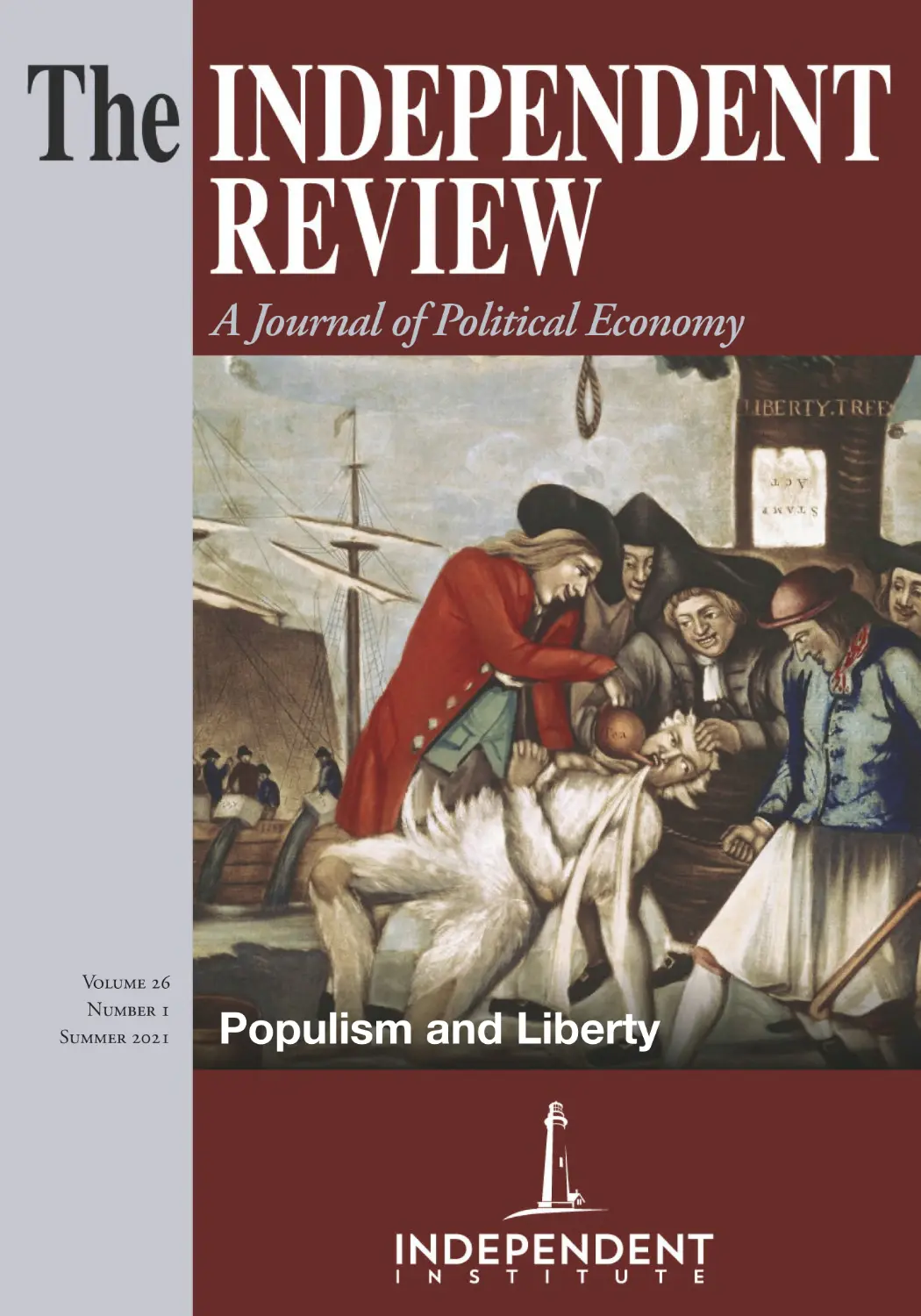
Populism and Liberty
Volume 26
Number 1
Summer 2021
Articles
Populism, Self-Government, and Liberty
Michael C. Munger
5
The Impossibility of Populism
Pierre Lemieux
15
Populism: Promises and Problems
Randall G. Holcombe
27
American Populism in the Early Twenty-First
Century: Constitutional Resistance to the
New Class
Bruce P. Frohnen
39
Putting Populism in Its Place
John J. Thrasher
53
The Constituent Power as a Remedy for the
Administrative State
William J. Watkins Jr.
65
Republics Large and Small
Richard P. Adelstein
75
Moral Consensus and Antiestablishment Politics
Johan Wennström
87
American Institutional Exceptionalism and the
Trump Presidency
Jennifer Brick Murtazashvili,
Ilia Murtazashvili, and
Tymofiy Mylovanov
97
FRONT COVER:
Populism and Liberty
Book Reviews
The Prospects of Populism
Jeffrey M. Carroll
115
Walter E. Williams: Scholar, Teacher, and Public
Intellectual
Abigail R. Hall
125
The Cause of the Great Depression: The Decision to
Resume the Gold Standard on Prewar Terms
Sandeep Mazumder
and John H. Wood
133
The Narrow Corridor: States, Societies, and the Fate
of Liberty
By Daren Acemoglu and James A. Robinson
Claudia R. Williamson
153
Outsourcing Empire: How Company-States Made the
Modern World
By Andrew Phillips and J. C. Sharman
Julia R. Norgaard
15
Cover Image: “The Bostonians Paying the Excise-Man, or Tarring and Feathering,”
Philip Dawe (attributed): Wikimedia Commons
Copyright © 2021, Independent Institute. All rights reserved. The Independent Review (ISSN 1086-1653) is
published quarterly (March, June, September, and December) by Independent Institute, 100 Swan Way, Oakland,
California 94621-1428. Phone: 510-632-1366. Fax: 510-568-6040. Website: www.independent.org. Application to
mail at Second-class postage rates is pending at Oakland, CA, and at additional mailing offices. Republication of articles
and reviews may not be made without written permission of the publisher. Single copy rates: individuals $11.95 ($15.00
Canada), institutions $25.00 ($28.00 Canada). For our updated privacy policy, please see: independent.org/
privacypolicy/. Correspondence regarding subscriptions, procuring back issues, editorial, advertising, and changes of address should be sent to the above address or e-mailed to: review@independent.org. Information for authors wishing to submit
articles is on p. 4 of this issue. The views expressed by authors of the articles are their own and are not attributable to the editors,
advisors, or Independent Institute.
Publisher
Founding Editor
Co-Editors
Managing Editor
Publications Counsel
Publications Manager
Assistant Editors
Copy Editor
Online Manager
Associate Editors
Contributing Editors
Board of Advisors
David J. Theroux, Independent Institute
Robert Higgs
Christopher J. Coyne, George Mason University
Michael C. Munger, Duke University
Robert M. Whaples, Wake Forest University
Robert M. Whaples, Wake Forest University
Christopher B. Briggs, Independent Institute
George L. Tibbitts, Independent Institute
Carl P. Close, Independent Institute
Ivan Eland, Independent Institute
Williamson M. Evers, Independent Institute
Lawrence J. McQuillan, Independent Institute
Graham H. Walker, Independent Institute
Annie M. Barva
Paul J. Theroux, Independent Institute
Jonathan J. Bean, Southern Illinois University
Donald J. Boudreaux, George Mason University
Price V. Fishback, University of Arizona
Roger W. Garrison, Auburn University
Peter G. Klein, Baylor University
James R. Otteson, University of Notre Dame
Andrew R. Rutten, Stanford University
Charles Taliaferro, St. Olaf College
T. Hunt Tooley, Austin College
Lee J. Alston, Indiana University
Herman Belz, University of Maryland
Bruce L. Benson, Florida State University
James W. Ely Jr., Vanderbilt University
Steve H. Hanke, Johns Hopkins University
Randall G. Holcombe, Florida State University
Timur Kuran, Duke University
Richard Langlois, University of Connecticut
Gary D. Libecap, University of California, Santa Barbara
Loren E. Lomasky, University of Virginia
Gene Smiley, Marquette University
Charlotte M. Twight, Boise State University
Richard K. Vedder, Ohio University
Barton J. Bernstein, Stanford University
Peter J. Boettke, George Mason University
Angelo M. Codevilla, Boston University
Robert W. Crandall, Brookings Institution
Stanley Engerman, University of Rochester
Richard A. Epstein, New York University
Lloyd C. Gardner, Rutgers University
Victor Davis Hanson, Hoover Institution
Deepak K. Lal, University of California, Los Angeles
Deirdre N. McCloskey, University of Illinois, Chicago
Geoffrey P. Miller, New York University
June E. O’Neill, Baruch College, The City University of New York
Karl-Dieter Opp, University of Leipzig
Nicholas Rescher, University of Pittsburgh
Daniel N. Robinson, Georgetown University and Oxford University
Pascal Salin, University of Paris
William F. Shughart II, Utah State University
John B. Taylor, Stanford University
Vernon L. Smith, Chapman University
Ulrich Witt, Max Planck Institute
Bruce Yandle, Clemson University
3
Submission Guidelines for Authors
Manuscripts of articles for The Independent Review should not exceed 10,000
words and should be submitted directly to the editor as an attachment, preferably a Microsoft Word file, to an email message. The author’s name, address,
and phone number should appear on the title page only. Include an abstract
of about 150 words. Accepted manuscripts must conform to The Independent
Review’s style requirements, which are guided by The Chicago Manual of Style
(17th Edition) and Merriam-Webster’s Collegiate Dictionary (11th Edition).
Citations should be in the author-date format, with full bibliographic information in a reference list and substantive notes prepared as numbered footnotes. Quotations of more than 100 words should be indented from the left
and preceded and followed by an extra line of space.
Submit submissions online at: independent.org/tirsubmissions
Other Correspondence
Correspondence regarding subscriptions, purchasing back issues,
changes of address, advertising, and marketing matters should be directed to:
The Independent Review
100 Swan Way, Oakland, CA 94621-1428 U.S.A.
Telephone 510-632-1366, Fax 510-568-6040
E-mail: review@independent.org
J M CAPPELLO ASSOCIATES
Newsstand Marketing Consultant
610-525-6236
4
Populism,
Self-Government,
and Liberty
F
MICHAEL C. MUNGER
P
opulist and neoliberal are epithets: anyone who uses one of these terms as a
description doesn’t belong to the group being described. The more extreme
stand-ins—socialist for the Left and fascist for the Right—are hyperbolic and
hackneyed, so populist and neoliberal have become go-to descriptors for ideological
smears. On the one hand, progressives have taken increasing umbrage at being called
populist, with demands for the term to be excised from the media lexicon: “The word
‘populist’ has no widely agreed-upon definition, but plenty of negative associations. . . .
[B]ig media needs [sic] to stop using the word ‘populist’ to describe Democrats’
economic programs and their appeals to voters” (Starkman 2008).
On the other hand, some people on the right cop to being “populists”;1 clearly,
the word’s meaning is in contest (Mudde 2004; Mudde and Rovira Kaltwasser 2017;
Norris and Inglehart 2019). As Cas Mudde put it more than fifteen years ago in a
prediction that can only be called prescient, “[Because of] structural changes, and the
consequent move away from legal authority and toward charismatic authority, as well
as the demystification of politics in Western liberal democracies, populism will be a
more regular feature of future democratic politics, erupting whenever significant
sections of ‘the silent majority’ feels that ‘the elite’ no longer represents them”
(2004, 563).
Michael C. Munger is professor of political science, economics, and public policy at Duke University and
co-editor of the Independent Review.
1. “Populism precisely is taking into account the people’s opinion. Have people the right, in a democracy, to
hold an opinion? If that is the case, then yes, I am a populist” (Jean-Marie Le Pen, quoted in Stanley 2008, 97).
The Independent Review, v. 26, n. 1, Summer 2021, ISSN 1086–1653, Copyright © 2021, pp. 5–13.
5
6
F
MICHAEL C. MUNGER
This issue of The Independent Review includes nine essays written in response to a
call for papers on “populism, self-government, and liberty (economic and civil).”2 In
selecting among the many submissions, we have tried to give a fair, conceptually
grounded account of the history and current status of populism. Much of our focus is on
the United States, but we have provided some accounts of populism more broadly.
These nine articles give a snapshot of populism that crosses standard political boundaries
and tries to make some forecasts about the future.
Some preliminaries are in order. First, as far as I can tell, democracy means “a
government that does what I want, which is the right thing to do.” That’s not really very
helpful; although such democracy is nearly unanimously popular, it is also meaningless:
anyone who opposes me is thwarting democracy. This is precisely the definition that
some of my academic colleagues appear to have in mind (as noted in Munger 2017): any
restriction on informed majority action is tyranny. Of course, the qualification “informed” is important in that definition because actual empirical majorities might favor
restrictions on individual rights such as abortion access or same-sex marriage. These
majorities are apparently not to be taken seriously, however, because they disagree with
the informed opinions of elites who know what majorities should want.3
The origin of the notion of democracy, or rule by the many, as self-evidently good
is recent, to say the least. The more standard view of democracy for many centuries was
something closer to “mob rule,” as Plato makes clear in book VIII of the Republic:
When a democracy which is thirsting for freedom has evil cupbearers presiding over the feast, and has drunk too deeply of the strong wine of freedom,
then, unless her rulers are very amenable and give a plentiful draught, she calls
them to account and punishes them, and says that they are cursed oligarchs.
[But] loyal citizens are insultingly termed by her slaves who hug their chains
and men of naught; she would have subjects who are like rulers, and rulers who
are like subjects. . . . Now, in such a State, can liberty have any limit? (Plato 1908)
The point of liberty in a society of free and responsible citizens is to reward the responsible
component of citizenship. As Montesquieu argues in The Spirit of the Laws (1748), “It is true
that, in democracies, the people seem to act as they please; but political liberty does not consist
in an unlimited freedom. In governments, that is, in societies directed by laws, liberty can
consist only in the power of doing what we ought to will, and in not being constrained to do
what we ought not to will” (1989, 150). This view is reflected in the work of David Hume,
2. See the call for submissions at www.independent.org/publications/tir/independent_excellence_
prize.asp.
3. As Genevieve Lakier (2021) notes, conservatives have recently joined the chorus of calls for regulation of
private-speech platforms. In 2020, Twitter, Facebook, and other social media apps restricted content based
on what the platform operators considered to be false statements. As a result, a number of conservatives
claimed the election was "stolen," and not just because the results were tampered with. The claim was that
the supposed majorities were not informed, because of the bias of Silicon Valley elites in decided what speech
to allow on social media.
THE INDEPENDENT
EVIEW
POPULISM, SELF-GOVERNMENT, AND LIBERTY
F
7
Adam Smith, Edmund Burke, and Friedrich Hayek: the will of the people is the law, which
emerges over time as the set of shared principles of propriety and right action that make
behavior self-governing. The law can be instantiated, at least in a just and prudent system of
government, by legislation that writes down what is already recognized as being the law.
Liberty is then the full power of doing what “we ought to will”; laws that prevent right action
or compel wrong action are unjust.
The point is that there is very little reason to expect the evanescent impulses of
majorities to correspond to the law. The law is certainly not legislation that robotically
encodes the “will of the people,” measured by an election or a vote of the legislature or
taken without reference to the principles of the law or the principles of propriety that
have been culturally vetted and tested over decades.
Populism, at least in the negative sense in which that term is understood by many
(including those on the left who object to the label), is legislation that is based on the
unmediated majority of the moment. Republican institutions, which interpose a deliberative legislature, an executive, and a judiciary between majorities and state action, are
inherently (and often, to populists, frustratingly) antimajoritarian institutions. This is even
more true for a bill of rights, an explicit list of limitations on the domain of state action.
The frustration being expressed depends of course on the momentary majority being
thwarted. Populist movements can form around ideologies of the left or of the right or around
no coherent ideology at all. As H. L. Mencken joked in Notes on Democracy ([1927] 1982),
“[In the electorate,] one hears, lies a deep, illimitable reservoir of righteousness and wisdom,
fles statesmen is to be solved by the people,
instantly and by a sort of seraphic intuition. . . . The cure for the evils of democracy is more
democracy. This notion originated in the poetic fancy of gentlemen on the upper levels—
sentimentalists who, observing to their distress that the ass was over-laden, proposed to reform
transport by putting him into the cart” (154). What is populism, exactly? Is “American
populism” distinctive, or is the core of populism shared across time and space by multiple
political movements? And is populism a threat to the American republican experiment, or is
some form of authentic populism the animating spark that will keep our system vital and alive?
These and other questions are what motivated the authors of our nine essays.
The Essays
We lead off with a piece by Pierre Lemieux, which we have selected as the winner of our
third Independent Excellence Prize. Lemieux notes quite rightly that there is a logical
contradiction at the heart of populism. This contradiction, as has been pointed out in
much of the public-choice movement (Buchanan 1954; Riker 1982) is ontological, not
(just) epistemological. That is, the problem of populism is not do what the people
command, if you can figure out what that is! That would be a hard problem because
information, complex voting procedures, and problems with turnout and participation
are daunting. Lemieux’s point is that “the people” does not exist as an independent
individual-like or superindividual entity, so that “the will of the people” is not just hard
VOLUME 26, NUMBER 1, SUMMER 2021
8
F
MICHAEL C. MUNGER
to discover but also cannot be assumed to exist. The problem of Condorcet’s Paradox,
generalized by Kenneth Arrow’s “impossibility theorem” (for background, see Munger
and Munger 2015, chap. 7), is that there is no single will that can be arrived at by
aggregating the preferences of citizens.
It is possible to vote, and an alternative may in fact receive a majority of votes in that
context, but many other majorities are context and strategy dependent. To paraphrase
Kenneth Shepsle (1992), the people is a “they,” not an “it.” It is possible, of course, to
conceive of the project of self-governance of a populace if “the people” are reconceptualized as
equal members of a set of separate individuals, each of whom governs herself or himself. But
that’s not populism; that’s classical liberalism. Lemieux echoes and extends William Riker’s
(1982) conclusion that the means of purely majoritarian democracy, or populism, are simply
inconsistent with its ends. Populists want rule by the people, but majoritarianism without
constraining institutions always leads to a Napoleon or to chaos.
Randall Holcombe extends the idea that populist means are inconsistent with the
supposed ends of populism. He notes that the shared component of populist movements,
left or right, is the claim that government should be accountable to the masses rather than
controlled by elites and that in fact policies should be explicitly designed to benefit the
masses. Holcombe’s argument is institutional rather than normative or based on social
choice problems. The institutions of government, because of the problems of collective
action, rational ignorance, and abstention of voters, have a strong tendency toward elite
dominance. Paradoxically, then, institutions of markets, which many think are “designed”
to benefit capital and the powerful, are actually better suited for serving the masses than
are political systems. Most individuals and, for that matter, many groups of individuals
have no meaningful political power and no reason to learn much about policies. But then,
Holcombe asks, why would a system based on power protect the weak?
Bruce Frohnen (perhaps unsurprisingly for those of us who have admired his work
presenting and interpreting the documents of the American founding) focuses on the
structure of American government and the nature of constitutional protections of rule
by the people. He argues that populism is the normative defense of rule by and for the
common people. The problem is balancing the “by” and the “for”; American constitutionalism was forged in response to the problem of preserving ordered liberty in a
democratic society. Frohnen argues that this great American republican experiment
succeeded until (relatively) recently. Importantly, a populist, self-governing spirit was
essential to maintaining this constitutional system of ordered liberty precisely because it
lent itself to forbearance by those in power. Laws and rules alone cannot permanently
protect deference to states in a federal system or separation of power in a national
system. Citizens have to believe in that system and to deny attempts to concentrate
power, even (perhaps especially) when the elites proposing concentration promise to
use the power for good. Functional populism thus requires an independent citizenry
steeped in faith, family, and local freedom. The corruption of these values by a
managerial elite, in Frohnen’s view, has destroyed much of the sturdy independence
defining Americans’ relation to their government. As a result, the newly empowered
THE INDEPENDENT
EVIEW
POPULISM, SELF-GOVERNMENT, AND LIBERTY
F
9
populist movements, on the left and the right, have come unmoored from the cultural
assets that made American populism a force for good. The question is whether
American constitutionalism itself can survive in the new, more hostile environment.
The paper contributed by the philosopher John Thrasher focuses on meanings and
relations among three distinct but interrelated notions or forms of populism. The first is
a theoretical claim, which holds that the only legitimate political order is one that
directly represents the will of the people through legislation and political leadership. The
second goes further, animating the “will of the people” to weaken political elites and
insiders in the inherent belief that such power is always inimical to the public good.
Finally, the third form of populism de-emphasizes (but does not ignore) politics in favor
of concerns for culture. Populism in the cultural realm privileges accessibility and mass
appeal over sophistication and refinement to the extent that it may appear to be antiintellectual and to exalt the naive or primitive origin myths. In Thrasher’s view, the third is
the most benign form of populism and is particularly characteristic of many American
cultural forms. But all three forms of populism can be excessively deployed and represent a
danger to liberty, a threat to undermine democracy, and (as Alexis de Tocqueville [2002]
noted in 1835) a threat that operates through pressures of social conformity.
William Watkins extends Riker’s (1982) examination of populism as the modern
version of Rousseau’s “general will” and reprises the argument for why elections should
be thought of as a means of controlling bad officials, not for discovering transcendent
truths. Watkins questions, however, whether even Riker’s tepid endorsement of voting
is justified. The unforeseen difficulty of the rise of the managerial class, embedded in an
administrative state, expands the degree of subjugation of the populace. So although
“populism” may indeed be a problem in its “general will” form, recourse against the
concentrated power of the administrative state may in fact prove of value to the public.
Watkins would argue that the rise of the administrative state and the principles of
popular sovereignty suggest the desirability of a new “constitutional populism”
whereby the people have an opportunity to truly check tyranny.
Or perhaps this type of populism is not all that new: a version of this capacity for
popular nullification was interwoven throughout the first seventy-five years, at least, of
the life of the American republic. Although not endorsing the motives of John C.
Calhoun (who in my view was seeking to protect slavery), Watkins argues that Calhoun’s (1992) argument anticipated the danger of the population losing control of the
state apparatus. According to Watkins, Calhoun saw that the basis for the doctrine of
nullification was the locus of sovereignty, meaning that citizens of the states had veto
power over actions by the federal government, in effect limiting the power of the center.
In short, then, with the rise of a permanent administrative apparatus, there is no longer
any mechanism by which voting or popular elections can effectively remove a government that citizens despise. Watkins proposes nullification as a work-around, one that
he sees as in keeping with the logic of American federalism but not with its current
practice.
VOLUME 26, NUMBER 1, SUMMER 2021
10
F
MICHAEL C. MUNGER
Richard Adelstein defines populism as political movements animated by a hostile
alienation of “the people” from the institutions of government because members of the
populist movement have come to see state institutions as being run by a corrupt and selfperpetuating elite. He distinguishes two varieties: (1) reform populism, in which
populists are brought emotionally and politically into the governing institutions; and (2)
revolutionary populism, in which the populists separate to form a new government or
try to use revolutionary tactics to bring down the existing institutions in hopes of
replacing them with more responsive organs. In his view, one of the key problems of
American government through the eras of expansion and the Civil War, through
Reconstruction, the Progressive Era, and beyond, has been the eternal struggle to
channel populist energy—the wellspring of which is inexhaustible!—into reform directions rather than into revolution. Adelstein then takes an interesting turn and
reexamines the positions of the Federalists and Antifederalists in the confrontation over
large versus small republics in the constitutional debates of 1787. He concludes by
examining in particular Thomas Jefferson’s notion of the need to foster developmental
liberty in decentralized institutions in light of this debate.
Johan Wennström brings in a broader perspective, considering some of the origins
of populism that remind the reader about the origins and evolution of liberalism (in the
European sense of broad classical liberalism). He claims that the convergence and near
consensus of the “mainstream” left and right parties around the core notions of
liberalism—the moral foundations of care, fairness, and liberty—are actually the most
likely explanations of populist discontent. He explains this paradox by noting that the
expectation of consensus on these norms has caused establishment politicians and
parties to lose touch with moral pluralism and with the conservative moral intuitions
intimately bound up with religion and tradition. This is a paradox because a metapremise of liberalism was the acceptance of difference in moral intuitions in the populace
of citizens. The particular “case” Wennström focuses on is what he sees as the moral
consensus, including a near-total convergence, of two Swedish establishment parties on
immigration and education policy: the left-wing Social Democrat Party and the rightwing Moderate Party. Wennström argues that in order to win back wide public support
and to forestall the rapid growth of “extremist” parties, disagreement and discussion
focusing on education and immigration will have to be given social and cultural license
rather than being closed off by social pressure and political practice.
Jennifer Brick Murtazashvili, Ilia Murtazashvili, and Tymofiy Mylovanov consider
populism through the lens of Trumpism between 2016 and 2021. Both Donald
Trump’s election in 2016 and his failure to win reelection in 2020 roiled the already
troubled waters of American politics. But things might not be as bad as they seem,
according to these authors, and the concerns that we stand on the brink of civil war,
fascist revolt, and the destruction of democratic institutions are at worst premature.
These authors argue that American institutions are exceptionally robust precisely
because both separation of powers in law and federalism in election administration make
it so difficult to consolidate power. Trump’s illiberalism might be business as usual in an
THE INDEPENDENT
EVIEW
P O P U L I S M , S E L F -G O V E R N M E N T , A N D L I B E R T Y
F
11
actual majoritarian democracy, but the United States is a complex constitutional republic, and so much of the force for populist revolution is diffused and ultimately
defused. Murtazashvili, Murtazashvili, and Mylovanov point to three thinkers—James
Buchanan, William Riker, and W. H. Hutt—as having outlined the function and
importance of such institutional constraints on majoritarianism. They claim that Trump
actually did little to expand the institutional authority of the presidency and made a
number of rhetorical claims that ultimately didn’t amount to much. They then list the
institutional constraints, relying in part on the outline adumbrated by Vincent Ostrom,
that ultimately functioned well in limiting the adoption and implementation of illiberal
policies. These authors offer not so much a criticism of Trump as an illustration of the
values of effective controls on majoritarian or executive excess. They claim that the
central lesson of Trump’s tenure as president has been the control of momentary
majorities in a way that the American Founders intended even if they could not directly
foresee the circumstances in which the rules would be put to the test.
The final paper in our symposium is contributed by Jeffrey Carroll. He begins with
the oddity that the term populism is pejorative yet is broad enough that it is used to
denigrate both Donald Trump and Bernie Sanders, two candidates for president in
2020 who shared very little in terms of policy goals. But, of course, the notion that
populism can be dangerous is much older; Riker’s (1982) juxtaposition of populism and
liberalism simply resurrects a contention that dates to at least the Federalist versus
Antifederalist debates of the eighteenth century, which have in some ways been with us
ever since. As Carroll notes, Riker is clear that he thinks populism is the enemy, but it is
useful to work some more to identify just who this enemy is. Carroll offers a more careful
conceptual analysis of populism, using the results to assess Riker’s argument that
liberalism and populism must be opposite ends of a continuum. Carroll is not so sure; he
offers an alternative way of thinking of the problem based on consent and contractarianism. Specifically, suppose that populist institutions were in fact based on the
contractarian consensus, requiring full unanimity. Carroll admits that this usage of full
consensus is not the way “populism” is usually understood, but it is an interesting way of
reconciling two alternatives, liberalism and populism, that have often been categorized
as mutually exclusive and antagonistic.
For my own part, I found reading and assessing the papers contributed to this
symposium to be intellectually stimulating and a reminder that many questions seem
simple but are by no means easy to answer. Populism is an aspect of democratic
governance whose importance waxes and wanes, something that most of us recognize
needs to be controlled and channeled, but also something that cannot be eliminated
without far greater harms being imposed on the political system. This dualism, an ability
to rise to great challenges and yet fail dismally in everyday management, has always been
characteristic of democracy.
I suppose it is of some solace to remember that it has ever been thus. Writing
around 140 B.C., the Greek historian Polybius had these observations about politics:
VOLUME 26, NUMBER 1, SUMMER 2021
12
F
MICHAEL C. MUNGER
The Athenian [democracy] is always in the position of a ship without a
commander. In such a ship, if fear of the enemy, or the occurrence of a storm
induce the crew to be of one mind and to obey the helmsman, everything
goes well; but if they recover from this fear, and begin to treat their officers
with contempt, and to quarrel with each other because they are no longer all
of one mind,—one party wishing to continue the voyage, and the other
urging the steersman to bring the ship to anchor; some letting out the sheets,
and others hauling them in, and ordering the sails to be furled,—their discord
and quarrels make a sorry show to lookers on; and the position of affairs is full
of risk to those on board engaged on the same voyage; and the result has
often been that, after escaping the dangers of the widest seas, and the most
violent storms, they wreck their ship in harbour and close to shore. (1889,
book VI, chap. 44)
The democracies of the world have indeed over the past 150 years often worked together and escaped the dangers of the wildest seas. But it has been hard to watch as we
often wreck our own ships of state on populist shoals, in harbor and close to shore. I
hope you find this symposium of use in thinking about some reasons why this may be
true.
References
Buchanan, James M. 1954. Social Choice, Democracy, and Free Markets. Journal of Political
Economy 62, no. 2: 114–23.
Buffalo Springfield. 1967. For What It’s Worth. On Buffalo Springfield. Atco Records.
Calhoun, John C. 1992. The Political Philosophy of John C. Calhoun. Edited by Ross M. Lence.
Indianapolis, Ind.: Liberty Fund.
Lakier, Genevieve. 2021. The Great Free-Speech Reversal. Atlantic, January 27. At https://
www.theatlantic.com/ideas/archive/2021/01/first-amendment-regulation/617827/.
Mencken, H. L. [1927] 1982. Notes on Democracy. Reprinted in A Mencken Chrestomathy,
154–68. New York: Vintage Books.
Montesquieu, Charles de Secondat, Baron de. 1989. The Spirit of the Laws. Translated by Anne
M. Cohler, Basia Carolyn Miller, and Harold Samuel Stone. Cambridge, U.K.: Cambridge
University Press. Originally published in French in 1748.
Mudde, Cas. 2004. The Populist Zeitgeist. Government and Opposition 39, no. 4: 541–63.
Mudde, Cas, and Cristóbal Rovira Kaltwasser. 2017. Populism: A Very Short Introduction.
Oxford: Oxford University Press.
Munger, Michael C. 2017. On the Origins and Goals of Public Choice: Constitutional Conspiracy? The Independent Review 22, no. 3 (Winter): 359–82.
Munger, Michael C., and Kevin M. Munger. 2015. Choosing in Groups: Analytical Politics
Revisited. New York: Cambridge University Press.
THE INDEPENDENT
EVIEW
P O P U L I S M , S E L F -G O V E R N M E N T , A N D L I B E R T Y
F
13
Norris, Pippa, and Ronald Inglehart. 2019. Cultural Backlash: Trump, Brexit, and Authoritarian
Populism. New York: Cambridge University Press.
Plato. 1908. The Republic. Translated by Benjamin Jowett. Internet Classics Archive. At http://
classics.mit.edu/Plato/republic.html.
Polybius. 1889. Histories. Translated by Evelyn S. Shuckburgh. New York: MacMillan.
Riker, William H. 1982. Liberalism against Populism: A Confrontation between the Theory of
Democracy and the Theory of Social Choice. San Francisco: Freeman.
Shepsle, Kenneth A. 1992. Congress Is a “They,” Not an “It”: Legislative Intent as Oxymoron.
International Review of Law and Economics 239, no. 12: 240–48.
Starkman, Dean. 2008. Popular? Must Be “Populist”: Why Does the Press Use “Populist” to
Refer to Policies That Are Simply Liberal? Columbia Journalism Review, February 20. At
https://archives.cjr.org/the_audit/democrats_for_free_silver.php.
Stanley, Ben. 2008. The Thin Ideology of Populism. Journal of Political Ideologies 13, no. 1:
95–110.
Tocqueville, Alexis de. 2002. Democracy in America. Translated by Harvey C. Mansfield and
Delba Winthrop. Chicago: University of Chicago Press. Originally published in French in
1835.
VOLUME 26, NUMBER 1, SUMMER 2021
The Impossibility
of Populism
F
PIERRE LEMIEUX
P
opulism can be defined and is generally viewed as a regime where the people
rule. What distinguishes populism from democracy is a matter of degree: under
populism, the people rule more effectively, with fewer blockages from
representative assemblies, judges, experts, and elite. The purpose of this paper is to
examine if such a regime is feasible.
I will try to keep as far from ethics and as close to economics as possible, although
any policy proposal with distributive implications (which favors some individuals at the
detriment of others) ultimately relies on value judgments—that is, on moral values
(Lemieux 2006). When I do touch on value judgments (mainly when envisioning
libertarian populism at the end of the paper), I try to rely on a minimal “live and let live”
ethics in order not to strain my reader’s moral credulity, as Anthony de Jasay suggests
(1997, 152).
The People and Its Will
The immediate problem in the definition of populism is, What is “the people”? Just like
“society,” “the people” certainly does not exist as a biological organism. Contrary to
cells and organs, individuals in society don’t occupy fixed places or fill predetermined
functions. An individual has personal preferences and goals and acts accordingly. (I take
preferences as including both tastes and values, values being simply preferences
Pierre Lemieux is an economist in the Department of Management Sciences of the Université du Québec
en Outaouais. He blogs at Econlog. PL@pierrelemieux.com.
The Independent Review, v. 26, n. 1, Summer 2021, ISSN 1086–1653, Copyright © 2021, pp. 15–25.
15
16
F
PIERRE LEMIEUX
regarding the state of the social world.) One cannot apprehend society or “the people”
as a whole in the same way one can see or touch a biological organism—say, a porcupine. To conceive “the people” in this way is to fall victim of an organicist or anthropomorphic illusion (Hayek 1973, 52–53). The people does not exist except as a
group of individuals who in a certain geographical location share some common
preferences, which are fewer and more abstract the larger the number of individuals.
Individual diversity is an unavoidable feature of any human society, the more so in a
society past a primitive stage—that is, in an open society (Popper 1966, 173–74).
If “the people” is not some kind of superindividual, then it cannot have an intelligence or a will of its own. “The will of the people” or “the general will,” as imagined
by Jean-Jacques Rousseau or (most of) his disciples, does not exist (Rousseau [1913]
1923, [1762] 1966; Hayek [1952] 1979a, 99–103, 145). How, then, could the people
rule? It would seem that governing or ruling necessarily means that a section of the
people rules the rest.
One may object that the organicist vision or the personification of society is just an
analogy. But it is a misleading analogy that can have dangerous consequences. The
analogy enters history in 493 B.C. when the Roman consul Menenius Agrippa stopped
a Plebeian revolt by telling the fable of the belly and the members of the body. Once
upon a time, he told the rebel Plebeians, the members of the body revolted against the
belly for being forced to provide it with food enjoyment. They stopped feeding it, only
to realize that they were thereby weakening themselves to the utmost. Hence, the
Plebeians should not revolt against the ruling Patricians (Livius 1919, book 2, chap.
32). Karl Popper reports that the Austrian scholar, writer, and inventor Josef PopperLynkeus (who was Popper’s uncle) thought that the Plebeians should have replied:
“Right, Agrippa! If there must be a belly, then we, the plebs, want to be the belly from
now on” (1966, 294).
Since then, the organicist conception or intuition of society or “the people” has
been regularly used to justify the domination of one social group over another. Charles
Beudant, a nineteenth-century professor of law, wrote that the organicist figure of
speech was now “taken literally and becoming a reality,” notably in Germany at the end
of the century. He explained that Johan Kaspar Bluntschli, a Swiss German jurist, saw
the state as “an organic person . . . a human person,” “the organized person of the
nation.” Bluntschli even thought that this social organism was male and had come of
age in 1740 (Beudant [1891] 1920, 206–7). For Adolf Hitler a few decades later, the
state was a folkish or national organism. Vienna was the brain and will of the organism.
The “body of the people” was affected by diseases that included the Jews, the Marxists,
and the press (Rash 2005).
In America during the first half of the twentieth century, the organicist metaphor
was used to justify eugenics, including forced sterilization. The “degenerates” were “an
insidious disease affecting the body politic,” “the wild cells of a malignant growth”
(O’Brien 1999, 194, 191). For the good of the social organism, the defectives should
not be prevented from dying: a well-known eugenicist, Leon J. Cole, declared in 1914
THE INDEPENDENT
EVIEW
THE IMPOSSIBILITY OF POPULISM
F
17
that “[d]eath is the normal process of elimination in the social organism. . . . [I]n
prolonging the lives of defectives we are tampering with the function of the social
kidneys” (qtd. in Lombardo 2019, 3–4). A cell must not endanger the whole organism.
The People’s Choices
The formalization of how “the people” makes choices confirms that it is not a rational
superindividual. A first step of this formalization lies in the “paradox of voting,” known
since the Marquis de Condorcet in the eighteenth century, rediscovered by the
mathematician Charles Dodgson (a.k.a. Lewis Carroll) in the nineteenth century, and
then found again by the economist Duncan Black in the mid–twentieth century (Arrow
1963, 92–96; Lemieux 2020–21). The gist of the paradox is that as “the people” tries to
govern through elections or referenda, incoherent results often follow. Even if each and
every individual is rational, the people can be irrational.
Consider three voters, V1, V2, and V3, and three alternatives presented to them: X,
Y, and Z. Table 1 gives the preferences of each voter. V1 prefers X to Y and Y to Z, which
we can summarize by the expression “X Y Z”. V2 and V3 have different preferences, but,
by hypothesis, every individual’s preferences are transitive. V1, who prefers X to Y and Y
to Z, naturally prefers X to Z. V2, who prefers Y to Z and Z to X, prefers Y to X. And V3,
who prefers Z to X and X to Y, prefers Z to Y. We define rationality as transitivity or
coherence in that sense.
Table 1
The Paradox of Voting
V1
XYZ
V2
YZX
V3
ZXY
It can easily be checked that if the voters are asked to choose between X and Y, two
out of three, V1 and V3, will vote for X because it is higher in their respective preferences; the result of the vote (or, we may say, the “social choice”) is thus X. If our three
voters are asked instead (or later) to choose between Y and Z, the result of the vote
would be Y because V1 and V2 vote for Y; the social choice is Y. Now, if the same three
voters are asked to choose between Z and X, the majority, V2 and V3, will vote for Z; the
social choice is Z. Social choices thus indicate that for “society” or “the people” X is
preferred to Y, Y to Z, but Z to X. Despite all voters having transitive individual
preferences, the people’s preferences and thus its choices are not transitive or rational.
Such incoherence leaves an unstable cycle among alternatives: X preferred to Y, Y
preferred to Z, Z preferred to X, and so forth. A related phenomenon is that among X,
Y, and Z there is no “Condorcet winner”—that is, no alternative that would win against
all others if paired successively against each.
VOLUME 26, NUMBER 1, SUMMER 2021
18
F
PIERRE LEMIEUX
Playing with table 1 and trying different preferences for our three voters, we can
find some combinations that would generate no incoherence. But if we don’t limit the
diversity of preferences that voters can have, some configurations of preferences will at
times produce incoherent social choices. It can be shown that the more voters or the
more choices there are, the more likely the paradox of voting will materialize. With three
alternatives and eleven voters, for example, the probability of observing an incoherence
is about 80 percent (Riker [1982] 1988, 121–22).
Lessons of Social Choice Theory
Kenneth Arrow generalized these conclusions in his Impossibility Theorem (originally
called the General Possibility Theorem), a major result that in the mid–twentieth
century caused an earthquake in economics and political science and pioneered the field
of social choice theory. Arrow, who later won a Nobel Prize in economics for his work in
that area, proved that any social choice is either irrational or antidemocratic. This result
can be reformulated in terms of the “social choice function,” which is a rule or voting
mechanism for aggregating individuals’ preferences into a political choice: there is no
social choice function that is not either irrational or dictatorial.
The proof of the theorem uses symbolic logic (a field of mathematics) and cannot
be explained (at least simply) in a nonmathematical language, but its meaning can
perhaps be grasped as follows (Arrow 1963, 96–100). Note that we are dealing with
ordinal preferences—that is, with the mere ranks that each voter assigns to alternatives
in his preferences: no assumption is made regarding the intensity of these preferences,
and it is impossible to weigh them between different individuals.
Start with an axiom and a few conditions that define the sort of voting systems that
will fall under the theorem. These conditions are meant to ensure that the social choice
function is rational and based on individual values.
The axiom (call it Condition 0) is that of collective rationality: if society prefers
alternative X to Y and alternative Y to Z, it will also prefer X to Z. This axiom is
the minimal definition of “collective rationality” that we have met in the
paradox of voting.
Condition 1 (the Pareto condition): if all members of a society prefer X to Y,
the social choice function (the voting mechanism) will choose X.
Condition 2 (unrestricted domain, already encountered in the construction of
the paradox of voting): the preferences of individuals are not restricted.
Otherwise, of course, the analyst could get the social choice he wants by assuming the right individual preferences. For example, by restricting all voters to
“single-peaked preferences,” we can derive the median-voter theorem, which
avoids any social irrationality.
THE INDEPENDENT
EVIEW
THE IMPOSSIBILITY OF POPULISM
F
19
Condition 3 (independence of irrelevant alternatives): irrelevant alternatives
don’t affect the social choice. For example, if X is preferred to Y given the social
choice function, the disappearance of an alternative Z (for example, a candidate
dies before the election) that was not preferred to X or to Y will not bring the
voters to change the social choice from X to Y. This condition can be thought of
as another requirement of collective rationality.
Condition 4 (nondictatorship): between any two alternatives X and Y, it cannot
be that one of them—say, X—will necessarily be the social choice simply
because a certain individual (the dictator) prefers X to Y.
Arrow goes on to demonstrate that there exists no social choice function that
respects all five conditions. Assuming that conditions 1 (Pareto), 2 (unrestricted domain), and 3 (independence of irrelevant alternatives) are met, and thus focusing on
conditions 0 (collective rationality) and 4 (nondictatorship), the latter two cannot be
satisfied together: the social choice will be either dictatorial or irrational.
Arrow’s theorem is very general. No voting system can avoid the conundrum
between dictatorship and irrationality except if it does not respect conditions 1 to 3
(which are also necessary for the social choice to be rationally based on individual
values). Different electoral systems and voting gadgetry, including proportional representation, will produce different results but cannot fill all of Arrow’s conditions. The
underlying problem, it seems (although Arrow may not have recognized this), is that
any social choice function that imposes a choice on parts of the voters necessarily implies
imposing the preferences of some individuals on others.
To what extent a unanimous social contract can avoid this problem is a question
worth asking and one on which James Buchanan provides interesting analyses. Following Buchanan, two points are worth noting. First, the rational signatories of a social
contract can agree unanimously only on very general rules that serve their common
interests. Second, they would want to constrain the state to prevent it from becoming
Leviathan and exploiting them. As a consequence, they would not want electoral
majorities to change individual rights in the name of “the will of the people” (Brennan
and Buchanan 1985; Buchanan [1975] 2000; Lemieux 2018).
A free market can be viewed as a sort of voting system: “Each man can vote, as it
were, for the color of tie he wants and get it” (Friedman 1962, 15). Does the Arrow
Impossibility Theorem also apply to the market? Although Arrow may not have been
very clear or consistent on this point, the answer is quite obviously no because the very
purpose of a social choice function is to impose some individuals’ preferences on other
individuals. There would be no point voting in a referendum on “the national tie” or
“the people’s tie” if any consumer could then go and get whatever tie he wants—no
point, except if the purpose of the referendum were only symbolic or for tourism
marketing, as when a state bird or state flower is chosen. We may say, by analogy, that
the market is a voting system, but we must add that it is a sophisticated system that
VOLUME 26, NUMBER 1, SUMMER 2021
20
F
PIERRE LEMIEUX
allows each individual to be decisive on the goods and services he chooses to buy
according to his own preferences.
In Buchanan’s terms, “[T]he market does not call upon individuals to make a
decision collectively at all” (1954, 122, my emphasis). Market choices are not social
choices. Criticizing the relevance of Arrow’s theorem, Buchanan argues that the very
notion of social choice is anthropomorphic and meaningless. “Rationality or irrationality as an attribute of the social group,” he writes, “implies the imputation to that
group of an organic existence apart from that of its individual components” (1954,
116). He also argues that voting cycles between different majorities (presumably within
the constraints imposed by the Constitution) are preferable to a stable situation in which
the tyranny of the same majority always exploits the same minority (1954, 118–23).
This approach emphasizes the idea that there is no “will of the people” that is comparable to the will of an individual human being and that could make “the people” want
or do something.
Our results thus far suggest that populism, defined as a regime where the people
rule, is impossible. “The people” is not a social organism and does not have a mind that
can govern like an individual who has coherent preferences and takes actions to pursue
them. There is no voting method capable of producing a rational and democratic
choice. As William Riker says, “[W]hat the people want cannot be known. Hence the
populist goal is unattainable” ([1982] 1988, xviii). Populism is impossible because it is
not clear who “the people” is and what it wants.
The People Incarnate and Its Enemies
What is possible, though, is dictatorship. In the terms of Arrow’s theorem, a dictator can
impose his own political choices, whatever his subjects’ preferences. In populist practice,
if not in theory (populists generally come short on theory), the dictator or dictator-tobe incarnates the people. Jean-Marie Le Pen, the right-wing populist who ran the
National Front (now called National Rally) in France before his daughter, Marine, took
over, once declared: “I, and only I, incarnate democracy” (qtd. in de la Torre 2019,
140). The leftist populist Hugo Chávez said on the tenth anniversary of his election as
the president of Venezuela, “Ten years ago, Bolivar—embodied in the will of the
people—came back to life,” wherein the nineteenth-century South American liberator
Bolivar, Chávez, and the will of the people appear to be all the same (qtd. in de la Torre
2019, 75).
Carlos de la Torre (2019), an expert on South American populism, adds to the
definition of populism the idealization and glorification of the elected strongman (I
define “strongman” as a dictator or quasi-dictator). This new feature, however, can be
considered a simple corollary of the definition of populism as the rule of the people, for if
the rule of the people is impossible, then the real ruler must be an individual who
somehow incarnates the people. This leader can be elected or otherwise approved—in
THE INDEPENDENT
EVIEW
THE IMPOSSIBILITY OF POPULISM
F
21
demonstrations, plebiscites, or quiet-majority acquiescence. That the populist leader
believes, even more than his supporters do, that he incarnates the people would explain
why he does not like elections or believes he cannot lose them: “If I incarnate the
people,” he seems to think, “how can the will of the people reject me? There must be
some fraudulent conspiracy.”
We can expect people to be soon disappointed with their supposed will incarnate.
Government propaganda can delay that moment but not prevent it. The basic problem
is the same as in an unlimited democracy: individuals have different preferences, and
each time the ruling majority imposes a policy to implement the will of the people, some
individuals are harmed and unhappy (de Jasay [1985] 1998, chap. 5 and passim).
Discontent will deepen as economic freedom and thus prosperity weaken. Because
populism is an extreme form of democracy, such a regime will be especially affected by
discontent. The more the populist strongman does for some people, the more other
people are disgruntled and ask some form of compensatory intervention. Ultimately,
the populist strongman must restrict political competition. Hence, the populist regime
naturally drifts from an elected strongman to an autocrat ruling with rigged elections,
from the early Hugo Chávez to Nicolás Maduro.
It has been so often observed that populist regimes crave enemies and scapegoats
that this feature is sometimes included in the definition of populism. Foreigners are
convenient scapegoats, as can be observed in both late nineteenth-century populism in
America and in Donald Trump’s recent version. In the late nineteenth century,
American populists viewed Chinese immigrants as “moral and social lepers” and a “tide
of Mongols” (Postel 2007, 185). Just like today’s populists in America and the rest of
the world, these earlier populists opposed immigration and free international trade. We
could add this feature to the definition of populism, but it would risk diverting attention
from the fact that the perceived enemies also include internal ones within “the people”
itself.
To counter the people’s disenchantment, populist leaders blame internal enemies:
experts, elites, domestic minorities, even opposition parties, who are said to work
against “the common people” or “ordinary people.” The online Oxford/Lexico dictionary defines populism as “a political approach that strives to appeal to ordinary people
who feel that their concerns are disregarded by established elite groups.” In the
“populist playbook,” to use Carlos de la Torre’s expression, domestic enemies come to
include the opposition press and any group, such as judges, who represent an obstacle to
the implementation of the supposed will of the people. For example, Evo Morales, the
socialist populist who was recently president of Bolivia, identified the media as his
“number one enemy,” just as Donald Trump called the media the “enemy of the
American people” (both quoted in de la Torre 2019, 151, 164).
The trick of amputating the people in order to maintain the fiction of its organic
unity with a will of its own helps the populist leader pretend that he represents “the
people.” In reality, he represents only a faction in the people, a faction that diminishes as
discontent inevitably rises.
VOLUME 26, NUMBER 1, SUMMER 2021
22
F
PIERRE LEMIEUX
Other features of nineteenth-century American populism are relevant to a current
inquiry on populism. Nineteenth-century populism started with the agrarian movement
and the Farmers’ Alliance in the 1870s and 1880s and culminated with the People’s
Party (a.k.a. the Populist Party) in the 1890s. The nineteenth-century populists favored progress, modernity, knowledge, education, and expertise. They also favored
strong government intervention, notably in money, banking, and trade. They liked
state corporations and wanted the nationalization of the railroads. They participated
in the Napoléon infatuation that hit America at that time, viewing the early
nineteenth-century French dictator as an expert in government organization and
planning. Governor William McKinley of Ohio was known as “the Napoleon of
Protection”—that is, of protectionism. The populists were also racist: for example,
the Farmers’ Alliance accepted only white members, although it offered unusual
opportunities to (white) women (Postel 2007).
As populism can theoretically and historically be either on the right or on the left, it
is not altogether surprising that nineteenth-century American populism brought some
grist to the mill of two posterior ideological developments: progressivism and fascism.
Many of the populists’ interventionist demands were satisfied in the Progressive Era,
which followed the demise of the Populist Party in 1896: the federal income tax and the
Federal Reserve System are examples, among others, of a generally more interventionist
federal government. “In the early twentieth century,” Charles Postel writes, “former
Populist strongholds in Texas, Kansas, Oklahoma, California, and elsewhere, provided
fertile recruiting grounds for the new Socialist party” (2007, 286).
After the Progressive Era, fascism found many adherents in America. “In the social
matrix of the Depression, the New Deal, and the shadow of World War II,” argues
Victor Ferkiss, “various intellectual and popular leaders developed doctrines which were
the American equivalent of European fascism and national socialism. . . . The most
important single ingredient in this new creed was American Populism brought up to
date” (1957, 359–60, 361). U.S. senator Huey Long, a populist Democrat, said in
1935, “Down in Louisiana we have no dictatorship, but what I call a closer response to
the will of the people. . . . Everything we have done in Louisiana is merely to carry out
the will of the people” (qtd. in Ferkiss 1957, 364–65)
It is no surprise to meet the will of the people in a book published in 1936 by
Lawrence Dennis, The Coming American Fascism. The man who was described as
“America’s number one intellectual fascist” (Younge 2007) favored a “national plan” as
“an expression of the popular will” (Dennis 1936, title of chapter 13). Emphasizing the
importance of this national plan, he wrote: “Liberalism assumes that individual welfare
and protection is largely a matter of having active and powerful judicial restraints on
governmental interference with the individual; Fascism assumes that individual welfare
and protection is mainly secured by the strength, efficiency, and success of the State in
the realization of the national plan” (160). Many on the left could say the same.
If history repeats itself, we should not be surprised if the recent resurgence of
populism in America were followed by heightened socialism or fascism, which are not as
THE INDEPENDENT
EVIEW
THE IMPOSSIBILITY OF POPULISM
F
23
different as conventional wisdom would have us believe. Whereas libertarianism wants
liberty for individuals, populism, socialism, and fascism want power for “the people.”1
Feasible Populism?
Can we conceive of a sort of populism that would be both feasible and immune to
dictatorial temptations? On a theoretical level, yes. It would be a noncollectivist,
nonpolitical populism where the people (plural) rule in their individual capacities.
Randy Barnett, a law professor, argues that such was the original meaning of “we the
people” in the U.S. Constitution; it meant “We the People as individuals” (2006, 72,
63–81). In this perspective, each individual is sovereign and rules over himself—literally
“self-government”—the exceptions being some activities that can be realized only in
common, broadly what economists call “public goods.” Economic analysis suggests
that this individual sovereignty, this sort of populism, is possible in large swatches of
social life. Only laissez-faire in this sense can simultaneously allow the satisfaction of
ordinary people’s preferences and the recognition of specialized knowledge and
noncoercive experts. Neither ordinary people nor the cognoscenti should coercively
rule over others.
This populism is of course opposed to crony capitalism—government privileges to
corporations and organized interests (Zwolinski 2013). It also opposes the domination
of a class of rulers over the class of the ruled, if we want to speak in terms of socialpolitical classes (Hart 2020).
Taking “populism” in this sense, however, can be more confusing than useful
because the doctrine already has a name, perhaps two: (classical) liberalism or, in its
most radical forms, libertarianism. The concept of libertarian or liberal populism risks
blurring many features commonly associated with populism and ignoring many features
and values of liberalism and libertarianism. Not being based on “the people” or its
supposed will, liberalism and libertarianism do not sacralize the outcomes of voting and
see elections basically as just a means of peacefully changing the depositories of government power (Hayek 1979b, chap. 18; Riker [1982] 1988).
The moral values of liberalism may also be at risk in an association with populism.
Several years before the Trump experience, Matt Zwolinski (2013) suggested that
libertarian populism tends to be more populist than libertarian if only because it falls
easily into the nationalist ruts of traditional populism, while libertarianism is cosmopolitan. From a moral viewpoint, a libertarian would think the nation should not be
sovereign against the individual. John Hicks represented liberal values when he observed: “The Manchester Liberals believed in Free Trade not only on the ground of
Fairness among Englishmen, but also on the ground of Fairness between Englishmen
1. After this article was written, its argument received confirmation from the new U.S. president’s inaugural
speech of January 20, 2021. However moderate Joe Biden appeared, he invoked “the will of the people”
twice.
VOLUME 26, NUMBER 1, SUMMER 2021
24
F
PIERRE LEMIEUX
and foreigners. The State, so they held, ought not to discriminate among its own
citizens; also it ought not to discriminate between its own citizens and others” (1942,
112–13).
The “will of the (national) people” lurks behind populism, which not only is a
dangerous illusion, as this paper has argued, but also contradicts the core values of the
liberal and libertarian tradition. The experience of Trump populism, which attracted
some libertarians, has shown this opposition in action. We can also mention the liberal
value of truth, which disappears in populist worship.
If populism is de ned as a political regime where the people rule, I have tried to show
that such a system is impossible. Confronted with this reality, populism requires the illusion
of a ruler who incarnates the people but who, in reality, can rule only a part of the people
(plural) to the detriment of the rest. One could rede ne populism as a political regime
is political philosophy does not need a new
name, especially as populism of the right or of the left carries a heavy baggage.
References
Arrow, Kenneth J. 1963. Social Choice and Individual Values. 2nd ed. New Haven, Conn.: Yale
University Press.
Barnett, Randy E. 2016. Our Republican Constitution: Securing the Liberty and Sovereignty of the
People. New York: Broadside Books, HarperCollins.
Beudant, Charles. [1891] 1920. Le Droit individuel et l’état: Introduction à l’étude du droit. 3rd
ed. Paris: Librairie Arthur Rousseau.
Brennan, Geoffrey, and James M. Buchanan. 1985. The Reason of Rules: Constitutional Political
Economy. Cambridge: Cambridge University Press.
Buchanan, James M. 1954. Social Choice, Democracy, and Free Markets. Journal of Political
Economy 62, no. 2 (April): 114–23.
———. [1975] 2000. The Limits of Liberty: Between Anarchy and Leviathan. Indianapolis, Ind.:
Liberty Fund.
De Jasay, Anthony. 1997. Against Politics: On Government, Anarchy, and Order. London:
Routledge.
———. [1985] 1998. The State. Indianapolis, Ind.: Liberty Fund.
De la Torre, Carlos. 2019. Populism: A Quick Immersion. New York: Tibidabo.
Dennis, Lawrence. 1936. The Coming American Fascism. New York: Harper & Brothers.
Ferkiss, Victor C. 1957. Populist Influences on American Fascism. Western Political Quarterly 10,
no. 2 (June): 350–73.
Friedman, Milton. 1962. Capitalism and Freedom. Chicago: University of Chicago Press.
Hart, David M. 2020. Libertarian Class Analysis: An Historical Survey. September. At http://
www.davidmhart.com/liberty/ClassAnalysis/HistoricalSurvey/Sept2020draft.html.
THE INDEPENDENT
EVIEW
THE IMPOSSIBILITY OF POPULISM
F
25
Hayek, F. A. 1973. Rules and Order. Vol. 1 of Law, Legislation, and Liberty: A New Statement
of the Liberal Principles of Justice and Political Economy. Chicago: University of Chicago
Press.
———. [1952] 1979a. The Counter-Revolution of Science: Studies on the Abuse of Reason.
Indianapolis, Ind.: Liberty Press.
———. 1979b. The Political Order of a Free People. Vol. 3 of Law, Legislation, and Liberty: A New
Statement of the Liberal Principles of Justice and Political Economy. Chicago: University of
Chicago Press.
Hicks, John R. 1942. The Pursuit of Economic Freedom. In What We Defend: Essays in Freedom
by Members of the University of Manchester, edited by E. F. Jacob. Oxford: Oxford University
Press.
Lemieux, Pierre. 2006. Social Welfare, State Intervention, and Value Judgments. The Independent Review 11, no. 1 (Summer): 19–36.
———. 2018. Lessons and Challenges in The Limits of Liberty. Econlib, November 5. At
https://www.econlib.org/library/Columns/y2018/Lemieuxlimitsofliberty.html.
———. 2020–21. Populist Political Choices Are Meaningless (review of Liberalism against
Populism by William Riker). Regulation 44, no. 1 (Winter): 54–57.
Livius, Titus. 1919. Ab orbe condita. Books I and II with an English translation. Cambridge,
Mass.: Harvard University Press. Reproduced at http://www.perseus.tufts.edu/hopper/text?
doc5Perseus%3Atext%3A1999.02.0151%3Abook%3D2%3Achapter%3D32.
Lombardo, Paul. 2019. Eugenics and Public Health: Historical Connections and Ethical Implications. In The Oxford Handbook of Public Health Ethics, edited by Anna C. Mastroianni,
Jeffrey P. Kahn, and Nancy E. Kass, 1–12. Oxford: Oxford University Press.
O’Brien, Gerald Vincent. 1999. Protecting the Social Body: Use of the Organism Metaphor in
Fighting the “Menace of the Feebleminded.” Mental Retardation 37, no. 3 (June): 188–200.
Popper, Karl R. 1966. The Spell of Plato. Vol. 1 of The Open Society and Its Enemies. 5th ed.
Princeton, N.J.: Princeton University Press.
Postel, Charles. 2007. The Populist Vision. New York: Oxford University Press.
Rash, Felicity. 2005. Metaphor in Hitler’s Mein Kampf. Das Online-Journal zur Metaphorik
in Sprache, September. At https://www.metaphorik.de/sites/www.metaphorik.de/files/
journal-pdf/09_2005_rash.pdf.
Riker, William H. [1982] 1988. Liberalism against Populism: A Confrontation between the Theory
of Democracy and the Theory of Social Choice. Reprint. Long Grove, Ill.: Waveland Press.
Rousseau, Jean-Jacques. [1913] 1923. The Social Contract & Discourses. Translated by G. D. H.
Cole. New York: Dutton.
———. [1762] 1966. Du contrat social. Paris: Garnier-Flammarion.
Younge, Gary. 2007. The Fascist Who Passed for White. Guardian, April 4. At https://
www.theguardian.com/world/2007/apr/04/usa.race.
Zwolinski, Matt. 2013. Libertarian Populism and Libertarian Cosmopolitanism. Bleeding
Heart Libertarianism, July 30. At http://www.bleedingheartlibertarians.com/2013/07/
libertarian-populism-and-libertarian-cosmopolitanism/.
VOLUME 26, NUMBER 1, SUMMER 2021
Populism
Promises and Problems
F
ANDALL G. HOLCOMBE
P
opulism is a political ideology that advocates citizen control of government,
government policies that support the interest of average citizens rather than the
interest of an elite few, and, often by extension, democratic political institutions.
Populist movements have advocated a wide variety of policies over the years and from
one country to another. The common element underlying populist movements is that
government should be accountable to the masses rather than controlled by an elite few
and that government policy should be designed to benefit the masses rather than the
elite. Populism has obvious political appeal. The problem with the populist vision is that
it points toward political institutions that are poorly suited to accomplishing populist
goals.
Public policy will always be designed by an elite few, and the populist idea that
government can be controlled by the masses ultimately shifts more power to the elite.
Public policy cannot be designed by a large group of people because the larger the
group, the more difficult it is for individuals in the group to negotiate with each other.
To use economic terminology, transaction costs are too high. A large group could vote
to approve policies or vote on who they want to represent them in negotiations, but
voting brings with it additional problems. As Anthony Downs (1957) notes, when the
number of voters is large, each individual vote has only an imperceptible influence on
the outcome, so voters tend to be rationally ignorant. Most individuals have no
meaningful political power; that is why their ignorance is rational. And those with no
Randall G. Holcombe is DeVoe Moore Professor of Economics at Florida State University.
The Independent Review, v. 26, n. 1, Summer 2021, ISSN 1086–1653, Copyright © 2021, pp. 27–37.
27
28
F
R A N D A L L G. H O L C O M B E
power are not in a good position to control those who have power, even if the powerless
far outnumber the powerful.
The American Founders understood this and designed a government with
constitutionally limited powers and with institutions that allowed some with power to
check and balance the use of power by others. They deliberately did not design a
democracy in the sense of a government that would be controlled by its citizens or that
would implement policies that were desired by its citizens. Populism begins with the
promising and persuasive idea that governments should act in the best interests of their
citizens, but it continues with the problematic ideas that citizens are able to control their
governments and that governments should carry out the will of its citizens. The populist
idea that control of government should be taken from the elite and returned to the
people ultimately facilitates a transfer of power (back) to the elite.
Populism
Populism begins with the idea that governments should serve their citizens rather than
citizens being subjects of their governments. John Locke’s ([1690] 1960) political
philosophy supported the Glorious Revolution in Britain in 1688, which confirmed the
supremacy of Parliament—the representatives of the people—over the British Crown.
The American Revolution in 1776 was based on the perception that the British
government was violating the rights of the colonists, and it was fought to give the
colonists the right to establish a new government designed to protect the rights of the
masses against abuses by the elite. Bernard Bailyn (1967) notes that Locke’s ideas
played an important role in developing the arguments for American independence. The
French Revolution that began in 1789 replaced the monarchy with a republican
government.
These governments were not populist governments, but they were based on the
populist idea—revolutionary at the time—that governments should serve their citizens
rather than citizens serving their governments. Despite that compelling idea, the
political elite who hold power always have the incentive to use that power to solidify
their elite status.
Karl Marx and Friedrich Engels argued in 1848 that government works for the
benefit of the elite, saying, “Each step in the development of the bourgeoisie was
accompanied by a corresponding political advance of that class. . . . [T]he bourgeoisie
has at last, since the establishment of modern industry and the world market, conquered
for itself, in the modern representative state, exclusive political sway. The executive of
the modern state is but a committee for managing the common affairs of the whole
bourgeoisie” (1948, 10–11). Marx and Engels emphasized the division between the
bourgeoisie and the proletariat, just as twentieth-century sociologists and political
scientists noted the division between elites and masses. The Occupy Wall Street
movement that began in 2010 protested policies that were designed to benefit the one
THE INDEPENDENT
EVIEW
POPULISM
F
29
percent rather than the 99 percent. Populism is a movement designed to reorient
political power to further the interests of the proletariat, the masses, the 99 percent.
The term populism originated in the United States in the late 1800s to describe an
agrarian movement to counteract the perceived abuse of economic power. Agrarian
interests believed that as the nation had industrialized, those with concentrated economic power were able to influence government to favor themselves over the masses
(Holcombe 2019, chap. 8).1 Hannah Arendt (1958) identifies both Adolf Hitler and
Joseph Stalin as populist leaders who rose to power on the idea that government should
be run for the benefit of the masses. In the twenty-first century, national leaders Donald
Trump in the United States, Boris Johnson in the United Kingdom, and Jair Bolsonaro
in Brazil are commonly identified as populists. Leaders as varied as Daniel Ortega in
Nicaragua, Hugo Chávez in Venezuela, and Benjamin Netanyahu in Israel have been
labeled populists.
The populist label has been applied to movements and leaders from one end of the
political spectrum to the other, and populist leaders have advocated a wide variety of
policies. As such, populism is a motivation underlying political movements rather than a
specific set of policies. That motivation is to take political power from the elite and give it
to the masses. It begins with an adversarial “us against them” mentality that often
promotes nationalism and even racism. Populist leaders tend to be charismatic individuals who develop a following by persuading people that they are being taken advantage of and that those who have advantages got them with the assistance of the
power elite.
Donald Trump told voters he would “drain the swamp” in Washington, D.C.
Adolf Hitler told Germans they were being taken advantage of by the nations that
defeated them in World War I and by Jews. Boris Johnson said that the British were
getting a bad deal as members of the European Union. Populism is not a specific set of
policies but rests on the idea that government policies are designed by insiders for the
benefit of an elite few. Populist leaders advocate taking control of government from the
political elite—the insiders, the cronies—for the benefit of the masses.
Populism is based on an adversarial mindset that pits the masses against what C.
Wright Mills calls the power elite: “The powers of ordinary men are circumscribed by
the everyday worlds in which they live. . . . But all men are not in this sense ordinary. As
the means of information and of power are centralized, some men come to occupy
positions in American society from which they can look down upon, so to speak,
and their decisions mightily affect, the everyday worlds of ordinary men and women”
1. As described in Holcombe 2019, the populist movement in the United States was eclipsed by progressivism in the late 1800s. Progressives, like the populists, viewed that government policy was being
designed to favor elites over the masses, but the progressive movement was spearheaded by journalists,
academics, and more urban interests rather than by the rural interests that underlay populism. Further
digression into the relationship between populism and progressivism would lead away from the key point
here, which is the use of the term populism to oppose government policies that favored elites over the masses.
As American populism evolved into progressivism, Theodore Roosevelt, Woodrow Wilson, and Franklin
Roosevelt were progressive presidents who promoted the reining in of elite power.
VOLUME 26, NUMBER 1, SUMMER 2021
30
F
R A N D A L L G. H O L C O M B E
(1956, 3). The supporters of populism are those ordinary men and women who back
political leaders who claim to represent their interests rather than those of the power
elite. Over many years and across many countries, charismatic leaders have been able to
convince citizens that if they are put in power, the government policies that favor elites
over the masses will be reversed.
Because the term populist has been used to describe so many varied governments,
public policies, and political figures, it is worth considering whether the term is too vague to
be meaningful. Although that is a fair question—different people might be using the term
to describe very different political regimes—two (or maybe three) common elements stand
out in all populist movements. One is the populist perception that political elites are using
their power for their own benefit and are holding back the masses. Another is that populist
movements create an adversarial “us against them” atmosphere, where those in the “us”
category are ordinary citizens. A possible third common element is a charismatic leader who
is able to rally supporters behind the rst two elements.
Cronyism and Populism
A major motivation behind populist sentiments is the idea that the political and
economic elite are conspiring to benefit themselves at the expense of the masses:
government policies run on cronyism and corruption. This is apparent in the Occupy
Wall Street movement, which was based on the perception that government policy was
being designed for the benefit of the Wall Street fat cats at the expense of ordinary
homeowners who had lost their jobs and been foreclosed out of their homes. It was
evident in the original American populism in the late 1800s that perceived those with
concentrated economic power, the “robber barons,” as using it to take advantage of
average citizens. But it also is evident in the claim by Marx and Engels that the state is an
organization that furthers the interests of the bourgeoisie.
Commenting on the cronyism in American capitalism, Joseph Stiglitz says, “[I]t’s
one thing to win a ‘fair’ game. It’s quite another to be able to write the rules of the
game—and to write them in ways that enhance one’s prospects of winning. And it’s
even worse if you can choose your own referees” (2012, 59). Populist sentiment has
consistently been driven by the view that public policy works for the benefit of the
economic elite, who conspire with the political elite for their mutual benefit. Populists
want to wrest control of government from the elite so that public policy works to benefit
the masses rather than those well connected to political insiders.
That populist idea has obvious appeal to the masses, and populism as a movement sees
support for strong populist leadership as the path to accomplishing that goal. Far from
heading a movement that will limit the power of government, populist leaders advocate
strengthening government so it can level the playing field by limiting the power of the elite.
Ordinary citizens are not in a position to take power from the powerful; it will take a powerful
leader to redirect the powers of government for the benefit of the masses. Populism supports
THE INDEPENDENT
EVIEW
POPULISM
F
31
strong government, in part as a mechanism to control the power of elites but also in part
because populist leaders tend to be charismatic individuals who are able to convince the
masses that giving populist leaders more power is the way to constrain the power elite.
Populist Supporters
Downs (1957) describes voters as rationally ignorant. Their ignorance is rational
because in any election with a large number of voters, the chance that one vote will be
decisive is vanishingly small. Yes, all the votes taken together determine the election
outcome, but voters know that their one vote will not be decisive. When making market
decisions, an individual’s choice of what type of car to buy or where to eat lunch will
have a direct effect on the decision maker’s well-being. But when one voter is deciding
how to cast a vote at the ballot box, the election outcome will be the same regardless of
what that one voter does, so voters gain no benefit from casting informed votes beyond
any individual satisfaction they get from acquiring the information.
Geoffrey Brennan and Loren Lomasky (1993) make the distinction between
instrumental and expressive voting. Instrumental voters vote as if their votes will affect
the election outcome. If a voter’s objective is to cast a vote that will change the election
outcome, the utility-maximizing voter should abstain because the cost incurred in going
to vote far outweighs the likelihood that the individual’s vote will be decisive. Despite
this, many people do vote. Because they know their individual vote will not affect the
election outcome, they must be choosing to vote for other reasons.
The utility that voters get from voting must come from their desire to express their
views through the ballot box. They may get a
ng for a candidate they
like. They may share political views with a peer group and vote to feel solidarity with that
group. They may dislike a candidate enough that they feel good about voting against that
candidate. Gordon Tullock (1971) suggests that people may vote for candidates who
promote redistributive policies because they get a good feeling from casting a charitable
vote. Giving money to charity, Tullock notes, will leave them with less money to spend on
other things, but casting a charitable vote makes them feel good and costs them nothing
because their one vote will not affect the outcome of the election.
People do bear a cost just to show up at the polls and vote, so the fact that they do
it, even though their vote will have no effect on the outcome, shows that the utility they
get from expressing a preference outweighs the cost of showing up to vote. People cast
their votes for emotional reasons: they feel good about expressing political preferences.
Bryan Caplan (2007) says that this lack of a connection between the act of voting
and the outcome of an election leads voters to support irrational policies that work
against their own interests. He notes the many irrational biases that voters tend to have,
but because their single votes do not affect an election outcome, voters get no negative
feedback from casting a vote based on those biases. Someone who chooses a bad
restaurant for lunch receives negative feedback, which steers the person away from that
VOLUME 26, NUMBER 1, SUMMER 2021
32
F
R A N D A L L G. H O L C O M B E
restaurant in the future. Someone who casts an irrational vote bears no cost for doing so.
Voters choose options that make them feel good, which leads voters to decide how to
cast their votes more based on emotion than on reason.
All voters tend to be expressive voters, and the populist message that the system is
rigged against the masses rings true to many. It expresses the popular sentiment that
government should rein in the power of the privileged few. The populist message is
adversarial in that it depicts others as taking advantage of the masses. The others may be the
well-connected elite or foreigners or racial or cultural minorities. The populist message is
that the system favors “them” and that populist leaders will put “our” interests rst.
Because no one vote will be decisive, voters are more inclined to cast their votes based
on emotion rather than on reason, which gives an edge to charismatic populist candidates.
Populist leaders generate emotional appeal by telling people that government policies often
allow the masses to be taken advantage of by others and that transferring control of
government to those populist leaders will take privileges away from the privileged power
elite. The emotional appeal of populism works because the nature of voting leads voters,
who cast their votes emotionally, toward candidates who make them feel good and because
it feels good to take power away from those who have been abusing the system.
The rational ignorance that Downs (1957) attributes to voters applies to citizen views
on public policy more generally. Whatever an individual’s views are on trade policy or
ll be enacted regardless of any one individual’s views, so individuals have little incentive to develop informed opinions on those
issues. This is, of course, not true for the few individuals who are in the power elite. They are
the ones who make the policies. But it is true for the masses. Their views have no effect on
public policy. In democracies, all of the votes taken together determine who holds power,
but each individual vote has no effect on the aggregate outcome.
The characteristics of populist voters covered in this section apply to voters in
general, not just to populist voters. Voters, who must realize that as individuals they
have no influence over public policy, tend to be receptive to the emotional appeal of the
populist message, especially when delivered by a charismatic leader. Populist voters are
not different from other voters, but the characteristics of voting—and politics more
generally—are favorable to populist movements. Individuals by themselves have no
political influence, but individuals can join influential movements. To the powerless, the
emotional appeal of joining a powerful movement makes populism attractive.
Populism’s Adversarial Foundation
The adversarial message of populism sells well to the masses because it tells them that their
lives would be better if they were not taken advantage of by others. President Trump heaped
blame on the Chinese and Mexicans for the trade deficit and labor-market problems but also
imposed tariffs on Canadians and Europeans, claiming they are taking advantage of
Americans. Nationalism provides a good foundation for an adversarial viewpoint because of
THE INDEPENDENT
EVIEW
POPULISM
F
33
the emotional appeal of the argument that governments should put the interests of their own
citizens rst. A message of globalism, which promotes the idea that everyone can cooperate
for their mutual benefit, leaves nobody to blame, so people must accept responsibility for their
own lives. It may offer more comfort to people to be able to shift blame for any of their
problems to others, and populist leaders offer the masses a government that will look out for
their interests. Many people, James Buchanan (2005) argues, would rather have government
take responsibility for their well-being rather than accept that responsibility for themselves,
and populism promises its supporters a government that will look out for their interests.
The “us against them” message of populism builds solidarity because it pushes
individuals to identify with the group. A message that we all are Americans or that we all
are a part of a global community glosses over any differences among parties or candidates and offers more intellectual than emotional appeal. This cooperative message to
unite people works against people who seek a group identity. The cooperative message
says that everybody is in the same group. Just as people get utility from being sports fans
and identifying with their teams, they get utility from identifying with political candidates and movements. The adversarial message of populism appeals to the same types
of emotions as sports rivalries. In politics as in sports, there are winners and losers, and
the populist message that “we are on the same team and have a common adversary” has
more emotional appeal than “we all are in this together.” As the previous section noted,
political institutions offer fertile grounds for emotional appeal.
Public Policy Is Always Designed by Elites
The populist label is vague enough that it has been used to describe leaders as varied as
Adolf Hitler and Boris Johnson. What populist leaders have in common is not the
specific policies they advocate but their claims that they will promote the interests of
ordinary men and women and the sufficient charisma they have to win them popular
support. Can that promise of populism—that it will support the interests of the masses
over the elites—be realized? The first thing to recognize is that public policy is always
designed by an elite few. In anything but the smallest of groups, the whole group can
never participate as equals in a collective decision-making process. When populist
governments come to power, they replace one set of political elites with another.
This should be obvious when looking at actual populist governments. When Donald
Trump came to power in the United States and Boris Johnson came to power in the United
Kingdom, the number of people who designed public policy in those two countries
remained the same. They were just a different group of people. One group of insiders was
replaced by another. This has to be the case because millions of people cannot negotiate as
political equals to design public policy (Holcombe 2018a). Transaction costs are too high,
to use the language popularized by Ronald Coase (1960).
In the ideal vision of representative government, people elect a small number of
representatives to represent their interests, and that small number of individuals then
VOLUME 26, NUMBER 1, SUMMER 2021
34
F
R A N D A L L G. H O L C O M B E
becomes a part of the power elite who design government policies. The idea behind
populism is that those representatives will represent the interests of the masses rather
than those of the elite. That is why campaigning as a political outsider is a successful
strategy. Populist voters want to replace the well-connected cronies with people who
represent their interests rather than the interests of the power elite.
One problem with this populist vision becomes immediately apparent. Once put
into power, those representatives become a part of the elite. Why should they pursue
policies that favor others rather than themselves?2 This is one reason why populist
movements tend to have charismatic leaders. Such leaders must persuade the masses
that when their populist government comes to power, it really will work for the interests
of the powerless. The message is, “Give me power, and I will use it for your benefit, not
mine.” That message must be skillfully crafted to win political support, which is why
populist leaders tend to be charismatic.
Populism conveys the impression that the masses will be empowered, so it is
important to recognize that public policy is always designed by a small group of people
because millions of people cannot participate in making such decisions. At best,
empowering the masses means that the few who hold political power will use it to
further the interests of the masses. Indeed, supporters of populist leaders cannot be
thinking that if they vote for those leaders or otherwise support those leaders, the
supporters themselves will somehow gain power. They must be thinking that they are
supporting the transfer of power to a populist government that will be looking out for
their interests.
Populism Invites Authoritarianism
Support for populist leaders has a strong emotional foundation. The analogy to sports
fits well. Just as people develop emotional attachments to their teams and want their
teams to win those big rivalry games, the adversarial nature of the populist message
pushes supporters to develop emotional attachments to their movements and their
leaders. Populist leaders tend to be charismatic, so they develop a loyal following of
people who like the message and the person but who don’t think through the implications of the message. This combination can lead to what Caplan (2007) calls
“rational irrationality.” With an “us against them” message, the populist leaders encourage emotional supporters by representing “us.”
Hitler, who was democratically elected, used the perception that Germans were being
taken advantage of by the victors in World War I in order to build his nationalist message that
fied Germans. After the breakup of the Soviet Union in 1988–91, Russians saw the image
of their country decline, and so Vladimir Putin has been able to take advantage of a nationalist
2. This suggests the populist motive for term limits for elected officials. If elected officials know they will
have to give up their power and return to the private sector, they are more likely to look out for the masses
rather than view themselves as having the permanent privileges that come with being a career politician.
THE INDEPENDENT
EVIEW
POPULISM
F
35
sentiment to build support for his regime. Also democratically elected, Hugo Chávez was able
to use that same “us against them” sentiment to represent the Venezuelan masses against a
corrupt elite. Donald Trump gained a loyal following by promoting his “America rst”
message that the American masses are being taken advantage of by Mexicans, Chinese, and
others. Boris Johnson did the same by depicting a European Union that was taking advantage
of Britain. Populist leaders succeed when they are able to entice their supporters to become
emotionally invested in their movements.
The United States and Britain have strong democratic institutions that (almost)
surely will limit the powers of Trump and Johnson, but the experience in Nazi Germany, in Venezuela, and in twenty-first-century Russia should serve as a warning about
the dangers of a charismatic leader who promotes that populist “us against them”
message. Institutions can be modified, as the German, Venezuelan, and Russian examples show. Even in more institutionally constrained settings, populist governments
can ratchet up the level of government control, and as Robert Higgs (1987) documents,
that ratcheting up has been occurring in the United States for more than a century.
William Riker (1982) associates populism with the ideas of Jean-Jacques Rousseau, who in 1762 envisioned democratic political institutions as a mechanism for
revealing the general will. Rousseau said, “When in the popular assembly a law is
proposed, what the people is asked is not exactly whether it approves or rejects the
proposal, but whether it is in conformity with the general will, which is their will. When
therefore the opinion that is contrary to my own prevails, this proves nothing more nor
less than that I was mistaken, and that what I thought was the general will was not so”
(1923, book IV, chap. 1, no. 2).3 Rousseau’s vision legitimizes any actions taken by a
democratic government as carrying out the general will. Those who have political power
are rarely reluctant to use it, and Rousseau gives them license to use it as they see fit.
Riker (1982), basing his arguments on a substantial body of public-choice theory,
argues that elections cannot divine the general will and that the purpose of democracy is
to constrain those who hold political power, not to determine public policy. When those
with political power are not constrained in their actions, they will use it to further their
own interests (Holcombe 2018b). Surely, the common assumption that people act to
further their interests applies to politicians as much as to anyone else.
The American Founders understood this and designed a government to guard against
fluence by populist sentiments. The Constitution gives the federal government limited and
enumerated powers and incorporates a system of checks and balances designed to prevent
those who exercise the powers of government from abusing them. The system has not worked
perfectly, but philosophically it is the antithesis of Rousseau’s vision of democracy. Elections are
intended to determine who exercises political power, not the scope of those powers. The
powers that the elected exercise are limited to those enumerated in the Constitution.
Rousseau’s general will has no place in the Founders’ Constitution.
3. Although this is a translation from the original French version of The Social Contract, note that Rousseau
uses people as a singular term, reinforcing the notion of a single general will.
VOLUME 26, NUMBER 1, SUMMER 2021
36
F
R A N D A L L G. H O L C O M B E
The danger in populism is that it promises that if populist governments are given
more power, they will use it to take away the privileges the old political elite have
produced for themselves. Throughout history, the powerful have systematically used
their power for their own advantage. The populist message says that elites who control
government power have abused it; therefore, we should give them more power. Stated
that way, the problems with populism are apparent. Populism is in direct conflict with
liberty and in direct conflict with the interests of the masses. Even if a populist government were to live up to its promises, the increased government power it creates
would surely be abused by subsequent governments.
Conclusion
Populism promises to reorient government to work for the interests of the masses rather
than to be run for and by the power elite. The populist message is powerful. It tells
ordinary people that they will be better off if their lives were not constrained by a power
elite that designs public policies to favor themselves over the masses. It builds solidarity
by creating an adversarial message that entices the average citizen to identify with the
message and support the populist movement. Political institutions, by their nature,
encourage support based on emotional messages, and populist leaders tend to be
charismatic individuals who are able to create an emotional attachment that builds a
following.
Public policy, by necessity, will always be designed by an elite few because large
numbers of people are unable to bargain together as equals. The transaction costs in
such a scenario are too high. The issue is not whether government will be controlled by
elites or the masses; the issue is: Which elites will have control? Populist leaders offer the
illusion that if they come to power, government will be controlled by the masses, but
that can never happen. Populist movements marshal support behind populist leaders
who, when they gain control of government, tend to use it to consolidate and increase
their own power. They become the new elite, and the masses remain powerless. But by
buying into the populist message that it is us against them, the masses buy into the
populist message that others are to blame for any limits they face.
Because populism is conducive to developing emotional support, the supporters of
populist movements will tend to continue backing them even when there is evidence
that their policies are counterproductive. They brand evidence contrary to the populist
message as “fake news.” Individuals are powerless to change things, anyway, and it
reduces cognitive dissonance simply to continue supporting a populist leader rather
than to admit that the emotional attachment to the populist leader was a mistake.
The American Founders understood the dangers of a government designed to
carry out the will of the people as determined through a democratic decision-making
process and deliberately designed a government with constitutionally limited and
enumerated powers. Populism promises a government that looks out for ordinary
THE INDEPENDENT
EVIEW
POPULISM
F
37
citizens, but it leads toward more authoritarian government that compromises liberty
and works against the interests of the masses.
References
Arendt, Hannah. 1958. The Origins of Totalitarianism. Cleveland, Ohio: World Publishing.
Bailyn, Bernard. 1967. The Ideological Origins of the American Revolution. Cambridge, Mass.:
Harvard University Press.
Brennan, Geoffrey, and Loren Lomasky. 1993. Democracy and Decision: The Pure Theory of
Electoral Preference. Cambridge: Cambridge University Press.
Buchanan, James M. 2005. Afraid to Be Free: Dependence as Desideratum. Public Choice 124,
nos. 1–2: 19–31.
Caplan, Bryan. 2007. The Myth of the Rational Voter: Why Democracies Choose Bad Policies.
Princeton, N.J.: Princeton University Press.
Coase, Ronald H. 1960. The Problem of Social Cost. Journal of Law and Economics 3 (October):
1–44.
Downs, Anthony. 1957. An Economic Theory of Democracy. New York: Harper and Row.
Higgs, Robert. [1987] 2012. Crisis and Leviathan: Critical Episodes in the Growth of American
Government. Oakland, Calif.: Independent Institute.
Holcombe, Randall G. 2018a. “The Coase Theorem, Applied to Markets and Government.” The
Independent Review 23, no. 2 (Fall): 249–66.
———. 2018b. Political Capitalism: How Economic and Political Power Is Made and Maintained. Cambridge, U.K.: Cambridge University Press.
———. 2019. Liberty in Peril: Democracy and Power in American History. Oakland, Calif.:
Independent Institute.
Locke, John. [1690] 1960. Two Treatises of Government. Cambridge, U.K.: Cambridge University Press.
Marx, Karl, and Friedrich Engels. 1948. The Communist Manifesto. Authorized translation. New
York: International. Originally published in German in 1848.
Mills, C. Wright. 1956. The Power Elite. Oxford: Oxford University Press.
Riker, William H. 1982. Liberalism against Populism: A Confrontation between the Theory of
Democracy and the Theory of Social Choice. San Francisco: Freeman.
Rousseau, Jean-Jacques. 1923. The Social Contract, or Principles of Political Right. Translated by
G. D. H. Cole. Originally published in French in 1762. At www.constitution.org/jjr/
socon.htm.
Stiglitz, Joseph E. 2012. The Price of Inequality: How Today’s Divided Society Endangers the
Future. New York: Norton.
Tullock, Gordon. 1971. The Charity of the Uncharitable. Western Economic Journal 9, no. 4
(December): 379–92.
VOLUME 26, NUMBER 1, SUMMER 2021
American Populism in the
Early Twenty-First Century
Constitutional Resistance
to the New Class
F
BRUCE P. FROHNEN
P
opulism is defense of rule by and for the populace—that is, the common people.
American constitutionalism was forged in response to the problem of
maintaining ordered liberty in a democratic society. It succeeded admirably
in this endeavor until relatively recently. A populist, self-governing spirit was essential to
maintaining this constitutional order. That spirit was tied to local self-government. It
required an independent citizenry steeped in faith, family, and local freedom. The
corruption of this citizenry by a managerial elite that has largely succeeded in destroying
the bases of independent character has called the latest iteration of populism into being;
it also may well have doomed this populism and with it American constitutionalism.
The American Tradition
In explaining the U.S. Constitution’s logic and structure in the late 1780s, Publius
(Alexander Hamilton, John Jay, and James Madison) noted how ancient petty republics
descended into self-interested factions and chaos. Republican government, to be
successful, must bind both the general populace and those in political power through
Bruce P. Frohnen is professor of law in the College of Law at Ohio Northern University.
The Independent Review, v. 26, n. 1, Summer 2021, ISSN 1086–1653, Copyright © 2021, pp. 39–51.
39
40
F
BRUCE P. FROHNEN
law and constitutional structure. But the machinery of our federal Constitution could
not stand on its own. The written constitution by nature put great reliance on the
people. It would be successful only if it fit with a particular kind of people—a people
suited to self-rule (Hamilton, Jay, and Madison [1787–88] 2001, 37, 269).
The greatest difference between popular movements in America and those in
Europe and elsewhere is an American people that historically has been democratic in a
specific way. For decades, Louis Hartz’s (1991) thesis that America is unique on account of having no genuine aristocratic class guided academic hand-wringing over our
lack of a powerful socialist movement. But the most important missing element in the
United States was not aristocracy—at least not directly. Aristocracy’s absence was
important in America chiefly because it was not there to create and subjugate a large
peasant class dependent on their masters and incapable of self-rule.
This is not to dismiss the importance of chattel slavery or even of indentured
servitude in early America. But those institutions, the first horrific, the second problematic, lacked the power to control the shape of society outside the Deep South.1 The
core and the mass of Americans were more educated, more financially independent, and
more schooled in the ways of self-government than any large class in Europe or
elsewhere. They were an unruly people, as shown by occasional spates of mob violence
dating to before the revolution and undergirding substantial political changes (Prince
1985). But Americans were not ungovernable. Within a system of administrative
decentralization, Americans governed themselves in their own communities, ceding
authority only in pieces and usually to structures close to home (Tocqueville 1972,
1:159).
As Alexis de Tocqueville observed in the 1830s (Tocqueville 1972), Americans
were shaped by equality. But that equality was not economic sameness. It was a
common recognition of citizenship, of the irrelevance of economic distinctions in
establishing public worth and the capacity for self-rule. Christopher Lasch points out
that “[f]oreign observers used to marvel at the lack of snobbery, deference, and class
feeling in America. There was ‘nothing oppressed or submissive’ about the American
worker.” Rather, there were many “public institutions” in which American citizens met
as equals, regardless of the economic inequalities so hated by today’s Left (1995, 19).
Long practice of public life in such circumstances fostered the character of a free
people—self-reliant, public-spirited, and determined to oppose infringements on
established law and custom.
Americans’ political equality had deep roots. The Separatist Pilgrims were
“democratic” in that heads of households joined to forge their Mayflower Compact. In
this constitutional document, they formed a people, a fundamental association whose
members agreed to abide by the rules they would set for themselves so that they might
walk in the ways of their Lord. They established a community that would help shape the
1. In 1860, 43 percent of the population in the Lower South was enslaved, 20 percent in the Upper South,
with vanishingly small percentages in other regions (“Data Analysis” n.d.).
THE INDEPENDENT
EVIEW
AMERICAN POPULISM IN THE EARLY TWENTY-FIRST CENTURY
F
41
covenantal tradition by which Americans practiced self-government under God (Lutz
1990, 23–24; Kendall and Carey 1995, ix).
American constitutionalism “worked” in that it preserved ordered liberty within
American communities. America grew in size, population, and wealth, while its people
led lives structured by faith, family, and local freedom. America had popular
government—Publius had no doubt, according to George Carey, that the “deliberate
sense of the community” would prevail over time (1994, xvi). But Americans were
constantly reminded by their circumstances and institutions of the need for virtue,
including the virtue of law-abidingness (Kendall and Carey 1995, ix).
New Class, New Regime
As originally understood and practiced, the American Constitution established a federal
government designed to mediate among more natural, local associations rather than to
command them into any specific form or set of policies. Within such a system,
Americans acted as a nation only when their various self-governing communities joined
for limited purposes such as self-defense and the maintenance of free trade among the
states (Frohnen and Carey 2016, 52). Otherwise, Americans governed themselves in
their own associations. This way of life survived the insidious public poison of slavery,
the stress of territorial expansion, and even the scourge of the Civil War. It came under
serious pressure in the aftermath of that war as states and communities renegotiated
issues of local control in light of constitutional amendments aimed at guaranteeing
freedmen’s citizenship rights.
Reconstruction’s tragic failure combined with increasing federal interference in
economics and western settlement to nationalize issues crucial to local self-government.
During the late nineteenth century, populists in America’s West saw their way of life
undermined by monopolistic institutions in transportation, banking, and communications that had been fostered by public subsidies (White 2011). Whether populists’
sometimes-radical solutions would bring relief or tyranny was another matter, but they
sought to defend the character of American life as one dominated by heads of
households, including yeoman farmers, ranchers, merchants, and skilled laborers
(Gilman 2018).2
The radicalization, decline, and absorption of populism into an increasingly
progressive Democratic Party shows the continued stress under which traditional
American norms and institutions have struggled. The trend ever since has been toward
centralization. Progressive ideologues attacked the separation of powers for creating
“gridlock” that stymied growth of federal programs. Decades of fitful consolidation
2. Nils Gilman (2018) provides a useful review of the left-wing treatment of populism rooted in Richard
Hofstadter’s (1955) condescending view of populists as reactionary losers. He points out the friendlier
treatment of populists by other historians anxious to emphasize the radicalism of proposals to establish
federally operated railroads and banks. The radicalism was real, especially at the national level, but was
predated by a significant antimonopolist strain that fizzled out with passage of ill-drafted antitrust legislation.
VOLUME 26, NUMBER 1, SUMMER 2021
42
F
BRUCE P. FROHNEN
stalled during the 1920s but in the face of the Great Depression were crucial to
influencing the New Deal—a new social contract by which Americans would cede the
rights and duties of self-government to an administrative state in exchange for security
and such psychological benefits as might be derived from a feeling of individual equality.
The administrative state was born of progressive ideology and the ambitions of a
then-forming managerial elite (Burnham 1941). Founded on the promise that it would
merely administer the will of the people, this class has played the role of tyrant by ruling
in defiance of the Constitution. Its “laws” are quasi-laws; they are products of mere
delegations from Congress, with the actual rules of conduct written by administrators
within and around the executive branch (Fiorina 1989; Frohnen and Carey 2016, 183).
Sometimes dubbed a “deep state,” this class is no creature of conspiracy theory but
rather the administrative state in its personnel aspect. Those who write most of the rules
by which Americans live are insulated from accountability by their quasi-constitutional
status and civil service protections. As important, the regulations drafted by these elites
have helped centralize and bureaucratize other institutions, spreading technocratic
organization and rule.
Members of the new class have been taught at their elite schools that loyalty to
nation, locality, and religion are small-minded and that American traditions are irredeemably unjust. They also have been taught that the world is by nature divided into
technocratic wielders of power and the less-intelligent masses on whom they act (Lasch
1995, 27). Naturally, they have worked to construct a new order based on the power of
elite credentials and technological prowess. In the process, they have constructed a
commanding constitutional order that imposes a single vision—of benevolent technocrats arranging individuals’ lives according to their level of talent and possession of
markers of oppression rooted in race, sex, and sexual orientation/identity. Transcending mere national loyalties, managerial elites run global institutions to ensure the
masses a basic income and freedom from all forms of discrimination, including the
potential for character-based shaming essential to any functioning association. Their
“technocratic neoliberalism” is a system that regulates individuals out of their communities to make them objects of direct elite control (Lind 2020, 69–70).
Of course, this elite is not limited to the rich and powerful. For every Mark
Zuckerburg or Barack Obama, there are many lesser “elites” staffing human-resource
departments, newsrooms, and schools throughout the United States. Here, too, the
goal is to reeducate Americans to reject their traditions as unjust and to embrace a
different, centralized, and regimented world.
Sources of a New Populism
This new regime has not yet eliminated remnants of the old one. The written Constitution remains largely what it was, and many Americans continue to read it as written.
Many Americans also continue to lead lives rooted in faith, family, and local freedom,
THE INDEPENDENT
EVIEW
AMERICAN POPULISM IN THE EARLY TWENTY-FIRST CENTURY
F
43
but they no longer control their local associations, let alone the heights of authority in
government, business, and culture. Managerial elites have worked to “peasantize” most
Americans by taking away their self-governing communities, removing their freedom to
engage in policy debates, and silencing them with commanding narratives regarding the
demands of social justice.
Barak Obama expressed contemporary elite opinion regarding the populace
during the primaries in 2008. He expressed frustration with small-town midwestern
voters who, having suffered decades of decay as their jobs were shipped overseas, “get
bitter [and] cling to guns or religion or antipathy to people who aren’t like them or antiimmigrant sentiment or anti-trade sentiment as a way to explain their frustrations” (qtd.
in Guardian 2008). Obama’s “bitter clinger” trope ironically captures the core of
American populism—namely, dedication to the tradition of self-rule under God. In the
American context especially, self-government includes the right to defend one’s self and
one’s community rather than depending on the state. It is under God because American
laws, communities, and character always have been shaped by religious beliefs and
associations.
Americans’ concerns that foreign entanglements and mass immigration endanger
the preexisting character of the people and their communities were recognized
as natural before new class globalism came to dominate American public discourse
(Mead 2017). They have been deemed racist ever since then. At least since Richard
Hofstadter’s highly influential work, populists from all eras have been maligned as
bigoted, reactionary primitivists railing against inevitable progress and modernization
(Hofstadter 1955, 5; Lind 2020, 80). The kernel of truth in this disdainful critique is
that populism in the United States generally has been reactive—a response to social and
political changes—and has sought to restore Americans’ traditional way of life.
What, in concrete terms, was done to Americans’ way of life? Michael Lind
characterizes the post–Cold War era: “elites based in the corporate, financial, government, media, and educational sectors” imposed top-down regime change on the
“disproportionately native working-class populists.” Pretending to eliminate class in
favor of a democracy of merit, elites institutionalized a government-managed mixed
economy in which technocrats rule over essentially disenfranchised workers kept in line
by regulations and constant economic threat from mass immigration. Although mistaking crony capitalism for “free-market liberalism,” Lind nevertheless rightly focuses
on progressive reforms and globalization as a program aimed at marginalizing American
workers (2020, 1, 26, 48, 55).
Globalization reframed public and economic life as “free-trade” Republicans
joined corporatist Democrats in supporting international agreements that empowered
certain favored organizations. High tech enjoyed special support—for example, in the
Internet Tax Freedom Act of 1998, which carved out a tax-free zone for burgeoning
giants such as Amazon. The result was increased job outsourcing, wage pressure on
workers (including high-tech workers), and the destruction of American small
businesses—the core of America’s responsible demos (C. Caldwell 2020, 196).
VOLUME 26, NUMBER 1, SUMMER 2021
44
F
BRUCE P. FROHNEN
The managerial elite’s technocratic centralization was matched and abetted by its
cultural radicalism. Not just class but also race, sex, sexual orientation/identity, and
religion were targeted for fundamental transformation. The results of this transformation have been catastrophic for traditional Americans, undermining the institutional
and cultural essentials of self-government and, not coincidentally, fomenting recent
populist movements.
The roots of identity politics go deeper than most Americans care to admit. The
Civil Rights Act of 1964 went beyond traditional liberal goals of eliminating government imposition of race-based discrimination to a demand for equality of outcomes.
Employers, merchants, and private citizens were brought under threat of lawsuit and
prosecution if they could not prove that any “disparate impact” on racial minorities
resulting from new or preexisting policies was not the result of bias. In effect, equal
outcomes—measured by racial quotas—became the only effective defense against
bankruptcy or government takeover of one’s business or association (C. Caldwell 2020,
146–48).
Steeped in the formerly fringe academic movement of critical race theory, the
succeeding generations of the civil rights movement worked to fundamentally transform American society and character. Patterns of association and even words now were
treated as forms of violence if they contradicted officially approved views on race
(Frohnen 2019; C. Caldwell 2020, 148, 156–59). “Antiracism” became official dogma,
demanding the mental disciplining of people to disassociate themselves from traditional
modes of thought and action. The people were not to be taught that each of us is free
and equal in the sight of God but that people of different racial backgrounds, sexes, and
sexual preferences and identities could never be equal because all structures (and
people) are intrinsically biased and so must be appropriately sorted through constantly
updated expert reconfiguration and reeducation (Frohnen 2019).
Overall conditions for minorities continued to decline as the few “favored” by
quotas suffered increasingly from status anxiety and false promises of sure success
(Sander and Taylor 2012). Still, a grievance industry grew up to “train” managers,
teachers, workers, and students to recognize “institutionalized racism” all around them
and to act accordingly. Public and economic life came more and more to be a zero-sum
game played on racial terms—except for those among the elites who are, in effect, the
“house” (i.e., the casino), setting the rules of the game and always getting their cut (C.
Caldwell 2020, 164–66).
Sex and sexual orientation/identity were subject to the same treatment. Here,
however, the consequences were visited upon all races, especially in the transformation
of the family. The claim by feminists to a right to equal career opportunities brought a
flood of women into the labor market during the 1970s. This change was largely
welcomed as just but severely diluted the earning power of male heads of households
(Schwarz 1987). The choice to have a fulfilling career soon became financial necessity
for millions of women. To make ends meet, most had to leave their children in
communal, usually state-funded childcare to earn small incomes in positions (often
THE INDEPENDENT
EVIEW
AMERICAN POPULISM IN THE EARLY TWENTY-FIRST CENTURY
F
45
formerly voluntary local community positions) with little chance of advancement. In
combination with federal welfare programs, feminism undermined the traditional twoparent, child-centered family. In 1960, 3.8 percent of American babies were born to
unmarried mothers. In 2010, that number was almost 41 percent: “Approximately 36
percent of the American generation born from 1993 through 2012 . . . were born to
unmarried mothers” (Jeffrey 2014). Clearly, the moral stigma of illegitimacy has been
reduced to somewhere near zero. At the same time, however, no one any longer
disputes the connection between illegitimacy and various forms of government
dependency.
Sex was a key category in the Civil Rights Act of 1964, and the system of quotas
and indoctrination instituted regarding race was applied regarding sex (C. Caldwell
2020, 44–45). Neither sexual orientation nor sexual identity was so included. Judges
had to manipulate statutory language to justify elite action in this area. For example, in
Obergefell v. Hodges (576 U.S. 644 [2015]) the Supreme Court read into the Constitution a fundamental right for same-sex couples to receive marriage licenses from the
state. Sexual desire now officially trumped the understandings of biology, family needs,
and the rights of state and local governments undergirding the Constitution.
Regrettable bigotry toward homosexuals and other insular groups often has been
blamed on Christian beliefs and norms, despite the duty proclaimed by Christ to love
one’s neighbor as oneself. Nevertheless, religion has been a particular concern for
progressives, who have enjoyed great success in secularizing mass society (Lasch 1995,
215, 242–44). Politically and culturally, religion was targeted specifically as an institution. The root word for the English term religion means “to bind,” and as such it ties
individuals to communities of both faith and action—of liturgy within the church and
community action outside it, of a corporate existence that historically has served as a
great (at times the greatest) bulwark against political power.3
The progressive assault on religion began in earnest with the nationalization of a
doctrine of the separation of church and state—a doctrine found nowhere in the
Constitution (Murray 1949). Prayer and religious instruction were banned from
schools, religious displays from most public events, and overtly religious values from
public-policy debates. Where not officially banned, religion was mocked or ignored; the
public square was made “naked” of religion (Neuhaus 1988). The effects have been
marked. Church membership among Americans has dropped from more than 70
percent as recently as 1983 to only 50 percent today. This means that only half of
Americans are “churched” in the sense that their lives are structured in significant
measure by common religious practices, customs, and relationships (Jones 2019). The
rest glean their values and moral habits from secular institutions such as public schools.
3. As an example, I note that the first article of the Magna Charta concerns the freedom of the church
(“Magna Carta Translation,” National Archives, Washington, D.C., at https://www.archives.gov/
exhibits/featured-documents/magna-carta/translation.html).
VOLUME 26, NUMBER 1, SUMMER 2021
46
F
BRUCE P. FROHNEN
These developments, each of them carried out under the claim of achieving a more
just society, have stripped Americans of their fundamental, self-governing associations
in favor of centralized, bureaucratic structures and, with their associations, of their
power to resist elite action. Resistance to diversity programs, for example, was dubbed
racist (etc.) and ruled out of order. Could there be effective resistance? Or would the
fundamental transformation be completed, making the United States a secularized
social democracy akin to those in Europe, ruled by entrenched bureaucratic elites?
Weak Tea and Trump
Resistance to the managerial elite was immediate but both weak and fitful. Calls to
address clear abuses beclouded Americans’ judgments regarding progressive policies.
Family breakdown, crime, welfare dependency, and, perhaps especially, the epidemic of
“deaths of despair” from suicide and drug and alcohol abuse, especially among middleage whites without college degrees, raised concern but no effective policy proposals
(Case and Deaton 2015). At the same time, those who objected to the new dispensation
were increasingly silenced by hostile employers, media, and universities, and electoral
politics came to seem increasingly useless as a means of self-defense (C. Caldwell 2020,
107, 110, 169).
Obama’s promise of socialized medicine and a host of other policies that would
transform America brought reaction in the form of a movement dedicated to, as
proclaimed by Tea Party Patriots, “fiscal responsibility, constitutionally limited government, and free markets.”4 This movement never found clear leaders. It was a
collection of grassroots activists who eschewed culture war (deemed by this time a
“loser” by all but the most religiously committed) in favor of constitutional, largely
libertarian issues seen as more likely to garner mass support.5 Such support was not
forthcoming. Instead, Mitt Romney became the standard bearer for the Republican
Party and graciously accepted his inevitable defeat.
The Tea Party’s narrow platform could not garner widespread support because the
constitutional consensus in favor of limited, ordered government had been swamped by
decades of intentional misreading of law and constitution and construction of a
mountain of quasi-legal and quasi-constitutional political structures. Opposition to
centralized power and quasi-constitutional decrees (executive orders) were not enough
in themselves to forge a mass movement. A truly popular populism developed only after
nearly eight years of Obama’s sustained attacks on the economy, culture, and pride of
the middle and working classes and, perhaps especially, after the revelation of Donald
Trump as a figure willing to fight against the managerial class.
4. See the Tea Party Patriots website at https://teapartypatriots.ning.com/?(none).
5. It is worth noting that Tea Partiers themselves were highly likely to hold religiously conservative views
(Pew Research Center 2011).
THE INDEPENDENT
EVIEW
AMERICAN POPULISM IN THE EARLY TWENTY-FIRST CENTURY
F
47
Obama’s overt adoption of identity politics, especially an “anticolonialist” foreign
policy denigrating American interests and promising ever-greater generosity to illegal
immigrants, did much to foment opposition (D’Souza 2010). Obama also sought to force
religious organizations to abide by “neutral” principles requiring provision of benefits to
same-sex partners and to force Catholic nuns to cooperate in providing abortion-related
services to their employees.6 Painted generally as a bigoted backlash, Christian reaction was
based in a desire to lead self-governing lives in their own associations, including charitable
and religious organizations previously exempt from regulations targeting traditional norms.
It is often said that populists have no program, that they are purely reactive. But
building on preexisting traditions and addressing abuses without undermining one’s
way of life form a demanding and coherent program. That program is also
conservative—that is, aimed at answering progressive assaults (Frohnen 1993). Trump
picked up this program in his slogan “Make America Great Again.” That phrase
promises a return to pride and full membership in American communities. Trump’s
Jacksonian approach to foreign policy (“America First”) meshed well with his vision of
domestic politics, in which the national government would seek to defend the American
people (not as a mere idea but as a concrete people with its own history and institutions)
while not interfering with their freedom and way of life (Mead 2017). Some may
question this reading because Trump eschewed typical Republican attacks on entitlement spending, promising to “protect” Social Security. But Social Security had
already become embedded in American life. For good or ill, Americans had come to see
Social Security (though not welfare) as part of their way of life.
In his Inaugural Address, Trump laid out the populist basis and goals of his
administration: “We are transferring power from Washington, D.C., and giving it back
to you, the American People. For too long, a small group in our nation’s Capital has
reaped the rewards of government while the people have borne the cost. Washington
flourished—but the people did not share in its wealth. Politicians prospered—but the
jobs left, and the factories closed. The establishment protected itself, but not the citizens
of our country” (Trump 2017).
What followed was a promise of rule by and for Americans. Jobs, borders, and
dreams would be restored by buying and hiring American. Government would not be
absent; it would engage in projects of public works and protection of American interests. But it would serve the populace, the common people. Calling for both racial
unity and patriotism in his address, Trump quoted the Bible: “How good and pleasant it
is when God’s people live together in unity” (Trump 2017).
Trump promised a change in rulership. He promised to deliver self-government
back to the people. Culturally quite liberal, for example on issues of “gender equity,”
Trump won the support of evangelicals in particular by promising to defend their right
to run their own churches and fully participate in their own communities. He also won
6. See, for example, Little Sisters of the Poor v Pennsylvania, 930 F. 3d 543 (2019).
VOLUME 26, NUMBER 1, SUMMER 2021
48
F
BRUCE P. FROHNEN
significant support among minorities by promising to free them from the shackles of
dependency—for example, asking African Americans, “What have you got to lose?”
(Hensch 2016).7 Most important, he promised to take the battle for political and
economic control to Washington and Wall Street. Trade agreements more in keeping
with the interests of workers than of corporate elites, immigration policy aimed at
keeping out those who would break American laws and those who would take jobs
Americans needed, and an end to endless wars in the Middle East—all were part of a
coherent program aimed at reviving American communities with jobs and pride.
Trump’s critics have focused on his use of politically incorrect language as demeaning the office and public discourse generally (Lind 2020, 80). But a historically
polyglot people accustomed to ethnic humor and conflict is not racist simply because its
members enjoy the spectacle of their leader throwing off the shackles of political
correctness. They see a man who speaks to power in a way they and their children have
been forbidden to speak even among themselves. They see a leader willing to fight for
them and to speak their values, including the value of open, unruly debate.
But the real war was in Washington. Managerial elites recognized immediately that
Trump was an existential threat, and they responded with every tool at their disposal.
Legislators, administrators, academics, and the press declared a “resistance” movement before
he was inaugurated that continued through the reelection campaign. They charged him with
racism and impeached him for combatting their disproven charges that he was a Russian agent
fi
fied Trump’s populist support.
It also pushed him to make more overt attacks on elite institutions and to seek policy changes
to rein in the elites’ power. Perhaps the most important proposal came late in 2020 when he
announced plans to strip civil service protection from many government administrators to
make them more answerable to the people (Rein and Yoder 2020).
In the end, it appears the Trump presidency was undone by a combination of eliteencouraged terror of COVID and resulting changes in election rules. Voting laws were
modified and overturned to normalize the use of mail-in ballots in the name of safety
(Scanlan 2020). These changes built on a decades-long progressive program to treat
voting as a right that should bring no responsibilities with it, even to show up at the polls
if possible and whenever possible (Brennan Center for Justice n.d.). The potential for
manipulation and fraud are obvious.
Conclusion
Trump’s experience validates the view that populism is a movement intended to take the side
icts with elites. At least in the United States, this is a
constitutional side, the side intended to rule itself, mostly at the local level but also through a
limited federal constitution. Current elite disparagement of the intelligence and morality of the
7. Note also the statistics provided in G. Caldwell 2020.
THE INDEPENDENT
EVIEW
AMERICAN POPULISM IN THE EARLY TWENTY-FIRST CENTURY
F
49
populace is simply a sign of the elites’ hostility toward constitutional government. They have
sought for decades to “free” Americans from the associations in which they learn and practice
self-government and have subjected them to programs of education and assistance, opening to
only a few the possibility of entering the elite class while condemning the rest to dependence
on government structures, programs, and information systems.
Donald Trump’s contested loss in the 2020 presidential election means a much
reduced chance to peacefully prevent the fundamental transformation of America
pursued more and more openly over the past several decades. As a result, the latest
iteration of populism and with it the American constitutional tradition itself will be
surrendered or become the subject of increasing violence, bringing the possibility of
armed conflict or a final “opt out” by those who once made up the vast bulk of the
American people. We now are two peoples. One an undifferentiated mass voluntarily
dependent on technocratic elites, the other a set of communities joined by a common
culture of faith, family, and local freedom. America has again become a house divided.
God grant we may avoid the violence of our previous division.
References
Brennan Center for Justice. N.d. State Voting Laws. At https://www.brennancenter.org/
issues/ensure-every-american-can-vote/voting-reform/state-voting-laws.
Burnham, James. 1941. The Managerial Revolution. New York: John Day.
Caldwell, Christopher. 2020. The Age of Entitlement: America since the Sixties. New York: Simon
& Schuster.
Caldwell, Gianno. 2020. Why Trump Grew His Numbers with Black and Latino Voters. New
York Post, November 7. At https://nypost.com/2020/11/07/why-trump-grew-hisnumbers-with-black-and-latino-voters/.
Carey, George W. 1994. The Federalist: Design for a Constitutional Republic. Urbana: University
of Illinois Press.
Case, Anne, and Angus Deaton. 2015. Rising Morbidity and Mortality in Midlife among White
Non-Hispanic Americans in the 21st Century. Proceedings of the National Academy of Sciences
112, no. 49: 15078–83.
Data Analysis: African Americans on the Eve of the Civil War. N.d. At https://
www.bowdoin.edu/~prael/lesson/tables.htm.
D’Souza, Dinesh. 2010. The Roots of Obama’s Rage. Washington, D.C.: Regnery.
Fiorina, Morris P. 1989. Congress: Keystone of the Washington Establishment. 2nd ed. New Haven,
Conn.: Yale University Press.
Frohnen, Bruce P. 1993. Virtue and the Promise of Conservatism: The Legacy of Burke and
Tocqueville. Lawrence: University Press of Kansas.
———. 2019. The Diversity Regime. In Diversity, Conformity, and Conscience in Contemporary
America, edited by Bradley C. S. Watson, 33–54. Lanham, Md.: Lexington Books.
VOLUME 26, NUMBER 1, SUMMER 2021
50
F
BRUCE P. FROHNEN
Frohnen, Bruce P., and George W. Carey. 2016. Constitutional Morality and the Rise of Quasilaw. Cambridge, Mass.: Harvard University Press.
Gilman, Nils. 2018. Revisiting Hofstadter’s Populism. American Interest, May 2. At https://
www.the-american-interest.com/2018/05/02/revisiting-hofstadters-populism/.
Guardian. 2008. Obama Angers Midwest Voters with Guns and Religion Remark. April 14. At
https://www.theguardian.com/world/2008/apr/14/barackobama.uselections2008.
Hamilton, Alexander, John Jay, and James Madison [Publius]. [1787–88] 2001. The Federalist.
Edited by George W. Carey and James McClellan. Indianapolis, Ind.: Liberty Fund.
Hartz, Louis. 1991. The Liberal Tradition in America. Boston: Mariner Books.
Hensch, Mark. 2016. Trump to Black Voters: “What Do You Have to Lose?” The Hill, August
18. At https://thehill.com/blogs/ballot-box/presidential-races/291938-trump-to-blackswhat-do-you-have-to-lose.
Hofstadter, Richard. 1955. The Age of Reform. New York: Knopf.
Holden, Drew. 2020. Will All the Name-Brand People Who Pushed the Russian Collusion
Conspiracy Get Off Scot-Free? Federalist, October 13. At https://thefederalist.com/2020/
10/13/will-all-the-name-brand-people-who-pushed-the-russian-collusion-conspiracy-getoff-scot-free/.
Jeffrey, Terence. 2014. Surge in Welfare Systems from Rise in Out-of-Wedlock Births. Washington Examiner, September 3. At https://www.washingtonexaminer.com/surge-inwelfare-stems-from-rise-in-out-of-wedlock-births.
Jones, Jeffrey M. 2019. U.S. Church Membership Down Sharply in Past Two Decades. Gallup. At
https://news.gallup.com/poll/248837/church-membership-down-sharply-past-two-decades.aspx.
Kendall, Willmoore, and George W. Carey. 1995. The Basic Symbols of the American Tradition.
Washington, D.C.: Catholic University Press.
Lasch, Christopher. 1995. The Revolt of the Elites and the Betrayal of Democracy. New York:
Norton.
Lind, Michael. 2020. The New Class War: Saving Democracy from the Managerial Elite. New
York: Portfolio.
Lutz, Donald S. 1990. Religious Dimensions in the Development of American Constitutionalism.
Emory Law Journal 39:21–40.
Mead, Walter Russell. 2017. The Jacksonian Revolt. At https://www.hudson.org/research/
13258-the-jacksonian-revolt.
Murray, John Courtney. 1949. Law or Prepossessions? Law and Contemporary Problems 14:
23–43.
Neuhaus, Richard John. 1988. The Naked Public Square: Religion and Democracy in America.
Grand Rapids, Mich.: Eerdmans.
Pew Research Center. 2011. The Tea Party and Religion. February 23. At https://
www.pewforum.org/2011/02/23/tea-party-and-religion/.
Prince, Carl E. 1985. The Great “Riot Year”: Jacksonian Democracy and Patterns of Violence in
1834. Journal of the Early Republic 5, no. 1: 1–19.
THE INDEPENDENT
EVIEW
AMERICAN POPULISM IN THE EARLY TWENTY-FIRST CENTURY
F
51
Rein, Lisa, and Eric Yoder. 2020. Trump Issues Sweeping Order for Tens of Thousands of Career
Federal Employees to Lose Civil Service Protections. Washington Post, October 22. At
https://www.washingtonpost.com/politics/trump-order-federal-civil-service/2020/10/
22/c73783f0-1481-11eb-bc10-40b25382f1be_story.html.
Sander, Richard, and Stuart Taylor Jr. 2012. Mismatch: How Affirmative Action Hurts Students
It’s Intended to Help, and Why Universities Won’t Admit It. New York: Basic Books.
Scanlan, Quinn. 2020. Here’s How States Have Changed the Rules around Voting amid the
Coronavirus Pandemic. ABC News, September 22. At https://abcnews.go.com/Politics/
states-changed-rules-voting-amid-coronavirus-pandemic/story?id572309089.
Schwartz, John E. 1987. America’s Hidden Success: A Reassessment of Public Policy from Kennedy
to Reagan. Rev. ed. New York: Norton.
Tocqueville, Alexis de. 1972. Democracy in America. 2 vols. Translated by Phillips Bradley. New
York: Random House. Originally published in French in 1835 and 1840.
Trump, Donald. 2017. Inaugural Address. January 17. At https://www.pbs.org/newshour/
politics/transcript-read-president-trumps-full-inaugural-address.
White, Richard. 2011. Railroaded: The Transcontinentals and the Making of Modern America.
New York: Norton.
VOLUME 26, NUMBER 1, SUMMER 2021
Putting Populism in
Its Place
F
JOHN J. THRASHER
O
n November 8, 2016, the world was stunned by the election of Donald
Trump as the forty-fifth president of the United States of America. The fact
that roughly 63 million Americans had voted for the host of The Apprentice,
a political outsider who vowed to “drain the swamp” in Washington and who rose to
political prominence by promulgating a conspiracy theory that Barack Obama wasn’t
born in the United States, came as a shock to many Americans.
The election of Donald Trump was surprising, but it wasn’t an outlier. Trump was
just one more example of populist leaders and parties upsetting the political order in
countries all over the world, including Marine LePen and Front National (FN) in
ür Deutschland (AfD) in Germany, Golden Dawn in Greece, the
Five Star Movement in Italy, the Sweden Democrats in Sweden, and, arguably, the
Corbynite Labour Party in Britain. All of these populist movements have seen surprising
electoral success over the past decade.
Although the reactions to the growing populism have been varied, they can be
roughly divided into two distinct camps. The first sees populism as a threat to democracy and a danger to liberty, while the second sees populism as democracy’s true
form and as a necessary revolt against elites who have become out of touch and indifferent to the people around them. Although it is a simplification to focus on these two
extreme ways of interpreting populism, doing so is useful since it will allow us to clarify
the important issues at stake.
John J. Thrasher is assistant professor of philosophy in the Philosophy Department and the Smith Institute
for Political Economy and Philosophy at Chapman University.
The Independent Review, v. 26, n. 1, Summer 2021, ISSN 1086–1653, Copyright © 2021, pp. 53–64.
53
54
F
JOHN J. THRASHER
To know who is right, we need to know what populism is. My aim here is to get
clearer on the nature of populism and then to assess its dangers and possible benefits to
liberty and democracy. My central claim is that there are three distinct but interrelated
notions or forms of populism. The first is a theoretical claim about the nature of
democratic legitimacy, which sees the most—or perhaps the only—legitimate political
order as one that directly represents the will of the people through legislation and
political leadership. If the first form of populism links democratic legitimacy to the
popular will, the second form animates that will to attack political elites or insiders in
support of political outsiders. Both the first and second forms of populism are explicitly
political, whereas the third concerns culture. Populism in the cultural realm privileges
accessibility and mass appeal over sophistication and refinement. Of the three, the third
is the most benign, but all forms of populism are potentially dangerous and should be
kept in their place lest they threaten liberty and undermine democracy.
The Will of the People: Formal Populism and Legitimacy
The first aspect of populism is what we might think of as theoretical or formal conception of populism that links the direct representation of general will with the idea of
democratic legitimacy. To get clear on this idea and its challenges, though, we need to
think more carefully about the idea of democracy and its conditions for sovereignty and
legitimacy.
Democracy is one of the thorniest ideas in politics. We live in a democratic age, and
most of us are in some sense in favor of democracy, though we often differ dramatically
on what we mean by the term. Democracy involves voting and elections, but elections
alone do not a democracy make. The Soviet Union had elections, but no one would
suggest with a straight face that it was a democracy. Democracy requires disagreement,
and public disagreement requires protection for those who disagree. This usually means
robust protection for freedom of speech, assembly, and the press as well as the presence
of a variety of different political parties and points of view. In democracies, the paradoxical idea of a “loyal opposition” is not so paradoxical; indeed, it is essential to the
very idea of democracy. What the opposition is loyal to is the democratic system itself.
This loyalty and the norms and rules that govern it allow for opposition to the government to be the rule rather than the exception. The expectation is that there will be a
peaceful transfer of power rather than a civil war after an election.
Democracy, in this sense, includes a range of different institutional structures—for
example, parliamentary versus presidential, unicameral versus bicameral, federalist
versus nonfederalist. Whatever democracy’s specific form, we can think of a society as
being more or less democratic depending on how well the background rights, rules, and
norms that protect democratic contestation are protected. The Center for Systemic
Peace maintains the Polity Project data set that measure regimes on several dimensions
to determine a “Polity Score” from 210 to 10. Within this range, regimes are classified
THE INDEPENDENT
EVIEW
PUTTING POPULISM IN ITS PLACE
F
55
as autocracies, anocracies, or democracies. Anocracies have elements of democratic
governance mixed with authoritarianism. Russia, for instance, holds elections but severely limits the press and opposition parties. The core idea of a full democracy, in this
sense, comprises both the openness of the political process and the second-order
protection of that openness. Winners do not try and are not able to exclude losers from
participating in the political process and from potentially winning in the future.
The core idea here is that democracy is not primarily—despite what the name
(“rule of the people”) might suggests—a theory of sovereignty. A theory of sovereignty
answers the question “Who should rule?” If we think of this question as Aristotle did,
then we are left with a limited set of possible options in response to it: one, the few, or
the many. The first is monarchy of some sort, the second is oligarchy, and the third is
democracy. Each of these answers proposes to locate sovereignty—the right to rule—in
a person or group. In this sense, democracy is an answer to the question of sovereign
authority, but it does not answer the question directly because we need a more basic
justification for why it is the many who should rule rather than the few or the one.
To see why, we need to distinguish between sovereignty simpliciter and legitimate
sovereignty, where the sovereign power is the de facto political authority in a territory,
which may or may not correspond to the legitimately authorized sovereign. To make this
distinction, though, we need some theory of legitimacy that distinguishes those who hold
political power from those who are rightfully authorized to hold political power. Any
number of theories have been suggested, but it was Thomas Hobbes ([1651] 2012) in the
seventeenth century who made the crucial innovation of locating sovereignty in the will of
all. For Hobbes, the authority of the sovereign is absolute, but that authority is ultimately
derived from the rational choice among the entire population, who give up their natural
liberty to one another in order to authorize a sovereign that will bring them out of the
violent and unstable state of nature. Hobbes was not much of a democrat, but one of his
contemporaries, Baruch Spinoza, saw more clearly that democracy embodied this
Hobbesian idea of contractual sovereignty better than any other system would.
The idea they developed became the germ of what we now think of as “popular
sovereignty,” the claim that the only legitimate form of government is democracy because it
is the only form of government compatible with the authority of government coming from
the will of the people directly.1 As Abraham Lincoln argued in his rst Inaugural Address,
“A majority held in restraint by constitutional checks and limitations, and always changing
easily with deliberate changes of popular opinions and sentiments, is the only true sovereign
of a free people” (Lincoln 1861). Call this the popular-sovereignty thesis.
Popular-Sovereignty Thesis—Democracy is the only legitimate form of
government because it is the only form of government compatible with
ultimate sovereignty being located in the will of the people.
1. For a more nuanced exploration of the idea of popular sovereignty, see Morris 2000.
VOLUME 26, NUMBER 1, SUMMER 2021
56
F
JOHN J. THRASHER
This thesis answers the question of “who should rule,” the sovereign-selection problem,
by locating the true source of sovereign authority in the will of the people. Because only
democracy, on this view, is compatible with this conception of sovereignty, both the
sovereign-selection and the legitimacy question are answered democratically.
This thesis not only rules out the possibility that nondemocratic forms of government might be legitimate but also suggests an evaluative scale on which we can
measure the legitimacy of different democracies. If legitimacy is linked to the will of the
people, then it stands to reason that the more a political system represents that will, the
more legitimate it will be. At the limit, if a democratic system can represent the will
directly, then there would be no separation between the political will and the individual
wills of all citizens. This idea finds its most philosophically rich articulation in JeanJacques Rousseau’s conception of the general will as the true sovereign, which he
described in 1762 (Rousseau 2011).2
The popular-sovereignty thesis seems sensible, even trivial, but it has important
challenges and implications. The first is what we might call the existence problem of
showing that we can plausibly attribute such a popular will to a political community.
The second is the identification challenge of discerning that will and implementing it
within democratic institutions.
Although we could think of the first problem as being one of ontology—that is,
about whether it makes sense to say that something like a popular or general will can
exist in the same way that tables, books, and whales exist—the real problem is actually
downstream from this. The existence problem is really one of showing that it is possible
to coherently represent such a general will by aggregating or constructing a general will
out of individuals’ various and diverse wills. More importantly, this representation needs
to be unique because if there are several ways to represent the popular will, it is possible
that one may contradict the others. Not only would this mean that the general will is
not—in any obvious way—general, but it will also mean that sovereignty is divided, thus
raising a host of other complications. So the first problem is to show that, in principle, a
representation of a general will can be constructed out of the myriad individual wills that
make up a society.
Assuming that this first challenge can be met, we face another challenge: the
identification problem of how to discern the content of the popular will and implement
it within democratic institutions. We might think that the solution to the second
problem should follow from a solution to the first, but that isn’t right. Even if we
develop an aggregation procedure that, in principle, can unify individuals’ disparate
interests or preferences into a unique representation, there is the practical problem of
developing institutional mechanisms that can transform individuals’ occurrent wills into
a general will in the context of democratic politics and identify when we have done so
successfully. No small task.
2. Despite this, there is some ambiguity in Rousseau’s idea of the “general will” (see Gaus 1997a).
THE INDEPENDENT
EVIEW
PUTTING POPULISM IN ITS PLACE
F
57
Given all of this, we can think of theoretical or formal populism as the idea that
both of these challenges can be solved and that solving them is the core task of
democratic politics. In this sense, populism is an ideal of direct representation of the
popular will, where the goal of the political order is to unify the popular will with the
political institutions so as to represent the legitimate basis of sovereignty directly.
Formal Populism—The ideal political system does or should directly
represent the sovereign will of the people.
This notion of populism is formal in the sense that it doesn’t tell us anything about the
content or nature of the direct representation of the general will, only that such a
representation is the basis of the best democratic political order. According to this view,
the best form of government—perhaps the only legitimate form of government—is one
that directly represents the popular will. This notion of the direct representation of the
popular will, coupled with the popular-sovereignty thesis, tracks what William Riker
([1982] 1988) characterizes as the “populist” as opposed to the “liberal” interpretation
of democracy.
Contrast this notion of direct representation with a view that sees democratic
institutions as indirectly representing the popular will. One can agree with the popularsovereignty claim, on this indirect representation view, by holding that democratic
institutions can be instituted or constituted by the popular will but without holding that
all the acts of the political system, once instituted, need to reflect the general will. Put
differently, the ultimate authority of the political system, its foundation of sovereignty,
can be vested in the people without thinking that every act of Congress, for instance, is a
reflection of that same will.
There are foundational, contractual philosophical interpretations of both views,
with what are generally called “public-reason” theorists tending toward some form of
formal populism. In those theories, the direct representation is embodied in the idea of
public reason. John Rawls makes this identification clear when he writes that “in a
democratic society public reason is the reason of equal citizens who, as a collective body,
exercise final political and coercive power over one another in enacting laws and in
amending their constitution” (1996, 213–14). Public-reason theories tend to identify
the popular will with the idea of “public justification” and its output with “justice.” In
these theories, justice acts as the ultimate sovereign, which authorizes who should rule
(Quong 2011, 119). The legitimacy of that sovereignty is determined by public justification and public reason.
The indirect view is also well represented by contractual political theorists, especially
those who tend to be more influenced by Hobbes and Locke than by Rousseau and
Immanuel Kant. James Buchanan is the clearest example of the indirect-representation
view among contractual theorists. On his general view, the rules of the political
order—the constitution—are authorized by the will of all, while the business of actual
VOLUME 26, NUMBER 1, SUMMER 2021
58
F
JOHN J. THRASHER
democratic politics represents that will indirectly insofar as the business accords with
those rules.3
Although both the direct-representation view and the indirect-representation view
are compatible with the popular-sovereignty thesis, only the former is a recognizable
populist view. Formal populism of this sort faces serious challenges. First and foremost,
it is unlikely that the existence challenge can be met. As Riker argues in Liberalism
against Populism (1982), Kenneth Arrow’s (1963) general-possibility theorem shows
that it is impossible, given certain plausible assumptions, to generate a representation of
a general will that is both rational and nondictatorial.4 A nonrational general will would
be a will not worth having for the purposes of the formal populism because it wouldn’t
contribute to the identification of the will of all with the general will. The dictatorial
alternative is even worse because it substitutes the will of a specific individual for the will
of all. To do so would be to pervert the very idea of the popular-sovereignty thesis.
This conclusion can be resisted by arguing that Arrow’s result is more limited than
we might think because it applies only if individuals’ preference orderings have certain
structures, such as not being single-peaked. Some have argued that general deliberation
and discussion may be able to ensure that citizens’ individual wills are structured so as to
make it possible to construct a rational, nondictatorial will out of them (Miller 1992;
Dryzek and List 2003; List et al. 2013).
This solution to the existence challenge and others like it simply shifts the problem
to the identification problem, however, and related problems emerge there. One related
problem is manipulation by voters and agenda setters (Gibbard 1973; Satterthwaite
1975) as well as by institutions (Shepsle and Weingast 1981; Tullock 1981). Insofar as
individuals or institutions are manipulating results of the general will, it looks as if we
have, implicitly at least, moved to the indirect-representation view and away from
populism. Amplifying these worries are the “chaos theorems” showing that actual
voting systems are unlikely to approximate a general will, even assuming that a representation of a general will is taken to exist (McKelvey 1976; Schofield 1983;
McKelvey and Schofield 1986).
There is no reason to think that these challenges undermine democracy generally
or even the popular-sovereignty thesis, but they certainty suggest that populism as a
democratic ideal, embodied in the direct-representation view, is not a plausible interpretation of the popular-sovereignty thesis. If this is right, formal populism is not a
very plausible conception of democratic legitimacy. We can instead follow Buchanan,
Riker, and James Madison in adopting the indirect-representation view of the popularsovereignty thesis. This approach has its own challenges, most notably what Buchanan
3. We get several versions of this general story in Buchanan’s work, most notably in The Calculus of Consent
(Buchanan and Tullock [1962] 1999) and The Limits of Liberty (Buchanan [1975] 1999).
4. Public-reason theories have for the most part failed to reckon with this challenge to the directrepresentation view. On this point, see Kogelmann 2019. A notable exception is Gerald Gaus, who is
very concerned with this problem throughout his work (see, e.g., Gaus 1997b, 2011).
THE INDEPENDENT
EVIEW
PUTTING POPULISM IN ITS PLACE
F
59
([1975] 1999) calls the “paradox of being governed”—that is, how a sovereign people
can institute rules in the form of constitutions and norms that limit their own power in
constructive ways. Nevertheless, the prospects for formal populism and the directrepresentation view of democratic sovereignty seem bleak.
Insiders and Outsiders: Political Populism
The form of populism we have been considering so far is apt to seem a little removed
from the populist movements that began this investigation. After all, one hardly hears
Trump discussing issues of sovereignty or legitimacy, unless, of course, his lawyers are
defending his sovereign immunity from prosecution or the legitimacy of the election
results of 2020. Instead, we are likely to hear invocations against various “elites.”
Whatever it is populists are for, they are certainly against elites, be those elites of the
globalist, media, or Washington variety.
Antielitism is a core aspect of the political manifestation of populism. As Nadia
Urbinati puts it, “The central claim of all populist movements is to get rid of ‘the
establishment,’ or whatever is posited as lying between ‘us’ (the people outside) and the
state (inside apparatuses of decision makers, elected or appointed).” Urbinati argues
that direct representation is the “nature” of populism, while antielitism or antiestablishmentarianism is its “spirit” (2019, 40, 191). In the terms of the political
populist movement that we have seen recently, this seems right. If we think of formal
populism as being merely a formal theory of democratic legitimacy, we can think of
political populism animated by antielitism as providing political populism’s substance.
The substance of political populism is essentially negative in that it seeks to root
out those who would resist the identification of the popular will from the political
process. Populism as direct representation abhors any cleavage between politics and the
people. This representative function is often played by a strong leader who claims to
speak for the people. Sometimes a group, such as the Committee on Public Safety
during the French Revolution, can play this role. Whatever shape populist movements
take, they are animated by the spirit of antielitism that divides the political and social
world into elites and outsiders.
It is here that we see the main problem of political populism of this sort over and
above the challenges that we saw with formal populism. Although the idea of populism
as direct representation is clearly connected to the core idea of democratic legitimacy,
the insider–outsider dynamic that motivates political populism creates serious problems.
Insiders, be they elites or the pawns of elites, are thought to be perverting the true will of
the people and thus are not only in error or political opponents but are also literally
enemies of the people because they resist the manifestation of the general will. But, as
we saw earlier, it is likely impossible to generate any, and certainly any unique, representation of the general will. Even if it were possible, any actual manifestation of that
will in terms of a leader claiming to speak for it or an election result will likely not be an
VOLUME 26, NUMBER 1, SUMMER 2021
60
F
JOHN J. THRASHER
accurate representation of it. Because of this, the search for enemies of the people will
tend to misfire and become an abuse of political power rather than its proper exercise.
Populism as a political movement is typically an outsider movement that positions
itself in opposition not only to the current political leadership but also in opposition to
the political establishment and process. Populist movements—be they the Yellow Vests
in France, the Five Star Movement in Italy, or the movements led by political candidates
such as Trump, Ross Perot, Jair Bolsonaro, and Alberto Fujimori—position themselves
as outside of the political process or typical partisan environments. In this way, populist
political movements often characterize themselves as outside of the political system as a
whole, standing apart from normal democratic politics.
This is clearly an important aspect of populist movements’ appeal for people fed up
with the gridlock or constant bickering that is the bread and butter of democratic
political life, but it also highlights their essentially antidemocratic nature. Because
populist political movements are political outsiders, they tend not to be disciplined by
the normal incentives of democratic politics, which often means that they don’t have a
reason to want to ensure the long-term viability of the political “game” if it conflicts
with short-term gains. Normal political actors find themselves under something like the
“veil of uncertainty” described by Geoffrey Brennan and James Buchanan ([1985]
1999). Because they expect the game to be repeated indefinitely and expect to gain on
average from playing, the incentive is to keep the game going. This is not true, however,
for those who don’t expect to gain from the game and who would rather seize the
immediate spoils than to continue playing. Because of this veil of uncertainty, most
political actors have more to gain from the system continuing than they are likely to get
from any gamble on subverting or upending the system. For those who see themselves
as outside that system, though, these incentives do not align properly. This is likely why
populism may start with a democratic impetus but end in the emergence of a Julius
Caesar or Napoleon Bonaparte.
Cultural Populism
We have already distinguished between formal populism as a theory of political legitimacy and political populism as an antiestablishment political movement. We might
also include populism as a form of generalized skepticism about the pronouncements of
political, social, and cultural elites. This is populism as a kind of state of mind or
disposition inclined to the tastes or values of the “common man.” It can take the form of
a kind of cranky contrarianism that would prefer, as William Buckley once put it, to be
governed by the first five hundred names in the Boston telephone book rather than by
the faculty of Harvard. Or it might take the form of a culture of hard work and merit that
abhors unearned privilege. James Buchanan, who despised the Kennedys for their
unearned wealth and condescension and relished his time on his Virginia farm, embodied an aspect of this form of populism. Here Buchanan was not so different from
THE INDEPENDENT
EVIEW
PUTTING POPULISM IN ITS PLACE
F
61
Thomas Jefferson. Both were towering intellectual elites who nevertheless saw
themselves as outsiders of a sort and espoused the rustic virtues of hard work and farm
life.
If we think of political populism with its antielitist fervor as being essentially
negative, we can think of cultural populism as having a positive substance. It has the
effect of undermining hierarchies and cultural elites, but it does so by providing an
alternative and by building a new culture. Some of the greatest products of American
culture have aspects of this kind of populism, which arises through the democratization
of elite culture. Think of novels such as Huckleberry Finn and The Great Gatsby; both are
about outsiders and explore the democratic culture of their time. We also see this type of
populism at play in the two great American art forms: jazz and film. In both his music
and his person, Aaron Copland probably exemplifies this sense of populism as well as
anyone. We might think of this kind of populism as a “populism of culture,” and the
emergence of “pop culture” in the twentieth century certainly has a populist element to
it. Perhaps one of the most revolutionary and important innovations of the twentieth
century was mass production, introduced by Henry Ford. Mass production created a
kind of populist capitalism that reduced prices so much that ordinary people could
afford goods that were available only to the rich a generation earlier. Ford also trafficked
in populist politics and anti-Semitic conspiracy theories. Elites from Theodor Adorno to
Allan Bloom have no trouble sneering at popular culture, but those engaged in popular
culture have no trouble ignoring them. This culture and its animating populist spirit
have gone on to influence world culture in myriad ways.
This is all to say that populism in its theoretical, political, and cultural manifestations is a strange and protean beast. Of the three types, political populism is the most
dangerous to liberty and democracy because populist movements, driven by antiestablishment anger, may not balk at subverting the democratic process to achieve its
ends. Although political populism is typically not directly motivated by the theoretical
populism that links democratic legitimacy to the direct representation of the popular
will, this view nevertheless causes its own problems. For one thing, it is apt to confuse
those who try to understand populist political movements by falsely equating the spirit
of the populist political movement with the underlying ideal of democratic government.
But, as we have seen, it is a mistake to identify the basic idea of popular sovereignty with
the idea of direct representation that motivates populism of this sort. The popularsovereignty claims are compatible with and arguably better defended by an indirect
representation of the popular will or even by the abandonment of the general will
altogether as a basis of democratic theory.
Culture populism has its dangers, too; the emergence of QAnon, skepticism about
vaccines, and antimask hysteria are just several recent examples of populist outbursts in
American culture. Their beliefs fed by outsider media, millions of Americans are
convinced that democracy is being subverted and that Donald Trump won the election
of 2020. Indeed, in the American context at least, it seems as if political populist
movements covary with various cultural movements such as QAnon, and the culture
VOLUME 26, NUMBER 1, SUMMER 2021
62
F
JOHN J. THRASHER
may be driving the politics at this point. That said, culture is dynamic and relies on more
or less voluntary uptake in the form of social learning to spread and grow (Boyd,
Richerson, and Henrich 2005). Cultural populism can have dramatic political
ramifications—anti-Semitism in early twentieth-century Germany was not at first a
political movement—but these movements can arise for all kinds of reasons and aims.
Some are a response to the misuse of power and aim at rectifying injustice. Uncle
Tom’s Cabin, one the best-selling novels of the nineteenth century, probably did as
much as anything else to alert the reading public to the evils of slavery—so much so that
Abraham Lincoln, upon meeting the author of the novel, Harriet Beecher Stowe, in
1862 supposedly said, “So this is the little lady who made this big war.” The early civil
rights movement was just such a movement, as is the Black Lives Matter movement.
The tax revolts in California in the 1970s, the Tea Party protests (both the original
Boston one and the later version), and the large-scale protests against the Vietnam War
are also examples of populist revolts. Public protest and even civil disobedience are
important in a democratic society to alert the larger population and political representatives that the interests of some constituents are not being met or that injustice is
being done in their name.
Populism, What Is It Good For?
We have already seen some of the challenges that populism faces as a theory of political
legitimacy as well as the dangers it poses as a political movement of outsiders and the
possibilities that it poses as popular culture. This still leaves open the question of how we
should think of populism generally in relation to liberty and democratic government.
Formal populism is a threat to democracy at the fundamental level because it misconceives the nature of democratic sovereignty and how that sovereign is to be legitimately represented. Insofar as theorists are attracted to this view, it will lead them
away from the more plausible indirect-representation view of democracy. This impulse
can have downstream implications if democratic practice draws from democratic theory.
Although theory doesn’t always drive practice, it can do so in unlikely and surprising
ways, and, in any case, identifying the errors of formal populism helps us clarify the
proper relationship among democratic sovereignty, legitimacy, and institutional
structures, which is important in its own right.
The dangers of political populism are more obvious. Outsider movements animated by anger and resentment tend to set themselves in opposition to the normal game
of politics, which can endanger the game itself. At the limit, when such outsider
movements start identifying enemies of the people, they are a very real threat to life and
liberty. So if populism as a rejection of elites is likely to misfire, populism as a theoretical
understanding of democracy is likely both false and misleading.
We have already seen that populist movements in the culture can be the source of
innovation and creativity as well function to alert the larger population to injustices
THE INDEPENDENT
EVIEW
PUTTING POPULISM IN ITS PLACE
F
63
being done or to a felt lack of representation. Cultural populism also reflects and can
spread a basic democratic background norm of equality while undermining hierarchies.
This process is not uniformly productive or positive, but it certainly has positive aspects.
In any case, as Alexis de Tocqueville noticed in the mid–nineteenth century, it seems to
be a permanent feature of democratic life. Insofar as populist forces can be channeled
and harnessed in productive ways, populism can be salutary. What I have tried to argue,
however, is that we should not mistake the natural feeling of disrespect and lack of
recognition with the pure conception of democracy. Nor should we misunderstand a
frustration with democratic politics as a principled opposition to corruption.
Democracy is rule by the people, but it is not only that. Democracy provides a stable
framework for public disagreement and collective action, one that protects and harnesses
dissenting voices and minority opinions. In a well-functioning democracy, the political
process should never be frightening because whatever is lost in one election may be
regained in another. In this way, democratic governance has no goal beyond preserving the
conditions of democracy. Similarly, the protection of liberty and its political embodiment,
liberalism, has no goal other than the protection of individual freedom.
Populism has a place in a well-functioning democracy, but that place is very
limited. The safest way to harness populism is to encourage its cultural production,
while recognizing that even this outlet is not uniformly positive. Nevertheless, populism, like anger and resentment in individuals, has a role to play in protecting liberty
and in alerting us to injustices, but, as for the individual, anger or resentment should
never become the primary animating force of populism. The fire that we kindle may
warm us, but if it is unleashed, we are in danger of being consumed by it.
References
Arrow, Kenneth J. 1963. Social Choice and Individual Values. Rev. ed. New Haven, Conn.: Yale
University Press.
Boyd, Robert, Peter Richerson, and Joseph Henrich. 2005. Cultural Evolution of Human Cooperation. In The Origin and Evolution of Cultures, 251–82. New York: Oxford University Press.
Brennan, Geoffrey, and James Buchanan. [1985] 1999. The Reason of Rules: Constitutional
Political Economy. Vol. 10 of The Collected Works of James M. Buchanan. Indianapolis, Ind.:
Liberty Fund.
Buchanan, James. [1975] 1999. The Limits of Liberty: Between Anarchy and Leviathan. Vol. 7 of
The Collected Works of James M. Buchanan. Indianapolis, Ind.: Liberty Fund.
Buchanan, James, and Gordon Tullock. [1962] 1999. The Calculus of Consent: Logical Foundations of Constitutional Democracy. Vol. 3 of The Collected Works of James M. Buchanan.
Indianapolis, Ind.: Liberty Fund.
Dryzek, John, and Christian List. 2003. Social Choice Theory and Deliberative Democracy: A
Reconciliation. British Journal of Political Science 33, no. 1: 1–28.
Gaus, Gerald. 1997a. Does Democracy Reveal the Voice of the People? Four Takes on Rousseau.
Australasian Journal of Philosophy 75, no. 2: 141–62.
VOLUME 26, NUMBER 1, SUMMER 2021
64
F
JOHN J. THRASHER
———. 1997b. Reason, Justification, and Consensus: Why Democracy Can’t Have It All. In
Deliberative Democracy: Essays on Reason and Politics, edited by James Bohman and William
Rehg, 205–42. Cambridge, Mass.: MIT Press.
———. 2011. The Order of Public Reason: A Theory of Freedom and Morality in a Diverse and
Bounded World. Cambridge: Cambridge University Press.
Gibbard, Alan. 1973. Manipulation of Voting Schemes: A General Result. Econometrica: Journal
of the Econometric Society 41, no. 4: 587–601.
Hobbes, Thomas. [1651] 2012. Leviathan. Edited by Noel Malcolm. Clarendon Edition of the
Works of Thomas Hobbes. Oxford: Oxford University Press.
Kogelmann, Brian. 2019. Public Reason’s Chaos Theorem. Episteme 16, no. 2: 200–219.
Lincoln, Abraham. 1861. First Inaugural Address. March 4. Wikisource. At https://
en.wikisource.org/wiki/Abraham_Lincoln’s_First_Inaugural_Address.
List, Christian, Robert C. Luskin, James S. Fishkin, and Iain McLean. 2013. Deliberation,
Single-Peakedness, and the Possibility of Meaningful Democracy: Evidence from Deliberative Polls. Journal of Politics 75, no. 1: 80–95.
McKelvey, Richard D. 1976. Intransitivities in Multidimensional Voting Models and Some
Implications for Agenda Control. Journal of Economic Theory 12, no. 3: 472–82.
McKelvey, Richard D., and Norman Schofield. 1986. Structural Instability of the Core. Journal of
Mathematical Economics 15, no. 3: 179–98.
Miller, David. 1992. Deliberative Democracy and Social Choice. Political Studies 40:54–67.
Morris, Christopher W. 2000. The Very Idea of Popular Sovereignty: “We the People”
Reconsidered. Social Philosophy and Policy 17, no. 1: 1–26.
Quong, Jonathan. 2011. Liberalism without Perfection. New York: Oxford University Press.
Rawls, John. 1996. Political Liberalism. Paperback ed. New York: Columbia University Press.
Riker, William. [1982] 1988. Liberalism against Populism: A Confrontation between the Theory of
Democracy and the Theory of Social Choice. Reprint. Long Grove, Ill.: Waveland Press.
Rousseau, Jean-Jacques. [1776] 2011. On the Social Contract. In The Basic Political Writings,
edited and translated by Donald A. Cress, 140–227. Indianapolis, Ind.: Hackett.
Satterthwaite, Mark Allen. 1975. Strategy-Proofness and Arrow’s Conditions: Existence and
Correspondence Theorems for Voting Procedures and Social Welfare Functions. Journal of
Economic Theory 10, no. 2: 187–217.
Schofield, Norman. 1983. Generic Instability of Majority Rule. Review of Economic Studies 50,
no. 4: 695–705. At https://doi.org/10.2307/2297770.
Shepsle, Kenneth A., and Barry R. Weingast. 1981. Structure-Induced Equilibrium and Legislative Choice. Public Choice 37, no. 3: 503–19.
Tullock, Gordon. 1981. Why so Much Stability? Public Choice 37, no. 2: 189–204.
Urbinati, Nadia. 2019. Me the People: How Populism Transforms Democracy. Cambridge, Mass.:
Harvard University Press.
THE INDEPENDENT
EVIEW
The Constituent Power as a
Remedy for the
Administrative State
F
WILLIAM J. WATKINS JR.
T
he United States is built upon the idea of popular sovereignty. The people,
rather than any one person or an artificial body, wields ultimate power. Only
the people can form, alter, or abolish constitutions through the constituent
power. Of course, government officials exercise power as the people’s agents. This
delegated power is often called “governmental” or “legislative sovereignty” and is
inferior to the people’s ultimate sovereignty.
Although an appreciation for popular sovereignty is indispensable to understanding American constitutionalism, one must also value the franchise as a limitation
on the people’s agents who exercise governmental sovereignty. Elections and voting to
check the rulers seem too basic to require further exposition, but very few have recognized that a shift in governmental sovereignty has occurred with the rise of the
administrative state. The myriad rules and regulations that shape our lives are created
not so much by elected officials in Congress but by “experts” in various federal agencies.
This new sovereign and its technocratic leadership have given rise to recent populist
outbursts.
Despite the people’s exalted place in American political theory, the word populism,
with its claim to give a voice to the common citizen, has a negative connotation.
Populism is typically characterized as a threat to minority rights, sound government,
William J. Watkins Jr. is a research fellow at the Independent Institute.
The Independent Review, v. 26, n. 1, Summer 2021, ISSN 1086–1653, Copyright © 2021, pp. 65–74.
65
66
F
WILLIAM J. WATKINS JR.
and legitimate political opposition. In reality, it is a natural reaction to the technocratic
devaluation of the franchise and the ascendency of a new class with interests counter to
those of average Americans.
In this paper, I examine the implications of popular sovereignty, the federal
system, and populism on the governmental system in the United States. I endeavor to
show that although the U.S. Constitution has built-in restrictions that limit the power
of majorities, the rise of the administrative state has compromised the potency of
elections. As a consequence, the ultimate protection is not the veto power of the people
wielded during normal elections but the constituent power possessed by the people
acting in their several communities. This constituent power adopted the Constitution,
has amended it, and may be used to challenge the rule of the technocrats. In this
manner, the constituent power is constitutional populism and provides a real security to
political communities that cannot be achieved by the conventional franchise in this era
when the managers are ascendant.
Populism Defined
The definitions of populism are myriad. Some are simple. For example, Mark Tushnet of
Harvard Law School defines populism as “the enactment into public policy of the
people’s views, whatever they happen to be” (2000, 553). David Fontana of George
Washington University Law School goes further: “Populism generally refers to arguments pitting a large number of average people unjustly disempowered relative to and
against some power elite” (2018, 1486). The Dutch political scientist Cas Mudde, like
Fontana, sees populism as dividing society into “two homogenous and antagonistic
groups” consisting of “the pure people and the corrupt elite” (2015).
In his classic work Liberalism against Populism (1982), William H. Riker describes
populism as having two propositions: “(1) What the people, as a corporate entity, want
ought to be social policy,” and “(2) The people are free when their wishes are law”
(238). Populism, for Riker, is the scion of Jean-Jacques Rousseau and his “general will.”
Rousseau, of course, believed that men should rule themselves in “one legislative corps”
inasmuch as civil society forms an artificial person with a general will (Cranston 1986,
83). The general will, according to Rousseau, writing in the mid–eighteenth century,
“considers only the common interest” and is always “good” (Rousseau 2020, 22).
Hence, a citizen who finds a law to be distasteful and oppressive has no real argument
against the measure because he has been a part of the process in which the wisdom of the
general will was discovered.
Riker focuses on the importance of the franchise and distinguishes populism from
liberalism (in the classical or continental sense) by averring that in the former “the
opinions of the majority must be right and must be respected because the will of the
people is the liberty of the people,” whereas in the latter “there is no such magical
identification. The outcome of voting is just a decision and has no special moral
THE INDEPENDENT
EVIEW
THE CONSTITUENT POWER AS A REMEDY
F
67
character” (1982, 14). But voting is fundamental in a liberal democracy, according to
Riker, because it acts as a veto by which governmental tyranny can be restrained. This
check on tyranny, Riker asserts, is the chief end of elections.
Riker advocates a limited purpose for elections because different systems of voting
can bring divergent outcomes from the same profile of an individual voter’s stated
preference. Seldom, if ever, is there truly a binary alternative where the choices are only
A or B. Further, he argues that the outcome of an election is easily manipulated (e.g.,
vote trading or proclaiming false values). Hence, democracy is a poor vehicle, in Riker’s
thought, for determining the people’s policy preferences because it is inaccurate and
transitory.
Popular Sovereignty and American Constitutionalism
But do Riker’s observations hold when dealing with a governmental system in which the
people occupy a special place as the creator of constitutions? Is voting during normally
scheduled elections the end of the people’s power? And how has the so-called managerial revolution altered Riker’s assumptions?
It is helpful to remember that the American Revolution was a rebellion against the
idea of the sovereignty of Parliament. Under British constitutional theory, Parliament
exercised an unlimited and uncont
ists contended
that sovereignty resided in each colonial legislature, with the tie to empire being the
monarchy. When George III did not come to the aid of the colonists, war ensued, and the
Americans continued to reevaluate the locus of sovereignty. Americans questioned whether
ultimate sovereignty could rest in an artificial body such as a state assembly.
The change in thinking is illustrated in a proclamation issued by the General Court
of Massachusetts in 1776: “It is a maxim, that, in every government, there must exist,
somewhere, a supreme, sovereign, absolute, and uncontroulable power; But this power
resides always in the body of the people, and it never was, or can be delegated, to one
man, or a few; the great Creator, having never given to men a right to vest others with
authority over them, unlimited, either in duration or degree” (General Court [1776]
1966, 65).
Similarly, in June 1776 the Virginia Declaration of Rights stated that “all power is
vested in, and consequently derived from, the People; that magistrates are their trustees
and servants, and at all times amenable to them” (Mason [1776] 1987, 6).
Of course, it is one thing to embrace a new theory; it is another to implement it.
Implementation is seen in the adoption of new state constitutions. Massachusetts was the
rst state to use a special convention to draft a constitution and then to submit this product
to the people. In June 1779, the state House of Representatives passed two resolutions. In
the rst resolution, it “recommended to the several Inhabitants of the several towns in this
State to form a Convention for the sole purpose of framing a new Constitution” (General
Court [1776] 1966, 402). The second resolution provided that once the delegates nished
VOLUME 26, NUMBER 1, SUMMER 2021
68
F
WILLIAM J. WATKINS JR.
their work, the document would be circulated among the people for approval. In this
manner, a new constitution was drafted and ultimately approved by the people.
In Notes on the State of Virginia, Thomas Jefferson praised Massachusetts for its
chosen method of adopting a constitution and urged his state to follow this example: “[T]o
render a form of government unalterable by ordinary acts of assembly, the people must
delegate persons with special powers. They have accordingly chosen special conventions to
form and x their government” (Jefferson [1785] 1943, 652). Virginia’s failure in 1776 to
use a popular convention to ratify its constitution was, to Jefferson, a critical defect.
With the Constitution of 1787, the Framers created a system in which the people
of each state delegated power to two governmental sovereigns: the state government
and the national government. “The Federal and State Governments are in fact but
different agents and trustees of the people,” James Madison wrote in Federalist No. 46,
“instituted with different powers, and designated for different purposes” ([1788] 1992,
237). To accomplish such an act, the Constitution had to be ratified in separate state
conventions, so the people of each state—the true ultimate sovereigns—could take a
portion of the powers originally delegated to their state governments (or retained
among themselves) and transfer this power to the national government.
From the moment the Philadelphia convention began proceedings, the leading
delegates urged ratification in state conventions. Edmund Randolph of Virginia, in a
successful effort to frame the debate, presented fifteen resolutions for the delegates to
consider. These resolutions are known to history as the “Virginia Plan.” The fifteenth
resolution proposed that the new constitution be submitted to “assemblies . . . expressly
chosen by the people, to consider & decide thereon” (in Madison [1840] 1987, 33).
Madison praised this resolution and “thought it indispensable that the new Constitution should be ratified in the most unexceptionable form, and by the supreme authority of the people themselves” (in Madison [1840] 1987, 70). George Mason
supported Madison: “The Legislatures have no power to ratify it. They are mere
creatures of the State Constitutions, and cannot be greater than their creators” (in
Madison [1840] 1987, 348). Oliver Ellsworth of Connecticut objected to the convention requirement but did concede that “a new sett [sic] of ideas seemed to have crept
in since the articles of Confederation were established. Conventions of the people, or
with power derived expressly from the people, were not thought of then” (in Madison
[1840] 1987, 350–51). The delegates, following this “new sett of ideas,” opted for
submission to the state conventions, and Article 7 of the Constitution eventually read:
“The Ratification of the Conventions of nine States, shall be sufficient for the Establishment of this Constitution between the States so ratifying the Same.”
John C. Calhoun and Concurrent Constitutionalism
Riker’s emphasis on the importance of a veto through elections to defend liberal
democracy is borne out by the political thought of a man whom most moderns consider
THE INDEPENDENT
EVIEW
THE CONSTITUENT POWER AS A REMEDY
F
69
illiberal: John C. Calhoun. The “cast-iron” man from South Carolina served as representative in the U.S. House of Representatives, senator in the Senate, secretary of war,
secretary of state, and vice president. Often considered one of the last of the Founding
Fathers, not because he was a contemporary of the other Founding Fathers but because
of his understanding and analysis of republican government, Calhoun understood the
dangers of a mere numerical majority but also appreciated the powerful check provided
by popular sovereignty in state conventions. Like most men of his time, Calhoun held
repugnant views on race and slavery. Although we fortunately have difficulty comprehending Calhoun’s views on these topics, we should not let our presentism deprive
us of useful insights from his theory of government.
In A Disquisition on Government, Calhoun began with the principle that man is
inherently selfish and is ever ready to “to sacrifice the interests of others to his own” ([1851]
1992a, 7). For this reason, government is created for the peaceful existence of society.
Because the people who administer government have fallen natures, like all of mankind, a
constitution is necessary to counteract the state’s tendency to oppress and abuse. The
primary weapon and the foundation of constitutional government, Calhoun believed, are
the franchise. But voting itself brings dangers to the community because it leads to con icts
among different interests and the quest for power to advance particular positions. Hence, a
struggle emerges to obtain a majority and therefore control of the government.
To protect the community from the evils of majority dominance, Calhoun suggested
“dividing and distributing the powers of government” to “give each division or interest . . .
either a concurrent voice in making and executing laws, or a veto on their execution”
([1851] 1992a, 21). Suffrage plus the concurrent majority, for Calhoun, yields constitutional government. The former checks the rulers from oppressing the people, and the
latter prevents any one interest or combination of interests from oppressing a weaker
interest. “It is this negative power—the power of preventing or arresting the action of
government—be it called by what term it may—veto, interposition, nullification, check, or
balance of power—which, in fact, forms the constitution” ([1851] 1992a, 28).
The concurrent majority is a conservative principle because it encourages the
divisions within a community to work for compromise. This impetus toward compromise “tends to unite the opposite and conflicting interest, and to blend the whole in
one common attachment to the country” (Calhoun [1851] 1992a, 37).
In the American context, Calhoun recognized that the U.S. Constitution contains
many concurrent features. Bicameralism, equal state power in the Senate, the Electoral
College, and presidential veto are examples. But these various mechanisms are often
insufficient to protect the states as separate organic political communities. A fuller
protection can be provided only by nullification, as articulated by Thomas Jefferson and
James Madison during the crisis of the Alien and Sedition Acts in the late 1790s.
In opposing draconian federal laws making criticism of the national government a
crime and giving President John Adams fulsome powers over aliens residing in the
United States, Jefferson and Madison penned sets of resolutions outlining first principles of the Constitution and charging the states to interpose themselves between the
VOLUME 26, NUMBER 1, SUMMER 2021
70
F
WILLIAM J. WATKINS JR.
people and these unconstitutional federal laws. In the Kentucky and Virginia Resolutions, Jefferson and Madison initially anticipated the state legislatures taking action
but soon reasoned that because the Constitution was ratified by the people of the several
states as ultimate sovereigns, any nullification or veto should originate from state
conventions and not from legislatures. Because Jefferson won the presidential election
of 1800 and his party was swept into power, no actual nullification occurred. The
franchise proved sufficient to check the actions of the Federalist Party.
In the 1820s and early 1830s, the issue for Calhoun was the tariff and its effect on
states depending on free trade. The numerical majority of the northern states was decidedly
in favor of protectionism and not inclined to compromise on tariff rates. Calhoun argued
that the powers delegated to Congress were trust powers rather than plenary ones and were
consequently limited to the nature and the object of the trust. Thus, the power to levy tariffs
could be used only to raise revenue to meet the legitimate expenses of government.
Unable to secure a compromise from the North and denying that the Supreme
Court—an agency of the national government—was the nal arbiter of constitutional
questions, Calhoun and South Carolina turned to nullification. The basis for the doctrine of
nullification was the locus of sovereignty: “That the people of the States, as constituting
separate communities, formed the Constitution, is as unquestionable as any historical fact
whatever,” Calhoun asserted. It followed that ultimate “sovereignty, then, is in the people
of the several States, united in this federal Union. It is not only in them, but in them
unimpaired; not a particle resides in the Government; not one particle in the American
people collectively” ([1833] 1992b, 287, 288). Thus, only the ultimate sovereigns have the
right to serve as the nal judges of infractions of the federal compact.
Of course, nullification really operated only as a suspension of the federal law. It
was an invitation for the other states to meet in a constitutional convention and either
confer the contested power upon the national government or reject that power. If a
convention of the states ruled against the nullifying state, that state would have to obey
and withdraw the ordinance of nullification or secede from the Union.
Through a special convention called to wield sovereign power, South Carolina
declared the tariffs of 1828 and 1832 void and of no force. Tension rose as President
Andrew Jackson threatened to invade the state to preserve the Union’s authority.
Fortunately, a spirit of compromise developed, and Congress passed a bill lowering tariff
duties. Although duties remained higher than South Carolina desired, the state convention accepted the measure’s conciliatory spirit and rescinded the ordinance of
nullification. Hence, Calhoun’s concurrent theory worked as a conservative principle
and resulted in a compromise between differing interests.
The Managerial Revolution and Populism
In Liberalism against Populism, Riker assumes a system of parliamentary sovereignty
and places no special emphasis on the people of the several states as the ultimate
THE INDEPENDENT
EVIEW
THE CONSTITUENT POWER AS A REMEDY
F
71
sovereigns. He also ignores a twentieth-century revolution that has to a large extent
given rise to recent populist movements. Indeed, in this revolution, assumptions about
the workings of liberal democracy have been turned on their head such that the
franchise as a negative force on tyranny has been weakened.
Perhaps the first scholar to recognize the “managerial revolution” was James
Burnham, a former Trotskyite who became a fixture in the conservative movement in
the 1950s. Like Riker, Burnham assumed that parliamentary sovereignty was the norm
in the United States, but he noticed a shift in the locus of power. Burnham believed that
from the Great War on, power had “been slipping away from parliaments” ([1940]
1999, 50). He described this process as a shift of sovereignty from elected officials to
what we today call the “administrative state.” “The new agencies and new kinds of
agency are formed to handle the new activities and extension of activity,” Burnham
observed. “As these activities overbalance the old, sovereignty swings, also, over to the
new agencies” (54).
Key for Burnham was not just the transfer of power to administrative agencies but
also the “new type of men” who ran the country: the managers. Modern technology
and specialization, Burnham posited, called for technocrats to oversee the vast bureaucracies and corporate structures. Naturally, the managers use the power of the state
to reward themselves and to favor pet causes and projects. Burnham also recognized
that they would also punish enemies and reduce the options of those who do not share
the viewpoints and goals of the managerial class.
More recently, Michael Lind, a scholar at the Lyndon B. Johnson School of Public
Affairs at the University of Texas at Austin, has followed up on Burnham’s insights on
the managerial class. In The New Class War (2020), Lind argues that democratic
pluralism has been replaced by “technocratic neoliberalism” (xii). The universityeducated and credentialed managerial class, Lind asserts, pulls the levers of power in
the realm of culture, the economy, and government. He believes the distinction between left and right is obsolete and that now the main political categories are
“credentialed insider” and “noncredentialed outsider.” The latter have flocked to
populist causes in Europe and America. Lind fears that populist successes may cause the
managerial elites to restrict “access to political activity and the media by all dissenters”
from the neoliberal technocratic vision (xiv).
Scholars are not the only ones to recognize a revolution. Chief Justice John
Roberts of the Supreme Court has noted that the administrative state “is a central
feature of modern American government” and that the accumulation of power in
multiple agencies approaches “the very definition of tyranny.” The agencies and their
technocratic managers exercise vast authority “over our economic, social, and political
activities” such that the Framers of the Constitution would be aghast at what has
happened in the United States. Roberts sees the situation worsening as “the federal
bureaucracy continues to grow; in the last 15 years, Congress has launched more than
50 new agencies. And more are on the way” (City of Arlington v. F.C.C., 569 U.S. 290,
313 [2013], Roberts, C.J., dissenting).
VOLUME 26, NUMBER 1, SUMMER 2021
72
F
WILLIAM J. WATKINS JR.
When faced with the ascendency of the administrative state and the managerial
elites’ power in the culture and economy, Riker’s limited of view of the franchise seems
anachronistic. What good are elections as checks on power when the technocratic elite
in government agencies who make the important decisions do not appear on any ballot?
Moreover, with the elites in both political parties sharing assumptions on major issues
such as trade policy, immigration, and foreign interventionism, millions of people are
attracted to populist candidates in hopes of enacting ignored policy preferences into law.
“Where populists have succeeded in Western countries,” Lind avers, “they have done so
because they have opportunistically championed legitimate positions that are shared by
many voters but [are] excluded from the narrow neoliberal overclass spectrum” (2020,
75). Of course, “success” for populists must be more than getting a particular candidate
elected. As evidenced by Donald Trump’s victory in 2016, intransigence in the administrative state can slow and thwart any real change.
A Place for Nullification
Calhoun, like Riker, saw voting as an essential part of constitutional government, but he
also emphasized the place of concurrent majorities to protect various interests. With the
rise of managerialism, which Riker does not take into account and Calhoun could not
have foreseen, nullification might be a useful tool today to check the power of the
administrative state. Popular sovereignty is a cardinal principle of American constitutionalism, although it is often forgotten and confused with parliamentary or governmental sovereignty. The states, as distinct communities, are the parties to the
constitutional compact. When the people exercise their constituent power in special
conventions, they are exercising ultimate sovereignty.
Rather than on the Alien and Sedition Acts or tariff rates, a modern nullification
would likely focus on the actions of administrative agencies. Normal elections, even the
victory of a populist president, have shown themselves as ineffectual in restraining the
administrative state. The nullification or suspension of an agency directive would start a
national debate and perhaps force the technocratic elite to compromise with the
denizens of flyover country. This could be a first step in scaling back the administrative
state.
One must expect a chorus of protests that the Civil War settled the issue of state
sovereignty; ultimate sovereignty is now lodged in the people of the United States as a
whole. But force of arms cannot ultimately overcome reason. The fact that a bandit with
a pistol persuades a person to hand over his wallet and jewelry does not vest the bandit
with a good title. Similarly, the success of Union armies could not undo the constitutional process and ramifications surrounding the adoption of the U.S. Constitution.
Moreover, secession (the ultimate threat of nullification) is not such a dirty word
anymore. In the past thirty years, multiple republics seceded from the Soviet Union; the
people of Quebec in 1995 voted by only a slim majority of 50.6 percent to 49.4 percent
THE INDEPENDENT
EVIEW
THE CONSTITUENT POWER AS A REMEDY
F
73
to remain within the federation of Canada; Scotland held an independence referendum
in September 2014, with 55 percent of the voters deciding to remain in the United
Kingdom; and more recently, in 2016, the United Kingdom voted to leave the European Union. In the United States, Californians have been discussing “Calexit,” with
some polls showing upward of 32 percent of Californians favoring leaving the Union.
Secessionist referendums and plans are simply not beyond the pale in modern political
discourse.
The much-vilified populism has risen for good and obvious reasons associated with
the administrative state and its managerial elite: the latter exercise significant power and
never appear on any ballot. Because of the history of its formation and embrace of
popular sovereignty, the United States is in a unique position to channel populist
frustration into constituent conventions, where the reign of the technocrats can be
checked. Only by checking and reducing the power of the administrative state will the
franchise assume its former importance. John C. Calhoun has shown us the path;
however, the question remains whether we will have the courage to follow it as the
protestations from our managers intensify.
References
Burnham, James. [1940] 1999. The Managers Shift the Locus of Sovereignty. In The Paleoconservatives: New Voices of the Old Right, edited by Joe Scotchie, 45–57. New Brunswick,
N.J.: Transaction.
Calhoun, John C. [1851] 1992a. A Disquisition on Government. In Union and Liberty: The
Political Philosophy of John C. Calhoun, edited by Ross M. Lence, 3–78. Indianapolis, Ind.:
Liberty Fund.
———. [1833] 1992b. Speech Introducing Resolutions Declaratory of the Nature and Power of
the Federal Government. In The Essential Calhoun, edited by Clyde N. Wilson, 285–93. New
Brunswick, N.J.: Transaction.
Cranston, Maurice. 1986. Philosophy and Pamphleteers: Political Theorists of the French Enlightenment. Oxford: Oxford University Press.
Fontana, David. 2018. Unbundling Populism. UCLA Law Review 65:1482–505.
General Court of Massachusetts. [1776] 1966. Proclamation of the General Court. In The
Popular Sources of Political Authority: Documents on the Massachusetts Constitution of 1780,
edited by Oscar Handlin and Mary Handlin, 65–69. Cambridge, Mass.: Harvard University
Press.
Jefferson, Thomas. [1785] 1943. Notes on the State of Virginia. In The Complete Jefferson, edited
by Saul K. Padover, 567–697. New York: Duell, Sloan, and Pierce.
Lind, Michael. 2020. The New Class War: Saving Democracy from the Managerial Elite. New
York: Portfolio.
Madison, James. [1840] 1987. Notes of Debates in the Federal Convention of 1787 as Reported by
James Madison. New York: Norton.
VOLUME 26, NUMBER 1, SUMMER 2021
74
F
WILLIAM J. WATKINS JR.
———. [1788] 1992. Federalist No. 46. In James Madison, Alexander Hamilton, and John Jay,
The Federalist Papers, 237–43. Cutchogue, N.Y.: Buccaneer Books.
Mason, George. [1776] 1987. Virginia Declaration of Rights. In The Founders’ Constitution, vol.
1, edited by Philip B. Kurland and Ralph Lerner, 6–7. Indianapolis, Ind.: Liberty Fund.
Mudde, Cas. 2015. The Problem with Populism. Guardian, February 17. At https://
www.theguardian.com/commentisfree/2015/feb/17/problem-populism-syriza-podemosdark-side-europe.
Riker, William H. 1982. Liberalism against Populism: A Confrontation between the Theory of
Democracy and the Theory of Social Choice. Prospect Heights, Ill.: Waveland Press.
Rousseau, Jean-Jacques. 2020. The Social Contract. Translated by G. D. H. Cole. Columbia,
S.C.: Pantianos Classics. Originally published in French in 1762.
Tushnet, Mark. 2000. Politics, National Identity, and the Thin Constitution. University of
Richmond Law Review 85:545–66.
THE INDEPENDENT
EVIEW
Republics Large and Small
F
ICHARD
DELSTEIN
Bringing the People Indoors
I
n the beginning, the American Revolution was about liberty. To the Americans, as
to their ideological mentors, the radical English Whigs, liberty was the antithesis
and eternal antagonist of power. Power meant simply control over the lives of
one’s self and others, and its relation to liberty was reciprocal; any increase in one man’s
power implied a decrease in another’s. Personal liberty, as the influential Whig Thomas
Gordon put it in 1722, was the minimal power over one’s self given to every person by
natural law, “the Power which every Man has over his own Actions, and his Right to
enjoy the Fruit of his Labour, Art, and Industry.” The political or civil liberty of the
people as a whole, accordingly, was the sum of every individual’s personal liberty, the
power to control the actions and destiny of all the people, and when the two came into
conflict, civil liberty, the expression of the people’s will, would supersede personal
liberty. Civil liberty was manifested in the institutions of “free government,” which
necessarily meant democracy, or government by the people themselves. Civil liberty, the
Boston revolutionary Benjamin Church told his audience in 1773, is “the happiness of
living under laws of our own making [and] is exactly proportioned to the share the body
of the people have in the legislature,” and where it existed at all, it was always threatened
by despots seeking power for themselves. (Wood [1969] 1998, 1825, 60–65,
quotations from Gordon and Church at 21, 24; Bailyn [1967] 2017, 55–61.)
Richard P. Adelstein is Woodhouse/Sysco Professor of Economics, Emeritus, at Wesleyan University.
The Independent Review, v. 26, n. 1, Summer 2021, ISSN 1086–1653, Copyright © 2021, pp. 75–85.
75
76
F
R I C H A R D P. A D E L S T E I N
Civil liberty was the inspiration of the English Whigs and the goal of the American
revolutionaries. Both embraced the potential of England’s “mixed government,” which
had evolved to balance the powers of the Crown, the nobility and the people at large in
the government, empowering each of the three estates to protect its interests against the
others, so that when the balance was properly maintained, it became an effective
guardian of the people’s civil liberty. But as the eighteenth century wore on, both the
Whigs and the revolutionaries also came to see English government as deeply corrupted
by the Crown’s systematic attempt to unbalance it and to increase its own power by
seducing members of Parliament with offers of lucrative sinecures and persuading them
to support measures that placed important administrative functions beyond Parliament’s control. This corruption was abetted, they thought, by a general deterioration of
the social fabric induced by the wealth and luxury conspicuously enjoyed by the
governing elites, putting the British Empire on a procession, as one American orator
declaimed in 1775, “in fatal round, from virtuous industry and valour, to wealth and
conquest; next to luxury, then to foul corruption and bloated morals; and last of all, to
sloth, anarchy, slavery and political death.” Like the Whigs, Americans felt increasingly
estranged from the life of cosmopolitan London and alienated from its governing
institutions and saw the people’s liberty as gravely threatened by the passing of power
from a tolerably representative Parliament to the Crown’s administrative machinery.
The Whigs, English as they were and thought themselves to be, sought to win their civil
liberty through reform rather than revolution. But Americans throughout the colonies
were beginning to understand themselves as a people distinct from their English rulers
and America as a place where civil liberty might thrive among an uncorrupted, industrious population. Whig principles fused in the colonies with the revolutionary
politics of John Locke and the contractarians, and in the summer of 1776 the Americans
chose to separate from the empire and to create thirteen independent states of their
own. (Wood [1969] 1998, 14–18, 28–36, quotation from American orator at 35;
Bailyn [1967] 2017, 40–54, 86–93.)
In their common alienation from existing institutions of government, their
hostility toward powerful elites, and their sense that those in power did not share their
objectives or tend to their interests, and in the differing paths they took in response, the
English Whigs and the American revolutionaries anticipated the phenomenon of
contemporary populism. Populism has proven very hard to define because the many
political and social movements around the world that seem “populist” in some dimension or other are so variegated. Their forms, tactics, and influence vary considerably
and depend on the peculiar local conditions and histories that give rise to them. Some
populists, like the Whigs, call for reform of existing institutions; others, like the early
Americans, call for separation or revolution. Some are faithful legions led by strongmen;
others open themselves to broader leadership and more points of view. Some are tightly
organized; others more spontaneous. Any definition that comprehends even a few of
these movements must necessarily tend toward abstraction, distilling one or a few
essential characteristics of a highly diverse population.
THE INDEPENDENT
EVIEW
REPUBLICS LARGE AND SMALL
F
77
The definition offered by the political scientists Jane Mansbridge and Stephen
Macedo, spare as it is, sheds useful light on the phenomenon: “The four core elements of
populism are (a) the people (b) in a morally charged (c) battle against (d) the elites”
(2019, 60, italics added). All of these elements are easily visible in both the Whigs and
the American revolutionaries: both claimed to represent a more or less homogeneous
“people” unjustly denied the civil liberty to which natural law entitled them by a
powerful, corrupt elite acting against their interests. Their anger and sense of alienation
from the existing institutions of government are important. They felt themselves outside
these institutions, not part of them, but their antagonism was not directed at the
institutions themselves so much as at the men who controlled them. Their examples
suggest two important points about populism. The first is that populist movements may
be seen, depending on the observer’s political commitments, as good or bad, as authentic, democratic expressions of popular will or unjustified threats to a system worth
preserving. The exclusion that populists feel so acutely has always lent their cause the
scent of disrepute; to both themselves and their targets among the elite, populists are
hostile outsiders, often proudly or militantly innocent of the more subtle ways in which,
as the insiders know, political institutions actually operate. They are often cast by their
opponents (and by scholars) as unsophisticates, easily duped and incapable of responsible self-government. But the American revolutionaries, whatever the English elite
thought of them, were hardly rustics or rubes. We venerate them because they weren’t,
and because their cause is ours.
A second, related point is suggested by the differing fates of the two early
populisms. The populist movement may (or may not) lead to substantive reform in the
governing institutions or in the identities of the officeholders, whose effect is to bring
the populists politically and emotionally back inside those institutions and make the
institutions more responsive to their interests. This is the outcome the Whigs eventually
achieved, and to the extent that slower, incremental change in existing institutions is
preferred to revolution, it represents success for a populism with which we
sympathize—the house of government has been expanded to include more of “the
people” and in responding to their interests has expanded their civil liberty as well. But
like the early Americans, the populists may conclude that separation or revolution,
leaving a corrupted house from which “the people” have been unfairly excluded to build
one of their own, is their only hope of civil liberty. How we think about these outcomes
and their proponents again turns on the direction of our sympathies in the moral
struggle.
The thirteen new states created in 1776 would be republics, none governed in
exactly the same way as any of the others. “What is called a ‘republic’ is not any
particular form of government,” Thomas Paine explained in 1792. “It is wholly
characteristical of the purport, matter, or object for which government ought to be
instituted and on which it is to be employed: res publica, [or] ‘the public good’” ([1792]
1953, 127–28, emphasis in original). Republican government, that is, is more a matter
of public spiritedness and disinterested judgment than of institutional form. Any kind of
VOLUME 26, NUMBER 1, SUMMER 2021
78
F
R I C H A R D P. A D E L S T E I N
regime can be a republic so long as its sole end is the public good and all its activities are
directed toward identifying and achieving it. But a republic of liberty must be, or must
aspire to be, a democracy. In a free government, the people themselves must be the sole
judge of the public good, and their voice its only expression. But what was this good,
and how was it to be discovered in the new American republic? When independence
was declared, the answer seemed simple to the revolutionaries. “The people,” or at least
the part of them that counted politically at the moment, were a homogeneous body of
individuals whose most fundamental interests were identical: what was good for the
whole community was ultimately good for each of its parts. The public good was a
sovereign entity, independent of and superior to the superficial interests of individuals
and discoverable by the people themselves and by their disinterested legislators and
magistrates through reasoned discussion and debate among people imbued with the
virtues of self-abnegation and sacrifice for the common good. For the republican
revolutionaries of 1776, argues the historian Gordon Wood, “the commonweal was allencompassing—a transcendent object with a unique moral worth that made partial
considerations fade into insignificance.” In the ideal republic, res publica would
obliterate the individual. “Every man in a republic,” insisted Benjamin Rush, “is public
property. His time and talents—his youth—his manhood—his old age—nay, more, life,
all belong to his country.” (Wood [1969] 1998, 53–70, quotations at 61.)
The Americans also believed that the virtues required for the success of republican
liberty—the ability to recognize the public good and act on it, the willingness to sacrifice
personal interests to it, and the readiness to obey the law as a matter of conscience rather
than of fear—could be inculcated in the people by the operation of republican liberty
itself. Liberty would beget ever more perfect liberty in a truly virtuous circle. A republican constitution, John Adams wrote in 1776, “introduces knowledge among the
people, and inspires them with a conscious dignity becoming freemen; a general
emulation takes place, which causes good humor, sociability, good manners, and good
morals to be general. That elevation of sentiment inspired by such a government, makes
the common people brave and enterprising. That ambition which is inspired by it makes
them sober, industrious, and frugal.” The mechanism of this inculcation, as Adams
intimated, was the spreading of knowledge among the people. “The strength and spring
of every free government,” Moses Mather declared in 1775, “is the virtue of the people;
virtue grows on knowledge, and knowledge on education.” And education, the shaping
of minds for republican liberty, was both the responsibility and the wellspring of republican government. (Wood [1969] 1998, 118–24, quotations from Adams and
Mather at 119–20.)
The echoes of all this—the presumption of a homogeneous people whose simple
interests are easily accessible to a disinterested, virtuous government and the idea that
human personality can be molded to fit the needs of the political system—sound
uncomfortably in the utopian “people’s republics” of the twentieth century, with their
dreams of creating a New Man, “with no selfish interests,” in Mao Zedong’s words,
“heart and soul for the people” (Lindblom 1977, 52–62, 276–90, quotation from Mao
THE INDEPENDENT
EVIEW
REPUBLICS LARGE AND SMALL
F
79
at 277). Perhaps the kindest thing to be said about these radically illiberal, often
murderous modern revolutionaries is that they profoundly mistook the complex realities of human nature and social life. But reality conspired against the liberal utopian
populists of 1776 as well. They understood that the search for a single common good
through reasoned deliberation of the people required that the ideal republic be small in
territory and population to ensure the necessary similarity of interests and outlook and
to enable the whole people to gather for discussion (Wood [1969] 1998, 25, 58, 356).
But even the smallest states were already far too big to approach this ideal, and every
state was home to all kinds of real men and women, unique individuals sorted by the
conventions of the day into economic, social, and political classes whose interests plainly
diverged, sometimes violently. The Americans’ revolution, moreover, turned immediately into a war, which at the very least necessitated cooperation, if not unified
government, over a huge territory populated by people mostly united in their desire for
civil liberty, but by very little else.
From 1776 to 1789, from the almost powerless Continental Congress to the first
United States of America constituted by the Articles of Confederation to the chaotic
experiments with state government through the 1780s to the Constitutional Convention and the Constitution that created the second United States of America in 1787,
Americans struggled under difficult political circumstances to maintain their independence and to establish civil liberty and republican government over the entirety of
the land they occupied. They watched events unfold from their differing perspectives
and debated the nature of government and society, the idea of representation and the
institutional forms it might take, the legitimacy and significance of constitutions, the
organization of legislatures, the powers of magistrates, the rights of individuals, and
the notion of “the people” itself. As they came to understand the impossibility of
consensus in the people and disinterest in the governing classes, they adapted their
republican vision to the realities of civil liberty, replacing the conception of a single,
articulable common good with the democratic will of the people, expressed in the
unpredictable outcomes of representative legislative processes. And as Americans
struggled to achieve political stability and effective economic coordination over a vast
territory, the institutions of government moved, seemingly inexorably, from the periphery to the center, from the towns to the states, and from the states to the first and
then the second federal governments. Increasing political power, held in increasing part
by men of property and refinement and exercised in new, centralized institutions,
extended over ever greater numbers and ever more territory. Centralized government
inevitably became more distant from the people. Representation seemed artificial to
many, more a comforting simulation of democracy than the real thing, and the influence
of individuals, particularly those without property or education, and of small groups on
legislative outcomes and the machinery of government diminished.
The revolutionaries were not the only American populists, or even the first. By
1776, there was already a long tradition in England and the colonies of extralegislative
economic and political action by more or less organized groups, often little more than
VOLUME 26, NUMBER 1, SUMMER 2021
80
F
R I C H A R D P. A D E L S T E I N
angry mobs, that sometimes resulted in coerced acquiescence to their demands by
frightened merchants and voters but more often ended in riots and violence. These
actions, Wood notes, “were not the anarchic uprisings of the poor and destitute; rather,
they represented a common form of political protest and political action . . . by groups
who could find no alternative institutional expression for their demands and grievances,
which were more often than not political.” These were “the people out of doors,” as the
English Whigs called them, acting outside the established institutions of representative
government because they felt they had little voice inside them. They, too, were
populists, alienated from any regime controlled by people they thought disdained and
did not represent them and ready to assemble and raise their voices in the name of civil
liberty to exert what power they could. There was a place for them in Whig ideology and
a path to respectability, even legitimacy, in American politics. In the years before independence, their rowdy, intimidating public demonstrations were often used (and
sometimes instigated) by the American revolutionaries to harass the British and spread
discontent among the colonists. But war and the disintegration of royal authority
created an institutional vacuum into which some of the more organized, less violently
inclined “committees” quickly flowed, and in many areas they became independent, de
facto governments. (Wood [1969] 1998, 319–28, quotation at 320.)
These unruly groups posed a problem for the revolutionaries, who were once
populists themselves but were now the established authority across the United States. The
people “out of doors” were disturbers, always militating for more liberty, a greater say in the
conditions of their lives. This, the revolutionaries knew, could be a healthy part of a
democratic republic, an alternative outlet for the people to make their voice heard and to
influence events and policy, though its dangers were clear. Unlike their English counterparts, once the American revolutionaries had concluded that the house of British
government would not expand to include them in the way they wished, they had chosen
revolutionary populism, separating violently from Britain to build a new house of their own.
n both free and stable, American
populists in the future would have to be, or be made to be, reformers, not revolutionaries.
Populist energy must not be allowed to remain outside the institutions of free government,
where it might become hostile and threaten their violent overthrow. It must somehow be
rechanneled within the existing structure of institutions, pushing that structure toward
incremental change that assimilates the interests of the populists so as to dissipate their
alienation and bring them back to those institutions. From the birth of the thirteen
American republics to the present day, bringing and keeping all the people indoors has been
merican experiment in civil liberty.
Every Man a Sharer
Almost all the delegates sent by the states to Philadelphia in the spring of 1787 to discuss
the defects of the Articles of Confederation agreed on the need for a national
THE INDEPENDENT
EVIEW
REPUBLICS LARGE AND SMALL
F
81
government. There was sharp disagreement, though, as to what that government
should look like and what its powers should be. The states had surrendered almost no
meaningful powers to the first national government in 1781, but it was clear that they
could not thrive in a hostile world without centralized administration of foreign affairs
and some rudimentary regulation of trade by a stronger national authority. The
controversy lay in how extensive the reach of the new government would be, and its
resolution, all sides understood, would largely determine the economic and political
character of the new nation. On one side stood the Antifederalists, who clung to the
republican ideal of the public good and the small polity it implied and argued that the
sovereign states, where, as Montesquieu had prescribed, government remained as close
to the people as practicable, should govern the nation in a cordial confederation of
decentralized centers of power. Among the many things that separated the Antifederalists from their antagonists was their recognition that the point of republican
government was not wealth and luxury, what we now call “economic growth,” but
virtuous commitment to the common good and that when the two were in conflict, as
they often would be, the public good must prevail. “You are not to inquire how your
trade may be increased,” thundered Patrick Henry in 1788, “nor how you are to
become a great and powerful people, but how your liberties can be secured; for liberty
ought to be the direct end of your Government.” (Storing 1981, passim, quotation
from Henry at 31.)
On the other side were the Federalists, disturbed by the spectacle of popular state
government run amok, who believed that a strong (and, for some, unified) national
government capable of effectively governing what was already a huge territory and of
doing so without too much disruptive interference from the unpropertied classes was
essential to the survival and prosperity of the new nation. They, too, knew that a
republic of liberty had to be small in numbers and extent and that the new government
they were advocating could be neither. To maintain the fiction, inevitable even for
the individual states championed by the Antifederalists opponents, that the national
government would indeed be a republic, republicanism itself would need to be
redefined. Inspired by David Hume and given eloquent voice by James Madison, the
Federalists did just that, turning the impossibility, even in the smallest states, of an
articulable common good shared by a single, homogeneous people against the Antifederalists. Only in a large republic, Madison maintained in Federalist No. 10 ([1787]
2008), could the irrepressible demon of faction be held at bay, not by attempting to
deny the conflicting interests that were an inescapable part of the human condition but
by including so many of them in government and putting them in contention with one
another that none could easily seize a majority to tyrannize the others. Republican
virtue could not be counted upon to sustain a large republic. Only the balancing of
competing interests in a mixed regime not unlike Britain’s, professing popular sovereignty and representative government but actually managed by an educated, propertied elite and protected against untutored levelers and the licentiousness of the
VOLUME 26, NUMBER 1, SUMMER 2021
82
F
R I C H A R D P. A D E L S T E I N
common people in power, could ensure domestic peace and increase prosperity and civil
liberty for the entire nation. (Wood [1969] 1998, 483–506.)
In such a regime, politics would no longer be, as it once was, a contest between the
people and their rulers but a struggle “among the people themselves, among all the
various groups and individuals seeking to [gain] control of a government divested of its
former identity with the society” (Wood [1969] 1998, 608). Whereas in the older
republicanism a public act would be judged against a common good presumed to
be discoverable through disinterested debate, for the Federalists—not unlike modern
economists who identify “optimal” outcomes, whatever they may be, with the unpredictable results of consensual exchange—the public good would presumptively be
served by any act able to win a majority of self-interested votes in the legislature. “The
regulation of these various and interfering interests,” wrote Madison, “forms the
principal task of modern legislation” ([1787] 2008, 50). No longer was the public good
to be accessible to reason and distinct from the interests of its parts. It was instead, as a
South Carolina editorial put it in 1784, “the general combined interest of all the states
put together, as it were, upon an average” and discoverable only through the free play of
partisan interests in representative legislatures. (Morgan 1988, 266–77; Wood [1969]
1998, 606–15, quotation from editorial at 608; Bailyn [1967] 2017, 366–79.)
The Federalists, of course, won the day, in Herbert Storing’s view because the
Antifederalists were paralyzed by contradiction. Storing argues that the Antifederalist
case for the small republic as the only sure guarantor of civil liberty rested on three
central claims: that only a small republic can bind people voluntarily to government and
the laws; that only a small republic can ensure the accountability of the government to
the people; and, crucially, that only a small republic can produce the kind of citizens who
are capable of maintaining civil liberty. But this reasoning had no logical limit—the
quality of government in these terms would continuously improve as it became smaller
and smaller, until society was ultimately atomized into single, self-governing individuals. In acknowledging the need for even a minimal national government, the
Antifederalists thus put themselves in a bind. They “could not consistently hold to
the doctrine of state supremacy because they admitted it would lead to anarchy among
the states. They could not accept national supremacy because they thought it would
lead to centralized tyranny.” So they had no choice but to acquiesce in the Federalists’
novel solution, “dual sovereignty” of the state and federal governments across the
whole United States. (Storing 1981, 15–37, quotation at 33.)
But the national government, considerably enlarged by the Constitution of 1787,
is now almost unimaginably more expansive and powerful than even the most
Hamiltonian of the Federalists could foresee, and today a significant part of the people is
alienated from its institutions and what they see as a disdainful, corrupt elite that has
stolen the power of government from them. In 1787, the question was how much
power the states would surrender to a weak national government; now, as a powerful,
often distant national government encounters a new, often irresponsible populism, the
question is posed in reverse: Should power revert from the center to the periphery?
THE INDEPENDENT
EVIEW
REPUBLICS LARGE AND SMALL
F
83
Would this expand the house of government and bring more of the people inside?
Reconsidering the promise of the small republic for our own time lets us glimpse a way
forward that would challenge contemporary populists to come indoors, to assume the
responsibility of civil liberty and to choose between reform and separation.
Addressing the New York ratifying convention in 1788, Melancton Smith argued
that republican legislators ought to “resemble those they represent. They should be a
true picture of the people, possess knowledge of their circumstances and wants,
sympathize in all their distresses, and be disposed to seek their true interests.” Legislatures certainly ought to include people of distinction, what Americans called the
“natural aristocracy” of education and talent, but they should also include ordinary
people, farmers, mechanics and shopkeepers, the substantial yeomanry of the country.
These people, he said, were “more temperate, of better morals, and less ambition than
the great,” whose wealth and social rank would ease their way to the legislature in any
case. But the elite ought to be balanced by “a sufficient number of the middling class to
control them.” The people’s liberty could not be ensured unless the people, all of them,
made the laws, and this was possible only where the legislature governed a small enough
population to give ordinary people a fair chance of election and effective representation.
(Smith qtd. in Morgan 1988, 278–79.)
This might well bring more of the people indoors, skeptical Federalists might have
responded, but what would happen when they arrived? The natural aristocracy rose to
the top for a reason; they had the education, experience, and judgment to govern in the
people’s name. How could ordinary people, even with the best of intentions, hope to do
as well? The answer, as John Adams understood, lay in elevating the ordinary people
themselves, making them capable of responsibly governing first their own affairs and
then the public’s, and the key to this was universal education. By far the most important
task of republican government, Adams’s rival Thomas Jefferson believed, is the diffusion
of knowledge, particularly of world history, especially among the poor and laboring
classes and from the earliest years of schooling. Knowledge of the past would guarantee
the future by ensuring good judgment in the present. “Every government degenerates
when trusted to the rulers of the people alone. The people themselves therefore are its
only safe depositories. And to render even them safe their minds must be improved to a
certain degree.” (Jefferson 1993, 57–59, 76–77, 188, quotation at 58.)
How could ordinary people use their knowledge to achieve and expand civil
liberty? Jefferson’s answer was decentralization, epitomized in the “ward system” he
prescribed for simultaneously preparing people to meet the responsibilities of free
government and bringing that government closer to them and their daily lives. In his
ideal republic, civil liberty would proceed from the ground up. Every town or county
would be divided into dozens or hundreds of wards, each one just large enough to
provide funds for a public school and a few essential services. Responsibility for administering the wards would lie with the residents, who would meet to determine the
ward’s needs, how much they could afford to pay for them, and who would oversee it
all. From these self-governing wards would come representatives to higher bodies suited
VOLUME 26, NUMBER 1, SUMMER 2021
84
F
R I C H A R D P. A D E L S T E I N
to a broader field of operations, and so on to the highest levels of government. Active
participation in government at ground level by men accustomed to managing themselves and the small holdings they worked would produce not just free, responsible
government at all levels but responsible individuals capable and worthy of it as well.
“Where every man is a sharer in the direction of the ward-republic, or of some of the
higher ones, and feels that he is a participator in the government of affairs, not merely at
an election one day in the year, but every day, . . . he will let the heart be torn out of his
body sooner than his power be wrested from him by a Caesar or a Bonaparte.”
(Jefferson 1993, 161–62, 183–85, quotation at 185.)
This is the great virtue of small republics and decentralized government for our own
time and place. Jefferson’s utopia comes close to one pole of the Antifederalist paradox, an
entire society of sober, responsible citizens united voluntarily in collective action. But the
American republic now seems too large to contain an increasing polarization of opinion and
outlook within a single conception of the common good, putting the people at war with
one another, immobilizing the institutions of democratic government and nourishing the
angry alienation of populists. Some propose substantially devolving federal power to the
states and municipalities (Buckley 2020, 119–35) or, more radically, breaking the country
into smaller, independent states or regional republics (Kreitner 2020, 353–77). This
salutary willingness to consider deconstructing the national government can free us from
the contradiction that trapped the Antifederalists and, perhaps, offer a way to bring more of
the people indoors. Jefferson’s ideal of developmental liberty would give ordinary people
little alternative to responsible self-government, so as to give them the means and the
opportunity to learn how to govern themselves responsibly. In such a world, there would be
few distant institutions for populists to be alienated from and no moral war to be waged
because the doors of government would be open at every level, with strong incentives for all
to come inside. Populists would then have to choose which house of government to enter,
either settling for reform and commitment to an existing set of institutions or separating
r alienation whatever their choice. In the
end, as F. H. Buckley reminds us, pursuing this ideal might make us materially poorer as
economies of scale are forfeited, smaller economies become less diverse, and free trade
across borders is impeded (2020, 97–107). But honest American advocates of smallness
from Henry and Jefferson’s time to our own have always understood that the increase in
civil liberty that would attend meaningful decentralization can be had only at a price in
material wealth. As one of them, the reform populist William Jennings Bryan, insisted in
1898, in debating questions this fundamental, “[W]e should nd out what will make our
people great and good and strong rather than what will make them rich” (qtd. in Blicksilver
1985, 61).
References
Bailyn, Bernard. [1967] 2017. The Ideological Origins of the American Revolution. Cambridge,
Mass.: Harvard University Press.
THE INDEPENDENT
EVIEW
REPUBLICS LARGE AND SMALL
F
85
Blicksilver, Jack. 1985. Defenders and Defense of Big Business in the United States, 1880–1900.
New York: Garland.
Buckley, F. H. 2020. American Secession: The Looming Threat of a National Breakup. New York:
Encounter Books.
Jefferson, Thomas. 1993. The Political Writings of Thomas Jefferson. Edited by M. D. Peterson.
Charlottesville, Va.: Thomas Jefferson Foundation.
Kreitner, Richard. 2020. Break It Up: Secession, Division, and the Secret History of America’s
Imperfect Union. New York: Little, Brown.
Lindblom, Charles E. 1977. Politics and Markets: The World’s Political-Economic Systems. New
York: Basic Books.
Madison, James. [1788] 2008. Federalist No. 10. In Alexander Hamilton, John Jay, and James
Madison, The Federalist Papers, edited by Lawrence Goldman, 48–55. New York: Oxford
University Press.
Mansbridge, Jane, and Stephen Macedo. 2019. Populism and Democratic Theory. Annual
Review of Law and Social Science 15:59–77.
Morgan, Edmund S. 1988. Inventing the People: The Rise of Popular Sovereignty in England and
America. New York: Norton.
Paine, Thomas. [1792] 1953. Rights of Man, Part II. In Thomas Paine: Common Sense and Other
Political Writings, edited by N. F. Adkins, 73–151. New York: Liberal Arts Press.
Storing, Herbert J. 1981. What the Anti-Federalists Were For. Chicago: University of Chicago
Press.
Wood, Gordon S. [1969] 1998. The Creation of the American Republic, 1776–1787. Chapel Hill:
University of North Carolina Press.
Acknowledgments: I am grateful to Shourya Sen for helpful comments and suggestions.
VOLUME 26, NUMBER 1, SUMMER 2021
Moral Consensus and
Antiestablishment Politics
F
JOHAN WENNSTRÖM
A
s the year 2020 drew to a close, the tide of popular discontent with mainstream
center-left and center-right political parties, which in the previous four years
had roiled politics around the world, finally began to recede—at least so it
seemed to governing elites. Most significantly, in the U.S. presidential election in
November Joe Biden defeated Donald Trump, the most prominent symbol of that
discontent. More broadly, the global nature of the coronavirus pandemic seemed to
definitively illustrate the shortcomings of parochial nationalism, a force widely believed
to have been at the heart of the political backlash. Surely it will be only a matter of time
before the supporters of Brexit and of surging nationalist parties in the European Union
will join once-errant voters in America who had delivered Trump’s election upset in
2016 yet in 2020 had returned to the establishment fold.
This view, although tempting, is likely to be a fatal mistake. Most of the voters who
abandoned the once-dominant catchall parties of the Left and Right for new political
movements, including Trumpism, will not be going back to those parties—at least not
until mainstream politicians understand the underlying sources of those voters’ concerns and address their legitimate grievances. Crucially, these grievances do not stem
from nationalism in the narrow sense or from economic anxiety in the face of globalization, as standard explanations have suggested. They are instead a foreseeable reaction against the limited moral conception of society offered by both traditional left
and right parties.
Johan Wennström is research fellow at the Research Institute of Industrial Economics (IFN) in Stockholm.
The Independent Review, v. 26, n. 1, Summer 2021, ISSN 1086–1653, Copyright © 2021, pp. 87–95.
87
88
F
J O H A N W E N N S T R ÖM
This essay argues that traditional parties have effectively rendered many voters
homeless by blindly and one-sidedly emphasizing liberal moral intuitions. I take the
moral consensus of two Swedish establishment parties, the Social Democratic Party and
the right-wing Moderate Party, as my primary example. The basis for my analysis is
moral foundations theory (Haidt 2012), which demonstrates that liberals and conservatives rely on different sets of moral intuitions, both of which are fundamental to
human selfhood and society. Whereas liberals tend to reason from within an individualistic, liberty- and rights-oriented framework, conservatives have a more communal moral sense. Mainstream party convergence around liberal values created a
political niche that insurgent movements easily filled. If traditional parties were instead
to become open to moral pluralism by acknowledging conservative moral intuitions,
they would have an opportunity to win back the public support they have recently lost.
The first section provides an overview of moral foundations theory. In the second
section, I discuss how the Swedish establishment parties’ moral convergence can be
seen, for instance, in their approach to both education and immigration. The final
section looks at comparative international examples and considers the implications of
my argument for the future of mainstream left and right parties.
Moral Foundations Theory
Moral foundations theory—conceived by the social psychologist Jonathan Haidt and
popularized in his book The Righteous Mind (2012)—takes its point of departure from
the now-accepted fact that humans are not born as moral “blank slates” but rather are
equipped with prewired morality.1 This prewired morality consists of a set of intuitions,
evolved over eons, that Haidt describes as “moral foundations.” According to the
theory, selection processes have favored the development of at least six of them: care,
fairness, loyalty, authority, sanctity, and liberty.
This theory posits that all six moral foundations are the result of long-standing
challenges faced by our primitive ancestors: “caring for vulnerable children [care],
forming partnerships with non-kin to reap the benefi
fairness], forming
coalitions to compete with other coalitions [loyalty], negotiating status hierarchies
[authority], and keeping oneself and one’s kin free from parasites and pathogens
[sanctity]” (Haidt 2012, 125). These five foundations also include the “adaptive
challenge of living in small groups with individuals who would, if given the chance,
dominate, bully, and constrain others [liberty]” (Haidt 2012, 172). Although these
moral foundations are ancient, they also help humans respond to challenges that exist in
the modern world. For example, the moral foundation of sanctity can be broadened to
encompass chastity, sobriety, the maintenance of moral taboos, and reverence for
religious rituals or national symbols.
1. See, for example, the references in Graham et al. 2013. For the original reference to moral foundations
theory, see Haidt and Joseph 2004.
THE INDEPENDENT
EVIEW
MORAL CONSENSUS AND ANTIESTABLISHMENT POLITICS
F
89
Because genes, culture, and experience interact differently within each person,
some people give greater preference to certain moral foundations than to others. The
particular mix of intuitions on which each person relies, moreover, shapes his or her
political views. Liberals and conservatives tend to rely on different sets of foundations,
or, as Haidt calls them, different “moral matrices.” Liberals tend to emphasize the
importance of care, fairness, and liberty—and can struggle to recognize the other three
foundations (loyalty, authority, and sanctity) as valid—whereas conservatives endorse all
six foundations more or less equally and view them as mutually interdependent. The
difference has been proven in responses to the moral foundations questionnaire
(Graham, Haidt, and Nosek 2009)2 and in other contexts, including experiments
looking at brainwaves.
Like most American theorists, Haidt equates liberal and conservative with left and
right, suggesting that “[r]eaders from outside the United States may want to swap in the
words progressive or left-wing whenever I say liberal” (2012, xvi). Yet his distinction
between liberal and conservative moral matrices is not analogous to left versus right. In
the modern American and European political tradition, liberals are most concerned
about the rights, liberties, and well-being of individuals (Rosenblatt 2018). In contrast,
conservatives are concerned about those values as well but also place limits on individual
autonomy, endorse authority-based relationships, and embrace the virtue of sanctity—for
example, by regarding the nation in sacred or quasi-sacred terms (Scruton [1980] 2001).
This is not a traditional left or right issue; there are liberals and conservatives on both sides
of the establishment political divide.3
The two moral matrices may therefore be employed as analytic tools for examining
arguments and policies of the Left and Right and discovering unexpected relationships
between them. The next section suggests that the establishment Left and Right have
converged morally. In particular, the Swedish establishment parties, the Social
Democratic Party and the Moderate Party, have converged primarily on the moral
foundations of care, fairness, and liberty.
Care, Fairness, and Liberty
The Social Democrats and the Moderates have traditionally regarded each other as
political adversaries. However, empirical evidence demonstrates that in reality there has
not been much daylight between the two parties.
Consider education policy. Both the Left and the Right long argued that
schoolteachers had selfishly taken power over education away from students. As part of a
major attempt to reverse this allegedly sinister trend, the Left and the Right paved the
2. See the questionnaire at https://moralfoundations.org/questionnaires/ (accessed December 11, 2020).
3. Consider, for example, the socially conservative “Blue Labour” movement led by British Labour Party
thinker Maurice Glasman. For more on this movement, see Glasman et al. 2011.
VOLUME 26, NUMBER 1, SUMMER 2021
90
F
J O H A N W E N N S T R ÖM
way for the market-oriented new public management (NPM) model of control and
accountability in the Swedish school system.4 A necessary precondition was to undermine the professional ethos of teachers and their commitment to an ideal of service
above self and to make teachers view their work as a regular job rather than as a morally
charged vocation. After this fundamental change in the self-image of Swedish teachers
had been achieved in tandem by both the Left and the Right, then NPM—with its
restrictions on what teachers may and may not do in the classroom—could enter the
school system in the early 1990s (Wennström 2016). The long-term consequence of
this joint effort to weaken teachers’ pride of craft and to introduce NPM into schools is a
proletarianized teaching force with low status in society.
The establishment Left and Right’s rejection of traditional pedagogy—based on
the value of authority—also led both parties to embrace a postmodern, social constructivist view of knowledge. The implications of such a view of knowledge are that
there are no objectively existing facts and that the hierarchy of knowledge that has long
been established within disciplines lacks legitimacy. Therefore, exposure to an education with a knowledge-based core curriculum is not seen to be in the best interests of
young children. Schools should instead give students the freedom to choose, explore,
and develop on their own.
At the same time as this view of knowledge was institutionalized in the governing
structures of the Swedish school system—also in the early 1990s—a succession of Social
Democratic and Moderate-led governments implemented a policy of decentralized and
marketized schooling under the banner of freedom of choice (Wennström 2020). This
combination of market forces and social constructivist ideas would, in the long-run,
adversely affect the quality of Sweden’s education and arguably debase its fundamental
purpose. Public schools and for-profit schools were set loose to compete for student
vouchers, but without having to abide by national standards for what knowledge
students must acquire, which ultimately resulted in widespread grade inflation and a
significant decline in academic performance (Henrekson and Wennström 2019).
Or consider immigration. In this area, the establishment Left and Right’s concerns
about asylum seekers—their personal well-being and freedom of movement—led them
to jointly pursue a liberal immigration policy under which Sweden accepted an unprecedented number of refugees.5 In 2015, the top year for refugee admission, the
number of asylum seekers who arrived in the country greatly exceeded the number of
native births. In pursuing this policy, the Left and the Right did not weigh its potential
negative impact on the central state institutions’ ability to control the asylum seekers
and on the social cohesion in the small towns and rural areas where most new arrivals
were placed (Wennström and Öner 2020). Instead, not just the Social Democrats and
the Moderates but the entire spectrum of mainstream Left and Right parties challenged
4. For a discussion of the characteristics of NPM, see, for example, Hood 1991.
5. For further context, see Sanandaji 2020.
THE INDEPENDENT
EVIEW
MORAL CONSENSUS AND ANTIESTABLISHMENT POLITICS
F
91
the legitimacy of national borders and questioned whether Sweden had a national
culture of its own that is worth preserving.
In both cases, the Left and the Right were consistently—but unintentionally—
blind to the moral foundations of loyalty, authority, and sanctity. The same tendency
may be observed, for example, in the establishment Left and Right’s opposition to
universal (male) military conscription and a national defense6 and in their transgressive
attitudes toward gender norms and identity. But what has also united the Left and the
Right is their cognitive approach to policy.
In Expert Political Judgment (2005), the social psychologist Philip E. Tetlock
classifies political experts in academia and government as ranging from “foxes” to
“hedgehogs.” The framework derives from the Greek adage that “the fox knows many
things, but the hedgehog knows one big thing.” Foxes, Tetlock finds, produce far
better political forecasts than hedgehogs because foxes have a more balanced style of
thinking about the world. They are more tolerant of nuance and skeptical of claims that
deep laws govern history, and they tend not to reject unpalatable truths in order to
maintain “moral purity” (Tetlock 2005, 106). In contrast, hedgehogs believe in big
ideas and governing principles and tend to stick to the same approach in all
circumstances.
Both Swedish establishment parties have been hedgehogs rather than foxes. They
have had only one view of the relationship between teachers and students and of
traditional pedagogy. Likewise, as also pointed out in a recent study from the Swedish
Ministry of Finance’s own “think tank,” the Left and the Right never considered the
potential hazards associated with decentralizing and marketizing the Swedish school
system.7 Therefore, they were not sensitive to the possibility that competition between
schools—in combination with serious flaws in perhaps the single most important institution for the functioning and development of the school system, the stipulated view
of knowledge—risked leading to grade inflation.8 Similarly, the establishment Left and
Right have maintained only one view of immigration.
Against this background, it is not surprising that the Left and the Right have
converged around the liberal moral matrix, which comprises fewer moral foundations
and in this sense is more hedgehoglike. This point has, in fact, already been famously
made by the political and legal philosopher Ronald Dworkin in Justice for Hedgehogs
(2011), in which he, albeit using other terms, defends a liberal moral order based on the
6. Mårten Lindberg (2019) shows that in the post–Cold War environment of the early 1990s the Left and
the Right jointly abandoned a collectivist ethos in support of universal military service and a focus on
national and territorial defense and converged toward creating a voluntary defense organization marked by
internationalism.
7. The Ministry of Finance study, which discusses the deregulation not only of schools but also of
pharmacies, the postal system, telecommunications, and railways, notes that “it is incomprehensible in
retrospect that certain consequences were not anticipated and mitigated” (Forsstedt 2018, 17).
8. For a discussion of the view of knowledge as a governing institution of the school system, see Henrekson
and Wennström 2019.
VOLUME 26, NUMBER 1, SUMMER 2021
92
F
J O H A N W E N N S T R ÖM
three foundations care, fairness, and liberty. Foxes would feel more comfortable in the
conservative moral matrix, in which all six moral foundations are embedded and balance
each other. However, while the establishment Left and Right are governed by a more
limited “hedgehog morality,” foxlike voters have long lacked political representation.
It was arguably not until the nationalist Sweden Democrats entered Parliament for
the first time in 2010 that a party in Sweden’s national politics challenged the liberal
moral consensus not only on immigration but also on other issues relevant to a foxlike
worldview.9 As the establishment Left and Right did not change their tune in response
to that challenge but rather emphasized the liberal moral foundations even more
strongly than before, the Sweden Democrats could continue to attract foxlike voters,
who felt increasingly not at home in either of the mainstream parties. Precisely because
the Sweden Democrats have managed to gain significant and roughly equal voter shares
from both the Left and the Right, they have in recent years risen to become the thirdlargest party and a serious contender for first place in future elections.
Conclusion: A New Moral Pluralism
If foxes perceive that the establishment Left and Right parties no longer represent their
morally underpinned views, then it is understandable and legitimate that they will seek
out parties that appear to be immersed in a more conservative moral matrix. Most likely,
this is what has occurred not only in Sweden but also in Europe more broadly and in the
United States. In those places, too, hedgehog morality has ruled as if it were the only
game in town—thereby creating space for new political movements that appeal to more
than just three moral foundations.
Consider, for example, the philosopher Michael J. Sandel’s recent critique of the
European and American mainstream parties in The Tyranny of Merit (2020). There he
argues that both the Left and the Right have since the 1980s come to single-mindedly
embrace a “market-driven version of globalization,” which valorizes the unrestricted
flow of goods, capital, and people across national borders (20). In line with this
convergence around the project of globalization, the mainstream Left and Right have
offered the same response to the loss of many traditional jobs brought by free-trade
agreements and outsourcing, a response Sandel calls “the rhetoric of rising.” This
rhetoric gives the optimistic impression that through dedication and hard work
9. It can be argued as a counterpoint that the Sweden Democrats and similar-minded parties are not foxes
but another kind of hedgehog whose focus is almost exclusively on restricting immigration. However, largescale immigration can be interpreted as a multifoundation issue. Indeed, the Sweden Democrats and their
voters likely view it as a challenge to not just one or a few of the moral foundations but to all of them: care
(the quality and availability of tax-financed welfare services); fairness (the citizen-based access to welfare
services and fairness in redistribution of wealth through transfers); loyalty (the nation-state’s primary responsibility to care for its own citizens); authority (the strength and authority of the central state); sanctity
(the maintenance of the cultural and religious inheritance); and liberty (freedom from crime and violence).
In fact, the Sweden Democrats were the first party in Sweden to discuss immigration in this multifaceted
way, while the establishment Left and Right treated it as an isolated issue.
THE INDEPENDENT
EVIEW
MORAL CONSENSUS AND ANTIESTABLISHMENT POLITICS
F
93
everyone can retrain themselves to become an upwardly mobile winner in the new
global economy.
However, in Sandel’s view the mainstream parties of the Left and the Right have
failed to understand that most workers are not necessarily interested in individualistic
striving and competition but are content instead to flourish in place. In other words, he
argues that both the Left and the Right miss that human labor is not merely about
money in one’s pocket but also and more importantly about being rewarded with the
social recognition and sense of dignity that comes from contributing to the common
good of one’s own country and community.10
This way of thinking about work, Sandel maintains, has been undermined by “the
rhetoric of rising” as well as by the mainstream Left and Right’s policies of “distributive
justice,” aimed at materially compensating those who have lost out to global trade yet
not been able to rise. Ultimately, Sandel claims, this rhetoric and its resulting policies
prompted a resentment that played a significant role both in Brexit and in the elevation
of Donald Trump to the White House.
Sandel’s critique suggests that the proclivity of establishment Left and Right
parties to emphasize the liberal moral foundations of care, fairness, and liberty at the
expense of the remaining moral foundations of loyalty, authority, and sanctity is, indeed,
an international trend. Another supporting example is offered in the journalist
Christopher Caldwell’s book The Age of Entitlement (2020), where he argues that “civil
rights law became the template for much of American policy making after the 1960s,
including on matters far removed from race” (12). Both the American Left and Right
came to view almost every issue in terms of rights and of whether the freedom and wellbeing of individuals risked being circumscribed. This led them, for instance, to institutionalize new social and sexual norms that, from a conservative moral viewpoint,
weakened the traditional family structure and to admit more than 59 million immigrants
in the decades after 1965. Like Sandel, Caldwell argues that voter frustration with
establishment Left–Right convergence was the driving force behind Trump’s election
win in 2016.
This essay has argued that the pervasiveness of hedgehog morality—a convergence
around the liberal “three-foundation morality” (Haidt 2012, 208)—in Western
mainstream politics explains the ascendancy of insurgent political parties and movements. Before liberal Left and Right parties can hope to win back wide public support,
they must replace hedgehog morality with a new moral pluralism, which acknowledges
the legitimacy of conservative moral intuitions. Such pluralism would, in fact, be
consistent with the traditions of liberalism. As the historian Helena Rosenblatt shows in
The Lost History of Liberalism (2018), early liberals “had nothing to do with the atomistic individualism we hear of today” and “rejected the idea that a viable community
could be constructed on the basis of self-interestedness alone” (4). It was not until what
10. This example mirrors in an interesting way my earlier discussion of the establishment Left and Right’s
effort to change the self-image of Swedish teachers.
VOLUME 26, NUMBER 1, SUMMER 2021
94
F
J O H A N W E N N S T R ÖM
Rosenblatt calls liberalism’s “turn to rights” (271–74) in the mid–twentieth century
that it came to be about individual rights and interests, particularly in the AngloAmerican context.
It is now time for establishment Left and Right parties to turn to a wider definition
of human good. Sandel lists a number of “large moral and civic questions that should be
at the center of political debate: What should we do about rising inequality? What is the
moral significance of national borders? What makes for the dignity of work? What do we
owe each other as citizens?” (2020, 28). Answering those questions is a good place to
start.
References
Caldwell, Christopher. 2020. The Age of Entitlement: America since the Sixties. New York: Simon
and Schuster.
Dworkin, Ronald. 2011. Justice for Hedgehogs. Cambridge, Mass.: Belknap Press of Harvard
University Press.
Forsstedt, Sara. 2018. T¨
öre! En ESO-rapport om samhällsekonomiska konsekvensanalyser.
ör studier i offentlig ekonomi 2018:5. Stockholm: Swedish Ministry
of Finance.
Glasman, Maurice, Jonathan Rutherford, Marc Stears, and Stuart White, eds. 2011. The Labour
Tradition and the Politics of Paradox. London: Oxford London Seminars.
Graham, Jesse, Jonathan Haidt, Spassena Koleva, Matt Motyl, Ravi Iyer, Sean P. Wojcik, and
Peter H. Ditto. 2013. Moral Foundations Theory: The Pragmatic Validity of Moral Pluralism.
Advances in Experimental Social Psychology 47:55–130.
Graham, Jesse, Jonathan Haidt, and Brian A. Nosek. 2009. Liberals and Conservatives Rely on
Different Sets of Moral Foundations. Journal of Personality and Social Psychology 96, no. 5:
1029–46.
Haidt, Jonathan. 2012. The Righteous Mind: Why Good People Are Divided by Politics and
Religion. New York: Pantheon Books.
Haidt, Jonathan, and Craig Joseph. 2004. Intuitive Ethics: How Innately Prepared Intuitions
Generate Culturally Variable Virtues. Daedalus 133, no. 4: 55–66.
Henrekson, Magnus, and Johan Wennström. 2019. “Post-truth” Schooling and Marketized
Education: Explaining the Decline in Sweden’s School Quality. Journal of Institutional
Economics 15, no. 5: 897–914.
Hood, Christopher. 1991. A Public Management for All Seasons? Public Administration 69, no.
1: 3–19.
Lindberg, Mårten. 2019. Why Sweden Suspended Military Service: The Policy Process from 1990 to
2009. Lund, Sweden: Lund University.
Rosenblatt, Helena. 2018. The Lost History of Liberalism: From Ancient Rome to the Twenty-First
Century. Princeton, N.J.: Princeton University Press.
Sanandaji, Tino. 2020. Mass Challenge: The Socioeconomic Impact of Migration to a Scandinavian
Welfare State. London: Palgrave Macmillan.
THE INDEPENDENT
EVIEW
MORAL CONSENSUS AND ANTIESTABLISHMENT POLITICS
F
95
Sandel, Michael J. 2020. The Tyranny of Merit: What’s Become of the Common Good? New York:
Farrar, Straus and Giroux.
Scruton, Roger. [1980] 2001. The Meaning of Conservatism. Basingstoke, U.K.: Palgrave.
Tetlock, Philip E. 2005. Expert Political Judgment: How Good Is It? How Can We Know?
Princeton, N.J.: Princeton University Press.
Wennström, Johan. 2016. A Left/Right Convergence on the New Public Management? The
Unintended Power of Diverse Ideas. Critical Review 28, nos. 3–4: 380–403.
———. 2020. Marketized Education: How Regulatory Failure Undermined the Swedish School
System. Journal of Education Policy 35, no. 5: 665–91.
Wennström, Johan, and Özge Öner. 2020. Political Hedgehogs: The Geographical Sorting of
Refugees in Sweden. Statsvetenskaplig tidskrift 122, no. 4: 671–85.
Acknowledgments: The author thanks Magnus Henrekson and Mark S. Weiner for their support.
VOLUME 26, NUMBER 1, SUMMER 2021
American Institutional
Exceptionalism and the
Trump Presidency
F
JENNIFER BRICK MURTAZASHVILI,
ILIA MURTAZASHVILI, AND YMOFIY MYLOVANOV
A
fter Donald Trump’s election in November 2016, scholars decried the death of
democracy (Levitsky and Ziblatt 2018), democratic backsliding (Slater 2018),
and the rise of authoritarian tendencies in American politics (Mounk 2018;
Snyder 2018). Daron Acemoglu (2017) claimed that American political institutions are
incapable of defending against a modern “strongman” like Trump and that civil society
is “our last defense” against Trump. Others offered more nuanced insight into how the
populist Right’s policies portend the expansion of the government’s coercive authority
(Trantidis and Cowen 2020). In the moments up to Trump’s loss in November 2020
(and his subsequent failed legal challenges to certify votes), scholars and commentators
too numerous to mention raised the specter of a “coup,” election violence, and state
failure. The Capitol riot on January 6, 2021, was dubbed a “coup” by many in the
media, though the term insurrection seems to be more appropriate.
Trump’s election raised many reasonable fears, especially regarding populist
pressure on civil liberties, economic freedom, and openness to immigrants. Despite
those fears and the chaotic scene on January 6 that left one police officer dead, an
Jennifer Brick Murtazashvili is associate professor of international affairs in the Graduate School of Public
and International Affairs at the University of Pittsburgh. Ilia Murtazashvili is associate professor of public
policy in the Graduate School of Public and International Affairs at the University of Pittsburgh. Tymofiy
Mylovanov is associate professor of economics at the University of Pittsburgh and honorary president of the
Kyiv School of Economics.
The Independent Review, v. 26, n. 1, Summer 2021, ISSN 1086–1653, Copyright © 2021, pp. 97–114.
97
98
F
MURTAZASHVILI, MURTAZASHVILI, AND MYLOVANOV
inescapable conclusion is that predictions of the death of democracy, fascism, and coups
were off the mark by a large margin. Our argument here is that this is because American
institutions are robust—exceptional even—in dealing with populists. Our argument
consists of three interrelated points. First, Trumpism and the policies we associate with it
are an expected feature of majoritarian democracy. One of the reasons why Trump
seemed like such an outlier is that scholars and pundits alike ignored or forgot what we
know about voters in majoritarian democracies. Second, Trump did almost nothing to
expand the institutional powers of the presidency and, given his more limited use of
executive orders than previous presidents, arguably reduced them. Third, American
exceptionalism still holds, though in our view what is exceptional about the United
States is its formal and informal institutions.
One of the most significant aspects of American institutional exceptionalism is the
robust set of constraints on majoritarian democracy. Trumpism illustrates the prescience
of the Framers’ preoccupation with political constraints to attain liberal democracy,
which is an argument that resonates with the theories of populism advanced by James
Buchanan (1975) and William Riker (1982). Of special significance is the role of
federalism and self-governance articulated by Vincent Ostrom (2008) as a constraint on
populist pressure in national politics, an underappreciated constraint given the tremendous focus on what Republicans in the Senate were doing (or not doing, as the case
may be) to counterbalance Trump’s policies. Nevertheless, a focus on formal institutions is not enough: America’s exceptional institutions include a robust tradition of
private-property rights and social rules that encourage individualism, each of which
provide additional constraints on populist pressure on civil rights and liberties. In addition,
wealth contributes to democratic stability, a point made by W. H. Hutt (1964), who
argues that constraints on majoritarian democracy are especially significant in troubled
economic times—a situation that provides insight into the much-discussed behavior of
voters in America’s Rust Belt region. The latter is significant insofar as there is a strong case
to be made that economic anxiety fueled anti-immigrant sentiments, thus making constraints on political majorities an even more significant safeguard on electoral democracy.
Illiberalism Is a Feature of Majoritarianism
One of the central ideas in classical liberalism is that the tyranny of the majority is an
inherent feature of democratic policy making. It is this recognition that gives rise to
classical liberals’ concern regarding constraints on political majorities as well as the
reason for their defenses of markets and self-governance as ordering principles of
economics and politics (Pennington 2011). Because democracy and government are
considered a necessary evil, public-choice scholars have argued for constraints on
majoritarian democracy to ensure protection of individual liberties, both political and
economic (Buchanan and Tullock 1962; Brennan and Buchanan 1985). Thus, although Nancy Maclean (2017) has advanced a well-known argument that public choice
is an antidemocratic research agenda, it is more accurately described as a principled
THE INDEPENDENT
EVIEW
EXCEPTIONALISM AND THE TRUMP PRESIDENCY
F
99
approach to constitutional design whose overarching objective is to design constitutional rules to ensure liberal democracy: elections, in other words, cannot come at the
cost of our political and economic liberties (Fleury and Marciano 2018; Munger 2018).
There are legitimate reasons to question majoritarianism, and they have to do with
voters. Bryan Caplan (2006) offers one of the clearest explanations. According to
Caplan’s theory of democracy, voters have irrational beliefs that they cling to because
the psychic costs of changing their minds (and admitting they might have been wrong)
are substantial. Voters also face few direct penalties for expressing their irrational beliefs
at the ballot box. Thus, there are few self-enforcing mechanisms to compel voters to
behave rationally. Caplan provides many examples, including voters’ beliefs about
protectionism. Although it is widely accepted that protectionism benefits special interests (Magee, Brock, and Young 1989), nearly half of American voters support
protectionism. The standard economic analysis of protectionism shows that it harms
most of them, but because voters do not easily see or feel the costs of protectionist
policies and feel immediate discomfort when they abandon their deeply held political
views, they continue supporting these policies that end up hurting their pocketbooks.
Caplan’s theory is a simple and powerful one that rationalizes much of the support for
Trump, including for his controversial steel policies (as well as why one of Joe Biden’s rst
executive orders was to “buy American” in federal contracts). Trump won in 2016 because
he won the Rust Belt states of Pennsylvania, Ohio, Michigan, and Wisconsin—something
no Republican had done since 1988. Even though steel has been on the decline for decades,
Trump promised to bring back steel and, more importantly, to bring back jobs. Of course,
the entire steel industry is a rather small part of the U.S. economy. The largest steel producer
in the United States, Nucor, has revenues of about $20 billion a year and employs only
around twenty-five thousand workers. Many voters who supported Trump for his promises
about steel were clearly unlikely to benefit, but they supported him anyway. Indeed,
protectionist policies, many of which are inherently based on an antiforeign bias, have long
been considered a central (and socially costly) feature of democratic policy making (Olson
1982). These policies are illiberal, but there is nothing antidemocratic about them.
Another example is Trump’s immigration nationalism. Among his justifications for
building a wall on the U.S.–Mexico border was that immigrants who enter the country
illegally increase crime and even terrorism. In reality, there is no evidence that immigrants
who entered the country illegally commit more crime than any other group in the country
or that they increase the risk of terrorism in any meaningful way (Nowrasteh 2016). In fact,
migrants who arrived here by crossing the U.S.–Mexico border have never committed a
terrorist attack in the country. Trump even took a page from John Maynard Keynes in
arguing that the border wall would create jobs. Even Keynesians, though, argue that it is
critical to assess the return on public investments (Stiglitz 2010): a border wall has almost
no economic return beyond some temporary construction work, but the bigger issue with
any such analysis of a border wall is that immigration, whether through the legal route or by
individual initiative outside of legal channels, arguably has positive benefits to the U.S.
economy, including the strengthening of local economies (Powell 2015).
VOLUME 26, NUMBER 1, SUMMER 2021
100
F
MURTAZASHVILI, MURTAZASHVILI, AND MYLOVANOV
But the economics of immigration is not necessarily clear, despite recent efforts by
Alex Nowrasteh and Benjamin Powell (2020) to demolish intellectual arguments against
immigration. Much of the conversation depicts Trump’s immigration policy as xenophobic
or racist. Perhaps it is. The available evidence suggests that for some groups in the United
States, the economic fear is rational. As George Borjas (2018) explains, though social
scientists often present immigration as good for everyone, research tends to exaggerate the
benefits and minimize the costs. And economic assimilation occurs for only some waves of
immigrants. Measured by wage improvement, the native–immigrant wage gap often
persists (Abramitzky, Boustan, and Eriksson 2020). It is also clear that for some groups,
labor-market impacts are harmful. Immigrants are sometimes depicted as doing the jobs
natives don’t want, but a more precise description would be that natives do not want to do
those jobs at the prevailing wage.1 Aggregating impacts also “hide away” specific groups
hurt by immigration. This much is clear from the Mariel Boatlift in 1980. A majority of the
Marielitos were high school dropouts, resulting in a dramatic nosedive in low-skill wages in
Miami in the 1980s (Borjas 2016). Immigrants are also people, not simply labor-market
inputs, so they come with positive and negative externalities,2 and their arrival has consequences for fiscal policy given the nature of the American welfare state.
All of this suggests that Trump’s base and its fear of migrants could be motivated
by rational economic fears or the desire to have higher wages because constraints on
immigration have basically the same effect of any policy to increase native wages.
Regardless, what is clear enough is that all of this is clearly not a feature specifically of
Trumpism but a majoritarian response to what are often rational fears that a policy will
harm natives’ wages. Nor was the drop in immigration during the Trump’s administration as precipitous as it seemed to be from media accounts. Although Trump brought
immigration to its lowest levels this century, between 2018 and 2019 new international
migration added half a million people, down from the decade’s high of slightly more
than a million people between 2015 and 2016—a drop, but not as extreme as is often
depicted for Trump’s immigration policy.
Even though Trump’s immigration policies may have a rational basis, there is also
some evidence that his policies may have contributed to greater support for immigration: more Americans support increasing immigration than to decrease it; support
for decreasing immigration dropped 50 percent in 2009 to 28 percent in 2020; support
for increasing immigration increased from 14 to 34 percent in that same period; and 77
percent of Americans called immigration a “good thing” for the country (Nowrasteh
1. Importantly, the same logic applies to raising the minimum wage, which can be evaluated for its impact
on economic assimilation: there is no economic reason to expect that a raise in the minimum wage is good
for everyone because it would disproportionately harm workers who are willing to work for lower wages,
including immigrants. Thus, for some local economies, native workers will benefit from such policies at the
expense of immigrants.
2. For example, immigrants may bring cultural values supportive of economic freedom, thus strengthening
the economy (Clark et al. 2015). Such studies, however, are based on identifying cultural features associated
with wealth creation of the migrant community, and so nothing about them implies that migration has only
positive effects on institutions.
THE INDEPENDENT
EVIEW
EXCEPTIONALISM AND THE TRUMP PRESIDENCY
F
101
and Bier 2020). Thus, although millions of voters buy into Trump’s policies, there is in
fact no consensus on the immigration issue.
Trump portrayed himself as a “law and order” leader who was “tougher” on crime
than his predecessors. Despite this claim, his policies were not an extreme departure
from the expansive policing policies that predate him. Trump’s use of federal police in
places such as Portland’s quasi-anarchist Autonomous Zone (city government still
functioned and provided public services to protestors) led the media and some pundits
to raise the specter of fascism and autocracy. It is also clear that most of the perceived
problems with policing (as least from a classical liberal perspective)—such as militarization of police (Coyne and Hall 2018), the explosive increase in the prison-industrial
complex (Surprenant and Brennan 2019), police violence (Balko 2013), and lack of
accountability of police to their communities as a result of the unbridled power of police
unions (Fegley 2020)—are outcomes voters are willing to accept and often support,
even if these problems have substantial social costs. The Capitol riot provides further
evidence of this, as Twitter exploded with demands for the use of facial-recognition
technology to identify the rioters but failed to consider how the Chinese government
has used such technology in Hong Kong in its efforts to suppress democracy. Indeed,
even before the riot, there were calls from both sides to weaken Section 230 of the
Community Decency Act (the “internet Bill of Rights”) as well as calls for powers to
combat extremism despite expansive authority given to government through the
creation of the Department of Homeland Security, expansion of the Transportation
Safety Administration’s authority, and the existence of the Foreign Intelligence Surveillance Act of 1978. The events of January 6, 2021, exacerbated these calls as well as
calls for defenses of liberties in times of crisis (Tuccille 2021). All of this suggests that
Trump’s policies were well within the mainstream, reminding us that the rule of law
rather than the political process is typically how we ensure freedom from an expansive
police state.
Trump’s mendacity is well documented, as are his anti-intellectualism and penchant for conspiracy theories. For better or worse, anti-intellectualism and a belief in
conspiracies have long been viewed as a feature of American democratic culture
(Hofstadter 1963). Americans are also more likely to reject expertise when it does not
conform with American views, leading them to protect their egos by rejecting information that contradicts their worldview (Nichols 2017). Psychologists have documented that “incompetent” people overestimate their abilities, but so does almost
everyone else. The “incompetent” are still less sure of themselves than the “competent”
(Kruger and Dunning 1999). Indeed, one potent criticism of democracy is that voters
often have very little knowledge of the politicians and policies that they choose at the
ballot box and that these behavioral features do not simply disappear with participation
in elections (J. Brennan 2017). In addition, because failure by experts is more common
than we might think (Koppl 2018), and because experts often disagree even when
presented with the same factual information (Andreoni and Mylovanov 2012), some of
the questioning of expertise in a democracy is arguably healthy.
VOLUME 26, NUMBER 1, SUMMER 2021
102
F
MURTAZASHVILI, MURTAZASHVILI, AND MYLOVANOV
All of this suggests that even though some of Trump’s policies may offend our
sensibilities, they are expected in a democracy and even have a rational basis, such as fear
of immigration as imposing costs on some groups. And if this position is correct, then the
real threat to democracy comes from presidential imperialism—expanded use of
presidential power. If there is a solution to illiberalism, it comes from institutions.
Trump’s term shows he did little to increase presidential authority, and the institutions
of U.S. government worked as well as can be expected in constraining populism.
Presidential Imperialism?
Ivan Eland (2020) observes that although Trump did not invent the imperial presidency, he was blatant about exercising its raw power for political gain and that it is
important to take measures to constrain presidential authority. Although this perspective is reasonable, Trump was not an imperial president, at least in historical
perspective. Examples of imperialism include John Adams’s jailing of opponents under
the Alien and Sedition Acts of 1798 and his appointment of new judges at the end of his
term; Abraham Lincoln’s suspension of habeas corpus and subsequent ignoring of Chief
Justice Roger B. Taney’s ruling that he could not do so; Woodrow Wilson’s seizure of
railroads to support the war effort; Franklin Roosevelt’s serving of two extra terms
beyond the norm and his promise to pack the Supreme Court if it continued ruling
against his New Deal policies; Harry Truman’s nationalization of eighty-eight steel mills
to prevent strikes; George W. Bush’s secret tribunals in the war on terror; and so on.
Robert Higgs (1987) explains these changes in authority as part of the ratchet
effect: imperialism is a response to crises, both real and imagined. But to see why shifts in
power have favored the presidency, it is necessary to consider Congress. The logic of
collective action suggests that the smaller the group, the more likely it is able to act in its
institutional interest (Olson 1965). Congress is hundreds of people, and the presidency
just one person, which offers an institutional explanation for the imperial presidency.
Voters also tend to reward and blame the president for economic performance as if there
are levers that guide the economy, and so presidents—despite there being few effective
levers to guide the economy—have aspired to expand presidential authorities over time
(Moe and Howell 1999). Presidents figured out that they can get what they want by
unilaterally making policy rather than by persuading (Howell 2003), including by
issuing executive orders, memos that have the force of law (Lowande 2014), and
by wielding the veto to make the president a de facto lawmaker (Cameron 2000).
Trump was by no means out of step with recent presidents in using these powers.
He issued 220 executive orders during his presidency, which was lower than the rate at
which Jimmy Carter, Ronald Reagan, and Barack Obama used executive orders. By
comparison, Wilson issued more than 1,800, and Franklin Roosevelt issued more than
3,700 (see table 1). Trump was in this sense a “normal” president as far as imperialism is
concerned. Another measure is the number of pages added to the Federal Register,
THE INDEPENDENT
EVIEW
EXCEPTIONALISM AND THE TRUMP PRESIDENCY
F
103
Table 1
Number of Executive Orders Issued by U.S. Presidents (Selected)
President
Party
Years in Office
No. of Executive Orders
Theodore Roosevelt
Republican
1901–09
1,081
Woodrow Wilson
Democrat
1913–21
1,803
Franklin Roosevelt
Democrat
1933–45
3,721
Jimmy Carter
Democrat
1977–81
320
Ronald Reagan
Republican
1981–89
381
Barack Obama
Democrat
2009–17
276
Donald Trump
Republican
2017–20
220
Source: Data from “Executive Orders,” American Presidency Project, University of California, Santa
Barbara, updated March 8, 2021, at https://www.presidency.ucsb.edu/statistics/data/executiveorders.
which contains government agency rules, proposed rules, and public notices. On this
measure, Trump clearly ranks below other presidents. Another measure of presidential
activity is economically significant final rules, which are defined by Executive Order
12866 as having an annual effect on the economy of $100 million or more. Trump was
clearly restrained compared to Obama and even less active than George W. Bush.
Because fascism is an economic system as much as anything else defined by the government’s active role in the economy, by this standard Trump leaned toward markets
over government intervention.3
Nor did Trump use the COVID-19 pandemic to assert expansive presidential
authority at the expense of the states. In fact, Trump was often criticized for not
asserting greater authority.4 In contrast, Joe Biden, on his first day in office, invoked the
Defense Production Act to ramp up vaccine production, which incidentally is a Korean
War–era policy that is associated with presidential imperialism because President
Truman used it to impose wage-and-price controls and heavily regulate steel and coal
production through executive fiat. According to this factor, Trump was not much of an
imperial president and not one who used the powers all that much compared to past
presidents.
Now that Biden is in office, we can also see that he is willing to use the executive
order liberally—he signed thirty in his first three days in office. Trump’s activity to undo
Obama’s policies in his first one hundred days in office met with questions about
democratic legitimacy. It remains to be seen what will be made of Biden’s activities. We
3. See the website of the Regulatory Studies Center, George Washington University, at https://
regulatorystudies.columbian.gwu.edu/reg-stats.
4. Some of the criticisms of Trump tend to ignore the institutional constraints on any American president in
responding to pandemics, a point made regarding historical disease prevention in Troesken 2015 and
recently applied to COVID-19 in Geloso and Murtazashvili forthcoming.
VOLUME 26, NUMBER 1, SUMMER 2021
104
F
MURTAZASHVILI, MURTAZASHVILI, AND MYLOVANOV
cannot predict the future, but what seems clear enough is that presidents view
themselves as lawmakers and have done so for a long time, thus calling into question any
notion that Trump alone has expanded the institutional authority of the president.
American (Institutional) Exceptionalism
Theorists of populism such as James Buchanan and William Riker clarify the political
rules that can alleviate populist pressure, though, as we explain, Vincent Ostrom’s work
on polycentricity and W. H. Hutt’s insight into relationship between property rights
and populism are also significant in understanding the robustness of American institutions in response to a “strongman” such as Trump. American institutional exceptionalism also includes informal institutions that constrain populism.
Electoral Institutions
In Polyarchy (1971), Robert Dahl de nes democracy as a regime in which those seeking
fice have some reasonable chance of winning. Electoral manipulation that constitutes a move toward autocracy includes disregarding valid election results, suspending
elections, and meddling with elections to win or maintain political power. The Trump
administration featured several instances of alleged meddling with elections. The Mueller
Report considered but ultimately found no evidence that Trump colluded with Russia to
acquire information on Hillary Clinton in the lead-up to the election of 2016. In December
2019, the House approved articles of impeachment against Trump on charges of abuse of
power and obstruction of Congress, but the Senate acquitted him in February 2020. Trump
allegedly withheld military aid to Ukrainian president Volodymyr Zelensky to pressure
Ukraine to investigate Joe Biden’s Ukrainian business dealings and to promote a theory that
Ukraine, not Russia, was behind interference in the 2016 presidential election. Every Senate
Democrat voted to impeach Trump on both articles, whereas all of the Republicans voted to
acquit, save Mitt Romney, who voted to impeach Trump on one count. The votes (52–48
and 53–47 to acquit) fell well short of the two-thirds required to impeach the president.
After Trump lost the presidential election in 2020, he challenged the official vote
counts, but with remarkably little success—only two of fifty legal cases were a Trump
win. Headlines poured in proclaiming after the election that this challenge was
damaging America: “Donald Trump’s Refusal to Concede Is Harming America”
(Economist 2020); “How to Cover a Coup—or Whatever Trump Is Attempting”
(Sullivan 2020); “William Barr Can Stop Donald Trump’s Attempted Coup” (Rohde
2020). Others were more nuanced: “Whatever Trump Is Doing, It Isn’t a ‘Coup’: But
the Long-Term Effect Could Be Similarly Damaging” (Keating 2020).
The political scientists Steven Levitsky and Lucan Way (2010) conceptualize
democracy by four criteria: (1) politicians chosen through free and fair elections; (2)
virtually all adults possessing the right to vote; (3) political and economic liberties,
THE INDEPENDENT
EVIEW
EXCEPTIONALISM AND THE TRUMP PRESIDENCY
F
105
including freedom of the press; and (4) elected authorities possessing real authority to
govern (free of military or clergy). In competitive authoritarian regimes, violations of
these criteria are both frequent and serious enough to create an uneven playing field
between government and opposition; incumbents abuse state resources, deny opposition adequate media coverage, manipulate election results, spy on, threaten, and harass
opponents and journalists, and jail, exile, assault, or even murder opponents despite
elections.
Perhaps the challenge eroded democratic norms, but what is clear is that Trump
was not pursuing extralegal methods to win the election or disregarding the outcome in
that he did agree to concede after the recounts and after courts heard the cases. For all
the concern, the elections worked, there was no election-night violence, and there was
no coup (we know this now because Trump is out, and Biden is actively implementing
his own agenda). There was a riot, which has been roundly criticized (Somin 2021).
Though there was no shortage of political scientists who invoked the notion of
competitive authoritarianism in America to describe Trump’s challenge of the election
results, a reasonable reading of this notion’s definition shows that Trump’s activities did
not meet those criteria.
We should also call what happened on January 6 what it was—a riot. John Avalon’s
opinion piece on CNN was headlined, “Donald Trump’s American Carnage Ends with
a Coup Attempt” (January 6, 2021), while the headline of Amanda Taub’s New York
Times article on January 7 was a bit more nuanced: “It Wasn’t Strictly a Coup Attempt,
but It Wasn’t Not One Either.” More commentators called it an “insurrection.” All,
however, abuse the notion of what constitutes a coup if we are going to use the
definitions that social scientists use. And what term to use should not be an issue because
rioting is wrong. Calling what happened on January 6 a coup also loses focus on what is
an ordinary function of policing—riot control—and on an important failure of public
administration. The day before the riot, the mayor of Washington, D.C., said the police
presence was more than adequate and made no argument for a larger National Guard
presence, but in the next few days she was calling for an inquiry into why the National
Guard and more police were not present, and the police called for resignations of their
supervisors (Niedzwiadek 2021). There was, of course, a much greater police presence
for the inauguration, but also only a handful of protestors showed up, which illustrates
that the event on January 6 was less a coup than a failure of public administration,
specifically riot control.
Courts and the Rule of Law
The most obvious example of the rule of law constraining Trump is his string of defeats
in challenging the election results. But courts did much more than that to hold Trump
in check, for reasons that reflect the institutional authority of courts. In some instances,
courts can be bullied by presidents, though that usually occurs when the president is
VOLUME 26, NUMBER 1, SUMMER 2021
106
F
MURTAZASHVILI, MURTAZASHVILI, AND MYLOVANOV
popular and the courts have something to fear, as might have been the case with the
New Deal policies and Franklin Roosevelt’s threat to pack the Supreme Court.
The courts’ behavior suggests they did not fear Trump. The border wall got tied
up in court over issues of harm related to property, thus making building it impossible
(Somin 2020). Trump attempted to end the Deferred Action for Childhood Arrivals
policy, though the Supreme Court rejected his actions in a five-to-four decision. The
Supreme Court did not extend any protections to illegal immigrants, but it did rebuff
Trump’s efforts to simply do away with the policy. Together, these cases illustrate that
the rule of law held even as Trump’s policies reduced immigration substantially, though
not entirely, and courts overturned many of his policies in any event, further illustrating
the ongoing constraints on his presidency.
Even Trump’s wild last chance, the Texas case joined by seventeen states and
signed by 106 Republican members of the House, had no chance, for reasons we should
have expected. As the law professor Ilya Somin puts it, Trump had no chance in front of
a conservative Supreme Court: “They [the justices] don’t have the same need to cater to
a political base or the whims of Donald Trump. And they have stronger incentives to
care about the precedent they are establishing” (qtd. in Wolf 2020). Even so, some in
the media questioned the rule of law, as in Jay Willis’s Atlantic headline on December
13, 2020: “Liberals Were Right to Fear the Supreme Court’s Election Intervention.”
The point of Willis’s article is that the justices not wading into a “sloppy coup attempt”
is not a victory for the rule of law. This argument, of course, requires redefining the rule
of law to something other than fifty defeats of Trump lawsuits
Polycentric Governance
Vincent Ostrom (2008) understands federalism as the most innovative feature of the
American political system and the ultimate reason why self-governance is possible.
Ostrom’s classical liberal perspective on public administration prioritizes local autonomy in public-sector governance (Aligica, Boettke, and Tarko 2019). The most significant feature of polycentrism is autonomy of local governments to adopt and
implement public policies (Aligica 2017).
The autonomy of federalism is also an important constraint on populism. From an
institutional perspective, it is less likely that populism can influence public policies
because state and local governments have institutional incentives to defend the autonomy that they have enjoyed. Because populism typically occurs and is associated with
national politics and involves the aggrandizement of federal power, especially the
presidency, these state and local institutional incentives are significant. An example is the
issue of a national mask mandate. A populist president who wants to assert autonomy
over this area of health or safety would be likely to run into challenges from state
governments, which ultimately exercise authority over the health, safety, and welfare of
their citizens.
THE INDEPENDENT
EVIEW
EXCEPTIONALISM AND THE TRUMP PRESIDENCY
F
107
There is also a mechanical reason why federalism frustrates populism. A robust
tradition in public administration highlights the challenges of implementing public
policies, including in a federal system (Bardach 1977). Local governance provides for
autonomy, but at the potential cost of holdups for policies considered beneficial. It can
also serve to hold up illiberal policies. For example, cities provided a robust defense
against Trump’s illiberal Immigration and Customs Enforcement (ICE) policies.
Sanctuary cities asserted a robust constraint on federal policies.
Civil society resides in the autonomy created by federalism. In the classical liberal
tradition, polycentrism cannot be separated from civil society: a polycentric order is
what creates the opportunities for civil society organizations, including the voluntary
and nonprofit sector, to participate in governance (Aligica 2016). Civil society, without
a political institution to encourage participation, may be less effective as a constraint on
arbitrary decision making. Returning to the ICE example, we can see evidence of civil
society as a response to Trump’s policies, such as when members of a community in
Tennessee came together to form a human chain to prevent apprehension of a man by
ICE agents. Still, the Metro Nashville Police Department was present, raising questions
that led the department to issue a statement that it has no authority in immigration
enforcement, although many local police departments did sign such agreements
with ICE.
Private-Property Rights and Individualism
W. H. Hutt offers insight into economic freedoms, especially private-property rights, as
a source of political stability and a countervailing force against populism. One of his
chief insights led him to oppose both apartheid and “one person, one vote”: for Hutt,
the presence of inequities and grievances meant that majoritarian democracy, without
requisite institutional protections of property, would result in political instability that
would make many black South Africans worse off with majoritarian democracy than
they would be with institutional protections of the white minority.
Much of the discussion of Trumpism and the conservative movement focuses on
economic anxiety (Cramer 2016). What dampens this pressure? The United States
scores high on measures of protections on private-property rights (Gwartney et al.
2020). Those rights also contribute to the wealth of nations (Berggren 2003). Research
on metropolitan economic freedom finds that societies of both cities (Stansel 2019) and
states (Ruger and Sorens 2009) that are freer are wealthier and encourage migration.
Economic freedom, by contributing to economic well-being, is one source that reduced
incentives to support Trump’s populist policies.
Another benefit of private property is that it strengthens social institutions that
oppose expansion of government, thus dampening populist movements that seek to
aggrandize presidential power. One of the bedrocks of American political economy
historically has been providing people with property in fee simple, most famously
VOLUME 26, NUMBER 1, SUMMER 2021
108
F
MURTAZASHVILI, MURTAZASHVILI, AND MYLOVANOV
through homesteads. Recent research finds that the creation of property rights contributed to a belief in rugged individualism and that a long-run consequence has been
support for smaller government (Bazzi, Fiszbein, and Gebresilasse 2020). Economic
freedom has thus contributed to a system of beliefs and values that opposes the growth
of the federal government. Because many of Trump’s policies represented an increase in
federal authority—such as ICE actions and use of the federal government for
policing—these social rules provided an additional constraint on the expansion of
government.
Civil Society and Legitimacy
The centrality of social capital and associational life in the health of democracy was made
famous by the “bowling alone” argument (Putnam 2000, 2016; Murray 2013). Although social capital may be on the decline, protest is also an example of associational
life. Trump sparked a massive protest movement against his administration. Part of the
reason for this movement was the legitimate fear that Trump’s policies might result in
more hate (Paluck and Chwe 2017). Many believed that all of Trump’s policies required
resistance (#resist on social media). The protest movement is an example that social
norms of opposition remain alive and well in the United States, as is the large increase in
volunteerism after Trump’s election (O’Neil 2017).
The expansion of executive authority also depends to an extent on legitimacy. Strong
states that penetrate people’s lives depend on the government’s ability to achieve some
legitimacy even if it violates core notions of the rules of law (Migdal 2001). Questionable
processes can influence the costs of policy implementation (Tyler 2003, 2006). One way to
measure legitimacy is through popularity. Trump was impeached twice and was not
considered a popular president, though it is worth noting that his approval rating at its
lowest level turns out to have been higher than the lowest levels for Harry Truman, Lyndon
Johnson, Richard Nixon, Jimmy Carter, and both Bush presidents. Trump was thus not
quite as popular as the presidents who dramatically increased presidential authority, but he
was also popular enough to win over 74 million votes, which refers us back to the earlier
point: Trump is not very unusual for what we see in a majoritarian democracy and by some
measures was more popular than many presidents (had forty thousand votes in the right
places gone for Trump, he would be in his second term).
Conclusion
Many of Donald Trump’s policies threatened collective well-being: opposition to
immigration, protectionism, and increasing support for use of the federal government in
policing have little to do with liberalism. They are inconsistent with liberal policies that
make countries such as the United States rich (McCloskey and Carden 2020).
THE INDEPENDENT
EVIEW
EXCEPTIONALISM AND THE TRUMP PRESIDENCY
F
109
What remained in place are the institutions that dampen these populist pressures in
American democracy. What Trump’s term illustrates is the ongoing significance of
James Buchanan (1975) and William Riker (1982), who argue that constraints on
majoritarian democracy are critical for liberal democracy. They recognize there is
nothing inherently liberal about democracy. Rather, political constraints are necessary
for a liberal political order. And if Daron Acemoglu (2020) is correct that Trump won’t
be our last populist president (we believe he is correct), Buchanan’s and Riker’s insights
will continue to be relevant to understanding why our institutions are enough to
withstand a “modern strongman,” as Trump has been called.
The nature of the constraints extends beyond the rules for selecting politicians.
Vincent Ostrom’s (2008) consideration of the importance of local autonomy and selfgovernance has significant implications for understanding why populism in the national
government does not translate into major policy change. And as W. H. Hutt understood, constraints—including those arising from protection of property rights, a
clear strength of American institutions—become more significant in economic hard
times. Property-rights protection and economic freedom are a free-market solution to
populism: robust freedoms contribute to wealth, which reduces the economic anxieties
that are often behind populist politicians such as Trump.
On balance, institutions worked. Writing for the New York Times, the law professor Tim Wu asked, “What really saved the republic from Trump?” (2020). For Wu, it
was not separation of powers and checks and balances but the “unwritten constitution”:
informal and unofficial institutional norms upheld by federal prosecutors, military
officers, and state elected officials. But Trump’s defeats in court are also significant, as is
his rather ordinary use of executive orders and the countervailing effects of robust
federalism. American institutional exceptionalism remains, but it is necessary to consider
as part of that institutional matrix property rights and other economic freedoms that by
their nature work against populist pressures once they are in place.
The constraints established by the Framers (especially federalism) as well as a long history
of property-rights protection and economic freedom contribute to the self-enforcing features
of American democracy. As much as some of Trump’s policies deserve criticism, especially
from a classical liberal perspective, American institutional exceptionalism deserves credit. What
we are left with is a failure of public administration, easily remediable, that led to a breakdown
of riot control, but by any reasonable account that breakdown fell far short of some of the
predicted violence associated with Trump and his presidency. In this regard, Trump’s
presidency and why Trumpism did not result in democratic backsliding illustrate why putting
democracy in chains is necessary to realize the vision of liberal democracy.
References
Abramitzky, Ran, Leah Boustan, and Katherine Eriksson. 2020. Do Immigrants Assimilate More
Slowly Today Than in the Past? American Economic Review: Insights 2, no. 1: 125–41.
VOLUME 26, NUMBER 1, SUMMER 2021
110
F
MURTAZASHVILI, MURTAZASHVILI, AND MYLOVANOV
Acemoglu, Daron. 2017. We Are the Last Defense against Trump. Foreign Policy, January 18. At
https://foreignpolicy.com/2017/01/18/we-are-the-last-defense-against-trump-institutions/.
———. 2020. Trump Won’t Be the Last American Populist. Foreign Affairs, November 6. At
https://www.foreignaffairs.com/articles/united-states/2020-11-06/trump-wont-be-lastamerican-populist.
Aligica, Paul Dragos. 2016. Neither Market nor State Domain: Nonprofits from the Ostroms’
Theoretical Perspective. Nonprofit and Voluntary Sector Quarterly 45, no. 4: 43S–60S.
———. 2017. Institutional Diversity and Political Economy: The Ostroms and Beyond. New York:
Oxford University Press.
Aligica, Paul Dragos, Peter J. Boettke, and Vlad Tarko. 2019. Public Governance and the
Classical-Liberal Perspective: Political Economy Foundations. New York: Oxford University
Press.
Andreoni, James, and Tymofiy Mylovanov. 2012. Diverging Opinions. American Economic
Journal: Microeconomics 4, no. 1: 209–32.
Avalon, John. 2021. Donald Trump’s American Carnage Ends with a Coup Attempt. CNN,
January 6.
Balko, Radley. 2013. Rise of the Warrior Cop: The Militarization of America’s Police Forces. New
York: PublicAffairs.
Bardach, Eugene. 1977. The Implementation Game: What Happens After a Bill Becomes a Law?
Cambridge, Mass.: MIT Press.
Bazzi, Samuel, Martin Fiszbein, and Mesay Gebresilasse. 2020. Frontier Culture: The Roots and
Persistence of “Rugged Individualism” in the United States. Econometrica 88, no. 6:
2329–368.
Berggren, Niclas. 2003. The Benefits of Economic Freedom: A Survey. The Independent Review
8, no. 2 (Fall): 193–211.
Borjas, George J. 2016. We Wanted Workers: Unraveling the Immigration Narrative. New York:
Norton.
———. 2018. Lessons from Immigration Economics. The Independent Review 22, no. 3
(Winter): 329–40.
Brennan, Geoffrey, and James M. Buchanan. 1985. The Reason of Rules: Constitutional Political
Economy. New York: Cambridge University Press.
Brennan, Jason. 2017. Against Democracy. Princeton, N.J.: Princeton University Press.
Buchanan, James M. 1975. The Limits of Liberty: Between Anarchy and Leviathan. Chicago:
University of Chicago Press.
Buchanan, James M., and Gordon Tullock. 1962. The Calculus of Consent: Logical Foundations of
Constitutional Democracy. Ann Arbor: University of Michigan Press.
Cameron, Charles M. 2000. Veto Bargaining: Presidents and the Politics of Negative Power.
Cambridge, U.K.: Cambridge University Press.
Caplan, Bryan. 2006. The Myth of the Rational Voter: Why Democracies Choose Bad Policies.
Princeton, N.J.: Princeton University Press.
THE INDEPENDENT
EVIEW
EXCEPTIONALISM AND THE TRUMP PRESIDENCY
F
111
Clark, Jeff Ray, Robert Lawson, Alex Nowrasteh, Benjamin Powell, and Ryan Murphy. 2015.
Does Immigration Impact Institutions? Public Choice 163, nos. 3–4: 321–35.
Coyne, Christopher J., and Abigail R. Hall. 2018. Tyranny Comes Home: The Domestic Fate of
U.S. Militarism. Stanford, Calif.: Stanford University Press.
Cramer, Katherine J. 2016. The Politics of Resentment: Rural Consciousness in Wisconsin and the
Rise of Scott Walker. Chicago: University of Chicago Press.
Dahl, Robert Alan. 1971. Polyarchy: Participation and Opposition. New Haven, Conn.: Yale
University Press.
Economist. 2020. Donald Trump’s Refusal to Concede Is Harming America. November 21.
Eland, Ivan. 2020. We Must Put an End to the Imperial Presidency. Independent Institute,
commentary, November 25. At https://www.independent.org/news/article.asp?id513343.
Fegley, Tate. 2020. Police Unions and Officer Privileges. The Independent Review 25, no. 1
(Summer): 165–86.
Fleury, Jean-Baptiste, and Alain Marciano. 2018. The Sound of Silence: A Review Essay of Nancy
MacLean’s Democracy in Chains: The Deep History of the Radical Right’s Stealth Plan for
America. Journal of Economic Literature 56, no. 4: 1492–537.
Geloso, Vincent, and Ilia Murtazashvili. Forthcoming. Can Governments Deal with Pandemics?
Cosmos 1 Taxis. At https://ssrn.com/abstract53671634.
Gwartney, James, Robert Lawson, Joshua Hall, and Ryan Murphy. 2020. Economic Freedom of
the World: 2020 Annual Report. Toronto: Fraser Institute.
Higgs, Robert. [1987] 2012. Crisis and Leviathan: Critical Episodes in the Growth of American
Government. Oakland, Calif.: Independent Institute.
Hofstadter, Richard. 1963. Anti-intellectualism in American Life. New York: Vintage.
Howell, William G. 2003. Power without Persuasion: The Politics of Direct Presidential Action.
Princeton, N.J.: Princeton University Press.
Hutt, William Harold. 1964. The Economics of the Colour Bar. London: Institute of Economic
Affairs.
Keating, Joshua. 2020. Whatever Trump Is Doing, It Isn’t a “Coup”: But the Long-Term Effect
Could Be Similarly Damaging. Slate, November 13.
Koppl, Roger. 2018. Expert Failure. Cambridge, U.K.: Cambridge University Press.
Kruger, Justin, and David Dunning. 1999. Unskilled and Unaware of It: How Difficulties in
Recognizing One’s Own Incompetence Lead to Inflated Self-Assessments. Journal of Personality and Social Psychology 77, no. 6: 1121–134.
Levitsky, Steven, and Lucan A. Way. 2010. Competitive Authoritarianism: Hybrid Regimes after
the Cold War. Cambridge, U.K.: Cambridge University Press.
Levitsky, Steven, and Daniel Ziblatt. 2018. How Democracies Die. New York: Crown.
Lowande, Kenneth S. 2014. The Contemporary Presidency after the Orders: Presidential
Memoranda and Unilateral Action. Presidential Studies Quarterly 44, no. 4: 724–41.
MacLean, Nancy. 2017. Democracy in Chains: The Deep History of the Radical Right’s Stealth
Plan for America. New York: Penguin.
VOLUME 26, NUMBER 1, SUMMER 2021
112
F
MURTAZASHVILI, MURTAZASHVILI, AND MYLOVANOV
Magee, Stephen P., William A. Brock, and Leslie Young. 1989. Black Hole Tariffs and Endogenous Policy Theory: Political Economy in General Equilibrium. Cambridge: Cambridge
University Press.
McCloskey, Deirdre Nansen, and Art Carden. 2020. Leave Me Alone and I’ll Make You Rich:
How the Bourgeois Deal Enriched the World. Chicago: University of Chicago Press.
Migdal, Joel S. 2001. State in Society: Studying How States and Societies Transform and Constitute
One Another. New York: Cambridge University Press.
Moe, Terry M., and William G. Howell. 1999. The Presidential Power of Unilateral Action.
Journal of Law, Economics, and Organization 15, no. 1: 132–79.
Mounk, Yascha. 2018. The People vs. Democracy: Why Our Freedom Is in Danger and How to Save
It. Illustrated ed. Cambridge, Mass.: Harvard University Press.
Munger, Michael C. 2018. On the Origins and Goals of Public Choice: Constitutional Conspiracy? The Independent Review 22, no. 3 (Winter): 359–82.
Murray, Charles. 2013. Coming Apart: The State of White America, 1960–2010. New York: Three
Rivers Press.
Nichols, Tom. 2017. The Death of Expertise: The Campaign against Established Knowledge and
Why It Matters. New York: Oxford University Press.
Niedzwiadek, Nick. 2021. D.C. Mayor: “Clearly There Was a Failure” with Capitol Security.
Politico, January 7. At https://www.politico.com/news/2021/01/07/dc-mayor-capitolsecurity-riot-455877.
Nowrasteh, Alex. 2016. Terrorism and Immigration: A Risk Analysis. Cato Institute Policy
Analysis, no. 798. Washington, D.C.: Cato Institute.
Nowrasteh, Alex, and David J. Bier. 2020. A Pro-immigration Agenda for the Biden Administration. Cato Institute, November–December. At https://www.cato.org/policy-report/
november/december-2020/pro-immigration-agenda-biden-administration.
Nowrasteh, Alex, and Benjamin Powell. 2020. Wretched Refuse? The Political Economy of Immigration and Institutions. Cambridge: Cambridge University Press.
Olson, Mancur. 1965. The Logic of Collective Action: Public Goods and the Theory of Groups.
Cambridge, Mass.: Harvard University Press.
———. 1982. The Rise and Decline of Nations: Economic Growth, Stagflation, and Economic
Rigidities. New Haven, Conn.: Yale University Press.
O’Neil, Megan. 2017. Volunteer Numbers Surge after Trump Election. Chronicle of Philanthropy, February 2. At https://www.philanthropy.com/article/volunteer-numbers-surgeafter-trump-election/.
Ostrom, Vincent. 2008. The Political Theory of a Compound Republic: Designing the American
Experiment. Lanham, Md.: Lexington Books.
Paluck, Elizabeth Levy, and Michael Suk-Young Chwe. 2017. Confronting Hate Collectively. PS:
Political Science & Politics 50, no. 4: 990–92.
Pennington, Mark. 2011. Robust Political Economy: Classic Liberalism and the Future of Public
Policy. Cheltenham, U.K.: Edward Elgar.
THE INDEPENDENT
EVIEW
EXCEPTIONALISM AND THE TRUMP PRESIDENCY
F
113
Powell, Benjamin. 2015. The Economics of Immigration: Market-Based Approaches, Social Science,
and Public Policy. Oxford: Oxford University Press.
Putnam, Robert D. 2000. Bowling Alone: The Collapse and Revival of American Community.
New York: Simon and Schuster.
———. 2016. Our Kids: The American Dream in Crisis. New York: Simon and Schuster.
Riker, William H. 1982. Liberalism against Populism: A Confrontation between the Theory of
Democracy and the Theory of Social Choice. San Francisco: Freeman.
Rohde, David. 2020. William Barr Can Stop Donald Trump’s Attempted Coup. New Yorker,
November 11.
Ruger, William, and Jason Sorens. 2009. Freedom in the 50 States (map). Mercatus Center. At
https://www.freedominthe50states.org/.
Slater, Dan. 2018. After Democracy: What Happens When Freedom Erodes? Foreign Affairs,
November 6.
Snyder, Timothy. 2018. The Road to Unfreedom: Russia, Europe, America. New York: Tim
Duggan Books.
Somin, Ilya. 2020. Why Trump’s Emergency Declaration Is Illegal. Reason, February 23. At
https://reason.com/volokh/2019/02/23/why-trumps-emergency-declaration-is-ille/.
———. 2021. Rioting Is Wrong. Reason, January 6. At https://reason.com/volokh/2021/01/
06/rioting-is-wrong/.
Stansel, Dean. 2019. Ranking U.S. Metropolitan Areas on the Economic Freedom Index.
Reason, January 31. At https://reason.org/policy-study/us-metropolitan-area-economicfreedom-index/.
Stiglitz, Joseph E. 2010. Freefall: America, Free Markets, and the Sinking of the World Economy.
New York: Norton.
Sullivan, Margaret. 2020. How to Cover a Coup—or Whatever Trump Is Attempting. Washington Post, November 12.
Surprenant, Chris W., and Jason Brennan. 2019. Injustice for All: How Financial Incentives
Corrupted and Can Fix the US Criminal Justice System. New York: Routledge.
Taub, Amanda. 2021. It Wasn’t Strictly a Coup Attempt, but It Wasn’t Not One Either. New
York Times, January 7.
Trantidis, Aris, and Nick Cowen. 2020. Hayek versus Trump: The Radical Right’s Road to
Serfdom. Polity 52, no. 2: 159–88.
Troesken, Werner. 2015. The Pox of Liberty: How the Constitution Left Americans Rich, Free, and
Prone to Infection. Chicago: University of Chicago Press.
Tuccille, J. D. 2021. Don’t Let the Capitol Riot Become a 9/11-Style Excuse for Authoritarianism. Reason, January 15. At https://reason.com/2021/01/15/dont-let-the-capitolriot-become-a-9-11-style-excuse-for-authoritarianism/.
Tyler, Tom R. 2003. Procedural Justice, Legitimacy, and the Effective Rule of Law. Crime and
Justice 30:283–357.
VOLUME 26, NUMBER 1, SUMMER 2021
114
F
MURTAZASHVILI, MURTAZASHVILI, AND MYLOVANOV
———. 2006. Psychological Perspectives on Legitimacy and Legitimation. Annual Review of
Psychology 57:375–400.
Willis, Jay. 2020. Liberals Were Right to Fear the Supreme Court’s Election Intervention.
Atlantic, December 13.
Wolf, Richard. 2020. Donald Trump Stood No Chance in Front of a Conservative Supreme
Court. USA Today, December 12. At https://www.usatoday.com/story/news/politics/2020/
12/12/donald-trump-stood-no-chance-front-conservative-supreme-court/6509869002/.
Wu, Tim. 2020. What Really Saved the Republic from Trump? New York Times, December 10.
THE INDEPENDENT
EVIEW
The Prospects of Populism
F
JEFFREY M. CARROLL
T
he term populism has become a pejorative. In the United States, supporters of
Donald Trump are often referred to as populists. Those same supporters
labeled Bernie Sanders a populist. It is clear that neither use is intended to be a
compliment. It is less clear what is meant by this now derogatory epithet.
The negative connotation tied to the word populism predates contemporary
American politics. Although not the first such use, populism appears as the antagonist of
William Riker’s influential work Liberalism against Populism ([1982] 1988). Riker
leaves no doubt that populism is the enemy of liberalism, but there is doubt about
precisely who or, better yet, what this enemy is. The first task of this paper is to perform a
conceptual analysis of populism. To know whether populism is antithetical to liberalism
requires knowing what populism is.1
After gaining additional conceptual clarity, the second task of the paper is to assess
Riker’s contention that liberalism and populism are at odds. Riker’s project was not one
of conceptual analysis but one of investigating the implications social choice theory has
for democratic theory. Although not the first to arrive at this conclusion, I contend that
Riker’s criticism of populism is not as damning as he suggests.
The final task of the paper is to discuss how James Buchanan and Gordon Tullock’s
(1962) consensus model of justification is actually a promising possibility for a
“populist” means of satisfying the justificatory conditions defended by Riker. What we
might call ideal populism—which employs a unanimity rule—circumvents criticisms
raised by Riker. But is ideal populism actually populism? The answer, perhaps
Jeffrey M. Carroll is a Ph.D. candidate in philosophy at the University of Virginia.
1. For an excellent piece of conceptual analysis, see Urbinati 2019b.
The Independent Review, v. 26, n. 1, Summer 2021, ISSN 1086–1653, Copyright © 2021, pp. 115–124.
115
116
F
J E F F R E Y M. C A R R O L L
unsurprisingly, depends on what conception of populism one employs. If one employs
the account put forth at the outset of the paper, then the answer seems to be no.
What Is Populism?
A Google search for the definition of the term populism produces the following result: “a
political approach that strives to appeal to ordinary people who feel that their concerns
are disregarded by established elites.” Although vague, this preliminary definition is
helpful in that it emphasizes an important aspect of populism: antielitism. Jan-Werner
Müller suggests in a book that shares its name with the title of this section that the
heterogenous uses of the term populism actually have a common core, which can be
more precisely stated as two necessary conditions—one of which is antielitism.
Antielitism: X is populist only if X is critical of elites. (Müller 2016, 2)
Antipluralism: X is populist only if X identifies an out-group or set of out-groups
that are not part of “the people,” properly understood, and claims made by outgroups are illegitimate. (Müller 2016, 3)
The antipluralism condition is what Müller takes to be his contribution to understanding what populism is. Both supporters of Trump and supporters of Sanders are
antielitist in some sense, but that alone does not make either a populist. To be a populist
requires also being opposed to pluralism. Populists recognize a “people” as well as some
group or groups that are not properly part of the “people” whose claims lack legitimacy.
Müller’s addition of antipluralism helps make the notion of populism more determinate. However, I believe these two necessary conditions alone leave populism
underspecified. A third necessary condition is required.
Antitoleration: X is populist only if X maintains that out-groups cannot
consistently hold that their position, p*, is true if it is not the position, p,
identified by “the people.”
To be clear, populists need not be antitoleration in the sense that they permit violence
toward the out-groups. Rather, populists are committed to antitoleration at the level of
beliefs. For example, let p be the position that national borders ought to be closed, and
let p* be the position that national borders ought to be open. A populist would say that
an out-group is making a logical mistake by believing that the opening of national
borders is justified given that “the people” settled that national borders should be
closed.
Antitoleration is a furtherance of antipluralism. Whereas antipluralism holds that
the claims of out-groups lack standing, antitoleration goes further to say that political
truths are settled by “the people” and that one is being epistemically irresponsible by not
THE INDEPENDENT
EVIEW
THE PROSPECTS OF POPULISM
F
117
internalizing the conclusions arrived at by “the people.” The former is a negative claim
about which claims do not matter, whereas the latter is a claim about political truth.
One could accept Müller’s antipluralism condition without accepting antitoleration. Take an out-group such as anarchists. If one accepts only antipluralism, the
challenge to state authority by anarchists lacks standing insofar as “the people” conclude
that the state has authority. But anarchists could still coherently maintain that the state
lacks authority. When the anarchists make their case that the state is unauthoritative,
though, there is no need to hear it out.2
However, if one accepts antitoleration, too, then anarchists are believing something
false when they assert that the state lacks authority. The practical implication of a comfied in living on their own terms,
even when those terms fail to interfere with the lives of parties that compose “the people”
because the out-groups’ position has been determined to be false. This means that a
commitment to antitoleration rules out something like the utopian vision spelled out by
Robert Nozick in part 3 of Anarchy, State, and Utopia (2013; see also Kukathas 2003).
It seems to me that actual examples of populism are committed to antitoleration.
The populist credo would not be that “the people” are right and if you disagree, you are
irrelevant, but rather that you are wrong. Populists do not want the out-group to be
either cast out or allowed to leave; they want the out-group to be shown the light or, in
some more extreme cases, to be forced to act in accordance with the truth. Indeed, as
Jean-Jacques Rousseau says in On the Social Contract (1762), “Whoever refuses to obey
the general will . . . will be forced to be free” (Rousseau 1987, book 1, chap. 7).
Although short of an explicit definition, which may not be surprising given, as
Chantal Mouffe says, that populism “is not an ideology or a political regime, and cannot
be attributed to a specific programmatic content” (2016), these three necessary
conditions seem to form its conceptual core.
Riker on Liberalism or Populism
In Liberalism against Populism ([1982] 1988), Riker looks at democracy through the
lens of social choice theory. For Riker, democracy is fundamentally a way of making
decisions by way of the vote. Voting is a way of making social choices. Thus, studying
democracy from a social choice perspective is appropriate.
Democracy is a special kind of social choice mechanism because of its commitment
to the ideals of liberty, participation, and equality. Liberty involves being able to vote,
participation regards doing so, and equality requires that each vote count the same.
These ideals give way to a special set of constraints on collective decision-procedures. In
order for a decision-procedure to be justified, it must be moral and meaningful.3
2. This holds regardless of how sophisticated the anarchists’ case is. See, for instance, Simmons 1981 and
Huemer 2013.
3. This elaborates on a point made in Coleman and Ferejohn 1986, 10.
VOLUME 26, NUMBER 1, SUMMER 2021
118
F
J E F F R E Y M. C A R R O L L
Moral: A decision-procedure, D, must be both fair in the sense that it permits
participation from all and autonomy compliant in the sense that each agent ultimately complies with social rules of his or her own choosing.
Meaningful: A decision-procedure, D, must generate outcomes that are indicative
of the general will and fully explicable in terms of voters’ inputs.
Can democracy satisfy the moral and meaningful conditions? Given that the justification of democracy appeals to the ideals of equality, liberty, and participation, it should be able to satisfy the pair of constraints that follow from them. But
can it?
As Jules Coleman and John Ferejohn say, the problem social choice theory poses
to democracy theory “is that any democratic voting procedure that is fair in the appropriate sense will be normatively defensible but not meaningful, that is, its outcomes
will be arbitrary” (1986, 11). Put differently, using democratic voting as the decisionprocedure must be moral and meaningful, but Riker concludes that no procedure can
actually be both because the decision-procedure’s outputs are prone to being either
paradoxical or rule contingent. An example of an output that is paradoxical is an ordering that violates transitivity: A > B > C > A. An example of a rule-contingent output
is one that keeps the preference profiles constant, modifies features of the decisionprocedure, and arrives at a different output.
It is worth stating the underlying logic behind why it might be problematic for a
decision-procedure to produce outputs that are paradoxical or rule contingent. A
paradoxical output is problematic for a given D because it means that D is open to
producing incoherent results. If D takes coherent individual inputs and produces an
output that is incoherent, then one may take incoherence to be generated by the
particular features of D. A rule-contingent output is problematic for D because it means
that D is subject to yielding an arbitrary result.4 If one holds the inputs constant,
changes the features of D, and arrives at a different output, the arbitrariness appears to
be a product of the changes to D.
Riker concludes that if a given D produces an output that is either paradoxical or
rule contingent, then it can be said to be “meaningless” ([1982] 1988, 136–37).
Though I find the use of the term meaningless less than illuminating, the idea seems to
be that an output that is either paradoxical or rule contingent lacks justification. But why
would the fact that an output is paradoxical or rule contingent entail that it lacks
justification?
If an output is paradoxical and, ultimately, incoherent as a result of cycling, then I
can see why that output would lack justification. However, in order for this to be a
substantial challenge, there must be evidence of cycling occurring with regularity in
4. Interestingly, John Rawls was also concerned with giving a nonarbitrary justification for his two principles
of justice. It is the basis on which his theory is built because it provides the justification for the original
position thought-experiment. See Rawls 1999.
THE INDEPENDENT
EVIEW
THE PROSPECTS OF POPULISM
F
119
practice. If cycles are not present in practice, one may wonder about how much trouble
this actually poses (Mackie 2003).
An output that is rule contingent does not seem to have a straightforward explanation as to why arbitrariness entails the absence of a justification. That different
decision-procedures yield different outputs from the same set of inputs is not obviously
problematic. Indeed, one may prefer a certain decision-procedure for a reason. Perhaps
the most apparent reason is that a certain procedure may yield better consequences than
other procedures. D1 may be justified on the basis that it produces better (which could
be cashed out in different ways: more accurate? truer? more utility maximizing?) results
than D2. Hence, it does not follow from the fact that different procedures produce
different results from the same set of inputs that any particular procedure lacks
justification.
This is why it would be better if Riker did not assert that an output is meaningless if
it is either paradoxical or rule contingent. Lumping the respective strands together
under the “meaningless” umbrella unnecessarily muddles the conceptual terrain.
Having separated out Riker’s argument, one could respond that the paradoxical strand
lacks relevance (as Gerry Mackie [2003] does) and that the rule-contingent strand
actually does not undermine the justification of a decision-procedure (responding so
would require showing that a given D is not employed for some principled reason).
If that is right, Riker’s argument is confused in important ways. Nonetheless, Riker
could maintain that although outputs being paradoxical and rule contingent is not as
worrying as initially believed, it still has not been demonstrated that any D could be both
moral and meaningful in the relevant senses. That is, it might not be a problem that an
output is rule contingent, but it would be a problem that the reason for the decisionprocedure (e.g., it does well on consequentialist grounds) is not a means of satisfying the
meaningful condition, which requires the outcome be an expression of the general will.
At this point, one may simply want to rebuff the meaningful condition. Why
believe that an output must be “meaningful,” understood as being an expression of the
general will? This is what Riker’s liberal does. What he calls the “liberal” or “Madisonian” interpretation of voting maintains that “the function of voting is to control
officials, and nothing more” ([1982] 1988, 9, emphasis in original). The liberal does not
assume that the output of an election is truth tracking or general will tracking. The
liberal just wants to “be able to vote the bastards out.”
But Riker’s populist wants to retain the meaningful condition. What Riker calls the
“populist” or “Rousseauistic” interpretation of voting sees voting as the “way to
discover the general will, which is the objectively correct common interest of the incorporated citizens” and understands that this “computation will be accurate if each
citizen, when giving an opinion or vote, considers and chooses only the common
interest, not a personal or private interest” ([1982] 1988, 11). It is worth noting that it
is a bit misleading to label Riker’s conception of populism “Rousseauistic” because
Rousseau is explicit that an electoral output is not necessarily the general will. In book
II, chapter 3 of On the Social Contract (Rousseau 1987), Rousseau says that there “is
VOLUME 26, NUMBER 1, SUMMER 2021
120
F
J E F F R E Y M. C A R R O L L
often a great deal of difference between the will of all and the general will.” The general
will is the output of a suitably idealized electoral process. It is that electoral output that
the nonideal electoral output must be identical to in order to be meaningful.
I make this qualification not to dwell on exegesis but because Riker’s populist
holds an even more ambitious position than Rousseau because the populist has an
implicit “moral certainty” as “the opinions of the majority must be right and must be
respected because the will of the people is the liberty of the people” (Riker [1982] 1988,
14, emphasis in original). For Riker, the populist holds that majority opinion is necessarily the general will, whereas Rousseau admits that the two may come apart. Both
views are in contrast to the liberal interpretation of voting, in which “there is no such
magical identification” between majority opinion and truth, and the “outcome of
voting is just a decision and has no special moral character” (Riker [1982] 1988, 14).
This returns us to the previously discussed issue of conceptual analysis as Riker’s move
beyond Rousseau is, in essence, a justification for what I have proposed calling the
“antitoleration condition.”
To summarize, the populist is wedded to the meaningful condition, but the
general will, on Riker’s rendering, in the condition is just whatever the electoral output
is. So understood, the meaningful condition actually becomes trivially satisfied because
the general will just is the electoral output. This is clearly not the conclusion Riker
desired. It seems that Riker’s argument relies on an equivocation in the notion of the
general will. On the one hand, he needs the general will to be something over and
beyond the electoral output in order to criticize populist decision-procedures for failing
to be meaningful. On the other hand, he characterizes the populist interpretation of
voting as identifying the electoral output with the general will.
The question Riker owes an answer to is: Is the general will something over and
above the electoral output? That is, can an electoral output not be an expression of the
general will? But Riker is not the only one with a looming question. The question
populists owe an answer to is: Can a decision-procedure be both moral and meaningful?
If so, then populists also owe an account of how it needs to be designed.
Ideal Populism
Ultimately, I am unsure whether an actual, nonideal decision-procedure can simultaneously satisfy the moral and meaningful conditions. The conditions may simply be
too demanding. Yet the fact that they go unsatisfied may not give anyone reason to stay
up at night worrying.
Nevertheless, there is a looming question whether they can be jointly satisfied at a
more abstract level. The type of proposal that has the potential to be both moral and
meaningful has roots in James Buchanan and Gordon Tullock’s The Calculus of Consent
(1962). Although Buchanan and Tullock are explicit that they are “not attempting to write
an ‘ideal’ political constitution for society” (vi), suppose we skip the preface and decide not
to take them at their word. Could an ideal form of populism be both moral and meaningful?
THE INDEPENDENT
EVIEW
THE PROSPECTS OF POPULISM
F
121
To ask that a decision-procedure be moral and meaningful is to ask that it be fair
and autonomy compliant and that it indicate a general will of the citizenry. Suppose we
adopt the deflationary conception of the general will articulated by Riker, then the
substantive question is what kind of decision-procedure can be both fair—in the sense
that it permits participation from all—and autonomy compliant—in the sense that each
agent ultimately complies with social rules of his or her own choosing.
To my ears, a fair and autonomy-compliant decision-procedure is a procedure that
employs a unanimity rule (Buchanan and Tullock 1962, 85–96). It is fair in that
consensus is required, which means all are at liberty to participate. It is autonomy
compliant in that each agent is at liberty to veto a decision if she or he chooses. Of
course, a unanimity rule is not a realistic alternative at present. But let us bracket that
challenge in order to explore the theoretical potential of the position.
Would the adoption of a unanimity rule succumb to the problems raised by Riker?
Recall that the worries are that a decision-procedure will produce either paradoxical
outputs that are problematic because they are incoherent or rule-contingent outputs
that are problematic because they are arbitrary. First, a unanimity rule would prevent
paradoxical outputs. Discussing the voting paradox, Riker writes that “[a]lthough
individuals can arrive at a unique choice, in this case society cannot even choose.
What makes all this so democratically unpalatable is that, apparently, the only way to
make ‘society’ choose coherently is to impose a dictator” ([1982] 1988, 18). Instead
of appointing a dictator, Buchanan and Tullock ensure coherency by making everyone
a dictator, so to speak. All have decisive veto power. The possibility of an output
being incoherent is thereby ruled out. Second, enacting a unanimity rule would avoid
the charge of rule-contingent outputs being arbitrary because all the inputs are the
same, so the order in which they are taken up is otiose. It seems that a form of ideal
populism that employs a unanimity rule as the decision-procedure is not prone to
producing the problematic types of outputs about which Riker worried.
Although the type of ideal populism under discussion invokes the unanimity rule
found in Buchanan and Tullock’s work, the position articulated in The Calculus of
Consent is not claimed to be a version of ideal populism. To be populist requires being
antielitist, antipluralist, and antitoleration. Ideal populism seems to satisfy antielitism,
albeit in a slightly different sense, in that elites do not have extra authority because all
have decisive veto power. However, Buchanan and Tullock, despite what might be
found in more polemical and less scholarly books (e.g., MacLean 2017), are not
antipluralist and antitoleration.
The upshot and relevance of this discussion is that although ideal populism may be
able to satisfy the moral and meaningfulness conditions, it may not actually be a form of
populism at all. The conceptual core of populism is said to involve antipluralism and
antitoleration. However, identifying an illegitimate out-group does not seem possible in
the presence of ideal populism’s unanimity rule because all have veto power. If an
illegitimate out-group cannot be identified, then whatever we are talking about is not
really populist in the full sense. Put differently, there is a tension between the extensive
VOLUME 26, NUMBER 1, SUMMER 2021
122
F
J E F F R E Y M. C A R R O L L
idealization required to necessarily satisfy the moral and meaningfulness conditions and
the nonideal conceptual core of populism.
I close by considering whether ideal populism is antithetical to liberalism. Near the
end of his book, Riker ruminates on the consistency of populism and liberalism:
The main threat to democracy from populism is not, however, the exceptional temptation to subvert elections but the exceptional ability to do so.
Populist institutions depend on the elimination of constitutional restraints,
and the populist interpretation of voting justifies this elimination. With the
restraints removed, it is easy to change electoral arrangements, which is why
populist democracies so often revert to autocracies. Perhaps the leaders of
some future populism will be so thoroughly imbued with liberal ideals that
they will never meddle with free elections. But since even in Britain, where
liberal ideals originated, the populist elimination of constitutional limitations
has begun to produce attacks on the integrity of elections, it seems unlikely
that the liberal sanction can survive populist institutions. Indeed this empirical regularity suggests to me that there is a profound theoretical reason
that populism induces rulers to ensconce themselves in office. At any rate, on
the practical level at least, the answer is clearly negative to the main question
of this section: Is liberal rejectability compatible with populist incorporability? No: because the constitutional restraints practically associated with
liberalism must be destroyed to achieve populism. ([1982] 1988, 249)
In short, liberalism and populism are not compatible because liberalism requires
constitutional protections and populism requires the absence of or the active removal of
such constraints.
I admit that I nd this passage quite vexing. Why does populism depend on eliminating constitutional restraints? The answer seems to be that populists want to be able to
meddle with electoral outcomes and grab power when possible. Here populists seem to be
acting not in accordance with anything like the general will but rather out of self-interest
and the pursuit of power. But why characterize populists in this nonideal way?
The comparison Riker seems to be making is between nonideal populists and ideal
liberals. There is a sort of methodological asymmetry here.5 The liberal ideal of rejecting
candidates “who have offended so many voters that they cannot win an election” is presented
as readily achievable because it is “a negative ideal” and less demanding because it “does not
require that voting produce a clear, consistent, meaningful statement of the popular will”
(Riker [1982] 1988, 242). Of course, though, there are many ways liberals can fail to “vote
the bastards out.” Voters may be subject to similar biases that lead them systematically to cast
the “wrong” vote—whatever that may mean (Caplan 2008; but see also Lomasky 2008).
5. For more on specifically behavioral asymmetry, see Brennan and Buchanan [1985] 2000.
THE INDEPENDENT
EVIEW
THE PROSPECTS OF POPULISM
F
123
Ultimately, when Riker asks if liberal rejectability is compatible with populist
incorporability and maintains the answer is no because populism requires destroying the
constitutional restraints familiar from liberalism, his rationale is almost backward. For
populism and liberalism to be compossible requires not the eradication of constitutional
restraints, but rather that constitutional restraints be construed as approaching their
logical (and highly idealistic) limit in which a unanimity rule is in place.
Conclusion
The problem with populism at the most fundamental level is not one of social choices
being “meaningless.” This formal objection has logical and empirical limits. The
discussion of ideal populism suggests that, as a conceptual matter, there is a form of
populism that is meaningful. The more substantive question, I believe, is whether ideal
populism actually counts as populism at all. And that is a normative query. Future
criticisms of populism will be more fruitful if they attend to (and, perhaps, are directed
at) the normative, with special emphasis on the conceptual, dimensions of populism.6
References
Brennan, Geoffrey, and James M. Buchanan. [1985] 2000. The Reason of Rules. Indianapolis,
Ind.: Liberty Fund.
Buchanan, James M., and Gordon Tullock. 1962. The Calculus of Consent: Logical Foundations of
Constitutional Democracy. Ann Arbor: University of Michigan Press.
Caplan, Bryan. 2008. The Myth of the Rational Voter: Why Democracies Choose Bad Policies.
Princeton, N.J.: Princeton University Press.
Coleman, Jules, and John Ferejohn. 1986. Democracy and Social Choice. Ethics 97, no. 1: 6–25.
Huemer, Michael. 2013. The Problem of Political Authority: An Examination of the Right to
Coerce and the Duty to Obey. New York: Palgrave Macmillan.
Kukathas, Chandran. 2003. The Liberal Archipelago: A Theory of Diversity and Freedom. Oxford:
Oxford University Press.
Lomasky, Loren. 2008. Swing and a Myth: A Review of Caplan’s The Myth of the Rational Voter.
Public Choice 135, nos. 3–4: 469–84.
Mackie, Gerry. 2003. Democracy Defended. New York: Cambridge University Press.
MacLean, Nancy. 2017. Democracy in Chains: The Deep History of the Radical Right’s Stealth
Plan for America. New York: Viking.
Mouffe, Chantal. 2016. The Populist Moment. OpenDemocracy.net, November 21. At https://
www.opendemocracy.net/en/democraciaabierta/populist-moment/.
Müller, Jan-Werner. 2016. What Is Populism? Philadelphia: University of Pennsylvania Press.
6. For a work in this spirit, see Urbinati 2019a.
VOLUME 26, NUMBER 1, SUMMER 2021
124
F
J E F F R E Y M. C A R R O L L
Nozick, Robert. 2013. Anarchy, State, and Utopia. 2nd ed. New York: Basic Books.
Rawls, John. 1999. A Theory of Justice: Revised Edition. Cambridge, Mass.: Belknap Press of
Harvard University Press.
Riker, William. [1982] 1988. Liberalism against Populism: A Confrontation between the Theory of
Democracy and the Theory of Social Choice. Long Grove, Ill.: Waveland Press.
Rousseau, Jean-Jacques. 1987. The Basic Political Writings. Edited by Donald A. Cress. Indianapolis, Ind.: Hackett.
Simmons, A. John. 1981. Moral Principles and Political Obligations. Princeton, N.J.: Princeton
University Press.
Urbinati, Nadia. 2019a. Me the People: How Populism Transforms Democracy. Cambridge, Mass.:
Harvard University Press.
———. 2019b. Political Theory of Populism. Annual Review of Political Science 22:111–27.
THE INDEPENDENT
EVIEW
Walter E. Williams
Scholar, Teacher, and Public
Intellectual
F
BIGAIL R. HALL
W
alter E. Williams, distinguished economist, professor, and prolific
commentator passed away in December 2020 at the age of eighty-four,
leaving a hole in the Economics Department at George Mason University
and in the economics profession as a whole. His passing is a profound loss for his
colleagues, his students, and all who champion individual liberty.
Williams’s life is a remarkable story. His earliest years and experiences would shape
the research for which he would become so well known and informed the worldview he
so masterfully articulated. Born in 1936, he spent his early life with his sister and mother
in one of the first federally funded housing projects in Philadelphia. Although he didn’t
care much for formal schooling, he was always interested in earning money. As a young
man, he worked many jobs, including in a women’s hat factory, where he taught himself
to sew. It was while working as a cab driver that he met his future wife, Connie Taylor.
He was drafted into the army in 1959. Throughout his military tenure, Williams
illustrated his characteristic wit, his commitment to liberal ideals, as well as a penchant
for pushing the buttons of government establishment. While stationed in the southern
United States, he made it a point to fight against racism and Jim Crow in whatever way
he could. He made a habit of purposefully angering his white counterparts with inflammatory statements. In one such instance, he drew the ire of his fellow soldiers when
Abigail R. Hall is associate professor in the Department of Economics and Finance at Bellarmine
University.
The Independent Review, v. 26, n. 1, Summer 2021, ISSN 1086–1653, Copyright © 2021, pp. 125–129.
125
126
F
A B I G A I L R. H A L L
he stated that he had seen his white girlfriend on American Bandstand. He was less than
popular with his military superiors as well. When instructed to paint the entirety of a 2.5ton truck, Williams obliged and painted not only the vehicle body but the mirrors and
windows as well. He wasn’t stopped until he began painting the tires. Angered by these
and other instances of Williams’s rebelliousness, an officer filed a bogus court-martial
against him. The young Williams argued his own defense—and won.
He was then deployed to Korea, where he again found himself in hot water. Upon
his arrival to the peninsula, he marked “Caucasian” for his race on a personnel form.
When asked why he had not selected “Black,” Williams replied that such an action
would have resulted in being assigned the worst jobs. From Korea, Williams wrote to
President John Kennedy, questioning the treatment of Blacks by the military and U.S.
government. In the letter, those familiar with Williams’s work can see the clear thinking
and commitment to liberty for which he became so well known. “Should Negroes be
relieved of their service obligation or continue defending and dying for empty promises
of freedom and equality?” he wrote. “Or should we demand human rights as our
Founding Fathers did. . . . I contend that we relieve ourselves of oppression in a manner
that is in keeping with the great heritage of our nation” (qtd. in Root 2011).
After his time in the army, Williams turned to his education and earned his BA in
economics from California State College. He then entered graduate school at the
University of California, Los Angeles, studying under such economic thinkers as Armen
Alchian and James Buchanan. What he learned at UCLA would shape him as an
economist and a teacher. It was here that Williams was introduced to price theory. He
learned to analyze economic problems by analyzing the role that relative prices play in
decision making and the institutional structures in which exchanges take place. Policies
are not implemented in a vacuum, nor do actors make choices in an institutionally
antiseptic arena. Instead, policies are enacted and individuals choose within the broader
context of complex social, legal, political, and other institutions. It was this way of
thinking that he would carry forward throughout his career. He completed his doctoral
work in 1972 and accepted an academic appointment at Temple University.
Williams’s academic work consistently applied the tools of price theory to a
number of questions related to labor policy. He critically examined policies primarily
aimed at minority communities, like the one in which he had grown up. In his first and
perhaps his most well-known book, The State against Blacks (1982), he utilized sound
economic reasoning and careful data to argue that policies such as labor union protections, occupational licensing, minimum-wage laws, and rent controls not only failed
to help minority communities but brought them significant harm. Jobs like the ones he
had found in his youth were no longer available to young people—particular young
Black men. He would go on to write ten more books and dozens of academic papers
during his career.
Although his academic work is undoubtedly important, any reflection of his life
would be incomplete without discussing Walter Williams as a public intellectual. He
possessed a true gift for distilling economic ideas and presenting them in a way the
THE INDEPENDENT
EVIEW
W A L T E R E. W I L L I A M S
F
127
layperson could understand and, importantly, apply. His radio appearances and weekly
columns are how many people came to know his work, know economics, and know how
to better articulate the ideas of a free society.
In these pieces, Williams proved a staunch advocate for individual rights and was
quick to offer, in words both memorable and provocative, careful criticism of attempts
to curtail those rights. One of his most often quoted statements illustrates this quite
clearly: “Let me offer you my definition of social justice: I keep what I earn and you keep
what you earn. Do you disagree? Well then tell me how much of what I earn belongs to
you and why” (Williams 1987, 62). Throughout his work, he always began with a
respect for self-ownership. The essence of human flourishing, according to Williams,
stemmed from this fundamental principle. It is through self-ownership and privateproperty rights that individuals are able to exchange and become wealthier. It is through
self-ownership that individuals face the incentive to serve their fellow man as opposed to
plundering their neighbor’s wealth. Williams used self-ownership as a sort of yardstick
with which to determine the morality of any action. Policies that preserve and advance
self-ownership can claim to be moral, whereas those that curtail self-ownership cannot.
This view often stood in direct opposition to policy proposals. Williams was quick to
point out that good intentions do not equate to good outcomes. “[I]f someone is
pushed off a building,” he wrote, “it’s not the intention of the pusher that determines
how he falls, it’s the law of gravity. It’s the same with economic laws” (Williams 2003).
In addition to his academic output and work as an ambassador of economic ideas,
Williams was a remarkable teacher. Joining the faculty at George Mason University in
1980, Williams was a pillar of the Economics Department for forty years. He taught
both Ph.D. students as well as undergraduates. His undergraduate course, offered every
spring, began at 7:30 a.m. His classroom was so engaging, his delivery so skilled that he
accomplished a remarkable feat: he got undergrads out of bed, willingly, to take an
economics class before 8:00 a.m.
It was in the classroom that I and so many other students met Walter Williams. In
2011, I was a first-semester graduate student in GMU’s Ph.D. program, where I had the
privilege of learning price theory from Dr. Williams. It’s a course I will never forget, not
only for the content but also for what Walter Williams taught me about being an
economist and a professor.
To a crop of hopeful Ph.D. students, Williams could be remarkably intimidating.
Physically, he towered over nearly everyone. Academically, he was an intellectual giant.
You knew you were being asked questions by someone you would never rival. You knew
that no semantics, no flowery presentation, would save you from sloppy thinking. He
would press students for answers. Occasionally he would offer monetary incentives for
correct responses (a particularly welcome prospect for poor graduate students).
Despite any anxieties we might have felt, his classes were rigorous, engaging, and
fun. In a semester that is often very challenging for students, his class was an undeniable
highlight. He had a joyful sense of humor that he graciously shared with all of us. He
signed my midterm exam so I could give it to my father—someone who regularly
VOLUME 26, NUMBER 1, SUMMER 2021
128
F
A B I G A I L R. H A L L
listened to Williams on the radio. He drew a graph illustrating the gains from trade for
another student, so the student could have it tattooed on his bicep.
Many of us expressed that Professor William’s price theory course was like our
reward for getting through the rest of the week. We didn’t have to go to his class. We got
to go to his class. His examples were often funny, frequently colorful, and always
provocative. For example, when discussing statistical discrimination, Williams used the
example of walking out of the room and encountering a grown tiger. He asked us if we,
not wanting to appear prejudiced against tigers, would check our immediate reaction to
flee and instead approach the tiger and attempt to learn its life story and its intentions.
“No,” he said, “you’ll run.” He followed this example with another. Turning to the
board, he wrote out, “5 white males, 5 black males, 5 white females, 5 black females.”
He then asked one of my classmates, a young white woman, to pick the winning
basketball team. Everyone waited anxiously. When she selected the five black males, he
asked her to explain her choice, then commenting, “All those white men could be Larry
Bird!” He had made his point, and all of us understood—discrimination is not necessarily an issue of tastes but one of efficiency. This then led to a discussion of housing
and labor policies.
Williams’s classroom was replete with such interesting and entertaining examples,
but all of them had clear links to and serious implications for policy. Many of his former
students, me included, have used his examples in our own classrooms and have used his
work to have challenging conversations with our students. When discussing the implications of minimum-wage or rent-control policies, I use Williams’s work as part of the
lesson to show students that good intentions do not promise good outcomes.
His classroom was a place not only where his Ph.D. students learned the price
theory that Williams had mastered at UCLA but also where we learned valuable lessons
on how to teach—even if we weren’t aware we were receiving the lesson. One particular
assignment in the course involved each student presenting a well-known economics
paper to the rest of the class. It was the first time many of us had presented in front of a
classroom. In the time since then, many of his former students have reflected upon and
discussed these presentations—and how poorly we performed. But in every case
Williams offered careful, cool, and needed correction.
During my presentation, I turned to write on the board. I heard (or at least I
thought I heard) Williams say from the back of the room, “You shouldn’t have dead hair
when you teach.” Confused about why he would care about my hair, I said the first
thing that came to mind: “I’d be happy to put it in a ponytail.” He looked at me, gave a
very slight smile, and said, “Air. You shouldn’t have dead air when you teach.” After it
occurred to me what had just happened and how absurd I must have sounded, I started
laughing. Of course, everyone else laughed, too. I then continued with my presentation,
making sure to talk while writing. (I did opt to keep my hair up.)
That assignment, particularly my blunder in his classroom, offered me an invaluable lesson about teaching. There will be times in the classroom when you err. That
is given. But you can choose how to respond. You can let it throw off the rest of your
THE INDEPENDENT
EVIEW
W A L T E R E. W I L L I A M S
F
129
lecture, or you can choose to laugh at yourself and move forward. I have since then
made mistakes in the classroom. Every time I think of Williams and my “dead hair,” I’m
grateful he gave me the opportunity to make that silly mistake. Other former students
describe this assignment as a formative moment in their teaching. Admittedly cocky
students found themselves humbled when Williams asked them questions and quickly
identified their insufficiencies. The lesson they learned—don’t be cocky; don’t oversell
your knowledge; someone who knows better will humble you. Anxious students,
terrified to present the material, were coaxed from their anxiety with careful and
thoughtful inquiries. The lesson they learned—be confident; you know more than you
think.
Even after completing Williams’s price theory course, his students could count on
him to continue to push them. In the time since his passing, his former students have
recounted how he would email them after they received a new academic appointment,
published a manuscript, or started a new venture. He would congratulate them but also
challenge them to push further, to be better.
Just as there was no such thing as a perfect answer in his classroom, he reminded us
there is always more to learn, more to do, more to accomplish. There is always room to
improve.
The world has truly suffered a great loss at the passing of Walter Williams. He was
an extraordinary economist. He was a gifted public intellectual who skillfully articulated
and defended the ideas of a free society. He was a master teacher. His legacy is difficult
to understate. Without a doubt, his research will continue to intrigue and spark inquiry.
His academic and popular writings on policy and his defenses of freedom will inspire
individuals to embrace the tenets of a free society. The students he taught will continue
to use the lessons we learned in our own classrooms and research. We will be careful in
our reasoning. We will work to defend the insights of economic reasoning even if they
are unpopular. We will always push to be better. In this way, we will thank and honor a
man who gave us so much of himself. We will carry his legacy forward.
References
Root, Damon. 2011. Man vs. the State: Economist Walter E. Williams Reflects on His Long
Career Battling Jim Crow, Big Government, and Liberal Orthodoxy. Review of Up from the
Projects: An Autobiography by Walter E. Williams. Reason, May. At https://reason.com/
2011/04/28/man-vs-the-state/.
Williams, Walter E. 1982. The State against Blacks. New York: New Press.
———. 1987. All It Takes Is Guts: A Minority View. Washington, D.C.: Regency Books.
———. 2003. Repeal the Davis Bacon Act of 1931. Capitalist Magazine, December 7. At
https://www.capitalismmagazine.com/2003/12/repeal-the-davis-bacon-act-of-1931/.
VOLUME 26, NUMBER 1, SUMMER 2021
The Cause of the
Great Depression
The Decision to Resume the Gold
Standard on Prewar Terms
F
SANDEEP
AZUMDER AND JOHN H. WOOD
E
conomists disagree about the cause(s) of the Great Depression, but most studies
attribute it to the unfortunate coincidence of a variety of shocks (e.g., Schumpeter
1939, 161–74; R. A. Gordon 1952, 405–7; Estey 1956, 113–20; R. J. Gordon
and Wilcox 1981; Hall and Ferguson 1998; Meltzer 2003, 390). Paul Samuelson maintains
that “the origins of the Depression lie in a series of historical accidents.”1 The Great
Depression was also special. Robert Lucas observes that the “Great Depression dealt a serious
blow to the idea of the business cycle as a repeated occurrence of the ‘same’ event, and . . .
continues, in some respects, to defy explanation by existing economic analysis” (1980, 706).
“Our attention,” Lucas says, “is drawn to the evidence Friedman and Schwartz and others
ractions with depressions in real activity, not
because this evidence documents an independent ‘causal’ role for money, but because
these real movements appear to be too large to be induced” by the shocks observed and
“propagation mechanisms” assumed (1987, 71). Furthermore, the initial demand–shock
explanations of the Depression are weak. Consumption as a proportion of gross national
Sandeep Mazumder is professor of economics and department chair in the Department of Economics at
Wake Forest University. John H. Wood is Reynolds Professor of Economics in the Department of
Economics at Wake Forest University.
1. From a televised debate with Milton Friedman in May 1969 (Parker 2002, 25).
The Independent Review, v. 26, n. 1, Summer 2021, ISSN 1086–1653, Copyright © 2021, pp. 133–151.
133
134
F
S A N D E E P M A Z U M D E R A N D J O H N H. W O O D
product actually rose throughout the period, and the initial decline in investment was less than
at the beginnings of other downturns (Friedman 1957, 117; Temin 1976, 4, 63). The
changes in consumption and investment seem more effects than causes; that is, postwar
weaknesses seem effects of the misalignments of governments’ exchange-rate choices.
“Because of [the Great Depression’s] exceptional character,” Michel DeVroey and
Luca Pensieroso write, “an explanation of the Great Depression was” considered “beyond
the grasp of the equilibrium approach to the business cycle” (2006, 1) and is comparable,
according to Ben Bernanke, to the search for the Holy Grail (2000, 11). “I do not have a
theory,” Thomas Sargent told an interviewer, “nor do I know anybody else’s theory that
constitutes a satisfactory explanation of the Great Depression” (in Klamer 1984, 69).
Resumption of the gold standard as the primary cause of the Great Depression was
suggested by some European economists at the time (see Cassel 1922, 1932; Rist
1940), but this explanation soon took a back seat (amounting to virtually complete
suppression, particularly in the textbooks2) to Keynesian (exogenous demand) and
monetarist (exogenous money) explanations. This paper argues that the Great Depression was indeed special but that it is also susceptible to a straightforward explanation: the post–World War I decision to resume the gold standard on prewar terms.
The Swedish economist Gustav Cassel was on the mark when he wrote, “The
present crisis must be treated as a new phenomenon and cannot be explained as a
particular phase of a cyclical movement of business assumed to be inherent in the
capitalist system. The War and the collapse of the whole monetary system of the world
represent disturbances of the first order in the average uniformity of normal economic
development” (1932, vii).
He was writing of the attempted restoration of the pre-1914 gold standard after its
suspension during World War I (1914–18). This suggests that a complete explanation of
the Great Depression must date at least from 1914 and include the resumptions and
deflations of the 1920s.3 “The Great Depression is typically thought to have started in
August 1929, when industrial production in the United States began to fall, or in
October, the month of the Wall Street crash,” Barry Eichengreen writes. “But well before
that summer, economic activity was already in decline over significant parts of the
globe”—for example, Australia and the Netherlands East Indies at the end of 1927,
Germany and Brazil in 1928, and Argentina, Canada, and Poland in the first half of 1929
(1992, 222). He could have added much of the rest of Europe and Latin America, in
particular those countries that resumed conversion of their currencies to gold at their
prewar levels in the mid-1920s. Prices in the United States had declined from mid-1925.
2. For example, Paul Samuelson: “All modern economists are agreed that the important factor in causing
income and employment to fluctuate is investment,” as demonstrated by “the mass unemployment of the
prewar Great Depression” (1955, 224–25). Popular lists of the causes of the Great Depression seldom refer
to the resumption of the gold standard.
3. For Cassel’s position, see Douglas Irwin (2014), who suggests that it has become a consensus view of
economists that the gold standard was an essential cause of the Great Depression (although this explanation
is still largely ignored in textbooks and discussions). The present paper formalizes that connection.
THE INDEPENDENT
EVIEW
THE CAUSE OF THE GREAT DEPRESSION
F
135
Eichengreen’s book Golden Fetters (1992) suggests that the gold standard exacerbated the Great Depression by its constraints on policies. Central banks hesitated to
expand money in a world of deflation and overvalued exchange rates for fear of depleting their gold reserves. Peter Temin also argues “that unsuitable macroeconomic
policies caused the Depression. In particular, adherence to the gold standard mandated
deflation in circumstances where it was the worst of all policies” (1989, 89). (For
supporting arguments, see also Mundell 1993; Johnson 1997; Irwin 2012; and Sumner
2015.)
The present paper extends this work by suggesting that the attempted resumptions
of the gold standard on prewar terms after the massive wartime inflation brought
deflation that lasted until prices resumed prewar levels or currencies were devalued or
the gold standard was suspended. So the gold standard operated as should have been
expected. Resumption of convertibility of currencies to gold at prewar values might be a
complete explanation like the other war-and-peace, suspension-and-resumption experiences depicted in figure 1, which illustrates those episodes associated with (1) the
French wars (for Great Britain) and the War of 1812 (for the United States), (2) the
American Civil War, and (3) World War I for Great Britain and the United States
Figure 1
U.S. and U.K. Wholesale Prices and World Gold Production during
Suspensions and Resumptions, 1797–1932
Note: Indexed to 100 at the beginning of each episode. Source: Jastrum 1977.
VOLUME 26, NUMBER 1, SUMMER 2021
136
F
S A N D E E P M A Z U M D E R A N D J O H N H. W O O D
(although the United States did not suspend in this case). The lower dotted lines
indicate gold production (Mazumder and Wood 2013).
Countercyclical policies were ineffective as long as the resumption of prewar
exchange rates remained a goal. As Cassel wrote in the early 1920s,4
If the War and all it brought in its train turned the world’s monetary system
upside down, that is no reason for trying to restore the monetary conditions
prevailing before the War. They have nothing of an essential character in
them. The essential factor was the high degree of stability attained at that
time, and it is this stability we should now endeavor to restore. This is . . . the
only practicable and wise object we can for the present set before us in our
exchange policy, [specifically] as soon as possible and with the least possible
friction, restore stability not only in internal values of the various currencies,
but also in their international exchange rates. The level at which the value of
money is then fixed is, relatively speaking, a matter of secondary importance.
As was predicted, the process of deflation has proved extremely harmful . . .
particularly [as] the burden of the public debts becomes heavier than the community
–57)
In 1925, John Maynard Keynes warned of the consequences of the British government’s decision to resume the pound’s gold convertibility at the prewar rate of $4.86
after it had floated below $4 before the Bank of England began its tight-money policy in
1923, even though the United Kingdom had experienced greater wartime inflation
than the United States (table 1). Keynes wrote,
These arguments are not . . . against the gold standard as such. . . . They are
arguments against having restored gold in conditions which required a
substantial readjustment of all our money values. If Mr. Churchill [the
chancellor of the Exchequer] had restored gold by fixing the parity lower
than the pre-war figure, or if he had waited until our money values were
adjusted to the pre-war parity, then these particular arguments would have
no force. But in doing what he did..., he was just asking for trouble. For he
was committing himself to force down money wages and all money values,
without any idea how it was to be done. ([1925] 1932, 212)
4. Cassel was known for his advocacy of purchasing power parity (1922, 140–46), which was criticized by
officials for inaccuracies and ignored as a guide to policy (Moggridge 1972, 89; Eichengreen 1992, 101 n.).
Charles Rist described the inevitability of the deflations as follows: “The countries which returned to the
gold standard immediately ceased issuing paper money. The mere cessation of the issue of paper money, even
without any reduction in its quantity, is enough to begin a price fall. After the war the output of goods had
resumed its normal [steadily increasing] dimensions; the effort to absorb these goods with nominal incomes
that were henceforth stationary exerted pressure on all markets.” “The fall in prices which followed was
particularly steep and prolonged [for] two reasons”: competition forced the inflated prices down as money
and credit returned to their 1914 levels, and the “fall in prices normally goes on until the mining of new gold
begins to act in the opposite direction” (1940, 273–75, emphasis added).
THE INDEPENDENT
EVIEW
261
224
307
263
377
182
188
221
Netherlands
Switzerland
United Kindgdom
Denmark
Norway
Argentina
Canada
United States
148
150
148
218
210
159
161
157
161
1925
139
150
131
150
153
140
145
136
148
1928
100
104
114
118
130
103
92
84
109
1933a
233
172
233
526
438
238
242
438
301
1920
263
157
241
337
318
221
231
318
206
1925
269
188
276
278
292
235
312
291
203
1928
Bank Deposits
b Had
a Lowest
year of 1931–33 5 1933, except Sweden and United Kingdom (1931) and Canada (1932).
not suspended during World War I.
Sources: League of Nations 1931, 1932; Federal Reserve 1943; Mitchell 2007a, 2007b.
359
Sweden
1920
Wholesale Price Index
Relative to 1913 (100)
173
122
229
192
270
234
309
270
210
1933
1290
117
256
12
20
165
33
61
27
1913
3985
157
451
40
56
695
91
179
62
1925
Official Gold
Reserves
(bils.$)
b
b
1927
1926
1926
1925
1924
1924
1922
1933
1931
1929
1931
1931
1931
1935
1936
1931
Resumption
and
Suspension or
Devaluation
Table 1
Prices, Bank Deposits, Gold Reserves, 1913–1933 (End of Year), and Years of Resumption and Suspension or
Devaluation
THE CAUSE OF THE GREAT DEPRESSION
F
137
VOLUME 26, NUMBER 1, SUMMER 2021
138
F
S A N D E E P M A Z U M D E R A N D J O H N H. W O O D
An understanding of the Cassel–Keynes criticisms and the course of events require an
appreciation of the workings of the classical gold standard as set forth in the next section,
which is followed by a section discussing how that standard, shocked by the wartime
flations/suspensions and postwar resumptions, imposed significant deflations and falls in
output. Our method is a union of previous research, including their correspondences
between resumptions, deflations, regime changes, expectations, and falls in output.
The Gold Standard
Our method is a straightforward application of the prewar gold standard, whose
specifications begin with units of account defined in terms of quantities of gold. For
example, the Gold Standard Act of 1900 declared that the U.S. “dollar consisting of
0.048375 ounces of gold . . . shall be the standard unit of value, and all forms of money
issued or coined by the United States shall be maintained at a parity of value with this
standard, and it shall be the duty of the Secretary of the Treasury to maintain such
parity” (preamble). The Coinage Act of 1870 defined the British pound as 0.23542
ounces of gold, so in markets with free exchange between gold and currencies, £1
equaled 0.23542/0.048375, or $4.866.5
Nassau Senior explained that the
value of money . . . does not depend permanently on the quantity of it
possessed by a given community, or on the rapidity of its circulation, or on
the prevalence of exchanges, or on the use of barter or credit, or, in short, on
any cause whatever, excepting the cost of its production. . . . As long as precisely
17 grains of gold can be obtained by a day’s labour, every thing else produced
by equal labour will, in the absence of any natural or artificial monopoly, sell
for 17 grains of gold; whether all the money of the country change hands
every day, or once in four days, . . . whether such exchanges are effected by
barter or credit, or by the actual intervention of money; whether there be
1,700,000 or 170,000 grains in the country. (1829, 30, emphasis in original)
Similarly, Adam Smith wrote that “the proportion between the value of gold and silver
and that of goods of any other kind . . . depends upon the proportion between the
quantity of labour which is necessary in order to bring a certain quantity of gold and
silver to market, and that which is necessary in order to bring thither a certain quantity of
any other sort of goods” ([1776] 1937, 312–13). Modern arithmetic and geometric
statements consistent with Senior’s and Smith’s include work from Jürg Niehans (1978,
140–53), Robert Barro (1979), and Lawrence White (1999, 26–37).
5. These are Troy weights (12 ounces per pound), derived from Roman practice and the medieval fairs at
Troyes, France. Stated U.S. and U.K. weights (9/10 and 11/12 fine) are converted to the same “pure” basis
(Feavearyear 1931, 353; Krooss 1977, 2016).
THE INDEPENDENT
EVIEW
THE CAUSE OF THE GREAT DEPRESSION
F
139
The principal alternative theory of money and prices was the quantity theory. For
example, Knut Wicksell accepted the logic of Senior’s cost-of-production theory but believed the theory was quantitatively unimportant because production of the precious metals,
“especially in earlier times, was extremely small in proportion to the total stocks of money
and precious metal” (1936, 44, 88, 165–67). In fact, the world stock of gold rose on average
3.1 percent per annum during the long nineteenth century, meaning that it nearly doubled
every twenty years (table 2). Differences in gold’s rates of growth (and costs of production
arising from discoveries and technological developments) between the lengthy deflation
from the 1870s to the 1890s and the inflation of the next two decades were recognized. “No
one, I think, who has attended to the discussions occasioned by the recent gold discoveries,”
J. E. Cairnes wrote, “can have failed to observe . . . a strange unwillingness to recognize
amongst the inevitable consequences of those events, a fall in the value of money. I say, a
strange unwillingness, because we do not nd similar doubts to exist in any corresponding
case,” where “it is not denied that whatever facilitates production promotes cheapness—that
less will be given for objects when they can be attained with less trouble and sacrifice”
ice responses to gold increases were often noted
(e.g., Ricardo 1821, 238; Whale 1937; Mill [1848/1909] 1987, 501).
W. S. Jevons was “much struck” by the “enormous, and almost general rise of
prices” that rapidly followed the California and Australia gold discoveries ([1863/
1884] 1964, 16). Writing of the rapid responses of domestic prices to world gold
production under the classical gold standard, Donald McCloskey and Richard Zecher
suggest that substantial flows were unnecessary. “The mere threat of arbitrage may be
sufficient.” England therefore had to conform to rather than conduct an integrated
world economy.6 “Individual actions, such as playing by the “rules of the game,” had
little effect on prevailing prices, interest rates, and incomes, which may “explain why
they were ignored by most central bankers in the period of the gold standard, in deed if
not in words, with no dire effects on the stability of the system” (1976, 189, 186).
The endogeneity of gold was recognized by those on the ground. “[T]he discovery of mining fields, even in the era of romantic bonanzas, was sensitive to economic
conditions and open to rational explanation” (Blainey 1970, 298; see also Cairnes
[1858] 1873; Rothwell 1892, 204; Meade 1897; Katzen 1964, 9). Walter Crane
estimated that 105 gold mines started in the United States between 1821 and 1905
resulted from prospecting, compared with seven that were discovered accidentally
(1908, 652–59; see also Rockoff 1984). “Not only do mining engineers report untold
workable deposits in outlying regions (for instance a full billion of [sic] dollars in one
region of Columbia alone),” Irving Fisher wrote, “but any long look ahead must reckon
with possible and probable cheapening of gold extraction” (1911, 249).
6. Keynes had written that: “During the latter half of the nineteenth century the influence of London on
credit conditions throughout the world was so predominant that the Bank of England could almost have
claimed to be the conductor of the international orchestra” (1930, 2:306–7).
VOLUME 26, NUMBER 1, SUMMER 2021
140
F
S A N D E E P M A Z U M D E R A N D J O H N H. W O O D
Figure 2 shows that gold production in the mid-1930s had returned to its rate in the
1890s. The figure shows that under the gold standard, changes in the rate of increases in
gold, g, anticipate changes in the same direction in the price level P (which indicates the
cost of g), which are followed by opposite changes in g. The dip in production at the turn of
the century corresponded with the Boer War in South Africa, the world’s leading gold
producer. Figures for other gold standard countries tell the same story. Notice also that
money as a proportion of income (M/GNP) rose steadily in the monetizing United States,
whereas it was nearly constant in the nancially mature United Kingdom.
Suspension and Resumption
During World War I, most countries, even neutrals, suspended the free conversions of
their currencies into gold, credit and currencies swelled, and price levels more than
doubled (see table 1 and figure 3). Many countries decided at the end of the war to
restore their pre-1914 monetary arrangements, including exchange rates. In the United
Kingdom, for example, a report by the Cunliffe Committee on Currency and Foreign
Exchanges after the War, chaired by the governor of the Bank of England and issued in
September 1918, stated:
In our opinion it is imperative that after the war the conditions necessary to
the maintenance of an effective gold standard should be restored without
delay. Unless the machinery which long experience has shown to be the only
effective remedy for an adverse balance of trade and an undue growth of
credit is once more brought into play, there will be grave danger of a
progressive credit expansion which will result in a foreign drain of gold
menacing the convertibility of our note issue and so jeopardizing the international trade position of the country. (qtd. in Moggridge 1972, 21)
“[P]rerequisites for the restoration of an effective gold standard” included the
“cessation of government borrowing [and its implications for increases in money and
prices] as soon as possible after the war,” and “the recognized machinery, namely the
raising and making effective . . . [of] the Bank of England discount rate, which before
the war operated to check a foreign drain of gold and the speculative expansion of credit
in this country, must be kept in working order.” “Restoration of the prewar dollar/
pound rate of 4.86 was a ‘given.’ Anything short of this was tantamount to ‘default,’ or
bilking the ‘foreigner.’ [A] contract is, and always has been, sacred” (Moggridge
1972, 229).
Governments were slow to act, however, and prices continued to rise for two years
after the war before inflation was halted and steps were taken toward the prewar exchange rates. Figure 3 shows that wholesale prices eventually returned to their approximate prewar levels for those countries whose exchange rates were resumed at their
prewar pars in the 1920s. Others resumed at devalued exchange rates. For example,
THE INDEPENDENT
EVIEW
THE CAUSE OF THE GREAT DEPRESSION
F
141
Figure 2
World Rate of Gold Production, U.S. Wholesale Price Index, and Money
Relative to Nominal Output
Note: g 5 annual rate of increase of monetary gold; P 5 US Wholesale Price Index,
1914 5 100; and M/GNP 5 money/gross national product. Sources: Friedman and
Schwartz 1963; U.S. Bureau of the Census 1975; Jastram 1977; Gordon and Balke
1986.
France, whose prices were five times higher in 1925 than in 1913, resumed at an
exchange rate one-fifth of its prewar value. We focus on those rates that resumed in full.7
Officials expected several years of deflation before they would be able to resume
prewar exchange rates. They feared a shortage of gold, as well they might given the
greater increases in general price levels (that is, costs of production) than in the price of
gold subsequent to the wartime suspensions. Notice the fall in gold production during
the wartime inflation and the rise when the price of gold rose with devaluation in the
1930s (figure 2). Total central-bank reserves had kept pace with their liabilities (table
7. Table 1 does not include non-U.K. members of the sterling area, whose experiences were similar to the
United Kingdom’s.
VOLUME 26, NUMBER 1, SUMMER 2021
142
F
S A N D E E P M A Z U M D E R A N D J O H N H. W O O D
Figure 3
Wholesale Price Indexes in Countries Resuming at Prewar Pars, 1921–1933
(1913 5 100)
Note: From top 1921: Norway, Sweden, Denmark, Switzerland, United Kingdom,
Canada, Argentina, Netherlands, United States. Sources: Mitchell 2007a, 2007b.
1), but at the expense of privately held gold coin, which had been an important source of
reserves before the war (Hawtrey 1962, 40–122).8 Officials hoped to overcome the
shortage of gold through cooperative arrangements by which central banks would
refrain from competing for gold, especially by means of high interest rates, and would be
willing to hold foreign currencies in place of gold (Clarke 1967, 40–44; Kindleberger
1973, 296–300; Eichengreen 1992, 207–9, 154–62). Genuine cooperation, however,
could hardly have been expected under the prevailing conditions of overvalued and
therefore speculative exchange rates. Central-bank demands for gold in fact increased,
as table 1 shows. The international uncertainties and fluctuations referred to by Charles
8. Although the world’s official gold reserves rose 5.3 percent annually between 1913 and 1925, gold
money (counting coin) rose 2 percent annually as coin was appropriated by officials (Mazumder and Wood
2013).
THE INDEPENDENT
EVIEW
THE CAUSE OF THE GREAT DEPRESSION
F
143
Table 2
World Gold Supply and British Wholesale Prices, 1807–1913
Supply of Monetary Gold
Average annual rate of increase as an excess or
deficiency on the average rate of 3.1%
Wholesale Prices
Average annual rate of rise or fall
I. First half of the nineteenth century
1807–48: “Deficiency,” 2.4% per annum
1810–50: Fell 2% per annum
II. The “Golden Age of Victorian Prosperity”
1848–62:“ Excess,” 2.8% per annum
1850–73: Rose 1.5% per annum
III. The “Great Depression”
1862–94: “Deficiency,” 1.4% per annum
1873–96: Fell 2.4% per annum
IV. The Prewar Years
1894–1911: “Excess,” 0.6% per annum
1896–1913: Rose 1.9% per annum
Source: Kitchin 1933.
Kindleberger (1973) and others were more the consequences of attempted resumptions
than causes of their failures.
The official resumptions were premature. Even the deflations implied by the
overvaluations of their exchange rates relative to the U.S. dollar were underestimates
because the United States itself required significant deflation to restore its prewar price
level. The nearly 50 percent deflations after 1920 necessary for most countries to
return to their prewar positions were suppressed in officials’ thinking. U.K. and U.S.
officials had understood the pound and dollar prices of gold and their implications
during the post-1815 and post-1865 resumptions, but the post-1918 task was
underestimated by those (meaning nearly everyone) targeting the dollar. The
American position was special. It had had as much inflation as most but still had
abundant gold because of its foreign sales of goods and assets. The U.S. dollar value of
gold ($20.67 per ounce) was unchanged, but American prices would still have to
return to their prewar level.
As indicated by the usual gold standard models, for unchanged relative costs of
producing gold and other goods, an increase in fiat currency that raises prices reduces
the rate of gold production until the price level is restored to its initial value. This story is
at least roughly consistent with figure 2, which shows falling gold production as prices
rose during World War I and then a rise as prices fell during the Depression, reinforced
by devaluations (official increases in the price of gold). So the shortage of gold and
downward pressure on prices became more severe the longer the high prices and
overvaluations of exchange rates persisted. Postwar currency problems were blamed on
many things, such as lack of cooperation, reparations and other intercountry indebtedness, and the lack of enlightened leadership because of the shift of financial hegemony
VOLUME 26, NUMBER 1, SUMMER 2021
144
F
S A N D E E P M A Z U M D E R A N D J O H N H. W O O D
from Great Britain to the United States.9 In fact, the overvaluations of exchange rates
were sufficient.
The speeds of price adjustments depended on many things, including government
policies and the expectations we discuss later. After the substantial but insufficient price
falls of 1920–24, several countries felt able to return to gold convertibility. Immediate
reactions are instructive. Reliable expectations were made particularly difficult during
the 1920s by the uncertainties of monetary policies. Views of the future changed with
monetary regimes. Denmark’s currency-stabilization law of December 1924, for example, provided for an increase in the dollar value of the krone in steps from $0.1764 to
$0.2682 in 1927, aided by an American loan of 40 million krone to guarantee convertibility. “As a matter of fact krone exchange rose too rapidly,” reaching $0.25 in
1925, and prices fell substantially (Mood 1930, 60). Other countries taking similar
steps—Norway, Sweden, the Netherlands, Switzerland, and the United Kingdom—had
similar experiences, along with economic downturns. In the United Kingdom, the
Conservative election victory of October 1924, which raised expectations of a speedy
resumption of prewar exchange rates, was soon followed by a turn from rising to falling
prices and a rise in the exchange rate from $4.49 to $4.78 in January, before the official
announcement of resumption at $4.86 in April. The General Strike of 1926 was an
attempt to prevent cuts in coal miners’ and other workers’ wages. The run on the pound
in September 1931 followed British sailors’ mutiny in protest of a pay cut that was part
of the government’s retrenchment.
The restoration of prewar prices, although well on its way in the 1920s (figure 3
and table 1), was delayed by American credits until reversed by U.S. tight-money policy
beginning in 1928. William A. Brown observed that U.S. lending had made the “period
of deflation more orderly and somewhat less disastrous than it might otherwise have
been” (1929, 100). The value of the pound, for example, survived on foreign loans until
the government allowed it to float in 1931 rather than to continue the tight monetary
and fiscal policies upon which the loans had depended (Skidelsky 1967, chaps. 13–14).
This gold standard narrative of the Great Depression is free of many of the
problems of other approaches. Its severity is made understandable by the large deflations implied by the full-resumption policies. This single great shock combined with
the policies to make it effective was sufficient. No unlucky collection of smaller uncoordinated shocks such as bank failures and demand declines was required. Milton
Friedman and Anna Schwartz (1963) explain the acceleration of the Depression as due
to the bank panic of 1930, but that panic was limited to the failures of known-to-beweak institutions and was a consequence more than a cause of price falls (Wicker 1996,
24).10 American prices had fallen steadily from 1925 to 1930, shrinking home values
9. In fact the Bank of England and its governor Montagu Norman showed little awareness of the problems
involved, including the domestic effects of international goals (Moggridge 1972, 228–44; Wood 2005,
280–93). The British decision to return to gold with an overvalued exchange rate, which was influenced by
the expectation of foreign (especially American) inflation in a world expecting deflation, demonstrated a lack
of understanding of the gold standard—but the British were not alone.
THE INDEPENDENT
EVIEW
THE CAUSE OF THE GREAT DEPRESSION
F
145
and other bank investments. Other so-called bank panics were also local, limited, and unfidence and bank runs.
In fact, the U.S. demand for money (relative to income) increased during the
Great Depression, consistent with a gold standard explanation in which the price level is
determined by the relative costs of gold and other goods and money is demand determined. U.S. money fell 30 percent between 1928 and 1933, compared with 43 percent for
nominal gross domestic product. The same was true of most of the other countries listed in
table 1. U.S. bank deposits did not fall faster than income until the second half of 1931.
The gold standard explanation of American money and prices is consistent with
the failure of the Federal Reserve’s apparent attempt to raise them in 1932. “Using
forward exchange rates and interest rate differentials to measure devaluation expectations,” Christina Romer and Chang-Tai Hsieh “find virtually no evidence that the
large monetary expansion [i.e., open-market purchases of $1 billion] led investors to
believe that the United States would devalue. The financial press and Federal Reserve
records also show scant evidence of expectations of devaluation or fear of speculative
attack” (2006, 140), implying, they argue, that the Fed could have engaged in substantial monetary expansion even in the presence of gold standard arrangements. In fact,
reductions in the Fed’s Treasury bill holdings combined with gold losses to reduce the
effects of the open-market purchases on high-powered money by one-half, with most of
the rest held in bank excess reserves. The money stock continued its fall before stabilizing the next year and then rising. In 1932, expectations of a monetary expansion
could not have been strong in any case because the Fed’s open-market purchases were
known to have been taken under political pressure and ended soon after Congress
adjourned (Wood 2005, 204–5). Expansive expectations had to wait for President
Franklin Roosevelt’s inflationary regime, including the effective suspension of the gold
standard. Prices and production turned around after Roosevelt’s inauguration, although the real money stock did not begin to rise until some months later, indicating, as
Gauti Eggertsson writes, that what ended the Depression in the United States was a
change in the monetary policy regime, “leading to a dramatic change in inflation
expectations.” The new regime brought by Roosevelt’s promises and actions engineered “a shift in expectations from ‘contractionary’ (i.e., the public expected future
economic contraction and deflation) to ‘expansionary’ (i.e., the public expected future
economic expansion and inflation). The expectation of higher future inflation lowered
real interest rates, thus stimulating demand, while the expectation of higher future
income stimulated demand by raising permanent income” (2008, 1476, 1478; see also
Temin and Wigmore 1990; Romer 1992; Hausman, Rhode, and Wieland 2019). Stock
prices increased 66 percent in Roosevelt’s first one hundred days, commodity prices
“skyrocketed,” and investment doubled in 1933.
10. This explanation differs from the one offered by Ben Bernanke and Harold James (1991), who maintain
that the panics were causes rather than consequences of the Great Depression.
VOLUME 26, NUMBER 1, SUMMER 2021
146
F
S A N D E E P M A Z U M D E R A N D J O H N H. W O O D
Figure 4
Real Gross Domestic Product, 1921–1937 (1929 5 100)
Note: From top 1937: Norway, Sweden, Denmark, United Kingdom, Argentina,
United States, Switzerland, Netherlands, Canada. Sources: Mitchell 2007a, 2007b.
The greater severity of the U.S. Depression (figure 4) might have been due to the
country’s firmer attachment to the gold standard. Congress had reinforced the Fed’s
independence and therefore the sanctity of its gold-reserve requirements when the Joint
Commission of Agricultural Inquiry resolved that “the discount policy of the Federal
Reserve should not have yielded to the apprehension of the Treasury Department” that
led to the 1919–20 inflation and collapse (U.S. Congress 1922, 7, 12, 44). Many public
groups pressed for monetary expansion after 1929, but to no avail. More than fifty bills
to increase money and prices were introduced in the U.S. House of Representatives, but
none became law (Krooss 1977, 2661–662). Other central banks lacked the independence of the Fed, being formally subordinate to their legislatures, and most had
suspended their gold constraint by 1931, after which their national outputs turned
upward (figure 4). The increased intensity of depression in the United States after 1931
followed the affirmation of its commitment to the gold standard by its decision not to
join other countries in their devaluations or suspensions. As Kirsten Wandschneider
THE INDEPENDENT
EVIEW
THE CAUSE OF THE GREAT DEPRESSION
F
147
(2008) suggests, the poor performance of the American economy had made the United
States one of the prime candidates for relaxation of the gold restraint.
The order of events corresponding to the gold-standard-resumption explanation
of the Great Depression can be summarized as follows: (1) suspension, inflation, and
falls in currency gold values and gold production (1914–20); (2) tight-money policies in
support of decisions to return to gold convertibility at prewar exchange rates (early
1920s); (3) official resumptions of the gold standard in the mid-1920s, reinforcing the
deflations; (4) reversal of U.S. foreign lending, which had slowed deflations, in the
1920s; (5) devaluations or suspensions of gold convertibility by several countries in
1931, but not by the United States, thus reinforcing expectations of continued deflation
in the latter; and (6) a shift from a deflationary to an inflationary American monetary
regime with the coming of the New Deal in 1933. The long fall in prices before the
onset of the Depression, to which Friedman and Schwartz call attention, can be included within this explanation, as can the bank failures of 1930–31, which were
consequences rather than causes of deflation, and there need be no concern about the
lack of large demand shifts.11 The substantial differences between countries’ rates of
recovery (figure 4) were due in part to their different monetary and fiscal policies, which
were no longer subject to the uniform gold constraint.
Conclusion
A primary responsibility of governments and central banks under the gold standard was
the maintenance of the gold values of their currencies. The international gold standard
had functioned in line with this responsibility for several decades before it was suspended during World War I and resumed its functions after the war when governments
decided to recover their prewar gold/currency values. That policy implied deflations
that proceeded as expected under the gold standard, although timing and production
changes depended on government policies and other events in the various countries. In
particular, substantial production changes followed related monetary regime changes,
such the New Deal’s devaluation and promise of expansion and suspension of the gold
constraint in some countries in 1931. These overriding determinants of aggregate prices
and production provide a straightforward explanation of the main outlines of the Great
Depression as instigated by the postwar decisions to return to gold on prewar terms.
11. From data on fifteen countries between the early nineteenth century and 2000, Andrew Atkeson and
Patrick Kehoe (2004) found little relation between five-year periods of deflation and output declines, except
for the Great Depression (which is consistent with the view that the latter was special). It should also be
noted that every significant U.S. recession was associated with some deflation until the post–World War II
high-inflation normal, and the recessions in 1973–75 and 2007–9 saw inflation declines.
VOLUME 26, NUMBER 1, SUMMER 2021
148
F
S A N D E E P M A Z U M D E R A N D J O H N H. W O O D
References
Atkeson, Andrew, and Patrick J. Kehoe. 2004. Deflation and Depression: Is There an Empirical
Link? American Economic Review 94 (May): 99–103.
Barro, Robert. 1979. Money and the Price Level under the Gold Standard. Economic Journal 89
(March): 13–33.
Bernanke, Ben S. 2000. Essays on the Great Depression. Princeton, N.J.: Princeton University
Press.
Bernanke, Ben S., and Harold James. 1991. The Gold Standard, Deflation, and Financial Crisis in
the Great Depression: An International Comparison. In Financial Markets and Financial
Crises, edited by R. Glenn Hubbard, 33–68. Chicago: University of Chicago Press.
Blainey, Geoffrey. 1970. A Theory of Mineral Discovery: Australia in the Nineteenth Century.
Economic History Review 32 (August): 298–313.
Brown, William A., Jr. 1929. England and the New Gold Standard, 1919–26. London: King &
Son.
Cairnes, J. E. [1858] 1873. Essay towards a Solution of the Gold Question: The Course of
Depreciation. Paper read before the British Association, September. In Essays in Political
Economy, 53–76. London: Macmillan.
Cassel, Gustav. 1922. Money and Foreign Exchange after 1914. London: Macmillan.
———. 1932. The Crisis in the World’s Monetary System. Oxford: Oxford University Press.
Clarke, Stephen V. O. 1967. Central Bank Cooperation, 1924–31. New York: Federal Reserve
Bank of New York.
Crane, Walter R. 1908. Gold and Silver: Comprising an Economic History of Mining in the U.S.
New York: Wiley.
DeVroey, Michel, and Lugo Pensieroso. 2006. Real Business Cycle Theory and the Great
Depression. Contributions to Macroeconomics 6 (January): 1–26.
Eggertsson, Gauti B. 2008. Great Expectations and the End of the Depression. American
Economic Review 98 (September): 1476–516.
Eichengreen, Barry. 1992. Golden Fetters: The Gold Standard and the Great Depression, 1919–39.
Oxford: Oxford University Press.
Estey, James A. 1956. Business Cycles. 3rd ed. Englewood Cliffs, N.J.: Prentice-Hall.
Feavearyear, A. E. 1931. The Pound Sterling. Oxford: Oxford University Press.
Federal Reserve Board. 1943. Banking and Monetary Statistics. Washington, D.C.: U.S. Government Printing Office.
Fisher, Irving. 1911. The Purchasing Power of Money. New York: Macmillan.
Friedman, Milton. 1957. A Theory of the Consumption Function. Princeton, N.J.: Princeton
University Press.
Friedman, Milton, and Anna J. Schwartz. 1963. A Monetary History of the United States,
1867–1960. Princeton, N.J.: Princeton University Press.
Gordon, Robert A. 1952. Business Fluctuations. New York: Harper and Brothers.
THE INDEPENDENT
EVIEW
THE CAUSE OF THE GREAT DEPRESSION
F
149
Gordon, Robert J., and Nathan S. Balke. 1986. Appendix B: Historical Data. In The American
Business Cycle, edited by Robert J. Gordon, 781–850. Chicago: University of Chicago Press.
Gordon, Robert J., and James A. Wilcox. 1981. Monetarist Interpretations of the Great Depression. In The Great Depression Revisited, edited by Karl Brunner, 165–73. Boston: Kluwer
Nijhoff.
Hall, Thomas E., and J. David Ferguson. 1998. The Great Depression: An International Disaster
of Perverse Economic Policies. Ann Arbor: University of Michigan Press.
Hausman, Joshua K., Paul W. Rhode, and Johannes F. Wieland. 2019. Recovery from the Great
Depression: The Farm Channel in Spring 1933. American Economic Review 109 (February):
427–72.
Hawtrey, R. G. 1962. A Century of Bank Rate. 2nd ed. London: Frank Cass.
Irwin, Douglas A. 2012. The French Gold Sink and the Great Deflation of 1929–32. Cato Papers
on Public Policy 2:1–56.
———. 2014. Who Anticipated the Gold Standard? Gustav Cassel versus Keynes and Hayek on
the Interwar Gold Standard. Journal of Money, Credit, and Banking 46 (February): 199–227.
Jastram, Roy W. 1977. The Golden Constant: The English and American Experience, 1560–1967.
New York: Wiley.
Jevons, W. S. [1863/1884] 1964. A Serious Fall in the Value of Gold Ascertained, and Its Social
Effects Set Forth. Reprinted as Investigations in Currency and Finance. New York: Augustus M.
Kelley.
Johnson, H. Clark. 1997. Gold, France, and the Great Depression, 1919–32. New Haven, Conn.:
Yale University Press.
Katzen, Leo. 1964. Gold & the South African Economy. Cape Town, South Africa: A. A. Balkema.
Keynes, John Maynard. 1930. A Treatise on Money. 2 vols. London: Macmillan.
———. [1925] 1932. The Economic Consequences of Mr. Churchill. Evening Standard, July
22–24. Reprinted in Essays in Persuasion, edited by John Maynard Keynes, 207–30. London:
Macmillan.
Kindleberger, Charles P. 1973. The World in Depression, 1929–39. London: Allen Lane, Penguin.
Kitchin, Donald 1933. Revised Trade Cycles Chart. Times (London), June 20.
Klamer, Arjo. 1984. The New Classical Macroeconomics: Conversations with New Classical
Economists and Their Opponents. Brighton, U.K.: Harvester Press.
Krooss, Herman E. 1977. Documentary History of Banking and Currency in the United States.
New York: McGraw-Hill.
League of Nations. 1931. Memorandum on Commercial Banks, 1913–29. Geneva: League of
Nations.
———. 1932. Statistical Yearbook of the League of Nations. Geneva: League of Nations.
Lucas, Robert E., Jr. 1980. Methods and Models in Business Cycle Theory. Journal of Money,
Credit, and Banking 12, pt. 2 (November): 696–715.
———. 1987. Models of Business Cycles. Oxford: Blackwell.
VOLUME 26, NUMBER 1, SUMMER 2021
150
F
S A N D E E P M A Z U M D E R A N D J O H N H. W O O D
Mazumder, Sandeep, and John H. Wood. 2013. The Great Deflation of 1929–33: It (Almost)
Had to Happen. Economic History Review 66 (February): 156–77.
McCloskey, Donald N., and J. Richard Zecher. 1976. How the Gold Standard Worked,
1880–1913. In The Monetary Approach to the Balance of Payments, edited by Jacob A. Frenkel
and Harry G. Johnson, 184–208. London: George Allen and Unwin.
Meade, Edward S. 1897. The Production of Gold since 1850. Journal of Political Economy 6
(December): 1–26.
Meltzer, Allan H. 2003. A History of the Federal Reserve. Vol. 1: 1913–51. Chicago: University of
Chicago Press.
Mill, J. S. [1848/1909] 1987. Principles of Political Economy with Some of Their Applications to
Social Philosophy. 7th ed. Edited by W. J. Ashley. New York: Augustus M. Kelley.
Mitchell, B. R. 2007a. International Historical Statistics: The Americas, 1750–2005. Cham,
Switzerland: Palgrave Macmillan.
———. 2007b. International Historical Statistics: Europe, 1750–2005. Cham, Switzerland:
Palgrave Macmillan.
Moggridge, D. E. 1972. British Monetary Policy, 1924–31. Cambridge: Cambridge University
Press.
Mood, James R. 1930. Handbook of Foreign Currency and Exchange. Washington, D.C.: U.S.
Government Printing Office.
Mundell, Robert. 1993. Debt and Deficits in Alternative Macroeconomic Models. In Debt,
Deficit, and Economic Performance, edited by Mario Baldassarri, Robert Mundell, and John
McCallum, 5–29. London: St. Martin’s Press.
Niehans, Jürg. 1978. The Theory of Money. Baltimore: Johns Hopkins University Press.
Parker, Randall E. 2002. Reflections on the Great Depression. Cheltenham, U.K.: Edward Elgar.
Ricardo, David. 1821. The Principles of Political Economy and Taxation. 3rd ed. London: John
Murray.
Rist, Charles. 1940. History of Monetary and Credit Theory. Translated by Jane Degras. London:
Macmillan.
Rockoff, Hugh. 1984. Some Evidence on the Real Price of Gold, Its Cost of Production, and
Commodity Prices. In A Retrospective on the Classical Gold Standard, 1821–1931, edited by
Michael D. Bordo and A. J. Schwartz, 613–44. Chicago: University of Chicago Press.
Romer, Christina D. 1992. What Ended the Great Depression? Journal of Economic History 52
(December): 757–84.
Romer, Christina D., and Chang-Tai Hsieh. 2006. Was the Federal Reserve Constrained by the
Gold Standard during the Great Depression? Evidence from the 1932 Open Market Purchase
Program. Journal of Economic History 66 (March): 140–76.
Rothwell, Richard P. 1892. Mineral Industries. New York: Scientific.
Samuelson, Paul A. 1955. Economics. 3rd ed. New York: McGraw-Hill.
Schumpeter, Joseph A. 1939. Business Cycles. New York: McGraw-Hill.
THE INDEPENDENT
EVIEW
THE CAUSE OF THE GREAT DEPRESSION
F
151
Senior, Nassau. 1829. On the Quantity and Value of Money. In Three Lectures on the Value of
Money, 5–31. London: B. Fellowes.
Skidelsky, Robert. 1967. Politicians and the Slump. London: Macmillan.
Smith, Adam. [1776] 1937. An Inquiry into the Nature and Causes of the Wealth of Nations. New
York: Random House.
Sumner, Scott B. 2015. The Midas Paradox: Financial Markets, Government Policy Shocks, and the
Great Depression. Oakland, Calif.: Independent Institute.
Temin, Peter. 1976. Did Monetary Forces Cause the Great Depression? New York: Norton.
———. 1989. Lessons from the Great Depression. Cambridge, Mass.: MIT Press.
Temin, Peter, and Barrie A. Wigmore. 1990. The End of One Big Deflation. Explorations in
Economic History 27 (October): 483–502.
U.S. Bureau of the Census. 1975. Historical Statistics of the United States, Colonial Times to 1970.
Washington, D.C.: U.S. Government Printing Office.
U.S. Congress, Joint Commission of Agricultural Inquiry. 1922. Agricultural Inquiry. Part 2.
Hearings. 67th Cong., 1st sess.
Wandschneider, Kirsten. 2008. The Stability of the Interwar Exchange Standard: Did Politics
Matter? Journal of Economic History 68 (March): 151–81.
Whale, P. Barrett. 1937. The Working of the Pre-war Gold Standard. Economica 4 (February):
18–32.
White, Lawrence H. 1999. The Theory of Monetary Institutions. Oxford: Blackwell.
Wicker, Elmus. 1996. The Banking Panics of the Great Depression. Cambridge: Cambridge
University Press.
Wicksell, Knut. 1936. Interest and Prices. Translated by R. F. Kahn. London: Royal Economic
Society.
Wood, John H. 2005. A History of Central Banking in Great Britain and the United States.
Cambridge: Cambridge University Press.
Acknowledgments: We are grateful for comments by Allin Cottrell and three referees.
VOLUME 26, NUMBER 1, SUMMER 2021
BOOK REVIEWS
F
TheNarrowCorridor:States,Societies,andtheFateofLiberty
By Daren Acemoglu and James A. Robinson
New York: Penguin Press, 2019.
Pp. xvii, 558. $32 hardcover.
Amid heightened economic, social, and political divides, social unrest, and rising
popularity of antiliberty arguments, Daren Acemoglu and James A. Robinson write a
book that unapologetically emphasizes the importance of liberty. Liberty not only
creates prosperity but also is the foundation that provides individuals with what they
want—the opportunity to create and live the lives they want to live. Good old-fashioned
liberty. The kind of liberty discussed by John Locke, where individuals can act, buy, sell,
think, and speak without having to ask for permission as long as these actions do not
directly harm others. People must be free from violence, intimidation, punishment, and
social sanctions in order to make free choices about their lives.
Yet this kind of freedom is rarely observed across the world or throughout history.
Acemoglu and Robinson ask why. Like many moral philosophers, political economists,
and political scientists before them, this book addresses the age-old question “Why is
liberty so hard to achieve and sustain?” To address this daunting political economy
question, a crash course on the history of human societies is provided, focusing on when
liberty has taken hold and where it failed to do so. The authors’ key ingredient to
making liberty last is the state. Liberty needs the state. But there’s a huge catch. The
state must be controlled. We must shackle Leviathan. And there’s the problem.
Throughout history, individuals have not been very good at constraining Leviathan, which leads to a conundrum. People want liberty but need the state to provide
necessary protections so that private citizens do not infringe on each other’s rights.
However, once the state is granted power, the main infringement on liberty is the state.
Therefore, the authors title their book The Narrow Corridor because the pathway that
avoids tyranny by the state or tyranny by statelessness is narrow indeed.
The book presents a framework to assess alternative forms of governance with the
overall goal to attain and keep a free society. To summarize, societies are classified as (1)
153
154
F
BOOK REVIEWS
absent Leviathan, (2) despotic Leviathan, or (3) shackled Leviathan. Under the first
scenario, statelessness, life is either “nasty, brutish and short” or peaceful but relies solely
on norms to govern that can stifle liberty. With a despotic Leviathan, peace and
economic growth are possible, but they usually create an unequal society where liberty
and prosperity are shared by only an elite few. Shackled Leviathan creates a path for
liberty with a state not only providing necessary protections and safeguards but also
including social safety nets and providing public goods.
To get the benefits of liberty and freedom, we need option three, shackled Leviathan. But, first, certain norms and institutions must exist before state building ensues;
otherwise, we end up with despotic Leviathan. These preconditions are bottom-up,
participatory institutions and egalitarian norms grounded in liberty that usually exist
first under statelessness, such as those norms that existed in Germanic tribes or Italian
city-states. A government can make this type of stateless society better off by codifying
liberty-grounded norms, breaking illiberal norms, and centralizing law making and
bureaucratic enforcement, as was done under the Roman Empire. This unique balance
of power between state and society is the narrow corridor where a powerful state and
liberty coexist. Here, state capacity and individual liberties increase, creating a prosperous and flourishing society, such as ancient Greece or the United States.
Anyone who is interested in economics, philosophy, politics, history, liberty, and
wealth creation should read this book. The authors do a fantastic job of outlining a
framework to compare alternative means of governing and using historical case studies
to provide the evidence for their arguments. Scholars and policy makers too often treat a
society like a blank canvas that can be reconstructed, ignoring the historical determinants that shape present-day culture, traditions, economic incentives, and the political structure (for a similar critique, see William Easterly, The Tyranny of Experts:
Economists, Dictators, and the Forgotten Rights of the Poor [New York: Basic Books,
2014]). Acemoglu and Robinson avoid this trap by crafting a narrative that asserts
historical inertia as a main explanatory factor of the tug-of-war between liberty and
leviathan.
The work, however, isn’t without flaws and oversights. The authors walk us
through myriad examples where some societies never enter the corridor, some move in
and out, and a few maintain the balance between liberty and state power. If state power
is too strong, a society moves toward despotism. If social norms are too powerful, a
society shifts toward statelessness. It is unclear, however, exactly what drives this balance
or what pulls a society in one direction versus another.
The authors miss an opportunity to deepen their theoretical contribution and help
explain shifts toward despotism by ignoring insights from the public-choice literature.
All politicians, including autocrats and those democratically elected, are driven by selfinterest. Political self-interest often does not align with granting and protecting individual liberty. Constraining Leviathan requires controlling special interests and rent
seeking, limiting bureaucratic growth and overall growth of government, minimizing
THE INDEPENDENT
EVIEW
BOOK REVIEWS
F
155
regulatory capture, and curtailing redistribution. Utilizing contributions from these
bodies of works could provide deeper understanding on how to limit state power.
The framework assumes that once Leviathan is shackled, it gives people what
they want—in this case liberty. Thus, the solution appears to be baked into the question
with a circular argument. Society must want liberty and currently govern with norms
that support individual rights, including property rights, and a spirit of innovation. But
this society still needs a state to achieve even better economic and social outcomes. The
state, however, must be constrained, or society runs the risk of despotism, which could
be worse than statelessness. These necessary shackles that will avoid state tyranny are
generated from the norms that governed during statelessness. So why do we need a
state? Weighing the marginal costs and benefits of statelessness versus Leviathan would
have been a welcome addition to the framework and historical analysis.
The shackled Leviathan theory heavily relies on a cultural explanation, which begs
the question: Why not consider another option under absent Leviathan? That the
peaceful, liberty-loving norms necessary to create shackled Leviathan may in fact be
capable of creating a society not considered by Acemoglu and Robinson. Statelessness
can generate a prosperous society where norms aren’t stifling and life isn’t in a constant
state of warfare. This version of statelessness is not considered. Statelessness is too easily
equated to lawlessness, which isn’t a fair representation of stateless societies as described
in the anarchy literature that has emerged over the past several decades, as reviewed by
Benjamin Powell and Edward P. Stringham (“Public Choice and the Economic Analysis
of Anarchy: A Survey,” Public Choice 140 [2009]: 503–38).
Governance mechanisms in stateless societies can be viewed as being effective
and efficient given the context in which they are operating and compared to the
feasible alternatives available (see, for instance, Peter T. Leeson, Anarchy Unbound:
Why Self-Governance Works Better Than You Think [Cambridge: Cambridge University Press, 2014]). It is easy to criticize stateless societies when the benchmark is a
truly shackled Leviathan; however, by Acemoglu and Robison’s own account, the
latter form of government is so rare that perhaps it shouldn’t be our point of
comparison. Anarchy can be a second-best solution and should be discussed more
seriously, as Peter T. Leeson and Claudia R. Williamson argue (“Anarchy and Development: An Application of the Theory of Second Best,” Law and Development
Review 2, no. 1 [2009]: 77–96).
Similarly, historical and present-day societies that experience hellish conditions
from living under dictatorships could be better off without such a tyrannical state. If
such societies were to become stateless, they might achieve more liberties and freedoms,
a possibility that Acemoglu and Robinson too easily dismiss because of their fear of the
cage of norms—a fear that is not sufficiently established.
By attempting to answer the political economy question, Acemoglu and Robinson’s
work may have generated more questions than it answers. I anticipate that scholars
across the social sciences will write many subsequent journal articles and books engaging
in numerous interesting and important debates. For example, instead of looking to the
VOLUME 26, NUMBER 1, SUMMER 2021
156
F
BOOK REVIEWS
state as the only source of sustainable liberty, a more fruitful research agenda is to
examine alternative forms of governance that do not involve the state.
CLAUDIA R. WILLIAMSON
University of Tennessee at Chattanooga
15
F
BOOK REVIEWS
Outsourcing Empire: How Company-States Made the
Modern World
By Andrew Phillips and J. C. Sharman
Princeton, N.J.: Princeton University Press, 2020.
Pp. viii, 253, $29.95 hardcover.
The distinction between the public and private domains is something we often take for
granted today, particularly in the West. Andrew Phillips and J. C. Sharman’s book
Outsourcing Empire: How Company-States Made the Modern World illuminates how the
history of these two domains, in particular their past hybridization, laid the foundations
for our modern world. The specific hybridization of the public and private spheres the
authors consider is known as the “company-state,” an institution with the power of a
king and the financial promise of a transoceanic merchant enterprise.
In the early seventeenth century, European powers faced both increased geopolitical and military competition. To financially facilitate these challenges, they sought
to further expand their spheres of influence by obtaining control over non-European
resources. Due in large part to principal-agent problems, European rulers did not have
the institutional means by which they could extend their power across continents. Thus,
the company-state emerged. These new institutional experiments began from “the early
1600s as the most prominent and consequential means of bridging this gap between
rulers’ grasp and their reach” (p. 10). Phillips and Sharman document the economic,
political, and societal factors that led to the rise, persistence, and eventual decline of the
company-state.
Company-states were hybrid public/private institutions in a time when hard
distinctions between public and private domains did not exist. They offered a timely mix
of characteristics that flourished at a very particular “historical juncture in Western
Europe’s development” (p. 17). European rulers, in particular the English and Dutch,
wanted to combine the financial capital of a merchant enterprise with the power of a
sovereign. Phillips and Sharman discuss the range of institutional advantages that made
company-states an attractive choice to meet the needs of European rulers at the beginning of the seventeenth century. These characteristics include their limited-liability
corporate structure, ability to solve principal-agent problems, and in-house capacity to
organize violence.
The corporation, started centuries earlier, offered the legal and constitutional
foundations for the rise of the company-state. The company-state’s joint-stock form and
THE INDEPENDENT
EVIEW
BOOK REVIEWS
F
15
limited-liability corporate structure became definitive features that allowed it to invest
large amounts of capital in risky overseas ventures. Its joint-stock structure, the authors
note, “enabled investors to limit their liability in proportion to the assets invested, while
providing them with a passive means of participating in and profiting from the company-states’ success” (p. 38). Company-states also separated ownership and management, which incentivized managers to prioritize long-run growth over profitability
in the short-run. The Hudson Bay Company, which focused primarily on the fur trade
in the Atlantic, has maintained continuous institutional existence from the 1600s to
today. This institutional structure coupled with a government-backed monopoly
charter gave company-states a tremendous competitive advantage over unincorporated
merchants.
The most attractive trade routes at the time were from Europe to Asia. However,
the high communication and transportation costs introduced myriad principal-agent
problems. Commercial agents that were far away (as far as eighteen months’ travel)
from their managers back in Europe were incentivized to engage in their own private
trading endeavors and to ignore their employers’ instructions. To solve these problems,
company-states employed institutional mechanisms to align the incentives of employers
and those of their distant employees. The primary mechanism was to extend sovereignty
by dividing it among relevant parties. European rulers organized long-term trading
monopolies through a royal charter that extended their powers of diplomacy, law
making, and war to their agents. The rulers gave nonstate actors coercive privileges in
exchange for capital gained from trade expansion. The most successful company-states,
the English and Dutch East India Companies, “were the most important vehicles for
Western Expansion in Asia” (p. 39), most notably because of their ability to overcome
pervasive principal-agent problems by securing monopoly charters over trade with the
East. The English East India Company (EIC) proved to be more successful than the
Dutch East India Company (Verenigde Oostindische Compagnie, VOC) at overcoming incentive-alignment challenges because it gave its agents more freedom to
engage in private trade while also working with the EIC.
Company-states managed their own armed forces and engaged in war and treaty
making. Some also minted their own currency and administered civil and criminal
justice within their territories. The ability to internalize their protection costs gave many
company-states an advantage over their private competition. Some company-states
were notorious for their violence. The VOC regularly fought in military conflicts with
the Dutch’s European neighbors, engaged in piracy, and decimated indigenous
populations in the East, in particular the people of the Banda Islands. The Atlantic
company-states, namely the Dutch West India Company and the Royal African
Company, came to dominate the African slave trade. The Royal African Company
“shipped more slaves than any other single European concern, around 188,000 individuals” (p. 85).
Company-states were pervasive across Europe for hundreds of years—at least one
company-state was chartered by almost every major European leader—and their
VOLUME 26, NUMBER 1, SUMMER 2021
15
F
BOOK REVIEWS
institutional reach was global. The authors summarize the success of the company-state
as “an institution capable of financing, coordinating, establishing and managing militarized commercial monopolies on a transoceanic scale” (p. 62). These characteristics,
along with the agreeable geopolitical climate of maritime Asia at the time, led to the
success of these early institutions. The history of company-states is a balancing act
between power and profit, and the eventual cost of maintaining their growing power as
well as the emergence of certain powerful intellectual trends contributed to their decline.
Throughout the discussion of the rise and fall of company-states, two arguments
pervade Outsourcing Empire. First, company-states were formed at specific places and
times to solve particular institutional problems, so some elements of them have persisted, whereas others have been rendered obsolete. Second, company-states facilitated
and fostered cross-cultural relations around the globe.
Phillips and Sharman thoroughly chronicle the environment in which the
company-state rose and persisted and note the many contributions to its decline. One of
the most prominent forces that led to the downfall of company-states was the rise of a
universal system of positive international law. Company-states cultivated and maintained unique and individual arrangements with local leaders and merchants around the
world in order to increase the ease of doing business. They were known for taking into
account indigenous customs and local traditions. The rise of positivist international law
eliminated these customized deals in favor of a Eurocentric and state-centric global
international system. This new legal system, the authors note, unfortunately “allowed
no meaningful concessions to indigenous customs and conceptions of legitimacy of the
kind that had once underpinned company-states’ localized bargains” (p. 151). Under
this global system, there was an increasing intolerance for institutions that muddied the
private/public divide as these two spheres became more distinct. The formulation of the
science of political economy also contributed to the decline of company-states. Political
economists began to decry the corruption associated with monopolies in favor of an
economy centered on voluntary exchange among individual rational actors.
The most provocative argument Phillips and Sharman make is their most emphatic
claim that Western military superiority was not the driving force of European expansion.
The nature of the institutional structure of company-states incentivized these groups to
cooperate with the indigenous peoples, which is contrary to the picture painted in many
narratives on these early modern cross-cultural encounters. Phillips and Sharman note
the incentives of the company-states: “Cost cutting company directors meanwhile
jealously sought to minimize military and administrative overheads wherever possible.
Given these constraints, the company-states had little choice but to rely on diplomatic
dexterity over martial prowess to win local on-shore allies” (p. 205). The VOC, known
in part for its brutality, learned indigenous vocabularies and respected local hierarchies.
Its profit motive incentivized it to cooperate with Asian emperors in order to gain status
and prestige. This knowledge and cultural capital allowed the VOC to conduct diplomacy and broker trade deals with local officials. Employees in the EIC participated
in the rituals of their Asian trading partners to forge a more trusting relationship on
THE INDEPENDENT
EVIEW
BOOK REVIEWS
F
1
which to build the company’s commercial and political partnerships. The Hudson Bay
Company traded furs with the American Indians, and although both groups had little
respect for the business traditions of the other, they nevertheless tapped into vast
trading networks and facilitated a market that richly benefitted both the Europeans
and American Indian tribes. The authors remark that in order “to preserve their
commercial and physical viability the Europeans had to adapt to the non-Europeans at
least as much as the other way around” (p. 101).
The authors address what could be argued as a resurrection of the traditional
company-state in the nineteenth century; however, these newer institutions had only a
small fraction of their predecessors’ power and influence. The second wave of companystates was much less robust and were economically and politically weaker than the first
wave, in part because the company-states’ sovereignty was much more constrained.
Phillips and Sharman conclude by recapping their arguments and commenting on
the company-states’ influence in the modern international system and on the potential
for a resurgence of corporate sovereignty. Key contributions by Outsourcing Empire
include, first, laying the historical context that brings to light the relevance of these
important and previously neglected institutions on the global stage; second, emphasizing the critical role company-states played in mediating cross-cultural relations for
hundreds of years around the world; and, last, demonstrating that company-states were
the leaders of European and non-European economic, political, and cultural encounters
that began our globalized and modern world.
JULIA R. NORGAARD
Pepperdine University
VOLUME 26, NUMBER 1, SUMMER 2021