/




Text
                    W E D N E S D AY 2 8 S E P T E M B E R 2 0 2 2

W W W. I N D E P E N D E N T.C O.U K

Hamish McRae

Saphora Smith

Will there be a
house price crash?

Rich nations fail on A girl abducted
climate deadline
twice by one man

Sheila Flynn

Miguel Delaney

England now head
to Qatar with spirit

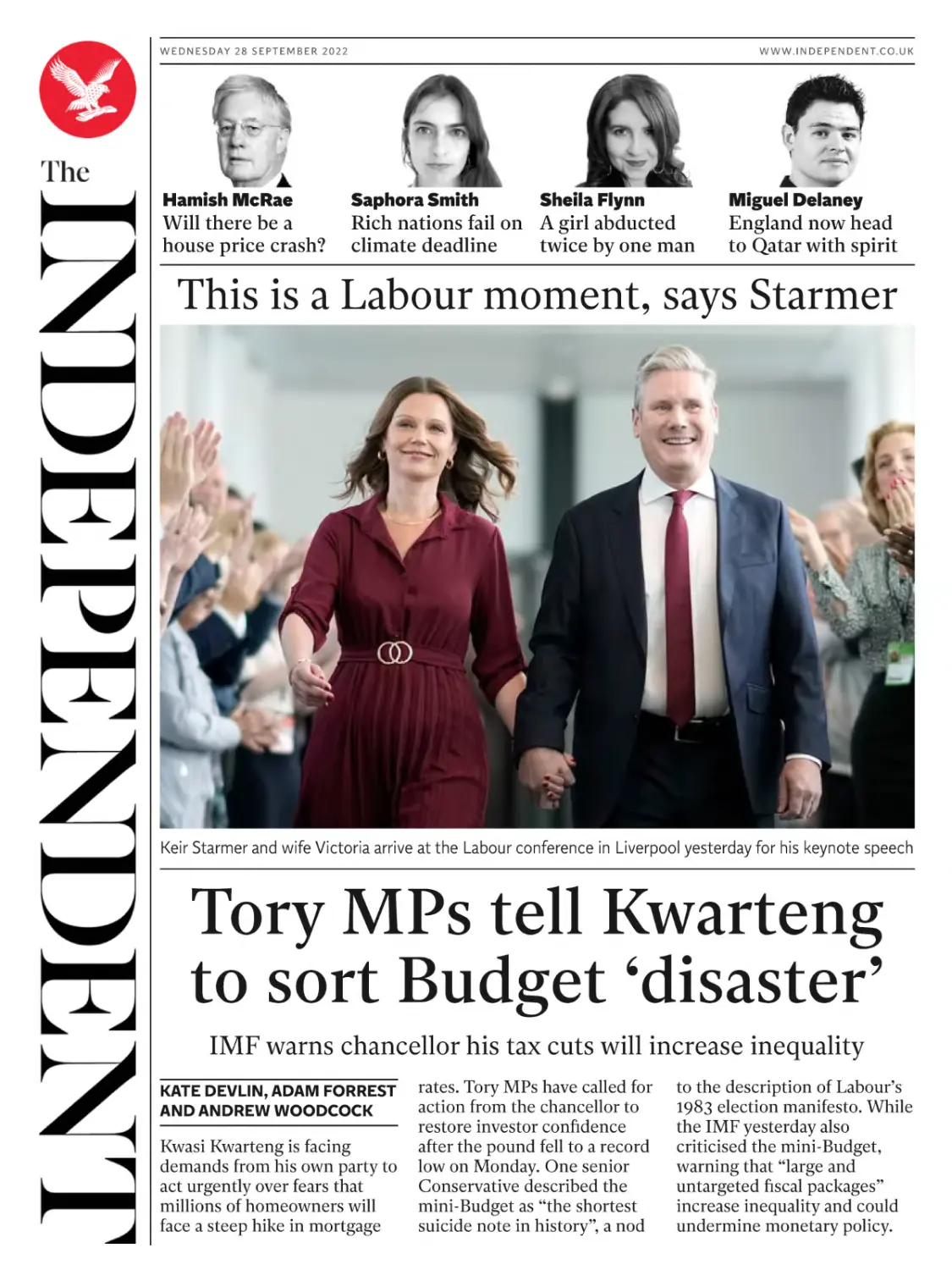
This is a Labour moment, says Starmer

Keir Starmer and wife Victoria arrive at the Labour conference in Liverpool yesterday for his keynote speech

Tory MPs tell Kwarteng
to sort Budget ‘disaster’
IMF warns chancellor his tax cuts will increase inequality
KATE DEVLIN, ADAM FORREST
AND ANDREW WOODCOCK

Kwasi Kwarteng is facing
demands from his own party to
act urgently over fears that
millions of homeowners will
face a steep hike in mortgage

rates. Tory MPs have called for
action from the chancellor to
restore investor confidence
after the pound fell to a record
low on Monday. One senior
Conservative described the
mini-Budget as “the shortest
suicide note in history”, a nod

to the description of Labour’s
1983 election manifesto. While
the IMF yesterday also
criticised the mini-Budget,
warning that “large and
untargeted fiscal packages”
increase inequality and could
undermine monetary policy.

WEDNESDAY 28 SEPTEMBER 2022

News

Editorials

Massive cuts in public
spending will be needed to
pay for this fiscal gamble

Provided he lasts that long, Kwasi Kwarteng will have his fate
sealed on 23 November. That is the date the chancellor has
chosen to release his medium-term fiscal plan, and the Office for
Budget Responsibility will simultaneously publish a fresh set of
forecasts for the economy.
These two elements were the missing links in Mr Kwarteng’s
mini-Budget, presumably omitted because Mr Kwarteng, with
that overconfidence he is becoming famous for, decided he
could dispense with them. Investors begged to differ, sold down
sterling... and the rest is a debacle of historic proportions. The
chancellor doubled down over the weekend, with mouthwatering talk of yet more unfunded tax cuts.
He refused to do anything to stem the run on the pound, until
now. One of Mr Kwarteng’s predecessors used to be fond of
saying, “when you’re in a hole, stop digging”. At last, Mr
Kwarteng has bowed to the inevitable.
But how will he now dig himself out of this hole he has gouged
out for himself? In a way, the solution presents itself, logically.
Absent any miraculous upsurge in economic growth, there are
few options open to him. His party won’t let him reverse his tax
cuts, and nor will they tolerate other tax hikes to make up for the
lost revenues – approaching £50bn.
The markets won’t let him borrow the money, except at punitive
interest rates, as we have seen – and perhaps not even then.
Besides, Mr Kwarteng is far too proud to excite such a
humiliating U-turn, and Liz Truss promised to tax cuts during
her leadership campaign. She promised delivery. Her chancellor
duly delivered. They cannot ask for the taxes back. Besides,
they’re supposed to be engine for growth. The last resort would
be to approach the International Monetary Fund for assistance.
But the IMF loan would come with strings, and probably tax
rises. So much for “taking back control”.
So, the only way left to make the numbers add up by the next
fiscal event in November is to attack public spending. “Attack”
being an appropriate word, in this case, because the squeeze will
have to be so severe. The steep increase in the cost of serving

the national debt at higher interest rates and inflation means
there will be less for other purposes even without a budget
crisis. No different to households and firms, inflation affects
schools, universities, NHS, local authorities, emergency
services and every other public service.
If Mr Kwarteng goes down this path, and he has little
alternative, there will certainly be real-term cuts in budgets
across the board, with particular pressure on the wages of
teachers, hospital staff and council workers. In other words,
there will be industrial action on a scale not seen in 40 years.
Trouble in the NHS as it enters the difficult winter period – with
the unhappy prospect of an upsurge in flu and Covid cases – will
also spell political trouble.
Pensions and benefits will also be trimmed, but far beyond the
reductions in eligibility for universal credit already announced
by Mr Kwarteng. The “triple lock” guaranteed increases to
pensions look especially vulnerable – despite being pledged in
the 2019 Conservative general election manifesto.
Much the same can be said for the promise to raise defence
spending to 3 per cent of national income; and the various
dollops of money set aside for “levelling up” schemes,
investment zones and tax-free freeports. It will be a bonfire of
the vanities and manifesto hopes. Then again, hardly anything
the Truss government does was presaged in that document.
Another age of austerity for the public sector beckons, therefore,
with all the misery that applies, just as it did when George
Osborne tore chunks out of it before – and services such as the
courts and police are still feeling the baleful effects, even now.
The terrible truth is that social security benefits and teachers’
wages, for example, are being cut back in order to pay for tax
cuts for the very rich – and to save face for Liz Truss and Kwasi
Kwarteng.
The cuts will make a longer, deeper recession inevitable, and
won’t do anything to boost the trend rate of economic growth.
At a time of a strong Labour revival, with the resilient Keir

Starmer being gifted clap-lines and huge poll leads, the Tories
could scarcely be in a worse position – or worse led.
Want your views to be included in The Independent Daily Edition
letters page? Email us by tapping here letters@independent.co.uk.
Please include your address
BACK TO TOP

WEDNESDAY 28 SEPTEMBER 2022

News

Tories warn Kwarteng to act
fast to calm market turmoil

The chancellor’s mini-Budget has been dubbed ‘the shortest suicide note in history’ (The
Independent)

K AT E D E V L I N
ADAM FORREST
ANDREW WOODCOCK

Kwasi Kwarteng is facing demands from his own party to act
within days amid fears millions will face a steep hike in

mortgage rates – with one senior Conservative MP describing
last week’s mini-Budget as “an unmitigated disaster”.
Tory MPs called for swift action to restore investor confidence
after the chancellor triggered turmoil in the markets and caused
the pound to fall to a record low. The IMF last night issued an
extraordinary rebuke of his tax plans, urging a rethink and
saying they would “increase inequality.”
No 10 was also forced to deny claims of a split between Liz Truss
and Mr Kwarteng over how to deal with the market reaction.
One senior Conservative backbencher described the miniBudget as “the shortest suicide note in history”, a nod to the
famous description of Labour’s 1983 election manifesto, telling
The Independent it could be “an unmitigated disaster”.
The Tory disquiet could even be seen at Labour’s conference in
Liverpool, where one frontbencher told The Independent he had
received a text from an ex-minister in Boris Johnson’s
government urging Labour to win the next election, signed “a
patriot”.
Mr Kwarteng has vowed to push on with the government’s
radical borrowing-fuelled £45bn tax cut spree despite growing
calls to reverse course and said he would produce a “credible
plan” to reduce government debt. “We are confident in our
long-term strategy to drive economic growth through tax
cuts and supply-side reform,” the chancellor said at a meeting
with banking and investment chiefs yesterday.
But former Brexit secretary David Davis said Mr Kwarteng must
act “pretty bloody soon – and certainly by the party conference”,
which begins in Birmingham this weekend. He accused Mr
Kwarteng of doing “what the Americans call a ‘Hail Mary’ –
throwing everything up in the air and hoping it works”.
“He has to give an idea of what the thinking is, there was no
attempt to explain the thinking last week,” Mr Davis added.
Sir Bob Neill, the Tory MP who chairs the Commons justice
committee, also said Mr Kwarteng had to move “very quickly” to
restore confidence. He called on the chancellor to bring forward

the mid-term fiscal plan set for November and think again about
his surprise announcement that he was scrapping the top rate of
tax, paid by those earning more than £150,000.
The Bank of England yesterday signalled it is ready to ramp up
interest rates to shore up the pound. The Bank’s chief
economist Huw Pill warned they “cannot be indifferent” to the
developments of the past days – seen as a signal the cost of
borrowing will have to go up to protect the pound and keep a lid
on inflation.
“It is hard not to draw the conclusion that all this will require
significant monetary policy response," Mr Pill said in a speech to
the Barclays-CEPR International Monetary Policy Forum. "We
must be confident in the stability of the UK’s economic
framework.”
Senior economists also suggested more urgency was needed in
the response to the crisis. Charlie Bean, the former deputy
governor of the Bank of England, said he would have advised the
Bank to call an emergency meeting. Mr Kwarteng held a call
with Tory MPs, as he sought to settle nerves in the wake of the
market fallout. But Mel Stride, the Conservative chair of the
Commons Treasury committee, warned the party’s reputation
on the economy was “in jeopardy”.
In an interview, Conservative MP Kevin Hollinrake, also a
member of the Commons Treasury committee, refused to rule
out voting against the finance bill containing some of the
government’s planned tax cuts.
One Tory MP told The Independent there could be a “big battle”
over the plan to axe the top rate of income tax, suggesting up to
20 MPs could rebel on the issue. But another moderate
backbencher played down the idea of a rebellion over tax cuts.
“You will lose the whip – any government that can’t carry its
Budget is no longer a government. Losing moderate MPs will
mean a further lurch to the right,” they said.
Want your views to be included in The Independent Daily Edition
letters page? Email us by tapping here letters@independent.co.uk.

Please include your address
BACK TO TOP

WEDNESDAY 28 SEPTEMBER 2022

News

IMF warns mini-Budget
could deepen inequality

Government fiscal policies have provoked a rare intervention from the global lender (The
Independent)

R O RY S U L L I VA N

The International Monetary Fund has hit out at Liz Truss and
Kwasi Kwarteng’s tax cuts for the rich, warning that “large and

untargeted fiscal packages” would probably deepen inequality in
Britain.
In a rare intervention, the IMF took aim at the British
government after the UK chancellor’s mini-Budget on Friday
caused sterling and bonds to plummet and gilt yields to soar,
reflecting the cost of borrowing.
The market turmoil started after investors were spooked by Mr
Kwarteng’s plan to offer tax cuts to the richest while increasing
state expenditure dramatically.
“We are closely monitoring recent economic developments in
the UK and are engaged with the authorities,”
an IMF spokesperson said.
“Given elevated inflation pressures in many countries, including
the UK, we do not recommend large and untargeted fiscal
packages at this juncture, as it is important that fiscal policy
does not work at cross purposes to monetary policy,” they added.
The global lender predicted that the UK’s new measures would
“likely increase inequality” rather than achieving the
government’s aim of creating a prosperous Britain.
It urged the British chancellor to change tack when he gives a
statement on 23 November, a promise he made earlier this week
in a bid to calm the markets.
“The 23 November budget will present an early opportunity for
the UK government to consider ways to provide support that is
more targeted and reevaluate the tax measures, especially those
that benefit high-income earners,” the IMF said.
Commentators noted that the IMF’s wording closely resembled
warnings it typically gives to emerging economies in the throes
of a current account crisis. It comes after Larry Summers, a
former US treasury secretary, accused Britain of “behaving a bit
like an emerging market turning itself into a submerging
market”.
Labour said the IMF’s statement showed the dangers of Ms
Truss’s and Mr Kwarteng’s economic policies.

Shadow chancellor Rachel Reeves said: “This statement from
the IMF shows the seriousness of the situation.
“Families will be concerned about what market movements in
recent days mean for them. The government must urgently lay
out how it will fix the problems it created through its reckless
decisions to waste money in an untargeted cut in the top rate of
tax.
“Waiting until November is not an option. The government
must urgently review the plans made in their fiscal statement
last week. First the Bank of England had to step in to reassure
markets. Now, this statement from the IMF should set alarm
bells ringing in government and make it clear that they need to
act now.”
In response to the IMF’s rebuke, a UK Treasury spokesperson
said: “We have acted at speed to protect households and
businesses through this winter and the next, following the
unprecedented energy price rise caused by [Vladimir] Putin’s
illegal actions in Ukraine.”
They insisted ministers were “focused on growing the economy
to raise living standards for everyone”, and promised that the
chancellor would set out measures in November to ensure that
debt falls as a share of GPD “in the medium term”.
Mel Stride, a Sunak ally who chairs the Commons Treasury
Committee, said his party’s strategy put it “in jeopardy”.
Want your views to be included in The Independent Daily Edition
letters page? Email us by tapping here letters@independent.co.uk.
Please include your address
BACK TO TOP

WEDNESDAY 28 SEPTEMBER 2022

News

Punish Truss for financial
mayhem, urges Starmer

Sir Keir Starmer with applauding delegates after delivering his conference speech in Liverpool
yesterday (AFP/Getty)

ANDREW WOODCOCK
POLITICAL EDITOR

Sir Keir Starmer has issued a call for Britain’s voters to punish
Liz Truss at the ballot box for the financial mayhem unleashed
by her mini-Budget, telling them: “Don’t forget. Don’t forgive.”

In a direct pitch for traditional Conservative voters, he said that
Labour was now the party of “sound money ... homeownership
[and] responsible government”, while Truss’s “spectacular”
irresponsibility had sent the pound plummeting, stoked inflation
and destroyed Tory claims to be “the party of aspiration”.
In a sign of growing confidence that power is within grasp at the
general election expected in 2024, Sir Keir cited earlier Labour
victories achieved after long periods of Tory rule as he told
cheering delegates: “As in 1945, 1964 and 1997, this is a Labour
moment.”
Mr Starmer unveiled plans for a publicly owned electricity
generation company, to be funded from an £8bn national
wealth fund announced by shadow chancellor Rachel Reeves on
Monday with a remit to invest in clean energy from wind, solar,
tidal and nuclear. He also announced a target of 70 per cent
homeownership, with first-time buyers given first options on
homes in their areas.
The Great British energy proposal won warm applause from a
packed hall in Liverpool and TUC general secretary Frances
O’Grady hailed it as “a big, bold move that will cut bills and
secure our energy future”.
But trade union Unite said that Mr Starmer needed to be
“bolder” in his response to the cost-of-living crisis, while
campaign group Labour for a Green New Deal said he should
commit the party to public ownership of the whole energy
system.
Instead, GBE would operate alongside private firms, with an
independent board free to take investment decisions under a
mandate set by ministers. Labour aides said their ambition was
for it to eventually take a similar proportion of the market as
state-owned power companies in countries like France or
Sweden.
Sir Keir said that his green prosperity plan to make UK
electricity fossil fuel-free was a reflection of the fact that action
on the climate crisis was no longer a question of “austere self-

denial” but was at the heart of Britain’s future economic
opportunities.
But the focus of the rapturously received speech was more on
establishing a vision for what Starmer termed “a fairer, greener
future”, as well as setting down clear dividing lines with
Conservatives.
Twelve years of Tory-led governments had left Britain “all at
sea”, with working people anxious for their future, raw sewage
being pumped into rivers, backlogs at borders and in hospitals
and crimes like burglary going “totally unpunished”, he said.
For the past decade, Conservative ministers had lambasted
Labour for failing to “fix the roof while the sun was shining”, he
said.
“But take a look around Britain,” he told delegates. “They
haven’t just failed to fix the roof. They’ve ripped out the
foundations, smashed through the windows and now they’ve
blown the doors off for good measure.”
He added: “We can’t go on like this. What we’ve seen in the past
few days has no precedent. The government has lost control of
the British economy – and for what? They’ve crashed the pound
– and for what? Higher interest rates. Higher inflation. Higher
borrowing. And for what?
“Not for you. Not for working people. For tax cuts for the richest
1 per cent in our society. Don’t forget. Don’t forgive. The only
way forward is to stop this – with a Labour government.”
In a speech which was light on personal touches, Mr Starmer
recalled growing up in modest circumstances in the 1970s, when
rising prices once saw his family’s phone cut off because they
could not pay the bill. But he said that his parents still had hope
because of the “unwritten contract” that hard work would be
rewarded with a better life for their children.
Now that contract had been “broken”, he said, adding: “That’s
the deep cost of Tory failure. They keep talking about aspiration,
but they don’t understand how they’ve choked it off for working
people.”

To loud applause, he again firmly ruled out any deal with the
Scottish National Party in the case of a hung parliament. And he
borrowed a slogan from Sir Tony Blair to declare: “We are the
party of the centre-ground. Once again, we are the political wing
of the British people and we can achieve great things.”
Mr Starmer’s speech was enthusiastically hailed by shadow
cabinet minister Peter Kyle, who told The Independent: “Keir set
out his vision for a better Britain on his own terms. This is the
moment that Labour overtook the Tories in the battle of ideas
and having the leadership that will deliver. We have left them
flailing in the dust.”
But a Conservative spokesperson said: “On his eleventh
relaunch to date, this was yet another details-light speech full of
vacuous slogans, rehashed phrases and empty promises. There’s
nothing ‘new’ about Keir Starmer’s Labour, no matter how much
he tries to emulate Tony Blair.”
Want your views to be included in The Independent Daily Edition
letters page? Email us by tapping here letters@independent.co.uk.
Please include your address
BACK TO TOP

WEDNESDAY 28 SEPTEMBER 2022

News/ Sketch

A penalty shootout against a
Tory team that’s gone home
Starmer delivers the easiest speech of his life, says Tom Peck

The Labour leader spoke at conference with his party surging in the polls (AP)

There is always a moment when an opposition party starts to
look like a government in waiting. At the end of the 2009
Conservative Party conference, David Cameron lined up his
shadow cabinet behind him – George Osborne, William Hague,
Liam Fox, Theresa May, Andrew Mitchell, the list goes on – and
it seemed inevitable to the point of certainty that the voters
were going to give these people their blessing.

Thirteen years later, on to the stage in Liverpool, out strode Keir
Starmer. It is by no means inevitable that he will be the next
prime minister, but you really do have to feel that momentum is
on his side. Why do you have to feel that? Well, there were some
clues in the speech itself. “There is raw sewage in our rivers and
seas,” he said. “Crimes like burglary totally unpunished. People
are told to drive themselves to hospital after having a heart
attack.”
Look, we all know that political soothsaying is a mug’s game but
when the sea’s full of shit and no one does anything about when
you get burgled and there are people having heart attacks in
their own cars, you just get that same sort of sense of
inevitability really, don’t you?
That everything is just completely and utterly banjaxed. And this
wasn’t even Keir Starmer’s introduction. This was several
minutes in. Who knows, before last Friday, maybe this would
have been higher up. But he also had to mention the destroyed
currency, the higher interest rates as a direct result, and the
inevitable mortgage misery it will cause. And what is it for?
Well, it’s in service of just one policy, so far, and that’s to fund a
tax cut solely for the benefit of high earners, the sort of thing
that the Tories worked out they had to stop doing some time in
around 2006, or at least attempt to conceal, or they’d never be in
government again. Politicians are always warned not to be seen
to be “measuring the curtains” in Downing Street, but what is
Keir Starmer meant to do if the current occupant appears to be
going out of her way to open up the door and drop kick the
Labour Party through it?
The backdrop to Starmer’s speech was a YouGov poll showing
the largest poll lead that polling company has ever produced
since it started up in 2001. That’s right: 17 points. Various hardright Tories who backed Liz Truss are determined not to accept
the colossal error they have made, and have been dredging up
worse polls for Margaret Thatcher in the early Eighties. Of
course, Truss could turn it around – but for the historical parallel
to be exact, she would need whoever is the equivalent of Roy

Jenkins to set up a rival party and for Argentina to invade the
Falklands. These things may not happen.

We all know that political soothsaying is a mug’s
game but when the sea’s full of shit and no one does
anything about when you get burgled, you just get a
sense of inevitability, really, don’t you?

Starmer is regularly accused of being boring. Such accusations
occur because he is indeed boring. But the voters truly do not
seem to care. They are bored of not being bored. For a while,
Truss being boring seemed like a welcome antidote. Her
plodding statements and speeches did not in any way meet the
historic moment of the death of the Queen but had Johnson
been around, he would somehow have made it all about him, in
his own, uniquely repellent way (as he did in the House of
Commons).
But Truss really isn’t boring anymore. Setting fire to the
economy, hammering house prices and jacking up mortgages for
the ordinary people who have already been asked to pay for tax
cuts for millionaires couldn’t be less boring.
She’s also had walking electoral kryptonite Jacob Rees-Mogg lift
the ban on fracking and then go on TV to announce that it’s
been made possible through worrying less about earthquakes.
People, generally speaking, are not pro-earthquake. They’re not
pro-fossil fuel either, because they can see that it’s burning up
their children’s futures. And they were allowed to become so
frightened about energy prices for so long (because the Tories

had to have a leadership contest all summer rather than do
anything about it) that they are now sufficiently literate in the
workings of the energy market to understand that a few extra
droplets of gas in about a decade’s time won’t make any
difference at all.
Starmer, meanwhile, is going to launch a new state-owned
energy company, Great British Energy, which he reckons is
going to invest in clean power and become as big as the French
state-owned energy company, EDF. Truss, meanwhile, spent
most of the summer telling rooms full of Tories that solar power
was bad. That she didn’t want to see “solar panels in fields”;
somehow unaware that cheap, non-planet destroying power is
immensely popular.
The speech was billed, in advance, as an open goal but it was
more than that. It was several open goals. It was a penalty
shootout against a team that’s already gone home. And Starmer
gently slotted his home, one after the other, after the other.
He could hardly fail to do so, in his own steady way. At some
point, in the short years ahead, the Tories will surely have to
start making it harder for him. They could hardly be making it
any easier. But then, the worst of the pain is yet to come. If this
was the most important speech of Starmer’s career, it was also
the easiest. He did just fine. And it’s not that that’s all that can
be expected, but it’s certainly all that’s needed.
Want your views to be included in The Independent Daily Edition
letters page? Email us by tapping here letters@independent.co.uk.
Please include your address
BACK TO TOP

WEDNESDAY 28 SEPTEMBER 2022

News/ Analysis

Will Labour decide to play
it safe or seize the moment?

Starmer made an unashamed pitch for the political centre ground (PA)

ANDREW GRICE

Aided by the government’s self-inflicted wounds, an upbeat
Labour Party finally sniffs a return to power after 12 long years in
the wilderness. But a fierce debate rages behind the scenes at
the party’s Liverpool conference about precisely how Labour
should adjust to the dramatically changed political landscape.

Does the Tories’ turmoil, and a 17-point Labour lead in the latest
opinion poll vindicate Keir Starmer’s “safety first” approach? Or
should Labour seize the moment to go “big and bold” in setting
out its alternative vision for the country while voters are
bemused by Liz Truss’ “new” government?
In a confident speech to the conference yesterday afternoon,
Starmer straddled both sides of the internal debate,
characteristically seeking out its middle ground. Not before
time, he spelt out how the UK would change by the end of a fiveyear term of Labour government. There was a new policy in
Great British Energy – not the nationalisation many in his party
want but a state-owned company to exploit the opportunities of
green energy so they are not hoovered up by foreign-owned
firms.
Starmer made an unashamed pitch for the political centre
ground, an obvious move when the Tories have suddenly veered
off to the right in an ideological crusade that worries many of
their own MPs. He invaded natural Tory territory, positioning
Labour as the “party of home ownership” (with an aim of raising
it from 65 to 70 per cent in five years) and “aspiration”, stressing
his own working-class roots. (The public is sceptical about them,
given that his name starts with “Sir”).
Starmer genuinely relishes the prospect of fighting the next
general election on the economy. Of course, all Labour leaders
have to say that, even if they prefer the party’s comfort zone of
the NHS and other public services. But events have given
Starmer the confidence to mean it. He vowed to win a fight with
the Tories over wealth redistribution and workers’ rights, with
“fairness and economic reason on our side”.
The pound’s slump since last Friday’s mini-Budget might not be
the economic equivalent of Black Wednesday, when the UK was
ejected from the European exchange mechanism in 1992, but it
could prove the political equivalent – with the Tories suffering
the same catastrophic loss of economic competence. Handed
this open goal, Starmer argued credibly that Labour is now the
party of “sound money”.

He acknowledged the state of the public finances Labour would
inherit would make rescuing services “harder than ever”. But he
raised the spirits and the sights of his audience, who showed
how the party had changed by giving him several standing
ovations during the speech. “This is a Labour moment,” he
declared, citing Labour’s watershed election victories in 1945,
1964 and 1997.
Although some Labour MPs had hoped for more policy
announcements, the speech passed the “vision” test. Starmer
has not yet given us the complete picture, but he has started to
sketch it out. Given the unexpected backdrop, he needed to
show voters he could provide the stability and sensible and
dependable leadership the Tories are patently not giving.

Under Starmer, the party has rightly stopped
trashing the New Labour era – never a good look to
voters who, after all, gave Blair three terms in office

Starmer’s declaration that Labour is again the “political wing of
the British people” – a deliberate echo of Tony Blair’s mantra
shortly before his 1997 landslide – angered his left-wing critics.
It was a poke in the eye for the trade unions, who regard Labour
as the political wing of their movement.
Under Starmer, the party has rightly stopped trashing the New
Labour era – never a good look to voters who, after all, gave Blair
three terms in office. Labour can now leave the brand-trashing
to the Tories, as Liz Truss blows up much of what was done by

Rishi Sunak, Michael Gove and even some of Boris Johnson’s
works.
However, there is no guarantee the Tory and market turmoil will
last. That is why some Labour MPs whisper that going “big and
bold” now could make the difference between a hung parliament
with Starmer heading a minority Labour government and
winning an outright majority – still a massive mountain to climb
given Johnson’s 80-seat majority in 2019.
The case for the defence, as one adviser put it, is that Starmer
“is occupying the centre ground but the policies are centre-left”.
He cited the party’s pledge to restore the top 45p rate of income
tax and its ambitious green energy plans. But Starmer doesn’t
want to frighten the horses. Labour has avoided talk this week of
taxing unearned income, which it is looking at, for fear of
headlines about a “wealth tax” that would be portrayed as “class
war” by the Tories and their newspaper cheerleaders, handing
Truss some desperately needed ammunition.
As I watched the speech, I could imagine Starmer making a good
prime minister – perhaps more of a reassuring, competent
Clement Attlee figure than a Blair mark two. But first, he has to
get there.
Want your views to be included in The Independent Daily Edition
letters page? Email us by tapping here letters@independent.co.uk.
Please include your address
BACK TO TOP

WEDNESDAY 28 SEPTEMBER 2022

News

Tory missteps give Labour
belief they can gain power
Truss’s ‘scorched earth’ approach buoys conference mood

Keir Starmer enjoys one of numerous standing ovations in Liverpool yesterday (PA)

ANDREW WOODCOCK

Liz Truss appears to be taking a “scorched earth” approach to
the economy that will leave a Labour government to pick up the
pieces after the expected election in 2024, a shadow cabinet
minister has said.

As stock markets sank and the pound plunged in the wake of last
week’s “kamikaze” mini-Budget, delegates at Labour’s annual
conference in Liverpool could scarcely believe their luck at the
apparent willingness of the prime minister and chancellor Kwasi
Kwarteng to take a hatchet to their own party’s biggest electoral
assets.
And there was a growing sense of confidence among them that
opinion polls giving Keir Starmer’s party leads of up to 17 points
over the Conservatives could presage a remarkable return to
power just five years after Labour’s crushing defeat in 2019.
Senior members of Starmer’s team feel that Labour’s journey to
Downing Street has been massively accelerated by the downfall
of Boris Johnson over Partygate and by the Tories’ choice of an
ideologically driven leader who they see as hugely out of touch
with voters. They believe that the arrival of Truss allows them to
play to Starmer’s strengths by casting the election as a choice
between a careful and responsible statesman and a reckless
gambler.
Moves like scrapping the 45p tax rate, ending the bankers’
bonus cap, rejecting a windfall tax and racking up billions in
debt allow them to paint Truss and Kwarteng as the unashamed
friends of the rich and deprived Tories of their key attack line –
that Labour would waste money and borrow excessively.
“They seem to have given up the whole project of broadening
their coalition that won Johnson the red-wall seats,” said one.
“It’s the same with fracking – it’s poison in a lot of seats the
Tories need to win. They seem to be giving up on climate and
the environment at just the point when mainstream opinion is
coming round to the fact it’s a major priority.”
Where the talk at last autumn’s conference in Brighton was of a
two-term project to make Labour electable again – and of
whether Sir Keir would survive to complete the scaling of the
“mountain” the party had to scale – in Liverpool the bars and
restaurants were buzzing with dreams of an overall majority
allowing Starmer to govern without the need for support from
Lib Dems or the SNP.

The Tories seem to be giving up on the environment
at just the point when mainstream opinion is coming
round to the fact it’s a major priority

While shadow ministers dutifully repeated the importance of
avoiding complacency, conversation kept returning to the
elections of 1964, when Harold Wilson overturned a 100-seat
Tory majority, and 1997, when Tony Blair gained 145 seats to
sweep aside a stale and tired Conservative government.
One shadow cabinet member told The Independent the mood at
conference was “exhilarating”. “It’s the best I’ve seen it since the
late Nineties, when we really felt we were on our way,” he said.
“The Tories have really screwed themselves by choosing Liz.
She and Kwarteng come across as ideologues who are not
listening to anybody. When you look at the polls, there has been
no ‘Truss bounce’. She’s ‘hit the ground’, as she said she would.”
Another said: “They haven’t just vacated the middle-ground,
they’ve leapfrogged out of the pitch.”
There was a sense of near-bewilderment in Liverpool over the
PM’s strategy. Did she really believe a Thatcher-style tax-cutting
agenda could deliver sustainable growth in the deeply
unfavourable context of a cost of living crisis, or was she simply
hoping for a brief “sugar rush” which could get her through the
election?
Some senior figures thought it was possible that a tired Tory
party which had given up hope of staying in office was simply
grabbing what it could for its supporters and leaving Labour to

deal with the consequences. “I really think they could be that
cynical,” one said.
Another figure very high up in the Starmer team put it down to
“ideological fervour”: “It’s like they’ve swallowed the Trump
nonsense about the ‘big state’ whole. They actually seem to
believe that the establishment – the Treasury, the civil service,
the OBR – is against them and they know better.
“They come across as arrogant. Cameron and Osborne were so
careful about not seeming to be in it to help the rich. Truss and
Kwarteng don’t seem to have that inhibition.”
Labour spirits have been buoyed at Liverpool by Starmer’s
apparent success in shaking off memories of Jeremy Corbyn’s
regime, just a year after he was loudly heckled by leftists furious
at his “betrayal” of promises to retain the former leader’s
agenda.
The respectful observation of a tribute to the Queen and the
rendition of the national anthem before a union jack backdrop
was the physical representation of a party that has returned to
the centre ground and once more become “the political wing of
the British people”, said Starmer.
Expected rows over strikes and picket lines failed to materialise,
with one senior union leader telling The Independent that the
movement was not going to “rock the boat” at a time when it
can seriously envisage Labour relatively soon being in a position
to take action on workers’ rights.

Tough week: Liz Truss leaves No 10 yesterday (Getty)

And Starmer’s keynote speech, promising a nationalised energy
firm and declaring that like 1964 and 1997 “this is a Labour
moment”, was greeted with repeated standing ovations with no
sign of dissenting voices.
Delegates streaming out of the hall were unanimous in their
praise for the address, with one saying “He’s shown we’re back,
we’re united and we’re ready for government”, and another
adding: “If you’d told me three years ago we’d have got so far by
now, I wouldn’t have believed you.”
One shadow minister contrasted the atmosphere with past years:
“Previously, when you went on to stage, you were preparing
yourself for the heckles. This time, it was like a best man’s
speech – everyone in the room willing you to do well and
wanting to be part of the experience.”
Although the leadership was defeated in a vote on proportional
representation, a member of the shadow cabinet said: “If the
biggest spat we have at conference is on voting reform, I reckon
we’ll take that.”
Remaining uncertainties in Labour ranks revolved about Sir
Keir’s ability to break through to voters as a prime minister in
waiting, with a poll for The Independent finding that almost half
(46 per cent) still do not know what he stands for, two and a half
years after he took office.

One senior figure accepted that Starmer needs to make himself
“more three-dimensional” by giving voters a sense of who he is
as a person. “That doesn’t mean trying to turn up the charisma,”
he said. “But he has got to be relatable, and he’s not done that
yet.” But another said Starmer needed to be cautious about
opening up on his personality: “You’ve got to be who you are,
otherwise you end up with Gordon Brown liking the Arctic
Monkeys and Theresa May running through the wheatfields.”
Another agreed: “I’m not worried about Keir’s presentation. He
doesn’t have to be out there cracking jokes and scoring points.
He has plenty of attack dogs to do that for him. What he needs
to do is show the contrast between the choices on offer. With
Boris it was the serious statesman versus the joker. With Liz he
is facing someone who is coming across as reckless and a
gambler. It is good that he appears more careful.”
Want your views to be included in The Independent Daily Edition
letters page? Email us by tapping here letters@independent.co.uk.
Please include your address
BACK TO TOP

WEDNESDAY 28 SEPTEMBER 2022

News

Huq apologises to Kwarteng
as Labour suspends MP for
‘superficially Black’ remarks

Rupa Huq has admitted her comments were ‘ill-judged’ (Reuters)

ROB MERRICK
DEPUTY POLITICAL EDITOR

The MP suspended by Labour for calling Kwasi Kwarteng
“superficially” Black has apologised to the chancellor. Rupa Huq

offered “sincere and heartfelt apologies” for what she called her
“ill-judged” comments at a fringe meeting at Labour’s
conference.
The Ealing Central and Acton MP initially defended her
remarks, in which she said, of the wealthy, Eton-educated Mr
Kwarteng, “you wouldn’t know he’s Black”. But she has
backtracked after Conservative MPs condemned them as
“racist” and Keir Starmer removed the party whip from her.
However, Labour is likely to continue the suspension pending
an investigation into the full circumstances of what Ms Huq
said. The comments were condemned by Ed Miliband, the
shadow climate change secretary, who said: “There is absolutely
no place for these kind of comments in our politics
“The party will have to decide what it does in terms of her and
her future. These comments are reprehensible and awful.”
Ms Huq tweeted: “I have today contacted Kwasi Kwarteng to
offer my sincere and heartfelt apologies for the comments I
made at yesterday’s Labour conference fringe meeting. My
comments were ill-judged and I wholeheartedly apologise to
anyone affected.”
The controversy is a rare moment of disruption of a Labour
conference that has otherwise run smoothly for Sir Keir, amid
Tory turmoil over economic policy. The former shadow Home
Office minister spoke at an event, on Monday, hosted by British
Future and the Black Equity Organisation and also attended by
the party’s chair, Anneliese Dodds.
On a short recording, obtained by the Guido Fawkes website,
she could be heard saying: “I’m sorry if I was not making myself
understood clearly. He superficially is a Black man.” She said Mr
Kwarteng went to “the top schools in the country” and added:
“If you hear him on the Today programme, you wouldn’t know
he’s Black.”
Earlier, Jake Berry, the chair of the Conservative Party, wrote to
the Labour leader calling for Ms Huq to lose the Labour whip.

He said: “I trust you will join me in unequivocally condemning
these comments as nothing less than racist.”
At the event, Sunder Katwala, who was chairing it for the British
Future and Black Equity organisations, challenged the MP’s
remarks, it is understood. He is believed to have said that the
chancellor’s Conservative allegiance “doesn’t make him not
Black ... and I think the Labour Party has to be really careful”.
Want your views to be included in The Independent Daily Edition
letters page? Email us by tapping here letters@independent.co.uk.
Please include your address
BACK TO TOP

WEDNESDAY 28 SEPTEMBER 2022

News

Labour vows to put climate
crisis at core of overseas aid

Preet Gill promises legislation to prioritise ‘greatest threat to humanity’ (Getty)

ANDREW WOODCOCK

A Labour government would pass a law to require the UK’s
overseas aid spending to prioritise action to tackle the climate
crisis.
In a speech to Labour’s annual conference in Liverpool
yesterday, the shadow international aid secretary Preet Gill
confirmed the party’s commitment to restore the requirement

for 0.7 per cent of national income to go to aid, after it was
slashed to 0.5 per cent by Boris Johnson.
She said that a Labour government will introduce a new focus on
using UK assistance to developing countries to address “this
century’s biggest threat to humanity”. Labour leader Sir Keir
Starmer has put climate centre stage at this year’s gathering,
taking place under the slogan “A Fairer, Greener Future”.
The focus on the environment reflects leadership concern that
younger supporters may be drifting away to the Green Party, as
well as a belief that record heatwaves this summer have pushed
climate up the agenda for millions of mainstream voters. Ms Gill
promised to restore the independence of overseas development
assistance within Whitehall, after Mr Johnson merged the
Department for International Development (DFID) into the
Foreign Office.
She said: “Boris Johnson’s ideological merger has failed. “It now
falls to Labour to undo that damage and earn back the trust of
Britain’s partners. Keir was absolutely right when he called the
closure of DFID ‘totally misguided’ and ‘wrongheaded’, and his
commitment to international development speaks to who he is.
“So, just as 25 years ago, DFID was created to tackle the global
challenges we faced, a Labour government will put in place a
new model with the independence needed to meet the
challenges of the 21st century: one that recognises the link
between development and climate. Its mission will be to deliver
on the sustainable development goals.
“We will reinstate Britain’s commitment to spend 0.7 per cent of
income on aid. And we will deliver a distinct development
programme that brings value for money and ends the
government’s wasteful and transactional approach. The climate
emergency is this century’s biggest threat to humanity. That is
why I am also announcing today that Labour will legislate to
make sure that, as a priority, Britain’s aid budget helps address
climate change.”

Want your views to be included in The Independent Daily Edition
letters page? Email us by tapping here letters@independent.co.uk.
Please include your address
BACK TO TOP

WEDNESDAY 28 SEPTEMBER 2022

News

Breakfast clubs for all young
pupils, Labour will pledge

Bridget Phillipson will reveal her plans at the party conference today (Getty)

ZOE TIDMAN

A Labour government would introduce free breakfast clubs in all
primary schools in England, according to its shadow education
secretary. Bridget Phillipson will unveil plans to fund the first
meal of the day for younger pupils at the party conference today,

saying they would help to “drive up standards” across the
country.
The breakfast clubs would be funded by reintroducing the top
rate of income tax for the highest earners, she will tell party
members in Liverpool. Labour has pledged to bring back the
45p rate that was scrapped in Kwasi Kwarteng’s mini-Budget last
week. Unions and charities have welcomed the pledge, saying it
would help to improve children’s chances at school.
“Not only is this important in terms of wellbeing, but it is also
educationally important as pupils are not in a fit state to learn if
they are hungry,” Geoff Barton from the Association for School
and College Leaders said.
Ms Phillipson will tell the Labour party conference that gaps in
learning and opportunities “open up early” and therefore
solutions “must start early too”.
“We need a fresh vision of that education. One that looks to the
future, not the past,” she will say. “Labour will build a modern
childcare system. One that supports families from the end of
parental leave through to the end of primary school.
“As the first step on that road, we will introduce breakfast clubs
for every primary school child in England, driving up standards
in maths, reading, and writing, and giving mums and dads
choices.”
Union leaders said many schools do already run breakfast clubs,
relying on different streams of funding – including government
schemes, charities and their own budgets – and often target
support to the pupils most in need. This pledge would help to
“simplify the situation” and ensure it is available in all schools,
they said.
Alison Garnham, head of the Child Poverty Action Group
charity, said free breakfasts in all primary schools would be a
“breakthrough kids and parents need”. It would not only boost
learning and wellbeing but also help parents to balance their jobs
with family life, she said.

“Hunger is a real concern for school staff who regularly see
children arriving in the morning without having eaten, and
therefore not ready to learn,” Paul Whiteman from the NAHT
union said. “These concerns have only been exacerbated by the
cost-of-living crisis, which is pushing more families into
poverty.”
The number of children on free school meals at lunch – which
are available to the most disadvantaged pupils – soared to nearly
2 million in England this year. Charities fear hundreds of
thousands more pupils are in poverty but falling through the
cracks of the scheme due to missing out on eligibility criteria.
The Department for Education was approached for comment.
Want your views to be included in The Independent Daily Edition
letters page? Email us by tapping here letters@independent.co.uk.
Please include your address
BACK TO TOP

WEDNESDAY 28 SEPTEMBER 2022

News/ Politics Explained

Why Labour finally sounds
like a party of government

Keir Starmer said all the right things in Liverpool yesterday and cleverly avoided Brexit (Reuters)

S E A N O ' G R A DY

Keir Starmer making a speech about solar power, wind farms
and home insulation can’t be many people’s idea of a fun
afternoon in Liverpool, but the Labour Party was certainly
enjoying itself as he trudged his way through his green agenda.
They say Starmer is a dull speaker, but he got the assembled
democratic socialists to their feet when he announced the

prospective launch of a nationalised utility named Great British
Energy.
His hair lustrous and groomed, his rhetoric more lively than
usual, a few good jokes and a solidly centrist platform, Starmer
made Labour sound like a party of government. Nato; the SNP;
antisemitism; national interest before party interest; even
levelling up: Starmer said all the right things. He mostly avoided
Brexit, wisely. The old Blairite line about being the “political
wing of the British people” is as bizarre and meaningless as it
was in the 1990s, but it fitted the moment. The one crucial thing
that was probably missing was a simple compelling reason why
Labour would make people better off: families need to pay the
bills.
All that said, when your party is in possession of a 17 percentage
point lead in the polls and the government is in the middle of a
humiliating economic crisis, you don’t need to try too hard.
Rather than the bombastic showman, Starmer is now up against
Liz Truss, who, with the best will in the world, makes Starmer
look like a cross between Tony Blair and Jesus Christ.
It’s as well to consider the journey the party has been on. Less
than three years ago, the party had its worst performance since
the 1930s at the December 2019 general election. Boris Johnson
“got Brexit done”, conquered the Red Wall and crushed Jeremy
Corbyn. Labour was down to about 30 per cent of the vote. Even
in the earlier stages of the pandemic, Labour lagged behind. But
a combination of Tory collapse and Labour renewal and reform
have restored the party’s fortunes – and to a degree almost
inconceivable even two years ago, when Starmer delivered his
first conference speech in a virtually empty room. He said at the
time that his first task was just to persuade people to give Labour
a hearing, and that succeeded. We are now well into the second
phase of the recovery, and the beginnings of Labour looking and
sounding more like a government-in-waiting. A strong shadow
team relative to the government front bench is another novelty
for Labour in opposition.
It is rare for a party to be turned around inside a single
parliamentary term, allowing for the fact that Labour has lost the

last four elections and has spent a total of 12 years trying to sort
itself out after Gordon Brown slipped to a loss in 2010. Indeed,
it is almost two decades since the last time Labour won a general
election (2005), though some credit and recognition has to be
given to Corbyn for the remarkable surprise of 2017, which
deprived Theresa May of her majority.
Still, the general record has been depressing and recent byelection, local election and polling successes suggest that the
days of disappointment may be coming to an end.
There are precedents. In 1992, after a fourth defeat in a row,
finishing a poor seven percentage points behind John Major, few
gave the Labour Party much hope, even under the managerial
social democrat John Smith. There was much talk then, as now,
of PR. Then came Tony Blair, modernisation, a floundering,
exhausted Tory government and the New Labour landslide.
Something of the same happened after the 1959 general
election; a Tory landslide and a 100 majority was overturned by
Harold Wilson in five short years.
There is a life cycle in governing parties that means they
naturally decay. Intellectual and even physical exhaustion sets
in, the backbenches fill up with the discarded and the
disappointed, they tend to start talking to themselves and forget
what they are for, a sort of political senility.
On the other side, oppositions can use the leisure time they are
unwillingly gifted to scrap and argue, but also to formulate new
policy and reconnect with the voters. They benefit from a
natural feeling of "time for a change". Even more than that,
though, after multiple election defeats, parties can simply
become so hungry for power they stop squabbling and accept a
more disciplined way of doing things. It’s how Labour got back
in 1997, and how the Tories got back in 2010. It feels like Labour
is, at last, bored with losing more than it is bored by Starmer.
Want your views to be included in The Independent Daily Edition
letters page? Email us by tapping here letters@independent.co.uk.
Please include your address
BACK TO TOP

WEDNESDAY 28 SEPTEMBER 2022

News

Truss is bad for Britain on
the world stage, voters say

More than half think the PM isn’t up to the job of representing the UK abroad (PA)

K I M S E N G U P TA
WORLD AFFAIRS EDITOR

Liz Truss does not have what it takes to best represent British
interests when dealing with senior international leaders,
according to a poll. More than 52 per cent say they have little or

no confidence the prime minister will perform well on the world
stage, with the same number holding that this comes after the
country’s reputation was already seriously tarnished during the
Boris Johnson years.
Pessimism about what lies ahead was also echoed by a majority
(52 per cent) who believe that Brexit has damaged Britain, with a
large number (46 per cent to 19 per cent) holding that the
process has been badly mismanaged. Only 7 per cent thought
that the UK’s standing in the world has been improved by the
political situation in this country in the past few months.
Just 6 per cent of the 2,096 British adults questioned by
Deltapoll for The National newspaper said they were “very
confident” that Ms Truss would be an effective world leader.
Nearly one-third (30 per cent) said they were “not very
confident” about her being in Downing Street domestically or
internationally, while 22 per cent said they were “not at all
confident”. But 28 per cent were “quietly confident” about how
her leadership will develop.

Truss met Joe Biden and other world leaders in New York last
week on her first foreign outing as prime minister (PA)

The survey was taken during the prime minister’s first week in
office and reflects, say the pollsters, the mood at the start of a
new chapter in the nation’s history following the death of the
Queen and the accession of King Charles. The poll was carried
out between 9 and 12 September, before last Friday’s miniBudget, which was followed by a further slip in Tory support.

Other findings from the poll include: 71 per cent of people
questioned want the government to prioritise controlling energy
costs over climate challenges at present and 78 per cent backed
concerted European action to tackle the energy crisis. Some 54
per cent felt the UN should seek to end the Ukraine war, the
main driver of the energy crisis.
Seventy-six per cent backed the imposition of sanctions on
Russia but 56 per cent also felt the UK has done enough to help
Ukraine in the conflict. And 40 per cent said the UK was right
to follow the US in withdrawing from Afghanistan last year,
compared to 37 per cent who said it was the wrong decision. The
same number backed another international intervention there if
that became necessary.
Want your views to be included in The Independent Daily Edition
letters page? Email us by tapping here letters@independent.co.uk.
Please include your address
BACK TO TOP

WEDNESDAY 28 SEPTEMBER 2022

News

Brexit has slashed Eurostar
capacity by third, says CEO

Uncertain future: the unused Eurostar terminal at Ashford International (Simon Calder)

SIMON CALDER
TRAVEL CORRESPONDENT

The extra passport checks the UK requested after leaving the
EU are “not sustainable”: that is the damning view of Jacques
Damas, outgoing chief executive of Eurostar. The boss of the

cross-Channel train operator revealed that post-Brexit border
arrangements have reduced capacity on links from London to
Brussels and Paris by one-third – forcing Eurostar “to charge
higher prices to our customers”.
Earlier this month Huw Merriman, chair of the transport select
committee, wrote to Eurostar expressing concern about the
impact of the continued closure of Ebbsfleet and Ashford
international stations in Kent. Trains for Brussels and Paris
ended their calls there as the coronavirus pandemic began. They
will not open until 2025 at the earliest. Eurostar is also ditching
direct trains to Disneyland Paris in June 2023.
In his response to the parliamentary committee, Mr Damas spelt
out in devastating detail the damage caused by Brexit to
international rail travel to and from the UK. His letter, which
Mr Merriman has published, begins: “I fully appreciate the
disappointment felt by many at the continued closure of the
Kent stations and, indeed, the recent announcements regarding
Disneyland Paris – a popular destination for many of our British
customers, including those previously from Ashford.
“I also appreciate the economic impact of such a decision on the
South East and the loss of choice for individual travellers. I can
understand that people contrast these decisions with the
recovery in travel this year and question why we have not moved
to re-open the stations.”
While financial constraints and engineering issues were partly
responsible, Mr Damas explained that Brexit has cut Eurostar
capacity by 30 per cent – simply because the new passport
requirements take time and require more space.
“Additional border checks apply to UK citizens seeking to enter
Schengen, as they do to all ‘third country nationals’. Since
around 40 per cent of our customers are UK nationals, this has
resulted in a significant increase in the processing times at
stations. The stamping of British passports by Continental
police adds at least 15 seconds to individual passengers’ border
crossing times.

“Even with all booths manned, St Pancras can currently process
a maximum 1,500 passengers per hour versus 2,200 in 2019. It is
only the fact that Eurostar has capacity-limited trains and
significantly reduced its timetable from 2019 levels, that we are
not seeing daily queues in the centre of London similar to those
experienced in the Channel ports. This situation has obvious
commercial consequences and is not sustainable in the mid-tolong term.”
With supply so constrained, said Mr Damas, “we are currently
not able to respond to the high demand on our core routes
linking capital cities”. He explained that reopening the
intermediate stations, where demand and average fares are
much lower, “would make things even worse as it would take
away from London vital border police resources”.
Officials at the large terminals – London, Brussels and Paris –
handle five or 10 times more passengers at Eurostar’s large
terminals than in intermediate stations. The immediate
consequence, Mr Damas writes: “Despite the return to travel,
Eurostar cannot currently pursue a strategy of volume and
growth. We are having to focus services on those core routes
which make the maximum contribution per train and to charge
higher prices to our customers.
“The whole focus of this effort is to manage and reduce the
debts we had to incur; there is no prospect of any dividends to
shareholders until this is done.” Mr Damas revealed the severe
financial damage caused by the pandemic, during which
shareholders put £250m into the business – almost twice as
much as the total dividends since Eurostar was created.
Revenues were cut by 95 per cent for 15 months in 2020-21, and
the Omicron wave in December 2021 and early 2022 cost
Eurostar at least €50m (£43m) more. “Eurostar needed to find
an additional £500m in commercial debt in order to survive,” he
said. Mr Damas added: “The uncertainty regarding the EU’s
Entry Exit System – much discussed with the committee –
hangs over us.”

The withdrawal agreement negotiated by the UK and the
European Union means British travellers to the EU will be
photographed and fingerprinted from November 2023, adding
to the transaction time. In response, Mr Merriman tweeted:
“The transport committee will write to the new rail minister
[Kevin Foster] and the rail regulator for observations and
interventions to support Eurostar – a vital cog in our transport
system.”
The Independent asked the Department for Transport and the
Home Office for a response.
Want your views to be included in The Independent Daily Edition
letters page? Email us by tapping here letters@independent.co.uk.
Please include your address
BACK TO TOP

WEDNESDAY 28 SEPTEMBER 2022

News

Royal Mail workers to strike
for 19 days in pay dispute

Postal staff protest in north London earlier this month (AFP/Getty)

LIAM JAMES

Royal Mail workers are to strike for a further 19 days across
October and November in a long-running dispute over pay and
conditions.

The Communication Workers Union (CWU) said the action by
its members will have a “dramatic impact” on peak mail periods
such as Black Friday, Cyber Monday and the lead-up to
Christmas.
Walkouts will be a mixture of single days and rolling action
across Royal Mail Group’s (RMG) network, the CWU said.
The union, which represents 115,000 postal workers, said the
move follows a threat centred around the “outrageous” decision
by RMG’s senior management to withdraw from major national
agreements, push ahead with cuts to workers’ terms and
conditions and “completely sideline” the union.
The strike vote came on the eve of a planned walkout on
Wednesday.
Dave Ward, general secretary of the CWU, said RMG leaders
were “treating postal workers as if they are stupid”.
“These are the same people that have kept the country
connected and returned Royal Mail Group to record profit,” he
said.
Mr Ward pleaded with the public to “stand with their local
postal worker” as they face “the fight of their lives to save their
jobs”.
“We will not stand by and see the Royal Mail Group become the
next P&O but we need your backing to win,” he added.
The strikes come days after Royal Mail said it had informed the
CWU that it wanted to “modernise the ways of working with
them”. Yesterday, the company declined to elaborate on what
changes they were specifically seeking but said it was discussing
it with the CWU.
Royal Mail said CWU had ignored an offer for talks facilitated by
Acas, the government’s arbitration service. A Royal Mail
spokesperson said: “This evening, rather than responding to our
offer of Acas talks, the CWU announced further damaging
industrial action, once again taking the path of prolonging
disruption over resolution.

“Royal Mail is losing £1m a day and must change faster in
response to changing customer demands. We operate in a
competitive market, and our customers have choices.”
The company said strikes will make its financial situation worse
and apologised to customers for the coming inconvenience.
Strikes began early this summer as postal workers demanded a
“proper pay rise” after being offered 2 per cent at a time when
inflation nears double figures.
The CWU said its strikes were the biggest of a summer which
also saw walkouts by rail workers, Openreach engineers, BT call
centre staff, refuse collectors and barristers.
Want your views to be included in The Independent Daily Edition
letters page? Email us by tapping here letters@independent.co.uk.
Please include your address
BACK TO TOP

WEDNESDAY 28 SEPTEMBER 2022

News

Posts seen by Molly Russell
left psychiatrist ‘unable to
sleep’, inquest hears

Online content viewed by 14-year-old before her death would have ‘made her feel more
hopeless’, inquest told (Family handout/PA)

CHIARA GIORDANO

A child psychiatrist was “not able to sleep well for weeks” after
seeing “disturbing” self-harm posts Molly Russell viewed on
social media before her death. Dr Navin Venugopal said the
“very disturbing, distressing” content the 14-year-old had
engaged with would “certainly affect her and made her feel more
hopeless” as he gave evidence at an inquest into her death.
Proceedings were paused for a few moments yesterday as the
family’s lawyer Oliver Sanders KC told North London Coroner’s
Court a “rather unpleasant” Instagram account had been set up
using an image of Molly as its profile picture.
In a short statement, a spokesman for Instagram’s parent
company Meta said: “This account has been removed from
Instagram for violating our policies.” Molly, from Harrow in
northwest London, ended her life in November 2017, prompting
her family to campaign for better internet safety.

Molly, from Harrow in northwest London, ended her life in
November 2017 (Family handout/PA)

The inquest heard the 14-year-old had written a note before she
died, which Dr Venugopal described as “very sad to look at”.
Under questioning from Coroner Andrew Walker, the witness
agreed it was important to recognise “children are not adults”,
and that adult matters should not be accessible to children.
Dr Venugopal told the inquest he saw no “positive benefit” to
the material viewed by the teenager before she died. Asking the

witness about what effect the material would have had on Molly,
the coroner said: “This material seems to romanticise,
glamorise, and take the subject of self-harm – take it away from
reality and make it seem almost unreal, take away from these
terrible acts any kind of consequence. You have looked at the
material, do you think that the material that Molly viewed had
any impact on her state of mind?”
Dr Venugopal replied: “I suppose I will start off, I will talk about
the effect the material had on my state of mind. I had to see it
over a short period of time and it was very disturbing,
distressing.

Molly Russell’s father Ian Russell (centre), mother Janet
Russell (right) and her sister (left) arrive at North London
Coroner’s Court on the first day of the inquest (Kirsty
O'Connor/PA)

“There were periods where I was not able to sleep well for a few
weeks so bearing in mind that the child saw this over a period of
months I can only say that she was (affected) – especially bearing
in mind that she was a depressed 14-year-old. It would certainly
affect her and made her feel more hopeless.” The coroner
continued: “Can you see any positive benefit for that material
being looked at?”
“No, I do not,” Dr Venugopal replied. Mr Sanders then took the
witness through a number of videos viewed by Molly on
Instagram, followed by a note written by the teenager on her

phone two days after watching one clip which used “identical
language”. Dr Venugopal told the court: “If they are of that
mindset and are seeing these sorts of things, it could have an
impact.”

Pinterest’s Judson Hoffman told the inquest the site was
‘not safe’ when Molly used it (PA)

The witness was taken through his reports in which he
concluded the content Molly viewed had “exacerbated her sense
of helplessness”.
He added that he believed she was “placed at risk” through the
self-harm related material she accessed online. The head of
health and wellbeing at Instagram’s parent company Meta and
the head of community operations at Pinterest have both
apologised at the inquest for content Molly viewed.
Meta executive Elizabeth Lagone said she believed posts which
the Russell family argued “encouraged” suicide were safe when
the teenager viewed them. Pinterest’s Judson Hoffman told the
inquest the site was “not safe” when Molly used it. The inquest,
expected to last two weeks, continues.
Additional reporting by Press Association
Want your views to be included in The Independent Daily Edition
letters page? Email us by tapping here letters@independent.co.uk.
Please include your address
BACK TO TOP

WEDNESDAY 28 SEPTEMBER 2022

News

Richest countries fail to
strengthen climate plans
ahead of UN deadline

A climate demonstration in Paris this week – less than two moths before Cop27 (AFP/Getty)

SAPHORA SMITH
CLIMATE CORRESPONDENT

The world’s richest countries have failed to update their climate
goals in time to meet a United Nations deadline ahead of a key
climate summit in Egypt.

The majority of the G20 group of the world’s richest and largest
developing nations failed to submit new or strengthened plans
to cut their emissions to the UN by 23 September.
This is despite the fact that they collectively represent around
80 per cent of the world’s gross domestic product and account
for the same proportion of global emissions.
Out of the group of 20 nations, which includes the European
Union, only the United Kingdom, Indonesia, India, Australia,
Brazil and Korea did so.
A crucial outcome of the Glasgow climate summit last year,
signed off by 197 countries, was a request for countries to
“revisit and strengthen” their 2030 climate plans in 2022.
It matters because analysis showed that countries’ 2030 plans at
Cop26 would result in 2.4C of global heating by 2100, far above
the Paris aim of keeping temperatures well below 2C and ideally
at 1.5C.
Cop 26 president Alok Sharma said in a speech this summer that
“every country” must respond to the call to revisit and
strengthen their Nationally Determined Contribution to
reducing greenhouse gas emissions – “particularly the G20.”
“They must do so not at some vague point in the future, but by
23 September this year,” he added.
Only 23 nations in total, including the six members of the G20,
submitted updated plans.

l k Sh

id

fC

b

h

ill

Alok Sharma was president of Cop26. In November he will
pass the Cop presidency to Egypt (Getty)

The United Kingdom’s updated submission explains more fully
how the UK will deliver its plans without changing its
commitment to reduce emissions by at least 68 per cent by 2030
compared to 1990 levels. This is the approach recommended by
the UK’s independent climate change committee.
Australia was one of the G20 countries that significantly upped
its ambition, submitting a new target of reducing greenhouse
gas emissions by 43 per cent below 2005 levels by 2030 earlier
this year. This, it says, will put Australia on track to achieve net
zero emissions by 2050, and is a 15 percentage point increase on
its previous 2030 target.
Australia’s new centre-left government came to power earlier
this year on a platform of greening the nation, and has
attempted to shake off the country’s previous reputation as a
laggard on climate action.
India, the world’s third largest emitter, submitted plans to
reduce the emissions intensity of its GDP by 45 per cent by
2030 from 2005 levels, compared to its earlier goal of 33-35 per
cent.
South Korea updated its target to reduce emissions from a 26.3
per cent reduction from the 2018 level up to a 40 per cent
reduction.
Indonesia strengthened its target to reduce emissions by 31.89
per cent by 2030 compared to a business-as-usual scenario, up
from 29 per cent in its previous commitment.

Young people protest against climate inaction in Mumbai on
Saturday (AFP/Getty)

And Brazil said it was committed to reducing its greenhouse gas
emissions by 50 per cent by 2030, compared with 2005.
Although the Climate Action Tracker says this commitment is
weaker than its original one made in 2016.
Tom Evans, a policy adviser in climate diplomacy and
geopolitics at climate change think tank Third Generation
Environmentalism, said the lack of many new climate targets
was “deeply disappointing” but not surprising.
“World leaders in the biggest emitting countries are facing
multiple crises, yet they have not realised that accelerating
climate action is the solution to rising energy prices, stimulating
economic growth and securing peace,” he said. “Cop27 is the
chance for leaders to come with new climate plans, backed up
with concrete steps to make them reality.”
Gareth Redmond-King, the international lead at the Energy
Climate Intelligence Unit, which aims to promote informed
debate on energy and climate in the UK, said just because there
was an absence of new targets did not mean there was an
absence of climate action.
He pointed to the fact that the United States and China, the
world’s biggest emitters, have committed unprecedented levels
of spending to the clean transition and reports that the

European Union plans to raise its target to tackle climate change
but is unlikely to do so until after Cop27 in Egypt.
The European Union has been racing to end reliance on Russian
gas, after Moscow shut off much of it flowing to the bloc
following its invasion of Ukraine.
“Even without new UN targets, momentum to a cleaner, more
secure future is well underway,” he said. “Renewable costs are
falling as gas prices surge, making it increasingly clear that
climate solutions drive growth, cut energy bills, protect food
supplies, and undermine funding for Russia’s war machine.”
Want your views to be included in The Independent Daily Edition
letters page? Email us by tapping here letters@independent.co.uk.
Please include your address
BACK TO TOP

WEDNESDAY 28 SEPTEMBER 2022

News

New Met chief vows he will
be ‘ruthless’ in rooting out
racism within police force

Met Commissioner Sir Mark Rowley admitted the force has a ‘real problem with race’ (PA)

LIZZIE DEARDEN
HOME AFFAIRS EDITOR

The new Metropolitan Police commissioner has vowed to be
“ruthless” in rooting out racists and misogynists from the force’s
ranks.

Sir Mark Rowley refused to say whether he thought Britain’s
largest force was institutionally racist, but admitted it has a “real
problem with race”.
Speaking to journalists at New Scotland Yard yesterday, he said
he was “not interested in using labels that have been kicked
around by different people to mean different things”.
“Racism is a systemic issue that we have been too weak in
tackling, it’s got too much of a hold in corners of the
organisation,” Sir Mark added.
“I’m going to be ruthless about rooting out racism and the other
bad behaviours, I’m going to confront the systemic issues that
have allowed it to prosper in a way it shouldn’t have done.”
He was speaking days after meeting the family of an unarmed
Black man, Chris Kaba, who was shot dead by a Metropolitan
Police officer following a car chase earlier this month.
The force previously committed to rooting out racism following
the 2020 Black Lives Matter protests, but they were followed by
a series of scandals revealing racist WhatsApp messages
between officers.
Police currently only have the power to seize personal mobile
phones and search private communications in criminal
investigations, rather than those into misconduct breaches.
Sir Mark said there was “an argument to say policing should be
able to reach further” but that changes to disciplinary processes
to ensure police are not “forced to retain” unsuitable officers
were more important.
He acknowledged that “ghastly incidents” such as the murder of
Sarah Everard and cases involving misogynistic officers have
dented public trust.
“We’ve let the public of London and the good majority of the
workforce down,” he said.
“These cases that have been oozing out over recent years are
really toxic and damaging and awful.

“We need to have a deep, hard look at ourselves and say ‘are
these just inevitable? Every big organisation has a few problems
that emerge,’ or is it worse than that? In my view it is much
worse than that.”
Public trust was one of the factors that saw the Metropolitan
Police put in special measures by HM Inspectorate of
Constabulary in June.
But a damning report published last week showed it was also
missing targets for answering 999 and 101 calls and needed to
improve the way it investigates crime, protects vulnerable
people and supports victims.
The watchdog reveals that almost 14,000 people wanted by the
Metropolitan Police for crimes including violence and sex
attacks were on the loose, many for significant periods of time.
Asked what had caused the decline in performance and
standards, Sir Mark said: “I’m not interested in trying to unpick
previous decisions or events, I wasn’t here for the last four years
and I don’t want to comment on the calls that people made or
how that went.”
He was a Metropolitan Police assistant commissioner and the
head of UK counter-terrorism policing, serving under Dame
Cressida Dick as commissioner before retiring from policing in
2018.
Sir Mark said that one of the key missions in his first 100 days in
his new post would be a blitz on wanted offenders.
“We will be bearing down on that and bringing down the
number of people who are wanted for serious offences,” Sir Mark
said.
“We think we can get that number down by well into three
figures, it’s about moving the balance point so we’ve got more
people prosecuted and less people on the run.”
Commander Alexis Boon told the press conference that the Met
had contacted courts in London to warn of an “oncoming surge”
in prosecutions.

He said there would be an “intensification of our activity”
targeting prolific offenders, fraud and suspects at large.
“We are focusing particularly on offenders who commit violence
against women and girls – those who are wanted for rape, for
breaching orders, for stalking, sex offenders,” the senior officer
added.
“We are going to go after burglars, robbers, people with
weapons – you will see hundreds of arrests over this hundred
days of wanted subjects, people we’re going to bring to justice.”
Other key priorities laid out by the new commissioner included
bolstering community policing and “getting the basics right” on
responding to crime, including fulfilling a pre-existing policy of
making officers attend every domestic burglary.
Sir Mark said he also wanted to support “disillusioned” officers
on the frontlines, after figures showed Scotland Yard was
struggling fulfilling its targets for a national recruitment drive.
The commissioner said the amount of time spent on nonpolicing calls were a “massive challenge”, adding: “Other
services are struggling to cope and we are dealing with too much
of it. At any one time we’ve got so many officers waiting with
people in hospital for mental health assessments.
“We are not social workers, yet we are filling that void
sometimes in mental health and other areas.”
Want your views to be included in The Independent Daily Edition
letters page? Email us by tapping here letters@independent.co.uk.
Please include your address
BACK TO TOP

WEDNESDAY 28 SEPTEMBER 2022

News

Pictures of the Day

Desert tracks
The Giza Pyramids in Egypt on World Tourism Day. EPA

Holy water
A busy day at St Mark’s Basilica in Venice. AFP

Don’t say cheese
A devotee of the Jor Soo Gong Naka shrine with skewers pierced
through her cheeks takes part in a procession during the annual
Vegetarian Festival in Phuket, Thailand. AFP

Night moves
A great blue heron flies over the Androscoggin River in New
Hampshire, USA. AP

Give us a wave
A surfer at Tynemouth beach on the North East coast of
England. PA
Want your views to be included in The Independent Daily Edition
letters page? Email us by tapping here letters@independent.co.uk.
Please include your address
BACK TO TOP

WEDNESDAY 28 SEPTEMBER 2022

News

Home news in brief

A blustery day in Liverpool yesterday with more turbulent weather on the way (Getty)

Torrential rain and 50mph winds due
Heavy rain and high winds are headed for Britain later this week
as an Arctic chill brings days of unseasonably cold weather.
Northerly winds have caused temperatures across the UK to
plunge, with lows of 6C in many areas expected at night, several
degrees below the early autumn average.
Met Office forecasters said the tail end of Hurricane Fiona,
which made landfall in Canada last week, has also contributed to

Britain’s cool start to the week. Come Friday, commuters face a
testing journey as heavy rain and high winds are expected to hit
at morning and evening rush hours. “Everywhere will see a few
hours of heavy rainfall,” Becky Mitchell from the Met Office told
The Independent.

Liverpool or Glasgow to host next Eurovision Song Contest
Liverpool and Glasgow are the two cities which remain in the
competition to host the 2023 Eurovision Song Contest.
Birmingham, Leeds, Newcastle, Sheffield and Manchester were
removed from contention to host the music event in place of
Ukraine.
Announcing the news, Phil Harrold, the chairman of the BBC’s
host city selection committee, said: “Thanks to all seven cities
across the UK who have demonstrated the enthusiasm and
passion for Eurovision that exists right across the UK. We were
incredibly impressed by the quality and creativity of all the city
bids in what was a highly competitive field.”
Further discussions will now take place with officials from
Glasgow and Liverpool and the host city will be announced
“within weeks”, the BBC have said, with the final decision a
matter for the BBC in conjunction with the EBU.

Man arrested after woman ‘sexually assaulted’ in park
A man has been arrested on suspicion of rape and robbery after
reports a woman had been sexually assaulted in a London park.
Police were called to Burgess Park at 5.23am on Saturday
morning and the woman was taken to hospital for assessment.
She is being supported by specialist officers and a 31-year-old
man has been arrested, the Metropolitan Police said. Local
residents took to social media to share concerns that some parts
of the park are not lit.

Man sought after girl sexually assaulted at train station

Police are hunting for a man after a 16-year-old girl was sexually
assaulted at a railway station. British Transport Police said the
teenage girl was at Rhyl station in North Wales at about 4pm on
Saturday 17 September when a man sat next to her on a bench
on the platform. He began to speak to her and asked
“inappropriate questions” before he allegedly sexually assaulted
her.

Albanian asylum seekers will not be fast-tracked for deportation
The Home Office has admitted that Albanian asylum-seekers
cannot be fast-tracked for deportation despite Priti Patel’s
promise to “speed up” their removal. In an abrupt U-turn, Home
Office lawyers have conceded that the government cannot fasttrack the deportation of Albanians who have claimed asylum in
the UK. Instead, the policy will only apply to Albanians who do
not claim asylum. The comments were made in a letter to the
refugee charity Care4Calais, who noted: “As virtually all
Albanian refugees arriving will seek asylum, this makes the
proposed policy insignificant.”
Want your views to be included in The Independent Daily Edition
letters page? Email us by tapping here letters@independent.co.uk.
Please include your address
BACK TO TOP

WEDNESDAY 28 SEPTEMBER 2022

World

Huge explosions detected
close to Russian pipeline
Sabotage cannot be ruled out after the leaks were discovered

Gas bubbles from the Nord Stream 2 leak reaching the surface of the Baltic Sea (Reuters)

THOMAS KINGSLEY

Powerful underwater explosions have been recorded by
seismologists in Denmark and Sweden after the discovery of gas
leaks in major Russian gas pipelines to Europe.
The discovery of the explosion came after Denmark’s prime
minister claimed the leaks may have been caused by sabotage.
“There is no doubt that these were explosions,” Bjorn Lund, a

seismologist at Sweden’s National Seismology Centre, told SVT.
If the explosions are linked to sabotaged leaks, it could
dramatically escalate European concerns over the supply of
Russian energy to the continent, which many nations remain
reliant on despite a scramble to find other sources since
Moscow’s invasion of Ukraine.
Earlier, Sweden’s Maritime Authority said it had issued a
warning after the discovery of the leaks on the Russian-owned
Nord Stream 1 pipeline in Swedish and Danish waters, shortly
after another one was found on the nearby Nord Stream 2
project. “There are two leaks on Nord Stream 1 – one in Swedish
economic zone and one in Danish economic zone. They are very
near each other,” a Swedish Maritime Administration
spokesperson told Reuters.
The leaks were located northeast of the Danish island
Bornholm, the spokesperson said, however it was not
immediately clear what had caused the leaks. Notably,
Denmark’s prime minister, Mette Frederiksen, said she “cannot
rule out” sabotage after the leaks were detected. Nord Stream
AG, the operator of the network, said three offshore lines of the
Nord Stream gas pipeline system have sustained
“unprecedented” damage in one day. It also said that it was
impossible to estimate when the gas network system’s working
capability would be restored.
The German economy ministry also reported a drop in pressure
in the Nord Stream 1 pipeline. “We are investigating this
incident as well, together with the authorities concerned and the
Federal Network Agency,” the ministry said in a statement late
Monday. “We currently do not know the reason for the drop in
pressure.”
While the Nord Stream 2 pipeline has never operated, Nord
Stream 1 had been carrying gas to Germany until earlier this
month, when Russian energy giant Gazprom cut off the supply,
claiming there was a need for urgent maintenance work to repair
key components. Despite not delivering gas to Europe, both
pipelines have still been filled with gas, German news agency
DPA reported.

Gazprom’s citing of technical problems as the reason for
reducing gas flows through Nord Stream 1 has been rejected by
German officials as a cover for a political power play following
Russia’s invasion of Ukraine. Gazprom started cutting supplies
through Nord Stream 1 in mid-June, blaming delays to the
delivery of a turbine that had been sent to Canada for repair.
The Nord Stream 2 gas pipeline was already complete when
German chancellor Olaf Scholz suspended its certification on
the eve of Russia’s invasion of Ukraine in February. Germany
has been heavily reliant on natural gas supplies from Russia, but
since Moscow launched its war in Ukraine, Berlin has been
looking for other sources of energy.
Fears of a winter shortage have eased somewhat as gas storage
has progressed in recent weeks. “We do not see any impact on
the security of supply,” the economy ministry said, referring to
the pressure drop in Nord Stream 1. “Since the Russian supply
stopped at the beginning of September no gas has flowed
through Nord Stream 1 any more. Storage levels continue to rise
steadily. They are currently at about 91 per cent,” it added.
Yesterday, a ceremony was held for the inauguration of a new
pipeline, Baltic Pipe, which will bring Norwegian gas through
Denmark to Poland. The Norwegian gas is intended to have an
important role in replacing Russian gas.
Want your views to be included in The Independent Daily Edition
letters page? Email us by tapping here letters@independent.co.uk.
Please include your address
BACK TO TOP

WEDNESDAY 28 SEPTEMBER 2022

World

Nearly 100,000 Russians
cross into Kazakhstan after
Putin’s mobilisation order

Many Russians have also fled to Georgia – a satellite image shows long queues at the border
(Maxar Tech)

THOMAS KINGSLEY

Nearly 100,000 Russians have fled into neighbouring
Kazakhstan following Vladimir Putin’s partial mobilisation

order, government officials in Astana claim.
Kazakhstan said it is struggling to accommodate the tens of
thousands of Russians who have fled their homeland since
Moscow announced a military mobilisation last week, but will
attempt to deal with what it called a “humanitarian matter”.
Russian men, some with families, started crossing the world's
second-longest land border en masse last week after President
Vladimir Putin’s announcement of a call-up, say officials.
Russians do not need a visa or even a passport to enter
Kazakhstan, just their Russian identity papers. The Russian
language is also widely spoken in the country, which is home to
a large ethnic Russian minority.

However, the sudden influx has stretched the infrastructure of
the vast but sparsely populated nation. Hotels and hostels are
full, and rent has skyrocketed. Kazakh President Kassym-Jomart
Tokayev, whose administration has refused to support what
Russia calls a “special military operation” in Ukraine, urged
patience and tolerance.

“A lot of people from Russia have come here over the last few
days,” he said in a speech yesterday. “Most of them were forced
to leave by the desperate situation. We must take care of them
and ensure their safety. This is a political and humanitarian
matter.” His government will discuss the situation with Moscow,
he said.
Satellite images have shown queues of thousands of vehicles
leaving Russia waiting to get into neighbouring Georgia. The
other side of the road back into Russia is almost entirely clear in
the pictures released by Maxar Technology, which were taken on
Sunday. It is estimated that the queue today contains nearly
6,000 vehicles.
Georgian officials said earlier that the number of Russians
arriving each day has nearly doubled since President Putin
announced a partial mobilisation for the war in Ukraine.
Georgia’s interior minister Vakhtang Gomelauri said: “Four to
five days ago, 5,000-6,000 (Russians) were arriving in Georgia
daily. The number has (now) grown to some 10,000 per day,” he
added.

Russians wait to get personal identification numbers in
Almaty, Kazakhstan, yesterday (AP)

And the number of Russians entering the European Union has
jumped, EU border agency Frontex said yesterday. “Over the
past week, nearly 66,000 Russian citizens entered the EU, more
than 30 per cent [more] compared to the preceding week. Most
of them arrived in Finland and Estonia,” Frontex said in a

statement, referring to the week from 19 to 25 September.
Frontex said that over the last four days alone, 30,000 Russian
citizens had arrived in Finland.
Russian officials have sought to play down the economic impact
mobilisation may have as more than 70,000 IT sector workers
left Russia soon after Moscow sent its troops into Ukraine in
February, although some have since returned. The Russian
Union of Industrialists and Entrepreneurs (RSPP) said the list of
professions granted deferment from partial mobilisation needed
to be expanded.
“The short-term departure in the workforce of a number of key
personnel cannot be efficiently compensated by rapid
recruitment in the market, when it comes to technological
production with a high level of demands for workers'
qualifications,” RSPP said in a statement. It said key staff at
organisations vital to the economy and critical infrastructure,
and those in the defence sectors, should be granted deferment.
Want your views to be included in The Independent Daily Edition
letters page? Email us by tapping here letters@independent.co.uk.
Please include your address
BACK TO TOP

WEDNESDAY 28 SEPTEMBER 2022

World

Putin poised to announce
annex of Ukraine regions

People from Luhansk and Donetsk vote during a referendum in Sevastopol, Crimea (AP)

THOMAS KINGSLEY

The first results from four occupied regions of Ukraine showed
majorities of more than 96 per cent of people voting in favour of
becoming part of Russia, in referendums denounced by Kyiv and
the West as a sham.
The state-owned Russian news agency RIA said the initial
counts showed majorities ranging from 96.97 per cent in the

Kherson region, based on 14 per cent of votes counted, to 98.19
per cent in Zaporizhzhia, based on 18 per cent of the count. In
the Donetsk and Luhansk people’s republics, the majorities
pushed 98 per cent with a similar number of votes counted.
The figures came as speculation mounted that Vladimir Putin is
expected to announce annexation of territories later this week.
Voting finished yesterday. The Ministry of Defence (MoD) said
yesterday that Putin is likely to announce the accession of the
occupied regions of Ukraine to the Russian Federation during
his address to parliament on 30 September.
Kyiv and the West have dismissed the referendums as a sham
and pledged not to recognise the results while Ukrainian
president Volodymyr Zelensky said the Donetsk region in the
east remained his country’s. “Russia’s leaders almost certainly
hope that any accession announcement will be seen as a
vindication of the special military operation and will consolidate
patriotic support for the conflict”, the MoD bulletin said.
Russia warned it could resort to nuclear weapons to defend what
it claimed as its own territory, including newly acquired lands.
After the balloting, “the situation will radically change from the
legal viewpoint, from the point of view of international law, with
all the corresponding consequences for protection of those areas
and ensuring their security”, Kremlin spokesman Dmitry Peskov
said.

A billboard reads: ‘Our choice – Russia’ prior to the
referendum in Luhansk (AP)

President Vladimir Putin has talked up Moscow’s nuclear option
since last week after a Ukrainian counteroffensive led to
battlefield setbacks and has the Kremlin’s forces increasingly
cornered. The balloting that started on Friday in the Kherson,
Zaporizhzhia, Luhansk and Donetsk regions and a call-up of
Russian military reservists ordered by Mr Putin are other
strategies aimed at buttressing Moscow’s exposed position.
Dmitry Medvedev, the deputy head of the Russian Security
Council chaired by Mr Putin, spelled out the threat in a fresh
nuclear threat yesterday. “Let’s imagine that Russia is forced to
use the most powerful weapon against the Ukrainian regime that
has committed a large-scale act of aggression, which is
dangerous for the very existence of our state,” he wrote on his
messaging app channel.
Tens of thousands of residents had already fled the regions amid
the war, and images shared by those who remained showed
armed Russian troops going door to door to pressure Ukrainians
into voting. Mariupol mayor Vadym Boychenko, who left the
port city after the Russians finally seized it following a monthslong siege, said only about 20 per cent of the 100,000 estimated
remaining residents cast ballots in the Donetsk referendum.
Mariupol had a pre-war population of 541,000.

Another billboard in Luhansk says: ‘With Russia forever, 27
September’ (AP)

“A man toting an assault rifle comes to your home and asks you
to vote, so what can people do?” he said during a news

conference. French foreign minister Catherine Colonna said
while visiting Kyiv yesterday that France was determined “to
support Ukraine and its sovereignty and territorial integrity”.
Meanwhile, the mass call-up of Russians to active military duty
has to some degree backfired on Mr Putin. It has triggered a
massive exodus of men from the country, fuelled protests in
many regions across Russia and sparked occasional acts of
violence. In response, Ukraine has urged the European Union
yesterday to impose economic sanctions on Russia to punish it
for staging annexation votes in four occupied regions, and said
the moves by Moscow would not change Ukraine’s actions on
the battlefield.
Foreign minister Dmytro Kuleba, after talks in Kyiv with Ms
Colonna, said personal sanctions would not suffice as
punishment for the referendums, billed by Russia as a prelude to
it annexing four Ukrainian regions. “It won’t be enough to limit
oneself to cosmetic measures... the softer the reaction to the socalled referendums, the greater the motivation for Russia to
escalate and annex further territories,” Mr Kuleba told reporters.
“In the content of the eighth EU sanctions package, we will see
just how seriously the EU takes the problem of referendums.”
Want your views to be included in The Independent Daily Edition
letters page? Email us by tapping here letters@independent.co.uk.
Please include your address
BACK TO TOP

WEDNESDAY 28 SEPTEMBER 2022

World

Diplomatic row looms after
Japan’s consul interrogated
on spying charges in Russia

Tatsunori Motoki being questioned by Russian authorities (Screengrab/@igorsushko)

S H W E TA S H A R M A

Japan has demanded an apology from Russia after its diplomat
was blindfolded and physically restrained during an

interrogation and accused of being a spy, deepening a diplomatic
row between the two countries.
Tatsunori Motoki, who worked at the Japanese consulate
general, was detained in Vladivostok in Russia’s far east on
allegations that he obtained classified information about Russia,
the foreign ministry in Moscow said.
On Monday, Russia‘s foreign ministry notified Japan‘s embassy
in Moscow that the official had been declared “persona non
grata”, or an undesirable person, on grounds that he conducted
illegal espionage activity, and ordered him to leave the country
within 48 hours.
According to the Russian Federal Security Service, he was
detained while receiving classified information about “Russia’s
cooperation with an Asia Pacific country” and the impacts of the
west’s sanction policy on the economic situation in the maritime
territory. It was alleged that he was caught paying money for it,
Tass news agency reported.
Japan lodged a formal protest with Russia yesterday and rejected
the espionage allegations against him. Japan’s foreign ministry
said the diplomat was arrested on 22 September and was
interrogated with his eyes covered, his hands and head pressed
and immobilised. “The alleged illegal activity insisted by the
Russian side is completely groundless,” chief cabinet secretary
Hirokazu Matsuno told reporters.
Mr Matsuno said Japan‘s vice foreign minister Takeo Mori
summoned Russia‘s ambassador to Japan, Mikhail Galuzin, to
demand a formal apology from the Russian government and
measures to prevent a repeat of the incident.
Describing Russian authorities’ treatment of the consulate
official as “intimidating” during the interrogation, he said such
handling of consular officials violates the Vienna convention and
a Japanese-Russian treaty over consular affairs. “It is extremely
regrettable and absolutely unacceptable,” Mr Matsuno said.
Japanese foreign minister Yoshimasa Hayashi said: “There is
absolutely no evidence that there was any engagement in illegal

activities as the Russians claim.” Tass news agency reported the
official confessed to violating Russian laws and that he was
captured red-handed on camera in a restaurant.
The incident marks another blow to Japan-Russia ties which
have deteriorated since Tokyo joined the west in slapping
sanctions on Moscow following its invasion of Ukraine. In
response to the sanctions, the Kremlin has repeatedly referred
to Japan as a “hostile” country, a designation it has also given to
the US and EU countries and their allies.
The Japanese government banned the export of materials that
could be used for chemical weapons to 21 Russian entities in the
latest sanctions on Monday.
Want your views to be included in The Independent Daily Edition
letters page? Email us by tapping here letters@independent.co.uk.
Please include your address
BACK TO TOP

WEDNESDAY 28 SEPTEMBER 2022

World

Berlusconi’s girlfriend, 32,
wins seat despite not going
to constituency in campaign

Marta Fascina was elected in Sicily in a town she said she used to visit on holiday as a child
(Reuters)

THOMAS KINGSLEY

It is a good week for Silvio Berlusconi. On Sunday he was part of
the three-party alliance that won Italy’s general election, was

elected to the senate and he could even reappear in Italy’s
cabinet. Tomorrow, he will celebrate his 86th birthday.
And, as good things are supposed to come in threes, it turns out
his 32-year-old girlfriend, Marta Fascina, also has something to
celebrate – she won a seat in the Italian parliament during this
weekend’s elections, despite not showing up in the constituency
during the campaign.
Ms Fascina, 32, won the vote in the Sicilian town of Marsala, a
town she said she used to visit on holiday as a child. That might
not seem enough to convince some constituents, but she
secured more than 36 per cent of the vote to allow her sit in the
Chamber of Deputies, Italy’s lower house of parliament.
She represents, not surprisingly, her OAP boyfriend’s Forza
Italia party and said in an interview that she “accepted with
pride” the opportunity to run in Sicily. Despite being 54 years
younger than Berlusconi, she has been his partner since 2020.
She was born just four years before the first of his three stints as
Italian prime minister.
It should be a story to warm the heart, but some in Sicily were
left unimpressed by the election result. “She ran for Sicily
because she came here on vacation. Is this normal?” asked her
defeated rival Antonio Ferrante from the Democratic Party.

Berlusconi with Fascina at a polling station on Sunday (EPA)

Despite cynicism, she appears to share her party leader’s views
on halting the conflict in Ukraine, telling Italian news outlet
Libero that peace was attainable if “Putin and Zelensky ... sit at a
table together with mediators such as Italy”.
“To avert a humanitarian, economic and geopolitical
catastrophe, diplomacy must absolutely prevail,” she said. Last
week, Berlusconi was criticised for saying that long-time friend
Vladimir Putin was pushed into war.
Berlusconi was re-elected to Italy's upper house on Sunday with
more than 50 per cent of the votes in the northern city of
Monza. While overall his party lost ground compared with the
2018 general elections, it fared better than expected and Mr
Berlusconi's victory was particularly heartfelt.
“Regaining a seat in the senate was a sort of personal revenge for
Berlusconi, after all the judicial problems he went through,” said
Massimiliano Panarari, political analyst at Rome's Mercatorum
University.
In 2013, the senate expelled him because of a tax fraud
conviction stemming from his media business, and he was
banned from holding public office for six years. After he served a
sentence of community service, a court ruled he could once
again hold public office and he won a seat in the European
Parliament in 2019.
His third and last premiership ended abruptly in 2011 when
financial markets lost confidence that the billionaire media
magnate could manage Italy's finances during Europe's
sovereign debt crisis.
Want your views to be included in The Independent Daily Edition
letters page? Email us by tapping here letters@independent.co.uk.
Please include your address
BACK TO TOP

WEDNESDAY 28 SEPTEMBER 2022

World

Satellite image shows scale
of Hurricane Ian from space

The weather system was approaching the west coast of Florida as ‘an extremely dangerous major
hurricane’ (AP)

LO U I S E B OY L E
SENIOR CLIMATE CORRESPONDENT

Satellites have captured the enormous Hurricane Ian from space
as the category 3 storm barrels towards the Florida coast. The
images, released by the US National Oceanic and Atmospheric
Administration, showed tightly packed storm bands rotating

north after the eye of the hurricane passed over western Cuba
yesterday morning.
Hurricane Ian crashed into Cuba at 4.30am (eastern time)
yesterday in Pinar del Rio province, where 50,000 people had
been evacuated. Winds reached sustained speeds of 125mph
(205km/h) with storm surge of up to 14 feet (4.3m).
At 2pm (ET) yesterday, the National Hurricane Centre further
sounded the alarm that Ian was approaching the west coast of
Florida as “an extremely dangerous major hurricane”. Maximum
sustained winds have increased to near 120mph with higher
gusts.
Recent models are projecting the hurricane to make landfall
south of Tampa Bay, an area that has not seen a major storm for
more than a century. Storm surge could reach up to 12ft (3.7m)
in the Tampa area however due the size of the storm, which is
being supercharged by warm waters in the Gulf of Mexico, large
stretches of Florida’s coast are also at risk.
Around 2.5 million people were under evacuation orders along
Florida’s Gulf Coast including in parts of Pinellas and
Hillsborough counties, home to St Peterburg and Tampa.
Mandatory evacuations were also placed on some of Pasco,
Sarasota, Charlotte and Lee counties.

Governor DeSantis urged Floridians to heed warnings to
evacuate and seek higher ground (AP)

Nearly the entire central Florida Gulf Coast has some kind of
evacuation order in place. On the forecast track, the centre of
Ian was expected to move over the southeastern Gulf of Mexico
yesterday, pass west of the Florida Keys later tonight, and
approach the west coast of Florida within the hurricane warning
area on tomorrow and tomorrow night.
Meteorologist Brandon Orr, from WPLG in Miami, tweeted
video shortly before midday yesterday showing water already
pouring over the sea wall in Key West. The region is expected to
have storm surge between two and four feet, and winds up to
70mph.
Yesterday, governor Ron DeSantis urged Floridians to heed
warnings to evacuate and seek higher ground due to potential
for “catastrophic flooding and life-threatening storm surge”.
President Joe Biden has approved a disaster declaration for
Florida “immediately upon receiving” a request from Governor
DeSantis, and said he has spoken with mayors in Tampa, St
Petersburg, and Clearwater yesterday. New hurricane watches
and warnings were also being issued for neighbouring states of
Georgia and South Carolina.
As the climate crisis drives up the world’s average ocean and air
temperatures, hurricanes are expected to become stronger – and
the damage more catastrophic, scientists say.
Want your views to be included in The Independent Daily Edition
letters page? Email us by tapping here letters@independent.co.uk.
Please include your address
BACK TO TOP

WEDNESDAY 28 SEPTEMBER 2022

World

Iran protester death toll
much higher, says Amnesty

Streets are blocked during unrest in the country’s capital Tehran (AP)

M AYA O P P E N H E I M
WOMEN’S CORRESPONDENT

The number of protesters being killed in Iran is higher than state
TV figures claim, with the Iranian authorities exhibiting a
“pattern of distorting the truth” to conceal human rights abuses,
Amnesty International has warned.

Iran has been rocked by 11 days of protests, which erupted after
Mahsa Amini’s death in police custody in mid-September. The
22-year-old Kurdish woman died after being detained by the
morality police for allegedly infringing Iran’s stringent rules on
hijabs. Women’s rights are profoundly restricted in Iran and
wearing a headscarf is compulsory in public for all women, with
those who do not wear a hijab, or have some of their hair on
display while wearing a hijab, facing punishments ranging from
fines to imprisonment.
Mansoureh Mills, a researcher at leading human rights
organisation Amnesty International, told The Independent the
true numbers of protesters who have recently been killed in Iran
is higher than the numbers officially released. State television
stated on Saturday that at least 41 people have been killed during
protests, noting the death toll was based on its own tally, with
official figures yet to be published. This death count
predominantly consists of demonstrators but also includes
security force officials.
Ms Mills, who specialises in Iran, said: “Amnesty International
has recorded at least 30 people being killed, four of them
children, but we believe the real number is higher, given the
horrific level of violence being perpetrated by the security
forces. The Iranian authorities have a pattern of distorting the
truth to cover up their human rights violations. Following the
November 2019 protests, during which security forces killed
hundreds of men, women and children, the authorities
consistently denied any responsibility.
“They continued to cover up the real death toll of people killed
during the November 2019 protests, and publicly praised
security and intelligence forces for their role in the crackdown.”
The campaigner warned women and girls in Iran are being
forced to endure “harassment, violence and arbitrary arrest” for
taking off their headscarves in the protests. “We have also
received reports of women’s rights defenders being arrested
while protesting for women’s rights over the past week,” Ms
Mills added. “This is something that we are investigating.”

When “political unrest” and major demonstrations erupt, the
Iranian authorities “arbitrarily arrest journalists, political
activists and human rights defenders to silence any form of
public dissent or reporting and criticism of the human rights
violations they are committing”, she said.
Ms Mills called for the Iranian authorities to “urgently repeal
laws and regulations that impose compulsory veiling on women
and girls, perpetuate violence against them and strip them of
their right to dignity and bodily autonomy”. The campaigner
argued the morality police “which enforces these abusive and
discriminatory laws” needs to be scrapped.
“The policing of women’s bodies and lives in Iran is not
restricted to their clothing choices,” Ms Mills added. “However,
it is the most visible and one of the most egregious forms of the
wider oppression of women and it stokes violence against them
on a daily basis.”
The protests have swept across at least 46 cities, towns and
villages in Iran – with women waving their hijabs and hurling
them in bonfires and chopping off their hair at the forefront of
protests. More than 1,200 protesters are estimated to have been
arrested in the largest demonstrations to descend on Iran’s
streets in nearly three years. Crowds have demanded Supreme
Leader Ayatollah Ali Khamenei is ousted as well as shouting
“Woman, Life, Freedom!”.
Rothna Begum, a senior researcher at Human Rights Watch’s
women’s rights division, who specialises in the Middle East and
North Africa, told The Independent: “The true numbers of
people killed are likely to be higher than what state media are
reporting but even official numbers are far too high for deaths
during what are largely peaceful protests. The authorities must
refrain from excessive use of force and investigate all deaths that
have taken place during the protests.”
Want your views to be included in The Independent Daily Edition
letters page? Email us by tapping here letters@independent.co.uk.
Please include your address
BACK TO TOP

WEDNESDAY 28 SEPTEMBER 2022

World

Tributes and outrage as Abe
state funeral divides Japan

Akie Abe, widow of the assassinated former prime minister Sinzo Abe, hands his ashes to his
successor Fumio Kishida (AFP/Getty)

ALISHA RAHAMAN SARKAR

Japan and its allies paid tribute yesterday to the country's
longest-serving prime minister Shinzo Abe at a controversial
state funeral marred by protests. The rare state funeral, held at
an estimated cost of up to $12m (£11m), was attended by more
than 4,300 people, including 50 present and former heads of
state.

Protests objecting to the expenditure and to the veneration of
Abe’s legacy continued yesterday even as the ceremony began at
2pm local time, with Abe's ashes being carried into the Nippon
Budokan Hall in central Tokyo by his widow, Akie Abe.
Prime minister Fumio Kishida has been criticised for spending
taxpayers’ money at a time of global economic uncertainty, to
host the first state funeral for a Japanese politician since 1967.
Such ceremonies are otherwise exclusively reserved for senior
members of the imperial family.
Abe, who was assassinated on 8 July during a campaign rally, was
honoured with a 19-volley gun salute. Dressed in a traditional
black kimono, Ms Abe walked inside the hall carrying her
husband's ashes in an urn placed in a wooden box and covered
with silk. She then passed on the box to Mr Kishida, who then
handed it to the military officers for it to be placed on the altar.

Japanese PM Fumio Kishida pays tribute (Leah Millis/AP)

Inside the concert venue, a large portrait of Abe draped with
black ribbon hung over a bank of green, white and yellow
flowers. Attendees stood while a military band played the
Kimigayo national anthem and then observed a moment of
silence. Abe’s widow shed tears as a video tribute highlighting
key moments in the former prime minister’s life played in the
hall.

Leading the tributes with the first eulogy of the day, Mr Kishida
praised his predecessor's efforts in diplomacy and security. “He
was a person who needed to live for a long time,” said Mr
Kishida in his 12-minute speech.
“I had a firm belief that you were to contribute as a compass to
show the future direction of Japan and the rest of the world for
10 or 20 more years.” He added: “Abe-san ... you’ve worked
tirelessly and exhausted all your energy for both Japan and the
world.”
Abe's successor and long-time aide Yoshihide Suga noted that
many people in their twenties and thirties had shown up to offer
flowers. “You always said you wanted to make Japan better, that
you wanted young people to have hope and pride,” Mr Suga said
with a trembling voice.

US vice-president Kamala Harris attends the funeral (Getty)

US vice-president Kamala Harris, Australian prime minister
Anthony Albanese, India's Narendra Modi and South Korean
prime minister Han Duck-soo were among the foreign
dignitaries to pay floral tributes at the ceremony.
The funeral has been viewed by analysts as a bid by the current
Japanese prime minister to strengthen diplomatic ties with the
country’s partners, amid plummeting domestic support. He was
expected to hold 40 meetings yesterday, in a round of what he
termed “funeral diplomacy”.

Despite facing a backlash, Mr Kishida defended his decision to
stage the full state funeral, calling it a way of honouring Abe’s
achievements, as well as standing up for democracy.

Protesters in Tokyo hold a banner opposing the state funeral
(AFP/Getty)

Members of the public remained divided, however, with one
poll showing only 30 per cent of respondents agreed with the
decision. At a peaceful protest rally against the funeral,
hundreds of people marched toward the hall, some banging
drums and many shouting and holding banners.
“Shinzo Abe has not done a single thing for regular people,”
Kaoru Mano said. “One big problem is that there was no proper
approval process,” pensioner Shin Watanabe said during the
demonstration. I’m sure there are various views. But I don’t
think it’s forgivable that they will force a state funeral on us
when so many of us are opposed.”
On Monday, nearly 1,000 people marched through the streets of
Tokyo demanding the event be called off after a man in his
seventies last week set himself ablaze outside the prime
minister’s office.
Want your views to be included in The Independent Daily Edition
letters page? Email us by tapping here letters@independent.co.uk.
Please include your address
BACK TO TOP

WEDNESDAY 28 SEPTEMBER 2022

World

World news in brief

Leonard Glenn Francis is alleged to have orchestrated one of the US Navy’s worst corruption
scandals (Interpol Venezuela)

Malaysian fugitive requests asylum in Venezuela
A Malaysian fugitive nicknamed “Fat Leonard”, who
orchestrated a huge bribery scheme involving dozens of US
Navy officials, has requested asylum in Venezuela, according to
reports. The defence contractor, whose real name is Leonard
Glenn Francis, was earlier spotted in Venezuela by two
investigative journalists after fleeing the United States earlier
this month. He was later captured by authorities in Venezuela.
Now after a week, he has applied for asylum in the South

American country, a law enforcement official has said, according
to the Associated Press.
Francis slipped away from his house arrest in San Diego on 4
September, weeks before he was set to be sentenced. He has
acknowledged overbilling the US Navy by $35m with the help of
dozens of US officials whom he plied with prostitutes, Kobe
beef, cigars, and other bribes so they would direct their ships to
ports Francis controlled in the Pacific in southeast Asia. He
pleaded guilty in 2015 and began cooperating with the
authorities. US and Venezuelan officials said that Francis cut off
his ankle monitor, fled to Mexico and then made his way to
Cuba before turning up in Venezuela.

Protests erupt after boy from Dalit community ‘beaten to death’
Violent protests broke out in India’s Uttar Pradesh after a 15year-old boy from the Dalit community died after he was
allegedly beaten by his teacher in a school. Nikhit Kumar died 19
days after he was allegedly thrashed by his teacher for giving
incorrect answers in class. According to a police complaint filed
by Nikhit’s family, the boy was verbally abused for being a Dalit
– belonging to the lowest rung of the Indian Hindu caste
system.
His family has alleged that the teacher physically assaulted the
boy with sticks and kicked him until he fell unconscious, over a
mistake in a social science test on 7 September. The teenager
was in and out of hospital for two weeks after the incident,
police say, but was rushed to the emergency ward on Sunday
after his condition deteriorated. Protests broke out after his body
was handed over to the family following a post-mortem.
The teacher suspected of the attack remains on the run, police
have said, and faces charges under the Scheduled Castes and
Scheduled Tribes (Prevention of Atrocities) Act, as well as
culpable homicide, voluntarily causing hurt, and intentional
insult with intent to provoke breach of the peace.

Shakira ordered to stand trial over tax fraud allegations
Shakira is facing up to eight years in jail after being ordered to
stand trial amid allegations of tax fraud. The 45-year-old
Colombian singer has been accused of not paying taxes in Spain
between 2012 and 2014, and six prosecutors have convinced a
Spanish court to bring the singer to trial. In 2021, allegations
surfaced when she was accused of using shell companies to
conceal control of assets. She was also accused of putting her
name on forms only in countries considered tax havens.
In total, the singer is alleged to have evaded €14.5m (£13m) in
tax. Shakira has called all allegations against her “false,” adding
that she has paid everything that she owed to the government.
She claimed that between 2012 and 2014, her fiscal residence
was in the Bahamas so she was exempt from having to pay
Spanish income tax. If she is found guilty, the singer could face
up to eight years in prison.

Feral pigs torment residents in New Zealand
An increase in the population of wild pigs in New Zealand’s
capital Wellington has led to them entering suburban gardens,
killing baby goats and intimidating dogs. Residents in Brooklyn
said that wild pigs have ended up on popular walking tracks and
in backyards.
Naomi Steenkamp, who raises goats on her property behind the
Brooklyn wind turbine, said to Stuff that her own kid goats had
been “eaten alive” by the wild pigs. “I don’t think people realise
how big they are,” she was quoted as saying after her husband
shot and killed one that she thought weighed 120kg over the
weekend.
According to the Wellington City Council, the feral pig
population in the suburbs of Brooklyn has been expanding and
causing problems for locals. It is thought the wild pig population
has increased because the Covid-19 lockdowns limited hunting.
Want your views to be included in The Independent Daily Edition
letters page? Email us by tapping here letters@independent.co.uk.

Please include your address
BACK TO TOP

WEDNESDAY 28 SEPTEMBER 2022

Voices

Are we heading for a crash?

A number of lenders have paused making new mortgages (AP)

HAMISH MCRAE

The surge in mortgage interest rates inevitably
means a softer housing market – and the great
question is whether they will also lead to a fullblown crash. What do we know?
Well, we know for a start that a number of lenders including the
Halifax subsidiary of Lloyds Bank have paused making new
mortgages. We know that the markets have pushed up the
interest rates on government stock to above 4 per cent, and that

the Bank of England is clearly going to boost its interest rates
further. But we don’t how high rates will go, whether there will
be a serious recession this winter, and – conversely – we don’t
know how big the positive impact will be from the cuts in stamp
duty. There are plenty of views about the market – but this is
one of those situations where views are less helpful than
numbers.
So some numbers. The core numbers are the cost of money to
the lenders – and the easiest way to see that is to look at what
the government has to pay. That is the anchor for interest rates
that banks pay on the money market. Typically, banks will have
to pay a bit more than the government. They also have to add on
their admin costs and allow for the quite small risk of a borrower
defaulting. So gilt yields are the floor – and that floor is a lot
higher now than it was a few months ago.
Two-year gilts yesterday were around 4.3 per cent compared
with 0.7 per cent at the beginning of the year. Five-year gilts
were 4.4 per cent and 10-year gilts were 4.2 per cent. By
historical standards, these rates are pretty normal – for 10-year
gilts yielded between 4 per cent and 6 per cent through the
decade from 1998 to 2008. In the 1970s, ’80s and early ’90s,
they were even higher. But since the 2008 banking crash, gilt
yields fell dramatically, with the two and five-year rates going
negative in 2020. Of course mortgage rates never went negative
– banks have to make some profit – but most home borrowers
have never experienced what used to be normal interest rates.
We don’t know where rates will go in the future but we do know
this is a global phenomenon, with US 10-year rates 3.8 per cent
and Italian rates 4.5 per cent. However, the dreadful response on
the markets to the government’s tax cuts and extra spending
plans means that UK rates have gone faster than most.
Realistically, that risk premium for the UK is not going away
anytime soon, and global rates will not fall much for a couple of
years either. So home-buyers have to plan on paying 5 per cent
or more for a new mortgage. If they have a fixed rate, then it will
be that sort of level if they have to roll one over.

What does this do to the housing market? There are a lot of
influences and the cost of mortgages, while important, is only
one of them.

Homes will gradually become more affordable as
wages catch up

There is the state of the economy, and while there is clearly
going to be a global slowdown we don’t know how serious that
will be. There does seem to be continuing pressure for
immigration into the UK, with net migration running at about
250,000 a year. Thanks in part to lifestyle changes following the
pandemic, including working remotely, people want bigger
homes. Homeownership seems to be rising again, with 65 per
cent of UK homes owner-occupied, and continued strong desire
for people to own their homes.
Pull these together the demand side of the equation looks
reasonably solid, while planning and other restrictions seem
likely to hold back supply. The market will also be underpinned
by cash buyers, which according to Savills account for one-third
of all purchasers.
There is a further twist to the tale, which stems from the very
strong rise in prices over the past year. The most recent
numbers from the Office for National Statistics show an increase
of 15.5 per cent over the 12 months to July, the highest rate of
increase since May 2003. The biggest fall in recent years was a
decline of 15.6 per cent in the year to February 2009. So if the
fall in the coming months were similar to that which happened
in 2008/9, only people who bought in the past year would
actually see a loss on their purchase. Everyone else would still be
ahead.

So will this be as bad as that last crash? Here we have to leave
the facts behind and make a judgement. My answer to that is:
no. I think it is quite possible there could be a 10 per cent
“correction” – that word people use when a market has got
overblown and needs to deflate a bit.
More likely, though, is a long period of more-or-less stable
prices overall, with some areas and types of property climbing
and others slipping. If this is right, homes will gradually become
more affordable as wages catch up. But we will not have much of
a feeling for the outcome until markets settle down. It will be
some time before that happens.

Want your views to be included in The Independent Daily Edition
letters page? Email us by tapping here letters@independent.co.uk.
Please include your address
BACK TO TOP

WEDNESDAY 28 SEPTEMBER 2022

Voices

Steady speech is enough from
Starmer as Tories implode

Safe pair of hands: all the Labour leader had to do was not look incompetent (Getty)

JOHN RENTOUL
CHIEF POLITICAL COMMENTATOR

It wasn’t a great speech, but it didn’t have to be.
Keir Starmer is not a great speaker, but he
doesn’t have to be. He had to read out a
reasonably coherent text, remind people that he once had a real

job, and look like a plausible prime minister. He succeeded
triumphantly on all points.
He faced a huge political opportunity, handed to him on a plate
by an incompetent, overconfident government, and he didn’t
make a fool of himself. Given the eagerness with which Liz
Truss and Kwasi Kwarteng seem determined to help him, that
was all he needed to do.
Parts of the speech were well designed to win over some of the
voters Labour lost at the last election. The section on Brexit was
surprisingly honest. “It’s no secret I voted Remain,” Starmer
said, mentioning something he has tried hard not to mention for
the past few years, before adding: “as the prime minister did”.
Truss’s Remain vote ought to have undermined her standing
with the Tory faithful more than it did because it makes her
connection with Leave voters weaker than Boris Johnson’s ever
was or Rishi Sunak’s could have been. It opens up that group of
swing voters to a rival offer from Starmer. “I want to speak
directly to the people who left Labour on this issue. Whether
you voted Leave or Remain, you’ve been let down,” he said. “If
you voted to take control of your life and for the next generation
to have control of theirs, then I say to you: that is what I will
deliver.” It is a measure of the changing terms of political trade
that “Take Back Control” could work better for Labour at the
next election than for the Conservatives.
Apart from that section, however, there was little attempt to
reach out to former Tory voters. Starmer was in the comfortable
position of having the Tory prime minister and chancellor do his
work for him in driving their voters away. So many of them are
deeply offended by tax cuts for the rich at a time of national
hardship that all Labour has to do is look respectable and not
incompetent to reap the benefit.
Starmer had a few Blairite phrases – he even claimed that
Labour was “the party of the centre ground” – and he continued
to distance himself from the legacy of Jeremy Corbyn. There was
a pointed reference to Vladimir Putin’s “imperialism” which

isn’t the kind of language Starmer’s predecessor would use, and
a pro-business rhetorical tilt through the whole speech.

He had to read out a reasonably coherent text, remind
people that he once had a real job, and look like a
plausible prime minister

But it was not a Blairite speech, in that it remained securely in
the Labour Party’s comfort zone – albeit with an ambiguous
green tinge. It contained a flash of partisan hostility when
Starmer told delegates not to forget or “forgive” the tax cuts for
the richest 1 per cent. And large expanses of it consisted of
platitudes and lists of places in Britain.
The delegates willed it on, interrupting with a dozen standing
ovations. They can sense that the political playing field has tilted
sharply in their favour and happily cheered any reference to the
“next Labour government” knowing that it means something
now.
They don’t yet believe the opinion polls, because a Labour
majority would require an unprecedented swing, but the
disarray in the government is so chaotic and so unexpected that
the prospect of a minority Labour government in a hung
parliament now seems well within their grasp.
Hence some of the interesting things that Starmer didn’t say in
his speech. His attack on the Scottish National Party said
nothing about why it was relevant – it didn’t need to because
everyone in the hall understood the context. In an election
campaign in which a hung parliament is a likely outcome, the
Tory attack on a Labour-SNP “coalition of chaos”, which was so
successful in 2015, would still be a powerful one. Hence: “We
can’t work with them. We won’t work with them. No deal under
any circumstances.”

There wouldn’t have to be a deal, because the SNP would have
to allow a minority Labour government to rule because it
couldn’t prop up a Conservative government – but the
important message is to try to stifle the “coalition of chaos”
before the Tories deploy it.
The other silence in the speech was the Liberal Democrats, not
mentioned once. The Lib Dems are in a similar position to the
SNP, in that they can hardly put a Tory prime minister in No 10
after the next election either. But there could be something in it
for both parties if they cooperate informally before and after an
election.
If Starmer is serious about preparing for government, good
relations with the Lib Dems are a simple precaution. This was
the speech of a leader who is serious about preparing for
government.

Want your views to be included in The Independent Daily Edition
letters page? Email us by tapping here letters@independent.co.uk.
Please include your address
BACK TO TOP

WEDNESDAY 28 SEPTEMBER 2022

Voices

Bank of England’s chief must
stand up to the government

Can Andrew Bailey shake off his cautious instincts and take control? (Getty)

JAMES MOORE

The markets may have paused for breath but the
aftershocks from the chancellor’s “Kami-Kwasi
mini-Budget” – that crack came courtesy of
Labour’s Wes Streeting – continue.
The pound recovered a bit of ground, as usually happens the day
after markets throw up, but it remains stuck in the sale section.

Ditto Britain’s debt, which there’s going to be a lot more of. Our
bonds currently sit alongside those issued by banana republics.
How long before the ratings agencies class them as junk?
The Bank of England’s governor Andrew Bailey said the
Monetary Policy Committee (MPC) would “not hesitate” to act
to raise rates to restore a modicum of sanity. Trouble is,
hesitating is exactly what it is doing.
The clearing banks who lend to you and I, on the other hand,
have been pulling their mortgage deals faster than Tory MPs can
run and hide from angry voters. In the wake of this godawful
train wreck, the Bank’s former deputy governor Charlie Bean
went to the BBC to say he – kind of, sort of – would have
pressed for an emergency meeting of the MPC, had he still been
in the thick of it: “On this occasion, if I had still been at the bank
in my role as deputy governor, I certainly would have been
counselling the governor that I think this is one of those
occasions where it might have made sense (to call a meeting).”
So is that a maybe or is it probably? I think it’s a probably. But
such equivocation is precisely the problem. If he’d tapped on
Bailey’s door, he would have been right to do so. I think. It’s
kind of catching isn’t it? But what would have been the answer:
“Well, I’ll think about it. Never fear, old bean, we’ll do what’s
necessary. I won’t hesitate.” ?
Does anyone imagine Mark Carney, Bailey’s predecessor, still
sitting on his hands at this point? The thing about Carney was
that he was quite prepared to nettle his political masters – and
the right-wing press too, when he felt it necessary. He would
also have brushed off the bellyaching of backbench of Tory MPs
– who are currently trying to blame a mess of their own making
on Bailey – as the buzzing of pointless mosquitos.

Hard medicine from the Bank now might serve to stave
off something worse down the track – but Bailey has to
prove he can match words with actions

I also doubt anyone would be threatening the Bank’s
independence at this point. A member of the globe-trotting elite
of the financial community, with a CV full of roles – any one of
which would have made the career of another – Carney was hard
to land a blow on. Bailey is different, having spent most of his
career at the Bank with a brief sojourn as the boss of the
Financial Conduct Authority, a poisoned chalice that he just
about managed to survive (even if it was touch and go at points).
He’s much more grounded in the British establishment. He also
has a different style. More collegiate and consensual. Less
assertive. Can Bailey, who has already been accused of sleeping
at the wheel as inflationary pressures started to build, now shake
off his cautious instincts and take control in the midst of a crisis
created in Westminster?
Part of the pound’s weakness is born of the markets’ perception
that he won’t press the button and take the flak that will come
with doing so. That they have no confidence in the TrussKwarteng doomsday cult is clear. But they clearly don’t think
Bailey is tough enough to stand up to them.
The MPC has consistently gone for half-point rate rises when
other central Banks have being going harder, and faster. The US
Federal Reserve in particular. It has pushed through three
consecutive 0.75-point rate raises. This has created problems
across the globe because the dollar is the world’s reserve
currency, in which energy and a large basket of goods are priced.
Having investors flocking to it has weakened other currencies
and has clearly exacerbated Britain’s woes. But you have to play

with the cards you’re dealt, however painful that may be. Once
inflation takes hold, it is desperately hard to put down – even
when you have a sensible and competent government, which the
one Truss has put together is not even close to being.
Britain needs a governor who is willing to stand up to the
government – and stand up for the Bank’s independence. Bailey
needs to subtly shake his fists, as some of his predecessors were
willing to do. That is counter to his instincts – and the markets
know it, which is a problem for all of us.
Who else can Britain rely on now the wolves are firmly at the
door and the government has been taken over by Spongebob and
Squarepants? Hard medicine from the Bank now might serve to
stave off something worse down the track. But Bailey has to
prove he can match words with actions. I’m not sure that he can.

Want your views to be included in The Independent Daily Edition
letters page? Email us by tapping here letters@independent.co.uk.
Please include your address
BACK TO TOP

WEDNESDAY 28 SEPTEMBER 2022

Voices/ Editor’s Letter

Berlusconi’s shock return is
more bad news for Italy
The former leader is back and propping up the far right after
serving a political ban for tax fraud, writes David Harding

Silvio Berlusconi may end up with a cabinet seat in Meloni’s alliance (Reuters)

With all the headlines generated by Giorgia
Meloni’s success at the Italian general election,
it was easy to miss that Silvio Berlusconi has
made an astonishing political comeback.

His Forza Italia party is part of the alliance that should allow her
to form a government and become Italy’s first female prime
minister. Berlusconi is returning to Italy’s senate, after an almost
10-year absence – though he has been an MEP since 2019 – and
may even end up getting a seat in the cabinet. During the
campaign, where he used social media to hammer home his
message a la Trump and Bolsonaro, he said grandly that he
would be a “father figure” to Meloni. In some ways, he has acted
as warm-up act for the pair.
It all seems vaguely amusing, the OAP lothario with an air of
mischief and who looks like he has just walked out of a 1970s
European disco, but it isn’t really.
Centre-right Berlusconi has hitched himself to a government
that legitimises the far right which will have implications far
beyond Italy. The biggest reason he was not been elected for
such a long time was that he was banned from holding public
office for six years because of a tax fraud conviction.

Berlusconi gave Putin a duvet cover with a life-sized
image of the two men shaking hands in 2017

In 2013, he was convicted of paying for sex with a minor,
charges he later successfully overturned, but in such
circumstances, you would have thought he might have avoided
jokes on TikTok during the campaign about stealing young
men’s girlfriends. No chance.
And, worryingly, there is his relationship with Vladimir Putin.
Italy has supported Ukraine since Russia’s invasion, and
steadfastly throughout every accusation of war crimes and
atrocities, the disappearance of thousands of ordinary people,
and dubious referendums on the part of Moscow.

But Berlusconi has long been Putin’s friend, he even gave the
Russian leader a duvet cover with a life-sized image of the two
men shaking hands in 2017. Last week, the kindly uncle mask
slipped as Berlusconi claimed Putin had somehow been pushed
into building his army up on the Ukraine border, invading and
killing, then trying to install “decent people” in government in
Kyiv.
Those comments were worrying but may ensure that Meloni,
who has pledged to back Nato, will not deviate from Rome’s
support for Kyiv. Either way, Berlusconi’s political comeback is
worrying. Tomorrow he turns 86. Maybe it should be time to
retire.
Yours,
David Harding
International editor

Want your views to be included in The Independent Daily Edition
letters page? Email us by tapping here letters@independent.co.uk.
Please include your address
BACK TO TOP

WEDNESDAY 28 SEPTEMBER 2022

Voices/ Letters

So many nurses’ salaries
could be paid from the tax
cuts given to the ultra-rich
The vast chasm between the Kwarteng income
tax cuts for the worst and best-off workers needs
constant reiteration. For minimum wage fulltimers – about £1.50 a week. For highest rate payers – £870.
Nearly 600 times as much. And a lucky footballer on £250k per
week? A mind-boggling £2.36m a year. This insane and immoral
gift to each already ultra-rich individual would pay for 68 nurses.
Alan Kirby Cornwall

Dead-end street
James Moore (EV running costs soar and green targets are in
peril, Business, yesterday) points out that electric vehicles are
becoming much more expensive to run as the cost of electricity
rises sharply, and that the government is not helping by adding
VAT at 20 per cent for public charging points. Perhaps one
factor is the large tax revenue stream arising from the sale of
petrol and diesel fuel, so the treasury has little incentive to
encourage a switch to EVs, particularly in the light of last week’s
tax-cutting announcements.
John Wilkin Bury St Edmunds

What about pensioners?
Having read most of the articles in your newspaper concerning
the new prime minister’s economic policies, nowhere have I
been able to find any mention of how these policies will affect
the many pensioners with no or little private pension.
Richard Walter Leeds

Bring back Boris...
Suddenly, Bojo and Rishi seem like they were the dream team!
What’s happening?
John Maxwell Bournemouth

A cataclysmic mini-Budget
I read Andrew Woodcock’s article (We’ll get UK out of endless
cycle of crisis, says Starmer, News, yesterday) with interest. Keir
Starmer and the Labour Party can now manifestly show who are
the “grown-up” political party in this country. Although to be
fair, many Conservative MPs must be holding their heads in
their hands at this economic trajectory their chancellor is
leading them on. This mini-Budget has been cataclysmic – and
yet again it was a continuation of the leadership hustings, with
the Tory hierarchy talking to their converts. It was a pre-election
gung-ho statement, two years too early unless they are not
telling us something!
Keir Starmer is right that this party has lost fiscal credibility and
Labour, with hopefully good, proactive plans, can lead the poor
beleaguered country out of this never-ending spiral of crises. We
all want to wake up to calm and well-considered governance,
instead it appears to be a gameshow to these new kids on the
block. Yes, there does need to be a growth initiative but not at
the expense of everything else. So cometh the hour, cometh the
man Sir Keir and lead us out of this rabbit hole debacle.
Judith A Daniels Great Yarmouth

Bright spark
Your article states “.... electrical products in the home are rated
by how many kilowatts (kW) of electricity they consume in an
hour....” (Why knowing your kilowatts is the key to saving on
energy, Voices, yesterday) Appliances are certainly labelled in
kW but that is a measurement of power they are capable of
drawing through the meter ie the maximum rate at which they
consume energy at a moment in time. It is most certainly not a
measure of how much energy an appliance consumes in an hour.
That is measured in kWh.
To the extent that a 1kW appliance using its rated power for an
hour uses 1kWh of energy, the table of appliance costs in the
article is numerically correct but what a pity not to explain that
kWh is the correct unit for measuring energy (and what an
electricity meter measures). The table of costs is also rather
muddling in that it lists gas appliances in with electrical
appliances and gives everything an hourly cost when the cost of
a washing machine cycle would be more useful.
Peter Newbery Royal Park

‘Hit the ground’
Back in July, Liz Truss promised that if she was elected Tory
leader she’d “hit the ground [sic]”. That’s exactly what she’s done
as prime minister, and after Kwasi Kwarteng’s mini-Budget on
Friday, Sterling is hitting the ground with her. Truss’s
administration of “no talents” is a car crash of a government –
and it’s not even got out of the garage yet.
Sasha Simic London

In Liz we Truss

I think we should cut Liz Truss some slack and give her credit
for living up to her campaign message that she would deliver,
deliver, and deliver. After three weeks in office she has delivered
billions in tax cuts to the wealthiest, delivered rising inflation
and interest rates, and delivered the worst value of the pound
against the dollar in history. Go Liz. I am sure the 82,000 people
who chose her to be our prime minister are thrilled.
Deborah Everett Manchester

Want your views to be included in The Independent Daily Edition
letters page? Email us by tapping here letters@independent.co.uk.
Please include your address
BACK TO TOP

WEDNESDAY 28 SEPTEMBER 2022

Section 2/ The Big Read

‘Down the road of hell’
Jan Broberg, victim of a mind-boggling kidnap case in the
1970s when a friend of the family, trusted church member
and father of five abducted her, tells her story to Sheila Flynn

Jan was kidnapped twice by Bob Berchtold; they are pictured in 1974, the same year he first fled
with the child to Mexico (Jan Broberg)

The first time Jan Broberg was kidnapped as a child, her parents
and investigators in their tight-knit, conservative Idaho
community barely knew how to define a paedophile. In the

1970s, FBI agents were out of their depth when it came to child
molestation, according to one of the men on the case.
When it happened again two years later, the pitfalls of naivete
and excessive trust became apparent. Jan was kidnapped by the
same expert groomer, the same man who had insidiously
infiltrated the Brobergs’ lives, twice. “They were perfect
childhood years, until the day I woke up in the back of that
motorhome. I had such a good childhood,” Ms Broberg tells The
Independent in an exclusive interview.
A Peacock true crime drama premiering next month, the limited
series charts how furniture owner Bob Berchtold groomed the
entire Broberg clan to get access to young Jan – including having
affairs with both her mother and father. It stars Colin Hanks,
Jake Lacy and Anna Paquin and is produced by Jan Broberg and
her mother.
No one ever wants to think their friend or relative might have
nefarious intentions. No one ever wants to think that anything
bad can happen in their beloved neighbourhood or
congregation. But Jan, almost five decades later and a mother
herself, wants people to know that this is exactly how the worst
abuses go unnoticed or unpunished.
Ms Broberg, who grew up to become an actress and advocate,
believes that even now, nearly five decades later, those same
trusting qualities continue to place young people squarely in the
sights of the most manipulative predators. “As long as we adults
are unwilling to talk about the fact that it is in our family, in our
congregation, in our community centre, our business
community, that it is someone we know ... as difficult as it is to
talk about and to tell those stories and then to do something
about it, it will continue to happen because you cannot rely on a
child,” she says.

Jan (left) readies for school with her younger sisters at their
home in Pocatello, Idaho, in 1969 (Jan Broberg)

Ms Broberg grew up in quintessential small-town America. The
oldest of three girls, she was born to Bob Broberg, a florist, and
Mary Ann, a chorister in their Mormon community in Pocatello,
Idaho. Mr Broberg played the piano every day to wake up his
daughters, who became close with another family in town who
attended the same church: The Berchtolds.
Bob Berchtold and his wife, Gail, had five children. He was a
furniture store owner and charismatic; Mary Ann was the first to
introduce him to her family. The Berchtolds and the Brobergs
had everything in common: They were members of the LDS

faith, the fathers were both business owners, their children were
similar ages.
They became fast friends; there was a “best friend” for everyone,
one of the Broberg girls says in a 2017 Netflix documentary
about the families, Abducted in Plain Sight, directed by Skye
Borgman. The wives became close as did the husbands and the
girls fantasised about marrying the Berchtold boys. Berchtold,
who picked up the nickname “B” during the family’s
interactions – began picking up the Broberg girls and driving
them to school.
“He even knew how to make sure that we became best friends
with his kids and his wife,” Jan tells me. “We learned how to
paint ceramics at her house. And she taught us how to make the
best chocolate chip cookies ... And then Gail had this recipe, and
we still have recipe cards with her name on them in our recipe
file. I found them for the series to use as real props.”
None of them had an inkling of what Berchtold was really doing.
His attention always seemed particularly focused on Jan, but he
was also working on her parents to get close to her. He finagled
a sexual encounter with Mr Broberg, who teared up while
admitting it in full detail publicly for the first time in the Netflix
documentary.
Then he kidnapped Jan under the ruse of taking her horseback
riding. Instead, he drugged the 12-year-old and brought her in
his motorhome to Mexico. When Jan woke up, she was
restrained and alone, but voices were coming through a speaker.
They were named Zeta and Zethra; they were aliens, they told
Jan, and so was she. They told her that her mother was her
biological parent but her biological father was alien. She had
been tasked with a mission to have children with a male they had
chosen, they told her.
If she failed, her younger sister – who also allegedly was half
alien – would be forced to replace her. When Jan’s restraints
were eventually removed, she walked into the main part of the
motorhome and found “B” there; her young brain believed that
he was the man chosen by the aliens. The Brobergs waited days

to report her disappearance, not wanting to upset the Berchtold
family and also giving “B” the benefit of the doubt.
“I never had an inkling that he had sexual designs on Jan,” Mr
Broberg says in the documentary. “We weren’t really sure, even
then, what a child molester was ... I don’t know how we could
have been so gullible when there were so many red flags.”

Bob and Mary Ann Broberg raised their three girls in Idaho
and were both also manipulated by Berchtold (Jan Broberg)

The Brobergs were “naive”, FBI agent Pete Welsh, who worked
the case, says in the Netflix show. “They don’t know things like
that happen.” Eventually, with the help of Berchtold’s brother,
authorities tracked the pair to Mazatlan in Mexico. “B” had
married Jan because there the age of consent was 12. The

Brobergs flew to Mexico to retrieve their daughter and she was
not the same girl they’d remembered.
Berchtold was also returned to Idaho. Upon their return, Jan
swore nothing untoward had happened. A medical examination
revealed her hymen intact, despite molestation the girl later
revealed. Then Berchtold’s wife, Gail, turned up at the Brobergs’
house and said that, if they didn’t drop charges against her
husband, his “dirty laundry” with Mr Broberg would be aired.
So Mr and Mrs Broberg signed affidavits claiming they believed
Berchtold probably thought he had their permission to take their
daughter – to the shock of prosecutors and the public, who had
followed the case closely. The government still pursued
Berchtold but he was let out on his own recognizance and
moved to Utah. That’s when his affair started with Jan’s mother.
His manipulation was so strong that he convinced her to have an
eight-month sexual relationship with him as he struggled to
maintain connections with the family – to get to Jan.
Jan, meanwhile, still thought she had to complete her alien
mission. She returned to school and life, despite being more
standoffish, and “B” continued to secretly send her letters and
still engineer meetings. Between 1975 and 1976, Berchtold was
having encounters with both Mrs Broberg and her daughter. He
later moved to Wyoming to run a recreation centre and two
years after he fled with Jan to Mexico, she begged her parents to
work there for the summer. When she threatened to hitchhike
or run away, Mrs Broberg put her on a plane to Jackson Hole.

After the second abduction, Berchtold was charged
with first-degree kidnapping and other charges. But
he was later acquitted by reason of mental defect

She stayed there for two weeks, living with “B”, and was
miserable when she went home to Idaho. It wasn’t long before
she disappeared, leaving a note to say she’d run away and hated
her family’s religion and “screwed-up” morals. In reality, she was
taken again by Berchtold from her bedroom. Her parents did not
report the disappearance for two weeks. “B,” who remained in
contact with the family, kept up a charade, calling to say he’d
heard from Jan. He claimed to be worried that she might be
working as a prostitute and asked if her family had any updates.
When they finally contacted Agent Welsh, he “knew darn well
that [Berchtold] was right in the middle of” it, he said in the
documentary. Berchtold was traced to a motorhome in Salt Lake
City decorated with poster-size pictures of Jan. Tracking calls he
made from a pay phone, investigators figured out he’d enrolled
Jan in a Catholic girls’ school in California. He had been
pretending he was a CIA agent whose wife had been killed and
had to keep the identities of his daughter and himself secret.
“An investigation determined that Bob Berchtold had convinced
two guys who were in jail with him, he would given them $1000
a month if they burned down” the florist shop Mr Broberg
owned, Mr Welsh says in the documentary. “And they did. They
not only did that, they burned down a whole half a block of

Pocatello. They were convicted ... but we could not pin it on
Berchtold.”
After the second abduction, Berchtold was charged with firstdegree kidnapping and other charges. But he was later acquitted
by reason of mental defect and sentenced to a few months in a
psychiatric facility. In recorded tapes, Berchtold blamed much
of his behaviour on childhood abuse and experiences such as
looking after his younger sister from a very early age.
Jan, meanwhile, still felt the mission was afoot. It wasn’t until
she was 16 that she really began to shake that belief. The aliens
had told her that, if she hadn’t borne Berchtold a child by that
age, she’d be vaporised and they’d come for her little sister. But
then she turned 16, and nothing happened. However, the
trauma was far from over. Jan was still processing her experience
as time went on. One particular college assignment prompted
her to ask her parents more questions about what happened to
her and evaluate her abuse.

Jan (left) poses with her parents and sisters in 2015 (Jan
Broberg)

“I had a few brief moments of screaming at one or the other, or
both of them, on the phone when I was writing that paper,” she
tells me. “Like, how come we don’t see this? What is wrong with
all of us? Why are we so loving and trusting and nice? It was like
that. And then it was over, I mean, any sort of blame.”

Jan went on to get married, have a son and stepchildren, and
pursue a career as an actor. Berchtold went on to serve a year in
jail for abusing another young girl. He’d later come after the
Berchtolds for speaking and writing about their story, even
getting into physical altercations.
Jan and her mother worked on a self-published book, Stolen
Innocence: The Jan Broberg Story, which was published in 2003.
Berchtold continued to plague the family, decades later, turning
up to speaking engagements and, at one point, even fighting
with Jan’s Bikers Against Child Abuse (Baca) protectors. Jan got
a life-long restraining order against Berchtold in 2004 after he
confronted her in a courtroom – their first face-to-face meeting
in years. She stood her ground and pointedly told him she would
continue to tell her family’s story to stop predators like him.
After that, Berchtold had little time afterwards to do more harm.
He was found guilty in Utah of assaulting a Baca member
protecting Jan and took his own life in 2005 before he could
serve a jail sentence. Jan was informed of his death by a
prosecutor and tells The Independent how receiving the
information made her feel “so strange.”
“I sat there and I was stunned. I was relieved, I was sad, I was
angry. He got out too easy,” she says. “I was also so sad for his
children and the wife – that, for all of his gifts he had as this
charismatic person, that this was not just me ... the others that
he had harmed and the aftermath in our lives.” After wading
through “so many emotions”, Ms Broberg ultimately felt “relief”
that he could no longer hurt her or her family anymore.

The Brobergs picnic in the mountains in 1971, three years
before family friend Bob ‘B’ Berchtold kidnapped their oldest
daughter (Jan Broberg)

Ms Broberg urges people to trust their instincts with the hope
that other children will be saved from abuse at the hands of a
skilled predator. “It’s so important that we, as the adults,
educate ourselves, listen to our spidey senses,” she says. “We
wait, when the hair comes up on the back of our neck because
someone at church puts their hands on the bottom of their
child’s back for 10 seconds too long – and we see our child do
one little shoulder motion wiggle.” That’s when everyone needs
to act, she says. Both of her parents were emotional in the 2017
documentary. Mr Broberg has since passed away, which his
daughter believes may be a small blessing given some of the
revelations in that programme.
Despite the gravity in his mind of his extramarital activity, he
still wanted the incident to be included in the documentary, says
Jan. His thought process was: “If what happened to me is
happening to someone else, maybe ... the result isn’t the same,”
says Jan. “But if somebody is manipulating someone down the
road of hell to doing something, that they will then be
blackmailed for that, they will be held over a barrel for that ... I
want them to know, these manipulators, these master
manipulators, can get you to do something so terrible.”
She hopes the new show, produced by Jan and her mother, gives
a realistic snapshot of how such grooming and abuse can
happen. She did what she could to help the actors and the

production, even leaving handwritten letters for the cast, such as
Jake Lacy who plays Berchtold.
“I just had this moment where I was like, I need to write them a
letter, a handwritten letter,” Jan says. “Because this has got to be
so hard, for an actor to play these roles and to give them the
creative license to, you know, bring your own person to it but
here’s some interesting things that I wanted to let you know
about my mother, my father, about Berchtold.
“And [Lacy has] talked about that ... he’s like, ‘Jan is like this
remarkable person, where she could write me a letter about this
person and tell me all of his good qualities so that he wouldn’t be
a stereotypical monster because that’s her message. It’s someone
you love and trust’.”
Want your views to be included in The Independent Daily Edition
letters page? Email us by tapping here letters@independent.co.uk.
Please include your address
BACK TO TOP

WEDNESDAY 28 SEPTEMBER 2022

Section 2/ Letter from America

Britain feels less appealing
to live in as the days go by
With the pound tanking against the dollar, Holly Baxter
weighs up if she will ever return to her homeland for good

Britons still bemoan the fact that Americans can’t get fish and chips right but our country has a
lot more to feel embarrassed about (Getty/iStock)

Watching the pound tank from across the Atlantic is a strange
feeling. All around you, your American friends are celebrating
and talking about planning trips “to Europe”. Amid the
cacophony, you sit silently, unsure what to think. You get paid in
dollars, it’s true; you have a visit planned to the motherland
during which everything will surely be more affordable. Yet

something about the news hits you right in the national pride.
What happened to the persistence and the strength of pound
sterling, the currency we clung to even as everyone else reached
for the euro? It’s always been worth more than the dollar. It’s
always been a respected currency, a steady currency, one that
you could rely on. All of a sudden, American commentators on
Bloomberg are talking about how the UK is an economy that has
“submerged itself”. Even though your wallet is heavier, things
feel like they’re looking grim.
As an expat (especially one who, like me, is on a tenuous, nongreen card track visa that can be revoked at a whim), you always
live with one foot in your adopted country and one in your
homeland. You might get used to driving on the right side of the
road instead of the left and you might integrate eye-wateringly
high medical charges into your everyday life, but you’re still a
Brit. You still bemoan the fact that Americans can’t get fish and
chips right, or the fact that none of them seem aware of the
existence of the rest of Britain outside of central London. You
still cheer for Team GB at the Olympics and England during the
World Cup.
So when you watch your own country shooting itself in the foot,
over and over and over again, you get a little embarrassed. “Did
Brexit actually happen?” someone asked me at a party in the
East Village a couple of weeks ago. I informed her that yes, it did
happen, and no, the consequences haven’t been good. “What
was it anyway?” she said, loading up a cracker with Brie. “Some
kind of Trump thing?” I paused for a second in knee-jerk selfdefensive mode, then considered that the most accurate way to
describe it really was, yes, “some kind of Trump thing”.

The US has its problems but at least it’s headed on a
(shaky) upward trajectory after the global low point
of Donald Trump

There was a touch of triumphalism among American liberals
when Boris Johnson was prime minister. “Now you have your
own Trump!” they would say to me, a glint in their eye. They’d
become so used to being the embarrassing uncle on the world
stage that everyone secretly wanted to leave. Now, Britain had
stood on the table and publicly soiled ourselves. Everyone was
temporarily distracted by our idiotic behaviour – and hey, at
least the US now has Joe Biden, who despite his many faults is at
least a normal human being.
There’s been less interest in Liz Truss, partly because of her lack
of bombast and partly because she seems to be failing so fast that
no one wants to bother getting to know her. Truly, Truss has
woken up inside a Tory’s worst nightmare: the economy’s
tanking on her watch, and the reigning monarch died days after
meeting with her. You couldn’t make it any worse for the woman
if you tried. But of course we know that the country isn’t falling
apart around her because of her own personal choices; it’s too
early for that. Too many years of Conservative rule have made us
all look like complete fools and now everyone’s reaping what was
sown. It says something that the high point of British news this
year was a queue to see the Queen’s closed coffin and a cartoon
depicting Paddington Bear as the grim reaper.

There was a time when my husband and I used to talk about
“when we return to the UK”. We had ideas about sticking it out
here for a decade or so, traveling across the States, imbibing all
New York City had to offer, and then perhaps going back to
London or to a nice little country abode on the Cornish or
Northumbrian coast. But as time has passed, we’ve come to
realise we will probably never return. The US has its problems,
but at least it’s headed on a (shaky) upward trajectory after the
global low point of Donald Trump. Across the Atlantic, we can
only watch in horror as our beloved Britain continues to sink
lower and lower, with no signs of rebounding in sight.
Want your views to be included in The Independent Daily Edition
letters page? Email us by tapping here letters@independent.co.uk.
Please include your address
BACK TO TOP

WEDNESDAY 28 SEPTEMBER 2022

Section 2

ON THIS DAY

Miles Davis, pioneer of cool jazz, died on this day in 1991 (Getty)

490BC: The original Marathon was won by a breathless
messenger who ran 24 miles from the scene of the Battle of
Marathon to the city of Athens. “Rejoice, we conquer,” he
gasped – then dropped dead.

929: King Wenceslaus of Bohemia, Good King Wenceslas of the
Christmas carol, was murdered by his younger brother,
Boleslaw.
1573: Caravaggio, Italian painter, was born in Italy.
1685: Judge Jeffreys was appointed lord chancellor of England.
1745: “God Save the King” was first performed at Drury Lane
Theatre, arranged by Thomas Arne.
1865: Elizabeth Garrett Anderson qualified to become Britain’s
first practising woman doctor.
1923: The Radio Times was first published.
1964: Harpo Marx, the silent one who chased girls and played
the harp, died aged 75.
1978: Pope John Paul I died after only 33 days as pontiff.
1991: Miles Davis, the jazz trumpeter, died aged 65. He invented
an entirely new sound which became known as cool jazz.
On this day last year: The Prince of Wales, the Duchess of
Cornwall and the Duke and Duchess of Cambridge attended the
glittering world premiere of the new Bond film No Time to Die.

Birthdays
Sir Jeremy Isaacs, TV producer and former general director of
the Royal Opera House, 90; Brigitte Bardot, actor and animal
rights activist, 88; Helen Shapiro, singer, 76; Jon Snow,
journalist, 75; Jennifer Rush, singer, 62; Janeane Garofalo, actor
and comedian, 58; Mira Sorvino, actor, 55; Mika Hakkinen,
former racing driver, 54; Carre Otis, model and actor, 54;
Naomi Watts, actor, 54; Hilary Duff, actress and singer, 35.
Want your views to be included in The Independent Daily Edition
letters page? Email us by tapping here letters@independent.co.uk.
Please include your address
BACK TO TOP

WEDNESDAY 28 SEPTEMBER 2022

Section 2/ Plane Talk

CLUB CLASS
Virgin Atlantic will join SkyTeam from next year but who
really benefits from airline alliances, asks Simon Calder

Virgin Atlantic had previously resisted any such clubs (supplied)

The world has three big airline alliances: Oneworld, Star
Alliance and SkyTeam. Virgin Atlantic spent 39 years steadfastly
outside them all. Yet now the carrier is to join SkyTeam from
“early 2023”.
Virgin Atlantic’s chief executive, Shai Weiss, says: “Joining
SkyTeam is an important milestone. Our membership will allow

us to enhance established relationships with our valued partners
at Delta and Air France-KLM, as well as opening up
opportunities to collaborate with new airlines. It will enable a
seamless customer experience, with an expanded network and
maximised loyalty benefits.”
Well, allow me to take issue with some of that. I am not sure that
there was any obstacle to Virgin Atlantic transferring passengers
to or from Aeromexico, Kenya Airways or Vietnam Airlines, to
name some of the further-flung members of SkyTeam.
I believe passengers connecting between airlines on a single
ticket have a right to, and generally receive, an experience as
seamless as possible: check-in for both legs at the start of the
journey, baggage checked through to the final destination, etc.
Nor can I see that the network possibilities for those of us who
like to fly on Virgin Atlantic will be expanded: you could always
combine Sir Richard Branson’s airline with Garuda Indonesia or
Saudia (though be warned that Virgin’s generous free alcohol
policy is not reciprocated on the latter).
But those “maximised loyalty benefits” are certainly going to
materialise for frequent flyers. Aligning the carrier fully with
Delta, Air France, etc, means that elite members of Virgin
Atlantic’s Flying Club will get lounge access, priority check-in
and “more opportunities to earn and redeem miles” on other
SkyTeam members. This is all about business travellers, or wellheeled leisure passengers.
Schedule analyst Sean Moulton points out that the move makes
London Heathrow a hub for both Oneworld and SkyTeam –
while more Star Alliance partners serve LHR than any other
airport. And he says, “The move has the potential to create a
true hub for Manchester – with Air France, KLM and Saudia
having the potential to feed Virgin’s US flights from
Manchester.” That opportunity will not affect British passengers
(except, possibly, through the extent to which more links are
created to meet demand from connecting overseas customers).
So what does Rob Burgess, editor-in-chief of the UK frequent
flyer site Head for Points think about it? His joy is not exactly

unconfined. “My wife and I have around one million Virgin
points between us, so you’d expect me to be heavily invested in
this issue,” he says. “My initial reaction, however, was ‘meh’. I
suspect that 90 per cent of the value I will get from being in
SkyTeam already arrived when the existing joint venture
between Delta Air Lines, Air France and KLM launched. You
can already earn and redeem Virgin points on these three
airlines, and get reciprocal status benefits.”
He believes the added benefit of extending Virgin’s links will not
make much difference: “There is certainly nothing wrong with
airlines such as Korean, XiamenAir, Tarom, Czech, etc, but for
the majority of Head for Points readers they are never going to
be a key part of their ‘earning’ or ‘burning’ mileage plans.”
More intriguing, Mr Burgess believes, is what the Virgin move
may signal about the concept of alliances – something that the
two large UAE-based airlines have never bothered with. “We
had all begun to think that alliances were over, and that joint
ventures were the way forward. This is certainly what Emirates
and Etihad believe. Either Virgin Atlantic has smelled
something in the air which the rest of us have missed, or it is
arriving at the party just as everyone else is heading home. Let’s
see.”
Want your views to be included in The Independent Daily Edition
letters page? Email us by tapping here letters@independent.co.uk.
Please include your address
BACK TO TOP

WEDNESDAY 28 SEPTEMBER 2022

Section 2/ Ask Simon Calder

Must I really get a taxi from
one terminal to another?

How do you get from Heathrow Terminal 4 to Terminal 3 in the middle of the night? (PA)

Q Are there any cab firms you would recommend at London
Heathrow? Here’s the situation. I am flying from Heathrow via
Paris to Costa Rica. The flight is at 6.20 am. I pre-booked an
airport hotel at Terminal 4, but then Air France moved its
services to Terminal 3. I have been told I must be there at
3.20am. Public transport isn’t running. Taxi services I have
called are quoting up to £60 which is the same as it costs from

my home over an hour away! I can’t cancel the hotel as I booked
it at a bargain rate. What do you advise?
Name supplied
A I recommend that you enjoy your night at Terminal 4, and
catch the first train from that terminal’s railway station to the
central area – serving Terminals 2 and 3. It leaves at 5.16am and
takes just four minutes. Add a five-minute walk to the check-in
area, and you will be there nicely at 5.25am. France says its
minimum check-in time is 40 minutes, so that gives you 15
minutes for unexpected hold-ups. Given that the timing is fairly
tight, in your position I would make my presence known at
check-in. Jump the queue (politely, of course), because most
passengers by then will be lining up for subsequent flights. Of
course, airlines like to have all their passengers at the terminal
good and early. It means they can process people at the
optimum pace (for them), rather than everyone showing up
shortly before check-in closes. But in your case, I think you can
hold Air France responsible – and politely request the airline
does all it can to get you checked in and on your way.
I agree, it’s not quite the cushion that most of us would want
before a long journey like yours, but in the circumstances I
would certainly recommend it to save £60. And the train is free.
Email your question to s@hols.tv or tweet @simoncalder
Want your views to be included in The Independent Daily Edition
letters page? Email us by tapping here letters@independent.co.uk.
Please include your address
BACK TO TOP

WEDNESDAY 28 SEPTEMBER 2022

Section 2/ IndyBest

THE HEAT IS ON
Tamara Hinson on the portable heaters to keep you toasty

We’re sorry to break it to you but colder, darker days are on the
horizon. But don’t panic because we’ve come to the rescue with
some brilliant portable heaters guaranteed to take the edge off
the long days of winter. Like any other device, those keen to
splash huge amounts of cash can easily knock a sizeable dent
into their bank balance by throwing large sums at heaters that do

everything barring a quick clean of the kitchen sink. But is it
necessary? In our opinion, no.
Features we’d suggest looking out for when shopping for a
portable heater include digital displays, timer functions and
remote control functionality, all of which make it easier to crank
up the heat without having to emerge from your blanket or bed.

How we tested
For once we were grateful for a brief respite from the summer
heat. An unexpected cold snap provided the perfect opportunity
to put our heaters to the test – a process that certainly took the
edge off the sudden drop in temperature. We took our testing
incredibly seriously, cranking temperatures up to the max and
putting the devices through their paces, whether it was by
lugging them to different rooms to examine their ability to warm
spaces of different sizes or timing how long they took to achieve
maximum heat.
In short, it was hot, sweaty stuff. Although, on the plus side,
we’re pretty certain our calorie burn was similar to that achieved
by an hour in a Swedish sauna.

Duux Threesixty smart fan and heater: £99.99, Duux

Say hello to a heater that looks nothing like a heater. Which, to
be clear, is a good thing. This sleek piece of kit, designed for
rooms of up to 30 sq metres, has a monochrome matte exterior
which ensures it won’t clash with your carpets or cushions, and
it heats up incredibly quickly. Duux claims it heats up three
times as fast as your average heater and it took just a couple of
minutes to warm our entire living room.
We loved the design of the air outlet, which ensures an even
distribution of warmth and eliminates the risk of heat-hogging
dogs, cats and kids turning into trip hazards. Irrespective of
where we sat, we enjoyed constant, even heat. The Duux, which
has two fan speeds, three heat settings and a temperature range
between 22C and 30C, can be tweaked using the control panel
on the device or an app.
The grey colourway is currently unavailable, but the white
version is still in stock.
Buy now

Delonghi Capsule Hobby 2.4kW heater: £44, Amazon
There’s a nod to retro style with this heater, thanks to its sleek
design which brings to mind an old-style radio with chunky
knobs on either side of the extra-wide carrying strap. We loved

the smoothness of the controls, which made it ridiculously easy
to alter the fan speed and temperature by two large dials. Plus,
it’s another one that ticks the versatility box – during hot sticky
days (remember those?), there’s the option to use the fan alone.
Buy now

Dyson purifier hot + cool formaldehyde purifying fan heater:
£649.99, Dyson
First, let’s address the elephant in the room: the name, because
let’s face it – “formaldehyde” isn’t top of the list when it comes
to words we look for in the name of our heater. But we were
pleased to learn it refers to the heater’s ability to kill the
chemical (although we suspect there’s not a huge amount of it in
the average household). Formaldehyde fearmongering aside, this
heater, launched in early 2021, is a great, compact appliance that
quickly warms medium and large rooms (it oscillates up to 350
degrees) and is easy to use, thanks to its app, voice control and
remote control functionality. The upside of the eye-watering
price tag is that it cools and purifies too, and top-notch Hepa
filters make it especially suitable for allergy-prone people.
This one is temporarily out of stock at most retailers, but you
can sign up to be updated by Dyson when it is available again.

Buy now

Beldray Climate Cube: £19.99, Amazon
This compact heater is great for smaller homes – it heats up
relatively quickly and can be easily stashed away when not in
use. We loved the look and feel of the controls, which require
the lightest of touches but lie flat and low to minimise the risk of
accidental knocks. We could quickly scroll between the two fans
speeds and choose between temperatures of 25C and 35C, and
once the cold winds of winter have passed, it can be used as a fan
or air cooler too (you’ll need to fill a small tank at the rear in
order to use the latter feature).
Buy now

Russell Hobbs retro 1.8kw horizontal/vertical grey fan heater:
£19, Very
Russell Hobbs’s newest heater is on-trend, surprisingly powerful
and costs less than £20. With coverage of up to 20sqm, it’s
perfect for bedrooms and can be used vertically or horizontally –
a great feature for teens’ bedrooms, where space is often at a
premium. The controls – which are easily accessible,
irrespective of the heater’s position – make it easy to switch
between the two power settings and turn up the heat, while the
built-in handle ramps up the portability.
Buy now

Dimplex MaxAir MAXAIR25B ceramic fan heater: £189.95,
Aircon Centre
With its shiny black chassis and 2500w of power, this is the
supercar of the heating world. There are three heat settings to
choose from and its oscillating motion ensures that all areas are
covered, irrespective of how it’s positioned. There’s also a timer,
which is ridiculously easy to set and reminded us that nothing
beats the thrill of stepping into a pre-heated house on a cold,
damp day. The tiny remote control (which weighs about the
same as a pencil) makes it easy to control from afar, and its tall,
slimline design was also a hit, providing brilliant coverage – as
much as we love warm feet, we loved the top-to-toe blast this
heater provided.
Buy now

Draper Tools PTC electric space heater: £45.43, Amazon
This compact heater reminded us of the wind machines used in
films to give Hollywood superstars that sexy windblown look,
although that’s where the similarities end. Its cheery ruby
exterior (picture a pair of cherry red Dr Martens boots and you’ll
know the colour we’re talking about) offers a welcome
alternative to the usual greys and blacks used for heaters, and
the brilliant dial-style controls make it easy to fully customise
the heat output.
One of the dials can be used to crank up the temperature by tiny
increments, while the other allowed us to choose between half
power or full power, and to use the heater with the fan or
without. It’s easy to operate and we loved the smoothness with
which the fan could be tilted back and forth. Our one gripe? The
cable, which comes in at a measly 1.3m.
Buy now

MeacoHeat 1.8kw heater: £39.99, Meaco
Keen to downsize your electricity bills? Meaco’s 1.8kW heater,
which costs under £80, has a nifty motion sensor which means
it will automatically turn on when you enter the room, then
power down when you leave, minimising the risk of burning
your hard-earned cash on unwanted hot air. It’s another heater
which offers plenty of opportunities for customisation, whether
it’s with the option to set the timer for one, two or four hours,
and to switch between low and high modes.
Buy now

Dunelm chimnea style flame effect heater: £100, Dunelm
Love the cosiness of a fire but worried about accidentally
singeing yourself, the kids or the dog? This might just be the
solution. Designed to resemble a chiminea, Dunelm’s flameeffect heater is compact and lightweight but will quickly heat up
small and medium rooms up to 30 sq metres. The incredibly
realistic faux flames were our favourite effect but we also loved
the controls, which have a wood-effect finish that coordinates
with the heater’s three sturdy legs. Although we’d have liked to
see more temperature specifics (the dial simply lists low and
high heat) we loved the simplicity and speed with which we
could crank up the temperature and the fan power. Plus, we
liked the option to use the heater with or without the artificial
flame.
Buy now

The verdict
The Duux threesixty smart fan is a brilliant, hi-tech heater which
will add a touch of class – not to mention instant warmth – to
any home. Draper Tools’s PTC electric space heater is another
powerful gadget that’s easy on the eye, while MeacoHeat’s
1.8kW heater is brilliant value, although we’re not going to lie –

being prone to laziness, it was the motion sensor that helped to
win us over with this one.
Want your views to be included in The Independent Daily Edition
letters page? Email us by tapping here letters@independent.co.uk.
Please include your address
BACK TO TOP

WEDNESDAY 28 SEPTEMBER 2022

Section 2/ Lifestyle

‘Sexual communication is a
foreign language for many’
As the internet continues to ridicule rock star Adam Levine’s
alleged attempts at sexting, Matthew Neale tries to unravel
why men are so bad at typing out their erotic sweet nothings

Culture and entertainment ends up teaching men how to sext badly (iStock)

Picture the scene. It’s New Year’s Eve, and you’ve just stepped
away from the clamour of the coked-up boys and their NFT
portfolios to get some air outside. A stranger comes out to join

you, and you feel the grip on your Aldi prosecco tighten a little
when you notice how handsome he is. Minutes pass in seconds.
Something wild and intoxicating is in the air, louder than the
EDM playlist and thicker than the plumes of cigarette smoke.
Then it happens: he leans in slowly, places his hand awkwardly
on the small of your back, and whispers those seven little words
in your ear: “I may need to see the booty.”
Now that we’ve all resoundingly dunked on Maroon 5 singer
Adam Levine and his allegedly extramarital sweet nothings,
perhaps it’s time to draw a line under it. Are the memes
fantastic? Of course. Does repurposing the messages in the
context of a real-life conversation make for a passable opening
hook to an article on sexting? The jury’s out. But do phrases like
“that body is absurd” and “it is truly unreal how fucking hot you
are” really represent a terrifying new plateau of societal cringe?
Come on. Let’s be honest: if a comprehensive transcript of all
your horny correspondence was published, would you stand by
every word of it?
If you were raised as a cishet man, as I was, I’m going to take a
punt and say the chances that you’ve written something
breathtakingly unsexy to a woman at some point in your life are
hovering around the 100 per cent mark. Clearly this isn’t just a
problem for pop stars in their forties. Something is rotten in the
state of the internet, and it’s going to take more to sort it out
than disapprovingly tutting at the man who wrote “Moves Like
Jagger”.
Attempts at something a little more lyrical often turn out to be
even worse. The Amazon founder Jeff Bezos’s declaration of “I
love you, alive girl” to girlfriend Lauren Sanchez – glimpsed in a
bundle of alleged text messages published by The National
Enquirer in 2018 – sticks in the memory, appropriately enough
for sounding like an AI robot’s first attempt at writing a Maroon
5 song. Even then, we’re only looking at choice pickings from
the last few years; one peek into the state of play a century ago,
particularly James Joyce’s unforgettably vivid “love letter” to
Nora Barnacle in 1904, should be enough to dispel any

suggestions that we left behind a halcyon era of more refined
horniness.
Ness Cooper, a clinical sexologist, therapist and writer, says that
part of the problem is that men don’t actually talk enough about
sex. The difference is that some of that communication needs to
take place before crash-landing into the DMs. “While men may
be more open talking about sex to intimate sexual partners,
including in fun formats such as sexting, they are often hesitant
to discuss sex and sexual pleasure to others, such as friends and
even healthcare providers when sexual issues arise,” she
explains.

Allow yourself to get things wrong, as long as your
sexting is consensual and the other person is
comfortable, anything can be sexy

What often happens is that when men seeking to hook up with
women get their clumsy advances rejected, they assume that
women simply aren’t as interested in sex – or worse, devolve
into misogynistic tropes to protect their bruised ego. That
frequently isn’t the case.
“This may make men seem more forward when suggesting
things around sex (including in sexting), yet their needs and
desires may be on the same level as reciprocal female partners,”
Cooper says. If there’s clearly no understanding of consent on
display from the offset, why would anyone expect a safe and/or
pleasurable evening to follow?

When you do screw up, Cooper adds, own it and listen to any
advice you’re lucky enough to receive. “Allow yourself to get
things wrong,” she says. “As long as your sexting is consensual
and the other person is comfortable, anything can be sexy. It’s
about experimenting with what works for you and your
partner(s), and that’s also going to be different each time you
sext.”
The problem isn’t just that men aren’t being taught good sexual
communication, but that they’ve grown up bombarded by
culture and entertainment that teaches them how to do it badly
– and that it works. We’re constantly assured – via Pepé Le Pew
through to Ryan Gosling’s character in Crazy Stupid Love – that
not taking “no” for an answer exemplifies confidence, romance,
and ultimately success in the form of sex. No wonder young men
are confused when it transpires that the world doesn’t work that
way, and discover that their plucky, never-say-die attitude to
romance is actually a creepy, please-leave-me-alone ticket to a
harassment lawsuit.
Anne Hodder-Ship, a sex and relationship expert based in the
US, is keen to point out that men aren’t given great tools to
convey their horniness by society – but that they do need to
learn. “Sexual communication is a foreign language for many
people, but for anyone who has sexual interactions with other
people, we’re all required to learn how to speak this foreign
language with no handbook, no one to ask for help, no class to
take,” they say. “[It’s] not because of malicious intent, but
because of this total ineptitude that technically isn’t our fault.”

Adam Levine with wife Behati Prinsloo in 2020 (Getty)

Like any skill, it takes work to get good at it. And like any skill
worth getting good at, there will always be an abundance of
charlatans and snake-oil salesmen ready to tell you there’s a
faster and easier way. Unsurprisingly, even for people who might
see that worldview as anything other than a joyless dystopia,
viewing half the population as a means to an end is also not, it
turns out, a great way to get laid. You may have to actually get to
know people and imagine that their value transcends that of a
blow-up doll.
“As inconvenient as this is, there is no script to memorise that
you can learn and use until the day you die,” Hodder-Ship says.
“We are not all robots. Everyone is unpredictable, and we’re all
weird in different ways. So we have to engage with people
knowing that. If somebody has sold you this idea that there’s a
cheat code, you’ve been scammed.”
In other words, if you want to get good at sexting, you’re going
to have to do the boring stuff: sharing stimulating, mutually
enjoyable conversations; taking an interest in people and their
desires; reading an entire article or a book to the end without
deciding that it’s all woke nonsense written by beta cucks, or
whatever Ben Shapiro is selling you this week.
“The internet is primarily made up of garbage content, cat
videos and porn,” Hodder-Ship laughs. “That means we have to
navigate intentionally. So if there’s a headline that’s promising

‘the number one way to make her come 40 times every day’ or
‘here are the 10 ways to make sure she always answers your
DMs’ – anything like that, don’t click on it.”
Wait, not even for research? “You can be curious, read it for fun,
but that is not the stuff that’s actually going to teach you how [to
communicate effectively]. That’s the stuff that’s going to teach
you how to get made fun of like Adam Levine.”
Want your views to be included in The Independent Daily Edition
letters page? Email us by tapping here letters@independent.co.uk.
Please include your address
BACK TO TOP

WEDNESDAY 28 SEPTEMBER 2022

Section 2/ TV

WELCOME, MATT
Andrew Buchan talks to Nick Hilton about playing a former
health secretary alongside Kenneth Branagh’s Boris Johnson

‘I only met Kenneth Branagh as Boris, which was surreal’: Andrew Buchan, who plays Matt
Hancock in ‘This England’, discusses the new series (PA)

Andrew Buchan is not getting political. This is despite the actor,
who played Andrew Parker Bowles in The Crown, taking on the
role of Matt Hancock, alongside Kenneth Branagh’s Boris
Johnson, in Sky’s This England. This impartiality is both by edict

of the show’s publicity department – which has forbidden
questions about politics – and the actor himself. “I’m definitely
not one of those people who sits down at a dinner party and
opens up the chat with political debate,” he tells me. “I’m not
that guy.”
Perhaps that’s not what you’d expect to hear from an actor who
cut his teeth in the BBC’s Westminster drama Party Animals,
starred in Sky One’s Cabinet Office thriller Cobra and now
brings his chops to Michael Winterbottom’s dramatisation of the
early months of the Covid-19 crisis. Yet for this character, he
thinks his indifference to politics might have helped him
“because I might have been tempted to colour Matt in a certain
way”, he muses. “If I had an incredibly strong opinion of him
one way or the other, maybe that would’ve filtered in.”
His equivocal stance on Hancock (whom he exclusively refers to
as “Matt”, like an old, slightly trying, friend), a man who has
divided family gatherings – both literally and figuratively – for
the past two years, is typical of the studied neutrality of This
England. The project’s progenitor, Winterbottom, has made
overtly political (and overtly left-wing) films before, like The
Road to Guantanamo and The Shock Doctrine, alongside movies
such as 24 Hour Party People and TV series The Trip. But for all
that This England highlights the mistakes made in the
government’s handling of the crisis, it is not the raging antiBoris polemic that many were expecting. And Hancock gets off
very lightly. “With Matt, the main thing for me playing the man
was not to go in there and play people’s opinions of the man,”
says Buchan, “but literally purely and simply to play what was
written for me on the page.”
This involved turning to some of Hancock’s former colleagues to
punch through a public perception now overshadowed by grainy
CCTV footage of him snogging his lover in the midst of the
pandemic. “What I’d gleaned from certain people who worked
closely with him,” he tells me, “[was] that the man was obsessed
with planning. I think that definitely comes across in the script.”

Buchan as Matt Hancock in ‘This England’ (Sky)

Of course, the biggest story about This England – other than
Kenneth Branagh’s extraordinarily distracting prosthetics – has
been its timing. Not only does it follow hot on the heels of
Johnson’s plummet from power, but, by most scientific
reckoning, we are not entirely out of the woods with the
pandemic either. We certainly weren’t when the project was
announced back in January 2021 (when the UK was still in a
national lockdown): is it too soon to tell this story? “I’m not
really sure I can comment on that,” replies Buchan, succinctly.
“It’s just a factual piece of history. One of the biggest things to
happen for a generation. It’s a story that needs to be told. If it’s
too raw and too soon, understandably, for people, then obviously
steer clear. But if ever a story needed to be told about what went
on behind the thought process that led to certain decisions, it’s
this, surely.”
I’m not wholly convinced. I ask him what this dramatisation has
achieved that a documentary, for example, wouldn’t have. “I
think Michael obviously has his own reasons,” he says. “The
characters are bringing more of a fictional licence to it. So you
can maybe explore a little more than just in a black and white
documentary.” And black and white This England is not: it’s a
vision of British politics in billowing technicolour, led by a
Kenneth Branagh performance of cartoonish grandeur.

“I’ve never actually met Ken,” he tells me. “I’ve met someone
dressed as Boris Johnson. And the person dressed as Boris
Johnson, who claimed to be Ken Branagh, would chat out of
character between scenes and I’d think to myself, I mean, this
sounds like Kenneth Branagh…” This was despite the cast and
crew being sequestered away in Norfolk for the duration of
production, staying in brick and flint cottages and spending
weekends enjoying solitary walks. “[Branagh’s] prosthetics call
was so early that he was in there way before the rest of us, and
he’d leave way after the rest. I never actually met Ken as Ken. I
only met Ken as Boris, which was surreal.”
Like the characters depicted in This England, Buchan is no
stranger to the privilege associated with esteemed institutions.
After a modern languages degree at Durham University, he
trained at Rada, Britain’s most famous drama school. Future
Hollywood stars like Tom Hiddleston and Andrea Riseborough
were in his graduating class. But it was a far cry from most of his
upbringing. It was his father who received the call to say that he
had been admitted to the illustrious acting course. “I was
working as a concierge at a hotel in Bolton at the time,” he says.
“And he had got a call from the principal and said, ‘he’s actually
at work at the minute.’ So he phoned the hotel receptionists,
who were on the other side of the lobby, and they screamed,
‘Andy! Someone’s on the phone! He sounds quite important!’
And that’s how I found out about getting into Rada. As the
concierge at a hotel. In Bolton.”

If ever a story needed to be told about what went on
behind the thought process that led to certain
decisions, it’s this

I want to draw parallels between Oxford – alma mater of both
Boris Johnson and Matt Hancock – and Rada, but Buchan isn’t
really having it. “I’m not gonna place too much importance on
it,” he demurs. “You can either act or you can’t, and that’s what
all the teachers tell you. In drama school, what they do is give
you little devices for your kitbag that may help you in the
future.” And his post-Rada career exhibited a similar lack of
affect.
“I came out of drama school and had to get a part-time job,
which was with Bulldog Broadband. And I worked with about
seven Ghanaians and just had the absolute time of my life.” At no
point in our conversation – which is conducted by phone, with
Buchan tucked away in a Marylebone churchyard where the
bells seem to toll every time I ask a particularly penetrating
question – does Buchan light up as much as when talking about
his time at Bulldog Broadband. “My agent would phone and say,
‘Oh, you’ve been offered this at the RSC.’ And I’d say, ‘I don’t
think I want to do that; I’m having a lovely time here.’”
“The Ghanaians would bring me Jollof rice every day to eat.
They’d change the screensaver on my computer to the famous
waterfalls in Accra. I literally just had the best time,” he says,
with a sigh.

And if you doubt the sincerity of this seemingly incongruous
story – he is, after all, no longer working for Bulldog Broadband,
having starred in dozens of TV shows, from playing the lead in
Garrow’s Law to his turn as grieving father Mark Latimer in
Broadchurch, and Hollywood movies, such as All the Money in
the World – as we conclude our call, the publicist jumps back on
the line and tells him that her family is from Ghana. Hearing
this, I suspect as I listen in, is a source of far greater interest and
excitement to him than talking about Matt Hancock.

Portraying a grief-stricken Mark Latimer in ‘Broadchurch’
(ITV)

It’s a transformation that Hancock himself is possibly
undergoing. He sounds more excited talking now about crypto
than he ever did when defending the NHS. “He’s obviously a
clever chap but he’s also very ambitious,” is Buchan’s judgement,
which is as close as he comes to volunteering a political opinion.
And so how did he feel when, after wrapping filming, Hancock’s
clinch with aide Gina Coladangelo made front-page news and
ended both his marriage and tenure at the Department of
Health? “This should be a huge box set if you think about it,” he
tells me, “that’s where my head went at that moment. It was
slightly ridiculous to think that we could cover the whole thing
because it was such a long chapter in history, and ongoing.”
So he wouldn’t be tempted then, to don the NHS pin or the
black turtleneck, and reprise his role as Hancock, perhaps in an

office romcom about Matt and Gina? “I think that would be a
no. I’ve got rid of him.”
‘This England’ begins on Sky Atlantic tonight at 9pm. It is also
available on Now
Want your views to be included in The Independent Daily Edition
letters page? Email us by tapping here letters@independent.co.uk.
Please include your address
BACK TO TOP

WEDNESDAY 28 SEPTEMBER 2022

Section 2/ TV review

YES MINISTER
Reality show ‘Make Me Prime Minister’ involves ambitious
candidates trying to prove they have what it takes to be
Channel 4’s alternative PM, says an intrigued Sean O’Grady

Darius Nasimi was the first ‘PM’ to be fired (Channel 4)

★★★★☆
Given the state of British politics, I’m not sure that using a
reality TV format to choose our next prime minister is such a
terrible idea. Of course, Make Me Prime Minister (Channel 4)
isn’t actually designed to do this – that’s the task of a tiny

handful of unrepresentative Tory activists in Liz Truss’s case –
but rather to entertain and to educate us a little.
I have to say, having been badly jaundiced by over-exposure to
politics and politicians over some decades, I am pleasantly
surprised at how well the show works. Somehow it actually
manages to make the political process look like God’s work. A
minor miracle. Basically, it’s a bit of a rip-off of The Apprentice,
with two teams of members of the public taking it in turns to be
their “team leader”, ie PM, and to take on assignments and make
fools of themselves.
The Lord Sugar role is split between Alastair Campbell, exLabour spin doctor and Baroness Warsi, the former Tory cabinet
minister. They’re quite the pair of tough cookies, and don’t hold
back, but mercifully they don’t try to emulate the abrasive,
scornful grumpiness of the progenitor of the Amstrad.
This week’s task is to come up with a bright idea about
education. This is then researched with a bunch of primary
school pupils, launched to some cynical trouble-making
journalists, presented with a speech to an audience of the voting
public, and duly voted on. There’s then a bit of volatility when
Campbell and Warsi ask the losing team’s “PM” – Darius Nasimi
– whether he’d like to resign, or else, nominate a member of his
“cabinet” to be considered for expulsion from the series.

Alastair Campbell is one of the judges (ITV/Shutterstock)

Unlike in real life, the PM’s decision is not final, and it’s
Campbell and Warsi who choose who gets fired. Darius tries to
dump on a couple of his ministers, but such is his unpopularity
with the voters that they feel obliged to jettison him.
Interestingly, Darius is actually the one most likely to get the top
job in real life. He’s already been a Tory candidate and in full
possession of a moving back story – smuggled into Britain as a
baby in the back of a van as his family escaped the Taliban. He’s a
good public speaker, but he has terrible gimmicky ideas, can’t
command the loyalty of his team, and suffers badly from
excessive self-confidence. For some reason, he reminds me of
David Cameron…
Even with Jackie “I have the power” Weaver on his team – the
lockdown internet star of that rowdy viral parish council
meeting – he can’t make his policy of one compulsory outdoor
lesson per week seem consequential or useful. After returning
from a humiliating 72 per cent to 28 per cent drubbing in the
voting, he still thinks himself brilliant. His levels of self-delusion
are dangerously high, even for a politician on the make. Still,
one to watch.
By contrast, the victorious PM, Natalie Balmain, is much more
sincere and authentic. Her proposal for putting vocational
lessons in the curriculum at least has some connection to the
real world. She’s a hesitant speaker and prone to tears but her
public pitch works, and she handles the press marginally better
than Darius. Or, indeed, Kwasi Kwarteng after he crashed the
pound.
‘Make Me Prime Minister’ airs Tuesdays at 9.15pm on Channel 4
and is available on All 4
Want your views to be included in The Independent Daily Edition
letters page? Email us by tapping here letters@independent.co.uk.
Please include your address
BACK TO TOP

WEDNESDAY 28 SEPTEMBER 2022

Section 2/ Film

‘I was obsessed... Marilyn
was tragic and unknowable’
Julianne Nicholson is terrifying as Marilyn Monroe’s mother
in the incendiary Netflix film ‘Blonde’. She discusses with
Adam White why it has been both ‘revered and brutalised’

Nicholson: ‘I feel like my name isn’t mentioned without ‘underrated’ going before it’ (Victoria
Will)

As a teenager, Julianne Nicholson was a Marilyn Monroe
“fangirl”. The Emmy-winning star of Mare of Easttown and the

jungle thriller Monos devoured every book she could find on her.
She watched her films, listened to compilation albums of her
songs, had photographs of her taped up in her locker. “I was
obsessed,” she recalls. “I thought she was so beautiful and tragic
and kind of unknowable.” Now, a few decades later, she’s playing
her mother in a movie so incendiary that everyone involved –
including star Ana de Armas – has been forced to rush to its
defence. Nicholson, to her credit, admits that it won’t be for
everyone. Particularly those who don’t want to see her as a child
abuser in the grips of schizophrenia.
Nicholson, all ocean-green eyes and freckles, is calling from her
daughter’s bedroom in Hampshire, sunlight beaming through
the window behind her. She’s just moved to the UK from New
York with her actor husband Jonathan Cake – a native Brit – and
their children, after a pitstop at the Venice Film Festival to
watch Blonde for the first time. She was nervous – her teenage
adoration of Marilyn made her feel “protective” of the star’s
memory, right down to the women who’ve got to play her on
screen – “but Ana blew me away”.
Did that sense of protectiveness of Marilyn’s memory extend to
Blonde itself? “Yes,” Nicholson says softly. She repeats it, more
decisively this time. “I think the book was written with such
love, as is the script. Meeting Andrew and talking to him about
the process and the years he’s put into the project and the story
he wanted to tell… it felt totally worthwhile and special.”
Blonde distils Marilyn Monroe’s short life into a parade of
ghoulish encounters and existential hits to the soul. She’s
transformed into a pound of flesh for America to feast upon.
That premise – from writer and director Andrew Dominik, who
adapted Joyce Carol Oates’s doorstopper of a bestseller – has
understandably got Blonde into trouble already. An
impressionistic art film punctuated by scenes of abuse, orgies
and flashes of joy curdling into misery – plus a talking foetus! –
it’s been called “ridiculously vulgar” by The New Yorker and “a
slow-motion death march” by NPR. The Independent’s Amanda
Whiting dubbed it “a new low” in Hollywood’s treatment of the
star. Others have been more kind, with Mark Kermode writing

in The Observer that it’s a “gothic melodrama [and] fever dream”.
On the review aggregator site Rotten Tomatoes, Blonde
currently sits at a delicious 52 per cent “fresh” – so close to
“rotten” that you can practically smell it about to turn. “I think
it’s a remarkable film,” Nicholson says. “But it’s already been
revered and brutalised, and I get both sides. I imagine it’s just
going to get more of that as it goes.”
If Blonde is a Marilyn Monroe biopic
that’s been doused in petrol and set on
fire, Nicholson plays the match that
ignites it. In just 15 minutes of
screentime as Marilyn’s mother
Gladys, Nicholson has a nervous
breakdown, speeds through the streets
of Hollywood as it goes up in flames
and tries to drown her daughter in the
bath. “I feel like I need to prep certain
people in my family,” she says,
grimacing. “Or, dare I say, actually
Nicholson as Marilyn
mother Gladys in
discourage them from watching it. I’m Monroe’s
‘Blonde’ (Matt
Kennedy/Netflix)
often cast in darker dramas, so when
they go through my work now, they’re like” – she lets out a tired
sigh – “‘Here we go again!’ This time, I’m just gonna say,
‘Listen, you don’t have to watch it.’”
There seems to be a bit of a disconnect between some of the
reactions to the film and the spirit in which it was made – both
Dominik and De Armas, for instance, have condemned the
adults-only NC-17 certificate it’s received in the US. It means
Blonde joins a murky lineage that includes Showgirls,
Emmanuelle 2 and, um, Flesh Gordon Meets the Cosmic
Cheerleaders. I admit I found Blonde a lot less objectionable than
I expected. “I too thought it would be more explicit,” Nicholson
says. “I feel like I see much more sexually explicit or violent
films regularly that are for seven/eight/nine-year-old kids to be
watching, which is terrible. So much of what we see [in Blonde]
is artistic and beautiful, but I wonder if it’s because the sex and
violence here provoke feelings in us that are not normally what

happens when we’re watching a more straightforward, R-rated
movie. I don’t know if it makes people uncomfortable.”
One of her big hopes for the film is that it might introduce her to
people. “Which might make them want to look a little deeper
into work I’ve done, or maybe it’ll remind someone of me,” she
says. “I expect a lot of directors I admire will be curious about
it.” But she’s also pragmatic when it comes to potential
outcomes – Nicholson’s career has never been linear, always a
zigzag. Even the Emmy didn’t feel like a big shift. “It’s the rare
actor who gets the part that then changes everything,” she says.
“We think that all the time. That’s the perception. But it’s still a
fucking slog. Like, ‘Oh my god, am I still not getting that offer?’”

Nicholson and Kate Winslet in ‘Mare of Easttown’
(HBO/Sky)

There have been more than a couple of false starts. In 2000, she
was a few years out of drama school when she was handpicked
by Steven Spielberg to lead a supernatural drama series he was
producing called The Others – Nicholson had worked with
Spielberg’s wife Kate Capshaw on a romcom called The Love
Letter a year before. The Others was spooky and ambitious (and
all on YouTube, if you care to look) but was cancelled after 12
episodes. She had a brief run on Ally McBeal soon after, starred
in a few more short-lived TV shows, and played supporting parts
in films such as Kinsey, Black Mass and I, Tonya. Seeing her steal

scenes is almost like being invited into a secret club. Call it The
Cult of Julianne Nicholson.
Whenever she gets a rare showcase, like the punch-to-the-gut
2017 indie Who We Are Now – in which she plays a destructive,
desperate mother fighting for custody of her young son – critics
howl about the “terrific, unsung Julianne Nicholson”, or that
she’d win an Oscar “if there’s any justice in this sick, sad world”.
Does she ever notice the words that tend to crop up around her?
“Like underrated?” she laughs. “That’s honestly been the story
of the last 10 years or so. I feel like my name isn’t mentioned
without ‘underrated’ before it. And that’s fine! But it’s a strange
feeling.”
She remembers how surreal it was to win the Emmy and go to
awards dos for Mare of Easttown, the HBO murder mystery
starring Kate Winslet. People would approach her to say how
much they loved her work. “When I’m not on a set, I don’t really
go out a lot,” she says. “I’m not very ambitious, so it sometimes
feels like I’m just acting in a void. Like I do the work and then I
just go back to my life. So it’s really moving to then meet people
in the business and hear them say nice things, or receive a lot of
kindness from them.”
Which is a roundabout way of saying that she’d like to become
less surprised that people have noticed her. What might help is
getting bigger parts. “This sounds funny,” she admits, “but I’d
like my characters to be more front and centre in the story
moving forward. I love being a part of ensembles, but I’m at a
place now where I’d like to become more involved.” When she’s
working on something, she finds that she learns more and more
about her characters as she plays them. “But when you only have
four of five scenes, then it means the character gets closed
[early]. I want to go deeper.”
That’s Nicholson’s dream. Plus, she adds, no more child trauma.
If anything other than Nicholson links Blonde, Monos, Mare of
Easttown and her 2020 HBO limited series The Outsider, it is
violence inflicted on or by children. Hardly the nicest of
coincidences. She recalls something she told her agent at the

start of this year – halfway between a joke and an order. “If you
send me one more dead kid, I swear I’m leaving.”
‘Blonde’ is on Netflix
Want your views to be included in The Independent Daily Edition
letters page? Email us by tapping here letters@independent.co.uk.
Please include your address
BACK TO TOP

WEDNESDAY 28 SEPTEMBER 2022

Section 2/ TV review

Ageing provocateur
Jeff Bridges’ riveting thriller ‘The Old Man’ proves that the
spy genre can achieve poignance, says Amanda Whiting

Diminished king: Bridges as the elderly but awol CIA agent Dan Chase (FX)

★★★★☆
At first it’s hard to believe The Old Man could be a spy thriller.
The Disney Plus series opens with mighty Jeff Bridges groaning
to put on socks. His elderly but awol CIA agent – the too aptly
named Dan Chase – makes doctor’s appointments to discuss

ailments he doesn’t even have. “When I was a little girl, you
were a king,” his daughter tells him, seemingly testing out lines
for dad’s eulogy.
Soon, though, the diminished king’s past catches up with him,
forcing a return to imperial form. Turns out it’s like riding a
bike. By the end of the first hour, Dan’s polishing off the
upstarts sent to apprehend him with the kind of lethal timing
that belongs in a Bond film. When one foe spits, “Fuck you, old
man,” at the end of a drag-out fistfight, Dan has his dogs – who
must have been lurking nearby the entire time – finish him. Why
didn’t he call in the dogs earlier? Probably because this way
looks cooler.
Based on Thomas Perry’s 2017 novel, this seven-episode series
takes its time in fleshing out exactly what mysterious misdeed,
committed during the Soviet-Afghan War, Dan’s been on the
run from these past 40 years. It also dangles the connection
between Dan and Harold Harper (John Lithgow), the FBI Gman who’s been called back from retirement to pursue him.
Ultimately, the particulars don’t matter as much as the
personalities involved. The Old Man is a show about how far
these men will go – even near the end of their lives – to save
themselves.

Alia Shawkat and John Lithgow as FBI agents (FX)

The action is interrupted by flashbacks that reluctantly connect
the past to the present. We see Dan, played by Bill Heck in the

1980s, when he was a young idealist among the Mujahideen, and
we watch him make the reckless decision to desert the cause.
Heck is compelling in his role, as are Alia Shawkat as Harold’s
stone-faced protegee and EJ Bonilla as an agent who threatens to
unearth Harold’s secrets. Too many of the series’ characters are
prone to unnatural speechifying, but usually they get around to
saying something of interest.
Bridges, though, is captivating playing the many sides of his
wizened spook – a widow haunted by his dead wife, a father
confronting his mortality, an irrepressible charmer who manages
to snag a date (a tender, affecting Amy Brenneman) on the lam.
The garden-variety spy patter could be lifted from Taken or
Mission: Impossible, but Bridges delivers it in a convincing
growl. “Any more you send at me, I’m sending back in bags,”
Dan tells Harold in his own “very particular set of skills”
moment. “Anyone you send at my kid, I’m sending back in
pieces.”
So many of Hollywood’s secret agents – James Bond, Ethan
Hunt – refuse to get old and fair enough. It’s a lot less fun to
watch a creaky old man who has trouble with his socks muster
the strength for one last sleeper hold. But Dan and Harold don’t
refuse to give up spy life; they just can’t escape it. It’s their
sombre reluctance that lends this familiar cat-and-mouse thriller
poignance to transcend the genre.
The Old Man is on Disney Plus
Want your views to be included in The Independent Daily Edition
letters page? Email us by tapping here letters@independent.co.uk.
Please include your address
BACK TO TOP

WEDNESDAY 28 SEPTEMBER 2022

Business

Record high for food prices
as they rise 10.6% in a year

More than three in four Britons say they will be ‘moderately or severely affected’ by the cost of
living crisis (PA)

R O RY S U L L I VA N

Food inflation has reached an all-time high after prices soared by
10.6 per cent in the year to September. This is up from the 9.3
per cent recorded in August by the British Retail Consortium
(BRC)-NielsenIQ index.

Over the past year, fresh food products spiked by a record 12.1
per cent, rising from 10.5 per cent last month. The spiralling
cost of food has been driven in part by the war in Ukraine, which
has made products like vegetable oil more scarce.
Some items have been adversely affected by a drought in
Europe. However, the price of fruit such as strawberries and
tomatoes has dropped because of the prolonged period of
sunshine. Rising food prices have contributed to the worst
inflation seen in the UK since the early 1980s, with economists
predicting that the 10.1 per cent level reached in August will
grow further.
Amid such economic pressures, Helen Dickinson, the head of
the BRC, urged the government to freeze planned increases in
business rates, saying it would allow retailers to charge the
public less for goods.
“Retailers are battling huge cost pressures from the weak pound,
rising energy bills and global commodity prices, high transport
costs, a tight labour market and the cumulative burden of
government-imposed costs,” she said. “And, with business rates
set to jump by 10 per next April, squeezed retailers face an
additional £800m in unaffordable tax rises. Government must
urgently freeze the business rates multiplier to give retailers
more scope to do more to help households.”
Mike Watkins, head of business insight at NielsenIQ, said that
76 per cent of Britons fear they will be moderately or severely
affected by the cost of living crisis in the next three months.
This is significant increase from the summer, when 57 per cent
of people expressed concern.
The government has been accused of gambling with the
economy by increasing borrowing and reducing tax at a time of
financial instability. Kwasi Kwarteng, the chancellor, announced
the measures in his mini-Budget on Friday, which set out Liz
Truss’s “plans for growth”. The announcement spooked
investors, leading the pound to plunge to an all-time low against
the US dollar.

Labour described the government’s approach as a “very risky
casino-style gamble”, while Huw Pill, the Bank of England’s
chief economist, acknowledged yesterday that interest rates may
have to be lifted again to reduce inflation to 2 per cent. “It is
hard not to draw the conclusion that all this will require
significant monetary policy response,” he said.
Want your views to be included in The Independent Daily Edition
letters page? Email us by tapping here letters@independent.co.uk.
Please include your address
BACK TO TOP

WEDNESDAY 28 SEPTEMBER 2022

Business

‘Serious headwinds’ for
Daily Mail see newsrooms
for site and paper merge

In a joint letter to staff, the editors admitted that the war in Ukraine and the ongoing cost of
living crisis have caused problems for the busienss (Getty)

SAMUEL LOVETT
SENIOR NEWS CORRESPONDENT

The Daily Mail and Mail Online website are to bring their
newsrooms “closer together” – a major development for the
publications, which have traditionally sought to maintain strict
independence from one another.
Ted Verity, the Mail Newspapers editor-in-chief, and Danny
Groom, the Mail Online editor and publisher, told staff the aim
was “to significantly improve the quality of all our products by
ending unnecessary duplication”.
“For years, we’ve had multiple journalists working for the Mail’s
titles writing and processing rival versions of the same stories,”
the two editors wrote in a joint letter circulated yesterday. “Now
the time has come to take the next step in the digital revolution
by bringing our two superb news gathering operations – the
Mail and Mail Online – much closer together to fully harness
their formidable story-getting power.”
The editors admitted that the war in Ukraine and the ongoing
cost of living crisis have brought “serious headwinds for our
business,” but insisted that the move “will help our titles be even
more successful” and “more influential”.
Under the DMG Media umbrella, the titles have often produced
rival versions of stories for print and online but will now share
content across the two platforms – a move that is expected to
emulate the model adopted by the Mail’s sports departments,
which have been collaborating across print and digital for more
than three years.
In avoiding staff doubling up and chasing the same stories,
bosses hope that the Mail’s journalists will be able to dedicate
more time to producing original content across all three
publications. As a result, the newsrooms are expected to remain
editorially separate — though both Mr Groom and David Dillon,
editor of the Mail on Sunday, report to Mr Verity, who has
overseen increasingly closer collaboration within DMG Media
since taking over as editor-in-chief.
A senior source said that the change in operations will not usher
in a raft of redundancies at the Daily Mail, the Mail on Sunday
and the Mail Online, the latter of which is read by more than 24

million people each month, and stressed that the move does not
amount to a merger.
However, it’s understood that staff at the publications are
waiting to receive assurances about their future. In their letter,
Mr Verity and Mr Groom wrote that further information will be
provided in the week ahead about efforts to better collaborate
across the Mail brands. “Naturally everyone will be wondering:
what does this mean in practice for me and my immediate
colleagues? The answer very much depends on which area you
work in: there’s no one size fits all.
“That’s why, starting this week, we will be talking to all news
and production staff to give further details – and to hear how you
think working practices can be improved by all the advantages of
the digital age.”
The move comes on the same day that John Witherow, editor of
The Times, announced that he would be stepping down after
nearly a decade in the role. He has been appointed chair of
Times Newspapers.
Want your views to be included in The Independent Daily Edition
letters page? Email us by tapping here letters@independent.co.uk.
Please include your address
BACK TO TOP

WEDNESDAY 28 SEPTEMBER 2022

Business/ Inside Business

Kwarteng just chose the
wrong business tax to cut

Retailers are under huge pressure. In April they face a 10 per cent tax hike (EPA)

JAMES MOORE
CHIEF BUSINESS COMMENTATOR

Kwasi Kwarteng’s mini-car crash is a failure of historic
proportions. The best of it is, the supposed tax-cutting
chancellor couldn’t even cut the right tax. We’re talking about

business levies. Corporation tax was the one he chose to attack,
scrapping the increases planned by Rishi Sunak and setting the
headline rate at 19p.
So far, so wrong. Britain has for some time had the lowest
headline rate of corporation tax in the G7 but also the lowest
level of business investment. Previous chancellors said their
purpose in cutting it was to encourage that. It failed to do so.
However, the biggest bugbear for a good number of businesses,
retailers in particular, isn’t corporation tax either at 19p or 24p
or... take your pick. It is, instead, business rates. And they are
causing real problems.
The level a business pays is based on the rateable value of their
premises, which creates perversity from the outlet. For example,
a small chain of bookshops in the south of England – they still
exist – will end up paying proportionately much more than
Amazon will. The latter cites its vast warehouses where property
is cheap and rates are correspondingly low.
However, the real problem today is that rates are increased
every April based on September’s CPI inflation. Right away, you
should be able to see why that’s causing a fuss. CPI inflation is
likely to top 10 per cent this month, which means rate-paying
businesses are going to get thumped with a massive tax hike at
the beginning of the new financial year.
The British Retail Consortium (BRC) reckons its members
stump up roughly a quarter of the tax, members which are
already grappling with nightmarish cost pressures. There is the
pound’s government-inspired plunge, surging energy bills and
global commodity prices, rising transport costs and wage bills as
a result of the tight labour market.
Throw in the burden of the extra bills the government has
thrown at them through a variety of failed policies including,
yes, Brexit, and is it any wonder that shop price inflation is
heading north at a rapid rate? The BRC’s latest data, released
this morning, shows that shop price inflation accelerated to 5.7
per cent in September, compared to August’s 5.1 per cent.

Food inflation is proving to be particularly problematic: it
jumped to 10.6 per cent from 9.3 per cent. Throwing in a 10 per
cent tax hike on top of that lot is a bit like chucking a lit match
into the middle of a petrol forecourt after a tanker spillage.
Freezing rates in a mini-Budget would therefore actually have
made some kind of sense, even if it were pricey and only
temporary. It might have taken some of the heat out of the
inflationary fires burning unchecked in the British economy,
inflationary fires which are scorching those on low incomes, and
increasingly leaving scars on those further up the ladder.
But only the rich are winners from Kwarteng’s descent into
ideological madness. It looks as if the chancellor chose to cut
corporation tax in the pursuit of cheap headlines and boastful
ministerial statements: “Look, see how we’ve got the lowest
headline rate in the G7.”
Labour has promised to “scrap” business rates but has been a
little vague about what that might actually mean in practice
because there will have to be some kind of property-based levy.
The reason rates are still with us is that they’re much harder to
avoid than corporation tax, which is all but optional when it
comes to large multinationals with battalions of clever
accountants at their beck and call. If rates were easy to reform
then they would have been reformed by now. As such, Labour’s
promises have to be taken with a pinch of salt.
But at least the party sees that there is a problem. Kwarteng, to
quote one of his predecessors, seems to be singing in his bath in
the face of it.
Want your views to be included in The Independent Daily Edition
letters page? Email us by tapping here letters@independent.co.uk.
Please include your address
BACK TO TOP

WEDNESDAY 28 SEPTEMBER 2022

Business

Business news in brief

Upper Crust has enjoyed a resurgence post-pandemic (SSP Group/PA)

Upper Crust owner raises earnings expectations
SSP Group, which owns station and airport catering brands such
as Upper Crust, said the recovery of business and commuter
travel and a surge in summer holiday-goers has boosted its
revenues.
The company, which operates food and beverage outlets in
travel spots around the world, said that it expects revenues over
the three months to 30 September to be 91 per cent of prepandemic levels in 2019. Sales will be around £2.17bn and pretax earnings will be in the region of £140m for the full year,

slightly ahead of its previous expectations and driven up by a
stronger fourth quarter. PA

Odds of winning Premium Bonds prizes improves
Millions of pounds more in Premium Bonds prizes will be up for
grabs from next month, in a boost for 22 million savers.
Treasury-backed savings giant NS&I said it will increase the
prize fund rate from 1.40 per cent to 2.20 per cent, adding an
expected £76m to the prize fund for October.
The odds of each £1 Premium Bond number winning a prize
will improve, from 24,500 to one to 24,000 to one. The rejig
also means that, at the bottom end of the prize values, there will
be fewer £25 prizes than there were previously, with an
estimated 3,484,716 available next month, down from 4,774,798
this month. PA

‘Momentum’ for Irn-Bru maker despite inflation
Irn-Bru maker AG Barr said it has seen “strong momentum”
over the past six months but is still facing pressure from soaring
cost inflation. Roger White, chief executive of the Scottish
drinks firm, said it has come under pressure from rising CO2
prices, commodities and weakness in the pound.
“We’ve been able to hold our prices, which is positive, and have
been able to positively offset a lot of increases we are seeing
through the supply chain,” he said. “Revenues increased by 16.7
per cent to £157.9m over the six months to 31 July, while pre-tax
profits increased by 1.2 per cent to £24.7m, alongside increasing
challenges for industry.” PA

Rangers, JD Sports and Elite Sports fined £2m for price fixing
JD Sports, Elite Sports and Rangers Football Club have been
fined a total of more than £2m by the competition watchdog
after it found they fixed the prices of replica football kits. The
Competition and Markets Authority said Elite Sports and JD

Sports broke the law by fixing retail prices of the Rangersbranded kits and other clothing items from September 2018 to
July 2019.
The watchdog added that Rangers “also took part in the
collusion”, but only in fixing the price of specific adult home
short-sleeved shirts from September to mid-November in 2018.
The authority said all three worked together to stop JD Sports
undercutting the retail price of the shirt on Elite’s Gers Online
store. JD Sports has been fined £1.49m, Elite Sports fined
£459,000 and Rangers fined £225,000. PA
Want your views to be included in The Independent Daily Edition
letters page? Email us by tapping here letters@independent.co.uk.
Please include your address
BACK TO TOP

WEDNESDAY 28 SEPTEMBER 2022

Sport/ Football

Three Lions’ ‘spirit’ brings
cautious hope for Qatar

England rallied from two goals down to draw 3-3 with Germany and dispel any anxiety from a
winless streak leading up to the World Cup (AFP/Getty)

MIGUEL DELANEY
CHIEF FOOTBALL WRITER

England might have conceded a late goal to prevent a badlyneeded win, but you wouldn’t have guessed it from some of the
reactions within Wembley afterwards. The players were

embracing, and this wasn’t consolation. It was conviction,
recognition of achievement, and a sense of coming together. It
was the same feeling they’d had in the team hotel just before this
stirring 3-3 draw with Germany. There, the senior players
organised the sort of meeting that may well come to be seen as a
key moment, if England actually do fulfil their potential in
Qatar.
The team leaders had been conscious of an anxiety gripping this
group for the first time, and wanted to change it. Gareth
Southgate was only too willing to encourage this. “We stay on
track,” was the message. “We stay calm. We’ve been through
moments like this before. We stay at it.” That was precisely what
happened in the comeback against Germany. The England team
did show a resilience, as they also started to play rousing
football.
It was why the initial flurry that brought three quick goals has
left a more lasting impression than Kai Havertz’s late equaliser.
That goal can be written off as one of those moments. This was
more about the collective, as well as a solid spell of good
football. It is a more substantial base to build on than a mere
result, especially given the Nations League itself had essentially
been written off. It is why no one is too concerned about a sixgame winless run. The way international football works –
especially in the modern game – is that it is really only
tournaments that leave any kind of impression. No one will
remember any of this at all if England go out and beat Iran in
that opening game.

Southgate will get some relief from recent criticism after
England showed impressive character (PA)

Southgate himself spoke of how this had been “a really strange
period, so many teams are up in the air”. That is still true of
England but the difference now is that spell against Germany
has offered them a positive feeling for the eight weeks between
now and the World Cup. The anxiety is gone. They’re looking
forward to the camp with more hope, convinced by the ideas.
This was another of the more significant elements of the last few
days, which represented this crucial last meet-up before the real
business begins.
Southgate left the squad in no doubt about the preferred system,
or the likely starters. He persisted with the three-man backline,
albeit with much more force going forward, certainly in that
second half. The full-backs actually played as wing backs, which
makes a considerable difference, as Luke Shaw probably played
his way into the team. Bukayo Saka meanwhile showed he has
arguably been wasted in that area, but also illustrated he could
currently be best as an impact sub.
Either way, the system will persist, certainly in the biggest
games. Southgate made this clear when asked about the goals
conceded. He was unequivocal. “I don’t think the system is
responsible for any of the goals, I think that is clear. We were a
bit naïve on the counter for the second, and the first and the
third are individual errors. What pleased me was the threat we
had playing in that system.

“People are going to have an opinion but I think it is the best
way for us. If I am going to be a wishy-washy change my mind
then it is pointless me doing it. I think the players are
committed to it, they know the more they play it, the more
comfortable they will be and the more challenges opponents
pose the more they get used to dealing with it.”

Kane remains crucial to England’s chances (EPA)

There are still problems to deal with, of course. Southgate said
he was “very” encouraged but obviously wasn’t going to get
carried away. Jude Bellingham further grew into his midfield
role, although fine-tuning with the rest of the team is naturally
required. England need to work on more of those connections
between defensive core and that attack. There’s then the player
who now faces the greatest criticism of all, and is probably the
biggest issue of all.
Harry Maguire was partly at fault for two of the goals, both
displaying why he has been dropped from the Manchester
United side and how he is suffering for not being in it. This is
again where Southgate only stressed the same message, though:
focus, belief, trust. “I know everyone will focus on Harry but
there were some very good moments Harry has delivered in the
last two matches. Luke is an outstanding footballer, so do we not
pick him because he doesn’t play? We have to back our best
footballers unless it is untenable.”

That is going to be one of the big questions over the next few
weeks. Is the decision the same if Maguire is barely playing by
then? It is why Southgate’s eight weeks is going to be filled with
so much analysis, more than anything else. It is also why a
positive feeling tonight was so important. It doesn’t leave the
players wondering in this wait. There is hope again. There was a
feeling of celebration again. Southgate laughed as he spoke of
how everyone remembered what it was like to score, but you
could see he was buzzing. So were the players as they filed by
him while he was doing some of his press duties.
There were warm embraces from Phil Foden, among others.
There was togetherness. There was, as the manager summed up,
“spirit”. That is the feeling the players will be left with before
they next step out onto the pitch. That just so happens to be at
the Khalifa International Stadium, for the opening World Cup
match against Iran.
Want your views to be included in The Independent Daily Edition
letters page? Email us by tapping here letters@independent.co.uk.
Please include your address
BACK TO TOP

WEDNESDAY 28 SEPTEMBER 2022

Sport/ Football

Southgate sees signs of life
in troubled England team

Got your back: Gareth Southgate kept faith in Harry Maguire (The FA/Getty)

R I C H A R D J O L LY
SENIOR FOOTBALL CORRESPONDENT

England were suffering. Gareth Southgate thought they were
suffering for their success. Unlike those who went before them,
the Southgate generation has never really tasted unpopularity

and underachievement. Until a manager who had taken England
agonisingly close to their second major tournament had secured
a historic first, their inaugural relegation from the Nations
League. Until they were losing to Germany and for a man as
integral to pivotal moments in the history of the England team
as Southgate, perhaps it had to be Germany in what might be his
Wembley farewell as his country’s manager.
Did the boos beckon? We may never know for certain but the
previous two matches suggest so. But if this might yet be a tale
of the rise and fall of Southgate, it was interrupted by signs he
still commands his players’ confidence, that he, and they, can
orchestrate a turnaround. In coming from 2-0 down, in drawing
3-3 with Germany, Southgate sensed a winning blend of
character and quality that means more when it is demonstrated
in difficult times.
“They have had a run they have never experienced with their
national team, they have only known good times and positivity,”
he said. He was too understated to ram home the point that the
players who have come to the fore in his tenure lack the
unpleasant memories many of their predecessors possess
because of his prowess. But he has a handful in his squad who
are remnants of unhappier times, who can testify that playing for
England was an ordeal. A few months before he assumed
control, Harry Kane, Raheem Sterling, Eric Dier and Kyle
Walker played in the historic nadir that was Euro 2016’s exit to
Iceland. John Stones and Jordan Henderson were on the bench
that day, unable even to get in that team.

The players held talks with one another this week (EPA)

And if Southgate did not name names, the probability is that
they were the ringleaders of the resistance now. His senior
players took matters into their own hands this week, with
management’s knowledge but without the coaching staff
present. “They asked if they could have a meeting on their own
to talk things through and for me that was such a positive sign,”
said Southgate. An aside followed: “By the way, there are
moments at some clubs where that is not such a positive sign.
But they talked it through with me. The best teams have a core
of players that drive things.”
Part of Southgate’s success has lain in his empathetic and
empowering management, in his ability to bring players
together for a common cause. When he needed help, they
demonstrated a similar trait. Southgate seemed to have
consigned the cliques that undermined England to the past. Yet,
as he said, it was easier to celebrate their unity when results
were forthcoming. “We can talk about team spirit when things
are going well but the true test is in adversity,” he said.
Arguably, England have not exited adversity yet. They have gone
six games without a win for the first time since 1993, since
Graham Taylor’s reign unravelled amid incoherent football.
They had only scored one goal in 520 minutes before a quickfire
flurry of three in 13. Condemned as dull and defensive, they
were energetic and attacking.

And yet Southgate felt they may reap a greater benefit from their
resilience and resourcefulness. His team have mounted too few
comebacks against high-class sides. If ideal preparation for a
tournament can come from wins, here at least it stemmed from a
winning mentality. “The whole experience has been one we
needed to grow the team,” he said. “We are going to have
pressure in a World Cup. You can try and avoid it, but it is
coming, so better we feel it and learn how to deal with it. The
players reacted in the right way when Germany scored. We
showed character but also a lot of quality and I think the crowd
also came with us and stayed with us: even at 0-2, they didn’t get
on their back and that was so important for us.”

Southgate: ‘The players reacted in the right way when
Germany scored – we showed character’ (PA)

Southgate was not condemned in the court of public opinion.
He accepts, however, that some of his decisions will never
please everyone. He remains an advocate of the back three,
arguing that none of the three goals conceded were due to the
formation. “People are going to have an opinion, but I think it's
the best way for us,” he added. “I have to accept there’s going to
be a huge amount of noise but if I’m going to be wishy-washy,
change my mind, and not give us the best chance of winning,
then it’s pointless me doing it. I think the players are committed
to it.”

The delivery was typical Southgate – eloquent, thoughtful and
polite – but there is a defiance to his choice of system and his
tried-and-trusted personnel. If many of his squad have never
tasted failure, it is in part due to his choices. If they showed a
loyalty to him, it is reciprocated. “I think in these moments
we’ve got to back our best and are most experienced players,
unless we’re in a situation where it’s almost untenable and
impossible to pick them,” he added. His own position certainly
is not untenable yet and if England was long deemed the
impossible job, Southgate made it look more possible than most.
Want your views to be included in The Independent Daily Edition
letters page? Email us by tapping here letters@independent.co.uk.
Please include your address
BACK TO TOP

WEDNESDAY 28 SEPTEMBER 2022

Sport/ Rugby union

Selection points the way to
French swansong for Jones

The England coach named a 36-man training squad on Monday (Action Images/Reuters)

H A R RY L AT H A M - COY L E

By accident or design, it is rare that Eddie Jones is not the story
in English rugby union, but out slipped the first selection of his
final year in charge on Monday morning almost under the radar.
These have been difficult days for a sport with a tendency to

lurch from crisis to crisis. Bad news loomed at Sixways where
Worcester’s sad plight reached an unfortunate terminus with
their suspension from all competitions, while Wasps look on
nervously as they bid to halt their own slide into the financial
mire.
Quietly, though, it is now less than a year to go until the next
men’s World Cup, and an intriguing training squad was named
to begin Jones’ last 12 months in office. There is refining to be
done before an important autumn – a final group to be named in
mid-October can look forward to more team-bonding in the
Jersey swell with a return to the Channel Island planned after a
popular trip last year – but there are clues to be taken from an
initial 36-player selection that will assemble in Richmond on
Sunday to begin the charge up the home straight.
Jones reminded those left out that the door is never closed, as
Danny Care will well know, but one wonders if his failure to
grasp the opportunity in Australia may mean that tour is the
Harlequins’ scrum-half’s last hurrah in an England shirt. His
place outside of this 36 does not come as a major surprise, with
Ben Youngs refreshed to return, Alex Mitchell looking sharper
than ever and Jack van Poortvliet ready to build on his successful
first taste of Test rugby in the summer.
Similarly, Joe Launchbury will have to battle his way back in,
with even injuries to Maro Itoje, Nick Isiekwe and Charlie Ewels
not enough to prompt a recall for the lock. Instead, it is to two
more young talents that Jones turns: Northampton’s rangy Alex
Coles is capable of covering four or six and Hugh Tizard is a
player of particular promise. A summer move to Saracens to
partner Isiekwe and Itoje is unlikely to do Tizard’s chances of
bolting into the World Cup picture any harm; of the seven
uncapped names in this chosen group, Tizard might be the
likeliest to end up playing a prominent role at the tournament.
Jones’s years of trial, and often error, mean that this looks like a
squad of reasonable depth, with an exception, perhaps, in the
centres. England will hope, as ever, that Manu Tuilagi‘s
presence comes with a degree of permanence; a year of full
fitness would give the side so much in the way of midfield

clarity, but his injury issues and an absence of alternatives has
left England short of midfield answers in the past. If they wish to
play directly, as the indications were from the Australia tour,
then Tuilagi – and the England medical staff – may again be key,
having been fit throughout their 2019 highs.
The England head coach preached adaptability and a need for
his players to lead on the field ahead of a vital four-match run:
“We’ve got these extremes in the game at the moment. We want
to understand how we play rugby at our best, with our players,
and be able to play that game.
“But we need to be able to adapt to a different game. Probably 25
per cent of the game now is uncontrollable through sin-bins,
HIAs and uneven numbers in the game. The game becomes
completely different so we need to be able to adapt from our
game to the game that’s going to be played at that time. That’s
hard to do because there are not too many teams in the world
who can do it. In fact, I can’t name one at the moment. So
there’s a great opportunity for us.”
Jones the prognosticator has ruled this World Cup cycle with his
forward looks and talk of evolution, but the time for extravagant
experimentation might be over.
It may be helpful to the England coach that he has exposed so
many players to Test rugby during the last few years but now is
surely the time to bed in, with Argentina, Japan, New Zealand
and South Africa all likely to provide varied but significant
threats. The top sides in the world have rarely looked more
closely bunched as they round the last bend and kick into a 12month dash towards next year’s French finish.
Want your views to be included in The Independent Daily Edition
letters page? Email us by tapping here letters@independent.co.uk.
Please include your address
BACK TO TOP

WEDNESDAY 28 SEPTEMBER 2022

Sport

Sport news in brief

Zhou Guanyu says he is ‘happy and grateful’ to continue with the Italian team (Getty)

Chinese driver signs deal to stay at Alfa Romeo
Zhou Guanyu has signed a contract to remain at Alfa Romeo for
the 2023 Formula One season. Guanyu, 23, has scored six points
in his rookie season with the team – including a points-scoring
finish on debut in Bahrain – and will remain as Valtteri Bottas’s
teammate next year.
Zhou was involved in a terrifying accident at Silverstone in July
– though walked away unscathed – and Alfa Romeo boss Fred

.

Vasseur says he has been impressed with the Chinese driver’s
“approach to work”. Zhou said: “I am happy and grateful to Alfa
Romeo F1 Team for the opportunity to be part of the team for
another season.” Zhou has also scored in the top 10 in Canada
and Italy – with a best finish of eighth in Montreal – and lies
17th in the Driver Standings with six races left, 40 ponts behind
Bottas.

Marathon boss urges Farah to find Kipchoge inspiration
Sir Mo Farah has been encouraged to take inspiration from
marathon world record holder Eliud Kipchoge ahead of Sunday’s
London Marathon. The four-time Olympic gold medallist, two
years older than the legendary Kenyan, who is 37, enters the
race in good form after emerging victorious in the Big Half
earlier this month to bounce back after being upset at the
Vitality London 10,000 in May.
Race director Hugh Brasher said that Farah can still produce a
vintage performance on Sunday and in the future, with
Kipchoge proving age is no barrier to success. Eliud took 30
seconds off his own world record to win last Sunday’s Berlin
Marathon in 2 hours, 1 minute and 9 seconds. “I think that Eliud
is proving that the age barriers that we used to think existed do
not necessarily now exist," Mr Brasher said.
Want your views to be included in The Independent Daily Edition
letters page? Email us by tapping here letters@independent.co.uk.
Please include your address
BACK TO TOP