/
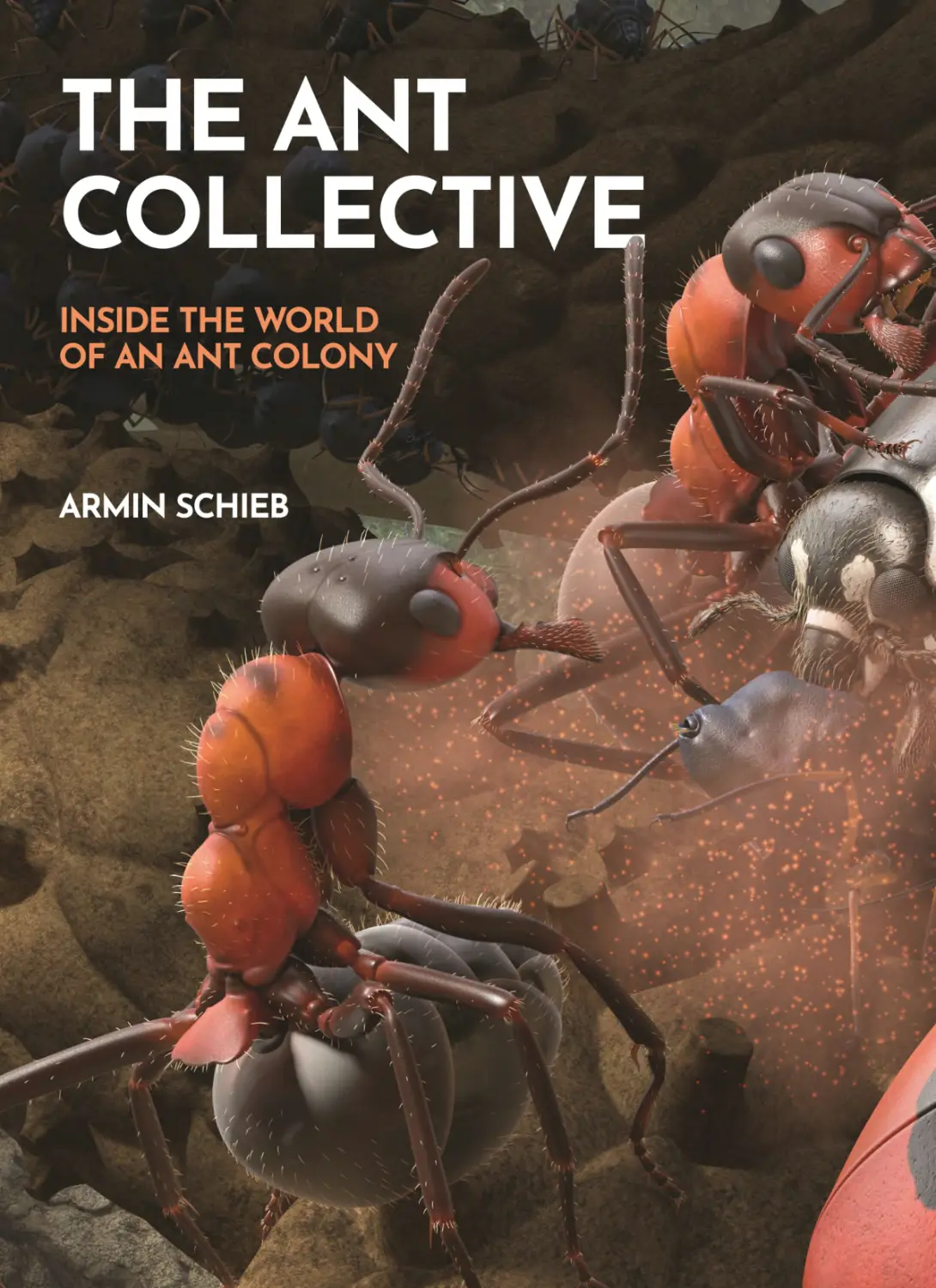


Author: Scheieb A.
Tags: biology insects translated literature princenton university press ants the ant collective
ISBN: 9780691255927

Text
                    ARMIN SCHIEB

The Ant
Collective
INSIDE THE WORLD OF AN ANT COLONY

Translated by Alexandra Bird

Princeton University Press
Princeton and Oxford

Contents

Red wood ants

1.1
1.2
1.3
1.4
1.5
1.6

Anatomy of a worker
Sex and caste
Circulation and respiration
Nervous and digestive systems
Glands
Sex and caste anatomy

4
8
12
14
16
18

Nest
establishment

2.1
2.2
2.3
2.4

Mating season
Nuptial flight
Mating and search for a nest
Nest establishment

20
24
28
32

Nest
construction

3.1
3.2
3.3
3.4
3.5
3.6

Construction materials
Nest architecture
Annual cycle | Spring
Summer
Autumn
Winter

36
40
44
46
48
50

The explorer

4.1
4.2
4.3
4.4
4.5
4.6

Forest exploration
Ants’ enemies
Foraging
Visual orientation
Celestial orientation
Return to the nest

52
54
60
62
64
66

Birth of a trail

5.1 Recruiting help
5.2 Birth of an ant trail

68
76

Food

6.1
6.2
6.3
6.4
6.5
6.6

82
86
90
92
94
96

Work division

7.1 Origin of sex and caste
7.2 The life of a reproductive individual
7.3 The life of a worker

98
106
108

Nest change

8.1
8.2
8.3
8.4
8.5

112
116
120
122
124

Aphid colony
Enemies and competitors
Plant food
Animal food
Food sharing
Waste elimination

The attack
Defense of the nest
Exploration of the surroundings
A new nest
Colony relocation

1.1 Anatomy of a worker
Most of the inhabitants of an anthill are wingless workers with a
very uniform appearance. An important identifying feature is
their red-brown-black coloring.

scape

antenna
clypeus

flagellum

mandible

pretarsal claw

tarsus

metatarsus

4

pretarsus

head
prothorax
occiput
gena
pronotum
ocellus

frontal
carina

frontal
ridge
frontal
triangle
antennal fossa

compound eye
ommatidia

prosternum
coxa

tibia

tibial spur

femur
trochanter

5

meso- and metathorax
abdomen

mesonotum

thoracic spiracles
metanotum
epinotum
(part of the abdomen)

abdominal spiracle

petiole

mesosternum

metasternum
sternite

6

gaster

tergite

anus

7

1.2 Sex and caste
A red wood ant colony consists of three kinds of ants: males, female queens, and
female workers. Each kind specializes in certain tasks.

4–9 mm

8

The numerous workers are the principal caste of
the anthill. They perform all the tasks, such as
caring for the larvae, hunting, defending the colony,
or building the nest. Young worker ants limit
themselves to tasks inside the nest; the older workers
are responsible for the dangerous work outside. As
workers don’t normally reproduce, care of the egglaying queen and larvae is their highest priority.

The males appear exclusively during mating
season. Their sole function is the fertilization
of young queens during the nuptial flight.
They only take part in social life for a few
days. They are unable to feed themselves and
depend on the workers’ care.

9–11 mm

9

10

9–11 mm

The queens are the heart of the anthill because they ensure
reproduction. After the dangerous creation of the nest,
they spend most of their long life in the depths of the
anthill, continuously laying eggs. During this time, they
need the workers’ constant care. It is the queen’s presence
that maintains the cohesion of the colony. In fact, ants
differentiate between friends and foes by the unique scent
of the queen, which is spread throughout the colony.

11

1.3 Circulation and respiration
Ants have an open circulatory system to supply the organism with nutrients.
The tracheae are a branching network of tubules that supply oxygen.
1

aortic
orifice

Ants’ “blood” is called hemolymph, a fluid that
fills the body and supplies it with nutrients,
transports hormones, and evacuates waste. The
circulation of the hemolymph is ensured by the
dorsal vessel, which acts as the heart, and by the
aorta. The hemolymph enters the chambers of
the heart through openings known as ostia. The
chambers contract from the rear, propelling
hemolymph into the aorta toward the head.

aorta

antennal heart

blood vessel
ostium
ampulla
4

2

3

lateral
tracheal
trunk
ventral
dorsal cephalic
cephalic trunk
trunk

accessory heart

antenna trachea

leg trachea

atrium
orifice

valve

tracheal tube
1

12

open
spiracle

Oxygen enters the body through spiracles, which
are openings in the exoskeleton. At the entrance
of the spiracles, hairs and a closing mechanism
prevent water and foreign bodies from entering. The
spiracles open into the tracheal system, a network of
fine tubules that runs throughout the whole body.
Oxygen flows through the system by diffusion.

dilated
air sac
2

closed
spiracle

compressed
air sac

Besides rigid tracheae, the tracheal
system includes soft air sacs. The air sacs
are expanded or compressed by body
movements, muscles, or variations in
hemolymph pressure. Their rhythmic
contraction promotes the transport and
diffusion of oxygen throughout the body.

2

The aorta ends at the level of the brain.
Hemolymph floods the cephalic capsule and
fills it. The incessant flow of hemolymph creates
pressure inside the head, propelling fluid into
the limbs and the posterior part of the body.

3

The accessory hearts, smaller versions
of the dorsal vessel, contribute to
the circulation of hemolymph in the
antennae and legs. In reproductive
individuals with wings, other
accessory hearts are found at
the wings’ base.

4

The organs bathe in hemolymph. Branching
extensions increase their contact surface with
the liquid, where they take in nutrients and
water and discharge their waste.

dorsal vessel

ostia
1

3

2

1

1–3
abdominal
spiracles

1–3
thoracic
spiracles

ventral trunk
ventral trachea
accessory
heart

air sac
dorsal trachea
visceral
trachea

cells

lateral
trachea

4–7
abdominal
spiracles

tracheoles

tracheoles
3

At their ends, the tracheae branch out into very
fine tubules filled with water, the tracheoles. These
end up near the cells of organs and muscles, which
they supply with oxygen. The carbon dioxide
produced by cellular respiration is temporarily
stored in the hemolymph before being exhaled in
steady puffs of water vapor from transpiration.
13

1.4 Nervous and
digestive systems
Ants have a decentralized nervous system
and a social stomach.
1

The ants’ well-developed olfactory lobes
analyze information transmitted by the
antennae. The optic lobes are also well
developed and analyze the eyes’ optical stimuli.

optic nerve

ocellar nerve

esophagus

central body
mushroom
body

antennal nerve
pharynx
frontal ganglion
labrum

2

3

1
1

taste buds

1

lateral lobes
olfactory lobe
optic lobe

glossa
salivary gland orifice
labial palp
maxilla
maxillary palp

1

14

labial nerve
maxillary nerve
subesophageal
mandibular nerve
ganglion
hypopharynx
labium
paraglossa

Using their grinder-licker mouthparts, ants ingest
liquid or soft food. Taste buds and the tongue’s
antennae-like appendages taste food before
bringing it to the mouth. Before swallowing, all
solid foreign bodies are filtered and collected in
the infrabuccal pocket and expelled.

2

thoracic ganglia 1–3

Ingested food is stored in the social stomach,
known as the crop. If necessary, part of the
contents is regurgitated and shared with fellow
creatures. The contents of a full crop can supply
provisions for approximately eighty ants. These in
turn share the received food until each ant is fed.

2

The mushroom bodies and the central body
are the headquarters of memory and learning.
They constitute the associative area of the brain.
Sensory information from the eyes and antennae
is transmitted to the mushroom and associated
bodies. This is where the ant decides how to
react to sensory stimuli.
crop

Beginning at the brain, the ventral chain—a
chain of successive pairs of ganglia—runs
through the ant’s body. Each pair of ganglia
controls specific parts of the body and translates
orders from the brain into movement and
inhibition impulses. The thoracic ganglia
control the legs, while the abdominal ganglia
control the digestive organs.
proventriculus
3

stomach
Malpighian tubules
intestine

rectal valve

2

3

rectum
3

nerve
bundle

3

abdominal
ganglia 1–3

stomach
valve
abdominal
ganglia 4–5

3

rectal papillae
pylorus

pyloric
valve

anus

When the crop is nearly empty, the proventriculus
pushes food for the ant’s personal needs into the stomach,
where the nutrients are absorbed. The undigested remains
reach the pylorus, joining the toxins extracted from the blood by the
Malpighian tubules. Then the waste passes into the intestine and finally
into the rectum, where papillae retain the water contained in the waste.
Finally, the excrement serves as an odorous substance to mark trails.
15

1.5 Glands
Pheromones produced by glands regulate the organism’s functions and the
ants’ social life.
1

Secretions from the prepharyngeal gland
are released into the mouth. Some of them
reach the crop via the esophagus. These
secretions play a role in digestion or in
feeding the larvae.

2

Secretions from the two maxillary glands
enter the mouth. The precise function of
these glands is still poorly understood.
They might assist in feeding the larvae.
corpora cardiaca hormonal
glands
corpora allata

postpharyngeal gland
5

prepharyngeal gland

6

4

1

labial gland
duct

2

labial gland orifice

labial gland reservoir

3

labial gland tubes
maxillary
gland

mandibular
gland

3

Secretions from the two mandibular glands
reach the mouth. They may be used to coat
the eggs with saliva or to lick the body.

4

The postpharyngeal gland produces saliva,
which it empties into the esophagus. This
gland may be involved in digestion or in
producing reproductive individuals.

5

16

Hormonal gland secretions go directly into the
hemolymph and spread throughout the body.
Hormones act on internal organs and regulate
many functions as well as metabolism.

6

The labial gland produces a nutritive secretion
that the workers give solely to the queen and the
larvae that will become reproductive individuals.
The amount of secretion given regulates the
queen’s fertility. This secretion contributes to the
development of “female” larvae into queens.

7

The metathoracic gland emits its secretion
outside the organism, where the legs apply it
to the surface of the body. In workers, it has an
antiseptic effect and protects against infections.
In the queen, it produces the royal scent. By
taking care of her, the workers receive the scent
and transmit it by bodily contact to all the
inhabitants of the anthill. Ants can thus recognize
each other as members of the same colony.

8

The poison gland’s painful secretion (formic
acid) is a biological defense weapon. The
worker projects it directly or from a distance
into an opponent’s wounds. Penetrating into
the body of the victim, it destroys the tissues
and has a paralyzing effect. Its odor also acts
as an alarm: it excites the other workers, who
join in the fight.
poison gland
poison gland
reservoir

8
7

metathoracic
gland
9

10

sex gland
(ovary)
Dufour’s gland

9

The ovaries produce eggs in reproductive
individuals. The workers’ ovaries are much
smaller and are functional only in young workers.
When the queen dies, the young workers can
lay eggs. As they do not mate, the eggs are not
fertilized and only produce males.

10
0

The secretion of the Dufour’s gland informs
the other workers of the presence of food and
encourages them to leave the nest in search of it. If
the secretion is sprayed together with formic acid,
it increases its alarm effect. In queens, it serves as a
sexual scent to attract males during the nuptial flight.
17

1.6 Sex and caste anatomy
The ants’ external and internal structure reflects the functions of the sexes and
the different castes. The lives of workers comprise two phases characterized by
different activities, to which the functions of their organs adapt. For their part,
males and female queens are exclusively adapted to reproduction.
Interior service worker
The worker only partially orients
herself with her compound eyes, the
resolution of which is coarse. Each
compound eye consists of 580 to
700 simple eyes.

Due to the variety of tasks, the
worker’s brain is well developed.

In interior service, the worker feeds
the larvae and the queens. The labial
gland is at its maximum activity
during this phase.

The interior worker does not
participate in combat; her behavior
is defensive and her poison gland
is inactive.

The worker’s main sense organs are
her two antennae, each composed
of twelve segments.

The ovaries are functional: in
exceptional situations, the worker
can lay eggs.

The mandibles are the worker’s
multipurpose tools for performing
all sorts of tasks in the nest. This is
why they are robust and toothed.

The maxillary glands are
well developed and produce
abundant secretion.

The worker being devoid of wings,
the thoracic musculature is used to
move the legs and the head.

Exterior service worker
In exterior service, the worker no longer takes
part in feeding the larvae and the queen. In this
phase, her labial gland has only reduced activity.

The poison gland is active and produces
formic acid, which allows the worker to
defend the nest and hunt prey.

The ovaries are very atrophied and
can no longer produce eggs.

In these workers, the mandibles
are sometimes worn down by
intense use.

18

The maxillary glands are atrophied
and produce less secretion.

Queen

The compound eyes of queens have
somewhat better resolution than workers’
eyes in order to orient themselves during
courtship flight. Each compound eye
consists of 800 to 950 simple eyes.

The queen is less active than the
workers; her brain is smaller.

The queen’s productive ovaries
are much large than those of
the workers and fill much of her
abdomen.

The jaws are similar to those of
workers, but they are larger.

The antennae consist of twelve
segments, like those of workers.

The thorax is much larger than that
of the workers. It contains the wing
muscles, essential for nuptial flight.

Male

The compound eyes have significantly
better resolution than those of workers
and queens. They each consist of about
1200 simple eyes.

The male being hardly active in the
nest, his brain is much smaller than
that of the workers and the queen.

The elongated abdomen is largely
occupied by the sexual organs.

The male hardly uses his mandibles.
He neither hunts nor carries
anything. They are therefore small
and have only one pointed tooth.

With thirteen segments, the male’s
antennae are more sensitive than those
of workers and queens. Thanks to them,
the male has a more developed olfactory
sensitivity during the mating season.

The thorax is voluminous
and contains powerful wing
musculature.

19

2.1 Mating season
In May and June, the red wood ants take off en masse to mate. During this period,
especially in sunny and muggy weather, males and females from the many colonies
gather in their nests, waiting for the flight signal.

Males and females develop separately.
Males are mainly born in small, still
undeveloped nests that produce little
internal heat. When mating season
arrives, they leave the interior of the
anthill. Before flying away, they are
fed one last time by the workers.

The workers restrain the males by the wings
in order to prevent their premature flight.

20

An atmospheric depression at the end of
the afternoon gives the signal for takeoff.
Swarms of males leave the nest. Their two
mandibular glands secrete pheromones
that diffuse into the air, informing ants in
nearby nests of their flight.

Males that try to leave the nest too
soon are caught by the workers and
brought back to the nest.

21

In the large, developed nests that
produce a lot of heat, females are born—
the future queens. These females leave
the interior of the anthill and gather
by the thousands on its surface. The
workers feed them one last time.

Male pheromones disperse and
are spread around by the wind.

22

As soon as the females’ antennae perceive
the males’ pheromones, they become
agitated and prepare to leave the nest.

If a female attempts to leave the
nest too early, she is caught by a
worker and carried back to the nest.

23

2.2 Nuptial flight
The meeting point between the two swarms is a
small clearing. This is where they come together
in a single swarm for the nuptial flight.

To signal that they are ready to
mate, females emit pheromones
secreted by the Dufour’s gland,
located in the abdomen.

Attracted by the sunlight, the
males reach the clearing and
gather at the tips of young spruces
to await the arrival of the females.

24

In turn, the females’
pheromones spread to the
surrounding area.

As soon as the males sense
the females’ pheromones,
they take flight and form a
large swarm with them.

25

Excited by the female
pheromones, the males chase the
females and try to catch them.

During the chase, the
competing males push
each other away.

This female tries to
escape her pursuer.

26

This male positions
himself above the
coveted female.

He quickly approaches
and grabs her back
with his claws.

The female cannot support
the male’s weight and they
fall to the ground.

27

2.3 Mating and search for a nest
During mating, the female receives a supply of sperm from the males. As soon as
she has established a nest, she will use it to produce the anthill’s inhabitants.
1. mating

1. separation
1

The female falls with the male to
the forest floor. Around them, other
reproductive individuals of the same
swarm mate. The male clings to her
back and begins to fertilize her.

2

Sperm are formed in male
testicles. These are already full
of sperm when the male hatches.

During copulation, the female receives
from the male a supply of sperm, which
she keeps in a spermatheca inside her
abdomen. When she becomes the
queen of a new colony, these sperm will
be used to fertilize the eggs.

sperm

During the first days
after hatching, all sperm
migrate to the seminal
vesicles and fill them.

At the same time, the two
accessory glands develop
and produce seminal fluid
or semen.

28

During mating, sperm
and semen mix and are
projected out through the
seminal canal and penis.

The female’s copulatory
orifice accommodates
the male’s penis and the
semen enters her body.

The sperm enter the
spermatheca. Glands there
produce a secretion that
nourishes them and keeps
them alive.

The eggs develop in the
female’s ovaries. When they
are laid, they are selectively
fertilized by sperm from
the spermatheca.

2. mating

2. separation
3. separation

3. mating

3

During the nuptial flight, the female is
fertilized by several males, filling the
seminal sac with millions of sperm.
This reserve is enough for a queen to
fertilize her eggs for twenty-five years.

4

After each mating, the female frees herself
from the male. As she does this, she bites
and cuts her partner’s abdomen. Then the
male and female leave separately.

29

5

30

6

Having mated, the males have fulfilled their
biological function. They do not return to
the nest and behave with indifference. Soon
after, they die or are eaten by animals.

7

The young fertilized queen is excluded from
returning to her natal nest. Indeed, colonies
of red wood ants do not accept competitors
to their queens. Anyone who returns would
be considered an enemy and attacked by the
workers. The young queen must therefore find
her own nest.

After the last mating, the young
fertilized queens land en masse on
the ground. The long and dangerous
search for a place for the nest begins.
Few queens survive this exploration.

8

In order to be able to move forward
more easily on the ground, the young
queen detaches her wings using her legs,
a process facilitated by the presence of
breakpoints at the base of the wings.

dead young
queen

9

During the tireless search for a site, the
young queen covers her energy needs
with the food given to her before the
nuptial flight, which is sufficient for two
weeks. Many queens die along the way.

31

2.4 Nest establishment
During its evolution, the red wood ant (Formica rufa) lost the ability to
build a nest. For this undertaking, the young queen needs help from host
ants. She must therefore find a host whose nest she can colonize.

battle with

2 slave ants

1

search for the
nest entrance

The young queen discovers a nest
inhabited by dark gray slave ants (Formica
fusca). Like the red wood ant, this species
likes to build its nests under the trunks of
trees. It’s an ideal host for the young queen.

encounter with
slave ants
This young queen
is intercepted and
attacked by slave ants.

2

32

For the slave workers, the approaching
young queen is an enemy. If there are
many workers and a fight ensues, she
won’t survive. But if the queen can
elude them, she can overcome some
workers thanks to her larger size.

3

As soon as the young queen finds
an entrance, she enters the nest
and looks for the chamber in
which the slave ants’ queen is held.

nest entrance

entering
the nest
4 murder of the

3 search for

anthill’s queen

the anthill’s queen

5 beginning of

egg laying

nursing the eggs

4

Once the young queen finds the slave
ant queen’s chamber, she kills her, thus
forcing the nest to adopt her. Since she no
longer has a competitor and her scent is
stronger than that of the anthill’s queen,
she is accepted by the slave ants’ colony.

5

nursing the larvae

The young queen becomes the queen of the
slave ants’ colony and begins to lay eggs.
The slave workers take care of her and her
eggs as they did for their former queen.

33

Red wood ants and slave
ants go together in search of
food and building materials.
6 red wood ants

hatching

pupa care

6

34

The new larvae are taken care of by
the slave workers. From their pupae
are born red wood ant workers.
Both species tolerate each other and
cooperate in different tasks. The colony
of slave ants becomes a mixed colony.

8

The nest is no longer sufficient to
accommodate the growing population
of red wood ants and the brood. The
workers enlarge the nest and bring
back materials to build a dome.

8 workers dragging

building materials

7 gradual replacement of

slave ants by red wood ants

7

Since no more slave ants are born, their
proportion in the population declines and
they are replaced by an ever-increasing
number of red wood ants. Once the slave ants
are all dead, the red wood ants can fend for
themselves. The red wood ant colony is pure.
35

3.1 Construction materials
One of the workers’ main tasks is the construction and maintenance of
the anthill dome, whose materials come from the surrounding forest.

extensor
muscle
1

36

flexor
muscle

The worker’s main tools are their serrated
upper mandibles. Thanks to the power
of the mandibular muscles and their
expansive opening, the workers can grasp
twigs and pull them to the nest. They work
together to carry the biggest ones.

37

4

3

Building materials are collected
near the anthill. Transporting
large items can take several days.

Near the nest, materials are
passed to other workers,
who carry them to their final
location in the dome.

twig

solidified resin

center
of gravity

38

2

The worker’s center of gravity is in
her posterior half, which allows her to
carry heavy loads. Moreover, her six
legs give her great stability. She can
hold bulky loads at an angle above the
body so that the load’s center of gravity
is close to the body’s center of gravity.

5

The materials are brought in and
deposited on the dome’s surface.
They are used to repair damage
and maintain an even surface.

6

The outer cover of the dome is a layer of thin
materials about 10 cm thick. Densely packed,
these materials are held together by tree resin,
which softens and sticks in the sun. This cover
protects the inside of the nest from rain and
wind and serves as insulation. Its maintenance
is of vital importance, because only an intact
cover can keep the heat inside the nest.

spruce needle

bud scale

pebble

plant debris

39

3.2 Nest architecture
The different stages of brood development (eggs, larvae, and pupae) require
different temperatures and humidity levels. The workers are constantly
transporting the brood to rooms where the conditions are the most favorable.

The interior of the dome is made of coarse
materials and surrounds a central tree
stump. A dense network of rooms serves
as chambers, incubators, and storage areas.

The central stump gives stability to the
dome. The rooms allow the queen to be
sheltered when the dome is destroyed by
animals in search of food, for example,
wild boars. The precious eggs are well
sheltered under the stump.
40

fourth instar larvae

4

1

The developed larvae need a higher
temperature, between 29°C and 31°C. They
are then transferred to the central rooms of
the dome. They are fed until they envelop
themselves in a kind of cocoon, the pupa.

Because the red wood ant is monogynous,
the nest shelters only one queen in a
chamber of the stump, where she lays
continuously from spring until the
beginning of autumn, at a temperature
of 20°C–22°C. The eggs stick together,
forming clusters that the workers collect.

third instar larvae

egg clusters

2

The eggs are transported to deep
chambers—the nurseries—where
high humidity and a temperature
of 20°C–25°C prevail. To prevent
the eggs from drying out, they are
piled up and licked by the workers.

3

Newly hatched larvae are
transferred to nearby nurseries with
high humidity and a temperature of
27°C–28°C. The workers begin to
feed them.

hatching of a larva
first instar
young larvae

41

5

The pupae in their cocoons require a
dry and warm environment. They are
brought up to the outer areas of the
anthill, at a temperature of 29°C–31.5°C.
If prolonged rains moisten and cool
these areas, the cocoons are briefly
brought to the surface to dry in the sun.

workers hatching

Recently hatched ants have a
soft, clear cuticle. This hardens
after a few days and takes on
its characteristic color.

Young pupae have
a pale cocoon.
Older pupae have
a dark cocoon.

Due to the dome’s constant
movement, coarse materials such
as pebbles and large twigs end up
piling up at the bottom of the nest.

second instar larvae

The subterranean part of the nest extends
far into the ground, up to two meters deep
and wide in large nests. Underground, the
temperature is quite low and relatively constant.
If it’s too hot or too cold on the surface, the
workers retreat to these subterranean areas.

second instar larvae

42

humid part of the nest

The workers constantly maintain
the dome. They repair damage and
transport damp materials from
the interior to the surface so the
materials can dry, thus preventing
a mold infestation.
foragers leaving the nest
in search of food
Workers carry the empty pupae outside
and deposit them on a waste heap, along
with food scraps and dead congeners.

Fine earth and sand produced
by the digging of chambers and
tunnels are spread around the
dome. This deposit forms a circular
wall that supports the sides of the
dome and prevents the materials
that constitute it from slipping.

captured spider

captured caterpillar

workers digging

prey cut up and
stored in underground
granaries

43

3.3 Annual cycle | Spring
A red wood ant nest is a dynamic structure that the workers are constantly
adapting to temperature and weather fluctuations. In the spring, the colony
awakens from its winter rest. It begins by restoring the nest to working order
and warming it up.

At the end of the winter rest, the ants
gather on the surface of the dome to
warm themselves in the sun. Ants being
heterothermic, they need external heat
to accelerate their metabolism and
become active again.
Ants still too numb to drag
themselves to the surface are
picked up by active workers and
carried outside.

solar radiation

resting ants

The queen basks in the sun
under the protection of the
workers and without straying
from the entranceway. She is
already beginning to lay the
winter eggs, which will produce
reproductive individuals.

The active workers, already warmed
up, return to the interior of the nest
and try to wake up the still numb
workers by tapping their antennae
and tugging on them.

winter rest
January

44

February

March

After this first sunbathing, some of the
workers begin to rebuild the dome,
clearing away the dirty layer covering
it. Thus uncovered, the inside of the
nest can dry out in the sun. The interior
materials are spread around to dry too.

The workers who are not busy
rebuilding the nest gather in small
clusters on the surface to warm
themselves in the sun. Once
their body temperature reaches
30°C–34°C, they immediately
rush inside the nest.

workers leaving the
nest in all directions
in search of food

evaporating
water

inward heat
transfer

return
to surface

Warmed-up workers transmit their
gathered heat inside the nest. Like
hot water bottles, they warm the
anthill. They then return to the
surface to warm up, and the heat
transfer begins again.

spring sun bath

The first laid eggs hatch in the
spring and generally give rise to
reproductive individuals, who are
cared for by the workers. In late
spring and early summer, they
leave the nest to mate.

raising reproductive individuals
April

May

45

3.4 Summer
The anthill reaches a stage of intense activity and growth. Workers adapt
the nest to the summer heat.

In spring, there is still little food in the
forest. Outings from the nest rapidly
increase and reach their maximum
intensity. At first diffused, exploration
outings are eventually concentrated in
specific directions. The workers move
farther and farther away from the nest
and trails are created.

Due to its flattened shape, a
damaged dome captures little
sunlight. Once restored, it is higher:
more of its surface is illuminated
and the interior of the nest warms
up faster.

After the reproductive
individuals have left, the queen
begins to lay the summer eggs,
which will produce workers.

If the temperature is too low in
certain areas of the nest, workers are
transported there to increase the ant
density. Since more ants transmit
more body heat, the temperature of
these areas increases and approaches
that of the rest of the nest.
nuptial flight

May

46

June

When the nest is in danger of
overheating, the workers remove
materials from the dome, creating
new openings that allow the warm
interior air to escape. In addition,
this allows the wind to push fresh
air inside.
cold air

hot air

With the revival of wildlife, there is enough
food around the nest. Exploration outings
are a little less intense, but remain numerous
until the end of August. The workers follow
the network of trails to bring back the sweet
secretion of aphids, known as honeydew, as
well as the many animals captured.

In summer and spring, only
workers are born. To provide
enough food for all these larvae,
hunting intensifies.

raising workers
July

August

47

3.5 Autumn
Toward the end of the season, the colony gets ready for winter rest and
the nest is prepared for the cold.

In order to take better advantage
of the weaker sunlight, the dome is
raised and its slopes are steepened.
The sun can then illuminate a larger
area and heat the nest more efficiently.
To keep the heat inside,
many entrances are
sealed and the cover
layer is thickened.

Entrances are
moved from
the top of
the dome
toward the
base.

Due to the increasing number of
workers and the approach of winter,
the bulk of the colony migrates to
underground areas. The workers enlarge
these areas, digging new chambers and
tunnels. They bring the soil particles to
the surface and spread them around the
dome. The underground rooms serve as
shelter during the winter.

Exploration outings decrease
from August onward. To
feed the last larvae and to
accumulate winter reserves,
the workers continue to
bring back all kinds of food.

raising workers
August

48

September

Shortly before winter, the dome is still
passively heated. Food reserves are
stored in the form of fatty bodies in
the workers’ abdomens, which expand
greatly. The ants feed on these reserves
during the resting period and in spring,
when there is still little food in the forest.

When it rains, the
entrances are closed
to prevent water from
flooding the interior.

The digging of new rooms
enlarges the pile
of rubble.

In autumn, the outings continue
to decrease and, in the absence
of brood, the foragers no longer
capture prey. They only bring
back the aphids’ sweet honeydew
to build up their reserves.

Once the last workers have hatched,
the queen stops laying. Without
brood, the workers cease to regulate
the temperature in the nest, which
gradually begins to cool.

October
stockpiling of food

49

3.6 Winter
In winter, the ants cease all their activities. To protect themselves from the
cold and frost, they retreat underground, to the bottom of the nest.

While the colony devotes itself to
resting, a few workers stay in the
dome and tightly close the openings.

Without the workers’
maintenance, the dome
begins to collapse and
cool under the effect of
the weather.

Ants being heterothermic animals,
their body temperature is dependent
on the outside temperature. When it is
low, their activity decreases. When the
temperature in the nest drops below
10°C, the colony and its queen retire
to the deepest chambers to overwinter.
very active in summer

October

November
stockpiling of food

50

hardly active in winter

In mild weather, a
few foragers emerge
from the anthill.

In winter, green woodpeckers feed
almost exclusively on ants. To capture
the numb ants, they dig deep holes in
the anthill; with the help of their sticky
tongues, the tip of which has curved
hooks, they penetrate the convoluted
galleries to the wintering rooms.

In winter, the dome
collapses on itself and
many rooms are crushed,
but those in the stump or
underground remain.

outposts

fr o

st

li m
it

approximately
80 cm

numbed ants

Groups of workers, often old or sick,
overwinter just below the frost line.
When the area warms up in the spring,
these outposts sense the warming
and awaken their fellow congeners.
Without these outposts, the bulk of the
colony would miss the start of spring
because the rise in temperature on the
surface cannot be perceived from the
depths of the nest.

During the winter rest, the workers
gather around the queen. When the
temperature approaches 0°C, the
metabolism of ants slows down so
much that they do not need to feed.

winter rest
December

51

4.1 Forest exploration
Foragers are constantly looking for food in the vicinity of
the anthill.

Most foragers leave the nest in the
morning. If there is a shortage of
food in the anthill, workers emit
pheromones that incite scouts to
come out.

52

1

2

Outside the nest, the scouts
orient themselves by taking
in the position of the sun and
some noteworthy trees in the
surrounding forest.

3

Along the way, they take
advantage of natural
trails, like fallen branches,
to progress faster.

53

4.2 Ants’ enemies
Outside the anthill, the workers are exposed to numerous
predators specialized in capturing ants.

Ants are identified by
a green woodpecker.

54

1

3

4

Red wood ants are the
woodpecker’s primary food, and
it spends most of its time on the
ground looking for them.

2

The woodpecker quickly
grabs several ants and
keeps them in its beak.

Because of their full poison reservoir, red
wood ants are inedible to woodpeckers. To
make them consumable, it rubs them on its
plumage. When it does this, the ants project
their defensive secretion, completely emptying
their glands, and then the woodpecker can
swallow them. In addition, the formic acid kills
or drives away parasites from its feathers. Other
birds, such as blackbirds and thrushes, take care
of their plumage in the same way.

55

1
The web spider of the
Cryptachaea riparia species is
an ant hunter. Hidden under
a leaf, it waits for prey to get
caught in one of its threads.

By wriggling, the ant makes
the nest shake. The spider
senses the vibrations, which
alert it.

2

56

An ant bumps into a thread
and gets trapped by the sticky
drops that dot it.

4

6

5

The spider drags the ant to its
nest. Wrapped in a silk cocoon,
it serves as a food reserve for
the spider and its larvae.

The spider wraps the ant in its
thread to immobilize it; then
it bites the nape of its neck to
paralyze it with its venom.

7

3

The spider disposes of
the ant’s dried remains
by dropping them on
the ground.

Struggling to free itself, the
ant detaches the thread from
the ground. It is lifted into the
air and becomes entangled in
the thread.

57

An ant approaches the funnel of an ant 1
lion, which is the larva of a dragonfly-like
insect. The larva digs a funnel in the sand
to capture small arthropods. The sand at
the edge of the funnel crumbles, and the
ant slides inside.

The loose sand prevents the 2
ant from finding a hold, and its
slide continues. Its movements
produce vibrations that alert the
ant lion.

To prevent the ant from escaping, the
ant lion, which occupies the center of
the funnel, throws grains of sand on it
with rapid body movements.
58

3

6

4

5

The ant lion throws the
ant’s dried remains out
of the funnel.

As soon as the ant is within
reach, the ant lion grabs
it with its mandibles and
paralyzes it with its venom.

The ant lion pulls its prey under
the sand. It sucks the liquid from
its body and completely empties it.
When an ant lion funnel is near an
anthill, ants are its primary food.

59

4.3 Foraging
The scout has found food. She must now find her way back to the nest
and lead other foragers to the food source.

1

The scout tastes the food. If it suits her,
she fills her crop with it. The more she
likes the food, the more she ingests.

blueberries

crop

full crop

2

rectal
ampulla

60

excrement

The ant’s crop expands until it fills
much of the abdomen, compressing
other organs. The rectal ampulla is also
compressed and releases excrement.
The amount defecated depends on the
amount of food ingested.

nest direction

positive phototaxis

3

To mark the path to the food, the scout
brushes the ground with her abdomen
at regular intervals and deposits
excrement there. The excrement contains
pheromones produced by the intestine
and creates a scent trail. The amount
of excrement deposited determines the
intensity of the smell. The scout proceeds
in this way to the nest.

4

negative phototaxis

After finding food, the scout’s body reacts
differently to sunlight (phototaxis). It’s no
longer light that attracts her but darkness. She
now heads in the opposite direction of the sun,
more or less toward the nest. During the trip,
she deviates regularly to the right and left of
the chosen direction. If she deviates too much,
she corrects her course and goes back in the
other direction, drawing a winding path.
61

4.4 Visual orientation
On the return journey, the worker’s two complex eyes give her a rough
picture of her surroundings.
part of the light spectrum
perceived by the compound eye

The ants’ compound eyes are composed of
a large number of isolated individual eyes
in apposition, known as ommatidia, which
each produce a visual signal. A red wood
worker ant’s compound eye has between
580 and 700 ommatidia, most of which
capture polarized light in the green-blue
light spectrum perceived region of the visible light spectrum.
1

by the human eye

8.4 µm
Light enters the ommatidia
through a chitinous lens.
A lens cone concentrates light
and directs it to a retinal cell.

Each of the eight retinal cells
has a fringe of light-sensitive
parallel tubules, the microvilli,
on the central surface.

140 µm

Dark pigmented cells isolate the
ommatidia from one another.

The microvilli fringes in
each of the eight cells
form the rhabdome.

Retinal cells make up the
sensory part of the ommatidia.
2

The image that ants perceive of their
environment is a grid of light and
dark dots, each corresponding to
what an ommatidium captures. Each
ommatidium perceives the intensity
of only a single ray of light.

Neurons transmit signals from
visual cells to the brain.

The photons of an
unpolarized light ray
vibrate in different planes.

The microvilli fringes
are inclined 60°
relative to each other.

blue-green receptor
UV receptor

A large number of tubules
stacked on top of each other
constitute the ommatidia’s light
receptors. Each perceptual level
is made up of six blue-green
receptors and two UV receptors.
Due to the twisting of the retinal
cells, the receptors all have
different orientations.

One perceptual level
can perceive three
vibrational planes.

The signals of the different
levels are added together. The
irregularities compensate
for one another, producing a
homogeneous pixel of which only
the central part is analyzed.

A receptor picks up a
photon when its plane is
parallel to its microvilli.

62

By twisting the rhabdome,
each photon hits a
correspondingly oriented receptor,
producing a visual stimulus.

pixel

2 pixel

left
landmark

right landmark

1 compound eye’s cone of vision

direction of the nest

4

angle of travel
relative to landmarks

3 image of the environment

food source
landmark

nest
3

In the brain, the ommatidia’s pixels are
assembled to form a rough vertical image.
The image of the forest is thus reduced to
vertical silhouettes of the trunks and foliage
patterns. The trunks’ silhouettes serve as
the scout’s orientation landmarks.

4

The scout has recognized the nest’s
surroundings from previous outings. She
memorized the trees and light sources, as well
as the angle of her route. On the way back, she
recognizes these landmarks and remembers
the corresponding angle, and she takes the
correct direction to return to the anthill.

63

4.5 Celestial orientation
The position of the sun and its light polarization are landmarks
that complete the visual orientation.
ultraviolet light perceived
by the POL region
1

With its compound eyes, the ant also
perceives polarized light. This is the
function of the ommatidia of the POL
region on the upper edge of the eye, which
specializes in the perception of UV light.
Using polarized light, the ant determines
the sun’s position even when it is hidden.

light spectrum perceived
by the human eye

lens
crystalline
microvilli fringe
pigment cells
retinal cells

retinal cells
2

The image provided by ommatidia of
the POL region is a pattern indicating
the direction of the sky’s polarization.
These ommatidia are similar in structure
to the others, but are specialized in the
perception of polarized light.

UV receptor

neurons

rhabdome

A large number of tubules stacked
on top of each other constitute the
ommatidia’s light receptors. Each
receiving level has two blue-green
receptors and six UV receptors.
The receptors are not inclined and
therefore are all oriented in the
same direction.
bluegreen
receptor

Almost all photons in a
polarized light ray vibrate
in the same plane.

At each level of reception, the polarized
light stimulates only two receptors
located in opposition. The signals of
the different levels are added together
to give a pattern, which makes visible
the direction of the light ray’s vibration.
direction of vibration

64

Since the receptors all have
the same orientation, the
polarized light produces
the same stimulus on all
reception levels.

pixel

partially polarized celestial light
weakly polarized celestial light

preferential direction of vibration
strongly polarized
celestial light

sky polarization
3
pattern

pixel 2

sun’s position
at departure

POL region’s 1
vision cone

angle of travel in 4
relation to the sun
direction of the nest
sun’s position
on return

sky polarization

3

actual
polarization pattern

The sky polarization pattern is produced by
the refraction and reflection of sunlight in the
earth’s atmosphere. Regardless of their angle of
incidence, light rays are more or less polarized.
The preferential direction of polarized light
vibration is always perpendicular to the
direction of the sun. The directions of the
different light rays’ polarization thus create a
pattern of concentric circles around the sun,
allowing the ant to orient itself.

4

mental image
of polarization

The scout compares the sky polarization pattern with
a simplified image stored in her brain. The degree of
correspondence between the two images allows her
to know the angle of her course in relation to the sun.
This faculty serves as a compass to determine the
direction of the nest: when leaving the nest, she goes
toward the sun; on her return, she turns her back on
it. But since the sun has changed its position in the
meantime, she follows a certain angle with respect to
it in order to take the right path.
65

4.6 Return to the nest
Arriving near the nest, the scout meets members of her colony.
Their scent helps her find her way back.
scent molecule

antenna sensory organs

sensilla
(coeloconic)

1

The antennae are the ants’ main sense organs.
The surface of the antennae is densely covered
with sensory organs known as sensilla. Most
sensilla are tactile, responding to touch. The
others are various types of olfactory sensilla.
Thanks to these organs, the ant perceives the
outside temperature, the air’s humidity, and
the rate of carbon dioxide, as well as odors
and flavors. The scout perceives her
congeners’ scent and follows it.

1

plate
sensilla

tactile
sensilla
mechanical receptors

perception of
an ant trail
2

olfactory
sensilla
chemical receptors

meeting
a congener

food exchange 3

2

66

The scent leads to a nearby trail, where
she encounters another worker. The two
ants feel each other and check each other’s
collective scent. If the two ants belong to
the same nest, they separate and the scout
follows the trail toward the nest.

3

When two workers from the same
colony meet, they often exchange food, a
behavior called trophallaxis. Encounters,
checking each other’s scent, and
trophallaxis are repeated several times
until the scout reaches the nest.

1

1

meeting a
foreign ant

When the workers encounter
a greater number of ants from
a colony or a foreign species in
unfamiliar territory, they adopt a
defensive attitude and avoid them.

2

On familiar ground and in the presence of
other members of their colony, the workers
are more aggressive toward foreign ants,
assuming a threatening posture and
striving to drive them away.

3

In close proximity to the nest, the
ants are very aggressive. Intruders
are collectively attacked and killed
before being transported to the nest,
where they are used as food.

Once the scout arrives, she
recruits other workers to lead
them to the food source.

67

5.1 Recruiting help
In order to exploit the food source, the scout needs help. Back at the nest,
she informs her congeners of her discovery and recruits foragers.

68

The blueberry she brought back
arouses the attention of the colony.
The neighboring workers rush in
and start tearing up the blueberry.

The scout strives to transmit to her
fellow congeners the excitement of her
discovery. She regurgitates a drop of
blueberry pulp and offers it to another
worker, whose head she taps.

69

Along with these taps, the scout emits
pheromones through the Dufour’s
gland in her abdomen. The odor
molecules disperse in the air, causing
a food alert.

70

Neighboring workers’ olfactory
receptors on their antennae
perceive odorous molecules. If the
concentration is sufficient, the scent
incites the workers to leave the nest
and to go in search of food.

71

The scent trail that the scout left
on returning to the nest helps the
foragers orient themselves and
leads them to the food source.

72

The ants’ two antennae provide
them with a spatial perception of
the scent, which allows them to
follow it precisely.

73

The recruited foragers are generally older
and experienced. When food is lacking in the
anthill, young, inexperienced ants are also
recruited. On their way to the food source,
the foragers memorize the position of the
trees in order to be able to orient themselves
later without the help of the scent trail.

74

At the end of the scent trail, the
foragers discover the blueberries.
They fill their crops and set off for the
return journey. The smallest berries
are carried in groups to the nest.

75

5.2 Birth of an ant trail
Ant trails usually lead to abundant food sources.

1

On the way back, the foragers
accentuate the scent trail by
depositing their own excrement.

2

76

The intensity of the scent becomes
so strong that active recruitment
is no longer necessary to attract
other foragers and guide them to
the food.

1

2

More and more foragers travel to the
food source and in turn strengthen
the scent trail on their return.

To facilitate progress on the
trail, the ants push obstacles
aside or bring them back to
the anthill, where they are
used as building materials.

3

Due to the increasing intensity
of the scent, more and more
workers leave the nest to go to
the food source.

77

1

2

The number of recruited foragers
ends up causing a scramble for
food, and many newcomers
cannot find a place on the trail.

Foragers that fail to gain access
to food eventually return to the
nest without depositing a scent
on the trail.

3

78

Since not all of the foragers
reinforce the scent trail during
their return, the intensity and
attractiveness of the scent decreases
and fewer ants follow the trail.

1

The weaker scent trail results in fewer
workers arriving at the food source.
There’s no longer any jostling and the
newcomers find space. Food can be
exploited more efficiently.

2

The trail serves as a starting
point for some ants to
further explore the forest.

3

The intensity of the scent trail
therefore fluctuates until there is
an optimal number of foragers
to exploit the food source.

79

1

A scout returns to the trail
and recruits help.

2

The food source begins to deplete,
and the foragers adapt to the lower
quantities by depositing a less
intense scent trail. The attractiveness
of the trail decreases even more and
fewer ants go to the food.

Then she guides the foragers
to the new food source.

When a scout has found another
food source, she recruits foragers and
leads them there. If the new source is
promising, the process repeats itself
and another trail is born, an offshoot
of the first.

At the branching level, it is the scent
trail’s intensity that determines which
direction is chosen most often.

80

3

A tree with aphids is a valuable food
source for the colony. The aphids’
honeydew is indeed a major energy
source. The offshoots occupied by
aphids are quickly discovered by ants
and regularly visited. Very soon there
are more ants on the offshoots leading
to the trunk than on the initial trail.

At first, few foragers
follow the shortcut’s still
faint scent.

4

As the foragers do the round
trip much more quickly via
the shortcut, the intensity of
the scent trail attracts more
and more ants.

The scent of the shortcut
ends up being stronger than
that of the initial trail, and
most of the foragers take it.

Returning to the nest, some foragers do not
strictly follow the trail, but find shortcuts between
the tree and the anthill. The progressive increase
in frequency of use increases the shortcut’s
attractiveness. Eventually, the ant trail changes
course and adopts the shortest route, and the
food source can be exploited more efficiently.
81

6.1 Aphid colony
A tree hosts several colonies of aphids that feed on its sap. Their sweet exudate,
honeydew, is an important food source for red wood ants. To harvest the
honeydew, the workers make frequent visits to the colony.

In spring, ants climb the warm and
sunny side of the tree; later they use
the side facing the anthill. When
there are a lot of them, they take
separate routes there and back so as
not to get in each other’s way.

82

A small part of the sap is sufficient
for the aphid to feed. Most of it just
passes through its digestive system.
Excess sap is excreted
as a drop of honeydew.
The inside of the cell is under
pressure: when pierced, the
sap massively floods the
aphid’s digestive system.

Using its biting proboscis,
the aphid penetrates the
bark and pierces the cells.

The coveted sap flows into
these tubular cells under
the tree bark.

The black spruce aphid ((Cinara piceae)
lives in large groups on the branches of
spruces, continuously feeding on their sap.
During this process, the aphids produce
sweet honeydew, which they secrete
in large quantities. This liquid, rich in
carbohydrates and water, allows ants to
cover their energy and water needs.

83

The foragers move between the aphids and collect
the drops of honeydew. Harvesting honeydew
benefits both ants and aphids: ants obtain a major
nutrient in large quantities, while aphids get rid of
their sticky secretion. Without the ants, the aphids
would eventually suffocate; fungi would cover them
and damage the branches. Harvesting honeydew also
stimulates the aphids’ sucking activity, and this excess
food increases their fertility and multiplication.

1

84

When a forager passes close to an
aphid ready to secrete honeydew, the
latter raises its abdomen and lets a
droplet bead at the same time as it
raises and waves its hind legs. This
behavior attracts the ant’s attention.

4

2

As soon as the forager’s crop
is full, she regurgitates the
honeydew to another forager,
who brings it back to the anthill.

The forager approaches the aphid. Using
her antennae and front legs, she caresses the
aphid’s abdomen, whose shape resembles an
ant’s head. The aphid reacts by raising its hind
legs and imitating the antennae movements of
an ant. Mistaking the aphid for another ant,
the worker taps it to ask for food.

3

The tapping stimulates the
secretion of a drop, which the
forager licks. The honeydew is
stored in her crop. The ant then
turns to the other aphids.

85

6.2 Enemies and competitors
The aphids’ relationship with ants provides a great advantage to the aphid
colony: the ants defend the colony against both predators and competitors
who would like to seize the honeydew.

The colony is constantly visited by
ants. Thanks to their presence, they
quickly notice predators that threaten
the aphids. When attacked, they rush
forward, assume a threatening pose,
and strive to drive the intruder away.

When they come in contact
with a predator, the aphids
emit an alarm pheromone
that spreads around them
and causes their congeners
to flee.

86

Aphids are ladybugs’ main prey. The
ladybugs are well protected from
ant attacks by their thick carapace.
Nevertheless, the ants manage to fend
them off by using their mandibles to cling
to them and throw them off the branch.

87

Honeybees are also attracted to honeydew,
from which they make forest honey. Due to
the ants’ intense care, the aphid colonies are
larger and produce more honeydew than
colonies without ants. This more abundant
honeydew interests the bees. But those who
get too close to the colony are chased away
by the guards.

As the peripheral groups of aphids
receive less frequent visits from
ants, the aphids splatter the excess
honeydew around them. Unlike ants,
bees do not milk the aphids but lick
up the splattered drops of honeydew.

88

By sucking the sap, the aphids deprive
the young shoots of nutrients. These
wither and die. In turn, the aphids are
deprived of food and stop producing
honeydew. The ants then help the aphids
migrate to a fresh shoot.

89

6.3 Plant food
Plant foods are rich in carbohydrates and provide the workers
with the energy necessary for their activities. About two-thirds
of their diet is plant based.

As soon as a worker’s crop is filled with
honeydew, she sets off again, descends
from the trunk, and follows the trail to
the anthill. Workers with a full crop are
recognizable by their enlarged abdomen.

nectar

berries

90

resin

Honeydew is the ants’ primary plant
food. Red wood ants also consume
a small amount of sap and resin,
berries, the fatty substances of
seeds and flower nectar, and—more
rarely—mushrooms.

seeds

Ant trails usually lead to permanent
food sources, such as aphid colonies.
The trails can persist for years and
form a dense network near the anthill.

91

6.4 Animal food
Animal prey is a protein source for the colony, which is essential for raising the
larvae and feeding the queen. About a third of the red wood ants’ food is of
animal origin.
snails
spiders

insects

Red wood ants consume various animals
that they capture alive or whose corpses
they find. These are mainly small animals,
such as insects, spiders, and worms. They
also exploit the remains of large animals,
such as reptiles, birds, or mammals.

1

discovering
the prey

killing 2
the prey

transporting 3
the prey

caterpillar
Some hunters hold
the prey to prevent it
from running away.
Others climb on top of it
and spray formic acid into
its wounds. The acid kills
the prey or paralyzes it.
1

92

To hunt, the ants explore the forest away from
the usual trails. When they spot prey by its
movements, they approach and touch it with
their antennae. As soon as they have identified
it as prey, they attack. The odor of the formic
acid projected during the struggle and the
prey’s defensive movements attract other ants.

2

The ants strive to subdue the prey. Its defensive
movements increase the intensity of attacks.
There is a division of labor among the hunters.

3

Once the prey has been subdued, the ants drag
it toward the trail and from there toward the
anthill, regularly taking turns transporting it.

Bark beetles lay their
eggs under the bark of
trees, and their larvae
burrow into the wood.

Caterpillars eat
large amounts of
leaves and buds.

When a forest is infested
with insect pests, trees
close to an anthill
remain almost intact.

Forager ants also capture a large number of
beetles and caterpillars that are potentially
harmful to trees. Trees close to an anthill
and regularly visited by ants are in better
health than the others.

earthworms

The collected provisions form a continuous
flow of food on the trail leading to the nest.
The relative proportions of animal and
vegetable food vary throughout the year.
In summer, animal food predominates.

Large chunks are heavily
coated with saliva, which
breaks down the meat and
reduces it to a semiliquid pulp.

The foragers swallow this
mixture and accumulate it in
their crops, where they can
easily transport it.

corpse

Attracted by the smell of carrion, the foragers
find a dead hare. It’s impossible for them to
move such a heavy animal, even together.
They therefore devour it from the inside out,
then bring back the meat in the form of pulp
inside their crops.
93

6.5 Food sharing
In the anthill, food is shared between the members of the colony
in different ways according to their natural requirements.

mouth-to-mouth sharing of
food (trophallaxis) with a
worker whose crop is empty

Rich in carbohydrates, plant food is shared
mainly outside the nest, where the older
workers with high energy requirements are.
Arriving at the anthill, a forager regurgitates a
drop of food from her crop, which is licked by
a worker who has remained in the nest. Once
the worker has been fed, she shares food in
the same way with other workers.

returning forager

begging worker

Food sharing takes place mouth-to-mouth and
can be induced between two different species.
The worker may spontaneously regurgitate a
droplet of food and offer it to another worker,
or the worker may actively beg for food. To
induce regurgitation, she touches the head of
her congener at specific points.
94

Only a small portion of protein-rich animal
food is shared outside the nest. Most of
it is reserved for the nest’s interior, where
the young workers are kept. Liquid protein
food is passed from mouth to mouth. Large
prey are brought back to the entrances, then
introduced into the nest.

worker with an
active labial gland

feeding the
queen with
nutrient secretion

Sharing of protein food continues inside
the nest, along with some carbohydrate
food. Large prey are cut up and digested
into pulp. The proteins are used for the
production of body tissues; this pulp is only
shared with the nurses who take care of the
brood so that they can feed the larvae.

Carbohydrate and protein food finally reaches the
center of the nest, where it is transmitted to the nurses
who take care of the queen. The labial glands of the
young workers are active and produce a nutritive
substance rich in carbohydrates: it is this substance
that the workers feed the queen. In spring, the same
substance is administered to the reproductive larvae.
95

6.6 Waste elimination
Maintaining nest hygiene is an important task among ants. Because
the heat and humidity that prevail inside promote the development of
pathogenic microbes and fungi, all potentially dangerous substances are
evacuated from the anthill.

Cleaners tirelessly pick up foreign bodies,
spoiled food, leftover food, excrement, dead
larvae, ant corpses, and other waste, and
deposit them near the entrances, where
porters collect them and take them outside.
Dead ants give off a decomposing odor that
cleaners recognize.

When the anthill is located in a dry place,
the uninhabited rooms in the depths of the
nest serve as an underground dump. Dry air
inhibits the development of microbes, and
decomposing waste is no longer a danger.
These rooms end up serving as a biotope for
fungi, mites, and other tiny animals.
96

pile of trash

When the depths of the nest are
unsuitable for waste storage, the waste
is carried out of the nest and deposited
in heaps, generally in dry places, just
on the outskirts of the colony’s hunting
territory. These heaps of waste are used
to mark the territory limits.

hunting
territory

springtails

A large number of tiny insects contribute to the nest’s hygiene
by feeding on vegetable matter, leftover food, and the corpses
of decomposing ants. These include springtails, silverfish,
beetle larvae (white grubs), or beetles of the genus Dinarda,
with atrophied wings. Some of these commensals are tolerated
or watched over by the workers. Others are difficult to seize
because of their flattened bodies or defensive substances.
97

7.1 Origin of sex and caste
It is during larval development that the ant’s sex and caste is determined.
This development is influenced by the queen and the workers.

1 taking the

queen’s scent

1

The queen is continuously licked by the workers to
eliminate possible pathogenic microbes and to take
on her scent. This is transmitted first to her closest
nurses and then spread throughout the nest by
contact between workers. This scent allows the ants
to differentiate their own nest members from foreign
ones. Along with her scent, the queen shares various
attractant and inhibitory pheromones, which stimulate
protective and nurturing behavior in the workers and
inhibit their fecundity, ensuring that she alone is able
to lay eggs.

queen scent
molecule

feeding with labial 2
gland secretion

labial gland

2

98

An important effect of the queen’s scent is to
induce nurse ants to exclusively feed her with
the secretions from their large labial glands. This
food provides the queen with the energy and
nutrients necessary to produce a large number
of eggs. It is by the quantity of substances they
administer that the nurses regulate the queen’s
fertility: if she receives less, she lays fewer eggs;
if she receives more, she produces more.

nurse cells
3

ovum

ovariole

Winter eggs are nourished by the
maturation of large nourishing
cells and grow quickly.

The first stage of caste formation occurs during
egg development in the 220 to 270 ovarioles of the
queen’s ovaries. Eggs laid in the spring after winter
rest receive a lot of nutrients: this is how large
winter eggs are formed, which mainly give rise
to reproductive individuals. Eggs laid in summer
receive less food and produce workers.

Summer eggs are nourished by the
maturation of small nourishing cells
and grow more slowly.
unfertilized winter
eggs (males)

egg formation

fertilized winter eggs
(females)

spermatheca

ovaries

3

egg
development

oviduct

fertilization 4

5 egg laying

During fertilization, a sperm nucleus
enters the egg through an opening
and fuses with the egg nucleus.

fertilized summer
eggs (females)
After fertilization, the egg contains
the chromosomes of the queen
and one of the males with whom
she has mated. These diploid
eggs produce female ants.
In the absence of fertilization,
the egg contains only the
queen’s chromosomes. These
haploid eggs produce male ants.

4

The developed eggs pass into the oviduct, where they
can be fertilized by sperm and expelled from the
spermatheca by a muscle. This process is temperature
sensitive and only works above 20°C. Thus, depending on
the temperature variations in the spring, the winter eggs
may or may not be fertilized. Summer eggs, on the other
hand, are almost always fertilized. The individual’s sex is
determined by the presence or absence of fertilization.

5

The oviduct opens to the exterior
at the tip of the abdomen. As soon
as an egg appears, it is seized by a
worker and carried to an incubating
chamber. The queen lays up to 300
eggs a day for 5–6 months per year.

99

0.61–0.73 mm

summer egg

cell
1 At first, ant eggs are very small and their
nucleus
surface is moist and sticky. They adhere

to each other and are easy to transport
in clusters to rooms with suitable
temperature and humidity. The workers
deposit them there in large piles.

egg cell
chitinous envelope (yellow)

unfertilized winter
eggs (males)

fertilized winter eggs
(females)
1 winter eggs

early egg stage:
approximately thirteen days

young
eggs

1 summer eggs

fertilized summer
eggs (females)

2

100

In the room, or incubator, the eggs receive
assiduous care from the workers, who
constantly clean them and coat them with
saliva. The workers also change the positioning
of the eggs often so that most of them receive
care. The crowded heap keeps the eggs from
losing too much water through evaporation.

2 winter

egg care

male
reproductive larvae

female
reproductive larvae
3 hatching of

a reproductive larva

older
eggs

larval hatching
3 hatching of

a worker larva

2 summer

worker larvae

egg care

3

The eggs grow over time due to the
supply of moisture. When an egg is
mature, its casing tears and a small larva
appears. Young larvae are carried by the
workers into the larval incubator.

101

worker larva
mouth
silk gland

1

stomach

rectum
setae

heart tube

The immobile larvae are transported to
rooms with the right temperature and
humidity conditions. The larvae adhere
to each other thanks to their hairs,
which makes it possible to transport
several of them at the same time.

male
reproductive larvae

feeding with food pulp 2

female
reproductive larvae
1 reproductive

individual larva

early larval stage:
approximately 8 days

first instar

second instar
first molt

1 worker larva

worker larvae

Reproductive larvae are
mainly fed with secretion
from the nurses’ labial gland.

Worker larvae primarily
receive pulp regurgitated from
the crop or prey.

2

102

The larvae are unable to move or feed on their own
and are entirely dependent on nurse ants. Like the eggs,
they are constantly licked and repositioned in the pile.
Reproductive larvae and worker larvae are fed different
foods. This distinction is most important for reproductive
individuals: without the appropriate nutrient-rich food,
all female larvae would become simple workers.

male pupa

female pupa

3 pupating

reproductive larva

third instar
second molt

fourth instar

larval pupation

third molt
3 worker larva

worker pupa

3
2 feeding with

the crop’s contents

During their development, the larvae
go through several stages. This process
culminates in pupation. Aided by the
workers, the larvae use their silk glands to
spin a cocoon or pupa. Then the cocoons
are collected by the workers and taken to the
pupa brooder.
103

worker pupa

4.5–7.5 mm

1

pupa

The pupated larvae are transported by the
workers to a dry, warm area of the nest. In
the protective cocoon, the larva transforms
into a pupa. As the pupa matures, the organs
of the future adult ant are formed.

cocoon
expelled feces

male pupa

female pupa

1 reproductive pupa

beginning of the pupal stage:
fourteen to sixteen days

young pupae

1 worker pupa

worker pupa

2

104

When it’s very hot and very dry
in summer, some pupae can form
without a cocoon: these are known as
naked pupae. Both types of pupae are
frequently licked and cleaned by the
nurses, who reposition them frequently.

2 naked pupa

3 hatching of a reproductive individual

males

3

At the end of their development, the
pupae are ready to hatch and seek to
free themselves from the cocoon. The
nurses help them by tearing the very
thin, paper-like material.

future queens

old pupae

adult ants hatching

worker hatching 3

4 impregnation with the nest’s scent

workers

4

The brood of newly hatched ants does not yet
carry the nest’s scent. After emerging from the
cocoon, the young ants are licked abundantly
by the workers and fed. It is at this moment
that they receive the queen’s scent; they can
now be identified as members of the colony.

105

7.2 The life of a reproductive individual
The vital task of male and female individuals is the survival and multiplication
of the colony. The lives of both sexes can be divided into three phases.

food exchange
1

The first phase of the life of the newly
hatched males takes place inside the nest
and lasts three or four days, during which
they participate in social life. They stand in
the darkness of the nest and seek contact
with each other. Their sex drive is still weak.

male

mutual cleansing

food exchange
1

Newly hatched females also
spend several days inside the nest,
taking part in social activities, like
trophallaxis and mutual cleansing.

female

106

mutual cleansing

flight

death of a male
3

The last phase of male life is agony. After
mating, they show great indifference;
they do not orient themselves or feed.
They die after a few days. In total, a male
can live two to three weeks.

mating

egg laying

flight
2

A few days after hatching, the
reproductive individuals begin their
sex life. Their behavior is geared toward
seeking sexual contact. Attracted by
sunlight, they fly off in swarms to mate.

taking possession of a host nest
3

nest scent production

When the young queen survives the perilous
search for and possession of a host nest, she
becomes the mother of a new colony. The
rest of her life is spent exclusively producing
eggs and the colony’s scent. A queen can live
up to twenty-five years.
107

7.3 The life of a worker
Workers perform all the tasks necessary for the survival of the colony. During
their lives, they pass through a phase of interior service and a phase of exterior
service, each comprising various fields of activity.

1

At first, the body of a newly hatched worker
is colorless and soft. In a few hours or days,
its cuticle covering hardens and takes on a
characteristic reddish-brown-black color.
The limbs can then move and the worker
begins her activity in the anthill.
dome maintenance

2

The first phase of a worker’s life is devoted
to interior service. She almost never leaves
the nest and devotes herself to various tasks,
such as brood care, cleaning, or maintenance
of the rooms. An interior service ant is
supplied provisions by the older exterior
service workers. She only comes out of the
nest on exceptional occasions, such as a food
shortage or the colony’s relocation.

digging of rooms

interior service 2

1 maturation toward interior service

3

108

Activities in the nest are triggered by an olfactory
stimulus to which the workers respond by busying
themselves with their tasks. For them to perceive the
stimulus, it must reach a certain intensity. The sensitivity
of workers to these stimuli is variable and differs from
one to another. Some react more to the stimulus of the
queen, others to that of the eggs or larvae. This is how
the workers share the different tasks inside the nest.

queen care

influence of activity 3
predispositions
egg care

Workers with no particular
assignment constantly change
activity.

Intermediate forms of workers have
a preference for several tasks.

Workers faithful to their task are
specialized in a particular activity.
4

butchering prey
waste collection

Passive workers do not
perform any specific task.

Task division results not only from workers’
predispositions for certain stimuli but also
from the intensity of the corresponding tasks.
This is why some workers may remain faithful
to an activity, while others may change what
they do. But a large number of workers do
not devote themselves to any specific task.
These passive individuals may constitute a
labor reserve. When the nest is damaged, they
can be mobilized without the other workers
needing to neglect their duties.
food storage

4 interior service workers’

fidelity to the task

heat transport

pupae care
larval care

109

1

ovaries of an interior
service worker

ovaries at the time of
transfer to exterior service

The timing of the transition from interior to exterior
service varies from one worker to another. It can
take place three or four weeks after hatching or
a year later. This transition is characterized by
modifications of the ovaries. In young workers, the
ovaries are well developed and functional, but with
age they gradually atrophy. When they are no longer
functional, the worker moves on to exterior service.

prey mastery

2

Exterior service workers leave the interior
of the nest to busy themselves around its
perimeter and in its more distant surroundings.
They are mainly dedicated to collecting
materials for the dome, safeguarding the
territory, and supplying the anthill. In contrast
to interior service, the exterior service activities
have a high rate of mortality; a large number of
workers become victims of predators.

food transportation

exterior service 2

1 transition to exterior service

3

110

The preferences of workers for certain tasks are also
influenced by their size. Large workers prefer to carry.
They pick up materials or carry food, and hunting
takes them away from the nest. On the contrary,
the small workers stay closer to the nest and prefer
activities requiring less force, such as milking aphids.

collection of
building materials
influence of body size 3
on activities

milking aphids

Workers with no particular
place assignment do not look
for a particular place to work.

Intermediate forms of workers
prefer certain directions.
4

struggle with prey

Workers loyal to a place always
go to the same one.

In exterior service, the workers have a stronger
loyalty to the place than to the task. Some go
hunting in a random direction, while others
prefer a specific direction. Others, like aphid
milkers, always go to the same aphid colony,
on the same branch of the same tree.

nest
surveillance

waste disposal

4 exterior service worker’s

loyalty to a place

The average life span of a
worker is two years. If she
survives the dangerous and
tiring outdoor service, a worker
can live for up to six years.

young ant transport

defense of aphids
honeydew transport

111

8.1 The attack
An aggressor has opened the anthill dome. Suddenly, daylight floods the
darkened rooms inside the nest. This unexpected disturbance causes the
colony to get excited.

The workers run in all directions
to draw their congeners’
attention to the threat.
Whenever they encounter
another worker, they bump or
pat it with their antennae.

The general excitement is amplified by the
combination of formic acid that the ants
project around them and the secretions of
their Dufour’s glands. This mixture’s odor
acts as an alarm signal and attracts part of
the colony to the place of its diffusion.
112

Ants react differently to the disturbance
and to the alarm signal. The young
workers, whose poison gland is still
inactive, behave defensively and take
refuge in the nest’s dark depths.

Older workers, whose poison
gland is active and full, become
aggressive. Ready to fight, they
come out of the anthill to locate
the cause of the disturbance.

113

Wild boars are ransacking the
anthill. In search of food, they
scavenge the ground and the dome
for ant and beetle larvae.

The boars unearth a beetle larva
cocoon. The beetle lays its eggs on the
domes of anthills. When they hatch,
the “white grubs” burrow into the dome
and make a cocoon of saliva, plant
material, and soil. They feed on plant
matter they find in the dome. The large
grubs are very nutritious and are prized
by wild boars and other forest animals.
114

Several nurseries full of larvae are ripped
open by the attackers. The workers flee,
carrying the larvae to safety.

115

8.2 Defense of the nest
A young wild boar has found a white grub and is devouring it. Meanwhile,
the workers collectively attack the boars and try to push them back.

Some of the workers throw themselves
into body-to-body combat. Climbing on
the boars in search of vulnerable areas
devoid of fur, they bite the skin and
project formic acid into the wounds.
116

Another group of workers attacks from a
distance. Assuming a threatening posture, they
project formic acid on the boars from several
centimeters away. The strong odor of formic
acid draws other workers into the struggle.
117

Formic acid has a pungent odor
and irritates the eyes and the nasal
and oral mucous membranes. The
effect is multiplied by the large
numbers of ants.

118

Although the ants are not
able to seriously harm the
boars, the effect is unpleasant
enough to drive them away.

While some of the ants are
fighting, the others begin to repair
the nest and collect the materials
scattered by the attackers.

119

8.3 Exploration of the surroundings
The wild boar attack caused great damage to the anthill. The ants must now
restore it or find another location.

Intact, the dome protects the nest
from bad weather and retains heat.

1

After the dome is destroyed,
the interior cools and rain
can penetrate.

Unfavorable temperatures and
humidity combined with reduced
resources can cause brood loss or the
hatching of abnormally small ants.

Due to the destruction of the dome, the
interior of the nest cools and the rooms are
exposed to the elements. The brood is in great
danger because the nest no longer offers ideal
conditions for its development. In addition, a
large part of the colony is occupied with repairs,
and the provisioning of the nest decreases.

explorer looking for 2
a new location

worker 4
recruitment
destroyed dome 1

recruitment

120

3 discovery of a

2

possible location

When the nest no longer offers
favorable conditions, scouts leave in all
directions in search of a new location.

explorer
discovery of
a possible location

To recruit helpers, the scout
attracts their attention by tapping
their heads with her antennae.

3

The scouts discover two potential locations.
Ideally, these are relatively dry places without
water stagnation, neither too cold nor too
hot. This is why scouts prefer the partial
shade of forest edges and clearings. They also
need a stump or a tree that will serve as the
heart of the anthill. The scouts return to the
nest, leaving a scent trail along the way.

4

Then the scout turns around
and heads for the site. If she
has been convincing, the
workers follow her.

Returning to the nest, the scouts recruit
helpers and lead them to the locations
they have found. If the location suits the
helpers, they return to the nest to recruit
other workers.

121

8.4 A new nest
The workers prepare for the construction of nests in the new locations.
A partial move of the ant colony begins at both sites.

To transport a congener, the
carrier approaches it from the
front, grabs it by the mandibles,
and makes it move back slightly.

1

Then the carrier turns 180°,
dragging its congener. During
the rotation, the congener
folds its legs.

The carried ant
folds up on itself to
facilitate its transport.

Here’s how the partial relocation works:
old, experienced workers transport
young, novice workers to the new
locations. Arriving on site, they deposit
the young workers and return to the
nest to transport others.

2 moving caravan

congener 1
transport

122

4 nest being prepared

2

Two caravans form and head for the two
locations, carrying young, full-cropped workers
and brood in various stages of development.
These movements reach their peak around
noon, when the temperature is at its maximum.
Along the way, the ants are exposed to
predators and the losses are numerous.

4

The number of workers increases
in both places. They prepare for the
construction of new nests, digging
underground galleries and bringing
materials for the dome.

3 commensals following

the caravan

nest being
prepared

following commensals

3

Some commensals of red wood ants,
such as the host ant Formicoxenus
nitudulus, are able to perceive ant
scent trails. They follow its caravans
to the new nests.

123

8.5 Colony relocation
A red wood ant colony has only one queen. She must therefore choose
between the two locations. Once the decision is made, the construction of
the nest begins in the chosen site.

1

The queenless site
is less attractive.

The population does not grow at
the same rate in the two locations:
one of them is more popular and
attracts more workers. As soon
as the population at that location
exceeds a certain threshold, the
queen is transported there.

The site with the queen
is more attractive.

relocation
2

The queen’s presence and scent
increase the site’s attractiveness.
The relocation switches to this
site, and the entire colony goes
there in a long procession.
The queen is transported 1
to the new nest.
abandoned nest

124

fungus mycelium

3 abandoned nest

3

Once the location is chosen, construction
work ceases at the other site and at the
old nest, and those workers join the
moving caravan. Without maintenance,
the abandoned nests quickly collapse and
become covered with fungus.

workers bringing
materials

construction 4
of the new nest

2 relocation of

the entire colony

To build the dome, the workers
first pile up coarse materials
until they cover the tree stump.

4

Then they pile up a layer of
thin materials, creating an
irregularly shaped dome.

As the population grows, the
dome is enlarged with the
addition of coarse materials.

Finally, all the protective
layers are dismantled
and transferred to the
exterior. Gradually, a uniformly
shaped large dome forms.

New nest construction is in full swing. First a small dome
appears, which is enlarged in several stages until it reaches
the dimensions of the old dome. As the move caused many
losses among the workers, construction is slow at first. Once
the colony has compensated for the losses and the nest has
regained its former size, it can survive for many years.
125

The author

Armin Schieb works as a freelance illustrator in Hamburg,
Germany, and has a special interest in scientific, technical, and
fantastical subjects. He studied illustration at the Hamburg
University of Applied Sciences, where the idea for this book
arose as part of his master’s project.
Initially, his project was focused on the subject of collective
intelligence. During his research, he discovered in an issue of
National Geographic a photographic report on the army ants
of South America. The ants were shown up close, busy with
their social activities. He was so intrigued by their diverse
social life, their cooperation in solving complex tasks, and their
interaction with the environment that he decided to illustrate
collective intelligence through ants.
He chose the red wood ant because he could observe it
directly in nature and gather material for his work. Using his
sketches, photos he took and collected himself, and scientific
drawings, Schieb created 3-D digital models of ants, their nests,
and other images, which he combined into an ambient setting
with realistic lighting.
One of his concerns during the conception of the book
was to represent the ants and their environment in a realistic
way, in order to familiarize the reader with these discreet and
little known animals. For him, it was important that ants be
perceived as appealing creatures, and he therefore avoided
depicting frightening scenes. His wish: that the success of the
book contribute to awakening the reader’s interest and respect
for ants and that the reader consider them worthy of protection.
127

Copyright © 2022 Franckh-Kosmos Verlags-GmbH & Co. KG,
Stuttgart, Germany (2nd edition).
Original title: Das Ameisenkollektiv.
English translation copyright
© 2024 by Princeton University Press
Princeton University Press is committed to the protection of
copyright and the intellectual property our authors entrust to
us. Copyright promotes the progress and integrity of knowledge.
Thank you for supporting free speech and the global exchange
of ideas by purchasing an authorized edition of this book. If you
wish to reproduce or distribute any part of it in any form, please
obtain permission.
Requests for permission to reproduce material from this work
should be sent to permissions@press.princeton.edu
Published by Princeton University Press
41 William Street, Princeton, New Jersey 08540
99 Banbury Road, Oxford OX2 6JX
press.princeton.edu
All Rights Reserved
ISBN 9780691255927
ISBN (e-book) 9780691255934
British Library Cataloging-in-Publication Data is available
Editorial: Robert Kirk and Megan Mendonça
Production Editorial: Natalie Baan
Text Design for English Edition: D & N Publishing, Wiltshire, UK
Jacket Design: Wanda España
Production: Ruthie Rosenstock
Publicity: Caitlyn Robson and Matthew Taylor
Copyeditor: Jennifer McClain
Jacket image: Armin Schieb
This book has been composed in Franklin Gothic URW
and Minion
Printed on acid-free paper. ∞
Printed in Slovakia
10 9 8 7 6 5 4 3 2 1